THE VIKING AGE THE EARLY HISTORY, MANNERS, AND CUSTOMS OF THE ANCESTORS OF THE ENGLISH-SPEAKING NATIONS ILLUSTRATED FROM THE ANTIQUITIES DISCOVERED IN MOUNDS, CAIRNS, AND BOGS AS WELL AS FROM THE ANCIENT SAGAS AND EDDAS
Transcriber's Note:
The cover image was created by the transcriber and is placed in the public domain.
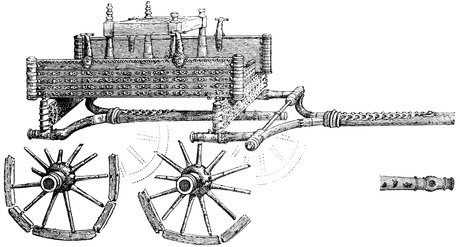
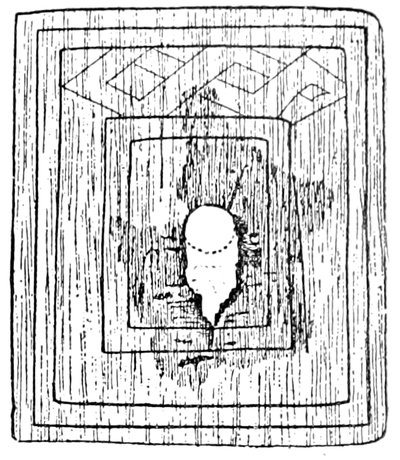
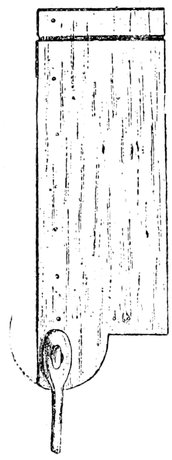
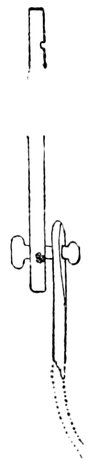
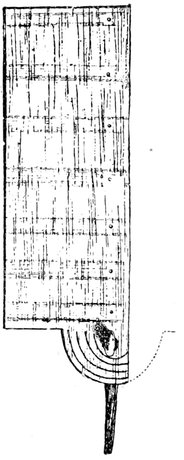
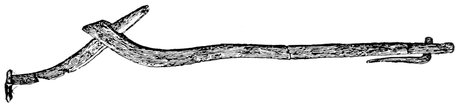
WAGGON OF THE VIKING AGE.
One of two waggons found in the Deibjerg bog, Ringkjobing, West Jutland, ornamented all over with bronze; and on each side representations of two human heads with heavy moustaches, and with the triskele and other mystic signs. Length of sides, 5 feet, 4 inches; straight pole, about 6 feet, including the bent piece; diameter of wheels, 3 feet.
BY
PAUL B. DU CHAILLU
AUTHOR OF “EXPLORATIONS IN EQUATORIAL AFRICA,” “LAND OF THE MIDNIGHT SUN,” ETC.
High position of women—Married women’s property—Marriage a civil compact—The
suitor—Qualities looked for in a suitor—The bride’s dower—Runaway
marriages—The marriage settlement—The givers away of the
bride—The betrothal—Breaking a betrothal—Length of a betrothal—The
wedding—The trousseau—Illegality of marriages without betrothal—Guardians
of unmarried sisters—Marriage against the will of the
parents—Age of majority—Widows—Marriage on insufficient means—Laws
relating to marriage—The wedding feast—Valuation of property—Laws
on kissing—Women’s rights.
It is particularly striking, in reading the Sagas and the
ancient laws which corroborate them, to see the high position
women occupied in earlier and later pagan times.
If we are to judge of the civilisation of a people in their
daily life by the position women held with regard to men, we
must conclude that in this respect the earlier Norse tribes could
compare favourably with the most ancient civilised nations
whose history has come down to us.
A maiden was highly respected, and on becoming a wife she
was greatly honoured, and her counsels had great weight; by
marrying she became the companion and not the inferior of
her husband. She held property in her own right, whatever
she received by inheritance and by marriage being her own;
though there were restrictions put upon her, as well as upon
her husband, in regard to the use of her property.
In a word, a retrograde movement in regard to the rights
and standing of women took place after the extinction of the
Asa creed. The high position they had occupied before was
lost, and it is only latterly that they have striven, and in some
countries with success, to regain the authority that once
belonged to them in regard to property and other matters.
2From the earliest time we see the chivalrous regard that
men had for women, and the punishment that any breach
of its laws involved. Young men went into warlike expeditions
to attain great fame, so that their acts of bravery could be
known or extolled, and that they might become worthy of the
maiden they wished to woo. The same spirit afterwards spread
from the North to other countries in Europe, where, however,
the opinion only of women of higher rank was valued. Among
the earlier tribes of the North all were respected.
Marriage was not a religious contract or ceremony. It was
simply regarded as a civil compact, owing to the relations
which man and wife held towards each other in regard to
property. It was the means of joining families together,
which was called tengja saman,[1] and therefore the relation was
called tengdir. Consequently marriage itself was a bargain
and on that account was called brud-kaup (bride-buying).
When a man had selected for himself, or by the advice of
his parents, a woman or maiden whom he wanted to marry, he,
accompanied by his father, or nearest relatives or best friends,
and by a retinue, according to his rank, went to get the consent
of the father, or of those who were the guardians of the
woman. It was the exception for the suitor himself not to go
on this journey, which was called bonordsför (suit journey).[2]
“Njal once said to his son Helgi, ‘I have thought of a
match for thee, kinsman, if thou wilt follow my advice.’
‘Certainly I will,’ he said, ‘for I know both that thou meanest
it well and knowest well how to act; but what is it?’ ‘We
will ask in marriage the daughter of Asgrim Ellidagrimsson,
for she is the best match.’ Shortly afterwards they rode out
across the Thjórsá (a river), until they came to Tunga. Asgrim
was at home, and received them well, and they stayed there
over night. The next day they proceeded to talk the matter
over. Njal opened the subject, and asked for the hand of
Thorhalla for his son Helgi. Asgrim received this well, and
said that with no men was he more desirous to bargain than
with them. They then talked about the matter, and at last
Asgrim betrothed his daughter to Helgi, and the wedding
feast was agreed upon” (Njala, c. 26, 27).
3The suitor, even if present, had a spokesman who spoke on
his behalf, and enumerated his good qualities, deeds of valour,
&c., and other qualifications which might speak well for the
suit. If the suit was favourably received, a talk ensued in
regard to the conditions of the marriage.
Rut, a chief, went with his brother Höskuld to the Althing,
and was told by him that he would like him to marry Unn,
the daughter of Mörd Gigja. They went to his booth at the
place of the Althing, and after awhile Höskuld said:—
“‘I should like to make a bargain with thee; Rut wants to buy
thy daughter, and become thy son-in-law, and I shall not spare
my property.’ Mörd answered: ‘I know thou art a great chief,
but thy brother is unknown to me.’ Höskuld said: ‘He is a
greater chief than I.’ Mörd added: ‘Thou must furnish him
well, for she is the owner of all my inheritance.’ ‘Thou
needest not wait long for what I shall fix upon,’ replied
Höskuld; ‘he shall have Kambsnes and Rutstadir and the
land as far as Thrandargil; he also has a trading ship on
voyages abroad.’ Rut then said to Mörd: ‘You may think,
bondi, that my brother has spoken so highly of me because
he loves me, but if you will take the matter into consideration
I want you to state your conditions.’ Mörd answered:
‘I have thought of the conditions. She shall have 60 hundreds,
and it shall be increased with one-third from thy farm, but
if you have an heir each of you shall have the half.’ Rut
said: ‘These conditions I accept; and now let us have
witnesses’” (Njala, c. 2).[3]
The qualities which the parents or guardians took most
into consideration were good birth, powerful and prominent
relatives. Families on both sides had to be well matched in
rank, wealth, and personal bravery, the last being highly prized
by the one whose hand was sought.
“The kings (Ingibjörg’s brothers) went to a feast at
Framnes[4] with Fridthjóf, and, as usual, he treated them all
better than they were accustomed to be treated. Ingibjörg
was there, and often spoke with Fridthjóf; she said to him:
‘Thou hast a good gold ring.’ ‘That is true,’ said Fridthjóf.
Then the kings went home, and their envy against Fridthjóf
increased. A little after Fridthjóf became very sad; Björn,
his foster-brother, asked why he was so; he said he had it in
mind to ask Ingibjörg in marriage; ‘though I have lower
4rank than her brothers, I am as good a man as they.’ Björn
said: ‘Let us do it.’ The kings sat on their father’s mound,
and Fridthjóf saluted them; afterwards he asked their sister
Ingibjörg, Beli’s daughter, in marriage. The kings said: ‘It
is very unwise to ask us to give her in marriage to a man of
no rank, and we refuse it.’ Fridthjóf said: ‘Then my errand
is ended. I will never hereafter give you any help though
you may need it” (Fridthjóf’s Saga, c. 2).
“And Björn was king over Firdafylki. His jarl was Hróald,
and Thorir was his son. Atli the Thin was then jarl at
Gaular. His children were Hallstein, Hólmstein, Herstein,
and Solveig the fair. One autumn many people were at
Gaular at an autumn sacrifice. Then Ölvir Hnúfa saw Solveig,
and liked her well. He asked her in marriage, but the jarl
thought there was inequality of rank and would not consent
to the marriage. Thereupon Ölvir made many songs of love.
He loved Solveig so much that he left off Viking expeditions”
(Egil’s Saga, c. 2).
“Grimkel, a godi, said: ‘I am told for certain, Valbrand, that
thou hast a daughter called Signy, who is very accomplished;
I want to ask her in marriage, if thou wilt marry her to me.’
Valbrand answered: ‘It is known to us that thou art of good
kin and art wealthy, and a great champion; I will give a
favourable answer to this’” (Hörd’s Saga, c. 3).
“I (Harald Fairhair) have thought of a match for thee; it was
in my mind when thou didst endanger thy life for mine. Vigdis,
the daughter of Thorir jarl the Silent, is a most handsome
woman, and has much property; I will marry her to thee.
Ingimund thanked him and consented” (Vatnsdæla Saga, c. 12).
In order that marriage should be regarded as perfectly
lawful, the woman had to be “mundi keypt”; that is, bought
with mund[5] acquired by a legal agreement between the man on
one side, and the parents or guardians of the intended bride
on the other, in regard to the dower or property agreed on both
sides as belonging to the bride.
“The sons of Hildirid went to Thórólf and presented their
claim to the property of their father Björgólf. Thórólf
answered: ‘I know of Brynjolf, and still better of Bárd, that
they were men of such generosity that they would have given
you of the inheritance of Björgólf as much as they knew you
had a right to. I was present when you pressed this same
claim against Bárd, and I heard that he thought there were no
5proofs for it, for he called you sons of a concubine.’ Harek
said they would get witnesses that their mother was bought
with mund. ‘But it is true that we did not first present this
claim to our brother Brynjolf. There was also to be a division
between kinsmen, and from Bárd we expected honourable
treatment in every respect, but our dealings with him were not
long. Now this inheritance has come into the hands of unrelated
men, and we cannot be altogether silent with regard
to our loss. It may be that there yet is as before such difference
in power that we may not get our rights from thee, if
thou wilt hear none of the witnesses, whom we can bring forth
that we are odal-born men.’ Thórólf answered harshly: ‘I
count you the less legitimate as I am told your mother was
taken away by force and brought home as a captive’” (Egil’s
Saga, c. 9).
Mund was originally the name for all the conditions in regard
to the property of both, especially that of the wife. This
agreement was the most important thing at the festar[6] (betrothal,
fastening). Children born without the payment of it were
not inheritance-born—in a word, were considered illegitimate.
If the wife was poor and entirely without property the
husband had to give a mund of twelve aurar, in order that the
marriage should be regarded as fully legal.
“Next we must know how we shall buy women with mund, so
that the child is inheritance-born. The man shall give that
woman a poor man’s mund, amounting to 12 aurar, and have
witnesses (at the ceremony). He shall have bridesmen, and
she bridesmaids, and he shall give her a gift in the morning
when they have been together one night, as large as the one
at the betrothal. Then the child born thereafter is inheritance-born”
(Gulath., 5).
“All men are not inheritance-born though they are free-born.
The man whose mother is not bought with mund, with
a mark, or still more property, or not wedded, or not betrothed,
is not inheritance-born. A woman is bought with mund when
a mark consisting of aurar, of the value of 12 feet of vadmal,[7] or
more property, is paid or stipulated by hand-shaking. A
wedding is lawfully made if the lawful man betroths the
woman, and six men at least are present” (Gragas, i. 75).[8]
6If a man married a girl without the consent of her parents or
guardians, or made a runaway match, the husband was outlawed.
“Björn, the son of a hersir at Aurland in Sogn, was a great
seafaring man; sometimes he was on Viking expeditions,
sometimes on trade-journeys. One summer he was in Firdafylki
at a feast where there were many people. There he
saw a handsome maiden whom he liked much. He asked of
what family she was. He was told that she was the sister of
Thórir hersir, son of Hróald, and was named Thora Hladhönd
(lace-hand). Björn asked her in marriage, but Thorir refused
her to him, and so they parted; but the same autumn Björn
got men and went with a full-manned skuta[9] north to Firdafylki,
and arrived at Thórir’s when he was not at home. He
took Thora away, and carried her home with him to Aurland.
“In the autumn ships arrived at Iceland from Norway,
bringing the report that Björn had run away with Thora,
without the consent of her kinsmen, and that the king had
for that reason outlawed him from Norway” (Egil’s Saga,
c. 32, 34).
The first matter settled was the heimanfylgja (home-following,
or dowry), which follows the bride as given by the parents, or
by those who had the right to give her away; and then what
the man had to set against the dowry of his intended, which
was called tilgjöf, or counter gift. This latter stood in a
certain proportion to the former, and generally formed a third
of the whole coming to the wife. It was occasionally decided
at the same time what linfé[10] (linen fee) the husband should
give to his wife on the morning after their wedding.
“The king (Svein of Denmark) and the jarl agreed that
Thyri (Svein’s sister) should have the possessions in Vindland
which Gunnhild (deceased wife of Svein, daughter of Búrisleif)
had owned, and also other large possessions as dower (tilgjöf).
Thyri wept sorely, and went, very much against her will.
When they came to Vindland Búrisleif made his wedding-feast
and married Thyri, but she would neither take food nor drink
from the heathens for seven days” (Olaf Tryggvason’s Saga,
c. 99).
7The dowry included movable property and lands.
“The mother shall take as much property if her daughter
dies childless as she has given her from home, and also the
mund without interest. She and her children shall get this
in preference to the father. Every man who has given anything
for the heimanfylgja shall get it back if the wife dies
childless, and also get the mund, if he has declared it at the
betrothal or the wedding” (Gragas, i. 174).
The givers-away of the bride were called giptingar-men, and
were either parents, kinsmen, or guardians.
After the preliminaries to the marriage had taken place,
and the agreement had been announced to the witnesses, the
festar or betrothal followed, when the parties became festarmadr
or betrothed man, and festarkona or betrothed woman.
This was a legal tie which could not be broken with impunity.
The suitor went over to the father or guardian of the woman,
and the latter betrothed her to him with a “handsal” (hand-shaking);
at the same time both parties also named their
witnesses to their betrothal. Gragas gives the formula used at
this ceremony, which is as follows:—
“A woman is betrothed according to law if a man recites
the agreement about the mund; then the guardian and the
man to whom the woman is betrothed shall name witnesses to
it. The man who is betrothed shall say: ‘We name witnesses
that thou N. N. betrothest thyself to me N. N. with a lawful
betrothal, and givest me the heimanfylgja with hand-shaking, as
the fulfilment and performance of the whole agreement which
was a while ago recited between us without fraud and tricks.’
This is a complete and lawful match. It is lawful when the
betrother is the one who has the right to betroth according to
law; and it is complete if the betrothed is in such health that
she would be bought at no less price if she was a bondmaid,
or has no other faults or blemishes which would make her cost
less or which she had when sixteen winters old. But if these
faults are found in the woman, the man who knowing it
betrothed the woman is liable to lesser outlawry for it, and
the wedding may be prevented if the man betrothed wishes it,
provided he had before pronounced the words, ‘a complete and
lawful match’—but not otherwise. Now if the betrothed man
wants to demand the mund he shall summon the guardian,
because he has betrothed the woman knowing such faults in
8her that she would cost less if she were a bondmaid. He shall
summon him to lesser outlawry, and summon nine of his
neighbours to the Thing. If the witnesses are against him he
is to be outlawed, and the mund cannot be claimed. If the
witnesses say that the guardian knew not the faults of the
woman he can defend himself, but he cannot claim the mund
unless he can get five dwellers at the farm of the woman as
witnesses that she has not these faults; then the mund is to
be paid back” (Gragas, i. 316).[11]
If the betrothed woman was injured or wronged in any way
the man had the same right to gain redress as if she were his
wife.
“Every man has full rétt on the behalf of his betrothed as
well as his wife, as long as it is due; but if she sits at home
in the house of a father or brother they have the full rétt on
her behalf which her betrothed would otherwise have had”
(Frostath., xi. 12).
“If a man runs away with a betrothed woman he shall pay
full rétt to the betrothed man and also to her father”
(Bjarkey law, 125).
The virtue of a betrothed woman was very carefully
guarded.
“If the father dies before the wedding within the twelve
months, and the child is begotten, then that child shall take
its father’s inheritance as if its mother were bought with
mund. But in no other way is a man inheritance-born unless
his mother is bought with mund, or he is led lawfully into the
family (adopted). Though a man betroth his concubine in
order that according to this law his children be inheritance-born,
or delays the wedding on account of this, it does not
matter, for neither shall inheritance-fraud be committed, nor
the wedding be dishonoured by this” (Frostath., 13).
The breaking of a betrothal by either party was severely
punished, and the laws on the subject were strict.
“If a man will not take his betrothed he shall be summoned
home to take her, and a day be fixed. Thereupon he shall be
summoned to the Thing because he flees from his betrothed.
9Then the thingmen shall make him an outlaw, and he is called
a runaway (fudflogi)” (Gulath., 51).
“If a man wants a better match, the father shall betroth his
daughter himself if she is a maiden, and the brother shall do
it if the father is dead. If the father will not give his daughter
to the man to whom she has been betrothed, he shall be summoned
home and a day be fixed on which he shall have his
betrothed. If the betrother will not let him have her, he shall
demand the dowry of his betrothed, and summon him to the
Thing for robbery; then the thingmen have to outlaw him.
The maiden has no power in this matter, if she does not draw
back from the marriage herself. The man who has charge
of the betrothed woman may keep her from the betrothed man
for a twelvemonth. A widow may betroth herself, but shall
take the advice of her kinsmen; then she cannot break her
troth. If she has not taken the advice of her kinsmen, she
may break it and pay three marks for the breach of faith to
the one who was betrothed to her. If a man betroths to a
man a woman over whom he has no betrothing power, he shall
pay three marks to the one who was betrothed to her. Two or
more brothers shall have power over their sister; if one of
them betroths her to a man, and the others object, then they
shall draw lots who of them shall rule; if the one who
betrothed her draws the lot, the betrothal shall be kept,
otherwise not, and then the betrother shall pay three marks
for breach of faith” (Earlier Gulathing’s Law, c. 51).
The length of the betrothal, if no special agreement had
been made, was limited to twelve months, that being the
longest time that a woman’s guardian could defer a marriage
against the will of her future husband. Three years seems
to have been the longest delay allowed; during that time the
woman was said to sit as betrothed, if the suitor was away and
did not return within that time the agreement was void, and
the woman was free to marry another man.
“Björn now rode to Borg to see his kinsman Skúli. When
they met, Björn told him that he wished above all to get
Oddny Thorkel’s daughter before he left. Skúli asked if he
had said anything about it to her. Björn answered he had
certainly done so. Then let us go, said Skúli; and they went.
They came to Hjörsey, and saw Thorkel and his daughter
Oddny. Björn then told him the state of his feelings, and
asked Oddny in marriage. Thorkel took it well, and referred
10it altogether to his daughter’s decision. As Björn had been
known to her before, and they had loved each other very
fondly, she consented. Then the betrothal was performed at
once, and she was to sit betrothed for three winters. And
even if Björn, while staying in the same country (Iceland),
was prevented from marrying her, she was to wait for him
nevertheless during a fourth winter. If he should not come
back from Norway in three winters, Thorkel was to give her
in marriage if he liked. Also Björn was to send men to Iceland
to renew the betrothal if he could not come himself.
Skúli contributed as part of the contract so much property
with Björn that it was as much as all the property which
Thorkel added to his daughter’s mund”[12] (Björn Hitdælakappi’s
Saga).
The betrothed who without valid reason did not fulfil her
engagement, and the giver-away who kept back the betrothed
woman, were outlawed. If she of her free will took another
man than her betrothed, both she and the giver-away were
outlawed.
“If a man betroths a woman he shall have her married
within twelve months if no necessity hinders” (Frostath.,
iii. 12).
“The giver-away of a woman may keep her from her
betrothed man for twelve months” (Gulathing’s Law, 51).
“If she (the betrothed woman) wants to break the betrothal
within twelve months, and says she has been betrothed against
her will, he can use his witnesses against her words and get
her. If he lacks witnesses then she and also her father and
mother, or their nearest kinsmen if they do not exist, shall
assure it is against her will with an oath, and pay the betrothed
man as much as was promised. If this takes place after the
wedding she loses her third” (Frostath., iii. 22).
“If the man to whom a woman is betrothed becomes sick he
shall send word half a month before (the wedding) to the man
who has betrothed the woman that he will not come to the
wedding on account of his health, and the woman need not be
brought home to him though it was agreed, and the reasons
must be told. Then the wedding shall not be before the same
time next year, unless the man wants it before, and then word
must be sent half a month or more before, and he shall keep
the wedding at his sole cost. If he does not recover in the
11next twelvemonth the betrothal is dissolved, unless both wish
otherwise” (Gragas, i. 310).
The wedding generally took place at the home of the bride;
very seldom at the bridegroom’s: on the wedding-night the
mund became the wife’s personal property.
After the marriage the bride and bridegroom were hjón, a
word which means man and wife; and then the wife became an
eiginkona (own woman, wife, spouse) and hùsfreyja (housewife),
and enjoyed the rights belonging to that position.
“Illugi lived at Hólm in Akranes. He was tall and strong
and wealthy; he went on a wooing-journey to Ölfusvatn, and
asked for Thurid, the daughter of Grimkel by his first wife.
Grimkel answered favourably, for he knew Illugi; the betrothal
was performed there; Hörd (Grimkel’s son by Signy) was not
present at this. In the tvimanad (September) the wedding-feast
was to be at Ölfusvatn, and when the appointed day came
Illugi made ready to go with thirty men” (Hörd’s Saga, ch. ii.).
No rings were exchanged or given either at the betrothal or
the wedding. That the bride had a special dress for the
bridal ceremony seems to be certain, though in no Saga have
we a description of a bridal dress; but from several passages
we see that the bride was hvit-földud (white-folded), and lin-bundin
(linen-bound, enveloped in linen), which implies that
the bridal dress was white.
“It is told that the first evening of the wedding the brides
(King Svein’s, and that of Sigvaldi, Jarl of the Jomsvikings)
had their head-dress (fald) low down so that their faces could
not be distinctly seen; next morning they were very merry
and did not wear any skuplas.”[13]
This bridal linen was a long wide head-dress hanging down
the back from the top of the head, or a kind of veil. In
Thrymskvida the bride wore such a head-dress, which was
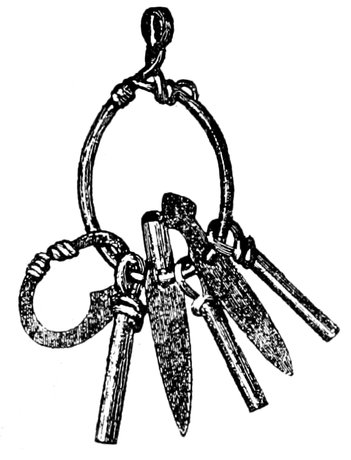
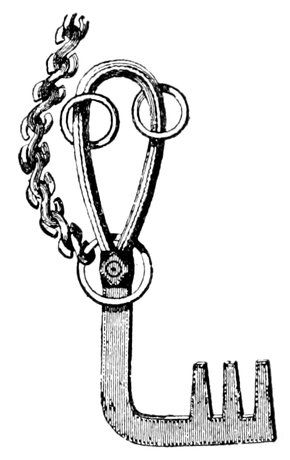
fastened on the head with an ornament. At the waist a
bunch of keys was placed to show her authority as mistress
of the household, and on her breast she had an ornament.
The jötun Thrym had got Thor’s hammer and would not
give it back, unless Freyja were married to him. Thor was
12disguised as Freyja, and sent as a bride to Thrym; he got
hold of the hammer, and crushed Thrym and the jötnar.
We have nothing to show positively that marriage was
celebrated with religious ceremonies, but certain forms may
have taken place. In the later Edda we have the goddess Vár,
who hears the vows of men and women. In Helgi Hjörvardson
there are also vows called by her name, and it seems that she
was solemnly invoked at weddings, and the sign of the hammer
of Thor made over the bride.
Marriage without betrothal proceedings and dowry was called
skyndibrúdhlaup (hasty wedding), or lausa-brudhlaup (loose
wedding). Such an union was illegal, and the children begotten
thereby had no right of inheritance.
“Björgólf, a landed man in Halogaland, once in his old age
was at a feast with Högni, a rich bondi, and saw his daughter
Hildirid, whom he liked well.
“The same autumn Björgólf the old left on his skuta with
13thirty men. He came to Leka (Högni’s farm), and twenty
men went up to the farm, while ten guarded the ship. When
they came home Högni received him well, and invited him to
stay there with his men; he accepted, and went into the
stofa (daily room). When they had taken off their outer
clothes Högni had a skap-ker (large vessel) with ale carried in.
Hildirid, his daughter, carried ale to the guests. Björgólf
called Högni, and said: ‘My errand hither is that I wish
thy daughter to go home with me, and I will marry her in
loose wedding.’ Högni saw he could do nothing but what
Björgólf wished. Björgólf bought her with an eyrir of gold....
They had two sons, Hárek and Hrœrek, and Björgólf
died afterwards. Then Brynjólf, his son by the first wife,
sent her away to her father. They were called Hildirid-sons,
and not by the name of the father. Brynjólf died, and
his son Bard got his death wounds in the battle of Hafrsfjord.
Bard had the king called to him, and said: ‘If I die from
these wounds I ask you to allow me to dispose of my inheritance.’
The king consented. Bard said: ‘I wish my
companion and kinsman Thorólf to take all my inheritance,
lands and loose property; I will also give him my wife and
my son to bring up, for I trust him best of all men.’ Thorólf
according to the wish of his friend married this wife, Sigrid,
daughter of Sigurd in Sandnes” (Egil’s Saga, 7).
The father or the guardian of the girl had the decision over
her marriage. If the father was dead the brothers were the
guardians of the unmarried sister. If she had neither father
nor brothers, her mother in connection with the nearest uncle
could give her away; and as the maiden had no voice in the
matter, she could be forced by her father or guardians into a
marriage against her will.
“Thorvald Usvifrsson, a rich man, demanded Hallgerd in
marriage from her father Höskuld, an Icelandic chief. Höskuld
told him that she was proud, but Thorvald said that did not
matter. Höskuld did not ask his daughter, because he intended
to give her in marriage and betroth her to Thorvald.
When he told her, she said: ‘Now I have found out what I
long suspected, that thou dost not love me so much as thou
always pretendest, as thou didst not think it worth while to
speak to me about this matter; nor do I think this match as
high as you have promised me.’ It could be seen that she
considered herself to be married beneath her rank” (Njala 10).[19]
14“The giver away next to a father or brother is a lawfully
wedded mother. If there is no mother, then the man twenty
winters old or more who is the nearest heir after the woman
who is married” (Frostath., law ii. 13).
The father did not always exercise his right of deciding
about the marriage; sometimes he left the decision of the suit
entirely in the hands of the daughter, but such cases must be
regarded as an exception.
If a girl married against the will of her parents or kinsmen the
latter could disinherit her, and her progeny were illegitimate,
and this act of disobedience would even get her self-chosen
husband declared an outlaw as a woman-robber.
When a poor girl was given in marriage to a rich man, one of
the conditions made was that her clothes and ornaments should
be provided, though if she was an heiress and fifteen years of
age she could betroth herself with the advice of her kinsmen.
The different Sagas and laws place the age of majority of
men as well as of women at fifteen years, and early marriages
of women at that age were not uncommon.
“Thorvald (a wealthy Icelander) asked in marriage Gudrún
Úsvifr’s daughter at the Althing when she was fifteen winters
old. The answer was favourable, but Úsvifr said it would be
seen by the conditions that they were not equally high-born.
Thorvald took this well, and said he asked for the woman and
not for property. Then Gudrún was betrothed to Thorvald,
and Úsvifr made the agreement. It was that Gudrún alone
should rule over their property after they had come into one
bed, and be owner of one half of all, whether they lived longer
or shorter together. He was also to buy costly things for her,
so that no equally rich wife had better jewels” (Laxdæla,
c. 34).[20]
“The maiden who becomes an heiress may marry herself to
whomever she likes when she is fifteen winters old, with the
counsel of those of her kinsmen who are the wisest and nearest
both on her father’s and mother’s side” (Frostath., xi. 18).
“Glúm, a powerful man, went with his brother (Thorarin)
to Höskuldsstadir with eighteen men to ask in marriage Hallgerd,
the daughter of the chief Höskuld who lived there.
15When they had stayed there overnight Glúm’s brother,
Thórarin, said: ‘I have come here, Höskuld, with my brother
Glúm to ask thy daughter Hallgerd in marriage for him.
Thou must know that he is high-born.’ ‘I know,’ said Höskuld,
‘that your brothers are of good kin, but I will also tell thee
that I married her once and it became a great misfortune.’
Thórarin answered: ‘We will not let that prevent the bargain,
for a single oath is no evidence for all cases.’”
As Hallgerd had been unfortunately married, Hrut said:—
“This time Hallgerd must not, as before, be kept in ignorance
of the betrothal; she shall know all this bargain and see Glúm,
and have her way about marrying him or not; then she cannot
accuse others if it does not do well; all this shall be without
deceit.’ Thórarin said: ‘Now, as always, it will be best to take
thy advice.’”
Hallgerd was sent for; and after coming in with two women—
“She sat down between Hrút and her father. She greeted
them all with fine words, and spoke well, and asked for
news. Then she grew silent. Glúm said: ‘I and my brother
Thórarin have spoken about a bargain to thy father, namely,
that I should marry thee, Hallgerd, if it is thy will, as it is
theirs. Thou wilt also tell now, as thou art called a highly
accomplished woman, whether it is somewhat to thy mind; but
if the bargain with us is not to thy wish, we will not speak of
it.’ Hallgerd said: ‘I know that your brothers are men of
good kin, and that I will now be married much better than
before; but I want to know what you have said, and how far the
matter has advanced; but as thou lookest to me, I think I will
love thee well if our tempers agree.’ Glúm himself told her
all the conditions, and left nothing out, and asked Höskuld
and Hrút whether they were rightly told. Höskuld said they
were. Hallgerd said: ‘You, my father, and Hrút have behaved
so well to me in this matter that I will do this at your advice,
and this bargain shall be as you have made it.’ Hrút said:
‘I think it advisable that I and Höskuld should name witnesses,
and that Hallgerd should betroth herself if the lawman thinks
it right.’ Thórarin answered: ‘It is right.’ Then the property
of Hallgerd was valued, and Glúm was to give as much,
and there was to be joint-partnership between them. Then
Glúm betrothed Hallgerd to himself, and they rode home.
Höskuld was to hold the wedding feast” (Njala, c. 13).
When girls were of age they could transact their own
business.
16“There are maidens called baugryg. They shall pay with
rings and take rings when they are only children and inheritance-born,
till they sit down on a bride’s chair. Then
they throw this into the lap of their kinsmen, and shall neither
pay nor take rings thereafter” (Frostath., vi. 4).
A widow, who had the same rights as a girl of age, could
not be forced into a new marriage by her father or kinsmen,
but on the other hand she could not marry without their
consent; and the conditions of the marriage were generally
settled by the spokesmen of the suitor and her nearest of kin
in the usual manner.
“A widow shall betroth herself and take the advice of her
kinsmen” (Gulathing’s Law, 51).
“Thorgerd, Thorstein’s daughter, Höskuld’s mother, was still
a young and very beautiful woman. She did not like to stay
in Iceland after the death of Koll (her husband). She declared
to her son Höskuld that she wished to go abroad with the
property she owned. Höskuld said he was sorry to part with
her, but would not oppose her will in this any more than in
other things. Then Höskuld bought the half of a ship in
Dögurdarnes for his mother. Thorgerd went on board with
much property, set sail, and after a good journey landed in
Norway. She had in Norway a large family and many highborn
kinsmen; they received her well, and offered her everything
she might wish. Thorgerd accepted this thankfully,
and said she intended to settle down there. She was not long
a widow; Herjólf, a wealthy and highly-honoured lendirmadn,
asked her in marriage. She accepted him, although he was
not handsome, and a splendid wedding was celebrated. A son
was born to them, who was called Hrut, and who quickly grew
up and became very strong and large. He was fair of face like
his mother’s family. Herjólf fell sick and died, and men
thought it a great loss. After his death Thorgerd did not
like to remain in Norway, but returned to Iceland to her son
Höskuld with much property, and remained there until her
death, after which she was buried in a mound. After her
burial Höskuld took all her property, and offered half of it to
Hrut, who had remained in Norway” (Laxdæla, 7).
The Icelandic chief Thorkel Eyjolfsson wanted to marry
the widow Gudrun, Usvifr’s daughter. The chief Snorri godi
asked her in marriage on his behalf.
“Gudrun answered: ‘My sons Thorleik and Bolli will
17have most of the power in this, but thou, Snorri, art the third
man to whom I would most willingly entrust the matters
which I think very important, for thou hast long given
me good advice.’ Snorri said it was evident that Thorkel
ought not to be rejected. Thereafter Snorri had the sons
of Gudrun called thither; he told them how much support
they could get from Thorkel on account of his wealth and
foresight, and gave good advice about it. Bolli answered:
‘My mother will be best able to see this; I shall consent to
her will. But surely we think it advisable to take into account
that thou hast supported this matter, Snorri, for thou hast done
many good things for us.’ Gudrun said: ‘We shall carefully
heed the advice of Snorri in this matter, for thy counsels have
been good to us.’ Snorri urged her strongly to do it, and it
was settled that the marriage should take place. Snorri offered
to make the wedding-feast. Thorkel was pleased at that, and
said: ‘I have got provisions enough to supply as much as you
like.’ Then Gudrun said: ‘It is my will that the feast shall
be here at Helgafell’” (Laxdæla, 68).
People could not marry unless they had means enough to
support themselves in comfort. If they acquired wealth afterwards,
then he owned two-thirds, and she one-third, both of
land and movable property, and the husband could not take
his wife’s property out of the country without her consent.
Partnership between husband and wife was said to be established
after a certain time, which according to Frostathing’s
Law was twelve months.
But according to the Gulathing, man and wife could not,
without the consent of the heirs of both, enter into partnership
before they had children; but when they had, they could
make whatever partnership they liked. When they had been
married twenty years they were partners according to law.[21]
“If men marry who have less property than one hundred
legal aurar, besides their everyday clothes, and no children,
then they are liable to lesser outlawry unless the woman is
barren. No féránsdóm[22] shall be held, and their property is
not confiscated, and they shall leave the land with their
children, and not come back unless their property increases
18so much that they own a hundred or more, or the woman is
barren” (Gragas, i. 323).
“If man and wife have equal property they shall make
partnership if they wish, which is also valid for their heirs.
The contract of betrothal is valid between man and wife
while its witnesses live and no other contracts are made.
But if the witnesses remembering it are dead, then their
property is in common, according to law, if he owned a
mark or more, and the mund was paid, and they have lived
together three winters or more. If they are poor and earn
property, their property is in common according to law.
According to law the joint partnership is always thus, that he
owns two parts, and she one-third”[23] (Gragas, i. 334).
“If a wife loses her husband, and they have lived twelve
months together, she owns one-third of the farm and of all
loose property, and her clothes besides” (Frostathing, xi. 6).
“If a man marries a widow or maiden who owns a farm, he
owns nothing of the farm before they have lived together
twelve months. Then the laws lay their property together.
“If two paupers marry according to the laws of the land,
and their property increases, then he owns two-thirds, and she
one-third of lands and loose property” (Frostathing, ix. 8, 9).
“A man shall not take the property of his wife out of the
land, except with her consent. He shall rule over all their
property for their use. Neither of them shall by word or deed
forfeit the property of the other. Every man has the same
rétt for his wife as for himself” (Earlier Gulathing’s Law, 52).[24]
“If a man wants to leave the country with the property of his
wife, she may give full powers to any man she wishes to forbid
him going, and prosecute him and the men who take him
away, if needed” (Grágás, i. 331).
“A wife shall not refuse partnership to her husband. If a
man marries a maiden, they cannot enter into partnership
unless the men who have right to their inheritance assent; but
if they have inheritance-born children, they can enter into
such partnership as they like.
“If a man marries a widow, and she has children (inheritance-born
children) which are under age, and the man nevertheless
wants to enter into partnership with her, ‘then a
meeting shall be summoned of the children nearest of kin on
their father’s side, and a partnership be made according to the
worth of their property; land shall be valued against land,
19and loose property against loose property,’ and his property
valued also if it is more than hers. It cannot be broken if
thus made.
“If they enter into partnership in another way, it may be
broken, whether his heirs or hers want it, by going to a Thing
before they have been twenty winters together, and declaring
that the partnership is broken. If this is not done before
they have been twenty winters together, he (the husband)
can never change it thereafter.
“Wherever husband and wife enter into partnership, they
shall declare it before many men. Now if they have lived
together twenty winters or more, they are partners according
to the laws, if they were not before. Then she owns a third of
the property, and he two-thirds. Though it (the partnership)
be made, if it is not made public during the twenty winters, it
is as if it had not been made” (Gulathing’s Law, 53).
Marriages were forbidden to the fifth degree of relationship.
“It is a new law that marriage is not allowed nearer than
the fifth degree in the same degrees of relationship and kinsmanship.
If they are both kinsmen in the fifth degree they
may marry if they like, but pay a larger tithe of all their
property” (Grágás, i. 308).
The wedding feasts, at which the gods were invoked for
the happiness of the marriage, were often very splendid, and
guests, to whom presents were given, came from long distances.
The length of the feasts varied according to the rank
and wealth of the family, and were so gorgeous that they
remained long in the memories of the people.
The brúd-kaup, or wedding, was the fulfilment of the conditions
stipulated at the betrothal.
“Sigmund[25] rode to Orradal, and visited Thorkel, and was
well received. He now began his wooing, and asked Thurid
in marriage. Thorkel took this well, and thought it a great
honour for his daughter and them all. Sigmund made his
wedding-feast at Hladir with Hakon jarl, and the jarl made it
last for seven nights” (Færeyinga Saga, 26).[26]
“Heidrek married Herborg, the daughter of King Hrollaug
in Gardariki. Their wedding-feast was made, and no man had
heard of a greater feast in these lands; it lasted a month;
20when it ended the chiefs were led away with gifts. Hrollaug
gave his daughter a dower of gold and silver and costly things;
Vindland, which lies next to Reidgotaland, was also to follow
her as dower” (Hervara Saga, c. 14).[27]
The celebration of King Olaf’s wedding is thus related:—
“Olaf had made preparations, with the best of all kinds
of drink and provisions that could be got. He had invited
many high-born men from the districts. When Rögnvald
jarl arrived with his men, the king received him well, and
large, good, and well-furnished rooms were given to him; the
servants took care that there should be lack of nothing which
might be proper for a feast. When the feast had lasted some
days, the king and the jarl and the king’s daughter spoke
together; it was agreed that Rögnvald of Western Gautland
should betroth Astrid the daughter of Olaf, King of Sweden, to
Olaf, King of Norway, with the dower which they had before
agreed upon that her sister Ingigerd should have. The king
also was to give Astrid as much as he would have given to
her sister Ingigerd. Then the feast was made larger, and the
wedding of Olaf and Astrid was celebrated with great splendour”
(St. Olaf’s Saga, c. 94).
In sparsely-settled countries we find that a bondi was obliged
to shelter the bridal party.
“A bondi shall feed at least five of them (the bridesmen and
bridesmaids). He is an outlaw if he refuses to lodge them. This
is if the bride or bridegroom are with them; otherwise he must
feed three men” (Kristinrett Thorláks og Ketils biskupa, p. 94).
In the hall where the wedding-feast took place there were
bridal benches, which were probably kept in the family for
such an occasion; just as to-day the bridal crowns are kept in
Norway.
On one of the long benches the bridegroom was seated
with his men; on the other, which was opposite, the father of
the bride and his male guests. On the cross-bench sat the
women, with the bride in the middle; therefore this bench was
called brudbekk (bride-bench).
Sverting Hafr-Bjarnarson was going to marry Húngerd,
Thorodd’s daughter, and invited Hlugi the black, father of
Gunnlaug Ormstunga, and his sons to the wedding-feast.
21“The women sat on the cross-bench; Helga fagra (the fair)
sat next to the bride, and her eyes often glanced at Gunnlaug,
and there the saying was proved that ‘the eyes do not hide it
if a woman loves a man.’ Gunnlaug was then well dressed, and
wore the fine clothes which King Sigtrygg gave him; he was
thought greatly superior to other men, both in strength, beauty,
and stature” (Gunnlaug Ormstunga c. ii.).[28]
We find that during the feast the bride was seated between
the bridesmen and bridesmaids, a custom that has come down
to this day; the linfé was then presented to her as she sat
under the bridal linen.
“Then he (the bridegroom) shall sit between the bridesmen,
and she between the bridesmaids. He shall walk across the
floor and give her linfé. That is lawful whether the gift is
small or great” (N. G. L., ii. 305, King Magnus’ Laws).
It was the custom to offer to the bride a bekkjar-gjöf (bench-gift)
while she sat on the bridal bench.
Kjartan Olafsson, a famous Icelandic champion, was taking
leave of Ingibjörg, the sister of King Olaf Tryggvason, as he
was going to Iceland.
“At this moment Ingibjörg opened a mead-cask standing
at her side, and took out of it a white and gold woven woman’s
head-gear, which she gave to Kjartan, saying it would be only
too good for Gudrún Osvifr’s daughter to wrap around her
head; ‘and thou wilt give it to her as a bench-gift. I want the
Icelandic women to see that she who has been talking with
thee in Norway is not of thrall-kin. It was in a bag of gudvef,[29]
and was most costly” (Laxdæla, c. 43).
When Olaf Tryggvason kept his wedding-feast with Thyri
of Denmark, he asked her whether he should choose a bench-gift
befitting a maiden or a woman who has been married.
She answered that he should do what seemed to him most
beseeming for himself and her. He was pleased with her
answer, and at once sent her a woman’s cloak with very fine
furs and beautifully ornamented.[30]
We see not only how particular people were in regard to
precedence, but how jealously wives guarded the reputation of
their husbands.
22“The chief Gudmund Riki (the powerful) was present at the
wedding-feast of his overseer Thorstein; he sat in the high-seat,
Thorir Helgason (a chief) opposite to him, and the women
on the cross-bench; bright lights were burning, and tables
were placed in front. The bride sat on the middle of the cross-bench,
with Thorlaug (wife of Gudmund) on the one side,
and Geirlaug (wife of Thorir Helgason) on the other. A woman
went with water to the cross-bench, having a cloth on her
shoulder, and first went to Geirlaug because she had been
with her the previous winter. Geirlaug said: ‘Thou actest
with goodwill, but in a thoughtless way; carry the water
first to Thorlaug.’ She did so. Thorlaug beckoned it away
with the back of her hand, saying: ‘Too much trouble is taken,
Geirlaug, for the woman is right; there is no jealousy in my
mind at this; it is not certain that any other woman is of
higher rank in the district than thou.’ Geirlaug answered:
‘The trouble is little, Thorlaug; but if thou hast the ambition
to be most honoured, I have nothing equal to thee, except my
marriage.’ Thorlaug replied: ‘Certainly I think thee well
married, though I do not now know another who is better
married than I.’ Geirlaug added: ‘Thou wouldst be well
married, if thy husband were said by all to be courageous or
valiant.’ Thorlaug replied: ‘This is wickedly spoken, and
thou art the first to say it.’ Geirlaug replied: ‘It is true, for
many others say it; but Thorkel Hák said it first, and my
husband Thorir and every man who can move his tongue says
it.’ Thorlaug said: ‘Bring the water hither, woman, and let
us end this talk” (Ljosvetninga Saga, c. 13).
“The famous champion Gunnar of Hlidarendi was to have
his wedding, and had invited to the feast many people. He
placed his guests as follows. He sat himself in the middle of
the bench; and to the right of him was Thráin Sigfússon, Ulf
Aurgodi, Valgard the grey, Mörd, Runólf, the sons of Sigfús,
and innermost Lambi. Next to Gunnar on the other side sat
Njál, then Skarphedin, Helgi, Grim, Höskuld, Hafr the wise,
Ingjald from Keldur, and the sons of Thorir from Holt.
Thorir wanted to sit outside all the men of distinction....
Höskuld was in the middle of the other bench, and his sons
inside to the left of him; Rút sat outside to the right of
Höskuld; it is not said how the others were placed. The
bride, Hallgerd, sat in the middle of the cross-bench with her
daughter Thorgerd on one side, and on the other Thórhalla,
daughter of Asgrím Ellidagrímsson” (Njala, c. 34).[31]
The man, as the guardian of his wife, had to manage their
23property; but nevertheless the property of each was quite
separate. At the marriage the property of both was valued,
and the heimanfylgja, tilgjöf, linfé, and also what she had got
or would get by inheritance or other ways, were regarded as the
property of the woman.
If the husband died first, his natural heir got his property,
while the wife kept hers; but if the wife died first, the husband
took back the tilgjöf, and the other property went to her heirs.
If a man did not value the property of his wife at the
marriage, then he had to pay the value to her heirs if she died
before him, and take an oath that he had not received more.
But if he died first, and his property also had not been valued,
and they had been married for twelve months, then she
got one-third of the loose property and land, besides her
clothes.
“A man shall rule over his wife’s property while they are
married, and not separated, except that which is stipulated at
their betrothal or their marriage; that property shall she
answer for and rule herself. If an inheritance falls to a man’s
wife, and there are umagi[32] in that inheritance but no property,[33]
her husband shall take care of these, and “fit them out,” but
her heimanfylgja shall not diminish when it is made public in
a drinking-hall.[34] But if there is property in that inheritance,
the lands and all loose property shall be valued, and he shall
have the care of them and the increase, but he shall pay as
much back as he got, except the land-rents which he got
afterwards” (Earlier Frostathing’s Law, xi. 5).
“A gift given to a woman shall be her property, in whatever
manner she may be separated. All the property of a maiden
shall be valued, loose property against loose property, but
one half of a widow’s property shall be valued. The valuation
shall be lawful in every case except two—if she dies childless
or leaves him without a protector” (Gulath., 54).
The only certain examples of polygamy[35] occur among the
great chiefs, such as Harald Fairhair. Harald Hardradi had
24two wives, Elizabeth, the daughter of the King of Gardaríki,
and Thora, the daughter of a Norwegian chief; both enjoyed
the name of queen.
The husband was obliged to protect his wife, and take as
much care of her honour as of his own.
“Now is about the rights of women. Every man has claim
on behalf of his wife. A Hauld owns three marks if she is
struck; but a widow shall have the same rétt as her last husband
(had), and the one she wishes shall prosecute. But
if a maiden is struck, her nearest kinsman shall claim her
rétt as if it were his own. But if she is to have it herself, the
right plaintiff shall summon a Thing” (Earlier Frostathing’s
Law, x., c. 37).
The following laws show how strict people were in regard to
kisses:—
“If a man kisses a woman (belonging to another) secretly,
with her will, he is liable to pay three marks, and the one who
would have to prosecute for seduction has to prosecute. If
she gets angry at it, she may prosecute herself, and the man is
then liable to lesser outlawry. If a man kisses a man’s wife
secretly, he is liable to lesser outlawry whether she allows it or
refuses it. Nine neighbours are to be called as witnesses to
this at the Thing.... If a man puts on a fald or woman’s
clothes to deceive a woman, he is liable to lesser outlawry”[36]
(Gragas, i. 337).
“If a man makes a song of love[37] on a woman, he is to be
outlawed. If the woman is twenty years or older, she shall
prosecute the case herself. But if she is younger, or will not
prosecute, her legal guardian has to do it” (Gragas, vol. ii.,
p. 150).
Women’s rights appear to have been not altogether unknown
even in these early days; for women who got their own livelihood
and whose kinsmen did not trouble themselves about
their support, were their own masters.
“If kinsmen will not take proper care of women, and they
(the women) get their living themselves, then they shall rule
over themselves as they like” (Frostath., xi. 17).
CHAPTER II. DIVORCE.
25
Manner of declaring a divorce—Causes for divorce—Divorce easy to get—Separation—Division
of property in case of separation—Penalty for wife-beating—Restrictions on the
extravagance of women.
A divorce was declared in the following manner. The
wife had to declare the separation, and the reason of it, three
times in three places in the presence of witnesses—first, in
front of them on a bed; secondly, in front of the men’s door;
and, thirdly, at the Thing; but separation did not prevent
either party from marrying again afterwards.
Mörd gave advice to his daughter Unn how she should
separate herself from her husband, Rut, when he was not at
home.
“When thou art quite ready thou shalt go to thy bed,
and with thee the men who are thy followers; thou shalt name
witnesses at the bedside of thy husband, and declare that thou
art separated from him by a lawful divorce, as fairly as is
possible after the rules of the Althing and the laws of all the
people. The same naming of witnesses thou shalt also have at
the men’s door, and then thou shalt ride away” (Njala, c. 7).
The causes for divorce were numerous. A cause of divorce
was that of wearing clothes belonging to the opposite sex,
as when a man wore a shirt so open that you could see his
breast; or when women wore breeches; and we find that
sometimes these clothes were cunningly made on purpose to
bring about a separation.
One day Thórd Ingunnarson asked Gudrún what a woman
was liable to if she always wore breeches like men. She
answered:
“‘They are to be punished for that just as a man is
26punished who has such a large opening in his clothes that
his bare chest is displayed. Both are reasons for divorce....’
Thórd at once rushed to the law court and named witnesses,
he declared himself divorced from Aud, because she wore
closed breeches like men” (Laxdæla, c. 35).
“Gudrun, Usvifr’s daughter, was forced by her father to
marry Thorvald Halldórsson, of Garpsdal. She always asked
him to buy her the most costly things. Once, when she asked
him for something, he said that she knew no moderation, and
gave her a cheek-horse (box on the ear). She answered:
‘Now thou hast given me what we women think of great
importance, and that is a good complexion, and thou hast
cured me of importunate requests.’ The same evening Thórd
(Ingunnarson, a good friend of hers) came in. Gudrun told
him of this disgrace, and asked how she should take revenge
for it. Thórd smiled, and replied: ‘I know a good way; make
a shirt for him with an opening of divorce, and declare thyself
separated from him for this reason.’ Gudrun said nothing
against this, and they left off speaking, but that same spring
Gudrun declared herself separated from Thorvald, and went
home to her father at Laugar” (Laxdæla, ch. 34).
Divorce was easy to get,[38] especially for the man, on the
ground of the wife’s infidelity; while the wife could get it on
the ground of repeated ill-treatment from her husband.
“If a man does not sleep in the same bed with his wife for
six seasons on account of dislike, then her kinsmen can claim
her property and also her rétt, but she shall herself keep
her property” (Gragas, i. 329).
A man could separate from his wife without a lawful reason,
but the separation was looked upon as a disgrace by her
kinsmen, and revenge was sure to follow.
“If a man wants to separate from his wife, he shall declare
himself separated so that each of them may hear the other’s
voice, and have witnesses present” (Gulathing’s Law, 54).[39]
If a husband tried to take his wife out of the country
against her will she could separate herself from him.
27“If a man wants to take his wife against her will out of this
land she shall declare herself separated if she likes, wherever
they happen to be, if she can do it with reason; then he is
liable to lose her and her property as if they had owned no
property together, and he has no more right to that woman
after they have separated than to any other woman with whom
he has not lived” (Gragas, i. 331).
A wife could not separate without reason,[40] and even if she
left her husband with good reason on her side, he could keep
her dower, and could force her to come back.
In case of a separation, the wife’s parents or kinsmen could
claim the mund and the heimanfylgja.
A bondi, Thorkel, having heard that his wife Asgerd loved
another man, was, on his remonstrating, told by his wife to
choose one of two alternatives.
“Thou mayst choose one of two conditions. To stay with
me as if nothing had happened; otherwise I will at once name
witnesses, and declare myself separated from thee, and let my
father claim my mund and heimanfylgja” (Gisli Sursson’s
Saga, p. 16).
If a separation took place where neither party could be said
to have been guilty of criminality, then the wife took the
same amount of property as she would have at the death of her
husband, or as she would take in case she left him on account
of any unfaithfulness on his part. If she left him without any
valid cause, or he separated from her on account of her repeated
infidelity, then the husband had the right to retain all her
property as long as she lived, and her heir had no claim to
anything of the tilgjöf. But if she was unfaithful only
once, she forfeited her tilgjöf, and kept the rest of her
property. If the man drove her away against her will for that
single offence, she came into all her rights.
“If a wife commits adultery, or separates from her husband
without reason, she has forfeited her mund and her increase
of a third (thridjungsauki). If her husband offers to take her
back and she will not accept it he shall keep all her property
while she is alive and then her next heir shall get her heimanfylgja
28but no increase of a third. If they are reconciled and
he takes her back, their property shall remain as if there had
been no breach between them. If she repeats the crime he
shall keep her property while he is alive, and if he will not
take her back, then it shall be as has already been said. If
she does not and promises redress, and offers to live with her
husband and he will not take her, then she shall get her
heimanfylgja but not the increase of a third. If the husband
wants to rob her of her heimanfylgja and says she has committed
this crime before, and people have not before heard
him accuse her of it, she shall take the einseidi (oath of one)
and get her heimanfylgja, but not her increase of a third
if he will not take her back. If a hindrance separates them
according to God’s laws each of them shall have their respective
property” (Frostathing’s Law, xi. 14).
It was a common provision in all the laws that a man was
not allowed to beat his wife, under a penalty of paying the
same indemnity as he had a right to receive if he himself were
beaten. If he had beaten her three times and did it a fourth,
then she could leave him, taking with her her heimanfylgja and
tilgjöf.
“If a man beats his wife with keys or latches, then he is
liable to pay three marks. Also if he takes another woman
and puts her in the house; she is called hearth-rival. Thirdly,
if a man beats his wife with a horn or with the fist on an
ale-bench, then he is to pay three marks. If she three times
gets rétt for these reasons, the fourth time she may separate
from him, or not, as she likes” (Borgarthing[41] Laws, ii. 8).
“When Börk had left his farm Helgafell Thordis went
forward and named witnesses that she declared herself separated
from her husband Börk, and pleaded as a reason that
he had struck her, and she would not put up with his blows.
Their property was divided, and Snorri (a son of her former
marriage) took charge of it on behalf of his mother, for he
was her heir” (Eyrbyggja, c. 14).
Restrictions were put upon the extravagance of women.[42]
“The wife of a hauld (odal’s bondi) is allowed to buy to the
extent of one eyrir, and not more. If she buys for more the
29bargain shall not be kept, except her husband wishes it so”
(Earlier Frostathings Law, xi. 22).
“If a wife gives away her husband’s property he can claim
it all, and prosecute the man who received it. If a man sends
his wife to the Thing to pay debts or other expenses of theirs,
her hand-shaking is valid,[43] and also when she goes to a ship to
make bargains with his consent, but no other transactions are
valid unless he wishes them to be so. When she buys what is
necessary for their household while he is at the Thing, that is
also valid. The woman shall not sell half her land, a farm or
more, or a godord (dignity of godi), or a seagoing ship, except
with the will of her guardian” (Gragas, i. 333).
CHAPTER III. THE BIRTH AND BRINGING UP OF CHILDREN.
30
Appearance of the Nornir at a child’s birth—Ceremony attending birth—Religious
rites—Antiquity of the custom of sprinkling water over a child—The
Asa form and the Christian form of baptism—Naming the child—Birth
of Sigurd, Ragnar Lodbrok’s son—Helgi’s birth—Distinctive names—Belief
in predestination—Possession of two names considered lucky—Presence
of the household and of neighbours at childbirth—Gifts of
weapons and animals—Cutting the first tooth—The prime sign—Exposure
of children—Reasons for exposure—The custom continued after
the introduction of Christianity—The bringing up of children—Attention
paid to physical development—Secret adoption not allowed.
The Nornir seem to have appeared during the night that
followed a child’s birth, which among the high-born was attended
with a great deal of ceremony. The newly-born infant
was placed on the floor, and remained there without being
touched by any one, until taken up and put in the folds of
his cloak, by his father, or in his absence by the nearest of
kin, who by this ceremony acknowledged the legitimacy of
his offspring. After he had received the child in his arms
he looked at it, and from its appearance judged of its temper,
proportions, fortune, luck in war, &c., and decided if the
newly-born infant should live or be exposed and left to die—a
custom similar to that of the Spartans.
Then if the child was to live, a religious or sacred rite called
Ausa Vatni,[44] which seems to have consisted either in pouring
or sprinkling water over the child, was performed, a custom
so common that we are not told how the water was poured or
sprinkled over, though it may have been with the hand.
This ceremony was considered a most sacred rite, and was
an integral part of the Asa creed, and consequently of great
31antiquity, antedating Christian baptism, and most binding
among the ancestors of the English-speaking peoples: to expose
a child after this ceremony was considered murder. It was
once, no doubt, practised by the Franks who belonged to the
Northern tribes; and certain forms of Christian baptism of
the present day may be based upon this earlier form, which was
only changed in name by the earlier Christian missionaries.
That the heathen or Asa baptism was not recognised by the
Christians we have ample proofs in the Sagas. The Asa form
was, as we have seen, called Ausa Vatni, and the Christian,
Skirn.[45]
“It was then the custom to choose the best men to water-sprinkle
or give names to the children of high-born men.
When the time came at which Thora expected to bear her
child, she wished to go and find King Harald. He was then
north at Sœheim, while she was at Mostr; she went northward
on Sigurd Jarl’s ship. During the night they lay to near the
shore, and Thora bore a son upon the rock at the end of the
bridge. Sigurd Jarl water-sprinkled the boy, and called him
Hákon, after his father, Hakon Hlada Jarl” (Harald Hárfagr’s
Saga, c. 40).
“Harald Fairhair when he began to get old gave to his
sons the rule of Norway. He made Eirik king over all his
sons, and when he had ruled for seventy winters, gave the
kingship into his hands. At that time Gunnhild (Eirik’s wife)
bore a son, and Harald water-sprinkled him and gave him his
own name, therewith declaring that he should be king after
his father if he should live”[46] (Egil’s Saga, c. 59).
The child was often named after some renowned kinsmen or
friends; and sometimes the person who performed the rite
gave his own name, and it was believed that the luck of the
namesake would follow the child through life: thus Sigurd,
one of the famous sons of Ragnar Lodbrok, was named after
his grandfather Sigurd Hring.[47] The one who gave a name
to the child always made it a present, which was called
32nafnfesti (name-fastening), and consisted either of rings,
weapons, farms, or lands. Helgi, the son of Borghild, at
whose birth the Nornir were present, was given presents at his
name-fastening.
The birth of Sigurd, son of Ragnar Lodbrok, is thus
described.
“The time arrived when she (Kráka or Aslaug) was confined
and bore a son, whom the servant-maids took and showed to
her. She bade them carry him to Ragnar (Lodbrok), and let
him see him; the boy was taken into the hall and placed in
the fold of Ragnar’s cloak. When he saw the boy Ragnar
was asked what he should be named; he sang:
Special or characteristic names were often given to grown-up
persons as name-fastenings for one reason or another, in
addition to their proper name, and almost every important man
seems to have had one.
“The king Ingjald of Naumdæla fylki said: ‘What sounded
so shrill, An, when thou didst enter the door the first time
here?’ ‘My bow,’ answered An, ‘because the door of your
hall was so small, king, that it was all bent together when
I had it on my shoulders before I came in; it sounded
loud as it straightened again.’ ‘Thou shalt,’ added the king,
‘be named An Bogsveigir (bow-bender).’ ‘What dost thou
give me as name-fastening?’ ‘Here is a gold ring as name-fastening
and Yule gift, because I heard what thou didst say
a little while ago, and thou, tall as thou art, must also be a
very strong man.’ ‘I suppose I am very strong, but I do not
know it,’ said An” (An Bogsveigi’s Saga, c. 3).
“King Olaf said: ‘Thou art a Vandrædaskáld (troublesome
scald), but thou shalt be my man.’ Hallfred answered: ‘What
wilt thou, king, give me as name-fastening, if I shall be called
34Vandrædaskáld?’ The king then gave him a sword, but
without a scabbard, and said: ‘Now make a stanza about the
sword, with “sword” in every line’:-
‘There is one sword of swords
Which made me sword-rich;
Now the wielder of swords
Will have swords enough;
I shall not lack swords,
I deserve three swords,
If there only were
A scabbard to this sword.’
Then the king gave him a scabbard and said: ‘“Sword” is not
in every line.’ Hallfred answered: ‘There are three swords
in one of them.’ ‘That is true,’ said the king” (Olaf Tryggvason,
c. 90; Fornmanna Sögur, ii. 56).[67]
All through the old Saga literature we see how strongly the
people believed in predestination. Luck and good fortune
were considered hereditary in certain families, especially in
those of kings who were supposed to have their individual
good luck, which they could communicate to their champions
and friends, not only for the execution of some one adventurous
undertaking, for it followed the person during his whole life.
“A death-fated man cannot be saved” (Islendinga Sögur,
ii. 103; Fms., vi. 417).
“All is dangerous for the death-fated” (Fafnismál, 11).
“A man not death-fated cannot be dealt with (fought
against)” (Gisli Súrsson, 148).
“He who is not death-fated escapes in some way” (Fostbrœdra
Saga, 171).
“Every one must go when he is death-fated” (Gretti’s Saga,
138).
Two Norwegian brothers, Thórólf and Thorstein, had a
fight against the Viking Ljót and his men, and were victorious.
After they had landed and were walking up from their ships,
Thórólf said:
“‘I will now make a stop in my journey; I do not like
to walk farther.’ Thorstein asked: ‘Art thou wounded,
brother?’ Thórólf answered: ‘I will not conceal that
when Ljót threw his sword he aimed at thee, and I covered
thee with the shield; then I was unprotected, and it hit my
stomach below the ribs, and pierced it; then I wrapped the
35clothes around me, and thus I have walked since; my walking
will soon be finished now.’ Thorstein said: ‘It has happened
as I supposed, that one of us would not return; I would give
much not to have gone on this journey.’ Thórólf added: ‘Let
us not reproach ourselves with that now, for no one can get over
his day of fate, and I prefer to die in good repute than live in
the shame of not having followed thee; nevertheless I want to
ask of thee a boon, which shows my pride.’ ‘What is that,
kinsman?’ asked Thorstein. Thórólf said: ‘I will tell thee.
It seems to me my name has not existed long enough, and it
will disappear as withered grass, and I shall never be mentioned
when thou art dead; but I see that thou wilt increase
our kin, and live a long time; thou wilt be a man of great
luck. If thou shouldst get a son, I want thee to give him the
name of Thórólf, and all the luck which I have had I will give
to him, for thus I believe my name will live while the world is
inhabited.’ Thorstein answered: ‘I will grant thee this willingly,
for I expect it to be to our honour, and good luck will
follow thy name while it remains in our family.’ Thórólf
added: ‘Now I think I have asked what seems most important
to me,’ and then he died” (Svarfdæla, c. 5).
“Thorstein had a son by his wife, and, when the boy was
born, he was brought to his father. Thorstein looked at him
and said: ‘That boy shall be named Ingimund, after the
father of his mother, and I expect him to be lucky on account
of his name” (Vatnsdæla, c. 7).
“Ingimund, son of a famous Viking who had helped King
Harald Fairhair in the battle of Hafrsfjord, had married Vigdis,
daughter of Thórir Jarl. While on her way to Iceland she
gave birth to a boy, who was handsome. Ingimund looked at
him and said: ‘He shall be named Thorstein, and I think my
father’s luck will follow him.’ Some time after he had another
son, and said: ‘The boy is large-limbed and has sharp eyes.
If he lives there will not be many to equal him; he will
become a great champion, if I am not much mistaken. I will
not forget our kinsman Jökul, as my father begged of me, and
he shall be called Jökul” (Vatnsdæla, c. 13).
It was considered lucky to have two names, and it was
thought that by adding the name of a god to a person’s
name he would acquire the special protection of this deity;
hence such names as Thorólf, Thorstein, &c., from Thor, the
most popular prefix. Sometimes the general name of the
god, such as As or Gud, or the word Ve (holy), was added or
prefixed.
36“Helgi, son of Thorgils, was a tall, strong and hardy man;
he was fine-looking and stout. He did not talk much in his
youth, and was even then overbearing and headstrong; he was
ingenious and whimsical. It is said that one day, when the
cattle were at the milking-place, a bull was there which
belonged to the farm, and that another bull came, and they
butted each other. The young Helgi was outside, and saw
that their bull was defeated, so he went away and fetched an
iron spike and tied it to the forehead of the bull, and thus it
defeated the other. From this he was called Brodd-Helgi,
and he was more skilled than any other man who grew up in
the district” (Thatt of Thorstein the White, c. 1).
“Thorólf in his old age married Unn, and by her had a son
named Stein. This boy Thórólf dedicated to his friend Thór,
and he was therefore called Thórstein” (Eyrbyggja, c. 7).
“Thorstein was married to Thóra, and by her had a son, who
was water-sprinkled and named Grim; his father gave him to
Thor, saying he would become hofgodi (temple-priest); he was
on that account called Thorgrim” (Eyrbyggja, c. 20).
When a woman gave birth to a child the household and
neighbours had to be present.
“Housemaids and neighbouring women shall be at the bed-journey
of every woman until the child is born, and not leave
it before they have laid it to the breast of the mother....
No woman shall have her child at the breast longer than three
fasts,[68] but shall have it until the third one. If her husband
says that she must take her child from the breast and his
wife has such power that she will not obey his words, she is
liable to pay three marks of her own property. If he does
not heed it any more than she, then they are each to pay three
marks of their property” (Borgarthing Law, 3).
The children of prominent families were said to be born
with weapons, which seem to have been specially made to be
given at the time of birth; and the animals born that day
were also given to the child as a birth-gift.
“Hlöd, the son of King Heidrek, was brought up with King
Humli, his mother’s father, and was the most handsome and bold
of men. But it was an old saying at that time that a man
was born with weapons or horses; this was said about the
37weapons that were made at the time the man was born. Also
sheep, animals, oxen or horses, if born at the time, were given
to high-born men in their honour, as here is said about Hlödver
Heidreksson:
When a child cut his first tooth it was the custom to give
him a present.
The Gods in days of yore
Gave to Frey
Alfheim as a tooth fee.
(Grimnismal.)
“Ásta, Gudbrand’s daughter, bore a boy who was named
Olaf when he was water-sprinkled by Hrani. It was said by
some that Gudbrand would not let him be raised on account
of the hatred he had against his father (Harald Grænski), until
Hrani told him that he had seen light over the house in which
the child was born. Gudbrand himself went to look at it.
Then the boy was taken and brought up with great love.
Hrani gave him a belt and a knife as tooth-fee, and when he
grew up he gave him a ring and a sword” (St. Olaf’s Saga,
vol. iv.; Fornmanna Sögur).
In the battle of Svold, Olaf Tryggvason said to Thyri, his
queen:-
“Now thou needest not weep, for thou hast got back thy
possessions in Vindland, but I shall to-day claim thy tooth-fee
from King Svein, thy brother, which thou hast often asked me
to do.”
The goddesses and gods seem to have been called upon to
help women in the pangs of childbirth.
“Borgný, a king’s daughter, could not be delivered of her
child before Oddrun, the sister of Atli, came to help her; and
then Borgný says:
Thus may help thee
The kind powers
Frigg and Freyja
And more gods
As thou didst take
The danger from my hands.”
(Oddrunargrát.)
38Traders and warriors who lived abroad among Christians
had to receive what was called the prime sign, which enabled
them to live among Christians without becoming baptized and
forsaking their ancient faith. These prime-signed men on
their return to their native land brought with them the first
notions of Christianity, and undoubtedly paved the way for
its final acceptance.
“A man by name Toki came to King Olaf Haraldsson.
The king asked him if he was baptized. Toki answered:
‘I am prime-signed and not baptized, because I have been
in turn with the heathens and the Christians, though I
believe in Hvitikrist (the white Christ). My errand to
you is also that I want to be baptized and have the creed
which you preach, for I am not likely to get it from a better
man. The king was glad, when he wanted to be baptized and
serve God. Thereupon Toki was baptized by the king’s hird-bishop
and died in the white garments (of baptism)” (Flateyjarbok,
ii. 137).
“In the spring the brothers-in-law Thorgrim and Thorkel
made the ship of the eastmen ready for a voyage abroad, and
took it as their property. These eastmen had been very unruly
in Norway and there was no peace there. They went to
sea, and this same summer Gisli and his brother-in-law Vestein
went abroad from Skeljavik in Steingrim’s fjord. Önund of
Medaldal managed the farm of Gisli and Thorkel, and Saka-Stein
that of Thorgrim in Sœból, with the latter’s wife, Thordis.
He was a near kinsman of Thorgrim. At this time Harald
Grafeld (gray skin) ruled over Norway. Thorgrim and Thorkel
landed north in Thrandheim and there met the king, went
before him and greeted him, and he received them well; they
became friendly with his men, and it was easy for them
to get property and honour. Gisli and his followers were at
sea more than a hundred days and landed in Hördaland,
during the winter-nights (first three nights of winter), in a
heavy snowstorm and violent gale. Their ship was broken
into chips, but they saved their property and lives. Skegg-Bjalfi
had a trading ship, and was going to Denmark. Gisli
wanted to buy half his ship from him, and he said he had
heard they were good men and sold them this half; they at
once gave him more than its value in property. They went
south to Denmark, to the trading town called Vebjörg (Viborg);
they stayed there during the winter with Sigrhadd; they were
three together there, Gisli, Vestein, and Bjalfi; they were good
friends and exchanged many gifts. At this time Christianity
39had come into Denmark, and Gisli and his companions let
themselves be prime-signed; it was a custom at that time
much used by the men who were on trading journeys, for they
could then hold free intercourse with the Christians. Early
in the spring Bjalfi made his ship ready for Iceland. Sigurd,
a Norwegian, the companion of Vestein, was then west in
England” (Gisli Sursson’s Saga, pp. 95–97).
The exposure of the child depended so entirely upon the
will of the father, that not even the mother dared to oppose it;
if the child was fatherless at its birth, the right was exercised
by the person who ruled over the household or family, and the
child was then carried out by a thrall. Such children as had
not been received by the father, or with his knowledge or
consent, were called úborin börn (unborn or non-accepted
children); the exposure itself is called utburd (= carrying out,
i.e., out of the house).
There was a chief in Iceland named Asbjorn Gunnbjarnarson;
his wife was Thorgerd, a fine and accomplished woman. They
had a daughter, Thorny, whom Thorgerd gave in marriage to
Skidi without Asbjorn’s consent.
“Some years after Asbjorn rode to the Thing and said to
Thorgerd: ‘Now I ride to the Thing as I am wont, and I know
that thou art far gone with a child; now whatever it is, boy or
girl, it shall not be raised, but exposed.’ She said he should not
do that, so wise and powerful a man as he was; ‘for it would be an
unheard-of wickedness even if a poor man did it, but especially
as you do not lack goods.’ Asbjorn replied: ‘I thought when
thou gavest our daughter Thorny to Skidi, the eastman,
without my knowing it, that I should not raise more children
for thee to give away against my will, but if thou dost not do
as I tell thee, thou wilt feel it, as will all who break my orders,
or do not do what I want.’ He rode to the Thing. A little
after Thorgerd gave birth to a boy; it was large, fat, and very
fine; all who saw it, both men and women, praised it. Though
Thorgerd thought the child was fine and loved it much, nevertheless
she wanted it to be exposed, for she knew the temper of
her husband, Asbjorn, that he must have his will. Then she
got men to expose the child, and prepare him, as was the custom.
They took it out of the house, laid it down between two stones,
and put a large slab over it; they left a piece of pork in the
child’s mouth, and went away. Gest, a bondi, heard the child
40crying, and took it home to his wife; she was the foster-mother
of Thorgerd, and recognised the boy. They agreed to raise the
child as their own” (Finnbogi Rammi’s Saga).
Among the chief reasons which led to the exposure of a child
were deformity, and discord between man and wife; dissatisfaction
of the wife’s father with the union of which the child was
the fruit; persuasion of the wife if her husband got a child by
a concubine; superstitions as to evil omens at the time of birth,
which were thought to indicate coming misfortunes caused by
the child; and, finally, the utter inability of the parents to raise
the child on account of their poverty.
“Every child which is born into this world shall be raised,
baptized, and carried to the church, except that only which is
born so deformed that the mother cannot give strength to it,
whose heels are in the place of the toes, whose chin is between
his shoulders, the neck on his breast, with the calves on his legs
turning forward, his eyes on the back of his head, and seal’s
fins or a dog’s head. It shall be carried to a beach and buried
where neither men nor cattle go; that is the beach of the evil
one. Next is the child which is born with a skin-bag on its
face; it can be seen by every one that it cannot get its food,
though it might grow up; it shall be taken and carried to the
church, be prime-signed, laid at the church door; the nearest
kinsman shall watch it till breath is out of it; it shall be buried
in the churchyard, and its soul shall be prayed for as well as is
possible”[70] (Earlier Frostathing’s Law, i. 1).
“Signý bore a girl, both large and handsome; her brother
Torfi would not let it be water-sprinkled until he knew how it
would go with her life. She died, and he became so angry[71]
that he wanted to have the child exposed. He asked his foster-father
Sigurd to take the child and go with it to the Reykjardals
river and there drown it. Sigurd said this was very
wicked, but could not refuse; so he took the child, and went
with it. It seemed to him so handsome that he had not the
heart to throw it into the river; he turned up to Signýjarstadir,
and laid the child down at the yard gate, thinking it
likely that it would soon be found. Grim bondi Signýjarson
was standing outside at the house gable, and saw this. He went
and took it up and brought it in, and gave out that his wife
41Helga was sick and had borne a child.... Torfi became angry
at this; he took the girl, but did not dare to kill her, for it was
called murder to kill children after they were water-sprinkled”
(Hord’s Saga, c. 8).
“Thorstein (son of Egil Skallagrimsson) one summer prepared
to go to the Thing, and said to his wife Jófrid: ‘Thou
art with child; if it is a girl thou shalt have it exposed, but
raise it if it is a boy.’ It was the custom, while the country was
all over heathen, for those who had little property to have their
children exposed, although it was always considered very
wicked. And when Thorstein had said this, Jófrid answered:
‘This is unworthy of a man like thee, and thou who art so rich,
oughtest not to do this.’ Thorstein added: ‘Thou knowest
well my temper, and that it will not be well with thee if my
order is not obeyed.’ Then he rode to the Thing, and Jófrid
gave birth to a girl which was exceedingly handsome. The
women wanted to take it, but she said they needed not, and
called her shepherd Thorvard, and said: ‘Take my horse and
lay a saddle on it, and bring this child to Thorgerd, daughter
of Egil (Skallagrimsson) in Hjardarholt, and ask her to raise it
secretly so that Thorstein may not know it; I look on this
child with such eyes of love that I have not the heart to expose
it. Here are three marks of silver as reward; Thorgerd will send
thee abroad.’ Thorvard did as she said. He rode to Hjardarholt
with the child and handed it to Thorgerd; she had it raised
with her tenant at Leysingjastadir in Hvammsfjord.... When
Thorstein came home from the Thing Jófrid told him that the
child had been exposed as he had ordered, but her shepherd had
run away and stolen her horse. Thorstein said this was good,
and got another shepherd. For six winters this was not
discovered. A few years after, when Thorstein was on a visit to
his brother-in-law, Thorgerd told him that the beautiful girl
before him was his own daughter, and how she had come
thither. Thorstein said: ‘I cannot blame you for this; most
things that are fated take place, and you have remedied my
foolishness. I like this girl so much that it seems to me
great luck to have so fair a child; but what is her name?’
‘Helga she is called,’ answered Thorgerd. ‘Helga the fair,’
added Thorstein. ‘Now thou shalt make her ready to go home
with me’” (Gunnlaug Ormstunga, c. 3).
No violent hand was ever laid upon children that were to
be exposed. Only one case is mentioned of a child which was
to be thrown into the water. One custom was to put the
42child in a covered grave; but the most common was to leave
the death or life of the child to fate, by exposing it in an out-of-the-way
place; for instance, between heaped-up stones, or
in a hollow under the root of a tree, but making it tolerably
secure against wild animals. Sometimes nourishment, mostly
pork to suck, was given, in order to prolong its life, in case any
one might possibly find it and take pity on it.
“Thórkatla, Asgrim’s wife, bore a boy, and he ordered it to
be exposed. The thrall who was to dig the grave whetted a
hoe, and laid the boy on the floor. Then they heard the boy
sing—
Let me get to my mother,
It is cold for me on the floor,
What is fitter for a boy
Than his father’s arms.
You need not whet the iron,
Nor cut the turf,
Leave this hideous work,
I shall live yet with men.
(Landnáma V. c. 6.)
Thereupon the boy was water-sprinkled, and named Thorstein.”
The custom of exposing children was so deeply rooted in the
minds of the people that Christianity itself could not at first
prevent it from taking place.
“It was then made law, that all men of the country should
become Christians, and such as were not baptized should be so.
But in regard to child exposure and the eating of horseflesh
the old law was to stand; men would be allowed to sacrifice in
secret, if they wished to, but became outlaws if witnesses saw
it” (Islendingabók, c. 7).
“Sigvat skáld and other Icelanders were with King Olaf as
has been told. Olaf enquired carefully how Christianity was
kept in Iceland. He thought it was very badly kept when they
told him that it was allowed by the laws to eat horseflesh and
expose children as the heathens used to do” (St. Olaf’s Saga,
c. 56).
It was the general custom among the chiefs and other
leading men not to have the children reared at home, but to
have them educated with some distinguished friend for the
future duties of life. Those who received them were bound to
treat them as their own children, with love and kindness; and
there are many examples in the Sagas of the great love of the
foster-parents for their foster-children.
43The general custom was first to have the child knee-seated
(knésetja), or put on the knees of him who was to be fosterer;
the child was then called the knee-seated (knésetningr) of his
foster-father, who bestowed upon him as much care as if he
had been his own child.
“Harald (Gormsson) took Harald, son of Eirik (Blood-axe),
to raise him, and knee-seated him; he was raised in his hird”[72]
(Fornmanna Sögur, i., ch. 19).
“Höskuld, an Icelandic chief, having died and his sons
having held arvel after him, one of these, Thorleik by name,
was jealous of his stepbrother Olaf, whose mother was Melkorka,
an Irish king’s daughter, who had been bought as a
thrall by Höskuld. To conciliate him, Olaf offered to foster
Thorleik’s son, saying: ‘I will foster thy son, for he is always
called a lesser man who fosters the child of another’”[73] (Laxdæla,
c. 27).
To raise another’s child was a proof that the fosterer considered
himself of lower or subordinate position than the
father. A very good example in this respect is that of Harald
Fairhair and Athelstan of England.
“At this time there ruled over England a young king,
Adalstein (Athelstan) the Good, who was one of the most
high-born men in Northern lands. He sent men to Norway to
King Harald with a message. The messenger went before the
king and gave him a sword the handle and hilt of which were
ornamented with gold. The whole scabbard was ornamented
with gold and silver, and set with precious stones. The
messenger held out the sword-handle towards the king, and
said: ‘Here is a sword which Adalstein, King of England, sent
you as a gift.’ The king took hold of the handle, and at once
the messenger said: ‘Now you have taken hold as our king
wanted, and after this you will be his thegn and sword-taker.’
King Harald felt that this was sent to delude him,
thought much over it, and asked his wise men if the messenger
should be killed or the king disgraced in any other manner,
for he would not be the thegn of the Engla king or any
other man in the world. Then King Harald at the persuasion
of his men remembered that it was not king-like to kill the
messengers of another king, who bore the message of their
master without adding to it; but to let plot contend against
44plot, and word against word; and he let the men of the
Engla king go in peace. The following summer Harald sent
a ship west to England, and gave the command of it to his
best friend, Hauk Hábrók. The king gave into his hands a
child which a bondwoman of the king’s, by name Thora Mostrstöng,
had borne. She was a native of Mostr in Sunnhördaland.
This boy was named Hakon, and the mother said he
was the son of King Harald. But Hauk came west to
England, and found King Adalstein in Lundúnir (London),
and went before him when the tables were cleared and
greeted him. The king bade him welcome. Then Hauk said:
‘Lord, Harald, the King of the Northmen, sends you good
greeting, and therewith sends you a white bird well trained,
and asks you to train it better hereafter.’ He took the child
from his cloak and put it on the knee of the king, who looked
at him, but Hauk stood in front of the king, and did not bow
to him; he had under the left side of his cloak a sharp sword,
and thus all his men were dressed, and they were altogether
thirty. Then King Adalstein said: ‘Who owns this child?’
Hauk answered: ‘A bondwoman in Norway, and King Harald
said that thou shouldst raise her child.’ The king answered:
‘This boy has not the eyes of a thrall!’ Hauk answered:
‘The mother is a bondwoman, and she says that King Harald
is the father, and now the boy is thy knee-seater, and now
thou owest him as much as thy own son.’ The king answered:
‘Why should I raise the child of King Harald though it were
the child of King Harald’s own wife, much less the child of a
bondwoman?’ and with one hand he grasped a sword lying at
his side and the child with the other. Then Hauk said:
‘Thou hast taken as fosterer one child of King Harald’s and
knee-seated it, and thou mayest murder it if thou wishest, but
thou wilt not therewith kill all the sons of King Harald, and
it will be said hereafter, as has been said before, that he who
fosters the child of another is a lesser man.’ Thereafter Hauk
went away, and took the cloak on his left arm and held his
drawn sword in the other hand; the one of his men who had
entered the last went out first. This done they went down to
their ship, and as there was fair wind from the land out to sea,
they made use of it, sailing to Norway. And when they came
to King Harald he thanked Hauk well for his journey. King
Adalstein had Hakon raised at his Court, and he was afterwards
called Athelstan’s foster-son. In these dealings of the kings it
was seen that each of them wanted to be regarded as higher
than the other, but there was no difference made between
their rank on this account, and each of them was king in his
realm till his death-day” (Fagrskinna, c. 21–22).
45In the raising and education of boys, most attention was
paid to their physical development; both physical and intellectual
accomplishments were named idrottir. The most
important of these were—the skilful handling of all kinds of
weapons, riding, swimming, snow-shoe running, rowing, wrestling,
working in wood and metal, and harp-playing; to which
should sometimes be added skill in training and managing
dogs, falcons and hawks for the hunt. Of intellectual accomplishments
are mentioned knowledge of runes, laws, the art of
poetry, so necessary for remembrance of the deeds of heroes,
eloquence, skill in draughts or checkers, chess, and the use of
foreign tongues.
Kali, the son of Kol, who had settled in the Orkneys, well
known as a kindly and accomplished man, composed the
following stanza:—
I am ready to play chess,
I know nine idrottir,
I shall scarcely forget the runes,
I am a book-reader and smith;
I can slide on snow-shoes,
I shoot and row usefully,
I know too both
Harp-playing and metres.
(Orkneyinga Saga, c. 49.)
“It is told that Hjördis gave birth to a boy, and he was
carried to King Hjalprek. He was glad when he saw the
flashing eyes in his head, and said no one would be his equal,
and he was water-sprinkled with the name Sigurd; all people
say the same of him, that in vigour and size no man was his
equal. He was brought up by Hjalprek with great affection.
When all the famous men and kings in the old Sagas are
named, Sigurd will be the foremost in strength and accomplishments,
energy and valour, which he had in a higher
degree than any other man in the northern half of the world.
Sigurd grew up there with Hjalprek, and every child loved
him; he betrothed Hjördis to King Alf, and fixed her mund.
The foster-father of Sigurd was Regin, son of Hreidmar; he
taught him idrottir, chess, and runes, and to speak many
tongues, as then was the custom with kings’ sons, and many
other things” (Volsunga Saga, c. 13).
Raising children secretly seems not to have been allowed.
“King Harald Hardradi, during a visit to the Norwegian
chief Áslák, inquired of him if he was not well versed in the
laws established by the late king, Olaf Haraldsson (digri).
Áslák saying that he was, the king asked him if he knew what
46punishment was given for having a son fostered in secret.
Áslák replied that he did not know, but that a man might
have his child fostered where he pleased. The king answered
that he would lose lands and life. Áslák confessed he could
not see why such a severe punishment should be imposed, but,
however, it did not concern him. The king informed him
that it did, as he had been told that he had a son fostered in
secret, at the same time naming the man who told him.
Áslák then acknowledged having had a son named Heming,
who at first was very promising, but after awhile became
insane, and therefore had been sent far away from Torgar
(Áslák’s home), and he now did not know whether this son
lived or was dead. The king said he should soon go away, but
would return next season, and then expect to see either
Heming or his bones, if he should be dead” (Flateyjarbók, iii.).
The children seem to have amused themselves in a manner
very similar to that which is customary in the present day.
“The boys Guthorm and Hálfdán, Ásta’s sons (St. Olaf’s
half-brothers) were playing with large bœr and barns, cattle
and sheep, which they had themselves made. Harald (the third
son) was a short way off at a muddy creek of the lake with
many chips of wood floating on the water. (St.) Olaf asked
him what they were for. He said they were his war-ships.
The King laughed and said: ‘It may be, kinsman, thou wilt
rule ships in time to come’ (this boy was Harald Hardradi)”
(St. Olaf’s Saga, c. 75).
CHAPTER IV. THE ARVEL, OR INHERITANCE FEAST.
47
The inheritance feast—Its duration—Customs of the feast—Right of sitting in
the high seat—The feast after Heidrek’s death—Division of property—Settlement
of debts—Support of paupers—The arvel in Christian times—Consent
of heirs to the disposal of property—Rules regulating inheritance—Adoption—Ceremony
of adoption—Public announcement of adoption—Female
degrees of inheritance—Property of foreigners.
The erfi-öl (ale or inheritance feast) was a very important
ceremony at which the heir took formal possession of the
property of his kinsman. The seventh day after death seems
to have been the earliest on which the arvel, which usually
lasted three nights, could legally be held. If the deceased
was a prominent man, sometimes one or more years passed ere
the arvel was held, and numerous guests were then invited
from far and near.
“Thorolf was laid in a mound with some property suitable
to his rank. Then Thorstein made a feast (arvel) and invited
the jarl and many other high-born men. They sat at
it for three nights as was customary. Thorstein sent them
away with good gifts” (Svarfdæla Saga).
“If a full-grown man remains quiet for seven days, or till
the morning of the thirtieth day, and does not call for the
inheritance, then he never can get that inheritance. If he
remains quiet and is not entitled to take it (i.e. is not of age)
then he shall declare that he is inheritance-born. Another
may declare it on his behalf. He shall claim this inheritance
during the first five years after he is entitled to it. If he does
not he can never claim it afterwards. This is if no necessity
hinders. If he is not in the fylki and not in the land he
must claim it in the first twelve months after he gets into the
fylki where the inheritance is, if no necessity hinders. Necessities
shall be taken into consideration” (Gulath., 122).
The high-seat of the deceased stood empty until the arvel.
On the first evening the heir or heirs sat upon a lower seat,
48generally the steps of the high-seat, until the memorial toast
of the deceased and of the mightiest of their departed kinsmen
and the gods had been proposed. They then sat down on the
high-seat, and by this act took possession of the inheritance.
It was the custom for the heir to empty a horn of mead or
ale, and make a vow to perform some great and valorous deed.
The feast continued for several days, with an abundance of
drink and eatables as at other feasts, and presents were given
to the guests at their departure, as was the custom at such
entertainments.
“Shortly after the great news was heard from Denmark
that Strútharald jarl, the father of Sigvaldi and Thorkel,
was dead; the third brother Heming was young, and King
Svein (Tjuguskegg) thought it was his duty to arrange the
arvel of Strútharald jarl if the elder sons did not come, for
Heming was regarded as too young to manage the feast. The
king sent word to Sigvaldi and Thorkel in Jómsborg, that
they should come to the arvel, and make the feast with him,
and so arrange it that as much honour as possible might be
done to such a chief as their father Strútharald. They sent
word that they would come, and that he should prepare
everything needed for the feast, and that they would defray
the expenses, and he should take everything he needed from
the property of Strútharald. Most of their men thought it
unadvisable that they should go there, and suspected that the
friendship of King Svein and Sigvaldi and the Jómsvikings
was rather shallow, after what had happened between them
before, though they had then behaved becomingly to each
other. The brothers wanted by all means to go there, as they
had promised. The Jómsvikings would not stay at home,
but followed them to the feast.
“They left Jómsborg with a large host; they had a hundred
and seventy ships. They went to Zeeland, where Harald jarl
had ruled; Svein was there, and had prepared the arvel; it
was about the time of the winter-nights. There was a great
number of men, and a good feast; the Jómsvikings drank
eagerly the first evening, and the drink intoxicated them
much. After it had gone on for a while, Svein saw that
they had become nearly all dead drunk, as they were very
talkative and merry, and little afraid of saying many things
which they else would not have said; seeing this the king
said: ‘Here is great merriment, and many men, and I
propose that you shall find some new and worthy enjoyment
to entertain the people, which will long hereafter be remembered.’
49Sigvaldi answered: ‘We think it most becoming,
and best for the entertainment that you, lord (herra), should
make the first proposal, for we all have to obey you, and we
all will assent to the entertainment you desire.’ The king
said: ‘I know it has always been customary at great feasts
and meetings, and where select men have met, to make vows
to entertain and make themselves renowned, and I am willing
to try that now, for as you, Jómsvikings, are far more famous
than all other men in all the northern half of the world, it is
easy to know that the vows you will make here will be as
much more renowned than others as you are greater than
other men, and it is likely that people will long remember
them, and I will begin. I vow that I will, before the third
winter-nights hereafter have passed, have driven King Ethelred
(of England) out of his realm, or else have slain him, and
thus have got his realm. Now is thy turn, Sigvaldi, and make
no less a vow than I” ... (Jomsvikinga Saga, c. 37).
“Ingjald had a great feast prepared at Upsala, and intended
to give an arvel after his father Önund, in a hall no less large
or stately than the hall at Upsala. This he called the hall of
the seven kings, for seven high-seats were in it. He sent men
throughout Sweden, and invited kings and jarls and other
high-born men; to this arvel came six kings, who were seated in
the new-made hall. One of the high-seats which Ingjald had
had prepared was empty. All the guests were seated in the
new hall, and Ingjald had placed his hird and all his men in
Upsala-hall. It was customary at that time that, where an arvel
was made after the death of kings or jarls, the one who gave it
and was to be led to the inheritance should sit on the step in
front of the high-seat until the horn, called Bragi’s horn, was
brought in, then he had to rise, take the horn, make a vow, and
drain it to the bottom. After this he was to be led to the high-seat
of his father, and then he was the owner of all his inheritance.
Thus was it done here; when the horn of Bragi came
in Ingjald rose, and took the large deer’s horn; he vowed that
he would increase his realm by half in every quarter, or else die;
then he drank it off. In the evening when the men were
drunk, Ingjald said to Folkvid and Hulvid, the sons of Svipdag,
that they and their men should arm themselves as was agreed
upon. They went out to the new hall and set it on fire; six
kings with all their men were burnt there, and those who tried
to escape were soon slain. Thereupon Ingjald took possession
of all the realms owned by these kings, and took taxes from
them” (Ynglinga Saga, c. 40).[74]
50It appears that the right of sitting in the high-seat, conveyed
with it the right to rule over household and land.
“When King Harald (Fairhair) was eighty winters old he
became heavy in his movements, so that he thought he could
not journey about the country or conduct the affairs of the
realm. He then led his son Eirik into his high-seat, and gave
him power over the whole country.
“When his other sons heard of this, Halfdan the black
placed himself in a king’s high-seat and took the rule over
the whole of Thrandheim, and all the Thrands supported
him in this. But when the men of Vikin heard of it, they
took Olaf as king over the whole of Vikin, which Eirik did
not like” (Olaf Tryggvason, vol. i.; Fornmanna Sögur).
“It is said that one day when the people went to lögberg
(the place of the court at the Althing), Olaf (son of Höskuld, a
chief who had died shortly before) rose and asked for silence,
and told the people first of the decease of his father: ‘Here are
now many of his kinsmen and friends; it is the wish of my
brothers that I invite to the arvel after the death of our father,
Höskuld, all temple-priests, for most of his relatives are likely
to be prominent men; I declare that none of the more highborn
men shall go away without gifts; we also want to invite
the bœndr and every one who will accept, rich and poor; ten
weeks before the beginning of winter you will come to a feast
lasting half a month at Höskuldstadir.’ When Olaf ended his
speech he was cheered, and his speech was thought very fine.
When Olaf returned to his booth he told his brothers the plan;
they did not like it, and thought too much had been offered.
After the Althing the brothers rode home. The summer passed,
and the brothers made ready for the feast; Olaf contributed the
third part lavishly, and it was prepared in the best manner.
Great preparations were made, for it was believed that many
would come. At the appointed time most men of rank who
had promised came; they were so many, that people say there
were not less than nine hundred (1080). This feast had the
greatest number of guests in Iceland, next to that which the
sons of Hjalti made after their father, where twelve hundred
were present (1440). In all respects it was very fine, and the
brothers got much honour, but Olaf, who gave as much as
both his brothers, the most; gifts were given to all men of
prominence” (Laxdæla, c. 27).
“Every man shall himself rule his property, so long as he
can sit in his high-seat, man as well as woman. If a man gets
so much out of wits that it seems to his kinsmen on male and
51female side that he know not how to manage his property, the
next heir shall take care of it. It must not be sold away from
the owner, and he shall get his living from it as is befitting
for both” (Frostath., ix. 20).
After the death of Heidrek we read an account of the arvel,
and see one of the brothers coming to claim his share of the
division, which seems to have been made by mutual arrangement,
but not in this case.
“Thereupon Angantýr made a great feast in Danparstadir,
at a bœr called Arheimar, as an arvel alter his father’s death.
It was said that of yore
Humli ruled the host,
Gizur the Gautar,
Angantýr the Gotar,
Valdar the Danir (Danes),
Kjár the Valir,
Alfrek the renowned
The Ensk-thjód (English nation).
“Hlöd heard of the death of his father, and that his brother
Angantýr had been made king over the whole realm. King
Humli wanted Hlöd to go and demand his inheritance from his
brother Angantýr....
Hlöd rode from the east,
The heir of Heidrek;
He came to the hall
Where Gotar live,
To Árheimar
To demand the inheritance;
There Angantýr drank
The arvel of King Heidrek.
He found a man
Outside the high hall
Who was late out
And greeted him:
‘Warrior, go into
The high hall,
Ask Angantýr
To give me answer.’
“The man went in before the king’s table and said:—
Here has Hlöd come,
The heir of Heidrek;
Thy brother,
The battle-minded one;
He is very high
On horseback;
The chief wants
To speak with thee.
“When the king heard this he threw his knife on the table
and rose and put on a coat-of-mail, and took a white shield in
one hand, and the sword Tyrfing in the other. Then there arose
a great uproar in the hall, as here is said:—
Uproar was in the hall;
They (warriors) rose with the high-born one;
Every one wished to hear
What Hlöd said
And the answer
That Angantýr gave.
52“Angantýr said: ‘Welcome! hail to thee! go in and drink
with us, and let us first drink mead after our father to the
honour of us all.’ Hlöd replied: ‘We came hither for another
purpose than filling our stomach.’
“Gizur Grýtingalidi, the foster-father of Heidrek, was then
with Angantýr; he was very old; when he heard the offer of
Angantýr he thought he offered too much, and said:—
This is acceptable
To a bond-woman’s child,
Though he is born to the king;
The bastard
Sat on a mound
When the king
Divided the inheritance.
“Now Hlöd became very angry at being called a bondwoman’s
child and a bastard if he accepted his brother’s offer; he went
53away with all his men to Húnaland to Humli, his mother’s
father, and told him that his brother Angantýr had offered him
a third of the realm, Humli heard all they had spoken, and
was very angry that his daughter’s son Hlöd should be called
the son of a bondwoman. He said:—
“We shall sit this winter
And live happily,
Drain and talk over
The costly drink,
Teach the Húnar
To make their weapons ready
Which we boldly
Shall bear forth.
Well shall we, Hlöd,
Dress the warriors
And strongly
Press the shields;
Twelve-winters-old men,
And two-winters-old horses,
Thus shall the host
Of the Húnar be gathered.”
(Hervarar Saga, c. 16, 17.)
Property was divided also by mutual arrangement.
“Now that season passed and the moving days came.
Thorkel told Gisli that he wanted to have all the property
divided between them, and begin joint housekeeping with
Thorgrim, his brother-in-law. Gisli said: ‘It is best to see
the property of brothers together, brother; and I should be
thankful if we did not divide.’ Thorkel answered: ‘I saw
long ago that we are unequally kept, as thou toilest night and
day for our household, while I am good for nothing.’ Gisli
replied: ‘I am well content, and would willingly let it be
thus.’ But Thorkel would listen to nothing but division, and
said: ‘Thou shalt get the homestead in the division, and our
father’s estate, because I ask for the division, but I will take
the loose property.’ Gisli said: ‘We have tried both to agree
and to disagree, kinsman, and both of us have succeeded better
when we agreed; let us not change this, brother, when we
agree well.’ ‘It is of no use talking of it,’ said Thorkel; ‘the
property must be divided.’ ‘Then do whichever thou likest,’
said Gisli; ‘divide or choose; for I do not care which I do.’
‘Then I want thee to divide,’ said Thorkel; and it was done.
Thorkel chose the loose property, which was more than the
land which Gisli got. There were two children to be supported
by it, a boy Geirmund and a girl Gudrid; the children
of their kinsman Ingjald. Gudrid went with Gisli, and
Geirmund with Thorkel. Thorkel went to his brother-in-law
Thorgrim and lived with him; Gisli remained at Hól, and did
not find that the household was worse than before”[79] (Gisli
Sursson’s Saga, p. 100).
54At the arvel the debts of the dead were settled, and
divisions made if the heirs were several. If the property left
was not sufficient to pay the debts, then the creditors had to
share the loss in proportion to their claims. If the heirs were
sons or daughters of the deceased they had to pay the debts
out of their own property.
“When a man is dead his heir shall sit in the high-seat and
summon all the creditors to come there on the seventh day
and take away each their due, as much as witnesses proved.
If the property is not enough all shall share the loss. The
one to whom more was due shall lose more. If a pauper’s and
a woman’s share are in the inheritance it holds good if there
is money enough for both; if there is not she shall lose her
gagngjald (tilgjöf).... If there are sons or daughters they
shall pay the debts if they have property, but no other man
shall do so unless he inherits property” (Gulathing’s Law, 115).
After the debts were paid, then the paupers were distributed
between the heirs (or if only one pauper existed, each heir
supported him in turn in the same proportion as the inheritance),
for the community never intervened in the support of paupers.
“If people divide paupers without property between them
the division shall be kept up, however they may divide. They
(paupers) shall follow the heirs”[80] (Gulath., 127).
Only children by a lawful union were legitimate skirborinn
(holy-born), and consequently arfborinn (inheritance-born).
“The child whose mother is bought with mund is inheritance-born
when it comes into daylight living and receives food”
(Gragas, i. 223).[81]
“The man who has been carried between the skaut (cloak-skirts)
of father and mother shall have the same rights as his
father had” (Earlier Frostathing’s Law, ix. 15).
“If a man lives with his concubine twenty winters or more,
and they never separate during that time, and no hindrances
come forward during the time, then their children are inheritance-born
and they are partners by law” (Gulath., 125).
55In Christian times the arvel changed its name into that of
soul-ale.
“Wherever men die and the heir wants to have an arvel,
whether it is in seven days or on the thirtieth morning or later,
it is called erfiöl. If they make ale and call it sálu-öl (soul-ale)
they shall invite to it the priest, of whom they buy service, with
two other men at least. The priest shall go to arvels or soul-ales
if not hindered by necessity. If he will not go he shall
lose his tithe” (Gulath., 23).
No one who had lawful heirs was allowed to dispose of his
property before his death without the assent of these heirs.
“No man shall divide a property or inheritance before the
owner allows it, until men see that he spoils it. As long as a
man has his wits and can manage his farm and bargains, and
is able to ride on horseback and drink ale, he shall rule his
property, and no man is allowed to divide it; if it is divided it
shall not be kept” (Gulath., 126).[82]
“When two daughters inherit from their father, and one has
a daughter and the other a son, the son can redeem (the land)
from his kinswomen according to law. But if this son has
only daughters, while the daughter of his mother’s sister has a
son, he can redeem the land from them for the same sum as
was paid to his mother. Then the land shall remain where it
is, for it has come three times under spindle” (Gulath., 275).
The nearest of kin inherited the property, and the rules
regulating the inheritance are these:—
“A son shall take inheritance after his father if it goes as it
ought, and an adopted son like one family-born; and if things
go badly (if the son dies) the father inherits from his son if
the latter has no heir.
“The second inheritance is the one which a daughter and
son’s son take, if he and also his father are lawfully born.
“If two lawfully born son’s sons are inheritance-born, and
the one’s father is lawfully born and the other’s not, then the
first shall take the inheritance.
“Brothers who have the same father inherit from each
other. When a brother dies, the sister born of the same father
gets the inheritance.
56“A father’s father, and father’s brother, and brother’s son
each inherit a third.
“The sixth inheritance is taken by a brother of the same
mother (half-brother), and by a brother’s sons.
“A lawfully born mother is the heir of her child, and
then a lawfully born father’s sister.
“A prisung[83] and a thrall-born son, and a hornung,[84] if
freedom is given to them, take the same inheritance, and each
of them inherits from the other.
“A mother’s father and daughter’s son both take the same
inheritance, and each inherits from the other.
“A mother’s brother and sister’s son both take the same
inheritance, and inherit from each other.
“Men who are sons of sister and brother both take the same
inheritance, and inherit from each other.
“Sons of two sisters take the same inheritance, and inherit
from each other.
“It is decided and decreed in the laws of men that if a man
slays a man in order to inherit from him, he has forfeited
his inheritance, and it shall be given according to law as if the
man did not exist who slays another for the sake of inheritance”
(Frostath. viii. 1–14).
By the so-called ættleiding, or leading into the family, i.e.
adoption, a person could give the illegitimately born the right
of inheritance, or at least a right to a certain part of the
inheritance, together with the legal heirs, the consent of the
latter being always necessary. The ceremony appears from
different laws to have been the same all over the country,
and its primitive form seems to indicate great antiquity;
a shoe was placed alongside the skapker, the large vat into
which the beer was poured in the banqueting hall, and from
which the smaller vats and horns were filled and carried
round among the guests. The ceremony which followed is
thus described:—
“It is a full adoption, when a father leads into his family
his son, and those men assent who are the next heirs of the
one who adopts his son. Ale from three measures of grain
shall be made, and a bull three winters old be killed, and the
skin be flayed off its right hind-leg above the hough, and
57therefrom a shoe be made. The father shall let the one to be
adopted step into it, and have in his arms those of his sons
who are not of age, but those of his sons who are full-grown
shall step into that shoe. If he has no inheritance-born sons
those who are his nearest heirs shall step into the shoe. The
adopted man shall be led into the embrace of the man and the
wife. Women shall be witnesses as well as a man to a full
adoption, as well as to the shoe if it is kept. The thrall-born
son to whom liberty is given shall be adopted if either father
or brother, or whoever is nearest heir, whether he is young or
old, gives him his liberty, and those being the nearest heirs of
the man who wants to adopt him assent. The son of a freed
woman shall be adopted like that of a thrall-woman” (Earlier
Frostathing’s Law, ix.).
“No man is allowed to give away an inheritance; a
fraudulent bargain shall be reckoned as no bargain. The
father who adopts his own son shall step into the shoe, and
then his full-grown son. That is a full adoption. If there is
no son the one who consents to the adoption shall step into
the shoe. Then he who consents to his ódal rights shall step
into the shoe. He shall say this: ‘I lead this man to the
property which I give him, to payment and gift, to seat and
settle, to indemnities and rings, and to all rétt as if his mother
had been bought with mund” (Earlier Gulathings Law, c. 58).
The father[85] had then to declare that he led the adopted son
into the share of the inheritance which he gave him, and with
the same rights as if his mother had been law fully wed. Those
present had to bear witness to this leading into the family, as
also to the use of the shoe, by means of which it had been
done.
The Gulathings Law required the adopted to publicly
announce his adoption at the Thing every twenty years, until
he stepped into his inheritance.
“A man shall announce publicly his adoption every twenty
winters until he gets his inheritance, which shall thereafter be
his witness” (Gulath., 58).
“A woman could adopt as well as a man, but she could not
adopt her illegitimate son, nor a man his illegitimate
daughter.
58“A man must never lead a woman into his family (adopt
her), nor a woman a man” (Frostathings Law, ix. 21).
To an illegitimate son a father could not give more than a
certain amount without the consent of his heir.
“Höskuld Dala-Kollsson fell sick in his old age. He sent
for his sons, and other friends and kinsmen; when they came
he said to the brothers Bard and Thorleik: ‘I am now ill, but
I have been a man not apt to be taken ill. My third son is
not legitimately born, and I ask you, his brothers, to let Olaf
inherit a third of my property, and you the two other thirds.’
Bard answered first, and said he would do as his father wanted.
‘I believe Olaf will do us credit in every respect, and the
more so the richer he is.’ Thorleik answered: ‘I do not want
Olaf to be made legitimate heir; he has already more than
enough property; thou, father, hast given him many things,
and for a long time hast shared very unequally between us
brothers; I am not willing to give up the honour to which I
am born.’ Höskuld replied: ‘You will not object if I give
my son three mörk[86] (of gold), since he is so high-born on his
mother’s side.’ To this Thorleik consented. Then Höskuld
took the gold ring that Hakon jarl had given him, which
weighed two mörk, and the sword which was the gift of the
king, on which was a mörk of gold” (Laxdæla, ch. 26).
The Gulathings Law expressly mentions those female degrees
to which the ódal descended. These were: daughter, sister,
aunt, father’s sister, daughter of brothers, and son’s daughters.
It adds that if two sisters inherited an ódal, and one had a son
and the other a daughter, the former had a right to purchase
the shares of his kinswomen in the ódal.
The right of inheritance does not seem to have extended
further than the third cousin on the father’s side, or second
cousin on the mother’s.
Where sons existed they always inherited to the exclusion
of their sisters.[87]
If an ódal by inheritance came to one not entitled to ódals-right,
the right of redemption was open to the nearest of kin,
who had such right.
59If one of joint heirs had the right of ódal and the other not,
the former got his share of the inheritance in ódals land, the
other in personal property. In case a son’s son and daughter
inherited together, the former had the right of purchasing the
latter’s share in the ódal.
Daughters always inherited certain things, such as article
of clothing, household goods, bedding, ornaments, &c.
“This shall a daughter take in inheritance after her mother,
if her brother is alive: all clothes except cloaks (skikkja) of
gudvef (costly stuff), and all uncut clothes; these her brother
owns. And of clothes the brother shall take gold-lace, if he
wants it; but woven cloaks and all bed-hangings, and lace-clothes
(i.e. edged with lace), brocades and feather-clothes and
down-clothes, the daughter shall have. If a web is in the
loom, the son owns that which is woven, and the daughter
that which is not woven. The son owns all mats and bench-clothes,
fur-hoods and house-furniture; the daughter owns the
bed-covers if her mother owned them, and the son if the father
owned them. The daughter owns five sheep, and all linen
and yarn, and five sheepskins with the wool on, and the geese,
and the son owns all the rest. The daughter owns all cloth-chests,
if her mother owned them. The daughter shall have
a cross or a brooch, whichever she may want; or the best breast-ornament,
if it is not of gold but of silver; and all brooches if
they weigh one eyrir or less, and are of silver and precious
stones. All vessels out of which women drink to each other
across the floor at home belong to the daughter, though they
are ornamented with silver. The son shall own the silver
vessels. The daughter shall have one washing-basin, unless
there be a chain between two, then she shall have both”
(Earlier Frostathings Law, ix. 9).
If, during his lifetime, a father gave more property to one
of his sons than to another, such a gift was taken into consideration
at the division of the inheritance on the father’s
death.
“If a man gives more to one of his sons than to the other
then the latter shall take as much from the undivided property
as was given to the one that got more; then they shall divide
equally all that is left” (Gulath., 129).
The property of a foreigner who died in the country went
60to the country in which the man died unless the heir came to
claim it.
“If English (Enskir) men die here or those whose language
or tongue is not known here, then the law does not require
that their inheritance be sent out of the country, unless a
father or son or brother of the deceased has been in this
country and claims it. The inheritance of foreigners received
here by law need not be given up except to the heir” (Gragas,
i. 224).
“King Svein held this feast in Ringstadir, and took great
pains that nothing should be wanting to render it more splendid
than any before it. The Jomsvikings came on the first day, and
King Svein welcomed with great kindness Sigvaldi jarl and
all his men. According to old custom the arvel had to be held
during the year in which the person died for whom the arvel
was made, but the man who gave it could not occupy the high-seat
of him from whom he inherited until the arvel was drunk.
On the first evening of the arvel many horns were to be filled,
as is now done with memorial cups, and there they drank in
honour of their mightiest kinsmen, or of Thor and other gods
in the heathen times. The horn of Bragi was to be filled last
then he who gave the arvel was to make a vow at it, and also
all who were at the feast, after which the heir could sit down
in the seat of the man for whom the arvel was made, and thereafter
enjoy his inheritance and honour” (Fagrskinna, ch. 55).
CHAPTER V. FOSTER-BROTHERHOOD.
61
Sacred character of foster-brotherhood—Ceremony of becoming foster-brothers—The
oath—Joint ownership of property—Dissolution of the tie rare—Love
between foster-children and foster-parents—Obligations.
Perhaps the most beautiful, touching, and unselfish trait in
the character of man of which we have any record is the
ancient custom of foster-brotherhood, which prevailed among
the earlier Norse tribes. This relation between two men was of
a most sacred and binding character, and was not even severed
by the death of one.
Foster-brothers were those who in their youth had been
brought up together—the sons of the fosterer and he who was
fostered by him—or men who had fought against each other.
Many examples are given of valiant men who fought against
each other admiring each other’s bravery and becoming foster-brothers,
pledging themselves by an oath, attended with the
ceremony of letting their blood flow together on the earth.
After this impressive ceremony the men considered themselves
bound to each other for life—to be unselfish and true
to share the same danger, and avenge each other’s death;
in fact their motto was, “One and the same fate may come
over us.”
“In old times it had been the custom of valiant men, who
made the agreement between themselves, that the one who
lived the longest should avenge the other; that they should
walk under three jardarmen,[88] and that was their oath (equivalent
to an oath). It was done thus: Three long slices of turf were
to be cut up; their ends were to be fastened in the ground,
62and the loops raised so high that a man could go under them.
This Thorgeir (Hávarsson) and Thormód (Bersason) did”
(Fostbrædra Saga, 1).[89]
Gisli was at a Thing with his brother-in-law Vestein. There
were also a Godi named Thorgrim, and Gisli’s brother Thorkel.
Gisli said:
“‘I think it right that we should bind our friendship still
closer than before, and we four swear one another foster-brotherhood.’
To this they consented, and went on Eyrarhvolsoddi
(point or tongue of land), and there cut from the ground a
loop of turf, both ends being attached to the ground, and under
this placed a spear inlaid with ornaments, so long that a man
could reach with his hand to the spear-nail (i.e., the nail
fastening the spear-point to the handle). Under this were to
go the four, Thorgrim, Gisli, Thorkel, and Véstein. They
then drew blood from themselves, and let it run together into
the mould, which had been cut under the loop of turf, and
mixed together the earth and the blood; thereupon they all
fell on their knees and swore an oath that each should avenge
the other like a brother, and called all the gods as witnesses.
They all shook hands” (Gisli Súrsson’s Saga, p. 11).[90]
When Angantýr and Beli were fighting, the latter became
exhausted, and would have been killed by the former but for
Thorstein, who came forward, and said:
“‘I think it right, Angantýr, that you should stop fighting,
for I see that Beli is exhausted, and I will not be so mean as
to help him against thee, but if thou becomest his slayer I will
challenge thee to a hólmganga, and I think we are not less
unequal than thou and Beli; I would kill thee in that hólmganga,
and it would be a great loss if both of you were to die.
Now will I offer thee this condition, if thou givest Beli his life,
that we swear each other foster-brotherhood.’ Angantýr said:
‘It seems to me a fair offer, that I become the foster-brother
of Beli, but it is a great boon for me to become thy foster-brother.’
This was then agreed upon. They let blood flow
from the hollow of their hands, and went under a sod, and
swore oaths that each one should avenge the other, if any one
of them was slain with weapons” (Thorstein Vikingsson, c. 21).
It was usual to swear an oath that whoever survived his foster-brother
63should avenge him by weapons if he died, not sparing
even his own relatives.
Orm Storólfsson, an Icelander, went to Norway, and there
met Ásbjörn Prudi, from Vendilskagi in Jutland.
“They soon became friends, and tried many idróttir; they
swore each other föstbrœdralag (foster-brotherhood) according
to ancient custom, that the one who lived the longest should
avenge the other, if he was slain in battle” (Thatt of Orm
Storólfsson, Fornmanna Sögur 111).
In order that there should not be anything that might
awaken the temptation of ill-feeling or jealousy, foster-brothers
owned jointly and equally all their property, or any which
might come into their possession during their Viking expeditions,
so that all either of them owned or acquired was considered
as belonging in equal shares to the other.
“The two kings Högni and Hédin vied with one another in
all idróttir; they tried swimming and shooting, tournaments
and skill with weapons, and were equal in all.
“After this they swore themselves into foster-brotherhood,
and to own everything by halves” (Sörla Thátt, c. 6).
In very rare instances we see that foster-brotherhood could
be dissolved.
“Thorgeir and Thormod, after having performed many a
deed of valour, one day had a talk, and the former said to the
latter: ‘Knowest thou anywhere two foster-brothers who are
our equals in courage and manliness?’ Thormod replied:
‘They might perhaps be found, if we were to look for them
far and wide.’ ‘Nowhere in Iceland, I think; but which of
us two, dost thou think, would be the winner, if we were to
try each other?’ Thorgeir inquired. ‘That I do not know,’
Thormod answered; ‘but this I know, that thy question puts
an end to our fellowship and foster-brotherhood’”[91] (Fostbrædra
Saga).
This shows the proud spirit of the men of that period.
Thormod felt deeply wounded that such a thought should
64have entered the heart of one with whom he had shared so
many dangers.
The love which existed between foster-children and foster-parents
is seen in many instances. When Olaf, son of
Höskuld and Melkorka, daughter of king Mýrkjartan, came
to Ireland—
“The foster-mother of Melkorka, who was bedridden from
sickness and old age, was most moved by this news; she
walked without a stick to see Olaf. The king (Mýrkjartan)
said to Olaf: ‘Here is the foster-mother of Melkorka, who
would like to hear from thee about her condition.’ Olaf took
the old woman in his arms and seated her on his knee, and
told her that her foster-daughter was well-off in Iceland. He
handed to her the knife and the belt, and she recognized
them and wept with joy. She said the son of Melkorka
was imposing in appearance, as was likely, he being her
son. The old woman was in good health all that winter”
(Laxdæla, c. 21).
To carry a foster-brother’s last request and greetings to his
relatives or friends, to bury him in a suitable manner, and to
bring to the funeral pile or to the mound his property with
all the love that could be shown, were considered obligatory by
the surviving one.
“Asmund being one day in the forest met a man, who
called himself Aran, and after a while proposed that they
should try each other in some idróttir. Asmund saying he
was ready, they proceeded with such idróttir as were customary
among young men in those times, and no one could have
determined who was the better man. They then began to
wrestle hard, and neither could excel the other, and after it
both were tired. Aran said to Asmund: ‘We will not try
our skill with weapons, for that would be to the injury of us
both. I should like to swear to each other foster-brotherhood,
that each shall avenge the other, and possess in common
property gotten and ungotten.’ They also took oaths that
whoever lived the longest should have a mound thrown up
over the other, and place therein as much property as seemed
to him befitting, and the survivor had to sit with the dead one
in the mound for three nights, and then depart, if he liked.
Then both drew their blood and let it flow together; this
was then regarded as an oath” (Egil and Asmund’s Saga,
c. 6).
CHAPTER VI. WEAPONS.
65
Arms of offence—Defensive weapons—Swords: Their rich
ornamentation—Scabbards—Belts—Figurative
names of swords—Supernatural qualities attributed to
weapons—Weapons as heirlooms—Spears: Their figurative
names—Axes: Their figurative names—Bows and arrows: Their figurative
names—Mythical arrows—Slings—Shields: Their figurative names—Coats
of mail: Their figurative names—Helmets: Their figurative names.
The finds, as well as the Sagas, fully corroborate the fact that
from the earliest times the Northmen were a very warlike
people.
⅖ real size.
Fig. 782.—Sword-hilt of iron. The pommel and hilt inlaid with bronze.—Norway.
⅓ real size.
Fig. 783.—Hilt of iron inlaid with silver.—Hedemarken, Norway.
Their arms of offence were the sword, the axe, the spear, the
bow and arrow, the sling, &c., &c. Those of defence were the coat
of mail, the shield, and the helmet. The weapons are often described
as being ornamented and inlaid with gold and silver.
66
⅓ real size.
Fig. 784.—Double-edged sword of iron inlaid with silver; found with balance in a tumulus with charcoal, burnt bones, iron pincers, and remains of twine of lamp-threads.—Norway.
⅓ real size.
Fig. 785.—Double-edged sword-hilt, inlaid with silver and bronze, with broken blade. In a tumulus with an axe, a spear-head cut and bent, three shield-bosses, two horses’ bits, two stirrups, a hammer, the end of a chain, a piece of a two-edged sword, &c.—Norway.
⅓ real size.
Fig. 786.—Double-edged sword-hilt. In a round tumulus with fragments of bronze kettle, two sharpening stones, a pin with a mobile ring of bronze, amber bead, glass beads, remains of textile stuff with thread of gold weaved into it, two bronze fibulæ. About 2 feet higher were found an anvil, several hammers, pincers, two gimlets, a spear-head, a quantity of rivets; clinch nails and charcoal were scattered all over in the tumulus.—Norway.
⅓ real size.
Fig. 787.—Double-edged sword with hilt inlaid with silver; in a tumulus with a hook of iron, a spear-head cut on purpose on one side; an axe, a shield-boss damaged with blows of an axe, a horse’s bit, a scythe blade, fragments of an iron kettle. These antiquities lay in a kind of sepulchral chamber. A big chain of iron, &c., was also found.—Norway.
67The hilts of the swords were of iron, bronze, or wood, often
inlaid and ornamented with precious metals, garnets, ivory,
&c., &c.; when made of wood they were sometimes adorned
with silver-headed nails. The handles of some of those swords
belonging to the period of the earlier iron age are nearly
identical in form with those of the bronze age.
Fig. 788.—Hilt of a double-edged sword, ⅓ real size, inlaid with silver, placed over an urn containing burnt bones.—Bohuslan.
Fig. 789.—Hilt of a double-edged iron sword, ⅖ real size, inlaid with silver, found with a spear-point of iron.—Södermanland, Sweden.
The scabbards were of wood, covered with skins, often richly
ornamented with gold and silver. The men carried them in a
belt across the shoulder, which by means of a double button
could be lengthened or shortened. The luxury of the ornamentation
on their weapons corresponds with that of the
countries whence the forefathers of the race claimed to come.[92]
68“Eyvind Urarhorn was in the winter at the Yule-feast with
King Olaf, and received rich gifts from him, Brynjolf Ulfaldi
was also there, and got as Yule-gift from the king a gold ornamented
sword, and also a farm called Vettaland, which is a
very large farm” (St. Olaf’s Saga, ch. 60).
“There were in the house not a few gold ornamented swords.
Sigvat made a stanza, in which he said he would accept a
sword if it were given to him by the king. The king took one
and gave it him; the hilt was bound with gold, and the
guards were gold ornamented; it was a very costly weapon”
(St. Olaf’s Saga, 172).
⅓ real size.
Fig. 790.—Hilt of a double-edged sword inlaid with silver; in a tumulus with an axe.—Norway.
⅓ real size.
Fig. 791.—Hilt of a sword. Hilt of iron ornamented with carved and raised notches, the first of bronze, the latter of silver, partly destroyed.—Norway.
The swords were carefully tested before use.
“Thórólf took his own sword and gave to Thorstein; it
was a fine and well-made sword. Thorstein took it, drew it,
and catching its point, bent the blade between his hands so
that the point touched the guard; he let it spring back, and
69it did not straighten again. He gave it back to Thórólf, and
asked for a stronger weapon....” (Svarfdæla, ch. 2).
Fig. 792.—Hilt of sword ornamented with silver and gold. ½ real size.—Scania, Sweden.
Fig. 793.—Double-edged sword handle. ½ real size.—Götland.
From the following we see how careful the people were in
polishing their swords, so that they might be very bright:—
“Thorir was the herdman of King Olaf, and was greatly
honoured. As a token of it the king gave him the sword
which his kinsmen had owned for a long time and been very
fond of. It was called Thegn; it was both long and broad,
sharper than any other, and three times polished” (An Bogsveigi’s,
Saga, ch. 1).
70
Fig. 794.—⅛ real size. Found in a tumulus with an axe, the teeth of an iron comb for weaving linen, &c., and a glass bead.—Norway.
Fig. 795.—⅛ real size.—Norway.
Fig. 796.—⅛ real size. Found with a file in a round mound, a fragment of a shield-boss, three arrow-heads, a horse’s bit, a gimlet, the end of a chain, &c.—Norway.
Fig. 797.—⅖ real size. Single-edged sword of iron, found with a spear-head of iron, &c.—Norway.
Fig. 798.—⅙ real size. Sword with runic letters on the blade.—Norway.
Iron Swords.
71Whetstones were used from very early times to sharpen their
weapons or tools of iron, for these are quite common in the
finds.
Fig. 799.—Sharpening stone, found with 108 Roman coins (Vitellius-Commodus), with small bits of bones, under a stone which was part of a double circle of stone.—Götland.
Fig. 800.—Sharpening stone encased with bronze. ⅔ real size.—Upland.
Fig. 801.—Real size.
Real size.
Fig. 802.—Buckle for belt, plated with silver and gilt, ornamented with coloured glass, found by the side of a skeleton, with fragments of a sword and spear-heads.—Upland.
Silver Ornaments for Sword Scabbards.
72
Fig. 803.—Bronze button to sword-hilt, ⅔ real size; enamelled in blue, white, and red, with the centre originally enamelled: found in a round tumulus with several ornaments of swords of bronze, a shield-boss of bronze, plaqué with silver, &c.—Norway.
Fig. 804.
Fig. 805.
Fig. 806.
Fig. 807.
Ornaments of silver for scabbard of sword, partly gilt and niellé; found in a tumulus, with sepulchral chamber of wood, with the following objects:—Among the principal objects were, a spiral gold bar used as money, two gold rings, four clay urns, four or five wooden buckets with bronze fixtures, bronze fixtures for a drinking horn, bronze fibula inlaid with silver, pieces of a leather belt with bronze traps, a large mosaic glass bead, fragments of a two-edged sword, three shield-bosses, fragments of garments and furs, fragments of a balance, sharpening stone, &c. Real size.—Norway.
73
Fig. 808.—Ornament for scabbard. Real size.—Upland.
Fig. 809.—Ornament of gold for mouth of scabbard; real size.—Vestre Slidre, Norway. Weight, nearly 2½ oz.
Fig. 810.
Fig. 811.
Gold ornaments in filigree for sword-handle, found with the neck-ring. Real size.—Thureholm, Södermanland, Sweden.
Fig. 812.—Norway, real size. Silver mounting to a scabbard.—Horseus. It lay under a large clayurm filled with bones, together with a damaged double-edged sword, spear-point, arrow-point, shield-boss, all of iron, fragments of iron shears, and mountings to a drinking horn of bronze.
Swords seem to have been prized above all other weapons;
occasionally their genealogy was carefully kept. Some swords
caused death every time they inflicted a wound, from which
we must infer that their blades had been poisoned, either
during or after the forging.
74
Fig. 813.—Double-edged sword, with handle hilt of silver and bronze gilt; found by the side of the remains of a skeleton, with a spear-head, several arrow-heads, and a knife—all of iron; a glass cup, a gilt bronze fibula, and bones of a dog, &c. ⅙ real size.—Götland.
Fig. 814.—Pommel of the sword. Real size.—Götland?
Fig. 815.—Ornament of bronze gilt, with round garnets. Real size. Endregårda, Götland.
Fig. 816.—Buckle of gilt bronze with garnets enchassés. Real size.—Endregårda, Götland.
Fig. 817.—Pommel of sword, in gilt bronze and silver.—Falköping, Vestergötland. ½ real size.
Fig. 818.—Part of a massive gold pommel of sword found in a field in Leijeby, Halland. Real size.
75The mækir, the sverd, and the sax seem to have been the
three kinds of swords used by the people.
Fig. 819.—Silver ornament for scabbard, real size.—Norway.
Fig. 820.—Pommel of sword of massive gold, ornamented with garnets enchassés. Real size. Earlier iron age.—Bohuslan.
Fig. 821.—Reverse view of Fig. 822.
Fig. 822.—Silver ornament (both sides shown) found in the sand. Real size.—Scania.
Fig. 823.—Silver thong aiguillette. Real size.
76
Fig. 824.—Gold ornament of sword belt. Real size.—Thureholm, Södermanland.
Fig. 825.—Bronze mounting to a belt, found, when ploughing, with a short single-edged sword, four arrow-heads, a shield-boss, iron bit, a round fibula of bronze, and thirty glass beads, &c. Real size.—Götland.
Fig. 826.—Ornament of gilt bronze, with border in silver, found in a mound. Real size.—Öland.
Fig. 827.—Mounting of thong, ⅔ real size, with leather still attached to it, in gilt bronze with red enamel. With it were an iron sword with gilt bronze handle, two bits, two stirrups, more than 100 clinch nails of the size of those in the Ultuna mound, a clay urn with burnt bones, and the unburnt jaw of a dog, &c.—Scania.
77
Fig. 828.—Ornament of gilt bronze, real size.—Norway.
Fig. 829.—Ornament of gilt bronze, ⅔ real size; found in a tumulus, with fibula, horse’s bit, &c.—Norway.
Fig. 830.—Ornament of solid gold for the mouth of a scabbard.—Malby, Vestergötland.
Fig. 831.—Reverse view of Fig. 830.
In all ornamentation one side is not similar to the other.
Fig. 832.—Massive ring of gold (probably fixed at the mouth of a scabbard); weight, 5 oz. Real size.—Vestergötland.
78
Fig. 833.
Fig. 834.—Reverse of Fig. 833.
Ornaments for the mouthpiece of a scabbard seen from both sides. The two sides are always unlike. Real size.—Thureholm.
Fig. 835.—Double-edged sword-hilt and mounting of scabbard of gilt bronze and of silver. ½ real size.—Ultuna, Upland.
79The sax had only one sharp edge in contrast to the sverd,
which had two.
Upon the swords more than upon all other weapons the
poets lavished their most figurative and poetical names; they
are called:—
Odin’s flame:
The gleam of the battle;
The ice of battle;
The serpent of the wound;
The wolf of the wound;
The dog of the helmet;
The battle snake;
The glow of the war;
The injurer of the shields;
The fire of the shields;
The fire of the battle;
The viper of the host;
The torch of the blood;
The snake of the brynja;
The fire of the sea-kings;
The thorn of the shields;
The fear of the brynja;
The tongue of the scabbard.
Among the most celebrated swords were Tyrfing, the sword
of Sigurlami, son of Odin, which had come down to Angantyr
and his descendants. It shone like a ray of sunshine, and
slew a man every time it was drawn. It was always to be
sheathed with man’s blood upon it; it never failed, and always
carried victory with it.
“In the battle Heidrek was in the foremost array, and he
carried Tyrfing in his right hand, and cut down the host of
the jarl like saplings, and neither helmet nor armour could
resist; he went through the host; he slew all who were near
him” (Hervarar Saga, c. 10).
Some weapons had special names given to them, and the
great fame they had acquired was doubtless due to the personal
bravery of the warriors who had owned them, to the great
skill with which they were handled, and to their superior
workmanship. People believed in their supernatural qualities;
some were even thought by them to have been forged by the
Dvergar, others were supposed to have been given by Odin
himself; while some had become infallible by akvœdi, that is,
by charms and incantations used over them while they were
being made, or else by mal, i.e., mystic signs engraved or
inlaid upon them.
80
Fig. 836.—Sword, found in a tumulus with two spear-heads, shield-boss, and a garniture of a shield handle.—Norway.
Fig. 837.—Found amongst some burnt bones and objects of iron; ⅕ real size.—Norway.
Fig. 838.—Sax found in a small tumulus with a human cranium; two spear-points; ¼ real size.—Norway.
Fig. 839.—Sword-hilt with an outer sheet of thin silver, very much injured by fire; nearly ⅓ real size.—Norway.
Fig. 840.—Sword-hilt with wood and bronze bands; nearly ⅓ real size.—Norway.
81
Fig. 841.—Sax or single-edged sword found with an umbo shield boss of iron in a cairn. ⅕ real size.—Långlöt, Öland.
Fig. 842.—Sax or single-edged iron sword, found in a stone cist of over nine feet in height, with a skeleton, spear-point, clay urn, &c. ¼ real size.—Öland.
Fig. 843.—Double-edged sword, with bronze mounting for scabbard; found by the side of a skeleton in a tumulus at Hammenhöj, Scania, together with an iron shield boss, a clay urn, two bone dice, forty bone checkers and other things. ⅕ of real size.
82“Hraungvid said: ‘I have ravaged for thirty-three years,
summer and winter, and I have fought in sixty battles, generally
gaining victory; the name of my sword is Brynthvari, and
it has never been dulled” (Hrómundar Saga Greipssonar,
ch. 1).
Grettir asked for a weapon, and Asmund, his father,
answered:
“‘Thou hast not been obedient to me, and as I do not
know what thou wilt do with weapons, so I will not give
thee any.’ Grettir replied: ‘Then there is nothing to repay,
where nothing has been given.’ Father and son parted with
little affection. Many wished Grettir farewell, but few safe
return. His mother followed him on the way, and before they
parted she said: ‘Thou art not fitted out from home, my
kinsman, as I would like, able as thou art; it seems to me the
greatest want, that thou hast no weapon fit for use, and my
mind tells me that thou wilt need one.’ She took an ornamented
sword from under her cloak; it was very costly, and
said: ‘This sword my grandfather Jökul owned, and the old
Vatnsdælir, it used to give them victory. I will give thee the
sword; use it well.’ Grettir thanked her much for the gift,
saying he liked it better than greater valuables” (Gretti’s
Saga, ch. 17).
The jarl Viking said to his son Thorstein:
“The only thing that gladdens me is that no man will
stand over thy scalp (have thy head at his feet), although
thou wilt have a narrow escape. Here is a sword, kinsman
Thorstein, which I want to give thee; its name is Angrvadil,
and victory has always followed it; my father took it from the
slain Björn Blue-tooth; I have no other remarkable weapons,
excepting an old spear which I took from Harek Jarnhaus,
and I know it is not manageable by any man” (Thorstein
Vikingsson’s Saga, ch. 10).
“When Viking drew it (‘Angrvadil’) it was as if lightning
flashed from it. Harek seeing this, said: ‘I should never have
fought against thee, if I had known thou hadst Angrvadil; it
is most likely it will be as my father said, that we brothers
and sisters would be short-lived, except that one only who was
named after him; it was the greatest misfortune, when
Angrvadil went out of our family;’ and at that moment Viking
struck down on the head of Harek, and cleft him in two from
head to feet, so that the sword entered the ground up to the
hilt” (Thorstein Vikingsson, ch. 14).[93]
83“King Athelstan gave him a sword, with hilt and guards
of gold, but the blade was still better; with it Hakon cut
a millstone through to the centre hole,[94] and therefore the
sword was afterwards called kvernbit (mill-biter). It was the
best sword that ever came to Norway” (Olaf Tryggvason’s
Saga; Fornmanna Sögur).
Many were considered valuable heirlooms in families, and
their possession was so much coveted that even burial mounds
were broken open in order to get them.
Grettir had broken into the mound of the Norwegian chief
Kár, with whose son, Thorfinn, he was residing, and had
taken therefrom a great deal of property.
“Late at night he returned to his house, and placed on the
table before Thorfinn the property he had taken from the
mound. Among the treasures was a sax, such a good weapon
that Grettir said he had never seen a better. He wanted to
have this very much, but produced it last of all (the treasures).
Thorfinn’s face brightened when he saw the sax, for it was a
great treasure, and had never gone out of his family; he
asked how he (Grettir) got it, and Grettir told him....
Thorfinn said: ‘Thou must accomplish something that I
think famous, before I will let thee have the sax, for my
father never allowed me to use it’” (Gretti’s Saga, ch. 18).
“Arinbjörn gave to Egil a sword called Dragvandil, which
Thórólf Skallagrimsson had given to him; Skallagrim had
got it from his brother Thórólf, and Grim Lodinkinni (shaggy-cheek)
had given it to Thórólf. Ketil Hœng, Grim’s father,
had owned it, and carried it in single-fights; it was sharper
than any other sword” (Egil’s Saga, c. 64).
“He (King Magnus) was girt with a sword called Leggbit
(the leg-biter); its guards were of walrus-tusk, and its hilt
was covered with gold; it was one of the best of weapons”
(Magnus Barefoot’s Saga, ch. 26).[95]
In time of peace warriors wrapped round their swords what
was called Fridbönd (peace-band). This was a strap wound
round the sheath, and fastened to the hilt, but unfastened in
case of war.
Thorkel, Gisli’s brother, was well dressed at the Thorskafjardar-thing.
84“He wore a hat from Gardariki and a grey cloak and a gold
fibula on his shoulder, and he carried a sword in his hand.”
Two boys came walking up to him.
“The older boy said: ‘Who is the noble-looking man
sitting here? Saw never I a better-looking or more dignified
man.’ Thorkel answered: ‘Thou speakest well; I am called
Thorkel.’ The boy said: ‘The sword in thy hand must be
very precious; wilt thou allow me to look at it?’ Thorkel
answered: ‘This is strange, but I will allow thee to look,’
and handed the sword to him. The boy took the sword, turned
a little aside, unloosed the peace bands and drew the sword.
When Thorkel saw this, he said: ‘I did not allow thee to
draw the sword.’ ‘I asked no leave from thee,’ said the boy;
and he brandished the sword and struck at the neck of
Thorkel, taking off his head” (Gisli Sursson’s Saga, ch. 55).[96]
Spears.—Different kinds of spears are mentioned, such as
kesja; höggspjót (hewing-spear); gaflak (javelin); snœris-spjót
(string-spear); which last was thrown with the aid of a string
fastened to the spear; pál-staf (pole-staff), a pole provided
with an iron spike; skepti-fletta (cord-shaft), a shaft with a
cord attached to it; atgeir, a kind of halberd.
The sockets were often richly ornamented with gold or
silver inlaid in beautiful patterns, sometimes with fine notches
of silver, or were covered over with sheets of silver, upon
which were engraved the serpentine ornamentation peculiar to
the North.
85
Fig. 844.—⅔ real size.
Fig. 845.—Spear-head. ½ real size.
Fig. 846.—Damascene spear-head, found with a fragment of a single-edged sword with hilt, a key, a scythe, iron blade, &c. ⅓ real size.—Norway.
Fig. 847.—Spear-head. In a tumulus. The upper line in the handle has been filled with silver. ⅓ real size.—Norway.
Fig. 848.—Spear-point, with lower part plated with silver and gold. ⅓ real size.—Götland.
Fig. 849.—Spear-head, found with two swords, iron knife, and three bronze buckles. ¼ real size.—Götland.
Fig. 850.—Spear-point, ⅓ real size, found in Kragehul bog.
86
Fig. 851.—Spear-head. ½ real size.—Norway.
Fig. 852.—Spear-point. ⅓ real size.—Norway.
Fig. 853.—Spear-point. ⅓ real size. In a tumulus with two bent double-edged swords, another similar spear-head, &c., &c., and the bones of two horses.—Norway.
Fig. 854.—Spear-head of iron. ⅔ real size.
Fig. 855.—Spear-point. ½ real size. In a round tumulus with a gold ring, pieces of a glass cup or vase, fragments of silver repoussé and gilt, and part of a bracelet.—Norway.
Fig. 856.—Spear-head of iron, found with two other larger spear-heads, a single-edged sword, and the bottom of a Roman vase in bronze, &c. ½ real size.
Fig. 857.—Spear-point. ½ real size. Found in a round tumulus with a two-edged sword, &c.—Norway.
87From the more numerous finds of spears, of which great
numbers have been discovered together, we gather that the
spear was a more common weapon than the sword. We also
learn that spear-shafts were generally made of ash, and that
they were sometimes more than eleven feet long, while their
thickness rarely exceeded an inch; on some spears the centre of
gravity was marked by nails or strings, in order that the thrower
might quickly give the spear the right position in his hand.
Fig. 858.—Triangular arrow-point. ½ real size.
Fig. 859.—Iron spear-point. ¼ real size.—Karleby, Upland.
Fig. 860.—Iron spear-point, found with a skeleton, double-edged sword, knife, two spear-points, and shield-boss, in a cairn at Folkeslunda, Öland. ⅓ real size.
Fig. 861.—Iron arrow-head. ½ real size, found with 11 others of the same shape.—Vestana, Upland.
Fig. 862.—Spear-point. ¼ real size.—Hade in Gestrikland, Sweden.
Fig. 863.—Ornamentation of a spear-handle, ½ real size, from Thorsbjerg bog.
88Spears, like swords, had numerous poetical names. Odin’s
spear was called Gungnir. Some other names were—
The pole of Darrad (Odin).
The sounding fish of the armour.
The snake of the corpse.
The flying dragon of the wounds.
The snake of the attack.
The venom-thong of the fight.
The thorn of the wound.
The serpent of blood.
The serpent of battle.
The serpent of wound.
The serpent of shield.
The shooting-serpent.
These are of many shapes, and it is impossible to tell those
which were used for war, or for household, or for felling
trees.
“It was seen from the Thing that a body of men rode down
along Gljúfrá (a river), and that shields glittered there.
When these arrived a man in a blue cloak rode foremost;
he had a gilt helmet on his head and a gold-ornamented
shield at his side; in his hand a hooked spear; the socket of
its head was inlaid with gold; he was girt with a sword.
This was Egil Skallagrimsson” (Egil’s Saga, ch. 85).
The axe.—The axe is frequently mentioned in the Sagas,
and must often have been a formidable weapon. Some were
artistically and splendidly made, and inlaid with precious
metal, each side being made of different patterns.
Fig. 864.—Axe inlaid with metal, of silver mixed with gold. ½ real size.—Bjerringhoï mound at Mammen, near Viborg.
89One of the earliest forms of this weapon is probably the one
here represented (Fig. 865), for it was found with a bronze
sword, and shows the transition that was taking place, when
iron was to supersede bronze in the making of weapons.
They also had peculiar figurative names—
The fiend of the shield.
The witch of the battle.
The witch of the armour.
The witch of the helmet.
The witch of the shield.
The wolf of the wound, &c.
The most celebrated axe in later times was that of Skarphédin,
called Rimmugýg (the war-witch).
Fig. 865.—Iron axe, ⅓ real size, probably of early iron age, found in a small stone cist with a short bronze sword and burnt bones.—Götland.
Fig. 866.—A little less than ¼ real size. Iron axe, with a celt, a two-edged sword with hilt, a spear-head, an axe, two blades of knives, a horse-bit, a scythe-blade, &c., all of iron.—Norway.
Fig. 867.—A little less than ¼ real size. Iron axe, in a half-ruined tumulus, with two other axes, a horse-bit, and a little bell.—Norway.
90
Fig. 868.—Axe head, ⅔ real size.—Sweden.
Fig. 869.—A little less than ¼ real size. Iron axe, in a tumulus with charcoal, a spear-head, a knife-blade, a fire-steel, a single-edged sword, and end of an iron chain.—Norway.
Fig. 870.—⅓ real size. Iron axe, found with checkers in a round tumulus with a stone vessel, which contained burnt bones and a purposely-broken and bent sword, with hilt inlaid with silver, a spear-head bent, two shield-bosses, a horse-bit, a pair of stirrups defaced by blows of a hammer, two buckles, and an iron ornament for a belt, fragments of bone comb, &c.—Norway.
Fig. 871.—¼ real size. Iron axe.—Norway.
Fig. 872.—¼ real size. Iron axe.—Norway.
91“The jarl (Hakon) asked (Hallfred) who he was? He said:
‘I am an Icelander; but my errand is, lord, that I have composed
a song about you, and wish you to listen to it.’ The
jarl replied: ‘Thou lookest to be a man who would be bold in
the presence of chiefs, and thou shalt have a hearing.’ Hallfred
recited the poem; it was a drápa (laudatory poem); he delivered
it with skill. The jarl thanked him, gave him a large silver
ornamented axe, and good clothes, and invited him to remain
with him over winter; and this Hallfred accepted” (Hallfred’s
Saga, ch. 5).
“As they parted, the jarl (Hakon) gave him (Olaf Höskuldsson)
a most costly gold ornamented axe” (Laxdæla,
ch. 29).
Fig. 873.—Iron axe. ¼ real size. Found in a field with another axe, &c.—Karleby, Upland, Sweden.
Fig. 874.—Small axe. ½ real size. Found with double-edged sword, 10 arrow-points, &c.—Forneby, Vestmanlan.
The bow (bogi) and the arrow (ör) were among the most
important weapons for war. The bows discovered are generally
about six feet long.
Arrows were called by the poets—
The bird of the string.
The swift-flyer.
The hail of the battle.
The hail of the wound.
The herrings of the corpse.
The ice of the bow.
The rain of the string.
The twigs of the corpse.
The clutching one (one of three arrows of Orvar Odd).
The glad flyer.
The weapon of the Finns.
The work of Gusi (king of the Finns).
The followers of Gusi.
The flowing streams of the bow.
The rain of the bow.
The quick one of the shaft.
The fire of the bow, &c.
92The quivers from the earlier iron age were occasionally
of wood, sometimes with bronze mountings, and were made
to hold a score of arrows. Some arrows were ornamented
with gold, were long, and often barbed with
iron or bone. The arrow-shafts, of wood, were two
or three feet long, with four rows of feathers, fastened
into pitched thread; they, as well as the spears,
often bore the marks of ownership; while some
were engraved with runes.
Svein (England’s conqueror), King Harald’s
son, Pálnatóki’s foster-son, went on warfare in
his father’s realm and fought a battle at sea
against him near Bornholm. He was defeated
and shut up in a bay, Harald’s ships lying
across it, each stem being fastened to the
other.
Fig. 875.
Fig. 876.
Arrow-heads. ⅔ real size.—Norway.
“The same evening Pálnatóki came to the
island with twenty-four ships. He laid his
ships on the other side of the cape, and there
tented over his host (on board). Thereupon
he went ashore alone with his bow and arrows,
and his sword at his belt. Now it must be
told of King Harald that he went ashore with
eleven men. They walked into the wood,
made a fire there, and warmed themselves at
it. They sat on a felled tree, and it had become
dark as the night fell on. Pálnatóki
went into the wood opposite where the king
sat, and stood there. The king warmed himself
at the fire, and came with his back close
to it. Clothes were laid under him. He was
on his knees, and stooped forward so low while
warming his back and shoulders that the hind part of his thighs
stood out. Pálnatóki heard the king’s voice, and recognised that
of his father’s brother, Fjölnir. He laid an arrow on his (bow)
string and shot at the king, and, it is told, that the arrow hit the
king straight between his thighs and came out of his mouth.
The king fell dead, as was to be expected. When his followers
saw what had happened, Fjölnir said: ‘A great mishap has
occurred to the man who has done this deed, or caused it to
be done. A strange wonder is the way in which this deed has
been committed.’ He asked what should be done. They left
93to him to decide that, for he was the wisest of them. It is
told that he took the arrow out of the king’s mouth, and put
it by as it was. It was easy to know, for it was bound with
gold. Fjölnir said to the men: ‘I think it advisable that we
all tell the same tale about this event, and it seems to me
we cannot do better than say he was shot in the battle to-day.
That is more likely than the wonder which has occurred here.’
They all bound themselves firmly to tell the same story”
(Jomsvikinga Saga).
Fig. 877.—½ real size. Arrow-head. In a round tumulus, with fragments of two stone vases, pincers of iron for blacksmith, a two-edged sword with hilt inlaid with silver, the blade bent and the inlaid silver half melted; a bent spear-head, one axe, one shield-boss, fifteen arrow-heads, a horse-bit, two stirrups, two spears, four buckles for belts, and many ornaments for harness; two hammers, an anvil, fragments of a stone mould, remains of a bronze balance, two files, two blades of knives, and two celts of iron, a gimlet, two sharpening stones, a piece of flint, an iron key, fragments of checkers of bones, &c.—Norway.
Fig. 878.—½ real size. Arrow-head of iron.—Norway.
The most celebrated mythical arrows[99] of the Sagas were
the Gusi arrows, which had come into the possession of Ketil
Hœng, and were owned afterwards by his grandson, Orvar Odd.
There are several accounts of these wonderful arrows in the
Sagas.
“Grím (father of Orvar-Odd) followed them (Odd, Gudmund,
Sigurd) to the ships and said: ‘Here are the costly
things which I want to give thee, Odd, my kinsman; they are
three arrows which have a name and are called Gusi’s nautar
(Gusi’s followers).’ He gave the arrows to Odd, who looked
at them and said: ‘They are very costly.’ The feathers were
gilded, and the arrows flew off and on the string by themselves,
and one never needs to search for them. These arrows Ketil
94Hœng took from Gusi, the king of the Finnar; they bite
everything they are aimed at, for they are forged by Dvergar.
Odd said: ‘No gifts have I which I think equally fine.’ He
thanked his father, and they parted with friendship” (Orvar
Odd’s Saga, c. 4).[100]
Slings and stones thrown.—Stone-throwing was an important
means of attack. Stones were sometimes thrown by hand,
but oftener with slings, particularly in sea-fights, and the art
was brought to great perfection. Slings were also used on
land by bodies of men who had no other weapons.[101] The
stone-throwers are mentioned as occupying the flanks in King
Hedin’s army; and the slingers stood in the last ranks of
King Hring’s order of battle on Brávalla heath.
As heavy stones could not be thrown any great distance by
mere muscular strength, machines were employed, called Valslöngva.
The chief Sturla Sighvatsson was attacking his enemies,
who defended themselves inside a high wall.
“Sturla walked about outside, and took a stone; he threw
stones better than any man, and usually hit the mark. He
said: ‘It seems to me if I wished to throw a stone, that I,
rather than you, would choose where it should hit; but I will
not try it now,’ and he then threw down the stone” (Sturlunga,
v., ch. 17).
“Búi (the son of Andrid, in Brautarholt) would never
carry any weapon but a sling, which he always wore tied round
him. Búi was outlawed because he did not want to sacrifice.
Once when he was on a journey, Thorstein, a son of the chief
Thorgrim, attacked him with eleven men. Búi had come to a
hill called Kleberg, where he saw them pursuing him; he
stopped and gathered some stones. Thorstein and his men
went fast, and when they had passed a brook which was there,
they heard the sling of Búi whistle and a stone flew; it struck
the breast of one of Thorstein’s men and killed him. Búi sent
more stones, and hit a man with each one. By this time
Thorstein had almost come up to him; Búi retreated down
the hill on the other side” (Kjalnesinga Saga, ch. 3).
Defensive weapons.—The shield, the form of which, as we
95see from the finds, was always round, and somewhat convex.
Almost all shields were probably covered with leather.
They were of wood, the boards surrounded on the rim by a
ring of metal, sometimes of gold, and they were braced and
furnished with a boss and handle of iron or bronze. Many were
painted in different colours, or richly ornamented, and sometimes
covered with gold.
Many figurative names were given to them:—
The sun of the battle.
The moon of the battle.
The sun of Odin.
The moon of Odin.
The cloud of the battle.
The wall of the battle.
The board of victory.
The net of the spears.
The wheel of Hild (a Valkyria).
Hild’s wall.
The sun of the sea kings.
The leaf of the Vikings.
The land of the arrows.
The path of the spears.
The fence of the bardi (ironclad ship).
The hall-roof of Odin.
The one that shelters.
The battle-shelterer.
The glittering sun.
The fire-shelterer.
The burgh of the swords.
Thjódolf of Hvin, one of Harald Fairhair’s scalds, got as a
gift from the Norwegian chief Thorleif[102] a shield. The
shield was painted with subjects from Norse mythology. On
these Thjódolf wrote the poem Haustlöng (autumn-long),
which is preserved in the later Edda in two parts. The first
part tells about the journey of Odin, Loki, and Hœnir; how
on their way they met the Jötun Thjassi; and it also describes
the rape of Idun, and Thjassi’s death. This part of the poem
winds up thus:—
This is painted
On my shield;
I received the coloured shield
From Thorleif.
The second part of the poem tells the fight of Thor with
the Jötun Hrungnir, and Thjódolf ends it with these words:—
I see distinctly
These events on the shield;
I got the coloured shield
From Thorleif.
(Later Edda.)
“When the jarl heard the poem, he gave Einar a most
costly shield. It was painted with old Sagas, and all the
96spaces between the paintings were covered with plates of gold
and set with stones.
“When he was ready he went to the seat of Egil, and hung
the costly shield there, telling the servants that he gave it to
Egil, and then rode away.
“It is said that Egil took the shield on a bridal journey to
Vidimyri, where it was spoiled by being thrown into a tub of
sour milk; he had the ornaments taken off, and there were
twelve aurar of gold in the plates” (Egil’s Saga, ch. 82).[103]
Fig. 879.—Shield-boss of bronze, with handle of iron covered with bronze. ½ real size.—Ultuna.
“Sigurd rode away, his shield had many layers, and was
covered with red gold, and on it was painted a dragon. It
was dark brown on the upper part, and light red on the lower,
and in the same way were coloured his helmet, saddle, and
armour. He had a gold coat-of-mail (gullbrynja), and all his
weapons were ornamented with gold and marked with a dragon,
so that every one who saw the dragon might know who the
man was, if he had heard that Sigurd slew the large dragon
which the Vœrings call Fafnir” (Volsunga Saga, ch. 22).
97
Fig. 880.
Fig. 881.
Shield boss with handle of bronze, found with the iron spear-point. ½ real size.—Folkeslunda, Öland.
Fig. 882.—Shield boss of iron. ½ real size.—Hammenhoj, Scania.
Fig. 883.—Button of shield boss of bronze, plated with silver gilt; the heads of the nails or notches are not gilt. ¾ real size—Norway.
Fig. 884.—Shield boss. ⅓ real size. Found in round tumulus with a spear-head, &c.—Norway.
98The shield of Bragi Boddason, presented to him as a gift
by the famous Ragnar Lodbrók, seems to have been divided
into four sections, each containing a separate subject:—Sörli
and Hamdir killing Jórmunrek and avenging Svanhild;[104]
Gefjon ploughing Selund out of Sweden;[105] Thór fishing the
serpent (Midgardsorm); the everlasting fight between Högni
and Hédin, which last is as follows:—
“King Hédin, son of
Hjarrandi, took Hild,
daughter of King Högni,
away while he was absent
from home. When Högni
heard this he pursued him,
and found him on Háey (Hoy,
High Island), one of the
Orkneys. Hédin offered him
much gold as indemnity,
but Högni said: ‘Thou
offerest peace too late, for
now I have drawn the sword
Dáinsleif, which was made
by the Dvergar, which
causes a man’s death every
time it is unsheathed; the
wounds cut by it are never
healed.’ Hédin said: ‘Thou
boasteth of thy sword, and not of victory; I call every
sword good which is faithful to its master’ (owner). Then
they began the battle called Hjadninga-fight, and they fought
all that day, and at night went to their ships. During
the night Hild went to the field of the slain, and with
witchcraft called all the dead to life again. The next day the
kings went to the battle-field, and all those who had been
killed the day before fought with them. Day after day the
battle went on, and all the slain and all the weapons in the
battle-field and the armour changed into stones. But at daybreak
all the dead men rose and fought, and all their weapons
could be used. It is told in songs that the Hjadnings shall
remain thus till ragnarök (the last fight of the gods)” (Later
Edda, Skaldskaparmál, ch. 50).
Fig. 885.—Shield, Gokstad ship; about 3 feet in diameter.
Fig. 886.—Front view of shield handle of bronze, found by the side of a skeleton.—Skogsby, Öland. ½ real size.
99From some passages in the Sagas it seems that some of the
shields were so large that men could be laid on them, and that
some were oblong, as represented in wood-carvings and on the
Bayeux tapestry.
“Then the king made ready and went along the valley; he
selected a resting-place for the night where all his men
came together and lie in the open air under their shields”
(St. Olaf’s Saga, ch. 219).
“When Olaf was in the Syllingar (Scilly Islands) a hermit
prophesied to him ‘that he would get severely wounded in a
fight, and be carried on a shield on board his ship; that he
would be cured in seven nights, and then be baptized;’ and
this proved to be true” (Olaf Tryggvason’s Saga (Heimskringla),
ch. 32).
Brynja, or ring coats-of-mail, are often alluded to, and
the benches in Odin’s hall were covered with them. We have
seen from the finds that Brynjas were used at a very early
period, probably even before the Christian era. They were
made long and short—some, in fact, were so short as not to
cover the stomach. Only in two instances is the spanga-brynja,
or plate coat-of-mail, mentioned. Occasionally brynjas
are described as being made of gold. We read that the loss
of the famous battle of Stamford Bridge by Harald Hardradi
was attributed to his men having left their coats-of-mail on
board their ship. Many coats-of-mail are described as being
impervious to weapons, owing, no doubt, to their wonderful
workmanship and the hardness of the rings.
Some of the poetical names given to brynjas are:—
The woof of spears.
War-woof.
Ring-shirt.
Tent of Hlokk.
Shirt of Gunnar.
Shirt of Odin.
Grey clothes of Odin.
Cloak of kings.
Blue shirt.
Battle-cloak.
From the following account we see that some of these coats-of-mail
were made thicker than others:—
“Hjálmar said: ‘I want to fight Angantyr, for I have a
brynja in which I have never been wounded; it is set with
fourfold rings’” (Orvar Odd’s Saga, ch. 14).
100In the sea-fight between Olaf and Svein jarl—
“The latter had more men, but the king had picked men
on his ship, and they were so well equipped that every one
had a brynja; and on this occasion they did not get wounded”
(St. Olaf’s Saga, c. 47).[106]
Fig. 887.
Fig. 888.
Bronze plates, with raised figures, found in Öland. ¾ real size. Frey’s boar. The horned helmet similar to one in the British Museum.
Helgi Hardbeinsson, was told by his herdsman that he
had seen many armed men, who had come to kill him, and he
thus described the war-dress of one of them, as they sat in
a circle taking their morning meal (day-meal):—
“He had on a coat of plate-mail[107] and a steel cap, the brim
of which was as wide as a hand’s breadth, and a shining axe
on his shoulder, the edge of which seemed to be two feet long.
He had black eyes, and was very viking-like in appearance”
(Laxdœla Saga, c. 63).
Helmets (hjálm) are often mentioned; they were generally
gilt, or of gold. On the front of them was a herkumbl (war-mark).
From several bronze plates we see that they were
sometimes made in the shape of animals. The Saga says of
King Adils that he had a helmet called Hildigölt (war-boar).
In the finds they are extremely rare; one of silver has been
found, and a fragment of another inlaid with gold, and one or
two of iron.
101The viking Framar is thus described: “He wore a helmet
on his head, and was girt with a sword; had a gold-enamelled
gull-smeltr shield, and a spear in his hand” (Sturlaug Starfsamis
Saga, ch. 11).
Fig. 889.—Helmet of iron, ¼ real size, found in the decayed remains of a small ship buried in the Ultuna mound not far from Upsala.
Olaf Haraldsson, when he was about to fight the battle at
Ness against Svein jarl:
“Had on his ship one hundred men, and they had on ring
coats-of-mail and Welsh (foreign) helmets. Most of his men had
white shields, and on them was the holy cross in gold, but some
were painted with red or blue; he had painted crosses in white
on the front of all helmets. He had a white standard which
was a serpent” (St. Olaf’s Saga, c. 47).[108]
CHAPTER VII. WAR CUSTOMS.
102
Marking and choosing the battle-field—The war arrow—Peace and war shields—Age
when called to arms—The guest expected to fight for his host—War
horses—Formation of an army—Standards—War booty—Chivalry
in war.
To such warlike people, well-regulated laws or customs in
regard to war were necessary. It seems to have been the
right, from very ancient times, of the chief whose land was
invaded to choose the battle-field[109] where the conflict was to
take place. The battle-field was marked with poles, and no
plundering was allowed before the end of the decisive battle.
The messengers who brought the summons for the conflict, and
those who afterwards came to announce that the combatants
were ready, were protected.
“King Hakon sent word to the sons of Eirik (Blood-axe),
and asked them to go ashore, as he had enhazeled a field for
them at Rastarkalf; there are level and large plains, on the top
of which is a long but low hillside. Then Eirik’s men left their
ships” (Hakon the Good’s Saga, c. 24; Heimskringla).
After the declaration of war the war-arrow was sent, to
summon the warriors, when all who were able to carry arms had
to turn out, whether thralls or free men. The sending of the
war-arrow seems to imply that the message should be carried
swiftly.
“When a man carries war-news he shall raise an iron arrow
at the end of the land. That arrow shall go with the lendirmen,
103and be carried on a manned ship both by night and by
day (i.e., never stop) along the high road (on the sea). Those
who drop that arrow are to be outlaws. A wooden arrow shall
go into the fjords from the high road, and be carried with
witnesses, and each man shall carry it on to the other. The
one who drops it must pay a fine of three marks. When
it comes where a woman lives alone, she must procure ships
and food and men if she can. But if she cannot, the arrow
shall be carried onwards. Every man in whose house the
arrow comes is summoned within five days on board a ship.
If any one sits quiet he is outlawed, for both thegn and thrall
shall go”[110] (Earlier Gulathing Law, c. 312).
“When news came to Einar Thambarskeltir about King
Olaf’s journey, he at once took a war-arrow and sent it in four
directions, summoning thegn and thrall with full war-dress to
come and defend the country against the king. The arrow
summons went to Orkadal, and then to Ganlardal, and all
the host gathered together”[111] (St. Olaf’s Saga, c. 37).
Every warrior went to battle combed and washed, and after
having eaten well.
There were peace and war shields, the former white and the
latter red; when the first was hoisted on a ship it was a sign
for a cessation of the conflict, while the appearance of the
later on the masthead, or in the midst of a body of men, was
a sign of hostility. Another sign was the throwing of a spear
or shooting of an arrow over the host. The battles always
began by the blowing of the horns. The horn seems to have
been the earliest instrument known. No horns belonging to
the iron age have been found, though so often mentioned in
the Sagas, from which we must suppose that, unlike those of
the bronze age, they were of wood.
When the Volsungs approached to attack the sons of
Hunding with their fleet, and neared the shores, and were
asked what they came for,
Sinfjötli replied—
Hoisted up to the yard
A red shield;
The rim was of gold.
(Helgakvida Hundingsbana, i. 33.)
Their standards stood by the leaders, and were protected by
104a shield burgh, that is, surrounded by a circle of men armed,
besides their offensive weapons, with shields.
“King Magnus Barefoot went from Vikin with some of his
lendirmen to procure the submission of Sveinki, a powerful
bondi, who resided near the Gauta river. When they came
ashore they saw Sveinki coming from his bu with a host of
well-equipped men. The lendirmen raised a white shield,
and when Steinki noticed this he stopped his band, and they
met” (Magnus Barefoot, c. 8).[112]
“As the host of Snorri passed below by the mountain-side,
Steinthor threw a spear over the host of Snorri, according to
ancient custom, for the sake of good luck” (Eyrbyggja, c. 44).
It seems that the age at which the youth of the country
were called to bear arms was fifteen years, when they became of
age. If the country was in great peril they could be called
out at the age of twelve; but from eighteen upwards seems to
have been the age when young men were most appreciated.
A short time the king
Waited for a fight
When he was
Fifteen winters old
He slew
The hard Hunding,
Who long ruled over
Lands and men.
The guest, like the hostage, was expected to fight and help
his host.
“Next spring Half was twelve winters old, and no man was
as tall or as strong as he. Then he made ready to go on warfare,
and had a new and well-outfitted ship. In Hördaland
there was a Jarl named Alf the old. He was married to
Gunnlöd, daughter of the Berserk Hromund, sister of the
hersir Hámund the valiant. They had two sons, both named
Stein. The elder was then eighteen winters old. He was at
that time the advice-giver of King Half. No one could go on
expeditions who was younger or more youthful than he. A
large stone lay in the yard, and no one was allowed to go who
could not lift it from the ground; nor could any one go who
was not so hardy that he never was afraid, or who spoke words
of fear, or drew back his lips (changed countenance) on
account of wounds.”
“Stein the younger, Gunnlöd’s son, was not able to go on
account of his age, for he was only twelve winters old” (Half,
and Half’s Champions’ Saga, c. 10).
105Horses used for war could not be less than three years old,
except in cases of great danger, when they could be taken at
the age of two years.
One of the formations of an army was that of “Svinfylking”
(swine-array), or a triangle. This array was adopted in the
Bravalla battle,[113] where it is said to have been introduced by
Odin himself, thus showing its great antiquity.
Sigmund Brestisson, the famous champion of the Faroes,
in the time of Hakon Jarl made a raid into Sweden. One of
the chiefs of the King of Sweden, by name Björn, gathered a
numerous host and cut Sigmund off from his ships. One day
when they saw the host of the land, the men of Sigmund
talked of what they should resolve to do. Sigmund said:
“‘There are yet many good chances, and very often the
more numerous host does not gain the victory, if there are
fearless men against them. Now we will make a resolve to
arrange our host in swine-array. We kinsmen, I and Thorir,
will be foremost, and then three and five white shielded men
shall stand on the flanks; and I think it our best plan to rush
at their array, and see if we can thus get through it, and the
Swedes will not stand firmly on the field.’ This they did,
rushed at the array of the Swedes, and broke through it”
(Flateyjarbok, i., p. 140).
It seems the shieldburg was at the apex of the triangle.
“If thou art in a battle on shore, and hast to fight on foot,
and art at the point of the svin-fylking, then it is very important
in the earlier part of the battle that good care is taken that the
locked shieldburgh be not broken or opened” (Konung’s
Skuggsja, p. 85).
They had their army formations like trained soldiers.
The hosts, when in order of battle, were divided into sveitir
(detachments), and a number of these formed a fylking; the
strength of each probably varied according to the number of
men who took part in the war.
“King Olaf made the following speech to his host before
the battle of Stiklastadir:—‘We have a large and fine host.
Now I will tell you how I want to array my men. I want to
106let my standard move forward in the middle of the host, and
my hird and gestir shall follow it, together with those who
joined me from Upplönd and Thrándheim. To the right of
my standard Dag Hringsson shall stand, and the men with
whom he joined us. He shall have another standard. To the
left of my fylking shall stand the men from the King of
Sweden and all those who joined us in Sviaveldi. They shall
have the third standard. I want my men to form detachments,
and friends and kinsmen shall stand together, for then each
will defend the other best, and they will know each other.
“‘We shall mark all our men by making a war-sign on our
helmets and shields, namely, paint on them the holy cross in
white.
“‘When we come forward into battle we shall all have the
same watchword: “Forward, forward, Christ-men, cross-men,
king’s men.” We must have thin arrays if we have fewer men,
for I do not want them to surround us.
“‘Now form sveitir. Then the sveitir shall be put together
to form fylkings, and each man must then know his place and
mind in what direction he stands from the standard to which
he belongs. We will keep our fylking and be fully armed day
and night till we know where we meet the bœndr.’ When
he had spoken they arrayed themselves, and arranged as the
king had told them” (St. Olaf’s Saga, c. 216).
“The chief Kalf Arnason raised his banner, and placed his
huskarls and Harek of Thjotta and his men round it. Thorir
Hund with his host was in front of the host, and in front of
the standards” (St. Olaf’s Saga, ch. 233).
Standards, often very elaborately worked, were used both on
sea and land; some of these had great reputations, and picked
warriors were always chosen to carry them, each fylking having
one. The poets or scalds seem to have stood close to them in
the shieldburg.
“He, Egil Ullserk, was an old bondi who had been a great
warrior, and for a long time carried the banner of Harald the
Fairhaired. He said: ‘I feared for some time, while this great
peace lasted, that I should die from old age on my bench, and
I wished rather to fall in battle with my chief; now it may
happen so’” (Heimskringla, Hakon the Good, c. 23).
“One summer the Scotch Jarl Finnleik staked out with
hazels a battle-field for Sigurd at Skidamyri on an appointed
day. Sigurd went to consult his mother, who knew many
things. He told her that there would be against him not less
107than seven to one. She replied: ‘I would have raised thee in
my wool chest if I had been certain that thou wouldst live for
ever. Better is it to die with honour, than to live in shame.
Take this merki (standard), which I have made with my best
skill, and which I believe will be victorious for those before
whom it is carried, but deadly to him who carries it.’ The
standard was made with great hard-work and renowned skill.
It was in the shape of a raven, and when the wind blew on it
it seemed as if the raven spread his wings. Sigurd Jarl
became very angry at his mother’s words, and gave the Orkney
islanders their odals to help him; he went against Finnleik
Jarl at Skidamyri, and both arrayed their men. When the
fight began, the Scots slew the standard-bearer of Sigurd Jarl;
he appointed another to carry it, but after a while he fell;
three standard-bearers were slain, but the Jarl was victorious”
(Flateyjarbók, vol. i.).
War booty.—The regulations about the spoils, which were
very strict, were divided into shares by lot or choice. It was
the custom after the battle, before the division took place,
to carry the plunder to a pole fixed in the ground, where it
was counted and valued.
“Then the king (Sverrir) lay at Höfudey; he had the booty
carried up on a plain in the south of the island, and divided
into four parts. Then a Husthing (house thing) was summoned
by blowing horns, and he spoke to his men. Thereupon he
made them go under a pole (stöng); it was scored (i.e., an
incision was made for every twenty men) to show how many
men he had; they were more than 40 hundred (4,000)” (King
Sverri’s Saga, c. 136).
“In the spring the foster-brothers made ready to leave home
with fifteen ships; Beli steered the dragon which Slisa-Úti
had owned; it was costly; its beaks were carved and much
gilded. King Beli got the dragon, for it was the best thing
of the booty they got from Úti, and it was their custom that
Beli always got the best of what they took as booty” (Thorstein
Vikingsson’s Saga, c. 21).
While reading the Sagas which speak of the most ancient
events, we find a great and chivalrous spirit animating the
warriors, champion fought against champion when others were
looking on, man was against man. It was not manly to attack
a champion that was fighting with another. We have several
108examples of men challenging to fight with an equal number
of ships.
It is only in the later part of the pagan era that this
high-minded spirit disappears.
“Thorstein asked the Viking: ‘Who is talking to us?’
‘His name is Ljót,’ he replied. Thorstein said, ‘For a long time
I have been looking for thee.’ Ljót answered: ‘What dost
thou want from me? I have never seen thee, though I have
heard of thy renown.’ Thorstein added: ‘Short is my errand
to thee; I want to make a division of property with thee, on
the condition that thou shalt go ashore with thy weapons and
clothes, but thy men only in shirts and linen breeches.’ Ljót
said: ‘An unequal condition does that seem; but is there
any other?’ ‘The other,’ Thorstein added, ‘is that we shall
fight.’ Ljót asked where were his warriors that he made such
a challenge. ‘My equipment,’ Thorstein replied, ‘is ten
ships.’ Ljót arose and said: ‘Too unequal does this seem to
me, and I will rather fight thee than thus shamefully leave
my property.’ ‘Then put forward all your ships,’ Thorstein
replied, ‘against mine.’ Ljót said: ‘I will not agree to that
condition, to have more ships in the battle than thou, for that
I have never done; but I have had fewer ships and yet always
been victorious.’ Thorstein replied: ‘Thou needest not spare
me thus.’ Ljót said: ‘I will not put forward more; but if
thou clearest one vessel, I will put another instead.’ ‘So be it,’
Thorstein said” (Svarfdæla Saga, c. 5).
Among the laws of the Vikings, and one that was most
honourably observed, was the compact made not to plunder
a country or attack a man where there was fridland[114] (peaceland),
or a kind of asylum where men could come at all times on
their way from one country to another, or going and coming
from an expedition, or for some other reason.
“Gunnlaug was once with Sigurd jarl of Western Gautland,
and messengers came there with gifts from Eirik jarl, Hakon’s
son, of Norway. When questioned who of the two jarls was
the more famous, Gunnlaug in a stanza decided for Eirik.
The messengers told Eirik this when they came back to
109Norway. The jarl thought that Gunnlaug had shown courage
and friendship towards him, and said that he should have
peace-land in his realm” (Gunnlaug Ormstunga’s Saga, c. 8).
“It is said that King Gorm and his son Harald disagreed
when Harald was of age. Gorm therefore resolved to give him
some ships, and thus get rid of him. Every summer he
went far on Viking expeditions, but every winter he was in
Denmark and had peace-land there” (Flateyjarbók, vol. i.,
p. 104).
The Viking customs point to a high code of honour, though
there seem to have been general laws acknowledged by all.
Special regulations were enacted by particular bodies of men
or by different chiefs.
The Jomsviking Laws.—“After this (the building of Jómsborg),
Pálnatóki, with the advice of wise men, made laws
in Jómsborg, in order that their strength might increase. No
man older than fifty and younger than eighteen winters could
be received in the following of Pálnatóki; they were all to be
between these two ages. No man could be received there who
would run (in fighting) from one equally able and equipped.
Every man who entered their following had to make a strong
vow that each would avenge the other like a food-companion or
brother. Not a man was to kindle slander among them. Also,
though news was heard there, no man was to be so rash as to
tell it, for Pálnatóki first had to tell all tidings. Any one who
committed what has now been forbidden and broke these laws
was to be cast out and driven from their community. Also if
one had been received who had slain a brother or father or
very near kinsman of a man who was there before him, and it
was found out after his reception, then Pálnatóki should judge
this. No one should have a woman within the burgh, or be
absent from it more than three nights (days) unless with the
permission of Pálnatóki. Everything that they got in war
they were to carry to the poles, larger and lesser things and all
kinds of property. If it was proved that any one had not
done this he had to leave the burgh, whether it was much or
little which he had kept back. No man there should utter a
word of fear or apprehension, however hopeless matters looked.
Nothing could occur within the burgh over which Pálnatóki
should not have full power to rule as he liked. If men who
were not in the community wished to enter, ties of friendship
or kinship should have no influence. Even though the men of
110the commonwealth asked that others might enter, it would
not help. They now sat in the burgh in good peace and kept
their laws well. Every summer they went out and made war
in different countries, got high renown, and were looked on as
the greatest warriors; hardly any others were thought their
equals at this time, and they were always, after this, called
Jomsvikings” (Jomsvikinga Saga, c. 23, 24).
Fridthjof’s Laws.—Fridthjof, after being outlawed from Norway,
for causing the burning of Baldr’s temple, went on Viking
expeditions.
“He obtained much property and honour wherever he went;
he killed criminals and Vikings, but bœndr and traders
he left in peace. He was then again called Fridthjof the
bold” (Fridthjof’s Saga, c. 11).
“It has been the custom (shortly before the time of Harald
Fairhair, 800 A.D.) for powerful men, kings, or jarls, or equals,
to be in warfare, and acquire property and honour; and that
property must not be inherited, nor son get it after his father,
but be placed in their mound with themselves. Though their
sons got the lands (powerful men, kings, or jarls), they could
not uphold their position, even if they got dignity with them
(the lands), except they placed themselves and their men in
danger and warfare, thus earning property and honour one after
another, and thus stepping into the footprints of their kinsmen.
I suppose that the laws of warriors are unknown to thee,
and I could teach thee them; as thou now art come to such
an age that it is time for thee to try what luck will grant thee”
(Vatnsdœla Saga, c. 2).
Hjalmar’s and Orvar Odd’s Laws.—“Hjalmar said: ‘I will
have no other Viking laws but those I have had hitherto.’
Odd replied: ‘When I hear them I will know how I like
them.’ Hjalmar said: ‘First I will never eat raw food, nor
shall any of my men, for it is the custom of many men to
squeeze meat under their clothes and then call it cooked;
that is acting more like wolves than men. I will never rob
traders or bœndr except when I must make a raid upon land
for my men when in need, and then I will pay full value.
Never will I rob women, though we find them on land with
much property, nor shall women be brought on board against
their will; if a woman can show that it has been done against
her will, the man shall lose his life for it, whether he is powerful
or not’” (Orvar Odd’s Saga, c. 9).
111King Half’s Laws.—so named after this mighty king. Of
him it is said:
“Many things were forbidden in their laws (Half’s champions)
so that they might become the greater champions. One
law was, that no one of them should have a sword longer than
two feet, so close was the fight to be; they had saxes made, so that
their blows might be heavier. No one of them had less strength
than twelve average men together. They never captured
women or children. No one of them should dress his wounds
until one day had passed (from the time he got it). No man
of less strength or bravery than has been stated was accepted.
They made warfare widely about the country, and were always
victorious. King Half was eighteen summers on warfare, and
always gained the victory. It was their custom always to lie
112before the capes; another of their customs was never to put up
tents on board, and never to reef the sail in a storm. They
were called Half’s Rekkar (champions), and he never had
more than sixty on board his ship” (Half’s Saga, c. 11).
Houses were frequently burnt as revenge with the enemy
inside, but it was the general custom to let women, servants,
and also individuals of the family, against whom no grudge
was harboured, or from whom no revenge was feared, get out
of the house before it was fired.
Flosi, an Icelandic chief, who had surrounded the house of
Njál, and was going to set fire to it, said to Njál:
‘I will not be reconciled to thy sons; and now it shall be
fought out with us, and I will not go away before they are all
dead, but I will allow women and children and húskarls (servants)
to go out.’ Njál went in and said to his people: ‘Now
all who are allowed shall go out. Go out, Thórhalla, Asgrim’s
daughter, and all who are allowed with thee.’ Thórhalla
said: ‘Now Helgi and I part otherwise than I thought for
a while, but nevertheless I will urge my father and brothers
to avenge the men slain here.’ Njál said: ‘Thou wilt act
well, for thou art a good wife.’ Then she went out, with many
others....
“Flosi said: ‘I will offer thee to go out, Njál bóndi, for thou
deservest not to be burnt.’ Njál said: ‘I will not go out, for I
am an old man, and little able to avenge my sons, but I will
not live with shame.’ Flosi said to Bergthóra: ‘Go out, housewife,
for I will by no means burn thee.’ Bergthóra answered:
‘I was young when I married Njál, and I have promised him
to let the same overtake us both.’ Then they both went in.
Bergthóra said: ‘What shall we now do?’ ‘We will go to
our bed,’ said Njál, ‘and lie down. I have long been fond
of rest.’ She then said to the boy Thord Karason: ‘Thou
shalt go out and not be burnt with us.’ The boy answered:
‘Thou hast promised me, grandmother, that we should never part
while I wished to remain with thee, and I like it much better
to die with thee and Njál than to live after you.’ She then
carried the boy to the bed. Njál said to his bryti (steward):
‘Now look where we lie down, and how I make our bed, for I
intend not to move from here, whether smoke or flame pains
me, then thou canst guess where our bones are to be found’”
(Njala, c. 129).
Here we have an account of the death of Thorólf, one of the
greatest blots on the character of Harald Fairhair.
113“They (King Harald and his men) came to Sandnes (estate
of Thorólf Kveldulfsson) after sunset, and saw a tent-covered
longship afloat in front of the bæ, and knew that it belonged
to Thorólf. He was about to leave the country, and had let
his parting-ale be warmed.[116]
“The watchmen of Thorólf sat inside drinking, and nobody
was on the watch. The king (Harald Fairhair) surrounded
the hall with a circle of men; then they raised a war-cry,
and a blast was blown on the king’s horn. When Thorólf
and his men heard this, they rushed for their weapons,
for all the weapons of every man hung above his seat. The
king had proclaimed at the door of the hall that women,
young men, old men, thralls and bondmen should go out.
Sigrid, wife of Thorólf, the women who were inside, and the
men who were allowed, went out. Sigrid asked if the sons
of Berdlukari were there; they both stepped forward and
asked what she wanted. ‘Follow me to the king,’ she said.
They did so; and as she came to him she asked: ‘Is it of any
use, lord, to try to reconcile you with Thorólf?’ The king
answered: ‘If Thorólf will surrender unconditionally he shall
be spared, but his men shall be punished according to their
guilt.’ After that Ölvir Hnufa entered the hall, and told
Thorólf the terms of the king. Thorólf replied quickly that
he would accept no hard conditions nor reconciliation from
the king. ‘Ask him to give us leave to go out, and let it then
go as fate decides.’ Ölvir told the king the answer of Thorólf.
The king said: ‘You must set the hall on fire; I will not lose
my men in fighting against him outside, for I think he will
cause us a great loss of men if he gets out, though he has fewer
men than we.’ Then fire was set to the hall, and it burned
quickly, for the timber was dry and the walls tarred, and the
roof was thatched with birch-bark. Thorólf bade his men
break off the wainscoting, get at the gable-beams, and then
break the weather-boards. When they got hold of the beams,
one of these was taken by as many men as could get hold of
it, and pushed out at the corner so strongly that the clamps
fell off outside, and the walls broke, leaving a large opening.
Thorólf went out first, then Thorgils gjallandi (loud-speaking),
and all, one after the other. A most severe fight began, and
for a while it was impossible to see who would win, because the
house protected their backs. Many of the king’s men were
killed before the house began to burn; then the fire attacked
Thorólf’s men, and many of them fell. Thorólf ran forward and
114dealt blows on both sides, and there was little need to dress
the wounds of those whom he wounded. He pushed forward
to where the king’s standard was, and at that moment Thorgils
gjallandi fell. When Thorólf came to the shieldburgh he
thrust his sword through the standard-bearer and said: ‘Now
I stepped three feet too short (I should have stepped three feet
longer forward).’ Swords and spears struck him, and the king
himself dealt him a fatal wound, and Thorólf fell down at his
feet. The king ordered that they should leave off killing the
men, which was done. He then made his men go down to the
ships, telling Ölvir Hnufa and his brother: ‘Take Thorólf,
your kinsman, and give his body a becoming preparation, and
bury the others who have fallen, and let the wounds of such as
are likely to live be dressed. Let nothing be taken hence, for
it is all my property.’ He went down to his ships, and with
him most of his men, and they began to dress their wounds,
and the king walked about the ship and looked at them. He
saw where a man was dressing a slight wound, and remarked
that Thorólf had not given that, for his weapons bit quite
another way. ‘I think that few can dress the wounds he gave,
and the death of such men is a great loss’” (Egil’s Saga, c. 22).
“Odd went to his father Grim and said: ‘Now tell me of
the viking whom thou knowest to be the greatest one.’ Grim
said: ‘You are strong men and you seem to think that
nothing can withstand you; now I will tell you of two
vikings of whom I know that they are the greatest and best
skilled in everything; one is called Hjalmar Hugumstóri (the
high-minded), and the other, Thórd Stafnglama.’ ‘Where
are they,’ said Odd, ‘and how many ships have they?’ ‘They
have fifteen ships,’ said Grim, ‘and one hundred men on each.’
‘Where have they peace-land?’ said Odd. ‘In Sweden there
is a king called Hlödver; they are with him during winter and
lie on their war-ships during summer.’ When they were ready
they walked down to their ships; Grim followed them down and
bade his son farewell with great love” (Orvar Odd’s Saga, c. 8).
“It is told that Odd sailed from Hrafnista when he got a
fair wind, and nothing is said of their journey before they
came to Sweden, where a cape ran out from the mainland into
the sea; they put up tents on their ships there. Odd went
ashore for news; he saw that fifteen ships lay on the other
side of the cape and that war-tents were ashore. He saw plays
going on near the tents. Hjalmar and Thord steered these
ships. Odd went back to his ships and told this news.
Gudmund (his foster-brother) asked what they should do.
Odd said: ‘We will divide our men in two halves; you shall
go with your ships past the ness and raise a battle-cry against
115those who are ashore; I will land with the other half and go
along the forest and there raise another battle-cry; then it
may be that they get somewhat startled; I think they will
flee away into the forest and that no more is needed.’ It is
told of Hjalmar and his men that they were not in the least
startled when they heard the battle-cry of Gudmund. When
they heard another battle-cry upon land they stopped the
play while it lasted and then continued as before. Now Odd
and Gudmund went to the other side of the ness and met.
Odd said: ‘I know not for certain whether these men are so
full of fear whom we have found here.’ ‘What wilt thou now
do?’ said Gudmund. ‘That is soon told,’ said Odd; ‘we will
not steal at these men; we will stay this night at the ness
(cape) till morning.’ Next morning they went ashore with all
their men towards Hjalmar, who had his men war-dressed when
he saw them go up on land and went to meet them. Hjalmar
asked when they met who was the leader. Odd answered:
‘There are more chiefs than one here.’ ‘What is thy name?’
said Hjalmar. ‘My name is Odd, son of Grim Lodinkinni (hairy
cheek) from Hranfista.’ ‘Art thou the Odd who went to Bjarmaland
shortly ago, and what is thy errand hither?’ Odd said:
‘I wish to know which of us is the greater man.’ ‘How many
ships hast thou?’ asked Hjalmar. ‘I have five ships,’ said
Odd, ‘and how many have you?’ ‘We have fifteen ships,’
answered Hjalmar. ‘That is great odds,’ said Odd. ‘Ten
ship-crews shall not take part in the battle,’ said Hjalmar,
‘and man fight against man.’ Both made themselves ready
for battle, arrayed their men and fought all day. At night
the peace-shield was raised, and Hjalmar asked Odd how he
liked the fight of that day; Odd answered: ‘Well.’ ‘Wilt
thou play this game oftener?’ said Hjalmar. ‘No other
intention have I,’ answered Odd, ‘for I never found better or
hardier champions; we will begin the battle again in full
daylight.’ This was done; the men went to their war-booths
and dressed their wounds. Next morning both arrayed their
men for battle and fought all that day; when it began to
grow dark a peace-shield was raised. Odd asked how Hjalmar
liked the fighting of that day; he said: ‘Well.’ ‘Wilt thou,’
said Hjalmar, ‘try this game the third day?’ Odd replied:
‘Then we shall fight it out.’ Thord said: ‘Can we expect
much property on your ships?’ ‘Far from that,’ said Odd,
‘we have got no property this summer.’ ‘I think,’ said
Thord, ‘I have nowhere met more foolish men than here, for
we only fight out of pride and rivalry.’ ‘What wilt thou
then?’ said Odd.” (Orvar Odd Saga, c. 9).
CHAPTER VIII. ROCK-TRACINGS. [117]
116
Great antiquity of the rock-tracings—A silent history of the people—Their
abundance on the Cattegat—Ships or boats, fights, warriors, horses,
cattle, camels, turtles, mystic signs, etc., representing warriors with horned
helmets—Similar helmets found—The bas-relief of the temple of Medinet
Habou—Large size of rock-tracings—The peculiar rock-tracings of
Järrestad and Simris—Peculiar bowl-shaped hollows.
Among the interesting mementoes of the past which help us
to get an insight into the life of the earlier inhabitants of the
peninsula of Scandinavia are the “rock-tracings,”[118] which are
of great antiquity, long before the Roman period, large
pictures engraved on the rocks, which, like the pyramids and
sphinxes of Egypt, bear witness to the unwritten history of the
people.
These illustrations are of different kinds and sizes: the most
numerous being the drawings of ships or boats, canoe-shaped,
and alike at both ends (with figures of men and animals), and
of fleets fighting against each other, or making an attack upon
the shore. The hero of the fight or the champion is generally
depicted as much larger than the other combatants, who
probably were of one people, though of different tribes, for
their arms are similar, and all seem without clothing, though
in some cases they are represented as wearing a helmet or a
shield, in order to protect them against the blows of their
adversaries.
117
Fig. 890.—Rock-tracing, Tanum parish, Bohuslän; large figure probably a champion; numerous small holes, and footprints between the champion and attacking force. Height, 20 feet; width, 15 feet.
On some rocks are representations of cattle, horses, reindeer,
turtles, ostriches, and camels, the latter showing that in earlier
times these people were acquainted with more southern
climes; the greatest number, and the largest and most complicated
in detail of the tracings, occur, especially in the present
Sweden, on the shores of the Cattegat, in Bohuslän, “the ancient
Viken of the Sagas,” on the coast of the peninsula washed by
the Cattegat. They are also found in Norway, especially in
Smaalenene, a province contiguous to that of Bohuslän, but
more scarce in the north, though found on the
Trondhjem fjord.
118
Fig. 891.—Rock-tracing—turtle, cuttle-fish, dromedary, and another animal (possibly a lion), ships, and a footprint. Height, 10½ feet; width, 15 feet.—Ryxö, Brastad parish, Bohuslän.
119
Fig. 892.—Rock-tracing representing reindeer, and probably a horse in a boat. Height, 5 feet; width, 12½ feet.—Massleberg, Skee parish, Bohuslän.
Fig. 893.—Hill showing rock-tracings.
In Bohuslän the tracings are cut in the quartz, which is
the geological formation of the coast: they are mostly upon
slightly inclined rocks, which are generally two or three
hundred feet or more above the present level of the sea,
and which have been polished by the action of the ice. The
width of the lines in the same representation varies from one
to two inches, and even more; and their depth is often only
120a third or fourth of an inch, and at times so shallow as to be
barely perceptible. Those tracings, which have for hundreds,
perhaps for thousands, of years been laid bare to the ravages
of the northern climate, are now most difficult to decipher,
while those which have been protected by earth are as fresh as
if they had been cut to-day; many seem to have been cut
near the middle or base of the hills, which were covered with
vegetation, and were in the course of time concealed by the
detritus from above.
Fig. 894.—Part of rock-tracing, Brastad parish, Bohuslän, with numerous figures, nearly one hundred in number, varying in size from two inches to several feet, and mystic or symbolical footprints.
121
Fig. 895.—Rock-tracing—men fighting with spears; a man apparently lying dead in front of a boat, and a large number of domestic animals.—Tanum parish, Bohuslän.
The largest and most interesting rock-tracings are near
Tanum church in Bohuslän, and are found on the slopes of
the rocky hills overlooking the valleys which in these earlier
times may have been partly arms of the sea. How many
122hours have I spent before these in deep contemplation, trying,
but in vain, to unravel the mystery which surrounds them!
Some of the pictures contain over one hundred figures, varying
from a small object to one several feet in length or height;
except in a few instances, the absence of masts in representations
of ships is noticeable.
Among the many interesting rock-tracings are those where
warriors have a peculiar horned head-dress, representing most
probably a helmet.
In the British Museum there are two helmets of bronze,
which reminded me of the representation given on the rock-tracings,
which I give below, one of which was found in the
Thames, the other at Apulia.
Fig. 896.—Found in the Thames, near Waterloo Bridge.
Fig. 897.—Apulia (Magna Græcia).
An engraving, illustrating part of a bas-relief of the
Egyptian temple of Medinet Habou, has been brought to my
notice by Dr. Warre, head-master of Eton College, from a
remarkable French work.[119] There is a similarity in this illustration
with the rock-tracings of the North.
123
Fig. 898.—From a bas-relief from the Temple of Medinet-Habou, Egypt.
This bas-relief of the temple contains a record of the military
success and historical events of Rameses III. Among the
different episodes the sea-fight shown on p. 123 is recorded. I
think we can recognize the horned men of the rock-tracings.
There is also a perfect similarity between the boats of the
124Egyptians and that of Hazeby, in Sweden. The boats of the
Egyptians are symmetrical at both ends, and are ornamented
with carved heads. They have a single mast, and their sails
are furled. At the top of the mast there is a castellated
structure which will be seen in the chapter on the ships of the
Northmen; but this is not found on the rock-tracings. If these
early inhabitants of the North went to the Mediterranean and
Egypt we can account for the camel, turtle, octopus-like
animal, leopards, and ostriches engraved on the rocks of the
North.
Fig. 899.—Horsemen represented on a rock cutting at Tegneby, in Tanum parish, Bohuslän. 1 24 its real size.
A remarkable rock-tracing, which I reproduce from ‘The
Land of the Midnight Sun,’ shows horsemen with quadrangular
shields; these shields are seen on some Egyptian bas-reliefs,
and two somewhat similar ones have been found in England.
Either the people represent themselves on this engraving, or
some foreign men which the carver of this memento had seen.
The question naturally arises, did the people of the large
Scandinavian peninsula learn the art of rock-tracing from the
Egyptians, if we take for granted that they went there?
There is a roughness of design which I think seems to
preclude that these engravings on stones could have been
made by Egyptians coming North. The very great number
seems to imply that they were made by the inhabitants, that
125the art flourished for quite a long time, and that on the
return of their warlike expeditions, either from the north or
south, they and some of the people illustrated the deeds of
their heroes.
One of the finest tracings, which is about 66 feet in length
and 20 feet in height, is near a small stream by the bridge at
Hvitlycke. Among the prominent figures, of which there are
over one hundred, is a large man, probably a champion, with a
shield and spear, attacking another; in another part, two men
fighting with axes; in another a large snake attacks a man
much smaller in size than the snake. There are also 22 ships,
varying in size from 2 to 3 feet in length, but one is about
10 feet long. The earth which covered the lower part of the
tracings had just been removed some days before my arrival at
the spot, and they were as distinct and fresh as if they had
been just cut.
Fig. 900.—Rock-tracing at Såtorp, Tanum parish, Bohuslän. A champion defending his ship against two smaller ones. Height, 4¼ feet; width, 6½ feet.
The large size of some of the tracings shows that a long
time must have been required to complete them, and indicates
that the people must have been settlers in the country. With
whatever instruments some of them were cut, the work, on
account of the great number of figures, must have been in
many cases slow. The question naturally arises: Did the early
tribes, who, according to the story, came to the North with
Odin, find a different people, who themselves or whose ancestors
had made these illustrations of their history, or a people
126belonging to the same race and tribes of which we have spoken
before, who gradually advanced in civilisation? These are
queries which it is to be feared no one will ever be able to
answer with satisfaction.
Fig. 901.—Rock-tracing, probably representing the death of a warrior who has boarded a ship. Height, 12½ feet; width, 9 feet.—Sätorp, Tanum parish, Bohuslän.
It is a most remarkable fact that in the Eddas, Sagas, or
songs of the people, no mention is ever made of rock-tracings.
In the Sagas we are often told that drawings on shields,
embroidery, cloth, &c., were made to preserve the memory of
heroic deeds and important events. From these facts we must
127come to the conclusion that the rock-tracings are of great
antiquity.
Fig. 902.—Rock-tracing—two men fighting for a wheel, man ploughing, man with bow, and fleet of boats or ships. Tanum parish, Bohuslän. Height, 23½ feet; width, 17½ feet.
The beautiful antiquities of bronze found in the North seem
to show a civilisation higher than that existing at the time of
the rock-tracings. The conscientious inquirer will naturally
128ask himself. To what epoch do these earlier rock-tracings
belong—to the so-called stone, bronze, or iron age? Unfortunately,
nothing can positively settle the question. Scholars
who have made them their special study do not agree; and
we know that graves of the stone age have been found with
tracings, but not of human figures.[120]
But many of the tracings show that even at that remote
period cattle were known to the inhabitants, and the existence
of the plough conclusively shows that the people cultivated
the soil.
The frequent appearance of swords on the rock-tracings
shows that they could not have been made during the stone
age, in which swords were unknown; but there are several
indications that the tracings were made before the iron age,
and that they probably belong to the bronze age.[121]
Fig. 903.—Ship on a rock-tracing at Lökeberg in Foss parish, Bohuslän. ⅒ real size.
This art of tracing seems to have been earlier than that of
writing runes, for not one of these peculiar representations,
numbering several hundreds of different sizes, have runic
characters upon them.
129
Fig. 904.—Rock-tracing of reindeer, &c.; possibly representing a journey to the far North by the man wearing snow-shoes. Height, 6½ feet; width, 15 feet.—Backa, Brastad parish, Bohuslän.
130
Fig. 905.—Rock-tracing, apparently representing men returning from some expedition in which the women have been made prisoners; numerous bowl-shaped hollows, varying in size from one to two inches in depth and diameter, have been made in the rock. Height, 10¾ feet; width, 8¼ feet.
They are very primitive, and in several cases plainly show
that modesty was not one of the characteristic traits of the
people.[122] The first impression gathered on seeing them is that
they belonged to a people of low civilisation, who must have
been engaged in perpetual warfare, and who by this means
commemorated the deeds of their warriors, and it is quite clear
131that the people who made them were not only warlike but
seafaring.
Fig. 906.—Human figure 1 foot 6 inches in height, holding an axe with a handle 1 foot 8 inches long, and a head nearly 1 foot 2 inches.—Simrislund, Scania.
A very interesting district, rich in rock-tracing, exists on
the south-eastern coast of Sweden, in the neighbourhood of the
little town of Cimbrishamn, where the rocky coast falls very
gently towards the sea, losing itself in a somewhat sandy
beach covered with boulders. The most curious tracings are
to be found on the farms of Järrestad and Simris. The ships
represented present the same characteristics as those of
Bohuslän; in some places they are 26 or 27 inches long, and
generally have 14 ribs. There are
also wheels with crosses inside, with
a diameter of 5 to 6 inches, and in
many instances only axes are seen on
the illustrations, which apparently is
not the case with any of the Bohuslän
tracings.
At Järrestad there exists on a rock
slanting towards the sea a tracing
54 feet in length and 40 feet in height,
which contains, besides the characteristic
figures of the rock-tracings of
Bohuslän, a ship with a mast. Another
superb tracing is found on a large rock
at Simrislund, in which the figures
are placed in several groups, and consist
of 10 vessels, 33 war axes, two
men with weapons, one horse, four
circles without crosses, a mass of round
excavations or cups, some of which
are quite large and deep; and finally
a couple of figures impossible to determine.
One of the circles encloses a ship, and passes along
the belly of a horse, which is placed upside down in relation
to the ship. One tracing represents wheel-tracings and
several ships, one of which is 26 inches long, almost on a
line with fifteen or sixteen small hollows. Quite close
to these web tracings is a low mound, in which were
found an urn with burnt bones and a bronze button. The
graves in the neighbourhood though robbed of their contents,
present the same characteristics as those of the bronze
age, to which all the cairns found in the neighbourhood
belong.
132
Fig. 907.—Rock-tracing with wheel enclosing a cross, and ships.—Herrestrup, Scania.
Fig. 909.—Height, 29 feet; width, 17 feet; with large birds and footprints, &c.—Tanum Parish, Bohuslän.
134
Fig. 910.—Rock-tracing, Scania.
Fig. 911.—Rock-tracing, Scania.
Fig. 912.—Rock-tracing—chariots with horses, ships, and hollows.—Jerested, Scania.
What the bowl-shaped hollows, which vary in size from 1 to
2 inches in diameter and are generally about 1 inch deep, and
which are shown on the illustrations by small black dots,
represent will probably always remain an enigma. The reader
will also notice peculiar figures, such as circular rings, divided
by crosses or double crosses, footprints, &c. Only two rock-tracings
135thus far have been discovered, where waggons are
seen with wheels and horses attached to them.
Fig. 913.—Stone with round hollows.
In Denmark, tracings have thus far only been discovered on
the slabs of passages in graves, such as those of Herrestrup in
Zealand, and Ullerup in Northern Jutland, and their absence
is to be accounted for by the want of rocky formation.
CHAPTER IX. WAR-SHIPS.
136
The Northmen pre-eminently a seafaring people—Figurative names given to
ships—Classification and names of ships of war—Ironclads—Swift
cruisers—Transport vessels—Foreign ships—Different parts of a war-ship—Oars—Ship’s
boats—Tents—Ship’s moorings—Sheds—Launching—Ornamentations—Beautiful
sails—Colour of war-ships—Standards—Ornamentation
of ship’s sides with shields—The port of Jomsburgh—Size
of ships—The Tuneship—Shipbuilding—Crews—Description of a
storm.
One of the most important features in the life of the Viking
Age was the ships in which the hardy Norsemen were able to
rove over the seas of Europe, and conquer and plunder the
lands around them. In the Eddas and Sagas these ships are
often minutely described, so that we are able to form a fair
idea of the shipbuilding art of those days.
The ships were called by figurative and most poetical
names, and from many of these we see that speed was valued
very highly:—
Deer of the surf.
Reindeer of breezes.
Sea-king’s deer.
Reindeer of the shield wall.
Elk of the fjords.
Sea-king’s sledge.
Horse of the home of ice.
Soot-coloured horse of the sea.
Horse of the gull’s track.
Mare of the surf.
Horse of the breeze.
Raven of the wind.
Gull of the fjord.
Carriage of the sea.
The sea-wader.
Ægir’s steed.
Sea steed.
Lion of the waves.
Hawk of the sea-gull’s track.
Raven of the sea.
Snake of the sea.
The general name for all ships was skip, but these were
classified under different appellations. The war-ships were
also classified under several names, viz: Dreki (dragon), Skeid,
Snekkja, Skúta, Buza, Karfi. The herskip (host or war-ship),
137also called the langskip (long ship), was their most powerful
ship of war. The Dragon was the finest and largest vessel of
the North, and derived its name from the prow and stern
being ornamented respectively with the head and tail of one
or more dragons.
The most celebrated for its beautiful proportions was the
Ormrinn Langi (the long serpent), which, long afterwards,
even during the time of Harald Hardradi and Sigurd Jórsalafari,
served as a model (11th and 12th centuries).
The skeid (swift sailer) was another kind of long ship, which
held from twenty to thirty or more rowers’ benches, and was
occasionally as large as a dragon-ship. The largest skeid
mentioned is that of Erling Skjalgsson, which had thirty-two
rowers’ benches, and carried two hundred and forty or more
men. He used it on viking expeditions, or when he was summoned
to participate in war.
“Erling Skjálgsson, the king’s brother-in-law, had his
large skeid; it had thirty rooms, and was well manned”
(Olaf Tryggvason, c. 105).
“It was then told to the king that Erling Skjálgsson had
many men gathered in Jadar. His skeid lay fully equipped
near the shore, and many other ships owned by the bœndr, such
as skutas, lagnarskip (fishing ships) and large rodrar-ferjas
(rowing ferries)” (St. Olaf, c. 184).
The snekkja was a somewhat smaller long-ship, of which
frequent mention is made; but sometimes it must have been
as large as a dragon-ship.
“Erling had prepared a twenty-seated snekkja, a fifteen-seated
skuta, and a vistabyrding (store-ship)” (Magnus Erlingsson’s
Saga, c. 25.)[123]
The Skuta[124] was a small vessel, much used and often mentioned,
containing probably fifteen seats. In it the upper
part of the gunwale was so built that the crew could easily
step on it, and more easily board the enemy.
138“In the spring Eirik obtained men, and Thorleif (Eirik’s
foster-father) gave him a skuta, with fifteen rowers’ seats and
complete equipment, tents, and provisions” (Olaf Tryggvason,
c. 20).
This vessel was manned in time of peace by about thirty
men.
“Egil had his ship afloat and the cargo on board before he
departed for the Thing. When they left Arinbjörn they went
to Steinsund to their ship, which was floating in the harbour
with the tents up. The skuta was floating with its rudder
on between the shore and the ship, with the oars in their
rowlocks. In the morning, near dawn, the watchmen saw
that some ships were rowing towards them. Egil saw that
these were enemies, and bade his men leap into the skuta.
They all quickly seized their weapons, and Egil took the
chests of silver which King Adalstein gave him. They rowed
between the land and the snekkja nearest to it, which was
that of King Eirik, but in the hurry, and as it was rather
dark, the ships passed each other. When the lyptings[125] were
near, Egil flung a spear, which hit Ketil Höd in the waist,
who was sitting at the helm, and killed him instantly. King
Eirik called to his men to row after him, but as they passed
the trading ship the King’s men leapt upon it. Those of
Egil’s men who had not gone into the skuta, and were caught,
were all killed; but some jumped ashore. Ten of his men
were killed there. Some of the ships rowed after Egil, while
others plundered the trading ship; all the goods on board
were taken, and the ship burnt. Those who pursued Egil and
his men rowed violently, two taking one oar and rowing in
turns. They had many men on board, but Egil had few:
they were eighteen in the skuta. The space between them
grew less, but inside the island there was a somewhat shallow
fording-sound between it and another island, and the tide was
ebbing. Egil sailed with the skuta into the shallow sound;
but the snekkjas could not float there, and there they parted”[126]
(Egil’s Saga, c. 58).
The Buza and the Dreki must have been somewhat similar
in size, for a buza-ship, built on the model of the long snake
is mentioned in the Sagas.
“When Thorir’s messengers returned, he had made ready a
139long-ship, a large buza which he owned; he manned it with
his huskarls, nearly eighty men” (St. Olaf, c. 143).
“King Harald (Hardradi) had a buza-ship built at Eyrar
during the winter. It was made as large as the long serpent,
and as good as could be in every way. It had a dragon’s head
on its prow and a tail in its stern, and the beaks (svini) were
ornamented with gold all over. It had thirty-five rooms, was
large in proportion thereto, and very fine. The King was
very careful about its outfit, sails, rigging, anchors, and ropes”
(Harald Hardradi, c. 61).
The Karfi seems to have been a vessel of the size of a
skuta.
“To Ketil of Hringunes, King Olaf gave a fifteen-seated
karfi” (St. Olaf, c. 50).
“Thorfinn, who dwelt at Hamarsey, was the son of Kar the
old, who had long resided there; he was a great chief. When
it got light the men were seen on the islet, and Thorfinn was
told of it. He quickly got ready and pushed out a karfi which
he owned; twenty men rowed it on each side” (Gretti’s Saga,
c. 20).
“Björn and Thorolf had a karfi, the crew of which consisted
of nearly thirty men, twelve or thirteen rowing on each side.
They had acquired that ship in the summer on a Viking expedition.
It was painted nearly everywhere above the water-line,
and was very handsome. When they came to Thorir they
were well received, and stayed there for a while; the ship
floated, tented over in front of the farm. One day Thorolf and
Björn went down and saw that Eirik, the king’s son, was there;
he sometimes went out on the ship and was sometimes ashore.
As he stood looking at it, Bjorn said to Thorolf: ‘The King’s son
admires the ship very much, and thou must offer it to him, for
I think it will be a great help for us with the King if Eirik
pleads with him. I have heard that he is angry with thee on
account of thy father’s deeds.’ Thorolf thought this good
advice; they went down to the ship, and Thorolf said: ‘Thou
lookest closely at the ship, King’s son; how dost thou like it?’
‘Well,’ he answered, ‘the ship is very fine.’ ‘Then I will
give it to thee, if thou wilt accept it,’ added Thorolf. ‘I will,’
replied Eirik; ‘but thou wilt think the return is small, for
I can only promise thee my friendship’” (Egil’s Saga, c. 36).
Strange as it may seem, ironclad vessels which were used
as battering rams were known and used by the Vikings. At
the famous battle between Hakon Jarl and the Jomsvikings,
140Eirik Jarl, his son, had a Jarnbardi (one of the most formidable
vessels at the battle of Svold was probably the same ship):
the upper part of the vessel, which seems to have been a
ramming ship, was provided with a skegg (beard),[127] which
apparently consisted of iron spikes.
The brothers Thorstein and Thorolf were going on an
expedition.
“Thorstein asked his father to tell him of a Viking with
whom he might fight, and either fall or gain some fame.
His father answered: ‘Ljot, the pale, is east in the Svía-skerries
(Swedish islets); he has fifteen ships, and a dragon
covered with iron above the sea; it sails through every ship;
he calls it Jarnbardi’” (Svarfdæla, c. 4).
“Thorstein (father of Fridthjof) had a ship called Ellidi;
fifteen men rowed on each side of it. It had a carved prow
and stern, and it was strong like a seagoing ship, and its
sides were sheathed with iron” (Fridthjof’s Saga, c. 1).
The smaller and most easily managed ships of the Northmen
were called Askar.
“Arngrim’s sons drew their swords and bit in the shield-brims
(borders); then they turned to the ships, and six men
went up on each Ask”[128] (Hervarar Saga, c. 5).
Some ships were specially built for speed. Among them
we find long ships—skeid and skuta. The fast-sailing skutas
were called lettiskuta (light skuta), and hleypiskuta (running
ships), a kind of yacht.
“Eyvind went quickly with a few men on a lettiskuta”
(Olaf Tryggvason, c. 83).
“Geirmund went with a hleypiskuta and some men with
him” (Olaf Tryggvason, c. 41).[129]
The Knerrir (sing. Knorr) or merchant vessels must sometimes
have been large, and were occasionally used as war or
transport vessels. We infer from the Sagas that they could
stand heavy seas better than the long ships.
141“King Olaf left behind in England the longships, and went
thence with two Knerrir, on which he had 220 picked men,
fully armed” (St. Olaf’s Saga, c. 27).
“Sigmund told Hakon Jarl that he wanted to leave off warfare
and go to the Faroes; he said he no longer wished to hear
that he had not avenged his father and be upbraided for it;
he asked the Jarl to aid him, and advise him how to manage
it. Hakon answered that the sea to the islands was hard to
cross, and the breakers strong; ‘you cannot go on longships
thither, but I will have two knerrir made for you, and get a
crew to man them’” (Fœreyinga Saga, c. 23).
Among vessels of other nationalities mentioned are Galeid
(galley) and Drómund (war-ship), both as sailing in the Mediterranean.
Fig. 914.—Ship on a stone-wall of the Church of Skröbelef, Langeland, Denmark.
“Harald went to the galeids of the Væringjar and took two
on which they rowed into Sjavidarsund. When they came to
where iron chains were stretched across the Sound, Harald told
his men to sit down at the oars on both galeids, and those who
did not row to go aft with their hammocks (used for holding
baggage and for beds) in their arms. The galeids were thus
run up on the chains; but, as soon as they got fast and slackened
speed, Harald ordered all the men to run towards the prow.
The galeid on which Harald was then turned down and slid off
the chains, but the other burst asunder as she rode on the
chain. Many were there drowned, but some swam and were
picked up” (Harald Hardradi’s Saga, c. 15).
“Rögnvald Jarl and Erling met a drómund on the sea and
attacked it with their nine ships” (Ingi’s Saga, c. 17).
142From the Sagas we infer that ships had but one mast.
Sometimes they had a Hún-Kas’ali (knob castle), or crow’s-nest,
at the masthead, large enough to hold several warriors,
who from such a height could throw missiles at their
enemies.
King Hakon Herdibreid was going to battle against King
Ingi.
Fig. 915.—On a stone. Alsnö parish in Upland, Sweden. Ship with crow’s nest.
Fig. 916.—Bautastone. Harestad, Upland, Sweden. Ship with crow’s nest.
“He (Hakon) had two east-journey Knerrir, which lay outside
his ships. On them, and also in the prows
of both, were húnkastalis” (c. 5, Hakon
Herdibreid).
“They (Hakon’s men) prepare themselves
for pouring down stones and shots from the
hunkastalis on board the trading-ships” (c.
9, Hakon Herdibreid).
The different parts of a ship were the lypting[130] an elevated
place, where the commander stood and steered, and from which
he could survey the whole scene of battle; stafn (prow);
rausn (forecastle); fyrir-rum (foreroom), so called, probably,
on account of its being before the mast; and krapparum, the
third room from the stern.
143The place in which the weapons were kept was called the
hasœtis-kista, or high-seat chest.
“The King went down into the foreroom, opened the hasœtis-kista,
and took out many sharp swords, which he gave to the
men” (Olaf Tryggvason, c. 117).
“In the foreroom were also sleeping-places. The men in
this and the stafnbuar were called fyrir-rumsmenn. Those
before the mast were all called frambyggjar (bow-sitters)”
(Harald Fairhair, c. 11).
The ship was highest forward and aft, and was pointed at
both ends.
Fig. 917.—Ship propelled by oars. Slab. Haggeley, Uppland, Sweden. Similar to the Egyptian bas-relief on the Temple of Medinet-Hakou (see p. 123).
As the largest ships were lofty, they required a deck
(thiljur), but decks are very seldom mentioned.
Thorir sailed westward to England, to Knut the Great, with
his valuable skins.
“Thorir Hund went on board of his ship; Finn with many
men followed him thither, and went along the ship. He had
taken up the deck, and under the planks near the mast they
saw two barrels, so large that they wondered at them. In the
barrels there was an inner bottom close to the outer one, between
144which was the drink; but the barrel itself was filled
with grey skins, beaver and sable” (St. Olaf’s Saga, c. 149).
Oars.—In calm weather ships were generally propelled with
oars, which were fastened with a strap attached to the tholes,
or openings made as in the Gokstad ship and Nydam
boat. The oars had to be strong, and each was generally
manned by two, three, or four men, heavy or large ships being
with difficulty propelled by oars.
Sometimes men were so strong that they could, on the
smaller vessels, ply an oar alone, but this was an exception.
“King Hakon (Herdibreid) lay in the harbour with fourteen
ships. He himself and his men were at some games upon the
island, while his lendir men sat on a mound. They saw a boat
rowing towards the south of the island; two men were in it,
and they pulled the oars so hard that they bent themselves to
the bottom of the boat” (Magnus Erlingsson’s Saga, c. 6
(Heimskringla)).
Only in one instance is the length of the oars given—those
of the Ellidi—which are said to have been 26 feet long. The
largest ship must have had oars still longer than those of the
Ellidi, which was not a large vessel.
They were called by the figurative names of The long arms;
The feet of the horse of the sea; The wave sweeper; The feet
of the ship, &c.
Among the numerous fragments of oars of the Gokstad ship,
four were found in tolerable preservation, and only one well-preserved,
measuring nearly sixteen feet. The oar tholes were
protected inside by round oaken shutters to prevent the water
from running in. The large ones found show that no single
man could row with one for a long time together; and the oars
which propelled the large dragon-ship must have been very
heavy.
Every large ship had its boats, sometimes two or more.
“Sigurd took two barkis[131] and dragged them up on the rock
above the door of the cave, and fastened thick ropes around
the ribs of the ship under the stem and stern” (Sigurd
Jorsalafari,[132] c. 6).
145
Fig. 918.
Fig. 919.
Fig. 920.
Fig. 921.
Fig. 922.
Fig. 923.
Fig. 924.—Specimens of Rowlocks from Gokstad ship. Boats (see Nydam boat, Vol. I.).
Fragments of three small boats made of oak were found on
board the Gokstad ship, which apparently had been destroyed
intentionally. They were clinker built, and had rowlocks,
not two of which were alike, fastened to the gunwale instead
of holes for the oars. These boats were so broken that no
part could be put together again, except their keels, the
longest of which measured over twenty-one feet, and the
shortest twelve feet. Two had carried masts.
146“They drifted north off Ireland, and the ship was broken
into fragments on an unsettled island; while they were there
Thorodd the Icelander met them as he sailed from Dublin.
The men of the jarl called on the traders to help them.
Thorodd had a boat put out and went in it himself” (Eyrbyggja
Saga, c. 29).
The rudder, called styri, was on the right side, stjórnbordi
(starboard); the opposite side being called bakbordi (larboard).
The helmsman, who held the tiller, was generally commander
of the ship, and his position at the helm seems sometimes to
have been below the rudder head, with a view to being protected
from the continual shower of missiles to which he was
subjected; the great purpose of the enemy being to disable the
ship’s commander.
When Magnus Barefoot made warfare in Scotland and
Ireland:
“Then men went between him and Melkolm (Malcolm)
Skota-king, and they made an agreement (treaty) between
themselves. Magnus was to become owner of all the islands
west of Scotland, between which and the mainland a ship with
its rudder on could go. When King Magnus came from the
south to Satiri (Cantire), he had a skuta dragged across the
isthmus (Mull of Oantire) with its rudder placed in position.
The king himself sat on the lypting and had hold of the
tiller, and thus got the land lying on the larboard. Satiri is
large and better than the best of the Hebrides except Mön.
A narrow neck of land joins it with the mainland, and longships
are often dragged across there” (Magnus Barefoot’s
Saga, c. 11).[133]
Tents.—When the ship was lying still, especially for the
night, tents were stretched over it. Sometimes they were put
up on the shore, and in the latter case were taken on board
the ship when they sailed away.
“When they came up on the islets, they saw a dragon-head,
which looked like gold. They saw that twelve ships were
there with the dragon, with black tents over them; light was
under the tents; men sat there drinking” (Svarfdæla, c. 4).
“As soon as Karli came on board, he took down the tents,
147threw off the fastenings, hoisted the sail, and the ship went
quickly out to sea” (St. Olaf, c. 143).[134]
The men on board seem to have slept in leather bags,
húdfat, and to have taken them ashore when they camped out
in tents.
“They carried their leather bags from the ship and made
booths. Then they resolved to live there that winter, and
built there large houses, &c.” (Flateyjarbok, i.).
When in harbour the ships were tied with fastenings communicating
with the shore by means of bridges or gangways.
“They rowed in search of the ship, and, when they found it,
turned towards the shore. Hallvard and his men had tented it
over and then laid themselves down to sleep. When Kveldulf
and Skallagrim came upon them the watchmen at the end of
the gangway jumped up and shouted to the ship, telling the
men to rise, saying that an enemy was at hand, Hallvard and
his men rushed for their weapons. Kveldulf reached the end
of the gangway and got on board by the stern gangway, while
Skallagrim went to the fore-gangway” (Egil’s Saga, 27).
The chiefs seem to have been very particular as to the
berths of their ships when in harbour, so that the tents
should be pitched ashore, places being allotted to the ships
according to the rank of their owners. If there were several of
equal rank, lots were drawn to decide who should have the
best place.
“One summer, when Hakon Jarl had a levy out, Thorleif
the Wise steered one of his ships. Eirik, who was ten or eleven
winters old, was also with him on the journey. When they
went at night into harbour, Eirik was not pleased unless his
ship was next to that of the Jarl. On arriving southward
at Mæri, his brother-in-law Skopti came to him with a well-manned
longship. When he rowed to the fleet, he called out
to Thorleif to make room for him and change his position, but
Eirik at once told Skopti to take another position himself.
“As soon as Hakon Jarl heard that his son Eirik thought
himself so great a man that he would not yield to Skopti, he
at once bade him take another place, or otherwise it would be
worse for them, as they might be thrashed. Thorleif then
148ordered his men to take the ship from the fastenings, which
was done. Then Skopti occupied the position he was wont to
have, nearest to the Jarl’s ship” (Olaf Tryggvason, c. 20).
“Once Harald (Hardradi) with the Varangians had pitched
their tents on a well-situated place. Gyrgir, the chief of the
Greek host, wanted to pitch tents on the same spot, and they
quarrelled over it. The wisest man intervened, and they consulted
together. At this meeting they all agreed to throw lots
into the skirts of a cloak, and thus decide which should go
into harbour or choose ground for their tents first; both were
to abide by the decision of the lot when the lots were made
and marked” (Harald Hardradi’s Saga (Heimskringla), c. 4).
When not being used, the ships were kept in sheds; and
while they were there everything loose was taken out, even the
planks of the deck and the dragon-heads.
“King Eystein also had ship-sheds made in Nidaros, so
large that they were famous, and built with the best materials
and with great skill” (Sigurd Jorsalafari, c. 27).
“They rowed hard towards the ship-shed of Thorfinn. When
the ship touched the bottom, the men jumped overboard.
Grettir counted twelve of them. They did not seem to him to
be on an errand of peace. They lifted up their ship and
dragged it out of the water. They ran to the shed, where
the large karfi of Thorfinn stood, which he never launched
with less than thirty men, but they at once dragged it down
on the beach. Afterwards they lifted up their own ship and
carried it into the shed” (Gretti’s Saga, c. 19).
“After Yule Thorfinn made ready to go home, and sent his
guests away with many good gifts. Then he went with his
men till he came near his ship-shed. They saw that a ship lay
on the sand, and soon knew that it was his large karfi. Thorfinn
had not then heard of the Vikings. He asked them to
make haste to get ashore, ‘for I expect,’ said he, ‘that friends
have not done this.’ Thorfinn was first ashore, and went at
once to the ship-shed. He saw a ship standing there, and
knew that it was the ship of the Berserks” (Gretti’s Saga,
c. 20).
When the ships were ready to go to sea, or when being
built, they had rollers under them, over which they were
pushed up to the shore or into the sea.
Eirek and Agnar, Ragnar’s sons, were going on an expedition
to Sweden:—
149“They gathered many men, and made their ships ready;
they thought it important that the launching of ships should
be successful. Now when Agnar’s ship ran down from the
rollers a man was struck by it and died, and they called it
hlunnrod (roller-reddening). This they did not think a good
beginning, but would not let it stop their voyage” (Ragnar
Lodbrok’s Saga, c. 9).
Harald Hardradi had a large ship launched into the river
Nid, and then had the dragon heads put on. Then sang
Thjódólf the scald:
Fair maiden, a skeid I saw
Forward pushed into the river;
See where lies near the shore
The long side of the proud dragon.
The hair of the shining serpent
Glows o’er the crew,
Since it was pushed from the rollers;
The ornamented beaks carried gold.
(Harald Hardradi’s Saga, c. 62.)
Fig. 925.—Bronze kettle, ⅒ real size, found with Gokstad ship; wooden plates and wooden carved drinking-cups were also found.
When the Norsemen came to a harbour, or to a coast without
one, they often dragged their ships on to the shore, when
rollers, which no doubt belonged to the equipment, had to be
used.
“Hakon Jarl, after a battle with King Ragnfred, drew his
ships ashore so that his foes could not take them” (Olaf Tryggvason,
c. 17).
150
Fig. 926.—Iron chain, found with Gokstad ship. ⅒ real size.
Fig. 927.—Bronze ornament.
Fig. 928.—Bronze handles of kettle. Real size.
Fig. 929.—Iron chain, with crook to hold bronze kettle; found with Gokstad ship. ⅒ real size.
151After the ship had been launched into the sea the equipment
was put on board.
Fig. 930.—On a stone-wall of the Church of Bödstrup, Island of Langeland, Denmark.
“After Easter King Olaf had his ships launched and equipment
and oars carried to them, and decks placed in them, and
tents put over them, and then let them float at the bridges”
(St. Olaf, c. 115).
Fig. 931.—Iron kettle. ¼ real size—Ultuna ship find.
“Asbjörn owned a longship which was a twenty-seated
snekkja, which stood in a large naust (ship-shed). After
Candlemas he had it pushed forward, the equipments carried
on board, and everything made ready. He then summoned his
friends, and had nearly ninety men, all well armed” (St. Olaf,
c. 24).
It was not always the custom to have cooks on board ship,
it being the habit of traders to dispense with their services,
152and to draw lots among the crew every day to decide who
should prepare the food.
“He (Thorleif) took passage in the summer with the traders,
who prepared to go from Straumfjord, and was with the steersmen.
It was then the custom of traders not to have cooks,
but the messmates drew lots to see which of them should do
the cooking day by day. All shipmates also had to drink
together, and a tub with a lid over it stood near the mast for
this purpose, but some drank from the casks which supplied
the tub” (Eyrbyggja Saga, c. 39).
Fig. 932.—Dragon.—Length, 10 to 12 feet; width between the wings, 3 feet.
The people, and especially the chiefs, took great pride in
the appearance of their ships, both in regard to ornamentation
and sails, and kept them well painted. We may form an idea
of the labour bestowed on their embellishment, from the carved
pieces of wood found on board of the Gokstad
ship;[135] what, then, must it have been on such ships
as the long serpent and others mentioned in the
Sagas?
Insignificant objects are adorned with exquisite and tasteful
designs. Some of them seem to have been designed without
the aid of mechanical appliances, and others before being
engraved must have had their drawings traced with compasses,
&c.
The dragons were gilt, both on the stem and stern, or covered
with thin sheets of gold, thus presenting a magnificent
appearance as they sailed with the sun shining upon them.
153These and other ornaments which were placed on a ship were
not fixed on till it had left the rollers and was in the water.
“Olaf had a ship made in the winter, called Visund (the
bison-ox), which was larger than any other. On its prow
there was the head of a bison, gilt” (St. Olaf, c. 154).
“King Olaf had a ship called Karlhöfdi (man’s head); on
its prow was a king’s head, which he himself had carved. That
head was for a long time afterwards used in Norway on ships
steered by chiefs” (St. Olaf, c. 45).
“Rand had a large dragon, with a gold-ornamented head,
which had thirty large rooms” (Olaf Tryggvason’s Saga, c. 85).[136]
On the top of the belfry (clock-tower) in Ghent is found
the figure of a dragon, of which a woodcut is here given (p. 152).
It consists of gilded copper-plates, nailed on a kind of iron
skeleton. The back between the wings is open.[137]
As King Sigurd was ready to go home, we read—
“Thereupon King Sigurd made ready for his journey homeward.
He gave the Emperor all his ships, and there were
gold ornamented heads on the ship which the king had
steered; they were put on Peter’s church. There they may
be yet (i.e. 1220–1240‘)”’ (Sigurd Jorsalafari’s Saga, c. iii.,
Heimskringla’s text).
The date here given is that of Norri Sturluson.
Beautiful sails were highly prized; these were generally
made of vadmal, or coarse woollen stuff. The Sagas often
mention that they were striped, of different colours, red, blue
and green,[138] being sometimes embroidered and beautifully
lined with fur; but some were as white as the newly-fallen snow.
154They were square, and consequently good speed could only be
attained with fair wind.
The following poetical names were given to sails:—The cloak
of the wind; the tapestry of the masthead; the sheet spun by
women; the cloth of the wind; the beard of the yard; the fine
shirt of the tree (mast).
“When the King on his return from Jerusalem wished to
sail to Mikligard (Constantinople), he lay still for half a month
with his entire fleet, although every day it blew a good stern-wind;
but he waited for a side-wind, so that the sails could be
set lengthways on the ships. The sails were mostly covered
with pell (a sort of velvet) on both sides, as those in stem and
stern wanted to see an equally handsome side. When he came
into Mikligard, he sailed close to the shore, from which could
be seen the whole width of the sails, which were so slightly
155separated that they resembled a continuous wall. All the
people were out to see how Sigurd sailed” (Sigurd Jorsalafari,
ch. 11).
Fig. 934.—Vessel with sails. Reverse side of runic stone, Hallingbo, Götland. Limestone.
“One autumn, as King Magnus the Good was on board his
fleet off Scania, they saw one day a ship, sailing eastward off
the land. It was ornamented all over with gold above the
water, and fine dragon-heads were on it, but the sail was of
twofold pell most splendidly woven. All wondered at this
strange sight. This ship was painted with red, purple, and
gold. All the weathervanes looked as if they were of gold,
as well as the beaks of the dragon-heads; inside these were
valiant men dressed in costly garments and pell. King Magnus
instantly sent a ship from the port to meet them, and wanted
to know where they were going; as the messengers met them,
they turned towards the shore and lowered the sail. They
156rowed towards the King’s fleet, and came up with that fine
beautiful ship to the King. It was then found to be the
ship of Harald Sigurdsson (Harald Hardradi), the King’s
uncle” (Flateyjarbok, iii.).
Sails were given as valuable gifts to powerful chieftains.
When Harald Hardradi and Eystein were sailing together,
Harald said:—
“‘Where didst thou, Eystein, get so fine a sail?’ Eystein
answered: ‘This is the sail, lord, which you would not receive
from Thorvard.’ The king said: ‘I never saw a finer sail, and
I have refused a costly thing.’ Eystein replied: ‘... take
whichever of the two sails thou likest best; it is good that
thou knowest what thou didst refuse.’ The king thanked
him and took the sail of Thorvard, and it was thought precious,
though it would scarcely fit the king’s large ship in sailing-matches”
(Harald Hardradi, Fornmanna Sögur, vi. c. 100).
Ships of war were apparently always painted; dark blue
ships are mentioned, but the colours were often more variegated.
The ships of Knut and Hakon Jarl were painted above the
water-line. Asbjörn Selsbani’s ship was painted above the
water-line, in red and white colours.
“When Knut the Great left the country he had a great
host and exceeding large ships. He himself had a dragon so
large that it had sixty rooms; on it were heads ornamented
with gold. Hakon Jarl[139] had another with forty rooms, which
also had gilt heads, and the sails of both were striped with
blue, red, and green. Both were painted above the water.
They had many other ships, large and well equipped”
(Flateyjarbok, ii.).
Standards and weathervanes, not only on land, but at sea,
are frequently mentioned.
“Odd gave to Gudmund and Sigurd the dragon of Sóti. He
had the dragon of Hálfdán painted all over, and both the
dragon-heads and the vane[140] he had ornamented with gold”
(Orvar Odd’s Saga, c. 8).
157The standard-bearer stood by the prow of the ship, and the
pennant seems to have been carried at the masthead.
Fig. 935.—Bayeux tapestry.
“The pennant, spun by women, played at the masthead of
the reindeer of the rollers” (Knutsdrapa).
Fig. 936.—Baptismal font, Church of Lödurup, Scania, Sweden.
“When Eirik blódöx (blood-axe) got the kingship, he had
feasts in Hordaland and Firda Fylki. He took hirdmen with
him. One spring he made ready to go to Bjarmaland, and
selected men for the journey. Thorolf went with him, and
was placed in the prow of his ship, and carried his standard.
Thorolf was then taller and stronger than other men, and
therein like his father” (Egil’s Saga, c. 37).
158When Helgi came with his ships to make war at Frekastein
he had a golden standard.
Gudmund.
Who is the Skjoldung
That steers the ship,
And a golden battle-standard
Hoists on the bow?
Those in the van
Seem not peace-like;
The redness of war
Is thrown on the Vikings.
Sinfjötli.
Here can Hödbrodd
Know Helgi,
The hater of flight,
In the midst of the fleet;
He holds the birth land
Of thy kin,
The Fjorsungs’ heritage,
Taken by himself.
(Helgi Hundingsbani, ii.)
The ships as they came into harbour were often lined with
shields, showing by this that they were ships of war. These
shields added not a little to the appearance of the ships
under sail, as the sun shone on them. When the warriors
were numerous, they must have been very cumbersome, and
on that account were often stationed all round the bulwark or
gunwales.
Fig. 937.—Silver coin found in Blekinge.
In the Gokstad ship the shields were hung along the outer
sides of the ship, and all seem to have been
of the same size. They were placed somewhat
ahead of the first oar, and a little behind the
last one. They overlapped each other, the
outer edge of each touching the boss of the
other. They were painted either yellow or
black, so that the contrast must have been
picturesque.
“Then he, Olaf Tryggvason, made his ships and men ready
and sailed east from Gardar out into Eystrasalt (the Baltic).
The ships were lined with shields on both sides, they were
swift-sailing, and went well before the wind” (Fornmanna
Sögur, vol. i. p. 100).
“Hella Björn, the son of Herfinn and Halla, was a great
viking, he was generally the enemy of King Harald; he went
to Iceland, and entered Bjarnarfjord with a ship covered all
over with shields” (Landnama, xi. 31).
“On Yule-eve the weather was bright and calm. Gretti
was that day out of doors most of the time, looking at the ships
that went south and north along the shore; for everybody was
159going to the Yule-feast. As the day declined Gretti saw that
a ship rowed towards the island. It was not large, but the
gunwales were covered with shields from prow to stern, and it
was painted above water” (Gretti’s Saga, c. 19).
“They saw no fewer than ten ships coming southwards off
a cape. They were rowed fast and steered towards them;
they were completely covered with shields, and at the mast of
the foremost one there stood a man who had on a silk jacket
and a gilt helmet” (Njala, c. 84).
Some of the scattered pieces of poetry give a good idea of
the appearance of these ships.
As a rule, merchant ships were not kept in as good order
as the war-ships. The Northern chief Harek saved his life,
after the battle of the river Helga, by the following subterfuge.
King Olaf went by land to Norway, while the fleet of
Knut the Great remained in the Sound.
“Harek did as he had said, waited for fair wind and then
sailed westward past Skáni, till he came off the Hólar in the
evening, during a strong gale. He had the sail lowered, and the
mast and weather-vane taken down, and the vessel above water
160wrapped with grey cloth. He had a few rowers in rooms fore
and aft, while most of his men sat very low in the ship. King
Knut’s watchmen saw the ship, and talked among themselves
about what kind of ship it might be. They thought it was loaded
with salt or herrings, for they saw that the men were few and
rowing badly, and the ship looked grey, and not tarred and dried
in the sun. They also saw it was deep in the water. But
when Harek got well forward in the Sound past the host, he
raised the mast, hoisted the sail, and set up the gilt weather-vane.
The sail was white as new-fallen snow, and striped with
blue and red” (St. Olaf, c. 168).
Fig. 938.—From Bayeux tapestry. Ship with dragon’s head, striped sails, and carrying horses.
Some of the harbours built by the Northmen must have
been very spacious.
Pálnatóki, jarl of Fjón, who also had a jarldom in Bretland
(Wales), made one summer warfare in Vindland. The king,
Búrislaf, sent a message that he desired friendship and peace
with him, and invited him to come and see him.
161
Fig. 939.—Ship lined with shields, striped sails, and men pulling with oars.
162“Further, with this invitation he offered to give him a
fylki or riki in his land, called Jóm, in order that he should
settle there, and he would give it him on condition that he
should be bound to defend the land with him. This Pálnatóki
and his men accepted. He quickly had a large and strong
sea-burgh made, since called Jómsburgh. He also had a
harbour made within the burgh, in which 300 longships could
lie at the same time, all being locked in the burgh. The
entrance to the harbour was constructed with great skill. It
was like a gate with a large stone arch above, and shut with
iron doors locked from inside the harbour. Upon the arch
was built a strong tower (kastali) in which were catapults
(valslöngva). Part of the burgh stood out in the sea (water),
and the burghs built thus are called sea-burghs, and thus the
harbour came to be within it” (Jomsvikinga Saga, ch. 24).
Fig. 940.—⅓ real size.
Fig. 941.
Fig. 942.—Shield. ⅙ real size.
Fig. 943.—Shield. ⅙ real size.
Carved pieces of wood and shield from the Gokstad ship.
163
Fig. 944.
Fig. 945.
Fig. 946.
Fig. 947.
Fig. 948.—Scoop for baling water. ⅙ real size.
Fig. 949.
Fig. 950.
Scoop for baling water. ¼ real size.
Fig. 951.
Fig. 952.
Part of wooden chair, probably high-seat of a chief.
Fig. 953.
Fig. 954.
Fig. 955.
½ real size.
164From Gokstad Ship.
Fig. 956.
Fig. 957.
Fig. 958.
Fig. 959.—1 20 real size.
Fig. 960.
Heads of animals carved at the end of thick planks, the use of which cannot be ascertained; the lines are painted in various colours. ⅒ real size.
Fig. 961.—1 20 real size.
165
Fig. 962.—½ real size.
Fig. 963.—½ real size.
Fig. 964.—1 20 real size.
Fig. 965.—½ real size.
Fig. 966.—¼ real size.
Fig. 967.—¼ real size.
Fig. 968.—½ real size.
Fig. 969.
Fig. 970.
Fig. 971.
Fig. 972.
⅓ real size.
Fig. 973.—½ real size.
166
Fig. 974.—½ real size.
Fig. 975.—½ real size.
Fig. 976.
Fig. 977.
Fig. 978.—½ real size.
Fig. 979.
Fig. 980.—¼ real size.
Fig. 981.—⅓ real size.
Fig. 982.—⅙ real size
Fig. 983.—⅙ real size.
167
Fig. 984.—1 40 real size.
Fig. 985.—½ real size.
Fig. 986.—⅓ real size.
Fig. 987.
Fig. 988.
Fig. 989.
⅓ real size.
Fig. 990.
Fig. 991.
⅛ real size.
168The size of a ship was recognised by the number of its
benches, or of oars by which it was propelled; so a vessel is
often described as a fifteen, twenty, thirty-seater, or more,
without having its proper appellation given to it, and the
length can only be approximately given.
In no Saga are we told the length of a ship, and only in
one instance, that of the Long Serpent of Olaf Tryggvason,
is it partially given. Fortunately, from the Nydam, Gokstad,
and Tune boats we can approximate the distance between
each rower’s seat, but the space varied according to the size
of the ship; and the larger the ship, the wider the space, as
the oars became longer and required more room to ply
them.
Fig. 992.
Fig. 993.—⅕ real size.
Fragments of wood from Gokstad ship.
The Nydam vessel is a fourteen-seater and about 76 feet in
length: of this about 46 feet are taken up by the rowers’
seats, the remaining 30 feet being the spaces fore and aft.
The space between each oar thole is 3 feet 2 inches.
The length of the twenty-seater must have been about 110
feet; that of the twenty-five seater, about 130 feet; of the
thirty-seater, about 155 feet; and of the thirty-four seater, the
Long Serpent of Olaf Tryggvason, about 180 feet. Taking the
rise from the keel to stem and to stern, this cannot, in a vessel
169of that size, have been less than 15 feet at each end, and
thus we arrive at the same result, or 180 feet.
The largest ship of which we have any record is that of
Knut the Great.
His dragon had sixty pairs of oars, and therefore, according
to the same calculation, must have had a length of about
300 feet. The above measurements are given without making
allowance for larger spaces between the benches than those of
the Nydam and Gokstad ships, which were necessary in order
to give more space for the plying of the longer oars.
The width of the ship is still more difficult to determine;
but, taking for example the Serpent, where it is said that each
half-room held eight men, or sixteen in the whole width of the
vessel, its breadth between the gunwales could not have been
less than 32 feet, probably more, if we judge by the proportions
of the other vessels, the Nydam boat’s width being ⅕ of
its length, and that of the Gokstad boat being nearly ⅕ of its
length.
The depth of the ships is nowhere mentioned, but, as we find
a deck-planking (thiljur) mentioned, it must have been at
least, in cases of seagoing ships, 10 feet or more.
Looking at the Gokstad ship and its beautiful shape, we
can form an idea how advanced the art of shipbuilding was in
the North. The vessel had no deck, the bottom boards resting
over the frames were loose, and were made fast to the frames
by notches cut in them. The fragments which remain of the
tent or tents show the material to have been red and white
striped wool, and the numerous pieces of rope were made of
bast.
The Tune vessel probably had ten to twelve pairs of oars, to
judge from the number of ribs and rowing benches; but as the
gunwale is destroyed, the oar tholes are missing. The vessel
was iron, clinch built, with the wood work almost entirely of
oak; only the ribs and the wooden nails were of fir. The
planks were fastened to the frame by such clamps as those
described in the Nydam boat and Gokstad ship.
The ponderous beam shows that the mast, which was set in
an opening made in a large oak block, could be lowered at
will, a fact sometimes mentioned in the Sagas.
170The Tune Ship.
Fig. 994.
Tune ship (viewed from above), with heavy oak-log or block, with square hole for making fast the mast, more than 2 feet in diameter—a stump of the mast still remained in its place; discovered in a mound, the lower part of which consisted of heavy blue clay, the upper of sand and earth. The length of keel is about 45 feet (from stem to stern it must, however, have been over 70 feet), the width amidships about 13 feet, and depth about 4½ feet. Stem and stern are alike, and pointed. The sponts were attached to the planks by bast ropes. They were not fastened to the keel plank, which has only been attached by the few nails which held it together with the bottom planks. The planks, of which there have been ten to twelve on each side, are from 18 to 30 inches in width. Tune parish, where the remains of the boat and the stone with old Northern runes have been found, is especially rich in mementoes from the past. All over the parish many mounds and bautarstones of large size are seen.
Fig. 995.
171Though several centuries had probably elapsed between
the construction of the Nydam and that of the Tune and
Gokstad boats, we find the same principle of construction and
of joining the planks by rivets used in each case.
The clinch nails here represented were discovered not far
from Upsala, in the decayed remains of a small ship buried in
the Ultuna mound. They were from 1½ to 2 inches in length,
and still remained in their places, holding the planks together.
The exact size of the vessel could not be ascertained, as the
mound had been disturbed before the systematic researches by
competent authorities had been undertaken. There were
besides a double-edged sword with hilt of gilt bronze, with
fragments of its wooden scabbard, a bundle of 19 arrow-points,
3 dice, 36 checkers, parts of two horses, skeleton on the prow
of the ship, and a gridiron, etc., etc.
Fig. 996.—½ real size.
Fig. 997.—⅔ real size.
Rivets or clinch nails for ships.
The following passages are the only ones in the whole
literature of the North which describe the building of a
ship:—
“Next winter, after King Olaf came from Hálogaland,
he had a large ship built at Hladhamrar; it was far larger
than the other ships in the country, and the stocks on
which it was built may still be seen (in Snorri’s time).
It was 148 feet long, touching the grass (i.e., at the keel).
Thorberg Skafhögg (blow-scraper) was stem-smith (made
stem and stern) for the ship; many others were engaged
in the work, some to fell trees, others to shape wood, others
to nail, others to carry wood. Everything used was most
carefully selected. The ship was long and broad, with high
gunwales and large timbers. While the bulwarks were
172rising, Thorberg was obliged to go home to his farm, and
was away a long time, and when he came back the bulwarks
were completed. The same evening the king, together with
Thorberg, went to see how the ship looked, and every man
said he had never seen an equally large or fine longship. The
king returned to the town. Early next morning the king and
Thorberg went down to the ship; all the smiths had arrived,
and stood there doing no work. The king asked why they
did this. They said the ship was spoiled, and that a man
had walked from the stem to the lypting and made cuts
into the gunwale, the one after the other. The king looked
at it and saw it was true. He swore that if he knew who
had spoiled the ship from envy, that man should die, but the
one who could tell him should get great reward from him.
Thorberg said, ‘I can tell you, king, who did this.’ The
king answered, ‘Thou wast the likeliest man to be so lucky
as to ascertain this and tell me.’ ‘I will tell the king who
has done it,’ he said: ‘I have done it.’ The king answered,
‘Thou shalt repair it so that it is as good as it was before, or
else lose thy life.’ Thorberg shaped the gunwale so that
all the cuts disappeared. The king and every one said that
the ship was much better on the side which Thorberg had
shaped. The king asked him to do the same on the other
side, and thanked him well for it. Thereafter Thorberg was
the chief smith of the ship till it was finished. It was a
dragon made in the shape of the serpent which he brought
from Hálogaland, and belonged to Raud, but much larger and
in every respect more carefully built. He called it the Long
Serpent, while the other was the Short Serpent. The Long
Serpent had 34 rooms. Its beaks and the dragon-tail were all
ornamented with gold; its gunwales were as high as those
on seagoing ships. No better or costlier ship has been built
in Norway” (Olaf Tryggvason, c. 95).
“The same autumn King Olaf had a large longship built on
the shore of the river Nid. It was a snekkja; he employed
many smiths on it. In the beginning of winter it was
finished; it had thirty rooms, high stems, but was not large.
The king called it the Trani (crane)” (Olaf Tryggvason,
c. 79).
Crews.—The crew of the ships no doubt varied in number
considerably, according to the power of the chiefs who manned
them; crews of one hundred and twenty men are often mentioned;
sometimes the crew consisted of seven hundred men.[142]
173“When spring came, and snow and ice thawed, Thorolf had
a large longship which he owned launched, and made ready
and manned with more than 100 (120) of huskarls; they were
very fine and well-armed warriors. When a fair wind came he
sailed southward along the coast.... No one knew about
Thorolf’s journey. He had fair winds southward to Denmark,
and then to Austrveg (East of Baltic); he ravaged there that
summer, but got little property. In the autumn he went back
to Denmark when the Eyrarfloti (the trading-fleet of Eyrarsund)
was leaving. That summer many ships from Norway
had been there as usual” (Egil’s Saga, c. 19).[143]
The division between each rower’s bench was called room
(rum), and this was subdivided into half-rooms, in which many
of the combatants were stationed: hence the fighting strength
of a ship, as well as its size, was known by the number of its
rooms or benches.
On expeditions, when the men were landed to fight, we
generally find that one-third of the crew remained on board
to guard the ship. This is corroborated by the Frankish
chronicles, which mention that the Northmen arrived before
Paris with seven hundred large ships, besides smaller ones,
and landed forty thousand men. The Long Serpent had thirty-four
rooms; eight men were in each half room, or sixteen in
each room, making five hundred and forty-four. Then thirty
men were in the foreroom, thus making five hundred and
seventy-four. We have also the warriors in the prows, forecastle,
and other parts of the ship, making in all probably
seven hundred men.
From the laws we find that people could refuse to sail on
unseaworthy ships.
“The ship which has to be baled three times in two days is
reckoned, according to the right Bjarkey-rett, to be unseaworthy,
unless the crew like to run the risk” (Bjarkey
Law, 170).
The following is the only detailed description of a storm at
sea in the Sagas; it was encountered by Fridthjof on his way
to the Orkneys. There are many references to ships being
lost at sea, and their crews drowned.
174“When Fridthjof got out of Sogn (fjord) a strong gale and
a heavy storm came upon them, and the waves were very
great. The ship sailed very fast, for it was swift and one of
the best for the sea.
“They were driven (by the storm) northward into the
sounds near to the islands called Solundir; the wind was then
at its hardest. Fridthjof sang:
The sea begins to swell much,
The clouds are now struck,
Old witchcraft causes
That the sea moves;
I will not fight Ægir
In the gale;
Let the Solundir
Shelter the men.
“They laid the ship under the Solundir in order to wait
there. At once the wind fell. They then sailed out from the
island in good hope, for they had a fair wind for awhile.
Then the wind grew stronger. When they (Fridthjof and his
foster-brother Björn) were a long way out at sea, the sea began
to move fearfully again, and such a snowstorm arose that the
men in the stern and the stem could not see the other, and the
ship was so filled with water that they had to bale it all the
time. Fridthjof sang:
We, the renowned warriors of chiefs,
Have come out on the deep;
We cannot see the waves
On account of the witch-storm.
The Solundir (isles) are out of sight,
And all the eighteen men
That defend Ellidi
Stand baling.
“Björn said: ‘The one who travels widely must meet good
and evil.’ ‘That is certain, foster-brother,’ said Fridthjof.
“Fridthjof said this was the time to try good men, though
it was easier to sit in Baldrshagi. They made themselves
ready with boldness, for valiant men were in the ship, and it
was the best ship which has been in the northern lands.
Fridthjof sang:
“Then great waves dashed over the ship so that they stood
all baling.
The soft-mouthed maiden
East on the swan-slope
Where the clothes lay bleaching
Will drink if I sink.
175“Björn said: ‘Thinkest thou the maidens of Sogn will weep
much over thee?’ Fridthjof said: ‘Surely, that is in my
mind.’ Then the waves rose at the stem so that they rushed
into the ship; but the ship was good, and hardy men were in
it. Björn sang:
It is not like when a maiden
Wants to drink to thee,
A bright ring-wearing one
That asks thee to come nearer;
Salt is in my eyes;
They are bathed;
My strong arms fail;
My eyelids are smarting.
“Ásmund said: ‘It matters not though you try your arms
(baling, rowing), for you did not excuse us when we rose so
early in Baldrshagi (sacred grove of Baldr), and we rubbed
our eyes.’ ‘Why doest thou not sing, Ásmund?’ asked
Fridthjof. ‘I will,’ said Ásmund.
Here was it rough round the mast
When the sea fell on the ship;
I with eight men
Had to work on board;
Easier was it to carry
A meal to women in their room (dyngja)
Than to bale Ellidi
On the high wave.
“Fridthjof said with laughter: ‘Thou callest not thy help
less than it is, though thy thrall-kin did appear now as thou
didst wish to carry food.’ Then the wind grew stronger again,
so that the white sea-drifts[146] which burst on the ship from all
sides were more like mountains and mountain-peaks than
waves.
“Björn: ‘Now thou art afraid, foster-brother, and there is
fear in thy words; it is bad of a good warrior like thee.’
Fridthjof answered: ‘It is neither fear nor fright, though our
journeys of merriment are sung, but it may be they are mentioned
oftener than is needed; most men would think death
likelier than life if they were situated as we are now.’
“Björn: ‘We must take this, foster-brother, as it is.’ Then
came a wave dashing so strongly that it carried away the
gunwales and part of the bows, and flung four men overboard
who were all lost. Fridthjof sang:
Both the bows were smashed
In the great wave of the sea;
Four warriors sank
Down into the deep”
(Fridthjof’s Saga, c. 6).
CHAPTER X. THE FLEETS OF THE NORTHMEN.
176
Maritime power of the North—Their huge fleets—Good harbours—Strategical
skill—Size of some of their fleets—Fleets accompanied by provision
ships.
Nothing can give us a greater insight into the maritime power
of the North than the accounts we read, here and there in the
Sagas, of the fleets gathered together for the purpose of war
and invasion. The number of the vessels is quite remarkable,
but seeing that the finds corroborate so much that is told us
in the Sagas, there is no reason to doubt the truthfulness of
their statements as regards the magnitude of the fleets, and
the vessels were far from being as small as have been
imagined.
From the Sagas we learn that the aim of every chief was to
be powerful at sea; every bondi was owner of one or more
craft. They were born seamen, but were also trained to fight
on land. They surrounded themselves with warlike retainers,
and with these made distant expeditions to win honour and
booty. These men were also soldiers, and good horsemen.
As we see that in every great land battle the warriors came
from all parts of the Northern lands, it must be concluded
that the same took place in regard to their invasions of foreign
countries. Only in a very few instances have we accounts of
the Norsemen being defeated at sea by the fleets of the
countries they attacked; even in these rare instances their
combats took place with a very small number of vessels compared
with the powerful fleets of their enemies, who were either
Frisians or their own people who had settled in England.
Fortunately, Frankish and old English chronicles, which
are quite independent of those of the North, help to corroborate
the general truthfulness of the Eddas and Sagas,
and from them we have several accounts of the number of
177vessels which sailed up the Seine, the Rhine, the Elbe, and
the Weser, or went to England.
The largest fleet that ever met in the North was that which
assembled for the battle of Bravöll; though the number of
vessels is not mentioned, we read that the Sound was covered
with vessels. This fleet reached from Kjöge to Skanör, so that,
if the account is trustworthy, people could walk as on a bridge
from Zeeland over the Sound, a distance of some twenty miles.
Sigurd Hring had 2,500 (3,000) ships to oppose him.[147]
The maritime expeditions of the Northmen to distant lands
were undertaken with a great deal of care and foresight;
the men were under strict discipline, and were attired with
the greatest splendour. It would be a mistaken idea to think
that the Northmen started on these voyages without any
previous knowledge of the country they were to invade, or of
the shores where they were going to land, or that they sailed
with no definite object. Their previous knowledge of these far-off
lands was no doubt gained in trading, and it was only after
being thoroughly well acquainted with the geography of the
part to be attacked that they ventured on their invasion.
Many of the places in foreign countries mentioned in the
Sagas where the Norse fleets were safely moored and sheltered
against storm, are to this day good harbours, and if others
are no longer so it is because the shores of those coasts have
been subjected to changes which are still taking place. The
geographical positions of the rivers they ascended were well
chosen; they knew what size of vessel to take there, and
though their operations seemed to be detached, we find that
their fleets were in communication with each other, and that
their armies could assist one another in case of need, crush
the enemy between the rivers they had ascended, or between
them and the sea. In a word, their tactics showed considerable
boldness and strategical skill, which generally left them a
way of retreat, if necessary, to their vessels or to some island.
Though the Sagas give us a good and vivid idea of the Norse
mode of warfare at sea, they are very incomplete in regard to
the description and details of the land expeditions, and we have
178to go to the Frankish chronicles in order to see the manner in
which they attacked or besieged a city. From these we learn
that the ships ascended the rivers as far as possible; if anything
stopped the navigation, a canal was made or the vessels
were drawn along the shore, and the obstacle thus passed. The
Norsemen took possession of all the large islands, fortified
them, and wintered there; and there they kept their spoils of
war or plunder. They also brought cavalry in their ships, a
fact proved by the Bayeux tapestry.
It is said that Harald Blátönn (blue tooth) went to Norway
with a fleet of 700 (840) ships.
“Then King Harald summoned a host from his entire
kingdom. Hákon jarl was with him, and Harald Grænski,
son of Gudraud Björnsson, and many other powerful men,
who had fled from their estates in Norway on account of
Gunnhild’s sons.
“The King of Denmark sailed from the south into Vikin
with 700 ships,[148] and there all the inhabitants came under his
rule; and when he reached Túnsberg, large numbers gathered
to him.
“King Harald gave to Hákon jarl all the men who had
come to him in Norway; and made him ruler over the seven
fylkis of Rogaland, Hördaland, Sogn, Firdafylki, Sunnmœri,
Raumsdal, Nordmœri”[149] (Olaf Tryggvason, c. 24, 2 Fms. I.).
179Knut the Great had gathered a fleet of 1,200 vessels[150] for
an attack on Norway.
“King Knut called to mind many things with which he
charged King Olaf, as follows: That he captured his nephew
Hakon, and let him take oath to him, and then seized the
kingdom and drove him from the land; that he also took
possession of the land which for a long time had been tributary
to the Danish kings; that he had ravaged in the country of
King Knut. So he went east from England with a great host
to Denmark, reached the Limafjord, and thence sailed to
Norway with 1,440 ships, for he had raised a general levy
both in Denmark and England. Arriving at Agdir, he proceeded
northward along the coast, and held meetings with
the bœndr; he was acknowledged as king wherever he went,
and he did not stop until he came to Nidaros”[151] (Fagrskinna,
c. 104).[152]
When fleets went on distant expeditions, special vessels
called vistabyrding (provision ships) followed them. Butter,
the hard bread still used, dry, smoked, or salted meat, formed
the stock of eatables, and there are many instances where ale
and beer are mentioned.
180From the Eddas and Sagas we gain an insight into their
mode of warfare at sea. The accounts given of some of their
combats are so vivid and precise, that we could almost imagine
ourselves to be eye-witnesses of those terrific and bloody conflicts
which, even to this day, stand unparalleled in the annals
of maritime warfare for the length of their duration, the fierceness
and obstinacy of the attack or defence, the number of
ships or men engaged, and the carnage that took place.
For centuries these people remained undisputed masters
of the sea. In their case, as in that of the ruling nations of
to-day, it was their navy that enabled them to conquer, settle,
and colonize other lands. If we call these men pirates, we
must also apply the name to the English, French, Spaniards,
Dutch, &c., because they have taken possession of countries
against the will of the inhabitants, just as in the United
States the land of the Indians has been gradually taken away
from them. Civilisation was aggressive in ancient times, as it
is to-day.
CHAPTER XI. MODE OF NAVAL WARFARE OF THE NORTHMEN.
181
Sea fights—Standard and shield burgh—Method of fighting—Use of grappling
irons—Choice of the crew—Boarding of ships—Battle at the river Helga—Custom
of strengthening ships’ sides before a combat—Rowers protected
by shields—Use of stones as weapons—Harbours protected by cables—The
war levy.
From the numerous sea-fights described in the Sagas, we see
that the most important and decisive part of the struggle took
place near the prow and stem of the ship. Here the strongest
and most valiant men were always stationed,[153] among them the
standard-bearer of the chief or king, round whom they were
ranged in battle order, and formed the skjald-borg (shieldburg).
“During the winter King Harald had a large dragon made
and fitted out very splendidly. He placed on it his hird and
Berserks. The stem defenders were the most carefully selected,
for they had the king’s standard. That part aft of the prow
near the pumping-room (austr-rum) was called rausn (forecastle).
It was manned with Berserks. Only those who surpassed
others in strength and bravery and all kinds of skill
got into the hird of King Harald. Only with such men was
his ship manned, and he had then a large choice of hirdmen
out of every Fylki” (Harald Fairhair’s Saga, c. 9).
In a sea-fight between Hakon Herdibreid and King Ingi:
“Hakon went on board the east voyage[154] Knörr, and a shieldburgh
was put round him there, but his standard remained on
board the longship where he had been.”[155]
Before the fight it was the custom to sound the horns and
hoist the standards, and to tie the stems of the ships together,
so that each line formed an unbroken whole; sometimes several
182anchors seem to have been employed for this purpose, as it is
said that they were used to hold the ships together during
the battle. When they came to the attack, the men sought to
drag the ships of the enemy closer by means of grappling-hooks
(stafnlé) and anchors. Eirik Jarl decided the battle of
Svold by attacking the outermost ships of Olaf Tryggvason.
As soon as one ship was cleared of men, he loosened its
fastenings.
“It was then customary when men fought on board ships
to tie them together and fight in the prows” (Harald Fairhair’s
Saga, ch. 11).
In the celebrated battle of Svold most violent and fatal
was the defence on the Long Serpent among the forerooms-men
and the stem-defenders (see pp 192–3).
After leaving Norway Olaf steered the Long Serpent himself,
and the crew was so carefully chosen that no man who was
older than sixty or younger than twenty was to be on board,
and they were picked also with regard to valour and strength.
The king’s hirdmen were first chosen, composed of the
strongest and bravest men from the country and foreign lands.
“Ulf the red carried King Olaf’s standard, and was placed
in the front (prow) of the Serpent together with Kolbjörn
Stallari, Thorstein Oxfoot, Vikar of Tiundaland the brother of
Arnljót Gellini. The following men were on the forecastle
(rausn) in the bows:—Vakr Raumason Elfski, Bersi the
Strong, An the archer of Jamtaland, Thránd the Hardy of
Thelamörk, and Úthyrmir (Unsparing), his brother. From
Hálogaland were:—Thránd the Squinting, Ögmund Sandi,
Hlödvir (Louis) the Long of Saltvik, Harek the Keen.
From the inner part of Thrandheim were:—Ketil the Tall,
Thorfinn the Dashing, Hávar of Orkadal and his brothers.
The following were in the foreroom:—Björn of Studla, Börk of
Firdir, Thorgrim Thjódólfsson of Hvin, Asbjörn and Orm,
Thórd of Njardarlög, Thorstein the white of Oprustadir, Arnor
of Mœri, Hallstein and Hauk of Firdir, Eyvind Snake, Bergthor
Bestil, Hallkel of Fjalir, Olaf Dreng (good warrior),
Arnfinn of Sogn, Sigurd Axe, Einar of Hördaland, Finn,
Ketil of Rogaland, Grjótgard the nimble. The following
were in the Krapparum[156]:—Einar Thambarskelfir (he was not
183up to the standard being only eighteen winters old), Thorstein
Hlifarson, Thórólf, Ivar the Starter, Orm Hood-nose, and
many other very famous men were on the Serpent, though we
cannot name them. Eight men were in every half-room (sixteen
in one room), selected one by one. Thirty men were in
the foreroom. People said that the picked men on board surpassed
other men as far in fineness and strength and bravery
as the Long Serpent surpassed other ships. Thorkel Nefja, the
king’s brother, steered the Short Serpent, Thorkel the Wheedler
and Jostein, the king’s uncles, the Trana; both these ships
were very well manned. Eleven large ships left Thrandheim
with Olaf, also twenty-seaters and smaller ships and store-ships
(vistabyrding)” (Olaf Tryggvason’s Saga (Heimskringla),
c. 102).
When the crew felt that they were unequal to the contest by
being boarded, they then cut the ropes that tied them to other
ships, and tried to avoid the coming danger.
“The king’s men attacked the jarl’s ship and almost got up on
it. When the jarl saw his danger he called to the men in the
forepart of the ship to cut the ropes (by which the ships were
fastened together) and let them loose; they did so. The
king’s men threw their grappling hooks on the club-formed
beaks of the prow, and thus held them fast. Then the jarl
bade the men in the prow cut off the beaks, which they did.
Einar Thambarskelfir had laid his ship on the other side of the
jarl’s, and cast an anchor into the prow of the jarl’s ship, and
thus they got out on the fjord” (St. Olaf’s Saga, c. 48).
“At this time there was a great war in Norway; Harald
Lúfa, the son of Halfdan Svarti (black), was subduing the
country.... When he came to Hördaland a mass of
warriors met to fight him.... Both sides had many
men. This was one of the greatest battles in Norway; most
Sagas mention it, for there came men from the whole country,
and many from other countries, with a great number of
Vikings. Önund laid his ship at the side of that of Thorir
Chinlong, which was nearly in the middle of the fleet. King
Harald with his ship attacked that of Thorir Chinlong, who
was known as the greatest berserk and very valiant. There
ensued the severest fights on both sides. The king urged
his berserks to attack; they were called Ulfhednar (the wolf-skin
coats), and no weapons wounded them; and when they
rushed forward nothing withstood them. Thorir defended
himself very manfully and fell on his ship with great valour;
it was cleared of men from stem to stern, and as the ropes
184were cut it drifted backward between the others. The king’s
men then attacked the ship of Önund; he was in the fore
part of the ship, and fought bravely. The king’s men said:
‘That man fights hard in the stem; let us give him some mark
in memory of his having been in the battle.’ Önund was
standing with one of his feet on the side of the ship, and as he
dealt a man a blow a spear was thrust at him; as he parried the
blow he bent backwards, when one of the king’s stem-defenders
cut off his leg below the knee, after which he could fight no
more. The greater part of the men on his ship fell. Önund
was carried on board the ship of Thrand, the son of Björn and
brother of Eyvind Eastman; he was against King Harald, and
lay on one side of Önund’s ship. After this the main fleet
broke into flight. Thrand, and the other Vikings who were
able to, got away and sailed westward. Önund, as well as
Balki and Hallvard Súgandi (gush of wind), went with him.
When he was healed he afterwards walked with a wooden leg;
from this he was called Önund tree-foot while he lived”
(Gretti’s Saga, c. 2).
We see that at that period expeditions to and from the
west were common.
The battle at the river Helga (Sweden) is thus described:—
“One evening the spies of Önund saw Knut sailing not far
off. Önund let a war blast be blown. His men took down
their tents, armed themselves, and rowed out of the harbour
(at the mouth of the river) and eastwards along the coast; they
laid their ships side by side and tied them together, and made
ready for battle. Önund sent spies ashore to tell Olaf, who
had the dam broken and let the river into its bed. He then
went down to his ships in the night. When Knut came off the
harbour, he saw the host of the kings ready for battle. It seemed
to him it would be too late in the day to begin a battle, as the
whole of his host was not ready. His fleet needed much space
for sailing, and there was a long way between his foremost and
hindmost ship, and the outermost and the one next to the land.
There was little wind. When he saw the Swedes and Northmen
had left the harbour, he went in with such ships as could get
room there, but the greater part of his host lay out on the sea
(outside the harbour). Next morning, when it was almost
day, many of their men were on land, some talking, others at
their games. They suspected nothing until the water rushed
down upon them like a torrent; large timbers followed, and
were driven against their ships; these were damaged, and the
water flowed all over the fields; the men on land, and also
185many of those on the ships, lost their lives. All who could, cut
their anchor-ropes, and the ships drifted in great disorder.
The large dragon, on which the king was, floated out with the
current; it was not easy to move it with oars, and it drifted
out to the fleet of the kings. When they recognized it, they
at once surrounded it. As the ship had sides as high as the
walls of a burgh, and many chosen and well-armed men were
on board, it was not easy to capture it. After a short time
Ulf jarl came up with his ships, and the battle began. Thereupon
the host of Knut gathered from all sides. Then Olaf
and Önund saw that they had gained as much advantage as
was then possible; they pulled back and got loose from the
host of Knut, and separated the fleets. Because this attack had
not been as Knut had ordered, he did not row after them;
they began to array the ships and make themselves ready.
When they had separated, and each fleet was mustered, the
kings counted their men, and found that they had not lost
many; they saw also that the odds would be so great if they
waited till Knut had made ready all his great host, and attacked
them, that there was little hope of victory. They decided to
row with all their ships eastward along the coast” (St. Olaf,
c. 106).[157]
Before the conflict the sides of the ships were strengthened
by viggyrdil (war-girdle) or vigfleki (war-hurdle).
“King Sverri was at Bergen (Björgyn) with his host, and
all his ships lay ready and war-girdled at the gangways”
(Sverri’s Saga, c. 52).
When King Svein of Denmark was pursuing King Harald
with an overwhelming force,
“He (Harald) bid the men lighten his (ship) by throwing
overboard malt, wheat, and pork, and to cut holes in
the ale-barrels: this helped awhile. Then he had viggyrdils,
vats, and empty barrels, as well as the prisoners of war, thrown
into the sea” (Harald Hardradi’s Saga, c. 35).
“We will carry out on the boards (i.e. the sides of the ship)
vigfleki, and defend ourselves as best we can, but not attack
them” (Flateyjarbok).
A man with his shields protected the rowers from the missiles
of the enemy; but in spite of this, many were often killed.
186Three men were generally stationed in each half-room, one for
rowing, one for protecting the rower, and one for fighting.
Erling Skakki said to King Ingi: “If we now attack them
and row against the current, and have three men in every
half-room, then one must row, the other protect him, and we
shall then have not more than one-third of our host in the
fight” (Hakon Herdibreid’s Saga, c. 6).
“When the men on board the jarl’s ships began to fall and
get wounded, and the line of men on their gunwales got thin,
King Olaf’s men went on board. Their standard was carried
on board the ship next to the jarl’s, and followed by the king
himself” (St. Olaf’s Saga, ch. 48).
Stones were extensively used in sea fights.
Svein Ulfsson,[158] King of Denmark, fought a battle outside
Árós (Aarhus) against King Magnus of Norway, of which it is
said,
“Svein’s men armed themselves and tied together their
ships. There at once ensued a hard battle.... They fought
in the stems. Only those who stood there could reach to use
their swords; those who stood in the foreroom used kesjas (a
kind of lance), and those still farther aft shorter javelins or
large arrows; some threw stones with slings, while those who
were aft of the mast used bows” (Magnus the Good, c. 31).
“A battle was fought at the mouth of the Gauta river
between the kings Ingi and Hakon; there were thrown down
on them kesjas (spears), and stones so large, that they were
forced to retreat” (Hakon Herdibreid’s Saga, c. 2).
Cables were stretched across the mouths of rivers or harbours,
in order to prevent the ships of the enemy from entering.
“Olaf went to Saudungssund and lay there; he stationed one
ship on each side of the Sound, and had a thick cable stretched
between them. Hakon jarl (son of Eirik who was son of the
famous Hakon jarl) rowed shortly after into the Sound with a
manned skeid. He thought that two trading vessels were in the
Sound, so rowed into it between them. Olaf’s men drew the cable
under the middle of the keel of the skeid, and hauled it with
windlasses; as soon as it touched the skeid its stern was lifted,
187and the prow plunged forwards so that the sea came in; the ship
was filled and upset” (St. Olaf’s Saga, c. 28).
The country was divided into skipreida, or ship levy districts,
in Norway, and no doubt there were similar divisions in the
other countries of the Northmen. Every skipreida had to
build, equip, and man a certain number of ships, some more
than others.
Leidangr was the term applied to a levy of men, ships, and
money. A levy when necessary was effected in the following
manner.
“When a ship has been loosened from its fastenings and a
man has not come in to his half-room then his oar shall be
raised (= stand with its blade into the air), and witnesses
called that he is liable to pay a fine of three marks (merkur).
If a man goes on board another ship than the one he should go
to he shall row in the expedition of the levy and (besides) pay
the fine” (Gulath, 301).
“Olaf summoned a Thing in the town (Nidarós). He made
it known to all people that he wanted to have a levy that
summer from the country; he wanted a certain number of men
and ships from each Fylki; he stated how many ships he
wished to have from the fjord (Trondhjemsfjord). Then he
sent word southwards and northwards along the coast and
inland, and summoned men for war. He had the Long Serpent
launched, and all his other ships, small and large” (Olaf
Tryggvason’s Saga, c. 107, Heimskringla).
“Hakon Jarl had also equipped his men, intending to do
warfare, and had twelve large ships. After Gull Harald had
departed, Hakon Jarl went to the king and said: ‘Now we
may go on the expedition, and nevertheless have to pay the
fine for default in the levy (leidviti). Now Gull Harald will
slay Harald Gráfeld, and then take the kingship in Norway’”
(Olaf Tryggvason’s Saga, vol. i., Fornmanna Sögur).
Leidviti was the tax which was paid instead of the leidangr,
when the latter was not needed, being originally the fine for
neglecting to participate in leidangr. It was also paid by the
one who took part in the warfare, but on the wrong ship. It
seems to be the latter which the jarl refers to—a warfare with
loss, in consequence of lack of forethought.
CHAPTER XII. SEA BATTLES.
188
The battle of Svold—The battle of the Jomsvikings.
The two most famous sea-fights which are related in the
Sagas are those of Svold and Jomsvikings; the former of which
took place between Olaf Tryggvason against King Svein of
Denmark, Olaf of Sweden, and Eirik jarl of Norway. When
Olaf Tryggvason had left Vindland (the land of the Wends),
and was returning to Norway, his enemies were waiting in
ambush in order to attack him, and thus was fought the battle
of Svold.
“Svein King of Denmark, Olaf King of Sweden, and Eirik
jarl lay under the island with all their host. The weather
was fine and the sunshine was bright. All the chiefs
went up on the island, and many of the host with them.
When they saw that very many of the ships of the Northmen
sailed out to sea they were very glad, for their host
grumbled at lying there so long, and some had lost all
hope of the King of Norway’s coming. Now they saw a
large and splendid ship sailing, and both the kings said:
‘This is a large and exceedingly fine ship; it must be the Long
Serpent.’ Eirik jarl answered: ‘This is not the Long Serpent,
which must look larger and grander, though this is a large and
fine ship.’ It was as the jarl said. Styrkár of Gimsar owned the
ship. Shortly after they saw another much larger ship, which
had a head on its prow. King Svein said: ‘This must be the
Long Serpent; let us now go to our ships and not be too slow in
attack.’ Eirik jarl replied: ‘This cannot be the Long Serpent,
though it is finely fitted out.’ It was as he said, for it belonged
to Thorkel Nefja, King Olaf’s brother; but he was not on board
himself. And now they saw another large and fine ship. King
Svein said: ‘There you can see the king’s ship.’ The jarl
replied: ‘Certainly this is a large and splendid ship, but the
Serpent must be much grander.’ Close upon it came a fourth
large ship. The two last were owned by two men of Vikin,
189Thorgeir and Hyrning, the king’s brothers-in-law; but they did
not steer the ships, for they were on the Long Serpent with King
Olaf. A little while after appeared a fifth, much larger than
any of the preceding. King Svein said, laughing: ‘Now is
Olaf Tryggvason afraid, for he dares not sail with the head on
his dragon.’[159] Eirik jarl replied: ‘This is not the king’s ship;
this one I know well, as well as the sail which is striped; it
belongs to Erling Skjalgsson of Jadar; let them sail on, for I
tell you truly that there are warriors on board, whom, if we
go into battle with Olaf Tryggvason, it is better not to have,
but to miss in his fleet, than to have it manned as it is, for I
think Erling himself steers it.’ It was not long after these
five large ships and all the small ones of the fleet had sailed past
them that they recognised Sigvaldi jarl’s ships, which turned
in towards the island. They saw there three ships, and one of
these was a large headship (i.e. a ship having a head on the
stem); then said King Svein: ‘Let us now go to the ships, for
here comes the Long Serpent.’ Eirik jarl answered: ‘Many
other large and splendid ships have they besides the Long Serpent,
but few have yet sailed past; let us still wait.’ Then
many said: ‘Now we may see that Eirik will not fight against
Olaf Tryggvason, and dares not avenge his father; and this
is such a great shame that it will spread over all lands, if we
lie here with such a large host, and Norway’s king sails with
his handful of men past us and out to sea.’ Eirik jarl became
very angry at their words, and asked all to go to the ships,
saying: ‘I expect, though the Danes and Swedes now question
my courage much, that both of them will be less at their ease
before the sun goes down into the sea to-night than I and my
men.’ When they went down they saw four large ships sailing,
one of which was a dragon-ship much ornamented with
gold. Many men said that the jarl had spoken the truth.
Here now sails the Long Serpent, and it is a very large and
fine ship; no long ship is similar to it in beauty and size in
the northern lands. It is not strange that the king is widely
renowned, and is so great as to have such grand things made.
King Svein arose and said: ‘High shall the Serpent carry me
to-night. Him will I steer.’ Eirik jarl added: ‘Even if King
Olaf Tryggvason had no larger ship than the one we just now
saw; King Svein would never win it from him with the Dana
host alone.’ But these large head ships they thought to be the
Long Serpent, the first was the Tranan (the crane), and the
second the Ormrinn Skammi (the short serpent). The men
crowded to the ships, and pulled down the tents, and the
190chiefs arranged the host for attack, and it is said that they
threw lots who should first attack Olaf’s own ship, the Long
Serpent. Svein King of Denmark drew the lot to attack first,
and Olaf King of Sweden and Eirik jarl last, if they needed it;
and it was agreed between the chiefs, King Svein, King Olaf,
and Eirik jarl, that each should become owner of one-third
of Norway if they slew King Olaf; while he who first got
up on the Serpent should own all the booty there was on
board, and each should own the ships which he himself captured
and cleared of men. Eirik jarl had a very large Bardi
which he used to have on Viking expeditions; there were
beaks on the top of both stem and stern, and below these was
a thick iron plate which covered the whole of the stem and
stern all the way down to the water.”
“When the chiefs had talked thus between themselves they
saw three very large ships, and following them a fourth. They
all saw a large dragon’s head on the stem, ornamented so that
it seemed made of pure gold, and it gleamed far and wide over
the sea as the sun shone on it. As they looked at the ship
they wondered greatly at its length, for the stern did not
appear till long after they had seen the prow[160]; then all knew
and no one gainsaid that this was the Long Serpent. At this
sight many a man grew silent, and fear and terror crept into
the breast of the host. This was not strange, for the great ship
carried death for many men. Then said Eirik jarl: ‘This
famous ship is befitting such a king as Olaf Tryggvason; for
it is true of him that he excels other kings as much as the
Long Serpent does other ships.’
“When Sigvaldi jarl had let down the sails on his ships
and rowed up to the island, Thorkel Dydril on the Tranan
and other ship-steerers who went with him saw that he turned
his ships towards the island; they lowered their sails and
followed him. Thorkel shouted to Sigvaldi, asking why
he did not sail. The jarl replied he would wait there for
King Olaf. They let their ships float until Thorkel Nefja
arrived with the Short Serpent and the four ships which
followed him; they also lowered their sails, and let their ships
float, waiting for the king.
“The fleet of the kings lay inside the harbour, so that they
could not see how large a host they had; but when King Olaf
sailed towards the island and saw that his men had lowered
their sails and waited for him, he steered towards them and
asked why they did not go on. They told him that a host of
foes was before them, and requested him to flee. The king
191stood on the lypting while he heard these tidings, and said
to his men: ‘Let down the sail as quickly as possible, and some
of you put out the oars to take the speed off the ship. I will
rather fight than flee, for never yet have I fled from battle;
my life is in God’s power, but never will I take to flight, for
he is not a true king who in fear flies from his foes.’ It was
done as the king said, and the Serpent ran in front of the
ships, and the men of the other ships brought them ahead by
pulling with their oars. Then the entire host of the kings
rowed out from under the island; and the chiefs were very
glad when they found that King Olaf had fallen into their
ambush.
“When King Olaf Tryggvason and his men saw that the sea
was covered far and wide with the war-ships of their foes, a
wise and valiant man, Thorkel Dydril, his uncle, said: ‘Lord,
here is an overwhelming force to fight against; let us hoist our
sails and follow our men out to sea. We can still do so while
our foes prepare themselves for battle, for it is not looked upon
as cowardice by any one for a man to use forethought for
himself or his men.’ King Olaf replied loudly: ‘Tie together
the ships, and let the men prepare for battle and draw their
swords, for my men shall not think of flight.’ The chiefs
arranged the host for attack, and it is said that they threw
lots, who should first attack Olaf’s ship, the Long Serpent.
Svein drew the lot to attack first, then Olaf and Eirik jarl last
if it was needed.
“King Olaf signalled by horn to lay the eleven ships
together which he had there. The Long Serpent was in the
middle, with the Short Serpent on one side and the Crane on
the other, and four other ships on each side of them. But
this ship-host, though he had large ships, was only a small
detachment compared to the overwhelming host which his
enemies had. He now missed his host, as it was likely.
“King Olaf’s men now tied together the ships as bid; but
when he saw that they began to tie together the stems of the
Long Serpent and the Short Serpent, he called out loudly:
‘Bring forward the large ship; I will not be the hindmost of all
my men in this host when the battle begins.’
“Then Ulf the red, the king’s standard bearer and his stem
defender, said: ‘If the Serpent shall be put as much forward
as it is larger and longer than the other ships, the men in the
bows will have a hard time of it.’ The king answered: ‘I
had the Serpent made longer than other ships, so that it should
be put forward more boldly in battle, and be well known in
fighting and sailing, but I did not know that I had a stem
defender who was both red and faint-headed.’ Ulf replied:
192‘Turn thou, king, no more than back forward in defending the
lypting than I will in defending the stem.’ The king had a
bow in his hand, and laid an arrow on the string and aimed at
Ulf. Then Ulf said: ‘Do not shoot me, lord, but rather where
it is more needed, that is at our foes, for what I win I win for
thee. May be you will think your men not over many, before
the evening comes.’ The king took off the arrow and did not
shoot.
“King Ólaf stood on the lypting of the Serpent, and rose
high up; he had a gilt shield and a gilt helmet, and was very
easily recognised. He wore a short red silk kirtle over his
coat of mail. When he saw that the hosts of his foes began to
separate, and that the standards were raised in front of the
chiefs, he asked: ‘Who is chief of that standard which is
opposite us?’ He was told that it was King Svein with the
Danish host. The king said: ‘We are not afraid of those
cowards, for no more courage is there in the Danes than
in wood-goats; never were Danes victorious over Northmen,
and they will not conquer us to-day. But what chief follows
the standards which are to the right?’ He was told that it
was Olaf the Swede, with the Svia host. The king added:
‘Easier and pleasanter will the Swedes think it to sit at home
and lick their sacrifice bowls[161] than to board the Long Serpent
to-day under your weapons, and I think we need not fear the
horse-eating Swedes; but who owns those large ships to the left
of the Danes?’ ‘It is,’ they said, ‘Eirik jarl Hakonsson.’
King Olaf replied: ‘This host is full of high-born men whom
they have ranged against us; Eirik jarl thinks he has just
cause for fighting us, it is likely we shall have a hard struggle
with him and his men, for they are Northmen like ourselves.’
Then the kings and the jarl rowed at King Olaf.... The
horns were blown, and both sides shouted a war-cry, and a hard
battle commenced. Sigvaldi let his ships row to and fro, and
did not take part in the battle.
“The battle raged fiercely, at first with arrows from cross-bows
and hand-bows, and then with spears and javelins, and all
say that King Olaf fought most manfully....
“King Svein’s men turned their stems as thickly as they
could towards both sides of the Long Serpent, as it stood much
further forward than the other ships of King Olaf; the Danes
also attacked the Short Serpent and the Crane, and the fight
was of the sharpest, and the carnage great. All the stem-defenders
on the Serpent who could fought hand-to-hand, but
King Olaf himself and those aft shot with bows and used
193short swords (handsax), and repeatedly killed and wounded the
Danir.
“Though King Svein made the hardest onset on the Northmen
with sixty ships, the Danish and Swedish hosts nevertheless
were incessantly within shooting distance; King Olaf
made the bravest defence with his men, but still they fell.
King Olaf fought most boldly, he shot chiefly with bows and
spears, but when the chief attack was made on the Serpent he
went forward in hand-to-hand fight, and cleft many a man’s
skull with his sword.
“The attack proved difficult for the Danes, for the stem-defenders
of the Long Serpent and on the Short Serpent and
the Crane hooked anchors and grappling-hooks on to King
Svein’s ships, and as they could strike down (upon the enemy)
with their weapons, for they had much larger and higher-boarded
ships, they cleared of men all the Danish ships which
they had laid hold of. King Svein and all who could get away
fled on board other ships, and thereupon they withdrew, tired
and wounded, out of shooting distance. It happened as Olaf
Tryggvason guessed, that the Danes did not gain a victory
over the Northmen.
“It happened to the Swedes as to the Danes, that the Northmen
held fast their ships with grappling-hooks and anchors,
and cleared those they could reach. Their swords dealt one
fate to all Swedes whom they reached with their blows. The
Swedes became tired of keeping up the fight where Olaf with
his picked champions went at them most fiercely.... Men
say that the sharpest and bloodiest fight was that of the two
namesakes before Olaf and the Swedes retreated. The Swedes
had a heavy loss of men, and also lost their largest ships.
Most of the warriors of Olaf the Swedish king were wounded,
and he had won no fame by this, but was fain to escape alive.
Now Olaf Tryggvason had made both the Danes and Swedes
take to flight. It all went as he had said.
“Now must be told what Eirik Jarl did while the kings
fought against Norway’s king. The Jarl first came alongside
the farthest ship of King Olaf on one wing with the Járnbardi
(iron-board), cleared it, and cut it from the fastenings; he
then boarded the next one, and fought there until it was
cleared. The men then began to jump from the smaller ships
on to the larger ones, but the Jarl cut away each ship from the
fastenings as it was cleared.
“The Danes and Swedes then drew up within shooting
distance on all sides of King Olaf’s ships, but Eirik Jarl lay continually
side by side with one of them in hand-to-hand fight;
and as the men fell on his ship, other Danes and Swedes took
194their places. Then the battle was both hard and sharp and
many of King Olaf’s men fell.
“At last all Olaf’s ships had been cleared except the Long
Serpent, which carried all the men who were able to fight.
Eirik Jarl then attacked the Serpent with five large ships.
He laid the Járnbardi alongside the Serpent, and then ensued
the fiercest fight and the most terrible hand-to-hand struggle
that could be....
“Eirik Jarl was in the foreroom of his ship, where a shieldburgh
was drawn up. There was both hand-to-hand fight and
spear-throwing and every kind of weapon was thrown, and whatever
could be seized by the hand. Some shot with bows or with
their hands, and such a shower of weapons was poured upon the
Serpent that the men could hardly protect themselves against
it. Then spears and arrows flew thickly, for on all sides of the
Serpent lay warships. King Olaf’s men now became so furious
that they jumped upon the gunwales in order to reach their
foes with their swords and kill them, but many did not lay
their ships so close to the Serpent as to get into the hand-to-hand
fight, most of them thought it hard to deal with Olaf’s
champions.
“The Northmen thought of nothing but continually going
forward to slay their foes, and many went straight overboard;
for out of eagerness and daring they forgot that they were not
fighting on dry ground, and many sank down with their
weapons between the ships....
“King Olaf Tryggvason stood on the lypting of the Serpent,
and chiefly used during the day his bow and javelins; and
always two javelins at a time. It was agreed by all, both
friends and foes, who were present, and those who have heard
these tidings told with the greatest truth, that they have
known no man fight more valiantly than King Olaf Tryggvason.
King Olaf surpassed most other kings, in that he
made himself so easily known in the battle that men knew no
example of any king having shown himself so openly to his
foes, especially as he had to fight against such an overwhelming
force. The king showed the bravery of his mind, and the
pride of his heart, so that all men might see that he shunned
no danger. The better he was seen and the greater lack of
fear he showed in the battle, the greater fear and terror he
inspired.
“King Olaf saw that his men on the fore part of the
ship frequently raised their swords to strike, and that the
swords cut badly. He cried out: ‘Why do you raise your
swords so slowly? I see they do not bite?’ A man replied:
‘Our swords are both dull and broken, lord.’ The king then
195went down from the lypting into the foreroom and unlocked
the high-seat chest, and took therefrom many bright and sharp
swords, which he gave to his men. As he put down his right
hand they saw that blood flowed out of the sleeve of the coat-of-mail,
but no one knew where he was wounded.
“Hard and bloody was the defence of the foreroom men and
the stem-defenders, for in both those places the gunwale was
highest and the men picked. When the fall of men began on
the Serpent, it was first amidships, mostly from wounds and
exhaustion, and men say that if these brave men could have
kept up their defence the Serpent would never have been
won.
“When only a few were left on the Serpent around the
mast amidships, Eirik Jarl boarded it with fourteen men.
Then came against him the king’s brother-in-law, Hyrning,
with his followers, and between them ensued a hard struggle,
for Hyrning fought very boldly. It thus ended that Eirik
Jarl retreated on to the Bardi; but of those who had followed
him, some fell, and some were wounded; and Hyrning (Thor
image) and Eirik Jarl became much renowned from this
fight....
“Eirik Jarl took off the Bardi the dead and wounded, and
in their stead brought fresh and rested men, whom he selected
from among Swedes and Danes. It is also said by some
that the Jarl had promised to let himself be baptized if he
won the Serpent; and it is a proof of their statement that he
threw away Thor and put up in his place a crucifix in the
stem of the Bardi. When he had prepared his men, he said
to a wise and powerful chief who was present, Thorkel the
high, brother of Sigvaldi Jarl: ‘Often have I been in battles,
and never have I before found men equally brave and so
skilled in fighting as those on the Serpent, nor have I seen a
ship so hard to win. Now as thou art one of the wisest of men,
give me the best advice thou knowest how the Serpent may
be won.’ Thorkel replied: ‘I cannot give thee sure advice
thereon, but I can say what seems to me best to do. Thou
must take large timbers, and let them fall from thy ship upon
the gunwale of the Serpent, so that it will lean over; you will
then find it easier to board the Serpent, if its gunwale is no
higher than those of the other ships. I can give thee no
other advice, if this will not do.’ The Jarl carried out what
Thorkel had told him....
“When Eirik Jarl was ready he attacked the Serpent a
second time, and all the Danish and Swedish host again made an
onset on King Olaf Tryggvason; the Swedes placed their prows
close to the Serpent, but the greatest part of the host was
196within shooting distance of the Northmen, and shot at them
incessantly. The Jarl again laid the Bardi side by side with
the Serpent, and made a very sharp onslaught with fresh men;
neither did he spare himself in the battle, nor those of his
men who were left.
“King Olaf and his men defended themselves with the
utmost bravery and manliness, so that there was little increase
in the fall of men on the Serpent while they were fresh; they
slew many of their foes, both on the Járnbardi and on other
ships which lay near the Serpent. As the fight still went
against Eirik Jarl, he hoisted large timbers on the Bardi,
which fell on the Serpent. It is believed that the Serpent
would not have been won but for this, which had been advised
by Thorkel the high.
“The Serpent began to lean over very much when the large
timbers were dropped on one gunwale, and thereupon many
fell on both sides. When the defenders of the Serpent began
to thin, Eirik boarded it and met with a warm reception.
“When King Olaf’s stem-defenders saw that the Jarl had
got up on the Serpent, they went aft and turned against him,
and made a very hard resistance; but then so many began to
fall on the Serpent, that the gunwales were in many places
deserted, and the Jarl’s men boarded them; and all the men
who were standing up for defence withdrew aft to where the
king was. Haldór (a poet) says that the jarl urged on his men.
It is said that Thorstein Uxafót was in the foreroom aft by
the lypting,[162] and said to the king, when the Jarl’s men came
thickest on board the Serpent: ‘Lord, each man must now do
what he can?’ ‘Why not?’ answered the king. Thorstein
struck with his fist one of the Jarl’s men, who jumped up on the
gunwale near him; he hit his cheek so hard that he dropped
out into the sea, and at once perished. After this Thorstein
became so enraged, that he took up the sailyard and fought
with it. When the king saw this, he said to Thorstein: ‘Take
thy weapons, man, and defend thyself with them; for weapons,
and not hands alone or timber, are meant for men to fight with
in battle.’ Thorstein then took his sword, and fought valiantly.
There was still a most fierce fight in the foreroom, and King
Olaf shot from the lypting javelins or spears, both hard and
often. When he saw that Eirik Jarl had come into the foreroom
of the Serpent, he shot at him with three short-handled
kesjas (a kind of spear), but they did not go as usual (for he
never missed his aim when shooting), and none of these kesjas197hit the Jarl. The first flew past his right side, the second his
left, and the third flew on to the forepart of the ship above the
Jarl’s head. Then the king said: ‘Never before did I thus
miss a man; great is the Jarl’s hamingia (luck); it must be
God’s will that he now shall rule in Norway; and that is not
strange, for I think he has changed the stem-dweller on the
Bardi. I said to-day that he would not gain victory over us,
if he had Thor in the stem.’
“As many of the Jarl’s men had got up on board the Serpent
as could be there, and his ships lay on all sides of it, and but
few remained for defence against such a host. In a short time
many of King Olaf’s champions fell, though they were both
strong and valiant. There fell both the king’s brothers-in-law,
Hyrning and Thorgeir, Vikar of Tiundaland, Úlf the
red, and many other brave men, who left a famous name
behind.
“Kolbjörn Stallari (Marshal) had defended the stem during
the day with the other stem-defenders; he had weapons and
clothing very much like King Olaf, and he had dressed so
because he thought that, if necessary, as it now was, he might
save the life of the king. When the most valiant of the king’s
men in the foreroom began to fall, Kolbjörn went up on the
lypting to the king. It was not easy to tell them apart, for
Kolbjörn was a very large and handsome man. There was then
such a thick shower of weapons in the lypting, that the shields
of King Olaf and Kolbjörn were covered all over with arrows.
But when the Jarl’s men came up to the lypting, it seemed to
them that so much light came over the king that they could
not see through it, yet when the light vanished they saw King
Olaf nowhere.” (Olaf Tryggvason’s Saga, Fornmanna Sögur, ii.,
299–332).
The Battle of the Jomsvikings arose out of a vow made by
Sigvaldi, at the arvel given by King Svein Tjuguskegg (forked
beard) for Strut Harald Jarl, that he would rule Norway.
“The Jomsvikings went northward along the coast, plundering
and ravaging wherever they landed. They made great
coast raids, slew many men, and often burned towns; all, who
heard of them and could flee, fled. When they were at
Úlfasund, off Stad, it is said that they and Hakon jarl heard
of each other. They sailed twenty sea-miles northward from
Stad, and entered the harbour at Hereyjar, and laid all their
fleet therein. Then they were in want of food again, and
Vagn Ákason went on his skeid to the island Höd, not knowing
that the jarl lay in the bay, near the island. Vagn landed.
198They went up, wishing to make a shore raid if they could.
They happened to meet a man driving three cows and twelve
goats. Vagn asked for his name. He said it was Úlf. Vagn
said to his men: ‘Take the cows and the goats and slaughter
them, and any other cattle you may find here, for our ship.’
Úlf asked: ‘Who commands the men on board this ship?’
‘Vagn Ákason,’ was the answer. Úlf said: ‘I think there are,
not very far from you, bigger cattle for slaughter than my
cows or goats.’ Vagn said: ‘If thou knowest anything about
the journey of Hakon jarl tell us, and, if thou canst tell us
with truth where he is, thy, cows and goats are safe; what
knowest thou about him?’ Úlf answered: ‘He lay with one
ship late yesterday night inside of the island Höd, in Hjörungavag,
and you can slay him when you like, for he is waiting
for his men.’ Vagn said: ‘Then all thy cattle are safe; come
on board our ship, and show us the way to the jarl.’ Úlf said:
‘That is not right for me, and I will not fight against the jarl,
but if you wish I will show you the way into the bay; and, if
I go on board, you must promise to let me go when you see
your way into the bay.’ Úlf went on board early in the day,
and Vagn, as quickly as he could, went back to Hereyjar,
and told Sigvaldi and the Jomsvikings the news that Úlf
told.
“The Jomsvikings made themselves ready as if they were to
go into a most fierce battle, though Úlf said it was not needed.
When they were quite ready they rowed towards the bay. It
is said that Úlf thought they would see more ships there than
he had told of. When the ships came into sight, Úlf jumped
overboard and wanted to swim to the shore and not wait for
his reward. When Vagn saw this he wished to give him what
he deserved, snatched a spear and threw it after him; it hit
him in the middle and killed him. All the Jomsvikings rowed
into the bay, and saw that it was covered all over with warships.
There were more than three hundred ships, snekkjas
and skeids and trading-ships. The Jomsvikings at once
arrayed their ships. Hakon and his sons saw the Jomsvikings
come, and at once unfastened their ships and said which were
to fight against which. It is told that the upper end of
Hjörungavag is to the east, and its mouth to the west; three
rocks, one larger than the two others, stand in the bay; they
are called Hjörungs, and the bay is named from them. There is
a reef in the middle of the bay at the same distance from the
shore in three directions. An island called Primsigd is north
of the bay, and Harund is south of it, off Harundarfjord.
“The Jomsvikings arrayed their ships thus: Sigvaldi laid
his ship in the middle, Thorkel the high, his brother, laid
199his next thereto; Búi the stout and Sigurd Kápa, his brother,
had theirs in the one wing of the array, and Vagn Ákason
and Björn the British in the other. Hakon jarl determined
who should fight against these champions, and in most places
three were placed against one. As to their array, Svein,
son of Hakon, was placed against Sigvaldi; three chiefs were
arrayed against Thorkel the high, Yrjaskeggi, Sigurd Steikling,
Thórir Hjört (stag); two were with Svein Hakonarson
against Sigvaldi, Gudbrand of Dalir, and Styrkár of Gimsar.
Against Búi were Hallstein Kerlingabani, and Thorkel Leira
and Thorkel Midlang (iendirmen). Against Sigurd Kápa were
Ármód of Önundarfjord and his son Árni. Against Vagn Ákason
were Eirík jarl Hakonarson, Erling of Skuggi, and Ögmund the
white, whose hand Vagn cut off. Against Björn the British were
Einar the little, Hávard Uppsjá, and Hallvard of Flydrunes,
Hávard’s brother; Hakon himself was not arrayed against any
one, but had to support the whole line and command it.
“The fleets closed, and Hakon jarl was with his son Svein to
support him against Sigvaldi. A most fierce fight began, and one
could find no fault with the onset or attack of either; it is told
that it went equally with Sigvaldi and Hakon and Svein, so that
neither moved backwards. Then Hakon jarl saw that Búi had
forced back a long way some of the northern wing of their array,
and those who fought against him drew back with their ships,
and thought it better to retreat; he followed up, nevertheless,
and dealt heavy blows; they were ill-treated by him, and he was
dangerous to men in the battle. The Jarl saw that the fight was
equal with Eirík and Vagn in the southern wing. Eirík went
thence with his own ship, and his brother Svein with another,
up to Búi and fought against him, and put the wing in line
again, but could do no more. Hakon meanwhile fought
against Sigvaldi, and when Eirík came back to the southern
wing Vagn had forced back many of Eirík’s ships, which had
retreated and had been separated, so that Vagn went through
the line and attacked them fiercely. Eirík became very angry
when he saw this, and boarded the skeid which Vagn steered
valiantly with his Járnbardi. They came alongside of each
other and fought again, and never had the fight been harder
than then. Vagn and Áslák Hólmskalli jumped on board
Eirík’s Járnbardi from their skeid, and each went along the
side of the ship, and Áslák dealt blows on both sides, so to
speak, as also did Vagn, and they cleared their way so that
all fell back. Eirík saw that these men were so fierce and
mad that this would not last long, and that the Jarl’s help
must be got as quick as possible. Áslák was bald and had no
helmet on his head, and exposed his bare skull; the weather
200was bright, clear, and warm, and many took off their clothes
on account of the heat, and wore only their armour. Now
Eirík goaded his men on, and they made an attack on Áslák,
and struck his head with swords and axes, thinking it would
be most dangerous to him as his head was bare. Nevertheless
it is said that the weapons rebounded from his skull, whether
they were swords or axes, and did not cut, and sparks flew
from the skull at the blows. Whatever they did, he went
forward fiercely, and cleared his way by many hard and heavy
blows, slaying many a man. Vigfús, son of Vígaglúm, caught
up a large beaked anvil which lay on the deck of the Járnbardi,
on which he had previously rivetted the guards of his sword as
they had been unfastened; he struck at Áslák so that its beak
sank into his head; Áslák could not withstand that, and at once
fell dead. Vagn went along the other side, and cleared his
way, dealing blows on both sides and wounding many; then
Thorleif Skúma ran to meet Vagn, struck at him with his club,
and hit his helmet; the blow was so strong that the skin
under the helmet was grazed, and Vagn leant over and staggered
towards Thorleif, and at the same time thrust his sword
at Thorleif; then he leapt from the Járnbardi, and came down
standing on his skeid, and none made a harder onset than he
and all his men. Nevertheless he and Áslák had killed so
many on the Járnbardi, that Eirík put men from other ships
on it till it was fully manned, as he thought it needful; and
a very fierce fight followed. Then Eirík saw that Hakon with
his array had landed, and there was some pause in the battle....[163]
The sky began to darken in the north, and a dark and
black cloud glided up from the sea, spreading quickly; it
was about noon, and the cloud soon spread all over the sky,
and a shower of hail followed at once, and the Jomsvikings
had all to fight with their faces against the hail, which seemed
to be followed by lightning and thunder-claps. This hail-shower
was so terrible, that some of the men could do no more
than stand against it, as they had previously taken off their
clothes on account of the heat. They began to shiver, though
they fought boldly enough. It is said that Hávard Höggvandi,
Búi’s follower, was the first who saw Hördabrúd in the host of
Hakon jarl, and many with second sight,[164] and even those who
had no second sight, saw. When the hail-shower abated a
little, they also saw that an arrow flew from each finger of the
Troll, ‘M’tch’ as it seemed to them, and always hit and killed
a man. They told Sigvaldi and others; and Hakon and his men
201made the hardest onset they could when the shower burst and
while it lasted. Then Sigvaldi said: ‘It seems to me that it is
not men whom we have to fight to-day, but the worst Troll
(fiends), and it requires some manliness to go boldly against
them, though it is clear that men must take heart as they
can.’ It is told of Hakon, that when he saw the shower abate
and it was not as violent as it had been, he once more invoked
Thorgerd and her sister Irpa, saying that he had made himself
deserving by sacrificing his son for victory. Then the hail-shower
burst on them again, and when it began Hávard
Höggvandi saw that two women were in Hakon jarl’s ship, and
that they did the same as he had seen the one do before.
Sigvaldi said: ‘Now I will flee, and all my men shall do so,
for it is worse than when I spoke of it before, as there was but
one Trollwoman then, but now there are two, and I will not
stand it any longer; our excuse is that we do not flee from
men, though we draw back; but we did not vow to fight
against fiends.’ He (Sigvaldi) turned away his ship, and
shouted to Vagn and Búi to flee as quickly as they could.
When he unfastened his ship and shouted, Thorkel Midlang
jumped from his ship on board Búi’s, and at once struck at
Búi. In the twinkling of an eye he cut off his lower lip and
the whole of his chin downward, so that it fell on the ship, and
Búi’s teeth flew off at the blow. Búi said when he got the
wound: ‘The Danish woman in Borgundarhólm will not be as
fond of kissing me, even though I get home now.’ Búi struck
at Thorkel; the deck was slippery from blood, so that Thorkel
fell at the shield-row when he tried to escape the blow, which
hit him in the middle, and cut him in two at the gunwale.
Immediately after this Búi took one of his gold-chests in each
hand, and jumped overboard with them; neither he nor the
chests came up or were seen thereafter. Some say that when
Búi stepped on the gunwale to jump overboard he spoke these
words: ‘Overboard, all Búi’s men.’ Sigvaldi left the fleet,
and did not know that Búi was gone overboard, and shouted
to Vagn and Búi’s to flee, as he was about to do.... Sigvaldi
was cold from the shower, and began rowing to warm himself,
while another man sat at the rudder. When Vagn saw
Sigvaldi he flung a spear at him, thinking it was he who sat
at the rudder, but Sigvaldi was rowing, and the man at the
rudder was hit. As Vagn flung the spear from his hand he
said to Sigvaldi that he should die as the meanest of men.
Thorkel the high, Sigvaldi’s brother, went away with six ships
as soon as Sigvaldi was dead, and so did Sigurd Kápa, for his
brother Búi was gone overboard, and he could wait for him no
longer. They both thought they had fulfilled their vows, and
202went home to Denmark with twenty-four ships. All who could
leave the remaining ships jumped on board Vagn’s skeid, and
there they defended themselves very valiantly till it was dark;
then the battle ended, and very many were still on their feet
in Vagn’s skeid. Hakon jarl was overtaken by night and
could not make a search as to how many were alive or likely
to live in the ships, so he had a watch set during the night
that no man should escape from them, and they took all the
rigging down. Then Hakon rowed to the land, and pitched
tents; they thought they had reason to boast of the victory.
Then they weighed the hailstones in order to prove the power
of Thorgerd and Irpa; it was well proved, for it is told that
each hailstone weighed one eyrir, and they were weighed in
scales. Thereafter the wounds of the men were dressed,
and Hakon jarl and Gudbrand of Dalir watched during
the night” (Jomsvikinga Saga, c. 41–44).
From the following account we see that these men of old
knew how to die, and how the spirit of chivalry seemed to
have departed from the land, though Eirik, the son of Hakon,
at last stopped the bloodshed which had taken place. After
the defeat of the Jómsvikings by Hakon jarl, eighty of the
men who had not been captured landed on a skerry, and
suffered great privations from the cold.
“Now it is to be told that Vagn and Björn the British talked
of what they should do: Vagn said. ‘There are two choices:
to stay here in the ship till daybreak, and then be captured
and that is not pleasant, or go ashore, and do them what harm
we can, and then try to escape.’ They all made up their
minds, took the mast and the sailyard, left the ship and floated
on them, eighty men together, in the dark. They wanted to
get on land, and came to a skerry, and thought they were
ashore. Many were very exhausted, and ten wounded men
died there in the night, and the other seventy lived though
many were much tired, and they could get no farther; they
stayed there during the night. It is said that when Sigvaldi
had fled the shower ceased, and all lightning and thunder, and
the weather was cold and quiet during the night while Vagn
was on the skerry till it was daylight.
“Shortly before day Hákon’s men were dressing their
wounds, and had been at it the whole night, beginning as soon
as they landed, because so many were wounded. They had
almost finished it, when they heard the twang of a bowstring
in a ship, and an arrow flew from Búi’s ship, and hit the side
203of Gudbrand, Hákon’s kinsman; it was enough, and he died at
once. The jarl and all thought this a great loss, and began
preparing his body as well as they could, having no means to
do it with. It is said that a man stood at the door of the
tent. When Eirik went into it he asked: ‘Why dost thou
stand here, or why dost thou look as if thou wert dying; or
art thou wounded?’ It was Thorleif Skúma. Eirik said: ‘I
see thou art near to death.’ Thorleif answered: ‘I am not
sure that the sword-point of Vagn Ákason did not hit me a
little yesterday, when I struck him with the club.’ The jarl
said: ‘Badly has thy father kept his stock in Iceland if thou
must die now.’ Einar Skálaglamm heard what the jarl said,
and made a stanza.... Thereupon Thorleif fell down dead.
“When it was light the jarl at once went to search the ships,
and came on board Búi’s ship, and wanted first of all to know
who had shot in the night, thinking that that man deserved to
be ill-treated. When they got on board they found one man,
little more than breathing; it was Hávard Höggvandi (the
slashing), Búi’s follower, sorely wounded, as both his feet were
cut off below the knees. Svein Hákonarson and Thorkel Leira
went to him; when they came, Hávard asked: ‘How is it, boys;
was anything sent from the ship this night ashore to you or
not?’ They answered: ‘Certainly there came something; didst
thou send it?’ He said: ‘I will not deny that I sent it to
you; did the arrow hurt any man when it stopped?’ They
answered: ‘It killed the man whom it hit.’ He said: ‘That
is good; and whom did it hit?’ ‘Gudbrand the white,’ they
answered. He said: ‘I did not succeed, then, in what I
wished; I meant it for the jarl; nevertheless I am glad that
a man was hit whose death is a loss to you.’ Thorkel Leira
said: ‘Let us not look at this dog, but kill him as soon as we
can.’ He struck at him, and others ran thereto and cut him
with weapons, and beat him till he was dead. Before that they
had asked his name, and he told them.
“They went ashore after that, and told the jarl whom they had
killed; that the man had been more than a common monster,
and they had seen by his words that his character did not
make him a better man. Then they saw that very many men
were on the skerry; the jarl told them to go out to them and
bring them all to him, as he wanted to have their lives in his
power. The jarl’s men went on board a ship, and rowed out to
the skerry; few men there were able to fight, on account of
wounds and cold, nor is it told that any one defended himself;
they were all taken by the jarl’s men ashore to him; they
were seventy. Then the jarl had Vagn and his men led up
on land, and their hands were tied behind their backs, and
204they were bound with one rope, one at the other’s side, not
loosely. The jarl and his men took their food, and sat down to
eat; he wanted to have them all beheaded leisurely and in
no hurry that day.
“Before they sat down to eat, the ships and the property of
the Jómsvikings were taken ashore, and carried to the poles.
Hákon and his men divided among themselves all the property,
and the weapons; they thought they had won a great victory as
they had got all the property captured from the Jómsvikings,
and they boasted very much. When they had eaten enough,
they walked out of the war-booths to the captives, and it is said
that Thorkel Leira was appointed to behead them all. First
they talked to the Jómsvikings, and asked whether they were
as hardy men as was said; but it is not told that the Jómsvikings
gave them any answer.
“It is next stated that some sorely wounded men were
untied from the rope; Skopti Kark and other thralls had hold
of it, and guarded them. When they were untied the thralls
twisted sticks[165] in their hair; first three wounded men were
led forward in that way, and Thorkel went to them and cut off
each head; then he asked his own companions if they had
seen him shudder at this work, ‘for it is told,’ said he, ‘that
any man shudders if he beheads three men one after the other.’
Hákon answered: ‘We do not see that thou hast shuddered at
this, though it seemed so to me before thou didst it.’
The fourth man was led out of the rope, and a stick twisted
in his hair, and he was led to where Thorkel beheaded them; he
was much wounded. When he came Thorkel asked, before he
struck, how he thought of his death. He answered: ‘Well
think I of my death; it will be with me as with my father; I
shall die.’ Thereupon Thorkel cut off that man’s head, and
thus his life ended. The fifth was untied from the rope and
led thither; when he came, Thorkel said: ‘How likest thou
to die?’ He said: ‘I remember not the laws of the Jómsvikings,
if I am afraid of my death or speak a word of fear;
once must every man die.’ Thorkel struck him. They wanted
to ask every man before he was slain, and try whether they
were as fearless as was told, and if no man spoke a word of
fear they thought it proved. The sixth was led forward, and
a stick twisted in his hair. Thorkel asked the same as
before; the man said he liked well to die with a good fame,
‘while thou, Thorkel, wilt live with shame.’ He struck the
blow. Then the seventh was led thither, and Thorkel asked
the same. The man said: ‘I like very much to die, but
205strike me quickly; I have a belt-knife in my hand. We
Jómsvikings have often talked of whether a man knew anything
(had some consciousness) after his head had been cut
off very quickly; it shall be a sign that I will stretch forth
the knife if I know anything, else it will fall down.’ Thorkel
struck; the head flew off, but the knife fell down. The
eighth was taken, and Thorkel asked the same. He said he
liked it well, and when the death-blow was coming he said,
‘Ram!’ Thorkel stopped the blow, and asked why he said
this. He answered: ‘There will not be too many rams for
the ewes which you, the jarl’s men, named yesterday when
you got wounded.’ ‘Thou art the greatest wretch,’ said
Thorkel, and dealt him the blow. The ninth was untied;
Thorkel asked the same. He said: ‘I like well my death, as
do all my companions; but I do not want to be beheaded like
a sheep, and I will sit for the blow; strike me face to face,
and look carefully whether I wince in any way, for we have
often talked of that.’ This was done; he sat with his face to
Thorkel, who walked to him and smote in his face; he did
not wince, except that his eyelids sank down when death came
over him. The tenth was led forward. Thorkel asked him
the same. He said: ‘I should like thee to wait while I
arrange my breeches.’ ‘I grant thee that,’ said Thorkel.
When he had done, he said, ‘Many things do not go as one
hoped; I thought I should get into the bed of Thora, Skagi’s
daughter, the jarl’s wife.’ Hákon jarl said: ‘Behead that
man as quickly as thou canst; he has long had bad intentions.’
Thorkel cut him....
“Then a young man was led forward; he had much hair,
yellow as silk. Thorkel asked the same. He said: ‘I have
lived the finest part of my life, and such men have now
lost their life a little while ago that I do not care to live;
I do not want thralls to lead me to the death-blow, but
one who is no less a man than thou; it is easy to get that
man, and he shall take hold of my hair, and pull away my
head so that my hair does not become bloody.’ A hirdman came,
took the hair, and wound round his hand; Thorkel raised his
sword, and intended to strike him as hard and quick as he
could. He struck; but when the young man heard the sword
whistling in the air, he pulled away his head strongly, and so
it happened that the blow hit the man who had hold of his
hair, and Thorkel cut off both his arms at the elbows. The
young man jumped up, and said as a joke: ‘What fellow is
owner of the hands in my hair?’ Hákon jarl said: ‘The men
who are still in the rope will do us great mischief; slay him
as soon as you can; he has brought a great mishap on us, and
206it is clear that all of them who are living ought to be slain as
soon as possible, for they are too hard for us to deal with, and
their bravery and hardihood have not been exaggerated.’
Eirík said to his father: ‘We want to know, father, who they
are before they are all slain; what is thy name, young man?’
‘Svein,’ answered he. ‘Whose son art thou,’ asked Eirík, ‘and
what is thy kin?’ He said: ‘My father was called Búi, the
stout, son of Veseti, on Borgundarhólm. I am of Danish kin.’
‘How old art thou?’ said Eirík. ‘If I live this winter I am
eighteen winters old,’ said he. Eirík said: ‘Thou shalt live
this winter, if I have my will, and not be slain.’ He took him
into peace, and into the company of himself and his men.
When Hákon saw this, he said: ‘I do not know what thou art
thinking of, as thou savest a man who has caused us so much
shame and disgrace as this young man; he has done us most
harm, but nevertheless I like not to take him out of thy hands,
and thou shalt have thy will this time.’ Thus Eirík had his
will. Hákon said to Thorkel: ‘Behead the men quickly.’
Eirík answered: ‘They shall not be beheaded before I have
first spoken with them, and I want to know who each of them
is.’
“A man was untied from the rope when he said this; the
rope got a little entangled round his feet, so that he was not
quite loose. This man was of large and handsome shape,
young, and bold-looking. Thorkel asked him how he liked to
die. ‘Well,’ said he, ‘if I might first fulfil my vow.’ Eirik
jarl asked: ‘What is thy name? And what is thy vow,
which thou desirest specially to fulfil before thou diest?’ He
answered: ‘My name is Vagn; I am son of Áki, son of
Palnatoki, of Fyen; so I have been told.’ Eirik said: ‘What
vow didst thou make, as thou sayest thou wouldst like to die
if thou hadst fulfilled it according to thy will?’ ‘I made the
vow,’ said Vagn, ‘to get into the bed of Ingibjorg, the
daughter of Thorkel Leira against his will, and that of all her
kinsmen, and slay Thorkel if I came to Norway, and much do
I lack if I cannot perform this before I die.’ ‘I will prevent
thy doing this before thou diest,’ said Thorkel. He rushed
toward him and struck at him, holding his sword with both
hands. Björn the British, Vagn’s foster-father, kicked him
with his foot away from the blow quickly. Thorkel missed
Vagn, and hit the rope with which Vagn was tied and cut it
asunder. Now Vagn was loose, and not wounded. Thorkel
stumbled when he missed the man, and fell; the sword dropped
out of his hands. Bjorn had kicked Vagn so strongly that he
fell, but he lay not a long time, and soon jumped up. He
207seized Thorkel’s sword and gave him a deadly blow. ‘Now I
have fulfilled one of my two vows,’ said Vagn, ‘and I feel a
great deal better than before.’ Hákon said: ‘Do not leave
him loose long; slay him first, for he has done us much harm.’
Eirik said: ‘You shall not slay him, if I have my will, before
you slay me; I take him away.’ Hákon said: ‘Now I need
not meddle with this; thou wilt have thy way alone, kinsman.’
Eirik said: ‘Vagn is a good man-bargain (= acquisition),
father, and I think it a good bargain to let him take Thorkel’s
place and honour; Thorkel might expect what happened to
him, for now it is proved which often is said that “a wise
man’s guess is a prophecy”; thou sawest already to-day that
he was death-fated.’ Eirik took Vagn into his power, and then
he was in no danger; Vagn said: ‘I will accept life from
thee, Eirik, only on condition that all my comrades who are
living are given their lives; otherwise we will all go the same
way, we comrades.’ Eirik said: ‘I will speak to thy
comrades, but I do not refuse what thou askest.’ Eirik went
to Björn the British, and asked who he was, or what was his
name. He answered ‘Björn.’ ‘Art thou the Björn who
fetched the man in King Svein’s hall so boldly?’[166] ‘I know
not,’ said Björn, ‘that I fetched him boldly, but nevertheless
I took the man away.’ ‘What didst thou seek,’ said Eirik,
‘in coming hither, old man, or what induced thee, bald and
white haired, to come on this journey? It is true that all
straws want to sting us, the Noregs-men, since even the men
who are off their feet on account of old age came hither to
fight us. Wilt thou receive thy life from me, for I think a
man as old as thou ought not to be slain.’ Björn answered:
‘I will receive my life from thee on condition that the lives
of my foster-son Vagn, and of all our men who are living are
spared.’ ‘That shall be granted to all of you,’ said Eirik,
‘if I have my will, which I shall have.’ He went to his
father, and entreated him to spare the lives of all the living
Jómsvikings, which the jarl granted him; and they were all
untied, plighted faith was given to them, and they were taken
into peace. It was arranged by Hákon and Eirik so that
Björn the British went to the bu of Hallstein Kellingarbani.
Five landed men were slain, beside Hallstein. Vagn Ákason
went to the Vik with Eirik’s consent, and before they parted
Eirik said to him that, regarding his wedding with Ingibjörg,
Thorkel’s daughter, he might do what he liked. When Vagn
came to Vik, he went to Ingibjörg, and stayed there during
208the winter. The next spring he left, and kept faithfully all
he had promised Eirik. He went home to his farms in Fyen,
and for a long time afterwards managed them; he was
thought to be a man of great deeds, and many famous men
have sprung from him. It is told that he took Ingibjörg
home with him.
“Björn the British went to Bretland, and ruled it as long as
he lived, and was looked upon as a most brave man” (Jomsvikinga
Saga, ch. 45, 47).
CHAPTER XIII. TRADERS AND TRADING-SHIPS.
209
Wide extent of trading expeditions—Commercial activity of the people—Fairs—Immunity
of trading ships from capture—Classification and name
of merchant vessels—Trade a high calling—Kings as traders—Laws
regulating trade—The earliest medium of exchange—Method of
reckoning—Weights and measures—Arabic and other coins and objects—Insurance.
The people of the North were, from very early times, great
traders, and as such undertook long voyages, as is seen from
the finds of the earlier iron age, and from many accounts in
the Sagas; this ancient trait in their character is still seen in
their descendants.
Their trading expeditions extended far south through the
present Russia, to the Black Sea, the Tigris and Euphrates,
and as far east as Samarcand; while with their ships they
traded to the seas of Western Europe and into the Mediterranean.
“Thórólf had a large seagoing ship; in every way it was
most carefully built, and painted nearly all over above the
water-line; it had a sail with blue and red stripes, and all the
rigging was very elaborate. This he made ready, and ordered
his men-servants to go with it; he had put on board dried
fish, skins, tallow, gray fur and other furs, which he had from
the mountains; all this was of much value. He sent it westward
to England to buy cloth (woollen) and other goods he
needed. They went southward along the coast, and then out
to sea; when they arrived in England they found a good
market, loaded the ship with wheat and honey, wine and cloth,
and returned in the autumn with fair winds” (Egil’s Saga).
“From England (London) Gunnlaug sailed with some
traders to Dublin. King Sigtrygg Silk-beard, son of Olaf
Kvaran and Queen Kormlöd then ruled in Ireland”[167] (Gunnlaug
Ormstunga, c. 8).
210“In the spring, after the Jómsviking battle, the Jarl summoned
before him many chiefs east in the country. Thither
also came at the Jarl’s summons the brothers Jóstein and
Karlshöfud, sons of Eirik of Ofrustad. There was also a man,
by name of Thórir Klakka, a great friend of the Jarl. He
was accustomed to go on Viking expeditions in the summer,
but sometimes he went on trading journeys, and therefore he
knew many countries” (Olaf Tryggvason, c. 51 (Heimskringla)).
“Some time after King Sverrir held a Thing in Björgyn
(Bergen) and spoke: ‘We thank all English men who bring
hither wheat and honey, flour or cloth, for coming; we thank
also all men who bring hither linen, wax or kettles. We will
also name those who have come from the Orkneys, Hjaltland,
Faroes, Iceland, and all who bring into this country things
useful for it’” (Fornmanna Sögur, vii.).
He goes on to say that the Germans coming there bring
wine and teach men to be drunkards.
“King Ólaf had proclaimed the Christian law in Vikin, in
the same manner as in the northern part of the country;
and it progressed rapidly, for the people of Vikin were much
better acquainted with Christian customs than the men in the
north, for both in winter and summer there were many Danish
and Saxon traders. The men of Vikin also went much on
trading journeys to England and Saxland, or Flæmingjaland
(Flamland, Flandres) or Denmark; but some went on Viking
expeditions, and stayed during winter in Christian lands”
(St. Olaf, c. 62).
There were regular places where fairs were held for the
barter of wares without fear of molestation, at which the same
peace reigned as at the Thing or temple, their inviolability
apparently being acknowledged by all. Booths were built in
these places, to which native and foreign merchants came, and
goods—furs, skins, costly cloths, garments, grain, slaves, &c., &c.—were
sold or exchanged.
“Melkorka’s son Olaf sailed to Ireland, and, as he was
about to land, his headman, Örn, said: ‘I do not think we
shall meet with a good reception here, for this is far off from
harbours and those trading-places where foreigners have
peace’” (Laxdæla, c. 21).
211“Next summer Thránd went with trading men south to
Denmark, and reached Haleyri in the summer. There were
very many people gathered, and it is said that thither come
more people than to any other place in Nordrlönd (the
northern lands) while the fair lasts. At that time King
Harald Gormsson, called Blátönn (blue tooth), ruled Denmark.
King Harald was at Haleyri in the summer, and many
men with him. Two of the king’s hirdmen who were there
with him are mentioned; one was called Sigurd, the other
Hárek. These brothers always went round the town, and
wanted to buy the best and largest gold ring they could get.
They entered a booth which was very finely arranged; a man
sitting there received them well, and asked what they wished
to buy. They said they wanted to buy a large and good
gold ring. He answered there was a good choice of them.
They asked for his name, and he called himself Hólmgeir
Audgi (the wealthy). He set forth his costly things, and
showed them a heavy gold ring which was very costly, and
valued at so high a price that they did not know whether
they could get so much silver at once as he wanted, and asked
him to delay it till next morning, to which he assented.
“The king and others perceived that silver had been stolen
from them, so the king issued a proclamation that no ships
were to sail as long as matters stood thus. This seemed to
many a great disadvantage, as it was, to stay there longer than
the fair lasted. Then the Norwegians had a meeting among
themselves to take counsel. Thránd was at the meeting, and
said: ‘The men here are very helpless.’ They asked: ‘Dost
thou know a plan?’ ‘Certainly I do,’ he said. ‘Then give
us thy advice,’ they said. ‘I will not do that gratuitously.’
They asked what he demanded, and he answered: ‘Every one
of you shall give me one eyrir of silver.’ They said that was
a great deal, but it was agreed that every man there should
give him half an eyrir at once, and the other half if he was
successful. The next day the king had a Thing, and said that
the men should never go thence until this theft was discovered.
Then a young man with long red hair, freckly and rather ugly
of face, began to speak, and said: ‘The people here are rather
helpless.’ The advice-givers of the king asked what advice he
had to give. He answered: ‘It is my advice that every man
here present give as much silver as the king demands, and
when that is put into one place, then pay the loss of him who
has suffered, and let the king have the rest as a gift of honour.
I know that he will use well what he gets; let not people stay
here weatherbound, such a multitude as here is assembled, to
such a great disadvantage.’ The assembled quickly accepted
212this, and said they would willingly give silver to honour the
king rather than stay there to their disadvantage. This plan
was adopted, and the silver collected” (Færeyinga Saga, c. 3).
The trading ships, with very few exceptions, were free from
the attacks of the Vikings, as plundering a merchant vessel
at sea seems to have been considered unmanly. They were
unlike the war vessels which we have described, and the general
name given to these Kaup-skip (trading ships) shows that the
distinction was easily recognised. They were neither ornamented
with dragons nor with shields, and the war pennant
was missing.
We find them mentioned under their different names—viz.,
Knörr, Kugg, Byrding (ship of burden), Vistabyrding
(provision ships), and Haf-skip (deep-sea ship); there were
also smaller or less important ones, among them even ferry-boats.
Byrdings (ships of burden), the real cargo-carrying
vessels, are frequently mentioned.
“One day when Ásmund was rowing through a Sound, a
byrding sailed towards them; it was easily recognised, for it
was painted on the bows with white and red; the sail was
striped” (St. Olaf, 132).
Trade was considered a high calling. Even the sons of kings
did not despise it; Harald Fairhair’s son Björn was a great
Farman (seafarer) and Kaupman (trader, merchant).
“King Harald’s son, Björn, ruled over Vestfold, and resided
chiefly in Túnsberg, but seldom engaged in warfare. To
Túnsberg came many traders, both from around Vikin and
from the country to the north, from the south from Denmark
and Saxland. King Björn also had trading-ships sailing to
various countries, and thus procured himself precious things,
and other goods which he needed. His brothers called him
trading-man, or faring-man. Björn was wise and quiet, and
was thought likewise to be a good chief” (Fornmanna Sögur,
vol. i.).
Even kings sometimes entered into partnership with traders.
Ingimund, who had fought on the side of Harald Fairhair,
but who had settled in Iceland, came to Norway.
213“Gudleik Gerski (of Gardariki) was a native of Agdir; he
was a great and rich trader and seafarer, who went on trading
journeys to various countries; he often went to Gardariki, and
therefore was called Gudleik Gerski. One spring he prepared
his ship, as he wanted to go to Gardariki in the summer.
King Olaf sent him word that he wished to see him. When
Gudleik came, the king said he wished to enter into partnership
with him, and asked him to buy for him costly things
that were rare in Norway. Gudleik promised to do as he
wished.... In the summer Gudleik went to Hólmgard, and
there bought excellent pell (costly cloth), which he intended
for clothes of rank (tignarklœdi) for the king, and costly
skins, and an exceedingly fine table-service (bord-búnad)”
(St. Olaf, 64).[168]
“Ingimund then said: ‘Here I will show you, my lord, two
bear-cubs, which I captured in Iceland, and I wish that thou
wouldst accept them from me.’ The king thanked him, and
promised that he would grant him permission to take timber.
During the winter they exchanged many presents, and in the
spring his ship was loaded with the cargo which he chose, and
the best timber that could be got. The king then said: ‘I
see, Ingimund, that hereafter thou wilt not any more come to
Norway. Thou wilt need more timber than one ship can carry;
here some ships are lying; choose which of them thou likest.’
‘Choose for me, lord, that one which will bring most luck.’
Ingimund replied. ‘I will, as I know best,’ said the king.
‘Here is one called Stigandi,[169] which bites the wind better
than any ship (sails better), and is more prosperous, too,
and that I will select for thee; it is not large, but fine.’
Ingimund thanked him for the gift, and departed for Iceland,
where he soon arrived, and was received with joy by all.”
(Vatnsdæla Saga, c. 16).[170]
“Eyvind (an Icelander) became a trader, and went to
Norway, and thence to other countries, and stopped in Mikligard
(Constantinople), where he obtained great honours
from the Greek king, and remained some time” (Hrafnkel’s
Saga).
“This summer a ship came from Norway to the Faroes; the
steersman was called Rafn; his kin was in Vik, and he owned
a house in Túnsberg. He constantly sailed to Hólmgard, and
was called Hólmgardsfari. The ship came to Thórshöfn; when
214the traders were ready to go it is said that Thránd of Gata
came there one morning in a skúta and spoke to Rafn privately,
saying he had two young thralls to sell him. Rafn said he
would not buy them before he saw them. Thránd led forward
the two boys with the hair shaved off, in white garments; they
were fine looking, but swollen in the face from grief. When
he saw the boys Rafn asked: ‘Are not these the sons of Brestir
and Beinir, whom you killed a short while ago?’ ‘Certainly,
I think so,’ said Thránd. ‘They will not come into my hands,’
said Rafn, ‘for property.’ ‘Then let us both yield,’ said Thránd;
‘take here two marks of silver which I will give thee if thou
takest them away with thee, so that they henceforth will never
come to the Færoes.’ He poured the silver into the lap of
the steersman, counted it, and showed it to him. Rafn liked
the silver well, and it was agreed that he should receive the
boys. He sailed when he got a fair wind, and landed where
he wished in Norway east at Túnsberg; he stayed there during
the winter, and the boys with him, and they were well treated”
(Færeyinga Saga, c. 8).
In hard years the exportation of grain was forbidden.
“At Ömd, in Thrándarnes, lived a chief named Ásbjörn.
He had three feasts every winter, as was the custom of his
father. Then the crops began to fail and bad years came, and
his mother wanted him to omit some or all of the feasts; but
he would not, and bought corn or had it given to him as a
gift. One summer he could get no more corn. It was said
from the south of the country that King Ólaf forbade to carry
corn, malt and meal from the south northwards. Then Ásbjörn
went on his ship with twenty men, and sailed southward till
they came to Ögvaldsnes. Ásbjörn asked the king’s steward,
who lived there, if he would sell corn. He told them that the
king had forbidden the selling of corn from the south to the
north. Then Ásbjörn got corn from the thralls of the chief
Erling Skjálgsson, who was the brother of Ásbjörn’s mother.
The king’s steward went with sixty men out on Ásbjörn’s ship,
and took the corn and his sail besides, and gave him another
bad sail. Ásbjörn slew the steward some time after, when Ólaf
was at a feast in the steward’s house” (St. Olaf’s Saga,
c. 123).
Weights and balances were known to the Norse from very
early times, as the finds prove; and their standard of measurement
was the ell.
215
Fig. 998.—⅓ real size.
Spiral rings of gold, used as money; found at the bottom of the Vammelo, Södermanland. Weight, about 1⅒ lbs.
Fig. 999.—Real size.
Spiral rings; weight about 2½ oz. Norway.
Fig. 1000.—Spiral ring found with three other smaller spiral rings, and two fragments; weight, nearly 3 oz.—Norway.
Fig. 1002.—Spiral ring, found with fourteen bracteates of gold, of four different patterns, &c. Weight, 3½ oz.—Norway.
The earliest medium of value used as coin was the Baug
(ring), which is mentioned in Rigsmál, and in the earlier laws.
We find that the reckonings were by marks and aurar. One
216mark was 8 aurar (1 oz.); one eyrir was divided into eight
ortugar, and one ortug into ten or sixty penningar; this latter
is sometimes mentioned as being of gold; it was customary
to weigh the medium of exchange.
Fig. 1003.—Iron weight, real size, inlaid with bronze, weighing 4¾ oz.—Götland.
Fig. 1004.—Iron weight, real size, inlaid with bronze, weighing slightly over ½ oz.—Rosenbys, Götland.
Fig. 1005.—Bronze weight, size, found in the real black earth, Björkö.
Fig. 1006.—One of ten weights found with balance. Real size.
Fig. 1007.—Bronze scales, ⅓ real size—Vaxala, Upland. Later iron age.
Fig. 1008.—The tongue of the balance.
Fig. 1009.
Bronze balance, with remains of bronze chain attached to it, found in a round mound, with a pincette of bronze, a bronze ornament for a drinking-horn, four or five clay urns, &c. ½ real size.—Norway. Earlier iron age.
A man named Karl of Mœri was sent by King Olaf the saint
217to the Faroes to collect taxes due to him. Leif, son of Össur,
took the tax (Silver) which Thránd had collected, “and poured
it out on his shield” to Karl. They looked at the silver. Leif
said:
Fig. 1010.—Spiral silver ring, used probably as money, ⅔ real size, found with a little cup, 1,923 Arabian coins, &c.—Vamblingö, Götland.
Fig. 1011.
Fig. 1012.
Box, with top open, 3 7 real size, in which there was a scale, ten beads, and two ornaments of silver.—Petes, Götland.
Fig. 1013.—Hook of iron. ⅓ real size.
Fig. 1014.—Weight of iron. ⅓ real size.
With these were found two moulds of bronze, five unfinished fibulæ, ornament for a drinking cup, part of a bridle, a chain all in bronze, an iron key, the handle of which is of bronze, a blacksmith’s pince (nipper), and another weight of iron, &c.—Smiss, Götland.
“‘We need not look long at this silver; here is every penning
better than the other, and we want to have this silver;
get thou, Thránd, a man to look on while it is weighed.’
218Thránd answered that he thought it best that Leif should look
at it on his behalf. Leif and the others then went out, and a
short way from the booth they sat down and weighed the silver.
Karl took the helmet from his head, and poured the silver
which was weighed into it” (Færeyinga Saga, c. 46).[171]
Fig. 1015. Fig. 1016.
Arabic coin called Kufic, coined in 903 in Samarcand.—Götland. Real size.
Fig. 1017. Fig. 1018.
Kufic coin of silver, date 742–743. Real size. Found in the cemetery of Fredrikshald, Sweden, where another Kufic coin and two silver bracelets had previously been found.
As in the Greek, Roman, and earlier Byzantine periods, so
in the Viking age, the island of Gotland stands foremost as the
commercial centre of the North, as is proved by the number of
coins discovered, showing that she kept the supremacy of trade
for some ten or twelve centuries. The numerous English coins
found there and in Sweden, show that the Swedes, and the
people inhabiting the islands of the Baltic, were a seafaring
people, and were constantly engaged in trading and warlike
expeditions to England; in a word, they must have formed a
great part of the host that made warfare in Western Europe.
The runic stones which have been raised to the memory of
those who have died in foreign lands are found almost if not
entirely in Sweden.
Norway has produced fewer coins than the other Scandinavian
219countries, but this may be owing to their having been melted,
as jewels of silver are far more common there than elsewhere.
Fig. 1019.—Silver cup.—Götland. ½ real size.
Fig. 1020.—Silver vase.—Götland. ⅔ real size.
After the Roman and Byzantine era the Arabic period
begins. Trade still followed the ancient channel through the
present Russia. Thousands of Arabic coins of silver, besides
probably, silver ornaments, to which the name of Kufic[172] has
been given, struck in the countries ruled by the Arabians,
found their way north from Bokhara, Samarcand, Bagdad,
Kufa, &c., &c., the earliest dating from 698, the latest 1010
after the Christian era. Coins of gold are exceedingly rare;
the greater number of these belong to the ninth and the first
half of the tenth century, that is to say, between 880 and 955.
From that time a great number of silver ornaments appear in
the North.
Norway has not as yet proved rich in Arabic coins. Of Kufic
220only about seventy have been found, ranging in time from the
year 742 to 952. These coins are the more interesting in that
not only the names of the rulers, but of the cities, which then
existed, where they were coined, are given; many are of the
Samanid dynasty. More than twenty thousand have been
found in Sweden and Götland; some of these, perhaps, came
from Spain. They were probably brought by the ships which
made voyages to the Mediterranean.
Fig. 1021.—Ornaments round pedestal.—Götland.
Fig. 1022.
Fig. 1023.
Ornaments fastened to the bottom of a vase, representing two four-footed animals, one of which is eating the fruit growing upon a tree.—Götland. ⅔ real size.
The two vases on p. 219 were found with Arabic coins and
seven other silver vessels, and are probably of Arabic origin.
221Frankish coins (800 to 850) have been found in Sweden of
the time of Pepin, Charlemagne, and Louis le Debonnaire.
In Norway of Charlemagne, Louis le Debonnaire, Pepin, son
of Louis le Debonnaire, of Lothair, Louis’ son.
Fig. 1024. Fig. 1025.
Frankish coin. Real size. Struck at Poictiers for Pepin, King of Aquitaine, either Pepin I. (817–838), or Pepin II. (845–864). Found with eight other Frankish coins. At the same place were found seven other Frankish coins, some Arabic coins, fragments of silver objects, &c.—Vestergötland.
Fig. 1026. Fig. 1027.
Frankish coin—ninth century—of silver. Real size. Louis (Ludovic) le Debonnaire. Found in the upper part of a round tumulus, with burned bones, a pair of oval fibulæ of bronze, a bronze key, a silver pin, beads, &c., and other silver coins, four of which were of Louis le Debonnaire type, one of Charlemagne, the other of Coenwulf, of Mercia (796–818). The coins are pierced, and seemed to have been surrounded, in part, at least, with a bronze ring, and must have been worn as hanging ornaments.—Norway.
More than twenty thousand English coins[173] have been found
in Sweden and the island of Götland, fifteen thousand belonging
222to Ethelred’s time (998–1016); this number is not surpassed
in Britain itself, and the harvest still continues in the North.
A number came no doubt through the channel of trade, and
others probably from the Danegeld, Ethelred having thus paid
more than 167,000 lbs. of silver; part of this war-booty fell to
the lot of the Swedes and Danes.
Fig. 1028. Fig. 1029.
Old English silver coin, eleventh century, beginning of King Knut’s reign. Real size. Found under a large stone, by a landslip, with about 1600 silver coins, mostly English, many German, some Swedish, Danish, Bohemian, and Kufic.—Norway.
Fig. 1030.
Silver coin of Knut the Great, used as a hanging ornament. Real size.—Blekinge, Sweden.
Fig. 1031. Fig. 1032.
Silver coin of Ethelred. Real size. Found near Stockholm, with 737 Arabic, German, and old English coins, and one coin of the Swedish king, Olaf Skautkonung, some fragments of silver bracelets, &c.—Upland, Sweden.
Coins of the ninth and the earlier part of the tenth century,
are extremely rare, though England was much ravaged by the
northern countries. I think no coins have been found thus
far in Sweden before Alfred’s date, and only three date before
950, but new discoveries may in time bring others to light.
In Denmark only a few hundred English coins have been
found; of the time of Ethelred and his successors about three
thousand in Norway.
The earliest English and Frankish coins, strange as it may
appear, have only been found in Sweden and Norway, but
even these do not amount to more than fifty or sixty; none
223have been discovered in Denmark, and previously to the years
780 to 800, no specimen of Merovingian or English coins have
been found in the North.
The number of German is very great, and more than
fifty thousand have been found in Sweden and the island of
Götland; they date chiefly from the middle of the tenth to
the middle of the eleventh century, and are sometimes found
to the number of one or two thousand together.[174]
Fig. 1033. Fig. 1034.
German silver coin of Henry of Bavaria, end of tenth century.—Gotland. Real size.
The intercourse with the Byzantine empire which had taken
place in the earlier centuries continued for a long time, and a
great number of Northmen entered the service of the Byzantine
or Greek emperors, as seen in the Sagas.
Fig. 1035. Fig. 1036.
Byzantine coins (948–949). Real size. Struck by the emperors Constantine X. and Romanus III. Found with a necklace, 15 bracelets, 2 buckles, 2 spiral bracelets, 3 perfect and 360 imperfect Arabic coins, all of silver, and all of which were under an iron dish.—Björko, Upland.
224
Fig. 1037.—Border enlarged.
Fig. 1038.—Bog find.—Fibula of gold inlaid, ⅔ real size, found in a bog, with coins.—Norway.
Fig. 1039.—Silver wire bracelet, real size, found with four rings and seventeen beads, nine of which are of different pattern, three Arabic coins, three rings of silver, one of gold of twisted wires, &c., &c., at Hejsland, Halfhem parish, Götland.
A bog find in Norway proved very rich in gold objects,
Arabic, Byzantine, Frankish, and there were also found English
coins and other objects.[175]
225
Fig. 1040.—Gold fibula, real size, inlaid with coloured glass, in a copper box in the ground, with over 4,000 coins, German, English, &c., two Swedish coins, Anund Jakob (son of Olaf Skautkonung), five necklaces, nine bracelets, two finger rings, &c., &c.—Blekinge, Sweden.
Fig. 1041.—Ring, real size, with charms representing a sword, a spear head, &c., and some Arabic coins.—Öland.
Fig. 1042.—Box of bronze found in a mound, Nordrup, Zealand, with a silver fibula, glass, &c.
226
Fig. 1043.
Fig. 1044.
Bottom of vessel.
Silver vessel, with inside, bottom, and border gilt, found with three bracelets,
thirty-one fragments of ingots, rings, 500 German and English coins, &c.—Lilla
Valla, Götland.
Fig. 1045.—Bronze box, ¼ real size, containing fragments of ornaments, coins, two coins of Olaf Skotkonung and several hundreds English and German coins, &c.—Findarfve, Götland.
Fig. 1046.—Bracelet of silver, ½ real size, with small rings, four of which have Arabian coins wrapped round them.—Kullaberg, Scania.
227
Fig. 1047.—Fibula of silver, ⅔ real size, figures in relief, embellished with Niello, found with Arabic coins.—Herestad, Scania.
Fig. 1048.—Chain of bronze, ⅒ real size, with comb attached.—Lake Mälar.
Fig. 1049.—The comb. ⅔ real size.
Fig. 1050.—Real size of chain.
228
Fig. 1051.—Spiral silver bracelet, ⅔ original size, found with three similar bracelets, Arabian coins, &c.—Sandby, Öland.
Fig. 1052.—Bracelet of silver, ¾ real size, found with coins, &c., near Eskilstuna, Södermanland.
Fig. 1053.—Massive silver bracelet, ¾ real size, found under an old stable, with two other bracelets, Arabic, German, and old English coins, &c.—Undrom, Angermanland.
229
Fig. 1054.—Bracelet of silver, ¾ real size.—Eskilstuna, Södermanland.
Fig. 1055.—Neck-ring of twisted silver wire, found with the massive silver bracelet.
230
Fig. 1056.—Bracelet of solid silver, real size, found with four other silver bracelets and forty-six Arabic coins of silver, &c.—Thalings, Götland.
Fig. 1057.
Fig. 1058.
Fig. 1059.
Fig. 1060.
Fig. 1061.
Fig. 1062.
Fig. 1063.
Fig. 1064.
Fig. 1065.
Beads of silver found with bracelet, p. 224.—Hemse, Götland.
Fig. 1066.—Bead of green glass, real size.—Hemse.
Fig. 1067.—Bead of glass mosaic, real size.—Hemse.
Fig. 1068.—Fibula of bronze inlaid with silver and gilt. Found in a mound in Hemse, Götland.
231
Fig. 1069.
Fig. 1070.
Pins found in a cairn.—Hemse, Götland.
Fig. 1071.—Key with chain.—Hemse, Götland.
Fig. 1072.—Iron axe, with a round hole in the blade.—Hemse. Götland.
Fig. 1073.—Bronze buckle or fibula, found in a small cairn at Hemse, Götland.
Hemse find, Götland. At this place are found several small coins with unburnt bodies. Among the objects found besides those represented above, were several basins of bronze, number of bronze fibulæ, a great number of amber, crystal, and glass beads, several keys, bone combs, several clay urns, buckle of bronze, a fragment of a stone with runic character, several charms, iron axes, knives, pins, &c. The only coins found were one Arabic coin, and two German coins of the 10th and 11th centuries.
232
Fig. 1074.—Semi-circular ornament of silver with small rings at both ends.—Fölhagen, Götland.
Fig. 1075.
Fig. 1076.
Fig. 1077.
Three of twelve snake-shaped necklace ornaments, real size.—Fölhagen, Götland.
Fig. 1078.—Bracteate.—Fölhagen, Götland.
233
Fig. 1079.
Fig. 1080.
Fig. 1081.
Fig. 1082.
Fig. 1083.
Fig. 1084.
Fig. 1085.
Fig. 1086.
Fig. 1087.
Fig. 1088.
Silver beads, real size, together with coins, &c., in a box in the earth, by a working
man while digging a ditch, at Fölhagen, Götland, near the Monastery de Roma,
from a lot of 49 beads of thirteen different patterns.
Fölhagen ground find, Götland. The objects were in a copper box, which however
could not be taken whole, and contained, besides some of the objects represented
above, an ingot of chemically pure gold, 8 bracelets of silver, 835 Kufic coins
(971), 400 German coins, the latest from Otto III. before 1002; 4 English coins
of Æthelred, and many other jewels.
Insurance companies were known from early times.
“Damages are to be paid if a disease comes among a man’s
cattle so that one-fourth or more of his cattle dies; then the
men of the Hrepp shall pay the loss. The man shall call five
of his neighbours to him during the next half month after the
disease has ceased, in order to value his loss. He shall tell
them his loss and show them the flesh and the skin of the dead
cattle. Thereupon he shall take an oath before them that his
loss is as great as they estimated it, or more. Then at a
meeting he shall tell how great they valued his loss to be and
the bœndr shall pay him one-half of the loss” (Gragas, i. 458.)
“There are also three rooms in the house of every man
which are to be paid for if they are burnt. The first is stofa
(sitting-room), second is hall (eldhus), the third is the pantry
where women prepare food. If one owns both eldhus and
skali he shall at a meeting in the spring say whether he
wants people rather to be answerable for the eldhus or the
skali” (Gragas, i. 459).
234“Only the value of the clothes or things which a man
owned and used every day shall be paid. If food is burned it
shall be paid. The value of costly things or wares shall not
be paid. A man’s losses shall not be made good to him more
than three times” (i. 460).
We have in the following passage an early reference to the
great fair of Novgorod:—
“One summer Harald (Fairhair) called to him his dearest
favourite, Hauk hábrök (= high-breech), and said: ‘Now I am
free from all warfare and hostility in the land, and will lead a
life of ease and pleasure. I will send you into Eastern lands
this summer to buy for me some things that are costly and
rare here.’ Hauk said he should be obeyed in this as in other
things, and the king allowed his men to go to various countries.
Hauk departed with one ship and a good body of followers, and
arrived east to Hólmgard (= Novgorod) in the autumn as
the fair began, and went into winter quarters. Thither had
come many people from various lands, among them were the
champions of King Eirek from Uppsalir, Björn blueside
and Salgard serk (= shirt), overbearing and wronging everybody.
One day Hauk walked through the town with his men
to buy some costly things for his lord Harald, when he came to
where a man of Gardariki was sitting; he saw a costly cloak all
over adorned with gold. This he bought, left and went for the
money. Before this, the same day, Björn had wanted to buy
this cloak for the King of the Swedes, and its value was given.
After Hauk had gone, the servant of Björn came and told the
trader that Björn must, of course, get the cloak, but he said
the matter was settled. The servant told Björn. Then Hauk
came with the money for the cloak, paid all, and took it away”
(Flateyjarbok, i. 577).
CHAPTER XIV. DEBTS AND ROBBERY.
235
Stringency of laws on debt—An insolvent debtor the property of the creditor—Redemption
of debtor—Robbery and burglary—Robbery with violence—Robbery
without violence—Punishments—Irreclaimable thieves—Laws
on theft.
Nothing could show more plainly that, apart from the profession
of Vikingry, the people carried on their commercial
transactions in a very honourable way, than the fact that the
laws on debt were very stringent, and that robbery, arson,
adulteration of food, &c., were punished most severely, and in
some cases put the offender outside the pale of the law.
In regard to debts and the right of the creditor, some
customs which had become law seem to be of high antiquity.
When a debtor could not pay, he had to come to the Thing
and offer his person to his kinsmen, if they would pay the
debt; first to the nearest kinsman; then, if he would not, he
could offer himself to any of the others. If none of the
kinsmen would have him, he belonged to his creditor till he
had paid the debt by work or otherwise.
A woman who was a debtor could not offer herself without
the consent of her kinsmen.
The owner of the debtor could use him as his thrall as long
as the debt was not paid, but the debtor had the rétt to which
he was born in regard to all other men. His master could
beat him, but was not allowed to sell him unless he paid
a fine of forty marks, or unless he ran away, when he
became a real thrall. The debtor could also give his child
for a higher debt than three marks.
If he did not stay with his creditor, he was allowed half
a month to go through the Fylky and try to get the debt paid.
If the creditor wanted only the money and not the person, he
could offer the debtor to his kinsmen; or, if they would not
236buy him, the creditor could sell him to any one in the country,
though not as a common thrall, and not for a higher amount
than the debt.
If the debtor would not work and was obstinate, then the
creditor could take him to the Thing and offer him to the
kinsmen of the debtor to redeem; if they would not, the
creditor could kill or maim him.
“A debtor shall be taken to the Thing. He shall first be
offered to his kinsmen, and first to the nearest one if he wants
him, or to the one to whom he prefers to sell him. No one is
allowed to take a woman thus for the sake of debt, unless with
the consent of her kinsmen.... He (the creditor) shall not
drive him to work with blows unless he cannot get his debt
from him. The man has no rétt towards him (the master)
and his wife and all his thralls and each to the other. If
others beat him the master has equal rétt on him as on his
steward; the debtor owns the rest of his rétt according to his
birth, and his rétt shall be the same as if he had no debt....
If a man sells a debtor like a slave he is liable to pay 40
marks, unless he has run away from his creditor, and the same
must every one pay who sells a free man.... A family-born
man may give his child for debt if he does it at the
Thing or at the alehouse or at church, for 3 marks and not
more.... If the debtor is obstinate to the creditor and will
not work for him, he shall be brought to the Thing and offered
to his kinsmen to redeem him. If they will not the creditor
can maim him on the upper or lower part of the body”
(Gulath. Law, 71).
Robbery (Rán) was viewed from a different point, according
as more or less violence was employed in its commission.
Búrán (burglary) committed with armed force was considered
the worst form, and was útlegdarverk (outlawry-work).
Robbery of a whole farm was punished with outlawry, and the
owner sent an arrow to the men of the Herad that night to
pursue the robber. If when he was caught he returned the
property, he had to pay indemnity to the king. If robbers
defended themselves they were unholy, and no weregild was
paid for them if they were killed.
“If men attack a bondi and rob his farm and take 3 cows
or more, or 3 cows’ value, then it is búrán. If the bondi owns
only 3 cows, it is búrán if one is taken away. An arrow shall
237be sent, and each carry it to the other or pay a fine.[176] If
they are pursued and found with the cattle and give them
back, the leader pays 40 marks, and each of his men 3 marks.
If they do not they are all outlaws” (Frostath., v. 14).
“In the second place, if a man finds another in his búr[177]
who has gathered there a burden of property and clothes, he
may slay him if he likes. He shall go to his neighbours and
show them the slain man, and use their evidence at the arrow-thing.
In the third place, if a man finds another in his
sheep-house or cow-stall tying his cattle and trying to lead
them away, he may slay him if he wants” (Gulathing Law,
160).[178]
Handrán was the term applied to robbery without violence
of property out of the hand. Such a robber also was unholy,
and could be killed without indemnity.
“It is hand-robbery if a man tears out of the hand of a man
what he holds in it, or tears anything off his back. This is
also liable to greater outlawry” (Vigslodi, c. 3).
“If a man commits hand-robbery on another, and he proves
it by witnesses, then the robber is liable to pay 3 marks. If
the robber runs away with the thing (robbed), and the owner
runs after him and slays him, then he falls as an outlaw”
(Gulath., 143).
The value of the stolen thing was appraised, and if it was
worth an örtug, or more, then the thief was to be outlawed and
slain, for he had forfeited his life.
If a man stole something of less value than an örtug, he
was a torf man,[179] and was made to run the gauntlet while those
present threw at him whatever they had handy; if he got
away alive he was thereafter without rétt.
“If a man steals on trading-journeys he makes himself
a götu-thjóf (gauntlet-thief). His head shall be shaved and
tarred, and (eider) down be taken and put on it. Then all the
crew shall make a road for him and stand on both sides, and
he shall run to the wood if he can. Every one present shall
throw a stone or a stick after him, and whoever does not throw
is liable to pay 9 örtugar”[180] (Bjarkey Law, 146).
238If the stealing of the very smallest thing occurred, even of
less value than a thveit, the theft was called hvinnska (pilfering),
and the thief was ever thereafter called hvinn (pilferer),
and had no rétt.
“If a man steals less than a thveit he shall be called hvinn
all his life and have no rétt” (Bjarkey Law, 147).
Any one who stole fruit or plants from a garden or farm
could be beaten and deprived of his clothes.
“If a man goes into the leek-garden or the angelica-garden
of another he has no rétt, though he is beaten and struck, and
all his clothes are taken off him” (Frostath., xiv. 14).
The act of stealing food in order to sustain life was not,
however, punished.
“Next is this, that no man shall steal from another. Nevertheless
it must be remarked that the man who gets no work to
live by, and steals food to save his life for the sake of hunger,
then this theft must not be punished at all” (N. G. L.,
ii. 168).
Any one who had been caught stealing three times was
held irreclaimable, and it was considered less expensive to
the state to rid society altogether of such offenders than to
imprison them.
“The man who can get work to live on and steals the
amount of an eyrir, and has not done it before, shall be
brought to the Thing and redeem his hide with 3 marks of
silver. If he steals as much a second time he shall redeem
his hide with 6 marks of silver. If he does not he shall lose
his hide, and a key shall be put on his cheek. If he steals as
much the third time he shall lose his hide, and the king shall
take 6 marks of silver from his property if he has so much.
If the same man steals oftener he is to be slain” (N. G. L.,
ii. 168).
Minors were not held responsible for their acts, but if
the thief was a woman of good family, she was sent out of
the country; if a native thrall, he was beheaded; if a foreign
thrall, his master could beat him within five days; if a native
239bondwoman or a freed woman (free but born of slaves), she
was severely punished.
“If a woman of good family steals, she shall be sent from
the country to another king’s realm. If a minor steals, it
shall be paid back. If a native thrall steals, his head shall be
cut off, or his master shall deny it with séttareid.[181] If a foreign
thrall, or the son of a foreigner, his hide shall be flogged, or
his master shall have him flogged within five days.... If
a man’s freedwoman (leysingja) or a native bondwoman steals,
one of her ears shall be cut off, the second time her other ear
shall be cut off, the third time her nose shall be cut off; then
she is called stúfa and núfa, and may steal as much as she
likes” (Gulath., 259).
If a high-born man induced a slave to commit robbery, he
and not the slave was punishable.
“If a freedman and a thrall committed a theft together, the
freedman alone was regarded as the thief, for, says the law, he
who steals with another’s thrall steals alone” (Gulath., 261).
The removal of boundary stones was considered theft.
“If a man takes up standing boundary stones and lays them
down in an another place and moves them into the land of his
neighbour, then he is a thief” (Gulath., 264).
According to the Gulathing Law bargains were made
void in case of fals, or cheating, and the cheater was fined
3 marks.
“No man shall sell to another that in which there is fraud
or deceit. If a man sells sand or dirt instead of meal or
butter, with which he covers the sand or dirt, the fine is
3 marks” (Gulath., 40).
To use the property of another man without his permission
was called fornœmi[182] if it was a ship, a horse, or snow-shoes,
and it was punished by indemnity to the owner, the special
name for which was áfang. If he refused to pay the indemnity
his act was robbery.
240The king neither received nor paid áfang, as his things
could be used by other people, and he could use other people’s
things.
“No man shall take the ship or horse of a man except with
the leave of the owner. If he takes it he shall pay one eyrir
and a half. If the owner finds him on the ship or horse and
asks áfang it is well if he will pay. If he will not, the fine is
doubled, and a ranbaug (robbery-fine) is to be paid to the
king” (Gulathing, 92).
Spoiling the property of another was called spellvirki
(spoiling-deed); if the damage was more than half a mark
the owner received damages according to the valuation, and
doubtless also according to his rétt. If the spoiler would
not pay he was outlawed.
“No man shall spoil another man’s things. If he spoils so
much that the loss amounts to half a mark it is a spoiling-deed,
of all which is valued as much as half a mark. If a man
cuts off the tail of another’s horse so high that he cuts some
of its skin, then it is a spoiling-deed. If a man makes a cut
into the side of a ship, fore or aft, worth half a mark, it is a
spoiling-deed”[183] (Gulathing, 96).
CHAPTER XV. HALLS AND BUILDINGS.
241
Vast size and beauty of some buildings—Wood the only material used—Halls—Durability
of the wooden structures—Carved doorways—Use of
tapestry—Walls adorned with shields—The seats—Positions of the
guests—Carved benches—Houses and rooms—Women’s apartments—Open
hearths—Use of turf as fuel—Representations of episodes from the
sagas.
From the Eddas and Sagas we sometimes get a vivid
conception of the vast size, beauty, and magnificence of
some of the buildings of the Vikings in their home in
the North.
The only material mentioned in their construction is
wood.
Each prominent man or chief lived on his estate with his
family, followers, and servants. The collection of buildings
they occupied was called bœr;[184] they were of different styles, and
varied in number according to the power, wealth, and taste of
the owners, and often seem to have been far apart from each
other; every house was known by a different name. These
buildings appear to have been built so as to form a quadrangle,
the front facing an open space or grass plot called
tún, the whole being surrounded by a fence called gard,[185]
through which the entrance was by a gate, “grind,” or gateway,
“hlid.”
“Raudulf lived in the days of King St. Olaf in the Austrdal
(Österdal valley), when the king was journeying round the land
and forcing people to embrace Christianity. He sent his sons
to King Olaf, and invited him home to a feast. It was rather
late in the day when the king came to Raud, with two hundred
men; he saw high and well-closed fences, and when they came
242to the gate it was open, but nevertheless well guarded....
When the king rode in, Raud bondi stood there with his sons
and many people. Raud received him and his men well; they
alighted from their horses. The king asked the bondi: ‘Is
this fine house which I see here in the enclosure a church?’
The bondi answered: ‘It is my sleeping-house, which was
built this summer, and is now just finished;’ the whole roof
of the house was shingle-covered, and tarred. Then they
went to the sitting-room, and the king saw that it was very
large; it was roofed with planks and tarred” (Fornmanna
Sögur, v. 331).
The finest buildings were called holl (hall), and were only
built by kings, chiefs, or jarls.[186] Another building, called sal,[187]
seems to have been the same as the hall, as it was built for the
reception of guests. Here and there we have descriptions of
halls belonging to prominent chiefs, richly ornamented with
carvings, which sometimes represented the deeds of warriors;
and were it not for some of these mementoes, which have been
rescued from oblivion and decay, we might doubt that the art
of carving had been carried to such perfection as it was.
Walls, doors, beds, seats, &c., are mentioned as being richly
carved.
“Olaf Höskuldsson had a hall made in Hjardarholt larger
and more magnificent than people had before seen; on the
wall and on the ceiling famous Sagas were carved with such
skill that the hall was thought to be far more splendid when
the hangings were taken down” (Laxdæla, c. 29).
“It was customary at that time to have large halls at the
bœr, at which the people sat before long fires in the evening;
tables were placed in front of the men, who afterward slept
alongside the walls, away from the fires. During the daytime
the women carded and spun wool in these halls” (Gretti’s Saga,
ch. xv.).
Some of the churches and farm-houses built in the beginning
of the Christian era, and some of the doors, testify to the
durability of their wooden structures.
243The carved doorways with illustrations from the Eddaic
songs must have been taken from buildings of a far earlier
date than the churches, but it is impossible to tell the date.
Some of the carvings are from two inches in depth to a line.
Only in two places are stone-built (steinhöll) halls mentioned.
“Gunnhild, Queen of Norway, said to Ögmund (one of her
men): ‘Show them (Rút and his men) the way to my house,
and make a good feast for them there.’ Ögmund went with
them to a stone-hall, covered with the finest tapestry” (Njala,
ch. 3).[188]
King Atli sent an invitation to the sons of Gjuki, Gunnar
and Högni, brothers of Gudrun, his wife.
Atli sent
Early to Gunnar,
A man skilled in riding;
Knefród was he called;
He came to the burgh of Gjuki
And to the hall of Gunnar,
To the benches around the fire,
And to the well-loved beer.
There the warriors drank
Wine in the foreign hall,
Silent and hiding their fear;
They feared the wrath of the Hunar;
Then shouted Knefród,
The southern man,
With a chilling voice,
Sitting on a high bench—
“Atli sent me to ride
Hither on his errand
On a horse chafing the bit
Through the unknown dark forest
To bid you both, Gunnar,
To come to the bench
With eagle-beaked helmets
To call on him.”
We own seven halls
Full of swords;
Of each of these
The guards are of gold;
I know my horse is best,
My sword the sharpest;
My bow adorns the bench,
My brynjas are of gold,
My helmet and shield are the whitest.
(Atlakvida.)
The scene depicted on the door-jambs on the following
page is thus described:—
245“King Atli urged his host to make a fierce assault; they
fought hard, but the Gjukimgar made an attack so violent
that he retreated into the hall, and they fought inside very
sharply. Many fell, and at last all the men of the brothers
(Gunnar and Högni) were slain, so that they two alone were
alive; but before that many a man went to Hel by their
weapons. King Gunnar was attacked, and because of overwhelming
force was captured and fettered. Thereupon Högni
fought with great valour and manliness, and killed twenty of
King Atli’s greatest champions; he threw many into the fire
which had been kindled in the hall; all agreed that such a
man could hardly be found, but nevertheless at last he was
overpowered and taken. King Atli said: ‘It is a great wonder
that so many have been slain by him here; cut out his heart,
and that shall be his death.’ Högni answered: ‘Do as thou
likest, I will gladly bear what you do, and you shall see that
my heart is not afraid, I have stood hard things before. I
liked to go into trials while unwounded, but now I am badly
wounded, and you will yet have your will on me.’ The
counsellor of King Atli said: ‘I have better advice; let us
rather take the thrall Hjalli, but spare the life of Högni; that
thrall is death-fated, live he ever so long he will always be as
bad as now.’ The thrall heard this and screamed loudly, and
ran away to where he thought he was safe. He said he was to
suffer on account of their fight, and that it was undeservedly;
that the day was evil on which he was to die and give up his
swine-keeping. They seized him and threatened him with a
knife; he cried loudly before he felt its point.
“Högni did what is unusual in such personal peril, interceded
for the thrall’s life, saying he did not want to hear his
screaming, and that he preferred to be the sufferer himself;
the thrall was glad to get his life. Högni and Gunnar were
both put in fetters. Atli bade Gunnar tell where the gold
was, if he wished to live. He answered: ‘I will sooner see the
bloody heart of my brother Högni.’ They seized the thrall a
second time, and cut his heart out, and showed it to King
Gunnar. He said: ‘Here you may see the heart of Hjalli the
coward, and it is unlike the heart of Högni the brave, for now
it trembles much, but it trembled twice as much when it lay
in his breast.’ They went to Högni, urged by King Atli, and
cut out his heart, but such was his strength of mind that he
smiled while he suffered this torture, and everybody wondered
at his firmness; and the deed is ever since held in remembrance.
They showed to Gunnar the heart of Högni the
brave, who said: ‘It is unlike the heart of Hjalli, for now it
quivers little, but less while it was in his breast; thou wilt
lose thy life, Atli, as we do now. I alone know where the gold
is, for Högni cannot tell thee now. I was sometimes going to
tell it while both of us lived, but now I am left to myself; the
Rhine shall keep the gold, rather than the Hunar wear it on
their arms. King Atli told them to take away the prisoner,
and it was done. Gudrun with some men went to Atli, and
said: ‘Mayest thou fare as ill as thou didst keep thy word
to me.’
247“King Gunnar was put into a pit in which were many
snakes, and his hands were tied firmly. Gudrun sent him a
harp; he showed his art, and played on it with great skill,
striking the strings with his toes. He played so well and
wonderfully that few thought they had heard the harp played
so well with hands, and he continued this idrott until all the
snakes fell asleep except a large hideous viper, which crawled
to him, and pierced into his body with its snout till it reached
his heart; and there he lost his life with great prowess”
(Volsunga Saga, c. 37).
The halls had two doors, one for the men, the other for
women;[189] many of them, which were often covered with
designs in ironwork and runic inscriptions, must have been
extremely beautiful. Sweden is especially rich in them. The
church door of Versås, represented on the next page, is undoubtedly
of great antiquity, as the svastica is found upon it.
The walls of the halls were hung with tapestry, made by the
wives and daughters of the family, often representing the
deeds of their forefathers or those of their lord; the carvings
on the walls were occasionally very fine. An idea of the vast
size of these festive halls can be gleaned from the number of
guests and attendants they could hold. Some walls were
adorned with shields put so closely together that they overlapped
each other; many were inlaid or ornamented with gold
and silver, which must have added to the brilliancy of the
scene.
“King Knut began his journey to Borgundarhólm (Bornholm),
where Egil had made a grand feast for him; he went
to this with a large hird.[190] There he had a hall as large as a
king’s, hung all over with shields” (Flateyjarbók iii., p. 401).
“King Harald Sigurdarson came to the chief Aslák, and
invited himself to his house. Aslák went to meet him, and
received him very well. The king and his men were shown in
to a hall and seated; it was covered with shields and most
splendidly adorned in all respects”[191] (Flateyjarbók iii., p. 401).
Once Thorfinn (an Icelandic poet) sat on an easy chair
before King Olaf. The king said to him:
248“‘Make a song, Scald, about that which is drawn on the
hangings.’ Thorfinn looked at them, and saw that Sigurd slaying
Fafnir was embroidered on them” (Flateyjarbók iii.).
Fig. 1092.—The Church-door of Versås, Vestergötland. Representation of Sigurd slaying the serpent Fafnir: Runic inscription, Asmutr Kärthi Dyrr = Asmund made the door; and svastica.
The halls were used for feasts,[192] and were built east and west,
the long walls running north and south; along the latter were
the benches, and in the middle of each of these were the hásæti249or high-seats, also called
Ondvegi or Ondugi, because
the two seats were opposite
each other (Ond = opposite,
vegi = way). The most important
benches were the
œdri bekk, which ran along
the northern wall, and the
high-seat or the chief seat
in the hall, which stood
facing the sun, and was for
the use of the master of
the household, who never
allowed any one else to use
it. The long bench which
ran along the southern wall
was called “úœdri bekk”
(the lower bench); the
high-seat on this bench
was called annat ondvegi,
nordr ondvegi and ondvegi a
hinn uœdra bekk, and was
opposite to the other high-seat.
To be placed in this
ondvegi was the highest
honour that could be shown
to any one, and consequently
this place was only
assigned to most prominent
men. The nearer the place
on the benches assigned to
any one was to the high-seat,
the greater the honour;
the places farthest away,
near the doors, were the
lowest.
Fig. 1093.—Door of Faaberg’s Church, 9 feet high, 3 feet wide. Only three doors of the same kind (with ironwork) are preserved.
250
Fig. 1094.—Door from Vånga Church, Ostergötland, Stockholm Museum.
“Thorkel Hák (an Icelander)
had been abroad
and became renowned in
foreign countries ... he went out to Sweden and became
the companion of Sörkvir, and they ravaged the coast of
the Baltic. East of Balagardssida, Thorkel, when going to
get water one evening, met a finngalkn (a kind of dragon
monster), which after a prolonged struggle he slew. Then he
went east to Adalsysla, where he also slew a flying dragon;
afterwards he went back to Sweden, thence to Norway, and
then to Iceland. He had these great feats carved above his
locked bed, and on a chair in front of his high-seat. He was
called Thorkel Hák because he spared no one, either in words
or deeds, with whomsoever he dealt” (Njala, 120).
251The seats on the œdri bekk were however more prominent
than those on the lower bench. Next to the king, on the upper
bench, on the right sat the under-kings or other prominent
men.
On some occasions at a later period we find that to the left
sat the queen with her women in the order of their rank, for the
places of the women were then upon the long bench to the left
of the king, and to the right of the other ondvegismen, the place
of the men being on the left of the ondvegi.
Hildigunn wishing to make preparations to receive her
kinsman Flosi, said:
“‘Now all my men-servants shall stand outside when Flosi
rides into the yard, and the women shall clean the rooms, and
put up the hangings and prepare the high-seat for him” (Njala,
ch. 116).
The high-seat was often wide enough to hold two or three
persons. Sigurd jarl of the Orkneys invited Gilli jarl of Sudreyjar
(Hebrides) and Sigtrygg, king in Ireland, for Yuletide.
“Men were so seated that King Sigtrygg sat in the middle
of the high-seat, and each of the jarls on either side of him.
The men of Sigtrygg and Gilli jarl sat on the inner side, and
Flosi and Thorstein Siduhallson on the outer side of Sigurd
jarl. The hall was full” (Njala, c. 154).
There were also, in some halls, transverse benches, called
Pall or Thverpall (cross-benches); on these the women sat.
In such cases the middle seat was the most prominent, and
the lowest seat was at the end of the bench in the corner[193]:
the word was used as a term of contempt.
“It was the custom of Gunnar and Njal to give feasts to
each other once every winter in turns for friendship’s sake.
Now Gunnar had to stay with Njal, and went to Bergthorshval
with Hallgerd. Helgi (son of Njal) and his wife were not at
home. Njal received them well. When they had stayed there
for a while Helgi and his wife Thórhalla came home. Then
Bergthóra (Njal’s wife) walked with Thórhalla up to the cross-bench
(women’s bench), and said to Hallgerd: ‘Thou shalt
give up thy seat to this woman.’ She answered: ‘I will not
move, for I do not want to be a corner-woman. I shall have
my way here.’ Then Thórhalla sat down” (Njala, c. 35).
252
Fig. 1095.—Door, with knob of iron inlaid with silver, from Valthjofsstad Church, Iceland (now in the Copenhagen Museum).
253The high-seats, which were cushioned, were often very
beautifully carved with arms on both sides, and two pillars
called Ondvegisulur, which were both carved and painted.
Only in extraordinary cases were there more than two high-seats,
but we are told that Ingjald Illrádi, in order to receive
the guests at his arvel after his father’s death, built a new
hall with seven high seats.
“Thordis and Bödvar went up on to the roof of the hall,
took away the window covering to let the smoke out, and
looked about the hall; they saw that the chair of Grima stood
in the middle, and that Thór, seated, with his hammer, was
carved on the chair-posts, but they did not see Thormod”
(Fostbrœdra Saga).
To sit on the footboard in front of the king was to show
submission; and it seems to have been usual when a subject
was invested with the title of jarl to sit thus before the
ceremony of investiture began.
“One day when King Magnus sat in his high-seat, and had
many men with him, Svein Ulfsson sat on the footboard in
front of the king. The king said: ‘I will make known to the
chiefs and all people my intention, which I want carried out.
Svein Ulfsson, a man prominent both by his birth and deeds,
has come to me here. He has become my man, and plighted
me his word. You know that all the Danes have become my
men this summer, and the land is without a chief; when I
am gone, it is, as you know, often attacked by the Vendians,
Courlanders, and others from Austrveg (eastern lands) and by
the Saxar also. I promised to give them a chief to defend and
rule the land. I see no man so well fitted for it in every respect
as Svein Ulfsson. By his kin he is a chief. Now I will make
him my jarl, and give into his hands Danaveldi to rule over
while I am in Norway, as Knut the great made his father Úlf
jarl chief over Denmark while he was in England....’ He
rose, took a sword and fastened it on Svein’s belt; then he
took a shield and fastened it on his shoulder; then he put a
helmet on his head and gave him the name of jarl, and those
grants in Denmark which his father Úlf jarl had had there
before. Then a shrine with holy things was brought, on which
Svein laid his hands, and took oaths of allegiance to King
254Magnus, who thereupon led him into the high-seat with himself”
(Magnus the Good’s Saga, ch. 24).
A great change was made in the position of the high-seat in
later times by Olaf Kyrri (the Quiet), King of Norway (1067–1093),
who placed it at the inner end of the hall where the cross-bench
stood, instead of being in the centre of the long benches.
Fig. 1096.—Chair with five distinct rows of runes. The uppermost inscription gives the name of the owner of the chair—Thorunn Benedikt’s daughter. On the front part of the seat are carved the twelve signs of the Zodiac, and above these their names in Latin, with runes; underneath them are inscribed in runes the Latin names of the twelve months.
The benches were so made as to allow the guests to place at
their backs, along the wall, their shields and swords, &c.
“It was an old custom in Norway, Denmark, and Sweden to
have doors at each end of the hall in king’s residences and
feasting halls, with the king’s high seat on the middle of the
long bench facing toward the sun. The queen sat on the left
hand of the king, and the seat was then called Ondvegi (high-seat);
the seats next to this on both sides were the most
dignified for men and women, while the one next to the door
was the least. The most high-born, old and wise man, was
the king’s counsellor, as it was then the custom of kings to
have wise men who knew ancient examples and customs of
255their forefathers, but the counsellor sat on the northern bench
opposite the king, on what was called the lower high-seat;
there were also women on his right hand, but men on his left.
It was then the custom for chiefs to carry the ale over the fire,
and drink to the man sitting in the opposite high seat, and it
was a great honour at that time to be toasted by the king.
“King Olaf had a raised bench placed in his feast halls, and
put his high seat on the middle of the cross bench. He
arranged his pages and candle boys in front; he also had a
candle held in front of every high-born man who sat at his
table, and a page holding a table cup before each; he had
also chairs (stools) for his marshals and other wise men” (Fagrskinna,
c. 219, 220).
Fig. 1097.—Chair from the Church of Grund, Iceland. Height, 39 inches; width, 30½ inches; depth, 17 inches. These two chairs are now in the old Northern Museum of Copenhagen. The seats, which are but little ornamented on the back, show that they were intended to be placed along a wall, and were undoubtedly covered by cushions. The lower part of the chair forms a box, with a small lid in the seat; on the upper part of its back, and on both the side-pieces, are inscriptions in later runes.
A few seats, which have been saved from destruction, are
beautifully carved with subjects from the Sagas.
256
Fig. 1098.—Inner side of the back. Gunnar in the snake pit. (Volsunga saga.)
Fig. 1099.—Back of the seat. 1 19 real size.
Side view of chair. 1 19 real size.
Fig. 1100.
Fig. 1101.
Carved bridal chair, formerly in Hitterdal Church, Thelemarken, Norway. Now on the farm of Hove. Showing the shape of hats worn and Gunnar in the snake-pit.
257
Fig. 1102.
Fig. 1103.—Top part of No. 1102.
Fig. 1104.
Chair. 1 13 real size.
Fig. 1105.
This carving may be explained by two different interpretations. The woman between the two horsemen may be Brynhild and the ring that which the gods got from the Dverg Andvari for a ransom for Otr, and which he predicted would always bring misfortune to its owner; or she may be Gudrun confiding to the messenger of Atli a ring, warning Gunnar and Högni of their danger.
258
Fig. 1106.—Front view of chair.
Fig. 1107.—Side view.
Chair supposed to have belonged to an old church, in Bö, Norway.
259One of the principal houses was the skali, or eldhús,[194] an
oblong and quadrangular building, with a door at one, sometimes
at both ends, intended for daily life and for feasting.
Fig. 1108.—Front view.
Chair carved with warriors fighting, with helmets on their heads. The helmets are similar to those of the Bayeux tapestry.
The skemma, dyngja, stofa, and herbergi were separate rooms,
or buildings, sometimes used as sleeping apartments, where the
women of the household dwelt or remained during the daytime
with their maids or attendants, and occupied themselves with
260all kinds of work.[195] Sometimes the skemma was built away
from other houses, and was then called utskemma. Where
there was a loft the lower room was called undir-skemma. In
such rooms the light came from window openings, and no fire
could be lighted.[196]
Fig. 1109.—Side view of chair.
Warrior, with open helmet, slaying a dragon—Vaage, Gudbrandsdal, Norway.
The stofa, which was usually occupied by women,[197] was large
or small; sometimes it was intended for a sleeping apartment.
At the royal residence in Nidaros, St. Olaf built a large
hirdstofa (king’s men’s house), with doors at both ends, for
261meals and general intercourse; a large svefnskali (sleeping
house); and also a large stofa,[198] in which he held his hirdstefna
(king’s men’s meetings). The common entrance led first into
the forstofa (lobby), and then into the house proper; both
were provided with doors, which could be locked. Sometimes
the door was fastened on the inside with a slagbrand (bar).
Fig. 1110.—Back view of chair.
Warriors fighting on horseback.
The lofts, which consisted of rooms in the upper part of the
skali, were frequently used as bedrooms, and were lighted by
loft-glugg[199] (loft openings). Outside the loft there was, at
least on one side, a svalir (balcony),[200] which was reached by an
outside stairway. The loft generally had no communication
with the undir-skemma.
262When Fjölnir assisted King Frodi in Denmark, he was given
a loft-room as a sleeping apartment; in an adjoining loft-room
the flooring had been removed, in order to fill the large mead-vat
standing in the undir-skemma. During the night Fjölnir
went out, and as he had to return along the svalir to his room,
he made a mistake as to the door, and fell down into the
mead-vat.[201]
The beds (hvila, rekkja) were placed round the walls,
inside the benches, and consisted of straw, the covering being
the clothes worn in the daytime, and over the head a feld
(fur cloak) was placed.
The buildings had windows, sometimes called light-holes,
covered with a membrane, instead of glass, sufficiently large to
enable a man to creep through them. The material used was
the after-birth membrane, enclosing the fœtus of the cow, which
was stretched over the light-hole. This when dried is almost
as transparent as glass, and can, for a certain time, resist the rain.
It is still in use in some out-of-the-way places in Iceland; in
the Sagas it is called Skjall, and the window is called Skja.
“Also if men sit in houses with skjá (light-holes) in them,
it is so light inside that all men indoors recognise each other”
(Konungs Skuggsja, p. 47).
There was no ceiling within the roof; the smoke from the
open hearths on the floor, which covered the inside with soot,
escaped through the Ljori, of which there was at least one, and
which also admitted light.[202]
“Olaf Tryggvason burnt the hall of the seid-man Eyvind
Kelda who escaped through the Ljóri (the light-hole in the
roof)” (Olaf Trygg, c. 69).
We find that turf was occasionally used as fuel.
“Einar sailed westward to Shetland, and many men joined
him. After that he went southward to the Orkneys, against
Kalf Skurfa and Thorir (Treskegg). There a great battle was
fought, and both the Vikings were slain.
‘He gave Treskegg to the Trölls;
Torfeinar slew Skurfa:
He conquered the islands.’
263“After that he conquered the islands, and became a powerful
chief. He was the first man to cut turf from the ground for
fuel at Torfnes (Turfness) in Scotland, for fuel was scarce in
the islands” (Flateyjarbók, vol. i., p. 223).
Fig. 1111.—Carved wooden work, with runes, Thorpe Church, Hallingdal. 1 18 real size.
Fig. 1113.—Doorway, Tuft Church, Sandver. Height, 11¼ feet; height of door, 7 feet; width of carving, 5½ feet; width of door, 2½ feet.—Norway.
266
Fig. 1114.—Carved doorway.—Portal of Opdal Church in Numedal, Norway, with representation of Gunnar in the snake-pit with his hands tied on his back. Height of sculptured part, 8 feet; breadth of sculpture, 5⅙ feet; height of door, 6⅔ feet; width of door, 2½ feet.
267
Fig. 1115.
Fig. 1116.
Door-jambs of Hyllestad Church, Sœtersdal. Height, 7 feet; width, 1⅔ feet. Representation of seven episodes from the Volsunga Saga—Regin forging a sword; Sigurd trying it; Sigurd piercing the snake Fafnir; Sigurd roasting the heart of Fafnir; Sigurd’s horse Grani; Sigurd slaying Regin; and Gunnar in the snake-pit playing the harp with his toes.
268
Fig. 1117.
Fig. 1118.
Door-jambs in Faaberg Church, Gulbrandsdal, about 7½ feet long.
269
Fig. 1119.
Fig. 1120.
Door-jambs in Lardals Church, Jarsberg. Height, 6⅙ feet; breadth of broader plank, 1⅔ feet. Representation of the skin of Regin’s brother in the shape of an otter, and Sigurd slaying Fafnir.
Fig. 1125.—Engraved ornaments of silver upon wood, found in a mound.—Ringerike, Norway, earlier iron age.
Fig. 1126.—Hinge of bronze with rosette of silver gilt. ½ real size. Found with shield boss and sword.—Hammenhoj, Scania, earlier iron age.
Fig. 1127.
Fig. 1128.
Ornaments of silver rivetted upon wood. ⅔ real size.—Mammen find, later iron age.
Fig. 1129.—A unique specimen of a box in extraordinary preservation (of box-wood), found in a mound, with a bronze kettle containing two ribs, one of a cow, the other of a dog. In the box was a large needle of bronze, fragments of a small silver ornament. At the ends are seen traces of bronze nails. 9 16 real size.—Norway, earlier iron age.
273We see in smaller objects (as on p. 272) how highly finished
were the carvings in the earlier iron age.
When a house was built the people inquired if the ground
be lucky or unlucky in the new house. They measured the
length and breadth repeatedly, and then they carefully
examined if all the measurements were the same. If the measurements
grew longer they thought it foreboded an increase
of well-being for the dwellers; if the opposite they thought
it foreboded a decrease in the well-being of the persons.
Ogmund went to Iceland from Norway.
“He measured the ground for his house. It was a belief
that if the measurement was the same when it was tried
repeatedly, then the well-being of the man whose measuring-yard
grew too short would decrease, but increase if it grew
longer. The measurement was performed three times and the
yard was too short.”
CHAPTER XVI. FEASTS, ENTERTAINMENTS.
274
Conviviality of the Northmen—Recital of poems and sagas at the feasts—Music—Arrangement
of the hall—Splendour of the table decorations—Plainness
of the food—Order of precedence—The custom of drawing lots
for places of honour—Entertainment of the guest by high-born maidens—Presents
given at the end of the feast—Heavy drinking—Viking
customs—Manners at table—General hospitality of the people—Waiting
at table.
In reading the Sagas we are particularly struck at the number
of feasts which marked the life of the Northmen. Every
event the least above the common was celebrated in this
fashion, a fashion which has by no means disappeared from
among the Norsemen’s descendants. On the occasion of such
feasts, the houses and halls were prepared in the most elaborate
manner; tapestry and embroidered cloths were hung on the
walls, and spread over the benches. Poems and Sagas were
recited, and music was also occasionally introduced. Among
other stringed instruments, the Sagas mention as used at
feasts, were, besides the harp, the fidla (probably fiddle) and
gigja (also probably a kind of fiddle).
In some cases as soon as the dishes had been put on the
table the enjoyment of the repast was heightened by music.
“When King Olaf of Sweden came to the table he asked
where lawman Emund was. On hearing that he was at home
at his lodgings, he said: ‘Go after him, he shall be my guest
to-day.’ Thereupon the dishes were brought in, and afterwards
players with harps and gigjar entered” (St. Olaf’s Saga,
c. 96).
Harald Fairhair and Eirik Eymundsson of Sweden were
at a feast with the powerful bondi Áki in Vermaland.
“Áki owned a large and old feast-hall; he had a new hall
made; it was as large as the other, and very well made; he
had it covered all over with new hangings, and the old hall
275with old ones. When the kings came to the feast, Eirik with
his hird was seated in the old hall, and Harald with his men
in the new hall. All the table service was arranged so that Eirik
and his men had old vessels and horns, though they were
gilded and well ornamented. Harald and his men had only
new vessels and horns; they were all ornamented with gold,
painted with images and bright like glass. The drink on
both sides was very good” (Harald Fairhair’s Saga, c. 15).
A young Icelander, Brand, went to Norway with two of his
friends. They visited Harek, who was high-born, but very ill-tempered.
“One day he (Harek) went up to Brand with a large drinking-horn,
and asked him to drink it with him; but Brand refused,
saying: ‘I have not got too much sense, but I do not drink
away that which I have, and it seems to me thou wilt need
all thine also’” (Ljósvetninga Saga, c. 8).
Fig. 1130.—From Bayeux tapestry, showing drinking-horns, bowls, &c., similar to those of the finds.
“When King Olaf approached the farm-servants ran ahead,
to the farm and into the house, where Ásta, his mother, sat
with her women. They told her of the king’s journey, and
that he would soon be there. Ásta rose at once, and bade
men and women prepare for him in the best manner. She set
four women to take the fittings of the stofa, and quickly
arrange the hangings and the benches. Two men spread
276straw on the floor, two brought in the trapiza (table at the
entrance to the hall), and the skap-ker (a vat from which ale
was put in cups); two placed the tables, two the food (two she
sent away from the house), and two carried in the ale; all the
others, both men and women, went out into the yard. Messengers
went to King Sigurd to take him his tignarklædi
(clothes of rank) and his horse, which had on a gilt saddle,
and the bit was gilt all over and enamelled. Four men Ásta
sent in four different directions throughout the district, inviting
the high-born men to a feast, in order to welcome her son.
All who were there were dressed in their best clothes, and to
those who had none suitable she lent clothes” (St. Olaf’s
Saga, c. 30).
In contrast with the splendour of the table decorations, the
food was often plain, for cooking had not attained a high
standard.
Ölver, a húskarl (free servant) of the chief Thórir, and Egil
with twelve men when on a journey came to Bárd, a steward
of King Eirik’s, in Atley.
“Bárd said: ‘Now we will put the tables for you, I know
you will like to go to sleep, you are tired.’ Ölver liked this
well. Then tables were set and food given to them, bread
and butter, and large bowls filled with curds were set forward.
Bárd said: ‘It is a great pity that there is no ale here, so
I cannot entertain you as well as I would like. You must
help yourselves to what there is.’ They were very thirsty,
and swallowed the curds in large draughts. Then Bárd had
buttermilk brought in, and they drank it” (Egil’s Saga,
c. 43).
“King Olaf and all his men stayed with his father, Sigurd
Syr, awhile. Sigurd gave them as fare on alternate days fish
and milk, meat and ale” (St. Olaf’s Saga, c. 33).
Great care was taken at the feasts to seat guests according
to their proper rank, as precedence was thought very much of.
277
Fig. 1131.—Iron knife, ⅜ real size, in a mound with burnt bones, an iron comb, fragments of two urns destroyed by fire, &c.—Norway.
Fig. 1132.—Sharpening stone made fast with bauds of bronze, ½ real size, found in a large tumulus with a shield boss of iron, several arrow-heads of iron, a large fibula of bronze, &c.—Norway.
Fig. 1133.—Knife of iron, ½ real size, found in a stone cist, with a double-edged iron sword, two spear-heads, &c., and a skeleton.—Cairn, Öland.
Fig. 1134.
Fig. 1135.
Scabbard of bronze, ⅔ real size, found in a tumulus mound inside a skeleton, with iron knife, ½ real size, Rikirde, Götland.
Fig. 1136.
End of horn.
Fig. 1137.
Bronze drinking-horn, the rim ornamented with a band of silver with figures in repoussé work.
278
Fig. 1138.—Ornament of bronze for a drinking-horn, found with a little gold bead.—Götland.
Fig. 1139.—Fragment of drinking horn of bronze.—Norway.
Fig. 1140.—Spoon of Elk horn, ⅔ real size, found in the black earth in Björko, Sweden.
Fig. 1141.
Fig. 1142.
Silver ornament for knife (real size), found with a bronze kettle containing burnt bones, a gold ring, and two small silver ornaments.—Romsdal, Norway.
Fig. 1143.—Ornamentation drinking-horn of bronze, found with two other fragments of drinking horns, &c.
279“The Icelandic chiefs Olaf Höskuldsson and Usvifr continued
their friendship, though there was some rivalry between the
younger men. That summer Olaf held a feast half a month
before winter; Usvifr had also prepared one on the first winter-nights.
Each invited the other, with as many men as he
thought proper. Usvifr went first to the feast of Olaf, and at
the appointed time came to Hjardarholt; his daughter Gudrun
with her husband Bolli and his sons were with him. The
next morning, as they walked along the hall, a woman stated
how the women should be seated; at this time Gudrun stood
opposite to the bed where Kjartan Olafsson slept. Kjartan
was dressing, and put on a scarlet kirtle; he said to the
woman who had spoken about the seats, for no one was quicker
to answer than he: ‘Hrefna shall sit in the high-seat, and be
most honoured in every respect while I am alive.’ Gudrun
had always before sat in the high-seat at Hjardarholt and
elsewhere. She heard this, and looked at Kjartan and turned
pale, but said nothing” (Laxdæla, c. 46).
The guests sometimes drew lots for the place of honour.
Two brothers, Hreidar and Ivar, had a Yule-feast at Nes, in
Vors, in Norway.
“Twelve guests were to sit together, and lots were drawn
about who should sit next to Astrid, the daughter of Vigfus
hersir; Eyjolf, an Icelander who was on a visit, always drew
the lot to sit at her side; no one noticed that they talked
more to each other than other people; but many said it would
end in her becoming his wife. The feast was magnificent, and
the people were sent away with gifts” (Vigaglum’s Saga, c. 4).
Men and women sometimes went in pairs to the festive
board, and sat together on the same seat. The pride of the
high-born girls was very great, and none but brave men
could claim the privilege of leading them to their seats.
Occasionally the women drank together with the men.
“Egil and his brother Thórólf were on a Viking expedition,
and went to Halland. As they did not ravage there, Arnfid
jarl invited them to a feast, and they went, with thirty men
from their ships. Before the tables were put up, the jarl said
that the seats would be allotted there; that men and women
should drink together, as many as could, but those who were
without companions should drink by themselves. They placed
the lots in a cloth, and the jarl picked them out. He had a
very handsome daughter, then well full-grown. The lots fell
so that Egil should sit at her side that evening.... Egil
rose and took her seat. When the men sat down in their
places, the jarl’s daughter sang:—
What wilt thou do, lad, in my seat?
For seldom hast thou given
A wolf warm flesh;
I want to be seated alone.
Thou didst not see the raven in the autumn
Croak over the heap of carrion;
Thou wert not where
Shell-thin edges met.
280“Egil took hold of her and seated her at his side; and
sang:—
I have gone with a bloody blade
And with a sounding spear
So that the wound-birds followed me,
There was hard onset on the Vikings,
We made angry battle;
Fire played about the seats of men.
We let the bloody corpses
Fall asleep in the town-gates.
“Then they drank together, and were very merry that
evening, and the next day too. Then the Vikings went to
their ships, and they separated from the jarl in friendship and
exchanged gifts” (Egil’s Saga, c. 48).
Sometimes high-born maidens entertained their guests
alone.
Hjalti, Gizur, and Óttar, the skalds of St. Olaf, went to
Sweden in order to reconcile the king to St. Olaf.
“They went one day to the house of the king’s daughter
Ingigerd; she sat and drank with many men. She received
them well, for they were known to her.... They sat there
the greater part of the day and drank; she put many questions
to Hjalti, and asked him to come often and talk with her.
He did so” (St. Olaf’s Saga, c. 71 (Heimskringla)).
At the end of a feast presents were given to the guests.
Thorgeir, the famous Godir (lawman), who accepted Christianity
on the people’s behalf at the Althing A.D. 1000, made
a feast.
“After the feast Thorgeir gave large gifts. He gave his
kinsman Finnbogi five stud-horses, dandelion yellow in colour.
It was said that they were the best horses in Nordlendinga-fjordung
(the northern quarter of Iceland)” (Finnboga Saga,
c. 23).
When Harald Fairhair came to Halogaland, great feasts
were prepared for his reception on his own farms among his
lendirmen or powerful bœndr. The feast that Thorolf prepared
was so magnificent, that the king was jealous of it.
“The king had nearly three hundred men when he came to
the feast, but Thórólf had five hundred men already there.
Thórólf had prepared a large corn-barn, and set benches in it;
there they drank, for no other room was large enough for them
all to be in it together. Shields were hung all round the
281room. The king sat down in a high-seat. When the room
was full from one end to the other, he looked round and got
red in his face, but said nothing, and they felt that he was
angry. The feast was splendid, and all the provisions were of
the best. The king was not very merry, and stayed there for
three nights, as he intended. On the day the king was about
to leave, Thórólf went to him and asked him to go down with
him to the beach. The king went. There the dragon ship which
Thórólf had had made was floating, with tents and all outfittings.
Thórólf gave it to the king, and asked him to consider that so
many guests had been invited to do him honour, and not to
compete with him. The king took this well” (Egil’s Saga,
c. 11).
Very many Sagas give instances of the heavy drinking at
these feasts.
The Norwegian chief Thórólf Skjálg was at warfare one
summer, and in the autumn when he came home he made a
great feast.
“His foster-son Rögnvald said to the cup-bearers, that if men
got very drunk in the beginning the feast would be considered
a great feast, and told them to carry as much drink in as they
could. Then Rögnvald burnt the hall, and the men in their
beds were so drunk that they did not awake till the flames
were playing round them, and they were burnt” (Olaf Tryggvason’s
Saga, 145 (Fornmanna Sögur)).
“When King Granmar heard of this (King Hjörvard’s
arrival) he sent men to him and invited him to a feast with
all his men. He accepted this, for he had not ravaged in
King Granmar’s realm; when he came to the feast there was
a great entertainment. In the evening, when the toasts were
to be drunk, it was the custom for kings who ruled in the land
and for their guests to drink in pairs at feasts in the evening,
each man and woman together, as far as possible, the old ones
keeping by themselves. It was the law of Vikings, even if
they were at feasts, to drink in parties. King Hjörvard’s high-seat
was prepared opposite King Granmar’s, and all his men
sat on that bench. King Granmar told his daughter Hildigunn
to make herself ready and carry ale to the Vikings.
She was the most beautiful of women. She took a silver cup,
filled it, and went before King Hjörvard and said: ‘Hail, all
Ylfingar, to Hrolf Kraki’s memory’; she drank half of it and
handed it to Hjövrard. He took the cup and her hand with
it, and said she must come and sit at his side. She answered
that it was not Viking custom to drink in pairs with women.
282“Hjörvard said that he would rather make a change in the
Viking laws in order to drink in pairs with her. Then she
sat down, and they spoke of many things in the evening”
(Ynglinga Saga, c. 41).
Next day King Hjörvard demanded her in marriage from
Granmar, and was successful in his suit (Ynglinga Saga, c. 41).
In the earliest times that the manners at table of such
heavy drinkers should have been rather coarse is not
surprising.
“The champion Bödvar went into the hall of Hrolf Kraki,
and sat down near the door. When he had been there for a
short time he heard a noise from the corner next to it, and
saw that a man’s hand, very black, extended from a large heap
of bones which lay there. He walked up to it and asked who
was in the heap of bones; he was answered, timidly: ‘I am
called Hött, good Bökki.’[203] Bödvar said: ‘Why art thou
here? and what art thou doing?’ Hött answered: ‘I make
me a shield-burgh, my good Bökki.’ Bödvar took hold of
him and pulled him out of the heap of bones. Hött shouted
loudly: ‘Now thou wantest me to be killed; I had prepared
myself so well for defence before, and now thou hast torn my
shield-burgh asunder....” Bödvar took him and carried
him out of the hall to a lake in the neighbourhood; and
few saw it, and he washed him all over his body. Bödvar
then went to the seat he had been sitting in before, and led
Hött with him, and seated him at his side. Hött was so
frightened that all his limbs trembled, but he thought nevertheless
that this man was going to help him. Evening approached
and the men came into the hall, and the champions
of Hrólf saw that Hött was seated on the bench, and they
thought the man who had done that had been rather shameless.
Hött had a dismal look when he saw his acquaintances
the hirdmen, for he had only met with unkindness from them;
he wished greatly to live and go back to his bone-heap, but
Bödvar held him so that he could not run away.... The
hirdmen threw first small bones across the floor to Bödvar and
Hött; Bödvar pretended not to see this. Hött was so frightened
that he took neither food nor drink, expecting to be hit every
moment; he said to Bödvar: ‘My good Bökki, now a large
joint-bone is going to hit thee, and it is meant to harm us.’
Bödvar told him to be silent, and parried it with the hollow of
his hand; he got hold of the joint-bone, with the leg attached,
283and threw it back at the man who cast it, and into his face, so
strongly that he was slain. The hirdmen became much alarmed.
The news reached King Hrolf and his champions in the castle
that a tall man had come to the hall and killed one of the
hirdmen, and they wanted him to be slain. The king asked
if the hirdman had been killed without cause. ‘Almost so,’ they
said. When he heard the truth, he said: ‘The man shall not
be slain; you have got into a bad habit of throwing bones at
harmless men; it is a disgrace to me, and a great shame for
you to do such things. I have often spoken of this before, but
you have taken no heed; call the man whom you have now
assailed, that I may know who he is.’ Bödvar came before
the king, and became his hirdman” (Hrolf Kraki’s Saga, c. 43).
It was a great recommendation for a man, when it could be
said that his house afforded accommodation to every one.
Hospitality was a leading trait in the character of the people.
In the code of conduct known as Havamal (see p. 401) we see
that the stranger must be well received, and the Sagas give
some remarkable examples of the generous hospitality of the
people, among them that of Geirrid, who had emigrated from
Norway to Iceland:—
“Geirrid settled in Borgardal, inside Alpta fjord. She caused
her house to be built across the high-road, so that all were
obliged to ride through it. A table set with food, which was
given to every one who wanted it, always stood ready.[204] Owing
to this she was looked upon as a high-minded woman”
(Eyrbyggja, c. 8).
“Some winters later, Hörd Grimkelson, with his wife Helga,
Sigurd, foster-son of Torfi, Helgi Sigmundarson, and thirty
men, landed at Eyrar, in Iceland. At that time Hörd was
thirty winters old; he had then been abroad for fifteen winters
in succession, and had got much property and honour. Hlugi
the red, from Hólm, came to the ship, and invited him and all
his men to stay with him, and did everything most honourable
to them. Hörd took this well, and thought it a good invitation;
he went to him with twenty-five men, and they were treated
with ale all the winter, with the greatest liberality” (Hörd’s
Saga, c. 19).
There are several passages in the Sagas from which we see
that the usual length of time for a visit was three days.
284When Einar, the poet, went to Iceland, he called on Egil,
who was not at home.
“Einar waited three nights for him; as it was not customary
to make a visit longer than three nights, he prepared to go
away” (Egil’s Saga, c. 82).
The waiting at the tables was performed by servants, called
skenkjarar (fillers), who filled the horns from the skapker, and
carried them round; even women of rank on special occasions
filled the horns for the guests and brought them to them.
After a feast, it was the custom for the host to provide those
of his guests who required them with horses and all necessaries
for their journey home.
CHAPTER XVII. DRESS OF MEN.
285
Luxury in dress—Material used—Popular colours—Everyday dress—Various
garments—Belts of silver and gold—Cloaks—Trailing gowns—Shoes—Plaids—Gloves—Hats—Moustaches
and beards—Hair worn long—Fashions—Splendour
of chiefs’ accoutrements.
The finds as well as the Sagas, which are confirmed by the
Bayeux tapestry, show that from a very early period the people
of the North dressed with great luxury; but, with the exception
of the complete garments of the bog finds, only fragments of
wearing apparel belonging to the iron age have been discovered,
which in most instances are thoroughly discoloured.
In the Sagas we have only partial descriptions of the dress
worn by men and women, and though many names of pieces of
clothing are mentioned, very little light is otherwise thrown
upon the subject.
The material used for clothing seems to have been the same
for both sexes—linen, wool, silk, skins, and furs. Among the
costly materials mentioned is “pell” which is supposed to be
like velvet. The materials were sometimes seamed with gold
and silver thread, or embroidered. It was the custom to have
a border on many of the clothes called hlad, which was either a
band, ribbon, or a kind of lace.
Blue, red, green, scarlet, and purple, were the colours most
in favour; grey was the colour for everyday use, and white
vadmal, a coarse or thick woollen stuff, was the distinctive
clothing for slaves.
The trousers were worn at a very early time, as we have seen
from the Bog finds, and were kept in their proper place by a
belt round the waist, and had the socks knitted on to them,
over which were shoes. Over the linen and woollen shirts was
the coat of mail. Over the shoulders a cloak was worn,
resembling that of the Romans or Greeks, with a fringe or
286border at the sides. These cloaks were fastened by fibulæ.
The costumes of the Bayeux tapestry agree with the descriptions
of the Sagas.
The everyday dress of Geirmund is thus described:—
“He usually dressed thus. He wore a red scarlet kirtle,
and over it a grey cloak (feld), and on his head a bearskin
cap (húfa). He wore in his hand a large sword. It was not
adorned with silver, and its blade was keen and broad and
no rust on it. He called the sword Fótbít (foot-cutter), and
never let it go out of his hand” (Laxdæla, c. 29).
Fig. 1144.—Cloth with representation of lion or leopard. ⅓ real size.—Mammen find.
Vigaskúta saw “that a large man in a green cloak rode
from Thverá (a farm), and knew that it was Glúm. He alighted
from his horse. He had on a cloak of two colours, black and
white” (Viga Glum’s Saga, c. 16).
“Hrút started up in a shirt and linen breeches, and threw
over himself a grey cloak, and had in his hand a halberd
adorned with gold, which King Harald had given him”
(Laxdæla, c. 37).
“The king had on a red cloak (möttul)[205] with bands, and a
287spear in his hand. He twisted the cloak-pin off, and leaned
upon the blade of his spear. When Heming came down he
took hold of the king’s cloak, but the king bowed down his
head, and let go the cloak, so that Heming flew down off the
rock” (Flateyjarbok, iii. 409).
Fig. 1145.—Piece of cloth found in Bjerringhoi mound at Mammen, near Viborg.—⅓ real size.
Fig. 1146.—Fragment of woollen cloth, ornamented with hands and human faces. ⅓ real size.—Mammen find.
Helgi, a Norwegian trader, was invited to stay with
Gudmund the powerful, on Mödruvellir, a whole winter. When
he left he said to him:—
“‘Now, herra, look at this payment for quarters, though it
is less than you deserve.’ It was a cloak, the fur of which was
lined with pell, with a golden band on the neck-strap, a most
costly thing. Gudmund said: ‘I thank thee for it, I have
never received a better gift.’ They parted good friends”
(Ljosvetninga Saga, c. 13).
288“Ögmund put on a cloak (feld) of two colours, ornamented
with bands beneath the shoulder; it was very costly” (Fornmanna
Sögur, ii.).
Fig. 1147.—Well preserved bracelet of silk, knitted with gold threads, found in Bjerringhoi mound at Mammen, near Viborg. Real size.
Fig. 1148.—Piece of woven woollen cloth, brownish colour.
Fig. 1149.—Remnant of brown woollen cloth of thin threads and very loose weaving.
“He (Thormód) had covered himself with a double-furred
cloak which he owned. It was black on one side, and white
on the other” (Fóstbrædra Saga, c. 32).
The different garments were:—
289Skyrta, or serk, the name given to the shirt worn next the
body, which was put on by means of a small opening[206] for the
head called hofudsmátt.
Fig. 1150.—Border of fine woven red silk cloth (1½ inches broad), with gold and silver threads woven into it, and four-cornered pattern with representation of Svastica, found in the mound.
Fig. 1151.—Piece of cloth with two lions or leopards facing each other. ⅓ real size.—Mammen find.
The kyrtil shaped like a shirt with sleeves, and put over
it. Blue, red, and brown seem to have been the favourite
colours for this garment.[207] Sometimes the kirtle is called
290skyrta, or shirt; so both must have been alike in shape. A
sleeveless kirtle is mentioned as uncommon.[208]
The hjúp which seems to have been a short kirtle without
sleeves, sometimes lined with furs, worn sometimes over the
coat of mail.[209]
“Sigurd went up on the island. He wore a red kirtle, and
a blue cloak with straps on his shoulders; he was girt with a
sword, and had a helmet on his head” (Fœreyinga Saga, c. 57).
Linbrækr (linen drawers) which seem to have been often
worn, and were kept on at night.
Breeches seems to have been of two kinds:—
Brækr (the more common) were held up round the waist by
a belt, fastened with a buckle, which was usually wide, but
considered more showy when it was narrow.
Fig. 1152.—Fragment of woollen stuff, ⅔ real size, found in a tumulus with fragments of a sword, spear points, two axes, a shield boss of iron, and a large number of pieces of stuffs of different qualities, pieces of the skin of a horse still having hair adhering to it.—Norway.
“He had strange clothes made—hairy breeches (brækr)
and cloak, and he had them put into boiling pitch and
hardened” (Ragnar Lodbrók, c. 2).
Hosur[210] were a showier kind of breeches; they seem also to
have covered the feet, and to have been tight, like high
stockings. They were of cloth or skin, and resembled high
boots: spurs were often attached to them. Sometimes the
291breeches were worn outside the kirtle, and a man was then
said to be “girt in breeches,” the waistband serving as a belt.
“A crowd of men had come to the bœr. Some of these had
walked up to Gaulardal. It happened that a broad-shouldered
man walked past them; he wore a cloak and white hose, and
was alone” (Fornmanna Sögur, v.).
Leistabrækr were breeches and stockings in one, and seem
to have been tight-fitting, somewhat similar to those found in
the Thorsberg bog, which were of great antiquity. On the
relief ornamentation on a superb silver vase of Greek workmanship
found at Kertch, representing the capture of wild
horses, and the different phases of taming them, the men are
represented as wearing such breeches.
Thórodd had been wounded in a fight, and his breeches
were all wet from the blood.
“The servant of Snorri was to pull off the breeches, and
when he pulled he could not get them off. Then he said:
‘It is not a lie about you, the sons of Thorbrand, that you are
very showy, as you wear such tight clothes that they cannot
be pulled off.’ Thórodd answered: ‘You do not pull hard
enough.’ Then the man put his feet against the bedside and
pulled with all his strength, and the breeches did not come
down. Then Snorri godi came and touched the leg all over,
and found that a spear was standing through the foot between
the tendon and the leg, and had pierced the foot and the
breeches” (Eyrbyggja, c. 45).
292The belts worn round the waist were often very costly, and
of silver and gold.
“Thjóf (= Fridthjóf) threw off his cloak; he had on a dark
blue kirtle under it, and wore the good ring on his hand (or
arm). He wore a broad silver belt round his waist, and a large
bag with pure silver money in it, and a sword at his side. He
had on his head a large hood made of skin, for he had weak
eyes and was hairy all over his face” (Fridthjóf’s Saga,
c. 11).
These cloaks were the most costly part of their dress; they
were made of materials called gudvef, pell, and baldakin.[211]
Among the many kinds of cloaks mentioned were—
The Kapa, or hood-cloak, the usual colour of which for everyday
use was grey; for feasts, scarlet; sometimes lined with fur.
The Feld, identical with the Kapa, both sides of which were
sometimes of different colours.
There were also rain or dust cloaks, and cloaks made of
reindeer-skin.
The finest were the skikkja[212] and möttul, which were only
worn by the high-born chiefs, being a characteristic of birth,
just like the paludamentum or military cloak of the Romans,
or the chlamys of the Greeks, which were of scarlet bordered
with purple. The cloaks and mantles (möttul) were fastened
round the neck or held up by bands or straps, which were so
long that they could be put on the head.
The cloak seems to have been long enough for a sword to be
carried under it without being seen.
“Then Thorólf put off his strap-mantle (seilamöttul), which
was of scarlet, lined with grey fur. He laid it over Thorstein,
but it did not reach lower down than his waist when he rose.
He then took it off and told him to wear it himself, and give
him another garment, though it might not be as fine. Thorólf
then fetched a hairy cloak (lod-kápa), and told him to put it
on. He threw it over him, and it was neither too long nor
too short” (Svarfdæla Saga).
“He (Sigurd) wore blue breeches, a shirt, and a mantle
293(möttul) with straps (tygil) for over-garment. He looked down
and kept the mantle-straps in his hands, and by turns put
them on and off his head. When they had passed the cape
they had got merry and drunk, rowed hard and kept little
guard. Sigurd rose and went to the gunwale, and his two
guards did the same, and both took his mantle and held it up
as was the custom to do with highborn men” (Magnus Blind,
c. 16).
“Halldór had on a cloak on which were long brooches[213] as
was then customary” (Laxdæla, ch. 75).[214]
The Slœdur was a trailing gown of costly stuff embroidered
with gold and ornamented with bands.
In the time of Olaf Kyrri (the Quiet, 1066–93) the men’s
gowns had trains, laced on the side, with sleeves 10 feet long,
so tight that they had to be pulled on with a leather thong,
and jerked up to the shoulder. These gowns were soon considered
old-fashioned: it was also customary to wear gold
rings round the legs.
“In the days of King Olaf Kyrri, drinking at the inns
and parting-bouts began in the trading-towns, and the people
became fond of show; they wore costly breeches laced tight
to the leg, and some fastened gold rings round their legs;
the men wore trailing gowns (drag-kyrtil), laced on the sides,
with sleeves ten feet in length, and so narrow that they had
to be put on with a running-string and laced tight up to
the shoulder; the shoes were high, sewed with silk, and some
of them ornamented with gold. There was much other display
at this time” (Olaf Kyrri, c. 2).
This sort of sleeve belonged to the old-fashioned kind of
clothing.
“He (Arinbjörn) gave Egil as Yule-gift a gown (slœdur)
of silk, largely embroidered with gold, and set with gold-buttons
all the way down the front; he had this made so as
to fit Egil. Arinbjörn also gave him a new cut suit of clothes,
of many-coloured English cloth” (Egil’s Saga, 70).
Erling jarl was tall and brawny, somewhat high-shouldered,
with a long and thin face and light complexion; he was very
294grey-haired, and carried his head on one side. He was amiable
and high-minded, and wore old-fashioned clothes, high-necked
and long-sleeved, kirtles and shirts, and foreign cloaks (valaskikkja)[215]
and high shoes. Thus also he dressed King Magnus
while he was young, but as soon as he had his own way he
dressed very showily (Magnus Erlingsson’s Saga, c. 37).
Shoes made of leather or skins were used, and made fast
by strings, sometimes adorned with fringes: silk strings were
wrapped round the leg to the knees, and sometimes very high
shoes were worn, often seamed with silk and partly covered
with gold, but they were old-fashioned.
“It is told about his (Sigurd’s) dress, that he wore a blue
kirtle and blue hose, high shoes laced round his legs, a grey
cloak (kápa) and a grey broad-brimmed hat and a hood over
his face, a staff in his hand with a gilt silver-mounting at the
upper end, from which a silver ring hung” (St. Olaf’s Saga,[216]
c. 31).
“Sigurd jarl had a brown kirtle and a red cloak, the skirts
of which were folded up; he wore shoes made of the skin of
sheep’s legs; he had a shield and the sword called Bastard”
(Magnus Erlingsson’s Saga, c. 13).
“The king (St. Olaf) and his men went into the bath and
laid their clothes on the ground, and a tent was pitched over
it. At that time it was common to wear silk strings like
garters, which were wound round the leg from the shoe to the
knee; the first and high-born men always wore them, and the
king and Björn had the same.... Björn always had these
thongs around his legs while he lived, and was buried with
them” (Bjarnar Saga Hitdælakappa).
Magnus Barefoot (1093–1103) adopted the Scotch custom
(then also used in Ireland) of having bare legs and plaids, but
this fashion was antiquated a hundred years later.
“It is told that when Magnus came from Vestrviking (warfare
in the west), he and many of his men adopted the customs in
dress that were common in the western lands (Scotland and
Ireland). They walked bare-legged in the streets, and wore
short kirtles and over-garments” (Magnus Barefoot, c. 18).
On the hands gloves (glófar) of skin, especially hart’s-skin,
295sometimes stitched with gold, were worn; occasionally they
were lined with down. In the hand a staff was generally
carried, with or without an axe.
“Bard sat in a high-seat; he was bald and dressed in scarlet
clothes, and wore gloves of hart-skin” (Fornmanna Sögur,
ii. 148).
On the head a hött (hat) was worn. Skálhatt (a hat
formed like a bowl) is mentioned, also black, grey, and white
hats. Another head-covering mentioned is a silken cap
ornamented with lace; those from Gardariki seem to have
been most appreciated.
After a battle at sea between King Ingi and Sigurd
Slembidjákn, a pretender to the crown of Norway, in which
Ingi got the victory, Sigurd jumped overboard and took off
his coat-of-mail while swimming under his shield. The king’s
men nevertheless found him.
“Thjóstólf Alason went to him (Sigurd) where he sat and
struck off his head a silk cap ornamented with lace bands.”[217]
“Thorkel Sursson had on his head a hat from Gardariki, a
grey fur cloak, with a gold buckle on the shoulder, and a sword
in his hand” (Gisli Súrsson, p. 55).
Karl and Leif saw a man approaching, “who had in his
hand a cudgel (refdi), wore a broad-brimmed hat, and a green
woollen cloak; he was barefooted, but had linen breeches tied
(with a band) round his legs” (St. Olaf’s Saga, c. 153).
“The everyday dress of Án was a white fur-coat, so long
that it touched his heels; a grey short fur-coat over it reached
down to the middle of the calf of his leg; over it was a red
kirtle, which reached below the knee. Over this was a common
trading cloth blouse (stakk), which reached to the middle of
his thigh. He had a hat on his head, and a chopping-axe in
his hand” (An Bogsveigi’s Saga, c. 5).
The wearing of moustaches by warriors seems to have been
very common from the earliest time; this is seen from the
bracteates and antiquities belonging to the earlier and later
iron age. The custom, which continued to the end of the
Pagan era, and which is also well illustrated in the Bayeux
296tapestry, was so common that it is but seldom mentioned in
the Sagas.
Laughed then Jormunrek,
Put his hand on his moustaches;
He did not want tumult,
Was drunk with wine;
Shook his brown hair,
Looked on his white shield;
Let the golden cup
Turn in his hand.
(Hamdismál, 20.)
After the burning of Njal, Skarphedin, his son, was found
dead.
“He had been standing at the gable, and the greater part
of his legs were burnt up to his knees, but the rest of his body
was not burnt; his eyes were open and not
swollen; he had bitten his moustache, and had
struck with the axe so fast into the gable that
its blade went in as far as its middle, and therefore
it was not softened” (Njala, c. 132).
Fig. 1155.—Man with moustache; reverse of silver coin with ship.
A peculiar story is related of Ögmund
Eythjófsbani, a famous Viking, full of witchcraft
and devilry, who often fought against Örvarodd.
“When Ögmund left Odd he went into
Austrveg (eastern lands) and married the daughter of Geirröd
the Jötun, and made all the kings in Austrveg pay tax to him;
every twelve months they were to send him their lower and
upper moustache. From these Ögmund had a fur cloak
made” (Orvar Odd’s Saga, c. 23).
The men wore their hair long, hanging over their neck;
their foreheads were ornamented with a gold band like a
diadem, and from the finds we learn that they parted their
hair in the middle.
“Kjartan, Olaf’s son, grew up at Hjardarholt; he was the
handsomest of men born in Iceland. He had fine and marked
features in his face, with most beautiful eyes and fair complexion;
he had much hair as fine as silk, which fell down in
locks. He was large and strong as his mother’s father Egil
(Skallagrimsson), or Thorolf had been. He was better shaped
than any man, so that all wondered who saw him; he also
fought better than most other men; he was a good smith, and
swam better than any other man; he surpassed others greatly
in all idrottir; he was better liked and more humble than any
297other man, so that every child loved him; he was merry and
open-handed. Olaf (the Irish) loved him most of all his
children” (Laxdæla Saga, ch. 38).
“He (Hakon jarl) was the most handsome man that men
had seen, with long hair, fine as silk, and a gold band on his
head” (Fornmanna Sögur, iv.).
“Odd was dressed every day in a scarlet kirtle, and had a
gullhlad (gold band) tied round his head” (Orvar Odd, c. 1).
Fig. 1156.—Fragments of the upper part of a bronze kettle (the eyes had probably been adorned with stones), showing how men parted their hair.—Bog find, Fyen.
Fig. 1157.—Ornaments inside the kettle on another plate of bronze.
“He (Gunnar of Hlídarendi) looked handsome, and had a
light complexion, a straight nose, slightly turned up, blue and
keen eyes, and red cheeks. His hair was long, thick, and
yellow, and sat well” (Njala, c. 19).
Chiefs seem to have often set the fashions.
“One summer a seagoing ship owned by Icelanders came
from Iceland. It was loaded with trade-cloaks (varar-feld),
and they went with it to Hardangr, for they heard that many
people were there. When they began to sell none wanted to
298buy the cloaks. The steersman went to King Harald, for
he had spoken to him before, and told him this difficulty.
Harald said he would come down, and did so. He was a condescending
and very merry man. He came on a fully-manned
skúta. He looked at the goods, and said to the
steersman: ‘Wilt thou give me one of the grey cloaks?’
‘Willingly,’ answered the steersman: ‘more than one.’
Harald took one cloak and put it on, and then went down
into the skúta. Before they rowed away every one of his men
had bought a cloak. A few days after there came so many
who all wanted to buy cloaks that not half of them got any.
Thereafter the king was called Harald gráfeld (grey cloak)”
(Harald Gráfeld’s Saga, c. 7).
The fashion in the time of King Sverri is thus described:—
“Thou shalt always choose
brown cloth for hose; it is
not wrong to use black skin
for hose or other kinds of
cloth except scarlet. Thou
shalt also have a brown or
green or red kirtle of good
and beseeming cloth. Thy
linen clothes thou shalt have
made of good linen, but not
much of it; have thy shirt
short and all thy linen-clothes
light. Always have
thy shirt a good deal shorter
than thy kirtle, for no good-mannered
man can make
himself look well with flax or
hemp. Thy beard and hair thou shalt have well prepared before
thou comest before the king, after the customs prevailing at the
time in the hird.[218] When I was in the hird it was customary
to cut the hair shorter than the lobes of the ears, and comb
it so that each hair would lie flat, and a short lock of hair
be over the eyebrows. It was customary to cut the beard and
the moustaches short and have whiskers like the German
custom; it is not likely that there will be any better or more
becoming fashion for warriors” (Konungs Skuggsjá, p. 66).
Fig. 1158.
Fig. 1159.
Iron tweezers, ⅔ real size, found in a quadrangular stone setting, with a bent sword, a bent spear head, both of iron, and burnt bones.—Öland.
299From the earlier Edda and the Sagas we find that kings
or warriors were easily recognised by the splendour of their
accoutrements. They wore gilt spurs.
“When the king (St. Olaf) had said this, he sat down and let
his shoes and stockings be pulled off, put cordovan hose on his
feet and put on gilt spurs. Then he took off his cloak and
kirtle and dressed himself in clothes of pell, and over these a
scarlet cloak. He girded himself with an ornamented sword,
put a gilt helmet on his head, and mounted his horse” (St.
Olaf’s Saga, c. 32).
“King Hakon was easily recognized before all others; his
helmet glittered when the sun shone upon it” (Hakon the
Good’s Saga, c. 31).
“Kjartan Olafsson took up the scarlet clothes which King
Olaf (Tryggvason) gave him at their parting and dressed himself
magnificently; he girt himself with the sword which was
the king’s gift; he wore on his head a gilt helmet, and had a
red shield at his side with the holy cross marked thereon in
gold, and in his hand a spear with a gilt handle. All his
men were in coloured clothes; they were more than twenty”
(Laxdæla, c. 44).
“The king (Hakon) put on his dress of war; he wore a coat
of ring-mail, and was girt with the sword Kvernbit; he had on
a gilt helmet, a spear in his hand, and a shield at his side.
Then he arrayed in ranks his hird and the bœndr, and raised
his standard” (Fornmanna Sögur, vol. i., pp. 42, 43).
“One day Gilli and Leif (kinsmen) went from their booths
to a hill, which was on the island, and there talked together;
they saw many men on the headland on the eastern side of
the island ... there glittered in the sunshine fine shields
and magnificent helmets, axes and spears, and the men looked
very valiant; they saw that a man, tall and bold-looking, went
in front of the rest in a red kirtle, with a shield half blue and
half yellow, a helmet on his head, and a long cutting spear in
his hand; they thought they recognized in him Sigurd
Thorlaksson. Next to him walked a stout man in a red
kirtle, who had a red shield; they thought they recognized
him with certainty as Thórd Lági (the low); the third man had
a red shield, with a man’s face painted on it, and a large axe
in his hand; this was Gaut the red” (Færeyinga Saga, c. 48).
While King Olaf was at Stiklastadir a man came to him
who was not like other men.
300“He was so tall that no other man reached higher than to
his shoulders; he was very handsome, and fair-haired. He was
well armed; he had a very fine helmet, a coat of mail, and a
red shield; he was girt with an ornamented sword and had
a large spear inlaid with gold, whose handle was so thick
that it could scarcely be grasped with the hand” (St. Olaf’s
Saga, c. 22).
It was the custom for those who attended the Thing to put
on their best clothes.
“The champion Gunnar came to the Althing, so finely dressed
that none were dressed as well, and the people came out of
every booth to admire him. He had on the scarlet state[219]
clothes which King Harald Gormsson (Denmark) gave him,
and a gold ring on his hand from Hakon jarl” (Njala, c. 33).
CHAPTER XVIII. DRESS OF WOMEN.
301
The gown—Festive dress—Outer garments—Under garments—Head-dress—Mode
of wearing the hair—Ornaments—Buckles and fibulæ—Numerous
jewels of gold.
The most important piece of clothing worn by women was
the kyrtil (gown). It was made very wide, with a train, and
was usually provided with long sleeves reaching to the wrists.
It was fastened round the waist by a belt, often made of gold
or silver, from which a bag was suspended for rings, ornaments,
housewife’s keys, &c. Sometimes this dress was narrow at the
waist, and had a close-fitting jacket. Over the kirtle was
wore a kind of apron (blœja), which sometimes had fringe at
the bottom.
The slœdur, mentioned in Rigsmál, was a festive dress for
women as well as for men; it did not reach so high as to
entirely cover the neck and bust; therefore a separate piece of
clothing, called smokk (collar), was worn with it, and a dúk
(neckerchief) was also wrapped round the neck. The neck
and bust were frequently left bare, and ornamented with a
necklace and other ornaments. A kind of shoulder ornament
is also mentioned, under the name of dvergar.
And the housewife
Looked at her sleeves,
She smoothed the linen,
And plaited them,
She put up the head-dress;
A brooch was on her breast,
The dress-train was trailing,
The shirt had a blue tint;
Her brow was brighter,
Her breast was more shining,
Her neck was whiter
Than pure new fallen snow.
(Rigsmál, 28, 29.)
“Gisli could not sleep, and said he wanted to go from the
house to his hiding place, south of the cliffs, and try if he
could not sleep there. They all went there (Gisli, his wife
Aud, and her foster-daughter Gudrid); they (the women) had
302on kirtles, which left a track in the dew” (Gisli Sursson’s
Saga, p. 67).
From the four representations here given, we get an idea of
the dress of women, and the peculiar manner in which they
arranged their hair. The long trailing dress reminds us of the
descriptions in the Sagas. Three of the figures are presenting
drinking-horns to some persons unseen. On the Hallingbrö
stone[220] a woman, dressed in a somewhat similar way, is presenting
a drinking-horn to a warrior on horseback.
Fig. 1160.—Chain of silver. Real size. Found in the interior of a sepulchral chamber in a tumulus. Earlier iron age.—Norway.
Fig. 1161.—Silver (11th century); real size. Found with Arabic, German, and old English coins.—Öland.
Fig. 1162.
Fig. 1163.
Fig. 1164.
Real size.—Sweden.
Fig. 1165.
Fig. 1166.
Hanging ornament. Real size.—Sweden.
The women’s outer garments were more or less similar to
those of men. The principal were the skikkja and möttul, a kind
of cloak worn by high-born women, without sleeves, usually
fastened on the breast with a fibula, and the tygla möttul (strap-cloak),
used by men and women, sometimes with costly
borders (hladbuinn), and lined with fur; but the term kvennskikkja
(woman’s cloak) implies some difference between theirs
303and those of the men. When travelling they wore overcoats,
like men; the ólpa, with hood of felt, and hekla.
Fig. 1167.—Pin of iron. Earlier iron age. Real size.
Fig. 1168.—Pin of silver. Real size. Found inside a sepulchral chamber about 9 feet long, 3 feet wide, and over 3 feet in height, with the remains of an unburied body, the head turned towards the north; a basin of bronze, a clay urn, a glass cup, three finger rings of gold, one silver fibula, a pair of shears, fragments of a wooden bucket, &c., &c. Earlier iron age.—Norway.
Fig. 1169.—Pin of bronze. Real size. Found in a round tumulus with charcoal and pieces of a clay urn, an iron blade of a knife, &c. Earlier iron age.—Norway.
Fig. 1170.—Silver pin, with gold head. Probably for the hair. Earlier iron age. Real size.
304“A beggar-woman who died left a hekla, which was
embroidered with much gold. The men of King Magnus
(Erlingsson) took the cloak and burnt it, and divided the
money among themselves. When the Birkibeinar (Sverris
men) heard this they called them heklungs” (Sverri’s Saga,
c. 41; Fms. viii.).
Fig. 1171.—From Bayeux tapestry. Woman with long dress.[221]
Women wore the skyrta or serk (chemise), either of linen or
silk, next to the body. It was so made that the breast was
partly uncovered. They slept in night-shirts, as we find from
the frequent occurrence of the word nattserk, which in earlier
times had long sleeves.
When the house of the chief Gissur at Flugumýri was
burnt by enemies, Ingibjörg, daughter of Sturla, escaped out
of the fire.
“She was dressed only in a night-shirt (natt-serk), and was
barefooted; she was then fourteen winters old, tall and fine.
305A silver belt was round her legs when she jumped out of her
bed; a bag containing many of her precious things was
hanging on it” (Sturlunga, ix., c. 3).
King Hakon went to tell his queen the news that her father,
Skúli, had assumed the title of king.
“He went to the bed, and the queen stood in a silk shirt,
and threw over herself a red möttul; she received him well, and
he was kind to her. She took a silk cushion and asked the
king to sit down; he said he would not. She asked for news.
‘There is little news,’ the king answered; ‘there are two
kings in Norway now.’”
Women’s socks or hose were called skoklædi (shoe clothes);
they are still worn in Sœtersdal in Norway, and are often richly
embroidered.
Married women generally had their head covered with a
höfudduk (head-cloth). High-born women wore a gold band,
or diadem of gold, round the head, a fashion occasionally
adopted by men.
“One day Án met Drifa, Karl’s daughter, and with her three
women. She was handsome, and well dressed in a red kirtle
with long sleeves, narrow below, and long and tight at the
waist. She wore a band (hlad)[222] round her forehead, and her
hair was very fine” (An Bogsveigi’s Saga, c. 5).
One kind of head-dress was called fald (fold); others were
sveig, motr, and krókfald. The last word probably means a
crooked head-dress, perhaps somewhat similar to those now
worn in Normandy and Iceland. It must be concluded that
the so-called fald was often made of linen, and it was considered
stately to wear this head-dress high.
Skupla was another head-dress, which fell down over the
face.
“Once when the famous chief and Saga-writer Snorri Sturluson
was travelling, he met a woman who wore a blue jacket
(ólpa) with a felt hood, which was fastened round her head;
she wore it instead of a hat” (Sturlunga, iv., c. 36).
306Girls wore the hair, when long, wrapped round their belt;
widows also wore their hair hanging down. Long yellow hair,
and a delicate complexion, were considered essentials of
beauty.
Bui once went to Dofrafjöll (Dovrefjeld) on an errand for
King Harald Fairhair, and there met a woman of large stature.
“She was fair to look at, and dressed in a red kirtle, ornamented
all over with lace; she wore a broad silver belt; she
wore her long and fine hair loose, as is the custom of maidens;
she had beautiful hands, and many gold rings on them”
(Kjalnesinga Saga, c. 13).
Fig. 1172.—Bone comb, a little less than ⅓ real size, found in a round tumulus, with an iron kettle, glass beads, charcoal, and burnt bones.
Ermingerd, a queen in Valland, at a feast which she gave
to Rögnvald jarl,
“came into the hall with many women. She had in her
hand a drinking-vessel of gold, and was dressed in the finest
clothes; her hair was loose, as is the custom of maidens, and
on her forehead she had placed a golden band” (Orkneyinga
Saga, p. 280).
“Helga was so beautiful, that wise men say she was the
most beautiful woman in Iceland. Her hair was so long that
it could cover her whole body, and was as fine as gold; no
match was then thought equal to her in the whole of Borgarfjord
and many other places” (Gunnlaug Ormstunga, c. 4).
“Then Hallgerd was sent for, and came with two women.
She wore a blue woven mantle (vefjarmöttul), and under it a
scarlet kirtle with a silver belt; her hair reached down to her
waist, on both sides, and she tucked it under her belt” (Njala,
c. 13).
When Gunnar went to the Althing he met the widow
Hallgerd, daughter of Höskuld, who
“was dressed in a red ornamented kirtle, and over it a
scarlet cloak ornamented with lace down to the skirt. Her
long and fair hair reached down to her bosom” (Njala, c. 33).
307
Fig. 1173.—Fibula in silver gilt, adorned with niello and two green glass pieces. ½ real size.—Gillberga, Nerike, Sweden.
Fig. 1174.
Fig. 1175.
Beads of bronze, real size, found in a stone cist, Sojvide, Götland. There were 500 of these used to be fastened on a garment. Found with buckle.
Fig. 1176.
Ring and ornament of bronze, with rivets of iron. ⅔ real size.
Fig. 1177.—Necklace of gold, weight about 1½ lbs., Thorslunda, Öland, consisting of tubes fastened one above the other and ornamented with filigree work. Two other of these have been found in Vestergötland—one on the slopes of the Alleberg Hills, near Falköping, the other near Möne Church, about seventeen miles from the former. A similar one was found in Southern Russia, now in the Hermitage Museum, with upper and lower end, ending in well formed long head of snake.
Fig. 1178.—Back of the necklace. Real size.
308
Fig. 1179.—Belt buckle of bronze. Real size.—Götland.
Fig. 1180.—Belt hook of bronze. ½ real size.
Fig. 1181.—Bronze ring for belt, real size, found with a pincette of bronze in a round tumulus inside a sepulchral chamber.
Fig. 1182.—Heavy gold arm-ring; weight, 1 lb. 7 oz. ⅔ real size. Found in a very large tumulus, with fragments of a two-edged sword, with a magnificent scabbard of wood and bronze mounted with silver gilt, and partially ornamented; a gold ring, six small rings of gold, a gold pin, fragments of bronze kettle and vases, pieces of a bronze sieve, ornaments of silver of drinking horn, fragments of spear-heads of iron, &c.
309
Fig. 1183.—Bracelet of silver plated with silver gilt with the exception of the heads of the small nails.—Norway.
Fig. 1184.—Spiral bracelet of gold. Real size. Weight, over 1½ oz. Found in the lower part of a stone cairn with a gold spiral ring. A little below the soil of the cairn were found charcoal, pieces of bone, and fragments of iron destroyed by rust.—Norway.
Fig. 1185.—Spiral bracelet of gold, ⅔ real size, found in a mound inside a cist. Weight, nearly 3 oz.—Norway.
310
Fig. 1186.—Ring of gold. Real size.—Norway.
Fig. 1187.—Gold ring, found in a mound with a bronze vase, pieces of a large spiral gold bracelet, &c.—Norway.
Fig. 1188.—Finger ring of gold with a cornelian. Real size.—Karneol Sneda, near Ystad, Scania.
Fig. 1189.—Spiral finger ring. Real size.—Bohuslan.
Fig. 1190.
Fig. 1191.
Gold ring, real size, found in a tumulus with fragments of a two-edged sword with its bronze mountings, &c.—Norway.
Fig. 1192.
Fig. 1193.
Gold ring, real size, found in a round mound with four other gold rings, &c. The stone in the middle is a flat cornelian, the one above a piece of convex glass; the lower one is missing.—Verdalen, Norway.
311
Fig. 1194.—Ring of gold. Real size.—Norway.
Fig. 1195.—Ring of gold. Real size.—Norway.
Fig. 1196.—Necklet of gold, weight over 4 oz., found under a large stone.—Södermanland, Sweden. ⅔ real size.
Fig. 1197.—Diadem of gold, found while digging potatoes; weight slightly over 6 oz. ⅗ real size.—Öland.
Fig. 1198.—Diadem or necklet of gold, weight 6½ oz., found in a ditch near the city of Abo, Finland. ½ real size.
These types of diadems in spiral bracelets have been found in bog finds of the Thorsberg, and also with Valoby graves.
312
Fig. 1199.
Fig. 1200.
Button of gold, front and reverse, with garnets enchassés.—Götland.
Fig. 1201.—Gold bead. Real size.
Fig. 1202.—Glass bead. Real size. Found when ploughing.—Vestergötland.
Fig. 1203.—Necklet of almost pure gold (99·5), weighing 6 oz. ⅔ real size.—Öland.
Fig. 1204.—Spiral bracelet of gold; weight, 7 oz. Real size.—Öland.
313
Fig. 1205.—Filigree bead of gold.—Vestmanland.
Fig. 1206.—Charm of gold. Real size.—Vestergötland.
Fig. 1207.—Human figure of gold on the necklace of Möne, found in a stone-heap; double real size.
Fig. 1208.—Necklace of gold, ornamented with filigree work and Roman and Byzantine coins of the 5th century; ⅓ real size.—Scania, Copenhagen Museum.
314
Fig. 1209.—Bracelet of bronze, found in a mound at Husby, Erlinghumdra, Upland. Real size.
Fig. 1210.
Fig. 1211.
Fig. 1212.
Figures of animals, real size, in amber, found in a tumulus.—Indersöen, Norway.
Fig. 1213.—Diadem of gold. ½ real size. Found under a big stone in a heap of stones; weight, 8 oz.—Norway.
315
Fig. 1214.—Probably a diadem of gold melted with silver; weight over 2 lbs. ½ real size.—Medelpal, Sweden.
Fig. 1215.—Diadem of gold; weight just over 6 ozs. ⅔ real size.—Götland.
Fig. 1216.
Fig. 1217.
Fig. 1218.
Charm of gold, three different views.—Vestmanland.
Fig. 1219.—Figure of gold; real size.—Scania.
Fig. 1220.—Neck-ring of gold. ⅔ real size. Found under a big stone. Weighs 11¼ oz.—Norway.
316
Fig. 1221.—Pendant of gold, found in a field. Real size.—Öland.
Fig. 1222.—Neck-ring of almost pure gold, forming part of one of the largest finds of gold ornaments ever made in Sweden, which weighed over 27 lbs.; weight, 2½ lbs. ⅔ real size.—Thureholm, Södermanland, Sweden.
Fig. 1223.—Necklace of gold with a bracteate in the centre. Found in a tumulus in Norway with two gold rings. ¾ real size.
317
Fig. 1224.—Necklace of silver. ½ real size.
Fig. 1225.—Pendant on necklace as seen from below. Real size. Found in a tumulus, in a deep hole, made on purpose, with a fragment of a silver gilt fibula, a small spiral ring of gold having been used as money, five clay vessels, a glass cup, fixtures of iron for two wooden buckets, one lever balance of spindle in clay, &c.—Norway.
Fig. 1226.—Real size.
Fig. 1227.
Fig. 1228.
Fig. 1229.
Bracteates of gold found with other bracteates. ⅔ real size.—Norway.
318
Fig. 1230.—Bronze fibula having the form of a tumulus; the pin of iron has been destroyed by rust.—Helgö, Smaaland. Collection Wittlock, Vexio. ½ real size.
Fig. 1231.—Fibula of iron, found with burnt bones in a clay urn.—Tanum, Bohuslan. ¾ real size.
Fig. 1232.—Fibula of iron, found in a stone cist by the side of a skeleton, with a clay urn and an iron sword, &c., &c., in Stora Dalby, Öland. ⅔ real size.
319
Fig. 1233.—Fibula of silver, plated with gold, found in a stone cist with a skeleton seated. ¾ real size.—Vestergötland.
Fig. 1234.—Fibula of silver, plated with gold, found under a stone with several glass and silver beads. Collection of Captain Ulfsparre, Stockholm.—Götland. Real size.
Fig. 1235.—Fibula of bronze plated with silver gilt. ½ real size. Found in a large sepulchral room built of slabs, with a bronze kettle, two clay urns, &c.—Aak, Norway.
Fig. 1236.—Fibula of silver found in a mound with a gold bracelet, bronze ring gilt, bronze knife, and a broken urn, etc. Real size.—Norway.
Fig. 1237.—Silver fibula. Real size. In a mound with burnt bones and charcoal.—Norway.
320
Fig. 1238.—Fibula of silver gilt. ⅔ real size.—Scania.
Fig. 1239.—Silver gilt fibula in tumulus. ½ real size.—Hagby, Öland.
Fig. 1240.—Fibula of bronze. Real size, found in a mound with a wooden bucket ornamented with bronze, pieces of iron scissors, a flat ring of gold, &c.—Near Stavanger, Norway.
Fig. 1241.—Fibula of bronze found in a clay urn with burnt bones near the border of a tumulus. Real size.—Norway.
321
Fig. 1241A.—Fibula of bronze inlaid with silver. In a mound with shield boss, spear-point and arrow-points of iron, belt ring, and knife handle of bronze, and an ornamented leather belt. ⅔ real size.—Norway.
Fig. 1242.—Fibula of bronze. Place of find unknown. 3 7 real size.—Norway.
Fig. 1243.—Fibula of bronze inlaid with silver, found in a tumulus with three other bronze fibulæ, fifteen gilt buttons, &c. ⅔ real size.—Norway.
Fig. 1244.—Fibula of bronze, ½ real size.—Nordland, Norway.
Fig. 1245.—Fibula of bronze in a tumulus. In a mound with other fibulas, a silver ring, &c. ⅔ real size.—Near Stavanger, Norway.
322
Fig. 1246.—Fibula of silver gilt. The most elevated flat parts are niellés. There are many blue stones here and there, some fastened with gold. ¾ size. Found in a mound, with three gold bracteates, a spiral ring of gold, three small fibulæ of silver gilt of the same type, a bronze key, pieces of a two-edged sword, a small spear-head, &c., &c., unburnt bones and teeth of a cow and other animals, &c., and a quantity of burnt grain (rye).
323
Fig. 1247.—Fibula of bronze plated with silver work, found with a bronze kettle filled with burnt bones, and covered with a slab; a gold chain, and a spiral ring. Real size.—Norway.
Fig. 1248.—Fibula of bronze. Real size. Found in a funeral chamber of stone, with two clay urns with burnt bones, a belt, ring, &c.—Lödingen, Norway.
Fig. 1249.—Earring of bronze with glass beads. Real size. Found in a round mound under a bronze kettle, glass beads, &c. The kettle contained burnt bones, and was in a bed of charcoal and calcined earth.—Norway.
Fig. 1250.—Fibula of silver gilt, partly niellé. ⅔ real size.—Norway.
Fig. 1251.—Fibula in bronze. Real size. Found when ploughing over an ancient tumulus. Nearly similar in form to the fibulæ found at Camirus, Rhodes. Not very archaic pottery.
324
Fig. 1252.—Fibula, real size.—Bornholm, Denmark.
Fig. 1253.—Fibula, real size.—Bornholm, Denmark.
Fig. 1254.—Fibula, plated with gold, only a little of the metal remaining. Real size.—Southern Jutland.
325
Fig. 1255.—Buckle of a belt in silver and bronze, ornamented with garnets enchassés. Real size. Earlier iron age.—Norway.
Men and women loved to adorn themselves with jewels
and objects of gold;[223] the ornaments for both sexes seem
to have been somewhat similar; rings, bracelets, fibulæ
(used to fasten together on to the right shoulder the ends of
cloaks), brooches, clasps and buckles, pins, hooks, pendants
round the neck, bracteates, diadems, necklaces, beads of silver,
326gold, and glass, &c., and gold rings worn round the legs, were
most common.
The numerous illustrations of jewels and ornaments seen
throughout the pages of this work show the taste of the
people, and the different forms worn by them, even in very
early times.
To gold the poets gave many figurative names which are
derived from either the myths or history of the people, and
which often show in their metaphors the different uses to
which gold was applied:—The fire of the hand, or arm; the
beacon of the hawk-seat (the wrist); the fire of the top of the
masthead, &c.
Some of the rings and necklaces were of such remarkable
workmanship that they had special names, and their fame was
known far and wide. Among the more celebrated rings were
the Sviagris,[224]Draupnir, and Hnitud; and among the necklaces
that of Freyja made by the Dvergar.
“Ulf the Red was always accustomed to be with King Olaf
during midwinter. Ulf brought the king many precious
things which he had acquired during the summer. And one
gold ring he had got called Hnitud (the welded). It was
welded together in seven places. It was of much better gold
than other rings. This ring had been given to Ulf by a bondi
named Lodmund” (Thatt of Norna Gest).
Beads are often mentioned.
Bardi, a good champion, was going to a fight, and when his
foster-mother took leave of him
“she took out of her shirt a large necklace of beads, and put
it round his neck over his shirt.[225]
“Thorbjörn ran at Bardi and struck his neck; a very loud
crash was heard; the blow hit the bead in the necklace, which
had moved when Bardi gave his knife to Njal’s son. The bead
burst asunder, and blood gushed out on both sides of the
necklace, but Bardi was not wounded. Thorbjörn said: ‘Thou
art a tröll, as irons bite thee not’” (Viga-Styr and Heidarviga,
c. 23).
327Towards the later centuries of the Viking period the
brooches, fibulæ, &c., become coarse and heavy.
Fig. 1256.—Fibula of bronze, ornamented with gold and silver.
Fig. 1257.—Fibula of bronze, ⅔ real size.—Zeeland, Denmark.
Fig. 1258.—Fibula of bronze, ⅔ real size.—Bjornhofda, Öland.
328
Fig. 1259.—Fibula of gilt bronze, ornamented with walrus tusk and garnets (later iron age). ⅔ real size.—Othemar’s, Götland.
Fig. 1260.—Bronze ornament gilt, found with glass beads, fragments of an axe, spears and arrow heads, &c., &c. Real size.—Norway.
Fig. 1261.—Bracelet of massive gold, ¾ real size, found in a field at Vallakra, Scania.
Fig. 1262.—Silver fibula, ⅘ real size, with filigree work and ring for a chain.—Öland.
329
Fig. 1263.—Buckle of silver; ⅓ real size; weight, 13½ ozs.—Björkås, Tanum parish, Bohuslan.
Fig. 1264.—Silver buckle; ⅔ real size; weight, 9 oz.; found in 1739.—Vible, Götland.
Fig. 1265.—Silver chain with Thor’s hammer. ½ real size.—Bredsättra, Öland.
330
Fig. 1266.—Bracelet of gold, real size. Middle iron age.—Gudme, Svendborg Amt.
Fig. 1267.—Amber beads, ½ real size.—Denmark.
Fig. 1268.—Gold bead, ⅔ real size.—Denmark.
Fig. 1269.—Ornament of silver, real size, found in a grave mound, with a large hoard consisting of two neck rings, five bracelets, two finger rings, two fibulæ, &c., &c., of silver, three hanging ornaments of bronze, one representing a human face, three silver and fourteen glass beads, &c., &c. Earlier iron age.—Tuna parish, Helsingland, Sweden.
Fig. 1270.—Silver brooch. ⅔ real size. Found in a tumulus. The sepulchral chamber was about 13½ feet long, 3 feet wide and high, made of slabs and lined with oak planks and birch bark. There were remains of several other brooches, a large bronze vessel with three handles, remains of a silver-gilt fibula and two small silver fibulæ. Earlier iron age.
331
Fig. 1271.—Fibula ornamented with filigree work and chain of silver; length, 10½ inches. Found in a field at Ekelunda, Öland.
Fig. 1272.—Bronze pin. ½ real size.—Aronstorp, Öland.
CHAPTER XIX. THE BRACTEATES.
332
Gold bracteates—Peculiarity of their designs—Mystic and symbolical signs—Earlier
runes—The Vadstena bracteate—The svastica, triskele, and
triad.
Among the most curious and beautiful ornaments that have
been discovered in the north are the gold bracteates, which
occur in great numbers, but are seldom found in graves,
and which were used, as we can see from the loop attached
to them, as an ornament to be worn hanging from the neck;
that they were held to be protective amulets, and were used
by the temple priests in religious ceremonies, is probable.
They are formed by embossing or stamping upon a disc, and
the gold is extremely thin. The peculiarity of their designs,
and the mystic and symbolic signs which are used upon them,
such as the svastica, the triskele, the cross, the triad in dots,
birds, snakes, &c., peculiar shapes of animals, and the head-dress
of men, are very remarkable; and the sign in the shape
of an S, found also on objects of the bronze age, makes them
specially interesting.
We must receive with a great deal of caution the interpretation
put upon these signs by some of the archæologists who
have tried to unravel their meaning, and have taken the
svastica for the sign of Thor, for this sign has been found in
Greece by Schliemann and other antiquarians; the triskele, or
the triad with dots, to mean Odin, Vili, Ve, or Odin, Hœnir
and Löd; the birds to be the ravens of Odin; the human heads
to be representations either of Thor, Odin, or Frey; the animals
to be the goat of Thor, and Odin’s horse, Sleipnir. That the
representations with the sacred signs and the figure upon
them had some peculiar meaning there is, I think, no doubt;
333but what they really meant is a mystery which has not yet
been unravelled.
Fig. 1273.—Bracteate—with man’s head and horned animal below—found at Helsingborg, Sweden.
Fig. 1274.—Bracteate—with man’s head with helmet, and horned animal—found at Raflunda, Scania, Sweden.
Fig. 1275.—Bracteate—horse (?) apparently loaded with treasure, probably the horse Grani mentioned in Volsunga Saga—found at Eskatorp, Halland, Sweden.
Fig. 1276.—Bracteate—warrior with spear, a two-horned animal, and runes, found in Zeeland, Denmark.
The runic characters stamped upon these ornaments show
334them to be peculiarly northern, and to belong to a rune-writing
people.
Fig. 1277.—Bracteates forming part of a necklace found at Faxö, Sjælland, Denmark. Real size.
Fig. 1278.—Bracteate—man’s head with symbolic signs, a hand, &c.—Lolland, Denmark. Real size.
Fig. 1279.—Bracteate—man, and two-horned animal, and runes—in Stockholm Museum. Real size.
Bracteates.
Fig. 1280.—Real size.—Scania.
Fig. 1281.—Real size.—Scania.
Fig. 1282.—Real size.—Zeeland.
335
Fig. 1283.
Fig. 1284.—Reverse.
Roman gold coin (Valentinian), real size, found with fragments of a bronze vessel,
glass beads, &c.—Norway.
Fig. 1285.
Fig. 1286.—Reverse.
Imitation of Roman gold coin, real size, found in a tumulus with charcoal, gold ornaments, glass and amber beads, &c.—Norway.
Fig. 1287.—Bracteate from Lögstör, Jutland. Real size. On it are the cross signs and triskele and two birds which recall the Saga about Sigurd Fafnisbani, or Odin and his ravens. A similar one with two birds has been found in Vestergötland.
Fig. 1288.—Bracteate. Southern Jutland. A warrior, bird, stag, or horse, and dots. Real size.
336Of the hundreds of bracteates[226] which have been discovered,
a large number were found together; and those of similar
design, which have evidently been struck from the same die,
are sometimes found in regions far apart. The bracteates
with the peculiar mystic signs above enumerated disappear
entirely towards the year 600, and though bracteates are still
found they are of quite different designs; for those with representations
of dragons, serpents, &c., are of a much later period.
Many of these designs may perhaps represent the deeds of
great heroes told in ancient songs, such for example as the
scene upon the gold bracteate found under the altar in the
ancient wooden church of Gudsdal Troen parish in Gudbrandsdal,
Norway, on which an armour-clad warrior on horseback
fights a dragon. The purity of their gold is as remarkable
as the skill of their workmanship.
Fig. 1289.—Bracteate. Real size.—Blekinge, Sweden.
Fig. 1290.—Bracteate. Real size.—Vestergötland, Sweden.
Fig. 1291.—Bracteate with runic alphabet.—Vadstena, Sweden. Real size.
The most important bracteate found is
one of the two discovered near the little
town of Vadstena on the Wettern, in
Sweden. It has around its border an inscription
in earlier runes, which evidently
must be read from right to left. It has
been ascertained by the scholars who
have made a study of runes that, with
the exception of the first division of eight,
they represent the runic alphabet in its
earliest form, the letter D being, for want of space, the only
one missing.
337
Fig. 1292.—Bracteate, Lyngby, Jutland, representing a man with a two-horned animal, surrounded by the svastika, the triskele, and four dots forming a cross, a circle of men’s heads, and a circle of animals. Real size.
Fig. 1293.—Bracteate in Copenhagen Museum. Warrior, with a sword, fighting animals. Real size.
Fig. 1294.—Bracteate found at Hitterdal, Norway, with svastica, and dots on it. Warrior’s head with helmet over the face, and crown above the helmet. Real size.
338
Fig. 1295.—Bracteate found at Raflunda, Scania. Triangle of heads. Real size.
Fig. 1296.—Bracteate; place of find unknown. Real size.—Stockholm Museum.
339
Fig. 1297.—The largest existing bracteate, found at Åsum, Scania, Sweden, with svastica, in 1882. ⅘ real size.
Fig. 1298.—Bracteate found at Upland, Sweden. Real size.
Fig. 1299.—Reverse, with horseman apparently riding on the bare back of the horse.
340
Fig. 1300.—Bracteate found at Gudbrandsdal, Norway. Warrior fighting a dragon. Real size.
Fig. 1301.
Fig. 1302.—Reverse.
Bracteate found at Trollhättan, Sweden. Real size.
Fig. 1303.
Fig. 1304.
Bracteates found at Slangerup, Zeeland. Real size.
Fig. 1305.—Bracteate, Zeeland, Denmark. Real size.
Fig. 1306.—Bracteate found in Scania. Real size.
Fig. 1307.—Bracteate found in Scania. Real size.
Fig. 1308.—Bracteate found at Raflunda, Scania. Real size.
Fig. 1309.—Bracteate found at Lelling, Zeeland. Real size.
341One of the facts which attracts great attention is the
different mystic signs[227] found upon bracteates and other
numerous objects represented in these pages. These no
doubt had some symbolical meaning, just as the Christian
cross when used as an ornament, or placed upon a grave as a
symbol.
Fig. 1310.—Runic stone with three horns in the shape of triskele.—Snoldeley, Zeeland.
Some of the signs appear to have been common to various
nations, who probably adopted the same religion from which
342they spring, just as to-day the Christian cross is the emblem
of numerous nations or tribes scattered over the globe.
Fig. 1311.—Fibula of silver, plated with gold, in shape of svastica. ⅖ real size.—Woman’s skeleton grave, Fyen.
Fig. 1312.—Fibula of gold ⅗ real size.—Skeleton grave, Fyen.
The cross with four arms of equal length seems to be one of
if not the most ancient of symbolic signs; it is seen on the
rock-tracings of Bohuslan (of which several illustrations are
given in this work), sometimes surrounded by a ring, at others
a double cross is represented by itself. Such tracings cannot
be taken for wheels or shields.
Fig. 1313.—Fibula, ⅔ real size; appears to have been gilt.—Norway.
343Bronze knives, with a cross surmounted by a ring, are also
to be seen.
The svastika, or hooked cross, in its various modifications,
seen on so many objects in the North, is of very ancient
origin, and occurs in the Vedaic religion.
Fig. 1314.—Bracteate of gold, real size, found with the door.—Tuft Church, Sandver.
Other remarkable signs are the triad, in the shape of dots
placed in a triangle, and the triskele, which are seen on many
objects. There was evidently importance attached to the
numbers “Three” and “Nine;” but it is impossible to tell
what was the true meaning in the mythology of these people
of the triad, which is very common on the jewels and other
objects illustrated in this work,[228] and it is remarkable that
some of the graves are made to represent the above signs.[229]
CHAPTER XX. OCCUPATIONS AND SPORTS OF MEN.
344
Honour in which work was held—Kings superintend their own estates—Importance
of fisheries—Skill of the people in the working of iron, and in
shipbuilding—The Thiele find—Sports—Falconry—Retrievers and
hounds—Dancing not a favourite amusement—Chess and backgammon—Several
varieties—Costliness of chessboards—Games with dice—Jugglers
and buffoons—Horse-fights—Parables and puzzles—Gest’s riddles.
Prominent chiefs did not disdain to take part in or superintend
the work on their estates, and neither master, mistress
nor children of wealthy families were ever idle.
“Harald Grœnski’s son, Olaf, was fostered with his stepfather
Sigurd Syr and his mother Ásta. Hrani Vidförli (the
Wide-travelling) was with her, and fostered King Olaf Haraldsson.
Olaf soon became an accomplished man, fair of face, of
middle stature, and wise and eloquent. Sigurd Syr was a great
husbandman; his men were always at work, and he often went
himself to look to the fields, meadows, and cattle, and to the
smithy, or wherever anything was going on” (St. Olaf, c. 1).[230]
“King Olaf often stayed in the country on the large bœr
which he owned. When he was at Haukbœr in Ránriki, he
fell sick and died” (Olaf the Quiet’s Saga, c. 11).[231]
The well-to-do generally had a very large number of
servants, both free and thralls, to assist them in their work.
“It is told that Gudmund Riki was much superior to other
men in magnificence, and had 100 servants and 100 cows;
it was his custom to have the sons of prominent men with
him, and he treated them well; they had not to do any work,
but were always to sit with him, though it was their custom
when they were at home, high-born though they were, to
work” (Ljósvetninga Saga, c. 5).[232]
345The bœndr after the spring cultivation went on Viking
expeditions, returned at Midsummer and attended to the
harvest; then again went on Viking expeditions, from which
they did not return until winter, which was spent quietly
at home.[233]
“King Sigurd Syr was on his field when the messengers
came to him and told him this news (that Olaf was coming)
and all the doings of Ásta at the bœr. He had many men
there; some cut corn, others tied it (into sheaves), others
drove corn home, others stowed it in hay-houses or barns. He,
and two men with him, walked sometimes on the field, sometimes
where the corn was stacked” (St. Olaf’s Saga, c. 31).
Fig. 1315.—Plough of oak wood. Length, 9 feet. Found in Döstrup, Jutland.
Fig. 1316.—Shears. ⅓ real size.—Ultuna. Earlier iron age.
Fig. 1317.—Sickle, ⅓ real size, found in a tumulus on burnt bones in an urn.—Norway. Earlier iron age.
Fig. 1318.—Sickle, ⅓ real size, found in a tumulus on burnt bones and charcoal, with fragments of a bone comb and a needle of iron.—Norway. Earlier iron age.
The Sagas often mention people possessing sheep, and
shears are often found. The one here represented was in the
Ultuna ship’s find, and had been placed with weapons and
other objects belonging to the warrior, who probably owned
great estates and large flocks of sheep.
346The fisheries were of great importance, and much care was
bestowed upon them even by great chiefs, among whom were
Eyvind Skáldaspillir and Erling Skjalgsson. The seal, herring,
and cod fisheries gave occupation to a large number of people.
“Erling always kept at home thirty thralls, besides other
bond-people. He allotted to them a certain day’s work, and
afterwards gave them leave and time to work for themselves
at twilight or at night; he gave them land for tillage, to sow
grain for themselves and use the produce for getting property.
He placed on each one his value and price. Many redeemed
themselves in the first or second season, and all who were
thrifty did so in three winters. With this property Erling
bought himself other thralls; and he sent some of his
produce to the herring fishery, and some to other kinds of
business; some cleared the woods and made themselves farms;
to all he gave some means of support” (St. Olaf, c. 22).[234]
We have seen that the people of the North were great
shipbuilders, and the numerous discoveries of various tools as
well as weapons show the skill of their smiths and workers
in iron, some of whom were high-born men.
“He (Thorolf) had a large long ship made with a dragon’s
head, and had it fitted out in the best manner. He sailed
in it southward, and made a great sweep of the provisions
then found in Halogaland. He also sent men herring fishing
and cod fishing, and in many places seals were caught and eggs
taken; all the produce of this expedition was brought to him.
He had never fewer free men than a hundred at his home. He
was open-handed and liberal, and became a good friend of the
chiefs and all his neighbours; he became powerful, and paid
much attention to the outfitting of his ships and weapons”
(Egil’s Saga, c. 10).
“Skallagrim was a very hard-working man. He had always
many men with him, and had fetched many of the provisions
and means of subsistence, for at first they had but few cattle
in comparison with what was needed for so many. His cattle
found their own food during the winter in the forests. He
was a great shipwright, and there was no want of drift-timber[235]
west of Myrar. He had a bœr built at Alp-tanes,
and had another household there; his men went out fishing,
seal-catching, and egg-gathering from there, as there
was a quantity of these things; he also had drift-timber
347brought in. Many whales were there then, and they could
shoot as many as they wanted, for the creatures were not used
to men. He had a third bœr near the sea, in the western
part of Myrar, where it was still easier to procure drift-wood;
there he had grain grown and called the farm Akrar. Some
outlying islands there were called Hvalseyjar, because whales
were found on them. Skallagrim also had his men up at the
salmon rivers to fish, and placed Odd Einbúi at Gljúfrá to
take care of the catch; he lived at Einbuabrekkur, and
Einbuanes is named from him.... When the cattle of Skallagrim
grew numerous they all went up on the mountains in the
summer. He found that those cattle which went up on the
heaths became much larger and fatter, and that the sheep
kept themselves during the winter in mountain valleys if they
were not taken down, so he had a farm made up at the mountain,
and had a household there where his sheep were taken
care of. Gris took care of that farm, and Grisartunga is
named from him” (Egil’s Saga, c. 29).
Fig. 1319.—Celt, of iron, ⅓ real size, found with five Roman silver coins (Adrian-Commodus).—Gotland.
“Thorstein had built a church on his farm. From this he
had made a bridge with great skill; under the beams which supported
it were rings with tinkling bells[236] attached to them, so
that when people walked over it they were heard at Skarfsstadir,
half a sea-mile distant. Thorstein took much pains
with this bridge, for he was a great worker in iron. Gretti
worked hard in beating the iron that winter, though at times
he did not care to do it. He was however quiet that winter,
so that nothing happened” (Gretti’s Saga, c. 53).[237]
“Then Skallagrim set up a household in Knarrarnes, and
there had a farm for a long time after. He was a great iron-smith,
and used much red iron ore[238] during the winters. He
had a smithy made close to the sea, far from Borg, at Ranfarnes”
(Egil’s Saga, c. 30).
348“Ulf was son of Bjalfi and Hallbera, daughter of Ulf
Uargi; she was the sister of Hallbjörn Half-Troll in Hrafnista,
the father of Ketil Hœng. He was so tall and strong that
his like was not found in the land at that time; when
he was young he went on Viking expeditions. Berdlu-Kari,
high-born, berserk, of great strength and boldness,
was with him. He and Ulf had one money-bag together,
and the most intimate friendship existed between them.
When they returned from their expedition Kari went to his
bœr at Berdla; he was very wealthy and had three children,
Eyvind Lambi, Ölvir Hnufa, and a daughter Salbjörg. She
was one of the fairest of women and very accomplished. Ulf
married her, and went to his bœr; he was rich both in
lands and movables. He took the rights of a lendr man, as
his forefathers had done, and became a powerful man. It
is said that he was a great husbandman. It was his custom
to rise early in the morning and overlook the work of
the men or of his smiths, and see over his cattle and fields,
and sometimes to give advice to those who needed it. His
counsel was good in everything, for he was very wise; but
every evening he became so peevish that few men could speak
to him, and he was then fond of sleep. It was believed that
he was a great shape-changer (hamramm = shape-strong), and
he was called Kveldulf (evening wolf). Kveldulf had two sons
by his wife, the older named Thórolf, and the younger Grim.
When they grew up they were both tall and strong like their
father. Thorólf was very handsome and accomplished; like
his mother’s kin, very cheerful and a liberal man in everything,
and a great trader; he was beloved by all; Grim was
swarthy and ugly, like his father, both in looks and character.
He became a great man of business, and was skilled in working
wood and iron and became a great smith. In winter he
often went herring fishing with a lagnar skuta (fishing sloop),
and many servants with him” (Egil’s Saga, c. 29).[239]
Fig. 1320.—Blacksmith’s pincers of iron, found with an urn containing burnt bones, a hammer of iron, 29 small glass beads, &c. ⅓ real size.—Skåggesta, Södermanland, Sweden.
349THIELE FIND.
Fig. 1321.
Fig. 1322.
Two of nine different weights of iron, covered with thin plates of brass. Real size.
Fig. 1323.
Iron tongs, 12 inches long. ⅓ real size.
Fig. 1324.
Iron pincers, 6 inches long. ⅓ real size.
Fig. 1325.
Iron tongs, 10 inches long. ⅓ real size.
Fig. 1326.—Flat iron hammer of peculiar shape, 6¼ inches long, 1 inch square at the head, and ½ inch broad at the pointed end. ⅓ real size.
Fig. 1327.
Fig. 1328.
Iron hammers (?) ⅓ real size.
350Several finds have been discovered which evidently belonged
to a blacksmith. At Thiele, Viborg, Jutland, was
discovered in the ground a great number of objects which
undoubtedly had belonged to one.[240]
Fig. 1329.
Fig. 1330.—Two mountings of iron and a kind of light-coloured bronze, 5½ inches; consisting of two parallel twisted iron bars, between which there had been soldered a square iron bar, held together by a bronze ring. ⅔ real size.
Fig. 1331.—Two-edged sword, in an unfinished state, with trade-mark.—Norway. Found with other objects, which appear to have been quite new when placed there, and some unfinished, among which were two swords with similar analogue trade-mark as those found in the Nydam and Vimose bog finds.
Among the different occupations
mentioned are those of
salt and tar making.[241] Salt
making or burning seems
to have been one of the
humblest of occupations
or trades.
“A man is allowed to take
bark and birch of his tenant-land
for roofing his house and
buy food-salt with it, and he
shall make salt if he lives
by the sea in order to buy
birch and bark with it, and as
351much as he needs himself, but not more” (Frostath,
xiii. 4).
“A man named Karl had a brother, Björn. They were of
low birth, but very industrious men. They had before been
salt-burners, and had earned money and become traders. They
went on trading-journeys to Saxland and Sudrriki”[242] (Magnus
the Good’s Saga).[243]
Among the favourite pastimes of the Norsemen were falconry
and hunting. Falconry existed in the North from the earliest
times, and may have been brought into France, England, and
other countries in Europe by the Northmen. Its existence
is not, I think, mentioned in the Roman accounts of the
countries conquered by them, and the low civilisation of the
tribes inhabiting Germania in the Roman period did not
admit of such a pastime.
Men had their hawks burned with them and a number of
the talons of these birds have been found in several graves.
The inference drawn from the Sagas that men when going
on a journey had their hawks with them, is corroborated by
the Bayeux tapestry, where numerous chiefs are seen with
these birds.
When Hrólf Kraki and his men walked into the hall of
King Adils at Upsala, it is said—
“They had their hawks on their shoulders, and it was
thought a great ornament in those times. King Hrólf had
a hawk called Hábrók”[244] (Hrólf Kraki’s Saga, c. 40).[245]
“One day the king (Olaf of Sweden) rode out early with
his hawks and dogs[246] and men with him. When they let loose
the hawks the king’s hawk in one flight killed two heathcocks
(Tetrao tetrix), and at once he again flew forward and killed
three more. The dogs ran underneath and took every bird
that fell down on the ground. The king galloped after, and
picked up the game himself, and boasted much. He said:
‘Long will it be before you hunt like this.’ They assented,
352and answered that they thought no king had such luck in
hunting. Then they all rode home, and the king was very
glad” (Heimskringla, St. Olaf, c. 90).
Hawks were protected by the laws.
“If a man kills a hawk on a man’s hand he shall pay a
mark valued in silver, and damages for the outrage, but half a
mark if he kills one in another place, all valued in silver”
(Earlier Frostathing’s Law, xi. 25).
Besides hunting-dogs there were other kinds, among which
were shepherd and watch-dogs.
“When Olaf was in Ireland he went on a coast-raid.[247]
As they needed provisions they went ashore and drove
down many cattle. A bondi came there and asked Olaf
to give him back his cows. Olaf replied that he might
take them if he could recognise them and not delay their
journey. The bondi had with him a large sheep-dog. He
pointed out to it the herd of cattle, which numbered many
hundreds. The dog ran through all the herds, and took away
as many cows as the bondi had said belonged to him, and they
were all marked with the same mark. Then they acknowledged
that the dog had found out the right cattle. They
thought it a wonderfully wise dog. Olaf asked if the bondi
would give him the dog. ‘Willingly,’ answered the bondi.
Olaf at once gave him a gold ring, and promised to be his
friend. The dog’s name was Vigi, and it was the best of all
dogs. Olaf owned it long after this” (Olaf Tryggvason’s Saga,
c. 35).
“If a man kills a lapdog of another he must pay 12 aurar
if the dog is a lapdog whose neck one can embrace with one
hand, the fingers touching each other; 6 aurar are to be paid
for a greyhound (mjóhund), and for a hunting-dog half a mark,
and also for a sheep-dog, if it is tied by the innermost ox,[248]
or untied by the outermost ox, and also at the gate. One
aurar is to be paid for a dog guarding the house, if it is killed”
(Frostath., xi. 24).
Chess, among house pastimes, was included in the Idrotter,
as was gambling with dice, music, &c.
From an early period the game of chess, or at least a game
353resembling it, was known in the North; skill in playing it was
held to be an accomplishment worthy of powerful chiefs.
Judging from the numerous finds, the game must have been
very common. It must have been of very great antiquity, for
it is mentioned in Voluspa.
The game, of which there were several varieties, though in
what they differed we do not know, was called tafl,[249] and the
pieces toflur. In Hnot-tafl, the pieces were called “hunar”
(sing. hunn, or huni).
Hnefa-tafl was played with black and white pieces; one of
them, probably the most important, was called Hnefi, from
which the name of this peculiar game is probably derived.
Skak, or Skak-tafl, was played on a board divided into squares,
and seems to have been most like the present chess.[250] The
board was like the chessboard of our day. To learn the game
was part of the education of the high-born, and was considered
idróttir. It must have been a great pastime on board ship,
for in many of the pieces found are little holes in the centre for
pegs, which made them fast and prevented them from being
upset or changing place when the vessel rolled. The placing
of the pieces was decided by the throwing of dice.
“After the battle at the river Helga, Ulf jarl made a feast
for Knut at Roiskelda. They played skaktafl, but the king was
very gloomy.... When they had played for a while, the jarl
took one of the king’s knights; the king put the piece back,
and told him to make another move. The jarl got angry,
upset the chessboard (taflbord), and went away” (St. Olaf’s
Saga, ch. 163).
The board itself was often very costly, being sometimes made
of gold, and was counted among valuable inheritances, and as
worthy of adorning the temple of the gods; it was such a
treasure that Hrolf Nefia, at the risk of his life, sought to
capture one in the temple of Bjarmaland.
Sturlaug went to Bjarmaland, and with his men walked up
to a temple.
“He looked into the temple and saw a very large (image of)
354Thor sitting in a high-seat; in front of him was a splendid
table covered with silver.... He saw a chessboard and chess-pieces
of bright gold”[251] (Sturlaug’s Saga Starfsama, ch. 18).
The people often spent their time during the long winter
evenings in playing chess.
Fig. 1332.—Chess piece of bone.—Norway. ⅔ real size.
Fig. 1333.—Chess piece of bone, found with two other pieces.—Norway. ⅔ real size.
Fig. 1334.—Chess piece of clay, found with three others.—Norway. ⅔ real size.
Fig. 1335.
Fig. 1336.
Chess, backgammon, or draughtsman, of bone, showing hole for peg, found with fragments of a double-edged sword, iron spurs, &c.—Norway. ⅔ real size.
Fig. 1337.—Draught piece of bone.—Ultuna find. Real size.
“In Brattahlid (a farm), in Grœnland, during the winter,
they often amused themselves with chess-playing (tafl), and
saga-telling, and many things that could improve their homelife”
(Thorfinn Karlsefni, c. 7).
It was customary for women, as well as men, to play at the
game.
“He (Gunnlaug Ormstunga) and Helga often amused
themselves with chess; they soon liked each other well, as
355was afterwards seen. They were almost of the same age”
(Gunnlaug Ormstunga, 4).
“One night in the spring Thorir could not sleep; he walked
out and it rained hard; he heard a loud bleating from where
the lambs were separated from the ewes; Thorir walked there
and saw that two kids and two lambs were lying tied on the
wall of the fold, and in the fold sat two women playing at
chess; the pieces were made of silver, but all the red ones
were gilded. They were much startled. Thorir got hold of
them and seated them at his side, and asked why they stole
his sheep.... Thorir agreed that they might take the sheep
with them, but that he should have the chessboard and what
belonged to it; on the strings of the taflpung (chess-bag)
was a gold ring set with stones, and a silver ring was in the
chessboard. Thorir took all this, and they parted” (Gullthori’s
Saga, ch. 14).
The temper of the players did not always remain unruffled.
“It happened that Thorgils Bödvarsson and Sám Magnússon
quarrelled over a game of chess; Sám wanted to move back a
knight which he had exposed, but Thorgils would not allow it.
Markús Mardarson advised them to move the knight back and
not quarrel. Thorgils said he would not take his advice, and
upset the chess, put (the pieces) into the bag, rose and struck
Sám on the ear, so that blood flowed” (Sturlunga Saga
viii., vol. ii. c. 1).
“Fridthjof sat at a hnefa-tafl when Hilding came. He said:
‘Our kings send thee greetings, and want to have thy help
for battle against King Hring, who wants to attack their realm
overbearingly and unjustly.’ Fridthjof answered nothing, and
said to Björn, with whom he played the game: ‘There is an
empty place, foster-brother, and thou shalt not make a move
but I will attack the red piece (tafla), and see if thou canst
guard it.’ Björn said: ‘Here are two choices, foster-brother,
and we can move in two ways.’ Fridthjof answered: ‘It is
best to attack the hnefi (= the highest piece) first, and then it
is easy to choose what to do’” (Fridthjof’s Saga, ch. 3).
It seems that the pieces that had just been moved were
called out in a loud voice.
“The king (Magnus the Good) sat and played at Hneftafl,
and a man called out the names of the king’s pieces when
Ásmund came.”
356Games with dice were of great antiquity, as seen from the
finds, which prove even more than the Sagas how common
dice-throwing was. The dice-throwing of the three Northern
kings about Hisingen shows that the highest throw won.
Fig. 1338.—Die of bone. Real size.—Ultuna find.
“On Hising (an island at the mouth of the Gauta river) was
a district which had at one time belonged to Norway, and at
another to Gautaland. The kings agreed to cast lots about
the possession thereof, and throw
dice, and that he should have it
who threw the highest. The Swedish
king threw two sixes, saying that
King Olaf need not throw; but he
replied, shaking the dice in his
hand, ‘there are yet two sixes on
the dice, and it is easy for God, my
lord, to let them turn up again.’
He threw, and got two sixes. Olaf
King of Sweden threw and again
got two sixes. Olaf King of Norway threw and there was on
one die six, but the other burst asunder, and then there were
seven. He then took possession of the district” (St. Olaf’s Saga).
Dancing does not seem to have been a popular amusement
before the end of the 11th century; and it is only referred to
in a very obscure manner in the following Saga.
“King Godmund, of Glæsisvellir, was to give his sister in
marriage to Siggeir, son of King Harek of Bjarmaland, and
had prepared a splendid wedding-feast. Bosi was present,
disguised in the garb of King Godmund’s councillor Sigurd,
whom he had slain. It is not stated how the chiefs were placed,
but it is mentioned that Sigurd played on a harp for the bridesmaids;
and when the horns were brought in the men said that
no one was his equal.... When the horn consecrated to Thor
was brought in, Sigurd changed the tune; then all that was
loose, both knives and plates, began to move; many jumped
from their seats and moved to and fro on the floor; and this
continued for a long while. Then came the horn consecrated
to all the Asar. Sigurd once more changed the tune, and
played so loud that it echoed all around. All in the hall
rose, except the bride and bridegroom and the king, and
everyone was moving round the hall, for a long while. The
king asked if he knew any more tunes, and he said he still
had some left, but he told the people to rest first. The
men sat down and began to drink. Then he played the
357gygjarslag (air of jötun-woman), and draumbut (dream-piece),
and Hjarrandahljod (air of Hjarrandi). When the horn consecrated
to Odin came, Sigurd opened the harp, which was so
large that a man could stand upright in it; it shone all over
like red gold; he took from it white gloves embroidered with
gold, and played the air called faldafeykir (the head-dress
blower). At this the head-dresses flew off the women, and
moved above the crossbeams; the women jumped up, the
men sprang to their feet, and nothing could be kept quiet.
When this toast was finished, the toast consecrated to Freyja,
which was to be the last, came in; Sigurd touched the string
which lay across all the others, and which he had not struck
before, and told the king to expect hard playing; the king
was so startled that he, as well as the bride and bridegroom,
jumped up, and none were more lively than they, and this
continued for a long while” (Herraud and Bosi’s Saga,
ch. 12).
Some of the chiefs or kings had jugglers or buffoons and
performing dogs to amuse them and their guests. It seems to
have been customary to exercise dogs in jumping over poles.
A beggar came to King Magnus Erlingsson.
“The king asked who he was. He answered he was an Icelander
of the name Mani, who had come northward from Rúm
(Rome). The king said: ‘Thou must know some wisdom,
Tungli;[252] sit down and sing.’ He then sang the Útfarardrápa
(poem on a voyage to the Holy Land) which Haldór Skvaldri
made about King Sigurd Jorsalafari, and the poem was much
liked and thought amusing. Two players[253] were in the stofa,
who made small dogs jump over high poles in front of high-born
men, and the more high-born they were the higher they
jumped” (Fornmanna Sögur, viii.; Sverri’s Saga).
“Tuta, a Frisian, was with King Harald; he was sent to him
for show, for he was short and stout, in every respect shaped
like a dwarf” (Harald Hardradi’s Saga).
Horse-fights were a favourite amusement with the people.
Several mares were kept near in order to make the horses
fight more fiercely: each horse was led by the owner or the
trainer. When they rose on their hind feet and began to bite
each other, the men who followed supported and urged them
358on, partly by inciting them with a stick. Great chiefs often
followed their stallions, and sometimes umpires were chosen,
who in doubtful cases decided which horse had the best of
it; to own the best horse was a great honour, and in such
horse-fights many stallions were often led against each
other.
“It happened one summer, as it often does, that there was a
horse-fight (in Bergen, Norway). A man by name of Gaut of
Mel, high of kin, a great friend of the Sturlungar, had received
from Sturla a good horse; it was said by many to be the best
in Norway. Arni öreyda, an Icelander, had sent the king a
horse which he called the best in Iceland; and these horses
were to fight. A large crowd of people gathered there. When
the horses were led forth, each of them seemed to be very fine;
they were let loose, and came together fiercely, and there
followed a splendid fight, both severe and long; but when the
fight had lasted some time, the king’s horse slackened. The
king did not like this, as could easily be seen. Gaut went
round the circle of men, and made good use of the one eye he
had. Aron was present there, and with him Thorarin, his kinsman;
they were much displeased at the defeat of the horse.
Aron was the friend of Arni, but not of Gaut; he thought he
knew why it was defeated. As they saw that the king did not
heed his horse, they went to him, and Aron said: ‘Do not
undervalue your horse, lord, for it must be most precious; but
this is not the way of fighting he is used to.’ ‘What way is
that?’ asked the king. ‘A man follows each horse, as it is led
forth, with a staff in his hand, and strikes the horse’s quarters,
and supports the horse when he rises.’ ‘If thou thinkest thou
canst make the horse stand,’ said the king, ‘then go.’ Now
Aron and Thorarin took off their overcoats, and took sticks in
their hands; then they went to where the king’s horse stood
outside the circle; they touched it with their sticks, and it
started as if it knew why they had come; it rushed at the
horse of Gaut, and the latter at it, and they came together
violently. The horse of Gaut was now much pressed, for the
king’s horse was supported with strength; and it was said
that it so had the best chance. As day declined, the horse of
Gaut slackened (its efforts), though it would neither retreat
nor run. Aron and Thorarin pushed their horse the harder,
till the horse of Gaut fell down from exhaustion and hard
fighting, and never afterwards rose. Gaut could not remain
quiet on account of his anger, and thought that Aron had
killed his horse, and was greatly displeased; but one could see
359that the king liked it well. Then other horses were led forth,
of which there is no account” (Biskupa Sögur, i.; Aron’s Saga,
ch. 18).
Some kinsmen of the chief Glúm came to him one autumn,
and a feast was made for them.
“When they made ready to go home, Glúm gave his kinsman
Bjarni a red stallion, six winters old, and said he would
give him another if any horse surpassed this one. They went
home from the feast, and Bjarni at once fed it on hay, and it
was very well kept there. The next summer he was very
curious to know how it would fight. He talked about
having a fight against a horse owned by Thorkel Geirason of
Skörd, and it was decided that they should make the horses
fight at Midsummer at Máfahjalli. Thormód and his son
Eyjúlf had a grey stallion with a mane of a different colour,
and always sold horses begotten by it, but did not like to use
it in a horse-fight. It is said that once the stallions of Thormód
and Bjarni met and bit each other so that they were all
bloody. The servant of Bjarni came to him and said that he
had seen the two stallions bitten, and red all over. Bjarni
sent word to Thorkel that they would not have the horse-fight,
as his stallion was no longer able to fight. Bjarni supposed
that Eyjúlf and his father Thormód had made the horses fight,
as they could not have maltreated each other thus by themselves,
and therefore offered to have a horse-fight when eight
weeks of the summer had passed. Thormód asked his son to
decide whether to do it or not, for he wanted the fight. The
horses were led forward, and the fight went on well till eleven
rounds had passed. Then Eyjúlf’s stallion took hold of the
jawbone of Bjarni’s, and held on until Bjarni came up and
struck it off. Eyjúlf turned round and struck the stallion, and
the stick rebounded heavily from the horse and hit Bjarni’s
shoulder. The horses were parted at once. Eyjúlf went to
Bjarni and said this mishap had not been wished by him. ‘I
will show whether I did this intentionally or not. I will give
thee sixty rams if thou wilt not blame me for this, and then
thou canst see that I did not wish this to happen.’ Bjarni said
that he had caused it himself, and thought they had not made
the stallions bloody. Then they went home. In the autumn
at the réttir (sheep-meeting) Eyjúlf took out sixty rams.
Thormód asked what he was going to do with these. Eyjúlf
answered that he had given them to Bjarni. Thormód said,
‘The blow was heavy, nor is the payment little.’ As soon as he
had said this Bjarni turned to him and struck him a death-blow,
360and would not receive the sheep” (Vemund’s Saga,
ch. 23).[254]
These horse-fights occasionally led to a struggle.
“In the summer a large horse-fight (hestathing) was appointed
at Langafit above Reykjar, and thither came many men.
Atli of Bjarg (Gretti’s brother) had a good horse, with a dark
stripe along the back, and of Keingála’s breed (a famous mare
which had been owned by Gretti’s father). Father and son
thought a great deal of the horse. The brothers Kormak and
Thorgils of Mel had a brown horse, fearless in fight. The
horse of the brothers and that of Atli from Bjarg were to fight
against each other. There were also many other good horses.
Odd Úmagaskald, a kinsman of Kormak, was to attend the
horse of the brothers during that day; he had become a strong
man, was very proud, overbearing, and reckless. Gretti asked
his brother Atli who should attend to his horse. ‘I have not
quite decided that,’ Atli said. ‘Do you wish me to stand
near it?’ Gretti asked. ‘Be very quiet, then, kinsman,’ Atli
added, ‘for we have to deal with proud men.’ ‘They will have
to pay for their overbearing,’ continued Gretti, ‘if they do not
keep it within bounds.’ These horses were now led forward,
while the others were standing tied together near the bank of
the river, which was there deep.
“The horses bit each other savagely, and afforded the
greatest amusement. Odd followed his horse eagerly, while
Gretti retreated and seized the horse’s tail with one hand,
holding in the other a staff, with which he whipped him....
The horses while fighting moved towards the river; Odd
thrust at Gretti with the staff, and hit his shoulder-blade,
which was turned towards him. The blow was so violent that
the flesh was bruised, but Gretti was only slightly wounded.
At that moment the horses rose high on their hind legs. Gretti
jumped under the haunch of his horse and thrust his staff into
the side of Odd, with such force that three of his ribs were
broken, and he fell into the river with his horse as well as
all the others. Men swam out to him, and he was pulled up
from the river. At this there was much shouting. Kormak
and his men and those from Bjarg seized their weapons; when
the men from Hrutafjord and those from Vatnsnes saw this
they interceded, and they were parted, and went home
threatening each other; but they nevertheless kept quiet for
awhile. Atli spoke little of it, but Gretti was rather loud-spoken,
and said they would meet again, if he had his way”
(Gretti’s Saga, ch. 29).
361“Wherever a man makes the horse of another fight without
the owner’s permission he shall pay the loss that ensues and
öfundarbót[255] to the owner, according to lawful judgment. If
the hurt is valued at half a mark, he shall pay full rett according
to law, as if it were done from hatred or envy. Every man
shall answer for himself at a horse-fight, whoever may have the
fight. If a man strikes a horse without necessity at a horse-fight,
he shall pay öfundarbót to the owner; and if the horse
is damaged by it, he shall pay indemnity for damages and rett-of-envy
to the owner” (N. G. L., ii. 126).
CHAPTER XXI. OCCUPATIONS OF WOMEN.
362
Weaving and embroidery—The housewife’s keys—General occupation of
ordinary women—Queens brewing ale and bleaching linen—Looms—Amazons.
High-born women occupied themselves with weaving and
embroidery, participated in the household duties, and took
charge of the estate while their husbands
were absent.
The wife had a bunch of keys at her side,
to show her authority over the household;
and in many graves of women keys either of
iron or bronze have been found.
Fig. 1339.—Bundle of bronze keys in a large stone cist made of slabs; found with two human skeletons upon a bed made of birch bark, &c. ¼ real size.—Norway.
The women had a special habitation called
Dyngja or Skemma, which men were not
allowed to enter, and where their female
friends visited them.
In earlier days it seems to have been the
custom for fathers to have champions outside
keeping guard in order to prevent men from
coming into the women’s quarters; and these
champions are described as having taken
animal shape.[256]
The Bayeux tapestry[257] corroborates in
many points the truthfulness of the Sagas;
for example, when referring to the dragon-ship,
363ornamented with shields, striped sails, small boats, &c.,
the ancient wood carvings, some of which are shown in this
work, the clothing and cloaks which are only worn by the
higher-born, and which are fastened with
fibulæ on the right shoulder, and the
embroidery.
“Then his foster-daughter Brynhild
returned to Heimir. She spent her time
in a bower with her maidens, and surpassed
in handiwork all other women. She
made embroidery with gold, and sewed
thereon the great deeds of Sigurd, the
slaying of the serpent, the taking of the
treasure, and Regin’s death” (Volsunga
Saga, c. 24).
“Gudrun went on until she came to the
hall of King Half, and stayed there with
Thora, Hakon’s daughter, in Denmark
seven seasons (i.e., half-years), and was
well entertained; she made embroidery,
and worked thereon many great deeds
and fine games, which were customary at
that time, swords and coats of mail and
all the outfit of a king, and King Sigmund’s
ships gliding along the shore.
They also embroidered how Sigar and
Siggeir fought on Fyen. This was their
enjoyment, and Gudrun now somewhat
forgot her grief” (Volsunga Saga, c. 32).
The general occupation of ordinary
women was to milk cows, prepare food and
drink, serve the men, work in the field,
and especially make the hay, card wool,
attend to the clothes,[258] wash the men’s
heads, and pull off their clothes when
they went to bed; a custom still prevalent
in many parts of Scandinavia.[259]
Women of high rank even superintended the work of the
farm, and had at times no small amount of authority.
Fig. 1340.—Needle of iron. Real size.
Fig. 1341.—Needle of bronze. Real size. Found with a pincette of bronze, a fragment of a double-edged sword, an axe of iron, a bronze chain, &c.—Norway.
Fig. 1342.—Silver needle. Real size. Found in an oblong mound with glass and amber pearls and two clay urns, in one of which were burnt bones.—Norway.
364“Thorbjörn Skrjúp lived next to the farm of Thórd in
Laxárdal. He was wealthy, mostly in gold and silver; he
was also large in stature and of great strength.... Höskuld
bought a ship from a Shetlandman and equipped it, announcing
that he intended to go abroad, but would leave Jórun at
home to take care of the farm and their children. He set
sail....” (Laxdæla, c. 11).
Grettir had been captured, and they were going to hang
him.
“Then they saw six men ride farther down in the valley;
one of them was in coloured clothes. They guessed that
Thorbjörg, housewife at Vatnsfjord, was there, and so it was.
She was going to the sæter (mountain pasture). She was a
highly accomplished woman, and very wise; she ruled the
district, and settled all matters, when Vermund, her husband,
who was a godi, was not at home” (Gretti’s Saga, c. 52).
One summer, Thorodd, bondi at the farm Froda, in Iceland,
rose early one morning—
“And distributed work; some took the horses, and the
women had to dry the hay, and the work was divided
between them. Thorgunna had to dry as much as the fodder
of a bull, and they did much work that day” (Eyrbyggja,
ch. 51).
The mischief caused by gossiping women is occasionally
referred to.
“The hall was 100 ells[260] long, and five fathoms broad; to the
south of it was the room (dyngja) of Aud and Asgerd, and they
sat there sewing. Thorkel went thither and lay down near it.
Asgerd said: ‘Help me, Aud, and cut a shirt for my bondi
Thorkel.’ Aud answered: ‘I know no better than thyself
how to do that, and thou wouldst not ask me if thou hadst to
make one for my brother Vestein.’ Asgerd replied: ‘What
concerns Vestein is a thing by itself; and thus it will be for
some time; but I love him more than my husband Thorkel,
though we may never enjoy each other.’ Aud added: ‘I knew
long ago what Thorkel thought about it, and how it went; let
us talk no more of it.’ Asgerd said: ‘I think it no fault that
I love Vestein, but I heard that thou and Thorgrim often met
before thou wast married.’ Aud replied: ‘No harm was in
365that, and I preferred no man to Gisli so there was no dishonour
in it; let us leave off this talk.’ And so they did. Thorkel
heard every word, and exclaimed: ‘Hear great wonders! hear
words of fate! hear great talk, which will cause the death of
one man or more!’ Thereupon he went away. And said:
‘The talk of women often causes evil, and it may be that by
this evil will be occasioned; let us think over what we shall
do.’ Asgerd said: ‘I have bethought myself of an expedient.’
‘What is that?’ asked Aud. ‘I will put my arms around the
neck of my husband, Thorkel, when we get into bed this
evening and be very affectionate; his mind will change at
this, so that he will forgive me. I will also tell him that this
is such a lie, that it is of no consequence though we have
babbled about it. But if he should want to make any fuss
about it, give me other advice. Or what expedient art thou
going to take?...’ In the evening Gisli came home from
his work. It was the custom of Thorkel to thank his brother
Gisli for the work; this time he did not, and spoke not a word
to him. Gisli asked: ‘Art thou not well, brother, as thou art
so silent?’ Thorkel answered: ‘I am not sick, but this is
worse than sickness.’ Gisli asked: ‘Have I done anything
which thou dislikest, brother?’ ‘Nothing,’ said Thorkel.
Gisli said: ‘It is well, for I would least of all that we should
disagree. But nevertheless I should like much to know what
is the cause of thy sadness.’ Thorkel answered: ‘Thou wilt
know it, although later.’ Gisli went away, and then went to
bed. Thorkel retired first. When Asgerd came to bed Thorkel
said: ‘I do not mean thee to sleep here this night.’ She said:
‘What is more befitting than that I should sleep with my
husband? or why has thy mind changed so soon? But
what is the cause?’ ‘Thou knowest the cause,’ said Thorkel,
‘and I know it also.’ ‘What is the need of talking in this
way?’ added she; ‘believe not the foolish talk of us women, for
when we are alone we always chatter about things in which
there is little truth; and so it is in this case.’ Asgerd then
put both arms around his neck, and was very affectionate, and
begged him not to believe such things. Thorkel told her to
go away. Asgerd said: ‘... I give thee two choices: either
to take as unsaid what we have talked about, and not believe
that which is not true; or that I at once name my witnesses
and declare separation from thee. Then I will do what I like,
and it may be that thou then wilt have reason to speak of real
enmity. I shall let my father claim my mund and dower.’
Thorkel was silent, but after a while said: ‘I think it is best
for thee to creep under there at the bedside to-night.’ She
got into bed, and they agreed as if nothing had occurred. Aud
366went to the bed of her husband Gisli, and told him all the
talk of herself and Asgerd. She begged him not to be angry,
and to give good advice if he thought necessary. ‘I know
that Thorkel wants my brother Vestein to be killed, if possible.’
Gisli answered: ‘I cannot give any good advice, but I will
not blame thee for this, because some one must speak the
words of fate’” (Gisli Sursson’s Saga).
Even queens attended to the brewing of ale and bleaching
of linen.[261]
“One day when Thordis went out to her linen,[262] the weather
was fine, the sun shone and the wind blew from the south”
(Ljosvetninga, ch. 5).
“King Alrek, who lived in Alreksstadir, ruled over Hördaland;
he was married to Signy, a king’s daughter from Vörs.
One of his hirdmen, Koll, followed him north into Sogn, and
told him much of the beauty of Geirhild, Drif’s daughter; he
had seen her at the brewing of ale, and said he wanted him to
marry her. Hött, who proved to be Odin, went to visit her
when she was at her linen, and bargained with her that Alrek
should marry her, but that she should invoke him for all
things. The king saw her on his way home, and made their
wedding the same autumn. He rewarded Koll well for his
faithfulness, and gave him jarldom and residence in Kollsey,
south of Hardsæ which is a populous district. King Alrek could
not have them both as wives on account of their disagreement,
and said he would have the one who brewed the best ale for
him when he should come home from an expedition. They
vied in the ale-brewing. Signy invoked Freyja, and Geirhild,
Hött, who gave his spittle as ferment, and said he wanted for
his help that which was between the tub and herself;[263] the ale
proved to be good; then Alrek sang:
Geirhild, my maiden,
Good is this ale,
If no defect
Follows it;
I see hanging
From a high gallows
Thy son, woman,
Given to Odin.
In that year, Vikar, the son of King Alrek and Geirhild was
born” (Half’s Saga, c. i.).
That the people knew the art of weaving[264] we have ample
367proofs in the sagas, and also in the finds. From the following
description we know what the looms were like.
Fig. 1343.—Ancient loom from the Färoes in Bergen Museum.
“It happened one morning, Good Friday, in Kateness
(Caithness, Scotland), that a man called Dorrud went out of
doors, and saw that twelve men were riding together to a
woman’s house and there disappeared. He went there and
looked through a ‘light hole’ and saw other women who had
set up a web on the loom. The weights (whorles) were human
heads, but the woof and the warp were intestines of men, a
spear was used as a spindle and an arrow as a shuttle” (Njal
Saga).
Whorls are very common in the graves.
Many examples occur of women taking to the profession
of arms, and often fighting as bravely as the most valiant
368warriors;[265] and that this custom was not altogether unknown
in some parts of Europe at a later period than that of the
Viking age is shown by the appearance of Joan of Arc.
Fig. 1344.
Fig. 1345.
Whorle of spindle of burnt clay, ⅔ real size, found by the side of a clay urn containing burnt bones in an oblong mound—Greby, Bohuslan. From a neighbouring hill one can count about 160 tumuli, sixty of which are oblong—varying from 25 to 36 feet in length, and 15 to 20 feet in width—several have memorial stones upon them, the highest being 14 feet.—Earlier iron age.
Fig. 1346.—Specimen of a peculiar weaving shuttle formed in the shape of a short double-edged blade—the back being formed for putting on a handle. Specimens found in several women’s graves. About ¼ real size.—Norway.
“Svafa, the daughter of Bjartmar jarl, gave birth to a girl;
most people thought she ought to be exposed, and said she
would not have the character of a woman if she became like
the kinsmen of her father.[266] The jarl had her besprinkled
with water, and brought up and called her Hervör, and said
the kin of Arngrim’s son was not quite dead while she was
alive. When she grew up she was fair; she practised more
shooting and the handling of sword and shield than sewing
and embroidering; she was tall and strong, and as soon as
she was able she oftener did evil than good; when she was
hindered from that she ran into the woods and slew men in
order to take their property. When the jarl knew this he
took her home, and there she stayed for a while” (Hervarar
Saga, ch. 6; also Herraud and Bosi’s Saga, c. 2, and Atlakvida.)
CHAPTER XXII. EXERCISES—IDRÓTTIR.
369
Bodily and mental exercises—Love of athletics—Jumping—Climbing—Popularity
of wrestling—Different modes of wrestling—Running—Games
of ball—Skin-pulling—Swimming—Some extraordinary feats in swimming—Webbing
the fingers—Warlike exercises—Dexterity in the handling of
weapons—Archery—Proficiency of chiefs in athletics and gymnastics.
Bodily as well as mental exercises were known under the
name of Idróttir. In no ancient records have we so many
detailed accounts of games as we have in the Sagas. The
education of the Northmen was thoroughly Spartan in its
character. To this day the love of athletic games is one
of the characteristics of their most direct descendants, the
English people; and other countries have lately awakened
to the importance of physical training.
Their exercises or games may be classified under three
heads.
1st. Athletic games or gymnastic exercises, such as wrestling,
swimming, running, jumping, leaping, balancing, climbing,
playing at ball, racing on snow-shoes, skin-pulling, &c., &c.
2nd. Warlike exercises with weapons, which embraced
fencing, spear-throwing, arrow-shooting, slinging, &c., &c.
3rd. Mental exercises, consisting of poetry, Saga-telling,
riddles, games of chess and draughts, and harp-playing.
In those days of incessant warfare, physical training was
considered of the highest importance. Old and young constantly
practised games of strength and dexterity; they knew
that it was only by constant exercise that they could become
or remain good warriors. This made the young men supple,
quick of foot, dexterous in motion, and gave them great power
of endurance, insuring a good physique, which told on their
children and future generations. They were thus always
prepared for war, and this is the key to the character of the
370old Viking. We see what a healthy and powerful man he
must have been, skilful alike to strike the fatal blow, and avoid
the treacherous sword, spear or arrow. The result of such
education was seen in the powerful and strong bodily frame that
was attained by the youth of the country, the young men
being of age and ready for war at the age of fifteen.
There were constant competitions for the honour of the
championship in each of the particular games or exercises,
and young and old competed together on special grounds
which were selected for that purpose, where the assembled
and admiring multitude came to witness these contests.
There seem to have been no prizes given to the successful
competitor—at least no mention is ever made of them. All that
was desired was the fame which fell to the victor, and every
great warrior always excelled in the use of weapons or in
athletic exercises.
Their love of physical exercise explains how these dauntless
and manly tribes, who had a virile civilisation of their own,
contributed to regenerate the blood of the people among
whom they settled or whom they conquered.
Jumping was a favourite exercise of the Norsemen. Some
men could jump higher than their own height, both backwards
and forwards, and this with their weapons and complete armour
on.
Agility was absolutely necessary in order to obtain victory
or escape from danger; many a man owed his life either to
a timely jump to one side, or to a leap from a height, or over
a circle of surrounding foes.
“One day as they (Herraud and Bosi) sailed near the land
in a strong gale, a man standing on a rock asked to be allowed
to go with them. Herraud said he could not go out of his
course for him, but if he could reach the ship he might go
with them. The man jumped from the rock, and came down
on the tiller; it was a leap of thirty feet” (Herraud and Bosi’s
Saga, ch. 3).
“Sigurd ran down on the single path, but Leif came to where
Heri, one of Sigurd’s companions, lay, and quickly turned, ran
forward on the island, and jumped down to the foreshore, and
men say it is ninety feet down to the beach” (Færeyinga Saga,
ch. 57).
371“Lambi Sigurdson ran at Kari from behind and thrust a spear
at him; but Kari saw him and jumped up, at the same time
spreading his legs. The spear came down into the ground,
and Kari stepped on the handle and broke it asunder” (Njala,
ch. 146).
“Skarphedin stood with his axe on his shoulder, smiling
scornfully, and said: ‘This axe I had in my hand when I leapt
12 ells (24 feet) over Markarfljót and slew Thrain Sigfusson,
and they stood there eight men, and none of them got hold
of me’” (Njala, c. 120).
“Skarphedin (son of Njal, a great champion) started up
when he was ready, holding the axe Rimmugyg in the air; he
ran forward to the channel of the river, which was so deep that
it was completely impassable. Much ice had been forced up on
the other side of the river, and it was as slippery as glass; they
(Thrain and his men) stood in the middle of it. Skarphedin
swung himself aloft and leapt over the river between the sheets
of ice, and did not stop, but ran sliding on the ice. This was
very slippery, and he advanced as swiftly as a flying bird.
Thrain was going to put on his helmet. Skarphedin came up
to them and aimed at Thrain with his axe, struck his head, and
cleft it down to the jaw, so that they fell down on the ice. This
happened so suddenly that nobody could deal him a blow. He
ran away instantly with great speed” (Njala, c. 92).[267]
Climbing was another of their exercises.
“King Olaf once had his ships in a harbour, not far
from a very high mountain and most steep rocks. One day
two of his hirdmen were talking about their idróttir, and
each thought himself the better, and that he knew more games
than the other. They contended as to who could climb the
steepest rock; they disputed about this so keenly, that at last
they made a bet, and one wagered his gold ring, and the other
his head. After this they both climbed the rock. The first went
so far that he was in danger of falling down, and then returned
in fear, and could with difficulty save himself from injury;
the other climbed up to the middle of the mountain, but there
he dared go neither forward nor backward, nor even move, for
he had but little hold either for hands or feet; his position was
so dangerous, that he saw his downfall and death were certain if
he should make the least movement where he was. He shouted
in great fear for King Olaf or his men to help him. When the
king heard his shout, and found out what it was about, he bade
372them save him, saying that it would be a deed of great bravery
if any one should dare to do it. When the king saw that no
one stirred, he threw off his cloak and ran up the rock to the
man as if it had been a level plain, took him under his arm, and
went farther up with him. He then turned to go down with
the man under his arm, and laid him unharmed on the ground.
All praised this as a great feat, and the fame thereof was widely
spread” (Olaf Tryggvason’s Saga, vol. ii.; Fornmanna Sögur).[268]
Wrestling was a very popular pastime, and had a beneficial
effect on the body, to which it gave suppleness, strength and
firmness; it was a great favourite at the Things and festivals.
The most simple form of this sport was for the wrestlers to
take hold of each other’s arms or waists as best they could, and
by the strength of their arms to throw each other off their feet.
The wrestlers often threw off not only the outer clothing,
but also their under-garments, in order to be more free and agile.
The competitors were divided by lots into two parties, each of
which was drawn up in a row with its leader. These paired
off their men to wrestle in the arena or space between the two
rows, one after the other. If one side was weaker in numbers,
or one man had had all his men defeated, he could challenge his
antagonist, and the result of their wrestling decided the game.
A more difficult form of wrestling was that of grappling,
and attacking each other (sometimes fastened together by a
belt at the waist) according to certain rules, and by systematic
turnings and grip movements, with arms and legs, seeking
to bring each other to the ground. These combats for the
championship sometimes ended fatally.
“The sons of Thórd were the leaders of the games.
Thorbjörn Öngul was very overbearing, and quickly forced
any one he wanted to take part in the game, seizing him by
the hand, and pulling him forward to the field. Those who
were less strong wrestled first, and then one after the other,
which caused great amusement. When most of them had
wrestled, except the strongest, the bœndr talked about who
of these should contend against each of the sons of Thord;
but no one came forward. They went before different men
and challenged them, with the same result. Thorbjörn Öngul
looked around, and saw that there sat a man of large size,
373whose face could not be clearly seen. Thorbjörn took hold
of him, and pulled hard; but he sat still and did not move.
Then Thorbjörn said: ‘No one has sat so firm before me
to-day as thou; but who art thou?’ ‘My name is Gest’
(guest), he replied. ‘If thou wilt take part in some game,
thou art a welcome guest.’ He answered: ‘It seems to me,
many things may change, and I will not join in games with
you, who are entirely unknown to me.’ Many said that he
would do well if he, though a stranger, would give them some
amusement. He asked what they wanted of him. They asked
him to wrestle with some one. He said he had ceased to
wrestle, ‘but,’ he added, ‘there was a time when I enjoyed it
greatly.’”
“Thord rushed at Grettir, but he stood firm without flinching.
Grettir then stretched his hand to the back of Thord and got
hold of his breeches, lifted him off his feet, over his head, and
threw him down behind him, so that Thord’s shoulders came
down with a heavy thud. Then they said that the two
brothers should attack him at the same time, and they did
so; there was a hard tussle, and each had the better of it by
turns, although Grettir always had one of them under him.
They fell by turns on their knees or dragged each other along;
they grasped each other so tightly that they were all blue and
bloody. All thought this the greatest fun, and when they
stopped thanked them for the wrestling; and it was the
opinion of all who were present that the two brothers were not
stronger than Grettir, though each of them had the strength of
two strong men” (Gretti’s Saga, c. 72 and 74).
Thórd Fangari challenged Klaufi, who was only ten winters
old, to wrestle, and called him a coward if he would not.
“They summoned many people to Hof, for Thórd would
wrestle nowhere except there. They began and wrestled long,
until a bondmaid came into the door of the women’s room and
called it bondmaid-wrestling, as neither of them fell, and told
them to kiss each other and then stop. Klaufi got angry at
this, and raised Thórd up on his breast, and threw him down so
hard that all thought he was hurt” (Svarfdæla, c. 12).
“One summer at the Althing men were divided in two
parties at the Fangabrekka (wrestling-brink, slope), Nordlendings
(men from the northern part of the land) and Vestfirdings
(from the western fjords). The Nordlendings were defeated, and
their leader was Már, the son of Glúm. Ingolf, the son of
Thorvald of Rangárvellir, came there. Már said: ‘Thou art a
stout man; thou must be strong; be on my side in the
374wrestling.’ He answered: ‘I will do it for thy sake.’ The
man who opposed him fell, and the second and the third also;
this pleased the Nordlendings. Már said: ‘If thou needest
my help in words I will help thee; but what art thou going to
do now?’ He answered: ‘I have not decided on anything,
but I would like best to go northward and get work.’ Már
said: ‘I want thee to go with me’” (Viga Glum, c. 13).[269]
Some men were said to run as fast as the fleetest horse. It
was often customary to run with loads, especially arms.
“There was in Iceland an outlawed thief named Geir, who
was so quick of foot that no horse could overtake him” (Sturlunga,
ii., ch. 13).
“Harald Gilli was a tall and slender man, long-necked,
rather long-laced, black-eyed, dark-haired, nimble and swift;
he often wore an Irish dress, short and light clothes; he spoke
Norwegian with great difficulty,[270] and stammered much, and
many made much fun of this. Once Harald sat at a drinking-bout,
and spoke to another man about Ireland; he said that
there were men in Ireland so swift-footed, that no horse when
galloping could overtake them. Magnus, the king’s son, heard
this, and said: ‘Now he lies once more, as he is wont.’ Harald
answered: ‘This is true, that men can be found in Ireland whom
no horse in Norway will outstrip.’ They talked somewhat
about this; they were both drunk. Then Magnus said: ‘Thou
shalt bet thy head that thou canst run as fast as I ride my
horse, and I will lay my gold ring against it.’ Harald
answered: ‘I do not say that I can run so fast, but I can find
men in Ireland who will, and I can make a wager about that.’
Magnus, king’s son, answered: ‘I will not go to Ireland; let us
make the wager here and not there.’ Then Harald went to
sleep, and did not want to have any more to do with him. The
next morning, when the matins were finished, Magnus rode up
to the roads; he sent word to Harald to come there. When he
came he was dressed in a shirt and strap-breeches, a short cloak
(möttul), with an Irish hat on his head, and a spear in his hand.
Magnus marked out the race-course. Harald said: ‘Thou
makest it too long.’ Magnus at once made it far longer, and
said it was still too short. There were many people present.
Then they galloped off, and Harald followed the whole way at
the shoulder of the horse. When they came to the end of the
course, Magnus said: ‘Thou hadst hold of the strap of the
375saddle-girth, and the horse pulled thee along.’ Magnus had a
very fast horse from Gautland. Then they raced again, and
Harald ran in front of the horse the whole way. When they
came to the end, Harald asked: ‘Did I this time take hold of
the saddle-girth?’ Magnus answered: ‘Thou didst begin the
race first.’ Magnus let the horse breathe awhile; when he had
done that he pricked his horse with his spurs, and it soon
started off; Harald stood quiet. Then Magnus looked back,
and shouted: ‘Run now.’ Then Harald soon outran the horse
far in front of it, and so all the way to the end of the course;
he reached the end so long before Magnus that he lay down,
jumped up and greeted him when he came. Then they went
home to the town. King Sigurd had been at mass during that
time, and did not hear of the matter until after his meal that
day. Then he said angrily to Magnus: ‘You call Harald silly,
but I think you are a fool; you do not know the customs of men
in other lands; did you not know before that men in other
lands train themselves in other idróttir than in filling their
belly with drink, or making themselves mad and disabled, and
unconscious; give Harald his ring, and never hereafter, while
my head is above ground, make fun of him” (Sigurd Jorsalafar’s
Saga, ch. 35).
There were three kinds of games of ball: Knattleik, Soppleik,
and Sköfuleik. The latter was played with sköfur (scrapers).
“Once the king (Hring) had a game called soppleik; it was
played with eagerness, and they tried Bósi in it; but he
played roughly, and one of the king’s men had his hand put
out of joint. The next day he broke the thigh-bone of a man,
and the third day two men attacked him, while many were
harassing him; he knocked out the eye of one with the ball,
and he knocked down another man and broke his neck”
(Herraud and Bósi’s Saga, c. 3).
These games of ball and other athletic games became serious
when two districts met, or when two men were jealous of each
other, and sometimes ended in bloody fights.
Kolgrim the old, son of Alf hersir in Throndheim, lived at
Ferstikla in Iceland; he was one of the first settlers.
“Kolgrim sent word to the men of Botn to have Sköfuleikar
and Knattleikar at Sand, to which they agreed. The games
began and continued until after Yule; the men of Botn were
usually defeated, for Kolgrim arranged it so that the men
from Strandir were the stronger in the game. Many shoes
376were used up by the men of Botn, as they often walked there;
and the hide of an ox was cut up into shoes.[271] The people
thought Kolgrim wanted to know about the disappearance of
the ox, and therefore had had these games; he thought he
recognized the hide of the ox on their feet. Then they were
called ox-men, and again were ill-used. At home they talked
about this ill-treatment, and said they would soon give up the
games. Hörd spoke harshly to them, saying that they were
great cowards if they dared not to take revenge, and were only
ready for evil doings. Then Thórd and Thorgeir Gyrdilskeggi,
an outlaw, had come to Hörd. Hörd had made horn
scrapers during the night. Every man was ready to go to the
game when Hörd went, though they were rather backward
before. Önund Thormódsson of Brekka was to play against
Hörd; he was a popular and strong man. The game was very
rough, and before evening six of the men of Strandir lay dead,
but none of the men of Botn; and both parties went home”
(Hörd’s Saga, ch. 29).
“One day the sons of the King (Njörfi) and of Jarl
Viking played at ball; as usual the sons of Njörfi were very
keen, and Thorstein spared his strength. He played against
Jökul, and Olaf against Thórir, and the others according to
their age. Thus it was during the day. Thórir threw down the
ball so hard that it bounded over Olaf and fell a long way
off. Olaf got angry and fetched the ball. When he came
back the men were preparing to go home. Then Olaf struck
at Thórir with the bat, and when Thórir saw it he ran under
the bat, which hit his head and bruised it. Thorstein and
others ran between them, and they were parted” (Thorstein
Vikingsson, 10).[272]
One day two unknown men came to Thorgnýr Jarl in Jotland,
and said they were brothers.
“There often were games of ball; many asked the brothers
to go to the games: they said they had often been at these
games and were rather rough-handed. The Jarl’s men said
they would take care of themselves whatever might happen.
The next morning the brothers went to the games, and
generally had the ball during the day; they pushed men and
let them fall roughly, and beat others. At night three men
had their arms broken, and many were bruised or maimed;
377the Jarl’s men now thought themselves ill-treated, and this
lasted for several days.”
Then Stefnir, the Jarl’s son, got Hrólf to go with him
against them.
“The next day Hrólf and Stefnir went to the games; the
brothers had also come. Hrafn took the ball, and Krák the
bat, and they played as they were wont. The Jarl sat on a
chair and looked at the game, and when they had played it for
a while Hrólf got hold of the ball. He snatched the bat from
Krák and handed it to Stefnir. They then played for a long
time, and the brothers did not get hold of the ball. Once
when Hrafn ran after the ball a young kinsman of the Jarl’s,
who liked to banter with others, put out his foot so that Hrafn
fell. He got very angry, jumped up at once, caught the man,
lifted him up, and flung him down on his head so that his
neck was broken” (Göngu Hrolf, ix.).
“Once Víglund struck the ball out of Jökul’s (of Foss)
reach; Jökul got angry, took the ball, and flung it at Viglund’s
forehead so hard that both his eyebrows hung down. Trausti
cut a piece from his shirt and tied up the brows of his brother.
When he had done that the men of Foss had gone” (Viglund’s
Saga, ch. 11).
The most popular of these games was the Knattleik. Special
places were chosen, generally the ice of a frozen lake. The
Breidvikings used to have games of ball during the long
winter nights; and where these took place shelters were built
for the people, for the games often lasted for a fortnight.
The balls, which were very hard and seem to have been
made of wood, were struck by a bat of wood called knatt-tré.
In this game, which often became serious from the wounds
inflicted by ball or bat, two men of equal strength usually
played together. Knattleik was played as follows: The ball,
usually of wood, was thrown with the hand into the air, and
then struck with the bat; another person caught it with his
hands, or knocked it back with a kind of bat. This the other
players sought to prevent by shoving him aside or throwing
him down, or by striking the ball away from him. If he let
the ball fly beyond the bounds, or fall to the ground, he had
to go in search of it.
“It was the custom of the men of Breidavik in the autumn
378to have games of ball about the winter nights. Men came
there from the whole district, and large halls were raised for
the games. Men dwelt there for half a month or more”
(Eyrbyggja, ch. 43).
“Games were then held in Asbjarnarnes, and men gathered
for them from many districts, from Vididal, from Midfjord,
Vatnsnes, Vatnsdal, and all the way from Langadal. There
was a crowd of people. All talked about how much Kjartan
surpassed others. Then the games were prepared, and Hall
managed them. He asked Kjartan to take part in them.
‘We want thee, kinsman, to show thy skill in them.’ Kjartan
answered: ‘Little exercise did I have in games during the
last time, for King Olaf employed himself with other matters;
but this time I will not refuse thee.’ He made ready for
the play, and the strongest men present were pitted against
him. They played during the day, and no man equalled
Kjartan, either in strength or skill. In the evening, when the
games were finished, Hall Gudmundsson rose and said: ‘It is
the offer and will of my father that all those who have come
the longest way here shall remain overnight and begin the
amusement again to-morrow.’ This offer was thought chief-like
and much praised. Kálf Asgeir’s son was there, and was
a great friend of Kjartan; Hrefna, his sister, was also there,
splendidly dressed. That night 100 men were on the farm
besides the household. The following day they were divided
for the games. Kjartan then sat and looked on” (Laxdæla,
ch. 45).[273]
Skin-pulling, which was like the modern pastime the tug-of-war,
is seldom mentioned.
“The king said: ‘We (Hörd and himself) will pull a goat’s
skin across the fire in this hall to-morrow....’ Early next
morning they went into the hall; a large fire had been made
there. A little after the king came, and said: ‘I will get
Hástigi to pull with thee, Hörd.’ Hörd answered: ‘It is
well for us to try skin-pulling; so make thyself ready, Hástigi.’
Hástigi took off all his clothes, but Hörd did not take off
his fur-cloak. A very strong walrus-hide was given to
them. Then they set to with hard grips and tuggings, and
each alternately was successful. They soon pulled the hide
asunder between them. The king ordered the ox-hide to be
brought to them. Then they pulled with all their might, and
so hard, that they were in danger of falling into the fire.
379Hástigi was the stronger, but Hörd was more agile and nimble.
The king said: ‘Thou dost not pull, Hástigi, as thou allowest
this child to struggle so long against thee.’ Hástigi replied:
‘It will not last long if I use all my strength.’ While they
were speaking, Hjalmter took the sword and the sax, and put
them in front of the feet of Hörd; nobody saw this, because
the fur-cloak projected. Then Hástigi pulled so hard that
Hörd nearly fell into the fire, and thought he had never had
such a tug. They both pulled so hard, that all wondered that
they were not dead from over-exertion and could endure it.
Hörd said to Hástigi: ‘Look out; for now I will use my
strength, and thou wilt not live long.’ ‘I will,’ answered
Hástigi. Hörd then pulled with all his strength, and pulled
Hástigi forward into the fire, and threw the hide over him;
he jumped on his back, and then went to his bench. The
king ordered them to take the man out of the fire; he
was much burnt. The king was very angry, though he saw
it was chiefly his own fault” (Hjalmter’s and Olver’s Saga,
ch. 17).
To such a maritime people, the idrótt of swimming
was most important. There were men who could swim
for miles with armour on, or with a companion on their
shoulders. Occasionally it happened that a fierce struggle
ensued in the water, and that the stronger carried his adversary
down to the bottom, holding him until he was almost
half drowned, and unable to offer any further resistance.
“One day in fine weather and warm sunshine many men were
swimming, both from the long-ship and the trading-ship. An
Icelander who was swimming amused himself by taking under
water the men who did not swim so well as himself. They
laughed at it. King Sigurd heard it and saw; then he threw
off his clothes and jumped out, swam to the Icelander, took
hold of him and put him under water, and kept him there, and
as soon as the Icelander came up again the king put him down
again. Then Sigurd Sigurdsson said: ‘Shall we let the king
drown the man?’ A man said that no one seemed very willing
to go to them. Then he answered: ‘If Dag Eilifson were
here, he would be the man to do it.’ Then he jumped overboard
and swam to the king, took hold of him, and said: ‘Do not
kill the man, lord; all now see that thou swimmest far better.
The king said: ‘Let me alone, Sigurd, I shall kill him; he
wants to drown our men.’ Sigurd said: ‘Now let us play first;
and thou, Icelander, swim to the land.’ He did so. The king
380let Sigurd loose and swam to his ship; Sigurd did the same”
(Sigurd Jorsalafar’s Saga, ch. 36).
“They (Olaf Tryggvason and Eindridi) went to the shore
and the men with them. The king and Eindridi undressed.
They swam off and played a long time with each other, and
alternately dragged each other down, and finally they were so
long under water that they were not expected to come up; but
at last King Olaf rose and swam ashore. He went up and rested
himself, but did not dress; no one knew nor dared to ask what
had become of Eindridi. After a long time they saw him;
he had got a very large seal, and sat on its back; he clung
to it with both hands in its bristles, and thus steered it,
and, when he came near the shore, let it go. The king sprang
up and swam out to him, thrust him under water and held him
down for a long time; when they came up, the king swam
ashore, but Eindridi was so exhausted that he could not save
himself; when the king saw this, he went to him and helped him
ashore. When Eindridi began to recover and they were
dressed, the king said: ‘Thy swimming idrótt is great, Eindridi;
but nevertheless God is to be thanked that thou wast
inferior to me, as all could see, when I had to take thee ashore.’
‘Thou canst think whatever thou likest about that,’ replied
Eindridi. ‘But,’ asked the king, ‘why didst thou not kill the
seal, and drag it ashore?’ ‘Because,’ answered Eindridi, ‘I
did not want thee to say that I had found it dead.’” (Olaf Tryggvason’s
Saga, vol. ii., p. 270; Fornmanna Sögur).
Kjartan, son of the Icelandic chief Olaf, went to Nidaros
in Norway.
“One fine day in autumn men went from the town
to swim in the river Nid. The Icelanders saw this. Kjartan
told his companions that they ought to go to the swimming
and amuse themselves; this they did. One man swam far
better than others. Kjartan asked Bolli if he would try
his powers of swimming with this man of the town. Bolli
answered: ‘I do not think I am able to do it.’ Kjartan said:
‘I do not know where thy ambition is now; then I will.’ Bolli
replied: ‘Do as thou likest.’ Kjartan threw himself into the
river, and swam to the man who was the best swimmer; he took
him down at once, and kept him beneath the surface for a while;
he then let him come up, and when they had not been long
above water the man took hold of Kjartan and pulled him under
water, and they were under water as long as Kjartan thought
convenient. They came up again, and said nothing. They
went down a third time, and were by far the longest time under
381water. Kjartan did not see how it would end, and thought he
had never been so hard tried before. At last they came up and
swam to the bank. The townsman asked: ‘Who is this man?’
Kjartan told his name. The townsman said: ‘Thou art a
good swimmer; art thou as skilled in other idróttir as in this?’
Kjartan answered, rather slowly: ‘When I was in Iceland it
was said that my other idróttir were equal, but now it is of little
consequence’”[274] (Laxdæla, ch. 10).
“Then he (Egil) took his helmet, sword, and spear; he
broke off his spear-handle and threw it into the water; he
wrapped the weapons in his cloak, made a bundle of it, and
tied it to his back. He jumped into the water and swam
across to the island” (Egil’s Saga, c. 45).
Sometimes, in order to swim better men had their fingers
webbed.
“Now Grettir got ready to swim, and had on a hooded cloak,
of common cloth, and breeches; he had his fingers webbed
together. It was fine weather. He left the island late in the
day. Illugi, his brother, thought his journey very dangerous.
Grettir swam into the fjord, the current being with him, during
a perfect calm. He swam fast, and reached Reykjanes after
sunset” (Gretti’s Saga, ch. 77).
That warlike exercises should have played such a prominent
part in physical education is not surprising.
Some men could change weapons from one hand to the other
during the hottest fight, use both hands with equal facility,
shoot two spears at the same time, or catch a spear in its
flight.
“Gunnar Hámundsson lived at Hlidarendi in Fljótshlid. He
was of large size and strength, and more skilled in fight than
any other man. He could shoot and strike with both hands
equally when he wanted; he moved his sword so swiftly that
it seemed as if three swords were in the air. He shot better
with a bow than any one else, and never missed his aim. He
could leap as well backwards as forwards, more than his height,
in full war-dress. He could swim like a seal, and there was
no game in which any man was able to cope with him, and it
has been told that no man was his equal” (Njala, ch. 19).
“Sigmund (during his fight with the Holmgard viking
382Randver) showed his idrótt. He threw his sword and flung it
into the air, and caught it with his left hand, and took the
shield in his right hand and dealt Randver a blow with the
sword, cutting off his right leg below the knee. Randver then
fell. Sigmund thereupon struck a blow on his neck, and cut off
his head” (Færeyinga Saga, ch. 18).
Archery was another favourite amusement. The Thelemarkians
(Norway) and Jomsvikings were in this respect
considered as excelling all others, and the former distinguished
themselves at the battle of Bravalla.
Of their skill in slinging, stone-throwing, archery, &c., &c.,
we have most remarkable examples.
“After the fall of Olaf Tryggvason, Eirik jarl gave peace to
Einar Thambarskelfir, son of Eindridi Styrkársson. Einar went
with the jarl to Norway, and it is said that Einar was the
strongest of all men and the best archer in Norway.... He
shot with a bakkakólf (a thick arrow without a point, shot from a
crossbow), through a raw ox-hide which hung on a rafter”
(Snorri Sturluson; St. Olaf’s Saga, ch. 20).
“The next day they went to the woods, not far from the farm.
The king took off his cloak, placed a target on a hill-slope, and
marked out a long-shooting distance. Then a bow and arrow
were given to him. He shot, and the arrow hit the target near
its edge, and stuck there. Eindridi shot farther in on the
target, but not in the middle. The king then shot a second
time; they went to the target and the arrow was in the middle,
and all called it a famous shot. Eindridi also praised the
king’s skill, and said he thought it was not worth his while to
try again. The king told him to give up if he liked, and
acknowledge himself beaten in this idrótt. Eindridi replied
that it might be so, but still he would try again; he shot, and
his arrow entered the notch for the bowstring of the king’s last
arrow, so that both of them stuck there. The king said: ‘A
very skilled man art thou at idróttir, but this idrótt has not yet
been fully tried. That handsome boy shall now be taken whom
thou saidst thou lovedst so well the other day, and he shall be a
target as I shall direct.’ The king let a piece of hnefatafl[275] be
placed on the boy’s head. ‘Now we will shoot the piece down
from the boy’s head,’ said the king, ‘so that he shall not be
hurt.’ ‘You can do that if you wish, but I will certainly take
revenge if the boy is harmed,’ replied Eindridi. A long linen
383cloth was tied round the boy’s head, and two men held the
ends, so that he could not move his head when he heard the
whistling of the arrow. The king went to the place where he
was to stand, and made the mark of the cross before himself
and before the point of the arrow before he shot; but Eindridi
grew very red in the face. The arrow flew under the piece, and
carried it off the boy’s head, but so near the skull that blood
dripped from the top of his head. The king then told Eindridi
to shoot after him if he wished; but Eindridi’s mother and
sister begged him, weeping sorely, not to try it. Eindridi said
to the king: ‘I am not afraid if I risked shooting that I should
do the boy any harm, but nevertheless I will not shoot this
time.’ ‘Then,’ said the king, ‘it seems to me that thou must
acknowledge thyself beaten’” (Olaf Tryggvason’s Saga, vol. ii.;
Fornmanna Sögur).
Playing with dirks was a common practice. It consisted in
playing simultaneously with three short swords, or dirks, so
that one was always in the air, while one was in each hand;
as one was thrown up, the player seized the falling one.
A very uncommon accomplishment was to run on the oar-blades
around a ship whilst it was being rowed. Among those
thus skilled was Olaf Tryggvason, who, while he was walking
over his ship, the Long Serpent, on the oar-blades of the rowers,
could play with three dirks or short swords.
“On the third day the king said to Eindridi: ‘Now the
weather is fine and calm, and we will try the handsax game.’
“The men went out to look on; each took two saxes, and they
played with them for awhile.
“Then a third sax was given to each, and they played so
that all the time one was in the air and two in their hands;
they always caught them by the handle, and no one could
determine who was most skilled. After a long while the king
said: ‘This game has not yet had sufficient trial.’
“They went down to the shore and out on a large longship,
and the king bade his men row the ship, and the king then
walked outside the board, on the oars along the side of the ship,
and there played with three handsaxes as skilfully as before on
land; and Eindridi did the same. The king played first, and
Eindridi after him. The king then went again in the same
manner along the oars, and thus in front of the stern, not
dropping the handsaxes, and not even getting his shoes wet;
he came back along the other side on the oars, and up into the
ship. No one could understand how he did this. Eindridi
384stood before the king, when he came upon the ship, and looked
at him in silence. The king said: ‘Why dost thou stand, and
not try after me?’ Eindridi replied: ‘You, lord, could by no
means do this with your idrótt alone, without the power of that
God in whom you believe; and from this I see that he is all-powerful,
and therefore I shall henceforth believe that he and
no one else is the only God’” (Olaf Tryggvason’s Saga;
Fornmanna Sögur).
Among such warlike and Spartan-like people the chiefs had
to be the foremost in all athletic and gymnastic exercises if
they wished to enjoy the respect and confidence of the people,
and have rule over them. To talk of what their forefathers
had done was not sufficient; they had to show themselves
worthy of them, and if incapable of ruling, they were deposed
by the people in Thing assembled.
There are several examples in the Sagas of powerful chiefs
showing their anger and jealousy when any man excelled
them.
“King Olaf was in every respect, of all the men who have
been spoken of, the greatest man of idróttir in Norway; he
was the strongest and most skilled of all, and many accounts
of this have been written. One is about how he climbed
Smalsarhorn and fastened his shield on the top of the rock;
he helped his hirdman who had climbed the rock and could
neither get up nor down again; the king walked up to him
and carried him under his arm down to the level plain....
He could fight equally well with both hands, and shoot two
spears at once” (Olaf Tryggvason’s Saga, ch. 92 (Heimskringla)).
“Magnus (the king) exercised himself and was skilled in many
games and idróttir even in his youth; he walked along the
gunwales as young men used to at that time, and he did it with
great nimbleness, and showed his accomplishments in this as in
other things” (Magnus the Good’s Saga; Fornmanna Sögur,
vi. 5).
“Olaf was a great man of idróttir in many respects, highly
skilled in the use of the bow and spear, a good swimmer, expert
and of good judgment in all handicrafts, whether his own or
others. Olaf Haraldsson was eager in games and wanted to be
the first, as was fitting for his rank and birth” (St. Olaf’s Saga,
ch. 3 (Heimskringla)).
“One day King Olaf talked to Sigmund in the spring, and
385said: ‘We will amuse ourselves to-day, and try our skill.’ ‘I
am very unfit to do that, lord,’ said Sigmund; ‘though this shall,
like other things that I can do, be as you wish.’ Then they tried
swimming and shooting and other idróttir, and it is said that
Sigmund was next to King Olaf in many idróttir, though he was
surpassed by the king in them all, but nevertheless nearer to him
than any other man in Norway”[276] (Fœreyinga Saga, ch. 28–32).
“The king asked: ‘Art thou a man of idróttir?’ Heming
answered: ‘My foster-father and foster-mother thought that I
knew many things well, but I have not shown my skill to
others, and I think you will find it slight. One idrótt I think I
can perform for you.’ ‘Which?’ asked the king; ‘I do not care
with whom I try running on snow-shoes, for nobody can surpass
me in that.’ The king added: ‘We will see thy skill, and
know what it is worth.’ Heming replied: ‘I shall try to perform
what you have had performed first.’ ‘Let us go out,’
said the king, ‘and strive against each other.’ Aslak went to
him and said: ‘I have prepared ships for your departure if you
please, because I think it is best to have no games.’ But the
king said: ‘We will stay here to-day;’ and all went out. The
island was very woody, and they went to the forest.
“The king took a spear, and put its point into the ground;
then he placed an arrow on the string and shot into the air;
the arrow turned itself in its course, came down with its point
into the end of the spear-shaft, and stood there upright.
Heming took an arrow and shot, it went very high, then the
arrow point came down into the shaft of the first arrow. The
king took the spear and threw it; he shot so powerfully and
so far, and nevertheless straight, that all wondered. Heming
threw further than all, so that his spear socket lay on the
point of the king’s spear. The king took the spear and shot
another time, and the whole spear beyond Heming’s. ‘I will
not throw any more, for I see it is useless.’ ‘Throw,’ said the
king, ‘and further if thou canst.’ Heming shot, and far ahead.
“The king placed an arrow on the string, and took a knife
and stuck it into an oak. He shot into the back of the knife-handle
so that the arrow stuck fast. Heming took his arrows.
The king stood near him and said: ‘With gold are thy arrows
wound round, and a very ambitious man art thou.’ ‘I did not
386cause these arrows to be made; they were given to me, and I
have not taken any ornaments off them.’ Heming shot and
hit the knife-handle, and split it; the arrow point stuck in the
upper point of the blade. Then the king said: ‘Now we will
shoot further.’ With an angry look he laid an arrow on the
string, and drew the bow so as to bend its tips together. The
arrow flew very far, and stopped in a very slender bough. All
thought this a most excellent shot. Heming shot somewhat
farther, and the arrow went through a nut. All present wondered
at this. The king said: ‘Now the nut shall be taken,
and placed on the head of thy brother Björn, and there thou
shalt hit it. Thou shalt not shoot from a shorter distance than
before, and, if thou dost not hit, thou hast forfeited thy life.’
‘Thou canst decide over my life, but I will never shoot this
shot.’ Björn answered: ‘Thou must shoot rather than choose
death, for every man is bidden to prolong his life while he
may.’ ‘Wilt thou stand still, and not shrink, if I shoot at the
nut?’ ‘Certainly,’ said Björn. ‘Then the king shall stand at
his side,’ replied Heming, ‘and see if I hit the nut.’ The king
agreed to stand at his side. He called Odd Ofeiggson, who
went to where Björn stood, and said it was a fit trial for him to
keep his courage there. Then Heming went to where the
king would have him stand, and made the sign of the cross. ‘I
call God to witness that I make the king responsible for this, and
that I do not want to harm my brother.’ Heming shot; the
arrow went swiftly, and skipped over the crown of his head
and under the nut, and Björn was not wounded. The nut rolled
backwards down from his head, but the arrow went much farther.
When the king asked if the shot had hit the nut, Odd replied:
‘Better than hit, for he shot under the nut and it rolled down,
and he harmed not Björn.’ ‘It does not seem to me that he
has shot as I ordered,’ added the king. They slept over night.
“In the morning Aslak went to speak with the king, and
told him he had again prepared his journey if he wanted to go
to the mainland, but he determined to stay that day. When
the drinking hour was over, he called his men, and they went
down to the shore. The king said to Halldór Snorrason (an
Icelander): ‘I entrust it to thee to kill Heming while swimming
to-day.’ Halldór answered: ‘It would be difficult for
abler men than I am.’ Then the king told Bödvar Eldjarnsson
to do it. He replied: ‘Though I had all the idróttir of those
here present, I would not harm him in anything, but least of
all as I know that he surpasses me in everything.’
“The king bade Nikulas Thorbergsson to tire out Heming
in swimming. Nikulas was doubtful of success, but consented
to try. The king told them both to swim. Heming said:
387‘Now I need not spare myself, as I should have liked best to
contend with him if I did with anybody.’ They undressed,
and began swimming. Nikulas asked if they should try a
long swimming match. ‘We may try that as thou hast had
the better of it in the other’ (modes of swimming). When
they had been swimming for a long time, Nikulas seemed
anxious to go back, but Heming said: ‘I guess you the king’s
bellies will stop farther from the shore.’ Heming kept on.
Nikulas swam somewhat slower, and asked shortly after: ‘Art
thou going to swim longer?’ Heming said: ‘I thought thou
wouldst be able to swim alone ashore, and I will swim farther.’
‘That is good, I will risk going back,’ said Nikulas, and turned,
but had not gone far before he became faint. At last Heming
swam to him and asked how it went with him. He told him
it did not concern him, and he might go his way. Heming
answered: ‘I think thou deservest that I do so, but we will
nevertheless now go both together.’ ‘I will not refuse that,’
said Nikulas. ‘Lay thy hand on my back and thus support
thyself;’ and in this way they came to land. Nikulas walked
up, and had become quite stiff, but Heming sat down upon a
stone at the flood-mark. The king asked Nikulas the result
of the swimming. Nikulas replied: ‘I should not be able to
tell any tidings on land if Heming had not been a better man
to me than thou art to him.’ ‘Now thou, Halldór, shalt kill
Heming,’ said the king. ‘That I will not do,’ answered Halldór,
‘it seems to me that the man who tried the swimming
before has won little.’ The king threw off his clothes. Aslak
went to Heming, and cried: ‘Save thyself; the king wants
thy death, and there is a short way to the wood.’ Heming
said: ‘Face to face the eagles shall fight with their claws, and
he shall not be drowned whom God will exalt; he may go into
the water as soon as he likes.’ Heming rose from the stone,
and the king from another place, and as soon as they met the
king swam to him and thrust him down into the deep. Others
did not see their doings, but the sea became very restless above
them. As it drew towards evening, and when it was almost
dark, the sea became quiet and the king swam ashore. He
looked so angry that no man dared to speak to him. Dry
clothes were brought to him; no one saw Heming, and all
thought him dead, but none dared to ask. The king went
home with his men, but there was little merriment over the
beer. The king was overcome with anger, and Aslak with
sorrow. Lights were kindled in the hall, and the king was in
his seat, when Heming entered and placed on the king’s knees
the knife which he had worn on his belt. Everybody knew
that he had taken the knife from the king.
388“Again in the morning Aslak said to the king: ‘We have
prepared your journey if you intend to go.’ The king replied:
‘Now I will not stay, but Heming shall follow us to the mainland.’
They made ready and departed.
“They landed at a large mountain, very steep towards the
sea, and there was a path along the mountain-side on which
only one man at the time could walk. There were precipices
beneath and a high mountain above, and the ledges on the
mountain-side were only wide enough for one man on horseback.
The king ordered him to amuse them by running on
snowshoes, Heming said: ‘It is now not suitable to run on
snowshoes, for there is no snow, but only ice, and the mountain
is very hard.’ The king replied: ‘There would be no danger
if all was in the best condition.’ ‘As you will,’ said Heming,
and took his snowshoes and ran about the mountain-side, up
and down, and all said they had never seen any one run so
nimbly....” (Flateyjarbók, iii.).
Fig. 1347.—Handle of Shield, iron, in a mound with skeleton. One-third real size—Öland.
Fig. 1348.—Shield boss, of iron, edges covered with bronze. One-third real size—Öland.
CHAPTER XXIII. IDRÓTTIR.—POETRY OR SCALDSHIP, MUSIC AND MENTAL EXERCISES.
389
Poetry a gift from the gods—The scald—Many sagas based on poems—Honour
paid to poets—Their moral power—Poets on the battle-field—Recital of
poems at feasts—Saga telling—Forms of poetry—The harp—Parables
and puzzles—Gest’s riddles.
Poetry (or Scaldship) was reckoned among the Idróttir, and
was considered a gift from the gods. The people looked to
their poets to perpetuate in songs and transmit to future
generations the deeds of their heroes, and the fame which was
to cling to their names when they had gone to Valhalla.
From these poets, or scalds, we learn all we know of the history
of the earlier Norse tribes; from their songs the people
heard of the birth of their religion; of the creation of the
world, of the wisdom of the past, &c. Without them the
history and deeds of the race must have been lost to us, and we
would only have had left the antiquities of the early times to
ponder over. These songs filled the youth of the country
who listened to them with ambition, urging them to emulate
the deeds of those whose praises were sung.
In no literature which has come down to us do we see dying
heroes such as Ragnar Lodbrok, Hjalmar, Orvar Odd, and
others, singing the deeds they had accomplished as life is
ebbing away from them, and they are ready to enter into
Hel. Whether these heroes sang these songs at such a
time or not, or whether they were written by poets at a
later time, matters little. The people of the land believed
in them.
In this peculiar branch of poetry the earlier Norsemen
stand wholly apart from those of other lands.
390The figurative names given to scaldship[278] by the poets show
how the earlier traditions were impressed upon the mind—Kvásirs
blood, Dvergar mead, Suttungs mead, Asar’s mead,
Odreyris liquid, Odin’s gift, Odin’s freight, The Dvergar’s sea,
The Dvergar’s ale, Jötnar’s mead.
Bragi was supposed to be the most eloquent scald among
the Asar.
The origin of poetry is given in Hávamál; but in the later
Edda we have a more minute account of how it was learned
by the Asar.
When Hler of Hlessö, who was also called Ægir, came to
Asgard to visit the Asar, he made many inquiries, among
which was the following:—
“Ægir said: ‘Whence has come the idrótt which you call
scaldship?’ Bragi answered: ‘The origin was that the gods
(Asar) went to war with a people called Vanir. They appointed
a truce thus; both went to a vessel and spat on it. When
parting, the gods, unwilling to let this mark of truce be lost,
took it, and out of it shaped a man, Kvasir. He is so wise
that no one can ask him any question that he cannot answer.
He travelled far and wide about the world to teach wisdom to
men. When invited home to the Dvergar, Fjalar and Galar,
they called him to a secret meeting and slew him. They let
his blood run into two tubs and a kettle called Odreyrir
(song-rearer), but the tubs are called Són (sacrifice), and Bodn.
They mixed[279] the blood with honey, and therefrom came the
mead of which whosoever drinks becomes a skald or a wise
man. The Dvergar told the Asar that Kvasir had been
391suffocated by too much wisdom, because no one was so wise
that he could put questions to him. Thereupon these Dvergar
invited to them a Jötun called Gilling and his wife, and offered
him to row out to sea with them. Rowing along the shore they
struck on hidden rocks, and the boat was upset. Gilling could
not swim, and was drowned. But the Dvergar turned over
their boat and rowed to the shore” (Later Edda 57, Bragarœdur).
Many of the sagas, if not all, were based upon the poetry
which is often quoted in them, and both were used and kept
as historical records.
“Olaf had been king in Norway fifteen years, including the
winter when Svein Jarl and he were both in the land. Yule
was past when he left his ships and went on shore, as has been
told. This record of his reign was first written by the priest,
Ari Thorgilsson, the wise, who was truthful, had a good
memory, and was so old that he remembered the saga-telling
of those who were so old that they could remember these
events. Ari has himself related this in his books, and has
named the men from whom he had this knowledge” (St. Olaf’s
Saga, c. 189).
The scalds were honoured above all men, and married even
mighty kings’ daughters, and many of them were great
warriors.
“Thórolf, son of Herjolf Hornabrjot, and Olaf, his brother,
were kings in Upplönd; with them was the poet Flein Hjörsson,
who was brought up in Mæri on an island called Jösrheid
where his father lived. Flein went to Denmark to visit
King Eystein, and there got so much honour on account of his
poetry that the king gave him his daughter” (Landnama v.
ch. 1).
King Harald Fairhair had a feast for his friends and followers.
“Of all his hirdmen the king valued his scalds the most.
They were placed on the second high-seat bench (annat
ondvegi). At the furthest end from them sat Audun Illskœlda
(thus called because he wrote satirical songs). He was older
than any of them, and had been the scald of Halfdan Svarti
(black), the father of King Harald. Next to him sat Thorbjorn
Hornklofi, and then Olvir Hnufa, and next to him Bard was
placed” (Egil’s Saga, ch. 8).
“Thereupon Gunnlaug sailed from England (London) with
392traders north to Dublin. At that time King Sigtrygg Silkiskegg
(silk-beard), son of Olaf Kvaran and Queen Kormlöd, ruled Ireland;
he had then ruled only a short time. Gunnlaug went before
him and greeted him well and honourably. The king received
him well. Gunnlaug said: ‘I have made a song about you,
and I want to get a hearing.’ The king answered: ‘No man
has before delivered a poem to me, and I shall certainly listen
to it.’ Gunnlaug then sang the drapa, and this is the refrain:
Sigtrygg feeds
The horse of Svara (the wolf) with corpses.
I know distinctly
Whom I will praise,
The kinsman of kings,
He is the son of Kvaran;
The king will not to me
(He is wont to be liberal,
The champion knows it)
Spare the gold rings;
Let the king tell me
If he has heard made
A more glorious song;
This is the lay of drapa.
“The king thanked him for the song, and asked his treasurer
with what it should be rewarded. He answered: ‘With what
will you reward it, lord?’ The king said: ‘How will it be
rewarded, if I give him two knerrir (trading-ships)?’ The
treasurer replied: ‘That is too much, lord; other kings give
costly things, good swords or good gold-rings, as rewards for
a song.’ The king gave him his own clothes of new scarlet,
a lace-ornamented kirtle, a cloak with the finest furs on it,
and a gold ring which weighed a mark. Gunnlaug thanked
him, and stayed there for a short time, and went thence to the
Orkneys” (Gunnlaug Ormstunga’s Saga, ch. 8).
The moral power of a renowned poet was often very great.
“Sindri, a high-born man, was renowned among Halfdan
the Black’s warriors; formerly he had been with King Harald,
and was the greatest friend of both. Guthorm was a great
scald, and had made a song about each. They had offered him
a reward, but he refused it, saying that they must grant him one
request, and this they promised. He went to King Harald (to
reconcile him and Halfdan), and so much did the kings honour
him that they were reconciled at his request” (Olaf Tryggvason,
Fms., vol. i. c. 12).
The scalds were always on the battlefield near the shieldburgh,
in order to witness the heroism of the combatants, and
sing their victory or glorious death. With their vapnasong
(weapon-song) they encouraged the champions in battle, or
393with their Sigrljod (lay of victory) praised the bravery of the
hero.
“It is said that King Olaf (before the battle of Stiklastad
1015–30) arrayed his men, and then arranged the shieldburgh
which was to protect him in the battle, for which he
selected the strongest and most valiant men. He then called
his scalds and bid them go into the shieldburgh. ‘You
shall stay here,’ said the king, ‘and see what takes place, and
then no Saga is needed to tell you afterwards what you shall
make songs about’” (Fostbrœdra Saga, c. 47).
These rulers loved to be surrounded by men who could
entertain them and their guests during the long winter
evenings, or at festivals, and took great pride in having poems
made about them.
“One summer an Icelander came to King Harald, who
asked him what he knew. He said he knew some sagas. The
king said: ‘I will receive thee, and thou shalt join my hird this
winter, and always entertain my men when they want it, whoever
asks thee.’ He did so. He was soon well liked by the
hird; they gave him clothes, and the king himself gave him a
good weapon. This went on till near Yule, when the Icelander
began to look sad; the king saw it, and asked him for the
reason, and he said it was his variable temper. The king
answered: ‘That is not the reason, but I will guess it; I suspect
that thy sagas are now all told, for thou hast always entertained
every man who asked thee this winter, and often by night
and day; now thou dost not like the sagas to be wanting
during Yule, but wilt not tell the same sagas again.’ The Icelander
said: ‘Thy guess is right; the only saga that remains
is one which I dare not tell here, for it is your Utfarar saga’
(saga of Harald’s voyage to the Holy Land). The king
answered: ‘That is a saga which I am most curious to hear;
now thou shalt not recite before Yule, for people are now very
busy, but the first Yule-day thou shalt begin this saga and tell
part of it; then there will be great drinking, and they cannot
sit long listening to it. I will manage that the saga shall last
during Yule, and thou wilt not find while thou tellest it
whether I like it well or ill.’ Accordingly the Icelander began
his saga first Yule-day, and after he had told it a short while
the king told him to stop. People then began to talk much
about this entertainment; some said it was very bold of the
Icelander to tell this saga, and had doubts how the king would
like it; some thought he told it well, others less well. The
king took good care that they listened well; he managed that
394it lasted as long as Yule. The thirteenth day the king said:
‘Art thou not curious to know, Icelander, how I like the saga?’
He answered: ‘I am afraid to hear, lord.’ The king said: ‘I
think it very well told, and nowhere is the truth deviated from;
but who taught thee?’ He answered: ‘I used in Iceland to
go to the Thing every summer, and every summer I learnt a
part of the saga which was told by Haldór Snorrason.’ The
king said: ‘It is not strange that thou knowest it well, as thou
hast learnt it from him, and this saga shall be of use to thee;
thou art welcome to stay with me as long as thou wilt.’ He
stayed with the king that winter, and in the spring the king
gave him some good wares to trade in, and he became a thriving
man” (Harald Hardradi, c. 6).
Saga-telling seems to have taken place also in England.
“Then Játvard the good (Edward Confessor), son of King
Adalrad (Ethelred), was chosen king in England. He remembered
the friendship of his father Adalrad with King Olaf
Tryggvason. He adopted the custom of telling on the first
Easter-day the Saga of King Olaf Tryggvason to his chiefs and
hirdmen” (Flateyjarbók, i. 506 (Olaf Tryggvason’s Saga)).[280]
Some poets used poetry as their mode of speech.
“Sigvat scald had been a long time with King Olaf, who
had made him his marshal. Sigvat was not quick of speech
in unbound words (prose), but poetry was so easy to him that
song flowed from his tongue as fast as he talked; he had made
journeys to Valland, and during these he had come to England
and met Knut the powerful” (St. Olaf’s Saga (Heimskringla),
ch. 170).
There were two well-known forms of poetry.
The Drapa, a heroic laudatory poem, generally written in
memory of a deceased man, and Flokk, a shorter poem.
The memory of some men was extraordinary; the blind
scald Stuf recited before King Harald Hardradi in one evening
thirty songs; in answer to a question he said that he knew at
least half as many more longer drapas.
An Icelander, named Stuf, went to Norway, and stayed with
a bondi in Upplönd. To him came King Harald Hardradi on
a visit, and sat talking to Stuf.
“Then the bondi came into the stofa, and said the king
395must find it dull. ‘It is not so,’ answered the king, ‘for this
winter guest of thine entertains me well, and I will drink to
him this evening’; and thus it happened. The king talked
much to Stuf, and he gave wise answers; when the men went
to sleep the king asked Stuf to stay in the room where he was
to sleep, in order to entertain him. Stuf did so; when the
king was in his bed Stuf entertained him, and sang a flokk,
and when it was finished he asked him to sing more.
“The king was awake a long time, while Stuf entertained
him, and at last said: ‘How many songs hast thou sung now?’
Stuf answered: ‘I intended that you should count them.’ ‘I
have done it,’ said the king; ‘they are thirty now, but why
doest thou only sing flokks? Doest thou not know any drapas?’
Stuf answered: ‘I know no fewer drapas than flokks, though
many flokks which I know are still unsung’” (Fornmanna
Sögur, c. 6).
The harp is mentioned in Voluspa, and seems to have been
used in early times. Gunnar played his harp with such skill
that even champions were moved. He could also play with
his toes, and charm snakes with its tones, Rognvald also
reckoned harp-playing among his Idróttir. Norna Gest was
very skilful on this instrument, and played famous tunes.
“Gest took his harp and struck it long and well that evening,
so that every one thought it pleasant to listen; he played
Gunnar’s tune best; finally he played the old Gudrúnarbrögd,
which they had not heard before; afterwards they went to
sleep” (Norna Gest’s Saga, ch. 2 (Fornaldarsögur i.)).
King Hugleik’s orchestra consisted of harp[281] and other
instruments, and Olaf Skautkonung kept for his table
regular performers.
We have no description of the shape or size of the harp. It
was no doubt a large instrument, as a little girl, Aslaug, wife
of Ragnar Lodbrok, could be hidden in it, and from Herraud
and Bosi’s Saga we learn that a man could stand in it upright.
They sometimes had strings of silver and gold.
The harp shown on the wood carvings give us an idea of its
shape.
Mental Exercises.—The unravelling of puzzles seems to have
396been one of the most favourite pastimes among chiefs and
other powerful men, and deep penetration was required to
understand them. Heidrek, a king of Reidgotaland, was
credited with having been able to unravel any riddle that had
ever been propounded to him.
“A man named Gest the blind was a powerful hersir in
Reidgotaland, but wicked and overbearing; he had kept back
the tribute belonging to King Heidrek, and there was great
enmity between them. The king sent him word that he must
come to him and submit to the judgment of his wise men, or
fight. Gest did not like either of these terms, and became
very uneasy, for he knew that he had committed many offences;
he then resolved to sacrifice to Odin for help, and begged of
him to look on his case, and promised a large reward. Late
one evening there was a knock at the door, and Gest the blind
went to open it; he asked the name of the man who had come,
and he answered his name was Gest; then they inquired of
each other about the tidings. The guest asked if anything
grieved him; Gest the blind told him everything carefully.
The guest said: ‘I will go to the king on thy behalf, and see
how it will go; let us exchange appearance and clothes;’ and
thus they did. The bondi[282] went away and hid himself while
the guest went in and stayed there during the night, and
every one thought it was Gest the blind. Next day Gest went
on the journey to the king, and did not stop until he came to
Arheimar (Heidrek’s seat); he went into the hall and greeted
the king well. The king was silent and looked angrily at him.
‘Herra (lord),’ said Gest, ‘I am here in order to be reconciled
with you.’ The king asked: ‘Wilt thou obey the judgment
of my wise men?’ Gest replied: ‘Are there no other terms?’
The king said: ‘There are; if thou wilt come with a riddle
which I cannot guess, and thus procure thyself peace.’ Gest
answered: ‘I am little able to do that, and besides the other
part (the king) may be heard about it.’ ‘Wilt thou rather
submit to the decision of the wise men?’ said the king. ‘I
should prefer,’ said Gest, ‘to come with some riddles.’ The king
agreed, and two chairs were brought on which they sat down.
Gest then propounded his riddles’” (Hervarar Saga, ch. 15).
“The sword hit the tail, and took off what it touched, and
therefore the hawk has a short tail ever after; then the sword
hit a man of the hird, and he was at once slain. Odin then said:
‘Because thou, King Heidrek, drewest thy sword and wantedst
to slay me, and thyself brokest the truce which thou hadst set
between us, the worst of thralls shall be thy slayers.’ Then
Odin flew away, and thus they parted” (Hervarar Saga, c. 15).
Fig. 1349.—Gilt silver fibula, one-quarter real size—Zeeland.
CHAPTER XXIV. THE CONDUCT OF LIFE—THE HÁVAMÁL.
401
Rules of life—The duty of hospitality—Folly of boasting—The wise man
keeps his eyes and ears open—Wits are better than wealth—Drink
destroys reason—The duty of cheerfulness and bravery—Over-eating—We
should not worry—All who smile on a man are not his friends—The value
of silence—A guest should not outstay his welcome—The value of a home
however humble—No man should be the friend of his foe’s friend—Every
man has two sides to his character—Man’s happiness—Wealth is the
most unstable of friends—The fickleness of woman—All is fair in love—Do
not neglect your friends—No man is without his faults—Proverbs
and wise savings.
To all great popular leaders and lawgivers are often
attributed the dogmas and words of wisdom which form part
of their creed. It is not therefore surprising to find the great
Norse code of morality, known under the name of Hávamál,[301]
attributed to Odin; Hávamál meaning the “Song of the High.”
When Heidrek, the son of Hofund, was outlawed by his
father for his misconduct, he asked to have advice given him:
“King Hofund said: ‘Little advice will I give him, for I
think he will make bad use of it; but, since you ask, I will
give him first the advice never to help the man who has
betrayed his master; the second is never to spare the life of
(always to slay) a man who has murdered his companion;
the third is not to let his wife visit her kinsmen often though
412she ask; the fourth not to tell his concubine all his secrets;
the fifth not to ride on his best horse when in a hurry; the
sixth never to raise the child of a more high-born man than
he is himself; the seventh never to break his truce; the eighth
never to take with him many captured thralls. If he follows
all this advice he will be a man of luck, though I outlaw him
now for breach of the law” (Hervarar Saga, c. 8).
“A tree falls not at the first blow,” said an Icelander to
the priest Thangbrand, who was going to christianize Iceland.
(Njala, ch. 103.)
“Cold (fatal) are the counsels of women,” said the chief
Flosi to his kinswoman Hildigunn, who urged him to revenge
her husband. (Njala, ch. 116.)
“You have much of a swine’s memory” (a very short
memory), said Gudrún, when she was urging her brothers to
slay Kjartan, her former lover. (Laxdæla, ch. 48.)
“It must be worse before it gets better.” (Fms. v. 199.)
“A sheepless household starves.”
“The bondi is bú-pillar; the bú is the pillar of the land.”
Though he be cheered (comforted) with gold (wergild).
I think
That strife and hate (are not sleepy),
Nor the grief;
Wisdom and weapons
Are not easy to get
For a chief that would be the foremost among men.
Eleventhly I advise thee
That thou beware of evil
In every way from thy friends;
I think I know
The chief’s (Sigurd’s) life will not be long;
Strong contests have arisen.
Fig. 1350.—Roman gold coin (solidus) of 5th Century (Libyus Severus), found with many Byzantine and Roman coins. Real size—Öland, Sweden.
Fig. 1351.—Coin from Tyre.
Fig. 1352.—Coin from Sidon with Greek and Phœnician inscriptions.—Gotland, Sweden.
CHAPTER XXV. SORROW AND MOURNING.
414
Egil’s sorrow—Egil’s song—The first song of Gudrun—The second song of
Gudrun—Halls draped with black and grey.
There are several beautiful examples in Northern literature
showing how strong were the affections in the hearts of the
people, even among the bravest warriors. Conspicuous
amongst these examples are Egil’s and Gudrun’s songs of
sorrow, the former mourning the death of a son, the latter
that of a husband.
“When Egil returned from his last journey to Norway and
Vermland, Bödvar, his son, was full grown. He was a most
promising man; handsome, tall, and strong as Egil or Thorol
had been at his age. Egil loved him greatly, and Bödvar also
was fond of him. One summer a ship came into Hvita (white
river), where there was a large gathering for trade. Egil had
bought much wood there, and had it brought home. The
huskarls went in an eight-oared boat which Egil owned.
Bödvar begged to go with them, and this they granted him;
he went to Vellir with the huskarls, who were six in number,
in an eight-oared boat. At the time fixed for their departure
the high tide was late in the day, so they waited for it and left
late in the evening. Then came a violent south-west gale, and
the ebb tide was opposed to it; the sea rose high in the fjord,
as often happens there, and the boat was swamped in the heavy
sea, and all were drowned; the bodies were thrown ashore the
next day. That of Bödvar came ashore in Einarsnes, but others
on the southern shore of the fjord, where the boat was driven,
and were found at Reykjarhamar. Egil heard of it the same
day, and forthwith rode to search for the bodies. He found that
of Bödvar outstretched: he took it up, and put it on his knee,
and rode with it out to Digranes to the mound of Skallagrim.
He had the mound opened, and laid Bödvar at the side of
Skallagrim, the mound was then closed, but this was not
done until sunset. Egil rode home to Borg (his farm),
415and there went at once to the locked bed-closet where he was
wont to sleep; he laid himself down and locked himself up,
and nobody dared talk to him. When they laid Bödvar
down in the mound, Egil wore hose fitting tight to the leg; a
fustian-kirtle, red, narrow, small at the upper end, and laced
on the side, but he swelled so much from grief that the kirtle
as well as the hose were rent. The next day Egil did not
unlock the door, nor did he take any food or drink. He lay
there that day, and the night following it; nobody dared speak
to him. The third morning at dawn Asgerd made a man take
horse and ride as swiftly as he could west to Hjardarholt, and
tell Thorgerd (daughter of Egil, wife of Olaf Höskuldsson)
all these tidings. He arrived there about noon, and said that
Asgerd asked her to come as soon as possible to Borg. Thorgerd
at once had a horse saddled, and two men followed her.
They rode that evening and all night till they reached Borg.
Thorgerd at once went into the hall; Asgerd greeted her, and
asked if they had supped. Thorgerd said loudly “I have had
no supper, and shall have none until with Freyja.[333] I know of no
better resolve than to do like my father. I will not live after
my father and brother.” She went to the bedroom, and shouted,
‘Father, open the door. I want you to go with me.’ Egil
drew back the latch. Thorgerd went up and shut the door;
she laid herself down in another bed which was there. Then
Egil said ‘Thou didst well, daughter, in wishing to follow
thy father. Thou hast shown me much love. Who can expect
me to live with this grief?’ Then they were silent for a while.
Then Egil said ‘What is that, daughter? Dost thou chew
anything?’ ‘I am chewing samphire (sea-weed),’ she answered,
‘and I think that I shall suffer for it; otherwise I think I shall
live too long.’ ‘Is it hurtful?’ asked Egil. ‘Very much so,’
said she; ‘wilt thou eat?’ ‘What does it matter?’ said he.
Soon after she called and asked for drink. Water was then
given her to drink. Then Egil said: ‘When one eats
samphire, one gets more and more thirsty.’ ‘Wilt thou
drink, father?’ said she. He took deep draughts from a horn.
Then Thorgerd said: ‘We are deceived, this is milk.’ Egil
bit from the horn what his teeth clutched, and threw it away.
Thorgerd said: ‘What shall we do, now that this plan is upset?
I should like, father, to lengthen our life, so that thou mightest
compose a funeral poem on Bödvar, and I will carve it on a
stick of wood; then let us die if we like. I think thy son
Thorstein will be slow in making a poem on him, but it is not
proper that there should be no funeral feast, for I do not think
416we shall sit at the drinking at his arvel.’ Egil said it was
unlikely that he could make a poem then, even if he tried, but
he would make an attempt” (Egil’s Saga).
The brothers of Gudrun, daughter of Gjuki, had slain her
husband, Sigurd Fafnisbani, in his bed. Gudrun sat over
Sigurd when he was dead; she did not weep, as other women,
but almost died from grief. Both men and women came to
comfort her, but did not find it easy to do so.
In the following remarkable account of a battle between
Knut and Harald, the two sons of King Gorm, in which Knut
was killed, we find that when a family was in mourning the
halls were draped with black and grey.
“After this Harald and his men proceeded until they
reached King Gorm’s farm late at night, and went ashore fully
armed. It is said, by some who know, that Harald did not
know how he should tell his father, for he had made a vow
that he would die if he heard of the fall of his son Knut, and
would kill the man who told him of his death.
“Harald sent his foster-brother, Hauk, to his mother, Queen
Thyri, and requested her to find some way to give him the
news. She bade him go himself and tell the king that two
hawks had been fighting, one of which was entirely white, the
other grey, and both brave. At last the white hawk was
killed, which was thought a great pity. Hauk thereupon
returned to Harald, and reported what his mother had said.
Harald thereupon went to the hall, where King Gorm and his
men were drinking, went up to his father, and told him about
the hawks, as his mother had advised, ending by saying that
the white hawk was dead. He said no more. It is not stated
where Harald and his men took up their quarters that night.
King Gorm did not appear to comprehend this. The men sat
drinking as long as they liked that night, and then went to
bed; but after they had left the hall Queen Thyri took down
the hangings, and instead put up black and grey cloth until all
was covered. She had done this because it was the custom in
those days when tidings of grief came to do as she did.
“King Gorm, the old, rose in the morning, and went into
his high-seat, intending to begin drinking. He looked at the
walls of the hall; the queen sat in the high-seat with him.
He said: ‘Thou, Queen Thyri, must have ordered the hall to
be thus prepared.’ ‘For what purpose should I?’ she asked.
‘Because,’ the king added, ‘thou wishest now to tell me of
the fall of my son Knut.’[364] ‘Thou now tellest it thyself,’ said
422the queen. He had been standing in front of the high-seat
while they were talking, but now sat down suddenly, answered
nothing, fell back against the wall of the hall, and died. He
was carried to burial, and a mound was thrown up over him
by order of Thyri. She then sent word to her son Harald to
return with all his men and drink arvel after his father. This
he did, and it was very splendid.
“After this Harald took possession of the kingdom and all
the lands of his father, and held a Thing with the men of the
country, at which the Danes chose him as king over the whole
of Denmark” (Flateyjarbok, vol. i.; Jomsvikinga Thatt).
Fig. 1353.
Fig. 1354.
Fig. 1355.
Small clay urns, with burnt bones and objects of bronze, buttons, needles, knives, etc. In a mound, Zealand. ¼ real size.
Fig. 1356.—Clay urn, in a mound with burnt bones. Björkö, Lake Mälar. ¼ size.
Fig. 1357.—Small clay urn. ¼ size.
CHAPTER XXVI. CHAMPIONS AND BERSERKS.
423
The warrior’s aim to be a Berserk—Berserk frenzy—The twelve sons of Arngrim—They
fight without coats of mail—Hrolf’s champions—Hakon
Jarl’s Berserks—The life of a Berserk—Disregard for death.
To be considered the foremost champion or Kappi was the
greatest ambition of every warrior; and to attain this proud
position was no easy task among so many men who were
equally brave and perfectly reckless of their lives, and
thoroughly skilled in the handling of weapons.
After such a reputation had been acquired, the champion
had either to challenge or be challenged by those who vied with
him, and these duels or trials of strength and skill generally
took place before a large assembly.
The aim of every champion was to become a “Berserk” (so
called, probably, because they fought without serk (shirt)), who
was regarded as the bravest of men. When within sight of
their foe Berserks wrought themselves into such a state of
frenzy, that they bit their shields and rushed forward to the
attack, throwing away their arms of defence, reckless of every
danger, sometimes having nothing but a club, which carried
with it death and destruction.
“In the time of Hákon, Æthelstan’s foster-son, there lived in
Norway Björn the Pale, who was a Berserk. He went round
the country and challenged men to holmganga (duel) if they
would not do his will” (Gisli Sursson’s Saga, p. 1).
This berserk-fury was not only utilised in war, but for the
performance of hard feats which were held to be out of the
power of ordinary people. In some cases this fury seems to
have come over the Berserks apparently without cause, when
they trembled and gnashed their teeth.
424“The Berserk Arngrim of Bólm had twelve sons; Angantýr
was the oldest, the second Hervard, the third Seming, the fourth
Hjörvard, the fifth Brani, the sixth Brami, the seventh Barri, the
eighth Reytnir, the ninth Tind, the tenth Bui, the eleventh and
the twelfth both called Hadding. They were both together equal
to one of the others, but Angantýr was equal to two, and was
a head taller than any of them; they were all great Berserks.
They went on warfare when they were quite young and
ravaged far and wide, but met with no equal in strength and
courage; thereby they got renown and victory. The twelve
brothers went together on one ship with no others; but they
often had more ships. Their father had taken in war the most
excellent weapons; Angantýr got Tyrfing, Hervard Hrotti,
Seming Mistiltein (Mistletoe), which Thráin[365] afterwards took
out of his mound. All the brothers had excellent holmganga-swords.
It was their custom if they were only with their own
men when they found the berserks-gang (berserk-fury)[366] coming
over them, to go ashore and wrestle with large stones or trees,
otherwise they would have slain their friends in their rage.
Never did they engage in battle without gaining the victory;
therefore great sayings were told of them. There was no king
who would not give them what they wanted rather than suffer
their overbearing. They were on warfare during the summer,
but during the winter they remained at home in Bólmey with
their father” (Hervarar Saga, c. 3).[367]
In the following Sagas we have an example of the stuff the
men of the North, or the Vikings, were made of.
“When Fridthjof landed after a storm ... in the Orkneys,
one of the Berserks of the jarl said: ‘Now we will try if it is
true that Fridthjof has made a vow that he will never be the
first to ask peace of another.’ They were ten wicked and
greedy men, and often had berserk-rage; when they met
(Fridthjof) they took their weapons. Atli (one of the Berserks)
said: ‘Now it is best, Fridthjof, to look us in the face,
for the eagles must fight with their claws face to face, and now
it is best to stand by one’s words, and not be the first to ask
for peace’” (Fridthjof’s Saga, c. 7).
It was believed that neither fire nor weapons could harm
425the Berserks. In war they fought without coats of mail in a
bare shirt or kirtle; hence their name.
“King Hálf went up to King Asmund’s farm, where there
were many men, with one-half of his men. The entertainment
was good, and the drink was so strong, that Hálf’s champions
fell fast asleep. King Asmund and his hird set fire to the
hall. The one of Hálf’s champions who awoke first saw the
hall nearly full of smoke. He called out: ‘Now it will smoke
round our hawks,’ and then again lay down to sleep. Then
another woke and saw the hall burning, and said: ‘Wax will
now drip from our saxes,’ and then lay down.
“But then King Hálf awoke, rose and roused the warriors,
and told them to arm themselves. They then rushed at the
walls with such strength that the joints of the timbers broke”
(Half’s Saga).
They were also believed to change shape, and in their
greatest fury to take the outward shape of an animal[368] of
great strength and ferocity.
It was the aim of every great chief to gather round him the
greatest champions of the land, and if he was renowned for
bravery, liberality, and convivial qualities, they would come to
him from even the remotest parts of the North. When a new
champion came who wished to be the foremost, he asked his
future companions if they objected to his becoming so among
them, and if any one objected, he would at once challenge him
to a holmganga to assert or prove his claim. In some cases the
fame of a new-comer was so great that he was at once recognised
to be foremost.
Among the great champions whose fame and name were
sung for generations were the champions of Hrólf Kraki and
King Hálf.
Hrólf’s champions flocked to him from every part of the
North; among the most celebrated were Bodvar Bjarki, from
Norway, and Svipdag, from Sweden. Other kings seem to
have had twelve Berserks in their train.
“King Hrólf made himself ready for his journey with one
hundred men, besides whom he had his twelve champions and
426twelve Berserks. Nothing more is told of their journey before
they came to a bondi” (Hrolf Kraki’s Saga, c. 39).
“Haki and Hagbard were the names of two very famous
brothers. They were sea-kings and had a large host; sometimes
they went together, sometimes each went by himself;
many champions followed each of them. King Haki went
with his host to Sweden against King Hugleik, who gathered
a host; two brothers, Svipdag and Geigad, both far-famed and
great champions, came to help him. Haki had with him
twelve champions, among whom was Starkad the old; Haki
himself was a very great champion. They met on the Fýrisvellir
(plain of Fýri) in a great battle; Hugleik’s men fell
fast. The champions Svipdag and Geigad then made an
onset, but six of Haki’s champions went against each of them
and they were captured. Then Haki went into Hugleik’s
shieldburg and slew him and his two sons. Thereupon the
Swedes fled, and Haki conquered the land and became king over
the Swedes. He stayed at home for three winters, and during
that time his champions went away on viking-expeditions and
thus earned property” (Ynglinga, c. 25).
The twelve Berserks of Hrólf Kraki followed King Adils of
Sweden in a battle against King Áli of Norway, on condition
that they were to get pay, and be allowed to choose three
costly things for Hrólf.
“After the battle, each of them asked three pounds of gold
as pay, and to take with them three costly things which they
might choose for Hrólf: they were, the helmet Hildigölt (war-boar),
the brynja Finnsleif, which was impenetrable to weapons,
and the gold ring Sviagris (the Svia-pig) which the forefathers
of Adils had owned” (Prose Edda (Skáldskaparmál),
c. 44).
“With Hákon Jarl were two brothers of Swedish kin:
one was named Halli, the other Leiknir. They were much
taller and stronger men than were to be found in Norway or in
other places. They went a-berserking, and when they were
angry lost their human nature and went mad like dogs; they
feared neither fire nor iron, but in everyday life they were not
bad to have intercourse with if they were not offended, though
they were most overbearing if offended. Eirik Sigrsæli (the
victorious), King of Sweden, had sent the Berserks to the Jarl,
and told him to be careful to treat them well, and said, as was
true, that they could be a great help if regard was had to their
tempers” (Eyrbyggja, c. 25).
427The following account gives a picture of the life of these
champions:
“The bóndi Svip lived in Sweden far away from other
men; he was wealthy and had been the greatest champion
and not all he looked, as he knew many things. He had
three sons, Svipdag, Geigad, and Hvitserk, who was the oldest;
they were all well skilled, strong, and fine-looking men.
When Svipdag was eighteen winters old he said one day to
his father: ‘Our life here in the mountains, in far-off valleys
and unsettled places, where men never visit nor receive visits,
is dull; it would be better to go to Adils and follow him and
his champions, if he will receive us.’ Svip answered: ‘I do
not think this advisable, for King Adils is a cruel man and
not trustworthy though he uses fair words, and his men are
jealous and strong, but certainly he is powerful and famous.’
Svipdag said: ‘A man must risk something if he wishes to get
fame; he cannot know, before he tries, when luck will come
to him.’ His father gave him a large axe and said to his son,
‘Be not greedy; do not boast, for that gives a bad reputation,
but defend yourself if attacked, for a great man should boast
little and behave well in difficulties.’ He gave him good
war clothes and a good horse. Then Svipdag rode and at
night came to the burg of King Adils; he saw that games
were taking place outside the hall, and Adils sat on a large
gold chair and his Berserks near him. When Svipdag came
to the fence[369] the gate of the burg was shut, for it was then
customary to ask leave to ride in; Svipdag did not take that
trouble, and broke open the gate and rode into the yard.
Then the King said: ‘This man comes here recklessly, as this has
never been done before. It may be that he has great strength
and has no fear.’ The Berserks at once got very angry and
thought that he asserted himself too much. Svipdag rode
before the King, and saluted him well in a skilful manner.
Adils asked who he was, and he told him. The King soon
recognized him, and every one thought he was a great and
high-born champion. The games were continued; Svipdag
sat on a fallen tree and looked on. The Berserks eyed him
angrily, and said to the King that they wanted to try him;
the King answered: ‘I think that he has no little strength,
but I should like you to try whether he is such a man as he
considers himself.’
“When men gathered into the hall the Berserks walked
towards Svipdag and asked him if he was a champion, as he
428made so much of himself: he answered that he was as great a
one as any of them. At these words their anger and eagerness
(to fight) increased. But the King told them to be quiet that
night; they began to frown, and howled loudly, and said to
Svipdag: ‘Darest thou fight us? Then thou wilt need more
than mere big words and boasting. We will try how much
there is in thee.’ Svipdag answered: ‘I will consent to fight
one at a time and will see if more can be done.’ The King
was well pleased that they should do this. Queen Yrsa said:
‘This man shall be welcome here.’ The Berserks answered
her: ‘We knew before that thou didst want to send us all to
Hel, but we are too big to be killed by words alone or
ill-will.’
“In the morning began a hard holmganga, and there was no
lack of heavy blows; the new-comer knew how to use his
sword with great strength and the Berserks gave way. Svipdag
killed one, and another wanted to avenge him but suffered the
same fate, and Svipdag did not stop before he had slain four;
then Adils said, ‘Great loss hast thou caused to me, and now
thou shalt pay for it,’ and he asked men to rise and kill him.
The Queen got men and wanted to help him, and said that
the King could see that there was much more skill in him
alone than in all the Berserks. The Queen made peace
between them, and every one considered Svipdag to be a man
of great prowess. Now he sat on the lower bench opposite the
King, by the wish of Queen Yrsa. He looked round and
thought he had not done harm enough to the Berserks, and
wished to urge them to fight, and thought it likely that if
they saw him alone they would attack him; it was as he
thought, for they began at once to fight. The King came
when they had been fighting for a while and parted them.
Afterwards the King outlawed the remaining Berserks as they
could not all together fight a single man, saying he had not
before known that they were great only in boasting. They
had to go, but threatened to make warfare in the realm of
King Adils. The King replied that he did not care for their
threats.
“Adils asked Svipdag to help him as much now as all the
Berserks had done before, especially as the Queen wanted him
in their place. Svipdag stayed there for some while” (Hrólf
Kraki, c. 18, 19).
“Now the winter passed, and the time came when the Berserks
of King Hrólf were expected home. Bödvar asked
Hjalti about their customs; he answered that it was their habit
when they came home to the hird to walk first up to the king,
and then to every man, and ask if the man thought himself
429their equal. The king used to answer, that is hard to tell as
you are such valiant men, and as you have won renown in
bloody battles against several people in the southern and
northern half of the world. He gives this answer more from
his good-will than unmanliness, for he knows their temper and
they win great victories and much property for him. They
then walk up to every man in the hall and put the same
question, and no one answers that he is their equal. Bödvar
said: ‘Few good warriors are here with Hrólf, as they are all
cowed by the Berserks.’ No more was said. Next yule-eve
Bödvar had been one year with Hrólf, and when they sat at
table the door of the hall was thrown open, and in came twelve
Berserks, all over grey with iron (coat of mail), which looked
like broken ice. Bödvar asked Hjalti in a low voice if he
dared try himself against one of them. ‘Yes,’ said Hjalti, ‘not
against one, but against all of them, for I cannot get frightened
though there is an overwhelming strength against me, and not
one of them shall scare me.’ The Berserks first walked up the
hall, and saw that the champions of Hrólf had increased in
number since they left. They looked carefully at the new
men, and thought that one of them was no small man, and it
is told that the one who walked foremost was a little startled.
They went as they used before King Hrólf, and asked him the
customary question; he answered what he thought fit, as he
was wont. They walked up to every man in the hall, and last
up to the comrades (Bödvar and Hjalti); the foremost one
then asked Bödvar if he thought himself his equal. Bödvar
said he thought himself not equal, but superior to him in anything
they might try; that foul son of a mare should not treat
him like a sow. He jumped up at the Berserk who was in full
war dress, and threw him down so strongly that he came near
breaking his bones; Hjalti did the same, so that a great
tumult arose in the hall, and the king saw that a great loss
was likely to take place if his men were to be killed. He rushed
from his high seat to Bödvar, and asked him to take it all in
a quiet and friendly manner. Bödvar said the Berserk should
lose his life unless he acknowledged himself to be a lesser
man than he. The king said that would be easily done, and
allowed the Berserks to rise to their feet. Hjalti did the same
after the king’s order. Every man sat down in his seat, and
the Berserks likewise in theirs with grief in their mind. The
king spoke long to them, and told them that now they might
see that no one was so great, strong, or renowned but that he
might find his equal, and said: ‘I forbid you to cause any
trouble in my hall, and if you do not obey that you will forfeit
your lives; be as fierce as you can when I fight my enemies,
430and thus win fame and renown to yourself. Now I have so
chosen champions that I need not depend upon you. All
agreed with the king’s words and were fully reconciled. They
were then seated thus that Bödvar was most honoured. He
sat next to the king on the right hand; at his side sat Hjalti
the Bold-minded, which name the king gave him.... Bödvar
was so highly honoured by King Hrólf that he married his
only daughter Drifa” (Hrólf Kraki’s Saga, c. 37).
“Thereafter King Adils had his hall cleaned; the dead men
were carried out, for many of Adils’ men were slain and
wounded. He said: ‘Now we will make long fires (on the
floor) for our friends, and treat well such men as they are.
Now men were put to kindle the fire. Hrólf’s champions
always sat with their weapons, and never let hold of them.
The fire was soon burning, for pitch and dry fire-wood was not
spared. King Adils seated himself and his hirdmen on the
one side of the fire, and Hrólf Kraki and his champions
opposite. They sat on long benches, and spoke very friendly
together. King Adils said: ‘The bravery and hardihood
of the champions of Hrólf is not exaggerated; you think
yourself better than others, and no lies have been told about
your strength; now increase the fire, for I do not see distinctly
where the king is, and though you may be warmed somewhat
you will not flee from the fire.’ This was done. He wanted
to see where King Hrólf was, for he knew that he could not
stand the heat as well as the champions, and thought he would
get at him more easily when he knew where he was, for truly
he wanted to slay him. Bödvar and others saw this and
sheltered him from the heat as well as they could, but not in
the way that he could be known. As the fire advanced very
rapidly King Hrólf remembered the vow he had made neither
to flee from fire nor iron weapons; he saw that King Adils
tried to burn them or let them break their vow. They saw
that Adils’ seat had moved (of itself) to the door of the hall, and
also those of his men. The fire advanced fast and they saw
they would get burnt if they stayed. Their clothes were
much scorched, and they threw their shields on the fire. Bödvar
and Svipdag said: ‘Now let us increase the fire at Adils’
burg (hall). Each of them took one of the men who had kept
up the fires and flung them into them, and said: ‘Now warm
yourselves at it for your work and toil; we have got warmth
enough; now warm yourselves, as you were so busy for a while
to make fire for us. Hjalti took the third one and flung him
into it where he sat, and then he did the same with all those
who kept up the fires, and they were burnt to ashes, and not
helped, for no one dared to come so near. When they had done
431this King Hrólf said: ‘He flees not the fire who jumps (leaps)
over it.’ Then they all leapt (on their shields) over the fire, and
wanted to take King Adils. When he saw this he saved his
life, and ran to the tree which stood in the hall, and was hollow
inside, and thus he got out with witchcraft and sorcery. He
came into the hall of Queen Yrsa and talked to her, and she
received him disgracefully, and spoke many big words to him:
‘Thou first didst slay my husband Helgi, and betray him and
keepest the property from its owner, and besides this thou
wantest to slay my son, and thou art much crueller and worse
than any other; now I will in every way help Hrólf to get the
property, and thou wilt get shame as thou deservest.’ Adils
answered: ‘Here neither will trust the other, and hereafter I
shall not come before their eyes.’ Thereupon they ceased to
talk” (Hrólf Kraki’s Saga, c. 41).
In those days of incessant warfare, the life of the warrior was
a magnificent drama from the beginning to the end; his death
the closing of a grand career; and his entrance into Valhalla
the reward for a life of bravery, in which he showed entire
disregard of death, and in which he often exhibited the highest
qualities of manhood. As he saw life ebbing away he sang
the deeds he had accomplished, and when his eye became dim,
and darkness was for ever to close from him the light of the
sun, he could hear resounding in his ears the lay of the scald
recounting the deeds of his life.
No other literature that has come down to us from ancient
times describes so vividly and minutely as that of the North
the deeds of the grand heroes of old. We can imagine ourselves
on the battle-field, can hear the clatter of arms, and
the whistling of arrows and spears, the blows resounding
against helmet, shield, or coat-of-mail, and the fierce onslaught;
and see before our eyes the boarding of vessels and
the carnage on deck.
In the Sagas which speak of the earliest times we find a
magnanimous and chivalrous spirit, for the contest had to be
equal, ship against ship, man against man. In a great battle
chief was against chief, champion against champion, while the
combatants of both sides were looking on, and he who was
successful had to fight with the rest, himself at last falling
mortally wounded, or standing victorious over all. In these
432deadly fights, more than anywhere else, do we see this
cool daring and courage of the hardy Norsemen, men
looking death in the face calmly and unflinchingly, feeling
that it was better to die with honour or fame than live
with shame, as is so often told in the Sagas; for it is only
towards later times that we see the decay of this spirit of
chivalry.
Fig. 1358.—Bracteate of gold found in a field, Jutland.
Fig. 1359.
Fig. 1360.
Gold bracteates, Norway, ⅔ size, found with many
other gold bracteates.
CHAPTER XXVII. SOME EXPEDITIONS AND DEEDS OF GREAT VIKINGS.
433
Harald Hilditönn’s claim to England—King Hring in England—Battle of
Brávöll—Battle of Dúnheidi—Warlike character of the Race.
In the preceding chapters we have dealt with the customs
of the forefathers of the English-speaking nations of to-day,
and will now proceed to give extracts from those Sagas which
deal with the lives and deeds of some of the earlier kings of
the North who claimed to own part of England, and which
mention events that relate to, or took place in, England,
France, Ireland, Scotland, and other countries in later times.
In quoting from the different Sagas there is necessarily a
certain amount of repetition.
Among the earliest kings who claimed to own or have
possessions in England were Ivar Vidfadmi, Harald Hilditönn,
Sigurd Hring, and Ragnar Lodbrok.
“When Sigurd Hring (7th and 8th centuries, A.D.), father
of Ragnar Lodbrok, King of Sweden and Denmark, had made
peace in both, and placed over them tax-kings and jarls, he
bethought himself of the kingdom which his kinsman Harald
Hilditönn (war-tooth) had possessed in England, and before
him Ivar Vidfadmi; but it was then ruled by King Ingjald,
who it is said was brother of Petr, Saxon king” (Forrmanna
Sögur).[370]
“Ingjald was a powerful king.
“King Hring summoned a great levy from his kingdom,
went westward to England, and, when he came to Northumberland,
asked for help, which many people gave him.
“But when King Ingjald heard of this, he gathered a large
host and went against him, and they fought several battles,
434in the last of which King Ingjald and his son Ubbi,
with many of their warriors, fell. Hring thereupon took
possession of Northumberland and the whole of Ingjald’s
kingdom.
“King Hring left England, placing as tax-king over Northumberland
Olaf, son of Kinrik, who was said to be a nephew
of Moalda the Stout, mother of Ivar Vidfadmi.
“Then King Hring returned to his realm, and Olaf ruled
over Northumberland, until Eava (or Eana), son of Ubbi,
gained the throne. He and Olaf had many battles; after the
last one King Olaf fled, and Eava won the kingdom.
“Olaf went to Sweden to see King Hring, who then made
him chief of Jutland, and for long afterwards he was tax-king
there, first under King Hring, and afterwards under Ragnar
Lodbrok.
“He was called Olaf the English, and his son was Grim the
grey, who got the kingship after his father.
“Grim was father of Audulf the strong, who was tax-king
in Jutland under Ragnar Lodbrok; Audulf’s son was Gorm,
who was also tax-king in Jutland, and was named Gorm the
childless.
“King Gorm had many thralls, and some of these had been
sent to Holtsetaland (Holstein) to buy wine, which they
carried on many horses” (Fornmanna Sögur, vol. i.).
Among the most renowned and powerful chiefs and Vikings
of the North in the Sagas, who sailed far and wide, are Ragnar
Lodbrok[371] and his sons, whose deeds are closely connected
with the earlier history of England.
The Saga which follows shows that the Northmen went to
England long before the time mentioned by the English
Chronicles.
It is, as we have shown, vain to try to reconcile the English
or Frankish Chronicles with the Sagas. It is therefore obvious
that the men of the chronicles, whose names were similar to
the names of Ragnar and Lodbrok, are not Ragnar Lodbrok,
while on the other hand the so-called sons of Lodbrok, who
435plundered England, could not be sons of the above-named
Ragnar. We must therefore suppose either that the name
Lodbrok’s sons was used as a family name, both by Ragnar’s
grandsons and following descendants, or that in a family nearly
related to his own there appeared a Lodbrok named after
him, who did not rule any realm in the North, but whose
sons were the mightiest and most valiant Vikings England
had ever seen.
That several Ragnars existed at different periods is as
certain as that there were several Halfdans, Sigurds, Haralds,
Ivars, Knuts, Olafs, &c. The custom of calling children after
their father and grandfather still prevails to this day in Scandinavia.
Sigurd Hring, the victor of Bravöll, who succeeded Harald
Hilditönn, was a mighty chief; his realm included the whole
of the present Denmark, Sweden, the countries bordering the
Baltic, and others westward, among them England. As was
the custom of those times, the vast possessions of great and
powerful chiefs were ruled by under or tax-kings.
Sigurd Hring had a son, Ragnar. When old enough he
obtained ships and men, and became the greatest of warriors.[372]
“Sigurd Hring was king over Sweden and Denmark after
Harald Hilditönn; his son Ragnar grew up in his hird; he
was the largest and strongest man ever seen, and was like his
mother and her family in looks. It is known from all old
sayings about the people called Alfar that they were much
handsomer than other men in the Northern lands, for all the
forefathers of Alfhild his mother and all their kindred were
descended from Alf the old; they were called Alfar, and the
two large rivers which are called Elf[373] are named after him;
the one divided his realm from Gautland, and was therefore
called Gautelf; the other separated it from the land now
called Raumaríki, and is called Raumelf. Ragnar was like
his father and his kinsmen in size, like Harald Hilditönn or
Ivar Vidfadmi. When Hring began to grow old and unwieldy
his realm began to lessen, and the remote parts were first lost.
King Adalbrikt (Adalbrecht) was descended from King Ella,[374]
whom Hálfdán Ylfing (Wolfing) had slain. He subjugated
436that part of England which is called Nordimbraland (Northumberland);
this part was owned by King Hring, and before
him by Harald (Hilditönn). Adalbrikt ruled over it for a
long while; his sons were called Ama and Ella, and were
kings of Northumberland after their father.”
Two of the most famous ancient battles of the North,
accounts of which have been handed down to us, were those
of Brávöll and Dúnheidi.
“Sigurd Hring got the kingship in Denmark. He fought
against King Harald Hilditönn on Brávöll[375] in Eastern-Gautland,
and there King Harald and a great many men
were slain. This battle, and the battle between Angantýr and
his brother Hlöd in Dúnheidi (Dúnheath), have been most
mentioned in old Sagas, and most men have been slain in
them (have been more spoken of in old Sagas, and more men
have been slain in them than in any other battle)” (Hervarar
Saga, c. 16).
Battle of Brávöll.—In this battle the champions of King
Harald seem chiefly to have come from Denmark and from
England and Ireland (the west), also from Saxland, which was
tributary to him; the champions of King Hring from Sweden,
Norway, and the east.
“One autumn he (Sigurd Hring) went to visit King Harald,
his father’s brother, was well received, and remained there for
awhile in good favour. As King Harald was getting old, he
placed Hring, his kinsman, over his host to defend his lands,
and he dwelt a long time with Harald. When old age was
heavy upon the king, he made Hring king over Uppsalir, and
gave into his power the whole of Sweden and West Gautland,
but he himself retained the rule over all Denmark and Eastern
Gautland (East Gotland). King Hring married Alfhild,
daughter of King Alf, who possessed the land between the
rivers Gautelf and Raumelf, which then was also called
Alfheim; these were great forest-lands. Hring had one son,
Ragnar (Lodbrok), by his wife. King Harald had two sons by
his wife, Hrærek Slöngvandbaugi (Ring-slinger) and Thrand
the old.
“When King Harald Hilditönn (war-tooth) was 180 winters
old, he lay in bed, unable to walk; Vikings disturbed his
realm with war far and wide. His friends thought the people
437fared badly, as there was no rule in the land; many thought
that he was too old. Some chiefs resolved when he was
bathing in a tub to cover it with timber and stones, intending
to choke him therein. When he found that they wanted to
kill him, he asked to be allowed to leave the bath, saying:
‘I know that you think I am too old; that is true, but I would
rather die my fated death. I do not wish to die in the bath,
but in a much more kingly way.’ Then his friends came and
took him away. A little while after he sent word to Sweden,
to King Hring, his kinsman, that he should gather a host
from all the lands he ruled over, and meet him on the frontier
and fight against him, and told him all about the reason,
namely, that the Danes thought him too old.
“Hring gathered men from all Sweden and Western Gautland,
and many from Norway; it is said that when Swedes
and Norwegians went with the levy out of Stokksund the ships
were two thousand and five hundred. Hring rode with his
hird and the West Gotlanders higher up past Eyrasund, and
then westward, to the forest Kolmörk which separates Sweden
from Eastern Gautland. When he reached a place called
Brávik his ship-host met him, and he encamped on Brávöll
near the forest, between it and the bay.
“King Harald gathered men from all Denmark, and a great
host came from Austrriki (the eastern realm) and all the way
from Kœnugard[376] and Saxland. When his host had gathered
on Selund, at Kögja, the passage to Skáneyri from Landeyri
could be made on ships only; the whole sea seemed to be
covered with his ship-host. He sent Herleif with his Saxon
host to King Hring, in order to stake out the field chosen for
the battle, and declare the truce and peace broken. King
Harald was seven days on his journey eastwards to Brávik.
Both made ready for the battle, and arrayed their hosts.
“It is said that in the host of King Harald and with him
there was a chief named Brúni, the wisest of all his men, whom
he bade to draw up the host, and assign to the chiefs their
places under the standards; that of the king stood in the
midst of the array, and his bodyguard was placed around it.
“With Harald were: Svein, Sám, Gnepi the Old, Gard,
Brand, Blæng, Teit, Tyrving, Hjalti; these were his scalds
and champions. In his hird were these champions: Hjört,
Borgar, Beli, Barri, Beigad, Tóki. There were the shield-maidens
Visma and Heid, each of whom had come with a
numerous host. Visma carried Harald’s standard, and with
her were the champions Karri and Milva. Another shieldmaiden
438was Vebjorg, who came from the south from Gotland,
and many champions followed her, of whom the most valiant
and renowned were Ubbi Friski (the Frisian), Brat Irski (the
Irish), Orm Enski (the English), Búi Bramuson, Ari the
One-eyed, and Geiralf.
“Many Vindar (Vends) were in the train of Visma; they were
easily recognised, for they had long swords and bucklers,[377] but
not long shields like the other men. On one wing was Heid
with her standard, and one hundred champions; these were
her Berserks, and many chiefs were there too. On the other
wing was Haki Höggvinkinni (the cheek-cut one), and the
standards were carried in front of him; there were many kings
and champions with him, amongst them Alfar and Alfarin, the
sons of King Gandalf, who had before been hirdmen at home
with Harald. Harald was in a waggon, for he was not able to
fight on foot in the battle. He sent Brúni and Heid to see
how Hring had arrayed his host, and if he was ready for
battle. Brúni said: ‘It seems to me that Hring and his host
are ready; but he has arrayed them in a strange way; he
has drawn up his men in a swine-array,[378] and it will not be easy
to fight against him.’ Harald asked: ‘Who has taught Hring
to draw up his men in a wedge shape? I thought nobody
knew this except myself and Odin; or is Odin going to fail
in giving the victory to me? That has never happened
before, and even now I ask him not to do it; if he does not
want to grant me victory, may he let me fall in the battle
with all my host; if he does not wish that the Danes should
gain the victory as formerly; all the men who fall on this
battle-field I give to Odin.’ It was as Brúni had told. Hring
had arrayed his men in wedge-shape, so the array looked all
the deeper for this; nevertheless it was so broad that one
flank reached to the river Vatá, and the other to Brávik.
“Hring had many kings and champions with him;
the foremost was King Ali the valiant, who had a great
many men and many other famous kings and champions;
with him was the champion whose renown is the highest in
old Sagas, Störkud the Old Stórverksson, who had been
brought up in Norway, in Hördaland, in the island Fenring,
and had travelled abroad far and wide, and had been with
many kings.”
Many other champions had come from Norway to this
battle.
439“Thrand from Thrandheim, Thorir from Mœri; Helgi the
White, Bjarni, Hafr, Finn from Firda fylki; Sigurd; Erling
the Snake, from Jadar; Saga-Eirik, Holmstein the White,
Einar from Egda-fylki; Hrut the Rambler, Odd the Wide-travelling,
Einar, Ivar.
“The following were the great champions of Hring: Aki,
Eyvind, Egil the Squinting, Hildir Gaut, Gudi, Tollus, Stein
from the Venern lake, Styr the Strong.
“These also had a host of their own: Hrani Hildarson,
Svein Reaper, Hlaumbodi, Soknarsoti, Hrokkel Hœkja, Hrolf
the Woman-loving. There were besides: Dag the Stout, Gerdar
the Glad, Duk the Vend, Glum the Vermlander, Saxi the
Plunderer, Sali the Gautlander.
“These from the Swedish realm: Nori, Haki, Karl Kekkja,
Krokar, Gunnfast, Glismak the Good.
“There were from Sigtunir: Sigmund, the Kaupang champion,
Tolufrosti.
“Adils the Gay from Uppsalir stood in front of the standards
and the shields and not in the Fylkings; Sigvaldi, who had
come with eleven ships; Tryggvi and Tvivivil were there with
twelve ships; Lœsir had a skeid all manned with champions;
Eirik Helsing had a large dragon, well filled with warriors.
Champions had also come to Hring from Thelamörk (Thelemarken)
and they were least honoured, for they were thought
slow-speaking and slovenly; these were: Thorkel the Stubborn,
Thorleif Goti the Overbearing, Hadd the Hard, Gretti, Hroald
Toe. There was yet one more who had come to Hring:
Rögnvald the Tall, or Radard Hnefi, who was the greatest of
all champions; he was foremost in the point of the wedge;
next to him were Tryggvi and Lœsir, and then the sons of
Alrek and Yngvi; then were the Thelemarkians, whom none
wanted to have, as they were thought to be of little use; they
were great archers.
“When these hosts were ready for battle, both had the
horns sounded, and raised the war-cry. The arrays met,
and the battle was so severe, that it is said in all old
Sagas that no battle in the Northern lands was ever fought
with so many and so valiant picked men. When it had
raged a little while, Ubbi the Frisian, a champion, advanced
in front of the host of Harald, and attacked the snout
of the array of Hring, and first of all Rögnvald; their
fight was very hard, and terrible blows could be seen in the
host where these dauntless champions rushed at each other,
dealing many and heavy cuts. Ubbi was such a great champion
that he did not cease until their single fight ended by
Rögnvald’s fall; then he rushed at Tryggvi, and gave him
440his death wound. When the sons of Alrek saw his appalling
rush into the host, they went against him; but he was so hardy
and skilled that he slew them both; then he killed Yngvi; and
rushed so furiously into the ranks that every one fled before
him; he slew all who were foremost in the snout, except those
who were fighting other champions.
“When Hring saw this he urged the host not to let one
man overcome all, such proud men as there were. He shouted:
‘Where is Störkud, who till now always has borne the highest
shield (gained victory)?’ Störkud answered: ‘We have
enough to do, lord, but we will try to gain a victory if we can,
though where Ubbi is, a man may be fully tried.’ At the
urging of the king he rushed to the front against Ubbi, and
there was a great fight between them with heavy blows, as each
of them was fearless. After a while Störkud gave him a large
wound, and himself received six, all of them severe, and he
thought he had rarely been so hard pushed by a single man. As
the arrays were dense they were torn from each other, and so their
hand-to-hand fight ended. Then Ubbi slew the champion Agnar,
and cleared a path in front of himself, dealing blows on both
hands; his arms were bloody up to his shoulders; thereupon
he attacked the Thelemarkians. When they saw him they
said: ‘Now we need not go elsewhere, but let us shoot arrows
at this man for awhile, and little as everybody thinks of us let
us do the more, and show that we are valiant men.’ The most
skilled of the Thelemarkians began to shoot at him, namely
Hadd the Hard, and Hroald Toe; these men were such excellent
archers that they shot twenty-four arrows into his breast;
this much was needed to destroy his life. These men slew
him, but not before he had slain six champions and severely
wounded eleven others, and killed sixteen Swedes and Goths
who stood in the front of the ranks. Vebjörg, shieldmaiden,
made hard onsets on the Swedes and Goths; she attacked the
champion Soknarsoti; she had accustomed herself so well to
the use of helmet, coat of mail and sword, that she was one of
the foremost in chivalry,[379] as Störkud the Old says; she dealt the
champion heavy blows and attacked him for a long while, and
with a blow at his cheek cut through his jaw and chin. He put
his beard into his mouth and bit it, thus holding up his chin. She
performed many great feats. A little after Thorkel the Stubborn,
a champion of Hring, met her, and they fiercely attacked each
other; finally she fell with many wounds and great courage.
“Great events happened here in a short time; and first one,
then the other array got the better; many a man from both
441hosts never returned home, or was maimed. Störkud then made
an attack on the Danes, and on the champion Hún, and at last
slew him, and a little after one who tried to revenge his death,
by name Ella. Then he attacked Borgar, and after a hard
fight slew him. Störkud rushed through the ranks with a
drawn sword and killed one after another; he cut down Hjört;
whereupon Visma, shieldmaiden, who carried the standard of
Harald, met him. Störkud made a fierce attack on her. She
said to him: ‘The fierceness betokening death is over thee,
and now thou shalt die, Thurs!’[380] He answered: ‘First thou
shalt nevertheless let the standard of Harald fall,’ and cut off
her left hand. Then Brai, Sækalf’s father, tried to avenge her,
but Störkud pierced him with his sword. In the host in many
places could now be seen large heaps of slain and fallen
men. A little after Gnepja, a great champion, attacked
Störkud; they fought hard, and Störkud gave him his death-wound.
Afterwards he slew Haki, but received many large
wounds himself; he was cut on the neck at his shoulders so
that one could see into his chest, and on his breast he had a
large wound so that his lungs were hanging out, and he had
lost one finger on his right hand. When Harald saw that so
many of his hird and champions fell, he rose on his knees
and took two saxes, whipped fast forward the horse which
drew the waggon, and thrust the saxes with both hands and
slew many a man with his hands, though he was not able to
walk or sit on horseback. The battle went on thus for a while,
and the king performed many great deeds. Towards the end
of the battle Harald Hilditönn was struck on the head with a
club,[381] so that his skull was broken; and that was his death-wound,
and Brúni slew him. When Hring saw the waggon of
Harald empty, he knew that he had fallen; he had the horns
blown and shouted that the host should stop. When the
Danes became aware of this the battle ceased, and Hring
offered truce to the entire host of King Harald, which all
accepted”[382] (Sögubrot, c. 9).
Then follows the grand and imposing funeral of King
Harald, given in Vol. I., page 326.
The Battle of Dúnheidi.—It arose out of a quarrel between
Hlöd, son of Heidrek, and the hitter’s brother, Angantyr, in
442regard to the inheritance claimed by the former; he went
to his mother’s father, King Humli of Hunaland, who was also
his foster-father, and both went to war against Angantyr.
“In the spring they (Hlöd and Humli) gathered a host so
large that no man able to fight was left in Húnaland. All
from twelve winters old up to sixty went; the host was so
large that it could be numbered by thousands, and no less
than thousands were in the fylkings. A chief was put
over every thousand, and a banner over every array; five
thousand were in every fylking, and thirteen hundred in every
thousand, and in every hundred four times forty (160); and
the fylkings were thirty-three. When this host had gathered
it rode to the forest called Myrkvid (the dark wood), which
separates Húnaland and Reidgotaland. When they came out
of the forest there were level plains, and the land was much
cultivated; on the plains there stood a fine burgh, which
Hervör, the sister of Angantyr, and Hlödver and her foster-father
Ormar ruled. They were there to defend the land
against the host of the Hunar, and had many men.
“One morning at sunrise, as Hervör stood on a tower over
the burgh-gate, she saw such large clouds of dust in the direction
of the wood that the sun was hidden for a long time;
then she saw so distinctly through the dust-clouds that it
looked as if all were gold under them, with fine and gold-covered
shields, gilded helmets, and white brynjas; she saw it
was the Huna-host,[383] and a large mass of men. Hervör went
quickly down, called her horn-blower, and told him to summon
her men together. Then she said: ‘Take your weapons and
make ready for battle; and thou, Ormar, shalt ride to the
Hunar, and challenge them to battle in front of the southern
burgh-gate.’ Ormar answered: ‘The Hunar have so large a
host that we cannot withstand it; therefore I advise that
thou shalt ride to thy brother, King Angantyr, and tell him
how matters stand.’ Hervör asked: ‘Art thou afraid, Ormar,
to meet the Hunar? Do as I said, and challenge them to
battle.’ Then Ormar rode out of the town towards the Hunar;
he shouted loudly, and told them to ride to the burgh and in
front of the southern gate. ‘I challenge you to battle there;
those who come first shall wait for the others.’ Ormar rode
back to the town; then Hervör was ready for battle, and they
443rode with all their host out of the burgh against the Hunar.
Horns were blown, and thereupon a great battle began, and
soon more men fell on Hervör’s side, for the Hunar had a far
larger host. Ormar rode forward into the host of the Hunar,
and slew so many that it would take a long time to enumerate
them, and none whom he could reach with the sword had any
chance of living; both his arms were bloody up to the
shoulders. When Hervör saw that her men fell she became
exceedingly angry, and slew men and horses to the right and
left; she always slew six men at each blow, and all fled from
her. She was more like a lion than a man to look at. Were
a man ever so valiant, if he met her, he met his death; she
could not, however, withstand the great odds she fought
against. When ten thousand of her men had fallen, she
shouted to Hlöd and said: ‘Come to single fight against me,
Hlöd, if thou hast the bold heart of a man.’ Hlödver answered:
‘I am not thirsty for thy blood, sister.’ He entreated his men
to take her, ‘for she must be first in our power.’ When
Hervör heard this she spared no one, and slew all that met
her, and thus it went on for a long time; then the host
attacked her, but she slew all who came near her, until she fell
dead from her horse. Large streams of blood gushed out of
her mouth, and every man thought she had died from exhaustion;
none had ever heard that a woman had fought so
valiantly. Hlödver had her laid in a mound with great
honour. When Ormar saw that Hervör fell, he galloped much
wounded out of the battle, and did not stop until he came to
Arheimar; the remnant of Hervör’s men fled to the town.
When Ormar found King Angantyr, he received him well
and asked for tidings. Ormar sang:
“When Angantyr heard this he curled his lips, and it was a
long time before he spoke; at last he said: ‘In an unbrotherly
444manner wast thou treated, my famous sister.’ Thereupon he
looked over his hird, and there were not many. He sang—
“It was the law of King Heidrek, that if a host of foes came
into a land, and the king of the land enhazelled a battle-field
and appointed the place of the battle, the Vikings should
not plunder before the battle was fought. Gizr war-dressed
himself and took good weapons; he mounted his horse as if
he were a young man. He said to the king: ‘Where shall
I tell the Hunar to fight?’
“Angantyr sang—
‘Tell them on Dylgja,
And on Dun-heath,
And on all
The Jossar-mountains,
There the Gotar often
Carried the spear and fought,
And the renowned got
A fine victory.’
“Gizr rode onwards till he came to the Huna-host; he rode
so near that he could speak to them, and shouted with a loud
voice—
“Gizr said: ‘The Hunar cannot, nor can their horn-bows
make away with us.’ He pricked his horse with his spurs, and
rode to Angantyr, went before him and greeted him. The
king asked if he had found the Huna-host. Gizr replied: ‘I
spoke to them, and summoned them to battle-field on Dunheath
in Dylgja-dales.’ Angantyr asked how many warriors the
Hunar had. Gizr answered: ‘Great is their mass; thirty-three
fylkings, five thousand men in each fylking, thirteen hundred
in each thousand, a hundred and sixty men in each hundred.’
“King Angantyr then had a war-arrow sent, and sent men in
every direction, and summoned every one who was willing to
help him and could wield weapons; thereupon he went to Dunheath
with his men, and had fifty thousands; the Huna-host
came against him, and it is said that the odds were so great at
first, that seven were against one of Angantyr’s men. Both
raised their war-booths, and slept during the night.
“Next morning they prepared for battle and drew up their
arrays; the horns were blown so that they were heard twenty
miles away in every direction, and the land shook as if hanging
by a thread. Then the array closed; first spears and
arrows, shafts and gaflok (a kind of arrow), cross-bows and pole
staffs (poles with iron points) were shot, and all that could
kill a man was aloft, and that went on for a long time. When
the shooting ceased they drew their swords, and a hard hand-to-hand
fight began, and kept on all that day; then they went
to their war-booths in the evening. Now a third of Angantyr’s
men had fallen, but few of the Hunar; warriors gathered
round Angantyr by night and day from every direction. Early
in the morning they began the fight, and it was no less hard
than the first day; there was many a shield broken, many
a brynja torn, and many a good rider lost his life; thus it
went on all day; again more men fell on Angantyr’s side,
and the night ended the fight. In the same way it went on
the third day; they fought till night, and the Hunar had
better success. The fourth day they called all their men by
the blowing of horns to the battle-field, and began the fight
with an immense beating of drums and sounding of horns,
and then there was a great slaughter among the men of
Angantyr. Gizr the Old saw this, and could not stand it;
he rode forward into the Huna-host, as if he were very young,
and slew so many that it would take a long time to enumerate
them; no shield was so hard, and no armour so safe, that
446it could resist his blows. Ormar also fought exceedingly well
in the Gota-host, though the wounds he had got in the former
battle were scarcely cured. Wherever Angantyr went among
the host all drew back; no one whom he was able to reach
with Tyrfing had a chance to live; now so much blood was on
the battle-field that it reached up to the belt (of the warriors).
“At the end of the day they went to their tents, and dressed
the wounds of their men. The Gotar grumbled much, for the
Hunar always had the best of it. Still they went to the battle
the fifth day, and defended themselves valiantly, for Angantyr
always fought most bravely. Late in the day they heard a
war-blast and beating of drums; Herlaug was there with sixty
thousand men to help Angantyr. Angantyr said he was
welcome in his need; then they raised war-booths for themselves,
and the host slept during the night. When it was
light enough for fighting they began the battle; so many fell
that day that no one knew their number, and the horses waded
in the blood up to the saddle-girths; they could no longer
fight in the battle-field because of the bodies of the dead, and
the battle turned much against the Hunar. The ninth day
Hlöd sent Angantyr word that they should rest themselves
that day in order to make handles to the spears and repair
their shields. Angantyr assented. None of the chiefs were
then wounded. Angantyr had no fewer men than when the
battle began (fifty thousand) for warriors had gathered to him
all the time by night and day; Hlöd had no more left of his
host than forty thousand, and of his men three times one
hundred thousand, and eight hundred had fallen. It is not
told how many Angantyr had lost, and old sagas name
this battle only as the greatest north of the sea.
“When the tenth day came, they wanted to fight it out, so
the one or the other should be free at night. Hlödver urged
the Hunar on as well as he could, and said it would not be easy
to ask the Gotar to spare their lives; ‘I want to find Gizr the
Old before this battle is ended, for we have something to talk
over.’ On the other side Angantyr said to his men: ‘Let us
go forward like warriors, and defend our freedom and foster-land.’
Herlaug replied he would willingly follow him, and he had
to take revenge on the Hunar for his sister’s daughter. Then
both the hosts put horns to their mouths and blew a war blast,
so that the mountains echoed it, and it could be heard more
than twenty miles away when they rode to the battle. Then they
drew their swords and began fighting, and no man’s courage
needed to be sneered at. Hlöd rode forth foremost of his men,
and slew warriors to right and left like the most savage lion;
and wherever he met a thick array he killed twelve with one
447blow; fear entered many breasts, and they said that none in
the host was his like; he had his arms bloody up to his
shoulders, and never ceased with this onset till near mid-day.
King Humli fought best of the Hunar next to Hlödver, and
none to whom he dealt a sword blow had a chance of living.
Of the Gota-host, King Angantyr, Herlaug, and Gizr the Old
fought best; Angantyr always slew twelve at a blow if he
found them standing together; for a long time the brothers
did not look at each other, and rode past each other. Many a
thick helmet was cleft, and many a strong brynja torn; there
one could see many riders cut asunder and many horses
running with their saddles empty. The arrows and the spears
flew so thickly that the sun could not be seen, and the din of
weapons was so loud that no man understood what was spoken;
many events took place, though few are mentioned here.
“King Humli and Ormar met in the battle, and exchanged
hard blows, and at last Ormar fell dead. Gizr the Old saw this,
and struck at King Humli; the sword hit his shoulder, and cut
off his arm and his side; the king fell dead from his horse. Hlöd
saw this, and rode to Gizr and smote on his helmet with all his
strength, and cleft the head, the brynja, the body, the saddle
and the horse through the middle; the sword stuck in the
ground. Herlaug was near, and rode to Hlödver and said: ‘I
am daring enough to slay this Troll, or I will get a blow from
him like that which Gizr got.’ He struck at Hlödver with all
his strength, and hit his helmet and cut off the part he hit;
then his sword was turned to the shoulder, and cut the brynja,
and Hlödver was slightly wounded; then he smote at Herlaug,
who retreated; nevertheless the sword-point touched his breast,
and cut his brynja and his belly open. Angantyr saw this,
and riding forward between them, struck at Hlödver with
Tyrfing. Hlödver parried with his sword, and Tyrfing hit it
in the middle; it gave a loud clang; they fought thus long
during the day that Angantyr could neither hit him with thrust
nor blows; then Angantyr cut both the guards off Hlödver’s
sword with Tyrfing, but he did not slacken at that. Now
Hlöd smote on Angantyr’s helmet, but it was so hard that the
blow did no harm; the sword broke in two where Tyrfing had
hit it before. Once more Angantyr struck at Hlödver, but he
parried with the rest of his sword; Tyrfing hit his shoulder at
the breast, and its point went inwards; Angantyr did no more,
and they parted thus; the battle at once ceased. So many
were slain of the Huna-host that only three hundred men
lived of all the great number, and these were all wounded and
tired; fifteen thousand lived of Angantyr’s and Herlaug’s
men. Angantyr offered peace to the Hunar, which they
448willingly accepted. He went to search for Herlaug, and at
last found him; he had ridden far away from the battle-field
to the war-booths, and lay near to the king’s tent; he had
wrapt clothes round his belly, and could not speak; the king
carried him to his tent, and sewed his belly together with a
silken thread, and then laid him in a silk-bed; it had become
dark and they went to sleep during the night.
“Next morning the king caused the battle-field to be
searched, and no man was found living; all who could not
leave the battle-field were drowned in the blood. The king
searched for Hlödver, and found him dead on a high hill; then
he sang—
‘I offered thee, brother,
Uncut rings,
Property and many treasures
For which thou didst yearn most;
Now thou hast neither
Bright rings
Nor land
As reward for this battle.
We are cursed, brother,
I have become thy slayer;
That will never be forgotten;
Evil is the decree of the Nornir.’
“Angantyr had him laid in a mound on the hill where he
had fallen, and three of the foremost men before named with
him; but all the common men were heaped together into large
piles, and covered with mould; the place where the slain lay
was eight miles in circumference; the mounds may be seen this
day. It is said that Reidgotaland and Hunaland are now
called Thydskaland (the Scandinavian name for Germany);
Thydskaland numbers twelve kings’ realms as Norway. It is
not mentioned whether Angantyr subjugated Hunaland or not.
King Angantyr ruled Reidgotaland till his death, and was
very like his grandfather, King Höfund; his son was Heidrek
Ulfsham (wolf-skin), who got the kingship after his father, and
held it for a long time” (Hervarar Saga, c. 17).
The whole Saga literature teems with figurative expressions
and expressions showing the warlike character of the race.
In no other language do we find such poetical and forcible
expressions for battles, weapons of offence and defence, ships,
blood, &c., as those given by the people of the North. The
following are a few of the figurative expressions used for
battles:
The Odin’s storm, Odin’s rain, the Valkyrjas’ storm, the
weapon’s wind, the song of the spears, the din of spears, the
weapon’s-thing, the sword’s game, the Ran’s battle (the goddess
of the sea), the Thing of Gunn (a Valkyrja), the judgment of
449the weapons, the storm of weapons, the storm of wounds, the
iron voice, the trial of helmets, the ground reddener, the storm
of war-kings, the rattling wind of Göndul, the spell song of
Odin, the song of Brúni (Odin), the anger of Odin, the Yule of
Hugin (one of the ravens of Odin), the thaw of Göndul, the
shower of Ali (a sea-king), and other celebrated sea Vikings,
the uproar of the sea.
Warriors were often called:
The thegn of the rain of swords, the helmet heeder, the
diminisher of peace, the lord of the battle, the trier of weapons,
the feeder of the wolf, the raven-feeder, the servant of the
High one (Odin), the oak of Odin, the dyer of hedges, the
bush of Odin, the field-reddener, the reddener of the mouth
of Hugin (Odin’s raven), the dyer of the brynias, the waterer
of the wolves, the reddener of eagles’ soles (claws), the breaker
of brynias, the urger of swords’ play, the crane of battle, the
cheerer of the wolf, the raven starver, the steerer of the shield.
Blood is called:
The dew of the sword, the dew of Skogul, the dew of arrows,
the wine of the corpse, the surf of the wound, the wine of the
wolf, the sweat of the wounds, the drink of Hugin, the beer of
the battle-ground, the lather, foam, froth of weapons, the
mighty fjords of swords, the tears of the sword, the ale of the
wolf, the rain of the wound, the stream of the sword, the liquid
of life, the feast of the birds of battle, the wine of the hawk,
the rivulet of the wound.
The raven and eagle were called:
The oath brother of the eagle, the wound-bird, Odin’s hawk,
the gull of the wound.
The wolf was called:
The grey deer, the boar of the slain, the dog of the nornir,
the horse of the Jotun, the dog of Odin, &c.
Horses were sometimes called:
The bloody-hoofed one, the silver-maned, the gold-maned,
the galloping fire, the deer of the saddle, the ship of the
ground, the wind, the gilded hoofed, the noisy goer, &c.
Fire, so often used for burning houses, is called:
The brother of the wind, the thief of the house, the wolf of
the hall, the dog of the embers, the noise maker.
CHAPTER XXVIII. SOME EXPEDITIONS AND DEEDS OF GREAT VIKINGS. ( Continued. )
450
Ragnar Lodbrok—His voyages and wars—His death in England—The sons
of Ragnar Lodbrok—Ivar revenges his father’s death—Wide extent of the
expeditions of Ragnar’s sons—Ivar king in England.
After King Hring’s death his son Ragnar assumed the
sovereignty of Sweden and Denmark, whereupon several
kings threw off their subjection and claimed independence,
because he was a young man and appeared to them little fitted
for counsels or ruling the land.
There was then a jarl in Western Gautaland called Herraud;
he was the jarl of King Ragnar. He was a wise man and a
great warrior. He had a daughter, who was called Thora
Borgarhjort (the hart of the burgh). Ragnar Lodbrok[388] was
married to Thora. Their children were Agnar and Eirik, and
Alof,[389] who was married to Hunda-Steinar Jarl in England.
Their son was Bjorn,[390] father of Audun Skokul, father of
Thora Moshals, mother of Ulfhild, who was married to Gudbrand
Kula; their daughter was Asta, mother of St. Olaf.
451“Now it is told that Ragnar sat at home in his realm, and
knew not where his sons were; nor did his wife Randalin
know, and he heard every one of his men say that no one
could equal his sons, and he thought that no men could equal
them in renown. He pondered on what fame he might seek
which would be as lasting. At length he resolved to engage
craftsmen, and had wood felled in the forest for two large
ships, and men saw that they were two knörrs[391] so large that
none equal to them had been built in Northern lands; he
also made great war preparations all over his realm. By this
men saw that he was going on an expedition out of the country,
and the rumour of it spread widely in the neighbouring lands,
so that their rulers, fearing that they would not be left at
peace in their realms, proceeded to guard their lands against
the invader, in case he might come. Randalin asked Ragnar
whither he was going. He told her he intended to go to
England with only two knörrs, and as many men as they could
hold. Randalin answered: ‘This expedition seems to me
rash. I think it better for thee to have more and smaller
ships.’ He said: ‘It would be but a poor exploit to win
lands with many ships, but there is no example of a land like
England having been conquered by two ships; if I am
defeated, the fewer ships I take out of the country the better.’
Randalin said: ‘It seems to me as costly to make ready
these ships as to have many longships for this expedition;
thou knowest that it is difficult to land with ships in England,
and if thy ships are lost thy men cannot defend themselves,
though they get ashore, if an army attacks them, and longships
are more convenient for effecting a landing than knerrir.’
Then he had his ships prepared and got men so that they were
fully manned; people talked much about his intention. When
his ships and men were ready and a fair wind came, he said he
would go down to his ships. When he was ready she led him
down to the ships, and before they parted she said she would
reward him for the shirt he had given to her. He asked her
how, and she sang:
“In making his voyage to England he met with adverse
452gales, so that both his ships were wrecked on the coast of
England, but all his men got ashore with their clothes and
weapons. Thereupon he succeeded in taking villages and
burghs and castles, one after the other. King Ella, who ruled
England, had heard that Ragnar had left his country; he sent
men to tell him when he had landed; they came and brought
news of Ragnar. Ella sent messengers all over his realm,
summoning every man to come that could wield a shield and
ride on a horse and dared fight; he thus gathered such a
large host that it was a wonder, and made ready for battle.
Ella said to his men: ‘If we gain the victory in this battle,
and you see Ragnar, you must not attack him with weapons,
for he has sons who sooner or later will avenge his death.’
Ragnar made ready for battle, and used the cloth which
Randalin had given him to be used as a coat-of-mail, and had
the spear in his hand with which he slew the serpent that lay
round the hall of Thóra, which no other man dared to face;
he had no armour except a helmet. When they met the fight
began. Ragnar had far fewer men. Many of Ragnar’s men
fell after a short time, but where he went himself his foes drew
back, and that day he walked through their ranks; whenever
he cut or thrust at shields, coats-of-mail or helmets, his blows
were so heavy that nothing stood against them, but never did
any blow or shot harm him; he got no wounds, and slew many
of King Ella’s men. In the end, when all Ragnar’s men had
fallen, he was surrounded by shields and taken. He was
asked who he was, but was silent and gave no answer. Ella
said: ‘That man must be punished if he will not tell who he
is; now throw him into a snake-pit and let him sit there a long
time, and if he says anything by which we can see that he is
Ragnar, he shall be taken away as soon as possible.’ So
Ragnar was taken there and sat there a long time, and the
snakes did not attack him. People said, ‘This is a great man;
the weapons did not wound him to-day, and now the snakes do
no harm to him.’ Ella told them to take off his outer garment,
and when they had done so the snakes attacked him all over
his body. He said: ‘The pigs would grunt now if they knew
what the old one[393] is suffering;’ and though he said this they yet
knew not that he was Ragnar or any other king. He sang:
‘I have fought battles
Fifty and one
Which were famous;
I have wounded many men.
I little thought that snakes
Would cause my death;
Often that happens
Which one least expects.
453The pigs would grunt
If they knew the hog’s suffering;
The gnawing hurts me;
The snakes thrust in their snouts
And stick to me cruelly;
They have sucked me;
Soon shall I be a corpse;
I will die among them.’
“He died, and was taken away. Ella saw that it was
Ragnar. But Ella pondered how he should succeed in retaining
his realm, and wondered how the sons of Ragnar would
receive the news of their father’s death. He had a ship made
ready, and appointed a wise and hardy man to command it; he
manned the ship well, and told the men that he sent them to
Ivar and his brothers to tell them of the fall of their father;
most of them had little mind to go. Ella said: ‘Notice
carefully how each of the brothers receives this news; then go
your way when you get a fair wind.’ He had them so well
equipped that they needed nothing; their journey was prosperous.
“The messengers (of Ella) came with their men to the burg,
where the sons of Ragnar were enjoying a feast, and went into
the hall where they drank, and to the high-seat, in which Ivar
(the eldest of Ragnar’s sons) sat. Sigurd (snake-eye) and
Hvitserk the bold sat playing chess, while Björn jarnsida (ironside)
was sharpening a spear-shaft on the floor. When the
messengers came up to Ivar they greeted him respectfully;
he answered their greeting, and asked whence they were and
what tidings they had to tell. Their leader said they were
Enskir menn (English men), and that Ella had sent them
with the tidings of the fall of their father Ragnar. Hvitserk
and Sigurd immediately dropped the chessboard, and listened
attentively to this news. Björn stood on the floor of the hall,
leaning on his spear-shaft. Ivar inquired of them minutely
how his death had occurred. They told all that had taken
place after he came to England till he lost his life. When it
was told that Ragnar had said ‘the pigs would grunt,’ Björn
moved his hands on the spear-shaft, and grasped it so firmly
that the print of his fingers could be seen on it afterwards;
when the messengers had finished, Björn shook his spear so
that it brake in two. Hvitserk had in his hand a chess-piece
which he had taken, and squeezed it so hard that blood
started out from under each of his nails; and Sigurd had a
knife in his hand and was trimming his nails at the time, and
listened so attentively that he felt nothing until the knife had
cut him to the bone, and did not move. Ivar inquired about
everything as minutely as he could, while his face became
red, blue and pale by turns, and his features were so distorted
that all his skin became swollen on account of the anger in his
breast. Hvitserk began to speak, and said they could most
454speedily commence their revenge by killing the messengers of
King Ella. Ivar said: ‘That shall not be; they shall go in
peace wherever they like, and if they lack anything they may
tell me, and I will give it to them.’ When they had performed
their errand they went out of the hall to their ship,
and with a fair wind sailed out to sea, and returned in safety
to Ella.
“When the messengers of Ella had gone, the brothers met
to talk over how they should avenge their father. Ivar said:
‘I will not take part in or gather men for that, because Ragnar
met with the fate I anticipated. His cause was bad; he had
no reason to fight against King Ella, and it has often happened
that when a man wanted to be overbearing and wrong others
it has been the worse for him; I will take wergild from King
Ella if he will give it.’ When his brothers heard this they
became very angry, and said they would never so disgrace
themselves, even on his recommendation. ‘People will say
that our prowess is departed if we do not avenge our father.
We have been all over the world on warfare, and slain many
innocent men. That shall not be; we will fit out every seaworthy
ship in Denmark; every man who is able to carry a
shield against Ella shall go with us.’ Ivar said he and the
ships he commanded, except his own ship, should remain
behind. When people heard that Ivar was not going, the
brothers obtained fewer men, but nevertheless went. As soon
as they landed in England Ella heard of it, and had his horn
blown, and bade all who were willing to follow him; he got so
many men that no man could number them, and went against
them. They met, and Ivar was not in that battle, the
end of which was that Ragnar’s sons fled, and Ella got the
victory. During the flight Ivar said: ‘I will not go back;
I will try whether King Ella will give me some honour or
not; I will rather take wergild from him than be again
defeated like this.’ Hvitserk said they could not prevent
him from doing what he liked, but they would never take
wergild. Ivar said he would leave them, and asked them to
rule over their realm and send him as much movable property
as he wanted. When he had said this he took leave of them
and went to Ella, and when he came before him he saluted
him, and said: ‘I have come to you and want to be reconciled
to you, and get as much honour as you will give me; I see
that I cannot defeat you, and will rather get from you such
honour as you will give me than lose more men or my own
life.’ Ella answered: ‘Some say thou art not to be trusted,
and that thou often speakest fair when thou thinkest foul, and
it is not easy to be a match for thee and thy brothers.’ Ivar
455said: ‘I ask for little; if thou grantest it I swear never to
go against thee.’ The king asked what he wanted. Ivar
answered: ‘I want thee to give me as much of thy land as an
oxhide stretches over, and this ground shall be marked out; I
want no more, and thou wilt do me no honour if thou wilt not
do this.’ Ella said: ‘I cannot see that it will do us harm if
thou ownest so much of my land, and I will give it thee if thou
wilt swear not to fight against me; I fear not thy brothers if
thou art faithful to me.’ It was accordingly agreed that Ivar
should swear not to fight against him, nor give any advice to
harm him, and in return he obtained as much English land as
the largest oxhide he could procure stretched over. Ivar got
the hide of a bull, and had it soaked and stretched three
times; then he had it cut into very thin strips, and the fleshy
side separated from the hairy side; and when the strips were
joined the length of the thong was astonishing. He stretched
this out on a broad field, and the ground surrounded by it was
so large that a great burgh could stand on it, and on the outskirts
he had ground marked out for large burgh-walls; he engaged many
workmen, and had many houses built on that field, and raised
a great burgh called[394] Lundúnaborg,[395] which is the greatest and
most famous of all burghs in all the Northern lands. He used
all the loose property for making this burgh; he was so liberal
that he gave gifts with both hands, and his wisdom was so
renowned that all came to him for advice in difficulties; he
settled all disputes to the satisfaction of the parties, and was so
beloved that he had a friend in every man; he helped Ella much
in ruling the land, and settled many matters for him without
the king requiring to look at it afterwards. And when he was
thought to be the owner of all wisdom he sent men to his
brothers to ask them for gold and silver, as much as he wanted
to have. Messengers came to the brothers, told their errand, and
how it had fared with Ivar, for no one knew what devices he had
in his mind; the brothers saw that his mind was not as it used
to be. They sent as much as he wanted; and when the messengers
returned to Ivar, he gave all that he had received to
the leading men in the country, and thus drew them away
from King Ella, so that they all promised to be quiet in case
of war. When he had done this he sent men to tell his
brothers that he wanted them to levy a host in all the lands
which belonged to their realm, and bring every man they
could get. When the brothers got this message they knew
that he now thought it likely they would be victorious. They
456gathered men from Denmark, Gautland, and all the realms
they ruled over, and having drawn together an enormous
host, they sailed to England, and stopped neither night nor
day, as they did not want their journey to be heard of. The
news, however, reached Ella, who summoned his men, but got
few, for Ivar had drawn many from him. Ivar went to him
and said he would do what he had sworn, but could not rule
over his brothers’ doings, though he might see them and find
out if they would withdraw the host and do no more harm.
He went to them and urged them to go forward and engage in
a battle, for the king had much fewer men. They answered
that he need not urge them on, as their mind was the same.
Ivar told King Ella that they were so eager and incensed that
they would not listen to his words. ‘When I wanted to
reconcile you they remonstrated; I will do as I swore, and not
fight against thee; I and my men will be quiet while the
battle goes as it may.’ Ella saw the host of the brothers,
which ran forward in great haste. Ivar said: ‘Now, King
Ella, array thy men, as I foresee they will make a severe
attack for some time.’ When they met there was a great
fight, and the sons of Ragnar rushed fiercely forward through
the ranks of Ella’s host, and they were so eager that they only
thought of doing as much as they could, and the battle was
both long and hard. At last Ella and his men fled, and he
was taken. Ivar was present, and told them how to slay him.
He said: ‘Now it is time to remember what kind of death he
chose for our father; the man who is best skilled in wood-carving
shall mark an eagle as deep as he can on his back, and
that eagle shall be reddened with his blood.’ The man who
was told to do this did as Ivar said. Ella got so deep a wound
by this that he died, and now it seemed to them they had
avenged their father. Ivar said he would give them his part
in their realm, but rule England himself.
“Thereupon Hvitserk, Björn and Sigurd went home to their
realm, and Ivar remained and ruled over England. After this
their host was less concentrated, and they made warfare in
various countries. Once Hvitserk, when his mother Randalin
was old, made warfare in eastern lands, and such an overwhelming
force met him that he could not raise his shield,
and was captured. He chose as the means of his death that
a pyre should be made of human heads, and he be burnt on it;
and thus he died. When Randalin heard this, she sang:
‘A son whom I owned
Met death in the eastern lands;
Hvitserk was he called,
Nowhere willing to flee;
He was warmed by the heads
Of men slain in battle;
The strong-minded chief
Chose that death before he died.’
457“From Sigurd Snake-eye there descended a great family;
his daughter was Aslaug, mother of Sigurd Hart, who was
father of Ragnhild, mother of Harald Fairhair, who first ruled all
Norway alone. Ivar ruled England till his death from disease.
When on his death-bed he told them to carry him to a certain
spot exposed to attacks, and said he was confident that those
who landed there would not obtain a victory. When he died
they did as he said, and he was buried in a mound. It is told
by many that when Harald Sigurdsson came to England he
landed where Ivar was, and he was slain in that expedition.
When Vilhjálm bastard (William the Conqueror) came ashore,
he went there and broke Ivar’s mound, and saw that his body
had not decayed. Then he had a large pyre made and Ivar
burned on it. Thereupon he landed and got the victory. Björn
Ironside had many descendants, among them Thórd, a great
chief who lived at Höfdi in Höfdaströnd (Iceland)” (Ragnar
Lodbrók’s Saga, cc. 10–19).
After the battle just mentioned on the preceding pages we
have an account of the doings of Ragnar Lodbrók’s sons; and
here again we are reminded that their kinsmen owned part of
England before them.
“After this battle Ivar[396] became king over the part of England
which his kinsmen had owned before. He had two
brothers born of a concubine, Yngvar and Hustó; they tortured
King Játmund the holy at Ivar’s bidding, and then
conquered his realm. The sons of Ragnar made war in many
lands—in England, Valland, Frakkland, and Lumbardi. It
is told that they came furthest when they took the burg called
Luna, and secretly intended to go to Rome and take it; their
expeditions were the most famous throughout all the Northern
lands of the Danish tongue. When they came back to
Denmark they divided the lands. Björn Ironside got Uppsalir,
the whole of Sweden, and what belonged to it. Sigurd
Snake-eye[397] got Selund (Zeeland), Skani, Halland, the whole
of Vik (Christianiafjord), Agdir to Lidandisness, and a great
part of Upplönd; but Hvitserk got Reidgotaland and Vindland”
(Ragnar’s Sons’ Saga, c. 3).
458From the Sagas we find that even in the times of their
father their renown was very great, and their expeditions
extended far and wide.
“The sons of Ragnar Lodbrok went thence till they came
to a town called Luna, having destroyed nearly every burgh
in all Southern realm (Sudrriki); they had become so famous
all over the world that there was hardly a little child that
knew not their name. They intended not to cease until they
came to Romaborg, for they were told that this town was both
large, populous, and famous and wealthy; they did not exactly
know how far distant it was, but they had so many men that
food was not to be procured. In Luna they consulted about
the expedition. There came thither an old and grey man,
who said he was a beggar, and had been travelling all his life.
‘Thou must be able to tell us many tidings we wish to know.’
He answered: ‘I know of no lands you can ask about, about
which I cannot tell you.’ ‘We want thee to tell us how far
it is from here to Romaborg.’ He said: ‘I can tell you one thing
as a mark; you see these iron shoes which I wear? They are
now old, and those which I carry on my back are also worn out.
When I left Rome I tied on my feet these worn-out ones on
my back. They were new then, and I have been on the
journey since.’ When they heard this, they thought they
could not carry out their intention of going to Rome, and so
they returned with their host, taking many burghs on their
way which had never been taken before, the traces of which
are seen to this day” (Saga of Ragnar Lodbrok, c. 13).
“Sigurd was married to Heluna, daughter of King Ella.
The sons of Ragnar, after having ravaged in England, Valland,
Saxland, and all the way to Lombardy (Lungbardi), Sweden,
Denmark, and Vindland, returned home; they divided between
themselves the lands which they had won. Björn Jarnsida
(ironside) got in his share both Sweden and Gautland; Sigurd
Snake-eye, Eygotaland, Halland, and Skaney; Hvitserk, Reidgotaland
(probably some part of Northern Germany), and
Vindland.
“When Sigurd Snake-eye was in Denmark, his wife bore a
son named Knut; he was born at Hord in Jutland, and on
that account was called Horda Knut. King Gorm brought
him up. Gorm died on a bed of sickness, while Horda Knut
became king of Eygotaland, Skaney, and Halland, for these
had been the share of his father Sigurd Snake-eye” (Flateyjarbok;
Jomsvikinga Thatt).
“Ivar the Boneless was long King in England, but had no
children, as his nature was such that he had no love lust; but
459he did not lack wisdom or cruelty, and died from old age in
England, and was mourned there. Then were all the sons of
Lodbrok dead.
“After Ivar, Adalmund Jatgeirsson got the kingship of
England; he was a brother’s son of Jatmund (Edgarson) the
holy, and he christianized England widely; he took taxes for
Northumberland, because it was heathen. After him got the
kingship his son Adalbrigt (Ethelbert); he was a good king,
and became old. In his old age a Danish host came to
England, and their leaders were Knut and Harald, sons of
King Gorm. They underlaid (subdued) a large realm in
Northumberland which Ivar had owned. King Adalbrigt went
against them, and they fought north of Kliflönd (Cleveland),
and many Danes fell. The Danes went ashore at Skardaborg
(Scarborough) and fought there and got the victory; then they
went south to Jorvik (York) and all the people became their
men and they were not afraid of themselves (were secure).
“One day in hot weather the men went to swim, and as the
king’s sons (Gorm’s sons) were swimming between the ships
men came running down on the shore and shot at them;
Knut was struck to death with an arrow; they took the body
out to the ships. When the men of the country heard this
they gathered so that the Danes could not get ashore any
more because of the great number of people (against them),
and went back to Denmark. Gorm was then in Jutland.
When he heard the news he sank backwards and died of grief
the next day after at the same time as he had got the news
the day before. Then Harald got the kingship after him over
the Dana realm; he was the first of his kinsmen who was
baptized” (Ragnar’s Sons, c. iv.).
“Sigurd Hjort (hart) was king in Hringariki; he was larger
and stronger than any other man, and one of the handsomest
men. His father was Helgi Hvassi, and his mother Aslaug,
daughter of Sigurd Snake-eye, son of Ragnar Lodbrok. It is
told that when Sigurd was twelve winters old he slew Hildebrand,
berserk, in single fight, and twelve berserks in all. He
performed many great deeds, and there is a long Saga of him.
Sigurd had two children; his daughter Ragnhild surpassed
other women and was twenty years old while her brother
Guttorm was young. It is told of King Sigurd that he rode
alone into unsettled places (deserts) and hunted big and
dangerous animals; he always was very eager in that. One
day, as was his wont, when he had ridden a long distance, he
came to a clearing near Hadaland; here he met the berserk
Hake with thirty men, and a fight took place, in which fell
Sigurd Hjort and twelve of Hake’s men. Hake himself lost
460one hand, and received three severe wounds. Hake then rode
with his men to Sigurd’s farm, and captured his daughter.
Thus Harald Harfagr, on his mother’s side, was descended from
Ragnar Lodbrok.
“Halfdan married Ragnhild, and she became a powerful
queen. The mother of Ragnhild was Thyri, daughter of
Klakk-Harald, King of Jutland, sister of Thyri Danmarkarbot,
the wife of Gorm the old Dana king, who then ruled Denmark”
(Halfdan the Black’s Saga, c. 5).
Here we have an account of a terrible battle, which nevertheless
has not been considered as great as that of Bravoll and
Dunheath by the people of the North.
“Sigurd Snake-eye, Björn Ironside, and Hvitserk had made
warfare widely in Frakkland (France); thereupon Bjorn went
home to his realm. Thereafter Ornulf Emperor fought against
the brothers and one hundred thousand men fell of the Danes
and Northmen. There fell Sigurd Snake-eye and another king,
Gudrod, who was the son of Olaf, son of Ring, son of Ingjald,
son of Ingi, son of Ring, after whom Ringariki is named; he
was the son of Dag and Thora, mother of warriors; they had
nine sons, and the family of the Doglings has sprung from
them. Helgi the bold, Gudrod’s brother, took out of the battle
the standard and the shield and the sword of Sigurd Snake-eye.
He went home to Denmark with his men and found Aslaug,
Sigurd’s mother, and told her the tidings.[398] But as Hordaknut
was young, Helgi stayed there long with Aslaug to defend the
land. Sigurd (Snake-eye) and Blœja had a daughter, who was
a twin-sister of Hordaknut. Aslaug gave her her own name
and then raised her. Afterwards Helgi the Bold married her;
their son was Sigurd Hart; he was the finest, largest, and
strongest man seen at that time. But when Sigurd was twelve
winters old, then he killed in a single fight (Einvigi) the
berserk Hildibrand. After that Klakk Harald gave him in
marriage to his daughter Ingiborg. They had two children,
Gudthorm and Ragnhild. Then Sigurd heard that King
Frodi, his father’s brother, was dead, and went northward to
Norway, and became king over Ringariki, his kin-inheritance.
About him there is a long Saga; for he performed many
great deeds. But of his death it is told that he rode out into
uninhabited places to hunt game, as was his custom, and there
came to him Haki Hadaberserk (berserk from Hadaland) with
thirty fully armed men, and fought with him. There Sigurd
fell, but had before that slain twelve men, and King Haki had
461lost his right hand and had besides three other wounds.
Thereupon Haki rode with his men to Stein in Ringariki,
which was Sigurd’s farm, and took away his daughter Ragnhild
and his son Gudthorm and a great deal of property home with
himself to Hadaland; and a little later he had a great feast
prepared, and intended to keep his wedding, but that was
delayed, because his wounds would not get cured. Ragnhild
was then fifteen winters old, but Gudthorm fourteen winters.
Thus passed the autumn and winter to Yule, while Haki lay
sick from his wounds. Then was King Halfdan the Black in
Heidmork at his farms. He sent Harek Gand (the wolf, the
wizard) with a hundred men, and they crossed on the ice of
the Mjors (Mjosen) to Hadaland one night and arrived at
dawn to King Haki’s farm and took possession of all the doors
in the skali, in which the hirdmen slept, and then they went
to King Haki’s sleeping-chamber (skemma) and took Ragnhild
and Gudthorm her brother, and all the property that was there
and carried away with them, and burned the skali with all the
hirdmen and then went away. But King Haki arose and
dressed himself and walked after them for awhile, and when
he came down to the ice, then he turned the guards of his
sword downward and threw himself upon its point and died
therefrom, and is mound-laid on the brink. King Halfdan saw
that they were driving across the ice with a tented waggon,
and therefore thought that they had performed his errand as
he wanted it. He then sent word all around the neighbourhood,
and invited all the prominent men of Heidmork, and
that day had a great feast and held his wedding with Ragnhild,
and they then lived together for many days. Their son was
King Harald Fairhair, who was the first sole king of Norway”
(Ragnar Lodbrok’s Sons, c. 5).
“There ruled in Denmark two kings, Sigrfrodi and Halfdan,
and after them Helgi; the latter had a fight with Olaf King of
Sweden in which he fell, and Olaf afterwards ruled long over
Denmark (Danmork) and Sweden, dying on a sick bed. After
him Gyrd and Knut took the kingship in Denmark, and after
them Siggeir, followed by Olaf Kinriksson, who was a nephew of
Moallda the Stout (digra), mother of Ivar Vidfadmi; he ruled
long as king over Jutland, and was called Olaf Enski (the
English). His son Grim Gani, who took the kingship after
his father, was father of Audulf the Rich, tax-king in Jutland
of Ragnar Lodbrok’s sons. Audulf’s son Gorm, who also was
tax-king in Jutland, was called Gorm the Childless. He was
powerful and well loved by his men. He had long ruled over
the country at this time” (Flateyjarbok, vol. i.).
CHAPTER XXIX. SOME EXPEDITIONS AND DEEDS OF GREAT VIKINGS. ( Continued. )
462
The first Jarl of Normandy—His banishment from Norway—Genealogy of
the Jarls of Normandy—Political connection between kings of the North
and of England—Jealousy between Athelstan and Harold Fairhair—Hákon
of Norway educated in England—Northern chiefs come to the
help of English kings—Battle of Brunanburgh.
Very little is said in the Sagas of Göngu Hrolf, the first jarl
of Normandy, for he, like all those who left their country to
settle in foreign lands, was forgotten by the scalds at home,
as these did not take part in their expeditions. We give here
different sagas which confirm each other in regard to him.
But the little we have concerning him is extremely interesting,
as his descendants conquered England and part of France.
All the different Sagas agree in calling him a son of Rognvald
jarl of Norway.
The causes which led to his banishment are simply and
clearly related.
“Rögnvald Mæra jarl was a very great friend of King Harald,
and was much valued by him. Rögnvald was married to Hrolf
Nefja’s daughter Hild,[399] and had by her the sons Hrolf and
Thorir.... Hrolf was a great Viking, and so large that no horse
could carry him, so that he walked wherever he went, and for
this reason he was called Göngu Hrolf (walking Hrolf). He
made much warfare in the east. One summer when he returned
from ‘Vikingry,’ or a raiding expedition in the east, he committed
acts of depredation in Vikin. King Harald, who was
then in Vikin, was very angry when he heard of this, for he
had strictly forbidden robbery within his land. He therefore
announced at a Thing that he made Hrolf an outlaw from
Norway. When Hrolf’s mother Hild[399] heard this, she went to
463him to ask for pardon for Hrolf, but the king was so angry
that her prayers were of no avail. Then she sang:
Göngu Hrolf then went westward across the sea to the Sudreyjar
(Hebrides), and thence west to Valland, and made war
there, and got a large jarl’s realm, where he induced many
Northmen to settle down. It was afterwards called Nordmandi.
“Göngu Hrolf’s son ‘William’ (Vilhjálm) was father of
Richard (Rikard), father of Richard the Second, father of
Robert Longsword,[404] father of Vilhjalm (William) the Bastard,
king of the English, from whom all subsequent English kings
are descended. The jarls in Normandi are also of Hrolf’s
family” (Harald Fairhair’s Saga, c. 24).
“Rögnvald jarl of Mæri was married to Ragnhild, daughter
of Hrólf Nefja; the first of their sons was Ivar, who fell in the
Hebrides on an expedition with Harald Fairhair; the second
was Göngu Hrolf, who won Northmandi; from him are
descended the Ruda-jarls (Rouen jarls), and the Engla-kings
(English kings); the third was Thórir jarl the Silent, who was
married to Alöf Arbot, the daughter of Harald Fairhair, and
their daughter was Bergljot, mother of Hakon jarl the Powerful”[405]
(Landnama, iv., 8).
“Rögnvald jarl conquered the country with Harald Fairhair,
who gave him the rule over the two Mæri’s and Raumsdal.
He was married to Ragnhild, daughter of Hrolf Nefja; their
son was Hrolf, who won Northmandi. He was so large that no
horse could carry him, and he was therefore called Göngu
Hrolf. From him are descended the Rouen jarls, and the
kings of England” (Flateyjarbok, vol. i.).
“Rögnvald, jarl of Mæri, was the son of Eystein Glumra,
son of Ivar Uppland jarl, son of Halfdan the old; Rögnvald
was married to Ragnhild, daughter of Hrolf Nefja.
“The sons of Rögnvald were: Ivar, who fell in the Hebrides
when with King Harald Fairhair; Göngu Hrolf, who won
Northmandi, and from whom the Ruda (Rouen) jarls are
464descended, as well as kings of England; and Thorir jarl the
Silent, who was married to Harald Fairhair’s daughter Arbot,
their daughter was Bergljot, mother of Hakon jarl the Great”
(Landnamabok, iv. 8).
“King Olaf had been on warfare west in Valland two summers
and one winter. Two jarls were then in Valland, Vilhjalm
and Rodbert; their father was Rikard Ruda-jarl (jarl of
Rouen); they ruled Northmandi.[406] Their sister was Queen
Emma, who was married to Adalrad (Engla-king); their sons
were Jatmund, Jatvard the Good, Jatvig and Jatgeir. Rikard
Ruda-jarl was the son of Rikard son of Vilhjálm Langaspjót
(longue epée); he was the son of Göngu Hrölf jarl who won
Nordmandi; he was the son of Rögnvald Mæra jarl the Powerful,
as before is written. From Göngu Hrölf have sprung the
Rúda jarls, and long after they reckoned themselves to be the
kinsmen of the chiefs of Norway, and thought so for a long
time, and were always great friends of the Northmen, and all
of these men had a peace-land in Normandy who would accept
it. For the autumn King Olaf came to Normandy, and stayed
during the winter in Signa (Seine), and had peace-land there”
(St. Olaf’s Saga, ch. 19).
Here is the genealogy of the jarls of Normandy.
“King Harald was the son of Halfdan (the Black), king in
Uppland; Halfdan the Black’s father was Gudröd Veidikonung
(hunting king), son of Halfdan, who was called the liberal
and food-stingy, for he gave his men as much pay in gold as
other kings theirs in silver, but he kept them short in food.
The mother of Halfdan the Black was Asa, daughter of Harald
Granraud, King of Agdir.
“The mother of Harald Fairhair was Ragnhild, daughter of
Sigurd Hjört (Hart), whose mother was Aslaug, daughter of
Sigurd Snake-eye, son of Ragnar Lodbrok.
“Sigurd Snake-eye’s mother was Áslaug, daughter of Sigurd
Fafnisbani. Sigurd Hjört was married to Thyri, daughter of
Klakkharald of Jutland and sister of Thyri, Denmark’s improver
(Danmarkarbot), who was married to Gorm (the Old) King
of Denmark” (Flateyjarbok, vol. i., ch. i.).
The testimony of the Sagas, as we see, is here unmistakable,
clear, and to the point. When we compare them with
the Frankish annals and their fabulous and strange stories
and discordant dates, we cannot but give the preference to
the Sagas.
465“Alfred the Powerful (riki) ruled over England; he was
the first of his kinsmen who was absolute king in the days
of Harald Fairhair, King of Norway. After him his son
Edward was king; he was the father of Athelstan the Victorious
(the foster-father of Hakon the Good), who was king
after his father. There were several brothers, sons of Edward.
When Athelstan became king those chiefs who had lost their
lands through his forefathers rose against him, thinking it
would be easier to regain their lands from so young a king.
These chiefs were Bretar (Britons) and Skotar (Scots) and
Irar (Irish). Athelstan gathered a host, and gave pay to every
man, both foreigners and natives, who wanted it. The brothers
Thórólf and Egil were going southward past Saxland and
Flæmingjaland (Flandre); when they heard that the King of
England needed men, and as there was likelihood of getting
much property, they decided to go thither with their men.
They went in the autumn to the king, who received them well,
for he thought that their following would be a great help; he
offered them pay for their service to defend his kingdom; they
made an agreement and became his men. England had been
Christian for a long time when this happened; the king was a
good Christian, and was called Æthelstan trufasti (constant in
belief). He asked Thórólf and Egil to be prime-signed, as
was then very usual, both among traders and those who went
into the service of Christians; for those who were prime-signed
had full intercourse with both Christians and heathens, but at
the same time believed what they liked best. Thórólf and
Egil did so at his request. They had three hundred men in
the service of the king” (Egil’s Saga, c. 50).
The following shows the jealousy that existed between the
two kings, Æthelstan and Harald Fairhair of Norway.
“At this time Æthelstan, who was named the victorious
and the faithful, had taken the kingdom in England. He sent
to Norway a messenger, who went in before King Harald and
handed him a sword with golden guards and hilt, and its
scabbard was ornamented with gold and silver, and set with
gems. The messenger turned the handle of the sword towards
the king, and said: ‘Here is a sword, that King Æthelstan
said thou shouldst take.’ The king took hold of the hilt, and
the messenger added: ‘Thou didst take hold of this sword, as
our king wanted thee to. Thou shalt now be his thegn (subject),
because thou didst take it by the hilt.’ Harald then saw that
this had been done to deride him, for he did not want to be
the thegn of any man. He nevertheless remembered his habit,
466whenever he got angry, to first keep quiet and let his anger
subside, and then look at the matter calmly. He did thus,
and brought the matter before his friends; and they all
thought it right to do as had been done by. He thereupon
allowed King Æthelstan’s men to depart unharmed.
“Hauk Hábrok (high breeches) was with King Harald. He
was a good messenger on all difficult errands, and dear to the
king. The summer after this King Harald entrusted his son
Hakon to the hands of Hauk, and sent him westward to England
to King Æthelstan. Hauk found him in London, at a great feast.
He went into the hall with thirty men, and said to them: ‘We
will so arrange that the one who enters last shall go out first,
and we will all stand in a line before the king’s table, and each
one shall have his shield on his left side, and hide it under his
cloak.’ He took the boy Hakon on his arm, and they entered;
he saluted the king, who bid him welcome; then he seated
the boy on King Æthelstan’s knee. The king looked at him,
and asked why he did this. Hauk replied: ‘King Harald of
Norway asks thee to foster for him this child of his bondwoman.’
King Æthelstan at this became very angry, seized
a sword near him, and drew it as if he wanted to slay
the boy.
“Hauk then said: ‘Thou hast now seated him on thy
knee, king; and murder him thou mayest if thou wilt; but by
this thou wilt not exterminate all King Harald’s sons.’ Hauk
and his men walked out and went to their ships, and when
they were ready they set sail and returned to Norway. King
Harald was well pleased with the result of their errand, for it
is said that the man who fosters the child of another is of
lower rank. By these doings of the kings it could be seen
that each wanted to be greater than the other; but nevertheless
each retained his rank, for each was over-king over his
kingdom until his dying day” (Olaf Tryggvason’s Saga,
pp. 16, 17).
The following Saga corroborates the story of Hakon being
sent over to England for his education, and indirectly
shows the intercourse which existed between England and
Norway.
“King Æthelstan had Hakon baptized and taught the true
creed, good habits, and all kinds of courtesy. He loved him
more than any one else, kinsman or not, and every one who
knew him liked him. He was afterwards called Æthelstan’s
foster-son. He was larger and stronger and handsomer than
other men, and the greatest man of idróttir, wise and eloquent,
467and a good Christian” (Olaf Tryggvason’s Saga
vol. i.; Fms.).
We see how insecure at the time of Æthelstan was the
position of a king or a sub-king, and how much they depended
on the help of the powerful and independent warriors by
whom they were surrounded, and without whom they could
not have ruled.
“When Eirik (blood-axe), a Norwegian, saw that he could not
resist the host of (his brother) Hákon, he sailed westwards across
the sea with those who wished to follow him; he went first to
the Orkneys, and took many men with him thence. Then he
sailed to England and made warfare in Scotland wherever he
landed; he also made warfare in the North of England. Adalstein,
king of the English, sent word to Eirik offering him a
realm in England, as his father King Harald had been a great
friend of his, and he wished to show that to his son. They
made an agreement, so that King Eirik got Nordimbraland
(Northumberland), in order to keep it for King Adalstein,
and defend it against the Danir and other vikings. Eirik was
to be baptized, and his wife and his children, and all the
men that had followed him there. Eirik agreed, was baptized,
and adopted the true belief. Nordimbraland is one-fifth of
England. He sat in Jórvik (York), where the sons of
Ragnar Lodbrók are said to have sat before. Nordimbraland
is for the most part inhabited by Northmen, since the
sons of Ragnar won it; the Danir and the Northmen often
attacked the land after they had lost it. Many of the names
of the land are in the Norræna (Northern tongue): Grimsbær
(Grimsby), and Hauksfljót (Hauks-fleet), and many others”
(Heimskringla, Hakon the Good, c. 3).
“King Eirik blood-axe kept many Northmen, who had come
westward with him, and his friends continued to come from
Norway. As he had little land, he went on warfare during the
summer, ravaged in Scotland and the Hebrides, Ireland, and
Bretland, and thus won property. Æthelstan died on a sickbed
(A.D. 940); he had been king fourteen winters, eight weeks
and three days. Thereupon his brother Edmund became King
of England; he did not like the Northmen, and was not fond
of Eirik, and it was said that he wished to place another king
over Northumberland. When Eirik heard this he went on a
western viking expedition, taking with him Arnkel and Erlend,
the sons of Torf-Einar, from the Orkneys. Then he sailed
to the Hebrides, and there many vikings and host-kings joined
him. He went first to Ireland, then he crossed to Bretland,
468and plundered there. After this he sailed south to England,[407]
and ravaged there, as in other places; but all the people fled
wherever he went. As he was a very valiant man and had a
large host, he trusted so much to this that he went far up
into the land, and plundered and searched for men. The king
whom Edmund had set to defend the land there was named
Olaf; he gathered an overwhelming host, and went against
Eirik. There ensued a great battle.... Eirik and five kings
with him fell; ... and there was a great slaughter of Northmen;
those who escaped went to Northumberland, and told
Gunnhild and her sons the tidings” (Hakon the Good, c. 4).
“When (Eirik’s wife) Gunnhild and her sons became aware
that Eirik had fallen, and had first plundered in the realm of
the Engla-king, they knew they could not expect peace there,
and at once made ready to leave Northumberland with all the
ships which Eirik had owned; and also took with them all
those who wished to follow them. They also carried away
what property had been gathered from taxes in England, as
well as what had been won in warfare. They sailed with their
men north to the Orkneys, and stayed there awhile. Thorfinn
Hausakljuf (head-cleaver) was then jarl. The sons of Eirik
subdued the Orkneys and Shetlands, and took taxes from
them; they remained there during the winter, but went on
western viking expeditions in the summer in Scotland and
Ireland” (Hakon the Good, c. 5).[408]
The following account gives us an insight of the manners of
the time during Æthelstan:—
“Eirik saw no other choice than to leave the land (Norway),
and departed with Gunnhild his wife and their children.
Arinbjörn hersir was a foster-brother of King Eirik, and the
foster-father of his children, and dearest to him of all lendirmen....
They went first westward across the sea to the Orkneys.
Then he married his daughter Ragnhild to Arnfin jarl, and
went with his host south, past Scotland, and made war there,
and thence south to England, ravaging there. King Æthelstan
heard this, and gathered men and went against Eirik.
When they met, words of reconciliation were carried between
them, and it was agreed upon that King Æthelstan gave Eirik
Northumberland (Northymbraland) to rule over; and he was
to be his land-defender against the Scotch and the Irish.
Æthelstan had made Scotland tributary after the fall of King
469Olaf, but the people were constantly faithless to him” (Egil’s
Saga, c. 62).
Battle of Brunanburgh.—This battle is interesting and important
in its details. It illustrates in many instances the
customs of the people at the time of Athelstan, and shows that
many customs were identical in England and the North, and
that these Northmen were continually coming to England to
help their friends or kinsmen.
Of Egil, the hero of this important battle, we read:
“When Egil grew up it could soon be seen that he would
be ugly and like his father, with black hair. When he was
three winters he was tall and strong as other boys of six or
seven. He was early talkative and wise in words, but was
rather hard to deal with in games with other youths” (Egil’s
Saga, c. 31).
“Olaf Raudi (the red) was a powerful king of Scotland. His
father was Scotch, while his mother was Danish, descending
from Ragnar Lodbrok. Scotland was said to be a third of the
size of England; Nordimbraland (Northumberland) is called
a fifth part of England, and is northernmost, next to Scotland,
on the east. The Danish kings had held it in former times:
Yorvik (York) was the head burg. This Æthelstan owned,
and had placed two jarls to rule it; one was named Alfgeir,
the other Gudrek. They were there to defend it, both against
the attacks of the Scots and those of the Danes or Northmen,
who ravaged there much. They thought they had great
claims to it, for in Northumberland were only men whose
fathers or mothers were of Danish kin, and, in many cases,
both. The brothers Hring and Adils ruled Bretland (Wales),
and paid a tribute to Æthelstan. When they were in the king’s
host, they and their men were to stand foremost in the ranks,
in front of the banners. They were among the greatest of
warriors, though not very young. Alfred the Great had
deprived all tributary kings of their title and power; they
who had been called kings or kings’ sons were called jarls;
this continued while he and his son Edward lived. Æthelstan
came young to the kingship, and did not inspire much dread.
Many who were faithful before then became faithless.
“Olaf, king of the Scots, gathered a large host, and went
south to England. When he reached Northumberland, he
went with[409] war-shield all over the land. But the jarls who
470ruled there heard of it, and gathered men, and went against
him. There ensued a great battle, which ended in a victory
for Olaf. Gudrek fell, and Alfgeir fled with most of their
men who got away from the battle. Alfgeir could stop nowhere,
and Olaf conquered the whole of Northumberland.
Alfgeir went to Æthelstan and told him of his defeat, but as
soon as he heard that so numerous a host had entered the
country he summoned men, and sent word to his jarls and
chiefs. He at once departed with his host against the Scots.
When it was reported that Olaf, King of the Scots, had been
victorious, had conquered a large part of England, and had
a far greater force than Æthelstan, many chiefs went to him.
Hring and Adils had gathered many men, and went over to
King Olaf, who then had a very large army. Æthelstan then
had a conference with his chiefs and counsellors to see what
was most expedient. He told the whole assembly distinctly
what he had heard about the Scottish king, and his great
number of men. All agreed that Alfgeir jarl had been most
to blame, and it seemed to them right to remove him from
his place. It was agreed that the king should go back to the
southern part of England, and gather men northwards throughout
the whole land, for they saw that the great number needed
would gather too slowly if the king himself did not call them
together. He made Thorolf and Egil leaders of the host
there; they were to lead the men whom vikings had taken
to the king, and Alfgeir had still the command of his own
men. The king also made those it pleased to him chiefs of
detachments (Sveit). When Egil came from the meeting, he
was asked what news he could tell about the king of the Scots.
He sang....
“Then they sent men to Olaf with the message that
Æthelstan would fence a field with hazels to offer it as a
battlefield to him on Vinheidi (= Vin-heath), at Vinuskogar
(= Vinu-forest); that he did not want them to ravage in his
land, and that the one who gained the battle should rule over
the realm, England; they were to meet in the course of one
week, and he who should arrive there first was to wait one
week for the other. It was customary then, after a battlefield
had been enhazelled, to consider it a disgrace for a king to
plunder until after the battle. Olaf therefore stopped his
host, and did not ravage, but waited for the appointed day;
then he moved his force to Vinheidi. There was a town
north of the heath, where he took up his quarters; he had
there the greatest part of his host, for large provinces (herad)
lay up to it, and he thought it was easiest there to obtain
necessary supplies for the host. He sent some of his men
471to the heath where the battle was appointed, to find a place
for the tents and prepare everything in advance. When they
came to where the field was to be fenced, hazel poles were
put up all round to mark the place where the battle was to
take place. Care was taken that it should be even, as a large
number of men was to be arrayed there. The battle-place was
a level heath; on one side a river, and on the other a large
forest. There was a very long distance between the forest
and the river, where it was shortest, and where the tents of
Æthelstan reached all the way from the one to the other.
There was no one in every third tent, and even few in those
that were occupied. When the men of Olaf came to the tents
they had many men in front of all the tents, but did not allow
them to go in. The men of Æthelstan said that all their tents
were full, and that their whole host had not room in them;
the tents stood in so high a place that it was impossible to
look over them and see whether they were many or few in
a cut through, and they thought there must be a great host.
They pitched their tents north of the hazel poles, on a gentle
slope. The men of Æthelstan said day after day that their
king was coming or had arrived to the town south of the
heath, and men gathered to them both by day and by night.
“When the appointed time was past they sent a message to
Olaf that Æthelstan was ready for the battle, with a very
numerous host, but that he did not wish such a great slaughter
as was likely to take place, and bade him rather go home to
Scotland and he would allow him as a friendly gift a shilling
(skilling) in silver for every plough in all his kingdom, and
that they should become friends. When the messengers came
to Olaf he was preparing for battle, but on the announcement
of their errand he stopped his advance that day, and with his
chiefs sat in council. Different advices were given; some
urged him much to accept this offer, thinking it most honourable
to go home, having received so large a tribute from
Æthelstan; others dissented, and said that he would offer
much more next time if this was not accepted. This was
agreed upon. Then the messengers asked Olaf to grant them
time to see King Æthelstan, and try if he would pay more to
get peace. They asked for truce; one day to ride home,
another for deliberation, the third for returning. This was
granted; the messengers went home, and came back the third
day and told Olaf that Æthelstan would give all he offered
before, and besides to his host a shilling to every free-born
man, and a mark to every leader who had command over
twelve men or more, one mark in gold to every leader of
hirdmen (courtiers), and five marks in gold to every jarl.
472“The king had this announced to his men, some of whom
desired it, and others opposed it. At last the king decided
that he would accept these conditions if King Æthelstan let
him have the whole of Northumberland with the taxes and
tributes thereto belonging. The messengers asked for a
further delay of three days, and that Olaf would then send
to hear from Æthelstan if he would accept these terms; they
said that they thought King Æthelstan was very anxious to
conclude the agreement. Olaf consented, and sent his messengers,
who found Æthelstan in the burgh which was nearest
south of the heath. They spoke of their errand, and the offer
of reconciliation; the men of Æthelstan told also what they
had offered to Olaf, and that it was the advice of wise men
thus to delay the battle, as the king had not arrived. Æthelstan
quickly gave decision, and said to the messengers: ‘Carry
these my words to Olaf, that I will allow him to go back to
Scotland with his men if he pays back all the property he
took wrongly here in the land. Let us then make peace
between our countries, and let neither make war on the other.
Olaf shall become my man, and hold Scotland from me, and
be my under-king. Go back and tell him this.’ The messengers
went back that evening, and came to Olaf about
midnight. They awoke him, and delivered their message.
The king immediately called the jarls and other chiefs, and
had the messengers tell the result of their errand and the
words of Æthelstan. As this was made known among the
warriors, all said that they must make ready for battle. The
messengers also told that King Æthelstan had a great many
men, and that he had arrived to the burgh the same day as
they. Adils jarl said: ‘Now my words have proved true,
king, that you would experience the cunning of the English.
We have remained here a long time, and waited while they
have gathered all their men, and their king has probably not
been anywhere near here when we came. They must have
gathered many men since that time. It is my advice that
I and my brother ride at once in advance of you this night
with our men. It may be that they have now no fear about
themselves, as they have heard that their king is near with
a large host. Then we will attack them, and as they flee they
will lose many men, and be less bold afterwards in fighting
against us.’ The king thought this a good advice, and agreed
to make his army ready at dawn and meet him. They
decided upon this and then parted.
“Hring, and Adils his brother, made ready and went in
the night south to the heath. When it became light the
sentinels of Thorolf saw the host; there was blown a war-blast,
473and the men put on their armour; they began to array them
in battle order in two fylkings. Alfgeir commanded one of
them, and had a standard carried in front of him: in this one
was the force which had followed him, and also those who had
gathered from the herads (provinces). It was a much larger
host than that which followed Thorolf. Thorolf had a wide
and thick shield, a very strong helmet on his head, a sword
which he called Lang (the long), a large and good weapon.
He also had a spear (=kesja) in his hand, of which the blade
was four feet long, the point four-edged, the upper part of the
blade broad, and the socket long and thick; the handle was
no longer than one could reach with the hand to the socket,
but very thick; there was an iron peg in the socket, and the
whole handle was wound with iron. These spears were called
brynthvari. Egil had the same outfit as Thorolf. He had
a sword he called Nadr (=viper), which he had got in
Kurland; it was an excellent weapon. Neither of them had
on a coat of mail. They set up their standard, and Thorfinn
the Hard carried it. All their men had Northern shields,
and their whole equipment was Norwegian. All Northmen
who were there were in their ranks. Thorolf and his
men arrayed themselves nearer to the forest, but the array of
Alfgeir along the river. Adils jarl and his brother saw that
they could not come on Thorolf and his men unawares. Then
they began to array their men in order of battle, and had also
two fylkings and two standards. Adils arrayed his men against
Alfgeir, and Hring his against the vikings. Then the battle
began, and both sides went well forward. Adils pushed hard
forward until Alfgeir let his men retreat; the men of Adils then
fought more boldly, and it was not long before Alfgeir fled. He
rode away southward off the heath with a detachment of men,
till he approached the burgh in which the king was stopping.
The jarl said: ‘I do not think it is safe for us to go into the
burgh. We got a great scolding last time we went to the
king, when we had been defeated by Olaf, and he will not
think that our honour has improved after this journey. We
need not expect any honour where he is.’ Then he rode
southward day and night until they came west to Jarsnes.
There he got passage southward across the sea, and went to
Valland (France), where he had one half of his kindred. He
never since came back to England.
“Adils first pursued the fleeing men, but not far before he
returned to the battle and then made an attack. As Thorolf
saw this, he sent Egil against him, and ordered the standard
to be carried thither; he bid his men follow each other well,
and stand closely together. ‘Let us move toward the forest.’
474said he, ‘that it may shelter our back, so that they cannot
attack us from all sides.’ They did so, and a sharp fight
followed. Egil advanced against Adils, and they had a hard
encounter. The difference in numbers was very great, but
nevertheless more fell on Adils’ side. Thorolf became so
furious that he threw his shield on his back, and taking the
spear with both hands, rushed forward and struck or thrust
on both sides. Men turned away from him, but he killed
many. Thus he cleared his way to the standard of Hring,
and nothing could stand against him. He killed the men
who bore it, and cut down the standard pole. Then he
thrust the spear into the breast of the jarl through the
coat of mail and his body, so that it came out between his
shoulders; he raised him on the spear over his head, and put
the shaft down into the ground. The jarl expired on the spear,
in sight of foes and friends. Then Thorolf drew his sword,
and dealt blows on both hands. His men also made an onset;
many of the Britons and Scots fell, and some fled. When
Adils saw the death of his brother, and the great fall and
flight of his men finding himself severely pushed, he turned
and fled, running into the forest, as did his men. The entire
host of the jarls began to flee. Thorolf and Egil pursued
them, and many more fell; the fugitives scattered widely
over the heath. Adils had dropped his standard, and nobody
knew him from his men. It then quickly began to get dark,
and Thorolf and Egil went back to their camp, and at the
same time Æthelstan came with his entire host. They pitched
their tents and encamped. Shortly afterwards Olaf came with
his host, and did the same. Olaf was told that both his jarls
Hring and Adils had fallen, and a great number of men with
them.
“Æthelstan had been, the night before the battle, in the
burgh mentioned before, and there heard that a battle had
been fought on the heath. He at once made ready with the
entire host, and went northwards up on the heath. He then
was told minutely how the battle had gone. Thorolf and
Egil went to meet him. He thanked them greatly for their
valour and the victory they had won, and promised them his
full friendship. They all rested there together during the
night. Æthelstan awoke his host early in the morning; he
had a talk with his chiefs, and told how his host should be
arrayed. He placed his own fylking first, and put at its
breast those detachments which were the most dashing, with
Egil as leader. ‘Thorolf,’ said he, ‘shall lead his host and
the other men I may put there in another fylking. They
shall go against those of the enemy’s men who are scattered
475and outside the fylking, for the Scots are usually not in
serried ranks; they run to and fro, and come forward in
various places; they often become dangerous if not guarded
against, but do not stand firm on the field if they are faced.’
Egil answered: ‘I do not want that Thorolf and I shall be
separated in the battle, and it seems best that we be placed
where it is most needed and hard to stand.’ Thorolf said:
‘Let the king decide where he wishes to place us. Let us
assist him so well that he is pleased. I would rather be where
thou art placed, if thou hast no objection.’ Egil replied: ‘You
must have your will, kinsman, but this change I shall often
regret.’ After this the men went forward into the fylkings
as the king had ordered, and the standards were raised. The
king’s fylking stood in the open field at the river, while that
of Thorolf was higher up along the forest. Olaf began arraying
his men, when he saw that Æthelstan had arrayed his. He
had also two lines, and he had his fylking and his standard,
led by himself, against Æthelstan. They were equal in point
of numbers, but the other line of Olaf went nearer to the
forest, against that which Thorolf led. The chiefs of this
numerous host were Scotch jarls, and most of the men Scots.
The lines met each other, and soon a great battle ensued.
Thorolf made a hard onset, and had his standard carried along
the forest, intending to advance thus that he might attack the
king’s array on the flank. The men of Thorolf carried their
shields in front, while the forest protected them on their right
side. Thorolf went so far forward that few of his men were in
front of him. But, when he expected it least, Adils and his
men rushed out of the forest; they pierced Thorolf with many
spears at the same time. He fell, but Thorfinn, who carried
the standard, retreated to where the warriors stood thicker.
Adils attacked, and there was a hard fight. The Scots raised
a shout of victory when they had killed the leader of their
enemies. When Egil heard that shout, and saw that the
standard of Thorolf drew back, he knew that Thorolf himself
did not follow it. He rushed forward between the arrays, and
soon knew the tidings when he met his men. He urged the
warriors much to attack, and was foremost with the sword Nadr
in his hand. With this he strided forward slashing on both
sides of himself, and slew many a man. Thorfinn carried the
standard after him, and the men followed it. There ensued
a most sharp fight. Egil went forward until he met Adils;
they exchanged but few blows before the latter fell, and
many around him. After his fall, the host which had followed
him fled. Egil and his men pursued, and killed all they got
hold of, for it was then useless to ask for life. The Scottish
476jarls did not stand long when they saw that their companions
fled, but at once took to their heels. Egil then went to where
Olaf’s array was, and attacked it in the rear,[410] and made a great
slaughter. The line began to waver, and was all broken up;
many of Olaf’s men fled, and the vikings raised a shout of
victory. When Æthelstan saw that the ranks of Olaf began
to break up, he urged his men, and had his standard carried
forward. He made such a fierce attack that the force of Olaf
recoiled with a heavy loss. Olaf fell there, and the greatest
part of his host, for all who were caught in the flight were
slain. Æthelstan gained a very great victory.
“Æthelstan left the battlefield, while his men pursued the
fugitives. He rode back to the burgh, and there spent the
night. Egil pursued for a long time, and killed every one
he could overtake. When he had slain as many as he
wanted, he went back to the battlefield, and found his brother
Thorolf there, dead. He took his body, washed it, and prepared
it as was customary; they dug a grave and put Thorolf
therein, with all his weapons and clothes. Egil fastened a
gold ring on each of his arms[411] before he left him. Then they
piled stones upon him, and threw earth over. Then Egil sang:
The slayer of jarls who could not fear (Thorolf)
Went valiantly forward;
The strong-minded Thorolf fell
In the great din of Thund (= Odin) (= battle);
The ground will be green near the Vina (= a river)
Over my famous brother;
But we must hide our grief;
That is death-pain (= pain of Hel (= death)).
“Egil went with his men to Æthelstan, and at once went
before him where he sat drinking in loud merriment. The
king saw that Egil had entered, and said that place should be
given to them on the lower bench, and that Egil should sit
there in the high-seat opposite to him. Egil sat down, and
flung his shield down before his feet. He had a helmet on
his head, and placed his sword on his knee. He at times drew
half of the blade out of the scabbard and then slammed it back
again. He sat upright, with his head bent forward. Egil
had prominent features, a wide forehead, heavy eyebrows; his
nose was not long, but extremely big, the lips thick and long,
the chin and jaws wonderfully broad; he had a thick neck
and large shoulders, exceeding other men’s in size. He looked
hard and fierce when he was angry. He was well shaped, and
taller than other men; his hair was wolf-grey and abundant.
477and he became bald early. As he sat thus, as before written,
he made one of his eyebrows move down on his cheek and the
other up to the fringe of his hair. He was black-eyed and
swarthy (of a dark complexion). He would not drink the
drink that was carried to him, but moved his eyebrows one
at a time, up and down. Æthelstan sat in his high-seat with
a sword on his knee. As they had sat thus for a while, the
king drew his sword from its scabbard, and took a large and
fine gold ring from his arm and hung it on the point of the
sword blade, rose, walked on the floor, and handed it to Egil
across the fire. Egil rose, drew his sword, and walked forward
also. He stuck his sword into the ring, drew it to him, and
went back to his seat. The king sat down in his high-seat.
When Egil sat down he put the ring on his arm, and his brows
became smooth, and he laid down his sword and helmet, took
a deer-horn which was carried to him, and drank from it.
He sang (on the ring)....
“Thereafter Egil drank his share, and talked to men. The
king had two chests brought in; two men carried each, and
both were filled with silver. He said: ‘These chests thou
shalt have, Egil; and if thou goest to Iceland, thou shalt give
this property to thy father. I send it to him as indemnity
for his son. But some of it thou shalt divide among the kinsmen
of thyself and Thorolf, whom thou considerest the foremost.
But thou shalt receive indemnity for thy brother here;
land or loose property, whichever thou pleasest. If thou wilt
stay with me long, I will give thee the honour and rank thou
mayest choose thyself.’ Egil accepted the property, and
thanked him for his gifts and friendly words. Egil then began
to be merrier, and sang:
The towering peaks of the eyelids (= the eyebrows)
“Those wounded men who were fated to live were healed.
Egil remained with the king the winter after the fall of
Thorolf, and was greatly honoured by him. The men who
had followed the brothers, and had escaped from the battle,
were there with Egil. Egil made a drapa (= laudatory poem)
on the king, who gave him two gold rings, each of which
weighed one mark, and a costly cloak which he himself had
worn. When spring began, Egil announced to the king that
478he intended to go away in the summer to Norway to find out
how the affairs of Asgerd, the wife of his brother Thorolf, stood.
‘There is much property, but I do not know if there are any
children of theirs alive. If there are, then I have to take care
of them.[413] But all the inheritance is mine if Thorolf has died
childless.’ The king answered: ‘Thou mayest go if thou
thinkest thou hast a necessary errand, but I like it best that
thou remainest here on such conditions as thou demandest
thyself.’ Egil thanked him. ‘I shall go first where it is my
duty to go, but it is likely that I return if I can to claim
these promises.’ The king told him to do so. Egil made
ready, and with one longship and a hundred men, sailed for
Norway.”
The widow of Thorolf Skallagrimsson, brother of Egil, who
fell in the battle of Brunanburgh, was named Asgerd. Egil
told her of the killing of his brother.
“Egil grew melancholy in the autumn, and drank little,
but sat often drooping his head in his cloak. Arinbjörn (his
friend) once went to him and asked what caused his sadness,
‘though thou hast lost thy brother it is manly to bear it well,
for man must live after man.’”
“Egil sang a stanza, in which he expressed obscurely the
name of Asgerd, and then asked Arinbjörn’s help to a marriage
with her. Then he was married to her, and was merry the
remaining part of the winter” (Egil’s Saga, chs. 51–56).
Fig. 1361.—Fire-Steel. ⅔ size. In a grave, Götland.
Fig. 1362.—Key of bronze. ⅔ size. Norway; found with buckles, pearls, etc.
CHAPTER XXX. SOME EXPEDITIONS AND DEEDS OF GREAT VIKINGS. ( Continued. ) — The Eleventh, Twelfth, and Thirteenth Battles. — The Fourteenth Battle and Dream of King Olaf. — The Fifteenth Battle.
479
Harald founds Jomsborg—Svein—His vow to drive Æthelred from England—Creation
of the Thingamannalid—Svein’s death—Massacre of Northmen
in London—Olaf comes to the help of Æthelred the Second—Attacks
the Danes at Southwark—Captures Canterbury—Defends the shores of
England, and sails up the New River—His other expeditions.
“Harald Gormsson (c. 940–986) was made king in Denmark
after his father; he was a powerful king and a great
warrior, and conquered Holstein in Saxland, and possessed a
great Earldom in Vindland. There he founded Jomsborg, and
placed in it a large garrison, which was under his laws and
pay, and which subjugated the country. During the summer
they went on expeditions, remaining at home in the winters,
and they were called Jomsvikings” (Knytlinga, c. 1).
“Svein (c. 986–1014 A.D.) took possession of the Danish
kingdom after his father (Harald Gormsson); he was called Svein
Tjúguskegg (fork-beard), and was a powerful king. In his days
jarl Sigvaldi and other Jomsvikings went to Norway and fought
against Hakon jarl in Mœri in Hjörungavag; there fell Bui
the Stout, but Sigvaldi fled. After that the power in Norway
was lost to the Danish kings, and a little later Olaf Tryggvason
came to Norway and got the rule.
“King Svein was married to Gunnhild, daughter of Burislaf,
King of the Vends, and their sons were Knut (the Great) and
Harald. Svein was afterwards married to Sigrid-Storráda (the
Proud), daughter of Sköglar-Tosti, and mother of the Swedish
king Olaf. She had before been married to King Eirik
Sigrsæli (the Victorious) of Sweden.
“The daughter of King Svein and Sigrid was Ástrid, married
to jarl Ulf, son of Thorgils Sprakalegg (woman’s leg), who
had two sons, Svein and Björn. Gyda, a daughter of King
Svein Tjúguskegg, was married to jarl Eirik Hakonsson of
Norway; their son was jarl Hakon, whom St. Olaf took prisoner
in Saudung’s Sound.[414]
480“King Svein was at the fall of Olaf Tryggvason with King
Olaf the Swedish, his stepson, and with jarl Eirik, his son-in-law.
They fought at Svold, and after the fall of Olaf Tryggvason,
King Svein of Denmark, King Olaf of Sweden, and jarl Eirik
of Norway divided Norway between themselves” (Knytlinga
Saga, c. 5).
In the chapter on inheritance we have seen that King
Svein made the vow to drive Æthelred from England.
“King Svein was a great warrior and a most powerful king;
he made warfare far and wide, both in the east and in Saxland.
At last he went with his host west to England, ravaged in
many places there, and fought many battles; Adalrad Yatgeirsson
was then king there. Svein and he fought many
battles, and were alternately victorious. Svein won the greatest
part of England; he lived there for many winters, and ravaged
and burnt widely in the land; they called him the foe of the
English. In that war King Æthelred fled from Svein out of
the land” (Knytlinga Saga, c. 6).
“King Svein stayed at home in Denmark; his son Knut
was brought up there; Thorkel the high fostered him. Svein
made warfare in the land of King Æthelred, and drove him out
of the land south across the sea; he put Thingamannalid[415] in
two places. The one in London (Lundunaborg) was ruled by
Eilif Thorgilsson, the brother of Ulf (jarl); he had sixty ships
in the Temps (Thames). The other Thingamannalid was north
in Slesvik, over which Heming jarl, the brother of Thorkel
the high, was ruler also with sixty ships.
“The Thingamen established a law that no report should
be spread, and no one should stay away a whole night; they
attended the Bura-church, in which was a large bell, that was
to be rung every night when only a third of the night was
left; then every one was to go to church, but without weapons;
such laws as these they had in Slesvik.
“He who had the command in the town (Lundunaborg) was
Alrek Strjóna, a brother of Emma, the daughter of Richard
(Rikgard of Normandy), the father of Vilhjalm (William);
King Æthelred was married to her. Ulfkel Snilling[416] ruled
over the northern part of England; he was married to Ulfhild,
the daughter of King Æthelred. King Svein died in England,
and the Danes took his body to Denmark, and buried him in
481Hróiskelda near his father....” (Jomsvikinga Saga, cc. 50,
51).
“Svein was found one night dead in his bed, and the
English say that King Edmund the Saint killed him, in the
manner in which the holy Mercurius killed Julianus the
Apostate” (Knytlinga Saga, c. 6).
“After the death of Svein the Danish kings retained that part
of England which they had won. War then began anew,
for when King Svein was dead, King Æthelred, with the
assistance of Olaf the Saint (of Norway), returned to the
country and regained his realm. At that time the Danes
established the host of the Thingamen in England; they were
paid warriors, and very valiant. They fought many battles
against the English on behalf of the Danes” (Knytlinga Saga,
c. 7).
“Knut was then ten winters old. The power of the Thingamen
was great. There was a fair there (London) twice in every
twelvemonth, one about midsummer and the other about midwinter.
The English (Enskir) thought it would be the easiest
to slay the Thingamen while Knut was young and Svein dead.
Each winter about Yule, waggons went into the town with
goods which they were wont to bring to the market. So
it was this winter, and they were all tented over; this was
according to the treacherous advice and will of Ulfkel Snilling[417]
and the sons of Æthelred. The seventh day of Yule Thord
(a man of the Thingamannalid) went out of the town to the
house of his mistress. She asked him to stay there that
night. ‘Why dost thou ask for that which is liable to
punishment?’ ‘I ask it,’ said she, ‘because I think it
important.’ He answered: ‘I will stay here if thou tellest
me why thou askest this.’ ‘Because I know that the death
of all the Thingamen is planned.’ ‘How canst thou know
it,’ he added, ‘when we do not know it?’ ‘Because men
drove waggons to the town, and pretended that they contained
goods; but in each waggon there were many men
and no goods, and they have done the same thing north,[418]
in Slesvik. When a third part of the night has passed bells
will be rung in the town; then warriors and also the townsmen
will make themselves ready about midnight. When a
third of the night is left, the bell of Bura church will be rung.
You will go unarmed to the church, which will then be
surrounded.’
“‘It is likely,’ said Thord, ‘that thou hast many friends,
482and I will tell Eilif, though it will be thought a rumour.
But this farm thou shalt own.’ Thord went into the town;
he met his companion, Audun; they went and told it to
Eilif. He bade the men be on their guard. Some believed
it, others said it was only an alarm. They heard the bell-ringing
as usual, and many thought the priest was ringing.
Those who believed Thord went armed, and all the others
unarmed. When they came into the churchyard there was a
great crowd. They could not get their weapons, for they
could not reach their houses. Eilif asked for their advice,
but they could give none; he added, ‘It does not seem to
me good advice to run into the church if it gives no shelter
and we show fear. I think it will be better to jump on the
shoulders of those who stand outside the churchyard wall, and
thus try to escape to the ships.’ And they did so. Most of
those who were slain fell at the ships. Eilif escaped with
three ships, but none escaped from Slesvik, and Heming
fell there. Eilif went to Denmark. Some time after this
Jatmund (Edmund) was made king over England. He ruled
nine months. During that time he fought five battles against
Knut Sveinsson. Alrek Strjona, whom some called Eirek,
a brother of Emma, who had been married to Æthelred, the
king of the English, was the foster-father of Edmund. At
that time Thorkel the High was the most powerful man in
Denmark. They had a Thing in the spring after the slaying
of the Thingamen; Eilif urged to go and take revenge, but
Thorkel answered: ‘We have a young king, and it is not
proper to make warfare without the king partaking in it,
but after three years I think he will be valiant enough,
and it will take the English by surprise.’ Eilif answered:
‘It is not sure that those will remember it for three winters,
who now do not care for it at all.’ He went to Mikligard
(Constantinople), and became chief of the Væringjar, and at
last fell there. After three winters, Knut, Thorkel, and Eirik
went with eight hundred ships to England. Thorkel had
thirty ships, and slew Ulfkel Snilling, and thus avenged
the death of his brother Heming, and married Ulfhild, the
daughter of King Æthelred, who had been married to Ulfkel.
With Ulfkel was slain every man on sixty ships, and Knut
captured Lundunaborg. Thorkel went along the coast, and
found Queen Emma on board a ship. He took her ashore and
urged Knut to ask her in marriage; and the king married her.
She gave birth to a son in the winter, who was named Harald,
a natural son of Knut; Hörda-Knut was their son. The son
of Knut and Alfifa was named Svein; his daughter Gunnhild
was married to the Emperor (of Germany) Heinrek Konradsson;
483Knut went to Rome with him” (Jomsvikinga Saga, cc. 51,
52).
King Olaf Haraldsson, surnamed Digri (the Stout), known
also under the name of St. Olaf, was a great warrior, and made
wars in the Baltic, in Friesland, England, France, and other
countries. Fifteen of these expeditions are described in his
Saga.
The Northmen under Olaf came to help Æthelred against
the Danes.
“King Olaf then sailed westwards to England. It was reported
that Svein Tjúguskegg, Danish king at this time, was in
England with the Danish host, and had stayed there awhile
and ravaged the land of King Æthelred. The Danes had
spread far and wide over the country, and King Æthelred had
fled from the land and gone to Valland. The same autumn
that Olaf came to England it happened that King Svein
Haraldsson died suddenly during the night in his bed; and it
was said by the English that Edmund the saint had slain him,
in the same manner as the holy Mercury slew Julian the
Nithing (Apostate). When Æthelred heard of this in Flæmingjaland
(Flandres), he at once returned to England. When he
came back, he sent word to all who wanted to get property to
come and win the land; and a mass of men joined him. Then
Olaf came to his assistance with a large following of Northmen.
They first sailed for London (Lundúnir), and entered
the Thames, while the Danes held the burg. On the other side
of the river there was a large trading-town, which is called
Sudvirki (Southwark); there the Danes had made great fortifications,
dug large ditches, and built inside them walls of
wood, stones, and turf, and there had a large force. Æthelred
caused a fierce attack to be made on it; but the Danes
defended it, and the king could not capture it. There were
such broad bridges across the river between the city and
Southwark, that waggons could pass each other (on them). On
the bridges were bulwarks, which reached higher than the
middle of a man, and beneath the bridges piles were driven
into the bottom of the river. When the attack was made the
whole host stood on the bridges, and defended them” (St.
Olaf’s Saga, c. 11).
“Olaf was leader of the host when they went to Kantarabyrgi
(= Canterbury), and they fought there until they took it, slew
many, and burned the town. Then Olaf had to defend the
484shores of England, and coursed along them with warships,
and sailed up into Nyjamoda (= Newmouth). There was a
host of Thingamen. He fought a battle, and got the victory.
Then he went far and wide about the country, and received
taxes from the people, making warfare if they paid not. At
that time he stayed there three winters” (St. Olaf’s Saga,
c. 14).
“Olaf had large hurdles made of withies and soft wood, so
cut as to make a wicker-house, and thus covered his ships, so
that the hurdles reached out over their sides; he had posts put
beneath them so high that it was easy to fight beneath them,
and the covering was proof against stones thrown down on it.
When the host was ready they rowed up the river; as they
came near the bridges they were shot at, and such large stones
thrown down on them that neither their helmets nor shields
could withstand them; and the ships themselves were greatly
damaged, and many retreated. But Olaf and the Northmen
with him rowed up under the bridges, and tied ropes round
the supporting posts, and rowed their ships down stream as
hard as they could. The posts were dragged along the bottom
until they were loosened from under the bridges. As an armed
host stood thickly on the bridges, and there was a great weight of
stones and weapons upon them, and the posts beneath were
broken, the bridges fell with many of the men into the river;
the others fled into the city, or into Southwark. After this they
attacked Southwark, and captured it. When the townsmen
saw that the river Temps (Thames) was taken, so that they
could not hinder ships from going up into the country,
they became afraid, gave up the town, and received King
Æthelred.
“King Olaf stayed during the winter with King Æthelred;
then they fought a great battle on Hringmara-heath in Ulfkelsland,
owned by Ulfkel Snilling, and the kings gained
the victory. Then a great part of the land was subdued by
Æthelred, but the Danes and the Thingamenn held many
towns, and a large part of the country” (St. Olaf’s Saga,
cc. 12, 13).
“The third spring King Ethelred died, and his sons
Edmund and Edward received the kingship. Then Olaf went
southward across the sea, fought in Hringsfjord, and took and
destroyed the castle at Holar, held by vikings” (St. Olaf’s
Saga, c. 15).
“Then Olaf went with his men westward to Grislupollar,
and there defeated the vikings before Vilhjalmsbær (Williamsby).
485After that he fought west in Fetlafjord. Thence
he went south to Seljopollar, and there took a large and old
town called Gunnvaldsborg, with the jarl, Geirfinn, who ruled
it. He laid taxes on the town and on the jarl for his ransom,
twelve thousand gold shillings (gull skillingar). The money
demanded was paid by the town” (St. Olaf’s Saga, c. 16).
“Thereafter Olaf went with his men westward to the Karlsa,[419]
plundered, and fought a battle there. While he lay in the
Karlsa, and waited there for fair wind, wishing to sail to
Norvasund (= Straits of Gibraltar) and thence to Jorsalaheim
(Jerusalem), he had a remarkable dream, that a handsome and
nobly-looking but awe-striking man came and spoke to him.
He asked him to give up the intention to go into far countries
(= to the Holy Land). ‘Go back to thy odals, for thou wilt
be king over Norway for ever.’[420] He understood by this
dream that he and his kinsmen would rule over the land for
a long time” (St. Olaf’s Saga, c. 17).
“On account of this vision he changed his journey, and
steered his ships up to Peituland (Poitou), plundered here,
and burnt a town called Varrandi” (St. Olaf’s Saga, c. 18).
Fig. 1363.—Coin coined in Sigtuna. King Anund Jakob, c. 1020, A.D. 1050.
Fig. 1364.—A Kufic coin, Gotland, Sweden.
CHAPTER XXXI. SOME EXPEDITIONS AND DEEDS OF GREAT VIKINGS. ( Continued. )
486
Knut the Mighty—His appearance—His liberality—His battles in England—Besieges
London—His numerous expeditions—The successors of Knut.
Knut the Mighty (1014–1035), or the Great, is, with Charlemagne,
one of the greatest geniuses of that epoch; he ruled
his three kingdoms with great ability, and died young (at
thirty-seven). The appearance of this great and powerful king
is thus described:—
“Knut was very tall and strong, and a very handsome man,
except that his nose was thin, prominent, low, and somewhat
crooked; he had a fair complexion, with fair and long hair;
he had finer and keener eyes than any man. He was liberal,
a great warrior, very valiant and victorious, a man of great
luck, in everything connected with power. He was not very
wise, neither were King Svein, Harald, nor Gorm” (Knytlinga
Saga, c. 20).
“King Knut was the most liberal of kings in the Northern
lands; for it is truly said that he surpassed other kings no
less in the property he gave in friendly gifts every year than
in taking much more in taxes and dues from three great lands
than any other king who ruled one realm; and moreover
England is richest in movable property of all the Northern
lands” (Knytlinga Saga, c. 19).
King Knut sent messengers to Olaf the Stout (Olaf Haraldson)
of Norway to claim obedience from him.
“Sigvat went to the messengers of Knut, and asked for
news. They told him what he desired, their talk with King
Olaf, and the result of their errand. They said, ‘The king had
taken the matter angrily; and we do not know in whom he
487trust when he refuses to become the man of Knut, and go to
him; that would be best, for Knut is so mild, that never do
the chiefs do so much against him that he does not forgive at
once, when they come to him and yield to him. It was only
a short time ago that two kings north from Fifi (Fife) in
Scotland came to him, and he forgot his wrath and gave them
all the lands they had owned before, and also great friendly
gifts’” (St. Olaf’s Saga, c. 140).
“Knut fought many battles in England against the sons of
Æthelred, King of the English, and they were defeated by each
other in turns. He came to England during the summer when
Æthelred died, and then married Queen Emma; their children
were Harald, Hordaknut, and Gunnhild. Knut made an
agreement with Edmund, that each of them should have
half of England. In the same month Heidrek Strjona slew
Edmund, and thereafter King Knut drove away all the sons of
Æthelred” (St. Olaf’s Saga, c. 24).
“A long time after this Knut was at a feast with Thorkel the
High, saw Ulfhild, and thought Thorkel had cheated him in the
sharing of the women (taken the finer one), and therefore had
him slain. Knut and Edmund fought some battles against
each other, after which both the Danes and the English asked
them to come to terms, and this they did; the one who lived
longer was to have the land of the other. One month afterwards
Edmund was slain by his foster-father Alrek Strjona,
and then Knut got the whole of England, and ruled it for
twenty-four winters”[421] (Jomsvikinga Saga, c. 52).
“That summer the sons of King Æthelred went from
England to Ruda (Rouen) in Valland,[422] to their uncles, when
Olaf Haraldsson came from viking expeditions in the west;
they were all in Normandy that winter, and entered into an
agreement that Olaf should have Northumberland if they got
England from the Danes. In the autumn Olaf sent his foster-father
Hrani to England to get men there, and the sons of
Æthelred sent with him tokens to their friends and kinsmen,
and Olaf gave him much loose property wherewith to win men
over. Hrani stayed during the winter in England, and obtained
the confidence of many powerful men, among them
those who preferred having their countrymen to rule over
them; but the power of the Danes in England had then
become so great, that all the people were subject to them”
(St. Olaf’s Saga, c. 25).
488“In the spring Olaf and the sons of King Æthelred went to
England, and arrived at a place called Jungufurda, where they
went on shore. There were many who had promised to help
them; they took the town with great slaughter. When the men
of Knut became aware of this, they gathered such a numerous
host that the sons of Æthelred could not resist them, and they
saw it was best to return to Rouen; but Olaf parted with them
and would not go to Valland. He sailed northwards along
England all the way to Northumberland; he landed in the
harbour called Valdi, and there he defeated the townspeople
and traders, and got a great deal of property” (St. Olaf’s Saga,
c. 26).
“Knut, the son of King Svein Tjuguskegg, was ten winters
old when his father died; then he was made king over Denmark,
for his brother Harald was dead. The Danish chiefs
who remained in England, and held the land which King
Svein had won, sent word to Denmark that King Knut must
come west to England with the Danish host to help them. As
King Knut was then a child, and not used to command in war,
his friends advised him to send a host to England, and place
a chief over it, and not go himself until he stood better on
his legs; he was three winters in Denmark after he became
king. Then he summoned together a host,[423] and sent word
to Norway, to his brother-in-law Eirik jarl, to gather a host
and go to England with him; for Eirik jarl was very famous
for his bravery and skill in warfare, as he had gained the
victory in two of the most famous battles in Northern lands,
one when King Svein Tjuguskegg and Olaf the Swedish king
and Eirik jarl fought against Olaf Tryggvason at Svold,
the other when Hakon jarl and Eirik fought against the
Jómsvikings in Hjörungavag. King Knut went with a very
numerous host west to England. Many chiefs went with him;
Ulf jarl Sprakaleggsson, his brother-in-law, who was then
married to his sister Astrid, Svein’s daughter, also Heming
and Thorkel the High, the sons of Strutharald jarl, and many
other chiefs. Knut came to England, and landed at a place
called Fljót (Fleet); he ravaged the land, slew the people,
and burned their houses. The people of the land gathered a
host and went against the Danes. Knut fought his first battle
in England at Lindisey (Lindsey), and many fell there; he
then took Hemingaborg in England, and there also slew
many. Thereafter he fought great battles in Nordimbraland
at Tesa (Tees). There he slew many, while some fled and
489perished in swamps or ditches; he then went farther south,
and underlaid himself the land wherever he went”[424] (Knytlinga
Saga, c. 8).
“King Knut fought another battle at a town called Brandfurda
(Branford); it was a great battle, and he got the victory;
the sons of Æthelred fled, and lost many men, and the Danes
took the town. He fought a third great battle against the
sons of Æthelred at a place called Essandune, north of the
Danaskogar (Danish forests). He fought a fourth against
King Jatmund (Edmund) and his brothers at Northvik
(Norwich), and there was a great fall of men; the king got
the victory, and the sons of Æthelred fled” (Knytlinga Saga,
c. 12).
“King Knut then went with all his host to Temps-a (the
Thames river), for he heard that Jatmund and his brothers
had fled to Lundunaborg (London); when he came to the
mouth of the Temps Eirik jarl Hakonsson, his brother-in-law,
sailed in from the sea; they met there, and sailed up the river
with the host. In the river Temps was built a large castle
(tower), and a host put there to defend it so that a ship host
might not go up the river. Knut at once sailed up the river
to the castle, and fought against them; but the English went
with a ship-host from London down the river, and engaged
in battle with the Danes” (Knytlinga Saga, c. 13).
“Knut went with all his host up to London, and surrounded
it with his camp (war-booths); then they attacked the town
and the townsmen defended it. Thus it is told in the poem
(flokk) which was made then by the warriors.
“King Knut fought many battles there, but could not take
the town” (Knytlinga Saga, c. 14).
“Eirik jarl went with a part of the host up into the land,
and the Thingamenn followed him against an English host
which was commanded by Ulfkel Snilling, a great chief;
490a battle was fought, and Eirik gained the victory, and Ulfkel
fled. Eirik jarl fought another battle at Hringmaraheidi
(heath) against the English and obtained the victory” (Knytlinga
Saga, c. 15).
“Æthelred the King of the English died the same autumn
or summer that Knut came with his host to England; he had
then been King of England thirty-eight winters. Queen
Emma after his death at once made herself ready to leave the
land; she intended to go west to Valland (France) to her
brothers, Vilhjalm (William) and Robert, who were jarls there.
Their father was Rikard (Richard), jarl of Rouen, son of
Richard, son of William longspear; he was the son of Göngu-Hrolf,
who won Normandy, and was the son of Rögnvald, jarl
of Mœri. The men of King Knut became aware of the journey
of Queen Emma; when she and her men were ready to sail,
his men came and took the ship with all that was in it, and
took her to him; King Knut’s chiefs advised him to marry
Queen Emma, and he did so” (Knytlinga Saga, c. 9).
“After the death of Æthelred, his and Queen Emma’s sons
were taken as kings; Jatmund (Edmund) the Strong was
the eldest; Jatgeir (Edgar) the second; Jatvig (Edwig) the
third; and Jatvard (Edward) the Good, the fourth. Edmund
gathered a large host and went against Knut; they met
at a place called Skorstein, and fought the most famous
battle which had taken place at that time; very many of
both hosts fell. Edmund rode forward into the midst of
the Danish host, and came so near his stepfather King Knut,
that he touched him with a sword-blow. Knut thrust his
shield in front of the neck of the horse on which he sat; the
blow hit the shield a little below its handle, and was so heavy
that the shield was cleft asunder, and the horse was cut at the
shoulders in front of the saddle. The Danes then attacked
him so violently that he went back to his men, but not before
he had killed many Danes, being very slightly wounded
himself. When the king had ridden forward away from his
men they thought he had fallen, as they did not see him, and
the host fled, for some saw him riding away from the Danes.
All who saw this fled, but the king shouted loudly and bid
them return to the fight, but no one seemed to hear it; the
entire host fled, and there ensued a great fall of men; the
Danes pursued the fleeing till night” (Knytlinga Saga, c. 10).
“Ulf jarl was then, as often, one of the foremost of the
men of King Knut, and pursued the fugitives farthest; he
entered a wood so thick that he did not get out of it until
dawn. Then he saw in some fields in front of him sheep
491which a well-grown boy was driving. Ulf jarl went to him,
greeted him, and asked his name. He answered: ‘I am
called Gudini (Godwin); but art thou one of Knut’s men?’
Ulf jarl replied: ‘I am certainly one of his warriors; but
how far is it hence to our ships?’ ‘I do not know,’ said
the boy, ‘how you Danes can expect help from us, and
you have not deserved it.’ Ulf jarl answered: ‘I will however
ask of thee to help me to find our ships.’ The boy
said: ‘Thou hast gone straight away from them, and far
inland across wild forests. The men of Knut are not very
much liked by the people here, and for good reason, for the
slaughter yesterday at Skorstein is known in the neighbourhood,
and neither thou nor any other of his men will be spared
if the bœndr find you; and if any one help you the same fate
awaits him; but I think thou art a good man, and not the
one thou pretendest to be.’ Ulf jarl took a gold ring off his
hand and said: ‘I will give thee this ring if thou wilt guide
me to our men.’ Godwin looked at him for a while, and said
slowly: ‘I will not take the ring, but I will try to guide
thee to thy men, and will rather have the reward thou
thinkest right if I can give thee some help; but if I cannot
I deserve no reward; now thou shalt first go home with me
to my father.’ They did so. When they came to the farm
(bœr) they went to a little room and Gudini (Godwin) had a
table set there, and good drink was given. Ulf jarl saw that
it was a good farm. The bondi and the housewife came to
them; they were both handsome and well dressed; they received
the guest well, and he remained there that day in the best
entertainment. Toward night two good horses were prepared
with the best riding gear. They then said to Ulf: ‘Now,
farewell; I give into thy hands my only son; I ask of thee if
thou shouldst come to the king, and thy words might have
some influence to get him into his service, for he cannot stay
with me hereafter, if our countrymen hear that he has guided
thee away, in whatever way I may escape myself.’ Ulf jarl
promised to get Godwin into the host. Godwin was very
handsome and talked well. The bondi’s name was Ulfnadr.
“Ulf jarl and Godwin rode all that night, and in the morning,
when it was light, they came to the ships, and Knut’s
men were ashore. When they saw the jarl and recognised
him, they welcomed him as one who had escaped from death,
for he was so popular that every one loved him. Godwin
then for the first time knew whom he had followed. The jarl
seated Godwin in the high-seat at his side, and treated him in
everything like himself or his son, and in short gave him in
marriage his sister Gyda; and with the aid and advice of Ulf
492jarl, King Knut gave him a jarldom for the sake of Ulf jarl,
his brother-in-law. The sons of Godwin and Gyda were:
Harald the English king, and Tosti jarl, called wooden spear;
Maurukari jarl (Morcar); Valthjof (Waltheof) jarl, and Svein
jarl; from them have sprung many chiefs in England, Denmark,
Sweden, and Gardariki (Russia). They are king’s
families in the Danish realm. The daughter of King Harald,
son of Godwin, was called Gyda; she was married to King
Valdamar (Vladimir) in Holmgard (Novgorod); their son
was King Harald; he had two daughters, of whom will be
told later” (Knytlinga Saga, c. 11).
“Knut besieged Lundunaborg (London), and Edmund with
his brothers defended it; then Knut was married to Queen
Emma, their mother, and at last hostages were given and a
truce was established to talk about full reconciliation; and
peace was made on the terms that the realm should be divided
between them in halves, each to have one half while he lived,
but if either of them died childless, the survivor should have
the right to take the whole realm; this was confirmed with
oaths. Heidrek Strjóna was a powerful man who got property
from King Knut in order to betray King Edmund and murder
him, and that was the manner of his death, though Heidrek
was the foster-father of Edmund, who believed in him as in
himself. Then King Knut drove away from England all the
sons of King Æthelred; many battles were fought in consequence,
but they did not get many men to help against Knut
after Edmund had been slain. The sons of King Æthelred
then stayed west in Valland in Normandi for a long time with
their uncles (Rodbert) Robert and Vilhjalm (William), as is told
in the Saga of Olaf helgi (the saint). Eirik jarl Hakonsson
died in England, when he was ready for a journey to Rome....
Knut and Queen Emma had three children; Harald
was the oldest, and then Hörda-Knut; their daughter was
Gunnhild, who later was married to the Emperor Heinrek,
(Henry), the Mild, who was the third of his kinsmen of that
name. Svein was the third son of King Knut; his mother
was Alfifa the Wealthy, daughter of Alfrun jarl” (Knytlinga
Saga, c. 16).
“When Knut came back to England (from Rome) he fell
sick, first from what is called jaundice; he was sick a long
while during the summer, and died in the autumn, on the
13th November, in Morst (Shaftesbury), a large town, and
there he is buried. He was then thirty-seven years old; he
had been king over Denmark twenty-seven years, over England
twenty-four, and over Norway seven years. It is acknowledged
493by all that King Knut was the most powerful and wide-reigning
of kings in Northern lands” (Knytlinga Saga, c. 18).
“Knut the Great, whom some call Knut the Old, was king
over England and Denmark. He was the son of Svein Tjuguskegg,
Harald’s son. Their kindred had ruled Denmark for a
long time. Harald Gormsson, the grandfather of Knut, got
possession of Norway after the fall of Harald Gunnhild’s son,
received taxes from it, and placed Hakon jarl the great to
defend the land. Svein, King of the Danes, son of Harald,
also ruled over Norway, and put Eirik jarl Hakonsson to
defend it. He ruled with his brother, Svein Hakonsson, until
Eirik went west to England, owing to the message of Knut
the Great, his brother-in-law, and left Hakon, his son, to rule
Norway.
“Hakon then went to his uncle, Knut, and had been
with him to the time when Knut had won England after
a long struggle, and the people of the land yielded to
him. When he thought he had fully established his rule
over the land he remembered that he owned a country which
was not in his possession, and that was Norway. He claimed
the whole of Norway as inheritance, but his nephew Hakon
claimed part of it, and said that he had lost it. One reason
why Knut and Hakon had not made good their claim upon
Norway was, that when King Olaf Haraldsson came the
people rose, and would not hear of any one else but Olaf
as king over the whole land; but later, when they thought
they were oppressed because of his overbearing, some left
the country. Many chiefs or sons of powerful bœndr had
come to Knut under the pretence of various errands; every
one who attached himself to him received his hands full of
money. There could also be seen far greater splendour than
in any other place, both in the mass of men who continually
stayed there, and in the outfitting of the rooms in which he
lived himself. Knut received taxes and dues from the wealthiest
folk-lands in the North; but as much as he surpassed other
kings in receiving more than they, as far did he surpass any
other king in giving away gifts. In all his kingdom there
was such peace that none dared to break it, and the people
lived quietly under the old laws of the land. For this
he got great fame through all lands. Many who came from
Norway complained of their loss of freedom, and told Hakon
jarl; and some informed Knut himself that the men of Norway
were ready to return to him and the jarl, and through
them regain their liberty. This pleased the jarl, who told it
to the king, and asked him to see if King Olaf would give up
the kingdom, or make some settlement with them. Many
494pleaded the same with the jarl. Knut sent men eastward from
England to Norway, very finely fitted out; they brought a
letter and the seal of the King of the English. In the spring
they went to Olaf Haraldsson at Tunsberg. When he was
told that the messengers of Knut had come he grew angry,
and said that Knut was not likely to send men thither with
messages that would be of use to him or his people; and for
some days he would not let the messengers see himself.
When they got leave to speak, they appeared before him and
delivered the letter of Knut. They stated their errand—that
Knut claimed all Norway, and that his forefathers had had it
before him; but as he wished to have peace in every land, he
would not wage war upon Norway, if they could settle the
matter in any other way; that if Olaf Haraldsson wanted to
be king over Norway he should go to Knut, and take the land
as a fief from him, become his man, and pay him such taxes as
the jarl paid before. Thereupon they delivered the letter,
which expressed the same thing. Olaf answered: ‘I have
heard in old Sagas that Gorm, King of the Danes, was thought
to be a great folk-king, and ruled only over Denmark; but
these later Danish kings do not think that enough. Knut now
rules over Denmark and England, and has subdued a great
part of Scotland, and now he claims his inheritance from me.
He ought at last to show moderation in his greediness, or does
he wish to rule all Northern lands alone, or to eat alone all
the cabbage in England? He is more likely to do that than
I to bring him my head, or pay him any homage. Tell him
my words: that I will defend Norway with point and edge
while my life lasts, and pay no taxes from my kingdom.’
After this decision the messengers of Knut made ready to go
away, ill pleased with the result of their errand.... The
messengers of Knut returned with a fair wind across the sea.
They went to Knut and told him the answer to their message,
and the last words of Olaf. Knut answered: ‘King Olaf is
mistaken if he thinks I want to eat alone all the cabbage in
England; he shall feel that I have more things within my
ribs than cabbage; for henceforth evil shall come to him
from under every rib.’
“Olaf summoned his lendirmen, and assembled a great
many that summer, for it was reported that Knut would come
from England. People heard report from trading ships from
the west that Knut was gathering a great host in England;
some asserted and others denied that a host would come in the
latter part of the summer. Olaf stayed in Vik, and sent spies
to find out if Knut was coming to Denmark. In the autumn
he sent men eastwards to Sweden to Önund, his brother-in-law,
495and told him about the message of Knut and the claim
he laid to Norway; and hinted that he thought if Knut
subjugated Norway, Önund would have short shrift in Swedish
realm, and that it would be a good plan if they allied themselves
against him.
“Knut went that autumn to Denmark, and remained there
during the winter, with many men. He was told that messengers
had been sent from the King of Norway to the King
of Sweden, and back again, and that some great events were
about to happen. Knut sent men in the winter to Sweden to
Önund with rich presents and friendly words, and said that it
would be to his advantage not to interfere in the quarrels
between him and Olaf the Stout, for his country should be
at peace with him. When the messengers came to Önund
they presented the gifts of Knut, with his offers of friendship.
Önund did not receive their message well, and they
thought that he was much inclined to friendship with
Olaf. They went back and told Knut this, and that he
could expect no friendship from Önund” (St. Olaf’s Saga, cc.
139–142).
The great chief Erling Skjalgsson and all his sons were
with Knut the Great when he fought against St. Olaf and
Önund, King of Sweden, in the river Helga.
“In the autumn he went back to Norway with his men,
and at parting got large gifts from King Knut. Messengers
of Knut went with him to Norway, having a great deal of
loose property with them; in the winter they went about the
land, and paid the money which Knut had promised the people
that autumn. They travelled under the protection of Erling
Skjalgsson. Many men became the friends of Knut, and
promised to fight against Olaf; some did it openly, and many
others secretly” (St. Olaf’s Saga, c. 171).
“Knut got together his host, and went to Limafjord (Limfjorden)
and sailed to Norway; he hurried onward, and did not
stop at the land east of Vik. He sailed past the Vestfold to
Agdir, where he summoned a Thing.... He was there chosen
king over the whole land; he then filled the stewardships
(offices) with new men, and took hostages from the land; no
man spoke against him. Olaf was in Tunsberg when the host
of Knut went past the Fold. Knut went northwards along
the shore, and there came to him men from the herads, and
all paid homage to him; he stayed in Eikundasund for some
while. There Erling Skjalgsson came to him with many men,
496and he and Knut renewed their friendship; Knut amongst
other things promised him that he should rule all the land
between Stad and Rygjarbit. Knut then sailed northward
to Nidaros in Thrandheim (Throndhjem). He summoned
men from eight fylki to a Thing, at which he was chosen
king over the whole of Norway.
“When Knut had subdued all Norway, he summoned his
own men and the Northmen to a Thing. He declared that
he would give his kinsman Hakon rule over all the land which
he had won in that expedition; he also led his son Hörda-Knut
into the high-seat, and gave him the name of king, and also
presented him with the realm of Denmark. He took hostages
from all lendirmen and great bœndr, and their sons and
brothers or other near kinsmen, or those who were dearest
to them, as he thought best, and thus he strengthened the
faithfulness of the people” (St. Olaf’s Saga, cc. 180, 181).
“Hörda-Knut, son of Knut the Old, succeeded to the kingship
in Denmark after his father, and Harald, the other son,
ruled over England. At this time Edward the Good, the son
of Æthelred, and brother of Harald and Hörda-Knut, came to
England, and, as was fit, was well liked there. Two years
after the death of Knut the Old his daughter, Queen Gunnhild
of Saxland, died; she had married the Emperor Henry
(of Germany).
“Three years later Harald Knutsson, King of England,
died, and was buried at Morst (Shaftesbury), at the side of his
father.
“Then his brother, Hörda-Knut, got both the realms of
England and Denmark; and Magnus, St. Olaf’s son, the sworn
brother[427] of Hörda-Knut, ruled over Norway, as is written in
the lives of the Norwegian kings. Two winters after the death
of Harald, Hörda-Knut died, and was also buried at Morst
with his father.
“After the death of Hörda-Knut the line of the old Danish
kings became extinct. Edward, Æthelred’s son, was taken
king over England” (Knytlinga Saga, c. 21).
“Svein, son of King Knut and Alfifa, daughter of Alfrun
jarl, had been put to rule Vinland in Jomsborg. Then his
father sent word to him that he must go to Denmark, and
thence to Norway and rule it, with the name of king. Svein
had many men with him from Denmark, Harald jarl and many
other powerful chiefs. His mother went with him, and he was
taken as king at every law-thing” (St. Olaf’s Saga, c. 252).
497“Svein, son of Knut the Great, ruled Norway for some
winters; he was a child, and his mother Alfifa ruled for the
most part, and was greatly disliked by the people. The
Thrœndir (men of Thrandheim) were blamed because they
had slain Olaf Haraldson the Saint. The chief Kalf Arnason,
who had been the leader in the battle against Olaf, had been
promised by Knut jarldom over the whole of Norway, and felt
disappointed” (St. Olaf’s Saga, c. 261).
“As soon as the spring came Kalf Arnason made his own
ship ready, and sailed westward to England, for he had heard
that King Knut had gone early in the season from Denmark
westward to England. Kalf Arnason went to Knut at once
when he reached England, and was received by him very well,
and had a talk with him. It ended by Knut asking Kalf to
head the rising against Olaf the Stout in Norway, if he came
back to the land; and then said: ‘I will give thee jarldom,
and let thee rule Norway. Hakon, my kinsman, shall come
to me, which is best for him, for his mind is thus that I do not
think he will shoot a spear against Olaf, should they meet.’
Kalf listened, and agreed to take the honour, and the plan
was arranged by them. Kalf made ready to go home, and at
parting Knut gave him costly gifts” (St. Olaf’s Saga, c. 194).
The following passage is of interest in connection with the
early history of England and its conquest by William the
Norman:—
“When Magnus the Good (son of St. Olaf) had got the
Danish realm, he sent messengers westward to England. They
went to King Edward (Játvard) and delivered the letters and
the seal of the king. In the letters this followed after the
greeting of King Magnus: ‘It is likely that you have heard
of the treaty made between me and Hörda-Knut, that the one
who lived after the other was dead without sons, should possess
the lands and the tegns (subjects) of the other. Now it has
happened, as I know you have heard, that I have inherited
the Danish realm after Hörda-Knut. He owned, when he died,
England no less than Denmark; now I claim England to be
mine, according to a lawful agreement. I want thee to give
up thy realm to me, or else I will take it with the help of a
host both from Denmark and Norway. He who gets the
victory will then rule the lands.’
“When Edward had read these letters, he answered: ‘It
is known to all people in this land that my father, King
Æthelred (Adalrad), was rightfully born to this realm, both
of yore and of late. We, his sons, were four. After he was
498dead, my brother Edmund got the realm and the kingship,
for he was the oldest of the brothers. I was well satisfied
while he lived. After him, Knut, my stepfather, ruled; it was
not easy to claim it while he lived. After him my brother
Harald was king while he lived; when he died, my brother,
Hörda-Knut, ruled over the Danish realm, and it was thought
the only right division between us brothers that he should
be king both over Denmark and England, and that I had no
realm to rule. When he died, it was the will of all the people
to make me king over England. While I had no king’s name
I served my chiefs (höfding) not prouder than those who were
not born to rule. Now I have been consecrated as king, and
have got the kingship as fully as my father had it before me.
That name I will not give up while I live. If Magnus comes
hither with his host, I will not gather a host against him;
he can then take England, and first put me to death. Tell
him these words of mine.’
“The messengers went back to Magnus, and told him all.
He answered slowly: ‘I think it is most just and best to let
Edward have his realm in peace for me, and keep this which
God has given me’” (Magnus the Good’s Saga, cc. 38, 39).
CHAPTER XXXII. SOME EXPEDITIONS AND DEEDS OF GREAT VIKINGS. ( Continued. )
499
Harald Hardradi—His influence on English history—His appearance and
character—Numerous expeditions—His bravery—His career in England
and Normandy—Jealousy between him and Godwin—His invasion
of England—The battle of Stamford Bridge—The battle of Hastings.
Among the great heroes of the North, and one who had a
special influence on the English history of his period—for
without his invasion of England William the Conqueror would
probably not have been victorious at the battle of Hastings—was
Harald Sigurdsson, surnamed Harald Hardradi, whose life
is a fine illustration of the life of a Viking. His forces,
added to those of Harald, son of Godwin, would have proved
very formidable. Here is a description of the appearance of
this hero.
“It was said by all that Harald surpassed other men in
wisdom and sagacity (counsel-skill), whether a thing was to be
done quick or in a long time, for himself or for others. He
was more weapon-bold than any man, as has been told.
(Thjódólf, in a stanza on him, says that ‘the mind rules
one half of the victory.’) He was a handsome and majestic-looking
man with hair (auburn), an auburn beard and long
moustaches; one eyebrow a little higher up than the other;
large arms and legs and well shaped. His measure in height
three ells. He was cruel towards his foes, and punished all
offences severely. He was very eager for rule, and all prosperous
things. He gave his friends great gifts when he liked
them well. He was fifty when he fell. We have no noteworthy
tellings about his youth before he was at Stiklastadir,
fifteen winters old, in the battle with his brother Olaf. He
lived thirty-five winters afterwards; all that time uproar and
war were his pastime. He never fled from a battle, but often
he took precautions when he had to do with an overwhelming
500force. All men who followed him in battle and warfare said
that when he was in a great danger which came quickly upon
him he would take the expedient which afterwards was seen
by all to be the best” (Harald Hardradi’s Saga, Heimskringla,
c. 104).
We cannot follow him through the numerous expeditions
which he undertook and which are described in his Saga.
We find that Harald swept all over the shores of the Mediterranean,
went to Serkland (land of the Saracens), Africa,
Sicily, Italy, Greece, Constantinople, Jerusalem, and Bulgaria.
He was present, often as leader, in about eighty battles.
There are many examples of his strategy and consummate
generalship.
His life ended at the famous battle of Stamford Bridge, the
account of which is a masterpiece of description.
From his youth up he was valiant. He joined in the battle
of Stiklastadir, to help his half-brother, King Olaf the Stout,
when he was fifteen years old. His mother’s name was Asta
(descended from Ragnar Lodbrok).
“When the array stood with its standards ready to fight, the
king said: ‘I do not think it right for my brother Harald to
be in the battle, for he is a child.’ Harald answered: ‘I shall
certainly be in the battle, but if I am so weak that I cannot
wield the sword, I know what to do; my hand shall be tied
to the hilt; no man shall have a better will than I to do harm
to the bœndr. I want to follow my companions.’ It is told
that Harald sang this stanza:—
‘I shall be daring enough
To defend the wing in which I stand.
* * * * *
* * * * *
The young battle-glad poet
Will not draw back from the spears
Where the blows rain down;
When hardest the fight.’
“Harald had his way and was in the battle, and won great
renown. He was then fifteen winters old, as has been told.
The skald Thjódólf mentions it in the poem he made about
King Harald, called sexstefja (six-stave); among them is the
following:—
I heard that the strong war-storm
Burst upon the king (Harald) close to Haug,
But the burner of the Bulgarians (Bolgara brennir = Harald)
Supported his brother (St. Ólaf) well.
The king did part against his will
Fifteen winters old
From the dead Olaf
And hid his helmet-seat (head).
501“Harald got severely wounded in the battle, and Rögnvald
Brúsason took him to a bondi in the night after the battle.
The bondi lived in an out-of-the-way place, and kept him
secretly, and cured him completely” (Fms. Harald Hardradi’s
Saga, c. 1).
Prof. Wassiliewsky has published a treatise, in Moscow,
in which he gives extracts from a Greek work of the eleventh
century. We here give part of them:—
“Araltes (Harald) was a son of the king in Varangia; he
had a brother Julavos (St. Ólaf) who inherited the realm
after his father’s death, and made his brother Araltes the
highest man next after himself. Araltes was young, and
admired the Roman power. He came and bowed knee before
the late Emperor Michael Paflagon; he had with him a host
of five hundred valiant men. The Emperor received him
befittingly, and sent him to Sicily into the war. Araltes went
there and performed deeds of high renown; and when Sicily
was subdued he came back to the Emperor with his host.
Thereafter it happened that Delianos made a revolt in Bulgaria,
and Araltes with his men, together with the Emperor
and his host, went there; and he performed against the
enemies feats worthy of his birth and valour. When the
Emperor had subdued Bulgaria he went home. I was there
too, and fought for the Emperor as well as I could. On the
way home, in Mosynupolis, the Emperor, in reward for his
feats, made him Spatharokandidatos (a title). After Michael’s
death, in the time of the Emperor Monomachos, Araltes wanted
to go home to his country, but was not allowed to do so, and
he was hindered from going. Nevertheless he got away
secretly, and became king in his own country, instead of his
brother Julavos (Olaf). Even as king he preserved his loyalty
and love towards the Romans” (Gustav Storm: Norsk Historisk
Tidsskrift, 1884).
We will now give some extracts from the Sagas which
contain an account of Harald’s remarkable career, and which
relate to the English and Norman history of that period.
“Edward, Æthelred’s son, was king in England after Hörda-Knut;
he was called Edward the Good, and so he was. His
mother was Queen Emma, the daughter of Rikard jarl of
Rouen; her brother was Rodbjart (Robert), the father of
William the Bastard, who was then duke (hertogi)[428] in Rouen
502in Normandy. Edward was married to Gyda, the daughter
of Godwin jarl, son of Ulfnadr. Gyda’s youngest brother,
Harald, Godwin’s son, was raised in the hird of Edward. The
king loved him very greatly, and looked on him as his son, for
he had no children” (Harald Hardradi’s Saga, c. 77).
The death of King Edward the Confessor is here referred
to:—
“One summer Harald Godwinson had to go to Bretland
(Wales), and went there by ship; when they got out they had
head winds, and drifted out to sea. They landed in Northmandi
after having experienced a dangerous storm. They sailed up
to the burgh of Rouen (Rúda), and met William (Vilhjálm)
jarl, who gladly received them; Harald stayed there a long
time, in the autumn, well entertained, for it kept on stormy,
and they could not get to sea. Towards winter the jarl invited
Harald to stay there during the winter. Harald sat in
a high-seat on one side of the jarl, and on the other side sat
the jarl’s wife; she was a very handsome woman; these three
often conversed, drinking and amusing themselves. The jarl
usually went to sleep early, but Harald sat up long in the
evenings talking to his wife. This went on for a long time.
One evening she said: ‘The jarl has asked me what we have
been talking about so often, and now he is angry.’ Harald
answered: ‘As soon as possible we will let him know all our
conversation.’ The next day Harald wished to speak to the
jarl, and they went into the speaking (málrúm) room, where
were also the jarl’s wife and the councillors. Harald said:
‘I must say, jarl, that there are more reasons for my coming
hither than I have as yet told you. I want to ask thy
daughter for my wife; I have often spoken of this to her
mother, and she has promised to help me in this matter with
you.’ When Harald had said this, all present thought it well
fit, and recommended it to the jarl; at last the maiden was
betrothed to Harald, but as she was young the wedding was
to be delayed for some winters. In the spring Harald made
his ship ready and went away; he and the jarl parted with
much love. Harald went to England to King Edward (Jatvard)
and never came back to Valland to celebrate his wedding.
Edward was king over England for twenty-three winters, and
died in London the fifth of January (1066); he was buried
in St. Paul’s Church, and the English call him a saint”
(Harald Hardradi’s Saga, cc. 78, 79).
“The sons of Earl Godwin were then the most powerful
men in England. Tosti had been made chief over the king’s
503host, and was the defender of the land and ruler over all the
other jarls, when Edward began to grow old. His brother
Harald was always in the hird, and was nearest attendant
on the king, and had charge of all his money. It is said that
when the king was about to die Harald and a few others were
with him; he bent down over him, and said: ‘I call you all
to witness that the king just now gave me the kingship, and
the rule over all England.’ Then the dead king was carried
away from his bed. The same day there was a meeting of the
chiefs, who decided whom they would take to be king. Then
Harald called forth his witnesses to prove that King Edward
gave him the realm on his dying day. The meeting ended by
Harald being taken as king, and consecrated the thirteenth day
(of Yule = 6th of January, 1066) in St. Paul’s Church, and
the chiefs and the people made homage to him. When his
brother Tosti heard this he was displeased, and thought he had
as much right to be king. ‘I want,’ said he, ‘the chiefs of the
land to choose the man whom they think most fit to be king.’
Harald heard these words, and said he would not give up the
kingship, for he had been placed on the king’s high-seat in
Edward’s place, and had been anointed and consecrated. The
greatest part of the people favoured him, and he had all the
treasures of the king” (Harald Hardradi’s Saga, c. 80).
When Harald, son of Godwin, had got the kingship in
England his brother Tosti did not like being his underman:
“So he went away with his men southwards across the sea
to Flanders. There he stayed for a little while, and went to
Frisland, and thence to Denmark to see his kinsman King
Svein. Ulf jarl, Svein’s father, and Gyda, Tosti jarl’s mother,
were brother and sister. Tosti asked Svein for help and support,
but Svein asked him to stay there, and said that he should
have a jarlship in Denmark, over which he might rule as an
honoured chief. Tosti answered: ‘I long to go back to England,
to my homestead; but if I get no support from you, I
will rather give you all the help I can give in England, if you
will go there with the Danish host to win the land, as your uncle
Knut the Great did.’ The king answered: ‘I am much
weaker than my kinsman Knut, so that I can scarcely defend
Danaveldi against the Northmen (Norwegians) and Harald
(Hardradi). Knut the Old got Denmark by inheritance, and
England by warfare and battle, though it was not unlikely for
a while that he would lose his life; he obtained Norway without
fight. Now I had rather act moderately according to my
strength, than follow the deeds of my kinsman Knut.’ Tosti
said: ‘My errand has been less successful than I thought you
504would let it be, seeing that I am your kinsman. Maybe I
shall search for friendship where it is far more undeserved;
and I may find a chief who is less afraid to plan great things
than thou, king.’ Then they parted, and not on very friendly
terms” (Harald Hardradi’s Saga, c. 81).
“Tosti then changed his journey and went to Norway to
Harald Hardradi, who was in Vik. Tosti told the king his
errand, and all about his journey since he had left England,
and asked him to help him to get his realm there. The
king answered that the Northmen were not willing to go to
England and make warfare under an English chief. ‘It is
said that the English are not to be much trusted.’ Tosti
asked: ‘Is it true, what I heard in England, that thy kinsman
Magnus sent men to King Edward with the message
that he owned England as well as Denmark, and had inherited
them after Hörda-Knut, as they had sworn.’ The King answered:
‘Why had he it not if he were its owner?’ Tosti said:
‘Why hast thou not Denmark, as Magnus before thee?’
The king answered: ‘The Danes need not boast to us Northmen;
many marks have we left on those kinsmen of thine
(often have we defeated them)’. Tosti continued: ‘If thou
wilt not tell me I will tell thee; Magnus got Denmark
because the chiefs in the land helped him, and thou didst not
get it because all the people were against thee; Magnus did
not fight for England, because all the people of the land
wanted to have Edward for king. If thou wouldst get
England, I can contrive that the greater part of the chiefs
there will be thy friends and helpers; I lack nothing but
the name of king to equal my brother Harald. All know
that a greater warrior than thou has never been born in the
Northern lands, and it seems to me strange that thou didst
fight fifteen years for Denmark and wilt not try for England,
which is easy for thee to get.’ Harald thought carefully about
the jarl’s words, and saw that there was much truth in them,
and moreover was willing to get the realm. He and the jarl
spoke often together; they decided that they would go in the
summer to England, and win it. Harald sent word over the
whole of Norway, and made a half levy. This was very much
talked about, and there were guesses as to the result of the
expedition. Some reckoned up the great deeds of Harald, and
said it would not be impossible to him; but others thought
that England would be difficult to win, that there was an
immense mass of people there, and the warriors called Thingamannalid
so valiant, that one was better than two of Harald’s
best men. Tosti jarl sailed in the spring westward to
Flæmingjaland (Flanders) to meet the men who had followed
505him from England; and those who gathered to him from
England and Flæmingjaland” (Harald Hardradi’s Saga, c. 82).
The following tells of his preparations against England, his
invading fleet amounting to over 240 warships, and describes
the Battle of Stamford Bridge (Stafnfurdubryggia):—
“The host of Harald gathered in Solundir. When he was
ready to leave Nidaros he first went to the shrine of St. Olaf,
opened it, and cut his hair and nails; then he shut the shrine
and threw the keys out on the Nid (a river), and went southward
with his host. So many men had gathered to him that
it is said he had nearly 240 ships, besides store-ships and small
skutas” (Harald Hardradi’s Saga, c. 83).
“When King Harald was ready for the expedition to
England and a fair wind rose, he sailed out to sea with all
his fleet; he reached Shetland, and lay a short while there,
and then sailed southward to the Orkneys, whence he took
many men, and the jarls Pál and Erlend, the sons of Thorfinn
jarl, but he left there Queen Ellisif, and their daughters
Maria and Ingigerd. Then he sailed southward past Scotland
till he came off England, to a place called Kliflönd (Cleveland);
then he went ashore, and ravaged and subdued the
land, meeting with no resistance. Thereupon he sailed to
Skardaborg (Scarborough) and fought against the townsmen;
he went up on a high rock near the town, and set fire to a
large pile which he made. They took large poles and lifted
it up and threw it down into the town; soon one house after
the other began to burn, and the whole town was destroyed.
The Northmen slew many people, and took all the property
they could get. There was no other choice for the English
who wanted to save their lives but to ask peace and become
King Harald’s men; thus he subdued the land wherever he
went. Then he sailed with all his host southward along the
shore, and landed at Hellornes, where a gathered host came
against him; he fought a battle, and got the victory. Then
he went up the Humra (Humber) to Usa (Ouse), and there
he landed; the sons of Godwin, Morcar and Waltheof, Earl
of Huntingdon, were at Jórvík (York) with an overwhelming
host, which had been gathering all summer. When the host
of the jarls came down, Harald went ashore and began to
array[429] his men: one wing[430] stood on the river bank, and the
other higher up, near a ditch which was deep, broad, and
506full of water. The jarls let their arrays[431] go down along the
river, and most of their men; the standard of Harald was
near the river; there the ranks were thick; but they were
thinnest at the ditch, and least to be depended upon. Thither
Morcar came down with his standard. The wing of the
Northmen by the ditch retreated, and the English followed
them, thinking they were going to flee; but when Harald saw
that his men retired along the ditch, he ordered a war-blast to
be blown, and urged them on; he had the standard land-waster
(landeyda) carried forward, and made so hard an attack
that all were driven back. There was great slaughter in the
jarls’ host. Waltheof had had his standard brought along
the river downward against the array of Harald, but when the
king hardened the attack the jarl and his men fled along the
river upward; only those who followed him escaped, but so
many had fallen that large streams of blood in many places
flowed over the plains. When the jarl had fled Harald
surrounded Morcar and the men who had advanced along the
ditch with him; the English fell by hundreds. Many jumped
into the ditch, and the slain lay there so thick that the Northmen
walked across it with dry feet on human bodies; there
Morcar perished.
“Tosti jarl had come northward from Flæmingjaland
(Flanders) to meet King Harald when he arrived in England;
he was in all the battles which we have related. It all
happened as he had told the king, for many friends and
kinsmen of Tosti jarl joined them in England, which was a
great support to Harald. After this battle the people of the
nearest districts submitted to King Harald, while some fled.
Then he set off to take the town of York, and went with the
entire host to Stafnfurdubryggja (Stamford Bridge);[432] but as he
had won so great a victory over great chiefs and an overwhelming
host, they had all become frightened and despaired
of resistance. The townsmen resolved to send word to Harald
and offer to surrender themselves and the town; it was agreed
that the next Sunday the king should hold a Thing and speak
to the townsmen; so on this Sunday Harald went up to the
town with his host, and had a meeting outside of it at which
all the people promised to obey and serve him; they gave
him as hostages sons of high-born men whom Tosti jarl pointed
out, for he knew all in the town. The king and his men went
down to the ships in the evening, having won an easy victory,
and they were very merry. It was agreed that on the second
507day of the week there should be a Thing, at which Harald was
to appoint chiefs and give rights and grants. The same evening,
after sunset, Harald, son of Godwin, came from the south with
an overwhelming host; he was led into the town with the
consent and goodwill of all the townsmen; then all the roads
and the gates were occupied so that the Northmen should not
get any news; the host was in the town during the night.
“On Monday, when King Harald Sigurdarson and his men
had had their day meal, he sounded the horns to go ashore;
he made his host ready, and selected those who should remain
or go ashore;[433] he let two men from each detachment[434] go,
and one remain. Tosti jarl prepared himself and his host to
go ashore with the king; but Olaf, the king’s son, and Eystein
Orri (black cock) were left behind to guard the ships; also
the son of Thorberg Arnason, who was then the most renowned
and dearest of all lendirmen in Norway to the king—Harald
had promised him his daughter Maria—the jarls of the Orkneys,
Pál and Erlend, remained behind. The weather was
exceedingly fine, and the sun so hot that the men left their
armour behind, and went up with shields, helmets, spears, and
swords; many carried bows and arrows, and they were in high
spirits. When they came near the town they saw great clouds
of dust, and a large host on horseback, with fine shields and
shining brynjas. The king stopped, and, calling Tosti jarl,
asked what men those were who were coming against them.
The jarl said: ‘They are most likely foes, though it may be
that they are some of our kinsmen who come to seek friendship
and mercy from us, and give us in return their faith and
trust.’ The king said that they would stop there and find out
about this host; they did so, and the nearer the host approached
the more numerous it seemed. It was so well armed, and the
weapons glittered so, that it was as if one looked at broken
shining ice. Then Tosti jarl said: ‘Herra (lord), let us take a
good expedient. It cannot be doubted that these are foes, and
the king himself probably leads them.’ The king asked: ‘What
is your advice?’ Tosti answered: ‘The first is to go back as
soon as we can to the ships to fetch the rest of our men and our
coats of mail (brynjas), then let us fight as well as we can; or
otherwise let us go on board the ships, and then the horsemen
cannot reach us.’ The king said: ‘I will follow another plan.
I will put three brave men on the swiftest horses, and let them
ride to our men as fast as they can, and tell them what has
happened; their aid will soon come, for the English will have
508a hard fight before we are defeated.’ The jarl said: ‘You
shall have your will, lord, in this as in other things; but I am
not more eager to flee than any other man, though I said what
I thought advisable.’ Harald put up his standard, the land-waster,
and arrayed his host, and made the line (fylking) long,
but not thick; then he bent the wings (arms) backwards, so
that they met each other; it was a wide thick circle, equal on
all sides; it had shield against shield on all sides, and shields
above also.[435] The array was thus formed because the king
knew that the horsemen were wont to rush up in small squads
(ridil) and draw back at once; the king’s guard, very picked
men, was inside the circle, the archers also, and Tosti with
his men. Then the king ordered the jarl to go forward
where it was most needed. ‘Those who stand outermost in
the array,’ he said, ‘shall put the handles of their spears
down on the ground, and the points against the breasts of the
horsemen if they attack; those who stand next shall direct
their spear points against the breasts of their horses; keep
the spears thus everywhere that they cannot advance; let
us stand firm and take care not to break this array.’
“Harald, son of Godwin, had come thither with an overwhelming
host both of horsemen and footmen; it is told that King
Harald had not the half of his men. Harald Sigurdarson,
on a black horse with a white spot on its forehead, rode
about his army and examined how it was arranged; his horse
stumbled, and he fell forward off it; as he rose, he said:
‘A fall bodes a lucky journey.’
“King Harald Gudinason said to the Northmen who were
with him: ‘Do you know the tall man with the blue kirtle
(kyrtil) and the fine helmet who fell off his horse?’ ‘It is
the king of the Northmen,’ they said. The king added: ‘He
is a tall and noble-looking man, but nevertheless it is likely
that his luck is now gone.’ Then twenty English horsemen[436]
rode forth, fully armoured, as were also their horses; when they
came to the array of the Northmen, one of them asked: ‘Where
is Tosti jarl in the host?’ Tosti answered: ‘It is not to be
concealed that you may find him here.’ The horseman said:
‘Harald thy brother sends thee greeting, and the message that
thou shalt have peace, and get Northumberland, and rather
509than that thou shouldst not join him he will give thee one-third
of all his realm.’ The jarl replied: ‘Then something
else is offered than the enmity and disgrace of last winter; if
this had been offered then, many who now are dead would be
alive, and the realm of the King of England would stand more
firm. Now if I accept these terms, what will my brother Harald
offer to the King of Norway for his trouble?’ The horseman
answered: ‘He has said what he will grant King Harald
Sigurdarson: it is a space of seven feet, and it is so long
because he is taller than most other men.’ The jarl answered:
‘Go and tell my brother, King Harald, to prepare for battle;
it shall not be said among Northmen that Tosti jarl left Harald,
King of Norway, and went into the host of his foes when he
made warfare in England; rather will we all resolve to die
with honour, or win England with a victory.’ As the horsemen
rode back to their host, King Harald asked the jarl: ‘Who
was that eloquent man?’ ‘It was my brother, Harald, son of
Godwin.’ The king said: ‘Too long was this hidden from us,
for they had come so near our host that this Harald would not
have been able to tell of the death of our men.’[437] The jarl said:
‘It is true, lord, that he acted incautiously, and I saw that it
might have been as you said; but when he came to offer me
peace and great power, I should have been his slayer if I had
betrayed who he was; I acted thus because I will rather suffer
death from my brother, than be his slayer, if I may choose.’
The king said to his men: ‘This man (Harald) was little
and nimble, and stood proudly in the stirrups.’ Then King
Harald Hardradi went into the ring (circle) of the shieldburgh
and sang this stanza:—
‘Forth we go
In the array;
Armour-less
Under the blue edge;
The helmets shine,
I have not mine (brynja, namely)
Now lies our war-dress
Down on the ships.’
“Emma was his brynja called; it was so long that it
reached to the middle of his leg, and so strong that never
had a weapon stuck in it. The king said: ‘This song was
badly composed, and I will sing a better one.’ He sang:—
‘Not that we crouch
From the clash of weapons
In the bight of the shield;
Thus bade to fight the word-true Hild.
The woman (Hild) asked me early
To carry the helmet-stem (= the head)
High in the din of metals (= fight)
Where the ice of Hlokk (sword) met with heads.’
510“Then Thjodolf skald sang—
‘Not shall I though the king
Himself sink to the ground—
It goes as God will—leave
The heirs of the king.
The sun shines not on sightlier
Heirs of a king
Than these two.
The hawks (= sons) of Harald are ready for revenge.’
“It is said by people that Tosti’s advice, given first when
they saw the land-host, was the best and wisest, namely, that
they should go back to the ships; but since a death-fated
man cannot be saved, they suffered from the stubbornness of
the king, who could not bear that this cautiousness should be
regarded as fear or flight by his foes.
“They began the battle. The English horsemen made an
attack on the Northmen; the resistance was very hard, for
the spears of the latter were so placed that the horsemen
could not reach them with their weapons. Then they rode
around the array, but as soon as they came near, the archers
of the Northmen shot at them as fast as they were able. The
English saw that they could effect nothing, and rode back.
The Northmen thought they were going to flee, and followed in
pursuit; but as soon as the English saw that they had broken
their shieldburgh they rode at them from all sides, shooting
arrows and spears at them. When Harald Sigurdarson saw
that his men were falling, he rushed into the fray where it
was hottest. Many men fell on both sides. Harald, King of
Norway, fought with the greatest bravery, and became so
eager and furious that he rushed forward out of the array,
dealing blows on all sides; neither helmet nor coat of mail
could withstand him; he went through the ranks of his foes
as if he were walking through air, for all who came near him
fell back. Then, as the English almost fled, Harald Sigurdarson
was hit with an arrow in the throat, so that a stream of
blood gushed from his mouth; this was his death-wound; he
fell there with all the men who had gone forward around
him, except those who retreated and kept their standard.
There was yet a stubborn fight, because the Northmen
were very eager, and each urged the other on. When Tosti
jarl became aware that the king had fallen he went to
where he saw the standard aloft, and under the king’s
standard he urged the men on strongly; a little after both
hosts rested themselves, and there was a long delay in the
battle.
“Both sides made ready for battle again, but before the arrays
met, Harald, son of Godwin, offered peace to Tösti jarl, his
511brother, and all Northmen who were left alive; but the Northmen
shouted all at once, and said that sooner would every one
of them fall than accept truce from the English. Then the
Northmen raised a war-cry, and the battle began a second
time. Tosti jarl was then chief of the host; he fought
valiantly and followed up the standards, and ere the fight
ended fell there with great bravery and renown. At that
moment Eystein Orri came from the ships with the men who
followed him; they were in full war-dress, and Eystein at once
took the standard of Harald, the “landeyda.” Then there was
a third and very severe battle; many of the English fell and
they almost fled; this was called Orrahrid (the tempest of
Orri). Eystein and his men had hurried so much from the
ships that they were almost disabled by weariness (exhaustion)
before they began the fight; but afterwards they were so eager
that they did not spare themselves while they were able, and
at last took off their coats of mail (ring-brynjas); then the
English could easily find places for wounding them. Some
died unwounded from over-exertion, and nearly all the highborn
Northmen fell there; this was late in the day. It
happened as it always does, where many people gather, that
all were not equally brave; many tried to escape in various
ways. It went as fate would; some were destined to a longer
life and escaped. It was dark in the evening when the manslaughter
was over. Styrkar, the stallari (marshal) of King
Harald, was a famous man; he got a horse in the evening, and
rode away, but it was blowing a strong and cold gale; he had
no other clothes than a shirt (skyrta), a helmet, and a drawn
sword in his hand; he soon cooled when the weariness left
him. A waggoner (vagn-karl) who had on a lined jacket
(kösung) met him. Styrkar asked: ‘Wilt thou sell the jacket,
bondi?’ He answered: ‘Not to thee; thou must be a Northman;
I know thy speech.’ Styrkar said: ‘If I am a Northman,
what will thou then?’ ‘I will slay thee,’ replied the bondi,
‘but now it is so bad that I have not got a weapon that I can
use.’ Styrkar added: ‘If thou canst not slay me, bondi, I
will try to slay thee.’ He raised his sword and smote his
neck so that his head dropped down; Styrkar then took
the skin-jacket and put it on, jumped on his horse, and
rode down to the shore. Arnor jarla skald sang about this
battle, now told of, which was the last that Harald and his
men fought, in the erfidrapa (funeral song) which he made
about the king. Arnor says: ‘It is doubtful if any other king
under the sun has fought with such a valour and bravery as
Harald.’
“It was on the second day of the week (Monday) that King
512Harald fell,[438] two nights before Mikjalsmessa (Michaelmas)”
(Fornmanna Sögur, cc. 115–119).
Here is a short account of the battle of Hastings. William
the Conqueror is called Vilhjalm Jarl.
“Vilhjalm (William) bastard, jarl of Rouen, heard of the
death of Játvard (Edward) his kinsman, and that Harald, son
of Godwin, had been made King of England, and been consecrated.
He thought he had more right to the kingdom of
England than Harald, on account of his relationship to Edward,
and he also wanted to pay Harald for the disgrace of having
broken his betrothal with his (Vilhjalm’s) daughter. William
gathered a host in Normandy (Northmandi), with very many
men and ships. When he rode from the town to his ships,
and had mounted his horse, his wife went to him and wanted
to speak to him; he struck at her with his heel and thrust
the spur deeply into her breast, and she fell dead, and then
he rode on to his ship, and went with his host to England.
Bishop Otto, his brother, was with him. When the jarl
reached England he plundered and subdued the land wherever
he went.
“He was taller and stronger than others, and a good rider;
a very great warrior, but rather cruel; very wise, but, it was said,
not trustworthy. Harald, son of Godwin, allowed Olaf, the son of
Harald Sigurdsson, and those there with him who had survived
the battle, to go, and King Harald then turned southward with
his host to England, for he had heard that William the
Bastard was in the south of England subduing the land.
There were with Harald his brothers, Svein, Gyrd, and Valthjóf.
Harald and William met in the south of England at
Helsingjaport (port of Hastings); there was a great battle,
where fell Harald and Gyrd his brother, with a great part of
their men. That was nineteen nights after the fall of Harald
Sigurdsson. Valthjóf, Harald’s brother, escaped by flight,
and late in the evening met a detachment of William’s men,
who when they saw the Valthjóf men fled into an oak forest;
they were one hundred men. Valthjóf set the forest on fire,
and burnt it up altogether.
“William had had himself proclaimed King of England.
He sent word to Valthjóf that they should be reconciled, and
gave him truce to meet him. The jarl went with few men;
513when he came on the heath north of Kastalabryggja (Castlebridge)
two king’s stewards met him with a detachment, took
him and fettered him, and he was slain; the English call him
a saint. William was king over England for twenty-one years,
and his kin ever since” (Harald Hardradi’s Saga, Hkr. cc. 99–101).
The battle of Hastings was fought on October 14th, 1066.
Gyrd played an important part in the conflict.
“Then said Gyrd jarl to his brother King Harald: ‘I fear
that thou wilt not succeed in the fight against William, for
thou hast sworn not to defend England against him.’ The
king replied: ‘It may be, brother, that it will suit thee better
to fight against William than me; but I have not been wont
to lie in my room when other men have fought, and William
shall not hear that I dare not behold him.’ After this King
Harald had his standard raised, and began the battle against
William. The fight was most violent, and it was long thought
uncertain which of them would get the victory; but as the
battle continued the fall of men turned on the hands of the
English (Enskir menn). William had before the attack let
the relics of Otmar be tied to his standard; on these Harald
had taken his oath. But when the battle began to turn against
King Harald, he asked: ‘What is tied to William’s standard?’
And when he was told, he said: ‘It may be that we need not
then expect victory in this battle.’ And thus it ended that
King Harald and his brother Gyrd fell, and a large part of
their men, but all who were alive fled” (Fornmanna Sögur, vi,
c. 121).
CHAPTER XXXIII. THE DISCOVERY AND SETTLEMENT OF ICELAND, GREENLAND, AND AMERICA. — Discovery and Settlement of Iceland. — Discovery of Greenland. — Discovery of America. — First Journey. — Discovery of Vinland. — Third Voyage. — Fourth Voyage.
514
Causes leading to the discovery of Iceland—Naddod’s expedition—The expedition
of Gardar Svavarson—Those of Floki, Ingolf, and Leif—Iceland
so named by Floki—Settlers in Iceland—Discovery of Greenland—Thorvald
and Eirek the Red—Discovery of America—Bjarni’s voyage—Leif’s
voyage—Thorvald’s voyage—Attacked by plague—Thorfinn Karlsefni’s
voyage—Description of the inhabitants.
From the Sagas and ancient records which relate to the earlier
events of the North, we find that the people spread westward
and southward to the Mediterranean. Later we see this maritime
race seeking out new lands, and crossing the broad
Atlantic and discovering a New World.
The policy of the Norwegian King Harald Fairhair, which
led to the subjection of many lesser chieftains about the
middle of the ninth century, gave rise to an emigration of the
more high-spirited chiefs in search of other lands, and resulted
in the discovery of Iceland, called in some Sagas Snowland,
and afterwards of Greenland and Vinland, or America. The
hero of the discovery of Iceland was a sea-rover called Naddod,
about the year 861.
“Owing to his (Harald Fairhair) oppression, many people
fled from the country, and many uninhabited lands were then
settled—Jamtaland, Helsingjaland, and the western lands,
Sudreyjar (the Hebrides), Dyflinnar Skiri (the shire of Dublin
in Ireland), Katanes (Caithness) in Scotland, and Hjaltland
(the Shetlands), Normandi in Valland, Fœreyjar (the Faroes).
At that time Iceland was discovered” (Egil’s Saga, c. 4).
Iceland was discovered by Naddod about 861, and he was
followed by Floki about 867. Later Ingolf and Leif, powerful
515men from Norway, settled there permanently. Their example
was followed by many others afterwards.
“It is said that some men were going from Norway to the
Fœreyjar (Faroes), Some say it was Naddod Viking. They
were driven westward into the sea, and there found a large
land. They went up on a high mountain in the eastern fjords,
and looked far and wide for smoke or some token that the
land was inhabited. They saw none. They went back to the
Faroes in the autumn, and when they set sail much snow fell
on the mountains, and therefore they called the country
Snœland (Snow land). They praised the land much. The
place where they landed is now called Reydarfjall in the
Austfjords” (Landnáma, i. c. 1).
Naddod’s example was soon followed by others, amongst
whom was Gardar Svavarson, a Swede, who called the island
Gardarshólmi.
“A man called Gardar Svavarson, of Swedish kin, went in
search of Snowland at the advice of a foreknowing (foresighted)
mother. He landed east of the eastern Horn. There was a
harbour. Gardar sailed round the land, and saw it was an
island. He stayed over the winter at Húsauik, in Skjálfandi,
and built a house there. In the spring, when he was ready to
sail, a man called Náttfari with a thrall and a bondmaid were
driven off in a boat. They settled in Náttfaravik. Gardar
went to Norway, and praised the land greatly. He was the
father of Uni, the father of Hróar Tungugodi. Thereafter the
land was called Gardarshólmi (Gardar’s island); there was at
that time forest from mountain to shore” (Landnáma, c. 1).
The name Iceland was first given to the island by Flóki,[439]
but neither he, Naddod, nor Gardar, settled there. The first
settlers were the foster brothers Ingólf and Leif, who with
their followers landed about the year 870.
“The foster brothers made ready a large ship which they
owned, and went in search of the land which Hrafna-Flóki
(Raven-Flóki) had discovered, and which was then called
Iceland. They found the land and stayed in Austfjords, in
the southern Alptafjord. The south of the land seemed to
516them better than the north. They stayed one winter there,
and then went back to Norway.
“Thereafter Ingólf prepared for a voyage to Iceland, while
Leif went on warfare in the west. He made war in Ireland,
and there found a large underground house; he went down
into it, and it was dark until light shone from a sword in the
hand of a man. Leif killed the man, and took the sword and
much property. Thereafter he was called Hjörleif (Sword-Leif).
He made war widely in Ireland, and got much property.
He took ten thralls; their names were Dufthak,
Geirrod, Skjaldbjörn, Haldór, Drafdrit; more names are not
given. Then he went to Norway and met his foster brother
there. He had before married Helga, Ingólf’s sister. This
winter Ingólf made a great sacrifice, and asked what his luck
and fate would be, but Hjörleif was never willing to sacrifice.
The answer pointed out Iceland to Ingólf. After this both
made a ship ready for the voyage. Hjörleif had his booty on
board, and Ingólf their foster brotherhood property. When
ready they sailed out to sea.
“In the summer when Ingólf and Leif went to settle in
Iceland Harald Fairhair had been twelve years king over
Norway; 6,073 winters had elapsed since the beginning of
this world, and since the incarnation of our Lord 874 years.
They sailed together until they saw Iceland, then they and
their ships parted. When Ingólf saw Iceland he threw overboard
his high-seat pillars for luck. He said that he would
settle where the pillars landed. He landed at a place now
called Ingólfshöfdi (Ingólf’s cape). But Hjörleif was driven
westward along the land, and suffered from want of water.
The Irish thralls there kneaded together meal and butter,
saying these caused no thirst. They called the mixture minnthak,
and when it had been made there came a heavy rain,
and they took water into their tents. When the minnthak
began to get mouldy they threw it overboard, and it came
ashore at a place now called Minnthakseyr. Hjörleif landed
at Hjörleifshöfdi (Hjörleif’s cape), where there was a fjord.
Hjörleif had two houses (skáli) made there; the walls of one
are 18 fathoms, and those of the other 19 fathoms high.
Hjörleif remained there that winter. In the spring he wanted
to sow (corn); he had one ox, and let the thralls drag the
plough. When Hjörleif was in his house Dufthak (one of the
thralls) suggested that they should kill the ox, and say that a
bear of the forest had slain it, and then they would slay Hjörleif
if he searched for the bear. Then they told Hjörleif this.
When they each went different ways in search of the bear in
the forest, the thralls attacked them singly and murdered all
517the ten. They ran away with their women and loose property
and the boat. The thralls went to the islands which they saw
south-west off the land, and stayed there a while. Ingólf sent
his thralls, Vífil and Karli, westward along the shore to search
for his high-seat pillars. When they came to Hjörleifshöfdi
they found Hjörleif dead; they then returned and told Ingólf
these tidings. He was very angry at the slaying of Hjörleif”
(Landnáma, i. cc. 4–6).
“Iceland was first settled from Norway in the days of
Harald Fairhair, son of Halfdan the black....
“Ingolf was the name of a Northman, of whom it is truly
said that he went first from Norway to Iceland, when Harald
Fairhair was sixteen years old, and a second time a few winters
later. He settled south in Reykjarvik. In that time was
Iceland covered with wood between the mountains and the
fjord.
“Then were there Christian men, whom the Northmen
call Papa, but afterwards they went away because they would
not remain with the heathens, and left behind them Irish
books, and croziers and bells, from which it could be seen that
they were Irishmen” (Islendingabok, c. i.).
“At the time when Iceland was discovered and settled from
Norway, Adrianus was Pope at Rome, and John, who was the
eighth of that name, in the apostolic seat; Louis (Hlödver), son
of Louis, Emperor north of the mountains (i.e. the Alps), and
Leo, as well as his son Alexander, of Mikligard. Harald
Fairhair was King of Norway; Eirik Eymundsson of Sweden
and his son Bjorn; Gorm the old in Denmark; Aelfred (Elfrad)
the powerful in England, as well as his son Edward (Jatvard);
Kjarval in Dublin (Dyflin); and Sigurd the powerful, jarl of
the Orkneys” (Landnama c. i. part i.).
From many places in Landnama we find that people from
England, Ireland, Scotland, and Flanders, and from different
countries of the North, settled in Iceland.
“Fridleif was from Gautland on his father’s side, while his
mother, Bryngerd, was Flemish.... Fridleif settled in Iceland.
Thord Knapp was a Swede, son of Bjorn of Haug. He went
with another man, named Nafarhelgi, to Iceland” (Landnama,
c. xi. part iii.).
“Örlyg was fostered by the holy bishop Patrek (Patrick)
in the Hebrides. He desired to go to Iceland, and asked the
bishop to help him. He gave him timber for a church, and
also a plenarium, an iron bell, and consecrated earth, that he
518might put it under the corner-stave. (This shows they had
stave churches in those days). The Bishop Patrick: ‘Thou
must land at a place where thou seest two mountains run
out into the sea, and a valley in each mountain. Thou shalt
settle at the foot of the most southerly mountain; there thou
shalt build a church, and dwell there’” (Landnama, c. xii.
part 1).
About one hundred years later the descendants of these
roving Vikings, animated by the same restless spirit and love
of freedom so characteristic of their race, set out in search
of new lands, and discovered and settled Greenland in
A.D. 985. The heroes of this new settlement were a Norwegian
chief Thorvald and his son Eirek the Red.
“Thorvald and his son Eirek the Red went from Jadar
(Jœderen, in Norway) to Iceland, outlawed on account of
manslaughter. Iceland was then to a great extent settled.
They first lived at Drangar, in Hornstrandir. Thorvald died
there. Eirek then married Thorhild, daughter of Jorund and
Thorbjörg Knarrarbringa, who was then married to Thorbjörn of
Haukadal. Eirek thereupon moved south and lived at Eireksstadir,
near Vatnshorn. The son of Eirek and Thorhild was
called Leif. After Eirek had slain Eyjulf Saur and Holmgöngu-Hrafn
he was outlawed from Haukadal. He moved
westward to Breidifjord, and lived at Eireksstadir in Öxney
(Ox-island). He lent Thorgest his seat-pillars, and did not
get them back when he asked for them. Hence arose quarrels
and battles between him and Thorgest, as is told in the Saga
of Eirek.[440] Styr Thorgrimsson, Eyjulf of Sviney, the sons of
Thorbrand of Alftafjord and Thorbjörn Vifilsson, supported
Eirek. But the family of Thorgest was supported by the sons
of Thord Gellir and Thorgeir of Hitardal. Eirek was outlawed
at the Thornes-thing. Thereupon he made his ship ready for
sea in Eirek’s bay. When he was ready Styr and the others
followed him out past the island to bid him farewell. Eirek
told them that he intended to search for the land which
Gunnbjörn,[441] son of Ulf Kráka (crow), saw when he was driven
westward across the sea and found Gunnbjarnarsker (Gunnbjörn’s
519rock). He (Eirek) said he would come back to his
friends if he found this land. Eirek sailed from Snœfellsjökul.
He found the land, and came to it at a place which he called
Midjökul (Mid-glacier), and which is now[442] called Bláserk
(Blue shirt). He sailed thence southward along the coast to
see if the land could be settled on. He stayed the first winter
in Eireksey (Eirek’s island), near the middle of what later was
called the eastern settlement. Next spring he went to Eireksfjord,
and there took up his abode. In the summer he went
to the western part of the country, and in many places gave
names to it. The following winter he stayed at Hólmar, near
Hrafnsgnípa, and the third summer he went north to Snœfell
all the way to Hrafnsfjord. Then he said he had got into the
inmost part of Eireksfjord. He went home (in Greenland),
and stayed the third winter in Eireksey at the mouth of
Eireksfjord. The next summer he went to Iceland, and
landed with his ship in Breidifjord. He called the land which
he had found Grœnland, for he said it would make men’s minds
long to go there if it had a fine name. Eirek stayed in Iceland
that winter, and the next summer he went to settle on the land.
He lived at Brattahlid in Eireksfjord. Wise men say that
during the summer when Eirek the Red went to settle in
Greenland, thirty-five ships from Breidifjord and Borgartjord
went there, fourteen got there, while some were driven back
and others were lost. This was fifteen winters before Christianity
was enacted as law in Iceland”[443] (Flateyjarbók,
i. 429).
“On this voyage Eirek discovered Greenland, and remained
there three winters, and then went to Iceland, where he remained
one winter before he returned to settle in Greenland,
(Grænland), and that was fourteen winters before Christianity
was established by law in Iceland” (Eyrbyggja Saga, c. 24).
Between the years 985 and 1011 these enterprising mariners,
in the course of their expeditions from the remote and rough
coasts of the North, discovered the great continent of America,
with the inhabitants of which they seem to have had some
struggles; but such was the transient nature of their expeditions
that the benefit of this discovery was for a time lost
520both to them and to the rest of the civilised world; yet a
remarkable destiny has willed that their descendants, in whose
veins the blood of the old Norsemen still runs, should people
the country.
Five distinct expeditions are related in the Sagas, the most
famous one being that of Thorfinn Karlsefni, who about 1007
determined to settle a colony in the new land, and who on
his return to Norway sold some of the wood which he had
brought home for a large sum to a merchant from Bremen.
“Herjúlf was the son of Bárd, the son of Herjúlf, who was
a kinsman of Ingólf, the settler. Ingólf gave Herjúlf land
between Vog and Reykjanes. Herjúlf first lived at Drepstokk.
His wife was Thorgerd, and their son Bjarni was a
most promising man. When quite young he longed to go
abroad. He acquired much property and honour, and alternately
spent a winter abroad and a winter with his father.
He soon had a trading ship, and the last winter he was in
Norway Herjúlf determined to go to Greenland with Eirek,
and made ready. Herjúlf had on board a man from the
Hebrides, a Christian, who composed the Hafgerdinga drápa.[444]
Herjúlf lived at Herjúlfsnes. He was a man of high birth.
Eirek the Red lived in Brattahlid; he was held in the greatest
honour there, and all obeyed him. His children were Leif,
Thorvald, Thorstein, and Freydís, who was married to Thorvard,
who lived at Gardar, where now is a bishop’s see.
She was very overbearing, and Thorvard was weak minded.
She was married to him chiefly for the sake of his property.
The people of Greenland were heathen at that time. Bjarni
landed with his ships at Eyrar the summer after his father had
sailed (in the spring).
“Bjarni thought this important news (the departure of his
father), and did not wish to unload his ship. Then his sailors
asked what he meant to do, and he answered he wanted to continue
his custom of staying over winter with his father. ‘I will
sail to Greenland on my ship if you will follow me,’ said he to
his men. All answered they would do as he liked. He said,
‘Our voyage will be considered unwise, as none of us have been
before in the Greenland Sea.’ Nevertheless, when they were
ready, they set out to sea, and after three days’ sailing land
was out of sight, and the fair winds ceased, and northern winds
521with fog blew continually, so that for many days they did not
know in what direction they were sailing. Then the sun came
into sight, and they could distinguish the quarters of heaven.
They hoisted sail and sailed all day before they saw land.
They wondered what land this could be, and Bjarni said he did
not think it was Greenland. The men asked if he wished to
sail towards it, and he answered that he wanted to go near it;
this they did, and soon saw that it had no mountains, but low
hills, and was forest-clad. They kept the land on their left,
but the corners of the sail were towards the land. Then they
sailed for two days before they saw other land. They asked
Bjarni if he did not think this was Greenland. He answered:
‘No, it is very unlike, I thought, for very large glaciers are said
to be in Greenland.’ They soon approached the land, and saw
that it was flat and covered with woods. Then the fair wind
fell, and the sailors said they thought it best to land as they
lacked both wood and water, but Bjarni did not want to land,
and said they had enough left; at this the men grumbled somewhat.
He told them to set sail, which they did, and turned
the prow seaward, and sailed in that direction with a southwesterly
wind for three days, and then more land came in view
which rose high with mountains and a glacier. They asked
Bjarni if he would like to go ashore there, but he answered
he would not do so as the land had an inhospitable look.
They did not furl their sail, but sailed along the shore, and saw
it was an island. They once more turned the prow of the ship
from the shore, and set to sea with the same fair wind, but the
gale increased, and Bjarni told them to take in a reef, and not
sail so fast, for the ship and its rigging could not stand it.
They sailed four days, until they saw land for the fourth
time. They asked Bjarni if he thought this Greenland. He
answered: ‘This most resembles Greenland from what I have
been told, and here we will land. They landed in the evening
at a cape where a boat was lying. Herjúlf, Bjarni’s father,
lived on the cape, and it is called Herjúlfsnes after him.
Bjarni now stayed with his father, left off sea-journeys, and
dwelt there during his father’s lifetime, and after his death”
(Flateyjarbók, i. 430–32).
“Now it is related that Bjarni Herjúlfsson came from Greenland
to Eirek Jarl (son of the great Hákon, 1000–1015) who
received him well. Bjarni described his voyage and the lands
that he had seen. People thought he had shown a lack
522of interest as he had nothing to tell about them, and he was
somewhat blamed for it. He became the Jarl’s hirdman, and
went to Greenland the following summer. Now there was
much talk about land discoveries. Leif, son of Eirek the Red,
of Brattahlid, went to Bjarni Herjúlfsson and bought his ship,
and gathered together thirty-five sailors. He asked his father
Eirek to lead the expedition as before. Eirek declined it, saying
he was too old, and was less able to bear hardship than
formerly. Leif answered that even were this so he would still
have with him more luck than the rest of his kinsmen. Eirek
yielded, and when ready they rode from home. Not far from
the ship Eirek’s horse stumbled,[445] and he fell and hurt his foot.
Then he said: ‘It cannot be my fate to be the discoverer of
any other lands than the one on which we now live. I will
follow you no further.’ Eirek went home to Brattahlid and
Leif with his thirty-five companions went on board. There
was a man from the south with them called Tyrker. When
they had made their ship ready they set out to sea. The first
land they found was that which Bjarni had found last. They
sailed towards it, cast anchor, put out a boat and went ashore,
but saw no grass. The whole interior consisted of glaciers,
and the land between them and the sea was like a plain of ice,
and this seemed to them barren of good things. Leif said:
‘Now we have not acted with this land like Bjarni, who did
not come ashore. I will give a name to the land and call it
Helluland.[446] Then they went on board and sailed out to sea,
and found another land. They approached it, cast anchor,
pushed off a boat, and went ashore. This land was flat and
forest-clad, and the beach was low, and covered with white sand
in many places. Leif said: ‘This land shall be named after
its properties, and be called Markland (Woodland). They then
went on board again as quickly as they could. They sailed
thence out to sea with a north-east wind for two days before
they saw land. They sailed towards it, and came to an island
lying north of it, and went ashore in fine weather and looked
round. They found dew on the grass, and touched it with
their hands, and put it into their mouths, and it seemed to
them they had never tasted anything so sweet as this dew.
Then they went on board and sailed into the channel, which
was between the island and the cape, which ran north from the
mainland. They passed the cape sailing in a westerly
direction. There the water was very shallow, and their ship
went aground, and at ebb-tide the sea was far out from the
ship. But they were so anxious to get ashore that they could
523not wait till the high-water reached their ship, and ran out on
the beach where a river flowed from a lake. When the high-water
set their ship afloat they took their boat and rowed to
the ship, and towed it up the river into the lake. There they
cast anchor, and took their leather-bags (hudfat) ashore, and
there built booths. They resolved to stay there over winter, and
built large houses. There was no lack of salmon in the river
and lake, and they were larger than any they had seen before.
The land was so fertile that it seemed to them that no barns
would be needed to keep fodder for the cattle during the winter.
There was no frost there during the winter, and the grass lost
little of its freshness. The length of night and day was more
equal than in Greenland or Iceland. The sun set there at
eykt[447] and rose at dagmál[448] on the shortest day. When they
had finished building their houses, Leif said to his men: ‘I
will divide you into two parties, as I wish to explore the land.
One half shall stay in the skali (house), and the other explore
the country, but not go so far that they cannot get home in the
evenings, and not separate from each other. They did this
for some time. Leif sometimes went with them, but at other
times remained in the skali. He was a large and strong man,
of imposing looks, and wise and moderate in everything.
“One evening it happened that they missed one of their
men, Tyrker, the southerner. Leif was much grieved at this,
for Tyrker had long been with him, and his foster father had
been very fond of Leif in his childhood. He upbraided his men
harshly, and made ready to go and search for him with twelve
men. A short way from the house Tyrker met them, and was
welcomed back. Leif soon saw that his foster father was in
high spirits. He had a projecting forehead, unsteady eyes, a
tiny face, and was little and wretched, but skilled in all kinds
of handicraft. Leif said to him: ‘Why art thou so late, foster
father, and why hast thou parted from thy followers?’ He then
spoke for a long time in Thyrska, and rolled his eyes in many
directions and made wry faces. They did not understand what
he said. After a while he spoke in the northern tongue
(Norrœna), and said: ‘I did not go much farther than you,
but I can tell some news. I found a vine and grapes.’ ‘Is this
true, foster-father?’ Leif asked. ‘Certainly it is,’ he answered,
‘for I was born where there was neither lack of vine nor grapes.’
They slept there that night, and in the morning Leif said to
524his sailors: ‘Now we will do two kinds of work, one day you
shall gather grapes or cut vines, the other you shall fell trees
so that I may load my ship.’ This they did, and their boat is
said to have been filled with grapes, and a ship’s load of timber
was cut. When spring came they made ready and left, and
Leif named the land after its fruits, and called it Vinland.
They sailed out to sea and got fair winds till they saw Greenland
and its glaciers. Then a man said to Leif: ‘Why dost
thou steer the ship so close to the wind?’ Leif answered: ‘I
am attending to my steering, but I am also looking at something
else; do you see anything remarkable?’ They answered
they did not. Leif said: ‘I do not know whether it is a ship
or a rock which I see.’ Then they saw it, and said it was a
rock. His sight was so much better than theirs that he saw
men on the rock. He said: ‘Now I want to keep closer to
the wind, so that we may get to them, and we must give them
help if they need it. If they are not peaceful they are in our
power, but we are not in theirs.’ They approached the rock,
cast anchor, lowered their sail, and set out a little boat which
they had with them. Then Tyrker asked these men who their
leader was. The leader answered that his name was Thórir,
and he was a Norwegian, but what, he said, is thy name?
Leif told his name. ‘Art thou the son of Eirek, the Red, of
Brattahlid?’ Leif answered: ‘I am. Now I offer to you all
to come on board my ship with as much cargo as it can hold.’
They accepted the offer, and sailed to Brattahlid, in Eiriksfjord,
with the cargo, where they unloaded the ship. Leif invited
Thórir to stay with him, and also his wife Gudrid and three
other men, and for his own sailors and those of Thórir he got
quarters. Leif took fifteen men from the rock, and was afterwards
called Leif the Lucky. He was now rich and respected;
that winter a disease came among the men of Thórir, and he
and the greater part of his men, and also Eirek, the Red, died.
There was much talk about Leif’s Vinland journey, and his
brother Thorvald thought the land had been explored too
little. Leif then said to him: ‘Thou shalt go with my ship,
brother, if thou likest, to Vinland, but it shall first fetch the
timber of Thórir from the rock. This was done” (Flateyjarbók,
i. 538).
“Now Thorvald made ready (in Greenland, where his
father Eirek lived), with the help of his brother Leif, for this
voyage with thirty men. They prepared their ship and
sailed to sea, and nothing is told of their journey till they
came to Vinland, to the booths of Leif.... They sat quiet
525that winter and caught fish for food. In the spring Thorvald
told them to make the ship ready, and sent the boat
with some men to go west and explore the land during the
summer. The country seemed to them fair and covered with
forests; there was a short space between the forest and the sea,
and the sands were white. There were shallows and many
small islets. They found no abodes of men or animals, except in
a westerly island, where they found a corn barn of wood. They
found no other traces of men, and went back and came to the
booths of Leif in the autumn. The next summer Thorvald
went with his ship north-east along the coast. A strong gale
burst on them off a cape, where they were driven ashore, and
the keel of the ship was broken. They stayed there long and
repaired it. Thorvald said to his followers: ‘I want you to
raise the keel upright here on the ness, and call it Kjalarnes
(Keel cape). This they did. Then they sailed thence in an
easterly direction off the land, into the fjord mouths nearest
the cape, which projected there, and which was covered with
trees. They cast anchor and took their gangways ashore, and
Thorvald walked up with all his followers. He said: ‘This is
a fine country, and here I should like to raise my bœr.’ Then
they walked down to the ship, and saw three marks on the
sand inside the cape, where they found three skin-boats (canoes)
with three men under each. They divided their men and took
them all, except one who escaped with his boat. They killed
the other eight, and then again went to the cape and looked
round, and saw some eminences in the inner part of the fjord,
which they thought were houses. Thereupon such drowsiness
came over them that they could not keep awake, and all fell
asleep. Then they heard a voice shouting which roused them
all, saying: ‘Wake Thorvald and all thy men if thou wishest
to save thy life. Go on board thy ship with all thy men, and
leave the land as quickly as you can.’ Innumerable skin-boats
came out along the fjord and attacked them. Thorvald said:
‘Let me put war hurdles on the sides, and defend ourselves as
best we can, but kill few of them.’ This they did, and the
Skrœlingjar[449] shot at them for a while, and then fled, each one
as quickly as he could. Thorvald asked his men if they were
wounded. They said they were not. ‘I have got a wound
under my arm,’ he said, ‘an arrow flew between the gunwale
and the shield under my arm, and here is the arrow; this will
cause my death. I advise you to prepare to go back as soon
as you can, but you shall take me to the cape, which appeared
to me to be the most habitable. It may be that truth has come
526out of my mouth, and that I shall live there for a while. You
shall bury me there, and put crosses at my head and feet, and
henceforward call it Krossanes’ (Cross Cape). Greenland was
then Christian, though Eirek, the Red, died before the introduction
of Christianity. Thorvald died, and they carried out
his wish, and then went to their other companions,[450] and told
each other the tidings they knew. They lived there that
winter, and took grapes and vines on board with them. In
the spring they made ready for Greenland, and landed in
Eireksfjord, and had great tidings to tell Leif” (Flateyjarbók,
i. 541).
“Thorstein, son of Eirek, the Red, desired to go to Vinland
to fetch the body of his brother Thorvald. He made the same
ship ready, and took on board picked men as to strength and
size, twenty-five men, and his wife, Gudrid. They sailed to
sea when ready, and the land disappeared. They were thrown
hither and thither all the summer, and knew not where they
were. When a week had passed of the winter they landed in
Lysufjord, in the western settlement of Greenland. Thorstein
searched for houses, and got lodgings for all his men, while he
and his wife had no lodgings. They two remained on board
for some nights. Christianity was then still young in Greenland.”
Thorstein the Black, a heathen man, offered them lodgings.
“Early in the winter a disease came among the men of
Thorstein, and many of them died. He had coffins made for
the corpses, and had them brought on board and prepared,
‘for I want to take them all to Eireksfjord in the summer,’
said he. After a short time the disease came into the house
of Thorstein the Black, and first his wife Grimhild fell
sick. She was very large and strong, like men, but nevertheless
the disease laid her up. Soon after Thorstein Eireksson
fell sick, and they were in their beds, and Grimhild
died. When she was dead, Thorstein the Black walked
out of the room to fetch a board, and lay the body on it.
Gudrid said: ‘Do not be long away, my good Thorstein.’ He
answered he would not. Thorstein Eireksson said: ‘Strange
does our housewife look now, for she rises on her elbow, draws
up her feet, and searches for her shoes with her hand.’ Then
Thorstein came in, Grimhild lay down, and every timber of
the room creaked. Thorstein made a coffin for the body, took
it away, and prepared it. He was large and strong, but needed
it to take it away. Thorstein Eireksson’s illness grew worse,
527and he died. His wife, Gudrid, did not like it well. They
were all in one room. Gudrid sat on a chair in front of the bench
on which lay her husband, Thorstein. Thorstein the Black
took her off the chair in his arms, and sat on another bench
with her opposite Thorstein’s body. He talked much, and
consoled her, and promised to go with her to Eireksfjord with
the bodies of her husband and his men, and to have more
people stay there for her entertainment and consolement.
She thanked him. Then Thorstein Eireksson rose and said:
‘Where is Gudrid?’ Three times he said this, but she was
silent, and said to Thorstein: ‘Shall I answer or not.’ He
said, ‘Do not.’ He walked across the floor and sat on the
chair with Gudrid on his knee. He said: ‘What dost thou
want, namesake?’ Thorstein answered after a while: ‘I long
to tell her fate.’”
The dead man proceeds to tell that he is in heaven himself,
and that she will be married in Iceland. Thereupon these
two who were alive, Thorstein the Black and Gudrid, went
home to Eirek the Red.[451]
“This summer a ship came from Norway to Greenland.
Thorfinn Karlsefni steered it. He was the son of Thórd
Hesthöfdi (horse-head), son of Snorri, son of Thórd. Thorfinn
was very wealthy, and during the winter stayed in Brattahlid
(West Greenland) with Leif Eireksson. He soon fell in love
with Gudrid (widow of Thorstein Eireksson), and asked her
in marriage, but she referred the answer to Leif. Then she
was betrothed to him, and their wedding took place that
winter. The voyages to Vinland were talked over as they
had been before, and both Gudrid and others strongly urged
Karlsefni to go. He resolved to go, and manned the ship
with sixty men and five women. Karlsefni and his men
made an agreement that they would divide equally all goods
which they might acquire. They took all kinds of cattle
with them, for they intended, if possible, to settle in the
land. Karlsefni asked Leif for his houses in Vinland, and
Leif answered he would lend him the houses, but not give
them. Thereupon they sailed out to sea, arrived safely at
Leif’s booths, and carried their skin-bags ashore. They soon
found good and plentiful provisions, for a large and fine
528whale had been driven ashore. They went there and cut up
the whale, and there was no lack of food. The cattle walked
up on land, and the male cattle soon became wild, and caused
a deal of trouble. They had taken with them a bull. Karlsefni
had trees felled and cut for his ship, and spread them
on a rock to dry them. They used all the produce of the
land, grapes, and all kinds of fish and good things. After
this first winter the summer came, and they became aware of
the presence of the Skrœlingjar. A large host of men came
out of the forest, near the place where their cattle were. The
bull began to bellow out ... very loudly, and the Skrœlingjar
got scared and fled with their burdens, which consisted of grey
fur and sable, and all kinds of skins. They went to Karlsefni’s
house, and wanted to get in. Karlsefni had the door guarded.
Neither understood the other’s speech. The Skrœlingjar took
down their burdens and untied them, and offered to exchange
them, chiefly for weapons. Karlsefni forbade his men to sell
weapons; but tried a new way, and told the women to carry
the produce of the cattle out to them. As soon as they saw it
they wanted to buy it and nothing else. The end of the bargaining
of the Skrœlingjar was that they carried the produce
away in their stomachs, and Karlsefni and his companions kept
their loads and skins. Then they went away. Karlsefni now
had a strong palisade-wall made round his house, and they
made themselves comfortable inside. About this time Gudrid,
his wife, bore a boy, who was called Snorri. At the beginning
of the second winter the Skrœlingjar came to them in much
larger numbers than before, and with the same goods. Karlsefni
said to the women: ‘Now you shall carry out the same
food which was so abundant the last time, and nothing else.’
When the Skrœlingjar saw this, they threw their loads in over
the wall. Gudrid sat in the door with the cradle of her son
Snorri. A shadow appeared on the wall, and a woman entered
in a black kirtle, rather short, with a lace round her head, with
light brown hair, and a pale face. Gudrid had never seen such
large eyes in a human head. She walked to her seat and said:
‘What is thy name?’ ‘I am called Gudrid, but what is thy
name?’ said Gudrid. ‘I am called Gudrid,’ she answered.
Gudrid, housewife, stretched out her hand to seat her at her
side, but at the same moment she heard a loud crack, and the
woman disappeared, and a Skrœlingi was slain by one of
Karlsefni’s men, for he wanted to take their weapons. The
Skrœlingjar hurried away, leaving their clothes and weapons
there. No one except Gudrid had seen this woman. Karlsefni
said: ‘Now we must make our plans, for I think they will
visit us a third time with war and many men. Now let ten
529men go out on this ness and show themselves there, and the
rest of our men shall go into the forest and make a clearing
for our cattle, in order to attack the foe when they come out
of the forest. We will also take our bull and let it walk in
front of us.’ On one side of this place to which they were
going was a lake, and on the other a forest. They followed
Karlsefni’s advice. The Skrœlingjar came to the place which
Karlsefni intended for battle. A fight ensued, and many of
the Skrœlingjar fell. There was a large and fine man in the
Skrœlingjar host, and Karlsefni thought him to be their chief.
One of the Skrœlingjar took an axe, looked at it for awhile,
aimed a blow at one of his own companions, and struck him so
that he fell dead at once. The large man took the axe, looked
at it for a while, and then threw it into the sea as far as he
could. Then each fled into the forest as quickly as he could,
and thus the fight ended. Karlsefni stayed there all that
winter. In the spring he declared he would not stay there any
longer, but wanted to go to Greenland. They made themselves
ready, and took with them many good things, vines,
grapes, and skins. They set sail, and landed with their ship
safe in Eireksfjord, and stayed there during the winter”
(Flateyjarbók, i.).
In another account we read:
“At Brattahlid in Greenland (about 1006–1007) there was
great talk about going to look for Vinland the good, for it
was said that good choice of land was to be had there. It
went so far that two Icelanders, Karlsefni and Snorri prepared
their vessel to seek for it in the spring. With them
went two men before mentioned, Bjarni and Thorhall, in
their own ship.... They had altogether one hundred and
sixty men when they sailed from Greenland. They sailed
southwards for two days and then saw land, put out their
boat, and examined the country. They found there large
slabs (hella), many of them twenty-four feet wide; there
were also a great many foxes. They gave it the name of
Helluland (Slab-land). Thence they sailed for two days, and
turning from south to south-east, found a wooded country
in which there were many animals. To the south-east of it
there lay an island, where they killed a bear, and therefore
called it Bjarney (Bear Island), and the land itself Markland
(Forestland) (Nova Scotia?)” (Thorfinn Karlsefni’s Saga,
c. vii.).
“One of the men who went with Thorfinn Karlsefni to
Vinland was called Thorhall the Hunter. He had long been
530with Eirek (the Red, who discovered Greenland), and was his
hunter in the summer and his bailiff (= bryti) in the winter”
(See Volva. Thorfinn Karlsefni’s Saga, 408; Grönland’s
Historiske Mindesmœrker, i.).
The fifth voyage to America, mentioned in the Sagas, is of
least interest: Freydis, a sister of Leif, persuaded two brothers,
Helgi and Finnbogi, to go over with her; when they reached
America a quarrel broke out among them, and after the
brothers had been killed by Freydis’ men, she returned to
Greenland without having explored the country.
CHAPTER XXXIV. THE ORKNEYS AND HEBRIDES.
531
Early expeditions—The Vikings and the Kings of Scotland—The Vikings
in Wales.
We gather from the Sagas that, even for a long time before
Harald Harfagr, the Orkneys and Hebrides were a great
rendezvous for Vikings; and in the Orkneyinga Saga we read:
“Thus it is said that in the days of Harald Harfagr the
Orkneys were settled; but ere that time there was a Viking
rendezvous.”
Their geographical position, the prevailing winds during a
great part of the year in the North Sea, favourable for vessels
going westward from Norway or the Baltic, made these islands
of special importance. There met many a Viking fleet,
unknown to the enemy, previous to a concerted attack on
Scotland, Northumberland, England, or Ireland.
“King Harald (Fairhair) heard that far and wide, in the
middle of the land, ravaged the Vikings, who, during the
winters, stayed west of the sea. He had a levy out every
summer, and searched islands and outskerries; but as soon as
the Vikings became aware of his host, they all fled, and
mostly out to sea. The king got tired of this, and one
summer (about 880) sailed with his host westward. He first
came to Shetland (Hjaltland), and there slew all the Vikings
who did not flee. Then he sailed southward to the Orkneys,
and cleared them of Vikings. After this he went as far as
the Hebrides (Sudreyjar) and ravaged there, killing many
Vikings who before had ruled over warriors. He fought
there many battles, and was always victorious. Then he
ravaged in Scotland, and had a battle there. When he went
westward to the Isle of Man, the people had heard what
532ravages he had before made there, and they fled into Scotland;
the country was deserted, and all movable property had been
removed, so that the king and his men got no booty there.
“In these battles fell Ivar, son of Rögnvald Jarl of Mœri; as
indemnity, King Harald gave to Rögnvald Jarl, when he
sailed home, the Orkneys and Shetlands; but Rögnvald gave
his brother Sigurd both, and remained behind in the west.
When the king sailed eastward he created Sigurd a Jarl.
Then joined in companionship with him Thorstein the Red,[452]
son of Olaf the White and Aud the Wise. They ravaged in
Scotland, and took possession of Katanes (Caithness) and
Sudrland (Sutherland) as far as Ekkjalsbakki. Sigurd slew
the Scotch Jarl, Melbrigdi, and tied his head to his saddle-straps;
the tooth which projected from the Jarl’s head
wounded the calf of Sigurd’s leg, which swelled, and he died
therefrom; he is mounded at Ekkjalsbakki. After this ruled
his son, Guthorm, one winter; he died childless; and there
settled in the country many Vikings, Danes, and Northmen”
(Harald Fairhair’s Saga, c. 22).
In the following extract we find Irish and Norwegians
fighting against Einar Jarl of the Orkneys:—
“The same summer (1018) Eyvind Urarborn went westward
on a Viking expedition, and in the autumn came to Konofogor,
a king in Ireland. In the autumn the Irish king and Einar
Jarl of the Orkneys met in Ulfreksfjord, and there ensued a
great battle. King Konofogor had many more warriors and
obtained the victory. Einar Jarl fled with one ship, and in
the autumn returned to the Orkneys, after having lost most of
his men and all their booty. The Jarl liked this journey
little, and laid the blame of his defeat on the Northmen, who
were with the Irish king” (St. Olaf’s Saga, c. 87).
The following extract shows, among other things, the relations
which existed between the Vikings and the old kings of
Scotland:—
“Thorfinn now became a great chief, and got much land from
his grandfather, King Malcolm of Scotland. The latter, however,
died, and Karl Hundason became king. He thought
himself entitled also to possession of Caithness, and demanded
taxes from it as from other parts of his realm; but Thorfinn
thought his was the least inheritance he ought to get after his
533grandfather, especially as it had been given to him, and therefore
he refused to pay any tax. King Karl then made his
nephew, Moddan, Jarl of Caithness; he gathered many men in
Sutherland (Sudrland). When this news reached Thorfinn, he
gathered warriors in Caithness, and Thorkel came to his assistance
with a large force from the Orkneys. The Scots now
found that Thorfinn had more men than they, and retreated;
whereupon Thorfinn Jarl subjugated Sutherland and Ross, and
ravaged widely in Scotland, and returned to Dungalsbæ
(Duncansby) in Caithness. Moddan returned to King Karl in
Berwick, who became very angry when informed of the treatment
his nephew had received.
“He embarked with eleven fully-equipped longships, while
Moddan was to march overland to Caithness, where the two
forces should meet, thus getting Thorfinn between two fires.
The king did not stop until he neared Caithness. When
Thorfinn became aware of his presence, he with his five ships
stood out into the Pentland Firth, intending to sail to the
Orkneys. Thorfinn thereupon sailed along the islands, bound
for Sandvik, and reached Dyrnes (Dearness), where he sent
word to Thorkel to gather men. As he was lying in under
Dyrnes, in the morning when it became light he beheld Karl
not far off. He held a consultation with Thorkel about what
had best be done, and he advised to abandon the ships and go
ashore, and thus escape; but Thorfinn decided to fight with the
force he had, and urged his men to behave manfully. They
thereupon rowed against the king’s fleet, and attacked it
fiercely. The battle was long and hard; and when Thorfinn
saw the king’s own ship, he urged his men to board it; at
which he ordered his whole fleet to be cut loose, and his men
to take the oars and row away. Thorfinn himself reached the
stem of the king’s ship, and ordered his standard to be carried
upon it, and many brave men followed him up. The king
jumped on another vessel with such of his men as were still
standing—for most of them had fallen. He rode away, and all
the Scots fled.
“King Karl sailed to Breidafjord (Broadfirth), where he
went ashore and gathered a fresh host.
“After the battle Thorfinn also retired, and met Thorkel,
who had gathered a strong force, with which they sailed southward
to Breidafjord (Broadfirth), and began to plunder there.
Then they heard that Moddan, with a large force, was at
Thorsa (Thurso) in Caithness, and had besides sent to Ireland
for warriors. Thorfinn and Thorkel consulted, and agreed that
the latter should proceed to Caithness with some of the host,
while the former should remain with the remainder, and
534ravage in Scotland. Thorkel thereupon marched secretly, for
all the people of Caithness were true and devoted to them,
and no news spread before he reached Thorsa at night and
the house of Moddan Jarl, which he set on fire. As he ran
out he was killed by Thorkel. Thereupon he rejoined the
Jarl, who thanked him greatly for his work.
“King Karl gathered men all over Scotland, and also had
the force which came from Ireland to help Moddan Jarl. At
Torfnes, south of the Breidafjord, the two armies met; and,
although the Scots were far more numerous, they were badly
defeated, and the king fled, or, as some say, was slain.
“The Jarl then subjugated Scotland as far south as Fife
(Fifi). He sent Thorkel away with some of his men. When
the Scots found this out, they went to attack him, who, however,
gathered the men he had, and defeated them; whereupon,
to avenge their treachery, he ravaged the country,
killing all men he could find.
“The Jarl then sailed northward to Caithness, and there
passed the winter” (Orkneyinga Saga).
Hence we find the Northern chiefs ruling over Wales.
“It is said that Palnatoki one summer, as usual, was on
Viking expeditions, and had twelve well-manned ships. At
this time Jarl Stefnir ruled over Bretland (Wales); he had a
daughter called Olöf, who was a wise and well-liked woman,
and a very good match. It is said that Palnatoki landed his
ships there, and wanted to make warfare in the land of Stefnir
Jarl. When this was heard of, Olöf, with Bjorn Brezki (the
Britisher), who was her foster-brother and often gave her advice,
took the resolve to invite Palnatoki home to a feast, with great
honours, and he should have there peaceland, and not ravage.
“Palnatoki and his men accepted this, and went to the
feast; and at it Palnatoki asked in marriage the Jarl’s
daughter; he got her easily, and the woman was promised to
him, and then betrothed; the betrothal lasted no longer than
that their wedding took place at this feast; and moreover, the
name of Jarl was given to Palnatoki, and one half of the realm
of Stefnir Jarl if he would settle there; and after his death he
should have all, for Olöf was his only heir. Palnatoki stayed
in Bretland the rest of the summer, and also during the
winter. In the spring he announced that he wanted to go
home to Denmark; but before he went, he said to Bjorn the
British: ‘Now I want thee, Bjorn, to stay here with my father-in-law,
Stefnir, and rule the land with him on my behalf; for
he begins to grow very old, and it is not unlikely that I may
535not soon come back; and if I do not return, and the Jarl dies,
I want thee to take care of the whole realm till I come back.’
After this Palnatoki went away with his wife Olöf; he had a
good voyage, and came home to Fjon (Fyen) in Denmark, and
stayed at home for a while, and was thought the next best man
in Denmark, and the most powerful and wisest next to the
king.
“It is now told that the next summer after the arvel-feast
after King Harald, Olöf, the wife of Palnatoki, fell sick and
died. After her death, Palnatoki did not like to live in
Bretland, and placed Bjorn the British to take care of that
realm. He then made thirty ships ready, and intended to
go on Viking expeditions and warfare. He left the land as
soon as he was ready to go, and that summer made warfare in
Scotland and England, and won for himself much property and
fame in his expeditions. He continued this for twelve
summers, and got well off both in property and honour”
(Jomsvikinga Saga).
APPENDIX. I. The Testimony of the Frankish Annals.
536
From the Frankish annals of the time of Charlemagne and his sons,
we know that before the period of Harold Fairhair (b. 850; d. 933),
and consequently before the conquest by Gangu Hrolf of the country
called Normandy, the Sueones (Swedes) and Danes, who were also
called Northmen by the Chroniclers, attacked and overran the
ancient Gaul in every direction. They captured Paris and many
other important cities, and also devastated a great part of the
present Germany, and extended their expeditions to the Alps.
From a passage in Eginhard we find that the Norwegians are
also mentioned; while the Frankish coins found in the present
Norway show that its inhabitants had intercourse with the
empire of Charlemagne, as they had previously had with Rome.
The Frankish, English, Irish, and Arabian records afford us even
a fuller and clearer insight than do the Sagas into the maritime
power and great activity of the seafaring tribes of the North, and
of their migrations during the ninth and tenth centuries. This
maritime power, as we have seen, was already very formidable
during the Roman domination of Gaul and Britain. If we have a
break in the continuity of these maritime expeditions between
the fall of the Roman Empire and the time of Charlemagne, it is
on account of the lack of records, owing to the chaos that followed
the fall and disintegration of the Roman dominion.
The Sagas supply us to some extent with the needed information;
they mention how chiefs like Ivar Vidfamme, Harald Hildetonn,
Sigurd Hring, Ragnar Lodbrok, and others engaged extensively
in Western and Eastern expeditions, and claimed part of England
as belonging to them. From the foreign annals we realize more
fully what was implied in the Sagas by the simple phrase that
particular chiefs had been, or were, engaged in Eastern and
Western expeditions: viz., armaments on the most formidable
537scale were organized for the subjection of different countries—armaments
and expeditions which could only have been possible
for a people in an advanced state of civilisation. Of these expeditions
the Frankish annals give us the most graphic and
detailed accounts.
The particulars concerning the sieges of towns given in the
Sagas are very meagre and very rare. We only know that the
catapult, called val-slöngva (war-sling), or manga (“mangonel”),
seems to have been used for sieges, &c.
That these were well known to the Northmen at an early time,
we have ample proofs.
Great strength of arm was requisite for their use, as several
stones at a time were often shot from one catapult.
The Frankish annals, describing one of the sieges of Paris by the
Northmen, show us how these machines were used by them. We
have minute and graphic descriptions of their mode of warfare,
and especially the methods they adopted in besieging towns—subjects
that are very little noticed in the Sagas, which generally
give only results, and consequently are not of much value to the
student of history.
We will proceed to quote a few extracts from the writings of
Eginhard, the historian of Charlemagne, which bear testimony to
the formidable power of the Northmen in his time.
In 777 Charlemagne had summoned an assembly of chiefs at
Paderborn.
“All came before him except Witekind, a Westphalian chief, who, feeling
himself guilty of many crimes, and fearing in consequence to present himself,
had fled to Siegfried, king of the Danes.”
788. “An arm of the sea of unknown length [the Baltic], but exceeding
nowhere a hundred thousand paces in width, and in many places much
narrower, extends from the western ocean towards the east. Many nations
inhabit its shores; the Danes and the Sueones, whom we call Northmen,
occupy the northern shore and all the islands; on the southern shore are
Sclavonians, the Aistes and other people.”
800. “Spring having returned, the king (Charlemagne) quitted Aix-la-Chapelle,
about the middle of March, traversed the shore of the Gallic ocean,
constructed a fleet on the same ocean, then desolated by the piracies of the
Northmen, and placed garrisons along the shores.”
804. “At this time Godfrey, king of the Danes, came with a fleet and all
the horsemen of his kingdom, to a place called Schlesvig, on the borders of his
realm and that of Saxony.”
808. “A last war was undertaken against the Northmen, whom we call
Danes, and their king, Godfrey, was so inflated with proud hopes, that he
promised himself the empire of all Germany. Frisia and Saxony he looked
upon as provinces belonging to himself.
538“Wishing to assemble a fleet to fight the Northmen, Charlemagne had
ships built on all the rivers of Gaul and Germany which flow into the
Northern ocean; and, as the Northmen devastated in their continual voyages
the coasts of both these countries, he erected solid structures at the entrances
of all the harbours and navigable mouths of rivers which could receive vessels,
and thus blocked the route of the enemy.”
810. “The emperor, then at Aix-la-Chapelle, planned an expedition
against King Godfrey. He suddenly received tidings that a fleet of two
hundred ships, coming from the country of the Northmen, had landed in
Frisia, and ravaged all the islands adjacent to this shore; that this army had
gone inland, and that three battles had taken place between it and the
Frisians; that the Danish conquerors had imposed a tribute on the conquered;
that, under the name of a tax, a hundred pounds of silver had been paid by
the Frisians; and that King Godfrey was on his return home. These reports
proving true, the emperor was so vexed that he sent messengers in every
direction to collect an army, left his palace at once, and joined his fleet. He
passed the Rhine at Lippenheim, and resolved to await there the troops which
had not yet arrived. His army assembled, the Emperor went as quickly as
possible to the river Aller, pitched his tents near the confluence of this river
with the Weser and awaited the result of the threats of Godfrey; for this
king, puffed up with the vain hope of victory, boasted that he would try his
strength with the army of the emperor.
“After he had remained here some time he heard, among other things, that
the fleet which had devastated Frisia, had returned to Denmark; that King
Godfrey had been slain by one of his servants; that a fort near the Elbe,
named Hobbuck (supposed to be Hamburg), in which were Odo, the
emperor’s envoy, and a garrison of eastern Saxons, had been taken by the
Wiltzes.... Hemming, son of the brother of Godfrey, king of the Danes,
succeeded him, and made peace with the emperor.”
From the following we find that the Norwegians and Danes are
confounded with each other, as were at times all the tribes of the
North. Danish princes are said to live on the shores opposite
Britain (Norway).
813. “The emperor sent noble Franks and Saxons into the country of the
Northmen, beyond the Elbe, to make peace with the Danes, according to the
wish of their kings, and to give back their brother. The Danish nobles came
to the place appointed, in number equal to that of the Franks (they were
sixteen on each side); peace was confirmed by oaths, and the Franks gave up
to the Danes the brother of their kings. These princes were not then in their
own country, but had gone to Westerfulde with an army. This country, the
most distant of their kingdom, is situated to the north-west, and looks to the
north of Britain.”
Charlemagne died in 814 and was succeeded by his son Louis le
Debonnaire. During the early years of his reign, he appears to
have kept on friendly terms with the Northmen, who were suffering
539from internal dissensions, owing to the succession being disputed
between Heriold, and the sons of King Godfrey. Louis espoused
the cause of Heriold, and we read that in
828. “Lothaire returned to his father at Aix-la-Chapelle. As they
proceeded to occupy the frontier of the Northmen, both in order to renew the
alliance between these peoples and the Franks, and to protect the interests of
Heriold, and when almost all the counts of Saxony had united for this
purpose with the commanders of the marches, Heriold, too eager to hasten
the conclusion of the matter, broke the peace pledged and guaranteed by
hostages, and ravaged and burned some farms of the Northmen. Hearing this
the sons of Godfrey quickly collected troops, marched to the frontier, crossed
the Eider river, and falling upon our men, camped upon the bank, who were
not expecting such an attack, took the entrenchments, put the defenders to
flight, pillaged everything, and returned to camp with all their force.”
829. “He received the information that the Northmen contemplated the
seizure of the part of Saxony beyond the Elbe, and that, with this design,
their army had already approached our frontiers. Greatly troubled at this,
he sent into all the countries of the Franks to order the people in mass, to
march toward Saxony with all haste, and announced that he, in person,
would cross the Rhine at Nuitz in the middle of July.”
From the annals of Bertin we take the following extract:—
841. “The Danish pirates, from the shores of the North, made an irruption
into the territory of Rouen, and, carrying everywhere the fury of pillage, fire
and sword, gave up the city, the monks, and the rest of the people to carnage
and captivity, devastated all the monasteries and other places near the Seine,
and left them filled with terror, after having received much silver.... To
Harold who, for his cause and to the prejudice of his father, had brought with
the other Danes much evil to the maritime districts, Lothair gave for his
services Walcheren and the neighbouring region—a disgraceful forfeit.”
842. “At this time a fleet of Northmen came suddenly, at break of day,
into the district of Amiens, plundering, capturing, and killing persons of both
sexes, leaving nothing but buildings ransomed by silver.”
843. “The Northern pirates arrived in the city of Nantes, after having
killed the bishop and many of the priests, and laymen, and others, without
distinction of sex, and, having pillaged the city, ravaged the lower parts of
Aquitaine; finally, reaching a certain island, causing earth to be brought
thither, they built houses to pass the winter, and there established themselves
as in a permanent abode....”
844. “The Northmen, having advanced by the Garonne as far as Toulouse,
plundered with impunity the region on every side; a detachment proceeded
thence into Galicia, and there perished—some from the bowmen (arbalêtriers)
sent against them, and some in a storm at sea; but others, penetrating farther
into Spain, had long and severe battles with the Saracens; but at length were
vanquished, and retreated.”
845. “The Northmen, with a hundred vessels, on March 20th, entered
the Seine, ravaging here and there, and arrived, without resistance, at Paris.
540Charles had intended to go against them; but foreseeing that there was no
hope of his men gaining the advantage, he let them alone; and, by a gift of
seven thousand livres, prevented their advance, and persuaded them to
return....
“The Danes, who the year before had laid waste Aquitaine, quietly
established themselves therein....”
846. “Eurich, king of the Northmen, advanced against Louis in Germany,
with six hundred vessels, along the river Elbe. The Saxons went to meet
them, engaged them in battle, and by the aid of our Lord Jesus Christ, gained
the victory; in their retreat the Northmen attacked and captured a city of the
Esclavons....
“The Northmen again descended the Seine, and, returning to the sea,
pillaged, devastated, and burned all the districts of the shore.... When they
had plundered and burned a monastery named St. Bertin, and were returning
to their ships laden with spoils, they were so smitten by Divine justice, or
blinded by darkness and madness, that only a small number escaped to
announce to the others the ways of Almighty God.”
846. “The Danish pirates come into Frisia and levy at will contributions,
and, victorious in battles, remain masters of almost all the province....”
847. “The Danes come into the lower parts of Gaul inhabited by the
Bretons, and gain a victory over them in three battles. Noménoe, vanquished,
flees with his men, and then, by presents sent, leads them to leave
his country....”
859. “The Danish pirates having made a long circuit by sea, for they had
sailed between Spain and Africa, enter the Rhone, plunder many cities and
monasteries, and establish themselves in the island called Camargue.”
860. “Those of these Danes who had established themselves on the Rhone
came, ravaging on their way to the city of Valentia; then, having plundered
all the neighbouring regions, returned to the island where they had taken up
their abode.”
“The Danes on the Rhone go towards Italy, take and plunder Pisa and
other cities....”
We might give many more extracts from the Annals of St. Bertin
and the Annals of Metz; but the above will suffice to show that
in the latter part of the 9th century these Northmen were carrying
their incursions, with hundreds of ships and thousands of men,
all over Europe, ascending its great rivers, ravaging its coasts,
marching through and then settling in its countries, and levying
tribute from the people.
In the Narrative of Abbon, we have a striking and graphic
description, by an eye-witness, of one of the Sieges of Paris by the
Northmen, which lasted from November 885 to May 887. The
special value of the narrative to us lies in the minute description
which it contains of the methods adopted by the Vikings in
attacking a town or fortress. Abbon begins by describing the
arrival of the fleet of the Northmen in the river.
541“Thy (Paris’s) blood was poured out by these barbarians, who came on
board of seven hundred sailing vessels, and innumerable smaller ships
commonly called barques. The deep-water bed of the Seine was so covered
by them that its waters could not be seen for a space of more than six miles:
one asked with astonishment in what cave the river had hidden itself; it
could not be seen; the pine, the oak, and the alder entirely concealed its
surface.”
“The Danes then make, astonishing to see, three huge machines, mounted
on sixteen wheels—monsters made of immense oak trees bound together;
upon each was placed a battering ram, covered with a high roof—in the
interior and on the sides of which could be placed and concealed, they said,
sixty men armed with their helmets. The besiegers had already finished one
of these machines of suitable form and size; a second was soon made, and
they were at work on a third; but from the tower they shot accurately, with
the whole force of the bowstring and javelin against the workers on them.
Thus they were the first to receive the death they were preparing for us; and
when one of these cruel machines was destroyed, the other soon followed.
“From the hide torn from the neck and back of young bulls, the Danes then
made a thousand large bucklers, which a Latin writer would call pluteos[453] or
crates,[454] each one of which would cover four or six men even. During the
night, the enemy gave themselves no rest, and not a moment of sleep; they
sharpened, repaired, and forged swift missiles, strengthened their old shields,
and made new ones.... (At sunrise) suddenly the Danes, the progeny of
Satan, armed with their formidable missiles, rushed furiously from their camp,
and like light bees, ran toward the tower. Born for our misfortune, they
advanced with their backs bent under the bows; the missiles quiver on their
shoulders, their swords cover the ground, their shields hide from sight the
waters of the Seine; thousands of leaden balls, scattered like a thick hail in
the air, fall upon the city, and powerful catapults thunder upon the forts
which defend the bridge. Mars, reawaking his fury, extends in every direction
his fierce empire. The citizens are terrified, the trumpets give forth
violent bursts, and fear seizes on those who guard the towers. Still there
were seen many great and bold men; above all, the prelate Gozlio shone conspicuous;
then his nephew, the brave Abbé Ebble; admirable also were
Robert, Eudes, Ragenaire, Ulton, Herilang; all these were counts; but the
most noble of all was Eudes, who laid low as many Danes as he threw
javelins....”
January 29, 886.—“The fierce Dane divided his army into three bodies,
ranged in the form of a wedge. The largest he opposed to the tower, and the
two others, borne on painted ships, he directed against the bridge; thinking
that, if he could gain possession of the bridge, the tower would soon be in his
power.... The tower, reddened with blood, groans under the blows which
strike it.... At its base are seen at a distance only the painted shields
which cover the ground and hide it from sight; in every direction can be seen
542only the fatal stones and cruel missiles which fly in the air like dense swarms
of bees; the sky itself between the tower and the clouds is obscured by them.
Loud cries are heard, and everywhere reigns the greatest fear, amid terrible
noises. Some attack, others resist: and the Northmen, clashing their arms,
add to the already cruel horrors of battle. No child of earth has ever laid eyes
upon so many warriors on foot, armed with swords, moving in a single body,
under a painted testudo[455] of such immense size. The Danes made of this
testudo a roof which sheltered them but none dared to raise his head above
its protection, though beneath it their weapons caused a frightful slaughter....
The fierce nation approached the desolated tower, under the cover of their
large bucklers made of wood and the skins of freshly killed bulls; some pass
the night under arms, others sleep, others scour the roads, shooting their
feathered arrows, from which is dropped poison.”
[A two days’ attack followed, but without success; they tried in
vain to fill up the moat around the walls, throwing into it earth,
trees, leaves, grass, shrubs, slaughtered animals, and even human
beings, their captives.]
“Their ill-omened ranks tried in vain to fill up even a single ditch, or to
prostrate the tower by their battering rams. Furious at being unable to get
at us in open field, the Northmen take three of their highest vessels, quickly
fill them with whole trees with all their leaves on, and set fire to them.”
January 31, 886.—“The east wind gently moves these ships vomiting
flame, and with ropes they drag them along the banks to destroy the bridge
and burn the tower; from the wood which fills them burst out burning flames.”
[Then the whole populace call upon their patron saint, St.
Germain, and implore him to save them. The enemy’s vessels get
aground upon a large mass of stones heaped up to render the
bridge firm; no harm is done to it, and the besieged rush out, and
sink the vessels in the river Seine. Thus ended the combat for
that day, and the night was quietly passed.]
February 1, 886.—“Next day the Danes secretly carry to their camp the
large bucklers which formed their testudo; they abandon two of their rams,
vulgarly called carcamuses, which they feared to carry away; and our men
took possession of them, and joyfully broke them in pieces. Sigefroy, the
king, by whom it was feared the gates of our tower would have been burst in,
then led away all his Danes.
“The third day of this battle was that of the ‘Purification of the Virgin.’
Nevertheless, the fatal cohorts of the Northmen went on board their vessels,
swifter than birds, and directed their course to the eastern lands, then subject
to the rule of Sad Austrasia, and which had hitherto not suffered from the
enemy’s ravages.”
543[Destroying in their course the deserted cottages of the famous
Robert, whom they slew, and in their turn defeated with great
loss, they bravely escaped to their ships without booty; they met
with no greater success at the church of St. Germain, miraculously
defended by the Saint.]
February 6, 886.—“Alas! during the silence of night the middle of the
bridge fell in, carried away by the force of the furious waters. It was not so
with the tower, which, built on land belonging to the happy Saint, remained
standing on its foundations. Both were on the right side of the city.
“At sunrise the cruel Danes awoke, boarded their vessels, filled them with
arms and shields, crossed the Seine, surrounded the unfortunate tower, and
assailed it repeatedly with showers of missiles. At last, after a desperate fight,
in which the besieged behaved nobly, the infamous besiegers, seeing that
nothing could bend these brave hearts, brought before the gates of the
unhappy tower a car filled with grains, and set it on fire. Another fierce
struggle takes place; the Danes allow the flames to do their work, and retire;
from want of vessels for drawing water the tower was destroyed, and the
besieged retired to the end of the bridge which was still standing, and maintained
the fight till sundown.”
APPENDIX II Facsimiles of Old Norse Manuscripts.
544
(Knytlinga Saga.)
(Landnama, part iv.)
(Viga-Styr’s Saga, ch. 35.)
545
(Hardar Saga Grimkelssonar, ch. 11.)
(Hardar Saga Grimkelssonar, ch. 3.)
(Chronological fragment, 12th century.)
546
(Earlier Edda, complete page.)
547
(Later Edda.)
(Egil’s Saga.)
548
(Heimskringla.—Two columns.)
(List of priests from the 12th century. Two columns.)
(Njal’s Saga.—Two columns.)
549
(Part of manuscript of Gragas.)
550
(Gunnlaug Ormstunga’s Saga, ch. 4.)
(Hænsa-Thóris Saga, ch. 5.)
(Saga of Víga-Styr and Heidarvíg.)
APPENDIX III. ROMAN COINS FOUND IN SCANDINAVIA.
551
The following is a list of coins found at Hagestadborg, Scania (550); and at
Sindarfe, Gotland (1500).
Nero (54–68 A.D.)
2
2
Vitellius (69)
0
1
Vespasianus (69–79)
1
16
Titus (79–81)
0
5
Domitianus (81–96)
2
10
Nerva (96–98)
1
7
Trajanus (98–117)
26
150
Hadrianus (117–138)
33
225
Sabina, wife of Hadrianus
6
11
Ælius Cæsar (†138)
2
6
Antoninus Pius (138–161)
136
321
Faustina, wife of Antoninus Pius
38
130
Marcus Aurelius (161–180)
145
280
Faustina the younger, wife of Marcus Aurelius
52
97
Lucius Verus (161–169)
21
16
Lucilla, wife of Lucius Verus
11
22
Commodus (180–192)
60
91
Crispina, wife of Commodus
7
11
Pertinax (193)
0
10
Septimius Severus (193–211)
6
13
Julia Domna, wife of Septimius Severus
1
0
Barbaric imitations
0
4
Uncertain (worn)
0
72
Total
550
1,500
Roman coins from Augustus up to the death of Alexander Severus.
(29 B.C.-A.D. 235.)
Found up to 1869.
Gotland:
Augustus (29 B.C.-A.D. 14)
(Silver)
1
Nero (54–68)
(Silver)
2
Galba (68–69)
(Silver)
3
Otho (69)
(Silver)
2
Vespasianus (69–79)
(Silver)
23
Titus (79–81) (1 gold, 4 silver)
5
Domitianus (81–96)
7
Nerva (96–98)
5
Trajanus (98–117)
157
Hadrianus (117–138)
175
Sabina, wife of Hadrianus
14
Ælius Cæsar (†138)
1
Antoninus Pius (138–161)
263
Faustina, wife of Antoninus Pius
96
Marcus Aurelius (161–180)
251
Faustina, wife of Marcus Aurelius
87
L. Verus (161–165)
19
Lucilla, wife of L. Verus
18
Commodus (180–192)
86
Crispina, wife of Commodus
11
Pertinax (193)
1
Manlia Scantilla, wife of Didius Julianus
1
Clodius Albinus (†197)
1
Septimius Severus (193–211)
4
Julia Soæmias, mother of Elagabalus
1
Alexander Severus (222–235)
1
Effaced and uncertain
184
1 of gold, 1,422 of silver, total
1,423
552Öland:
Vespasianus (69–79)
(Silver)
2
Trajanus (98–117)
(Silver)
2
Hadrianus (117–138)
(Silver)
4
Antoninus Pius (138–161)
(Silver)
19
Faustina, wife of Antoninus Pius
(1 brass, 6 silver)
7
Marcus Aurelius (161–180)
(Silver)
19
Faustina, wife of Marcus Aurelius
(Silver)
5
L. Verus (161–169)
(Silver)
3
Lucilla, his wife
(Silver)
4
Commodus (180–192)
(Silver)
9
Julia Mæsa, grandmother of Elagabalus
1
Alexander Severus(222–235)
(Silver)
1
Effaced or uncertain
(Silver)
6
81 of silver, 1 of brass, total
82
Recapitulation.—Entire Sweden:
Mainland
(Gold)
1
(Gold)
(Silver)
15
(Gold)
(brass)
21
Götland
(Gold)
1
(Gold)
(Silver)
1,422
Öland
(Silver)
81
(Gold)
(brass)
1
2 gold, 1518 of silver, 22 of brass
1,542
Zealand:
Vespasianus (69–79)
(Silver)
3
Trajanus (98–117)
(Brass)
1
Hadrianus (117–138)
(Silver)
6
Sabina, wife of Hadrianus
(Silver)
1
Antoninus Pius (138–161)
(Silver)
16
Faustina senior, wife of Antoninus Pius
(Silver)
2
M. Aurelius (161–180)
(Silver)
5
Faustina junior, wife of M. Aurelius
(Silver)
4
L. Verus (161–169)
(Silver)
2
Commodus (180–192)
(Silver)
3
Crispina, wife of Commodus
(Silver)
3
Septimius Severus (193–211)
(Silver)
1
Macrinus (217–218)
(Silver)
1
Effaced or uncertain
(Silver)
728
475 silver and 1 brass, total
476
Fyen:
Tiberius (14–37)
(Solidus, gold)
1
Nerva (96–98)
(Silver)
1
Trajanus (98–117).
(Silver)
1
Lucius Verus (161–169)
(Silver)
1
Geta (211–212)
(Gold)
1
2 of gold, and 3 of silver, total
5
The proportion of effaced or uncertain coins is enormous.
Bornholm:
Nero (54–68)
(Silver)
1
Domitianus (81–96)
(Silver)
1
Trajanus (98–117)
(Silver)
13
Hadrianus (117–138)
(Silver)
20
Sabina, wife of Hadrianus
(Silver)
2
Antoninus Pius (138–161)
(Silver)
49
Faustina senior, wife of Antoninus Pius
(Silver)
8
M. Aurelius (161–180)
(Silver)
73
Faustina junior, wife of Marcus Aurelius
(Silver)
11
L. Verus (161–169)
(Silver)
10
Lucilla, wife of L. Verus
(Silver)
3
Commodus (180–192)
(Silver)
34
Crispina, wife of Conmmodus
(Silver)
3
Septimius Severus (193–211)
(Silver)
1
Effaced or uncertain
(Silver)
7
Total
236
553Jutland:
Nero (54–68)
(Silver)
1
Vitellius (69)
(Silver)
2
Vespasianus (69–79)
(Silver)
4
Domitianus (81–96)
(Silver)
1
Trajanus (98–117)
(Silver)
8
Hadrianus (117–138)
(Silver)
7
Ælius Cæsar (†138)
(Silver)
1
Antoninus Pius (138–161)
(1 large brass, 16 silver)
17
Faustina senior, wife of Antoninus Pius
(Silver)
5
M. Aurelius (161–180)
(Silver)
10
Faustina junior, wife of M. Aurelius
(Silver)
3
L. Verus (161–169)
(Silver)
2
Lucilla, wife of L. Verus
(Silver)
2
Commodus (180–192)
(Silver)
8
Septimius Severus (193–211)
(Silver)
1
Macrinus (217–218)
(Silver)
1
72 silver and 1 brass, total
73
Recapitulation.
Bornholm
(Silver)
236
Zealand
(Silver)
475
Zealand
(brass)
1
Fyen
(Gold)
2
Fyen
(Silver)
3
Jutland
(Silver)
72
Jutland
(brass)
1
2 gold, 786 silver, 2 of brass, total
790
Roman Coins from Claudius to the death of Alexander Severus.
(29 B.C.-A.D. 235.)
Claudius (41–54), Scania
(1 gold, 1 brass)
2
Vespasianus (69–79), Scania and Smäland
(brass)
2
Trajanus (98–117), Halland
(Silver)
1
Hadrianus (117–138), Scania (brass), Upland (Silver),
(1 brass, 1 silver)
2
Antoninus Pius (138–161), Scania, near Lund
(2 brass, 1 silver)
3
Marcus Aurelius (161–180), Scania
(Silver)
2
Lucilla, wife of L. Verus, Halland
(Silver)
1
Commodus (180–192), 1 Westergotland, 1 Scania
(Silver)
2
Septimius Severus (193–211), Halland
(Silver)
1
Julia Domna, wife of Septimius Severus, Scania
(Silver)
1
Caracalla (211–217), Halland
(Silver)
1
Elagabalus (218–222), Halland
(Silver)
1
Alexander Severus (222–235), Scania
(large brass)
1
Effaced or uncertain, Scania
(14 brass, 3 silver)
17
1 gold, 15 silver, 21 brass, total
37
Roman coins from the death of Alexander Severus to the death of Theodosius the Great. (A.D. 235–395.)
Found up to 1869.
Norway:
Valens (364–378)
(Gold)
1
Valentinianus I. (364–375), Lister and Mandal, near Bergen
(Gold)
1
Gratianus (367–383) (in a grave)
(Gold)
1
Total
(Gold)
3
554Sweden:
Gordianus (238–244), Gotland
(Silver)
1
Gallienus (253–268), Scania
(brass)
1
Probus (276–282), 1 Södermanland, 1 Scania
(Gold)
2
Licinius (307–323), Scania
(brass)
1
Constantinus Magnus (306–337),
1 Södermanland, 3 Scania, 1 Öland
(2 gold, 3 brass)
5
Constantinus II. (337–340), Gotland
(brass)
2
Constantius II. (337–361), 3 Scania, 1 Gotland
(brass)
4
Constans (337–350), Scania
(brass)
1
Effaced or uncertain, 1 Upland, 4 Scania
(brass)
5
4 gold, 1 silver, and 17 brass,
total
22
Denmark:
Decius (249–251), Fyen
(Gold)
1
Aurelianus (270–275), Fyen
(Gold)
2
Tacitus (275–276), Fyen
(Gold)
1
Probus (276–282), Fyen
(Gold)
4
Carus (282–283), Fyen
(Gold)
1
Numerianus (283–284), Fyen
(Gold)
1
Carinus (283–284), Fyen
(Gold)
1
Diocletianus (284–305), Fyen
(Gold)
5
Maximianus (286–305), Fyen
(Gold)
5
Constantius Chlorus (305–306), Fyen
(Gold)
2
Helena, wife of Constantius, Fyen
(Gold)
1
Licinius (307–323), Fyen
(Gold)
2
Constantinus Magnus (306–337), Jutland 2, Fyen 16
(17 gold, 1 brass)
18
Constantinus II. (337–340), Fyen 2, Zealand 1
(Gold)
3
Constantius II. (337–361), Denmark, locality unknown; 2 in Fyen, 1 Jutland
(3 gold, 1 brass)
4
Constans (337–350), Fyen
(Gold)
2
Valentinianus I. (364–375), Zealand 1, Jutland 1
(Gold)
2
Other gold coins
5
(58 gold, 2 brass)
58
Roman and Byzantine coins from the death of Theodosius the Great to the death of Anastasius. (395–518.)
Found up to 1869.
Swedish Mainland:
Honorius (395–423), Småland
1
Valentinianus III. (425–455), Smäland, Kalmar län
1
Anthemius (467–472), Scania
1
Julius Nepos (474–475), 1 Kalmar län, 1 Blekinge
2
Romulus Augustulus (475–476), Småland
1
Theodosius II. (408–450), Medelpad 1, Upland 4, Småland 1, 2 in Kalmar län, 2 in Blekinge, 3 Scania
13
Marcianus (450–457), Upland
1
Leo I. (457–474), 3 in Upland, 1 on Hoen
4
Zeno (474–491), 1 in Medelpad, 11 in Upland, 1 in Södermanland, 2 in Scania
15
Anastasius (491–518), 2 in Upland, 1 in Kalmar län, 1 in Scania
4
Unknown, Upland
1
Total (all gold)
45
Öland:
Honorius (395–423)
5
Valentinianus III. (425–455)
13
Majorianus (457–461)
1
Libius Severus (461–465)
9
555Anthemius (407–472)
3
Romulus Augustulus (475–476)
1
Arcadius (395–408)
2
Theodosius II. (408–450)
20
Ælia Eudoxia, wife of Theodosius II
2
Marcianus (450–457)
4
Ælia Pulcheria, wife of Marcianus
2
Leo I. (457–474)
19
Leo II. and Zeno (474)
1
Zeno (474–491)
5
Basiliscus (476–477)
1
Unknown
11
Total (all gold)
99
Gotland:
Honorius (395–423)
4
Majorianus (457–461)
1
Libius Severus (461–465)
1
Procopius Anthemius (467–472)
2
Theodosius II. (408–450)
3
Marcianus (450–457)
1
Leo I. (457–474)
10
Leo II. and Zeno (474)
1
Zeno (474–491)
15
Ælia Ariadne, wife of Zeno
1
Basiliscus (476–477)
1
Anastasius (491–518)
17
Total (all gold)
57
Recapitulation.
Sweden, Mainland
45
Sweden, Oland
99
Sweden, Gotland
57
All gold, total
201
Bornholm:
Honorius (395–423)
3
Placidius Valentinianus (425–455)
8
Honoria, sister of Valentinianus
1
Libius Severus (461–465)
1
Anthemius (467–472)
2
Julius Nepos (474–475)
1
Theodosius II. (408–450)
16
Marcianus (450–457)
1
Leo I. (457–474)
12
Leo II. and Zeno (474)
3
Zeno (474–491)
13
Basiliscus (476–477)
1
Basiliscus and Marcus
1
Anastasius (491–518)
5
67 of gold, 1 of silver, total
68
Valentinianus (425–455), Fyen
2
Majorianus (457–461), Fyen
1
Theodosius II. (408–450), 1 Zealand, 1 Fyen
2
Marcianus (450–457), Fyen
1
Leo I. (457–474), 1 Jutland, 5 Fyen
6
Zeno (474–491), 1 Fyen
1
Anastasius (491–518), 2 Fyen
2
Unknown, 1 Jutland, 1 Fyen
2
All gold, total
17
Recapitulation.
Bornholm
(Gold)
67
Bornholm
(Silver)
1
Rest of Denmark
(Gold)
17
84 gold, and 1 silver, total
85
Byzantine coins from the time betweenA.D. 518–850.
Norway:
Tiberius Constantinus (578–582)
1
gold.
Mauricius Tiberius (582–602)
1
Constantinus V. Copronymus(771–775)
1
Michael III. (842–867)
1
Total
4
gold.
Sweden (1 Södermanland, 1 Gotland):
Justinianus I. (527–565)
2
gold.
Denmark (Bornholm):
Justinus I. (518–527)
1
gold.
556In Sweden more than 250 Roman and Byzantine gold coins have been
found, and year after year new ones are brought to light.
The whole number of Roman and Byzantine coins of the period before
A.D. 850 found up to June, 1872, was—
5. The mund was the property or money which the suitor was to give to the bride.
6. The word festar implied that she
was fastened, or, in a modern sense, betrothed
to the man; and this important
ceremony preliminary to marriage took
place in the presence of six witnesses.
18. For the whole story of Thor and Thrym, as translated from the Earlier Edda,
see Anderson’s Mythology, pp. 328–335; and especially, in connection with this, pp. 331, 332.
21. Borgarthing’s Law says thirty years;
in Iceland after three years (Gragas, 153).
But however these laws differed, they all
agree that the woman owns one-third,
the man two-thirds.
22. A court of execution or confiscation
to be held within a fortnight after the
sentence at the house of a person convicted
in one of the two degrees of
outlawry.
35. Concubines were both slaves of high
birth who were captured in war and
women of lower birth, and seem to have
often lived in the house. Njal had a
concubine whose son by him was killed,
and Njal’s wife was anxious to avenge
his death. Their status seems to have
depended on that of the man with whom
they lived.
36. Another text states that the women
also are punished if they do the opposite.
42. There is an example of a man leaving
his wife on account of extravagance in
the household, and for insulting him in
the presence of people (Landnama, ii. 6;
Njala, 34).
43. A bargain was sealed by hand-shaking,
a custom still prevalent in
Norway, where, when the traveller has
paid his fare on the post road from one
station to another, the driver shakes
hands with him.
44. The words ausa moldu mean ‘to
pour mould on’ (to bury). In Ynglingatal
the expression ausinn (another
form of the verb) haugi is used of a
man buried in a mound.
45. Some form of water rite under one
shape or another was practised by
Egyptians, Greeks, Persians, Hebrews,
Romans, Hindus, &c. In the Frankish
annals, the Northmen when they were
baptized were led into the rivers, a custom
which apparently prevailed among
the earlier Christians with adult people.
46. Cf. also Halfdan the Black’s Saga,
c. 7; Laxdæla, c. 28; Fornmanna Sögur,
i., p. 31; Olaf Tryggvason, i., pp. 13–14;
Fornmanna Sögur.
51. This is the only place where Neri is mentioned.
52. It is probable that this third string
northwards was a string of bad luck or
evil fate; but Bugge says it meant
Helgi’s fame in the North, which was
to be everlasting.
53. Sigmund, Helgi’s father, is here
called son of the Ylfings, though he was
of the Völsunga family. Even Helgi
himself is called Skjöldung in the second
Helgi lay.
54. The friend of wolves—a warrior who
by his fights gave food to the wolves.
55. Dögling (1) a descendant of Dag,
(2) a chief of any family.
56. The giving of garlic at the ceremony
of name-fastening, seems to have had
some symbolic meaning. From St. Olaf’s
Saga we see that it was used for curing
wounds: in Gudrunar Kvida the leek is
used as opposed to grass, perhaps implying
that the child to whom it was
given would stand as high among men
as it did amongst grass.
80. When paupers have been divided
like property, they go from heir to
heir, &c.
81. The son of a man who is a freed
man and has a wife before his freedom-ale
has been made, and has a son by that
woman, shall not take the inheritance of
any man though he is carried between
skauts (cloak-skirts, laps). (Earlier Frostathing
Law, ix. 15).
82. When a man was unable to manage
his property and spoiled it, then it could
be divided without his leave by the
heirs. Cf. also Frostathing, ix. 20.
87. The Frostathing Laws give a general
rule for the degrees in which inheritances
descended. Kinsmen on the father’s side
were preferred to those on the mother’s
side.
88. Jardar = of earth, men = necklace. The
name of jardarmen (a neck ring, necklace
of earth (turf)) probably meant a loop,
the turf being cut in a semi-circular
shape, for any other form of strip could
not well have been raised from the ground
without breaking.
89. The Saga is called Fostbrædra Saga
(Foster-brothers’ Saga) after them.
90. Cf. also Sturlaug Starfsami, c. 13,
and Hord’s Saga, c. 12.
91. Another text adds: “Thorgeir said,
‘This was not seriously meant that
we should try each other.’ Thormod
answered: ‘It came across thy mind
while thou saidst it, and we will part.’”
92. In the Hermitage Museum in St.
Petersburg there is a short, double-edged
sword, dug up in Southern Russia, the
scabbard of which is entirely of gold.
93. Cfr. also Thorstein Vikingsson’s Saga, ch. 15, 20.
109. Cf. a similar practice in duelling.
This custom of staking and choosing the
field of battle is also seen to have been
practised by the Massagetæ. Tomyris
sent word to Cyrus, who came to subjugate
her country, and was building a
bridge: “Toil no longer in making a
bridge over the river, but cross over to
our side while we retire three days’
march from the river; or, if you had
rather receive us on your side, do you
the like.”
111. Cf. also Olaf Tryggvason, i., p. 207;
(Fms.); St. Olaf (Heimskringla), c. 118.
112. Cf. also An Bogsveigi’s Saga; Orvar Odd’s Saga; Fridthjof’s Saga, c. 6.
113. In the account of this battle the
word hamalt is used synonymously with
svinfylking.
114. The word for the general state of
peace was Frid. Grid appears in its
early meaning to have denoted a peculiar
state of peace, quarter, protection, or
temporary or local cessation of hostilities.
116. On leaving a place it was customary
to have a feast with one’s friends. It
was such a feast that is here referred to.
117. This subject would naturally be included
in the earlier part of the work,
but the tracings contain so many figures
of ancient ships that I have thought it
appropriate to introduce the chapters at
this stage.
118. Two valuable works on rock-tracings
are those of A. E. Holmberg and L. Baltzer.
119. “Etudes sur l’antiquité historique
d’après les sources Egyptiennes et sur
les monuments réputés préhistoriques,”
par F. Chabas.
120. The finest example of those without
figures is to be seen in the Museum of
St. Germain near Paris.
121. See ‘Land of the Midnight Sun,’
vol. i., p. 355.
122. Several representations, on account
of their coarseness, are not as correct in
the illustrations as they should be.
123. Cf. also Olaf Tryggvason, c. 102;
St. Olaf, c. 60, 150.
124. The Nydam and Gokstad boats seem
to have been a fifteen-seated skuta or karfi.
Some skutas seem to have carried a crew
of about thirty men.
130. In the lypting seems to have been
the sleeping-room, for in Harald Hardradi’s
Saga, c. 22, it is said of Harald,
on his journey from Constantinople, that
“in the evening (he) went to sleep in
the lypting of his ship.”
137. When the Crusaders took Constantinople
in 1204, the Belgians sent many
relics home (these are reckoned up in
D’Outremann, ‘Constantinopolis Belgica’);
among them this dragon was sent to
Bruges. In 1382, Bruges was taken and
plundered by the men of Ghent, and the
dragon as a trophy was put on the top of
the belfry in Ghent, where it still is.
In Sigurd Jorsalafari’s Saga (Heimskringla),
ch. 14, and Fornmanna Sögur,
vii. 98, we read that Sigurd put the
gilded dragon-heads of his ship on Peter’s
Church (a part of Sophia Church, in
Constantinople) (‘Recueil des chroniques
de Flandre 1837–41,’ vol. i.; Schiern,
‘Nyere historiske Studier,’ i. 1875).
138. The Bayeux tapestry corroborates
the truthfulness of this, and shows that
designs were either painted or embroidered
upon them.
149. The English chronicles mention numerous
instances of large fleets descending
on various parts of the coast, of which
the following are a few:—
In the year 860, in the time of Ethelred
a large fleet came to the land, and
the crews stormed Winchester.
In the year 893 the Danish army came,
from the east westward to Boulogne, and
their war ships. They landed at the
mouth of the Limne with 250 ships
(this is in the eastern part of Kent).
In the year 894 the Danes among
the Northumbrians and East Anglians
gathered 100 ships and went south to
besiege Exeter.
In the year 927 King Anlaf entered
the Humber with a vast fleet of 615 sails.
In the year 993 Olave, with 93 ships,
came to Staines.
In the year 994 Olave and Sveyn (Olaf
of Norway and Svein of Denmark) came
to London with 94 ships.
In the year 1006 a great fleet came to
Sandwich and ravaged wherever it went.
It returned in winter to the Isle of
Wight; the distress and fear in the
land were extreme. £36,000 and provisions
was paid as tribute to the invaders.
In the year 1009, Thurkills came with
his fleet to England, and after him another
innumerable fleet of Danes, the chiefs of
which were Hemming and Ailaf.
In the year 1069 the sons of Svein
came from Denmark with 240 ships into
the Humber.
In the year 1075 200 ships came from
Denmark under Knut, son of Sweyne
and Hecco, but did not dare to risk a
battle with King William. After plundering
in York they went to Flanders.
The Frankish chronicles give an account
also of various fleets:—
Eginhard.
In the year 810 the emperor (Charlemagne),
then at Aix-la-Chapelle, planned
an expedition against King Godfrey. He
suddenly received the news that a fleet
of 200 ships coming from the country of
the North had landed in Frisia, and
ravaged all the islands adjacent to their
shores.
In the year 845 Eurick, king of the
Northmen, advanced against Louis in
Germany with 600 vessels along the
river Elbe.
In the year 850 Rorik, the nephew of
Harold, who had recently left the service
of Lothair, taking with him an army of
Northmen, comes by the Rhine and the
Watal with a multitude of ships, devastating
Frisia, the island of Batavia,
and other neighbourhood places.
In the year 852 the Northmen arrived
in Frisia with 252 ships; after having
received much silver they go elsewhere.
In the year 852 Godfrey, son of Harold
the Dane, formerly baptized at Mayence,
under the reign of the Emperor Louis,
left Lothair and went to find his people.
Afterwards having assembled a powerful
force, he attacks Frisia with a multitude
of vessels, and then enters the territory
bordering on the river Scheldt.
In the year 857 the Danish pirates
invaded the city of Paris and set fire to
it. Here there must have been an
enormous fleet.
In the year 861 the Danes, who had
lately burned the town of Terouanne,
came back under their chief Weland from
the country of the Angles with more
than 200 ships.
In the year 865, from Attigny Charles
marched an army against the Northmen,
who had entered the Seine with 500
ships. (We find at the same time Northmen
on the Loire.)
150. This means actually 1,440, as every
hundred was equal to 120.
151. Unfortunately some of the facts
which we would like to know are missing
in the Northern records in regard to the
size of the fleet which came to England,
with the son of Ragnar Lodbrok; but
from what old English chronicles tell us,
and from the depredations committed by
them, we may assume that their number
must have been very great. The same
may also be said about the fleets of
Svein and Knut.
152. Cf. also Olaf Tryggvason’s Saga,
i. 89; Fornmanna Sögur.
153. They were called Stafnbúar, stem
or prow men.
154. East voyage = voyage in the East
Baltic (Russia, &c.).
158. Svein Ulfsson was the son of Ulf
jarl and Astrid, the sister of Knut the
Great. He carried on long war against
King Magnus the Good, and at last was
acknowledged as King of Denmark. This
was about the middle of the 11th century.
160. The Serpent glided past the point of the island slowly.
161. Sacrifice lasted longer in Sweden than in Norway or Denmark.
162. As a rule the foreroom (fyrirrúm)
seems to have been before the mast, but
on the Long Serpent this was not the
case, as we can see from the above
sentence, for there it was immediately
in front of the lypting (poop).
163. Part is here omitted, referring to the
sacrifice of Hakon’s son. See Vol. 1.,
page 367, “Sacrifices.”
172. Kufa, as we know, was situated on
one of the branches of the Euphrates,
south of Bagdad, and was for a while
the seat of the Caliphs.
173. Among the English coins found in
Sweden, and now in the royal collection
in Stockholm, are of—
Edward I.
Ethelstan.
Sihtric, of Northumberland.
Coin with the name of St. Peter.
Edgar.
Edward II.
Ethelred II.
Knut.
Harold I.
Harthacnut.
Edward Confessor.
Harold II.
King Sihtric, of Dublin, 989–1020.
English coins found in Norway of—
Coenwulf, of Mercia (796–819).
Ceolwulf, his son (819–821).
Northumbrian (Styca).
Eawred (808–840).
Archbishop Wulfred, of Canterbury (803–829).
Ethelred.
Canute the Great.
Edgar.
Edward the Martyr.
From the beginning of the eleventh century.
King Sigtrygg Silkiskegg.
174. Among the great finds of coins are
those of Findarfoe, in Götland, which
had more than 3,000 German coins,
besides English and others. Another in
Johanneshus, in Blekinge, Sweden, which,
besides a mass of ornaments and jewels
of silver, contained over 3,400 German
coins of the tenth and eleventh century.
The German coins had been struck for
German emperors, kings, princes, archbishops,
bishops, &c., &c., and belong to
Bohemia, Bavaria, Swabia, Lorraine,
Franconia, the modern Saxony, Frisia,
the Netherlands, &c. There are also
coins of cities, those of Cologne being
the most numerous, and even coins for
Northern Italy. Most of these coins are
derived from places along the rivers of
Germany, especially the Rhine. The
most common are those of Otto III. and
his grandmother Adelheid, who reigned
during the minority of her grandson
(991–995).
175. Among the coins were nine Kufic,
eight of which were of gold, and one of
silver, all of Abbasides Caliphs, from 760
to 840; four Byzantine coins of gold,
of Valens, Mauricius, Constantine, Copronymus,
and Michael III.; a gold coin of
Louis le Debonnaire; two coins of silver-gilt
of his sons Lothair and Pepin, a
silver-gilt coin of Archbishop Wulfred,
of Canterbury, 803–829. With these
was a large treasure of gold and jewels,
among which were two neck-rings, three
bracelets, rings, charms, and an object,
probably a reliquary, having a Christian
inscription in Greek, numerous charms
and ornaments, one of which was ornamented
with an antique gem, and others
with garnet beads, &c., &c., all of gold;
some objects were silver-gilt; gold chains,
&c., &c.
194. The skali is often called the drinking
or the sleeping skali. Orkneyinga, 18,
70, 115; Gisli Sursson, 29; Droplaugarsona
Saga, 18, 28; Fornmanna Sögur, i.
288, 292; Kormak, 58; Fostbrœdra, 13;
Njala, 78; Gunnlaug, XI.
The eldhús meant a hall or chief
room, where fires were kept. Gisli
Sursson, 14, 15, 97; Eyrbyggja, 98;
Laxdæla, 54.
195. Dyngja—cf. Egil, 159; Gisli Sursson,
15; Njal, 66; Kormak, 10; Bjorn Hitdk,
68. Skemma—Fœreyinga, 259; Gisli
Sursson, 7; Kormak, 228; Islendinga
Sögur, ii. 28. Herbergi seems to have
been a general term for any kind of room.
197. Fœreyinga, 41; Islendinga Sögur,
ii. 250; Fostbrœdra, 164. A bad-stofa,
or bath room, is mentioned. Eyrbyggja,
Forn. Sögur, xiii. In St. Olaf’s Saga, 82,
the stofa is said to be in the loft.
198. A house of the latter kind was also
called málstofa (speaking-house) (Harald
Hardradi’s Saga, c. 45).
217. Cf. Svarfdæla Saga, c. 5, and Magnus Barefoot, c. 8.
218. The hird or hirdmen were so called
because they guarded their lord or king;
the word being derived from hirda, to
guard or preserve. The hird of a king
was often very considerable: King Harald
Fairhair sometimes had a hird of 400
men.
219. Fignarklœdi = dignity-clothes; clothes of highborn men.
221. The name of Ælgyva, mentioned on
the tapestry, is evidently the same as
the Northern Alfifa.
“Svein, son of King Knut and Alfifa,
daughter of Alfrun jarl, had been put in
Jomsborg to rule Vindland” (St. Olaf’s
Saga, c. 252).
222. Hlad seems to mean band rather
than lace, as it is sometimes translated;
the finds show that gold bands or diadems
were worn.
223. Among the objects made of gold
were spurs, see Völsunga Saga, c. 27;
gold chairs, Hrolf Kraki’s Saga, c. 18;
gold chests, Fornmanna Sögur, vii.; gold
horse-shoes, Fornmanna Sögur, vii.; gold
dog-collars, Gautrek’s Saga, c. 9; gold
ring-coats of mail, Sigurdarkvida, iii.;
gold tablets, Orvar Odd’s Saga, c. 26;
cows’ horns occasionally seem to have
been covered with gold, as we see from
Thrymskvida, st. 23, Helgakvida Hjörvardssonar.
225. This was probably given him as an
amulet to protect him in the fight.
226. Some magnificent works have been
published on bracteates, the finest being
‘Atlas for Nordisk Oldkyndighed,’ Copenhagen,
1857; but since then many valuable
additions have been discovered.
227. We find constant mention of the
numbers 3 and 7, 9 and 12, which seem
to have been holy:—
Heimdall had ix sisters for his mothers.
Ægir had ix daughters.
In Helgi Hundingsbani, ii., ix Valkyrjas
help Helgi in a storm and save
his ships.
Halfdan the old had ix + ix sons, of
which ix were born first, and ix after.
Dag, one of Halfdan’s sons, had ix
sons, and from all Halfdan’s sons there
are ix generations to Harald Fairhair.
Draupnir begets 8 rings every ix
night, and is itself the ix. The ring
did not get this quality before going
through the fire on Baldr’s pyre.
The following will show the frequent
occurrence of the number Nine in the
literature of the North:—
With Harald Hilditönn were ix Scalds
(Sögubrot, c. 8).
IX nights had Frey to wait for Gerd.
Njörd and Skadi watched in turns
every ix nights by the sea or on mountains
(S. E. i. 92, 94).
IX days at a time were Sigmund and
Sinfjötli in wolves’ shapes.
IX nights in succession comes King
Siggeir’s mother as a she-wolf and kills
ix Volsungas (Volsunga, c. 5).
IX nights did Odin hang on the windblown
tree (Hávamál, 138).
IX nights did Hermod ride through
deep and dark valleys without any sun,
when he was going to Helheim.
IX days lasted the battle on Dunheath.
IX times 60 doors there are in Valhalla.
IX times 60 halls in Bilskirnir.
IX paces did Thor go from the Midgard’s
serpent and die.
IX paces are red-hot irons carried
(Fornmanna Sögur, i.).
IX red-hot plough-shares are stepped
upon (Fornmanna Sögur, vii. 164, x. 418).
228. The S sign is also common, especially
in the bronze age.
229. A kind of trinity of the higher
deities is represented in Persia, India,
Chaldæa, and other countries.
240. Among the objects belonging to that
find which are preserved in the Old-northern
Museum of Copenhagen, were:—
A small (2¾ inches long) anvil of iron
of the shape common at the present day.
A heavy iron hammer, 6 inches long,
of similar shape to those now in use.
A pair of iron shears, 10 inches long,
like those used for cutting of metal
plates.
Three iron files, from 7¼ to 8¾ inches
long. The cutting of the files being
straight across the length of the file.
Similar files have been found in the Vimose
bog find.
An iron chisel, 5½ inches long.
Soldering spoons of iron, containing
remains of a very hard melted metal,
which, on examination, has been found
to be a whitish alloy of base metals.
Seven fragmentary pieces of scales.
Two bronze bells.
An iron axe, 6 inches long.
A 4½-inch long iron point for an arrow
or spear.
An iron spike, 7½ inches long, with
head.
An iron key, 5 inches long.
An iron buckle, in which the pin is
wanting.
A mass of fragments of iron mountings.
Several fragments of bronze plates
covered with thin silver-foil, and of bronze
mountings, and thin bronze wire; also
lumps of melted bronze.
Three small fragments of bone; the
largest piece has snake ornaments engraved
on it.
241. In N. G. L. ii. 145, tar work on the
place where tar is made is mentioned.
242. By Sudrriki seems to be meant the
south of Europe.
246. They had many kinds of dogs, some
of which were very fierce. Irish sheep-dogs
were known, and their value appreciated
at a very early time by the
Northmen, and there were penalties for
killing dogs.
257. This valuable piece of work contains
72 distinct scenes, 623 persons, 202 horses
and mules, 55 dogs, 505 divers animals,
41 ships and boats, 49 trees—in all,
1,512 distinct objects. And well worth
while, indeed, is a journey to Bayeux
for the special object of seeing it. The
historical part does not take up more
than 11 inches; in the space above
and below there is a border, where lions,
birds, dragons and fantastic objects are
represented. The most accurate work on it
that has been published is ‘La Tapisserie
de Bayeux, reproduction d’après nature
en 79 planches photographiques, avec un
texte historique, descriptif et antique,
par Jules Comte, conservateur du dépôt
légal au ministère de l’instruction publique
et des beaux arts. Paris. J. Rothschild,
éditeur, 13, Rue des Saints-Pères.
1878.’
259. Such expressions as “She was well
versed in all kinds of accomplishments
that belonged to women” are often used.
(Heidarviga Saga, 21; Viglund, 17.)
264. Looms can be seen in the Museum
of Christiania, and were still in use a
short time since in the neighbourhood of
Bergen.
265. In the famous Bravalla and Dunheath
battles, and in other cases, Amazons are
mentioned; they are called Shield-maidens
(Skjald-mær, pl. Skjald-meyjar).
266. Angantyr and his brothers were all
very fierce tempered.
267. Cf. also Sturlunga, i. c. 9; Orkneyinga, c. 18; Njala, c. 120, 145; Færeyinga, c. 37.
278. Skaldskap = scald-ship, derived from
skald, a poet.
The leading poets were:—
Bragi Boddason the old (about 800).
The earliest who appears within historical
periods.
Thjodolf of Hvin and Thorbjörn Hornklofi,
Harald Fairhair’s scalds.
Eyvind Skaldaspillir, Hakon the Good’s
greatest poet.
Egil Skallagrimsson.
Kormak Ogmundsson, famous for love
songs.
Hallfred Vandrœdaskald, the troublesome
scald, Olaf Tryggvason’s greatest
poet.
Sighvat Thordarson, St. Olaf’s greatest
scald.
Thjodolf Arnorsson, Harald Hardradi’s
scald.
The scalds who made songs on Knut
the Great were: Thord Kolbeinsson,
Sighvat Thordarson, Ottar the black,
Thorarin Loftunga (praise-tongue), Hallvard
Harekublesi, Bersi Skaldtorfuson.
The greatest masterpiece of scaldic art
was composed in 1222–23 by Snorri Sturluson
on Hakon Hakonsson, King of Norway,
and the jarl Skuli, Bard’s son.
Hattatal (the list of metres) is its title,
and of the 102 strophes each one is in a
different metre.
292. The swans swim to their nests
and lay eggs; the shell of the eggs is
neither made by hand nor shaped by
hammer, but the swan with whom they
beget the eggs is breasting the waves
outside the islands.
313. The sense of this stanza is most difficult;
the meaning of first part seems to
be that tongue and head are of one host,
and nevertheless the tongue may be the
head’s bane. The latter part probably
means: the hand of a foe or friend may
be hidden under any cloak.
314. Here we see the custom of counting
weeks by five.
315. Doom, judgment passed by men over
man = his name.
316. In a paper MS. of 1684 some verses
are found which are not on the skin text.
371. “Ragnar Lodbrok’s Saga is only a continuation
of the Volsunga Saga, and
especially dwells upon the subject that
Ragnar’s wife Aslaug was descended from
Sigurd Fafnisbani. The other story seems
to be a fragment of the same large Saga
about Harald Hilditonn and his descendants,
which describes the end of Ivar Vidfadme
and the Bravalla battle” (Munch:
‘History of Norway’).
Trustworthy registry of relationship
in ancient Northern writings unite in
putting Ragnar Lodbrok three generations
earlier than the discovery of Iceland,
which took place between 870–880.
383. The numbers of the Huna-host are
differently given in different texts. It is
difficult to find the exact numbers, as
Latin letters are used, and sometimes forty
and sixty (XL., LX.) seem to be confused;
this may be due to the carelessness
of the scribe.
387. The custom of throwing a spear over
the host to give it to Odin.
388. Lod-Brók = Hairy breeches. He
made a dress of hairy breeches and a
hairy cloak, which he boiled in pitch
and then hardened: this was done in
order that he should be able to attack
the serpent which watched over Thora,
who was said to surpass all other
women in beauty as the hart does other
animals, and was most accomplished in
all handiwork. Afterwards he appears
to have married Aslaug, the daughter
of Sigurd Fafnisbani by Brynhild. They
begat several children. The oldest,
Ivar, had no bones in his body, but
was very wise; the others were Bjorn,
Hvitserk, Rognvald, and Sigurd (Snake-eye).
389. From Landnama we find that Ragnar
had been previously married, and had
other children in addition to those already
enumerated.
390. Another son of Hundasteinar and
Alof was named Eirik, father of Sigurd
Bjódaskalli, father of Vikinga Kári,
father of Bödvar, Vigfús and Eirik, who
was the father of Ástrid, mother of King
Olaf Tryggvason. (Landnama, p. 234.)
391. In Ragnar’s Sons’ Saga, ch. ii., the
two are said to be built in Norway.
Ragnar says to Aslaug: “I have had two
knörrs built in Vestfold, because his
realm extended to the Dofrafjalls and
Lidandisness.”
394. In another the name is given as
Jorvik or York.
395. It may have been a suburb of the
present London.
396. Ivar, who, according to the Sagas, did
great things in England, is no doubt the
same man who is called in the chronicles
Ingvr, Lodbrók’s son, who in 870 killed
King Eadmund the Holy.
The English writers mention Ingvar
and Ubbi, the sons of Lodbrók, as having
taken a leading part in killing the king;
and as the Sagas don’t speak of any son
of Lodbrók who fought in England other
than “Ivar,” Ingvar and Ivar must be
one and the same person.
397. Sigurd Snake-eye was married to
Blœja, daughter of King Ella; their son
was Knut, or Horda-Knut, who acquired
the realm after his father, and Selund,
Skani, and Halland.
398. Stanza omitted; corrupted, cannot be made out.
435. It was a shieldburgh, with walls and
roof of shields.
436. In Snorri the twenty horsemen are
described thus: “Twenty horsemen of
the Thingmannalid rode up in front of
the array of the Northmen. They were
armoured all over and also their horses.
Then a horseman said: ‘Is Tosti jarl
here in the host?’” (Snorri Sturluson,
Harald Hardradi’s Saga, c. 9.)
From this we see that the English,
like their kinsmen, had horsemen; and
the finds of spurs, &c., prove this.
437. Meaning that if he had been known he would have been slain.
438. “One winter after the fall of King
Harald (Hardradi) his body was brought
from England north to Nidarós (Throndhjem)
and buried in Maria Church, which
he had built” (Harald Hardradi’s Saga,
c. 104).
439. For the story of Flóki taking three
ravens with him in order to guide him
on his expedition to Iceland.
447. Eykt—the word is found in the early
Christian laws—Kristinrett of Thorlak
and Ketil, two bishops in Iceland—where
it is defined as the time of the
day when the sun has passed two parts
of the south-west and the other third
is left.
448. Dagmál, the early meal in Iceland,
which is now from 8.30 A.M. to 9.00 A.M.
449. Probably Indians, as Esquimaux did not live so far south.
451. Evidently the Christian writer,
abhorring the heathen people, attributed
the plague to them and also the unnatural
talk of the dead, which was,
perhaps, invented by him.
452. Thorstein the Red was slain by the Scots about 888.
453. Plutei: machines covered with claies
and skins of oxen, used to protect sappers.
455. The testudo of the Roman armies, in
which the warriors’ shields are interlocked
like the scales of a tortoise, forming
a protecting roof for the undermining
or attacking of walls.
TRANSCRIBER’S NOTES
Added footnote reference numbers to footnotes on pp. 62,
Added missing footnote anchor after “pay the penalty” for first footnote on p.
406.
Changed “1” to “I” and moved it adjacent to “APPENDIX” on p. 536 to be
consistent with “APPENDIX III.”.
Added “APPENDIX II.” heading on p. 544 to be consistent with “APPENDIX III.”
Chenged “550 1,500” to “Total 550 1,500” on p. 551 to be consistent with other
tables.
Changed “Derision, Penalty of, ii.” to “Derision, Penalty of, i.” on p. 558.
Silently corrected typographical errors.
Retained anachronistic and non-standard spellings as printed.