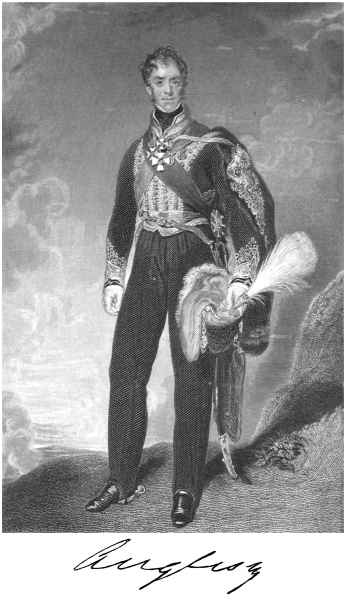
State of the Punjaub.—Sir Henry Hardinge appointed governor.—Strength
and organization of the Sikh army.—Moodkee.—Ferozepore.—Defeat
of the Sikhs.—Battle of Aliwal.—Its consequences.—Sobraon.—Conclusion.
The fatal dénouement of the retreat from Cabool was still
in vivid colouring before the British public, when tidings from
the East announced that it might be considered only as the
forerunner of still more alarming demonstrations, and these
from a power fully as unfriendly, and far mere formidable
to English interests than the Ghiljies and fanatic tribes of
Affghanistan. The Punjaub339 for years had been internally
convulsed. The musnud in turn was occupied by women
whose debaucheries were disgusting, and men who had
reached it by the foulest murders. The country was frightfully
disorganized—one bond of union alone existed among the
Sikhs—and that was the most deadly hostility to the British.
The state of things beyond the Sutlej alarmed the Indian
government, and Lord Ellenborough acted with energy and
good judgment—Scinde and Gwalior must be deprived of the
power of being mischievous—and while the former was annexed
in form to the possessions of the Company, Gwalior
was being prepared for undergoing a similar change. To give
effect to these important measures, an army of observation
marched upon the Sutlej—but long before any results from
his policy could be developed, Lord Ellenborough was recalled,
and Sir Henry Hardinge appointed to succeed him. In the
spring of 1844, the new governor reached Calcutta.
The Cabool disasters had rendered the very thought of
Eastern war most unpopular at home—and Sir Henry assumed
the chief command, with a full determination to avoid a rupture
with the Sikhs—could such be avoidable; but that, as events
proved, was impossible—and pacific policy was tried and
found wanting.
“The summer of 1845 was marked by frightful excesses in
Lahore. Murder and debauchery went hand-in-hand together;
and the Ranee herself, as well as her chief adviser,
Jowar Singh, no longer disguised their purpose of coming
to blows with the English. On the part of Jowar Singh,
this was but the prosecution of a policy which had long
been in favour with him; and as he was heartily detested by
the rest of the sirdars, they made it a pretext for conspiring
against him and putting him to death. But the Ranee was
swayed by different motives. From day to day her army
became more unmanageable; and she desired, above all things,
to get rid of the nuisance, even if her deliverance should come
with a victorious British force to Lahore. Accordingly, after
having long withstood the clamours of her officers, she gave a
hearty, yet a reluctant, consent to the proposed invasion of
the protected states; and a plan of operations was drawn up,
which indicated no slight knowledge of the art of war on the
part of those from whom it emanated.”340
As yet Sir Henry had avoided every appearance of angry
demonstration. Loodiana and Ferozepore were well garrisoned.
The former place was weak—the latter better calculated
for resistance. A magazine to supply both places had
been judiciously established where the Umballa road touches
that of Kurnaul—for Busseean was equally accessible to the
garrisons which were threatened.
Coming events had not been disregarded by the chief in
command—and in June, Sir Henry in person proceeded to
the western provinces. Approaching hostilities had in the
autumn become too evident—the Sikhs were advancing to
the Sutlej—and instead of having, as formerly reported,
15,000 men in and about Lahore, they had actually seven
divisions, which might fairly average, each with the other,
8,000 men. One of these was to remain to garrison the capital—the
remainder were disposable—and, as it was believed,
destined to attack Loodiana, Kurrachee, Ferozepore, Scinde,
and Attock.
Before the subsequent transactions are described, a detail of
the strength, organization, and matériel of the Sikh army
will be interesting—and an officer,341 whose brief but lucid account
of the Punjaub, is admirably perspicuous and judiciously
condensed, thus pictures the construction of a military force,
whose local position and efficiency rendered the repression of
its formidable power imperative upon the Indian executive.
“This force, consisting of about 110,000 men, is divided
into regulars and irregulars; the former of whom, about
70,000 strong, are drilled and appointed according to the
European system. The cavalry branch of the disciplined
force amounts to nearly 13,000, and the infantry and artillery
to 60,000 more. The irregulars, variously armed and
equipped, are nearly 40,000 strong, of which number upwards
of 20,000 are cavalry, the remainder consisting of infantry
and matchlock-men, while the contingents, which the sirdars
or chiefs are obliged to parade on the requisition of the
sovereign, amount to considerably above 30,000 more. The
artillery consisted in Runjeet’s time of 376 guns, and 370
swivels mounted on camels or on light carriages adapted to
their size. There is no distinct corps of artillery as in other
services, but there are 4,000 or 5,000 men, under a daroga,
trained to the duty of gunners, and these are distributed with
the ordnance throughout the regular army. The costume of
the regular infantry is scarlet, with different coloured facings,
to distinguish regiments, as in the British service. The
trousers are of blue linen; the head-dress is a blue turban,
with one end loose, and spread so as to entirely cover the
head, back of the neck, and shoulders; the belts are of black
leather; the arms a musket and bayonet, the manufacture of
Lahore. The cavalry wear helmets or steel caps, round
which shawls or scarfs are folded. The irregulars, in their
dress and appointments, fully justify the appellation which
their habits and mode of making war obtained for them.
Cotton, silk, or broad cloth tunics of various colours, with the
addition of shawls, cloaks, breastplates, or coats of mail,
with turban or helmets, ad libitum, impart to them a motley
but picturesque appearance. They are all badly mounted,
and, indeed, little can be said even of the regular cavalry in
this respect. The Punjaub breed of horses is far from good,
and they do not import stock from other countries to improve
their own cattle. The pay of the sepoys of the regular army
of the Punjaub is higher than that of the same class in the
army of the East-India Company, each common soldier
receiving ten rupees per mensem. The troops of the irregulars
receive twenty-five rupees each, out of which they provide
their arms and clothing, and feed their horse, putting the
government to no other expense whatever for their services.
“Enlistment in the regular army of the Punjaub is quite
voluntary, and the service is so popular that the army could
upon an emergency be increased to almost any amount. The
soldiery are exceedingly apt in acquiring a knowledge of their
military duties; but they are so averse to control that
instances of insubordination are common; latterly, indeed,
open mutiny has frequently characterized the relations of
officer and soldier. Insubordination is punished—when
punishment is practicable—with confinement, loss of pay, or
extra duty. But in the present state of military disorganization
no means of chastising rebellion are available.
“No pensions were, or are, assigned to the soldiery for long
service, nor is there any provision for the widows and families
of those who die, or are killed in the service of the state.
Promotions, instead of being the right of the good soldier in
order of seniority, or the reward of merit in the various
grades, is frequently effected by bribery. In the higher
ranks, advancement is obtained by the judicious application of
douceurs to the palm of the favourites at court, or the
military chieftains about the person of the sovereign. In the
event of the government of the Punjaub falling into the
hands of the British, some time would probably elapse before
the dissolute rabble which now composes the army could be
brought under a state of as perfect discipline as that which
exists in the Anglo-Indian army; but there is no doubt that
ultimately the result of a system, strict and severe from the
commencement, when supported by a stern and absolute
monarchy, would display itself, and render the Sikh troops as
devoted a body as the regular native army of Hindostan.
Only twenty-three years have elapsed since the military force
in the Punjaub consisted of a large and undisciplined horde.
In 1822, the first European officers presented themselves
(according to Prinsep) at Runjeet Singh’s durbar, seeking
military service and entertainment. These were Messrs.
Allard and Ventura, who had served in the French army
until the annihilation of Napoleon Buonaparte deprived them
of employment. At first, Runjeet Singh, with the suspicion
common to a native Indian prince, received them coldly; and
his distrust of their purposes was heightened by the Punjaubee
chieftains, who were naturally jealous of the introduction of
Europeans into the military service; but a submissive and
judicious letter from these officers removed the apprehensions
of the Maharajah, and he, with the spirit and originality of a
man of genius, admitted them into his service; appointing
them instructors of his troops in the European system of drill
and warfare. The good conduct and wise management of
these gentlemen speedily removed Runjeet Singh’s prejudices
against Europeans; and the door to employment being
thrown open, several military men entered the service of the
Maharajah, and at the close of his reign there were not less
than a dozen receiving his pay, and, to use an Indian
expression, ‘eating his salt.’ The successors of Runjeet
Singh, however, did not look with an eye of favour upon men
who were not to be bought, and whose sense of personal
dignity revolted at the treatment to which the unbridled Sikh
chieftains were inclined to subject them. The greater part
accordingly resigned their commissions; some of them
retiring with ample fortunes, and others seeking honourable
employment elsewhere.
“The Sikh army, until lately, was considered by many
British officers, who had the opportunity of seeing it, to have
been in a fair state of discipline. They form very correct
lines, but in manœuvring their movements are too slow, and
they would, in consequence, be in danger, from a body of
British cavalry, of being successfully charged during a change
of position. They would also run the risk of having their
flanks turned by their inability to follow the motion of an
European enemy with equal rapidity.342
“The arms, that is to say, the muskets, are of very inferior
stamp, incapable of throwing a ball to any distance, and on
quick and repeated discharges liable to burst. Their firing is
bad, owing to the very small quantity of practice ammunition
allowed by the government; not more than ten balls out of a
hundred, at the distance of as many paces, would probably tell
upon an enemy’s ranks. They still preserve the old system
of three ranks, the front one kneeling when firing and then
rising to load, a method in action liable to create confusion.
“In person, the infantry soldiers are tall and thin, with good
features and full beards; their superior height is owing to the
extraordinary length of their lower limbs. They are capable
of enduring the fatigue of long marches for several days in
succession (the author having on one occasion marched with
his regiment a distance of 300 miles within twelve days), and
are, generally speaking, so hardy that exposure to oppressive
heats or heavy rains has little effect upon them. In a great
measure this is the result of custom. Excepting in the
vicinity of Lahore and Peshawur, there are few regular
quarters or cantonments; the men occupy small tents or
caravanserais.
“The drum and fife and bugle are in general use in the
Sikh infantry regiments, and in some of the favourite royal
corps of Runjeet Singh an attempt was made to introduce
a band of music, but a graft of European melody upon
Punjaubee discord did not produce, as may be imagined, a
very harmonious result.
“The cavalry of the Sikh army is very inferior in every
respect to the infantry. While the latter are carefully picked
from large bodies of candidates for service, the former are
composed of men of all sorts and sizes and ages, who get
appointed solely through the interests of the different sirdars.
They are mean-looking, ill-dressed, and, as already stated,
wretchedly mounted. Their horse trappings are of leather of
the worst quality, and their saddles are of the same miserable
material, and badly constructed. When the horse is in
motion, the legs and arms of the rider wave backwards and
forwards, right and left, by way, as it were, of keeping time
with the pace of the animal bestridden. The horses are
small, meagre, and ill-shaped, with the aquiline nose which
so peculiarly proclaims inferiority of breed. In the field, the
conduct of Sikh cavalry has generally corresponded with
their appearance and efficiency. They are totally deficient of
firmness in the hour of struggle, and only charge the foe
when a vast superiority of numerical force gives them a
sort of warranty of success.”
Undeceived touching the supposed weakness of the Sikh
army, Sir Henry Hardinge, in conjunction with his gallant
superior in command, Sir Hugh Gough, concentrated his
troops, called for reinforcements from the interior, added
largely to his commissariate—and what in Eastern warfare is
altogether indispensable, largely increased his beasts of burden
and means of transport. Then taking a central position,
he waited calmly and prudently until the Sikh designs should
be more clearly developed.
November came—the storm had been gathering—remonstrances
from the governor-general had failed—and on the
4th, the Sikh vakeel was formally dismissed. Still immediate
hostilities were not anticipated—when suddenly, news
arrived on the 13th, that the enemy had crossed the Sutlej,
and Ferozepore was invested. The British commander
hurried by forced marches to its relief—and on the 18th, after a
seven leagues’ march, at noon the Anglo-Indian array reached
the village of Moodkee.343 A movement of twenty miles
under an eastern sun is most distressing—and the wearied
troops having bivouacked, ignorant of the proximity of an
enemy, cut wood, lighted fires, and commenced cooking.
Strange as it may appear, although in the immediate presence
of the Sikh army, no vidette had seen it, and the booming
of the enemy’s guns first gave note of preparation.
“The army was in a state of great exhaustion, principally
from the want of water, which was not procurable on the
road, when about three P. M., information was received that
the Sikh army was advancing; and the troops had scarcely
time to get under arms and move to their positions, when that
fact was ascertained.
“I immediately,” says Lord Gough, “pushed forward the
horse artillery and cavalry, directing the infantry, accompanied
by the field batteries, to move forward in support. We had
not proceeded beyond two miles, when we found the enemy in
position. They were said to consist of from 15,000 to 20,000
infantry, about the same force of cavalry, and forty guns.
They evidently had either just taken up this position, or
were advancing in order of battle against us.
“To resist their attack, and to cover the formation of the
infantry, I advanced the cavalry under Brigadiers White,
Gough, and Mactier, rapidly to the front, in columns of
squadrons, and occupied the plain. They were speedily followed
by the five troops of horse artillery, under Brigadier
Brooke, who took up a forward position, having the cavalry
then on his flanks.
“The country is a dead flat, covered at short intervals with
a low, but in some places, thick jhow jungle and dotted with
sandy hillocks. The enemy screened their infantry and artillery
behind this jungle and such undulations as the ground
afforded; and, whilst our twelve battalions formed from
echellon of brigade into line, opened a very severe cannonade
upon our advancing troops, which was vigorously replied to
by the battery of horse artillery under Brigadier Brooke,
which was soon joined by the two light field batteries. The
rapid and well-directed fire of our artillery appeared soon to
paralyze that of the enemy; and, as it was necessary to complete
our infantry dispositions without advancing the artillery
too near to the jungle, I directed the cavalry under Brigadiers
White and Gough to make a flank movement on the
enemy’s left, with a view of threatening and turning that
flank, if possible. With praiseworthy gallantry, the 3rd light
dragoons, with the 2nd brigade of cavalry, consisting of the
body-guard and fifth light cavalry, with a portion of the
4th lancers, turned the left of the Sikh army, and, sweeping
along the whole rear of its infantry and guns, silenced for a
time the latter, and put their numerous cavalry to flight.
Whilst this movement was taking place on the enemy’s left,
I directed the remainder of the 4th lancers, the 9th irregular
cavalry, under Brigadier Mactier, with a light field battery,
to threaten their right. This manœuvre was also successful.
Had not the infantry and guns of the enemy been screened by
the jungle, these brilliant charges of the cavalry would have
been productive of greater effect.
“When the infantry advanced to the attack. Brigadier Brooke
rapidly pushed on his horse artillery close to the jungle, and
the cannonade was resumed on both sides. The infantry,
under Major-Generals Sir Harry Smith, Gilbert, and Sir
John M’Caskill, attacked in echellon of lines the enemy’s
infantry, almost invisible amongst the wood and the approaching
darkness of night. The opposition of the enemy was
such as might have been expected from troops who had every
thing at stake, and who had long vaunted of being irresistible.
Their ample and extended line, from their great superiority of
numbers, far outflanked ours; but this was counteracted by
the flank movements of our cavalry. The attack of the
infantry now commenced; and the roll of fire from this
powerful arm soon convinced the Sikh army that they had
met with a foe they little expected; and their whole force
was driven from position after position with great slaughter,
and the loss of seventeen pieces of artillery, some of them of
heavy calibre; our infantry using that never-failing weapon,
the bayonet, whenever the enemy stood. Night only saved
them from worse disaster, for this stout conflict was maintained
during an hour and a half of dim starlight, amidst a cloud
of dust from the sandy plain, which yet more obscured every
object.
“I regret to say, this gallant and successful attack was
attended with considerable loss; the force bivouacked upon
the field for some hours, and only returned to its encampment
after ascertaining that it had no enemy before it, and
that night prevented the possibility of a regular advance in
pursuit.”344
In this brilliant and sanguinary battle, the British loss was
necessarily heavy. Sir Robert Sale, and Sir John M’Caskill
were killed—and Brigadiers Bolton and Mactier, with
Colonels Byrne and Bunbury, wounded. The total casualties
amounted to 872 of all arms.
Nothing could have been more fortunate than the prestige
which Moodkee gave to the campaign. One damning fault of
the Spanish generals on the Peninsula, was that they literally
overmarched their troops until they came to a dead stand-still—and
this the British commanders most judiciously
avoided.345 A little delay in active operations was, under circumstances,
particularly politic—for while the Sikhs were
shaken in confidence, and marvelling at their discomfiture, the
British lion was gathering strength to make another and a
deadlier spring.
On the morning of the 21st, the Anglo-Indian army again
took the offensive, and marched against the intrenched position
of the enemy—and the details of the succeeding events of that
bloody and glorious day are thus lucidly and modestly given.
“Instead of advancing to the direct attack of their formidable
works, our force manœuvred to their right; the second
and fourth divisions of infantry, in front, supported by the
first division and cavalry in second line, continued to defile
for some time out of cannon-shot between the Sikhs and
Ferozepore. The desired effect was not long delayed, a
cloud of dust was seen on our left, and according to the
instructions sent him on the preceding evening, Major-General
Sir John Littler, with his division, availing himself of
the offered opportunity, was discovered in full march to unite
his force with mine. The junction was soon effected, and
thus was accomplished one of the great objects of all our
harassing marches and privations, in the relief of this division
of our army from the blockade of the numerous forces by
which it was surrounded.
“Dispositions were now made for a united attack on the
enemy’s intrenched camp. We found it to be a parallelogram
of about a mile in length and half a mile in breadth,
including within its area the strong village of Ferozeshah;
the shorter sides looking towards the Sutlej and Moodkee,
and the longer towards Ferozepore and the open country.
We moved against the last-named face, the ground in front
of which was, like the Sikh position in Moodkee, covered
with low jungle.
“The divisions of Major-General Sir John Littler, Brigadier
Wallace (who had succeeded Major-General Sir John
M’Caskill), and Major-General Gilbert, deployed into line,
having in the centre our whole force of artillery, with the
exception of three troops of horse artillery, one on either
flank, and one in support, to be moved as occasion required.
Major-General Sir Harry Smith’s division, and our small
cavalry force, moved in second line, having a brigade in
reserve to cover each wing.
“I should here observe, that I committed the charge and
direction of the left wing to Lieut.-Gen. Sir Henry Hardinge,
while I personally conducted the right.
“A very heavy cannonade was opened by the enemy, who
had dispersed over their position upwards of 100 guns, more
than 40 of which were of battering calibre; these kept up a
heavy and well-directed fire, which the practice of our far
less numerous artillery, of much lighter metal, checked in
some degree, but could not silence; finally, in the face of a
storm of shot and shell, our infantry advanced and carried
these formidable intrenchments; they threw themselves
upon the guns, and with matchless gallantry wrested them
from the enemy; but, when the batteries were partially
within our grasp, our soldiery had to face such a fire of musketry
from the Sikh infantry, arrayed behind their guns,
that, in spite of the most heroic efforts, a portion only of the
intrenchment could be carried. Night fell while the conflict
was everywhere raging.
“Although I now brought up Major-General Sir Harry
Smith’s division, and he captured and long retained another
point of the position, and her Majesty’s 3rd light dragoons
charged and took some of the most formidable batteries, yet
the enemy remained in possession of a considerable portion of
the great quadrangle, whilst our troops, intermingled with
theirs, kept possession of the remainder, and finally bivouacked
upon it, exhausted by their gallant efforts, greatly
reduced in numbers, and suffering extremely from thirst, yet
animated by an indomitable spirit. In this state of things
the long night wore away.
“Near the middle of it one of their heavy guns was advanced,
and played with deadly effect upon our troops. Lieutenant-General
Sir Henry Hardinge immediately formed her Majesty’s
80th foot and the 1st European light infantry. They
were led to the attack by their commanding officers, and
animated in their exertions by Lieut.-Colonel Wood (aide-de-camp
to the lieut.-general), who was wounded in the onset.
The 80th captured the gun, and the enemy, dismayed by
this counter-check, did not venture to press on further.
During the whole night, however, they continued to harass
our troops by fire of artillery, wherever moonlight discovered
our position.
“But with daylight of the 22nd came retribution. Our
infantry formed line, supported on both flanks by horse
artillery, whilst a fire was opened from our centre by such of
our heavy guns as remained effective, aided by a flight of
rockets. A masked battery played with great effect upon this
point, dismounting our pieces, and blowing up our tumbrils.
At this moment, Lieut.-General Sir Henry Hardinge placed
himself at the head of the left, whilst I rode at the head of
the right wing.
“Our line advanced, and, unchecked by the enemy’s fire,
drove them rapidly out of the village of Ferozeshah and their
encampment; then, changing front to its left, on its centre,
our force continued to sweep the camp, bearing down all opposition,
and dislodged the enemy from their whole position.
The line then halted, as if on a day of manœuvre, receiving
its two leaders as they rode along its front with a gratifying
cheer, and displaying the captured standards of the Khalsa
army. We had taken upwards of seventy-three pieces of
cannon, and were masters of the whole field.
“The force assumed a position on the ground which it had
won, but even here its labours were not to cease. In the
course of two hours, Sirdar Tej Singh, who had commanded in
the last great battle, brought up from the vicinity of Ferozepore
fresh battalions and a large field of artillery, supported
by 30,000 Ghorepurras, hitherto encamped near the river.346
He drove in our cavalry parties, and made strenuous efforts
to regain the position at Ferozeshah; this attempt was defeated;
but its failure had scarcely become manifest, when
the sirdar renewed the contest with more troops and a large
artillery. He commenced by a combination against our left
flank; and when this was frustrated, made such a demonstration
against the captured villages as compelled us to change
our whole front to the right. His guns during this manœuvre
maintained an incessant fire, whilst our artillery ammunition
being completely expended in these protracted combats, we
were unable to answer him with a single shot.
“I now directed our almost exhausted cavalry to threaten
both flanks at once, preparing the infantry to advance in
support, which apparently caused him suddenly to cease his
fire, and abandon the field.
“For twenty-four hours not a Sikh has appeared in our front.
The remains of the Khalsa army are said to be in full retreat
across the Sutlej, at Nuggurputhur and Tella, or marching
up its left bank towards Hurreekeeputhur, in the greatest
confusion and dismay. Of their chiefs, Bahadur Singh is
killed; Lal Singh said to be wounded; Mehtab Singh,
Adjoodhia Pershad, and Tej Singh, the late governor of
Peshawur, have fled with precipitation. Their camp is the
scene of the most awful carnage, and they have abandoned
large stores of grain, camp equipage, and ammunition.
“Thus has apparently terminated this unprovoked and criminal
invasion of the peaceful provinces under British protection.
“On the conclusion of such a narrative as I have given, it is
surely superfluous in me to say, that I am, and shall be to
the last moment of my existence, proud of the army which I
had to command on the 21st and 22nd instant. To their
gallant exertions I owe the satisfaction of seeing such a
victory achieved, and the glory of having my own name
associated with it.
“The loss of this army has been heavy;347 how could a hope
be formed that it should be otherwise? Within thirty hours
this force stormed an intrenched camp, fought a general action,
and sustained two considerable combats with the enemy.
Within four days it has dislodged from their positions, on the
left bank of the Sutlej, 60,000 Sikh soldiers, supported by
upwards of 150 pieces of cannon, 108 of which the enemy
acknowledge to have lost, and 91 of which are in our possession.
“In addition to our losses in the battle, the captured camp
was found to be everywhere protected by charged mines, by
the successive springing of which many brave officers and
men have been destroyed.”348
These glorious battles were within a month followed up by
that of Aliwal—as sanguinary an affair as either of its
predecessors, and, in a military point of view, decidedly more
scientific in arrangement and execution. In one operation, it
seemed a pendant to the beautiful movement on the retreat
from Burgos, when Wellington carried his army bodily round
Souham’s, and placed the French general in the afternoon, in
the same unfavourable position in which he, Wellington, had
found himself that morning. The action had not been
expected—for the service required had been effected without
resistance.
“Though the treaty which held the English and Sikh
governments in amity provided that the Sikhs should send
no troops across the Sutlej, they were permitted to retain
certain jaghires, or feudal possessions, on the left bank, one of
which comprised the town and fort of Dheerrumcote. Here
the enemy had established a magazine of grain; and a small
garrison, consisting of mercenaries, chiefly Rohillas and
Affghans, were thrown into the place for its protection. But
besides that the grain was needed in the British lines, the
presence of a hostile garrison on his own side of the stream
was an eyesore and an annoyance to the British general,—and
Major-General Sir Harry Smith was directed, with
a brigade of infantry and a few guns, to reduce it. He
accomplished the service on the 18th of January without loss,
or, indeed, sustaining a serious resistance; and was on his
way back to camp, when tidings reached the commander-in-chief
of a nature not to be dealt lightly with, far less
neglected. It was ascertained that the enemy had detached
20,000 men from their camp at Sobraon against Loodiana.
Their objects were represented to be, not only the seizure of
that place, but the interruption of the British communications
with the rear, and, perhaps, the capture of the battering train,
which was advancing by Busseean; and Sir Harry
Smith, being reinforced to the amount of 8,000 men, received
instructions to counterwork the project. His business was to
form a junction with Colonel Godby, who, with one regiment
of cavalry and four of infantry, occupied Loodiana; and
then, and not till then, to push the Sikhs, and drive them, if
possible, back upon their own country.”349
Here, again, the school in which he had been taught his
trade was evidenced in the conduct of the commander, who
proved in his hour of trial that Peninsular instruction had
not been thrown away. The Sikhs had already shut the
garrison of Loodiana in—burned a new barrack, and ravaged
the surrounding country—a creeping commander now would
have been found wanting—but Smith was a man of different
metal—and, pushing rapidly on, a clean march brought him
within twenty-five miles of Loodiana—and with the réveil—he
resumed his movement next morning.
At Buddewal the enemy shewed himself, occupying a
connected line of villages in front, and covered by a powerful
artillery. To gain his object, and reach Loodiana, it
was necessary for Sir Harry Smith to change his order
of march—and while the Sikhs, who had already outflanked
him, opened a fire of forty guns on the advancing columns,
Smith massed his weak artillery, and under its concentrated
and well-directed cannonade, broke into échelons, and
threatened the Sikh front, the while making a flank movement
by his right, protected en échelon by the cavalry. Nothing
could be more beautifully and successfully executed than
this delicate manœuvre. Sir Harry carried his guns and
baggage round the enemy—a small portion only of the latter
passing into the temporary possession of the Sikhs.
“Colonel Godby, who commanded the invested garrison,
having seen the cloud of dust, moved from Loodiana; and
marching parallel to the direction which it seemed to take,
found himself in due time connected by his patrols with
Smith’s advanced guard. Both corps upon this placed
themselves with Loodiana in their rear, and the enemy before
them; the latter being so circumstanced, that the British
army lay, as it were, upon one of its flanks. But Smith,
though he had thus relieved the town, was unwilling to strike
a blow till he could make it decisive. He, therefore, encamped
in an attitude of watchfulness, waiting till another brigade
should arrive, which, under the command of Colonel Wheeler,
was marching from head-quarters to reinforce him.”
Colonel Wheeler’s march seems to have been conducted
with equal diligence and care. He heard of the encounter of
the 21st, and of its results; whereupon he abandoned the
direct road to Loodiana, and following a circuitous route, went
round the enemy’s position, without once coming under fire.
He reached Sir Harry Smith’s camp in safety; and, on the
26th, Smith made his preparations to fight a great battle.
But it was found, ere the columns were put in motion, that
the enemy had abandoned their position at Buddewal, and
were withdrawn to an intrenched camp nearer to the river, of
which the village of Aliwal was the key, covering the ford
by which they had crossed, and on which they depended, in
the event of a reverse, as a line of retreat. Operations were
accordingly suspended, and such further arrangements set
going as the altered state of affairs seemed to require.
On the 27th, Runjoor Singh having been reinforced by
Avitabile’s brigade, 4,000 Sikh regulars, some cavalry and
twelve guns, found himself, as he had reason to believe, in
a condition to deliver battle—and to intercept the Anglo-Indian
communications, he advanced towards Ingraon—where
early on the 28th, Sir Harry Smith found him in position.
His right rested on a height, his left on a field intrenchment,
while his centre held ground in the immediate front of the
village of Aliwal (or Ulleéwal). The Anglo-Indian army
amounted to some 12,000 men of all arms—the Sikhs doubled
them in numerical strength, and that too was composed of the
flower of their army.
The subsequent details of this glorious action may be
rapidly described. Smith boldly advanced against the Sikh
position, under a heavy cannonade, while the right brigades
were getting into line. The advance was splendid—the
British cavalry driving the Sikh horsemen on their infantry,
forced the left back, capturing several guns, while on the
left of the British line, the Ayeen brigade (Avitabile’s) were
deforced—and the village of Bhoondi, where the right of the
Sikhs endeavoured to make a stand, was carried with the
bayonet. A general rout ensued—the enemy pressing in
confused masses towards the ford, while every attempt they
made to rally was anticipated by a charge, and the destruction
of the flower of the Sikh army was completed.
“The firing began about ten in the morning; by one
o’clock in the day the Sikh army was broken and routed, the
ground covered with its wreck, and the Sutlej choked with
the dead and the dying. The whole of the artillery, fifty-seven
guns, fell into the hands of the victors, and the booty
was immense; but the victors had neither time nor inclination
to dwell upon their triumphs. There was no further danger
to be apprehended here. Of the 24,000 men who, in the
morning, threatened Loodiana, scarcely as many hundreds
held together; and these, after a brief show of rally on the
opposite bank, melted away and disappeared entirely. Having
bivouacked that night, therefore, on the field which he
had won, and sent in the wounded, with the captured guns,
under sufficient escort, to Loodiana, Sir Harry Smith, with
the bulk of his division, took the road to head-quarters; and,
in the afternoon of the 8th of February, came into position
on the right of the main army, which was his established
post.”350
In this most glorious battle, the Anglo-Indian army had
151 men killed, 413 wounded, and 25 missing,—a loss comparatively
small.
The immediate consequences of the victory of Aliwal, was
the evacuation of the left bank of the Sutlej by the enemy.
The Sikhs had sustained three terrible defeats; they had lost
an enormous quantity of military matériel, 150 guns, and
none could presume to estimate the number of their best and
bravest troops who had been placed hors de combat. In
hundreds, the slaughtered and drowned victims at Aliwal
floated to Sobraon with the stream; but still with a tête
de pont to secure their bridge-communications with the right
bank and the reserve there, formidable intrenchments, armed
with seventy heavy guns, and 30,000 of their best troops (the
Khalsa), they determined to defend them, boldly held their
ground, and dared another battle.
On being rejoined by Sir Harry Smith’s division, and having
received his siege-train and a supply of ammunition from Delhi,
the commander-in-chief and the governor-general determined
to force the Sikh position. Unopposed, they gained possession
of Little Sobraon and Kodeewalla—and both the field batteries
and heavy guns were planted to throw a concentrated fire
upon the intrenchments occupied by the enemy. Close to the
river bank, Dick’s division was stationed to assault the Sikh
right—while another brigade was held in reserve behind the
village of Kodeewalla. In the centre, Gilbert’s division was
formed, either for attack or support, its right flank appuied
on the village of Little Sobraon. Smith’s division took ground
near the village of Guttah, with its right inclining towards
the Sutlej—Cureton’s brigade observed the ford at Hurree,
and held Lai Singh’s horsemen in check—the remainder of
the cavalry, under Major-General Thackwell, acting in reserve.
The British batteries opened a lively cannonade soon after sunrise—but
guns, in field position, have little chance of silencing
artillery covered by strong redoubts. At nine, the attack
commenced by Stacy’s brigade of Dick’s division, advancing
against the enemy’s intrenchments. The crushing fire of the
Sikh guns would have arrested the advance of any but most
daring regiments—but the brigadier pressed gallantly on—and
while the British bayonet met the Mussulman sabre, the camp
was carried. The sappers broke openings in the intrenching
mounds, through which, although in single files, the
cavalry pushed, reformed, and charged. The Sikh gunners
were sabred in their batteries—while the entire of the infantry,
and every disposal gun—were promptly brought into
action by Sir Hugh Gough. The Sikh fire became more
feeble—their best battalions unsteady—and the British pressed
boldly on. Wavering troops rarely withstand a struggle,
when the bayonet comes into play—and the Khalsas broke
entirely, and hurried from the field to the river and bridge.
But the hour of retributive vengeance had arrived—and
the waters of the Sutlej offered small protection to the fugitives.
The stream had risen—the fords were unsafe—and
flying from the fire of the horse-artillery, which had opened
on the mobbed fugitives with grape shot, hundreds fell under
this murderous cannonade, while thousands found a grave in
the no longer friendly waters of their native river—until it
almost excited the compassion of an irritated enemy.351
At Sobraon, the final blow which extinguished the military
power of the Sikhs, was delivered. Sixty-seven pieces of
artillery, two hundred camel-guns, standards, tumbrils, ammunition,
camp equipage—in a word, all that forms the
matériel of an army in the field, fell into the hands of the
victors. In native armies, no regular returns of the killed
and wounded are made out—but the Sikh losses were computed
at 8,000 men—and the amount was not exaggerated.
On the bloody height of Sobraon, the Sikh war virtually
terminated—for, on that evening, the Anglo-Indian army commenced
their march upon Lahore. Frightfully defeated, and
humbled to the dust, the once haughty chiefs sent vakeels to
implore mercy from the conqueror. The ambassadors, however,
were refused an audience—and it was intimated that the
British generals would condescend to treat with none except
the maha-rajah in person. Trembling for his capital, which
nothing but abject submission now could save, the youthful
monarch, attended by Rajah Goolab Singh, repaired to the
British camp. Stringent terms were most justly exacted—and
while the rich district between the Sutlej and the Beeas,
and what were termed “the Protected States,” were ceded for
ever to Britain, a million and a half sterling was agreed to by
the Sikh durbar, as compensation for the expenditure of the
war, while the Punjaub should remain in military occupation,
until the full amount should be discharged.
Even the Peninsular campaigns did not open under gloomier
auspices and close more gloriously, than that beyond the
Indus—and Maienee, Dubba, Moodkee, Ferozepore, Aliwal,
and Sobraon, were destined to close for the present the
glorious roll of—British Victories.