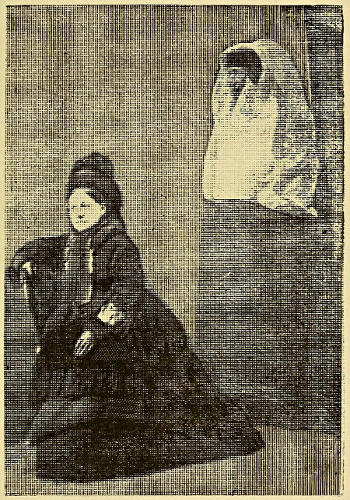
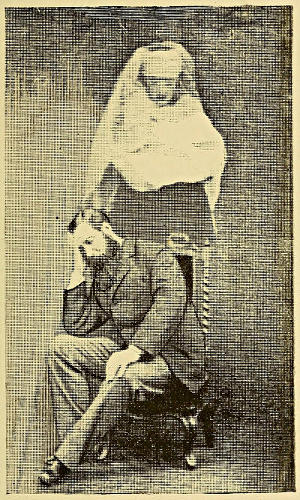
By Andrew Glendinning.
“Wherever a road opens, and I am moved to examine
and experiment, there I shall most surely go.”—Rev. George
W. Allen.
Either the discoveries made by Mumler,
Stainton Moses, Beattie and others, have
now been confirmed, or a very eminent man,
specially trained in rigid investigation, and an
acknowledged expert in optics and the chemistry
and manipulation of photography, has
been the victim of a marvellous and inexplicable
delusion.
To say that, notwithstanding all the precautions
arranged, and carefully carried out
by Mr. Taylor, he was time after time
deceived, is to make a statement entirely
opposed to probability and common sense,
yet that is the false refuge to which some fly
from whom better things might be expected.
It exhibits strongly the credulity of incredulity,
and an ability to strain out a gnat but swallow
a camel. To print insinuations against the
characters of those who investigate new and
important facts, and to air the superior wisdom
of the critics in what are apparently intended
as witticisms, may serve the purpose of a day,
but truth remains unsoiled and unassailable.
When George Cruikshank was preparing
his pictorial brochure against Spiritualism, he
was asked what he knew of the subject; he
replied he knew nothing, and did not intend
to inform himself till he had finished his book.
That is the position of many in regard to spirit
photography; the less they know about it, the
more they feel qualified to judge; and a man
who, for the first time, deigns to consider it,
will, with the utmost confidence in his own
opinion, condemn as fraudulent a genuine spirit
photograph; yea, he will even profess to discover
the mark of the scissors and the grain
of the paper from which he imagines the
photograph has been cut and copied.
Other objectors profess to have looked into
the subject, but because they saw nothing they
thought worth following up, therefore they
practically conclude it is impossible any one
else can be more fortunate.
That there are, and will continue to be,
honest doubters goes without saying. There
are scientific men who cannot believe in the
possibility of this new thing—their minds are
in old grooves. Others say the consensus of
opinion of photographers is against it.
Granted; and what of that? Any mere
opinion as to whether spirit photography be
possible does not in any way affect the question.
Opinions do not alter facts. The facts
in this matter are entirely in favour of the
reality of spirit photography.
There need not now be any question as
to whether spirit photography is possible.
That was settled thirty years ago. There is
nothing in the whole range of psychic phenomena
for which the evidence is more conclusive.
Had there been no other proof, the sworn evidence
of scientific men, bankers, merchants,
lawyers, photographers, and others, at the
Mumler trial was overwhelmingly abundant.
And since that trial there has been an accumulation
of evidence from various quarters,
yielding proof upon proof that spirit photography
is a fact, and must be recognised as
such. Contradicted it can be; that is easy to
do. Sneered at it may be; that, too, is not
difficult. A man may sneer at a fact which
he is unable to comprehend, but a sneer proves
nothing. Neither does an unsupported contradiction,
whether the contradiction be made
by a single person, or be made as a formal
resolution by a society.
Some of the witnesses who were examined
on oath at Mumler’s trial were experts, such
as Samuel K. Fanshaw. That gentleman was
one of the best miniature painters and facial
experts in New York, and was also familiar
with photographic manipulations. He said he
went to Mumler an entire stranger, sat for a
picture, witnessed the whole process, and received
a likeness of his mother, which he said
was more like her than the one he had painted
from memory. Mr. Livermore, banker, had
three negatives, in which his wife appeared
in three different positions. He was accompanied
by Mr. Hitchcock, of the New York
Sun, and Mr. Gurney, a leading photographer.
When Judge Dowling asked Mr. Livermore if
he recognised these pictures as likenesses of
his wife, his answer was, “Unmistakably.”
The spirit photograph of Abraham Lincoln
has often been referred to. My copy of it
is now too faint for reproduction, but it may
be stated that when Mrs. Lincoln visited Mr.
Mumler, she wore a thick crape veil, so thick
that no one could distinguish a feature of her
face. She travelled under an assumed name
from Springfield (Illinois) to Boston, went
direct from the train to Mumler’s house, gave
her name as “Mrs. Lindall,” and did not remove
her veil till the prepared plate was in
the camera ready to be exposed. She obtained
an excellent picture of her husband, standing
behind her, with his hands resting on her
shoulders, and looking down with a pleasant
smile.
Prominent Americans, whose names are well
known in this country, received through Mumler’s
mediumship test spirit photographs of
friends whom they recognised. Amongst these
may be mentioned the Hon. Henry Wilson,
then Vice-President of the United States, Judge
Edmonds, and William Lloyd Garrison.
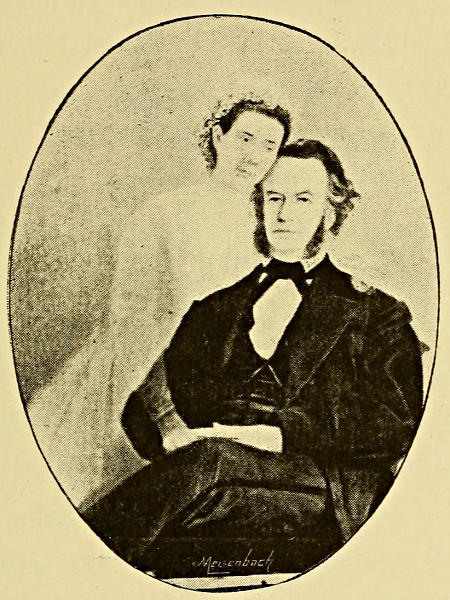
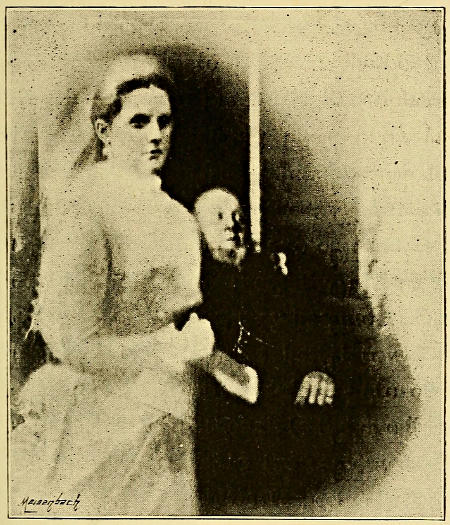
The Hon. Moses A. Dow, of Boston, U.S.A., and the
Spirit of Mabel Warren, his Literary Assistant and
Adopted Daughter.
As a fair specimen of spirit photographs
obtained through Mumler, I submit one (see
opposite) got by the Hon. Moses A. Dow, who
was editor and proprietor of the Waverley Magazine,
Boston. The portrait was fully recognised
by Mr. Dow as that of an amiable and accomplished
young lady who had been his assistant
editor. Before sitting for the portrait Mr. Dow
had a séance with a lady medium, and received
from her a message, which purported to be from
his late assistant editor, instructing him when to
go to Mumler’s for the picture, stating that she
would appear with a wreath of lilies on her
head, would stand by his side, would put her
hand on his shoulder, and would bring him
beautiful flowers. The photograph has lost
some of its intensity; but in the original
negative the wreath of white lilies is very
distinct, and the spirit is holding between the
thumb and forefinger of the left hand an opening
moss-rosebud, the exact counterpart of one
which Mr. Dow placed between the thumb and
forefinger of her left hand, while her body lay
in the coffin just before the funeral.
Similar tests have been obtained in photographs
by other mediums. On one occasion
Mr. Parkes had a visit from a friend who
had promised to spend a forenoon and try
experiments, but he was unwilling to sit
for a portrait owing to sudden and severe
illness, which he said would prevent any
success. He was induced by his wife to try.
While Mr. Parkes was preparing a plate with
collodion his friend sat down to compose
himself, and at once he became conscious of
the presence of a spirit form by the kindly
way passes were made over his head, curing
him entirely of his painful illness. On the
plate being developed there was a graceful
female form standing beside him, with her
head bent downwards towards him, and behind
her—extending outwards and upwards from
her shoulders—there was a patch of light
seemingly intended to represent wings. The
sitter afterwards solved the enigma by stating
that the influence from the spirit was of such
a sweet and delightful character, that it led
him to hum to himself his favourite hymn:—
“How delightful the thought that the Angels in bliss,
Daily bend their bright wings to a world such as this,
And leave the sweet songs of the mansions above,
To breathe on our bosoms some message of love.”
The imagery of the hymn found an embodiment
in the photograph. “I have no
wings—nor do I require wings,” subsequently
explained the spirit, “but the appearance of
wings was assumed to please father.” Her
father was the sitter. Little thought he when
waiting with a sad heart at the dying bed of
a loved daughter, and trying to sing the
children’s hymn, that the time would arrive
when she would come from her spirit home to
cheer him in hours of sorrow and give him her
portrait, or that she would be able to render
herself visible to normal sight, and with her
arms round father and mother, kiss them both
and speak to them both. Such are some of
the secret blessings which come to those who
wait, work, and pray.
“Thank God for this! oh, minist’ring angels, thanks!
My grateful heart
Shall through my lips proclaim the truth. Our dead
Do not depart—
To some far city, never to return.
They often come
To aid, to comfort us, till we too reach
That brighter home!”
The difficulties and discouragements which
arise in trying to photograph unseen forms do
not exist to the same extent in photographing
what are called “materialised forms.” Some
excellent results in the latter have been obtained
by various persons. The most notable
instances are those by Mr. Wm. Crookes,
F.R.S., recorded in the last chapter of his
valuable book, Phenomena of Spiritualism, on
the photographing of the spirit, Katie King, by
the electric light. At these experiments Mr.
Crookes had five complete sets of photographic
apparatus fitted up, all of which were used at
the same time at each séance, and some excellent
negatives were obtained. “But,” adds Mr.
Crookes, “photography is as inadequate to
depict the perfect beauty of Katie’s face as
words are powerless to describe her charms of
manner. Photography may, indeed, give a map
of her countenance; but how can it reproduce
the brilliant purity of her complexion, or the
ever-varying expression of her most mobile
features, now overshadowed with sadness when
relating some of the bitter experiences of her
past life, now smiling with all the innocence of
happy girlhood when she had collected my
children round her, and was amusing them by
recounting anecdotes of her adventures in
India?
‘Round her she made an atmosphere of life;
The very air seemed lighter from her eyes,
They were so soft and beautiful, and rife
With all we can imagine of the skies;
Her overpowering presence made you feel
It would not be idolatry to kneel.’”
Amongst the important papers contributed
to the Psychical Congress at Chicago, one was
sent, at the request of the Committee, by
Dr. Alfred Russel Wallace, F.R.S. In it he
says:—
“What are termed spirit photographs, the appearance
on a photographic plate of other figures besides
those of the sitters, often those of deceased friends of
the sitters, have now been known for more than
twenty years. Many competent observers have tried
experiments successfully; but the facts seemed too
extraordinary to carry conviction to any but the
experimenters themselves, and any allusion to the
subject has usually been met with a smile of
incredulity or a confident assertion of imposture. It
mattered not that most of the witnesses were
experienced photographers who took precautions
which rendered it absolutely impossible that they
were imposed upon. The most incredible suppositions
were put forth, by those who only had
ignorance and incredulity to qualify them as judges,
in order to show that deception was possible. And
now we have another competent witness, Mr. Traill
Taylor, for many years editor of the British Journal
of Photography, who, taking every precaution that his
life-long experience could suggest, yet obtained on his
plates figures which, so far as normal photography is
concerned, ought not to have been there.”
Dr. Wallace has given a great deal of
thoughtful consideration to this subject, and
has a large collection of genuine spirit photographs.
In his book, Miracles and Modern
Spiritualism,[14] he devotes sixteen pages specially
to the topic. These pages—like everything
else from Dr. Wallace’s pen—are worthy of
careful study, the following sentences particularly
so:—
“It may be as well to clear away a popular
misconception. Mr. G. H. Lewes advised the
Dialectical Committee to distinguish carefully between
‘facts and inferences from facts.’ This is
especially necessary in the case of what are called
spirit photographs. The figures which occur in
these, when not produced by any human agency,
may be of ‘spiritual’ origin, without being figures
‘of spirits.’ There is much evidence to show that
they are, in some cases, forms produced by invisible
intelligences, but distinct from them. In other cases
the intelligence appears to clothe itself with matter
capable of being perceived by us; but even then it
does not follow that the form produced is the actual
image of the spiritual form. It may be but a reproduction
of the former mortal form with its terrestrial
accompaniments, for purposes of recognition. Most
persons have heard of these ‘ghost pictures,’ and
how easily they can be made to order by any photographer,
and are therefore disposed to think they
can be of no use as evidence. But a little consideration
will show that the means by which sham
ghosts can be manufactured being so well known
to all photographers, it becomes easy to apply tests
or arrange conditions so as to prevent imposition.
“The following are some of the more obvious:—1.
If a person with a knowledge of photography
takes his own glass plates, examines the camera
used and all the accessories, and watches the whole
process of taking a picture, then, if any definite form
appears on the negative besides the sitter, it is a
proof that some object was present capable of reflecting
or emitting the actinic rays, although invisible
to those present. 2. If an unmistakable likeness
appears of a deceased person totally unknown to
the photographer. 3. If figures appear on the
negative having a definite relation to the figure of
the sitter, who chooses his own position, attitude,
and accompaniments, it is a proof that invisible
figures were really there. 4. If a figure appears
draped in white, and partly behind the dark body
of the sitter without in the least showing through,
it is a proof that the white figure was there at the
same time, because the dark parts of the negative
are transparent, and any white picture in any way
superposed would show through. 5. Even should
none of these tests be applied, yet if a medium,
quite independent of the photographer, sees and
describes a figure during the sitting, and an exactly
corresponding figure appears on the plate, it is a
proof that such a figure was there.
“Every one of these tests have now been successfully
applied in our own country.”
Dr. Wallace gives minute details of some
experiments which resulted in his obtaining
photographs which he recognised as unmistakable
likenesses of his mother.
When Mr. Duguid was first asked to come
to London to give test séances to Mr. Taylor,
it was hoped that Mr. Stainton Moses would
have so far recovered strength as to be present
at the experiments. He took great interest in
the subject, and many of his photographs have
been reproduced by Mr. Arthur Maltby and
Mr. Acton. On March 19th and 26th Mr.
Maltby gave lectures in the Athenæum Hall,
and exhibited on the lantern screen a number
of spirit-photograph transparencies. Here are
a few notes made at the meeting on March 19th,
by Mr. Burns, jun. Mr. Maltby said:—
“This lecture is given in memory of the late
Mr. Stainton Moses, better known as ‘M.A., Oxon,’
editor of Light, writer of many valuable books on
Spiritualism, and one of the best friends the cause
ever had. Most of you have either read or heard of
his marvellous book called Spirit Teachings, one of
the grandest series of spirit controls ever published.
It teaches a higher Spiritualism than is generally
understood.
“My object in giving this lecture is to try to convince
you that it is possible to obtain photographs of
friends who have passed away. I shall also endeavour
to explain the conditions necessary, how they are
attained, and for what reason. This lecture was
suggested by Mr. Stainton Moses, and the pictures I
am about to show you were his. I knew him for
over fifteen years, and have been favoured with
particulars of the most remarkable events ever
experienced.
“One morning last spring I called on Mr. Moses,
and found him busy reading proof-sheets of Mr.
Stead’s Real Ghost Stories. Whilst discussing these,
the subject of spirit photographs was introduced,
and he informed me that he had a collection of
nearly 400, which he offered to lend me if I thought
they could be suitably converted into lantern slides.
After examining the photographs, I found it impossible
in so short a time to select out of so many
sufficient for a lecture. I therefore begged the loan
of them all, and we are indebted to my friend and
co-worker, Mr. Acton (who is now manipulating the
lantern), for his patient efforts in converting so many
photographs into lantern transparencies. It was a
most laborious task.
“Three months later, when I returned the photographs,
Mr. Moses kindly offered to take the chair
at this lecture, but that was not to be. The day I
was to submit my notes for his approval, with the
promise of a further and more complete description
of the spirit photographs, he had passed to the higher
life.
“Many present to-night, who are aware of the
reality of life after death—a life ever progressive, and
as real as life on earth—can feel with me that this
noble worker is not dead, but lives, continuing his
efforts for the good of humanity as when on earth;
ever with us in our efforts to spread this glorious
truth, which is like the sunshine, dispersing the fog
and mist of orthodoxy and ignorance.
“All the sittings he attended were under strict
test conditions, so there could be no possibility of
fraud or deception. These conditions were, that he
purchased his own plates, marked each with his initials,
put them in and took them out of the dark slide,
not allowing them out of his sight until they were
fully developed.”
Mr. Maltby then showed on the lantern
screen about forty spirit photographs, and other
pictures connected with the subject, all of which
he explained. Many of the photographs of
spirits had been recognised by the sitters and
other relatives. He then spoke of the spiritual
advantages to be derived from spirit communion,
and after an invocation he thus concluded:—
“Should this lecture induce any present to seek
communion with their departed friends, let me beg
of them to seek only for spiritual aid in an earnest
and prayerful manner, in their own homes, amongst
friends who desire to know the truth and will investigate
with unbiassed minds. To such success must
come, sooner or later; but those who try to use God’s
spiritual gifts for worldly and selfish ends will bring
disaster on themselves and discredit on the cause.”
At a séance held twenty-nine years ago, the
following question was put as to spirit photographs:
“We do not comprehend how these are
produced. Can you give us any information as
to the process gone through?” The answer
given through the medium, Mr. Peter A.
Chesser, marine engineer, may be of interest to
some. It was this: “Spirits impress their
image on the plate by depositing thereon repeated
layers of magnetism. According to
their respective powers of affording this, so is
the impression more or less distinct. The
magnetism must be of the same texture or
affinity as that possessed by the operator; it is
accomplished by a rapid vibration of the spirits’
magnetic emanation in depositing layer after
layer, and the process is this: The operator by
frequent manipulation saturates his materials
with his aura—I do not mean the animal aura
of mesmerism, but his spiritual aura; this, by
repeated impression on his part from repeated
manipulations (which require considerable time,
since he is still in the body and has, therefore,
more difficulty in, as it were, filtering this spirit-aura
through the pores of his body than have
the spirits, who are not trammelled in like
manner), at last leaves a positive viscidity on his
materials which serves to retain the first impressions
thrown by the spirits upon it. When
they from affinity cohere, the image is rapidly
built up on this superstructure. Any person
through the pores of whose body-material this
spirit-aura can readily pass is in a condition to
take photographs of the kind to which you
refer. Much passiveness, however, is requisite.”
This reply refers, of course, to the photographs
in class No. I., mentioned in the Preface,
not to pictures which are produced by spirit
precipitation.
In experiments made with Mr. Chesser at
that time (1864), we used the wet-collodion process,
on new glass plates which were cut for us
by a glass merchant. The plates were carefully
cleansed and finally washed and rubbed by myself
with spirits of wine. We never used a plate
twice in such experiments. What is worth
doing at all is worth doing well and carefully.
We obtained some pictures which would have
been of interest had we possessed more knowledge
of the subject, but we aimed too high and
were not satisfied with slow progress. In fact we
wanted a clear and good likeness of one of our
relatives, so several plates were broken and put
in the dust-bin which, in the light thrown on the
subject by later experience, we should have
prized. One plate of that period was kept because
it had a shadowy image of the medium,
although he was not within the field of view
when the plate was exposed. Unfortunately,
the photograph was not intensified; for when I
was washing it at the tap, the water got between
the plate and the collodion, and away went the
film, but, although torn, I managed to spread
part of it on the glass again. The following
statement was made by one of our unseen
friends with respect to that picture. Our questions
were put through the medium, and the
answers were given by automatic writing.
Question: We have here a photograph
upon which there exists so much diversity of
opinion that we want to know what it is?
Answer: It is yourself, distinctly enough,
but as we see your next question we will proceed
to explain how it came about that such impression
was produced on the plate.
The Medium: Stop a moment—do you
mean that it is my body or my spirit?
Answer: We mean your spirit-aura. Your
body could not be taken without your being
either directly in front of the camera or reflected
into its focus. Perhaps it will be better to explain
some of the peculiarities attending this
phase, as it involves many points of interest.
You were standing in front of the camera for
about a quarter of an hour before the picture
was taken or the plate prepared. In obedience
to a suggestion, you were awaiting the approach
of the spirit who told you he could be photographed,
and, in order to retain your passivity,
you remained standing where you were. When
you saw him seated you went to prepare the
plate, but not without leaving your emanation
behind, which, on the plate being exposed, was
duly photographed. The proof is easy. Again
stand in the same position for, say, ten minutes,
then leave the room, and let a good clairvoyant
be introduced and questioned as to what he sees,
when he will immediately describe you as supplying
the place you have vacated, with all the
accessories pertaining thereto. But although he
could at all times see this, your emanation could
not at all times be impressed on the plate. Returning
to another matter: Man does not enjoy
only one image of himself, but six, embracing
three individualities, viz., body, soul, and spirit;
and three emanations proceeding therefrom, respectively,
body-odyle, spirit-aura, and soul-essence.
These must on no account be confounded
with each other, as is too often the
case. Respecting the last—soul and soul-essence—as
it is more remote, being seldom
brought into play outside the human tenement
(unless under peculiar circumstances), we do
not intend speaking of it in connexion with the
present topic; so direct your attention more
particularly to the remaining four, partly in explanation
of their attributes, and partly in reference
to photography. First, then, the body is
most easily impressed upon the plate, requiring
fewer vibrations than its odylic form, after which,
in order, come spirit, spirit-aura, soul and soul-essence,
the last requiring millions of vibrations,
which, although costing more effort, takes no
more time, in many cases. It depends on the
sphere of the spirit. You may form an idea of
this by taking into account the incredible power
of motion which spirits possess. Now, the odylic
emanation may be projected by the will from
the material body, but the spirit cannot itself be
so projected; it must be, as it were, allowed to
flow forth of its own accord. Similarly, the
spirit, when thus free to move, can project its
aura in like manner. In both these cases the
emanation, by its velocity, becomes from necessary
friction respectively electrified, or magnetic
and spiritualised; that is to say, the emanations
become endowed with a certain amount of vital
energy, life-force, or, in fact, of existence. The
mere life-force does not imply intelligence also,
but it does when the emanation is spiritualised.
Man’s will is from his spirit; hence, the will
can project the odyle, but not the spirit, for
when the spirit is absent the will is absent, dormant
in reality (as the soul never interferes with
the will), and the trance state results. It is
quite possible for the spirit, under favourable
conditions, to project its aura at the same time
as the projection of the odyle. The two emanations
coming into contact would form a union of
the life-element with the thinking principle.
We do not mean with thought, but with thought-material—thought
being supplied only by the
spirit, the ideas or germs of thought being suggested
by the soul and elaborated by the spirit.
Without this constant emanation, or fluid impulse
(viz., the soul-essence) to urge it, the spirit
would not think; it would be inactive, the
soul-essence being its vivifying impulse to
activity. Now, when the odyle and aura have
coalesced, a new body, complete in all its
functions, is not therefore the result, but merely
a body-elementary, i.e., imbued with life-force,
and furnished with thought-material, minus
thought. This, then, is the eidolon, image, you
occasionally hear of. Still, you must not
suppose it to be severed from the parent body;
by no means: it is linked to it by attraction,
gravitation, and affinity, or that element of
which you can form ideas for practical purposes,
but of which you do not understand the nature.
But, you may say, there are instances of
eidolons speaking; now, if it has not thought,
how can it speak rationally? Let us explain:
thoughts are produced by vibrations of their
materials, and vibration is produced by the soul-essence
through the spirit, the soul being the
prime reservoir of motion (intellectually). Now,
suppose the eidolon to be questioned by the
person to whom it appeared, this question being
the result of thought, vibration would communicate
the motion to the intellectual materials
of the eidolon, and this vibration would be
instantly felt by the parent body, and an answer
returned accordingly.
In reference to the suggestion that spirit
manifestations may be the work of eidolons,
the reply was: “As departed spirits do exist,
and can communicate with mortals—of which
there is abundant proof—there is no need to
suppose a state of things which does not exist
in order to account for what does.”
An explanation was also given as to how
eidolons are formed, but that does not concern
our present subject.
Some investigators seem to think that the
same spirit forms ought not to appear on plates
with different people, and that if they do so
the circumstance warrants suspicion, if it is not
even a proof of fraud. This is an entire
mistake, and a mistake which can only be
made by those who have not investigated the
matter in a practical manner for any considerable
length of time. Apply the same reasoning
to materialisation, or to direct spirit writing,
and see what it will lead to. Mr. E. A. D.
Opie, of Adelaide, in a lecture on “Spirit
Photography,” delivered on July 1st, 1891,
before the Adelaide Spiritualistic Association,
made this remark: “It is necessary to accept
all second-hand reports of this phase of
Spiritualism with more than usual reserve,
as, in one instance at least, I have discovered,
on comparing reports of the obtaining of the
same picture by different people.” Mr. Opie
in these words probably expresses an opinion
held by many others, held in London as well
as in Adelaide. And what are we to infer
from it? That if two sitters get on their plates
a picture of the same spirit form, it will be a
proof of fraud? Not at all. Of course, if
the pictures have been produced by a dishonest
operator, they may be fraudulent. That is
not a thing to dispute. But the fact is that
there are in existence a number of genuine
spirit photographs in which the same abnormal
images are found with various sitters. Most
of these have differences in size, in attitude,
and in spirit drapery on the forms, but the
likenesses are identical. Some of them have
been taken in different places, with different
cameras, with plates purchased in different
cities and used by careful investigators.
Mr. Opie’s lecture was published in Adelaide
as a pamphlet of twenty-two pages; it is the
result of much reading, and it is but fair to
Mr. Opie to note that he had no practical
acquaintance with the subject.
Mr. Parkes gave some séances in 1875 in
Mr. Burns’s rooms, 15 Southampton Row. On
one occasion three sitters got spirit forms on
three plates. At the same meeting I requested
that I might be photographed. A clairvoyante
sitting near me said I ought to get something
good, for she could see a number of spirits near
me. When the plate was developed there were
eleven spirit forms on it.
Several spirit photographs of children have
been obtained. One of these is the interesting
one of “Edina’s” little boy, a full account of
which is in Mr. Robertson’s paper in this
volume. Another child’s portrait was got
unexpectedly at a test séance in April, 1892.
The arrangements and operations were under
my superintendence. I invited a lady (Mrs. J.
N. Anderson) to take a place near the sitter in
order to try whether her mediumistic power
would aid the experiment. I was vexed at not
getting the special result I wanted, but soon I
had cause for gladness in the joy which the
portrait obtained brought to the hearts of the
child’s father and mother. To the notes of the
séance, which were signed by all present, I
added the following words as a postscript:
“The child’s dress exhibits what was not
known to any person outside of Mr. Anderson’s
family.” That test is of a kind to impress a
mother’s mind. Previous to the child’s departure
he was lying cold in bed, when his
mother took from a drawer a night-dress of one
of her older boys, and put it on the ailing child.
This night-dress had a certain kind of frill round
the neck-band; and that night-dress, with its
frill and long sleeves, is represented in the
photograph. There was no picture in existence
from which the photograph could have been
copied; and the likeness is not only attested
by the parents, but by friends of the family, and
by Mr. James Robertson, president of the
Glasgow Society, who had often seen the boy.
Some one may ask, how was the photograph
of the child obtained, seeing he was too
young to come unaided to stand before the
camera, or to impress his image on the prepared
plate without the camera? An interesting question,
no doubt. To it I reply, “I do not know:
I am stating facts, not trying to explain them.”
In the Review of Reviews for April, 1893,
Mr. Stead suggested that additional experiments
should be tried to obtain psychic pictures without
the agency of light or the camera. An
opportunity occurred in July to try the experiment
with a lady who is not known to Spiritualistic
or occult circles—albeit she is a good
medium and clairvoyant. A dry plate from
my packet of unused plates was placed in a
mahogany slide. The lady then held the slide
between the palms of her hands. She was
under continuous and close observation in a
well-lighted room, and one end of the slide was
held by myself. On putting the plate in the
developer, the picture of a child appeared on it.
The plate was not tampered with by any one,
nor was there any opportunity given to do so,
nor was it exposed to light until after it was
developed and fixed. A reproduction of the
picture is given herewith (see page 145).
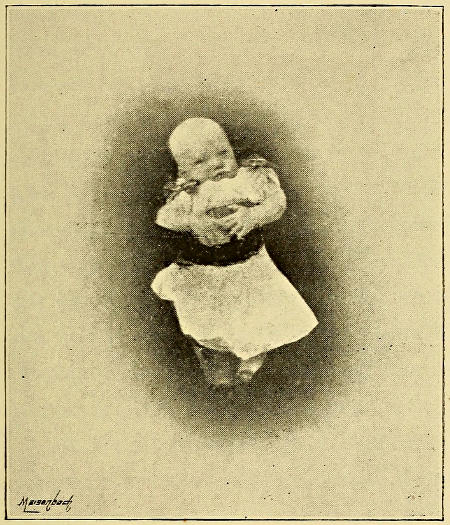
Psychic Picture obtained without a Camera.
Mr. Stainton Moses, at a meeting of the
London Spiritualist Alliance, advised those who
intended to experiment in photography to employ
a stereoscopic camera. He considered that
the genuineness of spirit photographs so obtained
could not be called in question. This opinion
has also been held by other investigators. In
June, 1892, some spirit photographs were submitted
to an eminent scientific gentleman, together
with copies of the notes, detailing fully
the conditions under which the pictures were
obtained, and giving the names and addresses of
all those who were present at the experiments.
The opinion of the gentleman was expressed in
writing as follows, viz.:—“You have adopted
all the precautions I can think of as being
necessary. The only one thing else I can think
of is the employment of a binocular camera.
That is the final Court of Appeal, and a spirit
photograph taken by it can leave no room for
cavil.” To those who endorse this opinion I
may state I have eight photographs taken with
binocular cameras, all obtained under test conditions,
and all having abnormal figures which
are perfectly stereoscopic per se, as well as in
relation to the sitters. Halves of two of these
photographs accompany these miscellanea.[15]
They were obtained on the 21st October, 1893,
on dry plates purchased from Mr. Doublet, and
the whole of the manipulations, so far as not
done by myself, were under my close and continuous
observation.
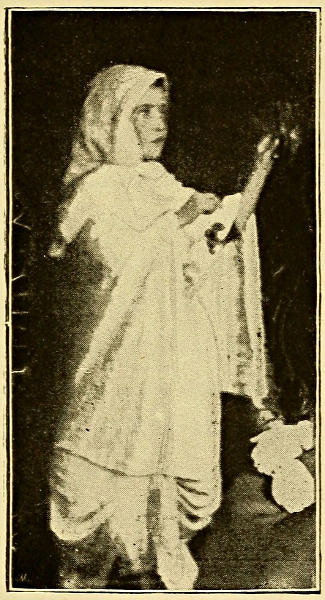
Part of a Stereoscopic pair of Spirit Photograph
obtained by a Lady October 21 1893.
The results of Mr. Taylor’s investigations
are a prophecy and a lesson. A prophecy of
the coming time when photographs of our
friends, who have passed from earth-life, may
be obtainable by the co-operation with us of
spirits who desire to help us, and who will
find opportunities and conditions to enable
them to do so. When Mr. Stead’s proposal
for a spiritual bureau becomes an accomplished
fact, we may hope, and may reasonably expect,
that spirit photography will be a department
of it. Many strange events, which, fifty
years ago, seemed as unlikely, are now of
frequent occurrence. Mr. Taylor’s experiments
are a lesson, as well as a prophecy. A lesson
to the materialistic spirit of the age, to guide
by new paths to old truths. The materialism
of to-day is dogmatic and active; it claims
science as its handmaid, it boasts that it has
sounded the universe and found in it nothing
but the material husks of existence, that all
spiritual beings are nonentities—the product
of diseased brains—of superstitious minds; its
scholars have explored space from star to
star and have learned that there is no God;
that man passes at death into cold oblivion, into
blank nothingness. To use the language of
its leading teachers:—“Unprejudiced philosophy
is compelled to reject the idea of an
individual immortality, and of a personal continuance
after death. With the decay and
dissolution of its material substratum, through
which alone it has acquired a conscious existence
and become a person, and upon which it
was dependent, the spirit must cease to exist!”
Again:—“Experience and daily observation
teach us that the spirit perishes with its material
substratum; that man dies.”
And:—“There never has been, and never
will be, a real apparition, which could make
us believe or assume that the soul of a
deceased individual continues to exist: it is
dead, never to return.”
And once more:—“Spirits and ghosts are
only seen by diseased or superstitious individuals.”
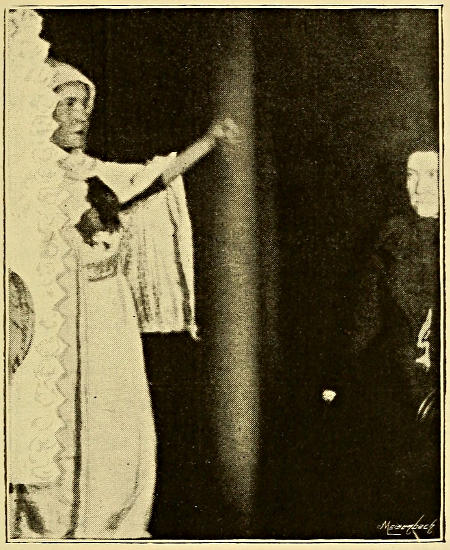
Mrs. Green, of Heywood (medium), and the same spirit form
as on the preceding plate, but in a different attitude, and with the
birds and flowers reversed. Stereoscopic photographs obtained
October 21, 1893.
Undoubtedly these views are quite honestly
arrived at and held by many. By some
through early training. By some in the
rebound from bigoted and God-dishonouring
creeds. By others again in painful perplexity
of mind, while trying to solve the problem of
existence. But a universe without a Deity,
and man without a soul, present little to boast
of in the shape of the consolation they can
bring to suffering humanity.
Every opinion a man holds must to some
extent influence his life, and the knowledge
that a man will live after death ought very
considerably to affect his entire character.
We know there is no such thing as death,
that what we call by that name is really a
birth into a higher sphere—or state of existence—an
entrance into a holier and happier
region, in whose precincts “we will be enabled
through untold ages to cultivate our intellects,
perfect our moral characters, and enjoy to
the full extent of our capabilities all that is
pure, good, true, and godly.
“There is no death: what seems so is transition.
This life of mortal breath
Is but the suburb of the life elysian,
Whose portal we call death.”
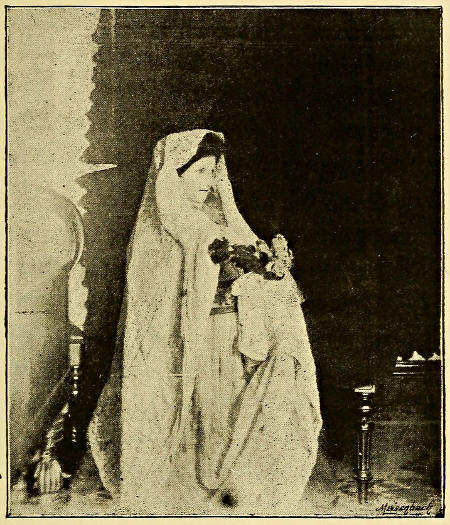
Spirit form. Part of a Stereoscopic pair. The sitter (who does not
wish his portrait to appear) has obtained spirit photographs with his
own camera and plates, when no other medium but himself was present,
and all manipulations were done by himself.
Some persons admit the reality of supermundane
photography, but say it is the work of
the Devil. How long is this old myth—this
theological superstition—to be flaunted in the
face of investigators? how long to be set as a
bugbear—a “bogey-man”—not merely to
frighten naughty children, but to scare grown
men and women, to bar mental progress, and to
stereotype from age to age distorted views of
God, and of spiritual law and truth?
Some thoughts expressed by “Imperator” to
Mr. Stainton Moses, relating to this imaginary
prince of evil, are so excellent that no apology
is required for appending a few of them: “Cease
to be perplexed by thoughts of an imagined
Devil. For the honest, pure, and truthful soul
there is no Devil nor Prince of Evil such as
theology has feigned. Evil comes not nigh him,
the adversaries flee from his presence, and the
powers of evil are powerless before him. He is
guarded around by angel guards, ministered to
by bright spirits, who watch over him and direct
his footsteps. For him there waits a career of
progressive increase in knowledge, and in all
that elevates and ennobles the intelligence. He
need fear no Devil, unless he creates one for
himself. His affinity for good draws around
him influences for good. He is fenced around
by guardians; nor can he, save by voluntary
surrender, fall a victim to the foe.”[16]
In narrating his experiments, Mr. Taylor
confined himself to a statement of facts; he
did not set forth the spiritualistic hypothesis,
nor did he say that any other would account
for the results. Some members of the Association
before whom he read his paper
were angry because Spiritualists claimed the
results as an argument in support of Spiritualism.
But why be angry? Any explanation
must cover the whole ground. And the explanation
offered by Spiritualists is the only one
which covers the whole ground. After all, the
facts are only one department of the wonders
of modern Spiritualism. What is the good
of the latter? is asked by those who have not
come within the range of its beneficent teachings.
The good of it? It has freed the mind from
the bondage of dogma, it has swept away the
fear of death and the gloom of the grave, it has
purified the affections, it has brought much-needed
consolation in some of the hours of
earth’s bitterest sorrows, it has brought us into
communion with those we love and whom we
are wont to call dead—given us the knowledge
that they live, and given us a reason which
appeals to our personal experience that as they
live in a higher state of existence, we also shall
live after the change we call death.
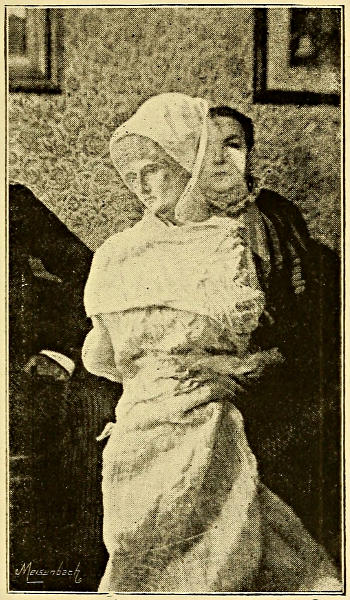
From a Photograph taken April 29, 1892. Two Stereoscopic
photographs of this form were obtained with
different sitters, May 2, 1892.
Our grandest triumphs of science are but
trifles compared with what is before us to be
realised in the higher life. Yet men and
women of education and refinement can content
themselves with referring the most mysterious
spirit phenomena to conjuring and delusion,
and can descend to the inanity of trying to
shelve the whole matter by attacking the
characters of those whom they ought rather
to thank—to bless as the instruments through
whom the death-blow must be given to the
doctrine which denies the existence of the spirit
world, and of our after-life.
At the Photographic Congress held at the
World’s Fair, Judge Bradwell, of Chicago, was
chairman of the opening meeting. In his introductory
remarks, after summarising the
work done by photographers, he said: “I
have no doubt there are those within the
sound of my voice who will live to see the
time when photographic reproductions will be
sent from country to country as quickly as
are telegraphic messages to-day. In conclusion,
may I not ask, who shall say that the
camera, adjusted by the hand that feels, and
focussed by the sensitive eye that sees beyond,
with the aid of the intensely sensitive
dry plates, shall not bring to light and view
the forms of our departed friends, and solve
the problem of immortality and life?”
Judge Bradwell is answered. The
veil is lifted.