Yet not immediately. We had still to make the final step of our Progress
in apartment life, and to acquire other valuable experience. It happened
in this wise.
Of the Sum there still remained a fragment—unimportant and fragile, it
would seem—but quite sufficient, as it proved, to make our lives
reasonably exciting for several months.
A friend on the Stock Exchange whispered to me one morning that there
was to be a big jump in Calfskin Common—something phenomenal, he said,
and that a hundred shares would pay a profit directly that would
resemble money picked up in the highway.
I had never dealt in stocks, or discovered any currency in the public
thoroughfares, but my recent inheritance of the Sum and its benefits had
developed a taste in the right direction. Calfskin Common was low then,
almost as low as it has been since, and an option on a hundred shares
could be secured with a ridiculously small amount—even the fragment of
the Sum would be sufficient.
I mentioned the matter that night to the Little Woman. We agreed almost
instantly that there was no reason why we should not make something on
Calfskin Common, though I could see that the Little Woman did not know
what Calfskin Common was. I have hinted before that she was not then
conversant with the life and lingo of the Stock Exchange, and on the
whole my advantage in this direction was less than it seemed at the
time. I think we both imagined that Calfskin Common had something to do
with a low grade of hides, and the Little Woman said she supposed there
must be a prospective demand from some foreign country that would
advance the price of cheap shoes. Of course it would be nice to have our
investments profitable, but on the whole perhaps I'd better lay in an
extra pair or so of everyday footwear for the Precious Ones.
I acquired some information along with my option on the stock next day,
so that both the Little Woman and myself could converse quite
technically by bed-time. We knew that we had "put up a ten per cent.
margin" and had an "option" at twelve dollars a share on a hundred
shares of the common stock in leather corporation—said stock being
certain to go to fifty and perhaps a hundred dollars a share within the
next sixty days. The fragment of the Sum and a trifle more had been
exchanged for the Stock, and we were "in on a deal." Then too we had a
"stop-loss" on the Stock so that we were safe, whatever happened.
The Little Woman didn't understand the "stop-loss" at first, and when I
explained to her that it worked automatically, as it were, she became
even more mystified. I gathered from her remarks that she thought it
meant something like an automatic water shut-off such as we had in the
bath-room to prevent waste. Of course, that was altogether wrong, and I
knew it at the time, but it did not seem worth while to explain in
detail. I merely said that it was something we could keep setting higher
as the stock advanced, so that in event of a downward turn we would save
our original sum, with the accrued profits.
Then we talked about what we would do with the money. We said that now
we had such a lot of good things and were going to make money out of the
Stock we ought to try one really high-class apartment—something with an
elevator, and an air of refinement and gentility. It would cost a good
deal, of course, but the surroundings would be so much more congenial,
so much better for the Precious Ones, and now that I was really doing
fairly well, and that we had the Stock—still we would be prudent and
not move hastily.
We allowed the Stock to advance five points before we really began to
look for a place. Five points advance meant five hundred dollars' profit
on our investment, and my friend on the exchange laughed and
congratulated me and said it was only the beginning. So we put up the
stop-loss, almost as far as it would go, and began to look about for a
place that was quite suitable for people with refined taste, some very
good things in the way of rugs and furniture, and a Stock.
We were not proud as yet. We merely felt prosperous and were willing to
let fortune smile on us amid the proper surroundings. We said it was
easy enough to make money, now that we knew how, and that it was no
wonder there were so many rich people in the metropolis. We had fought
the hard fight, and were willing now to take it somewhat easier. We
selected an apartment with these things in view.
It was some difficulty to find a place that suited both us and the
Precious Ones. Not that they were hard to please—they welcomed anything
in the nature of change—but at most of the fine places children were
rigorously barred, a rule, it seemed to us, that might result in rather
trying complications between landlord and tenant in the course of time
and nature, though we did not pursue investigations in this line. We
found lodgment and welcome at length in the Apollo, a newly constructed
apartment of the latest pattern and in what seemed a most desirable
neighborhood.
The Apollo was really a very imposing and towering affair, with onyx and
gilded halls. The elevator that fairly shot us skyward when we ascended
to our eerie nest ten stories above the street, and was a boundless joy
to the Precious Ones, who would gladly have made their playhouse in the
gaudy little car with the brown boy in blue and brass. Our fine
belongings looked grand in the new suite, and our rugs on the inlaid and
polished floor were luxurious and elegant. Compared with this, much of
our past seemed squalid and a period to be forgotten. Ann, who was still
with us, put on a white cap and apron at meal-times, and to answer the
bell, though the cap had a habit of getting over one ear, while the
apron remained white with difficulty.
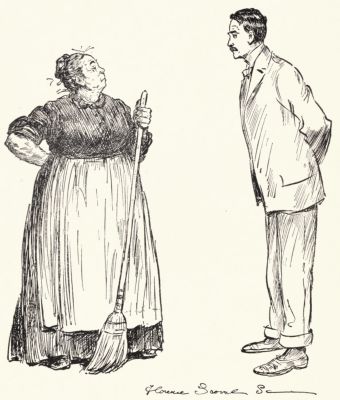
The janitor of the Apollo was quite as imposing as the house itself,—a
fallen nobleman, in fact, though by no means fallen so far as most of
those whose possibilities of decline had been immeasurably less. He was
stately and uplifting in his demeanor. So much so that I found myself
unconsciously imitating his high-born manner and mode of speech. I had a
feeling that he was altogether more at home in the place than we were,
but I hoped this would pass. Whatever the cost, we were determined to
live up to the Apollo and its titled Chargé d'Affaires.
And now came exciting days. The Stock continued to advance, as our
friend had prophesied. Some days it went up one point, some days two.
Every point meant a hundred dollars' clear profit. One day it advanced
five full points. We only counted full points. Fractional advances we
threw into the next day's good measure, and set the stop-loss higher,
and yet ever higher.
We acquired credit with ourselves. We began to think that perhaps after
all we hadn't taken quite so good an apartment as we deserved. What was
a matter of a thousand dollars more or less on a year's rent when the
Stock was yielding a profit of a hundred or two dollars a day. We
repeated that it was easy enough now to understand how New Yorkers got
rich, and could afford the luxuries heretofore regarded by us with a
wonderment that was akin to awe. I began to have a vague notion of
abandoning other pursuits and going into stocks, altogether. We even
talked of owning our own home on Fifth Avenue. Still we were quite
prudent, as was our custom. I did not go definitely into stocks, and we
remained with the fallen nobleman in the Apollo. Neither did we
actually negotiate for Fifth Avenue property.
The Little Woman bought many papers during the day. In some of them
early stock quotations were printed in red, so it might be truly said
that these were red-letter days for the Little Woman. When she heard
"Extra!" being shouted in the street far below she could not
dispossess herself of the idea that it had been issued to announce a
sensational advance of the Stock. Even as late as ten o'clock one night
she insisted on my going down for one, though I explained that the Stock
Exchange had closed some seven hours before. The Precious Ones fairly
kept the elevator busy during the afternoon, going for extras, and when
the final Wall Street edition was secured they would come shouting in,
"Here it is. Look at the Stock, quick, Mamma, and see how much we've
made to-day!"
Truly this was a gilded age; though I confess that it did not seem quite
real, and looking back now the memory of it seems less pleasant than
that of some of the very hard epochs that had gone before. Still, it
occupies a place all its own and is not without value in life's
completed scheme.
The Stock did not go to fifty. It limped before it got to forty, and we
began to be harassed by paltry fractional advances, with even an
occasional fractional decline. We did not approve of this. It was
annoying to look in the Wall Street edition and find that we had made
only twelve dollars and a half, instead of a hundred or two, as had been
the case in the beginning. We even thought of selling Calfskin Common
and buying a stock that would not act that way; but my friend of the
exchange advised against it. He said this was merely a temporary thing,
and that fifty and a hundred would come along in good time. He adjusted
the stop-loss for us so that there was no danger of the Stock being sold
on a temporary decline, and we sat down to wait and watch the papers
while the Stock gathered strength for a new upward rush that was sure to
come, and would place us in a position to gratify a good many of the
ambitions lately formed.
A feverish and nerve-destroying ten days followed. The Stock had become
to us as a personal Presence that we watched as it stumbled and
struggled and panted, and dug its common Calfskin toes into things in a
frantic effort to scale the market. I know now that the men who had
organized the deal were boasting and shouting, and beating the air in
their wild encouragement, while those who opposed it were hammering, and
throttling and flinging mud, in as wild an effort to check and
demoralize and destroy. At the time, however, we caught only the echo of
these things, and believed as did our friend on the exchange, that a
great capitalist was in control of Calfskin Common and would send it to
par.
Only we wished he would send it faster. We did not like to fool along
this way, an eighth up and an eighth, or a quarter down, and all
uncertainty and tension. Besides, we needed our accruing profits to meet
our heavily increased expenses which were by no means easy to dispose of
with our normal income, improved though it was with time and tireless
effort.
Indeed, most of the eighths and quarters presently seemed to be in the
wrong direction. It was no fun to lose even twelve dollars and a half a
day and keep it up. The Presence in the household was in delicate
health. It needed to be coddled and pampered, and the strain of it told
on us. The Little Woman developed an anxious look, and grew nervous and
feverish at the clamor of an "extra." Sometimes I heard her talking
"plus" and "minus" and "points" in her sleep and knew that she had taken
the Stock to bed with her.
The memory of our old quiet life in the Sunshine and Monte Cristo began
to grow in sweetness beside this sordid and gilded existence in the
Apollo. The massive portals and towering masonry which at first had been
as a solid foundation for genuine respectability began to seem gloomy
and overpowering, and lacking in the true home spirit we had found
elsewhere. The smartly dressed and mannered people who rode up and down
with us on the elevator did not seem quite genuine, and their
complexions were not always real. It may have been the condition of the
Stock that disheartened us and made their lives as well as ours seem
artificial. I don't know. I only know that I began to have a dim feeling
that we would have been happier if we had been satisfied with our
oriental rugs and antique furniture, and the remnant of the Sum, without
the acquaintance of the Stock and the fallen nobleman below stairs. But,
as I have said, all things have their place and value, I suppose, and
our regrets, if they were that, have long since been dissipated, with
the things that made them possible.
Quickly, as they had come, they passed, and were not. I was working
busily one morning in my south front study when the Little Woman entered
hurriedly. It was late April and our windows were open, but being much
engaged I had not noticed the cries of "extra!" that floated up from the
street below. It was these that had brought the Little Woman, however,
and she leaned out to look and listen.
"They are calling out something about stocks and Wall Street," she said,
"I am sure of it. Go down and see, quick! Calfskin Common must have gone
to a hundred!"
"Oh, pshaw!" I laughed, "it's only the assassination of a king, or
something. You're excited and don't hear right."
Still, I did go down, and I fumed at the elevator-boy for being so slow
to answer, though I suppose he was prompt enough. The "extra" callers
had passed by the time I got to the street, but I chased and caught
them. Then I ran all the way back to the Apollo, and plunged into the
elevator that was just starting heavenward.
I suppose I looked pretty white when I rushed in where the Little Woman
was waiting. But the type that told the dreadful tale was red enough, in
all conscience. There it was, in daubed vermilion, for the whole world
and the Little Woman to see.
"PANIC ON WALL STREET.
"Break in Leather stocks causes general decline. Calfskin Common
falls twenty points in ten minutes. Three failures and more to
come!"
Following this was a brief list of the most sensational drops and the
names of the failing firms. For a moment we stared at each other,
speechless. Then the Little Woman recovered voice.
"Oh," she gasped, "we've caused a panic!"
"No," I panted, "but we're in one!"
"And we'll lose everything! People always do in panics, don't they?"
I nodded gloomily.
"A good many do. That is, unless——"
"But the stop-loss!" she remembered joyfully, "we've got a stop-loss!"
"That's so!" I assented, "the stop-loss! Our stock is already
sold—that is if the stop-loss worked."
"But you know you said it worked automatically."
"So it does—automatically, if—if it holds! It must have worked! I'll
telephone at once, and see."
There was a telephone in the Apollo and I hurried to it. Five women and
three men were waiting ahead of me, and every one tried to telephone
about stocks. Some got replies and became hysterical. One elderly woman
with a juvenile make-up and a great many rings fainted and was borne
away unconscious. A good many got nothing whatever.
I was one of the latter. The line to my brokers was busy. It was busy
all that day, during which we bought extras and suffered. By night-fall
we would have rejoiced to know that even the original fragment of the
Sum had been saved out of the general wreck of things on the Street.
It was. Even a little more, for the stop-loss that had failed to hold
against the first sudden and overwhelming pressure, had caught somewhere
about twenty, and our brokers next morning advised us of the sale.
It was a quiet breakfast that we had. We were rather mixed as to our
feelings, but I know now that a sense of relief was what we felt most.
It was all over—the tension of anxious days, and the restless nights.
Many had been ruined utterly. We had saved something out of the
wreck—enough to pay the difference in our rent. Then, too, we were
alive and well, and we had our Precious Ones. Also our furniture, which
was both satisfactory and paid for. Through the open windows the sweet
spring air was blowing in, bringing a breath and memory of country
lanes. Even before breakfast was over I reminded the Little Woman of
what she had once said about needing a home of our own, now that we had
things to put in it. I said that the memory of our one brief suburban
experience was like a dream of sunlit and perfumed fields. That we had
run the whole gamut of apartment life and the Apollo had been the
post-graduate course. In some ways it was better than the others, and if
we chose to pinch and economize in other ways, as many did, we still
might manage to pay for its luxury, but after all it was not, and never
had been a home to me, while the ground and the Precious Ones were too
far apart for health.
And the Little Woman, God bless her, agreed instantly and heartily, and
declared that we would go. Onyx and gilded elegance she said were
obtained at too great a price for people with simple tastes and moderate
incomes. As for stocks, we agreed that they were altogether in keeping
with our present surroundings—with the onyx and the gilt—with the
fallen nobleman below stairs and those who were fallen and not noble,
the artificial aristocrats, who rode up and down with us on the
elevator. We had had quite enough of it all. We had taken our apartment
for a year, but as the place was already full, with tenants waiting,
there would be no trouble to sublet to some one of the many who are ever
willing to spend most of their income in rent and live the best way they
can. Peace be with them. They are welcome to do so, but for people like
ourselves the Apollo was not built, and Vanitas Vanitatum is written
upon its walls.