APPLICATIONS OF WATER. — RULES FOR BATHING. — GENERAL BATHS. — SWIMMING. — PLUNGE BATH. — SPONGE BATH. — RUBBING WET-SHEET. — WET-SHEET PACK. — SHOWER PACK. — DRY SHEET PACK. — FULL BATH. — HALF BATH. — SHALLOW BATH. — AFFUSION. — PAIL DOUCHE. — CATARACT DOUCHE. — HOSE DOUCHE. — SHOWER BATH. — SPRAY BATH. — LOCAL BATHS. — SITZ BATH. — LEG BATH. — FOOT BATH. — HALF PACK. — CHEST PACK. — LEG PACK. — CHEST WRAPPER. — WET GIRDLE. — ASCENDING DOUCHE. — DROP BATH. — ARM BATH. — HEAD BATH. — EYE BATH. — EAR BATH. — NOSE BATH. — COMPRESSES. — FOMENTATIONS. — REFRIGERANT APPLICATIONS. — MISCELLANEOUS BATHS, ETC. — VAPOR BATH. — RUSSIAN BATH. — HOT-AIR BATH. — TURKISH BATH. — ELECTRIC BATH. — ELECTRO-VAPOR BATH. — DRY RUBBING-SHEET. — DRY HAND-RUBBING. — AIR BATH. — SUN BATH. — SEA-BATHING. — MEDICATED BATHS. — OIL BATH. — NOVEL BATHS. — ENEMA. — WATER EMETIC. — DRY HOT APPLICATIONS. — WATER-DRINKING. — HOW TO MAKE A FILTER.
79
The indications which are to be met in the
treatment of disease are chiefly those enumerated
below; and how admirably they are met by applications
of water may be easily demonstrated
by following the directions given.
1. Equalization of Circulation.—Disease cannot
exist without some disturbance of the circulation.
In perfect health each part receives
its due share of blood. One of the first indications
in disease, then, is to balance the circulation.
If an organ contains too much blood,
the application of cold water to the part will occasion
contraction of the minute vessels of the
part, and thus the amount of blood is lessened, as
explained more at length in considering the physiological
effects of water.
Or, the part may be relieved by the application
of warm water in some form to adjacent or
remote parts of the body, by which means the
surplus blood will be drawn to other parts, thus
relieving the suffering organ. Again, if an organ
contains too little blood, the opposite course
must be pursued. Warm or hot applications are
made to the part, while cold applications may be
made to other parts if necessary. Very often the
80two remedies may be advantageously combined,
since one part cannot contain too much blood
without some other part or parts being deprived
of the due proportion, and vice versa; so that
while a cold application is needed at one part,
the opposite is required at another.
2. Regulation of Temperature.—As the condition
of the bodily temperature is closely associated
with that of the circulation, the two are
usually controlled by the same remedies applied
in the same manner. A part which contains too
much blood has usually, also, too high a degree of
heat. The cold application relieves both. If the
entire surface of the body is involved, the application
must be as extensive as necessary to affect
the whole. In general fevers, the admirable
adaptation of water to this end is well exhibited.
When the temperature of the body rises above
100°, or even above 98°, a cooling bath should be
resorted to. It may consist of a simple sponging
with water, scarcely below the bodily temperature,
an affusion with tepid water, a full bath of
a tepid, temperate, or cold temperature, or some
other form of cooling application according to
the degree of cooling effect desired. Any temperature
below 98° will be cooling. In general,
it is better to employ a bath only a few degrees
below the bodily temperature, as its application
will not be followed by an increase of heat, called
reaction, which follows a brief application of
81a cool bath. To obtain the proper cooling effects
of a cool or cold bath, it must be continued for
some time, from ten minutes to half an hour, at
least. The same remark applies also to the application
of cool baths for the purpose of equalizing
the circulation.
3. Removal of Pain.—Pain is usually dependent
upon disturbance of the circulation, being
caused by the pressure of overfilled vessels upon
the nerves in a confined space. Pain may be
relieved by either hot or cold applications. The
first object should be to remove the surplus blood,
by local cold applications, and remote hot ones. If
this plan is not successful, relief will be obtained
by a hot local application, which operates by relaxing
the surrounding tissues, so that the nerve
fibers are relieved from pressure, as well as by
quickening the local circulation, and so relieving
congestion. The latter method is usually most
quickly successful; but it is not so radically curative
as the former. Pain dependent on passive
congestion will be best relieved by the method
next described.
4. To Excite Activity.—Many organs often
become torpid or inactive, as the skin and
liver, especially. Sometimes the blood-vessels of
an organ become relaxed and inactive, passive
congestion resulting. No remedy will so readily
induce a return of activity to the affected parts
82as alternate hot and cold applications, continued
for some minutes, fifteen to thirty or more. This
is one of the best applications for the relief of
old pains.
5. Removal of Obstructions.—A very large
class of diseases are attributable to obstruction in
various organs, caused by the reception of foreign
matters into the system, and the accumulation of
the natural waste of the tissues. The warm
bath, to remove, external obstructions, and the internal
use of water as a solvent for internal
sources of obstruction, are the remedies which
will achieve success in nearly all cases. Offending
substances in the stomach are readily removed
by the water emetic; and hardened accumulations
in the large intestine are removed with
equal facility by means of the enema.
6. Dilution of the Blood.—In fevers, cholera,
and other diseases, the blood often becomes
abnormally thickened, dark, and viscid, circulating
with difficulty, and not imparting due
nourishment to the tissues. Nothing but water
can remedy this difficulty. It may be got into
the blood by absorption from the skin, if the mucous
membrane of the stomach will not absorb it.
7. Influence on the Nervous System.—Finally,
it is often important to affect certain organs
through their nervous centers. Water, properly
applied, will accomplish this also. A fomentation
83applied to the abdomen will often remove
headache, and is an excellent remedy for
general nervousness, seeming to affect the whole
system, just as does galvanic electricity when applied
to the same locality, doubtless through the
large nervous ganglia located in that region.
Some physicians claim to have obtained peculiar
results by the application of heat or cold to
the spine. It is said, for example, that cold applied
to any portion of the spine will produce an
increased circulation in the portion of the body
supplied with organic nerves from the part. Hot
applications to the spine are said to produce a contrary
effect upon corresponding organs. Perhaps
there should be still further observations upon this
subject before any attempt is made to establish
a definite law. It is well known that applications
of ice to the spine is an excellent remedy for
chorea, and several other nervous diseases.
For general nervous irritability, or nervousness,
the warm full bath may be applied with
uniform success. Neither hot nor cold applications
are generally useful in such cases.
Temperature of Baths.—The thermometer is
the only accurate measure of temperature; hence
the importance of its use in the administration of
baths. Yet the thermometer may be abused. A
given temperature may seem warm to one individual
and tepid or cool to another. The same
difference of sensation will occur in the same individual
84on different occasions. What seems cool
to-day will be thought warm to-morrow. The
susceptibility of the body to sensations of heat
and cold largely depends upon its condition and
the temperature of surrounding objects. In consequence
of this physiological fact, it is improper
to attempt, as some have done, to fix certain exact
temperatures at which baths must be given to all
persons under all conditions.
For convenience and perspicuity, the temperatures
of baths have been divided into six grades,
as given in the following table by Forbes; all
who attempt to use the bath according to the directions
should carefully learn and preserve the
distinctions here made:—
| 1. Cold Bath, |
33° |
to |
60° |
F. |
| 2. Cool, |
60° |
„ |
75° |
|
| 3. Temperate, |
75° |
„ |
85° |
|
| 4. Tepid, |
85° |
„ |
92° |
|
| 5. Warm, |
92° |
„ |
98° |
|
| 6. Hot, |
98° |
„ |
112° |
|
The vapor bath ranges from 98° to 120°; the
hot-air or Turkish bath from 100° to 160°, or
even higher, though not usefully so.
A bath of any temperature above the natural
heat of the body, 98°, is a hot bath. At 32°,
water becomes ice; a bath is very rarely given at
this temperature, and then the application should
be made to only a small surface. Water at 32°,
and even ice and snow, may be usefully employed
85as topical remedies in local diseases. It will rarely
be necessary to employ a full bath at a lower
temperature than 65°, which will usually seem
very cold to the patient. A temperature from
85° to 95° is the most generally useful for baths
which involve a considerable portion of the body,
though of course higher temperatures are employed
in local applications.
How to Determine the Temperature of a Bath
without a Thermometer.—It is often necessary
to administer a bath when a thermometer cannot
be obtained. In such cases it is customary
to test the temperature by placing the hand
in the water. This is an unreliable method,
however; for the hand becomes, by usage, so
obtuse to heat that water which would seem
only warm to it would be painfully hot to the
body of the patient. To avoid this source of
error, it is only necessary to plunge the arm to
the elbow into the water, by which means its
real temperature will be determined. Water
which causes redness of the skin is hot; when it
feels simply comfortable, with no special sensation
of either heat or cold, it is warm. Slightly cooler
than this, it is tepid. When it causes the appearance
of goose-flesh, it may be for practical purposes
called cool, a still lower degree being cold.
Another Method.—The method about to be described
is somewhat more accurate than the preceding,
and may be found convenient for facilitating
86the preparation of a bath of proper quantity
as well as temperature, a matter which though
simple enough is often quite annoying to inexperienced
persons. It is a fact of common knowledge
that water boils at 212° F. Boiling water,
then, is always of this temperature. Well and
spring water, and the water of cisterns in winter,
does not vary greatly from 53°. The temperature
of well and spring water changes very slightly with
the seasons. By combining in proper quantities
water of these known temperatures, any required
temperature may be produced. Not having seen
this method suggested before, we have prepared
the following table, which may perhaps be used
to advantage in the absence of a thermometer;
we advise all to obtain and use a thermometer,
however, when it is possible to do so:—
| Tem. 53°. |
Tem. 212°. |
| 2 |
qts. |
added |
to |
1 |
qt. |
equals |
3 |
qts. at |
106° |
| 2½ |
„ |
„ |
|
1 |
„ |
„ |
3½ |
„ |
98° |
| 3 |
„ |
„ |
|
1 |
„ |
„ |
4 |
„ |
93° |
| 4 |
„ |
„ |
|
1 |
„ |
„ |
5 |
„ |
85° |
| 5 |
„ |
„ |
|
1 |
„ |
„ |
6 |
„ |
80° |
| 6 |
„ |
„ |
|
1 |
„ |
„ |
7 |
„ |
76° |
| 8 |
„ |
„ |
|
1 |
„ |
„ |
9 |
„ |
71° |
When larger quantities are needed, it is only necessary
to multiply each of the combining quantities
by the same number. For instance, if a gallon
and a half of water is needed for a foot bath
at 106°, pour into a pail or bath-tub four quarts
of fresh well water and then add two quarts of
87boiling water. If four gallons of water are
wanted for a sitz bath at 93° (a very common
temperature), pour into the bath-tub three gallons
of fresh well or spring water, and add one gallon
of boiling water. Thus any required quantity can
be obtained at the temperatures given. The cold
water should be placed in the vessel first, and
there should be no delay in adding the hot water,
as it would rapidly lose its heat, and thus make
a larger quantity necessary. Determinate measurement
is not essential. The cold and hot water
may be added alternately in proper proportions,
being measured by the same vessel until the requisite
quantity is prepared.
The following general rules should be carefully
studied and thoroughly understood by any one who
expects to employ the bath. Much injury to
health and most of the discredit cast upon the
use of water as a remedy have arisen from a
disregard of some of them:—
1. A full bath should never be taken within
two or three hours after a meal.
2. Such local baths as fomentations, compresses,
foot baths, and even sitz baths, may be taken an
hour or two after a meal; indeed, compresses and
fomentations may be applied almost immediately
after a light meal, without injury.
3. Employ the thermometer to determine the
88temperature of every bath when possible to do so;
if not, employ the other methods described.
4. The temperature of the room during a bath
should be 70° to 85°. Invalids require a warmer
room than persons in health. Thorough ventilation
is an important matter; but draughts must
be carefully prevented, by screens of netting
placed before openings into the room when necessary.
5. Never apply either very cold or excessively
hot treatment to aged or feeble patients. Cold is
especially dangerous.
6. Hot baths are rarely useful in health. The
warm bath answers all the requirements of cleanliness.
7. Never take a cold bath when exhausted or
chilly. A German emperor lost his life by taking
a cool bath after a fatiguing march. Alexander
came near losing his life in the same manner.
Many have been rendered cripples for life
by so doing. No harm will result from a cool
bath if the body is simply warm, even though it
may be in a state of perspiration. Contrary to the
common opinion, a considerable degree of heat is
the best possible preparation for a cold bath.
The Finlanders rush out of their hot ovens—sweat-houses—and
roll in the snow, without injury.
8. Cold baths should not be administered during
the period of menstruation in females. At
89such times, little bathing of any kind is advisable
with the exception of a warm or tepid sponge
bath, or such treatment as may be advised by a
physician.
9. Bath attendants should carefully avoid giving
“shocks” to nervous people or to those inclined
to apoplexy or affected with heart disease.
Shocks are unpleasant and unnecessary for any
one.
10. Never apply to the head such treatment as
will cause shock, as the sudden cold douche,
shower, or spray bath.
11. A light hand bath every morning will be
none too frequent to preserve scrupulous bodily
cleanliness. More than a week should never be
allowed to elapse without a bath with warm
water and soap.
12. The best time for treatment—especially
cool treatment—is about three hours after breakfast.
13. Always employ for bathing purposes the
purest water attainable. Soft water is greatly
preferable to hard on many accounts.
14. Those not strong and vigorous should avoid
drinking freely of cold water just previous to a
bath.
15. The head should always be wet before any
bath; and the feet should be warmed—if not already
warm—by a hot foot bath, if necessary.
16. In applying a bath to sick persons, it
90should always be made of a temperature agreeable
to the feelings.
17. One very important element in the success
of a bath is the dexterity of the attendant. The
patient should be inspired with confidence both
in the bath and in the skill of the attendant. The
mind has much to do with the effect of a bath.
18. In general baths, the patient, unless feeble,
will derive benefit by assisting himself as much
as possible.
19. Patients should receive due attention during
a bath, so that they may not feel that they
are forgotten. Nervous patients often become very
apprehensive on this account. It is also important,
in most cases, that a reasonable degree of
quietude should be maintained.
20. When any unusual or unexpected symptoms
appear during a bath, the patient should be
removed at once.
21. In case symptoms of faintness appear, as is
sometimes the case in feeble patients, during a
hot bath, apply cold water to the head and face,
give cool water to drink, lower the temperature
of the bath by adding cool water, and place the
patient as nearly as possible in a horizontal position.
22. The temperature of a warm or hot bath
should always be decreased just before its termination
as a precaution against taking cold.
23. In health, a cool or cold bath should be
91very brief, lasting not more than one or two minutes.
A tepid bath should last not more than
ten or fifteen minutes. A warm bath may be continued
thirty or forty minutes, or even longer,
but nothing could be more absurd than the custom
prevailing in some places of prolonging the
bath to great length. At Pfeffers and Leuck, in
Switzerland, many persons spend the whole day
in the water, taking their meals on floating tables,
and occupying their time in reading, playing
chess, and other games. Some remain in the water
as many as sixteen hours out of the twenty-four.
Of course, certain baths may be advantageously
prolonged in cases of disease; but no
intelligent physician will now recommend the
antiquated practice which we sometimes see represented
by a patient seated in a tub, with an
open book in hand.
24. It is of extreme importance that the patient
should be carefully dried after any bath.
A large sheet is much better for this purpose
than a towel. An old linen or cotton sheet is
preferable to a new one, being softer. Full directions
are given under the heading, “Dry Rubbing-Sheet.”
25. A patient should never be left chilly after
a bath. Rub until warm.
26. It is equally important that the body
should not be left in a state of perspiration, for it
will soon become chilly.
9227. Patients who are able to do so should exercise
a little both before and immediately after
a bath to insure thorough reaction.
28. An hour’s rest soon after a bath will add
to its beneficial effects. It is best to go to bed
and cover warm.
29. If a bath is followed by headache and fever,
there has been something wrong, either in
the kind of bath administered, or in the manner
of giving it.
30. Very cold and very hot baths are seldom
required. The barbarous practices of half a century
ago are now obsolete, or should be, if they
are not quite discontinued as yet. No good resulted
from them which cannot be attained by
milder means, and much harm was occasioned
which is avoided by the use of less extreme temperatures.
31. Patients should not be allowed to become
dependent on any special form of bath, as an after-dinner
fomentation to aid digestion, the abdominal
bandage, or any other appliance. Destroy
such a habit if it has been formed.
32. Order, cleanliness, dispatch, and a delicate
sense of propriety are items which every bath attendant
should keep constantly in mind, and
which will often contribute in no small degree
to success in the use of this agent.
33. Never employ a bath without a definite
and legitimate purpose in view. It is somewhat
93customary, in many institutions where water is
employed, to apply it in a routine way. Many
baths are prescribed for the sake of producing
variety, or pleasing the patient. A faithful and
scientific physician will carefully adapt his remedies
to the condition of his patient, and will observe
the results. It seems to be a prevalent error
that it makes little difference how water is
applied, provided the patient is only wet. Warm,
hot, tepid, temperate, cool, and cold baths are
used indiscriminately.
So, also, the different modes of administering
baths of the same temperature are disregarded in
many cases. In general, each particular form of
bath is especially adapted to the treatment of special
conditions, and it is the best test of the proficiency
of a physician, in the use of water, to observe
whether he recognizes the distinctions between
the various kinds of baths, and is able to
adapt them to the appropriate conditions.
34. Giving too much treatment is likely to be
the error into which the inexperienced will fall,
rather than the opposite extreme. Nature cannot
be forced to do more than she is capable of
doing; and as nature must do the healing, if a
cure is accomplished, remedies should be of a
helping rather than a crowding or forcing nature.
The vitality of patients may be expended uselessly
by treatment, for baths excite vital resistance,
as well as drugs, a fact which many overlook.
94The dangers of over-treatment are not so
great as some imagine, however, who take the
opposite extreme, and advocate rest as the great
cure-all. We have seen patients who seemed to
be quite monomaniacs on the subject of “rest
cure,” who needed a good thorough stirring up
with useful exercise more than any other kind of
treatment.
Baths applied to the whole surface of the body
are, as we have already seen, among the most
powerful means of affecting the human system
either in health or disease. Baths of a temperature
less than that of the body, 98°, unless of
very brief application, uniformly decrease the
bodily temperature. That the diminution of
temperature is not merely local, being confined
to the skin and superficial structures, is shown
by the fact that the thermometer indicates a decline
of temperature in the interior of the body
as well. The bath diminishes the production of
heat throughout the whole system, besides abstracting
large quantities by its contact with the
body, as previously explained. The diminution
of temperature continues for hours after the bath,
especially in cases in which it was excessively
high at the time of administration. Hot baths
have, in general, an opposite effect.
95
Swimming is a general bath combined with
vigorous exercise, as nearly all baths should be.
It is one of the most healthful kinds of exercise,
if not continued too long, as it frequently is. The
temperature of the water is commonly between
70° and 80° F., which make it a temperate bath.
Its effects are not far different from other forms
of bath of the same temperature. We have not
space to devote to a description of the art, since
there are valuable treatises on the subject.
The hot baths of the ancient Greeks and Romans
were usually followed by a plunge up to
the neck in a large basin of water four or five
feet deep, and large enough to allow the exercise
of swimming. Many hydropathic establishments
employ the same bath after packs and sweating
baths. A bath of this kind is not always attainable
without great expense; and it possesses
no particular advantage over other methods of
cooling the surface after a warm bath. It is a
very severe form of bath when employed at a
low temperature. In the days of Priessnitz, it
was used at a temperature of 45° or 50°. More
harm than good would result from a continuous
employment of such treatment. The cool plunge
should be of but a very few minutes’ duration,
and the patient should rub himself vigorously during
96the bath. In this, as in all other cool baths,
the first contact with the water produces chilliness
or shock. After two or three minutes, or
less, this will be followed by a partial reaction,
even while the patient is in the water, accompanied
by a feeling of comfortable warmth. This
will shortly be again succeeded by a second chill,
which is not so likely to be followed by prompt
reaction; hence, the patient should always take
care to leave the bath before the occurrence of
the second chill, if he would avoid unpleasant
after-effects.
The sponge or hand bath is perhaps the simplest
and most useful mode of applying water to the
surface of the body; for it requires the use of no
appliances which every one does not possess, and
it can be employed by any one without elaborate
preparation, and under almost any circumstances.
A great quantity of water is not required; a few
quarts are a plenty, and a pint will answer admirably
in an emergency. A soft sponge, or a
linen or cotton cloth, and one or two soft towels,
or a sheet, are the other requisites. The hand
may be used in the absence of a cloth or a
sponge for applying the water.
The temperature of the bath should not be
above 95°, and 90° is generally better. Most
people can habitually employ a temperature of
9775° or 80° without injury. The use of a much
lower temperature is not commonly advisable,
and is often productive of great injury.
Begin the bath, as usual, by wetting the head,
saturating the hair well. Wash the face, then
the neck, chest, shoulders, arms, trunk, and back.
Rub vigorously until the skin is red, to prevent
chilling; for even when the temperature of the
room is nearly equal to that of the body, the
rapid evaporation of water from the surface will
lower the external temperature very rapidly unless
a vigorous circulation is maintained.
After thoroughly bathing the upper portion of
the body, turn the attention to the lower portion,
continuing the rubbing of the upper parts at
brief intervals to prevent chilliness. As soon as
the bathing is concluded, envelop the body in a
sheet and rub dry, or dry the skin with a towel.
When the surface is nearly or quite dried, rub
the whole vigorously with the bare hand.
The bath should not be prolonged more than
ten or fifteen minutes. Five minutes is sufficient
to secure all the benefits of the bath, and even
three minutes will suffice for a very good bath.
Persons who chill easily will find it better to
bathe only a portion of the body before drying
it. Some will even find it necessary to retain a
portion of the clothing upon the lower part of
the body while bathing and drying the upper
part.
98Weakly patients may receive this bath with
very little disturbance, even in bed. Only a
small portion of the body should be uncovered
at a time, being bathed, dried, rubbed, and then
covered while another part is treated in a similar
manner.
The sponge bath may be administered anywhere
without danger of soiling the finest carpet,
by using care to make the sponge or cloth nearly
dry before applying it to the body. A rug may
be spread upon the floor as an extra precaution.
When used for cleanliness—as it should be daily—a
little fine soap should be added two or three
times a week, to remove the oleaginous secretion
from the skin.
This bath is applicable whenever there is an
abnormal degree of bodily heat, and in such cases
may be applied every half-hour without injury.
It is useful in cases of nervousness and sleeplessness,
and, in fact, whenever water is required in
any form, it may be used with advantage.
This bath is administered in two ways; with
the sheet very wet, or dripping, and with it
wrung nearly dry. The first method is frequently
called the dripping-sheet bath. In giving it,
proceed as follows:—
When necessary to prevent injury to the floor
or carpet, place upon the floor a large rug or oilcloth.
99In the center, place a large wash-tub, in
the absence of a more convenient vessel. While
the patient is making himself ready for the bath,
procure two large cotton sheets. Gather one end
of each into folds so that it can be easily and
quickly spread out; lay one upon a chair close at
hand, and place the other in the tub. At a distance
of three or four feet from the tub, place a
low stool. Now place in the tub—if a bath at
about 93° is desired, and this will be the most
usual temperature—half a pailful of fresh well or
spring water, and one-third as much boiling water.
If a thermometer is at hand it should, of
course, be used to test the temperature. After
the patient has wet his head, let him step into
the tub, facing the assistant, with his arms
straight and pressed closely to his sides. Now
draw up the wet sheet by its gathered end to its
full length; draw out one side quickly, place the
corner over one shoulder of the patient, and while
holding it in place with one hand, quickly draw
the remainder of the sheet around him with the
other, bringing it up well around the neck, and
folding the second corner under the top so as to
hold it in place. But a few seconds should be
occupied in applying the sheet. Then commence
rubbing the patient vigorously with both hands,
one upon each side, rubbing to and fro three or
four times in each place, passing over the whole
body very rapidly, and then repeating the same,
100to prevent chilling of any part. Coarse, robust,
and phlegmatic people may be rubbed with a
good deal of severity; but persons with delicate
skin and acute sensibilities require gentler manipulation.
After three or four minutes of energetic rubbing,
pour over the chest and shoulders a pailful of
water four or five degrees cooler than that of the
bath, which should be in readiness for instant use.
Then rub two or three minutes longer. Now
quickly disengage the wet sheet, allowing it to
drop into the tub. While the patient is stepping
upon the stool, quickly grasp the dry sheet, and
by the time he is in place, have him enveloped
in it. Rub him dry, passing over the whole body
several times in rapid succession, to prevent chilling.
Care must be taken that every part is thoroughly
dried. The head, armpits, groins, and
feet are liable to escape attention. No moisture
should be left between the toes. After wiping
nearly or quite dry, apply the hand-rubbing, as
elsewhere described, using care not to induce
perspiration by too vigorous or long-continued
rubbing. If the skin should become moist from
perspiration after having been once dried, gradually
lower the temperature of the room and continue
light rubbing until the skin becomes dry
and cool before allowing the patient to dress.
Very few baths afford a better opportunity
for the display of skill and energy on the part of
101the attendant than this. Some practice is required
to enable one to give it really well.
The other form of rubbing wet-sheet is given
in about the same manner, the only difference
being that the sheet is wrung before its application,
and is re-applied one or more times, according
as a milder or more severe form of treatment
is required. The douche may be reserved until
the sheet is removed the last time.
One precaution especially necessary to be observed
in this bath, as well as in all others where
a tepid application is succeeded by a cooler one,
is frequently overlooked. The second cooler application
should never be made until there is
good reaction from the first.
This is an excellent bath to apply after packs
or warm baths which have induced perspiration,
as hot-air and vapor baths. It is especially applicable
to cases in which there is defective circulation
in the extremities, torpid skin and liver,
and nervousness. It is of special benefit in cases
of debility accompanied by night sweats.
When properly administered, this is one of the
most powerful of all water appliances. Some
skill is needed to apply it with a uniform degree
of success. Two or three comfortables or thick
blankets, one woolen blanket, and a large linen
or cotton sheet are the articles necessary. It is
102important to be certain that the sheet is sufficiently
large to extend twice around the patient’s
body. More blankets are required in cool weather
and by weak patients. Spread upon a bed or
straight lounge the comfortables, one by one,
making them even at the top. Over them, spread
the woolen blanket, allowing its upper edge to
fall an inch or two below that of the last comfortable.
Wet the sheet in water of the proper temperature,
having gathered the ends so that it can
be quickly spread out. Wring so that it will not
drip much, place its upper end even with the
woolen blanket, and spread it out on each side of
the middle sufficiently to allow the patient to lie
down upon his back, which he should quickly do,
letting his ears come just above the upper border
of the sheet, and extending his limbs near together.
The patient should then raise his arms,
while the attendant draws over one side of the
wet sheet, taking care to bring it in contact
with as much of the body as possible, bringing it
closely up beneath the arms, and pressing it down
between the limbs so as to make it come in contact
with both sides of them. Tuck the edge
tightly under the patient on the opposite side,
using care not to include the other edge of the
sheet. Now let the patient clasp his hands
across his chest, and then bring up the other side
of the sheet. Grasp it by its upper corner with
one hand, drawing it down over the shoulder and
103lengthwise of the body; then place the other
hand upon the covered shoulder, holding the
sheet firmly in place while the corner is carried
upward upon the opposite side and tucked under
the shoulder, thus drawing the upper edge of
the sheet well up under the chin. Tuck the edge
of the sheet under the body, carefully enveloping
the feet. Then bring over each side of the blanket
and comfortables in the manner last described,
being very careful to exclude all air at the neck,
and allowing the blankets to extend below the
feet so that they can be folded under.
It is not desirable that the patient should be
bound as tightly as a mummy. All that is necessary
is the exclusion of air, and as the neck
and feet are the points at which it is most likely
to enter, these parts should receive particular attention,
as directed. If too tightly bound, the
patient will be more likely to be nervous than if
allowed some freedom. The application of the
wet sheet should be made in a few seconds, as it
cools very rapidly when spread out. The first
blanket should be brought over the patient as
soon as possible. If the feet are not warm, a hot
foot bath should be taken before the pack. If
they become cool in the pack, hot jugs, bricks, or
stones should be applied to them. If the patient
does not become comfortably warm in a few minutes—ten
or fifteen at most—more blankets
should be added, and, if necessary, dry heat should
104be applied to the sides. If he still remains chilly,
he should be promptly removed and placed
in a warm bath, or vigorously rubbed with a dry
sheet and then placed in a dry pack. The head
should be kept cool by frequent wetting while
the patient is in the bath. If a compress is applied,
it should be often renewed.
The temperature of the pack must depend upon
the condition of the patient, being determined by
principles elsewhere explained. A woolen sheet
is better for the administration of a hot pack
than one of cotton or linen. The cold pack is
very rarely required. The usual temperature
for this bath should be about 92°. It is proper
to wet the sheet in water of about 100°, as it
will be cooled several degrees while being applied.
The duration of the pack should be carefully
regulated by the condition of the patient, the effects
desired, and the immediate effects produced.
If the patient becomes very nervous, or sweats
excessively, or becomes faint, or has other seriously
unpleasant or dangerous symptoms, he should
be removed from the pack at once if he has not
been more than ten minutes in it. Ordinarily,
the pack may continue thirty to forty-five minutes.
If the patient sleeps naturally, he may
remain in the pack a full hour if strong, or even
longer in many cases. In fevers, short packs,
frequently repeated, are more beneficial than long
ones fewer in number.
105The pack should be followed by the spray, the
sponge bath, the douche, or the rubbing wet-sheet.
It is a powerful remedy, and should not be used
to excess in chronic diseases; it has been much
abused in this way. Its depurating effects are
really wonderful. The increased action of the
skin, together with determination of blood to
that part, is so great that poisons long hidden in
the system are brought out and eliminated. The
odor of a sheet recently used in packing a gross
person is often intolerable. If the patient be a
tobacco user, the sheet will be reeking with the
odor of nicotine. Many times, the sheet will be
actually discolored with the impurities withdrawn
from the body.
The applications of the pack in treating disease
are very numerous. In almost all acute diseases
accompanied by general febrile disturbance,
and in nearly all chronic diseases, it is a most
helpful remedy if rightly managed. It is an admirable
remedy for nervousness, skin diseases,
and irritations of the mucous membrane. The
warm pack is a remedy worth more in the treatment
of children’s diseases than all the drugs in
the materia medica, as many physicians have
proved. It is a most successful application in
convulsions.
In many cases of fever in which the temperature
rises so high as to produce delirium, the ordinary
106pack does not seem to be sufficiently
powerful to fully control the excessive heat. In
such cases, the shower pack is found of great service;
it is thus used in Bellevue Hospital, New
York:—
A rubber blanket is placed upon an ordinary
mattress. Upon this, the patient is placed, enveloped
in a wet sheet, as in the ordinary pack. Instead
of being covered with blankets, however,
he is left exposed to the air, so that the powerful
cooling effects of evaporation may be obtained.
As the sheet becomes warmed by the heat of the
body, cool water is showered upon it from a
sprinkler or watering-pot. The bath is continued
thus until the temperature of the patient, as
indicated by the thermometer, is sufficiently diminished.
This bath, combining as it does the cooling effects
of cool water and of evaporation, is the most
powerful refrigerant that can be employed; yet
it is perfectly safe when judiciously used, being
only applied in cases of extreme urgency on account
of the high temperature.
Some practice opening the ordinary pack at
intervals, and sprinkling cool water upon the patient,
thus obtaining, in some degree, the prolonged
cooling effect. The pack must be studied
well to enable one to apply it with skill, and certainty
of success.
107
Though this can hardly be called a bath at
its commencement, it really becomes a wet-sheet
pack before its termination. Its application differs
from that of the wet-sheet pack in that the
patient is wrapped in woolen blankets instead of
the wet sheet. The object of this treatment is
to produce perspiration, which may be encouraged
by drinking either cold or hot drinks in considerable
quantity, and by the application of dry
artificial heat to the feet and sides. It is a very
severe form of treatment, and is now seldom
practiced. Many years ago, patients at hydropathic
establishments were often kept for several
hours in the dry pack, smothered beneath loads
of comfortables, blankets, and feather-beds. If
cautiously employed, it is occasionally useful in
“breaking the chills,” in fever and ague. It
should be administered about half an hour before
the time for the beginning of the chill, if required
for this purpose.
The several varieties of local packs are described
under the head of Local Baths.
For this bath a tub is required the length of
the body, about eighteen inches deep, two feet
wide at the top, and, preferably, six inches narrower
at the bottom. It is better to have the
end intended for the head a little elevated.
108Place in the tub sufficient water so that the patient
will be entirely covered, with the exception
of the head, when he lies upon his back. During
the bath, the body should be vigorously
rubbed by the bather or an attendant, or both,
particular pains being taken to knead and manipulate
the abdomen, in a gentle, but thorough
manner. The temperature of the bath, when
taken for cleanliness, or for its soothing effects,
should be not more than 95°, and it should be
cooled down to about 85° before the conclusion
of the bath, by the addition of cool water.
Every family ought to possess conveniences
for this bath. Indeed, it is now found in every
well-regulated modern house in our large cities.
It is not so expensive but that any one can possess
it. Portable baths of rubber can be obtained
which are worth many times their cost. A cheap
bath can be constructed of duck well oiled or
covered with paint and suspended from a frame;
but it will be quite unsatisfactory, not being perfectly
water-tight, as such a bath should be for
family use. A stationary bath may be made of
wood, of the dimensions given, and lined with
lead or zinc. There should be an opening in the
lower end for withdrawing the water.
The full bath is one of the most refreshing of
all baths, being also one of the most pleasant.
Employed at a low temperature, it is a powerful
means of reducing excessive heat in fevers. The
109hot full bath very promptly relieves the pains of
acute rheumatism, and is almost a specific for
colds, if taken just before retiring. Very hot and
very cold temperatures are quite hazardous with
this bath, since it involves so large a portion of
the body. Such extremes are rarely useful in
any case, and should not be used except under
the eye of a physician.
The half bath is much the same as the full
bath. A smaller tub is required, as the bather
sits upright with his limbs extended. The water
should be at least a foot deep. During the bath,
the body should be well rubbed, and water should
be poured over the upper portion of the body.
Its general effects are nearly the same as those of
the full bath, and it may be used for the same
general purposes. A little more vigorous rubbing
is required to prevent chilling, as so large a portion
of the body is exposed. It affords a better
opportunity for stirring up the bowels and abdominal
viscera by shaking, percussing, and
kneading the abdomen.
Of this bath there are two varieties; sitting
shallow and standing shallow.
Sitting shallow differs from the half bath in
employing less water, and being much more vigorous.
110Its effects and uses are about the same.
The bather should rub his limbs and the front
portion of his body while the attendant pours
water over his chest and shoulders, and rubs vigorously
his back and sides. A person can take
the bath very well alone by using a rather long
coarse towel which can be drawn back and forth
across the back by grasping one end with each
hand. It is a very valuable means of applying
water, and is in constant requisition in the hydropathic
establishments. From 85° to 90° is the
proper temperature for this bath. It may be
used at a lower temperature in fever cases. At
Bellevue Hospital it is applied at about 70° in
such cases, and is administered whenever the
temperature exceeds 103°. To avoid the shock of
a cool bath, it may be commenced at a temperature
little below blood-heat and then gradually
cooled by the addition of cool water until the desired
temperature is reached. The reduction of
the temperature obtained by this means fully
equals that obtained by the sudden application of
cold, and the shock and subsequent reaction are
prevented. This applies equally to all cool baths
as well as the cool shallow bath.
The duration of the bath may be from one to
thirty minutes. Ten or fifteen minutes will be
the usual extent.
The Standing Shallow is in some cases preferred
by some to the preceding. The patient stands
111erect in a varying depth of water—from six inches
to one or two feet being employed—while
his body is vigorously rubbed by one or two assistants,
water being poured upon the chest and
shoulders at brief intervals. It is a very enlivening
bath.
The shallow bath should be completed by a
pail douche at a temperature three or four degrees
lower than that of the bath.
This consists simply in pouring water over the
body of the patient, who may be sitting or standing
in a bath-tub. It is a very efficient bath for
reducing unnatural heat. This mode of treatment
was used by Hippocrates, Galen, and other
ancient physicians. In the last century, Currie,
Jackson, and many others used it with great success
in scarlatina. It is a sovereign remedy for
delirium tremens, sun-stroke, hysteria, and sometimes
of acute mania, when applied of the proper
temperature.
This bath scarcely differs from the preceding.
It consists in the dashing of one or more pailfuls
of water upon the body of the bather by an assistant.
By means of a proper arrangement, the
bather can administer the bath himself. For this
purpose, a pail or other vessel filled with water
112may be suspended or supported above the head of
the bather in such a way that it can be quickly
upset by drawing upon a string attached to the
side. The stream should fall upon the shoulders,
chest, back, or hips, but not upon the head or over
the region of the stomach. This bath may be
applied after any warm bath, and should be a little
cooler than the bath which precedes it.
Whether taken alone or after another bath, it
should always be followed by vigorous rubbing.
This is a modification of the douche bath in
which a broad sheet of water is allowed to fall
upon the body of the bather. The force of the
bath depends upon the height from which the
water falls, and should be regulated according to
the strength of the patient. Almost any one will
bear a fall of three or four feet. When the height
of the bath cannot be easily modified, it should
be of such an altitude as to be well borne by the
feeblest patients; the more vigorous can increase
its effects by subjecting themselves to it for a
longer time.
The observations made relating to the application
of the pail douche, apply equally well to
this bath.
113
In this bath, water under pressure is thrown
upon the patient from a hose, through a small
nozzle. The bather turns his body while the attendant
directs the stream upon different parts.
It is a less pleasant bath than the spray or other
forms of douche. Its general effects are the same
as those of the baths mentioned.
This bath is simply an imitation of rain. Water
is allowed to fall upon the body after being divided
into a number of small streams by passing
through a vessel with a perforated bottom. Its
effects depend upon the size of the streams and
the height from which they fall, together with the
temperature of the bath and its duration. Although
formerly much employed in water cure
establishments, this bath is now little used, because
its place is supplied by other more convenient
ones which produce the same results, as the
spray and douche. The best manner of administering
it is to commence the application with
tepid water, and gradually cool it. The temperature
may range from 70° to 92°. The water
should not usually be allowed to fall upon the
head, but should be received first upon the hands
and arms, then upon the feet and limbs, and afterward
upon the back and shoulders, the body
being well rubbed during the application.
114The cold shower bath, formerly so common almost
everywhere, has been productive of much
injury by its indiscriminate use, and has brought
much reproach upon the use of water as a curative
agent. None but the most vigorous can enjoy
the bath at a lower temperature than 70°, and
no advantage is gained by its employment at a
lower temperature than that, while considerable
harm may be done in many cases.
This bath consists in a number of fine streams
of water thrown upon the bather, with considerable
force. It may be produced by connecting a
hose with spray attachment to a force-pump or
reservoir from which to obtain water under a sufficient
pressure. The best form of attachment
consists of a hollow double-convex brass or copper
piece, one side of which is perforated with fine
holes, the other side carrying a rim for attachment
to the hose. It is preferable to have an arrangement
by which the temperature may be
readily and gradually changed from warm or tepid
to cool without interrupting the bath. In the absence
of a proper spray attachment, the apparatus
elsewhere described for the hose douche may
be made to answer a very good purpose, the
stream being broken by placing the thumb or
finger over the nozzle in such a way as to partially
obstruct the flow.
115This is an excellent bath to follow the pack,
vapor bath, hot-air bath, sitz bath, or any other
general bath which induces perspiration. It is
very agreeable to most persons, and can be applied
to feeble patients who would be unable to take
any more severe form of treatment. The alternate
hot and cold spray is very successful as a
means of reducing local inflammations. The warm
bath is very grateful and soothing to swollen and
rheumatic joints; in gout, also, and illy defined,
wandering pains, it is an admirable remedy. It
is very successful, also, in the treatment of tumors,
abscesses, and chronic ulcers, when thoroughly
applied.
The use of water as a local application is not
less important, and is much more varied, than its
general application. There is no other topical
remedy which will produce such a variety of effects
and such prompt results. In removing local
congestions, subduing local inflammations, allaying
circumscribed pain, and restoring activity to
inactive parts, the appropriate applications of
water give results which afford both physician
and patient a degree of satisfaction which no
other single remedy can rival, even electricity, an
agent of acknowledged power, not being excepted.
116
The sitz bath, also known as the hip bath, is
one of the most useful baths employed in hydropathic
treatment. Its utility was fully recognized
by the earlier practitioners, who sometimes kept
their patients so long in the bath that they became
almost literally water-soaked, and were so
numb from the long-continued application of cold
water as to possess almost no external sensibility.
It is said that in some cases the skin could be
rubbed off in the attempts to obtain reaction,
without the patient’s knowledge.
For this bath a common tub may be used, by
placing a support under one edge to elevate it
two or three inches; but it is better to use a tub
made for the purpose, which should have the
back raised eight or ten inches higher than the
front, to support the back, the sides sloping gradually
so as to support the arms of the bather.
The bottom should be elevated two or three
inches. The depth in front should be about the
same as that of a common wash-tub.
Enough water is required to cover the hips and
extend a little way up the abdomen; four to six
gallons will suffice. Any temperature may be
employed, being suited to the condition of the
patient. The duration of the bath will also vary
according to circumstances. A short cool bath is
tonic in its effects, like all short cool applications;
a more prolonged one is a powerful sedative.
117The hot sitz is very exciting in its effects if long
continued. The warm bath is relaxing. The
hips and trunk should be well rubbed during the
bath by the patient or an attendant. The bather
should be covered with a sheet or blanket during
the bath. If it is desirable to produce sweating,
several blankets may be used.
The sitz bath should seldom be taken either
very hot or extremely cold. A very good plan
for administering it, and one which will be applicable
to most cases, is this: Begin the bath at
92° or 93°. If a thermometer is not at hand,
pour into the bath-tub three gallons of fresh well
or spring water, and then add one gallon of boiling
water. This will give the desired temperature.
After the patient has been in the bath ten
minutes, cool it down to 85°, which may be done
by adding a gallon of well water. Continue the
bath five minutes longer, then administer a pail
douche or spray, at about 85°, and wipe dry, as
directed after a rubbing wet-sheet.
The sitz bath is useful for chronic congestions
of the abdominal and pelvic viscera, diarrhea,
piles, dysentery, constipation, uterine diseases,
and genital and urinary disorders. In treating
female diseases it is an indispensable remedy. It
is very valuable in various nervous affections, especially
those which immediately involve the
brain.
There is no better remedy for a cold than a
118very warm sitz bath taken while fasting, and
just before retiring. It should be continued until
gentle perspiration is induced.
The sitz may be converted into a general bath
by rubbing the whole body with the wet hand
while in the bath, and may thus be made to answer
the purposes of the half and shallow baths.
For this bath a vessel deep enough to receive
the limbs to the middle of the thighs is required.
The bath may be taken at any desired temperature;
but it is usually employed somewhat cooler
than baths which involve the trunk of the body.
It is a powerfully derivative bath, and is found
very useful to prevent wakefulness in nervous
persons, and to relieve cerebral congestion in epileptic
patients. It is especially applicable to
chronic ulcers of the leg, swollen knees and ankles,
and limbs which have suffered by exposure
to severe cold. It gives much relief in gout;
there is no danger of causing a metastasis of the
disease by the application of this bath.
Any vessel sufficiently large to receive the feet,
and enough water to cover them to the ankles, is
suitable for this bath. The feet should be rubbed
during the bath. If the temperature is cool,
only an inch or two of water should be employed.
119The walking foot bath is an excellent remedy
for cold feet. It consists in walking in shallow
water five or ten minutes.
The alternate hot and cold foot bath is another
valuable remedy for cold feet, and is a certain
remedy for chilblains. It is given thus: Place
the feet in hot water—100° to 110°—three or
four minutes. Then withdraw them and plunge
them quickly into a bath of cold water—60° or
less. After two or three minutes, restore them
to the hot bath. Thus alternate three or four
times, and conclude by dipping the feet quickly
into cold water and wiping dry. This bath produces
most powerful reaction.
The foot bath is applicable in the treatment of
headache, neuralgia, toothache, catarrh, congestion
of abdominal and pelvic organs, colds, and
cold feet. It is very useful as a preparatory for
other baths, and as an accompaniment of other
local applications.
This bath is given in the same manner as the
wet-sheet pack, except that the wet sheet extends
only from the armpits to the hips. The blankets
are wrapped about the patient in the manner
described for the full pack. All the precautions
given in connection with the description of that
bath are applicable to this.
This bath is frequently employed in cases of
120patients who are too feeble to bear the full pack,
or as a preparatory treatment for that bath. It
is much milder than the full pack, and is usually
more agreeable to the patient, as it does not confine
him so closely. It is a very useful remedy
in all inflammations of the abdominal organs, gastralgia,
pleurisy, acute bronchitis, croup, and pneumonia.
When a hot application is required, it is
well to use a woolen sheet instead of a cotton
one. It requires the same after-treatment as the
full pack.
This application is made in the same manner
as the half pack, allowing the wet sheet to extend
only from the armpits to the navel. It is
especially applicable to diseases of the chest.
The general directions for the full and the half
pack apply to it. It is a very mild application.
The pack may be applied to the legs with
great advantage in cases of habitual coldness of
the feet and limbs or knees. The same principles
mentioned in relation to other packs apply to
this. The application should be made either
cool or cold, and should extend from the hips
downward. It should continue from half an hour
to an hour and a half.
121
This consists of a jacket made something like
a vest, reaching from the neck to a little below
the navel. It should be made of double thicknesses
of soft toweling. To protect the garments or bedding
from moisture, it should be covered with another
jacket made like it but a little larger. In
applying it, the wrapper should be wet in tepid
water, and should then be applied as snugly as
consistent with the comfort of the wearer. It
should be re-applied every two or three hours, as
it becomes dry.
If properly managed, the chest wrapper is a
valuable remedy; but it has been greatly abused.
It should not be worn more than a week without
intermission. The practice of some in continuing
it until it produces an eruption of the skin,
and even longer—to promote a discharge—under
the idea that a vicarious elimination is thus performed,
is highly reprehensible, and has no sound
physiological principle to support it. Such treatment
is damaging to the skin, and does the patient
no good in any way. The better plan is to
allow the wrapper to be worn during the night,
but omitted during the daytime. If worn during
the day, it should be changed often, and should
be removed so soon as the patient becomes chilly.
Whenever removed, the surface of the skin should
be washed or sponged with cool or tepid water.
Feeble patients with defective circulation should
122wear the wrapper only while walking or riding
on horseback.
This appliance may be profitably employed in
a large number of chronic diseases. In chronic
bronchitis, pleurisy, pleurodynia, asthma, and
the early stages of consumption, it gives relief.
This was a favorite remedy with the early
German hydropathists, and it is a very useful appliance
when properly employed, though it has
been much abused by excessive use, as in the
case of the chest wrapper. To apply it well, a
coarse towel about three yards long is the most
convenient for use. Wet one-half of this, in tepid
water, wring it until it will not drip, and apply
it to the abdomen, placing one end at the side,
and bringing it across the front first, so that two
thicknesses of the wet portion will cover the abdomen.
After winding the whole tightly around the
body, fasten the end securely. The remarks made
in reference to the wearing of the chest wrapper
apply with equal force to the wet girdle. For
feeble patients it is better to wet only that portion
of the towel which covers the abdomen.
This a very efficient remedy for constipation,
chronic diarrhea, and most other intestinal disorders.
It is equally valuable in dyspepsia, torpid
liver, enlarged spleen, and uterine derangements.
123
This modification of the douche is simply an
ascending instead of a descending stream. It
can be readily managed by constructing a reservoir
in such position as to give the water ten or
twelve feet fall, when the requisite force cannot
be more easily secured. The water is conducted
through a hose, and is allowed to issue through
a nozzle near the floor. The patient sits or lies
just over the nozzle, and a few inches above it.
This is a valuable remedy in treating piles, prolapsus
of the bowels or uterus, and constipation.
In applying this bath, a vessel with a small
opening in the bottom is elevated to a considerable
height, water placed in it being allowed to
drop upon the part to be treated. The aperture
in the vessel should be only sufficiently large to
give egress to a single drop at a time. The bath
may also be given by placing in an elevated vessel
one end of a skein of cotton yarn, the other
being allowed to fall over the edge of the vessel
and hang below it. By capillary attraction the
water will be drawn up into the yarn and will
drop off at the lower end very slowly.
This is a very convenient way of applying
water where its cooling effects are required for a
considerable length of time, as in wounds, bruises,
sprains, and similar cases. It will “keep down
124inflammation” in a wonderful manner. It is not
commonly necessary that the water should be
very cold, as evaporation will keep the part sufficiently
cool in most cases.
This is simply holding the arm in water of
proper temperature. It is extremely useful in
such painful affections as felons, sprains, and
nearly all injuries of the hand and arm. Ulcers
and acute and chronic skin diseases of the hands
and arm are usually benefited by this bath. If
cold water is painful, its application should be
preceded by that of hot water, or alternated with
it. Cold hands should be frequently rubbed in
cool water, and alternately immersed for a few
minutes each in hot and cold water. In case of
painful felons, the arm must be immersed to the
elbow to relieve the pain, although the disease
is only in the finger.
The patient should lie upon his back, resting
his head in a shallow basin of cool water. The
attendant should bathe the forehead, face, and
temples during the bath. The bath may be continued
until the heat is removed or lessened.
The pouring head bath is often preferable to
the preceding. The patient should lie upon a
bed or sofa, face downward, allowing his head
125to extend outward over a tub or other wide vessel,
while the water is poured upon the head
from a little height, by an assistant. The water
may be either hot or cold, according to existing
conditions. Very cold water is not usually advisable,
as its application soon becomes painful,
and produces powerful reaction. It should be
tepid or temperate. Some cases require very hot
water for a few minutes, followed by a slight affusion
of tepid water.
In hysteria, epilepsy, apoplexy, sun-stroke,
acute mania, delirium tremens, and cerebral congestion
from any cause, the head bath is a
promptly efficacious remedy.
Water may be applied to the eye in various
ways. A convenient method when only a brief
application is necessary, is to lave the eye with
water dipped by the hand. A gentle spray may
be applied, or the eyes may be opened and closed
in water, thus bringing them freely in contact
with the element. Small glass cups made for
the purpose may be filled with water and placed
over the eye, the water being frequently changed;
or wet cloths may be laid upon them.
In applying water to the eye, it is important
to be able to first distinguish the exact nature of
the difficulty, as much damage may otherwise be
done by a wrong application. As a general rule,
126inflammations of the conjunctiva and external
structures of the eye require cool or cold applications,
while inflammations of the cornea, iris, and
other internal structures, require hot applications.
This rule is often violated in hydropathic establishments
through ignorance of the structure and
diseases of the eye.
Cool applications are best made by laying upon
the eyes thin folds of linen cloth wet in cold
water. Not more than two or three thicknesses
should be used, as a thick compress soon becomes
warm, while a thin one is kept cool for a longer
time by evaporation. The compress should be
changed every five minutes, at least, when there
is much inflammation. The fomentation is as
good as any method of applying hot water to the
eyes. The application, when hot, should be as
hot as the patient can well bear. If it affords
relief, continue half an hour or more; if it increases
the pain, desist at once. The same may
be said of cold applications also.
Alternate hot and cold applications will give
most relief in some cases. After a hot application,
a slightly cooler one should always be applied
for a few minutes.
A little milk, quince-seed mucilage, or other
bland substance, added to the water, makes it
more agreeable to the eye in bathing it.
The eye bath is applicable in all inflammations
and injuries of the eye, and is infinitely superior
to all other eye washes.
127Daily bathing the eyes in tepid water is a good
practice for those who use them much in reading,
writing, or other work requiring close attention.
Many eyes are ruined by neglect and maltreatment.
Water applications are made to the ear by
means of fomentations, compresses, the douche,
or the spray. Compresses and fomentations are
useful in inflammations of the structures of the
ear, including abscesses which often form in the
walls of the external canal. Alternate hot and
cold applications are useful in causing the absorption
of inflammatory deposits, and thus restoring
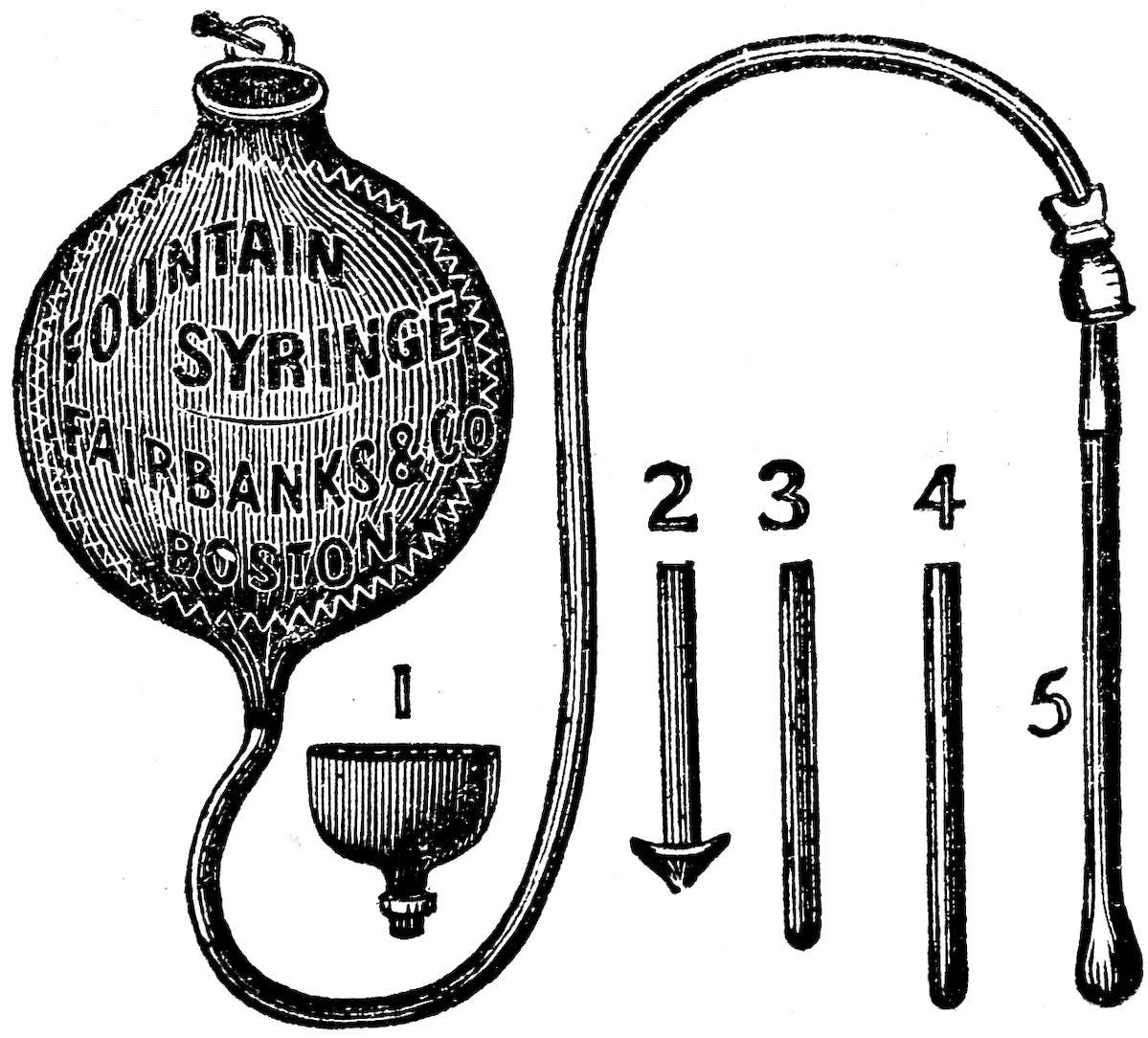
the hearing. The douche, administered with
the fountain syringe, is a valuable means of removing
foreign bodies and insects. The warm
douche has proved very serviceable in restoring
the hearing by removing hardened ear-wax. In
administering the douche, the head should be inclined
over a basin, while the stream of water is
allowed to issue from the nozzle held close to the
external opening of the ear. Violent syringing
of the ear should never be practiced, as it may
occasion irreparable injury.
This bath is administered either by drawing
water into the nose while the mouth is closed, or
by injecting it by means of a fountain syringe.
128Great care should always be exercised to apply
the water gently, as a forcible application will
cause pain and irritation. Injection should never
be practiced with a piston syringe, as there is liability
of forcing the water into the Eustachian
canals and producing deafness. The temperature
of the water should be warm or tepid for
most applications.
Much benefit may be derived by the proper
use of this bath in case of acute or chronic catarrh.
The addition of a slight portion of salt to
the water does no harm, and a slightly saline
fluid is sometimes less unpleasant than pure water,
probably because it is more nearly like the
mucous secretion of the nasal mucous membrane.
Drawing cold water into the nose is sometimes
recommended for hemorrhage from the nose; but
it is of doubtful utility, because the application
cannot be continuous, and transient applications
of cold water are always followed by an afflux of
blood to the part so exposed. There are better
remedies for nose-bleed.
The compress is a wet cloth or bandage applied
to a part. The object may be to cool the part
under treatment, or to retain heat. The compress
may be used with equal success for either
purpose. When the part is to be cooled, a compress
composed of several folds should be wet in
129cool, cold, or iced water, as required, and placed
upon the part after being wrung so it will not
drip. It should be changed as often as every five
minutes. This is often neglected to the injury
of the patient. A very cold compress may be
prepared by placing snow or pounded ice between
the folds of the compress. This will not need
renewal so frequently; but its effects must be
carefully watched, as injury may be done by neglect.
In applying cold to such delicate parts as
the eye, a very thin compress is better. It should
be renewed once in five minutes, at least.
When accumulated warmth is required, a thick
compress is applied, being wrung out of tepid
water, and covered with a dry cloth to exclude
the air. Soft, dry flannel is an excellent covering.
Rubber or oiled silk may be employed
when the compress is not to be retained more
than a few hours; but if it is to be worn continuously,
they will be injurious, as they are impervious
to air and thus interfere with the function
of the skin. The effects of a compress thus
applied are identical with those of the poultice,
and the application is a much more cleanly one.
Compresses are applicable in all cases in which
poultices are commonly used. They may replace
the old-fashioned plasters with profit and comfort
to the wearer. The wet-sheet pack, half pack
chest pack and wrapper, leg pack, and wet girdle
are all large compresses.
130When applied continuously in the same place
for a long time, the compress occasions a considerable
eruption of the skin, and sometimes boils
and carbuncles. There is no particular advantage
in these eruptions, and they sometimes do much
harm by producing a great degree of general irritation.
The notion that they purify the system,
though a very popular one, has really a very
slight foundation. The discharge is largely made
up of elements which would be of great utility
if retained in the system, and the amount of
foul matter eliminated in this way is certainly
infinitesimal compared with the amount thrown
off by a few inches of healthy skin. The skin
can always do more and better work when
healthy than when diseased. The eruptions are
no doubt due to debility of the skin, produced
by a too long continuance of the very abnormal
conditions supplied by the compress. Yet, strange
as it may appear, there are those claiming to be
physicians who directly aim to produce inflamed
and irritated surfaces by the continuation of the
compress for months and even years.
The wet head cap is a compress made to fit the
head. It should consist of several thicknesses of
cotton or linen cloth, so as to retain moisture for
some time. It is a good temporary appliance in
diseases of the scalp, and for headache; but it
should never be worn continuously for the purpose
of relieving congestion, as it will have an
131effect just the opposite of that desired. In eczema
of the scalp it may be worn until the disease
is cured, being frequently rewetted. It is an excellent
means of preventing sun-stroke and other
effects of heat when worn beneath the hat in
summer; but even for this purpose its use should
be temporary, the cap being worn only during
the hotter portion of the day.
The fomentation is a local application analogous
to such general appliances as the hot pack,
vapor bath, and hot-air bath. It consists in the
application of a cloth wet in hot water. It may
be considered as a hot compress. Fold a soft
flannel cloth twice, so that it will be of three or
four thicknesses. Lay it in a basin, pour boiling
water upon it, and wring it dry by folding it in
a dry towel. Or, if only one end of the cloth is
wet, it may be wrung by folding the dry portion
outside of the wet; in wringing, the whole will
become equally wet. Apply it to the patient as
hot as it can be borne. The second application
can usually be made much hotter than the first.
Frequently dipping the hands in cold water will
enable the attendant to wring the cloth much
hotter than he would otherwise be able to do.
The most convenient way is to heat the cloths in
a steamer; by this means they are made as hot
as boiling water, and yet they are more easily
132handled, not being saturated with water. When
no hot water is at hand, a fomentation may, in an
emergency, be quickly prepared by wetting the
flannel in cool water, wringing it as dry as desired,
folding it between the leaves of a newspaper,
and laying it upon the top of the stove, or
holding it smoothly against the side. The paper
prevents the cloth from becoming soiled, the water
protects the paper from burning, and the
steam generated quickly heats the cloth to boiling
heat. For a long fomentation, the heat may
be made continuous by applying over the wet
cloth a hot brick or slab of soapstone.
The hot cloths should be re-applied once in five
minutes. Two cloths should be employed, so
that the second may be applied the moment the
first is removed. To retain the heat, a dry flannel,
rubber, or oilcloth should be placed over the
fomentation. The application may be continued
from ten minutes to half an hour, or longer in
special cases. This appliance is very powerful,
and should not be employed to excess. Alternate
hot and cold fomentations are frequently more
efficient than the continuous fomentation. Hot
applications should always be followed by a cool
or tepid compress for four or five minutes, at least.
The uses of the fomentation are very numerous.
It is indicated whenever there is local pain
without excessive heat, or evidences of acute inflammation.
Local congestions, neuralgia, toothache,
pleurisy, pleurodynia, and most local pains
133vanish beneath its potent influence as if by magic.
For indigestion, colic, constipation, torpid liver,
dysmenorrhea, and rheumatic pains, it is a remedy
of great power, and is used with almost uniform
success. In relieving sick headache by application
to the head, neck, and stomach, its efficiency
is unrivaled.
When applied to the head for some time without
intermission, it will often occasion faintness;
hence, a cooler application should be made after
the use of the hot cloths for fifteen or twenty
minutes.
If the applications must be continued for a long
time, it is well in most cases to apply them at a
temperature slightly lower than when they are
to be used for only a few minutes.
This remedy may well replace the blisters,
plasters, cataplasms, scarifications, rubefacients,
and other irritating measures so long used for relieving
pain, local congestions, and inflammations.
A freezing mixture which will reduce the temperature
to 4° is made by mixing equal parts of
salt and pounded ice. The ice and salt should be
stirred together very quickly and applied at once
to the part to be frozen. Two parts of dry snow
and one of salt make an equally good mixture.
Freezing is more conveniently performed by the
rapid evaporation of ether or rhigoline.
134Freezing is a useful process in numerous cases.
By its use, excrescences—as warts, wens, and polypi—fibrous
tumors, and even malignant tumors, as
cancer, may be successfully removed. Small cancers
may sometimes be cured by repeated and
long-continued freezing. Their growth may certainly
be impeded by this means. Felons, if
treated early in their course, may be cured by two
or three freezings.
For freezing a felon, place the finger in a mixture
ice and salt, or surround it with cotton,
saturate the cotton with ether or rhigoline, and
blow it very strongly with a pair of bellows.
This is a very good method when an apparatus
for producing a fine spray is not at hand. The
latter instrument facilitates the freezing very
much if used with the bellows.
No harm results from repeated freezing if proper
care is used in thawing the frozen parts.
They should be kept immersed in cool water, or
covered with cloths kept cool by frequent wetting
with cold water, until the natural feeling is restored.
The application of ice is found extremely serviceable
in many inflammatory diseases, and in
some nervous affections. In inflammation of the
brain, the ice cap is of inestimable value. Ice applied
to the spine will check the convulsive spasms
of chorea and hysteria when other remedies fail.
In putrid sore throat, or malignant diphtheria,
135ice is a sovereign remedy. It should be applied
to the neck externally, and held in small bits in
the mouth. Small bits swallowed will sometimes
relieve the pains of gastralgia.
Rubber bags are very convenient for applying
ice or iced water; but their place can be very well
supplied by dried bladders filled with pounded ice.
The ice cap is a double head cap stuffed with
pounded ice.
Some physicians recommend the application of
ice to the spine in cases of congestive chill and
paralysis, and in inflammation of the stomach,
kidneys, uterus, and other internal organs. The
real worth of such applications in these cases has
yet to be determined by careful and repeated observations.
We would not recommend an unskillful
person to attempt to relieve a violent ague
chill by rubbing ice on the patient’s back, and we
have some fears that a very skillful operator
would hardly succeed to his entire satisfaction
and that of the patient.
The snow bath, applied by rubbing the part
vigorously with snow, is a useful application for
restoring the circulation to frosted parts. In
cases of extreme chilling or absolute freezing,
there is perhaps no better remedy. Powdered ice
may be used when snow cannot be readily procured.
136
This bath can be readily and successfully administered
with such conveniences as every family
possess. Place the patient in a cane-seat chair,
having first taken the precaution to spread over
the seat a dry towel. Surround the patient and
the chair first with a woolen blanket, and then
with two or three thick comfortables, drawing the
blankets close around his neck, and allowing them
to trail upon the floor so as to exclude the air as
perfectly as possible. Now place under the chair
a large pan or pail containing two or three quarts
of boiling water. Let the blankets fall quickly
so as to retain the rising vapor. After a minute
or two, raise the blankets a little at one side and
carefully place in the vessel a very hot brick or
stone, dropping the blankets again as soon as possible
avoid the admission of cold air. Before the
first brick or stone has cooled, add another, and
so continue until the patient perspires freely. The
amount of perspiration must be judged by the
face and forehead, as much of the moisture on the
skin beneath the blankets is condensed steam.
Should the bath become at any time too hot, a
little air may be admitted by raising the bottom
of the blankets a little, being careful to avoid
chilling the patient in so doing. The bath should
seldom be continued more than half an hour,
137and fifteen to twenty minutes will usually accomplish
all that is desired by the bath. If too long
continued, it induces faintness. A too high temperature
will be indicated by a strongly accelerated
pulse, throbbing of the temples, flushed face,
and headache. The head should be kept cool by
a compress wet in cool water and often changed.
The temperature of the bath should be from 100°
to 115°. Unpleasant effects are sometimes produced
at 120°.
After this bath, apply the tepid spray, rubbing
wet-sheet, pail douche, or full bath. No time
should be allowed to elapse after the blankets are
removed before the concluding bath is applied, as
the patient will chill. He should not be allowed
to become chilly by exposure to cool air before the
application of the spray, douche, or other bath,
which should be followed by vigorous rubbing.
For “breaking up a cold,” relieving rheumatism,
soreness of the muscles from overexertion,
and relaxing stiffened joints, this is a valuable
agent. It may also be used to advantage in
chronic diseases in which there is torpidity of
the skin; but great care must be exercised to
avoid excessive use, as too frequent repetitions of
the bath produce debility.
This is a milder application than the hot-air
bath, unless employed at a high temperature,
120° or more, when it becomes more severe.
In institutions where the bath is in daily requisition,
138a permanent arrangement for giving the
bath is usually employed. It sometimes consists
of a box in which the patient sits upon a stool,
his head being allowed to remain outside by a
suitable opening. A wet towel is placed around
the neck to prevent the steam from rising about
the head. Others prefer a box or small room large
enough to admit the whole person, the whole
body being subjected to the warm vapor. An
opening guarded by a curtain is made in one side
to allow the bather to inhale cool air if he should
wish to do so, and to give the attendant access to
the patient without chilling him by the admission
of a large quantity of cold air. As in the simpler
form of vapor bath, the head should be kept
constantly cool by a cool wet compress often re-applied.
Patients troubled with “rush of blood
to the head,” should be further protected by a
large cool compress placed around the neck and
the upper part of the chest.
Steam may be generated for these larger baths
by boiling water in the box with a spirit-lamp
or a gas-burner, or it may be conducted into the
box by a rubber tube connected with a tight boiler.
This is essentially the same in effect as the
vapor bath. It consists of a room filled with
vapor, and so arranged that by transferring the
patient from one point to another the heat may
be gradually increased. It has no advantages
139not afforded by the simpler vapor bath. It is
now much used in the larger cities. Probably
as much harm as good results from the indiscriminate
and reckless manner in which it is employed.
Patients have been known to die in the
bath of apoplexy induced by the excessive heat.
It is followed by shampooing and cooling baths
of various sorts.
In administering this bath, prepare the patient
precisely as directed for the vapor bath.
Instead of placing under the chair a vessel of
hot water, place a large alcohol lamp or a small
dish containing a few ounces of alcohol. When
all is ready, light the lamp or alcohol, and carefully
exclude the air. It is hardly necessary to
suggest the propriety of putting the lamp in
such a position as to insure safety from fire. If
alcohol is used in an open dish, it is important
to wipe the outside of the vessel quite free from
any trace of the fluid, as otherwise it might be
communicated to the floor or carpet. Also avoid
spilling any portion in putting it in place, for
the same reason. It is a very good precaution
to place the dish containing the burning alcohol
in a plate or shallow vessel containing a little
water.
This bath should be conducted in the same
manner as the vapor bath. A temperature of
140° to 160° is not at all disagreeable to the patient.
140At 170° or 180° the same effects are produced
as in the vapor bath at 120°. The bath
should be followed by cooling baths as directed
for the vapor bath.
This is a very valuable remedy for the same
class of diseases for which the vapor bath is
recommended. It is of very great service in
cases of dropsy, Bright’s disease with poisoning
from retained urea, and all cases in which
a vigorous elimination by the skin is desired.
It should not be continued longer than the vapor
bath, and much harm may result from its too
frequent employment. Like the vapor bath, this
may be conducted in a suitable box with an opening
for the head.
This is entirely analogous to the hot-air bath,
though on a much more elaborate plan. The
patient is gradually conducted from a temperature
of 120° to that of 160° or even much more
than 200°. The bath is concluded by shampooing,
rubbing, cooling baths, and gradual cooling
in a room maintained at a temperature of 70°.
The uses of this bath are the same as those of
the hot-air bath. It has no advantages over it
of very great importance, and is much more liable
to produce injury by prolonged and frequent
application. It generally occupies an hour, and
by those who resort to it as a luxury, as did the
ancient Romans, it is often prolonged to several
hours.
141The long-continued application of excessive
heat to the body is a very unnatural process.
It tends to produce permanent relaxation and debility
of the cutaneous tissues, and the manner
in which this bath is administered in Turkish
bath establishments is productive of great harm.
It is often presented to invalids as almost a panacea;
and is given alike to the strong and vigorous,
and the weak and debilitated.
The bath is certainly good in its place, but it
is decidedly bad when abused. Many consider
the hot-air bath greatly preferable since it obviates
the necessity of inhaling superheated air,
the effects of which upon the lungs are said to
be injurious. The hot-air bath is doubtless safer.
Electricity may be more efficiently applied in
connection with water than by itself. Water is
a better conductor of electricity than the dry
skin, and hence facilitates its communication to
the body. The ordinary method of applying
electricity is by attaching one pole of the battery
to a metallic plate, placed in contact with
some part of the body, while the circuit is completed
by the application to the patient of a
moist sponge connected with the other pole.
The operator often holds one pole in his hand
and applies the other hand, moistened, to the
part to be treated. He is in this way enabled
to judge very accurately of the strength of the
142current applied. The metallic plate is frequently
placed at the feet of the patient, sometimes
in a foot bath. The sponge may be applied to
various parts of the body while the patient is in
a sitz bath. For a general application of electricity
the full bath is most convenient.
This bath is applicable to a very large variety
of conditions. To describe them all would be to
give nearly all the uses of electricity as a remedial
agent, which does not come within the scope
of this work. The electric full bath has been
strongly recommended for the removal of mineral
poisons from the body. Just how efficacious
it is in this respect, we cannot confidently affirm.
Probably its value has been somewhat exaggerated.
Only the primary or galvanic current
could be of any service in this direction.
Electricity is generally acknowledged to be a
powerful remedial agent; but its use requires
costly apparatus and much skill in application.
It is necessary that the operator should not only
understand the nature of diseases and the proper
methods of applying electricity in treating them,
but he must also thoroughly understand the general
laws of electricity. The electric bath is as
badly abused by quacks and charlatans as the
Turkish bath. It should not be employed by
unskillful persons; and for this and other reasons
given, it is not well adapted to home use.
143
This is a combination of the electric and the
vapor bath, the electricity being applied to the
body by means of the sponge, and metallic plates
covered with moistened cloths. It is a valuable
appliance if carefully used; but, like all effective
modes of treatment, it is very liable to excessive
use, which becomes abuse. It has been very highly
lauded by certain specialists, and doubtless its
value has been unstintedly exaggerated. It is
perhaps not well proven that its effects are greatly
superior to the effects of the vapor bath and
electric bath administered separately; and the
latter mode would be more convenient, though
consuming a little more time.
Cover the patient with a soft, dry sheet in the
same manner as directed for applying the wet
sheet in the rubbing wet-sheet bath. Then rub
lightly but briskly upon the outside of the sheet
with the flat hand. Do not rub with the sheet,
but over it. Continue the rubbing ten or fifteen
minutes, going over the whole body several times,
and not neglecting the arms, the hands, and the
feet. This application may be administered daily
with profit to nearly all patients. It should always
follow any form of general bath in which
water is employed, as a means of drying the body.
It promotes activity of the skin, and equalizes
the circulation.
144
This application is much the same in effect as
the preceding, though a little more soothing, and
hence better adapted to nervous patients. It
consists in rubbing the body gently with the
palm of the dry hand. The force of the rubbing
should be nicely graduated to the condition of the
patient. When employed to excite considerable
activity of the skin, the rubbing may be accompanied
with kneading of the abdomen, and light
percussion of the surface.
Gentle rubbing of the skin is a very soothing
process. It will frequently induce sleep when
other means are ineffectual. Rubbing the back
and limbs downward, and gentle rubbing of the
temples, are very soothing to children and nervous
invalids.
The air has a very soothing effect upon the
body when allowed to come in contact with the
entire surface. It answers a very valuable purpose
when a water bath is impossible, or when
the patient is too feeble to endure the application
of water. A sleepless person will often fall
into a sound and refreshing slumber after walking
a few minutes in his room with the whole
body exposed to the air. The effects of night
labor upon literary people may be partially counteracted
by the air bath. Benjamin Franklin
was accustomed to pursue his writing to a late
145hour after divesting himself of his clothing, and
he recommends the practice to others compelled
to labor late with the pen.
The value of sunlight as a hygienic agent is so
universally recognized—theoretically if not practically—that
we need not devote space to its consideration
in this connection. Sunlight is essential
to the healthy performance of the vital functions,
and must be equally important as an aid
to remedial processes. This fact has been amply
demonstrated by hospital experience, which
shows a much larger percentage of recoveries in
rooms abundantly exposed to the sun than in
those secluded from its rays.
That the sun has a powerful influence upon
the skin is shown by the great increase of pigment
in that structure when freely exposed to
the sunlight. This results from an increased
activity of the cutaneous tissues.
Experience has shown that the sun bath can
be employed to advantage in most chronic diseases.
The patient simply lies in a position in
which the naked skin can be freely exposed to
the rays of the sun. The head should be shaded.
The bath should not be continued so long as to
produce unpleasant effects either upon the skin
or the general system. It may be accompanied
and followed with the dry hand-rubbing.
146
Bathing in the sea is much practiced by fashionable
people who make annual visits to the
sea-coast for this purpose. It is no doubt useful,
though many who participate in it would doubtless
receive quite as much benefit if they took as
many baths at home during the whole year as
they take at the fashionable watering-places in a
single week. It is a fine thing to be well washed
once a year, however, if not more often.
As generally conducted, sea-bathing is not more
beneficial than harmful. The dissipation accompanying
it more than counterbalances what good
might be gained. It is rather absurd to attribute
any specific virtues to sea-water, as many do.
Quite a large business is carried on in the evaporation
of sea-water and the sale of the dirty
residue, which is again dissolved in water and
used in bathing by those who live too far inland
to enjoy the benefits of bathing in the sea, or
who prefer to take their sea-bath in their own
private bath-room. Everything must have a
counterfeit, and so this seasalt is imitated by
base swindlers who prepare a mixture of chemicals
just as powerful, but not quite so complicated,
and less dirty, though certainly equally good.
All of this trouble and swindling might be saved
if people would only consider for a moment the
fact that all the benefit they obtain from bathing
is derived from the exercise, the temperature,
147and pure water, and not from any impurities
which the water may chance to contain.
Sea-bathing is usually overdone. More benefit
will be gained by one or two daily baths than
by a half-dozen. Fifty baths in a single week
are not equivalent to a single bath each in fifty
weeks.
We have no faith in medicated baths in general.
They are occasionally useful for the destruction
of vermin, animal parasites, and perhaps
in certain cases of skin disease. Generally, it is
far better to take the limpid element “Simon
pure,” unadulterated. Many medicated baths
have acquired great celebrity by the performance
of cures really wonderful, but wholly attributable
to water only, in spite of, rather than in conjunction
with, the foreign medicament added.
Inunction was greatly practiced by the ancients
in connection with the Roman and Turkish baths.
It consists in rubbing the skin very thoroughly
with some unctuous substance. Olive oil may
be employed, but cosmoline or vaseline, two refined
products of coal oil, are in some respects
preferable. Olive oil cannot be obtained pure,
except at almost fabulous prices. That sold in
the drug stores as olive oil is really cotton-seed
oil and mixtures of lard with various other vegetable
oils.
148A warm bath should first be administered.
Then dry the patient, as usual, and apply the
unguent, taking care to rub it in thoroughly.
Simply greasing the surface is not the object
sought. The skin and flesh should be worked,
rubbed, and kneaded until the oil nearly disappears
from the surface.
The object of this application is to supply the
place of defective natural secretion of oleaginous
material, to increase the activity of the skin,
and to diminish susceptibility to cold. How this
is accomplished, readily appears. The oil is a
simple substitute for the sebaceous secretion,
which is, in a certain class of diseases, notably
deficient. The thorough manipulation of the
skin which is necessary in applying the oil, and
which is facilitated by a lubricant, directly promotes
cutaneous activity. Whether the oil itself
has any direct effect in increasing the functional
activity of the skin cannot be positively affirmed,
although it is reasonably supposable that the
skin will act more nearly normal when a deficient
element is supplied than when it is wanting.
Oil is an excellent non-conductor; and invalids
who are especially susceptible to cold may
be rendered comfortable by the application of the
oil bath.
The class of cases to which this remedy is applicable
will be sufficiently well indicated by the
purposes which the bath is supposed to subserve.
It should not be used indiscriminately. Once or
twice a week is sufficiently often to make the application,
149and each should be followed by a warm
bath with fine soap, two or three days after.
Numerous substances have been employed in
bathing, under the idea that they possessed peculiar
specific virtues; the following are some of
the chief:—
Mud Bath.—Immersion of the body in warm
mud has been a favorite practice at several places
in Italy, France, Germany, and other countries.
The effects are not very different from those of
any warm bath, and are said to be very pleasant,
by those who have taken them. If the mud
were not medicated, this kind of bath would not
be especially objectionable for those who could
enjoy it.
Earth Bath.—Burying the body in the moist
earth has also been practiced. We have known
of one instance in which this remedy was successfully
used in the treatment of ague.
Bees’ eggs, milk, blood, wine, sand, and gelatine
have also been employed by different nations, at
different periods, in bathing. None of these applications
are superior to pure water, which all
nature recognizes as the proper material for bathing
purposes.
Fecal accumulations in the lower bowel are
more quickly and easily removed by an enema of
warm water than by any purgative, laxative, or
150cathartic ever discovered or invented; and the
use of this remedy is never accompanied by the
unpleasant and painful griping and tenesmus
which often accompany the use of cathartics.
The administration is a trifle more troublesome,
but the results are enough superior to more than
repay the inconvenience. The fountain syringe
is far preferable to any other for administering
injections. Water about blood-warm should be
used when the purpose is to relieve constipation,
and a considerable quantity—one to three pints,
or more—may be used. The water should be retained
for a few minutes, while the bowels are
kneaded and shaken. In hemorrhage and inflammation
of the lower bowel, cool or cold
clysters should be employed, and should be retained
as long as possible. The copious cool
enema is a valuable antiphlogistic remedy used
in conjunction with the cool bath in cases of violent
febrile excitement, as typhoid fever, when
the temperature rises above 103° F.
The enema is a most perfect substitute for
purgatives in general. Cases are very rare in
which a cathartic drug will be found necessary if
the enema is properly used. But the enema may
become a source of mischief if abused. If habitually
relied upon to secure a movement of the
bowels for a long time, the bowels lose their activity,
and the most obstinate constipation sometimes
results, precisely as from the prolonged use
of purgatives.
151
Warm water at about 92°—not hot water—is
a most excellent emetic if taken in sufficient
quantity. It is prompt in action, and is unaccompanied
by the painful nausea, retching, and
straining produced by most other emetics. From
half a pint to one or two quarts is required to
produce emesis. The patient should slowly
swallow a tumblerful, then rest two or three
minutes, and swallow another, so continuing to
drink for ten minutes or more. As soon as the
slightest disposition to vomit is felt—or even if
it is not felt, after a considerable quantity of water
has been taken—the patient should touch the
back part of his mouth with the end of his finger
or a feather, as far down as he can reach.
This will usually excite the desired action. If it
does not, all that need be done is to continue
drinking. A little salt added to the water will
make it more sickening, and will do no particular
harm, as it is thrown out again.
It is not claimed that the warm-water emetic
can replace all other emetics in all cases. When
instant vomiting is necessary, as in cases of poisoning,
some more prompt emetic may be used
with it. But for all ordinary purposes, it clearly
has no rival.
The use of fomentations is often less convenient
or desirable than dry applications of heat,
152which may be made in a variety of ways. Bottles,
jugs, or rubber bags, filled with hot water,
hot bricks or stones, wrapped in papers or cloths,
hot cloths, bags filled with hot sand, salt, or corn
meal, are all convenient methods of applying dry
heat.
A few suggestions with reference to the manner
of using hot applications may be useful. In
applying heat to the feet when the circulation in
those organs is defective, it is frequently insufficient
to apply the heat to the bottoms of the feet,
only. For this reason, jugs or bottles and stones
are often applied without effecting any satisfactory
results. A much more efficient method is the following:
Heat to a suitable temperature two or
three pounds of corn meal or salt. Place the
salt or meal in a bag sufficiently large to envelop
the feet. After distributing it evenly through
the bag, wrap the latter about the feet and cover
them with a woolen blanket. A rubber bag partially
filled with hot water is an excellent appliance
for use in cases of neuralgia, toothache, and
nearly all acute pains in the region of the head,
as it will conform so perfectly to the shape of
the part to which it is applied, and may be used
as a pillow.
As a general rule, hot applications should not
be continued more than an hour or two, at longest,
without, at least, a transient application of a
lower temperature. Too prolonged an application
may result in injury to the part.
153
As a remedial agent, water is of far greater
value than any other liquid taken into the stomach.
Its uses in preserving health have been
previously noticed. Under ordinary circumstances,
a person in health who discards irritating
condiments from his diet seldom requires
drink. Many persons take no drink whatever
during the winter months. But drinking is
healthful, and pure water of proper temperature
may be taken by any one in health or disease if
it is taken in the proper manner. Drinking at
meals is an unwholesome practice. Drinking
large quantities of iced water is unhealthful.
Cold water should not be taken freely when the
drinker is hot or exhausted. The thirst will be
quenched as readily by slowly sipping a small
quantity. In fevers, water should be freely allowed.
A glass of cool water taken half an hour
before breakfast is an excellent remedy for habitual
constipation.
Water-drinking may be made a means of bathing
the internal structures, as external applications
bathe the outside. Water is rapidly absorbed
by the mucous membrane of the stomach,
and, passing through the circulation, it dissolves
many impurities, and is eliminated chiefly by the
kidneys and skin. It can be used with benefit
in connection with the vapor bath, hot-air bath,
and all baths in which sweating is induced. It
154should not be used in such great excess as it was
employed by the early hydropathists, however,
whose patients drank from ten to thirty glasses
of water a day.
Free drinking of water is useful in cases in
which the urine is scanty and irritating. It
gives relief by diluting the urinary excretions.
For drinking, and for all ordinary purposes, it
is of the greatest importance that water should
be as pure as possible. When water which is
nearly soft, and wholly free from organic impurities,
cannot be obtained from wells or springs,
filtered rain water should be employed. A very
useful filter can be easily and cheaply constructed
in the following manner:—
Make a hole low down in the side, or in the
bottom, of a large earthen jar or flower-pot.
Place in the bottom of the vessel a few clean
stones about the size of eggs. Fill the jar to
within two or three inches of the top with equal
parts of fine, clean gravel and pulverized charcoal.
Cover the jar with a clean, white cloth,
securing the edges by a string drawn about the
top. The center of the cloth cover should be allowed
to hang down into the vessel so as to form
a hollow into which the water may be poured,
the cloth serving as a strainer to remove the
coarser dirt. The cloth should be frequently
cleansed, and the gravel and charcoal should be
renewed at least once a year.
The Hygienic Family Physician.
A manual well adapted to family use. It describes in simple language
all common diseases, and gives careful directions for treating them without
the use of drugs. It also contains invaluable instruction respecting the
care of the health. Bound in cloth, $1.00.
The Uses of Water in Health and Disease.
This work comprises a sketch of the history of bathing, an explanation
of the properties and effects of water, a description of all the different kinds
of baths, and directions for applying water as a remedy for disease. Water
is not presented as a “cure-all,” but as a valuable adjunct of other remedies,
and in some cases the most useful of all curative agents. This work
will prove a valuable guide to those who wish to employ water in treating
disease. Pamphlet edition, 136 pp., 25 cents. A fine edition in cloth, 160
pp., 60 cents.
Health and Diseases of Woman.
A treatise on the nature and cause of the diseases of women; a work
which every woman—especially mothers—ought to possess. Lifelong misery
will be avoided by regarding its advice. 15 cents.
An explanation of the principles of a system of treating disease which
dispenses with drugs and poisons. It is radical, terse, and uncompromising,
and gives the advocates of druggery no quarter. 15 cents.
A Hand-Book of Food and Diet; or, What to Eat, When to Eat, and How to
Eat. It contains a large number of recipes for the preparation of wholesome
and palatable food without condiments. Almost any dyspeptic can
cure himself by making it his rule of diet; and any one who carefully follows
its teachings will be proof against indigestion. 128 pp., 25 cents.
An Essay on Tobacco-Using.
This little work explains the effects of tobacco on the human system, together
with those of all other poisons. It finds no apology for the use of
tobacco, and faithfully depicts its evils. 15 cents.
The Evils of Fashionable Dress, and How to Dress Healthfully.
A criticism of the fashionable modes of ladies’ dress, pointing out the numerous
evils arising therefrom, and the proper remedy. The subject is
treated candidly, and the writer admits the possibility of a commendable
reform in dress which will not expose the wearer to ridicule on account of
its peculiarities. Every lady ought to read it and profit by its suggestions.
10 cents.
Alcoholic Poison:
The Physical, Moral, and Social Effects of Alcohol as a Beverage and as a Medicine.
This work defines true temperance, explains the nature of alcohol and the
manner of its production, describes its physical effects upon the human body,
exhibits by statistics its moral and social effects, points out the causes and
proper cure of the evil of intemperance, answers the drunkard’s arguments in
favor of drinking, exposes the fallacies of alcoholic medication, and defends
the Bible against the imputation that it advocates or favors the use of alcoholic
drinks. Temperance workers will find this a useful auxiliary.
128 pp. 20 cents.
A concise summary of the evidences upon which the practice of vegetarianism
is based. It contains the pith of larger works on the same subject,
with some additional arguments. 15 cents.
Health and Temperance Tracts.
A Package of 15 Tracts, aggregating nearly 250 pp. 30 cents.
Dyspepsia.—An account of its causes, how to prevent it, and how to
cure it.
Healthful Clothing.—A description of the evils of fashionable dress, and
directions for clothing the body healthfully.
Principles of Health Reform.—An introduction to the subject.
Startling Facts about Tobacco.—A vivid portrayal of the evils arising
from the use of the filthy weed.
Twenty-five Arguments for Tobacco-Using Briefly Answered.—A tract
for every smoker, chewer, and snuffer of tobacco.
True Temperance.—A definition of temperance and the true temperance
platform.
Tea and Coffee.—Why their use is unhealthful.
Pork.—The dangers of pork-eating exposed. Startling facts.
Alcohol: What Is It?—A description of the chemical and physical properties
of alcohol, and the mode of its production.
Alcoholic Poison.—A personal appeal to young drunkards.
Moral and Social Effects of Alcohol.—A collection of astonishing facts
and statistics.
Causes and Cure of Intemperance.—The gigantic evil traced to its true
source, and the only efficient remedy pointed out.
The Drunkard’s Arguments Answered.—A complete refutation of the
arguments in favor of rum.
Alcoholic Medication.—An exposure of the evils of the medical use of
alcohol, and its uselessness.
Wine and the Bible.—A defense of the Bible against the oft-repeated
charge that it favors the use of fermented drinks.
These tracts are furnished at the rate of 800 pages for one dollar. A liberal discount
by the quantity.
Address, HEALTH REFORMER, Battle Creek, Mich.
The following patterns are finely adapted to meeting the requirements
of healthful clothing. No woman should be without them. They can be
adapted to children as well as adults.
No. 1. A flannel undergarment to be worn next to the skin. It covers
the whole body from neck to wrists and ankles. Price, 50 cts.
No. 2. A garment combining chemise and drawers, arranged with buttons
so as to support the skirts and stockings from the shoulders. To be
worn next to the preceding garment in cold weather. Price, 50 cts.
No. 3. This garment combines chemise and drawers, and also supplies
the place of the corset so efficiently that those who have been accustomed
to wearing the latter article are happy to dispense with it after a single
trial of this dress. It is cut to fit the bust perfectly, thus affording all desirable
support. Price, with cloth model, 75 cts.
No. 4. Gabrielle Dress. This may be made either long or short to
suit the taste of the wearer. When worn with pants it should be from six
to nine inches from the floor. Those who do not wish to adopt the pants
may wear the dress two or three inches from the floor with dress drawers
and leggins. Price, 50 cts.
We can also furnish patterns for skirts, pants for short dress, and dress
drawers with leggins, at 25 cts. each.
Those who wish to secure a good fit should send the following measurements:—
1. Bust measure, number of inches. 2. Under bust measure. 3. Waist
measure. 4. Length of waist under arm. 5. Hips, three inches below the
waist, 6. Width of back across shoulders. 7. Length of drawers from
waist down. 8. Length of back from neck to waist. 9. Length of sleeve inside.
10. Length of sleeve outside. 11. Length of shoulder. 12. Around
neck. 13. Around arm-size (high up).
When desired, garments will be made at as reasonable rates as possible,
and sent by express. The patterns will be sent, post-paid, on receipt of the
prices marked. We employ an experienced dress-maker to cut patterns and
make garments, so that all may feel sure of obtaining a good fit if proper
measures are sent. We hope that our friends will not fail to avail themselves
of this opportunity for obtaining just what they need for their health,
comfort, and convenience.
Garment and Stocking Supporters are also kept at this Office.
⁂ Address, HEALTH REFORMER,
Battle Creek, Mich.
Health Reform Institute,
Battle Creek, Mich.
This Institution is admirably located on a site of twenty
acres, in the highest part of the pleasant and enterprising
city of Battle Creek, commanding a fine prospect, and affording
opportunities for entertainment, quiet, and
retirement.
With a competent corps of Physicians and Helpers, it offers
to the sick inducements that are offered by few others.
Diseases are treated in a thorough and scientific manner,
and with a degree of success impossible under any other mode
of treatment. The principal curative agents employed are
Electricity, Water, Swedish Movements, Hot-Air Bath, and Russian Vapor Bath.
BATTLE CREEK is an important station on the Michigan
Central and Chicago & Lake Huron Railroads, and is easy
of access from all parts of the country. ☞ For Particulars
see Circular, sent Free on application.
Address, HEALTH INSTITUTE,
Battle Creek, Mich.
The College building is both AMPLE and ELEGANT, and
the grounds are LARGE and BEAUTIFUL. The corps of
Professors comprises Instructors in all the English branches,
the Natural Sciences, and both Ancient and Modern Languages.
One of the chief attractions of this Institution is
the fact that it is
Conducted on Hygienic Principles.
The Professors are all hygienists, and inculcate hygienic
truths in their daily instructions. The College has a full
Charter from the State, and is empowered to confer Diplomas.
TERMS of TUITION are very reasonable. Good hygienic
board can be obtained at very moderate rates.
Terms for 1876–7 open as follows: Fall Term, August 30, continuing 16
weeks. Winter Term, January 3, continuing 12 weeks. Spring Term, April
31, continuing 12 weeks. All who wish further information should send for
the Annual Catalogue.
Address, BATTLE CREEK COLLEGE
Battle Creek, Mich.
The accompanying cut is a representation
of one of the greatest and most useful
inventions of the age—Kedzie’s Improved
Water Filter.
Its mechanism is so perfect that it accomplishes
all that could be expected or desired
of a filter to accomplish, and without the bestowal
of more than the slightest amount of
attention. It removes from water all those
products of decay and disease which are the
most prolific causes of sickness and death.
And admire them, and all are ready to testify
to their efficiency and utility. No family
should be without one; for it is impossible to
obtain from springs or wells water which is,
in all respects, so free from injurious properties
as is soft filtered water.
Five sizes are manufactured to suit the wants of all. The following table
gives their dimensions:—
| No. |
1, |
25 |
inches high, reservoir holds |
2 |
gallons. |
| „ |
2, |
27 |
„ „ „ „ |
2½ |
„ |
| „ |
3, |
29 |
„ „ „ „ |
3 |
„ |
| „ |
4, |
31 |
„ „ „ „ |
3½ |
„ |
| „ |
5, |
32 |
„ „ „ „ |
4 |
„ |
Prices. No. 1, $9.00; No. 2, $10.50; No. 3, $12.00; No. 4, $13.50; No. 5,
$15.00. Orders promptly filled.
Address, Health Reformer, Battle Creek, Mich.
These syringes have
become so popular
through the general recognition
of their excellencies,
that they have almost
entirely superseded all
other styles for most purposes.
The principal advantages
which they offer
over others are the following:
1. They are self-acting,
no pumping being required;
2. They are valveless,
and so simple in construction
that they cannot
get out of order; 3. They
do not inject air, and thus
do not endanger the patient;
4. By means of
the sprinkler attachment,
light shower baths can be
administered. 5. Various other attachments adapt them to use for every
part of the body. 6. The evenness of action with which they operate makes
them superior to every other syringe.
No family should be without one of these syringes. They are used exclusively
at the Health Institute.
Prices. No. 1, $2.50; No. 2, $3.00; No. 3, $3.50.
Address, Health Reformer, Battle Creek, Mich.
THE
HEALTH REFORMER.
A HOUSEHOLD MONTHLY.
ONLY $1.00 A YEAR.
The Reformer is emphatically a Family Journal, being cheap,
plain, and practical, qualities which have won for it the
Largest Circulation of any Health Journal in America.
Radical, but not ultra; devoted to no party, but friendly to all
reforms; having no creed but nature’s laws; unpartisan, unsectarian,
humanitarian.
Though the journal is chiefly devoted to health, in consequence
of the prevailing “hard times” the publishers have recently
added several departments which make it more fully than ever
A JOURNAL FOR THE HOUSEHOLD.
Health, Temperance, General Literature, Science, News,
And many other interesting and practical subjects receive due
attention in its monthly columns.
The journal is now in its eleventh year, and its liberal and increasing
patronage insures its future prosperity. Every number
contains information worth more than the whole year’s subscription,
about How to Preserve Health and How to Treat Disease
with Simple Remedies.
It has saved scores of doctors’ bills in thousands of families,
together with years of sickness, and many lives.
TERMS: $1.00 a Year, Post-paid.
Six Months on Trial for 50 cts.
☞ Send Address for Specimen Copy. ☜
Address, Health Reformer,
Battle Creek, Mich.
- Typos fixed; non-standard spelling and dialect retained.