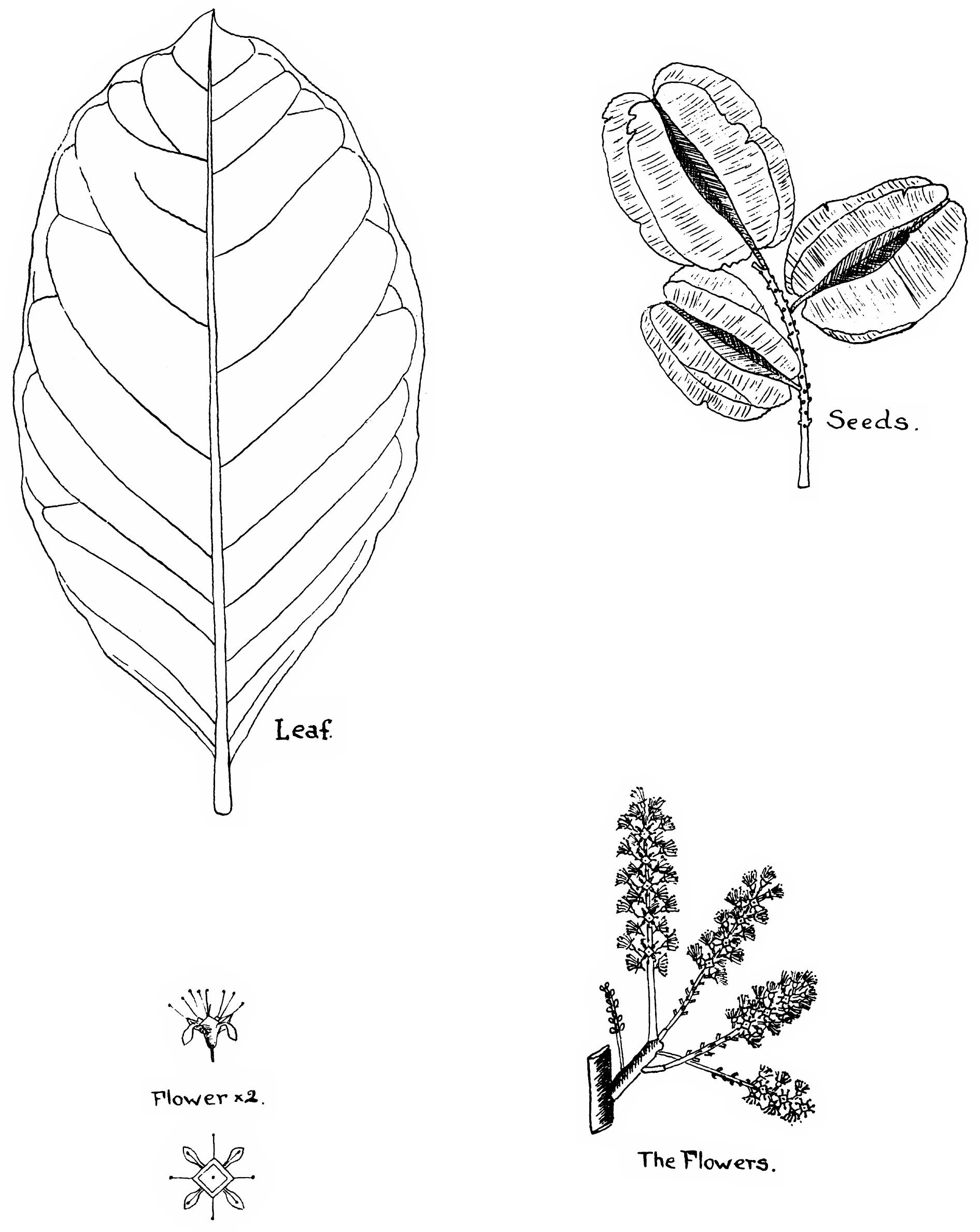
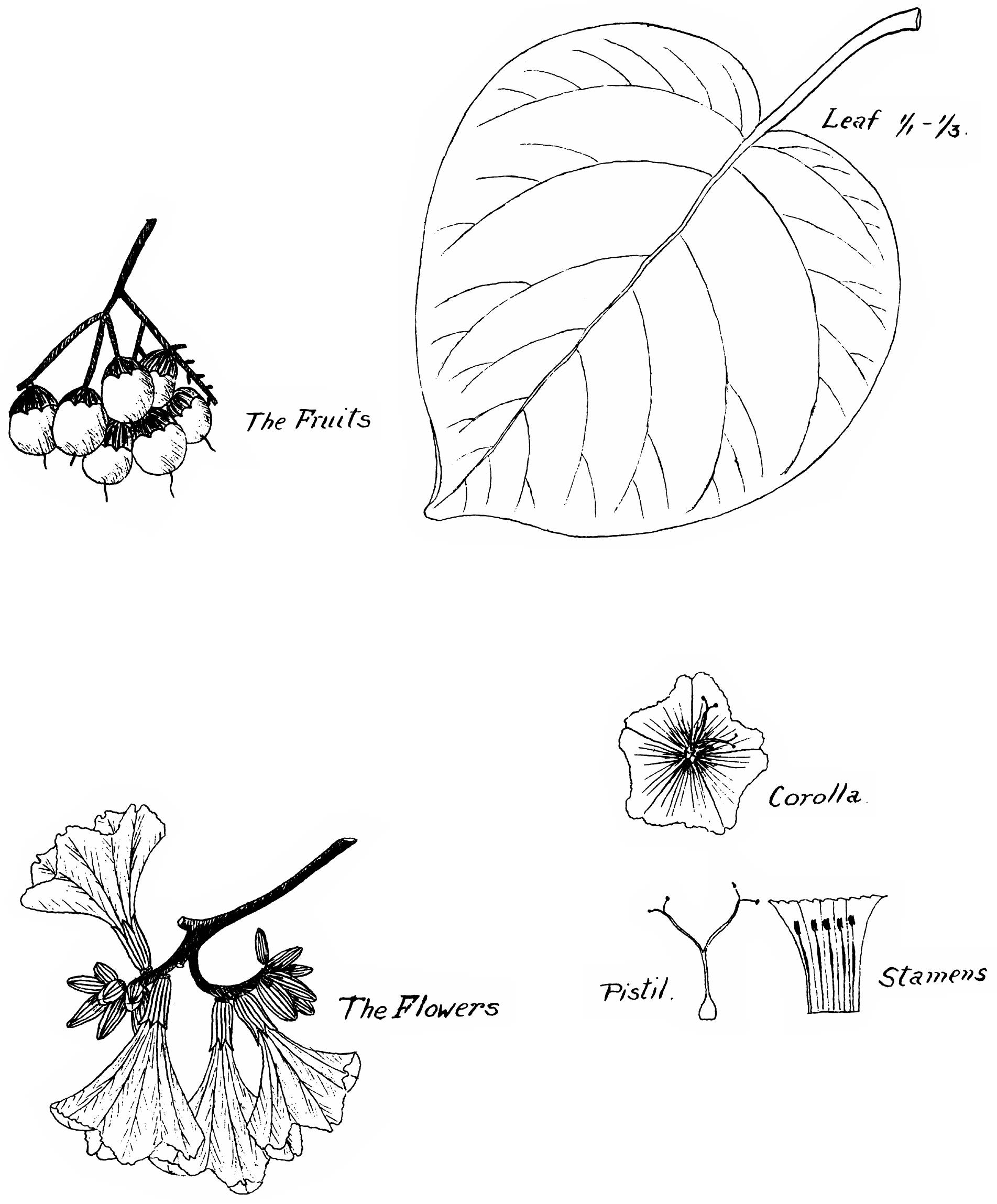
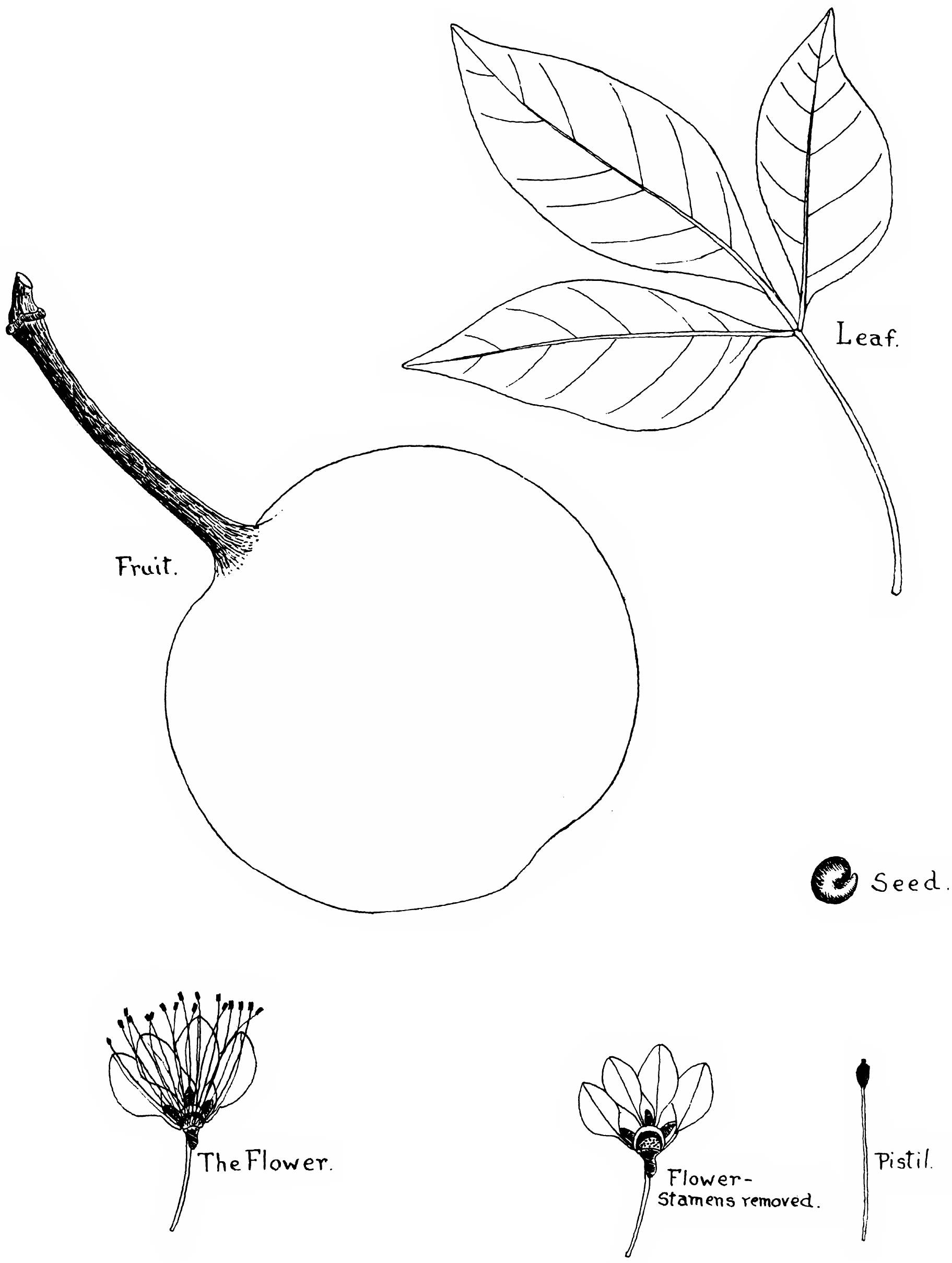
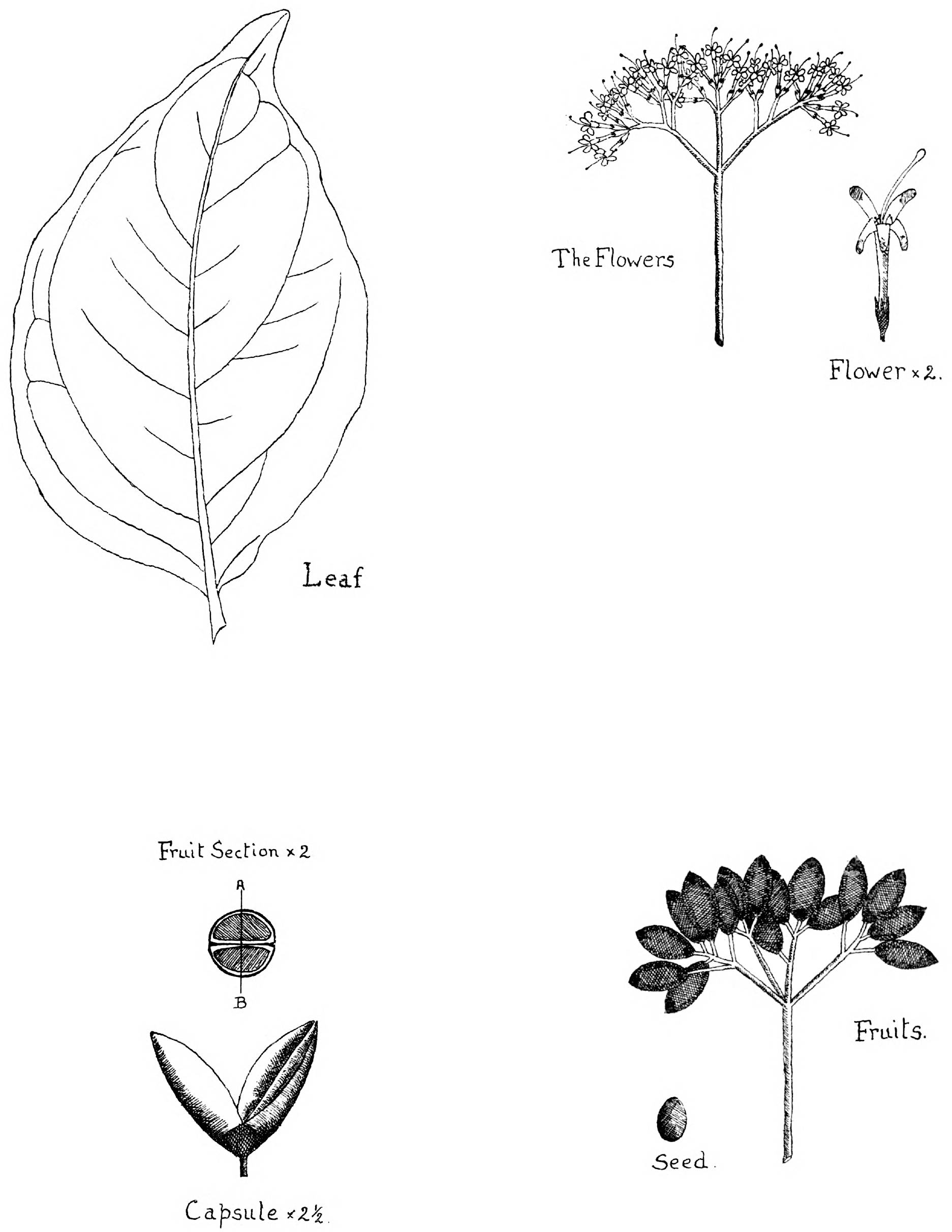
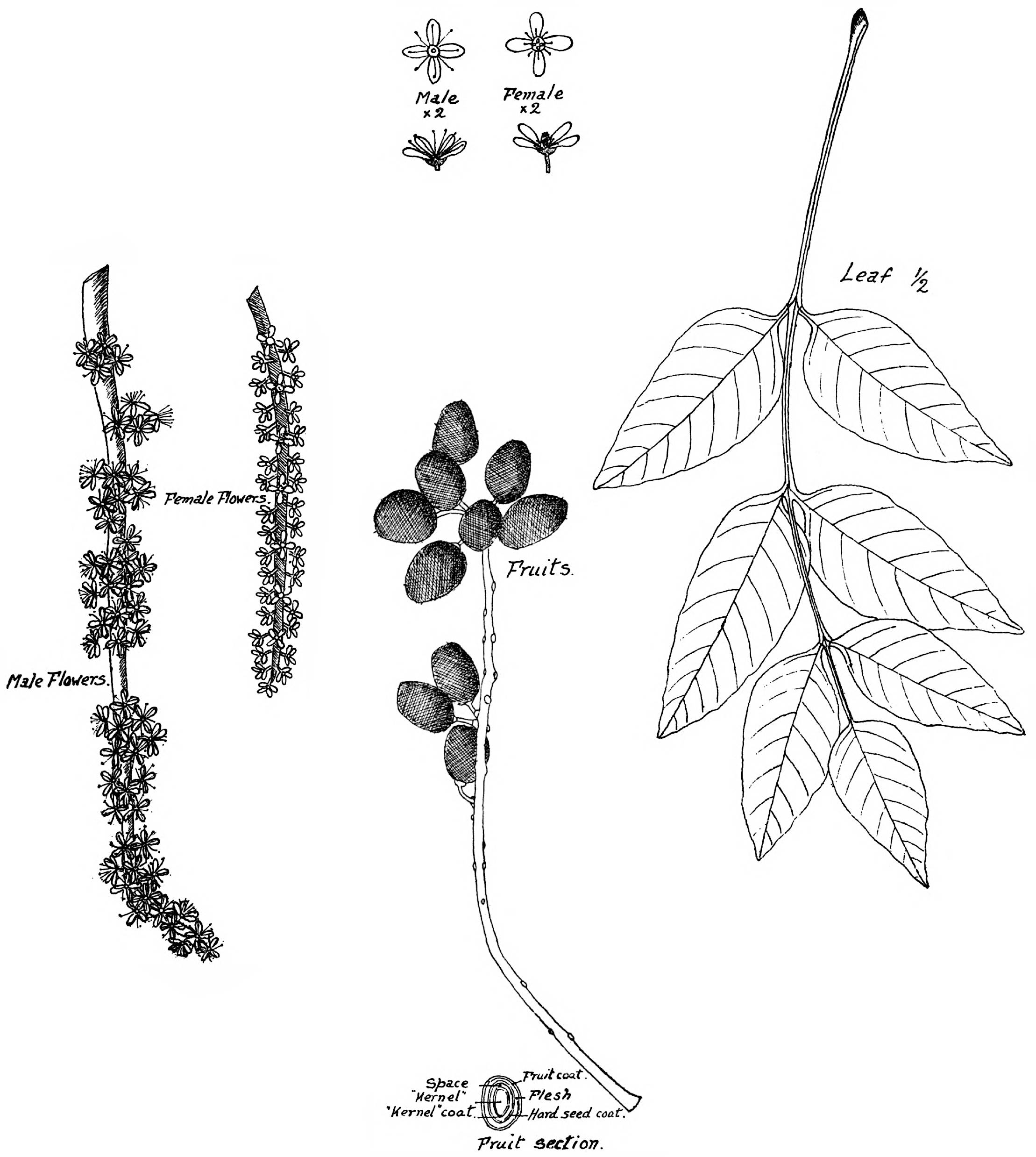
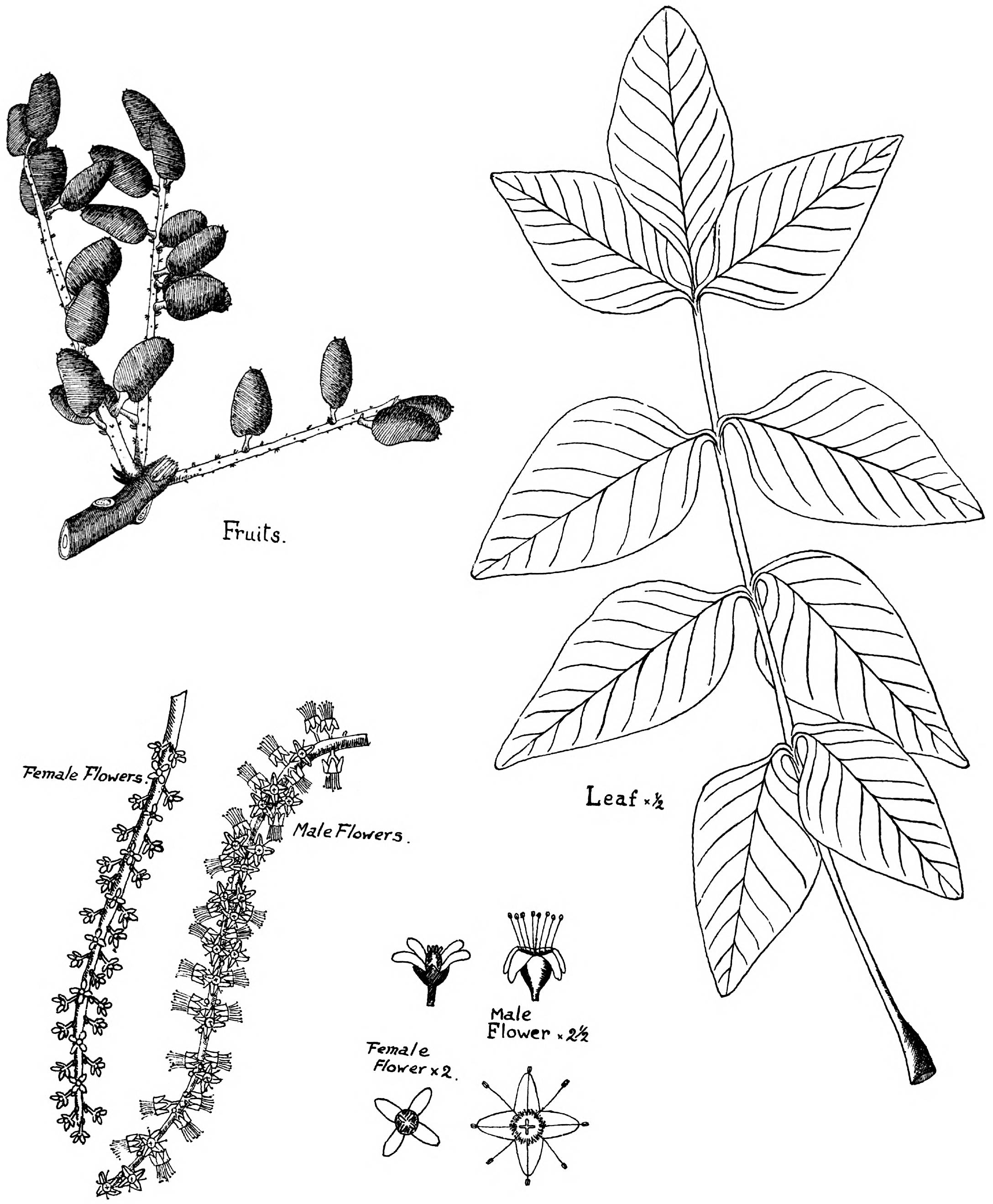
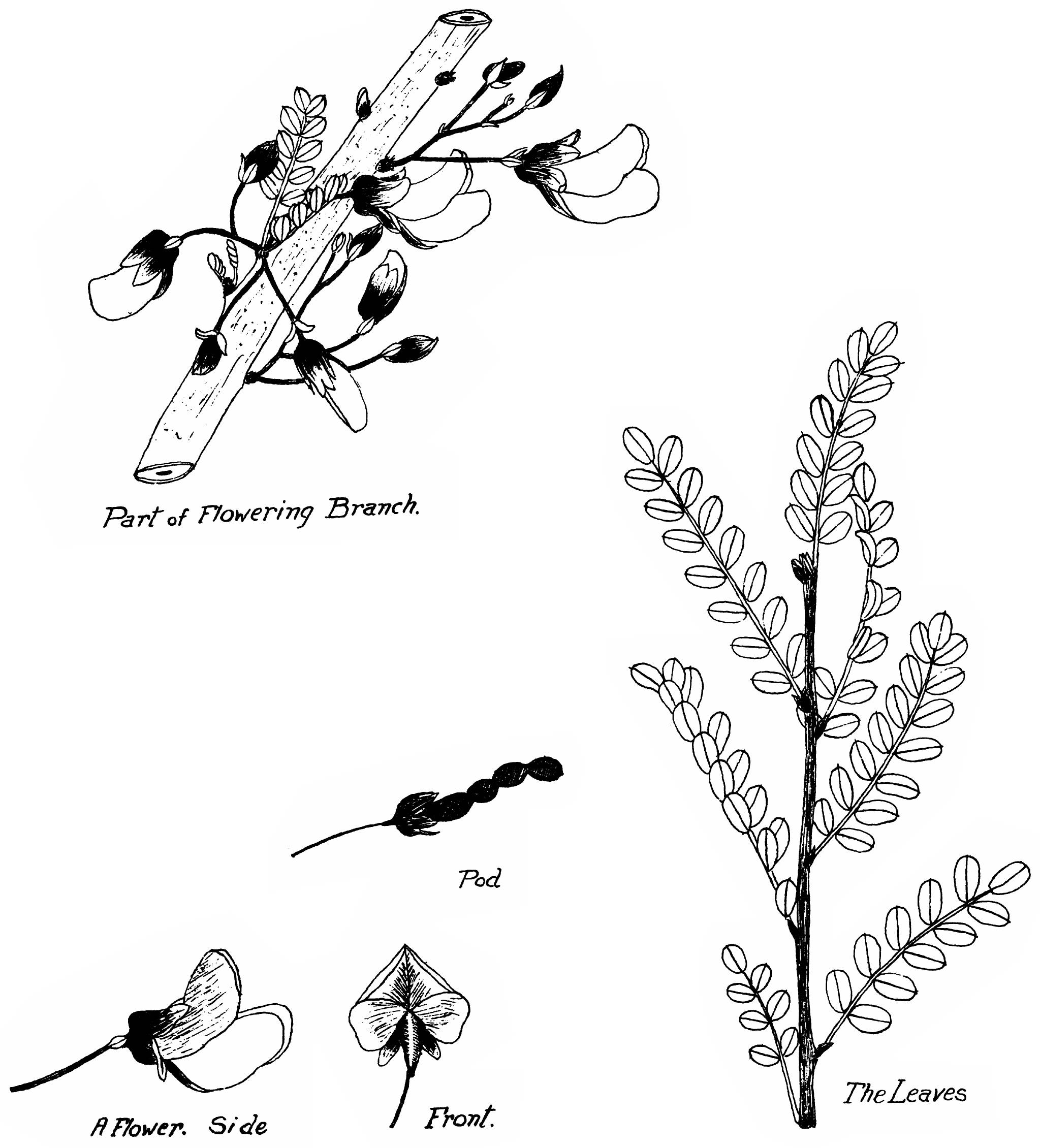
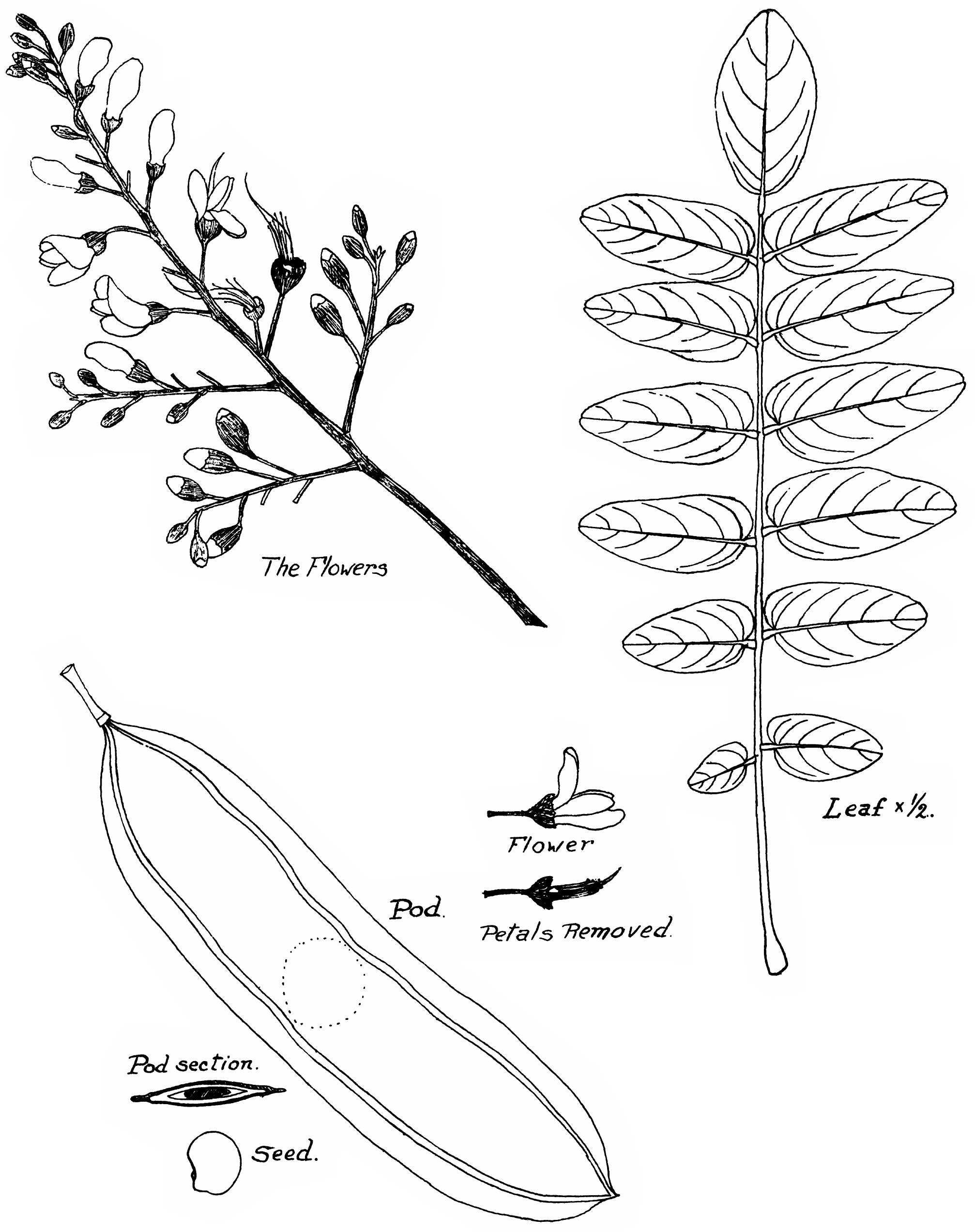
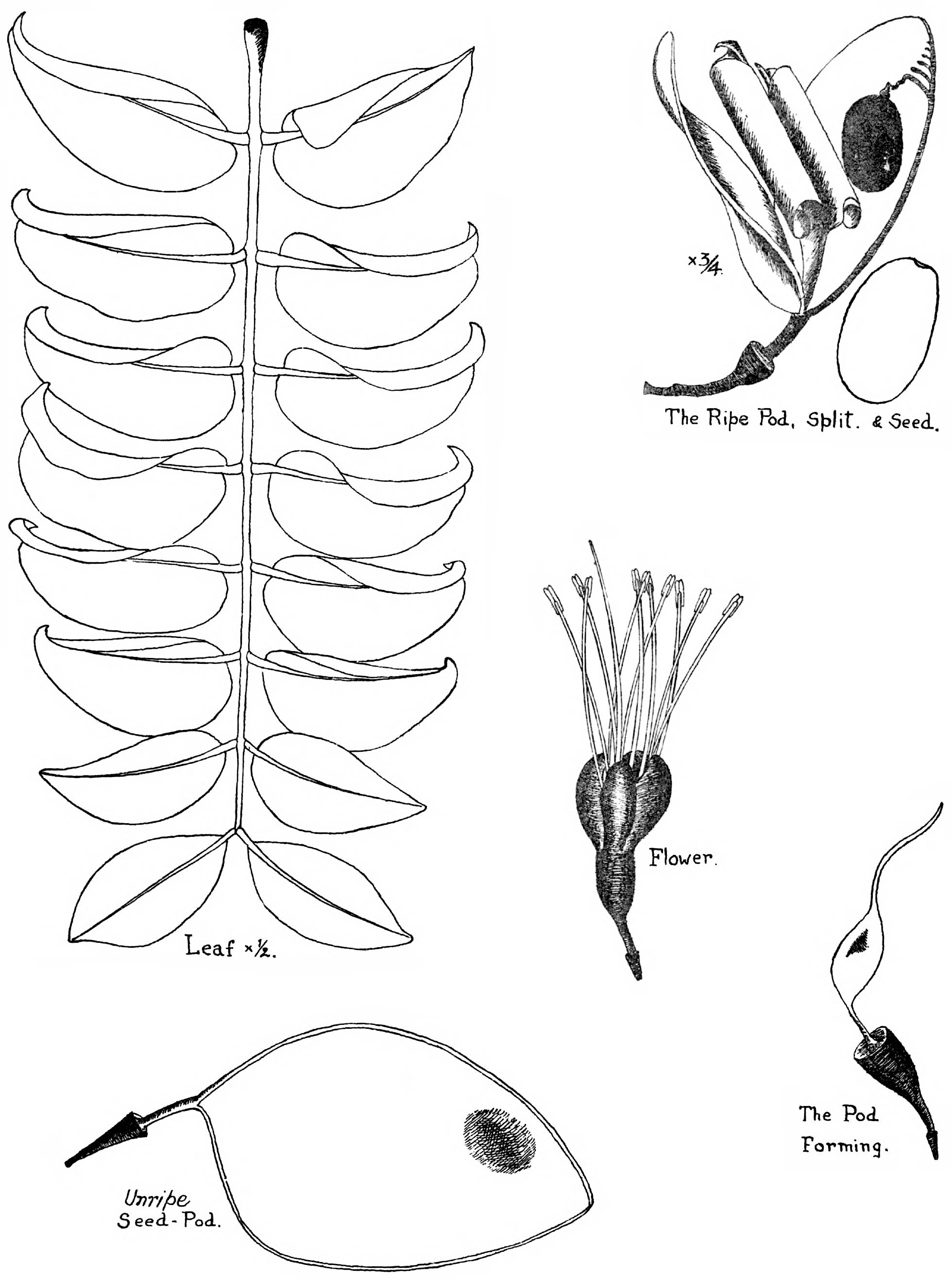
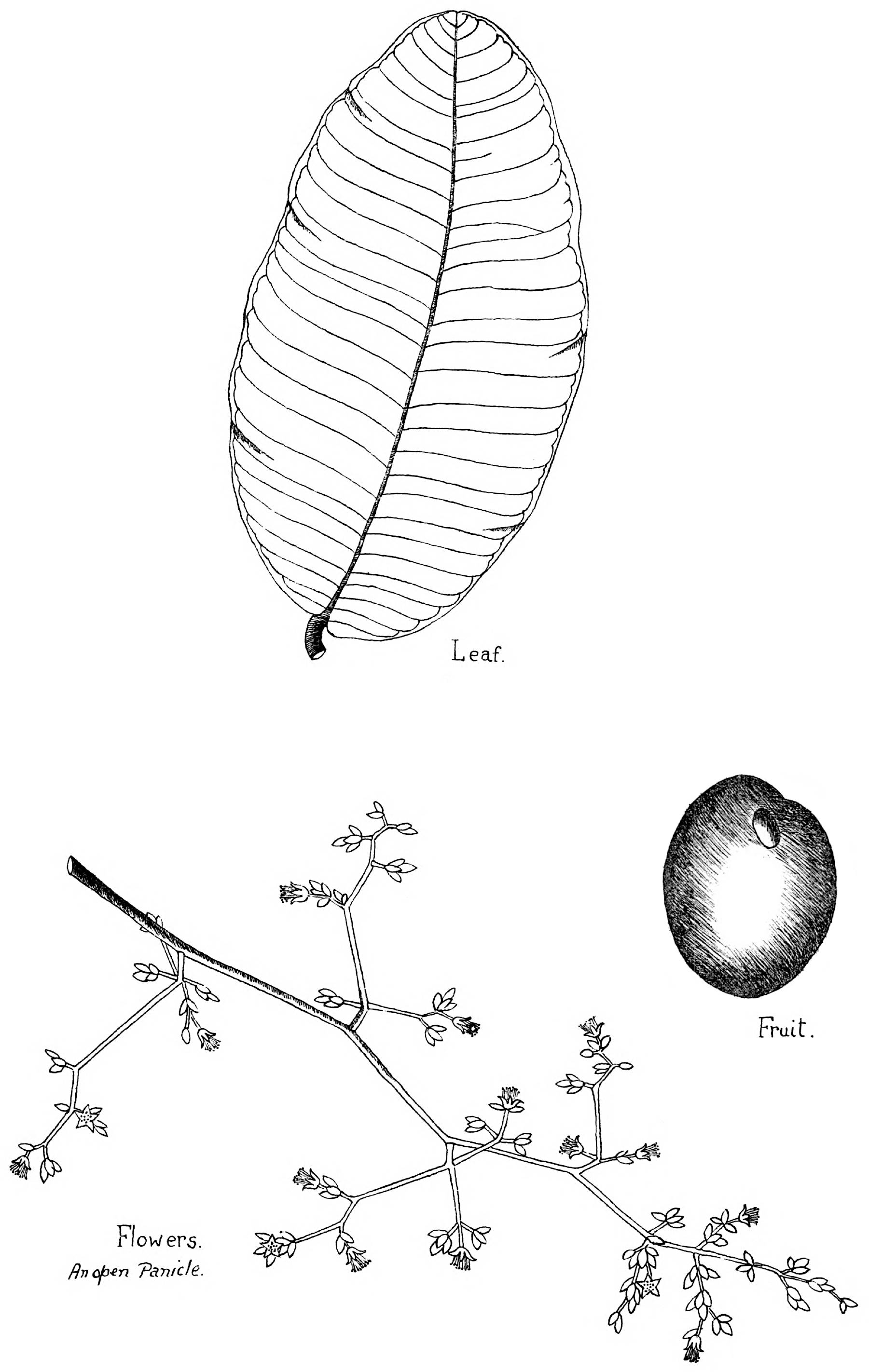
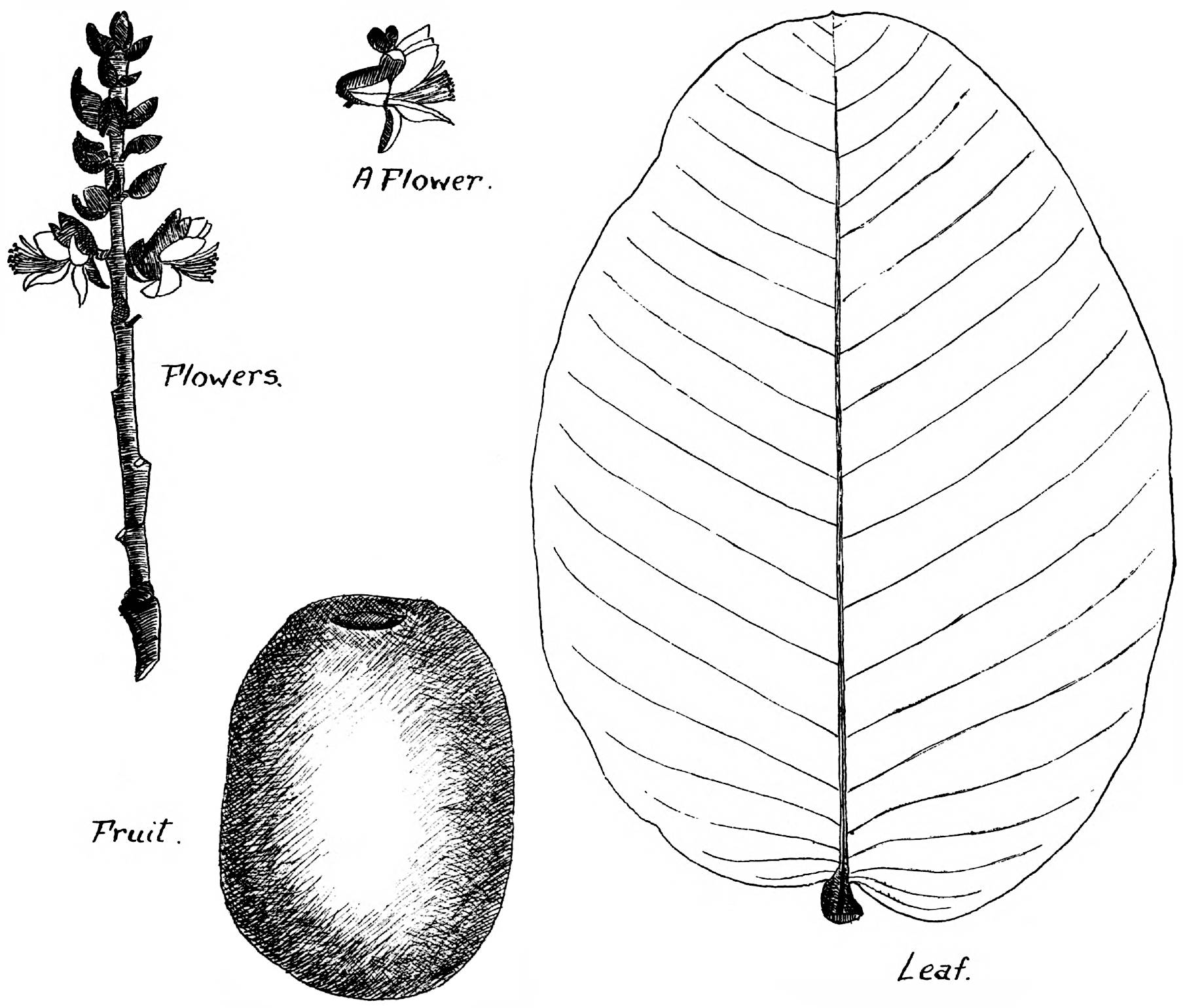
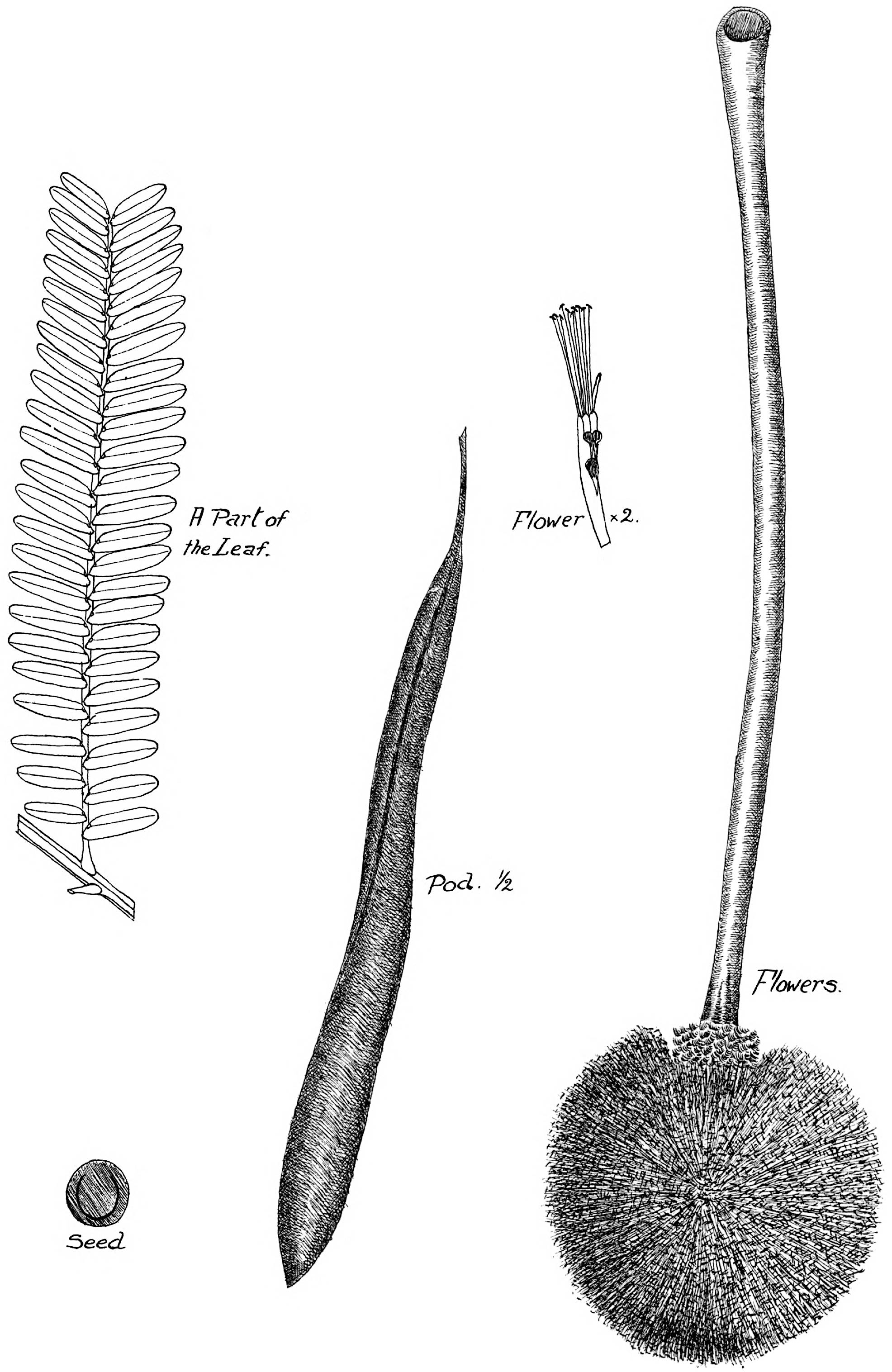
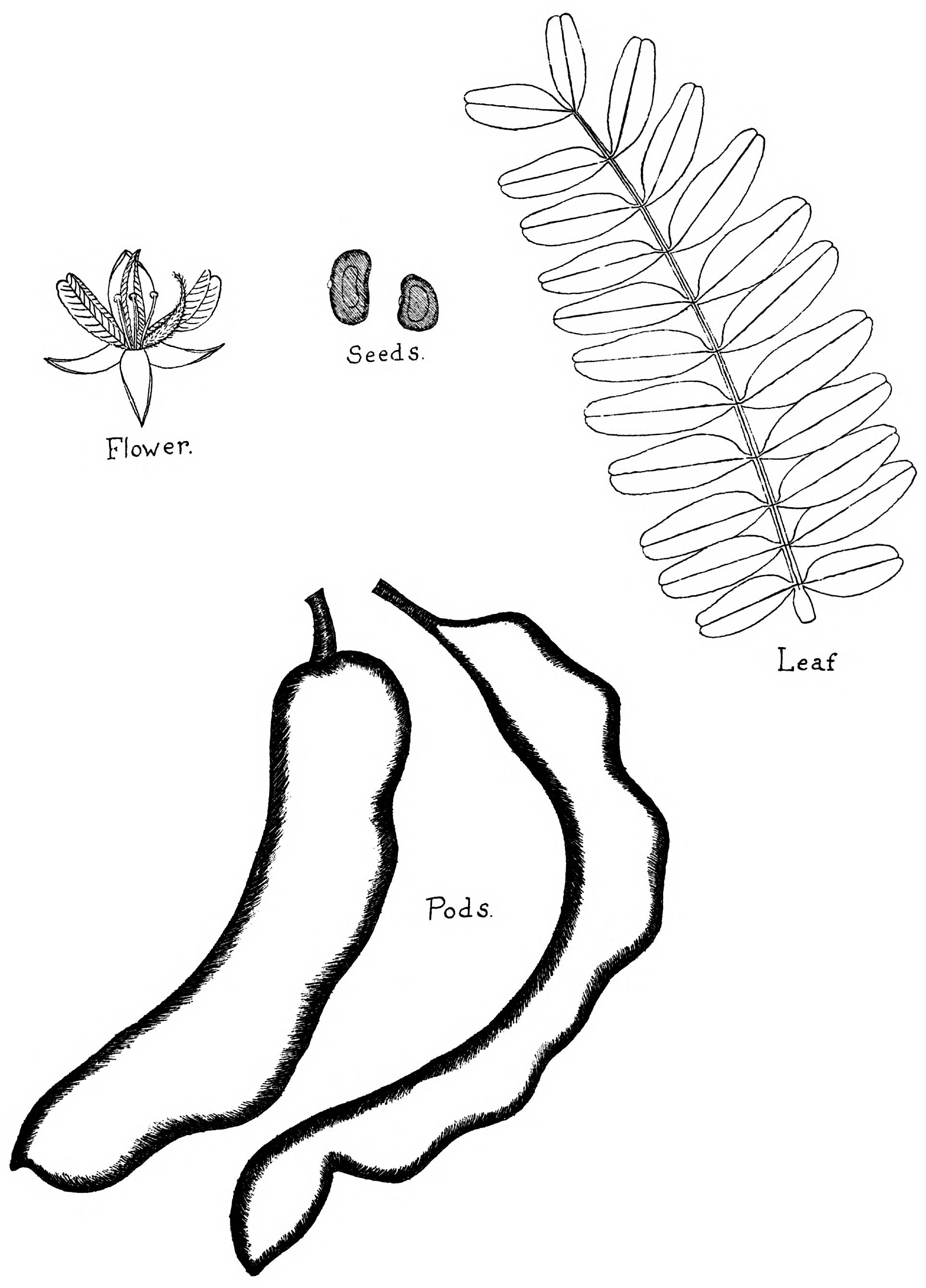
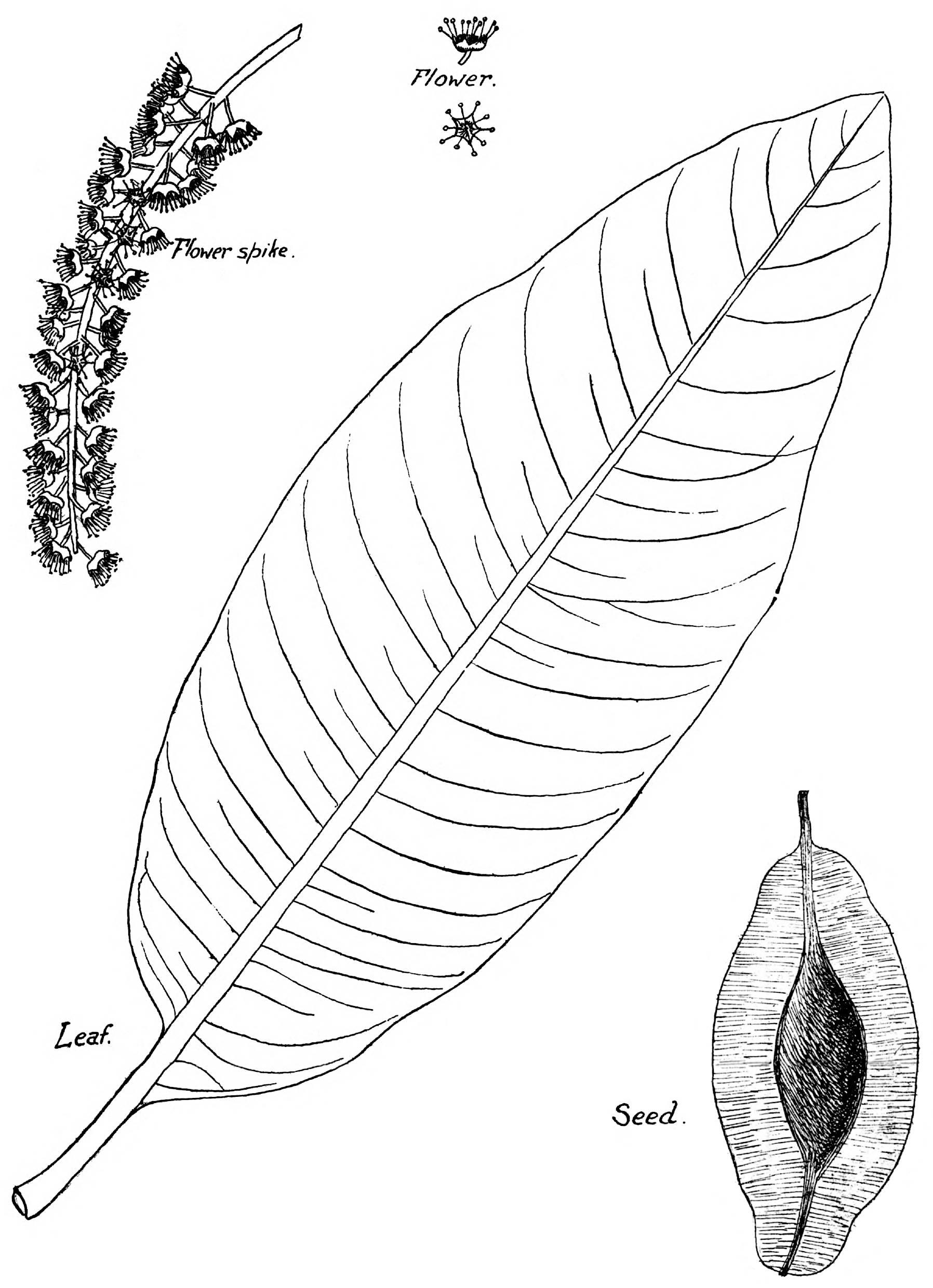
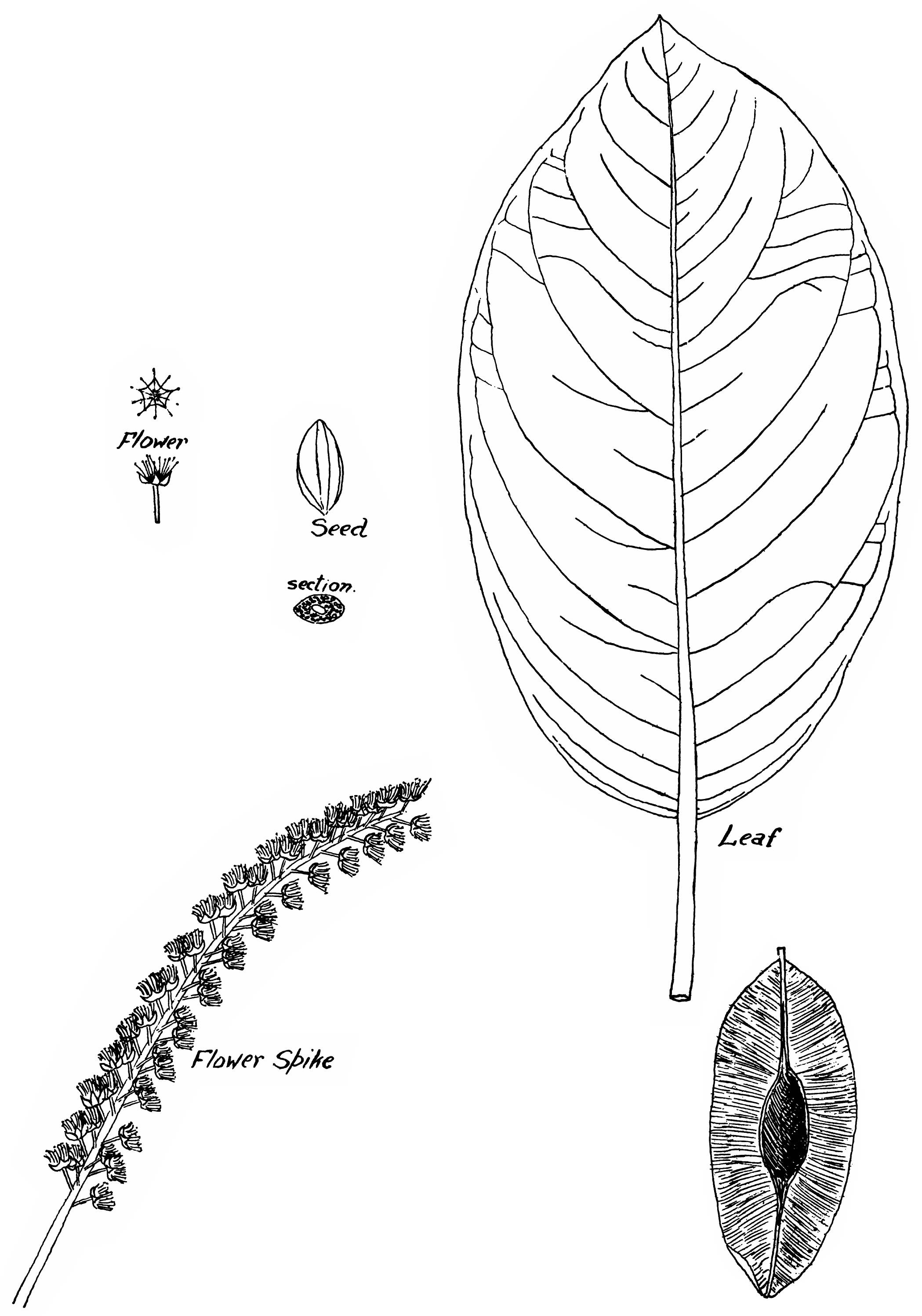
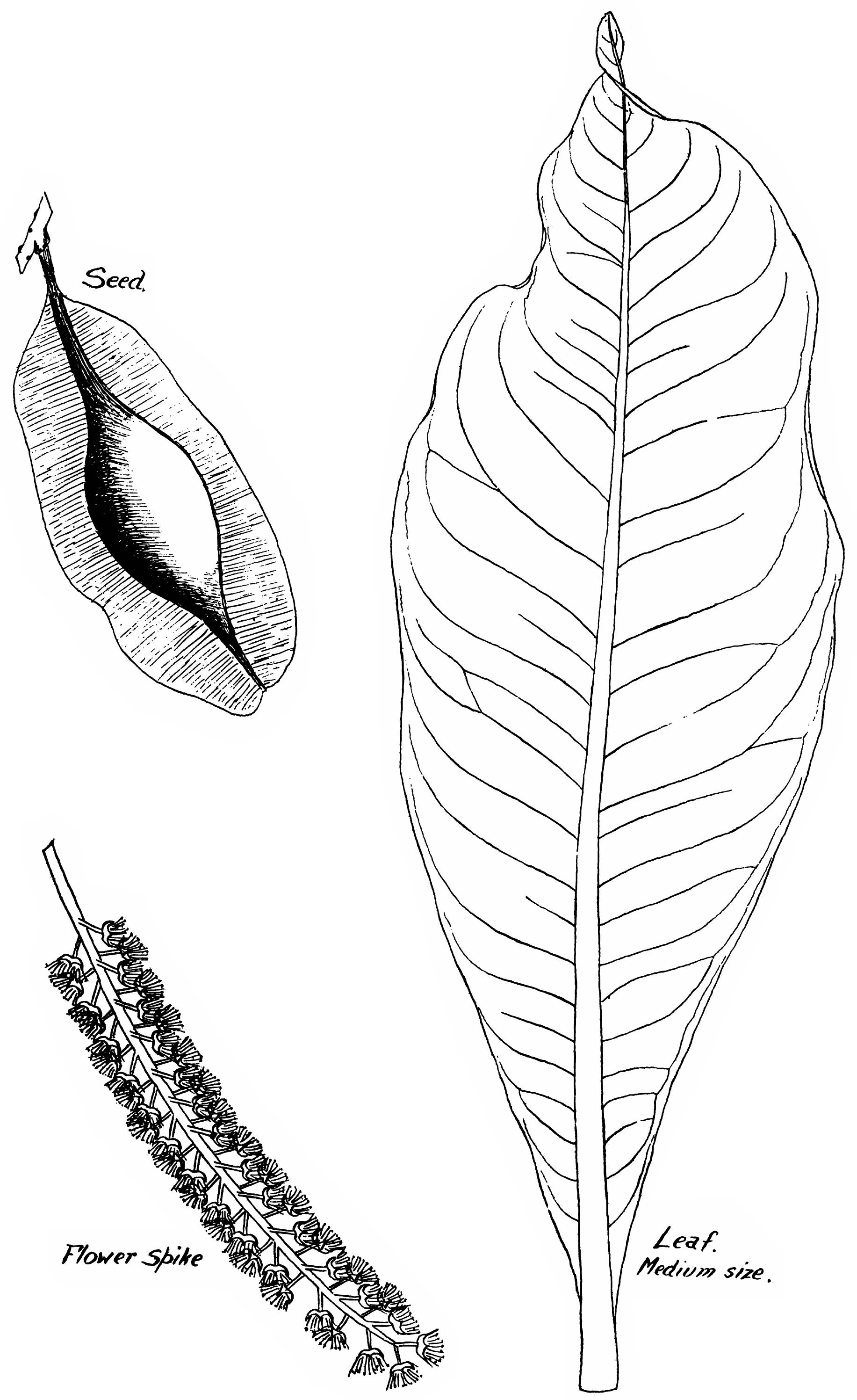
The text and plates of this volume have been prepared with the
primary object of identification of the trees of the savannah
forests of Northern Nigeria. The volume is, in no sense, a Flora,
and no attempt has been made to include all the species found in
the region under survey. Trees, being distributed over a large
number of Families of the plant kingdom, are a small proportion of
the total number of flowering plants, and their systematic
arrangement would not, except in a few cases, be an aid to
identification. Some 30 Families are represented by the 120 species
included, in one of which there are as many as 36 species. The
botanical names are arranged, therefore, in their alphabetical
order so as to group certain genera and species whose similarity
aids identification and to make the volume, in its index form,
handier for reference.
The text is arranged in paragraphs, the first giving a general
description of the form, height, girth, habitat, locality, &c.,
successive paragraphs describing in detail the bark and slash,
thorns, wood, leaves, flowers, fruits and seeds, with a few notes
on uses where these are known. These paragraphs are in uniform
order for rapid reference.
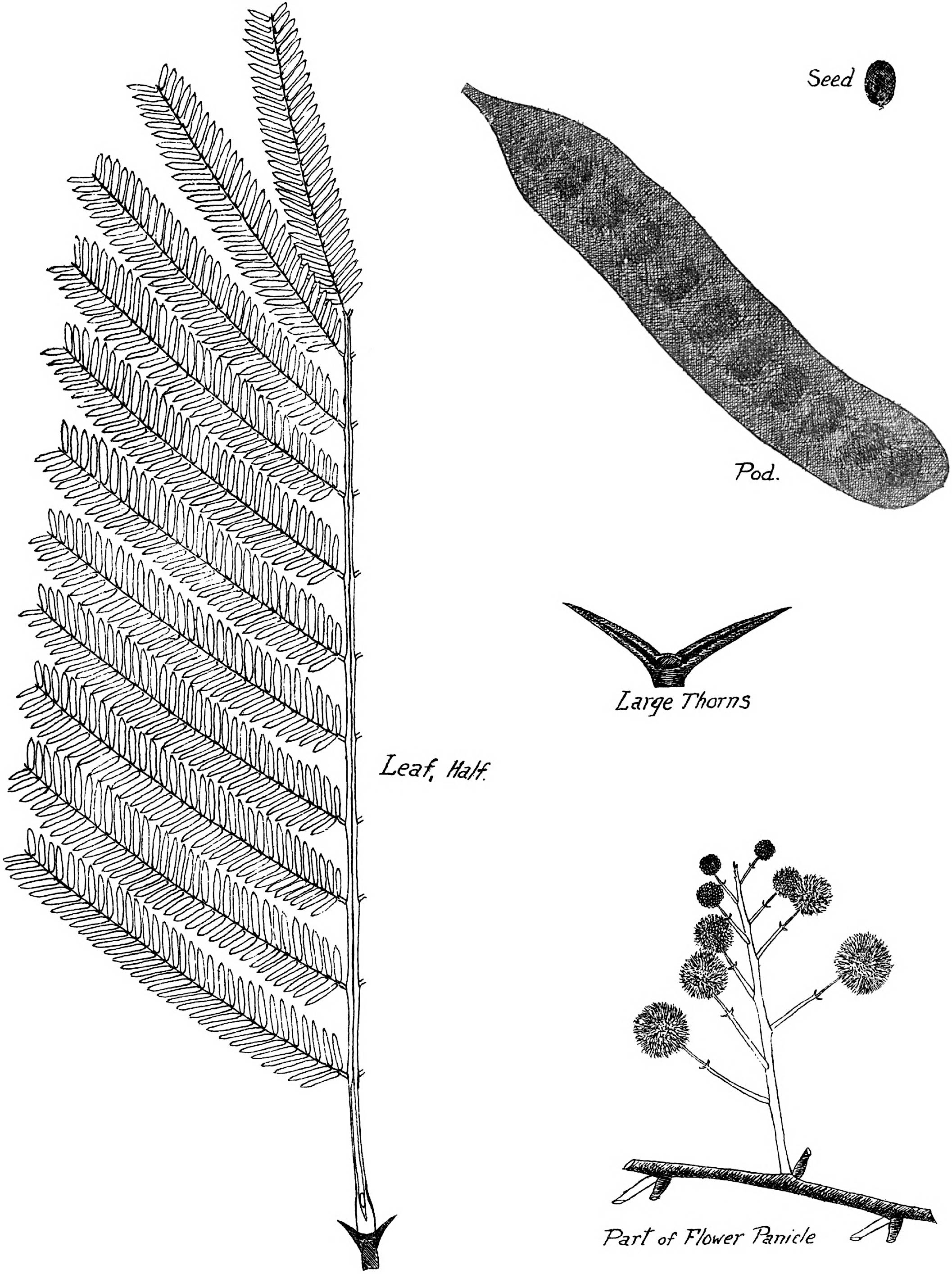
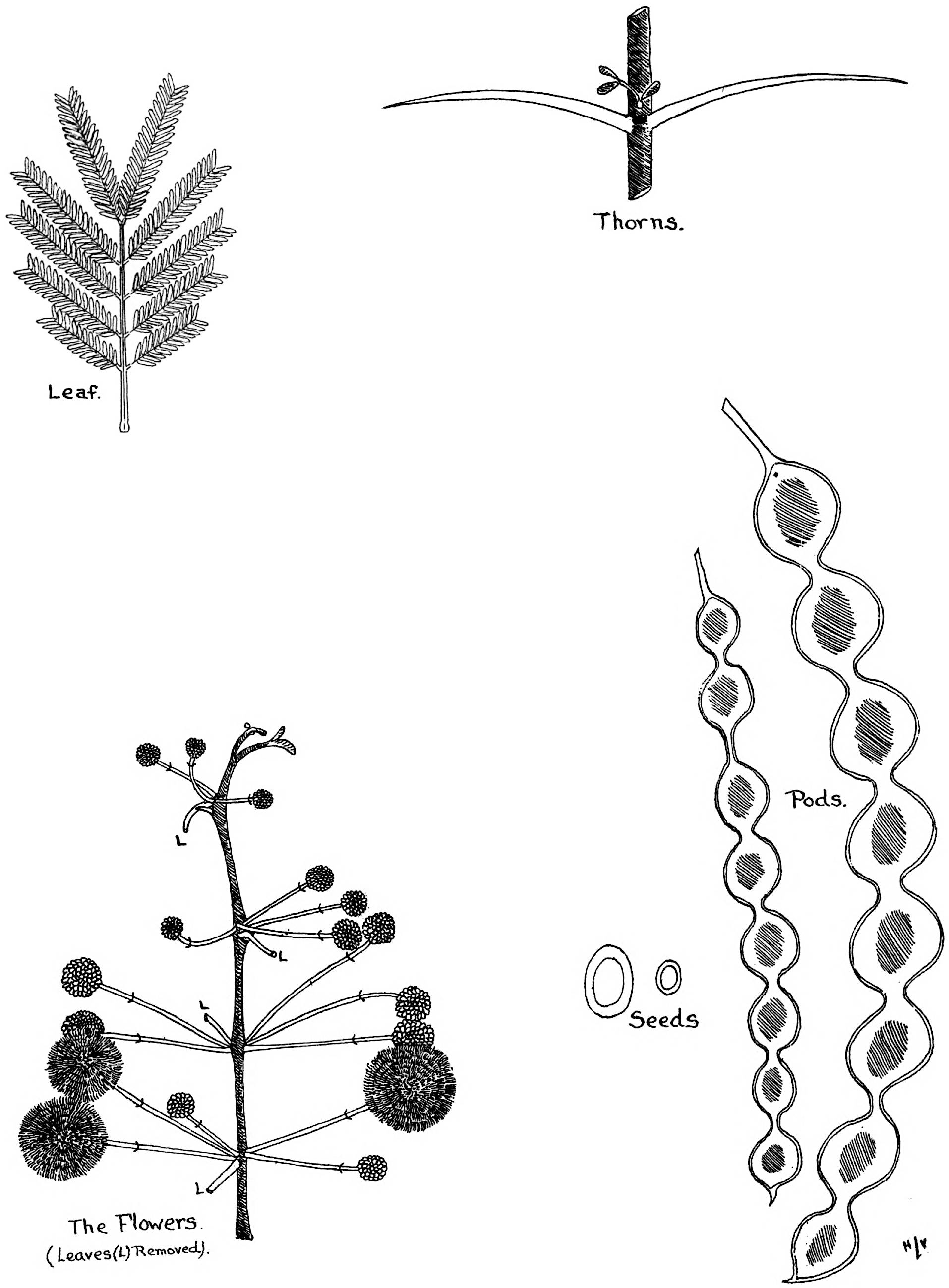
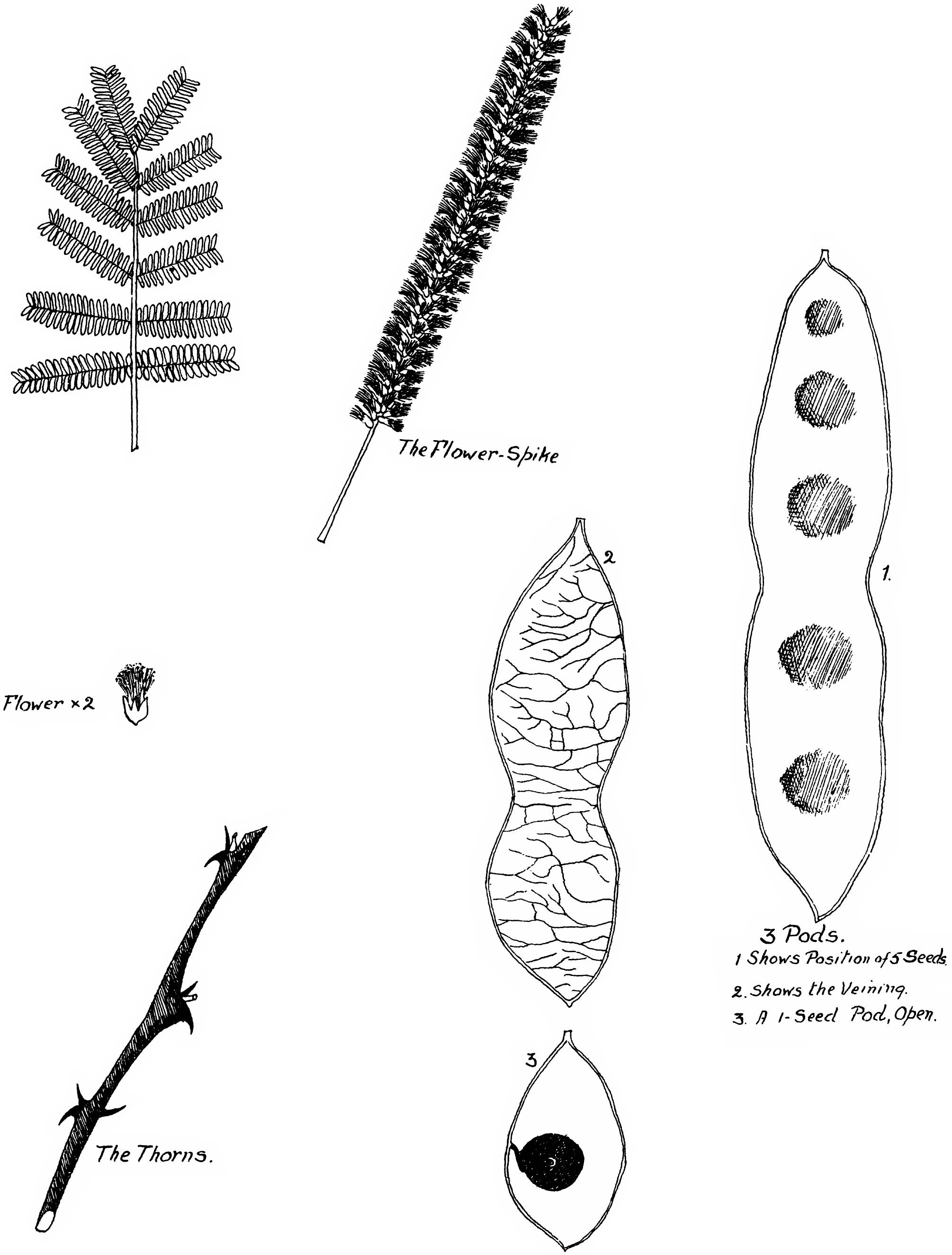
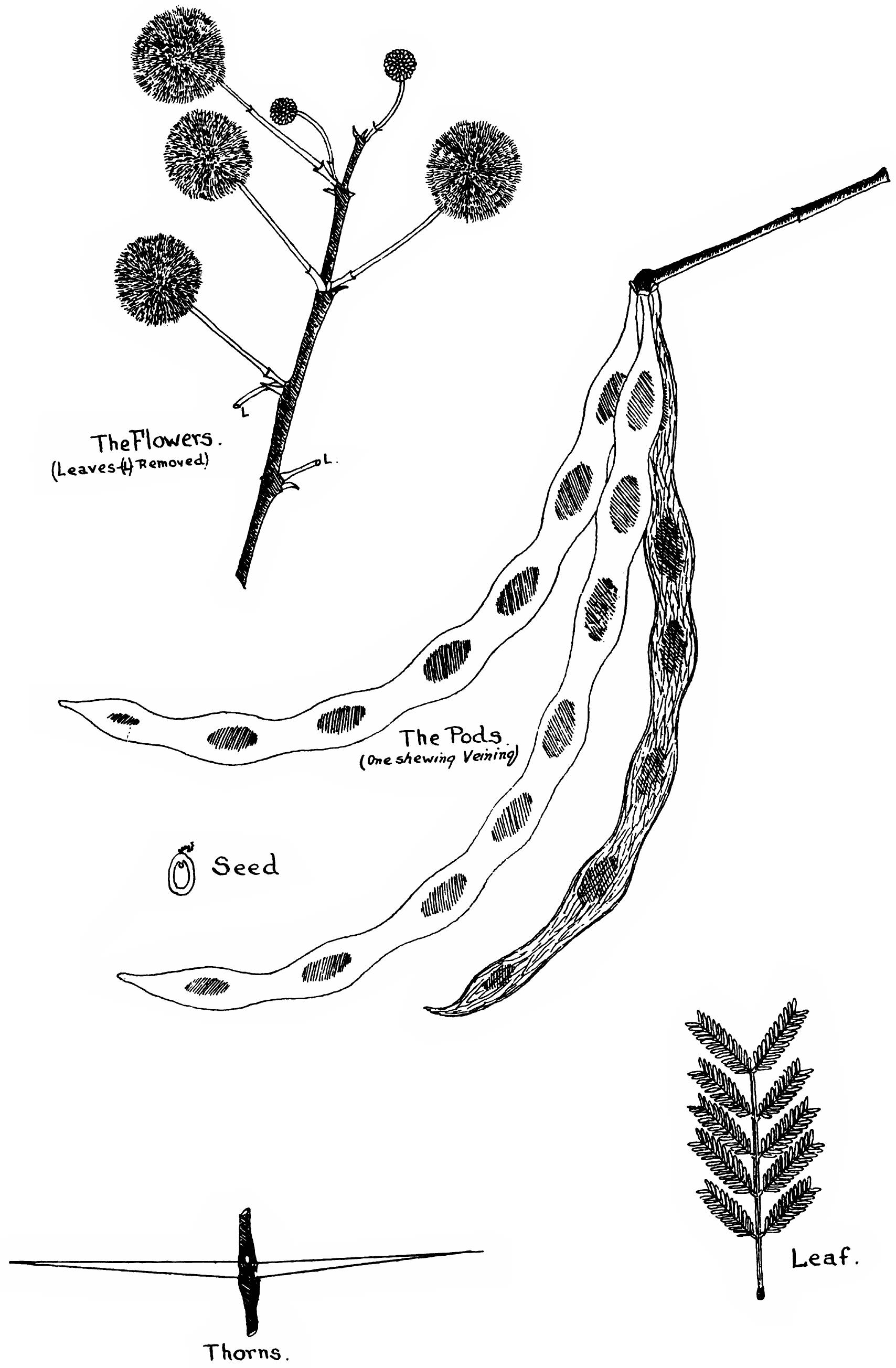
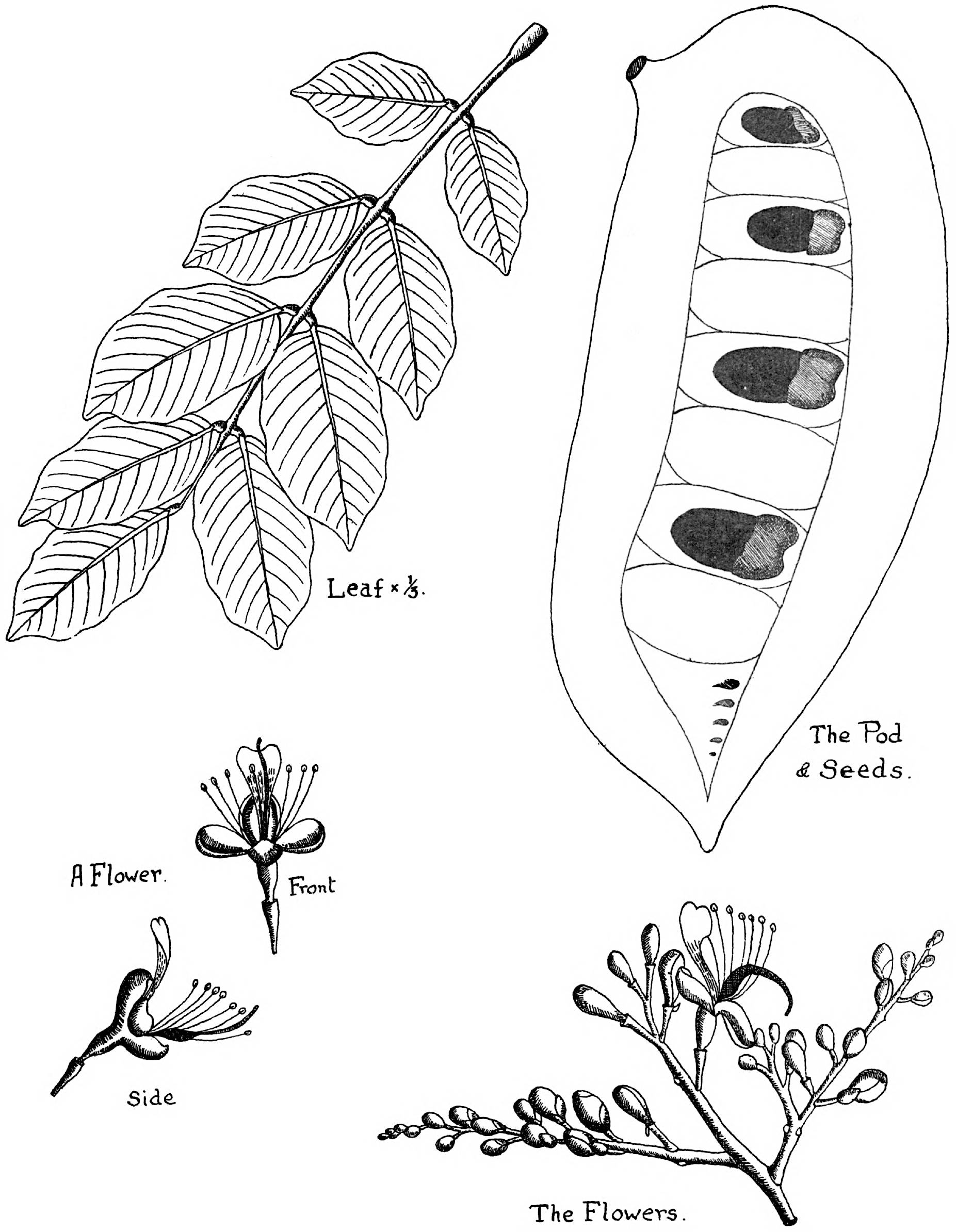
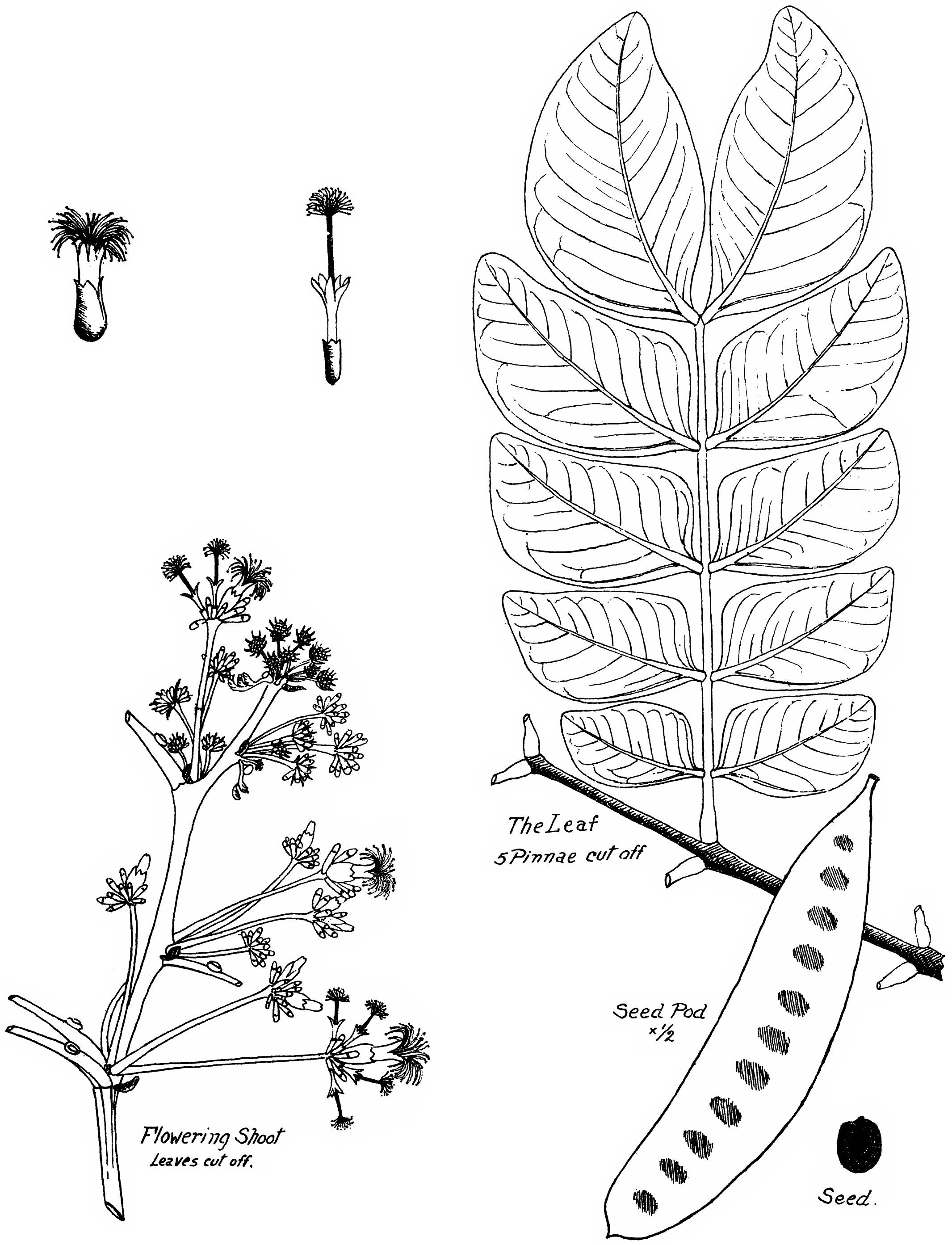
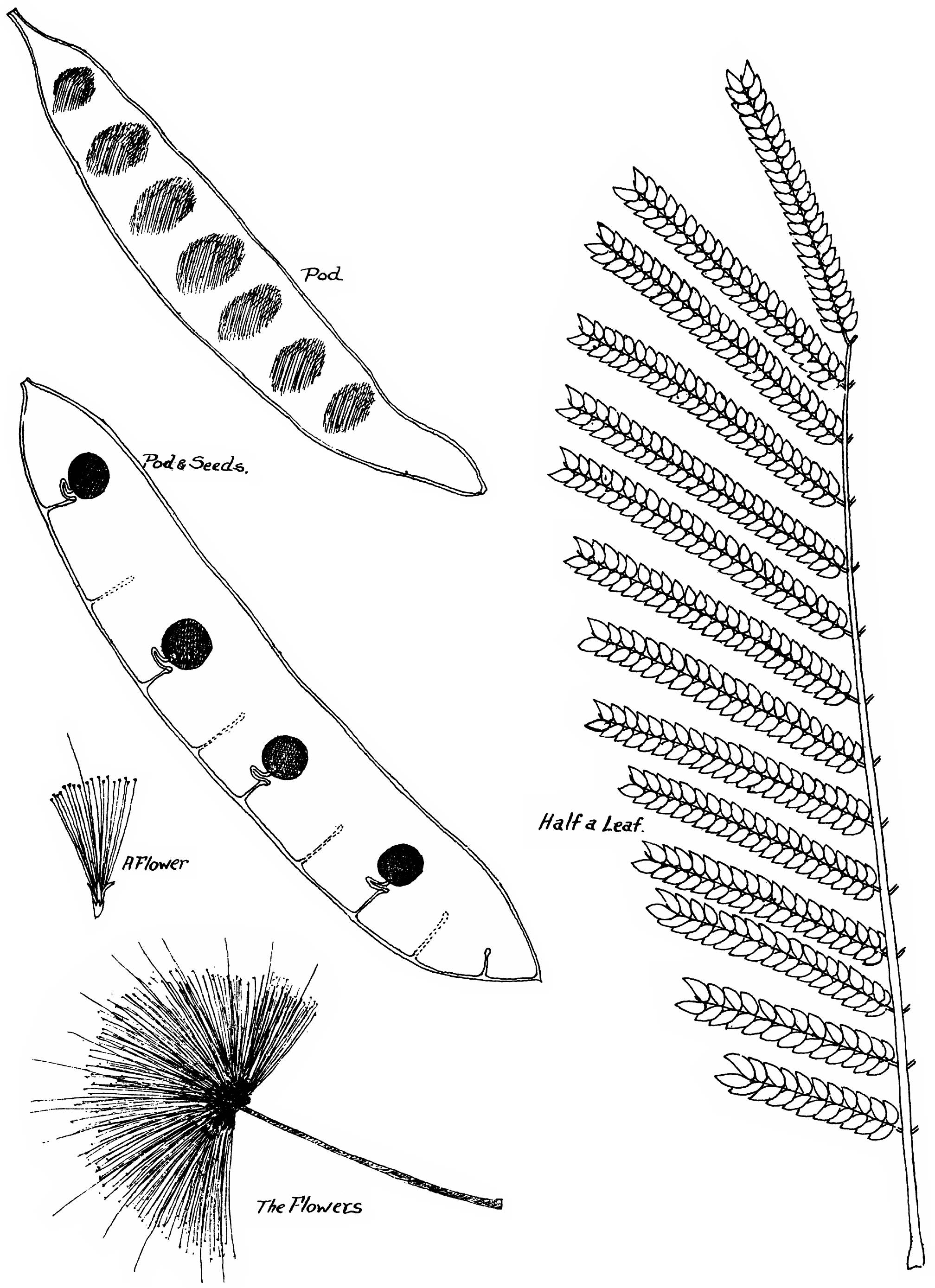
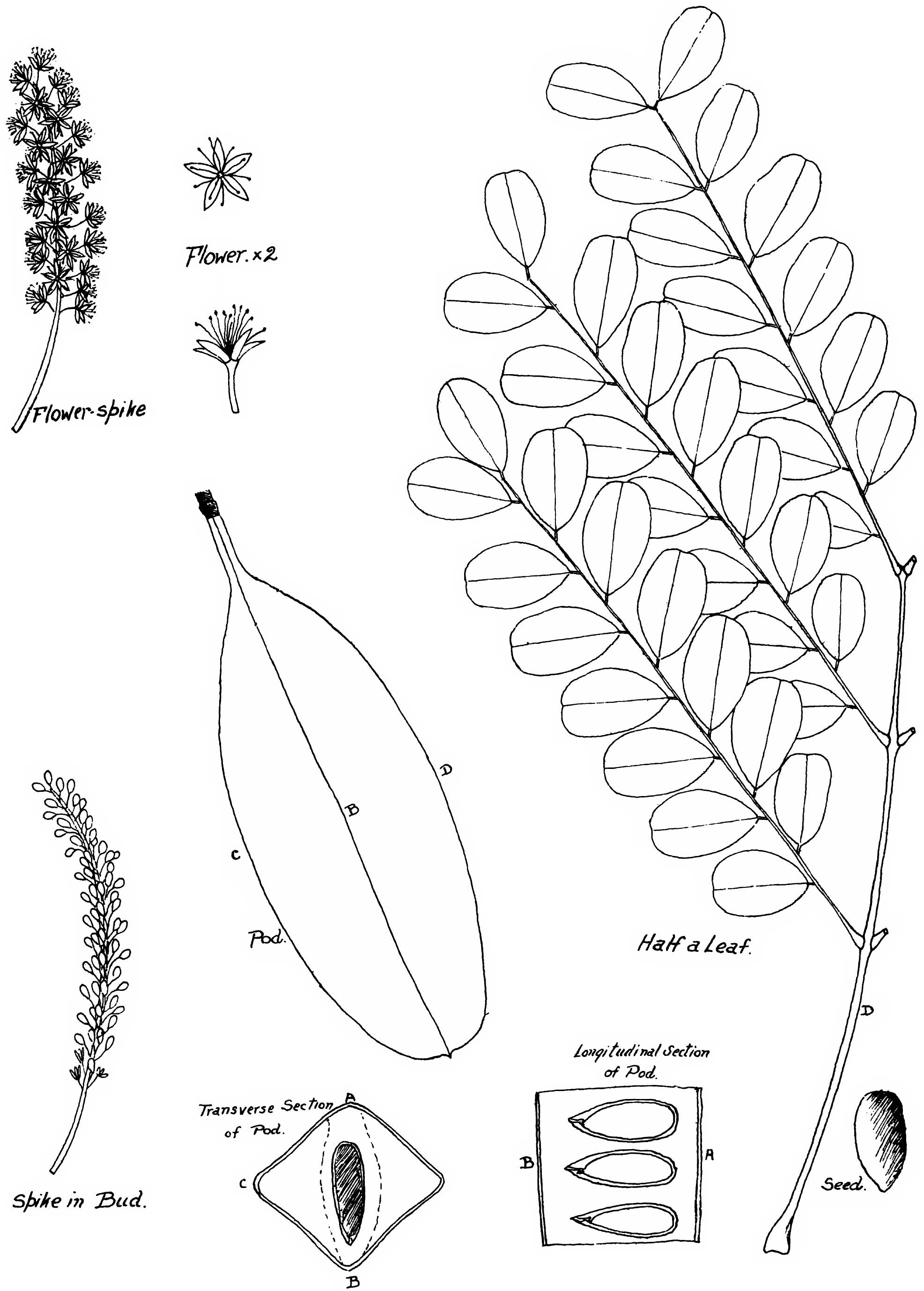
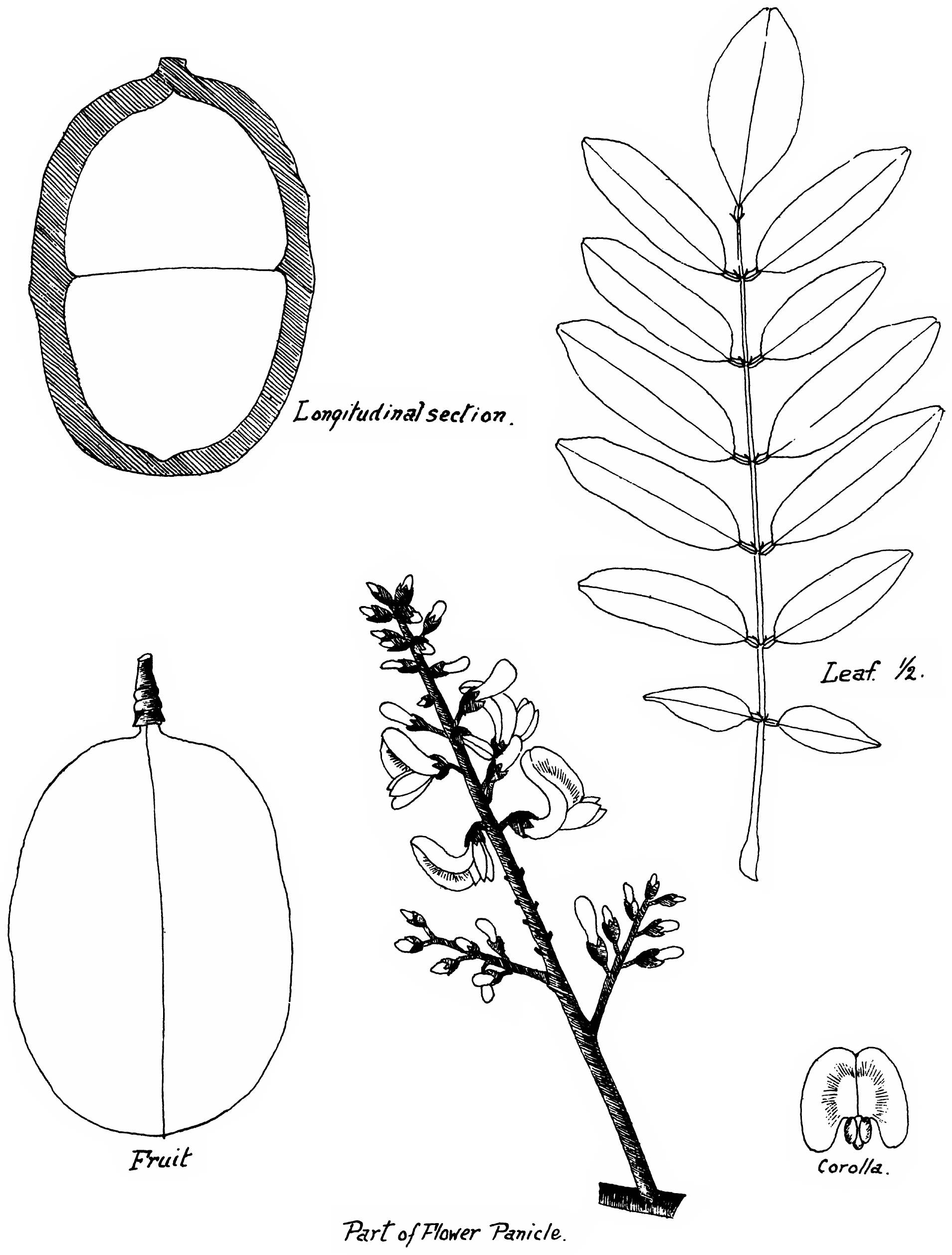
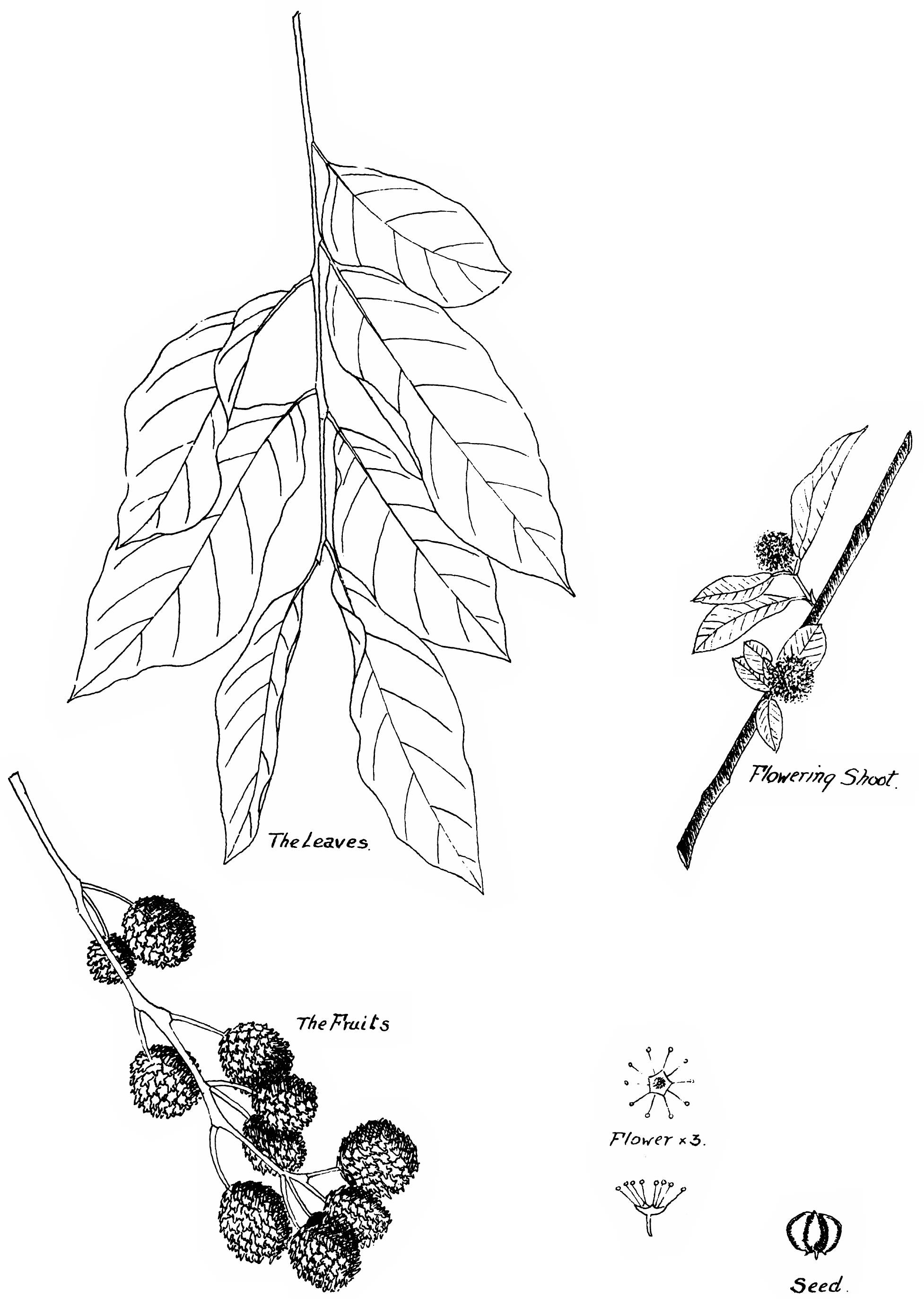
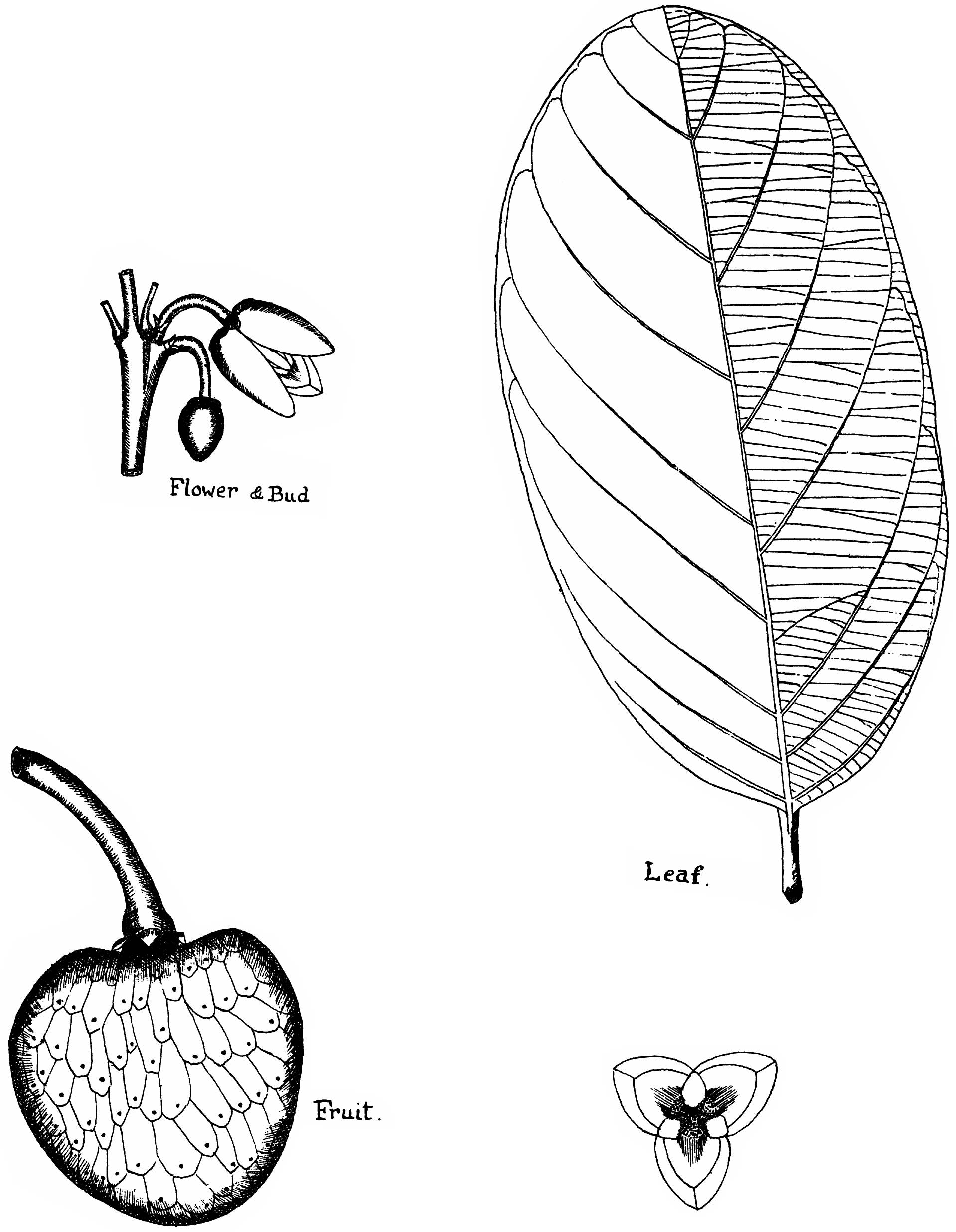
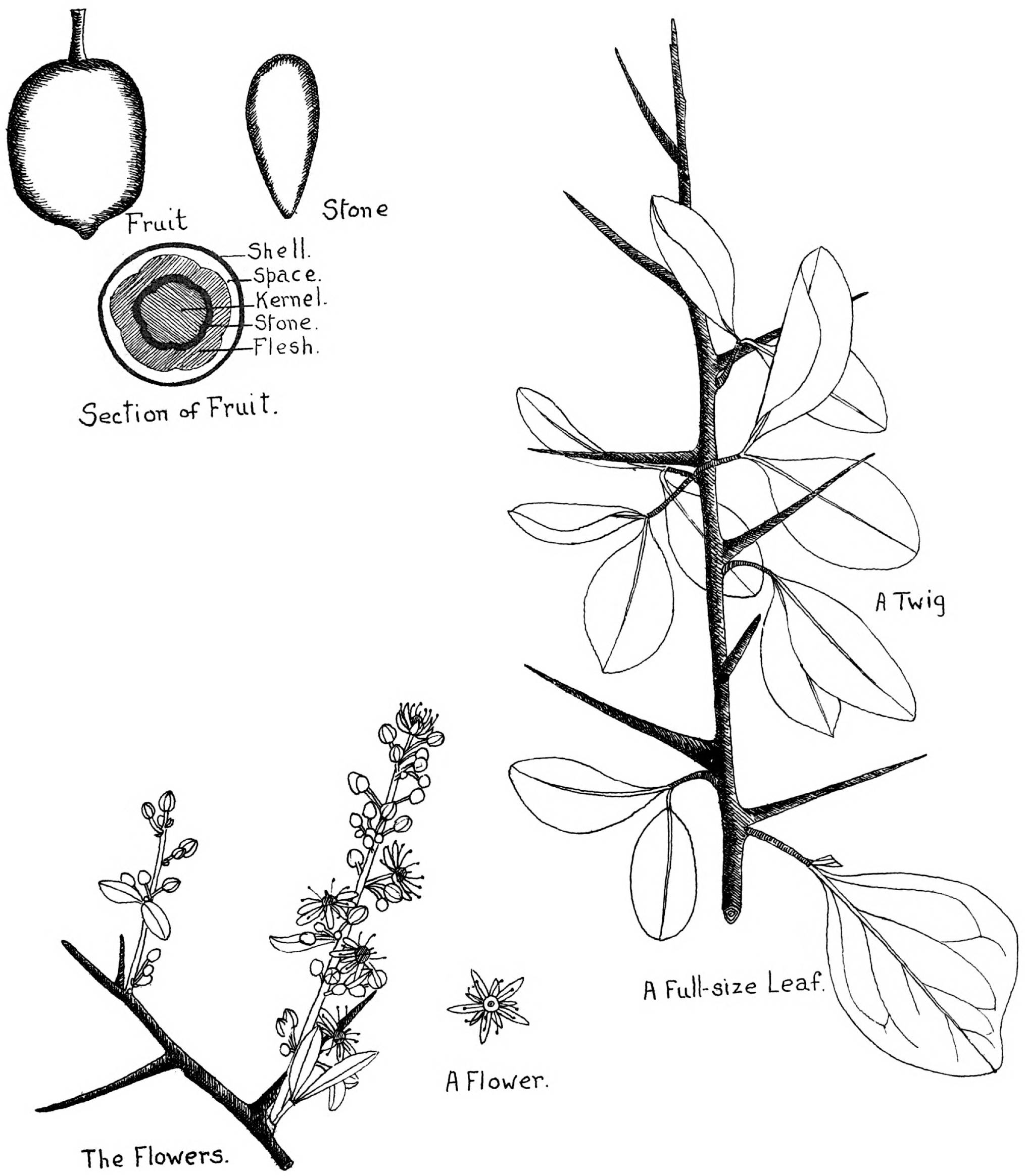
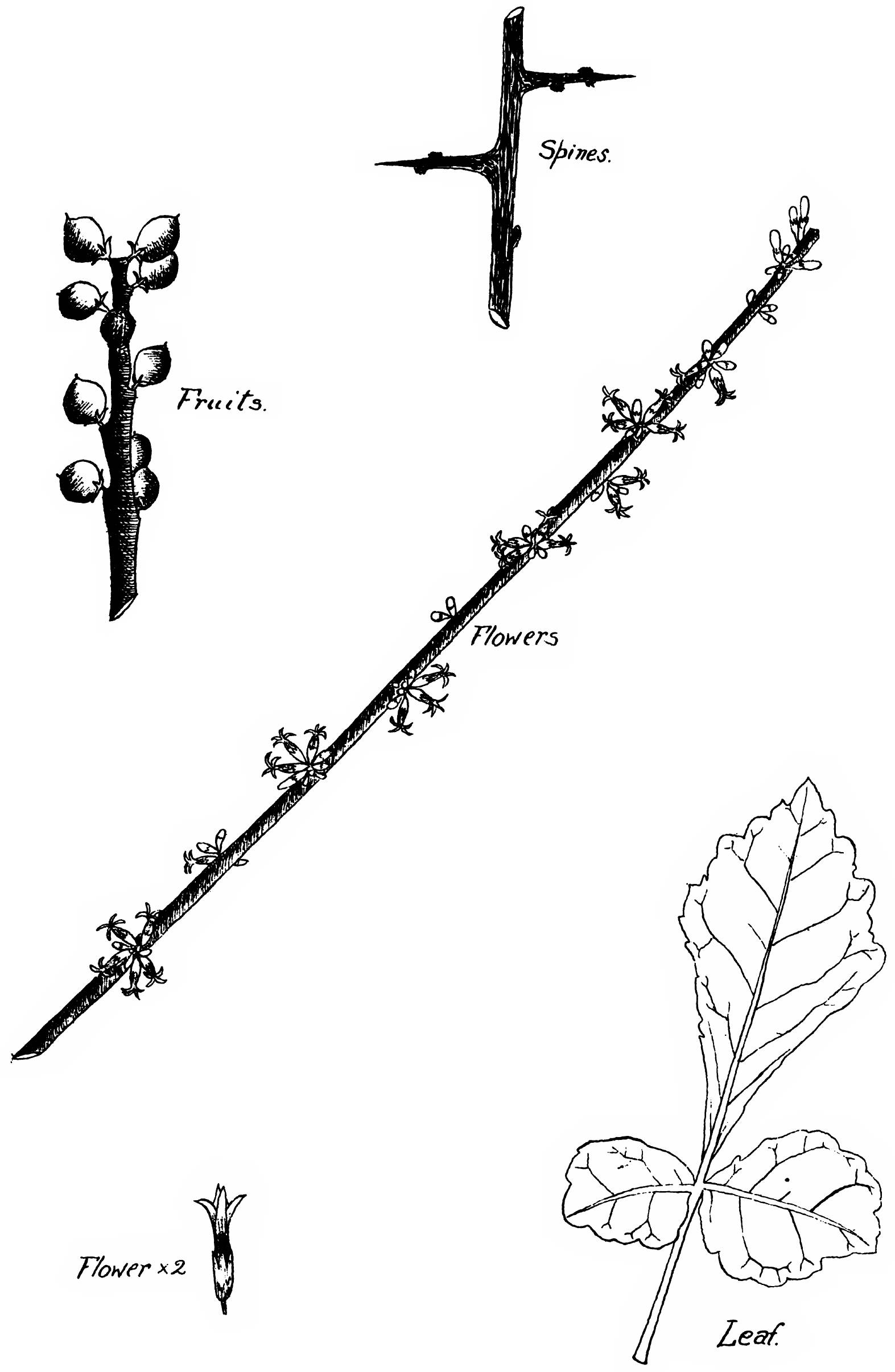
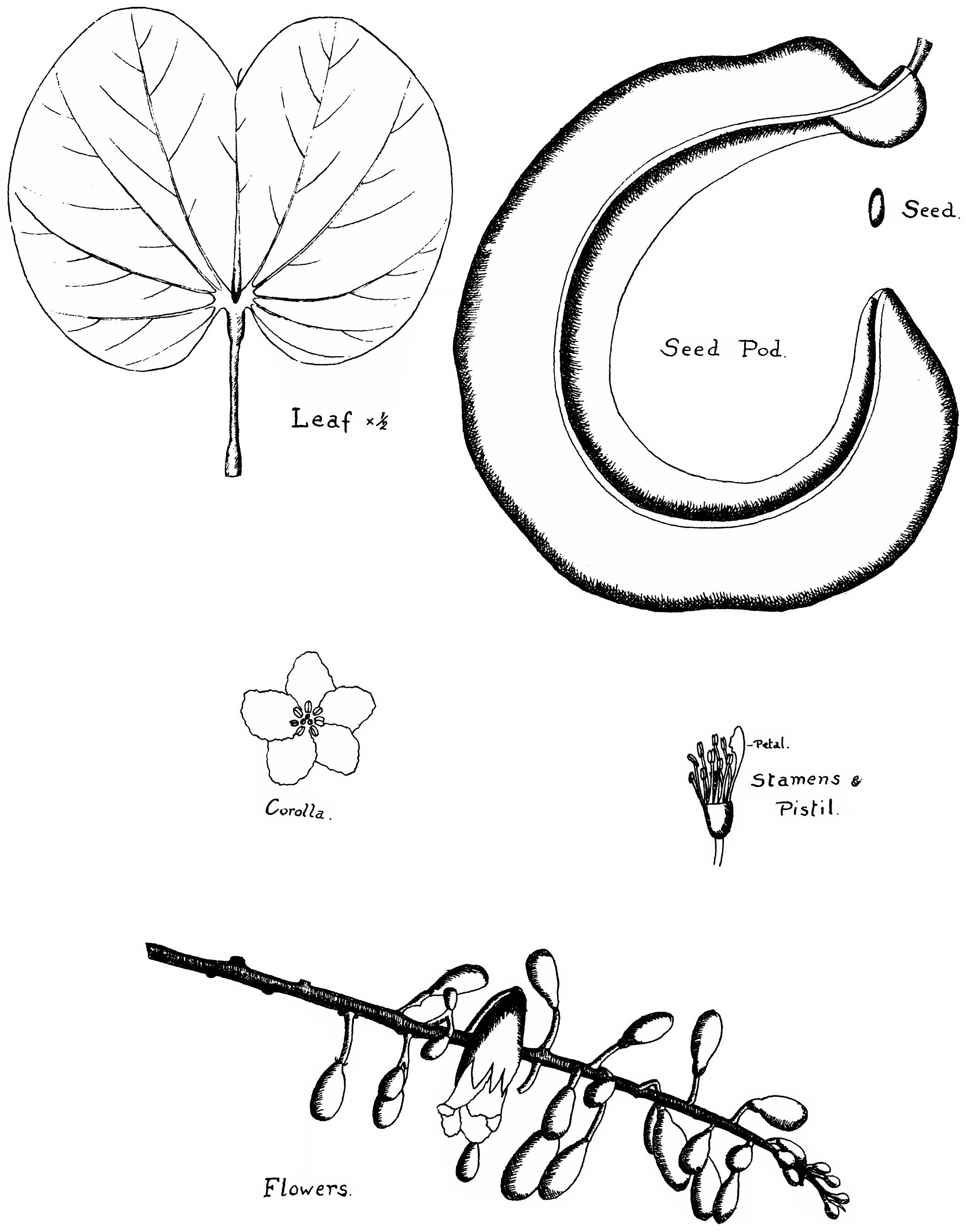
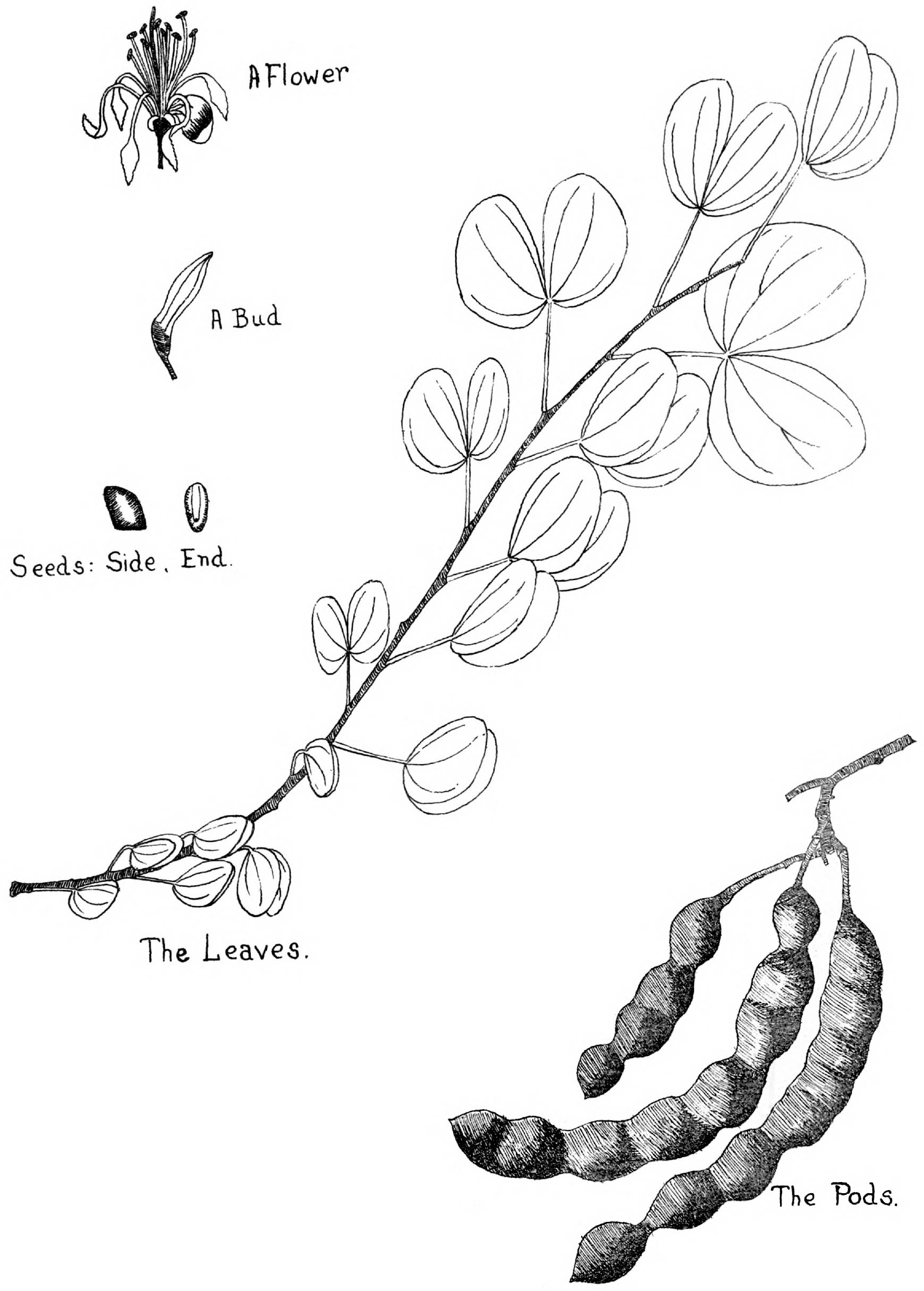
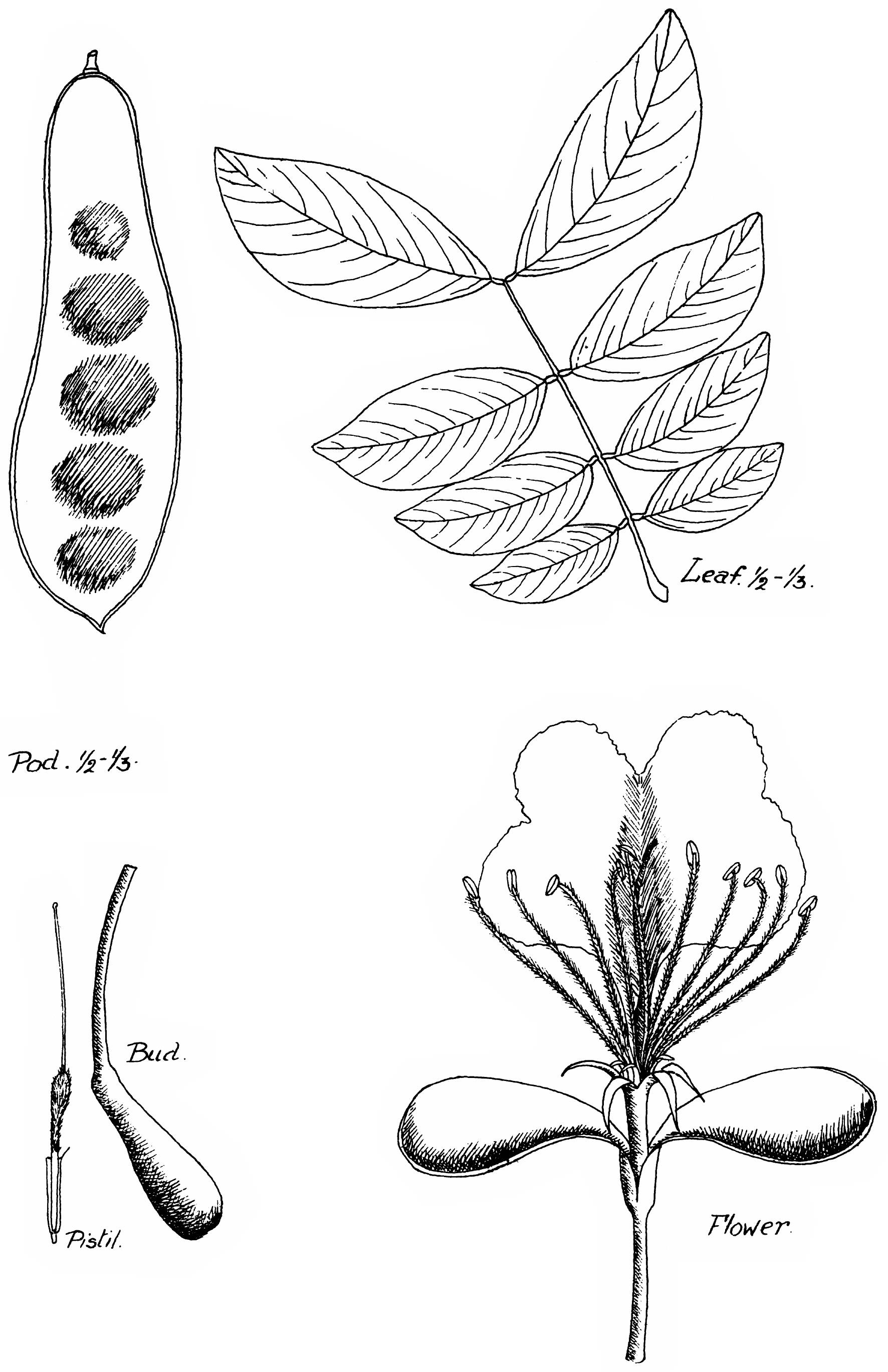
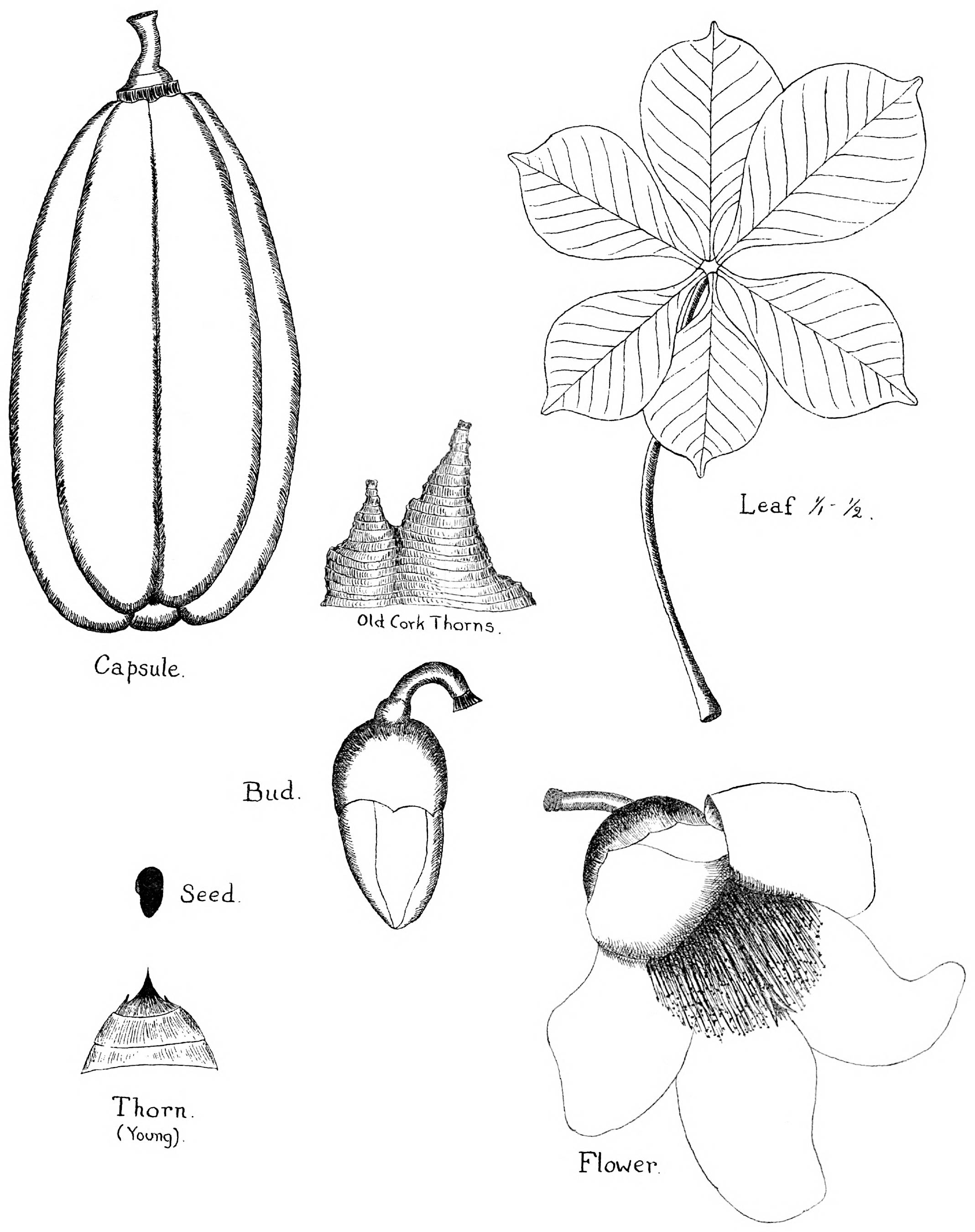
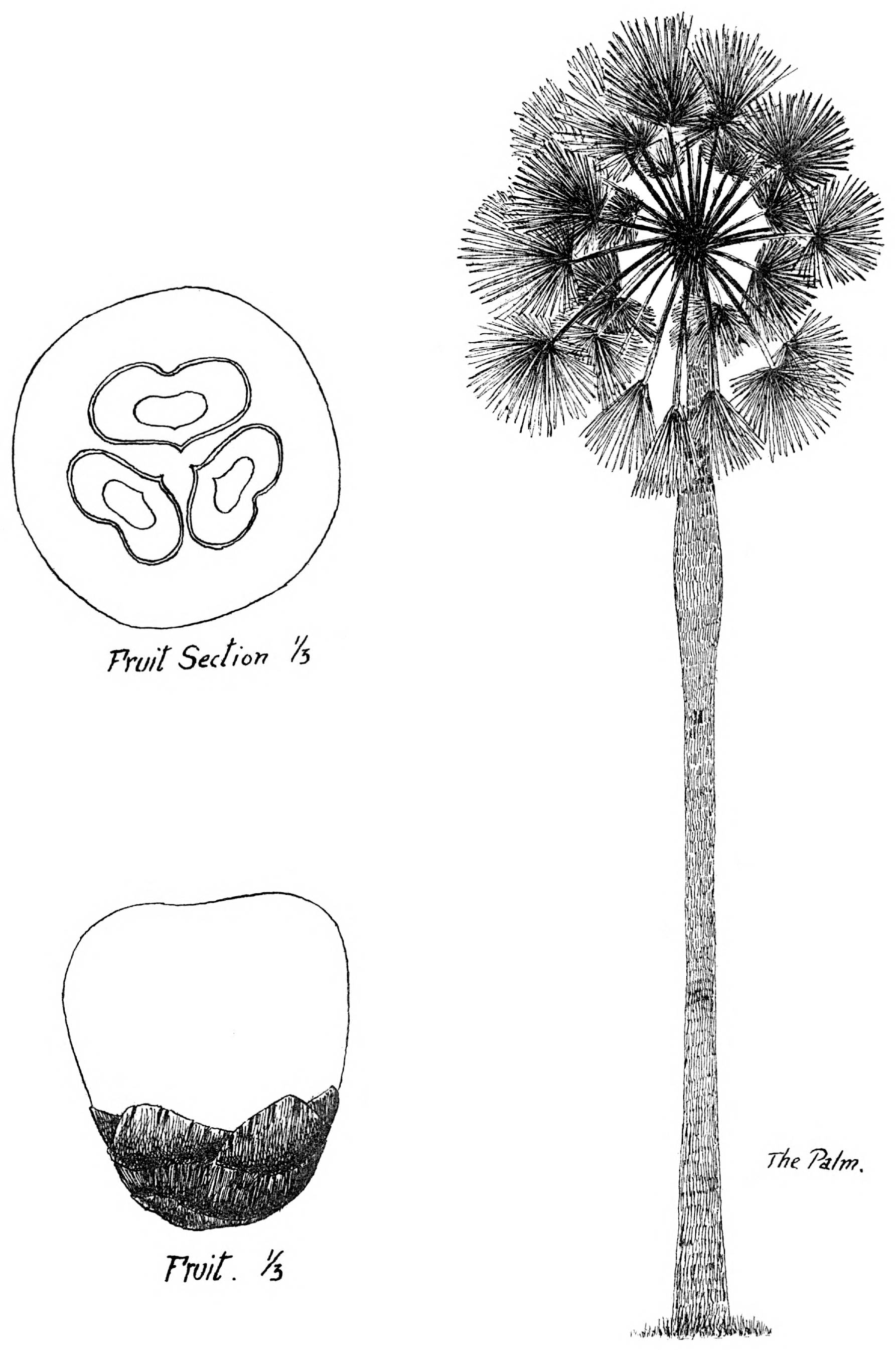
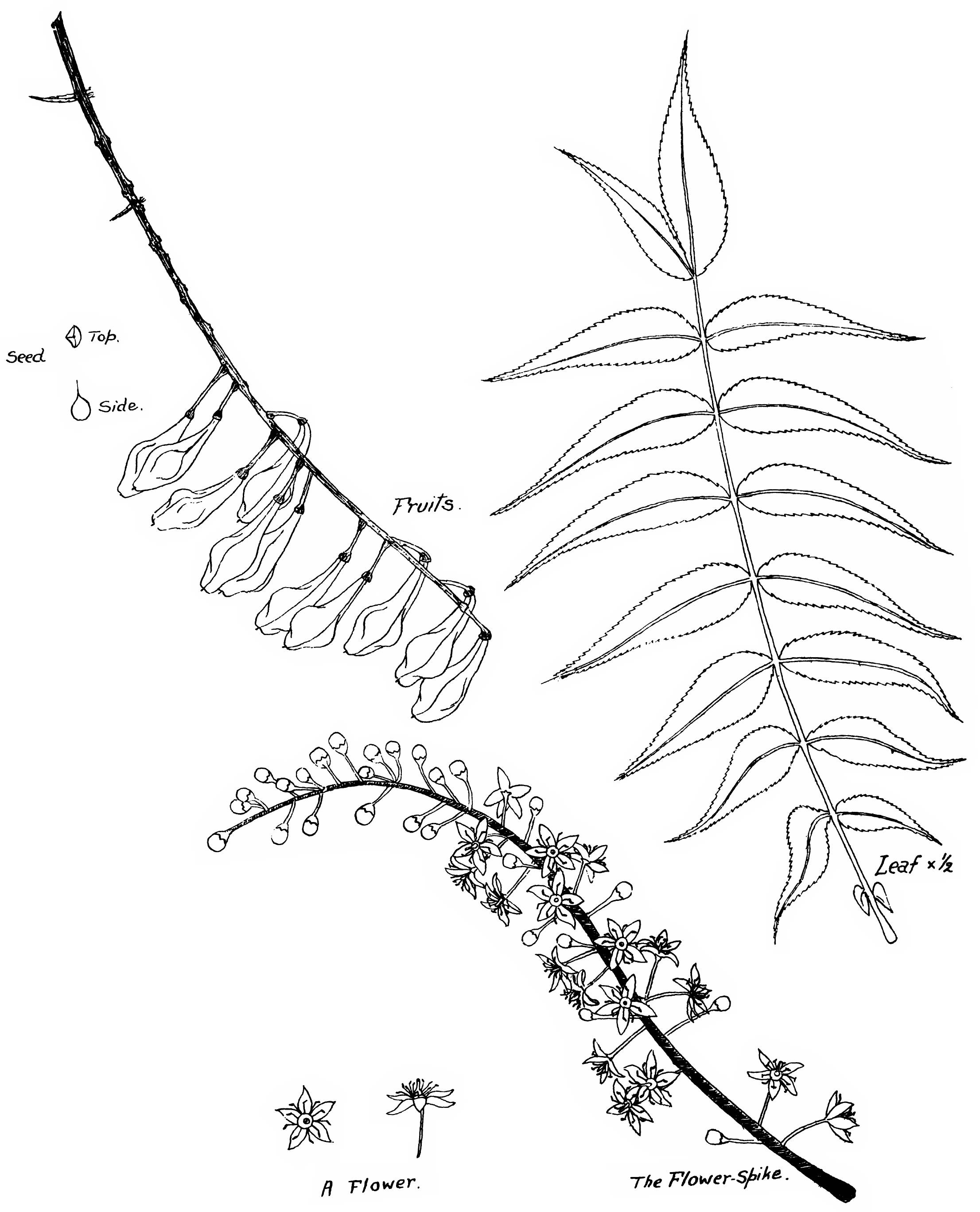
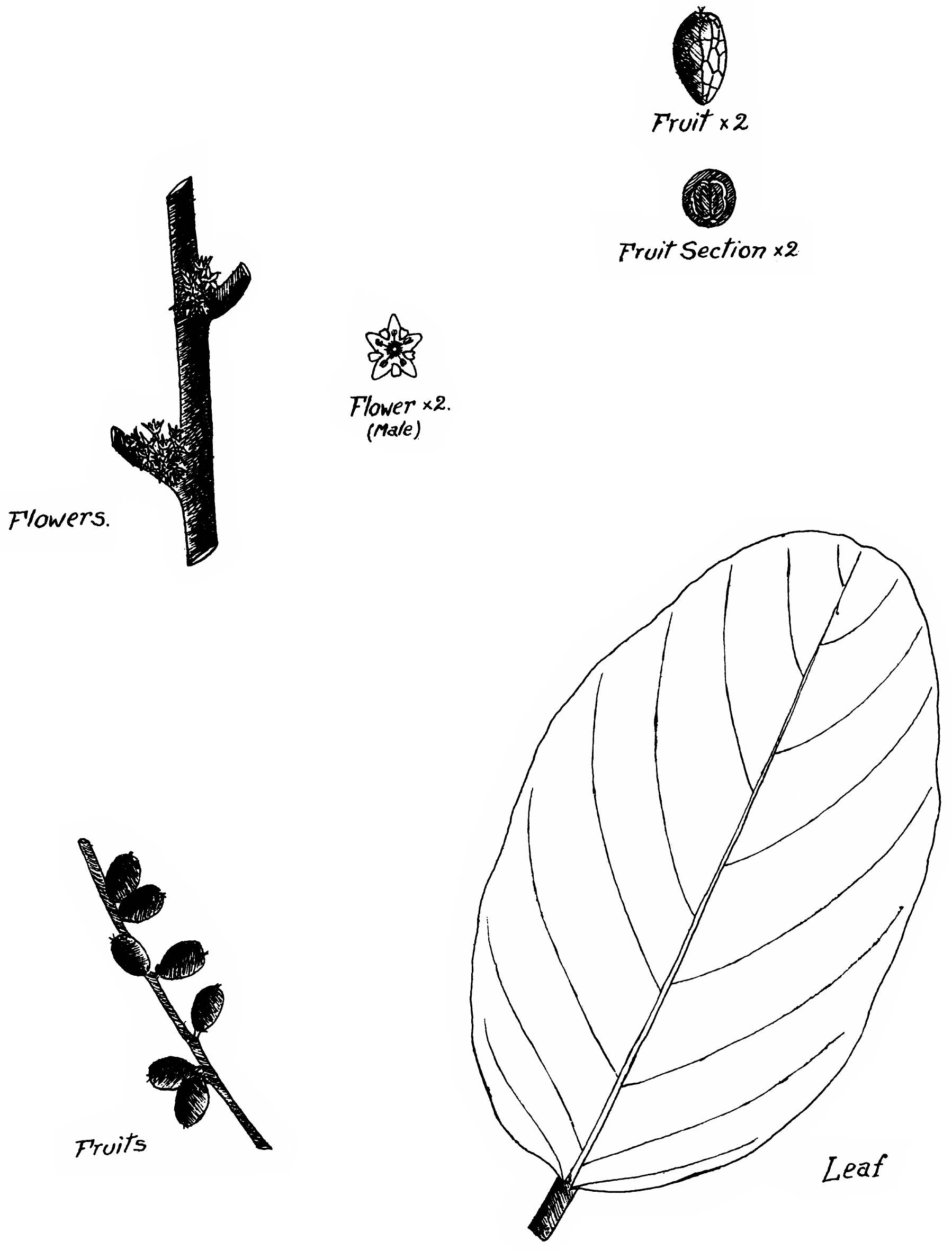
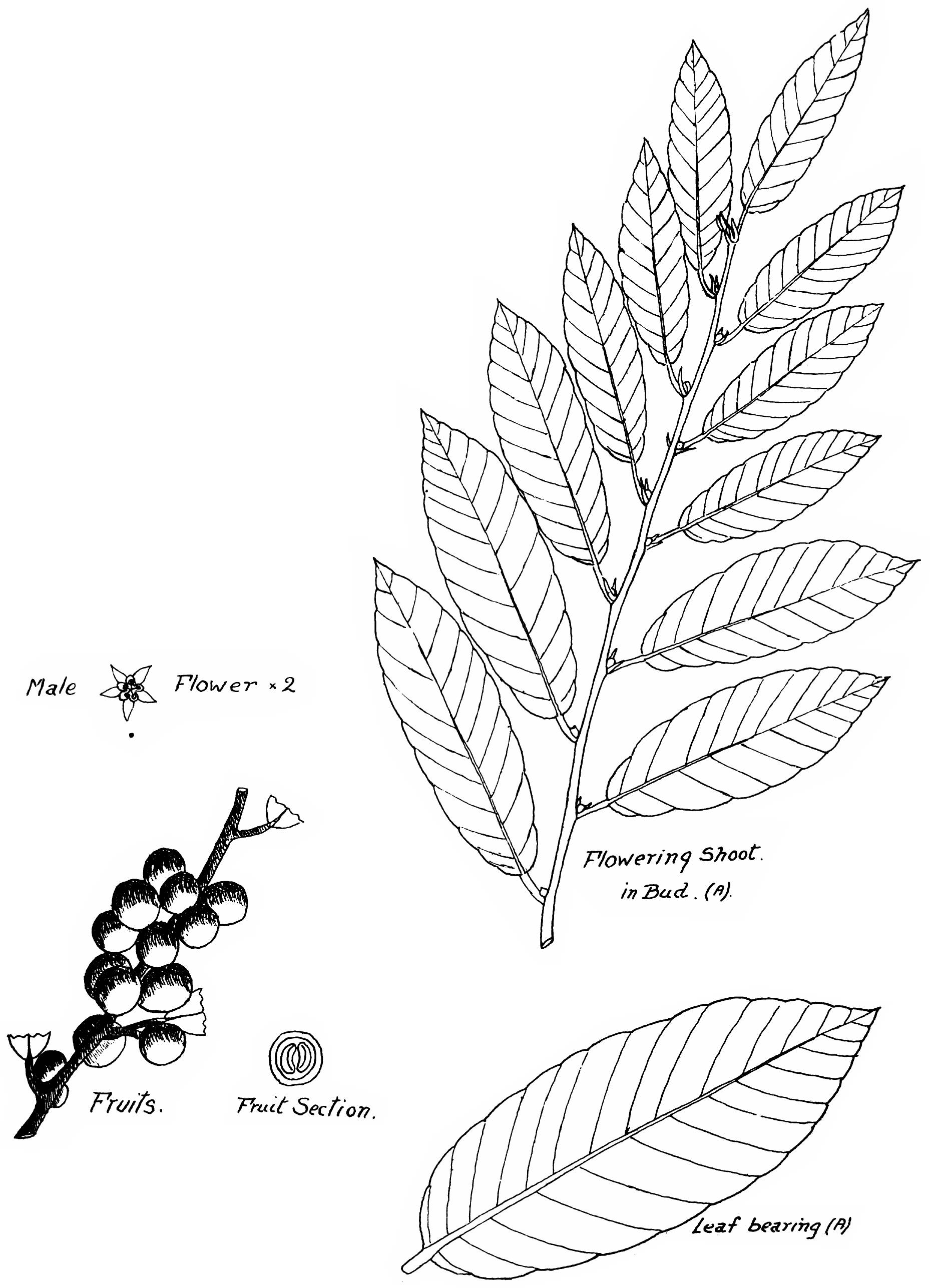
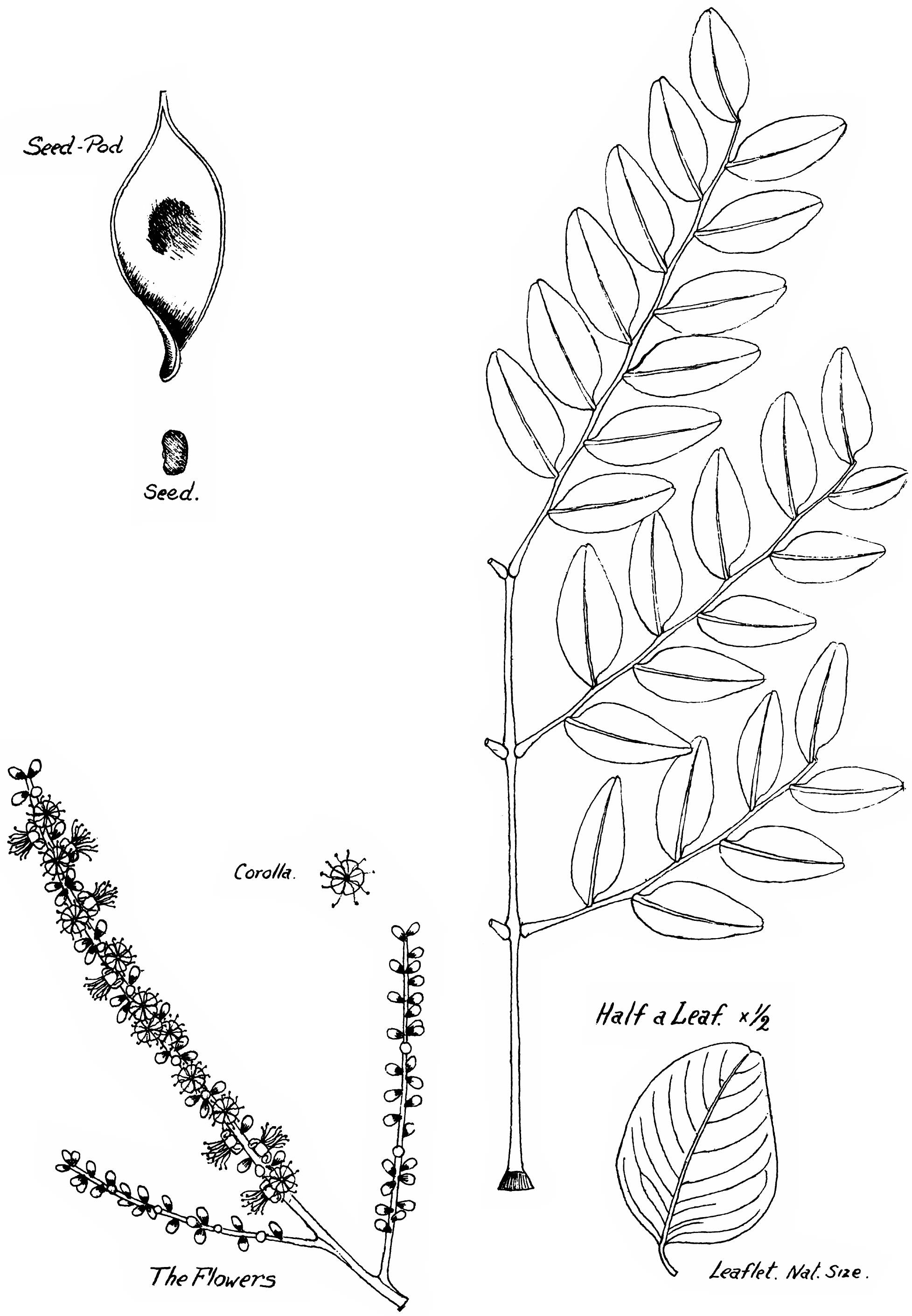
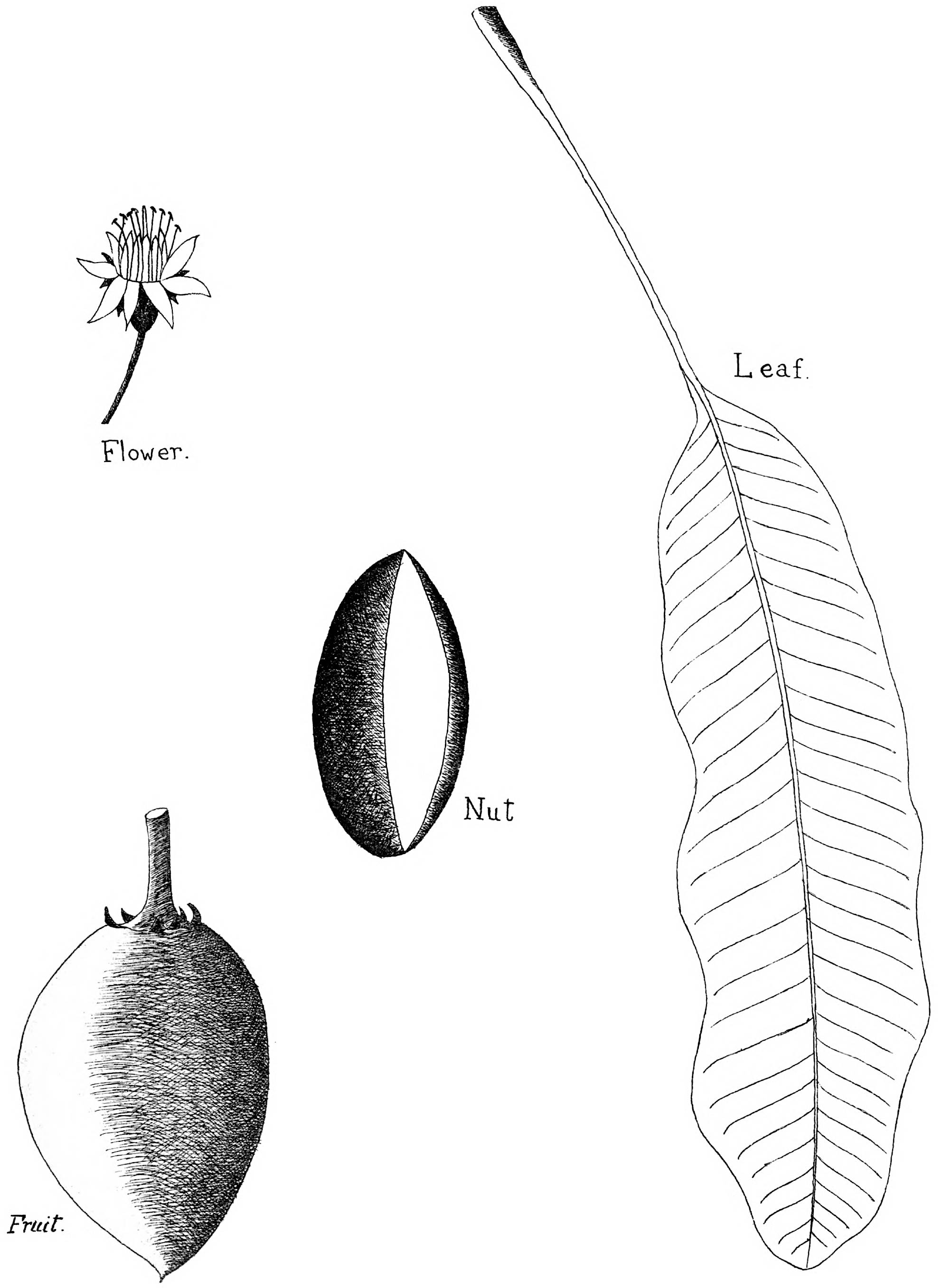
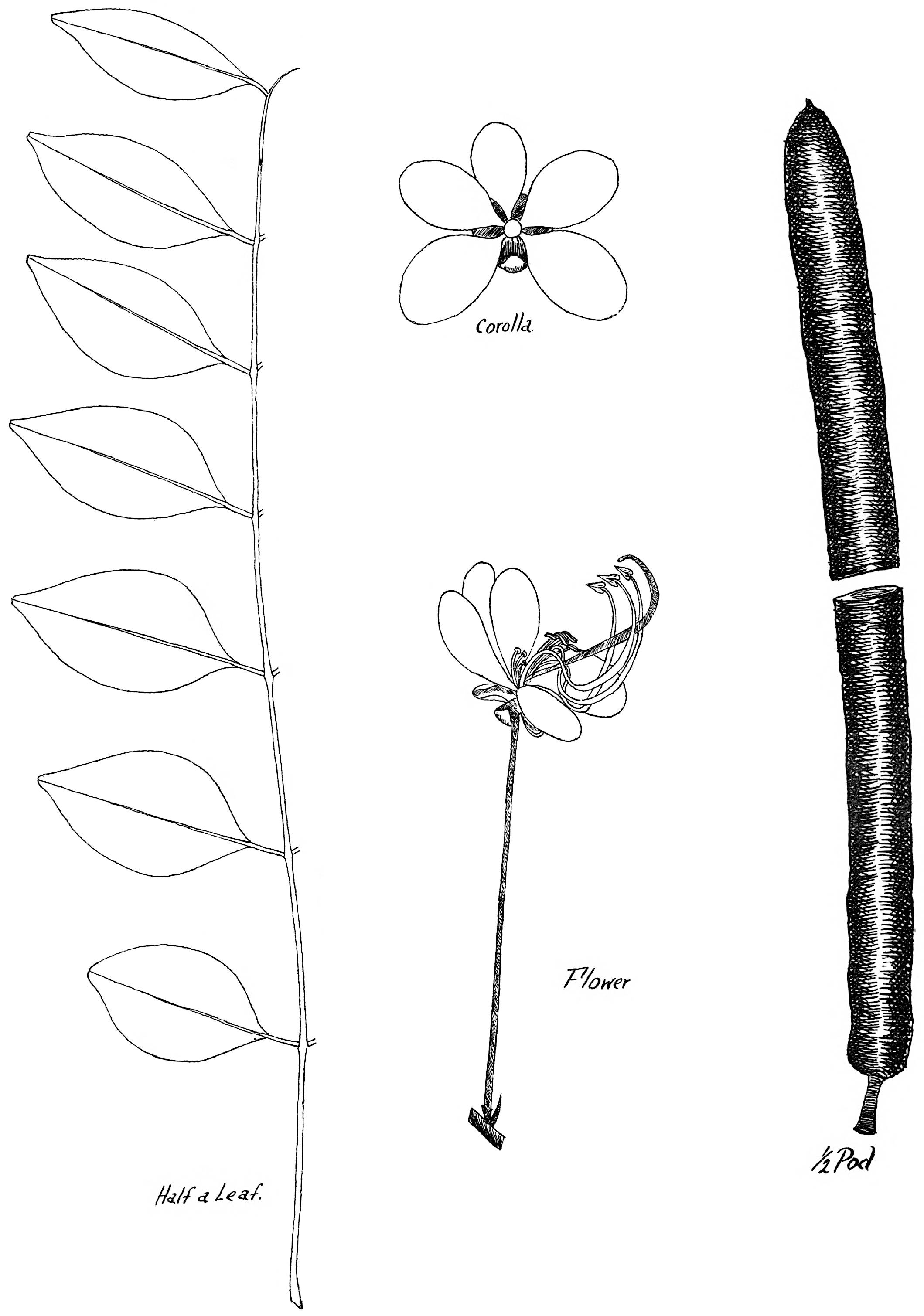
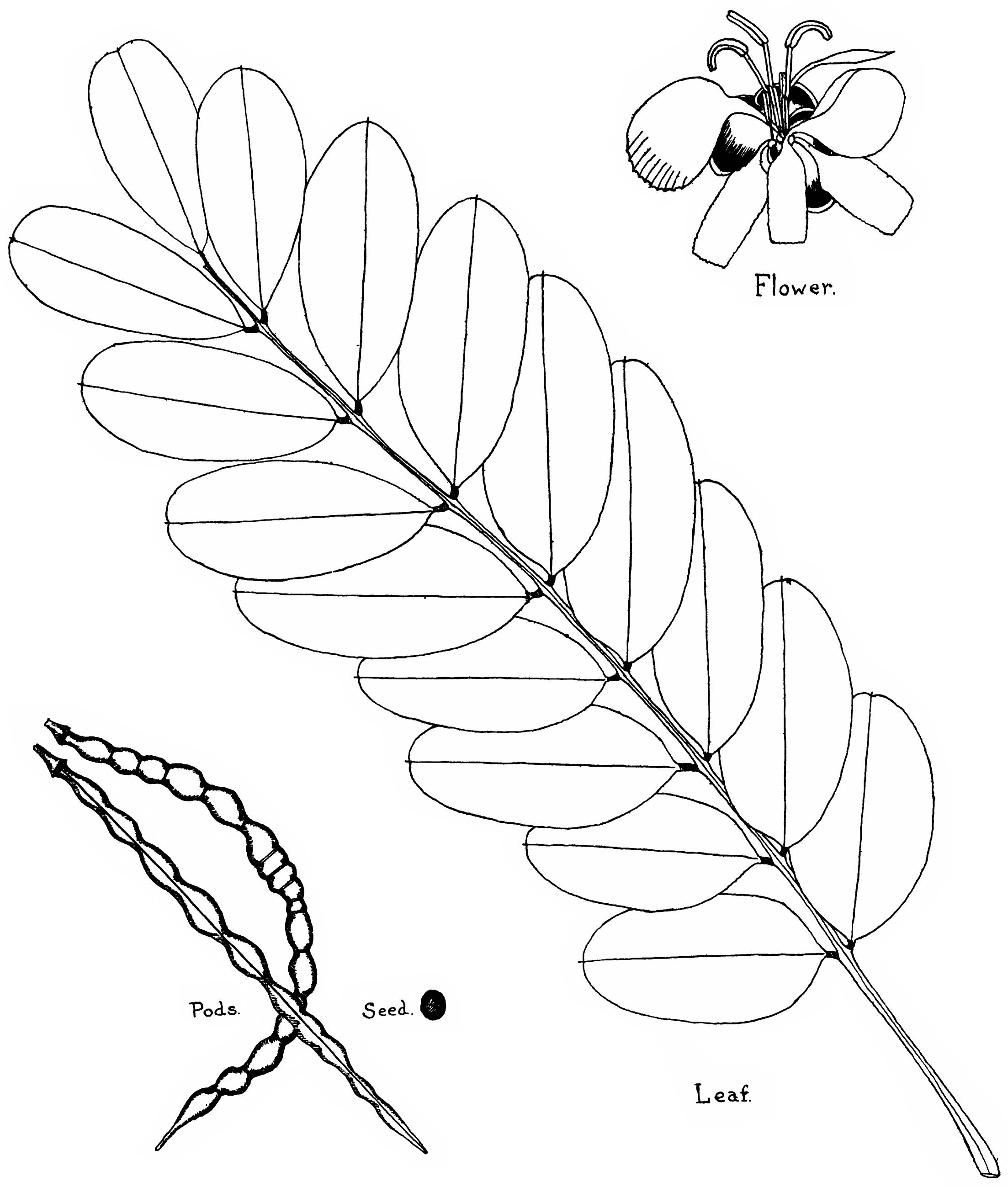
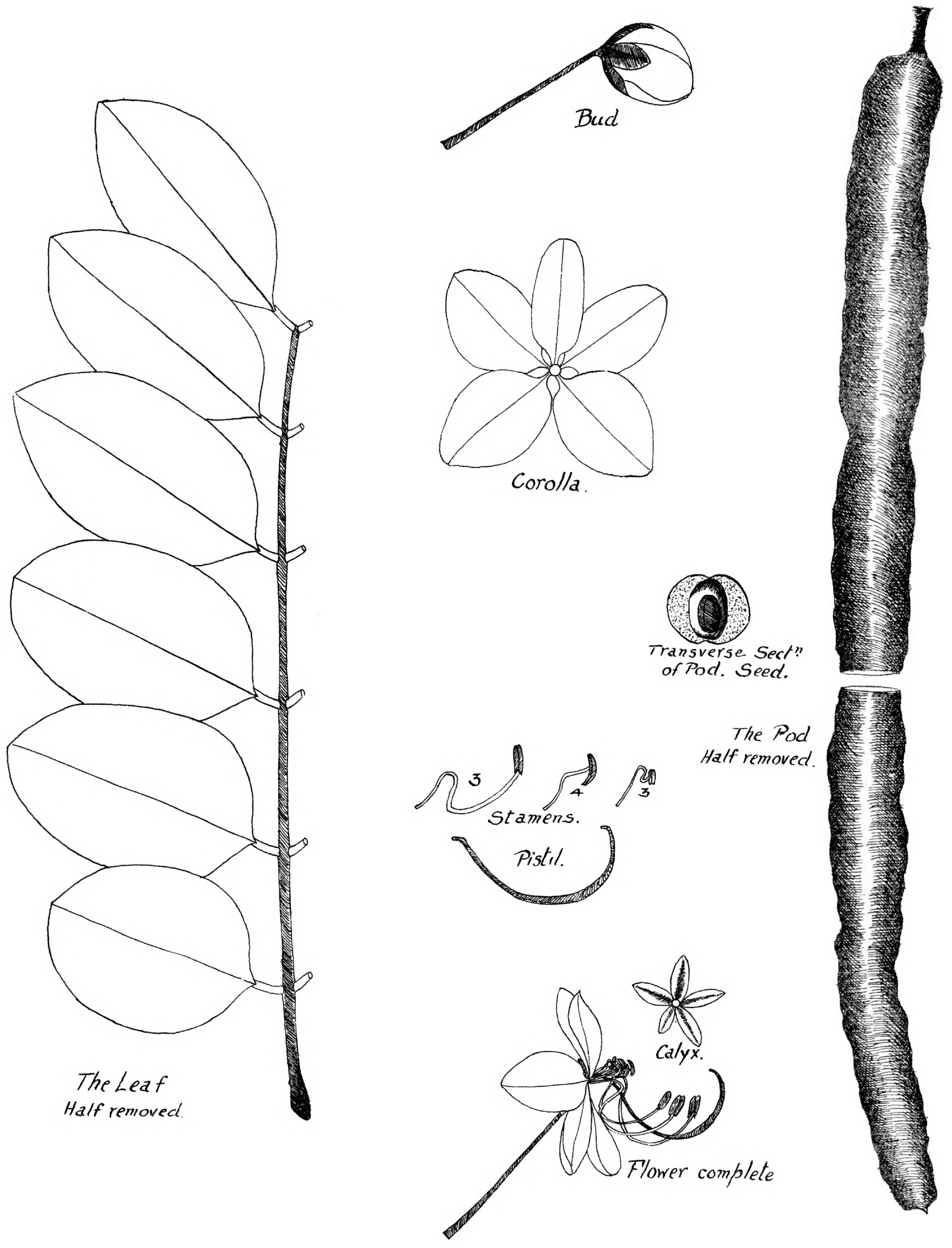
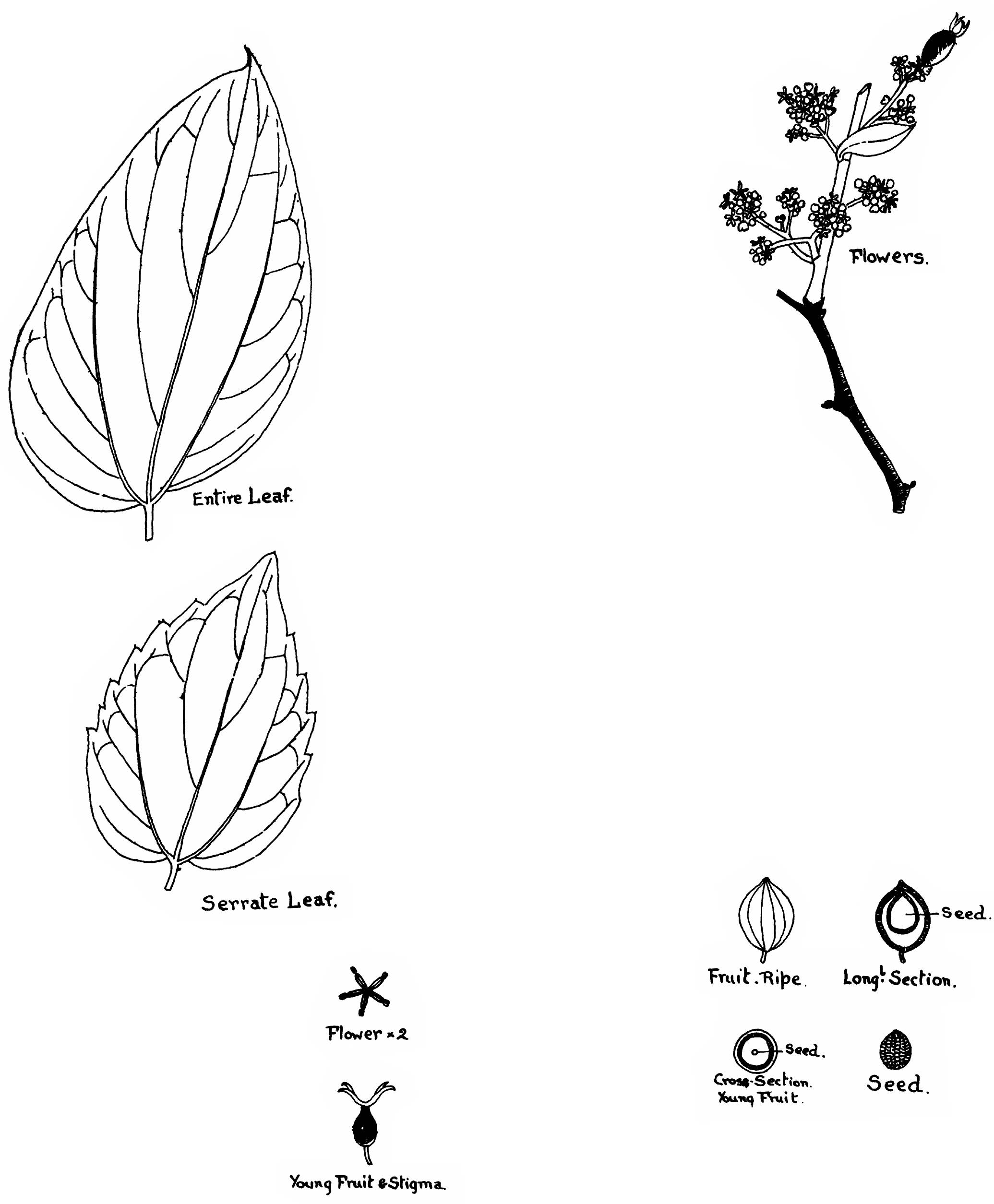
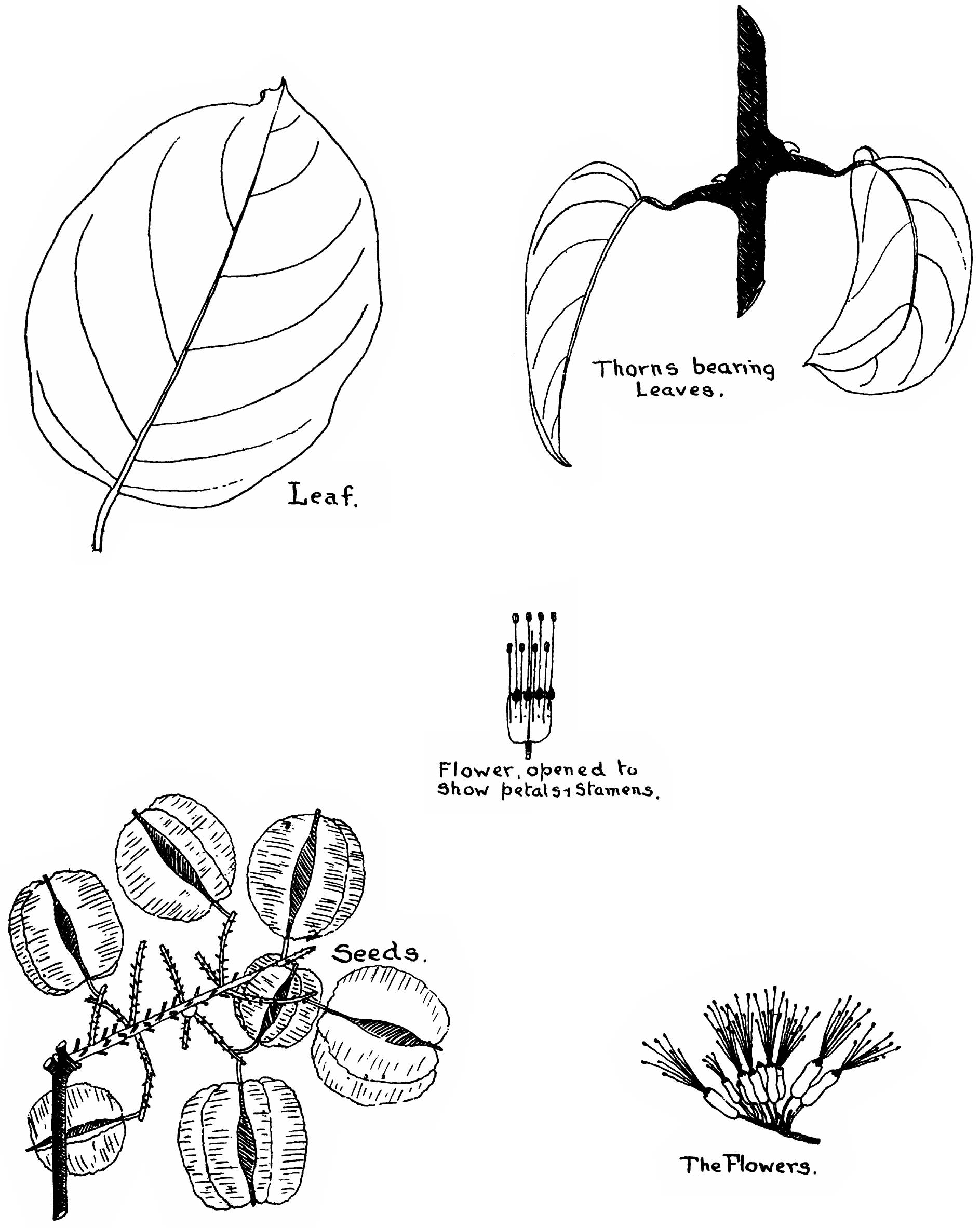
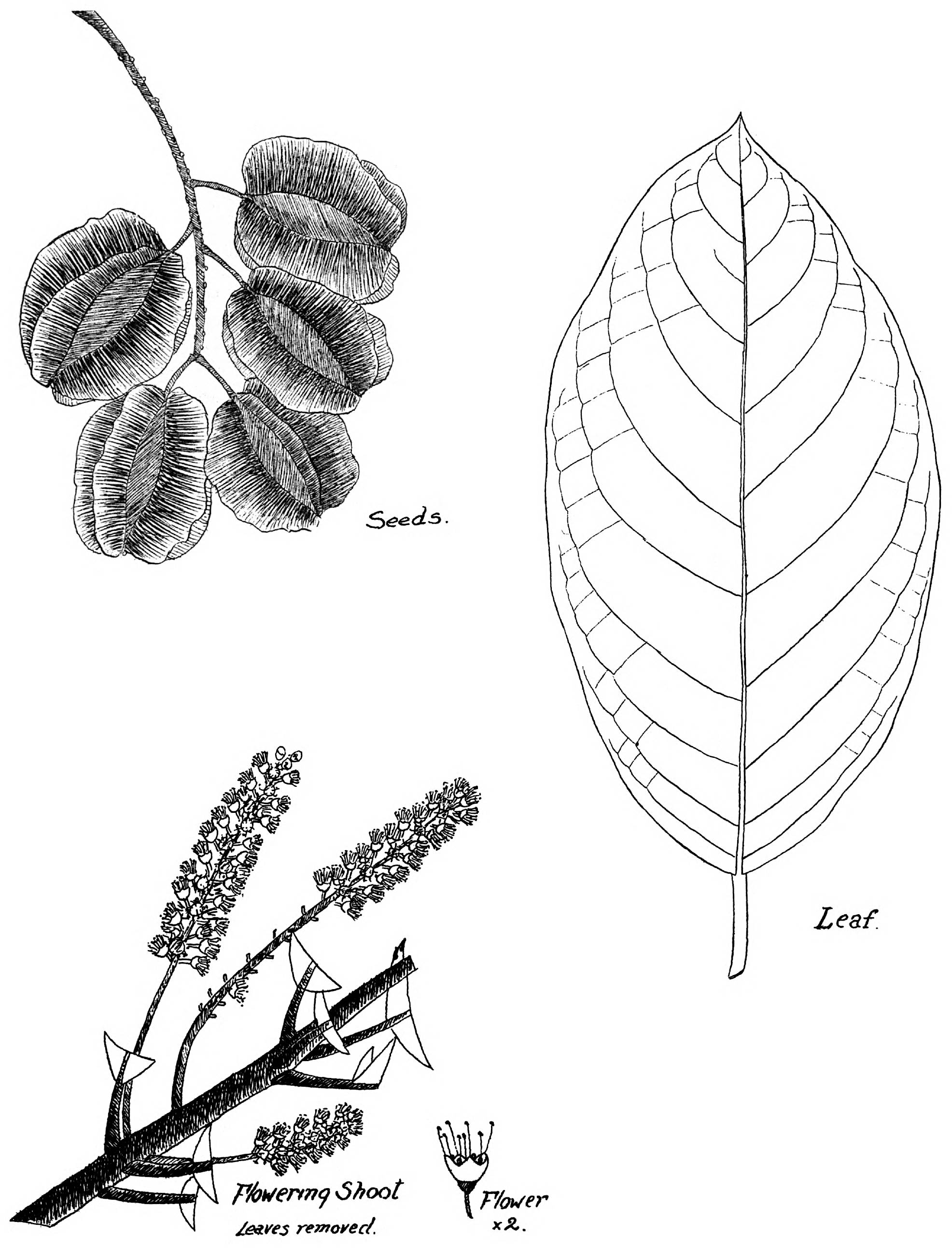
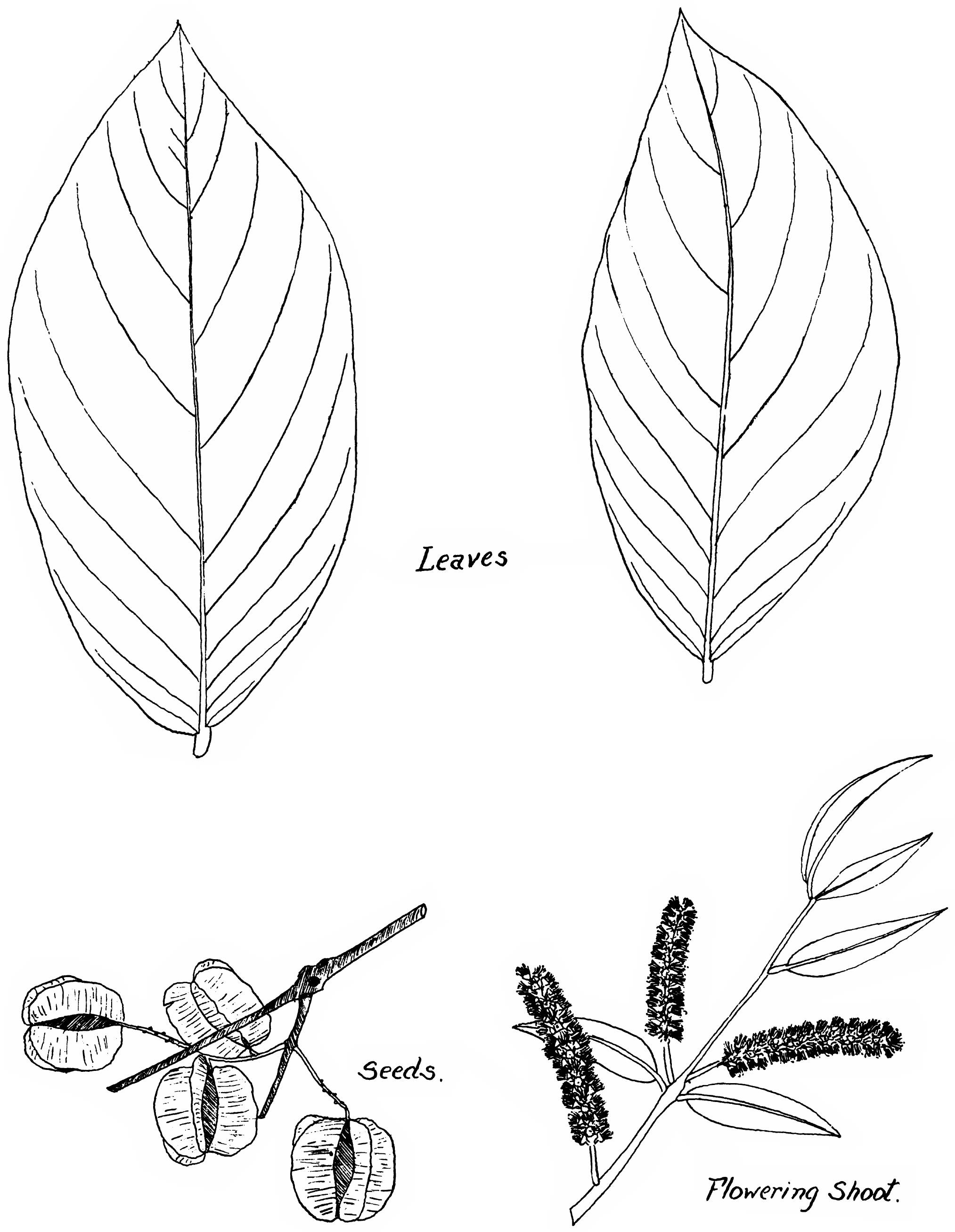
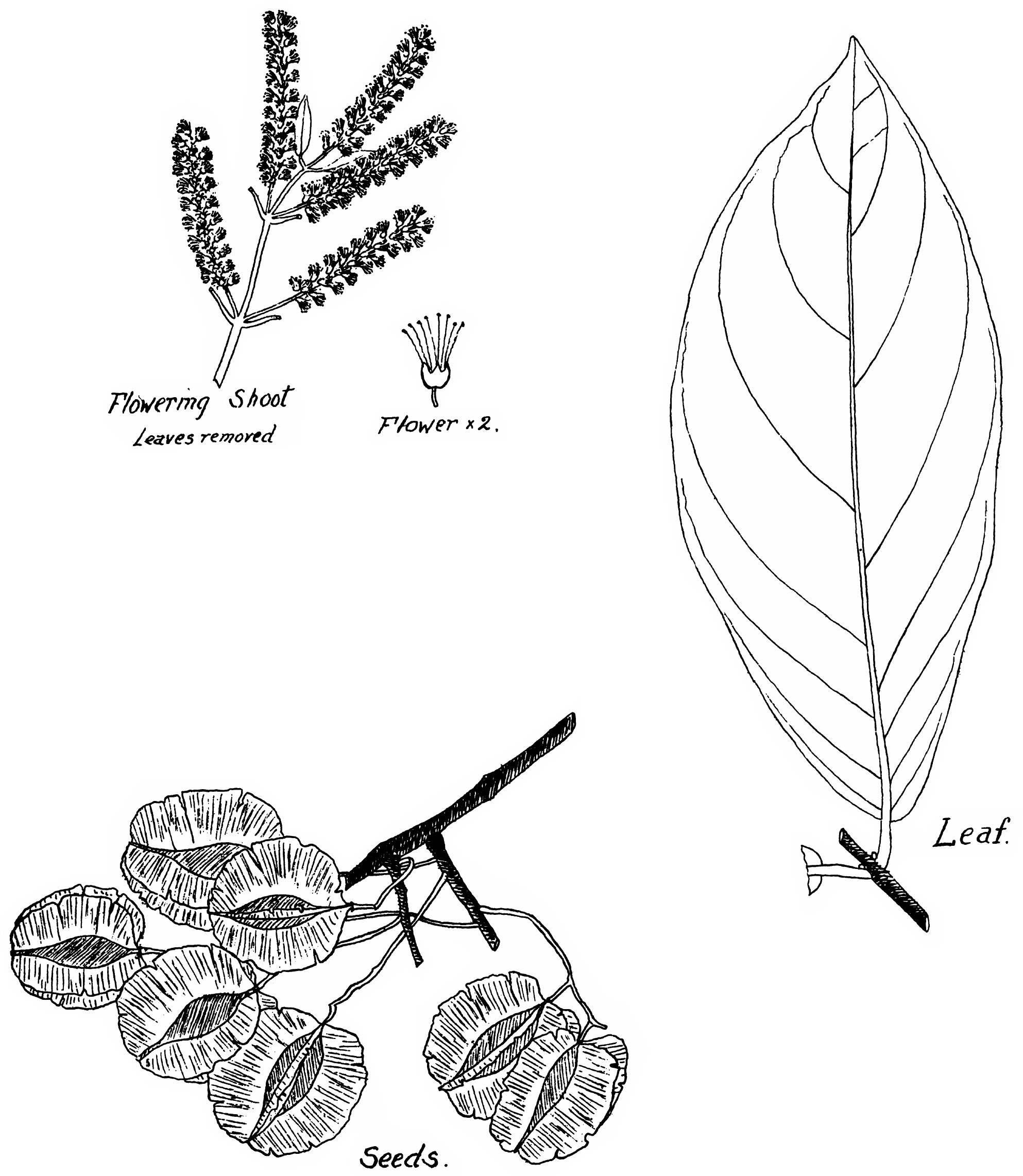
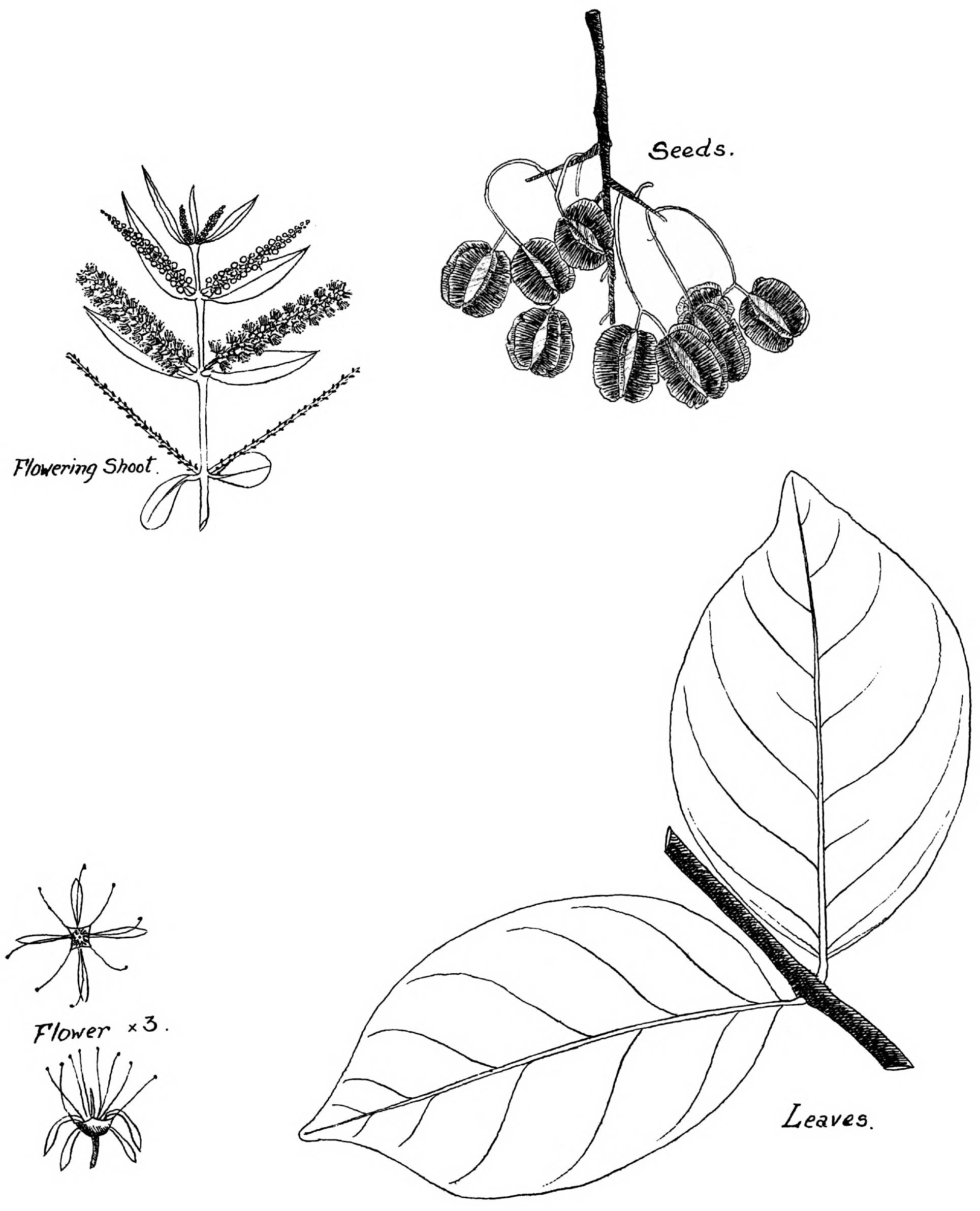
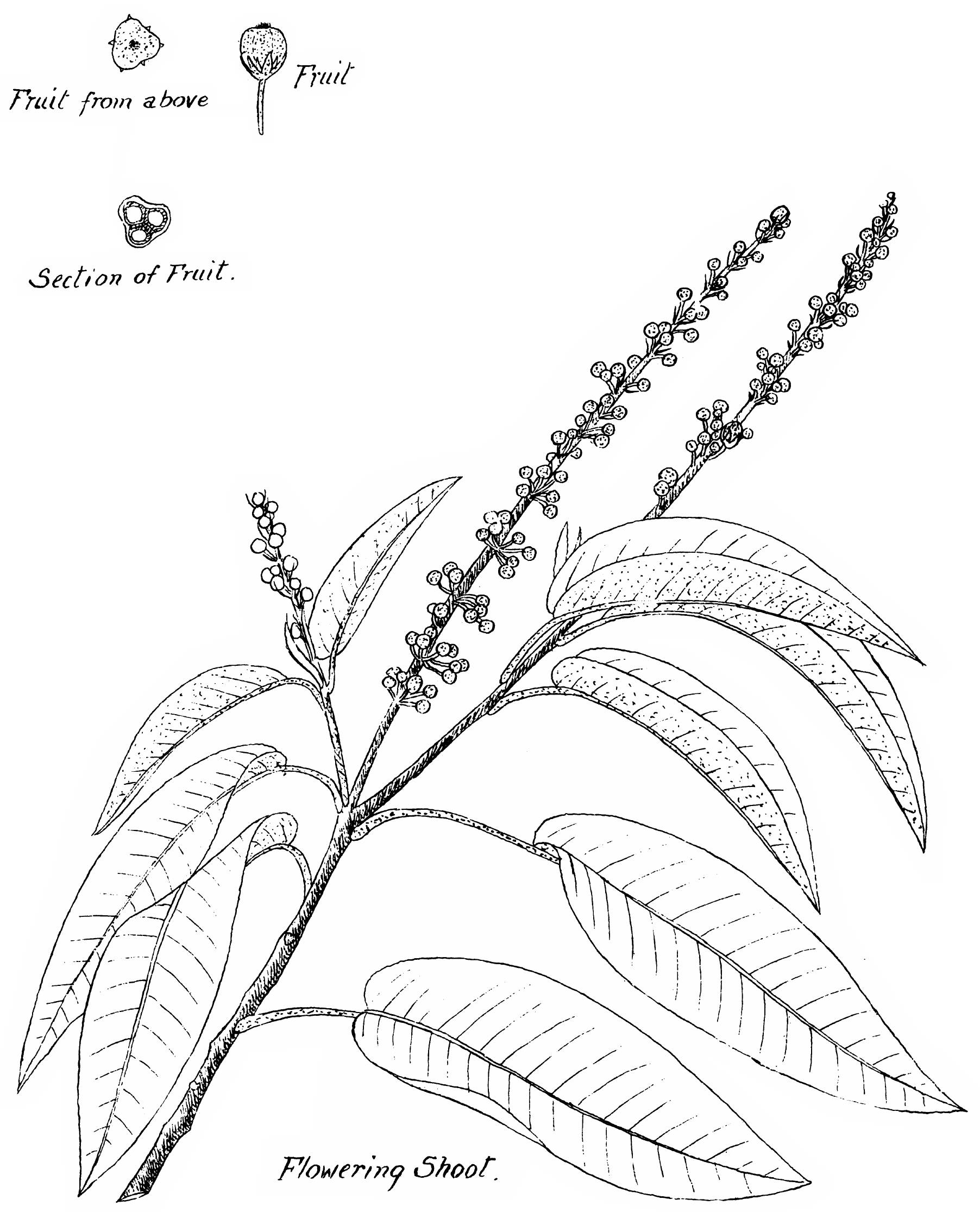
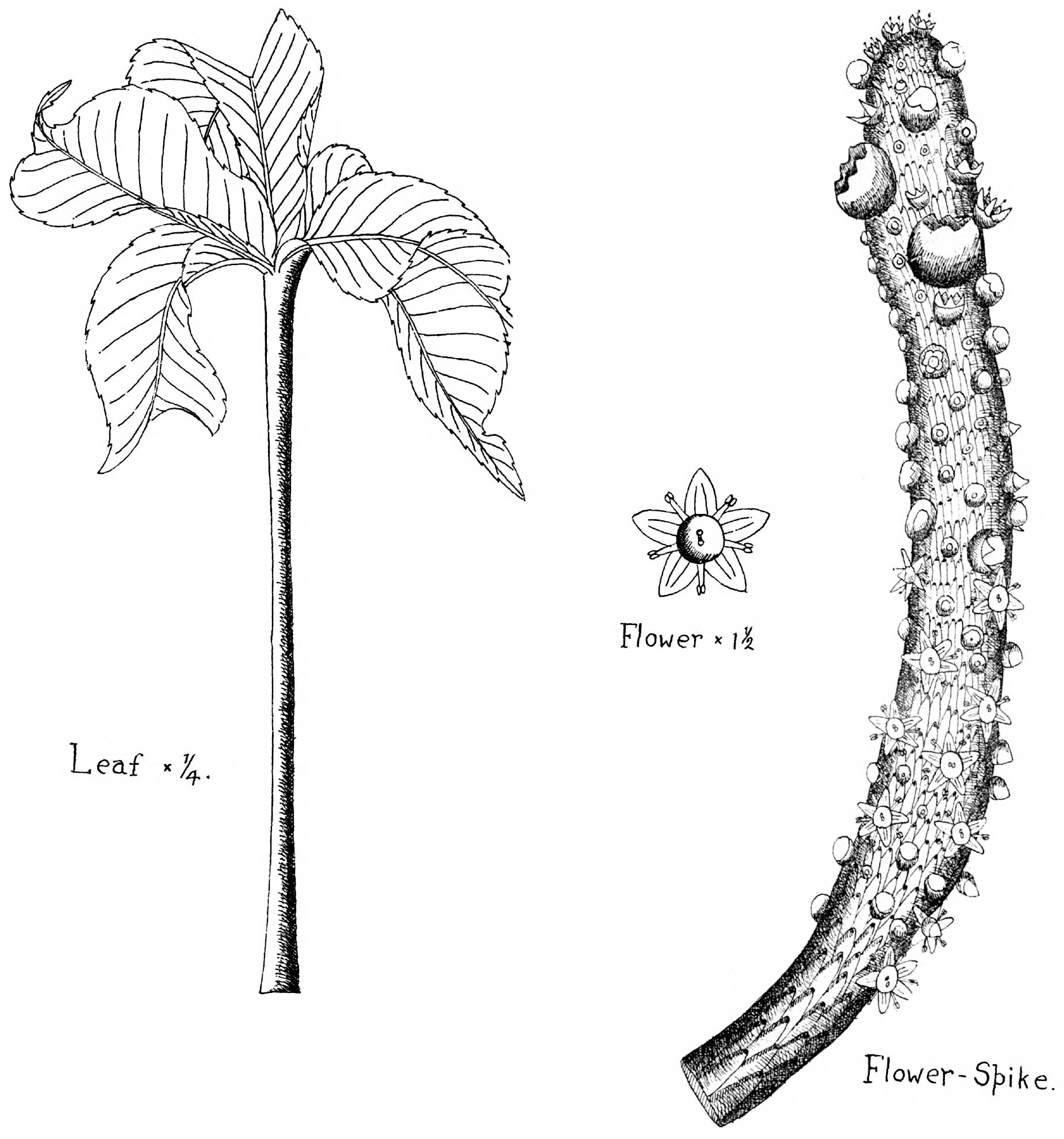
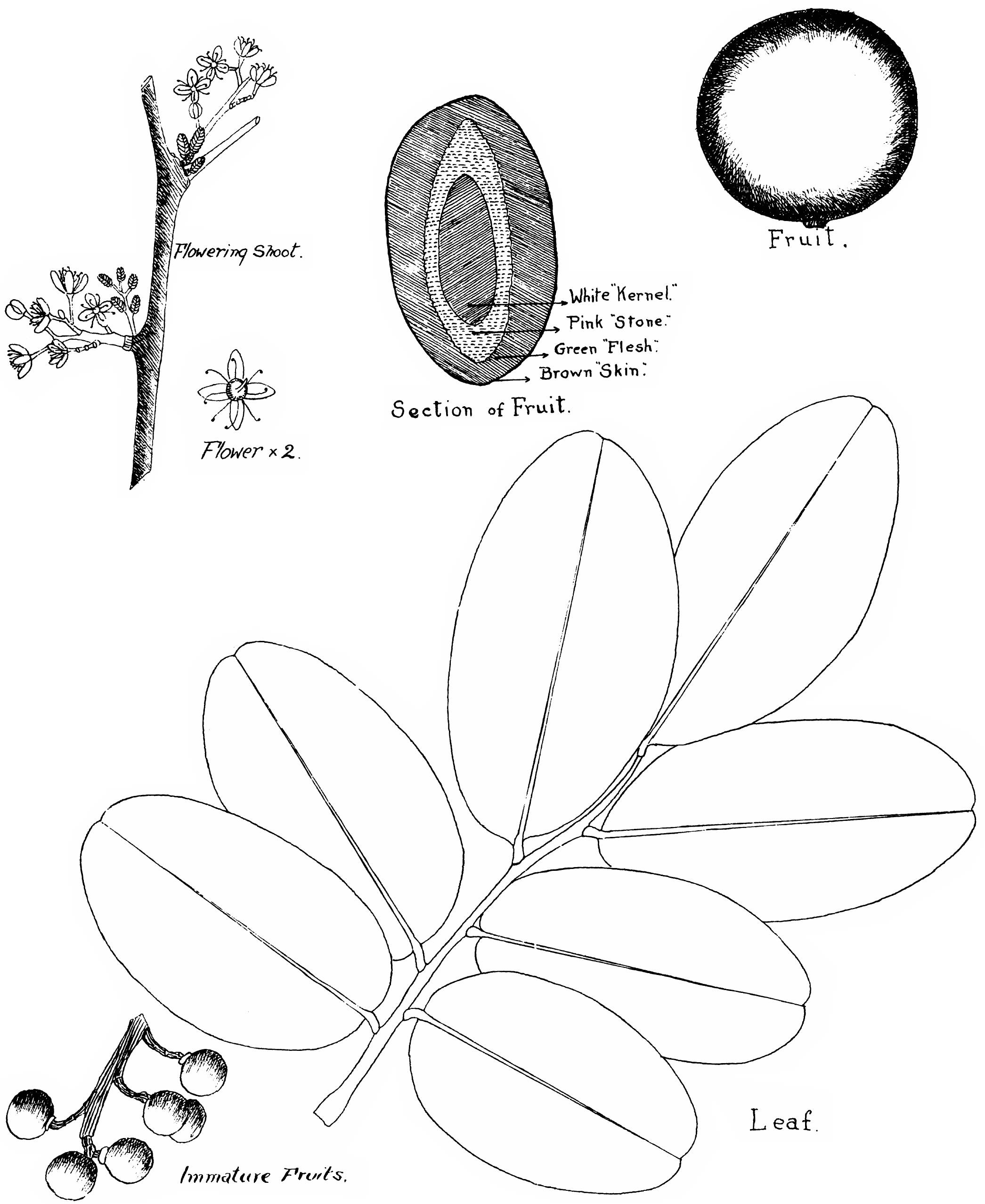
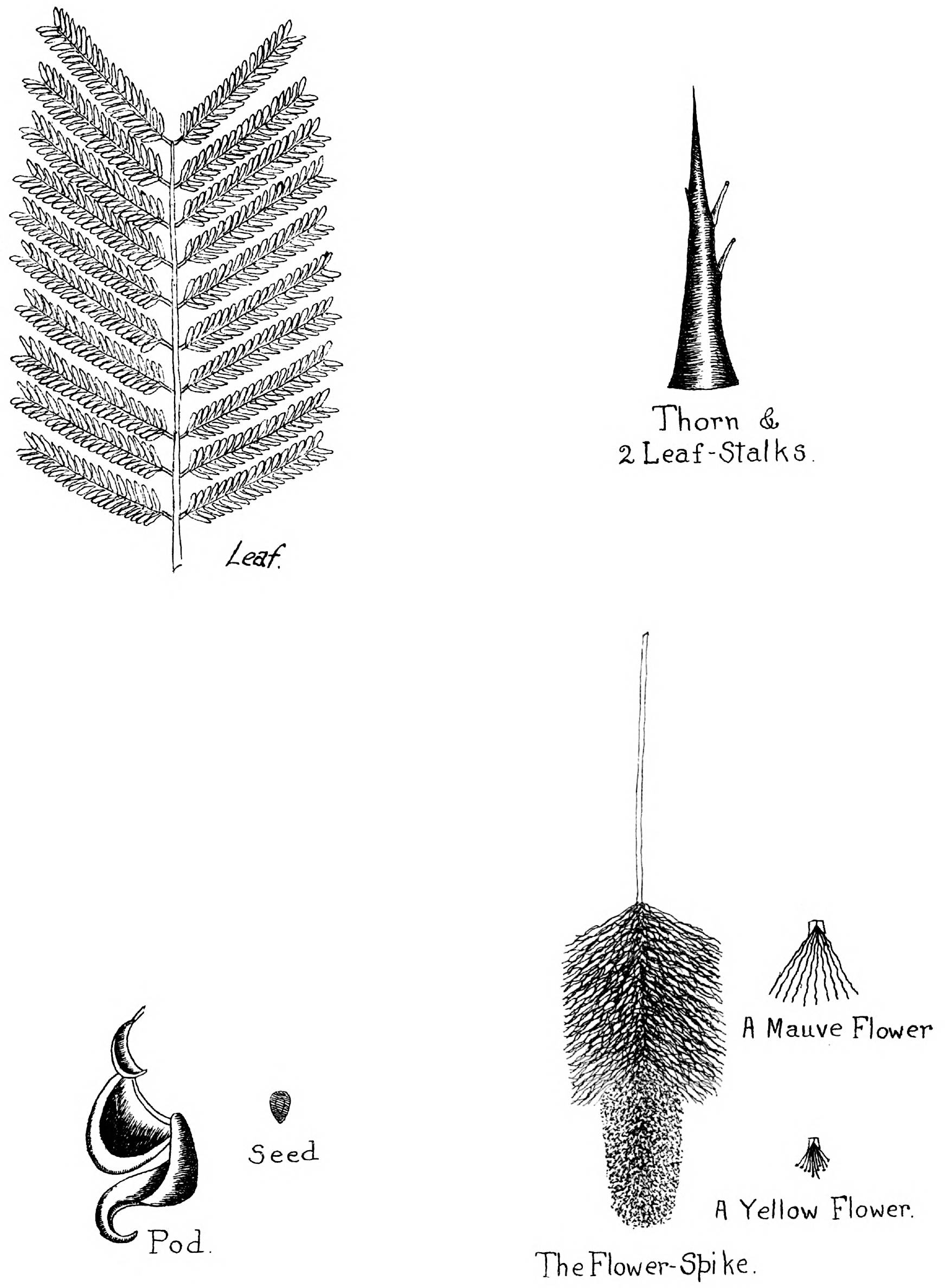
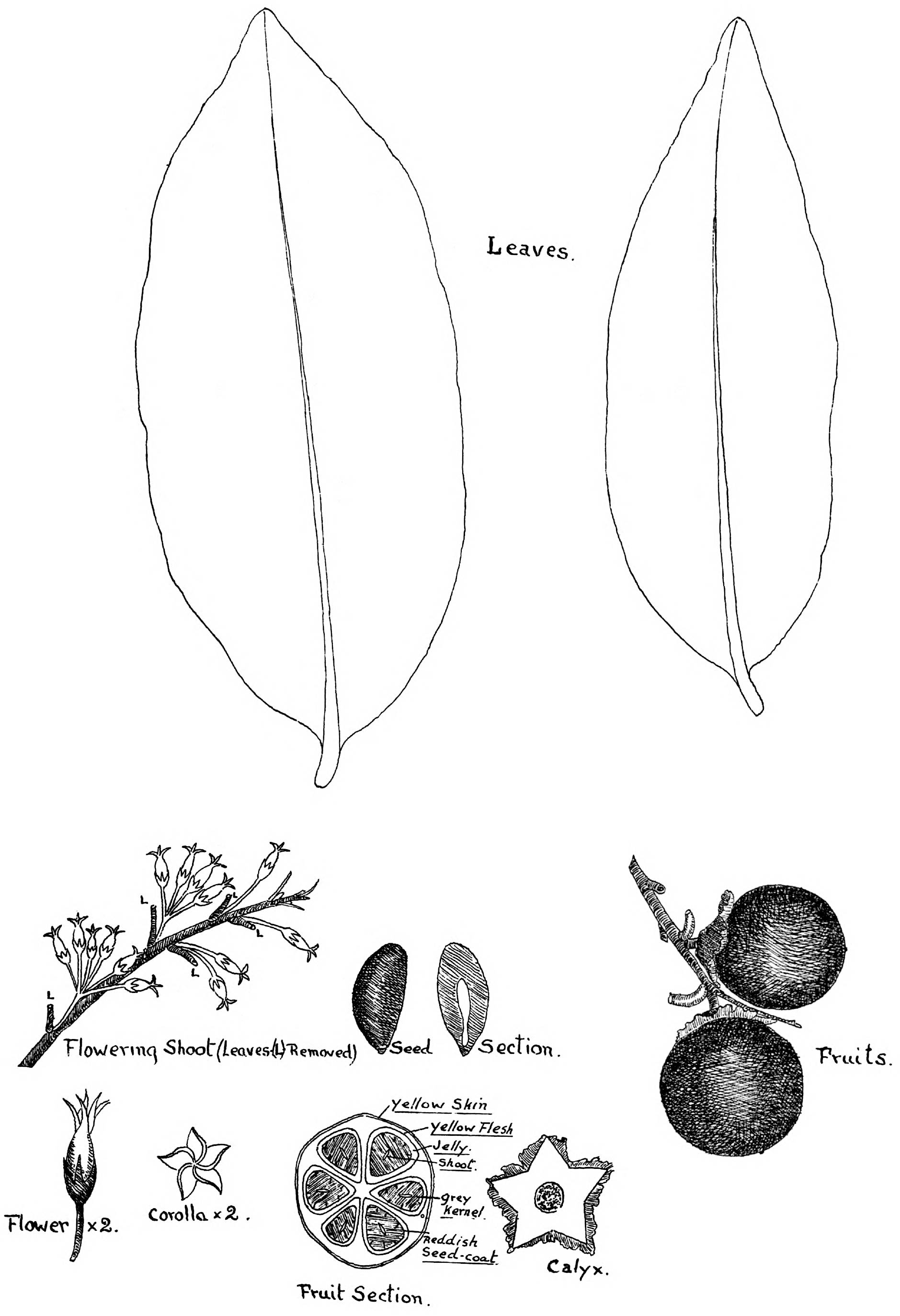
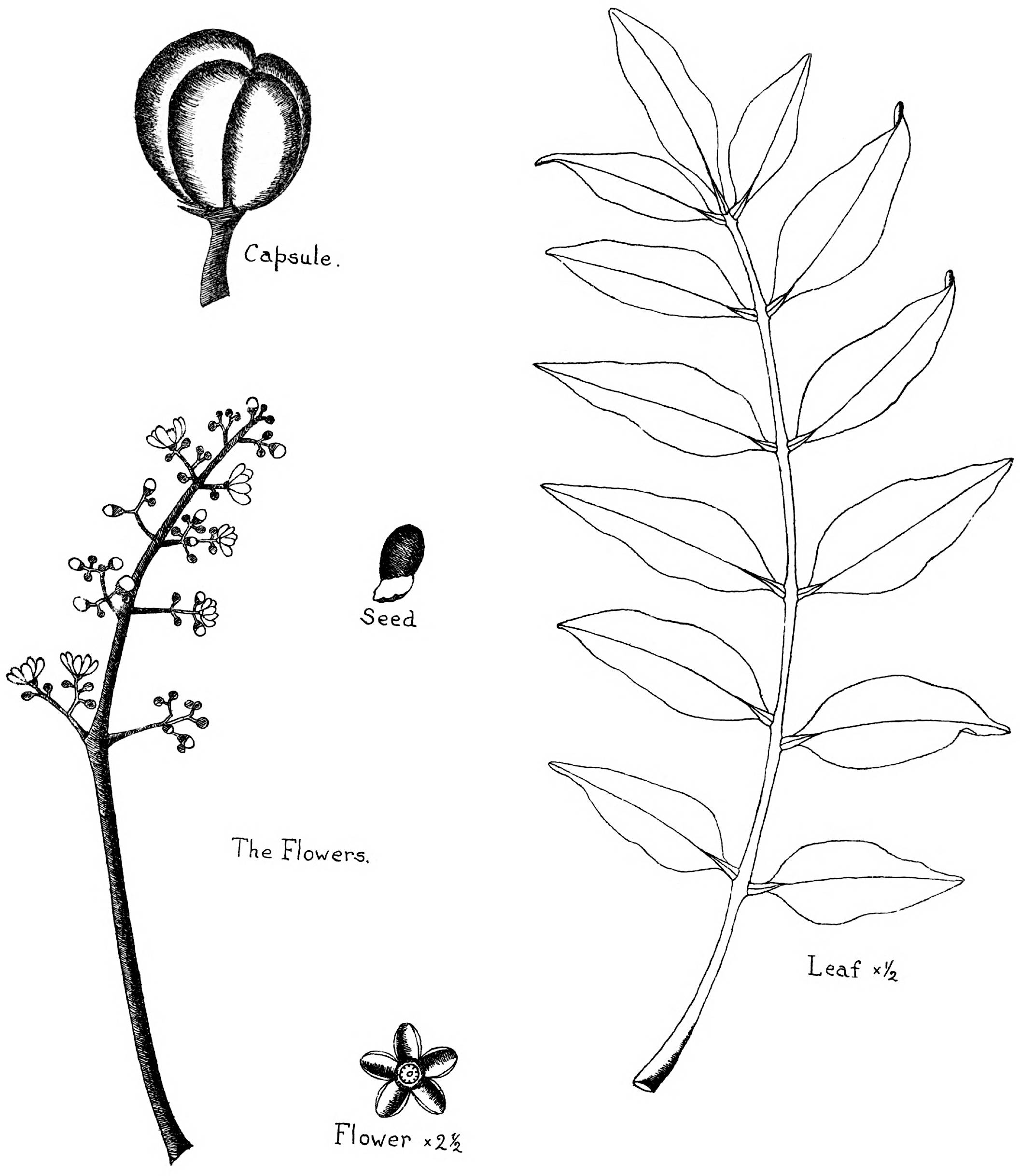
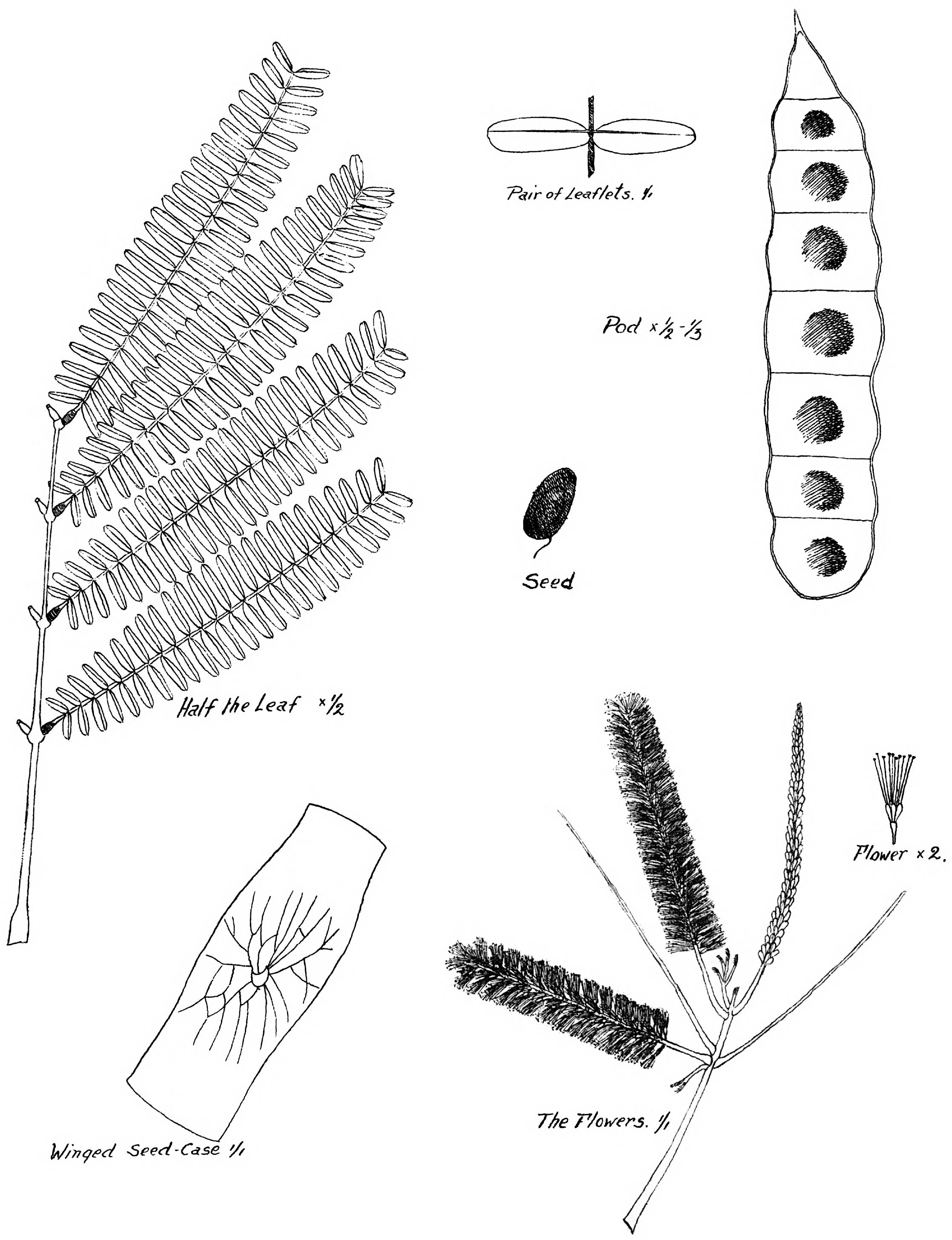
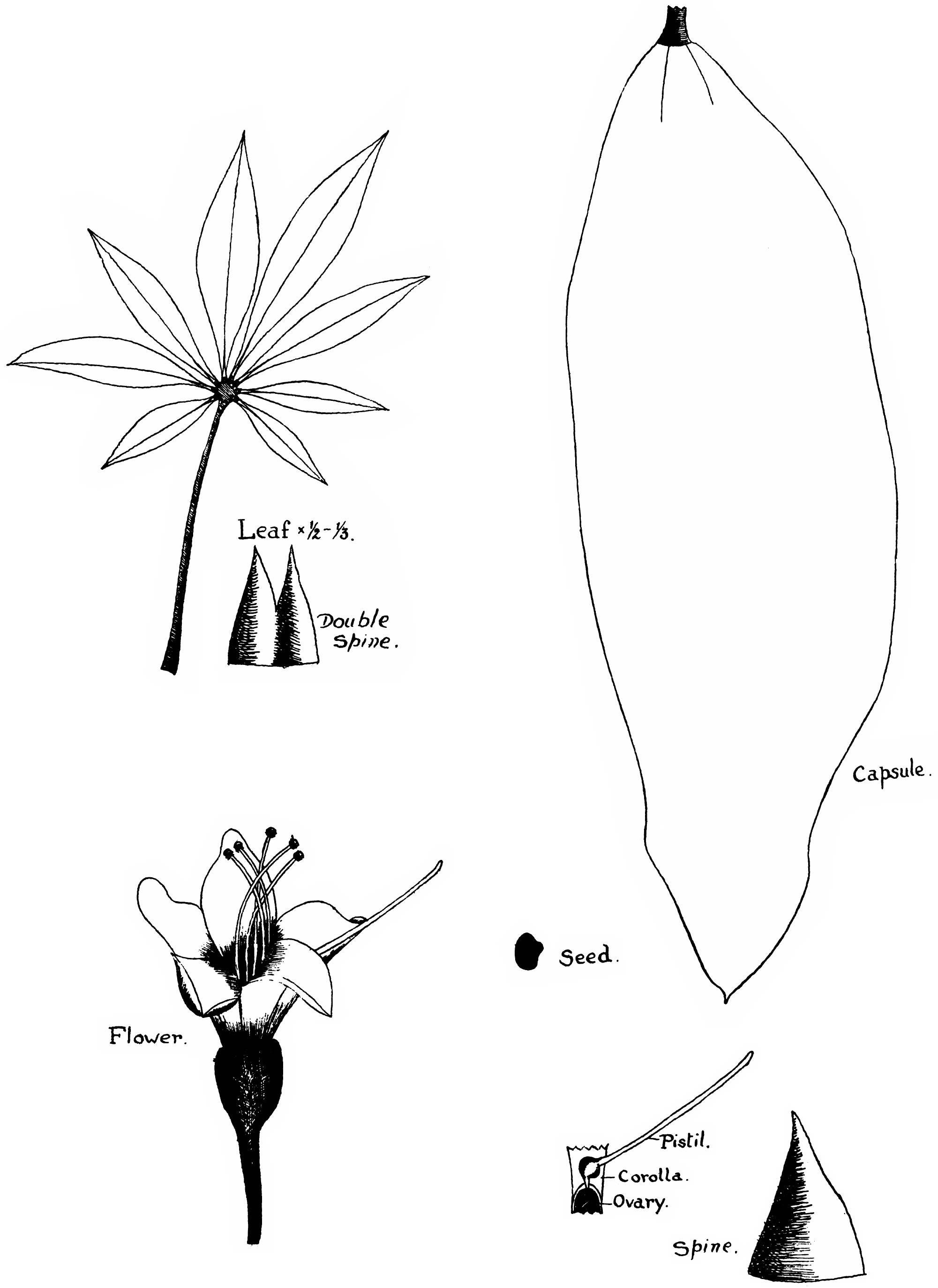
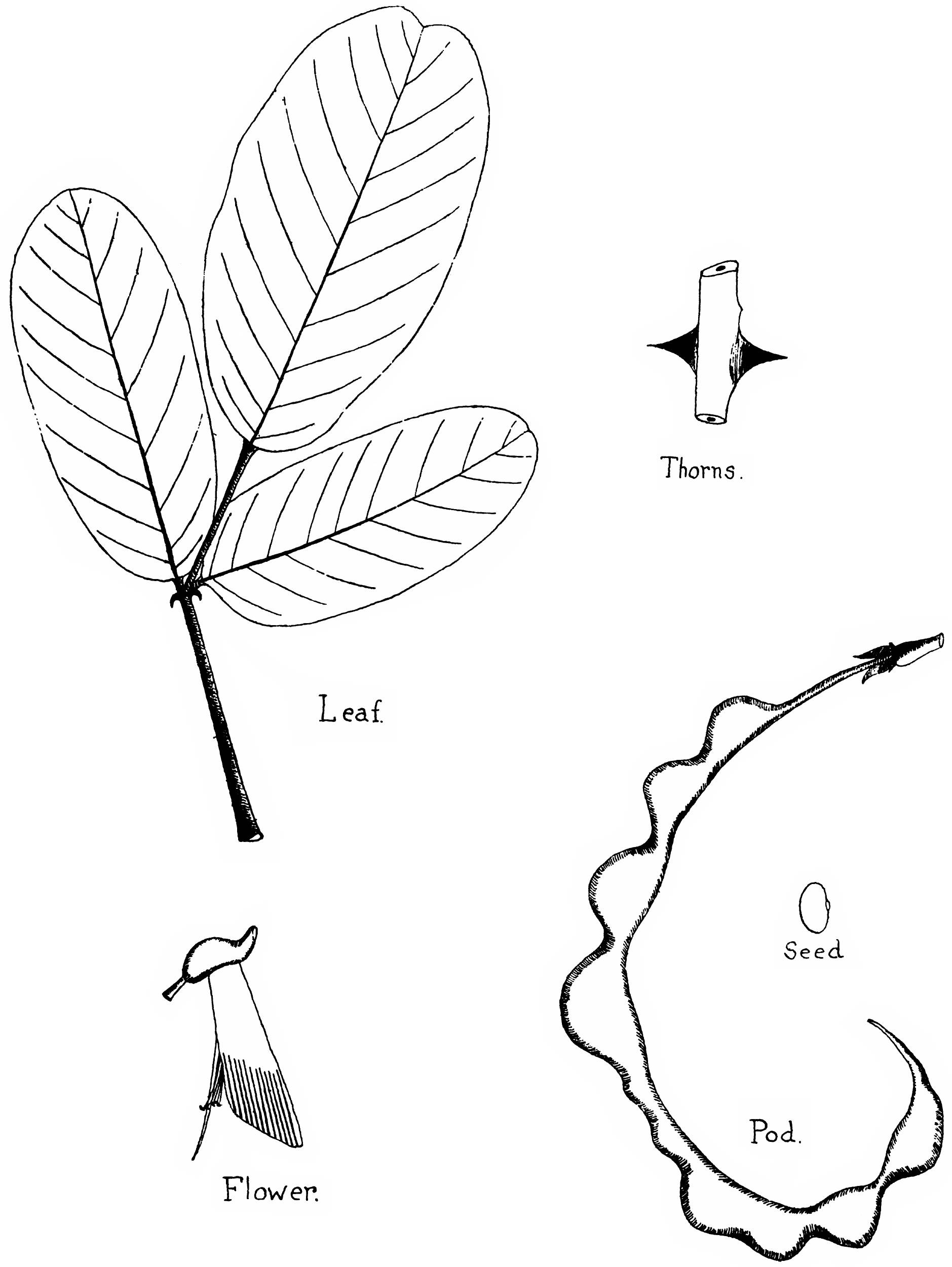
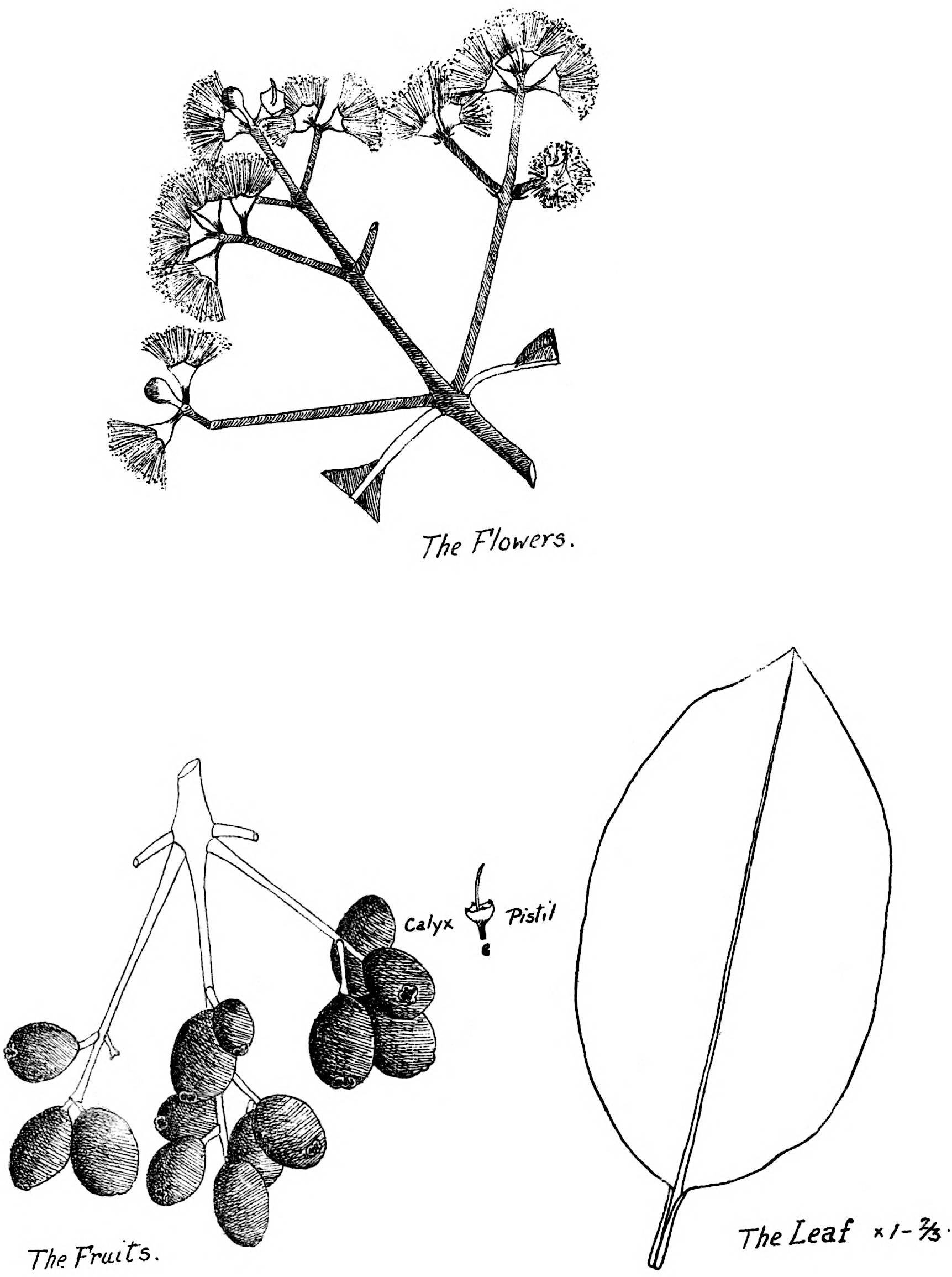
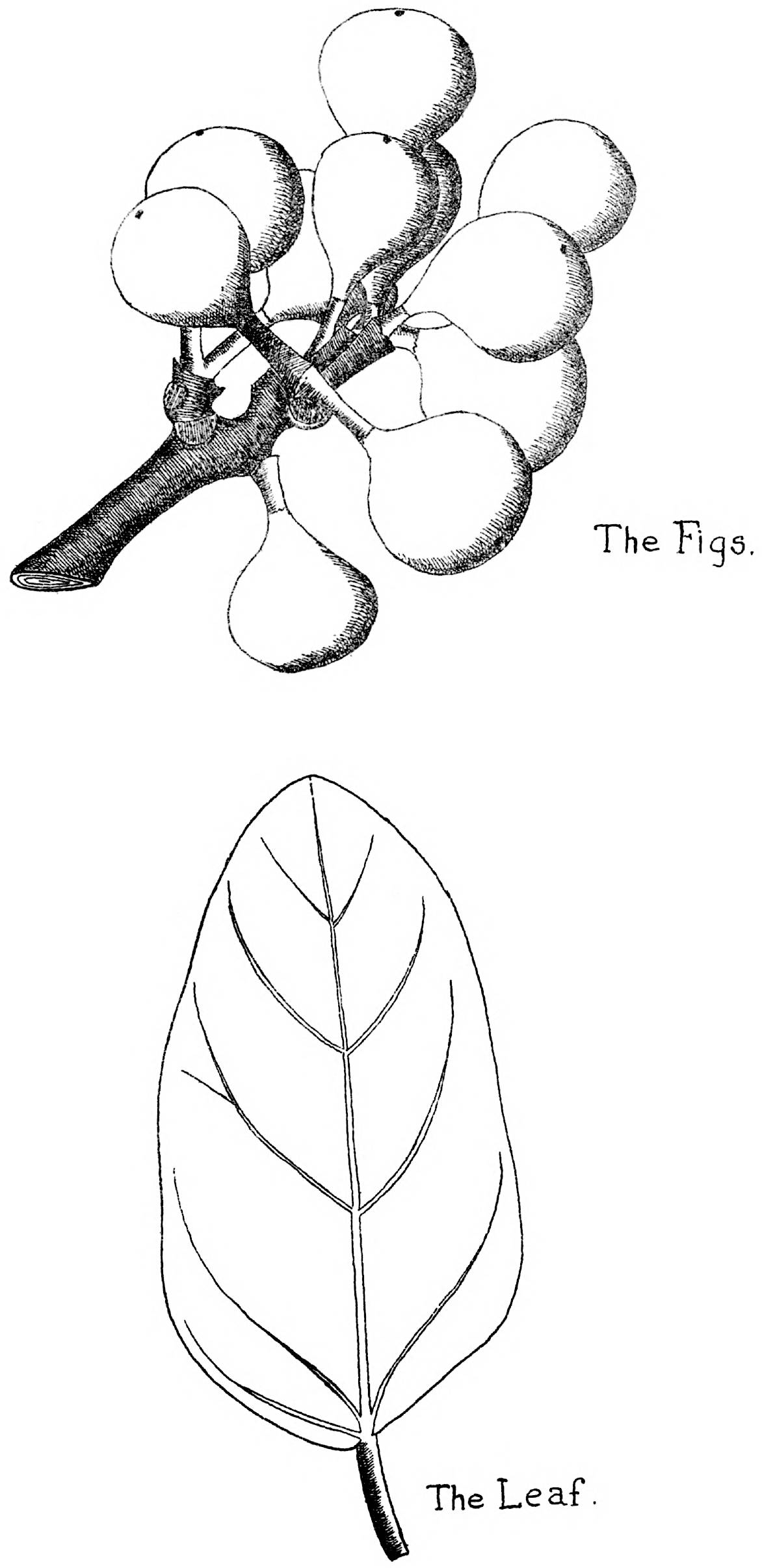
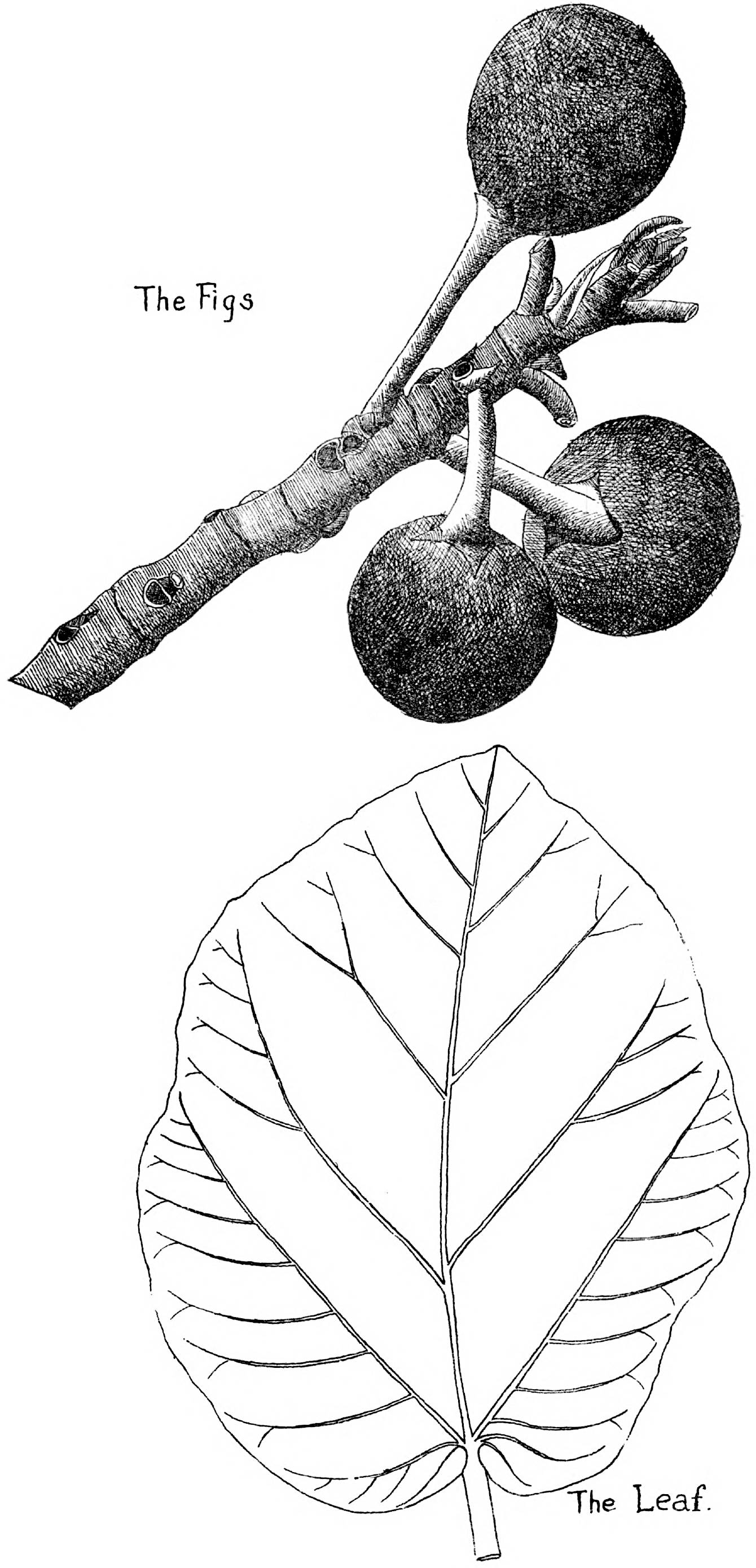
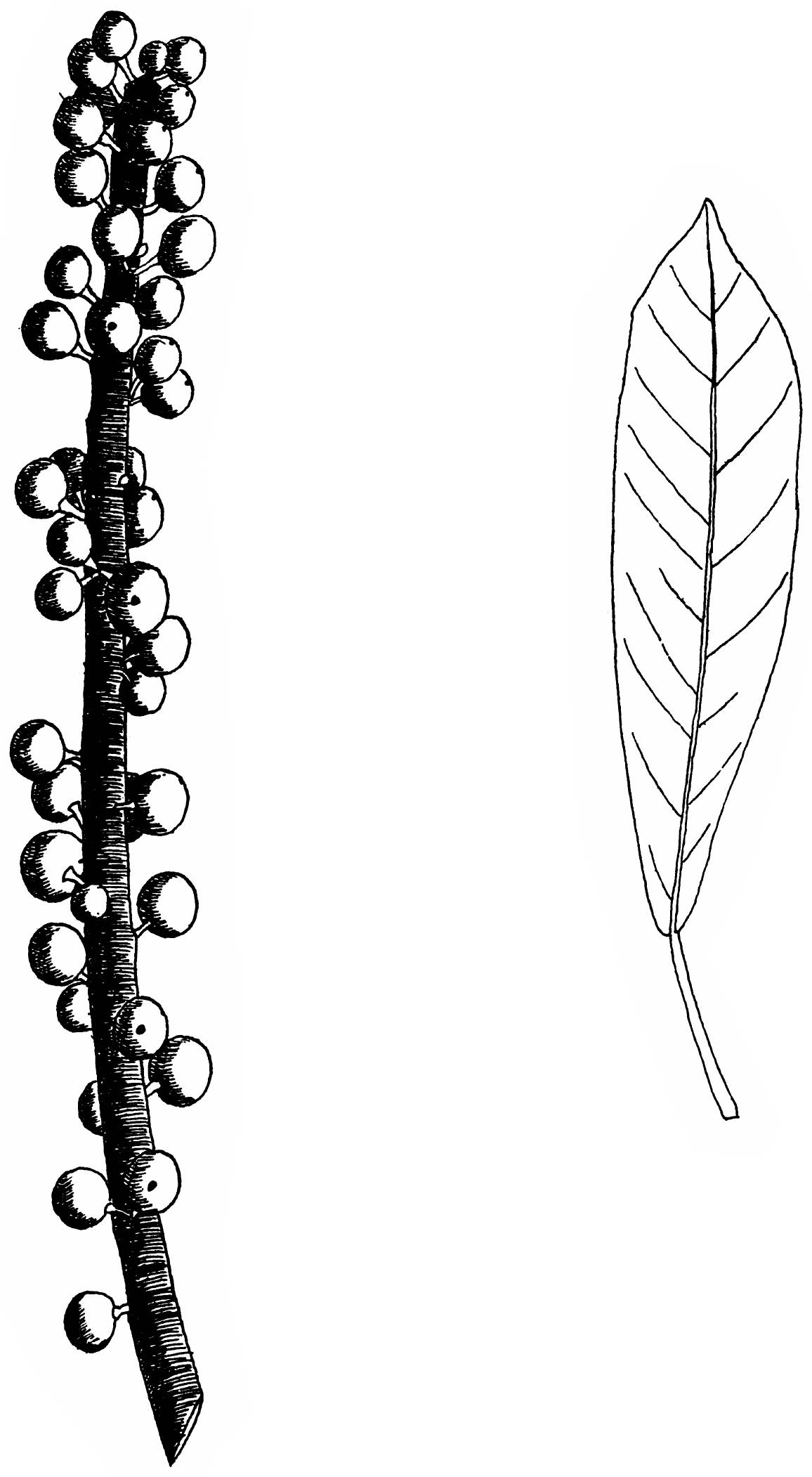
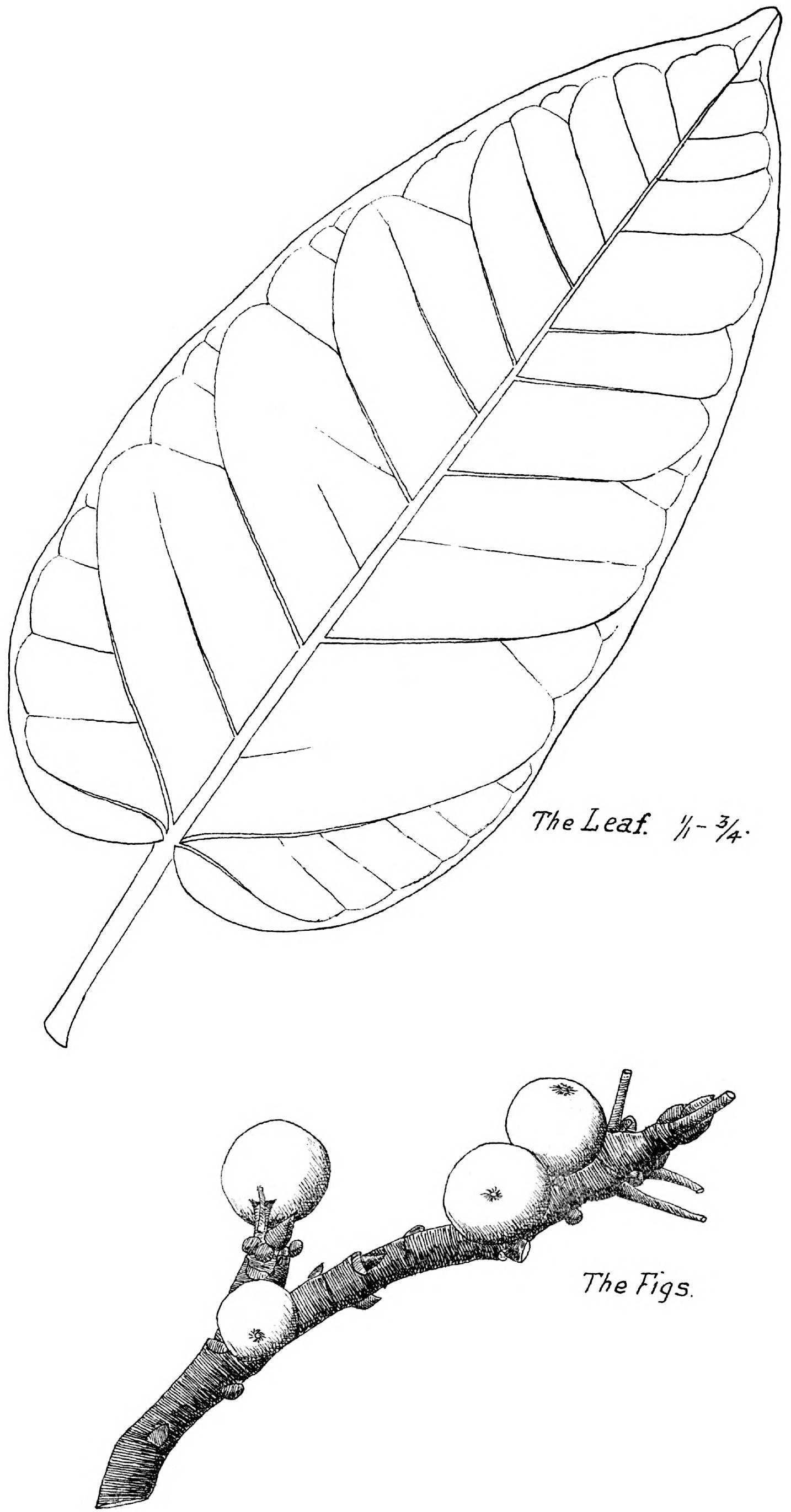
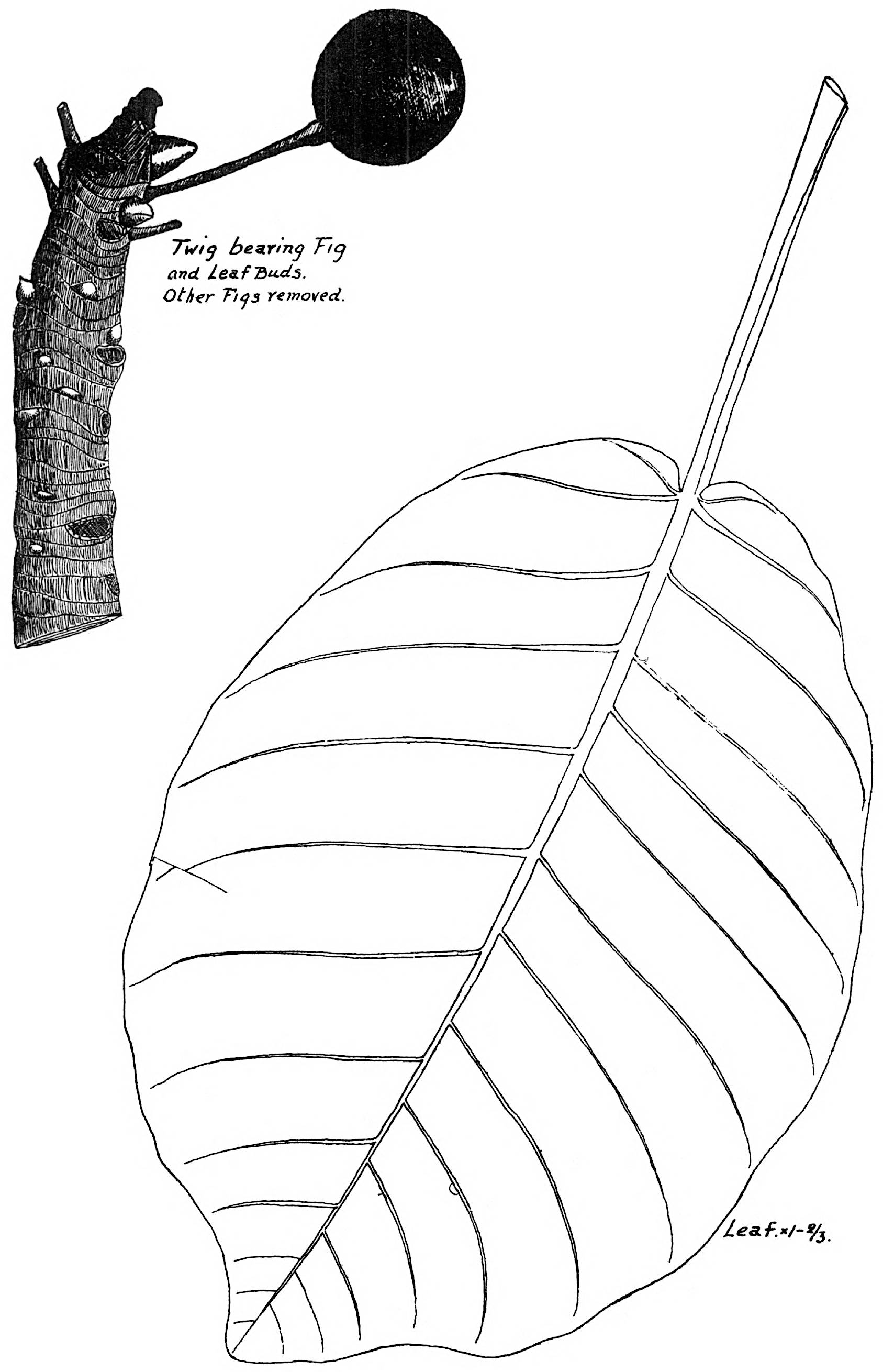
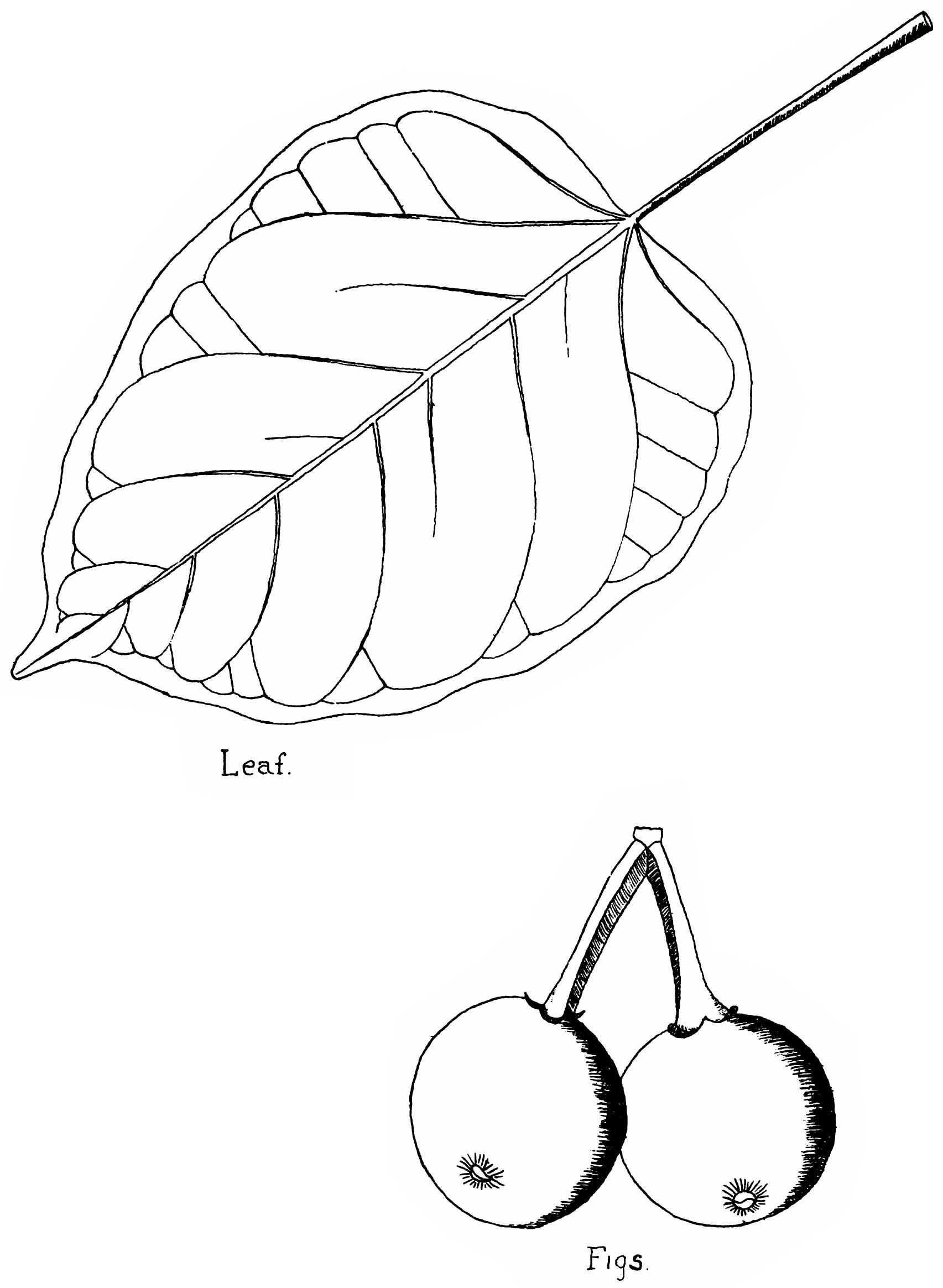
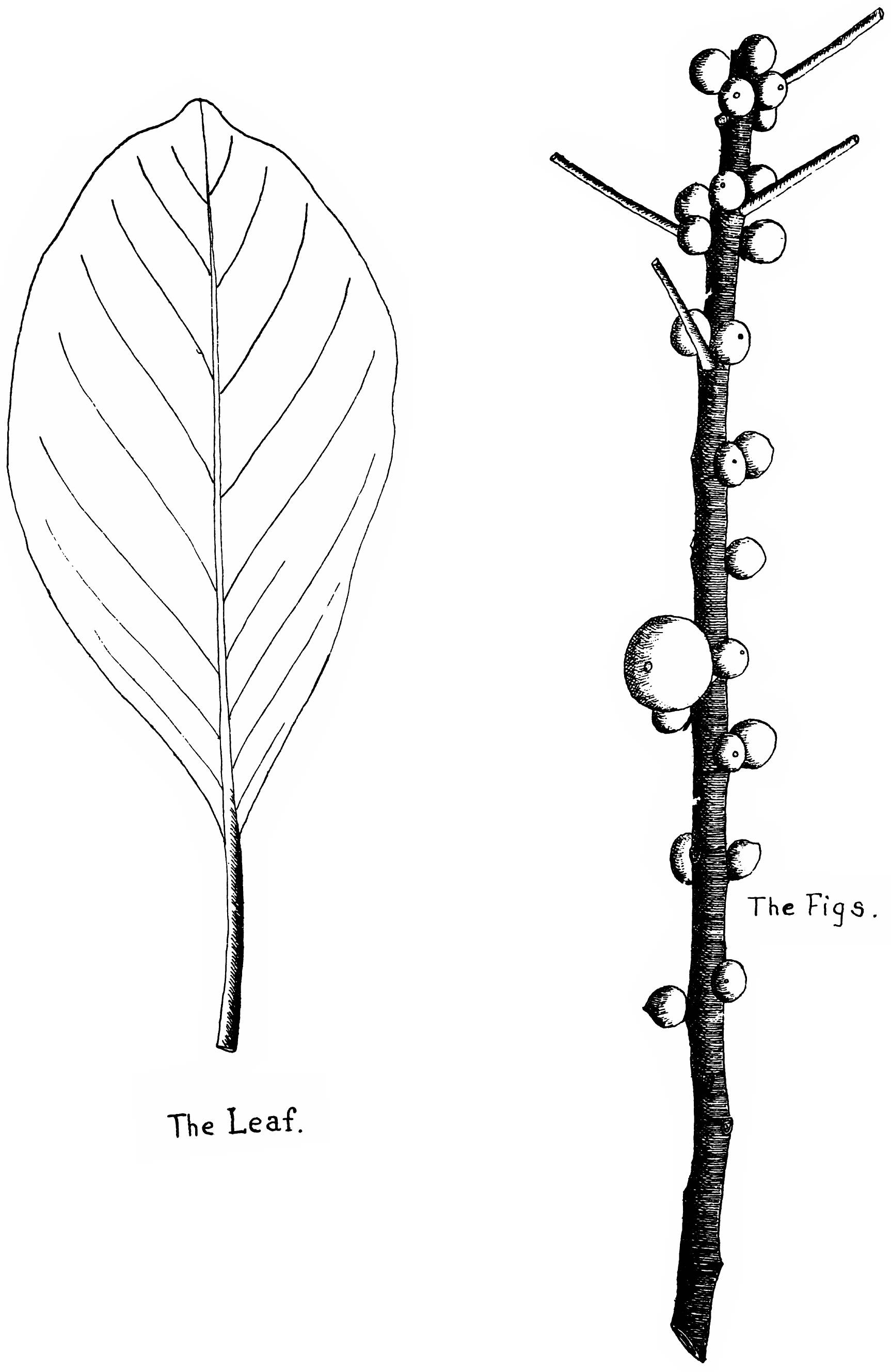
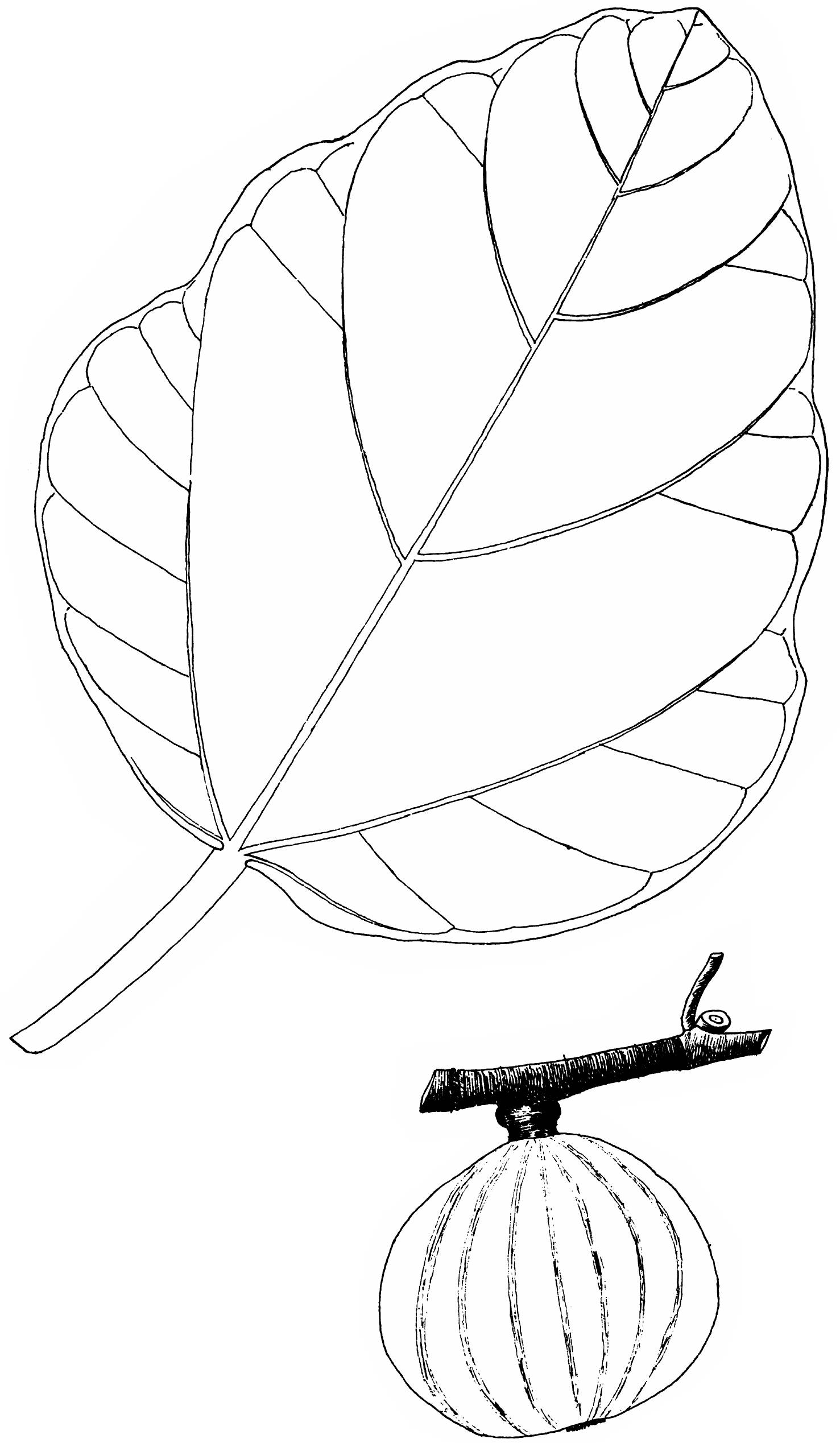
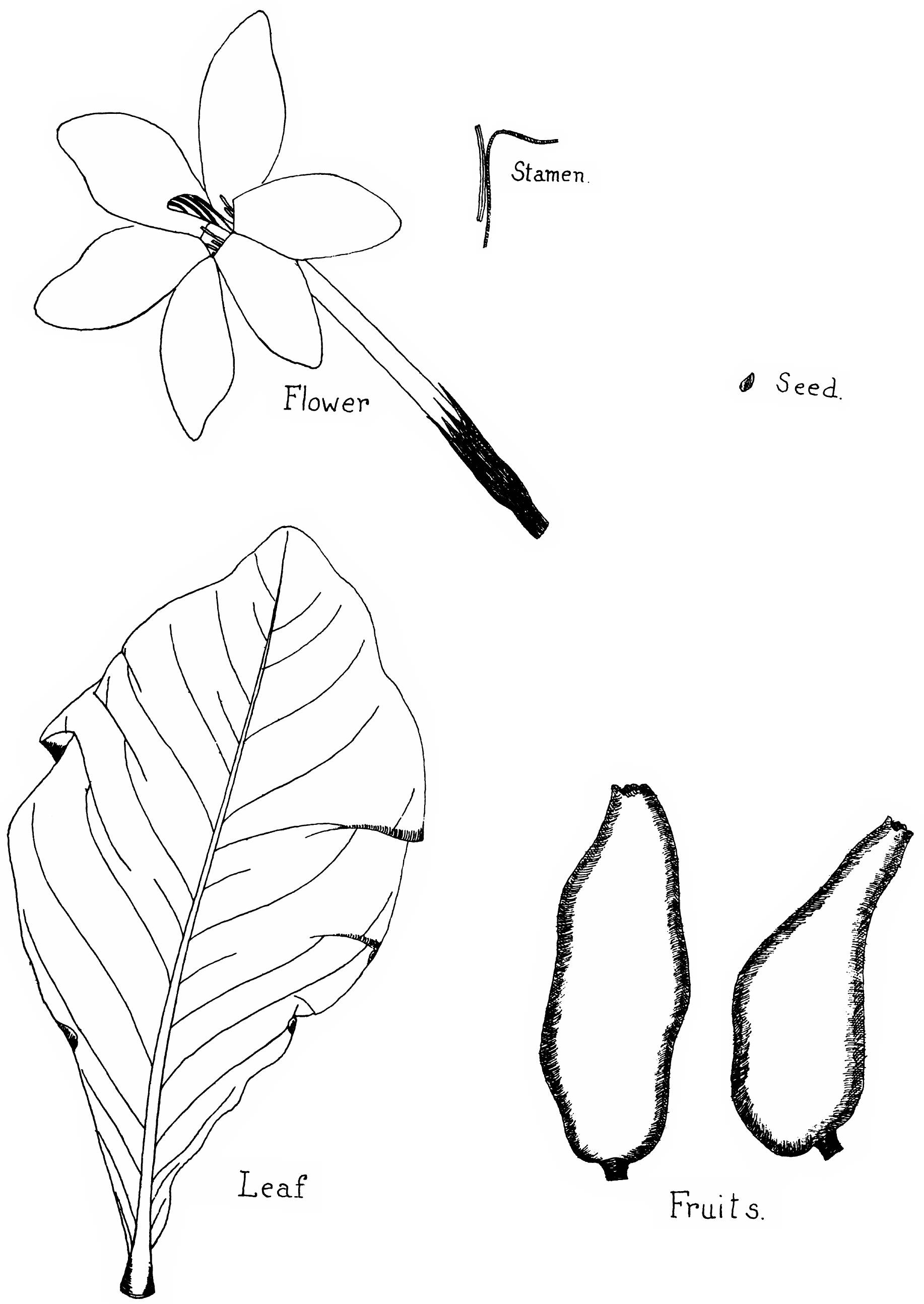
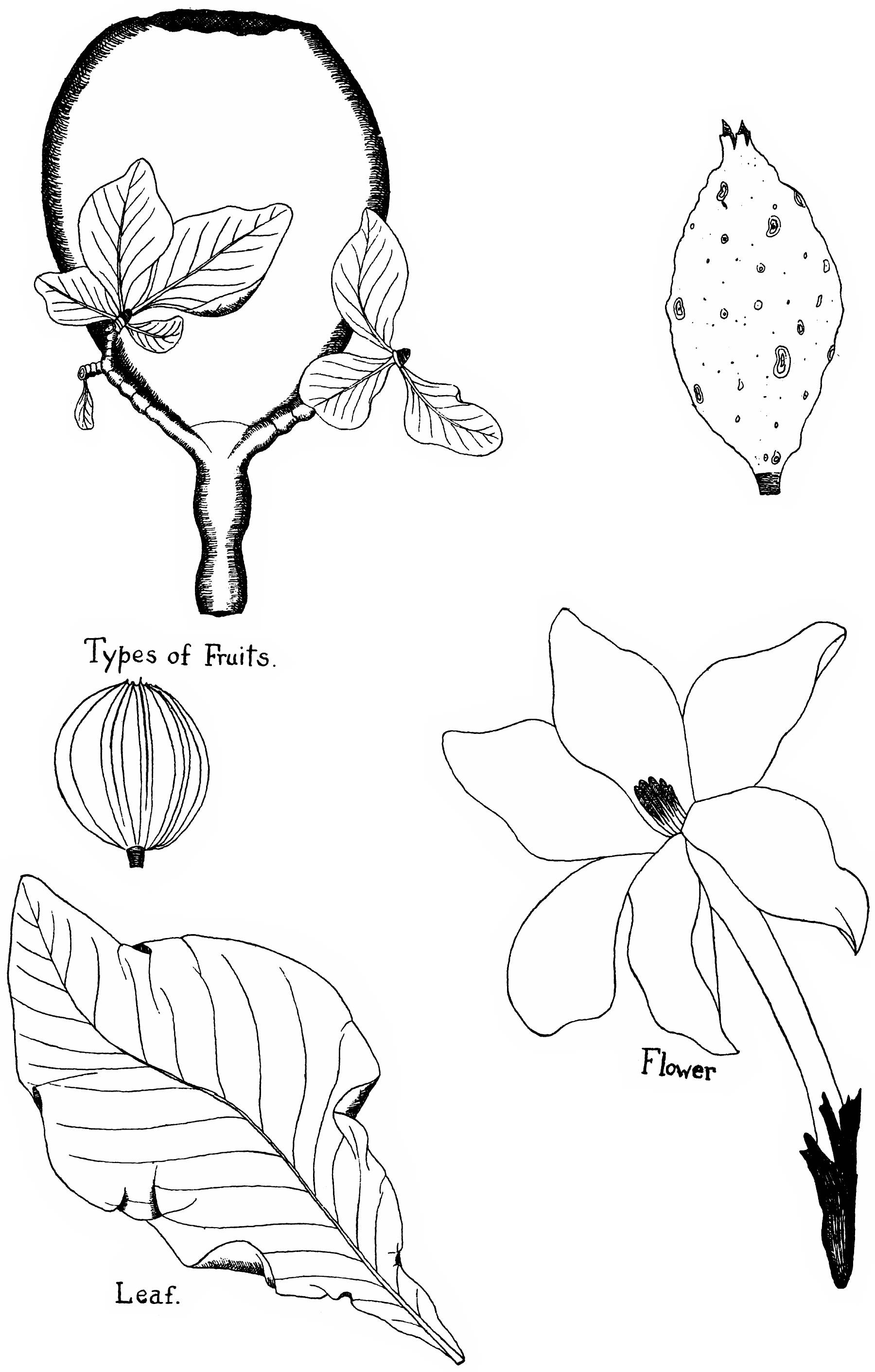
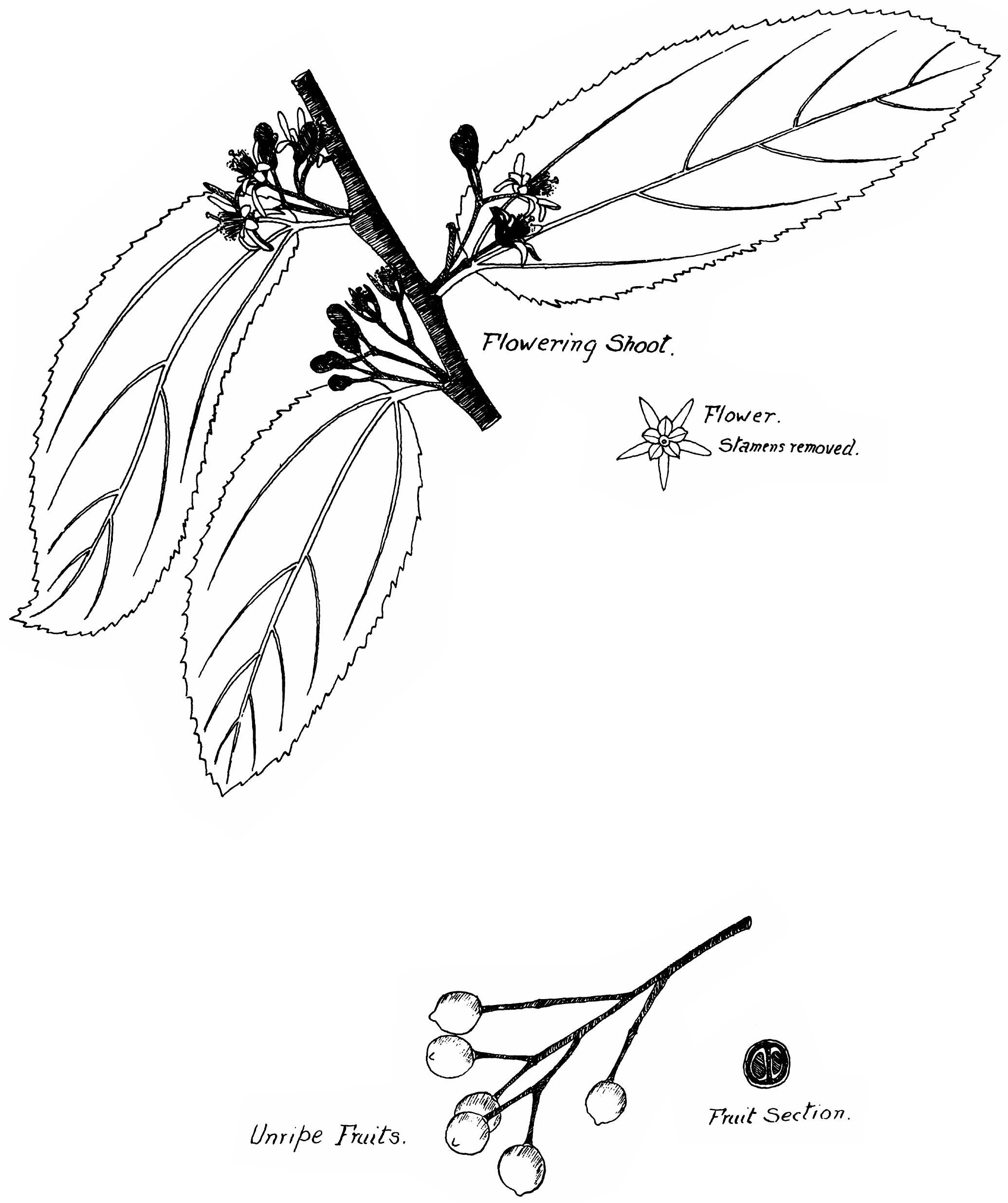
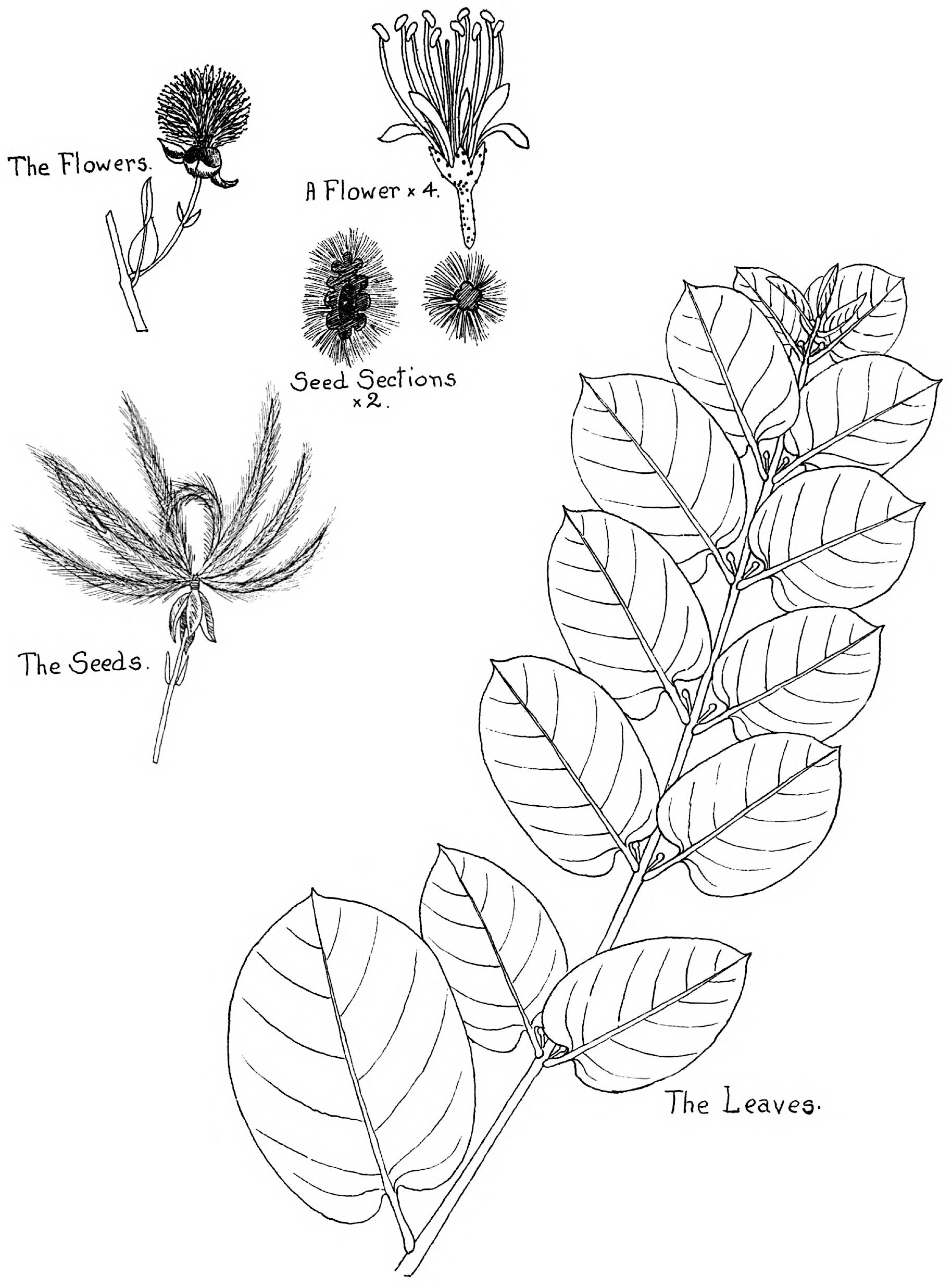
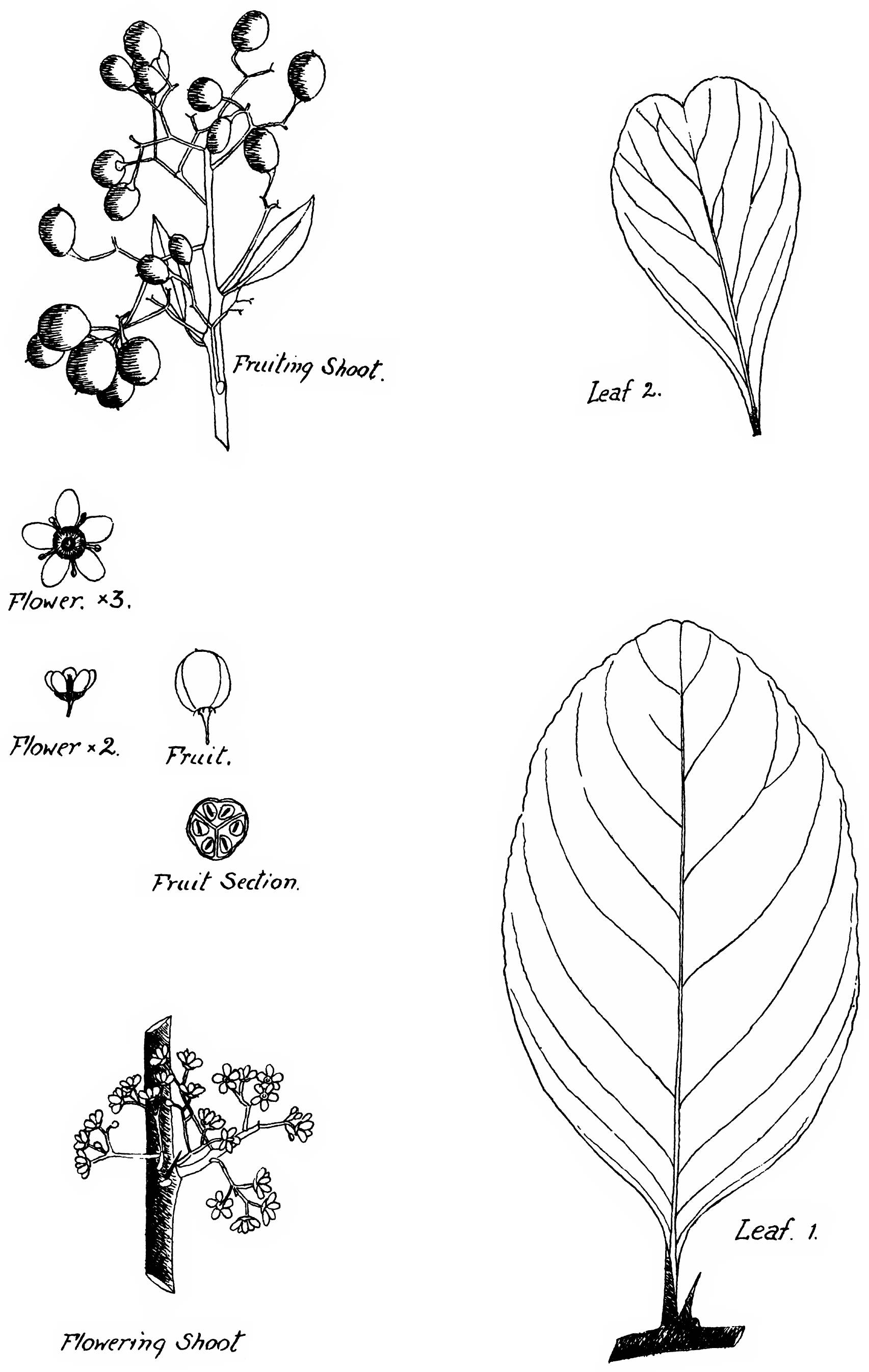
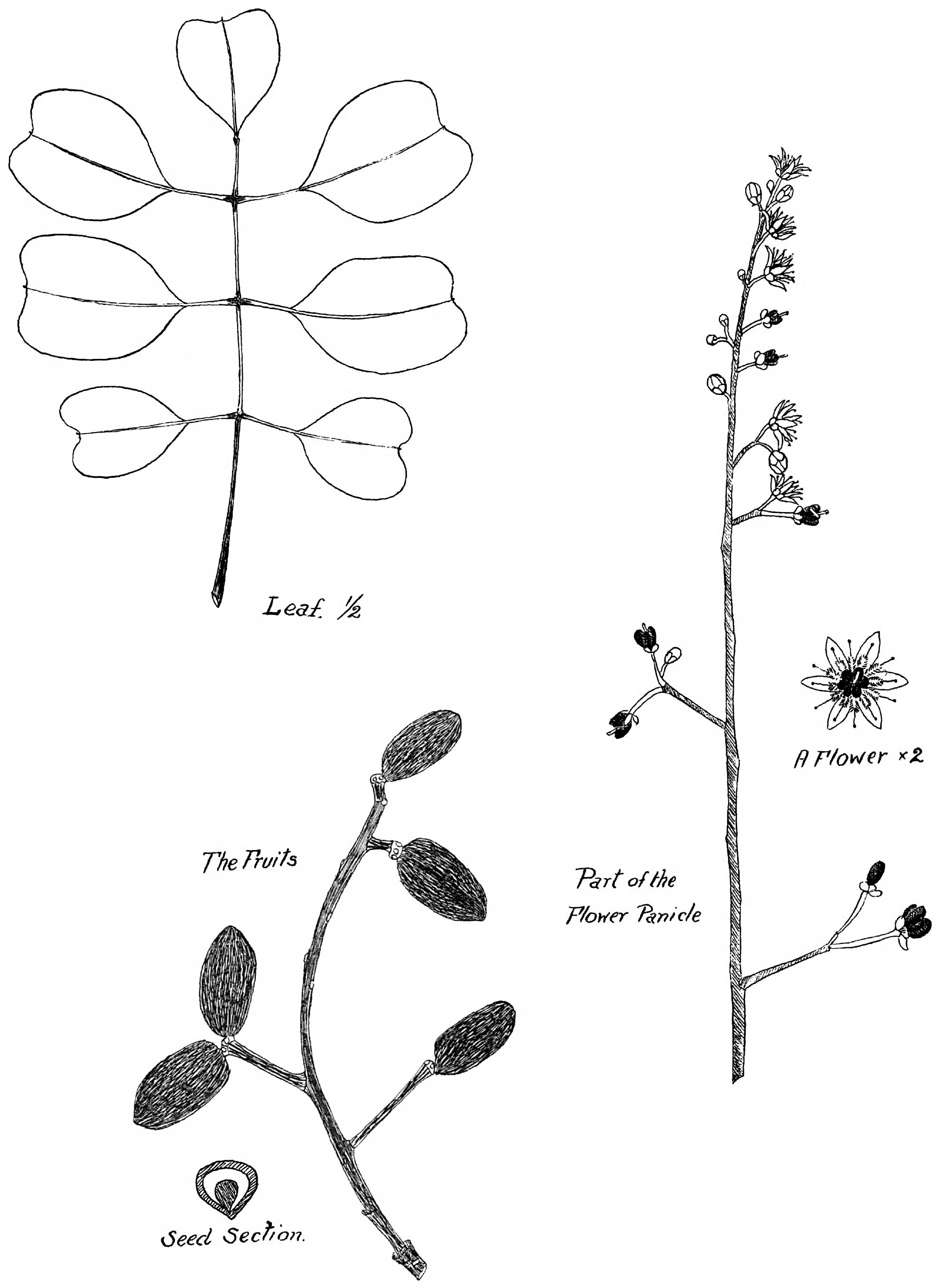
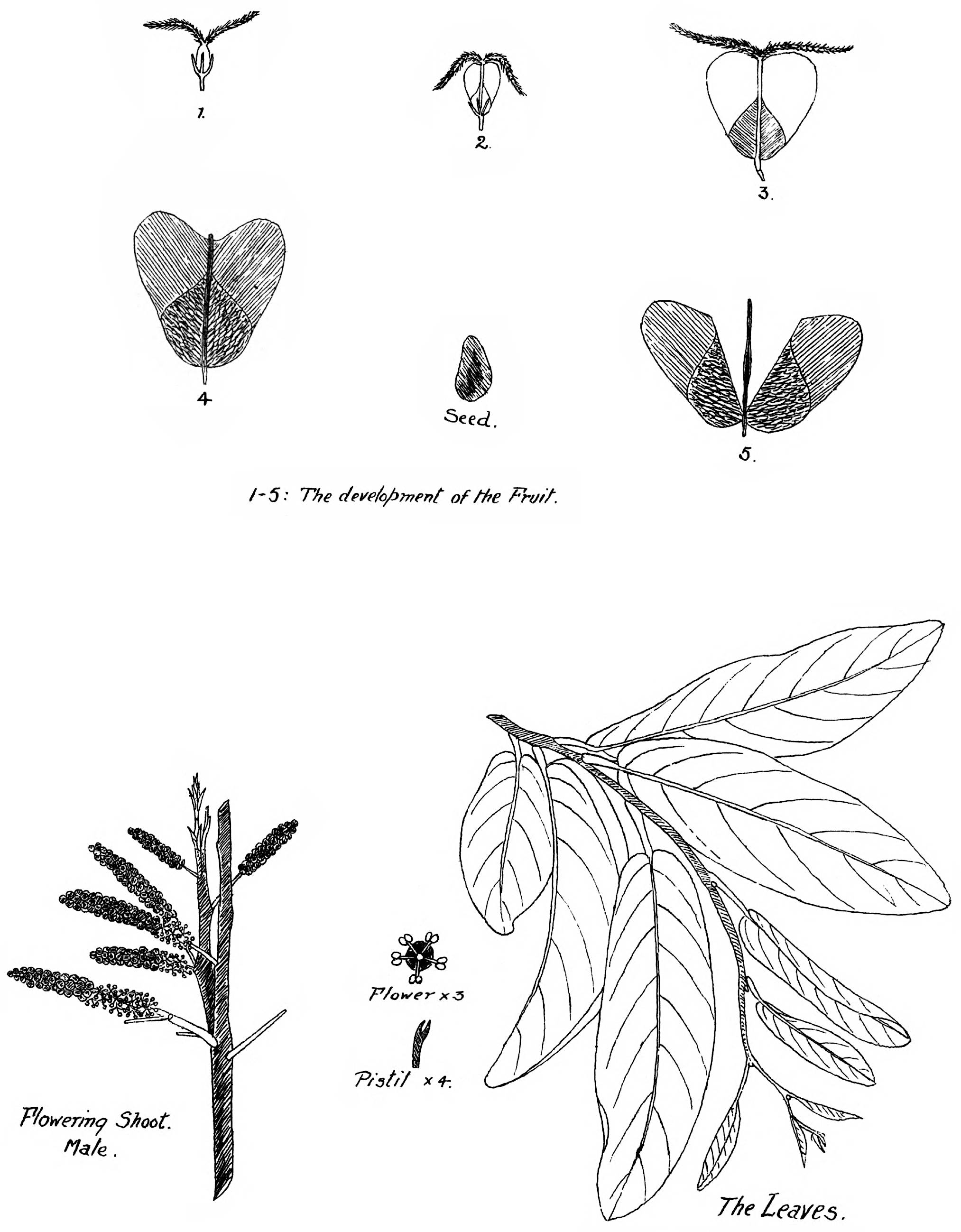
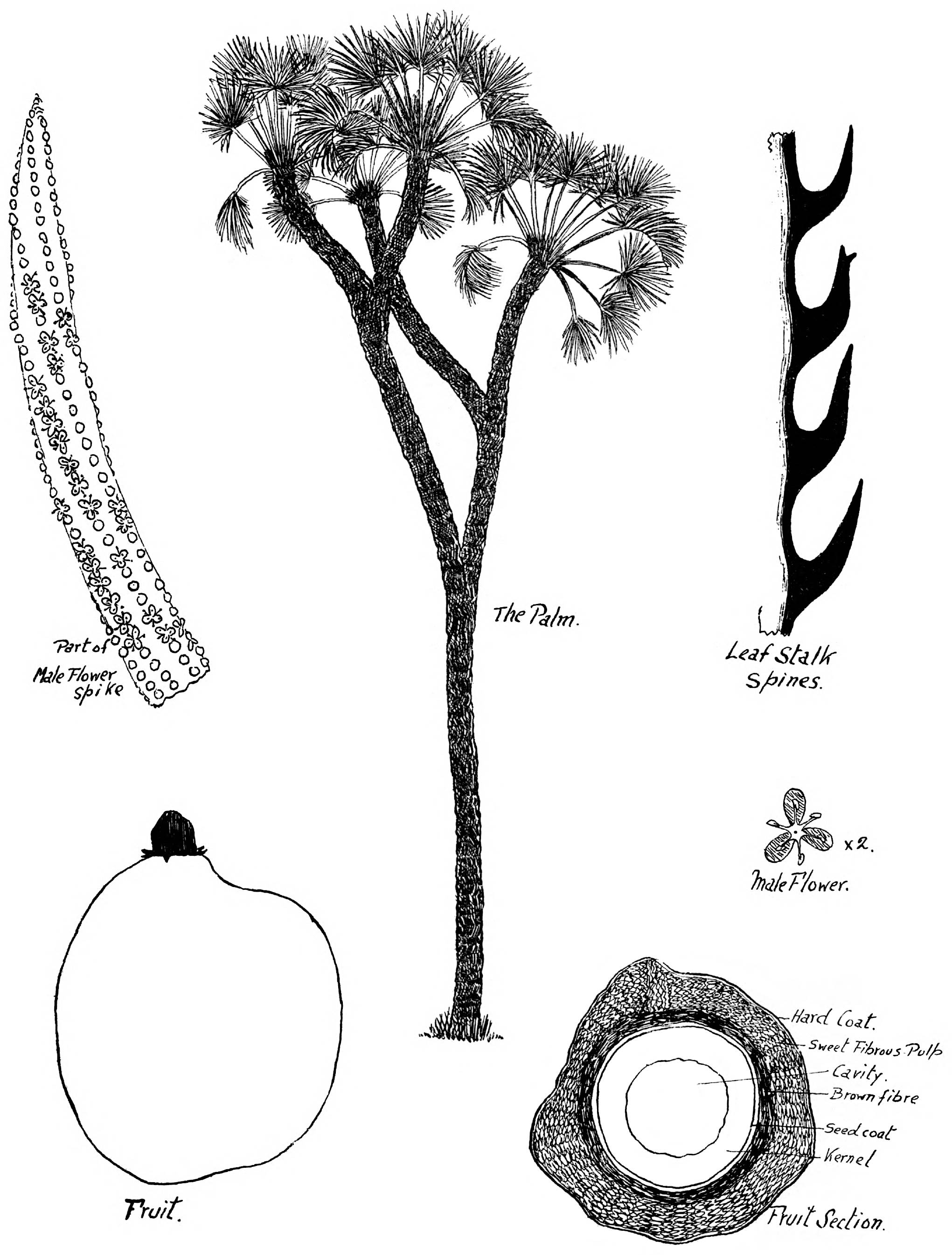
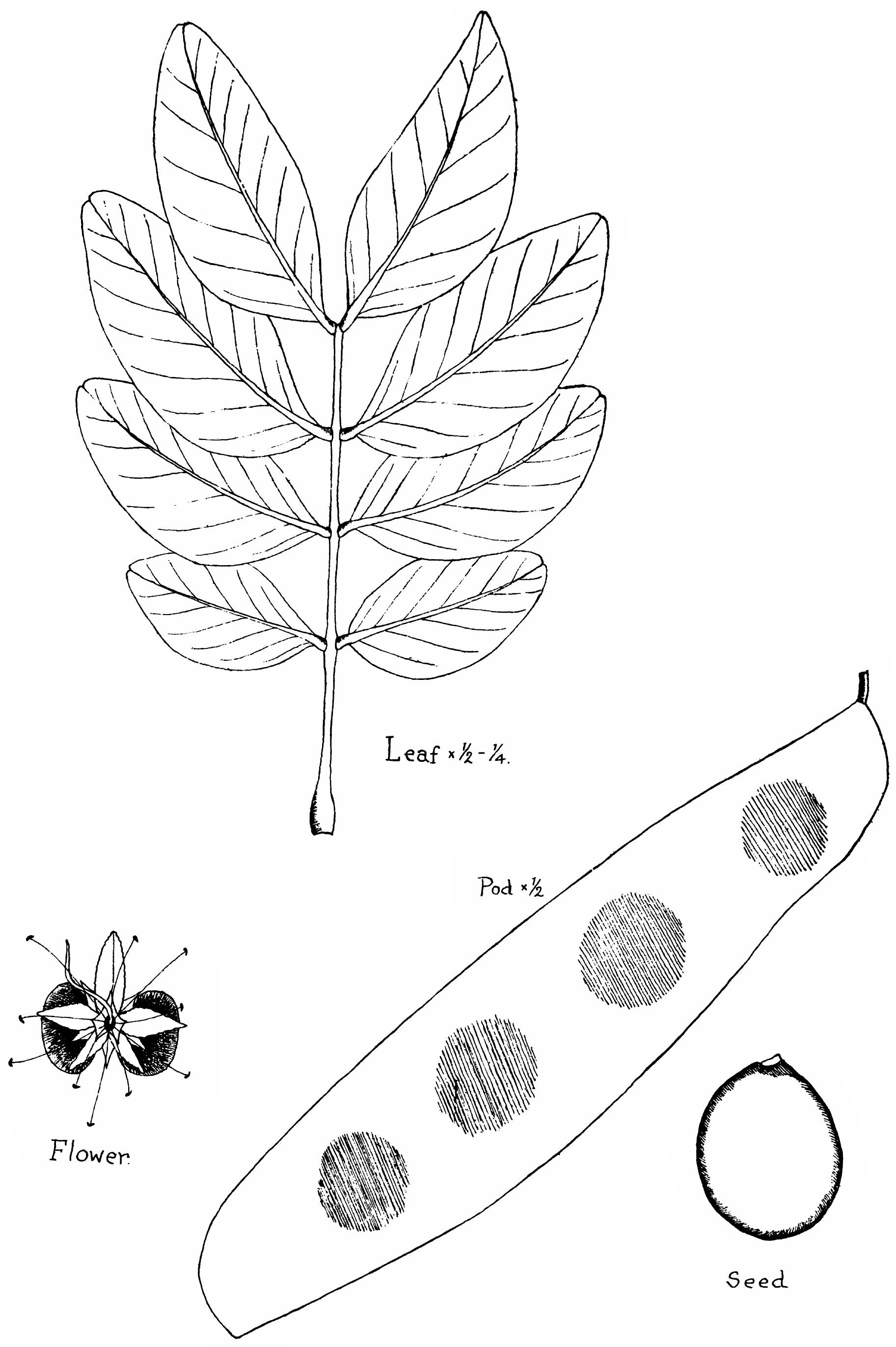
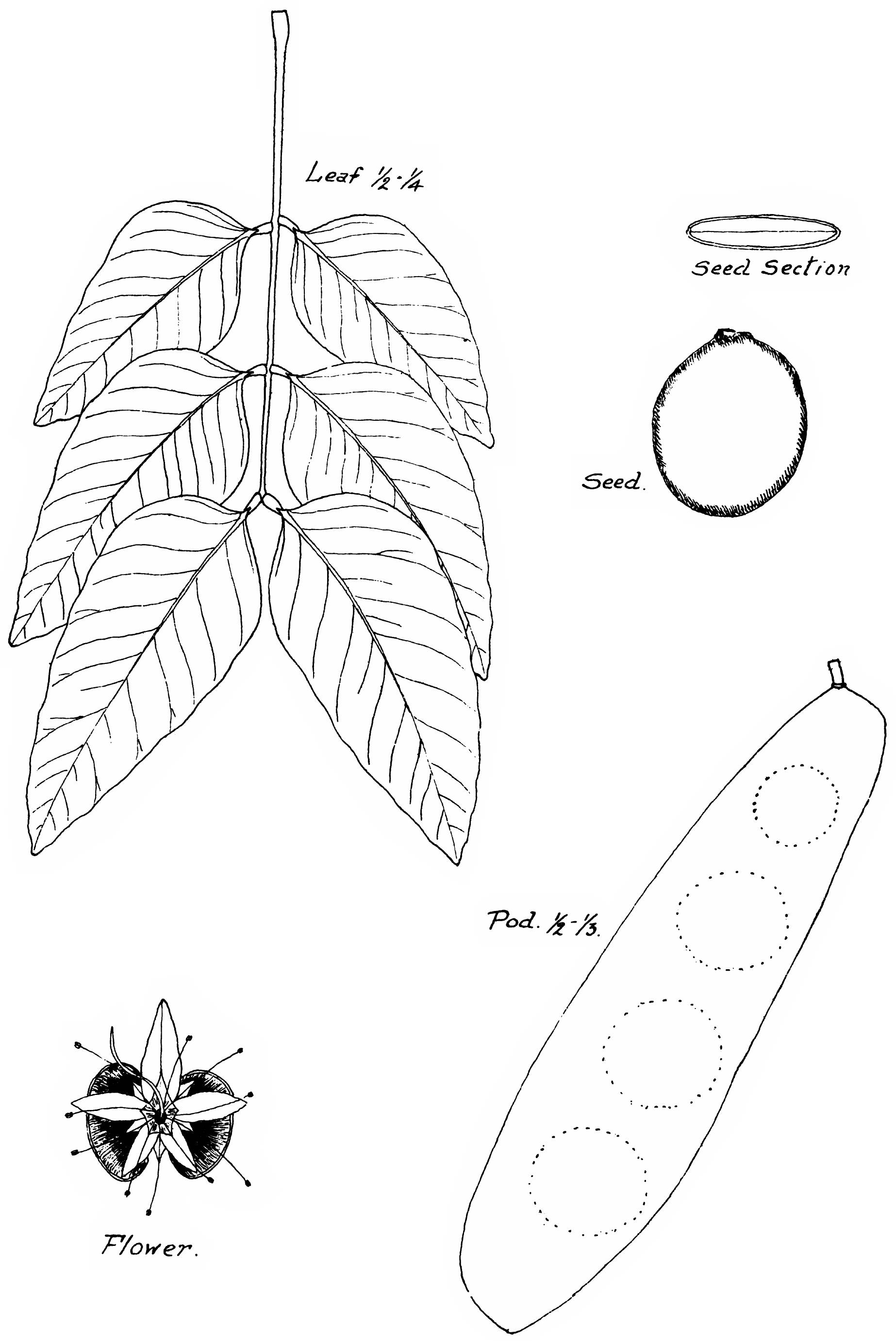
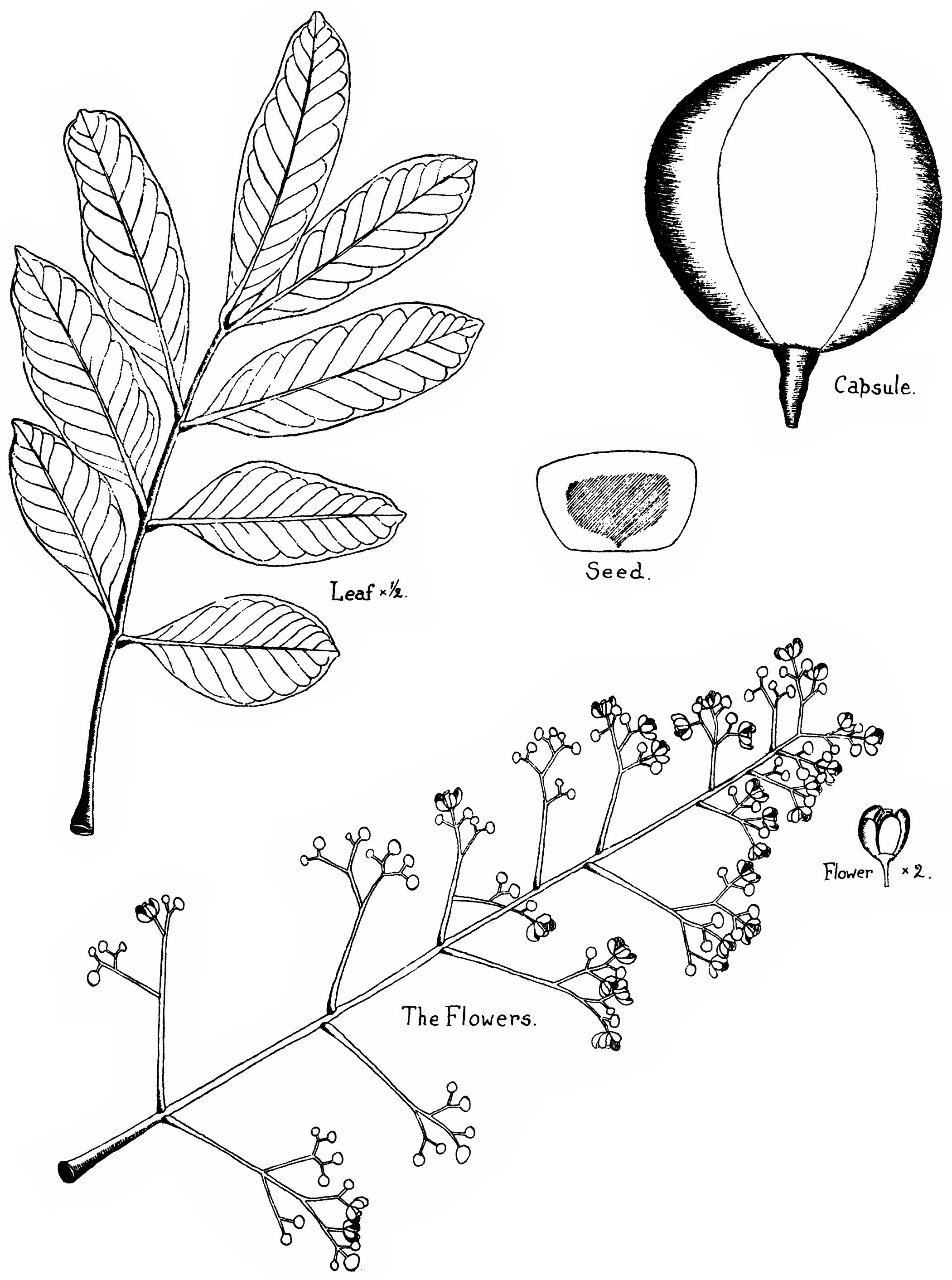
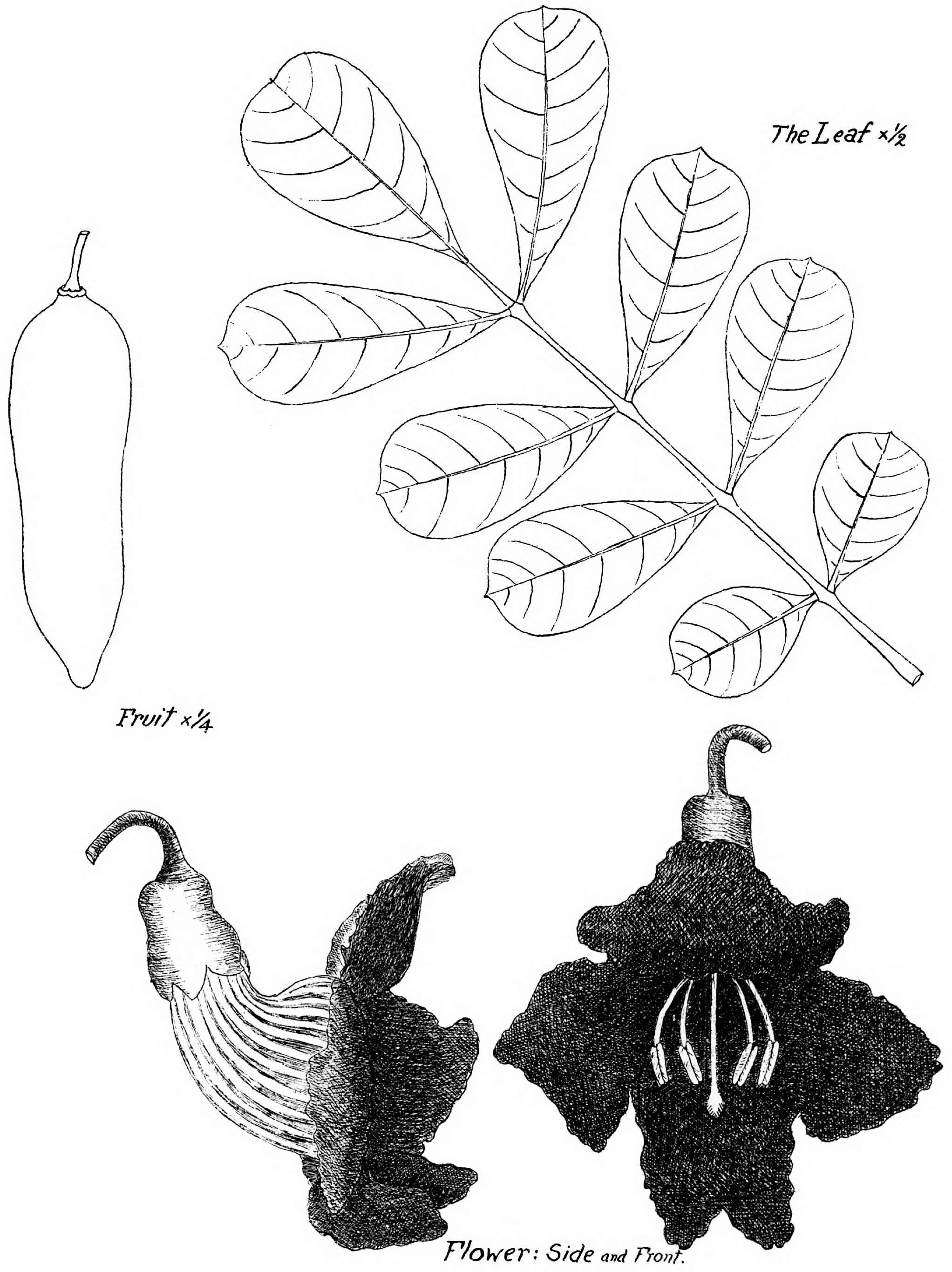
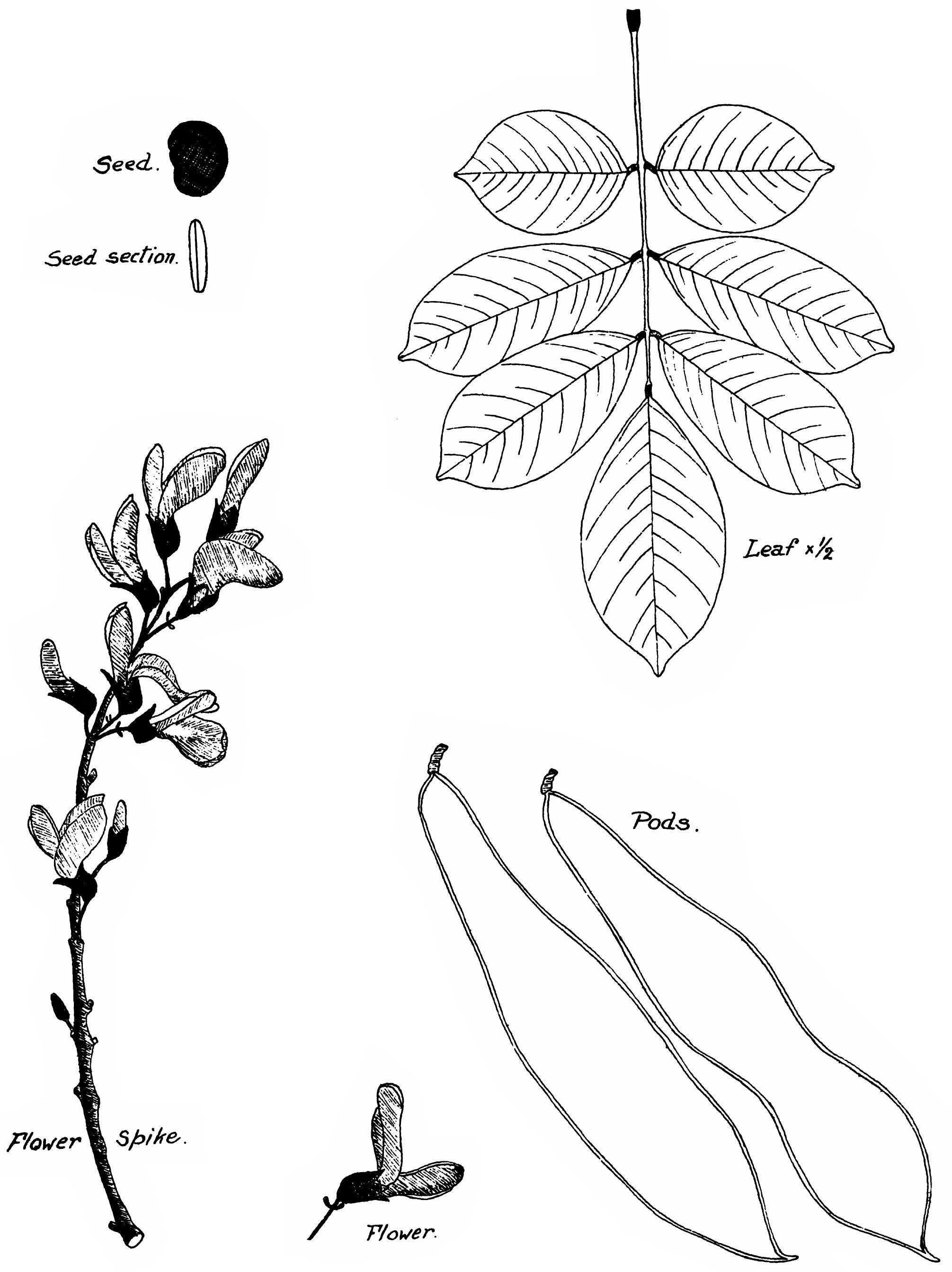
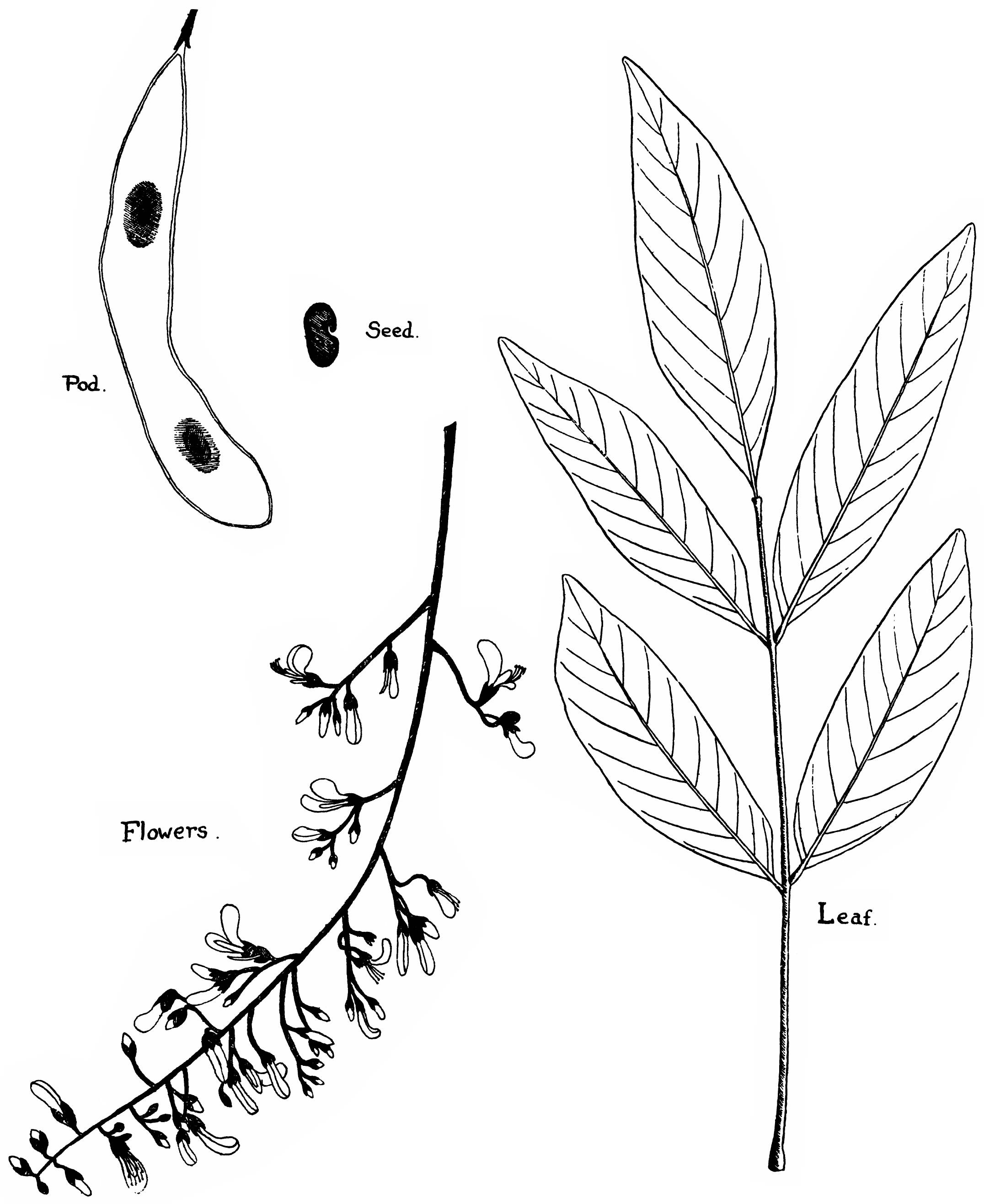
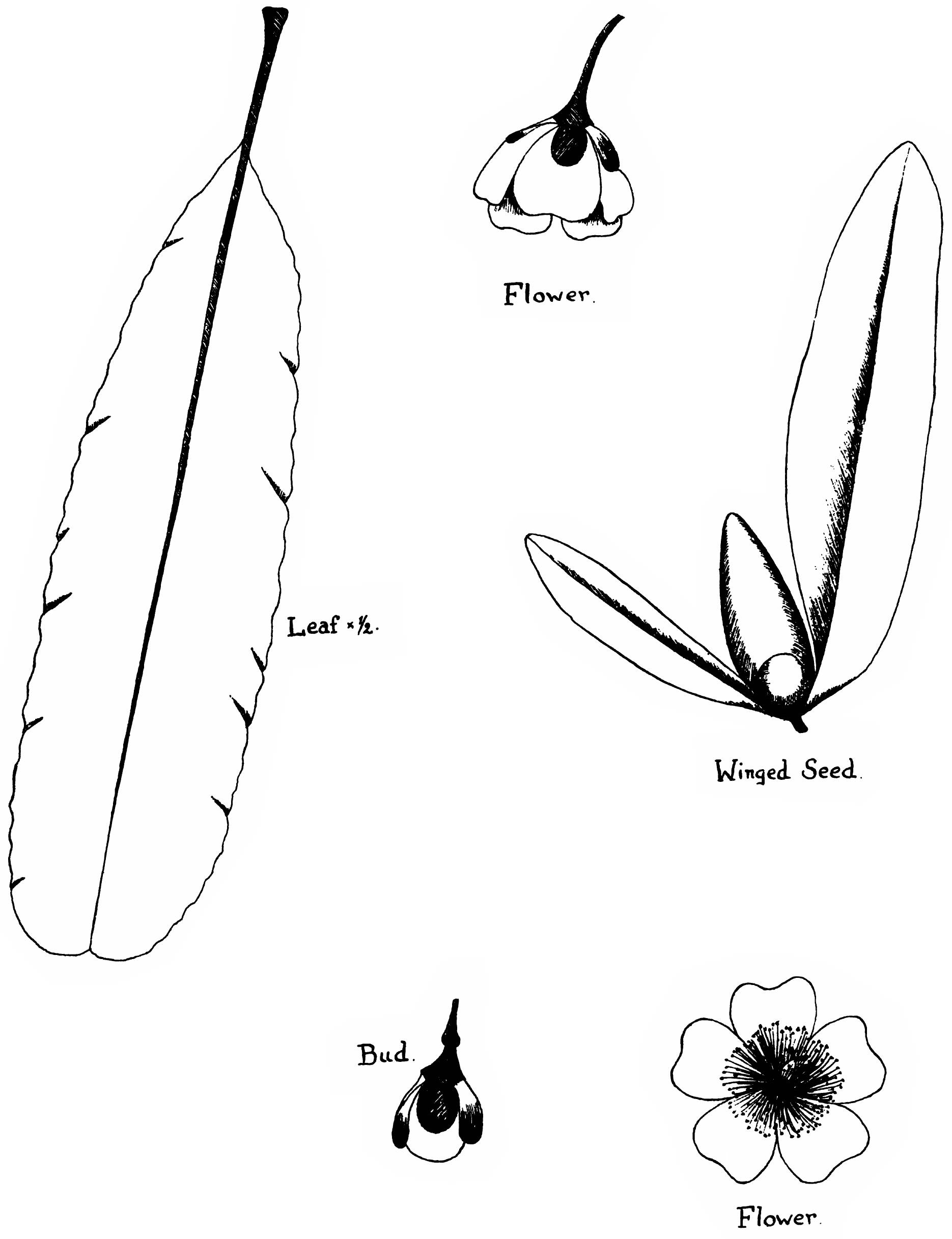
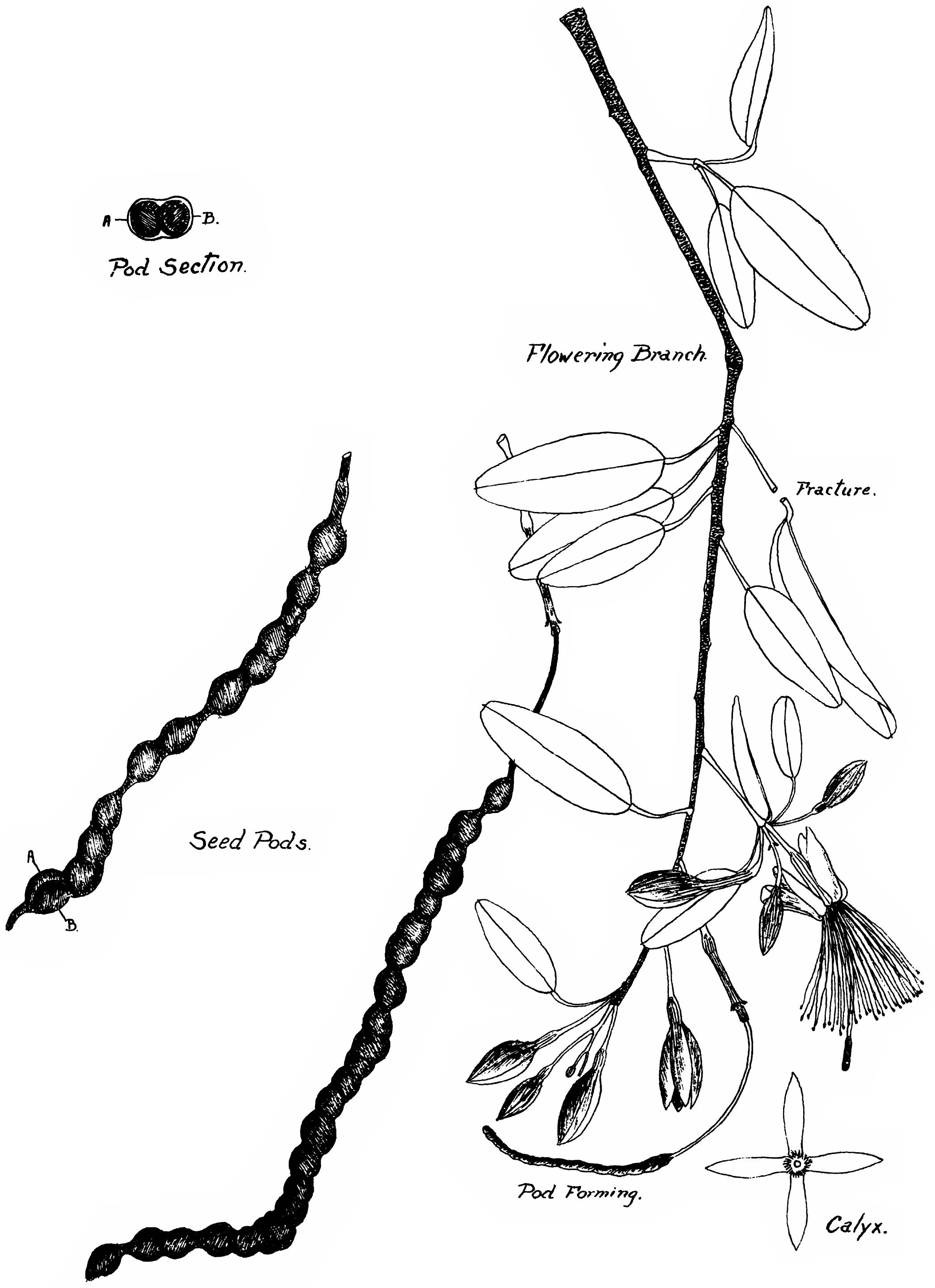
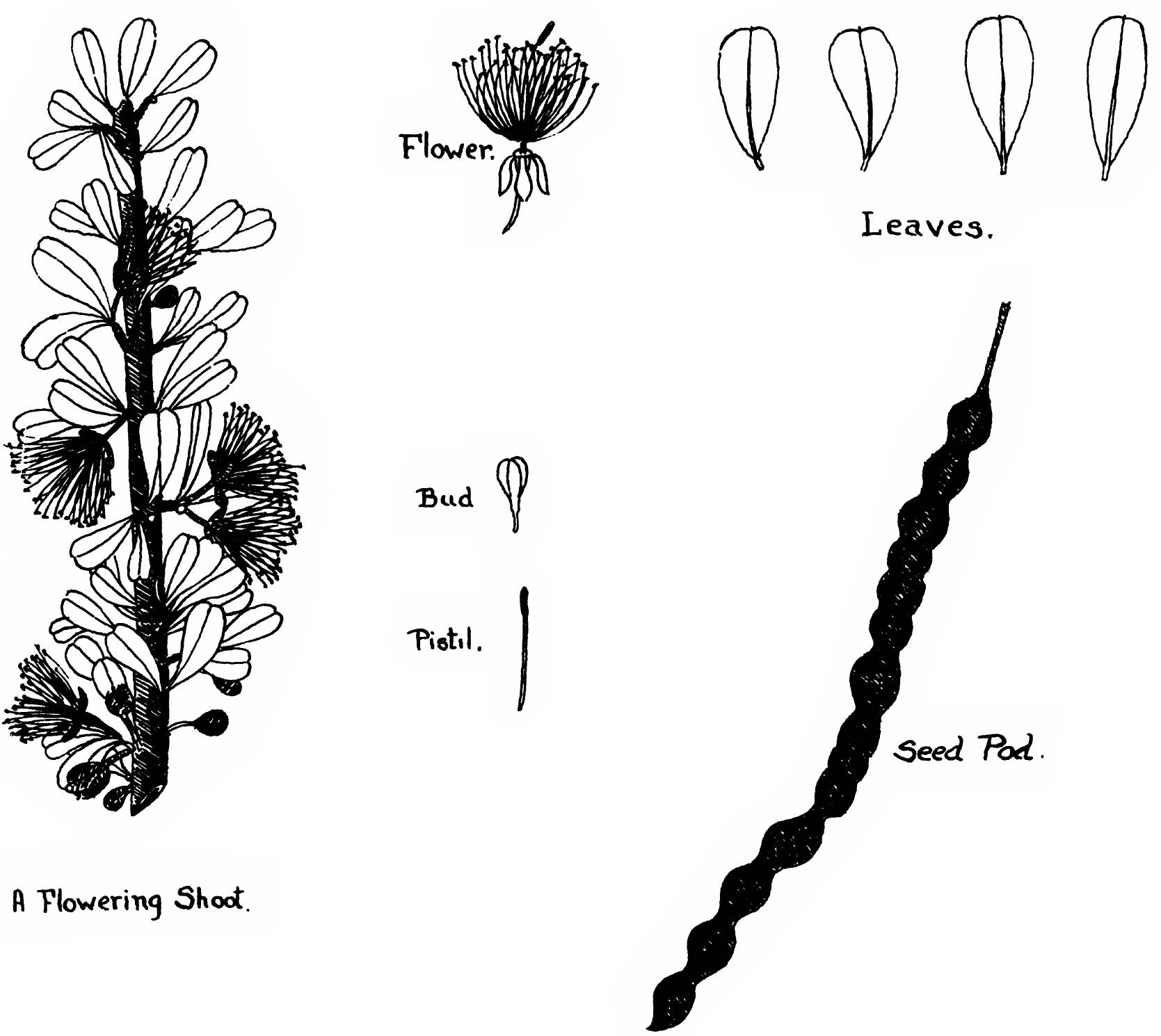
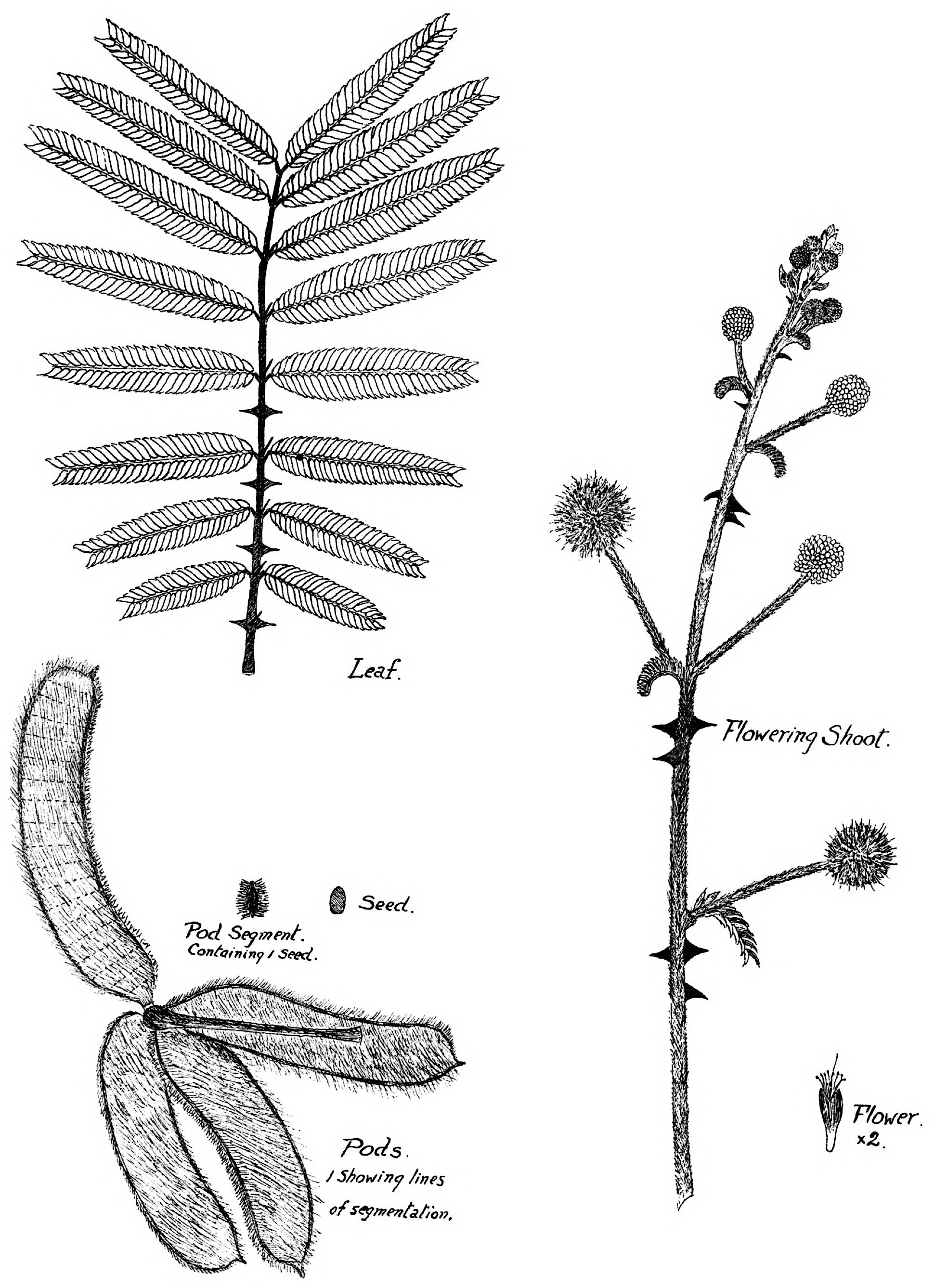
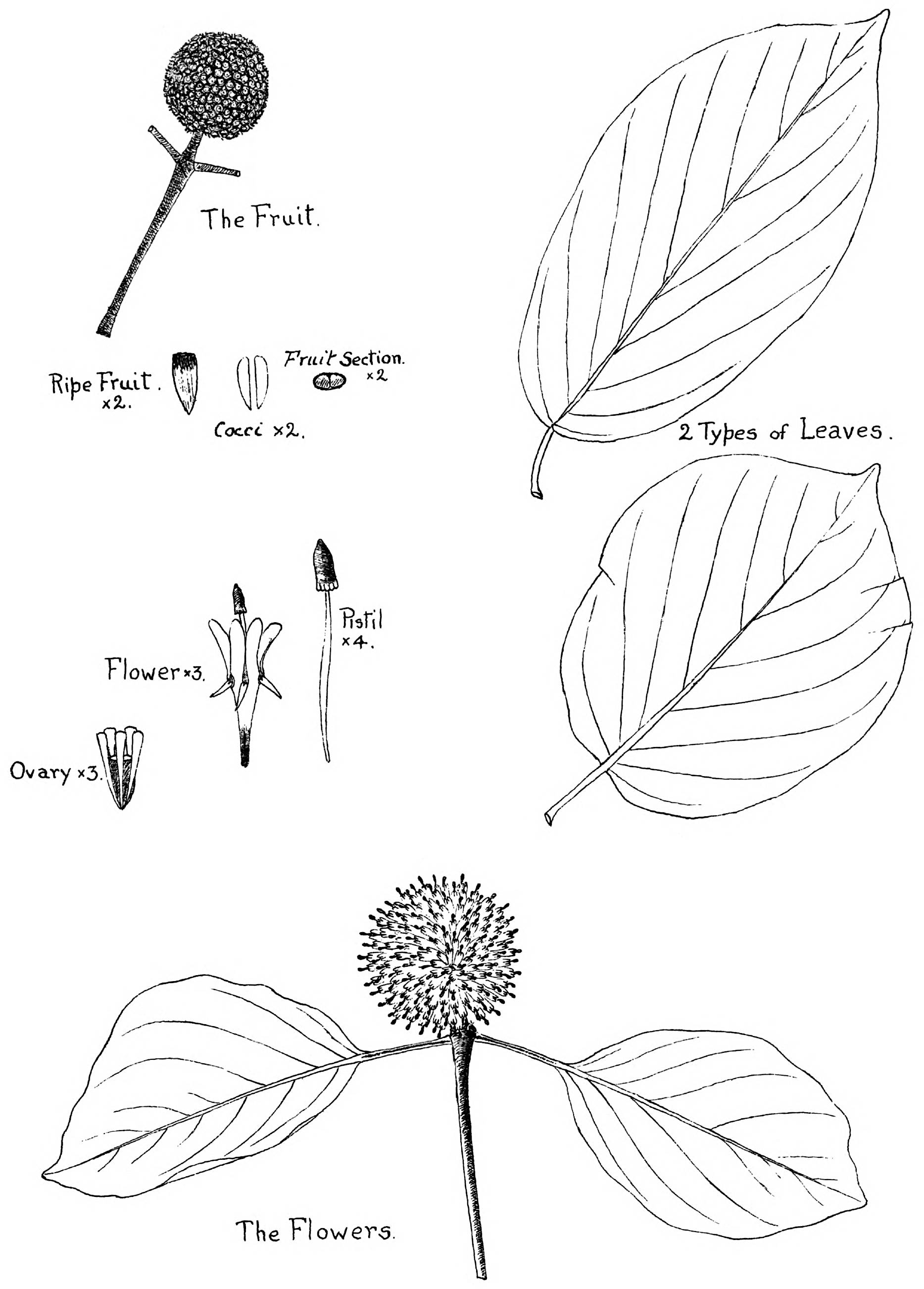
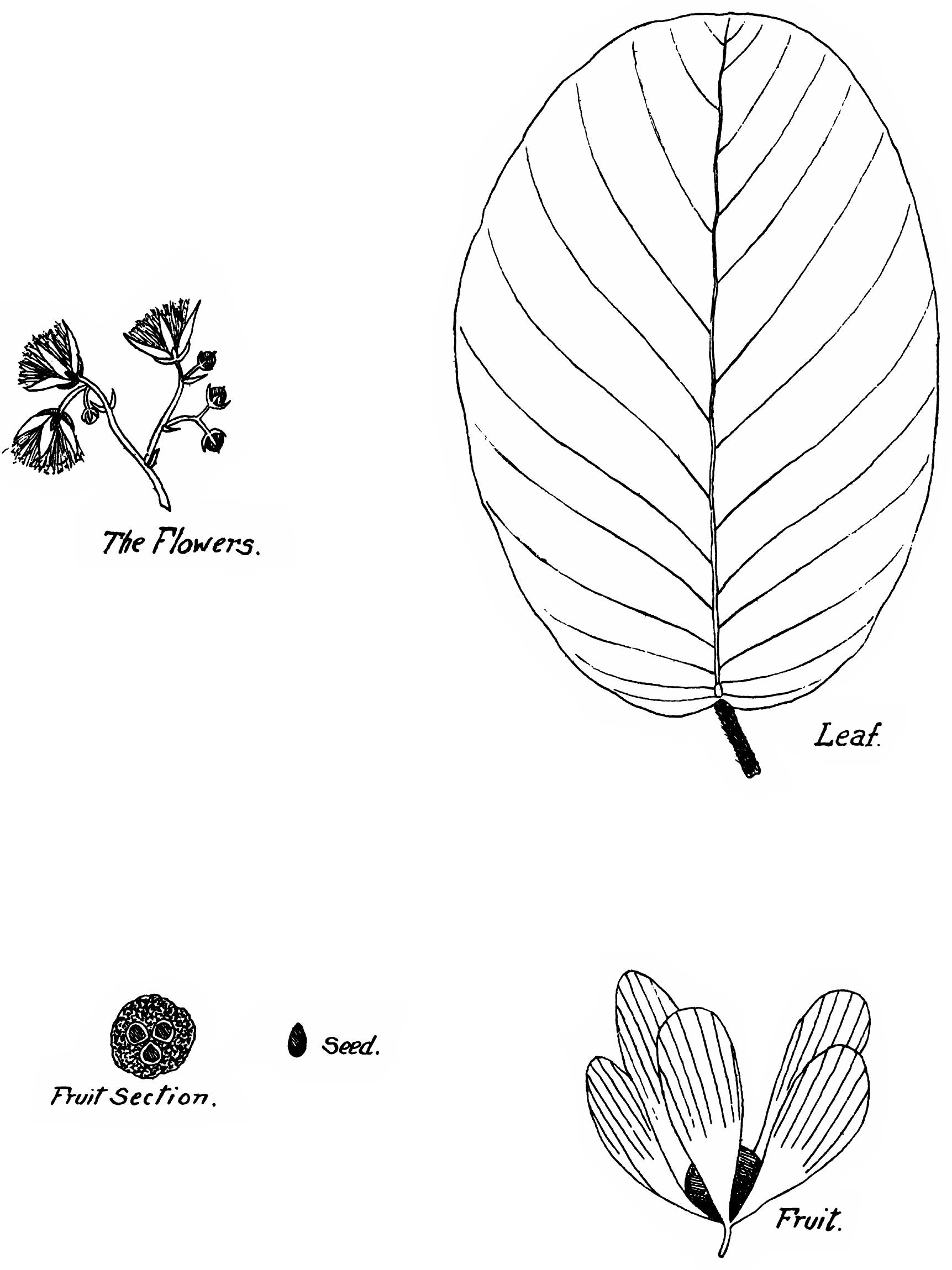
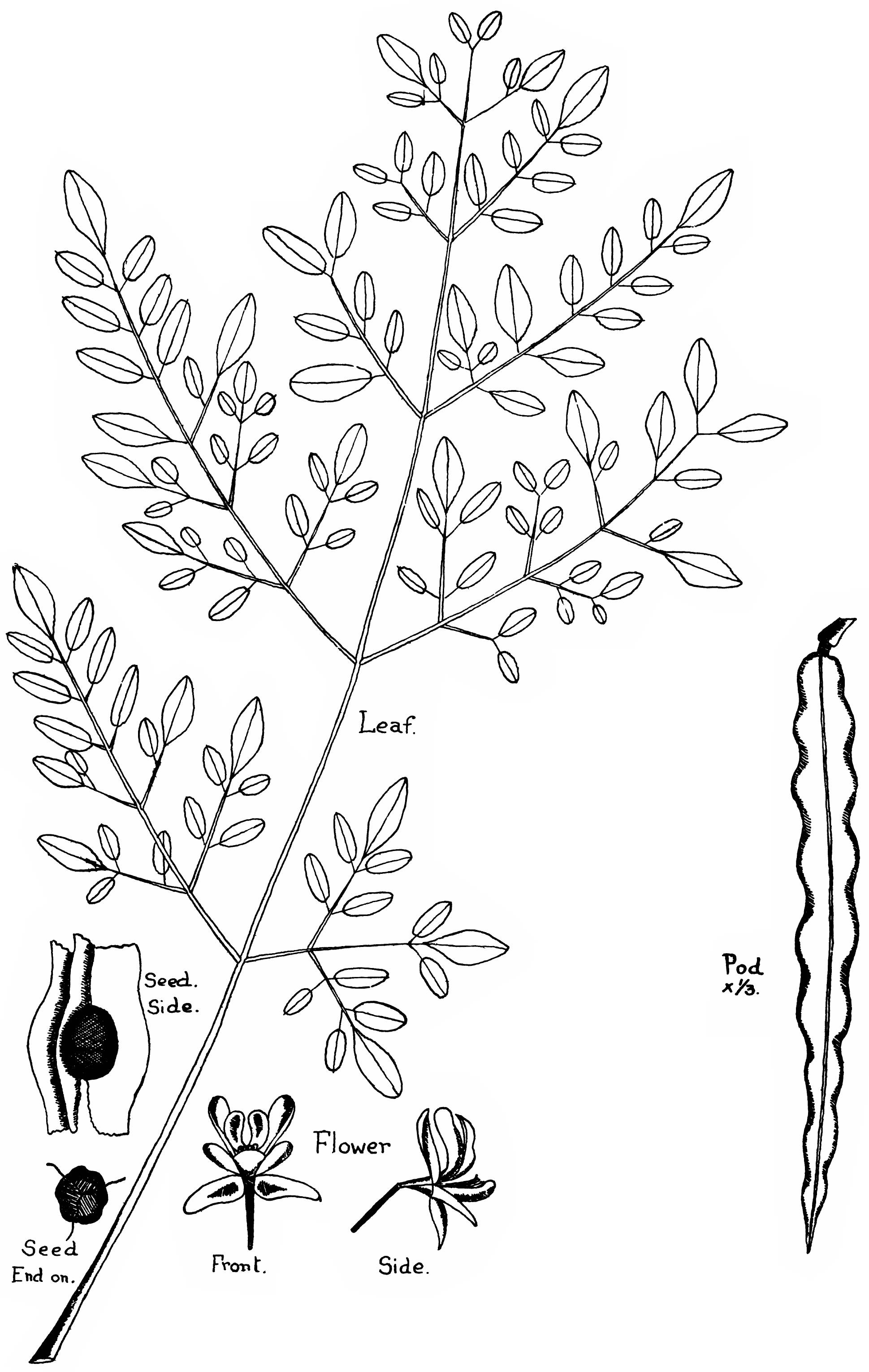
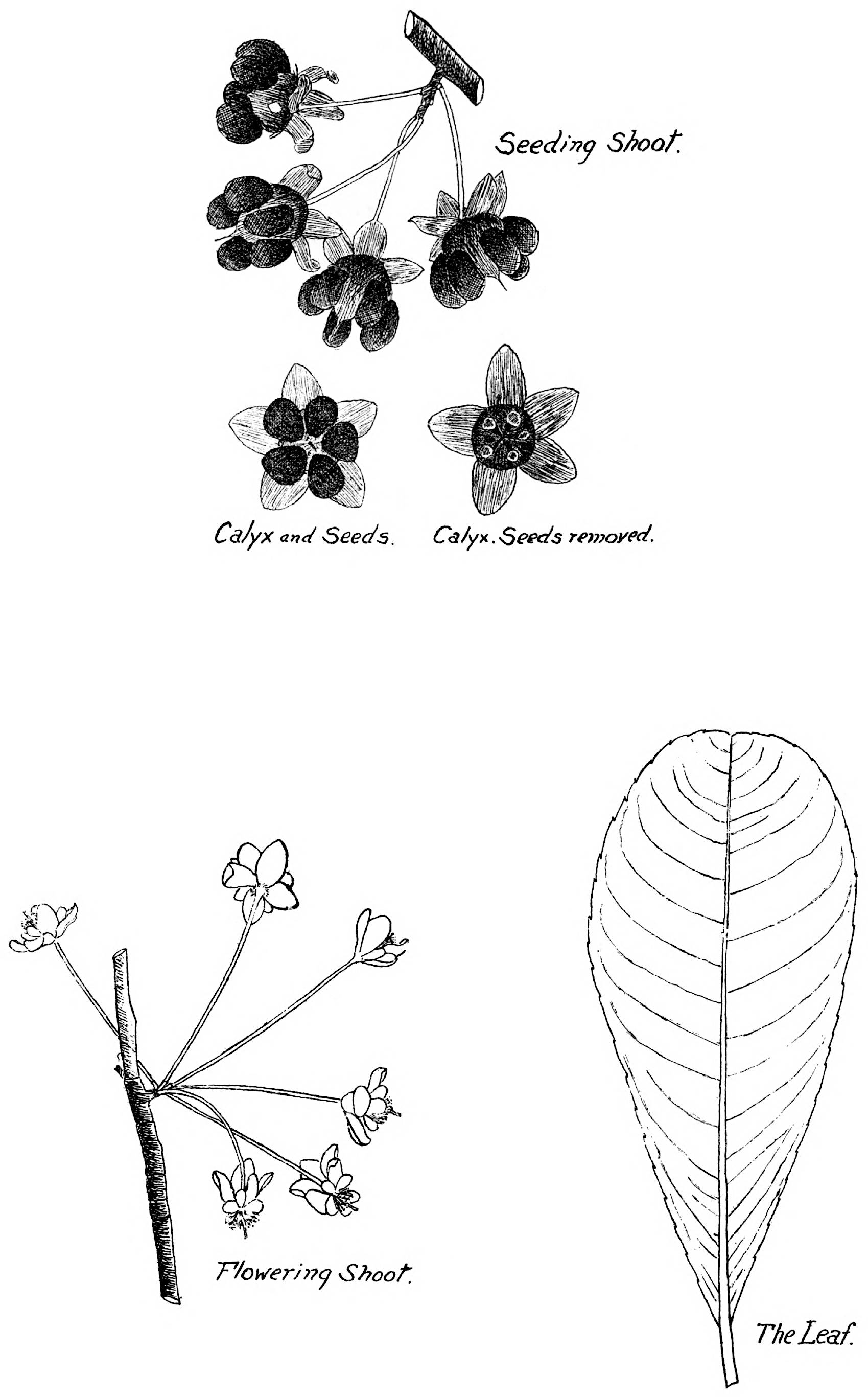
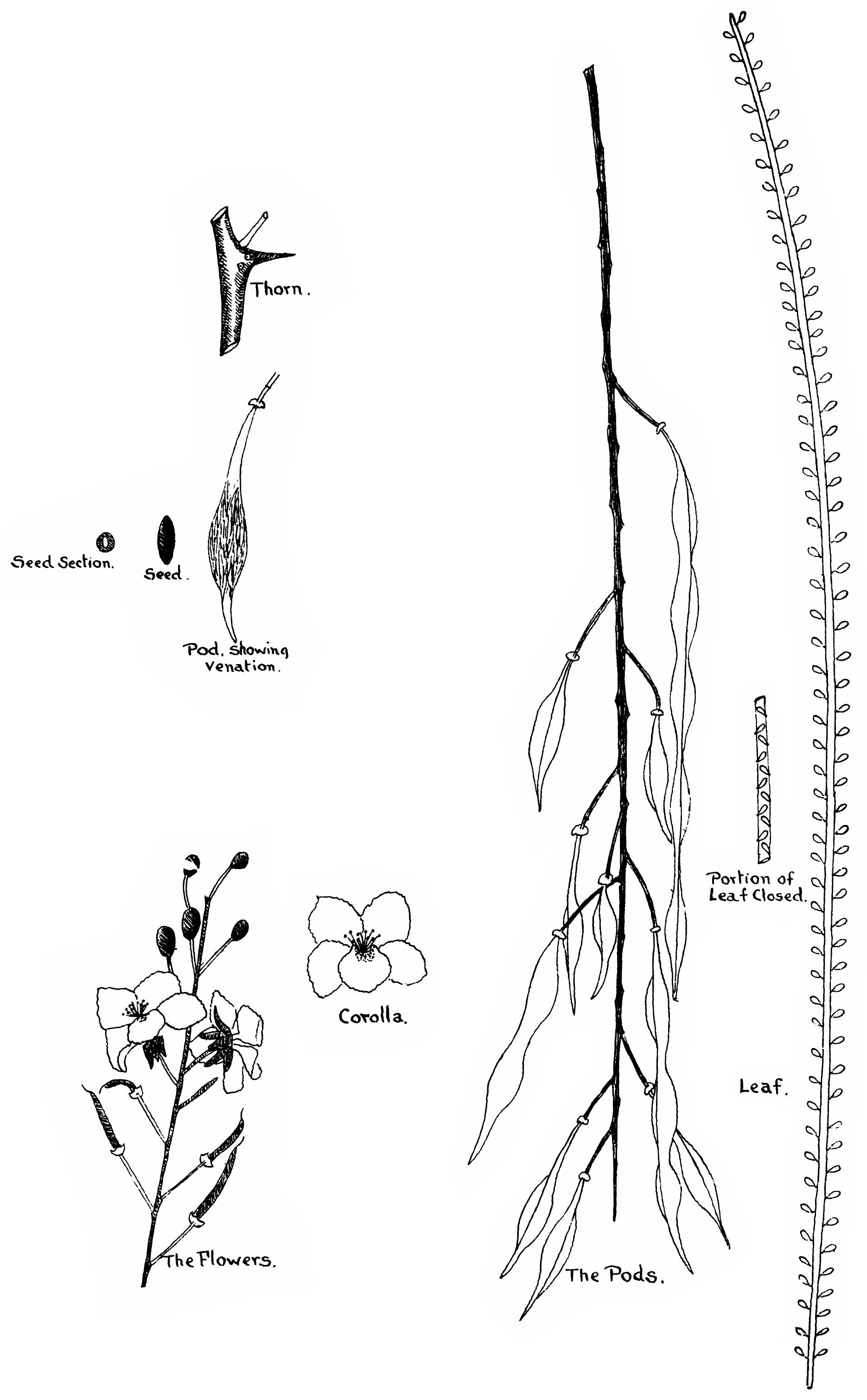
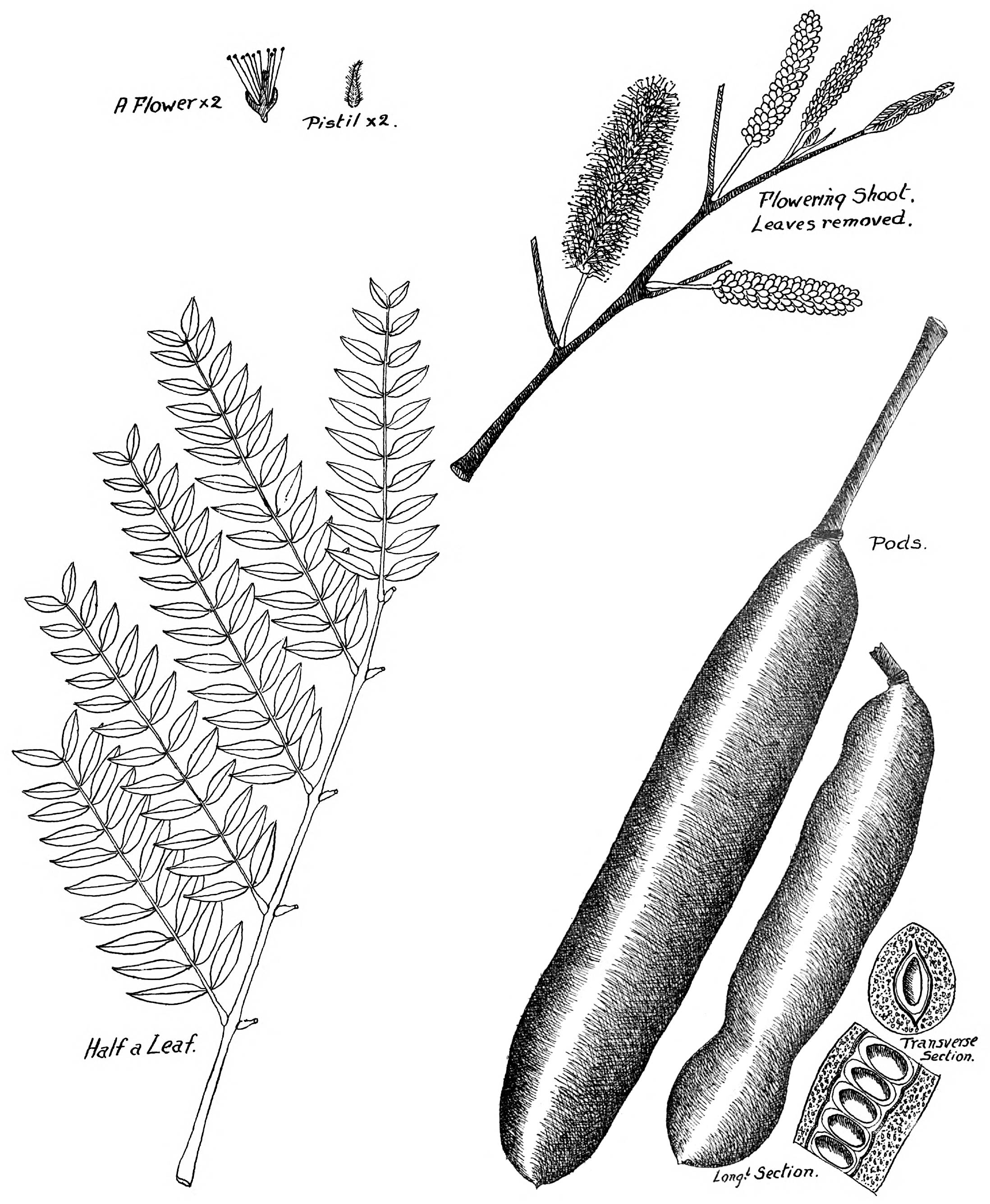
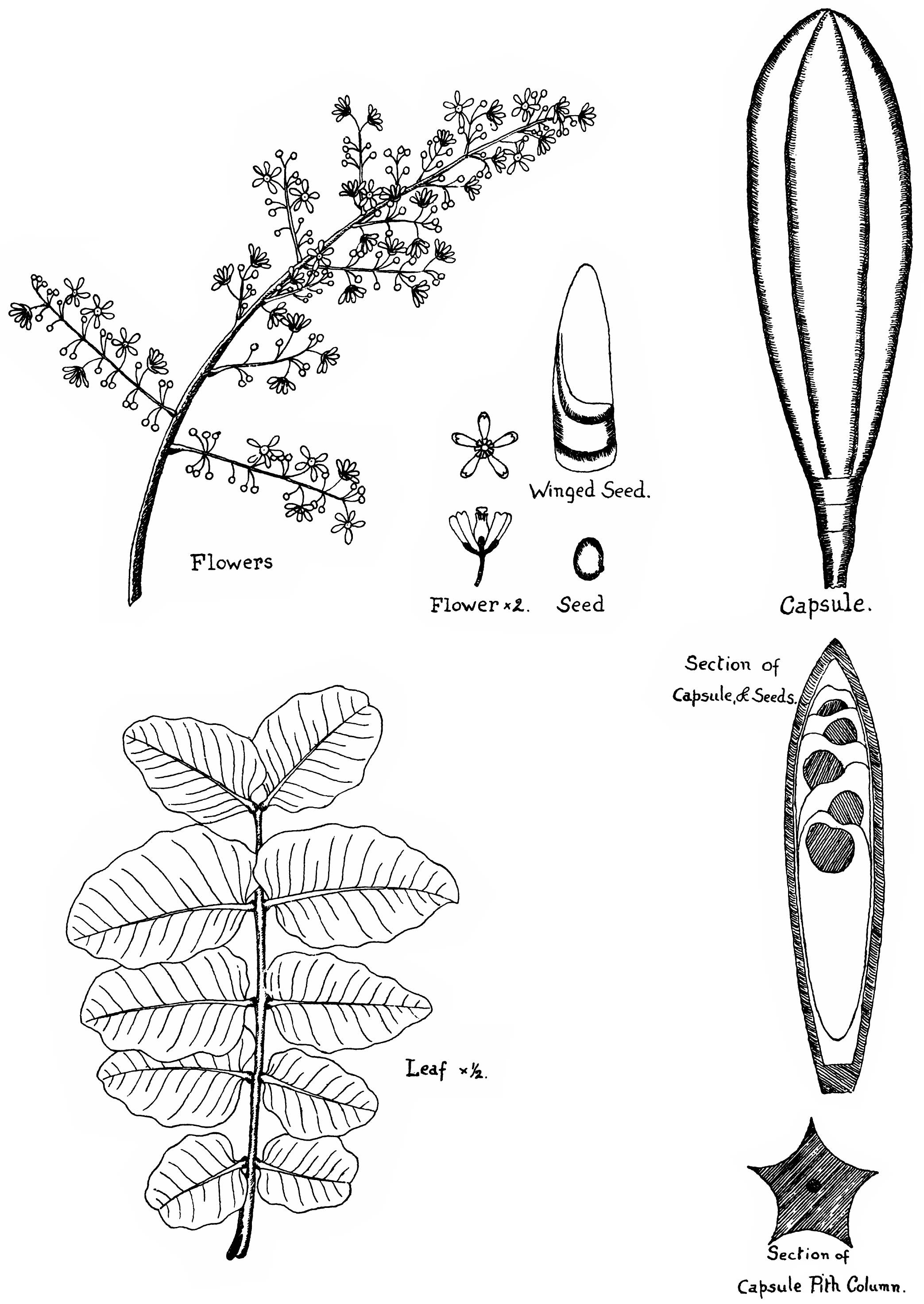
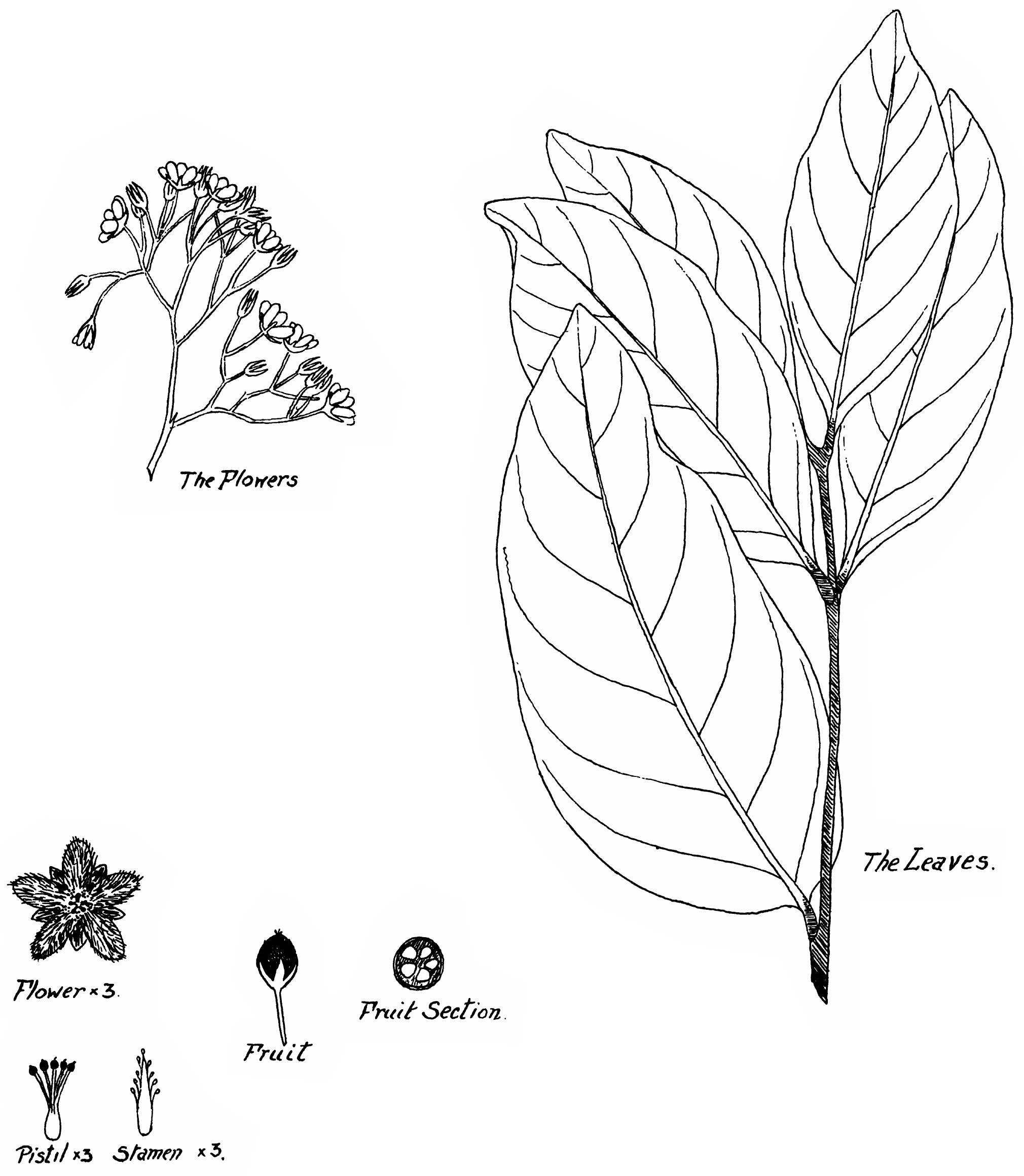
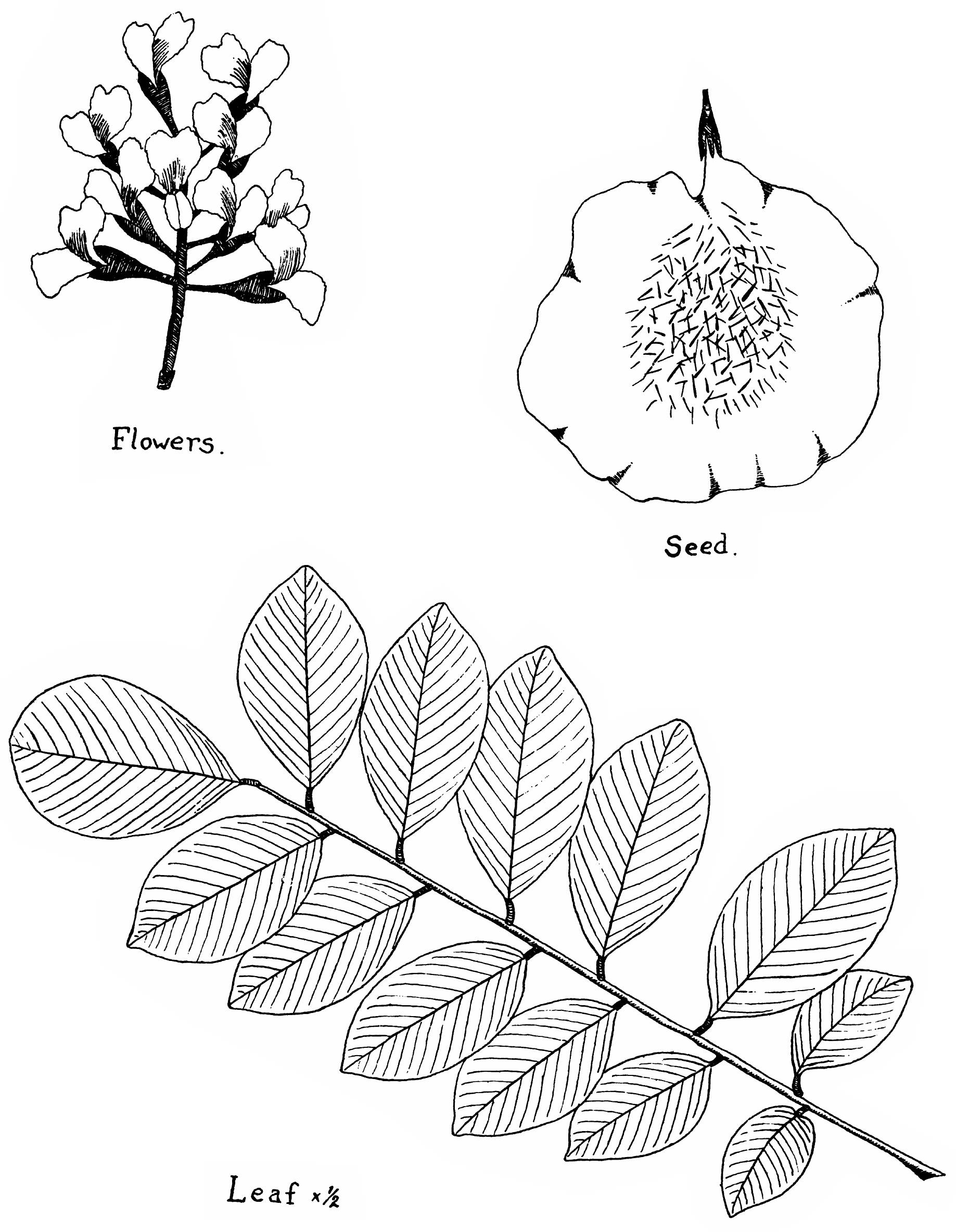
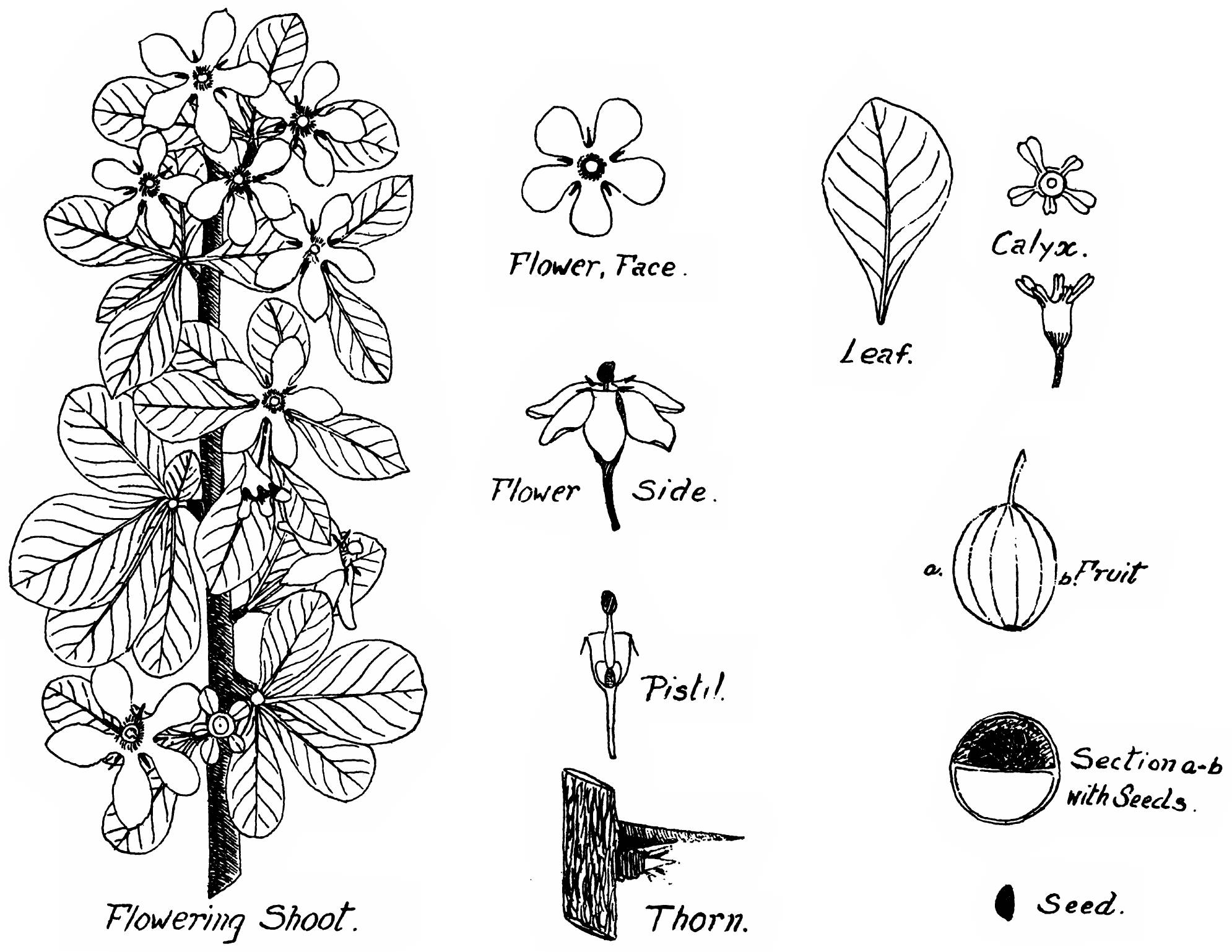
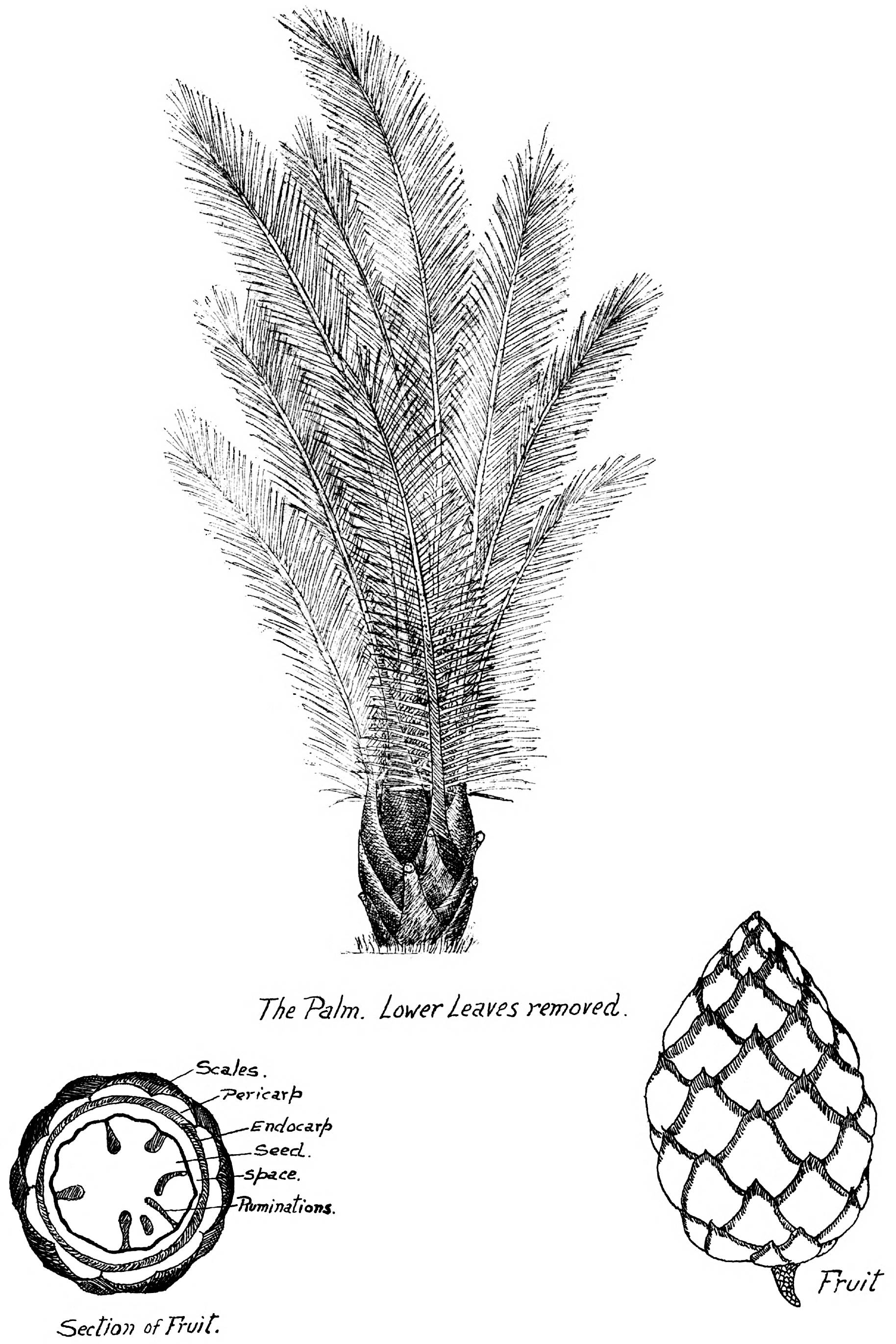
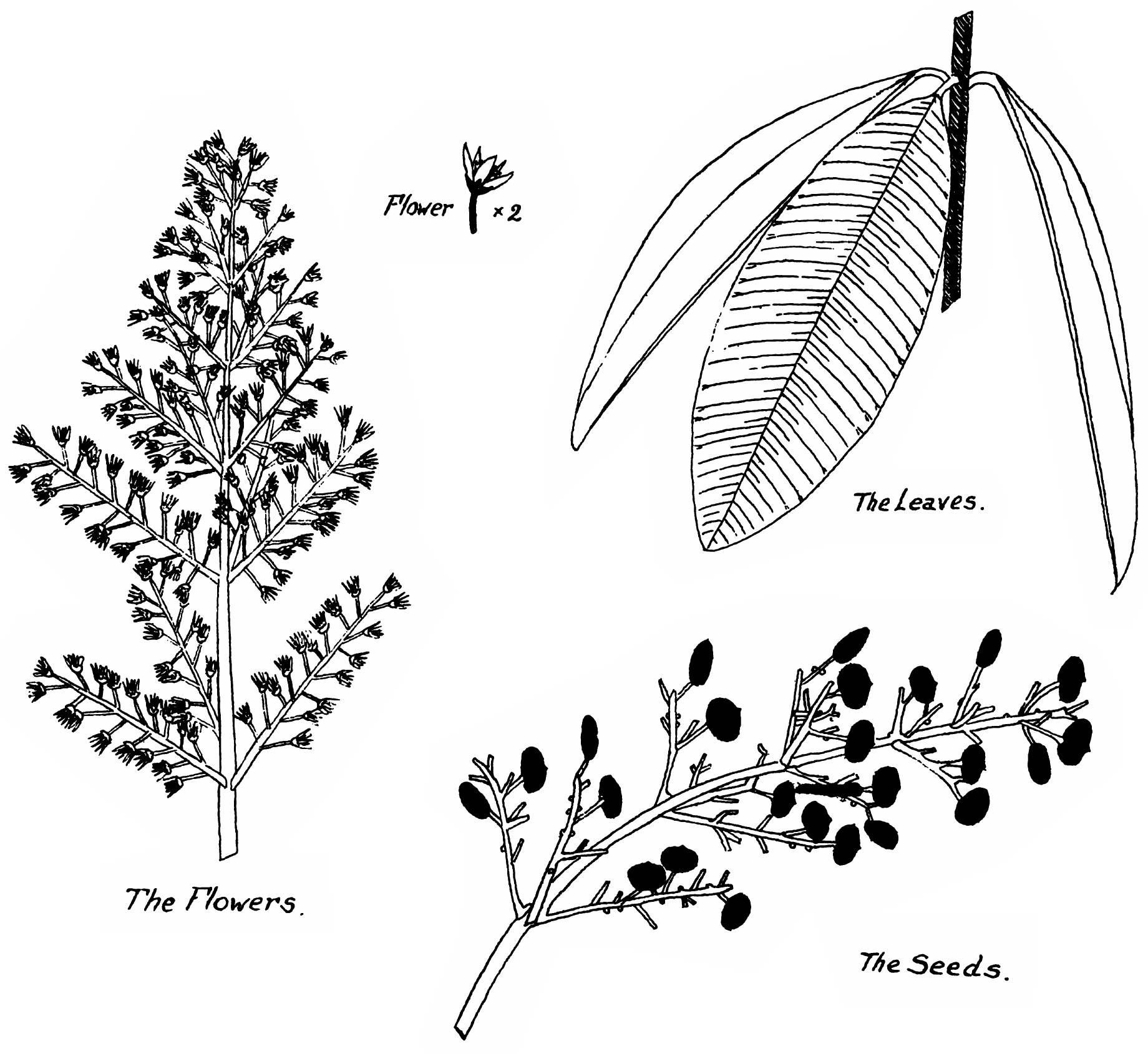
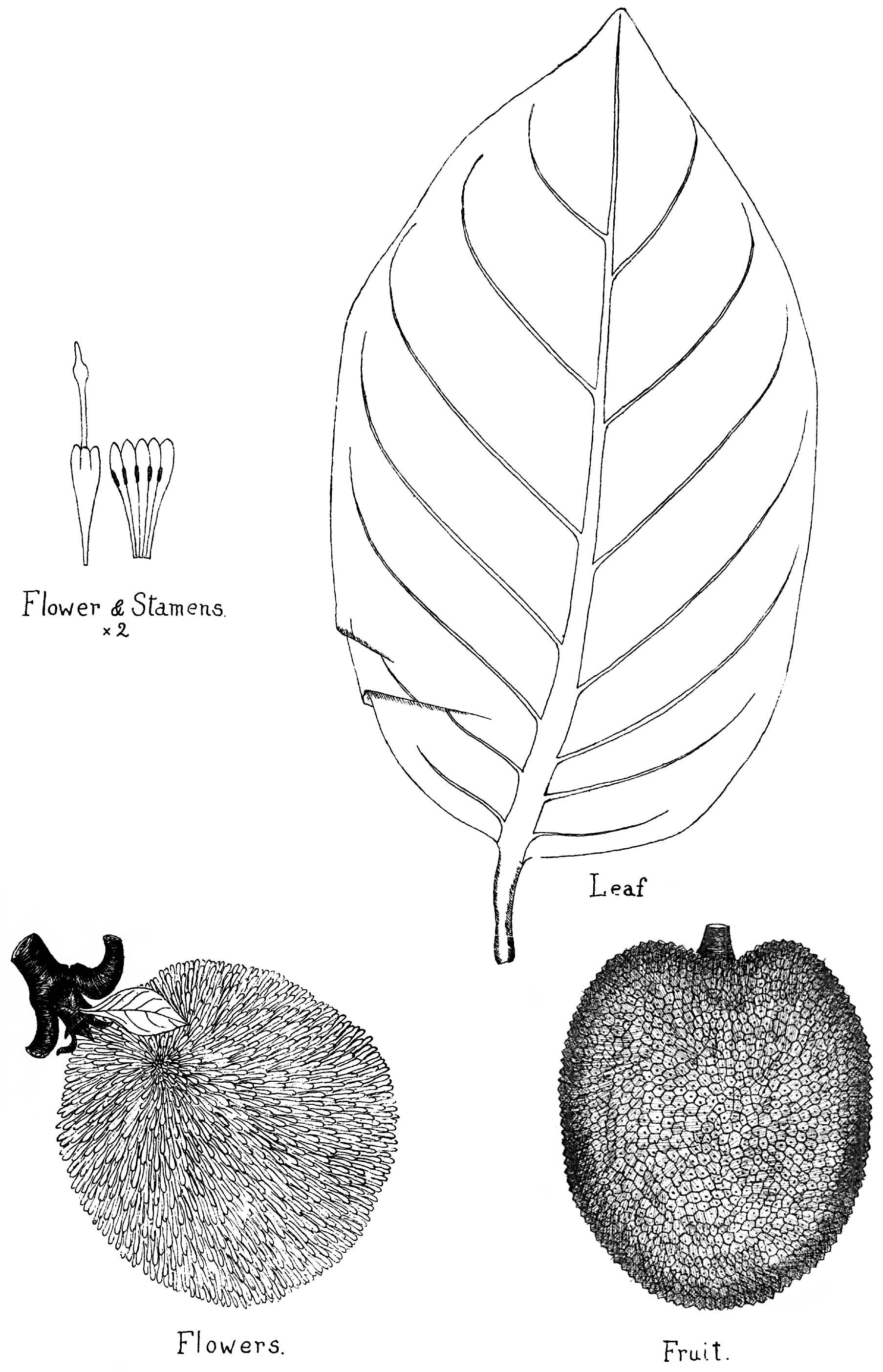
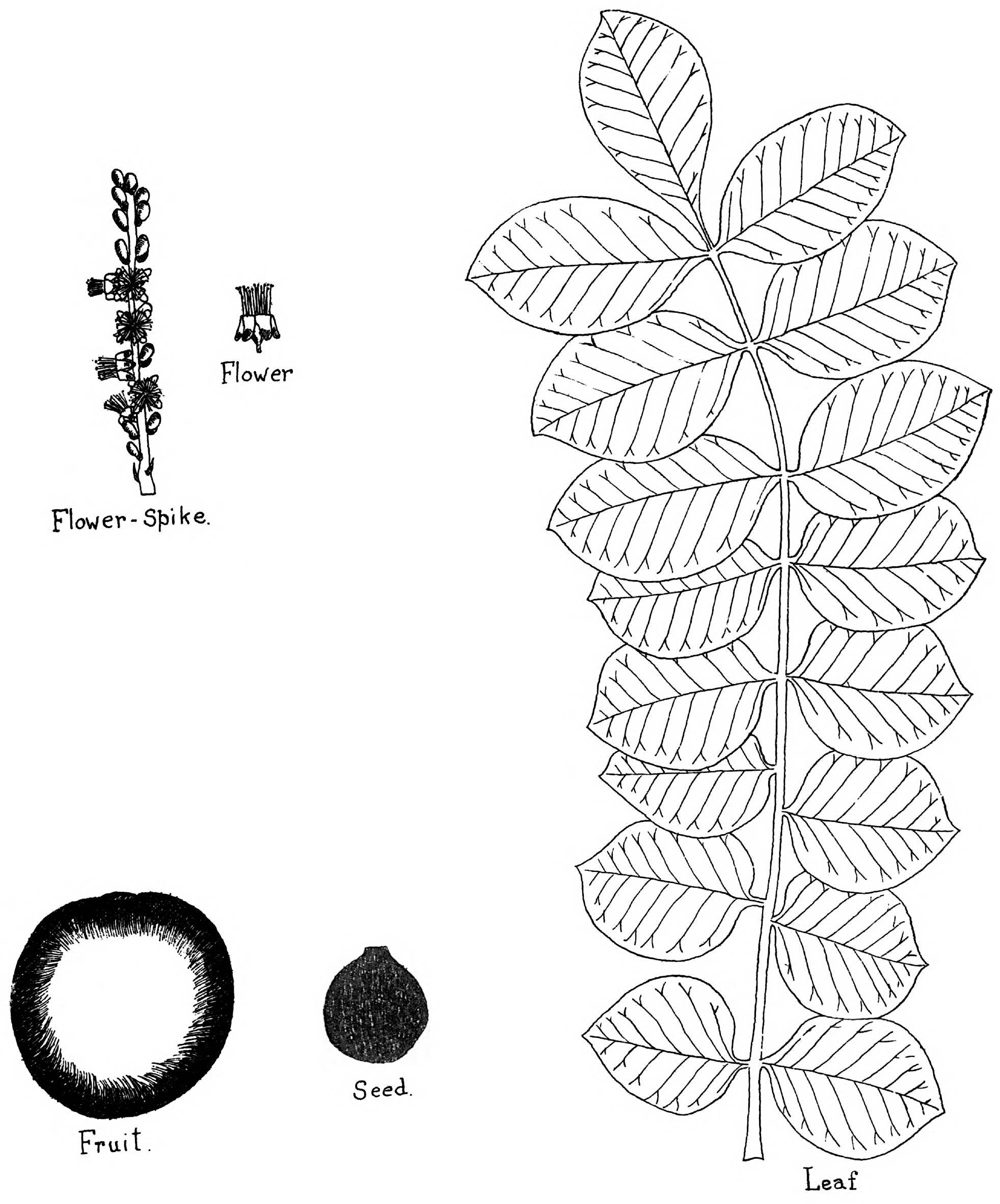
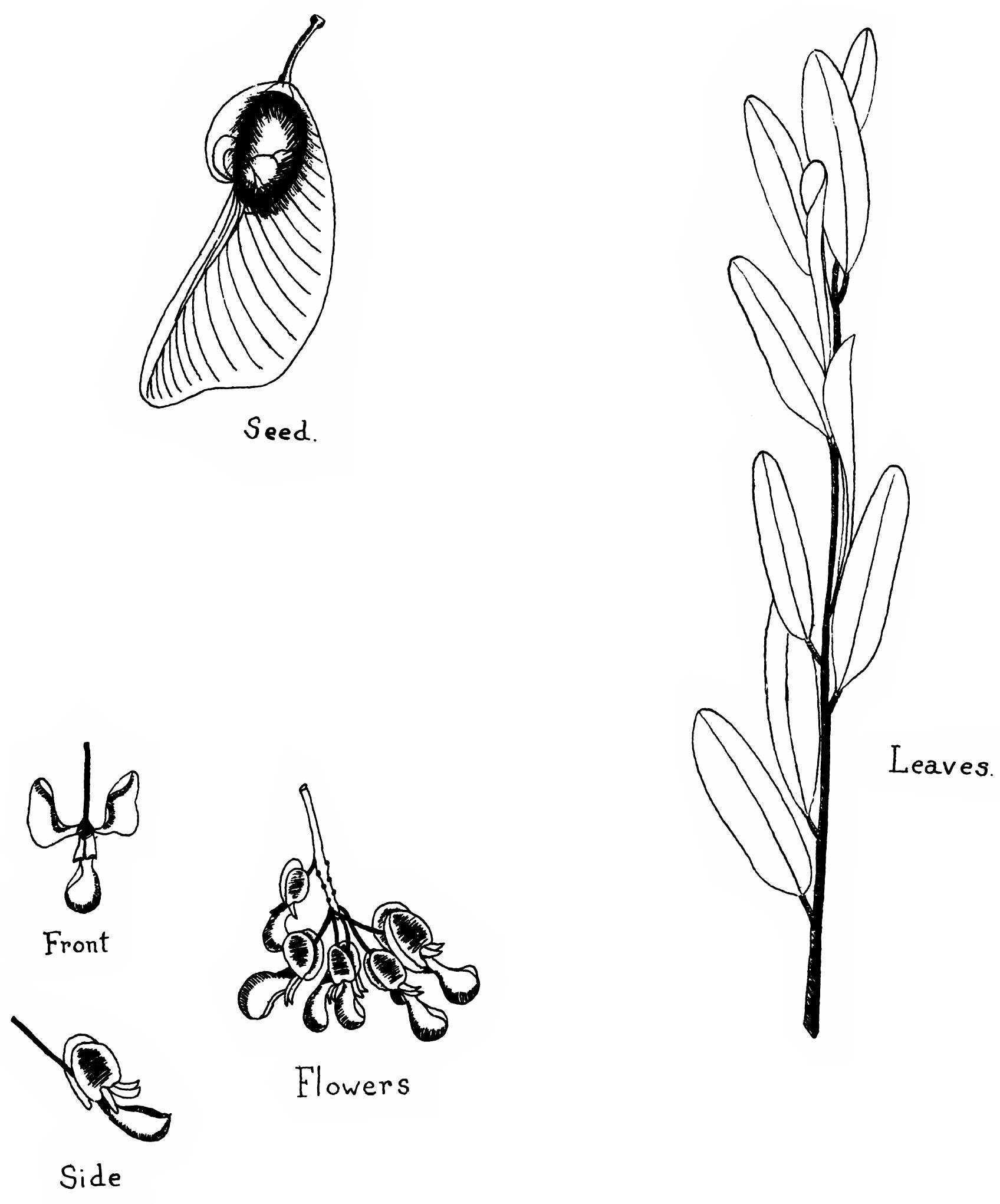
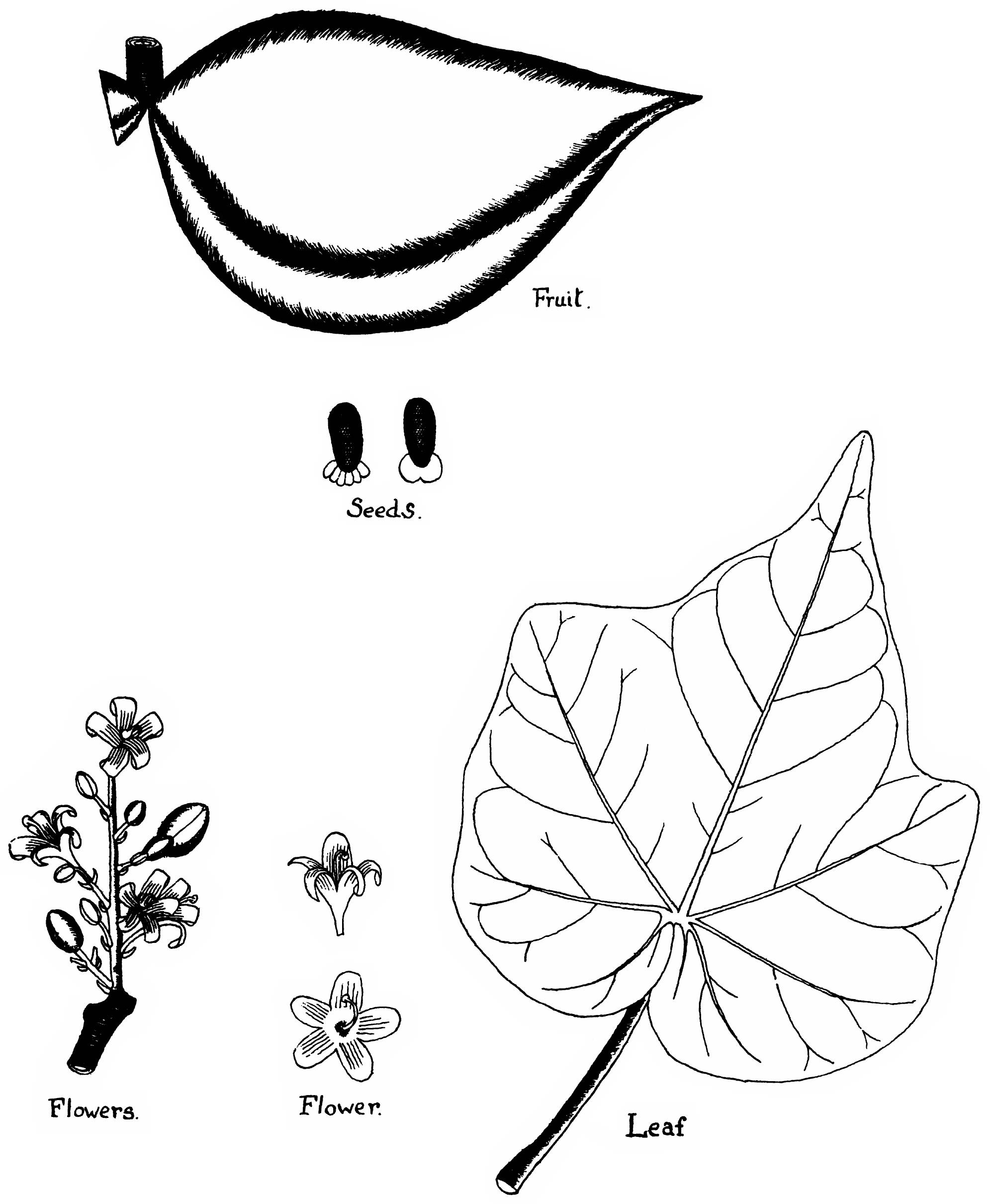
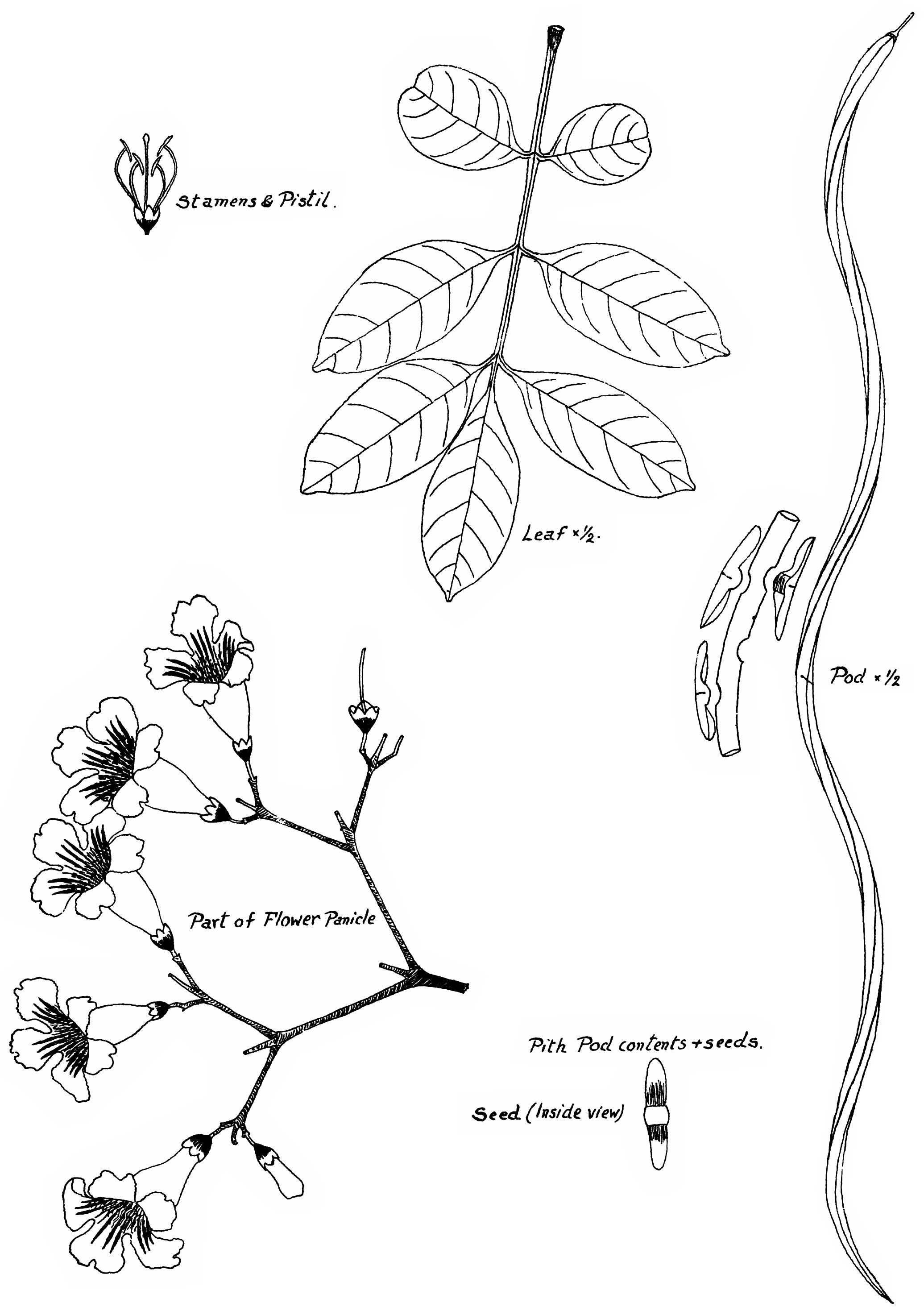
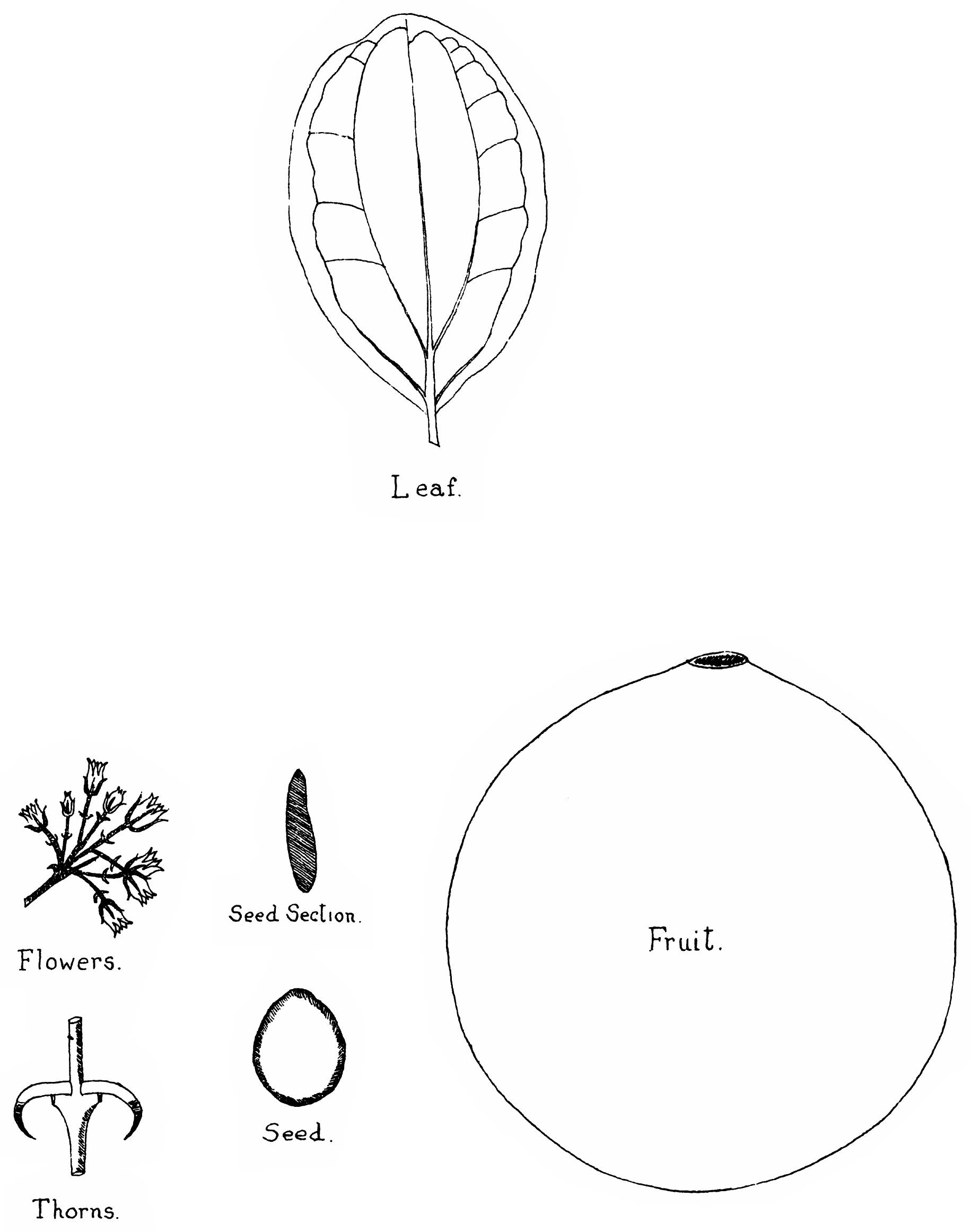
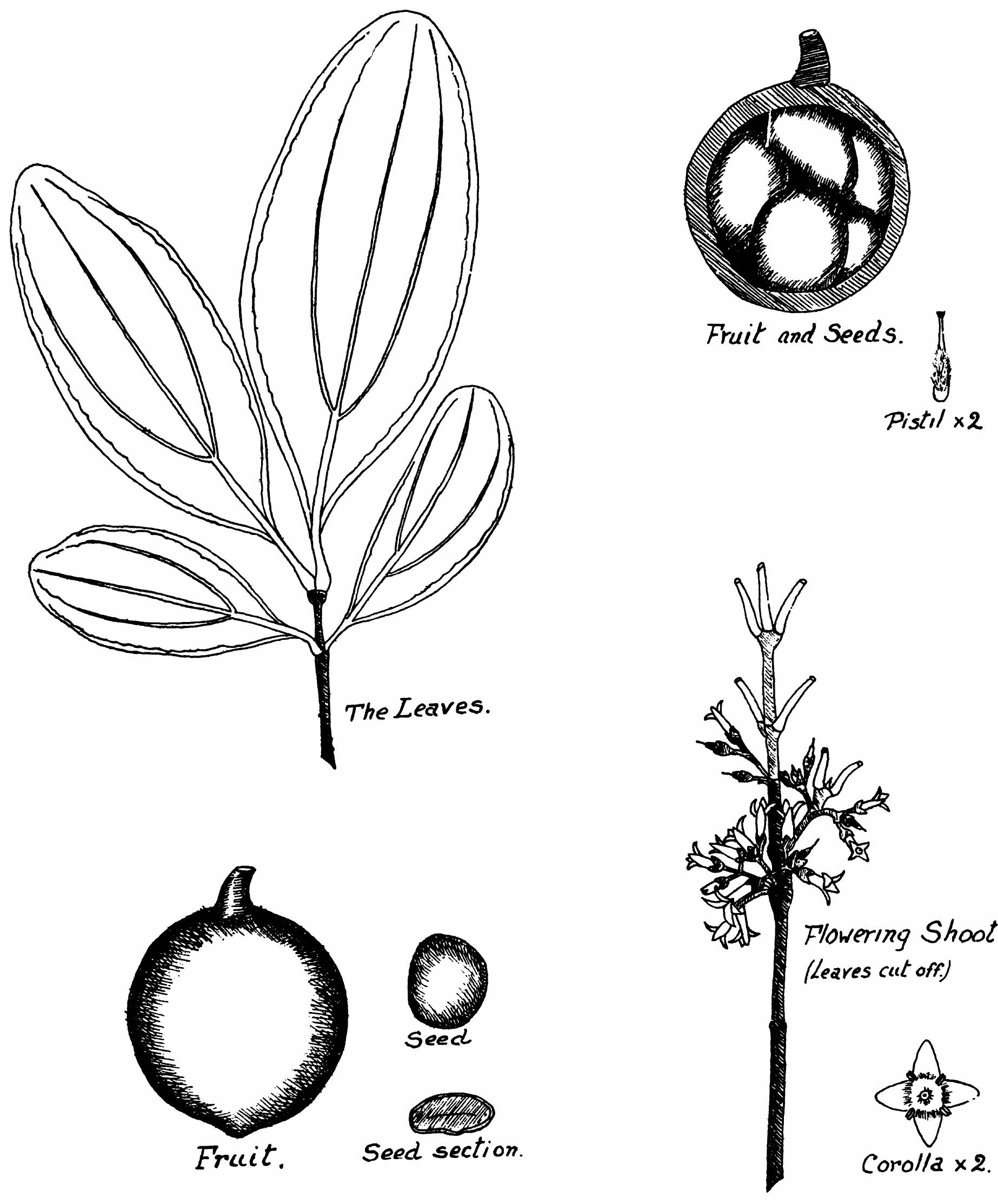
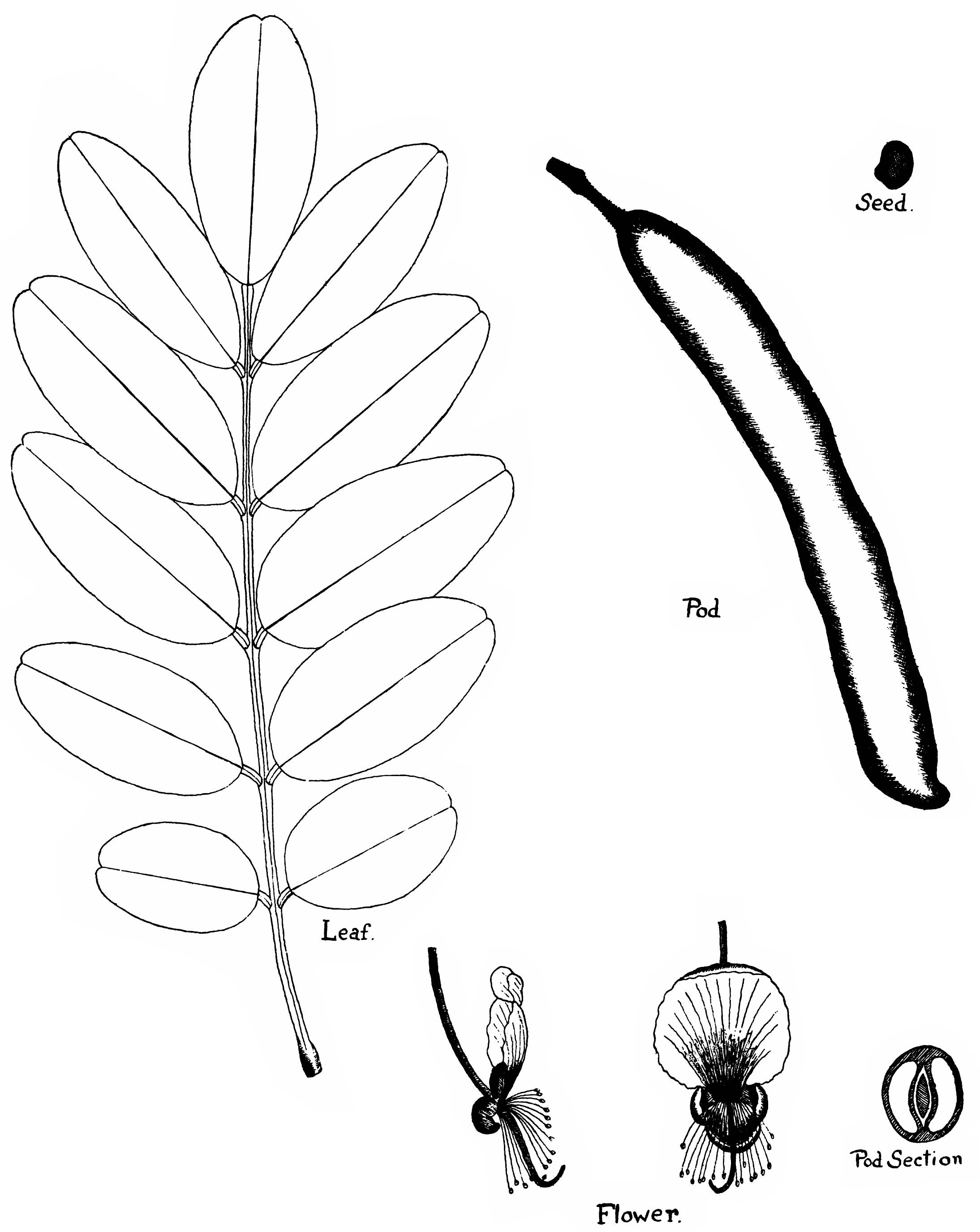
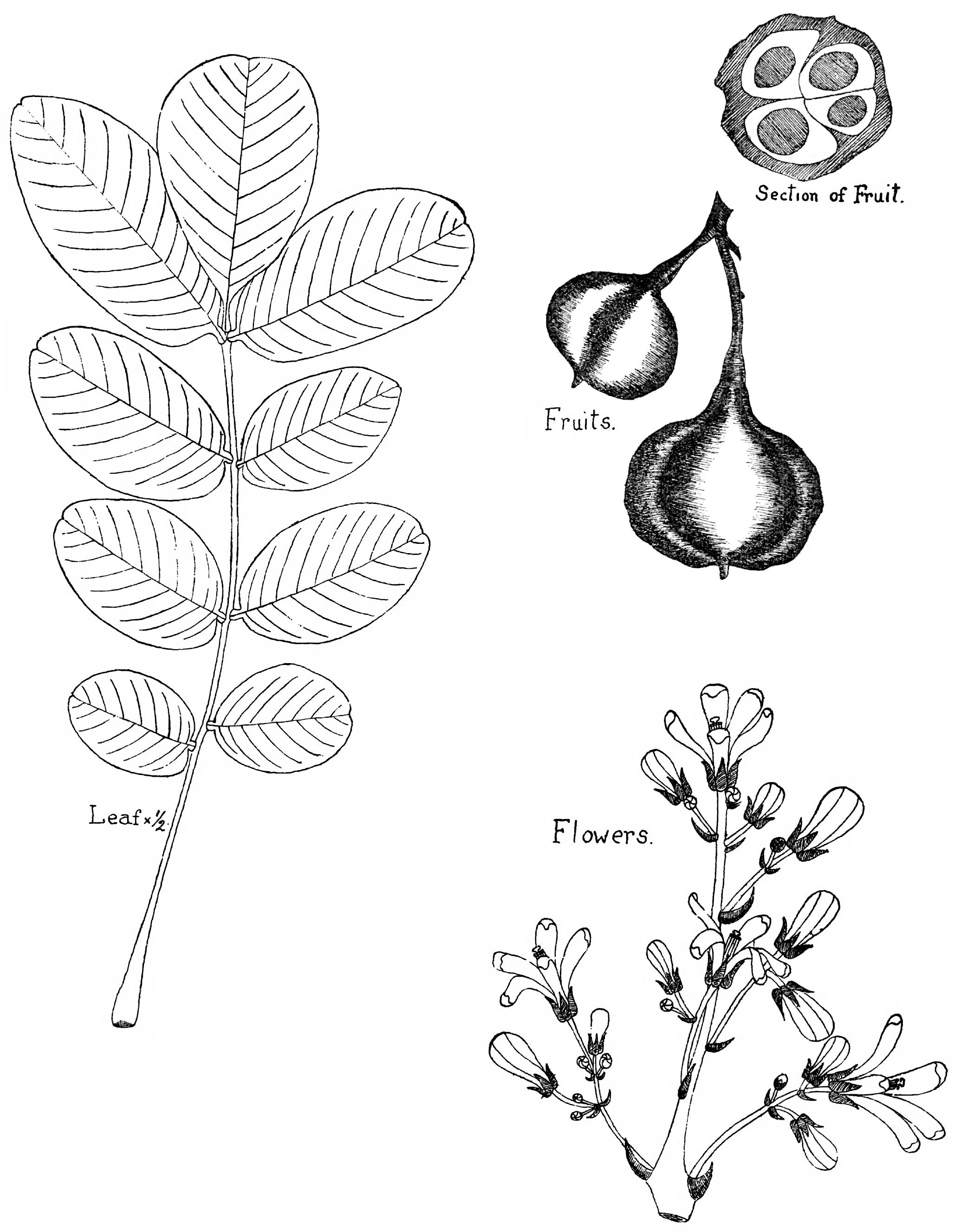
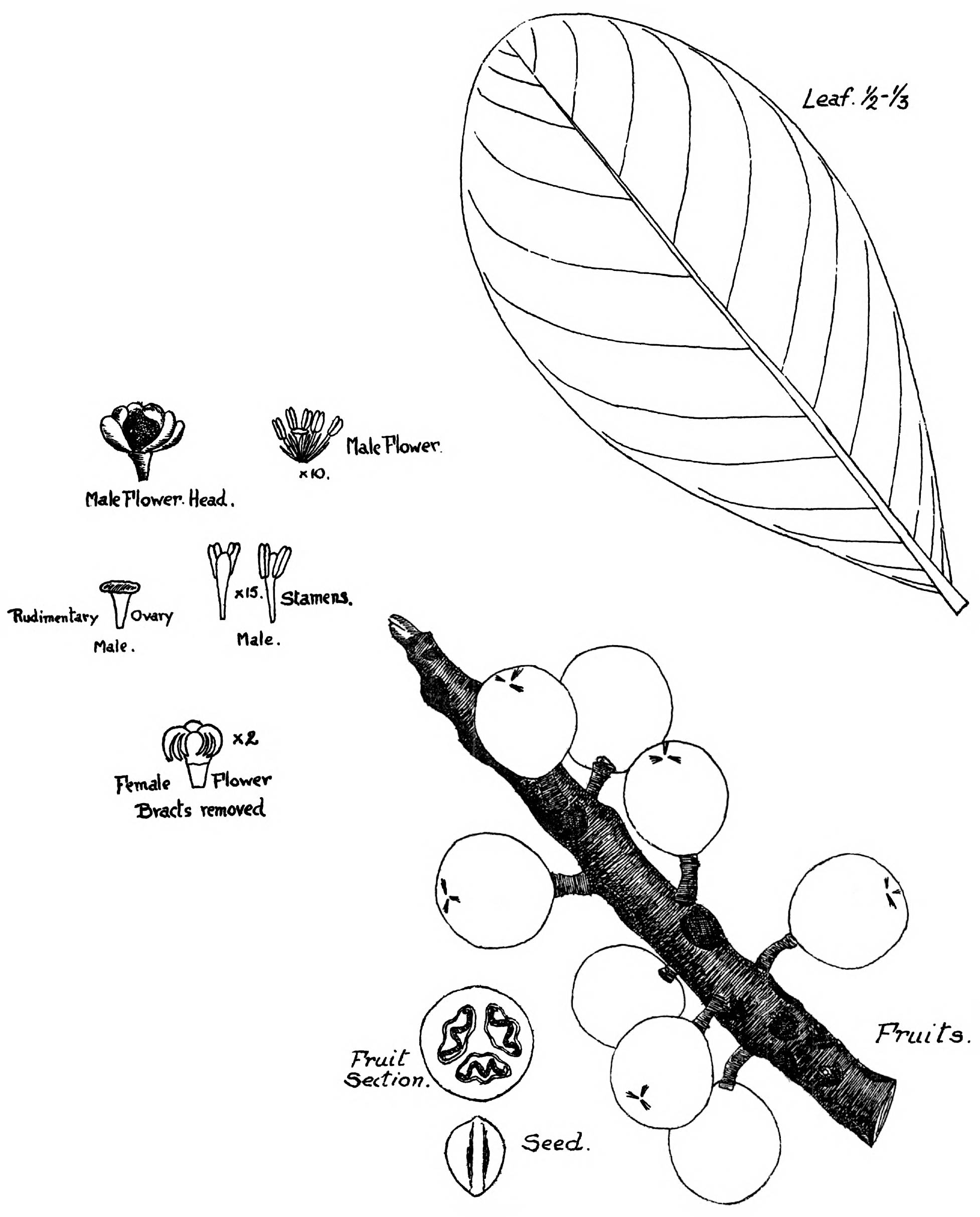
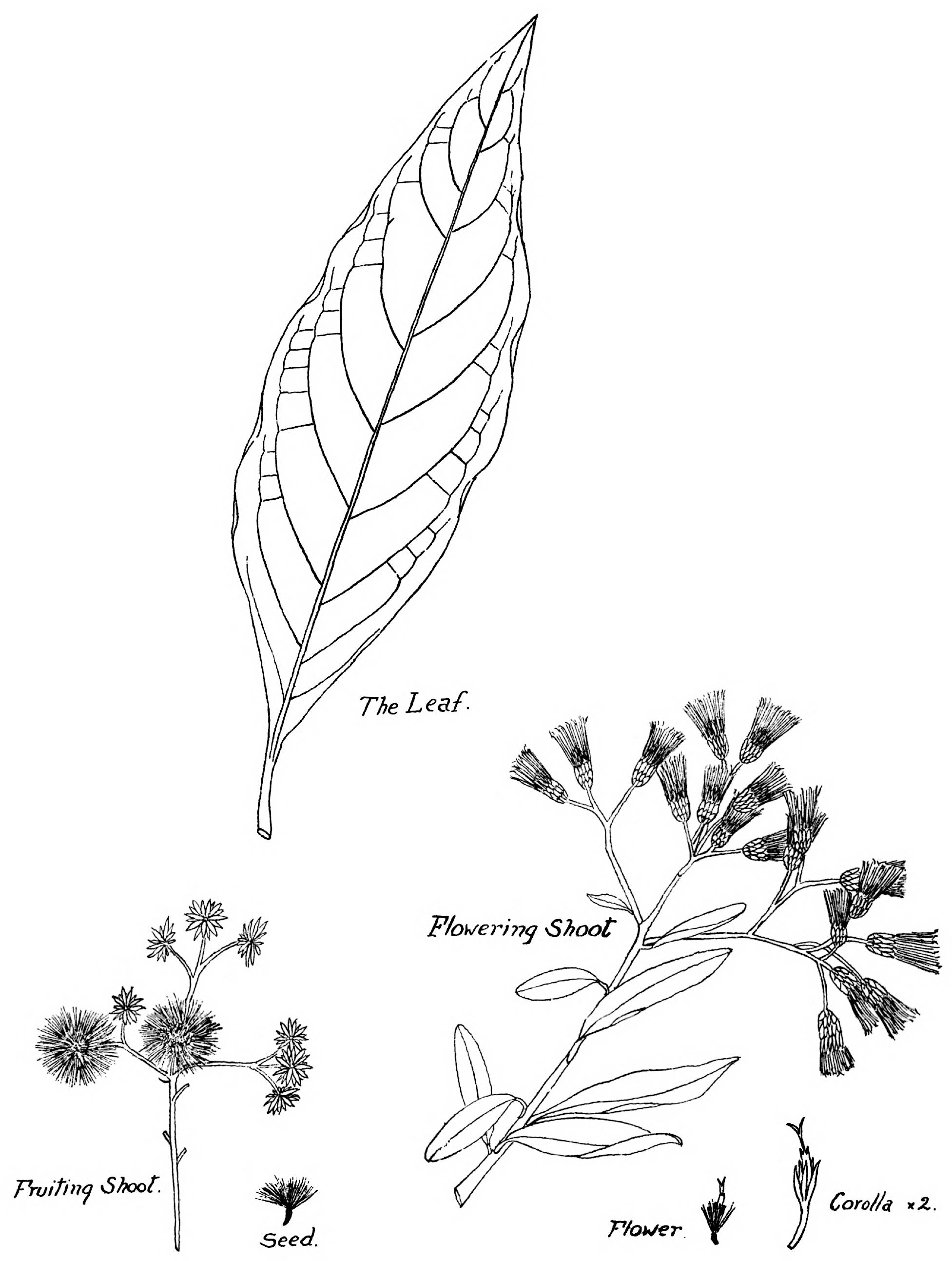
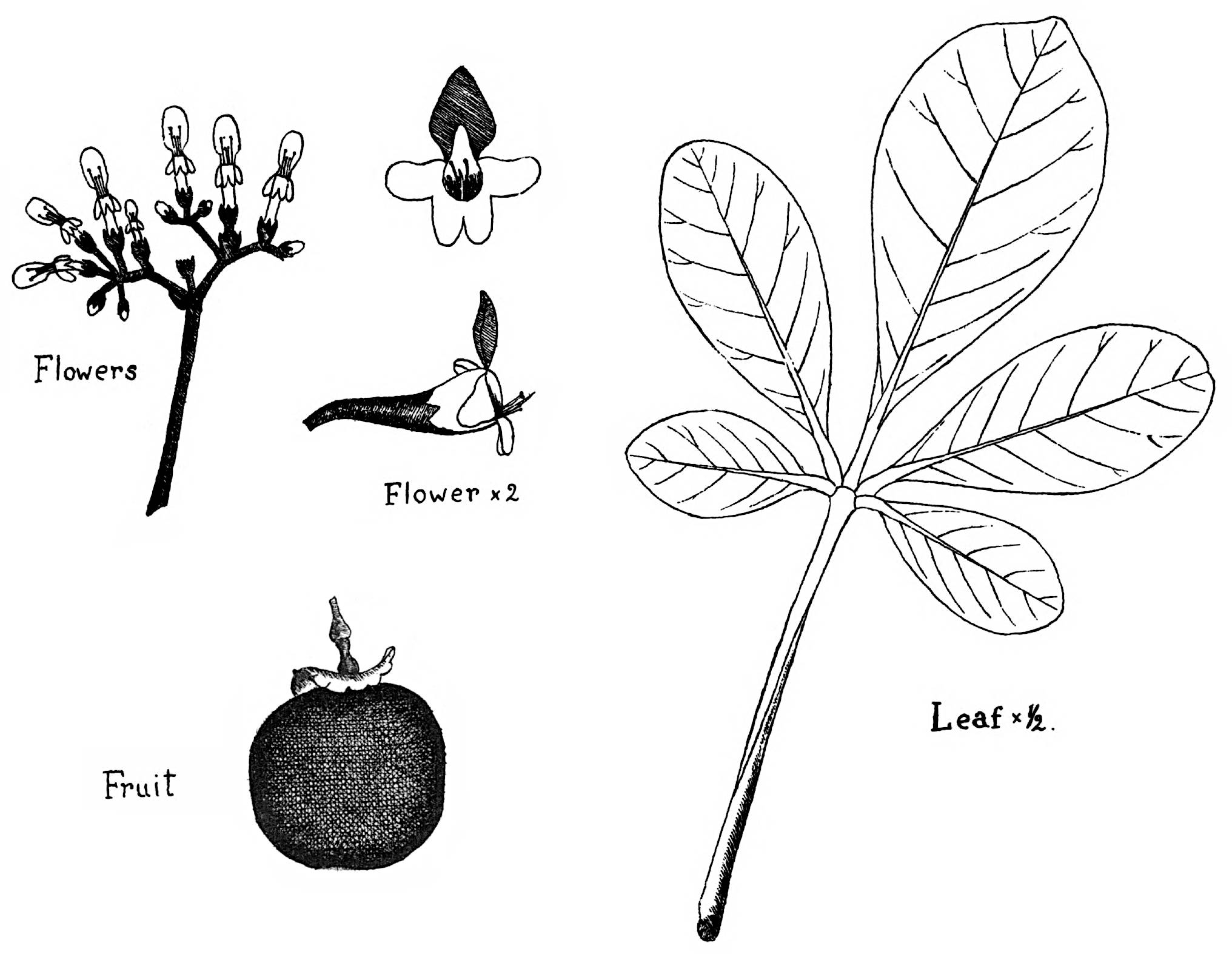
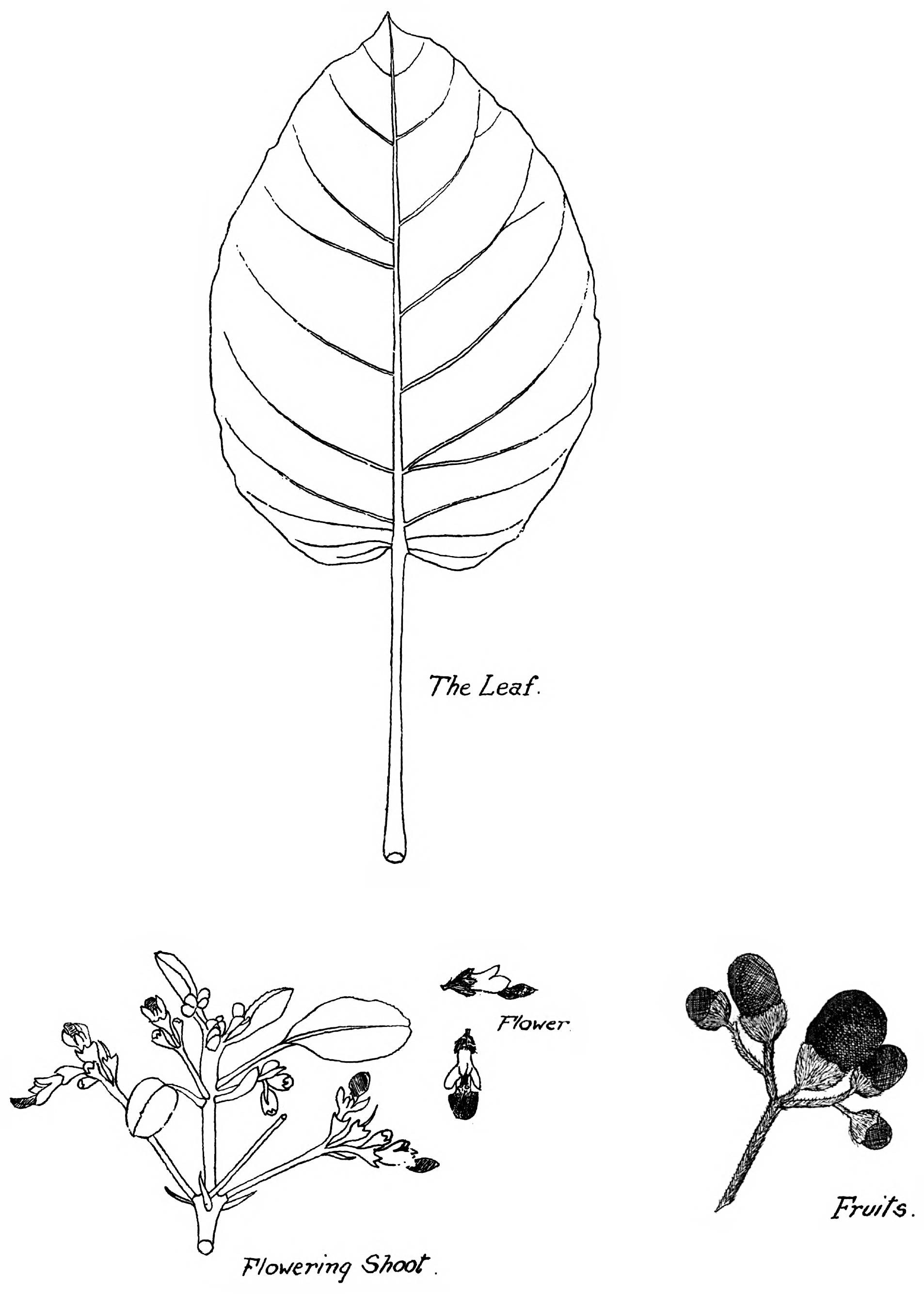
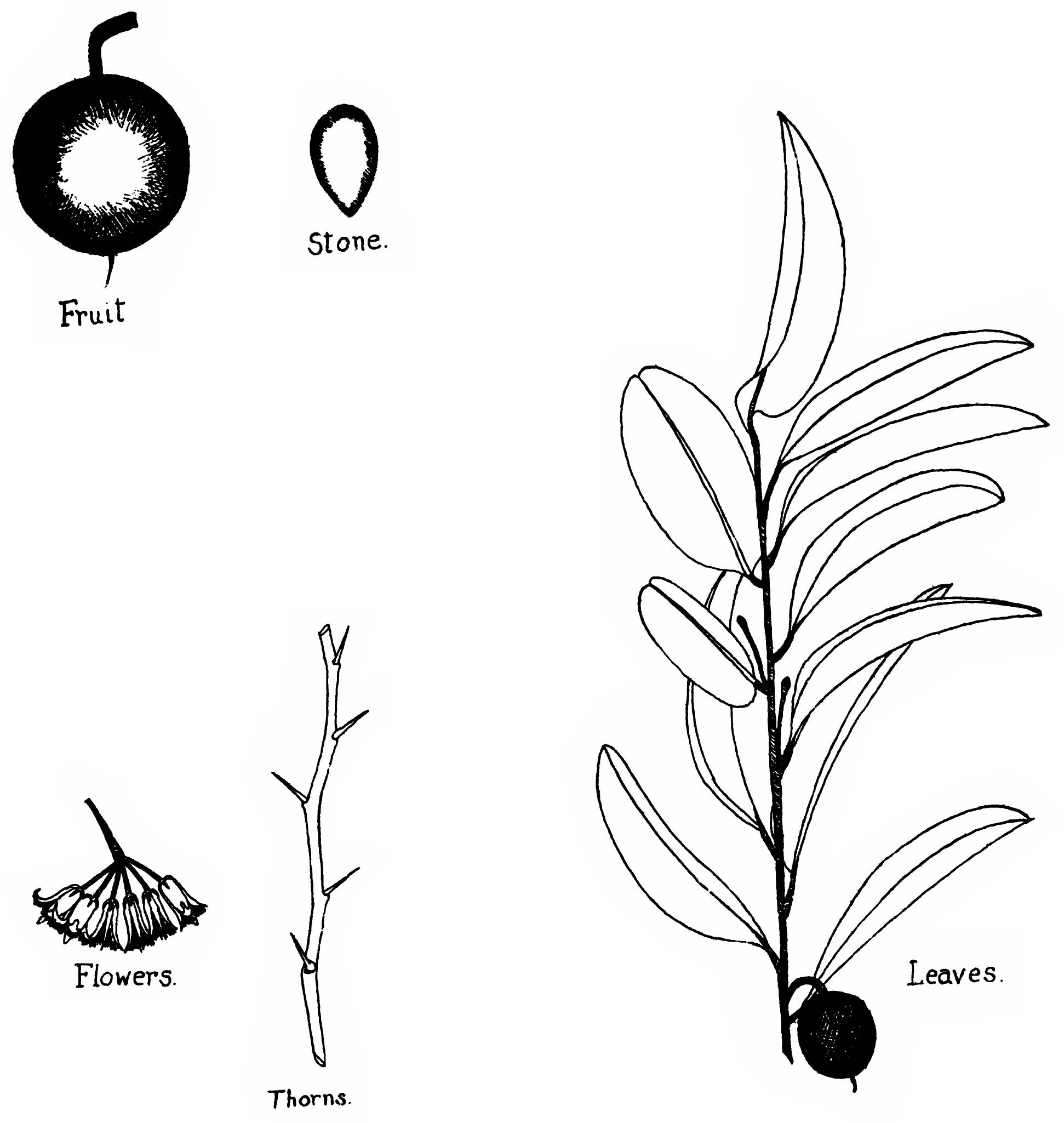
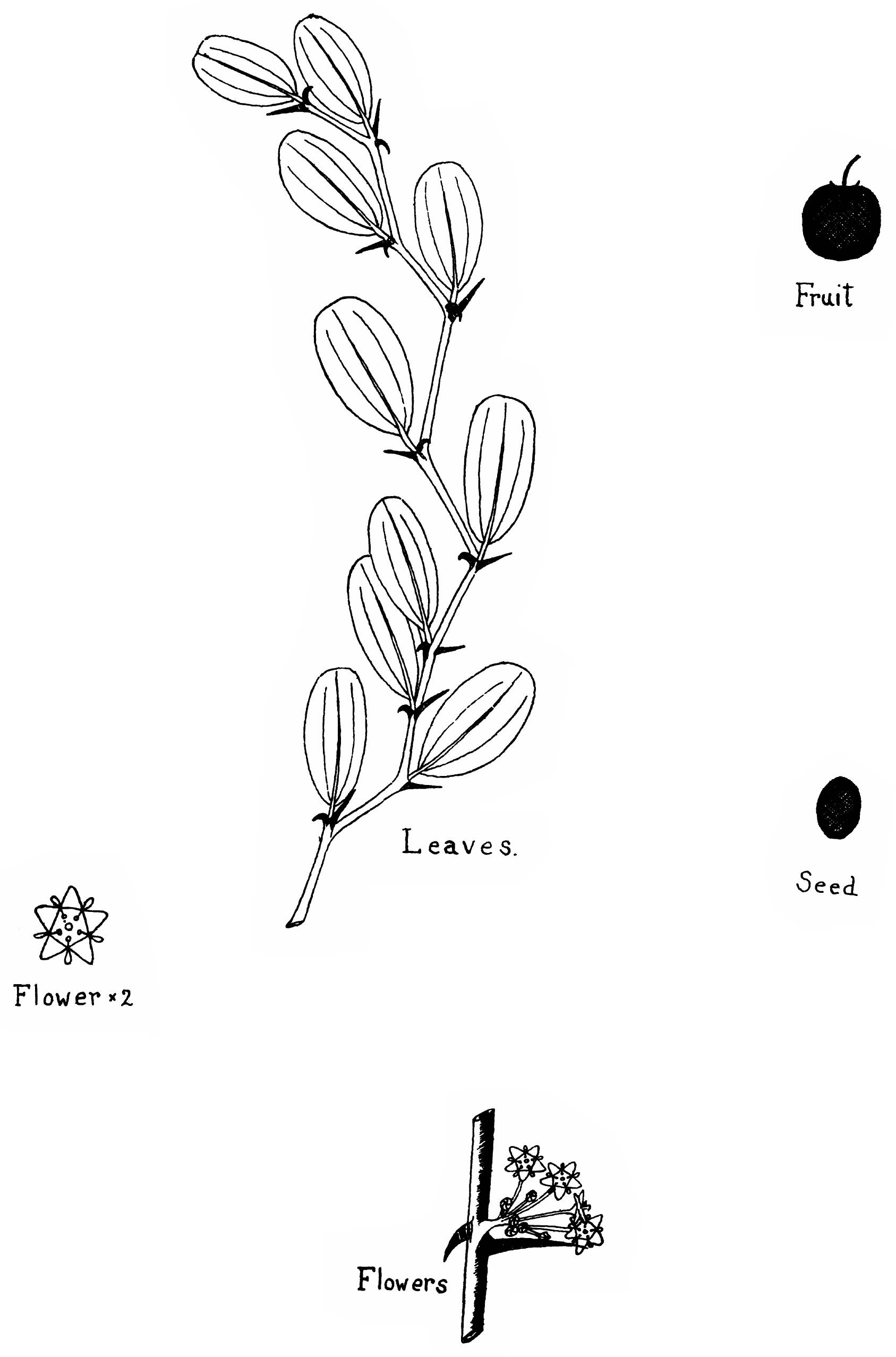
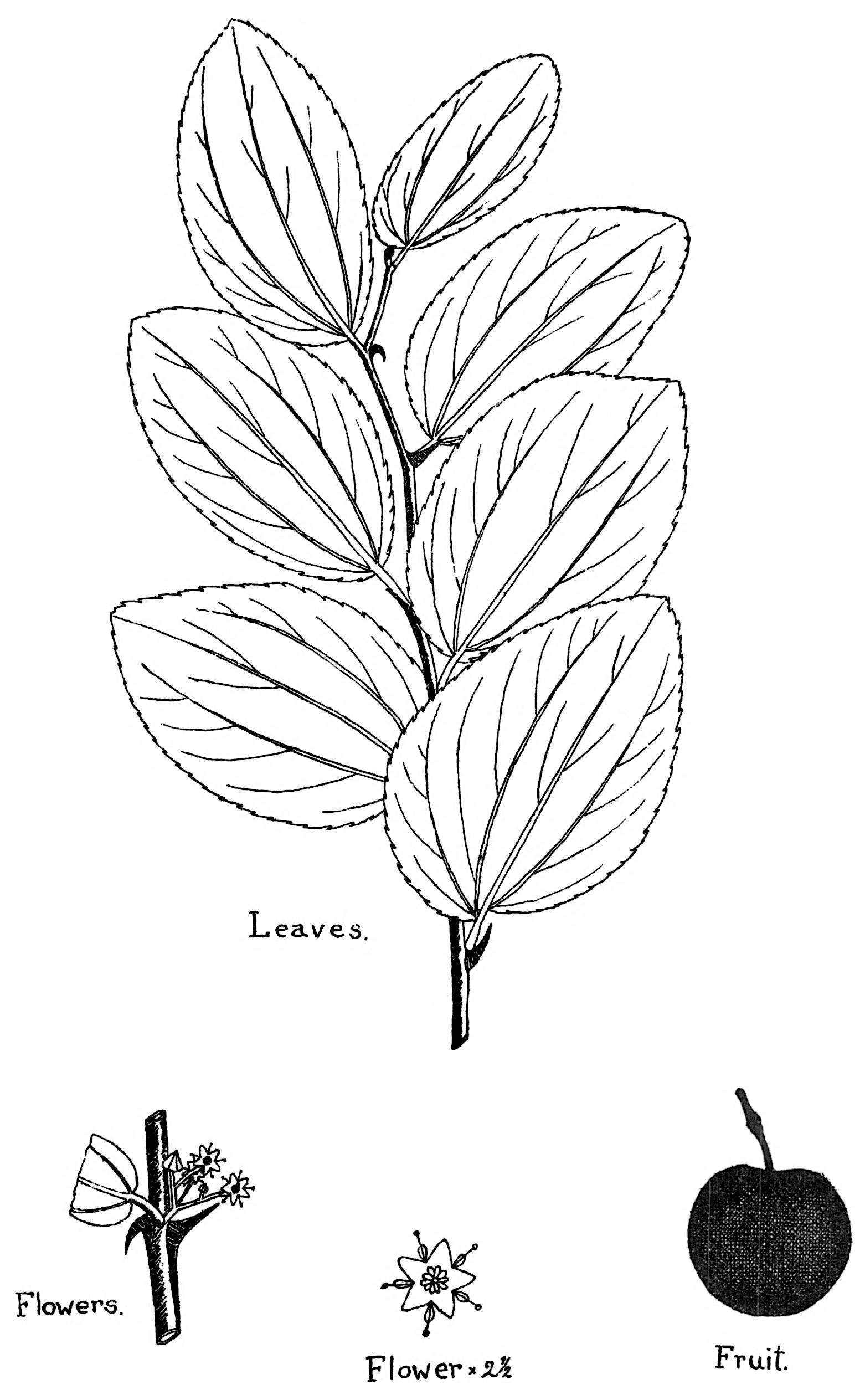
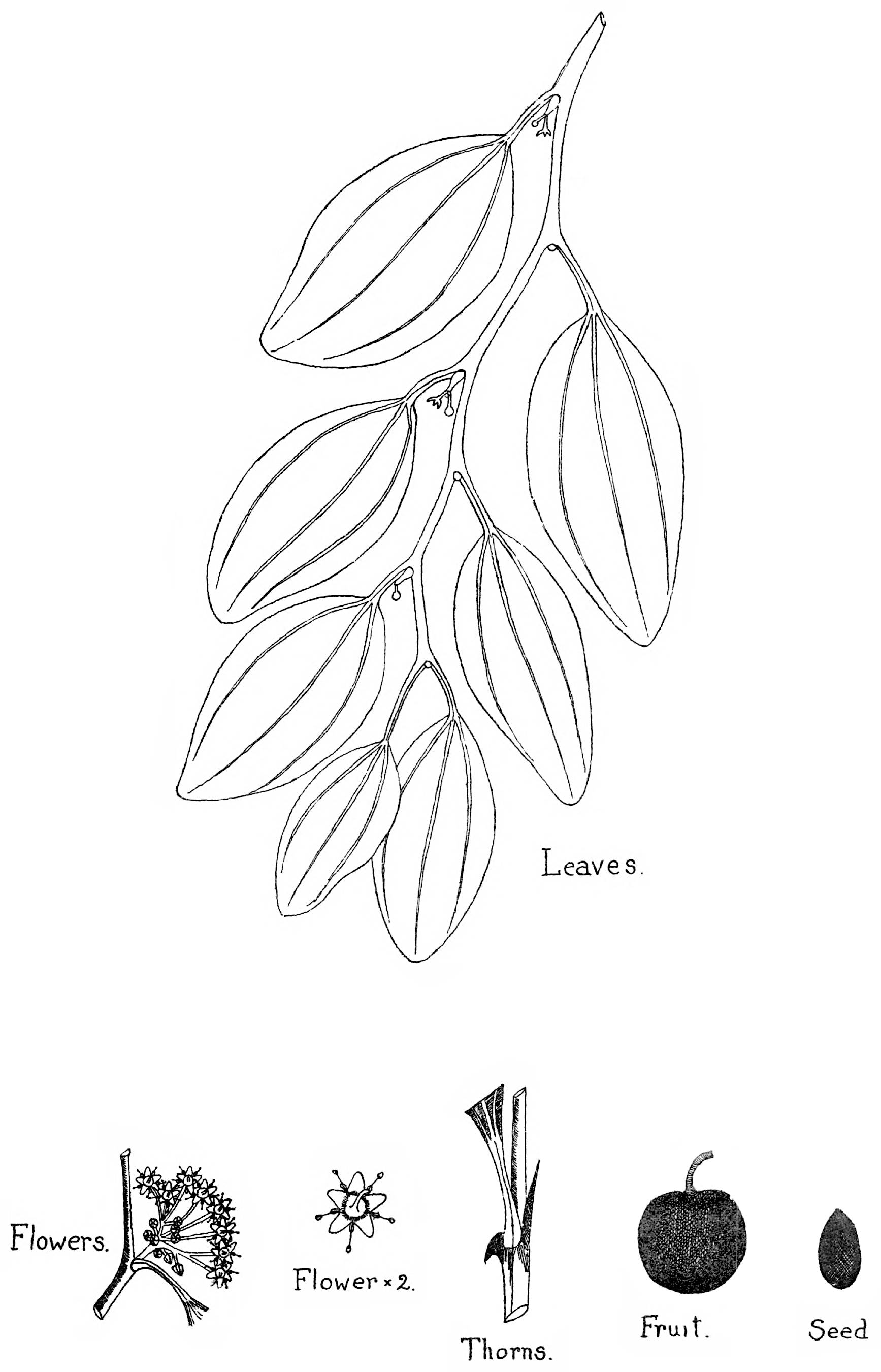
The text is supplemented by drawings of the flower, leaf, thorn,
fruit and seed, sketched from the living specimens. Wherever
possible the drawings are actual size to avoid calculations from
enlarged or reduced figures, but a number have been enlarged to
show structures, or reduced owing to their actual size. In several
cases sections of various parts have been made to illustrate
peculiarities of structure, a pocket lens being used for this
purpose, though practically all the parts drawn are visible to the
unaided eye.
The majority of the botanical names have been verified through
the Herbarium of the Royal Botanic Gardens at Kew.
In describing the woods, few of which are in use and many of
which are little likely to be of use, an attempt has been made to
strike a path midway between the complete technical and botanical
description employed with regard to timbers and a vague statement
as to colour, quality, hardness and grain which helps little to
distinguish the individual from others like it. Most of the woods
are described from samples collected by the author and shaped by
the Sokoto Arts and Crafts School. I am indebted for these, and for
the facilities offered for observing their behaviour under tools,
to Mr. W.E. Nicholson. The dry weight of seasoned wood is given in
all cases and in this connection it may be noted that a number of
species produce heavier wood in the north than they do in the
south.
A table of flowering seasons has been appended, with a few notes
on its significance.
A second appendix arranges the 120 species under their Families.
The Genera Plantarum of Bentham and Hooker has been
followed.
Finally, there
is an index of Hausa names for reference to the plates and
text, whose numbers are given in the index. A blank column has been
left in the index for the benefit of those who may desire to
collect either additional Hausa names or the nomenclature
of other tribes. It is hoped that the scope of the volume will be
enlarged thereby, so as to cover other parts of Nigeria where the
trees are the same but the language different.
The botanical name, being universal, is always given preference.
The native names, variable and unreliable as they often are, should
be a secondary consideration, their importance resting in their
being a means of communication with the native rather than a short
cut to the botanical names. In a country where there are several
native names for one tree or one native name for several distinct
species, the knowledge gained is either limited to a small number
of trees or applicable to a small area of country. But once
examined and properly identified, no number of native names need
confuse the real identity. In collecting native names a warning
should be given against the ignorant or ready-to-please native, and
independent corroboration is advisable before accepting a name as
worth recording. At the same time it is a fact that names genuinely
differ in quite small areas of country where the same language is
spoken, and a knowledge of the botanical names or real familiarity
with the tree species is essential to reliable work.
The identification of 120 species, though seemingly not a large
number, is sufficient to afford a thorough familiarity with most of
the savannah forests and makes further species, not included here,
stand out all the more clearly from their no longer similar
companions. Numbers or economic values of further species are
sufficient justification for forwarding these for identification to
Kew, if they cannot be named from their resemblance to known
species or by means of a Flora.
In selecting the 120 species to be included in this volume, the
author has had to exercise his own discretion. The collection has
been made between 9° and 14° N., and those who know this area will
find a great deal they require, while some, in the more northerly
latitudes, will find little of importance that is not included.
Others, however, will meet with unfortunate omissions, for the
following reason: South of 11° N. certain species which more truly
belong to the evergreen and intermediate forest zones have
established themselves in considerable numbers by streams, in
valleys and in pockets of rich soil with surroundings suited to
their propagation. Either all or none must be included if this
volume is to be representative of such regions, but since they are
not truly savannah species their inclusion here is beyond the scope
of this volume, which would have to be enlarged very considerably
to cover even the forests in the Benue region and south of the
Niger, where savannah abounds. All the species included here occur
up to 11° N., and with five exceptions up to 12° N., while nearly
all occur below 10° N. and many much further south.
A selection has been made in the case of some genera,
e.g., Ficus, and Combretum, to familiarise the
characters of trees which occur in large numbers and are typical of
savannah forest. Some of these are of little importance beyond
their occurrence in numbers over large stretches of country. The
value of trees varies largely according to locality. Timber value
is of little account in regions where it is inaccessible and
unexploitable. Food, medicinal and other values take precedence
where there is a large population demanding economic produce, and
many species must be accounted valuable merely as a soil covering
for the prevention of denudation, fixation of shifting surfaces,
protection of new growth, grazing areas, precipitation of moisture,
retention of conditions advantageous to agriculture or as a basis for the
introduction of new, or the encouragement of existing valuable
trees from the forestry standpoint. The advance of agriculture or
the condensing of population intensifies these values by the
destruction of the better types in favour of the poorer, and by the
increased demand for the products of the better types. There are
many instances of valuable products being obtained from forests
which are not only some distance from habitations but whose soil is
of a nature that precludes any possibility of supporting a
population, since it will not produce crops. For example,
Sclerocarya birrea (Danya) grows to large sizes in some
parts of Sokoto Province where the soil is of an unworkable kind
and where, over wide areas, there are no people. Yet this area is
visited from all over the country and hundreds of trees are felled
for the manufacture of mortars, trees in many cases suitable for
two or three mortars being exploited for one only.
Though much has been written about the various types of savannah
forests, a short account of them will not be superfluous here.
First it may be pointed out that savannah forests vary so much in
their composition and distribution that a survey is practically
impossible, and if made, would have to be revised annually.
Savannah is a particularly aggressive form of forest growth. Given
the opportunity, it at once occupies more land and on its own
ground the inferior types oust the superior wherever there is an
opening. Any extensive area of cultivation, if abandoned and
allowed to regenerate its tree growth, lets in secondary forests
containing species which are less exacting as to soil and moisture
conditions, and the depreciation of these conditions to the farming
methods stops the competitive growth of the trees which formerly
occupied the area. Where the area cleared is sufficiently small and
the period short enough, the conditions are retained, and are able
to close up the clearing with little loss by degeneration.
The fringing forests, belts of evergreen and deciduous trees on
the banks of streams, are continually hard pressed by the broad
wedges of open savannah between them. Fires take toll of them every
year and cultivation not only pushes them down stream from the
source but interrupts and cuts them up into islands exposed to
threats of extinction.
Savannah is very topographical, and though, within broad limits,
it can be divided into two main types, Tree and Bush savannah, the
two are so distributed or blended that the differences are often
unrecognisable and not able to be recorded in a survey.
Tree savannah is recognised as a tall type having a light,
closed canopy, with a sprinkling of under-shrubs and a sparse
growth of grass.
Bush savannah is a more open growth of less height, more
spreading and lower branched form, with no canopy, and many stunted
shrubs and a dense growth of grasses which are normally burnt out
each year. There is every variation of this latter type from
Combretum and Guiera scrub of barren soils or stony
plateaux to the type which closely approaches that of Tree
savannah.
The following are some of the recognised sub-types:—
Park Savannah.—This is a natural or
artificial formation, the latter a product of agriculture, and is a
two-storeyed growth composed of large type trees scattered about
and dominating an undergrowth of smaller trees. Type species are
Parkia filicoidea, Butyrospermum Parkii, Afzelia
africana, Tamarindus indica, Acacia albida, etc.
In the artificial product the large trees often owe their presence to their value,
having been allowed to stand when the land was cleared for farms,
the lower storey being a subsequent growth whose height depends on
the period that has elapsed since the farms were abandoned. Natural
Park Savannah is well represented by the superior size of
Afzelia africana or Paradaniellia Oliveri over the
lower storey of Terminalia and other species which cannot
attain the height or proportions of these large trees.
Fringing Forests.—These are the narrow
belts of forest along stream banks, and are either intrusion of
evergreen and other trees from a lower latitude or the remnants of
broader belts which have dwindled to a mere fringe. Typical species
are Khaya senegalensis, Eugenia guineensis, Adina
microcephala, Diospyros mespiliformis, etc., with a
number of evergreen shrubs, typically Jasmines. The narrower the
belt the lower branched are the trees.
“Kurimi.”—This is the formation found in
depressions, where there may or may not be a stream, not
necessarily flowing in the dry season. It is an enlarged edition of
the fringing belt and more nearly represents the evergreen forest.
Trees of large dimensions with long, clean boles are found amidst a
luxuriant undergrowth of shrubs and younger trees, which if
undisturbed will attain full maturity. “Kurimi” is the chief source
of timber in the Northern Provinces and from it such type species
as Khaya grandifolia, Chlorophora excelsa,
Albizzia Brownei, A. fastigiata, Diospyros
mespiliformis, and frequently Oil Palms are obtained.
“Fadamma.”—This is represented by the
broad river valley perennially inundated, or a depression of
varying size in flat country where water lies during the rains.
Typical species are Mitragyne africana, Paradaniellia
Oliveri and Borassus flabellifer, the Fan Palm. There is
either a dense growth of grass or, in the case of temporary lakes,
an area of cracked mud.
Pure forests are rare in savannah and Acacia Seyal and
Isoberlinia species are type cases. Gregarious clumps of
various sizes are, however, one of the commonest features and a
large number of trees is concerned. Examples are the Acacias
Seyal, arabica, albida, Senegal and
campylacantha; Anogeissus, Isoberlinia,
Bauhinia, Anona, Bombax, Terminalia,
Combretum, Detarium, Gardenia,
Parinarium, Pseudocedrela, Stereospermum,
Ximenia, Uapaca, Boswellia, Monotes,
etc.
Savannah also shows many examples of a dominant species, the
presence of which are indications of the composition of a forest.
The presence of this or that species sets a standard of comparative
quality to an area by which it may be valued from various
standpoints.
Over wide areas of savannah there are to be found many evidences
of previous peoples in the shape of walled ruins, foundations of
corn stores, grindstones and heaps of hand-picked stones indicative
of cultivation. The dating of such remains gives the approximate
age of the forest growth, and from this evidence it would appear
that certain types of savannah deteriorate considerably with age
and that farming will regenerate them to a certain extent. A
comparison of 20-30 year old forest with the untouched older forest
shows the former to be denser, more healthy and of straighter and
more even growth, while the latter contains a large number of very
old trees in a state of decay, with great open crowns, liable to be
blown down by storms, their branches burned by fires and riddled
with fungus. The new growth which is to take their place consists
mostly of grasses, stunted shrubs and small trees of species which
are incapable of forming a canopy. As mentioned above, provided the
area farmed is not too large, the support given it by the
surrounding forests is sufficient to ensure effective regeneration,
otherwise a poorer type takes hold.
In conclusion a
short account of the growth and characteristics of savannah forests
is given. As would be expected, the trees, being subject throughout
life to extremely hard conditions, counter with defensive measures
for self-preservation. Most of them are prolific seeders and many
have the habit of retaining their fruits or seeds on the tree for
many months, sometimes right round to the next flowering season.
Germination of seeds is a matter of chance when the tree is liable
to ground fires from October to April or May. The life of a
seedling, too, is precarious, since at the age of six months it may
be subject to a devastating fire. In later life a fire, occurring
in April, may, if the grass is high, burn the bark to ashes on the
outside, destroying all fruits or seeds, killing the twigs and
small branches and apparently destroying all life. Yet, a month
later leaves will spring from all but the burnt tips, the tree
losing a year’s height growth, but in a position to put on another
year’s stem girth. Wounds on the trunk of a tree heal over with the
formation of a hollow or rotten core. Trees 4-5 feet in girth have
been felled and their stems found to consist of a mere shell two or
three inches thick. The hollow is filled either with the workings
of termites or the fermenting sap which is forced up from the
ground level and will pour out of the stump. Savannah trees are
adapted to overcome most of these adverse conditions. Heavy crops
of fruit and seed, rapid ripening of seeds or fire-resisting fruit
coats and various means of distribution are means to ensure
germination. Deep or thickened tap roots of seedlings are put down
in the first year so that though the seedling may be levelled by
fire it will appear with renewed vigour soon after. A very short
flowering period for the individual tree is a marked characteristic
of many species. Fire has a quickening effect on the flowering and
leaf bearing of trees to a marked degree. A grass fire in November
may produce flowers and leaves in December on trees which, if
unburnt, would not have flowered till February. As a rule, no tree
will flower again if the first flowers have been burnt off, though
it will, of course, bear leaves. One or two exceptions, very rare,
have been noticed by the author, but these were due to the
peculiarity that some trees exhibit of bearing flowers on some of
their branches and not on others, so that the flowerless twigs were
probably excited by the fire into bearing flowers after it. Leaves
are readily replaced after attacks by locusts which generally take
place early in the season. The end of the cold weather and first
sign of heat is the spring of growth. Few trees have to wait for
rain before they produce all the signs of maturity except the
complete growth of their leaves. The bark of young seedlings,
subject to fire, is very thick and corky and that of old trees is
still more so, while the inner layers are fibrous and full of sap.
Almost all species will coppice very well, many throwing up shoots
up to 10 feet high in a season, others only a foot or two. Root
shoots are also very common and a large number of what are
apparently seedlings in the forest are root shoots. Most trees are
anchored very firmly to the ground by lateral roots far longer than
the height of the tree, a protection against storms. A tree which
is completely ringed will often endeavour to join up the cut,
meanwhile continuing its season’s foliage, while the smallest
connection with the root is sufficient for it to live for many
years. Most new leaves, as a protection against the sun, are
reddish in colour, many a brilliant crimson, the green being
produced through all gradations of colour from the red. Others are
hairy, scaly or covered with a bloom, the protective coverings
wearing off with maturity. The proportion of sapwood to hard is
large and many species show marked differences in this proportion
according to their locality, some showing no heartwood in the north
where it is produced in the south. The weights of woods are often
considerably heavier in the north than is the case for the same
species in the south. There are some localities where wide areas
are infested with termites to such an extent that, during the dry
weather their whole surface, even to the tips of the twigs, is
completely covered with the earth carried by the termites. Although
there are exceptions, it is observed that apparent damage is
negligible and that the old scales are removed from the bark,
exposing the fresh surface.
The savannah species are, then, well equipped to withstand fire,
drought, insects, wounds, storms, and damage by man and it can be
imagined how readily they will supplant better types, since the
harder the conditions the better adapted are the trees to meet
them. The wide distribution of most species renders them more
aggressive, and an individual species that will grow into a fine
tree under the best conditions can still grow under the worst,
though it may differ in form and feature so as to be hardly
recognisable as the same species.
If, as it is supposed, savannah forests are depreciating of
their own accord, some factor other than climate, which has not
been demonstrated by records, must be at work. It is sufficient to
point to the increase and spread of the population from the towns
to the forests to find a reason for the displacement of good forest
by lower grades. Shifting cultivation encourages a worse type each
time it is practiced and late fires are very destructive.
For valuable assistance given in identifying the trees and
shrubs in this volume, the author is indebted to Dr. A. W. Hill,
Director of the Royal Botanic Gardens, Kew, and Mr. J. Hutchinson
of the Herbarium. To Dr. J. M. Dalziel he is indebted for the
“Hausa Botanical Vocabulary,” a valuable short-cut to further
research. Other books referred to are the “Flora of Tropical
Africa” and Kew Bulletin, Additional Series IX., neither of which
has been used other than for purposes of classification, it being
the author’s aim to describe and illustrate the material as it
appears to be, and not only as it actually is from the scientific
point of view, avoiding botanical terms except where they have no
alternatives.
H. V. L.
March, 1925.
ACACIA ALBIDA
Delile.—Gawo. LEGUMINOSAE.
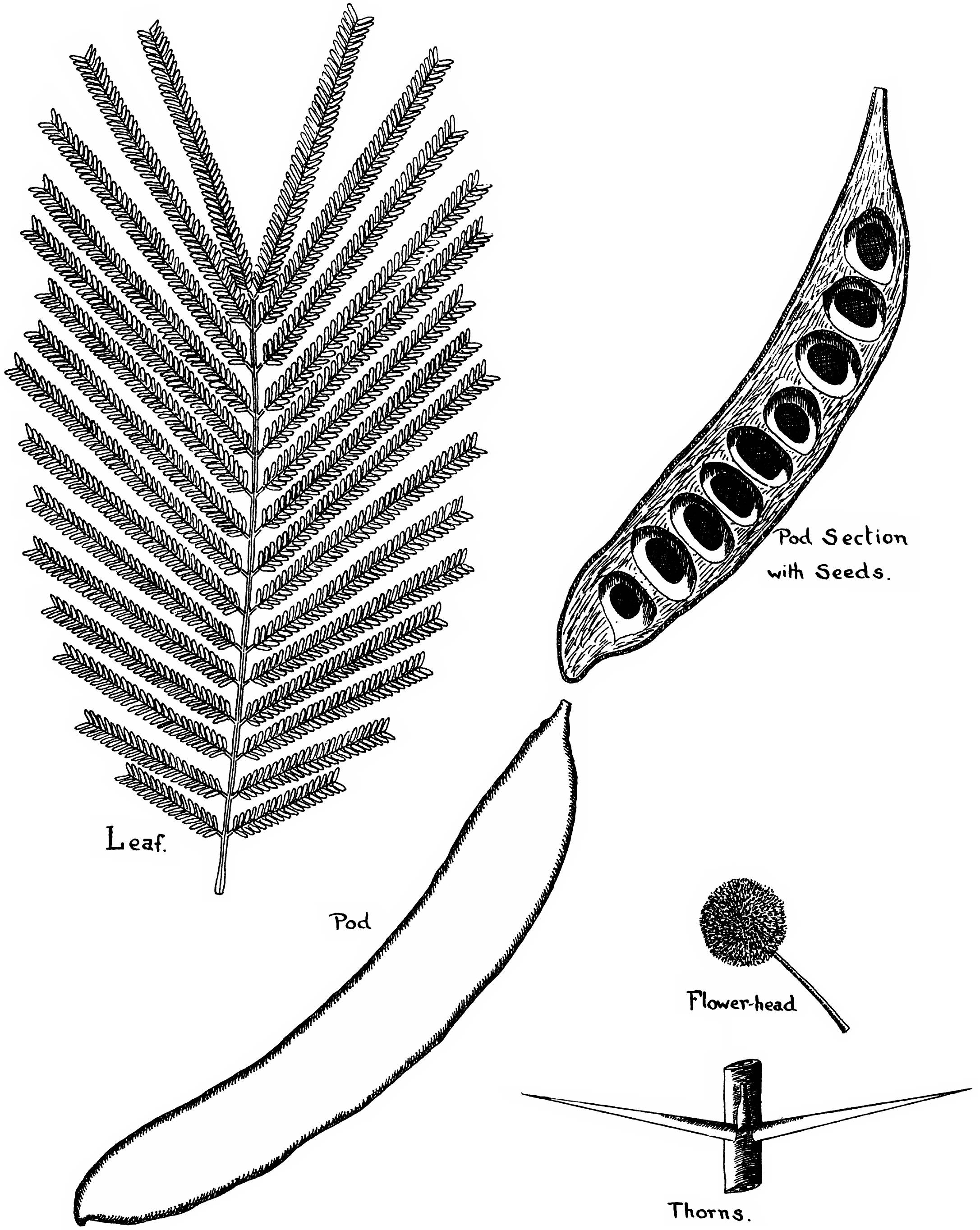
This is the largest of the Acacias in the north, and attains a
height of over 60 feet with girths over 12 feet. It is particularly
common in Sokoto, but even there is locally distributed, and
gregarious clumps are commonly met with. It prefers dry, sandy
soils. The form of the young and the old tree is very different.
The former has a straight bole with acutely ascending branches
forming a high, flat-topped crown very similar to that of
Paradaniellia in shape. The bole may be clean for over 20
feet, but in young trees there are usually clusters of thorny twigs
at no great height. As age increases the crown widens and the limbs
get heavier and more spreading until the form is like that of
Parkia. The bole is then quite clean and considerably
thickened at the base, the roots spreading above ground and forming
flanges, thick but of little height. Its distinguishing peculiarity
is the habit of shedding its leaves at the approach of the rains
and putting them forth at the first sign of the dry season, in
September. It grows fast up to full height and then slowly.
The Bark is uniform dull grey. Long
wide fissures and prominent ridges of hard bark ascend the bole and
the bark appears as if it was stretched without being cast off.
Light brown patches, quickly turning grey, are left by the falling
scales. The slash is pale brown and fibrous.
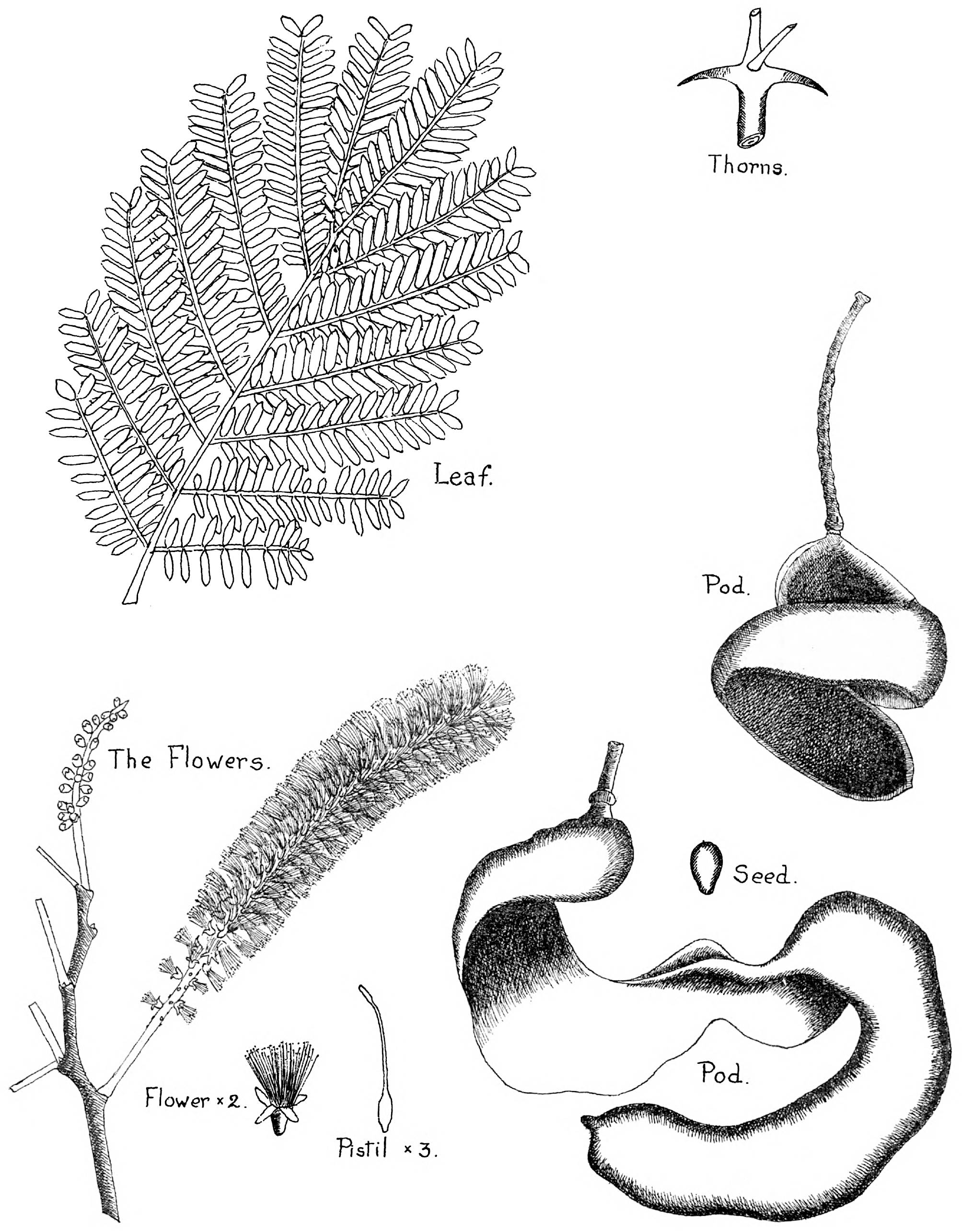
The Thorns are in pairs, under ½ inch
long and slightly recurved. They are pale brown with white bases.
The young tree is armed all over, but as the tree ages the thorns
leave the stem and finally the higher branches are free as if
protection seemed to be unnecessary at a height.
The Wood.—The heartwood is a light,
clean yellow. The sapwood is a dirty white. Frequently the whole
wood is a dirty white or grey, but this is due to discolourations
from mould and the wood should always be seasoned in dry air and
not allowed to get wet. In transverse section the rings are
indistinct and wide apart, the pores are small and evenly
distributed, mostly in festoons with twin pores here and there, the
soft tissue plainly seen as concentric lines with the hard tissue
alternating. The rays are extremely fine, very regular and closely
spaced and quite invisible to the naked eye. In vertical section
there are faint bands of colour, with light reflecting flecks in
tangential section. The wood is soft, very easy to work with all
tools, seasons well if looked after, and finishes well under the
plane. The weight is 35 lbs. a cubic foot.
The Leaves are bipinnate, 4 inches
long with 6-7 pairs of pinnae bearing some 10-15 pairs of dusty,
grey-green leaflets, covered with tiny hairs. The foliage in the
mass appears bluish-green. It appears at the end of September and
is susceptible to insect, caterpillar and locust.
The Flowers, from October to December,
are in dense spikes 3-4 inches long, scented. The lower inch of the
spike is flowerless. Several spikes are borne at the twig ends.
Each flower has a 5-lobed cream-coloured calyx with pink centre,
40-50 stamens, and a short pistil with slightly clubbed stigma.
The Fruits are pods, at first green
and sickle shaped, ripening to a bright orange and twisting into
strange shapes. They are 4-6 inches long, 1 inch wide, concave on
one side, convex on the other. They contain dark brown shiny seeds
⅜ inch long. The pods ripen in January and February and fall
entire, rotting on the ground.
Uses.—Inferior canoes, of the stitched
together type are made. The ripe pods are collected and fed to
cattle, sheep and goats. The common brown kite nests frequently in
its branches in March and April.
ACACIA ARABICA
Willd.—Gabaruwa, Bagaruwa. LEGUMINOSAE.
This tree, the original source of gum-arabic, is very common and
widely distributed throughout the north. It is very frequent round
towns where it is utilised for the tannin properties of its pods.
It varies largely in size from a small erect tree with umbrella
crown to a large, heavy-stemmed tree with high rounded crown. It
occurs gregariously in clumps or small forests, growing densely
with the crowns meeting overhead. The seed germinates freely in
low-lying country liable to submergence by rains or floods and the
tree flourishes in such situations. It is just as partial to dry
sandy soils where it abounds. With its almost black stem and
branches, bluish-green foliage and graceful, symmetrical form, it
is readily distinguished from other Acacia species. The
average height is some 20-25 feet, but trees over 35 feet with
girths up to 8 feet are not uncommon.
The Bark is almost black, or a dull
dark grey, with long stringy ridges and narrow fissures. The dark
colour extends to the branches and woody twigs, the latter covered
with a soft pubescence. A clear yellow gum exudes from the slash
which is a pale pink colour. The slash is red brown and blackish in
streaks.
The Thorns are in pairs on the
branches and twigs, some quite short and slightly curved, others,
especially on the older wood being long, straight, slender and very
sharp, with a grey colour and a slight backward slope. They are up
to three inches in length and generally curved a little.
The Wood is a deep red-brown with
almost purple bands. The sapwood is yellow. In transverse section
the colour is darkest, the rings show as dark, ill-defined bands,
the pores are small, few and scattered about between the fine
straight rays which are visible against the dark ground of the hard
tissue. There are many double and nested pores and zones with very
few pores. Their contents nearly close them. In vertical section
the grain is twisted, there are dark bands and the pores have black
contents. The wood is very hard to saw and plane but the finish is
hard and takes a high polish. The grain picks up badly in places.
The transverse section will polish. The weight is 75-80 lbs. a
cubic foot.
The Leaves are bipinnate, some 2-4
inches long with 5-6 or sometimes more pinnae bearing 15-20 pairs
of leaflets with rounded tips, ³⁄₁₆ inch long. They are a dark
bluish-green with grey bloom and soft texture.
The Fruits are jointed pods, straight
or sickle-shaped, with slightly embossed seeds. The pod surface is
wrinkled and covered densely with a whitish bloom. The seeds, some
10-12 in a pod, are round, flattened, shiny and brown, ⅜ inch in
diameter. The pods, ripening towards the end of the year, fall to
the ground entire. They are the “Sant Pods” of commerce.
Uses.—Hoe and axe handles are made
from the wood which rarely reaches large enough dimensions to
provide canoes as it does in other parts of Africa.
A concoction of the pods, crushed with water, is used for
tanning. The leaves, boiled, with the addition of a small piece of
Tamarind pod, are used as a cure for a disease of the eye which
causes the lashes to fall out.
From the pods a black leather dye called “kuloko” is made.
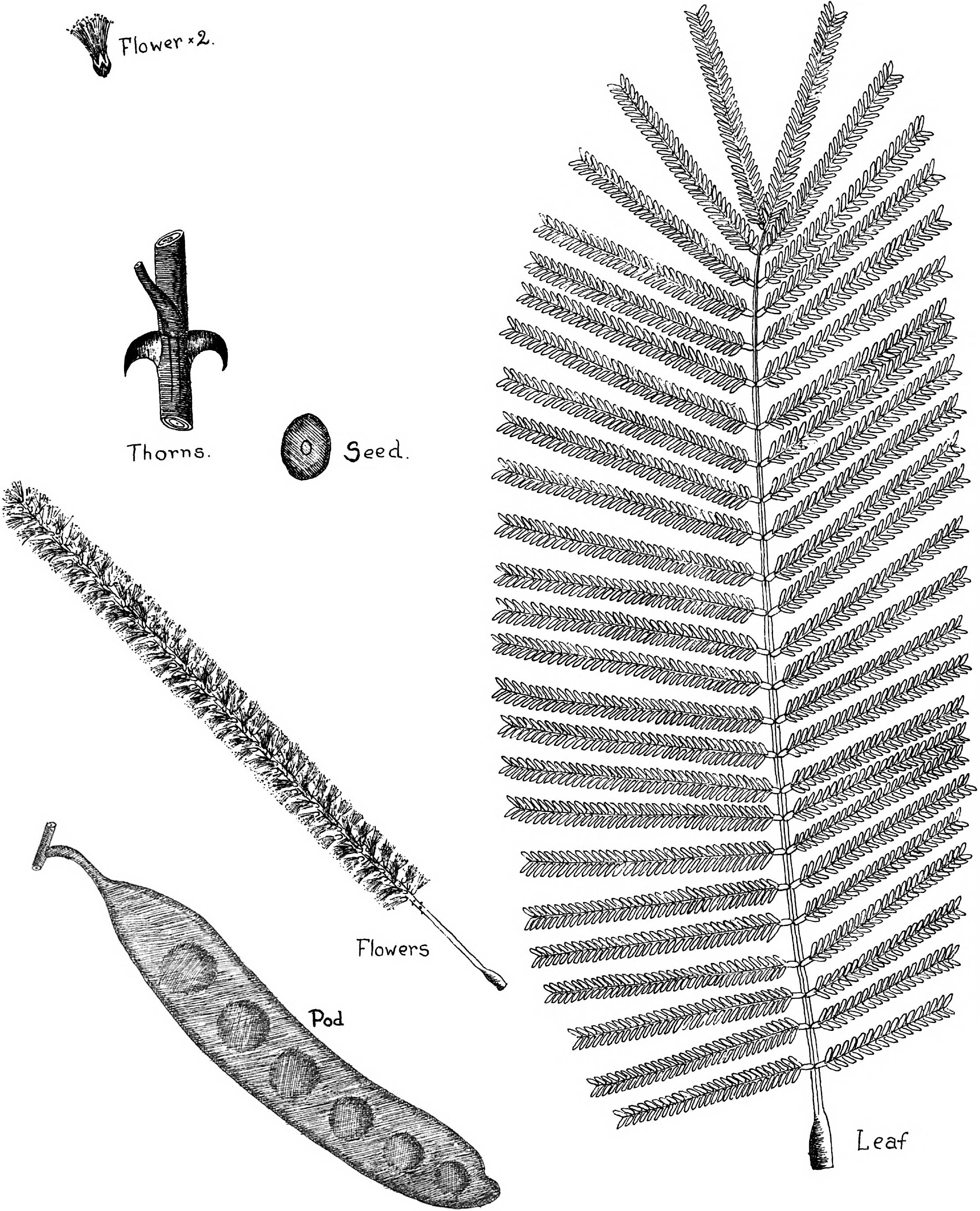
ACACIA CAMPYLACANTHA
Hochst.—Kumbar Shafo, Farichin Shafo, Karo, Karki.
LEGUMINOSAE.
A tall tree somewhat resembling Acacia Sieberiana,
especially in the case of full-grown trees of both species. A
comparison of the bark, thorns and pods will readily distinguish
one from the other. It is the tallest and most erect of the acacias
in the north, reaching a height of 60 or more feet and girths of
4-6 feet when growing, as is very commonly the case, in dense
clumps on stream banks, hillsides and on the sites of old towns.
This last peculiar situation is sometimes explained locally by the
fact that cattle eat the pods and deposit the undigested seeds on
the site of a cattle camp in a deserted town. The bole is often 30
feet or more in length in these clumps, the crowns high and
flat-topped and meeting overhead, forming a density of shade
sufficient to kill all growth of grass on the floor. Old trees in
the open have lower, wider-spreading and more open crowns, with
shorter boles and bear a marked resemblance, at a distance, to
A. Sieberiana. They commonly reach over 6 feet in girth.
The Bark is a pale yellowish colour,
sometimes almost white, and is smooth, with small, regular,
brownish scales which in old trees are grey and coarser. The slash
is crimson with white streaks, very fibrous.
The Thorns, which are the readiest
means of distinguishing this species from A. Sieberiana, are
short, strong, recurved, and brown with a black point. They
resemble falcons’ claws, from which they get their native name.
They are in pairs at a widely obtuse angle.
The Wood is a very dark brown, with
almost black streaks. The sapwood is white. In transverse section
the rings show as irregular dark bands, the pores are small, few
and connected by very thin lines of soft tissue, the rays are very
fine, waved and unevenly spaced, invisible to the naked eye. In
vertical section the rings show as bands of dark brown and almost
black and there are lighter areas. The wood is hard, fibrous and
bad to saw, not easy to plane, though the finished surface is
smooth and will take a good polish. The long fibres pick up badly
in places. The weight is 52 lbs. a cubic foot.
The Leaves are bipinnate, about 9-10
inches long with 20-25 pairs of leaflets which droop on each side
of the mid-rib. The narrow leaflets are ³⁄₁₆ inch long, slightly
curved and a dull, dark green.
The Flowers are in 4-5 inch spikes
about ½ inch in diameter, densely crowded with cream-coloured
scented flowers with numerous stamens. They appear from May-July in
masses amongst the leaves.
The Fruits are pods, 4-5 inches long,
¾ inch wide, very flat, with the seeds slightly embossed. They are
very numerous, tenacious and conspicuous on the trees from October
onwards. The seeds, about six in a pod, are round, flat, shiny and
dark brown, the same colour as the pods, and have strong
germinating power.
Uses.—The wood is used for implement
handles of all kinds. The branches are cut for making protective
farm fences, and the pods are very much appreciated by cattle.
ACACIA DALZIELII
Craib.—Gaba chara, Gwanno. LEGUMINOSAE.
This is a slender Acacia, locally very plentiful, especially in
central and south-west Sokoto throughout some 1,000 square miles.
It inhabits the open bush savannah of better quality where the
rainfall is good and the soil contains some loam. In certain belts
it is the predominant species. It is the largest leaved of all the
Acacias in this zone and at a distance closely resembles Entada
sudanica, though the leaflets are much smaller and more
numerous and the flowers and thorns are both distinctive; in fact,
the resemblance is one of form only. It grows 20-35 high with a
girth up to 3 feet. Some trees are tall and slender with high
crowns, others low-branched and spreading, but the foliage of all
is very light and graceful.
The Bark is grey-brown with long
fissures and large, shaggy scales which fall in long, irregular
sections. This is largely due to fires which thicken and blacken
the cork. The bark of the twigs is a silvery grey. The slash is a
dull red, exposing the orange colour of the wood.
The Thorns are in pairs on the twigs,
the leaves springing from between them. They vary considerably in
size, ¼-¾ inch long, large and green on the new shoots and small
and black on the wood, as a rule. They are slightly curved, and
grooved along the inner side from the point where the leaf-stalk
springs.
The Wood.—The heartwood is reddish
with long, vertical streaks of black and brown in the pores. The
sapwood is yellow with an orange grain. In transverse section the
rings are indistinct, the pores are open and numerous, the soft
tissue in wide and narrow festoons plainly visible to the unaided
eye. The wood is hard, splits easily, is straight-grained, not easy
to plane and weighs 65 lbs. a cubic foot.
The Leaves are 12-18 inches long,
bipinnate with 20 or more pairs of pinnae bearing 50 or more pairs
of long, narrow, pointed leaflets with parallel edges. Near the
base on the dorsal side of the stalk is a prominent oval gland.
They are a very bright, fresh green, and at first erect, finally
spread and droop.
The Flowers are in large, erect
panicles, 12-18 inches high and stiffly branched, standing
prominently up on the ends of the shoots. They appear in the rains
and are in bright yellow balls about ½ inch in diameter.
The Fruits are pods, 3-5 inches long,
½-¾ inch broad, flat, dark red-brown with a grey bloom and
containing from 6-12 flat, oval, brown seeds. The pod is slightly
embossed at the seeds and very persistent, numbers remaining on the
tree till the following rains.
ACACIA NILOTICA
Del.—Bagaruwa namiji. LEGUMINOSAE.
This species is nearly allied to Acacia arabica and can
be at once distinguished from it by the smooth, jointed pods. In
other respects it is very similar. The native distinguishes the two
species by the fruits, the Acacia arabica with its large
grey “sant pods” being known as the female, “ta mata” as against
the name “namiji” of A. nilotica. As a rule this species is
a much larger tree than A. arabica and two forms are
commonly met with. The one, which is common in low-lying country
liable to inundation, has a short bole and a large number of
slender branches which ascend to a great height and spread out
wide, forming a large semi-spherical crown almost reaching the
ground. The other has a long bole with a girth of 10 feet or more
and a high rounded crown. The latter type yields a large volume of
timber.
The Bark is almost black with deep
fissures and very long, ragged scales, which fall in large pieces.
The slash is red-brown, with darker streaks.
The Thorns are in pairs, quite small
near the twig tips and up to 2 inches or more in length elsewhere,
straight or curved, more often the latter, white, slender and very
strong and sharp.
The Wood is reddish-brown in colour,
almost blood-colour in cross section, with marked rings. It is very
close grained, the cross section being able to be planed quite
smooth. The grain is irregular and picks up. The weight is about 75
lbs. per cubic foot. See A. arabica.
The Leaves are 2-3 inches long with
some five pairs of pinnae bearing 10-20 pairs of leaflets,
bluish-green with a grey pubescence.
The Flowers are very numerous from
February onwards in clusters of 2-5 at the nodes, the slender
stalks over an inch long and the sweet-scented, yellow flower balls
over ½ inch in diameter. As a rule the ends of the twigs on which
the flowers are borne have no spines, these appearing later.
The Pods are very variable in size, up
to 6 inches in length and their peculiarity is the marked jointing
which, before they are full grown, gives them the appearance of a
string of beads. They are smooth, with a slight bloom and contain
some 6-8 oval, flattened seeds which ripen from March onwards.
Uses.—The wood is used for axe, hoe
and tool handles.
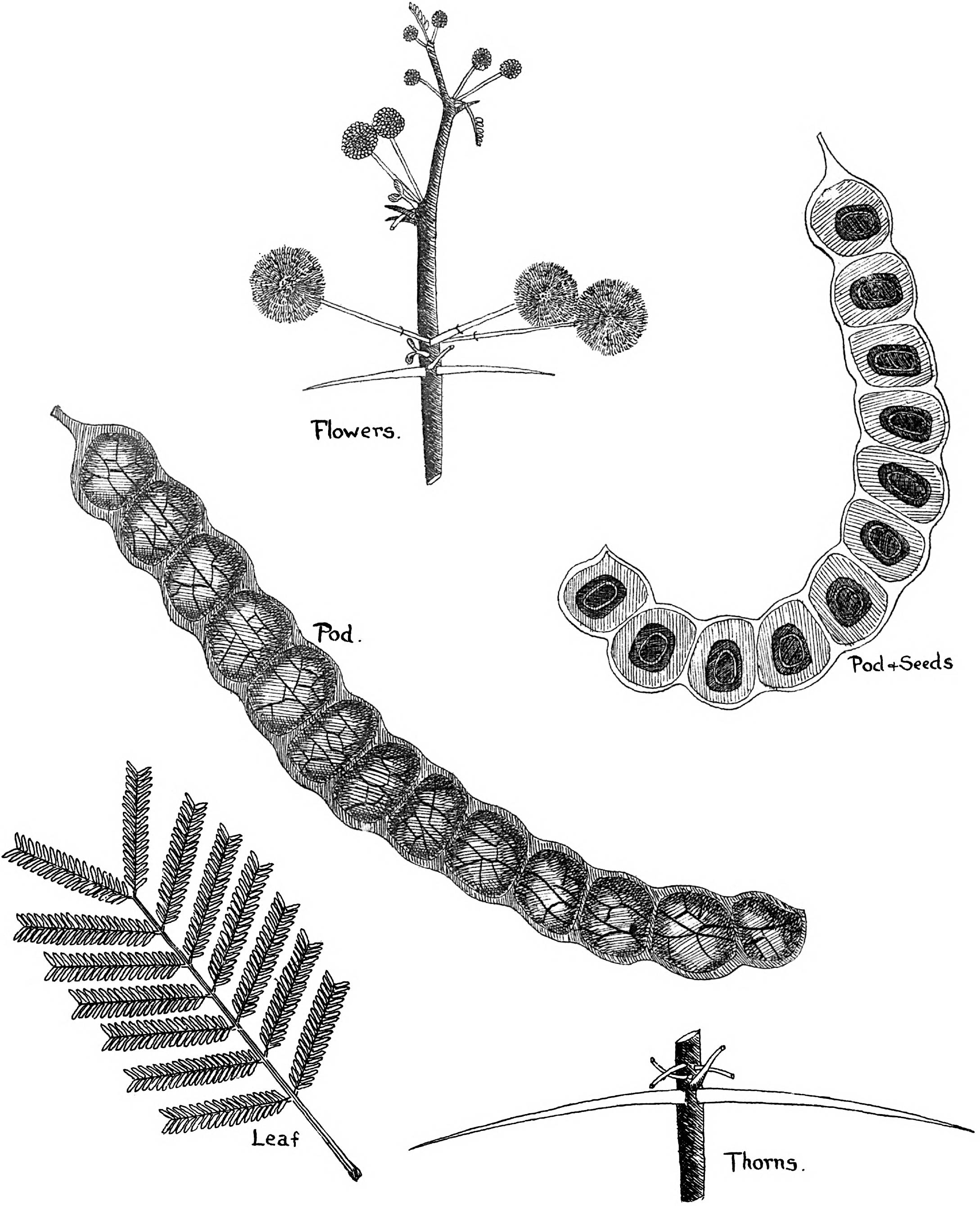
ACACIA SENEGAL
Willd.—Dakwora. LEGUMINOSAE.
A small tree some 15-20 feet high on an average, which is
commonly met with in the more northerly provinces, especially in
Sokoto, where it grows in dense thickets. It branches low down and
is often shrub-like in its young stages, later producing a bole
some 6 feet in length. The branches, ascending at an angle of about
60 degrees, repeatedly fork and form an open, flat-topped crown
from which some of the long straight twigs protrude some feet
above. It is a source of gum-arabic.
The Bark of young trees is very light
in colour with a creamy tint, that of older trees, especially those
which grow in the open, is purple on the bole, with patches of the
lighter tint here and there. All over it are minute, whitish
scales, so fine that they rub off in the hand as a fine powder,
like that of Acacia Seyal. Here and there, according to
season, are larger, thicker grey scales, chiefly about wounds or on
the swollen forks. The bark is very thin and if scratched with the
nail shows the bright green cambium layer just under the surface.
The slash is mottled red.
The Thorns are in threes at the
swollen nodes. The centre thorn is sharply recurved like a claw,
the two side thorns being almost straight and pointing forward
towards the tip of the twig. All are short, very sharp, with broad
bases, like rose thorns, dark brown to almost black in colour, with
a greyish bloom.
The Wood is white, but of such small
dimensions that it is not used.
The Leaves are bipinnate, 3-4 inches
long, with some six pairs of pinnae, each with some 20 pairs of
leaflets, blue-green in colour and paler below than above. The ribs
are covered with very short hairs.
The Flowers which appear in April are
in 3-4 inch long spikes, one or two at the nodes. From ½-1 inch of
the spike is flowerless, the rest densely covered with small
creamy-white flowers, each having a pale green 5-lobed calyx, five
pale green petals and a large mass of short, white stamens with a
pistil indistinguishable amongst them.
The Fruits are pods, varying in size
according as they contain 1-6 seeds. They ripen in November and
remain on the tree till April, often a very heavy crop on the
leafless tree. They are 1½-4 inches long and an inch broad, flat,
slightly shiny, embossed at the seeds, sometimes the same width
throughout, sometimes indented on the margin between one seed and
another, sandy in colour, with often blotches of a darker colour.
They split either whilst on the tree or fall entire and open on the
ground, the seeds remaining attached to each half alternately and
the two halves attached at the stalk. The seeds are round, flat,
green-brown, with a U-shaped scar on each side and attached to the
pod edge by a short, thick stalk. The pod is prominently cellular
veined.
Uses.—The bark of the roots is twisted
into ropes which are of great strength.
ACACIA SEYAL
Del.—Dushe, Dussa, Jimshi, Erafi, Gishishiya.
“Talh.” LEGUMINOSAE.
This very common species is noted for its occurrence as pure
forest over large areas of country. It can be distinguished at a
glance from A. Sieberiana, which it resembles in small
trees, by its powdery orange or rust-coloured bark, or in the case
of the variety A. fistula, by the colour being a milky
white. It is generally a small tree from 15-30 feet in height,
resembling A. arabica in form, with an umbrella-shaped or
flat-topped crown formed by the ascending and spreading branches.
Sometimes the secondary branches are practically horizontal and the
crown wide and quite flat on the top. It bears a profuse mass of
bright yellow flower-balls, highly scented and very conspicuous. It
occurs in clumps or isolated examples on stony ground, not in loose
sand, but where the ground is broken up and barren looking.
The Bark, the most distinguishing
feature, is powdery and comes off in the hand with the appearance
of minute flakes like bran. It is a rust-red or orange colour and
in the case of the variety A. fistula the bark is green with
the powder milk-white in colour. A clear white or yellow gum exudes
from the slash, which is light red and white, with brown edges.
A. fistula is light red with green edges.
The Thorns are similar to those of
A. arabica, but shorter, 1-2 inches long, white with black
points, straight, strong and sharp and at an angle of about 100° to
each other. The base is frequently largely swollen. Near the tips
of the twigs little recurved thorns occur in place of the long,
straight ones.
The Wood is whitish, a brown colour
being given it by the lines of hard tissue. It is apt to discolour
with mould. In transverse section the close concentric rings of
hard and soft tissue are very distinct, the pores are very numerous
in the bands of soft tissue of varying width, the alternating bands
of hard tissue being almost free of pores. The rays are straight,
the larger plainly visible, the finer often closer together,
showing as light-reflecting bands in radial section. In tangential
section the hard tissue makes a well-defined grain of light brown.
The wood is soft, the grain coarse; it works easily with tools, the
plane giving a rough finish. Weight 50 lbs. a cubic foot.
The Leaves are bipinnate, about 2
inches long with 6-8 pairs of pinnae cut up into some 15 pairs of
leaflets. There are typically three in the angle of each pair of
thorns and they are dark green when full grown.
The Flowers are in yellow balls about
½ inch in diameter, 1-4 in the axil of a leaf. They have 1½ inch
stalks, are sweet scented and appear from January onwards in masses
which make the tree all yellow at a distance. The young leaves
appear just as the flowers are going.
The Fruits are slightly curved, flat,
jointed, embossed pods, 3-5 inches long, light brown with green
tinges and finely veined. When ripe the pod splits up both edges,
and the seeds, 6-10 in number, remain fastened to the edges by the
long twisted attachments, from which they break loose gradually,
the pod sections remaining attached to the tree for some time
before this occurs. Many pods fall with the seeds still attached to
them. The clusters of curved, split pods are most conspicuous and
they contract considerably during the ripening stages.
ACACIA SIEBERIANA
DC.—Fara kaya, Bauji. LEGUMINOSAE.
This common and widely distributed species has, when full-grown,
some similarity to Acacia campylacantha, especially when the
species occur in the open. Its long, white thorns distinguish it
from the latter. It is occasionally met with as pure forest, but
should not be confused with Acacia Seyal, the “Talh” acacia,
which is very like the small A. Sieberiana and has yellow
flower-balls and ochrey bark. Old trees are a height of about 50 or
more feet with girths of 5-6 feet. They have large round crowns and
sometimes rather persistent lower twigs, though 20 feet boles are
not uncommon. It grows well in dry situations and frequently
occurs, mixed with A. Seyal, in open, dry country.
The Bark of young trees is yellowish
and smooth, this feature persisting on the branches of older trees,
which have rough, small, square scales, grey in colour on the stem
and larger limbs. The bark exudes a gum which is white, clear and
brittle when dry, making a fair mucilage. The slash is yellow, with
dark red edges.
The Thorns, persistent everywhere
except on the bole and largest limbs, are fine, straight and white,
with very acute points. They are in pairs at about 120° to each
other, pointing slightly forward, up to 3 inches long. On new
shoots they are green and soft, hardening as the shoot ages. Quite
small thorns are found at the tip of the shoots.
The Wood is a dull yellow colour, very
subject to bluish discolorations, due to mould. In transverse
section the rings are indistinct and inseparable from the numerous
concentric lines of hard and soft tissue which are clearly marked.
The pores are open, very numerous, of different sizes, the large
ones plainly visible, mostly single with little soft tissue, except
along the rings where the pores are in rows, each separated by a
ray. There are a few double pores, nests and small chains. The rays
are slightly waved, fairly evenly spaced except where the finer
rays are closer together. The rays show as light-reflecting bands
in the radial section. The wood is soft, rather coarse in grain,
easily worked, planing to a rather rough, untidy surface. The
weight is 45 lbs. a cubic foot.
The Leaves, which spring from between
the thorns, are bipinnate, about 5-6 inches long with 10-25 pairs
of pinnae, the numerous and dark green leaflets being ⅛ inch long
with rounded tips.
The Flowers are in white balls
slightly over ½ inch in diameter, with ¾ inch stalks, in loose
bunches. Their colour distinguishes them from those of other
species similar and likely to be confused. They are sweet-scented
and visited by bees.
The Fruits are large, brown pods, from
6-7 inches long, 1 inch wide and ½ inch thick, straight or slightly
curved. They are not very numerous, but conspicuous by their size.
The seeds, about 12 in number are quadrangular, rounded, flattened,
very hard and dark and light brown.
Uses.—The young trees and the branches
of the old are used for handles of implements, the angle of
branching being especially suited to the shape of the large hoe
(galma) handle.
The gum, in solution, is applied to turban and gown cloth and a
sheen produced by beating.
ADANSONIA DIGITATA B.
Juss.—Kuka. “Baobab.” MALVACEAE.
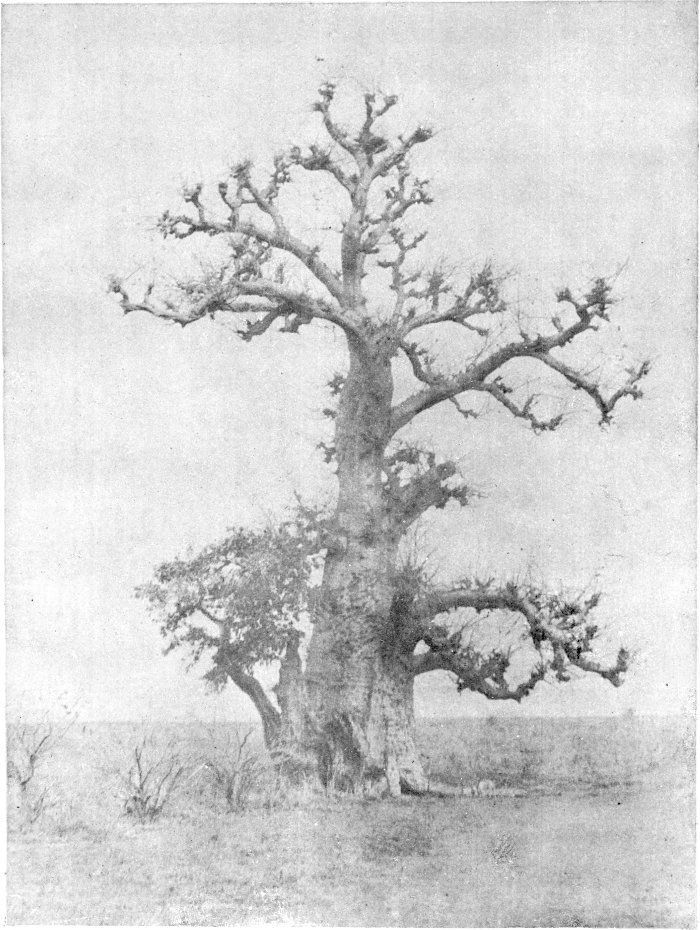
The Baobab tree is so well known as hardly to need description.
The enormous girth up to some 50 feet, large white flowers and
pendulous fruits are familiar. From its earliest years it assumes
the shape, in miniature, of the older trees. Though nature plays
the largest part in the shaping, the cropping of leaves for food,
the stripping of bark for rope and the ringing of large branches by
beetles till they fall to the ground, all help to accelerate the
abnormal form. Widely distributed, it is locally more than
generally common, and abounds in groups. The majority of large
native towns are full of it. Occasionally it can be seen without
the usual stunted appearance, with slender branches and well-formed
crown. An association with Tamarindus indica (Tsamiya) is
fairly common, the latter growing long slender stems about the
former and partly embracing its trunk.
The Bark is grey, with all shades of
purple and a sheen. It has great callus-growing properties and
appears vigorously alive in its power to cover up wounds. The outer
bark is soft, spongy and full of sap, and it is the inner layers
which are stripped off for the rope making. The slash is mottled
red and white.
The Wood is not used. It is very
light, soft and crumbling, rotting rapidly under exposure.
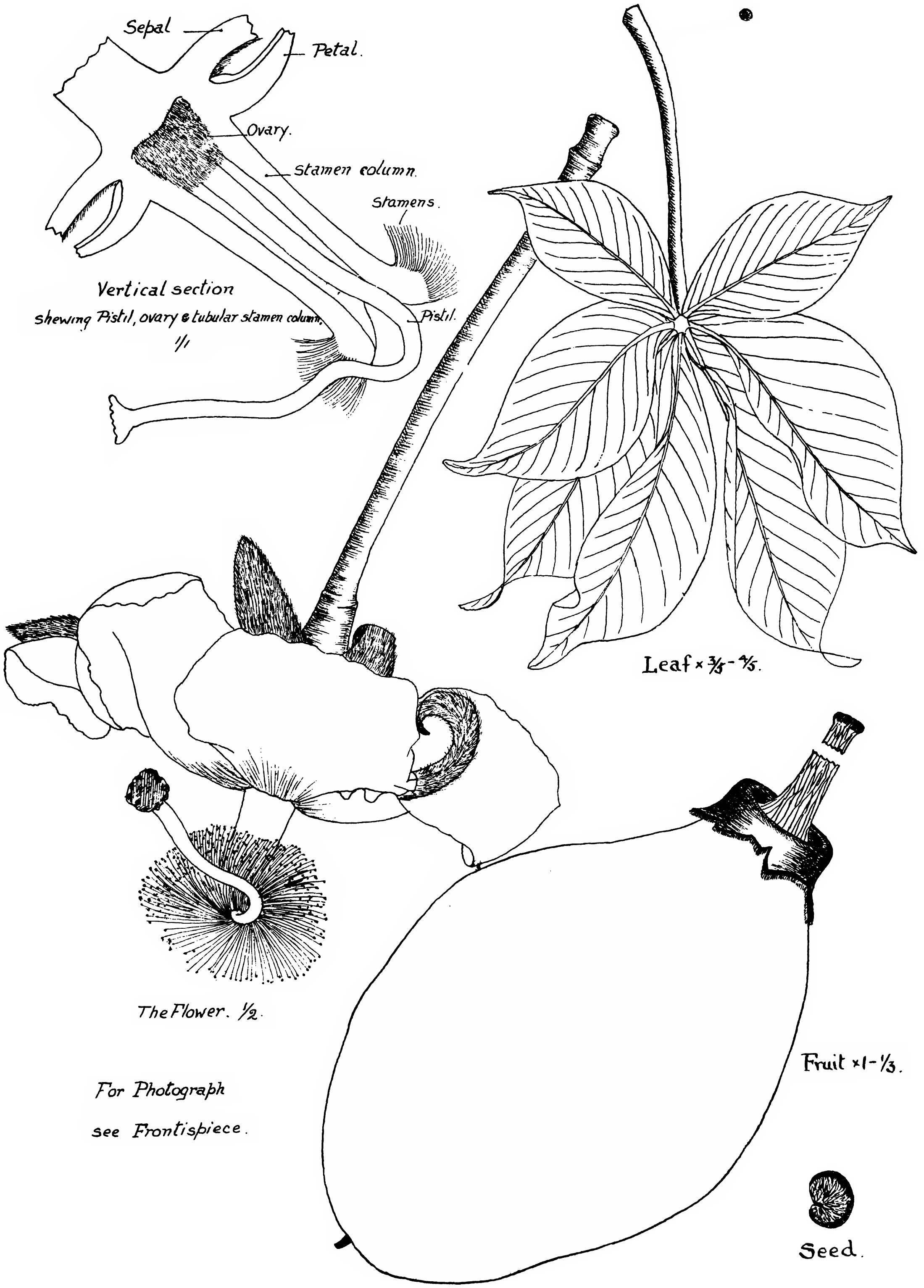
The Leaves are digitate with some six
or seven lobes, 2-3 inches long, borne on a 4-5 inch leaf-stalk.
They have sinuous margins and a tongued tip; the mid-rib is sunken
and the veins regular. The surface is dark green above and smooth,
but downy beneath. The leaves appear soon after the flowers.
The Flowers are solitary and pendulous
on 9-10 inch stalks, and appear in May before the leaves. They are
some 6-8 inches in diameter with five leathery sepals covered
densely on the inside with straight hairs; five white petals nearly
twice the length of the sepals, recurved at the tip and with
wrinkled edges; a stout, shiny, white, tubular stamen column from
which the mass of white stamens with light brown anthers radiate
and bend up towards the vertical position and from which emerges
the long shiny white pistil with spiral bend and outward growth,
bearing at its tip the flattened, lobed, sticky stigma. All the
flower parts tend to assume the vertical position. The Hausa calls
them “kumbali.”
The Fruits are large, oval or round,
5-15 inches long and 3-7 inches in diameter, covered with brittle,
bronze hairs which break off when handled. The stalk is long and
stout and the calyx remains at the base are broken and hardened.
There is a short woody “nose.” A number of kidney-shaped seeds are
embedded in a white, crisp, acid and slightly refrigerant pulp,
pleasant to taste when fresh, and fibres separate the rows of
seeds. The seeds are grey with a brown patch, intricately veined.
They are very hard. The pulp is called “garin kuka,” the seeds
“guntsu.”
Uses.—The leaves are used as a sauce
in soup and food, called “Miyan (or) Garin Kuka.” They are given
also, with bran and salt as a horse medicine, called “chusar
doki.”
The inner bark is stripped and twisted into strong ropes
“kista,” tethering ropes “gindi,” and strings of musical
instruments. The acid pulp is eaten fresh.
ADINA MICROCEPHALA
Hiern.—Kadanyar rafi. RUBIACEAE.
This is a large tree inhabiting stream banks which extends as
far north as 12°. It attains a height of 60 feet with a girth of
6-8 feet, occasionally more. It has a habit of growing right in the
beds of small streams where it is washed annually by the flood
waters. In these situations the trunk will assume almost a
horizontal position at the base and survive severe damage. Except
in dense stream bank vegetation the bole is rarely clean, but is
covered with slender shoots down to the ground level. The erect
willowy shoots are a marked feature of the tree. It has a large
dense crown with heavy limbs, and the rosette-like growth of the
long narrow pointed leaves distinguishes it.
The Bark is grey and deeply fissured,
often spirally, with long fibrous ridges and ragged scales which
fall in large pieces. The slash is a deep dull red, with thick
spongy fibres, and a sticky sap exudes.
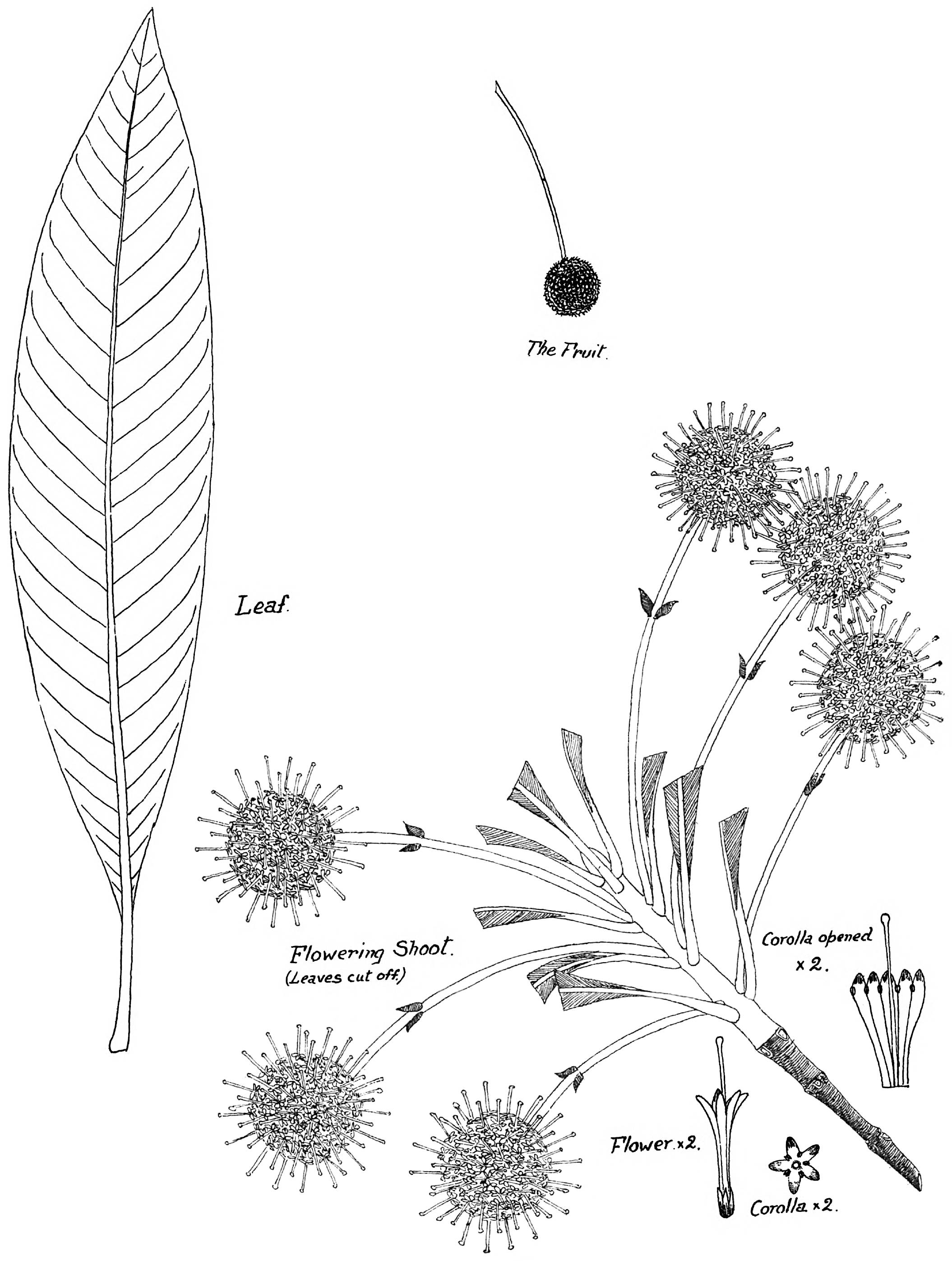
The Leaves are some 9 inches long and
1½ inches broad, with tapering base and long pointed tip. The stalk
is an inch long. The upper surface is a dark, shining green, paler
beneath with the mid-rib prominent. They are whorled and appear
like rosettes.
The Flowers are borne on 3-inch stalks
in the leaf axils from February to June. Each stalk has a pair of
bracts in the middle, or nearer the head of flowers. These
flower-heads are spherical, 1-1¼ inches in diameter, greenish and
perfumed. Each separate flower is tubular, with a short 5-lobed
calyx, a long tubular 5-lobed corolla, 5 stamens inserted on the
corolla throat and a long, knobbed pistil. The corolla tube is
pinkish, the tips of the lobes mauve, and the calyx is green, red
inside at the base.
The Fruits are in spherical heads,
greatly resembling those of Mitragyne africana. Each is a
small capsule which parts down the middle into two cocci which
contain a number of minute seeds, winged at both ends.
Uses.—The timber is suitable for all
kinds of furniture and joinery work.
AFRORMOSIA LAXIFLORA
Harms.—Makarfo, Kariye gatari. LEGUMINOSAE.
A small or medium-sized tree very common in bush or tree
savannah, averaging 30 feet in height, but attaining 50 feet, with
girths of 3-6 feet. The bole, though frequently of good length, is
rarely straight, in fact it is a characteristic of this species
that the bole is bent and twisted and that the branches show this
feature to the tips. It is like a large edition of Stereospermum
Kunthianum (Sansame). The crown is high, rounded and open,
giving little shade. The bark is the most ready means of
identification.
The Bark is all colours, grey, green,
bluish and brown in patches, the large scales falling entire like
those of the plane tree and leaving deeply indented scars which
gradually change colour. The slash is a rich yellow with a thin
green bark edging.
The Wood is very dark brown. In
transverse section the rings are clearly marked dark lines of
varied width, rarely circular. The pores are small, in chains and
festoons connected by soft tissue which shows as flecks in the dark
hard tissue. The rays are fine and almost straight, invisible to
the unaided eye and visible as short light bands in radial section,
in which section the grain is banded and straight. In tangential
section the grain is mottled, almost figured. The wood is hard, not
easy to saw or plane but capable of being worked up to a rather
oily finish which takes a polish. It has a not unpleasant smell. In
seasoning it has been noticed that numerous radial and concentric
cracks occurred but that these closed up and became quite invisible
even under a lens. The weight is 50 lbs. a cubic foot.
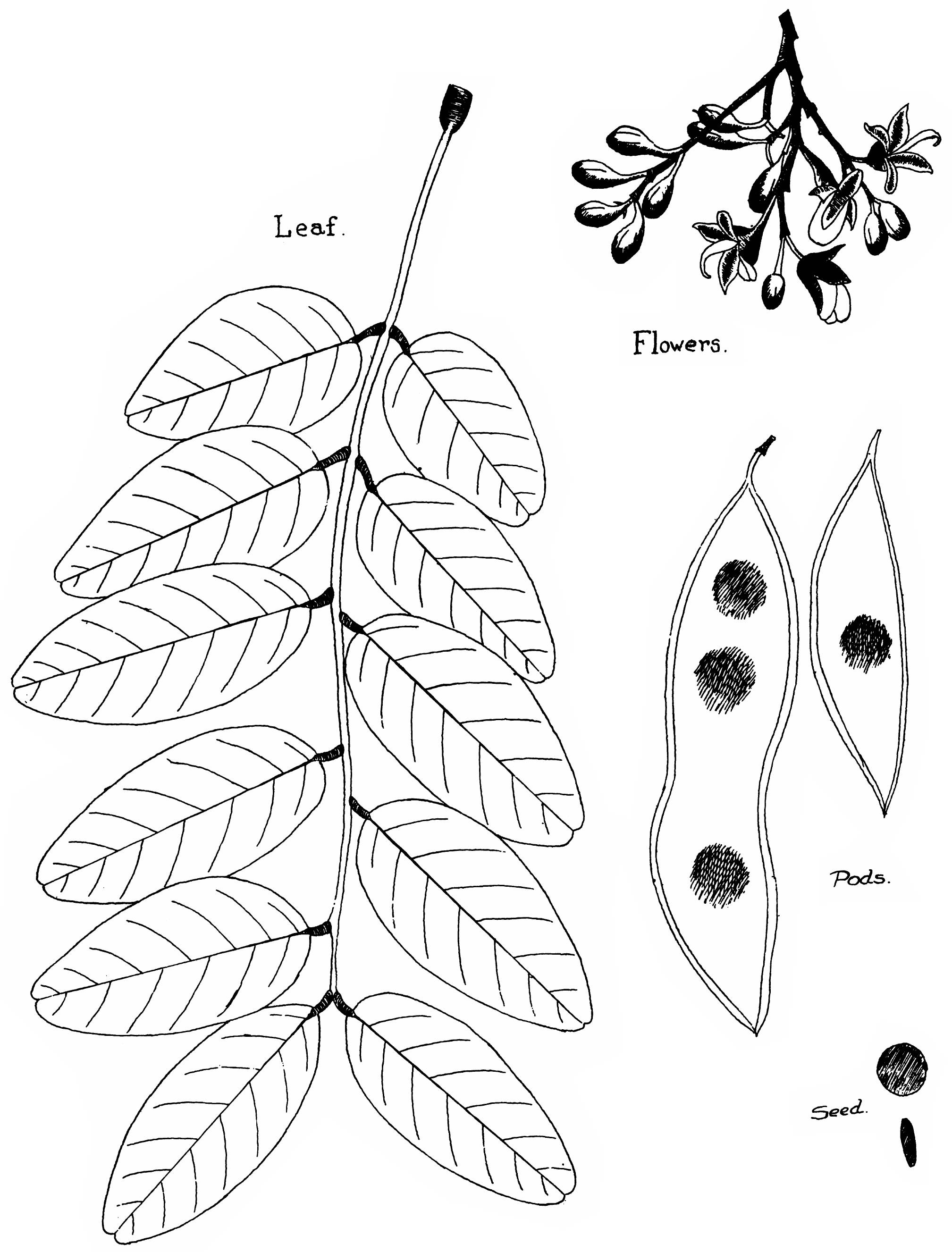
The Leaves are pinnate, 9 inches long
with an average of 11 alternate leaflets which are oval, slightly
cleft, 2 inches long and 1 inch broad, increasing in size upwards,
with shiny surface and short stout stalks.
The Flowers are in small racemes
amongst the leaves at the twig ends. They are inconspicuous and
appear from May to July. Each has 4 green sepals, 5 greenish-white
petals, 10 stamens in the keel, not all fertile and a prominent,
flattened pistil. They are ½ inch long.
The Fruits are pods from 2-4 inches
long and an inch broad, brown with a paler edge, shiny, with veined
surface and slightly embossed seeds. The 1-3 seeds are round, flat,
light brown and have a white hilum, and are ⅜ inch long. The pods
are persistent on the tree till the following rains.
Uses.—The wood is used for axe and hoe
handles, its excessive hardness giving it the name of “kariye
gatari” or “break the axe.” Concoctions of the bark and roots are
used medicinally.
AFZELIA AFRICANA
Smith.—Kawo. LEGUMINOSAE.
A species which is more locally than generally common and in
some forests found very evenly distributed throughout large areas.
Large timber specimens, as found in the south, are rarely met with,
as the form of the typical northern specimens is one having a
short, thick bole with a girth of 6-10 feet, large spreading limbs
forming a wide, rather flat-topped crown with dense foliage and
good shade. Forty feet is an average height for such full-grown
trees. It is comparatively rare in the extreme north, but
especially common in parts of the central and southern provinces of
the north. At a distance it can be distinguished by the brilliant
green of its foliage, which, though apparently dense, is actually
very superficial and can be seen through in somewhat the same
manner as can Chlorophora excelsa. It attains its full size
in “kurmis” or on the slopes of well-watered hills.
The Bark is grey and flakes off in
large, uneven-edged scales which leave distinctive, light patches.
The slash is pale red and of a crumbling composition.
The Wood, when freshly cut is a light
brown with distinct orange tint, which always remains, even when
the timber has darkened to the deep red brown after seasoning. The
sapwood is white or yellowish, generally the latter, the orange of
the pores enhancing this. In transverse section the rings are
indistinctly marked, but the soft tissue, in unusual quantities, is
clearly seen, as are the pores, which are large, rather far apart,
some single, or in small nests, or in lines. The rays, not visible
to the naked eye, are continuous and regularly spaced, readily
visible in radial section. The grain is inclined to pick up in
bands, it being by no means an easy wood to work with, but the
resulting finish is well worth the trouble required. It is hard,
durable and strong, and weighs from 55-60 lbs. a cubic foot.
The Leaves are pinnate, about a foot
long with 6-8 pairs of opposite, shiny, dark-green leaflets, 3½
inches long and 2½ inches broad. They are a most brilliant green
when new.
The Flowers are in stiff, flat
panicles and appear in March. Each flower has four dark-green
cupped sepals, one long petal, cream-coloured with red lines, seven
fertile stamens, two infertile stamens and a long, dark-green
style.
The Fruits, which ripen about December
or January, are large, hard, black pods, 5-6 inches long, 2½ inches
broad and an inch thick, with a point at the tip. They split in
half to disclose about eight large, black beans, set in a red aril
in large, white cells. The pods are numerous and conspicuous on the
trees.
Uses.—Planks and mortars are made
locally from the wood. Furniture in small quantities has been made,
and except for the weight of the wood, it is admirably suitable, in
colour and texture for this purpose. The seeds are sold as a charm
(fasa daga) and used in the game of “dara.” The idea is held, in
some parts of the country, that if the seeds be picked from the pod
while it is still on the tree and made into “tuwo” the eating of
them will make one safe from an attempted blow with a stick, which
will remain poised, or break with the blow.
The leaves are eaten as fodder by cattle.
ALBIZZIA BROWNEI
Oliv.—Madobiar rafi. LEGUMINOSAE.
This is a large species of the tree savannah, extending
generally by way of the streams and “kurmis” up to above 11° N. On
suitable soils it can be found in large groups forming a high
forest with the crowns meeting over 60 feet overhead. The bole
length is considerable, often 30 feet and the stem is slender and
straight. Enormous isolated trees inhabit the more sheltered
“kurmis” and reach a height of 80 feet with a girth of 12 feet.
Such specimens have small root flanges and the crown is low and of
great size, not affording very much shade owing to the spreading
limbs. The large bipinnate leaves of distinctive form and the big,
flat pods are readily recognised.
The Bark is greyish-brown, fairly
smooth, with square or rectangular close-fitting scales, larger and
rougher in old trees, especially at the base. The slash is light
orange in colour.
The Wood is a light red, with streaks
and areas of darker and lighter red and white. In transverse
section the rings are well marked and wide apart, the pores are
large, mostly twins or small groups and imperfect festoons, the
soft tissue not linking them up in long lengths. The rays are fine,
wavy and irregular in their spacing, closing up and separating,
showing as red bands in radial and fine stippling in tangential
section. The wood is soft, easy to saw and plane, the finish being
smooth, with a sheen and able to take a polish. The weight is 42
lbs. a cubic foot.
The Leaves are 12-18 inches long, with
an average of three opposite pairs of pinnae 6-7 inches long
bearing four, five and six pairs of leaflets on the lower, middle
and upper pinnae respectively. The leaflets are roughly rectangular
in shape due to the curving forward of the mid-rib and the blade of
the leaflet being wider on the inside at the base and on the
outside at the middle. The leaflets increase in size from the
lowest pair to the topmost pair, varying from 1-3 inches long. They
are practically the same dark, rich green above and beneath, being
reddish when young. The mid-rib and nerves are prominent on both
surfaces.
The Flowers appear in March and April
just as the new leaves are maturing. They are of both sexes on the
same tree and the same shoot, borne in small heads at the end of
numerous long stalks in the leaf axils, the whole shoot being some
12 inches long. The female is solitary in the middle of the head in
a circle of male flowers which open slightly later. The female is
white and has a corolla of 5-6 lobes in a tubular 5-lobed calyx,
and a large number of radiating styles, white with black stigmas,
like a Sea Anemone in form. The male is much smaller, with a minute
calyx, small tubular corolla of five points, and a long slender
column of bright red stamens with black anthers radiating in a tuft
at the top of the column.
The Fruits are large, flat, light
mahogany brown pods, up to 8 inches long and 1½ inches broad,
shining and veined, and embossed at the 9-12 seeds which are ⅜ inch
long, flat, oval, sharp-edged and dark brown, with a prominent
“horse-shoe” mark. The pods fall and split and the seeds remain
attached alternately to the two halves till blown or washed
out.
ALBIZZIA CHEVALIERI
Harms.—Katsari. LEGUMINOSAE.
A small tree up to 30 feet in height with a girth of 2-3 feet,
common throughout the northern provinces. Owing to the similarity
of its pods to those of Acacia macrostachya, it may be
confused with this species in the dry season when the tree is
leafless. The larger leaves, absence of thorns, corky bark and
balls of flowers distinguish it at once on examination. It has an
erect stem, often three or four stems from a low level, which
repeatedly fork and form an open spreading crown, some of the
branches extending widely and inclined to droop with the weight of
the large leaves. The twigs are softly hairy.
The Bark is pale grey with a light
brown tinge due to the patches left by the falling scales. It is
thickly covered with very soft, corky scales, rectangular in shape
and of greater length than breadth. The horizontal cuts are very
straight and seem to have been done with a sharp knife. The fallen
scales show a reddish colour beneath, which rapidly turns light
brown and finally grey. The surface of the bark scales is very
smooth and silvery.
The Wood is medium weight, rather
light yellow, with a marked, long, straight grain, alternate yellow
and white. The pores are very long, the rings very close. Planes
and saws well, with a sheen in places.
The Leaves are about 9 inches long,
bipinnate with some 10-15 pairs of pinnae, each having from 10-20
leaflets. The leaflets are broad, sharply pointed and uneven in
shape, the inner portion being much narrower than the outer, whilst
the inner edge is almost straight and the outer curved to the tip;
they overlap and are inclined towards the tip of the pinna, whose
main rib has a small extension between the top-most pair. The
leaves are slightly sensitive and close at night and very shortly
after they are gathered. The main rib of the leaf has purple
blotches on its upper surface and is covered with very short hairs.
The leaf is smooth with a waxy surface and much darker above than
below.
The Flowers, which appear in April are
in spherical heads of about thirty together, borne on a 2½ inch
stalk. Each flower has a small 5-lobed reddish calyx, 5 small
reddish petals and some 18 stamens which are an inch long, very
slender, white, gradually becoming green towards the anthers. There
is a 1½ inch long pistil, also becoming green towards the tip. The
flowers are sweet scented, blooming at night.
The Fruits are pods from 3-6 inches
long and ¾ inch wide, and vary in size according to number of seeds
and in colour from a very light brown with a pinkish tinge to an
uniform light red-brown colour. They are flat and the seeds
embossed, the edges of the pod being straight and not indented
between the seeds. The whole surface is covered with very short
hairs and is velvety to the touch. The pods open on the tree or on
the ground, splitting up to the stalk. The seeds are small, round,
flat, and green-brown in colour, and are attached to each half of
the pod alternately by a long stalk, part of which is straight and
part tightly curved into an S next the seed. The pods are ripe in
November and remain, a light crop, till April. There is a fine
cellular veining on the surface.
AMBLYGONOCARPUS
SCHWEINFURTHII Harms.—Tsege, Kiriya ta mata, Kolo.
LEGUMINOSAE.
This strikingly handsome tree, with a strong resemblance to the
Mountain Ash, is found on poor soils as far as 12½° N., but in the
belts where the soil is better than that of the surrounding
country. Elsewhere further south it occurs throughout the higher
savannah forests, often near streams, where it will grow 60 feet
high, but with a small girth in proportion, not exceeding 5 feet.
It averages 30 feet high, with a long clean bole and high, wide,
flat crown of great beauty from the filtering of light through its
bipinnate leaves whose small round leaflets are set apart, the
leaves lying in the horizontal plane. A 30-feet bole on the larger
trees is not uncommon. It gives little shade. It seems to be very
local and where found, occurs over a small area of country in fair
numbers.
The Bark is grey or brown, rough, with
uneven sized scales, rounded or polygonal. These leave red scars on
falling.
The Wood is a rich red-brown, more red
than brown. The sapwood is grey. In transverse section the rings
show as darker bands of varied width and the colour is darker in
this section. The pores are numerous, in festoons of various
lengths, or single, and a few nests, the whole densely and evenly
distributed and the soft tissue plainly visible to the unaided eye
as waves and specks in the dark hard tissue. The rays are straight,
unevenly spaced, some being only the width of a ray apart, others
far apart, some visible to the naked eye. The vertical section
shows bands of colour and long dark pores. The wood is very hard,
difficult to saw and picks up in bands under the plane, but the
finished surface is smooth and will take a high polish. The weight
is 60 lbs. a cubic foot.
The Leaves are bipinnate, 10 inches
long, with 2-5 pairs of opposite or sub-opposite pinnae bearing
8-16 alternate leaflets, broad oval, flat tipped, pale blue-green,
on light brown stalks, each ¾ inch long and ½ inch broad. They
spring from the ends of erect twigs and lie in the horizontal
plane. The leaflets are set apart and do not touch or overlap.
The Flowers, which appear in March,
are in spikes, 2-3 inches long, crowded with white, scented
flowers. Each flower has five small white petals with acute tips,
ten white stamens with yellow anthers and a white pistil. They are
not very conspicuous as they are partly hidden amongst the
foliage.
The Fruits are large four-angled pods,
the suture angle rounded. They are 4 inches long and 1½ inches
broad, brown, pendulous on a 3 inch long stalk. They contain 6-10
seeds, roughly four-angled, pointed at one end. These lie across
the length of the pod and ripen about December. They are ¾ inch
long.
ANDIRA INERMIS H. B.
K.—Gwaska, Madobia. LEGUMINOSAE.
A large tree occurring near streams in Bauchi, Sokoto and Zaria
provinces. It is also found in the forests where the conditions are
moist enough, and is not at all uncommon amongst the rocks on the
Bauchi plateau. It rarely has any length of bole, the crown almost
reaching the ground and the stem being bent or leaning. The crown
is dense and the branches droop at the end. A height of 30-40 feet
with a girth of 4-5 feet is usual. The foliage much resembles that
of Khaya senegalensis, from a distance, but has a brilliant
sheen.
The Bark is brown or grey-brown,
roughish, with scales an inch or two in diameter fitting close
together.
The Leaves are pinnate, 10-18 inches
long with 5-7 pairs of opposite or nearly opposite leaflets and a
terminal leaf. The smallest at the base are 1½ inches long and ¾
inch wide; the largest in the middle are 3½ inches long and 1½
inches wide. The edges are parallel and there is a sharp taper to a
cleft tip. The basal lobes are uneven and the leaflets vary much in
shape. The terminal leaflet is broader in proportion to its length
than the lateral leaflets and the margins are not parallel. There
are small stipules at the base of each stalk. The surface on both
sides is shining and the new leaves are a most brilliant green. The
mid-rib is below the upper surface but raised beneath.
The Flowers which bloom from March to
May are in loose panicles up to 2 feet in length and in such
numbers as to show up from a considerable distance. The blossom is
very ornamental. The flower is papilionaceous with a large pink
standard and white keel. A species of small black ant swarms over
the flowers at times.
The Fruits resemble large walnuts and
hang in bunches on long stalks like mangoes. They are ovoid, 2-3
inches long and 2 inches across, with a thick, fibrous, green-brown
case containing two white kernels one above the other. They ripen
about September. There is the line of a suture down one side, and
the surface is uneven.
ANOGEISSUS
LEIOCARPUS Guill. & Perr.—Marike. COMBRETACEAE.
This is perhaps the most evenly and widely distributed of all
trees, extending from the southern rain belt to the extreme north
of Nigeria, and over the border into French territory north of
Sokoto, where some of the largest examples of the northern
provinces are to be found. A height of 70 feet with girths of 6-8
feet is common. As regards the situations most favourable to this
species, level country with deep soil and average rainfall is
preferred, and considerable areas of such country are found
occupied almost entirely by it, both as full grown trees and
saplings in dense thickets. These latter are especially valuable
for the production of forked poles (gofa) for building purposes,
and are transported great distances owing to their great durability
and comparative resistance to White Ants. The species is readily
distinguished at a distance by its feathery, birch-like foliage and
drooping branches, which, at first acutely ascending, bend over and
droop in graceful curves. A light-demander, its branches are
extremely persistent on the stem and only where it is very densely
grown, preferably with an admixture of shade-bearing species, will
clean boles be found. Examples grown in the open, or suddenly freed
from the forest by the clearing for cultivation, are covered with
small twigs and the foliage extends almost to ground level. Large
specimens in forest have clean boles, generally forking at no great
height, with wide-spreading, open crowns.
The Bark varies according to habitat.
That of specimens in dense forest is fairly smooth with small,
brown scales, but as generally seen in the north is a very light
grey with long scales which turn up at the ends before falling,
giving the tree a ragged appearance, with large, lighter patches. A
dark gum exudes from the bark, very inferior as an adhesive as it
is cloudy when made up into solution. The slash is pale yellow with
thin dark lines.
The Wood is a dark, dull, smoky brown,
sometimes almost black, with reddish streaks. The sapwood is grey
or dirty white. In transverse section the rings are seen as dark
bands, the pores are minute and densely distributed in small
groups, chains and festoons of various sizes, with single pores
between, the soft tissue sparse and hardly connecting the pores.
The rays are extremely fine and close together. In vertical section
the grain is very fine and the pores have glistening contents. It
is a very hard wood, difficult to work with all tools, often
knotty, picking up in bands, but will polish, even on the
transverse section. The weight is 64 lbs. a cubic foot.
The Leaves are on long, slender,
drooping twigs, and are oval, slightly darker above than below with
a silky pubescence which is most marked in the young foliage. They
tend to assume one plane. Length 2-3 inches, breadth 1 inch.
The Flowers are little cream-coloured,
scented balls, ⅜ inch diam., from February on. Each has a 5-pointed
calyx, 10 erect stamens, a short, straight pistil, round the base
of which is a ring of reddish hairs. They are very
inconspicuous.
The Fruits are small, rough, cone-like
balls of irregularly serrated-edged seeds, packed horizontally.
They are green in the seed and brown in the wing portion. They
ripen about December and are about ¾ inch.
Uses.—The wood is burnt entire and the
fine, white ash used for fixing dyes. The ash is also used for
washing white garments. The roots are used as “Chew-sticks” for
cleansing the mouth and teeth. The saplings and branches produce
forked poles (gofa) for building. The bark yields a dark, inferior
gum. The seeds are a cure for worms in horses. The leaves, mixed
with salt, make a yellow dye.
ANONA SENEGALENSIS
Pers.—Gwandar daji. “Custard Apple.” ANONACEAE.
A very common shrub, averaging some 10-12 feet in height,
sometimes a small tree, in suitable situations exceeding 20 feet;
very widely distributed and found everywhere except in the extreme
north. The distinguishing features are the oval, bluish leaves, the
waxy, yellow flowers and the familiar orange-coloured fruits. It
has no particular form.
The Bark is normally light, silvery
grey, smooth, with marked horizontal cuts round the stem, having
the appearance of joints. Older or exposed stems, especially those
subject to fire, become darker and roughly scaly. The slash is a
dull, pale pink.
The Wood is greenish-grey. The
transverse section shows indistinct rings, minute single pores
scattered in between the fine waved rays which reach from the
centre to the edge of the wood and show as small dark bands in
radial section. In vertical section the grain shows as slight
variations in colour. It is soft and easy to saw and plane. Weight
40 lbs. a cubic foot.
The Leaves are oval, some 6 inches
long and 3 inches broad, bluish-green, with a short stalk, the
lateral nerves inclined well forward and the small connecting veins
parallel, numerous and at right angles to the mid-rib. The leaves
stand erect and are apt to fold up along the mid-rib. When crushed
they are fragrant.
The Flowers appear from January to
April, single or in pairs, ¾ inch long, pale yellow and waxy. Each
has three small green sepals and six petals in two rows, the outer
three large, with broad flat edges which meet tight together in
bud, the inner three smaller, thick and pale yellow, their tips
meeting over a mass of stamens round the ovary and stigmas. The
flowers do not open wide and last for a long time.
The Fruits are rounded, 2-3 inches
long, composed of fleshy carpels each containing a seed, green at
first with a resemblance to cones, ripening to a rich orange
colour. They are pleasant but unsatisfactory eating owing to the
large number of seeds embedded in the juicy flesh. Birds are very
partial to them, hollowing them out before they ripen.
Uses.—The fruit is eaten fresh.
BALANITES AEGYPTIACA
Del.—Aduwa. “Desert Date.” SIMARUBACEAE.
In the north this is one of the commonest trees on loose sand or
barren, stony wastes, where it is often the only species to survive
the extreme conditions. It averages 15-20 feet high, but 30 feet is
not uncommon, with a girth of 4-5 feet. The long green thorns and
small dark leaves distinguish it. The form is roughly spherical,
with a tangled mass of long thorny twigs, whose ends droop or
protrude here and there some feet from the main thicket. It extends
northwards to the limits of tree growth, affording fodder for
camels and goats.
The Bark is grey, with long, wide,
deep, vertical fissures in which the yellow of the new bark can be
seen. The scales are long, thick, prominent and ragged. The branch
bark is distinctive. Dark green and smooth, the cream-coloured
lenticels of various lengths cover it ever more thickly from the
tip downwards till the green colour is completely obscured and the
grey of the branch bark is reached. The slash is pale yellow.
The Thorns are modified shoots borne
spirally round the long slender twigs in the leaf axils, 2-3 inches
long, tapering evenly to a strong, sharp point. They incline
slightly forward and barely curve. They are dark green and persist
on the branches.
The Wood is light yellow with
sometimes greyish discolorations. In transverse section the rings
are distinct in wavy light lines; the pores are small, open and in
little groups in concentric rings and the rays are clearly visible
as light lines of various overlapping lengths. In radial section
the rays add a figure to the wood in lines up to an inch long. In
vertical section the wood is of even colour and texture, close
grained and sound. It is easy to carpenter and planes smoothly
without picking up. Weight 48-50 lbs. a cubic foot.
The Leaves, with the thorns in their
axils, are really paired leaflets on a short, common stalk; 1½-2
inches long, over 1 inch wide, a very dull, dark green, they are
unequal lobed, as illustrated, with a tendency to close up along
the mid-rib. They assume a vertical position, even when the twig
droops, the stalks bending to adjust themselves to this
position.
The Flowers, in the leaf axils, are
found from November to March, in spikes up to 3 inches long, often
shortened to resemble round clusters. Each flower is ½ inch across,
with five small green sepals, five longer and darker green petals,
ten short yellow stamens and a shining dark green ovary with short,
blunt pistil. The tree sometimes flowers out of season.
The Fruits, which ripen from February
onwards, are 1¼ inches long and about an inch wide on a short
stalk. At first green with a wrinkled, nipple-like tip, they turn
yellow on ripening, when they have a thin hard skin, a light brown,
sticky, edible flesh and a large, hard, pointed stone. There is a
space between the flesh and the skin.
Uses.—The fruits are edible,
particularly appreciated by beasts. The wood makes excellent axe
and hoe handles. Planes have been made of it, it being similar to
beech in quality. The branches are used for hedging farms.
BALSAMODENDRON
AFRICANUM A. Rich.—Dashi. BURSERACEAE.
This shrub or small tree is locally plentiful and is found in
all situations, in the driest sandy soils, on the tops of rocks
where it grows stout and stunted in the crevices, and in loamy
soils. It is frequently seen planted as a live hedge from cuttings
and forms an impenetrable barrier after the habit of the
Blackthorn. The slender but rigid twigs shoot out in all directions
and with its trifoliate leaves on the purple twigs, the plant is
readily identified. As a small tree, a form met with on hills or in
better soils in the forest, the stem is short and stout, dividing
low down and quickly branching into a light rounded crown. The
height is rarely over 15-20 feet.
The Bark of old examples is green and
shining, covered with little papery scales which flake off. That of
the branches and twigs is red or purple. A resinous gum with a
pleasant scent exudes from the slash.
The Thorns are branches whose tips are
modified in the form of spines, which will bear leaves, and in the
dormant season are dotted with buds.
The Leaves are trifoliate, often very
small, but when full-grown some 3-3½ inches long, of which one inch
is stalk, red above, green beneath. The middle leaflet is broadest
slightly over half-way up, tapering gradually to the base and more
suddenly to the tip, with irregularly serrated edges. The lateral
leaflets are unequal in size, the right hand one usually
considerably larger than the left, both rounded and serrated in the
same manner as the middle leaflet. The surface is shiny waxy green,
very bright when young. The venation is prominent beneath, the
lateral nerves much branched and zig-zag. The leaf is scented.
The Flowers appear in October on the
leafless tree and are in small clusters all along the twigs, up to
about 10 in a cluster, each on a minute stalk. The flower is ¼ inch
long with a 4-lobed tubular corolla deep red with green lobes, the
petals separate but overlapping and close together in the tubular
portion which is held in the 4-lobed, cup-shaped calyx. There are 8
stamens, 4 just appearing in the corolla mouth, 4 shorter, and a
pistil wholly below the corolla mouth.
The Fruits are small irregularly
pear-shaped drupes a little over ¼ inch long, greyish with a purple
bloom which is easily rubbed off. They have a highly resinous flesh
and white kernel and ripen in the early spring. They grow in
clusters along the twigs and the crop is often a heavy one.
Uses.—The resin is used as a scent on
garments and medicinally, taken internally.
BAUHINIA RETICULATA
DC.—Kalgo, Kargo. LEGUMINOSAE.
A medium-sized tree or shrub, in which latter form it occurs
over large areas of country as pure growth, particularly as
secondary growth in farmed land, where it is a great pest to the
farmer who desires to continue sowings. It grows prolifically from
stumps which the farmer does not trouble to uproot. It is very fond
of small, shallow depressions, where it will grow to the exclusion
of all else. In its proper habitat it will grow over 30 feet high
with a girth of 8-10 feet, with short bole and an enormous rounded
crown of dense foliage affording good shade. It is one of the
commonest species in the north.
The Bark is a dull, dark grey,
sometimes with a rust-red tinge, deeply fissured and ridged with
hard, brittle bark of some thickness, which falls in large, ragged
sections. That of young trees can be ripped off readily after being
cut. The slash is bright crimson, turning brown on exposure, and
shows the fibrous nature of the bark.
The Wood is oak-brown, rather dirty
looking, with light patches and dark discolorations, especially
round flaws. In transverse section the rings are indistinct but the
hard and soft tissue is very well marked, mostly in concentric
lines. The pores are small, evenly distributed, mostly in festoons
joined by the soft tissue. The rays are extremely fine and closely
spaced, invisible to the unaided eye and very faintly seen in
radial section as small bands. The wood is easily sawn but picks up
badly under the plane. It is very strong and tough and weighs 50
lbs. a cubic foot.
The Leaves are bifoliate, the depth to
which the leaf is divided varying a great deal and the angle being
sharp or rounded. They average 4 inches across but those from stool
shoots especially may be very much larger and generally the larger
the tree the smaller the leaves. There are four main nerves on each
leaflet and the mid-rib projects slightly between them. The leaf
stalk is an inch long, with large base. Like all species of this
genus the leaf tends to fold up along the mid-rib. The colour is
lighter beneath and the venation a very intricate network and
prominent. The texture is tough.
The Flowers are in spikes, 2-6 inches
long and appear in February or March or even as late as June. Each
has a 5-lobed calyx, green-brown in colour, 5 white petals,
wrinkled and overlapping at the edges, 10 stamens of varied length
with brown anthers and a short, blunt pistil. The flowers drop off
readily when handled and are about an inch long. They do not open
very wide.
The Fruits are pods 6-9 inches long,
hard, flat, dark-brown, straight or contorted into strange shapes,
2 inches broad and ¼-½ inch thick. They are persistent on the tree
for many months, a most disfiguring feature, and drop entire,
rotting on the ground. They are very liable to attacks from a grub
which destroys the seeds. These are small, brown, oval and
scattered about in the mealy endocarp which has an objectionable
smell.
Uses.—The wood is used for axe and hoe
handles of all sorts. The bark is used for binding and tying but is
not plaited or twisted into ropes. Cattle eat the pods.
BAUHINIA RUFESCENS
Lam.—Jirga, Tsatsagi, Matsagi. LEGUMINOSAE.
A small tree, typically inhabiting annually inundated areas but
also flourishing in sandy soils of poor quality. It forms, with its
numerous much branched stems, a small thicket of one or more trees;
it is difficult to say how many under the circumstances, as one
root-stock will produce a number at ground level, forming an
impenetrable mass. It can be distinguished readily by the typical
leaves of the genus, and the small size of these compared with
other species. The fact that it is always in flower and fruit will
identify it also.
The Bark is a light ash-coloured grey,
smooth and covered with small, brown horizontal lenticels. Old
stems bear at the base small dark scales and the bark is fissured
giving it a speckled appearance. The slash is pink and reveals the
very fibrous nature of the bark.
The Thorns are modified twigs whose
tips are strongly pointed. They may support leafy shoots or bear
leaves themselves and are seen best on the long, slender shoots and
drooping twigs. They extend their growth indefinitely, but on the
older wood may be seen as bare, woody spines 3 or 4 inches long,
curved out and down.
The Wood is a dull, smoke-brown
colour. In transverse section the rings are indistinct dark lines;
the pores are numerous and unevenly distributed, single in small
groups or in short chains, the rays invisible to the unaided eye
but showing as small bands in radial section, which reflect the
light. In vertical section the grain is close and there are darker
bands of colour. The wood is not hard, is easily sawn and planes to
a nice, soft, smooth finish though it picks up in places with the
long soft fibres. The weight is 50 lbs. a cubic foot.
The Leaves are borne spirally round
the branches, often in the thorn axils or on the thorns themselves,
or on twigs bare of thorns. They are bifoliate, typical of the
genus, rarely over an inch long and mostly a ½ inch, the terminal
leaf of a new shoot often being much larger. The mid-rib is
extended between the leaflets which are divided to the base and
there are three main nerves to each leaflet. They are a light,
blue-green or grey-green, with a bloom and are partly sensitive,
closing up rapidly after being plucked.
The Flowers are white and can be found
all the year round, though the proper flowering season is in the
rains or towards the end of them. They are in small racemes at the
twig ends, pendulous amongst the leaves, ¾ inch long, with a calyx
which splits partially into five parts, remaining attached at the
tips and opening beneath, 5 white petals, spoon-shaped with narrow
base and broad, pointed tip, 10 white stamens with light brown
anthers and a tuft of hairs at the base of each, and a clubbed
pistil.
The Fruits are pods about 3 inches
long, constricted between the seeds, dull black, slightly curved,
containing up to eight shiny, rich red-brown seeds, roughly
rectangular with one rounded corner. The seeds rattle loose in the
pod which falls entire and rots on the ground. The pods hang in
conspicuous clusters and may be seen all the year round.
Uses.—The bark is stripped for binding
but is not plaited into ropes.
BERLINIA AURICULATA
Benth.—Doka rafi. LEGUMINOSAE.
This is a medium-sized tree of the best savannah types, commonly
found in “kurmis” and extending as far north as 11°. It occurs
plentifully in Sokoto and Kontagora along the small streams in the
south. Averaging 40 feet in height it will reach 60 feet with
girths of 8-10 feet. The crown is high, rounded and very dense in
the open; flatter and more superficial in heavy forest, topping a
30-feet bole, only 10 feet long in open situations. The flowers and
pods are both conspicuous.
The Bark is dark-grey or brown, the
scales leaving large, concave scars. The slash is pale brown.
The Wood.—The heartwood is red-brown,
the sapwood light with a pink tint. In transverse section the rings
are well but unevenly marked red lines. The pores are large and
solitary, for the most part in oblique rows, and the rays are
extremely fine and invisible to the unaided eye. In vertical
section the pores are long and straight and the rings show as dark
bands. It is rather a coarse, stringy wood, sawing roughly and
picking up in long fibres under the plane. Where the grain suits
the plane the finish has a bronze sheen. It is a fairly hard wood
and weighs 50 lbs. a cubic foot.
The Leaves are pinnate, 9-12 inches
long with an average of four pairs of pinnae increasing in size
from the lower pair upwards, the lower 2-4 inches long and 1½—2
inches broad, the upper pair 5-7 inches long and 2-3 inches broad.
The mid-rib curves forward, rounding the outer edge of the leaf.
The nerves are alternate long and short. The similarity of the leaf
and fruit to those of Isoberlinia doka gives it its native
name.
The Flowers are in close panicled
racemes at the branch tips from March to June. Each flower is 4
inches long over all, being enclosed at first in a pair of long,
pale green, velvety bracteoles which separate and fall back to
release the flower parts. The calyx is a slender tube divided into
five long, narrow pointed, recurved sepals. The corolla has four
small, linear petals and one erect white, wrinkled, cleft petal 2
inches long and broad, with a green centre splash. There are ten
long, erect, hairy stamens with brown-green anthers, and a long
pistil. The flowers are in such masses as to be conspicuous from a
great distance.
The Fruit is a broad, flat, dark
brown, velvety pod, 6-10 inches long and 2-2½ inches broad. It
explodes when ripe to release some 3-5 round, flattened seeds.
BOMBAX BUONOPOZENSE
Beauv.—Kuriya, Gurjiya. MALVACEAE.
This tree is known as the Red-Flowered Silk Cotton Tree and
grows, on an average, to a height of 40 feet with a girth of about
5 feet. Very much larger specimens are, however, to be seen, up to
70 feet high with girths of 15 feet and more. Rounded root-flanges
are prominent on the large trees. The crown is regular and
umbrella-shaped, rather flat-topped, wide-spreading and open with
superficial foliage giving little shade. In old specimens the bole
is gnarled and the limbs much bent, the shape of the crown being
often retained by the growth of the smaller branches. The species
is not at all exacting as regards soil and is, in fact, commonly
found on hillsides and amongst rocks where its roots penetrate the
little but good soil. It is more local than general in its
distribution.
The Bark of the younger trees is very
corky, longitudinally fissured and horizontally cut into
prominently spiked scales. The degree of roughness is very
variable, being generally far more marked, relatively on younger
trees, and, in the older ones, the thorns being confined to the
branches, the bole having prominent layered corky scales with soft
ends. Some quite small trees bear no thorns at all, but this is
rare. The spines are conical, with broad corky bases and sharp
black points. If a piece of the bark be snapped off it shows a
light red colour. The slash is crimson.
The Wood is a dirty white colour. In
transverse section the pores are large, widely scattered, single,
twin or nests. The rays vary in width and in spacing very
considerably, and are straight, showing as long, light-reflecting
bands in radial, and as brown flecks in tangential section. In the
latter section the pores are brown, open and wavy. It is a very
soft and light wood, easily worked, not strong, its durability
largely dependant on the manner in which it has been seasoned, with
exclusion of damp and consequent mould. It is very subject to small
borer beetles. The weight is only 20 lbs. a cubic foot.
The Leaves are truly digitate with
generally six lobes, broad at the tip, narrow at the base, with a
prominent point. The entire leaf is 6-7 inches across, with a 5
inch stalk. The venation is prominent on both surfaces and the
colour is pale, the surface smooth.
The Flowers are the most conspicuous
feature of all and may be found from November to February. They are
red, tulip-like blooms, 3 inches in diameter, with a dark red
5-lobed calyx, 5 red petals and a mass of black-anthered stamens
filling the corolla and surrounding a 5-part pistil. They fall in
numbers, entire, and are devoured by antelopes.
The Fruits are large, pendulous
capsules some 4 inches long and 2 inches wide, black or deep brown
when ripe, splitting into five sections to release small black
seeds embedded in a mass of silk-cotton. The pod shrinks in the
ripening and the silk cotton is packed tight in it and expands in
bulk enormously by hygroscopic action, carrying the seeds a great
distance on the wind.
Uses.—The wood is used for making
large and small drums, native stools used by women, basins, shoes
and saddles and cattle troughs. The bark is used by women to impart
a red colour to the teeth. Certain pagans make a sauce from the
flowers, locally called “Kwungi.”
BORASSUS FLABELLIFER
Linn. var. AETHIOPUM
Warb.—Giginya. PALMACEAE.
This very well-known Palm inhabits marshes, the banks of streams
and any well-watered hollow, and will grow, if introduced, on dry
sandy soils. With the exception of the Dum Palm, Hyphaene
Thebaica, it is the most northerly of the palms in Nigeria and
is found in vast quantities in “fadamma.” It does not actually grow
in the water, though it will survive an occasional immersion when
grown, but occupies islands, banks and edges of marshy land as well
as the banks of streams, lakes, etc. It reaches a height of over 80
feet, with a girth at the base of 6 feet, at breast height 4 feet 6
inches, and at the narrowest point 3 feet. The stem swells at about
30 feet and after the palm is about 50 years old narrows again,
repeating the swelling process again and even a third time in very
old palms. The rate of growth, except when cultivated, in which
case it is quicker, is very slow. The seed germinates in a month
and sends down a shoot from 2-4 feet deep into the ground. This
shoot swells at the base and loses connection with the empty seed,
and sends up a green shoot from the base, which forms the first
leaf. In the root-bud stage it is eaten as a vegetable, called
“muruchi” and thousands of seeds are planted for this purpose
alone. The first leaf is a narrow blade, as are subsequent leaves,
gradually broadening till the first frond appears about three years
later, the stem appearing at ground level after some six or seven
years. From then onward the growth is at the rate of from 12-18
inches a year, 50 year old palms being about 50-60 feet in
height.
The Bark.—The stem is a smooth one
after a number of years; the leaf scars, very marked when fresh,
gradually fading away.
The Wood is heavy and hard, apt to
splinter into separate fibres, but very durable above ground. It
weighs about 50 lbs. a cubic foot. The wood of the male is more
compact throughout than that of the female whose centre is looser,
the outside only being really serviceable.
The Leaves are up to 12 feet long,
fan-shaped, the segments V-shaped, joined for half their length,
the stalk concave above and spiny on the margins. The sheath
divides at the base before falling and remains for some time
clasping the stem.
The Flowers appear in April, just as
the fruit has fallen, the females on one tree the males on another.
The males are on branched spadices up to 6 feet long, the separate
catkins a foot long and 2 inches broad. There are 3 sepals, 3
petals and 6 stamens, the flowers being green. The females are on a
6-8 feet long spadix, unbranched, with up to a dozen spikes of
flowers, with 3 sepals, 3 smaller petals and the rudiments of 6
stamens.
The Fruits are the most conspicuous
feature, ripening in April to a rich orange colour. They are some 6
inches long and 5 inches broad, the enlarged calyx cupping the
fruit. The edible, fibrous pulp surrounds three seeds with hard
fibrous coats and edible kernels.
Uses.—Locally the pulp is eaten raw or
pounded with milk. The kernel is eaten young. The root-buds are
roasted and are a delicacy. The leaves are used for mats, bags,
baskets, fans, &c. Some tribes extract salt from them. The wood
is used for canoes, rafters, poles, water-pipes, doors and
guttering. Elsewhere the leaf stalks are the source of fibre, a
spirit has been distilled from the flower spathes and buttons made
from the seeds.
BOSWELLIA DALZIELII
Hutch.—Hano, Ararabi, Basamu. BURSERACEAE.
A very common tree in high savannah, extending as far north as
13° where the soil is suitably rich and well watered. It will not
grow as far north as this where the conditions are dry and barren,
granite soils and situations on stony ground of the right kind
being suitable. In sand or laterite it will not thrive, but it will
flourish on bare granite where its roots can make their way into
crevices. In some suitable localities it forms almost pure forest
and is a very handsome species under those circumstances. The leaf,
flower, fruit or bark are all distinctive. Another closely allied
species, B. odorata, differs only in having a branched
panicle in place of the bunch of racemes of B. Dalzielii.
When young or middle-aged the stem is erect and the limbs ascend
steeply forming a high crown, foliated down to a low point. Older
trees exhibit a short, massive bole from which the heavy limbs
spread out forming huge crowns with drooping extremities.
The Bark is most conspicuous, pale
brown, with large papery pieces peeling off and at times hanging in
shreds from the stem. The slash is reddish-brown and a scented
gum-resin exudes, partly drying into nodules, almost white in
colour, readily crumbled.
The Leaves are 12-18 inches long,
pinnate, with some 7-9 pairs of long, slender, pointed,
deeply-toothed leaflets. These increase in size towards the top end
of the leaf, the basal pair often being very small and distinct in
shape. The terminal pair are frequently partly united into one for
half or more of their length. The leaflets are sessile, in colour
light green and shining, with the venation raised on both
surfaces.
The Flowers appear from January to
April, and are in large bunches of racemes at the tips of the
large, blunt twigs. The racemes are from 6-8 inches long and bear
numerous white flowers on ½-¾ inch long stalks. Each flower is ⅝
inch in diameter with 5 white, pointed petals, 10 stamens whose
anthers are bent away from the filament at a side angle, and a
small, blunt pistil. The flower disc is red and the flower
scented.
The Fruits are 3-angled capsules,
elongated pear-shaped, with prominent bulges opposite the seeds.
They are ¾ inch long and the stigma remains are present. The
capsule splits into three and the small seeds are released, each
with a sharp spike at the top end.
Uses.—The gum-resin, being scented, is
used for burning in houses, or fumigating clothes, and as an
ingredient in medicine.
BRIDELIA FERRUGINEA
Benth.—Kisni, Kirni. EUPHORBIACEAE.
A small tree of the Tree and Bush savannahs which does not
extend very far north and will not grow away from fairly good
soils. It is rather shapeless, except occasionally in closer
forest, where it may reach a height of 30 feet with a girth of 3-4
feet. This species and B. scleroneura are similar in habit,
with open, formless crowns, straggling, drooping limbs covered with
numerous, slender, erect twigs which are apt to be burnt back
repeatedly by fires and show the position of leaves and flowers as
prominent clusters at frequent intervals. The distinguishing
features are larger leaves of this species and the absence of the
marked crenate edges.
The Bark is dark grey, covered with
small, close-fitting, prominent scales. That of the branches is
lighter and covered with rectangular scales, clearly cut in rows.
That of the smaller branches is almost white with vertical, wavy
ridges of cork. The slash is crimson.
The Wood is brown and the sapwood is
dull white. In transverse section the rings are clear, fine light
lines, the pores are very small, single, double, or in small
festoons, the soft tissue not well developed. The rays are fine,
close, fairly straight and evenly spaced. In vertical section the
grain is coarse, and not very straight and the wood is easily sawn
but hard to plane, picking up in patches. The weight is 60 lbs. a
cubic foot.
The Leaves are alternate, assuming one
plane. They are 4-5 inches long and 2¼-2½ inches broad, with
slightly waved edges, the nerves reaching the edge. They are dark
green above, olive green beneath, with the venation very prominent
and covered with brownish hairs, especially on the short stalk and
mid-rib.
The Flowers, male and female on the
same tree are in small, compact clusters in the leaf axils from
March to June. The male flowers have a calyx of 5 sepals, 5 minute
petals and 5 radiating stamens, joined at the base into a short
column. The female flower has the same calyx, longer, narrower
petals and two styles which are forked. The male flowers have a
shiny yellow disc.
The Fruits are small black ovoid
drupes, becoming veined and wrinkled when dry, with a single cell
containing two seeds. They are ⅜ inch long and flattened at the
top, and very persistent on the twigs.
BRIDELIA SCLERONEURA
Müll. Arg.—Kisni. EUPHORBIACEAE.
This is a small tree, without any definite form, which grows up
to 15 or 20 feet high, with, occasionally a stem some 6 feet high
and a misshapen crown. It is distinguished by the small clusters of
minute flowers in the leaf axils and the crenate margined leaves
which lie in one plane on long, slender, drooping twigs.
The Bark, in old trees, is quite
black, with long fissures and fibrous ridges; in young trees it is
white, or black and white in patches, with soft, corky scales which
fall in large pieces composed of several smaller scales bound
together. The slash is bright crimson.
The Leaves are borne on long,
drooping, slender twigs, alternate, in one plane and gradually
diminishing in size from the base upwards. Each such twig is
supported by a larger leaf, 3½ inches long and 1¼ inches broad. The
alternate leaves vary from 3 inches long and ¾ inches broad at the
base of the twig to 2 inches long and ½ inch broad at the end of
the twig. The lateral veins, as they reach the margin, are
continued along it so that the edge is crenate. The tips are
sharply pointed. The leaves all point well forward. The ¼ inch long
stalks are covered with soft, brown hairs. The upper surface is
slightly rough and darker than the under surface, on which the
veins, especially the laterals and mid-rib, stand out prominently
and show yellow in colour. The halves of the leaf tend to fold up
along the mid-rib slightly.
The Flowers are in very small clusters
in the leaf axils and appear in May and June. They are bright red
in bud, the sepals being tinged. Each male flower is ⅛ inch in
diameter with a 5 sepal calyx, 5 minute petals and a column of 5
radiating stamens. The female flower has 5 sepals, 5 petals, a disk
round the ovary and 2 bifid styles.
The Fruits are in clusters, often a
dense crop, at each node. They are the size of peas, green at
first, ripening to black with a bloom. A thin skin surrounds a
narrow, juicy flesh round a hard, 2-celled stone. The flesh dries
and the skin wrinkles while the fruit is on the tree.
Uses.—The roots are sometimes used
medicinally.
BURKEA AFRICANA
Hook. f.—Kolo, Kurdi, Bakin, makarfo, Namijin Kiriya, Kariye
gatari. LEGUMINOSAE.
A fairly large tree up to 50 feet in height with girths of 3-6
feet. It is a fine upstanding tree, frequently with a 20 feet bole,
straight and clean, with ascending branches and high crown,
spreading with age. It bears a resemblance to Amblygonocarpus
Schweinfurthii, from which it can be distinguished by its
larger and unequal-shaped leaflets. It is plentiful in high
savannah forests and will extend, by means of small hollows or
valleys as far north as 12½°. In flower or seed it is readily
distinguished, and the leafless tree can be recognised by the
thick, blunt end of the branches, often tufted with the dead stalks
of last year’s leaves.
The Bark is light grey with a bluish
tint, and the scales are large and heavy, at times closely fitting,
then falling in large sections, so that the trunk may appear
shaggy. The branch bark, right up to the tips is very thick, with
pronounced ridges and fissures and a light brown colour towards the
ends. Often the leaf scars swell and form prominent knobs on the
twigs. The slash is dark red and an oily resin exudes.
The Wood is reddish brown, the
sapwood, light brown with an orange tinge. In transverse section
the rings are very close, well-marked darker lines; the pores are
very numerous, single and in festoons in well-developed soft tissue
which shows up strongly in contrast with the hard tissue and nearly
closes the pores. The rays are fine and evenly spaced, nearly
straight, not visible to the naked eye owing to the amount of soft
tissue. In vertical section the grain is close, the rings seen as
bands of darker colour. The wood is very hard to saw and difficult
to plane, but the planed surface is smooth and takes a high polish.
It is liable to ring shake when seasoning, but is on the whole a
sound, durable wood, very suitable for upright in constructional
work. The weight is 72 lbs. a cubic foot.
The Leaves are some 18 inches long, at
first erect, then drooping. They are bipinnate, with some four
pairs of pinnae bearing 9-11 alternate leaflets, 1½-2 inches long
and 1-1¼ inches broad, with unequal lobes and slightly cleft tip,
bluish-green above, grey-green below, with a dull surface. The
venation is prominent above and not beneath. The short leaflet
stalk is curved.
The Flowers appear in March and April,
mostly at the base of the new leaf shoot, a few only amongst the
leaves higher up. They are in spikes or panicles up to 12 inches
long, numerous, pendulous and conspicuous. The small white flowers
are crowded and each consists of a minute calyx, 5 white petals
which bend back in half, concealing the tips, 10 yellow-anthered
stamens and a short blunt, curved pistil. The pentagonal shape of
the corolla with its recurved petals and the erect stamens are
noticeable. There is no scent.
The Fruits are pods, 2 inches long, 1
inch broad, thin, not flat, but tending to twist at the tip,
forming a convex and concave side on the latter, of which the seed
is clearly embossed. The colour is mahogany brown, veined, brittle
and persistent. There is one brown, oval flat seed.
BUTYROSPERMUM PARKII
Kotschy.—Kadanya, Kadai. “Shea Butter Tree.”
SAPOTACEAE.
This is one of the commonest species of the savannah forests and
has a wide distribution. An average tree is about 30 feet high with
a girth of 4-5 feet, though large specimens over 40 feet high with
a girth of 10 feet are by no means infrequent. A short, stout bole
and large, spreading limbs, gnarled and crooked, form a widely
spreading crown of considerable density, which, from the drooping
habit of the lower branches, reaches almost to the ground in many
specimens. It is the type species of the tree savannah and in some
parts of the country forms a large percentage of the forests.
The Bark is a distinguishing feature
of the species and is dark grey, sometimes almost black, sometimes,
particularly in the case of trees growing in barren situations,
almost white. It has deep, vertical fissures and prominent, square
scales of great thickness. The rough scaling extends to the quite
small branches. A milky sap exudes from the crimson slash and from
the leaf-stalks and twigs, when broken.
The Wood is a deep, dull red-brown
with a purple tinge, the sapwood is pinkish. In transverse section
the rings are indistinct lines and bands of dark and light tissue,
the pores are small and in little rows between the fine rays, bands
of soft tissue running in concentric lines and also connecting the
chains of pores. The wood is extremely hard and heavy, difficult to
saw and very hard to plane, the resulting finish being hard and
taking a high polish. The grain picks up in part and the wood is
liable to crack when dried. The weight is 80 lbs. a cubic foot.
The Leaves are strap-like, of an
average length of 9-10 inches and a width of 2 inches; 3-4 inches
of the length are occupied by the stalk and the veining is strong,
these two features and the darker colour distinguishing this
species from Lophira alata which it superficially resembles.
The springing of the leaves from the end 2 inches of the twigs
gives the idea of a rosette. The margin of the leaf is waved.
The Flowers are in round heads, 2-3
inches across, at the tips of the leafless twigs and appear from
December onwards. Each flower is cream-white in colour, has 8
sepals in two rows, 8 petals, 8 stamens and a central, petal-like
crown round the ovary, consisting of abortive stamens (staminodes).
The flowers are sweet, with a rather nauseating perfume. As they
die off, the young leaves shoot from the middle of the head. They
are visited by bees.
The Fruits, which begin to form from
January onwards are like green plums when ripe, and contain one or
two shiny, chestnut-brown kernels, with a large scar, or hilum,
having the appearance of a split seed coat. They are about 2 inches
long and 1 inch wide, the thin seed coat enclosing a firm, white
flesh, from which the oil is extracted.
Uses.—The oil is extracted and the
butter made by the natives by a preliminary boiling in water,
followed by repeated pounding and stirring in cold water, the oil
which rises to the surface being skimmed off and placed to harden
in calabashes. It is eaten as such, burnt as an illuminant and used
as a base for certain medicines.
CASSIA AREREH
Del.—Malga, Gamma fada. LEGUMINOSAE.
A small, erect tree from 15-20 feet in height, about a foot in
girth, with one or more stems and a high, drooping crown of
delicate pinnate leaves. It resembles Cassia Sieberiana only
in the shape of the flowers, leaves and pods, and the outstanding
differences are the erect form, the perfume and the longitudinally
splitting pods. It grows in good soils and not in the barren places
where C. Sieberiana abounds.
The Bark is a dull grey, with wavy but
not prominent ridges of crisp bark, often rather shaggy when the
scales fall in long pieces. The slash is pale brown.
The Leaves are pinnate, about 10-12
inches long with 6-7 pairs of leaflets some 2 inches long and
narrowing in proportion to the length towards the top of the leaf.
The main rib is very slender and is produced beyond the top pair of
leaflets in the form of a slender curve, which frequently replaces
one of the final pair of leaflets. The leaflets are smooth, clearly
veined and purplish when young.
The Flowers are in racemes some 6-10
inches long, crowded, especially at the tip, with the flowers whose
stalks grow to 3 inches in length. The three bracts, one long and a
pair shorter are very conspicuous, especially at the crowded tip of
the flower stalk where the buds are purplish. The flowers are
typical of the genus, with 5 curled sepals, 5 irregular oval
petals, 3 long, 4 medium and 3 short stamens, and a long, curved
pistil swollen in the middle. The flowers are highly perfumed and
appear in February in large masses amongst the new leaves.
The Fruits are pods, 12-20 inches long
and an inch thick, cylindrical with irregular constrictions,
purplish black in colour, shiny and hard. They persist on the tree
for a long time and finally split down one side to release the
light brown seeds. The inside of the pod has a yellowish, dry,
mealy pulp.
Uses.—The pulp of the pod is used as a
laxative.
CASSIA GORATENSIS
Fres.—Rumfu. Runhu. LEGUMINOSAE.
This is a small and common tree whose only value, apart from
medicinal use by the natives, is ornamental. It is found in clumps
as a small tree about 10 feet high, but also singly growing to a
height of 20 and even 30 feet. Well-grown examples have a 10-12
feet bole some 3 feet in girth and a spherical crown. In its young
state it is apt to be confused with Cassia occidentalis,
“rai dore,” which latter is a shrubby herb with similar flowers and
leaves.
The Bark is grey, sometimes almost
white, with wide fissures and large scales. Old trees may have very
dark and rough bark. That of the stout tapering twigs is a light
brown with a powdery surface which rubs off in the hand. The slash
is dull brown.
The Leaves are pinnate, 10-12 inches
long with about eight pairs of oval leaflets which are bright green
and smooth on the upper surface; grey, with the venation raised on
the under surface. They are soft in texture and very often blotched
or spotted.
The Flowers are most conspicuous in
large, round bunches at the twig ends. They are bright yellow and
about 2 inches across, with 5 petals, of which the lower three are
much the same size and shape, while the other two are larger, the
one spoon-shaped, the other serrate-edged and with marked veining.
The sepals are also yellow and saucer-shaped, two of them larger
than the other three. Of the 10 stamens, 3 are tall with large
anthers, 4 are short with large anthers and 3 are quite small with
round, flat anthers. They are grouped accordingly, from back to
front as is typical of the genus. They appear in September.
The Fruits are thin, brown, jointed
pods about 4 inches long, straight or curved, hanging in bunches.
They contain 15 or 20 small, round, flattish grey seeds and ripen
in February.
Uses.—The pods and leaves, boiled in
water, are used for washing and purification after child-birth. The
same infusion is taken internally as a cure for fever.
CASSIA SIEBERIANA
DC.—Malga, Gamma fada. LEGUMINOSAE.
A very common tree with a wide distribution, growing on any kind
of soil from rich loam to the driest and most barren sand or clay.
It is commonest on wastes swept bare and scoured by rain or in
little stony gullies. The form varies with the locality, tall,
slender trees growing on good soils and wide-spreading, many
stemmed shrubs of great size, or small stunted trees on poor soils.
The full-grown tree is some 30 feet high, branching from ground
level and forming a hemispherical growth with foliage to the
ground.
The Bark of young trees is black,
smooth and covered with lenticels that are rust-coloured on the
smaller branches. That of old trees is dull black and rough with
large heavy scales several inches long, that give the stem a shaggy
appearance when they are falling. The slash is a yellow ochre
colour.
The Wood is pale red, darkening to a
light mahogany brown after exposure. The sapwood is white. In
transverse section the rings are ill-defined, though the hard and
soft tissue is well marked and the colour is much deeper in this
section. The pores are numerous in long chains and festoons; the
rays, invisible to the unaided eye, are fine and nearly straight.
The wood is very hard and heavy and difficult to saw and plane, the
finished surface taking a bright polish. Weight 70 lbs. a cubic
foot.
The Leaves are some 12 inches long,
pinnate with 6-9 pairs of leaflets opposite or nearly opposite.
These are varied in shape, the basal pair almost as broad as long
and the top pair almost twice as long as broad, with graduations
between, 1½-2 inches long and 1-1¼ inches wide. They are
bluish-green with a brilliant sheen, paler beneath with the mid-rib
prominent. Young leaves are often purplish. The petioles are ¼ inch
long.
The Flowers are in 12-18 inches long,
pendulous racemes, in masses with the appearance of Laburnum, from
February to May. Each flower is 1½-2 inches across on a 1½-2 inch
stalk, and has 5 small, irregular sized pointed sepals with a
darker green central line, 5 large yellow petals, varying in shape,
and 10 stamens, 3 long and large-anthered, 4 shorter and
large-anthered, and 3 small and round-anthered. The pistil is
large, smooth and green. The petals enlarge and pale after the
stamens have fallen from the fertilised flower. There is no
scent.
The Fruits are long, black pods, up to
2 feet in length and a little over ½ inch broad, cylindrical,
straight or slightly curved, more or less jointed, but never
deeply, and divided across the length of the pod by fine,
transparent, brittle membranes forming cells up to a hundred in
number containing oval, shiny, light brown, hard, ½ inch long
seeds, one in each cell, rattling loose in the pod. The pods fall
entire or break across and rot on the ground. They are mostly
riddled with holes by a small grub. The dry, yellowish pulp has an
unpleasant smell.
Uses.—The yellow, mealy pulp is used
in the preparation of a laxative.
CELTIS INTEGRIFOLIA
Lam.—Zuwo, Dukki. ULMACEAE.
A large tree which, when full grown attains a height of over 60
feet and a girth of 12-15 feet. It is not commonly distributed all
over the country but is very common locally, e.g., in N.E.
Sokoto and in N.W. Bauchi, in both of which places a large number
of big trees are found over a small area of country. It may have a
clean bole up to 20 feet or more in length with, in old trees, root
flanges. The species is so frequently lopped for fodder that it is
rare to find a naturally formed tree except in uninhabited forest
where it produces a very large crown rounded at the top and, as a
rule, branching low down. The limbs are large and bent; the twigs
slender, horizontally spreading or drooping. The foliage is dense
but not heavy. There are often thickets of adventitious shoots on
the trunk.
The Bark is a light, slightly
bluish-tinted grey, fairly smooth, with large, thin, very hard,
rounded scales which come away from the lower end, remaining
attached to the tree at the upper end and giving the rather curious
look of sliding down the tree. Under the scales the bark is light
brown. The slash is mottled, dark brown crumbling, white
fibrous.
The Wood is light yellow in colour,
soft, fairly close-grained, easy to work with all tools, planes to
a dull, smooth finish, cracks only slightly when seasoning, is not
durable under exposure, being inclined to bluish discolorations and
weighs only 35 lbs. per cubic foot. The native does not use it, but
it seems a useful soft timber. The pores are very numerous, of
different sizes, some quite large, open and in festoons. The rays
are just visible with the unaided eye and the rings plainly seen as
close fine light lines. The rays are much waved.
The Leaves are variable in shape and
size, some toothed and some plain along the margin. They are from
2-4 inches long and from 1-2 inches wide with pointed tip and ¼
inch stalk. The serrate leaves are found in numbers on the
adventitious twigs, the entire leaves generally on the long,
slender twigs which bear the flowers. Old leaves are very much
darker in colour and rougher to the touch than younger leaves. Both
surfaces are covered with very short, stiff hairs and are rasping
to the touch. There are three main veins and the leaf is not
symmetrical in shape. They turn their upper surface to the sky and
are arranged alternately on the twig.
The Flowers which appear from December
onwards are in minute, branched clusters in the leaf axils. Each
flower is green in colour and has 5 sepals, 5 stamens with yellow
anthers, and a twice forked stigma which enlarges as the fruit
grows and then withers. The remains of the sepals and the stamens
are found at the base of the fully grown fruit whilst it is
green.
The Fruit is a plum, single-stoned and
fleshy. If cut through before ripe, the seed can be seen growing in
the top under the stigma and it expands downwards from this point,
only partly filling the cavity when ripe. The ripe fruit is light
brown and ribbed, about ½ inch long, and the stone is white, very
hard and marked all over with a raised network.
Uses.—The leaves are a valuable fodder
for cattle and made into soup by the natives.
COMBRETUM
ABBREVIATUM Engl.—Kariya. COMBRETACEAE.
This very beautiful species is a climbing or spreading shrub
with a multitude of stems forming a tangled thicket with occasional
stems extending into the air some 30 feet in length. It can be
distinguished by its masses of brilliant red flowers and by the
great variety of its leaves and the pale colour of its fruits. It
is not common, so mention is made of two places where it may be
seen, namely, in a “kurmi” at Rahamma (Zaria Province) and at Dan
Tudu, near the G. Mainu Reserve on the River Rima (Sokoto
Province).
The Leaves vary very considerably from
3-7 inches long and 2-4 inches broad. They may be almost as broad
as long or twice as long as broad. On the new shoots there are
short branches, modified to the form of blunt spines at the end of
which are single leaves. When these drop off the thorn hardens but
is never very sharp. These leaves are arranged spirally round the
stem, unlike those of the other branches without thorns, which are
inclined to one plane. The leaves are dark green and smooth and the
venation shows up almost white in contrast. The venation is
prominent on the under surface.
The Flowers are in enormous panicles
several feet in length at the end of the shoots. The clusters vary
in size at close intervals all the way along the shoot and the
flowers themselves all stand up in the same vertical position,
forming a great flat mass of brilliant red bloom. They appear in
February and each consists of a light green 4-lobed calyx, 4 small
red petals meeting at the tips and overlapping. From the tips of
the petals 8 stamens emerge, 4 long, 4 short, bright red, as is the
pistil.
The Fruits are 4-winged, ¾-1 inch in
diameter, a delicate green when new and a light brown when ripe.
The single seed is long and 4-angled. They are ripe in March.
COMBRETUM
HYPOPILINUM Diels.—Jan Taramniya, Jan Ganyi.
COMBRETACEAE.
A small tree, rarely exceeding 20 feet in height, except in good
soils, found very commonly in the drier country of the extreme
north or in open savannah where the Terminalia species
abound. It is not unlike C. lecananthum, but the seeds are
larger and the leaf broader. Its form is typical of the small,
wide-spreading trees of the Bush savannah, one or more stems and a
number of spreading branches forming an open crown. Occasionally,
though rarely, the species exceeds 20 feet and has an 8 feet bole.
The tough, deep red fruits are distinctive.
The Bark is grey or brown, smooth in
young stems and later showing long, vertical, narrow ridges and
stringy fissures. The slash is red-brown.
The Leaves are variable in size, up to
5 inches long and 2½ inches broad, oval with a pointed tip and a
stout ¾ inch long stalk. The venation is prominent beneath and
flush on the upper surface, the mid-rib very prominent and light
coloured. The upper surface is dark green and smooth, the
underneath grey-green. They are tough in texture.
The Flowers which appear from December
to February are in axillary spikes up to 3 inches in length crowded
with cream-coloured, slightly scented flowers, each of which has a
4-pointed calyx, 4 minute petals, 8 stamens and a short pistil
rising from a calyx full of white hairs.
The Fruits are 4-winged, 1-1¼ inches
in diameter and length, conspicuous by their size, tough texture,
and the rich, reddish-purple colour softened by a grey bloom. They
are very numerous, crowded, heavy and hard.
COMBRETUM
LECANANTHUM Engl. & Diels.—Chiriri, Dagera.
COMBRETACEAE.
A very common tree of the more open, dry savannahs and occurring
on hard and barren or dry and sandy soils, often in such quantities
as to form almost pure forests. It occurs mixed with the shrubby
Combretum species or by itself in belts and patches on
slightly better soil than is required to support the latter. It is
about 20-25 feet high but a full-grown example will reach 40 feet
with a 5 feet bole girth. The stem is rarely straight, often
leaning or twisted and branching low down. The crown is either of
erect branches and twigs, or the latter may as often as not droop
and hang vertically downwards.
The Bark is smooth, grey-brown or
rust-red in colour, with hardly any scales, but of a rather fibrous
appearance. From it, in the hot season, large quantities of gum
exude, white, yellow or red-brown, poor in quality, not brittle,
but rubber-like, melting in moist heat and drying only in the dry
season. The gum forms strange shapes, from nodules to long slender
spirals. The bark is very thin. The slash is crimson, with yellow
centre.
The Wood is a dirty white or cream
colour. In transverse section it is much darker and the pores are
very small and in little wavy lines and festoons, the rays
exceedingly fine and close light lines. In the plank the pores are
fine dark lines. In the green state the wood is so tough as to
blunt axes but when it dries it loses its strength and is often
completely destroyed by borer beetle. An unsatisfactory wood of no
value. Weight 56 lbs. a cubic foot. The name “kariye gatari,” or
“break axe” is given to it.
The Leaves vary largely in shape and
in proportion of length to width. They average 4-5 inches long and
2-2½ inches wide, tapering both ends, pointed, shining above, paler
beneath, the venation simple and the lateral nerves inclined far
forward. They are in pairs and tend to lie in the same plane.
The Flowers are in branched spikes,
cream-coloured and sweet-scented. They appear in November and may
flower up to July. Each has the 4-pointed calyx, 4 minute petals, 8
stamens and short pistil common in this genus. There are bright
orange glands inside the calyx.
The Fruits are 4-winged seeds, about ¾
inch long. They ripen from green through red to brown, and hang in
loose clusters amongst the leaves. The stalks of the flower spikes
elongate considerably with the seed growth and intermingle, forming
a tangle of seed and stalk.
Uses.—There are none other than that
the gum is chewed by the natives.
COMBRETUM LEONENSE
Engl. & Diels.—Wuyan damo. COMBRETACEAE.
This species is found distributed fairly evenly over large areas
of both Tree savannah and the drier, more open forests, and is
common in rocky country. It has a tendency to grow longer,
straighter boles than other species of Combretum and is
commonly met with 20-30 feet high, or even more, with girths of 3-4
feet. If surrounded by other trees, the stem is exceptionally
straight and readily distinguished by its dark colour and the
small, square, regular scales. The crown, with its large, dark,
drooping leaves, is dense, and big trees afford good shade. The
branches droop over and the long, slender twigs hang straight
down.
The Bark, a ready means of
identification, is dark grey, sometimes almost black, and is
covered with small, prominent, square, even-sized scales from which
the tree gets its Hausa name, owing to its resemblance to the skin
of the large lizard. It yields a gum. The slash is yellow.
The Wood is yellow or greenish-yellow.
In transverse section the pores are small, in groups and festoons,
the rings indistinct and the rays so fine as to be invisible. In
the planks the pores are long, wavy and dark, the grain being
crooked and fibrous in appearance. It is a very hard, tough, heavy
wood, most unsatisfactory to saw and impossible to plane. The
strength and durability are great. The weight is 64 lbs. a cubic
foot.
The Leaves are larger than those of
other species and are dark green, with a softly hairy surface and a
soft texture. They are about 7 inches long and 2½-3 inches wide,
with a long, slender tip, a taper at both ends and a very short
stalk. They are pendulous on the long, slender twigs.
The Flowers are in clusters of 1½ inch
spikes and are yellow with a sweet odour of musk. There are 10
yellow stamens round a square calyx and the pistil is surrounded
densely by hairs on the receptacle. The flowers appear in
March.
The Fruits are the typical winged seed
of the genus and are smaller than those of most other species, a
light brown in colour, less than 1 inch long and very
persistent.
Uses.—The stems of small trees make
excellent posts for use in the ground, owing to their great
durability.
A concoction from the bark is used medicinally as an
astringent.
COMBRETUM MICRANTHUM
Don.—Fara Geza. COMBRETACEAE.
This is one of the commonest species in the north, and covers
many square miles of the driest and most barren of rocky wastes
where little else will grow. The stout root stocks and tough, wiry
stems survive fire, drought and excessive heat. It grows from 3-10
feet high, pure or mixed with other Combretum species or
with Guiera senegalensis. It is distinguished by its
generally smaller leaf, smaller fruits (seeds), lighter green
foliage and the masses of highly perfumed flowers.
The Leaves are light green and
shining, in pairs. The tip is pointed and the margin sinuous. They
decrease in size from the base of the twig upwards. The venation is
raised on both surfaces. They are 2-3 inches long and 1-2 inches
broad.
The Flowers are in dense masses of
spikes in the leaf axils from May onwards and fill the air with
perfume. Each has a 4-pointed calyx, 4 small petals, 8 stamens and
a short pistil. There is a ring of orange-coloured hairs round the
pistil.
The Fruits are 4-winged, ½ inch in
diameter and length, brown when ripe, in dense clusters on brittle
stalks. They are persistent right through to the following rainy
season.
Uses.—The bark is stripped for fibre
and the stems used entire for binding the rafters of grass roofed
houses or split for basket making. The stems are so tough that an
axe or matchet will as often as not fail to cut through, but split
the stem.
COMBRETUM
VERTICILLATUM Engl. & Diels.—Farin Taramniya.
COMBRETACEAE.
This is one of the commonest of the larger Combretum
species, especially in the drier savannahs. It is particularly
common in Sokoto Province and can be distinguished by the grey,
dusty-looking leaves. There are two common forms of growth. The
more common is that with a bole from 5-10 feet long, or several
stems from ground level, and a round straggling open crown with the
twigs drooping low down. The other is the tall, erect stem up to 40
feet in height, branching to within a few feet of the ground but
having a cylindrical crown composed of erect limbs terminating in
long slender branches of great length extending high into the air
or dividing into numerous drooping flaccid twigs. The heavy leaves
sway and weight down the weak twigs which can be bent to a circle
without breaking. The species grows in the poorest sandy soil.
The Bark is pale grey or brown with
very small, crisp scales scattered all over it, there being wide
spaces between the scales, especially in the spring. The scales are
dotted with small rust-coloured lenticels. The bark is sometimes
cream-coloured. The bole is rarely cylindrical, but most often
columnar and having rounded root flanges. The slash is
red-brown.
The Wood is yellow or greenish-yellow.
In transverse section the pores are small, single or in small
groups, and the rings are very faint, the rays hardly visible,
except as small brown bands in radial section. In the plank the
pores are brown and open and the grain irregular, with black lines,
flecks and brown patches. An unsatisfactory wood, cross-grained and
tough, but strong, hard and fairly sound. Difficult to saw and
plane. Weight 55 lbs. a cubic foot.
The Leaves vary much in size from 3
inches long and 2 inches wide to 5 inches long and 2½ inches wide.
The base may be slightly cordate or narrowing and the tip is
generally abruptly pointed. The margin is wavy, the leaf rarely
flat and the foliage is very subject to attacks by insects and is
much contorted, indented and disfigured. The upper surface has a
dusty grey bloom and the lower surface is grey. The venation is
raised on both sides of the leaf. The whole is soft and velvety to
the touch. There is a ¼ inch stalk.
The Flowers are yellowish and in
racemes, the spikes 1-2 inches long. They first appear when the
tree is leafless from December onwards and are scented. Each
consists of a 4-lobed calyx, 4 small white, recurved petals and 8
stamens opposite sepals and petals.
The Fruits are 4-winged, 1-1¼ inches
long, all shades of red till they are ripe, when they turn brown.
The seed is long and 4-angled.
CORDIA ABYSSINICA R.
Br.—Aliliba. BORAGINACEAE.
A small tree up to 25 feet high, either shrub-like in habit or
with a short bole and round crown. The distinguishing features are
the large heart-shaped leaves, large heads of papery flowers and
the clusters of yellow fruits. As a shrub the branches spring from
ground level and form a large compact bush, and as a tree the bole
may be from 6-10 feet long and some 2-3 feet in girth.
The Bark is light grey and smooth with
small lenticels. Only on the larger trees do scales form and the
bark splits longitudinally and has a fibrous appearance. The slash
is white.
The Leaves vary greatly in size from
the quite small ones at the twig ends to the large basal leaves a
foot long and 9 inches wide. They are heart-shaped, with stout
stalks, the mid-rib curved back and the leaf tending to fold up
along its length. Both surfaces are rough with short hairs. The
upper surface is dark green, the lower paler. The venation is bold,
the mid-rib not straight, but changing direction at each lateral
nerve. The lateral nerves are connected by parallel veins. The leaf
is tough in texture.
The Flowers which appear in October,
are in large branched heads, a mass of buds prolonging the
flowering period. The flower blooms for one day and then dries
crisp, retaining its shape more or less when dry. Each flower is an
inch across, funnel-shaped, white, with veined and crinkled corolla
with 5 indistinct lobes. There are 5 black-anthered stamens and a
twice-forked style with 4 stigmas. The 5-toothed calyx is a short
tube and is heavily ribbed. The flowers have no stalks and there is
a slight perfume.
The Fruits are in clusters; round
juicy drupes with a hard stone and yellow translucent flesh, edible
and sweet. They are ½ inch in diameter.
Uses.—The fruits are eaten, either
fresh or mixed with honey to make a sweetmeat “alewa.”
CRATAEVA ADANSONII
DC.—Gude. CAPPARIDACEAE.
A medium sized tree found growing locally in considerable
quantities in “fadammas.” It attains a height of about 30 feet with
a girth of 4-5 feet. Owing to the fact that the leaves are cropped
as a human foodstuff, few trees retain their natural form and the
general appearance is that of a pollard willow, with a short, stout
stem and a number of erect slender shoots, inclined to bend down.
Owing to its being liable to submersion for certain periods, the
stem is frequently in a semi-recumbent position and from it spring
a number of shoots forming a false crown. It is a very handsome
tree in full flower and the delicate foliage is attractive.
The Bark is a light brown with a few
crisp scales here and there. That of the branches is smoke-colour,
densely covered with light brown lenticels. That of the new twigs
is pale brown.
The Wood is very soft and of a rich
yellow colour. It has a strong not unpleasant odour. It is of no
practical use.
The Leaves are trifoliate with a stalk
some 3 inches long and the leaflets from 3-4 inches long and an
inch wide. They are narrow at both ends, light green and smooth,
tender in consistency. They are in whorl-like bunches at the tips
of the twigs.
The Flowers are very handsome and
appear in February at the tips of the twigs in clusters of 10-20.
Each has 4 small pale green sepals, 4 large leaf-like white petals
grouped round one-half of the calyx and some 18 inch-long mauve
stamens with mauve anthers. The pistil, which appears prominent in
length after fertilisation is some 1½ inches long, with a knob at
the end.
The Fruit is very like that of
Strychnos (kokiya) in appearance, a pale brown sphere from
1½-3 inches in diameter on a woody stalk about 2½ inches long. The
inside contains a number of small dark brown seeds of quaint
“curled-up” shape embedded in a white, mealy flesh. The “rind” of
the fruit is thin and crisp. The fruits are ripe about November
onwards. They are eaten by birds who pick out the contents and
leave the empty “shell” on the tree.
Uses.—The leaves are considerably
eaten by the natives, and in times of famine are taken great
distances to the markets.
CROSSOPTERYX
KOTSCHYANA Fenzl.—Kasfiya. Kashin awaki.
RUBIACEAE.
This fairly common tree occurs more plentifully in localities
which are flooded during the rains and baked hard and burnt bare in
the dry season. Thus it may take the place of Mitragyne
africana (giyeya) in wet-season fadammas where the grass is
rank in growth. It is not, however, confined, like the above, to
such situations, but abounds in open savannah and rocky places. It
is most readily identified by its fruits, q.v. and also by its
habit of sending up a number of stems from a common stock, these
stems growing erect and close together and showing an irregular
cross section, oval, grooved or flattened in shape by reason of
this close proximity to each other. In form the tree is cylindrical
with a rounded or pointed top and sparse foliage. The foliage
extends almost to the ground. A height of 30 feet and 2-3 feet
girth is usual.
The Bark is peculiar in structure and
is light grey or brownish, with small grey scales which will
crumble in the hand and appear to consist of numerous lenticels. It
is smooth and the scales are not prominent. The slash is salmon
pink and crumbling.
The Wood is a brown pink, not unlike
Pear wood. In transverse section the pores and rays are scarcely
visible, so close is the texture. The rings show as faint light
lines, close together, and the minute pores are scattered about
between the exceedingly fine and numerous rays. The grain shows as
slight banded variations in depth of colour. It is a sound, hard
wood which seasons well, saws and planes easily to a hard, smooth
finish, taking a good polish. The small sizes are unfortunate.
Weight 57 lbs. a cubic foot.
The Leaves are about 3½ inches long
and 2 inches broad, alternate and inclined to assume one plane.
They are pale green and downy on the upper surface, roughly and
intricately veined beneath with light brown velvety hairs on the
veins.
The Flowers are in close bunches with
a tendency to droop from their weight; each flower consisting of a
small 5-lobed calyx, a long tubular corolla with 5 petals, white
tinged with pink, and a long, clubbed pistil surrounded by 5 small,
protruding stamens. They are sweet-scented and appear in
February.
The Fruits are easily recognised,
forming bunches similar to the heads of flowers. Each is a small
blackish capsule with a black tip, and it splits into two sections
across the two seeds which are the shape of half the capsule and
are black. They are very persistent and remain on the tree for a
long time after they have shed their seeds.
Uses.—The stems are cut for poles
(gofas).
CROTON AMABILIS
Müll. Arg.—Koriba. EUPHORBIACEAE.
A small, erect tree from 10-25 feet high which will grow in the
extreme north in the driest and most barren of soils. It flourishes
round the parallel 14° north and extends right down to the extreme
south also. It is often a stunted, shrub-like tree growing in
quantities on bare, hard, stony soils, but in more open sandy
localities will grow a 15 feet bole with an open light crown
composed of erect, slender branches. Old trees spread wide and give
a little shade. It can be at once distinguished by the silvery
glister of its leaf on the under side and by the spikes of closed
flowers.
The Bark is grey or light brown with
small, close-fitting, even-sized polygonal or rectangular
scales.
The Wood is pale yellow, discoloured
grey in patches. The rings are fine, close, light lines, the pores
are very fine, numerous and evenly distributed, connected by very
fine lines of soft tissue, narrower than the pores. The grain is
fine and the wood is hard, difficult to saw, not hard to plane and
finishes with a hard, smooth surface which will polish. The weight
is 64 lbs. a cubic foot.
The Leaves are long, narrow and
pointed, 4 inches long and 1½ inches broad with a 1½ inch stalk.
The upper surface is a dark shining green, the lower glistening
silver with minute rust spots all over the surface. The mid-rib is
sunk on the upper and very prominent on the under surface. The
lateral nerves are numerous and parallel. The stalk and mid-rib are
covered with soft brown hairs. The young leaf is bronze or
red-coloured. The leaves droop and tend to fold up along the
mid-rib.
The Flowers are of two sexes, each on
a different tree (dioecious). They are in racemes, resembling long
spikes. The male are the longer, up to 4 inches, the female up to 2
inches. The male flower has 5 sepals, 5 petals and some 15 stamens
all packed up in the bracts, on short stalks. The females have
similar flowers with 3-part styles each with a bifid stigma. The
flower parts are hardly visible to the naked eye so closely folded
are the bracts.
The Fruit is a capsule, 3-lobed, one
seed in each lobe. They ripen about November onwards, but may be
found for many months in the year.
CUSSONIA NIGERICA
Hutch.—Gwabsa, Takandar giwa. ARALIACEAE.
This quaint looking species is locally very common, more
especially on rocky hills where, in its leafless condition, it
resembles some cactus growth. It is not, as a rule, above 20 feet
in height, but may reach over 30 feet with a girth of 4-5 feet. The
girth is large in proportion to the height and there is practically
always a clean bole, sometimes divided at the base into two stems,
with an umbrella-like crown, flat-topped. The form of the tree is
best seen in its leafless state, when it has the appearance of
innumerable stags’ horns, the branches being very thick and blunted
at the ends. In leaf, its more or less grotesque appearance is
disguised by the large and handsome foliage.
The Bark is very rough and vertically
fissured, light grey with long, corky ridges and regular sized
scales. A clear gum exudes from a cut. Annual fires are harmless
but cause a large amount of charcoal on the outside so that the
stems are nearly always blackened. The slash is pale brown.
The Wood is a dirty grey colour, very
soft, brittle and easy to work, is not durable, rots readily and
weighs only 23 lbs. a cubic foot. In transverse section the rings
are dark lines at broad intervals and the rays are clearly visible
to the unaided eye. The pores are open and distributed in small
rows, singles and groups between the rays; a useless wood.
The Leaves are digitate with about 8
digits, in length from some 10-20 inches in the one leaf. They
spring from the tips of the blunt twigs in an erect bunch, at first
almost purple in colour. Each has a 2 feet long stalk and the edges
are serrate. They are pale green in colour.
The Flowers appear in February and are
on stout spikes of weird shape and appearance, which grow well over
a foot long and are about one inch thick. The flower spike shows
flowers and fruits in all stages of maturity from the bud to the
seed and may be straight or twisted and tangled up with the others
on the twig. Each flower is pale green with 5 petals, between ½ and
¾ inch across, with 5 stamens and a bifid stigma on a stout
ovary.
DETARIUM SENEGALENSE
Gmel.—Taura. LEGUMINOSAE.
In the north this species is generally quite a small tree from
15-20 feet high with a few erect branches forming a small
flat-topped crown. Often, however, quite large trees can be seen,
even in the driest country, and further south large specimens up to
40 feet high with girths over 6 feet are not uncommon. In the
southern provinces, the same tree will grow to a height of 80 feet
with a 12 feet girth. The larger portion of the height is almost
always the crown, which is spreading and dense, giving good shade.
The tree is readily distinguished by its bluish bark and round,
compressed fruits. The small trees show enlarged tips to the
branches from which the leaves spring. In places it is so common as
to form almost pure forest over small areas.
The Bark is bluish-grey, with large
polygonal scales. On young trees there are yellowish patches where
the scales have fallen and the bark of the smaller branches is
ochrous and powdery. The slash is pale crimson.
The Wood is dark brown or red-brown.
In transverse section the rings are slightly darker lines, the
pores are small, clear and open, mostly single, some in groups or
nests of 2-4, rather unevenly and widely scattered. The rays are
visible, not all continuous, some broader than others, evenly
spaced with room for the pores between, showing in radial section
as brown bands, so conspicuous on the sapwood as to colour it. In
vertical section the pores are light coloured in the heartwood and
dark in the sapwood, in which the resinous pore contents darken the
wood in rings, showing as lines in the vertical section. The wood
is tough and hard and not easy to work, though it has a slight
sheen and takes a polish. The weight is 55 lbs. a cubic foot.
The Leaves are pinnate, 6 or 7 inches
long with 6-10 alternate or opposite elliptical leaflets some 3
inches long and 1½ inches broad. Those nearer the top are more
oval, those at the base rounder. The tip has a slight cleft. The
leaf-stalks are very short and stout and covered with dusty brown
hairs. The surface is waxy, there may be a few hairs, and
bluish-green. The texture is rather leathery.
The Flowers, which appear in May, are
found in masses all over the tree. They grow on short, branched
stalks in dense clusters. There are no petals, their place being
taken by the white petal-like sepals, 4 in number. There are 8
short, curved stamens with yellow anthers and a short pistil.
The Fruit is a drupe about 1½ inches
across and flattened to about ¾ inch. It has a brown outer skin, a
greenish, mealy flesh full of fibres which when the flesh decays
remain round the kernel. This flesh is sweet and edible, but not
very palatable. On small trees clusters of abortive fruits are
found; little round, brown-green, soft growths which do not
mature.
Uses.—The flesh is used by the natives
in the manufacture of the sweetmeat “madi.”
Where it is large enough the timber is used for mortars, but the
size is, as a rule, against this use.
DICHROSTACHYS NUTANS
Br.—Dundu. LEGUMINOSAE.
A very common, acacia-like shrub which occurs in dense thickets
in open situations. It averages about 10 feet high, though it will
attain nearly 30 feet, branches near the ground and is most readily
distinguished both by its flowers and pods. It is of no use in the
composition of the forest, but is quite ornamental in flower.
The Thorns are modified branches, each
twig ending in a thorn which bears leaves, and is almost black in
colour.
The Leaves are bipinnate, up to 4
inches long with 10-15 opposite pinnae, each bearing 15-20 pairs of
dark, dull-green leaflets.
The Flowers, the most distinguishing
feature of the species, are in pendulous catkins, shaped like large
acorns. Those above (next the stalk) are functionless, except for
attracting insects by their scent, and consist of 10 long, mauve
filaments. Those below (at the tip) are yellow and consist of a
pistil surrounded by 10 stamens. The whole flower-spike is 2 inches
long with a 1½ inch stalk. They first appear in February and
blossom for several months onwards.
The Fruits are bunches of small, brown
pods which are so twisted and contorted as to assume fantastic
bundles with alternate concave and convex surfaces outwards, each
section the reverse of the next. They hold about four small, flat,
black seeds, pointed at one end. The pods are very persistent and
remain on the tree for several months. They fall without
splitting.
Uses.—The stems are made into a good
quality bow, very commonly seen, and also into sticks.
DIOSPYROS
MESPILIFORMIS Hochst.—Kainya, Kaiwa.
“Ebony.” EBENACEAE.
This species, though typically inhabiting the banks of streams
and the depths of “kurmis,” is quite commonly found in dry
situations, where it attains large dimensions. It is the same
species as is found in abundance in the south, but while there it
yields a fair proportion of black heartwood, in the north there is
but a pencil or none at all. The form varies greatly according to
locality. On stream banks in the savannahs, the foliage extends, as
a rule, down to ground level, or near it. In the “kurmis” great,
tall, tapering stems, cylindrical or, in some cases, apparently
built up of a number of stems which have joined and formed a fluted
column, or, in other cases, of a number of separate stems forming a
huge crown, are the types. In some cases, e.g., north-east
of Sokoto Province, a number of large trees occur in the middle of
farm land on light sandy soil. These may reach a height of over 60
feet and a girth of over 10 feet.
The Bark distinguishes the tree from
all others. It is almost black, and the scales are small, regular,
even-sized and rectangular. That of very young trees is green or
grey and quite smooth. The slash is salmon pink with darker
flecks.
The Wood of the northern examples
rarely contains any black wood. The heartwood is a mixture of
shades of pink, grey and green, the predominant colour being light
red. In transverse section the rings are faint waved dark lines,
close together; the pores are small, open, evenly scattered, mostly
single, with some small chains in the line of the extremely fine
and close rays. The rays show as small red bands in radial section.
The grain is close, not very straight and the wood seasons well and
is hard and durable. Damage from fires to young trees often extends
many feet up the stem. It works fairly well with tools but will not
take nails well. The planed surface is smooth and will take a
polish. The weight is 48 lbs. a cubic foot.
The Leaves are a very dark and rather
dull green, the under surface with a slight sheen. The venation is
very delicate and not raised on either surface, though the mid-rib
is most prominent underneath. They are some 6 inches long and 2½
inches wide, with a short stalk. The young foliage is bright red,
which turns brownish before the final green. The shade is dense and
nothing grows under it.
The Flowers are borne in small
clusters in the axils of the leaves in February. They are green and
not conspicuous. Each consists of a 5-lobed calyx on a longish
stalk, 5 petals set in spiral formation, one over the other and
inside the closed corolla are 10 stamens attached to the
petals.
The Fruit is about an inch in
diameter, green at first, with the crinkly calyx much enlarged and
toughened, ripening to yellow with a crisp rind, a soft, sweet,
edible flesh and from 4-6 seeds. The seeds are very hard with
shiny, rich red-brown coat and grey interior into which the red
colour of the coat runs in streaks as seen in section. The seeds
are grouped radially round the centre with thin, jelly-like
partitions between each. The fruit falls entire from March
onwards.
Uses.—The tree is cut into planks for
various uses and the timber is very durable though a little too
heavy. Canoes have been made of it. The fruits are eaten fresh by
the natives.
EKEBERGIA
SENEGALENSIS A. Juss.—Madachin dutsi. MELIACEAE.
This not very common species is found in Bauchi, Zaria, S.
Katsina, etc., and has not been observed above 11½° N. It inhabits
the outskirts of “kurmis” or the open forests where the soil is
good. Considerable quantities occur just below the 4,000 feet level
on the Bauchi plateau. The similarity of leaves, flowers and fruits
and its rocky habitat are responsible for its local name. It
reaches 30 feet in height with a girth of 2-3 feet, rarely has any
bole length over 10 feet, but as a rule a number of acutely
ascending limbs forming a dense oval crown. It stands shade well
and there its growth is taller and more slender and open and
inclined to spread. The terminal foliage is noticeable.
The Bark is smooth and dark grey,
often with marked light and dark patches, and on younger stems or
branches is covered with white lenticels in vertical rows. The
slash is crimson with white streaks. The bark of older trees is
roughish, with close-fitting, small scales.
The Leaves are about 15 inches long,
pinnate, with 6-10 pairs of opposite, or nearly, pointed,
wavy-edged leaflets some 3 inches long, a dull dark green above,
pale beneath, with a prominent mid-rib on the under side which is
reddish, as is the stalk of the leaf. They are borne on the last
foot of the twig in erect, rosette-like bunches.
The Flowers are in panicles 5-6 inches
long, amongst the leaves in February and March. Each flower has 5
pale green petals, 10 stamens with black anthers and a knobbed
pistil. The filaments of the stamens are united up to the
anthers.
The Fruits are capsules 1-1½ inches in
diameter, normally of 4 segments, but owing to the growth of one or
more at the expense of the rest, the capsule is often irregularly
developed. They are light brown in colour and at first sight
resemble those of Khaya but contain brilliant red oval seeds
set in a bright yellow aril, embedded in the thick walls of the
capsule, in a vertical position.
ENTADA SUDANICA
Schweinf.—Tawatsa. LEGUMINOSAE.
A very common species occurring everywhere in savannah forests
of the more open type; usually about 20 feet high, sometimes more,
with an average girth of 3 feet. It forks and branches low and has,
as a rule, no length of bole and a widespreading, open crown. In
full leaf it is graceful in appearance and not unlike
Parkia. It is of no use as a forest species except from its
frequency.
The Bark is light grey with very long
fissures and ridges set widely apart. It peels in long strips and
provides a fibre, as does that of the roots which is in local use
for rope. The slash is crimson and white in thin streaks.
The Wood is a light red colour. In
transverse section the rings are well marked dark lines, close
together, the pores are large, open, few, widely scattered, single
or in small nests or rows of two or three, the rays straight,
continuous, not too evenly spaced, some just visible to the naked
eye. In vertical section the pores are long, open and sparse, and
the grain fairly well marked in darker red lines. The wood is not
hard, easily worked, planes to a nice smooth finish and is sound
and compact. The weight is 50 lbs. a cubic foot.
The Leaves, which resemble those of
Parkia filicoidea, though they are a much lighter green, are
bipinnate and about 18 inches long. The pinnae, 5 or 6 pairs, are
set wide apart on the mid-rib, and there are some 15-20 pairs of
inch-long leaflets, light green above and grey-green beneath, with
a waxy texture. They grow densely near the twig tips and the
mid-rib remains on the twig after the leaflets have fallen,
persistent through the dry season.
The Flowers are in 4-5 inch spikes,
whitish in colour. Each flower consists of 5 small green sepals and
10 white stamens with pistil. They appear amongst the new leaves in
March, and are sweet-scented.
The Fruits are the most conspicuous
feature of the species and the most ready means of identification
for several months in the year, as they are very persistent, in
whole or in part. Each is a long, flat, ribbon-like pod, from 6-15
inches long and over 2 inches broad with as many as 15 seeds,
embossed. A rich brown in colour, the pod splits into sections
between each seed, the outer cover falling away and releasing the
seed which has a wing the shape of each section. The seed itself is
a small, flat, brown oval, and the papery wing is veined. The seeds
fall one by one, leaving the skeleton rim of the pod itself
persistent for some time. The pods are a prominent and disfiguring
feature of the tree, in the dry season.
Uses.—The leaves are appreciated as
cattle fodder. An infusion of the bark is drunk as a tonic. The
bark of stem and roots gives a fibre used as rope.
ERIODENDRON
ORIENTALE Steud.—Rimi. The White-flowered
Silk-Cotton. MALVACEAE.
This well-known tree is the tallest in the northern provinces
and a height of 100 feet may be reached, with girths of 12 and 15
feet. Those who are familiar with the giant examples of the south
will readily distinguish the difference in form between them and
the type found in the north. In place of the clean bole up to 100
feet long with great horizontal limbs, the crown descends to within
10-20 feet of the ground and is, as a rule, very regular and shaped
like a sugar-loaf, with a pointed top. The other type is seen but
is not typical of the region. The branches, too, ascend at an acute
angle and in the case of trees which have been lopped, a very
common occurrence in the north, the new branches run up parallel
with the main stem. Here and there occur branches which grow at
right-angles to the main stem, so that one tree will show both
types. The tree, as a rule, bears large, conical thorns, but there
is a variety called “Rimi Masar” which has no thorns at all. The
young tree shows a whorled arrangement of the branches. It is one
of the quickest-growing trees and can be grown from poles, stuck
upright in the ground.
The Bark is pale grey and smooth. In
young specimens it is a bright green, with or without a mass of
stout, conical thorns with round bases and sharp, black points. The
slash is crimson and white in patches, the white darkening to
brown.
The Wood is white with small,
yellowish streaks, and is soft and fibrous when green, and brittle
and inclined to be crumbly when dry. It rapidly rots on exposure to
weather but will wear quite well when made up into any article,
such as a stool. It is short in the fibre and has been rejected as
a source of pulp for that reason.
The Leaves are truly digitate with 7-9
lobes, each 3-4 inches long and narrow and pointed. They are dark
green and smooth and slightly paler beneath, with a long stalk.
The Flowers, which appear in December
cover the leafless twigs in pendulous masses. They are lily-shaped,
with 5 brownish petals, so densely covered with silky hairs as to
appear white on the tree, especially when in bud. There are 5
stamens with rolled-up anthers and a long, white pistil. The
attachment of the pistil to the ovary is peculiar. The concave base
of the corolla, which sits on the ovary, is pierced with a small
hole through which the pointed end of the pistil passes, but when
the corolla falls entire, the pistil is prevented from remaining
attached to it by a swelling of the style at the base of the
corolla, on the inside. The ground may be seen littered with the
fallen flowers, each containing the unattached pistil.
The Fruits are large, pendulous
capsules, 6 inches long, which are black when ripe and split into 5
sections, releasing a number of small, black seeds which are
embedded in a mass of silky fibre known as Kapok. The fibre grows
from the inner surface of the capsule.
Uses.—The wood is used for canoes of
inferior quality in places where a better timber is not handy.
The silk-cotton is used for stuffing all kinds of articles, and
by the native for stuffing donkeys’ saddle-pads. It is also used as
a kindling for flint and steel.
ERYTHRINA
SENEGALENSIS DC.—Minjiriya. Majiriya.
LEGUMINOSAE.
This species is common locally and prefers the banks of streams,
on which it grows to large dimensions. Examples 40 feet high with a
girth of over 6 feet are met with and numbers may be found growing
together along a considerable length of a stream. It occurs also,
more or less commonly in open forest country, but does not reach
the same dimensions as those near water. The larger trees have 20
feet boles and large, crooked limbs forming a wide, open crown,
irregular in form.
The Bark of old trees is very rough
and, in the case of those trees growing on stream banks, covered
with lichen. There are long, vertical fissures and long, heavy
scales. The stem of the young tree, and the branches of the old,
are covered with short, sharp thorns with heavy bases, in pairs,
pale brown with black points. The slash is yellow.
The Leaves are trifoliate, the lateral
pair without stalks, the terminal larger with an inch stalk. They
are a dull, grey-green, often blotched on the under surface. The
leaflets are 2-3 inches long.
The Flowers readily identify the
species and are borne in bright red, terminal spikes. Each flower
is a highly modified form of the “Pea,” and consists of a
hood-shaped calyx and a large standard petal, folded down the
middle, enclosing the long pistil and 10 stamens, some of which
protrude with the pistil. They appear from November-January.
The Fruits are pods, about 6-7 inches
long with embossed sections. They are sickle-shaped and dull green
with a velvet covering. When ripe they split down one side and
twist into fantastic bundles with the coral-red seeds attached
alternately to the rims of the two sections. The vivid colour of
the seeds gives the name “Coral Tree” to the species.
Uses.—The seeds are used locally by
boys in playing games of chance.
EUGENIA GUINEENSIS
DC.—Malmo. MYRTACEAE.
A very familiar species which grows along stream banks as far
north as 12°, while from 11° south it may be found gradually more
and more able to leave these where conditions are suitable as
regards soil and moisture. In Zaria and Bauchi especially it may be
seen along streams to the exclusion of nearly all other species,
and where it attains large dimensions up to 40 feet with girths of
6 feet. Like most species of the fringing stream belts the foliage
approaches close to ground level, except where good protection is
formed by the wider influence of “kurmis” when longer boles are
found. The crown is dense but not high. Both the flowers and fruits
are distinctive features.
The Bark is very dark, sometimes
almost black or very dark brown, often lichenous with a mottled
appearance. The bark is fairly smooth with long rectangular scales
of little thickness. The slash is bright crimson and of fibrous
texture.
The Leaves are very variable in shape
and size, the true type being oval with rounded base and short
pointed tip. They are 3-5 inches long and variable in breadth in
proportion to a constant length. The surface is smooth with a
rubbery texture, dull wax-like green. The venation is very fine,
consisting of a large number of parallel laterals inclined acutely
forward connected by a fine network of interlacing veins. The
leaves are often distorted, the mid-rib curved or the tip of the
leaf cleft.
The Flowers are in terminal racemes,
regularly branched, of white flowers, each composed of a
funnel-shaped 4-pointed calyx, 4 petals which are noticeable in
bud, numerous white stamens which spring from the edge all round
and a short curved pistil. They are scented and appear from January
to March.
The Fruits are drupes in large falling
clusters passing through the green, white and mauve stages before
ripening to a rich purple-black. They are oval, a little over ½
inch long, with a prominent mouth. The skin is thin, the juicy
flesh narrow and the thin-skinned kernel large. Birds eat them with
avidity.
FICUS CAPENSIS
Thunb.—Uwar yara, Haguguwa, Farin baure. MORACEAE.
A large fig tree commonly found on stream banks and in gulleys,
distinguished by its masses of pear-shaped figs clustered round the
trunk of the tree. It grows some 30 feet high with a girth of 4-6
feet, and in form is usually tall and narrow with a cylindrical
crown which extends down to near ground level.
The Bark is a light brown colour and
the scales are small, rectangular and grey, in patches on the tree.
The slash is light red with a flow of milky sap.
The Leaves are 3-4 inches long and
some 2 inches wide, of rather unusual shape, with broad tip,
unequal basal lobes and wavy edges parallel in the middle portion.
They are dark green with a bluish, waxy upper surface, paler
beneath, and have ½ inch, stout stalks. The foliage is dense.
The Figs are borne in dense clusters
on the trunk and wood of the larger branches, much branched twigs
bearing the heavy crop. They are pear-shaped, about an inch long,
and smooth. They are not edible.
FICUS GNAPHALOCARPA
A. Rich.—Baure. MORACEAE.
A very large fig tree, common throughout the country, but not in
dry localities. It demands a moist site, preferably on the banks of
a stream or in a fairly well watered locality. Though giving a deep
shade it is not, like the “chediya” and “durumi” planted in towns
for that purpose. It occurs in gregarious clumps, self sown and the
seed is distributed by birds or goats and sheep which are very
partial to the figs. It grows to very large dimensions, 50 feet in
height with girths of 10-20 feet. There are two common forms: the
high-crowned with long bole, erect branches and rather narrow,
flat-topped crown, and the heavy-crowned, short-boled tree with
low, widely-spreading limbs and immense crown. This is probably,
like many other trees, merely a question of age and surroundings.
Flanges a foot or two high and the roots running above ground for
several feet are common features. The tree puts on its new foliage
very quickly and this is a brilliant dark green colour.
The Bark of young trees is a light
green colour with a soft, powdery covering. That of older trees is
very distinctive, grey-green, fairly smooth with grey scales here
and there about the bole and light brown patches where these have
fallen. The trunk presents a mottled appearance most of the year,
and green, grey, light and dark brown and bluish tints are
intermingled. The slash is pale pink with a flow of milky sap.
The Leaves are 4-5 inches long and
3-3½ inches broad, cordate at the base with irregular margins. They
are dark green on both sides with the veins very clearly visible in
lighter colour and all prominent on the underneath. Both surfaces
are rough to the touch, this being the most distinguishing
characteristic of the species. There is a ½-¾ inch stalk.
The Figs are borne directly behind the
leaves in short clusters any time from December to March and there
is a heavy crop. They are about 1½ inches long and 1¼ wide, bluntly
pear-shaped with ¾-1 inch stalks. When ripe they are various shades
of red and orange to almost purple, rarely uniformly coloured
throughout, and covered densely with short straight hairs like
plush. They are much eaten by the natives, especially by children
and are certainly the best eating though much spoilt by the
fertilising fly. Sheep and goats relish them.
FICUS ITEOPHYLLA
Miq.—Shiriya, Shirinya. MORACEAE.
A very well known species of fig tree distinguished by its long
narrow leaves and long clusters of small figs. It grows to great
sizes, over 40 feet high and with girths of 15 feet. It varies
considerably in form from a tall narrow tree to one with enormous
flat-topped crown 75 feet in diameter. The foliage is superficial
and the shade is not very good. The bole is short, gnarled or
compound, and there are many roots trailing over the ground for
several feet from the base of the tree in old examples. The
branches of younger trees are very erect and it is only in old age
that the large spreading form is assumed. It often starts life as a
parasite, the seeds being carried by birds to a crevice in another
tree which it gradually surrounds and smothers. It is not unlike
F. Kawuri, whose leaves are, however, slightly broader and
whose figs are hairy and reddish.
The Bark is a creamy colour and a few
grey scales are scattered here and there over it, giving it a
mottled appearance. The bark is smooth.
The Leaves are 3-4 inches long and an
inch wide with an inch stalk. They gradually widen from the base
upwards and suddenly narrow to a point. The upper surface is dark,
shiny green and the mid-rib and leaf stalk are very light green.
The under surface is lighter in colour. The mid-rib is prominently
raised on the underneath only. The margin is slightly waved. The
leaves are arranged spirally in clusters of about 20 on the last
3-4 inches of the twigs, presenting a whorled arrangement.
The Figs are in 3-9 inch long clusters
on the otherwise bare twigs, though they may be borne on the tree
when it is in leaf. They are just over ¼ inch in diameter and when
ripe are green with a red tint, round and the surface covered with
small warts. They are eaten by birds which distribute the seeds to
other trees where the tree starts life as a parasite. The crop of
figs is a very heavy one.
FICUS KAWURI
Hutch.—Kawuri. MORACEAE.
This is perhaps the largest fig tree with the exception of
Ficus polita, “durumi,” attaining a height of 50-60 feet
with girths of over 20 feet. It may start life as a parasite, when
it forms the usual mass of aerial stems forming a compound bole. It
grows to vast dimensions, forming a sun-proof shade with its dense,
regular-shaped and clearly outlined crown. It is common in and
around towns. The slash is pale red-brown with a flow of milky
sap.
The Leaves are large, some 6 inches
long and 3 inches wide on an average, 8 inches long and 3½ inches
wide being the largest. They are broadly spear-shaped with cordate
base and tongued tip. The upper surface is very dark green and
shiny, the venation clearly marked and prominent on the surface,
the mid-rib and main lateral nerves only prominent on the duller
under surface. The leaves spring from the short, blunt twigs in a
rosette formation.
The Figs are small, squat, pear-shaped
and with black mouths, and are borne in small clusters of 2-4 in
the axils of the leaves or behind the leaves on the wood. They turn
from whitish to pink with purplish tints when ripe, and birds are
very partial to them.
FICUS PLATYPHYLLA
Del.—Gamji. MORACEAE.
A common species of fig tree, readily distinguished by the great
size of its leaves and by the rusty colour of its bark. It attains
a great size, over 60 feet in height, with enormous girths. The
size of the large spreading limbs and breadth of crown are a
feature. The lower limbs are horizontal and of great length and the
crown is either flat-topped or round. There are small root flanges
and often great lengths of root above ground. Though the leaves are
few in number their size makes the tree give good shade. Life is
started epiphytically.
The Bark, especially of younger trees
and the branches of old trees, is rust red and there are large,
scattered or patchy scales on the bole, which are light grey. The
slash is dull pink, with a flow of milky sap.
The Leaves are very large and dark
green. Twelve inches long and 8 inches wide, the upper surface is
velvety with hairs and the veins show a pink tint. The under
surface is lighter and the veins so prominently raised as to
resemble rubber piping. The base is cordate and the tip pointed.
The new leaves spring from the tips of the twigs above the
figs.
The Figs are borne in clusters a foot
or more in length and the crop is often a very heavy one. They
ripen in December or January, or in places later, and the new
foliage grows above them. The twigs on which the figs are borne are
an inch thick with blunted tips. The figs themselves are an inch in
diameter and have a 1½ inch stalk. They are reddish in colour with
a soft skin and are covered with red warts.
FICUS POLITA
Vahl.—Durumi. MORACEAE.
This is one of the commonest of the fig trees, chiefly occurring
in towns where it is planted for its shade. It is the densest of
all the shade trees and readily identified by its very large,
spherical or flat-topped crown of darkest green, and heart-shaped
leaves. It branches not above 10 feet from the ground and
innumerable straight branches extend in every direction to form the
dense, superficial crown. In form it differs from F.
Thonningii in being flatter topped and not so tall, the crown
being umbrella-shaped. The trunk of an old tree may be of great
size and is built up of many aerial stems formed from the growth
downwards of the aerial roots which anchor themselves to the soil
or hang in festoons from the branches. A network of roots may often
be seen spreading several feet round the base of the tree.
The Bark is smooth and light in colour
and creeping down it or suspended from it are the aerial roots, red
at the tips. The bark yields a copious flow of milky sap.
The Leaves are heart-shaped with a
prominent tip and a waved edge, are dark green and shining above,
smooth beneath, with the main veins raised on both surfaces. They
have a 2 inch stalk and are 4-5 inches long and 3-4 inches wide.
They are pendulous.
The Figs are single or in pairs on the
wood of the branches and are very numerous, clustering all round
the branches. They are about 1¼ inches in diameter and have square,
twisted stalks over an inch long. They ripen in January.
Uses.—It is planted, from poles,
solely for its shade and in old towns trees may be found with a
shade diameter of 100 feet.
The figs are sometimes chewed by the native but not
swallowed.
FICUS THONNINGII
Blume.—Chediya. MORACEAE.
This species, somewhat similar to F. polita, is also
commonest met with in towns, where it is grown for its shade. In
form it differs from F. polita in that it reaches a greater
height, 60 feet being not unusual, and has, as a rule, a spherical,
rounded-topped crown. Numerous straight branches ascend from a
large, short stem and, bearing their leaves at the ends, form a
dense, superficial crown. The stem itself is, as in the case of
F. polita, composed of a large number of aerial roots which
have grown downwards from the branches and entered the ground,
eventually combining with the stem to form a gigantic whole. Where
the main stem branches, a dense mass of small aerial roots is often
in evidence. The species is commonly seen in the act of strangling
another tree in some fork of which the seed has originally lodged
and about which it has twined its aerials till the host is
completely enveloped. It is a fast growing species and readily
propagated from a branch length placed upright in the ground.
The Bark is light grey and smooth and
a copious flow of milky sap will pour from a cut.
The Leaves are dark green and slightly
shining on the upper surface, on which the venation is prominent.
They are about 5 inches long and 2½ inches broad, with 2 inch
stalks.
The Figs are very numerous and are
under ½ inch in diameter, in dense clusters amongst the leaves.
They are reddish in colour with a warty skin. They ripen about
February, and are not edible.
FICUS VALLIS-CHOUDAE
Del.—Dulu. MORACEAE.
A large fig tree, most commonly found along the banks of streams
and only away from them farther south in moister conditions. It
reaches a height of 50-60 feet with very large girths. The bole is
short, not above 10 feet and the limbs, widespread, form a large
open crown with superficial foliage of very large leaves. Both the
leaves and the large, solitary figs are distinguishing features. It
is very common indeed in Bauchi province.
The Bark is light grey with large
polygonal scales that leave light patches. The slash is pink, with
a flow of milky sap.
The Leaves are large, averaging 6
inches long by 5 inches broad, but exceeding these dimensions by
some 2 inches in some cases, with a stalk some 2 inches long. The
base is slightly cordate and the margin broadly waved or bluntly
toothed at wide intervals. The venation is prominent underneath and
flat above. The upper surface is dull, dark, smooth, but not
shining, the lower side slightly paler.
The Figs are solitary and large,
almost up to 2 inches in diameter, flattened or pear-shaped, with a
slight, softly hairy coat, and traces of longitudinal lines. The
mouth is large and protrudes very slightly. They may be found from
February to June.
GARDENIA ERUBESCENS
Stapf & Hutch.—Gaude. RUBIACEAE.
A common and conspicuous shrub of the savannahs whose only claim
to importance lies in its frequent occurrence in large numbers over
wide areas of the country. It rarely exceeds 10 or 12 feet in
height as against the 20 feet to which its congener, G.
ternifolia may attain. It is often gregarious, occurs in rich
or poor and rocky soil and is more or less a component of all types
of savannah. It branches from ground level and forms a round bush.
The branches are twisted and bent, stout, blunt and springy.
A comparison with G. ternifolia shows G.
erubescens to have larger, paler and brighter green leaves,
with less crinkled margins; crisp, not fibrous fruits of more
uniform and oblong shape; stouter, blunter and browner twigs, and a
more shrub-like growth.
The Bark is smooth, grey-brown, with a
powdery surface and small, thin scales which leave lighter scars.
The slash is yellow, with green edges.
The Wood is yellow, hard, crisp under
the axe, planes well, seasons well, is sound and clean and weighs
50 lbs. a cubic foot. In transverse section the rings are clearly
visible as fine white lines, the pores are minute, open, evenly
distributed and more numerous in the light annual rings. The rays
are extremely fine, rather far apart and wavy.
The Leaves are about 5 inches long and
2½ inches broad, bright green and shiny on the upper surface,
lighter beneath, with the mid-rib raised on both sides. The margin
is wavy or not, and some leaves are narrow at the tip and others
blunt and flat. They do not form as marked rosettes as those of
G. ternifolia.
The Flowers are large, white, tubular,
6-petalled blooms, 3 inches in diameter with a very long, narrow
corolla tube from which protrudes a ribbed club-like stigma,
surrounded by 6 stamens consisting only of long anthers attached by
their centres to the corolla. They are very highly scented and are
conspicuous from their size, colour, number and perfume about
December.
The Fruits are fleshy, potato-like,
yellow, with a smooth surface and variable in size and shape,
though usually long. The flower-parts are persistent at the top.
The firm, juicy flesh surrounds a number of small, flat, yellow
seeds in a bright yellow, pithy pulp, and is sweet and edible. They
are eaten by antelopes.
Uses.—The fruits are eaten fresh or
made into a sauce as an ingredient of soup.
The whole plant is cut for fencing farms as protection from
goats, etc., and the twigs are stuck on the tops of compound
walls.
GARDENIA TERNIFOLIA
Thunberg.—Gauden kura. RUBIACEAE.
This species, similar to G. erubescens, is found in the
same situations, but is less plentiful as a rule. It may be seen
mixed with the other species or over considerable areas by itself.
It is, or can be, a taller species, occurring as a tree about 20
feet high with a less spreading habit, and a flat-topped crown. It
branches from just above the ground and the branches are crooked
and very springy, but not so stout and blunt as those of G.
erubescens, in fact, the straight twigs of this species are
very distinctive.
A comparison with G. erubescens shows G.
ternifolia to be a larger or taller tree, less shrub-like; to
have greener bark; to have smaller, darker, rougher and more
crinkled leaves with pointed tips, and to have fibrous, grey-green
fruits which vary exceedingly in size and in shape.
The Bark is smooth and grey or green
with a powdery surface, and there are small, thin, grey scales
which leave greenish-yellow scars. The end of the twig is covered
with knobs of soft green cork. The slash is yellow, with green
edges.
The Wood is yellow, close-grained,
tough and hard to cut with the axe.
The Leaves are about 4 inches long and
1½ inches wide, dark green and slightly rough on the upper surface
with a white mid-rib raised on both sides. The margin is crinkly
and the tip pointed. They spring in little rosettes from the ends
of the twigs.
The Flowers vary in size; are
generally smaller than those of the other species but may be
larger, 3½ inches across and with a corolla tube the same length.
They are white and the under surface of the petals is very shiny.
They have 6 petals, 6 stamens, consisting only of long anthers
attached to the mouth of the corolla round a clubbed and
green-ridged stigma. The calyx is irregular and a very bright,
shiny dark green. The flowers are highly scented and turn yellow
when fertilised. They appear about December and are very
conspicuous by their size, colour and perfume.
The Fruits are very variable in size
and shape, but are always of the same consistency, grey-green on
the outside with a fibrous flesh that surrounds a number of small,
round, flat, yellow seeds in a firm pith. They may be round or
oval, ribbed or plain with roughened surface, covered with
lenticels, and from 1 to 4 inches long. They may be found on the
tree during the greater part of the year, and fall entire.
Uses.—The fruits are not edible and
are used in the making of black cosmetic (katambiri) for decorating
the faces of women.
The tree and its branches are used for fences (shingi) round
farms and also for sticking on the tops of compound walls.
GREWIA MOLLIS
Juss.—Kurukubi. TILIACEAE.
A large shrub or small tree growing in higher savannah forest
and not occurring in dry latitudes. It is especially partial to
granite soils and hills. It has no very definite form, being either
a dense shrub 12-15 feet high or a small, shapeless tree up to 20
feet, with crooked branches and a mass of fine twigs. It likes the
shade of high forest and is found under the shelter of large trees.
The star-shaped yellow flowers and irregularly toothed leaves are
the conspicuous means of identification.
The Bark is black and rough, deeply
fissured and fibrously scaled. It presents a rough, shaggy
appearance.
The Leaves are alternate on the long
shoots and assume one plane with their surfaces to the light.
Especially in the shrubby forms is this most marked. The leaf is
3-5 inches long and 1-1½ inches broad, borne on a short stalk and
with the edges acutely and irregularly cut into teeth of all sizes.
There are three main nerves, the mid-rib boldly branched and the
laterals less so. All the nerves point well forward, and are
prominent beneath. The basal lobes are unequal. The leaf-stalk is
dorsally flattened. The upper surface is a dull, blue green, the
under surface paler. The leaf-bearing shoots are oval in
section.
The Flowers appear in April and
persist till well on in June, the fruits almost ripening before the
last flowers are over. They are in axillary clusters, 2-3 on a
stalk and 2-4 stalks in an axis. They are ½ inch in diameter,
bright yellow, with 5 long, narrow yellowish sepals, 5 small, round
yellow petals and a mass of yellow stamens surrounding a knobbed
pistil.
The Fruits are blackish when ripe,
green with a pubescence before ripe, 2-lobed, with a cell in each
lobe. They are edible.
GUIERA SENEGALENSIS
Lam.—Sabara. COMBRETACEAE.
A shrub, or, very occasionally, a small tree, which covers wide
areas of otherwise barren land in the Bush savannah. In north-west
Sokoto, for example, there are miles of this scrub covering what
were large areas of cultivation at one time. It also covers the
bare rocky slopes and summits of the flat-topped hills. On these it
is associated with the smaller Combretum species “geza.” In
appearance it is a bushy plant with several stems, dusty grey-green
in colour from a few feet to about 15 feet in height. It is most
conspicuous in fruit. The stems are very subject to a gall caused
by a grub whose brown excretions fill the cavity in the gall. A
small black and brown ant is found covering the plant at times.
The Bark is grey, and that of the
young stems and branches is brown and covered with loose, brown
fibres running vertically.
The Wood is cream-coloured with a
reddish tinge. In transverse section the rings are darker bands,
the pores are very small, single, in nests and in festoons, the
contents closing most of them; the rays are very fine and evenly
spaced, close together. The grain is coarse and twisted and the
wood is tough and of no practical value. Weight 55 lbs. a cubic
foot.
The Leaves vary much in size, being
from 1-2 inches long and ¾-1½ inches wide. They have a slightly
cordate base, a pointed tip and are broadly oval. The stalk is ¼
inch long. They are in pairs and opposite. They are a dusty
grey-green, but a fresh green when new, and are rather dry and
leathery in composition.
The Flowers, which are found at most
times of the year, are in greeny-yellow, spherical heads about ½
inch across, enclosed at first in a sheath of bracts which splits
open first into two parts and finally into four, which bend right
back and persist in the fruiting stage. The head of flowers is on
an inch long stalk in the axil of a leaf and bears a pair of tiny
bracts about half-way up. Each flower has a 5-lobed calyx, 5
slender petals and 10 long stamens round a straight pistil. The
whole is covered with minute black dots which are raised.
The Fruits are 1½ inches long,
slightly curved, pointed at both ends, extremely hard, and covered
with long silky straight hairs. In section they are 5-lobed,
occasionally more, and contain one long seed. They may be seen for
several months in the year, chiefly in the dry season, and are very
conspicuous with their silky hairs. They have often a pronounced
pink tint.
Uses.—The shrub is burnt round cattle,
sheep and goat camps to keep off the flies and as a remedy for
colds in such herds.
The leaves, concocted with water, are a medicine for internal
complaints, a preventive of leprosy and, applied externally, a cure
for skin irritations. They are also drunk by women after
child-birth. The leaves are often added to food to prevent
indigestion.
It is commonly cut for fencing farms against herds.
GYMNOSPORIA
SENEGALENSIS Loes.—Kunkushewa, Namijin tsada, Mangaladi,
Bakororo. CELASTRACEAE.
A shrub or small tree, occasionally as tall as 25 feet with a
girth of 2 feet, but more generally a shrub found in large numbers
in open secondary growth after cultivation. It does not grow in the
far north and requires well-watered and more loamy soils than are
found above 13° N. Sometimes it exceeds 50 per cent. of the
vegetation on old farm lands, and such land being burnt every year
the tree increases very slowly in height and broadens into a
compact shrub. The crenate-edged leaves with bright red stalks, the
small sharp thorns, small white flowers and globular fruits are
distinctive characters.
The Bark of old trees is dark or light
grey and covered with very small, close-fitting rectangular scales.
That of the shrubs is pale-grey, sometimes almost white, and
smooth. The slash is crimson.
The Thorns are in the axils of the
leaves and in their axils is a bud. On the new shoots they are
green with crimson bases, ¼-½ inch long, very sharp and straight.
On old wood and twigs they are brown and very strong.
The Wood is whitish, hard, straight
grained, sound and clean and weighs 45 lbs. a cubic foot. The rings
are visible as extremely fine lines of alternate hard and soft
tissue, the pores and rays both invisible except under good
magnification. Planes and saws well but splits in seasoning.
The Leaves vary a great deal in size
and shape, but the type is obovate or spoon-shaped with a tapering
base and a rounded, broad tip, with or without a cleft of variable
depth. Often the tip of the leaf is very deeply cleft, the edge is
finely crenate or serrate, the surface smooth, the laterals hardly
visible except when held up to the light. The mid-rib is prominent
beneath, the laterals waved, the stalk crimson, the length up to 4
inches and breadth 2½ inches. The leaf droops in the sun and
becomes limp in texture.
The Flowers, from December to
February, are in small cymes in the axils of the leaves, on the old
wood or new shoots. On the new shoots there is generally one cyme
in each axil, on the older twigs there may be four separate cymes.
Each flower is ⅙ inch in diameter, with a very small 5-pointed
calyx, 5 white, oval petals, 5 minute stamens and an ovary with a
bifid, branched style. There are male and female flowers on the
same tree, the female having no stamens.
The Fruit is a capsule, ½ inch in
diameter, with 3 cells each containing 2 seeds. They are
conspicuous in clusters, turning from pale green to red.
HANNOA UNDULATA
Planch.—Takandar giwa. SIMARUBACEAE.
A medium-sized tree which abounds, though not further north than
12° and very local, in Tree savannah and the better type of Bush
savannah. Its bark and leaves, once recognised are a ready means of
identification. It attains a height of 35 feet with girths of 3-5
feet. It grows erect, with vertically ascending branches which form
a high, narrow crown. A bole-length up to 10 feet, but not often
more, is common. It is very subject to attacks by a caterpillar
which skeletonises the leaves and covers the twigs with a lot of
silk.
The Bark is dull, grey with long
vertical ridges and fissures of very soft, thick cork. A curious
effect, due to the absence of marked scales, is that the bole
appears to have no bark at all, but resembles a dead tree whose
trunk has turned grey with exposure. The slash is reddish.
The Wood is pale yellow. In transverse
section the rings are faintly visible, the pores are mostly in
little chains of 2-6 or so, having the appearance of being one long
pore divided by partitions, the groups running in radial direction
between the rays. Thin lines of soft tissue connect the groups. The
wood is soft, saws and planes very easily, with little picking up.
The wood requires well seasoning as it is liable to mould and rot.
The weight is 35 lbs. a cubic foot.
The Leaves are pinnate, up to 12
inches long with 3 or 4 opposite pairs and a terminal leaflet. The
leaflets are far apart and on slender stalks an inch or more in
length. They vary in size on the one leaf, up to 2 inches long,
excluding the stalk, and almost as broad as long in the case of the
lowest pair and the terminal leaflet, with broadly cleft tips and
abruptly tapering bases. The margins are sinuous, the mid-rib
prominent on both surfaces and the lateral grooved on both
surfaces. They are a dull, dark green above and a yellowish green
beneath. The leaflets are almost at right angles to the main
stalk.
The Flowers appear from October to
November and are in large, loose panicles, some 12 inches long.
Each is about ⅜ inch in diameter with a small cup-shaped calyx, 6
yellowish petals, 12 stamens, the lower half of the filaments being
covered with hairs, and a short blunt pistil on a 6-part ovary. The
flowers are scented.
The Fruits are formed by the growth of
the several carpels, one or two of which generally crowd out the
rest and grow at their expense. Rarely more than two reach maturity
and occupy their respective positions on the stalk with their
angular side facing the centre. Each is ¾ inch long and half as
wide, a flattened or angled oval, with a brown or blackish wrinkled
or lined skin, a hard shell and white kernel with light brown coat.
Only a small proportion, as a rule, reach maturity, and these are
very persistent on the tree, falling with the first rains 3 or 4
months later.
Uses.—The wood is used for all
purposes that Bombax buonopozense is, namely basins, stools
and cattle troughs, and occasionally drums.
HYMENOCARDIA ACIDA
Tul.—Jan Yaro, Jan iche. EUPHORBIACEAE.
A small, erect tree up to 25 feet in height and 2 feet in girth.
It is very widely distributed from quite near the coast up to 12°
N. As most commonly seen, in open forest, it is not above 15 feet,
erect, with ascending, crooked branches and a close, compact little
crown. In this form it occurs in great quantities in secondary
growth and is very familiar with its pale reddish stem. Older trees
may have an 8 feet bole with a compact rounded crown. The male and
female are on different trees (dioecious), both very readily
distinguished, the first by its red catkins, the second by its red,
heart-shaped, double-seeded, winged fruit. The male is often called
“taramniya” by the native, owing to the resemblance of its
flower-spikes to those of Combretum species.
The Bark is a light reddish or orange
colour, sometimes almost white, with a dusty covering up to the
extremities of the twigs. Here and there on older trees are a few
scattered grey scales. The slash is a dull pink with a thin green
edge.
The Wood is pinkish, hard, 55 lbs. per
cubic foot, splits in seasoning, planes well with the grain,
coarsely against it, exhibiting a bright sheen in cross section,
the rings well marked fine dark lines, the pores very small and
evenly scattered along the extremely fine rays in chains. The wood
darkens considerably on exposure, being almost orange in transverse
section.
The Leaves are some 3-4 inches long
and 1-1½ broad, rounded or narrow at the base, bluntly pointed at
the tip, which is variable, with ½ inch stalks. The mid-rib is
prominent beneath. The leaf has a tendency to fold up along the
mid-rib, especially towards the tip which is often recurved. The
colour is at first a most delicate green, conspicuous from a
distance but the leaf turns dark, toughens and loses the few hairs
it had when young. They are arranged spirally round the twigs and
stand erect.
The Flowers, male on one tree and
female on another, appear in February and March. The male are in
spikes, which are at first, in bud, short and bright red, gradually
lengthening and turning whitish as the stamens open, finally
becoming pendulous and as much as 4 inches long. Often they are in
great masses and flies and small insects haunt them. Each consists
of a small 5-lobed red calyx, no petals and 5 radiating stamens
joined below into a short column, the anthers large, whitish and
with a bright yellow gland at the tip beneath. There is a
rudimentary red ovary with a bifid tip. The female flowers are
almost invisible at first but grow into sight very rapidly after
fertilisation. They consist of a calyx with long red sepals,
varying in number from 5-8, and an ovary with two styles which
become very prominent and grow long. These are wrinkled and bent or
twisted and beneath them the ovary enlarges till it is about an
inch long and 1¼ inches broad, gradually changing from the limp
green to the dark red double-seeded, winged fruit so familiar in
masses and often persistent till the new leaves of the following
year.
The Fruits, as described above, ripen
and split into their two cocci, each containing one large flat
seed. The seed portion of the coccus is net-veined and the wing
portion longitudinally veined.
HYPHAENE THEBAICA
Mart.—Goriba. “Dum Palm.” PALMACEAE.
This very common palm is found all over N. Nigeria and is
distinguished from all others by its branching habit. It thrives in
dry country, farther north than any other palm. The height is some
30 feet and the girth about 3 feet. The main stem branches into two
and each of these may divide again and even a third time. In
agricultural land the ground is densely covered with the seedlings
which are cut down each year by the farmer.
The Bark is smooth, the rings of the
leaf sheaths clearly marked except at the base of old trees where
the stem has the appearance of decay and an uneven surface.
The Wood is very fibrous and has no
local use beyond that of roof or door supports. It has been used as
fuel.
The Leaves are about 4 feet long, the
segments inverted V-shaped, about 18 inches long, with smooth
margins, united for a few inches of their length only. The stalk is
curved back at the tip and the segments at the base are higher up
on one side than on the other. The stalk is heavily armed with
black spines and the sheath is divided at the base, remaining
clasped to the stem for some time.
The Flowers which appear in March,
when the fruit is ripe or fallen, are male and female on different
trees. The spadix of both sexes is similar, up to 4 feet long with
2-3 spikes rising from the small branches at intervals along the
spadix. The males are small green flowers with 3 sepals, 3 petals
and 6 stamens, massed on the spikes, often spirally in rows up the
spike. The females have very short stalks and have 3 sepals, 3
shorter petals, 6 rudimentary stamens and a 3-lobed ovary.
The Fruits are 2½—3 inches long and
2-2½ inches broad, light brown when ripe, reddish-brown before
ripe, roughly showing 3 lobes on the exterior, smooth and hard.
They contain a large, hollow kernel, very hard. The fruit ripens in
March.
Uses.—The leaves are used for mats,
hats, baskets, fans and various plaited articles. The unripe kernel
is eaten raw and the rind of the fruit is used for making sweets.
Elsewhere the kernels have been used for buttons.
ISOBERLINIA
DALZIELII Craib & Stapf.—Fara doka. LEGUMINOSAE.
This species is very similar to I. doka, the outstanding
difference being its generally paler colour in all its parts,
especially in the leaves which are covered with a grey bloom. Its
habit is the same and its form similar, though it differs in having
a higher and rounder crown when small, the leaves not drooping so
markedly as those of the other species. The bole is longer and the
tree attains a greater height than does I. doka. A height of
over 60 feet with a girth of 8 feet is not uncommon in forests of
this species as well as in single examples. Long, clean boles with
short, rounded root-flanges and high, flat-topped crowns are
typical. It regenerates with the same profusion and is as
susceptible to fire as I. doka, hollow stems in old trees
being the general rule. This species seems to prefer stony and
shallow soils and over large areas of such it grows pure, often to
the total exclusion of I. doka.
The Bark is light grey, smoother than
that of I. doka, and has rather large, oval scales which
leave light brown scars. The slash is pale crimson.
The Wood is light red in colour with
open grain of this colour and silvery streaks. The sap is dirty
white. Weight 50 lbs. a cubic foot.
The Leaves are large, very variable in
size and averaging some 18 inches. They have usually 7 leaflets
covered with a soft grey bloom which gives them a bluish
appearance. They are rounder, paler and softer in texture than
those of I. doka, and the bloom is particularly marked in
young leaves which pass through the same grades of colouring from
pink to green as do those of I. doka.
The Flowers are in large panicles and
appear in December. Each is composed of 5 irregular white petals
and 5 narrow, pointed sepals, and 10 long stamens, the whole
enclosed in a blackish-green, hard, rounded case which splits into
two halves in the axil of which the flower sits.
The Fruit is a long, broad, flat pod,
covered with a green velvet. It is about 12 inches long and 3
inches wide and splits with a report, the two halves curling up and
the seeds being violently projected. This occurs in May and
June.
Uses.—The young poles are used for
local building purposes, but they are very soft and liable to
attacks from white ants and borer-beetles and last only one season.
Larger trees are locally cut into planks, and provide an inferior
timber.
ISOBERLINIA DOKA
Craib and Stapf.—Doka. LEGUMINOSAE.
This species, with its congener I. Dalzielii, is a type
tree of the Tree savannah and the most common of all trees in that
formation. It occurs as high-crowned forest over many hundreds of
square miles of the northern provinces, though it does not extend
to the extreme north. It is found in all stages according to age,
from the dense covering of the cleared farm land to the 40-50 feet
high-crowned forests with little undergrowth except that of its own
shoots or seedlings. It grows long straight boles, usually forking
at 10-15 feet, and its wide-spreading limbs form a high open crown
which closes the roof of the forest. Trees in a 25 feet forest have
girths of, as a rule, not more than 2-3 feet, and the crown is ¾ of
the total height, and narrow, the branches ascending vertically. A
girth of 5-6, or more, feet is common in trees 50 feet high. The
species is very susceptible to fire and the majority of large trees
have hollow centres from this cause. The stem is often a mere
shell, filled with the earth of white ants or with a copious volume
of reddish sap which flows out and bubbles up from the base when
felled. This species seems to be more exacting as to soil
conditions than I. Dalzielii, the latter predominating on
higher or more stony ground, the change from one species to the
other often being very marked. As a rule the species are mixed
indiscriminately, especially on level country.
The Bark is dark grey with large,
even-sized, rather shaggy scales. It is darker and rougher than
that of I. Dalzielii. The slash is light red, the sap
sticky.
The Wood is red, varying from bright
red to greyish-red, with long, silvery streaks. In transverse
section the pores are large, in rows, festoons and small groups,
and the rays are extremely fine and close together, showing as
small red bars in radial section. In the plank the pores are long,
open red lines, the grain often being strikingly waved. The sapwood
is silvery with a reddish tinge. The timber saws and planes well,
with a smooth finish and no polish. The weight is 50-55 lbs. a
cubic foot.
The Leaves are large and pinnate with
an average of 7 leaflets, dark-green and shiny. The young leaves
are bright red and glistening and pass through every shade from
this to the ultimate brilliant green of the new mature leaf. This
is most noticeable after a fire when the forest is a blaze of
colour. The leaves vary very considerably in size and average some
15-18 inches, those of smaller trees being much larger.
The Flowers, which are similar in both
species, are in large panicles, and each consists of 5 white,
uneven-sized petals and 10 long stamens. The sepals are small,
narrow and white, and the whole flower is enclosed in a hard,
round, blackish-green sheath which splits into two portions in
which the flower rests. They appear in February.
The Fruit is a large, broad, flat pod
some 12 inches long and 3 inches wide, a dull green in colour with
a smooth surface. It contains some 4 or 5 large oval, flat,
pale-brown seeds which are distributed by the violent splitting of
the pod, the two halves separating with a report and curling up
into a spiral.
Uses.—The young trees are used for
house-building poles, but only last for a season as they are very
soft and readily attacked by white ants and borer-beetles. Large
trees are cut into planks for local use, but the timber is very
inferior.
KHAYA SENEGALENSIS
Juss.—Madachi. “Mahogany.” MELIACEAE.
This common and well-known Dry Zone Mahogany occurs more or less
plentifully all over the north and has a distribution from the rain
forest to the French boundary. Its habitat is the banks of streams
but its soil and water requirements are comparatively modest and
any little valley or moist hollow is sufficient. It abounds in the
more northerly “kurmis,” and on the edges of “fadammas” often shows
a gregarious habit, clumps of a dozen or so growing close together.
Normally it is a small tree some 50-60 feet high with a girth of
6-8 feet, but 70-80 feet and a 10 feet girth are common. Usually
not more than 20 feet of its height is clean bole, but no rule can
be laid down, as the stem may or may not divide into 2 or 3 large
limbs which ascend vertically and form the characteristic open,
wide-spreading crown. In the gregarious clumps the tree may have as
many as 5 or 6 of these false stems and form an enormous crown. The
bole and main limbs show a wavy habit, especially noticeable in
smaller trees. The base of the bole is often much swollen by the
repeated bark chipping for the bitter tonic.
The Bark is dark grey and covered with
small, thin scales. A red sap exudes from the bright crimson
slash.
The Wood is a deep red-brown,
generally with a pronounced purple tinge which distinguishes it
from K. grandifolia, the typical mahogany hue being absent.
In transverse section the rings are indistinct colour variations;
the pores are small, open, single and scattered about between the
long wavy rays which are close together and visible to the naked
eye. In vertical section the pores are open and dark coloured, the
grain showing as waved bands of varying depth of colour speckled
with the pores. The wood is very hard, sometimes badly
cross-grained and tough, but at others sound and fairly straight,
enabling it to be sawn and planed fairly easily. It is very apt to
pick up, but the finished surface takes a good polish. The pore
contents glisten. The sapwood is grey with a purplish tinge. The
weight is up to 60 lbs. a cubic foot.
The Leaves are pinnate with 4-6 pairs
of leaflets. The leaves of young trees will bear as many as 10
leaflets. The leaf is bright and shiny when young but darkens and
dulls and the greyish under surface is typical.
The Flowers are in lax panicles
amongst the end leaves and are found from December to April,
earlier in some parts. The panicles are 6-8 inches long and the
small flowers are white with 4 sepals and petals and 8 stamens
whose filaments are united to form a crown round the knobbed
pistil. The tree often flowers out of season.
The Fruits are capsules, grey, and
erect and conspicuous on the top of the tree. They are from 2-2½
inches in diameter and split into 4 sections in each of which the
flat, winged, mahogany-brown seeds are tightly packed one above the
other. They ripen from March onwards of the next year, the seeds
falling from the split capsule on the tree.
Uses.—The wood for furniture, canoes
and mortars.
The bark as a bitter tonic after boiling with water, and
powdered as a cure of sore backs of horses.
The leaves are gathered for camel and cattle fodder.
The seeds, dried, fried, beaten up and boiled to extract the
oil, are used for anointing the body, by pagans.
KIGELIA AETHIOPICA
Decne. var. BORNUENSIS
Sprague.—Rawuya, Rahaina, Nonon Giwa. “Sausage
Tree.” BIGNONIACEAE.
A large tree up to 50 feet in height with a girth of 6-7 feet.
It occurs in the north mostly in “kurmis” up to 11° N. or more. It
is not a savannah tree but has penetrated a great distance into
them by way of the streams. It is low-branching or forking, and has
large limbs forming a high or wide crown of great spread and dense
foliage. Either in flower or fruit it is unmistakable.
The Bark is grey or light brown with
small, soft, corky scales, rather scattered and leaving lighter
brown patches.
The Leaves are 12-15 inches long,
pinnate, with 3-5 pairs of opposite leaflets and a terminal
leaflet. The leaflets are obovate with broad tip and small point,
and are increasingly longer and larger from below upwards, the
lowest pair about 2½ inches long and 1½ inches broad, the upper
pair 4-5 inches long and 2-2½ inches broad, the terminal as broad,
but not so long. The nerves are prominent beneath but grooved
above. The colour is light green and shining, smooth beneath. The
margins may be serrate, the teeth quite sharp, or may be quite
entire.
The Flowers are in panicles up to 4
feet in length hanging from the branches in February to April. The
short flower stalks are curved, the calyx is fleshy, 4-lobed and
pale green, and the corolla has a trumpet-shaped tube some 3 inches
long, ending in a large, reddish-purple, wrinkled and lobed mouth
on the lower side of which lie the 4 stamens and pistil with
flattened stigma. The outside of the curved tubular portion is
white with reddish lines, and the shape and length of this tube
decides the species. There is an unpleasant odour to the flower.
The corolla falls entire with the stamens attached.
The Fruit is like an elongated marrow,
12-20 inches long and 3-4 inches broad, greyish in colour with a
slightly rough skin. The apex is pointed. Scattered about in the
fibrous pulp are a number of small seeds which are let loose by the
rotting of the fruit, which takes a long time to mature.
LONCHOCARPUS
GRIFFONIANUS Dunn.—Tuburku. LEGUMINOSAE.
This is a large deciduous tree which extends up to 11° by way of
the streams and “kurmis” and which, below that latitude will grow
away, though not far, from their influence. It attains a height of
60 feet with a girth of 8 feet or more and has an enormous
spreading crown with drooping twigs and delicate pinnate foliage
which gives heavy shade. Bole lengths of 30 feet are seen in close
forest and in the open there may be a number of stems from the
ground level or near it. The pods, like strips of tanned leather,
are the most distinctive feature, as they persist for some
time.
The Bark is smooth, with small, very
thin, close-fitting scales which remain attached by their centres
before falling. The colour is grey or light brown. The slash is
pale yellow, soft and thick.
The Wood is whitish-grey. In
transverse section the rings are indistinct lines, the pores are
very irregular festoons, dense on some zones and single and
scattered in the rings. The rays are very fine and close and much
waved, and are visible as a fine stippling in vertical sections. In
vertical section the pores are open and their brown colour adds a
tint to the wood. It is soft, very easy to work with all tools, the
planed surface having a slight sheen. Weight 40 lbs. a cubic
foot.
The Leaves are pinnate, 9-10 inches
long with three to four pairs and a terminal leaflet. The main
stalk is very slender and those of the leaflets very short. The
leaflets are obovate, with a tongued tip, the lowest pair rounded,
the intermediate pairs narrower and the terminal larger and
broader. The upper surface is dark and shiny, the under side paler
and smooth. The mid-rib is prominent beneath and slightly sunken
above. There is a marked contrast between the colour of the leaflet
stalks and the under side of the leaflets when viewed from
beneath.
The Flowers appear on the leafless
tree in February or March. They are on 6-7 inch long spikes all
over the bare twigs, and are a delicate blue or mauve colour and
pleasantly scented. They are “pea-flowers,” ¾ inch long, the calyx
reddish-purple, the standard petal with a cream centre splash and
the keel white. The flowering period is very short and the leaves
follow and cover the tree in a few days.
The Fruits are flat pods, 3-5 inches
long and ¾ inch broad, very slightly embossed at the seeds, light
brown with a grained surface, very like tanned leather, containing
up to 3 flat, bean-shaped, dark brown seeds. A large number of pods
fall entire without producing seeds.
LONCHOCARPUS
LAXIFLORUS G. & P.—Farin Sansame, Shunin Biri, Halshen
Sa. LEGUMINOSAE.
A small tree some 15-20 feet high, occasionally 30 feet,
occurring commonly throughout the drier savannahs, often in small
patches or clumps. It resembles Stereospermum Kunthianum
(Sansame) in form and leaf but in no other detail. The form is
stunted and similar to the majority of the trees in the northern
bush savannah, though larger examples with big oval crowns and a 10
foot bole are not uncommon. A curious branching habit is noticed
where the main stem grows partly round the base of the side limb
forming an enlarged joint. The branches are markedly drooping. The
pale bark, purple flowers, narrow flat pods and greyish-green
leaves are distinctive features.
The Bark is light grey or yellowish
and fairly smooth, the scales being small, close together and
corky. Narrow ridges of cork form on the branches and that of the
stem thickens for protection against fires. The slash is yellow
with black streaks, very distinctive.
The Wood is light yellow, of uniform
colour. In transverse section the rings are marked and the
concentric lines of hard and soft tissue very plainly seen. The
pores are large and small, few, scattered about in the lines of
soft tissue in festoons. The rays are straight, variable in width,
some visible, others not, to the unaided eye. The areas of hard
tissue are clearly divided into rectangles by the sharp lines of
soft tissue and the rays. The wood is hard, heavy, not difficult to
saw and planing to a smooth finish with a slight sheen. The weight
is 55 lbs. a cubic foot.
The Leaves are a foot long with 5-7
leaflets, the terminal longest, the lowest pair shortest. They are
grey-green and waxy to the touch and with the exception of the
mid-rib the venation is raised on the upper and not on the lower
surface. They are 3-4 inches long and tapering to both ends.
The Flowers are in numerous panicles
at the twig ends, a mass of purple at first erect, then drooping.
The panicles are up to a foot long and the flowers are
papilionaceous with a white splash on the face of the standard
petal. The calyx is dark purple. They appear from January to March
and are fertilised by bees, flies and wasps and other insects.
The Fruits are pods, from 2-5 inches
long according to the number of seeds, generally 2, rarely 3, and
an inch in width. They are flat, light brown or whitish in colour,
in pendulous masses, very conspicuous and the seeds are chestnut
brown, ½ inch long, shiny, flat and with a deeply indented hilum.
They remain on the tree for a long time.
Uses.—An infusion of the roots with
water is used as a tonic.
LOPHIRA ALATA
Banks.—Namijin Kadai, Mijin Kadai. “Meni Oil
Tree.” DIPTEROCARPACEAE.
This is one of the type species of the tree savannah and
strongly resembles at first sight the Shea, since both have
strap-shaped leaves. This is the only close resemblance and even
they are easily distinguished from one another, see below. It
attains a height of some 40 feet with a girth up to 6 feet, and has
a tall, regular, rather open crown occupying at least two-thirds of
the height and often more. The branches ascend at an acute angle to
the stem so that the form is narrowed, another distinguishing
feature between it and the Shea. It prefers good deep soils and its
northern limit is about 12° N.
The Bark is light grey with even-sized
scales 1-2 inches long, 1 inch wide and ¼ inch thick. That of the
smaller branches is softly corky. The scales are not prominent, nor
is there a milky sap, two other features distinguishing it from the
Shea. The slash is crimson with bright yellow edges.
The Wood is a dull reddish-brown. The
transverse section shows indistinct light rings, close together,
the pores small and scattered singly and widely throughout the hard
and soft tissue which is clearly separated in thin, wavy concentric
dark and light lines. The rays are exceedingly fine and invisible
to the naked eye. In vertical section the pores show as if filled
with some chalky matter and the grain is straight with the hard and
soft tissue marked in fine lines, and the rays as numerous small
bands in radial section. The wood is hard to saw and plane, picking
up in places, but elsewhere finishes smooth. It is tough and strong
and weighs 65 lbs. a cubic foot.
The Leaves are strap-shaped, some 12
inches long, 3-4 inches broad, with an inch stalk. The margin is
waved, the mid-rib alone prominent on both surfaces. The venation
is extremely delicate, visible when held to the light. The new
leaves are bright red, the red colour fading from the base upwards.
The surface is shining, the texture soft. Clustered round the end
3-4 inches of the twigs, they appear like rosettes. The delicate
venation, short stalk and red tips distinguish it from the
Shea.
The Flowers are in clusters on long
stalks amongst the leaves and resemble Apple blossom. They are
white, cup-shaped, 1½ inches across, with 5 notched white petals
and a ring of numerous yellow stamens round a stout bifid pistil.
The calyx consists of 5 sepals, 3 small and round, 2 larger and red
tipped, the latter enlarging to form the wings of the seed. They
are scented, visited by bees and appear from November to
February.
The Fruits are winged seeds, the wings
formed by the enlargement of the 2 sepals. At first red, they
become light green and leathery, the larger 4 inches, the smaller 2
inches long. The fibrous-coated seed elongates till it is a pointed
cone an inch long, light brown as are the now dry wings. The seed
contains a single kernel, loose when ripe, about March. Few natives
will allow that this tree has any seeds, even when shown them, a
popular obstinacy.
Uses.—The wood is too tough to
carpenter satisfactorily, but is suitable for building posts. The
seed contains some 45 per cent. of oil, said to be suitable for
soap after testing, but this is not extracted locally.
MAERUA ANGOLENSIS
DC.—Chichiwa. CAPPARIDACEAE.
A small tree, widely distributed throughout savannahs of both
types, flourishing equally well in dry sandy soils and richer loamy
soils. It is straggling, often growing in the shade of other trees
and partly supporting itself by them. In the open it is a slender
tree about 15 feet in height, the stem dividing and the open low
crown with drooping branches. Occasional examples will reach 25
feet with a 2 feet girth. It extends up to 13° N.
The Bark is dark grey to almost black.
That of the smaller branches is dark brown, profusely spotted with
small white lenticels which give it a mottled appearance, a most
distinctive character. Galls on the new twigs and on the stem are
very common.
The Leaves are simple, ovate, but
variable in length to breadth, averaging 2 inches long and 1 inch
broad. The tip is rounded or slightly cleft with a small projection
of the mid-rib. The colour is pale and the surface smooth. The
mid-rib is prominent beneath, otherwise the venation is practically
unnoticeable. The stalks are ½-1 inch long and the last ¼ inch is
thickened and bent at an angle and when the leaf is plucked the
stalk nearly always parts at this bend.
The Flowers can be found from November
to April and the individual flowers for a long time, almost ripe
fruits and new flowers occurring at the same time. They are in
leafy racemes of large size. Each has a slender stalk, a long
column-like torus, 4 sepals which bend right back and finally fall
off, no petals and a number of long white stamens, in the middle of
which is the long slender style with the ovary at the tip. The
lower part of the calyx is tubular, with the torus inside, and
round its mouth is a toothed ring.
The Fruit forms at the end of the
pistil, the sepals having fallen, the calyx tube shrunk and the
toothed disc being exposed. It enlarges up to 6 inches in length
and is constricted at intervals so that it looks like a string of
irregular-sized beads. Sometimes two seeds lie alongside, and there
may be as many as 30. The fruit is yellow and finally brown when
ripe, and is similar in appearance to that of Cassia
goratensis, though the restrictions are not so narrow as those
of that species.
MAERUA CRASSIFOLIA
Forsk.—Jiga. CAPPARIDACEAE.
A medium-sized tree from 15-30 feet high and up to 4 feet in
girth, which grows in dry localities as far north as 14°. It is
quite common in N.E. Sokoto. It has a short bole, up to 12 feet,
with ascending branches and can be at once distinguished by its
heavily pruned appearance, the lateral branches being very short
and resembling Randia nilotica, the rosettes of leaves being
borne on stunted shoots on long, straight, tough branches. The form
varies from the short tree with wide, compact crown to the tall,
narrow growth of larger specimens.
The Bark is dull grey, smooth in young
trees and longitudinally scaled in older trees.
The Leaves are in tufts at the end of
short woody shoots and are ¾ inch long and ⅓ inch wide, tapering at
the base, with a broad tip, in the shallow cleft of which projects
the mid-rib. They are a dull, dark green and limp and leathery in
texture.
The Flowers which appear in February
rise from the leaf-bearing shoots on ½ inch stalks. Each has a
calyx of 4 sepals, light green, which fall back to the stalk with
maturity, some 30 white stamens with green anthers, all rising from
a short column, and a long pistil with thickened stigma. There is a
faint perfume.
The Fruits are like those of Maerua
angolensis; long, jointed pods formed by the growth of the
clubbed pistil. They are brown when ripe and break into sections.
The seeds are 10-20 in number and ripen about April.
MIMOSA ASPERATA
Linn.—Gumbi, Kaidaji, Kardaji. LEGUMINOSAE.
A very common shrub which inhabits marshes, the banks of rivers
and the fringes of lakes, in fact, any low-lying, inundated ground,
forming dense, impenetrable thickets, often of large extent. On the
banks of rivers it is frequently associated with a species of
Salix or willow. It has numerous stems and long erect or
drooping shoots, 10 to 12 feet in length. The whole plant is
covered with hairs.
The Thorns on the stems are in
three’s, below each leaf, one thorn directly under the leaf, with a
pair a little higher up on either side. The thorns on the stems are
all the same size and shape, but those on the leaves differ as
described below.
The Leaves are 3-5 inches long with
6-8 pairs of pinnae, bearing up to 40 pairs of long, narrow
leaflets. The leaf is sensitive and folds up tight in the evening,
the leaflets falling back under the mid-rib. On the upper side,
between each pair of leaflets, is a short, slender and very sharp
thorn, pointed well forward, and between the lower 4 or 5 pairs is
a pair of sharp thorns with broad bases in the same plane as the
leaflets. These thorns are absent in the upper part of the leaf.
The young leaf is hairy.
The Flowers are in spherical heads
about ½ inch in diameter, either white or mauve. Each minute flower
has a calyx of 4 sepals, 8 stamens with white or mauve filaments
and white anthers, and a long pistil.
The Fruits are pods, 2-2½ inches long,
½ inch wide and ⅛ inch thick, slightly curved. They are covered
with erect, bristly hairs whose tips curve forward. On the green
pod these hairs are golden brown; on the ripe pod they are
unpleasantly penetrating. The pod splits transversely into 15-20
segments, each containing a small bean. The outer rim of the pod
remains intact, the sections dropping out in the same manner as
those of Entada sudanica.
Uses.—It is used as a fence round
farms for protection against grazing, and in places where there is
an acute shortage of fuel demands a price in the markets.
MITRAGYNE AFRICANA
Korth.—Giyeya. Giyaiya. RUBIACEAE.
A large tree which inhabits “fadammas,” “tabkis” or annually
inundated areas. It has several erect, straight stems ascending to
a height of 60 feet in large specimens and the foliage reaches
almost to ground level. From the branches, especially noticeable
when one of these is horizontally inclined, are a number of slender
erect shoots, like those of pollarded willow. The crown is the same
width throughout with a narrowed or pointed top. The tree coppices
very well and would provide a rotation crop if properly worked. It
will not stand drought and a succession of dry years will kill the
tree, subsequent wet years only serving to rot the dead trees. This
is of frequent occurrence in the farthest north.
The Bark is light brown or grey and
smooth, a few scales showing on the lower part of the stem in
season. The slash is light brown, rapidly darkening.
The Wood is a very light brown. In
transverse section the rings show broad bands of a darker colour, a
purple tinge which is clearly seen in vertical, especially radial
sections. The pores are minute, quite invisible to the naked eye,
and with difficulty seen with the lens, in rows between the
extremely fine rays which are waved and very close together. The
grain is very close and fine; seasons well and is slightly liable
to borer beetle attacks, works well with all tools, the plane
producing a nice clean finish of a velvety nature. It is one of the
best all-round timbers for many purposes and its small sizes are a
great misfortune. The weight is 40 lbs. a cubic foot.
The Leaves vary somewhat in shape from
a narrow oval to a broad, rather square oval, both shapes with a
pointed tip. They are 3-4 inches long and 2-2½ inches broad with
½-¾ inch stalk. They are in opposite pairs as is so typically seen
at the base of the flower or seed head. They are paler beneath than
below, very soft and thin in consistency and the venation appears
almost white by contrast.
The Flowers are in yellowish balls an
inch in diameter, sweet-scented and appearing at the beginning of
the rains, though a few blooms may be found at odd seasons. Each
flower is about ½ inch long with 5 long sepals narrow at the base,
broad at the tip (obconical); a tubular corolla with 5 lobes
between each of which protrudes the anther of a stamen, grey in
colour; and a long pistil terminating in a reddish stigma, shaped
like a bee-hive. The flowers are at first white and then turn
yellow.
The Fruits are in spherical heads ¾
inch in diameter and dark brown in colour. Each fruit is what is
called di-coccous, i.e., the fruit is formed of two
separating carpels, containing seeds. The fruiting heads are most
conspicuous and enable the tree to be identified from some
distance.
Uses.—The timber has been used lately
by the Industrial Schools with great success, and in Sokoto it has
been found one of the best for all purposes where large sizes are
not necessary. The native makes bowls and spoons from it and it is
a good source of poles for building houses. It is supposed to rot
rapidly if exposed to wet.
MONOTES KERSTINGII
Gilg.—Wasani, Gasa kura, Farin Rura. DIPTEROCARPACEAE.
A small tree of the better types of savannah not extending much
north of 11°, and very locally distributed. In certain localities,
e.g., S.E. Sokoto and W. Bauchi, it is very abundant and
over hundreds of square miles will be found pure in patches and
elsewhere composing 40-50 per cent. of the growth. It is slender,
erect, up to 30 feet in height, with a stem of 1½-2 feet in girth,
with the stem bare of branches up to 10 feet and the crown high,
open and narrow. Trees in the open will grow large, round, compact
crowns. The distinguishing features are the very light under
surface of the leaf and the enlarged sepals which surround the
fruit. The species resembles Parinarium.
The Bark is grey with light patches
and fairly smooth, with small, close-fitting, not very prominent
scales. The slash is dark red.
The Wood is a light brown-pink. In
transverse section the rings are distinct as numerous very close
fine lines, the pores are minute, numerous and crowded in small
festoons interspersed with numerous single pores, the soft tissue
being poorly developed. The rays are so fine and close as to be
only just visible with the lens. The grain is very close and wavy
and the planed surface reflects the light so as to produce a “shot”
appearance, with a sheen. The wood is very hard to work with saw
and plane and very cross grained. The weight is 64 lbs. a cubic
foot.
The Leaves are oval, some 4 inches
long and 3 inches broad, slightly cordate at the base, broad at the
tip, with a ½ inch long downy stalk. The upper surface is dark
green, shining and rough to the touch, with the venation below the
surface, and the mid-rib bends at each lateral. The under surface
is grey and velvety, the whole venation being prominently marked.
At the base of the leaf there is a curious oval space where the
blade of the leaf meets over the stalk at the bottom and again at
the third lateral, leaving a gap through which the base of the
mid-rib seems to appear.
The Flowers, which appear in the
rains, are in small axillary clusters, each about ½ inch in
diameter, with a 5-pointed calyx, 5 long white pointed petals, a
mass of long stamens filling the corolla and a short straight
pistil. They are very inconspicuous.
The Fruits are capsules, ½ inch in
diameter, roughly round and wrinkled when ripe, with 3 cells in
each of which is a small seed loose in the cell. The capsule is
hard, fibrous and loosely porous in transverse section. Round it
are the 5 greatly enlarged sepals, modified into wings, bright red
at first, then drying pale brown. The fruits are very persistent on
the tree, many not falling till the new leaves appear. The red
wings are conspicuous from a great distance.
MORINGA
PTERYGOSPERMA Gaertn.—Zogalagandi, Bagaruwar Makka.
MORINGACEAE.
This is a very familiar little tree, an exotic from India, which
is planted in compounds in the north. It grows some 15-25 feet high
with a single stem often forking or dividing into 2 or 3 stems at
or near the ground. It is distinguished by its tripinnate leaves,
white flowers and long triangular, pointed pods.
The Bark is a deep bluish grey and
smooth.
The Wood is white, very soft and of no
use whatever.
The Leaves are tripinnate, about a
foot long, with some 6 pinnae, each with some 2-5 pinnules, some
again with one or two pairs of leaflets and a terminal leaflet. The
terminal leaflets are generally larger than the others and all are
variable in size and shape from small oval to large spear-shaped
leaflets. The foliage is very sparse and graceful.
The Flowers are white, in loose
panicles, in flower for many months in the year, during the dry
season. Each has a 5-parted calyx with unequal sepals, 5 white
petals, the 2 upper ones smaller than the others, 5 stamens with
and 5 stamens without anthers, and a slender style. The flowers are
sweet-scented.
The Fruits are long, triangular
capsules up to 18 inches long, slightly jointed, with 2 grooves
down each side, a sharp beak at the tip, light brown in colour and
splitting down the 3 edges to release the seeds. These are blackish
with 3 papery wings so shaped as to overlap and fit into one
another, the bottom of the one seed touching the top of the wings
of the one below it. The white pith, with a sheen, is indented to
hold the seeds.
Uses.—It is commonly used as a fencing
to compounds, the mats or cornstalks of which the fence is composed
being tied to the growing trees. The roots are eaten as
horse-radish and the leaves fresh as a vegetable. The seeds yield a
very fine oil (oil of Ben) which has been pronounced as suitable
for watch lubrication.
OCHNA HILLII Hutch.
OCHNACEAE.
This is a small tree, common locally in parts of Zaria, Bauchi
and S. Sokoto, not extending north of 12°. It is as a rule slender
and erect, up to 15 feet in height, older trees forming a round
crown, younger ones often shrub-like. The yellow flowers and red
and black fruiting stage are very conspicuous and the serrate
obovate leaves are typical.
The Bark is smooth, a dull grey or
brown, with small scales. The slash is yellow, rapidly darkening on
exposure.
The Leaves are obovate, 3-4 inches
long, 1½-2 inches broad, with cleft tip and finely serrate edges.
The venation is prominent on the upper surface. The young leaves
are shiny and tinted red, and the mature leaf is tougher and
grey-green with a waxy bloom.
The Flowers are borne on a short woody
shoot, 4 or 5 together with 1-2 inch, slender stalks. Each has a
calyx of 5 pale green overlapping sepals, 5 yellow petals smaller
than the sepals and a ring of numerous stamens round an erect
pistil. The flowers appear in February or March and the petals
sometimes only remain 24 hours on the flower.
The Fruits are drupes, or small plums,
in a ring round the much swollen torus or disc. The sepals enlarge
and turn crimson, as does the disc, and the seeds, at first green,
turn black and shiny, shrivelling when the surrounding pulp dries
up. The branches are often borne down by the weight of the large
crop of fruit which is a most conspicuous feature. The elongated
pistil and the remains of the stamens appear like bristles on the
torus. Most of the seeds are destroyed by a grub.
ODINA ACIDA
Walp.—Farun mutane. ANACARDIACEAE.
A large tree, similar in flowers, fruits and leaves to O.
Barteri, but differing in the absence of hairs on leaves and
flower spikes to the extent of those on O. Barteri, and
distinguished from it at once by the very smooth bark. It reaches
large sizes, but not great heights, the average proportion being
some 30 feet high with a girth of 6-8 feet. A very short, stout
bole divides into a number of large, widely spreading limbs, the
twigs drooping down to near the ground. The crown is open and
rounded and of great width, affording little shade. Its habitat is
the granite country, where it grows in large quantities on the
plains or up in the rocky hills, stunted specimens flourishing on
almost bare rock with the roots in the smallest cracks. The
branches are very flexible and can be bent almost double without
snapping. It is called “Farun mutane” as against the “Farun doya”
of O. Barteri, because it is used for food and medicine.
The Bark is silvery grey, smooth to
the point of shining, with occasional scales and a few lenticels.
Very old trees cast large scales from the lower trunk. The bark
frequently shows a marked spiral twisting round the stem and there
are folds and creases like a skin. Resin exudes from the slash
which is light red and of crumbling texture.
The Wood is practically the same as
that of O. Barteri, q.v., for the most part consisting of a
soft, dirty white wood, readily sawn and planed and of little
value, the small heartwood being red-brown. The weight is about 25
lbs. a cubic foot.
The Leaves are pinnate, 18 inches long
with some 4 pairs of leaflets and a terminal leaflet. These are
broad at the base, narrowing towards the tip, the margins sinuous,
the basal lobes unequal, the short stalks flattened, the upper
surface light green, shining, with a few hairs and a pronounced
stickiness to the touch. They appear after the flowers. Young
leaves are very slightly tinged red.
The Flowers. The spikes of both sexes
appear from January to April. The male spikes are up to 9 inches in
length, the flowers in irregular clusters with gaps, especially on
the lower part of the spike, without flowers. Each has a small,
4-part calyx, 4 petals and 8 short, erect stamens. A few hairs are
scattered about the spike, which is scented. The female spikes are
some 3 inches long and sparsely flowered. Each has a small, 4-part
calyx, 4 petals, the rudiments of 8 stamens and a rounded ovary
with 4 stigmas. There is no scent. Though the spikes of both sexes
appear well before the leaves, they may persist till the leaves are
practically full grown.
The Fruits are similar to those of
O. Barteri but very shiny. They hang in dense clusters of
spikes, ripening from green to red to a purplish black, resembling
cherries. There is a thin skin and juicy flesh round a large, hard
stone containing a white kernel attached to the top and not filling
the cavity. The fruits ripen in June and the crop is often
prolific.
Uses.—The fruits are eaten fresh. The
bark is boiled in water and the infusion taken as a medicine for
stomach troubles.
ODINA BARTERI
Oliv.—Farun doya. ANACARDIACEAE.
A very common tree in open savannahs, flourishing in deep or
shallow soils, preferably of granite composition, and plentiful
amongst rocks. It is a large tree up to 40 feet in height with
girths of 6-8 feet and its characters are a short bole, rarely over
10 feet, and large spreading limbs forming a wide open crown. The
branches are very pliant and the twigs droop. This and O.
acida occur over large areas together, the rough bark and hairy
leaves distinguishing the former.
The Bark is almost black and very
rough, with deep, vertical fissures and long heavy scales which
fall in large ragged lengths. The stem is thus often very shaggy.
The slash is salmon pink with paler streaks.
The Wood is dirty white, with bluish
and brown discolorations. In transverse section the rings are
indistinct; the pores are very small, numerous, single and fairly
evenly distributed; the rays fine and close together, hardly
visible to the unaided eye. In vertical section the grain is rather
coarse, there are no bands of colour and often a number of small
knots. The wood is soft, of poor quality, easily worked and of the
quality of Bombax. The weight is only 25 lbs. a cubic
foot.
The Leaves are some 18 inches long,
pinnate, with some 4 pairs and a terminal leaflet. These are
spear-shaped, about 4 inches long and 2 inches wide, with very
short, thick stalks. They are dark green, densely covered with
short hairs and limp and flaccid. The young leaf shoots are a
reddish-brown and densely pubescent.
The Flowers are in spikes, the male
and female on separate trees. The male are in 5-6 inch spikes, up
to a dozen spikes at a twig tip, often so numerous on the leafless
tree as to render it conspicuous from a great distance. They appear
from January to April, and are scented. The flowers are in clusters
round the spike, not completely covering it. Each has a 4-lobed
calyx, 4 small petals, 8 erect stamens and the rudiments of an
ovary with 4 stigmas. The flowers fall from the spikes, leaving
them bare. The female flowers are on shorter spikes, the flowers
are fewer in number and evenly distributed on the spike. Each has a
4-lobed calyx, 4 small petals and an ovary with 4 stigmas. They are
not scented. Both spikes are very pubescent.
The Fruits are nuts, flattened ovoids
with the stigmas prominent at the tip. They ripen about March to
May and are reddish purple, the flesh very resinous and the white
kernel attached to the top. They are ½ inch long and are borne in
heavy clusters of spikes, generally erect and stiffer than those of
O. acida.
Uses.—No part of the tree is edible as
in the case of O. acida.
ORMOCARPUM
BIBRACTEATUM Baker.—Faskara giwa. Tsa.
LEGUMINOSAE.
A small, erect tree up to some 25 feet in height with 1-2 feet
girth, locally very plentiful but otherwise infrequent,
e.g., in the Anka district of Sokoto it occurs in vast
numbers, but nowhere else in the province, and in one or two places
in Bauchi small clumps of it are seen. At first sight it is very
like an Acacia, with its erect branches and pinnate leaves.
The stem branches generally low down, occasionally at a height of
8-10 feet, and the branches are vertical, so that the tree has no
width of crown. Owing to the scarcity of the smaller branches the
vertical ones are crowded with leaves, and from February to April
with flowers, for several feet, there being no side twigs, these
being replaced by small shoots covered with bracts.
The Bark is silvery grey with a soft
sheen, smooth and very thick, large scales peeling off in season.
The effect of fire on young stems is to produce great bosses of
light brown cork, often charred. The slash is yellow.
The Leaves are about 2-3 inches long,
pinnate, with some 6-8 opposite or sub-opposite leaflets and a
terminal leaflet. These are ¼-⅜ inch long and about ³⁄₁₆ inch
broad, oval, with or without a slightly notched tip in which the
mid-rib protrudes slightly. They are grey-green and hairy and each
springs from between a pair of bracts on the twig.
The Flowers are very handsome
“Pea-flowers” in small clusters on long stalks, branched, with a
bract at each branch, springing from small clusters of bracts on
the woody stems. The stalks are purple and hairy, the calyx is
irregular, purple and green, and the corolla is a delicate pink
with a pale green keel. The flowers are generally in great masses
and a curious characteristic is that they dry up and retain almost
their original shape, the pod ripening meanwhile.
The Fruits are small black jointed
pods 1-1½ inches long with some 4-5 joints, oval, flattened and
hairy, each containing one seed, pale brown in colour. The pod will
often bend right round and its tip enter the mouth of the
flower.
OSTRYODERRIS
CHEVALIERI Dunn.—Durbi. LEGUMINOSAE.
A large tree some 40 feet or more high, common in some parts of
Sokoto, Zaria and Katsina, but very local in its occurrence and
extending as far north as 13°. The girth is up to 7 feet, more
often 5 feet. It closely resembles Paradaniellia Oliveri in
bark and leaf and form, especially in young trees of the latter
species. The bole may be clean and straight for 20 feet and the
crown is high and flat-topped in full grown trees. It does not grow
on poor soils and its extension to 13° is by way of moister valleys
and pockets of alluvial soil. The pods and flowers are the
distinctive features.
The Bark is light grey with a strong
resemblance to that of Paradaniellia Oliveri, the scales
being even-sized, polygonal but not so large as those of P.
Oliveri. Nor has it the red tinge of the latter. The slash is
most distinctive, being a mixture of fibres of white, dark brown
and crimson, like strands of wire.
The Wood is whitish or cream-coloured.
In transverse section the rings are indistinct but the concentric
lines of hard and soft tissue are well marked. The pores are single
or in small groups, unequally scattered. The rays are invisible to
the unaided eye, and waved slightly. In vertical section the pores
are long and open, the hard and soft tissue well marked in parallel
lines and the rays show as long, fine bands on the radial section.
The wood is soft, medium weight, shows red streaks, is easily
worked and the planed surface is smooth. It has a curious smell,
The weight is 45 lbs. a cubic foot.
The Leaves are pinnate, 10-15 inches
long with some 6 pairs and a terminal leaflet. The leaflets are
opposite or nearly so and increase in size towards the top pair,
the largest 3 inches long and 1½ broad, with cordate base, unequal
lobes and an even taper to a rounded, cleft tip. The upper side is
bluish-green with a bloom, the underneath pale grey-green. The
venation is prominent beneath.
The Flowers, from February to April,
are in erect panicles on the stout twig ends, some dozen or so on
each twig. Each flower is white, papilionaceous, ¾ inch long. The
calyx is covered with brown hairs, as are the flower-stalks and
there is a green splash in the centre of the standard petal. The
panicles are 6-8 inches long, gradually drooping.
The Fruits are pods, at first limp and
green, then brittle and dark brown. They are 3-6 inches long, 1¾
inches broad, flat and strap-shaped, the surface veined, and a
prominent ridge runs round the outside a little way from the edge,
outside which ridge there is no veining. The seeds, more often 1
than 2, are slightly embossed, and are flat, brown, round beans
with a white hilum. The pods ripen from May onwards and numbers of
them persist on the tree till the following flowering season.
PARADANIELLIA
OLIVERI Rolfe.—Maje, Kadaura. “Copaiba Balsam
Tree.” LEGUMINOSAE.
This is one of the largest trees of the savannahs and gives an
enormous volume of timber. It reaches a height of 80 feet and
girths of 12 feet are common. A girth of 26 feet combined with a 40
feet bole has been measured. It has a gregarious habit similar to
Khaya senegalensis on the edges of “fadammas” and in flat
country where water lies during the rainy season. Hundreds of
saplings may be found round these clumps. It is most readily
distinguished from other species, at a distance, by the straight,
light-grey stem, which is generally tapering in form, and by the
shape of its crown which is triangular with a flat top. The crown
is dense and dark, the limbs at an angle of about 30 degrees to the
bole and the bulk of the foliage being on the summit. The bole is
generally swollen at the base. It is a very fast growing
species.
The Bark is very light in colour, this
being emphasised at a distance. It is rough with large even-sized
scales. The bark of saplings, owing to the annual fires, is very
thick and scaly, cracking in horizontal rings round the stem. This
forms a highly protective covering. An oleo-resin, or balsam,
exudes from the slash, which is dark crimson with small white
streaks.
The Wood, of which a great volume is
yielded by the tree, is red-brown with darker streaks. In
transverse section the rings are fairly well defined dark, regular
lines, the pores are large, mostly single, widely and fairly evenly
distributed, the rays fine, continuous, unevenly spaced but 3 to 4
to each pore, bending in a curious manner where they cross the
lines of soft tissue, just visible with the naked eye. In radial
section the rays are small light-reflecting bands and in the
tangential section are clearly visible as fine ripples. The sapwood
is whitish with a faint brown or pinkish tinge, and the rays are
very clearly marked on the two vertical sections. This is a very
good light-weight timber, very easily worked and not very durable
or strong, but its large sizes, soundness and appearance enhance
its value. It has a most pleasant cedar-wood smell. Weight 44 lbs.
a cubic foot.
The Leaves are 18 inches long, pinnate
with some 6 pairs of large, pointed, dark-green, shiny leaflets.
The young leaves are soft and pink in colour.
The Flowers are conspicuous, chiefly
at the top of the tree, in large, flat panicles, in December. The
flowers stand erect on the horizontal panicle and consist of a
5-lobed, imbricate calyx, one sepal being smaller than the others,
greenish-white in colour; 10 white stamens, 2 inches long and a
long, white pistil which swells to form the seed-pod. The flower
parts are borne on a stout club-shaped receptacle.
The Fruit is a flat pod, about 3
inches long and 2 inches wide, whitish in colour. It splits by the
curling up of the inner layers and frees one oval, flat, dark-brown
seed, the rudiments of 3 or 4 others being visible attached to the
suture. The open pods with large brown seeds hanging from their
edges are a conspicuous feature in masses on the tree tops, the
seeds and pods remaining some time in position before being blown
down.
Uses.—The timber is made into planks,
mortars, canoes and cattle-troughs. The resin is burnt in houses as
a fumigating incense.
In times of extreme famine, the young leaves are appreciated as
a vegetable, being eaten with the addition of salt and pepper.
PARINARIUM
CURATELLAEFOLIUM Planch.—Rura, Gwanja kusa.
ROSACEAE.
A small and very common tree averaging 15-20 feet high with a
girth of 1-2 feet. It has no form or special characteristic of
growth, being similar to the many other species with which it
occurs in open savannah forests. Its only importance lies in its
occurrence in large quantities over considerable areas. It is
readily distinguished from other species by its flowers and fruits,
which latter may be seen for several months in the year.
The Bark is very dark, sometimes
almost black, with small, prominent, corky scales up to 1 inch
square. The slash is a dull, dark red.
The Wood is light brown, with a slight
orange tinge. In transverse section the rings show as slightly
darker lines, the pores are small, oval, with their length radial,
single, not numerous, and connected by continuous waved concentric
lines of soft tissue. The rays are extremely fine and very close
together, quite invisible to the naked eye. In vertical section the
pores are open and slightly darker, the grain close. It is a soft,
sound wood, easily worked, planing with a dull, smooth finish, not
picking up much. The weight is 48 lbs. a cubic foot.
The Leaves are about 5 inches long and
2½ inches broad. They are alternate, pale green and smooth above
and greyish beneath.
The Flowers are in long, dense or
open, terminal panicles, a number together. They are greenish in
colour, the whole panicle covered with a light pubescence. Each
flower consists of a grey-green, 5-pointed calyx, 5 minute white
petals and 10 stamens, some with pink anthers. They appear about
December or January, and are conspicuous by their numbers on the
leafless tree.
The Fruits are reddish-brown drupes,
about an inch long, the skin covered with a number of small, grey
lenticels. They have a reddish, sweet, edible flesh and a large,
hard stone. They ripen towards the end of the year and are the
readiest means of identification of the species.
Uses.—The fruits are eaten fresh.
The young trees are cut for poles for building (gofa).
PARINARIUM
MACROPHYLLUM Sabine.—Gawasa. “Ginger-Bread
Plum.” ROSACEAE.
A common tree locally in parts of the more northerly provinces.
It is not found distributed evenly through the forests but in
numbers over small areas here and there. It is very highly valued
by the native for its fresh fruit and protected on farm lands. It
is a thick-set, squat tree with a short, heavy stem and
wide-spreading, crooked branches forming a round or flat crown. It
is from 15-25 feet high, sometimes more, with a girth up to 8 feet.
The foliage, owing to the size of the leaves, is dense. It is
somewhat similar to its congener, P. curatellaefolium, but
the leaves are larger, the flowers heavier and the whole tree on a
larger scale. It grows in dry, sandy soils.
The Bark is grey and not rough,
covered with small even-sized scales.
The Wood is a light brown colour,
frequently with large grey discolorations darkening the colour. In
transverse section the rings are obscure bands, the pores are
small, few and distributed rather unevenly, single, connected by
very faintly marked and poorly developed soft tissue lines. The
rays are exceedingly fine and very close together. In vertical
section the pores are few and fine and the grain is close. It is a
fairly hard wood, sawing well and planing with little picking up to
a hard, smooth finish which polishes well. Weight 45 lbs. a cubic
foot.
The Leaves are some 5 inches long and
3-4 inches wide on the average, but may be as much as 8 inches long
and 5 inches wide, with a stout stalk not above ¼ inch long. They
are slightly cordate at the base and broad at the tip with a small
point. There are some 15-20 straight veins on each side of the
mid-rib, sunken on the upper surface and very prominent on the
underneath. The upper surface is a brilliant light green gradually
darkening with age, the under side grey. There is a dusty brown
covering of hairs on the upper surface, which rubs off readily in
the hand and exposes the smooth green surface. The stalk is densely
covered with brown hairs.
The Flowers are in terminal racemes
from 3-9 inches long, all parts except the petals covered with the
hairs. Each flower has a 5-lobed calyx, 5 white petals in 2 groups
of 3 and 2, 10-20 white stamens with yellow anthers and a curved,
white pistil. The flower in bud is enclosed in 2 bracts which are
pushed up by expansion of the flower and then fall off the end. The
flowers are found on the tree every month of the year, a continual
succession of flowers and fruit occurring.
The Fruits, which are found all the
year round, are plums, reddish-brown with an orange tint, rounded
or oblong, 1½-2 inches long and 1-1½ inches broad, the surface
roughened with numerous grey lenticels. The sweet, edible flesh is
whitish, moist and mealy, about ½ inch thick round the very tough,
thick stone which has one or two “kernels.” The ripe fruit has a
sickly sweet smell.
Uses.—The wood of large specimens
makes very good mortars.
The fruits are highly appreciated and eaten fresh. They are
brought to the big towns from long distances in some places and
will sell for as much as a penny each in the markets.
PARKIA FILICOIDEA
Welw.—Dorowa. “Locust Bean Tree.” LEGUMINOSAE.
This is the type tree of the Park formations and a very common
and well-known species with a wide distribution. Owing to its great
value as a food and its uses by the natives, it is often the sole
occupant of extensive areas of cultivation. It grows to large
sizes, 50-60 feet high with girths of 10 feet or more. The bole, in
the case of trees which are grown in the open, is short, not, as a
rule, above 10 or 12 feet, and several large, spreading limbs form
a very wide crown which appears dark and dense at a distance, but
which, in fact, gives only average shade. There are small, rounded
root-flanges. All trees near habitation are owned by the
individual. Those in the forests have a different habit of growth,
the bole being longer, the branches more erect and the crown less
spreading. The large crowns of the park trees are generally due to
the cutting of the branches for fuel. See Uses. The tree pollards well and shoots readily from
the stool. It is liable to attack from white ants when young, and
to the ravages of caterpillars which may completely defoliate the
tree.
The Bark is dark brown or dull grey,
with small, regular scales of varying roughness. The branches and
the stems of young trees are a light grey, almost silvery, and
smooth. The bark at the base of the tree is often much chipped
about by the natives who make an infusion of it, drunk as a tonic.
The slash is brick red, spongy and fibrous in thin layer
formation.
The Wood. The heartwood is a dull
brown colour, the sapwood a dirty yellow. Even the largest stems,
3-4 feet in diameter, cut in the north, show none of this
heartwood. In transverse section the rings are faint and wide
apart, the pores are large, open, fairly regularly distributed in
the well-marked soft tissue festoons, with nests of 3 or 4 here and
there. The rays are straight, continuous, evenly spaced, not all
the same thickness, and show as long, light-reflecting bands in
radial section. In vertical section the grain is fairly open, the
hard and soft tissue giving a mottled appearance in tangential
section. The wood is most easily worked with all tools, planes with
a dull finish and though liable to crack a little is on the whole a
sound, though weak, timber. The weight is only 32 lbs. a cubic
foot.
The Leaves are bipinnate, 15-18 inches
long, with opposite, pinnate leaflets bearing numerous dark green
pinnules, oblique, ¾ inch long, alternate but nearly opposite
towards the tip. They have a shining surface, and the young leaf is
reddish.
The Flowers are pendulous balls some
2½ inches in diameter on a 7 inch stalk. They appear in March
before the new leaves or with them and are dark red in colour and
sweet-scented. They consist of 10 long, red stamens with black
anthers and a simple style, in a 5-lobed calyx with honey glands.
The flowers are visited both by bees and flies. Called “tutu” by
the native, boys suck the balls for the honey. The flower-buds are
called “gundar tutu.”
The Fruit is a bean, some 9 inches
long, dark brown in colour, in pendulous clusters on the tree in
July. When young they are called “sabada”; when brown, but before
ripening, they are called “garda.” The ripe seeds are black and
embedded in a yellow, mealy pulp. They are of great value as an
annual food-crop.
Uses.—The timber is used for making
mortars and basins. The seeds are fermented and made into cakes
called “daudawa.”
The husks are soaked in water till fermentation takes place and
the resulting liquid spread over earth floors and on the walls of
dye-pits to bind the surface. The liquid is called “makuba” and is
also used as a fish poison.
The branches are cut for fuel for the boiling of the water used
in the purification of women after child-birth.
The mealy pulp round the seeds (garin dorowa) is used in
soup.
An infusion of the bark is a tonic.
PARKINSONIA ACULEATA
Linn.—Sasabani, Sharan labbi. “Jerusalem Thorn.”
LEGUMINOSAE.
A small exotic tree introduced by Arabs and planted in most of
the Northern towns to such an extent that it is worthy of inclusion
here. It is a delicate and graceful shrub-like tree up to 25 feet
high. It has a single stem branched a foot or two above ground
level; in some cases there is a stem over 6 feet in length before
the branches, erect, with their ends spreading out and drooping
down, occur. It grows best in an open position and does not thrive
in the shade, where it grows very weak and straggling, without the
vivid green of trees in the open.
The Bark is bright green and
smooth.
The Thorns are straight and sharp, ¼
inch long, light red in colour with thickened, fleshy green bases
from which spring the leaves. The scars of fallen leaves can be
seen on this thickened base.
The Leaves are bipinnate with one or
two pairs of pinnae which consist of a broad, flat mid-rib some 9
inches long from which little oval leaflets under ¼ inch long
spring alternately. These are sensitive and at night, or when
gathered, fold inwards and lie flat on the mid-rib. The rib and
leaflets are dark green and smooth.
The Flowers are in pendulous, sparse
spikes amongst the leaves. Each is an inch in diameter and has 5
pale green sepals, 5 crinkly yellow petals, one of which is more
prominent than the rest and forms a throat covered with small red
spots. There are 10 short stamens with red anthers and a short
brown pistil. The flowers are found most months of the year.
The Fruits are jointed pods, varying
in length according as they contain 1-6 seeds, the longest being
6-7 inches long. They are jointed, light brown and veined, and when
ripe are very light and brittle. The seeds are ⅓ inch long, black,
oval, round in cross section, very hard and smooth and rattling
loose in the pod. They may be found for some months in the year,
particularly in February.
Uses.—Ornamental and shade
providing.
PROSOPIS OBLONGA
Benth.—Kiriya. LEGUMINOSAE.
A large tree attaining a height of over 60 feet with girths of
6-7 feet. In good forest it may have a bole length of 30 feet, but
in the open savannahs it is branched to within a few feet of the
ground, as a rule, and its crooked limbs form an irregular, rather
open crown. The finer twigs droop considerably and the tree may
bear some resemblance to Tamarindus. In old trees in good
forest there is a high, wide crown, open, and giving little shade.
There are small rounded root flanges. The features which most
readily distinguish it are its bark, colour of foliage and pods,
q.v. It likes good, open soils.
The Bark is almost black, with ragged,
crisp, curling scales which are concave on the outer surface and
leave light brown patches where they fall. Sometimes the bark has a
bluish tint. That of the smaller branches is light grey or brownish
and smooth. The slash is reddish, darkening to orange and
red-brown.
The Wood is a rich red brown. The
sapwood is grey. In transverse section the rings are indistinct,
the pores are open, regularly distributed, mostly single, a few
double. The rays are very fine, waved and unevenly spaced, not
visible to the naked eye. In vertical section the pores are seen to
have dark resin contents, the grain is open, and there are bands of
colour, the lighter soft wood picking up and the darker hard tissue
planing smooth, according to direction of planing. There is a
marked reflection of light from these bands. It blunts axes, is
hard to saw, must be finished with glass-paper after planing, when
a fine surface is obtained, oily to the touch. It will not take
nails. A very tough, strong, durable timber. Weight 65 lbs. a cubic
foot.
The Leaves are bipinnate with 2-4
opposite pairs of pinnae each bearing some 6-10 leaflets ¾-1 inch
long and ¼ inch or more wide, with a pointed tip and the rib not in
the middle. They are light green and softly pubescent. The pairs
are inclined to the top side of the main stalk and between each
pair of pinnae there is a little gland. The base of the stalks is
much enlarged.
The Flowers are in short pedunculate
spikes, the latter 1½-2½ inches long and densely composed of small
yellowish flowers, which appear in May. Each flower has a 5-lobed
calyx, 10 stamens with yellow anthers and a short hairy pistil. The
flowers are sweet-scented.
The Fruits are large pods from 4-6
inches long and an inch in diameter, slightly flattened in one
direction, pointed at the tip, a dark, purple-brown colour. The
hard, shiny, brown seeds, oval and ⅓ inch long, are embedded in a
dry, cream-coloured, spongy-looking pulp, each separated from the
other by a thin, transparent membrane. The seeds rattle loose in
the pod. The pods are very persistent on the tree.
Uses.—The natives use the wood for
tool handles and burn it for charcoal, the quality of which is very
fine and much valued by blacksmiths.
The wood is also used for making pestles for large mortars and
the manufacture of tobacco pipes.
PSEUDOCEDRELA
KOTSCHYI Harms.—Tuna(s). MELIACEAE.
This species, which is closely allied to the mahoganies
(Khaya), is a large and valuable timber tree and occurs
particularly in groups, or singly here and there in the Tree
savannah. It is a handsome tree, regular in shape, with a straight
stem and a bole of often 20 feet in length with a girth of 5 or 6
feet. The total height may be 40 feet. It is rather slow growing
and though the crown is fairly dense, is essentially
light-demanding and not much of a soil-improving species. It can be
seen reproducing itself from root-suckers and very rarely from
seed, since the latter is destroyed by fire. The crown is
cylindrical and regular and the limbs ascend vertically.
The Bark is very conspicuous by its
light grey, almost silvery, colour. It is regularly fissured and
the scales are of equal size and soft and thick. The base of the
stem is often swollen and the bark charred by repeated firing. The
slash is bright crimson and shows a layer formation.
The Wood is a red-brown colour,
flecked with black and dark brown of a most distinctive pattern,
rather open grained, scented, hard and weighs 50 lbs. a cubic foot.
It carpenters well and polishes. The pores are small and open,
scattered rather thinly along and between the rays which are long
and evenly spaced and straight. A useful and ornamental wood if
large sizes could be obtained.
The Leaves are pinnate, about 1 foot
long with 4 or 5 pairs of leaflets which have wavy edges so that
the leaf resembles that of the oak. The leaflets may be opposite or
not and a terminal leaflet is not always in evidence. In colour the
leaf is dark and shiny on the upper surface and soft and grey with
rough venation beneath. They are in a rosette-like formation like
the mahoganies.
The Flowers are in panicles in the
axils of the end leaves and are white and sweet-scented. Each is
about ¼ inch across, with 5 petals, a knobbed pistil and 10 stamens
whose filaments are united and surround the pistil. They appear in
February.
The Fruits, which ripen in February of
the following year, are capsules about 4 inches long, shaped like a
club and standing erect. They are brown in colour and split from
the apex into five sections which curl back and release the seeds.
These are packed, about six in each section, round a pith centre,
the wings, 1¼ inches long, pointing downwards, one over the other.
The split capsule remains some time on the tree after the seeds
have fallen. The capsules are very few in number on a tree
considering the enormous number of flowers which bloom, but are
very conspicuous and a ready means of identification. The mahogany
coloured seeds will blow 200 yards away.
Uses.—An infusion of the bark is used
as a cure for digestive trouble. The timber is used for furnishings
and is an excellent wood for all articles, owing to its being so
easy to work.
PSOROSPERMUM
SENEGALENSE Spach.—Kashekaji. Kaskawami.
HYPERICACEAE.
A common shrub in the Bush savannahs, not extending very far
north, but abundant in secondary growth after cultivation. It is
common amongst the rocks on the Bauchi plateau almost up to the
4,000 feet level. It is equally common all through Zaria and S.
Sokoto, in fact, anywhere up to 12° N. It forms a large, compact,
round shrub some 15 feet high with dense foliage, generally on a
single, low-branched stem. The distinguishing character is the
rusty-coloured underside of the hairy leaves.
The Bark is light brown and has small
corky ridges and fissures.
The Leaves are from 3-5 inches long
and 1½-2½ inches broad, in pairs, ovate, with wavy margins,
tapering tips, very short stalks, downy on both surfaces, that on
the upper surface rubbing off to expose a light, shiny green. The
under surface is densely covered with rust-coloured down, readily
rubbed off and exposing a fine network of veins with a minute black
dot in almost every cell and a pronounced row of dots all round the
margin. The mid-rib is recurved causing the leaf to fold up along
it. The shoots are covered with orange-coloured hairs.
The Flowers are in dense clusters 3-4
inches in diameter, from January onwards. Each is ¼ inch across,
has a 5-pointed calyx with vertical purple lines on the inside, 5
white petals densely covered with white hairs, 5 columns of stamens
with some 9 anthers each and a pistil with 5 lobes each with a
globular stigma, shining brown.
The Fruits are capsules with 5 cells,
one generally maturing at the expense of the rest. They are a
little over ¼ inch in diameter, purple, shiny and fleshy. The
sepals clasp them close, and the stigma remains are persistent.
Uses.—A concoction of the leaves and
bark is applied for skin diseases.
PTEROCARPUS
ERINACEUS Poir.—Madobia. LEGUMINOSAE.
A medium-sized tree of the savannahs, averaging some 40 feet in
height with a girth of 4-6 feet. Timber producing examples
considerably larger are common enough and good, clean, straight
boles 20 feet or more in length are found. It has a wide
distribution up to 14° N., but is a small tree at this latitude.
The crown is high, open, wide and rounded, not giving much shade.
Larger examples have short buttresses. The species is susceptible
to fire which hollows the stems. The long pinnate leaves, masses of
yellow flowers and winged, hairy seeds on the leafless tree are
characteristic features. Over many miles of the better types of
savannah it is the type tree amongst others and occurs in
quantities.
The Bark is very dark and rough with
scales which curl up at the ends and make the bole appear shaggy.
The scales fall in pieces 3-4 inches long. The bark of the branches
is light grey and smooth. The slash is brown with fine red lines
and a blood-red resin exudes from it.
The Wood is a rose-red or rich brown
colour with a wavy grain of darker streaks. It might almost be
called figured, especially in tangential section. In transverse
section the pores are small, single and scattered and connected by
fine, wavy lines of soft tissue; the rays are extremely fine and
closely spaced, not visible to the unaided eye, and the rings are
indistinctly marked darker lines, generally varying in width apart
and rarely concentric. The radial section has a marked banding of
dark and light. The wood is hard, liable to split in seasoning,
difficult to saw and the planed surface smooth, slightly oily and
taking a high polish. The weight is 60 lbs. a cubic foot.
The Leaves are pinnate, a foot long,
with some 11-13 pinnae, alternate, and wide apart. The upper
surface is shiny, the lower grey-green, the mid-rib prominent
beneath and grooved above. The leaves are pendulous.
The Flowers appear from December to
February on the leafless tree, and are in such numbers as to be
conspicuously yellow from a great distance. The flowering tends to
be patchy, that is, part of the tree may be smothered in flowers on
one side and not on the other. The flowers are in short spikes with
a bright green calyx and a papilionaceous corolla of much-wrinkled
yellow petals, which turn pale when fertilised.
The Fruits are winged, round, 2 inches
in diameter with the wing much waved and the embossed seed portion
covered with short, bristly hairs which lie in all directions. They
are often so numerous as to give the tree the appearance of being
in leaf. They dry light brown.
Uses.—Larger specimens yield timber
suitable for construction and furniture. Smaller trees are used for
building posts.
RANDIA NILOTICA
Stapf.—Chibra. RUBIACEAE.
A shrub or small tree, readily recognised by its stiff, spiny
stems densely covered with the small leaves. The stems spring from
the base and are either erect or finally bent out and down.
Occasionally it forms a dense shrub of large size, but usually is
light and open. It occurs as far north as 13°, and is common in
open high savannah forests.
The Bark is light grey, sometimes
almost white, with black scales scattered about in patches.
The Thorns are above the leaves and
are short, sharp, very strong and woody, with bark at the base and
smooth tips.
The Leaves are about 1½ inches long,
narrow at the base, broad at the tip, and smooth; the veins
slightly raised on both surfaces. They are borne in rosettes at the
ends of very short twigs, above which is a thorn, and densely cover
the branches.
The Flowers spring from amongst the
rosettes of leaves and may be so numerous as to cover the twigs
with a mass of bloom. They are white, changing to yellow and are
slightly scented. Each has a short-stalked tubular calyx with 5
unequal-sized sepals with cleft tips, a tubular corolla about ¾
inch in diameter with 5 petals, bent back, 5 stamens in the angles
between the petals, consisting of dark brown anthers only, and a
yellow, protruding, clubbed pistil. The flowers appear in May.
The Fruits, ripening in June, and
often persisting for several months, are oval, 5-8 inches long and
½ inch in diameter, brown, shiny, hard, with thin “skin” vertically
ribbed and cellular veined. It is 2-celled and the partition is
vertical, each cell containing a number of small black wedge-shaped
seeds packed close and cemented together. The fruit falls entire
and rots.
RAPHIA VINIFERA P.
Beauv.—Tukuruwa. PALMACEAE.
This very common palm grows in swamps, where it forms
impenetrable thickets often of large extent. It is readily
distinguished by its very long erect leaves growing from ground
level, there being no stem. It reaches a height of over 30 feet,
the girth of the base being some 8 feet. The leaves spread out from
a growing centre, visible as an erect shoot in the middle.
The Leaves are upwards of 30 feet in
length with long leaflets whose edges and mid-rib at the back are
armed with small sharp spines. The mid-rib is an orange colour,
turning grey with age.
The Flowers are in a loose branched
spadix up to 6 or 8 feet long, the male and female on the same palm
and on the same spadix. The males on the lower part of the branches
of the spadix have a tubular calyx, a corolla of 3 petals, long and
narrow and a number of stamens, varying from 10-12 inside the base
of the petals, attached to them. The female flowers, situated at
the end of the branches of the spadix, are larger than the males,
the calyx tubular, the corolla bell-shaped with 3 sharp lobes, the
rudiments of the stamens forming a cup attached to the corolla and
a 3-celled ovary.
The Fruits are like cones, some 3
inches long and 1½-2 inches broad, smooth and shiny, with a number
of broad, pointed scales, varying in colour from chestnut to
red-brown. They contain one kernel, loose in the shell.
Uses.—The leaflets are used for
plaiting into mats, &c. The mid-rib is used for roofing
material, beds, canoe poles, and split into lengths, the inner
portion makes mats. The sap is used for wine. The inside of the
fruit (outside the kernel) is eaten, expressed for oil, used as a
medicine or for dressing the hair in various parts of Nigeria.
RHUS INSIGNIS
Del.—Kasheshi. ANACARDIACEAE.
A small tree of the open Bush savannah, some 15-20 feet high.
There is either a single stem or several. The crown is distinctive
with its long, straight, slender branches and light appearance. It
is very susceptible to fire and is frequently met with in coppice
form owing to the destruction of the stems. The distinguishing
features are the drooping leaves in threes and the small black,
wrinkled fruits.
The Bark is grey or light brown,
vertically, but not deeply, ridged.
The Leaves are borne in threes at a
node and the short stalk bends back, allowing the leaves to hang
vertical. They are 3 inches long and an inch broad, a rich, dark
green above, silvery below, with the dense covering of silky hairs.
The venation is parallel on either side of the mid-rib, short and
long nerves alternating. The leaf is inclined to fold up along the
mid-rib.
The Flowers appear in the rains and
are in large, erect sprays. Each flower is about ¼ inch in diameter
with 5 sepals, 5 white petals and 10 stamens. Owing to their
numbers and prominent position at the twig ends, they are
conspicuous.
The Fruits are numerous, flattened,
single-seeded ovals, shiny black with wrinkled skins and persistent
for many months on the leafless tree in the dry season. They are
very hard and are a ready means of identification.
SARCOCEPHALUS
RUSSEGERI Kotschy.—Tafashiya. RUBIACEAE.
This common species is often more of a shrub than a tree, but in
the more favourable localities which it inhabits, chiefly
“fadammas” or wet soils among rocks, 30 feet is by no means an
unusual height. Older trees generally have several large, crooked
stems rising from a common stock or a short, stout bole some 5 feet
in girth. Smaller, shrub-like specimens are very straggling with
open growth and long, drooping and interlacing branches. The crown,
in spite of the size and thickness of the leaves, is fairly open.
It is easily identified by either the flowers or fruit which latter
can be found for several months of the year.
The Bark is grey, or brown and dull in
older trees, with very deep, wide and long fissures and thick, soft
ridges. The scales are up to 12 inches in length. The slash is
yellow, with crimson streaks.
The Wood is a deep red-brown colour,
but is not used owing both to the small sizes and the lack of bole
in the tree.
The Leaves are large and rounded with
a tongued tip. They average 7 inches long and 3 inches wide, but
reach as much as 10 inches long and 5 inches wide. The upper
surface is a dark, shining green with pale venation; the under
surface pale green with the venation raised. There is a short, red
leaf-stalk.
The Flowers are in balls about 2
inches in diameter and appear in February. They fade very quickly.
The flower-balls are composed of some hundreds of small flowers
which seem white, as each is a yellow, tubular, 5-lobed corolla
with a shiny white pistil with an acorn-shaped stigma which is very
long. There are 5 small stamens attached to the inside of the
corolla, which do not appear. The flowers are sweet-scented.
The Fruits vary somewhat in size and
shape but are roughly round or oval, 2-3 inches in diameter and
dark red-brown with the surface pitted with the pentagonal scars of
the flowers. There is a crimson flesh surrounding a mass of small
seeds round a pith centre. They are edible and have a not
unpleasant, sweet, acid flavour. They ripen towards the end of the
year but can be found for many months on the tree and fall to rot
on the ground.
Uses.—A medicine for stomach pains is
made from the fruits.
SCLEROCARYA
BIRROEA Hochst.—Danya. ANACARDIACEAE.
This very common tree was, until 1922, considered a species of
Spondias, from its resemblance to S. lutea, a species
occurring commonly further south. It is of medium size, up to 40
feet in height with girths of 6-8 feet. It grows on almost any soil
and flourishes in loose sand or dry barren situations where it can
be found almost as pure forest. The short heavy bole gives a large
volume of timber, but the bole length rarely exceeds 12 feet from
which point the much bent branches form a large, round, open crown
giving little shade. The pinnate foliage, red flower-spikes or
yellow plums distinguish it. Owing to its use for native mortars
enormous waste takes place, one mortar being carved from trees
which will provide three or four, the rest being allowed to rot or
burn. Quite large limbs can be pulled off by hand as they snap very
readily. It is not very fast growing and seedlings branch at ground
level. Seedlings, however, are very hardy, sending a thickened
tap-root several feet into the ground the first year.
The Bark is light grey, sometimes
smooth and silvery, and large scales, which turn up at their edges
and give the stem a ragged appearance, leave the stem smooth again
after falling. The slash is salmon pink to red and spongy and
fibrous in composition.
The Wood has a dirty white ground
colour with a well-marked reddish grain in bands and streaks, with
dark brown patches. In transverse section the pores are small, not
very numerous, evenly distributed, mostly single with a few double
pores and small nests, in oblique rows, the soft tissue very poorly
developed as fine lines imperfectly connecting the pores. The rays
are fine, closely and regularly spaced and fairly straight, and
they show as light-reflecting bands in radial section, and as a
fine stippling in tangential section. The wood is soft,
coarse-grained, sawing roughly and picking up, often full of small
knots and liable to small borer-beetle attacks. It is fairly
durable if well seasoned and weighs 36 lbs. a cubic foot. Good
sizes are obtainable.
The Leaves are pinnate, some 9 inches
long with 8-9 pairs and a terminal leaflet, rounded, with the
venation much branched and prominent on both sides. They are
bluish-green with a slight bloom and tend to fold up along the
mid-rib.
The Flowers appear from January to
April and even in May in the extreme north, on small, 2-3 inch
long, erect spikes on the leafless twigs. They are slightly
scented. Each has 4 small red sepals, 4 petals recurved, green with
red tips, 16 yellow stamens and a red pistil. Each flower is in the
axil of a small, red bract.
The Fruits ripen from April to June
and are light yellow or pale green plums 1½ inches in diameter,
with a tough skin and a juicy, mucilaginous flesh which is with
difficulty separated from the rough stone.
Uses.—The wood is greatly in demand
for mortars. The fruit is eaten fresh but its amenability is
increased by stewing, the flesh being full of fibres attached to
the stone.
SECURIDACA
LONGIPEDUNCULATA Fres.—Uwar magunguna, Sainya.
POLYGALACEAE.
This common shrub or small tree is very familiar in open bush
and scrub country, growing in the driest localities up to the
extreme north of the country. As generally met with it is a small,
erect and delicate shrub, some 12-15 feet high, but trees up to 25
or 30 feet are not uncommon, especially in Sokoto province, where a
girth of 3 feet is attained. It is readily distinguished by its
flowers and by its seeds, and the slender, erect branches are
distinctive. It is common amongst the broken rocks of the Bauchi
Plateau.
The Bark is fairly smooth and light
brown, yellowish or grey, with very small dark-coloured scales at
certain times. The slash is yellow.
The Wood is light yellow in colour and
the annual rings are very distinctively marked in dark brown, the
dry wood parting at these rings into a series of concentric
cylinders. Weight 55 lbs. a cubic foot.
The Leaves are small and elliptical in
shape, about 2½ inches or less in length, and under ½ inch wide.
They are a light grey-green on both surfaces and are set spirally
round the long twigs, erect and nearly parallel with the twig.
The Flowers are irregularly shaped, of
an uniform red-purple, in small loose spikes. Two of the sepals are
modified and appear to be petals. There is a concave lower petal
with an appendage and two small petals. There are 8 stamens with
peculiar-shaped anthers. The flowers appear from February to April
and are very decorative and highly perfumed.
The Fruits are winged seeds, 2 inches
long, the seed portion being prominently ridge-veined and the wing
with close parallel venation. They become red before drying to pale
yellow and are conspicuous.
Uses.—The root, which has a rank
odour, is made into a concoction and taken as a purge. Bits of it
are also worn as a charm. The seeds are crushed and used as a
substitute for soap and a concoction of them taken as a cure for
colds. The roots are sometimes an ingredient of arrow poisons. The
name “Mother of Medicines” is given it from the number of medicinal
properties possessed by the plant.
STERCULIA
TOMENTOSA G. & P.—Kukuki. STERCULIACEAE.
A common tree which inhabits granite country and may be found in
quantity on hills or in valleys amongst rocks. It does not occur in
the extreme north on laterite formations. There is rarely any
length of bole, the stem branching low down and the large, crooked
limbs spreading wide apart to form a very open crown of irregular
form. It can be distinguished at once by its purple bark. Amongst
rocks the roots are above ground for several feet, clasping the
boulders or creeping between the crevices. Root flanges are common.
The branches are so soft in the wood that they, or even the whole
of a fair-sized tree may be swayed to and fro by the hand, without
difficulty.
The Bark is purple and quite smooth
except for occasional large grey scales which leave yellow patches
of very distinctive appearance. A gum exudes from the crimson slash
and a watery sap flows at certain seasons.
The Wood is white and so soft as to be
useless.
The Leaves are about 4-5 inches long
and 3½-4 inches broad, cordate with the lobes overlapping the
stalk, roughly 3-lobed, the middle lobe being the most prominent
and the outline of two other lobes at the base being sometimes
visible. There are 5 main veins corresponding with these lobes. The
leaves are light green and downy on both sides, the nerves
prominent on the under surface. There is a stalk about 3 inches
long. The leaves are soft in texture.
The Flowers which spring from old as
well as young wood are in small erect panicles 2-3 inches long,
appearing February to April. The calyx is ½-¾ inches across, pale
green with reddish lines from base to near tip, 5-lobed and downy.
There are no petals. The stamens are on a column which is divided
into 5 branches, each bearing 3 anthers. The anthers surround the
style which is curved and finally the stamens drop off and leave
the style exposed.
The Fruits are pods about 3-4 inches
long and 2 inches in diameter. There are 4 or 5 together radiating
from a twig end and they are the readiest means of identification.
They are rounded in the middle and pointed at the end with a groove
on the under side along which the pod splits. They are covered with
greenish hairs like plush, in a manner similar to the fruits of the
Baobab tree. About December the fruit ripens and splits, the seeds
falling and the pod remaining on the tree. The seeds, about a
dozen, are purplish with a horny, yellow aril at the base and they
are attached to both edges of the pod, sitting on small bosses
which are covered with short stiff brownish hairs that penetrate
the skin of the fingers. There is a large roomy space in the pod,
the seeds being small in proportion.
Uses.—The watery sap which exudes from
a slash in the spring is drunk in extremity of thirst.
STEREOSPERMUM
KUNTHIANUM Cham.—Sansami, Jiri. BIGNONIACEAE.
This is, as commonly met with, quite a small tree, some 20 feet
high, with a girth of 2 feet. Larger specimens up to 60 feet in
height with a girth of 4 feet are occasionally seen, these
dimensions showing the slender proportions of the species. It
occurs in clumps, specially fine examples of which are to be seen
in Sokoto where they are spread by root suckers. The stem is nearly
always waved or spiral, this peculiarity persisting in the larger
trees. The stem forks early and the twisted branches form a high
crown and the clumps a light canopy under which little grows. Twin
stems are common and root suckers abound. The power to grow these
suckers is very persistent, as evidenced by cases of them appearing
on land which has been farmed for many years and on which there has
been no sign of the tree being allowed to grow. Great difficulty
has been experienced in growing the tree by artificial means though
the seed has been germinated, but the seedlings would not stand
transplanting.
The Bark is pale grey or greenish with
very large scales which expose contrasting light patches after the
manner of the Plane tree. The slash is white with green edges.
The Wood is white or cream-coloured,
with tinges of yellow and pink. In transverse section the rings are
indistinct darker lines, the pores are very small, in festoons with
a large percentage of soft tissue plainly visible as flecks and
long concentric lines. The rays are not very closely or evenly
spaced, seen as light-reflecting bands in radial section. The grain
is fairly straight, following the waved stem of the tree, and
coarse with the numerous open pores. The rings show as bands in
radial section. The wood is fairly hard, easily sawn, not so
readily planed, picking up a little, the finished surface being
rather coarse. The weight is 60 lbs. a cubic foot.
The Leaves are pinnate with 2-3 pairs
of leaflets and a terminal one. The whole is about a foot long and
the leaflets 3-4 inches long. They darken and toughen with age and
are greyish-green beneath and much darker above. The lower pair are
often rounded at the tip. The mid-rib is almost white in contrast
to the upper surface, and the venation is raised on the
underneath.
The Flowers are in large, drooping
panicles of beautiful, pale pink, funnel-shaped blossoms, which
appear in March and bloom till the leaves are grown. They are
sometimes much darker on individual trees. They have a small
5-lobed calyx, dark at the base, a pink, tubular, 5-lobed corolla
with the lobes crinkled and covered on the inside with hairs and
darker lines on the inside of each petal. They have four stamens,
grouped on each side of the pistil, 2 longer and 2 shorter, with
the appearance of a lyre.
The Fruits are pods about 18 inches
long and ¼ inch thick, cylindrical and spirally twisted with a long
tapering tip. The pod is filled with a whitish pithy substance into
which the seeds with wing above and below are embedded, the wings
shaped concavely to fit against the pith. The pods are dark brown
and split down both sides throughout their length, the seeds
sliding down and falling out. The pods are so persistent that their
halves are found on the twigs at the same time as the next year’s
pods are fully grown.
Uses.—In large sizes in Bornu it is
used for mortars, and cut for fuel and “gofas,” being most
conveniently forked. Locally, pagans will lay a length of it across
the house door to prevent thieves entering. There is a superstition
that smoke from it will cause leprosy and in Sokoto it is called
Dan Sarkin Itache as a mark of respect.
STRYCHNOS SPINOSA
Lam.—Kokiya. LOGANIACEAE.
This is the best known and most familiar of the Strychnos
species and can be distinguished from the others by the large size
of its fruits. It is usually a small tree about 15-20 feet high but
will grow over 30 feet in height with a girth of about 3 feet. The
stem branches low, the branches ascending at first and then bending
over and drooping low, especially when borne down by the weight of
the fruits. This drooping habit distinguishes it from the other
species which occur in the open. Often the branches interlace after
the manner of the Zizyphus species. The species occurs
everywhere in open situations and on the most barren soils.
The Bark is smooth and light brown in
colour, and small, grey scales form and leave light patches when
they fall. The slash is yellowish, with green edges.
The Thorns are in pairs at rather wide
intervals along the branches and twigs, and are white with black
tips. They are sharply recurved.
The Wood is whitish with grey streaks,
hard, close grained and sound, picking up a little under the plane,
finishing with a smooth surface, and weighs 65 lbs. a cubic foot.
In transverse section the pores are very fine, numerous in the many
chains and festoons of soft tissue which are clearly visible to the
unaided eye and form almost a herring bone pattern. The rays are
long, nearly straight, and variable in thickness.
The Leaves are oval and about 2½
inches long and 1½ inches broad with a short stalk. They are shiny
on the upper surface, lighter beneath, and have palmate venation of
a distinct type.
The Flowers, which appear in February,
are in little clusters, and are green. Each is ¼ inch long and has
5 narrow sepals and a bell-shaped corolla of 5 lobes, whose mouth
is closed by a ring of hairs. They are slightly perfumed.
The Fruits, which distinguish this
species from the others, are large, yellow, round berries, some 4
or 5 inches in diameter, green when unripe, bright yellow and
resembling an orange when ripe. The hard rind encloses a number of
round flat seeds in a brownish, sweet, edible pulp. The seeds
themselves are poisonous. The fruit is very slow in maturing and
may be found on the tree for about six months in the year.
Uses.—The pulp of the fruit is eaten,
the seeds being rejected as poisonous.
STRYCHNOS
TRICLISIOIDES Baker.—Kokiya. LOGANIACEAE.
A small, erect tree, from 12-20 feet high, or more, with a girth
of 1-2 feet. The branches are vertical, and do not spread, there
being no crown as such. The stem may be free of branches for some
10 feet, or there may be more than one stem, forking near the base.
It does not occur far north, and is particularly common on rocky
soils in granite country. It is in form very dissimilar to the
other well-known species, S. spinosa, and unlike it has no
thorns. It can be determined by its flowers, fruits and leaves,
which are all typical of the genus.
The Bark is smooth in all shades of
pale greys and greens, with a powdery surface. The small scales
leave light, concave scars like the Plane tree. The bark is so
distinctive that when recognised, it will identify the tree alone.
The slash is cream-coloured, with green edges.
The Wood is yellow, hard, coarse and
stringy, difficult to plane, cracks when drying and weighs 55 lbs.
a cubic foot. In transverse section the rings are indistinct, the
pores large, closed and strung rather widely apart between or on
the rays which are long, fine and wavy and close together, varying
much in thickness.
The Leaves are in pairs, each pair at
right angles to the next above and below though a twisting occurs
to enable the leaves to turn their faces to the light. The leaf is
2-3 inches long and 1-1¼ inches wide, oval in shape, narrow at the
base, broad at the tip, a dull, smooth pale green above, paler
beneath, the venation prominent on the under side only and composed
of 3 main nerves, the laterals leaving the main rib about a third
of the way up. The secondary venation is cellular and delicate. The
stalk is dorsally flattened.
The Flowers are typically in threes on
short stalks and are borne in small clusters, especially on last
season’s wood below the new season’s leaves, in April-June. Each
has a cup-shaped 4-lobed calyx, a tubular, 4-lobed, yellowish
corolla, 4 stamens with anthers which protrude slightly from a ring
of hairs closing the mouth of the corolla and a pistil whose black
stigma also protrudes.
The Fruits are a small edition of
those of S. spinosa. They are spherical, 1½-2 inches in
diameter, ripening from a shiny blue or grey-green to a bright
yellow, with a thick “shell” in which are some 6-9 seeds, each in
its own sweet, sticky, orange-coloured pulp. The seeds are ½ inch
in diameter, rounded, flattened, concave one side, convex the
other, not hard, and readily cut in two. The fruit has a small,
blunt “nose,” and ripens about June.
SWARTZIA
MADAGASCARIENSIS Desv.—Gamma fada, Bayama, Bogo zage,
Gwazkiya. LEGUMINOSAE.
This is generally quite a small tree, some 15-20 feet high, but
will attain a height of 35-40 feet with girths of 4-5 feet or more.
It is erect, with straight stem and ascending branches which in
older trees terminate in pendulous twigs from which hang the long,
soft, pinnate leaves. Its range does not extend very far north and
it is particularly common in Bauchi, both on the plateau at some
4,000 feet altitude and in the lower plains.
The Bark is dark grey and shaggy with
long ragged scales which fall in large pieces. That of small trees
is light grey and smooth. The slash is yellow.
The Leaves are pinnate, with alternate
or opposite leaflets, averaging 11 in number, the whole some 6-8
inches long, the short-stalked leaflets oblong with rounded base
and rounded, slightly cleft tip, 2-3 inches long and an inch or
more wide. The upper surface is smooth, the lower covered with
silky hairs. The colour is rather pale green.
The Flowers are most distinctive with
a large rounded, wavy-edged petal, white, with greenish-yellow base
and silky hairs on the back. The globular calyx splits into cupped
sections as the flower expands, the stamens, varying in number,
some 15 or so, are yellow and the ovary and pistil is curved. The
whole is on a stalk up to 2 inches in length. The flowers are
solitary or in small racemes.
The Fruits are pods from 6-12 inches
long, straight, curved or bent, and about ¾ inch thick. They are
cylindrical and have a smooth, shining, hard shell, dark brown in
colour. The interior is divided transversely into a number of cells
in which the brown, flattened seeds lie with their width in the
direction of the pods’ length. The space on each side of the seeds
is full of sticky matter and the pod has an objectionable odour,
and persists for a long time on the tree, not splitting.
Uses.—A concoction from the pods is
used as a fish poison.
TAMARINDUS INDICA
Linn.—Tsamiya. “Tamarind Tree.” LEGUMINOSAE.
One of the commonest species of the north, in park formations,
farm lands and open country round towns. It thrives on poor soils,
big specimens growing on loose sand and shallow laterite. It is
readily identified from a distance by its very dense, dark, compact
crown, which may be oval or cylindrical with a pointed top, and
uniformly dense down to within a few feet of the ground. It has as
a rule a short, stout bole, 6-8 feet in girth, often divided a few
feet from the level of the ground into two or three large limbs,
with short, gnarled and crooked branches and a dense thicket of
twigs. This compact form is more common farther north, southern
specimens showing a higher, wider, and more umbrella-shaped crown.
It averages 40-50 feet high. It is to be seen at times growing in a
curious manner in small clumps of four or five stems on a raised
earthy mound, possibly an old ant hill or an accumulation of earth
held up by the close-growing stems. There is a very considerable
leaf-fall and little grows beneath its shade. A quite common
association is that of this species with Adansonia digitata,
the Tamarind in this case embracing the other with long, sinuous
limbs to a considerable height, and having no main stem.
The Bark is light grey with
even-sized, thick scales about 1 inch square. These scales extend
to the ends of the branches, getting smaller and more regular,
still thick and hard, with a considerable resemblance to the bark
of the Shea Butter Tree. The youngest trees show this bark. The
slash is pale red with a yellow outer layer.
The Wood. The heartwood is dark brown,
almost purple-brown, the sapwood pale yellow. In transverse section
the pores are large, in groups and festoons, the contents nearly
filling them, and they are numerous and the soft tissue occupies a
large percentage of the wood. The rays are very fine and close, not
visible to the naked eye. The wood is tough, very hard, heavy,
cross-grained, blunts axes, saws with difficulty and picks up under
the plane, which will give a hard finish, taking a polish. It is
liable to crack in seasoning. The weight is 58 lbs. a cubic
foot.
The Leaves are pinnate, from 4-6
inches long with 10-12 pairs of dull dark green leaflets,
strap-like and notched at the tip. They have a grey bloom and are
waxy to the touch.
The Flowers are in slender, drooping
panicles and are 1 inch across with 4 yellow sepals, 3
orange-veined petals, 3 stamens and a hairy ovary and pistil. They
appear from December onwards.
The Fruits are pods which may be any
shape from a single-seeded, round knob to a sickle-shaped, or
straight, fleshy pod containing, when dry and ripe 6 or more hard
shiny, brown seeds varying in shape from flat and oval to rounded
cubes. The ripe pod is yellowish and falls entire. They ripen at
the end of the year or later.
Uses.—The wood is used for implement
handles and fuel.
The flowers are eaten fresh or as sauce.
The pods are used for making a bitter, not unpalatable drink,
which is a laxative.
The young saplings of this species are those used by the Filani
for the tests of endurance by flogging undergone by their
youths.
In hollows in the trunk are found cocoons of a silkworm,
Anaphe sp. (tsamiya) which are boiled with water and ashes,
dried in the sun and spun into the silk thread used for ornamenting
the best gowns.
TERMINALIA
AVICENNIOIDES Guill. & Perr.—Baushi. COMBRETACEAE.
This is one of the commonest trees in a certain type of
savannah, of medium quality and height, and it is associated with
other species of the same genus, confusingly alike, over hundreds
of square miles of forest, especially round about the parallels of
11° and 12° N. The leaf, though it is one of the means of
identification, is very variable in width, so that more than one
species seems to be included under the single name. With other
Terminalia species it often forms over 50 per cent. of the
forest and occurs pure in small groups. Usually a small tree, 15-20
feet high, it attains over 30 feet, with a short bole and widely
spreading branches forming a large and very open crown. The
distinguishing feature is the cottony felt covering of both sides
of the leaf, the unequal basal lobes, and the downy fruit.
The Bark is grey or blue-grey, with
very deep fissures and prominent vertical, wavy ridges of hard
cork, typical of the genus. The slash is yellow, rapidly darkening
on exposure.
The Wood resembles that of Oak in
colour and hardness and often in grain, being light brown with
splashes of lighter tone, specially noticeable on the tangential
section, with a bright sheen. In transverse section the rings are
clear and the pores are clearly visible to the unaided eye as
lighter than the ground colour, grouped in concentric rings of soft
tissue, or evenly distributed in numerous festoons. The rays are
very fine, closely spaced and slightly wavy. The wood is hard,
sound, carpenters well and weighs 55 lbs. a cubic foot.
The Leaves are 7-9 inches long and 2-5
inches broad, either elliptic or long and narrow, the upper surface
dark green and softly cottony, the under side almost white with the
nerves very prominent and the network of veins clearly outlined.
The basal lobes are often unequal and the tip more often rounded.
The type illustrated is twice as broad as the other extreme
found.
The Flowers are in spikes about 4
inches long, loosely grouped, white or pinkish in colour, the pink
on the tips of the sepals. The calyx is pubescent, and there are 8
erect stamens. The flowers are scented and appear from February to
May.
The Fruits are winged seeds 2-2½
inches long and 1 inch broad, tapering at the ends and covered with
a purplish or grey bloom.
Uses.—The roots are used for bows and
walking sticks.
TERMINALIA
GLAUCESCENS Pl.—Baushi. COMBRETACEAE.
This is a large tree, sometimes as much as 60 feet in height
with a good clean bole 6-8 feet in diameter, especially on stream
banks. The crown of large trees is high, rounded and open, and a
bole length of 30 feet is not uncommon. The distinguishing feature
is the smooth under surface of the leaf, which has only a slight
pubescence, and the dark smooth surface of the upper side. It is a
prominent feature of better class savannah and one of the largest
species.
The Bark is dark grey and has very
prominent wavy ridges with deep fissures, typical of the genus. The
slash is yellow, darkening rapidly.
The Wood is not unlike that of T.
avicennioides, but lighter in colour and more twisted in the
grain, carpentering badly. It is heavier, up to 65 lbs. per cubic
foot, and is much coarser.
The Leaves are about 6 inches long and
3 inches broad, oval or elliptic, rounded at the base, variable at
the tip. Both surfaces are smooth, the under surface having a
slight down. The nerves are prominent beneath and the reticulation
of the veins very fine and clear.
The Flowers are on spikes 4-5 inches
long, white, with rather long flower stalks, a 5-pointed calyx,
pointed in bud, 10 erect stamens and a long ovary. They appear in
the leaf axils from February to May and are highly scented.
The Fruits are the typical winged ones
of the genus, some 2¾ inches long and an inch wide, thus unusually
long for their breadth. They ripen through brilliant shades of red
and white to brown, with a fine mauve or grey bloom.
Uses.—The roots are used for bows and
walking sticks.
TERMINALIA
MACROPTERA Guill. & Perr.—Kandari. COMBRETACEAE.
One of the largest-leaved species and more readily distinguished
on sight than most species. It reaches a height of some 40 or more
feet with a girth of 6-7 feet. The bole is short, the heavy
branches crooked and spreading wide to form a rounded crown, fairly
regular in form. The species forms gregarious clumps and is not so
evenly distributed through Terminalia forest as are the other
species. In the open savannah of the better type which it inhabits
the contrast between the large pale green leaves and the almost
black stem is very marked. The distinguishing features are the
large leaf, smooth on both surfaces, the very marked rosettes of
leaves, the short or almost absent leaf-stalk and the large
fruits.
The Bark is dark grey or almost black
on the bole. The scales are large, varying from rectangular to
square and in old trees form long ridges and fissures in waved
pattern. That on the branches is light grey and the long vertical
scales are sharply cut transversely. The slash is a dark red
brown.
The Wood is similar to that of T.
glaucescens, light oak-brown with an uneven grain, difficult to
carpenter and weighing some 60 lbs. a cubic foot.
The Leaves are a foot or more in
length, larger on smaller trees, obovate with tapering base, broad
blade, sharp tip, wavy margins and very short thick stalk. They are
pale green, almost the same colour on both surfaces, smooth above
and below, the heavy mid-rib almost white and prominent on both
sides, as are the very pronounced nerves. They grow in marked
rosettes which face the light all round the tree and thus form
quite good, though superficial, shade. Their texture is tough.
The Flowers are found from February to
May, in long spikes in the axils of the new leaves. They are white
with the usual 5-pointed calyx, 10 stamens and short pistil. The
calyx is smooth but there is a slight pubescence on the
inflorescence as a whole.
The Fruits are the usual winged seed,
a large and heavy crop of which is borne on the lower part of the
spike, the rest seedless. The seed is 4-5 inches long and 1-1½
inches broad, pale green at first and smooth, turning a rich purple
with a bloom, the wing slightly spiral twisted, the seed itself
tapering acutely at both ends. It dries brown.
Uses.—The roots are used for sticks
and bows.
TRICHILIA EMETICA
Vahl.—Gwanja kusa, Jan saye. MELIACEAE.
A medium-sized tree occurring up to 11° N. in Tree or
better-class Bush savannah. In Zaria and Bauchi provinces
gregarious clumps are not uncommon. A height of 30 feet with a
girth of 3-4 feet is an average well-grown tree. The distinguishing
features are the large, soft pinnate leaves, green flowers and
crimson capsular fruits, the last very conspicuous. It is a
low-branched, spreading tree, giving good shade and apparently
grows very slowly.
The Bark is pale grey and rough with
large, thick, corky, rectangular scales.
The Leaves are in terminal tufts on
the thick twigs, at first erect, then drooping, and are 15 inches
long with a heavy stalk covered with velvety hairs. The leaflets
average 4 pairs with a terminal leaflet and increase in size from
below upwards, the basal pair being nearly round and the others
increasing in length, with a tapered base and broad cleft tip. The
mid-rib of each leaflet projects slightly just below the cleft tip,
not actually in the cleft. The upper surface is a rich, smooth
green, the underside paler, with prominent nerves, sunk on the
upper surface of the leaf.
The Flowers are nearly an inch in
diameter, appearing from February onwards. They are in short, stout
racemes with a hairy bract at the base of each flower. They appear
before the leaves and flower till the leaves are almost full grown.
Each has a calyx of 5 sepals which cups the corolla of 5 long
greenish petals whose face is concave and tips curved as in the
bud. The stamens are joined for half their length and form a ring
round the pistil whose globular stigma surmounts them.
The Fruits are prominent capsules,
ripening to a rich red colour before drying brown. They are
4-segmented with an uneven surface and a prominent “nose,” and
contain 4 cells with a seed in each, not always distinctly
separated or fully developed. The fruits are most conspicuous
amongst the leaves.
Uses.—The local uses are few, the oil
being rarely expressed, and the root occasionally used as a mild
purge, unpopular owing to its extreme bitterness. The oil is,
however, valuable from other parts of Africa, and has been
exported, the seeds containing some 60 per cent. of oil suitable
for soap and candles and has been valued at £9 10s. per ton of
seed.
UAPACA GUINEENSIS
Müll. Arg.—Kafafogo. EUPHORBIACEAE.
A large tree up to 40 feet high with 6-8 feet girth. It occurs
as almost pure forest in some localities, is very local, requires
good soils and rainfalls, and in such conditions does not, as a
rule, exceed 30 feet high with 3-4 feet girths. It is especially
common in S. Sokoto, Kontagora, on the escarpments of the Bauchi
Plateau and in parts of Zaria Province and on the Plateau itself
attains large sizes on the banks of small streams. It is most
easily recognised by its shining rosettes of leaves, wax-like
yellow flowers or yellow fig-like fruits. It has an erect stem,
short bole, whorled branches and regular rounded crown, not very
dense from the shade point of view. Its leaf fall covers the ground
and little grows beneath it.
The Bark is black, with small, round,
even-sized, closely packed scales, often lichenous. Very old trees
lose these scales at the base and a brown, fibrous looking bark
replaces them. The small black scales are borne almost to the tips
of the branches. The slash is red.
The Wood is pale red. In transverse
section the rings show as fine white lines between broader, darker
bands. The pores are small, numerous and in rows between the long
fine rays which are visible as small bands in radial section. In
the plank the pores appear numerous and short and the grain is
marked faintly in dark and light lines. The pores glisten with
resin. The wood is not hard, easy to work and planes to a soft
finish with no polish. It is liable to radial cracks but is
otherwise a sound, clean timber.
The Leaves are up to a foot long and 6
inches wide, oval, rounded at the tip and gradually tapering to the
short, broad stalk. They are a dark, brightly shining green, much
paler beneath, covered with short, erect, stiff hairs, feeling
slightly rough to the touch. The mid-rib is raised a little on the
upper surface and is very prominent beneath. The nerves are light
in colour.
The Flowers are monoecious, male and
female on the same tree, the female situated below the male. Both
are similar in appearance, grouped in clusters round the thick
shoots at the base of the leaves, and their parts are surrounded by
thick yellow bracts in place of petals. The male has dense clusters
of separate flowers, compressed into a ball, each minute flower
having 5 2-anthered stamens and a rudimentary ovary amongst minute
bracts. The female has 3 triple stigmas. The flowers appear during
the rains.
The Fruits are like figs at first
sight, but very different in structure. Borne in long clusters on
the leafless twigs, or amongst the leaves, they ripen in March or
April and may persist till July. They are ¾ inch in diameter, round
or slightly pear-shaped, yellow and juicy ripening to dry and
red-brown. The remains of the stigma show at the tip as three small
black, shredded tufts radiating from the centre, and the division
of the fruit shows itself on the outside by three slight ridges. A
cross section through the fleshy fruit shows the design of the
curiously folded green cotyledons lying in the kernels. The fruit
coat is covered with short stiff hairs. The seeds are hard, ½ inch
long, oval and grooved.
VERNONIA
AMYGDALINA Del.—Shiwaka. COMPOSITAE.
A very common shrub or small tree, abundant on the banks of
streams and large rivers where it forms an impenetrable thicket. It
has either a number of stems from ground level or a single
low-branched stem forming a rounded crown up to 12 or 15 feet
high.
The Bark is light grey and smooth with
no distinctive character.
The Leaves are some 6 inches long and
1¾ inches wide, this being an average, the largest reaching 8
inches in length and 3 inches in width. They are alternate on the
shoots, long and tapering at both ends with an acute point and
stalks about ½ inch long. The margins are waved. The upper surface
is a dull dark green, paler beneath with the venation prominent.
There are often hairs on the surface.
The Flowers are in large terminal
panicles, sometimes nearly a foot wide. The flowers are in
composite heads about ½ inch long, with some 20 flowers in an
involucre of pale green scales, the corolla and bifid style white.
The flowers are found mostly in the rains.
The Fruit is a seed, or achene, with
the usual pappus or ring of bristles by which it is distributed on
the wind. The “thistle-down” heads are about ½ inch in
diameter.
Uses.—The root is used as a chew-stick
for cleaning the teeth and as tonic bitters. The leaves are used
medicinally.
VITEX CIENKOWSKII
Kotschy & Peyr.—Dinya, Dunya. VERBENACEAE.
A large tree which occurs more or less evenly distributed
throughout the forests. It is rather exacting as a rule as to soil
conditions and will not flourish in poor situations, preferring
deep soils. It grows to a height of 30-40 feet with girths of 6 or
7 feet, and specimens 10 feet in girth are by no means uncommon. It
can be distinguished at a distance by its very large, dense, dark
green and regular crown with rounded top. The crown, in the case of
trees grown in the open, comes to within 6-10 feet of the ground.
Examples growing in the forest exhibit a distinct form, with longer
boles and higher, more cylindrical crowns, and the branches ascend
at an acute angle to the stem. It is a prolific fruiting species,
but more often than not the fruits are burnt on the ground by the
grass fires which occur from December on, the months when the
fruits fall. It grows very well from the seeds which retain their
germinating qualities for some time.
The Bark, which is a very distinctive
feature, is light brown or grey, appearing smooth at a distance,
and is fibrous in appearance with very narrow and long, vertical
fissures and stringy ridges. It is often much darker on the limbs
than on the stem. The slash is yellow, darkening on exposure.
The Wood is light brown, rather like
Teak. In transverse section the rings are indistinct darker lines,
the pores are large, open, mostly single, with a few double pores.
The rays are plainly visible, broad, waved, unevenly spaced, with
sometimes room for two pores between. The soft tissue round the
pores is very poorly developed. In vertical section the pores are
distinctive for their curves and the rays are plainly visible as
brown flecks in tangential and iridescent bands in radial section.
Some of the pore contents glisten. The wood is soft, coarse but
nicely grained, very easy to saw and plane, with a soft finish and
no polish. The weight is 53 lbs. a cubic foot.
The Leaves are digitate with usually
5, sometimes 6, lobes. They are about 8 inches across, but vary
considerably in size and have a 4 inch stalk. A round, pointed
leaf-gall is common on the leaves, which are dark green with a
bloom on the upper surface and paler with raised venation on the
under surface. The young leaves are a deep red-purple.
The Flowers are in small, erect
panicles which appear in January. They are about ⅜ inch across,
tubular with 5 petals, 4 of which are small and white, the fifth
larger and pink. There are 2 long and 2 short stamens.
The Fruits are in pendulous bunches
which ripen from December on. They are black and shiny with little
brown lenticels on the skin, a black or dark brown flesh and a
large stone. They are ¾-1 inch in diameter. The calyx, which
enlarges and holds the unripe fruit, dries, shrivels and recedes
from the ripe fruit. Bees are greatly attracted by it.
Uses.—The wood is used for making
small canoes and large drums.
The fruits are used for making sweetmeats (alewa and madi) and
have a taste of honey.
The young leaves are eaten with groundnuts, pepper and salt:
they are also an ingredient of ink, being mixed with gum and boiled
down to a thickened extract.
Beehives are commonly placed in the branches of this tree.
VITEX DIVERSIFOLIA
Baker.—Dunyar biri. VERBENACEAE.
A small tree some 15 feet high, occasionally more, not very
common but occurring here and there in Tree savannah and with a
very wide distribution. It has little form, being erect and of open
growth. Its distinguishing character is the highly scented leaf and
the fact that some may be simple and others tri-foliolate. The
leaves and branches are in whorls of three, and the fruits like
small, oblong editions of those of the well-known V.
Cienkowskii.
The Bark is light grey and very thick
with soft cork and large rectangular scales. This is, however,
largely due to fires.
The Leaves are 4-5 inches long and 2-3
inches broad with a stalk 2-3 inches long. When there is a single
leaf it is rounded ovate, with slightly cordate base, but if
tri-foliolate the leaflets are obovate with tapering base. The
margins are waved. The upper surface is dark green with hairs
scattered all over the surface and the under side is densely
covered, especially on the venation, with hairs, this being far
more marked when the leaf is younger, when the venation is very
prominent, though it is grooved on the upper surface. The leaves
are generally in whorls of three at each stem node. When crushed
they give off a strong sage-like odour.
The Flowers are in cymes in the leaf
axils, on long stalks, either in whorls of three or pairs. Each has
a 5-pointed bell-shaped calyx, an irregular tubular corolla, the
lip large and mauve, the remaining lobes greenish and pubescent, 4
stamens pressed up against the top of the corolla and a small,
curved white pistil with bifid stigma.
The Fruits are egg-shaped, about ¾-1
inch long, ripening from green to black, spotted with lenticels and
cupped for about one-third of their length by the hairy enlarged
calyx. They are fleshy drupes with a hard “stone” containing 4
cells, each with one seed. The flesh is very narrow.
XIMENIA AMERICANA
Linn.—Tsada. OLACACEAE.
A small shrubby tree some 10-15 feet high, widely distributed
all over the forests and sometimes found in great quantities over
small areas. It does not grow in the very dry sandy or rocky
northern regions. It has one or several stems from a common stock
which spread out and form an open low crown of no form. It can be
readily distinguished in fruit and flower.
The Bark is dark brown or almost
black, with very small, close-fitting rectangular scales. That of
the branches is dark grey and smooth. The slash is crimson and
fibrous.
The Thorns are about ½ inch long,
slender, very sharp, straight and grey in colour.
The Leaves are 2 inches long and ¾
inch wide, tapering at both ends and with pointed tip: sometimes
rounded with slightly cleft tip. The mid-rib has a tendency to
curve back, the leaves folding up along it. The surface is smooth
and the stalk short and stout and curved.
The Flowers, which appear in January
are in small axillary clusters of a dozen or so, each having its
own slender stalk growing from the tip of a stouter main stalk.
There are 4 small, slender, pointed sepals, 4 petals whose tips are
recurved and whose inside surfaces are covered densely with soft,
erect hairs, 8-10 stamens inside the corolla, and a pleasant
perfume which can be detected from a great distance.
The Fruits are like yellow cherries,
with thin skin, sweet flesh and hard stone. The style remains as a
prominent pointed tip to the fruit, which is very subject to grubs
that may destroy the whole crop.
Uses.—The fruit is eaten and is, with
its acid sweet taste, very refreshing.
ZIZYPHUS JUJUBA
Lam.—Magariya. RHAMNACEAE.
This species bears a marked resemblance to Z.
Spina-Christi, but differs essentially in the under-surface of
the leaf having a dense pubescence. It is, as a rule, a smaller
tree, though examples may be found almost as large as the other
species, 40 feet high with a girth of 5-6 feet. The crown is
similar, with a dense tangle of armed twigs, which interlace and
droop to a considerable distance. The twigs are very slender and
zig-zag sharply at the nodes. This species, unlike the other, is
not often seen in towns, but occurs locally in plenty in the
forest, in the more open and drier localities especially. It is,
like the other, the favourite haunt of small birds, which build
their nests in association with those of a small wasp. The crown is
not so dense as that of Z. Spina-Christi, since the leaves
are smaller and further apart.
The Bark is a smoky grey colour with a
brown tinge and has narrow fissures and long stringy ridges and
scales. The slash is cerise pink.
The Thorns are in pairs, the upper ¾
inch long and straight, the lower shorter and sharply recurved.
They are a pale orange colour, and they and the light grey twigs
are covered with a fine pubescence. The upper, straight thorn
differs from that of Z. Spina-Christi in being set at near
right-angles with the twig, not sharply inclined forward.
The Wood is pale red, in transverse
section darker. The sapwood is white. In transverse section the
rings show clearly as white bands in the red ground, the pores are
small and single and the rays extremely fine, invisible to the
naked eye. In vertical section the pores are fine, the grain
indistinct. The wood is fairly hard, saws well and planes readily
without picking up, to a smooth finish which will polish. A good
sound wood with occasional knots.
The Leaves are about 1½ inches long
and ¾ inch broad, are alternate and assume one plane with the upper
surface outwards. They are dark, shiny green above, with whitish
venation, and thickly covered with a grey pubescence beneath. The
veins are palmate, three spreading from the base, raised beneath.
The margins are very finely serrate.
The Flowers are in small axillary
bunches and are downy, greenish, with a flat, 5-pointed calyx, 5
minute petals, and 5 minute stamens and a bifid stigma. The
clusters are not so numerous or large as those of the other
species. They appear about January.
The Fruits are small, reddish drupes
about ½ inch in diameter, with a crisp, whitish flesh, which is
sweet and edible, and a stone which is very large for the size of
the fruit. The fruit is smaller and drier, and the stone rounder
and larger in comparison with it, than those of the other species,
Z. Spina-Christi. It ripens about December.
Uses.—The fruits are eaten fresh.
ZIZYPHUS MUCRONATA
Willd.—Magariyar kura. RHAMNACEAE.
This species is a small, irregular-shaped tree not, as a rule,
above 20 feet in height with a girth of 2-3 feet. It is quite
commonly met with as a shrub-like plant, some 10-12 feet high with
straggling branches forming a tangle. There may be two or three
stems springing at ground level from a common stock. The crown is
open and uneven, and the long drooping branches extend to within a
few feet of the ground.
The Bark is grey, with long, coarse
fissures and rough scales.
The Thorns are in pairs, the dorsal
one long and straight, the lower shorter and recurved. They are
brown in colour.
The Leaves are dark, dull green, soft
on the upper surface, grey and densely covered with velvety hairs
beneath. They are about 2 inches long and 1½ inches wide, with
short stalks and have finely serrate edges, which the other species
have not. The venation is 3-palmate and raised on the under
surface. They are borne alternately on the twigs, with a tendency
to assume one plane, the upper surface outwards.
The Flowers are in small axillary
clusters in the axil of the leaf between the thorns, and are
greenish-yellow with a 5-pointed calyx, 5 minute petals, 5 stamens,
a bifid stigma and a yellow receptacle. They appear in
December.
The Fruits are similar, but larger
than those of the other species and are a rich red-brown, with a
shiny, brittle skin, a white, mealy flesh and a large stone. They
are not edible.
Uses.—The fruits are chewed, but not
swallowed, as a cure for toothache. The wood is used for making
bows of superior quality.
ZIZYPHUS
SPINA-CHRISTI Willd.—Kurna. RHAMNACEAE.
This species is generally found in and around towns where it
attains a height of over 40 feet with girths of over 6 feet.
Closely resembling Z. Jujuba, it can be distinguished at
once from that species by the absence of white on the underside of
the leaf. The bright green foliage and tangled crown, commonly
spherical in young trees, are readily recognised. Large trees have
a great thicket of long, slender twigs that intertwine and emerge
here and there from the crown to a distance of several feet, after
the manner of the Bramble. It is a good shade tree and this and its
edible fruits are the reasons for it being planted and preserved in
towns. The tree is a favourite nesting site for small birds which
build their nests in association with a wasp whose “honeycomb”
guards the entrance to the nest.
The Bark is grey and deeply scoured
with long fissures and ragged, ridged scales which fall in large
sections 6 inches long. The slash is cerise.
The Thorns are in pairs on the white
twigs. The upper thorn is long and straight and the lower is
shorter and sharply recurved. They are light brown and the leaf
rises between them with the flowers in the leaf axil. The straight
thorn points well forward.
The Wood is pale red, often with wide,
brown discolorations; the sapwood is white. In transverse section
the rings are only faintly marked; the pores are very small,
numerous and single: the rays, invisible to the unaided eye, are
extremely fine and close together, showing as small reddish bands
in radial section. In vertical section the pores are long and fine,
the grain close, and the colour banded in faint shades of the
ground colour. The wood saws and planes well, is sound, though
liable to knots, fairly heavy and moderately hard. The weight is 50
lbs. a cubic foot.
The Leaves, though they are arranged
spirally round the twigs, tend to assume one plane. The upper
surface is bright green with a bluish bloom and the venation
roughens the underside. They are 1-2 inches long and ¾-1 inch wide,
the palmate venation composed of three principal nerves, spreading
from the base.
The Flowers are in small clusters in
the leaf axils, on a common stalk which divides into a number of
more slender stalks each bearing one flower. Each is ¼ inch in
diameter, with a flat, 5-pointed calyx, 5 minute petals and 5
stamens, and a bifid stigma round which is a raised disc which
turns brown. The colour of the flower parts is green, and the
flowering season is from October to January.
The Fruits are small, light brown
drupes about ¾ inch in diameter with a sweet, edible flesh, juicy,
then turning dry and mealy, and a hard stone of large size for the
fruit. There is often a very heavy crop and they resemble cherries,
ripening from November onwards.
Uses.—On account of its strength and
supposed immunity from white ants the wood is used for the rafters
of flat-roofed mud houses.
The fruits are eaten fresh. The leaves, besides providing fodder
for goats and cattle, are crushed and applied to cure a skin
disease.