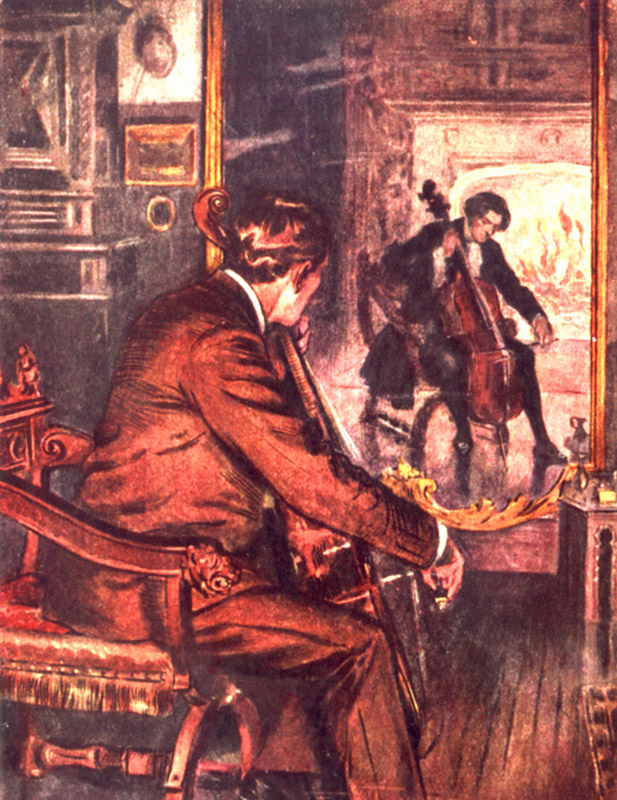
When Ronnie came to himself, emerging quite suddenly from a long,
confused dream, which had held many voices, many happenings over which
he had exercised no control and which were too indefinite to be
remembered, he found himself sitting on a seat, on the esplanade at
Hazelbeach.
A crisp, wintry feeling was in the air; but the sun was brilliant, and
the high ground behind, sheltered the sea-front from wind.
He was muffled in his fur coat, and felt quite warm.
The first thing he consciously noticed was the sparkling of the ripple
on the calm water.
There is something particularly reviving and inspiriting about sunshine
on the gaily moving sea. The effect is produced with so little apparent
effort. The sun just shines; the water just moves; and lo, hosts of
sparkling diamonds!
Ronnie watched it in silence for some time, before giving any sign that
he actually saw it.
He was anxious carefully to take his bearings, without appearing to do
so.
Helen sat beside him on the seat. She kept up a flow of conversation, in
the kind, cheerful, intelligent voice in which you talk to a child who
has to be kept happy and amused.
Ronnie let her go on talking in that voice, while he took his bearings.
He glanced at her, furtively, once; then turned his eyes seaward again.
Helen, also, was wearing a fur coat, and a pretty grey fur toque on her
soft hair. Her face seemed thinner than it used to be; but the sea
breeze and sunshine had brought a bright colour to her cheeks.
Ronnie's eyes left the ripples, and wandered cautiously up and down the
shore.
The beach was deserted. No moving figures dotted the esplanade. Helen
and he would have been alone, had it not been for one tiresome man who
sat reading on the next seat to theirs. He looked like a superior valet
or upper footman, in a bowler and a black morning coat. He was just out
of earshot; but his presence prevented Ronnie from feeling himself alone
with Helen, and increased the careful caution with which he took his
bearings.
At last he felt the moment had arrived to stop Helen's well-meant
attempts at amusing him.
The man on the other seat was a dozen yards off to the right. Helen sat
quite close to him on the left. He turned his back on the other seat and
looked earnestly into his wife's face.
"Helen," he said, quietly, "how did we get here?"
"We motored, darling. It isn't very far across country, though to get
here by train we should have to go up to town and down again."
"When did we come?"
"Yesterday. Ronnie, do look at those funny little wooden houses just
beyond us on the esplanade. They take the place of bathing-machines, or
bathing-tents, in summer. They can be hired just for the morning, or you
can engage one for the whole time of your visit, and furnish it
comfortably. Don't you think it is quite a good idea? And people give
them such grand names. I saw one called 'Woodstock,' and another
'Highcombe House.' If we took one, we should have to call it 'The
Grange.'"
"Helen, you have told me all about those little huts twice already,
during the last half-hour. Only, last time you had seen one called
'Runnymead,' and another called 'The Limes.' Presently, if you like, we
will walk along and read all the names. It is just the kind of thing
which would appeal to our joint sense of humour. But first you must
answer a few more questions. Helen—where is my 'cello?"
"At home, Ronnie."
"Was it broken?"
Helen looked distressed. "No, darling, it was not injured at all. It is
safely put away. Look how the sunlight sparkles on those distant
ripples!"
"I have finished with the ripples thank you, darling. Helen, I know I've
been desperately ill. But I'm all right now, and I want you to tell me
all about it."
He saw her glance past him, at the man who sat reading on the next seat.
"Don't worry about him," he said. "He can't overhear. If you think he
can, let's move on."
"No, no!" said Helen, quickly. "We are so cosy here in the sunshine.
Ronnie, do you see those—"
"No, dear," he said, "I don't! At this moment I see nothing but you. And
I decline to have my attention drawn any more to the exciting things to
be seen on the shore at Hazelbeach in winter.... Oh, yes, I knew it was
Hazelbeach! Five years ago I spent a jolly week here with some friends.
We hired a little wooden hut and called it 'Buckingham Palace,' I
remember."
He slipped his hand into her muff, capturing both hers.
Her look of anxiety and alarm went to his heart. He had never seen Helen
frightened before; and he knew with unerring instinct that she was
afraid—of him.
It was hard; for he was desperately tired in mind and body. To subside
into passive acquiescence and watch the ripples again, would be the
easier way. But he must make a fight for his newly-recovered sanity and
reason, and to convince Helen in the matter seemed the first thing to be
accomplished.
Her hands were shaking in her muff. He held them firmly with his.
"Darling," he said, "I know I have been very bad. I was ill in Leipzig,
though I didn't know it. But Dick Cameron told me I ought not to have
been going about there. I suppose since then I have been quite off my
head. But, oh, Helen, can't you see—- can't you see, darling—that I
am all right again now? I can remember practically nothing which has
happened since I played my 'cello in front of the mirror in the studio.
But, up to that moment, I remember everything quite clearly; my travels,
my manuscript, the time when I began to get feverish and lost my
sleep—I can see now the very spot where I camped when I had my first
nightmare. Then working night and day on board ship, then Leipzig, the
Hague, London in a fog; then home—to you. Helen, it has all come back.
Can't you realise that the clouds have lifted; can't you believe, my own
dear girl, that my mind is clear again? Look at the sunshine on the sea,
dispelling the morning mists. In hoc signo vinces! You said the path
of clear shining was the way to victory. Well, I have conquered whatever
it was which poisoned my brain for a while. I am absolutely myself again
now. Can't you believe it, Helen?"
The tears were running down her cheeks. She looked full into his earnest
eyes.
"Oh, Ronnie, you do look different! You do look your own dear self. Oh,
Ronnie, my own! But Dick is coming back to-morrow. He went up to town
only this morning. He will tell us what to do. Till then, don't you
think we had better just talk about the sea, and the little houses,
and—and how happy we are?"
"No, Helen," he said firmly. "We are not happy yet. I must know more.
How long is it since that evening in the studio?"
"About a month, darling. This is Christmas week. To-morrow will be
Christmas Eve."
Ronnie considered this in silence.
Then: "Let's walk up and down," he said. "It ought to be too cold to sit
about in Christmas week."
She rose and they walked along the sea-front together.
Ronnie glanced behind them. The man on the seat had risen also and was
following at a little distance.
"What cheek of that chap," he said. "He seems determined to overhear
our conversation. Shall I tell him to be off?"
"No, dear; please don't," she answered hurriedly. "He cannot possibly
overhear us."
Presently she dropped her muff and stooped to pick it up. But Ronnie
turned also, and saw her make a sign to the man following them, who at
once sat down on the nearest seat.
Then poor Ronnie knew.
"I suppose he is a keeper," he said.
"Oh, no, darling! He is only a trained attendant; just a sort of valet
for you. Such a nice man and so attentive. He brushes your clothes."
"I see," said Ronnie. "Valets are quite useful people. But they do not
as a rule sit reading in the middle of the morning, on the next seat to
their master and mistress! Do they? However, if Dick is coming
to-morrow, we can discuss the valet question with him. Take my arm,
Helen. I feel a bit shaky when I walk. Now tell me—why did we come
here?"
"They thought the change of scene, the perfect quiet, and the bracing
air might do wonders for you, Ronnie."
"Who were 'they'?"
"Dr. Dick and—a friend of his."
"I see. Well, I won't bully you into telling me things you are afraid I
ought not to know. But I will tell you just how much I do know. It is
all a queer sort of black dream. I absolutely can't remember seeing
anything, until I found myself watching the sparkle of the ripples on
the sea. But I vaguely remember hearing things. There was always a
kind voice. Of course that was yours, Helen. Also there was a kind hand.
I used to try not to do anything which could hurt the kind hand. Then,
there were several strange voices; they came and went. Then there was
Mrs. Dalmain. When her voice was there I always tried to do at once what
the strange voices and the kind voice wished; because I was horribly
afraid of being left alone with Mrs. Dalmain! Then I sometimes thought I
heard a baby cry. Wasn't that queer?"
Helen did not answer. A deep flush overspread her face, mounting from
her chin to the roots of her hair. Was Ronnie going to remember?
"The kind voice used to say: 'Take him away, Nurse'; but I am vague
about this; because I was miles down a deep well when it happened, and
the baby was up at the top. I expect I got the idea from having called
my 'cello the Infant of Prague. Did you hear me playing, on that
evening, Helen?"
"Yes, I heard."
"Was it beautiful?"
"Very beautiful, Ronnie."
"I am longing to get back to play my 'cello again."
"By-and-by, dear."
"Did I talk much of the 'cello when I was ill?"
"A good deal. But you talked chiefly of your travels and adventures;
such weird things, that the doctors often thought they were a part of
your delirium. But I found them all clearly explained in your
manuscript. I hope you won't mind, Ronnie. They asked me to glance
through it, in order to see whether anything to be found there threw
light on your illness. But of course you know, dearest, I could not do
that. I never 'glanced through' any manuscript of yours yet. Either I do
not touch them at all, or I read them carefully every word. I read this
carefully."
"Is it all right?"
"Ronnie, it is magnificent! Quite the best thing you have done yet. Such
brilliant descriptive writing. Even in the midst of my terrible anxiety,
I used to be carried right away from all my surroundings. Of course I do
not yet know the end; but when you are able to work again we can talk it
all over, and you will tell me."
His sad face brightened. A look of real gladness came into it; the first
she had seen for so long.
"I am glad it is all right," he said, simply. "I thought it was. I am
glad I am not altogether a rotter."
After that they walked on in silence. His last remark had been so
unexpected in its bitterness, that Helen could find no words in which to
answer it.
She glanced at her watch. It was almost time for luncheon. She pointed
out their hotel.
"Come, darling; we can talk more easily indoors. We have a charming
private sitting-room, overlooking the sea."
He turned at once; but as they entered the hotel gardens he said
suddenly: "Did I talk of a Upas tree, while I was off my head?"
"Yes, Ronnie, constantly. In fact you thought you were a Upas tree!"
"I knew I was a Upas tree," said Ronnie.
"Why?"
"Because my wife told me so, the evening I came home. How do you spell
'Upas'?"
"U, P, A, S. Oh, Ronnie, what do you mean?"
He paused, and shading his eyes, looked away over the sunny sea to where
the vessels, from the Hook of Holland, come into port.
"Just that," he said. "Exactly that. Utterly, preposterously,
altogether, selfish. That is the Upas tree."
"Oh, Ronnie," she cried, "if you knew—"
But Ronnie had seen a bowler hat behind the hedge. He called its wearer
forward.
"Mrs. West tells me you are my valet," he said. "Kindly show me to my
room."
Dick arrived very early the next morning, having to be off again by the
twelve o'clock train, in order to reach that evening the place where he
was due to spend Christmas.
A telegram from Helen had prepared him for a change in Ronnie, but
hardly for the complete restoration of mental balance which he saw in
his friend, as they hailed one another at the railway station.
Ronnie had breakfasted early, in order to meet Dick's train. He had said
nothing of his plan to Helen, merely arranging his breakfast-hour
overnight with the "valet."
He walked to the station alone; but, arrived there, found the "valet" on
the platform.
"Thought I might be wanted, sir, to carry the doctor's bag," he
explained, touching his hat. But, just as the train rounded the bend, he
remarked: "Better stand back a little, sir," and took Ronnie firmly by
the arm.
Ronnie could have knocked him down; but realised that this would be the
surest way to find himself more than ever hedged in by precautions. So
he stood back, in wrathful silence, and, as Dick's gay face appeared at
the window of a third-class smoker, the "valet" loosed his hold and
disappeared. It may here be recorded that this was the last time Ronnie
saw him. Apparently he found it necessary to carry Dr. Dick's bag all
the way back to town.
"Hullo, old chap!" cried Dick.
"Hullo, Dick!" said Ronnie. "This is better than Leipzig, old man. I'm
all right. I must give you a new thermometer!"
"You shall," said Dick. "After Christmas we'll have a spree together in
town and choose it. No need to tell me you 're all right, Ronnie. It's
writ large on you, my boy. He who runs may read!"
"Well, I wish you'd write it large on other people," said Ronnie, as
they walked out of the station.
"What do you mean?"
"Dick, I'm having a devil of a time! There's a smug chap in a bowler hat
who is supposed to be my valet. When I went to bed last night, I found I
had a decent room enough, opening out of the sitting-room. I was
obviously expected to turn in there, asking no questions; so I turned
in. But the valet person slept in a room communicating with mine. The
latch and the lock of the door between, had been tampered with. The door
wouldn't shut, so I had to sleep all night with that fellow able to look
in upon me at any moment. After I had been in bed a little while, I
remembered something I had left in the sitting-room and wanted. I got up
quietly to fetch it. That door was locked, on the sitting-room side!"
"Poor old boy! We'll soon put all that right. You see you were pretty
bad, while you were bad; and all kinds of precautions were necessary.
We felt sure of a complete recovery, and I always predicted that it
would be sudden. But it is bound to take a little while to get all your
surroundings readjusted. Why not go home at once? Pack up and go back to
Hollymead this afternoon, and have a real jolly Christmas there—you,
and Helen, and the kid."
"The kid?" queried Ronnie, perplexed. "What kid? Oh, you mean my
'cello—the Infant of Prague."
Dick, meanwhile, had bitten his tongue severely.
"Yes, the jolly old Infant of Prague, of course. Is it 'he,' 'she,' or
'it'? I forget."
"It," replied Ronnie, gravely. "In the peace of its presence one forgets
all wearying 'he and she' problems. Yes, I want most awfully to get back
to my 'cello. I want to make sure it is not broken; and I want to make
sure it is no dream, that I can play. But—I don't want to go, unless I
can go alone. Can't you prescribe complete solitude, as being absolutely
essential for me? Dick, I'm wretched! I don't care where I go; but I
want to get away by myself."
"Why, old man?"
"Because my wife still considers me insane."
"Nonsense, Ron! And don't talk of being insane. You were never that.
Some subtle malarial poison, we shall never know what, got into your
blood, affected your brain, and you've had a bad time—a very bad
time—of being completely off your balance; the violent stage being
followed by loss of memory, and for a time, though mercifully you knew
nothing about it, complete loss of sight. But these things returned, one
by one; and, as soon as you were ready for it, you awoke to
consciousness, memory, and reason. There is no possible fear of the
return of any of the symptoms, unless you come again in contact with the
poison; hardly likely, as it attacked you in Central Africa. Of course,
as I say, we shall never know precisely what the poison was."
Then Ronnie spoke, suddenly. "It was the Upas tree," he said. "I camped
near it. My nightmares began that night. I never felt well, from that
hour."
"Rubbish!" said Dr. Dick. "More likely a poisonous swamp. The Upas tree
is a myth."
"Not at all," insisted Ronnie. "It is a horrid reality. I had seen the
one in Kew Gardens. I recognised it directly, yet I camped in its
shadow. Dick, do you know what the Upas stands for?"
"What?"
"Selfishness! It stands for any one who is utterly, preposterously,
altogether, selfish."
"Oh, buck up old man!" cried Dick. "We are all selfish—every mother's
son of us! Perhaps that's why! Most men's mothers spoil them, and their
wives continue the process. But you will be selfish with a vengeance, if
you don't buck up and give that splendid wife of yours a good time now.
She has been through—such a lot. Ronnie, you will never quite
realise—well, I never knew such a woman, excepting, perhaps, Mrs.
Dalmain; and of course she has not your wife's beauty. I haven't the
smallest intention of ever coming under the yoke myself. But I assure
you, old chap, if you had pegged out, as you once or twice seemed likely
to do, I should have had a jolly good try as to whether I couldn't chip
in, by-and-by."
"Confound you!" said Ronnie. But he laughed, and felt better.
Dr. Dick saw Helen alone.
"Well," he said, "so we've pulled him through. Ronnie's all right now.
No more need for watching and planning, and guarding; in fact, the less
he realises the precautions which were necessary, the better. I shall
take Truscott back to town with me. He seems to have done awfully well.
I suppose you have no complaints. Why don't you hire a car and run
straight back home with Ronnie this afternoon. Think what a jolly
Christmas you might have. Show him the boy as a Christmas present! I
believe he is keen to be at home; and the less you thwart him now, the
better. Don't suggest it until I am gone; but send a wire home at once
to say you are probably returning this afternoon. Then your people will
make all needed preparations for the festive day; turkeys and holly, and
all that sort of thing; have fires lighted everywhere, and all in
readiness. My old sweetheart, Mrs. Blake, will put on cherry-coloured
ribbons, and black satin, and be in the hall to receive you! You had
better mention, in the wire, that I am not coming; then she won't waste
her time hanging mistletoe in likely corners."
Helen wrote the telegram, rang, and gave it to a page.
Then she turned to Dr. Dick.
"Ronnie is not fully himself, yet," she said.
Dick looked at her keenly. "How so?"
"He professes to remember, and does remember, everything which happened,
up to the final crash in the studio. Yet he has made no mention to me
of—of our child."
"He is shy about it," suggested Dick. "You speak first."
"I cannot," she replied. "It is for Ronald to do that."
"Ah, you dear women!" moralised the young bachelor. "You remind me of
Nebuchadnezzar—no, I mean Naaman. You bravely ford the rushing waters
of your Abanas and your Pharpars, and then you buck-jump at the little
river Jordan!"
"My dear Dick, I am becoming accustomed to the extraordinary inaptness
of your scriptural allusions. But this is hardly a small matter
between me and Ronnie. I am ready to make every allowance for his
illness and loss of memory; but I don't see how I can start life with
him at home, until he manages to remember a thing of such vital import
in our wedded life. He may be sane on every other point. I cannot
consider him sane on this."
"Shall I tell him?" suggested Dick.
"No, let him remember. He can remember his Infant of Prague; his mind
is full of that again. Why should he not be able to remember my baby
son?"
"Oh, lor!" sighed Dr. Dick. "Why not put that poser to Ronnie direct,
instead of putting it to me? Forgive me for saying so, but you are
suffering just now from a reaction, after the terrible strain through
which you have passed. And Ronnie is wretched too, because he remembers
how you let fly at him that evening, and he thinks you really meant it."
"I did," said Helen. "Of course, had I known how ill he was, poor old
boy, I should have been more patient. But I have a little son to
consider now, as well as Ronnie. I did think him selfish, and I do."
"My dear angel," said Dr. Dick, "we are all selfish, every mother's son
of us; and it is you blessed women who make us so."
She looked at him, with softening eyes. "You are not selfish, Dick,"
she said.
"I am," he answered; "and a long chalk worse than Ronnie. I combine
ambition with my selfishness. I jolly well mean to get to the top of the
tree, and I don't care how I get there. I down every one who dares stand
in my way; or—I use them as stepping-stones. There! Isn't that a worse
Upas tree than poor old Ronnie's? Mine is a life untouched by love, or
any gentler feelings. All that sort of thing was killed in me when I was
quite a little chap. It is the story of a broken halo. Perhaps I'll tell
it you some day. Meanwhile, this being Christmas Eve and not Ash
Wednesday, I'll make no more confessions. Don't you want to hear the
result of my psychic investigations, concerning our mirror experiences?"
"Exceedingly," said Helen. "Have you time to tell me now?"
"Heaps of time. It won't take long. Last night I told the whole story to
a man who makes a special study of these matters, and knows more about
things psychic than any other man in England. The Brands asked me to
dinner and arranged to have him also. After dinner he and I went down
alone to the doctor's consulting room, and talked the whole thing out. I
was careful to mention no names. You don't want to be credited with a
haunted room at the Grange, neither do we want Ronnie's name mixed up
with psychical phenomena. Now I will give you this man's opinion and
explanation, exactly as he gave it to me. Only, remember, I pass it on
as his. I do not necessarily endorse it.
"He holds that inanimate objects, such as beds, walls, cupboards,
staircases, have a power of receiving, absorbing and retaining
impressions transmitted to them through contact with human minds in
extreme conditions of stress and tension. This would especially be the
case with intimately personal things, such as musical instruments, or
favourite chairs. Old rooms and ancient furniture might retain these
impressions for centuries; and, under certain circumstances, transmit
them to any mind, with which they came in contact, happening to be
strung up to the right key to respond to the psychic impression. He
considers that this theory accounts for practically all ghost stories
and haunted rooms, passages, and staircases. It reduces all apparitions
to the subjective rather than the objective plane; in other words the
spirit of a murdered man does not return at certain times to the room in
which he was done to death; but his agonised mind, in its last conscious
moments, left an impress upon that room which produces a subjective
picture of the scene, or part of the scene, upon any mind psychically
en rapport with that impress. I confess this idea appeals to me. It
accounts for the undoubted fact that certain old rooms are undeniably
creepy; also that apparitions, unconnected with actual flesh and blood,
have been seen by sane and trustworthy witnesses. It does away with the
French word for ghost—revenant. There is no such thing as a
'comer-back,' or an 'earth-bound spirit.' Personally, I do not believe
in immortality, in the usually accepted sense of the word; but I have
always felt that were there such a thing as a disembodied spirit, it
would have something better to do than to walk along old corridors,
frightening housemaids! But, to come to the point, concerning our own
particular experience.
"I carefully told him every detail. He believes that probably the old
Florentine chair and the 'cello had been in conjunction before, and had
both played their part in the scene which was re-acted in the mirror. If
so, poor old Ron was jolly well in for it, seated in the chair, and
holding the 'cello. His already over-excited brain found itself caught
between them. The fitful firelight and the large mirror supplied
excellent mediums for the visualisation of the subjective picture. Of
course, we do not yet know what Ronnie saw. I trust we never shall. It
is to be hoped he has forgotten it. Had you and I seen nothing, we
should unquestionably have dismissed the whole thing as merely a
delirious nightmare of Ronnie's unhinged brain.
"But the undoubted fact remains that we each saw, reflected in that
mirror, objects which were not at that moment in the room. In fact we
saw the past reflected, rather than the present. My psychic
authority considers that both our impressions came to us through
Ronnie's mind, and were already fading, owing to the fact that he had
become unconscious. I, coming in later than you, merely saw the
Florentine chair in position. All else in my view of the reflection
appertained to the actual present, into which the long-ago past was then
rapidly merging. But you, coming in a few moments sooner, and being far
more en rapport with the spirit of the scene, saw the tall man in a
red cloak—whom you call the Avenger—strangling the girl. By the way,
why do you call him the Avenger?"
"Because," said Helen, slowly, "there was murder in the cruel face of
the woman, and there was a dagger in her hand. She had struck her blow
before he appeared upon the scene. I know this, because it was the flare
of his crimson cloak, as he rushed in, which first caught my eye, in the
firelight, and made me look into the mirror at all. Before that I was
intent on Ronnie. The Avenger seized the woman from behind; I saw his
brown hands on the whiteness of her throat. Grief and horror were on his
face, as he looked over her shoulder, and past the chair, at the
prostrate heap upon the floor."
"Which heap," said Dick, trying to speak lightly, "was our poor Ronnie."
"No," said Helen, gazing straight before her into the fire, "the heap
upon the floor was not Ronnie."
"But—I am positive!—I saw it myself! I saw you kneeling beside it. I
helped to sort it, afterwards. The actual heap on the floor was the
broken chair, Ronnie mixed up with it; and, on top of both, that unholy
Infant, whose precocious receptivity is responsible for the entire
business. I exonerate the Florentine chair; I exonerate poor Ronnie. I
shall always maintain that that confounded 'cello worked the whole show,
out of its own unaided tummy!"
But Helen did not laugh. She did not even smile. "The heap on the floor
was not Ronnie," she repeated firmly, "nor was I kneeling beside it. The
Italian chair had not fallen over. Not a single thing appertaining to
the present, was reflected in the picture as I first saw it. Dick, there
was a conclusion to my vision of which I have never told you."
"Oh, lor!" said Dick. "When I guaranteed the psychic chap that I was
putting him in full possession of every detail!"
"I am sorry, Dick. But until this moment I have never felt able to tell
you. I cannot do so now, unless you are nice."
"I am nice," said Dick, "very nice! Tell me quick."
"Well, as I knelt transfixed, watching—the heap on the floor moved and
arose. It was a slight dark man, with a white face, and a mass of
tumbled black hair. He lifted from off his breast as he got up, a
violoncello. He did not look at the woman, nor at the man in the crimson
cloak; he stood staring, as if petrified with grief and dismay, at his
'cello. Following his eyes, I saw a dark jagged stab, piercing its
right breast, just above the f hole. The anguish on the 'cellist's
face, was terrible to see. Then—oh, Dick, I don't know how to tell
you!"
"Go on, Helen," he said, gently.
"Then he turned from the 'cello, and looked at me; and, Dick, it was
the soul of Ronnie—my Ronnie—in deepest trouble over his Infant of
Prague, which looked at me through those deep sad eyes. I cannot explain
to you how I knew it! He was totally unlike my big fair Ronnie, but—it
was the soul of Ronnie, in great distress, looking at me! The moment I
realised this, I seemed set free from the past. The 'cellist, the woman,
the Avenger, all vanished instantly. I saw myself reflected, I saw you,
I saw the studio; I saw Ronnie on the floor. I turned to him at once,
lifted the 'cello from his breast, and drew his head into my lap."
"Was there a jagged hole—"
"No, not a scratch. The stab belonged to a century ago. But, listen
Dick! Several days later, when I had a moment in which to remember
Ronnie's poor Infant of Prague, I examined it in a good light, and found
the place where the hole made by that dagger had been skilfully mended."
"Lor!" said Dr. Dick. "We're getting on! Don't you think you and I and
the Infant might put our heads together, and write a psychic book! But
now—seriously. Do you really believe Ronnie was once a slim, pale
person, with a shock of black hair? And if he and his Infant lived
together in past ages, where were you and I? Are we altogether out of
it? Or are you the lady with the dagger, and I the noble party in the
flaming cloak?"
She smiled, and a look of quiet peace was in her eyes.
"Dick," she said, "I am not troubled at all about the past. My whole
concern is with the present; my earnest looking forward is to the
future. And remember, that which set me completely free to think only of
the present, was when my Ronnie's soul looked out at me from that
strange vision of the past. I cannot say exactly what I believe. But I
know my entire responsibility is to the present; my hope and confidence
are towards the future. I realise, as I have never realised before, the
deep meaning of the words: 'Lord, Thou hast been our Dwelling-place, in
all generations.' I am content to leave it at that."
Dick sat silent; sobered, impressed, by a calm confidence of faith,
which was new to him.
Then he said: "Good for you, Helen, that you can take it so. Personally,
I believe in nothing which I cannot fully explain and understand.
'Faith,' in your sense of the word, has no place in my vocabulary. I was
a very small boy when my faith took to itself wings and flew away; and,
curiously enough, it was while I was singing lustily, in the village
church at Dinglevale: 'As it was in the beginning, is now, and ever
shall be; world without end, Amen'!"
"It will come back again," said Helen. "Dick, I know it will come back.
Some day you will come to me and you will say: 'It has come back.' The
thrusting hand and the prying finger are the fashion nowadays, I know.
But the grand old faith which will win out in the end, is the faith
which stands with clasped hands, in deepest reverence of belief; and,
lifting adoring eyes, is not ashamed to say to the revelation of a Risen
Christ: 'My Lord and my God!'"
Dick stirred uneasily in his chair.
"We have got off the subject," he said, "and it's about time we looked
up Ronnie. But, first of all: how much of all this do you mean to tell
Ronnie?"
"Nothing whatever, if I can help it," replied Helen. "So far as I know,
I hope, after this morning, never to mention the subject again."
"I think you are wise. And now let me give you a three-fold bit of
advice. Smash the mirror; burn the chair; brain the Infant!"
Helen laughed. "No, no, Dick!" she said. "I can do none of those things.
I must take tenderest care of Ronnie's Infant. I have had his valuable
old chair carefully mended; and I must not let him think I fear the
mirror."
"You're a brave woman," said Dick. "Believing what you do, you're a
brave woman to live in the house with that mirror. Or, perhaps, it comes
of believing so much. A certainty of confidence, which asks no
questions, must be to some extent a fortifying thing. By the way, you
will remember that the long rigmarole I gave you was not my own
explanation, but the expert's? Mine is considerably simpler and shorter.
In fact, it can be summed up in three words."
"What is your explanation, Dick?"
"Whisky and soda," said Dr. Dick, bravely. "You mixed it stiffer than
you knew. I was dead beat, and had had no food. I have always been a
fairly abstemious chap; in my profession we have to be: woe betide the
man who isn't. But since I saw that chair standing on its four legs in
the mirror, when it was lying broken on the floor in reality, I have not
touched a drop of alcohol. There! I make you a present of that for your
next temperance meeting. Now let's go out and buck Ronnie up. Remember,
he'll feel jolly flat for a bit, with no temperature. Temperature is a
thing you miss, when it has become a habit."
Ronnie saw Dick off by the mid-day train.
After the train had begun to move, Dick leaned from the window, and said
suddenly: "Ronnie! talk to your wife about her Leipzig letter, and—the
kid, you know."
Ronnie kept pace with the train long enough to say: "I wish you wouldn't
call it the 'kid,' Dick; it is the 'Infant.' And Helen declines to talk
of it."
Then he dropped behind, and Dick flung himself into a corner of his
compartment, with a face of comic despair. "Merciful heavens," he said,
"slay that Infant!"
Meanwhile Ronnie was saying to a porter: "When is the next train for
town?"
"One fifty-five, sir."
"Then I have no chance now of catching the three o'clock from town, for
Hollymead?"
"Not from town, sir. But there is a way, by changing twice, which gets
you across country, and you pick up the three o'clock all right at
Huntingford, four ten."
"Are you sure, my man? I was told there was no way across country."
"The one fifty-five is the only train in the day by which you can do it,
sir. I happen to know, because I have a sister lives at Hollymead, so
I've done it m'self. If trains aren't late, you hit off the three
o'clock at Huntingford."
"Thanks," said Ronnie, noting down particulars. Then he walked rapidly
back to the hotel.
"I can't stand it," he said. "I shall bolt! With me off her hands, she
can go and have a jolly Christmas at the Dalmains. She is always welcome
there. I must get away alone and think matters out. I know everything is
all wrong, and yet I don't exactly know what has come between us. I only
know I am wretched, and so is she. It is still the poison of the Upas.
If I knew why she suddenly considered me utterly, preposterously,
altogether, selfish, I would do my level best to put it right. But I
don't."
He found Helen in the hall, anxiously watching the door. She took up a
paper, as he came in.
"Helen," he said, "do you mind if we lunch punctually at one o'clock? I
am going out before two."
"Why, certainly we will," said Helen. "You must have had a very early
breakfast, Ronnie. But don't overdo, darling. Remember what Dick said.
Shall I come with you?"
"I would rather go alone," said Ronnie. "I want to think things over."
She rose and stood beside him.
"Ronnie dear, we seem to have lost all count of days. But, as a matter
of fact, to-morrow is Christmas Day. Would you like to go home this
afternoon? We can order a car for two o'clock, and be at the Grange for
tea. Ronnie, wouldn't it be rather lovely? Think of the little cosy
tea-table, and your own especial chair, and the soft lamp-light—"
She paused abruptly. The mental picture had recalled to both the evening
on which they last stood together in that golden lamplight.
Ronnie hesitated, looking at the floor. Then he raised his eyes to
Helen's. "I don't think I could bear it," he said, turned from her
quickly, and went upstairs.
In his room he scribbled a note.
"My wife—I am awfully sorry, but I simply had to bolt. Don't be
alarmed. I have gone home to the Grange. I believe, when I am by myself
in the house where we spent the three years I thought so perfect and so
happy, I shall find out what is the matter; I shall get to the very root
of the Upas tree.
"I know I somehow hurt you horribly on the night I reached home, by
asking you to come to the studio to hear me play my 'cello; but, before
God, I haven't the faintest idea why!
"You would not have said what you did, had you known I was ill; but
neither would you have said it, unless it had been true. If it was true
then, it is true now. If it is true now, we can't spend Christmas Day
together.
"I want you to go to the Dalmains by motor, as soon as you find this,
and have a jolly, restful time with them. You look worn out.
"RONNIE."
"P.S.—I am obliged to leave this in my room. I hope you will find it
there. I don't even know where your room is, Helen, in this beastly
hotel."
Ronnie considered his postscript; then crossed out "beastly" and
substituted "large." But "beastly" still showed, pathetically, beneath
the line. And, by-and-by, the heart of Ronnie's wife, from which all
clouds had suddenly rolled away, understood it, and wept over it, and
kissed it; and thought "beastly" a dear word! It was so quaintly like
Ronnie to substitute "large" for "beastly."
All clouds had rolled away, before Helen read the note; for this is what
had happened.
Ronnie had excused himself when lunch was half over.
Helen let him go, trying to act on Dr. Dick's advice not to worry him by
seeming to watch or follow him.
So she sat on alone, finishing luncheon, and thus did not see Ronnie
walk out of the front door, carrying his bag.
Soon afterwards she passed into the hall, and sat dipping into the
papers and thinking over her talk with Dick.
Presently a page stepped up to her with a letter on a salver.
Her heart stood still as she saw the stamp, the post-mark, and the
writing. It was from Aubrey Treherne, forwarded from Hollymead.
Helen was sorely tempted for a moment to burn it unread. She had
suffered so much through a former letter in that handwriting. She
suddenly realised how cruelly Aubrey's words about Ronnie had, in the
light of Ronnie's subsequent behaviour, eaten into her soul.
She looked at the fire. She rose and moved towards it, the letter in her
hand.
Then better counsels prevailed.
She went slowly upstairs to her sitting-room, closed the door, sat down,
and opened Aubrey's letter.
It contained a smaller envelope sealed, on which was written: "Read
letter first."
She opened the folded sheets.
"DEAR HELEN,
"Yes, you are right about God's Word not returning void. Your own words,
I admit, only hardened me; but those at the end of your letter broke me
up. I am so very far removed from light and fellowship, love and
forgiveness. I doubt if I can ever get back into the way of peace.
"But, anyhow, before the great Feast of Peace upon earth, goodwill
toward men, I can take a first step by fully confessing the great wrong
I did to you and to your husband rather more than a month ago, on the
evening which he spent at my flat.
"Possibly you have found it out already; but possibly not, as I hear he
has been very seriously ill.
"The evening he was here, he was more or less queer and light-headed,
but he was full of you, and of his delight in going home. I suppose this
all helped to madden me. No need to explain why. You know.
"He had found a letter from you at the Poste Restante; but, rushing
around to his publishers, etc., had not had time to read it.
"When he remembered it and found it in his pocket-book, he stood with
his back to my stove, in great excitement, and tore it open; I sitting
by.
"As he unfolded the large sheets of foreign paper, a note flew out from
between them, and fell, unseen by him, to the floor.
"I put my foot on it. I gathered, from extracts he read me from the
letter, that this note was of importance.
"When he found in a postscript that you mentioned an enclosure, he
hunted everywhere for it; not thinking, of course, to look under my
foot.
"He then concluded, on my instigation, that, after all, you had not
enclosed any note.
"At the first opportunity I transferred it to my pocket, made an excuse
to leave the room, and read it.
"Helen, believe me, had I known beforehand the news that note contained,
I don't think I could have been such a fiend.
"But once having done it, I carried it through. I allowed your husband
to go home in total ignorance of the birth of his son. It was I who put
the word 'astonishing' into his telegram; and, in my letter to you, I
led you to suppose I had heard the news from him.
"I don't know exactly what I expected to gain from all this. But, in a
condition of mad despair, I seemed playing my very last card; and I
played it for all it was worth—which apparently was not much!
"I did plenty of other devilish work that night—chiefly mental
suggestion. This is the only really confessable thing.
"The letter your husband never saw, is in the enclosed envelope. He will
like to have it now.
"Thus, as you see, the Word has not returned unto you void. It brings
you the only reparation I can make.
"AUBREY TREHERNE."
Helen tore open the sealed envelope, and found her little pencil note,
the tender outpouring to Ronnie, written three days after her baby's
birth.
So Ronnie never saw it—he never knew! He came home without having the
remotest idea that she had been through anything unusual in his absence.
He had heard no word or hint of the birth of his little son. Yet she had
called him utterly, preposterously, altogether, selfish, because he had
quite naturally expected her to be as interested as ever in his pursuits
and pleasures.
Oh, Ronnie, Ronnie!
She flew to his room, hoping he had not yet gone out.
On the table she found a note addressed to herself.
She tore it open, read it—- then went back into the sitting-room, and
pealed the bell.
"Send my maid to me at once, and the hall-porter."
They arrived together.
Helen had just written a long telegram to her housekeeper.
She spoke to the hall-porter first.
"Send off this telegram, please. Then procure the fastest motor-car you
can find, to run me over to Hollymead this afternoon. We can be ready to
start in half-an-hour's time."
Then she turned to her maid.
"Jeffreys, we go home for Christmas after all. Mr. West has gone on by
train. We must pack as promptly as possible, and start in half-an-hour.
We may perhaps get home before him. I doubt whether he can catch
anything down from town before the five o'clock."
She flew to her room, pressing Ronnie's sad little note to her heart.
All the world looked different! Ah, what would it be, now, to tell him
of his little son! But she must get home before him. Supposing Ronnie
went upstairs alone, and found the baby!
Ronnie caught the three o'clock train from town, at Huntingford, as the
porter had predicted.
No carriage was at the station, so he had a rather long walk from
Hollymead to the Grange.
It was a clear, crisp evening and freezing hard. He could feel the frost
crackle under his feet, as he tramped along the country lanes.
When he came in sight of the lodge, it reminded him of an old-fashioned
Christmas card; the large iron gates, their grey stone supports covered
with moss and lichen and surmounted by queer rampant beasts unknown to
zoology, holding in their stone claws oval shields on which were carved
the ancient arms of Helen's family; the little ivy-covered house, with
gabled roof and lattice-windows, firelight from within, shining golden
and ruddy on the slight sprinkling of frosty snow.
As he passed in at the gate he saw the motherly figure of Mrs. Simpkins,
a baby on her arm, appear at the window, lifting her hand to draw down
the crimson blind. Before the blind shut in the bright interior, Ronnie
caught a glimpse of three curly heads round a small Christmas-tree on
the kitchen-table. Simpkins, in his shirt-sleeves, was lighting the
topmost candle.
Ronnie walked on beneath the chestnuts and beeches, up the long sweep of
the park drive, a dark lonely figure.
He was very tired; his heart was heavy and sad.
It had been such a cheery glimpse of home, through the lodge window,
before the red blind shut it in. Simpkins was a lucky fellow. Mrs.
Simpkins looked so kind and comfortable, with the baby's head nestling
against her capacious bosom.
Ronnie turned to look back at the brightly-lighted cottage. The ruddy
glow from the blind, fell on the snow. He wondered whether there was a
Upas tree in that humble home. Surely not! A Upas tree and a
Christmas-tree could hardly find place in the same home. The tree of
Light and Love, would displace the tree of subtle poison.
He turned wearily from the distant light and plodded on.
Then he remembered that, in her last letter, Helen had said: "Ronnie, we
will have a Christmas-tree this Christmas." Why had Helen said that? He
had fully intended to ask her, but had not thought of it from that hour
to this.
Possibly it was just a wish to yield to his whim in the matter. Perhaps
she was planning to have all the little Simpkins kids up to the house.
Well, if Helen spent Christmas with the Dalmains, she would come in for
little Geoff's Christmas-tree, which would certainly be a beauty.
He plodded heavily on. He felt extraordinarily lonely. Would Helen miss
him? Hardly. You do not miss a selfish person. He would miss
Helen—horribly; but then Helen was not selfish. She was quite the most
unselfish person he had ever known.
He went over in his mind all the times when Helen had instantly given up
a thing at his wish. Amongst others, he remembered how, on that spring
morning so long ago, when he had told her of his new book and of his
plan, she had been wanting to tell him something, yet he had allowed her
interest to remain untold, when she threw herself heart and soul into
his. He began to wonder what it could have been; and whether it would be
too late to ask her now.
At last he reached the house, and felt slightly cheered to see lights
and fires within. He had almost anticipated darkness.
Mrs. Blake herself opened the door, resplendent in black satin; lavender
ribbons in her lace cap.
"La, sir!" she said. "Fancy you walking from the station! You must
please to excuse Simpkins being out. He has some Christmasing on at the
lodge, for his fam'ly."
"I know," said Ronnie. "I saw a Christmas-tree as I passed. I shall not
require Simpkins. Blake, is there a fire in the studio?"
"There is, sir, a fine one, for the good of the piano. There is also a
fire in the sitting-room, sir, where I will at once send in some tea."
"No, not there," said Ronnie quickly. "I will have tea in the studio."
But Mrs. Blake was firm. "That I couldn't ever, sir! Mrs. West wouldn't
wish it. She thinks so much of you having tea in her sitting-room, and
beside her fire; which is much more, so to say, cosy than that great
unfurnished room, all looking-glass."
At mention of the mirror Ronnie shivered, and yielded. He had almost
forgotten the mirror.
So he sat in his own favourite chair, while Blake stood and poured out
his first cup of tea, then left him to the utter loneliness of being in
that room without Helen.
It is doubtful whether Ronnie had ever loved his wife so passionately
as he loved her while he experienced, for the first time, what it was
like to be without her, in the room where they had hitherto always been
together.
Everything he touched, everything at which he looked, spoke of Helen;
forcing upon him the consciousness of the sweetness of her presence, and
the consequent hardness of her absence.
Yet he had brought this hardness on himself. She had said: "Wouldn't it
be rather lovely to have tea together?" But he had answered: "I don't
think I could bear it." And now he did not know how to bear the fact
that she was not with him.
Then he saw the chair against which he had leaned his 'cello, and with a
thrill of comfort he remembered the Infant of Prague.
How had it fared all this time, in its canvas bag? Perhaps no one had
remembered even to put it back into that.
Having hastily swallowed his tea, lest Blake should arrive at the studio
to inquire what had been amiss with it, Ronnie hurried down the
corridor, entered the long, low room, and turned on the electric light.
As before, a great log fire burned on the hearth; but he needed more
light now, than mere fitful fire-gleams. He wanted to examine the
Infant.
He looked round the room, and there, on a wide settee under one of the
windows, lay a polished rosewood 'cello-case.
Ronnie, springing forward, bent down eagerly. The key was in the lock.
He turned it, and lifted the lid.
There lay the Infant, shining and beautiful as ever, in a
perfectly-fitting bed, lined with soft white velvet. The whole thing
carried out exactly Ronnie's favourite description of his 'cello: "just
like the darkest horse-chestnut you ever saw in a bursting bur." The
open rosewood case, with its soft white lining, was the bursting bur;
and within lay his beautiful Infant!
Helen had done this.
Ronnie's pleasure was largely tinged with pain. Helen, who did not like
his 'cello, had done this to please him, yet was not here to see his
pleasure.
Ronnie drew forth the bow from its place in the lid, opened a little
nest which held the rosin, then tenderly lifted the Infant of Prague and
carried it to the light.
At first sight, its shining surface appeared perfect as ever. Then,
looking very closely, and knowing exactly where to look, Ronnie saw a
place just above the f hole on the right, where a blow had evidently
been struck deeply into the 'cello. A strip of wood, four inches long,
by one inch wide, had been let in, then varnished so perfectly that the
mend—probably the work of a hundred years ago—could only be seen in a
good light, and by one who knew exactly where to look.
Ronnie stood with grave face gazing at the Infant.
What did it all mean?
He remembered with the utmost vividness every detail of the scene in the
mirror.
Had he thought-read from his 'cello the happenings of a century before?
Had it transmitted to his over-wrought brain, the scene in which it had
once played so prominent a part?
Had it, before then, in the Leipzig flat, imparted to Aubrey
Treherne—unconsciously to himself—an accurate mental picture of its
former owner?
Ronnie mused on this, and wondered. Then the desire rose strong within
him to hear once more the golden voice of the Infant, even at the risk
of calling up again those ghostly phantoms of a vanished past.
He drew the Florentine chair into the centre of the room.
He took his seat on the embossed leather of crimson and gold.
He glanced at his reflection. His face was whiter than it had been five
weeks ago, when he returned, deep bronzed, from Africa. His hair, too,
was longer than it ought to be; though not so long as the heavy black
locks of the 'cellist of that past reflection.
Ronnie's rough tweed suit and shooting boots, were a curious contrast
to the satin knee-breeches, silken hose, and diamond shoe-buckles he
remembered in his vision; yet his manner of holding the 'cello, assumed
without conscious thought, and the positions of his knees and feet, were
so precisely those of that quaint old-time figure, that Ronnie never
doubted that when he raised the bow and his fingers bit into the
strings, the flood of harmony would be the same.
He waited for the strong tremor to seize his wrist.
It did not come.
He sounded the four open strings, slowly, one after the other.
Yes, the tones were very pure, very rich, very clear.
Then he took courage, pressed his fingers into the finger-board, and
began to play.
Alas, poor Infant of Prague!
Alas, poor born musician, who preferred doing things he had never
learned to do!
The exquisite rise and fall of harmony, came not again.
Bitterly disappointed, Ronnie waited, staring into the mirror.
But a rather weary, very lonely, and exceedingly modern young man stared
back at him.
At last he realised that he could no longer play the 'cello by
inspiration. So he began very carefully feeling for the notes.
The Infant squeaked occasionally, and wailed a little; but on the whole
it behaved very well; and, after half-an-hour's work, having found out
the key which enabled him to use chiefly the open strings, Ronnie
managed to play right through, very fairly in tune, "O come, all ye
faithful, joyful and triumphant!"
This gave him extraordinary pleasure. It seemed such a certainty of
possession, to be able to pick out all the notes for himself.
He longed that Helen might be there to hear.
The Infant of Prague grew dearer to him than ever. He was now mastering
it himself, independent of the antics of an old person of a century
ago, bowing away in the mirror.
He tried again; and this time he sang the words of the first verse, as
he played. His really fine baritone blended well with the richness of
the silver strings.
The words had occasionally to wait, suspended as it were in mid-air,
while he felt about wildly for the note on the 'cello; but, once found,
the note was true and good, and likely to lead more or less easily to
the next.
A listener, in the corridor outside, pressed her hands to her breast,
uncertain whether she felt the more inclined to laugh or to weep.
Ronnie began his verse again.
"O come ... all ye ... faithful ...
joyful and tri ... tri ... tri ... um
... phant ... O come, ye, O come ye,
to Beth ... Beth ... Beth ...
Be—eth—le—hem!"
He paused, exhausted by the effort of drawing Bethlehem complete, out of
the complication of the Infant's four vibrating strings.
He paused, and, lifting his eyes, looked into the mirror—and saw
therein the face of a woman, watching him from beside the door; a lovely
face, all smiles, and tears, and tenderness.
At first he gazed, unable to believe his eyes. But, when her eyes met
his, and she knew that he saw her, she moved quickly forward, kneeled
down beside him, and—it was the face of his wife, all flooded with glad
tenderness, which, resting against his shoulder, looked up into his.
She had spoken no word; yet at the first sight of her Ronnie knew that
the cloud which had been between them, was between no longer.
"Helen," he said; "Oh, Helen!"
Ronnie laid down his bow, and put his right arm round his wife.
He still held the precious Infant of Prague between his knees, his left
hand on the ebony finger-board.
"My darling!" Helen said. "So we shall be at home for Christmas after
all. How glad I am!"
He looked at her dumbly, and waited.
He felt like the prodigal, who had planned to suggest as his only
possible desert, a place among the hired servants, but was so lifted
into realisation of sonship by the father's welcome, that perforce he
left that sentence unspoken.
So Ronnie looked at her dumbly, reading the utter love for him in her
eyes.
Back came the words of his hymn, replete with fresh meaning.
"O come, all ye faithful,
Joyful and triumphant!"
They were such faithful eyes—Helen's; and now they seemed filled with
triumphant joy.
"Ronnie," she said, "do you remember how I wrote to you at Leipzig, that
this Christmas we would have a Christmas-tree? Did not you wonder,
darling, why I said that?"
"Yes," answered Ronnie. "I thought of it this evening when I saw a
Christmas-tree at the lodge. I had meant to ask you the night I reached
home, but I did not remember then."
"Ah, if you had," she said, "if you only had!"
"Well?" he questioned. "Tell me now."
"Ronnie, do you remember that in that letter I said I had something to
tell you, and that I enclosed a note, written some weeks before,
telling you this thing?"
"Yes, dear," said Ronnie. "But you forgot to enclose the note. It was
not there. I tore the envelope right open; I hunted high and low. Then
we concluded you had after all considered it unimportant."
"It was all-important, Ronnie; and it was there."
"It was—where?" asked Ronnie.
"Under Aubrey's foot.... Oh, hush, darling, hush! We must not say hard
things of a man who has confessed, and who is bitterly repentant. I
can't tell you the whole story now; you shall hear every detail later;
but he saw it fall from the letter, as you opened it. He was tempted,
first, to cover it with his foot; then, to put it in his pocket; and,
after he had read it, he wrote to me implying that you had told him the
news it contained; so, when you arrived home, how could I possibly
imagine that you did not know it?"
"Did not know what?" asked Ronnie.
She drew a folded paper from her pocket.
"My darling, this will tell you best. It is the note intended to reach
you at Leipzig; it is the note which, until this afternoon, I had all
along believed you to have received."
She put her note into his hand.
"I hope you will be able to read it by this light, Ronnie. I was very
weak when I wrote it. I could only use pencil."
Ronnie unfolded it gravely.
She knelt, with bowed head, beside him. She dared not watch his face.
She heard his breath come short and fast. He moved his knees, and let go
his 'cello.
The Infant of Prague slipped unnoticed to the floor.
When he read of the birth of his little son, with a hard choking sob,
Ronnie turned and gathered her to him, holding her close, yet eagerly
reading the letter over her head; reading it, to its very last word.
Then, dropping the letter, he clasped her to him, with a strength and a
depth of tenderness such as she had never before known in Ronnie. And
his first words were not what Helen had expected.
"Helen," he said, with another desperate tearless sob, "oh, to think
that you had to go through that—alone!"
"My darling boy," she answered, "don't worry about that! It is all over,
now; and it is so true—oh, so true, Ronnie—that the anguish is no
more remembered in the greatness of the joy."
"But I can't forget," said Ronnie—"I shall never forget—that my wife
bore the suffering, the danger, the weakness, and I was not there to
share it. I did not even know what she was going through."
"Ronnie dear—think of your little son."
"I can think of nothing of mine just yet," he answered, "excepting of my
wife."
She gave in to his mood, and waited; letting him hold her close in
perfect silence.
It was strangely sweet to Helen, because it was so completely
unexpected. She had been prepared for a moment of intense surprise,
followed by a rapture of pride and delight; then a wild rush to the
nursery to see his first-born. She was quite willing, now her part was
over, that her part should be forgotten. It was as unexpected as it was
comfortingly precious, that Ronnie should be thus stricken by the
thought of her pain, and of her need of him to help her bear it.
At last he said: "Helen, I see it all now. It was the Upas tree indeed:
utterly, preposterously, altogether, selfish!"
"My darling, no!" she cried. "Oh, don't be so unjust to yourself! When I
used those terrible words, I thought you had had my letter, had come
home knowing it all, yet absorbed completely in other things. Misled by
Aubrey, I cruelly misjudged you, Ronnie. It was not selfish to go; it
was not selfish to be away. You did not know, or you would not have
gone. I was glad you should not know, glad you should be away, so that I
could bear it alone, without hindering your work; letting you find the
joy when you reached home, without having had any of the hardness or
the worry. I wished it to be so, my darling boy—and I was glad."
Then Ronnie gently put his wife out of his arms, and took her sweet face
between his hands, looking long into her eyes, before he made reply. And
Helen, steadfastly returning his gaze, saw a look growing in her
husband's face, such as she had never yet seen there, and knew, even
before he began to speak, what he was going to say; and her protective
love, longing as ever to shield him from pain, cried out: "Oh, must I
let him realise that?"
But, at last, through the guidance of wiser Hands than hers, the matter
had passed beyond Helen's control.
"My wife," said Ronnie slowly, "when I called it 'the Upas tree indeed,'
I did not mean the one act of going off in ignorance and leaving you
alone during the whole of that time, when any man who cared at all would
wish to be at hand, to bear, and share, and guard. I do not brand that
as selfish; because you purposely withheld from me the truth, and bid
me go. But why did you withhold it? Why, after the first shock, did
you feel glad to face the prospect of bearing it alone; glad I should be
away? Ah, here we find the very roots of the Upas tree! Was it not
because, during the whole of our married life, I have been cheerfully,
complacently selfish? I have calmly accepted as the rule of the home,
that I should hear of no worries which you could keep from me, tread
upon no thorns which you could clear out of my path, bear no burdens
which your loving hands could lift and carry out of sight. Your
interests, your pleasures, your friends, your pursuits, all have been
swept on one side, if they seemed in the smallest degree likely to
interfere with my work, my desires, my career. You have lived for
me—absolutely. I have lived for myself. True, we have loved each other
tenderly; we have been immensely happy. But, all the while, the shadow
of the Upas tree was there. My very love was selfish! It was sheer joy
to love you, because you are so sweetly, so altogether, lovable. But
when did I—because of my love for you—do one single thing at any cost
to self? I was utterly, preposterously, altogether, selfish! You knew
this. You knew I hated pain, or worry, or anything which put my
comfortable life out of gear. So you gladly let me go, leaving you to
bear it all alone. You knew that, had you told me, I should have given
up my book and stayed with you; because my self-love would have been
more wounded by going than by staying. But you also knew that during all
those months you would have had to listen while I bemoaned the
circumstances, and bewailed my plot. You knew the bloom would be taken
off the coming joy, so you preferred to let me go. Oh, Helen, is not
this true?"
She bent her head and kissed his hand. She was weeping silently. She
could not say it was not true.
"It was the Upas tree indeed," said Ronnie.
"Darling," she whispered, "it was my fault too—"
"Hush," he said. "There are faults too noble to be accounted faults.
But—if you think you were at all to blame—you must atone, by truly and
faithfully helping in my fight to root up the Upas tree."
"Ronnie," she said, "a pair of baby hands will help us both. We must
learn to live life at its highest, for the sake of our little son."
Then, knowing he had endured as much heart-searching as a man could bear
and be the better for it, she said, smiling:
"Ronnie, his funny little hands are so absurdly like yours."
"Like mine?" repeated Ronnie, as one awaking slowly from a sad dream,
to a blissful reality. "Why are they like mine?"
"Because he is a tiny miniature of you, you dear, silly old boy! You do
not seem to understand that you are actually a father, Ronnie, with a
little son of your own!"
She looked up into his worn face, and saw the young glad joy of life
creep slowly back into it.
"And his mouth, darling—his little mouth is just like yours; only, as
I told you in the letter, when I kiss it—it does not kiss back,
Ronnie."
"What?" cried Ronnie. "What?" Then he understood; and, this time, it was
no mirage. Ronnie's desert wanderings were over.
"But don't you want to see your son?" Helen asked, presently.
Ronnie leapt up.
"See him? Why, of course I do! Oh, come on!... Helen! What does one say
to a very young baby?"
Helen followed him upstairs, laughing.
"That entirely depends upon circumstances. One usually says: 'Did it?'
'Is it then?' or 'Was it?' But I almost think present conditions require
a more definite statement of fact. I fancy one would say: 'How do you
do, baby? I am your papa!' ... This way, Ronnie, in my own old
nurseries. Oh, darling, I am afraid I am going to cry! But you must not
mind. They will only be tears of unutterable joy. Think what it will be
to me, to see my baby in his father's arms!"
The last hour of Christmas Eve ticked slowly to its close.
On all around grew that sense of the herald angels, bending over a
waiting world, poised upon outstretched wings. The hush had fallen which
carries the mind away to the purple hills of Bethlehem, the watching
shepherds, the quiet folds, the sudden glory in the sky.
The old Grange was closing its eyes at last, and settling itself to
slumber.
One by one the brightly lighted windows darkened; the few remaining
lights moved upwards.
The Hollymead Waits had duly arrived, and played their annual Christmas
hymns. They had won gold from Ronnie, by ministering to his new-found
proud delight in his infant son. The village blacksmith, who played the
cornet and also acted spokesman for the band, had closed the selections
of angelic music, by exclaiming hoarsely, under cover of the night: "A
merry Christmas and a 'appy New Year, to Mrs. West, to Mr. West, and to
Master West!"
Ronnie dashed out jubilant. The Waits departed well-content.
Helen said: "You dear old silly!"
"Master West," wakened by the cornet, also had something to say; but he
confided his remarks to his nurse, and was soon hushed back to slumber.
In the studio, the fire burned low.
The reflections in the long mirror, were indefinite and dim.
The Infant of Prague lay forgotten on the floor.
As midnight drew very near, the door of the studio was pushed softly
open, and Helen came in, wearing a soft white wrapper; a lighted candle
in her hand.
She placed the candle on a table; then, stooping, carefully lifted
Ronnie's 'cello from the floor, laid it in its rosewood case, and stood
looking down upon it. Then, smiling, touched its silver strings, with
loving fingers.
"Poor Infant of Prague!" she said. "Has Ronnie forgotten even to put you
to bed? Never mind! To-morrow you and he shall sing Christmas hymns
together, while I and his little son listen and admire."
She closed the case. Then some impulse made her open it again. Her sweet
eyes filled with tears. No one was there to see. Ronnie's wife knelt
down and gently kissed the unconscious, shining face of the Infant of
Prague.
Turning from the settee beneath the window, she saw herself reflected in
the mirror—a tall fair figure in trailing garments, soft and white.
She held the candle high above her head, looked at her own reflection,
and smiled.
She was glad she was so lovely—for Ronnie's sake.
Ronnie's love to-night was very wonderful.
She moved towards the door, but paused in passing, to look into the
smouldering embers of the fire.
At that moment the clocks struck midnight. She heard the Westminster
chimes, up on the landing.
It was Christmas Day.
"Unto us a Child is born; unto us a Son is given," murmured Helen. "Oh,
holy Christ of Christmas, may the new life to come be very perfect for
my Ronnie, my baby, and me."
"Helen!" came Ronnie's eager happy voice, shouting over the stairs. "I
say, Helen! Where are you?"
"Coming, darling!" she called, passing out of the studio, and moving
swiftly down the corridor.
Ronnie, on the landing, was leaning over the banisters, an expression
of comic dismay on his face.
"Oh, I say!" he whispered. "I've done it now! I believe I've woke the
baby!"
Helen, mounting the stairs, paused to look up at him, love and laughter
in her eyes.
"Undoubtedly you have, you naughty boy! No shouting allowed here now,
after dark. But what do you think I was doing? Why, I was in the studio,
putting to bed the Infant of Prague."
Cr. 8vo. $1.35 net. ($1.5O by mail.) Holiday Edition, with
Illustrations in Color by Blendon Campbell. $2.50 net. By mail, $2.75.
"An ideal love story—one that justifies the publishing business,
refreshes the heart of the reviewer, strengthens faith in the outcome of
the great experiment of putting humanity on earth. The Rosary is a
rare book, a source of genuine delight."—Syracuse Post-Standard.
Cr. 8vo. $1.35 net. ($1.50 by mail.) Holiday Edition, with 8
Illustrations in Color by F.H. Townsend. $2.50 net. By mail, $2.75
"A worthy successor to The Rosary."—Phila. Press.
With Frontispiece by F.H. Townsend. Cr. 8vo. $1.35 net. ($1.50 by
mail.) Holiday Edition, with 8 Illustrations in Color by F.H. Townsend,
$2.50 net. By mail $2.75
"A master work."—Chicago Inter-Ocean.
A Romance in Seven Days
With 9 Illustrations in Color by F.H. Townsend. $1.35 net. ($1.50 by
mail.)
"A sweet and appealing love story told in a wholesome, simple
way."—Literary Digest.
With Frontispiece in Color. $1.00 net. By mail, $1.10
A story of rare charm, powerful in conception, compelling in narrative,
and wholesome in effect.
New York G.P. PUTNAM'S SONS London
By the Author of "Lavender and Old Lace," "The Master's Violin," etc.
These fascinating bits of fiction reflect the characteristics of the
writer: the same vivid imagination, the quick transition from pathos to
humor, the facility of utterance, the wholesome sentiment, the purity of
thought, the delicacy of touch, the spontaneous wit which has endeared
Myrtle Reed to thousands of readers.
Frontispiece in color and 4 other illustrations by Dalton Stevens
beautifully printed and bound.
Cloth, $1.50 net. By mail, $1.65
Uniform with "A Weaver of Dreams"
G.P. Putnam's Sons New York
New York London
$1.35 net By mail, $1.50
"In these days of overmuch involved plot and diction in the writing of
novels, a book like this brings a sense of refreshment, as much by the
virility and directness of its style as by the interest of the story it
tells.... The human interest of the book is absorbing. The descriptions
of life in India and England are delightful. ... But it is the intense
humanity of the story—above all, that of its dominating character, Nick
Ratcliffe, that will win for it a swift appreciation."—Boston
Transcript.
"Well written, wholesome, overflowing with sentiment, yet never mawkish.
Lovers of good adventure will enjoy its varied excitement, while the
frankly romantic will peruse its pages with joy."—Chicago
Record-Herald.
Frontispiece in Color by John Cassel
G.P. Putnam's Sons New York
New York London
Endorsed by A.C. Benson, A.E.W. Mason, W.J. Locke
The Great Prize Novel. Awarded Prize of $1,250.00
Frontispiece in Color. $1.35 net. By mail, $1.50
A lively, unaffected, and interesting story of good craftsmanship,
showing imagination and insight, with both vivid and dramatic qualities.
The scene is laid in Ireland and in France, the time is the William of
Orange period, and deals with the most cruel persecution against the
Catholics of Ireland.
"The great charm of the story is that it is so essentially Irish.
Country and people are so lovingly, so feelingly, so understanding
described. The characters are strikingly original creations, finely
conceived and consistently developed. Its literary style is all that the
most critical would ask."—Baltimore Sun.
G.P. Putnam's Sons New York
New York London