During his convalescence, Stephen had
many callers. Mr. Cameron paid him
a short visit, and briskly and efficiently
expressed his gratitude. At least this was the
way in which Loring characterized it to himself,
after his departure. From motives of kindness,
most of the foremen and men from the office
force came in to see him; from motives of self-interest,
the visits were generally repeated, for
Loring combined a drollness, a vein of narrative,
and a wide range of experiences.
McKay was one of those who dropped in
frequently to discuss the affairs of the camp in
short, jerky sentences, which alternated with the
puffs from his stubby black pipe. Stephen, by a
great amount of reticence as to his own personal
affairs, had won McKay’s respect as a wise man.
He was by nature of an exuberant temperament;
but experience had taught him that taciturnity
was the best way to acquire a reputation for
solidity in a community. About four years previous
to this time, when he had embarked in
life in the West, the first man under whom he
had worked had commented upon his garrulous
propensities rather caustically. His words:
“You don’t want to talk too much in this world,
young feller; it ain’t pleasant,” had been borne
in upon Loring to the great improvement of
his character. McKay had once in the course
of a discussion of different men’s capabilities
expressed the Western view very tersely. He
had said: “The wisest man I ever knew was a
fellow in Nogales. I never heard him open his
mouth once!”
Loring’s visitors, however, were not all of
such a character. Every morning Miss Cameron
came into the hospital and greeted Stephen
with a gay smile that made pain seem a base
currency with which to pay for such happiness.
He had come to look forward to the few minutes
during which she talked to him as the oasis
of his day. As time went on, his thoughts of her
grew more absorbing. A man when convalescent
can, with the greatest of ease, fall in love with
an abstract ideal, so that when a very charming
concrete example was near, the process of dreaming
speedily crystallized to a point where Stephen
found himself very much in love. For many
hours after one of her visits he lay staring at the
ceiling, trying to find some adjective by which to
describe her. Failing in his direct search, he
fell back on the method of question and answer.
Was she beautiful? he asked himself. It was
many years since he had seen women of her class,
and it was hard for him to find a comparative
standard. He was certain that she was a joy to
look upon. Had she sympathy? Her kindness
to the sick Mexicans in the hospital was a ready
answer to that question. Was she feminine?
She had a quality of comradeship and companionship
combined, which previously he had only
associated with men. Yet back of it was a latent
coquetry, and unconsciously it piqued him to feel
that towards him there was no trace of it. Strive
as he would, he could find no word which could
fit all the opposing sides of her character, her
aloof frankness, her subtle force.
“Fall-in-love-withable-ness,” he reflected, “is
not a recognized word, and yet it is the one
that describes her.”
At last came the days when with effort at
first, then with ease, he could stroll from shack
to shack about the camp. He often spent his
time in the assay office, watching the assayer
tend the delicate balances, or precipitate the
metal from the various shades of blue liquid
which stood on the ledge by the window in neat
rows of test-tubes. Then there was the tienda,
where, sitting on a box in the corner, he could
watch the Mexicans as they crowded up to the
bookkeeper’s window, loudly calling out their
numbers, and asking for coupons. The air in
the store was always thick with the smell of
“Ricorte” or “Pedro” tobacco. There were
also in the glass cases gaudy tinfoil-wrapped
cigars, “Dos Nationes,” which the more lavish
and wealthy purchased, and which added a
slightly more expensive hue to the smoky atmosphere.
Often, too, he would loaf about the
draughting-room, where at first he amused himself
by drawing exceedingly impressionistic
sketches on the bits of paper that were scattered
about.
Stephen possessed that rare quality of being
able to loaf without being in the way. His loafing
added a pleasant background to work that
others were doing, instead of being an irritant.
Gradually he came to helping Duncan, the surveyor,
to check up his figures, and, much to the
latter’s surprise, in speedy fashion worked out
logarithms for him. Loring as a subordinate always
did so well that it made his incompetency,
when given responsibility, doubly disappointing.
Duncan, whose mathematical methods
were, though no doubt safer, far slower, grew
to have an excessive opinion of Loring’s ability,
and expressed it about the camp. He often
questioned Stephen as to where he had acquired
his knowledge of logarithms; but Loring always
told him that he had merely picked it up at a
way station on the journey of life. As curiosity
about others rarely goes deep in Arizona, the
subject had been finally taken for granted, and
dropped.
One day while Stephen was working with
Duncan, Mr. Cameron entered the room, and
said abruptly: “Well, Loring, are you about
ready for work?”
“Yes,” said Stephen, “I was going to work
for Mr. McKay again to-morrow.”
Mr. Cameron paused for a moment, and
looked him over carefully. He noticed the clear
light of the eyes, and he was pleased. He noticed
the indecisive lines at the corners of the
mouth, hesitated, and almost imperceptibly
shook his head. Years of experience had taught
him to read men’s faces well. This was the first
which he had ever liked, and yet not quite
trusted. The combination of feeling puzzled
him.
Loring had begun to flush a trifle under the
sharp scrutiny, before Mr. Cameron again
spoke.
“I was thinking of giving you a position on
the hoist. The man on Number Three is going
to quit to-morrow.” Mr. Cameron said “quit,”
with a little snap of the jaw, that left no doubt
as to why the man was going to leave. “Do
you know anything about the work?” he
went on.
Loring’s “No, but I think perhaps I can
learn,” seemed to irritate Mr. Cameron, who
exclaimed: “Good Lord, man! ‘think perhaps
you may be able to learn.’ ‘Think perhaps!’
Here you are going to have men’s lives
in your hands. It is no place for a man who
thinks ‘perhaps.’ Still I will try you. You will
receive three dollars and a half for eight hours,
and overtime, extra. At that the work is not
hard. You can go up to the shaft now. Colson,
the man whom you are going to try to replace, is
on shift, and he will teach you what he can.
You go on the pay-roll to-morrow.” Cutting
short Stephen’s thanks, Mr. Cameron abruptly
left the office.
Duncan began to chuckle quietly.
“It is damned lucky for you, Loring, that you
didn’t go on much further with your theories
of ‘thinking perhaps.’ I don’t know where
you were before you came here, and I don’t care;
but here it will help you some to remember that
it is only what you do know or can do that
counts.”
Stephen took cheerfully this good advice, and
after securing his hat, he stretched himself comfortably
in the doorway, then started up the
hill to the mine. In the hot glare he climbed the
tramway which led from the hungry ore cribs by
the smelter to Number Three hoist. He was
still weak, and the climb tired him considerably.
Several times, in the course of the few
hundred yards, he stopped and rested. As
many times more he was compelled to step to one
side of the track in order to let the funny, squat,
little ore cars whiz by him, the brake cable behind
them stretching taut, and whining with the
peculiar note of metal under tension. When at
last, tired and out of breath, he reached the
hoist box, Colson gave him a sour greeting.
“Damned boiler leaks like a sieve. Have to
keep stoking her all the time. Engine is always
getting centered. Wish you joy! It’s the worst
job I ever tackled.”
In answer to Loring’s request for instructions,
Colson slowly wiped his hands on a bit of oily
waste, and having taken a fresh chew of tobacco,
proceeded to explain the working of the drum
hoist, and the signal code.
For the rest of the afternoon, under Colson’s
supervision, Stephen managed the clutch that
governed the cable, and at the ever recurring
clang of one bell, ran the ore buckets with great
speed up the shaft. Whenever the signal of
three bells, followed by one, rang out, he brought
the buckets slowly and decorously to the surface,
for that told of a human load. Loring, in
spite of apparent clumsiness, possessed a great
amount of deftness, and he was soon running the
hoist fairly well, although the jerks with which
the engine was brought to a standstill told the
miners that a new and inexperienced hand was at
the clutch.
At half-past three the men of the shift began
to signal to come to the surface. Loring asked
Colson how, when the shift did not end till four,
this was allowed. Colson explained that as the
mine was non-Union, and employed mostly
Mexican labor, the piece work system was in
use. When the men had filled a certain number
of buckets, they could come to the surface regardless
of the time. The result had been that
more work was accomplished than formerly,
while the miners had shorter hours.
“That is all very pleasant,” reflected Stephen,
“if the company, having seen how active the
men can be, does not increase the number of
buckets required.”
Shortly before four o’clock they were relieved
by the engineer for the next shift, who undertook
the task of lowering the waiting men. Then
Colson and Loring, picking up their coats,
walked slowly down the hill into the camp.
At the smelter Loring parted with Colson and
walked over to his own quarters. Since his
dismissal from the hospital, he had been sharing
a tent with one of the shift bosses—a man
about whom Stephen knew little except the fact
that he was named Lynn, and that he never
washed. The company rented tents with
board floors, for two dollars a month, so that
when the quarters were shared, household expenses
were not large.
As Loring threw back the wire-screened door
of the tent, Lynn, from within, greeted him with
mild interest.
“I hear they are goin’ to try you on Number
Three. Now over where I used to work in Black
Eagle, they wouldn’t let a green man even smell
the hoist. It ain’t safe, nor legal. But I suppose
the Boss had to give you some job. All
wrong, though.”
Loring kept discreet silence in answer to this,
and after fetching a bucket of water, proceeded
to wash with many splashes. This annoyed
Lynn, who grunted: “How can a man do any
work with you wallowin’ round like a herd of
steers?” Then he returned to his previous occupation
of poring over location papers for some
claims of his “up yonder.” These claims were
the joke of the camp, on account of their remoteness
from any known ore vein, yet Lynn, unaffected
by the waves of exultation or depression
which from time to time swept through the camp,
year by year persisted in doggedly doing his assessment
work.
In Arizona almost every man, no matter what
his occupation or station, has “some claims up
in the hills.” These claims furnish the romance
of his life, for always beneath the grimmest
present lies the golden “perhaps” of a rich
strike.
Stephen sat on the edge of his cot, rolling a
cigarette and watching Lynn’s profile.
“There are some people,” he meditated,
“who would not look cheerful if they were paid
so much a smile.” When Lynn had finished his
papers, he rose with solemn deliberative slowness,
took down a black felt hat from a wooden
peg on the tent pole, transferred his toothpick
from the left side of his mouth to the right, and
slouched towards the door.
“Come on over to grub!” he called back.
Loring joined him, and together they walked
over to the company mess.
As they picked their way along the sordid
road, Stephen looked at the dirty houses of the
Mexicans with a feeling of repulsion. They
were built from all the refuse that could be
gathered: old sheet iron, quilts, suwara rods, a
few boards, broken pieces of glass and tarred
paper. A broken-down wagon, on one wheel,
lurching in a dissipated fashion against a boulder,
added to the disreputability of the tin-can-strewn
road. While he and Lynn were plodding
moodily along, Stephen suddenly heard behind
him the clatter of horses’ hoofs. He turned.
The scene no longer seemed sordid, for riding
up the road was Miss Cameron. Around her
rode five or six little girls,—the camp children,—their
legs, too short to reach the stirrups,
stuck in the leathers, their hair flying in all
directions, while their stiff little gingham dresses
fluttered in the breeze. Jean, riding a gray pony,
sat clean limbed and lithe across the saddle.
The deep full modeling of breast and thigh, the
proud carriage of the shoulders, and the easy
swing of her body to the lope of the horse—all
bespoke high health and keen enjoyment. Her
khaki skirt fell on either side in yellow folds
against the oiled brown of the saddle. She
wore no hat, and the sunlight struck clear and
sparkling upon her tawny hair. Her color was
fresh from the sting of the wind.
Stephen stepped aside to let the little cavalcade
pass; but Miss Cameron reined in her pony,
and smilingly greeted him and his companion.
Her convoy of little girls bade her a grateful
“good-bye,” and scattered to their homes in the
various parts of the camp.
“You seem to be a ‘Pied Piper of Hamelin,’”
remarked Stephen, looking up at her. Lynn
for some reason appeared uneasy.
“No, I don’t decoy them,” she answered. “In
fact, I try hard to get away from them, but they
are not allowed to ride alone in the valley, and
consequently whenever they see my pony saddled
they swarm about me like bees and cannot
be shaken off. Are you sure that you are strong
enough to be out of the hospital?” Miss Cameron
added, scrutinizing Stephen with friendly
solicitude.
Loring was busying himself with the problem
of whether her eyes were really gray or blue.
He gathered his wits together however to answer
that he was growing better steadily.
“Well, good night, and be sure to continue to
get better!” The girl shook the reins of her
pony, and galloped off towards the corral.
Lynn could no longer contain himself.
“Look a-here, Loring. I don’t know where
you was brought up, but Miss Cameron is a lady,
if ever I seed one, and whar I come from, gentlemen
don’t call ladies ‘Pi-eyed Pipers.’”
Stephen, with a start, came out of his wistful
mood, then almost collapsed with laughter.
Lynn stalked along in silent wrath, not speaking
another word until they entered the mess
room.
It was half-past five, and the room was still
crowded, though that many had come and gone
was attested by the pools of coffee on the zinc
tables, the bread crumbs on the floor, and the
great piles of dirty dishes. In a mining camp
five o’clock is the fashionable supper hour, and
he who comes late has cause to rue it. Loring
and his companion cleared places for themselves,
and after the necessary preliminaries of wiping
their cracked plates on their sleeves, and obtaining
their share from the great bowl of stew in the
center of the table, they proceeded to eat in
businesslike silence. There had been a time
when such surroundings would have taken away
Stephen’s appetite, but that was far away.
The proprietor walked frequently up and down
the room, answering mildly the contumely
heaped upon the food. He carried a large bucket
from which he replenished the coffee cups.
Stephen quickly reached the dessert stage of the
meal, and the proprietor set that course before
him. It consisted of two very shiny canned
peaches, floating in a dubious juice.
The man who owned the eating house was of
a quiet, depressed nature developed by years of
endeavor to please boarders’ appetites at one dollar
a day and make a profit of seventy-five cents.
Ordinarily dessert consisted of one canned peach.
Loring’s double allowance was a silent tribute to
the fact that he did not rail at the food as did the
others, and to the fact that once, when the purveyor
had “spread himself” and served canned
oysters, Stephen had thanked him. This had
been the third time that the man had been
thanked in all his life, and he stowed it away
in his strange placid brain.
When Stephen had finished his meal, he rose
and joined the group of men, who, as customary
after supper, were lounging on the steps. The
proprietor, wearing his usual apologetic smile,
soon joined them.
“Pretty good supper, boys?” he remarked
tentatively.
Some one in the crowd moaned drearily.
“Say, I know what good food is. I used to eat
up at the Needles, at a place so swell they give
Mexicans pie. Reg’lar sort of Harvey house, that
was.” The proprietor, still smiling, sadly withdrew,
and the crowd returned to its former occupations:
commenting on the thin ponies of
the Mexicans who galloped by, and trying to
catch the eyes of the señoritas as they strolled
past, arm in arm, seemingly stolid alike to the
attentions and to the jests of the men.
Many of the Indians, who had been brought
from the San Carlos Reservation to work on the
railway grade, were in camp to make their simple
purchases of supplies. Stephen noticed with
disgust the way the braves sat astride their ponies
with indolent grace, while beside them walked
the squaws, with the papooses slung in blankets
over their shoulders.
“Good example of the ‘noble redman,’ isn’t
it!” he exclaimed to McKay.
“Well, what can you expect?” chuckled the
latter. “You know in their marriage ceremony
the brave puts the bit of his pony in the mouth of
his prospective bride. Sort of a symbol of equality
and companionship between man and wife,
I reckon.”
As the twilight turned to dusk, the group
gradually dissolved, till Loring alone was left
on the steps. It was peaceful there, and as he
drew on his old black pipe, a healthy feeling of
contentment permeated him. He felt that he
could do his new work well. His last lessons, he
thought, had taught him concentration. He
saw himself working up again to a position of
power. For some reason that even to himself
was only vaguely defined, he felt that now it was
all infinitely worth while. As for drink, he
merely thought of it as an episode of the past.
Stephen’s worst fault lay in not grappling with his
enemies until they had him by the throat. As he
sat smoking and dreaming, he was aroused by a
cheerful salutation.
“Howdy, me bludder? Me bludder, he feel
fine?”
Stephen looked up to see Hop Wah standing
in the road before him. With his derby hat,
yellow face, coal black pig-tail, and with a
five-cent cigar drooping from one corner of his
mouth Wah was a strange combination of Occident
and Orient.
“Fine, thanks!” answered Loring, “but what
are you doing up here in camp now, Wah?”
Wah proudly puffed at his cigar, and blew a
wreath of gray smoke from between his flat lips.
“Me cook for the company here, now. Makee
pie ebbrey day. Oh, lubbly, lubbly pie! Me
bludder come to back door, and I give him some.
Oh, lubbly, lubbly pie! Goodee bye. Goodee
bye, me bludder!” Then Wah departed in the
direction of the tienda, marching cheerfully
along to his old refrain: “La, la, boom, boom;
la, la, boom, boom.”
“The crazy Chinaman!” laughed Stephen.
“He certainly enjoys life, though.” Loring rose
and knocked out the ashes of his pipe on the
steps. Then he walked towards his tent. They
were just dumping the slag from the smelter, and
he watched the glowing slag pot shoot along the
track in front of him. As if by magic it checked
at the end of the heap, and poured its molten,
flashing stream far over the embankment. The
whole camp glowed with a clear, all-suffusing
orange light. The outline of the surrounding
mountains loomed out blue-black. The glow
faded to dull red, then dwindled to a mere
thread of light, then disappeared, and all was
dark again.
During the next two months, with a concentration
of which he had never before thought himself
capable, Stephen slaved at learning his task.
To feel that in his hands lay the lives of the sixteen
men of the shift gave him a sense of responsibility,
which in all his former work had been
completely lacking. He was so faithful in the
performance of his duties that even the critical
Mr. Cameron was secretly pleased, while Jean
watched with growing interest her father’s experiment,
and felt that at last Loring had ceased
to drift.
Stephen, on his part, carried in his heart one
memory which shortened his working day, gladdened
his leisure hours, and left no time for vain
regrets. This was the thought of one evening
which he had spent at Mr. Cameron’s house, on
the occasion of a “Gringo” dance, whereto all
the workers in camp, except the Mexicans, had
been bidden, in celebration of Washington’s
birthday.
Often did Stephen recall the flag-draped room,
the Mexican orchestra, which in color resembled
a slice of strawberry, vanilla, and chocolate ice-cream.
He remembered the lantern-lighted porch,
its lamps blending with the soft darkness of the
southern night, hung with its own lanterns of
stars.
But all these were only a background of his
real memories, which were the warm touch of
Jean’s hand, as he had held it in the dance for
five blessed minutes, and the sound of her voice
as she had talked with him on the porch, in the
brief intervals when the guests had gathered
around the musicians, to invoke the “Star Spangled
Banner” and urge that long might it
“Wa-a-ave!”
What they had talked about Stephen scarcely
knew; but he had a confused impression that
under the commonplaces of their talk had lurked,
on her part, a hint of friendship which made his
dreams perhaps not quite so wild, for he recognized
in her something softly invincible which
once having given friendship would never withdraw
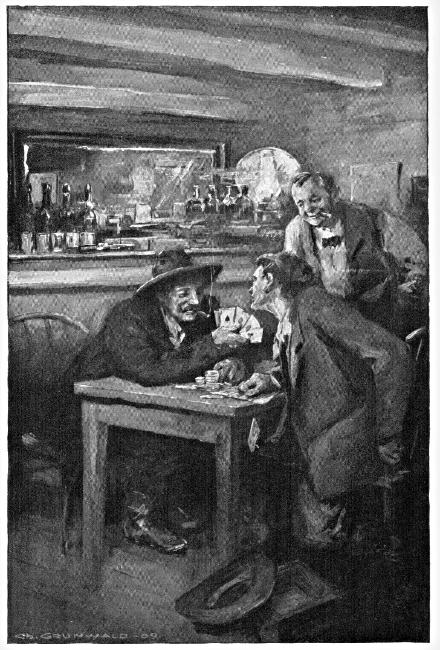
it, though the skies fell. In fact, while
Loring was playing cards over the mess
table one evening, Jean was putting her friendship
to the proof in another quarter of the
camp.
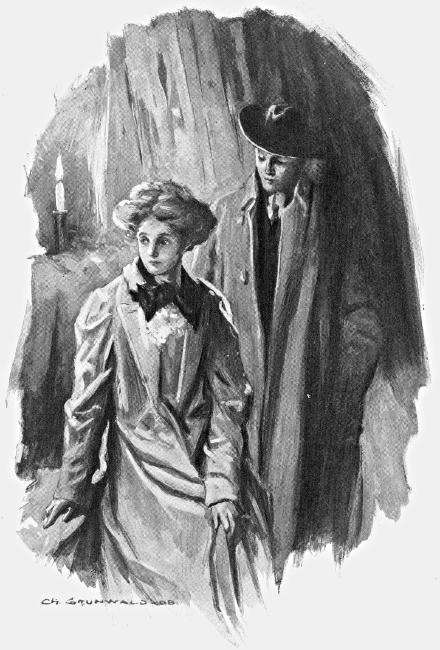
“Father, he is a gentleman.” Jean made this
remark after a period of silence, during which
she had sat on the porch of the shack, contemplating
the moon as it rode high in the unclouded
sky.
“Who is a gentleman? The man in the moon?”
As he asked the question, Mr. Cameron withdrew
his cigar from his mouth, and pulled the smoke in
leisurely rings into the air.
“No,” Jean answered, “not the man in the
moon; the man on the hoist, Stephen Loring.”
“What made you think of him?”
“I met him this afternoon in the valley. That
put him into my head.”
“Well, I advise you to take him out again.”
“Not at all. I shall keep him there. He interests
me, because he is a gentleman.”
“What are the hall-marks of a gentleman?”
“Oh,” said Jean slowly, “there are a hundred
little signs which cannot be suppressed. A
deacon may turn into a horse thief, or a millionaire
into a beggar; but once a gentleman,
always a gentleman. Mr. Loring tries to hide
it; but he cannot. Oh, haven’t you noticed
the difference?”
“Between Loring and the other men? No, I
cannot say that I have. But I am not particularly
interested in the question whether my hoist
engineers are gentlemen.”
“Don’t you think you ought to be?”
“Why?”
Jean clasped her hands around her knee and
looked out over the dim hills bathed in the mist
of the moonlight. After a while she said: “It
must be very lonely for a gentleman in a camp
like this.”
“If you are thinking of Loring,” said her father,
“he is busy all day and he can go to the mess in
the evening.”
“The mess!” exclaimed Jean scornfully. “Yes,
fine place for a gentleman, where the men chew
tobacco and drink whisky all the evening, and
tell stories as long as they are broad!”
“All terribly offensive no doubt to a sensitive
soul like your Mr. Loring,” answered Mr. Cameron.
“Perhaps,” he added with fine sarcasm,
“you would like to have him take his meals with
us.”
“Yes, I would like to ask him here sometime.
It is good in you to think of it,” replied his daughter
calmly.
“It cannot be done, Jean. It cannot be done,”
Mr. Cameron said with decision. “Discrimination
among the men breeds discontent. I think
that we have done full enough for Loring as it is.”
“Do you?” Jean responded, with the audacity
of a hot temper. “Well, I do not; but then it
was my life that he saved, and perhaps that makes
me see the thing differently. I am thinking that
when a man saves your life you cannot get rid
of the obligation by throwing him a job, as you
might toss a bone to a dog. I am thinking that
he has some claim on the life that he has given
back, and that the other person should spend a
little of it in doing something for him.”
“And, pray, what has his being a gentleman to
do with all this?” asked Mr. Cameron, whose
wrath took the form of sarcasm. “Suppose that
Colson or Lynn had saved your life, would you
have wished to have him at the house?”
“Neither of them would have wished to
come.”
“That is not honest, Jean. You know that
they would; but you would never ask them,
except to one of your camp dances. You would
not if they had saved your life twenty times.”
“I should try to do something for them, something
that they would like; but if people are not
of your kind there is no use in inviting them.
There is no kindness in it in the end.”
“Perhaps,” said her father, “there would prove
to be no kindness in the end in what you wish to
do for Loring.”
“Very well. There is no use in arguing with a
Scotchman; but I warn you that I shall make it
up to him in friendliness. The other men can
scarcely object to that.”
With these words Jean rose from the steps and,
passing through the door, entered the little living-room
where she picked up a guitar from the
window-seat, and to its accompaniment began to
sing in a low voice. What was the song she
chose? Why, it was “Jock o’ Hazeldean.” If
ever a song expressed flat mutiny it is that one,
and it lost nothing in expression from Jean
Cameron’s rendering, from the beginning where
the heroine refuses to be commanded or cajoled,
to the last line where “She’s o’er the border and
awa’ wi’ Jock o’ Hazeldean.”
Mr. Cameron was justified in being angry;
but who could resist a voice like Jean Cameron’s?
Evidently not Jean’s father, for when the girl
came out again and smiling laid her hand upon
his shoulder, Mr. Cameron relaxed the grimness
of his expression.
“Well, well, lassie, we will see what can be done
for your gentleman engineer,” he said encouragingly;
“but don’t be ‘o’er the border and awa’’
with Jock, till we know a little more about him,
and about what is thought of him in Hazeldean.”