A vast majority of the noblest intellects of the
race have ever held to the idea that,—
“There’s a divinity that shapes our ends,
Rough hew them how we will.”
By its influence they have been both consoled and
strengthened under the pressures and in the exigencies
of life. This principle, to a singular degree,
assumes both form and development in the story of
James Renfew, the Redemptioner.
He comes to us as an orphan and the inmate of a
workhouse, flung upon the world, like a dry leaf
on the crest of a breaker; his mind a blank devoid
of knowledge, save the idea of the Almighty and
the commands of the Decalogue, whose force, in
virtue of prior possession, held the ground and
kept at bay the evil influences by which he was surrounded.
And in consequence of thus holding aloof
from all partnership in vice, he was brow-beaten,
4trampled upon, and made a butt of by his companions
in misfortune.
His only inheritance was the kiss of a dying
mother, the dim recollection of her death, and
a Bible which he could not read,—her sole bequest.
The buoyancy, the frolic of the blood, the premonition
of growing power, which render childhood
and youth so pregnant of happiness, and so pleasant
in the retrospect, were to him unrevealed. At
nineteen the life seemed crushed out of him by
the pressure, or, rather puncture, of a miserable
present and a hopeless future. In the judgment
of the most charitable, he was but one remove
from fatuity.
From such material to develop the varied qualities
of a pioneer, a man of firm purpose, quick
resolve, and resolute to meet exigencies, might well
seem to require supernatural power; and yet, by no
other alchemy than sympathy, encouragement wisely
timed, and knowledge seasonably imparted, was this
seeming miracle accomplished.
The pity of Alice Whitman, the broad benevolence
of her husband, the warm sympathy of Bertie
and his young associates, the ripe counsels of the
5glorious old grandfather,—sage Christian hero,—and
the efforts of Mr. Holmes, who honored his
calling, while sowing good seed in the virgin soil of
a young heart, were but visible instruments in the
grasp of the Hand Unseen.
6
THE UNSEEN HAND;
OR,
JAMES RENFEW AND HIS BOY-HELPERS.
CHAPTER I. “THE MOTHER’S BREATH IS WARM.”
9
It was the autumn of 1792. The beams of the
declining sun were resting peacefully upon the
time-worn walls of a log house of large dimensions,
evidently built to serve the purposes both of a dwelling
and a fortress, and situated upon the banks of
the Swatara Creek, in the State of Pennsylvania.
A magnificent chestnut-tree, whose trunk and
lower branches were all aglow with the long level
rays of the retiring light, shadowed a large portion
of the spacious door-yard.
This was the homestead of Bradford Whitman, a
well-to-do farmer, and whose family consisted of
himself and wife, his aged father, and three children,
Peter, Albert and Maria, aged respectively sixteen,
fourteen and eleven.
Upon one of the highest branches of this great
tree was seated Bertie Whitman. The eyes of the
lad were eagerly fastened upon the road that, skirting
10the rising ground upon which the dwelling stood,
led to a distant village.
At once his features lighted up with a jubilant expression;
he rapidly descended from his perch, and
ran to the door of the house, shouting, “Mother!
Maria! Grandfather! They’ve got him; they are
coming down Liscomb’s hill this minute, and there’s
three in the wagon. Oh!”
He would have run to meet the approaching team,
and had taken a few steps when he was met by his
elder brother.
“Bertie, we’ve got the redemptioner, and I
jumped out of the wagon while the horses were
walking up our hill to tell you and Maria not to
laugh if you can help it, ‘cause it would make him
feel bad; but you can’t think how funny he does
look; he’s lame besides, and his name’s James
Renfew.”
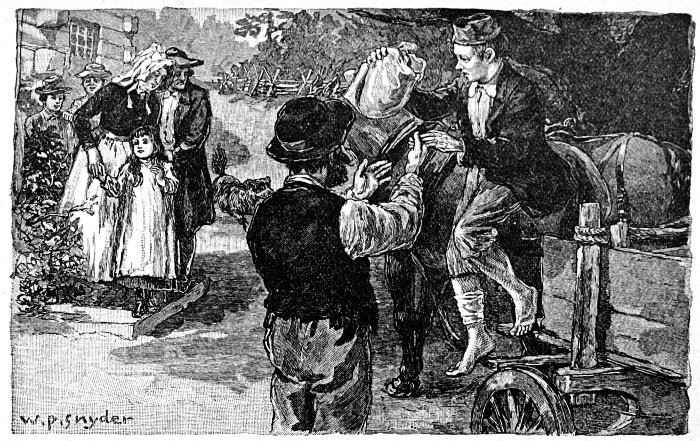
This conversation was interrupted by the rumbling
of wheels as their father drove up, where his whole
family were grouped around the door. Mrs. Whitman
stood on the door-stone, the old grandfather
beside her, leaning on his staff, the children in front,
while Fowler, the house-dog, with his fore-legs on
the shoulders of old Frank, the near horse, his particular
friend, was trying to lick his nose and Frank
was arching his neck to accommodate him.
Mr. Whitman helped James to get down from the
wagon. The boy made no return to the salutations
11of the family save by a stony stare, not even taking
the hand extended to him by Mrs. Whitman. He,
however, manifested some token of sensibility by
offering to help in unharnessing, and would have
limped after the horses to the barn, but his master
told him to go into the house and keep still till his
leg was better; nevertheless there he stood staring
after the horses, and evidently would much rather
have followed them to the barn.
The dog then came and smelt of him. Mrs.
Whitman told Peter to take him by the hand and
lead him into the house. She placed an arm-chair
for him, and a smaller one to put his lame leg on,
and in a few minutes he was fast asleep.
Judging by appearances Bradford Whitman had
drawn a blank at this his first venture in the redemptioner
lottery. The children got together
(with the dog) under the great chestnut-tree to free
their minds and compare notes.
“Isn’t he queer?” said Bertie.
“Did ever anybody see such funny clothes? I
guess they were made for him when he was small
and so he’s grown out of them, but he’d be real
handsome if he had good clothes and his hair combed,
and didn’t have such a pitiful look out of his eyes,”
said Maria.
“I tell you what he puts me in mind of,” said
Bertie, “Mr. William Anderson’s oxen that are so
poor, their necks so long and thin; and they look
12so discouraged, and as though they wanted to fall
down and die.”
Peter now related all he had heard Wilson tell
their father, and dwelt with great emphasis upon
Mr. Wilson’s statement that the lad had not a friend
in the world and no home.
“He’s got one friend,” said Bertie, “Fowler likes
him, ‘cause he smelt of him and wagged his tail;
if he hadn’t liked him he would have growled.
Mother’s a friend to him, and father and grandpa
and all of us.”
“We will be good to him because he never had
any chestnut-tree to play under and swing on, nor
any garden of his own,” said Maria.
“How can we be good to him if he won’t say anything,
Maria!” said Bertie.
“Can’t we be good to the cattle, and I’m sure
they don’t talk?”
“If they don’t they say something; the cat she
purrs, the hens prate, Fowler wags his tail and barks
and whines; and the horses neigh, and snort, and put
down their heads for me to pat them; but how could
you be good to a stone? and he’s just like a stone,
when mother put out her hand to shake hands
he did not take it, nor look pleased nor anything.”
“Perhaps ‘twas ‘cause he was afraid. When we
first got our kitten she hid away up garret, and we
didn’t see her for three days, but she got tame, and
so perhaps he will.”
13They finally made up their minds that James was
entitled to all the sympathy and kindness they
could manifest towards him, when they were called
to supper.
It now became a question between Mr. Whitman
and his wife, where to stow James that night.
“Put him in the barn and give him some blankets
to-night, and to-morrow we will clean him up.”
“I can’t bear to put him in the barn, husband, I’ll
make him a bed of some old ‘duds’ on the floor in
the porch. Send him right off to bed; I’ll wash his
clothes and dry ‘em before morning. I can fix up
some old clothes of yours for him to work in, for I
don’t want any of the neighbors to see him in those
he has on.”
Mr. Whitman now ushered James to bed, waited
till he undressed, and brought in his clothes that
were soon in scalding suds. Had Mr. Whitman
gone back he would have seen this poor ignorant
lad rise from his bed, kneel down and repeat the
Lord’s prayer, and though repeated with a very
feeble sense of its import may we not believe it was
accepted by Him who “requireth according to that
a man hath and not according to that he hath not,”
and whose hand that through the ocean storm
guides the sea-bird to its nest amid the breakers, has
directed this wayfarer to the spot where there are
hearts to pity and hands to aid him.
A blazing fire in the great kitchen fireplace so
14nearly accomplished (by bedtime) the drying of the
clothes, that in the morning they were perfectly dry,
the hot bricks and mouldering log giving out heat
all night long. In the morning Mr. Whitman
carried to the porch water in a tub, soap and his
clean clothes, and told James to wash himself, put
them on and then come out to his breakfast.
When James had eaten his breakfast (Mr. Whitman
and Peter having eaten and gone to the field),
the good wife cut his hair which was of great
length, gave his head a thorough scrubbing with
warm soapsuds, and completed the process with a
fine-toothed comb. Removing carefully the bandages
she next examined his leg.
“It was a deep cut, but it’s doing nicely,” she
said, “there’s not a bit of proud flesh in it; you must
sit in the house till it heals up.” When having
bound up the wound she was about to leave him, he
murmured,—
“You’re good to me.”
This was not a very fervent manifestation of
gratitude, but it betokened that the spirit within
was not wholly petrified; as Alice Whitman looked
into that vacant face she perceived by the moisture
of the eyes, that there was a lack not so much of
feeling as of the power to express it.
“God bless you, I’ll act a mother’s part towards
you; it shall be your own fault if you are not happy
now. I know God sent you here, for I cannot believe
15that anything short of Divine Power would
have ever brought my husband to take a redemptioner.”
Bertie and Maria, who had been looking on in
silence, now ran into the field to tell their father and
Peter all their mother had said and done, and that
the redemptioner had spoken to her.
“Father,” said Maria, “if mother is his mother,
will he be our brother?”
“Not exactly; your mother meant that she would
treat him just as she does you, and so you must
treat him as you do each other, because your mother
has said so, and that’s sufficient.”
“Then we mustn’t call him a redemptioner?”
“No; forget all about that and call him James.”
“When we have anything good, and when we find
a bumblebee’s nest, shall we give him part, just like
we do each other?”
“Yes.”
Mrs. Whitman sent for Sally Wood, one of her
neighbor’s daughters, to take care of the milk and
do the housework; and then set herself to altering
over a suit of her husband’s clothes to fit James,
who, clean from head to foot, sat with his leg in a
chair watching Mrs. Whitman at her work, but the
greater portion of the time asleep.
“Let him sleep,” she said; “‘twill do him good
to sleep a week; he’ll come to his feeling after
that and be another boy. It’s the full meals and
16the finding out what disposition is to be made of
him, and that he’s not to be hurt, makes him sleep.
I doubt if he had any too much to eat on the passage
over.”
By night the good woman, with the aid of Sally
(who, besides doing the work, found some time to
sew), had prepared a strong, well-fitting suit of
working-clothes and a linsey-woolsey shirt, and,
after supper, James put them on. He made no remark
in relation to his clothes, but Maria reported
that she knew he was as pleased as he could be, because
she peeped into the door of the bedroom and
saw him looking at himself in the glass and counting
the buttons on his waistcoat and jacket.
James improved rapidly, and began in a few days
to walk around the door-yard and to the barn, and
sit by the hour in the sun on the wood-pile (with
Fowler at his feet, for the dog had taken a great
liking to him), insomuch that Mrs. Whitman asked
her husband if it would not make him better contented
to have some light work that he could do sitting
down.
“Not yet, wife. I want to see if, when he finds
us all at work, he won’t start of his own accord.
He has no more idea of earning anything, or of
labor in our sense of that word, than my speckled
ox has. When I hold up the end of the yoke and
tell old Buck to come under, he comes; and so this
boy has been put out to hard masters who stood
17over and got all out of him they could. He has
never had reason to suppose that there are any people
in this world that care anything about others, except
to get all they can out of them.”
“If, as you say, he has always had a task-master,
perhaps he thinks because we don’t tell him what to
do, that we don’t want him to do anything.”
“We’ll let the thing work; I want to see what
he’ll do of his own accord before I interfere. It is
my belief that, benumbed as he now appears,
there’s enterprise in him, and that the right kind of
treatment will bring it out; but I want it to come
naturally just as things grow out of the ground.
He’s had a surfeit of the other kind of treatment.”
Affairs went on in this way for a week longer,
till the boy’s leg had completely healed, during
which time it became evident that this apparently
unimpressible being was not, after all, insensible to
the influence of kindness, for, whenever he perceived
that wood or water were wanted, he would
anticipate the needs of Mrs. Whitman nor ever permit
her to bring either.
Mr. Whitman still manifested no disposition to
put the boy to work, and even shelled corn himself,
till his wife became somewhat impatient; and though
even the grandfather thought the boy might, at
least, do that much. Whitman, however, paid no
attention to the remonstrances of either, and matters
went on as before.
CHAPTER II. THE REDEMPTIONER.
18
The reader of the opening chapter will, doubtless,
be disposed to inquire, “What is a redemptioner?
By what fortunate chance has this
singular being been flung into the path, and at once
domesticated in the family of Bradford Whitman,
and admitted without scruple to the inner sanctuary
of a mother’s heart.”
Not by any chance as we believe, and will, therefore,
endeavor to satisfy these demands by introducing
to our young readers Mr. Robert Wilson, a soul-driver,
as the occupation in which he was engaged
was then termed (and one of the best of them) and
permit him to tell his own story.
The great abundance of food and coarse clothing
in America, and the anxiety of the farmers to obtain
cheap labor, led to this singular arrangement.
They contracted with the masters of vessels to
bring over able-bodied men accustomed to farm-work,
the farmers paying their passage, which included
the captain’s fees, the laborers contracting to
serve for a certain term of years to reimburse the
farmer for his outlay; the farmers agreeing to furnish
the laborers with wholesome and sufficient food
and comfortable clothing.
19These people were called redemptioners, and the
term of service was generally three years, and, in
the case of boys, four.
The system, however, which operated very well
for a while, had its disadvantages that brought it
into disrepute, and resulted in its abolition. The
principal of these was its falling into the hands of
speculators, who went to the other side and took
whomsoever they could pick up, without regard to
their honesty, industry, or capacity of labor, some
of them parish-poor, not only ignorant of agricultural
labor, but even thieves and vagabonds. These
persons collected them in gangs of twenty, and even
more, and drove them through the country and delivered
them to the farmers, ostensibly at the rate of
their passage-money and a reasonable compensation
for their own trouble and expense in seeking and
bringing them over.
Mr. Wilson naturally a man of kindly feelings,
that had not been entirely blunted by the business
in which for many years he had been engaged, and
who—having been well brought up by godly Scotch
parents—could by no means wholly ignore the lessons
of his youth, was now on board of the “Betsy”
brig, in Liverpool, bound for Philadelphia, and had
engaged berths for thirteen persons, eleven of whom
different farmers in Pennsylvania had agreed to take
off his hands. He had paid the passage of the twelfth
at his own risk, and wanted, but had not been able
20to obtain, one more, having been disappointed in a
man whom he had engaged on the previous voyage,
and, as he would be compelled to pay for the berth,
whether occupied or not, he was, of course, anxious
to obtain another man. The vessel was not to haul
out of the dock under two days, and he resolved to
make a final effort to find another man.
Mr. Wilson was well known among the neighboring
population, and therefore possessed peculiar
facilities. The persons already obtained he had
brought from the country, and he doubted not from
his extensive acquaintance that he could dispose of
almost any man who was sound in limb, accustomed
to labor, whether much acquainted with farm-work
or not. “If he is only honest,” said Wilson to himself,
“and young enough, it will do; for what he
don’t know he can learn, and must work for his employer
a longer time, that’s all.”
In regard to character he was able, in many cases,
to obtain references, but a shrewd judge of men,
he trusted much to his own judgment, and had seldom
cause to repent it, although, as we shall see, he
was deceived in the character of one of the men
then on shipboard which led to his relinquishing the
traffic not many years after.
He set out early in the morning for a village about
ten miles from the city, and where he had often
found men to his liking, especially on the previous
voyage. He found quite a number eager to go, but
21some were Irish, whom he did not like; some were
boys, some old and decrepid, or too much labor-worn.
He was returning from his bootless search in no
very satisfactory state of mind, when he stumbled
upon a company of young persons, who late as was
the hour, had just started out from the shelter of
some old crates filled with straw that had been piled
against the brick wall of a glass-house, in which
were built the chimneys of several ovens, and which
had afforded them warmth, for the nights were
quite cool.
They were shaking the straw from their garments
and evidently preparing to break their fast. One had
a fish in his hand, another meat, and another vegetables,
but all uncooked.
The group presented such a hardened vagabond
appearance, that Wilson who had paused with the
intention of speaking, was about to pass on, when
upon second thoughts, he said within himself, “They
look like thieves, but they are a hard-meated
rugged looking set and all young. Perhaps there
may be among them one who taken away from the
rest, and put under good influences, and among good
people, might make something.”
Turning towards them, he said,
“Young men, do any of you want to go to
America?”
“Go to ‘Merica,” replied a dark-complexioned
fellow of low stature, with a devil-may-care-look,
22and quite flashily attired, apparently in the cast-off
clothes of some gentleman.
“Yes, some people are going over to the States
with me as redemptioners, and I want one more to
make up my number, it’s a first-rate chance for a
young man who’s smart, willing to work, and wants
to make something of himself. There are scores
of men there whom I carried, that are now forehanded,
have large farms, cattle and money at interest,
who when they left here lived on one meal a
day and often went without that.”
“Don’t you know Dick,” said a red-headed, saucy,
but intelligent-looking chap, with sharply cut features,
“that’s the genteel name of those poor devils
who sell themselves for their passage and this ‘ere
likes is the boss what takes the head money.”
Without noticing the interruption, Wilson continued,—
“Here, for instance, is a young man who can get
no work these hard times, which means no clothes,
no bread, no place to put his head in. A farmer
over there who wants help pays his passage. He
works for that farmer till he pays up the passage
money; and the farmer takes him into his family,
and feeds and clothes him while he is doing it.”
“How long will he have to work to pay for his
passage?”
“Three or four years; three if he is used to farm
work.”
23“What does he do after that?”
“Then he is his own man and can always have
plenty of work at good wages and found, and won’t
have to lay up alongside of a glass-house chimney
to keep from freezing. Land is so cheap that if he
is prudent and saves his money, he can in a few
years buy a piece of land with wood on it that he
can cut down, build him a log house, plant and sow
and be comfortable. In some places the government
will give him land to settle on if he builds a
house and stays five years, or he can pay for it by
working on the highways.”
“Go, Dick,” cried the red-head, “they say it’s a
glorious country, plenty of work, plenty of bread,
and no hanging for stealing, just the place for you
my lad.”
“You shut up. What is he going to do after he
gets the land!”
“Work on it to be sure, make a home of it, have
cattle, and sheep, and hogs, and lashings to eat.”
“Then all the redemptioners, as you call ‘em, go
to ‘Merica for is to work?”
“To be sure, to get a chance to work and get
ahead, and that’s what they can’t do here.”
“Well, grandfather, I won’t be a redemptioner,
because work and I have fallen out. Ain’t it so with
you, Tom Hadley?”
This interrogatory was addressed to a tall pale
youth, clothed in a suit of rusty black, that might
24have belonged to a curate, with finger nails half an
inch in length, and on his fingers three valuable
rings and a broad-brimmed hat on his head.
“Yes, I never fell in with it yet. Don’t think I
am fool enough to work three years for the sake of
getting a chance to work all the rest of my life, a
thing I am altogether above and do despise.”
“If you won’t work how do you expect to live?”
“By stealing,” replied the lank boy, displaying
his rings.
“By working when we can’t do any better,
granddaddy, and begging for the rest,” said Tom
Hadley.
During this conversation this select company had
gradually gathered around Wilson, and one of them
was in the act of purloining a handkerchief from the
latter’s pocket, when he received a blow from a
stout cudgel in the hand of the Scotchman, that felled
him to the ground.
“Why don’t you take Foolish Jim?” said the red-headed
chap, “he’ll work; rather work than not.”
“Who’s Foolish Jim?”
“There he is,” pointing to a boy leaning against
the wall of the glass-house, aloof from the rest.
“Why do you call him Foolish Jim?”
“‘Cause he’s such a fool he won’t lie, swear nor
steal; but we are dabsters at all three.”
“What makes him so much worse dressed than
the rest?”
25“‘Cause he’s a fool and won’t steal. Now we all
get one thing or another, meat, fish, vegetables; and
we’re going down to the brick yards to have a cook
and a real tuck-out, but he’s had no breakfast, nor
won’t get any, till he runs some errand for the glass-house
folks, or gets some horse to hold, or some little
job of work, just ‘cause he won’t steal nor beg
either. If you’d a dropt that handkerchief on the
ground and he’d a picked it up, instead of putting
it in his pocket, he’d a run after you crying, ‘Mister
you’ve lost your handkerchief.’ Now there’s no
work to be had by those who are fools enough to
work, so he’s just starving by inches.”
“And to help him out of the world you keep him
with you to make sport of him.”
“That’s so, as much as we think will do, but we
can’t go but about so far, ‘cause he’s strong as a
giant and he’s got a temper of his own, though it
takes an awful sight to git it up; but when its up
you’d better stand clear, he’ll take any two of us
and knock our heads together. When the glassmen
have a heavy crate to lift, they always sing out
for Jim.”
“Ask him to come here.”
“Jim, here’s a cove wants yer.”
Mr. Wilson scanned with great curiosity the lad
whom his companions termed a fool because he
would neither lie nor swear, steal nor beg, but was
willing to work. He was tall, large-boned, with
26great muscles that were plainly visible, of regular
features, fair complexion and clean, thus forming a
strong contrast to his companions, who were dirty in
the extreme. He might be called, on the whole,
good looking, as far as form and features went, but
on the other hand there was an expression of utter
hopelessness and apathy in his face that seemed
almost to border upon fatuity, and went far to
justify the appellation bestowed upon him by his
companions.
His movements also were those of an automaton;
there was none of the spring, energy or buoyancy of
youth about him.
He was barefoot, with a tattered shirt, ragged
pants and coat of corduroy, the coat was destitute of
buttons and confined to his waist by a ropeyarn.
On his head he wore a sailor’s fez cap, streaked with
tar and that had once been red, but was faded to the
color of dried blood.
“What is your name, my lad?”
“Jim.”
“Jim what?”
“Jim, that’s all.”
“How old are you?”
“Don’t know.”
“Where are your father and mother?”
“Haven’t got none?”
“Any brothers or sisters?”
“No.”
27“Where did you come from? Where do you
belong?”
“Work’us.”
“Do you want to go to America with me, and get
work?”
“I’ll go anywhere if I can have enough to eat,
clothes to keep me warm, and some warm place to
sleep.”
“Will you work?”
“Yes; I’ll work.”
“What kind of work can you do?”
“I can dig dirt, and hoe, and pick oakum, and
drive horses, and break stones for the highway, and
break flax.”
“What other farm-work can you do?”
“I can mow grass, and reap grain, and plash a
hedge, and thrash (thresh) grain.”
“Where did you learn these things?”
“They used to put me out to farmers once.”
“How long was you with the farmers?”
“Don’t know.”
“Mister,” broke in the lank youth, “he don’t
know anything. Why don’t you ask ‘em up to the
work’us; like’s they know who he is, where he
came from, and all about him. They feed him, but
he’s so proud he won’t call upon ‘em if he can help
it, ‘cause he thinks it’s begging. He might have
three good meals there every day if he would, but
28he’s such a simpleton he won’t go there till he’s
starved within an inch of his life.”
Upon this hint the Scotchman, whose curiosity was
now thoroughly aroused, taking the lad for a guide,
started for the workhouse.
CHAPTER III. JAMES RENFEW.
29
As they went along, Wilson, feigning fatigue,
proposed that they should sit down to rest,
but his real motive was that, undisturbed by his
companions, he might observe this singular youth
more at his leisure and be the better able to form
some more definite opinion in his own mind respecting
him.
After long contemplating the features and motions
of Jim at his leisure, Mr. Wilson came to the conclusion
that there was no lack of sense, but that
discouragement, low living, absence of all hope for
the future, ignorance and being made a butt of, were
the potent causes that had reduced the lad to what
he was; and that, under the influence of good food
and encouragement, he would rally and make an
efficient laborer and perhaps something more, and
resolved to sift the matter to the bottom.
From the records of the workhouse he ascertained
that the boy’s name was James Renfew, that he was
not born in the institution, but was brought there
with his mother, being at that time three years of
age. The mother was then in the last stages of
disease, and in a few weeks died. He was informed
that the boy had been several times put out to
30different farmers, who, after keeping him till after
harvest, brought him back in the fall to escape the
cost of his maintenance in the winter.
Wilson mentioned what he had been told in respect
to his character, to which the governor replied it
was all true, and that he should not be afraid to
trust him with untold gold, that he came and went
as he pleased; and when starved out, and not till
then, he came to them and was housed, fed and made
welcome.
“Where did he get ideas in his head so different
from those of workhouse children in general?”
“I am sure I don’t know except they grew there.
You seem to have a great deal of curiosity about
the history of Jim, there’s an old Scotchwoman
here, Grannie Brockton, who took care of his mother
while she lived and of the boy after her death; she’s a
crabbed venomous old creature, deaf as a haddock,
but if she happens to be in a good mood and you can
make her hear, she can tell you the whole story.”
“I’ll find a way to make her agreeable.”
He found Grannie Brockton, who seeing a stranger
approach, drew herself up, put one hand to her ear,
and with the other motioned the intruder away.
Wilson, without a word, approached and laid a
piece of silver on her knee. This wrought an instantaneous
change, turning briskly round she pulled
down the flap of her right ear (the best one) and
said,—
31“What’s your will wi’ me?”
“I want you to tell me all you know about James
Renfew and his parents.”
“It’s Jeames Renfew ye want to speer about, and
it’s my ain sel’ wha’ can tell you about him and his
kith, and there’s na ither in this place that can.”
The interrogator felt that the best method of
getting at the matter was to leave the old crone to
her own discretion, and without further questioning
placed another small piece of silver in her lap.
“What countryman may ye be?”
“A Scotchman.”
“I kenned as much by the burr on your tongue;
ay then, ye’ll mind when the battle o’ Bannockburn
was.”
“The battle of Bannockburn was fought on the
twenty-fifth day of June.”
“True for ye. It was sixteen years ago Bannockburn
day that this boy’s mother was brought here
sick, and this Jeames wi’ her a bairn about three
years old. A good woman she was too. I’m not a
good woman, naebody ca’s me a good woman, I
dinna ca’ myself a good woman, but for all that I
know a good person when I see one.
“She had death in her face when she was brought
in, would have been glad to die, but her heart was
breaking about the child to be left to the tender
mercies o’ the work’us.
“When she had been here little better than a
32week, a minister came to see her; a young, a douce
man. Oh, he was a heavenly man! She was so rejoiced
to see him, she kissed his hands and bathed
them wi’ her hot tears. She thanked him, and
cried for joy. I could nae keep from greeting my
ain sel’.”
“Where was he from?”
“He was the curate of the parish where she used
to live, was with her husband when he was sick, and
read the service at his funeral; and he had christened
this child, and aye been a friend to them.”
“She told me the parson o’ the parish was a
feckless do-little, naebody thought he had any grace;
this curate did all the work and visited the people,
who almost worshipped him.”
“Did he come any more?”
“Ay, till she died, and then attended the burial.
For four years after her death he came three times a
year to see the child, and would take him on his
knees and tell him stories out of the Bible and teach
him the Lord’s prayer. He made the child promise
him that he would never lie, nor swear, nor steal,
and taught him a’ the commandments. He likewise
made me promise that I would hear him say the
Lord’s prayer, when I put him to bed, and that I
would be kind to him. I did hear him say the
prayer, but I was never kind to him, for ‘tis not in
my nature to be kind to any body, but I used to beat
him when he vexed me.”
33“Who was this boy’s father?”
“He was a hedger and ditcher, and rented a
small cottage, and grass for a cow, in the parish
where the curate lived. After his death, his widow
came to Liverpool, because she had a sister here who
had saved money by living at service, and they
rented a house, and took boarders, and washed and
ironed; but her sister got married and went to
Canada, and she was taken sick, and came here to
die.”
“What became of the curate?”
“He came here till the laddie was seven years
auld, and then he came to bid him good-by, because
he was going to be chaplain in a man-of-war, and
the laddie grat as though his heart wad break.
“The curate gave him his mother’s Bible, but little
good will it do him, for he canna read a word, nor
tell the Lord’s prayer when he sees it in print.”
Finding her visitor was about to leave, she said,—
“Mind, what ye have heard frae me is the truth,
sin a’ body kens that cross and cankered as auld
Janet may be, she’s nae given to falsehood.”
The relation of auld Janet had stirred the conscience
of Robert Wilson, and probed his soul to its
very depths.
“I cannot,” he said within himself, “leave the boy
here. The curse of that dying mother would fall on
me if I did. He must come out of this place. Let
me see what can I do with him? Could I only hope
34to prevail upon Bradford Whitman to take him—I
know he hates the very sight of me and of a redemptioner,
but a friendless boy of this one’s character,
that I can get a certificate from the governor
of the workhouse to establish, might operate to
move him, and he’s a jewel of a man. I’ll try
him. If I can do nothing with him, I’ll try Nevins
or Conly, but Whitman first of all. If none of
them’ll keep him, you must take him yourself,
Robert Wilson; take him from here, at any rate.”
Mr. Wilson made his way back to the authorities,
and said to them:—
“I’m taking some redemptioners to the States;
if you’ll pay this boy’s passage, I’ll take him off
your hands, but you must put some decent clothes
on him.”
To this the chairman of the board replied: “We
cannot do that. We will let you have the boy and
put some clothes on him, and that’s enough. You
make a good thing out of these men; you don’t
have to advance anything, the farmers pay their
passage and pay you head-money.”
“Thank you for nothing, that’s not enough. The
rest of my redemptioners are able-bodied men used
to farm-work, but this creature is but nineteen, don’t
know much of anything about farm-work; only fit
to pick oakum or break stones on the highway, and
there’s none of that work to be done in the States.
He’ll be a hard customer to get rid of, for he don’t
35seem to have hardly the breath of life in him; these
Americans are driving characters; they make business
ache, and will say right off he’s not worth his salt.
I shall very likely have him thrown on my hands (if
indeed he don’t die before he gets there) for I have
no order for any boy.”
“You are very much mistaken, Mr. Wilson, that
boy will lift you and your load, will do more work
than most men, is better fitted for a new country
than one who has been delicately brought up.”
“Mr. Governor, I have made you a fair offer.
This boy has got a settlement in this parish, and you
cannot throw it off, so you will always have him on
your hands more or less. By and by he’ll marry
some one as poor as himself, and you’ll have a whole
family on your hands for twenty, perhaps fifty years.
You know how that works, these paupers marry and
raise families on purpose, because they know they
will then be the more entitled to parish help. Give
him up to me and pay his passage, you are then rid
of him forever and stop the whole thing just where
it is. I’ve told you what I’ll do. I won’t do anything
different.”
After consultation the authorities consented to pay
his passage and give him second-hand but whole
shoes, shirts, and stockings enough for a shift, and
a Scotch cap.
Mr. Wilson then took him into a Jew’s shop,
pulled off his rags, furnished him with breeches
36and upper garments, and put him on board the
brig.
Mr. Wilson was an old practitioner at the business
of soul-driving. His custom was to stop a week in
Philadelphia in order to let his men recover from
the effects of the voyage, which at that day, in an
emigrant ship, was a terrible ordeal, for there were
no laws to restrain the cupidity of captains and
owners. This delay answered a double purpose, as
his redemptioners made a better appearance, and
were more easily disposed of and at better prices.
He also improved the opportunity to send forward
notices to his friends, the tavernkeepers, stating the
day on which he should be at their houses; and they
in turn notified the farmers in their vicinity, some of
whom came out to receive the men they had engaged,
and others came to look at and trade with Wilson
for the men he might have brought on his own
account, of whom he sometimes had a number, and
not infrequently his whole gang were brought on
speculation.
It was about nine o’clock on the morning of the
second day after his arrival in Philadelphia, and
Mr. Wilson, having partaken of a bountiful meal,
was enjoying his brief rest in a most comfortable
frame of mind. He had good reason to congratulate
himself, having safely passed through the perils of
the voyage, and, on the first day of his arrival disposed
to great advantage of the man he had brought
37at his own risk; the other eleven were engaged, and
the boy alone remained to be disposed of.
His cheerful reflections were disturbed by a cry
of pain from the door-yard, and James was brought
in, the blood streaming from a long and deep gash
in his right leg.
The tavern-keeper asked him to cut some firewood,
and the awkward creature, who had never in
his life handled any wood tool but an English billhook,
had struck the whole bit of the axe in his leg.
The blood was staunched, and a surgeon called to take
some stitches, at which the boy neither flinched nor
manifested any concern.
The doctor and the crowd of idle onlookers, whom
the mishap of James drew together, had departed,
the landlord had left the bar to attend to his
domestic concerns. Mr. Wilson, his serenity of
mind effectually broken, paced the floor with flushed
face and rapid step, and talking to himself.
“Had it been his neck, I wad nae hae cared,” he
muttered (getting to his Scotch as his passion rose)
“here’s a doctor’s bill at the outset; and I maun stay
here on expense wi’ twelve men, or take him along
in a wagon.
“I dinna ken, Rob Wilson, what ailed ye to meddle
with the gauk for an auld fool as ye are, but when
I heard that cankered dame wi’ the tear in her
een tell how his mother felt on her deathbed, and a’
about the minister taking sic pains wi’ him, it gaed
38me to think o’ my ain mither and the pains she took
tae sae little purpose wi’ me. I thocht it my duty
to befriend him and gi’ him a chance in some gude
family, and aiblins it might be considered above, and
make up for some o’ thae hard things I am whiles
compelled in my business to do. I did wrang
altogether; a soul-driver has nae concern wi’ feelings,
nor conscience either. He canna’ afford it, Rob, he
suld be made o’ whin-stone, or he canna thrive by
soul-driving.”
Mr. Wilson arrived in Lancaster county, within a
few miles of the residence of the Whitmans and
their neighbors, the Nevins, Woods, and Conlys,
with only three redemptioners, who were already
engaged to farmers in the vicinity, and the boy Jim,
who was so lame that he had been obliged to take
him along in a wagon.
CHAPTER IV. THE WHITMAN FAMILY.
39
The starting of a boy in the right direction, and
the imparting of that bent he will retain
through life, is a work the importance of which cannot
be overrated. That our readers may appreciate
the force of these influences about to be invoked to
shape the future,—to fling a ray of hope upon the
briar-planted path of this pauper boy, and quicken
to life a spirit in which the germs of hope and the
very aroma of youth seem to have withered beneath
the benumbing pressure of despair,—we desire to
acquaint them with the character of Bradford Whitman,
to whose guiding influence so shrewd a judge
of character as Robert Wilson wished to surrender
his charge (and moreover resolved to leave no
method untried to effect it), and in no other way can
this object be so effectually accomplished as by our
relating to them a conversation held by Whitman
and his wife in relation to the building of a new
dwelling-house on the homestead.
Several of Whitman’s neighbors had pulled down
the log-houses their forefathers built and replaced
them with stone, brick, or frame buildings, but
Bradford Whitman still lived in the log-house in
which he was born; it was, however, one of the best
40of the kind, built of chestnut logs, with the tops and
bottoms hewn to match, and the ends squared and
locked.
Whitman was abundantly able to build a nice
house, and only two days before the event we are
about to narrate occurred, mentioned the subject to
his wife, saying that several of the neighbors had
either built or were about to build new houses, and
perhaps she felt as though they ought to build one,
but she replied,—
“Bradford, you cannot build a better house than
the old one, a warmer or one more convenient for
the work, nor could you find a lovelier spot to set
it on than this. It is close to the spring from which
your father drank when he first came here a strong
lusty man, stronger, I have heard you say, than any
child he ever had. There’s many a bullet in these
old logs that were meant for him or some of his
household.”
“True enough, Alice, for Peter dug a bullet out
last fall that came from an Indian rifle, and made a
plummet of it to rule his writing-book; but the same
may be said of many other houses in this neighborhood
that have been taken away to make room for
others, for there are but few on which the savage
did not leave his mark.”
“But I fear it would give the good old man a heartache
to miss the house in which his children were
born, his wife died, all his hardships and dangers
41were met and overcome, and his happiest days were
spent.
“A little jar will throw down a dish that is near
the edge of the shelf; the least breath will blow out
a candle that’s just flickering in the socket, and
though I know he would not say a word, I am sure
it would make his heart bleed, and I fear hurry him
out of the world. Besides, husband, while your
father lives your brothers and sisters will come home
at New Years, and I have not a doubt they would
miss the old house and feel that something heartsome
and that could never be replaced, had dropped
out of their lives. I hardly think you care to do it
yourself, only you think that as we are now well to
do, I have got ashamed of the log-house, and want a
two-story frame, or brick, or stone one, like some
of the neighbors.”
“It would be very strange if you didn’t, wife.”
“No, husband; I am not of that way of thinking at
all. We have worked too long and too hard for what
we have got together to spend it on a fine house.
Here are some of our neighbors whom I could name
who were living easy, had a few hundred dollars laid
by that were very convenient when they had a sudden
call for money, or wanted to buy stock, or hold a
crop of wheat over for a better market, but their
wives put them up to build a fine house. It cost
more than they expected, as it always does, and
when they got the house, the old furniture that looked
42well enough in the old house, didn’t compare at all
with the new one, they had to be at a great expense
to go to the old settlements to buy fine things; it
took all the money they had saved up, and now
those same people, when they want to buy cattle
or hire help, have to come to you to borrow the
money.”
“That is true; for only yesterday a man who lives
not three miles from here, and who lives in a fine
house, came to me on that same errand.”
“No, husband; you and I are far enough along
to be thinking less of mere appearances than we
might have done once. We have three children to
school and start in the world; a new house won’t do
that, but the money it would cost will.”
“May the Lord bless you,” cried Bradford Whitman,
imprinting a fervent kiss on the lips of his
wife, “and make me as thankful as I ought to be for
the best wife a man ever had. You have just spoken
my own mind right out.”
Alice Whitman blushed with pleasure at the commendation
of her husband so richly deserved, and
said,—
“Husband, that is not all. If we have something
laid by we can open our hearts and hands to a
neighbor’s necessities as we both like to do, and I am
sure I had much rather help a poor fatherless child,
give food to the hungry, or some comfort to a sick
neighbor, than to live in a fine house and have nice
43things that after all are not so comfortable nor convenient
as the old-fashioned ones.”
“You are right wife, for when John Gillespie was
killed by a falling tree last winter and all the neighbors
helped his widow and family, William Vinton
said his disposition was to do as much as any one,
but he hadn’t the means, and the reason was that the
cost of his new house had brought him into difficulties.
I knew it gave him a heartache to refuse,
and I believe he would have much rather have had
the old chest of drawers and the log-house and been
able to give something to the fatherless, than to
have the new house and the nice furniture and not
be able to help a neighbor in distress. I hope
Alice you won’t object to having the old house
made a little better and more comfortable, providing
it can be done without much expense.”
“If you will promise not to make it look unnatural,
like an old man in a young man’s clothes
and wig, and if you meddle with the roof (as most
like you will) not to disturb the door that bears
to-day the gash cut by the Indian’s tomahawk who
chased your mother into the house, and that took
the blow meant for her, nor meddle with the overhang
above it, through which your father fired down
and shot him.”
Bradford Whitman put a new roof on the house
and ceiled the wall up inside with panel work, thus
hiding the old logs. He also laid board floors instead
44of the old ones that were laid with puncheons (that
is, sticks of timber hewn on three sides) that were
irregular, hard to sweep over and to wash. But in
his father’s bedroom he disturbed nothing, but left
both the walls and the floors as they were before. The
grandfather, though he made no remark, yet manifested
some trepidation in his looks when the roof
was taken off, and the floors taken up, and seemed
very much relieved when he found that the walls on
the outside were not disturbed, that the old door
with its wooden latch, hinges and huge oaken bar,
the former scarred with bullets and chipped with the
tomahawks of the savages, remained as before. And
when he found that his son, with a thoughtfulness
that was part of his nature, had, after ceiling up the
kitchen, replaced in its brackets of deer’s horns over
the fireplace, the old rifle with which he had fought
the savage and obtained food for his family in the
bitter days of the first hard struggle for a foothold
and a homestead, not only expressed decided gratification
with the change but to the great delight of
Alice Whitman desired that his bedroom might be
panelled and have a board floor like the rest of the
house. And the delighted daughter-in-law covered it
with rugs, into the working of which were put all
the ingenuity of hand and brain she possessed.
This was the family in which Robert Wilson
desired to place James Renfew, for notwithstanding
in his passion, he had wished that James had stuck
45the axe into his neck instead of his leg, he was really
interested in, and felt for, the lad, and wanted to help
him.
He knew Bradford Whitman well, knew that he
was as shrewd as kindly-affectioned, and that he was
bitterly prejudiced against the business of soul-driving
in which he was engaged, as Wilson had
for years vainly endeavored to persuade him to take
a redemptioner; but he had heard from the miller
that Mr. Whitman was coming to the mill in a few
days with wheat, and he resolved to make a desperate
effort to prevail upon him to take James.
“He’s a kindly man,” said Wilson to the miller,
“perhaps he’ll pity the lad when he comes to see
him.”
“Yes, he is a kindly man but if he could be
brought to think that it was his duty to take that
boy, your work would be already done, and if he
should take him, the boy is made for life, that is, if
there’s anything in him to make a man out of.”
“Can’t you help me old acquaintance?”
“I would gladly, Robert, but I don’t feel free to,
for this reason. Bradford Whitman is a kindly man
as you say, and an upright man, and a man of most
excellent judgment, a man who knows how to make
money and to keep it and is able to do just as he
likes. We have always been great friends, but he
is a man quite set in his way, and if I should influence
him to take this boy, about whom I know nothing,
46and he should turn out bad (or what I think is most
likely, to be stupid and not worth his salt) he never
would forget it.”
But notwithstanding the backwardness of the
miller to aid his friend, the Being who is wont to
shape the affairs of men and bring about events in
the most natural manner, and one noticed only by
the most thoughtful, was all unbeknown to the soul-driver
preparing instrumentalities and setting in
operation causes a thousand times more effective
than the efforts of the miller (had he done his best),
to bring about the purpose Wilson had at heart.
CHAPTER V. THE UNSEEN HAND.
47
As the Whitmans were seated at the supper-table
of an autumn evening, Peter, the eldest boy,
who had just returned from the store, reported that
Wilson, the soul-driver, had come to the village and
put up at Hanscom’s tavern, with some redemptioners,
and that Mr. Wood, one of their neighbors, who
had engaged one the last spring, was going over to
get his man, and they said there was a boy he hadn’t
engaged, and wanted some one to take him off his
hands.
“From my heart I pity these poor forlorn
creatures,” said the mother; “brought over here to a
strange land with nothing but the clothes on their
backs, and how they will be treated and whose hands
they will fall into, they don’t know.”
After the meal they all drew together around the
fire, that the season of the year made agreeable.
The children, hoping to obtain some old-time story
from their grandfather, drew his large chair with its
stuffed back and cushion, worked in worsted by the
cunning hand of their mother, into his accustomed
corner. Bradford Whitman sat in a meditative
mood, with hands clasped over his knees, watching
the sparks go up the great chimney.
48“Bradford,” said the old gentleman, “I have sometimes
wondered that you don’t take one of these redemptioners;
you are obliged to hire a good deal,
and it is often difficult to get help when it is most
needed.”
“I know that there are a good many of these
people hired by farmers; sometimes it turns out well,
but often they are villains. Sometimes have concealed
ailments and prove worthless; at other times
stay through the winter, and after they have learned
the method of work here, run off and hire out for
wages in some other part of the country.”
“Husband, Mr. Wilson has been many years in
this business, and I never knew him to bring any
people of bad character.”
“He is too shrewd a Scotchman to do it knowingly,
but he is liable to be deceived. I have thought
and said that nothing would ever tempt me to have
anything to do with a redemptioner, but when Peter
came to tell about that boy it seemed to strike me
differently. I said to myself, this is a new thing.
Here’s a boy flung on the world in a strange land,
with nobody to guide him, and about certain to suffer,
because there are not many who would want a
boy (for it would cost as much for his passage as that
of a man), and he will be about sure to fall into bad
hands and take to bad ways; whereas he is young,
and if there was any one who would take the pains
to guide him he might become a useful man.”
49“That, husband, is just the light in which it
appears to me.”
“So it seemed to me there was a duty for somebody
concerning that boy, that there wouldn’t be
allowing he was a man. When I cast about me I
couldn’t honestly feel that there was any person in
this neighborhood could do such a thing with less
put-out to themselves than myself. Still I can’t feel
that it’s my duty; he might turn out bad and prove a
great trial, and I am not inclined to stretch out my
arm farther than I can draw it back.”
“My father,” said the old gentleman, “was a poor
boy, born of poor parents on the Isle of Wight.
His father got bread for a large family by fishing,
and by reaping in harvest; and his mother sold the
fish, and gleaned after the reapers in wheat and
barley harvest. The children as they grew large
enough went out to service.”
“What was his name?” said Peter.
“Henry.”
“What relation was he to me?” said Bert.
“Your great-grandfather. When he was sixteen
years old, with the consent of his parents, he came to
Philadelphia in a vessel as passenger, and worked
his passage by waiting on the cook and the cabin
passengers. The captain spoke so well of him that
a baker took him into his shop to carry bread. A
farmer who hauled fagots to heat the baker’s oven
offered to hire him by the year to work on his farm,
50and he worked with him till he was twenty-one.
After that he worked for others, and then took what
little money he had, and your grandmother who was
as poor as himself, for her parents died when she
was young and she was put out to a farmer, and
they went into the wilderness. They cleared a farm
and paid for it, raised eight children, six boys and
two girls. I was the youngest boy; my brothers and
sisters all did well, they and their husbands acquired
property and owned farms. Your mother and I
came on to this land when it was a forest. I with my
narrow axe, she with her spinning-wheel; and a
noble helpmate she was as ever a man was blessed
with.”
The old gentleman’s voice trembled, he dashed a
tear from his eye and went on. “We raised eleven
children, they all grew to man’s and woman’s estate,
the girls have married well, the four boys are all
well-to-do farmers and prospering. There are nineteen
farmers and farmers’ wives without counting
their children, and not a miserable idle “shack”
among them; all of whom sprang by the father’s side
from that poor boy who was the poorest of the poor,
and worked his passage to this country, but found
in a strange land friends to guide him. So you see
what good may come from a friendless boy, if he is
well-minded and helped.”
“You know, husband, the children have a long
distance to go in the winter to school, and a boy like
51that would be a great help about the barn and to cut
firewood, or go into the woods with you. The clothing
of him would not be much, for I could make both
the cloth and the clothes, and as for his living, what
is one more spoon in the platter? And in regard to
the money for his passage you know we haven’t built
any new house, and so you won’t need to borrow the
money.”
“Wife, if you want to take that boy, I’ll start off
to-morrow morning and get him.”
“I want you to do just as you think best in regard
to taking anybody, either boy or man. We are
only talking the matter over in all its bearings, and
as you brought up the disadvantages and risks, your
father and myself were bringing up something to
balance them; it is not a very easy matter to decide,
at any rate.”
“But father,” cried Peter, “Bertie and Maria and
I want you to take him.”
“Why do you want me to take him?”
“‘Cause we want him to come here and grow up
to be a great, smart, good man, just like our great-grandfather—and
as grandfather says he will.”
“And we want to help about it and befriend him,”
put in Bertie.
“And me, too,” cried Maria; “I want to befriend
him.”
“No, Peter, I didn’t say he would become a good
man, because no one knows that but a higher Power.
52I said that to my certain knowledge one boy did, and
that ought to be an encouragement to people to put
other boys in the way of making something.”
“Well, that’s what grandpa means,” said Peter,
resolved to carry his point.
“Father,” said Maria, “I want you to take him,
‘cause if Peter or Bertie was carried ‘way off where
they didn’t know anybody, and where their father
and mother wasn’t, they would want somebody who
was good, to ask ‘em to come to their house and give
them something to eat.”
“Wife, where did Peter get all this news that
seems to have set him and the rest half crazy?”
“At Hooper’s, the shoemaker. He went to get his
shoes, and Mr. Hooper told him that his father-in-law,
John Wood, was going to-morrow to Hanscom’s
tavern to get a redemptioner Mr. Wilson had brought
over for him, and that neighbor Wood wanted him
to get word to you that Wilson had a man and a boy
left. Mr. Wood wants you to go over with him
to-morrow and take the boy; he says you couldn’t
do better.”
“I am going over there day after to-morrow to
haul some wheat that I have promised; if the boy is
there I shall most likely see him.”
“Oh, father, before that time somebody else may
get him.”
“Well, Peter, let them have him; if he gets a
place, that’s all that is needed.”
53“But perhaps ‘twon’t be a good man like you
who’ll get him.”
“He may be a great deal better man.”
More enthusiastic and persistent than her brothers,
and unable to sleep, the little girl lay wakeful in her
trundle-bed till her mother and father had retired,
and then crawling in between them, put her arms
around her father’s neck and whispered,—
“Father, you will take the boy, won’t you?”
“My dear child, you don’t know what you are
talking about. I have not set eyes on him yet, and
perhaps when I come to see him he will appear to
me to be a bad, or stupid, or lazy boy, and then you
yourself would not want me to take him.”
“No, father; but if you like the looks of him,
and Peter likes the looks of him, ‘cause if Peter likes
him Bertie and I shall, will you take him then?”
“I’ll think about it, my little girl, and now get
into your bed and cuddle down and go to sleep.”
Instead of that, however, she crept to the other
side of the bed, hid her face in her mother’s bosom
and sobbed herself to sleep.
Notwithstanding the entreaties of the children,
their father remained firm in his purpose, but, at
the time he had set, started, taking Peter with him,
as the lad was to have a pair of new shoes. He was
also to buy the cloth to make Bertie a go-to-meeting
suit, as the cloth for the best clothes was bought, and
made up by their mother who wove all the cloth for
54every-day wear. He was also to buy a new shawl
for Maria, and get a bonnet for her that her mother
had selected some days before. In the mean time
Peter had received the most solemn charges from
both Bertie and Maria, “to tease and tease and tease
their father to take the boy.” Just as they were
starting Maria clambered up to the seat of the wagon
and whispered in his ear,—
“If father won’t take him, you cry; cry like
everything.”
Peter promised faithfully that he would.
When the sound of wagon wheels had died away
in the distance, Bertie and Maria endeavored to extract
some consolation by interrogating their mother,
and Bertie asked if she expected their father would
bring home the boy.
“Your father, children, will do what he thinks to
be his duty, and for the best, but there is an unseen
hand that guides matters of this kind. I shall not
be very much surprised if the boy should come with
them.”
No sooner was the wheat unloaded than Peter
entreated his father to go and see the redemptioner.
“Not yet, my son, I must go and pay a bill at Mr.
Harmon’s, he is going to Lancaster to-day to buy
goods and wants the money. And then I must get
your new shoes and the cloth for Bertie’s suit, and a
bonnet and shawl for Maria, and then we will go.”
55“Couldn’t you pay the bill please, and get our
things after you see the redemptioner?”
“I don’t know, I’ll see.”
The truth of the fact was, Mr. Whitman was sorry
that he had expressed before his family the transient
thought that crossed his mind in regard to the boy,
because he felt that his wife and father were anxious
that he should take him, although they disclaimed
any desire to influence his actions; and being an
indulgent parent, the clamorous eagerness of the
children aided to complicate the matter. He likewise
felt that he had so far committed himself, he
must at least go and look at this lad, though inclined
to do it in that leisurely way in which a man
sets about an unpleasant duty. But, to the great
delight of Peter, before the horses had finished their
provender, Mr. Wilson himself appeared on the
ground.
“Good morning, Mr. Whitman. I understand
from Mr. Wood, to whom I have brought a man,
that you want a boy. I have a boy and a man at
the public house and would like to have you step
over and look at them.”
“I have never said to neighbor Wood nor to any
one that I wanted a redemptioner; he must either
have got it from Peter here, through some one else,
or have imagined it. All I ever had to do in the
matter was to say, when we were talking in the
family about your having a boy among your men,
56that I did not know but it might be my duty to take
the boy. It was however merely a passing thought.
I have about made up my mind that I will have
nothing to do with it, and I do not think it is worth
while (as I have met you) for me to go and see
either of them.”
“You had better go look at them, your horses
have not yet finished eating.”
“I am an outspoken man, Mr. Wilson, and make
free to tell you I don’t like this buying and selling
of flesh and blood. It seems to me too much like
slavery, which I never could endure. I think a
capable man like you had better take up with some
other calling, and I don’t care to encourage you in
this. If you’ll buy oxen or horses or wheat I’ll
trade with you, but I don’t care to trade in human
bodies or souls.”
“I know, Mr. Whitman, that we are called soul-drivers,
and a great many hard things are said of us,
but just look at the matter for a moment free from
prejudice. Here is a young able-bodied man on the
other side, willing to work, but there is no work to
be had, and he must do one of three things—starve,
steal, or beg; there is a farmer in Pennsylvania who
wants help but can’t get it. I introduce these men
to each other and benefit both. The farmer gets help
to handle his wheat, the poor starving man bread to
eat, he learns the ways of the country, and when his
time is out can find work anywhere and become an
57owner of land. You know yourself, Mr. Whitman,
that within ten, twelve, and twenty miles of here,
yes, within five, are living to-day persons, owners
of good farms and one of them a selectman, another
of them married to his employer’s daughter, who
were all brought over by me, and came in rags, and
who would not care to have their own children know
that they were redemptioners.”
“I’ve no doubt but that like everything else
almost in this world, the business has its benefits.
And by picking out the best and leaving out the
worst parts of it, you may make a plausible showing
so far as you are concerned, but you know yourself
that it is liable to be abused, and is abused every
day, and I don’t care to have anything to do with it.”
“But father,” cried Peter, with the tears in his
eyes, “you promised me you would go and see him
when the horses had done eating.”
“I forgot that, then I will go; I never break a
promise.”
“I will bring the boy here,” said Wilson, “it is
but a few steps.”
“Perhaps that is the best way, as, now I think of
it, I want to trade with the miller for some flour.”
Wilson soon returned with our old acquaintance
Foolish Jim, very little improved in appearance, as
his clothes, though whole, did not by any means fit
him. His trowsers were too short for his long
limbs, and his legs stuck through them a foot, and
58they were so tight across the hips as to seriously
interfere with locomotion. As to the jacket, it was so
small over the shoulders and around the waist it could
not be buttoned; a large breadth of shirt not over
clean was visible between the waistcoat and trowsers,
as instead of breeches he wore loose pants or sailor
trowsers and no suspenders. The sleeves, too short,
exposed several inches of large square-boned black
wrists, and on his head was a Highland cap, from
under which escaped long tangled locks of very
fine hair; and his skin, where not exposed to the
weather, was fair. Jim was so lame that he walked
with great difficulty by the help of a large fence
stake, his right leg being bandaged below the knee,
and he was barefoot. He wore the same stolid,
hopeless look as of old, and which instantly excited
the pity and moved the sympathies of Peter to the
utmost.
His father, on the other hand, could not repress a
smile as he gazed on the uncouth figure before him.
“Do you call him a boy, Wilson? If he was anything
but skin and bones he would be as heavy as I
am, near about.”
“Yes I call him a boy, because he’s only nineteen,
though there’s considerable of him.”
“There’s warp enough, as my wife would say,
but there’s a great lack of filling.”
“He’s a wonderfully strong creature, see what
bones and muscles he’s got.”
59The miller rolled out three barrels of flour for
Whitman, and he and Wilson went into the mill
leaving James seated on one of the barrels.
“What do you think of him?” said Wilson when
they were inside?
“I think I don’t want anything to do with him.
What do you think I want of a cripple?”
“That’s nothing; he cut himself with an axe after
we landed, and I had to carry him in a wagon, but
it’s only a flesh wound. He’s got a good pair of
shoes, but has been so used to going barefoot that
they make his feet swell.”
“The boy looks well enough, Mr. Wilson, if he
was put into clothes that fitted him; is handsomely
built, has good features, good eyes and a noble set
of teeth, and that’s always a sign of a good constitution.
But there don’t seem to be anything young
about him, and if he had the use of both legs seems to
have hardly life enough to get about. He is like an
old man in a young man’s skin. Then he has such
a forlorn look out of his eyes, as though he hadn’t
a friend in the world, and never expected to
have.”
“Well, he hasn’t, except you and I prove his
friends. It is the misery, the downright anguish and
poverty that has taken the juice of youth out of
that boy. He never knew what it was to have a
home, and no one ever cared whether he died or
lived, but there is youth and strength; and kind
60treatment and good living, such as I know he would
get with you, will bring him up.”
“Where did you get him that he should have
neither parents, relatives, nor friends?”
“From a parish workhouse.”
“I judged as much.”
“They gave him up, and he is bound to me.”
“It was not much of a gift; I wonder so shrewd a
man as I know you to be should have taken him
with the expectation that anybody would ever take
him off your hands.”
“I know, Mr. Whitman, you think we are all a set
of brutes, and buy and sell these men just as a drover
does cattle, but there’s a little humanity about some
of us, after all.”
He then related the circumstances with which our
readers are already familiar, saying, as he concluded
the narration,—
“When I saw those miserable wretches with whom
he was brought up, dressed up in stolen clothes, and
he in rags that were dropping off him; heard them call
him a fool because he would neither beg, lie, swear
nor steal; and when, being determined to know
the truth of it, I inquired and heard the story of the
old nurse at the workhouse confirmed by the parish
authorities,—a change came over me, and I determined
to take this boy, but from very different
motives from those that influenced me at first.”
“How so?”
61“You see I had engaged, and had to pay for, berths
to accommodate thirteen men, had been disappointed
and had but twelve. The vessel was about ready
for sea, I had to pick up some one in a hurry and
thought I would take this boy. I knew I could get
rid of him somehow so as to make myself whole in
the matter of trade. But when I heard about the
poor dying mother, and the good minister, I determined
to take that boy, bring him over here, put him
in some good family and give him a chance; and that
family was yours, Mr. Whitman, and I have never
offered this boy to any one else, never shall. If you
do not take him I shall carry him to my house.”
“Body of me, why then did you come within two
miles of your own house and bring him here? And
what reason could you have for thinking that I of all
persons in the State would take him?”
“I will tell you. You and I have known each
other for more than twenty-five years. I have during
that time felt the greatest respect for you, though
you perhaps have cherished very little for me. I
know how you treat your hired help and children,
and believed that there was something in this boy
after all,—stupid as misery has made him appear,—and
that you could bring it out both for your benefit
and his, whereas I cannot stay at home. I must be
away the greater part of the time about my business,
and at my place he would be left with my wife or
hired men and small children. If I was to be at
62home, I would not part with him even to yourself.”
Peter could restrain himself no longer, but climbing
upon the curbing of the millstone near which his
father stood, flung his arms around his parent’s neck,
exclaiming,—
“Oh, father, do take him! I’ll go without my new
shoes; Maria says she will go without her new
bonnet and shawl, and Bertie will go without his
new suit, if you will only take him. Grandpa wants
you to take him, and so does mother, though they
didn’t like to say so. I can tell by mother’s looks
when she wants anything.”
Peter burst into a flood of real heartfelt tears, that
would have satisfied both his brother and sister had
they witnessed it.
“Be quiet, my son; I’ll see about it.”
Wilson then handed him a certificate from the
parish authorities, in which they declared: “That the
boy James Renfew had been under their charge since
he was three years of age, and that he was in every
respect of the best moral character.”
After reading this document Whitman said: “This
is a strange story, yet I see no reason to doubt it;
neither do I doubt it, nor wonder that you took the
boy.”
“If you had been in my place, and seen and heard
what I did, you would have taken him in a moment.
Those workhouse brats all have their friends, and
63enjoy themselves in their way together. But because
this boy would not do as they did, they hated him
and called him a fool, till I believe he thought he was
a fool; and I don’t know where they would have
stopped, short of murder, had it not been for one
thing.”
“What was that?”
“The authorities told me that it was possible by
long tormenting to get his temper up, and then he
was like a tiger, and so strong that they were all
afraid of him, and glad to let him alone. He seemed
to me (so innocent among those villains) like a
pond lily that I have often wondered to see growing
in stagnant water, its roots in the mud and its
flower white as snow spread out on that black
surface. He was, poor fellow, shut out from all
decent society because he was a workhouse boy; and
from all bad because he was a good boy. No
wonder he looks forlorn.”
“Can he do any kind of work?”
“I will call him and ask him.”
“No matter now. What do you want for your
interest in this boy?”
“The passage-money, eight pounds.”
“But you have a percentage for your labor, and
you were at expense keeping him at a public house,
and after he was lame had to carry him in a wagon.”
“My usual fees and the expenses would be about
ten dollars. I will make him over to you (as he is
64a boy and has about everything to learn before he
can be of much use) for four years for eight pounds.
And if at the end of a year you are dissatisfied, you
may pay me the ten dollars, and I will take him off
your hands and agree in writing to pay you back
the eight pounds, in order that you may see that I
do not want to put the boy on you, just to be rid
of him.
“I will take him, and if he runs away, let him run;
I shall not follow him.”
“Run?” said the miller; “when you have had
him a fortnight, you could not set dogs enough on
him to drive him off.”
“I shall not take him but with his free consent,
and not till the matter is fully explained to him, Mr.
Wilson.”
“Explained, you can’t explain it to him; why he’s
as ignorant as one of your oxen.”
“So much the more necessary that the attempt
should be made. I never will buy a fellow-creature
as I would buy a “shote” out of a drove.”
“You are not buying, you are hiring him.”
“Nor hire him of somebody else without his free
consent.”
The boy was now called and Wilson said to him,—
“Jim, will you go to live with that man,” pointing
to Mr. Whitman, “for four years?”
“He my master?” said the boy, pointing in his
turn to Mr. Whitman.
65“Yes. He’ll give you enough to eat every-day,
and good clothes to keep you warm.”
“I’ll go, have plenty to eat, warm place to sleep,
clothes keep me warm.”
“You are to work for this man, do everything he
tells you.”
“I love to work,” replied the boy with a faint smile.
“Tell him about the length of time,” said Whitman.
“You are to stay with him four years.”
“Don’t know.”
“He don’t know how long a year is,” said the
miller.
“You are to stay four summers.”
“I know, till wheat ripe, get reaped, put in the
stack four times?” counting on his fingers.
“That is it.”
“Yes I go, I stay.”
“What can you do James?” said Mr. Whitman.
“I can break stones for the road, and pick oakum,
and sort hairs for brushmakers, and make skewers
for butchers.”
“What else can you do?”
“I can drive horses to plough.”
“That indeed! what else my lad?”
“I can milk cows, and reap grain, and thrash
wheat, and break flax.”
“What else?”
“I can hoe turnips, mow grass, and stook up
grain.”
66“That is a great deal more than I expected,” said
Whitman.
The money was paid, and the writings drawn, at
the miller’s desk who was a justice. James made
his mark at the bottom of the articles of agreement,
and Mr. Whitman gave an agreement to him, after
reading and explaining it to him.
When they left the mill three barrels of flour
were lying at the tail of Mr. Whitman’s wagon.
“Jim,” said Wilson, “put those barrels into that
cart.”
He took hold of the barrels and pitched them one
after another into the cart, without bringing a flush
to his pale cheek, though it burst open the tight
fitting jacket across the shoulders,—while Peter
clapped his hands in mingled pleasure and wonder.
“You won’t find many boys, Mr. Whitman, who
can do that, and there are twenty men who can’t do
it, where there is one who can. He’ll break pitchfork
handles for you, when he gets his hand in, and
his belly full of Pennsylvania bread and beef.”
Mr. Whitman did not take advantage of the self-denying
offer of his children, who had volunteered
to give up their new clothes as an inducement to
their father to take the boy, but procured them all as
he had at first intended.
After calling at the public house to get James’
bundle, they turned the heads of the horses homeward;
refreshed by provender and a long rest, and
67relieved of their load, they whirled the heavy wagon
along at a spanking trot. Peter in great spirits
kept chattering incessantly, but James sat silent and
stoical as an Indian at the stake, apparently no more
affected by the change of masters than a stone.
Wilson compromised with his conscience by putting
the boy into a good family, and consulted his
interest by putting the eight pounds in his own
pocket,—since the workhouse authorities had paid
the passage-money to the captain of the brig Betsy,—which
he probably felt justified in doing, as he had
agreed and was holden to take the boy back if
Whitman at the end of a year required. He really
meant to do it and keep the boy himself, and do well
by him, for like most men he acted from mixed
motives. It is easy to see, however, that he was
not so thoroughly upright as Bradford Whitman.
Thus was the unseen hand, spoken of by Alice
Whitman, guiding both the soul-driver and the
Pennsylvania farmer, though they knew it not,
and in accordance with the prayers of that Christian
mother whose last thought was for her child.
CHAPTER VI. “THERE’S LIFE IN HIM YET.”
68
In due time it appeared that this silent boy had
been taking careful note of the household arrangements
and the routine of work. James had
hitherto slept till called to breakfast, but one morning
Mr. Whitman at rising found the fire built, the teakettle
on, the horses fed, and James up and dressed.
As they were about to go to milking he took the
pail from Mrs. Whitman and said he would milk.
“You may take this pail, James, and I’ll take
another; the sooner the cows are out the better.
Sometime when I’m in a hurry, or when it rains,
you can milk my cows.”
After breakfast James, without being told, began
to clean the horses. They were harvesting the last
of the potato crop, and Mr. Whitman, wishing to
ascertain how much the boy really knew in regard to
handling horses, asked him if he could put the horses
on the cart and bring it out at night to haul in the
potatoes as they sorted them on the ground. James
replied that the harnesses were not like those to
which he had been accustomed, but thought he
could get them on. At the time he came with the
cart, it was evident that he was no novice in handling
horses, and that the animals knew it as he
69backed up his load to the cellar door in a workmanlike
manner.
Mr. Whitman expressed his approbation very decidedly,
and Peter said afterwards,—
“Father, he was ever so much pleased that you
told him to bring out the cart, and that you liked
what he did.”
“How do you know that? What did he say?”
“He didn’t say anything, but I have got so that I
can tell when he is pleased.”
Saturday evening came, work was cleared up
early, and preparation made for the Sabbath in
accordance with the custom of our forefathers.
“This boy, husband, must not grow up among us
like a heathen. He must go to meeting, and I must
make him a good suit of clothes to go with.”
“He is farther removed from being a heathen if,
as is reported of him, he will neither swear, lie nor
steal, than some among ourselves who go to meeting
every Sabbath and yet are guilty of all three. I intend
that he shall not only go to meeting but to
school as well.”
“I thought the only thing that made you ever think
of getting a boy at all, was to have his help in the
short days of winter, as the children have not time to
do the chores before they go, and after they get
home, from school.”
“True, but since I have learned that he is ignorant
of everything that he ought to know, except what he
70learned by rote from the lips of that minister, I feel
that it becomes my duty to send him to school. A
boy who has made so good use of what he does know,
in spite of poverty and persecution, certainly deserves
to be further instructed.”
“Then I must teach him his letters. I never
would send one of my own children to school till
they knew their letters; I won’t him.”
“How will you ever get the time with all you have
to do?”
“I’ll take the time, and Bertie can help me.”
“I’ll help you, mother. I’m going to teach him
to tell the time of day by the clock. I asked him if
he would like to have me teach him, and he said he
would. He can swim and fire a gun first rate. I
got him to talk a little yesterday; he said he worked
with a farmer who gave him powder and small shot
and kept him shooting sparrows that eat up the grain.
And after that he was all summer with the gamekeeper
on a nobleman’s place, and used to shoot
hawks and owls; he says they call ‘em vermin there;
and he used to drive horses for weeks together.”
There were no Sabbath-schools in those days, but
after meeting on Sabbath afternoon Mr. Whitman
catechized his children. They were all assembled in
the kitchen, and he put to Peter the first question:
“What is the chief end of man?” Peter replied,—
“To glorify God and enjoy him forever;” when
James exclaimed abruptly,—
71“I know that man.”
“What man?”
“God. Mr. Holmes used to tell me about him;
and he’s a Lord, too,—he made the Lord’s prayer
and the Bible, and made me, and every kind of a
thing that ever was, or ever will be.”
“Mercy sakes, James!” cried Mrs. Whitman,
holding up both her hands in horror; “God is not a
man.”
“I thought he was a great big man, bigger than
kings or queens; and I heard a minister what came
to the workhouse read in the Bible, ‘The Lord is a
man of war.’”
“He is indeed greater than all other beings; but
he is not a man, but a spirit, and they that worship
him, must worship him in spirit and in truth.”
“What is a spirit?”
“Don’t you know what a spirit is, what your own
spirit is?”
“No.”
“Oh, dear! What shall we do with him, Mr.
Whitman? We shall be accountable for him; we
must get the minister to come and talk with
him.”
“Tut, the minister would not do any better with
him than yourself, not as well. Wait till he goes to
school, and when he comes to obtain knowledge
in general, he’ll find out the distinction between flesh
and spirit. All will come about in proper time and
72place, as it has with our children—they had to learn
it, and so will he.”
“What else did Mr. Holmes tell you?” said Mrs.
Whitman.
“He told me the prayer and said God made it,
said you must remember the Sabbath day to keep it
holy. Mustn’t work that day nor play; that you
mustn’t lie nor steal nor swear for God didn’t like
it, and if you did he wouldn’t like you. He told me
the commandments. Then I promised him I would
say the prayer every night and morning, and I have.
I promised him I would never lie nor steal nor
swear, and I never did. I would be cut in pieces
first.”
“Where do you think you will go to when you
die?”
“I shall go to heaven. Mr. Holmes said he
expected to go there, and if I did as he told me, I
would go there and be with him. I want to go there
to see him. He’ll take me on his knees and kiss me
just as he used to do; nobody ever loved me only
Mr. Holmes, and I never loved anybody else only
him.”
“Didn’t he never tell you about your mother?”
“Yes, and said she died praying for me; and gave
me a bible that was my mother’s, her name is in it,
but I can’t read it, though I know where it is.”
He drew a bible from his breast pocket and
pointed with his finger to the fly-leaf, on which was
73written “Estelle Whitneys, her book, bought while
at service at Bolton Le Moors.”
Bertie, who had become intensely interested in
this narration, entreated that he might have the sole
care of instructing James, and as the evenings were
now quite long, the time after supper was devoted to
that purpose. As they took supper at an early hour
this afforded them a good opportunity, James being
excused from milking and all other work at that
hour. James stipulated that he should first of all
be taught to tell the time by the clock. He was
soon able to tell the hours and half hours and
quarters, and by the next Sabbath had mastered the
minutes and seconds.
It was the intention of Mr. Whitman to ascertain
and bring out the capabilities of the boy by leaving
him as much as possible to his own direction, hoping
in that way to stimulate thought, and cultivate a
spirit of self-reliance. He had engaged to haul
another load of wheat to the miller, and also wanted
to have some corn (that the old grandfather had
shelled) ground, and the horses required shoeing, and
as James had recovered from his lameness, and was
able to carry the bags of grain into the mill, resolved
to entrust him with the errand.
Mrs. Whitman demurred at this, saying that the
horses had not done much work of late, and were
full of life; that he did not know anything about
James, whether he was capable of driving a team
74with a valuable load on a long hilly road or not.
Besides he knew neither the way to the mill, nor to
the smith’s shop.
“I’ve watched his movements with the horses, and
I’ll risk him. He is altogether different from one of
our boys, who are quite likely to undertake more
than they can perform, and will hesitate at nothing.
I’ll ask him, and if he is willing to do it, I’ll let him
go, and send Bert with him to show him the way, and
tell the miller and blacksmith what I want done.”
“Why don’t you send Peter with him, and then all
will go right?”
“That would be just to take the business out of
his hands and spoil the whole thing; whereas I want
to put it into his hands and give him the sole management
of the team.”
James professing his readiness to go, the pair set
out taking their dinner with them. Bertie was heard
chattering, expatiating upon the good qualities of the
horses, and telling James their names, ages, and pedigree,
till his voice became inaudible in the distance.
“If he rides eight miles with Bert and don’t talk
any, he will do more than I think he can,” said Mr.
Whitman, as he looked after them, not without a
shade of anxiety upon his face as he remarked the
rate at which the spirited team whirled the heavy load
down a long reach of descending ground, snorting as
they travelled. It passed off however, as he saw that
James had them well in hand, and stopped them to
75breathe at the foot of the first sharp rise. They returned,
having accomplished their errand, and after
James had eaten his supper and retired, Mr. Whitman
said to Bertie,—
“I did not expect you for an hour and a half, as
you had to get a grist ground, and the horses shod,
and one of them shod all round.”
“Everything worked just as well as it could.
There was no grist in the mill, and Mr. Lunt turned
our corn right up. I took the horses right to the
blacksmith’s and found Joe Bemis sitting on the
anvil smoking his pipe. Wasn’t I glad! So he
went right at the horses. When I got back James
had carried in every bag of the wheat, and the grist
was in the wagon, and all we had to do was to feed
the horses, eat ourselves, and start. Mother Whitman,
we found the prettiest place to eat! a little cleft
in the rocks, a birch tree growing out of it. Father,
a bag of wheat is just nothing to James, he’s awful
strong.”
“What did Mr. Lunt say to him?”
“Don’t you think he didn’t know him?”
“Didn’t know him?”
“No, sir; and asked me who that man was with
the team; and when I told him it was the redemptioner
you had of Mr. Wilson he wouldn’t believe it
for ever so long, and said he didn’t look like the same
man. No, he don’t father; he gets up and sits down
quicker, and he was just pale, but now there’s a little
76red spot in the middle of each cheek. His cheeks
were hollow and the skin was drawn tight over the
bone, and looked all glossy, same as the bark on a
young apple-tree where the sheep rub against it in
the spring. He looked kinder,—what is it you call
it mother, when you talk about sick folks?”
“Emaciated?”
“That’s it; he looked emaciated but he don’t now.”
“How did you find the road?”
“They have been working on the road in the
Showdy district, and it was very bad, and the worst
hills are there, too.
“If I had known that, I would not have put
on so much load. Did you have any trouble?
Did James have to strike the horses, or did he get
stuck?”
“He never struck them nor spoke to them, only
chirruped, ‘cept once, and that was on Shurtleffs
hill. The nigh wheel sunk into a hole into which they
had hauled soft mud, and he said ‘Lift again Frank!’
Then old Frank straightened himself, and took it out
with a great snort, and when he stopped him on top
of the hill I could see the muscles on the old fellow’s
shoulder twitch and quiver.”
“Did he talk with you any, going to the mills?”
said the mother.
“Never opened his mouth from the time we
started till we got there, but once; when he said it
was a noble span of horses.”
77“Then you think it is safe to send him with a
team?”
“Safe, mother? he knows all about it. How to
guide four horses or six, and the horses know it,
and do what he asks ‘em to. Frank thinks he knows,
and Dick does just as Frank tells him, for Dick
hasn’t any mind of his own.”
“How do you know what Frank thinks?”
“Mother, you may laugh, but I know what Frank
thinks just as well as I know what our Maria thinks.
And he likes James, too; for when he hears his step
he’ll begin to look, and when James pats him he’ll
bend his neck and put his nose on his shoulder.
Frank wouldn’t do that to anybody he didn’t like.”
“Shouldn’t think,” said Peter, “he’d be very
good company on the road if he wouldn’t say anything.”
“When he sat down to eat he talked a lot. Said
he never saw an ox yoked in England,—that they
did all their work with horses; called ‘em bullocks
and killed ‘em for beef; said they didn’t have any
of our kind of corn there, and the farmers gave
their horses beans for provender, and only a few
oats, and that they fatted their hogs on peas and
barley. He said the beans they gave their horses
were larger than ours. That they had no woods,
only scattering trees in the hedges, and all their land,
except where it was too rocky to plough, was just
like our fields. They would plough and plant and
78sow it ever so long, and then make pasture of it and
plough up what was pasture before, and keep twice
as many cattle on the same ground as we do.”
“I never thought,” said Mrs. Whitman, “that he
would talk so much as that; or that he knew so
much about any kind of business.”
“Why mother, he knows more than I do, if I am
his teacher.”
“I asked him why he, and the men who came over
in the vessel with him, couldn’t work in England
and get their living, instead of going to the poorhouse,
or selling themselves to come over and work.”
“What did he say to that?” inquired the father.
“He said there were so many folks wanted to
work, there was no work for them, and because there
were so many, the farmers would only give those
they did hire just enough to keep alive; and if they
were taken sick, or lame, or had no work, they must
go to the workhouse.
“He said they used to send him away to farmers,
and they would keep him all summer, make him
work very hard, and not give him half so much to
eat as he had at the workhouse, and after they got
their harvest all in, carry him back and say he was
good for nothing, so as not to keep him in the
winter.
“I asked him if the workhouse folks ever drove
him off, he said no, but it seemed so much like
begging to ask them, that rather than do it he had
79gone three days without anything but water and a
little milk.
“I asked him how he came to think of coming
here. He said he knew winter was coming on, he
had no work, no clothes, and not a friend in the
world, and one day after the rest of the boys had
been abusing him and calling him a fool, and showing
him things they had stolen, he put some stones
in his pocket and went down to the water to kill
himself, but something told him not to, and he flung
‘em away. And the next day Mr. Wilson came along
and asked him to go to America, and he thought
he couldn’t be in any worse place, and couldn’t suffer
any more so he came.”
“What did you say to that?”
“Father, I’d rather not tell.”
“You cried,” said Maria, “I know he did, father,
he’s most crying now.”
“I couldn’t help it May, and I guess you
couldn’t have helped it neither, if you had only
seen how pitiful he looked, and how sad his voice
sounded.”
“What did he say when he found you cried?”
“He put his arm round me and said ‘don’t cry
Bertie,’ and said he was sorry he made me feel bad.
I tell you, all of you, I love him, I know he’s good
as he can be, and I knew he was from the first,
‘cause I saw Frank loved him. Frank knows I tell
you.”
80“I suppose Frank will love anybody who’ll feed
and make much of him.”
“No he won’t father, because there was Mike
Walsh who stole your coat, and ran off after you
overpaid him, would feed him and try every way to
get the right side of him, but he couldn’t, and Frank
would bite him whenever he could get a chance; and
you know father he couldn’t catch him in the
pasture.”
“Did he talk with you on the way home?”
“Never opened his mouth only to say ‘yes,’ or ‘no,’
or ‘don’t know.’”
“I shouldn’t think you’d like him so much as
though he talked more, I shouldn’t,” said Maria.
“Who wants anybody all the time a gabbing just
like Matt Saunders when she comes here to help
mother draw a web into the loom, her tongue going
all the time like a pullet when she’s laid her first
egg. I’ve heard mother say it was just like the
letting out of water, but when James says anything
there’s some sense to it,” retorted Bertie resolved in
the enthusiasm of friendship that no fault should be
found in his protégé.
“Ain’t you glad you took him, father?”
“I took him because I thought it to be my duty,
and I think we always feel best when we have done
our duty,” replied the cautious parent.
“I am!” exclaimed the grandparent, “what a sin
and a shame it would have been for a young able-bodied
81man like that to have remained starving in
rags, scorned by the sweepings of a workhouse,
because he could find no work by which to earn his
bread, had too much pride of character to beg, and
too much principle to steal.”
“Aye,” said Alice Whitman, “and suppose he had
been driven by misery to take his own life. But now
he is in a fair way to make a good and useful member
of society. As far as I am concerned, he shall
have as kind usage as any child of mine, for I
believe he was sent to us.”
“The prayers of good persons are always heard,
but are not always answered at once; and I have no
doubt it was the prayer of that Christian mother that
stood in the way to stay his hand when he thought
to commit murder upon himself.”
“You need not be afraid, Jonathan Whitman, to
do for and trust that lad. His father was a hard
working Christian man, and his mother a hard working
Christian woman. There’s no vile blood in his
veins, he was born where the birds sang, and the
grass grew around the door-step, if he did find
shelter in a workhouse. You’ll honor yourself and
bring a blessing upon your own hearthstone by
caring for him.”
“Amen,” exclaimed the grandparent, laying his
great wrinkled hand in benediction upon the head
of his son’s wife.
In making such minute inquiries of Albert in
82respect to the conversation between himself and
James, Mr. Whitman was influenced by a stronger
motive than mere curiosity. He knew, for he was
a keen observer, that James would unbosom himself
to this innocent, enthusiastic and artless boy in a
manner that he would not to any other; and he
wanted to get at his inward life that he might
thoroughly know, and thus understandingly, guide
and benefit him.
Reflecting upon what he had heard, he drew from it
this inference, and said within himself, “There’s life
in him yet.”
CHAPTER VII. NOBLE CONDUCT OF BERTIE.
83
The next day proved rainy, but Mrs. Whitman
perceived that—notwithstanding the lack
of enthusiasm manifested by her husband the evening
before,—though there was much work under
cover that was quite necessary to be done, he did
not set James about it; but told Bertie that he and
James might take the day to study, after doing
the chores, and, taking Peter, went to the barn to
thresh beans.
“Father, can I teach James to write, too?”
“You have no writing-book.”
“I have one I didn’t quite finish last winter, and so
has Maria.”
“There’s not a quill in the house, and but one pen
that has been mended till there’s not much of it left,
and I can’t spare that.”
“We can pull some out of the old gander.”
“They will be too soft.”
“Mother says she can bake ‘em in the oven.”
“Well, fix it to suit yourselves.”
One obstacle surmounted, another arose.
“Mother, I can’t find my plummet, and there’s not
a mite of lead in the house; what shall I do to rule the
writing-book?”
84“Ask grandfather to give you a bullet; he’s
never without bullets.”
When grandfather was appealed to, he said, “I
have but one, Bertie; and that’s in my rifle. I loaded
her for an owl that’s been round trying to kill
a goose, but I will lend it to you to rule your
book.”
He took down the rifle into which Bertie had seen
him drive the bullet, wrapped in a greased patch.
“Grandpa, you never can get it out.”
“Go up stairs and get a bag of wool that is right
at the head of the stairs.”
When Bertie brought the wool, grandfather made
a circle on the bag with a smut coal, and a cross in the
middle of it.
“Now, Bertie, take that bag out of doors and set
it up where I tell you. I’m going to put a bullet
into the middle of that cross.”
After placing the bag at the distance pointed out,
he said, “Where shall I stand, grandpa?”
“Wherever you like, ‘cept betwixt me and that
cross.”
“Why, grandfather, what are you thinking of?
Come right into the house, Bertie,” cried Mrs.
Whitman, “your grandfather’s going to shoot.”
“What if I am,” replied the old man testily, “I’m
not going to shoot all over the country. His father
would hold the bag in his hand, as he has done smaller
things, a hundred times.”
85“I know it, grandpa; but you must remember that
you are an old man now, and of course can’t see as
well as you could once, and your hand cannot be so
steady.”
“I can see well enough to thread your needle
when you can’t, and well enough to hit a squirrel’s
eye within thirty yards.”
The old gentleman fired, the bag fell over and
Bertie cried,—
“There’s a hole right in the middle of the cross,
as you said, grandpa.”
“Indeed! I wonder at that. Wonder the bullet
hadn’t gone up into the air, or into the ground, or
killed your father or Peter in the barn, or into the
pasture and killed one of the horses,” replied he,
entirely unable to digest the suspicion that his powers
were waning, implied in the caution of Mrs. Whitman
to Bertie.
The bullet was found in the wool, having penetrated
a few inches. After hammering the bullet into
the shape of a plummet on the andiron, he gave it to
Bertie, saying,—
“When you are done with it give it back to me,
and I will run it into a bullet again, for I want to kill
that owl. It’s all I’m fit for now; to kill vermin,
some people think. I expect I’m in the way.”
Mrs. Whitman never noticed any little testiness
that occasionally clouded the spirit of the genial
sunny-tempered old gentleman, who, though he
86would sometimes say that he was growing old, could
seldom without disturbance brook the remark or even
suspicion, from another.
He had been celebrated for strength and activity,
and with the exception of a stiffness in his legs, the
result of toils and exposures in early life, was still
strong. It was surprising to see what a pile of wood
he would cut in an hour. He used no glasses, had
every tooth he ever possessed, his mind was clear,
his judgment good, his health firm, and his disposition
such as made every one happy around him.
Any labor that admitted of standing still or moving
slowly he could still perform; could reap, hoe, chop
wood, took entire charge of the garden, and could
work at a bench with tools, and nothing seemed to
disturb the serenity of his mind, save the suspicion
that he was superannuated. No one could equal
him in putting an edge on a scythe, and he ground
all the scythes in haying time, the grindstone being
placed under the old chestnut, and fitted with a seat
for his convenience.
Alice Whitman soon restored the old gentleman’s
good humor by showing him the pattern of a new
spread for his bed that she was then drawing in the
loom to weave; she then wheeled his great chair to
the fire, flung on some cobs to make a cheerful blaze,
and grandfather, restored to his composure, began
to chat and tell of the birch-bark writing-books they
had in his school days.
87Thus did Bradford Whitman and his wife unite in
smoothing the declivity of age to one who had fought
and won life’s battle; made many blades of grass to
grow where there were none before; reared a large
family in habits of industry and virtue; had fought
with the savage in defence of his own hearthstone;
bore the scars of wounds received in the service of
his country, and having made his peace with God,
resembled an old ship just returned from a long and
tempestuous voyage—her sails thread-bare, her
rigging chafed and stranded, her bulwarks streaked
with iron-rust—riding quietly at anchor in the outer
harbor, waiting for the tug to tow her to the pierhead.
The example of the parents infected the children,
and they vied with one another in attention to their
grandfather and in obedience and affection to their
parents. Thus were Jonathan Whitman and his
wife reaping as they had sown, and daily receiving
the blessing promised to filial obedience.
Provided at last with quill and writing-book and
plummet, the boys spent the entire day in alternate
exercises of teaching and learning the letters of the
alphabet, and to make straight marks.
When the boys had gone to bed, Mr. Whitman
and his wife were looking at the writing and the
latter said,—
“The last of James’ straight marks are a good deal
better than the copy Bertie set for him.”
88The old gentleman, after looking at it, said,
“That boy will make a good penman. You can see
that he improves, as he goes on; his marks are square
and clean cut at top and bottom. I think, for a boy
that never had a pen in his hand before, he has done
remarkably well.”
“Husband, what are you going to set James about
to-morrow?”
“Driving horses to plough. Why?”
“We want some wood cut; and I don’t think your
father ought to cut so much as he does. The weather
is getting cooler, and we burn a good deal more, but
I am afraid it will hurt his feelings if anybody else
cuts wood for the fire, as he considers that his work.”
“I can arrange that. I’ll tell him in the morning
that I want James to learn to handle an axe; that he
undertook at Hanscom’s tavern to cut some wood and
stuck the whole bitt of the axe in his leg the second
clip, and ask him if he won’t grind an axe for him
and take him to the wood-pile with him, and teach
him, and see that he does not cut himself.”
The old gentleman was well pleased with the idea
of teaching James an art in which he was so competent
to instruct, not in the least suspecting that it
was thought he could not supply the fire without
doing more than he was able.
No sooner was breakfast despatched than, having
ground an axe, he proceeded with James to the
wood-pile.
89The old gentleman set his chopping-block on end
near a pile of oak and maple limbs cut eight feet
in length, and said to his pupil,—
“Now, Jeames (he held on to the old pronunciation)
I’ll hold these sticks on the block and I want
you to strike just there,” pointing with his finger,
“where they bear on the log, because if you don’t,
you’ll jar my hands.”
Not, however, reposing much confidence in his
assistant, he had taken the precaution to put on a
very thick patched mitten to deaden the jar.
James began to strike, the blows were forcible
but most of them misspent. Whenever he struck fair
on a stick he cut it off as though it had been a rush.
But many times he struck over, and as many more
fell short, so that only the corner of the axe hit the
stick, and sometimes missed it altogether and drove
the axe into the block with such force that it was
hard work to pull it out.
It was by no means the old chopper’s purpose to
find fault, he praised the vigor with which James
struck and protected his own fingers from the jar of
the random blows as well as he could. In the course
of an hour James improved very sensibly; perceiving
this, Mr. Whitman began to point out some of
his errors and said: “You must look at the place
where you mean to hit and not at your axe, and you
must let your left hand slip up and down on the axe-handle
and guide your axe a good deal with your
90right hand, whereas you keep a fast grip with both
hands on the axe-handle, just as a woman does when
she undertakes to cut wood.”
James blushed and replied,—
“If I should do that way I don’t think I could
strike as fair as I do now.”
“You won’t at first, but after a while you will.
You may cut off small limbs on a block in your
fashion, but you could not work to any purpose
in cutting large wood on the ground. I’ll cut a
while and you may hold on, and you’ll see how I
cut.”
The blows of the senior were delivered with the
precision of a machine.
James took the axe again, and though, at first, he
seemed to retrograde, it was not long before he
became accustomed to the new method. The old
gentleman now began to put on the block sticks
that were so large that it required two or three
blows to sever them when the blows were delivered
with precision, but it required seven or eight of
James’. For instance, if it was a stick that might be
cut at two blows, he would deliver one and cut it
half off, and then, instead of striking in the same scarf
and severing it he would strike a little on one side
or the other and the blow went for nothing. He now
saw that it was necessary to strike fair, for by striking
once in a place he could never cut a stick of any
size off, and feeling that when he did strike into the
91same place it was more by chance than skill, began
to be somewhat discouraged.
The senior noticed this and said,—
“Let me cut a spell, you are tired and will strike
better after resting a while.”
James could not but admire the precision and
ease with which he lopped the sticks, so true were
the blows that when he took and looked at the ends
they seemed to have been cut at one blow, whereas
the ends of his sticks looked like a pair of stairs and
the bark was in shreds.
When at the expiration of an hour the old gentleman
gave him the axe, and he saw what a pile of
wood the former had cut, James could not help
saying,—
“I don’t believe I shall ever strike true.”
“Indeed you will; it’s all in practice. You mustn’t
be discouraged if you should find that little Bertie
can strike truer than you can now, for the boys
here begin to chop as soon as they can lift an axe,
whereas it is a new thing to you.”
The next morning his instructor set James to
cutting large logs, showed him how to cut his scarfs
and told him to strike slow, and as fair as possible,
for every miss clip was so much time and strength
laid out for nothing, and thinking it would only discourage
James if he should go to cutting logs with
him, employed himself in splitting.
It was now an entirely different thing with James.
92He was stiff and sore, but after he got warmed up, he
found that he could strike a great deal better. The
old gentleman praised his work and told him he had
a mechanical eye and he knew it by his writing,
and with practice he would handle any kind of a
tool.
The hands of James were now blistered, and Mr.
Whitman, who had a large breadth of ground to
plough for spring wheat, made out two teams,—Bertie
driving John and Charlie for Peter, and
James driving Frank and Dick for him.
James proved an excellent driver, and Mr. Whitman
was so much gratified, that at night he said to
his wife,—
“I believe, after all, that boy is going to make
most excellent help, he handles horses as well as
anybody, young or old, that I ever had on the
place.”
“He has a great memory, and if he learns other
things as fast as he learns to read and write, you’ll
never regret that you took him.”
“James,” said Mr. Whitman, as they were at
work together the next day, “did you ever hold
plough?”
“I never was anything but a ploughboy. In
England the ploughman does nothing but plough, and
in many places drives and holds both, but I have held
plough a few hours, and sometimes half a day, when
the ploughman was sick or away.”
93“Well, take hold of the handles.”
Mr. Whitman took the reins, and James held so
well, that his master kept him at it till noon. Peter
and Bertie were ploughing in the same field, and
they could not help going into the house for a drink,
and telling their grandfather that James was holding
plough, and their father driving the horses.
While matters were thus pleasantly going on
among the Whitmans, the most contradictory stories
were circulated in the neighborhood in respect to
James.
Those who obtained their information from the
landlord of the public-house where Wilson put up,
having James with him, averred that Jonathan
Whitman had got awfully cheated in a redemptioner;
that he was lame and underwitted; a great scrawny,
loutish boy, and no life in him, and had such a down
look that many people reckoned he might be a thief,
most likely he was, for Wilson got him out of a
parish workhouse.
Others were of opinion that the next time Wilson
came that way he should be treated to a coat of tar
and feathers for putting such a creature on to so
good a man as Mr. Jonathan Whitman; still others
said there could be no doubt of it, for Blaisdell, Mr.
Wood’s redemptioner, who came over in the same
vessel, said he thought he was underwitted or crazy,
for he never heard him speak, nor saw him talk with
any of the passengers.
94While this talk was going on in the bar-room, a
shoemaker came in, who said that Lunt the miller
told him that the week before the redemptioner was
at his mill with Whitman’s youngest boy, and he
never saw a man handle a span of horses or bags of
wheat better, and that he would pitch a barrel of flour
into a wagon as easily as a cat would lick her ear.
James Stone the peddler then said that the last
time he was there, the redemptioner was sitting in
the sun on the wood-pile, while Whitman and Peter
were threshing in the barn with all their might, and
the redemptioner had been there a week then.
At that moment a drover, a joking, good-natured
fellow, came into the bar-room and said he was over
in Whitman’s neighborhood that very forenoon, and
when he went by there about eleven o’clock, the
redemptioner was holding plough, and Whitman was
driving, and the horses were stepping mighty quick
too.
This occasioned a great laugh, and the subject was
dropped. The verdict, however, remained unfavorable
to James, as Eustis the shoemaker was not considered
very reliable, and Sam Dorset the drover was
so given to joking, that though a truthful man, everyone
supposed he then spoke in jest.
James now went again to the wood-pile with the
old gentleman, and chopped for four days in succession,
the former cutting till he was tired, and
then going into the house or piling up the wood.
95The weather was fast growing cooler, and it was
the custom of Mr. Whitman to cut and haul a large
quantity of wood to last over the wet weather in the
fall and till snow came. He also wished to haul
wheat to the mill himself, and wanted Peter to go
with him, going two turns in a day. He therefore
asked his father if he felt able to go into the woods
with James and Bertie, and show James how to fell
a tree, and see that he didn’t fell one on himself or
Bertie.
The old gentleman said he could go as well as
not, that he could ride back and forth in the cart,
chop as much as he liked, and then make up a fire,
and sit by it, and see to them, and he thought it
would do him good to be in the woods.
The old gentleman selected a tree and cut it down,
while James who had never seen a tree cut down in
his life, looked on; he then selected another and told
him to chop into it. James did so, though he found
it a little more difficult to strike fair into the side of
a tree, than into a log lying on the ground. When it
was more than half off his instructor told him where
to cut on the other side.
James walked round the tree and stood by the
lower side of his scarf, and was about to strike.
“You mustn’t stand there; turn round and put
your left shoulder to the tree, and your left hand on
the lower end of the axe-handle, now strike.”
“I can’t cut so, it don’t come right, I ain’t lefthanded.”
96“That indeed! but all good choppers, when they
fell a tree, learn to chop either hand forward; you
must put your right hand forward.”
“I couldn’t guide the axe with my right hand
forward; I never could cut a tree down in that way.
I should only hack it off.”
“Well, hack it then, you must creep afore you
can walk, it comes just as unhandy to everybody at
first.”
He then took James to a ravine, the sides of
which were quite perpendicular and the edges
covered with large trees, and said,—
“Now, suppose you wanted to cut one of those
trees, you couldn’t stand on the lower side to cut,
but must either cut them off all on one side, or chop
right hand forward. Besides, there is often another
tree in the way and you would have to cut both, to
cut one.”
CHAPTER VIII. INFLUENCE OF HOPE.
97
As the old gentleman ended, James heard the
crash of a falling tree, and saw that Bertie
had just dropped a much larger tree than the senior
had given to him, and had also cut it right hand
forward; this determined him, and he began to chop
into the side of another tree while his instructor,
feeling that James would rather not have his eye upon
him, went to help Bertie.
James took very good care to cut the tree almost
off in his usual way, in order that he might be compelled
to chop as little as possible in the new fashion
(that is, new to him); he however found that little
sufficiently puzzling. Two only out of five blows
that struck upon the upper slanting side of his kerf
took effect in the same place, but when he came to
strike in square across on the lower side, the first blow
hit the root of the tree, and the edge of the axe came
within a hair’s breadth of a stone; the next struck
about half way between the root and the spot aimed
at, and the third alone reached the right place.
James sweat, grew red in the face, and showered
blows at random, very few of which effected anything,
and when at length the tree came down the
stump looked as if it had been gnawed by rats. In
98cutting up the tree, James recovered his equanimity,
his nervous spasm passed off, and, resolved to
conquer, he cut the next only half way off in his usual
manner, and when he turned to the other side, succeeded
so much better as to feel somewhat encouraged,
especially as he was assured by Bertie that it
was long before he learned to chop right hand
forward, and that in his opinion James was getting
along remarkably fast, and would soon be able to
chop as easily with his right hand forward as with
the left.
They had brought their dinners with them, and
besides a jug of hot coffee wrapped in a blanket to
keep it warm. Bertie had also brought a gun, and
while James was making a great fire against a ledge
of rocks he shot a wild turkey, a great gobbler, and
they roasted it before the fire, and also roasted potatoes
in the ashes, and set the coffee jug in the hot
ashes till the contents fairly boiled. They now made
a soft seat for grandfather with bushes, on which
they spread their jackets, and he sat with his back
against the ledge that was warmed from the heat of
the fire, while the sun shone bright upon his person,
and then they fell to, with appetites sharpened
by labor and the breath of the woods, and had a
great feast, drinking their coffee out of birch-bark
cups that the grandfather made and put together
with the spike of a thorn-bush for a pin.
This, which was but an ordinary affair to Bertie
99and his grandfather, opened a new world to James.
It was the first time in his experience that pleasure
was ever connected with labor. Hitherto labor
with him recalled no pleasant associations; it was
hard, grinding toil, performed to obtain bread, and
under the eye of a task-master, and dinner was for
the most part a little bread and cheese, eaten under a
hedge, or rick of grain, with a mug of beer to wash
down the bread, made largely of peas,—with
the dark background of the past and a hopeless
future,—but now every moment and every morsel
was full of enjoyment. The good old man,
refreshed by rest and a hearty meal, breathing
once more the air of the woods where he loved to
be, and exhilarated by old and pleasant associations,
was in a most jovial mood, that infected his companions;
and when Bertie, in response to some humorous
remark of his grandfather, broke out in a ringing
laugh, James joined heartily in it. The surprise of
Bertie at such a development can only be imagined,
not described. His features expressed wonder,
mingled with surprise, in so ludicrous a manner as to
provoke another peal of laughter from James, who
from that moment became a different boy. The fetters
that had bound him to despondency as with gyves of
steel were loosened. A ray of sunlight darted athwart
the gloom, hope was born, and a dim consciousness of
something higher and nobler began to dawn upon
him. He stretched himself on the ground beside the
100fire, and lay looking up into the sky in a perfect
dream of happiness. Rousing himself at length, he
asked the old gentleman who planted all the trees on
that land.
“The Lord planted them; they’ve always been
here; as fast as one dies or is cut down another
comes up. We don’t plant trees here, except fruit
trees; we cut ‘em down. When I came on to this
farm it was all forest, and no neighbor within nine
miles.”
“It must be some great duke or earl who owns
this land. I shouldn’t think he’d let you cut down
so many trees. In England, if you cut a little tree
as big as a ramrod you’d be sent to jail, and I don’t
know but be hung.”
“Dukes or earls! We don’t have any such vermin
here; but my father came from England, and
we’ve heard him say that there a few great proprietors
own all the land, and the farmers are mostly
tenants and pay rent. Thank God, any man who
has his health and is sober and industrious can own
land here.”
“Does Bertie’s father own all this land?”
“Yes, it was mine; I gave it to him.”
“You can own a piece of land, James,” said
Bertie; “I am saving my money to buy a piece of
land. I’ve got twenty dollars now, and a yoke
of steers that I am going to sell. I mean to have
a farm of my own, and raise lots of wheat, just as
101grandfather did, and then when I’m old I can tell
what I did, just as he does; and I hope there will
be a war, so that I can fight, and have it to tell of,
and be made much of, just as he is.”
“Such as me have a farm!” and James smiled
incredulously.
“Sartain you can,” replied the senior; “if you are
steady and industrious and learn to work, when you
have done here you can obtain all the work you
want at good wages. It takes but little money to
buy wild land. You can go where land is cheap
and begin as I did.”
This was an idea too large for James to grasp, and
seemed, though magnificent, altogether fantastic.
He again smiled incredulously, and repeated to himself
in a low tone, “Such as me have a farm!”
“Why do you say such as me?” replied the senior,
who overheard the remark. “If you want to be
a man, and to be well thought of and respected, and
to have friends, all in the world you have to do in
this country is to learn to work and read and write
and be honest; and nobody is going to ask or care
who your father was, all they will want to be satisfied
about is as to what you are. There’s nothing can
hinder you, nothing can keep you down.
“But there’s another thing, and it is of more consequence
than all the rest. If you want to feel right
and prosper, fear the Lord who giveth food to man
and beast.
102“When I came into these woods, all I had left
after paying for my land was the clothes on my
back, my rifle, a few charges of powder and shot, a
narrow axe and a week’s provisions; all my wife
had was her spinning-wheel, cards, a few pounds of
wool, two pewter plates, one bottle and the clothes
on her back and some blankets. I carried a pack
on my back, and my axe, and hauled the other stuff
on a sledge—for it was the last of March and there
was plenty of snow in the woods—she carried my
rifle and a bundle.”
“But, Mr. Whitman,” said James, “if it was all
woods and nobody lived near, where were you and
your wife going to stop?”
“My intention was to cut out a place to build a
log-house, and I had expected to reach the spot at
noon, so as to be able to make a bush camp by night
to shelter us while building; but the travelling was
bad, the sun was down before reaching the spot and
we came into the woods by twilight.
“I built a fire after scraping away the snow with
a piece of bark, and as we sat by it and listened to
the sound of the wind among the trees, you don’t
know how solemn it seemed.”
“I should have thought you would have felt
afraid,” said Bertie.
“I had been well instructed, and both myself and
wife had professed to fear God—and did fear him—but
we did not fear much else, though we had but a
103week’s food, and were nine miles from any human
being. We knelt down together and I told my Maker
there and then, that my wife and I were a couple of
his poor children; that she was an orphan and had
been put out since she was twelve years of age and had
never had any home of her own. That we had nothing
but our hands, and health, and strength, and were
about to begin for ourselves in His woods; and
wanted to begin with His blessing. That we would
try to do right, and if we found any poorer or worse
off than ourselves, would help them and be content
with and thankful for whatever He gave us, be it
little or much.
“I then made a bed of brush for my wife, covered
her with blankets, threw some light brush on them,
and sat all night by the fire with my rifle in hand.”
“I guess grandmother didn’t sleep much?” said
Bertie.
“She slept all night like one of God’s lambs, as
she was, though she had the courage of a lion. The
next day I made a shelter of brush that kept out
rain and snow, and by Saturday morning I had built
a house of small-sized logs (such as your grandmother
and I could roll up) with a bark roof, a stone fireplace
and chimney of sticks and clay. I had also
shot a buck, we brought a peck of Indian meal with
us, your grandmother baked her first loaf of bread
on the hearth, and we kept the Sabbath all alone in
the woods with glad hearts. It is more than fifty
104years since I thus sought God’s blessing, and during
all that time I have never lacked. I have raised up
a large family of children; they are all well-to-do in
the world. I am still able to be of some use, and
am ready whenever the Master calls.
“Jeames, my laddie, fear God, you may be tempted
to think trying to do right has in the past brought
you nothing but unhappiness, that you have only been
scorned and flouted because you would not take His
name in vain. But those bitter days will never come
back. His providence has brought you to us, and
should you live as long as I have, you will never
regret having put your trust in Him!”
No force of learning, eloquence, or wit, could have
produced so genial and abiding an impression upon
James, as the words we have recorded. The character
and person of the speaker himself—the very
situation, beside a forest fire—all tended to heighten
both the moral and physical effect of the sentiments
uttered.
The elder Whitman possessed indeed a most
commanding presence. His great bones and sinews,
now that the body was attenuated by age, stood out
in such bold relief as to challenge attention; showing
the vast strength he once possessed, and that still
lingered in those massive limbs, while the burden of
years had neither bowed his frame, nor had age
dimmed the fire of his eye.
In addition to all this, the accounts James had
105heard from Bertie of his encounters with the red
men, and with bears, and wolves, together with
the scars of wounds that he had upon his person,
supplemented by the respect and affection with
which he was treated by the whole household, caused
James to look upon and listen to him with awe and
wonder.
He could understand the plain and terse utterances
of the old woodsman, and they gave a new and
strong impulse to ideas and trains of thought that
were now germinating within him.
The next morning, as Mr. Whitman wanted the four
horses to haul wheat, he told Bertie they must take
the oxen and cart with them, and bring home a load
of wood both at noon and night. He also told his
father that he had better not go, that two days’ work
in succession and the travel back and forth were too
much for him. The old gentleman, however, said
it was not, he could ride in the cart; and that as
they were now to cut larger trees, it was not safe to
leave the boys to fell them alone.
James had never seen an ox in the yoke, and he
was much surprised to see with what docility the
near ox came across the yard to come under the
yoke, when Bertie held up the end of it and said,—
“Bright, come under.”
He also observed how readily they obeyed the
motion of the goad, and handled the cart just as they
were directed.
106“I never thought a bullock knew anything, but
they seem to know as much as horses,” said James.
“Yes, just as much.”
Having ground their axes—with grandfather in the
cart—they started, and when they came to the wood
the oxen were unyoked to go where they pleased.
“Won’t they run away?” said James.
“No, they saw the axes in the cart and know
what we are going to do; you see they don’t offer to
start. The very first tree we fell, if it is hard wood or
hemlock, they’ll come to browse the limbs. They love
to browse dearly, and all day they won’t go farther
than a spring there is near, to drink.”
They now began to cut the trees, and the moment
the cattle heard the sound of the axes they came
running to the spot.
“What did I tell you?” said Bertie. “They know
what the sound of an axe means, just as I know
when I come home from school and see mother look
into the oven, or reach her hand up on the top shelf,
she’s got something good laid away for me.”
A road was first cleared, and then the trees were
cut into lengths of sixteen feet, and rolled up in piles
on the sides of the road.
“What makes your grandfather have them cut so
long, they can never be put into a cart?” said James.
“This wood is for next winter, and won’t be hauled
till snow comes, and then it will be hauled on two
sleds put one behind the other.”
107Mrs. Whitman insisted that grandfather should
take a nap after dinner, and as Bertie had to wait to
haul him out, James went to the wood-lot alone.
He had felled a large hemlock and was cutting off
the first log, when he observed a man on horseback
attentively watching him. In a few moments the
man rode up and inquired where Mr. Whitman was.
James replied that he had gone to the mill with a
load of wheat. He then inquired if the oxen were
there, James told him they would be along in a few
minutes, and as they were talking Bertie and the old
gentleman came. This person was the drover who
had seen James holding plough, and who occasioned
so much merriment by saying so at the tavern. He
felt of the cattle, took a chain from his pocket,
measured them, and then told the old gentleman to
inform his son to be at home the next Monday, for
he was coming that way then, and wanted to trade
with him for the oxen and some lambs.
When, on the next Saturday night, the usual
company of idlers and hard drinkers assembled in
the bar-room of the tavern, the drover added still
more to the muddle of conflicting opinions in regard
to James by telling the crowd that he “went through
the woods to Malcom’s, after lambs, and, as he returned
through Whitman’s woods, came across the
redemptioner chopping alone. That he had just cut a
big hemlock and was junking it up and handled an
axe right smart. That he made some talk with him
108and called him a real good-looking, rugged, civil-spoken
fellow,” and went on to say that he “wouldn’t
give him for two, yes, three, of that Blaisdell, Mr.
Woods had got. The boy certainly was not lame,
for he stood on the tree to chop, and when he got
down to speak to him didn’t limp a particle, and he
believed all the stories told about him were a pack
of lies, got up to hurt a civil young man because he
was a foreigner.”
This brought out the tavern-keeper, and the dispute
came near ending in a downright brawl, and was
only prevented by the drover proposing to “treat all
hands and drop it.”
The elder Whitman was so much gratified with the
progress made by James that he resolved to make
him aware of it. The next day proved stormy, and
after breakfast he brought out an axe that had been
ground, and said,—
“James, that axe of yours is not fit to chop with.
It is not the best of steel, nor is it made right to
throw a chip, and the handle is too big and stiff; it’s
just the handle to split, not to chop with. But there’s
an axe Mr. Paul Rogers made for me that’s made
just right to work easy in the wood, and he is the
best man to temper an edge-tool I ever knew. My
cutting days are about over and I’ll give it to you,
and make a proper chopping handle to it, and then
we’ll grind it and you’ll have a good axe.
“I’ve not the least doubt you’ll make a first rate
109chopper, and be real ‘sleighty’ with an axe. This
is a heavier tool than I care to use now, but you’ve
got the strength, and practice will give you the
sleight.”
James, stimulated by finding that he had finally
mastered the difficulty, and delighted with the kindly
interest manifested by the old gentleman, gave his
whole soul to work; and by the time the winter’s
wood was cut could chop faster than either of the
boys, and could drive the oxen well enough for
most purposes.
A variety of circumstances conspired not only
thereby to develop the ability of James, but also to
prove that he was by no means untouched by the
kindness with which he was treated.
Mr. Whitman, having sold his large oxen to the
drover, to be delivered in a week, desired, before
parting with them, to break up a piece of rough land
with them and the steers, and also to plough a piece
of old ground that had been planted with corn that
year, and that two horses could plough. All this
work must be done speedily, as the ground was
likely to shut up.
In the evening the family were seated around the
fire, Bertie superintending James who was writing,
when Mr. Whitman said,—
“Father, I don’t see but I must hire a hand. I
want to plough a piece of corn-ground for wheat,
and I want very much to break up that rough piece
110before I give up the old oxen. By hiring some one to
drive for James to plough for wheat I could accomplish
it. After the land was struck out, Bertie could
drive the oxen and Peter tend the plough for me.”
“Peter is not strong enough to tend the plough in
that ground. There will be roots to cut, stumps to
drag out of the way, great turfs as big as a blanket
to turn over; it needs a strong man such as this poor
old worn-out creature was when you was a boy. But
I can drive the oxen, and then you can have both
boys to tend plough.”
“I never will allow that; you cannot travel over
that rough ground. I can stop the team once in a
while, and help Peter.”
James, who had listened to this conversation, gave
Bertie a hint to go into the porch, and when they
were alone, said,—
“Bertie, I can take Frank and Dick, and plough
that ground alone.”
“You can’t do that, James; nobody here ever
ploughs alone with horses. They do sometimes
with old steady oxen.”
“Yes, I can. In England most of the ploughmen
drive themselves. The corn-butts have been all
taken off, and the plough won’t clog much.”
James resumed his writing, and Bertie soon made
the matter known to his father, who said,—
“James, can you plough that corn-ground
alone?”
111“Yes, sir; with old Frank and Dick. I would
not try it with the other horses.”
The next morning the two teams started at the
same time. Bertie wanted to go and see James
begin, but his father told him to keep away, as he
had no doubt James would prefer to be alone.
Bertie was on tenter-hooks all the forenoon to
know how his protégé got along, and kept chattering
incessantly about it.
“Father, I saw him cut four alder sprouts as much
as six feet long, with a little bunch of leaves left on
the end, and then he stuck ‘em under the hame-straps
on Frank’s collar.”
“That was to mark his land out. The sprouts are
so limber that the horses will walk right over them
without turning aside, and the tuft of leaves on top
will enable him to see them between the horses’
heads.”
At eleven o’clock they stopped to rest the oxen,
and Bertie improved the opportunity to climb a tree
that he might be able to see James over the rising
ground between them.
“Can you see him?” said Peter.
“I can’t see him, but he’s ploughing all right.
Everything is going along just right.”
“How do you know that, my son, if you can’t see
him?”
“Because, father, I can see the heads and part of
the necks of the horses, and they are going round
112and round as regular as can be. They are stepping
lively, too, and every now and then old Frank keeps
flirting up his head just as he does when he feels
about right and everything suits him. You know
how he does?”
“No, I don’t know, for I don’t take so much
notice of Frank’s ways as you do.”
When they left work at noon, and while his
father and Peter were tying up the oxen, Bertie
scampered off to the field where James had been
at work and came back in most exuberant spirits.
After dinner he could not be satisfied unless his
father went out to see the ploughed ground, and
to his great delight his grandfather accompanied
them.
The ground was a hazel loam, free of stones,
and James had turned a back furrow through the
middle as straight as an arrow. The furrows were
of equal width; there were no balks, and it looked
like garden mould. Mr. Whitman was very much
gratified, as Bertie knew by his looks, though he
merely observed,—
“That is good work.”
“It is as good a piece of work as I ever saw done,”
said the grandfather.
When night came Bertie importuned James to tell
him how he drove the horses so straight the first
time going round, when they had no furrow to
guide them and held the plough at the same time.
113James, in ridicule of Bertie, who was so fond of
imputing human intelligence to Frank, and with a sly
humor, of which he had never manifested a trace
before, said,—
“I told old Frank I had never tried to plough alone
before, and wanted to plough a straight furrow, and
I asked him if he wouldn’t go just as straight for the
marks as he could, and so he did.”
“Oh, now you’re fooling; come tell me.”
“I stuck up my marks, and then I drove the horses
twice back and forth over the ground, before I put
the plough to ‘em. Don’t you know that when a
horse goes over ground the second time he always
wants to step in the same tracks?”
“No.”
“Well, he does, and if another horse has been along,
to step in his tracks. Did you never notice in the
lanes and wood roads, how true the lines of grass are
each side of the horse?”
“Yes.”
“They wouldn’t be, if horses didn’t want to go in
the same track. The horses could see their tracks
in the soft ground, and when I came to put the plough
to ‘em, knew what I wanted, and that helped me to
guide ‘em. Horses go in the main road because in
the first place folks make ‘em go there, and when the
ruts get worn, the carriage keeps them there, and it
is easier than to cross the ruts. But in the pastures
the horses and cattle always have their beaten paths,
114and nobody makes ‘em go in them, yet they always
go in them,—and all go in them,—they wouldn’t
be horses if they didn’t.”
“What did you do with the reins?”
“Flung ‘em over my neck.”
CHAPTER IX. THE REDEMPTIONER AT MEETING.
115
While James was thus giving new proofs of
capacity for usefulness, Mrs. Whitman had
woven a web of cloth, sent it to the mill where it
was colored and pressed, and had made James a suit
of clothes for meeting, and a thick winter overcoat,
and Mr. Whitman had bought him a hat.
Sunday morning came, Mrs. Whitman gave the
clothes to James and told him to go up stairs and
put them on, that she might see how they fitted.
While the children, enjoying his dazed looks, were
bursting with repressed glee, Bertie capered around
the room at such a rate that Peter said he acted like
a fool.
“Isn’t he stuck up?” said Peter.
“I mean to peek and see how he acts when he
gets by himself,” said Bertie with his foot on the
lower stair.
“Don’t do that, Bertie; mother, don’t let him,” said
Peter.
His mother called him back, and he reluctantly sat
down to await the conclusion.
At last they heard James, with a slow, hesitating
step, descending the stairs. He paused long in the
entry, and at length opening the door as cautiously
116as would a thief, crossed the room, and with a scared,
troubled look, went and stood by the window with
his back to all the inmates of the room, looking
directly into the main road.
Mrs. Whitman found it somewhat difficult to compose
her features as she said,—
“Come here, James, and let me see how they set;
they may need some little alteration.”
When he turned, Mr. Whitman was looking
straight at the crane, Peter was buried in the
catechism which he held up to his face, while Bertie
and Maria ran out to the barn and there vented their
long suppressed feelings in peals of laughter, till they
had obtained sufficient command of themselves to
return to the house.
What unalloyed satisfaction, resulting from contributing
to the happiness of others, predominated in
the breasts of that household, as Mrs. Whitman
turned James round and round, and invited the
criticism of her husband as to the set of the garments.
The grave features of Jonathan betokened
a strong disposition to smile as he said,—
“I think they set well, and don’t see how you can
alter them for the better.”
“They are a trifle long, husband, and a little
large, but I can turn up a seam and it will do to let
out again, for he’s growing.”
“Not one mite too large, wife, he’s at least forty
pounds heavier than he was when he came here.”
117The children now came around him with the charitable
desire of relieving his embarrassment, and began
to talk to him.
“What nice pockets!” said Bertie, thrusting his
hands alternately into those of the waistcoat, and into
the breast-pockets of the coat. Maria took hold of
his hand and stood looking at the buttons of the coat,
and Peter, passing his hands over the shoulders of
James, admired the fit of the coat.
Mrs. Whitman now brought out the overcoat and
put it on him, the children assisting, and thrusting
his arms through the sleeves.
James knew that Mrs. Whitman was making him
a suit of clothes, because she had taken his measure.
But he did not know that she was making him an overcoat,
and that at the same time she measured him for
the coat and pants and waistcoat, had also measured
him for that garment; neither did she intend he should.
The surprise therefore was as great as she could have
wished.
During all this time James stood like a statue,
staring into vacancy, while the children made their
comments and handled his limp form as they pleased.
Mrs. Whitman, in the meantime, buttoned up the garment,
pulled it down behind and before, manipulated
it in various ways, finally pronouncing it as
good a fit as could be made, concluding with the
declaration that James had a good form to fit
clothes to.
118“Ain’t they handsome? Don’t you like ‘em?” said
Bertie, putting his arms around the passive recipient
of all these favors.
Instead of replying, this apparently insensible
being burst into tears. Peter and Maria drew
back amazed. Bertie’s eyes moistened with sympathetic
feeling, and the situation was becoming
sufficiently embarrassing to all, when Mr. Whitman
said,—
“James, put Frank and Dick into the wagon; it’s
getting towards meeting time, but go upstairs first,
and take off your clothes.”
Thankful for the interruption, James quickly left
the room.
“What made him cry, father?” said Peter.
“Didn’t he like the clothes?”
“Yes, tickled to death with them.”
“Then what made him cry?”
“He cried for joy.”
“I didn’t know anybody ever cried because they
were glad.”
“Some folks do; your mother burst out a crying
when she stood up to be married to me, and there
never was a gladder woman.”
“I guess somebody who didn’t cry was just as
glad,” retorted Mrs. Whitman.
“That’s a fact, Alice; and has been glad ever
since. Boys, run out and help James water, clean,
and harness the horses, because he has got to shift
119his clothes again. Tell him he is going to meeting
with us, and that I want him to drive.”
The great bulk of the people, in that day, rode on
horseback, the women on pillions behind their
husbands. They had the heavy Conestoga wagons,
for six, four, or two horses, to haul wheat to market,
and for farm work, but Whitman and a few of his
neighbors had covered riding wagons.
As they neared the meeting-house Mr. Whitman
told James to rein up, and pointed out to him the
horse block. This was a large stick of timber placed
near the main entrance of the church, one end of
which rested upon the ground, while the other was
raised so as to be on a level with the stirrup of the
tallest horse. This arrangement accommodated
everybody; the elderly people rode to the upper end,
where they could dismount on a level, and where
was a little platform, and a pair of steps with a railing,
by which they could descend from the timber,
while the others dismounted lower down. Many
of the young gallants, however, disdained to make
use of the horse-block at all.
Great was the wonderment when James drove up
to the block in such a manner that the old grandfather
could step out on the platform; and then
drove to the hitching-place under a great locust tree,
in the branches of which was hung the sweep of a
well that furnished the people and animals with
water, as there was no house in the vicinity, and
120most of the congregation came long distances to
meeting.
From one to another the whispered inquiries and
comments went around.
“Who is that driving the Whitmans?” said Joe
Dinsmore to Daniel Brackett.
“That’s Whitman’s redemptioner.”
“Pshaw! what are you talking about, most likely
it’s some relation of theirs from Lancaster. A mighty
good-looking fellow he is, too; and has seen a horse
afore to-day.”
“I tell you it’s his redemptioner.”
“And I tell you I know better. Why, man alive,
do you think a redemptioner who’s a half fool, as
everybody knows his redemptioner is, and was took
out of a workhouse, would look, and act, and handle
horses as that chap does?”
“Well, there’s Sam Dorset, the drover, knows
him, and has spoken to him; I’ll leave it to him.”
Beckoning to Dorset, who was sitting on the
horse-block, to come near; Brackett asked, —
“Who is that young fellow who drove Whitman’s
folks up to the block just now?”
“Jim Renfew, his redemptioner.”
“You are such a joker that it’s hard to tell how to
take you. Be you joking, or not? The story round
our way is, and came pretty straight too, for it
came from the tavern-keeper with whom Wilson
always puts up, that Wilson took him out of a workhouse
and that he’s underwitted.”
121“I don’t know what he was took out of, but I
know this much, that I was by Whitman’s, saw him
holding plough and Whitman driving. I was there
again, and came across him chopping in the woods
and making the chips fly right smart, and last week
I went there after lambs, and saw him ploughing by
himself with the horses; and I venture to say there’s
not a man of all who run him down can draw so
straight a furrow as that fellow drew. I reckon
Whitman has just got a treasure in that redemptioner,
and I, for one, am glad of it. Jonathan
Whitman is a man who is willing that others should
live as well as himself, and uses everybody and
everything well, from the cattle in his pastures to
the hired hands in his field. And his wife is just like
him, and so are the whole breed of ‘em; strong
enough to tear anybody to pieces and not half try,
and wouldn’t hurt a fly except they are provoked
out of all reason, then stand from under.”
When the morning service was ended, Mrs. Whitman
produced a basket of eatables of which they all
partook, after which Mr. Whitman went into the
porch.
It was not long before John and Will Edibean
came into the pew and were introduced to James.
John was about the age, and a great friend, of Peter,
and Will of Bertie.
“Come,” said Bert, “let’s go sit in the carriage
and talk till meeting begins.”
122The boys turned the front seat round, so that they
faced each other, and conversed, James putting in a
word at times when drawn out by some question
from Peter, and while they were thus engaged Sam
Dorset sauntered along and shook hands with James.
In the porch Mr. Whitman encountered his neighbor
Wood, who after greeting said,—
“Jonathan, you was dead set against having a
redemptioner, allers said all you could agin the
whole thing; now you’ve got one, how do you like
him?”
“I despise the whole thing as much as ever, but I
like the redemptioner well enough thus far; the old
saying is ‘you must summer and winter a man to
find him out,’ and I have not done either yet.”
“If you haven’t changed your mind and still
despise the whole thing, what made you take this
redemptioner?”
“I got kind of inveigled into it. Had he been
grown man, such as most any one would have been
glad to have, I would have had nothing to do with
it, but when I came to look at the poor lad, lame,
with scarcely a rag to his back, without friends or
money, and in a strange land, when I found that he
came out of a workhouse, and naturally thought he
could do no farm work, and noticed how kind of
pitiful he looked, you don’t know how it made me
feel. I knew in reason that boy would be like to
suffer, because well-to-do people would not have
123him, and he would be almost certain to fall into the
hands of those who would abuse him.”
“I see it worked on your feelings.”
“More than that, it worked upon my conscience.
I knew I was able to protect that boy; something
seemed to say to me, ‘Jonathan Whitman, you
won’t sell an old horse that has served you well, lest
he should fall into bad hands; are you going to turn
your back upon a friendless boy, made in the image
of God who has blessed you in your basket and
your store?’ Still I could hardly bring myself to
take a boy who had been born, as it were, brought
up, at least, in a workhouse, and thought to give
him a ten-dollar bill and get off in that way.”
“You didn’t want to take him into the family with
your own children?”
“You’ve hit the nail on the head. As I said at
first, I got inveigled into it and took him; but if it
was to be done over again I would do it. Now that
you have wormed all this out of me, I am going to
measure you in your own bushel. For these six
years past you’ve been aching to take a redemptioner,
and importuning me to take one, now that
you’ve got one, how do you like him?”
“Not over and above, and I don’t mean to do
much in the way of clothing him, or keeping him, till
I find him out. When I come to see how much less
he does than a man I could hire; and feel that I
must keep and board him all winter when he won’t
124earn his board; must run the chance of his being
taken sick or getting hurt, I find that it is not, after
all, such cheap labor as I at first imagined,—let alone
the risk of his running away after he finds out what
wages he can get elsewhere. I am going to find
out what’s in him before I throw away any more
money on him. By the way, don’t you think you’re
beginning rather strong with your redemptioner?
You take a boy right out of the workhouse, who, by
all accounts, has been hardly used and kept down,
bring him into your family, dress him up and treat
him just like one of your own children; don’t you
think he’ll be like to get above himself and you too,
and give you trouble?”
“I don’t calculate to make him my heir, or indulge
him to his injury; but I mean that he shall
have the privilege of going to meeting and to school
as my children do.”
“To school! What, send a redemptioner to
school?”
“Yes, I am after the same thing that you are;
you are trying to find out what is in your redemptioner,
and I in mine.”
“That’s a queer way to find out.”
“It is somewhat different from yours, but suppose
you had a colt and wanted to bring out his real disposition,
which would be the surest way, to keep
him short, work him hard, give him a cold stable,
never bed or curry him, or to give him plenty of
125provender, a warm blanket, a good bed, and dress
him down every day?”
“I suppose if there was any spirit or any ugliness
in him, the good keeping would bring it out.”
“I think so, and if my man is of that nature that
he can’t bear nor respond to good treatment I don’t
want him.”
“But you are taking a very costly way to get information;
and if, after all your expense of sending
him to school, clothing, and buying books for him,
he gives you the slip, you have failed of your object,
which was to get cheap labor, and lost much money.
While I, if my man proves worthless, have only lost
a portion of the passage money.”
“I shall not have failed of my object, since it was
not my intention in taking this lad to obtain cheap
labor, or to make money out of him.”
“I should like to know what you did take him for?
You’re a sharper man than I am, can make two
dollars where I make one, and calculate to get labor
as cheap as any body.”
“I took him because I thought it my duty to
befriend a friendless boy. His being a redemptioner
had nothing to do with it; but his youth, his misery,
and his liability to be abused had. I don’t believe
in cheap labor, which means dear labor in the end.
I don’t believe in losing fifty bushels of wheat for the
sake of saving two shillings on a man’s wages in
harvest. Thus I shall not fail of my object if the
126boy does not turn out well, because I shall have
discharged my duty. It seems to me, neighbor,
that upon your principle of not risking anything, not
trusting anybody, nor letting the laboring man have
a fair chance, lest he should take advantage of it,
that business could not go on, or if it could, that the
relish would be all taken out of life.”
The conversation was interrupted by the arrival
of the hour for afternoon meeting.
Sam Dorset invited James to sit with him, he was
about to decline but Bertie gave him a punch in the
ribs, and volunteered to go with them, John and
Willie Edibean taking their places in his father’s
pew. It was the design of Bertie to secure a friend
for James who had some influence among people
in general, for the drover was a frank, good-natured
fellow, whom few could talk down and very few
indeed dared to provoke, and whose occupation gave
him a large acquaintance.
We shall watch with interest the different methods
pursued by these very different farmers with their
redemptioners.
In the course of the evening, Mrs. Whitman asked
James how he liked the minister.
“I liked to hear him talk; I knew who he meant
by that man he talked about in the afternoon, it was
Mr. Holmes.”
“No, James, that was the Lord Jesus Christ.”
“I know he called him so, but that was who he
127meant, for he said he was just as good as he could
be, and went about doing good, and that’s just what
Mr. Holmes was, and just the way he did. I suppose
he was afraid Mr. Holmes wouldn’t like it if
he knew he called him by name.”
“But, dear child, Mr. Holmes was nothing but a
man, and the Lord Jesus Christ is God.”
“The minister said he was a man and had feelings
just like anybody. He said he was born at a place
called Bethlehem (if he was born he must be a man)
and told how he grew up, and said when a friend
of his, a Mr. Lazarus, died, he felt so bad he wept,
and after that he died himself; and now you say he
was God, but one Sunday a good while ago when I
said God was a man, you said he wasn’t, he was a
spirit.”
“You had better drop the subject there, wife. And
you will understand it better by and by, James,
when you have heard more,” said Mr. Whitman,
“and when you can read the scriptures for yourself.”
This incident, however trifling in itself, gave token
that new ideas had begun to stir in that hitherto
vacant mind, and to shape themselves into processes
of connected thought. It, at the same time, served
to confirm in the minds of his friends the belief
already cherished, that he possessed a most retentive
memory; as they found that as far as he could understand
what he had listened to, he could repeat the
most of both sermons, and had committed the questions
128and answers in the catechism by hearing Mr.
Whitman ask them and the boys reply. The result
of which was that when they came to go through
the catechism again, he could get along as well without
the book as the others could by its aid, and
could repeat what he was unable to read.
CHAPTER X. THE REDEMPTIONER AT SCHOOL.
129
The great chestnut was the favorite resort of the
boys and their mates for planning all sorts of
enterprises. In the hollow of it they kept their bows
and arrows, fishing-poles and bats. It was so large
that a little closet was made in one side, where they
put foot-balls, fish-hooks, skates, powder-horns, shot,
bullet-moulds and anything they wished to keep safe
and dry. But in the winter they met for consultation
in a little room over the workshop, which was used to
keep bundles of flax in. And being on the south side
of the barn, and three of its sides and the space overhead
filled with hay,—while the chimney of the workshop
ran through it,—was warm enough for them.
When there was a fire in the workshop they sat on
bundles of flax with their backs against the chimney;
when there was not they burrowed in the hay and
kept warm by contact, or wrapped themselves in
skins. The great object of Peter and Bertie in
introducing James to the Edibean boys, was that
when he should go to school he might have some
companions beside themselves. They had succeeded
in inspiring them with the like interest for the welfare
of James, and many and grave were the
consultations held under the great tree, as the time
for school to commence drew near.
130In pursuance of a settled plan, the Edibeans began
to come to Mr. Whitman’s in the evenings. James
was unwilling to spell or read before them, or even
to write, lest they should look over, and wanted
Bertie to go up stairs with him.
It was, however, no part of the boys’ plan to
permit this, for their design in inviting the Edibeans
was to bring James to recite before them, and thus
to moderate the shock to his extreme diffidence that
they foresaw would occur when he should be compelled
to recite before the whole school; and Bertie,
excessively proud of his pupil’s progress, longed to
exhibit him to his friends. So he hit upon this
plan,—Willie Edibean was a poor writer, but an
excellent scholar in other respects. Bertie borrowed
his writing-book, and showing it to James and the
family, said,—
“There, James, only see how much better your
writing is than Willie Edibean’s. Isn’t it, father?
Isn’t it, mother? See, gran’pa.”
“It is a great deal better,” said Mr. Whitman,
taking both the books in his hand and comparing
them, and then handing them to his father.
“James,” said the latter, “you need not be afraid
to show that writing-book to anybody.”
“May I show it to the boys, James, next time they
come?” said Bertie.
“When are they coming?”
“Day after to-morrow night.”
131“I don’t want them to see this old book that I
began in, but I’ve written it full, and to-night I’m
going to begin the new one your father brought me.
I will write in that to-night and to-morrow night
instead of reading and spelling, and then you can
let ‘em see that.”
When the evening came and Bertie produced the
writing-book, James’ face was redder than a fire coal.
The boys lavished their praises upon the writing,
in which all the family joined. Indeed they laid it
“on with a trowel.”
To relieve the embarrassment of James, and prevent
the boys from increasing it by their questions,
Mrs. Whitman placed a bowl of butternuts and
chestnuts upon the table. But the old grandfather
changed the subject much more effectually by
saying,—
“Fifty years ago this morning, about day-break
I shot a Seneca Indian behind the tree these butternuts
grew on, with that rifle that hangs over the
fireplace, buried him under it, and his bones are
there now.”
No more was thought of writing, reading, or
spelling, that evening, and for half an hour the nuts
were untasted.
James soon became so accustomed to the Edibeans,
that he did not hesitate to write when they were
present, and John Edibean proposed that they
should have a reading-lesson together, and also a
132writing-lesson, after which they should spell together,
the whole family taking part, which was done.
James could now read short sentences and spell
most words of two syllables, and could make a
better pen than any of them; the boys soon ascertained
this and got him to make their pens. So little
a matter as this tended very much to inspire him
with confidence, and help him overcome the shrinking
sensitiveness and self-deprecation when contrasting
himself with others, and which he ever manifested
in the expression, “such as me or the likes of me.”
When they were about to write, it was quite ludicrous
to hear Bertie sinking the master in the pupil,
and with much effort to keep a sober countenance,
saying,—
“Master, please mend my pen.”
Jonathan Whitman had a good set of carpenter’s
tools, made all his farm implements that were constructed
of wood, and repaired his buildings. This
tendency he inherited from his father, who, according
to the son, possessed much more mechanical
ability and ingenuity than himself, though the stern
struggles and exigencies of his early life left scant
opportunity for the practice of it. But now in his old
age he spent much time in the shop, repaired all the
farming tools, and was considered the best man to
make a wheel or stock a rifle in the whole county.
One day he was making a gate, and having lined
some boards, set James to split them up with a ripping
saw, and after he had finished, said,—
133“You have split those boards as true as I could
have split them, and cut the chalk mark right out.
If I had set either of our boys to splitting them, the
line would have been left sometimes on one side and
sometimes on the other, and they’d have been sawed
bevelling, and wider on one side than the other.”
He then laid out some mortises, and set James to
boring and beating them out with mallet and chisel,
and then to planing the slats, after which he said,—“James,
I see you have a mechanical eye and a natural
turn to handle tools. I knew that before by your
chopping. I advise you to cultivate it, because it
will give you a means to earn your bread. I’m most
always here stormy days in the winter, come in and
practise with the tools, and I’ll show you. If, as I
trust you will, you should have a piece of land, it
will be a great thing in a new settlement to be able
to handle tools.”
Scarcely had the old gentleman and James left the
shop, than Peter, Bertie, and the Edibeans came in,
replenished the fire to heat the chimney, and taking
some skins from the wagon, ascended to the loft above,
and seated themselves for consultation, evidently with
something of great weight upon their minds.
“The fact is,” said Peter, “school begins in two
days. James is going, father says so. How he’ll
look, great big creature, bigger than the master,—yes,
he could take the master and fling him over his
head,—standing up to read and spell with little tots
134not up to his knees. I don’t believe he’ll be able to
get a word out.”
“That’s not the worst of it,” said John Edibean,
“perhaps some of ‘em will laugh because he’s a redemptioner,
Sammy Parsons called Mr. Wood’s man
an old redemptioner, and the man flung a stone at
him and hurt him awfully.”
The master, Walter Conly, was a farmer’s son,
living two miles distant, and the boys knew him
well, as he had kept the school the winter previous.
“Let us do this,” said Willie, “Walter Conly is
a nice man; we’ll go over there this evening, tell
him all about James, how fast he learns and how
hard we’ve been trying to help him, and ask him if
he won’t hear him read by himself, and not put him in
a class with little children.”
“So we will,” said Bertie, “he’s going to board
round, and I’ll ask father to tell him to come to our
house first and get him to send a note by me, and
then James will get acquainted with him. We’ll
call you the minute we get our supper.”
Mr. Conly, a young man of nineteen, who labored
on his father’s farm in the summer and taught
school in the winter, and under the instruction of
the minister was fitting for college, received this
deputation of his best scholars with great cordiality.
He listened to their story with great interest, and expressed
his gratification at the spirit they had manifested,
and the efforts they had put forth to benefit
135James, but told them that he would improve much
faster to be in a class than to recite by himself, as
there would be more stimulus, though he might be
subjected to some mortification at first.
“If,” said he, “James has so good a memory, and is
as willing to apply himself as you have represented,
he will very soon begin to excel his mates, because
the mind of a boy of that age is more mature than
the mind of a child, and he is capable of more application.
He will outstrip them, that will encourage
him. I will then put him into a class with older
scholars, which will stimulate him still more. I
shall put him to nothing but reading, writing, and
spelling, for the first two months, but at home you
can teach him the multiplication table, and then give
him some sums to do in his head, and thus prepare
him to cipher the last part of the school term.”
Bertie was a beautiful boy, with a face that expressed
every emotion of his heart, and Mr. Conly,
observing a shade of disappointment upon his handsome
features, said,—“Boys,
you have manifested such a noble spirit in
regard to James, that I would not, for any consideration,
that you should feel hurt or be in any way
discouraged. On the other hand, I want you to feel
satisfied and happy, and if you are not content with
my method I will hear him by himself.”
The boys, after talking the matter over among
themselves, concluded the master’s plan was the best.
136“I see what troubles you in particular. You fear
that as he has never been at school, coming on the
floor to spell, and standing before me a stranger, will
so confuse him that he will not be able to spell perhaps
at all; certainly not to do himself justice. I
think, however, we can get over that. The school
was so large last winter that I was compelled to make
use of some of the older scholars as assistants. It
will be larger this winter, as the two districts are to
be put together and the term lengthened. I will appoint
you, Albert, to hear the class that I put James
in, and that will go a good way towards giving him
confidence.”
“O, sir, I thank you.”
“We all thank you,” said John Edibean.
“That will make all the difference in the world,”
said Peter. “You see, sir, what makes him so sensitive
is that in England they picked upon him and
called him ‘workhouse,’ and in the vessel coming over,
the rest of the redemptioners and the sailors did so.
Mr. Wilson told my father, after he came here, a
good many mean fellows at the public-house made
fun of him and called him a redemptioner. He told
me that a good many people who came to look at and
see if they would take him, called him hard names.
One man told Mr. Wilson he was a chowder-head;
wasn’t worth his salt, and the best thing he could do
would be to put a good stone to his neck and drop
him into the mill-pond. And another man asked
137Wilson whose cornfield he robbed to get that scarecrow.”
“He was lame then, sir,” said Bertie, “‘cause he
had cut himself and had on the worst-looking old
clothes, and such a downcast look. But now he has
good clothes; is not lame, has got red cheeks, and
we think is real handsome.”
“So he is, Bertie,” said Mrs. Conly, the master’s
mother. “I saw him in your pew Sunday, and told
husband when we came home I guessed that young
man was some of your mother’s relations from Lancaster.”
When the boys reached home, Bertie noticed
that James seemed a good deal disturbed about
something, and very sad, and in a few moments
went to bed.
“What is the matter with James, mother? What
makes him look so downcast?” said Bertie.
“Your father has told him he must go to school,
and he feels bad about it, I suppose.”
Bertie ran up stairs and told James not to feel
bad about going to school, for the master was a real
kind man, and he was going to hear him recite there
just as he did at home. James’ ideas of school were
very vague; he only knew that he was going among
a crowd of strange boys to be exposed to criticism,
and put under a new master, but much comforted by
what Bertie told him, he composed himself and went
to sleep.
138The morning school was to begin, the boys took
an early start, thus giving James an opportunity to
view the schoolhouse. It was a log building of the
rudest kind, and nearly a hundred years old. It
had remained without alteration, except receiving
a shingle roof and glazed windows. The walls were
chestnut logs of the largest size, save a few near the
top, and the crevices between them were stuffed with
clay, and moss and hemlock brush had been recently
piled to the windows around the whole building,
for the sake of warmth. The door was of plank
with wooden hinges and latch.
It was situated in a singularly wild and rugged
spot, on a high ridge of broken land, over the
surface of which huge boulders and precipices alternated
with abrupt hills and swales of moderate
extent, the whole region heavily timbered with oak,
chestnut, and beech.
The ancient building seemed to have appropriated
to itself the only level spot in the vicinity, a little
green plot, though of small extent.
It was bounded on the northwest by a precipice
that rose perpendicularly above the roof of the
schoolhouse that was built within a few feet of it.
On the summit of this cliff were large beeches that
thrust their gnarled roots into the interstices of the
rock, and flung their branches over the ancient building.
The main road was through a natural break in
the ridge of rock, and beside it a pure spring of
139water supplied the wants of the school, and the
necessities of travellers.
There lay in the mind of this apparently stolid
lad, whose life hitherto had known neither childhood
nor joyous youth, a keen susceptibility to impressions
of the beautiful and majestic in nature.
Through all those years of misery it had lain dormant
and undeveloped, but of late the woods and fields had
begun to have a strange fascination for him, he knew
not why, and his happiest hours were spent while
laboring alone in the forest. He had as yet seen
nothing to compare in rugged grandeur and beauty
with this, and the old schoolhouse was in such
perfect keeping with its wild surroundings that it
seemed to have grown there.
“Do let me look a little longer.”
This to Bertie, who was pulling him by the arm
and saying,—“Come,
let’s go into the schoolhouse. I want you
to speak to Arthur and Elmer Nevins before the rest
come; they are first-rate boys and live close by here,
this land is on their farm. I want you to see Edward
Conly, the master’s brother, too.”
“In a moment.”
James kept gazing, and for the first time the
thought came into his mind: “Oh, that I could own
land like this!” As this idea like the lightning’s flash
darted through his mind, and with it all the stories
he had heard the old grandfather tell of persons who
140began with only their hands and obtained a freehold,
it was with reluctance he at last permitted Bertie
(who might as well have tugged at a mountain) to
pull him away from the spot.
Entering the house they found the Nevins boys,
Edward Conly, and a few more of both girls and
boys present, with a fire sufficient to roast an ox and
every window open. The boys had overdone the
matter, for the schoolhouse, though old, was warm,
being sheltered by the precipice and the forest from
the cold winds. It had been stuffed with moss and
clay that fall, and the logs, though decayed on the
outside were of great size, making a very thick wall
and sound at heart.
If the outside of the house had arrested the
attention of James, the inside was much more calculated
to do so. The fireplace was of stone. The
jambs and mantel were large single stones, the back
composed of single stones set edgewise upon each
other. There were a large pair of shovel and
tongs, but no andirons, and in their stead were
two stones four feet in length, and a foot in height,
to hold the wood and afford a draft beneath, and
an iron bar laid across to keep the wood from
rolling out.
The walls were of rough logs with the bark still
adhering, except where it had been pulled off by the
busy fingers of the children. There was no flooring
above, all was open to the roof and the purlins were
141decked with swallows’ nests, the birds having found
admittance at some place where the clay had fallen
out, and despite the noise of the children during the
summer school, had reared their young and migrated
at the approach of winter. Along the walls on
either side were seats for single scholars, and the
space between was filled up with seats that held
three, and aisles between.
Arthur Nevins was nineteen, and Edward Conly
eighteen, they were therefore among the largest
boys, excellent scholars, of good principles and dispositions,
and met James in a very kind and social
manner.
“I am going to take my old seat,” said Bertie,
selecting one of the single seats in the back corner,—“Where
are you going to have yours, James?”
“I don’t know.”
“Well, take the one right before me, put your
books in it, and sit down, then you’ll hold it.”
Peter, John, and Will Edibean took the back seat
next to Bertie; Arthur and Elmer Nevins, and
Edward Conly the seats before them. Thus by
previous arrangement among the boys, who were no
novices in these matters, James had Bertie directly
behind; Peter and the Edibeans, Arthur and Elmer
Nevins, and Edward Conly on the side, and behind;
all fast friends to each other and all friendly to him.
Peter, Bertie, and the Edibean boys, had determined
to make the school pleasant for James, by prejudicing
142the Nevins boys and Edward Conly in his favor,
and they had come to school thus early for that purpose.
Let boys alone for carrying out any plan of
that kind they get in their noddles. They never let
the iron cool on the anvil, not they.
By the time the master came they were nearly all
seated, though there was some bickering about
seats, that was not settled but by an appeal to him,
and some trading for seats among the boys themselves.
The majority of the boys had quills for pens,
plucked from their parents’ geese.
Nat Witham,—a disagreeable lad, whom the
boys had nicknamed Chuck,—sat in the seat before
James; his hands were covered with great seed-warts
that he was always pricking, and endeavoring
to put the blood on the hands of the smaller children,
to make them have warts, and pulling the hair
of the children before him. He got more whippings
than any boy in school, and deserved more
than he got.
Bertie and Arthur Nevins gave this boy a Dutch
quill each, to change seats with Stillman Russell, a
good scholar, and a boy whom they all liked.
Having thus successfully carried out all their plans,
the Whitmans and Edibeans flattered themselves
that they had arranged matters satisfactorily for their
own progress and comfort, and that of James during
143the school term, but they were destined to find
that,—
“The best-laid schemes o’ mice and men
Gang aft a-glee.”
Great was the curiosity manifested, when the master
called out the class to which James had been assigned,
and told Bertie to hear them. You might
have heard a pin drop. James was taller by a head
than any boy in the school, and his classmates were
children; they had attended a woman’s school in the
summer, but it was two months’ previous; they
had become rusty, and had to spell half their words.
James, on the other hand, who had been over the lesson
with Bertie the evening before and early that
morning, read right along in a very low tone, but
without hesitating a moment, greatly to the relief of
Bertie, whose heart was in his mouth, for he was
afraid James would not muster courage to hear the
sound of his own voice.
It was no less a matter of surprise to the school,
most of whom were ready to titter at seeing such a
big fellow reading with little children.
When, in the afternoon, he came to write, and the
master complimented him for the excellence of his
writing, James took heart of grace and felt that the
worst was over, and when he entered the house at
night, Mrs. Whitman gathered from the expression of
his face that all had gone well.
144While Peter and James were doing up the chores
at the barn, Bertie, who was bringing in the night’s
wood, embraced the opportunity to unbosom himself
to his mother.
“Oh, mother, James did first-rate, ma’am, first-rate.”
“Yes, child, I hear you.”
“He’s tickled to death. What do you suppose he
did, mother? He didn’t know anybody saw him,
but I was up on the haymow; he put both arms
round Frank’s neck, and hugged him, and talked to
him ever so long, and I expect he told Frank how
glad he was that he had read and spelt, before the
whole school, and got through the first day.”
“What reply did Frank make?” said his mother,
laughing.
“He wickered. You may laugh, mother, but he
knew well enough that James was glad, and that
was his way to say he was glad too.”
“I suppose Frank heard you on the mow, and
wickered for some hay.”
“James,” said Bertie, not heeding the interruption,
“won’t talk with other folks, but he’s all the time talking
to the horses when he thinks nobody hears him.”
The naturally proud and sensitive nature of James
shrank from familiar contact with those who had been
reared under such different conditions. He was
haunted with the notion that, in their secret mind
they looked upon him as inferior, and notwithstanding
145the kindness they manifested, did in thought revert
to his former condition; but in regard to the
animals this feeling had no place, he lavished upon
them his caresses, and understood their expressions
of gratitude. To them, he well knew, the redemptioner
and “work’us” was master, benefactor, friend.
Thus passed away the first week of school, to the
mutual satisfaction of all concerned.
CHAPTER XI. THE PLOT EXPOSED.
146
The next week the master set James copies in
fine hand, and also copies of capital letters; and
he began to learn at home, and recite to Bertie, the
multiplication table, that was, in those days, printed
on the covers of the writing-books. The next week
the master gave him short sentences to copy, and
wound up the week’s work on Saturday, with setting
him for a copy of his own name and that of his mother
before her marriage. James was so much delighted
with this as to overcome his usual diffidence, and show
it to Mr. Whitman.
When school was half done, Mr. Conly put James
into the class with Bertie, who no longer instructed
James in reading, spelling, or writing at home, as the
latter could read nearly as well as his former teacher;
and write much better than any boy in the school, or
even the master.
The afternoon of Saturday was a half-holiday and
stormy; the old gentleman had a fire and was at
work in the shop. Mr. Whitman having broken a
whiffletree in the course of the week, laid the broken
article on the bench, intending to mend it. James
saw it, made a new one by it, and put the irons of
the old one on the ends. About the middle of the
147afternoon, Mr. Whitman bethought himself of the
whiffletree, and going to the shop, found the remains
of it on the bench, and a new one lying beside it.
“Father, did you make this whiffletree?”
“No, Jonathan; your redemptioner made it.”
Mr. Whitman made no remark, but his father noticed
that afterwards, on stormy days, he but seldom
gave James any indoor work, but seemed well content
to have him work in the shop with his father,
who in the course of the winter and spring taught
him to dovetail, hew with a broad axe, and saw
with a whipsaw.
Although Peter, Bertie, and their friends, had taken
such unwearied pains, and exhausted their ingenuity,
to render the position of James at school both pleasant
and profitable, circumstances conspired to render
their efforts, to a great extent, and for some time,
abortive.
Children hear all that is said in the family, and
often much more than it is meant, or desirable, they
should.
Many of the boys at the other extremity of the
district, had seen James while Wilson had him at the
tavern. They had many of them heard disparaging
remarks made by their parents and brothers at home.
Some of them had listened to the talk in the public-house
by their elders respecting him, and imbibed
the tone of feeling in the neighborhood that was in
general hostile to redemptioners, and were thus prejudiced
148against him, even before he came to school.
The parents of some of the largest scholars were, in
politics, the opposite of the Whitmans, and they had
heard their parents say that no doubt Jonathan Whitman
took that ragamuffin to train him up to vote as
he wanted him to, and then would get him naturalized.
This feeling of prejudice would have probably
worn off, if James had been less reserved, and had
joined with the rest in the horse-plays that were ever
going on at recess and between schools.
James, however, did not know how to play; sport
and amusement were to him terms without signification.
The only things he could do that boys generally
practise were to shoot, swim, and throw stones.
He could shoot indifferently well, swim like a fish,
and could kill a bird or a squirrel with a stone.
His sensitiveness made him believe the boys would
not care to associate with him, and his whole mind
was given to his books, for he had begun to appreciate
the value of knowledge, and desired to make the
most of the present opportunity, for he did not expect
to have another.
When the other boys were at play during noon
and recess, he was in his seat getting his lessons, and
never spoke unless he was spoken to.
This gave occasion to those who had come prepared
to dislike him to say that he was stuck up;
that the Whitmans and Edibeans, Nevins and Conlys,
had made too much of him; that he was getting too
149large for his trousers, and should be taken down,
and they were the boys to take him down; that he
put on great airs for a redemptioner, just out of the
workhouse.
Some were nettled because he, in so short a time,
distanced them in study, and in spelling went above
them, and kept above.
The master one day gave mortal offence to William
Morse, because, being busy setting copies, he told
him to go to James to mend his pen.
Some who disliked the Whitmans and Edibeans,
because they were better scholars than themselves,
and their parents were better off, were willing to see
James annoyed, because they knew it would annoy
them.
Chuck Witham felt aggrieved because he had sold
his seat so cheap, and wanted Bertie and Arthur Nevins
to give him two more quills; but they told him a
bargain was a bargain, that they gave him all he
asked; and being possessed of a sullen, vindictive
temper, he likewise was on the watch to annoy them
through James.
This hostile spirit had been long fermenting in the
breasts of a portion of the scholars, and was only prevented
from breaking out in offensive acts from
wholesome fear of the strength of James, and uncertainty
in regard to the temper of one so reserved.
The boys were constantly pitting themselves
against each other, and testing their strength and activity
150by wrestling, jumping and lifting rocks and
logs.
James never manifested the least interest in their
sport, not even enough to look on. Thus they could
find no opportunity to form any estimate of his
strength, or disposition. His whole bearing, however,
was indicative both of strength and activity,
for he had lost the low, creeping gait he once had, and
the despondent look. In addition to this, two of
their number, Ike Whitcomb and John Dennet, were
fishing for eels in the mill-pond the day Wilson
brought James to Mr. Whitman, and told the
others that they saw him pitch the barrels of flour
into the wagon as though they had been full only of
apples. This information tended also to inspire
caution.
There was still another sedative, and by no means
the least influential. There was a circle of friends
around James, not merely those we have named, but
several others from both districts, of like sympathies
and principles; and though far inferior in numbers,
they comprised the best minds and the most energetic
persons of the whole school, and were actuated
by a sentiment of chivalry, taking the part of the
oppressed, that made them doubly formidable.
Arthur Nevins was in his twentieth year; the most,
athletic boy in the school, the leader in all exercises
that tested strength and endurance, and resolute as a
lion. There was no doubt which side he would take,
151in any affair that Peter or Bertie Whitman were concerned
in.
As, however, this feeling of enmity increased, and
grew all the faster from being causeless, and open
rupture being considered imprudent,—it found vent
at first in ill-natured remarks, slurs and gibes, as, for
instance: “There goes the redemptioner.” “Here
comes ‘work’us;’ got any cold vittles?” “Any old
clo’es?”
At noon, when James was in the schoolhouse, and
his enemies outside, one boy would shout to another
so as to be heard all over the schoolhouse,—“I
say, John Edmands, do you know how to pick
oakum?”
“No.”
“Well, then ask Redemptioner. He learned the
trade in the work’us, and he’s a superior workman.”
Did James leave the schoolroom at recess, half a
dozen snowballs flung by nobody would hit him.
When at night he had his books under his arm going
home a volley of balls would cover his books with
snow.
James endured all this in silence, and without manifesting
the least resentment, which only served to encourage
imposition. Not so, however the Whitmans,
and the Nevins boys, and the Valentines; when
either of those caught a boy flinging a snowball at
James, they returned it with interest, and Arthur
Nevins generally had an icy one at hand.
152This brought on a general snowball fight, under
cover of which James, as his enemies said, “meeched”
off.
It was now the turn of James to build the fire.
Orcutt, who built it the morning previous, had put
on a very large rock-maple log, which, being but half
burnt out, gave promise of a noble bed of coals for
James to kindle his fire with in the morning.
After school at night, the three boys cut up and
carried into the schoolhouse a large quantity of
wood to build the morning fire, but when James
reached the schoolhouse in the morning, there was
not a coal on the hearth, the fireplace was full of
half-melted snow, and not a single stick of all the
wood carried in the night before was to be found anywhere.
James had his axe on his shoulder, and was equal
to the occasion; he cut a log, back-stick, fore-stick,
and small wood, went into the woods and split kindling
from a pine stump, then went to Mr. Nevins’ for
fire. Arthur and Elmer instantly came with him;
Elmer with a firebrand, and Arthur hauling a load of
dry wood on a hand-sled, which, in addition to what
James had already prepared, made one of the hottest
fires of the season, and soon dried up the snow-water
that flooded the hearth, and the floor around it that
was smeared with ashes. They cut some hemlock-brush,
made a broom, and soon restored things to
their pristine order.
153“Now,” said Arthur, “whoever did this thing
thought that James, not being used to wood fires,
would not be able to make one; the master and scholars
would get here, find no fire, and he would appear
like a fool, and be blamed. James, don’t you lisp a
word of it, and we won’t; if it comes out, the one who
did it will have to tell of it himself, and then we shall
find out who did it.”
The perpetrators of the trick did not know that
James had built the fire every morning at Mr. Whitman’s
for two months.
Just as the school was called to order, Arthur and
Elmer came in, and stood so long with their backs to
the fire, that the master at last said,—
“Boys, are you not sufficiently warm?”
They were by no means suffering from cold, but
as they stood thus, facing the whole school, they took
careful note of the surprise depicted on several faces
at finding a good fire, and everything as usual, likewise
of sundry nods, winks, and whispers; sometimes
saw something written on a slate, and the slate held
up for some one in another seat to read the message.
When the two brothers came to compare notes that
night, after returning home, they were not in much
doubt as to the perpetrators of this low trick.
The Nevins boys held themselves in readiness to
assist James, if needful, the next morning, who came
early but found everything as usual.
“Their gun has missed fire,” said Arthur to James.
154“Elmer, you and I must be all eyes and ears, for we
shall certainly hear about it to-day. They’ll get no
fun out of it, unless it comes out.”
It was not long after school began, before there
took place an unusual movement all over the room.
Every one seemed to be excited in regard to something,
but in a very different way; some very much
pleased, but by far the larger number indignant.
Presently a slate was passed to Arthur, on which was
written, “There is a story going, that night before
last the fireplace was filled with snow, and all the
wood we cut was carried off; but it is a lie, for if it
had been so, James would have told us of it,” signed
“Albert.”
The slate was passed back with the question, “Who
told?”
Soon the answer was returned,—
“Chuck Witham started it.”
At recess the affair became a matter of discussion,
but it was almost universally condemned. Even
most of those who were prejudiced against James
and the Whitmans revolted at the low character of
this act.
The girls came out en masse in favor of James,
avowing it was the meanest and most dastardly thing
they ever had heard of; that there was not a more
obliging or better behaved boy in the school than
James, and if they knew who the fellows that did it
were they would never speak to them again.
155The girls had ascertained the willingness of James
to oblige; for, noticing that he always made and
mended pens for Bertie Whitman, they got Maria
to carry their pens and quills to him, and as they
became better acquainted, went to him themselves.
Arthur Nevins said very little, but taking Chuck
aside said,—
“Who told you all that news?”
“Sam Topliff.”
He went to Sam, and found that Will Orcutt told
him. Going to Orcutt he inquired,—
“Who told you about what was done in the schoolhouse,
night before last?”
“None of your business.”
“Say that again, I’ll shake your teeth out of your
head; you were one of them.”
“No, I wasn’t one of them, neither.”
“Ay, my fine fellow, you may think it a good joke,
but I can tell you it may prove a sore joke to you.
Every decent boy, and all the girls in school, are down
on you; and if it gets to the ears of the master and
the school-committee, you’ll see trouble, for it was
not merely a trick upon a boy, but it was trespass,
breaking into the schoolhouse in the night. You
broke a lock, you villain. Mr. Jonathan Whitman
is one of the school-committee, and is not a man to
be trifled with; you had better think about it.”
He then left him, but when Arthur started for
156home at night, Will Orcutt followed him and
said,—
“I wasn’t one of them, and you needn’t think, nor
say, I was.”
“Then why won’t you tell who told you?”
Orcutt made no reply.
“If you’ll tell me the names of all who were in it,
I’ll give you a pistareen, and if you won’t, I’ll tell
Mr. Whitman you was one of them.”
“I’m afraid to; they’ll lick me to death.”
“I never will tell who told me.”
“But they’ll know, because they know I am the
only one, except themselves, who knows who did it.”
“If I guess whom they were, will you tell me if I
guess right?”
“If, instead of the pistareen, you’ll give me a
quarter, and keep it to yourself till day after to-morrow
noon, I’ll tell you.”
“Why don’t you want me to keep it to myself
any longer than till day after to-morrow noon?”
“Because to-morrow is my last day of school, and
I am going off the next morning to Reading, to learn
a trade, and I know you won’t tell a lie.”
“I’ll give you the quarter, and promise to keep it
till then.”
“Then go into the schoolhouse with me. I’ll
show you on the fire-list.”
The fire-list was a paper fastened to the master’s
desk, on which were the names of all the boys who
157were expected to take their turns in making the fires,
and Orcutt pricked with a pin the names of William
Morse, David Riggs, George Orcutt.
“Two of them are the very fellows I had picked
out, the other was Sam Dinsmore. I never should
have thought your brother George would have been
in it.”
After this matter came out, the boys told James
that he was able to take his own part, and ought not
to tamely submit to anymore abuse; for still the
petty insults from small boys, set on by the larger
ones, continued.
Peter Whitman told the others, that there were
only four or five large boys who set the rest on, and
they ought to pitch into them, give them a good
beating, and protect James.
“I don’t feel like going into a fight,” said Arthur,
“to protect a fellow who is better able to protect us
than we are him, and could thrash the whole of ‘em
with one hand tied behind him; they are a set of
cowards, and would be quiet enough if they once saw
in him any inclination to resist.”
“I think as Arthur does,” said Elmer.
The Edibean boys were of the same mind.
“But he won’t resist. He’ll only say, ‘It is not
for such as me to be making a disturbance,’” said
Bertie, sorely puzzled.
“Do you think he’s afraid of ‘em, Bertie? Don’t
he know we’ll back him up?”
158“I don’t believe he cares a straw for them, or
cares whether anybody backs him up, or not; but it
seems as if he thinks, because he came out of a workhouse,
that he was made for other people to wipe
their feet on.”
“Let’s go at him,” said Stillman Russell; “and
tell him that he must stick up to them, and thrash the
next one who insults him, and we’ll back him up.
But if he don’t, we shan’t care anything about him
and shall be ashamed of him.”
“That’s it; only leave the last part out, for that
would break his heart, and it would be a falsehood
for me to say I would not care anything about him,”
said Bertie; “and let us also do another thing.
James thinks everything of my grandfather; they
talk together a great deal, when they are at work in
the shop, and grandfather never will tell anything if
you ask him not to. We’ll tell grandfather the whole
story, and get him to stir James up. If grandfather
tells James to defend himself, he’ll think it’s right,
and he will, but as for us, we are but boys like himself.”
“It is not for such as me to make any disturbance.
I didn’t go to school to make a disturbance. I went
to learn,” was the reply of James to his aged adviser.
“Such as me,” replied the irate grandfather;
“don’t ever use that phrase again. Haven’t I told
you, time and again, that in this country, one man’s
159as good as another, provided he behaves as well; and if
he don’t he is not. It’s the character, and not the
nation, the blood, nor money, that makes a man
here.”
“The boys in the school don’t seem to think so.”
“The most of ‘em do, and their parents do, and
the most of their parents wouldn’t uphold ‘em in anything
else. It is only a few rapscallions who are at
the bottom of the whole thing. They are keeping
the whole school in confusion, and taking the attention
of the scholars off their lessons; and you are
helping to keep it along by putting up with it. If
they insult you without provocation, knock ‘em over,
and they will be quiet as frogs, when a stone is flung
into the pond.”
“It is not my place to strike and hurt boys whose
fathers own land, when my father hadn’t any land;
my mother went out to service and died in the workhouse,
and was buried by the parish. If I was in
England they would all call me a workhouse brat.
Old Janet, my nurse, when she got mad used to say
to me,—
“‘My grandfather was a hieland lord and my father
was a hieland gentleman; but your mither was a servant
girl, and your father was a hedger and ditcher,
and out of nothing comes nothing, ye feckless bairn.’”
“Pshaw, it’s no fault of yours that your parents
were poor and that you was born in a workhouse,
nor disgrace neither; and it’s no merit of theirs that
160their fathers own land. It came about in the providence
of God, who is no respecter of persons.”
“Is not a man who owns land, better than one who
don’t?”
“No; he may be a great deal worse; owning land
don’t make a man any better in the sight of God,
and it ought not to in the sight of men.”
“I always thought that anybody who owned land
was next to the quality; ain’t the quality better?”
“No.”
“I always thought they were kind of little kings.”
“Kings are no better.”
“O, yes, grandfather, kings must be better, because
the Bible tells about ‘em; and Mr. Holmes always
used to say, his most sacred majesty.”
“All moonshine; half of ‘em are great rascals.
Being a king don’t make a man better or worse any
more than owning land does. It only gives them a
better chance to act out their true characters.”
“If a king was no more and no better than a man,
how could he cure the king’s evil?”
“No king ever did cure it, and it’s my opinion it
never was cured.”
“O, yes, there was Farmer Vinal’s son, whose
father I worked for, had a great swelling on his neck,
and his father carried him into the procession when
the king went to the tower, and the king touched it
and it went away.”
“I’ve no doubt it went away,” replied the sturdy
161republican; “but if the king had never been born, it
would have gone away all the same. It’s a disorder
that once in the blood is always there, and goes and
comes. Medicine will appear to cure it, and drive
it from one part of the body to another, and just as
like as not, it went away on account of some medicine
the child had been taking. You’d better put all
such nonsense out of your head; it is not worth
bringing over the water. If those boys impose upon
you, defend yourself; you are big enough. Give no
offence and take none; the whole district will uphold
you in it.”
CHAPTER XII. STUNG TO THE QUICK.
162
James could be neither goaded to retaliation by
the provocation of his persecutors, nor stimulated
to self-defence by the arguments and persuasions
of his friends, so thoroughly had the bitter lesson
of submission to superiors been impressed by the
iron fingers of stern necessity; but an event now occurred,
which, placing the matter before him in a
new light, removed his scruples in a moment.
The persons who had put the snow in the fireplace
were well known to James, for Arthur had not
scrupled to expose them after the time had elapsed
during which he had promised to keep the secret.
James also knew that they still continued to instigate
Chuck Witham and other boys to annoy and insult
him. He occupied a side seat near one of the
back corners of the schoolhouse, and his head, when
bent over his book, was on a level with a crevice between
two logs, that was stuffed with clay and moss.
One night after school, Chuck Witham bored a small
hole through this clay, and filled the hole with cotton,
for fear James would feel the draft and observe it.
The next day he brought to school, half an ox-goad,
with a long brad in it, made of a saddler’s awl.
The day was warm for the season; there was
163quite a large fire, and at recess time, the master
opened a window on each side of the fire to create a
draft, and ventilate and cool the room.
James was in his seat writing, when he suddenly
sprang to his feet, upsetting his inkstand, and throwing
all his books to the floor. The master was walking
back and forth on the floor, and seeing him put
his hand to his head, looked out of the window and
saw Chuck running from the hole, for the woods.
He instantly pursued and caught him, with the goad
in his hand, called the scholars in and gave him a severe
whipping. Witham, with the expectation of
mitigating his punishment, declared that he was persuaded
to it by Morse, Riggs, and Orcutt, and that
Will Morse gave him a two-bladed knife to do this
and other things he had done to James. This declaration
was made before the whole school, and
Peter and Arthur Nevins now recollected that William
Morse stayed in during recess, a thing he had
never been known to do before, and it was evident
to all that he had stayed in to gloat over the
torture about to be inflicted upon one who had
never injured, or even spoken to him.
The brad was long, and entered deep, for the stab
was given with good-will, and the blood flowed
freely.
At noontime the boys and girls collected together
in knots, commenting upon the affair, when Chuck
Witham, still writhing under the effects of the castigation,
164for it was most severe, made some disparaging
remark about redemptioners, in a tone loud
enough for James to hear, as he was passing by on
his way to the spring, to wash off the blood that had
dried on his neck, upon which William Morse laughed
heartily, in which he was joined by Riggs and Orcutt.
Perfectly willing to pick a quarrel, Bert replied,—“Morse,
you should have had that licking yourself;
for you set Chuck on, and have been at the
bottom of all the mean tricks that have been done,
and that you had not courage to do yourself.”
This brought a sharp rejoinder from Morse.
Riggs and Orcutt sided with Morse, and the debate
became so warm that just as James came along on
his return from the spring, Morse, feeling he was
getting the worst of the argument, caught a stick
from the wood-pile and felled Bertie to the ground.
James saw the blow fall on the head of the boy
whom he loved better than himself,—yea, almost
worshipped,—his scruples vanished in a moment.
It was no longer the workhouse boy against the
landed gentry; but, forgetting all that, he dealt Morse
a blow that cut through his upper lip, knocked out
a tooth, flattened his nose, and sent him backward
over the wood-pile. Riggs turned to run, but came
in contact with the broad shoulders of Arthur Nevins,
who was purposely in the way, and before he
165could recover himself, James, seizing him behind,
flung him to the ground, and catching up the stick
that fell from the hand of Morse, beat him till he
cried murder. While this was going on George Orcutt
would have made his escape, but Stillman Russell,
the most retiring boy in school, and so diffident
that he would blush if you spoke to him, put out
his foot and tripped him up. Before he could
rise, Arthur Nevins put his foot on him, but
James went into the schoolhouse, and resumed
his studies.
“Now for Chuck Witham,” shouted Will Edibean.
Chuck took to his heels with three boys after him,
but Edward Conly cried,—“He’s
had enough; he’s only an understrapper,”
and they came back.
The boys had formed a ring round Orcutt, and
whenever he would attempt to break through, one
would trip him, another pull him over backwards,
and while on his back others would pelt him with
great chunks of snow and crust, or push three or more
smaller boys on top of him; and even the girls took
part and flung snowballs, so much was his conduct
detested. In the morning before school, it being a
thaw, the smaller boys had rolled up several great
balls of snow, meaning at noon to make a fort. With
these they buried him, and stuck up over him, this
inscription, printed with a smut coal on a piece of
fence-board,
166“JUSTICE.
Administered by the Scholars of District No. 2.”
They next formed a cordon around him, snowballs
in their hands, and the moment he attempted to move
pelted him anew, and kept watch till the master
was so near that he could not but notice the inscription,
and then all went into the schoolhouse and
were seated when he entered.
Morse having washed himself at the spring, came
in late, in company with Riggs, while George Orcutt
crawled out of his prison, and sneaked home.
The face of Morse was discolored, and his lips
swollen, and Riggs exhibited two red stripes on the
back of both hands, and one across his face, extending
from the roots of the hair across the forehead and
face to the lower jaw. They tried to attract the attention
of the master. Morse displayed a bloody
handkerchief, and Riggs snivelled occasionally, but
the master was too much occupied to notice them,
and asked no questions. As for James, he was commended
by nearly the whole school.
“Is he not a noble, manly fellow,” said Emily
Conly, “to bear so much from those mean creatures,
while he might at any time have done what he has
done to-day?”
“Yes,” said Mary Nevins, “and when at last he
did turn upon them, it was not upon his own account,
but Albert Whitman’s, and our Arthur and Elmer
167both say they don’t believe he would have touched
them, let them have done what they might to him,
if William Morse had not struck Albert.”
“What a different spirit he manifested,” said
Emily, “from Morse, who after hiring Witham to
stick the awl into James, stayed in at recess to see
and enjoy it, but Renfew didn’t stop and look on
when the other scholars were punishing George
Orcutt, but went right back to his books. Oh, I do
like him.” Then feeling she had gone too far, and
seeing the rest of the girls begin to titter, she blushed
to the roots of her hair, and stopped short.
“Never mind, Emily,” said Jane Gifford; “we all
like him; all of the girls are on the side of the redemptioner.”
“My brother Stillman thinks the reason he learns
so fast, is because he is so old, and sees the need of
it, and makes a business of learning, as a young boy
wouldn’t; and not knowing anybody, and being so
by himself, has nothing to take off his attention.
Still. says if he knew all the boys and girls, and had
brothers and sisters, and went with them, to bees
and apple-parings, and singing schools, and parties,
and spelling schools, he wouldn’t learn half so fast;
but now he’ll learn as much and more this winter,
than a small boy would in three years,” said Eliza
Russell.
The friends of James could hardly contain themselves
till school was out. Arthur Nevins had invited
168Peter, Bertie, the Edibeans, and Ned Conly,
to take supper with him, and have a real “howl of
triumph,” and had sent Elmer home at recess to tell
his mother she would have seven hungry school boys
at supper time. After a bountiful supper, they sat
down to eat nuts and apples, and to congratulate
each other upon the success of all their plans.
“The master,” said Ned Conly, “is going to put
James into arithmetic soon.”
“He’s got all the multiplication by heart now,”
said Bertie, “and every night after supper, father
and grandpa give him sums to do in his head, and
he can add, and subtract, and multiply, and divide,
and makes handsome figures. When he first came
to our house he didn’t know how long a year was,
but called four years four times reaping wheat, and
couldn’t tell the clock; but now he can tell how
many months there are in a year, and how many
days in a year, and how many hours in a day, and
minutes in an hour, and all about it. I think that’s
a good deal for a boy to do in one fall and winter,
starting from nothing. He is fast learning to handle
tools, too, and can dovetail, and plane and saw and
handle a broad axe.”
The first question asked by Bert when he reached
home, was,—“Mother,
where is James?”
“Gone to bed.”
“And grandfather, too?”
169“Yes, James said the whole of his multiplication
table, and didn’t miss a figure, and then your
father and grandfather gave him sums to do in his
head.”
“Did he tell you what happened at school to-day?”
“He didn’t tell us anything.”
“Just like him. Didn’t he tell you there had been
a real sisemarara—an eruption, an earthquake—there
to-day. Didn’t you see the blood on his shirt
collar? Don’t you see that bunch on top of my
skull?” displaying a swelling the size of a hen’s egg.
“Oh, he’s done it; he’s done it up to the handle.”
And Bert went capering about the room, and slapping
his sides with his hands.
“Tell us what you mean, if you mean anything,
Albert,” said his father, “or else sit down and let
Peter.”
“Tell, Pete, tell ‘em regular, and I’ll put in the
side windows, the filagree work.”
Peter rehearsed the whole matter to his parents,
by virtue of keeping his hand part of the time on
Bert’s mouth.
“Why didn’t you tell your father or me what was
going on, and ask your father’s advice?”
“Because,” said Peter, “James begged us not to;
said he didn’t want to make a disturbance, and the
boys would get ashamed of their tricks after a while,
and leave off. James said we might tell grandfather
170if he would promise not to tell, and he did, and so
we told him.”
“What did your grandfather say?”
“He had a long talk with James, and told him
he had borne enough; to give no offence and take
none; but if they continued to insult him, knock
‘em over.”
“Well, I don’t know about such doings; husband,
what do you think of it?”
Jonathan Whitman, who had listened all this time
without question, replied,—“I
think father gave good advice, and James did
well to take it.”
There the matter dropped. Morse, Riggs, and
Orcutt were so ashamed, and so well convinced that
nearly all the members of the school heartily despised
them, and that if they made complaint at home
the master and scholars would inform their parents
of the provocation James had received, that they
lied to account for their bruises, and made no complaint
at home.
Jonathan Whitman and his next neighbor,
Mr. Wood, were great friends, and had been from
boyhood, though about as unlike as men could well
be, and though, when his boys told him of the doings
at school, Mr. Wood fell in with the general verdict
of the district, “served them right,” he could but
feel a little sore, that his neighbor should be so much
more fortunate in his choice of a redemptioner than
himself.
171The first time they met he could not forbear remarking,—
“Jonathan, they say that you are finding out
what’s in your redemptioner pretty fast; that he begins
to feel his oats, and is showing a clean pair of
heels. How do you like him now, neighbor?”
“Better and better. Old Frank is the best horse I
ever had, and a little child might safely crawl between
his legs; Bert has done it many a time, but
a man would run the risk of his life who should
abuse him.”
These apparently untoward events accomplished
what nothing else could have done, and which all
the efforts of his friends had utterly failed to effect,
they broke the crust and shattered the reserve,
hitherto impenetrable, that isolated him, and furnished
a stimulant that urged him onward in a course
of more rapid development.
Before the boys separated on the evening which
they spent together at Mr. Nevins’, they were
closeted an hour in Arthur’s bedroom. What grave
consultations were held, and what profound ideas
were originated in their teeming noddles, will probably
never be fully known, save that as they parted,
Bertie shouted back: “Good night; now we’ve got
him a-going, let’s keep him a-going.”
CHAPTER XIII. THE SCHOLARS SUSTAIN JAMES.
172
The next morning Peter, Bertie, John, and
Will Edibean, the Nevins boys, and Edward
Conly, by pure accident, entered the schoolroom
at the same moment with James, and some little
time before the master came.
James, as usual, made directly for his seat; but
they all surrounded and crowded him along to the
fireplace, and instantly the Wood boys, the Kingsburys,
the Kendricks, Stillman Russell, and all the
girls, got round him, shook hands with him, told
him he did just right, the day before, that those
boys had always domineered over the smaller scholars,
set them on to mischief, and made trouble in
school, and with the master when they could.
James, to his amazement, found himself the centre
of an admiring crowd; he blushed and fidgeted,
stood first upon one foot, then upon the other, and
rolled up his eyes, till Bertie, fearing he would
burst into tears, as he did when he received his new
clothes, took him by the hand, and said,—
“Come, James, let us look over the reading-lesson
before the master gets here.”
When recess came, Peter and Bertie went to his
seat, and asked James to go out and play with them.
173This, to use a homely phrase, “struck him all of a
heap.”
“How can I go? I don’t know how to play any
of your plays.”
“We are not going to play plays or wrestle, but
fire snowballs at a mark, and you are first-rate at
that,” said Peter.
James still declined; but Bertie stuck to him
like bird-lime, and so did Peter, who called Ned
Conly, whom James particularly liked, to aid them;
but all in vain, till at length Bertie said,—
“Come, James, if you don’t want to go upon
your own account, go to please me; this is the first
thing I ever asked you to do for me.”
James rose directly; and Bertie, taking him by
the hand, led him out of the house in triumph.
The windows of the school were furnished with
board shutters, and the boys had utilized one of
them for a target by propping it with stones, and
making three circles on it, and a bull’s eye in the
centre. The boys, having heard how well James
could throw stones, stipulated that he should stand
six paces farther from the target than the rest,
otherwise, they said, “there would be no chance for
them.”
As James wanted the sport to go on to please
Bert, he assented to this. Bert threw the first ball,
hitting just outside the centre ring.
“I can beat that,” said John Kendrick, and hit
within the second ring.
174Arthur Nevins hit right on the third ring. None
of them, however, struck the bull’s eye. It was
now the turn of James. His first ball struck within
the innermost circle, and about half-way from that
to the bull’s eye; and the second he planted directly
in the central dot, and covered it all over. They all
shouted,—
“You can’t do that again.”
Upon which he plumped another on the second.
None of the boys except James hit the centre, but
very few within the second ring; and they were blowing
their fingers, and beginning to tire of the sport,
when Sam Kingsbury, pointing upwards, shouted,—
“Only look there!”
Following the direction of his finger, they saw an
owl of the largest size (that had been overtaken by
daylight before he could reach his roosting-place)
sitting upon the branch of a large oak, motionless,
and apparently lost in meditation, and entirely regardless
of the uproar beneath.
“If anybody had a gun,” said Arthur Nevins.
“I wonder if there’s time to run home and get mine
before school begins.”
“No,” said Peter, “and if you should, perhaps
you’d miss him; but I’ll bet James’ll take him with
a snowball.”
“I could with a good stone, but I don’t think I
can with a snowball; for I never threw a snowball
in my life before to-day.”
175James searched the stone wall of the pasture, but
could find no stone to suit him, and urged by the
boys to try, made three snowballs as hard as he
could, with a small stone in the centre of each.
The first ball brushed the feathers of the philosophical
bird, and broke the thread of his meditations;
but as he was gathering himself up to fly, a second
struck him with such force under the wing as to
bring him down half stunned into the snow, and
before he could recover himself Ned Conly flung
his cap over his head and caught him.
“Give him to me, will you, Ned?” said Bertie.
“I will, if you and Peter and James will come
over to my house to supper to-morrow night and
spend the evening.”
James objected decidedly to this arrangement.
“Well, he can’t have the owl unless you come.”
“Come, James, do go, because I want it ever so
much to put it in a cage. I never had an owl
in my life. I have had crows, and eagles, and
bluejays, and robins, and coons, and foxes, and
gray squirrels. I’ve got a nice cage that my bob-o-link
was in.”
James was sorely pressed. He liked Ned Conly,
for Ned and Stillman Russell were the only boys
with whom he had any intercourse approaching to
intimacy. Ned Conly in school sat next beside
and Stillman Russell before him; he also could not
bear to prevent Bertie from getting the bird that he
176saw he wanted. The perspiration fairly stood in
drops on his forehead. At length he said,—
“I cannot go to supper, for then there would be
nobody to do the chores, and it would not look well
to leave Mr. Whitman to do them, but I’ll come
after supper.”
They, therefore compromised on that ground.
“The master’s coming; how shall we keep him
till school’s done?” said Bert.
“Cut his head off,” said James.
This was the first time that James had ever
volunteered a remark, or been guilty of an approach
to a witticism, and Peter stared at him astonished.
“I’ve got a skate-strap; you may have that,” said
Chuck Witham, who was aching to be once more
noticed, for no one spoke to him now.
“Thank you,” said Bert, though not very cordially,
and took it, and with this they fastened the owl in
the entry of the schoolhouse.
“Is not Ned Conly as quick as lightning?” said
Arthur Nevins to Elmer; “who but he would have
thought of that way to get James over there; he
might have invited him till Doomsday to no purpose,
but when James found Bertie couldn’t have
the owl unless he went, that brought him. Only
think how long we’ve been trying to get him to come
to our house.”
177“What shall we do with James, mother?” said
Peter, as he and Bertie were preparing to go to Mr.
Conly’s. “What shall we do with him when he
comes? We don’t want him to sit all the evening and
look straight into the fire, and never open his mouth,
and Ned won’t either, and he’ll be frightened half to
death.”
“I’ll tell you what to do,” said the grandfather;
“ask him questions that he cannot answer by yes
and no; he’ll have to answer them, and after he
hears the sound of his own voice a few times he’ll
gain courage.”
“What shall we ask him?”
“Ask him about the manner in which they do
farming work in the old country, and if you can get
him started, he will, I have no doubt, tell a great
many things that Mr. Conly’s folks would like to
know, for he never learned to reap, and mow, and
break flax, and swingle it, and handle horses as he
does, without working on the land a good deal. He
talks when he is in the shop with me.”
The boys set out, leaving Maria to come with
James, in order that he might not be obliged to
come in alone.
The Conly family consisted of Emily, Edward,
and Walter the schoolmaster, who was then boarding
at the Edibeans.
After James and Maria came in, the first greetings
were over, and the usual remarks in regard to the
weather and the school had been made, and something
said about a spelling school that was to come
178off in the near future. James merely listening, the
conversation began to lag. Bertie grew desperate,
and as was his wont resolved to make or mar, began
to tell Mr. Conly about James hitting the owl, and
about the accuracy with which he could throw stones,
and then turned to James and asked,—
“James, how did you learn to throw stones almost
as true as folks fire bullets?”
“I learned by throwing road metal when working
on the roads. In England they keep a good many
parish poor at work breaking stones for the roads;
every man has a pile of stones before him, a hammer
and a ring, he breaks a stone till it is small enough
to go through the ring and then throws it on the
pile.”
“What does he put it through a ring for?”
“Because the rings are all of a size, and that
makes the stones all of a size, then they haul these
stones and spread ‘em very thick on the roads, and
spread coarse gravel on them, and roll the whole
down with a great iron roller that it takes four and
sometimes six horses to haul, and roll it down so
hard that a wheel won’t dent it.”
“It must make a nice road,” said Mr. Conly.
“Yes, sir, one horse would haul as much on that
kind of a road as two, yes, as three, on the roads we
have here. I was set at work on the roads, and we
didn’t work half the time and used to practise throwing
stones. There was one fellow, Tom Lockland,
179could beat me,—and but one,—I knew how to break
a stone to make it go true.”
“Where did you learn to drive horses? They say
when you first came here you knew how to drive
horses,” said Ned Conly, who perceived what Bert
would be after.
“The governor at the workhouse used to hire me
out to drive the teams to haul these stones. I drove
one horse first, and then two, and then four, and
sometimes six to draw the great roller.”
“Why, then,” said Mr. Conly, “couldn’t you go
and work for yourself and support yourself?”
“Because there’s no work to be had. Why, sir,
there are five men to do one man’s work. People are
so plenty a man can only get a day’s work once in a
while, and get so little for it that it will barely keep
him alive, and when there’s no work he must fall
back upon the parish or starve. The farmers don’t
generally like to hire the parish poor, and then the
settlement hurts poor people.”
“What’s that?”
“If a man gets a settlement in a parish, and can’t
maintain himself, that parish must help maintain
him.”
“How does he get a settlement?”
“If a man was born in any parish, his settlement
is there. If he is bound for an apprentice forty
days in a parish, his settlement is there. If he has
been hired for a year and a day, he gains a settlement.
180If he has rented a house that is valued at
ten pounds a year he gains a settlement.”
“I understand; it’s something like what we call
gaining a residence.”
“Well, sir, the settlement act works very badly for
a poor laboring man. Some of the parishes are quite
small, and if in the parish where a poor person
belongs, and has got his settlement, there is no work
he can’t go into the next parish and get work,
though there may be plenty of work there.”
“Why can’t he go?”
“He can go, sir, but he will get no work, for
nobody will hire him for fear he will get out
of work or fall sick, and stay long enough to
gain a settlement; they will say: ‘Get you back
to where you came from,’ and hustle him right
out. Sometimes the farmers will hire a man for a
few days short of a year, lest he should gain a
settlement. They will take a boy out of the workhouse,
keep him all summer till after harvest, and
then quarrel with him and drive him off.”
“Can’t they be obliged to take an apprentice?”
“Yes, sir, or pay a fine; but the fine is so light
they had sometimes rather pay the fine.”
Bertie found that by thus drawing a “bow at a
venture,” he had struck upon a fruitful theme, and
the evening passed so rapidly that it was nine o’clock
before they thought it was eight, and when at last
they came to separate, Mr. Conly made James
181promise that he would come again with Peter and
Bertie. So much had his feelings and temper become
modified by the discipline to which these high-minded
boys, guided solely by their own instincts, had
subjected him, that as Bertie told his mother when
they got home, “James didn’t hang back at all when
Mr. Conly asked him to come again with us, but
said he would like to.”
“So that is the young man,” said Mr. Conly, to
his family after the boys had gone, “that some of
the scholars took a miff at as a redemptioner, and
outlandish, and all that. I for one have got a good
deal of information this evening, and I doubt very
much if William Morse, or Riggs, or George Orcutt,
could give so good an account of the methods of
work here.”
“Father,” said Peter, “the master says James had
better begin arithmetic at school.”
“I am going to the village to-morrow, and will
get him a slate and a book.”
“There’s a slate in the house, only it has no frame,
but make that do, and instead of a slate get him a
large book to set down his sums in. He writes so
well and makes such handsome figures, he will make
it look nice to show at the committee examination.”
When Peter told James, the latter said he could
make a slate frame himself, and did, of curled maple.
Fondness for mechanical work grew upon James
daily, and engrossed a portion of the time that had
182before been devoted to study. Peter had mechanical
ability, and could make whatever he fancied.
Not so, however, with Bertie, and thus an abundant
opportunity was furnished to James to supply his
friend. James made for him a sled, a crossbow,
and a wheelbarrow, grandfather making the wheel;
but James could hit nearer the mark with a stone,
than Bertie could with his crossbow.
James now mingled freely with the other boys in
their amusements at recess, and between schools;
that is, he did not thus do every day. For some
days he would not leave his seat, being inclined to
study, but mingled with them sufficiently to produce
the best of feeling, and distanced them all in lifting
or pitching quoits, but in regard to wrestling,—a
sport of which they never seemed to tire or get
enough,—he was merely an interested spectator.
One Saturday afternoon Peter said to him,—
“James, you do everything else us boys do, why
don’t you wrestle?”
“Because I don’t know how.”
“Well, learn then, we all had to.”
“It seems to me I have got enough to learn that
is of more value than wrestling, besides I am the
largest boy in school. How it would look to have
some little fellow like George Wood, or Chuck
Witham, lay me on my back, and what a row it
would make; if some of the larger boys did it
that would be another thing.”
183“Why not do as you have done in respect to
reading, writing and spelling, learn at home, wrestle
with me and Bertie? We are not much, to be sure,
but I can throw most of the boys, and you can learn
the locks and trips, and how to guard and handle
yourself, and then when you come to wrestle at
school you won’t be ashamed. If grandfather was
not so stiff in his legs of late years he’d take delight
in learning you.”
“Your grandfather?”
“To be sure. Grandfather has been an awful
wrestler in his time. I can just remember when he
wrestled. After you practise with us we can get
Ned Conly and Arthur Nevins to come over here
and wrestle. They are capable wrestlers, and
father would wrestle with you.”
“Does your father wrestle?”
“I guess he does; there’s nobody can throw him,
and he never was thrown. He won’t go into a ring
to wrestle at a raising or at a town meeting now, because
my mother don’t want him to, but grandfather
told me that was not all the reason, because mother
was never willing he should go into a ring, but he
always would. Grandfather says it is because he feels
he’s getting a little old, and is afraid some young
man would get the better of him, and that he don’t
blame him for not running that risk, after he had
held the ring for years against three towns, fetch
on who they would.”
184“Does everybody wrestle here?”
“Everybody who thinks anything of themselves;
everybody but the women and the minister, and
they look on. They say the minister is a first-rate
wrestler, and sometimes tries a fall in his back yard
with friends who come to see him. A man who
can’t wrestle, is thought very little of in these
parts.”
“Is that so?”
“Yes, ask grandfather, or ask the schoolmaster.
He’s a good wrestler. Come, I’ll get Bertie, and
we’ll begin to-night.”
“I can’t begin to-night.”
“Why not?”
“Because it’s most night now and the chores are
to be done.”
“I’ll call Bertie, and we’ll soon do ‘em.”
“Then I can’t, because it is Saturday night, and I
want to look over the lesson for Monday morning
and get my catechism.”
“Will you Monday night?”
“Yes, if your father don’t want me to do something.”
The boys took very good care that their father
should not set James to doing anything, and after
the chores were done they went into the barn floor.
James took hold of Bertie first, but he was so
strong and his arms were so long, that Bertie could
not get near enough to trip or move him in the
185least, James stiffening his arms and holding him off
while Bertie twisted and wriggled like an eel on the
end of a spear.
On the other hand James could not throw Bertie,
because he was afraid of hurting him, else he might
have either twitched him down or have lifted him
bodily from the floor and taken his feet from under
him at any moment.
“That’s no way to wrestle, you great giant,” cried
Bertie.
“I told you I didn’t know how.”
“But you must slack up your arms and give me
some chance. How do you think I am ever going
to throw you if you won’t let me get near you?”
“I don’t mean you shall; folks don’t wrestle to get
thrown, do they? Your grandfather didn’t.”
“But you must give me some chance to get at you
or you’ll never learn. How could two men wrestle
if one was in the barn and the other in the house; or
one here, and the other in Philadelphia? We might
as well be.”
Peter flinging himself upon the hay, rolled over
and over convulsed with laughter, crying,—
“I’ll bet on James, he’ll hold the ring I’ll be
bound, I mean to call grandfather to see the fun.”
“If you do I’ll not try to wrestle again,” said
James.
James gradually yielded to the exhortations of
Bertie, and permitted him to come near enough to
186push him over the floor, and it was not long after
the wily boy got him to lift his feet till he tripped
and threw him.
“There, you see how I did that, now do the same
by me.”
“I shall hurt you.”
“That’s my look-out.”
It was not long before James got thrown again,
but he was all the while gaining knowledge and
watching the operations of his opponent, and at last
gave Bertie a fair fall. James was evidently much
pleased, and Bertie not less so. The former who at
first had been dragged into the sport by the influence
of his friends, began to take great interest in it, mastered
the trips, and locks, and feints, without resorting
to main strength, and at length made such progress
that Bertie could no longer throw him.
He now began to wrestle with Peter, when he
passed through the same experience, being
thrown at first, but kept improving till at length
Peter could but seldom get him down. Edward
Conly and the Nevins boys now came over, and he
wrestled with them, beginning now to wrestle at the
back, in which mode of wrestling he excelled them
all, as in that practice strength, a stiff back and
capacity to endure punishment, avail more than
agility and sleight.
A small plot of level ground before the schoolhouse,
free from stones, and covered with long moss,
187where the boys were wont to wrestle, was now bare
of snow. A wrestling match was got up, and had
not been long in progress before Bertie persuaded
James to enter the ring. The instant he entered,
William Morse stepped in as his antagonist.
The castigation administered by James had never
ceased to rankle, and he had not the least doubt but
the opportunity had come for revenge, or at least to
mortify his enemy before the whole school.
“Won’t he get terribly mistaken?” whispered
Bertie to Arthur Nevins.
“He thinks he’s taking hold of a green redemptioner.”
They had scarcely placed themselves in position,
till he was thrown. Red as a fire brick, and burning
with shame,—for a great shout greeted the victory
of James,—he took hold only to be again
thrown. David Riggs then stepped in with the
same result.
The boys then clamored to Orcutt to take his
turn, but he declined. Edward Conly came in and
was thrown, and after him Arthur Nevins, who
threw James after a short struggle. James was
now as eager to wrestle as he had been backward
before, and wrestled every day till there were but
two, Edward Conly and Arthur Nevins, who could
throw him at arm’s length, and no one could throw
him at the back. It was quite wonderful to notice
the change imparted to his whole bearing by these
188exercises; before he was stiff and awkward in all his
movements, but now he was lithe, graceful, his step
was lighter and more elastic, and smiles had taken
the place of the despondent look he formerly wore,
insomuch that it was a matter of common remark in
the neighborhood.
CHAPTER XIV. RESENTING A BASE PROPOSAL.
189
The ground was now getting bare fast, and baseball
began to be in order, and James must
learn that. Peter brought a ball to school and
James soon mastered the game in the simple
method in which it was then played, and bore
no more honorable appellation than that of “knock-up
and catch.”
“How many things a boy has to learn,” said
Bertie to Peter as they were going home from
school after playing ball for the first time. “I
didn’t think a boy had so many things to learn
till we began to teach James.”
“Because we had to teach James right along,
but we were years about it ourselves. We spread
it all over.”
“There’s only one more thing I want James to do,
then I shall be satisfied. Ned Conly says master
is going to have a spelling school and invite scholars
from the other districts, and I want to persuade
James to spell, and if he’ll only spell more words
than William Morse, Orcutt and Dave Riggs, I
shall sit down contented and perfectly happy, and
let things take their course.”
“You are a revengeful little viper, brother of
190mine, did you know it? You can’t forget the blow
on the head Morse gave you.”
“It is not that. I wouldn’t have you think it is
that, but I want James to beat those three boys who
have done all they could to injure him, and out of
pure malice because that seems what ought to take
place.”
“Well, I shouldn’t wonder if he did, for they
are three about as poor spellers of their age as there
are in school.”
Mr. Whitman bought James a large blank book,
and in it he set down his sums and printed with a
pen headings beginning with capitals at the top of
the pages, and took great pains with the writing and
the forms of the figures. In addition to this he
took some brass mountings from the stock of an old
fowling-piece, put them in a vice and filed them all
away, and sprinkled the filings over the headings of
his pages before the ink was dry, having also put
glue in the ink to make the brass dust adhere. On
the last day of school the master passed this and
the books of several other boys around among the
school committee as examples of proficiency.
On the evening of examination day they had the
spelling school, and James out-spelled Morse, Riggs
and Orcutt. Peter was fully occupied during the
spelling holding his hand over Bertie’s mouth to
keep him from saying “good” at every success of
his pupil and loud enough for everybody to hear.
191Mr. Whitman and his wife, and even grandfather
attended both the examination and the spelling
school. To go out in the evening except to a religious
meeting was something that the old gentleman
of late years never had done.
The family went home rejoicing in the success of
their endeavors, and experiencing that unalloyed
happiness, the result of benefiting others; and the
term which had opened so gloomily for James,
closed in triumph.
Mr. Whitman lived some distance from the saw
mill, and accordingly had a sawpit in the door-yard
where he often sawed small quantities of stuff for
wheels, harrows and other uses, and in the course of
the fall and winter the old gentleman had, when he
wished to saw anything, taken James to help him,
and thus the latter had obtained considerable practice
in working with that implement.
Mr. Whitman had in the winter, cut and hewn
out some rock-maple logs, to saw into plank for mill-wheels,
and cogs, which required to be sawed very
accurately; he also had cut some red-oak for common
uses, in respect to which he was not so particular;
he therefore resolved to saw the red-oak first,
and, if James proved equal to the work, to cut out
the mill-stuff afterwards. The two had worked ten
days with the whipsaw, when Mrs. Whitman said
to her husband,—
“How do you get along, sawing your stuff with
James?”
192“We get along well. It has always been my way,
since father has been so lame, when I had timber of
any great amount to saw, to hire Mr. John Dunbar,
give him nine shillings or two dollars sometimes a
day, and board him; but I thought as James seemed
to take to handling tools, and was a strong, tough
boy, and I was going to have him for some years, I
would try and teach him, and in two days more we
shall cut all the stuff, and it will be done as well as
though I had hired Dunbar, though it has taken much
longer, and made harder work for myself, and after
haying I mean to learn him to saw on top.”
“A good whip-sawyer, husband, always commands
good wages, and it will be fitting James to get his
living when he leaves you.”
“I intend to do more for him, and must, to carry
out the idea I started with, which was to treat him,
as far as fitting him to make his way in the world is
concerned, as I do my own boys; not only teach him
all I can about labor, but also give him some ideas
about property, and the value of a dollar, for a man
may work his fingers off to no purpose, if he don’t
know how to take care of what he gets.
“I have got some clear boards in the workshop,
and I think I shall let him make himself a chest of
them, and give him a lock and hinges, and handles,
and paint to paint it, and then he will have something,
and some place that he can call his own.”
“But what is the use of talking to a person about
193saving who has nothing to save, and no way of getting
anything; the principle can’t grow much without
the practice, and he has nothing to practice with.
It seems to me very much as if grandfather had sat
in his arm-chair, and tried to teach James to fell
trees by telling him how, and James contented himself
with listening. What is the use of giving him a
chest with a lock, when, as Bertie says, all in the
world he has got to lock up is his mother’s Bible, and
one sheet of paper, with the agreement you made
with him, written on it?”
“Very well, let him put them in, and his school-books,
and his Sunday clothes; then make him up
some shirts, and knit him a good lot of stockings.
There is something, not much to be sure, but enough
to give the idea of ownership. There is something
of his own that he can take with him, something
quite different from the state of a workhouse boy.”
“But you gave Peter a pair of calves; he raised
them, and sold them; Bertie has a pair of steers
now, and Maria a pair of sheep. I think it has a
good effect upon them, and I don’t see why it
should not upon James.”
Jonathan Whitman, who was never in haste to
decide, and very seldom announced his intention to
do anything till his mind was fully made up,
changed the subject of conversation, and there the
matter rested for that time.
It was not late enough to work upon the ground,
194and Mr. Whitman gave the boards to James, and
the old gentleman after he had cut and planed them,
assisted him in laying out his dove-tails, and by a
little instruction from him, James succeeded in making
a handsome chest, and was evidently highly
gratified, although he was so reticent and singularly
constituted, that he never manifested either pleasure
or gratitude, as do more impulsive persons. George
Wood was at Mr. Whitman’s just as James was putting
the last coat of paint on his chest, and James
lifted the cover and let him look inside. The boy
went home and told his folks about James’ chest.
“Ay,” said Mr. Wood, “Jonathan puts too much
confidence in that redemptioner altogether, and now
has given him a chest; no wonder the fellow is
tickled with it, for he has got something to carry his
clothes in when he gets ready to run off.”
An event now occurred that placed the character
of James in a very strong light, and completely justified
the good opinion Mr. Whitman had formed in
regard to him.
They had just finished sowing wheat, and James,
having worked very hard till after sundown, had
put up the horses and sat down upon the ground to
cool off and rest, with his back against the underpinning
of the barn, which, as the ground fell off,
was raised up several feet on the back side. Into
the space thus left the hens were wont to crawl, lay,
and sometimes hatch.
195“Bertie,” said Mr. Whitman, “we don’t get near
the eggs we should this time of year. I don’t believe
but the hens lay under the barn; why won’t you
look?”
Bertie took up a short plank in the barn floor,
crawled under and crawled about; he drove one
hen that was sitting from her nest; found several
nests with eggs in them, and was searching for
others, when he heard the sound of voices outside,
and recognized that of James. Looking through a
hole in the rocks he saw Daniel Blaisdell, Mr.
Wood’s redemptioner, in earnest and even passionate
dispute with James. Prompted by curiosity, he
crept near enough to hear the conversation, the
nature of which made him an eager listener.
Bertie inferred from what he heard, that they had
been talking some time; that Blaisdell wanted to
leave his employer by stealth, as he could obtain
plenty of work at good wages, for the next six or
eight months, whereas, at his present place, he
should get only his board and clothes, and “very
mean board and beggar’s rags at that,” and wanted
James to go with him, which it seemed the former
had bluntly refused to do, as in reply to some
remark of James, that Bertie was not then near
enough to hear, Blaisdell said,—
“If you are fool enough to work for nothing,
when you can get high wages by going after them,
I am not.”
196“Do you think I have no more principle, or good
feeling, than to leave a man who has treated me better
than many of the people in England, I have
worked for, treat their own children; and that, too,
just when he wants me the most; who has put me
in the way of learning to read, write, and cipher,
which of itself, is worth more to me, than four years’
labor at the highest wages?”
“He had selfish ends in it, because he thought it
would pay in the long run. It didn’t cost him much
to send you to school in the winter, when there was
not much to do; and he knew it would make you
smart, and contented to work for nothing, four
years.”
“You agreed, Mr. Blaisdell, before you left England,
if Mr. Wood would pay your passage, to work
on his farm three years; you have only worked
about eight months, and you want to leave him,
without his knowledge, and at the busiest time of
year. Do you consider that right, Mr. Blaisdell?”
“Do I consider it right? To be sure I do. He
knew what labor was worth over here; I didn’t.
He knew, too, that I, and hundreds like me, were
starving on the other side, and took advantage of
our necessity to get his work done for nothing.
He has tried to get ahead of me all he could, but he
got hold of the wrong man. I don’t say but it would
have been different had he fed me well, clothed me
decently, and showed some consideration; but he
197has taken all the advantage he could of my necessity,
and now I’ll take all I can of his. There’s no law in
this country against begging, and no hanging for
stealing. I’ll leave him, and you had better go
with me. Come on.”
Bertie was so anxious to hear the answer James
would make, that in his efforts to get nearer, he
displaced a stone of the wall that fell outward, but
the parties were too much occupied to notice it.
The opening, however, permitted a glance at the
features of James, and Bertie could perceive that he
was both excited and irritated. At length he
said,—
“I have nothing to complain of; but every thing
to be thankful for. I shall stay with Mr. Whitman
the four years, and do all that I can; and if after
that, he should be taken sick, and become poor, and
need my help, I’ll stay with him, and try to do by
him, as he has done by me.”
“Then you must be a fool. They all said on
board ship coming over, that you was a fool, and
didn’t know enough to take care of yourself, and
now I believe it. It cost Whitman about forty dollars
to get you over here, and you are going to work
four years for him for that. It wouldn’t be four
coppers a day, while you can get a dollar a day now,
and nine shillings in harvest. As for your board,
he won’t miss that, nor your clothes, for they will
all be made in the house.”
198Bertie saw that James was growing more and more
angry every moment, but he kept his temper down
admirably, and merely said,—
“If I were under no obligation to Mr. Whitman,
I have pledged my word to stay with him for four
years. To break it would be a lie: I have never
told a lie, and I never shall.”
“Don’t tell me that; a man must lie once in a
while, especially a poor man. There ain’t a man in
the world but has lied, and you are lying when you
say that.”
Scarcely had the words left his lips than he received
a blow that sent him headlong across the back
of an ox, that lay chewing his cud near by. An ox
always rises first behind, and the startled animal
jumping up, flung Blaisdell on to his neck, and still
more frightened, rising forward, flung him from his
horns, to which he clung, to the dung-heap; and the
terror of the ox communicating itself to the rest of
the cattle in the yard, they began to snort and curvet
around the prostrate intruder.
“Be off with you, or I’ll break every bone in your
carcass. It is you, and the likes of you, who have
given redemptioners a bad name, and taken the bread
out of a great many honest people’s mouths on the
other side, who might have found good homes in this
country.”
Blaisdell was a burly fellow, and ugly enough, but
he had seen somewhat of James’ strength on the
199passage over, and had received unmistakable evidence
that he was no longer the discouraged being
who could be abused with impunity.
Oblivious of eggs, sitting hens, and leaving his
hat full of eggs behind him, Bertie rushed into the
house, seized his father and mother, hurried them into
the parlor, and shutting the door, told them every
word he had heard, and all he had witnessed.
“Well,” said Mrs. Whitman, turning to her husband,
“you have got to the bottom now; you have
found out what is in your redemptioner, and also in
neighbor Wood’s.”
“Now, my son,” said the father, “you must not
mention this to Peter, Maria, your grandfather, nor
any one, and by all means not to James. Will you
remember what I say?”
“Yes, father, I will; for I never had a secret to
keep before, except some boy’s nonsense.”
“Well, then, remember you are trusted, and
don’t get Will Edibean to help you keep it.”
“But, husband, ought you not to tell neighbor
Wood?”
“No; if the man means to run off, he’ll run.
He can’t watch him all the time.”
“But he could lock him up nights.”
“He would break out, or set the house on fire.”
“But, perhaps if he knew, he would treat him
better. You think he don’t treat him very kindly?”
“That wouldn’t keep him. He wants money
200every Saturday night to get liquor with. I am not
going to be mixed up with it, nor have James mixed
up with it. I’ll warrant you’ll not hear a lisp from
him.”
The next morning, about ten o’clock, Mr. Wood
came in, much excited, saying,—
“Good morning, Jonathan. I’ve found out what’s
in my redemptioner. He’s run off, and stolen one
of my horses, and the other horse is lame, and I
want one of yours to go after him. I’m glad now
I didn’t lay out any more on him.”
“You are welcome to the horse, and I’ll go with
you, if you wish; but, he’s not worth his board.
If I could get the horse, I would let the man go
about his business.”
“I won’t. I’ll get a writ for him, and give him
his choice, to go back to work, or go to jail. I
want to punish him, and I want you to go with
me.”
The second day of the quest they found the horse
feeding beside the road, with the bridle under his
feet, but could get no trace of the man.
It was near planting time. Mr. Whitman, the
previous fall, had ploughed under a heavy crop of
clover, and in the spring sowed the ground to wheat,
with the exception of a quarter of an acre, that he
had reserved to plant.
He then said to James,—
“Scarcely had the Words Left his Lips than he Received a Blow that Sent him headlong across the Back of an Ox.” Page 198.
201“I’ll give you the use of this land. You may take
the team; haul all the dressing on it that is necessary,
and plant it with potatoes; take care of them
through the summer, dig them in the fall, sell them,
and have the money; but you must pay me for the
seed, or return me in the fall as many potatoes as you
plant. When you come to hoe them, you can have
the horse to plough amongst them. You must keep
the ground clear of weeds; if you do not, I shall hoe
the potatoes, and then you will lose the crop. You
may plant them, and put on the dressing, in my
time, but you must hoe them at odd chances that
you will find plenty of before breakfast, while the
horses are eating, at noon, and after supper, and
father will instruct you about planting them.”
By the old gentleman’s direction he put on a
large quantity of dressing, and then advised him, as
the land was in such good heart, and abundantly
dressed beside, to plant his potatoes in drills, as he
would thus get more seed on the ground. When he
began to plant, Maria insisted upon dropping the
seed for him.
Peter and Bertie had each of them a corn patch of
his own, and they hoed the three pieces in company.
Sometimes James would be up at three
o’clock in the morning, to hoe among his potatoes,
or in Bertie or Peter’s corn patch, just which needed
hoeing the most.
The boys had considerable time at their disposal,
some before breakfast, some at noon while the
202horses were eating and resting, and also after supper,
which they had at five o’clock, as not much
work was done after that except in haying, or wheat
harvest.
This was the time chosen by grandfather to instruct
James in shooting with the rifle. James at
first only manifested that fondness for a gun common
to most young people, but he soon began to
feel the hidden motion of that strange passion which
throbs in the very marrow of the hunter, and became
as enthusiastic as his preceptor, who before the summer
was out, had taught him to shoot at flying
game.
Mr. Whitman, while Walter Conly was boarding
at his house, had engaged him to help him, from
hoeing time till after wheat harvest, and to his great
surprise, James, after a few days’ practice, did
nearly as much as Conly; after the first two days
he kept up with them both, hoed as many hills, and
as well as they did. In mowing, he could not get
along as fast, but cut his grass well, but after he had
pitched hay three days, he could put more hay on
the cart or the mow by one half, than Conly could,
and do his best.
The most importance was attached to the wheat
harvest. There were no reaping machines then; all
was done with the sickle and cradle, and in reaping,
James distanced the whole of them, for in that work
he was at home.
203Mr. Whitman and Conly were tying up some
grain, beside a piece of potatoes, when the schoolmaster
observed,—
“I never in my life saw so handsome a piece of
potatoes as that.”
“Those are not my potatoes. I have none half
as good as them.”
“Whose are they?”
“They belong to James. I told him he might
have all he could raise on that piece of ground. He
had my father for counsellor, both in respect to the
quantity of dressing, and the method of planting,
and by the looks, I think he could not have had a
better one. In that respect James is different from
any boy I ever saw; he has not a particle of conceit
about him; is always willing to take advice, and
generally asks it.”
“There is not much danger of your redemptioner’s
leaving you, at least not till after the potatoes are
dug, and they are never known to leave in the fall,
as then they begin to think of winter quarters.”
“I took the boy, not to benefit myself, but to help
him, and I am willing he should go when he can do
better; but I know very well that he is better with
me than he can be away from me, and therefore I try
to make him contented and happy. I gave him the
use of this land because I have noticed that since he
has obtained some notion of time, knows how many
days there are in a month, and how many months in
204a year, that he will sometimes say: ‘A year is a good
while,’ and perhaps when he remembers that he has
agreed to stay here four years, it seems to him like
being bound for a life-time. But now when he has a
crop in the ground to take up his attention all summer,
the proceeds in the fall, to put in his chest, and
look at in the winter, and another crop to look
forward to in the spring, it will shorten time up
wonderfully. He’ll forget all about being a redemptioner;
won’t feel that he is working just to pay up
old scores, and he’ll be more contented. I know I
should; besides it will teach him to lay up, and put
life right into him.”
“I think it has put life into him, for he works just
as though he was working on a wager all the time.”
CHAPTER XV. SOMETHING TO PUT IN THE CHEST.
205
That night as Mr. Whitman, accompanied by
Peter and Bertie, reached the door-step, they
were met by George Wood who said their mare
had broken her leg, and they were going to kill her,
that she had a colt four days old, and his father
would sell it for a dollar.
“Father,” shouted Bertie, “won’t you let James
have it, and keep it for him till it is grown up? You
know Peter and I have each of us a yoke of steers,
and James ought to have something. Will you,
father?”
“James has no dollar to pay for a colt.”
“I’ll lend it to him, and he can pay me when he
sells his potatoes.”
“But how do you know he wants a colt? Perhaps
he had rather have the dollar.”
“Oh! I know he does, of course he does; you
know how much he thinks of a horse, father, there’s
nothing he loves like a horse. He’s got no father
nor mother, nor brother nor sister, and it will
be something for him to love just like a brother.
He’s out to the barn, I’ll ask him, and if he says he
wants him will you let him keep him?”
“He won’t say so, if he wants him ever so much,
206but you have a sort of freemasonry by which you
reach each other’s thoughts, and if you think he
would like very much to have him and pay a dollar
for him, you may get him.”
It is to be presumed that James wanted the colt;
for when work was done, Peter, Bertie and Maria
all got into the wagon that was half filled with
straw, and in the edge of the evening brought home
the colt.
James watched his opportunity, and taking Mrs.
Whitman aside, said,—
“I don’t think Mr. Whitman ought to keep this
colt for me, it is doing too much for such as me. It
takes a good deal to keep a horse.”
“That don’t amount to anything, James; we’ve
hay enough, and pasture enough; there’s no market
here for hay and we want to eat it up on the place,
and we never shall miss what that little creature
eats.”
“But by-and-by he will eat as much as the other
horses.”
“Then you can sell him or let us use him, it will
be handy to have a spare horse to use when the
others are at work, and to go to market or to mill
with.”
“I am afraid Mr. Whitman will think I asked for
him, and can never be satisfied. I was out to the
barn, when Bertie came running, and asked me if I
should like such a little thing to make a pet of, and
207I said ‘I am sure I should,’ and away he went; he
didn’t tell me he had asked his father to keep it for
me, and the next thing I knew they came with the
colt, and said it was mine and that their father would
keep it for me.”
“Husband wanted you to have it, he knew just
what Bertie would do when he went to the barn;
you have never had any home, and we want you to
feel that this is your home. Husband wants you to
have this little colt because he thinks it will make
you happy, and by-and-by it will be worth considerable
to you, and you can see it grow, and we shall
never feel the difference.”
“It will make me happy, for I do love horses, I
think they are nearer to us than other creatures, and
I shall love this little fellow like a brother, but I
want you to tell Peter and Bertie not to ask their
father for any more things for me. I am afraid Mr.
Whitman will think I put ‘em up to ask.”
“Why, James, he loves to give you things. They
did not ask him to send you to school, nor to give
you boards to make your chest, nor to let you have
that piece of ground to plant, it came out of his own
head and heart; he is just the best man that ever
was in this world, and the children take after him,
and he takes after his father. Grandfather is
getting a little childish sometimes now, but he is the
best old gentleman that ever was, and a real
treasure.”
208It was so dark when the boys got the colt home,
that they could not have a fair view of him, but the
next morning the children were all at the barn by
sunrise, and their mother with them, to give him his
breakfast.
“Isn’t he a beauty?” said Bertie. “Mr. Wood says,
when he comes to his color he’ll be a chestnut, same
as Frank, mother. He’s a real good breed, Mr.
Wood and I traced it out; he’s half-brother to Frank
and perhaps he’ll be just like Frank.”
The mother had been injured four days, and the
Wood boys had taught the colt to drink milk by
putting a finger in his mouth and his mouth in the
milk.
“Mother,” said Peter, “Mr. Wood has brought
up a great many colts by hand, and he said that
they ought to be fed a little at a time and often, to
do right well. James nor we can’t come from the
field to feed him, Maria can’t do it because she’s at
school all day. What shall we do?”
“I’ll feed him twice in the forenoon and twice in
the afternoon, a little at a time and often is the way,
and then you and James can feed him morning,
noon and night.”
After a few days’ feeding with her fingers, Mrs.
Whitman nailed a teat made of rags and leather to
the bottom of the trough, and the colt would suck
that. All she had to do then was to pour the milk
into the trough.
209No one could have witnessed without emotion the
wealth of affection lavished upon that colt by James.
Much as he loved the children there was always a
little feeling of restraint, and a little distance pervading
their intercourse on his part. Bertie and
Maria would put their arms around his neck and
hug him, but he never returned their caresses.
Not so, however, in regard to the colt, the only
pet he ever had, the only live thing that had ever
called out the childhood feelings and sympathies of
his nature so long dormant, and which they now
fastened upon and clung to in their entire strength
and freshness.
In the morning, before the rest were stirring, he
would fondle and talk to it by the half hour. As the
little creature grew stronger and playful, and could
lick meal and eat potatoes and bread, James would
put bread in his waistcoat pocket and lie down on
the barn floor, sometimes he would put there maple
sugar, then the colt, smelling the delicacies, would
root them out with his nose, and as he became earnest
get down on his knees and lick the lining of the
pocket, and turn it out to get the sugar.
Just back of the house was a piece of grass ground
extremely fertile, with a great willow in the centre
of it. An acre of this was fenced and reserved for a
pasture in which to turn the horses to bait when
work pressed, and it was important to have them
near at hand. In this pasture James put the colt
210when he was old enough to feed, and there he would
frisk and caper and roll and try to act out the horse,
and when tired lie under the great willow, stretched
out at full length as though he was dead or sound
asleep. Whenever James came in sight he would
cry for him, and when the other horses came in from
work there would be a vocal concert vigorously sustained
on both sides.
“Poor little thing,” said Bert, “he’s lonesome,
why don’t you turn him into the pasture with the
other horses? He wants somebody to talk with
him that can understand his language. I would,
James.”
“I’m afraid to, he won’t know any better than to
run right up to them, and they will bite or kick him;
perhaps they’ll all take after him, get him into a
ring and pen him in the corner of the fence and kill
him.”
“Put one of ‘em in his place, and let us see what
they will do.”
They turned old Frank in, the colt ran right up
and began to smell of him. Frank smelt of the colt,
seemed glad to meet, and did not offer to bite or
kick him. Frank was just from work, hungry and
wanted to feed, but the colt wouldn’t let him, kept
thrusting his nose in Frank’s face and bothering him,
when the old horse gave him a nip, taking the larger
portion of the colt’s neck into his great mouth. The
little creature screamed with pain and ran off, but
211soon came back and began feeding close by, just as
Frank did, the latter taking no further notice of
him.
“They’ll do well enough,” said Mr. Whitman,
who was looking on. “Frank won’t hurt him, he
was only teaching him manners, you can leave ‘em
together.”
They eventually became great friends, and after
they had fed to the full would stand in the corner
of the fence or under the willows, the colt nestled
under Frank’s breast, and the latter with his head
over the colt’s back.
The colt would follow James like a dog; and
sometimes when Frank would take a notion not to
be caught James would call the colt to him and
start for the barn, and the old horse would follow
them right into the stable.
Mr. Whitman had an offer for wheat at a high
price, and kept Mr. Conly and hired another man
(as he had two barn floors) to help thresh, threshing
being then all done with the flail, or else the grain
was trampled out by cattle. The evenings were
now getting to be quite long. James therefore began
to study, and Mr. Conly assisted him and heard him
recite. This was a golden opportunity for James,
and he made the most of it. While devoting every
leisure moment to study, James was not unmindful
of his crop, there was not a weed to be seen among
his potatoes, and I should not dare to say how many
212times the fingers of James and Bertie and Maria had
been thrust into the hills on a voyage of discovery,
and their conclusions, as reported by Maria to her
mother, were most satisfactory. The soil indeed
was full of great cracks, caused by the growth and
crowding of the potatoes.
When Mr. Whitman found that Mr. Conly was
disposed to assist James, and that James fully appreciated
the privilege, he so arranged his work as
to afford him every possible opportunity, and the
boys were ever ready to take an additional burden
upon themselves for the same purpose. One evening
Arthur Nevins came in to see the boys, and said
he had been to the mill that day and saw a notice
posted up that Calvin Barker was buying potatoes
for a starch mill, and would pay cash and a fair price
for first-rate potatoes sound and sorted, no cut ones.
Potatoes were cheap, there was not much of a market
for them, and the traders would pay but part
cash and the rest in goods.
“Now is your chance, James,” said the grandfather,
“you want the money and don’t want
goods.”
They brought only seventeen cents per bushel,
but there were one hundred and sixteen bushels and
a half, and after returning a bushel and one half to
Mr. Whitman to replace the seed received of him,
and paying Bertie for the colt, James had eighteen
dollars and fifty cents left. In addition to this were
213several bushels of small and cut potatoes that he put
in the cellar to give the colt.
Barker paid James in silver, and after reaching
home he piled the coins up on the table and gazed
at them with a sort of stupid wonder. Never before
had he at one time possessed more than two shillings,
seldom that,—more frequently a few pennies for
holding a horse, opening a gate, or doing some errand
for the men in the glass-house, and he counted
them over and over.
James now knew the value of a dollar in theory,
how many cents there were in a dollar, and how
many mills in a cent; and yet he had little more conception
of its practical value than a red Indian, for
he had not received any wages nor bought anything
above the value of a penny loaf or a bit of cheese.
At length, looking up wistfully in the face of Mr.
Whitman, he asked,—
“How much would all these dollars buy?”
“According to what you might buy. They would
buy a good deal of some articles and not much of
others; they would buy about twenty-four bushels of
wheat and thirty of corn, but they would not buy a
great deal of coffee, or indigo, or broadcloth, or
silk.”
“I’d buy a gun and lots of powder and shot,”
said Bertie.
“Would it buy any land, Mr. Whitman?”
“Yes.”
214“How much?”
“That would depend upon circumstances. In
the western part of Ohio, of wild land, one hundred
and eighty acres—more than half as much as
I have got here.”
“O my! how much is an acre? I know what the
arithmetic says, one hundred and sixty square poles.
But how big a piece is it?”
“That little pasture where the colt is measures
about an acre. One of those dollars would buy ten
pieces of land as big as that pasture out there; but
you must recollect it is wild land, all woods, no
house, no road: you have to cut the trees down
before you can grow anything on it.”
“I know grandfather has told me ‘twas just so
once where this house stands. But would it buy
any land here?”
“Yes, it will buy an acre, buy two, perhaps three
of some land; of most land it would not buy one.”
“It would buy a yoke of little steers, and quite a
lot of sheep.”
“But why don’t you buy a gun? You love to
shoot,” said Bertie.
“I mean to save my money to buy land.”
“That’s right, James,” said grandfather, “then
you will have something under your feet that will
last as long as you will, and longer, too. Not that I
would say that it don’t pay a man who can shoot to
buy a gun; but every thing in its place.”
215James had now something to put in his chest, and
went up stairs to deposit the money there. When
he came back Mr. Conly explained to him the source
of values, and told him that land became valuable
by being settled, made accessible by roads, productive
of crops and cattle, and by mills being built to
grind the grain and manufacture the timber.
“When I go trading, James, I’ll take you with
me, and then you will learn the prices of things, and
after a while I’ll send you to trade as I often do
Peter and Bertie,” said Mr. Whitman.
Mr. Whitman now said to James and his sons,—
“I think I shall turn out about two acres of the
field to pasture, and take in as much more of woodland.
I can get the land cleared and fenced with
logs by giving the first crop; but if you three boys
wish to take the job, I’ll give you the crop for three
years; but you must keep the sprouts down and
the fire-weed and pigeon-weed, and you may keep
the ground you now have the use of two years
more.”
They all said they would do it.
“That,” said Peter, “will be to become backwoodsmen,
and do just what grandfather did, and
we’ll make a chopping bee.”
“No, we won’t; we’ll do it ourselves. If we are
to be beholden to the neighbors, I won’t have anything
to do with it. I should be ashamed if we
three could not do what your grandfather when he
216was young would have done alone, and not thought
it a hard task either,” said James.
“So I say,” replied Bertie, “do it ourselves.”
“But how shall we find out how to do it quickest,
and to the best advantage?” said James.
“Father will show us,” said Peter.
“Here sits a venerable gentleman,” said Bertie,
making a magnificent gesture in the direction of his
grandparent, “who can show us better than
father.”
Bertie was prone to be grandiloquent at times,
and he had just been reading Patrick Henry’s celebrated
speech, and committing it to memory. He
then asked his grandfather what time of the year
was the best to do it.
“The best time to do it is in June, because then
the stumps will bleed freely and be less likely to
sprout, and the leaves will draw the sap out of the
bodies of the trees and dry them, so that they will
burn better, and the leaves will dry and help to
burn them; but you can’t do it then, because it will
be right in hoeing time; you will have to do it after
harvest, and let it lie over till the next summer.”
“Then,” said James, “we shall not get any crop,
not even the second year.”
“You will get a crop into the ground the second
year, and harvest it the third, though you may get a
crop the second year, but in the meantime you will
keep the ground you have now and be getting something
217from that. If it should prove a dry summer
you could burn it in June of the second year, and
sow it with spring rye or barley, and if you get a
good burn, an extra burn, you might venture to put
in corn, for a crop comes along master fast on a
burn, the hot ashes start it right along.”
“I don’t think,” said James, “we had better try
to burn it till after wheat harvest, as we shall have
the other pieces, and it would interfere so seriously
with Mr. Whitman’s work, that if he was willing
I shouldn’t be.”
The old gentleman now told James there was
another way in which he might earn something for
himself; he might shoot the coons that would be
getting into the corn in the moonlight nights, and
when there was no moon he might tree them with
the dog, and shoot them by torchlight, and the
hatters at the village would buy the skins. There
was a pond in the pasture where there were plenty
of muskrats.
“How do you get the muskrats?”
“This time of year set traps in the edge of the
water for them; in the winter they make houses
among the flags at the edge of the pond and go to
sleep like flies, then you can catch ‘em in their
houses. You can now shoot very well with a rifle,
and if it was not for going to school you might in
the winter get a wolf or a bear; a wolf’s pelt would
bring two dollars, but a good bearskin would bring
218twenty, more than all the potatoes you worked so
hard to raise. But no doubt you might trap a fox
or two, and their skins bring a good price.”
“But where should I get a trap?”
“Come along with me.”
The old gentleman took James into the chamber
over the workshop and opened a chest, in which
were traps of all sizes and adapted to catch different
animals, from a mink to a wolf or bears; there were
but two of the latter but great numbers of the
others, all clean and oiled, and in excellent order.
He then opened a closet in which were chains to
fasten the traps to prevent the animals from taking
them away, and clogs, and broad chisels on long
handles. The latter, the old gentleman told him,
were ice chisels to cut ice around the beaver lodges
in the winter.
“When I was younger, I used to leave Jonathan
and the other boys to take care at home in the winter,
and I and old Vincent Maddox used to take a
hoss each, and traps, and rifles, and go over the
Ohio river and trap and hunt sometimes till planting
time, and sometimes I took one of my own boys.
It’s a kind of pleasure to me to clean up the old
traps, and repair ‘em, and look ‘em over, brings
back old times, though I never expect to use ‘em
much more ‘cept perhaps to take a fox or an otter.”
“Did Mr. Whitman use to go with you?”
“No, Jonathan never took much to such things.
219He’s all for farming, but my William, who’s
settled in the wilderness on the Monongahela, was
full of it from the crown of his head to the sole of
his foot. He’s a chip of the old block. But
Jonathan is right, farming pays the best now; but
in those days if you raised anything there was no
market for what you could not eat, and trapping
and hunting, and killing Indians for the bounty on
their scalps were all the ways to get a dollar.”
Peter and Bertie liked well enough to watch for
and kill coons in the corn or on the trees for a few
hours in pleasant moonlight nights, but did not possess
that innate hunter’s spirit that reconciled them
patiently to bear hunger, cold and watching to circumvent
their game; but James did, and his former
life of poverty, hunger and outdoor exposure with
but scanty clothing had rendered him almost insensible
to cold and wet, and he embraced every opportunity
that was offered him to shoot or trap. Besides
coons and muskrats, he shot, on the bait afforded by
a dead sheep, two silver-gray foxes, and caught one
cross fox and two silver-grays in traps that the old
gentleman told him how to set. His greatest exploit
and one that elicited the praises of grandfather,
was in the latter part of winter, trapping an otter,
that brought him twelve dollars.
The elder Whitman instructed him in the right
methods of stretching and curing the skins, and sent
them to Philadelphia to a fur dealer with whom he
220had dealt a great many years, and James received
for what he took alone, and half of those he obtained
in company with Peter and Bertie, sixty-eight
dollars.
CHAPTER XVI. A YEAR OF HAPPINESS.
221
The success of James in trapping did by no
means overshadow his love for the soil, neither
did it lead him to neglect his studies, nor cool his
affection for the colt. A quart of oats every night,
and potatoes, Sunday morning, with plenty of hay,
made the animal grow finely.
This winter James so excelled in writing that the
master employed him to set the copies. Everything
passed along pleasantly in the school; James mingled
freely with the scholars in their diversions, and even
Morse, Riggs, and Orcutt forgot the old grudge, or
pretended they had. He likewise so far conquered his
reserve as to spend a sociable evening where he was
invited; went through the arithmetic, and took surveying
by the advice of the old gentleman, who told
him it would put many a dollar in his pocket if he
could run land, and he could in no other way get it so
easily, especially if he ever went into a newly settled
place.
In short, it was the happiest winter James had
ever passed; time seemed to take to itself wings, and
he could hardly realize it was March when March
came.
As the time for work upon the land drew near,
James said to Mr. Whitman,—
222“I don’t think you need to hire a man this summer;
the boys are some older. I have got the run
of the work, and have learned to cradle grain as well
as to reap. I think we can do the work.”
“It is poor economy to have barely help enough to
get along, providing the weather is just what you
would wish. I shall plough less, and dress heavier
than I have done; that will leave less ground to go
over. I think we can get along till hay and wheat
harvest, then I will hire George Kendrick; he can
spread, rake, build the loads of hay, tie up grain,
and reap a little; he’s but a boy, and won’t want
much wages.”
Although they could not set to work upon their
new land till autumn, the boys were teasing their
father to go and measure it, and their grandfather
said it was a pleasant day, and he would go with
them.
When the boys came to see how large a piece of
land was contained in a measure of two acres, and
how near together the trees were, their courage
cooled a little.
“If we are to cut all these trees,” said James,
“snow will fly before we get half done.”
“You haven’t got to cut half of ‘em clear off. If
I was twenty years younger I could fall the whole
and lop off the large limbs, and burn and pile it in
eight weeks.”
When the time came to clear their land, the old
223gentleman went with them, and spotted a great oak
with long spreading limbs.
“That’s the driver; that’s not to be cut yet.”
He then spotted a great number of trees in a line
before it, and in a space as wide as the branches of
the great tree extended. He then directed the boys
to cut the tree nearest the drive-tree nearly off, and
the next ones less, and the next less still, till the
outside ones received only a few blows.
While the boys were at work, the old gentleman
began leisurely to chop into the great tree, sitting
down to rest when he liked, till he had cut it as
nearly off as was safe. This occupied him the
greater part of the forenoon, and, seating himself
in the sun, he slept till James shouted that they
had cut all the spotted trees.
“Then come here, all of you.”
The great oak stood at the summit of gently descending
ground. Directly before it was a clump of
enormous pines, which the boys had been directed
to chop into till they stood tottering to a fall, and
before them were some large hemlocks and sugar-trees
that had been cut half off, and below these
smaller trees that had received but a few blows of
the axe.
All were now assembled at the foot of the oak.
A few well-directed strokes from the old gentleman’s
axe, it began to nod, and small, dead limbs
to fall from it; then came a short, sharp crack.
224Slowly it toppled, and seemed but to touch the
trunks of the tall pines that stood seventy feet to
a limb, when down they went with a tremendous
roar upon the hemlocks, and the whole avalanche,
smoking and cracking, plunged right down the descent
into the mixed growth below: leaves, limbs,
and bark flew high into the air, a wide lane was
opened through the forest, as when a discharge of
grape ploughs through a column of infantry; the
very earth shook with the concussion, and the sunlight
broke in where it had not shone for a hundred
years.
Bertie leaped upon the trunk of the great oak,
and swinging his hat, shouted,—
“Hoorah, grandfather, you know how to do it,
don’t you?”
“I should be a dull scholar if I didn’t, considering
how much experience and practice I’ve had.”
Scores of trees were prostrated, some torn up by
the roots, others shorn of their branches, and sure
to die when scorched by the clearing fire, others
broken off at various heights. The trees broken off
or stripped of their branches were not cut down, as,
casting no shade, they did not interfere with the
crop, but were left to rot down.
Finding the labor so much less than they had anticipated,
the boys set to work with resolution, and
before the ground froze, cut the trees, lopped the
larger branches, and cleared up the work of the
225season. James raised three bushels of potatoes
more than the previous year, and obtained two
cents a bushel more for them of the same buyer.
The Whitmans all possessed musical ability. Mr.
Whitman and his wife sang in the choir till they
were married; and the children, though they had
received no training, and could not read music, all
sang by rote; and soon after school began, Bertie
made a new discovery. One of the cows that he
milked had spells of holding up her milk, and caused
much inconvenience.
“I’ll swap cows with you, Bertie,” said James;
“you milk my old line-back, and I’ll milk the black
cow; perhaps she’ll give down her milk better to
me.”
The black cow after this gave down her milk,
which was for some time a great puzzle to Bertie
and Peter, although their parents said it was because
James milked faster, and it was easier to the cow.
James was the first to rise, and generally had his
cows nearly milked by the time the rest got into the
yard, and was ready either to work among his
potatoes or to sit down to study till breakfast was
ready, and the black cow was always milked before
Bertie got along.
Bert imagined James had some method of charming
the cow, and resolved to find out, so getting up
before light he hid himself in the barn. By-and-by
James came out and sitting down to the cow leaned
226his head against her and began to sing an old folk
ditty to make a cow give down her milk, and
Bertie’s quick ear discovered to his astonishment
that James had both an ear and most excellent voice
for singing, though so great was his diffidence and
power of concealment that no one of the family had
ever suspected it before. Bertie told his father and
mother.
“If that is so,” said Mrs. Whitman, “let us get
Walter Conly to keep a singing school this winter,
and let James and our children go, we need better
music in the church, most of the choir have sung
out.”
When snow came they harnessed up the colt in a
most singular vehicle called a drag, made of rough
poles, the shafts and runners being made of the
same pole. The harness they made of straw rope,
which James, who had been taught at the workhouse,
showed them how to twist with an instrument
that he made, called a throw-crook. It was made of
a crooked piece of wood bent at one end and a
swivel in the other end by which he fastened it to
his waist, and turned it with one hand, while one of
the boys attached the straw and walked backwards as
it twisted. He told them great use was made of
these ropes in England to bind loads of hay and
grain, and to secure stacks of grain. They braided
the straw to make the saddle, and twisted hickory
withes for bit and bridle. They put Bertie and
227Maria on the sled and the docile creature drew them
to the schoolhouse with some help; there he was
fastened in the sun beneath the lee of the woods
and fed.
When school was done at night the creature, colt-like,
and limber as an eel, had twisted round,
gnawed off the straw halter, then the shoulder-strap,
which permitted the traces to fall, and then being
freed from the drag he rubbed against the tree to
which he had been fastened till he broke the girth
and freed himself from the saddle; and ended by
devouring the whole harness, except the bridle, even
to the reins.
“Oh, you little monkey,” cried Bertie, “if I had
given you that straw at home you would have turned
up your nose at it. How do you think Maria is
going to get home? She won’t bake you any more
corn cakes nor give you any more sweet apples.”
The snow was quite deep; they put Maria on the
drag, James and Peter and the Wood boys hauled
the drag, and Bertie led the colt after the vehicle.
They made another straw harness, but took care to
fasten him with a leather halter and hitch him short.
The inhabitants of the district and the scholars
were so much attached to Mr. Conly that they assessed
themselves to keep the school that was out in
February through March, Mr. Whitman offering to
board him the entire month. The days were so long
that James found much time to work in the shop,
228both before and after school. Mr. Whitman was
making a pair of wheels, tongue and axle-tree for one
of his neighbors, and finding how much progress
James had made in handling tools, availed himself
of his help. When the job was finished, James, with
some aid from Mr. Whitman, made an axle-tree,
wheels and shafts, with which to break the colt.
He had just put the finishing stroke to his work by
boring the linchpin holes, and sitting down upon
the axle-tree and contemplating it, he said,—
“There, I have done all I know how to do to
those wheels; I don’t know whether they’ll run off
or on, but I hope they will answer the purpose.”
The old gentleman was in the shop making a grain
cradle, he viewed the work, took off the wheels,
measured the shoulder, and the taper of the ends of
the axle, and said,—
“I call that a good piece of work, and I believe
those wheels will run true as a die; you have learned
something since Jonathan brought you to our door
two years ago last fall; you couldn’t have made a
sled stake then and made it right.”
“Indeed I have, grandfather, and I owe it to you,
and I have often wondered that you should take so
much pains with a strange boy, and as you may say
an outcast, with neither kith nor kin.”
“I have tried to teach you some things, and
chiefly those that would put you in the way of getting
your bread in this country, and the things that
229I knew by experience to be both necessary and
profitable to a young man going to take up land,
which is the best, safest, and in my judgment, the
happiest venture here. I have spent a great many
hours teaching you to handle a rifle, for though playing
with a gun is just time thrown away in an old
settlement where there is nothing to shoot but sparrows
and robins, my family would have often gone
without a meal had it not been for my rifle; and the
money that bought the greater part of this farm came
by trapping and hunting. If I could not have
handled tools I must have gone without cart or
plough or harrow, for I had no money to buy, and
must have gone nine miles to borrow.
“But there is one thing more necessary for you
than anything I have ever tried to teach you, and I
cannot teach it, I wish I could.”
“What is that, grandfather?”
“The grace of God, something that cannot be
learned as you can learn to line and cut the shoulder
of an axle-tree to make the wheel run true, or to
work out a sum at school, and yet it is by all odds
more necessary than any and all of the things you
have learned here.”
“But you never told me anything about this
before.”
“Perhaps you think it strange that when I
have taken so much pains from the time you
came here to teach you other things, and so many
230other things, that I have never said anything about
that.”
“Yes, grandfather, I do.”
“It was because I didn’t think the time had come
for me to speak. I knew you were becoming acquainted
with the Scriptures, that you heard the
gospel faithfully preached every Sabbath, and that
you would not then have understood my talk, but
now you know what I mean, do you not?”
“You mean what you prayed, that Peter and
Bertie and Maria and I might have, this morning at
family prayers. But how can I get it? If neither
the schoolmaster nor you can teach me, and I can’t
learn it myself, how am I going to get it?”
“Beg for it. When a man has nothing to buy
bread with, and can’t work, he must beg. Get it
where I got mine, on your knees.”
“But the minister says folks must feel that they
are sinners, and confess their sins and ask forgiveness
in the name of the Saviour. I don’t feel that
way; don’t feel that I have got anything to confess.”
“You don’t?”
“No, sir. I can’t confess that I have lied, or
sworn, got drunk, or stolen, or broken the Sabbath,
or cheated anybody, because I never have. I know
I am not bad, like the workhouse boys I was
brought up with, nor like some folks here, and I
never go to bed or get up but I say the Lord’s
prayer.”
231“What makes you say in the Lord’s prayer ‘forgive
us our sins,’ if you have no sins to be forgiven;
and what sense was there in putting it in the Lord’s
prayer, that was made for the whole world, and you
among the rest, if you have no sin?”
“I don’t know.”
“The reason you don’t feel that you have anything
to confess is that you don’t know what’s inside
of you. Everybody is the same way by nature. I
used to be.”
“What must I do then?”
“Ask the Lord to send His spirit to show yourself,
and if He does, you will see need enough to
ask pardon. I hope you’ll think about it, James,
for I never was so set upon anything as I am upon
this. It is not an affair of the moment with me. I
have had it in my mind from the first spring you
were here till now, and it has grown upon me of
late, because within the last six months I have
begun to feel that I have not much longer to tarry
here. I don’t think I shall see the leaves fall
again.”
The tears sprang into the eyes of James. He
exclaimed,—
“Grandfather, don’t talk so; I can’t bear to hear
you talk in that way. You will live a good many
years to make us all happy.”
“That’s impossible according to the course of
nature. I have lived to see all my children settled
232and making a good living, and what is more,
giving evidence of grace, though Jonathan and
Alice have not as yet seen their way clear to come
forward, and I am ready to go; but I would like to
see you and Peter, Bertie and Maria, rejoicing in
the Lord.”
This conversation affected James as had nothing
else in the course of his life. He loved and revered
the old gentleman, and though he was aware of his
great age yet the idea of parting with him had never
crossed his mind, and when at night he repeated the
Lord’s prayer as usual, the words “forgive us our
sins” were fraught with a new meaning. He resolved
to search the scriptures and find out if he
was a sinner or not.
A few days after this one half-holiday Bertie came
into the shop and hung around, sat upon the bench
and whittled, a thing quite unusual, as he had no
desire to handle tools, and was seldom in the shop
except James or Peter was making something for
him, at length he said,—
“Grandpa, I want you to pray for me.”
“My child, I have done that ever since you
were born, but what makes you ask me now? How
do you feel?”
“I don’t know, I never felt as I have these last
two days. I want to be good. Mother says I am
a good boy and so does father and the schoolmaster,
but I know I am not good the way the Bible calls
good.”
233“My dear boy, it is the blessed spirit that is
showing you your heart. We must both pray, for
in these things one cannot take another’s place. Tomorrow
is the Sabbath day and I hope you will find
pardon through the Saviour, and that it will be the
happiest Sabbath you ever spent. How came you
to turn your thoughts that way?”
“I was hurrying to get my part of the chores
done before school time when these thoughts came
into my mind just like a flash, and they won’t go
away.”
After meeting on the next Sabbath, as the minister,
Mr. Redman, came to shake hands with the old
gentleman as he always did, the former said,—
“Mr. Redman, if I were you at the close of the
meeting to-night I would ask any persons who felt
disposed to converse on religious subjects to tarry.”
“I don’t believe there would a single person stop.
Never during my ministry here have I seen the
people as thoughtless, and Christians themselves so
indifferent; it is one to his farm and another to his
merchandise.”
“Didn’t you notice how full the meeting has been
to-day and how attentive the people were?”
“The pleasant Sabbath after several stormy ones
accounts for the full attendance, and our people
usually give good attention. But what leads you
to think there is any special interest among the
people?”
234“The Lord has told me so.”
Mr. Redman looked anxiously into the face of his
Elder, fearing that his mind was enfeebled, but in
the clear eye and compressed lips and earnest
expression of his features he saw nothing to confirm
his suspicions, and replied,—
“Although I perceive not the least reason for
doing as you desire, I will reflect upon it and if
when we meet to-night you are of the same opinion,
I’ll certainly do it.”
“Will you mix a little prayer with your
reflections?”
“I will.”
When Mr. Redman got home he related the affair
to his wife, and inquired if she thought there was
any more thoughtfulness than usual among the
females of the parish.
“In my opinion there was never less, but I would
do as Elder Whitman requests.”
“He is a very old man and may be in his dotage.
I am afraid it would seem ridiculous and do more
harm than good.”
“He has the clearest head of any man in this
parish to-day, and is more likely to know the mind
of the Lord than anybody else, and I know never
would say what he did to you without a solid reason.”
Mr. Redman, a nervous person, greatly puzzled
and agitated by what he considered an unreasonable
request, was unable to fix his mind upon any definite
235topic of remark, and went to the meeting with very
slight preparation.
He was surprised to find the house was filled and
Mr. Whitman of the same opinion, which served to
increase his agitation, and after a few, as he felt,
incoherent remarks threw the meeting open and sat
down.
Mr. Whitman instantly got up and said,—
“I am an old man, about the oldest among you. I
feel that I have been an unprofitable servant and
that, profitable or unprofitable, I am almost at my
journey’s end, but this is no time to depart. I
would not die in such a dead state of the church and
people of God as this. My neighbors, you must
wake up, and wake up to-night. I must go and I
want to carry better tidings than it is possible to
carry now. Can I face my Master, and yours, and
tell him that the wise and the foolish are slumbering
together, and that the seed his servant sows rots
in the furrow because it is not watered with the
prayers of the church, and because Christian people
are more concerned to train their children to get a
living than they are to save their souls?”
He went on for half an hour, and when he sat
down there were three or four on their feet together,
for his words went through the people like an
electric shock.
At the close of the meeting Mr. Redman gave the
notice and more than half of the assembly stopped.
236Among them was Walter Conly the schoolmaster,
his brother Edward, and sister Emily; Will Orcutt
who had come home from Reading on a visit, and
his brother George; Arthur and Elmer Nevins,
John and William Edibean, and the Wood boys,
Jane Gifford, Martha Kendrick; many heads of
families, Lunt the miller and Samuel Dorset the
drover. Mr. Whitman and his wife, Peter and
Maria, remained, but the grandfather saw Bertie
and James go out. It gave the good old man a
heartache, and he said within himself,—
“God’s ways are not our ways, His will be done.”
That night after the old gentleman had retired to
rest, Bertie crept to his bedside and said,—
“Grandfather, the reason I did not stop to-night
was I didn’t want to talk with anybody only you,
but I have prayed to God a great many times, and
asked him to take me for his child, and make me
just what he wants me to be, and somehow I feel
as though he hears me.”
“Would you be ashamed to have your father and
mother know how you feel?”
“I shouldn’t be ashamed to have the whole school
know I am trying to be good and be a Christian.”
A week passed away, and the old gentleman found
no opportunity to talk with James, as he was busy
out of doors, and did not come into the shop, but on
Saturday evening as the former was sitting in his
bedroom, James entered and said,—
237“Grandfather, I have done what you wished me
to, and I have been studying the New Testament to
find out what sin is and whether I am a sinner.”
“What did you find there?”
“I found that sin is the transgression of the law;
that it is not doing this or that, but having a wrong
principle, and that I had a wrong principle, and so
there was not a bit of good in me. When I came
to cipher the thing right out, I saw that it was
not because it was a sin against God that I didn’t do
as the rest in the workhouse did, but because Mr.
Holmes told me not to, and that Mr. Holmes was
my God all the while.”
“Ah! you’ve got to the bottom of it now, my
boy.”
“But why did not Mr. Holmes tell me about my
being a sinner, and about pardon through the
Saviour, as you have, and as Mr. Redman does?”
“Because Mr. Holmes was not only a good man,
but a man of sense, all good men don’t have common
sense. You were a child then, and he did not mean
to burden your mind with things that, not understanding,
you would forget, but he knew if he told
you not to lie, steal nor swear, and taught you the
commandments, that you would know what that
meant, and he put the idea of God in your mind.
He knew that you loved him and would do as you
promised him you would, and that if you kept clear
of those sins it would keep your conscience alive, and
238that if you said the Lord’s prayer it would give you
the idea of going to God, and though you might not
understand it would finally have its effect, and as
you grew older that influence would grow stronger.”
The religious interest increased not only there,
but extended to other towns in the county, and was
part of that wonderful religious movement called
“The Great Awakening” that pervaded Kentucky,
was more or less felt in every state then in the
Union, and which provided Christian pioneers for the
new settlements constantly forming.
CHAPTER XVII. REDEMPTION YEAR.
239
It was now planting time. James, this year,
planted his patch with corn, as he had planted
it with potatoes two years, and the boys planted
potatoes. The weather proved very dry and so
favorable for farm work that the planting and sowing
were finished much earlier than usual.
“Now, boys,” said Mr. Whitman, “if you handle
yourselves, you can burn your lot over and plant
corn before hoeing comes on: and, after harvest,
you can knock the sprouts from the stumps and
kill the fire-weeds.”
They put in the fire, and got an excellent burn.
They now determined to make a log-rolling and invite
the neighbors, far and near, to come with axes
and oxen to cut and roll and twitch the unburnt logs
into great piles to be set on fire and burned entirely
up. The old gentleman was busily at work in the
shop, when Maria came running in, and said,—
“Grandpa! George Orcutt is coming up the
road, and he looks as though he was coming here.”
“I hope he is; and if he turns up here, you tell
him the men-folks are all in the field, except me,
and that I am at work in the shop.”
In a few moments George came in, and was received
240very cordially by the old gentleman. George
said his father had broken one of the glasses in his
specs, and as he was about the age of Mr. Jonathan,
but some older, he might have a pair that he did not
use, that he would lend him till he could get another
pair. He said that William was coming, but
he had an errand at Mr. Wood’s, and told his folks
he would do the errand.
“There are glasses enough in the house. I don’t
use ‘em; but I have got two pair that were my
father’s. Jonathan has got two pair, and Alice has
a pair that she don’t use much of any now. I was
glad to see that you stopped awhile ago after meeting.
I trust you have found the hope you sought
then?”
“No, Mr. Whitman, I have not; there’s a thing
stands right in the middle of the road, and blocks
the whole road up.”
“What is that?”
“You know, I suppose, what happened at
school?”
“Have you any hardness against James?”
“No, sir; and I have told the Lord I am sorry,
and asked his forgiveness; but that is not satisfactory,
and I don’t feel that it is any use for me to go
to my Maker till I have forgiveness of James, but I
don’t know how to bring it about.”
“I’ll fix it for you; it is only about half an hour
to supper time; you’ll stop and take supper with us?”
241“I dread to go into the house.”
“Never be afraid to do right, because you will
have help. But, before you go in, I want to show
you some things James has made.”
The old gentleman showed him a wheelbarrow
and crossbow he had made for Bertie, and the
wheels and shafts he had made to break the colt in,
and told him that James had made himself a nice
chest, dovetailed it together, and painted it.
“Come, let us go into the house and find the
specs.”
Mrs. Whitman received George in so kindly a
manner that it relieved him of much of his embarrassment.
The old gentleman told Maria, when she went to
call the men-folks to supper, to tell her father that
George Orcutt was in the house and would stop to
supper.
“Boys,” said Mr. Whitman, “George Orcutt is in
the house; I suppose you can guess what has
brought him here. He will feel embarrassed
enough, no doubt, and I want you all to shake
hands with him as if you meant it, and receive him
as though nothing had happened, and as you did
when he used to come here.”
“I am sure I will,” said Bertie; and so they all
said, and did accordingly; but the grandfather excelled
them all, for, as soon as they had shaken
hands with George and talked a little, the former
242said, “James, I’ve been showing George your cart,
and have told him about your chest. Why won’t
you take him upstairs and let him see it?”
They went upstairs together.
“I think we had better sit down to the table,”
said Mr. Whitman; “they will feel better to find
us eating than they will to find us all sitting here
still, and have to look us in the face when they
come down.”
Before James and George came down, the boys
and their father had eaten their supper and gone
out, leaving James and George to eat together.
There were traces of tears on the cheeks of the
latter, but he looked happy and as though a great load
was lifted from his heart, and felt so much relieved
that the boys persuaded him to pass the night with
them. In the course of the evening he told Bertie
that David Riggs and William Morse, who had also
stopped at the meeting on the Sabbath succeeding
the one upon which he stopped, felt as he did, and
wanted to do likewise, but did not know how to
bring it about. The four friends talked the matter
over, and it was resolved to invite David and William
to the log-rolling and the supper afterwards,
and George was commissioned to invite and come
with them.
The day was set, the neighbors responded to the
summons, the logs were piled and burnt, and great
numbers of the smaller stumps torn out by main
243force and flung on the piles. David, William and
George were among the first on the ground, David
bringing four oxen and George and William a
yoke each. Before they parted harmony was
restored between them and James and Peter and
Bertie.
The boys were very solicitous that their grandfather
should go out and look at the burn but
he was not able. The good old man had been failing
since the approach of hot weather and could only
work a little while in the garden in the morning; and
at evening and during the greater part of the time
dozed in his chair. In the midst of wheat harvest
there came a week of extremely sultry weather
which affected him very sensibly, and as Mrs. Whitman
was passing through the room where the old
gentleman sat asleep in his chair, she was alarmed
by the extreme paleness of his features, went to the
chair and found him unconscious. She summoned
her husband and children, who were near by reaping,
but when they reached the house he was no more.
A well-spent life had ceased without a struggle.
His death, though not unexpected, threw a gloom
over that happy family that not even the assurance
of his preparedness could dissipate, and that yielded
only to the soothing hand of time.
James, to whom he had stood in the place of a
parent, was so affected that for several weeks he
could speak of nothing else. Mr. Whitman now
244conducted family prayers as his father had done,
and in a few weeks himself and wife, James and the
children, united with the church. As the result of
the singing school there was formed a new choir,
which Peter, Bertie, and James joined, also Emily
Conly, Jane Gifford, Sarah Evans, Maria Whitman,
and Prudence Orcutt.
When the boys came to harvest their corn they
found an opportunity to sell it in the ear to an agent
who was buying corn and shelling it at the mill with
a machine that was moved by water-power, and
shared forty-nine dollars and fifty cents each. James
also obtained eighteen dollars and some cents for
that raised on the same piece that he had before
planted with potatoes.
The season throughout had been dry and held so,
the boys therefore took the oxen, pulled out all the
roots the oxen could start by means of their help,
and with the axe cut down all the stubs that had been
broken off and left. There were also a great many
logs that were too green to burn and had been piled
up around the stumps; these they hauled together
and then setting fire to the corn stubble made a
clean burn of weeds, sprouts and logs, feeding
the fire till the whole was consumed and a good seed
bed made for another year.
Edward Conly kept the school in the winter and
everything passed off pleasantly. James was now,
as one of the choir, brought to the choir meetings,
245mingled with the girls as he had never done before,
and was even induced by Bertie and Edward Conly
to speak a piece and take part in a dialogue at a
school exhibition.
The boys resolved this spring (as they had
cleared their burn so thoroughly) to plough it a few
inches deep and sow it with rye. It was hard work
for the cattle, and as they stopped to breathe them,
Bertie cried out, in his abrupt fashion,—
“Look here, James; by the time this grain comes
off, or not long after, your time will be out, your
four years.”
After reflecting a moment, James replied,—
“So they will. Can it be that four years are gone
already?”
“What are you going to do about the next crop
after this? Father promised us three crops; I don’t
suppose he thought anything about the time.”
“I’ll give it to you and Peter.”
“We’ll buy it of you,” said Peter.
“You are not going away,” said Bertie. “What is
the use to talk about that. This is your home just
as much as it is ours; we won’t let you go, will we,
Pete?”
“Of course we won’t.”
“Father,” said Bertie, at dinner, “do you know
that James’ time is out next fall?”
“Yes.”
“But you said he and we might have three crops
246off that burn. If he goes away he’ll lose his
crop.”
“He won’t go away. I’ll hire him and let him
have his crop to boot. I suppose he’ll work for me,
won’t you, James?”
“Work for you, Mr. Whitman. I’ll gladly work
for you a year without wages, and then I shall be
altogether in your debt, for coming here has been
my salvation, both for soul and body.”
“You are worth more to me than any man I can
hire, and I shall hire you, and pay you all you are
worth. Whatever I have done for you I have received
back, and more, too, in relief from the care
and anxiety of looking up help at critical periods,
and in having the best of help, and also in feeling
that I had a man in whom I could place confidence,
whom the children could love, and who would not
teach them any bad habits. More especially do I
think of how much father loved you, and only a few
days before his death he said to me,—
“‘Jonathan, James’ time will be out next year;
don’t lose sight of him when I am gone, and be
kind to him for my sake.”
So far was Mr. Whitman from forgetting when
James’ time was out, that early in the spring he had
written to his brother William, telling him about
James, and how much they were all attached to him;
that under the instruction of his father he had become
a good shot with a rifle, had learned a little of
247trapping, and to travel on snow-shoes. He then
asked him to take him with him a winter trapping,
as he was anxious to earn money to buy land.
He received a letter from his brother saying that
he would willingly take James, more especially as a
Seneca Indian, with whom he had trapped two winters,
was dead. That he need bring no traps, except,
perhaps, a few small ones, nor lead, nor powder,
as these articles could be procured at Pittsburg,
nor blankets, for they had enough; and to
come on horseback, as he had plenty of hay and
grain, for which there was no market, and that he
would meet him at Pittsburg the last week in
October or the first in November.
Mr. Whitman put the letter in his pocket, and
said nothing about it at the time.
When the rye came off they shared twenty dollars
each, after returning two bushels to Mr. Whitman.
It was now the twenty-seventh of September, the
corn and grain were harvested, and the potatoes
nearly dug. It was in the evening, cool enough to
render a fire comfortable, and the boys were seated
around the hearth, mute, and evidently expectant.
Mr. Whitman went into his bedroom, and returning
with a letter in his hand, said,—
“James, you have honorably fulfilled the agreement
made with me four years ago, and are now
your own man, and to-morrow we will pass receipts.
Of course you now want to earn all you can. I
248know that the desire to own a piece of land and call
it your own is eating you up. Bertie says you talk
about it in your sleep, and I want to put you in the
way of getting it.”
He then told James of the letter he had received
from his brother, and put it in his hand. When
James had read the letter, he said,—
“There is nothing I so much desire as to own a
piece of land. Working out by the month on a farm
is a very slow way of getting money to buy it with,
as in the winter a man can earn but little more than his
board, and the winters are long here; in England
the plough goes every month in the year. I should
like very much to go.”
“Trapping is a poor business to follow, but a very
good resort for a young man who wants to obtain
something to give him a start. You can go out
there, trap till April, and if you are commonly successful
can earn more than you could in a whole
farming season, and get back in time for farm work,
when I will hire you for the rest of the season, and
you and the boys can raise another crop on your
burnt land.”
There was no time to be lost, as the journey was
long, and James began instantly to make his preparations.
“Father,” said Bertie, “the colt is too young for
such a journey with a heavy load, it will spoil him.
Why don’t you let James take old Frank? He’ll be
249back by the time we want to plough, and Frank is
good for anything.”
“I will, if you and Peter think you can part with
Frank.” Mr. Whitman gave his father’s rifle to
James, a most excellent piece. He took with him a
few otter and beaver traps, pork, bread, and also a
camp kettle, as he calculated to kill game, and camp
where taverns were not convenient.
“Where are James and Bertie?” said Mr. Whitman,
the night before James was to set out.
“They have gone over to Mr. Conly’s,” said
Peter.
“James has been over there two evenings this
week. I should think if he is going in the morning
he would want to be at home this evening.”
“He thinks a great deal of Edward Conly, and I
believe Walter is expected home to-night.”
“I guess,” said Maria, “that it’s not Edward nor
Walter, but Emily whom he thinks the most of, for
he went home from meeting with her last Sunday
night, and he never went home with anybody before.
I don’t believe but what Bert knows.”
“If he does he won’t blab it all round,” said
Peter.
James took with him flint, steel and tinder, fish-hooks
and lines, and one blanket, and provender for
Frank.
He started off with the good wishes of all the
household. Bertie put his arms round old Frank’s
250neck and told him to remember that he had a character
to sustain, and not to stumble on the mountains.
The old roadster bent down his head, rubbed
his nose on the shoulder of his young friend and
seemed to signify, I will.
Uncle Nathan Kendrick, an old trapper, not far
from the age of the deceased grandfather, had given
James a rough draft of the roads, with the names
of the streams, fords, and towns, the localities of the
public houses and log taverns, and the distances,
and the places where grass and water were to be
found, and that were good camping grounds.
In the meanwhile the object of all this solicitude
rode on, crossed the Susquehannah at Harris Ferry,
and found a good tavern, where he put up. The
next morning he started on, fed his horse on grass
and provender, buying provender at the farm-houses
for the horse and what little he required for himself,
as he shot or trapped most of his provision. At
night he camped early, and after he left the older
settlements behind, he built a brush camp every
night and put Frank into it to protect him from the
wolves, building his fire in front.
He found no difficulty in regard to living. When
he stopped to bait at noon on the banks of the Yellow
Breeches Creek, he shot a wild turkey, and had
a sumptuous dinner. At Falling Spring he caught
muskrats and snared a partridge, and caught fish in
the Conococheague Creek; on the top of the North
251Mountain he found a log tavern, where he obtained
provender and camped; from thence, crossing
the Alleghanies, he came to Laurel Hill and Chestnut
Ridge. This ridge was covered with a heavy
growth of chestnut trees, mixed with oaks, which
rendered it a resort for wild turkeys, coons and
deer, and in the openings was an abundance of
sweet grass for the horse. Here he camped two
days to rest the horse after the fatigue of climbing
the mountains, and while there he shot a deer and
trapped two minks.
James now found himself within about two miles
of Pittsburg village, then an assemblage of log
houses, having some trade in furs and by flat-boats
down the river with New Orleans, Ohio and Kentucky;
also some trade by pack-horses with Baltimore
and by water carriage by way of the Kiskiminetas
Creek and by portage.
Frank had not been in a stable since leaving Harristown.
It was near sundown, the wood was too
thick for grass to grow, and James resolved to put
up at some farm-house and give him a good baiting
of hay.
Seeing a log house, the logs of which were hewn
on the sides and chinked with lime mortar, a large
barn and good breadth of land cleared, he made
application and received a cordial welcome from the
farmer, a Scotchman. His family consisted of a
wife and three children, with all the necessaries of
252life in abundance. When the evening meal was
over, he called the family together for prayers, and,
according to the Scotch custom, read a hymn, and
finding that James sang, they all, even to the children,
united in praising God.
James had now the opportunity to clean his horse
thoroughly from dust and sweat, and feed him
bountifully. Aside from his attachment to a good
horse, he knew that Mr. Whitman would never
have let anybody else have him, and was therefore
very anxious to bring him through in good shape,
and nothing could exceed the pains he had taken
with him on the road, the result being that he was
in excellent flesh and spirits, and showed no signs of
a hard journey.
James was much disappointed next morning, when
he rode into Pittsburg, at the mean appearance of
the village, having heard so much of the conflicts
around Duquesne. He found most of the houses
built of logs, some of round logs, others two-story
and the logs hewn, one brick house and a few stone,
some good frame houses, and a church built of hewn
timber, but plenty of public-houses.
CHAPTER XVIII. WILLIAM WHITMAN.
253
James was proceeding leisurely along the street
bordering on the river, called Front Street,
when, as he approached a log tavern where a great
number of teams were standing, his horse was suddenly
caught by the bridle, and upon looking up,
he was confronted by one of the finest-looking men
he thought he had ever met, and who, extending his
hand, exclaimed,—
“Is this James Renfew?”
James replied in the affirmative, as he clasped the
offered hand of the stranger, and returned his hearty
grasp.
“I am William Whitman, and I knew old Frank
the instant I set eyes on him. How are you, old
playmate?” patting Frank’s neck. “He’s just my
age; twenty-five years old last April, the tenth.
Frank and I are one year’s children. How smooth
he looks; young as a colt. You’ll have a good time
here, old fellow, this winter, plenty to eat and
nothing to do.”
“Ah! there’s father’s old rifle,” laying his hand on
the weapon, that lay across the forward part of the
saddle. “Oh! what a good father he was to us, and
brought us all up in the right way. I know in
254reason he is better off, and that we must all die, but
the old rifle brings everything back,—all the old
days when he used to teach me to shoot under the old
chestnut. Father did not know how old that tree was.
How long have you lived with my brother?”
“Four years.”
“And you have lived right among them all that
time, and was there when my father died?”
“Yes, sir; your father taught me to work with
tools, and to shoot, and trap, and could not rest till
he brought me and Peter, Bertie and Maria, to pray
to God, and then he died.”
“You don’t know how glad I am to see you, and
how glad Mary will be to see somebody right from
home. I suppose you knew my wife was Bradford
Conly’s daughter?”
“Yes, sir; I went to school to Walter two winters;
and Edward Conly was the last person except your
brother’s folks that I shook hands with.”
William Whitman went for his horse, and they
set forth; the road, very good for a few miles, soon
became a mere bridle path between spotted trees.
Clearings were sparse, and consisted of a few acres,
the houses were built of round logs, the roofs
covered with splints hollowed like a gouge, two laid
hollow side up, and a rider rounded so that the
edges of it turned into the hollows of the under
ones, was placed on top, like the tiles of a West
Indian house.
255“I am taking you to a rough place by a rough road,
but we shall be comfortable and find something to
keep soul and body together when we get there.”
They now came in sight of the Monongahela and to
some high bottom land of about six acres, smooth,
bare of trees and covered with a thick sward of
grass, in which was a young orchard, and in the
midst of the orchard stood a house built of logs, the
tops and bottom hewn, and the chimney of brick
laid in lime mortar, and the bottom logs of the
house were underpinned with stone and the stones
pointed with lime mortar. The windows were small
but glazed and fitted with bullet-proof shutters, and
the roof covered with pine shingles nailed. There
was also a good frame barn and a corn crib of round
logs. Besides this natural meadow, about ten
acres had been cleared of forest, part of which had
that season been planted with corn and sown with
wheat, and about three acres were already green
with winter rye, the remainder was in grass. The
house stood at a slight elbow in the stream, and thus
commanded a view of the river in both directions.
Mr. Whitman told James it was about three miles
to where the river Youghiogheny came in.
“We are a rough-handed people here, Mr. Renfew,
have forgotten what little breeding we ever had, but
we can give you a hearty welcome,” said William as
they dismounted, and fastening the horses, he led
the way to the house.
256“Mary,” he said to his wife who met them at the
door with a babe in her arms, “this is Jonathan’s
boy, James Renfew. I reckon he must think about
as much of him as he does of Peter or Bertie. If
he didn’t, he never would have let him have Frank
to come out into this wilderness.”
“Now, Mr. Renfew, just sit you down and talk
with the woman while I see to the horses.”
James told Mrs. Whitman how lately he had
parted with her parents and brothers, and as Mr.
Whitman just then came in, everything in relation to
the old gentleman that he thought would be interesting
to them.
Suddenly Mrs. Whitman exclaimed,—
“Husband, what are we thinking about? Mr.
Renfew has not had anything to eat and now it is
past noon.” Her husband took the child, and she
soon had biscuit in the Dutch oven and slices of
venison, killed the day before, broiling.
“Take a seat in my wife’s rocking chair, Mr.
Renfew,” pointing to a singularly constructed affair
in the corner; “you see it took three to make
that chair. The Lord found the stuff; I did a
little cabinet work, and Mary the ornamental
part.”
It was made by fitting a board into two-thirds of
a hollow cedar log for a seat, and notching into it
for the arms, and slanting the back, to the bottom,
were fitted rockers. The wife had made a cushion,
257covered and stuffed the arms and back, and thus
made a most comfortable chair.
The cradle was more remarkable still, being made
of an entire hollow sycamore log; this log, after
being cut off the right length, was sawed down two
feet from the ends, the piece taken out leaving the
rest for the top; the ends were filled with basswood
bark, pressed flat and fastened with glue, made
by boiling the tips of deer’s horns; and rockers were
put on.
It was large enough for three babies, as a large
log was taken in order to get height sufficient for
the top, but the space was filled with a bed and
stuffing. Two pewter platters, four earthen mugs,
wooden plates, spoons and bowls, all of wood, made
the table furniture, and bedsteads were made of
rough poles.
On the other hand there was a handsome loom
with reeds and harness, all in excellent order, large
and little wheels and reels and cards, and good feather
beds and bedding.
“I see you are looking at my wife’s cradle,” said
William, “it was made for the occasion, but the child
is comfortable, and may be President of the United
States yet.”
“Did you make that loom? It is very handsome.”
“Yes, I thought as it was a thing we should always
need, I would take time and make it well. I could
have made a cradle of boards, but we needed the
258boards for a roof, and nails are a scarce article here.
The fact is we brought the things we most needed,
and I brought my tools, because I knew I could
with them hatch up something to get along with, and
when I got time make something better. Now, Mr.
Renfew,—”
“Call me James, if you please, I shall feel more
at home.”
“Now, James, if you’ll take care of the beasts,
I’ll take my rifle and see if I can get a wild turkey,
or pigeon, and then we’ll have another chat; for to-morrow
we must get ready for the woods.”
“You may think it silly, James, but I’ll go out
with you, for I want to see and pet old Frank; nothing
brings home so near as seeing him,” said Mary.
“That’s because I always rode him over to her
father’s when I was courting her, and she used to
ride on his back, on the pillion behind me, to singing
school, huskings and all sorts of doings.”
Away he went, humming a merry tune. While
Mrs. Whitman was talking to Frank, patting him,
pulling locks of sweet hay out of the mow and giving
to him, James looked after the retreating form of
her husband, who was making the woods ring with
his music, and said within himself,—
“What a man!—far from neighbors, with three
little children, bullet-proof window shutters, five
rifles and a shot-gun hanging over the fireplace,
and gay as a lark. He’s just like Bertie for all the
259world; it’s just as Mrs. Whitman said, ‘If you
like Bertie you’ll like his uncle, for they are just
alike.’”
At dusk Mr. Whitman returned with a turkey
and three pigeons, and after the evening meal was
partaken of and the children in bed, James asked
him how he came to think of settling where he was
when there was plenty of wild land east of the mountains,
and especially as the homes both of himself
and wife were there.
“I came up here when I was seventeen years old
with uncle Nathan Hendrick trapping, we trapped
on this stream and on the Youghiogheny; there
were beaver here then,—a few,—a good many
otters and foxes, and no end to the coons; we did
well and that gave me a taste for trapping.
“When I was eighteen, father gave me my time,
a good rifle, and money to buy a good set of traps.
I worked two summers on farms, and in the winters
came up here and trapped alone. Then I had fallen
head over ears in love with that girl who is jogging
the cradle, and she wanted to get married and settle
down awful”—upon this he received a sound box on
the ear from his wife. “You see we wanted to
get together, I had taken a great liking to this place,
couldn’t get it out of my head, used to dream about
it. I hadn’t much money but wanted considerable
land, couldn’t bear to be crowded; and this land was
dog cheap. About this time I got acquainted with
260a half-breed Indian, who told me there was good
trapping and hunting on the Big Beaver. I went
and looked over this land, made up my mind just
exactly as to what I could do with it, saw that I
could get along faster here than anywhere else, because
I could do two things as you may say at once.”
“What two things?”
“I could trap and farm. I made up my mind at once
and bought two hundred acres, though it took all the
money I had. I went to a blacksmith in Pittsburg
who I knew often saw the half-breed, and got him
to ask him to trap with me the next winter, and for
the smith to write me, and went home. When I
got home, father had given the farm to Jonathan to
take care of him and mother. I hired with Jonathan
at twenty-five dollars a month. I worked
till August and had a hundred dollars.”
“Why didn’t you work through the season?”
“Because I had received a letter from the smith
saying that the half-breed would trap with me, and
I knew I could trust that Indian.
“I gave forty-five dollars of my money to that
woman for safe keeping (it was an awful risk, but I
did it). I borrowed a mule and a pack-saddle of
Mr. Nevins and put on him seventy-five steel traps,
powder, lead and blankets, a few tools to make dead-falls
(wooden traps) and other fixings, took old
Frank, put a saddle and pillion on him and some
light things, tied the mule’s bridle to Frank’s tail,
261put Bertie on the pillion, and started. The Indian
had agreed to meet me at Turkey Foot.”
“What is Turkey Foot?”
“Don’t you remember that just after you left
Somerset you crossed a creek with high banks?”
“Yes.”
“Not far from that the Yo. (Youghiogheny) splits
into three forks. That is the middle one, and the
place where they divide is called Turkey Foot, because
it looks so much like one.
“You know what that boy is; keen as a brier and
smart as steel. Wasn’t he tickled when he found he
was going and where he was going; he hugged me,
kissed me, and hardly knew which end he stood on.”
“That explains something that has puzzled me.
When I got near the crossing I found an Indian
path, and Frank was so determined to follow it that
I had to strike him several times before he would
give it up. I could not imagine what it meant, for
I thought I knew he had never been there before.”
“When we reached Turkey Foot the Indian had
been there a week, and had laid in a lot of provisions;
he had the carcass of a deer hung up and
had smoked and dried the best parts of several more,
and had killed and dried a lot of wild pigeons.”
“What did Bertie say to the Indian?”
“Made friends with him right off; stuck to him
like his shadow, Bert’s tongue running like a mill-clapper
and the Indian grunting once in a while, but
262the half-breed made him a bow and arrows and a
little birch, and he went back with the two horses,
about the biggest-feeling boy ever you saw.
“We paddled down the Yo. into this stream, and
down this to Pittsburg, got some more traps there,
went down the Allegheny twenty-five miles to Big
Beaver, and up that about fifteen miles; went to
trapping and trapped till the middle of April. The
Indian wanted to carry his furs to Canada, so we
made another canoe and came to Pittsburg, where I
stored my furs.”
“Then I suppose you took the canoe, came to
Turkey Foot, and from there home?”
“By no means. I wrote a letter, told ‘em what
I had done; that I was well; hoped they were the
same; must excuse all mistakes; came here, and
went to felling trees, till the fifteenth of May; then
I went eight miles to the nearest neighbor, and got
him to come with his team, and plough up an acre
of the clear land; planted it with potatoes and corn,
and sowed a little flax. I then cut all the grass that
grew on the bottom land, and in openings in the
woods, made a hand-sled, hauled it to the stack and
stacked it. Then I went right into a thick place in
the woods and built a log camp; it was only fourteen
feet by twelve, and just high enough to get into,
with a splint roof, a stone fireplace, no chimney,
only a hole through the roof, and no floor, but brush
laid on the ground. It had but one window, and
263that was made in the door; was filled with oiled
paper, and had a slide for stormy weather. Then,
after making a house for cattle, I went to chopping
till the last of August, and then went to hunting and
trapping again.”
“Did you go back to the Beaver?”
“No, indeed; had hunting and trapping enough
on the spot. I had built no fence because I had no
cattle, and the bears, deers, and coons were determined
to have my corn. Sometimes when I turned
out in the morning, I would find a moose or a deer
feeding on my grass, or browsing among the trees I
had cut last. In a brook about a mile off there were
a few otters, and many minks and foxes. I bought
a lot of hens and geese, on purpose to tole the foxes,
and went to trapping and shooting in good earnest.
I made a log-trap for bears and wolves, and once in
a while shot a moose or deer, and trapped otters
and foxes. I had so much meat lying round that it
toled the foxes and wolves; the wolves soon drove
off the deer and moose, and then I shot the wolves
on bait. Every wolf I killed I got ten shillings
bounty and his skin was worth two dollars; and a
bear’s skin from sixteen to twenty. That’s what I
meant when I said that here I could do two things
at the same time. I had built a house, raised corn,
potatoes, flax, and hay enough to carry me through
the winter, felled five acres of trees, and earned by
trapping and shooting more than I had all the summer
264before, working for my brother, and been at
work for myself most of the time. As for the deer,
bears, and wolves, I didn’t go after them, and it did
not take much time to set the traps, and what was
of no less consequence I had got a first-rate birch.
There’s nothing like a birch to a wild Indian, or a
new settler.”
“Is a birch then so valuable?”
“Next to the Bible and the narrow axe.”
“I don’t suppose you meant to go on to your place
till spring?”
“Didn’t. I pulled my flax and spread it to rot,
put my pack, rifle and provisions into the birch and
started up-stream. I didn’t go to the Forks where I
met the half-breed, but into Sewickly Creek, and
paddled up it to within a rod of the road, hid the
birch in the woods, took my pack and started for
home.”
“That was a long hard journey.”
“It was all that. I told this little woman what I
had done, made it as bad as I knew how; told her
just what a miserable place she would have to live
in, and gave her the choice to go back with me or
I would go back alone, trap all winter and come for
her in the spring, and before another winter build a
more comfortable house; and all her folks and most
of mine thought that was the best way.
“But she wouldn’t hear a word of it, said if I
could stand it, she could; wasn’t a bit afraid, that it
265was the best time of the year to go because the
roads were better and the streams we would have to
ford were low; and that I ought to be on my land
early in the spring to sow or plant the ground I had
ploughed. So we got married, and then the old
folks set in worse than ever for us not to go till
spring, and even the neighbors took it up, but I had
one on my side and he was worth all the rest.”
“Who was that?”
“Father,” said William, sinking his voice to a
whisper.
“Yes,” said Mrs. Whitman, “his opinion was worth
more than all the other’s opinions. A few nights before
we set out, and when all the young girls, my
schoolmates, were pitying me and doing all they
could to make me feel worse, the good old man took
me into the other room and said: ‘Mary, never
you mind those young people, don’t let anything
they say jar you a particle. Listen to the old man
who has been over every inch of the road you and
William are starting on. If you live to my age
you’ll look back and say that the days you spent in
the brush camp were the happiest days, for they were
full of hope; but when you have lived to my age
you will have outlived all your hopes but the hope
of eternal life, and that is the best of all, because the
possession will be more than the expectation while
everything else falls short. You have got a good
husband, his heart is tender as a child’s, but his mind
266is as firm as a piece of the nether millstone. He’s
a cheery lad, he’ll look on the bright side, keep your
heart up and his own too. You are married now
and have taken the first step, don’t look back, it
didn’t work well with Lot’s wife. I never knew it
to work well with anybody, look ahead; a man isn’t
half a man and a woman isn’t half a woman who has
never had any load to carry. I take it you’ll work
in an even yoke; you are both smart, and no doubt
feel that you are equal to anything, and perhaps look
down on people who have not your strength and
resolution, but it is better to look up, and the first
night you get into the camp I want William to take
the Bible and read and pray, and I want you to ask
him to.’ I didn’t have to ask him.”
“Didn’t you wish you had taken your parents’
advice before you got over the mountains, and before
you got through that first winter?”
“By no means. We had no table only some pieces
of bark set on four stakes, driven into the ground;
no bedstead, but put the beds on the brush; we had
no room for furniture, because I must have room
for my wool and flax wheels, to spin the flax William
had raised and the wool I had brought from
home.”
“Were you comfortable?”
“I never saw so warm a place as that camp.
William covered it all over with brush outside, and
the snow drifted over it; we had plenty of bear and
267wolf skins, and if it had not been for the hole in the
roof we should have roasted.”
“How did you get the wagon here,—there was no
road?”
“William got a teamster who was going to Pittsburg
with four horses and a light load to take the
canoe, and it arrived in Pittsburg before we did. We
put our things, part of ‘em, in that, and we came in;
the next day he got the rest and left the wagon till
winter, and then made a sled and hauled it up the
river on the ice. The river makes an excellent road in
winter for a sled and in summer for the canoe.”
“Yes; and Providence keeps it in repair, and no
road tax to work out,” said her husband.
James could not have been placed in a better
school to learn how to cut his way through life
than with this cheerful, resolute pair in the wilderness.
The next morning they took the birch canoe from
the barn; Whitman gummed the seams, and they
carried it to the water. Whitman held it, told
James to get in, sit down in the middle and keep
still; he then got in himself, and standing up, with
one stroke of the paddle, sent the light craft flying
into the middle of the stream. James was delighted
with the movement of the buoyant craft.
William then told him to kneel down and take the
paddle while he kept the balance, and to paddle without
fear, for he would keep her on her bottom.
268“James, you have got to learn to use this birch.
Can you swim?”
“Like a fish.”
“Well then, take off part of your clothes and try
it; for most likely you’ll upset.”
James crossed the stream, came back and attempted
to go up stream; he went up a little way, but in
turning to come back, the birch went out from under
him, then righted, and was three times her length
from him in a moment.
“You can’t get into her, give her a shove to me.”
James gave the canoe a little push with one hand,
and the light craft spun over the water to William,
who held her while James swam ashore.
“What queer things they are! I was in the water
before I could wink.”
“Ay, they’ll tip you out, and right themselves
without a drop of water in ‘em, and then sit and
laugh at you. We must now make up our minds
how many traps we can tend. How many traps did
you bring?”
“Only twenty-five small ones.”
“I think we ought to tend three hundred. I am
going to trap on the same ground that the Indian
and I trapped on last year. My traps are there
hid under rocks. I shall get a few more. If you’ll
take care of the cattle and practise in this birch, I’ll
go to Pittsburg and get the traps, and leave ‘em
there to take when we go along, and to-morrow
we’ll start.”
269James, in the course of the day, got used to the
birch, and met with no farther mishap.
Whitman got home at dusk, and called him to
supper, when he found a young woman of twenty
and a stout boy of eighteen by the name of Montgomery.
They could neither of them read or write,
and were to stay with Mrs. Whitman during the
absence of her husband, and she was to teach them
to read and write. Jane Montgomery was also to
weave a web of cloth for her mother, as they were
recent settlers and had as yet no loom. The next
day was spent in preparations for departure and in
putting all their things into the birch,—cooking
utensils, blankets, provisions and other matters,
tools to make dead falls, and repair camps, and
snow shoes.
CHAPTER XIX. TRAPPING.
270
They proceeded down the Monongahela to the
Alleghany; down the Alleghany to the mouth
of the Big Beaver, and up that about thirty miles
till they came to a fork. Taking the easterly fork,
they proceeded about three miles till they reached
another fork. Here they found a temporary camp,
which they repaired and passed the night in, collected
the traps Whitman had concealed the year
before, and set them as they went up the stream,
till in the course of five miles they came to another
temporary camp in very good repair. They went
on five miles more, and found another camp that
needed slight repairs. Having repaired this, they
went on five miles more, and found a camp with a
bark roof, stone chimney and fireplace. The roof
and chimney needed some repairing. They passed
the night here and found more traps, which they
set, and replaced some that were worn out with new
ones. They now returned, and as they went found
in the traps two beavers, four minks and one otter.
This put them in good spirits. They paddled rapidly
down to the Fork, and ascended the other
streams and began to set the new traps, as this was
271the ground the half-breed had trapped. In the
course of five miles they came to a temporary camp
and repaired it, setting traps as they went.
Here they found stretchers for skins. At the distance
of five miles they came to a permanent log
camp with a stone fireplace, chimney, and a lug pole
in the chimney to hang a kettle on. There was a
window with oiled paper in it, bark shelves, backwoods
stools, and a table made of cedar-splints.
There were also bark dishes and wooden spoons and
plates. This was the main or home camp. Here
they unloaded the birch and deposited all their provisions.
They made a hemlock broom, cleaned out
the camp, collected small hemlock and cedar brush
for beds, heated water and washed and scalded every
thing that had need of washing; and cooked the tail
of a beaver and roasted a fish they caught in the
stream for supper.
The next morning they proceeded up stream five
miles, setting traps until they reached another temporary
camp, which needed much repairing, and did
not reach the home camp till dark. After supper
they sat some time chatting and arranging their plans
for the winter.
“I can’t help thinking of the Indian; there in the
corner are his arrows and bow. If I could use
them as well as he, we should get more deer meat
this winter,” said William.
“A rifle is better than a bow.”
272“True, but we cannot fire a rifle till the stream is
frozen. The beaver is a very timid creature, and
while they are running about the bank the less noise
we make the better, but the bow is a silent weapon,
and in an Indian’s hand effective.”
Such was the divergency of the creeks that when
each was at the upper end of his line of traps they
were ten miles apart, but every other night they met
at the home camp where they did most of their cooking;
the other camps were for shelter and to skin
their game in and stretch and keep the skins.
Every Sunday they met at the home camp, and indulged
in a pot of pork and beans, and sassafras tea
and Johnny-cake, baked on a flat stone, with a slice
of pork. When they had made their plans and partaken
of the supper William threw himself upon the
brush, wrapped the blanket around him, and was
asleep in a moment.
But in respect to James the situation was too
novel to permit of sleep. He went out and seated
himself upon the birch, that was turned upon the
bank. It was a night of stars but moonless. He was
nearly three hundred miles from home, sixty from
any village, and half that from any habitation; no
baying of dogs, rumbling of wheels, nor any of the
sounds of civilized life fell upon his ear as he reflected
and listened to the moaning of the stream as
it swept past, and the sounds new and inexplicable
to him that came up on the night wind from the
273forest. A strange feeling of loneliness came over
him. He felt his own nothingness as never before;
the mighty forest seemed closing around and about to
crush him; and commending himself to God he also
wrapped himself in his blanket, and lay watching the
flickering firelight till sleep and fatigue overpowered
him.
Here they remained and trapped till the middle
of April, and then made up their furs. Mr. Whitman
took them to Philadelphia. They divided five
hundred dollars between them, and James reached
home the sixth of May.
The Whitmans were seated at the dinner-table.
During the forenoon they had been preparing the
ground to plant corn, they had been working four
horses, putting James’ colt in with Dick, in the absence
of his mate.
“Father,” said Peter, “hadn’t we better plough
that piece of burnt land, and not wait for James?”
Mr. Whitman was about to reply, but his voice
was drowned in a loud neigh that penetrated every
cranny of the dwelling, and took precedence of all
other sounds, and was instantly followed by a most
vigorous response from the four horses in the barn,
in which the tones of Dick were the most prominent.
“It’s Frank’s voice, Frank and James!” shouted
Bertie, running to the door, followed more leisurely
by all the rest.
Great was the joy and fervent the greetings, and
274not less warm the welcome bestowed upon old
Frank, who, after a whole winter’s rest, had renewed
his age.
“Take him to the stable, Bertie,” said his father,
“or Dick will tear the stall down, he wants to see
his mate.”
James was soon seated at the table, when Mr.
Whitman said,—
“Do you like that part of the state better than
this, James.”
“No, sir, it is too near the Indians.”
“But hasn’t General Wayne settled them?”
“Yes, sir, for a few years, perhaps; but there are
a great many of them in the country beyond the
Ohio, and they will always be ready to take up the
hatchet, and certainly won’t lack provocation. Then
there’s no market but by flat boats two thousand
miles down the river to New Orleans, or by pack-horses
and wagons over the mountains. If you raise
crops you can’t sell ‘em; a good cow is worth but
five dollars, a horse ten; wheat thirty cents a bushel
and won’t bear transporting over the mountains,—nothing
will but whiskey. Four bushels of grain is a
load for a horse over the mountains, but he will
carry twenty-four made into whiskey.”
“By-and-by it will be different.”
“They hope and expect it will, but it may be a
long time. Why should anybody go where he can
get land for nothing, and that is good for nothing
275to him after he has got it, as he can’t sell anything
from it? It is about as broad as it is long. I have
no doubt there is land this side of the mountains,
and wild land too, about as cheap, and where crops
can be got to market.”
As no one of the family thought of questioning
James as to his route, naturally supposing that he
came back by the same road over which he went, he
did not tell them that he turned off at the foot of
the north mountain, proceeded up along the west bank
of the Susquehannah, crossed it at Northumberland,
and travelled for two days inspecting the country,
looking over the farms and clearings, inquiring the
price of land improved and wild, the price of cattle,
grain, and opportunities for market, and also in relation
to the state of roads, and distances from
markets and the means of conveyance.
“Boys,” said Mr. Whitman, “you may take the
harnesses off the horses, we’ll have a half holiday to
talk with James, and it would be too bad to put old
Frank into the team the first day he came home.”
It was a matter of necessity that James should
(after conversing with Mr. Whitman, and telling him
all the news in regard to his brother’s family) go
directly to Mr. Conly’s, carry letters, and tell him
and his wife everything in relation to their daughter,
her husband and the grandchildren, interesting for
them to know. It was, however, not accomplished
that afternoon or even in the evening, of which it
276consumed a large portion, but required so many
evenings that at length it began to attract attention.
“James goes to the Conlys a great deal. Do you
think he has any particular reason?” said Mr.
Whitman to his wife.
“I don’t know. Mr. Conly’s was the first place
he ever went to; he and Edward are great friends;
always have been. The master, you know, worked
here all one summer and has always tried to help
James from the start. I think it would be strange if
he didn’t go there a good deal, especially as he goes
nowhere else.”
“I know all that, but I am of the same mind
still.”
“Bertie knows; I mean to ask him.”
Mrs. Whitman interrogated Bertie, but though
generally so communicative, he was all at once very
reticent.
“Bertie, your father and myself are the best
friends James has in the world, and your father is
able to help James if he is so minded. If there is
anything in this, you know and ought to tell us, for
it will go no farther.”
“Well, mother, if you must know, he’s dying for
Emily, and she’s dying for him.”
“Then why don’t he tell her so? There’s not a
better girl in the country, nor more capable.”
“Because he imagines a host of things. He
thinks because she and her folks know all about his
277coming out of a workhouse, and she knows what he
was when he first came here, and how he was picked
upon and scouted at school, they must kind of look
down upon him; that though they might pity him,
treat him as a friend and try to help him along, it
would be another thing if he wanted to come into
the family, and even if they didn’t care they might
think other people would, and throw it up at them
that she was going with a redemptioner.
“That’s all the merest nonsense, and his imagination.
I go there with him, and after a little while
get up to go; then up he’ll jump and go with me,
though they ask and urge him to stop. He’ll go
home from meeting with her, and sometimes I go
with them on purpose, and she’ll ask us to go in,
I’ll say I must go, and give him a punch in the ribs
to go in, but no, off he comes with me. I know by
what Ed. says the old folks would like it, and I tell
him he can’t expect her to break the ice, and would
not want her to. I wish I could shut them up together,
I’d starve them to it as they do a jury.”
“If they like each other, and it suits all round,—I
know it would suit William and his wife; he wrote
a long letter to your father, and sent it by James,
in which he said everything good about James that
he could say, and has made him promise to trap
with him next winter,—and if there is nothing in
the way but James’ diffidence, it will take care of
itself. There never was a man yet who liked a
278woman and didn’t find some way to let her know
it.”
“Yes, mother, she may know; I expect she knows
it now, but how shall she know it enough?”
“There will be some way provided.”
James and the boys concluded to sow their land
with wheat and grass seed, as this was their last
year, Mr. Whitman finding the grass seed.
Matters went on in their regular course till the
beginning of wheat harvest, when Mrs. Conly sent
for Mrs. Whitman to come over there and spend the
afternoon, and for Mr. Whitman to come to tea.
“I have had a letter from Mary,” said Mrs. Conly,
“and she is just crazy for me to let Emily come on
with James Renfew this fall, when he goes to trap,
and come back with him in the spring, she does so
long to see some of us: and she can’t come on account
of the baby, and it’s such a good chance. I
thought I never could let Emily go over the mountains.
I don’t see how I can; and I want to talk it
over with you.”
After weighing the matter all round, these sage
counsellors concluded that Mary Whitman ought in
reason to be gratified; she was away there in the
woods; and it was natural that she should want to see
her sister, or some of her folks; and she was so lonely
when William was away trapping. There could be
no danger from Indians, since General Wayne had
chastised them so severely.
279“I have not said a word to Emily yet. It may
be that she will be afraid to venture so far, for
she never was from home a night in all her
life.”
“I think she’ll go,” said Mrs. Whitman; “she
thinks so much of her sister, and these young folks
are venturesome.”
When the matter was broached to Emily, “though
she was at first,” as her mother said, “struck all up
in a heap,” yet she consented, on her sister’s account,
to venture.
When Mrs. Whitman, after going home, broached
the matter to James, she feared, as the good woman
told her husband, he would faint away; for he
turned as many colors as a gobbler-turkey when a
red cloth is held before him.
As for Bertie he was in raptures.
“Could anything be more nice, mother? How
happened it to come just now?”
“Nothing could be more natural, Bertie; Mary
Whitman has been teasing her mother ever since she
was married, to let Emily come out there, and when
she found James was coming again to trap, she was
just furious, and there was no doing anything with
her.
“You must go over there with James to-night, for
Mrs. Conly will want to know about it and encourage
him, for I am afraid he will appear so diffident that
Mrs. Conly, and perhaps Emily too, will think he
280don’t want her to go with him, though I know better
than that.”
“If he does, mother, I’ll pull every spear of hair
out of his head. Oh, I wish it was me instead of
him, I’d make my best bow, so, mother (suiting the
action to the word), and I’d say that nothing would
give me greater pleasure than to enjoy the company
of Miss Conly, and that I considered it a privilege
to be the instrument of cheering Mrs. Whitman in
her loneliness.”
“Ay, you are very brave, but if it was your own
case, you might, perhaps, be as bad as James.”
“I don’t believe that, mother, but I mean to come
home early and leave James there if I can.”
Bertie, however, came home before eight o’clock
and with him James, who went directly to his bedroom.
The moment the door closed after James,
Bertie exclaimed,—
“It’s all fixed, mother.”
“What’s fixed?”
“About her going with him. I told him what to
say; he didn’t say half what I told him, nor the
way I told him, but it came to about the same
thing.”
“If he had he would have appeared ridiculous.”
“Why, mother?”
“Because your manner of expressing yourself
would have appeared as much out of the way from
his lips as would your head on his shoulders.”
281“I mean to tell him that the journey is his chance,
and if he don’t improve it he’ll never have another,
and never ought to.”
“You had a great deal better tell him that Emily
never would have consented to go with him, and her
parents would never have let her go, if both she and
they had not reposed the utmost confidence in him,
neither would Mary Whitman have made the request;
and that will encourage him to overcome his
bashfulness.”
“Mother, how much better you can plan than I
can.”
“She has had a good deal of experience in managing
men,” said Mr. Whitman, who had been a silent,
but by no means indifferent listener.
“Husband, do you want me to box your ears?”
CHAPTER XX. JAMES AND EMILY.
282
They set forward the first week in September.
James had left everything but his rifle and
ammunition in the wilderness, and on his way home
had stopped every night at a tavern or farm-house.
He therefore had nothing to carry of any consequence,
and put a pack-saddle on his colt, which Mr. Whitman
had broken in the course of the winter, and in
the pockets of the saddle put all Miss Conly’s clothes,
flint and steel, provender, pepper and salt, and mugs
to drink out of, and knives and forks. Behind the
saddle of Miss Conly’s horse was strapped a round
valise, in which she carried her needles and some
clothing and light articles. When the weather was
pleasant they put up only at night at the taverns,
which were generally poor; halting at noon by some
stream or pleasant spot that afforded grass for the
horses. At such times James would often shoot
game and cook it on the coals, or catch a fish in the
stream, and they would lunch.
The diffidence of James gradually wore off as he
became better acquainted with his companion and
found how implicitly she relied upon him for care
and protection, but that very fact, coupled with his
high sense of honor, prevented him from giving
283voice to the words that were often upon his lips,
because he felt that to do this when they were alone in
the wilderness was taking an undue advantage and
placing her in an embarrassing position,—and more
terrible still, should he meet with a refusal, how
awkward and constrained would be their positions
going back together, as go they must in the
spring.
He could not, however, endure the thought of going
into the woods before the matter was settled, and
remaining in a state of suspense all winter. They
were now within a day’s journey of Pittsburg and
James had not effected the purpose nearest his heart.
He now began to accuse himself for having neglected
on the road opportunities that would never occur
again, for at Pittsburg they would be in a crowded
tavern; and at William Whitman’s his stay would
be brief, and there would occur no opportunities so
favorable as many he had suffered to pass by
unimproved.
The sun was setting as they neared the Scotch
settler’s, where James had before been made so welcome,
and Pittsburg was but two miles away. Mr.
Cameron was seated bareheaded on the door-stone
with his wife, watching the children, who were frolicking
with a calf they were rearing. Hearing the
tread of horses, he looked up and instantly coming
forward, said,—
“Gude e’en, Maister Renfew, I am blythe to see
284you, and to find that you like us weel eneuch to be
ganging this way again.”
“I never enjoyed myself better than I did last
winter, and I am glad to find you and your family
all in good health, for I see they are all here. This
is Miss Conly, a sister to Mrs. Whitman, and is
going to spend the winter with her.”
“I’m right glad to see baith you and the lassie,
and now light ye down and the gude wife’ll gie ye
some supper in the turning of a glass, and ye’ll spend
the Sabbath wi’ us, and Monday morning ye can
gang on rejoicing,”
“You are very kind, Mr. Cameron, but it is early
and we can get to Pittsburg before it is very late.”
“I’ll niver consent to it. The horses are weary, so
is the lassie; I ken it by the glance of her een. Ye’ll
surely not travel on the Lord’s day, bating necessity,
and the tavern at Pittsburg is no place for Christian
people on the Sabbath, for there will be brawling and
fighting and mayhap bloodshed between the flat-boat
men.”
“Take the beasts by the bridles, Donald,” said his
wife, “while I put on the kettle. What ails ye that
ye dinna do it? We hae room eneuch for ten
people, let alone twa, and what’s mair a hearty
welcome.”
285James could not have arranged matters so well
for himself. Inwardly rejoicing, he assisted Miss
Conly to alight, and they were ushered into the best
room of the hospitable abode. While the travellers
washed and rested a little from the fatigue of a long
ride, Mrs. Cameron had prepared a backwoods
supper.
“We have had worship,” said Mr. Cameron,
“before ye came, but an ye are not too weary I
wad like to sing a psalm or two; it’s seldom we hae
any one wi’ us can sing.”
After spending an hour so pleasantly as to make
James and Emily forget the fatigue of their journey,
they retired for the night.
The evening had thus been fully occupied, and
James, his courage screwed by despair to the sticking
point, had as yet found no opportunity for a
private interview.
When Sunday morning came, Emily told Mrs.
Cameron if she would like to attend meeting with
her husband, she would take care of the children
and get the meals, to which the former replied that
she would gladly go, as she seldom could leave the
children, and Mr. Cameron’s brother was to have a
child christened that Sabbath.
Thus were they left alone, with the exception of
the children, who were most of the time out of
doors or in the barn. It seemed indeed a most auspicious
moment; but, although ever approximating
like a moth flying around a candle, James could not
summon courage to declare himself in broad daylight.
Mr. Cameron and his wife most likely would
286be inclined to sing till bedtime, and thus the opportunity
that seemed at the outset so favorable, would
in all probability have resulted in disappointment
had not a fortunate circumstance prevented so
untoward an occurrence.
Mr. Cameron was to deliver a load of wheat at
Pittsburg by sunrise Monday morning, and intended
to rise at twelve o’clock in order to eat, load his
grain and reach the landing in season, as it was
going into a flat-boat.
Her husband, unsuspecting soul, thought it was
the most natural thing in life that Mrs. Whitman’s
sister should come to visit her, and come with this
young man who was going right there; and was
anxious even at the expense of his rest to indulge in
a psalm or two. But his shrewder helpmeet divined
that there was a feeling stronger than that of friendship
between her guests, and when supper and
worship were finished, ushered them into the best
room, and begging them to excuse herself and husband,
as he was to start at one of the clock or soon
after, and she must rise at twelve to get his breakfast,
left them together.
James found that, like many other things in life,
the anticipation was worse than the reality, and
though he could not the next morning have told the
words he had uttered in that little parlor, he was
very sure that Emily Conly had promised to be his
wife, provided her parents were willing, and that he
287was the happiest fellow that night that the stars
looked down upon.
They took no note of time till they heard Mrs.
Cameron up stairs getting up, and had barely
opportunity to scud to their beds before she came
down stairs.
Mr. Cameron had seen William Whitman Sunday
at meeting, and notified him of their being at
his house, and when they arrived at Pittsburg they
found William, his wife, with the baby, and Jane
Montgomery. It was a joyful meeting, for the two
sisters were tenderly attached to each other.
“James,” said William Whitman, “we’ll put
everything into the birch and get in ourselves and
go home in fine style. Jane Montgomery will take
both the horses along.”
When they had proceeded about seven miles and
become a little satiated with conversation, William
struck up a tune in which they all joined, for it was
one which William and the sisters with the rest of
the family were accustomed to sing sitting on the
door-step at home. Before going into the woods
James wrote to Mr. Conly and obtained the consent
of the parents on condition that he should not carry
her over the Alleghenies to live, for they could not
bear to have the mountains between them and the
remaining daughter.
They began trapping earlier this year; and abandoning
the eastern branch of the stream that had
288been trapped out, took the western branch and went
farther up, which necessitated the building of some
new camps, but they found more beaver, and being
so much earlier upon the ground, before the bears
went into winter quarters, were enabled to kill
several; likewise found more otters, and James,
having had the advantage of a winter’s practice, was
more successful, and in the spring they divided six
hundred and fifty dollars between them.
During the journey that James made on his way
back the year before to the Susquehannah, he had
been very much pleased with the beauty and fertility
of the limestone soil in the valley of that stream.
Settlements had been made there as early as 1778,
but latterly a new county had been formed, a town
had been laid out just above the mouth of Lycoming
Creek that emptied into the west branch of the Susquehannah
River, and a road had been laid out to
a painted post, where it struck the road to New
York.
The Susquehannah was navigable, spring and fall,
down to the Swatara, the home of the Conlys and
Whitmans, and with a birch at any time of year.
This was quite different from a market at New
Orleans by water two thousand miles away, with
hostile Indians on the banks of the stream, or by
wagon road to Baltimore, and across the mountains
to Philadelphia, four horses being required to haul
twenty hundred weight, and occupying six weeks’
289time. He now proposed to Emily that they should
return that way and view together that country.
They found that the lands in the valley bordering
directly on the river were held very high, much
above James’ means, but that a short distance up the
creek that was navigable for small craft, land equally
good could be bought for two dollars an acre, and
could be paid for in gales, as it was termed, that is,
by instalments extending to three years or even five.
“I do not incline, Emily,” said James, “to put
myself in such a position that I must wait till I am
past labor and enjoyment both, before I can obtain
sufficient to be comfortable. I think it is better to
pay more for land that is improved and nearer a
market, even if you have to wait longer in the first
place, for after you once purchase you must remain
or sell at a loss.”
The landlord of the public-house told James of
two places in the vicinity that had been improved
and could be bought; one of which, he said, was
owned by proprietors, had a log house and hovel on
it with twenty acres cleared, and which they held at
ten dollars an acre, one hundred and sixty acres.
“That,” said James, “is the asking price.”
“They are rich and will not take less; they know
land will never be worth less on this creek.”
The other place, he said, was a great deal better
place, better land and better location, because it was
on the stream, while the other was a back lot. It
290had been bought and paid for by a Mr. Chadwick,
but it took all he had to pay for the land, and having
not a cent to help himself with, and having to work
part of the time for others, he could not make much
improvement, and became broken down with hard
work and discouragement, and died in the struggle
the winter before; that his widow and two little
children were at her brother-in-law’s at the mouth of
the creek, and she was anxious to sell, but would
only sell for cash; that it would have been bought
long before but the majority of settlers could not
pay down; he never had been on it, but believed
the buildings were not much and the lot was a hundred
acres.
“If the place is as good as you represent, and
joins the land of the proprietors, and will be sold
cheap for cash, why don’t they buy it?”
“They mean to buy it, but are holding off to get
it at their own price because she is poor, and they
know she will be obliged to sell, and I wish that
somebody would come along who has the money and
take it from between their teeth.”
“You don’t know what she asks?”
“She did ask nine dollars; don’t know what she
asks now.”
Obtaining directions from the landlord, they
set out to see the places. After about four
miles’ travel over a good road they then struck into
the woods over a road of very different character,
291but nevertheless a very good one for the backwoods.
The stumps were cut low to permit the passage of
wheels, many of them taken out, the large rocks removed
and the brooks and gullies bridged in some
places with hewn timber, in others with round logs
or flat stones. They passed through clearings on
which were log and timber houses, some of them
underpinned with stones and pointed with lime
mortar, and most of the houses built, of round logs,
were chinked with stone pointed with lime mortar,
the chimneys were all built of stone laid in lime
mortar, and on most of the farms were peach
orchards. This road had been made by proprietors
to increase the value of their lands, and in dry
weather was a very tolerable road for teams; they
also passed a limestone quarry, near which was a
rude kiln.
They now reached the proprietor’s lot; a clearing
of twenty acres had been made, ten of which were
in grass, the rest pasture. A timber house of two
stories, hovel built of logs, and hogsty and corncrib;
the house had three rooms on the lower floor,
stone fireplace, chimney and oven laid in lime mortar,
two glazed windows in each room and in front;
between the house and the road was a peach orchard
in bearing, and a hop vine was clinging to the corner
of the house. A spring in the head of a ravine ten
rods from the dwelling afforded water.
James judged that the land was of fair quality,
292but broken and heavily timbered. After examining
all that portion of the lot under culture, and the
buildings, they rode on six miles farther, when they
came to a very large pine-tree, hollow, blazed, and
that bore the marks of fire. This tree had been
given to James as a mark, and stood at the head of
a bridle path which they followed, and soon came in
sight of the creek, and rode through a beautiful
stretch of level land, alluvial soil, and extending
along the stream. In the centre of this clearing
stood a great sugar maple, and beneath its lofty
branches was nestled a diminutive camp, built of
small logs, rather poles, stuffed with moss and clay.
It was evident that stones were either not to be
found upon this place or else the occupant had not
cattle to haul them, as the fireplace was made of logs
with a lining of clay, and small stones evidently
water-worn and procured from the brook.
A large branch had been torn from the tree by the
wind, and falling on the roof and chimney that was
made of sticks coated with clay, had crushed in both
roof and chimney. Within ten feet of the door a
beautiful spring was bubbling out from beneath the
spur roots of the maple. The hovel was much
larger and higher than the dwelling, which would
not have admitted a horse, being too low, and boasted
a good bark roof; it was of sufficient size to contain
six head of cattle and considerable hay.
It was already far past noon and they sat down by
293the spring to quench their thirst, bait their horses
and partake of a luncheon.
“It is,” said James, “idle for us to think any
more of the other place at present, as it is beyond
my means, and I will not run in debt, my only
object in looking at it was to compare prices. It is
possible this place may not do, but there is not time
to examine as thoroughly as I should like, we will
go back and come again to-morrow.”
They returned again next morning in such season
as to have the greater part of the day before them,
and after a thorough examination, James said,—
“This place is worth two of the other for any
poor man to get his living on, and I know if it will
come within my means it is the place for me. What
do you think of it. Do you feel as though you could
ever make it feel like home?”
“My home will be where my husband finds it for
his interest to be, and there shall I be content and
happy, provided I can have sheep and cows, and
flax, and spinning and weaving enough to do, that I
may carry my part of the load in the way mother
brought me up from childhood. But, to tell the truth,
I should not have to try very hard to like this place,
for it is the sweetest spot I ever saw.”
“I like the place, but must be governed entirely
by the possibility of being able to pay for it and to
get my living from it afterwards.”
“I can’t help feeling a little sad as I sit by this
294spring of which they drank, look upon that roof that
once sheltered them, now all fallen in, and recollect
that they came here no doubt building castles in the
air as you and I do, and full of hope as we are,
thinking what they would do; and then the husband
was taken sick and, as the landlord expressed it, died
in the struggle for a homestead.”
“The man died,” said James, who had not one bit
of sentiment about him, “of a broken heart, and the
reason that his heart broke was because he paid his
last cent for land, and looked no farther, a thing no
man should ever do.”
“Perhaps he liked the place, and his wife liked it,
and wanted to live here and nowhere else.”
“I like the place, but I shall not buy it and go on
it without a cent.”
James ascertained that the stream in its windings
had formed a tongue of alluvial soil equal in extent
to all the cleared land on the place, and which was
concealed from his view the day before by the forest.
It was overflowed and dressed by the spring and fall
freshets and bore an abundance of grass, and by
cutting a few bushes and removing the rafts of driftwood
could be enlarged. This added vastly to the
value of the land, particularly to an emigrant, as a
stock of cattle could be kept at once, the openings
in the woods affording with the browse sufficient
pasturage in summer. He also found that the next
lot of a hundred and sixty acres was government
295land, could be bought for two dollars an acre, or one
dollar and sixty cents cash, and that on this lot was
a mill-site.
“Now, Emily, we have seen all there is to be
seen, and talked the matter over, I want to know if
you like this place well enough for a home, because
when I go to see this woman to know if she will take
what I can give, I shall close the bargain. My own
mind is made up that for me this is home.”
“My mind is made up; this is my home.”
The next morning, James went to find Mrs.
Chadwick. She held the place at nine dollars an
acre; said she had held it at ten; that everybody
who was a judge of land said that it was worth more
than the Ainsworth place, that the proprietors held
at ten dollars, and that she must have cash.
James replied that the place had no buildings but
a brush camp, only six acres cleared; that he expected
to pay cash, but not so much as that.
Mrs. Chadwick said in reply, as James very well
knew, that though there were but six acres cleared,
yet by reason of the natural grass that grew on the
intervale, it cut as much hay as the other place, that
had twenty acres cleared by fire and axe.
After talking a while she fell to eight and a half.
James replied that he compassionated her misfortunes,
and wished she might get ten dollars, and
even more, per acre, but that he was a young man
just starting in life, had but seven hundred and
296sixty dollars in the world, but could get enough more
to make up to eight hundred, and would give that,
she replied,—
“Can I have any time to think of it? I would
like to consult my brother-in-law.”
“I am going through here to-morrow on my way
home. I will call then and get your mind.”
When upon his return, he told what he had said to
Mrs. Chadwick, Emily replied,—
“I do not see how you could offer eight hundred
for the land, when you have got but seven hundred
and sixty, and you have always said that you never
would spend all you had, to get a piece of land, and
then be obliged to go on it without a cent to help
yourself with.”
“Nor do I intend to do it either. Arthur Nevins
has been coaxing me for several months to sell the
colt to him. He’s an extra colt, and I don’t know
but he’ll make as good a horse as old Frank. He
has offered me a hundred and ten dollars for him. I
am going to ask him a hundred and twenty. I know
he’ll give it; if not, there’s another who will, and I
shall have eighty dollars left.”
“Is that enough to begin with?”
“Many have begun with less, but that is not my
method of looking at things. I shall work for Mr.
Whitman this summer, trap with William next winter,
and if Mrs. Chadwick takes me up, go on to the
place in the spring or early in the fall. If she won’t
297sell, I shall by that time have sufficient, by the blessing
of God,—as grandfather, if he was living, would
say,—to buy a place in this region equally good.
There are always people enough who are unfortunate
or fickle-minded, who want to sell.”
James slept but very little that night, for his
heart was set upon getting that land, and more
especially since he saw that his companion was
equally desirous of making it her home.
Miss Conly had told the landlord’s wife that James
could run land, and by the time they were up in the
morning, the landlord told James that there was a
gentleman in the bar-room inquiring for a surveyor,
for the only person in that place who surveyed land
was sick with a rheumatic fever, and asked him if
he could go, to which James replied that he had no
instruments with him, but the landlord urged him to
go and see the man, for doubtless they could obtain
the sick man’s chain and compass. James told the
man if it was merely measuring land to ascertain the
number of rods, feet or acres, he would go after he
had met his engagement with Mrs. Chadwick, but
if it was a matter of contested lines, he must get
some person of more experience. The man replied
there was no other person to be obtained without
going a great distance, that there was no dispute
about titles, but his work would be merely to divide
a large body of land into lots, and lay out roads
through it.
298James lost no time in going to see the lady, who
by the advice of her relatives, had concluded to accept
his offer, and he paid her fifty dollars to hold
the bargain till he could obtain the money at home.
The next day he went on the survey, and was occupied
five days, at two dollars and seventy-five cents
a day, and paid but a trifle for the use of the instruments.
“Grandfather was right,” said James, as they rode
away from the inn, “when he urged me to study
surveying, and would make me, when Saturday
afternoons came and I wanted to work in the shop,
go with Walter Conly and measure and plot land,
and learn the use of instruments. He said it would
put many a dollar in my pocket, and it has already
put in almost fourteen.”
CHAPTER XXI. THE BRUSH CAMP.
299
Great was the uproar when Bertie and Peter
found that James was going to sell the colt.
“Husband,” said Mrs. Whitman, “I do hope you
are not going to let James part with that colt he has
brought up, and thinks so much of. Give him the
money to pay for his land,—he only lacks forty
dollars,—and let him keep his colt.”
But Mr. Whitman was firm. “James,” he said,
“was getting along well, let him struggle, it was
better for him, too much help was worse than none;
when he is sick or unfortunate ‘twill be time enough
to give him. I had rather give him a chance to help
himself,” and with that view he gave him twenty-seven
dollars a month for the summer, and also half
an acre to plant or sow, and Bertie and Peter the
same.
James sent on his money and received a deed of
the land, and through Mr. Creech, the landlord with
whom he had put up, made arrangements with Prescott,
his nearest neighbor, to fell the trees on an
acre of land.
When the time drew near for James to start for
the Monongahela, Bertie said to him,—
“What will you do for a horse now you have sold
300the colt? I mean to ask father to let you have
Frank.”
“I don’t want him, Bertie, as I shall go right to
my place from trapping, and you will want Frank
early in the spring. I have nothing to carry but a
rifle; my traps are all there. I shall go afoot or in
one of the wagons that haul goods over the mountains,
and in the spring I can buy a horse there or a
mule for ten dollars, and sell him this side of the
mountains for seventy-five, perhaps a hundred.”
The night before he started, Miss Conly said to
him,—
“You will be at work on the place before we meet
again, I want you to promise me one thing, and that
is that you will not tear down the camp, for I intend
to live in it.”
“That is the very first thing I intended to do.”
“I thought as much; well, don’t you do it, I don’t
want you should.”
“But you wouldn’t think of moving into such a
place as that, and I could not consent that you
should.”
“Why not? Did not Mrs. Chadwick live there
four years with a sick husband and two little children?
I hope I can do what any other woman has
done.”
“I don’t doubt that, but there is no necessity. I
intend in the spring to get Mr. Prescott’s oxen and
haul some of the trees he will cut this fall to the
301spot, hew them, and put up a comfortable timber
house.”
“You will have work enough to do without that.
It is a great expense to begin; we must lessen it
all we can. It will be but little work to repair that
camp, and when we are on the spot and you have
cattle of your own, and your tools are all there, you
can do it in the intervals of other work, and can
do it much more to your mind.”
“That is all true, Emily, but——”
“But what?”
“Do you think I want to take you into the woods
to suffer?”
“I have not the least idea of suffering unless I
am called to. Then, I trust, I shall be supported.
Tell me honestly, cannot such a camp be made comfortable?
You know well enough what I mean by
that?”
Thus appealed to, James hesitated, looked every
way but at her, and finally said,—
“It is true that the camp can be made a shelter
from rain and snow, and can be kept warm.”
“Warm enough?”
“Yes, hot as an oven, for it is not much larger,”
said James, with a groan; “but what a hole to take
you from a good home and put you into.”
“I was born in a log house and passed my childhood
in it, and one not much better than that camp,
nor much larger, and there were seven of us. Sister
302and William tell of what they have been through.
Father and mother and our boys are always telling
the neighbors of how much William and Mary have
been through and how resolute they are and faculized.
I mean to have something to tell of and be
praised for. Come, promise, you may put down a
floor in the camp and make it three poles higher,
that I may have room for my loom and spinning
wheel, and that the wheels and loom may stand firm
on the floor. I don’t care whether there’s any chimney
or not. We didn’t have any in our log house
for years, and the hole in the roof was about as
good, for the clay was all the time falling off the
cob-work and dropping into mother’s pots and frying-pan.”
“You won’t want to stay there long, I hope?”
“Only till we can see our way clear to build a log
house.”
James reluctantly promised, and they parted. He
set forth, mounted on Frank. Bertie took Dick and
accompanied him to the foot of the North Mountain.
He then took his pack and rifle, and proceeded on
foot, while Bertie went back with the horses.
Starting much earlier in the season than before,
they abandoned the Big Beaver and went on the Little
Beaver, and far up that stream. They met with
fewer beavers, but more otters, and took in log traps
and in one large steel trap which they possessed, and
by killing with the rifle, more bears than ever before,
303so that although they went farther and came out of
the woods much earlier (as James wanted to go on
his land), they obtained furs to the amount of five
hundred and twenty-five dollars. When they were
at the mouth of the Little Beaver, on their return,
they met some Delaware Indians on their way to
Pittsburg, encamped on the bank of the main river,
their canoes turned up on the grass.
“I want a birch as I am going to live on a stream.
I wonder if I can buy one, of these Indians?” said
James.
“You can buy anything of an Indian, but his rifle
or tomahawk, but if you buy one take that dark-colored
one, even if they ask more for it, because
the bark of which it is made was peeled in the winter
and it is worth, double.”
“I thought bark wouldn’t run in the winter?”
“It will if you pour hot water on it or hold a
torch to the tree.”
James, after considerable talk with the Indians,
who wanted him to take another one, bought the
dark-colored birch. It was twenty-eight feet in
length, twenty inches deep, and four feet six inches
wide. It required a person possessed of the strength
of James to carry it, as it was a load for two Indians,
but James, much to the astonishment of the savages,
turned the birch over his head and took it to the
water. He now took all his traps and some tools
that he had carried to make dead-falls, and parted
304with William and Mary, much to their regret, as
they had cherished the hope that he would settle
near them.
Jonathan Whitman had told him before he left
home if he could find a good young horse that would
weigh twelve hundred, and was used to team work,
to buy him, for Frank was failing somewhat, and he
wanted to favor his faithful servant and should not
work him much more. He hired a wagoner to
haul the traps and canoe and other articles to the
Susquehannah at Harristown, bought a horse, pack-saddle,
and some tools; an axe, auger, trowel, chain,
and handsaw, irons made at a blacksmith’s to
peel bark, irons for a whiffletree. He also bought
some white paper and oiled it, and a window sash
with six squares of glass in it, put his traps and other
matters into the birch, and managed at a small
expense to send his horse to Mr. Creech his former
landlord. He then got into the birch and, having a
fair wind to start with, made a sail of his blanket,
and by alternate sailing and paddling landed at
length in the early twilight before his own camp.
At the gray dawn and while it was still dark in the
forest, he took his way to the brook with his rifle on
his arm, and returned with two wood-ducks, one of
which together with the provisions in his pack,
furnished him with a substantial breakfast.
His nearest neighbor, Prescott, had been ten years
on his clearing and kept a large stock of cattle.
305His family consisted of three strong, active boys,
Dan, the eldest, being nineteen, which enabled him to
work for others when disposed. James had engaged
with Prescott the previous spring to cut all the grass
to be found in the field pasture and openings in the
woods, and to fell in the course of the summer an
acre of trees; upon looking around he found the
work all done, and the felled trees in just the right
state to burn.
James now sat down under the shadow of the
great maple to reflect, and lay his plans for a
summer’s work, and to make the most of his means.
He had left in Bertie’s care at Swatara, when he
went into the woods, two hundred and fifteen dollars,
after paying for his land. This money was the result
of the sale of the colt, his summer’s work with
Mr. Whitman, the proceeds of his potato crop, and
the money he had earned on his way home by surveying.
He could not expect however to obtain two
dollars and three quarters a day in future for surveying,
two dollars was the customary price, but in the
former case he was delayed on his journey, and kept
on expense, and his employer had not the time to go
for another surveyor at a great distance.
When James left Mr. Whitman’s he took but five
dollars with him. He obtained his birch of the
Indians by barter, letting them have some of his traps
in exchange. They had sold their furs at Pittsburg;
but the buying of the horse, tools, and other expenses,
306and the money due Mr. Prescott for labor,
brought it down to about one hundred and eighty-six
dollars, and there was much still to be bought.
The money for the horse, however, would be repaid
by Mr. Whitman, who would take the beast off his
hands, and in the meantime James would have the
use of him. He had carpenter’s tools enough for
ordinary purposes, but not a single farming implement,
not even a narrow axe, only a broad axe, and
no seed to sow or plant, and all the harness he had
in which to work his horse was a pack-saddle, an
open bridle, and no description of cart or sled.
Having matured his plans, he cooked the remaining
duck for his dinner, put in his purse the money
he intended to use, hid the rest under a heap of
stones, and swinging his pack started for Prescott’s.
When settling with him he found that there was a
great difference in wages between the place he was
now in and Swatara. He could hire Prescott for
fifty cents a day, his oxen at the same price, and
Dan for two shillings.
Arriving at Creech’s, he was received with great
cordiality, and found there his horse and pack-saddle.
He inquired in regard to the surveyor, and was
informed that the rheumatic fever had left him a
cripple on crutches.
“The best thing you can do, Mr. Renfew,” said
Creech, “if you mean to settle here, is to buy his
instruments.” James bought them for fifteen dollars,
307and told Creech if he heard of any one that
wanted land run, to send them to him.
He bought a narrow axe, and what farming tools
he needed for the present, and some rope and nails,
and returned; put the fire into his trees, and got a good
burn. With the rope and cedar-bark for a breastplate
he contrived, by chopping the logs into short
lengths, to twitch and roll them together sufficiently
for a second burn, and planted his corn. He was
dropping the last kernels of his corn when a man,
sent by the proprietors, came to ask if he would go
twenty miles into the woods to lay out a road, and
measure some lots; that they would send three men
to his place, one to carry the chain, and two to clear
the way, if he concluded to go. They thought it
would take about ten days.
James replied that he must have the next day to
make his preparations, and would then be ready
to go.
He hired Prescott to plough and sow to wheat two
acres of ground; plant half an acre with potatoes,
except a few rods reserved for beans.
When James returned, his first care was to peel
hemlock bark, and put the bark under pressure to
flatten the sheets to cover the roof, and to cut the
timber for the roof, and logs to raise the walls, and
haul them to the camp.
There was a mill at the mouth of the creek, and
from thence he brought, in his birch, boards to lay a
308floor, make an outside door and a large chest, with
a cover and partings, for cornmeal and flour.
James rather exceeded the instructions of Emily,
and raised the wall high enough to make a good
chamber above; laid the floor with boards, and made
a ladder to reach it.
He went seven miles to a limekiln and brought
lime in the pockets of the pack-saddle, that would
contain half a bushel each, and built a fireplace and
chimney of stones, with the chimney at the end of
the camp and outside, thus affording more room.
The camp was twenty feet long by twelve wide;
he put a bark partition across at thirteen feet, leaving
a room of seven feet by twelve. This room he
divided by a bark partition into a bedroom and a
storeroom; the doors were a bear’s skin and a
blanket hung up. His single glazed window and two
windows filled with oiled paper were put in the
kitchen, as there all the spinning, weaving and sewing
was to be done, and the most light would be
needed. In the intervals of hoeing he cleared a
road to the highway, and made it passable with
wheels by great labor and two days’ help from Prescott
and his boys.
Haying and wheat harvest were now at hand.
There was not a pair of wheels in the whole section of
country in which James lived; the settlers hauled their
hay and grain on sleds, or carried it on poles and
hand-barrows. James contrived a singular vehicle for
309the present necessity. He hewed out two pieces of
tough ash eighteen feet in length, fashioned one end
of each into the form of cart-arms, and by pouring
on hot water bent the other ends to a half circle; he
then spread them the width of a sled, put cross-bar
and whiffletree on, and two stakes behind the cross-bar
and some light slats across. The trouble now
was in respect to a harness; the rope traces did as
well as leather, but the breastplate of cedar-bark
needed constant renewal, and he had neither saddle
or lugs to support the arms. He put a torch on the
stem of the birch, paddled about five miles up
the creek in the night, and shot a deer that attracted
by the light came to the water’s edge. With
this rough hide he went to Prescott, who had shoemaker’s
tools, and by doubling the hide made a
breastplate that would bear all the horse could pull;
he also made lugs to support the arms and put them
over the pack-saddle, and on this he hauled hay and
grain, and even stones; it went much easier than a
sled would have done, because there was less surface
to drag on the ground, and a good portion of the
weight was on the horse’s back. As he had neither
barn nor threshing-floor, when his grain was ripe he
threshed it on a platform of timber placed on the
ground, and the hovel being filled with hay, stored
it in the kitchen as a makeshift, and went to ask advice
of Prescott, who he knew began very poor and
had passed through many similar exigencies.
310“You may put it in my barn, Mr. Renfew, but
there is a better method than that. There are a
great many emigrants passing along the valley of the
Susquehannah going west, and a good many settling
round the mouth of the creek. They want supplies.
Grain and pork have gone up, and the miller is buying
all the old corn and grain he can get to grind,
and all the new wheat, and storing it for a rise. I
have no doubt you could sell it.”
The next day James received a letter from Bertie,
who informed him that during the winter his father
and Peter had made him a wagon to move with, and
his mother had woven the cloth to cover it, and as
he was not much of a mechanic he was going to
paint it as his share of the work.
James wrote Bertie to thank his father and
mother and Peter, and to ask his father to put in a
tongue suitable for cattle to work, as he should move
with oxen.
He now went to the mill and sold his wheat for
ninety cents, and carried it down in the birch; it
measured sixty bushels. He brought back some
flour, cornmeal, a grindstone, pork, and a keg of
molasses.
“This is better than living on the Monongahela,”
said James to himself; “there wheat won’t pay to
carry over the mountains or down the Ohio, but it
will pay to carry it yourself in a birch down a
creek.”
311He now dug a potato hole in which to store his
potatoes for the winter, and built over it a log
house eight feet in width and fourteen in length,
underpinned it, and pointed the underpinning with
lime mortar, hewed the logs at top and bottom, put
on a bark roof and laid a floor with flattened poles,
and made a good door with wooden hinges and
latch and two windows closed by shutters; here he
put all his tools and traps, intending to make at
some future time a workshop of it, and for the
present it served as a convenient storehouse and protected
his potatoes from freezing, otherwise he
must have covered them with such a depth of
earth that it would have been difficult to get at
them during the winter.
He was now ready to set out for home; and
mounting his horse rode to Prescott’s, and exchanged
his pack-saddle for a riding-saddle, and
happened to mention to his neighbor that he had
left a keg of molasses in the camp.
“You should not have done that, for if a bear
happens to come along and smells it, he’ll set his
wits at work to get to it.”
“Is that so?”
“Sartain; a bear is raving crazy after molasses or
honey or sugar; he’ll stave the door in or make the
bark fly off that roof a good deal faster than you
put it on.”
“Then what will become of my corn while I am
away?”
312“There will be nothing to hinder all the wild animals
from helping themselves.”
“They’ll destroy it all before I get back.”
“Oh, no, they won’t! They may hurt it a good
deal, and they may not. There’s one thing in your
favor: it is a great year for acorns and beech-nuts,
and hickory, and all kinds of nuts and cranberries,—the
bogs are full of cranberries, and the bears
and coons love them dearly, so they won’t be so
hard upon the corn as they would otherwise be.
But I don’t think there are many bears round this
fall; the coons and the turkeys are the worst, because
there are so many of them; but the coons
are ten times as bad as the wild turkeys, because
there are so many of them, and they come when
you are asleep—the turkeys come in the daytime,
and a shot or two at them scares them off
for a week, and they are first-rate eating. If they
take the bread out of your mouth, they put meat
into it.”
“I wouldn’t object to the bears if I was to be
here—a bear’s skin is worth about thirty bushels
of corn.”
“Ay; but you might lose your corn and not get
the bear.”
“I wish I had sowed wheat on the burn, I could
have taken care of that before I went; but I think
I’ll go back and get the molasses, and leave it
here.”
313“I think I can help you, neighbor. Here’s my
Dan; he’s the master critter for hunting and trapping
you ever saw—plagues me to death with his
nonsense. He’d sit up two nights to shoot one
coon. We arn’t much driven with work now, and
shan’t be till you get back, and if you’ll let him use
some of your traps, I know he’d be tickled to death
to live in your camp and hunt and trap; and you
may depend on it no wild critter will do any damage
while he’s around, for he’d take the dog with him,
and nothing can stir in the night but the dog will let
him know it.”
“I should be very glad to have him, and will pay
him.”
“The traps will be pay enough and more too.”
“I should like to have him pull my beans and
thresh ‘em out.”
“Yes, he can do that, and dig the potatoes and
put them in the pit; he can do it as well as not;
he’ll have a great deal of idle time, and I don’t want
him to get too lazy; and so you won’t need to go
back after your ‘lasses.”
“It must be a great change to Miss Conly to leave
a pleasant home and kind neighbors and come here,
and I had thought of getting some hens. It would
make it seem a little more like home to her to hear
the hens cackle and the rooster crow, and have eggs
to get; and if Dan is going to be there to feed ‘em,
I can have ‘em as well as not.”
314“We can find you in hens, and Dan can take ‘em
down with him.”
“What are they worth apiece? I’ll take half a
dozen.”
“Look here, neighbor, hens nor geese nor turkeys
ain’t worth anything here ‘cept to eat; there’s
no market for such things here. I perceive you
have carpenter’s tools, and know how to use them,
which none of us do. Take all the hens you want,
for I believe we’ve got a hundred, and if you
could make me a good ox-yoke I should be more
than paid; and any little thing that you can’t do
alone just call on the boys, and they or I will help
you, and we will change about in that way. I can
make things, to be sure—have ter—but it takes
me forever, and then I’m ashamed to have any body
see ‘em, only shoes. I can make a good shoe or
boot, and I can tan a hide or skin as well as anybody.”
“Can you curry?”
“No, but it isn’t much to carry a hide to the village
to get it curried.”
“There’s one thing, Mr. Renfew, that I want to
tell you,” said Mrs. Prescott, “that you wouldn’t be
likely to think of, and that is to get a pig and have
it in the pen when you get there. When we came
on to this place we were eleven miles from neighbors,
and you don’t know how much company and
comfort it was to me when Mr. Prescott was away
315at his work and before we had so many children, to
hear a pig squeal and to have him to feed; and so it
is to have a cat or a dog. When we have no company
of our own kind, we take to the dumb creatures.”
“Have you any pigs to spare, Mr. Prescott?”
“We’ve got a whole litter of late pigs and a
dozen shoats, and there’s a black and white kitten
you may have; and when you come with your
woman we want you to come right here, because
you’ll both be fatigued, and the wife won’t want to
go right to cooking the first moment, and then you
can take the kitten and the pigs along with you. I
wish we had a puppy for you; a dog is valuable to
a new settler as well as company.”
“I’ve got a dog at home if he has not forgotten
me. I do not feel that I ought to put myself upon
you; perhaps I shall have four oxen and other cattle
when I come.”
“No matter if there’s ten oxen. Thank God
there’s room enough in house and barn, and victuals
enough, and nothing will suit the boys better than
to wait on you. You must pass your word, and
then we shall know, for the good Book says, ‘Better
is a neighbor that is near, than a brother afar off.’”
James promised.
James reached home safely.
CHAPTER XXII. THE WILDERNESS HOME.
316
They were married, and instantly began to make
their preparations for departure. Emily took
none of her nicer articles of housekeeping, nothing
in the shape of furniture but a small looking-glass,
saying that there was no room or use for them in the
camp; and as they were not going west of the mountains,
and James had a birch, and could come down
the river, they could get them when they had more
room and it was needful; that what she wanted
most of all were her tools and necessary things.
And she carried not only the fixtures for a loom,
but the loom itself, wool, flax, dye-stuffs, wheels
to spin flax and wool, cards, warping-bars, a quill-wheel,
reels, a flax-comb, a Dutch-oven, plenty of
pots and kettles, but one large pewter platter,
three pewter plates and two earthen mugs; three
milkpans, and a churn and milk-pail and skimmer,
and two good beds; not a chair, nor even a
chest of drawers. But as the wagon was of great
size, and the team strong, they were able to carry
an abundance of the implements that would enable
them, as they were possessed of both brains and
hands, to manufacture these other conveniences and
comforts, and be really independent. James did
317much after the same fashion, taking a good stock
of carpenter’s tools, some cooper’s tools, a brick
trowel, horse-nails, and a shoeing-hammer, harrow-teeth,
the irons and mould-board of a plough, and
the iron fixtures, and the tools pertaining to a lathe.
“Mother,” said Bertie, “they are just alike; isn’t
it queer? They want to take the same things; it’s all
tools with ‘em both. James hasn’t taken hardly
anything but tools, except books.”
“That is because they are both gifted with common
sense, and mean to be comfortable, and not to
make a failure of it.”
James bought four oxen that measured six feet
nine inches in girth. Mr. Conly gave his daughter
a cow, and Mrs. Whitman gave James another, and
Maria gave him six sheep. James had the cows
and oxen shod, put the cows in a yoke, and fastened
them behind the wagon.
When Mr. Whitman asked James why he preferred
to move with oxen, when he was so fond of
horses and was accustomed to handling them, he
replied: “On the score of economy;” that he had
bought a pair of oxen for what the harnesses of two
horses would have cost him, and the four for what
two good horses would have cost, and then had
more strength; that there was not much difference
in the rate of travel, on a long road, between oxen
and horses when they were both heavily loaded;
and as he should not at first have a great deal of hay
318and grain, oxen could be kept on browse much better
than horses; that he could make yoke and bows
and all the gear for oxen himself, and if he wished
could, at any time, sell the oxen for beef and buy
horses when better able to keep the latter; and,
finally, if like to starve, could eat them, and thus
had one winter’s provision in possession.
Bertie insisted upon going with them, and driving
the team as far as Shamokin, while James rode on
old Frank with his wife behind him on a pillion.
When they parted, Bertie said,—
“You needn’t be surprised to see me up there on
a piece of land. I don’t mean to stay at home; and
if you’ll let me stay with you, I may buy a piece of
land, and come up there and work on it.”
“Then you had better keep right on with us,”
said Emily, “for I have no doubt you have some
one in view for a future housekeeper.”
“No, truly, the fact is, I like all the girls so well
that I can’t like any one to pick her out. I romp
with ‘em, quarrel with ‘em, and then make up, and
they are all just like sisters. Expect I must go
among strangers to get one; but if I thought I’d
got to go through such a tribulation, and suffer so
much as James did in getting you, I never would
undertake it.”
“It will pay if you do, Bertie,” said James.
The emigrants slept in the wagon, built a fire at
night and morning, and cooked beside the roads;
319stormy days, put up, milked the cows, and exchanged
the milk that they did not need themselves
at the farm-houses for other articles of food; and
the latter part of their journey, as they came into
the unsettled portion of the country, James killed
game. They reached Prescott’s upon a Thursday
at noon, and stopped till the next morning.
Mr. Prescott, without their knowledge, sent Clarence,
the second boy, to inform Dan of their coming,
with the pig and the kitten; and his wife sent
butter, bread, and a boiled ham.
When the married pair reached the camp, they
found the provisions on the table, a good fire, a
camp-kettle full of hot water, a birch-bark dish full
of eggs, the kitten in Dan’s lap and the pig was
squealing lustily in the hovel; while the rooster,
jealous of the intruder, was flapping his wings on
the roof of the camp, and crowing in defiance. The
walls of the hovel were hung with the skins of
coons, foxes, and two otters stretched on hoops;
the beans were threshed, and the potatoes in the
pit. The boys were invited to dinner as the first
visitors, and as they had but three plates and two
mugs, James and his wife ate and drank out of the
same plate and mug, and gave the other vessels to
the boys, who, after the meal, helped to unload the
cart, set up the loom, and make other necessary
arrangements, and took leave after an early supper.
They now retired to rest, not without first returning
320thanks for their safe arrival to the Being
whose hand, unseen, had brought them safely
hitherto, and given to the pauper boy a homestead
and a helpmeet.
It was quite an important matter for James to
prepare his workshop, as he had brought only the
iron portion of his farming tools; and they had not
a bowl, nor barrel, nor even a wash-tub. So, after
they had arranged matters, and he had built a pigpen
and dug out a trough, he went to the mill in the
birch, and brought home plank for a work-bench,
and hardwood stuff for the framework of his lathe,
and to make a wheel and footboard; and pine-boards
for shelves and racks to put his tools in, and to
make drawers; and before the ground froze, he had,
mostly on stormy days, made bowls and plates and
trays of wood, two wash-tubs and a trough to salt
pork in, and the wood-work both of a plough and
harrow, and had cut down the great wagon to proper
dimensions for farm labor.
When James went to mill after his lumber, he
felt quite uneasy lest Emily, left thus alone in the
woods, should feel unhappy and homesick; but,
upon his return, he heard, as he came up the
bank, the whir of the shuttle, and found her singing
at the loom, with the kitten on the bench beside
her.
“You seem in excellent spirits,” said James,
delighted to find her in this happy mood.
321“Why should I not be? Plenty to eat, plenty
to do, and a nice young man to take care of
me.”
James bought three shoats, and let them run in
the woods, and every night and morning they came
up to the hovel, and he fed them with milk and a
little corn, and then they were off to the woods
nutting and hunting for rattlesnakes.
James ground his axe, to cut logs and hew them,
on the two sides, for the walls of a house; but Emily
persuaded him to cut and hew timber for a frame
barn, telling him the camp was good enough; that
she did not want a house to take care of; she
wanted to spin and weave, and get something to keep
house with; that she was just as happy as she could
be in the camp; and that he needed a barn to hold
the hay he was now obliged to stack out; he also
needed a barnfloor to thresh his grain and to store
it afterwards.
Thus exhorted and encouraged, James, convinced
that his wife was really well content to live in the
camp, cut and hewed his barn frame in the winter,
and also cut logs sufficient to make boards to cover
it, and hauled them to the bank of the creek, sawed
up bolts for shingles, and in the evening split out
the shingles, and shaved them before the fire in the
camp, enough for the barn and house both; had
also cut logs enough to furnish boards for the roof
of the house and for doors, window-frames and
322sashes, for he had tools to make sashes. When the
spring freshet came, he rolled his logs into the
stream, and hired two men, who were river-drivers,
to drive them to the mill, and the first of April
raised his barn, and had it fit to put hay in by the
time it was needed, though the doors were not
made till after wheat harvest.
A Mr. Litchfield, an emigrant, had bought the
farm that James first looked at; it had taken all his
means, and he was obliged to work out part of the
time to get a little money and provisions. While
at work on his barn, James hired Litchfield to clear
three acres of land, and paid him in pork, wheat to
sow, wheat flour to eat, and by letting him have his
cattle to plough. That autumn James dug a cellar
and stoned it, and in the winter hauled the logs to
build the walls, and hewed them on two sides;
hauled bricks from the mouth of the creek to build
a chimney and put them in the hovel, which now
made an excellent storehouse for the materials to
build the house. Indeed, everything was done that
could be done till the walls were raised; but Emily
manifested no more desire for a house than at first,
and still clung to the camp; and James sold pork
and corn and flour to emigrants, who began to multiply,
going west, and had caught coons and foxes and
otters enough, in the previous fall and winter, to
pay all the expense incurred in building his barn,
and after all his expense in outfits and labor, was a
323hundred dollars better off in money than at the time
he left the Monongahela.
Just after wheat harvest, James received a letter
from Bertie, saying that if he would come to Swatara
in his birch, himself and Ned Conly would return
with him, and bring his sheep.
“I know what they want,” said James; “they
want to come in the birch, and see the rough side of
life, and that’s the reason they want to come now,
while we are in the camp; but I wish we had a good
house for them.”
“I don’t. They wouldn’t have half so good a
time; they want to see just what beginning in the
woods is, and what they must come to if they take
it up, and perhaps it will sicken them.”
“It won’t sicken Bertie. But where shall we put
them? In the loft they will stifle this hot weather.
If we give them our bedroom, and put our bed in
the kitchen, there won’t be room to eat, for the loom
and the spinning-wheels take up the greater part of it.”
“Put ‘em in the barn.”
“Indeed I won’t put Bertie and your brother in
the barn. I shouldn’t sleep a wink myself.”
“Take the cloth that was on the wagon and make
a tent. You make the poles, and I’ll cut and make
the rest; put a good bed in it, and they can build a
fire before it, and make believe they are Indians, if
they want to. I know that’ll suit Ned; he is running
over with that sort of thing.”
324“You don’t want any bed, Emily, Bert won’t want
that, I know. I’ll make a bed of cedar brush, and
spread a bearskin over it; do you make a good
bolster and stuff it with straw, and I’ll spread a
wolfskin over that. I have a lot of skins that I
didn’t sell, thinking we might need them for bedding.
Give them a blanket, a birch bark dish to drink out
of, and hang up some otter and coon skins, round
the tent; pitch it near the spring, and they’ll be in
kingdom come.”
“I believe you are going to turn boy yourself. I
didn’t think you had any such notions about you.”
“True, I never had any boyhood like other
children; but I know the feelings of Bert and Ned,
for all that, and I think it is as much my duty to
make Bert happy, as it is to pray to God.”
James arrived safely at Mr. Whitman’s. The return
voyage was not difficult, as there were three
to paddle, and carry the canoe when needful, Ned
and Bertie bringing their packs, as they intended to
go back on foot, and by their actions, seemed to be
going into training for the backwoods.
It was now two days over the time James had fixed
as the probable date of his return. The sun was
setting, and Emily was looking forward to another
lonely night, when the report of two rifles in quick succession,
told her they were at hand. Before she could
reach the spot, James was climbing the bank, and
she almost fell into her husband’s arms.
325“I am going to have part of that, Em,” cried
Ned, clasping her round the waist.
“And I too,” said Bertie, coming up on the other
side, while the overjoyed wife and sister fairly cried
with excess of happiness.
“What is that?” said Bertie, catching a glimpse
of the white covering of the tent in the gathering
twilight.
“That’s where we are going to put you,” said
James.
Bertie turned aside the cloth and peered in.
“Come here, Ned Conly; this is worth coming all
the way here for.”
“How glad I am, Bert, that we didn’t wait till
they had got a good house; then we should have had
to sleep in the best room, with a linen spread, all
wove in patterns, on the bed, and curtains.”
“Yes, and had to wipe our feet every time we
came into the house; but now” (and he turned
a somersault on the bearskin) “we can get into bed
with our boots on.”
After a most bountiful supper, for Dan had killed
a wild turkey, they retired pretty thoroughly fatigued
to their tent. In the morning Bert said,—
“Now, James, we want to go all over your place
to-day, and see all you’ve got and all you’ve done,
and talk and loll and fool round, and the next day
we want to go over the next two places, above and
below, and then we are going to work.”
326“You are not going to do a stroke of work. I
didn’t bring you up here for that; I suppose you
could have done that just as well at home.”
“We are going to help thresh your grain,” said
Ned.
“My neighbors have threshed it since I went
away. You are going thirty miles up the creek
with me in the birch to catch trout in a brook, and
to hunt deer and perhaps a bear.”
“I go in for that,” said Bert; “but after that
you need not think you are going to keep us
from doing something; you are putting on too
many airs, prosperity is injuring you. Remember,
young man, you have been to school to both
of us.”
They went on the hunt, and took Dan Prescott
with them, had a glorious time, and Ned and Bert
brought home a bearskin each; it is presumed they
killed the bears.
The first night after they arrived home, Bertie
said,—
“Now prick up your ears and hear the news.
Ned, you tell.”
“No, you tell; you can do it best.”
“James, can these two places above and below
be bought, and for how much?”
“For two dollars an acre. I have got the preemption”
(right to purchase before another) “of the
one above.”
327“Then you must buy ‘em,—the upper one for me,
and the lower for Ned Conly.”
Emily, during this conversation, sat with clasped
hands; and then running to Bert, taking him by
both shoulders, said,—
“Bertie Whitman, are you telling the truth, or are
you fooling?”
“The truth and nothing but the truth, my dear
girl. Walter has concluded not to go to college.
Your father has given the farm to him to take care
of the old folks; my father is going to do the same
by Peter. Ned and I have got to shirk for ourselves,
and are going to shirk up to Lycoming; that
is, by and by, but we want to make sure of the land
before we go back.”
Ned Conly was an adept at handling tools, and as
James had the materials for the house all on the
spot, the cellar prepared, and the logs hewn, they
put up the house, moved into it, and harvested the
potatoes and corn before the boys went back. Ned
Conly was engaged to Jane Gifford. He married
her, and came on to his place the next year. Bert
came the next year after Ned, built a log house on
his place, and a saw-mill, as his father supplied
him with abundant means, and boarded with James
three years, when he married the daughter of Henry
Hawkes, a neighbor of James; and in the course of
five years more Arthur Nevins and John Edibean
settled six miles above them on the creek.
328They built a schoolhouse, and had meetings in it
on the Sabbath, and got Stillman Russell up there
to keep school in the winter for three winters in
succession, and Mr. Whitman contributed to his
support for the first winter.
Thus did the Hand Unseen, through the benevolent
action of one man, and amid obstacles apparently
insurmountable, lay the foundations of a
Christian community.
329
ELIJAH KELLOGG’S BOOKS.
ANY VOLUME SOLD SEPARATELY.
GOOD OLD TIMES SERIES.
THE UNSEEN HAND; or, James Renfrew and His Helpers. 16mo. Illus.
$1 25
A STRONG ARM and a Mother’s Blessing. Illus. 16mo.
1 25
GOOD OLD TIMES. Illus. 16mo.
1 25
ELM ISLAND STORIES.
Six vols. Illus. 16mo. Per vol.
$1 25.
LION BEN.
CHARLIE BELL.
THE ARK.
THE BOY FARMERS.
THE YOUNG SHIPBUILDERS.
THE HARDSCRABBLE.
FOREST GLEN SERIES.
Six vols. Illus. Per vol.
$1 25.
SOWED BY THE WIND; or, A Sailor-Boy’s Fortune.
WOLF RUN; or, The Boys of the Wilderness.
BROUGHT TO THE FRONT; or, The Young Defenders.
BLACK RIFLE’S MISSION; or, On the Trail.
FOREST GLEN; or, The Mohawk’s Friendship.
BURYING THE HATCHET; or, The Young Brave of the Delawares.
PLEASANT COVE SERIES.
Six vols. Illus. Per vol.
$1 25.
ARTHUR BROWN, the Young Captain.
THE YOUNG DELIVERERS.
THE CRUISE OF THE CASCO.
CHILD OF THE ISLAND GLEN.
JOHN GODSOE’S LEGACY.
FISHER-BOYS OF PLEASANT COVE.
WHISPERING PINE SERIES.
Six vols. Illus. Per vol.
$1 25.
A STOUT HEART; or, The Student from Over the Sea.
THE SPARK OF GENIUS; or, The College Life of James Trafton.
THE SOPHOMORES OF RADCLIFFE; or, James Trafton and His Bosom Friends.
THE WHISPERING PINE; or, The Graduates of Radcliffe.
THE TURNING OF THE TIDE; or, Radcliffe Rich and his Patients.
WINNING HIS SPURS; or, Henry Morton’s First Trial.
LEE AND SHEPARD, PUBLISHERS, BOSTON.
330
LEE & SHEPARD’S
LIST OF
JUVENILE PUBLICATIONS.
OLIVER OPTIC’S BOOKS.
Each Set in a neat Box with Illuminated Titles.
Army and Navy Stories. A Library for Young and Old, in 6 volumes. 16mo. Illustrated. Per vol.
$1 50
The Soldier Boy.
The Sailor Boy.
The Young Lieutenant.
The Yankee Middy.
Fighting Joe.
Brave Old Salt.
Famous “Boat-Club” Series. A Library for Young People. Handsomely Illustrated. Six volumes, in neat box. Per vol.
1 25
The Boat Club; or, The Bunkers of Rippleton.
All Aboard; or, Life on the Lake.
Now or Never; or, The Adventures of Bobby Bright.
Try Again; or, The Trials and Triumphs of Harry West.
Poor and Proud; or, The Fortunes of Katy Redburn.
Little by Little; or, The Cruise of the Flyaway.
Lake Shore Series, The. Six volumes. Illustrated. In neat box. Per vol.
1 25
Through by Daylight; or, The Young Engineer of the Lake Shore Railroad.
Lightning Express; or, The Rival Academies.
On Time; or, The Young Captain of the Ucayga Steamer.
Switch Off; or, The War of the Students.
Break Up; or, The Young Peacemakers.
Bear and Forbear; or, The Young Skipper of Lake Ucayga.
331
Soldier Boy Series, The. Three volumes, in neat box. Illustrated. Per vol.
1 50
The Soldier Boy; or, Tom Somers in the Army.
The Young Lieutenant; or, The Adventures of an Army Officer.
Fighting Joe; or, The Fortunes of a Staff Officer.
Sailor Boy Series, The. Three volumes in neat box. Illustrated. Per vol.
1 50
The Sailor Boy; or, Jack Somers in the Navy.
The Yankee Middy; or, Adventures of a Naval Officer.
Brave Old Salt; or, Life on the Quarter-Deck.
Starry Flag Series, The. Six volumes. Illustrated. Per vol.
1 25
The Starry Flag; or, The Young Fisherman of Cape Ann.
Breaking Away; or, The Fortunes of a Student.
Seek and Find; or, The Adventures of a Smart Boy.
Freaks of Fortune; or, Half Round the World.
Make or Break; or, The Rich Man’s Daughter.
Down the River; or, Buck Bradford and the Tyrants.
The Household Library. 3 volumes. Illustrated. Per volume
1 50
Living too Fast.
In Doors and Out.
The Way of the World.
Way of the World, The. By William T. Adams (Oliver Optic) 12mo
1 50
Woodville Stories. Uniform with Library for Young People. Six volumes. Illustrated. Per vol. 16mo
1 25
Rich and Humble; or, The Mission of Bertha Grant.
In School and Out; or, The Conquest of Richard Grant.
Watch and Wait; or, The Young Fugitives.
Work and Win; or, Noddy Newman on a Cruise.
Hope and Have; or, Fanny Grant among the Indians.
Haste and Waste; or, The Young Pilot of Lake Champlain.
332
Yacht Club Series. Uniform with the ever popular “Boat Club” Series. Completed in six vols. Illustrated. Per vol. 16mo
1 50
Little Bobtail; or, The Wreck of the Penobscot.
The Yacht Club; or, The Young Boat Builders.
Money Maker; or, The Victory of the Basilisk.
The Coming Wave; or, The Treasure of High Rock.
The Dorcas Club; or, Our Girls Afloat.
Ocean Born; or, The Cruise of the Clubs.
Onward and Upward Series, The. Complete in six volumes. Illustrated. In neat box. Per vol.
1 25
Field and Forest; or, The Fortunes of a Farmer.
Plane and Plank; or, The Mishaps of a Mechanic.
Desk and Debit; or, The Catastrophes of a Clerk.
Cringle and Cross-Tree; or, The Sea Swashes of a Sailor.
Bivouac and Battle; or, The Struggles of a Soldier.
Sea and Shore; or, The Tramps of a Traveller.
Young America Abroad Series. A Library of Travel and Adventure in Foreign Lands. Illustrated by Nast, Stevens, Perkins, and others. Per vol. 16mo
1 50
First Series.
Outward Bound; or, Young America Afloat.
Shamrock and Thistle; or, Young America in Ireland and Scotland.
Red Cross; or, Young America in England and Wales.
Dikes and Ditches; or, Young America in Holland and Belgium.
Palace and Cottage; or, Young America in France and Switzerland.
Down the Rhine; or, Young America in Germany.
Second Series.
Up the Baltic; or, Young America in Norway, Sweden, and Denmark.
Northern Lands; or, Young America in Russia and Prussia.
Cross and Crescent; or, Young America in Turkey and Greece.
Sunny Shores; or, Young America in Italy and Austria.
Vine and Olive; or, Young America in Spain and Portugal.
Isles of the Sea; or, Young America Homeward Bound.
333
Riverdale Stories. Twelve volumes. A New Edition. Profusely Illustrated from new designs by Billings. In neat box. Per vol.
Little Merchant.
Young Voyagers.
Robinson Crusoe, Jr.
Dolly and I.
Uncle Ben.
Birthday Party.
Proud and Lazy.
Careless Kate.
Christmas Gift.
The Picnic Party.
The Gold Thimble.
The Do-Somethings.
Riverdale Story Books. Six volumes, in neat box. Cloth. Per vol.
Little Merchant.
Young Voyagers.
Dolly and I.
Proud and Lazy.
Careless Kate.
Robinson Crusoe, Jr.
Flora Lee Story Books. Six volumes in neat box. Cloth. Per vol.
Christmas Gift.
Uncle Ben.
Birthday Party.
The Picnic Party.
The Gold Thimble.
The Do-Somethings.
Great Western Series, The. Six volumes. Illustrated. Per vol.
1 50
Going West; or, The Perils of a Poor Boy.
Out West; or, Roughing it on the Great Lakes.
Lake Breezes.
Our Boys’ and Girls’ Offering. Containing Oliver Optic’s popular Story, Ocean Born; or, The Cruise of the Clubs; Stories of the Seas, Tales of Wonder, Records of Travel, &c. Edited by Oliver Optic. Profusely Illustrated. Covers printed in Colors. 8vo.
1 50
Our Boys’ and Girls’ Souvenir. Containing Oliver Optic’s Popular Story, Going West; or, The Perils of a Poor Boy; Stories of the Sea, Tales of Wonder, Records of Travel, &c. Edited by Oliver Optic. With numerous full-page and letter-press Engravings. Covers printed in Colors. 8vo.
1 50
334
BY SOPHIE MAY.
Little Prudy’s Flyaway Series. By the author of “Dotty Dimple Stories,” and “Little Prudy Stories.” Complete in six volumes. Illustrated. Per vol.
75
Little Folks Astray.
Prudy Keeping House.
Aunt Madge’s Story.
Little Grandmother.
Little Grandfather.
Miss Thistledown.
Little Prudy Stories. By Sophie May. Complete. Six volumes, handsomely illustrated, in a neat box. Per vol.
75
Little Prudy.
Little Prudy’s Sister Susy.
Little Prudy’s Captain Horace.
Little Prudy’s Cousin Grace.
Little Prudy’s Story Book.
Little Prudy’s Dotty Dimple.
Dotty Dimple Stories. By Sophie May, author of Little Prudy. Complete in six volumes. Illustrated. Per vol.
75
Dotty Dimple at her Grandmother’s.
Dotty Dimple at Home.
Dotty Dimple out West.
Dotty Dimple at Play.
Dotty Dimple at School.
Dotty Dimple’s Flyaway.
The Quinnebassett Girls. 16mo. Illustrated
1 50
The Doctor’s Daughter. 16mo. Illustrated
1 50
Our Helen. 16mo. Illustrated
1 50
The Asbury Twins. 16mo. Illustrated
1 50
Flaxie Frizzle Stories. To be completed in six volumes. Illustrated. Per vol.
75
Flaxie Frizzle.
Flaxie Frizzle and Doctor Papa.
Little Pitchers.
335
BY J. T. TROWBRIDGE.
His Own Master. 16mo. Cloth. Illustrated. (In press.)
1 25
Bound in Honor; or, Boys will be Boys. 16mo. Cloth. Illustrated
1 25
MISCELLANEOUS.
Alden Series. By Joseph Alden, D.D. 4 vols. Illustrated. Per vol.
50
The Cardinal Flower.
The Lost Lamb.
Henry Ashton.
The Light-hearted Girl.
Baby Ballad Series. (In press.) Three volumes. Illustrated. 4to. Per vol.
1 00
Baby Ballads. By Uno.
Little Songs. By Mrs. Follen.
New Songs for Little People. By Mrs. Anderson.
Beckoning Series. By Paul Cobden. To be completed in six volumes. Illustrated. Per vol.
1 25
Who will Win?
Going on a Mission.
The Turning Wheel.
Good Luck.
Take a Peep.
(Another in preparation.)
Blue Jacket Series. Six vols. 12mo. Illustrated. Per vol.
1 50
Swiss Family Robinson.
Willis the Pilot.
The Prairie Crusoe.
Gulliver’s Travels.
The Arctic Crusoe.
The Young Crusoe.
Celesta Stories, The. By Mrs. E. M. Berry. 16mo. Illustrated. Per vol.
1 00
Celesta.
The Crook Straightened.
Crooked and Straight.
336
Charley Roberts Series. By Miss Louise M. Thurston. To be completed in six volumes. Per vol.
1 00
How Charlie Roberts became a Man.
Hoome in the West.
Children of Amity Court.
Crusoe Library. An attractive series for Young and Old. Six volumes. Illustrated. In neat box. Per vol.
1 50
Robinson Crusoe.
Arabian Nights.
Arctic Crusoe.
Young Crusoe.
Prairie Crusoe.
Willis the Pilot.
Dick and Daisy Series. By Miss Adelaide F. Samuels. Four volumes. Illustrated. Per vol.
50
Adrift in the World; or, Dick and Daisy’s Early Days.
Fighting the Battle; or, Dick and Daisy’s City Life.
Saved from the Street; or, Dick and Daisy’s protégés.
Grandfather Milly’s Luck; or, Dick and Daisy’s Reward.
Dick Travers Abroad Series. By Miss Adelaide F. Samuels. Four volumes. Illustrated. Per vol.
50
Little Cricket; or, Dick Travers in London.
Palm Land; or, Dick Travers in the Chagos Islands.
The Lost Tar; or, Dick Travers in Africa.
On the Wave; or, Dick Travers aboard the Happy Jack.
The Turning of the Tide; or, Radcliffe Rich and his Patients.
Winning his Spurs; or, Henry Morton’s First Trial.
Girlhood Series, The. Comprising six volumes. 12mo. Illustrated
1 50
An American Girl Abroad. By Miss Adeline Trafton.
The Doctor’s Daughter. By Sophie May.
Sallie Williams, The Mountain Girl. By Mrs. E. D. Cheney.
Only Girls. By Virginia F. Townsend.
Lottie Eames; or, Do Your Best, and Leave the Rest.
Rhoda Thornton’s Girlhood. By Mrs. Mary E. Pratt.
337
Sunnybank Stories. Twelve volumes. Compiled by Rev. Asa Bullard, editor of the “Well-Spring.” Profusely Illustrated. 32mo. Bound in high colors, and put in a neat box. Per volume
25
Uncle Henry’s Stories.
Dog Stories.
Stories for Alice.
My Teacher’s Gem.
The Scholar’s Welcome.
Going to School.
Aunt Lizzie’s Stories.
Mother’s Stories.
Grandpa’s Stories.
The Good Scholar.
The Lighthouse.
Reward of Merit.
Sunnybank Stories. Six volumes. Compiled by Rev. Asa Bullard. Profusely Illustrated. 32mo. Bound in high colors, and put up in a neat box. Per volume
25
Uncle Henry’s Stories.
Dog Stories.
Stories for Alice.
Aunt Lizzie’s Stories.
Mother’s Stories.
Grandpa’s Stories.
Shady Dell Stories. Six volumes. Compiled by Rev. Asa Bullard, editor of the “Well-Spring.” Profusely Illustrated. 32mo. Bound in high colors, and put up in a neat box (to match the Sunnybank Stories). Per volume
25
My Teacher’s Gem.
The Scholar’s Welcome.
Going to School.
The Good Scholar.
The Lighthouse.
Reward of Merit.
Tone Masters, The. A Musical Series for the Young. By the author of “The Soprano,” &c. 16mo. Illustrated. Per volume
1 25
Mozart and Mendelssohn.
Handel and Haydn.
Bach and Beethoven.
Twilight Stories. By Mrs. Follen. Twelve volumes. 4to. Illustrated. Per volume
50
Travellers’ Stories.
True Stories about Dogs.
Made-Up Stories.
Peddler of Dust Sticks.
When I was a Girl.
Who speaks Next?
The Talkative Wig.
What Animals do and say.
Two Festivals.
Conscience.
Piccolissima.
Little Songs.
TRANSCRIBER’S NOTES
Moved advertisement page from after Contents page to before advertisements at the
end of book.
Changed ‘self-depreciation’ to ‘self-deprecation’ on p. 132.