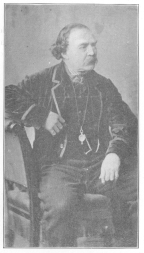
STATEMENTS in Robert-Houdin’s various works on the conjurer’s art
corroborate my claim that he was not a master-magician, but a clever
purloiner and adapter of the tricks invented and used by his
predecessors and contemporaries. Whenever, in these books, he attempts
to explain or expose a trick which was not part of his répertoire, he
betrays an ignorance which would be impossible in a conjurer versed in
the finer and more subtle branches of his art. Neither do these
explanations show that he was clever enough as a mechanic to have
invented the apparatus which he claimed as his handiwork. He states that
practice and still more practice are essential, yet no intelligent
performer, amateur or professional, can study my collection of
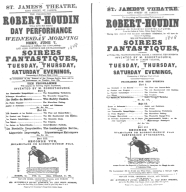
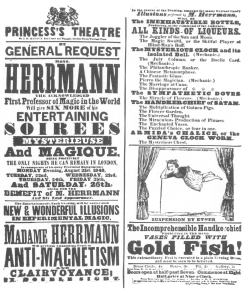
Robert-Houdin programmes, handbills, and press notices without realizing
that his répertoire contained little or no trace of what should be the
foundation of successful conjuring, sleight-of-hand. Changing his
fingers over the various air-holes of the inexhaustible bottle was as
near as he ever came to sleight-of-hand, even when he was in the height
of his success.
According to the press notices he had a pleasing stage presence, and
also dressed and set forth his tricks richly, but it must be borne in
mind that then, as often to-day, the man sent by an editor to criticise
a conjurer’s performance knew little or nothing about the art and could
not institute comparisons between different magicians. To-day
Robert-Houdin would shine as an exhibitor of illusions or mechanical
toys. A pistol shot, a puff of smoke—and his confederate or assistant
has done the real work behind the scenes.
His lack of finesse as a sleight-of-hand performer is nowhere more
clearly shown than in his own writings. On page 37 of his French exposé
of the secrets of magic, entitled “Comment on Devient Sorcier” (page 51
of the English translation by Professor Hoffmann, “The Secrets of
Conjuring and Magic"), he thus naïvely describes his masterpiece of
coin-palming:
“I myself practised palming long and perseveringly, and acquired thereat
a very considerable degree of skill. I used to be able to palm two
five-franc pieces at once, the hand, nevertheless, remaining as freely
open as though it held nothing whatever.”
An amateur of his own day would have blushed to admit that he could palm
but two coins. Men like T. Nelson Downs, “The Koin King,” think nothing
of palming twenty five-franc or silver dollars, or forty half-dollars,
and even this record has been broken.
Even two writers who contributed to the translation and editing of his
works, R. Shelton Mackenzie and Professor Hoffmann (Angelo J. Lewis),
and who have drawn rich royalties for the same, apologize for his
flagrant mis-statements, which, they realize, any man or woman with but
a slight knowledge of conjuring must recognize.
His first contribution to the history of magic was his “Memoirs"; and
while he does not feature exposures of tricks in this work, he offers,
in passing, explanations of tricks and automata presented by other
magicians. For the most part these explanations are obviously incorrect,
and so prove that he was ignorant of certain fundamental principles of
the art in which he claimed to have shone.
In the introduction of the American edition, published in 1850, Mr.
Mackenzie, the editor, thus apologizes for one of Robert-Houdin’s most
flagrant mistakes in tracing the history of magic:
“One error which M. Houdin makes must not be passed over. His account of
M. de Kempelen’s celebrated automaton chess-player (afterward Maëlzel’s)
is entirely wrong. This remarkable piece of mechanism was constructed in
1769, and not in 1796; it was the Empress Maria-Theresa of Austria who
played with it, and not Catherine II. of Russia; it was in 1783 that it
first visited Paris, where it played at the Café de la Regence; it was
not taken to London until 1784, and again in 1819; it was brought to
America in 1825, by M. Maëlzel, and visited our principal cities, its
chief resting-place being Philadelphia; M. Maëlzel’s death was in 1838,
on the voyage from Cuba to the United States, and not, as M. Houdin
says, on his return to France; and the automaton, so far from being
taken back to France, was sold by auction here, finally purchased by the
late Dr. J. K. Mitchell, of Philadelphia, reconstructed by him, and
finally deposited in the Chinese Museum (formerly Peale’s), where it was
consumed in the great fire which destroyed the National Theatre (now the
site of the Continental Hotel, corner of Ninth and Chestnut Streets),
and, extending to the Chinese Museum, burnt it down on July 5th, 1854.
An interesting account of the Automaton Chess-Player, written by Prof.
George Allen, of this city, will be found in ‘The Book of the First
American Chess Congress,’ recently published in New York.”
Signor Blitz, in his book “Fifty Years in the Magic Circle,”
corroborates the Mackenzie correction, by telling how he saw Maëlzel in
Havana, Cuba, where the famous German met his professional Waterloo,
first in small audiences, then in the death of his faithful confederate,
Schlomberg. Finally, broken in health and spirit, Maëlzel sailed from
Havana for Philadelphia, but death overtook him at sea. His body was
consigned to the ocean’s depths, and his few effects were sold to
liquidate the cost of passage and other debts.
That Robert-Houdin should make an error concerning a world-famous
automaton the history of which could be traced through contemporary
periodicals and libraries, is almost inconceivable and proves the
carelessness with which he gathered and presented facts.
His inability to grasp the principles on which other performers built
their tricks is shown most clearly when he attempts to describe and
explain the performances of the Arabian mountebanks whom he saw during
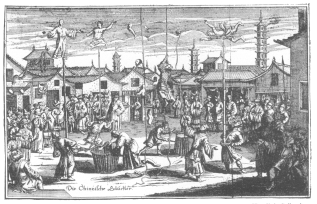
his stay in Algiers. These tricks have been handed down from one
generation to another, and now that Arabian conjurers and acrobats are
imported for hippodrome and vaudeville performances in all civilized
countries, the tricks described by Robert-Houdin are familiar to the
general public. They are also copied by performers of other
nationalities, and can be seen in circus side-shows and at fairs, as
well as in the better grade of houses. Having worked on the same bill
with genuine Arabian performers, I know just how the tricks are
accomplished.
Robert-Houdin undertakes to explain these tricks in chapter XXII. of the
American edition of his “Memoirs.” So long as he quotes reliable
authorities like the Journal des Sciences, the explanations are
correct. Directly he attempts an independent exposure, he strikes far
from the correct explanation.
On page 424 he states:
“In the following experiment, two Arabs held a sabre, one by the hilt,
the other by the point; a third then came forward, and after raising his
clothes so as to leave the abdomen quite bare, laid himself flat on the
edge of the blade, while a fourth mounted on his back, and seemed to
press the whole weight of his body on him.
“This trick may be easily explained.
“Nothing proves to the audience that the sabre is really sharpened, or
that the edge is more cutting than the back, although the Arab who holds
it by the point is careful to wrap it up in a handkerchief—in this,
imitating the jugglers who pretend they have cut their fingers with one
of the daggers they use in their tricks.
“Besides, in performing this trick, the invulnerable turned his back on
the audience. He knew the advantage to be derived from this
circumstance; hence, at the moment when about to lay himself on the
sabre, he very adroitly pulled back over his stomach that portion of his
clothing he had raised. Lastly, when the fourth actor mounted on his
back, he rested his hands on the shoulders of the Arabs who held the
sabre. The latter apparently maintained his balance, but, in reality,
they supported the whole weight of his body. Hence, the only requirement
for this trick is to have the stomach more or less pressed in, and I
will explain presently that this can be effected without any danger or
injury.”

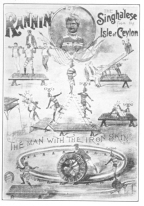
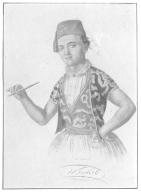
A Rannin lithograph, showing him doing the sword-walking
act which Robert-Houdin claimed to have been a fraud. Rannin is still
working in Germany, imitated by many, equalled by none. From a
photograph in the Harry Houdini Collection.
In this explanation Robert-Houdin is entirely wrong. The real secret of
lying on top of a sharp-edged razor, sword, or sabre rests on the fact
that the performer does actually lie upon it in a perfectly motionless
position. Were he to move but the width of a hair, backward or forward
or sidewise, the weapon would slice his body, resulting in instant death
or horrible mutilation. I have watched cheap performers of this class of
work, in dime museums or fairs, walk up a ladder of sharp swords which I
had previously held in my hand. They would place the foot down with
infinite precision and then press it into place. This position will not
result in cutting, but let the performer slip or slide and the flesh
would be cut instantly. I have also seen an acrobat, working in a
circus, select two razors in first-class condition, place them on a
socket with the edges of the razors uppermost, and with his bare hands
he would do what is known as a hand-stand on the keen edges of the
blades. This trick of absolute balance is acquired by persistent
practice from youth up.
Again Robert-Houdin errs wofully in comparing the sabre-swallower to the
swallower of broken bottle-heels and stones. Sabre-swallowing is one
trick, swallowing pebbles and broken glass belongs in quite a different
class. And when I say this I do not mean powdered glass, but pieces of
glass first broken, then chewed, and finally swallowed.
On page 426 Robert-Houdin puts the two tricks in the same class, as
follows:
“When the trick of swallowing bottle-heels and pebbles was to be done,
the Aïssaoua really put them in his mouth, but I believe, I may say
certainly, that he removed them at the moment when he placed his head in
the folds of the Mokadem’s burnous. However, had he swallowed them,
there would have been nothing wonderful about this, when we compare it
with what was done some thirty years back in France by a mountebank
called ‘the Sabre-Swallower.’
“This man, who performed in the streets, threw back his head so as to
form a straight line with his throat, and really thrust down his gullet
a sabre, of which only the hilt remained outside his mouth.
“He also swallowed an egg without cracking it, or even nails and
pebbles, which he caused to resound, by striking his stomach with his
fist.
“These tricks were the result of a peculiar formation in the
mountebank’s throat, but, if he had lived among the Aïssaoua, he would
have assuredly been the leading man of the company.”
The sabre-swallower never releases his hold on the weapon. The pebble
and bottle-heel swallower does—but brings them up again, by a system of
retching which results from long practice. The Japanese have an
egg-swallowing trick in which they swallow either small-sized ivory
balls or eggs, and reproduce them by a retching so unnoticeable that
they could easily show the mouth empty.
This trick dates back to the offerings of that celebrated water-spouter,
Blaise Manfrede, or de Manfre, who travelled all over Europe. This man
could swallow huge quantities of water and then eject it in streams or
in small quantities or fill all sorts of glasses. In fact this one trick
made him famous. The European Magazine, London, March, 1765, pages
194-5, gives a most diverting description of his trick, taken from an
old letter, and here quoted:
“I have seen, at the September fair in Francfort, a man who professed
drinking fifty quarts of water in a day, and indeed proved that he was
capable of executing what he pretended to. I saw him perform frequently,
and remember it as well as if it was but yesterday. He said he was an
Italian; he was short and squat, his chest, face, forehead, eyes, and
mouth very large. He pretended to be fifty years old, though he did not
seem forty.
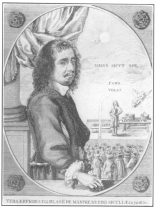
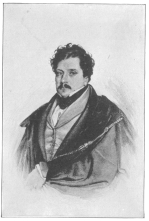
Blasius de Manfre or Blaise Manfrede, from a rare old
woodcut in the Harry Houdini Collection.
“He was called the famous Blaise Manfrede, a native of Malta. At
Francfort he frequently performed three times a day: for, besides his
performances twice a day on the public stage (which nobody approached
without paying), he attended private houses when called upon by great
people.
“He called for a large bucket of fair warm water, and twenty little
glass bottles, flat like cupping glasses, so that they could stand
topside turvy. Some of these he filled with water, plunging them into
the bucket with a good deal of ceremony, and usually swallowed two or
three to wash his mouth and gargle his throat. He threw up the water
again immediately, to shew the spectators that he had no drugs between
his teeth, whence he could be suspected to derive any advantage.
“After this plausible prelude, he made an Italian harangue, which I
cannot acquaint you with the merits of, because I am a stranger to the
language.... After his harangue he usually took off two dozen of his
little bottles, which he filled from the bucket, and a moment afterwards
returned the liquor through his mouth. But what is most extraordinary is
that this water, which he threw out with violence, appeared red like
wine. And when he had discharged it into two different bottles, it was
red in one and russet like beer in the other; as soon as he shifted the
bottles to the contrary sides, they changed their complexion
respectively to that of wine or beer, and so successively so long as he
continued vomiting; in the mean time, I observed that the water grew
less discolored in proportion as he continued to discharge. This was the
first act. Then he ranged his two dozen of bottles opposite to him on a
table, and exposed to everybody’s view. Then he took an equal number of
bottles, plunged them anew into the bucket, swallowed them too, and
returned them in water very transparent, rose-water,
orange-flower-water, and brandy.
“I have smelt the several odours of his liquors; nay, I have seen him
set fire to a handkerchief dipt in that which smelt like brandy, and it
burnt blue like spirituous liquors.... Nay, he frequently promised at
Venice to give the water back again in milk and oil. But I think he did
not keep his word. In short, he concluded this scene with swallowing
successfully thirty or forty glasses of water, always from the same
bucket, and after having given notice to the company by his man (who
served as an interpreter) that he was going to disembogue, he threw his
head back, and spouting out the fair water, he made it spring up with an
impetuosity like that of the strongest jet d’eau. This last feat
delighted the people infinitely more than all the rest, and during the
month he was at Francfort numbers from all parts came to see this
slovenly exercise. Though he repeated it more than once a day he had
more than four hundred spectators at a time. Some threw their
handkerchiefs, and some their gloves upon the stage, that he might wet
them with the water he had cast up, and he returned them differently
perfumed, sometimes with rose-water, sometimes with orange-flower-water,
and sometimes with brandy.”
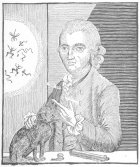
Another famous juggler and water-spouter was Floram Marchand, whose
picture is herewith reproduced. Judging from his dress, he antedated
Manfrede.
Bell’s Messenger of July 16th, 1816, tells of a sword-swallower whose
work is extremely pertinent to this discussion, and the clipping is
quoted verbatim:
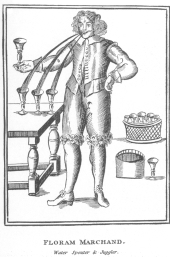
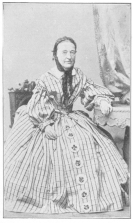
Floram Marchand. From an old, undated English publication
in the Harry Houdini Collection.
“The French papers give a curious account of one James de Falaise, a
Norman, about fifty years of age, living in the Rue St. Honoré. It is
said that this extraordinary man will swallow whole walnuts, shell and
all, a tobacco pipe, three cards rolled together, a rose with all its
leaves, long stalk, and thorns, a living bird, and a living mouse, and,
lastly, a live eel. Like to the Indian jugglers, he swallows the blade
of a sabre about thirteen inches long of polished steel. This operation
he performs very slowly, and with some precaution; though he evinces no
symptom of pain. After every solid body that he swallows, he always
takes a small dose of wine expressly prepared for him. He does not seem
to make any effort to kill the living animals that he takes in his
mouth, but boasts that he feels them moving in his stomach.”
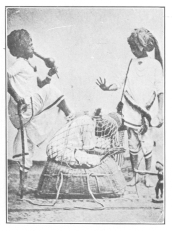
Position taken by the subject in the Indian basket trick
before he is covered by the sheet.
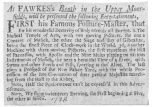
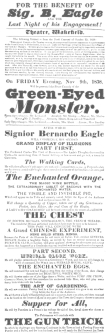
In my collection is the handbill of a stone-swallower who exhibited at
No. 10 Cockspur Street, London, charging an admission fee of
half-a-crown.
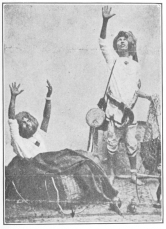
Indian fakir seated in the basket after the subject has
been “vanished."
These performers actually swallowed the water, stones, pebbles, etc.,
and retched them up again so cleverly and at such carefully selected
instants that the audience did not know that the disgorging had been
accomplished.
Swallowing glass was a different matter, and the modern human ostriches
have all wound up at city hospitals where surgeons have removed broken
glass, knife blades, and other foreign matter by means of an operation.
I quote the above instances simply to prove that the stones were
actually swallowed and then disgorged, and not hidden, as Robert-Houdin
claims, in the folds of the Mokadem’s burnous.
In this one chapter alone Robert-Houdin quotes six authorities in
explaining the tricks he witnessed, which fact only strengthens my
belief that he borrowed his tricks, as well as his explanations, from
able and graphic writers on the art of magic.
The next work descriptive of the conjurer’s art offered by Robert-Houdin
was “Les Secrets de la Prestidigitation et de la Magie.” Under the title
of “The Secrets of Conjuring and Magic; or, How to Become a Wizard,” it
was translated and edited by Professor Hoffmann and published in 1878 by
George Routledge & Co., London and New York.
Absolutely no originality is displayed in this book, and the majority of
the tricks explained can be found in French books of a similar character
which appeared before Robert-Houdin turned author. The proof of this
statement can be found by reading any of the following works upon which
Robert-Houdin patently drew for his material:
“Nouvelle Magie Blanche Dévoilée et Cours Complet de Prestidigitation,”
in two volumes, by J. N. Ponsin, published in Paris in 1853; “Grande
Initiation au vraie Pratique des Célèbres Physiciens-Prestidigitateurs,”
Paris, 1855; “Nouveau Manuel Complet Sorciers, les scènes de
Ventriloquie exécutées et communiquées par M. Conte, Physicien du Roi,”
Paris, 1837; “Anciens et Nouvaux Tours d’Escamotage,” of which there are
innumerable editions; “Le Manuel des Sorciers. Recréations Physiques,
Mathématiques, Tours de Cartes et de Gibecière; suivre, des Jeux de
Société,” Paris, 1802.
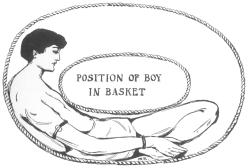
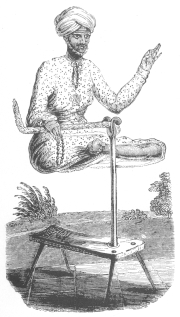
Position of the “vanished” Hindoo while concealed in the
basket. From the Harry Houdini Collection.
His third work, “Magie et Physique Amusante,” translated by Professor
Hoffmann under the title of “The Secrets of Stage Conjuring,” and
published in English in 1881, is marred by an almost continuous strain
of mis-statements, incorrect explanations, and downright falsification.
On page 17 of the American edition Robert-Houdin starts his dramatic
tale of inventing a detector lock by which he protected a rich neighbor,
M. de l’Escalopier, from robbery, and incidentally in return secured
funds with which to open his theatre in the Palais Royal. In his
“Mémoirs” Robert-Houdin states that the opening of the theatre was made
possible by the invention of the writing and drawing automaton whose
history has been traced in chapter III. The reader can choose between
the two stories. One is as plausible as the other.
But to return to the detector lock. Count or M. De l’Escalopier having
complained grievously to his humble neighbor, the watchmaker
Robert-Houdin, that he and his family were being robbed, begged that the
latter suggest some means of catching the thief. Robert-Houdin then
recalled a childish device by which he had caught his school-fellows in
the act of pilfering his desk, etc., and he proposed to the Count that
the same device, elaborated to meet the strength of a full-grown man, be
attached to his wealthy patron’s desk. As first planned, the detector
lock was to shoot off a pistol on being tampered with, and then brand
the hand of the thief with nitrate of silver. Count de l’Escalopier
objected to branding a man for life, so Robert-Houdin substituted for
the nitrate of silver a sort of cat’s claw which would clamp down on the
robber’s hand and draw blood. The Count deposited ten thousand francs in
his desk and caught the robber, his confidential servant, red-handed.
The ten thousand francs he presented to Robert-Houdin as a reward for
stopping the thefts.
A charming tale this makes, but, unfortunately for Robert-Houdin’s
claims to originality, the detector lock was not a novelty in his day.
The lock which would first alarm the household by setting off a pistol
and then brand the thief’s hand, is described by the Marquis of
Worcester in his book “Centurie of Inventions.” As locks and
locksmithing form my hobby, while in England I purchased the entire set
of patent-books, to add to a collection of locks and fastenings from
every known country of the world. In the introduction of the first book
of patents for inventions relating to locks, latches, bolts, etc., from
A.D. 1774 to 1866, the following quotation will be found:
“The Marquis of Worcester in his ‘Centurie of Inventions’ thus describes
the first detector lock invented, A.D. 1640, by some mechanical genius
of that day: ‘This lock is so constructed that, if a stranger attempts
to open it, it catches his hand as a trap catches a fox, though not as
far as maiming him for life, yet so far marketh him that if suspected he
might easily be detected.’”
It appears that to this lock was fitted a steel barb which, if a certain
tumbler was overlifted in the act of picking or otherwise, was projected
against the hand of the operator by a spring. I have seen such a lock as
this in the collection of Hobbs, Hart & Co., London, who have had it in
their possession many years. In every respect it answers the description
of the invention claimed by Robert-Houdin as his own.
Chapter VII. of “Secrets of Stage Conjuring” is devoted to
Robert-Houdin’s very incorrect explanation of the famous Indian Basket
Trick. Even his own translator, Professor Hoffmann, takes issue with
Robert-Houdin, as will be seen by reading his foot-note on page 104:
“We will not venture to question the fact vouched for by so high an
authority as Robert-Houdin, that the Indian Basket Trick may sometimes
be performed after the manner above described, but we doubt very much
whether such is the usual or customary method.”
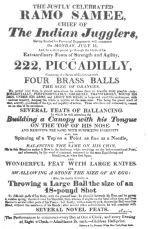
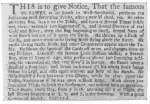
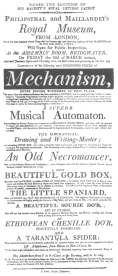
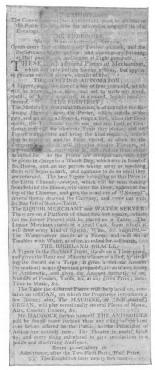
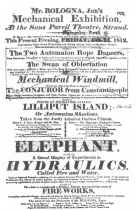
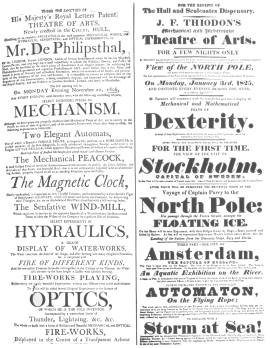
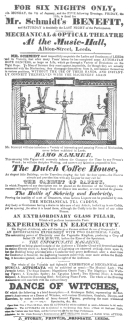
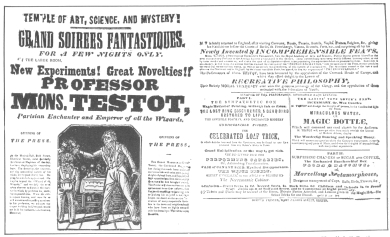
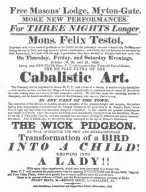
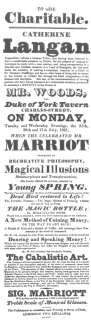
A Ramo Samee handbill, featuring his stone-swallowing
act. From the Harry Houdini Collection.
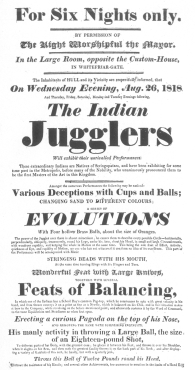
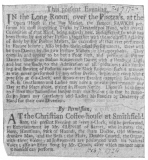
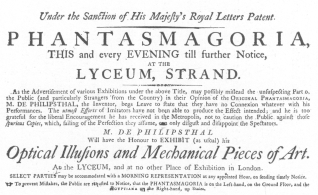
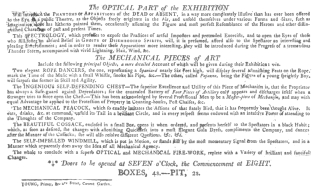
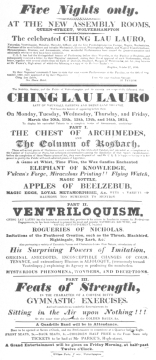
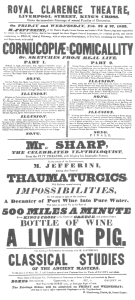
Handbill used by the original Indian jugglers in England
during 1818, in which the sword-swallowing trick is featured. From the
Harry Houdini Collection.
Robert-Houdin states that the child is placed in the basket, and the
Indian fastens down the lid with leather straps. To facilitate this
operation, he rests his knees against the basket, and the bottom of
the latter thus being turned toward the audience, the boy slips out
through a cunningly contrived trap and quickly conceals himself under
the robe of the magician, whose attitude favors this concealment.
As the basket trick is the Hindoo magician’s most wonderful offering, a
truthful account of his methods of performing the same may be
interesting. In the first place, Robert-Houdin’s explanation is
impossible and unreasonable because the Hindoo magician does not wear
flowing robes in which the child could be concealed. Every Hindoo
performer I have ever seen wore short trousers and was barefooted.
The correct method of performing the trick, which has been handed down
through generations of Hindoos, is as follows: The boy subject is placed
in a net in which he is firmly tied, after having had his big toes and
thumbs fastened down with bandages. Then, with many a grunt and a groan,
he is lifted into the basket. The subject, however, pretends that the
basket is too small, so he is really seated on one side and keeps his
back in the air. This is done to give the appearance eventually that it
was impossible for him to crouch down or around the basket. The lid of
the basket is now placed on his back, and a large sheet is thrown over
the entire apparatus, which conceals from the audience every movement
made by the subject.
Now commences the Hindoo “patter,” in reality yells, groans, and
incantations, while the magician and his assistant strike the basket
with swords or canes, stamp on the ground, gnash their teeth, etc.
Gradually the cover of the basket sinks until the basket seems empty,
to the spectators at least. The fakir now takes off the cover of the
basket, leaving the sheet over it, however. Then he jumps into the
presumably empty basket, stamps all around, and takes out the net in
which are found the turban worn by the subject and the thumb tie. To
prove further that the basket is still empty, the fakir seats himself in
the basket, as shown in the illustration. The lid of the basket is now
replaced, and under this friendly cover the sheet is taken off and the
basket tied up.
Now commences the true Hindoo magic. The magician is a real actor. He
apparently adjures Mahomet. He gets very angry and with fierce looks,
ejaculations, and muttered curses he grabs up a sword or cane and jabs
it through different parts of the basket. During all this time the
subject, who is something of a contortionist, is wriggling about on the
bottom of the basket, keeping out of reach of the sword, and in fact
often guiding its thrusts between his legs, as every movement on the
part of the fakir has been carefully thought out and rehearsed in
advance.
By this time the fakir has convinced his audience that the basket is
empty. To be sure he has not allowed any spectators to come too near him
or the basket, nor has any hand save his touched it, but his clever
acting almost persuades even an intelligent or sceptical onlooker that
the basket is empty.
With the lid of the basket replaced, this time above the friendly sheet,
and the basket tied, he resumes his weird incantations. He screams and
runs back and forth, playing on a small instrument with a hideous tone
which is a cross between the whistle of a locomotive with a cold, and a
sawed-off and hammered-down flute in which has been inserted a tin
whistle. As this nerve-racking music holds the spectators under its
awful spell, the basket begins to rock, the contortionist-subject
gradually raises himself inside the basket, and when the noise is at its
height he straightens up in the basket and raises it with his back as
far as it will go. To the uninitiated it actually appears as if he had
returned to an empty basket in his original position. The trick is a
marvellous deception, but only a Hindoo can exhibit it with success, for
no white person would ever indulge in the screechings, imbecilities, and
contortions which are the spectacular and convincing features of the
trick.
Sometimes the trick is varied. Instead of the subject being found in his
original position he is seen running toward the crowd as from a
distance. This is accomplished by having two subjects, one in the basket
and one hidden on the outskirts of the crowd, who are “doubles” or at
least who show a marked resemblance and are dressed exactly alike.
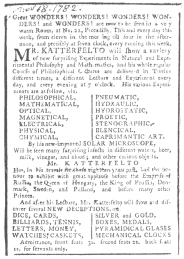
The earliest programmes of Hindoo jugglers in my collection are dated
1818. The “Mr. Ramosamee” featured on this bill later split his name
thus, “Ramo Samee,” and was engaged to perform alone between the acts of
“The Broken Heart” at the Garrick Theatre, London. From Ramo Samee,
Continental and British magicians learned the trick of juggling brass
balls.
On page 135 Professor Hoffmann, in a foot-note, commends Robert-Houdin
for the very impartial manner in which he approaches the question of
spiritualism and spiritualistic manifestations, in his day a
comparative novelty: “In default of absolute certainty, he wisely
reserves his opinion. Where, however, as in the case of the Davenport
Brothers, he had an opportunity of personally observing the alleged
‘phenomena,’ he has neither difficulty in penetrating nor hesitation in
denouncing the imposture. We venture to believe that any of the
so-called spiritualistic manifestations which had come under the test of
Robert-Houdin’s examination would have met a similar fate.”
With this commendation I cannot agree. Robert-Houdin once had all the
leeway he wished at a most remarkable manifestation and made no attempt
to hide the fact that he was baffled by the “phenomena.” The “Memoirs of
Marquis de Mirville” contain a Robert-Houdin letter in which he admits
that he could find no explanation of tests just witnessed. The letter,
translated from “Die Magie des XIX. Jahrhunderts von Uriarte,” 1896,
published in Berlin, Germany, by Heusers Verlag, is herewith quoted: “I
returned from the séance as greatly astonished as it was possible for me
to be, and I am thoroughly convinced that it was entirely out of the
possibility, and no chance whatever, that it was either by accident or
practised trickery to produce such wonderful materializations.
Robert-Houdin, May 18th, 1847.”
He further shows his ignorance of séances as offered in his times, by
his attempt to describe the methods employed by the Davenport Brothers,
to whom he devotes chapter XIII., which might be described as a chapter
of errors.
These picturesque American entertainers, the Davenport Brothers, hailed
from Buffalo, N. Y., U.S.A. Ira Erastus was born September 17th, 1839,
and William Henry, February 1st, 1841. They fairly startled the world by
their so-called manifestations of spiritualism during the 60’s, and were
alternately lauded and reviled for their performances.
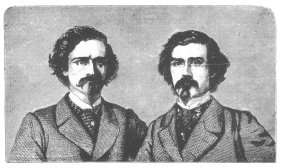
The Davenport Brothers in their prime, from photographs
furnished by them to the contemporary press, now in the Harry Houdini
Collection.
Both were below medium height, rather handsome men, and, as will be seen
from the accompanying engraving, looked much alike. Their career, which
started in America, ran from about 1853 to the early 70’s. They made a
trip to Europe in 1864, remaining until August, 1869. Both married
abroad; Ira a daughter of France, Mlle. Louise Toulet, and William Henry
a Polish girl, Miss Matilda Mag. On the whole, their foreign tour was
most profitable, though in some cities they paid a high price for their
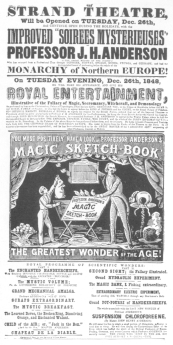
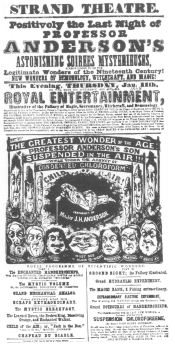
notoriety. In England they waged bitter warfare with John Henry
Anderson, Tolmaque, and Professor Redmond.
On the occasion of their Paris opening at the Salle Herz they claimed
that the hoodlum element mobbed the theatre and broke up their
performance at the instigation of Henri Robin, who was playing in
opposition. Hamilton, who had succeeded to the management of
Robert-Houdin’s theatre, in a letter published after witnessing their
initial performance announced that he shared this belief; but as
Robert-Houdin and Henri Robin were bitter rivals, I believe Hamilton’s
letter was the result of two things: first the intense ill-will he
harbored against Robin, and second, as he had Robert-Houdin as his
mentor, he was really ignorant of the Davenport methods and therefore
not in a position to defend them. The letter, which is given in full,
appeared in Gazette des Étrangers, Paris, September 27th, 1865:
“Messrs. Davenport: Yesterday I had the pleasure of being present at the
séance you gave, and I came away from it convinced that jealousy alone
was the cause of the outcry raised against you. The phenomena produced
surpassed my expectations, and your experiments were full of interest to
me. I consider it my duty to add that these phenomena are inexplicable;
and the more so by such persons as have thought themselves able to guess
your supposed secret, and who are, in fact, far indeed from having
discovered the truth. Hamilton.”
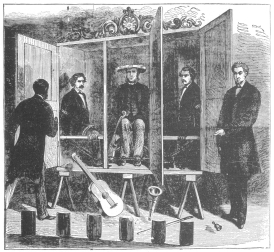
The cabinet trick offered by the Davenport Brothers. From
an old print in the Harry Houdini Collection.
After their return to America the Davenport Brothers retired from
public life, purchased a farm, and rested on their laurels and a
corpulent bank account. One of them is said to have admitted that all
their work was skilful manipulation and not spiritualistic
manifestations. Nevertheless, their names will live so long as
spiritualism is talked of or cabinet effects tolerated by the public.
The trick as offered by the Davenport Brothers consisted of their being
tied hand and foot at opposite ends of the cabinet, which was hung with
musical instruments, bells, etc. The two men slipped in and out of the
ropes without delay or apparent damage to the ropes, and musical
instruments were played with arms presumably in bondage.
Robert-Houdin, in attempting to expose the trick, makes two flagrant
errors. First he claims that “by dint of special practice on the part of
our mediums, the thumb is made to lie flat in the hand, when the whole
assumes a cylindrical form of scarcely greater diameter than the wrist";
and second that the Davenport Brothers had trained themselves to see in
the dark.
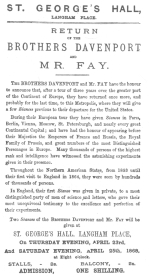
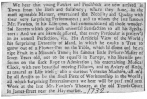
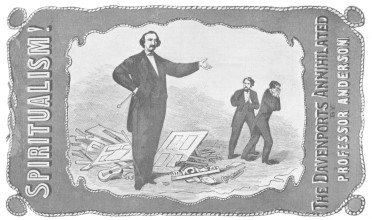
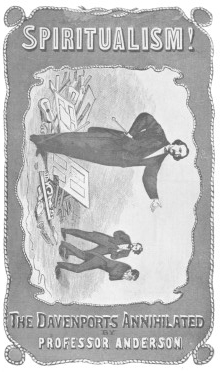
Announcement used by the Davenport Brothers on their
return to London, England, after their tour of the Continent in April,
1868. From the Harry Houdini Collection.
As releasing myself from fastenings of all sorts, from ropes to
strait-jackets, has been my profession for twenty years, I am in a
position to contradict Robert-Houdin’s first claim positively. I have
met thousands of persons who claimed that the rope, as well as the
handcuff trick, was accomplished by folding the hand together or making
the wrist larger than the hand, but never have I met men or women who
could make their hands smaller than their wrists. I have even gone so
far as to have iron bands made and press my hands together, hoping
eventually to make my hands smaller than my wrists, but this has
failed, too. Even if the entire thumb were cut away, I believe it would
still be impossible to slip a rope that was properly bound around the
wrist. You may take any cuff of the adjustable make, or a ratchet cuff,
place it about a small woman’s wrist, and you will find that even she
will be unable to slip her wrists. I do not mean by this any hand-cuff
that will not come to any size, or the common cuffs which when locked
will lock only to a certain size, but I mean a cuff that can be locked
and adjusted to any size of wrist.
In rope-tying, the principal trick is to allow yourself to be tied
according to certain methods of crossing your hands or wrists, so that
by eventually straightening your hands you have made enough room to
allow them to slip out very easily. It is not always the size of the
wrist that counts. It is the manner of holding your hands when the knots
are being tied.
The gift of seeing in the dark, with which Robert-Houdin endowed the
Davenports, is equally preposterous. Professor Hoffmann defends
Robert-Houdin by citing instances of prisoners who had been confined in
cells for an indefinite period and who had learned to see in the dark.
This is quite true, but they did not alternate daylight and darkness.
Eminent opticians and oculists inform me that the faculty of seeing in
the dark cannot be acquired by parties like the Davenports, who spent
most of their time in the light.
While the Davenports were pioneers in rope-tying and cabinet séances,
had Robert-Houdin been the clever sleight-of-hand performer and inventor
he claims to have been, these tricks would have been clear and solvable
to him. But as he obviously joined the ranks of the amazed and
bewildered masses, making only a futile attempt to explain the
performances, he convicts himself of ignorance regarding his own art.
A man who has made a fortune in the world of magic and who desires to
hand down to posterity a clean record of his attainments will be clever
enough and manly enough to avoid any attempt to explain that which he
does not understand. By his flagrant mis-statements regarding the tricks
of his predecessors and contemporaries, Robert-Houdin, however, convicts
himself of ignorance regarding the fundamental principles of magic, and
arouses in the minds of broad, intelligent readers doubts regarding his
claims to the invention of the various tricks and automata which he
declares to have been the output of his brain, the production of his own
deft hands.