INTRODUCTION.
v
However trifling and contemptible
the following Treatise may appear
to some persons, the author flatters himself
that it will be productive of great public
utility, although the subject is but low and
humble.
Many ingenious writers have greatly
distinguished themselves in treating of that
noble and useful animal the horse; of the
method of breeding horned cattle, sheep,
and other animals, serviceable and beneficial
to mankind; this little work, on the contrary,
takes cognizance of those animals,
noxious to the community, describes their
wonderful wilyness and sagacity, and the uncommon
and surprizing methods they take
for self-preservation and getting their prey;
the research, may, perhaps, give the reader
great satisfaction, for the infinite wisdom of
vithe great Creator is as conspicuous in a
mole as in a camel, in an ant as in a lion.
And as most noblemen, gentlemen, and
others, who have country seats are generally,
if not constantly, troubled with various
kinds of vermin, greatly detrimental and
destructive to their property in the following
instances, viz. in many places where
gentlemen have hare-warrens and pheasantries,
they are troubled with foxes, their
waters with otters, those great destroyers of
fish; their poultry are killed by polecats,
stoats, and weasels; in other places they are
pestered with wild cats, who originally
strayed from the farm and other lone
houses, and running into the woods, breed
in great numbers and do incredible mischief,
in destroying the game, poultry, rabbits,
and young leverets; in many other
places they are troubled with sheep-killing
dogs, who in the night-time worry and kill
great numbers of sheep, so useful and necessary
to the commonwealth, and the staple
viicommodity of the kingdom. But of all the
noxious animals none do more mischief than
rats; both the old English black rat and the
Norway rat, especially the latter, which is
the most mischievous animal in the creation.
In all the above cases, rules, not drawn from
theory, but from twenty years strict observation
and practice, are laid down in the
plainest manner, to find out their haunts and
hiding places; with the easiest methods how
to take and destroy them, to the great joy
and emolument of the persons who have
been injured and pestered with them. Rules
for taking and destroying moles and mice
are likewise given, and the nature of ferrets
is also described, with instructions when it
is proper to make use of them, and when
not.
And as the noxious part of the creation is
not confined to the earth only, many of the
winged inhabitants of the air are equally
pernicious to the gentleman and the farmer,
their natures are described, with proper and
viiisuitable directions how to take and destroy
them, from the buzzard and the kite, to the
smallest bird of prey, without which the author
would have estimated his work as incomplete.
On the whole, if the following little Treatise
should any ways answer the intent for
which it was written, the author will obtain
the end he aimed at, and gratify the utmost
extent of his ambition and wishes, namely,
the good and advantage of his fellow-subjects,
and the general good of the community.
THE FOX.
1
I shall first begin with old Reynard
the Fox, for he is the king of
the vermin in this island; wolves indeed
formerly abounded here, an animal
infinitely more fierce and dangerous than
the former, but these for many ages have
been entirely extirpated.
The Fox is a very subtle, sly, and daring
animal, and in hard and severe winters
will come to places where hares and pheasants
are kept, and destroy a great many of
them; he is likewise a mortal enemy to
lambs and all kinds of poultry, but scarce
in any other instances he is more mischievous
2than in destroying rabbits in warrens,
which he frequently does in prodigious
numbers, but more especially in stopping
time, as I have known the young rabbits
of near twenty stops taken away by the
Foxes in one night’s time. It may be necessary
here to explain what is meant by
the above term; when the female rabbit is
ready to kindle, she digs an hole, or angle,
about four feet long, and about ten or
twelve inches under ground, and when she
goes out for food, she scratches the earth
over the mouth of the hole, or stop, so that
it is scarcely perceptible to the eye, in order
for the preservation of her young ones
from any approaching enemy; in the
night, the Fox being in search of his prey,
comes to the place where these stops are
made and scents the young rabbits, but
instead of entering therein, he follows the
scent above ground till he comes to the end
of the angle, and then scratching up the
earth comes immediately upon the young,
3which he devours; and this is called crowning
on them.
It is very difficult to guard against the
approaches of this enemy, his motions being
so uncertain, unless a trap was constantly
placed, for sometimes he will destroy
several lambs and poultry in the night
at farm-houses, and not come near the
same place again for a considerable time,
shifting his quarters to other places considerably
remote in search of fresh plunder;
but in large parks where hares and pheasants
are constantly kept in great numbers,
there is a greater probability of taking him
in the following manner:
The method to know where and which
way he comes, is to make what is termed a
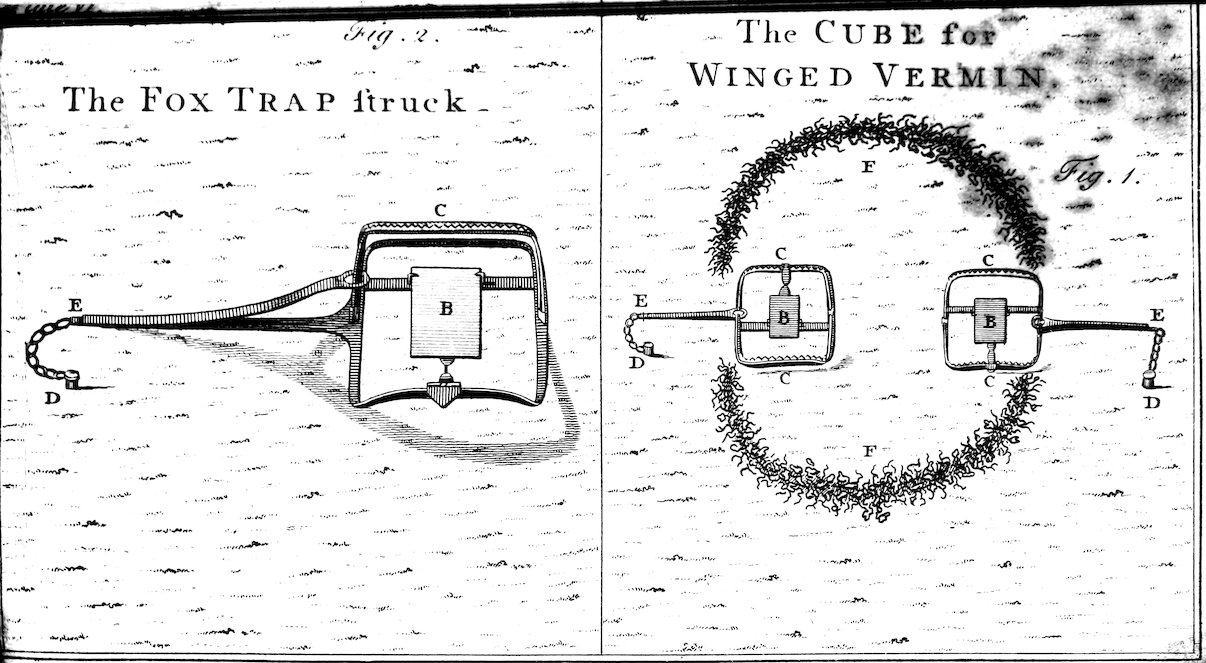
shrape, which is done by drawing a circle[1]
on the ground, in the park or warren, about
three feet diameter, take the mould out all
over, four inches deep, then take a sieve
4and sift a sufficient quantity of fine mould
to fill it up again even to the surface, dig
six of these in various parts of the park, and
fill them up in the same manner. The
reason of having the mould sifted so fine
is, that when you set a trap there will be
no stones to intervene between the spring
and the jaw of the trap, which will sometimes
happen without proper observance,
and prevent the trap from striking close.
The next step to be taken is to procure
a sheep’s paunch; tie a string to it, and
draw it to each shrape, before described,
but remember at the distance of two or
three hundred yards to rub the bottom
of your shoes on the paunch, which will
prevent him from discovering the smell
of your feet, and at every shrape lay some
pieces of strong old Cheshire cheese, and
come again in the morning, when you will
plainly perceive whether his behaviour is
shy or not; for he will sometimes eat all
the cheese he can reach, without entering
5on the shrape; the next night he will venture
somewhat further, and set his feet so
lightly on the mould that you can scarcely
discern their print: I have sometimes fed
a shy Fox for a whole week before I have
set a trap for him, but when he comes to
feed boldly he will trample all over the
shrape and make prints an inch deep, and
in that shrape, where he seems to feed the
freest, I would advise to place two traps,
and, without any particular accident, if
he comes, you will be sure of catching
him.
Set your traps after the following manner:
take some mould out, just sufficient
for the traps to lie in; and when properly
placed, get some moss, and with a small
stick, put some of it under the bridge, and
likewise between the bridge and the jaw,
and lay it quite smooth; now the reason of
having the above stick is, that in case you
should spring the trap, it will not injure you
in the least, but only catches the end of the
6stick. The next particular you must observe
is, to procure a thin piece of board,
a foot in length, two inches wide at one
end, and cut away at the other to hold them
by; then with this board strike some mould
or earth over the trap, entirely level with
the other parts of the shrape; this board is
absolutely necessary in order to prevent
your handling the mould, for if he is in
the least shy, he will not approach the
shrape if you once handle it; another caution
is likewise necessary, which is, not to
let the bridges of your traps be too wide,
for a Fox had better come and put his foot
in between the bridge and the jaw of the
trap, and not spring it at all, for in that case
he will come again, as he has not been
baulked, but when the bridge is too wide,
if he happens to set his foot on the jaw,
then his toe nails reach the bridge, and
spring the trap without catching him, which
will render him shy, and it will be a very difficult
matter afterwards to get him at all.
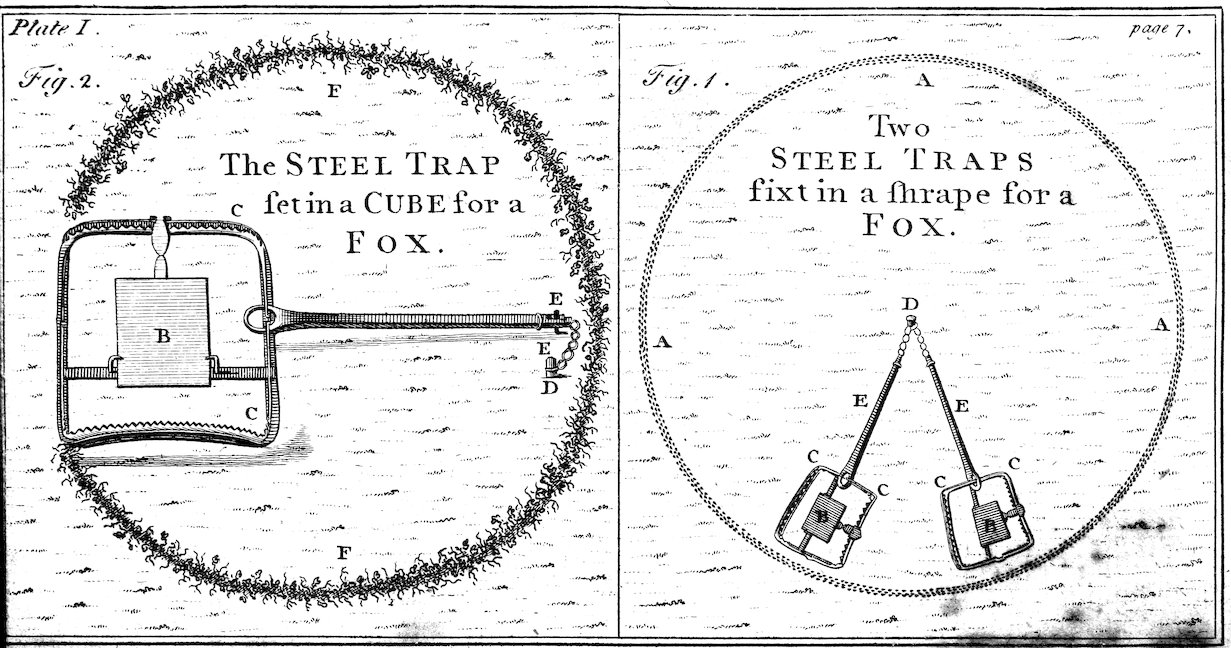
7But in order to prevent any such disappointment,
I would advise that your steel
traps for the Fox should be square in the
jaw, and not round as the common traps
are usually made, and strike but five inches
high, and seven inches long in the jaw,
with saw-teeth[2], and let the tail[3] of the
trap be two feet from the tail end[4] of the
spring, for they are generally made too
short, from whence this inconvenience
arises, that when a trap stands for some
time, in warrens or parks, the spring gives
out, the purchase being so quick, whereas,
were the traps formed on the principle above
laid down, the spring would remain for a
considerable time without giving way; and
lastly, let the [5]bridge of the trap be four
inches square.
8But as to a shy Fox, as just above observed,
I have known them come again,
when compelled by hunger and necessity,
and sometimes even with three legs, and
take the young rabbits out of the stops or
holes, as before described.
And here I beg leave to correct a vulgar
error mentioned by some authors, which is,
that the Fox, when caught by the leg in a
trap, in order to facilitate his escape, will
gnaw off the same above the jaws of the
trap, but this assertion is entirely false
and erroneous, as it would put the animal
to inconceivable pain and agony to bite its
own flesh, while any sensation remained,
and renders the supposition likewise unnatural;
but the real state of the case is
this, which I have proved from long experience,
for as a dog, when he has got into
a trap, will yelp and cry out till he is tired,
which soon happens, and then lie quiet, on
the contrary, this artful cunning creature,
we are now describing, as soon as taken,
9makes no noise at all, but is indefatigable
in his endeavours to get out, and will neither
stand nor lie still till either somebody
comes to let him out, or he gets out by the
following manner; he immediately begins
to tumble and toss about, and after some
time striving, he breaks his leg, just at the
place where the iron jaws of the trap are
fastened; the lower part of the leg, under
the trap, is soon benumbed and deprived
of all sensation, which the Fox then gnaws
off, and drawing the sinews through the
teeth of the trap, makes his escape, leaving
that part of his leg which he had bit off
behind him; and, as a further confirmation,
I once catched a dog and bitch Fox,
early in the winter, who both escaped, by
the above means, with three legs each, and
the ensuing spring came to the same warren
and took out several stops on their three
legs, which I discovered, and poisoned them
by means of some balls properly prepared,
the method of which I shall soon come
to describe.
10It may not here be unnecessary to lay
down some rules to distinguish the dog Fox
from the bitch, which may easily be done,
without seeing them, by adhering to the
following observations; a dog Fox has a
larger foot than a bitch, and it much resembles
that of a small lurcher dog, and
has been often mistaken for one, by those
who do not examine things minutely: but
there is an essential difference; for the Fox
has hardly any ball to the heel of his foot,
but the dog has a large one; and a bitch
Fox has likewise a small foot with the ball
thereof still considerably less than the
male. The utility of this remark will soon
appear.
I now proceed to lay down another method
of taking and destroying these pernicious
vermin, either in park, warren, or
field, but more especially those who have
been made shy, or have lost a leg in a trap,
as before hinted, which is as follows: whatever
place it may happen to be in, you must
11take notice of all the little by-paths all
round the ground, and sift some mould in
each of them, and place by the side of each
path, where the mould is sifted, a piece of
white rag stuck upon a stick; for if there
be any rabbits or hares near the path, they,
by running up and down, will create such
confusion in the mould, that it will be next
to an impossibility to distinguish the impression
of the Fox’s foot; the intent, therefore,
of these white rags is, to fright the rabbits
and hares away, but the Fox will boldly
proceed along regardless of them: as soon
therefore as you have discovered which
path he came along, you must not trail for
him as before, for that having seduced him
into danger, and led him to the trap, he
will remember it well, and it is a very great
chance whether he will follow the trail at
all. But take two good figs of nux vomica;
let them be quite white and sound, (for
those that are of a brown colour are neither
so strong nor efficacious) then rasp them
very fine, take a piece of good dripping as
12big as a tennis ball, mix with these a little
flower to bring it to a proper consistency or
stiffness, and then roll it in honey; for
there is nothing fonder of honey than a Fox,
and I have seen one scratch up the earth for
a bee’s nest under the ground, for the sake
of the honey, and after he had accomplished
this design, having the wind of him I
shot him dead on the spot. But to return.
When you have found out the path he
comes in, place two or three of these balls
of the magnitude before mentioned, at nine
or ten yards distance, for fear he should
miss one; place them on a small stick six
inches high, in order to prevent the mice
from eating them. But a little distinction
is here necessary to be made, for if you are
endeavouring after a Fox, whom you imagine
never to have been made shy or caught
in a trap, the method of trailing, as laid
down in the first instance may be followed,
and then one ball will be sufficient to be put
13in the path, which he will readily go up to
and take, and in order still to be more certain
of his footsteps, take the foot of a
Fox and print it in fine mould or sand, but
the former is better if it can be got, the
latter when dry, being apt to run; by
observing this rule you will readily know
the print of his foot, wherever you see
it.
When the plan has succeeded to your
wishes, and the Fox has taken one of the
balls as he came in, it is ten to one but he
dies before he gets out again, as was the
with the dog and bitch Fox before mentioned,
and if you print him in, and not
print him out, then you may hunt for him
with your dog, being certain that he is still
lurking somewhere in the ground.
In some places where traps have not been
set for them, they may be catched as easy
as a dog; I have taken them in a cube,
where a trap for a dog has been set, the
14cube is formed in the manner as represented
in [pl. 1, fig. 2. F.] by the cut therein annexed,
and may be made in the center where
two paths cross, or in a warren, or park,
or at any gate or stile where he comes in:
if you do not find that he comes in at any
of the above places over your shrapes, you
must, as you go round the sides of the
path, gates and stiles, mind whether you
see his billots, that is, his dung, the
term being to say after he has dunged that
he has billoted; if you should not rightly
know it, take up what you imagine to be
the same, and break it, and you will find
it to be full of large black beetles; sometimes
you may smell him, then look about
very nicely, and it is ten to one but he has
billoted somewhere near the place.
Let your cube be made after this manner,
draw a circle, [pl. 1. fig. 2. F.] but
in the front leave just room for the trap to
go in when set, then bank it up all round
from one side of the jaw of the trap quite
15round to the other; set your traps in the
same manner as you see in the plan of it,
but be sure to moss them as before directed,
for the moss preserves the fine mould from
running under the bridge, and at the same
time keeps it up hollow that it may strike
freely and properly, but when the mould
runs in, it sets the trap so hard that it is
impossible for it to strike at all. If you are
in a warren, put some rabbits guts in the
back part of the cube; if these cannot be
procured, place some pieces of strong rotten
Cheshire cheese, which they are very
greedy of; if at a farm get some bits of
dead fowl, if possible, and if in a field, it is
probable you may find some of the mangled
carcases of lambs, which they have killed
and hid pieces of them in the ground,
which they often do: but remember, in all
these particular cases to put the bait in the
back part of the cube as before hinted;
and whenever you set a trap for a Fox let
it be placed early in the afternoon, in order
that the soil you make may go off before he
16comes, and when you have set them, cover
them with a bush cut on purpose, to keep
any thing else from striking it, till you
come round at night and uncover it
again.
In many country places there are people,
who make it their business to take Foxes
out of their earths for gentlemen to hunt
them at their pleasure; these are properly
called bag-foxes. I have known in some
stony countries that they set stone traps for
them at their earths, so that it is impossible
for them to get out without being taken,
but of this method of catching them I cannot
speak from my own experience, having
been only a spectator of the traps, and of
consequence cannot be so able to judge
of it, as where I have been the principal
actor myself. I mention this to testify
that I would not, even in the most
minute circumstances, impose on my
readers.
17I have practiced likewise the following
method with good success, which may
be imitated with great facility; let the
party employed go round and carefully
search for their earthing places, wherever
they are, and make the mouths of them
quite fine with mould; then come again
the next morning, and observe whether the
earth has been trampled on, and if you see
the prints of his feet tending outward and
inward, you may then be assured that he is
safe within his hole or earth, on which take
a good strong hay-net, such as are used in
some warrens, pitched all around at a proper
distance, put the sticks quite slight into the
ground, that as soon as he strikes the net,
it may fall upon and entangle him, but if
you place it tight he will tumble over, and
by that means escape. Another caution is
necessary, when you have set your net, you
must put some bells in three or four different
places, that you may hear when he
strikes the net; then run in upon him, and
keep him entangled, otherwise he will get
18out again, and seizing him by the pole or
back part of his neck, muzzle him, and tie
his fore legs together, that he may not
scratch his muzzle off again; I have known
a Fox, earthed as above, watched for two
or three nights together, till he has been
starved out, before they could catch
him.
Sometimes when a Fox is found in the
earth, or is hunted in, the method is to dig
him out immediately, after the following
manner; take a good terrier, that is kept
for that purpose, one that will lie at a Fox,
then you must listen and sound him as the
warreners do their line ferrets; dig a trench
across the angle, and, when you have got
to the angle, perhaps he will fly back, as
they frequently do, then sink another trench
near him, and when you have dug down to
him, take care he does not bite you, as he
is a fierce animal, when drove to desperation,
and bites very hard; in the next place
take your dog back, that you may get him
19out, this is what we call drawing him, as
follows; take an old hat, or any thing of
a similar nature, in your hand, and dodge
it before him, when he will catch hold of
it immediately, then with the other hand
catch him by the back part of the poll, with
all possible quickness, as the motion must
be, as it were, instantaneous; and this
same method must be observed when you
have one in a trap, if you have a mind to
take him alive, and always remember to
have a muzzle ready to put on him directly,
and put him into a sack, and then you
may do what you please with him afterwards;
what I mean by a muzzle is this,
take a bit of strong tape, put it over his
nose, bring both ends down under his jaw,
and tie them tight together; then bring it
along under his throat, an inch and half
from the first knot, then tie them both together
in one knot again, then bring the
two ends up behind his ears and tie them
tight, and this is what I call a muzzle, in
20the same manner as warreners muzzle
their dogs to drive to the nets.
Having proceeded thus far in my description,
&c. of this remarkable animal, I
conclude what I have to say of him with
the following recipe to take a shy dog Fox,
which I have known to succeed when all
other means have proved ineffectual, and
like wise with another observation, neither
of which are generally known.
The trail for him is, when you have taken
a bitch Fox, that goes a clicketing, take
and cut that vessel which contains her sperm,
the same as the sow-gelders deprive bitches
of, when they spay them, mixing with this
some gum mastic, and put them as soon as
possible, after being taken from the animal,
into an earthen pot, keeping it quite
close, and it will remain serviceable a whole
year, and, when occasion offers, take a
large piece of rind of bacon, broil it well
on a gridiron, and then dip it in the pot,
21using it as a trail, in the same manner as the
sheep’s paunch before described.
The last remark I shall make is, that
there is one season of the year when a Fox
will not run after a trail at all, at least very
rarely, and that is in the spring, when he
gets plenty of young rabbits and leverets;
for then he is dainty; when this is the case,
another method must be taken: at this time
of the year the bitch Fox goes what is called
a-clicketting, you must mind which way he
comes, which may be done by sifting some
fine mould in all the little bye paths, and
when you have discovered the right one,
place two steel traps, about twenty yards
distance from each other, for fear he should
miss one, but lay no bate for him, and if he
comes, there is the greatest probability of
his being caught; I have often been forced
to act in this manner, and have succeeded.
THE OTTER.
23
The Otter is an amphibious animal,
which preys both by land and water,
for when he is disturbed in the water he
preys by land: as a proof of which, I once
catched a dog Otter in a warren, where he
came to prey on the rabbits, after the old
bitch Otter and all the young cubs had been
killed, down at the river, not far from the
warren.
The Otter generally frequents rivers and
brooks, in order to search for his prey, and
will often come to fish-ponds likewise, destroying
the fish, and yet not lie there; the
method to discover his haunts is very easy,
for, in whatever place he preys, you will be
24certain to find tails, or hinder parts of the
fish, left undevoured, at the sides of the
ponds, &c. for it is observable that he eats
the head and body of the fish, as far as the
vent, and very seldom any farther; look all
round the pond, and by his marks or footsteps,
you will find where he enters the
pond, and likewise where he comes out to
eat the fish by the side, for no amphibious
animal devours his prey in the water, or
can remain a single moment under it, longer
than he can hold his breath. When you
have discovered the place, it will be adviseable
to put a good strong steel trap in the
water, down in the mud; put the mud
over the bridge of the trap as much as you
can, that he may not discover the trap. I
have catched several this way. If you
should not happen to find where he takes
the water, you will see where he sits to eat
his fish, and then you must set a trap or
two by the side of the water, in different
places, where you find the bits of fish; cut
a hole in the ground to let them in, just
25flush or even with the ground, then cover
them over with moss very nicely: but, in
my opinion, there is no necessity to bait
them, for the Otter will seldom, I believe
never, touch any thing but what he kills
himself. I may possibly be mistaken in this
point, but after many repeated trials never
could get him to touch any bait I set for
him.
The Otter in rivers and brooks has a
kennel, which, with proper notice, as before
given, you will find; the structure of
it is very ingenious and admirable, indeed
not equal to that of the beaver, though in
some instances of a similar construction, for
they always have two ways to go in and out,
one by land and the other by water, for
such is the cunningness and sagacity of these
vermin towards their preservation, that if
disturbed by land, they can vent or escape
by water, and if attacked by water they
can escape by land; now when you have
found out these kennels, and discern that
26they use and frequent it, look carefully
about and you will see some of his landing
places, where he sits and eats his prey, and
before the spot where he lands, there put a
trap down in the water as already directed in
the ponds, where I have caught them, and
likewise destroyed all the young ones in the
kennel, but know no bait in particular they
are fond of, as before observed; though
others may be of a contrary opinion.
In many places where I have been, small
hounds have been employed in destroying
these vermin, called Otter hounds; when
one is unkennelled, he immediately goes to
the bottom of the water, where he remains
as long as his breath will hold out, which
is a considerable time; he then goes under
the bank, or under some reeds or boughs,
there he draws breath and blubbers the water;
the term when he is perceived by any
of his pursuers is to say, There he vents;
and they strike at him with a spear made
for that purpose, and often kill him, but if
27the spear misses, he sets off again and the
dogs follow, and if good seldom miss of
killing him.
The above animal is not footed like other
vermin, for they have a web between each
claw, like many water fowls, which greatly
accelerates their motion in swimming, when
pursued by the dogs; they have no heel,
but a round ball under the sole of the foot,
the track of which is called their mark, and
their dung is called their sprents.
THE BADGER.
29
He is a grey hard haired animal, a good
deal of the pig kind; and is not
near so hurtful as many other animals of the
vermin kind; for the chief mischief he
does, consists in scratching of earths, or
holes, which afterwards serve for earth for
the foxes to harbour in, and in scratching
and grubbing up the ground, in searching
after his food, such as pignuts and roots,
on which, and on beach-mast, acorns, crabs,
and other trash, he subsists, but does not
prey on living things of any kind, as has
been asserted by some authors, who have
falsly affirmed that he destroys and lives on
young lambs, pigs, and poultry; and in
30consequence of the simplicity of his food,
I have known, in some places, people will
eat them, being generally very fat, and their
flesh exceedingly sweet.
I have practised two methods of taking
the Badger with great success, the first of
which is, when you have found out one of
their earths, let two persons go out in the
night, while they are in search of their
food, and put a thin sack into the hole, and
fasten it at the mouth, that the Badger may
not run away with it; then let one person
remain near the hole, while the other beats
round the fields with a dog, in order to
drive him home; when he finds the dog
after him, he runs to his hole as fast as possible,
and goes into the sack, which slips
close like a purse; the party who stayed
near the hole, on hearing his approach,
lays hold of the mouth of the sack, and
pulls out the Badger in it, and this method
is termed, Sacking the Badger. Another
way is to place a steel trap, in which you
31will catch him very easily, as he is nothing
near so shy as the fox; when you come to
his earths or holes, make the mouths of all
the angles quite smooth, and come again
the next morning, when you will see
whether any have been in or gone out, and
if you track him in and out, then put a
trap in each earth, in the same manner as
you did for the fox, and you need not fear
catching him, but remember to stake down
your trap, that he may not go away with
it.
THE SHEEP-KILLING DOG.
33
This animal is extremely pernicious
and detrimental, wherever he exists,
for when once a Dog takes to killing sheep,
he seldom or never leaves the practice off,
in which he is extremely shy, and it is a very
difficult matter to put a stop to his proceedings
till you can discover his owner, which
is no easy task, for if once he perceives you
are tracing him home, he will go two or
three miles another way.
If it happens that he should come in the
night, and destroy any of your lambs or
sheep, the circumstance becomes very alarming,
and the farmer generally moves his
sheep into another field or place, this certainly
34will baulk him for some small time,
till he finds them again, and then the consequence
is as bad as ever; I would therefore
advise not to move your flocks at all,
for the following reason, that by this means
you may be the sooner able to destroy him.
To this end, go early in the morning into
the field where the sheep are, which is always
customary, every morning, among
the farmers, then you will find whether he
has been amongst and killed any of them:
if you perceive this to be the case, inspect
carefully all round the field, whether you
can track, or see the print of his feet, at
any gate, stile, or gap, if there be one, if
you look carefully it is ten to one but you
trace his footsteps; this being done, you
may prepare for him against night in the
following manner: get two good steel traps,
set one of them by the side of the gate,
stile, or gap, where you imagine he enters,
within side of the field, in the same manner
as before directed for the fox in a cube
trap, and cover the same, but do not handle
35the mould; then take the liver of the sheep
or lamb he has devoured, cut them into
slices, fry them in some good dripping,
and put them on the back part of the cube;
then take a piece of the flesh of the sheep
or lamb, and rub it all about the gate or
stile, &c. in order that he may be allured
by the scent; then set another trap in the
same manner at a different gate, for fear he
should not come in the same way: a farmer
is sometimes at a loss for these traps, but if
he lives adjacent to any warren, he may easily
borrow two of the true sort; but for
fear of an accident it would not be amiss for
the farmer to have them always by him.
The above directions being put into execution,
get a sheep’s paunch and draw a trail
all round the field, as you do for the fox,
and draw it up close to the mouth of each
cube or trap, and by these means I have frequently
catched several of them.
In some country places where they have
none of the aforesaid traps, people are at a
36loss how to proceed, the subsequent method
will supply their place in some measure,
and be attended with success; when you
have discovered in the morning, that he has
been among the sheep over night, get some
good dripping as big as a tennis ball, rasp
two good figs of nux vomica, and mix them
together, stiffened with a little flour; make
several of these balls, and at evening trail
a sheep’s paunch, tied to a string, to each
gate, stile, or gap, where you imagine he
enters, putting one of these balls at every
place, fixt on the top of a small piece of
stick, about six inches high, with the other
end in the ground, which will prevent the
mice from eating it; when you have trailed
to one place, there stick the ball, trailing
on to the next in like manner, till you have
gone quite round the field; let this be done
just at dark, and go again in the morning,
and observe how many balls are gone, the
remaining ones take up, and put them
down again at night, and so proceed till you
find he has swallowed some of them, of
37which there is no fear if he chance to
come.
I have sometimes been greatly embarassed
in catching him, though I have fully discovered
the place at which he came into
the field to destroy the sheep; for he was
so extremely shy that he would not follow
the trail, nor touch any bait laid for him.
I then took the following method, viz. just
at the gate where he came in, I procured
two radded hurdles and put them close at
one end, top and bottom; and at the extremity
of the end so closed, I tied a live
lamb, and at the other end where the opening
was I set two steel traps close by each
other, and in the room they did not fill up,
I placed a large bush to supply the vacancy.
These traps were covered very nicely, in the
same manner as for the fox; the plan succeeded,
and the arch thief was happily
taken. If it should be a Dog that comes,
procure some of the urine of a proud bitch,
and rub it about the trail, or the bait, which
38will infallibly bring him on, let him be ever
so shy, and induce him to go boldly up to
the trap and be caught.
THE HOUSE CAT, TURNED WILD.
39
This domestic animal is so well
known as to need no description
here, and is very useful in a family, but
frequently they will run wild in woods,
parks, chaces, or forests, and do infinitely
more mischief than many vermin naturally
wild, and become entirely the reverse of
what they were originally intended for.
They attack their prey with surprizing
ferocity, equal to that of a tiger, and are
very hurtful in gentlemens grounds, such
as wood-walks, pheasantries, chicken-grounds,
or places where poultry is kept;
40where they destroy the young pheasants,
chickens, ducks, rabbits, and leverets. I
have killed seven of these Cats in one week,
in a gentleman’s chicken ground, where
they came and destroyed almost all his Chinese
and other pheasants, Bantam and Guinea
fowls, and other curious poultry, both
domestic and of foreign extraction, also his
tame rabbits; on all which he set the greatest
value. I have caught divers of them in
a warren, who have rambled several miles
to come for their prey, for there is a kind
of these creatures, besides those that live in
the woods, which generally reside about
farm-houses, and at night go out to prowl,
and are of no service to the owner. As a
proof of this, a farmer happening to come
to the warren, who lived about three miles
distant, owned one of the cats killed that
morning, which had left his house the preceding
evening. I have caught thirty wild
Cats in a season, at the same warren, and
we had but two houses near us, upwards of
a mile distant each way, by which it appears
41how far these animals will ramble in search
of their prey.
I now proceed to the manner of taking
them; when you find they come to any of
the fore-mentioned places, get a common
box trap, or hutch trap, [pl. II. fig. 1.]
such as are used in warrens; let it be nine
inches wide, full ten inches high in the
clear, and three feet long. Let the standards
A. A. be placed in the centre, on the
top of the trap, ten inches from the end
B. B. which must slide up and down in a
groove; let the standards be twelve inches
high, with a notch cut in each, two inches
deep, and three quarters of an inch wide,
that the swords C. C. may have free room
to play by the side of each other. Let the
bridge be eight inches square, and then there
will be a clear inch in length for the bridge
to play; then get a piece of wood, half an
inch thick, and an inch and half square,
make a hole in the middle, and place it at
the bottom of the trap, up against the back,
42in the centre, afterwards put a nail through
without a head, fasten it down to the bottom
of the trap, the nail standing up half an
inch, then there will be room for the bridge
to hang on: make a hole at one end of the
bridge, in the centre, place it on the nail;
in the other end put a strong piece of wire,
and cut a trigger-hole in the front of the
trap, towards the bottom, exactly in the
middle, three inches high, and half an
inch wide, D. D. and be careful to have
the inside of the trigger or tiller hole lined
on each side the edges with narrow pieces
of tin, which will prevent its being gnawed,
and the trap from being defaced, for all
vermin, whether cats, rats, &c. will constantly
gnaw and scratch wherever they see
light; then let the wire E, at the side of the
bridge go through the trigger-hole D. D.
a small matter turned up at the end, that
it may hitch to the tiller, which is the small
piece of wood tied to the end of the string,
then fix a little bit of wood, F, half an inch
above the trigger-hole, on the outside of the
43trap, as a stop for the trigger. But some
people are apt to put the tiller in the hole,
where it often hangs and prevents the trap
from striking, whereas, if placed as directed,
it cannot hang in the least, but must strike
and take the enemy; whom, in order to
secure, when taken, let a piece of wood,
about half an inch high, be nailed to the
bottom of the trap, on the inside, close to
where the door falls, at each end; this
will hinder any light from coming in, and
prevent the vermin from scratching the door
up again, as I have known it sometimes
done.
The next step in the formation of the
trap is, to take out a bit of the wood from
the centre of the top board G, six inches
wide, cut slanting on one side, and directly
or straight down on the other, with a small
tenant saw, which will waste but little of the
board, and may readily be taken in and out,
over the bridge, and is convenient to put
the bait in. Fix a small piece of wood under
44the lid, the whole length, excepting the
thickness of the sides, to keep it from sliding
in or out, and on the even side of the lid,
put two small wooden hasps, H. H. which
will keep it fast on that side, and that side
cut under or aslant holds fast likewise;
then in the back part of the trap, in the
centre, above the bridge, drive a nail
through, and turn it up with a hook, to
hang the bait on. I have now described
the trap to catch this dangerous enemy,
with the greatest minuteness, but for the
reader’s better understanding the nature and
meaning of the same, I have annexed a
beautiful copper-plate, containing an exact
view or representation of it, with references
answering to the foregoing explanation.
This being done, take some valerian-powder,
and scatter it in and about the
trap, for they are fond of valerian-root to
a degree of extravagancy, rolling themselves
about when they come near it, purring,
45and seeming to be as it were in an extacy;
if you have no valerian at hand, put
some pieces of marem or cat-thyme into
the trap, which they are likewise fond of.
Now for your bait, take some fishes heads
or bones, or a red herring, rubbing the end
of the trap with the same, and hang it on
the nail, in the back part, over the bridge:
this they will eagerly catch at, it being an
observation, that Cats love fish, but do not
love to wet their feet; yet I have known an
instance to the contrary, having observed
one of these Cats take the water like a
spaniel, after the water rats; but this is
very rare and uncommon.
The bait being placed, take several red
herrings, tie them together in a string,
and draw a trail all round where you
think they come, and likewise to the traps;
and if they approach you need not fear of
catching them. If you find your trap down
in the morning, one caution is necessary,
which is, not to lift up the door of the trap,
46to discover what kind of animal you have
taken, it being possible that some other vermin
may have got in, for if it should prove
to be a wild cat, the moment she sees light
she will strike at your face with her claws,
and endanger your eye-sight, and probably
make her escape, having once been served
so myself; I would therefore recommend to
take a thin sack, draw the end thereof to
the end of the trap, so far that it be in the
sack’s mouth, which you must draw up
tight, then rattle the other end, and the
Cat will bolt out into the sack, and holding
the mouth tight, gather it together and
you may do what you please with it.
THE POLECAT.
51
This animal is distinguished by
various appellations in different parts
of the kingdom, being in most places called
a Polecat, in some a Formet, and
in others a Fitchet, and by one or other of
the above three names he is known all over
England.
He is a very subtle and pernicious creature,
being a mortal enemy to fowls of all
kinds, and doing prodigious mischief in
warrens, by destroying the young rabbits,
for when once they take to a borough, consisting
of a large number of holes or angles,
they either kill or drive the rabbits away,
52who, by instinct, shun so dangerous a foe;
in the hen-houses they are equally destructive,
and when they have killed a fowl, they
drag it away, if they can get it through the
hole they enter in at, but they have one
good property, that is, that if they can
get what they have killed away, whether
fowl or rabbit, they will eat of it as long
as it remains sweet, before they return
back to kill any more; in this circumstance
differing from the weasel and stoat, who,
after they have destroyed their prey, only
suck the blood out, and very seldom take
it away, but leave the flesh behind untouched;
if therefore you miss any of your fowls,
or find any of them in part devoured, it
will be an almost infallible criterion for you
to distinguish that the mischief has been
done by these vermin.
In order the better to destroy them, I
would recommend this method; at night,
after your fowls are gone to roost, mind to
sift some sand before every little hole you
53suspect he may come in at, and look at them
again in the morning early, before the fowls
are moving, and you will soon discern the
prints of their feet by their trampling about,
then set a common hutch trap, such as are
used in warrens, [pl. II. fig. 1.] and bait it
with a piece of fowl or small bird of any
kind; hang the bait on the nail, over the
bridge, as has been observed before, and if
you should catch one of them, remember
to make the print of his feet in the sand,
which will enable you the better to know it
another time, which has been my own constant
practice, to discover what kind of vermin
have been there in any shrape, whether
made by sprinkling mould or sand; and if
you should not have a hutch trap in your
possession, then put at the place where you
have tracked him, a small steel trap, and
place a brick on each side, so that he cannot
avoid coming over the trap, which must
be covered nicely with fine mould; do this
in the afternoon, then cover it with a thin
board, that the fowls may not spring it in
54going to roost, then take the board or shelter
away, and go in the morning before the
fowls move, and if you should not catch
him the first night, observe the same methods
for a few nights more, and you will
be sure of him.
THE STOAT.
55
This animal in some places is called
a Cain, and is the worst small vermin
that exists, for if they approach to any warren,
pheasantry or chicken-garden, they do
incredible mischief, for whatever they kill
they seldom eat, but only suck their blood,
on which account they are more destructive
and pernicious by far, than all the vermin
of the ferret kind put together, as I have
known one to kill a dozen fowls in a chicken-garden
in the space of one night, and
then let them remain behind, after having
sucked out the blood at the side of the neck;
but I cannot help here taking notice of a
remarkable circumstance, that is almost peculiar
to this subtle animal, which is, that
they will start a hare from his form, and
56follow it by the scent, as true as the hound,
till he comes up to it again; when they
will slyly fasten on the side of the neck, and
there hang till the hare sinks down with loss
of blood, and then is left untouched by the
Stoat, in regard to the flesh, and in this
manner I have shot many Stoats hanging on
a hare’s back, for if you should chance to
be near where this happens, you will hear
the hare cry, which will direct you which
way the affrighted animal is coming, be
then ready with your gun, and it will be
next to a miracle if you miss shooting
him.
In the same manner I have shot these vermin
in warrens, for in going by some of the
burrows, I have heard a rabbit cry under
ground, which occasioned me to remain a
short time by the side of the burrow, when
of a sudden the rabbit has bolted out with
the Stoat on its back, which I have then
immediately shot dead, and by this method
have killed great numbers of them.
57Now in all chicken-gardens and pheasantries,
two or more hutch or box traps,
should always remain set under the walls or
pales, baited with any small bird, rabbits or
fowls guts, when the person who looks after
the fowls may likewise take a proper survey
of the traps, by which means they might
be caught before they entered within side
and did the mischief, which otherwise must
necessarily ensue. Let the traps be placed
on the outside, close under the walls or
pales, with the back part against the same,
make a wing or low paling, about eighteen
inches high, with old pales, or form a small
hedge, about the same height, from each
end of the trap, extending four or five
yards aslant, and about two or three yards
open at the end from the wall, which will
be a guide for them to enter into the trap,
for they love to run under such places, and
unless prevented in proper time, by the
method here laid down, they will enter and
destroy great numbers of rabbits, pheasants,
and poultry, in a single night’s
58time; in most warrens, therefore, it is generally
customary, to have traps constantly
set and baited, otherwise you would soon
not have any rabbits left therein. In hare-warrens,
likewise, hutch or box traps should
be placed in divers parts of the warren, with
the two ends painted white, and rubbed
over with the guts of any animal, which
will prevent the hares from entering in,
but allure the vermin; let them be always
baited in the same manner as before observed;
and if you find they likewise come
to your hen-houses, use the same method,
and they will naturally come into the trap
and be catched, and in case you should not
have a hutch trap, set a small steel trap, as
before directed for the polecat, and you
will be certain of securing him.
THE WEASEL.
59
The Weasel is the smallest vermin
of the ferret kind, and is a very noxious
little animal, in many particulars resembling
the stoat, last described, but is not
capable, on account of its size, of doing
half so much mischief, though they will destroy
young hares, rabbits, and chickens,
and, sucking out their blood, leave them
behind; but in one instance it is extremely
pernicious in chicken-gardens, hen-houses,
&c. by sucking the eggs in great abundance;
they begin by making a small hole at
one end, at which they lick the yolk out,
and leave the shell behind, whereas the rats,
on the contrary, always drag the eggs out
60of the nest and carry them away, making
a large hole in the egg, and sometimes break
the shell in half, in order to get at the yolk,
which the Weasel will not; by the above
observation you will distinguish what animal
has destroyed your eggs, and lay your
trap accordingly. In some cases Weasels
are serviceable, for they will kill mice,
water rats, young house rats, but the
old Norway rat they are afraid to attack,
shunning him if possible with the greatest
assiduity: they will likewise destroy moles,
having sometimes catched them in mole
traps.
When you have discovered that they have
destroyed your chickens, or sucked your
eggs, get a hutch or box trap, and bait it
with a small bird or egg, for I have catched
many by baiting with an egg, and if you
should be at a loss to know at which place
he enters, make some shrapes, either with
sand or fine mould, as before described, and
when you have discovered which way he
61comes, place some small steel traps, and it
will be a thousand to one but what you catch
him; and when you have taken any of these
vermin, make an impression of their feet in
some fine sand, and you will be able to distinguish
them another time: and if this was
strictly observed, it would be possible for
you to know if even a mouse had entered
your parlour or dining-room, by sifting some
sand all over the bottom of the room at
night, the last thing you do; then lock the
door, and in the morning you will see which
way they come in and out; which remark
will serve for all these kind of vermin in general.
I conclude my account of this creature
in describing an odd method by which
I have killed them, viz. when I have observed
one run into a hedge, by standing at
a proper distance from the place, and imitating
the squeaking of a mouse, I have enticed
the Weasel to come out to the side of
the hedge, and then shot him dead, and by
this method I have destroyed several of them.
THE FERRET.
63
Of these animals there are two kinds or
species, the white Ferret and the
polecat Ferret, so called from its great resemblance
to the polecat, but they are certainly
two distinct animals, though by
many persons imagined to be one and the
same, and confounded together; and as a
proof of this distinction, I have had several
excellent Ferrets killed by the polecat,
when turned into the rabbit burrows,
wherein the polecat had taken prior possession.
Ferrets are much used by the warreners
in the following manner; when the young
64rabbits become of a tolerable bigness or
growth, they go to the holes where they have
been observed, with a dog-Ferret, and turn
him in with a long small line round his neck,
and the other end of the line in their hands;
if he goes a considerable way in, and finds
no game, they draw him out again, and put
him into another hole; and when they perceive
by the line that he has struck at one
of them, the line is gently drawn out, and
he will bring the rabbit out in his mouth;
the Ferret’s throat is then pressed, or squeezed
close, in order that he may quit his prey,
and then he is turned in again, this method
the reader may practise with success, and
take all the young rabbits out of their burrows,
be their number never so great, but
one caution is necessary to be observed,
which is, not to lay the rabbits, as you take
them, in the wind of the Ferret, this will
baulk your sport, for if he scents or
winds them, he will not keep in the
ground; in the course of my practice I have
tried a great number of holes, in some of
65which he has gone six or seven fathom in
almost straight or horizontal angles, generally
about three or four feet deep under
the earth before he found his prey, but
these are too great lengths to draw them,
and would be losing too much time, but if
you find the rabbits at about three fathom
deep, it will answer your purpose, though
you may try different angles or holes, and
take your game at the nighest; the above
method is what is termed drawing them
with a Line-Ferret.
In the winter season, when you are endeavouring
to take the rabbits, and you cannot
get them to bolt or come out of their
holes, the following expedient may be put
into execution, in order to take great numbers
of them together; make use of the
Line-Ferret as before, turn him into one of
the holes or angles till he finds them, but
let him not remain there long enough to
lay hold of the rabbits, then put him in at
another, and so in like manner into all, and
66in the nighest angle you find them, there
turn in the Ferret, and let him lie while
you can sound him; what is meant by
sounding is, you must listen about where
you think the line goes, with your ear to
the ground, and where you hear him dig a
trench cross the hole, just behind the place
where you sounded down to the line, then
follow the line till you come to him, and in
all probability you will take a great number
of rabbits, and this is the reason of trying
the Ferret in so many different angles before
you let him lie, for by this method they
are driven together, for if you was to let
him lie at first, perchance you might have
the trouble of digging for only a single rabbit,
for they do not keep in any great degree
together till driven so by the means aforesaid;
but remember not to muzzle your
Line-Ferret.
Another method of catching them is, by
what is termed starting or bolting; to this
end take the bitch or the Ferret and muzzle
67and use it in this manner, where there are
any rabbits in burrows or at hedges, which
you intend to destroy; when you first approach
to the place, remember to take the
wind of it, and fix a small purse-net, made
for the purpose, called a Flan, in some
countries, at each hole, do this as still and
silent as possible, then put in the Ferrets
at the lee-side of the burrow, in order that
you may have the wind of the rabbits, and
stand at the lee-side yourself, not making
the least noise, for though many persons
have a notion, that do what you will the
rabbits will not start, yet this is a mistake,
for if they hear a noise above ground they
will fly down into their lower holes, till
they can run no further, then the Ferret
gets behind them and scratches them till
they bleed, in which situation it is impossible
for him to get before to drive them out
into the net, and this is the reason I enjoin
a strict silence, for then he catches them in
their upper angles, on which they bolt out
immediately, for they never lie in the lower
68ones till they are disturbed above ground;
it is therefore a mistaken notion of a great
many people, to hunt and drive in all the
rabbits they can find before they put the Ferrets
into the ground, but this method is entirely
wrong, if you intend to start or bolt
them, for if they are once driven to ground,
it is ten to one if they move, but will lie
and be scratched to death: but if you hunt
them with a Line-Ferret, you will then have
nothing to do but to sound your Ferret and
dig them out as before directed.
I shall here beg leave to make a remark
relative to a bad practice of the warreners,
who make too frequent use of Ferrets, which
method I entirely disapprove of; for, was I
in possession of a warren, which I occupied
for my livelihood, I would never put a Ferret
into the ground at all, as it does a warren
infinite prejudice and damage; it makes
the rabbits forsake their own home, and run
away, and lie out till they are killed, for
they have a fixed antipathy against entering
69into the ground where there is the least smell
of the Ferret; they have the same dislike to
other vermin, and the Ferret is as bad
as any of them; my own method of
catching rabbits is, by nets made into pound
pitches, and then you may sort them as you
think proper, the best you may turn over
the net and the worst you may kill; on the
contrary, the Ferret has no respect to either,
but will destroy the good as well as the
bad.
The Ferret, as has been before observed,
in many instances resembles the polecat, and
if one should get away from his hutch, and
get into the garden or field, if you should
chance to get him again, he becomes so
wild that you can scarcely venture to touch
him. I have catched them at the hen-house,
in a farm-yard, where they come to kill the
fowls, for being set by some people to drive
out the rats, they sometimes lose one, when
he preys about as the polecat does; and will
sometimes feed upon young rats, but as to
70the old ones those he does not choose to
face, for I have had several good Ferrets as
could be, all beat by an old rat, which
they will not touch, except they are very
sharp set and hungry; this experiment I
have made by keeping one fasting for a day
and a night, and then he killed an old fierce
rat and eat him presently. This affords a
useful lesson, for if you are going to make
use of your Ferrets for any business, keep
them fasting for some time before, they being
of a very sluggish disposition, and when
their bellies are full they will not hunt after
any thing, or work in the least: I have often
turned them into holes after rats, when,
if they find a nest of young ones, they will
eat them, and if sufficient to satisfy their
hunger, they will hunt after no more prey,
but fall asleep, for they only go in search of
it to serve themselves, and when their bellies
are full, you may hunt by yourself; this is
the true nature of the Ferret.
71In some places people employ them instead
of cats, in destroying rats, when they
often prove of good service, especially in
under floors of any kind, and when they
lie between the boards, but in ceilings and
common sewers they are not so serviceable;
in the first they can do no good, and in the
latter they do not much care to wet their
feet, except when sharp set, and then they
will seize the rat, which sometimes bolts from
the Ferret, and is driven into a narrow angle
or corner, where being kept at bay and made
desperate, he maintains a fierce combat with
the Ferret, and makes him retire with his
face and head terribly bitten and bloody.
THE NORWAY RAT. — The Recipe how to make the Food or Feed.
75
This vermin was brought originally
from Norway to England, in ships
trading for timber, &c. to that country, and
being of foreign extraction, they are commonly,
though erroneously, called in many
places, the Hanover Rat.
There are very few buildings, either in
town or country, that are not troubled and
pestered with them. Now you must carefully
observe what part of the building they
frequent; examine the sewers or shores, for
they will find their way up them where there
is no grate, and if there is one, they will
gnaw through a soft brick, and scratch the
76dirt out by the side of the shore into it, and
there lie dry, which often stops up and
greatly detriments the shore. If there are
any hog-sties, where hogs are fattening in
winter time, the Rats without doors about
the buildings, will repair to the sties; they
are very apt to get under the floors, greatly
to the damage of the houses; they will
likewise get behind the wainscots, and in
cielings, and make a noise that is very disagreeable
to the family: it is necessary,
therefore, to mind where they go in and out,
for some way they must of necessity have,
as they cannot remain there long without
meat and water. In order therefore for the
better discovery of the same, sift some sand
about, and if any move, you will easily see
which way they go, for this is an infallible
method to betray all vermin; in the same
manner, if the comparison may be allowed,
as Daniel, in the apocrypha, traced the footsteps
of the men, women and children,
coming in at the private door, by means of
sifting some ashes. In the country sometimes
77they will lie out in the fields and
hedges, as long as any corn remains upon
the ground, and breed in the most prolific
manner, for I have known them frequently
bring forth twelve young ones at one time;
and I once caught an old female Rat, that
had given suck with sixteen teats; and as a
still farther proof of their fruitfulness, I
have known them breed when only half
grown; but in this case they have had only
three or four young ones at a time. But
to return, when the cold weather comes on,
they flock in prodigious numbers to the
houses and other buildings; they likewise
repair to the barns and wheat-ricks, and
sometimes I have known them take to the
ricks, notwithstanding they have been
placed on stands, for they will jump up on
the top of the stones placed as a safeguard,
with surprizing agility, which it was imagined
was impossible for them to do, and
get into the ricks, where they always make
holes in the thatch. I have known them
take to hay-ricks and get to the top of the
78thatch, and bite through the straw, in search
of what little corn may be left in the same;
so that the stacks or ricks have been obliged
to be thatched again.
Having given a general description of
these animals, I now proceed to point out
the methods of catching them, in the various
places they haunt; whether in the
cellars, shores, hog-sties, barns, stables,
slaughter-houses, brewhouses, still-houses,
or any other place, be it what it will.
When you have discovered their haunt, you
must put a trap, hereafter to be described,
as near the place as possible; put a small
piece of stick across under each end of the
trap, near the standard, to prevent it from
falling down or striking, and it will remain
in the same position as set, and the Rats
have free liberty to go in and out at pleasure,
in order to embolden them, before
you set your traps in earnest to take
them; then scent it, by a method hereafter
to be explained, and it will not want scenting
79again for a twelvemonth; for it is my
constant rule to scent them only once a
year, which will be sufficient. Take some
chaff of any kind, mix some wheat-corn
with it, and put some about the bottom of
the trap, this prevents them from any notion
that it is a trap. If it be in a place
where you cannot procure chaff, throw
a handful of oats, barley, or malt about
the bottom; but chaff, mixed with some
kind of corn, as before observed, is preferable.
You will have occasion to do this
only for the first time of setting the traps to
work; for when once some Rats have been
catched in them, and have pissed and dunged
therein, they will be in better order for it;
it is a wrong practice, therefore, in many
people, to wash the trap clean before they
set it again; on the contrary let the dung
remain in it, for this reason, that the Rat
will enter with greater confidence where he
finds his brethren have been before him;
but if it hinders the trap from striking, or
80it is got under the bridge, then take it
out.
Now if you perceive that they come to
four or five different places, I would advise,
by all means, to put a trap at each place.
Some people are afraid of a little expence,
and make shift with one trap only, in which
case you are obliged to move your traps
about, which makes them shy, and missing
some of their companions renders them still
shyer: mind therefore to have a trap at
each place, set them all to feed at the same
time, and put a little bundle of straw at
each end, that they may go in and out
privately; and if you cannot get any straw,
shelter each end of the trap with some old
boards, and keep them as private as possible,
for this they like, and it will answer
your intent the better. When your traps
are all set, as near the places where they
run as you can, you must feed them after
the following manner: put some of the feed
(the recipe to prepare which will be hereafter
81given) at their holes, scatter a little
quite up to the end of the trap, and so
along to the bridge within side, and there
put a handful. When this is performed at
each trap, you must stay two or three nights
before you go to them, and you will see
which trap they have eaten out of, perhaps
from all of them, or possibly from only one,
as sometimes they are very shy; for I have
known them to eat the food prepared for
them, from their holes quite up to the trap,
for a week before they would enter in; but
when once they have entered in, and find
they are not hurt, they will then come freely
enough. In the next place, when you go
round to take a survey of your traps, take
notice of those they have eaten out of, and
put some more food in, but after the first
time of feeding them, you need only put an
handful on the bridge. Make it your rule
to take this survey in the morning, and
when you perceive they come to feed boldly
and freely, then is the proper time to think
82of taking them; but for two or three nights
previous to your catching them, when you
have given them food in the morning, remember
to look at the traps again at night;
for if it be a quiet place they will feed by
day-light, and where this happens, set those
traps going in the day-time, and the rest in
the evening; and as they are caught take
them out of the trap, by means of a little
wire cage; which is described at the end of
the Rat trap struck in [pl. V.] afterwards
put them into the large cage, proceed in
this manner till bed-time, and then put up
all your traps again, that they cannot strike,
by means of a small piece of a stick laid
across, under the ends, as before mentioned,
and put some more food in them, for two
or three nights longer, till they are become
bold; then set them all again; and this
may be transacted without breaking your
rest in the least; but in some places where
they lie in the ceilings or behind the wainscots,
they are not in motion till the house
83is still, and the family gone to rest, and
where this happens you must sit up later,
and when any person has this book in his
possession, by following the directions therein
carefully, he may easily get the better of
these vermin.
When I have been catching these vermin
at any nobleman or gentleman’s house, after
having been absent for some time, I have
been obliged to sit up all the night, in order
to keep their numbers under: but
when a person is in the house or near the
premises, there is no necessity of his losing
his rest, or attending in so close a manner,
because he may take his opportunity to catch
them when he thinks proper; and on any
night he fixes for that purpose; if any business
should intervene, that he cannot conveniently
put his design into execution,
then let him give them a little food again,
and they will not be baulked. Be certain
to remember this piece of advice, for when
84the Rats come for their supper, and you
have neglected to leave them any, then they
will be disappointed, and obliged to go to
other places in search of food: therefore
when you have some at feed, mind to keep
them there at the different places, to which
they will come with the greatest regularity,
if not baulked; so continue, still feeding
them, never neglecting a single night,
till you have a leisure evening, and that
will encourage them to be bold and come
freely. Observe the night that you set your
traps going, to lay food that they cannot
carry away, and put but a little on the
bridge, and on each side, that you may be
sure of catching what comes to feed; and
if in going round to your traps two or three
times, you observe one of them that has not
struck, strike it yourself; for sometimes
they will not go down easily, if they stand
long, but set hard, then the Rats will eat
the food out, and not strike the trap. Now
as they are caught, go round and take them
85out with your small cage, and put them
into the large one: in this manner I have
caught seventy-two in one night’s time,
though sometimes in that trap where they
have fed the best, I have not caught one
Rat, according to expectation. If this
should happen to you be not in the least
discouraged; for they will come again, and
disappointment may have been occasioned
by their having met with some other vermin
in the way; for sometimes a weasel,
stoat, or polecat, will go in and baulk your
traps, as they leave a most horrible stench
behind them, very disagreeable to the Rats;
and in the course of my practice I have
caught great numbers of the animals just
before mentioned, but more particularly the
polecat, all in the rat-traps; by which it is
evident how naturally these vermin will follow
one another, when prowling in the
night after their prey; but these events,
which now and then happen, ought not, in
the least, to slacken your diligence; for by
86care and perseverance, and by following
the above rules, you will soon take and destroy
these terrible and subtle domestic enemies.
The following cautions are necessary in
removing them from the trap to the cage:
when you go round in order to survey your
traps, and find one down, take the small
wire cage, and put it close to the right
hand end, which is the handiest method of
taking them out, unless the trap stands in
such a position that you cannot command
that end. When you have placed the cage
properly, pull that end of the trap up next
your right hand, just high enough for the
Rat to come out into the cage, let the candle
stand down by the cage, which you must
hold fast with your hand, that they may
not drive it away; for sometimes when they
see light, they will spring or bolt out with
such velocity, that except you hold the cage
tight, and close to the trap, they will drive
it away, and so escape. At other times they
are sulky, and will not come out if they can
help it; in this case you must make a noise,
and rattle against the other end of the trap;
and they will soon bolt out into the cage.
Another piece of advice is here necessary,
for when one Rat has come out you may
possibly think there are no more in the trap,
and take the cage away, but be certain of
this first, for I have had seven at one time
in the same trap. By observing this rule
you will be enabled to guard against any of
them getting away, after you have been at
the trouble of taking them.
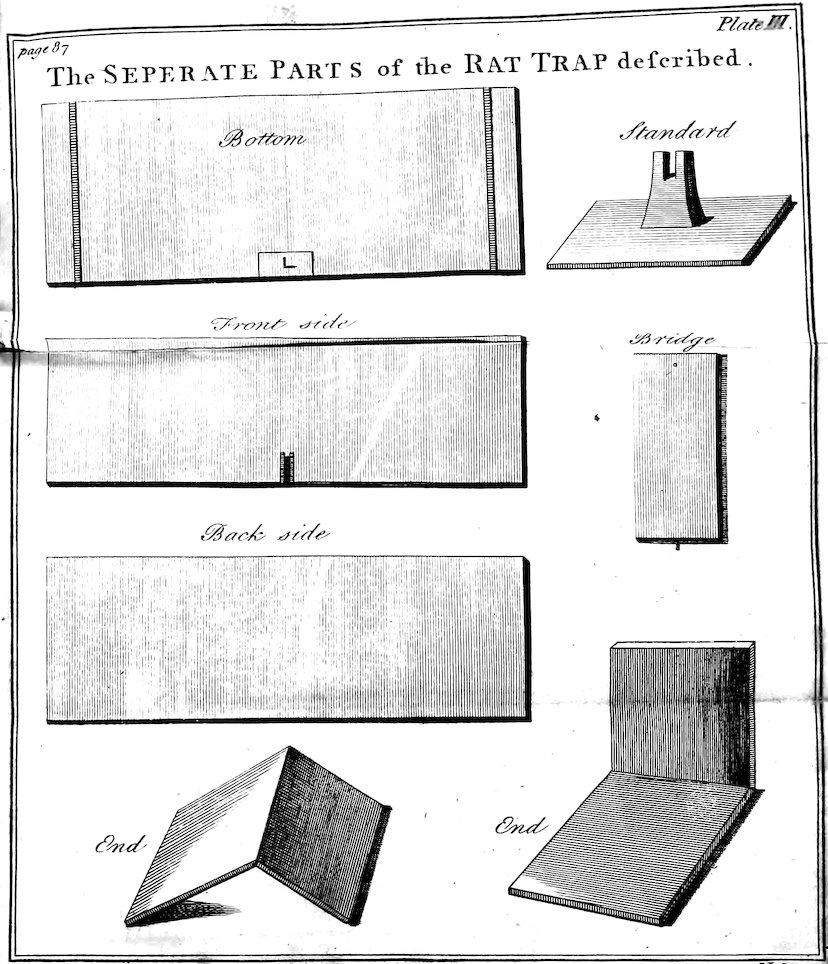
87I shall now give the reader a very minute
and exact description of the make and construction
of the trap, made use of in the
foregoing instances, which, with the print
annexed, will give him a full, perfect, and
adequate idea of the same; it is made in
the following manner: Take three boards
[pl. III.] two feet two inches long, let the
88two sides stand on the bottom, nine inches
high, by nine inches wide in the clear; then
take a thick bit of wood three inches wide,
and put it in the top of the trap in the
centre, for the upright centre E. [pl. IV.]
to go in; in the front of the trap, at the
bottom, cut a hole for the trigger, half an
inch wide, and three inches high, BB; line
the inside of the hole with some pieces of
tin about an inch wide, that they may not
deface the inside of the trap, for a Rat will
always gnaw and scratch wherever he sees
any light; then take two pieces of board to
go in even or level at each end, and under
these take two short pieces, six inches
high, to go in easy, nailing the top down
to these at each end, and then hanging the
top-pieces F F. within an inch of the end
nearest the centre, they will go up and down
together. In the centre, at the bottom of
the trap, against the back, take a piece of
wood, two inches long, and half an inch
thick, make a hole in the centre of it, then
89put a nail through without a head, fasten
it down to the bottom of the trap, and let
the nail stand up half an inch; in order to
hang the bridge on: then take a piece of
half inch board five inches wide, and seven
inches and a half long, make a hole at one
end, in the centre, and at the other end put
a strong bit of wire D, and let it come
through the trigger-hole B B, bent and
turned up at the extremity, a quarter of an
inch, that it may hitch or fasten to the trigger,
and over the trigger-hole about half an
inch, nail a little piece of wood C, about
two inches long, in order to stop the tiller,
to prevent its going into the trigger-hole;
let your standard E, at the top of the trap,
be five inches high, with a notch in the centre,
opposite the trigger-hole; let it be
half an inch wide, and two inches down;
then you must put a small nail at each end,
to both which tie a string and bring them
through the notch in the standard and tie
them both together; then cut one end off,
90and bringing the other end down tie it to
the trigger, which is the small piece of
wood tied to the end of the string, in order
to set the trap, which must be set up about
six or seven inches high, at each end. The
intent of having the under pieces but six
inches high, is, that you may be enabled
to take them out with the greater safety;
for when you place the small wire cage at
the end of the trap, then lift the end thereof
level or even with the small hole at the side
of the cage, and there will be sufficient room
for the Rat to go into the cage very
easily.
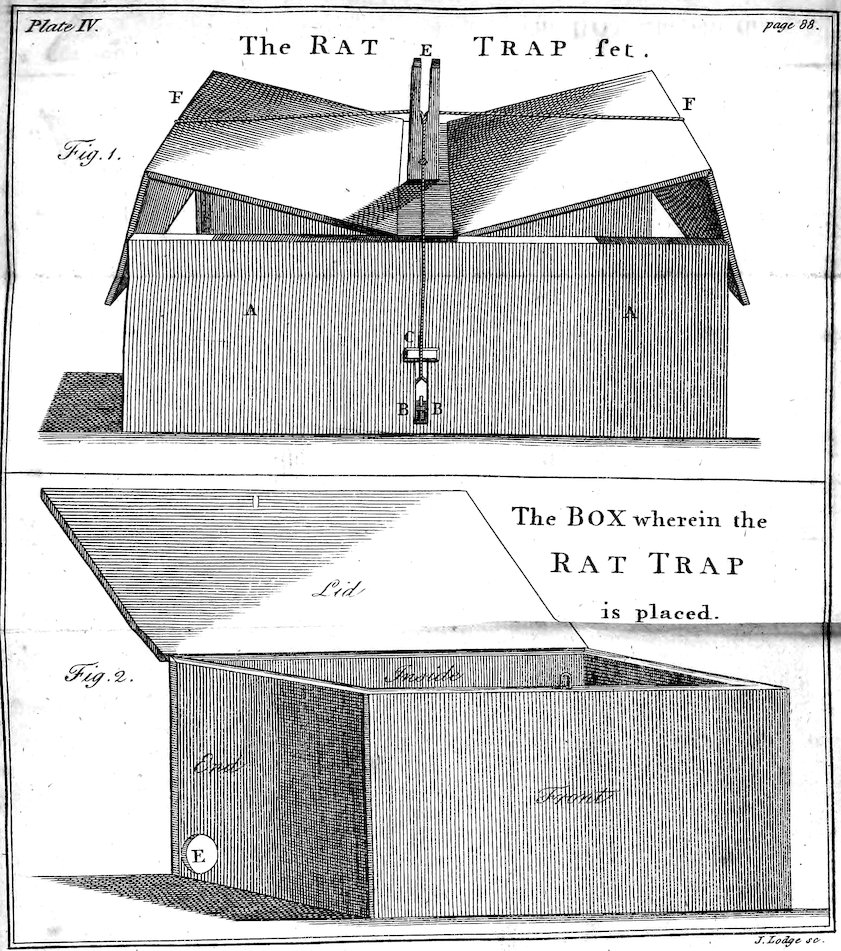
91Having described the trap, I now proceed
to another particular, which is, that
you must put it into a large box, in order
to keep other animals from eating the food
prepared for the Rat, and likewise to hinder
the dogs from coming to it; for sometimes,
when they find a trap where the Rats come
to feed, they will lie by it and baulk the
92Rats. This box, therefore, is a safeguard
or defence for them, for when any thing
disturbs them, they will run in at the holes,
at each end of the bottom of the box, to
save themselves, and when the ends of the
trap are sheltered, they will feed quietly; if
therefore your dogs should come and disturb
the traps, you must baulk them, and,
during your absence, mind to lock the boxes,
to keep any person from them, which has
always been my constant practice.
The box [pl. IV. fig. 2.] is made in this
manner: three feet long, a foot and a half
wide, and twenty inches high, with two
small holes E, one at each end, at the back,
close to the bottom of the box, about three
inches diameter, or square, as you like;
then the Rats can go in and out without
being disturbed, and no other animal can
take their food but themselves. Let the
inside traps have a pound weight of sheet-lead
nailed on at each end, which will
93make them strike quick, and keep the end
down, for I have known them to get out
of these traps for want of sufficient weight:
and for the more effectually preventing
them from getting their noses under the
end and lifting them up, take a small piece
of wood, an inch wide and three quarters of
an inch thick, and put it across, at the bottom,
in the inside, at each end, that the
end of the trap may strike down flush without
side. Let this piece of wood be lined
with tin, that they may not gnaw it away.
Let the traps be made of stout inch-fir,
which is the best wood you can make use
of; for that will never warp nor bend, as
other wood does; but any old packing box
will do for the outside. If they are not exactly
made as I have already prescribed,
they will answer the intent, yet if you are
obliged to make new ones, they may as
well be made according to the directions
before given; but if it is a quiet place
where you can lock the door, or in a barn,
94or the outside of a barn at a farm-house,
the following trap may be used with great
advantage and efficacy, which is the common
hutch or box trap, which however
must be sheltered, at each end, as before
directed. This trap the reader is referred
to [plate II. fig. 1.] and likewise to the description
of the same, in the account of the
wild cat, in page 49 of this work. And
here I beg leave to give a general caution
to the reader, which is, to follow the directions
laid down in the preceding pages, and
practise them by himself; for company will
baulk the sport, and when once the traps are
baulked, the blame will fall upon the author,
who is not in the least in fault; for he
will maintain and abide by every instruction
before given, to be exactly just and true.
Remember, likewise, that they are a very
subtle vermin, for if they in the least suspect
what you are about, you cannot catch them,
for I would not have you imagine that any
kind of vermin will ever enter a trap, knowing
95it to be one; on the contrary, you must
entice and encourage them by the means
before laid down, which will make them
bold, and enable you to catch them with
the greatest facility imaginable. Now when
you have set all your traps to work, you
will want to scent them, which must be
performed in this manner; take twenty
drops of the oil of rhodium, six or seven
grains of musk, half an ounce of the oil of
anniseed, put them in a small phial for use,
and before you set the traps, shake them
well together, then scent your traps as follows:
Take a small piece of paper twisted
up, dip it in the bottle, and rub each end
of the trap, and put two or three drops on
the bridge, and likewise the holes at each end
of the box; leave the paper in each trap,
and let every trap be served in this manner;
the reason of mixing these three ingredients
together is, that I have always tried it with
success, for in some places the rats love the
smell of rhodium, in others they like the
smell of musk, and again, in other places,
96they love the smell of anniseed; on this
account I mix them all together, that the
scent of either one or other of the above ingredients
may entice and allure them to the
trap. Another piece of instruction is necessary
to be given: when you first set your
traps to work, different means are to be
used according to the different places you
are catching at; if it is at a dog-kennel,
put some small pieces of boiled flesh about
in the trap, as well as the feed; if in a
slaughter-house, put some small bits of fat,
or small pieces of guts; if in a brewhouse
put some malt; if in a still-house put some
of the meal; if in a mill the same; if at a
barn, put in some corn as well as the feed,
and so likewise in all other instances. The
reason of this method of proceeding is, in
whatever places your traps are set, put
some of the same things in the trap as they
have been before used to; for then
they have not so great a notion of its being
a trap: you must not use any of the
97scenting in the feed, for there is nothing
they are so fond of in their food as the oil
of carraways.
Take a pound of good flour, three ounces
of treacle, and six drops of the oil of carraways,
put them all into a bowl, and rub
them well together, till it looks all alike;
be sure to mix it well; then put a pound of
the crumb of bread to it; for they like the
bread mixt with their feed better than the
feed alone, it being too luscious, for which
reason they do not like it so well by itself;
but that night on which you catch, put
no bread to it, lest they should carry it
away.
There is a necessity for your having two
wire cages, one small, [pl. II. fig. 2.] used
98in going round your traps, in order to take
the vermin out to put them into the larger
one, made in the manner following:
The small wire cage must be thus constructed;
let it be nine inches in length by
nine wide, four inches and a half high,
with a fall in it at one end and a door
at the other, the first to let them in
at, and the other to let them out into
the great cage, which must be made as follows:
Let it be twenty inches long, nine
inches wide, and eight inches high, with a
fall at one end, to let them in from the
small cage, and a door on the top to take
them out at; now when you are catching,
set your great cage out of the way, at some
distance, that the other Rats may not hear
them squeak, for that will baulk your sport
and occasion them to run away. In the
morning, if you do not choose to drown
them, perhaps you will want to hunt those
you have taken, and know not how to take
them out at the top of the great cage; but
99this may be done very easily; for if you do
not hurt them they will not bite you; for
by standing together in the trap all night
they are cowed, and have not the least notion
of biting, unless you should happen to
squeeze them too hard; but you may take
them out one by one, with your hand, very
safely. Now this matter is a secret, for we
always inculcate the notion that they will
bite you terribly, unless you rub your hands
with some kind of ingredient or other. I
was once of that opinion myself, but am
now better convinced; indeed when there
are but four or five left behind in the trap,
they are apt to be very violent and outrageous,
you may then shake them out to
your dog. There is a wide difference in
the temper and disposition of these animals;
for some are so savage and untamed, that
they will set up their backs, looking very
fiercely and crying out, if you do but look
at them; but when you meet with one of
this kind, shake him well in the cage, together
with the rest, and observe when he
100has put his head among the others, and
take him out by his tale and he will not
bite you; but observe when you have first
catched them do not go to handle them directly,
for then they are so mad and furious
that they will bite any thing.
I shall here give the reader another maxim
I have often followed very successfully;
if you find the holes quiet and no rats to
use them, it will then be incumbent on you
to stop them up in this manner, to prevent
others from entering therein: Take a pint
of common tar, half an ounce of pearl-ashes,
an ounce of oil of vitriol, and a good
handful of common salt, mix them all well
together in any old deep pan; get some
pieces of paper, and put some of the above
mixture very thick on the paper, and place
enough of this into the holes to stop them,
and then let the bricklayer make good after
you; and if you should find any of the holes
opened again, it is certain you had not put
in a sufficient quantity, then put in some
101more, and, if it is done as it ought, they
will never approach there any more, while
either smell or taste remains in it; now by
stopping the holes in the shores in town,
where they come up, with the above mixture,
I have kept a gentleman’s house entirely
clear, and never have caught one single
Rat.
Now sometimes they will get in behind
the wainscot and in the ceiling, in town,
and not come out into the house, but remain
there, and become very troublesome,
and this is a very bad case: in order therefore
to make them forsake these places,
find out a small hole or crack, then take a
handful of common salt, and put it in at
the hole or crack, and pour upon the salt a
spoonful or two of oil of vitriol, and this
will make such a fumigation or smoke, that
they cannot bear it, then stop the hole or
crevice again, that the smoke may not come
out, do this in two or three places, as near
where you hear them as you can, and it
102will cause them to forsake those places.
This method is very safe, as no damage
can possibly ensue to the wainscot from the
smoke.
I shall now point out a method to kill
them, where you cannot set a trap for them:
Take a quart of the same food, before
made use of in taking them in traps, then
rasp three figs of nux vomica, add to these
a quarter of a pound of crumb of bread, mix
them all well together, and this will be their
certain bane; but first give them some without
the nux vomica figs, for two or three
succeeding nights, and when they find it
agrees with them, they will then eat that
mixed with the fig, with great freedom and
greediness.
I am not much a friend to poisoning Rats
in houses, except in cases of necessity, but
if it must be done, I would by no means
recommend the use of arsenic, or corrosive
sublimate, which is too often practised, for
then they creep into holes about the house,
get between the ceilings, and other places,
and there die, and occasion a very disagreeable
smell; for as soon as they have taken
enough of it, it is like a spark of fire in
their bowels, and brings on an insatiate
thirst, and they are restless and uneasy till
they get at something to drink, either water,
milk, or beer, and then they die immediately;
from this circumstance it is evident
what dangerous consequences may arise, if
any person should drink any of the milk or
beer, where these vermin, thus poisoned,
have been slavering and drinking; but
sometimes it is a difficult matter to make
them swallow enough to kill them, for the
moment they taste the sharp acid contained
therein, it corrodes the mouth and loosens
the teeth, and then they will eat no more of
it, whereas the mixture of the nux vomica,
before recommended, is quite different, and
if even tasted by any person, no such fatal
effects can happen, for there is nothing but
a little bitter taste that is disagreeable; and
they will take a sufficient quantity to kill
them before they know it, and then they
cannot get rid of it, for it throws them into
fits, puts them to the greatest agony, and
they die soon after; and in order to be more
certain of its effects, I have kept them in
a cage, and gave it them to try the experiment.
I conclude my account of the Rat with
the few following particulars, which I flatter
myself will prove useful; they are often
very troublesome in coming up the shores,
more especially in still-houses and brewhouses;
now in the above instances, or in
any other shores, where you cannot conveniently
set a trap, I have practised the subsequent
scheme with great success, which
although it does not destroy them, will infallibly
drive them away: When you have
catched some Rats and killed them, take
some white arsenic, finely powdered, put
it into an old pepper-box, and shake a quantity
of it on the fore parts of the dead Rats,
and put them down the holes or avenues by
the sides of the shores, where they come in
at, which will put a stop to their coming
any farther; for when they once perceive
the arsenic, they will retire immediately,
whereas if you was to put them down without
the arsenic, the living Rats would eat
the dead ones; I have seen one Rat kill
another, when put into the large cage, and
afterwards eat him; and once had an old
she Rat, big with young, which she brought
forth in the cage, and immediately eat
them; for there is no kind of vermin whatever
so savage as a Norway Rat; again, when
you find they have taken to a rick of any
sort of corn or hay, take some dead Rats,
put some arsenic over them, as before observed,
then place one in each hole they
have made in the thatch, and it will make
them all forsake the rick; in like manner
you may stop some of these Rats, served as
before, under the barn-floor, where the Rats
use, and it will prevent others from taking
shelter or harbouring under them; these vermin
are likewise very fond of lying under
the calve-pens, where they keep snug and
warm; use the above method and it will
drive them away; and also in any of their
burrows, if you can put the dead Rats, prepared
as above, so safe that nothing can easily
get at them, and by observing these
rules, you will obtain the desired effect.
THE BLACK RAT.
107
This animal is the old genuine English
House-Rat, no other being
known in and about houses, for many ages,
in this country, and differs in many particulars
from the Norway Rat, last described, for
they do not burrow and run into shores as
the others do, but chiefly lie in the cielings
and wainscots in houses, and in out-houses
they lie under the ridge-tiles and behind
the rafters, and run along the side-plates;
but their numbers are greatly diminished to
what they were formerly, not many of them
being now left, for the Norway Rats always
drive them out, and kill them wherever
they can come at them; as a proof of which
108I was once exercising my employment at a
gentleman’s house, and when the night
came that I appointed to catch, I set all my
traps going as usual, and in the lower part
of the house, in the cellars, I caught the
Norway Rats, but in the upper part of the
house I took nothing but the black Rats;
I then put them together into the great
cage, to keep them alive till the morning,
that the gentleman might see them, when
the Norway Rats killed the black ones immediately,
and devoured them in my presence.
These vermin are not near so bold, nor
will feed so freely as the Norway Rat, and
when you are troubled with any of them
you must observe where they use, which you
may do very easily, for if you go into any
place and look up at the side-plates, you
will perceive they will be quite black where
they run along them, and likewise along
the cross beams; on these cross beams place
one of the traps you set for the Norway
109Rats, and put some of the same feed in them,
but mix more bread in it than you did for
the Norway Rat, and scent the trap in the
same manner, and put some corn in of any
sort: set a trap at each place where they
use, and set them all to feed, as you do the
others for the Norway Rat; and when you
perceive that they come to feed boldly, then
take them; but this must be done in the night,
for they do not move by day-light, as the
other rats will. By this method I catch them
alive, but I have likewise taken them on the
side-plates and beams, where they run, in
wires and in snares, so that they swing off the
beams; they are not near so savage as the
Norway Rats, for they seldom kill any chickens
or any thing of that kind, unless extremely
hungry and sharp set indeed, but they are
sly thieves for cheese, bacon, or any kind of
eatables they can get at and pilfer.
THE MOLE.
117
This animal is in some places, but
chiefly in the North of England,
called a Want, and, contrary to most other
vermin, lives chiefly under ground; its
skin is of a fine black jet colour, very
smooth and soft, and has short legs, with
which they, with incredible swiftness, will
dig themselves into the earth when they apprehend
any danger; they are supposed by
some people to be entirely blind, it being
in many places proverbial to say as blind as
a mole, but this is a mistake, for they have
eyes as well as other vermin, but very
small, appearing scarcely larger than the
head of a common pin, but sufficient to
118serve their purposes, their residence being,
as was before observed, generally under the
earth.
These animals do great mischief in gardens
and grounds, and if you find they
come observe the outsides, for their angle,
or run; or, if there is a path in a field, it is
very probable but they have a run across
the path, or at a gate-way, they will frequently
have one; these are what we call
the main runs, and about two or three
inches under the earth, and may very easily
be found by the heaving up of the mould
or earth, along which they will run ten times
in a day. When you have discovered one of
these runs, you must tread in the earth
tight, and when you come that way again,
see whether it is as you left it, and if you
perceive the Mole has been along, then set
a trap, by which means I have caught several
of them in an afternoon; these being
their main roads out of one part of the
ground to the other, for it will be of little
119signification to set a trap in any other angles
or runs, and if you should, it may possibly
remain a great while before a Mole
comes; for in the spring, when they run
near the surface of the earth, they make a
great many different angles in search of the
worms, on which and chaffers their chief
food consists.
Now if they make hills in your fields or
gardens, take notice of the places before mentioned,
and set a trap in the following
manner: Take a piece of board half an
inch thick, four inches and a half long, by
two and a half wide, then put a small hoop
or bow at each end, with just room for the
Mole to go through; then in the centre, at
each side, put two small pegs, in order to
keep them in the trap; for sometimes one
that is shy, when he finds the peg before him
that springs the trap, will turn out at the
side and spring the trap, and not be taken:
it is necessary therefore to use these small
pegs, which will keep them in the straight
120road, placed as before directed. In the
next place, get two strong horse-hairs, or
pieces of small wire, then in the centre or
middle of the bow, at each end, make a hole
to put the hair or wire through double, then
open the hair or wire just to fit, and lie close
inside of the bow, like a noose, get some
fine mould, make it moist like paste, and
work some of it with your finger and thumb
all round in the inside of the bow, so that
the horse-hair or wire may not be perceivable.
Through the hole in the centre of
the trap let a short bit of string come. Put
a forked peg tight in the hole, that may
keep the string from slipping through, till
the Mole, by going through, pushes it out;
then the string slips up. When you have thus
prepared the trap, then open one of the runs,
exactly the length of the trap, and put it
down in the run quite level, and make it all
smooth, that there may be no light discovered.
Then take three good strong hooked
pegs, two on one side, and one on the other,
and stick them down tight, then take a
121stiff stick, about four feet long, stick one
end in the ground tight, bring the other
end down to the trap and hitch in a loop,
that comes from the hair or wire, and then
it is set, and when the Mole comes he pushes
out this little peg, then the string draws
out, the bow-string flies up, and the Mole
is caught; in the spring time, when you
catch a she Mole, rub her back part
about the bows and the inside of the trap,
by which method I have caught eight he
Moles successively; observe, when you have
caught all that you perceive to move, you
need only look round the outside of your
fields, and keep some traps constantly going
there, and they will lay hold of them as they
come in and out; another expedient you
may make use of, by putting some dead
Moles in the runs where they come, which
will prevent their coming, and keep your
ground quiet and free from these trouble-vermin.
THE RED SHREW-MOUSE.
127
This species of the Mouse-kind has a
nose like a mole, and is in general a
very harmless, inoffensive little animal, in
regard to its preying on any thing: it is
much smaller than the house-mouse. The
chief mischief done by these vermin is, that
in harvest-time they will come home with
the corn, remain there and breed. I have
known great numbers taken out of a rick;
and I once remember half a bushel of these
and other Mice caught at one time out of a
rick or stand, which is often owing to the
farmer’s own negligence and inattention;
for you may often see a rick-stand made a
nursery, occasioned by putting under it harrows,
128ploughs, hurdles and props: what
avails it then to have a stand to fill the ricks
in this manner, and assist the vermin up?
You cannot indeed prevent their coming
home with the corn, or when rats hop up
and down the stand, which they do very easily:
the best method, therefore, would be to
nail some tin to the props, which would
keep the Mice from getting up them; and
when once you find they have got to a corn-rick,
the best way is to take it in as soon as
you can, for these Mice, in one particular,
are worse than the rats among the corn, and
do a great deal more mischief; for this reason,
that they will live a great while without
water, only by licking the ends of the
straws, while any moisture remains therein,
and all the while they remain in the ricks
they do infinite prejudice. If it is not convenient
to remove the rick, observe the following
method; take a quarter of a pound
of the best nux vomica, put it into an old
saucepan, with three quarts of water, boil
it till it comes to two quarts, and put two
129pounds of treacle to it, in order to overcome
the bitter taste of the nux vomica;
then take some small earthen pans, into
which pour some of this mixture, and set
the pans in different places under the eaves
of the ricks; the Mice being in want of
water, will greedily drink of the mixture,
which will kill them; and this method you
must continue till they are destroyed.
Before I conclude this account, I cannot
help taking notice of a gross blunder, which
a certain writer has made in his description
of this little vermin, who asserts that it is as
large as a rat, of the colour of a weasel, and
very mischievous to cattle, and that it will
get upon a beast’s back, and make it lame
in the chine; and in consequence of the
bite, the beast will swell to the heart and
die; all which particulars are entirely erroneous;
for its size is less than that of the
common house-mouse, its colour like the
squirrel; and as to the miraculous affair of
its killing any beast or cattle, it is of a piece
130with the rest. On the contrary, I am convinced
from long observation, that it feeds
on roots, vegetables, and corn, and will not
touch flesh on any account.
THE BROWN WOOD-OWL.
163
Few persons perhaps imagine this to
be a pernicious animal, yet in my opinion,
it is the very worst winged vermin
that exists; they seize their prey with great
fierceness, and break it up exactly as the cat
does, by beginning at the fore part. It is
very happy for the farmer, and others who
keep poultry, that the ducks and chickens
are gone to roost before the Owl comes to
prey in the night, otherwise there would be
few, if any of them left; however I now
proceed to make good my assertion, and describe
164the infinite mischief done by this sort
of Owls. When the evening approaches,
many animals such as leverets, young rabbits,
young pheasants, young partridges,
who had lain quiet in the day-time, come
out to feed in the stillness and silence of the
evening, when there is nothing else to disturb
them, the Owl then comes, when they
are exposed, and takes away what he pleases,
and if they happen to have young ones at
the same time, it is impossible to conceive
what numbers will be taken away in a
night’s time to satisfy his voracious appetite;
and this I can affirm from my own observation,
as I used to make it my frequent practice
to go out and hunt the Owls all round
the outsides of the warren. The method
was this, two of us used to go with a gun,
one on one side of the hedge, and the other
on the other side; a third person accompanying
us with a long pole or stick, who
therewith beat the hollow and ivy trees,
when the Owls would fly out, and we have
shot sometimes a dozen in a morning. But
165one morning particularly I found an Owl’s
nest, and shot the hen; and, on examining
the nest, I found two young ones, with several
pieces of young rabbits, leverets, &c.
therein, but we could not meet with the
old cock; on which I took out one of the
young ones, leaving the other in order to
entice him home to the nest again; the next
morning I repaired to the place, when he
flew out, and I shot him dead, and took
away the other young one which had been
left behind. But, what is remarkable,
the old Owl had carried no less than three
young rabbits to the single young one remaining,
in one night’s time, which is an
evident proof what havoc they make among
the game. Another particular of these vermin
deserves mentioning, which is, that they
seldom eat more than the fore-quarters of
any animal they kill, as the cat does, and
always leaves the hind quarters untouched,
which are found in the nest. I have likewise
caught them in moon-light evenings
in steel traps, baited with a rabbit-skin stuffed,
166and have often killed many of them
with a gun, by keeping close under the
hedge, and imitating the squeaking of a
mouse, when the Owl has come directly to
the place, and I have shot him dead on the
spot.
THE RAVEN.
173
This is the largest bird that feeds
on carrion, and is of a fine shining
colour; in some places it is very serviceable,
in eating up the stinking flesh or carcases
of dead beasts and other carrion, but
in many other places very mischievous, and
does a great deal of harm. I having been
allowed as much per head for killing them
as I had for kites and hawks, as they are
equally pernicious in killing and devouring
young rabbits, ducklings and chickens.
I know of no better way to catch them,
where they become troublesome, than to set
two traps for them, in the same manner as
174you do for the buzzard, [see plate VI. fig. 1.]
and put a rat between them for a bait, but
when you have taken one or two, you must
move your traps to another place, or the
others will prove too shy to be caught; for
as soon as one is taken, great numbers will
keep round him, and seeing him fast, will
grow suspicious of some danger, and not
come near the place any more; but by observing
the above method, in moving the
traps, I have caught great numbers of them
in a day, though it is attended with some
labour and trouble.
I have often caught the London Ravens
near twenty miles from home, in warrens,
where they will sometimes come after the
young Rabbits; by the London Ravens I
mean those that generally frequent the outskirts
of the metropolis, and live upon the
filth lying there, grubbing up the dirt in
order to get at their food, from whence the
tops of their wings become of a nasty, dusky
brown colour, occasioned by their wallowing
in the dirt, by which means they are easily
distinguishable from the country Ravens,
which are as black as jet, according to the
old saying, As black as a Raven.
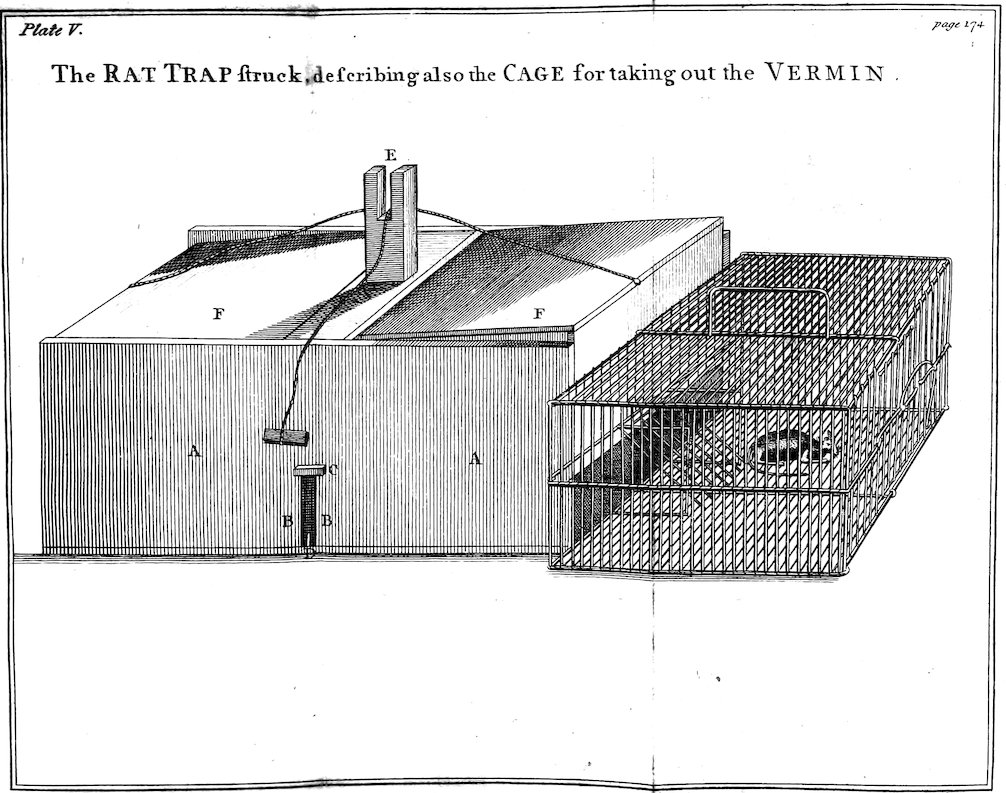
175I have seen some of these Ravens sit upon
a lamb, that has been dropped weak, not
being able to run, when they have got to
his head and picked out the creature’s eyes
while yet alive. Another remark I shall
make, which is to point out the difference
between the manner of birds of the hawk kind
carrying their prey, and those of the
carrion kind. Now it is observable that
buzzards, kites, hawks and owls, constantly
carry their prey in their claws, whereas
Ravens, carrion-crows and magpies carry
their food in their beaks.
THE CARRION CROW.
177
This bird is well known, and in
country places will do prodigious
mischief, by destroying young rabbits, chickens
and ducks, and likewise in sucking eggs,
which the hens and ducks lay in the back
yards or in the hedges: these the Crows
will break and eat as greedily as any other
vermin whatever. Now if you find they
have any haunts about your house, get a
steel trap, of the same kind as you use for
other winged vermin; set it in the ground,
quite level with the surface, and cover it
178with moss; then take a little piece of bush
or some fern, stick some of it down, by one
jaw quite low, and bring it round to the
other jaw, [see plate VI. fig. 1.] put the
bait, whether it be an egg, or rat, a piece
of rabbit, or the guts of the same, or any
thing else of this sort, in the back part, on
the tail of the trap; and when you have put
the little fence, before described all around,
as a guide for him, he must of necessity go
over the trap for the bait, and be caught;
but I have been plagued with these as much
as I have been with the Ravens, by being
obliged to move the trap after every Crow
I had taken; but by observing when one is
caught, which you may easily hear, for they
then make a great noise and keep flying
round their imprisoned brother, almost
close to the ground, you may then probably
get a shoot, and kill some of them;
but sometimes I have known them so shy
that I could not get them to the trap at any
rate. In this case you must observe the
places where they most frequent, and take
a cat, or a ferret, and tie it to a stake;
then take a gun, and hide yourself, when
the first Crow that sees the cat or ferret will
make a terrible screaming noise, and bring
many more, who scream and hover about
till you have a fair shoot. In this manner
I have had, sometimes, three or four shoots
before they dispersed, and killed several of
them; for when they see any kind of animal
they are not used to, in the day-time,
it greatly attracts their attention, and they
wonder at it, as the small birds do at the
sight of an owl by day-light; and this is
the best way to get at the shy ones. I have
seen the Crows pick out the eyes of a weak
lamb, while alive, in the same manner as the
ravens will.