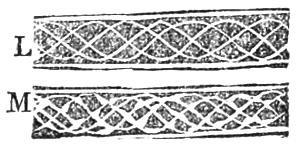
The “Geometric Lathe” is a very perfect and costly Engraving
Engine, which produces very fine and beautiful ornamental
patterns of geometric circles of such complication,
uniformity, and exquisite perfection, that it cannot possibly be
imitated in any manner. It engraves or turns the circular or
oval patterns on the dies, on which the figures representing the
denomination of the note are placed. A sketch of this engine
is quoted from “Nicholson’s Operative Mechanic.”
“One of the most important securities to the paper currency
of nearly the whole commercial world at the present time
arises from the invention of transferring engravings, and the
work produced by the Geometric Lathe, invented by Mr. Asa
Spencer, while a resident of New London, in the State of
Connecticut. The application of this Lathe-work for the security
of Bank Notes was first made by Messrs. Fairman,
Draper & Co., of Philadelphia, in 1816, and from its great
beauty and difficulty of imitation, Mr. Spencer was induced to
repair to England in 1819, for the purpose of securing the paper
currency of that country. As had been expected, this
work was put to the severest test which the combined talent
of its great metropolis could invent, and having passed this
trial in a very satisfactory manner, it was subsequently adopted
very generally by the Banks and Bankers of England and
Scotland.
“The Geometric Lathe differs materially from any other
turning engine hitherto invented. The only one which has
any similarity in the work produced, is the “Rose Engine;”
but that is only capable of copying patterns previously made
upon guides, while the Geometric Lathe forms its own patterns,
which are all originals, and as various and unlimited as
the ‘Kaleidoscope.’…
“The impossibility of successfully imitating this work by any
process of hand-work within the reach of the whole combined
talent of counterfeiters will not be doubted when the severe
test to which it has been submitted is recollected: and even
supposing any combination of counterfeiters to be in possession
of the different machines and appendages necessary to effect
their object, they would soon find that the time which would
be required to learn the use of these implements in secret,
could be more profitably employed in any honest occupation.”
The patterns produced by the Geometric Lathe are concentric,
eccentric, or geometric circles, radiating from a common
centre, and beautifully interwoven into each other, forming a
perfectly regular and uniform ‘fancy’ pattern, so exactly true
and uniform in its radiations, that there never is the slightest
possible irregularity or imperfection. It is because the patterns
are of such exquisite beauty and perfection, and at the
same time extremely fine and complicated, that it is utterly
impossible to imitate it by hand or by any process whatever.
The Geometric Lathe does not engrave the patterns immediately
upon the plate itself, but the patterns are transferred to
the plate from roller dies or cylinders, generally in two places,
as a majority of bills contain two dies alike, sometimes four,
one in each corner. Being single-transferred the patterns are
reversed, and are then white circles or lines upon a black ground.
Of course whenever there are two or four dies that pretend to
be alike in a genuine bill, they will all be exactly alike, being
all transferred from the same one die. See the two transfers
of the die in the steel plate containing the ‘3.’ In imitations
of Lathe-work in counterfeit bills there will be a failure in
two ways: first, in imitating regularity of the pattern, which
is attempted to be done by hand, and also it is cut directly on
the plate instead of transferring, so that what in the genuine
is black spaces, is engraved black in the counterfeits, leaving
white spaces and black dots, resembling cobble-stones—the
white spaces between which made to resemble white lines,
while it can easily be seen that it is only irregular black dots
and scratches instead of white lines or geometric circles. Secondly,
a failure in getting two dies exactly alike in the same
bill—that is, where they pretend to be alike. If done by hand
there cannot be two fine and complicated patterns made exactly
alike; but in the genuine, where the pattern on one die or cylinder
is rolled or transferred in two or more places, they will
all of course be exactly alike. This same work is to be seen
on the backs of watches, called “Engine Turning.”
A B
Magnified 5 to 10 times.
C D
Magnified 10 to 20 times.
E F
Magnified 5 to 10 times.
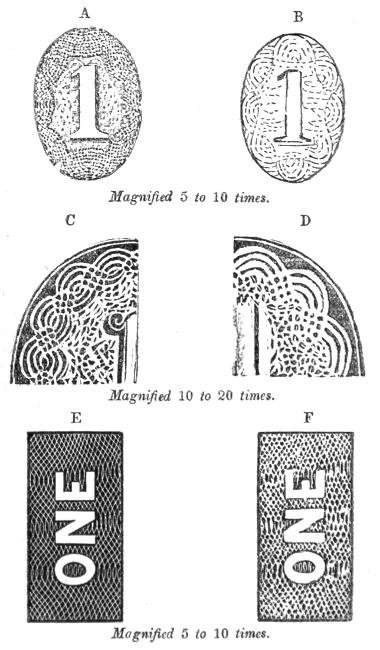
Diagrams A, B, C, and D, represent the appearance of various
IMITATIONS of Geometric Lathe-work when magnified
with a powerful glass. There is generally a studied effort to
represent white intersecting curved lines or Geometric Circles
on a black ground; in fact trying to imitate Transferring;
but there will always be found, as in the above diagrams,
nothing but confused black dots and semi-circular scratches,
arranged so as to give it the same “general appearance” as the
genuine, when held a little distance off. Sometimes there is
no effort made to imitate the white lines, and there will be seen
nothing but confused black dots and irregular black curved
lines, mixed up together. Diagram E represents a magnified
oblong-die, of alternating waved ruling, or eccentric parallels
transferred. See the two dies containing the figure “20” in
the steel plate illustration. This work is done by the Ruling
Engine, and not by the Geometric Lathe; but as the work is
very similar, and imitations of it fail in exactly the same manner,
it is classed under the same rule. Diagram F is a representation
of a magnified counterfeit or imitation of this work
by hand; confused black dots on a white ground, instead of
true interwoven white lines of the genuine on a black ground.
The Ruling Engine is used for shading the letters, skies,
&c. in genuine Bank notes. Underneath, and sometimes on
the lace of the letters in the title or name of the Bank, as
well as other lettering, there appears a soft, smooth, pale grayish
color, which to the naked eye appears to be painted with a
brush, but on close examination it proves to be fine parallel
lines, and when done by the Ruling Engine the lines are, 1st,
all exactly of the same size; 2d, regular distances apart; 3d,
perfectly parallel to each other; 4th, uniformity in their direction:
and it is perfection in these four points which gives it
such a smooth and perfect appearance, and the least deviation
from which will prove it to be hand-work. In counterfeits
this shading is imitated by hand, and it is impossible to do it
in this way as perfect as the Ruling Engine, as some lines will
be coarser than others, some wider apart than others, not parallel,
and some not perfectly straight, and all are apt to be
more or less tapered off when done by hand with the graver,
which is not the case with the genuine, and which gives the
whole a scratchy appearance; in fact, the least deviation in
any of the points will show at once, and destroy the appearance
of the whole. In titles, or the name of a bank, where
the letters are alike, as for instance,

the shading in the genuine always is done all the way across all
at once, and there is a perfect uniformity from beginning to end;
the lines all point exactly in the same direction, whether horizontal
or diagonal, on the “T” in “THE” as on “F” in “OF,”
preserving the same angle and fineness throughout. In counterfeits,
where the letters are shaded by hand, one letter at a time, if
the lines pretend to be horizontal, some are apt to slant a little
downwards or upwards, some letters shaded a little finer than
others—that is where they are intended to be alike and uniform.
This principle of Uniformity in shading is very important,
and should always be noticed. See the words “Universal,”
“Detector,” “Banks,” and “United States,”
in the steel plate, which are shaded by the Ruling Engine,
while the word “Counterfeit” is shaded by hand to illustrate
counterfeit work.
The sky in vignettes in the genuine is sometimes ruled by
the Ruling Engine, and always appears soft, smooth, and perfectly
done, and in this case the lines taper off gradually.
Imitations of this by hand will appear uneven and scratchy,
some lines coarser than others, and some wider apart than
others. All genuine skies, however, are not done by the Ruling
Engine, but are sometimes fine dots or wavy lines, which
fade off into fine dots, and sometimes heavy rolling clouds, circular
lines, but it is always done perfectly and beautifully, and
looks smooth and natural, being always done in genuine bills
by first class artists, while the sky in counterfeits is generally
apt to appear coarse and scratchy, and not fading off gradually
enough.
G H
Magnified 5 to 10 times.
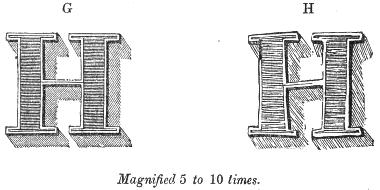
Diagram G serves to represent the style of genuine Ruling
Engine work as it appears when magnified 5 to 10 times, and
H an imitation of Ruling Engine shading as done by hand and
magnified the same. A first-class Ruling Engine is said to cost
$3000.
The Medallions are raised patterns, or line-engravings, generally
representing a head, or some raised fancy patterns in genuine
Bank Notes, which look as if raised up from the paper.
They are called medallions because they are copied always
from and represent the pattern upon a medal. It is done by
the Pentograph Ruling Engine, which, guided by the medal,
rules the whole pattern in full length lines, and the dies are
double transferred to the plate, which makes the lines black,
the same in appearance as if the pattern was ruled directly
upon the plate itself by the engine. This work is done upon
the same principle in mechanics of “guides,” as shoe-lasts are
turned by the “Last turning machine.” A model last is used
for a guide to the machine, which turns out of a rough-hewn
block of wood a last exactly like the model. Thus in genuine
medallion ruling there is always a medal or coin used for a
“guide.” The points in determining genuine medallions from
imitations engraved by hand, are, the lines in the genuine all run
in one general direction; they are always full length lines
across the whole pattern, the lines are all exactly the same size
or caliber, they never cross each other. Every undulation in the
pattern on the guide or medal is copied with the most unerring
exactness, and articulated distinctly and beautifully correct,
which is impossible to be done so perfectly by hand. In the
counterfeit the lines are apt to break off in the midst of the
pattern; some lines are apt to be coarser than others, which
gives it a scratchy appearance. In the genuine, the lines
crowd together in the parts of the pattern that appear depressed
or sunken, and spread apart more where the pattern
appears raised and looks whiter, producing the lights and shades
with the most magnificent ease and effect. In the counterfeit
done by hand the lines do not crowd and spread apart again,
according to the pattern, with such ease and effect, but the
patterns appear stiff, flat, or imperfectly raised. There is always
one of two ways or alternatives in which the hand-work
imitations appear to fail. If they succeed in making the lines
full length, as they ought to be, then the pattern will inevitably
appear flat in expression, imperfectly raised; but if they
succeed in making the pattern look raised, as it ought to be,
then there will inevitably be broken or forked lines all through
the midst of the pattern. It seems impossible to combine in
hand-work imitations of this extremely fine and complicated
work full length lines, and at the same time a perfectly finished
and raised pattern, which the Pentograph Ruling Engine always
does in the highest perfection.
I J
Magnified 5 to 10 times.
K
Magnified 10 to 15 times.
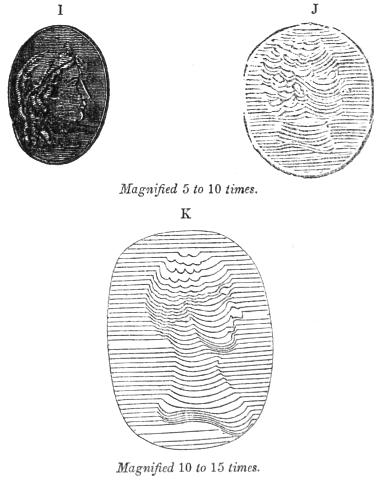
Diagrams I and J represent the appearance of counterfeit
Medallions when magnified. K represents the appearance of
a genuine Medallion as magnified 10 to 15 times. Every line
is full length, and exactly of the same size. In J the lines break
off and fork together all through the midst of the pattern, and
some lines a little coarser than others, which gives it a scratchy
appearance.
Whenever there are two or more medallions in a genuine
bill that pretend to be alike, they are always exactly alike;
being double-transferred from the same original die; (see medallion
heads marked ‘3’ in the steel plate,) but two medallions
cannot be made exactly alike separately by hand. The following
extract in relation to this work is quoted from the
Mechanic’s Magazine, 1835: “The Journal of the Franklin
Institute for September contains an elegant engraved portrait
of Wm. Congreve, the dramatist, executed by Wm. A. Spencer
of Philadelphia, in the manner described, and has inserted the
following proofs that the invention can be claimed for America.
‘Believing that the credit of the invention of a machine
for medal ruling is due to America, we will briefly set forth
our proofs, and then speak of the improvements which of late
years the method has undergone. The proofs to be given of
the existence and state of the machine are to be derived from
the results produced by it. In 1817, by the use of a machine
which had been invented in Philadelphia, Christian Gobrecht,
die-sinker, produced an engraving upon copper, from a medal
having upon it the head of Alexander of Russia. From this
engraving impressions were taken and distributed. One of
these impressions we have seen. In 1819, Asa Spencer, now
of the firm of Draper, Underwood & Co. bank-note engravers,
took with him to London a machine of the kind above alluded
to, which was designed principally for straight and waved-line
ruling. This machine was used in London during the
year just mentioned, and the mode of ruling waved lines, and
of copying medals, was then exhibited and explained by Mr.
Spencer to several artists—particularly Mr. Terrell, who took
by permission a drawing of the machine, for the purpose of
having one made for his own use. Little however was done
in the way of medal ruling until about three years since, (1832,)
when a desire to apply the method to the engraving of designs
for bank notes caused it to be revived by Mr. Spencer, who
bestowed great attention upon it, and overcame the difficulties
met with in the onset.’—The peculiar construction of this machine
has never been made a secret, nor has it ever been patented,
although prudential motives have required that it should
not be minutely described, and thus be placed in the hands of
those by whom its use might be perverted. The operations
performed by this machine are the ruling of parallel straight
lines at any required distances apart, either continuous or
broken; ruling converging straight lines; ruling waved lines,
the waves being either similar, varying by more or less imperceptible
gradations; and medal ruling or transferring to copper
the fac-simile of a medal without injuring its surface, the
waved lines presenting a copy of the minutest parts of the
medal.”
Rule IV. relates to the Vignettes, to notice whether they
appear to come up to the usual standard of perfection in the
following points: the faces, eyes, stippling, hair, drapery, limbs,
scenery, landscapes, water and agricultural scenes, &c. This
work is always done by hand, both in the genuine and counterfeit;
but in the genuine it is done by first-class artists; men
who are at the head of their profession, and who can always
get such a complete remuneration for their labor that there
cannot possibly be any temptation for them to counterfeit. It
is only second, third, fourth, and sometimes hundredth-rate artists
that counterfeit:—runaway apprentices and cast-off journeymen,
and possibly amateurs. The points to observe are
first, the human face, stippling, and the eyes. This is the most
difficult of any part of the Vignette to execute well, and fails
in counterfeits, more than any other part of the 4th Rule. In
the genuine, the eyes have a perfectly natural expression, while
in counterfeits they are, generally, merely two clumsy dots.
The stippling is the beautiful artistic arrangement of the fine
dots which produce the shading—the smooth, even, soft rounding
of the features, the cheeks, nose, lips, chin, and limbs; this
fails invariably in counterfeits—the features, and generally the
limbs also, appearing flat, scratchy, inexpressive, and inanimate.
The human hair in the genuine will look soft, silky,
and natural; displaying a lustre in portions where the light
appears to strike it. In counterfeits the hair generally appears
stiff, coarse, wiry, lifeless, and unnatural. The drapery in the
genuine beautifully represents the folds and texture of different
kinds of cloth; sometimes the dark, heavy and glossy appearance
of broadcloth is produced; sometimes the light, flowing
appearance of silk or muslin—the folds always look easy and
flowing—no stiffness. In counterfeits the drapery generally
appears scratchy and stiff, sometimes having the solid appearance
of cast iron, and sometimes like coarse wire-cloth, inexplicably
twisted up in a snarl in trying to imitate the easy and
natural folds of the genuine. The limbs, hands, or feet are
always well done in the genuine, but generally fail in counterfeits.
It is a very difficult matter to execute well, and it requires
a first-rate artist to produce an elegant-shaped hand or
foot and in an easy position. To engrave human figures correctly
it is first necessary for the artist to acquire a thorough
knowledge of Anatomy. Smoke in the genuine is always well
done—generally in fine curved lines, and sometimes in straight
parallels, fading off gradually at the edges. In counterfeits the
smoke gradually appears coarse and scratchy. Also notice
whether the “perspective” is managed rightly: the lights and
shades, and the forms of animals, horses, cows, &c. &c. whether
truthfully portrayed. Vignettes are transferred to the plates
from double transferred cylinder dies.
“Chambers’s Information for the People” says:—
“Engraving, in all its various branches, is a species of labor
which probably requires greater remuneration than any other
department of art—for not only must there be a great degree
of patience and perseverance beyond what is required in most
other employments, especially in undertaking the engraving of
a genuine bank-note plate, which must be perfect in all its
parts, showing the lights and shades true to life—one part corresponding
with another as though nature herself had formed
the impression. Such of course is the intention of the artist,
who must be a finished workman before he can receive employment
in this capacity; the perfection of the execution being of
course the only great difficulty to overcome. This will be
seen from the fact that in all cases from ten to fifteen artists are
employed upon one bank note plate, and as this employment
necessarily calls into its service the very best talent that can be
secured, it follows as a matter of fact that we are perfectly safe
in looking to the perfection of a note for the genuineness of the
bill. Each artist has a separate part to execute; and as the
whole plate is made of different parts, called “dies” or “cuts,”
it is therefore evident that no band of counterfeiters can accomplish
their designs—it being impossible.”
[See the Vignette marked “4” in the steel plate; also the
portrait of Washington.]
Rule V. relates to the perfection of lettering. In the genuine
the lettering is done by a first-class artist, whose particular
branch it is to devote exclusively to that part of the work
alone, and of course he arrives at a degree of perfection that
could not be approached without such a sub-division of labor.
In the genuine the letters are all exactly of the same size,
where they pretend to be, and on the same angle and same size
stroke, where they pretend to be. There are two great points
to observe as regards lettering, viz. neatness in form, and uniformity—the
most important is UNIFORMITY. The want of
uniformity in size, slant, distances apart, thickness of stroke,
and any deviation from the line of the letters of a title, or the
name of a bank for instance, will show counterfeit work.
See the lettering in the word Counterfeit in the steel-plate
illustration compared with the lettering of the “Universal
Detector,” “United States,” &c. The engraved writing
in the genuine, “Promise to pay on demand,” &c. is always
beautifully done, the down strokes uniform in size and slant,
and the hair strokes extremely fine, the curves easy and flowing,
while in counterfeits the down strokes are apt to point in
different angles, and the hair strokes coarse, and the curves
stiff and defective. But perhaps the most important part of
the 5th Rule, as it fails invariably, without exception, in all
counterfeits, is the engravers’ names or “imprint,” which in
the genuine is a die cut in the most perfect manner, the letters
very neat and perfect and perfectly uniform in every respect.
In counterfeits it is not a die, but letters cut in by hand, and
never so perfect as the genuine, but clumsy, not uniform distances
apart, nor in size and slant, and not all in a straight
line, &c.
The 6th Rule relates to the signatures, and filling up the
No., date, to whom payable, cashier, and president. To notice
whether the whole filling up appears in two or three different
hands, as it ought to be. In the genuine the No. and date is
generally written by a bank clerk, who writes a very neat,
rapid business hand—but of course there may be exceptions to
this Rule—but in counterfeits the No. and date is almost invariably
clumsy and unbusiness-like. Where the officers’ signatures
are imitated there will be a slow, studied, and stiff appearance,
not easy, natural and original-looking. Some men
acquire an almost intuitive knowledge of original handwriting
at sight, and the writer has seen many excellent judges of
Bank Notes who have acknowledged that they were guided
almost entirely by the signatures, even of strange banks.
Auto-chirography may be studied as a science, but it can only
be acquired by long experience, and it is not infallible: the
best judges of writing might possibly be deceived sometimes.
In some counterfeits the signatures are lithographed fac-similes,
sometimes traced over with a pen. In writing with a pen the
ink thoroughly saturates the paper, but leaves a smooth edge
to the stroke, and has somewhat of a glossy appearance, while
the printed fac-similes always have a stamped appearance, the
stroke of a dead color and rough edge, not saturated or lively,
like writing ink. If traced over with a pen there will be
places, especially in the hair strokes, where the pen does not
follow the curves in the stroke correctly. In cases where
fraudulent impressions are obtained from the genuine plate, or
where the plate itself is stolen, the 6th Rule is all that will
detect; but when such a case happens there are always measures
taken by the bank to meet it—a new plate is ordered,
and the old emission called in.
Rule VII. relates to the paper, printing, and the general appearance
of a note. Genuine bank-note paper is made of linen
or silk, or a mixture of both, of a firm texture, and of a superior
quality, (see the paper on which the steel-plate illustration
is printed.) This paper is manufactured expressly for the
banks and engraving companies alone, and counterfeiters can
seldom get hold of paper of this kind, but are generally compelled
to use slazy or half cotton paper. A counterfeit note is
seldom printed as well as the genuine, but often blurred, and
poor ink. As to the “general appearance,” this is produced
by a combination of all the Rules. If all the Rules are good,
and the note well printed, the “general appearance” of course
will be perfect; but if there is any one or more of the Rules
bad, the harmony of the “general appearance” will be interrupted.
But if a genuine note is old, worn, and has been wet,
the general appearance may be bad, but the other rules will all
be good, and prove the note to be genuine.
There was an emission, five or ten years ago, of some counterfeits
on the National Bank, Providence, 2s and 5s. They
were not regularly-engraved plates; and as the exact process
by which they were got up is unknown, they are supposed to
be anastatic transfers, or lithographs. They have a very
smoky, brown, blurred, and indistinct appearance, something
similar, but inferior to, mezzotinto engraving. It is supposed
that the process, whatever it was, did not succeed well enough,
as there never have any appeared like them since. The shading
of the letters appeared to be a solid brown coloring—no
lines perceptible scarcely, and this was the character of the engraving
of the whole note.
The new counterfeit tens on the State Bank of Ohio are exceedingly
well done, though easily detected by the Rules.
One kind—that with an X in the center of the vignette—appears
to be a lithograph, a transfer from the genuine bill; but
the impression produced appears to have been faint and dim in
many places, and re-touched with a graver;—thus easily detected
on examination, although very dangerous counterfeits.
The first seven Rules go to show whether a bill is from a
genuine plate or not. We now proceed to discuss Altered Bills.
In altered bills, where a genuine bill of a broken bank is altered
by the counterfeiter to some sound bank, there are three
places in which the alteration must be made, viz: First, the
State; Second, Title, or name of the bank; and Third, the
Town. They are generally extracted, or the letters dissolved
by some chemical process, and the name of another bank, state,
and town, substituted in their place. The Ruling Engine
shading on the genuine will be imitated by hand in the substituted
“title” and “town,” and this will detect it as well as
the clumsiness of the letters generally, and also the white
streak or bleaching of the paper around and between the substituted
letters. Sometimes the “bank” may be in the same
State, and there will be only two places to alter besides the
signatures; and sometimes the broken bank bills of the same
name or title are selected, (for instance the Commercial Bank,
Millington, Md.) and there will also be two places to alter besides
the signatures, viz: the “State” and “Town.” In dissolving
the signatures of the broken bank by some acid and
substituting imitations of the proper signatures, they generally
look faded, which is caused by a little acid still remaining in
the paper—and also the whole filling up, signatures and all,
are in one handwriting. By noticing these three points, the
“State,” “Title,” and “Town,” (the Magic Three,) and the
signatures, the detection of any alteration from a broken bank
will be a very simple and easy matter. For instance, one of
the best alterations, and one that has deceived thousands of
good judges when it was first issued in 1849, were 1s, Madison
County Bank, Cazenovia, N. Y. vignette three females. The
“New York Safety Fund” and “Cazenovia” were rather
clumsily lettered and the MADIS- was shaded by hand, while
-ON COUNTY BANK was shaded perfectly by the Ruling
Engine. This shows of course an alteration from some other
name that ended in -ON; most probably CLINTON. There
was no bleaching or scratching of the paper around the substituted
letters, and the signatures were not faded, this shows that
it was not an altered bill but an altered plate, probably a “wild
cat” bank plate, that was sold at auction, in New York, in
1841.
This is altering from a smaller to a larger denomination—as
1s altered to 5s, &c. &c. This is done in various ways. One
way it is done by pasting; but it is more generally done by
extracting the ink of the figure and the die containing it by
some chemical fluid, and printing in its place a counterfeit die,
or sometimes a stolen genuine die containing a larger denomination.
The words, “ONE DOLLAR,” which generally is
shaded by the Ruling Engine, are extracted, and “FIVE DOLLARS”
substituted in its place and shaded by hand. A difference
also in the color of the ink of the substituted denominations
from the rest of the note will generally be seen. Sometimes
the letters of the substituted denomination are common
printer’s type, the “old English letter,” 🖙 Twenty Dollars.