CHAPTER I INTRODUCTORY
The United Empire Loyalists have suffered
a strange fate at the hands of historians. It
is not too much to say that for nearly a century
their history was written by their enemies.
English writers, for obvious reasons, took little
pleasure in dwelling on the American Revolution,
and most of the early accounts were
therefore American in their origin. Any one
who takes the trouble to read these early
accounts will be struck by the amazing manner
in which the Loyalists are treated. They are
either ignored entirely or else they are painted
in the blackest colours.
So vile a crew the world ne’er saw before,
And grant, ye pitying heavens, it may no more!
If ghosts from hell infest our poisoned air,
Those ghosts have entered these base bodies here.
Murder and blood is still their dear delight.
So sang a ballad-monger of the Revolution;
and the opinion which he voiced persisted after
him. According to some American historians
of the first half of the nineteenth century, the
Loyalists were a comparatively insignificant
class of vicious criminals, and the people of
the American colonies were all but unanimous
in their armed opposition to the British
government.
Within recent years, however, there has
been a change. American historians of a new
school have revised the history of the Revolution,
and a tardy reparation has been made to
the memory of the Tories of that day. Tyler,
Van Tyne, Flick, and other writers have
all made the amende honorable on behalf of
their countrymen. Indeed, some of these
writers, in their anxiety to stand straight, have
leaned backwards; and by no one perhaps
will the ultra-Tory view of the Revolution be
found so clearly expressed as by them. At
the same time the history of the Revolution
has been rewritten by some English historians;
and we have a writer like Lecky declaring
that the American Revolution ‘was the work
of an energetic minority, who succeeded in
committing an undecided and fluctuating
majority to courses for which they had little
love, and leading them step by step to a
position from which it was impossible to recede.’
Thus, in the United States and in England,
the pendulum has swung from one extreme
to the other. In Canada it has remained
stationary. There, in the country where they
settled, the United Empire Loyalists are still
regarded with an uncritical veneration which
has in it something of the spirit of primitive
ancestor-worship. The interest which Canadians
have taken in the Loyalists has been
either patriotic or genealogical; and few
attempts have been made to tell their story
in the cold light of impartial history, or to
estimate the results which have flowed from
their migration. Yet such an attempt is
worth while making—an attempt to do the
United Empire Loyalists the honour of
painting them as they were, and of describing
the profound and far-reaching influences
which they exerted on the history of both
Canada and the United States.
In the history of the United States the exodus
of the Loyalists is an event comparable only to
the expulsion of the Huguenots from France
after the revocation of the Edict of Nantes.
The Loyalists, whatever their social status
(and they were not all aristocrats), represented the
conservative and moderate element
in the revolting states; and their removal,
whether by banishment or disfranchisement,
meant the elimination of a very wholesome
element in the body politic. To this were due
in part no doubt many of the early errors of the
republic in finance, diplomacy, and politics.
At the same time it was a circumstance which
must have hastened by many years the
triumph of democracy. In the tenure of land,
for example, the emigration produced a revolution.
The confiscated estates of the great Tory
landowners were in most cases cut up into small
lots and sold to the common people; and thus
the process of levelling and making more
democratic the whole social structure was
accelerated.
On the Canadian body politic the impress of
the Loyalist migration is so deep that it would
be difficult to overestimate it. It is no exaggeration
to say that the United Empire
Loyalists changed the course of the current of
Canadian history. Before 1783 the clearest
observers saw no future before Canada but
that of a French colony under the British
crown. ‘Barring a catastrophe shocking to
think of,’ wrote Sir Guy Carleton in 1767, ‘this
country must, to the end of time, be peopled
by the Canadian race, who have already taken
such firm root, and got to so great a height, that
any new stock transplanted will be totally hid,
except in the towns of Quebec and Montreal.’
Just how discerning this prophecy was may be
judged from the fact that even to-day it holds
true with regard to the districts that were
settled at the time it was written. What
rendered it void was the unexpected influx of
the refugees of the Revolution. The effect of
this immigration was to create two new
English-speaking provinces, New Brunswick
and Upper Canada, and to strengthen the
English element in two other provinces, Lower
Canada and Nova Scotia, so that ultimately
the French population in Canada was outnumbered
by the English population surrounding
it. Nor should the character of this
English immigration escape notice. It was
not only English; but it was also filled with a
passionate loyalty to the British crown. This
fact serves to explain a great deal in later
Canadian history. Before 1783 the continuance
of Canada in the British Empire was by
no means assured: after 1783 the Imperial tie
was well-knit.
Nor can there be any doubt that the coming
of the Loyalists hastened the advent of
free institutions. It was the settlement of
Upper Canada that rendered the Quebec Act
of 1774 obsolete, and made necessary the Constitutional
Act of 1791, which granted to the
Canadas representative assemblies. The Loyalists
were Tories and Imperialists; but, in the
colonies from which they came, they had
been accustomed to a very advanced type of
democratic government, and it was not to be
expected that they would quietly reconcile
themselves in their new home to the arbitrary
system of the Quebec Act. The French
Canadians, on the other hand, had not been
accustomed to representative institutions, and
did not desire them. But when Upper Canada
was granted an assembly, it was impossible
not to grant an assembly to Lower Canada
too; and so Canada was started on that
road of constitutional development which has
brought her to her present position as a self-governing
unit in the British Empire.
CHAPTER II LOYALISM IN THE THIRTEEN COLONIES
It was a remark of John Fiske that the
American Revolution was merely a phase of
English party politics in the eighteenth century.
In this view there is undoubtedly an element of
truth. The Revolution was a struggle within
the British Empire, in which were aligned on
one side the American Whigs supported by
the English Whigs, and on the other side the
English Tories supported by the American
Tories. The leaders of the Whig party in
England, Charles James Fox, Edmund Burke,
Colonel Barré, the great Chatham himself, all
championed the cause of the American revolutionists
in the English parliament. There were
many cases of Whig officers in the English
army who refused to serve against the rebels in
America. General Richard Montgomery, who
led the revolutionists in their attack on Quebec
in 1775-76, furnishes the case of an English
officer who, having resigned his commission,
came to America and, on the outbreak of the
rebellion, took service in the rebel forces. On
the other hand there were thousands of
American Tories who took service under the
king’s banner; and some of the severest defeats
which the rebel forces suffered were
encountered at their hands.
It would be a mistake, however, to identify
too closely the parties in England with the
parties in America. The old Tory party in
England was very different from the so-called
Tory party in America. The term Tory in
America was, as a matter of fact, an epithet
of derision applied by the revolutionists to all
who opposed them. The opponents of the
revolutionists called themselves not Tories, but
Loyalists or ‘friends of government.’
There were, it is true, among the Loyalists
not a few who held language that smacked of
Toryism. Among the Loyalist pamphleteers
there were those who preached the doctrine
of passive obedience and non-resistance. Thus
the Rev. Jonathan Boucher, a clergyman of
Virginia, wrote:
Having then, my brethren, thus long been
tossed to and fro in a wearisome circle of
uncertain traditions, or in speculations and
projects still more uncertain, concerning
government, what better can you do than,
following the apostle’s advice, ‘to submit
yourselves to every ordinance of man, for
the Lord’s sake; whether it be to the king
as supreme, or unto governors, as unto
them that are sent by him for the punishment
of evil-doers, and for the praise of
them that do well? For, so is the will of
God, that with well-doing ye may put to
silence the ignorance of foolish men; as
free, and not using your liberty for a cloak
of maliciousness, but as servants of God.
Honour all men: love the brotherhood:
fear God: honour the king.’
Jonathan Boucher subscribed to the doctrine
of the divine right of kings:
Copying after the fair model of heaven
itself, wherein there was government even
among the angels, the families of the earth
were subjected to rulers, at first set over
them by God. ‘For there is no power, but
of God: the powers that be are ordained
of God.’ The first father was the first
king.... Hence it is, that our church, in
perfect conformity with the doctrine here
inculcated, in her explication of the fifth
commandment, from the obedience due to
parents, wisely derives the congenial duty
of ‘honouring the king, and all that are
put in authority under him.’
Dr Myles Cooper, the president of King’s
College, took up similar ground. God, he said,
established the laws of government, ordained
the British power, and commanded all to obey
authority. ‘The laws of heaven and earth’
forbade rebellion. To threaten open disrespect
of government was ‘an unpardonable
crime.’ ‘The principles of submission and
obedience to lawful authority’ were religious
duties.
But even Jonathan Boucher and Myles
Cooper did not apply these doctrines without
reserve. They both upheld the sacred right
of petition and remonstrance. ‘It is your
duty,’ wrote Boucher, ‘to instruct your
members to take all the constitutional means
in their power to obtain redress.’ Both he and
Cooper deplored the policy of the British
ministry. Cooper declared the Stamp Act to
be contrary to American rights; he approved
of the opposition to the duties on the enumerated
articles; and he was inclined to think the
duty on tea ‘dangerous to constitutional
liberty.’
It may be confidently asserted that the great
majority of the American Loyalists, in fact,
did not approve of the course pursued by the
British government between 1765 and 1774.
They did not deny its legality; but they
doubted as a rule either its wisdom or its
justice. Thomas Hutchinson, the governor of
Massachusetts, one of the most famous and
most hated of the Loyalists, went to England,
if we are to believe his private letters, with the
secret ambition of obtaining the repeal of the
act which closed Boston harbour. Joseph
Galloway, another of the Loyalist leaders, and
the author of the last serious attempt at conciliation,
actually sat in the first Continental
Congress, which was called with the object
of obtaining the redress of what Galloway himself
described as ‘the grievances justly complained
of.’ Still more instructive is the case
of Daniel Dulany of Maryland. Dulany,
one of the most distinguished lawyers of
his time, was after the Declaration of Independence
denounced as a Tory; his property
was confiscated, and the safety of his person
imperilled. Yet at the beginning of the
Revolution he had been found in the ranks
of the Whig pamphleteers; and no more
damaging attack was ever made on the policy
of the British government than that contained
in his Considerations on the Propriety of
Imposing Taxes in the British Colonies. When
the elder Pitt attacked the Stamp Act in the
House of Commons in January 1766, he borrowed
most of his argument from this pamphlet,
which had appeared three months before.
This difficulty which many of the Loyalists
felt with regard to the justice of the position
taken up by the British government greatly
weakened the hands of the Loyalist party
in the early stages of the Revolution. It was
only as the Revolution gained momentum that
the party grew in vigour and numbers. A
variety of factors contributed to this result.
In the first place there were the excesses of the
revolutionary mob. When the mob took to
sacking private houses, driving clergymen out
of their pulpits, and tarring and feathering
respectable citizens, there were doubtless many
law-abiding people who became Tories in spite
of themselves. Later on, the methods of the
inquisitorial communities possibly made Tories
out of some who were the victims of their
attentions. The outbreak of armed rebellion
must have shocked many into a reactionary
attitude. It was of these that a Whig satirist
wrote, quoting:
This word, Rebellion, hath frozen them up,
Like fish in a pond.
But the event which brought the greatest
reinforcement to the Loyalist ranks was the
Declaration of Independence. Six months
before the Declaration of Independence was
passed by the Continental Congress, the Whig
leaders had been almost unanimous in repudiating
any intention of severing the connection
between the mother country and the
colonies. Benjamin Franklin told Lord
Chatham that he had never heard in America
one word in favour of independence ‘from
any person, drunk or sober.’ Jonathan
Boucher says that Washington told him in the
summer of 1775 ‘that if ever I heard of his
joining in any such measures, I had his leave
to set him down for everything wicked.’ As
late as Christmas Day 1775 the revolutionary
congress of New Hampshire officially proclaimed
their disavowal of any purpose ‘aiming
at independence.’ Instances such as these
could be reproduced indefinitely. When, therefore,
the Whig leaders in the summer of 1776
made their right-about-face with regard to
independence, it is not surprising that some of
their followers fell away from them. Among
these were many who were heartily opposed
to the measures of the British government,
and who had even approved of the policy of
armed rebellion, but who could not forget that
they were born British subjects. They drank
to the toast, ‘My country, may she always be
right; but right or wrong, my country.’
Other motives influenced the growth of the
Loyalist party. There were those who opposed
the Revolution because they were dependent on
government for their livelihood, royal office-holders
and Anglican clergymen for instance.
There were those who were Loyalists because
they thought they had picked the winning side,
such as the man who candidly wrote from New
Brunswick in 1788, ‘I have made one great
mistake in politics, for which reason I never
intend to make so great a blunder again.’
Many espoused the cause because they were
natives of the British Isles, and had not become
thoroughly saturated with American ideas: of
the claimants for compensation before the
Royal Commissioners after the war almost
two-thirds were persons who had been born in
England, Scotland, or Ireland. In some of the
colonies the struggle between Whig and Tory
followed older party lines: this was especially
true in New York, where the Livingston or
Presbyterian party became Whig and the De
Lancey or Episcopalian party Tory. Curiously
enough the cleavage in many places
followed religious lines. The members of the
Church of England were in the main Loyalists;
the Presbyterians were in the main revolutionists.
The revolutionist cause was often
strongest in those colonies, such as Connecticut,
where the Church of England was weakest.
But the division was far from being a strict
one. There were even members of the Church
of England in the Boston Tea Party; and
there were Presbyterians among the exiles who
went to Canada and Nova Scotia. The Revolution
was not in any sense a religious war; but
religious differences contributed to embitter
the conflict, and doubtless made Whigs or
Tories of people who had no other interest at
stake.
It is commonly supposed that the Loyalists
drew their strength from the upper classes in
the colonies, while the revolutionists drew
theirs from the proletariat. There is just
enough truth in this to make it misleading.
It is true that among the official classes and
the large landowners, among the clergymen,
lawyers, and physicians, the majority were
Loyalists; and it is true that the mob was
everywhere revolutionist. But it cannot be
said that the Revolution was in any sense a
war of social classes. In it father was arrayed
against son and brother against brother.
Benjamin Franklin was a Whig; his son, Sir
William Franklin, was a Tory. In the valley
of the Susquehanna the Tory Colonel John
Butler, of Butler’s Rangers, found himself
confronted by his Whig cousins, Colonel
William Butler and Colonel Zeb Butler.
George Washington, Thomas Jefferson, John
Adams, were not inferior in social status to
Sir William Johnson, Thomas Hutchinson, and
Joseph Galloway. And, on the other hand,
there were no humbler peasants in the revolutionary
ranks than some of the Loyalist farmers
who migrated to Upper Canada in 1783. All
that can be said is that the Loyalists were most
numerous among those classes which had most
to lose by the change, and least numerous
among those classes which had least to lose.
Much labour has been spent on the problem
of the numbers of the Loyalists. No means of
numbering political opinions was resorted to
at the time of the Revolution, so that satisfactory
statistics are not available. There
was, moreover, throughout the contest a good
deal of going and coming between the Whig
and Tory camps, which makes an estimate
still more difficult. ‘I have been struck,’
wrote Lorenzo Sabine, ‘in the course of my
investigations, with the absence of fixed
principles, not only among people in the
common walks of life, but in many of the
prominent personages of the day.’ Alexander
Hamilton, for instance, deserted from the
Tories to the Whigs; Benedict Arnold deserted
from the Whigs to the Tories.
The Loyalists themselves always maintained
that they constituted an actual majority in
the Thirteen Colonies. In 1779 they professed
to have more troops in the field than the Continental
Congress. These statements were no
doubt exaggerations. The fact is that the
strength of the Loyalists was very unevenly
distributed. In the colony of New York they
may well have been in the majority. They
were strong also in Pennsylvania, so strong
that an officer of the revolutionary army
described that colony as ‘the enemies’ country.’
‘New York and Pennsylvania,’ wrote John
Adams years afterwards, ‘were so nearly
divided—if their propensity was not against us—that
if New England on one side and Virginia
on the other had not kept them in awe, they
would have joined the British.’ In Georgia the
Loyalists were in so large a majority that in
1781 that colony would probably have detached
itself from the revolutionary movement had
it not been for the surrender of Cornwallis at
Yorktown. On the other hand, in the New
England colonies the Loyalists were a small
minority, strongest perhaps in Connecticut,
and yet even there predominant only in one
or two towns.
There were in the Thirteen Colonies at the
time of the Revolution in the neighbourhood
of three million people. Of these it is probable
that at least one million were Loyalists. This
estimate is supported by the opinion of John
Adams, who was well qualified to form a
judgment, and whose Whig sympathies were
not likely to incline him to exaggerate. He
gave it as his opinion more than once that
about one-third of the people of the Thirteen
Colonies had been opposed to the measures of
the Revolution in all its stages. This estimate
he once mentioned in a letter to Thomas
McKean, chief justice of Pennsylvania, who
had signed the Declaration of Independence,
and had been a member of every Continental
Congress from that of 1765 to the close of the
Revolution; and McKean replied, ‘You say
that ... about a third of the people of the
colonies were against the Revolution. It required
much reflection before I could fix my
opinion on this subject; but on mature deliberation
I conclude you are right, and that more
than a third of influential characters were
against it.’
CHAPTER III PERSECUTION OF THE LOYALISTS
In the autumn of the year 1779 an English
poet, writing in the seclusion of his garden at
Olney, paid his respects to the American
revolutionists in the following lines:
Yon roaring boys, who rave and fight
On t’ other side the Atlantic,
I always held them in the right,
But most so when most frantic.
When lawless mobs insult the court,
That man shall be my toast,
If breaking windows be the sport,
Who bravely breaks the most.
But oh! for him my fancy culls
The choicest flowers she bears,
Who constitutionally pulls
Your house about your ears.
When William Cowper wrote these lines, his
sources of information with regard to affairs
in America were probably slight; but had he
been writing at the seat of war he could not
have touched off the treatment of the Loyalists
by the revolutionists with more effective
irony.
There were two kinds of persecution to
which the Loyalists were subjected—that which
was perpetrated by ‘lawless mobs,’ and that
which was carried out ‘constitutionally.’
It was at the hands of the mob that the
Loyalists first suffered persecution. Probably
the worst of the revolutionary mobs was that
which paraded the streets of Boston. In 1765,
at the time of the Stamp Act agitation, large
crowds in Boston attacked and destroyed the
magnificent houses of Andrew Oliver and
Thomas Hutchinson. They broke down the
doors with broadaxes, destroyed the furniture,
stole the money and jewels, scattered the books
and papers, and, having drunk the wines in
the cellar, proceeded to the dismantling of the
roof and walls. The owners of the houses
barely escaped with their lives. In 1768
the same mob wantonly attacked the British
troops in Boston, and so precipitated what
American historians used to term ‘the Boston
Massacre’; and in 1773 the famous band of
‘Boston Indians’ threw the tea into Boston
harbour.
In other places the excesses of the mob were
nearly as great. In New York they were active
in destroying printing-presses from which had
issued Tory pamphlets, in breaking windows
of private houses, in stealing live stock and
personal effects, and in destroying property.
A favourite pastime was tarring and feathering
‘obnoxious Tories.’ This consisted in stripping
the victim naked, smearing him with
a coat of tar and feathers, and parading him
about the streets in a cart for the contemplation
of his neighbours. Another amusement was
making Tories ride the rail. This consisted
in putting the ‘unhappy victims upon sharp
rails with one leg on each side; each rail was
carried upon the shoulders of two tall men,
with a man on each side to keep the poor
wretch straight and fixed in his seat.’
Even clergymen were not free from the
attentions of the mob. The Rev. Jonathan
Boucher tells us that he was compelled to
preach with loaded pistols placed on the pulpit
cushions beside him. On one occasion he was
prevented from entering the pulpit by two
hundred armed men, whose leader warned him
not to attempt to preach. ‘I returned for
answer,’ says Boucher, ‘that there was but
one way by which they could keep me out of
it, and that was by taking away my life. At
the proper time, with my sermon in one hand
and a loaded pistol in the other, like Nehemiah
I prepared to ascend my pulpit, when one of
my friends, Mr David Crauford, having got
behind me, threw his arms round me and held
me fast. He assured me that he had heard
the most positive orders given to twenty men
picked out for the purpose, to fire on me the
moment I got into the pulpit.’
That the practices of the mob were not
frowned upon by the revolutionary leaders,
there is good reason for believing. The provincial
Congress of New York, in December
1776, went so far as to order the committee of
public safety to secure all the pitch and tar
‘necessary for the public use and public
safety.’ Even Washington seems to have
approved of persecution of the Tories by the
mob. In 1776 General Putnam, meeting a
procession of the Sons of Liberty who were
parading a number of Tories on rails up and
down the streets of New York, attempted to
put a stop to the barbarous proceeding.
Washington, on hearing of this, administered
a reprimand to Putnam, declaring ‘that to
discourage such proceedings was to injure the
cause of liberty in which they were engaged,
and that nobody would attempt it but an enemy
to his country.’
Very early in the Revolution the Whigs
began to organize. They first formed themselves
into local associations, similar to the
Puritan associations in the Great Rebellion
in England, and announced that they would
‘hold all those persons inimical to the liberties
of the colonies who shall refuse to subscribe this
association.’ In connection with these associations
there sprang up local committees.
From garrets, cellars, rushing through the street,
The new-born statesmen in committee meet,
sang a Loyalist verse-writer. Very soon there
was completed an organization, stretching from
the Continental Congress and the provincial
congresses at one end down to the pettiest
parish committees on the other, which was
destined to prove a most effective engine for
stamping out loyalism, and which was to contribute
in no small degree to the success of the
Revolution.
Though the action of the mob never entirely
disappeared, the persecution of the Tories was
taken over, as soon as the Revolution got
under way, by this semi-official organization.
What usually happened was that the Continental
or provincial Congress laid down the
general policy to be followed, and the local
committees carried it out in detail. Thus,
when early in 1776 the Continental Congress
recommended the disarming of the Tories,
it was the local committees which carried
the recommendation into effect. During this
early period the conduct of the revolutionary
authorities was remarkably moderate. They
arrested the Tories, tried them, held them at
bail for their good behaviour, quarantined them
in their houses, exiled them to other districts,
but only in extreme cases did they imprison
them. There was, of course, a good deal of
hardship entailed on the Tories; and occasionally
the agents of the revolutionary committees
acted without authority, as when Colonel
Dayton, who was sent to arrest Sir John
Johnson at his home in the Mohawk valley,
sacked Johnson Hall and carried off Lady
Johnson a prisoner, on finding that Sir John
Johnson had escaped to Canada with many of
his Highland retainers. But, as a rule, in this
early period, the measures taken both by the
revolutionary committees and by the army
officers were easily defensible on the ground of
military necessity.
But with the Declaration of Independence
a new order of things was inaugurated. That
measure revolutionized the political situation.
With the severance of the Imperial tie, loyalism
became tantamount to treason to the state;
and Loyalists laid themselves open to all the
penalties of treason. The Declaration of Independence
was followed by the test laws.
These laws compelled every one to abjure
allegiance to the British crown, and swear
allegiance to the state in which he resided.
A record was kept of those who took the oath,
and to them were given certificates without
which no traveller was safe from arrest.
Those who failed to take the oath became liable
to imprisonment, confiscation of property,
banishment, and even death.
Even among the Whigs there was a good deal
of opposition to the test laws. Peter Van
Schaak, a moderate Whig of New York state, so
strongly disapproved of the test laws that he
seceded from the revolutionary party. ‘Had
you,’ he wrote, ‘at the beginning of the war,
permitted every one differing in sentiment
from you, to take the other side, or at least to
have removed out of the State, with their
property ... it would have been a conduct
magnanimous and just. But, now, after
restraining those persons from removing;
punishing them, if, in the attempt, they were
apprehended; selling their estates if they
escaped; compelling them to the duties of
subjects under heavy penalties; deriving aid
from them in the prosecution of the war ...
now to compel them to take an oath is an act
of severity.’
Of course, the test laws were not rigidly or
universally enforced. In Pennsylvania only a
small proportion of the population took the
oath. In New York, out of one thousand
Tories arrested for failure to take the oath, six
hundred were allowed to go on bail, and the
rest were merely acquitted or imprisoned. On
the whole the American revolutionists were
not bloody-minded men; they inaugurated no
September Massacres, no Reign of Terror, no
dragonnades. There was a distinct aversion
among them to applying the death penalty.
‘We shall have many unhappy persons to take
their trials for their life next Oyer court,’ wrote
a North Carolina patriot. ‘Law should be
strictly adhered to, severity exercised, but the
doors of mercy should never be shut.’
The test laws, nevertheless, and the other
discriminating laws passed against the Loyalists
provided the excuse for a great deal of barbarism
and ruthlessness. In Pennsylvania
bills of attainder were passed against no fewer
than four hundred and ninety persons. The
property of nearly all these persons was confiscated,
and several of them were put to death.
A detailed account has come down to us of
the hanging of two Loyalists of Philadelphia
named Roberts and Carlisle. These two men
had shown great zeal for the king’s cause when
the British Army was in Philadelphia. After
Philadelphia was evacuated, they were seized
by the Whigs, tried, and condemned to be
hanged. Roberts’s wife and children went
before Congress and on their knees begged
for mercy; but in vain. One November
morning of 1778 the two men were marched
to the gallows, with halters round their
necks. At the gallows, wrote a spectator,
Roberts’s behaviour ‘did honour to human
nature.’
He nothing common did or mean
Upon that memorable scene
Addressing the spectators, he told them that
his conscience acquitted him of guilt; that he
suffered for doing his duty to his sovereign;
and that his blood would one day be required
at their hands. Then he turned to his children
and charged them to remember the principles
for which he died, and to adhere to them while
they had breath.
But if these judicial murders were few and
far between, in other respects the revolutionists
showed the Tories little mercy. Both those
who remained in the country and those who
fled from it were subjected to an attack on
their personal fortunes which gradually impoverished
them. This was carried on at
first by a nibbling system of fines and special
taxation. Loyalists were fined for evading
military service, for the hire of substitutes, for
any manifestation of loyalty. They were subjected
to double and treble taxes; and in New
York and South Carolina they had to make
good all robberies committed in their counties.
Then the revolutionary leaders turned to the
expedient of confiscation. From the very
first some of the patriots, without doubt, had
an eye on Loyalist property; and when the
coffers of the Continental Congress had been
emptied, the idea gained ground that the
Revolution might be financed by the confiscation
of Loyalist estates. Late in 1777 the plan
was embodied in a resolution of the Continental
Congress, and the states were recommended
to invest the proceeds in continental loan
certificates. The idea proved very popular;
and in spite of a great deal of corruption in
connection with the sale and transfer of the
land, large sums found their way as a result
into the state exchequers. In New York alone
over £3,600,000 worth of property was acquired
by the state.
The Tory who refused to take the oath of
allegiance became in fact an outlaw. He did
not have in the courts of law even the rights
of a foreigner. If his neighbours owed him
money, he had no legal redress. He might be
assaulted, insulted, blackmailed, or slandered,
yet the law granted him no remedy. No
relative or friend could leave an orphan child
to his guardianship. He could be the executor
or administrator of no man’s estate. He could
neither buy land nor transfer it to another. If
he was a lawyer, he was denied the right to
practise his profession.
This strict legal view of the status of the
Loyalist may not have been always and everywhere
enforced. There were Loyalists, such
as the Rev. Mather Byles of Boston, who refused
to be molested, and who survived the
Revolution unharmed. But when all allowance
is made for these exceptions, it is not
difficult to understand how the great majority
of avowed Tories came to take refuge within
the British lines, to enlist under the British
flag, and, when the Revolution had proved
successful, to leave their homes for ever and
begin life anew amid other surroundings. The
persecution to which they were subjected left
them no alternative.
CHAPTER IV THE LOYALISTS UNDER ARMS
It has been charged against the Loyalists,
and the charge cannot be denied, that at the
beginning of the Revolution they lacked initiative,
and were slow to organize and defend
themselves. It was not, in fact, until 1776
that Loyalist regiments began to be formed on
an extensive scale. There were several reasons
why this was so. In the first place a great
many of the Loyalists, as has been pointed out,
were not at the outset in complete sympathy
with the policy of the British government;
and those who might have been willing to take
up arms were very early disarmed and intimidated
by the energy of the revolutionary
authorities. In the second place that very
conservatism which made the Loyalists draw
back from revolution hindered them from
taking arms until the king gave them commissions
and provided facilities for military
organization. And there is no fact better
attested in the history of the Revolution than
the failure of the British authorities to understand
until it was too late the great advantages
to be derived from the employment of Loyalist
levies. The truth is that the British officers
did not think much more highly of the Loyalists
than they did of the rebels. For both they had
the Briton’s contempt for the colonial, and the
professional soldier’s contempt for the armed
civilian.
Had more use been made of the Tories, the
military history of the Revolution might have
been very different. They understood the
conditions of warfare in the New World much
better than the British regulars or the German
mercenaries. Had the advice of prominent
Loyalists been accepted by the British commander
at the battle of Bunker’s Hill, it is
highly probable that there would have been
none of that carnage in the British ranks which
made of the victory a virtual defeat. It was
said that Burgoyne’s early successes were
largely due to the skill with which he used his
Loyalist auxiliaries. And in the latter part
of the war, it must be confessed that the successes
of the Loyalist troops far outshone those
of the British regulars. In the Carolinas
Tarleton’s Loyal Cavalry swept everything
before them, until their defeat at the Cowpens
by Daniel Morgan. In southern New York
Governor Tryon’s levies carried fire and sword
up the Hudson, into ‘Indigo Connecticut,’ and
over into New Jersey. Along the northern
frontier, the Loyalist forces commanded by
Sir John Johnson and Colonel Butler made repeated
incursions into the Mohawk, Schoharie,
and Wyoming valleys and, in each case, after
leaving a trail of desolation behind them, they
withdrew to the Canadian border in good order.
The trouble was that, owing to the stupidity
and incapacity of Lord George Germain, the
British minister who was more than any other
man responsible for the misconduct of the
American War, these expeditions were not
made part of a properly concerted plan; and
so they sank into the category of isolated raids.
From the point of view of Canadian history,
the most interesting of these expeditions were
those conducted by Sir John Johnson and
Colonel Butler. They were carried on with
the Canadian border as their base-line. It was
by the men who were engaged in them that
Upper Canada was at first largely settled; and
for a century and a quarter there have been
levelled against these men by American and
even by English writers charges of barbarism
and inhumanity about which Canadians in
particular are interested to know the truth.
Most of Johnson’s and Butler’s men came
from central or northern New York. To explain
how this came about it is necessary to
make an excursion into previous history. In
1738 there had come out to America a young
Irishman of good family named William
Johnson. The famous naval hero, Sir Peter
Warren, who was an uncle of Johnson, had
large tracts of land in the Mohawk valley, in
northern New York. These estates he employed
his nephew in administering; and,
when he died, he bequeathed them to him. In
the meantime William Johnson had begun to
improve his opportunities. He had built up
a prosperous trade with the Indians; he had
learned their language and studied their ways;
and he had gained such an ascendancy over
them that he came to be known as ‘the Indian-tamer,’
and was appointed the British superintendent-general
for Indian Affairs. In the
Seven Years’ War he served with great distinction
against the French. He defeated
Baron Dieskau at Lake George in 1755, and he
captured Niagara in 1759; for the first of these
services he was created a baronet, and received
a pension of £5000 a year. During his later
years he lived at his house, Johnson Hall, on
the Mohawk river; and he died in 1774, on the
eve of the American Revolution, leaving his
title and his vast estates to his only son, Sir
John.
Just before his death Sir William Johnson
had interested himself in schemes for the
colonization of his lands. In these he was
remarkably successful. He secured in the
main two classes of immigrants, Germans and
Scottish Highlanders. Of the Highlanders he
must have induced more than one thousand
to emigrate from Scotland, some of them as
late as 1773. Many of them had been Jacobites;
some of them had seen service at Culloden
Moor; and one of them, Alexander Macdonell,
whose son subsequently sat in the first
legislature of Upper Canada, had been on
Bonnie Prince Charlie’s personal staff. These
men had no love for the Hanoverians; but
their loyalty to their new chieftain, and their
lack of sympathy with American ideals, kept
them at the time of the Revolution true almost
without exception to the British cause. King
George had no more faithful allies in the New
World than these rebels of the ’45.
They were the first of the Loyalists to arm
and organize themselves. In the summer of
1775 Colonel Allan Maclean, a Scottish officer
in the English army, aided by Colonel Guy
Johnson, a brother-in-law of Sir John Johnson,
raised a regiment in the Mohawk valley known
as the Royal Highland Emigrants, which he
took to Canada, and which did good service
against the American invaders under Montgomery
in the autumn of the same year. In
the spring of 1776 Sir John Johnson received
word that the revolutionary authorities had
determined on his arrest, and he was compelled
to flee from Johnson Hall to Canada. With
him he took three hundred of his Scottish
dependants; and he was followed by the
Mohawk Indians under their famous chief,
Joseph Brant. In Canada Johnson received
a colonel’s commission to raise two Loyalist
battalions of five hundred men each, to be
known as the King’s Royal Regiment of New
York. The full complement was soon made
up from the numbers of Loyalists who flocked
across the border from other counties of
northern New York; and Sir John Johnson’s
‘Royal Greens,’ as they were commonly called,
were in the thick of nearly every border foray
from that time until the end of the war. It
was by these men that the north shore of the
St Lawrence river, between Montreal and
Kingston, was mainly settled. As the tide
of refugees swelled, other regiments were
formed. Colonel John Butler, one of Sir John
Johnson’s right-hand men, organized his Loyal
Rangers, a body of irregular troops who
adopted, with modifications, the Indian method
of warfare. It was against this corps that
some of the most serious charges of brutality
and bloodthirstiness were made by American
historians; and it was by this corps that the
Niagara district of Upper Canada was settled
after the war.
It is not possible here to give more than a
brief sketch of the operations of these troops.
In 1777 they formed an important part of the
forces with which General Burgoyne, by way
of Lake Champlain, and Colonel St Leger,
by way of Oswego, attempted, unsuccessfully,
to reach Albany. An offshoot of the first
battalion of the ‘Royal Greens,’ known as
Jessup’s Corps, was with Burgoyne at Saratoga;
and the rest of the regiment was with
St Leger, under the command of Sir John
Johnson himself. The ambuscade of Oriskany,
where Sir John Johnson’s men first met their
Whig neighbours and relatives, who were defending
Fort Stanwix, was one of the bloodiest
battles of the war. Its ‘fratricidal butchery’
denuded the Mohawk valley of most of its
male population; and it was said that if
Tryon county ‘smiled again during the war,
it smiled through tears.’ The battle was inconclusive,
so bitterly was it contested; but
it was successful in stemming the advance of
St Leger’s forces.
The next year (1778) there was an outbreak
of sporadic raiding all along the border.
Alexander Macdonell, the former aide-de-camp
of Bonnie Prince Charlie, fell with three
hundred Loyalists on the Dutch settlements
of the Schoharie valley and laid them waste.
Macdonell’s ideas of border warfare were
derived from his Highland ancestors; and,
as he expected no quarter, he gave none.
Colonel Butler, with his Rangers and a party
of Indians, descended into the valley of
Wyoming, which was a sort of debatable
ground between Connecticut and Pennsylvania,
and carried fire and sword through the
settlements there. This raid was commemorated
by Thomas Campbell in a most unhistorical
poem entitled Gertrude of Wyoming:
On Susquehana’s side, fair Wyoming!
Although the wild-flower on thy ruined wall
And roofless homes a sad remembrance bring
Of what thy gentle people did befall.
Later in the year Walter Butler, the son of
Colonel John Butler, and Joseph Brant, with a
party of Loyalists and Mohawks, made a
similar inroad on Cherry Valley, south of
Springfield in the state of New York. On this
occasion Brant’s Indians got beyond control,
and more than fifty defenceless old men,
women, and children were slaughtered in cold
blood.
The Americans took their revenge the following
year. A large force under General Sullivan
invaded the settlements of the Six Nations
Indians in the Chemung and Genesee valleys,
and exacted an eye for an eye and a tooth for
a tooth. They burned the villages, destroyed
the crops, and turned the helpless women and
children out to face the coming winter. Most
of the Indians during the winter of 1779-80
were dependent on the mercy of the British
commissaries.
This kind of warfare tends to perpetuate itself
indefinitely. In 1780 the Loyalists and Indians
returned to the attack. In May Sir John
Johnson with his ‘Royal Greens’ made a
descent into the Mohawk valley, fell upon his
‘rebellious birthplace,’ and carried off rich
booty and many prisoners. In the early
autumn, with a force composed of his own
regiment, two hundred of Butler’s Rangers,
and some regulars and Indians, he crossed
over to the Schoharie valley, devastated it, and
then returned to the Mohawk valley, where he
completed the work of the previous spring.
All attempts to crush him failed. At the
battle of Fox’s Mills he escaped defeat or
capture by the American forces under General
Van Rensselaer largely on account of the dense
smoke with which the air was filled from the
burning of barns and villages.
How far the Loyalists under Johnson and
Butler were open to the charges of inhumanity
and barbarism so often levelled against them, is
difficult to determine. The charges are based
almost wholly on unsubstantial tradition. The
greater part of the excesses complained of,
it is safe to say, were perpetrated by the
Indians; and Sir John Johnson and Colonel
Butler can no more be blamed for the excesses
of the Indians at Cherry Valley than Montcalm
can be blamed for their excesses at Fort William
Henry. It was unfortunate that the military
opinion of that day regarded the use of savages
as necessary, and no one deplored this use more
than men like Haldimand and Carleton; but
Washington and the Continental Congress
were as ready to receive the aid of the Indians
as were the British. The difficulty of the
Americans was that most of the Indians were
on the other side.
That there were, however, atrocities committed
by the Loyalists cannot be doubted.
Sir John Johnson himself told the revolutionists
that ‘their Tory neighbours, and not himself,
were blameable for those acts.’ There are well-authenticated
cases of atrocities committed by
Alexander Macdonell: in 1781 he ordered his
men to shoot down a prisoner taken near
Johnstown, and when the men bungled their
task, Macdonell cut the prisoner down with his
broadsword. When Colonel Butler returned
from Cherry Valley, Sir Frederick Haldimand
refused to see him, and wrote to him that ‘such
indiscriminate vengeance taken even upon the
treacherous and cruel enemy they are engaged
against is useless and disreputable to themselves,
as it is contrary to the disposition and
maxims of their King whose cause they are
fighting.’
But rumour exaggerated whatever atrocities
there were. For many years the Americans
believed that the Tories had lifted scalps like
the Indians; and later, when the Americans
captured York in 1813, they found what they
regarded as a signal proof of this barbarous
practice among the Loyalists, in the speaker’s
wig, which was hanging beside the chair in
the legislative chamber! There may have
been members of Butler’s Rangers who borrowed
from the Indians this hideous custom,
just as there were American frontiersmen who
were guilty of it; but it must not be imagined
that it was a common practice on either side.
Except at Cherry Valley, there is no proof that
any violence was done by the Loyalists to
women and children. On his return from
Wyoming, Colonel Butler reported: ‘I can
with truth inform you that in the destruction
of this settlement not a single person has been
hurt of the inhabitants, but such as were armed;
to those indeed the Indians gave no quarter.’
In defence of the Loyalists, two considerations
may be urged. In the first place, it must
be remembered that they were men who had
been evicted from their homes, and whose
property had been confiscated. They had been
placed under the ban of the law: the payment
of their debts had been denied them; and they
had been forbidden to return to their native
land under penalty of death without benefit
of clergy. They had been imprisoned, fined,
subjected to special taxation; their families
had been maltreated, and were in many cases
still in the hands of their enemies. They would
have been hardly human had they waged a
mimic warfare. In the second place, their
depredations were of great value from a military
point of view. Not only did they prevent
thousands of militiamen from joining the
Continental army, but they seriously threatened
the sources of Washington’s food supply. The
valleys which they ravaged were the granary
of the revolutionary forces. In 1780 Sir John
Johnson destroyed in the Schoharie valley alone
no less than eighty thousand bushels of grain;
and this loss, as Washington wrote to the
president of Congress, ‘threatened alarming
consequences.’ That this work of destruction
was agreeable to the Loyalists cannot be
doubted; but this fact does not diminish its
value as a military measure.
CHAPTER V PEACE WITHOUT HONOUR
The war was brought to a virtual termination
by the surrender of Cornwallis at Yorktown
on October 19, 1781. The definitive articles
of peace were signed at Versailles on September
3, 1783. During the two years that intervened
between these events, the lot of the
Loyalists was one of gloomy uncertainty.
They found it hard to believe that the British
government would abandon them to the mercy
of their enemies; and yet the temper of the
revolutionists toward them continued such that
there seemed little hope of concession or conciliation.
Success had not taught the rebels
the grace of forgiveness. At the capitulation
of Yorktown, Washington had refused to treat
with the Loyalists in Cornwallis’s army on the
same terms as with the British regulars; and
Cornwallis had been compelled to smuggle his
Loyalist levies out of Yorktown on the ship that
carried the news of his surrender to New York.
As late as 1782 fresh confiscation laws had been
passed in Georgia and the Carolinas; and in
New York a law had been passed cancelling all
debts due to Loyalists, on condition that one-fortieth
of the debt was paid into the state
treasury. These were straws which showed
the way the wind was blowing.
In the negotiations leading up to the Peace
of Versailles there were no clauses so long and
bitterly discussed as those relating to the
Loyalists. The British commissioners stood
out at first for the principle of complete
amnesty to them and restitution of all they had
lost; and it is noteworthy that the French
minister added his plea to theirs. But
Benjamin Franklin and his colleagues refused
to agree to this formula. They took
the ground that they, as the representatives
merely of the Continental Congress, had not
the right to bind the individual states in such
a matter. The argument was a quibble.
Their real reason was that they were well
aware that public opinion in America would
not support them in such a concession. A few
enlightened men in America, such as John
Adams, favoured a policy of compensation to
the Loyalists, ‘how little soever they deserve
it, nay, how much soever they deserve the
contrary’; but the attitude of the great
majority of the Americans had been clearly
demonstrated by a resolution passed in the
legislature of Virginia on December 17, 1782,
to the effect that all demands for the restitution
of confiscated property were wholly inadmissible.
Even some of the Loyalists had begun
to realize that a revolution which had touched
property was bound to be permanent, and that
the American commissioners could no more
give back to them their confiscated lands
than Charles II was able to give back to his
father’s cavaliers the estates they had lost in
the Civil War.
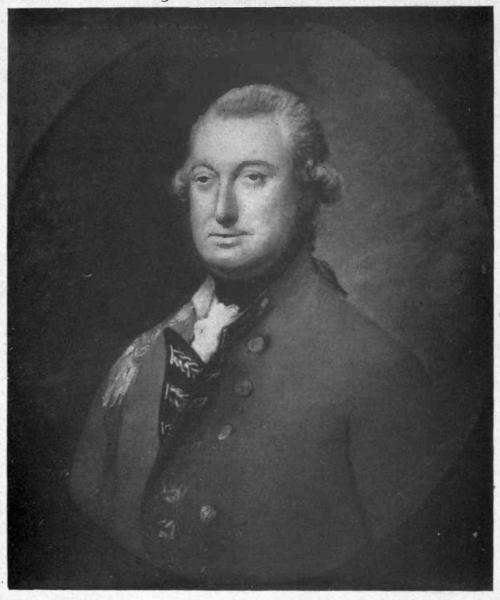
LORD CORNWALLIS
From the painting in the National Portrait Gallery
The American commissioners agreed, finally,
that no future confiscations should take place,
that imprisoned Loyalists should be released,
that no further persecutions should be permitted,
and that creditors on either side should
‘meet with no lawful impediment’ to the recovery
of all good debts in sterling money.
But with regard to the British demand for
restitution, all they could be induced to sign
was a promise that Congress would ‘earnestly
recommend to the legislatures of the respective
states’ a policy of amnesty and restitution.
In making this last recommendation, it is
difficult not to convict the American commissioners
of something very like hypocrisy.
There seems to be no doubt that they knew the
recommendation would not be complied with;
and little or no attempt was made by them to
persuade the states to comply with it. In
after years the clause was represented by the
Americans as a mere form of words, necessary
to bring the negotiations to an end, and to
save the face of the British government. To
this day it has remained, except in one or
two states, a dead letter. On the other hand
it is impossible not to convict the British
commissioners of a betrayal of the Loyalists.
‘Never,’ said Lord North in the House
of Commons, ‘never was the honour, the
humanity, the principles, the policy of a
nation so grossly abused, as in the desertion
of those men who are now exposed to every
punishment that desertion and poverty can
inflict, because they were not rebels.’ ‘In
ancient or in modern history,’ said Lord
Loughborough in the House of Lords, ‘there
cannot be found an instance of so shameful a
desertion of men who have sacrificed all to
their duty and to their reliance upon our
faith.’ It seems probable that the British
commissioners could have obtained, on paper
at any rate, better terms for the Loyalists. It
is very doubtful if the Americans would have
gone to war again over such a question. In
1783 the position of Great Britain was relatively
not weaker, but stronger, than in 1781, when
hostilities had ceased. The attitude of the
French minister, and the state of the French
finances, made it unlikely that France would
lend her support to further hostilities. And
there is no doubt that the American states
were even more sorely in need of peace than
was Great Britain.
When the terms of peace were announced,
great was the bitterness among the Loyalists.
One of them protested in Rivington’s Gazette
that ‘even robbers, murderers, and rebels are
faithful to their fellows and never betray each
other,’ and another sang,
’Tis an honour to serve the bravest of nations,
And be left to be hanged in their capitulations.
If the terms of the peace had been observed, the
plight of the Loyalists would have been bad
enough. But as it was, the outcome proved
even worse. Every clause in the treaty relating
to the Loyalists was broken over and over
again. There was no sign of an abatement of
the popular feeling against them; indeed, in
some places, the spirit of persecution seemed to
blaze out anew. One of Washington’s bitterest
sayings was uttered at this time, when he said
of the Loyalists that ‘he could see nothing
better for them than to commit suicide.’
Loyalist creditors found it impossible to recover
their debts in America, while they were
themselves sued in the British courts by their
American creditors, and their property was
still being confiscated by the American legislatures.
The legislature of New York publicly
declined to reverse its policy of confiscation,
on the ground that Great Britain had offered
no compensation for the property which her
friends had destroyed. Loyalists who ventured
to return home under the treaty of peace were
insulted, tarred and feathered, whipped, and
even ham-strung. All over the country
there were formed local committees or associations
with the object of preventing renewed
intercourse with the Loyalists and the restitution
of Loyalist property. ‘The proceedings
of these people,’ wrote Sir Guy Carleton, ‘are
not to be attributed to politics alone—it serves
as a pretence, and under that cloak they act
more boldly, but avarice and a desire of rapine
are the great incentives.’
The Loyalists were even denied civil rights
in most of the states. In 1784 an act was
passed in New York declaring that all who had
held office under the British, or helped to fit
out vessels of war, or who had served as
privates or officers in the British Army, or who
had left the state, were guilty of ‘misprision
of treason,’ and were disqualified from both
the franchise and public office. There was in
fact hardly a state in 1785 where the Loyalist
was allowed to vote. In New York Loyalist
lawyers were not allowed to practise until
April 1786, and then only on condition of
taking an ‘oath of abjuration and allegiance.’
In the same state, Loyalists were subjected to
such invidious special taxation that in 1785
one of them confessed that ‘those in New
York whose estates have not been confiscated
are so loaded with taxes and other grievances
that there is nothing left but to sell out and
move into the protection of the British government.’
It was clear that something would have to
be done by the British government for the
Loyalists’ relief. ‘It is utterly impossible,’
wrote Sir Guy Carleton to Lord North, ‘to
leave exposed to the rage and violence of these
people [the Americans] men of character
whose only offence has been their attachment
to the King’s service.’ Accordingly the
British government made amends for its
betrayal of the Loyalists by taking them under
its wing. It arranged for the transportation
of all those who wished to leave the revolted
states; it offered them homes in the provinces
of Nova Scotia and Quebec; it granted half-pay
to the officers after their regiments were
reduced; and it appointed a royal commission
to provide compensation for the losses sustained.
Transcriber’s Note: Click map for larger version
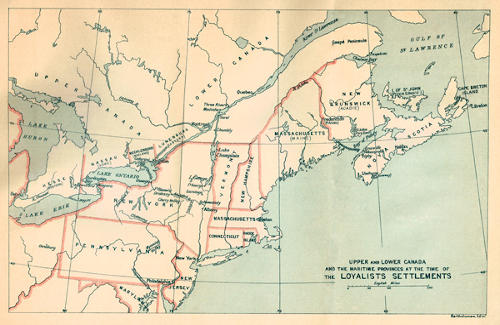
UPPER AND LOWER CANADA
AND THE MARITIME PROVINCES AT THE TIME OF
THE LOYALISTS SETTLEMENTS
CHAPTER VI THE EXODUS TO NOVA SCOTIA
When the terms of peace became known, tens
of thousands of the Loyalists shook the dust
of their ungrateful country from their feet,
never to return. Of these the more influential
part, both during and after the war, sailed for
England. The royal officials, the wealthy
merchants, landowners, and professional men,
the high military officers—these went to
England to press their claims for compensation
and preferment. The humbler element, for
the most part, migrated to the remaining
British colonies in North America. About two
hundred families went to the West Indies, a
few to Newfoundland, many to what were
afterwards called Upper and Lower Canada,
and a vast army to Nova Scotia, New Brunswick,
and Prince Edward Island.
The advantages of Nova Scotia as a field for
immigration had been known to the people of
New England and New York before the Revolutionary
War had broken out. Shortly after
the Peace of 1763 parts of the Nova Scotian
peninsula and the banks of the river St John
had been sparsely settled by colonists from
the south; and during the Revolutionary War
considerable sympathy with the cause of the
Continental Congress was shown by these
colonists from New England. Nova Scotia,
moreover, was contiguous to the New England
colonies, and it was therefore not surprising
that after the Revolution the Loyalists should
have turned their eyes to Nova Scotia as a
refuge for their families.
The first considerable migration took place
at the time of the evacuation of Boston by
General Howe in March 1776. Boston was at
that time a town with a population of about
sixteen thousand inhabitants, and of these
nearly one thousand accompanied the British
Army to Halifax. ‘Neither Hell, Hull, nor
Halifax,’ said one of them, ‘can afford worse
shelter than Boston.’ The embarkation was
accomplished amid the most hopeless confusion.
‘Nothing can be more diverting,’
wrote a Whig, ‘than to see the town in its
present situation; all is uproar and confusion;
carts, trucks, wheelbarrows, handbarrows,
coaches, chaises, all driving as if the very
devil was after them.’ The fleet was composed
of every vessel on which hands could
be laid. In Benjamin Hallowell’s cabin ‘there
were thirty-seven persons—men, women, and
children; servants, masters, and mistresses—obliged
to pig together on the floor, there being
no berths.’ It was a miracle that the crazy
flotilla arrived safely at Halifax; but there it
arrived after tossing about for six days in the
March tempests. General Howe remained with
his army at Halifax until June. Then he set sail
for New York. Some of the Loyalists accompanied
him to New York, but the greater number
took passage for England. Only a few of the
company remained in Nova Scotia.
From 1776 to 1783 small bodies of Loyalists
continually found their way to Halifax; but
it was not until the evacuation of New York
by the British in 1783 that the full tide of
immigration set in. As soon as news leaked
out that the terms of peace were not likely to
be favourable, and it became evident that the
animus of the Whigs showed no signs of abating,
the Loyalists gathered in New York looked
about for a country in which to begin life
anew. Most of them were too poor to think of
going to England, and the British provinces
to the north seemed the most hopeful place of
resort. In 1782 several associations were
formed in New York for the purpose of furthering
the interests of those who proposed to settle
in Nova Scotia. One of these associations had
as its president the famous Dr Seabury, and
as its secretary Sampson Salter Blowers, afterwards
chief justice of Nova Scotia. Its officers
waited on Sir Guy Carleton, and received his
approval of their plans. It was arranged that
a first instalment of about five hundred
colonists should set out in the autumn of 1782,
in charge of three agents, Amos Botsford,
Samuel Cummings, and Frederick Hauser,
whose duty it should be to spy out the land and
obtain grants.
The party sailed from New York, in nine
transport ships, on October 19, 1782, and
arrived a few days later at Annapolis Royal.
The population of Annapolis, which was only
a little over a hundred, was soon swamped by
the numbers that poured out of the transports.
‘All the houses and barracks are crowded,’
wrote the Rev. Jacob Bailey, who was then at
Annapolis, ‘and many are unable to procure
any lodgings.’ The three agents, leaving the
colonists at Annapolis, went first to Halifax,
and then set out on a trip of exploration through
the Annapolis valley, after which they crossed
the Bay of Fundy and explored the country
adjacent to the river St John. On their
return they published glowing accounts of the
country, and their report was transmitted to
their friends in New York.
The result of the favourable reports sent in
by these agents, and by others who had gone
ahead, was an invasion of Nova Scotia such
as no one, not even the provincial authorities,
had begun to expect. As the names of the
thousands who were anxious to go to Nova
Scotia poured into the adjutant-general’s office
in New York, it became clear to Sir Guy Carleton
that with the shipping facilities at his disposal
he could not attempt to transport them all at
once. It was decided that the ships would
have to make two trips; and, as a matter of
fact, most of them made three or four trips
before the last British soldier was able to leave
the New York shore.
On April 26, 1783, the first or ‘spring’ fleet
set sail. It had on board no less than seven
thousand persons, men, women, children, and
servants. Half of these went to the mouth of
the river St John, and about half to Port Roseway,
at the south-west end of the Nova Scotian
peninsula. The voyage was fair, and the ships
arrived at their destinations without mishap.
But at St John at least, the colonists found
that almost no preparations had been made
to receive them. They were disembarked on
a wild and primeval shore, where they had
to clear away the brushwood before they
could pitch their tents or build their shanties.
The prospect must have been disheartening.
‘Nothing but wilderness before our eyes, the
women and children did not refrain from
tears,’ wrote one of the exiles; and the
grandmother of Sir Leonard Tilley used to
tell her descendants, ‘I climbed to the top of
Chipman’s Hill and watched the sails disappearing
in the distance, and such a feeling of
loneliness came over me that, although I had
not shed a tear through all the war, I sat down
on the damp moss with my baby in my lap and
cried.’
All summer and autumn the ships kept
plying to and fro. In June the ‘summer
fleet’ brought about 2500 colonists to St John
River, Annapolis, Port Roseway, and Fort
Cumberland. By August 23 John Parr, the
governor of Nova Scotia, wrote that ‘upward
of 12,000 souls have already arrived from New
York,’ and that as many more were expected.
By the end of September he estimated that
18,000 had arrived, and stated that 10,000 more
were still to come. By the end of the year
he computed the total immigration to have
amounted to 30,000. As late as January 15,
1784, the refugees were still arriving. On
that date Governor Parr wrote to Lord North
announcing the arrival of ‘a considerable
number of Refugee families, who must be
provided for in and about the town at extraordinary
expence, as at this season of the
year I cannot send them into the country.’
‘I cannot,’ he added, ‘better describe the
wretched condition of these people than by
inclosing your lordship a list of those just
arrived in the Clinton transport, destitute of
almost everything, chiefly women and children,
all still on board, as I have not yet been able to
find any sort of place for them, and the cold
setting in severe.’ There is a tradition in
Halifax that the cabooses had to be taken off
the ships, and ranged along the principal street,
in order to shelter these unfortunates during
the winter.
New York was evacuated by the British
troops on November 25, 1783. Sir Guy
Carleton did not withdraw from the city until
he was satisfied that every person who desired
the protection of the British flag was embarked
on the boats. During the latter half of the
year Carleton was repeatedly requested by
Congress to fix some precise limit to his occupation
of New York. He replied briefly, but
courteously, that he was doing the best he
could, and that no man could do more. When
Congress objected that the Loyalists were not
included in the agreement with regard to
evacuation, Carleton replied that he held
opposite views; and that in any case it was a
point of honour with him that no troops should
embark until the last person who claimed his
protection should be safely on board a British
ship. As time went on, his replies to Congress
grew shorter and more incisive. On being
requested to name an outside date for the
evacuation of the city, he declared that he
could not even guess when the last ship would
be loaded, but that he was resolved to remain
until it was. He pointed out, moreover, that
the more the uncontrolled violence of their
citizens drove refugees to his protection, the
longer would evacuation be delayed. ‘I
should show,’ he said, ‘an indifference to the
feelings of humanity, as well as to the honour
and interest of the nation whom I serve, to
leave any of the Loyalists that are desirous to
quit the country, a prey to the violence they conceive
they have so much cause to apprehend.’
After the evacuation of New York, therefore,
the number of refugee Loyalists who came to
Nova Scotia was small and insignificant. In
1784 and 1785 there arrived a few persons who
had tried to take up the thread of their former
life in the colonies, but had given up the
attempt. And in August 1784 the Sally
transport from London cast anchor at Halifax
with three hundred destitute refugees on board.
‘As if there was not a sufficiency of such
distress’d objects already in this country,’
wrote Edward Winslow from Halifax, ‘the
good people of England have collected a whole
ship load of all kinds of vagrants from the
streets of London, and sent them out to Nova
Scotia. Great numbers died on the passage
of various disorders—the miserable remnant
are landed here and have now no covering but
tents. Such as are able to crawl are begging
for a proportion of provisions at my door.’
But the increase of population in Nova
Scotia from immigration during the years
immediately following 1783 was partly counterbalanced
by the defections from the province.
Many of the refugees quailed before
the prospect of carving out a home in the
wilderness. ‘It is, I think, the roughest land
I ever saw’; ‘I am totally discouraged’;
‘I am sick of this Province’—such expressions
as these abound in the journals and diaries
of the settlers. There were complaints that
deception had been practised. ‘All our golden
promises,’ wrote a Long Island Loyalist, ‘are
vanished in smoke. We were taught to believe
this place was not barren and foggy as had been
represented, but we find it ten times worse.
We have nothing but his Majesty’s rotten pork
and unbaked flour to subsist on.... It is the
most inhospitable clime that ever mortal set
foot on.’ At first there was great distress
among the refugees. The immigration of 1783
had at one stroke trebled the population of
Nova Scotia; and the resources of the province
were inadequate to meet the demand on them.
‘Nova Scarcity’ was the nickname for the
province invented by a New England wit.
Under these circumstances it is not surprising
that some who had set their hand to the plough
turned back. Some of them went to Upper
Canada; some to England; some to the states
from which they had come; for within a few
years the fury of the anti-Loyalist feeling died
down, and not a few Loyalists took advantage
of this to return to the place of their birth.
The most careful analysis of the Loyalist
immigration into the Maritime Provinces has
placed the total number of immigrants at about
35,000. These were in settlements scattered
broadcast over the face of the map. There was
a colony of 3000 in Cape Breton, which afforded
an ideal field for settlement, since before 1783
the governor of Nova Scotia had been precluded
from granting lands there. In 1784 Cape
Breton was erected into a separate government,
with a lieutenant-governor of its own; and
settlers flocked into it from Halifax, and even
from Canada. Abraham Cuyler, formerly mayor
of Albany, led a considerable number down
the St Lawrence and through the Gulf to Cape
Breton. On the mainland of Nova Scotia
there were settlements at Halifax, at Shelburne,
at Fort Cumberland, at Annapolis and Digby,
at Port Mouton, and at other places. In what
is now New Brunswick there was a settlement
at Passamaquoddy Bay, and there were other
settlements on the St John river extending
from the mouth up past what is now the city
of Fredericton. In Prince Edward Island,
then called the Island of St John, there was
a settlement which is variously estimated
in size, but which was comparatively unimportant.
The most interesting of these settlements
was that at Shelburne, which is situated at the
south-west corner of Nova Scotia, on one of the
finest harbours of the Atlantic seaboard. The
name of the harbour was originally Port Razoir,
but this was corrupted by the English settlers
into Port Roseway. The place had been settled
previous to 1783. In 1775 Colonel Alexander
McNutt, a notable figure of the pre-Loyalist
days in Nova Scotia, had obtained a grant of
100,000 acres about the harbour, and had
induced about a dozen Scottish and Irish
families to settle there. This settlement he
had dignified with the name of New Jerusalem.
In a short time, however, New Jerusalem
languished and died, and when the Loyalists
arrived in May 1783, the only inhabitants of
the place were two or three fishermen and their
families. It would have been well if the
Loyalists had listened to the testimony of one
of these men, who, when he was asked how he
came to be there, replied that ‘poverty had
brought him there, and poverty had kept him
there.’
The project of settling the shores of Port
Roseway had its birth in the autumn of 1782,
when one hundred and twenty Loyalist families,
whose attention had been directed to that part
of Nova Scotia by a friend in Massachusetts,
banded together with the object of emigrating
thither. They first appointed a committee
of seven to make arrangements for their removal;
and, a few weeks later, they commissioned
two members of the association,
Joseph Pynchon and James Dole, to go to
Halifax and lay before Governor Parr their
desires and intentions. Pynchon and Dole,
on their arrival at Halifax, had an interview
with the governor, and obtained from him
very satisfactory arrangements. The governor
agreed to give the settlers the land about
Port Roseway which they desired. He promised
them that surveyors should be sent to
lay out the grants, that carpenters and a supply
of 400,000 feet of lumber should be furnished
for building their houses, that for the first
year at least the settlers should receive army
rations, and that they should be free for ever
from impressment in the British Navy. All
these promises were made on the distinct
understanding that they should interfere in no
way with the claims of the Loyalists on the
British government for compensation for losses
sustained in the war. Elated by the reception
they had received from the governor, the agents
wrote home enthusiastic accounts of the prospects
of the venture. Pynchon even hinted
that the new town would supersede Halifax.
‘Much talk is here,’ he wrote, ‘of capital of
Province.... Halifax can’t but be sensible
that Port Roseway, if properly attended to in
encouraging settlers of every denomination,
will have much the advantage of all supplies
from the Bay of Fundy and westward. What
the consequence will be time only will reveal.’
Many persons at Halifax, wrote Pynchon,
prophesied that the new settlement would
dwindle, and recommended the shore of the
Bay of Fundy or the banks of the river St John
in preference to Port Roseway; but Pynchon
attributed their fears to jealousy. A few years’
experience must have convinced him that his
suspicions were ill-founded.
The first instalment of settlers, about four
thousand in number, arrived in May 1783.
They found nothing but the virgin wilderness
confronting them. But they set to work with a
will to clear the land and build their houses.
‘As soon as we had set up a kind of tent,’
wrote the Rev. Jonathan Beecher in his Journal,
‘we knelt down, my wife and I and my two
boys, and kissed the dear ground and thanked
God that the flag of England floated there, and
resolved that we would work with the rest to
become again prosperous and happy.’ By
July 11 the work of clearing had been so far
advanced that it became possible to allot the
lands. The town had been laid out in five
long parallel streets, with other streets crossing
them at right angles. Each associate was
given a town lot fronting on one of these
streets, as well as a water lot facing the harbour,
and a fifty-acre farm in the surrounding
country. With the aid of the government
artisans, the wooden houses were rapidly run
up; and in a couple of months a town sprang
up where before had been the forest and some
fishermen’s huts.
At the end of July Governor Parr paid the
town a visit, and christened it, curiously enough,
with the name of Shelburne, after the British
statesman who was responsible for the Peace
of Versailles. The occasion was one of great
ceremony. His Excellency, as he landed from
the sloop Sophie, was saluted by the booming
of cannon from the ships and from the shore.
He proceeded up the main street, through a
lane of armed men. At the place appointed
for his reception he was met by the magistrates
and principal citizens, and presented with an
address. In the evening there was a dinner
given by Captain Mowat on board the Sophie;
and the next evening there was another dinner
at the house of Justice Robertson, followed
by a ball given by the citizens, which was
‘conducted with the greatest festivity and decorum,’
and ‘did not break up till five the next
morning.’ Parr was delighted with Shelburne,
and wrote to Sir Guy Carleton, ‘From every
appearance I have not a doubt but that it will
in a short time become the most flourishing
Town for trade of any in this part of the world,
and the country will for agriculture.’
For a few years it looked as though Shelburne
was not going to belie these hopes. The
autumn of 1783 brought a considerable increase
to its population; and in 1784 it seems
to have numbered no less than ten thousand
souls, including the suburb of Burchtown,
in which most of the negro refugees in New
York had been settled. It became a place of
business and fashion. There was for a time
an extensive trade in fish and lumber with
Great Britain and the West Indies. Shipyards
were built, from which was launched
the first ship built in Nova Scotia after the
British occupation. Shops, taverns, churches,
coffee-houses, sprang up. At one time no
less than three newspapers were published in
the town. The military were stationed there,
and on summer evenings the military band
played on the promenade near the bridge.
On election day the main street was so crowded
that ‘one might have walked on the heads of
the people.’
Then Shelburne fell into decay. It appeared
that the region was ill-suited for farming
and grazing, and was not capable of
supporting so large a population. The whale
fishery which the Shelburne merchants had
established in Brazilian waters proved a failure.
The regulations of the Navigation Acts thwarted
their attempts to set up a coasting trade.
Failure dogged all their enterprises, and soon
the glory of Shelburne departed. It became
like a city of the dead. ‘The houses,’ wrote
Haliburton, ‘were still standing though untenanted.
It had all the stillness and quiet
of a moonlight scene. It was difficult to
imagine it was deserted. The idea of repose
more readily suggested itself than decay. All
was new and recent. Seclusion, and not death
or removal, appeared to be the cause of the
absence of inhabitants.’ The same eye-witness
of Shelburne’s ruin described the town later:
The houses, which had been originally
built of wood, had severally disappeared.
Some had been taken to pieces and removed
to Halifax or St John; others had
been converted into fuel, and the rest had
fallen a prey to neglect and decomposition.
The chimneys stood up erect, and marked
the spot around which the social circle
had assembled; and the blackened fireplaces,
ranged one above another, bespoke
the size of the tenement and the means of
its owner. In some places they had sunk
with the edifice, leaving a heap of ruins,
while not a few were inclining to their fall,
and awaiting the first storm to repose again
in the dust that now covered those who
had constructed them. Hundreds of cellars
with their stone walls and granite partitions
were everywhere to be seen like uncovered
monuments of the dead. Time and decay
had done their work. All that was perishable
had perished, and those numerous
vaults spoke of a generation that had
passed away for ever, and without the aid
of an inscription, told a tale of sorrow and
of sadness that overpowered the heart.
Alas for the dreams of the Pynchons and
the Parrs! Shelburne is now a quaint and
picturesque town; but it is not the city which
its projectors planned.
CHAPTER VII THE BIRTH OF NEW BRUNSWICK
When Governor Parr wrote to Sir Guy
Carleton, commending in such warm terms
the advantages of Shelburne, he took occasion
at the same time to disparage the country
about the river St John. ‘I greatly fear,’
he wrote, ‘the soil and fertility of that part of
this province is overrated by people who have
explored it partially. I wish it may turn out
otherwise, but have my fears that there is
scarce good land enough for them already sent
there.’
How Governor Parr came to make so egregious
a mistake with regard to the comparative
merits of the Shelburne districts and those of
the St John river it is difficult to understand.
Edward Winslow frankly accused him of
jealousy of the St John settlements. Possibly
he was only too well aware of the inadequacy
of the preparations made to receive the
Loyalists at the mouth of the St John, and
wished to divert the stream of immigration
elsewhere. At any rate his opinion was in
direct conflict with the unanimous testimony
of the agents sent to report on the land.
Botsford, Cummings, and Hauser had reported:
‘The St John is a fine river, equal in magnitude
to the Connecticut or Hudson. At the mouth
of the river is a fine harbour, accessible at
all seasons of the year—never frozen or obstructed
by ice.... There are many settlers
along the river upon the interval land, who
get their living easily. The interval lies on
the river, and is a most fertile soil, annually
matured by the overflowing of the river,
and produces crops of all kinds with little
labour, and vegetables in the greatest perfection,
parsnips of great length, etc.’ Later
Lieutenant-Colonel Isaac Allen and Edward
Winslow, the muster-master-general of the
provincial forces, were sent up as agents for
the Loyalist regiments in New York, and they
explored the river for one hundred and twenty
miles above its mouth. ‘We have returned,’
wrote Winslow after his trip, ‘delighted beyond
expression.’
Governor Parr’s fears, therefore, had little
effect on the popularity of the St John river
district. In all, no less than ten thousand
people settled on the north side of the Bay of
Fundy in 1783. These came, in the main, in
three divisions. With the spring fleet arrived
about three thousand people; with the summer
fleet not quite two thousand; and with the
autumn fleet well over three thousand. Of
those who came in the spring and summer
most were civilian refugees; but of those who
arrived in the autumn nearly all were disbanded
soldiers. Altogether thirteen distinct
corps settled on the St John river. There were
the King’s American Dragoons, De Lancey’s
First and Second Battalions, the New Jersey
Volunteers, the King’s American Regiment,
the Maryland Loyalists, the 42nd Regiment,
the Prince of Wales American Regiment, the
New York Volunteers, the Royal Guides and
Pioneers, the Queen’s Rangers, the Pennsylvania
Loyalists, and Arnold’s American Legion.
All these regiments were reduced, of course,
to a fraction of their original strength, owing
to the fact that numbers of their men had been
discharged in New York, and that many of the
officers had gone to England. But nevertheless,
with their women and children, their
numbers were not far from four thousand.
The arrangements which the government
of Nova Scotia had made for the reception of
this vast army of people were sadly inadequate.
In the first place there was an unpardonable
delay in the surveying and allotment of lands.
This may be partly explained by the insufficient
number of surveyors at the disposal
of the governor, and by the tedious and difficult
process of escheating lands already granted;
but it is impossible not to convict the governor
and his staff of want of foresight and expedition
in making arrangements and carrying them
into effect. When Joseph Aplin arrived at
Parrtown, as the settlement at the mouth of
the river was for a short time called, he found
1500 frame houses and 400 log huts erected,
but no one had yet received a title to the land
on which his house was built. The case of the
detachment of the King’s American Dragoons
who had settled near the mouth of the river
was particularly hard. They had arrived in
advance of the other troops, and had settled
on the west side of the harbour of St John, in
what Edward Winslow described as ‘one of
the pleasantest spots I ever beheld.’ They
had already made considerable improvements
on their lands, when word came that the
government had determined to reserve the
lands about the mouth of the river for the
refugees, and to allot blocks of land farther
up the river to the various regiments of provincial
troops. When news of this decision
reached the officers of the provincial regiments,
there was great indignation. ‘This is so
notorious a forfeiture of the faith of government,’
wrote Colonel De Lancey to Edward
Winslow, ‘that it appears to me almost incredible,
and yet I fear it is not to be doubted.
Could we have known this a little earlier it
would have saved you the trouble of exploring
the country for the benefit of a people you are
not connected with. In short it is a subject
too disagreeable to say more upon.’ Winslow,
who was hot-headed, talked openly about the
provincials defending the lands on which they
had ‘squatted.’ But protests were in vain;
and the King’s American Dragoons were compelled
to abandon their settlement, and to
remove up the river to the district of Prince
William. When the main body of the Loyalist
regiments arrived in the autumn they found
that the blocks of land assigned to them had
not yet been surveyed. Of their distress and
perplexity there is a picture in one of Edward
Winslow’s letters.
I saw [he says] all those Provincial
Regiments, which we have so frequently
mustered, landing in this inhospitable
climate, in the month of October, without
shelter, and without knowing where to
find a place to reside. The chagrin of
the officers was not to me so truly affecting
as the poignant distress of the men.
Those respectable sergeants of Robinson’s,
Ludlow’s, Cruger’s, Fanning’s, etc.—once
hospitable yeomen of the country—were
addressing me in language which almost
murdered me as I heard it. ‘Sir, we have
served all the war, your honour is witness
how faithfully. We were promised land;
we expected you had obtained it for us. We
like the country—only let us have a spot of
our own, and give us such kind of regulations
as will hinder bad men from injuring us.’
Many of these men had ultimately to go up
the river more than fifty miles past what is
now Fredericton.
A second difficulty was that food and building
materials supplied by government proved
inadequate. At first the settlers were given
lumber and bricks and tools to build their
houses, but the later arrivals, who had as a rule
to go farthest up the river, were compelled to
find their building materials in the forest.
Even the King’s American Dragoons, evicted
from their lands on the harbour of St John, were
ordered to build their huts ‘without any public
expence.’ Many were compelled to spend the
winter in tents banked up with snow; others
sheltered themselves in huts of bark. The
privations and sufferings which many of the
refugees suffered were piteous. Some, especially
among the women and children, died
from cold and exposure and insufficient food.
In the third place there was great inequality
in the area of the lands allotted. When the
first refugees arrived, it was not expected that
so many more would follow; and consequently
the earlier grants were much larger in size
than the later. In Parrtown a town lot at
length shrank in size to one-sixteenth of what
it had originally been. There was doubtless
also some favouritism and respect of persons
in the granting of lands. At any rate the
inequality of the grants caused a great many
grievances among a certain class of refugees.
Chief Justice Finucane of Nova Scotia was sent
by Governor Parr to attempt to smooth matters
out; but his conduct seemed to accentuate the
ill-feeling and alienate from the Nova Scotia
authorities the good-will of some of the better
class of Loyalists.
It was not surprising, under these circumstances,
that Governor Parr and the officers
of his government should have become very
unpopular on the north side of the Bay of
Fundy. Governor Parr was himself much distressed
over the ill-feeling against him among
the Loyalists; and it should be explained that
his failure to satisfy them did not arise from
unwillingness to do anything in his power to
make them comfortable. The trouble was
that his executive ability had not been sufficient
to cope with the serious problems confronting
him. Out of the feeling against Governor Parr
arose an agitation to have the country north
of the Bay of Fundy removed from his jurisdiction
altogether, and erected into a separate
government. This idea of the division of the
province had been suggested by Edward
Winslow as early as July 1783: ‘Think what
multitudes have and will come here, and then
judge whether it must not from the nature of
things immediately become a separate government.’
There were good reasons why such a
change should be made. The distance of Parrtown
from Halifax made it very difficult and
tedious to transact business with the government;
and the Halifax authorities, being old
inhabitants, were not in complete sympathy
with the new settlers. The erection of a new
province, moreover, would provide offices for
many of the Loyalists who were pressing their
claims for place on the government at home.
The settlers, therefore, brought their influence
to bear on the Imperial authorities, through
their friends in London; and in the summer of
1784 they succeeded in effecting the division
they desired, in spite of the opposition of
Governor Parr and the official class at Halifax.
Governor Parr, indeed, had a narrow escape
from being recalled.
The new province, which it was intended
at first to call New Ireland, but which was
eventually called New Brunswick, was to include
all that part of Nova Scotia north of a
line running across the isthmus from the mouth
of the Missiquash river to its source, and thence
across to the nearest part of Baie Verte. This
boundary was another triumph for the Loyalists,
as it placed in New Brunswick Fort Cumberland
and the greater part of Cumberland county.
The government of the province was offered
first to General Fox, who had been in command
at Halifax in 1783, and then to General
Musgrave; but was declined by both. It
was eventually accepted by Colonel Thomas
Carleton, a brother of Sir Guy Carleton, by
whom it was held for over thirty years. The
chief offices of government fell to Loyalists
who were in London. The secretary of the
province was the Rev. Jonathan Odell, a witty
New Jersey divine, who had been secretary to
Sir Guy Carleton in New York. It is interesting
to note that Odell’s son, the Hon. W. F. Odell,
was secretary of the province after him, and
that between them they held the office for two-thirds
of a century. The chief justice was a
former judge of the Supreme Court of New
York; the other judges were retired officers
of regiments who had fought in the war.
The attorney-general was Jonathan Bliss, of
Massachusetts; and the solicitor-general was
Ward Chipman, the friend and correspondent
of Edward Winslow. Winslow himself, whose
charming letters throw such a flood of light
on the settlement of Nova Scotia and New
Brunswick, was a member of the council.
New Brunswick was indeed par excellence the
Loyalist province.
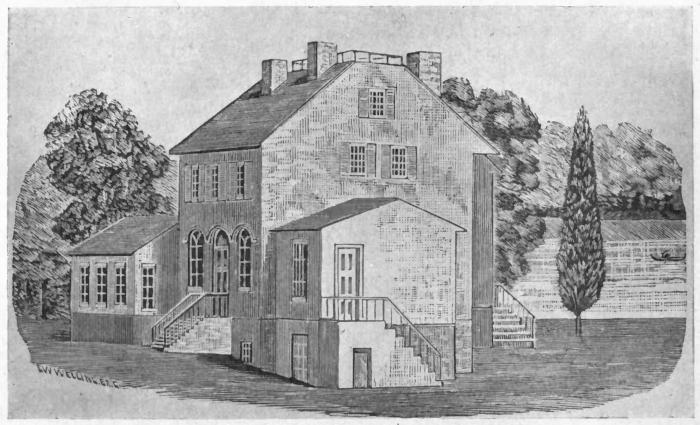
THE FIRST GOVERNMENT HOUSE, FREDERICTON—BUILT 1787
The new governor arrived at Parrtown on
November 21, 1784, and was immediately presented
with an enthusiastic address of welcome
by the inhabitants. They described themselves
as ‘a number of oppressed and insulted Loyalists,’
and added that they had formerly been
freemen, and again hoped to be so under his
government. Next spring the governor granted
to Parrtown incorporation as a city under
the name of St John. The name Parrtown
had been given, it appears, at the request
of Governor Parr himself, who explained
apologetically that the suggestion had arisen
out of ‘female vanity’; and in view of Governor
Parr’s unpopularity, the change of name was
very welcome. At the same time, however,
Colonel Carleton greatly offended the people of
St John by removing the capital of the province
up the river to St Anne’s, to which he gave the
name Fredericktown (Fredericton) in honour of
the Duke of York.
On October 15, 1785, writs were issued for
the election of members to serve in a general
assembly. The province was divided into
eight counties, among which were apportioned
twenty-six members. The right to vote was
given by Governor Carleton to all males of
twenty-one years of age who had been three
months in the province, the object of this very
democratic franchise being to include in the
voting list settlers who were clearing their
lands, but had not yet received their grants.
The elections were held in November, and
lasted for fifteen days. They passed off without
incident, except in the city of St John. There
a struggle took place which throws a great deal
of light on the bitterness of social feeling among
the Loyalists. The inhabitants split into two
parties, known as the Upper Cove and the
Lower Cove. The Upper Cove represented
the aristocratic element, and the Lower Cove
the democratic. For some time class feeling
had been growing; it had been aroused by the
attempt of fifty-five gentlemen of New York to
obtain for themselves, on account of their
social standing and services during the war,
grants of land in Nova Scotia of five thousand
acres each; and it had been fanned into flame
by the inequality in the size of the lots granted
in St John itself. Unfortunately, among the
six Upper Cove candidates in St John there were
two officers of the government, Jonathan Bliss
and Ward Chipman; and thus the struggle
took on the appearance of one between government
and opposition candidates. The election
was bitterly contested, under the old
method of open voting; and as it proceeded it
became clear that the Lower Cove was polling
a majority of the votes. The defeat of the
government officers, it was felt, would be such
a calamity that at the scrutiny Sheriff Oliver
struck off over eighty votes, and returned the
Upper Cove candidates. The election was protested,
but the House of Assembly refused, on a
technicality, to upset the election. A strangely
ill-worded and ungrammatical petition to have
the assembly dissolved was presented to the
governor by the Lower Cove people, but
Governor Carleton refused to interfere, and the
Upper Cove candidates kept their seats. The
incident created a great deal of indignation in
St John, and Ward Chipman and Jonathan
Bliss were not able for many years to obtain a
majority in that riding.
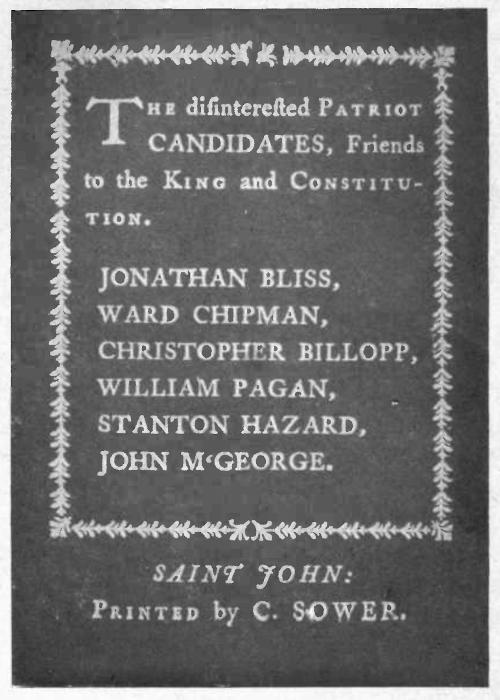
FACSIMILE OF CARD USED IN THE FIRST
NEW BRUNSWICK ELECTION, 1785
It is evident from these early records
that, while there were members of the oldest
and most famous families in British America
among the Loyalists of the Thirteen Colonies,
the majority of those who came to Nova Scotia,
New Brunswick, and especially to Upper
Canada, were people of very humble origin.
Of the settlers in Nova Scotia, Governor Parr
expressed his regret ‘that there is not a
sufficient proportion of men of education and
abilities among the present adventurers.’ The
election in St John was a sufficient evidence of
the strength of the democratic element there;
and their petition to Governor Carleton is a
sufficient evidence of their illiteracy. Some of
the settlers assumed pretensions to which they
were not entitled. An amusing case is that
of William Newton. This man had been the
groom of the Honourable George Hanger, a
major in the British Legion during the war.
Having come to Nova Scotia, he began to pay
court to a wealthy widow, and introduced himself
to her by affirming ‘that he was particularly
connected with the hono’ble Major
Hanger, and that his circumstances were
rather affluent, having served in a money-making
department, and that he had left a
considerable property behind him.’ The widow
applied to Edward Winslow, who assured her
that Mr Newton had indeed been connected—very
closely—with the Honourable Major
Hanger, and that he had left a large property
behind him. ‘The nuptials were immediately
celebrated with great pomp, and Mr Newton
is at present,’ wrote Winslow, ‘a gentleman of
consideration in Nova Scotia.’
During 1785 and subsequent years, the
work of settlement went on rapidly in New
Brunswick. There was hardship and privation
at first, and up to 1792 some indigent
settlers received rations from the government.
But astonishing progress was made. ‘The
new settlements of the Loyalists,’ wrote Colonel
Thomas Dundas, who visited New Brunswick
in the winter of 1786-87, ‘are in a thriving
way.’ Apparently, however, he did not think
highly of the industry of the disbanded soldiers,
for he avowed that ‘rum and idle habits contracted
during the war are much against
them.’ But he paid a compliment to the half-pay
officers. ‘The half-pay provincial officers,’
he wrote, ‘are valuable settlers, as they are
enabled to live well and improve their lands.’
It took some time for the province to settle
down. Many who found their lands disappointing
moved to other parts of the province;
and after 1790 numbers went to Upper
Canada. But gradually the settlers adjusted
themselves to their environment, and New
Brunswick entered on that era of prosperity
which has been hers ever since.
CHAPTER VIII IN PRINCE EDWARD ISLAND
Not many Loyalists found their way to Prince
Edward Island, or, as it was called at the time
of the American Revolution, the Island of St
John. Probably there were not many more
than six hundred on the island at any one
time. But the story of these immigrants forms
a chapter in itself. Elsewhere the refugees
were well and loyally treated. In Nova
Scotia and Quebec the English officials strove
to the best of their ability, which was perhaps
not always great, to make provision
for them. But in Prince Edward Island
they were the victims of treachery and
duplicity.
Prince Edward Island was in 1783 owned by
a number of large landed proprietors. When
it became known that the British government
intended to settle the Loyalists in Nova Scotia,
these proprietors presented a petition to Lord
North, declaring their desire to afford asylum
to such as would settle on the island. To this
end they offered to resign certain of their lands
for colonization, on condition that the government
abated the quit-rents. This petition was
favourably received by the government, and a
proclamation was issued promising lands to
settlers in Prince Edward Island on terms
similar to those granted to settlers in Nova
Scotia and Quebec.
Encouraged by the liberal terms held forth,
a number of Loyalists went to the island
direct from New York, and a number went
later from Shelburne, disappointed by the
prospects there. In June 1784 a muster of
Loyalists on the island was taken, which
showed a total of about three hundred and
eighty persons, and during the remainder of
the year a couple of hundred went from
Shelburne. At the end of 1784, therefore,
it is safe to assume that there were nearly six
hundred on the island, or about one-fifth of the
total population.
These refugees found great difficulty in obtaining
the grants of land promised to them.
They were allowed to take up their residence
on certain lands, being assured that their titles
were secure; and then, after they had cleared
the lands, erected buildings, planted orchards,
and made other improvements, they were told
that their titles lacked validity, and they were
forced to move. Written title-deeds were withheld
on every possible pretext, and when they
were granted they were found to contain
onerous conditions out of harmony with the
promises made. The object of the proprietors,
in inflicting these persecutions, seems to have
been to force the settlers to become tenants
instead of freeholders. Even Colonel Edmund
Fanning, the Loyalist lieutenant-governor, was
implicated in this conspiracy. Fanning was
one of the proprietors in Township No. 50. The
settlers in this township, being unable to obtain
their grants, resolved to send a remonstrance
to the British government, and chose as their
representative one of their number who had
known Lord Cornwallis during the war, hoping
through him to obtain redress. This agent was
on the point of leaving for England, when news
of his intention reached Colonel Fanning. The
ensuing result was as prompt as it was significant:
within a week afterwards nearly all the
Loyalists in Township No. 50 had obtained
their grants.
Others, however, did not have friends in high
places, and were unable to obtain redress. The
minutes of council which contained the records
of many of the allotments were not entered
in the regular Council Book, but were kept
on loose sheets; and thus the unfortunate
settlers were not able to prove by the Council
Book that their lands had been allotted them.
When the rough minutes were discovered years
later, they were found to bear evidence, in
erasures and the use of different inks, of having
been tampered with.
For seventy-five years the Loyalists continued
to agitate for justice. As early as
1790 the island legislature passed an act
empowering the governor to give grants to
those who had not yet received them from the
proprietors. But this measure did not entirely
redress the grievances, and after a lapse of
fifty years a petition of the descendants of the
Loyalists led to further action in the matter.
In 1840 a bill was passed by the House of
Assembly granting relief to the Loyalists, but
was thrown out by the Legislative Council. As
late as 1860 the question was still troubling
the island politics. In that year a land commission
was appointed, which reported that
there were Loyalists who still had claims on
the local government, and recommended that
free grants should be made to such as could
prove that their fathers had been attracted to
the island under promises which had never
been fulfilled.
Such is the unlovely story of how the
Loyalists were persecuted in the Island of St
John, under the British flag.
CHAPTER IX THE LOYALISTS IN QUEBEC
It was a tribute to the stability of British rule
in the newly-won province of Quebec that at
the very beginning of the Revolutionary War
loyal refugees began to flock across the border.
As early as June 2, 1774, Colonel Christie,
stationed at St Johns on the Richelieu, wrote to
Sir Frederick Haldimand at Quebec notifying
him of the arrival of immigrants; and it is interesting
to note that at that early date he already
complained of ‘their unreasonable expectations.’
In the years 1775 and 1776 large bodies
of persecuted Loyalists from the Mohawk
valley came north with Sir John Johnson and
Colonel Butler; and in these years was formed
in Canada the first of the Loyalist regiments.
It was not, however, until the defeat of
Burgoyne at Saratoga in 1778 that the full
tide of immigration set in. Immediately
thereafter Haldimand wrote to Lord George
Germain, under date of October 14, 1778, reporting
the arrival of ‘loyalists in great distress,’
seeking refuge from the revolted provinces.
Haldimand lost no time in making
provision for their reception. He established
a settlement for them at Machiche, near Three
Rivers, which he placed under the superintendence
of a compatriot and a protégé of his
named Conrad Gugy. The captains of militia
in the neighbourhood were ordered to help build
barracks for the refugees, provisions were
secured from the merchants at Three Rivers,
and everything in reason was done to make the
unfortunates comfortable. By the autumn of
1778 there were in Canada, at Machiche and
other places, more than one thousand refugees,
men, women, and children, exclusive of those
who had enlisted in the regiments. Including
the troops, probably no less than three thousand
had found their way to Canada.
With the conclusion of peace came a great
rush to the north. The resources of government
were strained to the utmost to provide for
the necessities of the thousands who flocked
over the border-line. At Chambly, St Johns,
Montreal, Sorel, Machiche, Quebec, officers of
government were stationed to dole out supplies.
At Quebec alone in March 1784 one thousand
three hundred and thirty-eight ‘friends of
government’ were being fed at the public
expense. At Sorel a settlement was established
similar to that at Machiche. The seigneury of
Sorel had been purchased by the government
in 1780 for military purposes, and when the
war was over it was turned into a Loyalist
reserve, on which huts were erected and provisions
dispensed. In all, there must have
been nearly seven thousand Loyalists in the
province of Quebec in the winter of 1783-84.
Complete details are lacking with regard
to the temporary encampments in which the
Loyalists were hived; but there are evidences
that they were not entirely satisfied with the
manner in which they were looked after. One
of the earliest of Canadian county histories,[1]
a book partly based on traditionary sources, has
some vague tales about the cruelty and malversation
practised by a Frenchman under
whom the Loyalists were placed at ‘Mishish.’
‘Mishish’ is obviously a phonetic spelling of
Machiche, and ‘the Frenchman’ is probably
Conrad Gugy. Some letters in the Dominion
Archives point in the same direction. Under
date of April 29, the governor’s secretary writes
to Stephen De Lancey, the inspector of the
Loyalists, referring to ‘the uniform discontent
of the Loyalists at Machiche.’ The
discontent, he explains, is excited by a few ill-disposed
persons. ‘The sickness they complain
of has been common throughout the
province, and should have lessened rather than
increased the consumption of provisions.’ A
Loyalist who writes to the governor, putting
his complaints on paper, is assured that ‘His
Excellency is anxious to do everything in his
power for the Loyalists, but if what he can do
does not come up to the expectation of him and
those he represents, His Excellency gives the
fullest permission to them to seek redress in
such manner as they shall think best.’
What degree of justice there was in the
complaints of the refugees it is now difficult
to determine. No doubt some of them were
confirmed grumblers, and many of them had
what Colonel Christie called ‘unreasonable
expectations.’ Nothing is more certain than
that Sir Frederick Haldimand spared no effort
to accommodate the Loyalists. On the other
hand, it would be rash to assert that in the
confusion which then reigned there were no
grievances of which they could justly complain.
In the spring and summer of 1784 the great
majority of the refugees within the limits of
the province of Quebec were removed to what
was afterwards known as Upper Canada.
But some remained, and swelled the number
of the ‘old subjects’ in the French province.
Considerable settlements were made at two
places. One of these was Sorel, where the
seigneury that had been bought by the crown
was granted out to the new-comers in lots;
the other was in the Gaspé peninsula, on the
shores of the Gulf of St Lawrence and of
Chaleur Bay. The seigneury of Sorel was
well peopled, for each grantee received only
sixty acres and a town lot, taking the rest
of his allotment in some of the newer settlements.
The settlement in the Gaspé peninsula
was more sparse; the chief centre of population
was the tiny fishing village of Paspebiac.
In addition to these settlements, some of the
exiles took up land on private seigneuries;
these, however, were not many, for the government
discouraged the practice, and refused
supplies to all who did not settle on the king’s
land. At the present time, of all these Loyalist
groups in the province of Quebec scarce a
trace remains: they have all been swallowed
up in the surrounding French population.
The Eastern Townships in the province of
Quebec were not settled by the United Empire
Loyalists. In 1783 Sir Frederick Haldimand
set his face like flint against any attempt on
the part of the Loyalists to settle the lands
lying along the Vermont frontier. He feared
that a settlement there would prove a permanent
thorn in the flesh of the Americans, and
might lead to much trouble and friction. He
wished that these lands should be left unsettled
for a time, and that, in the end, they should be
settled by French Canadians ‘as an antidote
to the restless New England population.’
Some of the more daring Loyalists, in spite of
the prohibition of the governor, ventured to
settle on Missisquoi Bay. When the governor
heard of it, he sent orders to the officer commanding
at St Johns that they should be
removed as soon as the season should admit
of it; and instructions were given that if any
other Loyalists settled there, their houses were
to be destroyed. By these drastic means the
government kept the Eastern Townships a
wilderness until after 1791, when the townships
were granted out in free and common
socage, and American settlers began to flock in.
But, as will be explained, these later settlers
have no just claim to the appellation of United
Empire Loyalists.
CHAPTER X THE WESTERN SETTLEMENTS
Sir Frederick Haldimand offered the Loyalists
a wide choice of places in which to settle. He
was willing to make land grants on Chaleur
Bay, at Gaspé, on the north shore of the
St Lawrence above Montreal, on the Bay of
Quinté, at Niagara, or along the Detroit river;
and if none of these places was suitable, he
offered to transport to Nova Scotia or Cape
Breton those who wished to go thither. At all
these places settlements of Loyalists sprang
up. That at Niagara grew to considerable importance,
and became after the division of the
province in 1791 the capital of Upper Canada.
But by far the largest settlement was that which
Haldimand planned along the north shore of
the St Lawrence and Lake Ontario between
the western boundary of the government of
Quebec and Cataraqui (now Kingston), east of
the Bay of Quinté. Here the great majority of
the Loyalists in Canada were concentrated.
As soon as Haldimand received instructions
from England with regard to the granting of
the lands he gave orders to Major Samuel
Holland, surveyor-general of the king’s territories
in North America, to proceed with the
work of making the necessary surveys. Major
Holland, taking with him as assistants Lieutenants
Kotté and Sutherland and deputy-surveyors
John Collins and Patrick McNish, set out
in the early autumn of 1783, and before the
winter closed in he had completed the survey
of five townships bordering on the Bay of
Quinté. The next spring his men returned,
and surveyed eight townships along the north
bank of the St Lawrence, between the Bay of
Quinté and the provincial boundary. These
townships are now distinguished by names,
but in 1783-84 they were designated merely by
numbers; thus for many years the old inhabitants
referred to the townships of Osnaburg,
Williamsburg, and Matilda, for instance, as the
‘third town,’ the ‘fourth town,’ and the
‘fifth town.’ The surveys were made in great
haste, and, it is to be feared, not with great
care; for some tedious lawsuits arose out of
the discrepancies contained in them, and a
generation later Robert Gourlay wrote that
‘one of the present surveyors informed me
that in running new lines over a great extent
of the province, he found spare room for a
whole township in the midst of those laid out
at an early period.’ Each township was subdivided
into lots of two hundred acres each, and
a town-site was selected in each case which was
subdivided into town lots.
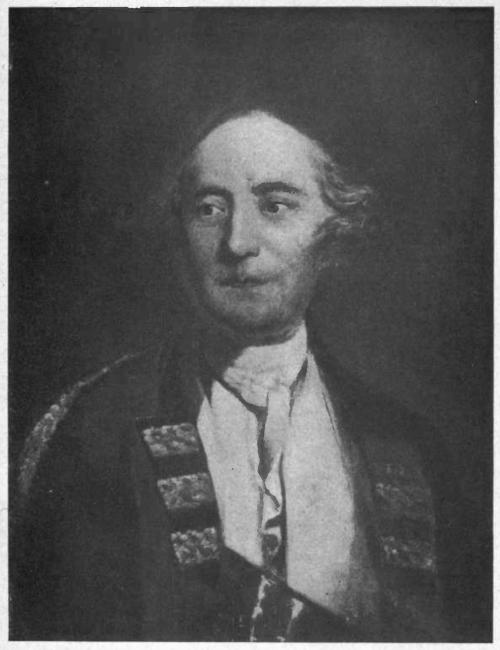
SIR FREDERICK HALDIMAND
After a contemporary painting
The task of transporting the settlers from
their camping-places at Sorel, Machiche, and
St Johns to their new homes up the St
Lawrence was one of some magnitude.
General Haldimand was not able himself to
oversee the work; but he appointed Sir John
Johnson as superintendent, and the work of
settlement went on under Johnson’s care. On
a given day the Loyalists were ordered to strike
camp, and proceed in a body to the new
settlements. Any who remained behind without
sufficient excuse had their rations stopped.
Bateaux took the settlers up the St Lawrence,
and the various detachments were disembarked
at their respective destinations. It had been
decided that the settlers should be placed on
the land as far as possible according to the
corps in which they had served during the war,
and that care should be taken to have the
Protestant and Roman Catholic members of a
corps settled separately. It was this arrangement
which brought about the grouping of
Protestant and Roman Catholic Scottish Highlanders
in Glengarry. The first battalion of
the King’s Royal Regiment of New York
was settled on the first five townships west of
the provincial boundary. This was Sir John
Johnson’s regiment, and most of its members
were his Scottish dependants from the Mohawk
valley. The next three townships were settled
by part of Jessup’s Corps, an offshoot of Sir
John Johnson’s regiment. Of the Cataraqui
townships the first was settled by a band of
New York Loyalists, many of them of Dutch
or German extraction, commanded by Captain
Michael Grass. On the second were part of
Jessup’s Corps; on the third and fourth were
a detachment of the second battalion of the
King’s Royal Regiment of New York, which
had been stationed at Oswego across the lake
at the close of the war, a detachment of
Rogers’s Rangers, and a party of New York
Loyalists under Major Van Alstine. The
parties commanded by Grass and Van Alstine
had come by ship from New York to Quebec
after the evacuation of New York in 1783. On
the fifth township were various detachments
of disbanded regular troops, and even a handful
of disbanded German mercenaries.
As soon as the settlers had been placed on
the townships to which they had been assigned,
they received their allotments of land. The
surveyor was the land agent, and the allotments
were apportioned by each applicant
drawing a lot out of a hat. This democratic
method of allotting lands roused the indignation
of some of the officers who had settled
with their men. They felt that they should
have been given the front lots, unmindful of
the fact that their grants as officers were from
five to ten times as large as the grants which
their men received. Their protests, contained
in a letter of Captain Grass to the governor,
roused Haldimand to a display of warmth to
which he was as a rule a stranger. Captain
Grass and his associates, he wrote, were to get
no special privileges, ‘the most of them who
came into the province with him being, in fact,
mechanics, only removed from one situation
to practise their trade in another. Mr Grass
should, therefore, think himself very well off
to draw lots in common with the Loyalists.’
A good deal of difficulty arose also from the
fact that many allotments were inferior to
the rest from an agricultural point of view;
but difficulties of this sort were adjusted by
Johnson and Holland on the spot.
By 1784 nearly all the settlers were destitute
and completely dependent on the generosity
of the British government. They had no
effects; they had no money; and in many
cases they were sorely in need of clothes. The
way in which Sir Frederick Haldimand came
to their relief is deserving of high praise. If he
had adhered to the letter of his instructions
from England, the position of the Loyalists
would have been a most unenviable one.
Repeatedly, however, Haldimand took on his
own shoulders the responsibility of ignoring or
disobeying the instructions from England, and
trusted to chance that his protests would prevent
the government from repudiating his
actions. When the home government, for
instance, ordered a reduction of the rations,
Haldimand undertook to continue them in
full; and fortunately for him the home government,
on receipt of his protest, rescinded the
order.
The settlers on the Upper St Lawrence and
the Bay of Quinté did not perhaps fare as well
as those in Nova Scotia, or even the Mohawk
Indians who settled on the Grand river. They
did not receive lumber for building purposes,
and ‘bricks for the inside of their chimneys,
and a little assistance of nails,’ as did the
former; nor did they receive ploughs and
church-bells, as did the latter. For building
lumber they had to wait until saw-mills were
constructed; instead of ploughs they had at
first to use hoes and spades, and there were
not quite enough hoes and spades to go round.
Still, they did not fare badly. When the
difficulty of transporting things up the St
Lawrence is remembered, it is remarkable that
they obtained as much as they did. In the
first place they were supplied with clothes for
three years, or until they were able to provide
clothes for themselves. These consisted of
coarse cloth for trousers and Indian blankets
for coats. Boots they made out of skins or
heavy cloth. Tools for building were given
them: to each family were given an ax and
a hand-saw, though unfortunately the axes
were short-handled ship’s axes, ill-adapted to
cutting in the forest; to each group of two
families were allotted a whip-saw and a cross-cut
saw; and to each group of five families
was supplied a set of tools, containing chisels,
augers, draw-knives, etc. To each group of
five families was also allotted ‘one firelock
... intended for the messes, the pigeon and
wildfowl season’; but later on a firelock
was supplied to every head of a family.
Haldimand went to great trouble in obtaining
seed-wheat for the settlers, sending agents
down even into Vermont and the Mohawk
valley to obtain all that was to be had; he
declined, however, to supply stock for the
farms, and although eventually he obtained
some cattle, there were not nearly enough
cows to go round. In many cases the soldiers
were allowed the loan of the military tents;
and everything was done to have saw-mills
and grist-mills erected in the most convenient
places with the greatest possible dispatch.
In the meantime small portable grist-mills,
worked by hand, were distributed among
the settlers.
Among the papers relating to the Loyalists
in the Canadian Archives there is an abstract
of the numbers of the settlers in the five townships
at Cataraqui and the eight townships
on the St Lawrence. There were altogether
1568 men, 626 women, 1492 children, and 90
servants, making a total of 3776 persons.
These were, of course, only the original settlers.
As time went on others were added. Many
of the soldiers had left their families in the
States behind them, and these families now
hastened to cross the border. A proclamation
had been issued by the British government
inviting those Loyalists who still remained in
the States to assemble at certain places along
the frontier, namely, at Isle aux Noix, at
Sackett’s Harbour, at Oswego, and at Niagara.
The favourite route was the old trail from the
Mohawk valley to Oswego, where was stationed
a detachment of the 34th regiment. From
Oswego these refugees crossed to Cataraqui.
‘Loyalists,’ wrote an officer at Cataraqui in
the summer of 1784, ‘are coming in daily
across the lake.’ To accommodate these new
settlers three more townships had to be mapped
out at the west end of the Bay of Quinté.
For the first few years the Cataraqui settlers
had a severe struggle for existence. Most of
them arrived in 1784, too late to attempt to
sow fall wheat; and it was several seasons
before their crops became nearly adequate for
food. The difficulties of transportation up the
St Lawrence rendered the arrival of supplies
irregular and uncertain. Cut off as they were
from civilization by the St Lawrence rapids,
they were in a much less advantageous position
than the great majority of the Nova Scotia
and New Brunswick settlers, who were situated
near the sea-coast. They had no money, and
as the government refused to send them specie,
they were compelled to fall back on barter as
a means of trade, with the result that all trade
was local and trivial. In the autumn of 1787
the crops failed, and in 1788 famine stalked
through the land. There are many legends
about what was known as ‘the hungry year.’
If we are to believe local tradition, some of the
settlers actually died of starvation. In the
family papers of one family is to be found a
story about an old couple who were saved from
starvation only by the pigeons which they were
able to knock over. A member of another
family testifies: ‘We had the luxury of a cow
which the family brought with them, and had
it not been for this domestic boon, all would
have perished in the year of scarcity.’ Two
hundred acre lots were sold for a few pounds of
flour. A valuable cow, in one case, was sold
for eight bushels of potatoes; a three-year-old
horse was exchanged for half a hundredweight
of flour. Bran was used for making cakes;
and leeks, buds of trees, and even leaves, were
ground into food.
The summer of 1789, however, brought relief
to the settlers, and though, for many years,
comforts and even necessaries were scarce,
yet after 1791, the year in which the new settlements
were erected into the province of Upper
Canada, it may be said that most of the settlers
had been placed on their feet. The soil was
fruitful; communication and transportation
improved; and metallic currency gradually
found its way into the settlements. When
Mrs Simcoe, the wife of the lieutenant-governor,
passed through the country in 1792, she was
struck by the neatness of the farms of the
Dutch and German settlers from the Mohawk
valley, and by the high quality of the wheat.
‘I observed on my way thither,’ she says in
her diary, ‘that the wheat appeared finer than
any I have seen in England, and totally free
from weeds.’ And a few months later an
anonymous English traveller, passing the same
way, wrote: ‘In so infant a settlement, it
would have been irrational to expect that
abundance which bursts the granaries, and lows
in the stalls of more cultivated countries.
There was, however, that kind of appearance
which indicated that with economy and industry,
there would be enough.’
Next in size to the settlements at Cataraqui
and on the Upper St Lawrence was the settlement
at Niagara. During the war Niagara
had been a haven of refuge for the Loyalists
of Pennsylvania and the frontier districts,
just as Oswego and St Johns had been havens
of refuge for the Loyalists of northern and
western New York. As early as 1776 there
arrived at Fort George, Niagara, in a starving
condition, five women and thirty-six children,
bearing names which are still to be found in the
Niagara peninsula. From that date until the
end of the war refugees continued to come in.
Many of these refugees were the families of
the men and officers of the Loyalist troops
stationed at Niagara. On September 27, 1783,
for instance, the officer commanding at Niagara
reports the arrival from Schenectady of
the wives of two officers of Butler’s Rangers,
with a number of children. Some of these
people went down the lake to Montreal; but
others remained at the post, and ‘squatted’
on the land. In 1780 Colonel Butler reports
to Haldimand that four or five families have
settled and built houses, and he requests that
they be given seed early in the spring. In 1781
we know that a Loyalist named Robert Land
had squatted on Burlington Bay, at the head
of Lake Ontario. In 1783 Lieutenant Tinling
was sent to Niagara to survey lots, and Sergeant
Brass of the 84th was sent to build a saw-mill
and a grist-mill. At the same time Butler’s
Rangers, who were stationed at the fort, were
disbanded; and a number of them were induced
to take up land. They took up land on
the west side of the river, because, although,
according to the terms of peace, Fort George
was not given up by the British until 1796, the
river was to constitute the boundary between
the two countries. A return of the rise and
progress of the settlement made in May 1784
shows a total of forty-six settlers (that is, heads
of families), with forty-four houses and twenty
barns. The return makes it clear that cultivation
had been going on for some time. There
were 713 acres cleared, 123 acres sown in
wheat, and 342 acres waiting to be sown; and
the farms were very well stocked, there being
an average of about three horses and four or
five cows to each settler.
With regard to the settlement at Detroit,
there is not much evidence available. It was
Haldimand’s intention at first to establish a
large settlement there, but the difficulties of
communication doubtless proved to be insuperable.
In the event, however, some of Butler’s
Rangers settled there. Captain Bird of the
Rangers applied for and received a grant of
land on which he made a settlement; and in the
summer of 1784 we find Captain Caldwell and
some others applying for deeds for the land and
houses they occupied. In 1783 the commanding
officer at Detroit reported the arrival from
Red Creek of two men, ‘one a Girty, the
other McCarty,’ who had come to see what
encouragement there was to settle under
the British government. They asserted that
several hundred more would be glad to come if
sufficient inducements were offered them, as
they saw before them where they were nothing
but persecution. In 1784 Jehu Hay, the British
lieutenant-governor of Detroit, sent in lists
of men living near Fort Pitt who were anxious
to settle under the British government if they
could get lands, most of them being men who
had served in the Highland and 60th regiments.
But it is safe to assume that no large
number of these ever settled near Detroit, for
when Hay arrived in Detroit in the summer of
1784, he found only one Loyalist at the post
itself. There had been for more than a generation
a settlement of French Canadians at
Detroit; but it was not until after 1791 that
the English element became at all considerable.
It has been estimated that in the country
above Montreal in 1783 there were ten thousand
Loyalists, and that by 1791 this number
had increased to twenty-five thousand. These
figures are certainly too large. Pitt’s estimate
of the population of Upper Canada in 1791 was
only ten thousand. This is probably much
nearer the mark. The overwhelming majority
of these people were of very humble origin.
Comparatively few of the half-pay officers
settled above Montreal before 1791; and most
of these were, as Haldimand said, ‘mechanics,
only removed from one situation to practise
their trade in another.’ Major Van Alstine,
it appears, was a blacksmith before he came to
Canada. That many of the Loyalists were
illiterate is evident from the testimony of the
Rev. William Smart, a Presbyterian clergyman
who came to Upper Canada in 1811: ‘There
were but few of the U. E. Loyalists who
possessed a complete education. He was personally
acquainted with many, especially along
the St Lawrence and Bay of Quinté, and by no
means were all educated, or men of judgment;
even the half-pay officers, many of them, had
but a limited education.’ The aristocrats of
the ‘Family Compact’ party did not come to
Canada with the Loyalists of 1783; they came,
in most cases, after 1791, some of them from
Britain, such as Bishop Strachan, and some of
them from New Brunswick and Nova Scotia,
such as the Jarvises and the Robinsons. This
fact is one which serves to explain a great deal
in Upper Canadian history.
CHAPTER XI COMPENSATION AND HONOUR
Throughout the war the British government
had constantly granted relief and compensation
to Loyalists who had fled to England. In the
autumn of 1782 the treasury was paying out
to them, on account of losses or services, an
annual amount of £40,280 over and above
occasional payments of a particular or extraordinary
nature amounting to £17,000 or
£18,000 annually. When peace had been concluded,
and it became clear that the Americans
had no intention of making restitution to the
Loyalists, the British government determined
to put the payments for their compensation on
a more satisfactory basis.
For this purpose the Coalition Government
of Fox and North appointed in July 1783 a
royal commission ‘to inquire into the losses
and services of all such persons who have
suffered in their rights, properties, and professions
during the late unhappy dissensions
in America, in consequence of their loyalty
to His Majesty and attachment to the British
Government.’ A full account of the proceedings
of the commission is to be found in the
Historical View of the Commission for Inquiry
into the Losses, Services, and Claims of the
American Loyalists, published in London in
1815 by one of the commissioners, John
Eardley Wilmot. The commission was originally
appointed to sit for only two years; but
the task which confronted it was so great
that it was found necessary several times to
renew the act under which it was appointed;
and not until 1790 was the long inquiry brought
to an end. It was intended at first that the
claims of the men in the Loyalist regiments
should be sent in through their officers; and
Sir John Johnson, for instance, was asked to
transmit the claims of the Loyalists settled in
Canada. But it was found that this method
did not provide sufficient guarantee against
fraudulent and exorbitant claims; and eventually
members of the commission were compelled
to go in person to New York, Nova
Scotia, and Canada.
The delay in concluding the work of the
commission caused great indignation. A tract
which appeared in London in 1788 entitled The
Claim of, the American Loyalists Reviewed and
Maintained upon Incontrovertible Principles
of Law and Justice drew a black picture of the
results of the delay:
It is well known that this delay of justice
has produced the most melancholy and
shocking events. A number of sufferers
have been driven into insanity and become
their own destroyers, leaving behind them
their helpless widows and orphans to subsist
upon the cold charity of strangers. Others
have been sent to cultivate the wilderness
for their subsistence, without having the
means, and compelled through want to
throw themselves on the mercy of the
American States, and the charity of former
friends, to support the life which might
have been made comfortable by the money
long since due by the British Government;
and many others with their families are
barely subsisting upon a temporary allowance
from Government, a mere pittance
when compared with the sum due them.
Complaints were also made about the
methods of the inquiry. The claimant was
taken into a room alone with the commissioners,
was asked to submit a written and sworn
statement as to his losses and services, and was
then cross-examined both with regard to his
own losses and those of his fellow claimants.
This cross-questioning was freely denounced as
an ‘inquisition.’
Grave inconvenience was doubtless caused
in many cases by the delay of the commissioners
in making their awards. But on the other
hand it should be remembered that the commissioners
had before them a portentous task.
They had to examine between four thousand
and five thousand claims. In most of these
the amount of detail to be gone through was
considerable, and the danger of fraud was
great. There was the difficulty also of determining
just what losses should be compensated.
The rule which was followed was that claims
should be allowed only for losses of property
through loyalty, for loss of offices held before
the war, and for loss of actual professional
income. No account was taken of lands
bought or improved during the war, of uncultivated
lands, of property mortgaged to its full
value or with defective titles, of damage done
by British troops, or of forage taken by them.
Losses due to the fall in the value of the provincial
paper money were thrown out, as were
also expenses incurred while in prison or while
living in New York city. Even losses in trade
and labour were discarded. It will be seen
that to apply these rules to thousands of detailed
claims, all of which had to be verified,
was not the work of a few days, or even
months.
It must be remembered, too, that during the
years from 1783 to 1790 the British government
was doing a great deal for the Loyalists in
other ways. Many of the better class received
offices under the crown. Sir John Johnson
was appointed superintendent of the Loyalists
in Canada, and then superintendent of Indian
Affairs; Colonel Edmund Fanning was made
lieutenant-governor of Nova Scotia; Ward
Chipman became solicitor-general of New
Brunswick. The officers of the Loyalist regiments
were put on half-pay; and there is
evidence that many were allowed thus to rank
as half-pay officers who had no real claim
to the title. ‘Many,’ said the Rev. William
Smart of Brockville, ‘were placed on the list
of officers, not because they had seen service,
but as the most certain way of compensating
them for losses sustained in the Rebellion’; and
Haldimand himself complained that ‘there is
no end to it if every man that comes in is to be
considered and paid as an officer.’ Then every
Loyalist who wished to do so received a grant
of land. The rule was that each field officer
should receive 5000 acres, each captain 3000,
each subaltern 2000, and each non-commissioned
officer and private 200 acres. This
rule was not uniformly observed, and there was
great irregularity in the size of the grants.
Major Van Alstine, for instance, received only
1200 acres. But in what was afterwards
Upper Canada, 3,200,000 acres were granted
out to Loyalists before 1787. And in addition
to all this, the British government clothed
and fed and housed the Loyalists until they
were able to provide for themselves. There
were those in Nova Scotia who were receiving
rations as late as 1792. What all this must
have cost the government during the years
following 1783 it is difficult to compute. Including
the cost of surveys, official salaries,
the building of saw-mills and grist-mills, and
such things, the figures must have run up to
several millions of pounds.
When it is remembered that all this had
been already done, it will be admitted to be a
proof of the generosity of the British government
that the total of the claims allowed by
the royal commission amounted to £3,112,455.
The grants varied in size from £10, the
compensation paid to a common soldier, to
£44,500, the amount paid to Sir John Johnson.
The total outlay on the part of Great Britain,
both during and after the war, on account of
the Loyalists, must have amounted to not less
than £6,000,000, exclusive of the value of the
lands assigned.
With the object possibly of assuaging the
grievances of which the Loyalists complained
in connection with the proceedings of the royal
commission, Lord Dorchester (as Sir Guy
Carleton was by that time styled) proposed in
1789 ‘to put a Marke of Honor upon the
families who had adhered to the unity of the
empire, and joined the Royal Standard in
America before the Treaty of Separation in
the year 1783.’ It was therefore resolved that
all Loyalists of that description were ‘to be
distinguished by the letters U.E. affixed to
their names, alluding to their great principle,
the unity of the empire.’ The land boards
were ordered to preserve a registry of all such
persons, ‘to the end that their posterity may
be discriminated from future settlers,’ and that
their sons and daughters, on coming of age,
might receive grants of two hundred acre lots.
Unfortunately, the land boards carried out
these instructions in a very half-hearted
manner, and when Colonel John Graves
Simcoe became lieutenant-governor of Upper
Canada, he found the regulation a dead letter.
He therefore revived it in a proclamation issued
at York (now Toronto), on April 6, 1796, which
directed the magistrates to ascertain under oath
and to register the names of all those who by
reason of their loyalty to the Empire were entitled
to special distinction and grants of land.
A list was compiled from the land board registers,
from the provision lists and muster lists,
and from the registrations made upon oath,
which was known as the ‘Old U. E. List’; and
it is a fact often forgotten that no one, the names
of some of whose ancestors are not inscribed
in that list, has the right to describe himself as
a United Empire Loyalist.
CHAPTER XII THE AMERICAN MIGRATION
From the first the problem of governing the
settlements above Montreal perplexed the
authorities. It was very early proposed to
erect them into a separate province, as New
Brunswick had been erected into a separate
province. But Lord Dorchester was opposed
to any such arrangement. ‘It appears to me,’
he wrote to Lord Sydney, ‘that the western
settlements are as yet unprepared for any
organization superior to that of a county.’
In 1787, therefore, the country west of Montreal
was divided into four districts, for a time
named Lunenburg, Mecklenburg, Nassau, and
Hesse. Lunenburg stretched from the western
boundary of the province of Quebec to the
Gananoqui; Mecklenburg, from the Gananoqui
to the Trent, flowing into the Bay of Quinté;
Nassau, from the Trent to a line drawn due
north from Long Point on Lake Erie; and
Hesse, from this line to Detroit. We do not
know who was responsible for inflicting these
names on a new and unoffending country.
Perhaps they were thought a compliment to
the Hanoverian ruler of England. Fortunately
they were soon dropped, and the names
Eastern, Midland, Home, and Western were
substituted.
This division of the settlements proved only
temporary. It left the Loyalists under the
arbitrary system of government set up in
Quebec by the Quebec Act of 1774, under which
they enjoyed no representative institutions
whatever. It was not long before petitions
began to pour in from them asking that they
should be granted a representative assembly.
Undoubtedly Lord Dorchester had underestimated
the desire among them for representative
institutions. In 1791, therefore, the
country west of the Ottawa river, with the
exception of a triangle of land at the junction of
the Ottawa and the St Lawrence, was erected by
the Constitutional Act into a separate province,
with the name of Upper Canada; and this province
was granted a representative assembly
of fifteen members.
The lieutenant-governor appointed for the
new province was Colonel John Graves Simcoe.
During the war Colonel Simcoe had been the
commanding officer of the Queen’s Rangers,
which had been largely composed of Loyalists,
and he was therefore not unfitted to govern
the new province. He was theoretically under
the control of Lord Dorchester at Quebec; but
his relations with Dorchester were somewhat
strained, and he succeeded in making himself
virtually independent in his western jurisdiction.
Though he seemed phlegmatic, he
possessed a vigorous and enterprising disposition,
and he planned great things for
Upper Canada. He explored the country in
search of the best site for a capital; and it is
interesting to know that he had such faith in
the future of Upper Canada that he actually
contemplated placing the capital in what was
then the virgin wilderness about the river
Thames. He inaugurated a policy of building
roads and improving communications which
showed great foresight; and he entered upon
an immigration propaganda, by means of proclamations
advertising free land grants, which
brought a great increase of population to the
province.
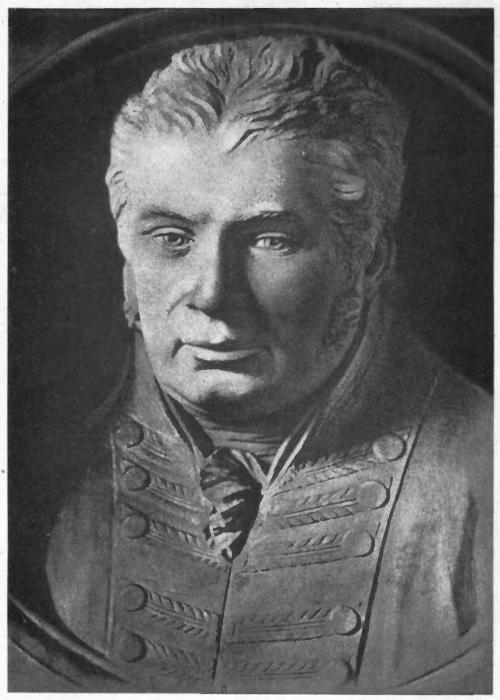
JOHN GRAVES SIMCOE
From the bust in Exeter Cathedral
Simcoe believed that there were still in the
United States after 1791 many people who
had remained loyal at heart to Great Britain,
and who were profoundly dissatisfied with their
lot under the new American government. It
was his object to attract these people to Upper
Canada by means of his proclamations; and
there is no doubt that he was partly successful.
But he also attracted many who had no other
motive in coming to Canada than their desire
to obtain free land grants, and whose
attachment to the British crown was of the
most recent origin. These people were freely
branded by the original settlers as ‘Americans’;
and there is no doubt that in many cases the
name expressed their real sympathies.
The War of the Revolution had hardly been
brought to a conclusion when some of the
Americans showed a tendency to migrate into
Canada. In 1783, when the American Colonel
Willet was attempting an attack on the British
garrison at Oswego, American traders, with an
impudence which was superb, were arriving
at Niagara. In 1784 some rebels who had
attempted to pose as Loyalists were ejected
from the settlements at Cataraqui. And after
Simcoe began to advertise free land grants to all
who would take the oath of allegiance to King
George, hundreds of Americans flocked across
the border. The Duc de la Rochefoucauld,
a French émigré who travelled through Upper
Canada in 1795, and who has given us the best
account of the province at that time, asserted
that there were in Upper Canada many who
‘falsely profess an attachment to the British
monarch and curse the Government of the
Union for the mere purpose of getting possession
of the lands.’ ‘We met in this excursion,’
says La Rochefoucauld in another place, ‘an
American family who, with some oxen, cows,
and sheep, were emigrating to Canada. “We
come,” said they, “to the governor,” whom
they did not know, “to see whether he will
give us land.” “Aye, aye,” the governor
replied, “you are tired of the federal government;
you like not any longer to have so many
kings; you wish again for your old father”
(it is thus the governor calls the British
monarch when he speaks with Americans);
“you are perfectly right; come along, we love
such good Royalists as you are; we will give
you land.”’
Other testimony is not lacking. Writing in
1799 Richard Cartwright said, ‘It has so happened
that a great portion of the population
of that part of the province which extends from
the head of the Bay of Kenty upwards is composed
of persons who have evidently no claim
to the appellation of Loyalists.’ In some districts
it was a cause of grievance that persons
from the States entered the province, petitioned
for lands, took the necessary oaths, and, having
obtained possession of the land, resold it,
pocketed the money, and returned to build up
the American Union. As late as 1816 a letter
appeared in the Kingston Gazette in which the
complaint is made that ‘people who have
come into the country from the States, marry
into a family, and obtain a lot of wild land,
get John Ryder to move the landmarks, and
instead of a wild lot, take by force a fine house
and barn and orchard, and a well-cultivated
farm, and turn the old Tory (as he is called)
out of his house, and all his labor for thirty
years.’
Never at any other time perhaps have conditions
been so favourable in Canada for land-grabbing
and land-speculation as they were
then. Owing to the large amount of land
granted to absentee owners, and to the policy
of free land grants announced by Simcoe, land
was sold at a very low price. In some cases
two hundred acre lots were sold for a gallon
of rum. In 1791 Sir William Pullency, an
English speculator, bought 1,500,000 acres of
land in Upper Canada at one shilling an acre,
and sold 700,000 acres later for an average
of eight shillings an acre. Under these circumstances
it was not surprising that many
Americans, with their shrewd business instincts,
flocked into the country.
It is clear, then, that a large part of the
immigration which took place under Simcoe
was not Loyalist in its character. From this,
it must not be understood that the new-comers
were not good settlers. Even Richard Cartwright
confessed that they had ‘resources in
themselves which other people are usually
strangers to.’ They compared very favourably
with the Loyalists who came from England
and the Maritime Provinces, who were described
by Cartwright as ‘idle and profligate.’ The
great majority of the American settlers became
loyal subjects of the British crown; and it was
only when the American army invaded Canada
in 1812, and when William Lyon Mackenzie
made a push for independence in 1837, that
the non-Loyalist character of some of the early
immigration became apparent.
CHAPTER XIII The Loyalist in his New Home
The social history of the United Empire
Loyalists was not greatly different from that
of other pioneer settlers in the Canadian forest.
Their homes were such as could have been seen
until recently in many of the outlying parts of
the country. In Nova Scotia and New Brunswick
some of the better class of settlers were able
to put up large and comfortable wooden houses,
some of which are still standing. But even
there most of them had to be content with
primitive quarters. Edward Winslow was not
a poor man, as poverty was reckoned in those
days. Yet he lived in rather meagre style.
He described his house at Granville, opposite
Annapolis, as being ‘almost as large as my log
house, divided into two rooms, where we are
snug as pokers.’ Two years later, after he
had made additions to it, he proposed advertising
it for sale in the following terms: ‘That
elegant House now occupied by the Honourable
E. W., one of His Majesty’s Council for the
Province of New Brunswick, consisting of four
beautiful Rooms on the first Floor, highly
finished. Also two spacious-lodging chambers
in the second story—a capacious dry cellar
with arches &c. &c. &c.’ In Upper Canada,
owing to the difficulty of obtaining building
materials, the houses of the half-pay officers
were even less pretentious. A traveller passing
through the country about Johnstown in 1792
described Sir John Johnson’s house as ‘a small
country lodge, neat, but as the grounds are only
beginning to be cleared, there was nothing of
interest.’
The home of the average Loyalist was a log-cabin.
Sometimes the cabin contained one
room, sometimes two. Its dimensions were as
a rule no more than fourteen feet by eighteen
feet, and sometimes ten by fifteen. The roofs
were constructed of bark or small hollowed
basswood logs, overlapping one another like
tiles. The windows were as often as not
covered not with glass, but with oiled paper.
The chimneys were built of sticks and clay,
or rough unmortared stones, since bricks were
not procurable; sometimes there was no chimney,
and the smoke was allowed to find its
way out through a hole in the bark roof.
Where it was impossible to obtain lumber, the
doors were made of pieces of timber split into
rough boards; and in some cases the hinges
and latches were made of wood. These old
log cabins, with the chinks between the logs
filled in with clay and moss, were still to be
seen standing in many parts of the country
as late as fifty years ago. Though primitive,
they seem to have been not uncomfortable;
and many of the old settlers clung to them
long after they could have afforded to build
better. This was doubtless partly due to the
fact that log-houses were exempt from the
taxation laid on frame, brick, and stone
structures.
A few of the Loyalists succeeded in bringing
with them to Canada some sticks of furniture
or some family heirlooms. Here and there a
family would possess an ancient spindle, a pair
of curiously-wrought fire-dogs, or a quaint pair
of hand-bellows. But these relics of a former
life merely served to accentuate the rudeness
of the greater part of the furniture of the
settlers. Chairs, benches, tables, beds, chests,
were fashioned by hand from the rough wood.
The descendant of one family has described
how the family dinner-table was a large stump,
hewn flat on top, standing in the middle of the
floor. The cooking was done at the open fireplace;
it was not until well on in the nineteenth
century that stoves came into common
use in Canada.
The clothing of the settlers was of the most
varied description. Here and there was one
who had brought with him the tight knee-breeches
and silver-buckled shoes of polite
society. But many had arrived with only
what was on their backs; and these soon
found their garments, no matter how carefully
darned and patched, succumb to the effects
of time and labour. It was not long before
the settlers learnt from the Indians the art of
making clothing out of deer-skin. Trousers
made of this material were found both comfortable
and durable. ‘A gentleman who
recently died in Sophiasburg at an advanced
age, remembered to have worn a pair for
twelve years, being repaired occasionally, and
at the end they were sold for two dollars and a
half.’ Petticoats for women were also made
of deer-skin. ‘My grandmother,’ says one
descendant, ‘made all sorts of useful dresses
with these skins, which were most comfortable
for a country life, and for going through
the bush [since they] could not be torn by
the branches.’ There were, of course, some
articles of clothing which could not readily
be made of leather; and very early the settlers
commenced growing flax and raising sheep for
their wool. Home-made linen and clothing
of linsey-woolsey were used in the settlements
by high and low alike. It was not until the
close of the eighteenth century that articles
of apparel, other than those made at home
of flax and wool, were easily obtainable.
A calico dress was a great luxury. Few
daughters expected to have one until it was
bought for their wedding-dress. Great efforts
were always made to array the bride in fitting
costume; and sometimes a dress, worn by the
mother in other days, amid other scenes, was
brought forth, yellow and discoloured with the
lapse of time.
There was little money in the settlements.
What little there was came in pay to the
soldiers or the half-pay officers. Among the
greater part of the population, business was
carried on by barter. In Upper Canada the
lack of specie was partly overcome by the
use of a kind of paper money. ‘This money
consists of small squares of card or paper, on
which are printed promissory notes for various
sums. These notes are made payable once
a year, generally about the latter end of
September at Montreal. The name of the
merchant or firm is subscribed.’ This was
merely an extension of the system of credit
still in use with country merchants, but it
provided the settlers with a very convenient
substitute for cash. The merchants did not
suffer, as frequently this paper money was
lost, and never presented; and cases were
known of its use by Indians as wadding for
their flint-locks.
Social instincts among the settlers were
strongly marked. Whenever a family was
erecting a house or barn, the neighbours as a
rule lent a helping hand. While the men were
raising barn-timbers and roof-trees, the women
gathered about the quilting-frames or the
spinning-wheels. After the work was done,
it was usual to have a festival. The young
men wrestled and showed their prowess at
trials of strength; the rest looked on and
applauded. In the evening there was a dance,
at which the local musician scraped out tuneless
tunes on an ancient fiddle; and there was
of course hearty eating and, it is to be feared,
heavy drinking.
Schools and churches were few and far between.
A number of Loyalist clergy settled
both in Nova Scotia and in Upper Canada,
and these held services and taught school in
the chief centres of population. The Rev.
John Stuart was, for instance, appointed
chaplain in 1784 at Cataraqui; and in 1786
he opened an academy there, for which he
received government aid. In time other
schools sprang up, taught by retired soldiers
or farmers who were incapacitated for other
work. The tuition given in these schools was
of the most elementary sort. La Rochefoucauld,
writing of Cataraqui in 1795, says:
‘In this district are some schools, but they are
few in number. The children are instructed
in reading and writing, and pay each a dollar
a month. One of the masters, superior to
the rest in point of knowledge, taught Latin;
but he has left the school, without being
succeeded by another instructor of the same
learning.’ ‘At seven years of age,’ writes
the son of a Loyalist family, ‘I was one of
those who patronized Mrs Cranahan, who
opened a Sylvan Seminary for the young
idea in Adolphustown; from thence, I went
to Jonathan Clark’s, and then tried Thomas
Morden, lastly William Faulkiner, a relative of
the Hagermans. You may suppose that these
graduations to Parnassus was [sic] carried
into effect, because a large amount of knowledge
could be obtained. Not so; for Dilworth’s
Spelling Book, and the New Testament,
were the only books possessed by these
academies.’
The lack of a clergy was even more marked.
When Bishop Mountain visited Upper Canada
in 1794, he found only one Lutheran chapel and
two Presbyterian churches between Montreal
and Kingston. At Kingston he found ‘a small
but decent church,’ and about the Bay of
Quinté there were three or four log huts which
were used by the Church of England missionary
in the neighbourhood. At Niagara there was
a clergyman, but no church; the services were
held in the Freemasons’ Hall. This lack of a
regularly-ordained clergy was partly remedied
by a number of itinerant Methodist preachers
or ‘exhorters.’ These men were described by
Bishop Mountain as ‘a set of ignorant enthusiasts,
whose preaching is calculated only
to perplex the understanding, to corrupt the
morals, to relax the nerves of industry, and
dissolve the bands of society.’ But they gained
a very strong hold on the Loyalist population;
and for a long time they were familiar figures
upon the country roads.
For many years communications both in New
Brunswick and in Upper Canada were mainly
by water. The roads between the settlements
were little more than forest paths. When
Colonel Simcoe went to Upper Canada he
planned to build a road running across the
province from Montreal to the river Thames,
to be called Dundas Street. He was recalled,
however, before the road was completed; and
the project was allowed to fall through. In
1793 an act was passed by the legislature of
Upper Canada ‘to regulate the laying out,
amending, and keeping in repair, the public
highways and roads.’ This threw on the
individual settler the obligation of keeping the
road across his lot in good repair; but the large
amount of crown lands and clergy reserves and
land held by speculators throughout the province
made this act of little avail. It was not
until 1798 that a road was run from the Bay of
Quinté to the head of Lake Ontario, by an
American surveyor named Asa Danforth.
But even this government road was at times
impassable; and there is evidence that some
travellers preferred to follow the shore of the
lake.
It will be seen from these notes on social
history that the Loyalists had no primrose path.
But after the first grumblings and discontents,
poured into the ears of Governor Haldimand
and Governor Parr, they seem to have settled
down contentedly to their lot; and their life
appears to have been on the whole happy.
Especially in the winter, when they had some
leisure, they seem to have known how to enjoy
themselves.
In the winter season, nothing is more
ardently wished for, by young persons of
both sexes, in Upper Canada, than the
setting in of frost, accompanied by a fall of
snow. Then it is, that pleasure commences
her reign. The sleighs are drawn out.
Visits are paid, and returned, in all directions.
Neither cold, distance, or badness
of roads prove any impediment. The
sleighs glide over all obstacles. It would
excite surprise in a stranger to view the
open before the Governor’s House on a
levee morning, filled with these carriages.
A sleigh would not probably make any
great figure in Bond street, whose silken
sons and daughters would probably mistake
it for a turnip cart, but in the Canadas, it is
the means of pleasure, and glowing healthful
exercise. An overturn is nothing. It
contributes subject matter for conversation
at the next house that is visited, when a
pleasant raillery often arises on the derangement
of dress, which the ladies have
sustained, and the more than usual display
of graces, which the tumble has occasioned.
This picture, drawn in 1793 by a nameless
traveller, is an evidence of the courage and
buoyancy of heart with which the United
Empire Loyalists faced the toils and privations
of life in their new home.
Not drooping like poor fugitives they came
In exodus to our Canadian wilds,
But full of heart and hope, with heads erect
And fearless eyes victorious in defeat.
BIBLIOGRAPHICAL NOTE
It is astonishing how little documentary evidence
the Loyalists left behind them with regard to
their migration. Among those who fled to England
there were a few who kept diaries and
journals, or wrote memoirs, which have found
their way into print; and some contemporary
records have been published with regard to the
settlements of Nova Scotia and New Brunswick.
But of the Loyalists who settled in Upper and
Lower Canada there is hardly one who left behind
him a written account of his experiences. The
reason for this is that many of them were
illiterate, and those who were literate were so
occupied with carving a home for themselves
out of the wilderness that they had neither time
nor inclination for literary labours. Were it not
for the state papers preserved in England, and for
a collection of papers made by Sir Frederick
Haldimand, the Swiss soldier of fortune who was
governor of Quebec at the time of the migration,
and who had a passion for filing documents away,
our knowledge of the settlements in the Canadas
would be of the most sketchy character.
It would serve no good purpose to attempt
here an exhaustive account of the printed sources
relating to the United Empire Loyalists. All
that can be done is to indicate some of the more
important. The only general history of the
Loyalists is Egerton Ryerson, The Loyalists of
America and Their Times (2 vols., 1880); it is
diffuse and antiquated, and is written in a spirit of
undiscriminating admiration of the Loyalists, but it
contains much good material. Lorenzo Sabine,
Biographical Sketches of Loyalists of the American
Revolution (2 vols., 1864), is an old book, but it
is a storehouse of information about individual
Loyalists, and it contains a suggestive introductory
essay. Some admirable work on the
Loyalists has been done by recent American
historians. Claude H. Van Tyne, The Loyalists
in the American Revolution (1902), is a readable
and scholarly study, based on extensive
researches into documentary and newspaper
sources. The Loyalist point of view will be found
admirably set forth in M. C. Tyler, The Literary
History of the American Revolution (2 vols., 1897),
and The Party of the Loyalists in the American
Revolution (American Historical Review, I, 24).
Of special studies in a limited field the most
valuable and important is A. C. Flick, Loyalism in
New York (1901); it is the result of exhaustive
researches, and contains an excellent bibliography
of printed and manuscript sources. Other
studies in a limited field are James H. Stark, The
Loyalists of Massachusetts and the Other Side of
the American Revolution (1910), and G. A. Gilbert,
The Connecticut Loyalists (American Historical
Review, IV, 273).
For the settlements of Nova Scotia and New
Brunswick, the most important source is The
Winslow Papers (edited by W. O. Raymond, 1901),
an admirably annotated collection of private
letters written by and to Colonel Edward Winslow.
Some of the official correspondence relating to
the migration is calendared in the Historical
Manuscript Commission’s Report on American
Manuscripts in the Royal Institution of Great
Britain (1909). Much material will be found in
the provincial histories of Nova Scotia and New
Brunswick, such as Beamish Murdoch, A History
of Nova Scotia or Acadie (3 vols., 1867), and James
Hannay, History of New Brunswick (2 vols., 1909),
and also in the local and county histories. The
story of the Loyalists of Prince Edward Island
is contained in W. H. Siebert and Florence E.
Gilliam, The Loyalists in Prince Edward Island
(Proceedings and Transactions of the Royal
Society of Canada, 3rd series, IV, ii, 109). An
account of the Shelburne colony will be found in
T. Watson Smith, The Loyalists at Shelburne
(Collections of the Nova Scotia Historical Society,
VI, 53).
For the settlements in Upper and Lower Canada,
the most important source is the Haldimand
Papers, which are fully calendared in the Reports
of the Canadian Archives from 1884 to 1889. J.
McIlwraith, Sir Frederick Haldimand (1904), contains
a chapter on ‘The Loyalists’ which is based
upon these papers. The most important secondary
source is William Canniff, History of the Settlement
of Upper Canada (1869), a book the value of which
is seriously diminished by lack of reference to
authorities, and by a slipshod style, but which contains
a vast amount of material preserved nowhere
else. Among local histories reference may be
made to C. M. Day, Pioneers of the Eastern Townships
(1863), James Croil, Dundas (1861), and J. F.
Pringle, Lunenburgh or the Old Eastern District
(1891). An interesting essay in local history is
L. H. Tasker, The United Empire Loyalist Settlement
at Long Point, Lake Erie (Ontario Historical
Society, Papers and Records, II). For the later
immigration reference should be made to D. C.
Scott, John Graves Simcoe (1905), and Ernest
Cruikshank, Immigration from the United States
Into Upper Canada, 1784-1812 (Proceedings of the
Thirty-ninth Convention of the Ontario Educational
Association, 263).
An authoritative account of the proceedings of
the commissioners appointed to inquire into the
losses of the Loyalists is to be found in J. E.
Wilmot, Historical View of the Commission for
Inquiry Into the Losses, Services, and Claims of the
American Loyalists (1815).
For the social history of the Loyalist settlements
a useful book is A ‘Canuck’ (M. G. Scherk), Pen
Pictures of Early Pioneer Life in Upper Canada
(1905). Many interesting notes on social history
will be found also in accounts of travels such as
the Duc de la Rochefoucauld-Liancourt, Travels
through the United States of North America, the
Country of the Iroquois, and Upper Canada (1799),
The Diary of Mrs John Graves Simcoe (edited by
J. Ross Robertson, 1911), and Canadian Letters:
Description of a Tour thro’ the Provinces of Lower
and Upper Canada in the Course of the Years 1792
and ’93 (The Canadian Antiquarian and Numismatic
Journal, IX, 3 and 4).
An excellent index to unprinted materials
relating to the Loyalists is Wilfred Campbell,
Report on Manuscript Lists Relating to the United
Empire Loyalists, with Reference to Other Sources
(1909).
See also in this Series: The Father of British
Canada; The War Chief of the Six Nations.
THE CHRONICLES OF CANADA
Edited by George M. Wrong and H. H. Langton
of the University of Toronto
A series of thirty-two freshly-written narratives for
popular reading, designed to set forth, in historic continuity,
the principal events and movements in Canada,
from the Norse Voyages to the Railway Builders.
PART I. THE FIRST EUROPEAN VISITORS
1. The Dawn of Canadian History
A Chronicle of Aboriginal Canada
BY STEPHEN LEACOCK
2. The Mariner of St Malo
A Chronicle of the Voyages of Jacques Cartier
BY STEPHEN LEACOCK
PART II. THE RISE OF NEW FRANCE
3. The Founder of New France
A Chronicle of Champlain
BY CHARLES W. COLBY
4. The Jesuit Missions
A Chronicle of the Cross in the Wilderness
BY THOMAS GUTHRIE MARQUIS
5. The Seigneurs of Old Canada
A Chronicle of New-World Feudalism
BY WILLIAM BENNETT MUNRO
6. The Great Intendant
A Chronicle of Jean Talon
BY THOMAS CHAPAIS
7. The Fighting Governor
A Chronicle of Frontenac
BY CHARLES W. COLBY
PART III. THE ENGLISH INVASION
8. The Great Fortress
A Chronicle of Louisbourg
BY WILLIAM WOOD
9. The Acadian Exiles
A Chronicle of the Land of Evangeline
BY ARTHUR G. DOUGHTY
10. The Passing of New France
A Chronicle of Montcalm
BY WILLIAM WOOD
11. The Winning of Canada
A Chronicle of Wolfe
BY WILLIAM WOOD
PART IV. THE BEGINNINGS OF BRITISH CANADA
12. The Father of British Canada
A Chronicle of Carleton
BY WILLIAM WOOD
13. The United Empire Loyalists
A Chronicle of the Great Migration
BY W. STEWART WALLACE
14. The War with the United States
A Chronicle of 1812
BY WILLIAM WOOD
PART V. THE RED MAN IN CANADA
15. The War Chief of the Ottawas
A Chronicle of the Pontiac War
BY THOMAS GUTHRIE MARQUIS
16. The War Chief of the Six Nations
A Chronicle of Joseph Brant
BY LOUIS AUBREY WOOD
17. Tecumseh
A Chronicle of the last Great Leader of his People
BY ETHEL T. RAYMOND
PART VI. PIONEERS OF THE NORTH AND WEST
18. The ‘Adventurers of England’ on Hudson Bay
A Chronicle of the Fur Trade in the North
BY AGNES C. LAUT
19. Pathfinders of the Great Plains
A Chronicle of La Vérendrye and his Sons
BY LAWRENCE J. BURPEE
20. Adventurers of the Far North
A Chronicle of the Arctic Seas
BY STEPHEN LEACOCK
21. The Red River Colony
A Chronicle of the Beginnings of Manitoba
BY LOUIS AUBREY WOOD
22. Pioneers of the Pacific Coast
A Chronicle of Sea Rovers and Fur Hunters
BY AGNES C. LAUT
23. The Cariboo Trail
A Chronicle of the Gold-fields of British Columbia
BY AGNES C. LAUT
PART VII. THE STRUGGLE FOR POLITICAL FREEDOM
24. The Family Compact
A Chronicle of the Rebellion in Upper Canada
BY W. STEWART WALLACE
25. The Patriotes of ’37
A Chronicle of the Rebellion in Lower Canada
BY ALFRED D. DECELLES
26. The Tribune of Nova Scotia
A Chronicle of Joseph Howe
BY WILLIAM LAWSON GRANT
27. The Winning of Popular Government
A Chronicle of the Union of 1841
BY ARCHIBALD MACMECHAN
PART VIII. THE GROWTH OF NATIONALITY
28. The Fathers of Confederation
A Chronicle of the Birth of the Dominion
BY A. H. U. COLQUHOUN
29. The Day of Sir John Macdonald
A Chronicle of the Early Years of the Dominion
BY SIR JOSEPH POPE
30. The Day of Sir Wilfrid Laurier
A Chronicle of Our Own Times
BY OSCAR D. SKELTON
PART IX. NATIONAL HIGHWAYS
31. All Afloat
A Chronicle of Craft and Waterways
BY WILLIAM WOOD
32. The Railway Builders
A Chronicle of Overland Highways
BY OSCAR D. SKELTON
Published by
Glasgow, Brook & Company
TORONTO, CANADA