UNION:
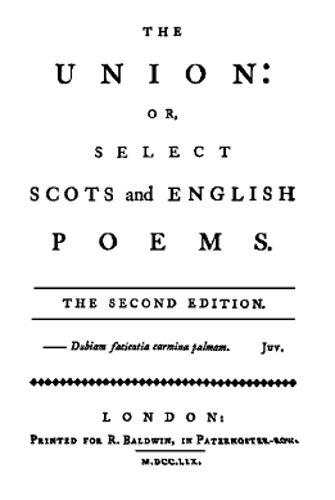
THE
OR,
SELECT
SCOTS and ENGLISH
POEMS.
THE SECOND EDITION.
----Dubiam facientia carmina palmam. Juv.

LONDON:
Printed for R. Baldwin, in Paternoster-Row.
M.DCC.LIX.
Whole book · 34 sections
THE
OR,
SELECT
SCOTS and ENGLISH
POEMS.
THE SECOND EDITION.
----Dubiam facientia carmina palmam. Juv.
LONDON:
Printed for R. Baldwin, in Paternoster-Row.
M.DCC.LIX.
As the mind of man is ever fond of variety, nothing seems better calculated to entertain, than a judicious collection of the smaller, though not on that account less laboured, productions of eminent poets: an entertainment, not unlike that which we receive from surveying a finished landschape, or well disposed piece of shell-work: where each particular object, tho' singly beautiful, and sufficiently striking by itself, receives an additional charm, thus, as Milton expresses it, sweetly interchanged.
The first miscellaneous collection of poems, that ever appeared in Great-Britain with any reputation, is that published by Dryden: which was afterwards continued by Tonson. There are many pieces of the highest merit in this collection, by Dryden, Denham, Creech, Drayton, Garth, Marvell, and many others; yet the compilers, it is evident, were not always sufficiently scrupulous and cautious in their choice, as several pieces are admitted, among the rest, which would otherwise utterly have perished, and which had no other recommendation, than that they served to swell the volume. Since this, many miscellanies have been published both in Scotland and England: to enumerate which would be no less tedious than useless. It will be sufficient to remark, that through want of care or judgment in their respective editors, they are all forgotten or neglected. From these the miscellany known by the name of Mr. Pope perhaps ought to be excepted; tho' that, indeed, cannot properly be styled a collection of poems by different hands, which is such a one as we are speaking of at present, the greater part consisting of pieces by Mr. Pope only. The best miscellany at this day extant in our language, and the first complete one of the kind which we have seen, is that lately published by R. Dodsley, which boasts the greatest names of the present age among its contributors.
As to the poetical collection here exhibited to the public, we apprehend it challenges no small degree of regard, as it was made under the immediate inspection and conduct of several very ingenious gentlemen, whose names it would do us the highest honour to mention; and as it contains a variety not to be found even in the admirable collection last spoken of; I mean the Intermixture of poems both Scotch and English. Nor is this variety less agreeable than useful; as from it we have an opportunity of forming a comparison and estimate of the taste and genius of the two different nations, in their poetical compositions.
It will be necessary to take notice, that our chief care has been to furnish out the following miscellany with those pieces, regard being first had to real merit, which have laid unknown and unobserved from their manner of publication; several of them having been printed by themselves, and so perished as it were for want of bulk, and others lost amid the rubbish of collections injudiciously made, and perhaps not easily to be met with. Nor will it be improper to mention, that in order to render our volume still more compleat, we have had the favour of some original poems, written by a late member of the university of Aberdeen, whose modesty would not permit us to prefix his name: one of which in this edition is printed with many improvements, from a corrected copy. And from these ingenious essays, the public may be enabled to form some judgment beforehand of a poem of a nobler and more important nature, which he is now preparing. Nor must we forget to return our public thanks to this gentleman, for the service he has been to us, not only in making this collection more excellent by his own contributions, but in selecting such pieces of others as were suitable to our design.
It is hoped that the ancient Scottish poems (amongst which the thistle and the rose, and hardyknute are more particularly distinguished) will make no disagreeable figure amongst those of modern date; and that they will produce the same effect here, as Mr. Pope observes a moderate use of old words may have in a poem; which, adds he, is like working old abbey-stones into a modern building, and which I have sometimes seen practised with good success.
Upon the whole, as we have been favoured with the best assistance in compiling this volume, no further apology is necessary; and as the approbation of the public has been already secured to these poems separately, we hope they have no less reason to claim it, when thus published together.
| Page | |
| The Thistle and the Rose, by W. Dunbar | 1 |
| Verses on the Death of Queen Caroline. By Mr. Shipley | 10 |
| The Genealogy of Christ, by Mr. Lowth | 13 |
| A Fragment, by Mr. Mallet | 24 |
| The Eagle and Robin Red-Breast, a Fable, by Archibald Scott, written before the Year 1600. | 28 |
| Ode to Fancy, by Mr. Joseph Warton | 31 |
| Ode to Evening, by the same | 37 |
| Ode to Evening, by Mr. Collins | 39 |
| Isis, an Elegy, by Mr. Mason of Cambridge | 42 |
| The Triumph of Isis, by Mr. Thomas Warton of Oxford | 47 |
| A Love-Elegy, by Mr. Hammond | 47 |
| The Tears of Scotland, 1746. | 62 |
| An Elegy written in a country church-yard, by Mr. Grey | 65 |
| On the Death of Prince Frederic. Written at Paris, by David Lord Viscount Stormont | 70 |
| On the same, by Mr. James Clitherow of Oxford | 75 |
| Ode on the Approach of Summer, by a Gentleman formerly of the University of Aberdeen | 81 |
| A Pastoral in the manner of Spenser, from Theocritus, Idyll. 20. By the same | 94 |
| Inscribed on a beautiful Grotto near the Water | 96 |
| Love Elegy, by Mr. Smollet | 97 |
| A Panegyric on Oxford Ale, by a Gentleman of Trinity College | 99 |
| The Progress of Discontent, by the Same. | 105 |
| Ode to Arthur Onslow, Esq; | 109 |
| Job, Chapter XXXIX. By a Gentleman of Oxford | 113 |
| Ode on the Death of Mr. Thomson, by Mr. Collins | 116 |
| The Child-Birth, in the manner of Gay | 119 |
| On a Lady's presenting a Sprig of Myrtle to a Gentleman, by Mr. Hammond | 125 |
| To a Young Lady with Fontenelle's Plurality of Worlds | 126 |
| Ode on the Fifth of December, by Mr. Christopher Smart | 128 |
| Part of the Prologue to Sir David Lyndesay's Dream. Written in the Reign of King James V. | 129 |
| Hardyknute, a Fragment | 132 |
| Ode. By Dr. Akenside, on Lyric Poetry | 147 |
DAUGHTER TO
HENRY VII. OF ENGLAND,
QUEEN TO
JAMES IV. KING OF SCOTS.
BY WILLIAM DUNBAR.
The Thistle and the Rose,
O'er flowers and herbage green,
By Lady Nature chose,
Brave King and lovely Queen.
I.
II.
III.
IV.
V.
VI.
VII.
VIII.
IX.
X.
XI.
XII.
XIII.
XIV.
XV.
XVI.
XVII.
XVIII.
XIX.
XX.
XXI.
XXII.
XXIII.
XXIV.
XXV.
XXVI.
XXVII.
FOOTNOTES:
[1] Alluding to the Houses of york and lancaster, which were distinguished by the white and red rose, and united in the person of Queen margaret.
VERSES ON THE DEATH
OF QUEEN
BY MR. SHIPLEY.
AS IT IS REPRESENTED ON THE EAST WINDOW
OF WINCHESTER COLL. CHAPEL.
WRITTEN AT WINTON SCHOOL, BY DR. LOWTHE.
| Above th' unutterable glory plays Presence divine! and the full-streaming rays Pour thro' reluctant clouds intolerable blaze. |
 |
| See their fair laurels wither on thy brow, Nor herbs, nor healthful arts avail thee now, Nor is heav'n chang'd, apostate prince, but Thou. |
|
| Leant down from Heav'n: amid the storm he rode March'd Pestilence before him; as he trod, Pale desolation bath'd his steps in blood. |
|
| Yet, in thy courts, hereafter shalt thou see Presence immediate of the Deity, The light himself reveal'd, the God confess'd in Thee. |
|
[2] JESSE.
[3] SOLOMON.
[4] JOSAPHAT.
[5] ELISHA.
[6] JOATHAM.
[7] HEZEKIAH.
[8] SENNACHERIB.
[9] ZOROBABEL.
A
BY MR. MALLET.
THE
A N D
ROBIN RED-BREAST.
A FABLE.[10]
BY MR. ARCHIBALD SCOTT.
[10] Written before the year 1600.
TO
FANCY.
BY THE REV. MR. JOSEPH WARTON.
TO
EVENING.
BY THE SAME.
I.
II.
III.
IV.
V.
VI.
VII.
TO
EVENING.
BY MR. WILLIAM COLLINS.
AN
ELEGY.
WRITTEN BY MR. MASON OF CAMBRIDGE, 1748.
THE
OF
ISIS.
OCCASIONED BY THE FOREGOING POEM.
BY MR. THOMAS WARTON, OF OXFORD.
Quid mihi nescio quam, proprio cum Tybride Romam,
Semper in ore geris? referunt si vera parentes,
Hanc urbem insano nullus qui marte petivit
Lætatus violasse redit. Nec numina sedem
Destituunt.——
Claudian.
[11] radcliffe's library.
[12] Alfred. Regis Romani. V. Virg. Æn. 6.
————————Ad Capitolia ducit
Aurea nunc, olim sylvestribus horrida dumis.
VIRG. ÆN.
BY MR. HAMMOND.
I.
II.
III.
IV.
V.
VI.
VII.
VIII.
IX.
X.
XI.
XII.
XIII.
XIV.
XV.
XVI.
XVII.
XVIII.
XIX.
XX.
XXI.
XXII.
THE
OF
SCOTLAND.
WRITTEN IN THE YEAR MDCCXLVI.
I.
II.
III.
IV.
V.
VI.
VII.
WRITTEN IN A COUNTRY CHURCH YARD.
THE EPITAPH.
FREDERIC PRINCE OF WALES.
WRITTEN AT PARIS, BY DAVID LORD VISCOUNT
STORMONT, OF CH. CH. OXON.
BY MR. JAMES CLITHEROW OF ALL SOULS COLL.
I.
II.
III.
IV.
V.
VI.
VII.
VIII.
IX.
X.
XI.
XII.
XIII.
XIV.
XV.
XVI.
XVII.
XVIII.
XIX.
XX.
XXI.
XXIII.
XXIV.
XXV.
XXVI.
ON THE
APPROACH OF SUMMER.
BY A GENTLEMAN FORMERLY OF THE UNIVERSITY OF ABERDEEN.
Te dea, te fugiunt venti, te nubila cœli,
Adventumque tuum; tibi suaveis dædala tellus
Submittit flores; tibi rident æquora ponti;
Placatumque nitet diffuso lumine cœlum.
lucretius.
A
IN THE
MANNER OF SPENSER.
FROM THEOCRITUS. IDYLL XX.
BY THE SAME.
I.
II.
III.
IV.
V.
VI.
ON A BEAUTIFUL
GROTTO NEAR THE WATER.
I.
II.
BY MR. SMOLLET.
I.
II.
III.
IV.
V.
VI.
A
ON
OXFORD ALE.
BY A GENTLEMAN OF TRINITY COLL.
——————Mea nec Falernæ
Temperant vites, neque Formiani
Pocula colles.Horat.
THE
BY THE SAME.
TO
ARTHUR ONSLOW, ESQ.
I.
II.
III.
IV.
V.
VI.
VII.
VIII.
IX.
[14] This elegant Poem was written by a Gentleman well known in the Learned World, as a token of gratitude for favours conferred on his father, during the last war, whose character he has therein affirmed.
BY A GENTLEMAN OF OXFORD.
ON THE
DEATH OF MR. THOMSON,
BY MR. COLLINS.
THE SCENE OF THE FOLLOWING STANZAS
IS SUPPOSED TO LIE ON THE
THAMES, NEAR RICHMOND.
I.
II.
III.
IV.
V.
VI.
VII.
VIII.
IX.
X.
XI.
[15] The harp of æolus, of which see a description in the castle of Indolence.
[16] Richmond Church.
in the manner of GAY.
[17] The Rev. Dr. wilkes wrote a poem upon them.
[18]
Nec tibi diva parens, generis nec Dardanus auctor,
Perfide, sed duris genuit te cautibus horrens
Caucasus, Hyrcanæque admorunt ubera tigres.
[19]
I, sequere Italiam ventis, &c.
Spero equidem mediis, siquid pia numina, &c.
[20] Omnibus umbra locis adero, dabis, improbe, pœnas.
Æn. 4.
[21]
————Semperque relinqui
Sola sibi, semper longam incomitata videtur
Ire viam, & Tyrios desertâ quærere terrâ,
Eumenidum veluti demens videt agmina Pentheus, &c.
Æn. 4.
ON A
PRESENTING A SPRIG OF MYRTLE
TO A
GENTLEMAN.
BY MR. HAMMOND.
TO
WITH
FONTENELLE'S PLURALITY OF WORLDS.
ON THE FIFTH OF DECEMBER,
Being the birth-day of a very beautiful young lady.
BY MR. CHRISTOPHER SMART.
I.
II.
PROLOGUE
TO
SIR DAVID LYNDESAY'S DREAM.
WRITTEN IN THE REIGN OF KING JAMES V.
I.
II.
III.
IV.
V.
VI.
VII.
VIII.
A FRAGMENT.
I.
II.
III.
IV.
V.
VI.
VII.
VIII.
IX.
X.
XI.
XII.
XIII.
XIV.
XV.
XVI.
XVII.
XVIII.
XIX.
XX.
XXI.
XXII.
XXIII.
XXIV.
XXV.
XXVI.
XXVII.
XXVIII.
XXIX.
XXX.
XXXI.
XXXII.
XXXIII.
XXXIV.
XXXV.
XXXVI.
XXXVII.
XXXXVIII.
XXXIX.
XL.
XLI.
XLII.
ON LYRIC POETRY.
BY DR. AKENSIDE.
[22] Alcæus of Mitylene, the capital of Lesbos, who fled from his native city to escape the oppression of those who had inslav'd it, and wrote against them in his exile those noble invectives which are so much applauded by the ancient critics.
[23] Pindar.
FINIS.
TRANSCRIBER'S NOTES
Eighteenth-century idiosyncrasies of spelling, punctuation and capitalisation have been retained.
In the Scottish poems "Prologue to Sir David Lyndesay's Dream" and "Hardyknute", the letter "z" has been used by the original editor to represent the letter "ȝ" or "yogh".
The variants "aereal" and "aerial", "All-powerful" and "All-pow'rful", "far-famd" and "far-fam'd", "noontide" and "noon-tide", "Phebus", "Phæbus", "Phœbus" and "Phoebus", "upland" and "up-land", "woodman" and "wood-man" appear in this text.
The poem "A Love-Elegy, by Mr. Hammond" begins on page 57, not 47 (as given in the Table of Contents). The incorrect page number has been retained in the Table of Contents, but a link has been made to the correct page.
On p. 4 quotation marks are missing after "Queen!" but the text has been left unchanged.
On p. 69 there should perhaps be closing quotation marks after "print the ground" and "his father and his God" but the text has been left unchanged.
On p. 79 the stanza numbering goes from XXI to XXIII in mid-page.
On p. 107 there should perhaps be closing quotation marks after "be but good!" but the text has been left unchanged.
On p. 115 the line "Is this, he cries, the trumpet's warlike sound?" has been left unchanged, although quotation marks appear to be missing before and after "he cries".
On p. 134 closing quotation marks appear to be missing after "commands" but the text has been left unchanged.
On p. 144 stanza number XXXVIII is incorrectly given as XXXXVIII.
The following amendments have been made:
p. 7: missing hyphen inserted in "Flower-de-lyce";
p. 16: "reluctant crouds" amended to "reluctant clouds";
p. 64: repeated "shall" deleted in "My sympathizing verse shall flow";
p. 95: extra comma removed after "swain";
p. 100: "votaties" amended to "votaries";
p. 109: after "ESQ" comma changed to full stop;
p. 114: "mounts" changed to "mount".