CHAPTER LXXVI. AUSTRALIA— Continued . MEDICINE, SURGERY, AND THE DISPOSAL OF THE DEAD.
BILBOS, OR NATIVE DOCTORS — WOUNDS AND BRUISES — A STRANGE CURE — TREATMENT OF THE HEADACHE — A
DREAM AND ITS RESULTS — THE MAGIC CRYSTAL, OR DOCTOR-STONE — ITS EFFECTS ON
WOMEN AND CHILDREN — THE DOCTOR-HOUSE — SUCTION AS A MEANS OF CURE — BELIEF IN
CHARMS — THE PARENT’S SKULL — CEREMONIES OF MOURNING — CUTTING THE HEAD AND BODY
AS A SIGN OF WOE — DRIVING AWAY THE EVIL SPIRITS — FEAR OF GHOSTS — BURIAL AMONG THE
PARNKALLAS AND NAUOS — THE TOMB OF SKULLS — A SUMMARY MODE OF BURIAL — FUNERAL
OF BOYS — THE TREE-TOMBS — SMOKING THE WARRIORS — INCONSISTENT BEHAVIOR — BURIAL
OF OLD WOMEN — THE WIDOWS’ CAPS — RELIGIOUS IDEAS OF THE ABORIGINES — THE VARIOUS
EVIL SPIRITS — THE BUNYIP — ROCK AND CAVE PAINTINGS — THEORY OF TRANSMIGRATION.
We will now see how the Australian natives
treat sickness of various kinds. Among
them are certain personages called bilbos,
or doctors, to whom the sick usually appeal
in cases of illness or pain. It is not known,
however, whether the mere fact of age gives a
man the rank of bilbo, or whether it is attained
by sundry ceremonials, as is the case
with the Africans and other savages.
The most usual mode of treating any
local disease or pain is by pressing the
hands upon the affected part, and kneading
it, a remedy which is found in every part of
the world, and which is really efficacious in
many complaints, especially in rheumatic
affections, or in sprained or over-exerted
muscles. If a limb be wounded, bruised, or
sore, the native practitioners tie a fillet
tightly above it, for the purpose, as they say,
of preventing the malady from reaching the
body. Headaches are treated by tying a
bandage firmly round the temples, and, if
the pain be obstinate, the doctors bleed the
patient under the arm, using a sharp piece of
quartz as a lancet. The flowing blood is
never allowed to be wasted, but is received
on the body of the operator, and diligently
rubbed into the skin, under the notion that
by this process both parties are strengthened.
This depends, however, on the sex
of the patient, women being never bled,
nor allowed to have the blood of any other
person sprinkled upon them.
About 1832, a curious disease broke out
among the natives of Wellington Valley,
resembling the small-pox in many things,
and yet displaying symptoms which scarcely
belong to that dread disease, the one fatal
scourge of savage tribes. It was preceded
by headache, fever, sore-throat, &c., and
accompanied by pustules very much resembling
those of the small-pox. It was, however,
scarcely virulent enough for the real
disease, though it was probably a milder
form of it, and was subject to the power of
vaccine matter. It was not limited to the
natives, but attacked many Europeans just
like the genuine small-pox, and in one case
was fatal.
It is here mentioned on account of the
mode of cure adopted by the native doctors.
They punctured the pustules with sharp
fish-bones, and squeezed them well with
the blunt end of their rude lancets, and it
is a noteworthy fact that the rate of mortality
was very much reduced. Of course the
doctors used other modes, whereby they
gave their patients confidence in their
powers. The chief of these was performed
by means of a number of slender rods, six
to nine feet in length, which were stuck in
the ground in the form of a crescent, and
addressed with long speeches and many
mysterious gestures. Among the Australians,
this disease, whatever it may be, does
not strike the abject terror with which it is
usually accompanied. Although they know
that it is infectious, they do not abandon
the sick person, unless perhaps the doctor
pronounces the patient incurable; in which
case they save him prolonged pain, and
themselves useless trouble, by burying him
alive. The native term for this disease is
“thunna-thunna,” and it is known to have
existed when the country was first discovered,
so that it is not imported from civilized
countries.
Another remarkable kind of cure for the
headache is mentioned by Mr. Angas. The
patient being seated on the ground, a string
is tied round his head, the knot being carefully
adjusted to the middle of the forehead.
The operator, who is always a woman, seats
herself opposite the patient, places the line
between her lips, and frets them with it
until they bleed freely. The idea is that
the disease, attracted by the blood, passes
along the line from the patient’s head, and
is cast out together with the blood.
A very remarkable instance of this mode
of cure is related in Tyerman and Bennett’s
“Voyage round the World.” A man had
dreamed that he had been speared in the
side, and had died in consequence of the
wound. Although, when he woke, he knew
it was but a dream, he was so frightened
that he became very ill, retired to his hut,
chose the place of his burial, and lay down to
die.
Nearly a week elapsed, during which he
could take no food, grew worse and worse,
and it was plain that nature would not hold
out much longer. The priests—or rather
sorcerers, for it cannot be ascertained that
the New Hollanders have any other kind of
priests, having, in fact, no religious worship—came
to do what they could for him with
their enchantments. By their order he was
carried down to the side of a running water,
and tumbled into the stream, where it was
pretty deep, head foremost. When taken
out, he was rolled in the sand till his body
was quite encased with it. This again was
washed off by pouring water over him.
“Meanwhile a young woman of the company
was perceived plaiting a cord of kangaroo’s
hair, which, when completed, was
bound round his chest, and a knot, very
cunningly implicated by one of the operators,
was placed over that part of his side
into which the spear of his dream had entered.
From this knot a line was passed
to the young woman who had prepared the
bandage. This she drew through her mouth
backward and forward (as children sometimes
do with a piece of packthread) until
she began to spit blood, which was said to
be sucked by that process from the wound
in the sick man’s side. There it was now
perceptible that, from whatever cause, a
considerable swelling had arisen under the
knot. Toward this one of the sorcerers
began to stroke the man’s flesh from all the
adjacent regions of the back, belly, and chest,
as though to force the blood thither. He
then applied his mouth to the swelling, and,
with hideous noises, sometimes sucked it
with his lips, sometimes pressed it violently
with his hands, till forth came the point of a
spear, four inches in length, which he presented
to the astonished spectators and the
expecting sufferer, as verily extracted from
the man’s side.
“Then he applied his mouth again to the
swollen part, from which, although there
was no visible wound, he appeared to draw
blood and corrupt matter, stains of both
being soon seen on the swarthy skin. At
length, with distended cheeks, as though he
had filled his mouth with the abominable
matter, he ran about, anxiously looking for
a fit place to discharge it upon; but, affecting
to find none, he crossed the water, and
deposited the nauseous extract behind a
bush. The poor man’s hopes revived, and
he now believed that he should get well
again. Mr. Dunlop thereupon sent him
some tea, which, however, he would not
drink, but requested that it might be given
to the sorcerer, and, if he drank it, then it
would do himself (the patient) good. He
was deceived, disappointed, and died.”
The Australians are tolerably good surgeons
in a rough-and-ready sort of way, and
are clever at setting broken limbs. After
bringing the broken ends of the bone together,
they support the limb by several
pieces of wood which act as splints, and then
make the whole secure by bandages, which
they often strengthen with gum, exactly as
is done in modern surgery.
One of the most powerful remedies employed
by the native practitioners is the
“doctor-stone.” This is nothing but a common
quartz crystal; but the doctors aver
that they manufacture it themselves, and
that the ingredients are kept secret. Like
the witarna, mentioned on page 747, women
are never allowed even to look upon the
doctor-stone, and are impressed with the
belief that, if they dared to set their eyes
upon the forbidden object, they would be
immediately killed by its radiant powers.
The larger the crystal, the more valuable is
it; and a tolerably large one can scarcely be
procured from the natives at any price.
The doctors say that this stone is not only
fatal to women, but also destroys men if
flung at them with certain incantations. An
European settler once challenged a native
doctor to say as many charms as he liked,
and throw the magic stone as much as he
pleased. This offer, however, he declined,
giving the usual excuse of savages, that the
white man belonged to a totally different
order of beings, and, although the poor black
fellow would die from the effects of the
doctor-stone, the white man was much too
powerful to be hurt by it.
The mode in which the crystal is used is
very curious, and has been described by an
eye-witness.
A native of the Tumat country, named
Golong, was suffering from a spear wound
received in a skirmish with a hostile tribe,
and was brought to a bilbo, named Baramumbup,
to be healed. The patient being
laid on the ground outside the encampment
so that women could not run the
risk of death through the accidental sight
of the crystal, the doctor began a close examination
of the wound, and sucked it.
He then retired to a distance from the
patient, muttered some magic words for a
minute or so, and placed the crystal in his
mouth. Having retained it there for a short
time, he removed it, spat on the ground, and
with his feet trampled on the saliva, pressing
it deeply into the ground. This was
repeated several times, and the doctor took
his leave.
For several successive evenings the whole
of the process was gone through, and the
recovery of the patient, which was really
rapid, was attributed by all parties to the
wonderful efficacy of the doctor-stone. “On
making inquiry,” writes Dr. Bennett, “why
the physician is so careful in trampling the
saliva discharged from his mouth into the
ground, no satisfactory reason could be obtained,
a vague answer only being returned
to the query. But it is not improbable that
they consider, by this practice, that they
finally destroy the power of the evil spirit,
extracted by the operation through the virtues
of the stone. Some such reason for
this proceeding may be inferred from an
observation made to any European who
may be present at this part of the ceremony,
‘that he (i. e. the disease) may not come up
again.’”
It is remarkable that a ceremony almost
exactly identical in principle is employed by
the Guaycura tribe of Brazil. Among them
the doctors, or payés, cure local ailments,
whether wounds or otherwise, by sucking
the part affected, spitting into a hole dug in
the ground, and then filling in the earth, as
if to bury the complaint.
The Australian doctors make great use of
the principle of suction, and employ it in
all kinds of cases. If, for example, a patient
has a bad pain in his stomach from overeating,
or suffers more than he thinks right
from the blow of a waddy, the doctor sucks
at the afflicted part vigorously, and at last
produces from his mouth a piece of bone, or
some other hard substance, which he asserts
to be the concentrated essence of the pain,
or other ailment. The reader may remark
that the bones with which the gums of
youths are lanced in the ceremonies of initiation
are supposed to be produced from the
bodies of the operators by means of suction.
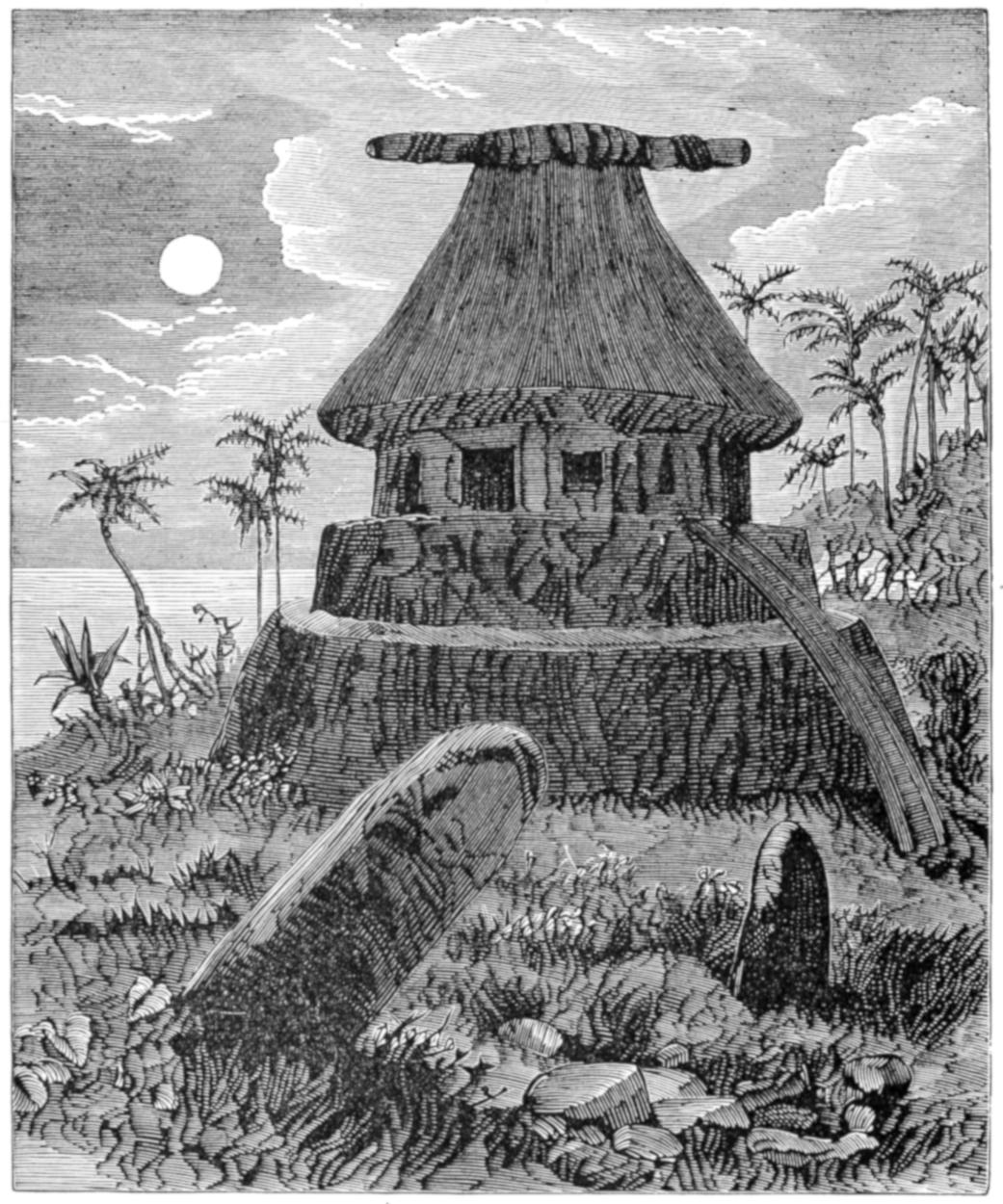
A very remarkable curative agent is
shown in the illustration No. 3, page 765,
which is taken from a sketch by Mr. Baines.
It consists of a stone building, which at
first sight looks so like an ordinary Druidical
remain that it might be taken for
one, except for its dimensions. Instead,
however, of being composed of huge stones,
each weighing several tons, it is quite a
tiny edifice, scarcely larger than the grotto
which children erect with oyster-shells. The
patient lies in, or rather under it, the aperture
being just wide enough to admit his
body, and the small roof only covering a
very small portion of the inmate. Sundry
superstitious rites are employed at the same
time, and the remedy is efficacious, like the
crystal already mentioned, in consequence
of enlisting the imagination of the sufferer.
These little buildings are found along the
Victoria River, and for a considerable time
the object for which they were built greatly
puzzled the discoverers.
A medicine scarcely less efficacious than
the doctor’s stone is human fat, which is
carefully preserved, and administered by
being rubbed in and around the affected
part. As, however, it is highly valued by
the warriors it is not easily procured, and,
had it to be taken solely from the bodies of
slain enemies, would in all probability never
be used at all. The efficacy of this repulsive
remedy does not depend on the individual
from whom it is taken, that of a child or
woman being quite as useful as that of a
warrior.
According to Mr. G. T. Lloyd, the practice
of deserting the helpless is found in
Australia as well as in other countries, and
is practised exactly as is the case in Africa.
When a person is ill the relations, as a rule,
do not trouble themselves to visit the sick
person, and, when there is no apparent hope
of recovery, a supply of food and firing
enough to last them for several days is left
near them, and they are then abandoned to
their fate. Even in the case of poor old
Tarmeenia, mentioned on page 747, the son,
although he carried his wounded father
more than four miles in order to place him
in safety, never once came to see him.
Seeing that the natives place such implicit
faith in the healing power of the doctor’s
stone, it is natural that they should also
believe in sundry charms as preservatives
against disease and misfortune. One of
these charms is a sort of girdle, several
inches wide in the middle, and tapering to a
mere thong at each end. If it be made of
string prepared from the bulrush root, it is
called Taara or Kuretti; and if made of
human hair, it goes by the name Godlotti.
It is used more as a curative than a preventive,
and is mostly found among the tribes
of the lower Murray River. The hair, when
twisted into thread, is wound upon a curious
spindle, consisting of two slender pieces of
wood placed across each other at right
angles.
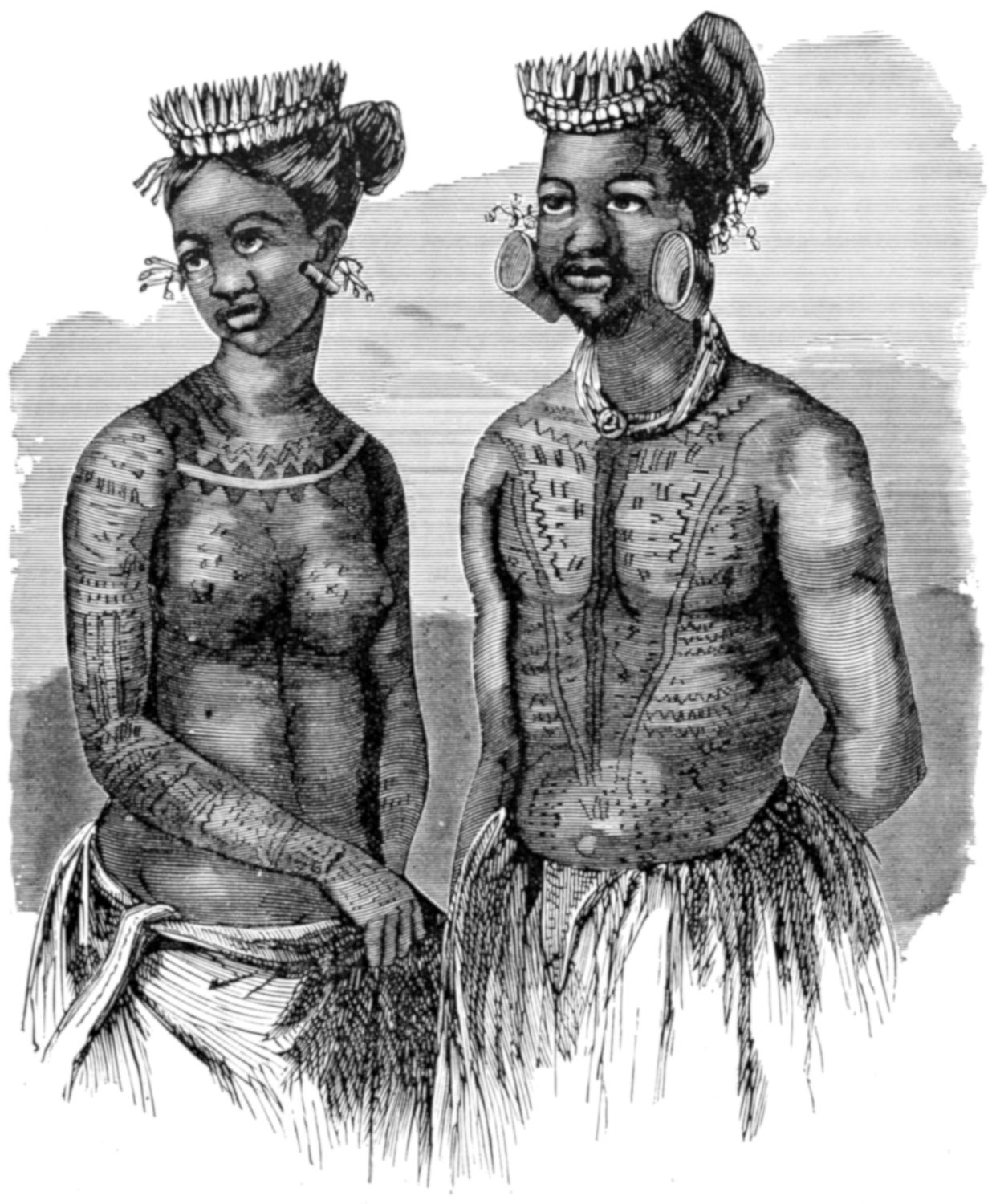
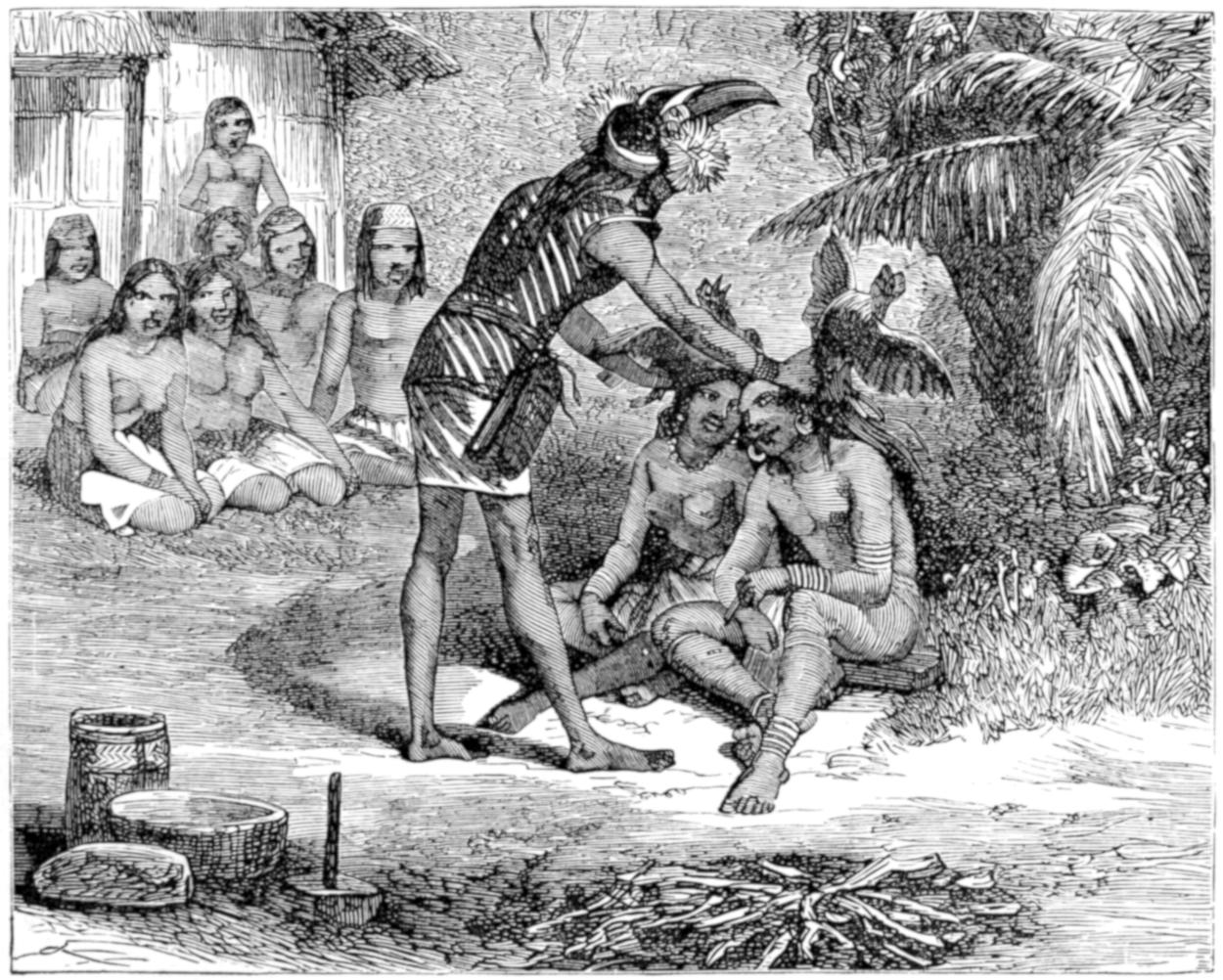
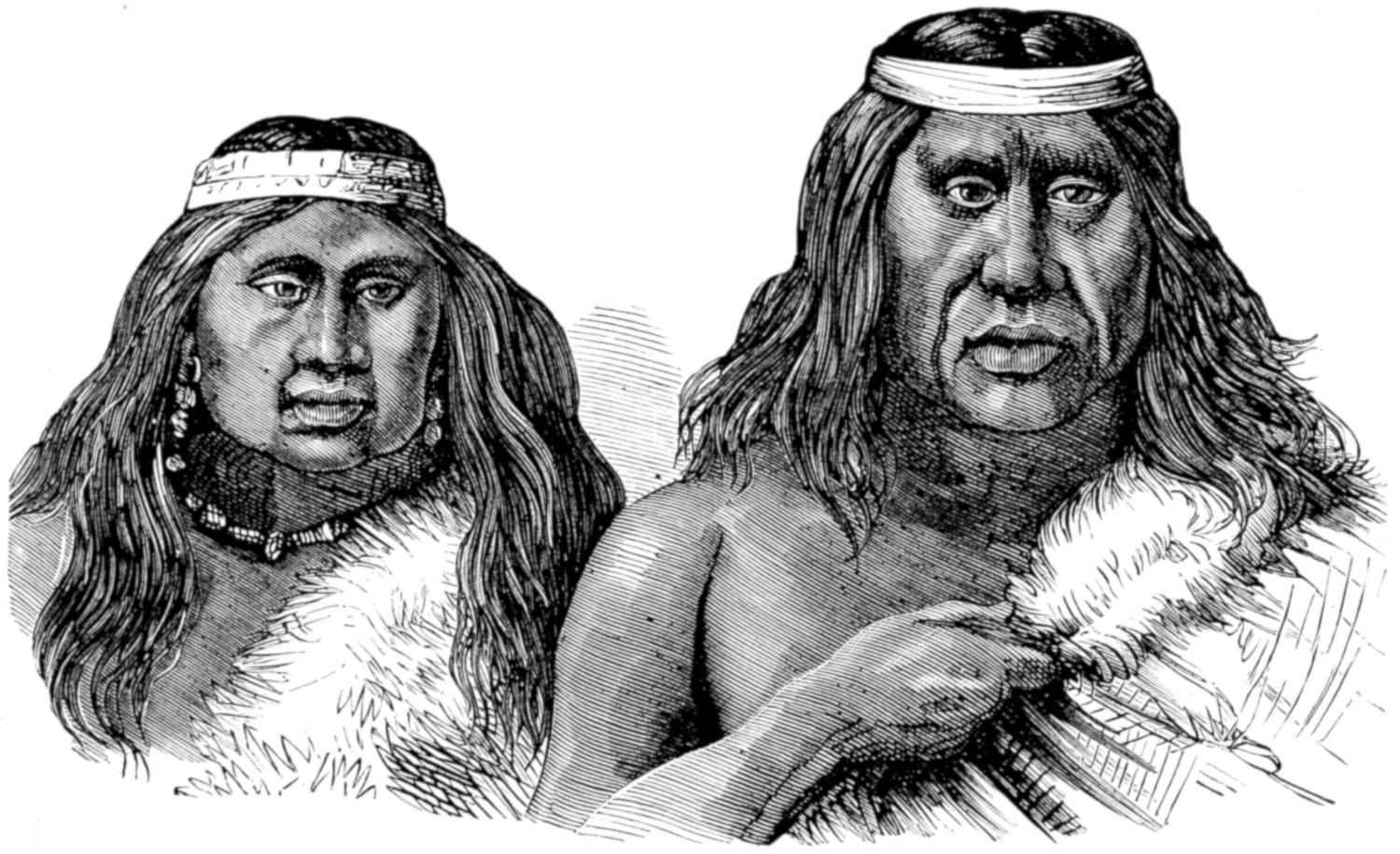
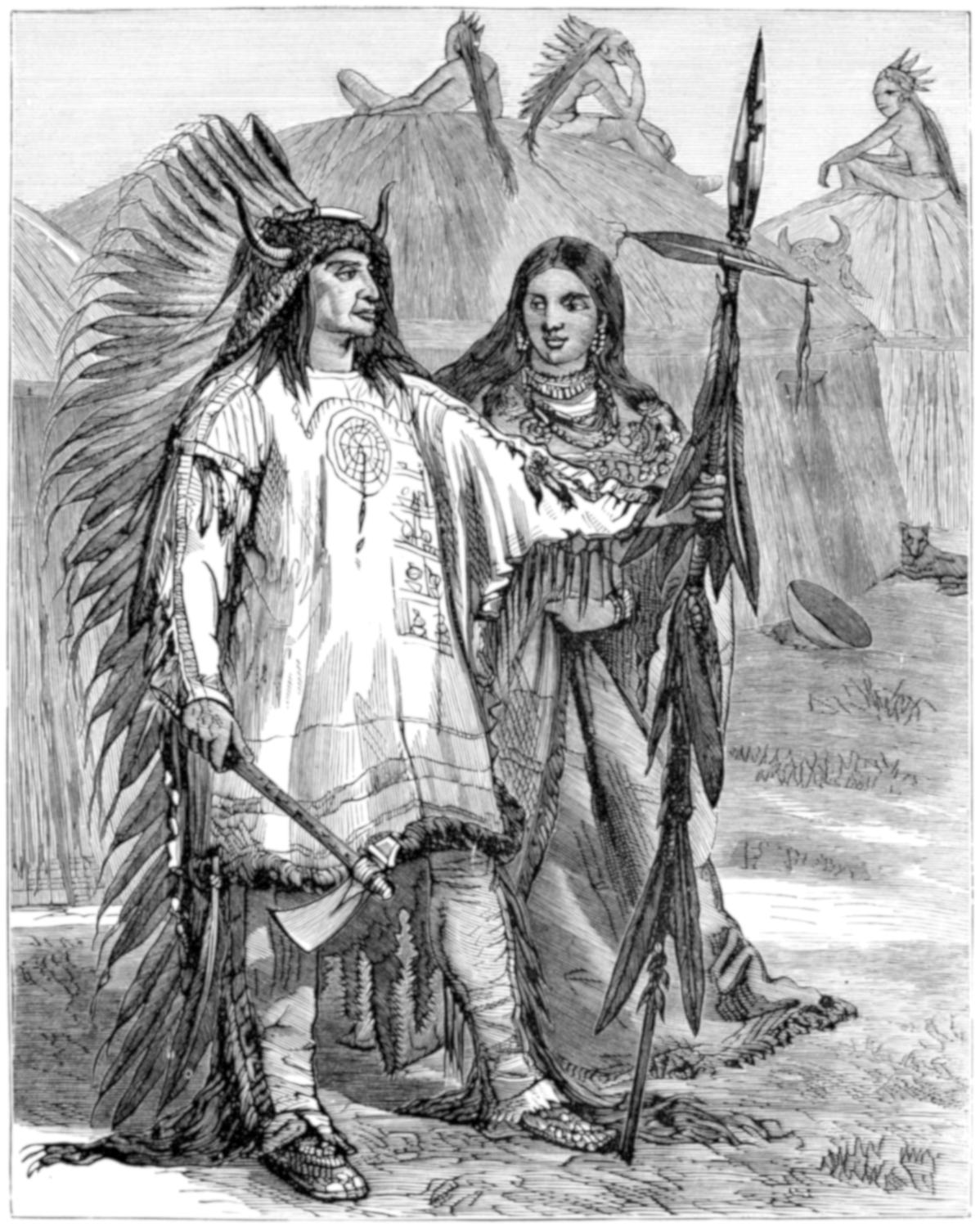
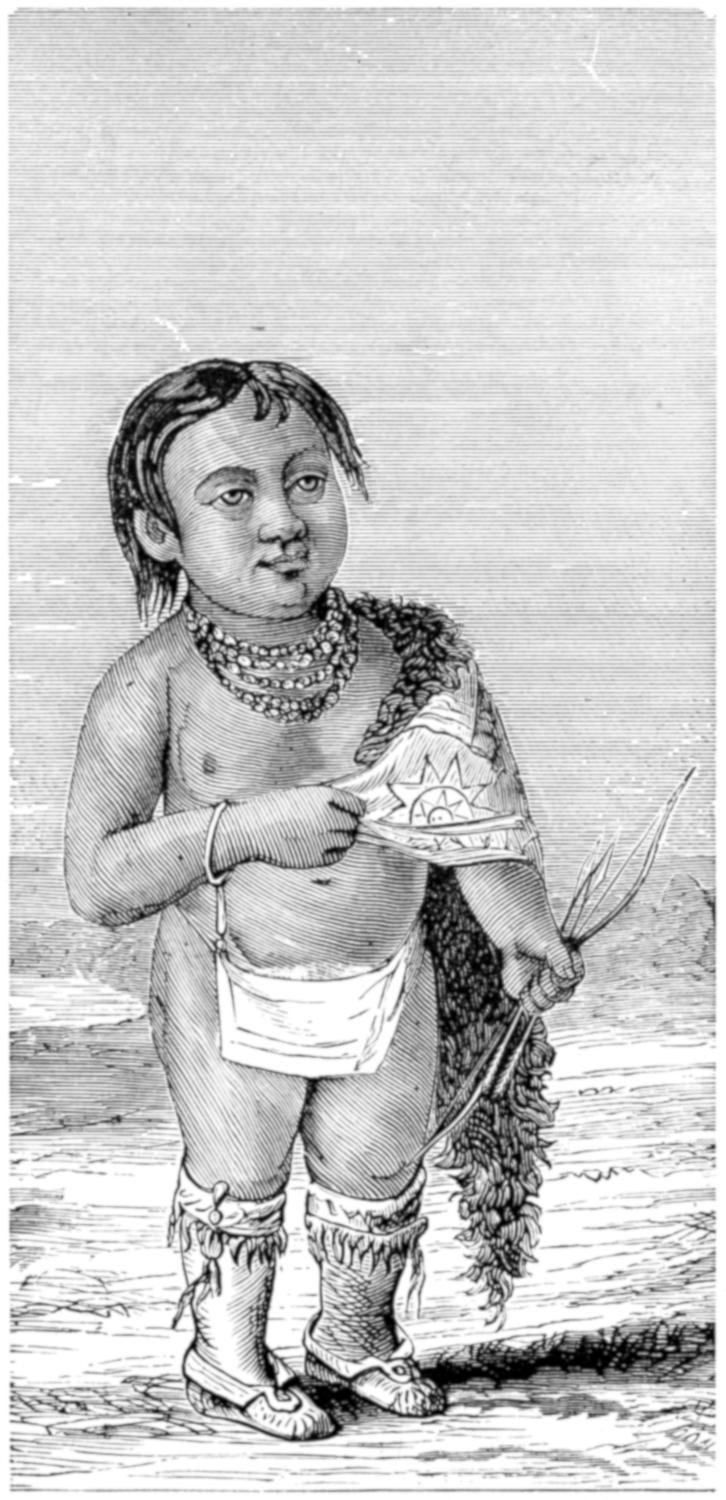
Another charm is shown in the illustration
No. 2, on the 765th page, slung round
the neck of the boy. It is the beak of the
black swan, which, from its scarlet color,
contrasts well with the black skin of the
wearer. The little boy’s name is Rimmilliperingery,
and Mr. G. F. Angas remarks
that he was an engaging little fellow, and
had the largest and softest pair of dark eyes
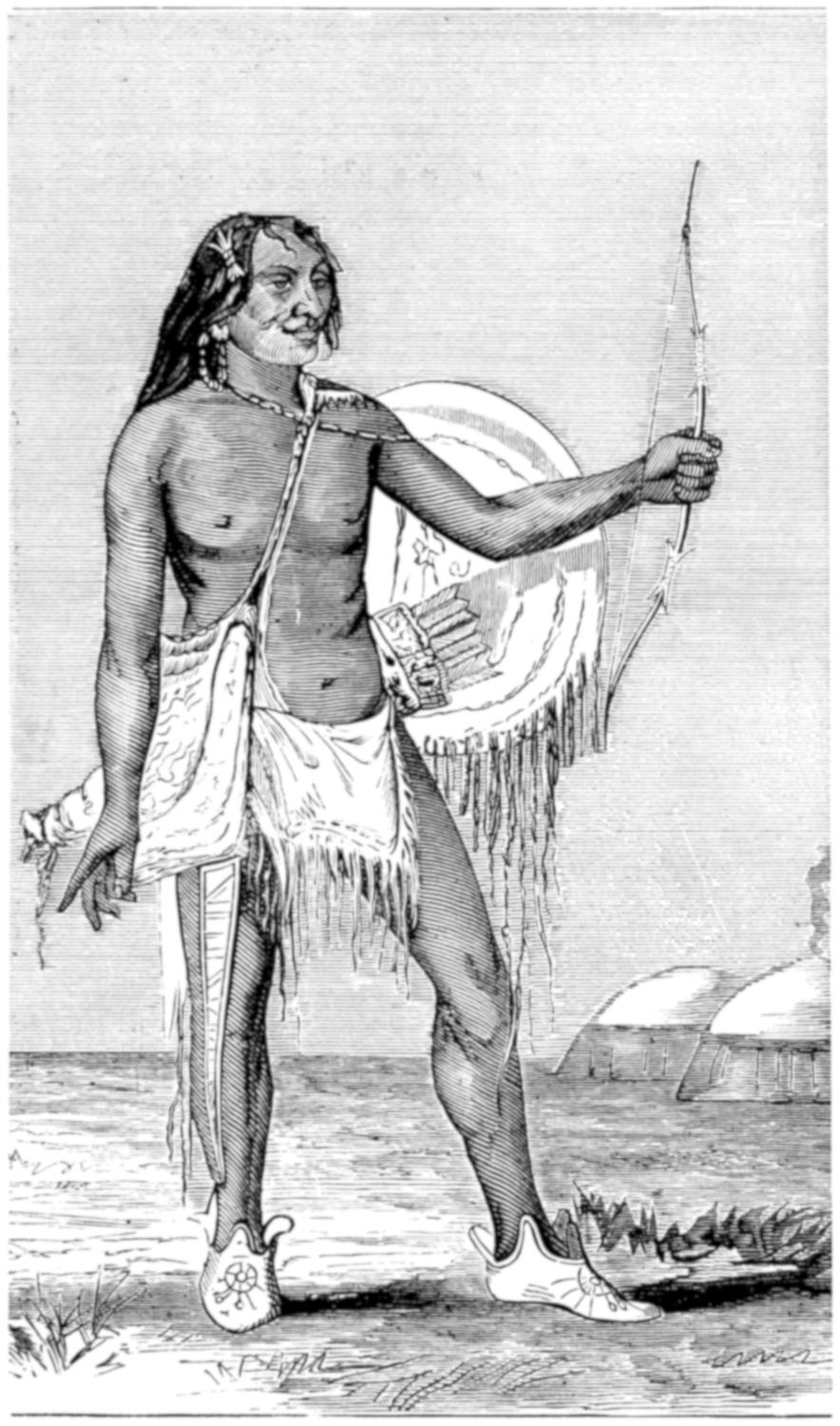
that could be imagined. The elder figure is
that of a young man named Tyilkilli, belonging
to the Parnkalla tribe of Port Lincoln.
He has been selected as a favorable example
of the Australian young man in good
circumstances, well-fed, careless, and gay
with the unthinking happiness of mere animal
life, which finds a joy in the very fact of
existence.
Among many of the tribes may be seen a
strange sort of ornament, or rather utensil;
namely, a drinking-cup made of a human
skull. It is slung on cords and carried by
them, and the owner takes it wherever he
or she goes. These ghastly utensils are
made from the skulls of the nearest and
dearest relatives; and when an Australian
mother dies, it is thought right that her
daughter should form the skull of her
mother into a drinking-vessel. The preparation
is simple enough. The lower jaw is
removed, the brains are extracted, and the
whole of the skull thoroughly cleaned. A
rope handle made of bulrush fibre is then
attached to it, and it is considered fit for
use. It is filled with water through the vertebral
aperture, into which a wisp of grass
is always stuffed, so as to prevent the water
from being spilled.
Inconsistency is ever the attribute of savage
minds. Although they consider that to
convert the skull of a parent into a drinking
vessel, and to carry it about with them,
is an important branch of filial duty, they
seem to have no very deep feelings on the
subject. In fact, a native named Wooloo
sold his mother’s skull for a small piece of
tobacco. His mind was evidently not comprehensive
enough to admit two ideas together,
and the objective idea of present
tobacco was evidently more powerful than
the comparative abstraction of filial reverence.
Mr. Angas saw one which was carried by
a little girl ten years of age. Like “Little
Nell,” she was in attendance upon an old
and infirm grandfather, and devoted her
little life to him. In nothing was the difference
of human customs shown more plainly
than in the use of the mother’s skull as a
drinking vessel—an act which we should
consider as the acme of heathen brutality,
but with these aborigines is held to be a
duty owed by the child to the parent.
Perhaps my classical readers will remember
a chapter in Herodotus which bears on
this very subject. He finds fault with Cambyses
for breaking into the temples of the
Cabeiri, burning their idols, and so hurting
the religious feelings of the people; and
remarks that he was wary in offending
against any religious sentiment, however
absurd it might appear to himself. He then
proceeds to tell an anecdote of Darius, who
had at his court some “Indians called Callatians,”
and some Greeks. He asked the
Greeks (who always burned their dead, as
the Hindoos do now), what bribe would
induce them to eat the bodies of their dead
parents, and they naturally replied that for
no bribe could they perform so horrible a
deed. Then, in the presence of the Greeks,
he asked the Callatians, who ate their dead
(as several savage nations do now), for
what sum they would consent to burn the
bodies of their dead. They, as it appears
from the style of their answer, were even
more shocked than the Greeks at the idea of
such horrible sacrilege, and would not deign
to give a direct answer, but begged Darius
to “speak words of good omen.” (See
Thalia, xxxvii. 8.)
A somewhat similar proceeding is narrated
in the life of Nussir-er-deen, the late king of
Oude. His native ministers, jealous of the
influence exercised over him by some of his
European friends, complained that the English
guests treated the monarch with disrespect,
by retaining their shoes in his royal
presence. The king, who, enervated as he
was by vanity, dissipation, self-indulgence,
and flattery, was no fool, immediately proposed
a compromise. “Listen to me, nawab;
and you, general, listen to me. The King of
England is my master, and these gentlemen
would go into his presence with their shoes
on. Shall they not come into mine, then?
Do they come before me with their hats on?
Answer me, your excellency.”
“They do not, your majesty.”
“No, that is their way of showing respect.
They take off their hats, and you take off
your shoes. But come now, let us have a
bargain. Wallah! but I will get them to
take off their shoes and leave them without,
as you do, if you will take off your turban
and leave it without, as they do.” (See
Knighton’s “Private Life of an Eastern
King.”)
We now come naturally to the burial of
the dead, and the various ceremonies which
accompany the time of mourning. Although
the relatives seem so careless about the sick
person, they really keep a watch, and, as
soon as death actually takes place, they announce
the fact by loud cries. The women
are the principal mourners, and they continue
to sob and shriek and moan until they
are forced to cease from absolute exhaustion.
They cut their bodies until the blood streams
freely from their wounds, and some of them
chop their own heads with their tomahawks
until their shoulders and bodies are covered
with blood.
The reader will probably have noticed how
widely spread is this custom of wounding the
body as a sign of mourning, and especially as
a lamentation for the dead. We have seen
that it exists in Africa, and we shall see that
it is practised in many other countries. That
it was practised in ancient days by the people
among whom the Jews lived, we see from
several passages of Scripture. See for example
Deut. xiv. 1: “Ye shall not cut yourselves,
nor make any baldness between your
eyes for the dead.” Also Jer. xvi. 6: “They
shall not be buried, neither shall men lament
for them, nor cut themselves, nor make themselves
bald for them.” There is also the
well-known passage concerning the sacrifice
that the priests of Baal offered, in the course
of which they “cut themselves after their
manner with knives and lancets, till the blood
gushed out upon them.”
The body is not disposed of at once, but is
suffered to remain for a considerable time,
during which decomposition takes place, and
is allowed to work its course until the flesh is
separated from the bones. The body is
watched carefully during the night; and if a
passing meteor should appear in the sky, the
people shout and wave firebrands in order
to drive away a certain evil spirit named
Yúmburbar, which is thought to be the real
though invisible cause of death and all calamities,
and to haunt the spot where a dead body
lies for the purpose of feeding upon it.
When decomposition has done its work, the
bones are carefully collected, cleaned, and
painted red, after which they are wrapped
up in bark, and carried about with the tribe
for a time. This term being fulfilled, they
are finally disposed of in various ways, according
to the customs of the tribe to which
they belonged. Some tribes scoop holes in
soft rocks, and place the remains therein,
while others prefer hollow trees for that purpose.
Sometimes the body is placed in the
cave without being reduced to a skeleton,
and in some places the soil is of such a nature
that the body becomes dried before
decomposition can proceed very far. During
the Exhibition of 1862 one of these desiccated
bodies was exhibited in England, and
called the “petrified” man. It was, however,
nothing but a shrivelled and dried-up
body, such as is often found in very dry soils.
Near the Murrumbidgee River, in the
Wellington Valley, there is a remarkable stalactitic
cavern, divided into several “halls.”
This cavern is, or has been, a favorite burying-place
of the aborigines, who seem to have
employed it for the same purpose that Abraham
purchased the cave of Machpelah. In
consequence of the use of the cavern as a
burial place, the natives are rather nervous
about entering it, and they flatly refuse to
venture into the darker recesses, for fear of
the “dibbil-dibbil.” When Dr. Bennett
visited it in 1832, he found in a small side
cave the skeleton of a woman. The bones
had been placed there nearly twenty years
before.
The Parnkalla and Nauo tribes have another
mode of burial, which somewhat resembles
that which is employed by the Bechuanas.
The body is placed in a crouching
or squatting position, such as is employed by
the natives when sitting, the knees being
drawn up to the chin, the legs close to the
body, and the hands clasped over the legs.
Examples of this attitude may be seen in
many of the illustrations. A circular pit or
grave, about five feet in depth, is then dug,
and after the body is lowered into the pit a
number of sticks are laid over the grave,
nearly touching one another. A thick layer
of leaves and another of grass are then placed
on the sticks, and over all is heaped the earth
which has been dug out of the pit, so that
the grave looks something like a huge
anthill.
In Northern Australia the natives have a
curious method of disposing of the dead.
They gather the skulls together, and heap
them into a circular mound, placing stones
round them to keep them in their places.
They do not cover the skulls, but make the
tomb in an open and conspicuous place.
Such a tomb is illustrated on page 765.
The blacks of the Clarence River build
monuments which are somewhat similar in
appearance, but are made of different materials.
They place a number of stones in a
circle, and in the centre they erect an upright
slab of stone. They can give no reason
for this custom, but only say that “black-fella
make it so,” or “it belong to black-fella.”
The former reply signifies that the custom
has always prevailed among the natives; and
the second, that the tomb shows that a native
lies buried beneath the upright stone.
Some of the tribes along the Clarence
River have a curious mode of disposing of the
dead—a mode which certainly has its advantages
in its great economy of trouble. When
an old man feels that the hand of death is on
him, he looks out for a hollow tree, climbs it,
lets himself down to the bottom of the hollow,
and so dies in his tomb.
In New South Wales the young people
are buried beneath small tumuli, but the
adults are buried in a rather curious fashion.
A pile of dry wood, leaves, &c. is built, about
three feet in height and six or seven in length.
On the pile the body is laid on its back, having
the face directed toward the rising sun.
The fishing apparatus, spears, and other weapons
and implements of the dead man are
next laid on the pile, and the body is then
covered over with large logs of wood. The
pile is fired by the nearest relative, and on the
following day, when the place is cool, the
ashes of the dead are collected, and carefully
buried.
Should a woman die, leaving an unweaned
child, the poor little creature is buried
together with the ashes of its mother. The
natives defend this practice as a humane
one, saying, with savage justice, that it is
better to kill the child speedily than to allow
it to pine to death from starvation.
As is the case with many tribes in different
parts of the world, as soon as any one
dies the name borne by the deceased is no
more mentioned. So strictly is this rule
observed, that if another member of the tribe
should happen to bear the same name, it
must be abandoned, and a new name taken,
by which the bearer will ever afterward be
known.
Mr. Angas, to whom we are indebted for
so much of our knowledge of the Australians,
gives an interesting account of the
burial of a boy, as described to him by an
eye-witness:
“Previously to burying the corpse of the
boy, a contest with clubs and spears took
place, but no injury was done to the parties
engaged. The body was placed in a bark
canoe, cut to the proper length, a spear, a
fishing-spear, and a throwing-stick, with
several other articles, being placed besides
the corpse. The women and children made
great lamentations during the ceremony,
and the father stood apart, a picture of silent
grief.
“The canoe was placed on the heads of
two natives, who proceeded with it slowly
toward the grave; some of the attendants
waving tufts of dried grass backward and
forward under the canoe and amongst the
bushes as they passed along. The grave
being dug, a native strewed it with grass,
and stretched himself at full length in the
grave, first on his back and then on his side.
As they were about to let down the child
into the grave, they first pointed to the deceased
and then to the skies, as though they
had a vague idea that the spirit had ascended
to another world.
“The body was then laid in the grave,
with the face looking toward the rising sun,
and, in order that the sunshine might fall
upon the spot, care was taken to cut down
all shrubs around that could in any way
obstruct its beams. Branches were placed
over the grave, grass and boughs on them,
and the whole was crowned with a log of
wood, on which a native extended himself
for some minutes, with his face to the sky.”
At the beginning of this description is
mentioned a sham fight. This is held in
consequence of a curious notion prevalent
among the aborigines, that death from natural
causes must be ransomed with blood.
It suffices if blood be drawn even from a
friend, and the mode by which they make
the required offering, and at the same time
gratify their combative nature, is by getting
up a sham fight, in which some one is
nearly sure to be wounded more or less
severely.
Sometimes the body of the dead man is
disposed of rather oddly. In some parts of
Australia the natives, instead of consuming
the body by fire, or hiding it in caves or in
graves, make it a peculiarly conspicuous
object. Should a tree grow favorably for
their purpose, they will employ it as the final
resting-place of the dead body. Lying in its
canoe coffin, and so covered over with leaves
and grass that its shape is quite disguised,
the body is lifted into a convenient fork of
the tree, and lashed to the boughs by native
ropes. No further care is taken of it, and if,
in process of time, it should be blown out of
the tree, no one will take the trouble of replacing
it.
Should no tree be growing in the selected
spot, an artificial platform is made for the
body, by fixing the ends of stout branches in
the ground, and connecting them at their
tops by smaller horizontal branches. Such
are the curious tombs which are represented
in the illustration No. 3, on page 775. These
strange tombs are mostly placed among the
reeds, so that nothing can be more mournful
than the sound of the wind as it shakes
the reeds below the branch in which the
corpse is lying. The object of this aerial
tomb is evident enough, namely, to protect
the corpse from the dingo, or native dog.
That the ravens and other carrion-eating
birds should make a banquet upon the body
of the dead man does not seem to trouble
the survivors in the least, and it often
happens that the traveller is told by the
croak of the disturbed ravens that the body of
a dead Australian is lying in the branches
over his head.
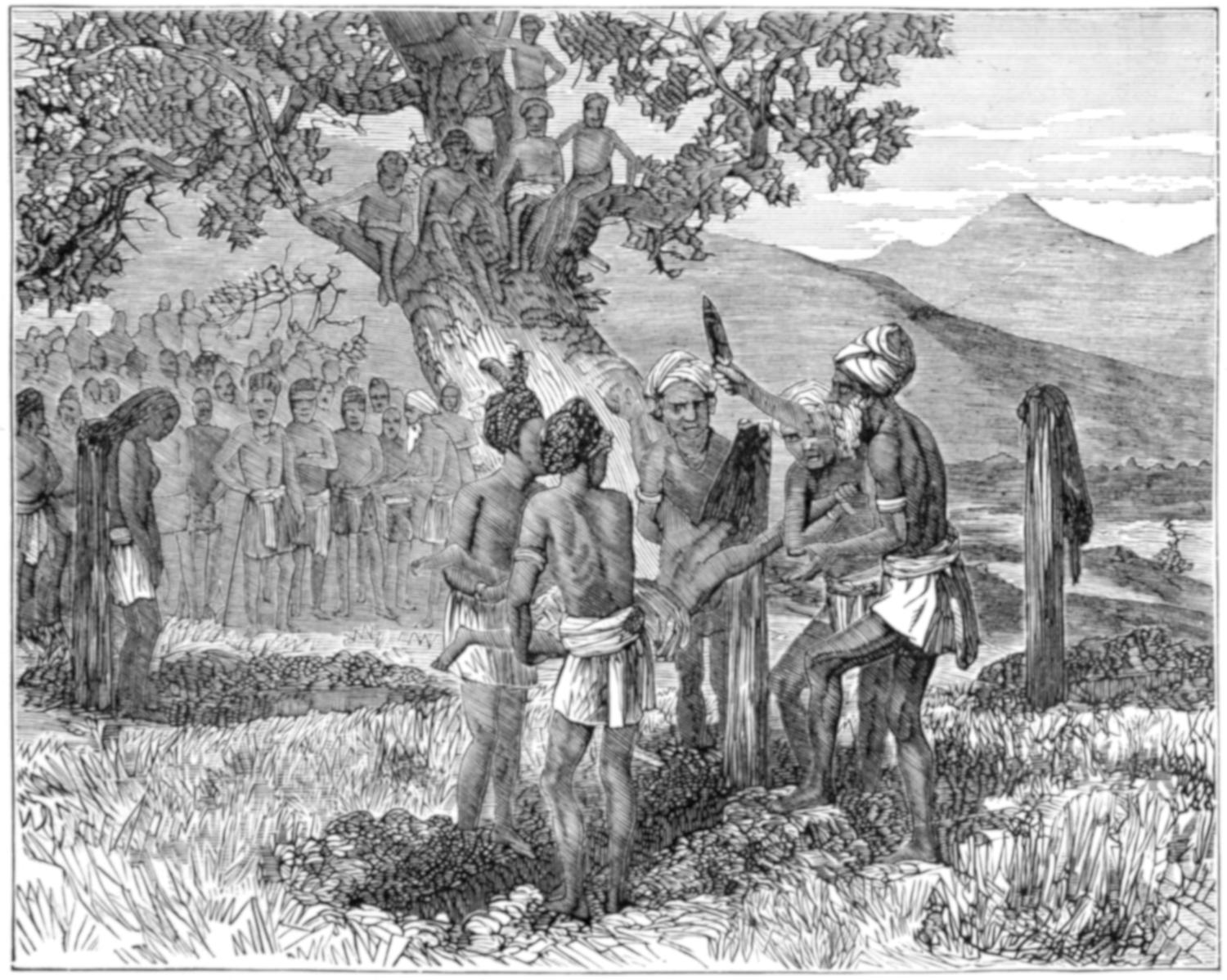
The aerial tombs are mostly erected for
the bodies of old men who have died a
natural death; but when a young warrior
has fallen in battle the body is treated in a
very different manner. A moderately high
platform is erected, and upon this is seated
the body of the dead warrior, with the face
toward the rising sun. The legs are crossed,
and the arms kept extended by means of
sticks. The fat is then removed, and, after
being mixed with red ochre, is rubbed over
the body, which has previously been carefully
denuded of hair, as is done in the ceremony
of initiation. The legs and arms are covered
with zebra-like stripes of red, white,
and yellow, and the weapons of the dead man
are laid across his lap.
The body being thus arranged, fires are
lighted under the platform, and kept up for
ten days or more, during the whole of which
time the friends and mourners remain by
the body, and are not permitted to speak.
Sentinels relieve each other at appointed
intervals, their duty being to see that the
fires are not suffered to go out, and to keep
the flies away by waving leafy boughs or
bunches of emu feathers. When a body has
been treated in this manner, it becomes
hard and mummy-like, and the strangest
point is, that the wild dogs will not touch it
after it has been so long smoked. It remains
sitting on the platform for two
months or so, and is then taken down and
buried, with the exception of the skull,
which is made into a drinking-cup for the
nearest relative, as has already been mentioned.
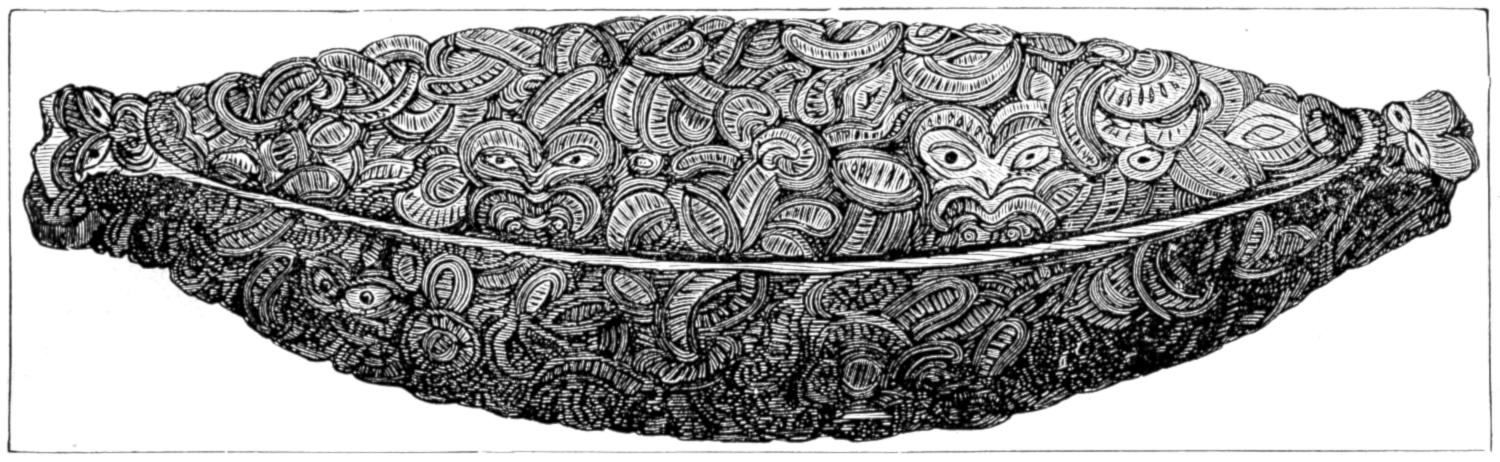
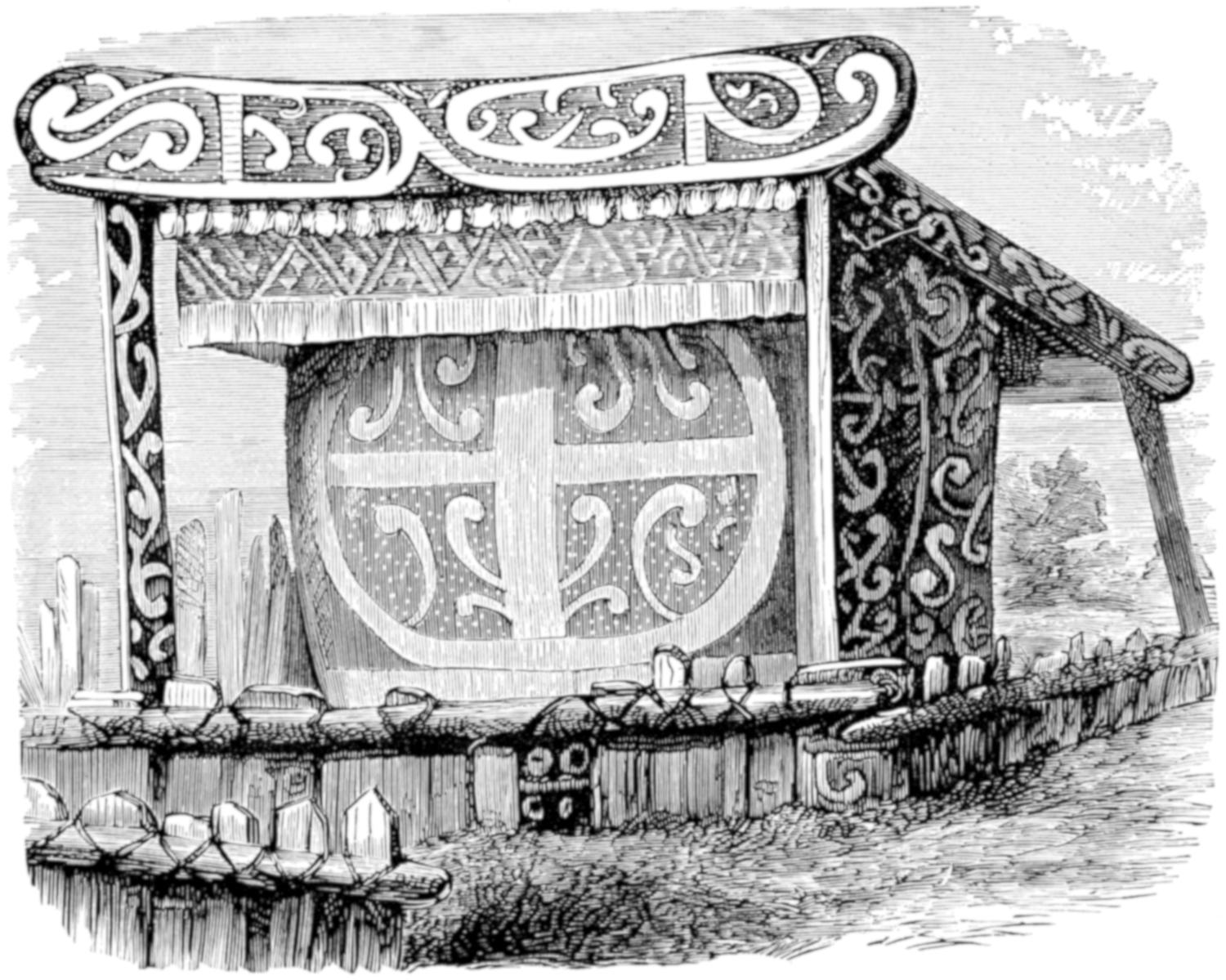
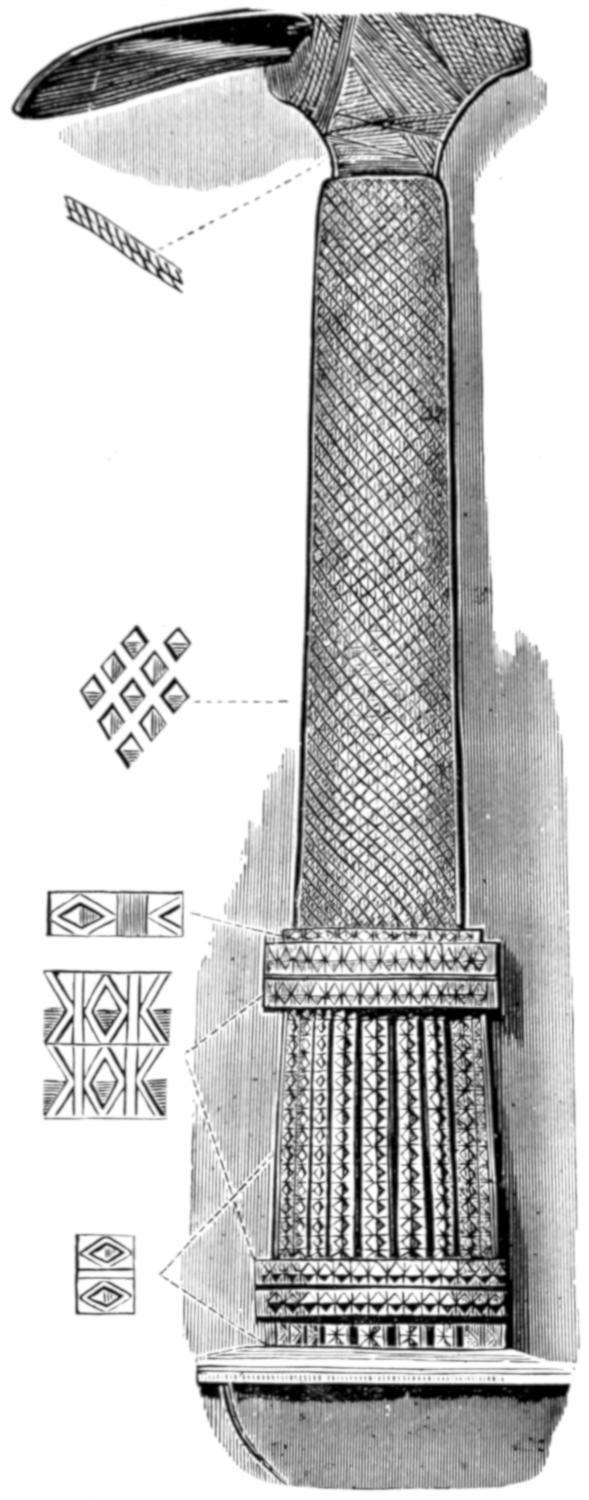
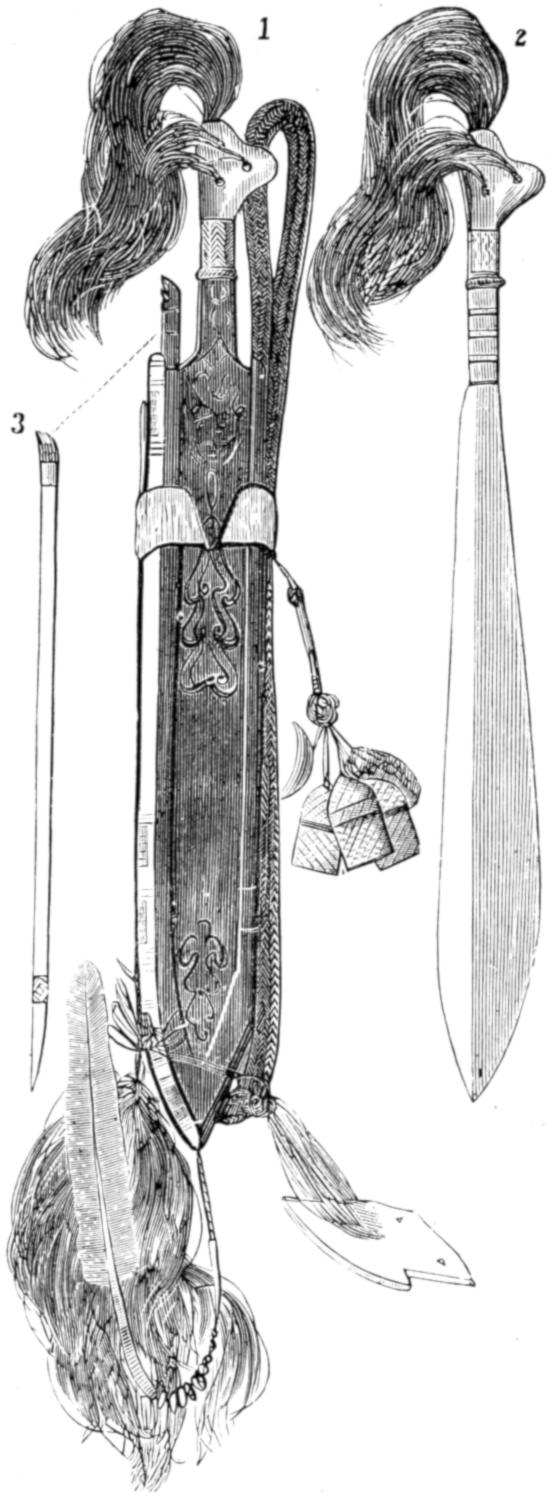
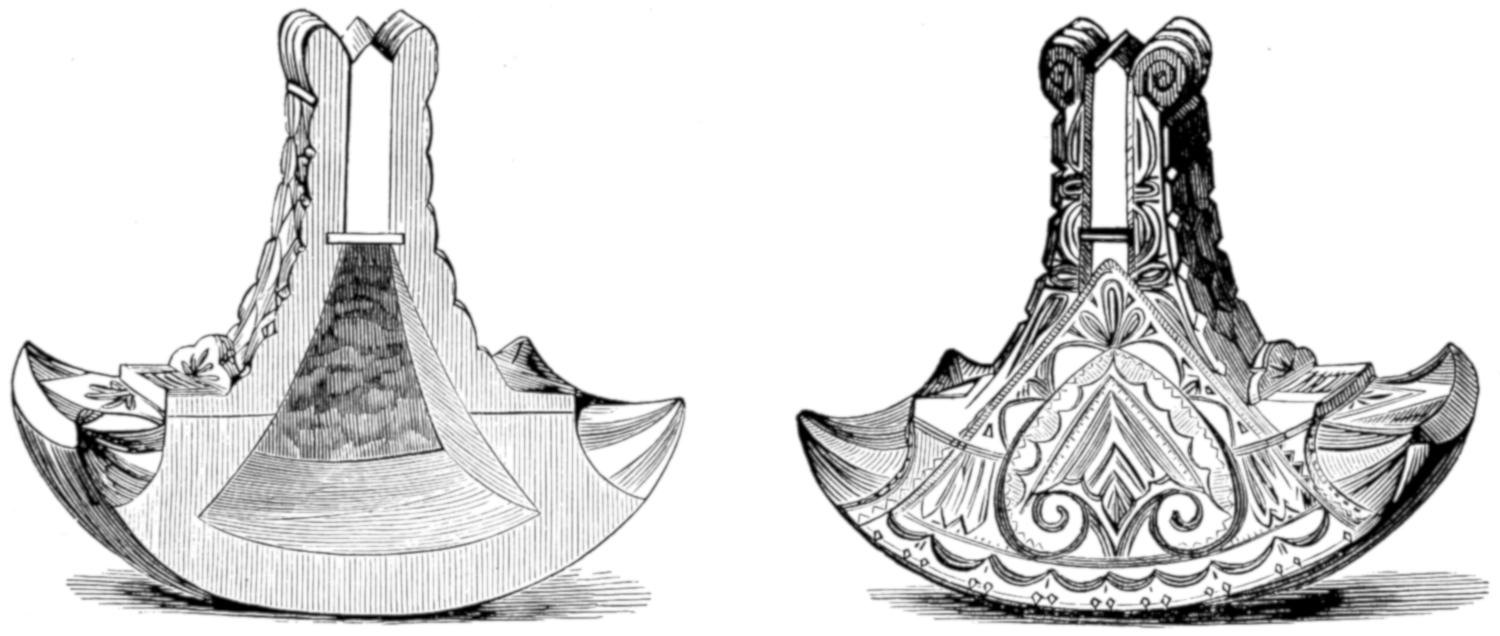
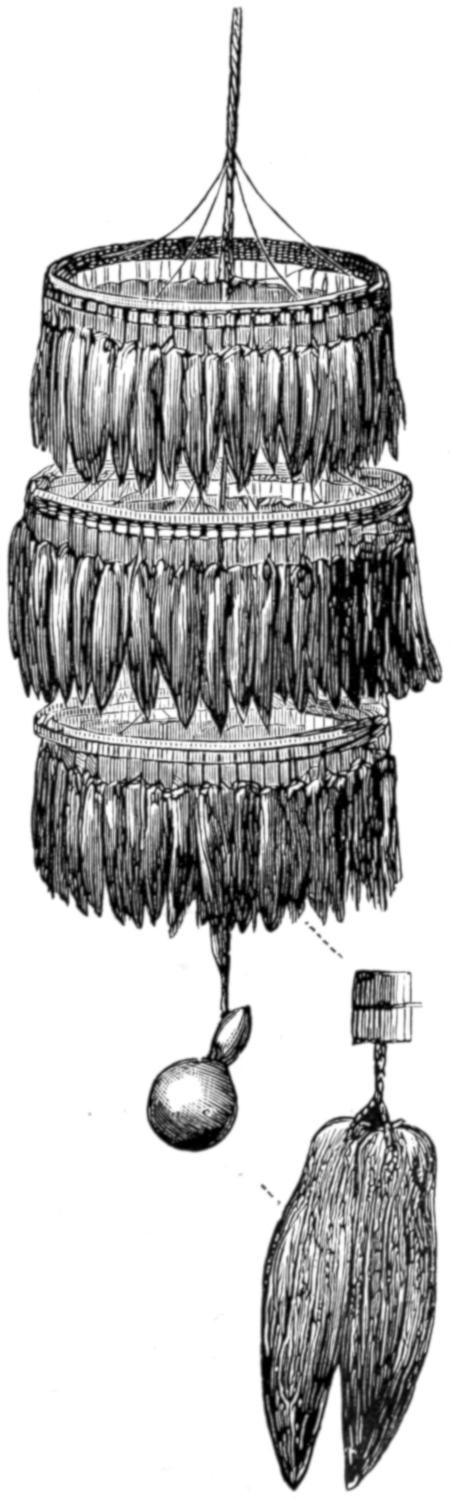
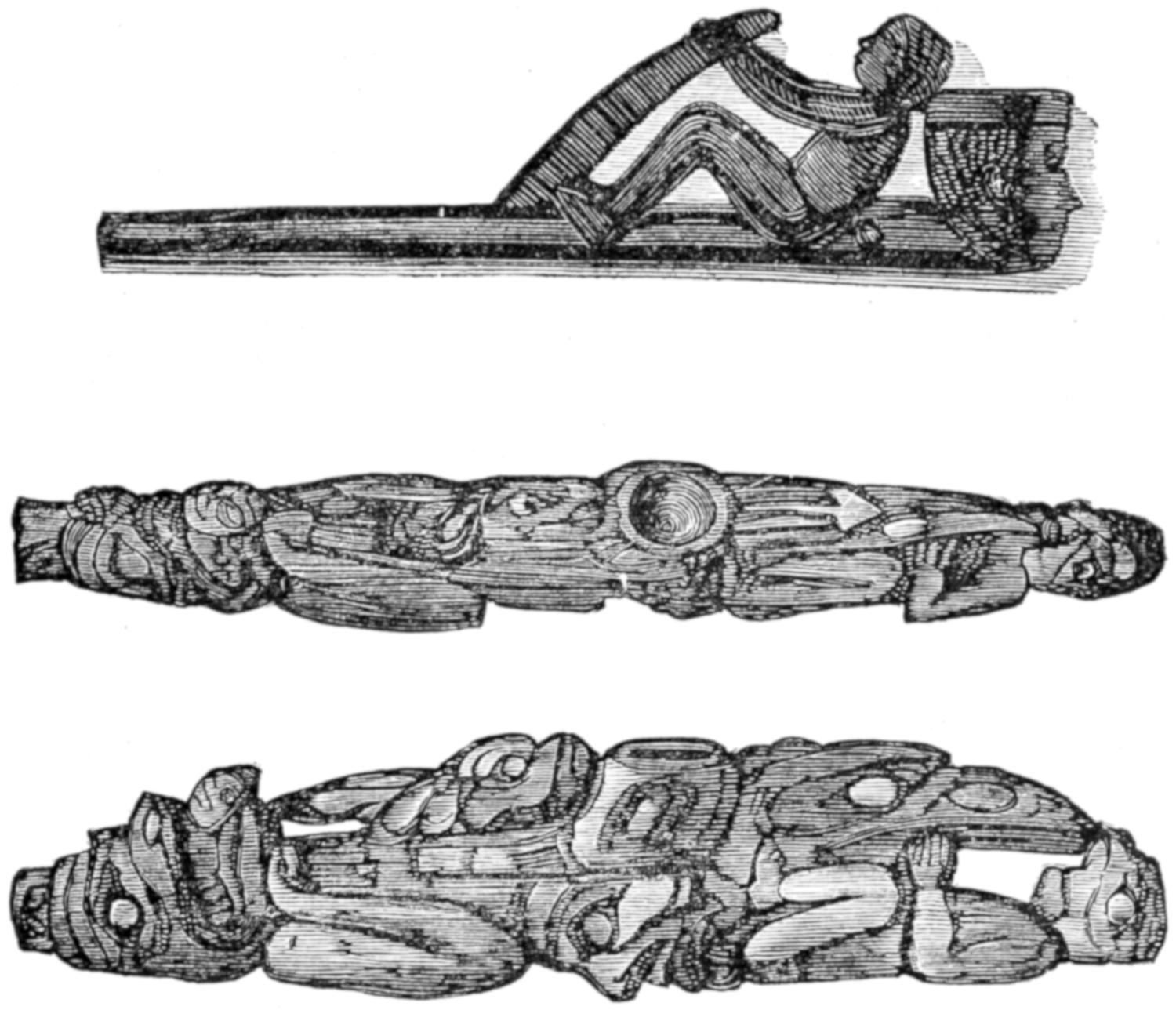
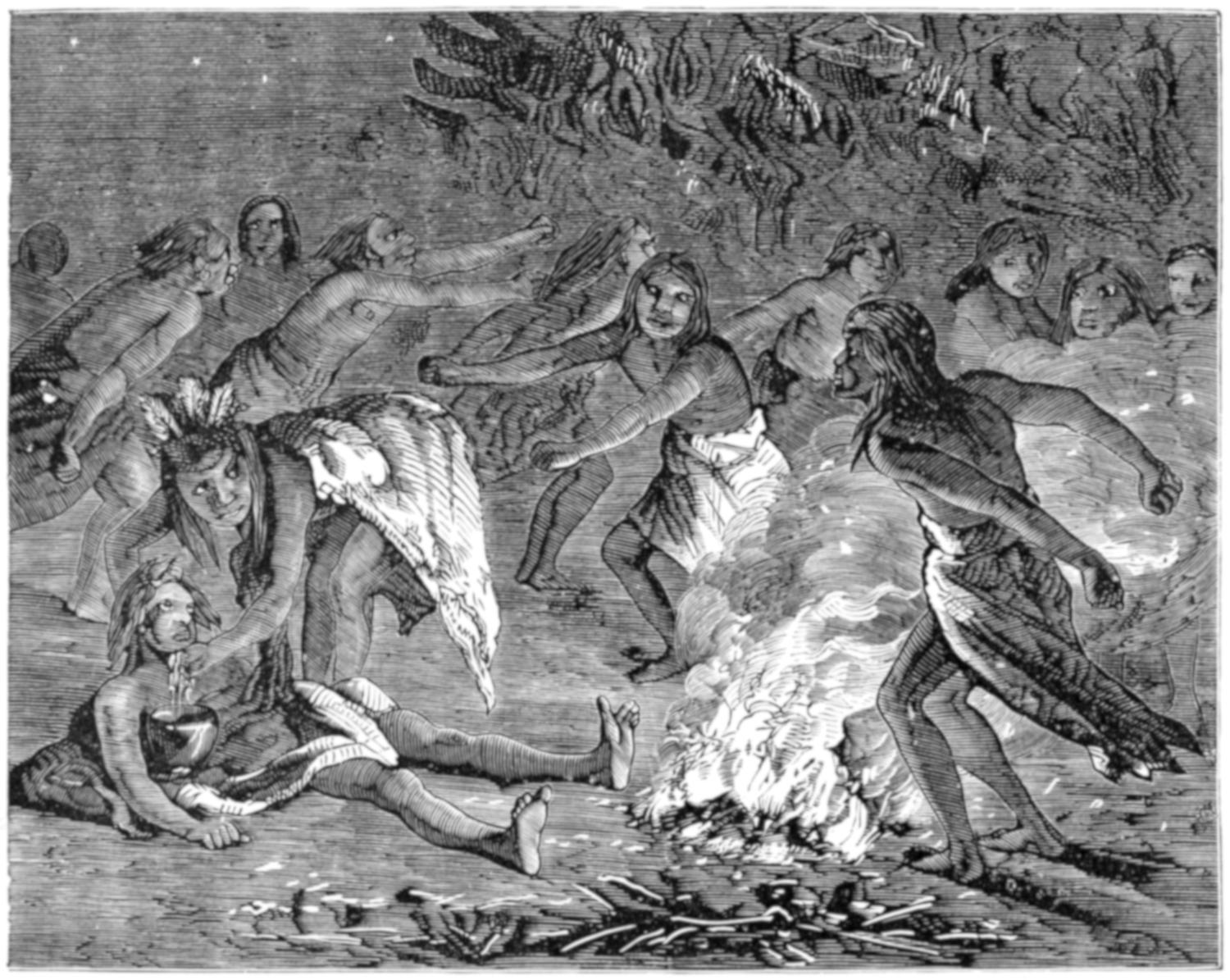
(1.) CARVED FEATHER BOX, NEW ZEALAND.
(See page 813.)
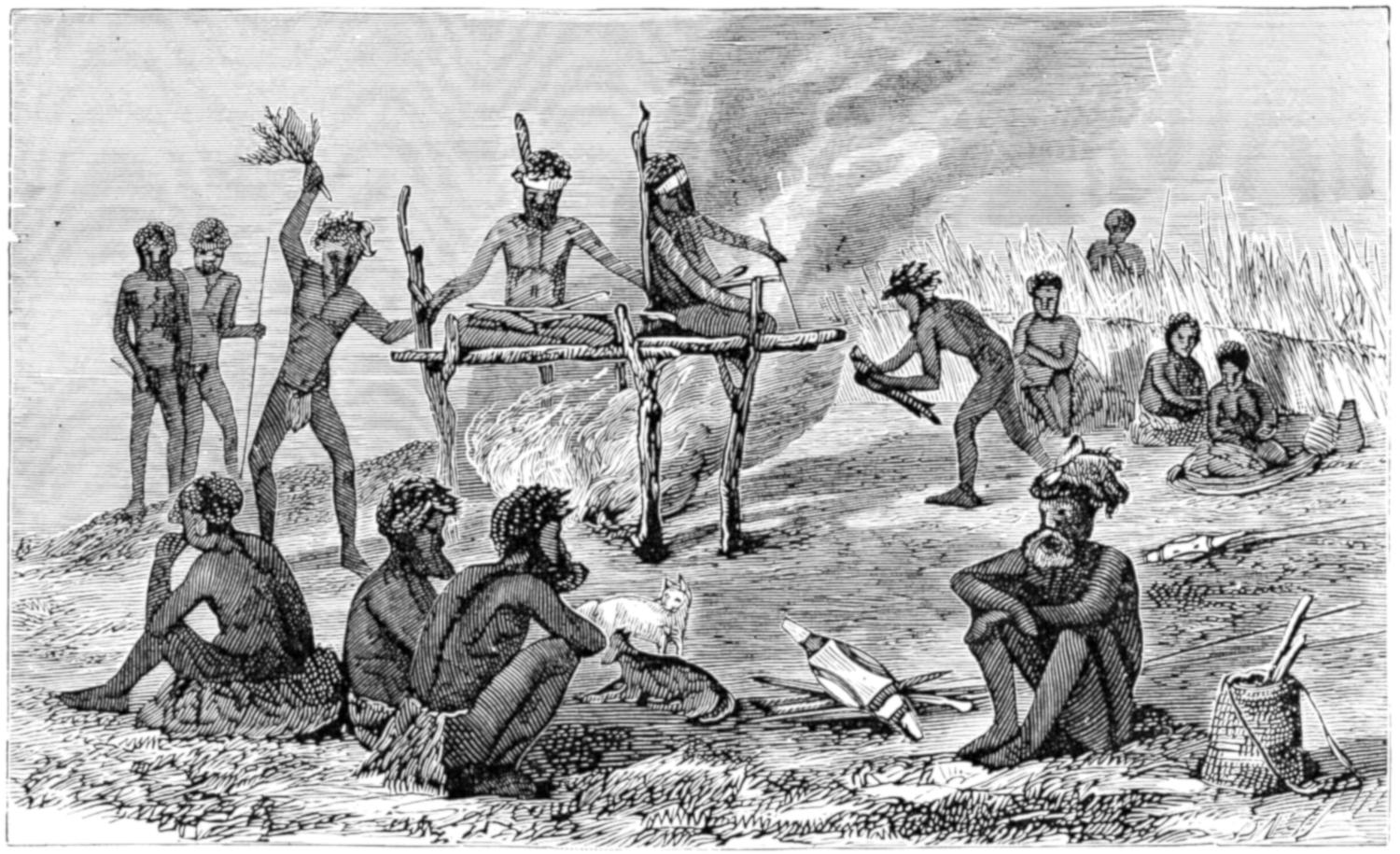
(2.) SMOKING THE BODIES OF SLAIN WARRIORS. (See page 777.)
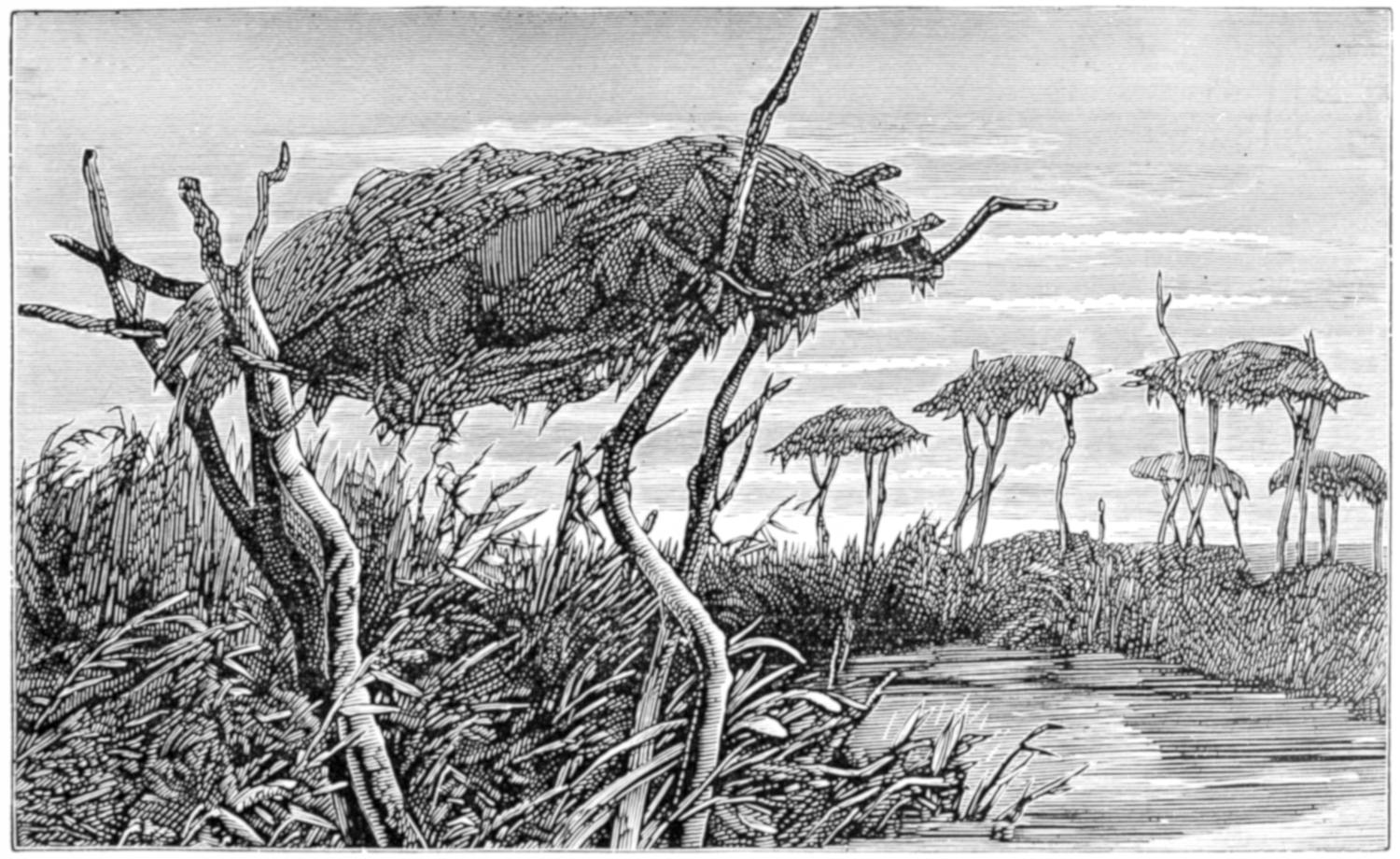
(3.) TREE TOMBS OF AUSTRALIA. (See page 774.)
Considering the trouble which is taken in
the preparation of these bodies, and the
evident respect which is felt for a brave
warrior in death as well as in life, the after
treatment of them is very remarkable.
When a friend, or even an individual of the
same tribe, sees one of these mummified
bodies for the first time, he pays no honor to
it, but loads it with reproaches, abusing the
dead man for dying when the tribe stood in
such need of brave and skilful men, and saying
that he ought to have known better than
to die when there was plenty of food in the
country. Then, after contemplating the
body for some time, he hurls his spear and
club at it, crying out at the same time,
“Why did you die? Take that for dying.”
In the illustration No. 2, on page 775,
two of these bodies are seen seated on the
platform, supported by being tied to the uprights
by their hands and heads, and having
their weapons in their laps. On one side is
one of the sentinels engaged in driving away
the flies with his flapper, and on the other
is a second sentinel bringing fuel for the fire.
The seated figures belong to the same tribe.
Around Portland Bay, and toward the
south-eastern parts of the continent, the natives
have a curious combination of entombment
and burning. They let the dead body
down into one of the hollow trees, where it
is supported in an upright position. A quantity
of dry leaves and grass is then heaped
upon the tree, and the whole consumed by
fire, amid the dismal screams and cries of
the women.
It is rather curious that funeral ceremonies
are only employed in the case of those whose
death is supposed to be a loss to the tribe.
Men, and even boys, are therefore honored
with funeral rites, because the younger men
are warriors, the boys would have been warriors,
and the old men have done service by
arms, and are still useful for their wisdom.
Even young women are buried with some
amount of show, because they produce children
for the tribe.
But of all beings an old woman is most utterly
despised. She can render no service;
she has never been considered as anything
but a mere domesticated animal, and even
for domestic purposes she has ceased to be
useful. When she dies, therefore, no one
regrets her. She is nothing but a useless
burden on her people, consuming food which
she does not earn, and sitting by the fire
when the younger women are engaged in
work. It is nothing to them that she has
worn herself out in the hard, thankless, and
never ceasing labor which constitutes the
life of an Australian woman, and so when
she dies her body is drawn away out of the
camp by the heels, and stuffed away hastily
in some hollow tree or cave that may be
most convenient. Sometimes the body is
laid on a bough, as has already been described;
but even in such a case it is merely
laid on the branch, without being placed in
a canoe, or covered with matting, boughs,
and leaves, as is the case with the bodies of
men. The corpse is allowed to remain on
the branch until it falls to pieces; and when
any of her relatives choose to take the trouble,
they will scrape a hole in the sand and
bury the scattered bones.
The shee-oak, or casuarina, is the tree
which is generally selected for this purpose,
partly because it is one of the commonest
trees of Australia, and partly because the
peculiar growth of its boughs affords a firm
platform for the corpse.
The time of mourning does not cease with
the funeral, nor, in case of a tree-tomb, with
the subsequent interment of the bones. At
stated times the women, by whom the mourning
is chiefly performed, visit the tomb, and
with their kattas, or digging-sticks, peck up
the earth around them, and make the place
look neat. This done they sit down and utter
their most doleful cries and lamentations.
In some places they content themselves with
vocal lamentations, but in others the women
think it necessary to show their grief by
repeating the head chopping, limb scarring,
and other marks of blood-letting which accompany
that portion of the funeral ceremonies.
In one part of Australia, near the north-west
bend of the Murray, a most remarkable
custom prevails. Widows attend upon the
tombs of their dead husbands, and, after
shaving their heads, cover them with pipe-clay
kneaded into a paste. The head is first
covered with a net, to prevent the pipe-clay
from sticking too tightly to the skin, a misfortune
which is partly averted by the
amount of grease with which every Australian
is anointed.
A layer of this clay more than an inch in
thickness is plastered over the head, and
when dry it forms a skull-cap exactly fitting
the head on which it was moulded, and on
account of its weight, which is several
pounds, must be very uncomfortable to the
wearer. These badges of mourning may be
found lying about near the tumuli, and, until
their real use was discovered, they were very
mysterious objects to travellers. In the illustration
No. 1, on the 781st page, is seen a
burying place near the river. Several of the
mound tombs of the natives are shown, and
in the foreground are two widows, seated in
the peculiar attitude of Australian women,
and wearing the widow’s cap of pipe-clay.
Several other caps are lying near the tombs,
having been already employed in the ceremonies
of mourning.
So careful are the natives of the marks of
respect due from the survivors to the dead,
that a widow belonging to one of the tribes
on the Clarence River was put to death because
she neglected to keep in order the tomb
of her late husband, and to dig up periodically
the earth around it.
From the disposal of the dead, we are naturally
led to the religious belief of the Australians.
Like all savages, they are very
reticent about their religious feelings, concealing
as far as possible their outward observances
from the white people, and avowing
ignorance, if questioned respecting the
meaning of those which have become known
to the strangers. Some observances, however,
have been explained by Gi’ôm, the unfortunate
Scotch woman who had to reside
so long among the Kowráregas, and others
by native converts to Christianity. Even
these latter have not been able to shake
off the superstitious ideas which they had
contracted through the whole of their previous
lives, and there is no doubt that
they concealed much from their interrogators,
and, if pressed too closely, wilfully
misled them.
The following short account will, however,
give an idea of the state of religious feeling
among the aborigines, as far as can be ascertained.
And, in consequence of the rapid
and steady decrease of the native tribes, it is
possible that our knowledge of this subject
will never be greater than it is at present.
In the first place, there are no grounds for
thinking that the aborigines believe in any
one Supreme Deity, nor, in fact, in a deity
of any kind whatever. As is usual with most
savage nations, their belief in supernatural
beings is limited to those who are capable of
doing mischief, and, although the conception
of a beneficent spirit which will do good
never seems to enter an Australian’s mind,
he believes fully, in his misty fashion, in the
existence of many evil spirits which will do
harm.
Of these there are many. One of them is
the Arlak, a being which takes the shape of
a man. It is only seen at night, and is in
the habit of watching for stragglers in the
dark, seizing them and carrying them off.
Several natives told Mr. M’Gillivray that
they had seen the arlak; and one man, who
had summoned enough courage to fight it
when it attacked him, showed the marks of
the demon’s teeth upon his body. Fortunately,
the arlak cannot endure light, and
therefore the natives, if they have to go the
smallest distance in the dark, take a fire-stick
in one hand and a weapon of some sort in
the other.
One kind of evil spirit, which is very much
dreaded by the aborigines, is the one in
whom death is personified. He is short,
thick, very ugly, and has a disagreeable
smell. The natives of the Moorundi district
believe in a native spirit, wonderfully
similar in attributes to the Necker of German
mythology. Although, according to
their accounts, it is very common, they have
great difficulty in describing it, and, as far
as can be ascertained from their statements,
it is like a huge star-fish. This demon inhabits
the fresh water, or there might have
been grounds for believing it to be merely
an exaggeration of the cuttle-fish.
Throughout the greater part of Australia
is found the belief in the Bunyip, a demon
which infests woods, and which has been
seen, as is said, not only by natives but by
white men. The different accounts of the
animal vary extremely. Some who have
seen it aver it to be as large as a horse, to
have a pair of eyes as big as saucers, and a
pair of enormous horns.
Others give a very different account of it,
and one of the Barrabool Hill natives gave a
very animated description of the dreaded
bunyip. He illustrated his lecture by a
spirited drawing, in which the bunyip was
represented as having a long neck and head,
something like that of the giraffe, a thick
flowing mane, and two short and massive
fore-legs, each of which was armed with
four powerful talons. The entire body was
covered with strong scales, overlapping each
other like those of the hawksbill turtle.
This creature he represented as half beast,
half demon, and vaunted the superior courage
of his ancestors, who ventured to oppose
this terrible creature as it lay in wait for
their wives and children, and drove it out of
the reeds and bush into the water whence it
came.
Thinking that some large and now extinct
beast might have lived in Australia, which
might have been traditionally known to the
aborigines, scientific men have taken particular
pains to ransack those portions of the
country which they could reach, in hopes of
finding remains which might be to Australia
what those of the megatherium and other
huge monsters are to the Old World. Nothing
of the kind has, however, been found.
Some very large bones were once discovered
on the banks of a shallow salt lagoon (just
the place for the bunyip), but when sent to
the British Museum they were at once found
to be the remains of a gigantic kangaroo. At
present, the legend of the bunyip stands on
a level with that of the kraken—every native
believes it, some aver that they have
seen it, but no one has ever discovered the
least tangible proof of its existence.
To these evil spirits the natives attribute
every illness or misfortune, and in consequence
are anxious to avoid or drive them
away. All meteors are reckoned by them
among the evil spirits, and are fancifully
thought to be ghosts which multiply by self-division.
The aborigines think, however,
that by breathing as loudly as they can, and
repeating some cabalistic words, they disarm
the demons of their power.
They have one very curious belief,—namely,
that any one who ventured to sleep
on the grave of a deceased person, he would
ever afterward be freed from the power of
evil spirits. The ordeal is, however, so terrible
that very few summon up sufficient
courage to face it. “During that awful
sleep the spirit of the deceased would visit
him, seize him by the throat, and, opening
him, take out his bowels, which it would
afterward replace, and close up the wound!
Such as are hardy enough to go through this
terrible ordeal—encounter the darkness of
the night and the solemnity of the grave—are
thenceforth ‘koradjee’ men, or priests,
and practise sorcery and incantations upon
the others of their tribe.”
In Southern Australia, the natives believe
that the sun and moon are human beings,
who once inhabited the earth. The planets
are dogs belonging to the moon, who run
about her; and the various constellations are
groups of children. An eclipse of either the
sun or moon is looked upon as a terrible
calamity, being sure to be the forerunner of
disease and death.
All burial-places of the dead are held as
liable to be haunted by evil spirits, and are
therefore avoided. Promontories, especially
those which have rocky headlands, are also
considered as sacred; and it is probably on
account of that idea that the skull monuments,
mentioned on page 773, are raised.
Some of these places are rendered interesting
by specimens of native drawings,
showing that the aborigines of Australia
really possess the undeveloped elements of
artistic power. Owing to the superstition
which prevails, the natives can scarcely be
induced to visit such spots, giving as their
reason for refusing that “too much dibbil-dibbil
walk there.” Mr. Angas was fortunate
enough, however, to discover a considerable
number of these drawings and
carvings, and succeeded in impressing into
his service an old native woman. His description
is so vivid, that it must be given in
his own words:—
“The most important result of our rambles
around the bays and rocky promontories
of Port Jackson was the discovery of a new
and remarkable feature connected with the
history of the natives formerly inhabiting
this portion of New South Wales.
“I refer to their carvings in outline, cut
into the surface of flat rocks in the neighborhood,
and especially on the summits of the
various promontories about the harbors of
the coast. Although these carvings exist in
considerable numbers, covering all the flat
rocks upon many of the headlands overlooking
the water, it is a singular fact that up to
the present time they appear to have remained
unobserved; and it was not until my
friend Mr. Miles first noticed the rude figure
of a kangaroo cut upon the surface of a flat
rock near Camp Cove, that we were led to
make a careful search for these singular and
interesting remains of a people who are now
nearly extinct.
“About a dozen natives of the Sydney and
Broken Bay tribes were encamped amongst
the bushes on the margin of a small fresh-water
lake, close to Camp Cove; and from
amongst them we selected ‘Old Queen
Gooseberry’ (as she is generally styled by
the colonists) to be our guide, promising
her a reward of flour and tobacco if she
would tell us what she knew about these
carvings, and conduct us to all the rocks and
headlands in the neighborhood where like
figures existed. At first the old woman
objected, saying that such places were all
koradjee ground, or ‘priest’s ground,’ and
that she must not visit them; but at length,
becoming more communicative, she told us
all she knew, and all that she had heard her
father say, respecting them. She likewise
consented at last to guide us to several spots
near the North Land, where she said the
carvings existed in greater numbers; as also
the impressions of hands upon the sides of
high rocks.
“With some difficulty we prevailed upon
the haggard old creature to venture with us
into a whale-boat; so, with Queen Gooseberry
for our guide, we crossed to the North
Land. After examining the flat rocks in
every direction, we found sufficient examples
of these singular outlines to confirm
at once the opinion that they were executed
by the aboriginal inhabitants; but at what
period is quite uncertain. From the half-obliterated
state of many of them (although
the lines are cut nearly an inch deep into
the hard rock), and from the fact that from
several of them we were compelled to clear
away soil and shrubs of long-continued
growth, it is evident that they have been
executed a very long time.
“At first we could not bring ourselves to
believe that these carvings were the work of
savages, and we conjectured that the figure
of the kangaroo might have been the work
of some European; but when, pursuing our
researches further, we found all the most
out-of-the-way and least accessible headlands
adorned with similar carvings, and
also that the whole of the subjects represented
indigenous objects—such as kangaroos,
opossums, sharks, the heileman or
shield, the boomerang, and, above all, the
human figure in the attitudes of the corrobboree
dances—we could come to no other
conclusion than that they were of native
origin. Europeans would have drawn ships,
and horses, and men with hats upon their
heads, had they attempted such a laborious
and tedious occupation.
“An old writer on New South Wales,
about the year 1803, remarks, when referring
to the natives, ‘They have some taste
for sculpture, most of their instruments being
carved with rude work, effected with pieces
of broken shell; and on the rocks are frequently
to be seen various figures of fish,
clubs, swords, animals, &c., not contemptibly
represented.’
“Some of the figures of fish measured
twenty-five feet in length; and it is curious
that the representations of the shield exactly
corresponded with that used by the
natives of Port Stephens at the present day.
These sculptured forms prove that the New
Hollanders exercised the art of design,
which has been questioned, and they also
serve to corroborate Captain Grey’s discoveries
of native delineations in caves upon the
north-west coast of Australia, during his
expedition of discovery. At Lane Cove, at
Port Aiken, and at Point Piper, we also
met with similar carvings. Whilst on a
visit at the latter place, it occurred to me
that on the flat rocks at the extremity of the
grounds belonging to the estate where I was
staying, there might be carvings similar to
those at the Heads; and on searching carefully
I found considerable numbers of them
in a tolerably perfect state of preservation.
Of all these I took measurements, and
made careful fac-simile drawings on the
spot.”
In the appendix to his work, Mr. Angas
gives reduced copies of these figures, some
of which are executed with wonderful spirit
and fidelity. Even the human figures,
which are shown with extended arms and
spread legs, as in the dance, are far better
than those usually drawn by savages, infinitely
superior to those produced by the
artists of Western Africa, while some of the
animals are marvellously accurate, reminding
the observer of the outline drawings
upon Egyptian monuments. The best are,
perhaps, a shark and a kangaroo. The latter
is represented in the attitude of feeding.
In some parts of Australia, the carvings
and paintings are usually in caves by the
water’s edge, and of such a character is
the cave which is shown in the illustration
No. 2, on the following page. These
caves are in sandstone rock, and the figures
upon them are mostly those of men and
kangaroos, and it is a remarkable fact that
in the human figures, although their eyes,
noses, and even the joints of the knees, are
boldly marked, the mouth is invariably
absent.
Human hands and arms are often carved
on rocks. One very remarkable example
was discovered by Captain Grey in North-West
Australia. When penetrating into a
large cave, out of which ran a number of
smaller caves, the explorers were struck by
a really astonishing trick of native art. The
sculptor had selected a rock at the side of
the cavity, and had drawn upon it the figure
of a hand and arm. This had then been
painted black, and the rock around it colored
white with pipe-clay, so that on entering
the cave it appeared exactly as if the
hand and arm of a black man were projecting
through some crevice which admitted
light.
Their belief in ghosts implies a knowledge
that the spirit of man is immortal. Yet
their ideas on this subject are singularly
misty, not to say inconsistent, one part of
their belief entirely contradicting the other.
They believe, for example, that when the
spirit leaves the body, it wanders about for
some time in darkness, until at last it finds
a cord, by means of which a “big black-fella
spirit” named Oomudoo pulls it up from the
earth. Yet they appropriate certain parts of
the earth as the future residence of the different
tribes, the spirits of the departed Nauos
being thought to dwell in the islands of
Spencer’s Gulf, while those of the Parnkallas
go to other islands toward the west. As
if to contradict both ideas, we have already
seen that throughout the whole of Australia
the spirits of the dead are supposed to
haunt the spots where their bodies lie
buried.
And, to make confusion worse confounded,
the aborigines believe very firmly in transmigration,
some fancying that the spirits of
the departed take up their abode in animals,
but by far the greater number believing
that they are transformed into white
men. This latter belief was put very succinctly
by a native, who stated in the odd jargon
employed by them, that “when black-fella
tumble down, he jump up all same
white-fella.”
This idea of transmigration into the forms
of white men is very remarkable, as it is
shared by the negro of Africa, who could
not have had any communication with the
black native of Australia. And, still more
strangely, like the Africans, they have the
same word for a white man and for a spirit.
The reader may remember that when Mrs.
Thompson was captured by the natives, one
of them declared that she was his daughter
Gi’ôm, who had become a white woman,
and the rest of the tribe coincided in the
belief. Yet, though she became for the
second time a member of the tribe, they
always seemed to feel a sort of mistrust,
and often, when the children were jeering at
her on account of her light complexion and
ignorance of Australian accomplishments,
some elderly person would check them, and
tell them to leave her in peace, as, poor thing,
she was nothing but a ghost.
It has been found, also, that numbers of
white persons have been recognized by the
blacks as being the spirits of their lost relatives,
and have in consequence been dignified
with the names of those whom they
represented. Mr. M’Gillivray mentions that
the natives of Port Essington have a slight
modification of this theory, believing that
after death they become Malays.
Of their belief in the metempsychosis, or
transmigration into animal forms, there are
but few examples. Dr. Bennett mentions
that on one occasion, at Bérana Plains, when
an European was chasing one of the native
animals, a native who was with him begged
him not to kill it, but to take it alive, as it
was “him brother.” When it was killed,
he was very angry, and, as a proof his sincerity,
refused to eat any of it, continually
grumbling and complaining of the “tumbling
down him brother.”
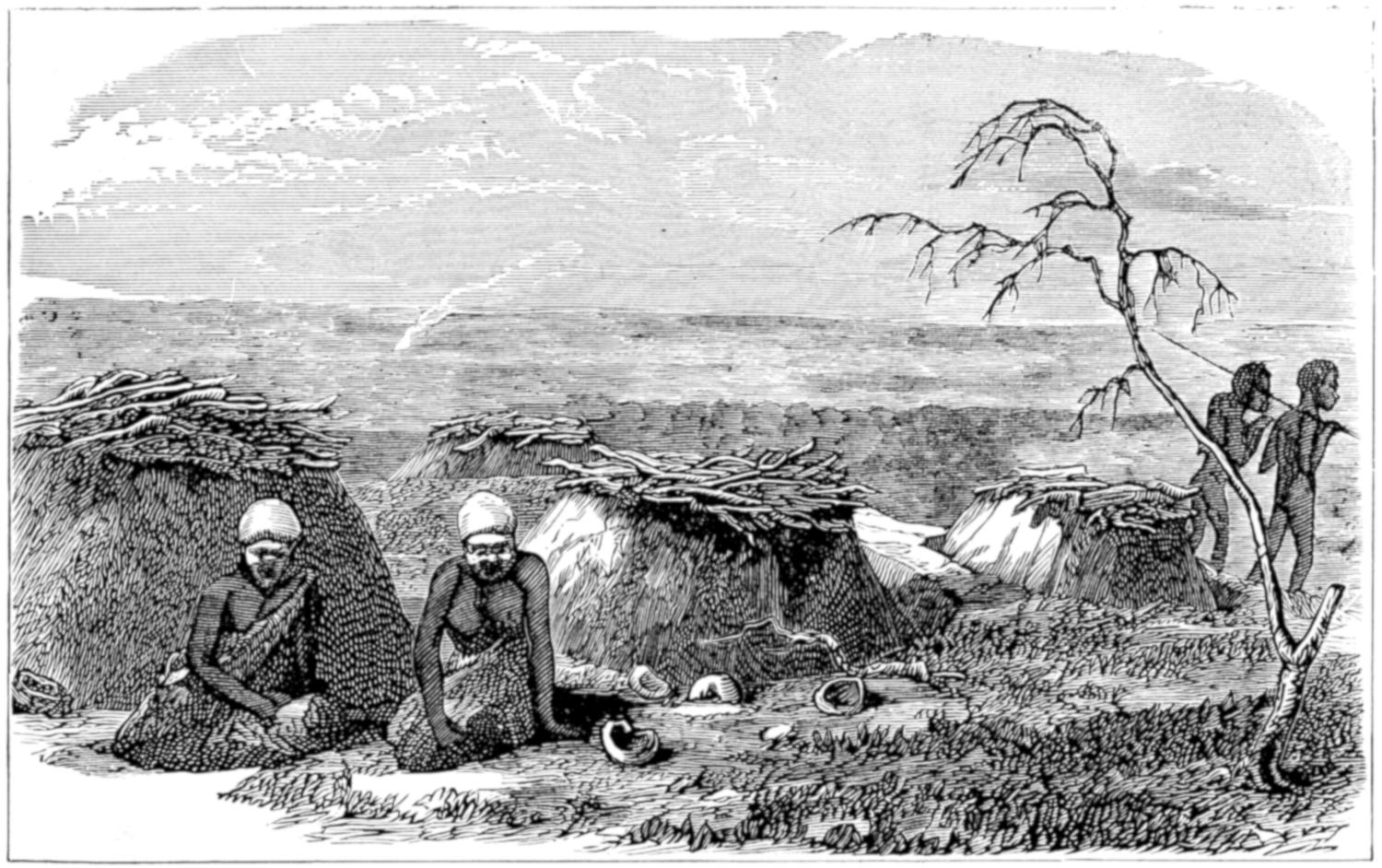
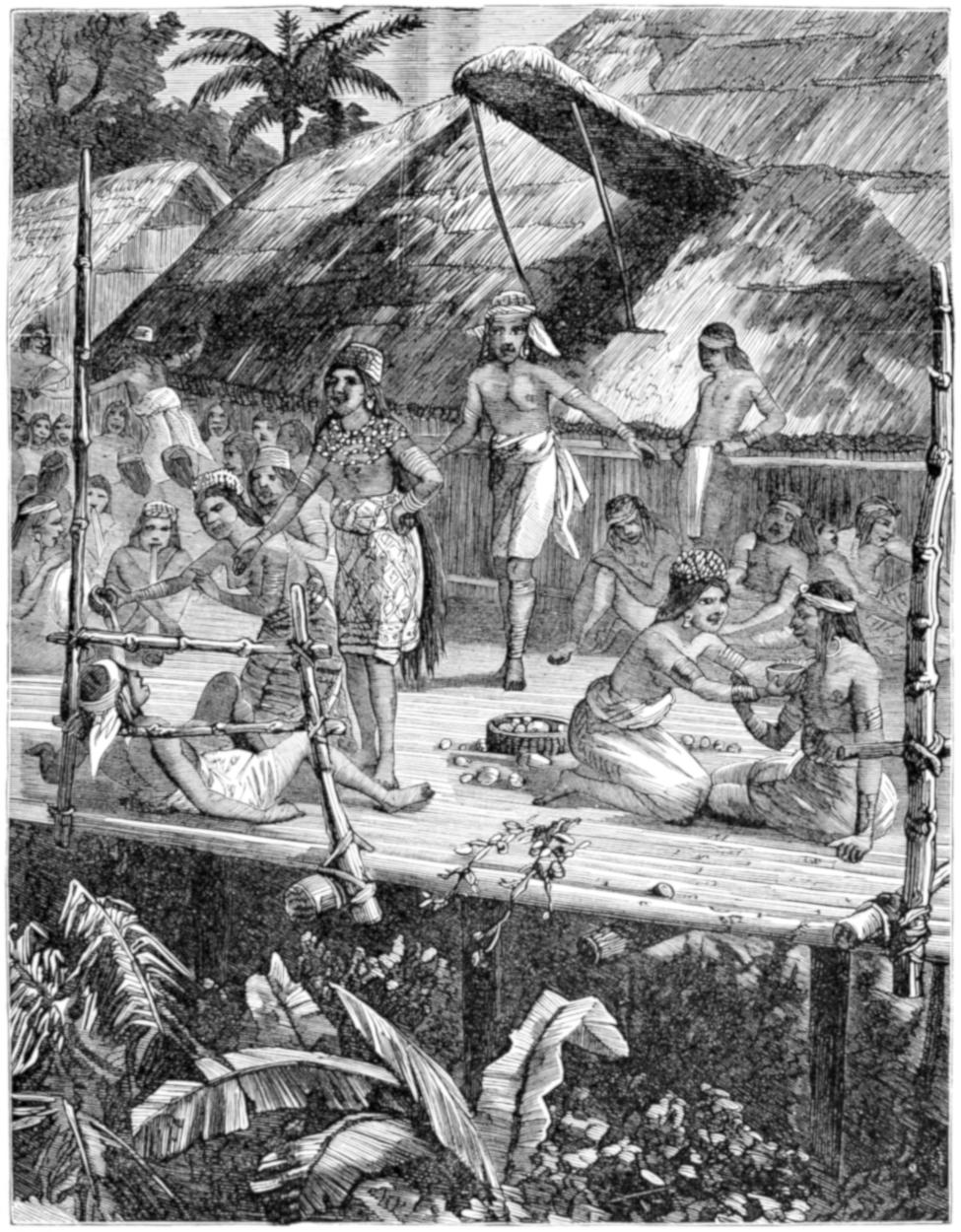
(1.) AUSTRALIAN WIDOWS AND THEIR CAPS.
(See page 777.)
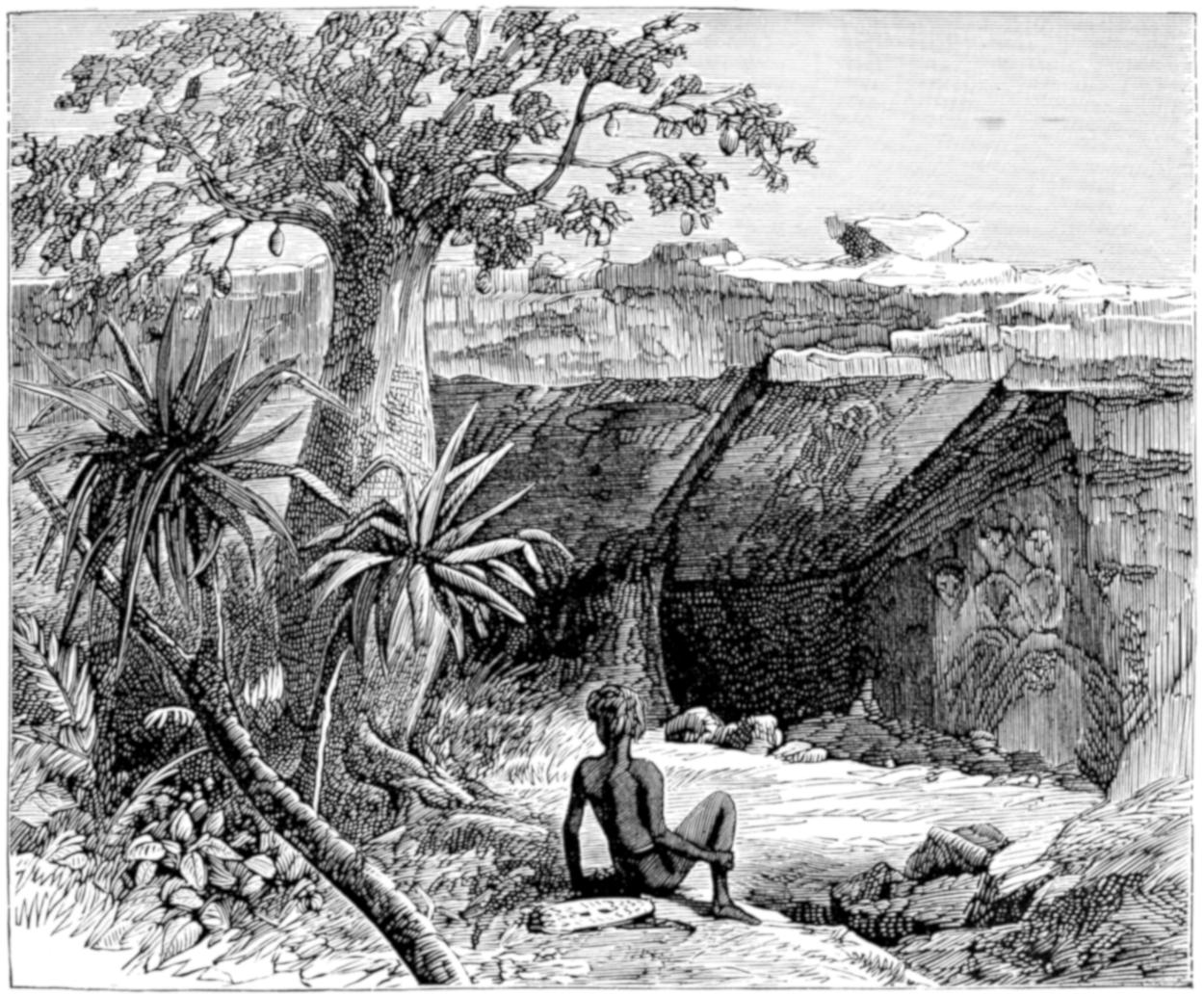
(2.) CAVE WITH NATIVE DRAWINGS.
(See page 780.)
The Nauo tribe preserve a tradition which
involves this metempsychosis. Once upon
a time, a certain great warrior, named
Willoo, fought their tribe, and carried off all
the women, and killed all the men except
two. The survivors climbed up a great tree,
followed by Willoo. They, however, broke
off the branch on which he was climbing,
so that he fell to the ground, and was seized
by a dingo below, when he immediately died,
and was changed into an eagle hawk, which
has ever afterward been called by the name
of Willoo.
The same tribe think that a small lizard
was the originator of the sexes, and in consequence
call it by different names; the men
using the term ibirri, and the women waka.
Following up the idea, the men kill every
male lizard that they can find, while the
women do the same by the females.
Connected with this subject is their idea
of creation. Of a single Creator of all things
they have not the least notion, but they possess
some traditions as to the origin of men
or natural objects. The Kowrárega tribe
say that the first created man was a huge
giant named Adi. One day, while he was
fishing off Hammond Island, he was caught
by the tide and drowned, a great rock starting
up to mark the spot. This is now called
Hammond’s Rock. His wives saw his fate,
committed suicide by flinging themselves
into the sea, and were immediately changed
into a series of dry rocks on a neighboring
reef. These rocks are still called by the natives
Ipīle, i. e. the Wives.
The natives of the Lower Murray have a
curious tradition respecting the origin of
the river, and the Alexandrina and Albert
Lakes. The river was made by Oomudoo,
the “big black-fella spirit,” already mentioned.
He came down from the sky in his
canoe, and ordered the water to rise and
form the river, which he then clothed with
bulrushes and populated with fish. He
brought two wives with him, but they unfortunately
proved intractable, and ran away
from him, whereupon Oomudoo made the
two lakes in question, one of which drowned
each wife.
CHAPTER LXXVII. AUSTRALIA— Concluded . ARCHITECTURE AND BOAT-BUILDING.
PARALLEL BETWEEN THE BOSJESMAN AND THE AUSTRALIAN — MODES OF BUILDING HUTS — A SUMMER
ENCAMPMENT — RUDE NATURE OF THE HUTS — RETREATS OF THE WOMEN — BONE HUTS OF
ENCOUNTER BAY — WINTER HOUSES — HUTS NEAR THE COORUNG — FIRE-MAKING — BIRD-SNARING — A
SELF-ACTING SNARE — BOAT-BUILDING — USES OF THE STRINGY BARK — A FRAIL VESSEL — CANOE
FOR GENERAL USE — THE REED CANOE — GRADUAL EXTINCTION OF NATIVE TRIBES.
In many points the Australian savage bears
a curious resemblance to the Bosjesman of
Southern Africa, of whom a full account has
already been given at 242-268 page.
So similar, indeed, are they, that the colonists
use the word Bushman to designate
the native savage, just as they call the spotted
dasyure by the name of cat, and the
wombat by that of badger. Much confusion
has consequently arisen; and there is now
before me a book descriptive of savage life,
in which the author has mixed up the Bosjesman
of Africa and the Bushman of Australia
in the most amusing manner, actually
transplanting a quotation from a book of
African travels into the account of Australia.
Like the Bosjesman, the Australian depends
upon his weapons for the greater part
of his food, living almost entirely upon the
game which he kills, and being skilled in
the art of destroying the wariest and most
active of animals with the simplest of
weapons. He lives in a state of perpetual
feud, his quarrels not being worthy of the
name of warfare; and his beau idéal of a warrior
is a man who steals upon his enemy by
craft, and kills his foe without danger to
himself.
He cultivates no land, neither has he the
least notion of improving his social condition.
He cares nothing for clothes, except,
perhaps, as a partial shelter from the elements,
and utterly ridicules the notion that
there is any connexion between clothing and
modesty.
Indeed, on one occasion, when a girl had
been presented with a petticoat by a white
lady, and returned to her people, displaying
with pride her newly acquired property, her
companions instead of displaying envy at
her finery, only jeered at her, inquiring
whether she thought herself so much better
than her forefathers, that she should want
to wear clothes like the white strangers.
The consequence was, that in a day or two
the solitary garment was thrown aside, and
she walked about as before, in the primitive
accoutrements of her tribe.
Like the African Bosjesman, the Australian
native has no settled home, although
he considers himself as having a right to the
district in which his tribe have taken up
their abode. Contrary to the usage of civilized
life, he is sensitive on the general question,
and careless in detail. With civilized
beings the hearth and home take the first
place in the affections, the love of country
being merely an extension of the love of
home. With the Australian, however, as
well as the Bosjesman, the case is just reversed.
He has no home, and cares not for
any one spot more than another, except that
some spots are sheltered and others exposed.
He passes a semi-nomad existence,
not unlike that of the Arab, save that instead
of pitching his tent on a convenient
spot, and taking it away when he leaves it,
he does not trouble himself even to carry
the simple materials of a tent, but builds a
rude hut in any spot which he may happen
to fancy, and leaves it to decay when he forsakes
the spot.
The chief object of the ordinary hut
made by an Australian savage is to defend
the inmates from the cold south-west
breezes. Consequently, the entrances of the
huts may be found, as a rule, turned toward
the north-east, whence come the warm winds
that have passed over the equator.
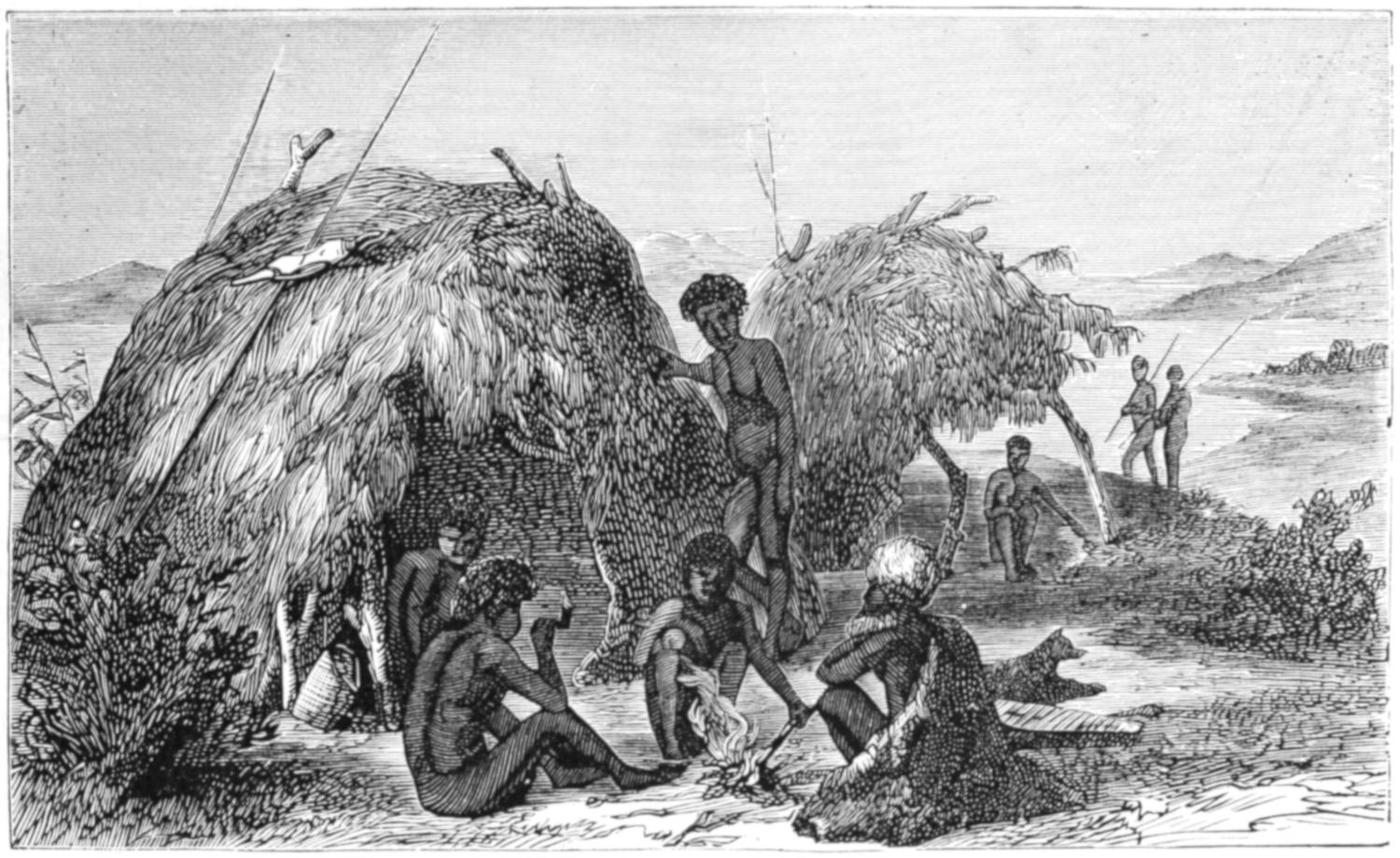
The summer encampment (see page 787)
of an Australian family is very simple. A
number of leafy boughs are stuck in the
ground in a semicircular form, the size of
the enclosed space varying with the number
of the family. These boughs are seldom
more than four feet in height, and often
scarcely exceed a yard, their only object
being to keep off the wind from the fire,
and from the bodies of the natives as they
squat round the flame or lie asleep. That
any one should expect a shelter while he
is standing never seems to enter the imagination
of an Australian savage, who, like
other savages, never dreams of standing
when he can sit, or, indeed, of taking any
trouble that is not absolutely necessary.
All the stories that are told of the industry
of savage life are pure inventions, and
if labor be, as we are often told, the truest
nobility, we ought to hear no more of the
“noble savage.” Consistently with this idea,
the native Australian’s only idea of the hut is
a place where he can sit and gorge himself
with food, and lie down to sleep after his
enormous meal. A fence a yard in height
is therefore quite good enough for him,
and, as long as no rain falls, he thinks a
roof to be a needless expenditure of labor.
In the illustration referred to we have an
example of an encampment on which the
natives have bestowed rather more care than
usual, and have actually taken the pains to
form the branches into rude huts. The
spears, shields, and other weapons of the
natives are seen scattered about, while
round the fire sit or lie the men who have
satisfied their hunger. The reader will
perceive that from a little distance such
an encampment would be almost invisible;
and, indeed, except by the thin smoke of
the fire, the most practised eye can
scarcely detect the spot where natives
are encamping. Even the spears which
project above the bush huts look at a little
distance merely like dried sticks; and, if
the inhabitants be very anxious to escape
observation, they establish their encampment
in a retired spot, where the surrounding
objects harmonize as closely as possible
with the rude shelter which answers all
their needs.
In many places the natives construct a
habitation similar in principle, but differing
in structure. Should the locality abound in
the eucalypytus, or stringy-bark tree, the
natives make a hut altogether different in
appearance. With wonderful dexterity, they
strip off the bark of the tree in large flakes,
six or seven feet in length. A few large
branches of trees are then laid on the
ground, so that they form a rough sort of
framework, and upon these branches the
flakes of bark are laid. An hour’s labor
will make one of these huts, so that the natives
have really no inducement to take
any care of them. Even the very best hut
which a native Australian ever made would
be inferior to the handiwork of an English
boy of ten years old. For my own part,
I remember building far better huts than
those of the Australians, though I was at
the time much below ten years of age, and
had gained all my knowledge of practical
architecture from “Sandford and Merton.”
There is, however, one great advantage in
these bark huts—namely, the rapidity with
which they can be made, and the shelter
which they really do give from the traveller’s
great enemy, the night wind. Even
European travellers have been glad to avail
themselves of these simple structures, and
have appreciated the invaluable aid of a
few sheets of bark propped against a fallen
branch. Those who have been forced to
travel without tents through a houseless
country have learned by experience that
the very best shelter from the night winds is
not height, but width. A tree, for example,
forms but a very poor shelter, while a low
wall barely eighteen inches high and six
feet in length keeps off the wind, and enables
the wearied traveller to rest in comparative
comfort. Such a shelter is easily made
from the sheets of stringy bark, one or two
of which will form a shelter for several
sleepers.
Perhaps the simplest huts that human
beings ever dignified by the name of habitation
are those which are made by the women
of a tribe when the men are away. It sometimes
happens that the whole of the adult
males go off on an expedition which will
last for a considerable time—such, for example,
as a raid upon a neighboring tribe—leaving
the women and children to take
care of themselves. These, knowing that
they might be pounced upon by enemies
who would take advantage of the absence
of their defenders, retire into the recesses
of the woods, where they build the oddest
houses imaginable, half burrows scraped
among the roots of trees, and half huts
made of bark and decayed wood. These
habitations are so inconspicuous that even
the practised eye of the native can scarcely
discover them.
On the shores of Encounter Bay may be
seen some very curious habitations. Every
now and then a whale is thrown ashore by
a tempest; and in such a case the tribes of
the neighborhood flock round it with great
rejoicings, seeing in it an unlimited supply
of food. Huge as the animal may be, it is
ere long consumed, and nothing left but the
skeleton. Of the bones the natives make
the framework of their huts, the ends of
the ribs being fixed in the ground, so that
the bones form the supports of the arched
roof, which is nothing more than boughs,
grass, and matting thrown almost at random
upon the bony framework.
During the winter time the native huts
are of better construction, although the
best hut that an Australian ever made is
but a very rude and primitive specimen of
architecture. These winter huts are made
on the same principle as those employed in
summer, but the materials are more closely
put together. The framework of these huts
is made by sticking a number of saplings
in the ground, and tying them together.
Smaller branches and twigs are then passed
in and out of the uprights, and pressed down
to make a tolerably firm wall. Over the
wall comes a layer of large leaves, and an
outer covering of tea-tree bark is placed
over the trees, and held in its place by a
lashing of rattan. These houses are about
five feet in height, and have an arched opening
just large enough for a man to enter on
his hands and knees.
Such huts as these, however, are but seldom
seen, the ordinary winter dwellings
being made of bushes, as seen in an illustration
on the next page. Near the entrance,
but not within it, the fire is kindled,
and at night the natives crowd into the hut,
filling it so completely that a view of the
interior displays nothing but a confused
mass of human limbs. The reader will perceive
that the luxury of a door has not been
contemplated by the native architects—an
omission which is perhaps rather fortunate,
considering the crowded state of the interior.
Along the shores of the Coorung a rather
peculiar kind of habitation is used. It must
first be mentioned that the Coorung is a
back-water inlet of the sea, running parallel
to it for some ninety miles or so, never more
than a mile and a half from the sea, and
divided from it only by a range of enormous
sandhills. It is a wild and desolate place,
but is inhabited by the Milmendura tribe,
who made themselves so notorious for the
massacre of the passengers and men of the
ship Maria. The natives probably like the
spot, because in the Coorung, which is protected
from the ocean waves by the sandhills,
they can take fish without danger, and
because the sandhills furnish a fruit called
the monterry, or native apple, as, although
a berry growing upon a creeping plant, it
looks and tastes like a miniature apple.
The situation is much exposed in the
winter time to the cold south-west blasts,
and the natives accordingly make comparatively
strong huts. Their dwellings are
formed of a framework of sticks, over which
is plastered a thick layer of turf and mud.
In addition to this they heap over the hut
a great quantity of the sand and shells of
which the ground is chiefly composed, so
that the houses of the Milmendura look like
mere mounds or hillocks rising from the
sandy soil.
The fire which is found in every Australian
encampment is generally procured by
friction from two pieces of wood, one being
twirled rapidly between the hands and the
other held firmly by the feet. Indeed, the
Australian savage produces fire exactly as
does the South African (see page 100). This
accomplishment, however, is not universal,
some tribes being unable to produce fire, and
being dependent on the “fire-sticks” which
the women carry with them. It has occasionally
happened that the women have been
careless enough to allow all their fire-sticks
to expire, and in such a case they are obliged
to go to the nearest friendly tribe, and beg a
light from them, in order to procure fire
wherewith to cook the game that their husbands
have brought home.
Before leaving this part of the subject, it
will be as well to mention briefly a few of
the devices used by the Australian natives
in taking their game.
One of these devices is remarkably ingenious,
and is principally employed in
duck catching. The natives find out a spot
where the ducks resort in order to feed, and
arrange their nets so that they may intercept
birds that fly down upon them. When
the ducks are all busy feeding, the native
hunter, who has concealed himself near the
place, alarms the birds by suddenly imitating
the cry of the fish-hawk, one of their
deadliest foes. The terrified ducks rise in a
body; but, just as they ascend, the wily native
flings into the air a triangular piece of
bark, imitating again the cry of the hawk.
The birds, fancying that the hawk is sweeping
down upon them, try to escape by darting
into the reeds, and are caught in the nets.
Another ingenious plan is used for capturing
birds singly. The native makes a
sort of screen of branches, and conceals
himself within it. In his hand he carries a
long and slender rod, at the end of which
there is a noose, and within the noose a bait.
Under cover of the screen he comes close to
the bird, and gently places the treacherous
noose near it. By degrees the bird comes
closer and closer to the bait, and, as soon
as its head is fairly within the noose, it is
secured by a dexterous twist of the hand.
Sometimes the native does not employ a
bait. He builds his simple shelter by some
spot where birds are accustomed to drink,
and calls them by imitating their note.
They come to the spot, and, not seeing their
companions, perch upon the sticks under
which the hunter is concealed, a large bunch
of grass being generally used to prevent the
birds from seeing him. As soon as the bird
perches, he slips the noose over its head,
draws it inside the shelter, kills it, and waits
for another.
In some parts of the country the natives
make a self-acting snare, very much on the
principle of the nets used in snaring rabbits.
It consists of a sort of bag, and has its opening
encircled by a running string, the other
end of which is fastened to some fixed object,
such as a tree-stump. The bag is made
of split rattans, so that it remains open, and,
as the meshes are very wide, the bait which
is placed within it can easily be seen.
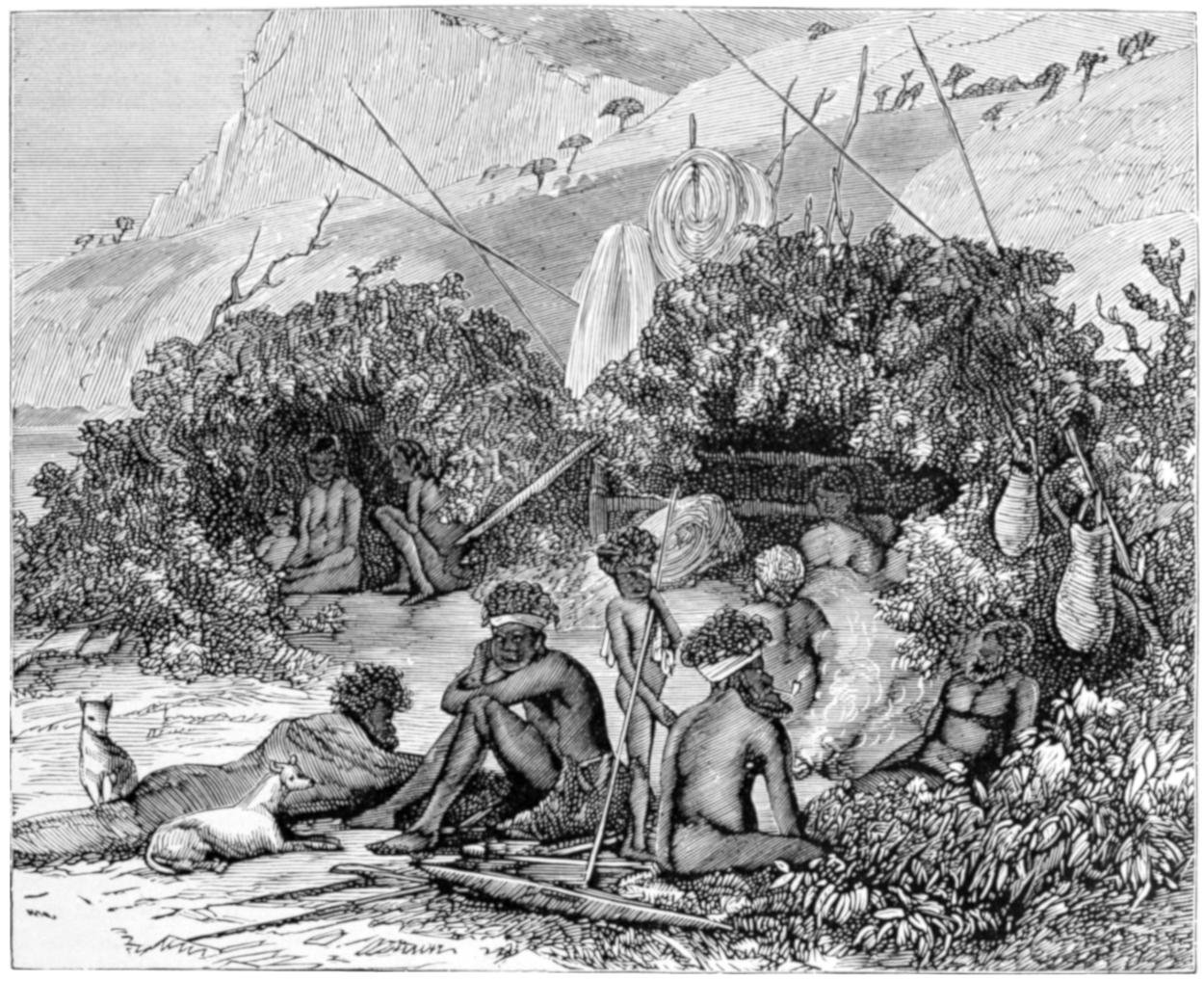
(2.) A SUMMER ENCAMPMENT.
(See page 784.)
If a bird or animal should come to the
bait, which is fixed at the very extremity of
the bag, it naturally forces its way toward
the tempting object, and in so doing pulls
upon the string and closes the mouth of the
bag behind it. The more it struggles, the
firmer is it held; and so it remains until it is
taken out, and the trap set again. This very
ingenious snare is used mostly for bandicoots
and similar animals, though birds are
sometimes caught in it.
The natives have another self-acting trap,
which is identical in principle with the eel
baskets and lobster pots of our own country.
A number of these traps were found by
Mr. Carron in some huts near Princess
Charlotte’s Bay. They were made of strips
of cane, and were about five feet in length
by eight or nine inches in diameter at the
mouth. From the opening they gradually
tapered for some four feet, and then suddenly
enlarged into a large round basket or
pocket, the lower ends of the neck projecting
into the basket so as to hinder any animal
from returning through the passage by
which it entered. This trap was used indifferently
for catching fish and small animals.
For the latter purpose it was laid in
their track, and for the former it was placed
in a narrow channel, through which the fish
were forced to pass by being driven by a
party of natives in the water.
The reader will remember that on page
785 there is a reference to the “stringy-bark,”
and its use in architecture. The
same bark is used for a great number of
purposes, among which that of boat-building
is perhaps the most conspicuous. Should a
native come to the side of a river which he
does not wish to swim, he supplies himself
with a boat in a very expeditious manner.
Going to the nearest stringy-bark trees, and
choosing one which has the lines of the
bark straight and not gnarled, he chops a
circle round the tree so as to sever the bark,
and about seven or eight feet higher he
chops a second circle. His next proceeding
is to make a longitudinal cut down one side
of the tree, and a corresponding one on the
other side. He then inserts the handle of
his tomahawk, his digging-stick, or any such
implement, between the bark and the wood,
and, by judicious handling, strips off the
bark in two semi-cylindrical, trough-like
pieces each of which is capable of being made
into a boat.
Should he be alone, he seldom troubles
himself to do more than tie the bark together
at each end of the trough, and in
this frail vessel he will commit himself to
the river. But if his wife, or any second
person, should be with him, he makes the
simple boat more trustworthy by digging a
quantity of clay out of the river bank, kneading
it into each end of the trough, and tying
the bark over the clay. As soon as he
reaches the opposite shore, he lands, pushes
the canoe back into the river and abandons
it, knowing that to make a second canoe will
not be nearly so troublesome as to take care
of the first.
If, however, he wants a canoe in which he
goes fishing, and which, in consequence,
must be of a stronger make, he still adheres
to the stringy bark as his material, though
he takes more care in the manufacture.
The bark is bent, like the birch bark of the
North American Indians, by moisture and
heat; and even with this better kind of
boat clay is required at each end, and is also
used for stopping up any leakage.
He also exhibits a still better use of the
stringy-bark. The bark is not only formed
into a boat-like shape, but it is kept in its
form by cross-pieces of wood. The edges
are also strengthened: and altogether this
canoe shows a wonderful advance in boat-building.
The vessel is propelled with a
regular paddle instead of the fish spear: and
altogether the boat and the accompanying
implements remind the observer of the
birch-bark canoes and vessels of America.
Another simple form of boat is made on a
totally different principle from those which
have already been described, and, instead of
being a hollow trough of bark, is a solid
bundle of reeds and sticks tied together in
a very ingenious manner, and giving support
to one or more persons, according to its
size.
Such is the history of the aboriginal
tribes of Australia, whose remarkable manners
and customs are fast disappearing, together
with the natives themselves. The
poor creatures are aware of the fact, and
seem to have lost all pleasure in the games
and dances that formerly enlivened their
existence. Many of the tribes are altogether
extinct, and others are disappearing
so fast that the people have lost all heart
and spirit, and succumb almost without
complaint to the fate which awaits them.
In one tribe, for example, the Barrabool,
which numbered upward of three hundred,
the births during seventeen years were
only twenty-four, being scarcely two births
in three years; while the deaths had been
between eighteen and nineteen per annum.
Mr. Lloyd gives a touching account of
the survivors of this once flourishing
tribe:—
“When I first landed in Geelong, in 1837,
the Barrabool tribe numbered upward of
three hundred sleek and healthy-looking
blacks. A few months previous to my leaving
that town, in May 1853, on casually
strolling up to a couple of miam-miams, or
native huts, that were erected upon the
banks of the Burwan River, I observed
seated there nine loobras (women) and one
sickly child.
“Seeing so few natives, I was induced to
ask after numbers of my old dark friends of
early days—Ballyyang, the chief of the Barrabool
tribe, the great Jaga-jaga, Panigerong,
and many others, when I received
the following pathetic reply: ‘Aha, Mitter
Looyed, Ballyyang dedac (dead), Jaga-jaga
dedac; Panigerong dedac,’ &c., naming
many others; and, continuing their sorrowful
tale, they chanted, in minor and funereal
tones, in their own soft language, to the following
effect:
“‘The stranger white man came in his
great swimming corong (vessel), and landed
at Corayio with his dedabul boulganas
(large animals), and his anaki boulganas
(little animals). He came with his boom-booms
(double guns), his white miam-miams
(tents), blankets, and tomahawks;
and the dedabul ummageet (great white
stranger) took away the long-inherited hunting-grounds
of the poor Barrabool coolies
and their children,’ &c., &c.
“Having worked themselves into a fit of
passionate and excited grief, weeping, shaking
their heads, and holding up their hands
in bitter sorrow, they exclaimed, in wild
and frenzied tones: ‘Coolie! coolie! coolie!
where are our coolies now! Where are
our fathers—mothers—brothers—sisters?
Dead!—all gone! dead!’ Then, in broken
English, they said, ‘Nebber mind, Mitter
Looyed, tir; by ’m by all dem black fella
come back white fella like it you.’ Such is
the belief of the poor aborigines of Victoria;
hence we may firmly infer that they possess
a latent spark of hope in their minds as to
another and better world.
“Then, with outstretched finger, they
showed me the unhappy state of the aboriginal
population. From their statement it
appeared that there existed of the tribe at
that moment only nine women, seven men,
and one child. Their rapid diminution in
numbers may be traced to a variety of
causes. First, the chances of obtaining
their natural food were considerably lessened
by the entire occupation of the best
grassed parts of the country, which originally
abounded in kangaroo and other animals
upon which they subsisted. The
greater number of these valuable creatures,
as an irresistible consequence, retired into
the wild uninhabitable countries, far from
the haunts of the white man and his destructive
dogs.
“Having refused the aid of the Government
and the Missionary Societies’ establishments
at the River Burwan and Mount
Rouse, the natives were to a serious extent
deprived of animal food, so essential to a
people who were ever exposed to the inclemencies
of winter and the exhausting heats of
summer. Influenza was one of the greatest
scourges under which they suffered. Then,
among other evils attending their association
with the colonists, the brandy, rum, and
tobacco told fearfully upon their already
weakened constitutions.”
This one tribe is but an example of the
others, all of whom are surely, and some not
slowly, approaching the end of their existence.
For many reasons we cannot but
regret that entire races of men, possessing
many fine qualities, should be thus passing
away; but it is impossible not to perceive
that they are but following the order of the
world, the lower race preparing a home for
the higher.
In the present instance, for example, the
aborigines performed barely half of their
duties as men. They partially exercised
their dominion over the beasts and the birds—killing,
but not otherwise utilizing them.
But, although they inherited the earth, they
did not subdue it, nor replenish it. They
cleared away no useless bush or forest, to replace
them with fruits; and they tilled no
land, leaving the earth exactly in the same
condition that they found it. Living almost
entirely by the chase, it required a very
large hunting-ground to support each man,
and a single tribe gained a scanty and precarious
living on a tract of land sufficient,
when cultivated, to feed a thousand times
their number. In fact, they occupied precisely
the same relative position toward the
human race as do the lion, tiger, and leopard
toward the lower animals, and suffered in
consequence from the same law of extinction.
In process of time white men came to introduce
new arts into their country, clearing
away useless forest, and covering the
rescued earth with luxuriant wheat crops,
sufficient to feed the whole of the aborigines
of the country; bringing also with them herds
of sheep and horned cattle to feed upon the
vast plains which formerly nourished but a
few kangaroo, and to multiply in such numbers
that they not only supplied the whole
of their adopted land with food, but their
flesh was exported to the mother country.
The superior knowledge of the white man
thus gave to the aborigines the means of securing
their supplies of food; and therefore
his advent was not a curse, but a benefit to
them. But they could not take advantage
of the opportunities thus offered to them,
and, instead of seizing upon these new means
of procuring the three great necessaries of
human life, food, clothing, and lodging, they
not only refused to employ them, but did
their best to drive them out of the country,
murdering the colonists, killing their cattle,
destroying their crops, and burning their
houses.
The means were offered to them of infinitely
bettering their social condition, and
the opportunity given them, by substituting
peaceful labor for perpetual feuds, and of
turning professional murderers into food-producers,
of replenishing the land which
their everlasting quarrels, irregular mode of
existence, and carelessness of human life had
well-nigh depopulated. These means they
could not appreciate, and, as a natural consequence,
had to make way for those who
could. The inferior must always make way
for the superior, and such has ever been the
case with the savage. I am persuaded that
the coming of the white man is not the sole,
nor even the chief, cause of the decadence
of savage tribes. I have already shown that
we can introduce no vice in which the savage
is not profoundly versed, and feel sure that
the cause of extinction lies within the savage
himself, and ought not to be attributed to
the white man, who comes to take the place
which the savage has practically vacated.
CHAPTER LXXVIII. NEW ZEALAND. GENERAL REMARKS.
LOCALITY OF NEW ZEALAND — GENERAL APPEARANCE OF THE PEOPLE — THE TWO CASTES, AND THEIR
SUPPOSED ORIGIN — CONTRAST BETWEEN THE SEXES — LAXNESS OF MORALS — NUMBER OF THE
POPULATION, AND THE DIFFERENT TRIBES — MODE OF GOVERNMENT — DISTINCTION BETWEEN
RANKS — FORMATION OF THE CLANS, OR SUB-TRIBES — THE SLAVES, THEIR VALUE AND TREATMENT — THE
TENURE OF LAND — A COMPLEX ARRANGEMENT AND CONSEQUENT DIFFICULTIES — ESTABLISHING
A CLAIM — NATIVE LAW — THE “LEX TALIONIS” — SENSITIVENESS TO DISGRACE — THE
PREVALENCE OF SUICIDE — STRANGE CONDUCT OF A MAORI CHIEF — THE SISTER’S VENGEANCE.
Southward and eastward of Australia we
come to the group of islands known collectively
as New Zealand. Like Australia,
New Zealand possesses many peculiarities
of climate and natural production, and is inhabited
by a number of tribes which are generally
hostile to each other, but which are
almost identical in appearance and habits.
We shall therefore be enabled to treat of this
important portion of the globe with much
more brevity than could be the case if, as in
Africa, the tribes differed from each other
in hue, dress, and customs.
Taken as a whole, the New Zealanders are
a singularly fine race of people—tall, powerful,
and well made. Though varying somewhat
in shade, the color is always a brown
of some kind, the complexion being sometimes
as light as that of a Spaniard, and sometimes
of a dark umber. It is, however,
always of a clear tint and never approaches
to the deep black of the Australian. The
nose is straight and well formed, in many
cases being boldly aquiline; and the mouth
is rather large, and the lips moderately full,
though not resembling those of the negro.
The cheekbones are rather high, but not
much more prominent than those of a
genuine Scotchman; and the eyes are large,
dark, and vivacious.
The teeth are remarkably white and even,
and the feet and hands small and well proportioned.
The foot is very well developed,
the native never having spoiled its beautiful
mechanism with shoes or boots, and being
accustomed to use the toes in many tasks
wherein a civilized European requires his
fingers. The toes are, for example, continually
employed in holding one end of a rope,
while the fingers are engaged in twisting or
plaiting it; and the consequence is that the
natives are able to ridicule with justice the
misshapen feet and toes of the European.
The men have naturally a full beard; but
they always remove every vestige of hair on
the face, in order to show the patterns which
are tattooed upon it. Now and then a very
old and powerful chief will dare to allow his
beard to grow; but, as a rule, the face is divested
of all covering: so that the absence
of the beard, together with the profuse tattoo,
destroys all evidences of age, and makes the
countenance of a young man of twenty look
nearly as old as that of his grandfather aged
sixty.
The hair is plentiful, and mostly straight,
being twisted and curled by art into the
various fashionable forms. In some cases it
is light, or even reddish, in color; and in
such instances accompanies a complexion of
peculiar fairness. Albinism exists among
the New Zealanders, but is not agreeable
in appearance, the eyes being always weak,
and the skin looking as if it had been artificially
whitened. In fact, such an albino
looks among his dark fellows like a plant
that has been bleached by growing in the
dark.
There seems to be two castes of men
among the New Zealanders. The upper
caste is distinguished by the above characteristics;
but the lower is shorter in stature,
and has coarse and curly, though not
woolly hair, more prominent cheekbones,
and a much blacker skin. This second race,
according to Dr. Dieffenbach, “is mixed in
insensible gradations with the former, and is
far less numerous; it does not predominate
in any one part of the island, nor does it
occupy any particular station in a tribe; and
there is no difference made between the two
races among themselves.
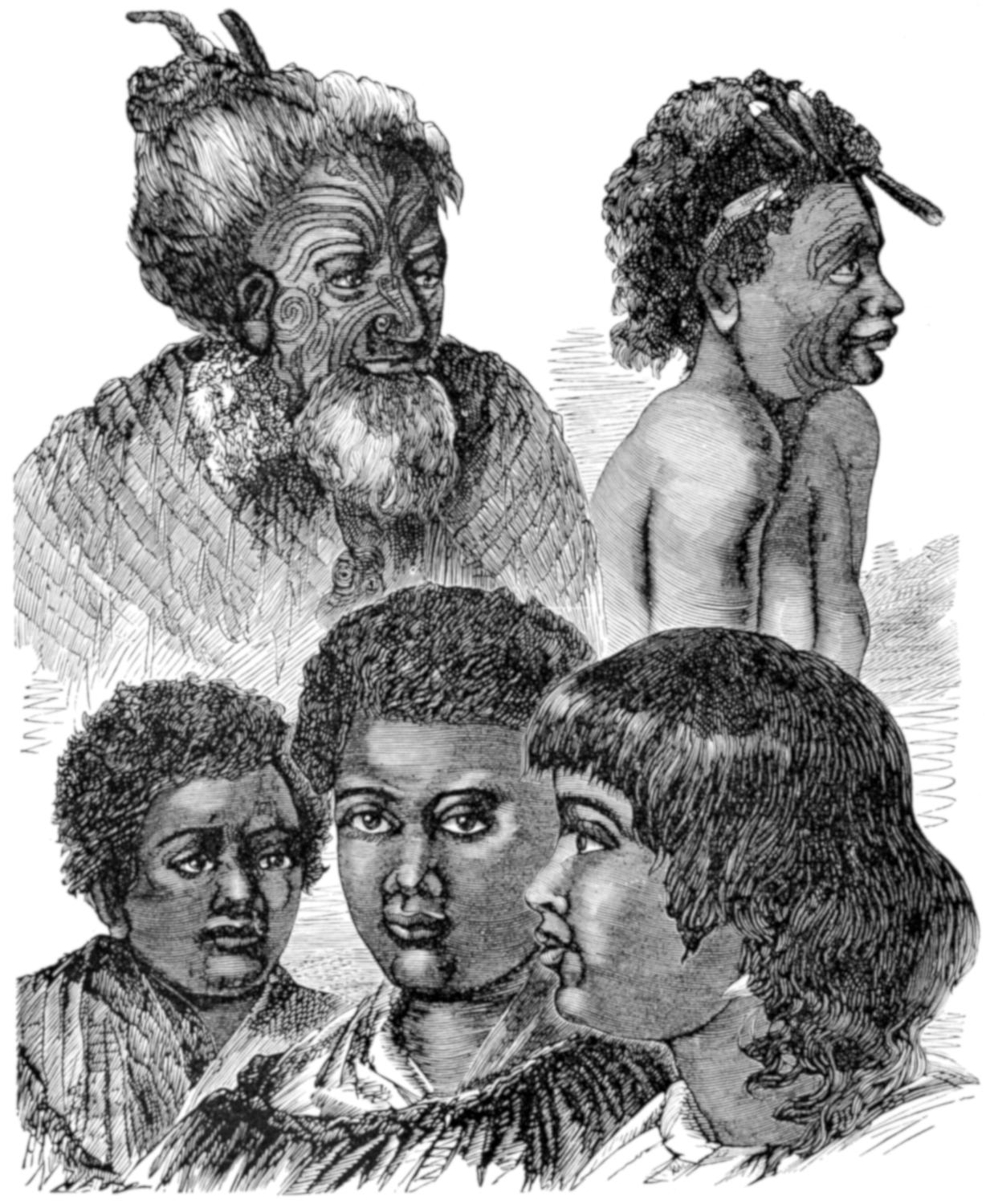
NEW ZEALANDER FROM CHILDHOOD TO AGE.
(See page 795.)
“But I must observe that I never met
any man of consequence belonging to this
tribe, and that, although freemen, they occupied
the lower grades: from this we may,
perhaps, infer the relation in which they
stood to the earliest immigrants into the
country, although their traditions and legends
are silent on the subject.
“From the existence of two races in New
Zealand the conclusion might be drawn that
the darker were the original proprietors of
the soil, anterior to the arrival of a stock
of true Polynesian origin; that they were
conquered by the latter, and nearly exterminated.
This opinion has been entertained
regarding all Polynesian islands; but I must
observe that it is very doubtful whether
those differences which we observe among
the natives of New Zealand are really due
to such a source. We find similar varieties
in all Polynesian islands, and it is probable
that they are a consequence of the difference
of castes so extensively spread among
the inhabitants of the tribes of the great
ocean.
“If one part of the population of New
Zealand are a distinct race—a fact which
cannot be denied as regards other islands—it
is very curious that there should be no
traces of such a blending in the language,
where they would have been most durable,
or in the traditions, which certainly would
have mentioned the conquest of one race
by the other, if it had happened. Captain
Crozet, a Frenchman, who early visited New
Zealand, says that he found a tribe at the
North Cape darker than the rest. I could
observe nothing of the kind there, though
I visited all the natives. Nor are those
darker-colored individuals more common
in the interior; I should say, even less so.
“There is undoubtedly a greater variety
of color and countenance among the natives
of New Zealand than one would expect—a
circumstance which might prove either an
early blending of different races, or a difference
of social conditions, which latter supposition
would go far to explain the fact.
All the New Zealanders speak of the Mango-Mango,
or Blacks of New South Wales,
as unconnected with and inferior to themselves;
but they never make such a distinction
regarding their own tribes.”
As is often the case with uncivilized people,
the women are decidedly inferior to
the men, being much shorter, and not nearly
so well made. They are not treated with
the harshness which is the usual characteristic
of married life among savages, and are
even taken into their husbands’ counsels,
and have great influence in political affairs.
Still, the heavy work of the household falls
upon their shoulders, and the lot of an ordinary
New Zealand wife is rather a severe
one. She has to cultivate the ground, to
carry the produce of the distant fields to the
house, and, when the family is travelling,
the women have to carry all the heavy loads.
It is no wonder, therefore, that a life of such
drudgery should tell upon the women, both
in preventing the proper development of
their frame and in causing their beauty to
decay. Those who preserve their beauty
longest are the daughters of wealthy chiefs,
who can afford slaves by whom all the hard
work is done, and who therefore free their
mistresses from one of the causes of deterioration.
There is, however, another cause, which
is perhaps equally effective, but not so palpable.
This is the very lax code of morality
which prevails among them, a young girl
being permitted the utmost freedom until
she is married, although afterward she is a
model of constancy. This license is exercised
at a very early age, and the natural
consequence is that the due development of
the frame is checked. This vicious system
is so much a matter of course, that it carries
no reproach with it, and the young girls
are remarkable for their modest and childlike
demeanor.
Of course they become aged much earlier
than those whose development takes place
at a later period of life; but they compensate
for their deteriorated appearance by
their peculiar kindliness of demeanor. The
engraving No. 1, illustrates the countenance
and dress of a New Zealand woman and
her boy.
Unlike the men, the women do not disfigure
their faces by the tattoo, which gives
to them the stern and fixed expression so
characteristic of a New Zealand warrior;
and they thus allow the really flexible and
intelligent features to have full play. The
only portions of the face that are marked
with the tattoo are the lips, which are rendered
blue by the process, as it is considered
disgraceful for a woman to have red lips.
The tattooing is always performed when the
child is allowed to take her place among
women; and, as may be imagined, it gives a
livid and altogether unpleasant appearance
to the mouth.
The children are very pleasing and interesting
little creatures. They are full of
intelligence, and unusually free and open in
their manner. Unlike the children of most
savage nations, they live as much with the
men as with the women, and partake even
in the councils of their parents, thus having
their faculties sharpened at a very early age.
The illustration opposite gives typical examples
of the New Zealander from childhood
to age, and the reader will notice the
contrast between the soft and rounded outlines
of the youth, and the harsh, rigid countenances
of the old man and his consort.
In proportion to the dimensions of New
Zealand, the population is very small; and,
even in the earliest days of our acquaintance
with it, the land seems to have been
but thinly inhabited. That such should be
the case is very remarkable, as a very thin
population is generally found in those countries
where, as in Australia, the inhabitants
live principally by the chase, and therefore
require a very large tract of land to support
them. The New Zealanders, however, do
not live by the chase, for the simple reason
that there are no animals which are worth
the trouble of hunting; so that a family of
twenty or so, even if they had the entire
country as a hunting-ground, would find
themselves in very great straits were they
obliged to procure their food by the chase.
The reasons for this thin population will be
presently seen.
According to Dieffenbach’s calculation, the
native population of the entire country may
be reckoned rather below one hundred and
fifteen thousand. These are divided into
twelve great tribes, which are again subdivided
into sub-tribes, or clans, each of which
has its separate name, and is supposed to
belong to a certain district. The fighting
men, or warriors, form about one-fourth of
the whole population; the remaining three-fourths
being made up of old men, women, and
children. Since this calculation the numbers
of the aborigines have considerably lessened.
The most important of the tribes seems to
be the Waikato, which is divided into eighteen
clans, and which occupies a very large
proportion of the country. This tribe alone
can bring into the field six thousand fighting
men; so that the entire number of the
tribe may be calculated at twenty-four thousand
or so.
The Waikato clans have managed to preserve
their individuality better than the
others, and, though brought much in contact
with civilization, and having adopted
some of the habits of their white visitors,
they have still retained many of their
ancient customs, and, as Dieffenbach remarks,
have preserved much of their ancient
vigor and original virtues.
The tribe that is strongest in mere numbers
is the Nga-te-kahuhuna, which inhabits
the east coast, and may be reckoned at
thirty-six thousand strong. In fact, these
two tribes alone outnumber the whole of
the others taken collectively. One tribe,
the Rangitani, is interesting from the fact
that it was described by Captain Cook. In
his days it was evidently a large and flourishing
tribe, but some few years ago it could
scarcely muster three hundred warriors,
representing a total number of twelve hundred.
The decadence of this tribe is probably
owing to the destructive wars in which
the New Zealanders engage, and which are
often so fierce as to erase a tribe entirely.
The government of the New Zealanders
is a curious mixture of simplicity and complication.
Monarchy is unknown, each tribe
having its own great chief, while an inferior
chief presides over each clan, or sub-tribe.
The whole of the population may be roughly
divided into three ranks. First come the
nobility, then the free men, and lastly the
slaves. The nobility go by the general name
of Rangatira—a title which is always given
to officers, missionaries, and other white men
who are placed in command over others.
In each tribe one of the Rangatira is the
Ariki, or principal chief; but, as he is necessarily
a Rangatira, he is always addressed
by that title, and, in consequence, a stranger
finds some difficulty, even after a prolonged
visit, in ascertaining who is the Ariki.
Among the New Zealanders there is no Salic
law, so that the Ariki need not be a warrior,
and may be a woman. The office is hereditary,
and the existing Ariki is always held
in the highest veneration in virtue of his
descent. Even the hostile tribes respect an
Ariki, and in most cases, if he should be
captured in battle, the victors will spare
his life. One or two of the most powerful
chiefs living have been captured and afterward
released, whereas, had they been common
men, or even ordinary Rangatiras,
they would have been killed, their bodies
eaten, and their heads dried and fixed as
trophies on the houses of their conquerors.
A sort of tax, or tribute, is paid by the
different families, though the tax is entirely
a voluntary one, and may be great or small,
or withheld altogether, at pleasure. Mostly
the Ariki is a man of considerable mental
powers, and, in such a case, he exercises
great authority over the tribe, either as a
priest or a warrior. There is nothing to
prevent the Ariki from assuming the office
of priest, and in many instances he has
been able to exercise a far greater influence
by spiritual than by physical means.
The Rangatira are the great men, or
nobles, of the land, and with them, as with
the Ariki, the rank is hereditary. The law
of succession is very remarkable, the eldest
son being the heir to his father’s rank; but
if the child dies, the youngest, and not the
next eldest, becomes the lawful successor.
These two heirs, the eldest and the youngest
sons, are called by a name which signifies
the fat of the earth.
Each Rangatira is independent of his
fellows, though they collectively form a sort
of body which we may compare with the
House of Peers in England. Any Rangatira
who has sufficient influence may gather
together the members of his clan, build a
fortified village, or pah, and become a petty
sovereign in his own dominions. It is in
this way that the various clans, or sub-tribes,
are formed, each gathering round a
noble of more than usual ability, and adopting
a name by which the members will ever
afterward be known.
The free men form the great body of the
warriors; some of them being the sons of
Rangatira, and others merely having the
privilege of free birth; which carries with
it the right of tattooing the face. Sometimes
a free man who is remarkable for his
generalship and courage will take the command
of an expedition, even though men of
higher rank than himself should be engaged
in it.
Last come the slaves. These are always
procured from two sources: they are either
captives taken in battle, or are the children
of such captives. The value of such slaves
is very great. All savages are idle, but the
New Zealander is one of the laziest of mortals
in time of peace. In war he is all fire
and spirit; but in peace he lounges listlessly
about, and will not do a stroke of work that
can possibly be avoided.
He may, perhaps, condescend to carve the
posts of his house into some fantastical semblance
of the human form, or he may, perchance,
employ himself in slowly rubbing a
stone club into shape, or in polishing or
adorning his weapons. Whatever real work
is to be done is left to the women or the
slaves, and a man who values his wife or
daughter will endeavor to procure slaves who
will relieve her of the drudgery.
There are slaves of both sexes, to whom
the appropriate work is allotted. They are
considered the absolute property of their
owner, who may treat them as he pleases,
and, if he prefers to kill them, may do so
without attracting any attention. Of course
he would not do so except for very good
reasons, as he would deprive himself of a
valuable article of property. There have
been cases, as we shall presently see, when
the owner of slaves has deliberately murdered
them for the sake of selling their
heads.
Once a slave, always a slave. Should one
of these unfortunates manage to escape and
get back to his own tribe, his owner would
apply for him, and he would be given up,
the right of the master to his slave being
universally recognized. Still, as a rule, the
slaves are treated well, and some of them,
who have attained excellence in certain
arts, often become richer men than their
owners. So great is the value of slaves, that
many a war has been undertaken for the
mere purpose of slave hunting, and some of
the most disastrous and obstinate feuds have
originated in the slave hunt.
Connected with the government of the
New Zealanders is the land question. This
is a strangely complicated business, as every
inch of ground has an actual owner, while
there are usually several claimants who allow
their rights, real or imagined, to lie in
abeyance as long as the land is owned by
one who can hold his own, while they will
all prefer their claims at his death, or even
during a lengthened absence.
So it has often happened that the white
men, while desiring to act according to law
and honor, have involved themselves in a
very net of difficulties. A chief, for example,
may agree to sell a portion of territory,
will receive the price, and will sign a
deed, which will be witnessed by natives as
well as by Europeans. No sooner has he
done so, than a claimant comes forward,
declaring that the chief in question had no
real right to the land, and therefore had no
right to sell it.
His claim will be inquired into, and, if it
seems to be tolerably consistent with likelihood,
the man will be paid an additional
sum for his consent to the sale. The matter,
however, is not at an end, for such is
the jealousy with which the natives regard
land, that, as long as a foreigner holds an
inch of ground, so long will there be a native
who prefers a claim to it. Strange as it
may seem, the white man would incur less
odium by taking the land by force, and seizing
it by right of conquest, than by trying to act
according to justice and equity.
War is a fertile source of misunderstanding
about land. A tribe may be driven out
of a district, and their land given to others,
who hold it as long as they can keep it, the
original possessors being sure to reconquer
it if possible. It has sometimes happened
that a chief to whom such lands have been
presented has transferred them to another
chief, and he, in his turn, has sold them to
European settlers, the bargain being ratified
by his own followers, who are considered as
having a share in such property.
The colonists take the land, clear it, cultivate
it, and when the crops are fairly in the
ground, the dispossessed tribe will come forward
and prefer their claim to it. Those to
whom it was sold have already received
their price, and do not trouble themselves
to oppose the claim; and the consequence
is, that the colonists are obliged either to
make a second payment or to run the risk of
war.
As to the claims themselves, they are of
the most curious and unexpected character,
such as no European would be likely to anticipate.
According to Dieffenbach, “There
exists a very distinct notion of the rights of
landed property among the natives, and every
inch of land in New Zealand has its proprietor.
Sometimes land is given to a strange
tribe, either as pay, or from other considerations,
but the proprietor reserves certain
rights, some of which are what we should
term manorial.
“It was formerly very common that the
fat of the native rats (Kiore) killed on such
lands should be given to the principal proprietor,
and in many cases a title to land
seems to have been derived from the fact of
having killed rats on it. Thus a chief will
say, ‘This or that piece of land is mine; I
have killed rats on it.’ Generally, however,
land descends, as with us, by inheritance.”
Such being the complicated tenure on
which land is held—a tenure which is often
puzzling to the natives themselves—it is
no matter of wonder that English settlers
should have found themselves in difficulties.
It is said that the colonists tried to make
themselves masters of the land by unfair
means, i. e. either by forcibly taking possession
of it, or by inveigling the ignorant natives
into signing documents which they did
not understand, and thus selling their paternal
estates for rum, tobacco, and a few blankets.
This may to some extent have been the
case when the colonists first came to settle
in the country. But the natives are far too
intelligent to remain long ignorant of the
power of pen, ink, and paper, and there is
no doubt that in many cases they intentionally
outwitted the purchaser, either by putting
forward a sham owner of the ground,
who had no right to sell it, and who vanished
with his share of the prize as soon as
the bargain was concluded, or by asserting
ignorance of the meaning of the document
which had been signed, and refusing to
carry out its conditions. That the white
men succeeded too often in cheating the
natives is unfortunately true, but it is no less
true that the natives as often cheated the colonists.
Law among the New Zealanders seems to
be of the simplest kind, and, as far as we
know, is not so well developed as among
some of the tribes of Southern Africa. The
three offences of which the law takes cognizance
are murder, theft, and adultery.
For the first of these offences a sort of lex
talionis holds good, the relatives of the slain
man being sure, sooner or later, to kill the
murderer, unless he manages to compromise
with them. Even theft is punished in a
similar fashion, the thief being robbed in
his turn.
As to the third offence, it is punishable in
various ways; but both the offending parties
are supposed to have forfeited their lives to
the husband. If, therefore, the fact be discovered,
and the culprit be a person of low
rank, he seeks safety in flight, while, if he
be a man of rank, he expects that the offended
husband will make war upon him.
Sometimes, if a wife discovers that her husband
has been unfaithful to her, she will kill
his paramour, or, at all events, disgrace her
after the native custom, by stripping off all
her clothes, and exposing her in public.
Even the husband is sometimes subjected
to this punishment by the wife’s relations;
and so much dreaded is this disgrace that
men have been known to commit suicide
when their offence has been discovered.
Suicide, by the way, is not at all uncommon
among the New Zealanders, who always
think that death is better than disgrace, and
sometimes destroy themselves under the
most trivial provocation. One such case is
mentioned by Mr. Angas. “On arriving
at the village or kainga of Ko Nghahokowitu,
we found all the natives in a state of extraordinary
excitement. We had observed
numbers of people running in that direction,
along the margin of the river, from the
different plantations, and, on inquiry, we
learned that an hour previously to our arrival
the son of an influential chief had committed
suicide by shooting himself with a
musket.
“Our fellow-travellers, with Wisihona
their chief, were all assembled, and we followed
them to the shed where the act had
been perpetrated, and where the body still
lay as it fell, but covered with a blanket.
The mourners were gathered round, and the
women commenced crying most dolefully,
wringing their hands, and bending their
bodies to the earth. We approached the
body, and were permitted to remove the
blanket from the face and breast. The
countenance was perfectly placid, and the
yellow tint of the skin, combined with the
tattooing, gave the corpse almost the appearance
of a wax model. The deceased was a
fine and well-made young man. He had
placed the musket to his breast, and deliberately
pushed the trigger with his toes, the
bullet passing right through his lungs.
Blood was still oozing from the orifice made
by the bullet, and also from the mouth, and
the body was still warm.”
The cause of this suicide was that which
has already been mentioned. The young
man had been detected in an illicit correspondence
with the wife of another man in
the same village. The woman had been
sent away to a distant settlement, a proceeding
which had already made her lover
sullen and gloomy; and, on the day when
Mr. Angas visited the place, he had become
so angry at the reproaches which were levelled
at him by some of his relations, that
he stepped aside and shot himself.
The determined manner in which the New
Zealanders will sometimes commit suicide
was exemplified by the conduct of another
man, who deliberately wrapped himself up in
his blanket, and strangled himself with his
own hands. The crime was perpetrated in the
common sleeping-house, and was achieved
with so much boldness that it was not discovered
until the man had been dead for
some time.
A remarkable instance of this phase of
New Zealand law took place when Mr.
Dieffenbach visited the Waipa district. He
was accompanied by a chief, who called a
girl to him, and handed her over to the
police magistrate as a murderess. The fact
was, that her brother, a married man, had
formed an intimacy with a slave girl, and,
fearing the vengeance of his wife’s relatives,
had killed himself. His sister, in order to
avenge the death of her brother, found out
the slave girl in the bush, and killed her.
The strangest part of the business was, that
the accused girl was the daughter of the
chief who denounced her.
The girl pleaded her own cause well, saying,
what was perfectly true, that she had
acted according to the law of the land in
avenging the death of her brother, and was
not amenable to the laws of the white man,
which had not yet been introduced into her
country. As might be imagined, her plea
was received, and the girl was set at liberty;
but her father was so earnest in his wish to
check the system of retaliatory murder, that
he actually offered himself in the place of
his daughter, as being her nearest relation.
CHAPTER LXXIX. NEW ZEALAND— Continued . DRESS.
DRESS AND ORNAMENTS OF THE NEW ZEALANDER — THE TATTOO OR THE MOKO — ITS FORMIDABLE
CHARACTER — THE TATTOO A MARK OF FREEDOM — THE TATTOO OF THE FACE, AND ITS DIFFERENT
PORTIONS — COST OF THE OPERATION — THE IMPLEMENTS, AND MODE OF USING THEM — TIME
OCCUPIED IN COMPLETING IT — PAYMENT OF THE OPERATOR, AND THE TATTOO SONG — SOURCE
WHENCE THE PIGMENT IS OBTAINED — SCARLET PAINT, AND MODE OF MAKING IT — THE
NEW ZEALAND BELT — SYMBOLISM OF THE TATTOO — PRESERVING THE HEADS OF WARRIORS — THE
TRAFFIC IN HEADS — A COOL BARGAINER.
We will now proceed to the appearance and
dress of the natives of New Zealand, or
Maories, as they term themselves. As the
most conspicuous part of the New Zealander’s
adornment is the tattooing with
which the face and some other portions of
the body are decorated, we will begin our
account with a description of the moko, as
it is called by the natives.
There are many parts of the world where
the tattoo is employed, but in none is it of
so formidable a description as among the
New Zealanders. As the reader is probably
aware, the tattoo consists of patterns made
by introducing certain coloring matters
under the skin; charcoal, variously prepared,
being the usual material for the
purpose. We have already seen among the
Kaffirs examples of ornamenting the skin by
cutting it deeply so as to form scars, and in
Australia a similar but more cruel custom
prevails. In neither of these countries, however,
is there any attempt at producing an
artistic effect, while in New Zealand beauty
of design is the very object of the tattoo.
There is a distinction between the tattoo
of the New Zealanders and the Polynesians;
that of the latter people being formed by
rows of little dots, and that of the former by
lines cut completely through the skin. On
account of this distinction, though a New
Zealander and a Polynesian be covered from
head to foot with tattoo marks, there is no
possibility of mistaking the one for the other.
The moko of the New Zealander is a mark
of rank, none but slaves being without a
more or less complete tattooing of the face.
In the present day, even the chiefs have
begun to discontinue the ancient custom,
chiefly owing to the exertions of the missionaries,
who objected to the practice as a
mark of heathendom. Consequently, several
of the most powerful convert chiefs present
a very curious, not to say ludicrous, aspect,
which can hardly have a good effect in
recommending Christianity to the people.
Having been converted before the moko
was completed, and being unwilling to continue
the process and unable to obliterate
those portions which were already drawn,
they appear with one half of their faces tattooed
and the other half plain, or perhaps
with a solitary ring round one eye, and a
couple of curves round one side of the
mouth.
As, however, the present work treats only
of the native customs, and not of modern
civilization, the New Zealanders will be
described as they were before they had
learned to abandon the once-prized tattoo,
to exchange the native mat for the English
blanket, the picturesque war canoe for the
commonplace whaling boat, and the spear
and club for the rifle and bayonet.
The principal tattoo is that of the face and
upper part of the head, which, when completed,
leaves scarcely an untouched spot
on which the finger can be placed. When
finished, the whole face is covered with
spiral scrolls, circles, and curved lines; and
it is remarkable, that though a certain order
is observed, and the position of the principal
marks is the same in every case, no two persons
are tattooed in precisely the same manner,
the artists being able to produce an
infinite variety with the few materials at
his command.
For example, the first portion of the tattoo
is always a series of curved lines, reaching
from the corners of the nose to the chin,
and passing round the mouth. This portion
of the tattoo goes by the name of rerepi.
Next comes a spiral scroll on the cheekbone;
and below it is another spiral, reaching
as low as the jaw-bone. These are
called respectively kakoti and korohaha.
Next come four lines on the middle of the
forehead, called titi; and besides these there
are several lines which run up the centre of
the nose and cover its sides, some which
spread over the forehead, others which occupy
the chin; and even the lips, eyelids,
and ears are adorned with this singular
ornament.
Besides possessing these marks, a great
chief is seldom content unless he can cover
his hips with similar lines, each of which
has, like those of the face, its proper name.
Although the moko was considered as a
mark of rank, there were no sumptuary
laws which forbade its use. Any one, provided
he were not a slave, might be tattooed
as much as he pleased; but the expense of
the operation was so great, that none but
men of position could afford a complete suit
of moko. No man could tattoo himself, and
the delicacy of touch and certainty of line
was so difficult of attainment, that tattooing
became an art or science, which was left in
the hands of a few practitioners, who derived
a good income from their business. Some
of those who had attained much reputation
for their skill used to command very high
fees when called in to decorate a client, and
their services could therefore only be secured
by the men of high position. It is
rather remarkable that some of the most
celebrated operators were slaves, men who
were forbidden to wear the tattoo on their
own persons.
The mode of operation is as follows. The
patient lies on his back, and places his head
between the knees of the operator, who
squats on the ground after the usual native
fashion. The latter then takes a little of the
black pigment, and draws on the face the
line of the pattern which he intends to follow;
and in some cases he slightly scratches
them with a sharp instrument, so as to make
a sketch or outline drawing. The object of
this scratching is to prevent the pattern
from being obliterated by the flowing blood
and the black pigment which is rubbed into
the wounds.
Next, he takes his instrument or chisel,
which is usually made of teeth, or the bone
of a bird, and with it follows the pattern,
cutting completely through the skin. Sometimes,
when engaged in tattooing the face, a
careless operator has been known to cut
completely through the cheek, so as to put a
temporary check to smoking, the sufferer
experiencing some difficulty in getting the
smoke into his mouth at all, and then finding
it escape through the holes in his cheek.
On page 722 the reader may find an illustration
which gives a good idea of the different
forms of the tattooing chisel. As the operator
proceeds, he continually dips the edge of
his chisel in the black pigment, and, when he
has cut a line of a few inches in length, he
rubs more of the pigment into the wound,
using a little bunch of fibre by way of a brush
or sponge.
The cutting is not done as with a knife,
but by placing the edge of the chisel on the
skin, and driving it along the lines of the
pattern by repeated blows with a small
mallet. As may be imagined, the pain
caused by this operation is excruciating.
It is painful enough to have the skin cut at
all, even with the keenest blade, as any one
can testify who has been unfortunate enough
to come under the surgeon’s knife. But
when the instrument employed is a shark’s
tooth, or a piece of bone, when it is driven
slowly through the skin by repeated blows,
and when the wound is at once filled with
an irritating pigment, it may be imagined
that the torture must be dreadful. It is,
however, reckoned a point of honor to
endure it without giving any signs of suffering.
Owing to the character of the tattoo, the
destruction of the skin, and the consequent
derangement of its functions, only a small
portion can be executed at a time, a complete
moko taking from two to three years,
according to the constitution of the individual.
Dreadful swellings are always caused
by it, especially of the glands in the neighborhood
of the wounds, and the effects are
so severe that men have died when too large
a portion has been executed at one time.
Every stroke of the chisel or uki leaving
an indelible mark, it is of the greatest consequence
that the operator should be a man
of skill, and devote all his energies to tracing
a clear, though elaborate pattern, in
which the lines are set closely together,
sweep in regular curves, and never interfere
with each other.
While a man is being tattooed, his friends
and those of the operator sing songs to him,
in which he is encouraged to endure the
pain bravely, and to bear in mind the lasting
beauty which will be conferred upon him
when the pattern is completed. The songs
of the operator’s friends contain some very
broad hints as to the scale of payment which
is expected. Although, as has been stated,
the best of tattooers are paid very highly,
there is no definite fee, neither is any bargain
made, the operator trusting to the
liberality of his client. But, as a man would
be contemned as a skulking fellow if he were
to ask the services of a good operator and
then pay him badly, the practical result is
that a good tattooer always secures good
pay.
Moreover, he has always the opportunity
of avenging himself. As only a small portion
of the moko can be executed at a time—say,
for example, the spiral curve on one
cheek—if the operator be badly paid for the
first portion of his work, he will take care to
let the chisel slip out of its course when he
proceeds to the second part, or will cut his
lines coarsely and irregularly, thus disfiguring
the stingy man for life.
Mr. Taylor gives a translation of one of
these tattooing songs:
“He who pays well, let him be beautifully ornamented;
But he who forgets the operator, let him be done carelessly.
Be the lines wide apart.
O hiki Tangaroa!
O hiki Tangaroa!
Strike that the chisel as it cuts along may sound.
O hiki Tangaroa!
Men do not know the skill of the operator in driving his sounding chisel along.
O hiki Tangaroa!”
The reader will see that the song is a very
ingenious one, magnifying the skill of the
operator, promising a handsome moko to the
liberal man, and threatening to disfigure
him if he be niggardly in his payments.
While the operation of tattooing is going
on, all persons in the pah, or enclosure, are
under the tabu, or tapu, lest any harm should
happen to them; the work of tattooing being
looked upon with a kind of superstitious
reverence. The meaning of the word ‘tapu’
will be explained when we come to treat of
the religious system of the New Zealander.
The effect of the moko on the face is well
shown in illustration No. 2, on the next
page, which represents a chief and his wife.
The reader will probably observe that on
the face of the woman there are marks
which resemble the tattoo. They are, however,
the scars left by mourning over the
body of some relative, a ceremony in which
the women cut themselves unmercifully.
The dress worn by both persons will be
presently described.
The pigment used in tattooing is made
from the resin of the kauri pine, and the
greater part of it is made at one spot, where
the tree grows plentifully. There is a rocky
precipice, and a little distance from its edge
a deep and narrow pit is sunk. A channel
is cut through the face of the cliff into the
pit, and the apparatus is complete. When a
native wishes to make a supply of tattooing
pigment, he cuts a quantity of kauri wood,
places it in the pit, and sets fire to it, thus
causing the burnt resin to fall to the bottom
of the pit, whence it is scraped out through
the channel.
Scarlet paint is much employed by the natives,
especially when they decorate themselves
for battle. It is obtained from an
ochreous substance which is deposited in
many places where water has been allowed
to become stagnant. Some spots are celebrated
for the excellence of the ochre, and
the natives come from great distances to procure
it. When they wish to make their
scarlet paint, they first carefully dry and
then burn the ochre; the result of which
operation is, that a really fine vermilion is
obtained.
This paint is used for many purposes, and
before being used it is mixed with oil obtained
from the shark. The natives are fond
of decorating their houses with it, and by
means of the scarlet lines increase, according
to their own ideas, the beauty of the carved
work with which every available point is
adorned. Even their household goods are
painted after a similar manner, the fashionable
mode being to paint all the hollows
scarlet, and the projecting portions black.
Their canoes and wooden ornaments are profusely
adorned with red paint. But the most
valued use of this pigment is the part which
it plays in the decoration of a warrior when
he goes to battle.
In such cases paint constitutes the whole
of his costume, the mats in which he takes
so great a pride in time of peace being laid
aside, many warriors being perfectly naked,
and with the others the only covering of any
kind being a belt made of plaited leaves.
One of these belts in my collection is seven
feet in length, and only three and a half inches
wide in the broadest part; while at
either end it diminishes to a mere plaited
thong. It is folded fourfold, and on opening
it the mode of construction is plainly seen;
all the loose ends being tucked inside.
The material is phormium leaf cut into
strips an inch in width, each alternate strip
being dyed black. Each strip is then divided
into eight little strips or thongs, and they
are so plaited as to produce an artistic checkered
pattern of black and white. The ingenuity
in forming so elaborate a pattern
with so simple a material is extreme; and,
as if to add to the difficulty of his task, the
dusky artist has entirely changed the pattern
at either end of the belt, making it run at
right angles to the rest of the fabric. The
belt is also used in lieu of clothing when the
men are engaged in paddling a canoe.
The paint, therefore, becomes the characteristic
portion of the New Zealander’s war
dress, and is applied for the purpose of making
himself look as terrible as possible, and
of striking terror into his enemies. It is,
however, used in peace as well as in war,
being regarded as a good preservative against
the bites and stings of insects, especially the
sandflies and mosquitoes. It is also used in
mourning, being rubbed on the body as a
sign of grief, precisely as ashes are used
among some of the Oriental nations. Some
travellers have thought that the continual
use of this pigment gives to the New Zealanders
the peculiar softness and sleekness
of skin for which they are remarkable, and
which distinguishes them from the Fijians,
whose skin feels as if it had been roughened
with a file. This theory, however, is scarcely
tenable, the soft texture of the skin being
evidently due to physical and not to external
causes.
(1.) NEW ZEALAND WOMAN AND HER BOY.
(See page 795.)
(2.) TATTOOED CHIEF AND HIS WIFE.
(See page 802.)
A warrior adorned in all the pride of the
tattoo and scarlet paint is certainly a terrific
object, and is well calculated to strike terror
into those who have been accustomed to
regard the Maori warriors with awe. When,
however, the natives found that all the painting
in the world had no effect upon the disciplined
soldiers of the foreigner, they abandoned
it, and contented themselves with the
weapons that none are more able to wield
than themselves.
Moreover, the paint and tattoo, however
well it might look on a warrior armed after
the primitive fashion, has rather a ludicrous
effect when contrasted with the weapons of
civilization. There is now before me a portrait
of a Maori chief in full battle array.
Except a bunch of feathers in his hair, and
a checked handkerchief tied round his loins,
evidently at the request of the photographer,
he has no dress whatever. He is tall, splendidly
made, stern, and soldierlike of aspect.
But instead of the club, his proper weapon,
he bears in his hand a Belgian rifle, with
fixed bayonet, and has a cartouche-box fastened
by a belt round his naked body.
His face is tattooed, and so are his hips,
which are covered with a most elaborate
pattern, that contrasts boldly with his really
fair skin. Had he his club and chief’s staff
in his hands, he would look magnificent;
having a rifle and a cartouche-box, he looks
absurd. Even a sword would become him
better than a rifle, for we are so accustomed
to associate a rifle with a private soldier, that
it is difficult to understand that a powerful
chief would carry such a weapon.
The curious mixture of native and European
dress which the Maories are fond of
wearing is well described by Mr. Angas.
“Raupahara’s wife is an exceedingly stout
woman, and wears her hair, which is very
stiff and wiry, combed up into an erect mass
upon her head about a foot in height, somewhat
after the fashion of the Tonga islanders,
which, when combined with her size, gives
her a remarkable appearance.
“She was well dressed in a flax mat of
native manufacture, thickly ornamented with
tufts of cotton wool; and one of her nieces
wore silk stockings and slippers of patent
leather. This gay damsel was, moreover, a
very pretty girl, and knew how to set off
her charms to advantage; for over an European
dress she had retained her native
ornaments, and had wrapped herself coquettishly
in a beautiful, ‘kaitaka,’ displaying her
large hazel eyes above its silky folds.”
It has often been thought that the warrior
regarded his moko, or tattoo, as his name,
permanently inscribed on his face; and this
notion was strengthened by two facts: the
one, that in the earlier times of the colonists
the natives signed documents by appending
a copy of their moko; and the
other, that each man knows every line of
his tattoo, and sometimes carves a wooden
bust on which he copies with admirable
fidelity every line which appears on his own
head or face. Such a work of art is greatly
valued by the Maories, and a man who has
carved one of them can scarcely be induced
by any bribe to part with it.
Moreover, the moko of a warrior is often
accepted as the conventional representation
of himself. For example, on the pillars of
a very celebrated house, which we shall
presently describe, are numerous human
figures which represent certain great chiefs,
while men of lesser mark are indicated by
their moko carved on the posts. Thus it
will be seen that the moko of a chief is as
well known to others as to himself, and
that the practised eye of the native discerns
among the various curves and spirals, which
are common to all free men, the characteristic
lines which denote a man’s individuality,
and in producing which the tattooers’ skill
is often sorely tried.
It has already been mentioned, that when
a warrior falls in battle, and his body can be
carried off by the enemy, the head is preserved,
and fixed on the dwelling of the conqueror.
No dishonor attaches itself to such
an end; and, indeed, a Maori warrior would
feel himself direfully insulted if he were
told that in case of his death in the field his
body would be allowed to remain untouched.
In fact, he regards his moko precisely in
the same light that an American Indian
looks upon his scalp-lock; and, indeed, there
are many traits in the character of the
Maori warrior in which he strangely resembles
the best examples of North American
savages.
In order to preserve the head of a slain
warrior, some process of embalming must
evidently be pursued, and that which is
commonly followed is simple enough.
The head being cut off, the hair is removed,
and so are the eyes; the places of
which are filled up with pledgets of tow,
over which the eyelids are sewed. Pieces
of stick are then placed in the nostrils in
order to keep them properly distended, and
the head is hung in the smoke of the wood
fire until it is thoroughly saturated with the
pyroligneous acid. The result of this mode
of preparation is, that the flesh shrinks up,
and the features become much distorted;
though, as the Maori warrior always distorts
his countenance as much as possible before
battle, this effect is rather realistic than
otherwise.
It is often said that heads prepared in this
fashion are proof against the attacks of insects.
This is certainly not the case, as I
have seen several specimens completely
riddled by the ptilinus and similar creatures,
and have been obliged to destroy the
little pests by injecting a solution of corrosive
sublimate. In spite of the shrivelling
to which the flesh and skin are subject, the
tattooing retains its form; and it is most
curious to observe how the finest lines completely
retain their relative position to each
other.
Not only are the heads of enemies
treated in this fashion, but those of friends
are also preserved. The difference is easily
perceptible by looking at the mouth, which,
if the head be that of a friend, is closed,
and if of an enemy, is widely opened.
Some years ago, a considerable number of
these preserved heads were brought into
Europe, having been purchased from the
natives. Of late years, however, the trade
in them has been strictly forbidden, and on
very good grounds. In the first place, no
man who was well tattooed was safe for an
hour, unless he were a great chief, for he
might at any time be watched until he was
off his guard, and then knocked down,
killed, and his head sold to the traders.
Then, when the natives became too cautious
to render head hunting a profitable trade, a
new expedient was discovered.
It was found that a newly tattooed head
looked as well when preserved as one which
had been tattooed for years. The chiefs
were not slow in taking advantage of this
discovery, and immediately set to work at
killing the least valuable of their slaves,
tattooing their heads as though they had
belonged to men of high rank, drying, and
then selling them.
One of my friends lately gave me a curious
illustration of the trade in heads. His
father wanted to purchase one of the dried
heads, but did not approve of any that were
brought for sale, on the ground that the tattoo
was poor, and was not a good example
of the skill of the native artists. The chief
allowed the force of the argument, and,
pointing to a number of his people who had
come on board, he turned to the intending
purchaser, saying, “Choose which of these
heads you like best, and when you come
back I will take care to have it dried and
ready for your acceptance.” As may be
imagined, this speech put an abrupt end to
all head purchasing, and gave an unexpected
insight into the mysteries of trading as conducted
by savage nations.
CHAPTER LXXX. NEW ZEALAND— Continued . DRESS AND ORNAMENTS.
THE “MATS” OF THE NEW ZEALANDERS — THE MATERIAL OF WHICH THEY ARE MADE — THE NEW
ZEALAND FLAX, OR PHORMIUM — MODE OF MAKING THE MATS — VARIOUS KINDS OF MATS — THE
RAIN MAT AND ITS USES — THE OPEN-WORKED MAT — THE DIFFERENT ORNAMENTS OF THE MAT:
STRINGS AND TAGS, SCARLET TUFTS AND BORDERS — WAR CLOAKS OF THE CHIEFS — THE DOGS’-HAIR
MAT — THE CHIEF PARÁTENE IN HIS CLOAK — MODE OF MAKING THE WAR CLOAKS — BRIEF
ACCOUNT OF THE CHIEF — AMUSING INSTANCE OF VANITY IN A CHIEF — SUBSTITUTION OF
THE BLANKET AND ITS ATTENDANT EVILS — ORNAMENTS OF THE NEW ZEALANDER’S HEAD — FEATHERS,
AND FEATHER BOXES — VARIOUS DECORATIONS OF GREEN JADE — TIKIS AND EAR-RINGS — A
REMARKABLE AMULET — THE SHARK’S TOOTH — MODES OF DRESSING THE HAIR — HAIR-CUTTING
AND SHAVING — A PRIMITIVE RAZOR.
We now come to the costume of the New
Zealanders. This is of a rather remarkable
character, and may be characterized by the
generic title of mat, with the exception of
the belt which has just been described. The
costume of the New Zealander consists of a
square or oblong mat, varying considerably
in size, though always made on the same
principle. In this mat the natives envelop
themselves after a very curious fashion,
generally muffling themselves up to the
neck, and often throwing the folds round
them after the fashion of a conventional
stage villain.
These mats are of various textures, and
differ as much in excellence and value as do
the fabrics of more civilized lands. The
material is, however, the same in all cases,
and even the mode of wearing the garment,
the value being estimated by the fineness of
the material, the amount of labor bestowed
upon it, and the ornaments introduced into
it.
The material of which the mats are made
is the so-called New Zealand “flax,” scientifically
known by the name of Phormium
tenax. It belongs to the natural family of
the Liliaceæ and the tribe Asparagaceæ.
The plant has a number of showy yellow
flowers arranged on a tall branch-panicle,
and a number of straightish leaves, all starting
from the root, and being five or six feet
long, and not more than two inches wide at
the broadest part.
The fibres which run along these leaves
are very strong and fine, and, when properly
dressed and combed, have a beautiful silky
look about them. At one time great quantities
of New Zealand flax, as it was called,
were imported into Europe, and the plant
was cultivated in some of the southern parts
of the Continent. Strong, however, as it
may be, it has the curious fault of snapping
easily when tied in a knot, and on this
account is not valued so much in Europe as
in its own country. I have before me a
large roll of string made by natives from
the phormium. It is very strong in proportion
to its thickness, and much of it has
been used in suspending various curiosities
in my collection; but it cannot endure being
made into a knot. It is useful enough in
hitches, especially the “clove-hitch;” but
as soon as it is tied into a knot, it will hardly
bear the least strain.
The principle on which the mats are
made is very simple. A weaving frame is
erected on sticks a foot or so from the
ground, and upon it is arranged the weft,
made of strings or yarns, placed as closely
together as possible, and drawn quite tight.
The weft is double, and is passed under and
over each yarn, and the upper one is always
passed between the ends of the under weft
before it is drawn tight. The mat is therefore
nothing more than a number of parallel
strings laid side by side, and connected, at
intervals of an inch or so, by others that
pass across them. More care is taken of
the edges, which are turned over, and the
yarns are so interwoven as to make a thick
and strong border.
When the wefts are hauled tight, they are
beaten into their place by means of a bone
instrument, very much like a paper knife in
shape; and in every respect the weaving of
a New Zealander most strongly reminds the
spectator of the process of making the Gobelin
tapestries. In both cases there is a fixed
warp on which the weft is laboriously woven
by hand, and is kept straight and regular by
being struck with an instrument that passes
between the threads of the warp. Although
at the present day the warp of the Gobelin
tapestry is stretched perpendicularly, in
former times it was stretched longitudinally
in a low frame, exactly similar in principle
to that which is employed by the New Zealander.
The reader will perceive that the process
of weaving one of these mats must be a
work of considerable time, and an industrious
woman can scarcely complete even a
common mat under eighteen months, while
one of the more elaborate robes will occupy
twice that time.
The illustration No. 1 on the next page, is
drawn from a sketch of a house belonging
to one of the great chiefs, and in it are seen
some women busily employed in making
mats. One of them is scraping the leaves
with a shell or stone, while another is
engaged at the primitive loom. The mat is
represented as nearly completed, and the
woman is seen with the four ends of the
double weft in her hand, passing them
across each other before she draws them
tight. A heap of dressed leaves of the
phormium is seen in the background, and
a bundle of the long swordlike leaves is
strewn on the floor. Various baskets and
other implements, made of the same material,
are hung from the rafters; and in front
is one of the curiously carved poles which
support the roof.
It has been mentioned that there is but
one principle on which all the mats are
made, but that there is a very great variety
in making them. There is, for example,
the rain mat, which is used in wet weather.
As the structure proceeds, the manufacturer
inserts into each knot of the weft an undressed
blade of the phormium upon which
the epidermis has been allowed to remain.
When wrapped round the body, the leaves
all fall over each other, so as to make a sort
of penthouse, and to allow the rain to run
over their smooth and polished surfaces until
it falls to the ground.
When rain comes on, and a number of
natives are seen squatting on the ground,
each wearing his rain mat, they have a
most absurd appearance, and look like a
number of human beings who had hidden
themselves in haycocks. On page 803 may
be seen the figure of a chief wearing one of
these dresses. The name of the mat is E
mangaika.
I have seen another kind of mat, which
is made in a kind of open-work pattern, produced
by crossing every fifth strand of the
warp. This mat is of the very best quality,
and, considering the nature of the material
of which it is made, is wonderfully light, soft,
and pliant.
Another kind is the woman’s mat, of
which there are several varieties. It is of
larger size than that employed by the men,
and is capable of enveloping the entire
figure from head to foot. It is of rather
lighter material than the rain mat, and is
decorated on the exterior with a number
of strings, varying in length from a few
inches to three feet or so. A variety of this
mat is distinguished by having the strings
white instead of black. Specimens of both
these mats are in my collection, and the general
effect of them can be seen by reference
to any of the illustrations which represent
the native women.
Strings or tags are undoubtedly the most
characteristic portion of the dress, and there
is scarcely a mat of any description that is
not ornamented with them. One variety of
mat, which is called E wakaiwa, is covered
with long cylindrical ornaments that look
very much as if they were made of porcupine
quills, being hard, and colored alternately
black and yellow. The ornaments
are, however, made of the phormium leaf in
a very ingenious manner. The epidermis
is carefully scraped off the under side of the
leaf with a sharp-edged shell, and the leaf is
then turned over. On the upper side the
epidermis is removed at regular intervals, so
as to expose the fibres.
The next process is to put the scraped
leaf into a dye made of a decoction of kinan
bark, and to let it remain for a definite time.
When it is taken out, the dye has stained
the exposed fibres a deep glossy black, while
it has not been able to touch the polished
yellow epidermis that is allowed to remain.
The dyed leaves are next rolled up until
they form cylinders as large as goose quills,
and are then woven in regular rows into the
material of a mat. As the wearer moves
about, the cylinders rustle and clatter against
each other, producing a sound which seems
to be peculiarly grateful to the ears of the
natives. Such a mat or cloak is highly
prized. Several of these mats are in my collection,
and very curious examples of native
art they are.
One of these has cost the weaver an infinity
of trouble. It is nearly five feet wide
and three in depth. The warp has been
dyed black, while the weft is white; and the
effect of the weft passing in reverse lines
across the warp is very good. Every other
line of weft is decorated with the cylindrical
tassels each of which is nine inches in
length, and is divided into four parts by the
removal of the epidermis. These tassels
begin at the fourth line of warp, and are
regularly continued to the lower edge,
whence they hang so as to form a fringe.
On account of their number, they would
qualify the garment as a rain mat on an
emergency; and the rattling they make as
the mat is moved is very much like that
which is produced by a peacock when it rustles
its train.
Along the upper edge, which passes over
the shoulders, the strings have been rolled
together into ropes as thick as the finger,
and then plaited so as to form a thick and
soft border which will not hurt the neck.
The portion of the mat which comes between
the edge and the first row of tassels is ornamented
with scraps of scarlet wool plaited
into the weft. This wool is a favorite though
costly ornament to the natives, being procured
from seamen’s woollen caps, which
they unpick, and the yarns used to ornament
the dress.
One of these mantles brought from New
Zealand by Stiverd Vores, Esq., is adorned
very largely with scarlet wool. It is completely
bordered with the precious material,
a narrow line of scarlet running under the
upper edge, a broader under the lower, while
the two sides are decorated with a band
nearly four inches in width. In this case
the wool has been arranged in a series of
loops; but in another specimen the loops are
cut so as to form a fringe.
In this latter mantle the tags, instead of
being cylindrical and alternately black and
yellow, are entirely black, each rolled leaf
being wholly divested of its epidermis, and
the fibres radiating from each other in tassel
fashion. I rather think that the object
of this mode of treatment is to prevent the
eye from being distracted by the jangling
yellow tags, and so to permit the scarlet border
to exhibit its beauties to the best advantage.
Scarlet worsted is, of course, a comparatively
late invention, and has only been
introduced since the visits of Europeans.
In former days the natives were equally
fond of ornamenting their cloaks, and were
obliged to use the plumage of birds for the
purpose. The feathers taken from the
breast of the kaka (a species of nestor) were
mostly used for this purpose. Although the
colored ornaments are generally disposed in
lines, they are sometimes arranged in tufts,
which are disposed in regular intervals over
the whole of the dress. Examples of this
kind of decoration may be seen in several
of the costumes which are drawn in this
work.
The yarns or strings of which the warp is
made are not twisted or plaited, but consist
merely of the phormium fibres as they lie in
the leaf. The leaves are prepared for this
purpose by scraping off the epidermis on
both sides, and then beating them on a flat
stone with a pestle made of the hard volcanic
stone employed in the manufacture of adzes
and other tools.
The most valuable of all the dresses are
the war cloaks of the great chiefs. They are
very large, being sometimes nearly six feet
in depth, and wide enough to be wrapped
over the entire body and limbs. Their native
name is Parawai.
Before making one of these great war
mats, the weaver collects a large quantity of
dog’s hair, which she assorts into parcels of
different colors. She then sets up her simple
loom, and fixes the warp as usual. But
with every knot or mesh which she makes
with the weft she introduces a tuft of hair,
taking care to make each tuft long enough
to overlap and conceal the insertion of the
tufts in the next row. She is also careful
about the regular arrangement of the hues,
so that when a complete mat is made by a
skilful weaver, it looks exactly as if it was
composed of the skin of some large animal,
the vegetable fibres which form the fabric
itself being entirely concealed by the tufts
of hair.
One of these mats is the result of some
four years’ constant labor, and causes some
surprise that a people so naturally indolent as
the Maories should prove themselves capable
of such long and steady industry. But
the fact is, the mat maker is a woman and
not a man, and in consequence is obliged to
work, whether she likes it or not.
In the next place, mat weaving scarcely
comes under the denomination of labor.
The woman is not tied to time, nor even
bound to produce a given number of mats
within a given period. Her living, too, does
not depend upon the rate of her work, and
whether she takes eighteen months or two
years to produce a garment is a matter of
total indifference to all parties. Besides, she
never works alone, but is always accompanied
by friends, one of whom, perhaps, may
be occupied in a similar manner, another
may be employed in scraping the phormium
leaves, and another is engaged in pounding
and softening the fibres, or drying those that
have just been dyed black.
But, whatever their hands may be doing,
the weavers’ tongues are never still. A
continual stream of talk flows round the
looms, and the duty of mat making is thus
changed into an agreeable mode of enjoying
the pleasures of conversation while the
hands are employed in a light and easy
labor.
Very great ingenuity is displayed by the
woman to whom is entrusted the onerous
task of making a war mat. No two are
alike, the weaver exercising her discretion
respecting the colors and their arrangement.
Some of them are made on the same principle
as the Bechuana kaross,—namely, darkest
in the centre, and fading into the lightest
hues round the edges. Others are white or
pale in the middle, and edged with a broad
band of black or dark brown hair. Sometimes
the colors are arranged in a zigzag
pattern, and several mats are striped like
tiger skins. They always have a sort of
collar, composed of strips of fur, which hang
about six inches over the shoulders.
In New Zealand there are one or two
dresses which are made almost entirely of
fur, the skins being dressed with the hair
adhering to them, and then sewed together.
A very remarkable mat is possessed by a
powerful chief named Parátene Maioha. It
is made of strips of dogs’ fur sewed over a
large flaxen mat. Of this garment he is
very proud, and reserves it to be worn on
grand occasions. A portrait of this celebrated
chief is given in the illustration No.
1, on the 820th page, partly to show the
aspect of a Maori chief in time of peace,
and partly to give the reader an idea of the
peculiar look of the war cloak.
There is also before me a photographic
portrait of Parátene, authenticated by his
autograph, in which he is represented as
clad in a different manner. He wears two
mats or cloaks, the lower being of the finest
flax, and called by the natives kaitaka. A
description of this kind of cloak will be presently
given. Over the kaitaka he wears a
very remarkable war cloak, which is made
of dogs’ fur sewed upon a flax mat. It
reaches a little below the knees, and is made
in perpendicular stripes alternately dark and
pale, and is furnished with a thick collar or
cape of the same material. This cape, by
the way, bears a curious resemblance to the
ornament which is worn by the Abyssinian
chiefs.
Unfortunately for the general effect of the
picture, Parátene has combed, divided, and
brushed his hair in European fashion; and
muffled up as he is to the chin, it is too evident
that he is wearing a complete European
suit under his mats. The cape has fallen off
a little on the right side, and we have the
absurd anomaly of a face profusely tattooed
surmounted with hair that has just been
brushed and combed, a dog-skin war mat,
from which protrudes a bare right arm, a
jade earring six inches long, and a black
cravat and turn-down collar. In his right
hand he grasps his cherished merai; his
staff of office, or E’hani, rests against his
shoulder; and by his side is his long battle-axe,
adorned with a tuft of feathers and dog-skin.
This same Parátene is a man of great
mark among the Maories.
As is the case with natives of rank who
have associated with Europeans, he is known
by several names. The following account
of him is given by Mr. G. F. Angas:
“Parátene (Broughton), whose native
name was Te Maihoa, is a cousin of Te
Whero-whero, and one of the leading men
of the Ngatimahuta branch of the Waikato
tribes. He generally resides in a village
(or kainga) on the northern bank of the
picturesque little harbor of Waingaroa, on
the west coast of the Northern Island; and
the correctness of his general conduct, and
the gravity of his demeanor, have obtained
for him a marked ascendancy over many of
his equals in rank.
“Eccentricity is the principal feature in
the character of this chief; and the scrupulous
attention which he invariably pays to
those trifling circumstances which constitute
his notions of etiquette often renders his
conduct highly curious. He has gained, by
unwearied application, a smattering of arithmetic,
and one of his most self-satisfactory
exploits is the correct solution of some such
important problem as the value of a pig of
a certain weight, at a given price per pound,
making the usual deduction for the offal.
His erudite quality and the dignified gravity
of his carriage have commanded the deferential
respect of his people, and encouraged
them to consider him quite an oracle.
“One little incident will place the harmless
foible of this chief’s character in a striking
light. When the author was about to
employ his pencil in the delineation of his
figure, Parátene desired to be excused for a
few moments. Having gained his point, he
sought an interview with Mrs. Wells, the
missionary’s wife (under whose hospitable
roof his portrait was taken), and, preferring
his request with some solemn intimations of
its paramount importance, begged ‘Mother’
to lend him a looking-glass, that he might
compose his features in a manner suitable
to his own idea of propriety ere he took his
stand before the easel of the artist.”
It may be observed, by the way, that
“Mother” is the term always employed by
the natives when addressing the wife of a
missionary. The autograph of Parátene, to
which allusion has already been made, is
written with pencil, and is perfectly intelligible,
though the characters are shaky,
large, and sprawling, and look as if they had
been made by fingers more accustomed to
handle the club than the pencil.
The last kind of mat which will be mentioned
is the kaitaka. This garment is made
of a peculiar kind of flax, cultivated for the
express purpose, and furnishing a fibre which
is soft and fine as silk. The whole of the
mat is plain, except the border, which is in
some cases two feet in depth, and which is
most elaborately woven into a vandyked
pattern of black, red, and white. At the
present day a good kaitaka is scarcely anywhere
to be seen, the skill required in making
them being so great that only a few
weavers can produce them, and European
blankets being so easily procured that the
natives will not take the trouble of weaving
garments that take so much time and
trouble.
Handsome as are these native garments,
they are not very pleasant to wear. As the
threads are only laid parallel to each other,
and are not crossed, as in fabrics woven in
the loom, they form scarcely any protection
against the wind, although they may serve
to keep out the rain. The mats are very
heavy, my own small specimen of the
waikawa cloak weighing five pounds and
a half, and so stiff that they cannot be conveniently
rolled up and packed away when
out of use. An English blanket, on the
contrary, is close-textured, resists the wind,
is very light, and can be rolled up into a
small compass; so that it is no wonder that
the natives prefer it.
Unfortunately for them, it is not nearly so
healthy a garment as that which is made by
themselves, as it is worn for a long time
without being washed, and so becomes saturated
with the grease and paint with which
the natives are fond of adorning their bodies.
In consequence, it fosters several diseases
of the skin to which the Maories are subject,
and it has been found that those who wear
blankets are much more subject to such ailments
than those who adhere to the native
raiment.
In some parts of the country, where the
ground is hard and stony, the natives plait
for themselves sandals or slippers, which
very much resemble those which are used by
the Japanese. They consist of the ever-useful
phormium fibres, which are twisted into
cords, and then plaited firmly into the shape
of a shoe sole.
We now proceed from the dress to the
ornaments worn by the New Zealanders.
In some respects they resemble those
which are in use among other dark tribes.
Feathers are much valued by them, and
among the commonest of these adornments
is a bunch of white feathers taken from the
pelican, and fastened to the ears so as to fall
on the shoulder. An example of this may
be seen in the portrait of the old warrior on
page 794. Sometimes the skin of a small
bird is rudely stuffed, and then suspended
as an earring, and sometimes one wing will
be placed at each side of the head, the tips
nearly meeting above.
The most prized of these adornments are
the tail feathers of the bird called by the
natives E Elia, or E Huia (Neomorpha Gouldii).
It is allied to the hoopoos, and is remarkable
for the fact that the beak of the
male is straight and stout, while that of the
female is long, slender, and sickle-shaped.
The color of the bird is a dark glossy green
of so deep a hue that in some lights it seems
to be black. The tail feathers, however, are
tipped with snowy white, so that when the
bird spreads its plumage for flight, the tail
looks at a little distance as if it were black,
edged with white.
The bird is only found in the hills near
Port Nicholson, and, as it is very wary, can
scarcely be obtained except by the help of
a native, who imitates its cry with wonderful
perfection. The name E Elia is said to be
merely an imitation of the long shrill whistle
of the bird. The birds are so valued by the
Maories that in all probability the species
would have been extinct by this time, but
for the introduction of European customs,
which to a certain degree have driven out
the ancient customs.
The feathers of the tail are the parts of the
bird that are most valued by the chiefs, who
place them in their hair on great occasions.
So much do they prize these feathers, that
they take the trouble to make boxes in which
they are kept with the greatest care. These
boxes are made by the chiefs themselves,
and are covered with the most elaborate
carvings, some of them being the finest specimens
of art that can be found in New Zealand.
They are of various shapes, but a very
good idea of their usual form may be obtained
from the illustration No. 3, on page 775. The
usual forms are similar to that of the illustration,
but in some cases the boxes are
oblong. There is now before me a drawing
of one of these boxes, which is covered with
an equally elaborate pattern, in which the
lines are mostly straight instead of curved,
the pattern being of a vandyked character,
similar to that upon the kaitaka cloak.
There is a projecting handle upon the lid,
and an almost similar handle upon each end.
The natives do not, however, confine themselves
to wearing the tail feathers, but, when
they can obtain so valuable a bird, are sure
to use every portion of it. The head seems
to be thought of next importance to the tail,
and is suspended to the ear by a thong.
Perhaps the most characteristic ornaments
that are worn by the New Zealanders are
those which are made of green jade. This
mineral, called by the natives Poonamu, is
mostly found near the lakes in the Middle
Island, and is valued by them with almost a
superstitious reverence. If a very large piece
be found, it is taken by some chief, who sets to
work to make a club from it. This club,
called a merai, will be described when we
come to treat of war as conducted by the
Maories.
In the illustration No. 1, on page 841, are
represented some of the most characteristic
jade ornaments.
Fig. 1 is a flat image bearing the rude semblance
of a human being, and made of various
sizes. That which is here given is rather
smaller than the usual dimensions. It is
called by the natives Tiki, and is at the same
time one of the commonest and the highest
prized articles among the New Zealanders.
A new one can be purchased for a sum which,
though it would be considered absurdly high
in England for such an object, is in New
Zealand really a low price, and scarcely
repays the trouble of carving it.
Jade is an extremely hard mineral, ranking
next to the ruby in that respect, and, in
consequence of its extreme hardness, taking
a peculiar glossy polish that is seen on no
other substance. The time which is occupied
in carving one of these ornaments is
necessarily very great, as the native does
not possess the mechanical means which
render its manipulation a comparatively easy
task to the European engraver, and can only
shape his ornaments by laboriously rubbing
one piece of stone upon another.
That ornaments made of such a material
should be highly prized is not a matter of
surprise, and it is found that a wealthy chief
will give an extraordinarily high price for a
handsome jade ornament. There is in my
collection a very ancient Buddhist amulet,
made of the purest green jade, and beautifully
carved, the remarkable portion of it
being a revolving wheel with spiral spokes,
the wheel being cut out of the solid jade.
The amulet was found in the apartments of
the Queen of Oude, and had evidently been
imported from China, where it was engraved,
the whole character of the work
belonging to a very ancient epoch of Chinese
art. It was shown to a Maori chief,
who was then visiting England, and who
was intensely pleased with it, saying that,
if it were sent to New Zealand and offered
for sale to one of the great chiefs, it would
be purchased for £20 or £25 of English
money.
It has been just mentioned that, in spite
of the labor bestowed on the ornament, a
new tiki can be purchased for a moderate
sum. Such, however, would not be the case
were the tiki an old one. These ornaments
are handed down from father to son, and in
process of time are looked upon with the
greatest reverence, and treated as heirlooms
which no money can buy.
One of these tikis was seen by Mr. Angas
lying on the tomb of a child, where it had
been placed as an offering by the parents.
It had lain there for a long time; but, in
spite of the value of the ornament, no one
had ventured to touch it. It was a very
small one, even less in size than the drawing
in the illustration, and had in all probability
been worn by the child on whose
tomb it lay.
Most of these tikis are plain, but some of
them have their beauty increased by two
patches of scarlet cement with which the
sockets of the eyes are filled.
The tikis are worn on the breast, suspended
by a cord round the neck; and
almost every person of rank, whether man
or woman, possesses one. They are popularly
supposed to be idols, and are labelled
as such in many museums; but there is not
the least reason for believing them to fulfil
any office except that of personal decoration.
The Maories are fond of carving the
human figure upon everything that can be
carved. Their houses are covered with human
figures, their canoes are decorated with
grotesque human faces, and there is not an implement
or utensil which will not have upon
it some conventional representation of the
human form. It is therefore not remarkable
that when a New Zealander finds a piece of
jade which is too small to be converted into a
weapon, and too flat to be carved into one
of the cylindrical earrings which are so
much valued, he should trace upon it the
same figure as that which surrounds him on
every side.
The most common forms of earring are
those which are shown at figs. 4 and 5, the
latter being most usually seen. It is so
strangely shaped that no one who did not
know its use would be likely to imagine
that it was ever intended to be worn in the
ear. Two rather remarkable earrings are
worn in New Zealand as marks of rank;
one being a natural object, and the other an
imitation of it. This earring is called mako
tamina, and is nothing but a tooth of the
tiger shark. Simple though it be, it is
greatly prized, as being a mark of high
rank, and is valued as much as a plain red
button by a Chinese mandarin, or, to come
nearer home, the privilege of wearing a
piece of blue ribbon among ourselves.
Still more prized than the tooth itself is
an imitation of it in pellucid jade. The
native carver contrives to imitate his model
wonderfully well, giving the peculiar curves
of a shark’s tooth with singular exactness.
Such an ornament as this is exceedingly
scarce, and is only to be seen in the ears of
the very greatest chiefs. Anything seems
to serve as an earring, and it is not uncommon
to see natives of either sex wearing in
their ears a brass button, a key, a button-hook,
or even a pipe.
There is very little variety in the mode of
dressing the hair, especially among women.
Men generally keep it rather short, having it
cut at regular intervals, while some of the
elders adhere to the ancient custom of wearing
it long, turning it up in a bunch on the
top of the head, and fastening it with combs.
These are formed after a fashion common
to all Polynesia, and extending even to
Western Africa. The teeth are not cut out
of a single piece of wood, but each is made
separately, and fastened to its neighbor by
a strong cross-lashing. The teeth, although
slight, are strong and elastic, and are well
capable of enduring the rather rough handling
to which they are subjected.
Children of both sexes always wear the
hair short like the men; but as the girls
grow up, they allow the hair to grow, and
permit it to flow over their shoulders on
either side of the face. They do not part
it, but bring it down over the forehead, and
cut it in a straight line just above the eyebrows.
When they marry, they allow the
whole of the hair to grow, and part it in
the middle. They do not plait or otherwise
dress it, but merely allow it to hang loosely
in its natural curls.
Hair-cutting is with the New Zealanders
a long and tedious operation, and is conducted
after the fashion which prevails in so
many parts of the world. Not knowing the
use of scissors, and being incapable of producing
any cutting instrument with an edge
keen enough to shave, they use a couple of
shells for the operation, placing the edge of
one under the hair that is to be cut, and
scraping it with the edge of the other.
Although this plan is necessarily a very
slow one, it is much more efficacious than
might be imagined, and is able not only to
cut the hair of the head, but to shave the
stiff beards of the men. In performing the
latter operation, the barber lays the edge of
the lower shell upon the skin, and presses
it well downward, so as to enable the upper
shell to scrape off the hair close to the skin.
Beard-shaving is necessarily a longer process
than hair-cutting, because it is not
possible to cut more than one or two hairs
at a time, and each of them takes some little
time in being rubbed asunder between the
edges of the shells.
CHAPTER LXXXI. NEW ZEALAND— Continued . DOMESTIC LIFE.
CEREMONIES ATTENDANT ON BIRTH — PREVALENCE AND CAUSES OF INFANTICIDE — A CURIOUS INSTANCE
OF SUPERSTITION — NAMES AND THEIR SIGNIFICATION — THE CEREMONY OF SPRINKLING — THE
RECITATIONS — CHANGES OF NAME — MARRIAGE — COURTSHIP AND WIFE-SNATCHING — AMUSEMENTS
OF THE NEW ZEALANDERS — THE SWING, OR GIANT STRIDE — DRAUGHTS AND
OTHER SEDENTARY GAMES — CHILDREN’S SPORTS — TOP-SPINNING, KITE-FLYING — AND CAT’S-CRADLE — SWIMMING
AND DIVING — CURIOUS PETS: DOGS, PIGS, AND PARROTS — BALL-PLAYING — MUSIC
AND SINGING — CHARACTER OF THE SONGS — MUSICAL INSTRUMENTS — THE FIFE, THE
WAR TRUMPET, AND THE WAR BELL — CURIOUS MODE OF SALUTATION — THE “TANGI,” AND ITS
LUDICROUS APPEARANCE — ITS WEARISOME EFFECT ON A FOREIGNER — UNCERTAIN TEMPER OF
THE MAORIES — STRENGTH OF MEMORY, AND CURIOSITY.
We will now examine the domestic life of
the New Zealander, and begin at the beginning,
i. e. with his birth.
As is mostly the case in those nations
which do not lead the artificial life of civilization,
there is very little trouble or ceremony
about the introduction of a new member
of society. The mother does not trouble
herself about medical attendants or nurses,
but simply goes off into some retired place
near a stream, and seldom takes with her
even a companion of her own sex. When
the baby is born, the mother bathes her
child and then herself in the stream, ties
the infant on her back, and in a short time
resumes the business in which she was
engaged. Until the child is named the
mother is sacred, or “tapu,” and may not
be touched by any one.
The New Zealand women are too often
guilty of the crime of infanticide, as indeed
might be imagined to be the case in a land
where human life is held at so cheap a rate.
Various causes combine to produce this
result. If, for example, the child is deformed
or seems sickly, it is sacrificed as
an act of mercy toward itself, the Maories
thinking that it is better for the scarcely
conscious child to be destroyed at once than
to die slowly under disease, or to live a
despised life as a cripple.
Revenge, the leading characteristic of the
Maori mind, has caused the death of many
an infant, the mother being jealous of her
husband, or being separated from him longer
than she thinks to be necessary. Even a
sudden quarrel will sometimes cause the
woman, maddened by anger, to destroy her
child in the hope of avenging herself upon
her husband. Slave women often systematically
destroy their children, from a
desire to save them from the life of servitude
to which they are born. In many
cases the life of the child is sacrificed
through superstitious terror.
A very curious example of such a case is
given by Dr. Dieffenbach. A recently married
wife of a young chief was sitting near a
pah or village, on the fence of which an old
priestess had hung her blanket. As is generally
the case with New Zealand garments,
the blanket was infested with vermin. The
young woman saw one of these loathsome
insects crawling on the blanket, caught it,
and, according to the custom of the country,
ate it. The old woman to whom the garment
belonged flew into a violent passion,
poured a volley of curses on the girl for
meddling with the sacred garment of a
priestess, and finished by prophesying that
the delinquent would kill and eat the child
which she was expecting.
The spirit of revenge was strong in the
old hag, who renewed her imprecations
whenever she met the young woman, and
succeeded in terrifying her to such a degree
that she was almost driven mad. Immediately
after the child was born the old woman
found out her victim, and renewed her
threats, until the young mother’s mind was
so completely unhinged, that she hastily
dug a hole, threw her child into it, and
buried it alive. She was, however, filled
with remorse for the crime that she had
committed; and before very long both she
and her husband had emancipated themselves
from their superstitious thraldom,
and had become converts to Christianity.
It is seldom, however, that a mother kills
her child after it has lived a day; and, as a
general rule, if an infant survives its birth
but for a few hours, its life may be considered
as safe from violence. Both parents
seem equally fond of infants, the father
nursing them quite as tenderly as the
mother, lulling it to sleep by simple songs,
and wrapping its little naked body in the
folds of his mat.
Soon after its birth the child is named,
either by its parents or other relatives, the
name always having some definite signification,
and mostly alluding to some supposed
quality, or to some accidental circumstance
which may have happened at the time of
birth. Much ingenuity is shown in the
invention of these names, and it is very
seldom found that the son is named after
his father or other relative. All the names
are harmonious in sound, and end with a
vowel; and even in the European names
that are given by the missionaries at baptism
the terminal syllable is always changed
into a vowel, in order to suit the native
ideas of euphony.
When the child is about two or three
months old, a ceremony is performed which
is remarkable for its resemblance to Christian
baptism. The origin of the ceremony
is not known, and even the signification of
the words which are employed is very obscure.
Very few persons are present at the
ceremony, which is carried on with much
mystery, and is performed by the priest.
The three principal parts of the rite are
that the child should be laid on a mat, that
it should be sprinkled with water by the
priest, and that certain words should be
used. As far as has been ascertained, the
mode of conducting the ceremony is as
follows: The women and girls bring the
child and lay it on a mat, while the priest
stands by with a green branch dipped in a
calabash of water. A sort of incantation is
then said, after which the priest sprinkles
the child with water. The incantation differs
according to the sex of the child, but
the sense of it is very obscure. Indeed,
even the natives cannot explain the meaning
of the greater part of the incantation:
so that in all probability it consists of obsolete
words, the sounds of which have been
retained, while their sense has been lost.
As far as can be ascertained, the incantation
consists of a sort of dialogue between
the priest and the women who lay the child
on the mat. The following lines are given
by Dieffenbach, as the translation of the
beginning of the incantation said over
female children. He does not, however,
guarantee its entire accuracy, and remarks
that the true sense of several of the words
is very doubtful. The translation runs as
follows:
Girls. “We wish this child to be immersed.”—Priest.
“Let it be sprinkled.”
Girls. “We wish the child to live to
womanhood.”—Priest. “Dance for Atua.”
Girls. “Me ta nganahau.” (These words
are unintelligible.)—Priest. “It is sprinkled
in the waters of Atua.”
Girls. “The mat is spread.”—Priest.
“Dance in a circle.”
“Thread the dance.”
The reader must here be told that the
word “Atua” signifies a god, and that the
word which is translated as “womanhood”
is a term that signifies the tattooing of
the lips, which is performed when girls are
admitted into the ranks of women. The
above sentences form only the commencement
of the incantation, the remainder of
which is wholly unintelligible.
When the child is old enough to undertake
a journey to the priest’s house, another
ceremony takes place, in which the baby
name that the parents have given to the
infant is exchanged for another. According
to Mr. Taylor’s interesting account,
when the child has arrived at the house of
the priest, the latter plants a sapling as a
sign of vigorous life, and holds a wooden
idol to the ear of the child, while he enumerates
a long string of names which had
belonged to its ancestors. As soon as the
child sneezes, the priest stops, the name
which he last uttered being that which is
assumed by the child. We are left to infer
that some artificial means must be used to
produce sneezing, as otherwise the task of
the priest would be rather a tedious one.
After the requisite sign has been given,
and the child has signified its assent to the
name, the priest delivers a metrical address,
differing according to the sex. Boys are
told to clear the land and be strong to work;
to be bold and courageous in battle, and
comport themselves like men. Girls are
enjoined to “seek food for themselves with
panting of breath,” to weave garments, and
to perform the other duties which belong to
their sex.
Even this second name is not retained
through life, but may be changed in after
life in consequence of any feat in war, or of
any important circumstance. Such names,
like the titles of the peerage among ourselves,
supersede the original name in such a manner
that the same person may be known by
several totally distinct names at different
periods of his life.
There seems to be no definite ceremony
by which the young New Zealand lad is
admitted into the ranks of men. The tattoo
is certainly a sign that his manhood is
acknowledged; but this is a long process,
extending over several years, and cannot be
considered as an initiatory rite like those
which are performed by the Australians.
When a young man finds himself able to
maintain a wife, he thinks about getting
married, and sets about it very deliberately.
Usually there is a long courtship, and, as a
general fact, when a young man fixes his
affections on a girl, he is sure to marry her
in the end, however much she or her friends
may object to the match. He thinks his
honor involved in success, and it is but seldom
that he fails.
Sometimes a girl is sought by two men of
tolerably equal pretensions; and when this
is the case, they are told by the father to
settle the matter by a pulling match. This
is a very simple process, each suitor taking
one of the girl’s arms, and trying to drag
her away to his own house. This is a very
exciting business for the rivals as well as for
the friends and spectators, and indeed to
every one except the girl herself, who is always
much injured by the contest, her arms
being sometimes dislocated, and always so
much strained as to be useless for some
time.
In former times the struggle for a wife assumed
a more formidable aspect, and several
modern travellers have related instances
where the result has been a tragic
one. If a young man has asked for a girl
and been refused, his only plan is to take her
by force. For this purpose he assembles his
male friends, and makes up his mind to
carry the lady off forcibly if he cannot obtain
her peacefully. Her friends in the meantime
know well what to expect, and in their
turn assemble to protect her. A fierce fight
then ensues, clubs, and even more dangerous
weapons being freely used; and in more
than one case the intended bride has been
killed by one of the losing side. Sometimes,
though not very often, a girl is betrothed
when she is quite a child. In that case she
is as strictly sacred as if she were actually a
married woman, and the extreme laxity of
morals which has been mentioned cannot
be imputed to such betrothed maidens.
Should one of them err, she is liable to the
same penalties as if she were actually married.
The New Zealanders seldom have more
than one wife. Examples are known where
a chief has possessed two and even more
wives; but, as a general rule, a man has but
one wife. Among the Maories the wife has
very much more acknowledged influence
than is usually the case among uncivilized
people, and the wife always expects to be
consulted by her husband in every important
undertaking. Marriage usually takes
place about the age of seventeen or eighteen,
sometimes at an earlier age in the case of
the woman and a later in the case of the
man.
As to the amusements of the New Zealanders,
they are tolerably varied, and are
far superior to the mere succession of singing
and dancing, in which are summed up
the amusements of many uncivilized races.
Songs and dances form part of the amusements
of this people, but only a part, and
they are supplemented by many others.
One of the most curious was seen by Mr.
Angas in the interior of the country, but
never on the coasts. A tall and stout pole,
generally the trunk of a pine, is firmly set in
the ground on the top of a steep bank, and
from the upper part of the pole are suspended
a number of ropes made of phormium
fibre. The game consists in seizing
one of the ropes, running down the bank,
and swinging as far as possible into the air.
Sometimes they even run round and round
the pole as if they were exercising on the
giant stride; but as they have not learned to
make a revolving top to the pole or swivels
for the ropes, they cannot keep up this
amusement for any long time.
They have a game which is very similar
to our draughts, and is played on a checkered
board with pebbles or similar objects
as men. Indeed, the game bears so close a
resemblance to draughts, that it may probably
be a mere variation of that game, which
some New Zealander has learned from an
European, and imported into his country.
There is also a game which much resembles
the almost universal “morro,” and
which consists in opening and closing the
hand and bending the elbow, performing
both actions very sharply, and accompanying
them with a sort of doggrel recitation,
which has to be said in one breath.
The children have many games which are
very similar to those in use among ourselves.
They spin tops, for example, and
fly kites, the latter toy being cleverly made
of the flat leaves of a kind of sedge. It is
triangular in form, and the cord is made
of the universal flax fibre. Kite-flying is
always accompanied by a song; and when
the kites are seen flying near a village, they
are a sign that the village is at peace, and
may be approached with safety.
Perhaps the chief amusement of the children
is the game called Maui, which is in
fact a sort of “cat’s-cradle.” The Maori
children, however, are wonderful proficients
at the game, and would look with contempt
on the few and simple forms which English
children produce. Instead of limiting themselves
to the “cradle,” the “pound of candles,”
the “net,” and the “purse,” the New
Zealander produces figures of houses, canoes,
men and women, and various other patterns.
They say that this game was left to them as
an inheritance by Maui, the Adam of New
Zealand, and it appears to be intimately
connected with their early traditions.
The elder children amuse themselves with
spear-throwing, making their mimic weapons
of fern-stems bound at the end. These they
throw with great dexterity, and emulate
each other in aiming at a small target.
(1.) PARÁTENE MAIOHA IN HIS STATE WAR CLOAK.
(See page 812.)
(2.) THE CHIEF’S DAUGHTER.
(See page 821.)
(3.) HONGI-HONGI, CHIEF OF WAIPA.
(See page 850.)
Swimming is one of the favorite amusements
of the New Zealanders, who can swim
almost as soon as they can walk, and never
have an idea that the water is an unfriendly
element. Both sexes swim alike well, and
in the same manner, i. e. after the fashion
which we call “swimming like a dog,” paddling
the water with each arm alternately.
Being constantly in the water, they can keep
up the exertion for a long time, and in their
bathing parties sport about as if they were
amphibious beings. They dive as well as
they swim, and the women spend much of
their time in diving for crayfish.
In those parts of the country where hot
springs are found the natives are fond of bathing
in the heated water. Mr. Angas makes
the following observations on this custom:—“Upon
the beach of the lake, near Te Rapa,
there is a charming natural hot bath, in
which the natives, especially the young
folks, luxuriate daily. Sunset is the favorite
time for bathing, and I have frequently seen
of an evening at least twenty persons squatting
together in the water, with only their
heads above the surface.
“Boiling springs burst out of the ground,
close to a large circular basin in the volcanic
rock, which, by the assistance of a little art,
had been rendered a capacious bath. The
boiling stream is conducted into this reservoir
gradually, and the temperature of the
water is kept up or decreased by stopping
out the boiling stream with stones, through
which it trickles slowly, whilst the main
body runs steaming into the lake.
“The medicinal properties of these hot
mineral springs preserve the natives in a
healthy state, and render their skins beautifully
smooth and clear. Indeed, some of the
finest people in the island are to be observed
about Taupo, and the beauty and symmetry
of the limbs of many of the youth would
render them admirable studies for the sculptor.”
Perhaps the oddest amusement with which
the New Zealanders have ever recreated
themselves is one that only occurred some
sixty years ago, and is not likely to be reproduced.
About that date Captain King
took away two New Zealanders to Norfolk
Island for the purpose of teaching the settlers
the art of flax-dressing. When he
came back to restore them to their homes,
he planted a quantity of maize, which was
then new in the country, and presented the
natives with three pigs. Most of them had
never seen any animal larger than a cat, and
the others, who had a vague recollection of
seeing horses on board Captain Cook’s vessel,
naturally mistook them for those animals.
Thinking them to be horses, they treated
them as horses, and speedily rode two of
them to death. The third did not come to a
better end, for it strayed into a burial-ground,
and was killed by the indignant natives.
Nowadays the Maories understand pigs
far too well to ride them. Pigs have become
quite an institution in New Zealand.
Every village is plentifully populated with
pigs, and, as may be seen in the illustration
of a village which will be given on a future
page, one of the commonest objects is a sow
with a litter of pigs.
Little pigs may be seen tottering about
the houses, and the natives, especially the
women, pet pigs exactly as European women
pet dogs and cats. They carry them in their
arms, fondle and pet them; and nothing is
more common than to see a young girl unfold
her mantle and discover a pig nestling
under its folds. Such a girl, for example, as
the one who is represented in the illustration
No. 2, on the preceding page, would be
very likely indeed to have a pig in her arms
under the shelter of her mantle.
The figure in question is the portrait
of the daughter of a chief. Her name is
Tienga, and she is the daughter of a very
powerful and celebrated chief. Her costume
is, like her character, an odd mixture of civilization
and nature. Her mantle is the
native flax mat, under which she may probably
wear a muslin, or even silken, garment,
articles of dress of which the young lady in
question was, when her portrait was taken,
exceedingly proud. On her head she wears
a common straw hat, purchased from the
trader at some five hundred per cent. or so
above its value, and round it she has twisted
a bunch of a species of clematis, which grows
with great luxuriance in the forests.
It is a curious study to note the different
characteristics of the human mind. An
Oriental would turn with unspeakable disgust
from the very touch of a pig, and is
scarcely less fastidious concerning the dog.
Yet the inhabitants of that wonderful group
of islands which stretches from Asia to
America have a wonderful affinity for both
these animals, and especially for pigs, displaying,
as we shall find on a future page,
their affection in a manner that seems to
our minds extremely ludicrous.
Pigs are now fast becoming acclimatized
to the country, just like the mustang horses
of America. When a tribe has suffered extinction,
as too often happens in the sanguinary
and ferocious wars in which the
people engage, the pigs escape as well as
they can; and those that evade the enemy
have to shift for themselves, and soon
resume all the habits of the wild swine
from which they were originally descended.
Those which now inhabit the country are
easily to be distinguished from their immediate
ancestors, having short heads and legs
and round compact bodies.
The native name for the pig is “poaka,” a
word which some have thought to be derived
from the English word “pork.” Dr. Dieffenbach,
however, differs from this theory, and
thinks that the native word, although of
European origin, is derived from a source
common both to England and New Zealand.
He thinks that the New Zealanders had some
knowledge of the pig previous to its introduction
by England, and that they derived their
knowledge from Spanish voyagers. He is
strengthened in this opinion by the fact that
the name for dog, “perro,” is likewise Spanish.
Pigs and dogs are not the only pets, the
natives being in the habit of catching the
kaka parrot, which has already been mentioned,
and keeping it tame about their
houses. They make a very effective and picturesque
perch for the bird, covering it with
a sloping roof as a protection against the
sun, and securing it to the perch by a string
round its leg. Mr. Angas mentions that he
has brought these birds to England, but that
the climate did not agree with them, and they
all died.
Many of the New Zealanders, especially
the women, are dexterous ball-players, throwing
four balls in various ways so as always to
keep them in the air. Some few of them are
so skilful that they surpass our best jugglers,
playing with five balls at a time, and throwing
them over the head, round the neck, and
in various other ingenious modes of increasing
the difficulty of the performance.
Most of their sports are accompanied with
songs, which, indeed, seem to be suited to all
phases of a New Zealander’s life. In paddling
canoes, for example, the best songster
takes his stand in the head of a vessel and
begins a song, the chorus of which is taken
up by the crew, who paddle in exact time to
the melody.
Respecting the general character of these
songs Dieffenbach writes as follows: “Some
songs are lyric, and are sung to a low, plaintive,
uniform, but not at all disagreeable tune....
E’ Waiata is a song of a joyful nature;
E’ Haka one accompanied by gestures of
mimicry; E’ Karakia is a prayer or an incantation
used on certain occasions. In saying
this prayer there is generally no modulation
of the voice, but syllables are lengthened and
shortened, and it produces the same effect as
reading the Talmud in synagogues. Most
of these songs live in the memory of all, but
with numerous variations. Certain Karakia,
or invocations, however, are less generally
known, and a stranger obtains them with
difficulty, as they are only handed down
among the tohunga, or priests, from father to
son.
“To adapt words to a certain tune, and
thus to commemorate a passing event, is common
in New Zealand, and has been the beginning
of all national poetry. Many of these
children of the moment have a long existence,
and are transmitted through several
generations; but their allusions become unintelligible,
and foreign names, having undergone
a thorough change, cannot be recognized.”
All these songs are accompanied by gesticulations
more or less violent and in that
which is known as E’ Haka the bodily exertion
is extreme. The singers sit down in
a circle, throw off their upper mats, and sing
in concert, accompanying the song with the
wildest imaginable gestures, squinting and
turning up their eyes so as to show nothing
but the whites.
Of musical instruments they have but very
vague and faint ideas. Even the drum,
which is perhaps the instrument that has the
widest range through the world, is unknown
to the native New Zealander. Drums resound
in all the islands of the Pacific, but the
New Zealander never indulges himself in a
drumming. The sole really musical instrument
which he possesses is a sort of fife made
out of human bone. Generally, the flute is
formed from the thigh-bone of a slain enemy;
and when this is the case, the Maori warrior
prizes the instrument inordinately, and carries
it suspended to the tiki which he wears
slung on his breast.
There are certainly two noise-producing
instruments, which have no right to be
honored with the title of musical instruments.
These are the war bell and the war
trumpet.
The former is called the war bell in default
of a better word. It consists of a block of
hard wood about six feet long and two thick,
with a deep groove in the centre. This
“bell” is suspended horizontally by cords,
and struck by a man who squats on a scaffold
under it. With a stick made of heavy
wood he delivers slow and regular strokes in
the groove, the effect being to produce a
most melancholy sound, dully booming in
the stillness of the night. The war bell is
never sounded by day, the object being to
tell the people inside the pah, or village, that
the sentinel is awake, and to tell any approaching
enemy that it would be useless for
him to attempt an attack by surprise. Its
native name is Pahu.
The war trumpet is called Putara-putara.
It is a most unwieldly instrument, at least
seven feet in length. It is hollowed out of a
suitably-shaped piece of hard wood, and an
expanding mouth is given to it by means of
several pieces of wood lashed together with
flaxen fibre, and fitted to each other like the
staves of a cask. Toward the mouth-piece
it is covered with the grotesque carvings of
which the New Zealanders are so fond. It
is only used on occasions of alarm, when it
is laid over the fence of the pah, and sounded
by a strong-lunged native. The note which
the trumpet produces is a loud roaring sound,
which, as the natives aver, can be heard, on
a calm night, the distance of several miles.
In fact, the sound appears to be very much
the same as that which is produced by the
celebrated Blowing Stone of Wiltshire.
In some places a smaller trumpet is used
in time of war. The body of this trumpet
is always made of a large shell, generally
that of a triton, and the mode of blowing it
differs according to the locality. The simplest
kind of shell-trumpet is that which is in
use throughout the whole of the Pacific Islands.
It is made by taking a large empty
shell, and boring a round hole on one side
near the point. The shell is blown like a
flute, being placed horizontally to the lips,
and the air directed across the aperture. In
fact, it exactly resembles in principle the
horn and ivory trumpets of Africa, which are
shown on a preceding page.
There is, however, in the British Museum
a much more elaborate form of trumpet,
which is blown with a mouth-piece. In this
case the point of the shell has been removed
and a wooden mouth-piece substituted for it,
so that it is blown at the end, like trumpets
in our own country.
The dances of the New Zealander are
almost entirely connected with war and will
therefore be mentioned when we come to
treat of that subject.
The mode of salutation at parting and
meeting is very curious, and to an European
sufficiently ludicrous. When two persons
meet who have not seen each other for some
time, it is considered a necessary point of
etiquette to go through the ceremony called
tangi. The “g,” by the way, is pronounced
hard, as in the word “begin.” They envelope
themselves in their mats, covering even their
faces, except one eye, squat on the ground
opposite each other, and begin to weep copiously.
They seem to have tears at command,
and they never fail to go through the
whole of the ceremony as often as etiquette
demands it. Having finished their cry, they
approach each other, press their noses together
for some time, uttering the while, a
series of short grunts! Etiquette is now
satisfied and both parties become very cheerful
and lively, chatting and laughing as if
there had never been such a thing as a tear
in existence.
Mr. Angas tells a ludicrous story of a tangi
which he once witnessed. A woman was
paddling a very small canoe, and fell in with
the exploring party, who were in two large
canoes. Seeing some friends on board of
the large canoes, she ran her little vessel
between them, and began a vigorous tangi.
Time being pressing, she could not stop
to wrap herself up in the orthodox style,
but burst into a flood of tears in the most
approved fashion, and paddled and howled
with equal vigor. Still crying, she put on
board a basket of potatoes as a present, and
received in return a fig of tobacco. The
tangi being by this time complete, the old
woman burst into a loud laugh, had a
lively talk with her friends, turned her little
canoe round, and paddled briskly out of
sight.
In one instance this force of habit was
rather ludicrously exemplified. The writer
shall tell his own story.
“At Hopeton we met with a sister of
Karake, or Clark, the chief of Waikato
Heads, whose portrait I had painted when
at Auckland. This portrait I showed to the
old woman, who had not seen her brother
for some time, when, to my surprise and
amusement, she at once commenced a most
affectionate tangi before the sketch; waving
her hands in the usual manner, and uttering
successively low whining sounds expressive
of her joy.
“After she had, as I imagined, satisfied
herself with seeing the representation of her
brother, I was about to replace the sketch
in my portfolio, when she begged of Forsaith
that she might be permitted to tangi
over it in good earnest, saying, ‘It was her
brother—her brother; and she must TANGI
till the tears come.’ And sure enough,
presently the tears did come, and the old
woman wept and moaned, and waved her
hands before the picture, with as much
apparent feeling as if her brother himself
had thus suddenly appeared to her. I could
not prevail upon the old creature to desist,
and was at length compelled to leave the
portrait in Forsaith’s care, whilst I was
employed in sketching elsewhere. In future
I shall be more cautious how I show my
sketches to the old women, finding that
they are liable to produce such melancholy
results.”
Mr. A. Christie, to whom I am indebted
for much information about the country,
told me an anecdote of a tangi performed in
England by a party of Maories who had
visited this country. They were about to
bid farewell to one of their friends, and visited
his house for that purpose, desiring to
be allowed to perform the tangi.
Knowing their customs, their host took
them into an empty room, previously cautioning
his family not to be surprised at the
ceremony. The whole party then sat down
on the floor, and raised a most dismal howl,
wailing, waving their hands, shedding floods
of tears, and, in fact, enjoying themselves
in their own queer way. The tangi being
over, they all became lively and chatty, and
finally took leave after the undemonstrative
English fashion.
To a stranger the performance of the
tangi is very amusing for the first few times
of witnessing it; but he soon becomes tired
of it, and at last looks upon it as an unmitigated
nuisance, wasting time, and subjecting
him to a series of doleful howls from
which he has no mode of escape. Mr.
Angas describes a tangi to which he was
subjected.
“At sunset we reached a small fortified
port, on the summit of a hill overlooking
the lake. There were but few natives residing
in it, to whom the sight of a pakeha
(white man) was indeed astonishing; and,
after the salutation of welcome, they commenced
a tangi at my guides and myself.
“The man who introduced us uttered a
faint sound in his throat, like that of a person
crying at a distance, and continued to
look mournfully on the ground. The welcome
of the men was voluble and loud:
they howled dismally, and their tears fell
fast for some time.
“Another female soon arrived, who,
squatting on the ground, commenced a
tangi with her friends, so loud and doleful—now
muttering and anon howling like a
hyena—that it made me feel quite dismal.
There she sat, yelling horribly, to my great
annoyance, but Maori etiquette compelled
me to look grave and not to disturb her.
There seemed to be no end to this woman’s
wailings of welcome. The night was cold,
and she still continued to sit by the fire
prolonging her lugubrious and discordant
strains. Sometimes she would pitch a
higher key, going upward with a scream,
shaking her voice, and muttering between
every howl; then it would be a squall with
variations, like ‘housetop cats on moonlight
nights.’
“Then blowing her nose with her fingers,
she made some remarks to the woman next
her, and recommenced howling in the most
systematic way. Once again she became
furious; then, during an interval, she spoke
about the pakeha, joined in a hearty laugh
with all the rest, and at last, after one long
continued howl, all was silent, to my great
relief.”
The manner in which the natives can
produce such torrents of tears is really
marvellous; and they exhibit such apparent
agony of grief, acting the part to such perfection,
that for some time a stranger can
hardly believe that the profusely weeping
natives are simply acting a conventional
part.
In the illustration No. 2, on the 809th
page, is shown the sort of scene which takes
place at a pah when some of the inhabitants
return after a long absence—a scene which
would be very pathetic did it not trench
upon the ludicrous.
When a party of strangers arrive at a
pah, the preliminary part of the tangi, i. e.
the sitting down and weeping, is omitted,
another ceremony being substituted for it.
The visitors are introduced into the interior
of the pah, where a large space has been
kept clear. The principal chief of the village
then advances, clad as if for war, i. e.
wearing nothing but his moko and plenty
of scarlet paint, and bearing a spear in his
hand. He brandishes and aims the spear
as if he meant to pierce the chief of the opposite
party, and then throws it toward, but
not at, the stranger. The visitors then
squat silently on the ground, according to
Maori etiquette, and presently each stranger
is faced by one of the receiving tribe, who
goes through the ceremony of ongi, or pressing
noses, which is the last part of the tangi.
This lasts for some time, and, when it is completed,
the provisions are brought out and a
great feasting ensues.
As to the general character of the natives,
it presents a curious mixture of wildness and
ferocity, affection and fickleness, benevolence
and vengefulness, hospitality and covetousness.
The leading characteristic of
the Maori mind is self-esteem, which sometimes
takes the form of a lofty and even
chivalrous pride, and at other times degenerates
into childish vanity. It is this feeling
which leads a New Zealander to kill
himself rather than live to suffer disgrace,
and which causes him to behave with the
politeness for which the well-bred New Zealander
is so conspicuous. Degenerating
into vanity, it is easily wounded; and hence
the accidentally hurt feelings of a Maori,
added to the vengefulness which forms so
large a portion of his nature, have occasioned
long and desolating wars, in which whole
tribes have been extinguished.
The temper of the Maories is, as is often
the case with uncultivated natures, quick,
tetchy, and, though pleasing enough as a
general rule, is apt to change suddenly without
the least provocation; a lively, agreeable
person becoming suddenly dull, sullen,
and ill-tempered. This fickleness of demeanor
is very troublesome to Europeans,
and, indeed, is sometimes assumed by the
natives, for the purpose of seeing how much
their white companion will endure. When
they find that he meets them with firmness,
they lay aside their unpleasant manner, and
become quite gay and sociable.
Often, however, an European hurts their
feelings quite unintentionally, through sheer
ignorance of the minute code of etiquette
which they observe. If, for example two
Europeans meet and wish to discuss a subject,
they stand still and have their talk, or
perhaps they walk backward and forward.
Two New Zealanders, on the contrary, would
always sit down, as it is thought a mark of
inattention to stand while addressed by
another. Again, when a New Zealander
enters a house, he makes his salutation and
then squats down in silence for some time,
the omission of this ceremony being looked
upon as great a mark of ill-breeding as to go
into a drawing-room with the hat on is considered
among ourselves.
One curious trait of the Maori character is
the inability to keep a secret. This curious
disposition sometimes subjects the natives
to very unpleasant consequences. Those,
for example, who have adopted the laws of
the white man, have discovered that there are
many delinquencies which can be done with
impunity, provided that they are committed
in secret. But according to Dieffenbach,
“with the art of keeping a secret the New
Zealander is little acquainted. Although he
possesses in many other respects great self-control,
the secret must come out, even if his
death should be the immediate consequence.”
They have a strong and tenacious memory,
easily acquiring knowledge, and retaining
it with wonderful accuracy. The
strength of their memory is well exemplified
by the native converts to Christianity,
who will repeat long passages of the Bible
and many hymns with absolute exactness.
One of the most remarkable examples of
this characteristic is afforded by an old chief
named Horomana Marahau, who is popularly
known as Blind Solomon. He has led
a most exciting and varied life, hawing been
engaged in war ever since he was a boy, and
once actually taken prisoner by the ferocious
chief E’ Hongi, or Shongi, as he is generally
called. He has captured many a pah, and
assisted in eating many a slain enemy, and
had he not escaped when he himself was
made prisoner, he would have shared the
same fate.
His last exploit was an attack on Poverty
Bay where he and his followers took the
pah, and killed and afterward ate six hundred
of the enemy. Shortly after this feat
he became blind, at Otawaho, where he first
met with the missionary. In process of
time he became a convert, and afterward
labored as a teacher, displaying the same
earnest energy which distinguished his military
career, and, though an old man, undertaking
long and toilsome journeys for the
purpose of instructing his fellow-countrymen.
Mr. Angas once heard him deliver a
funeral oration over the body of a child,
which he describes as one of the finest and
most impassioned bursts of eloquence he
ever heard.
Horomana was peculiarly suited for the
office of instructor in consequence of his
exceptionally retentive memory. He knows
the whole of the Church Service by heart,
together with many hymns and long passages
of the Bible, and when he was examined
in the Catechism, it was found that he
knew every word correctly. This strength
of memory, by the way, useful as it is when
rightly employed, is sometimes abused by
becoming an instrument of revenge, a Maori
never forgetting an insult, whether real or
imaginary, nor the face of the person by
whom he was insulted.
The curiosity of the people is insatiable,
and they always want to hear all about
everything they see. This spirit of curiosity
has naturally led them to take the greatest
interest in the various arts and sciences
possessed by the white man, and in order
to gratify it they will often hire themselves
as sailors in European ships. Accustomed
to the water all their lives, and being admirable
canoe men, they make excellent
sailors, and soon learn to manage boats after
the European fashion, which differs essentially
from their own. Some of them penetrate
into the higher mysteries of navigation,
and in 1813 a New Zealander was captain of
a whaler.
They take quite as much interest in the
familiar objects of their own country as in
those which are brought to them by foreigners.
They have names for all their
animal, vegetable, and even mineral productions,
pointing out and remarking upon
any peculiarities which may be found in them.
CHAPTER LXXXII. NEW ZEALAND— Continued . FOOD AND COOKERY.
HOSPITALITY OF THE NEW ZEALANDERS — EFFECTS OF CIVILIZATION — THE CHURLISH HOSTS AND
THEIR REWARD — A NEW ZEALAND FEAST — THE WALL OF PROVISIONS — FOOD-BASKETS — THE
KUMARA OR SWEET POTATO — WASHING AND COOKING VEGETABLES — THE CABBAGE PALM AND
FERN ROOT — A NATIVE LEGEND — THE PAWA SHELL — THE MUSSEL AND OYSTER — FISHING — THE
NET, THE TRAP, THE HOOK, AND THE SPEAR — BIRD-CATCHING — CAPTURING THE KIWI-KIWI
AND PARROT — PIG-CATCHING AND COOKING — CANNIBALISM, ITS SIGNIFICATION AND EXTENT — EATING
HUMAN FLESH A SUPERSTITIOUS CUSTOM — ANECDOTES OF CANNIBALISM.
The New Zealanders are the most hospitable
and generous of people; a stranger,
whether native or European, is welcomed
into the villages, is furnished with shelter,
and provided at once with food. Should the
visitor be a relative, or even an intimate
friend, they hold all their property in common,
and will divide with him everything
that they possess. Even if a Maori has
earned by long labor some article of property
which he was very anxious to possess,
he will give it to a relation or friend who
meets him after a long separation.
This generosity of disposition has unfortunately
been much checked by contact with
the white man, and those natives who have
much to do with the white settlers have lost
much of their politeness as well as their
hospitality. Instead of welcoming the traveller,
housing him in their best hut, providing
him with their choicest food, and tending
him as if he were a near relation, they have
become covetous and suspicious, and instead
of offering aid gratuitously will sometimes
refuse it altogether, and at the best demand
a high rate of payment for their assistance.
The native converts to Christianity have
deteriorated greatly in this respect through
the misjudged zeal of the missionaries,
who have taught their pupils to refuse
food and shelter to, or to perform any kind
of work for, a traveller who happens to arrive
at their houses on a Sunday—a circumstance
which must continually occur in a
country where the travellers are entirely
dependent on the natives. Dr. Dieffenbach,
who always speaks in the highest terms of
the zeal and self-denial of the missionaries,
writes as follows on this subject: “Highly
as I appreciate the merits of the missionaries,
I must say that they have omitted to
teach their converts some most important
social, and therefore moral, duties, which
they will only acquire by a more intimate
intercourse with civilized Europeans.
“In their native state they are as laborious
as their wants require; but, easily satisfying
those, and incapable even by their
utmost exertions to compete with the lowest
of Europeans, they get lazy and indolent,
prefer begging to working, and pass a great
part of their time in showing their acquired
fineries and in contemplating the restless
doings of the colonist. As servants they
are very independent, and Europeans will
do well, if they want any native helpers, to
treat them with attention, and rather as belonging
to the family than as servants.
They have this feeling of independence
very strongly, and it is very creditable to
them.
“There is every reason to believe that in
a short time the character of the New Zealanders
will be entirely changed, and any
one who wishes to see what they were formerly
must study them in the interior,
where they are still little influenced by intercourse
with us, which I must repeat, has
been little advantageous to them.”
The same writer relates an amusing anecdote
respecting the ancient custom of hospitality.
He had been travelling for some
distance with scarcely any provisions, and
came upon a tribe which churlishly refused
hospitality to the party, and would not even
furnish a guide to show them their way.
One of them condescended to sell a small
basket of potatoes in exchange for some
needles, but nothing more could be obtained,
and, after spending a day in vain,
the party had to pack up and resume their
march.
After they had left the pah, they came
suddenly across a family of pigs. One of
the native attendants immediately killed a
large sow, and in a few minutes the animal
was cut up and the pieces distributed. Not
liking to take food without paying for it,
Dr. Dieffenbach hung the offal of the pig
on a bush, together with an old pair of trousers
and an iron kettle. His attendants,
however, went back and took them away,
saying that it was the custom of the country
that a stranger should be supplied with
food, and that, if it were not given to him,
he had a right to take it when, where,
and how he could. They were very much
amused at the whole proceeding, and made
many jokes on the disappointment of the
churlish people who refused to sell a pig
at a good price, and then found that it had
been taken for nothing.
Hospitality being such a universal and
imperative characteristic of the aboriginal
Maori, it may be imagined that when a
chief gives a feast he does so with a liberal
hand. Indeed, some of these banquets are
on so enormous a scale, that a whole district
is ransacked to furnish sufficient provisions,
and the inhabitants have in consequence
to live in a state of semi-starvation
for many months. Mr. Angas mentions that,
when he visited the celebrated chief Te
Whero-Whero, he saw more than a thousand
men planting sweet potatoes in order to furnish
provisions for a feast that the chief
intended to give to all the Waikato tribes
in the following spring.
These feasts are continued as long as any
food is left, and a very liberal chief will
sometimes get together so enormous a supply
of provisions that the banquet lasts for
several weeks. Songs and dances, especially
the war dance, are performed at intervals
throughout the time of feasting.
The first illustration on the 831st page
gives a good idea of the preliminaries which
are observed before the celebration of an
ordinary feast, such as would be given
by a well-to-do Rangatira. A sort of scaffold
is erected, on the bars of which are
hung large supplies of fish, mostly dried
shark, together with pieces of pork, and
similar luxuries. The upper part of the
scaffold is formed into a flat stage, on which
are placed large baskets full of sweet potatoes
and common potatoes. The guests
range themselves in a circle round the
scaffold, and the chief who gives the feast
makes a speech to them, brandishing his
staff of office, running up and down the
open space, leaping in the air, and working
himself up by gestures to an extraordinary
pitch of excitement.
One of my friends was distinguished by
having a feast given in his honor, and described
the ceremony in a very amusing
manner. The generous founder of the feast
had built a sort of wall, the contents of
which were potatoes, sweet potatoes, pigs,
and fish. By way of ornament, he had fixed
a number of sticks into the wall, like so
many flagstaffs, and to the top of each he
had fastened a living eel by way of a flag
or streamer, its contortions giving, according
to his ideas, a spirit to the whole proceedings.
He then marched quickly backward and
forward between the wall of provisions
and his guests, who were all seated on the
ground, and as he marched uttered a few
broken sentences. By degrees his walk became
quicker and quicker, and changed into
a run, diversified with much leaping into
the air, brandishing of imaginary weapons,
and utterance of loud yells. At last he
worked himself up into a pitch of almost
savage fury, and then suddenly squatted
down silently, and made way for another
orator.
The waste which takes place at such a feast,
which is called in the native language hui,
is necessarily very great. In one such party
mentioned by Mr. Angas, the donor arranged
the provisions and presents for his
guests in the form of a wall, which was five
feet high, as many wide, more than a mile
in length, and supplied for many days thousands
of natives who came to the feast from
very great distances. The great chiefs take
great pleasure in rivalling each other in their
expenditure, and it was for the purpose of
building a still larger food wall that Te
Whero-Whero was so busily setting his
men to work in planting the kumeras, or
sweet potatoes.
Considerable variety is shown in the manner
of presenting the food to the guests.
Generally it is intended to be eaten on the
spot, but sometimes it is meant to be given
away to the people, to be consumed when
and where they like. In such a case either
the scaffold or the wall is used. The scaffold
is sometimes fifty or sixty feet high, and
divided into a number of stories, each of
which is loaded with food. If the wall be
employed, it is separated into a number of
divisions. In either case, when the guests
are seated, a chief who acts as the master of
the ceremonies marches about and makes a
speech, after the fashion of his country; and,
after having delivered his oration, he points
out to each tribe the portion which is intended
for it. The chief man of each tribe
takes possession of the gift, and afterward
subdivides it among his followers.
It is rather remarkable that the baskets
in which the provisions are served are made
for the express purpose, and, having fulfilled
their office, are thrown aside and never used
again. Should a chief take one of these baskets
and begin to eat from it, not only the
basket but any food which he may leave in
it is thrown away, no chief ever eating after
any one, or allowing any one to eat after
him.
So when a chief takes his basket of food,
he withdraws himself from the rest of the
company and consumes his food, so that
no one shall be incommoded by his rank.
Ordinary people, even the Rangatiras, are
not nearly so fastidious, one basket of food
sufficing several of them, three or four being
the usual number for a basket. Each of
these baskets contains a complete meal, and
is usually supplied with plenty of potatoes
and kumeras, some fish, and a piece of pork.
The meat is passed from one to another,
each taking a bite, or tearing off a portion;
and when they have finished, they wipe their
hands on the backs of the dogs which are
sure to thrust themselves among the revellers.
These feasts naturally lead us to the various
kinds of food used by the New Zealanders,
and their modes of procuring and preparing
them.
We will begin with the plant which is the
very staff of life to the New Zealander,
namely, the kumera, or sweet potato, as it is
popularly though erroneously called. This
plant is largely cultivated by the Maories,
who are very careful in selecting a proper
soil for it. The best ground for the kumera
is that which has been thickly wooded, and
is cleared for the purpose. The natives take
but little trouble about preparing the land,
merely cutting down the trees and burning
the brushwood, but never attempting to root
up the stumps.
The ground is torn up rather than dug by
a simple instrument, which is nothing more
than a sharpened pole with a cross-piece
fastened to it, on which the foot can rest.
As the New Zealanders do not wear shoes,
they cannot use an iron spade as we do; and
it may easily be imagined that the unprotected
foot of the Maori would suffer terribly
in performing a task which, even among our
stoutly-shod laborers, forces them to wear a
plate of iron on the sole of the boot.
The kaheru, as this tool is called, is more
effective than an iron spade could be, in
consequence of the peculiar character of the
soil, which is thickly interlaced with the
roots of ferns, brushwood, and shrubs. A
few of these curious spades are tipped with
a piece of green jade, and are then highly
valued by the natives. Such a tool is called
E Toki. The Maories have also a kind of
hoe which is very useful in some soils.
The kumeras are planted in regular rows,
and the greatest care is taken to keep the
field clear of weeds. The dark agriculturists
even remove every caterpillar that is
seen upon the plants; and altogether such
elaborate care is taken that the best managed
field in Europe cannot surpass, and
very few even equal, a piece of land cultivated
by the New Zealander.
Each family has its own peculiar field, the
produce of which is presumed to belong to
the family. But a great portion of the labor
performed in it may be done by poor men
who have no land of their own. In such a
case, they acquire, in virtue of their labor, a
legal right over the fruits of the land which
they have helped to till. Sometimes the head
or chief of a tribe, considering himself as
the father of the family, institutes a general
sale, and distributes the proceeds according
to the amount of material or labor which
each has contributed.
Before the potatoes are cooked, they are
carefully washed in a simple and very effective
manner. A woman puts them into a
basket with two handles, popularly called a
“kit,” wades into a running stream, puts one
foot into the basket, takes hold of the handles,
and rocks the basket violently backward
and forward, while with her foot she continually
stirs up and rubs the potatoes. In this
manner the earth is washed away from the
vegetables, and is carried off by the stream
through the interstices of the basket.
At the present day, the kumera, although
very highly valued, and used at every important
feast, has been rivalled, if not superseded,
by the common potato which can
be raised with less trouble and cooked more
easily. Both the kumera and potato are
cooked in a sort of oven, made by heating
stones, and much resembling the cooking-place
of the Australians. No cooking is
allowed to take place in the house, the act
of preparing food being looked upon as a desecration
of any building. Through ignorance
of this curious superstition, Europeans
have frequently brought upon themselves the
anger of the natives by eating, and even cooking,
food within a house which is looked upon
as sacred.
In consequence of this notion, the oven is
either constructed in the open air, or at
best in a special house called Te-kauta,
which is made of logs piled loosely upon
each other, so as to permit the smoke to
escape.
The bud, or “cabbage,” of the nikau-palm,
a species of Areca, is highly prized by the
Maories, who fell every tree which they
think likely to produce a young and tender
bud. This vegetable is sometimes eaten
raw, and sometimes cooked in the same
mode as the potato. Fortunately, the tree
is not wasted by being cut down, as its
leaves are used for many purposes, such as
making temporary sheds when travellers are
benighted in the forest, thatching houses,
and similar uses. Still, the destruction of
this useful and graceful palm is very great,
and there is reason to fear that the improvident
natives will wholly extirpate it, unless
means be taken to preserve it by force of
law.
The Maories have one curious plan of preparing
food, which seems to have been invented
for the purpose of making it as disgusting
as possible. They take the kumera,
the potato, or the maize, and steep it in
fresh water for several weeks, until it is
quite putrid. It is then made into cakes,
and eaten with the greatest zest. To an
European nothing can be more offensive,
and the very smell of it, not to mention the
flavor, is so utterly disgusting that even a
starving man can hardly manage to eat it.
The odor is so powerful, so rancid, and so
penetrating, that when Europeans have been
sitting inside a house and a man has been sitting
in the open air eating this putrid bread,
they have been forced to send him away
from the vicinity of the door. By degrees
travellers become more accustomed to it,
but at first the effect is inexpressibly disgusting;
and when it is cooked, the odor is
enough to drive every European out of the
village.
In former days the fern-root (Pteris esculenta)
was largely eaten by the natives, but
the potatoes and maize have so completely
superseded it that fern root is very seldom
eaten, except on occasions when nothing
else can be obtained. When the fern root
is cooked, it is cut into pieces about a foot
long, and then roasted. After it is sufficiently
cooked, it is scraped clean with a
shell. The flavor of this root is not prepossessing,
having an unpleasant mixture of the
earthy and the medicinal about it.
About December another kind of food
comes into season. This is the pulpous stem
of one of the tree-ferns which are so plentiful
in New Zealand (Cyathea medullaris).
It requires long cooking, and is generally
placed in the oven in the evening, and eaten
in the morning.
With regard to the vegetables used in
New Zealand, Dr. Dieffenbach has the following
remarks. After mentioning the native
idea that they were conquerors of New
Zealand, and brought with them the dog
and the taro plant (Arum esculentum), he
proceeds as follows:—“A change took place
in their food by the introduction of the
sweet potato or kumera (Convolvulus batata)—an
introduction which is gratefully
remembered and recorded in many of their
songs, and has given rise to certain religious
observances.
“It may be asked, What was the period
when the poor natives received the gift of
this wholesome food, and who was their
benefactor? On the first point they know
nothing; their recollection attaches itself to
events, but not to time. The name, however,
of the donor lives in their memory. It
is E’ Paui, or Ko Paui, the wife of E’ Tiki,
who brought the first seeds from the island
of Tawai. E’ Tiki was a native of the island
of Tawai, which is not that whence, according
to tradition, the ancestors of the New
Zealanders had come. He came to New Zealand
with his wife, whether in less frail vessels
than they possess at present, and whether
purposely or driven there by accident, tradition
is silent.
“He was well received, but soon perceived
that food was more scanty here than
in the happy isle whence he came. He
wished to confer a benefit upon his hosts,
but knew not how to do it, until his wife,
E’ Paui, offered to go back and fetch kumera,
that the people who had received them kindly
might not suffer want any longer. This she
accomplished, and returned in safety to the
shores of New Zealand.
“What a tale of heroism may lie hidden
under this simple tradition! Is it a tale
connected with the Polynesian race itself? or
does it not rather refer to the arrival in
New Zealand of the early Spanish navigators,
who may have brought this valuable
product from the island of Tawai, one of the
Sandwich Islands, where the plant is still
most extensively cultivated? There can be
scarcely any doubt but that New Zealand
was visited by some people antecedent to
Tasman. Kaipuke is the name of a ship in
New Zealand—buque is a Spanish word—Kai
means to eat, or live. No other Polynesian
nation has this word to designate a
ship. Pero (dog) and poaca (pig) are also
Spanish. Tawai, whence E’ Paui brought
the kumera, is situated to the east of New
Zealand according to tradition, and the first
discoverers in the great ocean, Alvaro Mendana
(1595), Quiros (1608), Lemaire, and
others, arrived from the eastward, as they
did at Tahiti, according to the tradition of
the inhabitants. Tasman did not come to
New Zealand until 1642.”
However this may be, the fields of kumera
are strictly “tapu,” and any theft
from them is severely punished. The
women who are engaged in their cultivation
are also tapu. They must pray together
with the priests for the increase of
the harvest. These women are never allowed
to join in the cannibal feasts, and it
is only after the kumera is dug up that they
are released from the strict observance of
the tapu. They believe that kumera is the
food consumed in the “reinga,” the dwelling-place
of the departed spirits; and it is
certainly the food most esteemed among the
living.
They have several ways of preparing the
sweet potato. It is either simply boiled, or
dried slowly in a “hangi,” when it has the
taste of dates, or ground into powder and
baked into cakes. The kumera, like most
importations, is rather a delicate vegetable,
and while it is young it is sheltered by
fences made of brushwood, which are set up
on the windward side of the plantation
when bad weather is apprehended. Great
stacks of dried brushwood are seen in all
well-managed kumera gardens, ready to be
used when wanted. So great is the veneration
of the natives for the kumera, that the
storehouses wherein it is kept are usually
decorated in a superior style to the dwelling
of the person who owns them.
In illustration No. 2, on the next page,
several of these elaborate storehouses are
shown. They are always supported on
posts in such a way that the rats cannot get
among the contents, and in some instances
they are set at the top of poles fifteen or
twenty feet high, which are climbed by
means of notches in them. These, however,
are almost without ornamentation, whereas
those which belong specially to the chief are
comparatively low, and in some cases every
inch of them is covered with graceful or
grotesque patterns, in which the human face
always predominates.
Some of these curious storehouses are not
rectangular, but cylindrical, the cylinder
lying horizontally, with the door at the end,
and being covered with a pointed roof. Even
the very posts on which the storehouses
stand are carved into the rude semblance of
the human form.
The Maories also say that the calabash, or
hue, is of comparatively late introduction,
the seeds having been obtained from a calabash
which was carried by a whale and
thrown on their shores.
A very curious article of vegetable food is
the cowdie gum, which issues from a species
of pine. This gum exudes in great quantities
from the trees, and is found in large
masses adhering to the trunk, and also in
detached pieces on the ground. It is a clear,
yellowish resin; and it is imported into
England, where it is converted into varnish.
The flavor of the cowdie gum is powerfully
aromatic, and the natives of the northern
island chew it just as sailors chew tobacco.
They think so much of this gum, that when
a stranger comes to visit them, the highest
compliment that can be paid to him is for
the host to take a partially chewed piece of
gum from his mouth, and offer it to the visitor.
The New Zealanders eat great quantities
of the pawa, a species of Haliotis, from
which they procure the pearly shell with
which they are so fond of inlaying their
carvings, especially the eyes of the human
figures. Shells belonging to this group are
well known in the Channel Islands under
the name of Ormer shells, and the molluscs
are favorite articles of diet. Those which
are found in New Zealand are very much
larger than the species of the Channel
Islands, and the inhabitants are tough and,
to European taste, very unpalatable. Great
quantities are, however, gathered for food.
The putrid potato cakes are generally eaten
with the pawa; and the two together form a
banquet which an Englishman could hardly
prevail on himself to taste, even though he
were dying of hunger.
Mussels, too, are largely used for food:
and the natives have a way of opening and
taking out the inmate which I have often
practised. If the bases of two mussels be
placed together so that the projections
interlock, and a sharp twist be given in
opposite directions, the weaker of the two
gives way, and the shell is opened. Either
shell makes an admirable knife, and scrapes
the mollusc out of its home even better than
a regular oyster-knife.
Oysters, especially the Cockscomb oyster
(Ostræa cristata), are very plentiful in many
parts of the coast, and afford an unfailing
supply of food to the natives. They are
mostly gathered by women, who are in
some places able to obtain them by waiting
until low water, and at other places are
forced to dive at all states of the tide.
Fish form a large portion of New Zealand
diet; and one of their favorite dishes is
shark’s flesh dried and nearly putrescent.
In this state it exhales an odor which is
only less horrible than that of the putrid
cakes. Mr. Angas mentions one instance
where he was greatly inconvenienced by
the fondness of the natives for these offensive
articles of diet. He was travelling
through the country with some native
guides, and on arriving at a pah had procured
for breakfast some remarkably fine
kumeras. The natives immediately set to
work at cooking the kumeras, among which
they introduced a quantity of semi-putrid
shark’s flesh. This was not the worst of the
business, for they next wove some of the
phormium baskets which have already been
described, filled them with the newly-cooked
provisions, and carried them until the evening
repast, giving the traveller the benefit
of the horrible odor for the rest of the day.
Fish are either taken with the net, the
weir, or the hook. The net presents nothing
remarkable, and is used as are nets all
over the world, the natives weighting them
at the bottom, floating them at the top,
shooting them in moderately shallow water,
and then beating the water with poles in
order to frighten the fish into the meshes.
Traps, called pukoro-tuna, are made of
funnel-shaped baskets, just like the eel-traps
of our own country; but the most ingenious
device is the weir, which is built quite
across the river, and supported by poles for
many yards along its side. Often, when the
net or the weir is used, the fish taken are
considered as belonging to the community
in general, and are divided equally by the
chief.
(1.) PREPARING FOR A FEAST.
(See page 827.)
(2.) CHIEFS’ STOREHOUSES.
(See page 830.)
Sometimes a singularly ingenious net is
used, which has neither float nor sinkers.
This net is about four feet wide, thirty or
forty feet in length, and is tied at each end
to a stout stick. Ropes are lashed to the
stick, and the net is then taken out to sea in
a canoe. When they have arrived at a convenient
spot, the natives throw the net over
the side of the canoe, holding the ropes
at either end of the boat, so that the net
forms a large semicircle in the water as the
boat drifts along. In fact it is managed
much as an English fisherman manages his
dredge.
In the middle of the canoe is posted a
man, who bears in his hand a very long and
light pole, having a tuft of feathers tied to
one end of it. With the tufted end he beats
and stirs the water, thus driving into the
meshes of the net all the small fishes within
the curve of the net. Those who hold the
ropes can tell by the strain upon the cords
whether there are enough fish in the net to
make a haul advisable, and when that is the
case, the net is brought to the side of the
canoe, emptied, and again shot.
Spearing fish is sometimes, but not very
largely, employed. The hooks employed by
the New Zealanders present a curious mixture
of simplicity and ingenuity. It really
seems strange that any fish should be stupid
enough to take such an object in its mouth.
There is, however, one which is a singularly
admirable contrivance. The body of the
hook is made of wood, curved, and rather
hollowed on the inside. The hook itself is
bone, and is always made from the bone of
a slain enemy, so that it is valued as a trophy,
as well as a means of catching fish. This
bone is fastened to the rest of the hook by
a very ingenious lashing; and, in some
instances, even the bone is in two pieces,
which are firmly lashed together. In consonance
with the warlike character of the
natives, who seem to be as ready to offer an
insult to other tribes as to take offence
themselves, the use of the enemy’s bone is
intended as an insult and a defiance to a
hostile tribe.
The body of the hook is lined with the
pawa shell, and to the bottom of it is
attached a tuft of fibres. This hook is
remarkable for requiring no bait. It is
towed astern of the canoe, and when pulled
swiftly through the water it revolves rapidly,
the pearly lining flashing in the light
like the white belly of fish, and the tuft of
fibres representing the tail. Consequently,
the predatorial fish take it for the creature
which it represents, dash at it as it flashes
by them, and are hooked before they discover
their mistake. If any of my readers
should happen to be anglers, they will
see that this hook of the New Zealander
is exactly similar in principle with the
“spoon-bait” which is so efficacious in practised
hands. One of these hooks in my
collection is quite a model of form, the
curves being peculiarly graceful, and the
effect being as artistic as if the maker had
been a professor in the school of design.
The length of my hook is rather more than
four inches: and this is about the average
size of these implements. The string by
which it is held is fastened to the hook in
a very ingenious manner; and indeed it
scarcely seems possible that so apparently
slight a lashing could hold firmly enough to
baffle the struggles of a fish large enough
to swallow a hook more than four inches in
length, and three-quarters of an inch in
width. Some of these hooks are furnished
with a feather of the apteryx, which serves
the purpose of an artificial fly.
Both salt and fresh water crayfish are taken
in large quantities. The latter, which are
very large, are almost invariably captured by
the women, who have to dive for them, and
the former are taken in traps baited with
flesh, much like our own lobster-pots. Birds
are almost always caught by calling them
with the voice, or by using a decoy bird.
The apteryx, or kiwi-kiwi, is taken by the
first of these methods. It is of nocturnal
habits, and is seldom seen, never venturing
out of its haunts by day. It is very thinly
scattered, living in pairs, and each pair inhabiting
a tolerably large district. At night
it creeps out of its dark resting-place among
the ferns, where it has been sleeping throughout
the day, and sets off in search of worms,
grubs, and other creatures, which it scratches
out of the ground with its powerful feet.
During the night it occasionally utters its
shrill cry; that of the male being somewhat
like the words “hoire, hoire, hoire,” and that
of the female like “ho, ho, ho.”
When the natives wish to catch the apteryx,
they go to the district where the bird
lives, and imitate its cry. As soon as it
shows itself, it is seized by a dog which the
hunter has with him, and which is trained
for the purpose. As the bird is a very strong
one, there is generally a fight between itself
and the dog, in which the powerful legs and
sharp claws of the bird are used with great
effect. Sometimes the hunter has ready a
torch made of the cowdie resin, and by lighting
it as soon as the kiwi-kiwi comes in sight
he blinds the bird so effectually by the unwonted
light that it is quite bewildered, does
not know in what direction to run, and allows
itself to be taken alive.
At some seasons of the year the bird is very
fat, and its flesh is said to be well flavored.
In former days, when it was plentiful, it was
much used for food, but at the present time
it is too scarce to hold any real place among
the food-producing animals of New Zealand,
its wingless state rendering it an easy prey
to those who know its habits. The skin is
very tough, and, when dressed, was used in
the manufacture of mantles.
The parrots are caught by means of a decoy
bird. The fowler takes with him a parrot
which he has taught to call its companions,
and conceals himself under a shelter made of
branches. From the shelter a long rod
reaches to the branches of a neighboring tree,
and when the bird calls, its companions are
attracted by its cries, fly to the tree, and then
walk down the rod in parrot fashion, and are
captured by the man in the cover.
Formerly the native dog used to be much
eaten; but as the species has almost entirely
been transformed by admixture with the
various breeds of English dogs, its use, as an
article of food, has been abandoned. Pigs
are almost the only mammalia that are now
eaten; but they are not considered as forming
an article of ordinary diet, being reserved
for festive occasions. The pork of New Zealand
pigs is said to surpass that of their
European congeners, and to bear some resemblance
to veal. This superiority of flavor
is caused by their constantly feeding on the
fern roots. In color they are mostly black,
and, although tame and quiet enough with
their owners, are terribly frightened when
they see a white man, erect their bristles and
dash off into the bush.
We now come to the question of cannibalism,
a custom which seems to have resisted
civilization longer in New Zealand
than in any other part of the world. In some
places cannibalism is an exception; here, as
among the Neam-Nam of Africa, it is a rule.
An illustration on the next page represents
a cannibal cooking-house, that was erected
by a celebrated Maori chief, in the Waitahanui
Pah. This was once a celebrated fort,
and was originally erected in order to defend
the inhabitants of Te Rapa from the attacks
of the Waikato tribes. Both these and their
enemies having, as a rule, embraced Christianity,
and laid aside their feuds, the pah
has long been deserted, and will probably
fall into decay before many years have
passed. Mr. Angas’ description of this pah
is an exceedingly interesting one.
“Waitahanui Pah stands on a neck of low
swampy land jutting into the lake, and a
broad, deep river, forming a delta called the
Tongariro, and by some the Waikato (as that
river runs out again at the other end of
Tampo Lake), empties itself near the pah.
The long façade of the pah presents an imposing
appearance when viewed from the
lake; a line of fortifications, composed of
upright poles and stakes, extending for at
least half a mile in a direction parallel to the
water. On the top of many of the posts are
carved figures, much larger than life, of men
in the act of defiance, and in the most savage
posture, having enormous protruding
tongues; and, like all the Maori carvings,
these images, or waikapokos, are colored with
kokowai, or red ochre.
“The entire pah is now in ruins, and has
been made tapu by Te Heuheu since its
desertion. Here, then, all was forbidden
ground; but I eluded the suspicions of our
natives, and rambled about all day amongst
the decaying memorials of the past, making
drawings of the most striking and peculiar
objects within the pah. The cook houses,
where the father of Te Heuheu had his
original establishment, remained in a perfect
state; the only entrance to these buildings
was a series of circular apertures, in
and out of which the slaves engaged in preparing
the food were obliged to crawl.
“Near to the cook houses there stood a
carved patuka, which was the receptacle of
the sacred food of the chief; and nothing
could exceed the richness of the elaborate
carving that adorned this storehouse. I
made a careful drawing of it, as the frail
material was falling to decay. Ruined
houses—many of them once beautifully
ornamented and richly carved—numerous
waki-tapu, and other heathen remains with
images and carved posts, occur in various
portions of this extensive pah; but in
other places the hand of Time has so effectually
destroyed the buildings as to leave
them but an unintelligible mass of ruins.
The situation of this pah is admirably
adapted for the security of its inmates:
it commands the lake on the one side,
and the other fronts the extensive marshes
of Tukanu, where a strong palisade and a
deep moat afford protection against any
sudden attack. Water is conveyed into the
pah through a sluice or canal for the supply
of the besieged in times of war.
“There was an air of solitude and gloomy
desolation about the whole pah, that was
heightened by the screams of the plover
and the tern, as they uttered their mournful
cry through the deserted courts. I
rambled over the scenes of many savage
deeds. Ovens, where human flesh had been
cooked in heaps, still remained, with the
stones used for heating them lying scattered
around, blackened by fire; and here and
there a dry skull lay bleaching in the sun
and wind, a grim memorial of the past.”
The chief reason for the persistent survival
of cannibalism is to be found in the
light in which the natives regard the act.
As far as can be ascertained, the Maories
do not eat their fellow-men simply because
they have any especial liking for human
flesh, although, as might be expected, there
are still to be found some men who have
contracted a strong taste for the flesh of
man. The real reason for the custom is
based on the superstitious notion that any
one who eats the flesh of another becomes
endowed with all the best qualities of the
slain person. For this reason, a chief
will often content himself with the left
eye of an adversary, that portion of the
body being considered as the seat of the
soul. A similar idea prevails regarding
the blood.
(1.) CANNIBAL COOK HOUSE.
(See page 834.)
When the dead bodies of enemies are
brought into the villages, much ceremony
attends the cooking and eating of them.
They are considered as tapu, or prohibited,
until the tohunga, or priest, has done his
part. This consists in cutting off part of
the flesh, and hanging it up on a tree or a
tall stick, as an offering to the deities, accompanying
his proceedings with certain
mystic prayers and invocations.
Most women are forbidden to eat human
flesh, and so are some men and all young
children. When the latter reach a certain
age, they are permitted to become eaters
of human flesh, and are inducted into their
new privileges by the singing of chants and
songs, the meaning of which none of the
initiates understand, and which, it is probable,
are equally a mystery to the priest
himself who chants them.
The palms of the hands and the breast
are supposed to be the best parts; and some
of the elder warriors, when they have overcome
their reluctance to talk on a subject
which they know will shock their interlocutors,
speak in quite enthusiastic terms of
human flesh as an article of food.
That cannibalism is a custom which depends
on warfare is evident from many
sources. In war, as we shall presently see,
the New Zealander can hardly be recognized
as the same being in a state of peace.
His whole soul is filled with but one idea—that
of vengeance; and it is the spirit of
revenge, and not the mere vulgar instinct
of gluttony, that induces him to eat the
bodies of his fellow-men. A New Zealander
would not dream of eating the body
of a man who had died a natural death, and
nothing could be further from his thoughts
than the deliberate and systematic cannibalism
which disgraces several of the African
tribes.
How completely this spirit of vengeance
enters into the very soul of the Maories
can be inferred from a short anecdote of a
battle. There is a small island in the Bay
of Plenty called Tuhua, or Mayor’s Island,
the inhabitants of which, about two hundred
in number, had erected a strong pah,
or fort, in order to defend themselves from
the attacks of tribes who lived on the mainland,
and wanted to capture this very convenient
little island. The fort was built on
a very steep part of the island, craggy, precipitous,
and chiefly made up of lava.
After making several unsuccessful attacks,
the enemy at last made an onslaught in the
night, hoping to take the people off their
guard. The inmates were, however, awake
and prepared for resistance; and as soon as
the enemy attacked the pah, the defenders
retaliated on them by allowing them to come
partly up the hill on which the pah stands,
and then rolling great stones upon them.
Very many of the assailants were killed,
and the rest retreated.
Next morning the successful defenders related
this tale to a missionary, and showed
the spot where so sanguinary an encounter
had taken place. The missionary, finding
that all the stones and rocks were perfectly
clean, and betrayed no traces of the bloody
struggle which had taken place only a few
hours previously, asked to be shown the
marks of the blood. His guide at once answered
that the women had licked it off.
It has sometimes been stated that the Maories
will kill their slaves in order to furnish
a banquet for themselves; but such
statements are altogether false.
Cannibalism is at the present day nearly,
though not quite, extinct. Chiefly by the
efforts of the missionaries, it has been
greatly reduced; and even in cases where
it does take place the natives are chary
of speaking about it. In wars that took
place some forty years ago, we learn that
several hundred warriors were slain, and
their bodies eaten by their victors. In
comparatively recent times twenty or thirty
bodies have been brought into the pah and
eaten, while at the present day many a native
has never seen an act of cannibalism.
This strange and ghastly custom is, however,
so dear to the Maori mind that one of
the chief obstacles to the conversion of the
natives to Christianity is to be found in
the fact that the Christian natives are
obliged to abjure the use of human flesh.
Still, the national instinct of vengeance is
rather repressed than extirpated, and there
are many well-known occasions when it has
burst through all its bonds, and the savage
nature of the Maori has for a time gained
ascendency over him.
CHAPTER LXXXIII. NEW ZEALAND— Continued . WAR.
THE MODE OF WARFARE DEPENDENT ON WEAPONS — THE SPEAR, NOW EXTINCT — THE MERAI, AND
THE MATERIALS OF WHICH IT IS MADE — THE GREEN JADE MERAI, AND ESTIMATION IN WHICH
IT IS HELD BY THE CHIEFS — THE STONE MERAI — THE BONE MERAI, AND ITS VARIED SHAPES — MODE
OF USING THE WEAPON — CAPTURE OF SHIPS — AN EXCITING SCENE AND TIMELY RELIEF — THE
BATTLE-AXE, OR PATU — ITS FORM, AND MODE OF USING IT — THE CHIEF’S SPEAR, OR HANI — ITS
RESEMBLANCE TO THE ANCIENT SCEPTRE — THE TONGUE OF DEFIANCE — THE WAR DANCE — ITS
EFFECT ON BOARD SHIP — THE FORT, OR PAH, AND ITS CONSTRUCTION — NATIVE ENGINEERING — THE
REPULSE AT THE GATE PAH — CONCEALING AN AMBUSH — FATE OF CAPTIVES — THE
CHIEF E’HONGI AND HIS BATTLES — SLAVE-DRIVING WITH A MERAI — ETIQUETTE OF WAR — A
TRUCE AND A BARTER — RETALIATION FOR BLOODSHED — CEREMONIES BEFORE AND AFTER
A BATTLE.
We now come to the one great object of a
Maori’s life, namely, war. Before we treat
of actual warfare, it will be necessary to describe
the weapons which are used, as much
of the character of warfare materially depends
on them.
In those parts of the world, for instance,
where missiles, such as bows and arrows or
spears, are the principal weapons, war becomes
a series of skirmishes, each individual
trying to conceal himself as much as possible
from the enemy, and to deal his own
blows without exposing himself to retaliation.
But when the weapons are of a nature
that necessitates hand-to-hand combat, warfare
naturally assumes a different aspect,
and, if the forces be at all disciplined, more
resembles the regulated war of civilized
nations than the independent single combats
which represent war in most savage countries.
To this latter category belong the weapons
of the New Zealander. In former days the
Maori warriors used to employ the spear,
but that weapon has long been laid aside. A
few specimens are still retained, but they
are intended, not to be used against an
enemy, but in welcoming a friend, the chief
who receives his guests pointing the spear
at them, and throwing it toward them, as
has already been described. When Mr.
Angas visited the islands, he found only a
very few of these spears, and they were used
entirely for peaceful purposes. They were
of the same character as those of the great
Polynesian group, i. e. made entirely of wood,
long, sharply pointed, and armed with a
series of barbs.
One of these spears is shown at figure
1, of “Maori weapons,” on page 841. The
reader will understand that only the head of
the spear is shown, the entire length of the
weapon being about twelve feet. The barbs
are seen to be arranged in double order, a
number of them pointing backward, and
then, after a blank space, several rows pointing
forward. The object of this device was
ingenious enough. The spear was supposed
to be pushed through the body of a man
until it was stopped by the second row of
barbs. It will be seen that his body would
then rest in the blank space, and the barbs
on either side of him would prevent it from
being drawn out or pushed through, so that
a wound from the weapon was necessarily
mortal. A spear made on the same principle,
and employed by the Bechuanas, is
shown on page 281.
The weapons used by the Maories are
very few in number, and of the simplest
possible construction. It is extraordinary,
by the way, what misconceptions exist on
this subject. With the generality of persons
almost every club, axe, or spear is set down
as belonging to New Zealand, especially if
it has any carving about it. Even the best
public collections are not free from these
errors, and in one of the most celebrated
collections of arms I discovered within five
minutes ten or twelve wrong labels.
There is now before me an illustrated
work on savage manners and customs, in
which is a group of “New Zealand arms,”
containing thirteen objects. Of these only
one is a genuine weapon of New Zealand,
and two others are doubtful. There are two
Fiji clubs (one of them with a hollow tubular
handle!), one stone knife of New Caledonia,
two clubs of the Tonga Islands, one
Maori chief’s staff of office, one New Zealander’s
carpenter’s adze, one “poi” mallet
and one “gnatoo” mallet from Tonga, and
two articles which the draughtsman may
have intended for clubs, but which have
been transformed by the engraver’s art into
bottle-gourds. Besides, there is one nondescript
article which may be a drum (and
therefore cannot belong to New Zealand),
or it may be a pail, or it may be a jar, and
another nondescript article.
We need not, however, wonder at these
trifling errors when, in the same work, a
scene in a North American wigwam is described
as a “New Zealand christening,”
and the “Interior of a Caffre hut” is fitted
with Abyssinian arms and implements: the
men are represented as wearing long two-forked
beards like those of the Fans, headdresses
like those of Tonga, and capes like
those of Abyssinia; while a smooth-haired
woman, instead of being dressed in Kaffir
fashion, is naked with the exception of a
white cloth tied round her hips. The hut
itself is a singularly ingenious example of
perversity on the part of the draughtsman,
who has selected precisely those very characteristics
which do not belong to the Kaffir
hut. In the first place, the hut is three
times too large, and the walls are apparently
of clay—certainly not of the basket-work
employed by Kaffirs in house-building. The
floor, which in a Kaffir hut is laid down
with clay, as smooth as a table and hard as
concrete, is irregular and covered with grass;
while, by way of climax, the door is high
enough to allow a man to pass without stooping,
and is finished with a beautiful arched
porch covered with creepers.
With the exception of one man, who may,
by some stretch of imagination, be taken
for a Hottentot, neither the hut, its furniture,
its inhabitants, nor their weapons, bear
the slightest similitude to those of any part
of Southern Africa. Such being the case
with museums and books, we need not be
surprised that the popular ideas respecting
the weapons and warfare of New Zealand are
very indefinite.
Of course, at the present day, the Maories
have practically discarded their ancient
weapons in favor of the rifle, which they
know well how to use, retaining the aboriginal
weapons more as marks of rank than for
active service. We have, however, nothing
to do with these modern innovations, and
will restrict ourselves to the weapons that
belong to the country.
The first and most important of these is
the merai, or short club. This weapon is
exactly analogous to the short sword used
by the ancient Romans, and in some cases
resembles it so closely that if the cross-guard
were removed from the sword and the blade
rendered convex instead of flat, the shapes
of the two weapons would be almost exactly
identical.
The material of which these weapons are
made is sometimes wood and sometimes
stone, but mostly bone, the latter material
being furnished by the spermaceti whale.
The stone merai is the most valued, on account
of the difficulty of finding a suitable
piece for the purpose, and of the enormous
time which is consumed in cutting it to the
desired shape with the very imperfect instrument
which the Maori possesses. In
fact, a stone merai is lowly and laboriously
ground into shape by rubbing it with a piece
of stone and a sort of emery powder.
Every merai has a hole drilled through
the end of the handle. Through this hole is
passed a loop of plaited cord, by means of
which the weapon is slung to the wrist, to
prevent the wearer from being disarmed in
battle. Drilling the hole is a very slow process,
and is done by means of a wetted stick
dipped in emery powder.
The finest merai of this description that I
have seen belongs to H. Christie, Esq., and is
remarkable not merely for its size, but for the
regularity and beauty of its curves. The material
is the dark, dull green volcanic stone
of which the New Zealanders make so many
of their implements. It is nearly eighteen
inches in length, and rather more than four
inches wide at the broadest part. There is a
similar weapon, nearly as large, in the collection
of the United Service Institution;
but the curves are not so regular, nor is the
article so handsome.
One of these weapons is in my collection.
It is of equal beauty in shape with that
which has been described, but is not so long.
It is rather more than fourteen inches in
length, and not quite four inches wide. It
weighs two pounds six ounces, and is a most
formidable weapon, a blow from its sharp
edge being sufficient to crash through the
skull of an ox, not to mention that of a human
being.
Every chief, however low in rank, is sure
to have one of these merais, of which he is
very proud, and from which he can scarcely
be induced to part. The great chiefs have
their merais made of green jade, such as
has already been described when treating
of Maori ornaments. These weapons are
handed down from father to son, and are so
highly valued by the natives that it is hardly
possible to procure one, unless it be captured
in battle. If a chief should die without
a son to whom his merai can descend,
the weapon is generally buried with him.
At fig. 6, in the “weapons,” on page 841,
is seen one of these green jade merais. The
shape is not nearly so elegant as that of my
weapon which has just been described. Indeed,
with so valuable and rare a mineral as
this green jade, it is not easy to find a piece
large enough to be cut into an ordinarily
shaped weapon and the manufacturer is
obliged to do his best with the material at
his command.
At fig. 7 is an example of the commonest
kind of merai, that which is made of wood.
As the material of such a weapon is comparatively
valueless, the Maories seem to
indemnify themselves by adding ornament
to the weapon. For example, they very seldom
make the merai of the same simple
shape as that at fig. 6, but give it a distinct
edge and back as at fig. 7. In some cases
they make it into a most elaborate piece of
native art, the whole being so beautifully
carved that it looks more like a number of
carved pieces of wood fitted together than a
weapon cut out of one solid block.
A singularly beautiful example of such a
weapon is to be seen in fig. 1 of the illustration
“Merais,” on page 841. As the reader
may see it is one mass of carving, the design
being cut completely through the wood, and
therefore being alike on both sides. The
back of the merai is carved into a pattern of
singular beauty and boldness, and the edge
is armed with a row of shark’s teeth, which
make its blows very formidable when directed
against the naked bodies of the Maori
warriors. The specimen from which the
drawing was taken may be seen in the collection
of the British Museum.
The second fig. of the illustrations shows
a merai made of bone. The material is
mostly obtained from the blade bone of the
spermaceti whale, and in consequence the
weapon is said in books of travel to be made
of whalebone, thus misleading the ordinary
reader, who is sure to understand “whalebone”
to be the black elastic substance obtained
from the Greenland whale.
These merais are extremely variable in
shape. Some of them are made like the
stone weapons, except that they are much
flatter, and have in consequence both edges
alike. Sometimes they are studded with
knobs and cut into hollows; sometimes carved
into patterns, much resembling that of the
wooden merai, but not so elaborate. The
specimen which I have selected for the illustration
shows examples of the ornaments
and studs.
I possess a very good merai which has
been made from the lower jaw of the spermaceti
whale. This weapon is shown in
fig. 4 of the same illustration, opposite, and
close by it is a section of the jaw of the whale,
in order to show the manner in which it
is cut. This weapon measures seventeen
inches in length by three and a half inches
in width, and weighs one pound nine ounces.
In consequence of this comparative lightness,
it is a much more efficient weapon than the
stone merai; for the latter is so heavy that,
if a blow misses its aim, the striker is unable
to recover the weapon in time to guard himself,
or to repeat the blow, and so lays himself
open to the enemy.
If the reader will look at the section of
bone, he will see that it is porous in the centre
and hard and solid at the edges. It is
from the solid part that the merai has been
cut, and in consequence the weapon is very
flat. The numerous channels through
which pass the blood vessels that nourish
the bone are seen in the section, and in the
drawing of the merai one of them is shown
traversing the weapon longitudinally. The
name of the merai is “patu-patu,” the u having
the same sound as in flute.
Many of the natives have found out that
the English bill-hook answers admirably as
a merai, and can be obtained with very little
trouble. Great quantities of them were at
one time imported from Birmingham; but
the rifle and bayonet have in latter days so
completely superseded all other weapons that
the Maories trouble themselves little about
the bill-hook.
When a Maori fights with the merai, he
does not merely strike, his usual movement
being to thrust sharply at the chin of the
enemy; and if he succeeds in striking him
with the point, he cuts him down with the
edge before he can recover himself.
At fig. 5 of the “Maori weapons,” on
the next page, is seen an axe, or tomahawk.
This is a curious mixture of European
and Maori work, the blade being obtained
from England, and the handle made
and carved in New Zealand with the usual
grotesque patterns which a Maori likes to introduce
into all objects connected with warfare.
The thigh bone of a slain enemy is a
favorite handle for such a tomahawk.
Before the fierce and warlike character of
the New Zealanders was known, they took
several vessels by the use of the merai. It
was easy to suspend the short club over the
shoulder, where it was hidden by the mat, so
that when a party of natives came on board,
apparently unarmed, having ostentatiously
left their patus and other weapons in their
canoes, each man was in fact armed with the
weapon that he most trusted. The plan pursued
was, that the Maories should mingle
freely with the crew, until each man was
close to one of the sailors. At a signal from
the chief, the concealed merai was snatched
from beneath the mat, and in a moment it
had crashed through the head of the selected
victim.
Even after this ruse was discovered, the
ingenious Maories contrived to get hold of
more than one vessel under pretence of exhibiting
their war dance, which in a moment
was changed from the mimicry of battle into
reality, the warriors leaping among the spectators
and dealing their blows right and left
among them. Ship-taking seems, indeed, to
be a proceeding so dear to the New Zealander,
that he can scarcely resist the temptation
when it is offered him. In Messrs.
Tyerman and Rennet’s “Missionary Voyage”
there is an anecdote of an adventure
that befell them, which, but for the timely
aid of a friendly chief, would undoubtedly
have had a tragic issue.
(1.) GREEN JADE ORNAMENTS.
(See page 813.)
(2.) WOODEN AND BONE MERAIS.
(See page 840.)
The ship had arrived off New Zealand, and
while at anchor the following events occurred:—“This
morning our little vessel
was surrounded with canoes, containing several
hundreds of the natives, of both sexes,
who presently climbed up, and crowded it so
much that we were obliged to put a bar across
the quarter-deck, and tabu it from intrusion.
The commerce in various articles, on both
sides, went on pretty well for some time, till
one provoking circumstance after another
occurred, which had nearly led to the seizure
of the ship and the loss of our lives.
“In the confusion occasioned by the great
throng in so narrow a space, the natives began
to exercise their pilfering tricks, opportunities
for which are seldom permitted to slip
away unimproved. Suddenly the cook cried
out, ‘They have stolen this thing;’ but
scarcely had he named the thing (some
kitchen article), when he called out again,
‘They have stolen the beef out of the pot!’
and then a third time, ‘They have stolen my
cooking pan!’ Presently another voice
bawled out from the forecastle, ‘Captain!
they have broken open your trunk, and carried
away your clothes!’
“Up to this time we had been in friendly
intercourse with the chiefs, rubbing noses,
and purchasing their personal ornaments
and other curiosities, suspecting no mischief.
But now, in the course of a few moments,
without our perceiving the immediate reason,
the whole scene was changed. We found
afterward that the captain (Dibbs), on hearing
of the audacious thefts above mentioned,
had become angry, and while he was endeavoring,
rather boisterously, to clear the deck
of some of the intruders, one of them, a chief,
on being jostled by him, fell over the ship’s
side into the sea, between his own canoe and
the vessel. This was seized instantaneously
as the pretext for commencing hostilities.
The women and children in the course of a
few minutes had all disappeared, leaping
overboard into their canoes, and taking with
them the kakaous, or mantles, of the warriors.
The latter, thus stripped for action, remained
on deck; of which, before we were aware,
they had taken complete possession; and
forthwith made us their prisoners.
“Tremendous were the bawlings and
screechings of the barbarians, while they
stamped, and brandished their weapons, consisting
principally of clubs and spears. One
chief with his cookies (his slaves) had surrounded
the captain, holding their spears at
his breast and his sides, on the larboard quarter
of the vessel. Mr. Tyerman, under guard
of another band, stood on the starboard; and
Mr. Bennet on the same side, but aft, toward
the stern. Mr. Threlkeld and his little boy,
not seven years old, were near Mr. Bennet
not under direct manual grasp of the savages.
The chief who, with his gang, had been trafficking
with Mr. Bennet, now brought his
huge tattooed visage near to Mr. B.’s, screaming,
in tones the most odious and horrifying:
‘Tongata, New Zealandi, tongata kakino?—Tongata,
New Zealandi, tongata kakino?’
“This he repeated as rapidly as lips,
tongue, and throat could utter the words,
which mean, ‘Man of New Zealand, is he
bad man?—Man of New Zealand, a bad
man?’ Happily Mr. Bennet understood the
question (the New Zealand dialect much resembling
the Tahitian): whereupon, though
convinced that inevitable death was at hand,
he answered, with as much composure as
could be assumed, ‘Kaore kakino tongata
New Zealandi, tongata kapai’ (‘Not bad; the
New Zealander is a good man’); and so often
as the other, with indescribable ferocity of
aspect and sharpness of accent, asked the
same question (which might be a hundred
times), the same answer was returned.
“‘But,’ inquired Mr. Bennet, ‘why is all
this uproar? Why cannot we still rub noses,
and buy and sell, and barter, as before?’ At
this moment a stout slave, belonging to the
chief, stepped behind Mr. Bennet, and pinioned
both his arms close to his sides. No
effort was made to resist or elude the gigantic
grasp, Mr. B. knowing that such would
only accelerate the threatened destruction.
Still, therefore, he maintained his calmness,
and asked the chief the price of a neck ornament
which the latter wore. Immediately
another slave raised a large tree-felling axe
(which, with others, had been brought to be
sharpened by the ship’s company) over the
head of the prisoner. This ruffian looked
with demon-like eagerness and impatience
toward his master for the signal to strike.
“And here it may be observed that our
good countrymen can have no idea of the
almost preternatural fury which savages can
throw into their distorted countenances, and
infuse into their deafening and appalling
voices, when they are possessed by the
legion-fiend of rage, cupidity, and revenge.
Mr. Bennet persevered in keeping up conversation
with the chief, saying, ‘We want
to buy bruaa, kumera, ika, &c. (hogs, potatoes,
fish), of you.’
“Just then he perceived a youth stepping
on deck with a large fish in his hand. ‘What
shall I give you for that fish?’—‘Why, so
many fish-hooks.’—‘Well, then, put your
hand into my pocket and take them.’ The
fellow did so. ‘Now put the fish down there,
on the binnacle, and bring some more, if you
have any,’ said Mr. Bennet. At once the
fish that he had just bought was brought
round from behind and presented to him
again for sale. He took no notice of the
knavery, but demanded, ‘What shall I give
you for that fish?’—‘So many hooks.’—‘Take
them. Have you no other fish to sell?’ A
third time the same fish was offered, and the
same price in hooks required and given, or
rather taken, by the vendor, out of his jacket
pockets, which happened to be well stored
with this currency for traffic. A fourth time
Mr. Bennet asked, ‘Have you never another
fish?’ At this the rogues could contain their
scorn no longer, but burst into laughter, and
cried, ‘We are cheating the foreigner!’
(‘Tangata ke!’) supposing that their customer
was not aware how often they had
caught him with the same bait.”
By this ingenious plan of pretending to be
the dupe of the Maories, Mr. Bennet contrived
to gain time, of which he knew that
every minute was of the greatest importance,
and at last he was rewarded for his courageous
diplomacy by the arrival of a boat, in
which was a friendly chief, who at once
cleared the ship.
The reader will observe that at this time
the New Zealanders had not abandoned the
use of the spear as a weapon of war, though
only twenty years afterward scarcely a spear
could be found that was not intended as an
emblem of hospitality instead of strife.
At fig. 3 of “Weapons” is shown a very
curious club, called Patu by the natives, and
popularly, but wrongly, called by sailors a
battle-axe. It is about five feet in length,
and has at one end a flat, axe-like head, and
at the other a sharp point. One of these
weapons in my possession, presented to me,
together with many similar articles, by E.
Randell, Esq., is five feet one inch in length,
and weighs two pounds six ounces, being
exactly the same weight as the stone merai
already described. The rounded edge of the
axe-like head is very sharp, and certainly
looks as if it was intended for the purpose of
inflicting wounds. Such, however, is not the
case, the Maori using the pointed butt as a
spear or pike, and striking with the back of
the head and not with the edge.
Through the lower portion of the head is
bored a hole, to which is suspended a bunch
of feathers and streamers. Sometimes this
tuft is only a foot in length, but is often
longer. In a specimen taken by Sir J. E.
Alexander it is half as long as the patu itself.
At first sight this appendage seems,
like the multitudinous feathers which decorate
a North American spear or club, to be
merely an ornament, and to detract from,
rather than add to, the efficiency of the
weapon. But the Maori warrior is far too
keen a soldier to sacrifice use to ornament,
and, if he employs the latter, he is sure to
take care that the former is not endangered
by it.
In the present case, this apparently useless
appendage adds materially to the effectiveness
of the weapon. When the warrior,
armed with the patu, meets an adversary,
he does not rush at him heedlessly, but
fences, as it were, with his weapon, holding
it in both hands, twirling it about, and flourishing
the bunch of feathers in the face of
his foe so as to distract his attention. Neither
does he stand in the same spot, but
leaps here and there, endeavoring to take
the foe off his guard, and making all kinds
of feints in order to test the adversary’s
powers. Should he see the least opening,
the sharp point of the butt is driven into
his adversary’s body, or a severe blow delivered
with the head, the stroke being generally
made upward and not downward, as
might be imagined.
In fact, the whole management of the
patu is almost identical with that of the old
quarterstaff of England, a weapon whose
use is unfortunately forgotten at the present
day. The bunch of feathers is not an invariable
appendage. In my own specimen,
for example, it has never been used, and I
have seen many others in which the hole
has not been bored for the insertion of the
string that ties the feathers together.
The last weapon drawn in this illustration
is hardly worthy of the name. It is a dagger,
and is shown at fig. 4. At fig. 2 of the
same illustration is seen an implement
which is generally mistaken for a spear, and
is labelled as such in many a collection. It
is, however, no spear at all, but a sceptre, or
staff of office belonging to a chief. The
Maori name is E’Hani. It is shaped at the
butt like an exceedingly elongated merai,
and indeed the entire implement looks as if
the hani and the merai were but different
modifications of the same weapon.
Be this as it may, the hani is no spear,
but a staff of office, almost identical in form
with that which was borne by the ancient
kings and heralds in the times of Troy. At
the upper end is seen the head, which bears
some resemblance to the point of a spear,
and has given ground to the notion that the
implement in question is really a spear.
This portion, however, does not serve the
purpose of offence, but is simply a conventional
representation of the human tongue,
which, when thrust forth to its utmost, conveys,
according to Maori ideas, the most
bitter insult and defiance. When the chief
wishes to make war against any tribe, he
calls his own people together, makes a fiery
oration, and repeatedly thrusts his hani in
the direction of the enemy, each such thrust
being accepted as a putting forth of the
tongue in defiance.
In order to show that the point of the
hani is really intended to represent the
human tongue, the remainder of it is carved
into a grotesque and far-fetched resemblance
of the human face, the chief features of
which are two enormous circular eyes made
of haliotis shell.
Generally, the hani is ornamented with
feathers like the patu; but many of the
staves are without this decoration, which is
looked upon as a mere non-essential. These
staves vary greatly in length. My own
specimen is between five and six feet in
length, and is without the feather ornaments,
whereas others are not more than a
yard in length, and are decorated with
a bunch of feathers as long as themselves.
The chiefs are nearly as tenacious of the
hard as the merai, and do not seem to be
easy if it be put out of their reach. Some
years ago several Maori chiefs came to visit
England, and were taken to see the various
sights of London. But whether they went
to the theatre, or to the Zoological Gardens,
or to make calls, they invariably took their
hanis with them, sometimes carrying a
short one for convenience’ sake, but appearing
to attach the greatest value to its possession.
One of these curious implements in my
collection is six feet in length, and is made
of the same wood as the patu. If held
upright the resemblance of the point to the
outstretched tongue is not very plain; but
if it be held horizontally, the effect is quite
altered, and the whole of the tip is seen to
represent a human head with the tongue
thrust out as far as possible between the
lips. As the tongue is only a conventional
representation, it is covered with a pattern,
a ridge running along the centre, and each
side being marked with precisely similar
curves and semi-spirals.
In spite of its length, it really makes a
very convenient walking-staff, and, on an
emergency, might do duty as a weapon, the
tongue-like tip being sharp enough to act
as a spear head, and the flattened butt being
heavy enough to stun a man with a well-directed
blow. My specimen does not possess
the tuft of feathers and dog’s-hair
which decorates the hani shown in the
“weapons” (fig. 2, p. 841); but this adornment
is not considered as forming a necessary
part of the implement.
Before a party engage in war, they think
themselves bound to join in the war dance.
There are war dances in almost all savage
tribes, but that of the New Zealander surpasses
them all. In other cases, each warrior
gives himself up to the excitement of
the moment, and shouts, yells, dances, and
brandishes his weapons as he seems to think
fit; but the Maori warrior’s dance is of a
far different character, being guided by a
discipline and precision of drill to which
that of the Russians themselves is loose and
irregular.
They begin by smearing the whole of
their clothing and by painting their faces
with scarlet ochre, so as to make themselves
as hideous as possible. When they assemble
for the dance, they arrange themselves
in lines, mostly three deep, and excite their
naturally passionate disposition to the highest
pitch by contorting their faces and
thrusting out their tongues as an act of
defiance, interspersing these gestures with
shouts, yells, and challenges to the enemy.
The dance itself begins with stamping the
feet in perfect time with each other, the
vigor of the stamp increasing continually,
and the excitement increasing in similar
proportion.
Suddenly, with a yell, the whole body of
men leap side-ways into the air, as if actuated
by one spirit, and, as they touch the
ground, come down on it with a mighty
stamp that makes the earth tremble. The
war song is raised, and in accordance with
its rhythm the men leap from side to side,
each time coming down with a thud as of
some huge engine. The effect of the dance
upon the performers is extraordinary. It
seems to make them for the time absolute
maniacs, their whole nature being given up
to the furious excitement of the moment.
Their faces are frightfully contorted, and
thus assume an absolutely demoniacal expression.
Even when war is not impending, the
magic influence of the dance affects the performers
as strongly as if they were close to
a pah or fort of the enemy, ready for battle;
and when, as is sometimes the case, the
Maories give a dance in honor of a visitor,
they become so furiously excited that they
are quite dangerous until they have had
time to cool.
On one such occasion a party of Maories
who had visited a ship were requested to
exhibit their war dance, and very good-naturedly
did so. But in a short time their
measured leaps became so vehement, and
their stamps so powerful, as they shouted
the martial rhymes of the war song, that
they shook the whole ship as if by blows
of a battering-ram; and the commanding
officer, fearful that they would absolutely
smash the deck, begged them to desist. His
entreaties were in vain, even if they were
heard, though it is very likely that, in their
furious excitement, the dancers were deaf to
every sound except the war song which they
were yelling at the top of their voices; and
the dance proceeded to its end, and did not
cease until the performers were quite exhausted
by the furious exertions they had
made.
The most ludicrous part of the dance was
the conduct of the chief. He had been
treated with much attention, and presented
with a full suit of naval uniform, of which
he was mightily proud, and in which he
stalked about the deck to the great admiration
of his subjects. When he was asked
whether the war dance could be given, he at
once ordered his followers to accede to the
request, and at first stood quietly by while
they went through the performance.
The influence of the dance was, however,
too contagious to be resisted, and rapidly
extended itself to him. First he merely
swayed his body in rhythm with the steps
of the dancers, then he joined sotto voce in
the song, then he began to stamp in time
with them, and at last threw off all restraint,
sprang into line, and leaped, yelled, and
stamped as enthusiastically as any of them,
splitting his new garments to pieces, and
presenting a very sorry sight when his excitement
had died away.
The illustration opposite represents a portion
of a party of warriors as they appear
when performing their war dance. Only
the first three ranks of them are seen; but
the reader must picture for himself the long
lines of warriors stretching into the distance,
numbering often from one to two hundred.
The leading chief is seen in front, with his
green jade merai in his hand; and another
but inferior chief is stationed behind him.
In the background is shown a portion of the
pah in which the dance is taking place; a
chief’s storehouse for food is seen on the
right, and under the shelter of the houses
are seated the women who are watching the
dance.
I have already said that war is always in
the thoughts of a genuine Maori. Unlike
the vaporing Fiji warrior, who is always
ready to boast, and seldom ready to fight,
preferring to knock his enemy on the head
when asleep, the Maori is a brave soldier,
accustomed from his earliest childhood to
deeds of war. A mimic war forms one of
the favorite games of the Maori children,
though it is necessarily restricted to boys.
Just as boys of our country build snow castles,
and attack and defend them with snow-balls,
so do the young New Zealanders
build miniature forts, and enact on a small
scale the deeds of actual war, using light
sticks instead of the merai and patu. They
make their forts by erecting mounds of
earth, and building the fortresses of stakes,
in exact imitation of the more substantial
architecture of the veritable pah.
These ingenious pahs well exemplify the
whole system of Maori warfare. The two
opposing parties seldom meet each other in
the open ground, as is the case with European
warfare; neither do they employ an
irregular skirmishing fight among trees or
under cover, as is the case with many savage
tribes. The attacking party is sure to
be very superior in numbers to their foes,
and the latter, knowing that this will be the
case, resort to the system of fortification,
and entrench themselves in forts, or pahs.
These pahs are marvellous examples of
uncivilized engineering, and are admirably
adapted to the purpose which they are intended
to fulfil. They are always placed in
some strong situation, sometimes on the seashore,
sometimes on heights, and one or two
of the strongest are built on the very edge of
a perpendicular precipice, so that they cannot
be attacked on three sides, while the
fourth can only be approached by a narrow
and awkward path, along which only a few
men can pass, and which can be defended
by a comparatively limited number of the
besieged. (See p. 830.)
Taking one of these pahs is really a great
enterprise for the natives, and before they
knew the use of firearms it is wonderful
that they ever took a pah at all. Many of
them are indeed impregnable, and, until
firearms were introduced into the colony,
could bid defiance to all enemies. They
were so situated that by merely rolling
stones down the approach the path could be
cleared of every foe. They are surrounded
with trenches, and have ingenious sally-ports
so constructed that the defenders can
issue from unexpected parts of the fort,
make a sudden attack on the assailants, and
retreat through the same aperture when
they have attained their purpose.
They are fenced round with very strong
posts, lashed together so firmly that they are
able to resist any ordinary attack. Since
firearms were introduced, the Maories have
modified the structure of the pahs to suit
their new weapons, throwing out angles to
secure a flanking fire, and filling the interior
with trenches in which the defenders can
lie secure from the fire of the enemy. Since
they learned the terrible power of shells, the
natives have learned to construct “traverses,”
i. e. cross-walls in the trenches,
which not only guard the inmates from the
fragments of the shells, but prevent an enfilading
fire from doing much damage. Rifle-pits
are also constructed with singular ingenuity.
One pah was remarkable for being
built over a number of boiling springs, which
were used as traps for the enemy when the
fort was besieged.
The reader may remember the unfortunate
business at the Gate Pah, at Tauranga.
When taken by storm, the pah appeared to
be empty and deserted, the natives having
apparently escaped, according to their custom,
when they found the place no longer
tenable. They had, however, laid a trap,
into which the assailants fell. When the
latter had scattered themselves over the
interior, and were quite off their guard,
picking up arms, utensils, and other objects
lying carelessly about, a terrific musketry
fire was opened from under their very feet,
the natives having constructed pits in which
they hid themselves until the enemy were
attracted within their range by the weapons
and implements which they had laid on purpose
to act as a bait. The men, who were
entirely off their guard, and many of whom
besides were but raw recruits, were struck
with a sudden panic, and, with a few honorable
exceptions, rushed out of the pah, followed
and cut up by the fire of the wily foe.
Of course the repulse was but temporary;
but such a stratagem as this is sufficient to
show the military genius of the Maori, who,
if he becomes an enemy, is one that cannot
be despised with impunity. This system of
taking the enemy by surprise is the usual
mode of fighting among the Maories, who
display wonderful ingenuity in contriving
ambushes, and enticing the enemy into
them. When we were first driven into war
with the natives of New Zealand, we were
frequently entrapped in an ambuscade; and
in one case the hidden enemy were so close
to our men, their dusky forms being hidden
in the shadows of the bush, that many of the
soldiers who escaped with life had their
faces completely tattooed with grains of
unburnt powder from the muskets of the
enemy.
If the assailants succeed in taking the pah,
a terrible massacre always ensues. Every
man is killed who is capable of wielding a
weapon, while the women and children are
carried off to become the slaves of the conquerors—a
doom from which, as I have
already stated, there is no escape; the unfortunate
women, their children, and any
future offspring, being slaves without the
possibility of release, not even their own
tribe being able, according to Maori law, to
interfere with the right of the captors.
The bodies of the warriors are of course
reserved to be baked and eaten. Sometimes
even the prisoners fall victims to the thirst
for blood which characterizes these islanders;
and in this respect the women are as bad as
the men, if not worse. For example, the
principal wife of a very great chief, named
E’Hongi, was accustomed, even though
blind, to murder some of the captives, when
they were brought home by her formidable
husband. Her own end was, however, more
tragic than that of any of her victims.
E’Hongi was in the habit of making long
excursions to different parts of the country,
in which he took his wife with him. On
one of these excursions she fell sick, and
had to be left behind. In consequence of
her blindness, added to her debility, she
was unable to act in her own defence, and a
number of dogs, discovering her weakness,
tore her to pieces and devoured her.
She seems, however, to have been a
woman of unexceptionally strong feelings of
vengeance. “She had,” writes Mr. Angas,
“a little slave-girl to attend upon her,
toward whom she evinced a strong attachment.
The little creature was interesting
and good-tempered, and her mistress was
apparently so fond of her that she was
spared the experience of the misery of
slavery; she was only a favorite.
“Hongi returned from one of his successful
expeditions of war, but had left a son
upon the field of battle, and the lamentation
was great. The petted slave-child laid her
head upon the lap of her mistress, and
poured out her share of the general sorrow.
But the spirit of vengeance or of insane
retribution came over the heart of the bereaved
mother; and she carried the child to
the water, and cruelly suffocated her in satisfaction
of her selfish sorrow.”
It was not long after this incident that
she met with her death. When she was
left behind, a small shed was erected on
poles, according to native custom, and a
supply of food was placed near her. When
the party returned the shed was lying prostrate,
and among its ruins were the whitened
bones of the inmate. It is supposed that the
wind blew down the shed, and so enabled
the dogs to reach her.
This same E’Hongi was a really remarkable
man, and earned a great name for wisdom
and courage. Having made a voyage
to England, he threw all his energies into
strengthening his military power, and took
back with him a quantity of muskets and
ammunition.
He came back to his own country exactly
at the proper time. A long and
somewhat desultory war had been going
on between the Waikatos and other tribes,
in which the former had, after many vicissitudes,
been victorious, and, after finally conquering
their enemies, had returned to their
country in triumph.
Just then E’Hongi came back to his own
tribe, the Nga Puis, distributed his firearms
among the best warriors, and when he
had instructed them in the use of the new
and terrible weapons, entered the Waikato
country, and attacked their great pah called
Matuketuke. The Waikatos, having only
their clubs, and not having sunk the trenches
which in these days are dug in every pah
that is intended to resist an assault, could
not contend against firearms, and in a few
minutes the fort was taken. It was in this
engagement that Horomona and Te Whero-Whero
were captured.
The slaughter on this occasion was terrible,
two thousand warriors being killed, and
their bodies eaten by the victorious tribe,
who built vast numbers of ovens for the
special purpose of cooking the bodies of the
slain. For many years afterward the remains
of the ovens, and the whitened bones
of the two thousand warriors, might be seen
as tokens of the terrible scene, where feasts
were kept up until all the bodies had been
consumed, and every evil passion of unrestrained
human nature was allowed to have
its full sway.
One of the very muskets which were used
on this occasion, and which was given by
George IV. to E’Hongi when he visited
England, is now in the collection of Colonel
Sir. J. E. Alexander. It is one of the regular
“Brown Bess” weapons, once so dear
to soldiers, and now irreverently termed a
gaspipe.
Prisoners without number were captured
on this occasion; and indeed the supply of
slaves thus obtained so far exceeded the demand
for them, that the Nga Puis killed
many of them on their journey home,
merely to rid themselves of them. E’ Hongi,
though known to be a man of the most determined
courage, not to say ferocity, when
engaged in war, and rather disposed to behave
in an overbearing manner toward
those whom he considered as his inferiors,
was at the same time peculiarly mild and
courteous in his demeanor to his equals,
and toward strangers was remarkable for
his gentle courtesy.
There was another very celebrated chief
of a somewhat similar name, Hongi-Hongi,
who has sometimes been confounded with
his great predecessor. One feat of this
warrior is so characteristic that it deserves
mention. He was leading an attack on a
pah near Mount Egmont, captured it, and,
according to custom, killed the warriors,
and took the rest of the inmates as his
slaves. Sixty of these unfortunate beings
fell to the share of Hongi, who drove them
like a flock of sheep, with his green jade
merai, all the way to his home, a distance
of one hundred and eighty miles.
This chief was proof against the missionaries
of all kinds. Mr. Angas once asked
him whether he was a mihanari, i. e. a Protestant
convert, or a pikopo, i. e. a Roman
Catholic. Hongi denied that he was either
one or the other, and confessed with glee
that he was a revera, or devil, i. e. that he
still remained a heathen.
It is very unfortunate that intolerance in
religious matters has been fostered by those
who ought to have made it their business to
repress any such feeling. The consequence
is, that the Protestant converts regard their
Roman Catholic brethren as reveras, or
devils, while the latter have allied themselves
with their acknowledged heathen
countrymen; and thus, under the pretence
of religion, the customary feuds are kept
up with perhaps even additional bitterness.
I have the pleasure of presenting to the
reader, on the 820th page, a portrait of
Hongi-Hongi, as he appeared in the year
1844, dressed in his full panoply of war
costume. This, of course, would be doffed
before he went into actual fight. In his
ear is one of the green jade ornaments
which have already been described, and in
his right hand he bears his merai, the celebrated
weapon with which he drove the
slaves before him. He is represented as
standing just inside the wall of his pah,
a position which he insisted on taking
up, and having his portrait drawn to
send to the Queen of England. In fact, he
was so decided on this point, that he refused
to let Mr. Angas leave the pah until the portrait
was completed. The portion of the
pah which is shown in the illustration gives
a good idea of this kind of fortification, the
enormous posts with their circular tops
being sunk deeply into the ground, and
smaller posts placed between them; a horizontal
pole is laid across them; and the
whole is firmly lashed together, either with
the ordinary phormium rope, or with the
stem of the wild vine.
Warfare among the Maories, fierce and
relentless as it may be in some particulars,
is not devoid of a sort of chivalry which
somewhat relieves it from its more ferocious
aspect. There is, for example, a well-known
code of military etiquette which is sometimes
exhibited in a mode that to us seems
rather ludicrous.
For example, the Waikatos and Taranaki
tribes were at war as usual, and the Waikato
were besieging a pah belonging to their
enemies. The pah, however, was too strong
for them; and moreover the defenders had
contrived to get hold of several guns belonging
to a vessel that had been wrecked
on the shore, and had induced some Europeans
to mount and work them, which they
did with such success that the Waikatos
were forced at last to abandon the siege.
But, in the very midst of the contest, a
vessel appeared in the offing, and a truce
was immediately concluded in order to allow
both parties to trade. Accordingly, both
the besiegers and besieged set off amicably
to the vessel, and, having completed their
bargains, returned to resume their hostilities.
A very amusing scene then occurred.
The Taranakis, who were the besieged
party, had much the best of the trading,
as they possessed a large quantity of dressed
flax, or phormium, and exchanged it for a
quantity of tobacco.
Now tobacco is one of the greatest luxuries
that a New Zealander can possess; and
unfortunately for the besieging Waikatos,
they had no tobacco. They had, however,
a plentiful supply of muskets, which they
had taken in an attack upon another pah,
while the besieged were very short of arms.
So they struck up a trade, the Waikatos
being so inordinately desirous of obtaining
tobacco, that they gave in return fire-arms
which were to be turned against themselves.
“The scene,” writes Mr. Angas, “as described
by an eye-witness, must have been
most ludicrous. The Waikato thrust his
musket half-way through the palisades of
the pah, retaining, however, a firm hold of
his property until the intending purchaser
from within thrust out in a similar manner
the quantity of tobacco he was willing to
give; neither party relinquishing his hold
of the property about to change hands until
he had secured a firm grasp of that offered
by his adversary.”
The chief who led the Waikatos on this
occasion was the celebrated Wiremu Nera,
or William Taylor; the former name being
the nearest approach that the Maories can
make to the proper pronunciation. His
Maori name was Te Awaitaia, and he was
widely celebrated for his dauntless courage
and his generalship in conducting or resisting
an attack. Being closely allied with
the famous chief Te Whero-Whero (or Potatau),
he was engaged in nearly all the
combats between the Waikatos and the
Taranakis. On one of his warlike expeditions
he took a pah containing nearly eighteen
hundred inhabitants, and, of course,
killed nearly all of them, and carried the
survivors as slaves into the Waikato district.
Latterly, he embraced Christianity, and
became as zealous in the cause of peace as
he had been in that of war. When he
became a Christian, Te Whero-Whero was
so well aware of his value as a warrior, that
he exclaimed to those who brought him the
news, “I have lost my right arm!”
Although repulsed on this occasion by
the three guns taken from the wrecked ship,
the Waikatos were not discouraged, and
made a second attack. The Taranakis, however,
had seen too much of Waikato courage
to risk a second siege, and so quietly
made off, some two thousand in number,
accompanied by the Europeans who had
served the guns for them. The latter very
rightly spiked the guns when they left the
pah, so that when the Waikatos came again
and took the pah, they found it deserted,
and the guns useless to the captors.
The Taranakis lived in deadly fear of the
powerful and warlike Waikatos, and, but for
the love which they felt toward their native
country, would have fled, and left the conquerors
to take quiet possession. They were
even obliged to have their plantations in
the bush, where none but the owner could
find them; for they feared, and with reason,
that if their dreaded enemies could discover
the sources whence their provisions were
obtained, they would destroy the whole
plantation, and leave their victims to starve.
They were in such a state of nervous alarm
about a suspected invasion by their powerful
neighbors, that on one occasion, when a
fire was seen in the distance, every one took
it for granted to be a fire lighted by the
Waikatos, and in consequence every one
kept awake all night, ready to give the
alarm at the first unwonted sight or sound.
Among the New Zealanders is a custom
of retaliation which is found with but little
variation in many parts of the world. If
blood has been shed, the friends of the dead
man issue from the pah, with the determination
of killing the first person whom they
may happen to meet. Should he belong to
an inimical tribe, so much the better; should
he belong to the same tribe, so much the
worse; for in either case he is killed. On
such an occasion one of the avengers would
be bound to kill his own brother, should he
happen to be the first man who came in the
way of the party.
Such an exercise of vengeance is rather
an inconvenient one to those who are
engaged in it; for they are forbidden the
use of their ordinary comforts, they may
not eat any food except that which is indigenous
to New Zealand, and, above all, they
are not allowed to smoke. When, therefore
they have been unable to find any human
being whom they can sacrifice, the aid of
the priest, or tohunga, is called in. He
pulls up a tuft of grass, and, after repeating
one of the many incantations which abound
in New Zealand lore, and of which neither
the hearers nor the reciter understand one
word in ten, he throws the grass into the
nearest stream, in token that the avengers
are released from their vow. Blood, however,
must still be shed; but after this ceremony
has been performed, the blood of any
living thing, even though it be a bird, is
held sufficient to satisfy the traditional custom
of the Maori race.
Elaborate rites closely allied with this
ceremony are employed both before and
after battle; but, as they belong rather to
the subject of religion than of war, we will
postpone them for the present.
As the New Zealanders know that it is a
point of military honor combined with personal
gratification to eat the bodies of slain
enemies, they are equally desirous of securing
the bodies of their foes and of carrying
off those who have fallen on their own side;
and in many instances the anxiety to save
those who have fallen has caused others to
share the same fate while attempting to
carry off their dead or wounded comrades.
CHAPTER LXXXIV. NEW ZEALAND— Continued . CANOES.
THE CANOE, AND ITS USES IN PEACE AND WAR — THE COMMON TRADING CANOE — SKILL OF THE BOATMEN — THE
LARGE WAR CANOES, AND MODE OF BUILDING THEM — DECORATIONS OF THE CANOES — SKILFUL
CARVINGS — THE THEORY OF THE VARIOUS PATTERNS — NAMES OF CANOES — MANAGEMENT
OF THE SAIL — CANOE SONGS — A COMPLETE BOAT-LOAD — MODE OF LANDING — SHAPE OF
THE PADDLES, AND MODE OF USING THEM — CARVING TOOLS — SUPPOSED COMPASSES.
War is carried on quite as much by water
as by land, and a chief who knows the principles
of good generalship always uses the
sea as well as the land to serve as a basis
for his attack. For this reason the Maories
take care to build their pahs in spots where
they are well defended from attack both on
the seaward and the landward side. Some
of them are on the very verge of high-water
mark, while others are perched on
the tops of cliffs, the base of which is
washed by the waves.
One of the most picturesque of these is a
pah situate near Mount Egmont, and known
by the name of the Waimate Pah. There
is a cliff that rises perpendicularly some four
or five hundred feet above the level of the
water which laves its foot, and on the very
summit of this cliff is situated the pah in
question. It is of considerable size, containing
many houses and is fortified with
the usual wooden fence. In order to render
it as nearly as possible impregnable, the
only approach is by a very narrow and very
steep path, that cannot be ascended except
by people who have strong heads, the path
being so narrow, so steep, and so dangerous
that two men could defend it against fifty.
In his warlike expeditions E’Hongi made
great use of his canoes, taking them inland
as far as they would go, and then having
them dragged over land to the next river.
These canoes play so important a part in
the life of a New Zealander, whether in
war or peace, that they require a detailed
description. The canoes are of several
kinds, according to the work which they
have to perform. The simplest form of the
New Zealander’s canoe is little more than a
trunk of a tree hollowed into a sort of
trough. Being incapable of withstanding
rough weather, this canoe is only used upon
rivers. Some of these canoes, which are
called by the name of kaupapas, are from
forty to fifty feet in length, and in the widest
part not exceeding a yard in “beam.” A
plentiful supply of fern leaves is laid at the
bottom of the canoe, and upon these the
passengers recline. Canoes of a similar
character, called tiwai, are used in the
inland lakes, and sit so low in the water
that they appear to have no gunwale.
Owing to their want of beam, these canoes
are as easily upset as the slight skiffs in
which races are rowed on English rivers.
The agile Maori, accustomed from childhood
to balance himself in these crank vessels,
traverses them with ease and security,
but an European generally upsets four or five
canoes before he learns how to enter or
leave them properly. The natives manage
these canoes with wonderful skill, and, apparently
regardless of the risk of capsizing
the canoe, dash their paddles into the water
with furious energy, driving up spray on all
sides, and making the canoe and its rowers
look at a distance like some gigantic centipede
dashing through the water.
The vessels, however, of which the Maories
are most fond, and on which they expend
the most labor, are the large canoes in
which the warriors embark when on a campaign.
Those canoes are made from the cowrie
pine (the same tree which furnishes the
aromatic gum already mentioned); and the
tree being a very large one, the natives are
able to make their canoes of considerable
size. Some of these canoes are upward of
eighty feet in length and in consequence are
able to carry a great number of warriors.
They are built in rather an elaborate
manner. First the trough-like vessel is
formed from the tree trunk; and if it were
left in that state, it would be simply a very
large kaupapa. As, however, it is intended
for sea voyages, and may have to endure
rough weather; it is much wider in proportion
than the boat which is only used on
rivers, and is, moreover, rendered more seaworthy
by gunwales. These are made separately,
and are lashed firmly to the sides of
the boat by the ordinary flax ropes.
Both the head and stern of the canoe are
decorated with carving, exactly similar in
character to the specimens of native art
which have already been described. They
are pierced with the most elaborate patterns,
which have as their basis the contour of the
human countenance and the semi-spiral
curve. Perhaps a single canoe head will
have fifty or sixty human faces on it, each
with the tongue protruded, with the cheeks
and forehead covered with tattooed lines, and
with a pair of goggle eyes made of the haliotis
shell. The mode which a native adopts
when carving these elaborate patterns is as
follows:
After shaping out the general form of the
article to be carved, he fixes on some part
which he thinks will be suitable for the
purpose, and carves a human head upon it.
When this is completed, he pitches upon a
second spot at some distance from the first,
and carves another head, proceeding in this
way until he has carved as many heads as
he thinks the pattern will require.
He next furnishes the heads with bodies
and limbs, which are always represented in
a very squat and ungainly manner, and fills
in the vacant spaces with the beautiful
curved lines which he loves so well to draw
and carve. The minute elaboration of some
of these war canoes is so intricate that it
baffles all power of description, and nothing
but a well executed photograph could give a
correct idea of the beauty of the workmanship.
It is a marvellous example of the development
of art under difficulties. It is
quite unique in its character, so that no one
who is acquainted with the subject can for a
moment mistake a piece of New Zealand
carving for that of any other country.
Besides carving the canoes, the Maori
paints them with vermilion in token of their
warlike object, and decorates them profusely
with bunches of feathers and dog’s
hair, just like the tufts which are attached
to the patu. When the canoes are not
wanted, they are drawn up on shore, and are
thatched in order to save them from the
weather.
Like more civilized nations, the New Zealanders
give names to their canoes, and
seem to delight in selecting the most sonorous
titles that they can invent. For example,
one canoe is called Maratuhai, i. e.
Devouring Fire; and others have names
that coincide almost exactly with our Invincibles,
Terribles, Thunderers, and the
like.
These boats are furnished with a very remarkable
sail made of the raupo rush. It is
small in proportion to the size of the vessel,
is triangular in shape, and is so arranged that
it can be raised or lowered almost in a moment.
They are better sailors than would be
imagined from their appearance, and run
wonderfully close to the wind.
Sometimes from fifty to sixty men paddle
in one of these war canoes, singing songs in
time to the stroke, and guided both in song
and stroke by a conductor who stands in the
middle of the canoe, prompting the words of
the song, and beating time for the paddlers
with a staff which he holds in his hand.
Owing to the power of the water in reflecting
sound, the measured chant of the paddle-song
can be heard on a river long before the
canoe comes in sight.
Mr. Angas gives an interesting account
of a journey in a Maori canoe. After mentioning
that the vessel was so deeply laden
that its sides were not more than two inches
above the water, he proceeds as follows:
“The paddles were plied with great spirit;
the exertions of the natives being stimulated
by the animated shouting song kept up incessantly
by the one or other of the party.
At length the splashing was so violent that
we became nearly drenched, and on requesting
the Maori before us to throw less water
in our faces, he replied with a proverb common
among them, that ‘No one is dry who
travels with the Waikatos,’ meaning that the
people of this tribe excel all others in the
speed and dexterity with which they manage
their canoes.
“Our natives were in excellent spirits.
They had been on a long journey to Auckland,
where they had seen the pakeha (white
man, or stranger) in his settlement, and
had witnessed many sights of civilization
to which they were previously strangers.
They had also purchased articles of European
manufacture, and longing to return
home to the peaceful banks of the Waipa,
to present them to their friends as tokens
of their regard. Their wild, deafening
songs, with their heads all undulating at
every stroke, the contortions of their eyes,
and their bare, tawny shoulders, finely developing
their muscles as they all dashed
their paddles simultaneously into the water,
rendered the scene at once novel and animating.
“The canoe songs are generally improvised,
and frequently have reference to passing
objects. Such ejaculations as the following
were uttered by our companions at
the highest pitch of their voices, ‘Pull away!
Pull away! Pull away!’ ‘Dig into the
water!’ ‘Break your backs,’ &c. From
the prow of one of the canoes a native flute
sounded plaintively. This is a very rude
and imperfect instrument, and they do not
play it with any degree of skill, it having
only two or three notes.” The flute in question
is that which is made of human bone,
and has been described on a previous page.
It is played by placing the orifice against
one nostril, and stopping the other with the
finger.
When the natives proceed on a journey in
their canoes, they are so sure of their own
skill and management that they overload
them to a degree which would cause an immediate
capsize in most countries. One
chief, named Wirihona, who was travelling
with his family, afforded a curious example
of overloading a boat with impunity. The
canoe was delicate and frail, and in the bow
sat a little boy with a small fire kept between
two pieces of bark. In the fore part
of the canoe, where it was narrow, sat the
younger children, the adult members of the
family being placed in the middle, where the
boat was widest. Toward the stern came
another batch of young children, and on the
stern, which projects over the water, sat
Wirihona himself, steering the vessel with
his paddle.
The canoe in which were Mr. Angas and
his companions was, as the reader may recollect,
so laden that her gunwale barely rose
two inches above the surface. As long as
they were paddling along the narrower and
more sheltered parts of the river, all went
smoothly enough, though the deeply-laden
state of the crank boat gave cause for uneasiness.
At last, however, they came to some
wide and open reaches exposed to the wind,
and had, moreover, to cross the current diagonally.
“The wind blew violently, and meeting
the current, caused an unpleasant sea in the
middle channel of the river. Our heavily-laden
canoe was not fitted to encounter anything
beyond still water; and, as our natives
related to each other where this and that
canoe were upset, they dashed their paddles
into the water with all their energy, and
our bark was soon in the midst of the terrible
current. We were every moment in
imminent danger of being swamped; the
water rushed in on both sides; and nothing
but the extreme swiftness with which we
glided through the current prevented us from
filling.
“As the canoe dashed against the opposite
shore, our natives gave a loud shout and
commenced bailing out the water, which we
had shipped in great quantities, with a tatau
or scoop. We now looked anxiously toward
the second canoe, and watched them literally
pulling for their lives, splashing and
dashing with the utmost vehemence. The
frail bark appeared almost swallowed up by
the angry stream, but she glided securely
through it, and the drenched chief and his
family repeated the sound of welcome to the
opposite shore, as their canoe also dashed in
safety against its banks.”
The paddles with which the Maories propel
their canoes are curious-looking implements,
and are so formed that they will
answer almost equally well as paddles or
weapons. Indeed, it is not unlikely that
their peculiar shape was given to them for
this very reason. In the illustration No. 1,
on page 881, are seen two examples of the
New Zealand paddle, both being drawn from
specimens in my collection, and being useful
as showing the typical form of the implement.
They are rather more than five feet in
length, and have very long blades which are
leaf-shaped and sharply pointed at the tips,
so that a thrust from one of these paddles
would be quite as dangerous as if it were
made with the butt of the patu. The blade,
too, is sharp at the edges, and, being made of
rather heavy wood, is capable of splitting a
man’s skull as effectually as if it had been
the short merai.
In one of these paddles the handle is
curved in a peculiar manner, while in the
other it is straight, and forms a continuation
of the blade. The former of these implements
is quite plain, and even at the end of
the handle there is no carving, while the
latter is liberally adorned with patterns both
on the blade and handle, and at their junction
there is the inevitable human figure
with the protruding tongue, the goggle eyes,
and the generally aggressive expression that
characterizes all such figures. None of the
New Zealand paddles are adorned with the
minute and elaborate carving which is found
upon the paddles of several of the Polynesian
islands. The carving of the New Zealanders
is of a far different and much bolder
character; and, instead of covering his paddle
with small patterns repeated some hundreds
of times, the Maori carves nothing
but bold, sweeping curves and imitations of
the human face.
As far as is known, the Maori carver
makes no use of measuring tools, doing all
his work by the eye alone. He does not
even use compasses in describing his circles;
and in consequence, whenever he carves, as
is often the case, a number of concentric circles
on a rafter or beam, the circles are quite
undeserving of the name, and always tend
rather to an irregular oval form.
There is in my collection a remarkable
instrument, presented to me by C. Heaton,
Esq. It bears a label with the following
inscription, “A New Zealand Compass, by
which the natives turn the volute in their
carving.” In shape it resembles one half
of a parenthesis  , and is armed at each
point with a shark’s tooth, which is inserted
into a groove, and then lashed firmly with a
cord passing through holes bored in the
tooth and through the semicircular handle.
It is made of the same wood as the paddle.
Having, as I have already stated, abundant
reason to distrust the accuracy of labels,
and thinking that the curves of New Zealand
carving did not possess the regularity
which would accompany them had they
been sketched out by an instrument, I
showed the tool to several observant travellers
who have spent much time in New Zealand,
and asked them if they recognized it.
None of them had seen the implement. Mr.
Christie, who gave much attention to the
manufactures of New Zealand, knew nothing
about it, and Mr. Angas, who visited the
island for the express purpose of collecting
information respecting the Maories, and to
whose pen I am indebted for nearly all the
illustrations of the life and manners of the
New Zealanders, had never seen or heard of
such a tool. I possess many specimens of
New Zealand carving, and have seen many
others, together with a great number of
photographs, and in no case have I noticed
a single circle or portion of a circle that was
regular enough to have been drawn by the
aid of compasses.
I even doubt whether this article was
made in New Zealand at all, and am inclined
to think that it belongs to the Tonga or the
Kingsmill Islands. As to its use, I have no
opinion.
In propelling these canoes, the New Zealander
holds his paddle in both hands, and
always keeps it on the same side of the vessel,
being balanced by a companion on the
other side. He employs no rowlock, but
uses one hand as a fulcrum near the blade,
while the other holds the handle nearer
the tip. The boat is steered by means of a
large paddle in the stern.
CHAPTER LXXXV. NEW ZEALAND— Continued . RELIGION.
THE GOOD AND EVIL INFLUENCES — THE LIZARD ATUAS — ALARM OF THE CHIEF — MAORI PRAYERS — DIFFICULTY
IN TRANSLATING THEM — THE SACRED LANGUAGE — THE TOHUNGAS, OR PRIESTS — BELIEF
IN THE FUTURE STATE — THE SACRED BRANCH — THE MALEVOLENT SPIRITS — HAUNTED
MOUNTAINS — THE TIKIS, OR SUPPOSED IDOLS OF THE MAORIES — SOME GIGANTIC WOODEN
TIKIS — BELIEF IN WITCHCRAFT — FATE OF A WITCH — COUNTRY OF THE WIZARDS — INCANTATION
OVER THE SICK — MAORI ANATOMISTS.
We now come to the religion of the Maories.
This is a curious mixture of simplicity and
elaboration, having the usual superstitions
common to all savage tribes, and being
complicated with the remarkable system of
“tapu,” or “taboo,” as the word is sometimes
spelt.
Of real religion they have no idea, and, so
far as is known, even their superstitions
lack that infusion of sublimity which distinguishes
the religious system of many
savage nations. They have a sort of indefinite
belief in a good and evil influence; the
former going by the generic name of Atua,
and the latter of Wairua. Now, Atua is a
word that has a peculiar significance of its
own. It may signify the Divine Essence,
or it may be applied to any object which is
considered as a visible representative of that
essence.
Thus, if a Maori wishes to speak of God,
he would use the word Atua. But he would
equally apply it to a lizard, a bird, a sun-ray,
or a cloud. There is one species of lizard,
of a lovely green color, called by the natives
kakariki, which is held in the greatest veneration
as a living representative of divinity,
and is in consequence always dreaded as an
atua. The belief which the natives hold on
this subject is well shown by an anecdote
told by Mr. Angas.
“The following incident will show how
deeply the belief in witchcraft and the supposed
influence of the atuas obtains among
those who are still heathens. The missionary
was shown some small green lizards
preserved in a phial of spirits, Muriwenua
and another man being in the room. We
forgot at the moment that the little creatures
in the phial were atuas, or gods,
according to the superstitious belief of
Maori polytheism, and inadvertently showed
them to the man at the table.
“No sooner did he perceive the atuas than
his Herculean frame shrank back as from a
mortal wound, and his face displayed signs
of extreme horror. The old chief, on discovering
the cause, cried out, ‘I shall die!
I shall die!’ and crawled away on his hands
and knees; while the other man stood as a
defence between the chief and the atuas,
changing his position so as to form a kind of
shield, till Muriwenua was out of the influence
of their supposed power. It was a
dangerous mistake to exhibit these atuas, for
the chief is very old, and in the course of nature
cannot live long, and, if he dies shortly,
his death will certainly be ascribed to the
baneful sight of the lizard gods, and I shall
be accused of makutu or witchcraft.” In
connection with this superstition about the
lizard, the same traveller mentions a curious
notion which prevails regarding a spider.
“On the beach of the west coast is found
a small, black, and very venomous spider,
called katipo by the natives. Its bite is exceedingly
painful, and even dangerous, and
the natives think that if the katipo bites a
man and escapes, the man will die. But if
he contrives to catch the spider, and makes
a circle of fire round it so that it perishes in
the flames, then the man recovers as the
spider dies.”
The extent to which the imagination of
the natives is excited by their fear of witchcraft
is scarcely credible. There was one
woman named Eko, who was the most celebrated
witch of the Waikato district. She
exercised extraordinary influence over the
minds of the people, who looked upon her as
a superior being. On one occasion, when
angry with a man, she told him that she had
taken out his heart. The man entirely believed
her, and died from sheer terror.
Objects which they cannot understand are
often considered by the Maories as atuas.
Thus a compass is an atua, because it points
in one direction, and directs the traveller by
its invisible power. A barometer is an atua,
because it foretells the weather. A watch is
an atua, on account of the perpetual ticking
and moving of the hands. Fire-arms used to
be atuas until they came into common use,
and lost the mystery which was at first attached
to them.
Yet the Maori never addresses his prayers
to any of these visible objects, but always to
the invisible Atua of whom these are but the
representatives. The prayers are almost
entirely made by the priests or tohungas,
and are a set form of words known only to
the priests and those whom they instruct.
The meaning of the prayers is often uncertain,
owing to the obsolete words which
are profusely employed in them, and of
which, indeed, the prayer almost entirely
consists. Prayers, or incantations, as they
may perhaps be called with more precision,
are made on almost every occasion of life,
however trivial, and whether the Maori
desires safety in a battle, a favorable wind
when on the water, success in a campaign,
or good luck in fishing, the tohunga is called
upon to repeat the appropriate prayer.
Many of these prayers or incantations have
been preserved by Dr. Dieffenbach and
others. One of these prayers, which can be
more correctly translated than many of them,
is uttered at the offering of a pigeon. It is
designated as “A prayer that the pigeon may
be pure, that it may be very fat: when the
fire burns, the prayer is said.”
“When it is lighted, when it is lighted, the
sacred fire, O Tiki! When it burns on the
sacred morning, O give, O give, O Tiki, the
fat. It burns for thee the fat of the pigeon;
for thee the fat of the owl; for thee the fat of
the parrot; for thee the fat of the flycatcher;
for thee the fat of the thrush. A water of
eels; where is its spring? Its spring is in
heaven; sprinkle, give, be it poured out.”
Offerings of food are common rites of
Maori native worship, and offerings are made
of both vegetable and animal food. It is
much to be regretted that very many of the
ancient religious rites of the New Zealanders
have perished, and that they have been entirely
forgotten by the present generation.
Such a loss as this can never be replaced,
and the fact that it has occurred ought to
make us the more careful in rescuing from
speedy oblivion the expiring religious customs
of other uncivilized nations.
Prayers, such as have been mentioned,
are handed down by the tohungas or priests
from father to son, and the youths undergo
a long course of instruction before they can
take rank among the priests. Dr. Dieffenbach
was once fortunate enough to witness
a portion of this instruction. “I was present
at one of the lessons. An old priest was
sitting under a tree, and at his feet was a
boy, his relative, who listened attentively
to the repetition of certain words, which
seemed to have no meaning, but which it
must have required a good memory to retain
in their due order. At the old tohunga’s
side was part of a man’s skull filled with
water. Into this from time to time he dipped
a green branch, which he moved over the
boy’s head. At my approach the old man
smiled, as if to say. ‘See how clever I am,’
and continued his abracadabra.
“I have been assured by the missionaries
that many of these prayers have no meaning;
but this I am greatly inclined to doubt. The
words of the prayers are perhaps the remains
of a language now forgotten; or, what is more
probable, we find here what has existed
among most of the nations of antiquity, even
the most civilized, viz: that religious mysteries
were confined to a certain class of
men, who kept them concealed from the profanum
vulgus, or communicated only such
portions of them as they thought fit.
“They often had a sacred symbolic language,
the knowledge of which was confined
to the priesthood, as, for instance, the
Egyptian hieroglyphics and the Sanscrit; or,
if we look nearer home, we find the religion
of Thor, Odin, and Freya enveloped in a
poetical mythos, which has for its foundation
deep and grand philosophical conceptions of
morals and ethics.”
It is a rather curious fact that, contrary to
the usual custom of heathen priests, the
tohungas did not oppose the Christian missionaries,
but were among the first to receive
the new religion. Some of them seem to
have received it too hastily and without
sufficient knowledge of its principles, as we
see from the miserable travesty of Christianity
which has sprung up of late years
among the Maories, and which is in New
Zealand what the system of Taeping is in
China.
The priests are, as a rule, the most expert
artists and woodcarvers in the country; so
that the word “tohunga” is often applied by
the natives to a man who is skilful in any
art, no matter whether he be a priest or not.
The illustration No. 1, on the 860th page,
is a portrait of a very celebrated tohunga,
taken by Mr. Angas in 1844. His name was
Te Ohu. The portrait was obtained during
a great meeting of chiefs at Aluahu. Te
Ohu distinguished himself greatly on this
occasion, running about after the fashion of
Maori orators, shaking his long and grizzled
locks from side to side, stamping furiously
on the ground, and uttering his speech in a
singularly deep and sonorous voice.
In the background of the sketch may be
seen two remarkable articles. The one,
which is the half of a canoe, stuck upright in
the ground, marks the grave of a deceased
chief; and the other is a pole, on which are
hung a calabash of water and a basket of food,
with which the spirit of the dead can refresh
himself when he returns to visit the scene of
his lifetime. Sometimes a dish of cooked
pigeons is added; and in one case a model of
a canoe, with its sail and paddles, was placed
on the tomb, as a conveyance for the soul of
the departed when he wished to cross the
waters which lead to the eternal abodes of
the spirit.
Concerning the state of the spirit after
the death of the body the Maories seem to
have very vague ideas. The sum of their
notions on this subject is as follows:—They
believe that the spirit of man is immortal,
and that when it leaves the body it goes to
the Reinga, or place of departed spirits.
Shooting and falling stars are thought to be
the souls of men going to this place. The
entrance to the Reinga is down the face of
a rocky cliff at Cape Maria Van Diemen.
Lest the spirit should hurt itself by falling
down this precipice, there is a very old tree
which grows there, on which the spirits break
their fall. One particular branch was pointed
out as being the portion of the tree on which
the spirits alighted.
One of the missionaries cut off this branch,
and in consequence the natives do not regard
it with quite so much awe as they did
in former days. Still Dr. Dieffenbach remarks
that, when he visited the islands, they
held the spot in great veneration, and not
even the Christian natives would go near it.
All spirits do not enter the Reinga in the
same manner, those of chiefs ascending first
the upper heavens, where they leave the
left eye, which becomes a new star. For
this reason, if a chief is killed in war, his
left eye is eaten by the chief of the victorious
party, who thinks that he has thus incorporated
into his own being the courage,
skill, and wisdom of the dead man.
Spirits are not considered as imprisoned
in the Reinga, but are able to leave it when
they please, and to return to the scene of
their former life. They can also hold converse
with their friends and relatives, but
only through the tohungas. Sometimes, but
very rarely, the tohunga sees the spirit; and
even then it is only visible as a sunbeam or
a shadow. The voice of the spirit is a sort
of low whistling sound, like a slight breeze,
and is sometimes heard by others beside the
tohunga. He, however, is the only one who
can understand the mysterious voice and
can interpret the wishes of the dead to the
living.
As to the life led by departed spirits, the
Maories seem to have no idea; neither do
they seem to care. They have a notion that
in Reinga the kumeras, or sweet potatoes,
abound; but beyond that tradition they appear
to know nothing.
As to the malevolent spirits, or wairuas,
the same cloudy indefiniteness of ideas
seems to prevail. The word wairua signifies
either the soul or a dream, and is mostly
used to signify the spirit of some deceased
person who desires to act malevolently
toward the living. Such spirits are supposed
to haunt certain spots, which are
in consequence avoided by the New Zealander.
Mountains are especial objects of
his veneration, and those which are lofty
enough to have their tops covered with
perpetual snow are specially feared. He
fancies that they are inhabited by strange
and monstrous animals, that fierce birds of
huge size sit continually on their whitened
tops, and that every breeze which blows
from them is the voice of the spirit which
haunts it.
In consequence of these superstitions, the
natives can no more be induced to ascend
one of these mountains than to approach a
burial ground. They have a curious legend
about the Tongariro and Mount Egmont,
saying that they were originally brother
and sister, and lived together, but that they
afterward quarrelled and separated. There
is another strange legend of a spot near
Mount Egmont. Owing to the nature of
the ground, a strong chemical action is constantly
taking place, which gives out great
quantities of sulphuretted hydrogen gas.
The natives say that in former days an Atua
was drowned near the spot, and that ever
since that time his body has been decomposing.
As to the idols of the New Zealanders, it
is very doubtful whether they ever existed.
There are, it is true, many representations
of the human form, which are popularly
supposed to be idols. It was formerly supposed
that the green jade ornaments, called
“tikis,” which are worn suspended from the
neck, were idols; but it is now known that
they are merely ornaments, deriving their
sole value from being handed down from
one generation to another.
Three examples of the so-called idols are
here given. One of them is remarkable for
its gigantic proportions and curious shape.
It is about sixteen feet in height, and instead
of consisting of a single human figure,
as is usually the case, the enormous block of
wood is carved into the semblance of two
figures, one above the other. This arrangement
is not uncommon in New Zealand, and
is found also in Western Africa. I possess
a walking staff of both countries, which are
composed of several human figures, each
upon the other’s head. The New Zealand
staff will be presently described and figured.
(1.) TE OHU, A NATIVE PRIEST.
(See page 857.)
(2.) A TIKI AT RAOERA PAH.
(See page 861.)
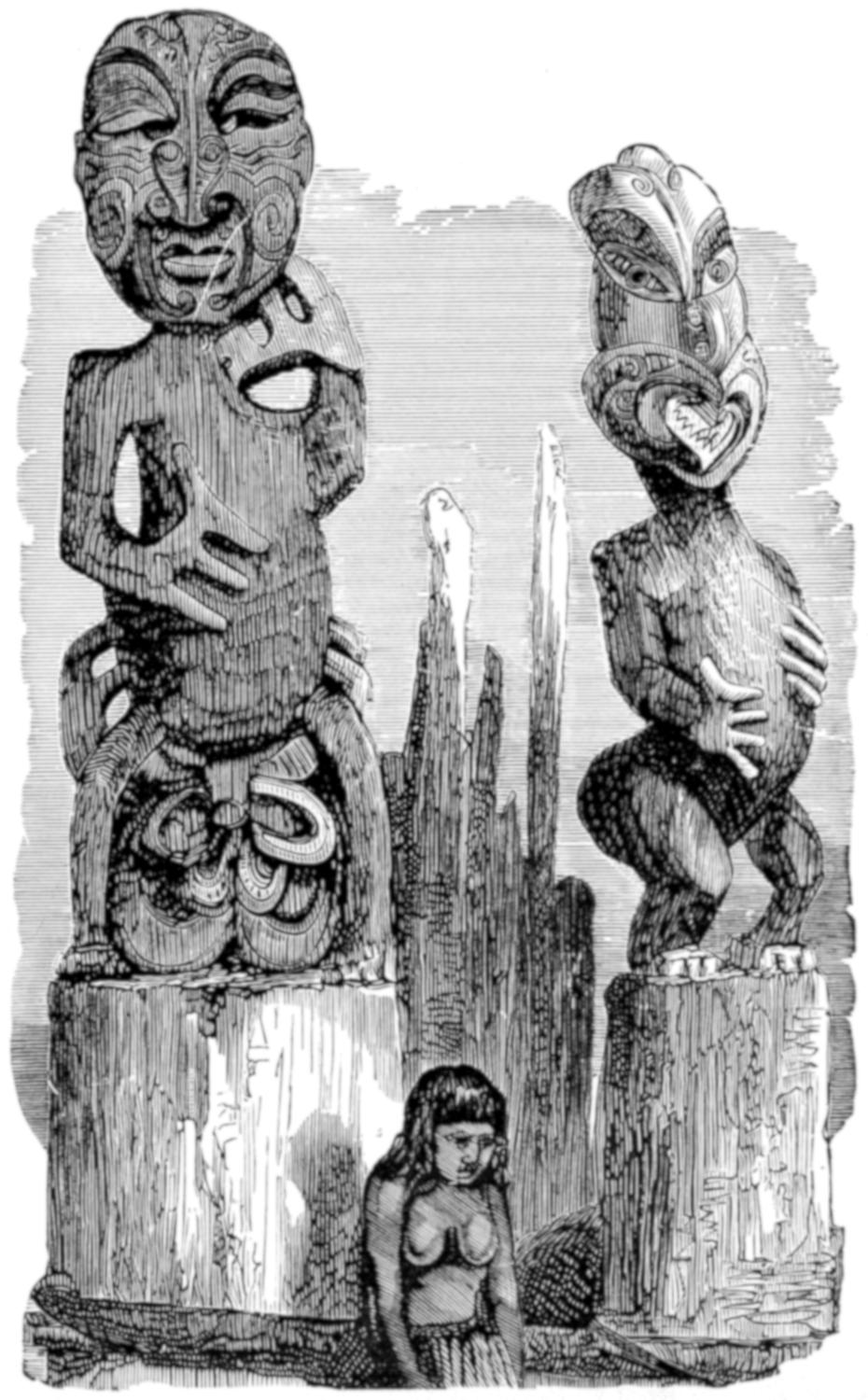
(3.) TIKI FROM WHAKAPOKOKO.
(See page 861.)
This gigantic tiki stands, together with
several others, near the tomb of the daughter
of Te Whero-Whero, and, like the monument
which it seems as it were to guard, is
one of the finest examples of native carving
to be found in New Zealand. The precise
object of the tiki is uncertain; but the protruding
tongue of the upper figure seems to
show that it is one of the numerous defiant
statues which abound in the islands. The
natives say that the lower figure represents
Maui, the Atua who, according to Maori
tradition, fished up the islands from the
bottom of the sea.
As may be seen in the illustration No. 2,
on the preceding page, nearly the whole of
both figures is carved with most elaborate
curved patterns, which descend over the
arms, and adorn those parts of the statue
which do duty for hips. A portion of the
paling of Raroera Pah is seen in the background,
and around the tiki grow many
plants of the phormium, or New Zealand
flax.
Near this wonderful and mysterious piece
of carving stand several others, all of the
ordinary type. Two such tikis are shown in
the illustration No. 3, opposite, drawn from
sketches taken at Whakapokoko. Although
not quite so large as the double tiki of
Raroera, they are of very great size, as may
be seen by contrasting them with the figure
of the woman who is standing by one of
them.
The firmest belief in witchcraft prevails in
New Zealand, though not to such an extent
as in many parts of Africa. In cases of illness
for which no ordinary cause can be discovered,
especially if the patient be of high
rank, “makuta,” or witchcraft, is always
suspected. If a chief, for example, fancies
that he has been bewitched, he thinks over
the names of those who are likely to have a
spite against him, and pitches upon some
unfortunate individual, who is thereby
doomed to death. One curious example
of such a murder is related by Mr. Angas.
He met a party of natives, who told
him that a woman, a relation of the chief
Ngawaka, had been shot by another chief,
who suspected that she had bewitched his
son. The young man had been taken ill,
and, though the woman in question did her
best to cure him, he died. His father took
it into his head that she had killed him by
her incantations, and, after loading his musket
with a stick, shot her through the body.
As, however, she was the relation of Ngawaka,
it was expected that the chief would
demand compensation for her death, and
that the murderer would have to pay a very
heavy sum. This sort of compensation is
called “taua.”
There are several modes of witchcraft;
but that which is most practised is performed
by digging a hole in the ground and
invoking the spirit of the person who is to
be bewitched. After the incantations are
said, the invoked spirit appears above the
hole like a flickering light, and is then solemnly
cursed by the witch. Sometimes,
instead of digging a hole, the witch goes
by night to the river bank, and there invokes
the spirit, who appears as a flame of
fire on the opposite bank.
Dr. Dieffenbach gives rather a curious
account of a district named Urewera, which
is supposed to be the special abode of witches.
It is situated in the northern island, between
Taupo and Hawkes’ Bay, and consists of
steep and barren hills. The inhabitants of
this district are few and scattered, and have
the reputation of being the greatest witches
in the country.
“They are much feared, and have little
connection with the neighboring tribes, who
avoid them, if possible. If they come to
the coast, the natives there scarcely venture
to refuse them anything, for fear of incurring
their displeasure. They are said to
use the saliva of the people whom they
intend to bewitch, and visitors carefully
conceal it, to give them no opportunity of
working them evil. Like our witches and
sorcerers of old, they appear to be a very
harmless people, and but little mixed up
with the quarrels of their neighbors.
“It is a curious fact that many of the old
settlers in the country have become complete
converts to the belief in these supernatural
powers. Witchcraft has been the
cause of many murders: a few days before
I arrived at Aotea, on the western coast,
three had been committed, in consequence
of people declaring on their deathbeds that
they had been bewitched....
“It is another curious fact, which has
been noticed in Tahiti, Hawaii, and the
islands inhabited by the great Polynesian
race, that their first intercourse with Europeans
produces civil wars and social degradation,
but that a change of ideas is quickly
introduced, and that the most ancient and
deeply-rooted prejudices soon become a subject
of ridicule to the natives, and are abolished
at once. The grey priest, or tohunga,
deeply versed in all the mysteries of witchcraft
and native medical treatment, gives
way in his attendance on the sick to every
European who pretends to a knowledge of
the science of surgery or medicine, and derides
the former credulity of his patient.
“If a chief or his wife fall sick, the most
influential tohunga, or a woman who has
the odor of sanctity, attends, and continues
day and night with the patient, sometimes
repeating incantations over him, and sometimes
sitting before the house and praying.
The following is an incantation which is
said by the priest as a cure for headache.
He pulls out two stalks of the Pteris esculenta,
from which the fibres of the root
must be removed, and, beating them together
over the head of the patient, says
this chant.”—The chant in question is as
unintelligible as those which have already
been mentioned. Its title is “A prayer for
the dead (i. e. the sick man) when his head
aches: to Atua this prayer is prayed, that
he, the sick man, may become well.”
When a chief is ill, his relations assemble
near the house and all weep bitterly, the
patient taking his part in the general sorrowing;
and when all the weeping and
mourning has been got out of one village,
the patient is often carried to another,
where the whole business is gone over
again. Should the sick person be of an
inferior class, he goes off to the bush, and
remains there until he is well again, choosing
the neighborhood of a hot spring if he
can find one, or, if no such spring is at hand,
infusing certain herbs in boiling water and
inhaling the steam.
As may be imagined from the practice
which they have in cutting up the dead for
their cannibal feasts, the Maories are good
practical anatomists, and know well the
position of all the principal organs and vessels
of the body. Consequently, they can
operate in cases of danger, using sharp-edged
shells if they have no knives. They
can also set broken limbs well, bringing the
broken surfaces together, binding the limb
with splints, laying it on a soft pillow, and
surrounding it with a wickerwork contrivance
in order to guard it against injury.
CHAPTER LXXXVI. NEW ZEALAND— Continued . THE TAPU.
THE TAPU, OR LAW OF PROHIBITION — TAPU A SUBSTITUTE FOR GOVERNMENT — PROTECTION TO
PROPERTY AND MORALS — ABUSE OF THE TAPU — THE CHIEF AND THE SAILOR — THE
CHIEF AND HIS MAT — A VALUABLE SPLINTER — THE HEAD OF THE CHIEF — AN UNLUCKY
MISTAKE — HOW TAONUI GOT HIS ARMOR — HAIR CUTTING — TROUBLES OF AN ARTIST — THE
CARVED HEAD — TE-WHERO-WHERO AND HIS PORTRAIT — THE TAPU MOUNTAIN — BANEFUL
EFFECTS OF THE TAPU ON NATIVE ART — DESTRUCTION OF THE PAHS AND HOUSES — THE
TERMINABLE TAPU — THE BATTLE-TAPU — TAKING OFF THE TAPU — DUTY OF THE TOHUNGA — THE
TAPU THE STRENGTH OF THE CHIEFS.
We now come naturally to the custom of
Tapu or Taboo, that extraordinary system
which extends throughout the whole of
Polynesia, modified slightly according to
the locality in which it exists.
The general bearings of the law of tapu
may be inferred from the sense of the word,
which signifies prohibition. The system of
tapu is therefore a law of prohibition, and,
when stripped of the extravagances into
which it often deteriorates, it is seen to be a
very excellent system, and one that answers
the purpose of a more elaborate code of
laws. In countries where an organized
government is employed the tapu is needless,
and we find that even in those parts of
the earth where it was once the only restrictive
law it has fallen into disuse since regular
government has been introduced.
Were it not for the law of tapu, an absolute
anarchy would prevail in most parts of
Polynesia, the tapu being the only guardian
of property and morality. In order that it
may be enforced on the people, the terrors
of superstition are called into play, and, in
the absence of secular law, the spiritual
powers are evoked.
Unprotected by the tapu, property could
not exist: protected by it, the most valued
and coveted articles are safer than they
would be in England or America despite
the elaborate legal system that secures to
every man that which is his own. In New
Zealand, when a man has cultivated a field
of kumeras, or sweet potatoes, he needs no
fence and no watchman. He simply sends
for the tohunga, who lays the tapu on the
field; and from that moment no one save
the owner will venture within its boundaries.
Sometimes a canoe is hauled up on the
beach, and must be left there for some time
unwatched. The owner need not trouble
himself about securing his vessel. He has
the tapu mark placed upon it, and the boat
is accordingly held sacred to all except its
possessor. Similarly, if a native boat-builder
fixes on a tree which he thinks can be made
into a canoe, he places the tapu on it, and
knows that no one but himself will dare to
cut it down. The mark of tapu in this case
is almost invariably the removal of a strip
of bark round the trunk of the tree.
Then the system of tapu is the only guardian
of morals. It has been already mentioned
that an extreme laxity in this respect
prevails among the unmarried girls. But
as soon as a girl is married she becomes tapu
to all but her husband, and any one who
induces her to become unfaithful must pay
the penalty of the tapu if the delinquents
be discovered. Nor is the tapu restricted to
married women. It is also extended to
young girls when they are betrothed; and
any girl on whom the tapu has thus been
laid is reckoned as a married woman.
It will be seen, therefore, that the principle
of the tapu is a good one, and that it
serves as protection both to property and
morals. There are, of course, many instances
where this system has run into extravagances,
and where, instead of a protection,
it has developed into a tyranny.
Take, for example, the very praiseworthy
idea that the life of a chief is most important
to his people, and that his person is
therefore considered as tapu. This is a
proper and wholesome idea, and is conducive
to the interests of law and justice.
But the development of the system becomes
a tyranny. The chief himself being tapu,
everything that he touched, even with the
skirt of his garment, became tapu, and
thenceforth belonged to him. So ingrained
is this idea that on one occasion, when a
great chief was wearing a large and handsome
mantle and found it too heavy for a
hot day, he threw it down a precipice. His
companion remonstrated with him, saying
that it would have been better to have hung
the mat on a bough, so that the next comer
might make use of it. The chief was horror-struck
at such an idea. It was hardly
possible that a superior to himself should
find the mat, and not likely that an equal
should do so, and if an inferior were to wear
it, he would at once die.
As the very contact of a chiefs garment
renders an object tapu, à fortiori does his
blood, and one drop of the blood of a chief
falling upon even such objects as are free
from the ordinary laws of tapu renders
them his property. A curious example of
the operation of this law occurred when a
meeting of chiefs was called at the Taupo
lake. As the principal man of the tribes, the
celebrated chief Te Heu-heu was invited,
and a new and beautifully carved canoe
sent to fetch him. As he stepped into it, a
splinter ran into his foot, inflicting a very
slight wound. Every man leaped out of
the canoe, which was at once drawn up on
the beach and considered as the property of
Te Heu-heu. Another canoe was procured,
and in it the party proceeded on their journey.
Another kind of tapu takes place with
regard to any object which is connected
with the death of a native. If, for example,
a Maori has fallen overboard from a canoe
and been drowned, the vessel can never be
used again, but is tapu. Or if a man commits
suicide by shooting himself, as has
already been mentioned, the musket is
tapu. But in these cases the articles are
tapu to the atuas, and not to men. Sometimes
they are left to decay on the spot, no
man daring to touch them, or they are
broken to pieces, and the fragments stuck
upright in the earth to mark the spot where
the event occurred.
Sometimes this personal tapu becomes
exceedingly inconvenient. The wife of an
old and venerable tohunga had been ill, and
was made tapu for a certain length of time,
during which everything that she touched
became tapu. Even the very ground on
which she sat was subject to this law, and
accordingly, whenever she rose from the
ground, the spot on which she had sat was
surrounded with a fence of small boughs
stuck archwise into the earth, in order to
prevent profane feet from polluting the
sacred spot.
The most sacred object that a New Zealander
can imagine is the head of the chief.
It is so sacred that even to mention it is
considered as an affront. Europeans have
often given deadly offence through ignorance
of this superstition, or even through
inadvertence. Mr. Angas narrates a curious
instance of such an adventure. A friend of
his was talking to a Maori chief over his
fence, and the conversation turned upon
the crops of the year. Quite inadvertently
he said to the chief, “Oh, I have in my garden
some apples as large as that little boy’s
head”—pointing at the same time to the
chief’s son, who was standing near his
father.
He saw in a moment the insult that he
had offered, and apologized, but the chief
was so deeply hurt that it was with the
greatest difficulty that a reconciliation was
brought about. The simile was a peculiarly
unfortunate one. To use the head of a
chiefs son as a comparison at all was bad
enough, but to compare it to an article of
food was about the most deadly insult that
could be offered to a Maori. All food and
the various processes of preparation are
looked down upon with utter contempt by
the free Maori, who leaves all culinary
operations to the slaves or “cookies.”
One of the very great chiefs of New Zealand
was remarkable for his snowy white
hair and beard, which gave him a most venerable
aspect. He was held in the highest
respect, and was so extremely sacred a man
that his head might only be mentioned in
comparison with the snow-clad top of the
sacred mountain.
The same traveller to whom we are indebted
for the previous anecdote relates a
curious story illustrative of this etiquette.
There was a certain old chief named
Taonui, who was in possession of the original
suit of armor which was given by
George IV. to E’ Hongi when he visited
England. “The subsequent history of this
armor is somewhat curious. It passed from
the Nga Puis to Tetori and from Tetori to
Te Whero-Whero at the Waikato feast, and
came into Taonui’s hands under the following
circumstances.
“On the death of a favorite daughter Te
Whero-Whero made a song, the substance
of which was, that he would take off the
scalps of all the chiefs except Ngawaka, and
fling them into his daughter’s grave to
avenge her untimely death. The words of
this song highly insulted the various individuals
against whom it was directed, more
especially as it was a great curse for the
hair of a chief, which is sacred, to be thus
treated with contempt. But the only chief
who dared to resent this insult from so great
a man as Te Whero-Whero was Taonui, who
demanded a ‘taua,’ or gift, as recompense for
the affront, and received the armor of E’
Hongi in compensation.
“I made a drawing of the armor, which
was old and rusty. It was of steel, inlaid
with brass, and, though never worn by the
possessors in battle—for it would sadly impede
their movements—it is regarded with
a sort of superstitious veneration by the natives,
who look upon it as something extraordinary.”
A chief’s head is so exceedingly sacred
that, if he should touch it with his own fingers,
he may not touch anything else without
having applied the hand to his nostrils
and smelt it so as to restore to the head the
virtue which was taken out of it by the touch.
The hair of a chief is necessarily sacred, as
growing upon his head. When it is cut, the
operation is generally confided to one of his
wives, who receives every particle of the
cut hair in a cloth, and buries it in the
ground. In consequence of touching the
chief’s head, she becomes tapu for a week,
during which time her hands are so sacred
that she is not allowed to use them. Above
all things, she may not feed herself, because
she would then be obliged to pollute her
hands by touching food, and such a deed
would be equivalent to putting food on the
chief’s head—a crime of such enormity that
the mind of a Maori could scarcely comprehend
its possibility.
When engaged in his explorations in New
Zealand, and employed in sketching every
object of interest which came in his way,
Mr. Angas found this notion about the
chief’s head to be a very troublesome one.
He was not allowed to portray anything connected
with food with the same pencil with
which he sketched the head of a chief, and
to put a drawing of a potato, a dish for food,
or any such object, into the same portfolio
which contained the portrait of a chief, was
thought to be a most fearful sacrilege.
The artist had a narrow escape of losing
the whole of his sketches, which a chief
named Ko Tarui wanted to burn, as mixing
sacred with profane things. They were
only rescued by the intervention of Te Heu-heu,
a superstitious old savage, but capable
of seeing that the white man had meant no
harm. Warned by this escape, Mr. Angas
always made his drawings of tapu objects by
stealth, and often had very great difficulty in
eluding the suspicious natives.
Even the carved image of a chief’s head is
considered as sacred as the object which it
represents. Dr. Dieffenbach relates a curious
instance of this superstition.
“In one of the houses of Te Puai, the
head chief of all the Waikato, I saw a bust,
made by himself, with all the serpentine
lines of the moko, or tattooing. I asked him
to give it to me, but it was only after much
pressing that he parted with it. I had to go
to his house to fetch it myself, as none of his
tribe could legally touch it, and he licked it
all over before he gave it to me; whether to
take the tapu off, or whether to make it
more strictly sacred, I do not know. He
particularly engaged me not to put it into
the provision bag, nor to let it see the natives
at Rotu-nua, whither I was going, or he
would certainly die in consequence.
“Payment for the bust he would not take;
but he had no objection to my making him
a present of my own free will: which I accordingly
did, presenting him and his wife
with a shirt each.”
Once the natives were very angry because
Mr. Angas went under a cooking shed,
having with him the portfolio containing
the head of Te Heu-heu. Even his hands
were tapu because they had painted the portrait
of so great a chief, and he was subjected
to many annoyances in consequence. Finding
that the tapu was likely to become exceedingly
inconvenient, he put a stop to
further encroachments by saying that, if the
people made any more complaints, he would
put Te Heu-heu’s head into the fire. This
threat shocked them greatly, but had the desired
effect.
Sometimes this sanctity of the chief is exceedingly
inconvenient to himself. On one
occasion, when Mr. Angas was visiting the
chief Te Whero-Whero, he found the great
man superintending the plantation of a
kumera ground and the erection of a house
for himself. Rain was falling fast, but the
old chief sat on the damp ground, wrapped
up in his blanket, and appearing to be entirely
unconcerned at the weather, a piece of
sail-cloth over the blanket being his only defence.
He did not rise, according to the custom
of the old heathen chiefs, who will sometimes
sit for several days together, in a sort
of semi-apathetic state. To the request that
his portrait might be taken Te Whero-Whero
graciously acceded, and talked freely
on the all important subject of land while
the painter was at work. Finding the rain
exceedingly unpleasant, the artist suggested
that they had better move into a house.
The old chief, however, knowing that he
could not enter a house without making it
his property by reason of contact with his
sacred person, declined to move, but ordered
a shelter to be erected for the white man.
This was done at once, by fastening a blanket
to some upright poles: and so the portrait
was completed, the painter under cover and
the sitter out in the rain.
Localities can be rendered tapu, even
those which have not been touched by the
person who lays the tapu upon them. The
chief Te Heu-heu, for example, was pleased
to declare the volcano Tongariro under the
tapu, by calling it his backbone, so that not
a native would dare approach it, nor even
look at it, if such an act could be avoided.
Mr. Angas was naturally desirous of visiting
this mountain, but found that such a
scheme could not be carried out. He offered
blankets and other articles which a
New Zealander prizes; but all to no purpose,
for the tapu could not be broken.
The chief even tried to prevent his white
visitors from travelling in the direction of the
mountain, and only gave his consent after ordering
that the sacred Tongariro should not
even be looked at. So deeply is this superstition
engraven in the heart of the New
Zealander, that even the Christian natives
are afraid of such a tapu, and will not dare
to approach a spot that has thus been made
sacred by a tohunga. Reasoning is useless
with them; they will agree to all the propositions,
admit the inference to be drawn
from them, and then decline to run so terrible
a risk.
One of the finest examples of native architecture
was made tapu by this same chief,
who seems to have had a singular pleasure
in exercising his powers. It was a pah
called Waitahanui, and was originally the
stronghold of Te Heu-heu. It is on the
borders of the lake, and the side which
fronts the water is a full half-mile in length.
It is made, as usual, of upright posts and
stakes, and most of the larger posts are
carved into the human form, with visages
hideously distorted, and tongues protruded
seaward, as if in defiance of expected enemies.
Within this curious pah were the cannibal
cook-houses which have already been figured,
together with several of the beautifully
carved patukas or receptacles for the sacred
food of the chief. Specimens of these may
be seen figured on page 831. In this pah
Mr. Angas found the most elaborate specimen
of the patuka that he ever saw. It
was fortunate that he arrived when he did,
as a very few years more would evidently
complete the destruction of the place.
Many of the most beautiful implements of
native art were already so decayed that they
were but a shapeless heap of ruins, and the
others, were rapidly following in the same
path. Of these specimens of Maori carving
and architecture nothing is now left but the
sketches from which have been made the
illustrations that appear in this work.
Here I may be allowed to controvert a
popular and plausible fallacy, which has
often been brought before the public. Travellers
are blamed for bringing to England
specimens of architecture and other arts from
distant countries. It is said, and truly too,
that such articles are out of place in England.
So they are: but it must be remembered
that if they had not been in England
they would not have been in existence.
The marvellous sarcophagus, for example,
brought to London by Belzoni, and now in
the Soane Museum, would have been broken
to pieces and hopelessly destroyed if it had
been allowed to remain in the spot where it
was found.
Again, had not the Assyrian sculptures
found a home in the British Museum, they
would have been knocked to pieces by the
ignorant tribes who now roam over the
ruins of Nineveh the Great. Even had
the vast statues defied entire destruction,
the inscriptions would long ago have been
defaced, and we should have irreparably
lost some of the most valuable additions
to our scanty knowledge of chronology.
So again with the Elgin Marbles. Undoubtedly
they were more in their place
in Greece than they are in England; but,
if they had not been brought to England,
the iconoclastic hand of the Mussulman
would have utterly destroyed them, and the
loss to art would have been indeed terrible.
Thus is it with regard to the specimens
of savage art, no matter in what way
it is developed. Taking New Zealand as
an example, there is not in England a
single specimen of a Maori house. It
could be easily taken to pieces and put together
again; it is peculiarly valuable to
ethnologists on account of the extraordinary
mixture which it displays of ancient Egyptian
architecture and ancient Mexican art;
and in a very few years there will not be a
single specimen of aboriginal architecture
in the whole of New Zealand. The Maories,
who have abandoned the club for the
rifle, the mat for the blanket, and even the
blanket for the coat and trousers, have begun
to modify their ancient architecture,
and to build houses after the European
models.
Unless, therefore, means be taken to rescue
specimens of Maori architecture from
destruction, it is much to be doubted
whether in twenty years’ time from the
present date a single specimen will exist
as a type of native art. So it is with the
canoes. Graceful, picturesque, and adorned
with the finest specimens of Maori art, the
canoes were unique among vessels. At the
present day the more useful but more commonplace
whaleboat has superseded the
canoe, and in a few years the elaborately
decorated vessels of the Maories will have
utterly passed away.
We may be sure that the tide of civilization
is sweeping so rapidly over the world,
that a very few years will see the end of
savage life in all lands to which the white
man can gain access. The relics of the
ancient mode of life are left by the natives
to perish, and, unless they are rescued, and
brought to a country where they can be
preserved, they will necessarily vanish from
the face of the earth. Having this idea in
my own mind, I set myself some years ago
to collect articles of daily use from all parts
of the world. The light which they throw
upon anthropology is really astonishing, and,
among some eight or nine hundred specimens,
there is not one that does not tell its
own story.
Take, for example, the stone merai that
lies before me. What a tale does it not tell
of the country where it was found, and of
the workman who made it! The stone
shows that it was obtained from a volcanic
country; the short, weighty form of the
weapon shows that it was made for a courageous
race who fought hand to hand; and
the graceful curves and perfect balance of
the weapon show that the maker was a true
artist. More than that. The merai has
been made by rubbing it with another
stone, and must have occupied years of
labor. See, then, what a tale this weapon
tells us—the volcanic region, the courageous
warrior, and the worthlessness of
time. Year after year the man must have
worked at that merai, bending his tattooed
face over it, balancing it in his hand, and
watching its soft curves grow into perfection.
Then, after it was made, he has evidently
carried it about with him, fought with his
foes, and dashed out their brains with its
once sharp and now notched edge. Afterward,
when he, or may be his grandson,
came to fight against the white men, their
fire-arms were too terrible to be opposed,
and the merai was taken from the hand of
the dead warrior as he lay on the field of
battle, its plaited cord still round his wrist.
Nevermore will a stone merai be made, and
before very long the best examples of Maori
weapons will be found in English museums.
We will now return to the subject of the
tapu. Useful as it may be as a guardian of
property, it often exaggerates that duty, and
produces very inconvenient results. For
example, some travellers were passing
through the country, and were hungry and
wearied, and without food. Very opportunely
there came in sight a fine pig; but
the animal contrived to run across a piece
of ground which was tapu, and in consequence
became tapu itself for a certain
number of days, and could not be eaten.
There are thousands of such tapu spots in
the country. If, for example, a great chief
has been travelling, every place where he sits
to rest is tapu, and is marked by a slight
fence of sticks. In many cases, each of
these sacred spots has its own name. The
same is the case when the body of a chief is
carried to his own pah for burial, every resting
place of the bearers becoming tapu.
Therefore nothing was more likely than to
come across one of these tapu spots, or more
easy than for the pig to break through its
slight fence.
A curious modification of the tapu took
place before and after a battle. The tohunga
assembled the warriors of his own party, and
went with them to the lake or river, which
had been made tapu for the purpose. The
men then threw off all their clothing, and
went into the water, which they scooped up
with their hands and threw over their heads
and bodies. The priest then recited the
appropriate incantation.
Thus the battle tapu was laid upon the
warriors, who were thereby prohibited from
undertaking any other business except that
of fighting, and were supposed, moreover, to
be under the protection of the gods. This
tapu was most strictly regarded, and the
warriors had to learn quite a long list of
occupations which were forbidden to them,
such as carrying a load, cutting their own
hair, touching the head of a woman, and so
forth.
After the fighting is over, it is necessary
that the tapu should be taken off from the
survivors, so that they should be enabled to
return to their usual mode of life. This
ceremony is rather a complicated one, and
varies slightly in different parts of the country.
The chief features, however, are as
follows:—
Each man who had killed an enemy, or
taken a slave, pulled off a lock of hair from
the victim, and retained it as a trophy.
They then went in a body to the tohunga,
and gave him a portion of the hair. This
he tied on a couple of little twigs, raised
them high above his head, and recited the
incantation; after which the whole body
joined in the war song and dance. This
being over, the warriors clapped their hands
together and struck their legs, that act being
supposed to take off the tapu which had been
contracted by imbruing them in the blood
of the enemy.
The war party then goes home, and a
similar ceremony is undergone in the presence
of the principal tohunga of their pah,
the hands being clapped and the war dance
performed. The remainder of the hair is
given to the tohunga, who, after reciting
his incantation, flings the tuft of hair away,
and ends by another incantation, which declares
that the tapu is taken away.
As a general rule, the tapu can only be
taken off by the person who imposed it;
but if a man imposed a tapu on anything,
another who was very much his superior
would not have much scruple in breaking
through it. By courtesy the tapu was
mostly respected by great and small alike,
and, by courtesy also, the very great men
often put themselves to great inconvenience
by refraining from actions that would lay
the tapu on the property of inferiors. Thus
we have seen how a chief refused to enter a
house, lest he should render it his property,
and preferred to sit in the pouring rain,
rather than run the risk of depriving an
inferior of his property.
Should an object become tapu by accident,
the tohunga can take off the tapu and
restore the object to use. A curious instance
of the exercise of this power is related by a
traveller. A white man, who had borrowed
an iron pot for cooking, wanted some soft
water, and so he placed the pot under the
eaves of a house from which the rain was
running. Now, the house happened to be
tapu, and in consequence the water running
from it made the pot tapu. It so happened
that a woman, who was ignorant of the circumstance,
used the pot for cooking, and
when she was told that the vessel was tapu
she was greatly frightened, declaring that she
would die before night. In this difficulty a
tohunga came to her relief, repeated an
incantation over the vessel, and made it
“noa,” or common, again.
Sometimes the tapu only lasts for a period,
and, after that time has elapsed, expires
without the need of any ceremony. Thus, if
a person who is tapu by sickness is touched
by another, the latter is tapu for a definite
time, usually three days. If a sick person dies
inside a house, that house is ipso facto, tapu
and may never again be used. It is painted
with red ochre, as a sign of its sanctity, and
is left to decay. In consequence of this
superstition, when the patient seems likely
to die, he is removed from the house, and
taken to a spot outside the pah, where a shed
is built for his reception.
It will be seen from the foregoing account
how great is the power of the tapu, and how
much it adds to the power of the chiefs.
Indeed, without the power of tapu, a chief
would be but a common man among his
people—he would be liable to the tapu of
others, and could not impose his own. The
tapu is one of the chief obstacles against the
spread of Christianity. Knowing that the
missionaries treat the tapu as a mere superstition,
the great chiefs do not choose to
embrace a religion which will cause them to
lose their highest privilege, and would deprive
them of the one great power by which
they exercise their authority.
Mr. Williams, the well-known missionary,
sums up the subject of the tapu in very bold
and graphic language:—“It is the secret of
power, and the strength of despotic rule.
It affects things both great and small. Here
it is seen tending a brood of chickens, and
there it directs the energies of a kingdom.
Its influence is variously diffused. Coasts,
islands, rivers, and seas; animals, fruit, fish,
and vegetables; houses, beds, pots, cups, and
dishes; canoes, with all that belong to them,
with their management; dress, ornaments,
and arms; things to eat and things to drink;
the members of the body; the manners and
customs; language, names, temper; and even
the gods also; all come under the influence
of the tapu.
“It is put into operation by religious,
political, or selfish motives; and idleness
lounges for months beneath its sanction.
Many are thus forbidden to raise their hands
or extend their arms in any useful employment
for a long time. In this district it is
tapu to build canoes; on that island it is tapu
to erect good houses. The custom is much
in favor among chiefs, who adjust it so that
it sits easily on themselves, while they use
it to gain influence over those who are
nearly their equals; by it they supply many
of their wants, and command at will all who
are beneath them. In imposing a tapu, a
chief need only be checked by a care that
he is countenanced by ancient precedents.”
CHAPTER LXXXVII. NEW ZEALAND— Concluded . FUNERAL CEREMONIES AND ARCHITECTURE.
THE MOURNING OVER THE DEAD CHIEF — THE TANGI, AND THE SCARS WHICH IT LEAVES — FIRST
BURIAL OF THE CHIEF — THE WAHI TAPU — THE SECOND BURIAL, OR “HAHUNGA” — REMOVAL
OF THE TAPU, AND INSTALLATION OF THE SUCCESSOR — E’ HONGI’S DEATHBED — A DECAYING
PAH — CANOE TOMBS — MONUMENT TO E’ TOKI — TOMB OF TE WHERO-WHERO’S DAUGHTER — SAVAGE
SENTIMENT — MAORI ARCHITECTURE — MATERIAL, SHAPE, AND SIZE OF THE HOUSES — A
CROWDED SLEEPING PLACE — THE EAT MAN HOUSE — RANGIHAEATA’S REVENGE — PUATIA’S WAR-HOUSE
AND ITS SCULPTURES — INTERIOR VIEW OF A PAH — TOOLS USED IN HOUSE-BUILDING — THE
AXE AND THE CHISEL — THE TOKO-TOKO, OR WALKING STICK.
We now come to the ceremonies that belong
to funerals.
When a chief, or indeed any Rangatira,
dies, his friends and relations deck the body
in the finest clothes which the deceased had
possessed in his lifetime, lay it out, and assemble
round it for the customary mourning.
The women are the chief mourners, and
indulge in the most demonstrative, not to
say ostentatious, ebullitions of grief. Sometimes
they squat upon the ground, their
bodies and faces wrapped in their mantles,
as if utterly overpowered by grief. Sometimes
they wave their arms in the air, shaking
their hands with expressive gestures of
sorrow; and all the while they utter loud
wailing cries, while the tears stream down
their cheeks.
Much of this extravagant sorrow is necessarily
feigned, according to the custom of
New Zealand life, which demands tears on
so many occasions; but there is no doubt
that much is real and truly felt. The women
cut themselves severely with shells, making
incisions in the skin several inches in length.
These incisions are filled with charcoal, as
if they had been part of the regular moko or
tattoo, and become indelible, being, in fact,
perpetual records of sorrow. Some of these
women cut themselves with such severity,
that in their old age they are covered with
the thin blue lines of the “tangi,” their
faces, limbs, and bodies being traversed by
them in rather a ludicrous manner. The
tangi lines might be mistaken for regular
tattooing, except for one point. They have
no pattern, and instead of being curved, as
is always the case with the moko, they are
straight, about two inches in length, and run
parallel to each other.
They address long speeches to the dead
man, enumerating his many virtues, his
courage, his liberality, the strength of his
tapu, and so forth, mixed with reproaches
to him for dying and going away from them
when they stood in such need of him. Indeed,
the whole of the proceedings, with the
exception of cutting the skin, are very like
those of an Irish wake.
In the illustration No. 1, on the 872nd
page, are shown these various ceremonies.
The dead body of the chief is lying under
the shed, wrapped in the best mantle, and
with a coronal of feathers in the hair. In
the front sits a chief, whose rank is denoted
by his hani, or staff of office, that lies
by him, and by the elaborate mantle in
which he has wrapped himself. Standing
near the corpse is one of the mourners, with
arms upraised and hands quivering, while
others are seen sitting in various attitudes
of woe. The fence of the pah is shown in
the background, with its grotesque images
and curious architecture.
When the old people attend a funeral,
they usually paint themselves freely with
red ochre, and wear wreaths of green leaves
upon their heads. The house in which the
death took place is rendered tapu until the
body is finally disposed of—an event which
does not take place for some time.
After the mourning ceremonies have been
completed, the body is placed in a sort of
coffin and allowed to decay, the green jade
merai, the tiki, the hani, and other emblems
of rank being placed with the corpse. In
some parts of the country this coffin is canoe-shaped,
and suspended to the branches of a
tree, certain places being kept sacred for this
purpose. There existed, for example, several
graves belonging to the Nga-pui tribe, which
had been preserved on account of the sacred
character which belonged to them. The
natives had long abandoned the custom of
hanging the coffins of the dead on the trees,
but the sacred character still clung to them,
and, though the woods in that part of the
country had been felled, the sacred groves
were allowed to flourish unharmed.
Sometimes the body of a very great chief
was placed in a wooden receptacle in the
midst of the pah, called the waki-tapu, and
there allowed to decay. As might be expected,
a most horrible odor is disseminated
through the pah during the process of decomposition;
but the inhabitants do not seem to
trouble themselves, their nostrils not being
easily offended. For example, when a whale
is thrown ashore, the stench of the huge
mass of decomposition is so overpowering
that an European cannot endure it. The
natives, however, say that they are used to it,
and do not notice it. Indeed, people who
can eat the horrible messes of putrid maize
of which they are so fond must be so obtuse
of scent as to be indifferent to any ill odor.
Be it as it may, in time the process of
decay is supposed to be complete,—seven
or eight months being the usual time. A
curious ceremony, called the “hahunga,”
then takes place. The friends and relatives
of the deceased chief are again assembled,
and the bones are solemnly taken from their
receptacle and cleaned. The person who
cleans them is necessarily tapu, but is rendered
“noa,” or common again, by the eldest
son and daughter of the deceased chief eating
of the sacred food offered to the dead. Should
the eldest girl happen to be dead, the food is
placed in a calabash, and laid in the now
empty coffin, the spirit of the girl being
called by name, and the food offered to her.
The spirit is supposed to partake of the
food; and the tapu is thus removed as
effectually as if she were alive, and had visibly
eaten the provisions. Should the chief have
had no daughter, the nearest female relative
takes the office. The usual orations are made
in honor of the deceased and the merai, tiki,
and other ornaments of the dead chief are
then handed over to his eldest son, who thus
takes possession of the post which his father
had vacated, the ceremony being analogous
to a coronation among Europeans.
When the celebrated chief E’ Hongi, the
“Scourge of New Zealand,” as he has been
called, died, his children were so afraid that
they would be attacked by those whom the
terror of his name had kept quiet, that they
wanted to omit the preliminary orations and
“tangi,” and to lay his body in the “waki-tapu,”
or sacred place, on the day after his
death. This intention was, however, overruled,
chiefly in consequence of the foresight
of the dying chief.
Feeling that his end was close at hand, he
rallied his sons round him, sent for all his
warlike stores, the merais, patus, muskets,
ammunition, and, above all, the armor which
he had received from George IV., and bequeathed
them to his children. He was
asked what “utu,” or satisfaction, should be
exacted for his death, but replied that the
only utu which his spirit would desire was,
that his tribe should be valiant, and repel
any attack that might be made upon them.
But for this really noble sentiment, there
would have been great slaughter at his death,
in order to furnish attendants for him.
That his tribe should for the future be
valiant, and repel the attacks of their enemies,
was the ruling idea in E’ Hongi’s
mind; and on March 6, 1828, he died, continually
repeating the words, “Kia toa! kia
toa!”—i. e. “Be valiant! be valiant!”
After the ceremony of cleaning the bones
is over, they are taken by the principal
tohunga, or priest, who generally disposes
of them in some secret spot sacred to the
remains of dead chiefs, and known only to
himself. Sometimes, however, they are laid
in beautifully carved boxes, which are supported
on posts in the middle of the pah.
Sometimes the waki-tapu, or sacred place
in which the body of a chief is placed while
it undergoes decomposition, is marked in a
very curious manner, and the entire village
deserted for a time. For example, at the
pah of Huriwenua, the chief had died about
six weeks before Mr. Angas arrived at the
place, which he found deserted. “Not far
from this island pah stood the village of
Huriwenua, the gaily-ornamented tomb of
the late chief forming a conspicuous object
in the centre. Here, although everything
was in a state of perfect preservation, not a
living soul was to be seen; the village, with
its neat houses made of raupo, and its courtyards
and provision boxes, was entirely
deserted. From the moment the chief was
laid beneath the upright canoe, on which
were inscribed his name and rank, the whole
village became strictly tapu, or sacred, and
not a native, on pain of death, was permitted
to trespass near the spot. The houses were
all fastened up, and on most of the doors
were inscriptions denoting that the property
of such an one remained there.
“An utter silence pervaded the place.
After ascertaining that no natives were in
the vicinity of the forbidden spot, I landed,
and trod the sacred ground; and my footsteps
were probably the first, since the desertion
of the village, that had echoed along its palisaded
passages.
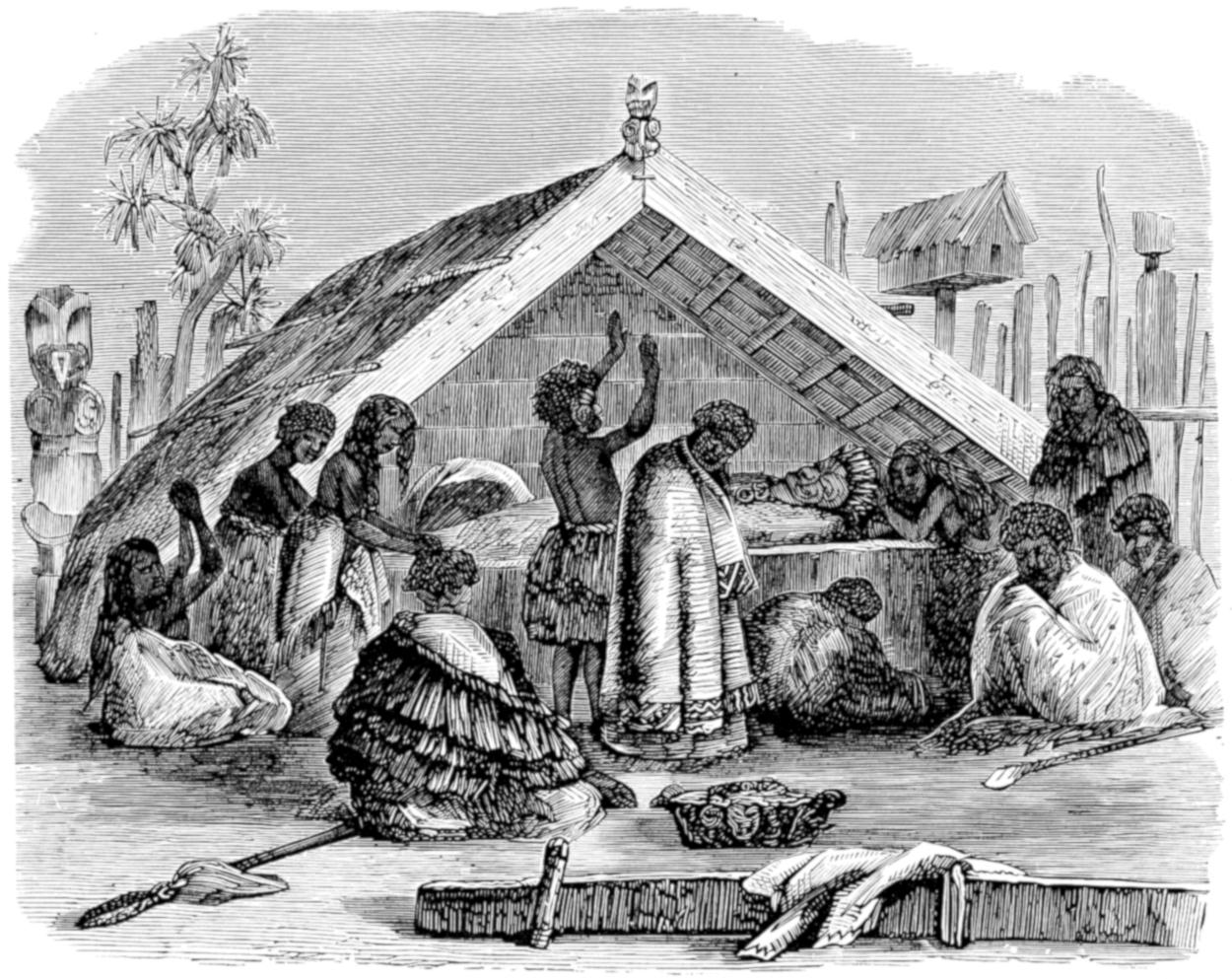
(1.) MOURNING OVER A DEAD CHIEF.
(See page 869.)
“On arriving at the tomb, I was struck
with the contrast between the monument of
the savage and that of the civilized European.
In the erection of the latter, marble and stone
and the most durable of metals are employed,
while rapidly decaying wood, red ochre, and
feathers form the decorations of the Maori
tomb. Huriwenua having been buried only
six weeks, the ornaments of the waki-tapu,
or sacred place, as those erections are called,
were fresh and uninjured. The central
upright canoe was richly painted with black
and red, and at the top was written the name
of the chief; above which there hung in clusters,
bunches of kaka feathers, forming a
large mass at the summit of the canoe. A
double fence of high palings, also painted red,
and ornamented with devices in arabesque
work, extended round the grave, and at every
fastening of flax, where the horizontal rails
were attached to the upright fencing, were
stuck two feathers of the albatross, the sunny
whiteness of which contrasted beautifully
with the sombre black and red of the remainder
of the monument.”
One of these tombs may be seen in the
background of illustration No. 1, on p. 860,
containing the portrait of an old priest, and
another is shown in the view of a village
which will be given on a future page.
Within the pah is often erected a monument
or mausoleum of the dead. A very
beautiful example of this kind of tomb
was erected in the pah of Rangihaeta to the
memory of E’ Toki, the mother of Raupahara.
It was nearly semi-circular in shape, and the
body was placed in it in an upright position.
It was covered with a roof, squared at the
corners, and projecting like a verandah all
round, and sloping toward the back. The
central tomb, the roof, and the posts which
supported it, were all covered with the most
elaborate arabesque pattern, mostly of a
spiral character. Paint was liberally used
on it, that on the central tomb or coffin
being red and white, while that which decorated
the roof and posts was red and black.
In front of the projecting roof was hung
the beautifully woven kaitaka mat of the deceased
woman, and tufts of the white feathers
of the albatross were arranged at regular
intervals upon it.
Even when Mr. Angas saw this beautiful
example of Maori art, it was beginning
to decay, the climate being damp, and the
natives never repairing a decaying tomb.
It was, of course, strictly tapu. No native
liked to go close to it, and for a slave, or
even a free man of inferior rank, to go
within a certain distance of it would have
been a crime punishable with instant
death.
I have much pleasure in presenting on
the preceding page an illustration of this
beautiful monument of Maori art, taken
from a drawing made by Mr. Angas in
1844, while the perishable materials of
which the tomb was made were yet in
tolerable preservation. Under the carved
and decorated roof may be seen the semicircular
coffin in which the body had been
placed, distinguished from the outer portion
of the tomb by the red and white colors with
which it was painted, in contrast to the red
and black of the outer portions. The reader
will notice that red is the prevalent color in
all tombs, because red is the hue of mourning
as well as of war among the Maories.
Immediately under the eaves of the front
may be seen the highly ornamented border
of the kaitaka mat once worn by the deceased,
and now left to decay upon her
tomb.
Round the tomb itself runs a slight and
low fence. This palisade, small as it might
appear, afforded ample protection to the
tomb, inasmuch as the whole space within it
was rendered sacred by a tapu laid upon it
by Raupahara, so that not even the highest
chief would venture to enter the forbidden
enclosure.
One of the finest specimens of carving in
New Zealand—perhaps the finest in the
whole country—is, or rather was, a mausoleum
erected by Te Whero-Whero to his
favorite daughter. It was upon the death
of this daughter that Te Whero-Whero gave
such dire offence to the other chiefs by threatening
to throw their scalps into his daughter’s
grave, for which offence he had to give
up the celebrated armor of E’Hongi by way
of fine.
The monument was erected in Raroera,
formerly one of the largest and finest pahs
in New Zealand, but rendered desolate
by the act of the headstrong and determined
chief. He had this wonderful tomb built for
his daughter, and, as soon as her body was
placed within it, he pronounced the whole
pah to be tapu. It was at once deserted:
old and young quitted the place, leaving
everything behind them, the provisions to
moulder and the weapons to decay. Solid
houses that had occupied many years in
building and carving were allowed to fall
into mere shapeless heaps of ruins; and even
in 1844 the rank vegetation had so completely
overrun the place that many of the
best pieces of native work were covered by
the foliage.
The tomb is about twelve feet high, and
consists of the usual box for the reception
of the body, covered by a projecting roof,
which is supported by pillars. Were it as
graceful in form as the monument to E’
Toki, this would be by far the finest specimen
of native art; but unfortunately it
does not possess the bold outline and contrast
of the curve and the straight line
which are so characteristic of E’ Toki’s
tomb.
The elaboration of the carving on this
monument is so great that it almost baffles
the skill of the draughtsman. Mr. Angas
succeeded in copying it, and when the
drawing was shown to the artist who had
executed the work he was astounded, and
pronounced the white man to be a great
tohunga. The roof is supported by pillars,
each pillar consisting of two human figures,
the upper standing on the head of the lower.
The upper figure is about seven feet in
height, and has a gigantic head, with an
enormous protruding tongue that reaches
to the breast.
The whole of the tomb is covered with human
heads. Exclusive of those upon the
posts, the front alone of the tomb contains
fourteen faces, each differing from the other
in expression and pattern of the moko, but
all wearing the same defiant air. Their
enormous eyes are made peculiarly conspicuous
by being carved out of haliotis shell,
carrying out on a large scale the plan
adopted in the chiefs’ hanis and other sculptures.
The whole of the space between the
figures is covered with the most elaborate
arabesques, intertwining with each other in
a bewildering manner, but each running its
own boldly curved course. Between the
various pieces that compose this tomb are
set bunches and tufts of white and green
feathers, which serve to adorn as well as disguise
the necessary seams of the woodwork.
This wonderful monument was entirely
carved by one man, named Paranui. He
was lame, and in consequence had expended
his energies in art, in which he had so
greatly distinguished himself that he took
rank as a tohunga. He was equally celebrated
as a tattooer; and it may well be
imagined that a man who could design so
extraordinary a piece of workmanship must
be skilful in inventing the endless variety of
patterns needful in the decoration of chief’s
faces. In performing this work, Paranui
had but one tool, the head of an old bayonet.
The loss of such specimens of native art
as those which have been described carries
out my former remarks on the necessity for
removing to our own country every memorial
of savage life that we can secure. We
inflict no real injury upon the savages, and
we secure an invaluable relic of vanishing
customs. These monuments, for example,
were simply carved and then left to decay.
Had they been removed to this country,
where they would have been guarded from
the power of the elements and the encroachments
of vegetation, we should have seen
them in complete preservation at the present
day, and likely to last as long as the
building which contained them.
Of course the sentimental argument may
be pleaded against this view of the case;
but in matters which are of vital importance
in the grand study of anthropology
mere sentiment ought to have no place.
Neither has it such place as some often
imagine. The savage, finding that the
white man yields to him on this point, is
only too glad to find any vantage ground,
and always presses on as fast as the other
yields—just as has been done in India with
the question of caste. We cannot measure
their mental sensibilities any more than
their physical by our own. A savage endures
with stoicism tortures which would
kill an European, simply because he does
not feel them as much. And the mental
and physical sensibilities are very much on
a par.
The Maori is perhaps the finest savage
race on the face of the earth, and yet we
cannot think that he is exactly an estimable
being, whose ambition is murder, and whose
reward is to eat the body of his victim, who
never does a stroke of work that he can
avoid, and who leads a life of dissipation as
far as his capabilities go. Of all savage
nations, the New Zealander displays most
sorrow for the loss of a friend or relation.
Tears flow profusely from his eyes, and
every tone of his voice and every gesture
of his body convey the impression that he
is borne down by unendurable woe. Yet
we have seen that this effusion of sorrow is
mostly premeditated, and merely a conventional
mode of acting required by the etiquette
of the country.
When two people can be bathed in tears,
speak only in sobbing accents, utter heart-rending
cries, and sink to the ground as
overwhelmed by grief, we cannot but compassionate
their sorrow and admire their
sensibility. But if, in the middle of all
these touching demonstrations of grief, we
see them suddenly cease from their sobs
and cries, enter into a little lively conversation,
enjoy a hearty laugh, and then betake
themselves afresh to their tears and sobs, we
may take the liberty of doubting their sincerity.
So with those beautiful houses and monuments
that are left to perish by neglect.
The builder did in all probability feel very
keenly at the time, though the feeling of
grief seems sometimes to take a curious
turn, and be metamorphosed into vengeance
and an excuse for war; but it is very much
to be doubted whether grief for the departed
is a feeling that is really permanent in the
savage mind. The Maori chief may lay his
tapu on an entire village when a relative
dies, and if, after the lapse of years, any one
be rash enough to invade the forbidden precincts,
he will visit the offence with instant
punishment. But it must be remembered
that the infringement of the tapu in question
is not an insult to the dead but to the
living, and that when the chief punishes the
offender, he does not avenge an affront
offered to his dead relative, but a direct
insult to himself.
In spite of his sentiment, I think that the
Maori might have been induced to sell such
specimens of art, and even if he refused to
yield to such a proposition, he would have
respected us none the less if, when we had
captured a pah, we exercised the right of
conquest, and took that which we could not
buy. Or even supposing that the first idea
had proved impracticable, and the second
unadvisable, it would not have been very
difficult to have induced a native artist to
execute a duplicate which he could sell for a
price which would enrich him for life.
Such sentiments are, I know, unpopular
with the mass of those who only see the
savage at a distance, which certainly, in the
case of savage life, lends the only enchantment
to the view that it can possess. But I
believe them to be just and true, and know
that the closer is our acquaintance with
savage life, the more reason we have to be
thankful for civilization. The savage knows
this himself, and bitterly feels his inferiority.
He hates and fears the white man,
but always ends by trying to imitate him.
To return to these monuments. In former
times they existed in great numbers,
and even in more recent days those which
survive are so characteristic of a style of art
that may have taken its rise from ancient
Mexico, that I should have been glad to
transfer to these pages several more of Mr.
Angas’ sketches.
It will be seen from several of the previous
illustrations that the New Zealanders
must possess much skill in architecture.
The observant reader must have remarked
that the art of house-building is practically
wanting in Australia; and that such should
be the case is most extraordinary, seeing
that architectural skill is singularly developed
among the great Polynesian families.
The New Zealander, whose country has
much in common with Australia, is remarkable
for the skill and taste which he displays
in architecture; and a short space will therefore
be devoted to this subject.
As is the case throughout Polynesia in
general, the material used in house-building
is wood, and the various pieces of which a
house is composed are fastened together not
by nails, but by ropes and strings, which
in many cases are applied in a most elaborate
and artistic manner, beauty being studied
not only in the forms of the houses and
in the carved patterns with which they are
adorned, but in the complicated lashings
with which they are bound together. As,
however, this branch of ornamental architecture
is carried to a greater extent in Fiji
than in New Zealand, I shall reserve the details
for the description of the Fiji Islands.
The size of some of these edifices is very
great. For example, in 1843 the Maori
converts built for themselves a place of worship
large enough to contain a thousand
persons, and measuring eighty-six feet in
length by forty-two in width. The size of
this edifice was evidently determined by the
length of the ridge-pole. This was cut
from a single tree, and was dragged by the
natives a distance of three miles. The
cross-lashings of the building were all ornamental,
giving to it a peculiar richness of
finish.
We are, however, chiefly concerned with
the domestic architecture of the Maories.
Within each pah or enclosed village are a
number of houses, each representing a
family, and separated from each other by
fences, several houses generally standing
near each other in one enclosure. A full-sized
house is about forty feet long by
twenty wide, and is built on precisely the
same principle as the tombs which have
been just described, the actual house taking
the position of the coffin, and being sheltered
from the weather by a gable roof,
which extends far beyond the walls, so as to
form a sort of verandah. The roof is supported
on separate posts, and does not, as
with ourselves, rest upon the walls of the
house. The roof always projects greatly at
the principal end of the house, in which the
door is situated, so that it forms a sort of
shed, under which the members of the
family can shelter themselves from the sun
or rain without going into the house. A
genuine New Zealander has a great love for
fresh air, and, as we have seen, will composedly
sit for a whole day on the wet
ground in a pouring rain, although a house
may be within easy reach. Yet at night,
when he retires to rest, he is equally fond of
shutting himself up, and of excluding every
breath of fresh air.
Indeed, the native does not look upon a
house as a place wherein to live, but merely
as a convenient shelter from the elements
by day and a comfortable sleeping-place by
night. As soon as evening is near, a fire is
lighted in the middle of the house, which
fills it with smoke, as there is no chimney.
The New Zealander, however, seems to be
smoke-proof, and sits composedly in a place
which would drive an European half mad
with smarting eyes. Indeed, before the
natives become inured to the acrid vapor,
their eyes have much to endure, and it is to
the habit of sitting in the smoke that the
bleared look so prevalent in old people is
chiefly due.
Not only do the natives thus surround
themselves with a smoky atmosphere, but
they limit its quantity as well as its quality.
The number of men and women that will
pack themselves into one house at night is
almost incredible, each person lying down
on a simple mat, and retaining the same
clothes that have been worn during the day.
As, however, the heat becomes excessive,
the inmates generally contrive to throw off
their clothing during the night. By daybreak
the heat and closeness are almost stifling
to an European, and it is rather an
amusing sight to see a hut give up its inmates
on the morning of a cold day, the
whole party being enveloped in steam as they
come into the cold air.
At the principal end of the house, under
the verandah, is the entrance. This
strangely resembles the gate of an Egyptian
temple, being made of three large beams,
the two side posts slightly inclining to each
other, and the third laid upon them. The
aperture is closed by a sliding door, and at
the side of the door is generally a square
window, which can be closed in the same
manner. In some large houses there were
two of these windows, one on either side of
the door.
As the roof is made with a considerable
slant, the walls are seldom more than two or
three feet high where the roof touches them,
though in the middle the house is lofty
enough. The roof is supported on the inside
by one or two posts, which are always
carved elaborately, and almost invariably
have the human figure as one of the ornaments
upon them. The ridge-pole is flattened
and boardlike, and in good houses is
carved and painted in patterns, usually of the
spiral character. This board, as well as
those which are used in different parts of the
building, is made by hacking the trunk of a
tree on both sides, until it is reduced to the
required thickness, the native Maories having
no tool which can answer the purpose of
a saw.
At the end of the ridge-pole, over the
door, is carved a distorted human figure, intended
to represent the owner of the house,
and recognized as such by the lines of the
moko or tattoo on its face, and generally
having the tongue thrust out to an inordinate
extent.
An illustration on page 877 represents
the most celebrated of all Maori houses,
namely, the war house of the ruthless chief
Rangihaeta, an edifice which fully expresses
the ferocious character of the builder.
These houses are designed by chiefs in honor
of some great victory, and are surrounded
with wooden figures, which either represent
in derision the leading warriors of the enemy
who have been killed, or the victorious
chief and his own warriors in the act of defying
and insulting the enemy by thrusting
out their tongues at them. This house bears
the ominous name of Kai-tangata, or Eat-man.
The illustration is taken from a sketch
made by Mr. Angas, who describes the building
as follows: “Kai-tangata, or Eat-man
House, is a wooden edifice in the primitive
Maori style, of large dimensions, with the
door-posts and the boards forming the portico
curiously and elaborately carved in grotesque
shapes, representing human figures,
frequently in the most indecent attitudes.
The eyes are inlaid with pawa shell, and
the tattooing of the faces is carefully cut.
The tongues of all these figures are monstrously
large, and protrude out of the
mouth, as a mark of defiance toward their
enemies who may approach the house.
The whole of the carved work, as well as
the wooden parts of the building, are colored
red with kokowai, an ochre found principally
on the side of the volcano of Taranaki.
“The portico or verandah of Rangihaeta’s
house is about twelve feet deep, and the
ridge-pole and frame boards of the roof are
richly painted in spiral arabesques of black
and red; the margin of each spiral being
dotted with white spots, which add richness
to the effect. The spaces between the
woodwork are filled up with variegated
reeds, beautifully arranged with great skill,
and fastened together with strips of flax
dyed red, and tied crosswise, so as to present
the appearance of ornamental basketwork.
“Above the centre of the gable-roofed
portico is fixed a large wooden head, elaborately
tattooed, with hair and a beard fastened
on, composed of dogs’ tails. Within
the house is a carved image of most hideous
aspect, that supports the ridge-pole of the
roof. This is intended to represent the
proprietor, and is said by the natives to be
entirely the work of Rangihaeta’s own
hand.”
This figure, together with the pole that
issues from the head, may be seen in illustration
No. 1, on page 809, which represents
the interior of the house. On account
of the circumstance recorded in the beginning
of this description, the artist has been
unable to draw a vast number of carvings
which decorated this house, so that much of
the extraordinary elaboration is necessarily
omitted.
Rangihaeta displayed his merciless disposition
in one of the unfortunate skirmishes
which often took place between the
Maories and the English, and which have
afterward been equally regretted by both
parties, the white men having generally offered
an unintentional insult to the natives,
and the latter having resented it in
the heat of passion. On this occasion, a number
of the white men had been captured by
the Maories under the two chiefs Rangihaeta
and Raupahara, who were related to
each other by marriage, the former having
married a daughter of the latter. Some time
previously, this woman had been accidentally
killed by a chance shot, which, as a matter of
course, her relations insisted on considering
as intentional.
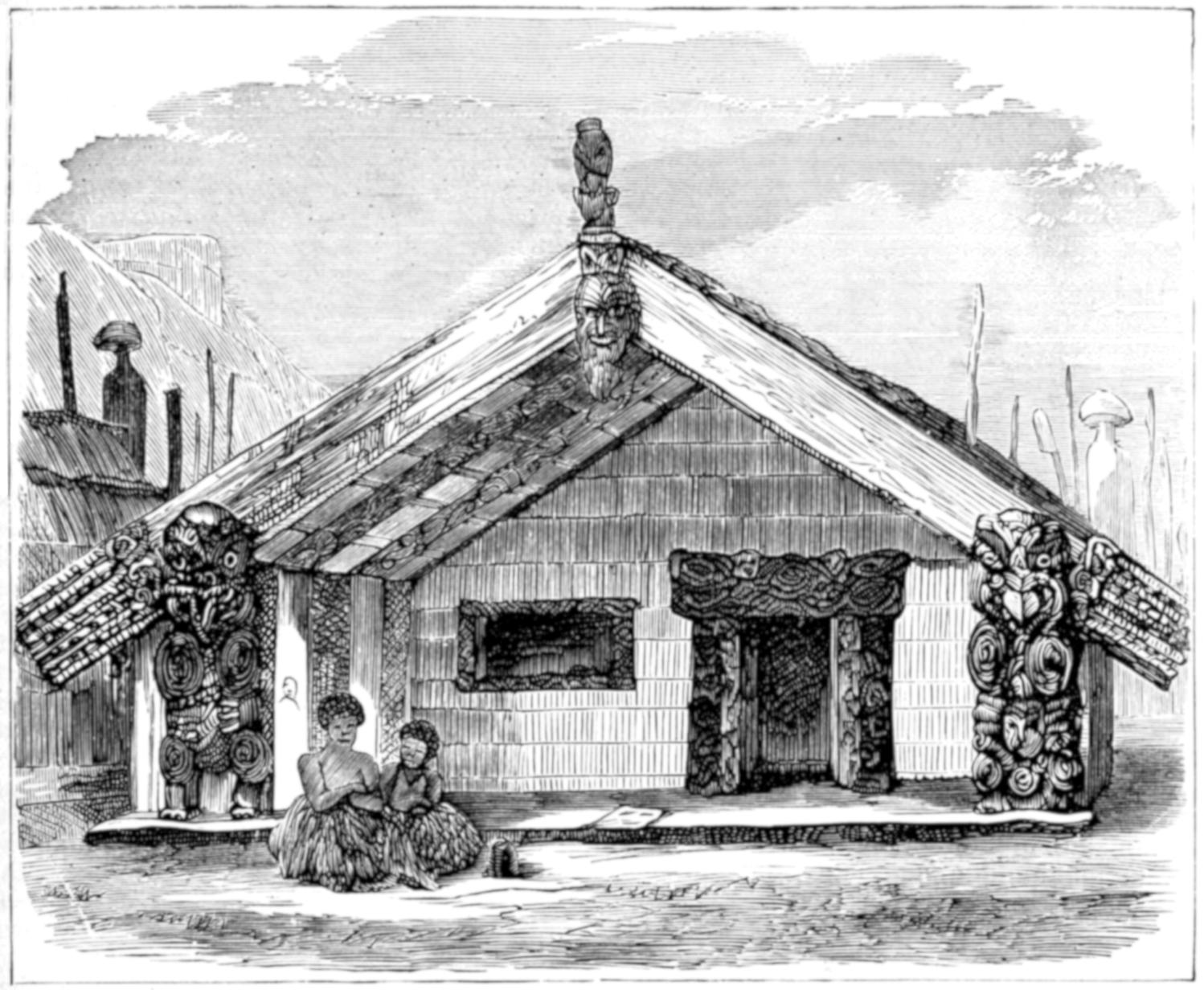
(1.) RANGIHAETA’S WAR HOUSE.
(See page 876.)
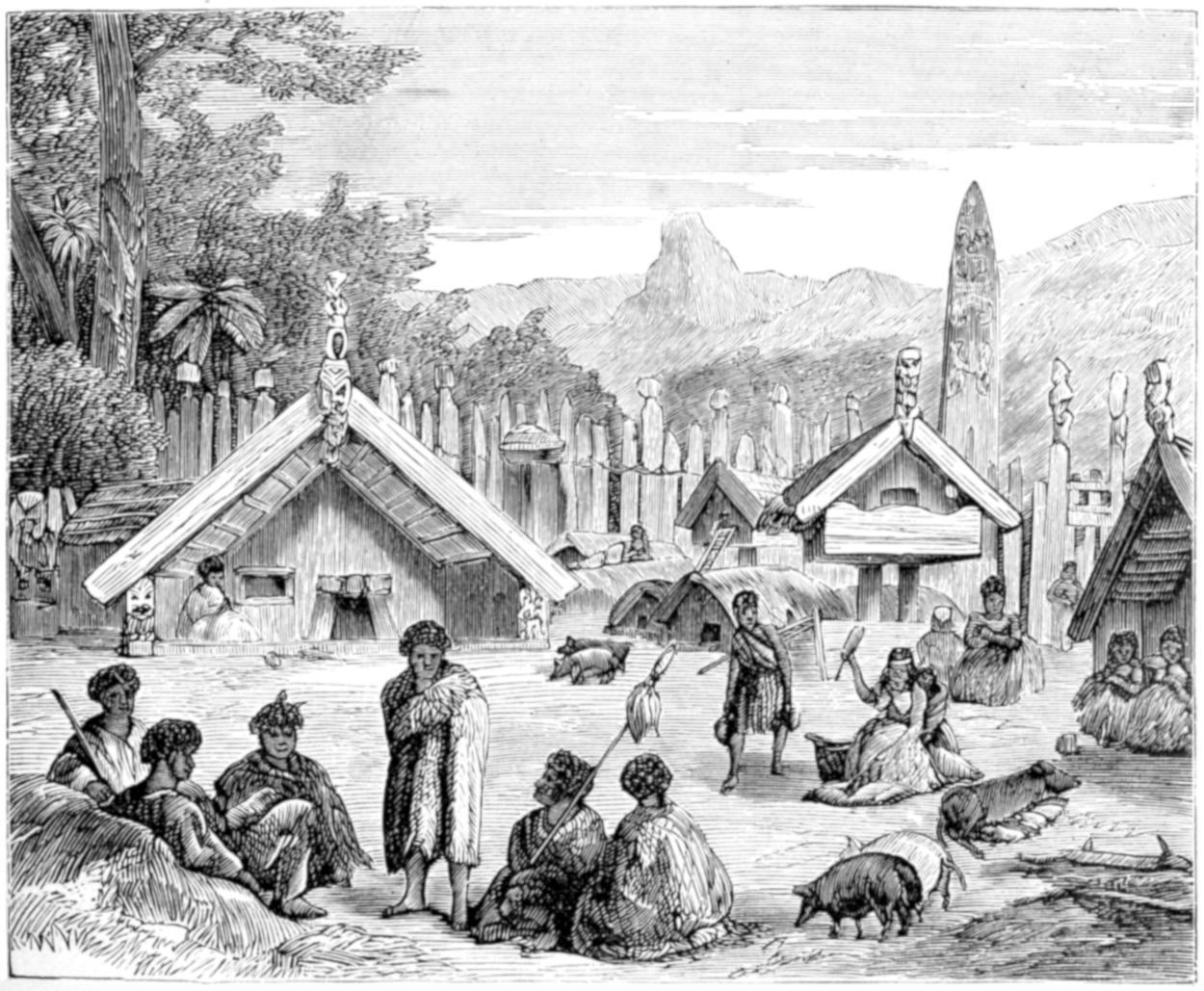
(2.) INTERIOR OF A PAH OR VILLAGE.
(See page 879.)
While the prisoners and their capturers
were standing together, another chief named
Puatia tried to make peace, saying that the
slain on both sides were about equal. His
proposition was accepted, the lately opposing
parties shook hands, and all would have
gone well had they not been joined by
Rangihaeta, who had been employing himself
in the congenial task of killing all the
wounded. He immediately demanded the
lives of the prisoners, and when Raupahara
refused to accede to his demand, Rangihaeta
told him to remember his daughter.
The bereaved chief was silent at this implied
reproach, and, before he had time
to collect his thoughts, Rangihaeta glided
round the party, getting behind each of
the captives as they stood among the Maories,
and killed them successively with his
merai. The ubiquitous land question was at
the bottom of this sad business.
Houses like the Kai-tangata were formerly
common, answering the purpose of
the ancient trophies. A war house nearly
as celebrated as that which has just been
described was erected by Puatia, the chief
of Otawhao Pah, in order to commemorate
the capture of Maketu on the east coast.
Since Puatia died, the whole of this splendid
pah was rendered tapu, and, in consequence,
the buildings within it were given up to
decay. Mr. Angas was fortunate enough to
secure a sketch of the war house before, like
the rest of the buildings in the pah, it had
entirely decayed.
The house itself is perhaps scarcely so
neatly made as the Kai-tangata, but it derives
great interest from the number of
figures with which the beams, rafters, and
posts are decorated. On either side of the
verandah stand two huge wooden figures,
which are intended to represent two chiefs
who fell in battle, but who, as belonging to
the victorious side, are represented with
their tongues defiantly menacing the beaten
enemy.
The figure that supports the central pole
represents a chief who was one of the principal
warriors at the capture of Maketu. At
the height of six and ten feet respectively,
on the same pole, are carvings which represent
two other warriors, their moko, or tattoo,
doing duty for the whole of the person.
Still higher are a couple of figures representing
warriors, the upper figure appearing
to stand on the roof itself. Just within
the upper part of the gable is the figure of
Pokana, a warrior who was living at the
time when the house was built, and who
is represented with a pipe in his mouth.
Around the house are numbers of similar
figures, each representing some well-known
individual, and having a signification which
is perfectly well understood by the natives.
It was in this ruined pah of Otawhao that
the disused wooden war-bell was found.
The former owner, Puatia, was converted
to Christianity before his death, and, while
he lay sick within his pah, he had a school
established for the purpose of disseminating
Christianity, and used to call his people
round him for the morning and evening
prayers.
It has been mentioned that, owing to the
contempt with which the Maories regard
everything that pertains to the preparation
of food, cooking is never carried on in the
dwelling-houses. If possible, it is conducted
in the open air; but when the weather is too
wet or too windy, a shed is employed. These
cooking sheds are built expressly for the
purpose, and no one with any claims to rank
ever enters within them. Were no shelter
but a cooking shed to be found within miles,
the Maori chief would not enter it, no matter
how severe the weather might be.
The cooking sheds are built very simply,
the sides or walls being purposely made with
considerable interstices, so that the wind
may pass freely between them. They are
roofed with beams, over which is placed a
thatch of the raupo rush. As, among other
articles of diet, the putrid maize is prepared
in these sheds, the European traveller is
often glad to find that the abominable mess
will be cooked at a distance from him.
Some of the larger pahs contain a great
number of houses, and several of them are
inhabited by at least two thousand people.
Civilization has at the present day exercised
great influence upon the pahs, and reduced
them, as a rule, to fortresses rather than
villages. In many districts the use of the
pah has been practically abandoned, those
natives who wish to be at peace devoting
themselves to the cultivation of the ground
and living in scattered houses, without caring
for the protection of the fence.
The illustration No. 2, on page 877, is
taken from a sketch by Mr. Angas, representing
the interior of a pah as seen by him
in 1844. One or two of the houses are seen
scattered about, adorned with the grotesque
figures of which the Maori is so fond, and
having several of the inmates sitting under
the shelter of the deep verandah. Rather
in the background are one or two of the ingenious
and beautifully carved storehouses,
in which food is protected from the rats, and
on one side is a great wooden tiki projecting
from the ground. Just behind the large
storehouse is seen the curious monument
that marks the waki-tapu, or sacred burial-place
of a chief, a half canoe being planted
in the ground and painted with elaborate
patterns in red, the color for mourning and
war among the New Zealanders.
Groups of the natives may be seen scattered
about, conspicuous among whom is
the council that is sitting in the foreground,
under the presidency of the seated chief,
whose hani, or staff of office, marks his
dignity. A slave woman is seen working at
her task of beating the flax leaves; and
wandering promiscuously about the pah, or
lying comfortably asleep, are the pigs, with
which every village swarms.
We now come to the tools with which
the Maori performs all this wonderful
amount of carpentering and carving.
Looking at the results, we might naturally
fancy that the dusky architect possessed a
goodly array of tools; but, in fact, his tools
are as few and simple as his weapons, and
may be practically considered as two, the
adze and the chisel. On the next page an
example of each is drawn, the artist having
taken care to select the best and most valuable
specimens; the blades being formed
from the precious green jade, and the handles
carved elaborately, so as to be worthy
of the valuable material from which the
blades are shaped.
As may be imagined, these tools cannot
have very sharp edges given to them, as
the brittleness of the stone would cause it
to chip into an edge like that of a bad saw,
and in consequence the worst iron axe is a
far better tool than the best specimen of
green stonework that a Maori ever made.
At No. 3 may be seen one of the common
“tokis,” or stone axes, that were formerly
so much used in building canoes. The
specimen from which it is drawn is in my
collection, and I have selected it for illustration
because it gives so excellent an idea of
the structure of the tool, and the mode of
fastening the blade to the handle. This is
achieved in a very ingenious manner, and
although it scarcely seems possible to secure
the requisite firmness by a mere lashing of
string, the Maori workman has contrived
to attach the blade as firmly as if it had
been socketed.
This mode of fastening the blade to the
handle prevails over the greater part of the
Polynesian group, and, although the elaboration
of the lashings varies considerably,
the principle is exactly the same throughout.
The same plan prevails even in Borneo,
and there is in my collection a boat-builder’s
adze, the iron blade of which is
lashed to the socket in precisely the same
manner, the only difference being that split
rattan is employed instead of string. The
reader will notice the peculiar shape of the
adze-edge, which is exactly that of the incisor
tooth of any rodent animal. Whether
the maker intentionally copied the tooth
is doubtful, but that he has done so is evident.
Tools such as these are necessarily imperfect;
yet with these the Maories patiently
executed the elaborate and really
artistic designs which they once lavished
on their dwellings, their canoes, their weapons,
and their tools. They could not even
make a walking stick but they must needs
cover it with carvings. There is in my collection,
and illustrated at fig. 4, a remarkably
fine example of such a walking stick, called
in the Maori tongue “toko-toko,” which was
presented to me by Stiverd Vores, Esq. As
the reader may see from the illustration
it is ornamented with six complete human
figures, and a human face on the knob of
the handle. The portions of the stick that
come between the figures are completely
covered with carving, and the only plain
surface is that which is intended to be
grasped by the hand.
The six figures are in three pairs, set
back to back, and those of each pair exactly
resemble one another. A distinct gradation
is observed in them, the uppermost
pair having their faces most elaborately
tattooed, the middle pair being less ornamented,
and the lowermost pair having a
comparatively simple tattoo. In the position
of the heads there is also a distinction,
which I believe to have some signification
known to the carver. The upper pair have
the left hand laid on the breast, and the
right hand pressed to the lips; the middle
pair have the left hand still on the breast,
and the right fingers touching the throat;
while the lower figures have both hands
clasped on the breast.
All the figures are separated, except at
the backs of the heads, the hips, and the
heels, where they touch each other; so that
the labor expended on this stick has been
very great.
We now take farewell of this interesting
race—a race which is fast waning away,
and will soon perish altogether. No New
Zealander will ever sit on the broken arches
of London Bridge, and contemplate the ruins
of St. Paul’s. The Maori is fast disappearing,
and in a comparatively few years it is
certain that not a Maori of pure blood will
be found in the islands; and before a century
has elapsed, even the characteristic
tattoo will be a remembrance of the
past, of which the only memorials will be
the dried heads that have been preserved
in European museums. It is pitiful that
such a race should be passing away; but
its decadence cannot be arrested, and in
a short time the Maories will be as completely
extinct as the people of the stone
age, leaving nothing but their manufactures
as memorials of their existence. Such memorials,
therefore, ought to be sedulously
preserved. Every piece of genuine native
carving that can be found in New Zealand
ought to be secured and brought to England,
where it can be preserved for future
ages, and, with the isolated specimens that
are scattered in private houses throughout
the country, ought to be gathered together
in some central museum, where they can
be accessible to all who interest themselves
in the grand science of anthropology.
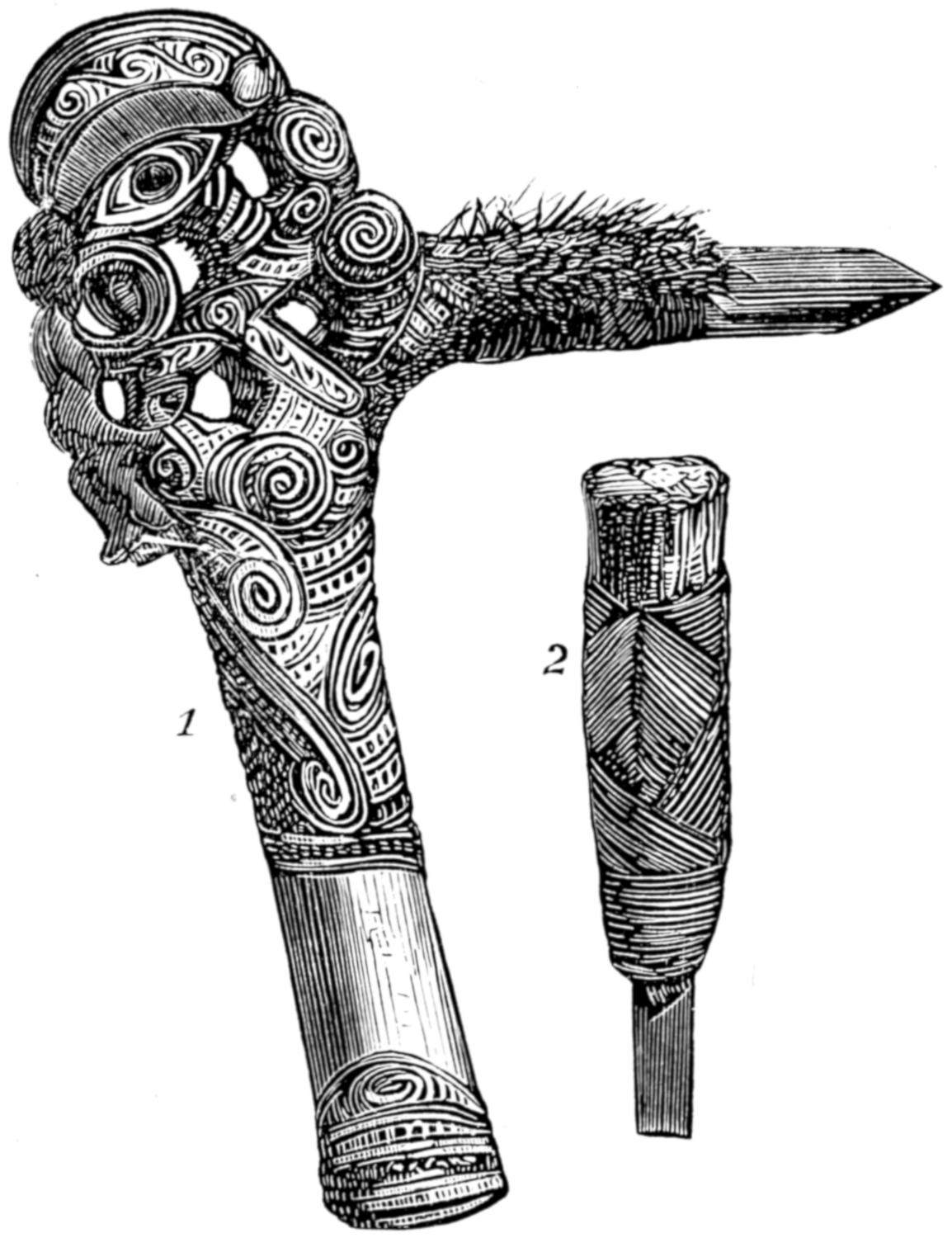
(2.) GREEN JADE ADZE AND CHISEL.
(See page 880.)
CHAPTER LXXXVIII. NEW CALEDONIA. — THE ISLE OF PINES.
POSITION AND DIMENSIONS OF NEW CALEDONIA — APPEARANCE AND DRESS OF THE NATIVES — THE
DANCING MASK — NATIVE ARCHITECTURE — SMOKE AND MOSQUITOES — WARFARE — CURIOUS
WEAPONS — THE SLING AND THE SPEAR — MODE OF THROWING THE SPEAR — THE OUNEP, OR
“AMENTUM” OF THE ANCIENTS — SHAPE OF THE CLUB — OBJECTS OF WAR — CANNIBALISM — THE
KNIFE AND FORK — DIET AND COOKERY IN GENERAL — THE NOUGUI SPIDER — MODE OF
DRINKING — CHARACTER OF THE NEW CALEDONIANS — AN INGENIOUS THEFT — THE KATA — THE
ISLE OF PINES, AND ITS INHABITANTS.
East of Australia is a tolerably large island
known by the name of New Caledonia. It is
of no very great extent, but is inhabited by
a people who deserve a short notice in these
pages.
The New Caledonians are nearly black in
color, and in general form and appearance
bear some resemblance to the aborigines of
Tasmania. They are, however, better looking,
and wear altogether a less savage aspect,
probably on account of the comparatively
regular supplies of food which they can
obtain. They are of ordinary stature, but
one man was seen who measured rather
more than six feet in height. His form,
however, was ill proportioned. They wear
scarcely any dress, the men having generally
a single leaf hanging from their girdles, or
at the most a strip of soft bark answering
the purpose of drawers, while the adult
women wear a narrow fringed girdle, which
passes several times round the waist.
Their hair is woolly and short, but at a
distance many of them would be taken for
long-haired people, in consequence of a habit
of making artificial tresses some two feet in
length, out of grass and the hair of a bat.
Some of these appendages are so long that
they fall to the middle of the back. Round
the head is sometimes tied a small net with
wide meshes, and the chiefs wear an odd
sort of a hat. These hats are cylindrical, and
decorated with a large circular ornament at
each side, a plume of feathers at the top, and
a long drooping tuft of grass and hair
that hangs down the back. The hat forms
no protection to the head, having no crown
to it, and is only used as a mark of rank.
The natives also make a sort of mask, very
ingeniously cut out of wood, having the
mouth open and the eyes closed. The wearer
looks, not through the eyes, but through
some apertures which are made in the upper
part of the mask. It is supposed that these
masks are employed in war, when the combatants
desire to disguise themselves from
their opponents. This, however, is only a conjecture.
I have little doubt that the wooden
mask described and figured by D’Entrecasteaux
is nothing more than an ornament used
in the native dances. It is, in fact, the
“momo,” which is described by more recent
travellers. When complete, the “momo” is
decorated with plumes of feathers, long tufts
of hair, and a thick, coarse network, which
does duty for a beard, and descends as far as
the knees of the wearer.
A mask made in a precisely similar manner
is used by the natives of Vancouver’s Island,
but is employed by them in their dances.
One of these masks is in my collection, and
will be described in the course of the work.
Ear ornaments of various kinds are in favor
among the New Caledonians, and some, of
the natives enlarge the hole in the lobe to
such an extent that it forms a long loop, the
end of which falls on the shoulders. Occasionally,
they try the elasticity of the ear
too much, and tear it completely through.
Anything seems to be worn in the ears, and
when a New Caledonian cannot find a suitable
ornament, he fills up the ear with a leaf
or a roll of bark. They do not tattoo themselves,
but draw black lines across the breast
with charcoal, the lines being broad, and
traced diagonally across the breast. Necklaces
of various kinds are worn, and these
ornaments bear a certain resemblance to
those of New Guinea, consisting principally
of a twisted string, to which is suspended a
shell or piece of bone, carved in a manner
which the natives are pleased to consider as
ornamental.
Although by nature the men possess thick
and stiff beards, these hirsute ornaments are
generally removed, the hair being pulled up
by the roots by means of a pair of shells used
in lieu of tweezers.
Architecture among the New Caledonians
is infinitely superior to that of Australia, and
in some respects almost equals that of New
Zealand. The houses are conical in shape,
and often reach from ten to eleven feet in
height in the middle.
The principle on which the huts are built
is perfectly simple. The native architect
begins by digging a hole in the ground, and
planting in it a stout pole, some fifteen feet
in length, and nine or ten inches in circumference.
A number of smaller poles or
rafters are set in the ground around the
standard or central pole, their bases being
planted in the earth and their tips leaning
against the standard. Smaller branches are
interwoven among the rafters, and the whole
is rendered weather-tight by dried herbage
lashed to the walls.
These simple walls are often several inches
in thickness; and as the natives spread thick
mats on the floor, they are well sheltered
from the weather.
The entrance is very small, never above
three feet in height, and on occasions can be
closed with a rude door made of palm
branches. Some of the latter kind of huts
have regular door-posts, on which are carved
rude imitations of the human face. A fire
is almost always kept burning inside the hut,
not so much for the sake of warmth or for
culinary purposes, as to form a defence
against mosquitoes. Smoke, therefore, is
encouraged; and, though it may be the lesser
of two evils, it forms a great drawback to the
comfort of Europeans, who can defy the
mosquitoes by their clothes, and can protect
themselves at night by means of curtains.
The central post of the house is mostly
decorated with shells, and carved at the top
into the shape of a human being.
Each house is usually surrounded with a
fence some four or five feet in height, and
within the hut there is a curious piece of
furniture which gives to the rude habitation
quite a civilized look. This is a wooden shelf,
suspended by cords exactly like our hanging
bookshelves. It is hung about four feet from
the ground, but as the cords are very slight,
it can support only a trifling weight. The
native name for this shelf is “paite.”
We will now proceed from domestic to
military life, and devote a small space to
warfare among the New Caledonians.
It is very remarkable that among these
naked and peculiarly savage cannibals we
should find two of the weapons of war which
were in greatest favor among the civilized
Romans of the classic times. These are the
sling and the javelin, the latter being cast by
a peculiar arrangement of a thong, so that, in
point of fact, the New Caledonian warrior
does not only sling the stone, but the spear
also.
We will take these weapons in order, the
sling coming first, as being the simpler of
the two weapons.
The construction of the sling or “wendat,”
as the natives call it, is very simple, the
weapon being merely a doubled thong with
a pouch in the middle, in which the stone is
placed. This pouch is made of two small
cords laid side by side, and as the smooth
stone might slip out of it, the slinger always
wets the missile in his mouth before placing
it in the pouch. The stones are cut out of a
hard kind of steatite, which can take a good
polish. They are oval in shape, and are
carefully ground down by friction, the surface
becoming very smooth in the process.
Thirty or forty of these stones are kept in
a small net, which is fastened to the left side
of the slinger. In illustration No. 1, on page
893, one of the warriors is seen with his
sling in his hand, and the net filled with
stones fastened to his side. When the
slinger wishes to hurl a stone, he does not
waste time and strength by whirling the
sling round and round, but merely gives it
one half turn in the air, and discharges the
missile with exceeding force and wonderful
accuracy of aim. In consequence of only
giving one half turn to the sling, the stones
can be hurled nearly as fast as they can be
thrown by the hand, and the weapon is therefore
an exceedingly formidable one in the
open field when fire-arms are not opposed to
it.
We now come to the spear, or rather
javelin.
This weapon is of very great length, some
specimens measuring fourteen or fifteen feet
from butt to point; and unless the warrior
were able to supplement the natural strength
of his arm by artificial means, he would not
be able to throw the spear more than a few
yards. He has therefore invented an instrument
by which he can hurl this long and unwieldly
weapon to a considerable distance.
The principle on which this instrument is
formed is identical with that of the Australian
throw-stick, but there is a difference in
the application. The Australian throw-stick
is straight, rigid, and is applied to the
butt of the spear, whereas the implement
used by the New Caledonian is flexible,
elastic, and applied to a spot a little behind
the middle of the spear.
This instrument is ingeniously simple. It
is nothing more than a plaited cord or thong
made of a mixture of cocoa-nut fibre and
fish-skin. It is a foot or more in length, and
is furnished at one end with a knob, while
the other is worked into a loop. This elastic
cord is called by the natives “ounep.”
When the warrior desires to throw a spear,
he slips the loop over the forefinger of his
right hand, and allows it to hang in readiness
for the spear. As soon as the time
comes for the spear to be thrown, the man
balances the weapon for a moment so as
to find the middle, and then casts the end
of the thong round it in a sailor’s half-hitch,
drawing it tight with his forefinger.
As long as pressure is thus kept upon
the thong, it retains its hold of the spear;
and as soon as it is released, “the half-hitch”
gives way and allows the spear to free itself.
The mode of throwing is therefore evident.
The warrior holds the loop of the thong on
his forefinger, the rest of the hand grasping
the spear. As he throws the weapon, he
loosens the hold of his hand, and so hurls
the spear by means of the thong.
The classical reader will doubtless remember
that this thong or “ounep” is precisely
the “amentum” of the ancients, but
is actually superior in its construction and
manipulation. The amentum was simply a
loop of cord or leather fastened to the shaft
of the javelin just behind the balance.
When the warrior wished to throw a spear,
he grasped the shaft in his hand, inserted his
fingers in the loop, and by means of the additional
leverage was able to throw a heavy
weapon to a considerable distance. See, for
example, Ovid’s Metamorphoses, xii. 321:
“Inserit amento digitos, nec plura locutus,
In juvenem torsit jaculum;”
in English, “He inserted his fingers into
the amentum, and, without saying more,
whirled the dart at the youth.” Commentators
have been extremely perplexed about
this passage. In the first place they were
rather uncertain as to the meaning of the
word “amentum,” and in the second place,
they could not see the force of the word
“torsit,” i. e. whirled. The reader will,
however, see how perfectly appropriate is
the term, the spear being flung with a whirling
movement as a stone from a sling. The
same word is used by Virgil: “Intendunt
acres arcus, amentaque torquent.” Another
writer also alludes to this instrument:
“Amentum digitis tende prioribus,
Et totis jaculum dinige viribus;”
i. e. “Stretch the amentum with your first
fingers, and aim the javelin with your full
strength.”
Ingenious as was the amentum of the
ancients, the ounep is far superior to it.
With the ancients a separate amentum had
to be fixed to each spear, while among the
New Caledonians only one ounep is required.
Besides these weapons, the club is much
used, and great ingenuity is shown in its
manufacture. The shape and size of the
clubs are extremely variable, and in some of
them the natives have exhibited a surprising
amount of artistic skill, the curves being
singularly bold and flowing. One of these
clubs, which is indeed a typical form, is in
my collection. The form of the head is
evidently taken from the beak of a bird, and
the curves are exceedingly bold and sweeping.
It is rather more than three feet in
length, and it weighs almost exactly two
pounds and a half.
War is in New Caledonia, as in New Zealand,
the chief occupation of the men. The
first lesson that a child receives is fighting,
and the idea is prevalent with him as long
as he lives. As soon as he is born, the boy
is consecrated to the god of war, and a hard
black stone is laid on his breast, as a symbol
that his heart must be as hard as a stone in
battle. Even the women take a share in the
fighting, and, though they are not actual
combatants, they follow their relatives to
the battle, in order to seize the bodies of
slain enemies, and drag them away to the
cooking oven. Strife is always fomented by
the priests from interested motives, inasmuch
as the hands of the slain are their
perquisites, and among the connoisseurs in
cannibalism the palms of the hands are the
most delicate portions of the human body.
Primarily the New Caledonians are cannibals
because they are warriors, the body
of a dead enemy being always supposed to
be eaten by the victors. There is mostly
a fight over the body of a fallen warrior,
the one party trying to drag it away to
the cooking oven, and the other endeavoring
to save it for burial by themselves.
As a rule, however, the body is carried off
by the women, who have the task of cooking
it. The preparation of the body is quite
a ceremonial, each part of it belonging by
right to certain individuals, and even the
carving being regulated by strict rules. A
peculiar kind of knife is made of flat serpentine
stone, oval in form, and about seven
inches in length. Two holes are bored on
one side of it, by means of which it is fastened
to a wooden handle. This knife is
called “nbouet.”
With the nbouet the body is opened, and
the whole of the intestines are torn out by
means of a fork made expressly for the purpose.
This fork is composed of two human
armbones placed side by side, about an inch
apart, and fastened tightly together. They
are sharply pointed, and are very effectual
instruments for the purpose. Sometimes
the bodies are cut up for cooking, but in
many cases they are baked entire, the
women priding themselves in serving them
up in a sitting posture, furnished and dressed
in full war costume.
Thus, then, we see that cannibalism is
connected with warfare; but unfortunately
it is not restricted to war. When Captain
D’Entrecasteaux went in search of La Pérouse,
one of the natives was eating a newly-roasted
piece of meat. The naturalist to
the expedition immediately recognized it as
being part of the body of a child. The man
who was eating it did not attempt to deny
the fact, but even pointed out on the body
of a little boy the part of the body which he
was eating, and gave his hearers to understand
that the flesh of children was very
good.
This cannibalism of New Caledonia explained
some curious gestures which the natives
were fond of making. They used to be
very familiar with their white visitors, feeling
their arms and legs, looking at each
other with admiration, and then whistling
and smacking their lips loudly. In point of
fact, they were admiring the well-fed limbs
of the white men, and anticipating to each
other the delights of a feast upon the plump
Europeans.
As, however, flesh is but a luxury among
the New Caledonians, and cannot be considered
as an ordinary article of diet, the
natives depend chiefly for their existence on
vegetable food. Roots of various kinds are
eaten by them, as well as cocoa-nut and
other fruit; all the cooking, as well as the
work in general, being performed by the
women. Shell-fish are also much eaten, and
are procured by the women. The large
clam-shell is found on the shores of the
island, and supplies abundance of food;
while the smaller molluscs are mostly dug
out of the sand by women, who frequently
spend half a day up to their waists in
water.
Two very strange articles of diet are in
use among the New Caledonians. The first
is a sort of spider, which spins large and
thick nets in the woods, often incommoding
travellers by the number and strength of
the silken cords. They are not eaten raw,
but cooked by being placed in a covered
earthen jar, which is set on a brisk fire.
The natives call the spider by the name of
“nougui.” It is gray above, the back being
covered with a fine silvery down, and below
it is black.
The second article of diet is clay, of which
the natives will consume a great amount.
The earth in question is a soft greenish
steatite, which crumbles very easily, and
has the property of distending the stomach,
and so allays the cravings of hunger, even
though it does not nourish the body. A well-distended
stomach is one of the great luxuries
of a savage, and, in accordance with
this idea, a man was seen to eat a piece of
steatite twice as large as his fist, even though
he had just taken a full meal. Some of the
natives have been known to eat as much as
two pounds of this substance. A similar
propensity is found both in Africa and
America.
When they drink at a pool or river, they
have an odd fashion of dipping the water
with their hands, and flinging it into their
mouths, so that much more water is splashed
over their heads than enters their mouths.
With regard to the bodies of those who
fall in war, and are rescued from the enemy,
many ceremonies are employed. According
to Captain Head, in his “Voyage of
the Fawn” they are “brought home with
loud lamentations, and buried with great
wailing and shrieking from the appointed
mourners, who remain unclean often for several
years after burying a great chief, and
are subject to many strict observances.
For weeks they continue nightly to waken
the forest echoes with their cries. After
ten days have elapsed, the grave is opened,
and the head twisted off; and, again in this
custom resembling the Andaman islanders,
the teeth are distributed as relics among
the relatives, and the skull preserved as a
memorial by the nearest kin, who daily
goes through the form of offering it food.
“The only exceptions are in the case of
the remains of old women, whose teeth are
sown in the yam patches as a charm to produce
good crops; their skulls set up upon
poles being deemed equally potent in this
respect.”
The general character of the New Caledonians
seems to be tolerably good, and, in
spite of their evident longing after the flesh
of their visitors, they are not on the whole
inhospitable. They are clever thieves, and
are ingenious in robbery by means of an
accomplice. On one occasion, when a native
was offering for sale a basket full of
sling-stones, and was chaffering about the
price, an accomplice came quietly behind the
white man and uttered a loud yell in his ears.
Naturally startled, he looked behind him,
and in a moment the man with whom he was
trading snatched away the basket and the
goods offered in exchange, and ran away
with them.
One of the officers was robbed of his cap
and sword in an equally ingenious manner.
He had seated himself on the ground, and
for better security had placed his sword
under him. Suddenly one of the natives
snatched off his cap, and as he instinctively
rose to rescue it, another man picked up his
sword and escaped with it. They even tried
to steal a ship’s boat, together with the
property in it, and would not leave it until
they were attacked by a strong body of armed
sailors.
They make very good canoes—as, indeed,
is generally the case with islanders. The
largest canoes are mostly double, two boats
being placed alongside of each other, and
connected by a platform. They have a single
mast, which is stepped toward one end
of the compound vessel, and can sail with
considerable swiftness, though they are not
so manageable as those of New Guinea,
some of which are marvels of boat-building.
They can accommodate a considerable
number of passengers, and have generally
a fire burning on the platform, which
is protected from the heat by a thick layer
of earth.
A rather remarkable custom prevails
among them, which derives its chief interest
from the fact that it is practised in
Northern Asia. This is the Kata, or scarf
of felicity. It is a little scarf, of white or
red material; and when two persons meet
they exchange their katas—a ceremony
which is analogous to shaking hands among
ourselves.
Whether these savages are the aborigines
of the island is doubtful. If they be so,
they seem to have declined from the comparative
civilization of their ancestors.
This, indeed, is their own opinion; and, in
support of this theory, they point to the
ruins which are still to be seen, and which
tell of architecture far beyond the power of
the present natives. There are even the
remains of an aqueduct eight miles in length,
a piece of engineering which would never
have entered the head of the New Caledonian
of the present day. Perhaps these works
of art may have been constructed by immigrants,
who have since left them to perish;
but, in any case, their presence in such a spot
is most remarkable.
Some thirty miles to the south-east of
New Caledonia, and in fact forming part of
the same group, there is a small island,
called by Captain Cook the Isle of Pines,
in consequence of the number of araucarias
with which its hills are covered. The strait
between the Isle of Pines and New Caledonia
proper is nearly all shoal water, caused
by the numerous coral reefs.
In many respects the inhabitants of this
island resemble those of New Caledonia.
They are not, however, so dark, and their
features are tolerably good. They are cannibals
from choice, wrapping up the bodies
of the dead in banana leaves, and then
cooking them in ovens. Some years ago,
they contrived to indulge their taste for
human flesh at the expense of their neighbors.
About 1840, it was found that sandal wood
grew on the island, and several vessels proceeded
thither for the sake of procuring
this valuable product. At first they did so
with great risk, and lost many of their men
from the onslaughts of the natives. Afterward,
however, a Sydney merchant set up
an establishment for the collecting and
storing of sandal wood and bêches-de-mer,
and since that time the natives have become
quite peaceable.
In course of this transitional time between
utter barbarism and commerce, they
learned by painful experience the power of
fire-arms. As soon as they became accustomed
to trade, the first thing that they did
was to procure a large stock of fire-arms
and to go off with them to New Caledonia,
where they landed, shot as many of the natives
as they could, and brought their bodies
home for consumption. It is true that
a constant feud raged between the two islands,
but the sudden acquisition of fire-arms
gave the people of the Isle of Pines
a terrible advantage over their hereditary
foes, and enabled them almost to depopulate
the south-eastern part of the island.
They care no more for dress than the
New Caledonians, but are very fond of ornament,
the men appropriating all the best
decorations, and leaving the women to take
what they can get. The men friz their hair
out as much as possible, and wrap a thin
scarf round it, or sometimes cut it short,
leaving only a tuft on one side of the head.
The women shave off the whole of the hair,
thus depriving themselves of their natural
ornament, and rendering themselves very
unprepossessing to European eyes. The
rough work is done by them, the men reserving
to themselves the noble occupations
of war, fishing, house building, and canoe
making, the only real work which they do
being yam planting, after the ground has
been prepared by the women.
CHAPTER LXXXIX. THE ANDAMAN AND NICOBAR ISLANDS. — THE NICOBAR ISLANDS.
POSITION OF THE ANDAMAN ISLANDS — ORIGIN OF THE NATIVES — THEIR ROVING HABITS AND LACK OF
CLOTHING — THEIR HATRED OF STRANGERS — THE NATIVES AND THE STEAMER — APPEARANCE
OF THE WOMEN — THE ENORMOUS BOW AND SKILL OF THE MINCOPIE ARCHERS — VARIOUS MODES
OF FISHING — EXCELLENCE OF THEIR CANOES, AND MODE OF MAKING THEM — THE LONG PADDLES — THE
SHIP’S CREW BEATEN BY THE MINCOPIE CANOE MEN — CANNIBALISM NOT PRACTISED
IN THE ANDAMAN ISLANDS — INGENIOUS FIREPLACES AND METHOD OF COOKING — WANT OF
ARCHITECTURAL SKILL — EDUCATION OF THE CHILDREN, AND THEIR GAMES — POWERS OF SWIMMING — MATRIMONIAL
ARRANGEMENTS — DEATH AND BURIAL — THE NICOBAR ISLANDS — APPEARANCE
AND COSTUME OF THE INHABITANTS — THE CROSS-BOW AND ITS ARROW — A PRIMITIVE
HAMMOCK — TOMBS IN THE NICOBAR ISLANDS.
We will now pass to the westward, and travel
gradually through the wonderful group of
islands which extends almost from Asia
to America, and which is known by the
general title of Polynesia. One or two of
them will have to be omitted for the present,
so as not to break the continuity of
races, but will be described before we pass
upward through America, from Tierra del
Fuego to the Esquimaux.
In the Bay of Bengal, and not much to
the eastward of India, is seen a group of
islands, named the Andamans. They are
of considerable length, but very narrow,
seldom exceeding twenty miles in breadth,
and are arranged very much after the fashion
of the New Zealand islands, though on a
smaller scale. These islands exhibit a phenomenon
almost unparalleled in the history
of the human race.
They lie close to India, a country in which
a high state of civilization has been reached
many centuries ago. They are almost in
the middle of the track which is traversed
by multitudes of ships, and yet their inhabitants
are sunk in the deepest depths of
savage degradation. Even the regular visits
made by the Chinese vessels to the Andaman
coasts, for the purpose of procuring
the trepang, have had not the least effect
upon them; and they afford perhaps the
most perfect example of savage life which
the surface of the earth can show.
The origin of the Andamaners is a problem
to anthropologists. They are small in
stature, the men being on an average but
little above five feet in height, and the
women being still smaller. They are very
dark, but have scarcely anything except
their color in common with the negro.
They have neither the huge projecting
jaws and cavernous mouth of the true
negro, nor his curiously elongated heel;
and though they are so small as almost to
merit the name of pigmies, they are perfectly
well formed. The hair, when it is
allowed to grow, is seen to be thick and
bushy, and resembles that of the Papuans;
and it is the opinion of many competent
judges that the Andamaners are the aborigines
of the Papuan race, who have never
permitted contact with strangers, and have
preserved their own individuality intact.
In habits they are absolutely savage, their
arts being limited to the manufacture of
canoes and weapons, architecture and agriculture
being equally unknown. They possess
one of the chief characteristics of savage
life in their roving disposition, never
remaining long in one spot, a stay of three
or four days being considered a long visit to
any place. They have no laws, no religion,
and no tribal distinctions. Marriage, as we
understand the word, is unknown to them;
and there seems to be few restrictions of
consanguinity, a mother and her daughter
being sometimes the wives of the same husband.
Clothing is entirely unknown to them; and
when captives have been taken, they have
always found clothes to be an incumbrance
to them, though they were pleased with
gaudy handkerchiefs tied round their heads.
The only covering which they care for is
one which they share in common with
many of the pachydermatous animals, and
employ for the same purpose. It is nothing
more than a layer of mud, with which the
natives plaster themselves in the morning
and evening, in order to defend themselves
from the attacks of the mosquitoes, sandflies,
and other insect plagues.
Until the last few years our knowledge of
the Andamaners has been almost nil, in
consequence of their hatred of strangers,
and the determined opposition which they
offer to any foreigners landing on their
shores. The very presence of a boat or a
ship seems to excite them to frenzy. In
Captain Mouatt’s valuable account of these
islands is an animated description of a scene
which occurred off the coast.
The steamer, on rounding a point, came
suddenly upon two groups of savages, who
were at first paralyzed by fear at the sudden
apparition of the unknown object, with its
columns of white steam roaring from the
escape-pipe, its smoke, and its plashing paddles.
In a few moments they recovered
from their surprise, and raised a simultaneous
shout of defiance. Two boats’ crews
were sent ashore, to the extreme anger of
the Mincopies.
“A peculiar natural phenomenon rendered
the scene still more striking and
impressive as the interval between the two
parties, the savage and the civilized, was
gradually diminished by the onward motion
of the boats. The spray as it rose in clouds
from the breakers dashing on the shore,
reflecting the rays of the declining sun,
magnified considerably the slight figures of
the natives, making massive and formidable
giants of men who were in reality little
more than sable dwarfs. As the cutters
neared that part of the shore where they
had stationed themselves, and they clearly
perceived that we were making preparations
to land, their excitement was such that they
appeared as if they had suddenly become
frantic.
“They seemed to lose that restraint and
control which it is the pride of the savage
to exhibit in time of danger, and jumped
and yelled like so many demons let loose
from the bottomless pit, or as if there had
been a Bedlam in that locality, and they the
most unmanageable of its frantic inmates.
Their manner was that of men determined
and formidable in the midst of all their
excitement. They brandished their bows
in our direction; they menaced us with
their arrows, said by common report—so
often a liar—to be poisoned; exhibiting
by every possible contortion of savage pantomime
their hostile determination. To
use a common vulgar expression of some of
the seamen, they seemed to have made up
their minds to ‘chaw us all up.’...
“The spear which he flourished incessantly
was terminated by a bright, flat,
pointed head, which gleamed with flashes of
light, as, circling rapidly in the air, it
reflected the rays of the sun. Sometimes
he would hold it aloft, poising it in his uplifted
hand, as if with the intention of hurling
it with unerring and deadly aim at the
first who dared to approach the shore of his
native island. At length, in a paroxysm of
well-acted fury, he dashed boldly into the
water, boiling and seething round him as it
broke in great billows on the beach, and on
the rocks by which it was defended, and,
fixing an arrow in his bow, he shot it off in
the direction of the steamer, as if that were
the arch enemy that had provoked his bellicose
fury.”
The second party of natives, who turned
out to be females, were as frightened as
their male friends were angry. After several
failures in launching a canoe, they
rushed in a body to the jungle and hid
themselves from the strangers. They exhibited
the usual characteristics of the people,
a basket for fish doing duty for clothes,
and a patch of red ochre on their heads taking
the place of hair. So repulsive were
they in their appearance, that the sailors
declined to leave mirrors on the shore as
presents for them, saying that such hideous
creatures ought not to be allowed to look at
their own features.
The weapons with which the Mincopie
men threatened the strangers are really
formidable, and before very long the exploring
party learned to hold them in great
respect. The bows are sometimes six feet
long and enormously powerful,—so powerful
in fact that the strongest sailors tried
in vain to bend the weapons which the
pigmy Mincopies handled with such skilful
ease.
The shape of the bow is very peculiar.
Instead of being nearly cylindrical, largest
in the middle and tapering regularly to
each end, it is nearly flat except at the
handle, on either side of which it becomes
very broad. In fact, a good idea of it may
be taken from a flattened hour-glass, the
channel in the middle being the handle.
The force and accuracy with which these
tiny men can shoot are really wonderful.
They very seldom fail to hit their mark at
any reasonable distance, and can make tolerably
sure of a man at sixty or seventy
yards, so that the Mincopie bow is really a
far better weapon than the old “Brown
Bess” musket ever was. One arrow that
was shot at a boat’s crew at a distance of
sixty yards struck a hickory oar, and
knocked off a piece of wood as large as a
man’s hand.
These arrows are very neatly made.
They are about three feet in length, and
are made of a reed by way of shaft, to the
end of which is fastened a piece of hard
wood in order to give weight. Upon this
tip is fixed the head, which is usually the
barbed tail bone of the sting-ray, and sometimes,
though not always, poisoned. Should
this terrible weapon enter the body, it cannot
be removed without a severe operation,
the sharp brittle barbs being apt to snap off
and remain in the wound if any force be
used in extracting the arrow.
Their consummate skill in the use of the
bow is obtained by constant practice from
earliest infancy. As is the assagai to the
Kaffir, the boomerang to the Australian, and
the lasso to the Gaucho, so is the bow to the
Andamaner. The first plaything that a
Mincopie boy sees is a miniature bow made
for him by his father, and, as he advances in
age, bows of progressive strength are placed
in his hands. Consequently, he is so familiarized
with the weapon that, by the time
he is of full age, the pigmy Andamaner
draws with graceful ease a bow which seems
made for a giant.
Numbers of the toy bows and arrows may
be seen scattered about an encampment if
the natives are forced to leave it in a hurry,
and their various sizes show the ages of the
children to whom they belonged. The education
of the Mincopie archer is in fact almost
precisely like that of the old English
bowmen, who, from constant practice in the
art, and being trained from childhood in the
use of the bow, obtained such a mastery
of the weapon as made them the terror of
Europe.
Being such skilful archers, they trust almost
entirely to the bow and arrow, caring
little for any other weapon. Even the
harpoon, with which they catch the larger
fish, is shot from the powerful bow. It is,
in fact, a very large arrow, with a moveable
head. This head fits loosely into a
hole at the end of the arrow, and is secured
to the shaft by a thong. It is a very remarkable
fact that the bow and harpoon arrow
of the Mincopies are almost exactly like
those which are used by the inhabitants of
Vancouver’s Island. They are twice as
large, but in shape almost identical, as will
be seen when we come to the North of
America.
When they use the harpoon, a long and
elastic cord is attached to it, one end of
which is retained by the archer. The cord
is made from a fibre which has the useful
property of hardening by being soaked in
water. For killing the fish when held with
the harpoon the Mincopies use smaller arrows,
without barbs or movable heads.
The Mincopies are very expert fishermen,
and use nets which are made from the
same fibre that has been mentioned. For
small fish they make the nets of rather thin
but very tough string, but for turtle and
large fish they make nets of cord as thick as
a man’s finger. One side of the net is held
to the bed of the sea by heavy stones laid
on it, and the other is upheld by floats.
The women search for molluscs, a business
which occupies a considerable part of
their time. They always carry neat baskets,
in which to put the results of their industry,
and each woman has generally a small net
fixed to a handle, like that which is used by
butterfly collectors.
In nothing do the Andamaners show
their superior skill more than in canoe
making. Their bows and arrows are, as we
have seen, good specimens of savage manufacture,
but in the making and management
of canoes they are simply unapproachable,
even though their tools are of the rudest possible
description.
Furnished merely with a simple adze
made of a stone fixed into a handle, the Mincopie
boat maker searches the forest for a
suitable tree, and after a week or ten days
succeeds in bringing it to the ground. The
rest of the process is so well described by
Captain Mouatt, that it must be given in
his own words.
“The next operation is to round the trunk,
a process which they perform with remarkable
dexterity, it being almost impossible to
conceive how, with the imperfect instruments
at their command, they execute their
work with so much skill and neatness.
Practice, however, must render them, as
well as others, perfect; and hence it is that
in a short time the rough and shapeless trunk
begins to assume form and proportions; and,
when the process is finished, exhibits a
finish and perfection that even a Chinese
carpenter, by far the most handy and ingenious
of human ‘chips,’ would regard with
a feeling of envy, as a work of dexterity
which it would be vain for him to attempt
to imitate.
“As soon as the trunk has been rounded,
they commence the operation of cutting and
chipping at it externally, until eventually
the outlines of the elegant canoe begin to
appear from the shapeless mass of the
knotted trunk, just as, by the skill of the
statuary, the beautiful figure gradually assumes
its fair proportions in the block of
marble. The shape externally is generally
finished with great care and elaboration before
they proceed to hollow it internally,
the next process to which they direct their
attention. The interior is excavated in the
same perfect and business-like manner, until
the shell is no thicker than the side of a deal
bonnet-box, although it still preserves that
strength which would enable it to resist successfully
the utmost force and violence of the
waves, should it even be assailed by a storm—a
thing not at all probable, as, unless carried
out to sea by some accident, it is rare
that the Andamaners venture far from the
shore.
“The buoyancy of these boats, when they
are well constructed and carefully finished,
is remarkable. They float lightly on the
top of the waves, and, unless they have received
some injury, it is considered almost
impossible to sink them. We sometimes
made the attempt, but never succeeded.
We fired at them repeatedly when at Port
Mouatt—which may be regarded as a sort
of Andaman Pembroke-yard, where a fleet
of Mincopie men-of-war were lying in every
stage of preparation—but they still floated
with as great ease and buoyancy as ever.
They would make excellent life-boats, such,
we believe, as have never yet been constructed
by any of our most experienced boat-builders.”
Near shore the boatmen paddle about with
perfect ease in these fragile vessels, though
an European can hardly proceed twenty
yards without being upset. When they go
further to sea they add a light outrigger to
one side of the canoe, and then venture forty
or fifty miles from land. They always, in
such cases, take fire with them, which has
the double advantage of attracting the fish
at night, and of cooking them when taken.
Sometimes a number of boats will remain
all night at sea, and the effect of their fires
and torches is very picturesque when seen
from the land.
The outrigger is certainly a new invention.
The earlier travellers, who were always
minute enough in their accounts, did
not mention the outrigger, and, as far as can
be seen, the idea has been borrowed from
some Cingalese canoe which had got into a
current and been drifted toward the island.
The paddles are rather peculiar in their
form, and, apparently, very ineffective, looking
something like long spoons with flattened
bowls, or, on a smaller scale, the “peels” with
which bakers take bread out of their ovens.
The women are the paddle makers, and the
implements vary from three to four feet
long. They are cut from a very hard wood,
and the work of making them is necessarily
laborious.
Imperfect as the canoe and paddles seem
to be, they are in fact absolute marvels of
efficiency. The tiny Mincopies, furnished
with these simple paddles, and seated in a
canoe cut by themselves out of a tree trunk,
can beat with ease our best oarsmen. Captain
Mouatt got up several races between the
Mincopies and his own prize crew in their
favorite boat. In point of fact there was
never any race at all, the Andamaners having
it all their own way, and winning as they
liked. The powerful, sweeping stroke of the
man-of-war’s crew was beautiful to see, but
the little Mincopies shot through, or rather
over, the water with such speed that the sailors
were hopelessly beaten, although they
strained themselves so much that they felt
the results of their exertions for some time
afterward.
Slight, and almost as active as monkeys,
the Mincopies ascend the tallest trees with
the like agility, applying the soles of their
feet and the palms of their hands to the
trunk, and literally running up them. When
they reach the branches, they traverse them
with as much ease and security as if they
were on firm land. Indeed, their powers of
tree climbing seem to be equal to those of
the inhabitants of Dourga Strait, of whom
an account will presently be given.
We now come to a question which has
often been agitated, namely, the asserted
cannibalism of the Andamaners.
It is a question that every observant
reader would be sure to ask himself, as the
Andamaners are just such a savage race as
might be expected to feed habitually on
human bodies. Yet, though we find the
comparatively civilized New Zealander sharing
with the savage New Caledonian the
habit of eating human flesh, the Mincopie,
who is infinitely below the New Zealander,
and certainly not above the New Caledonian,
is free from that revolting practice. He
undoubtedly has been known to eat human
flesh, but only when urged by extreme hunger
to eat the flesh of man or to die; and in
so doing he has but set an example which
has been followed by members of the most
civilized countries.
That they are fierce and cruel toward foreigners
is true enough, and it is also true
that the bodies of those whom they have
killed have been found frightfully mutilated,
the flesh being almost pounded from the
bones by the blows which have been showered
upon the senseless clay in the blind
fury of the savage. But no attempt has
been made to remove any part of the body,
and it was evident that the victors had not
even entertained the idea of eating it.
The food of the Andamaners is tolerably
varied, and is prepared in a very simple and
ingenious oven. A large tree is selected for
this purpose, and fire is applied to it at the
bottom, so that by degrees a large hole is
burned in it, the charred wood being scraped
away so as to form eventually a large hole.
This is the Mincopie oven, and at the bottom
a heap of ashes, about three feet in
depth, is always left. The fire smoulders
away gradually among the ashes, and never
entirely goes out; so that whenever a native
wishes to cook his pig, turtle, or fish, he has
only to blow up the smouldering embers,
and in a few moments he has fire sufficient
for his purposes.
These oven-trees are very carefully preserved,
the natives never cutting them down,
and always managing to prevent them from
being entirely burned through. In illustration
No. 2, on the 893d page, one of these
trees is shown, with the fire burning in the
hollow, and the natives sitting round it.
The Mincopies always contrive to have the
opening of the oven in such a direction that
the rain cannot get into it and put out the
fire.
Pigs have been mentioned as forming
part of the Andamaners’ food. These pigs
are small and black, with spare, hard bristles,
that look like pieces of wire. They are wonderfully
active, and, according to Captain
Mouatt, “are the most curious and mischievous
little animals in creation. They have
a leer that makes them look like so many
Mephistopheles, who have chosen to assume
that peculiar form, in many respects a very
appropriate one, for, if they are not so many
little devils, they are certainly possessed by
them.
“At the time of our visit to the Cinque
Islands, we turned out a dozen of them, and,
our unwonted appearance filling them with
alarm, they ran off from us with the velocity
of an Indian express train, squeaking like
mad. We set off and had a regular hunt
after them—a hunt that beats to chalks the
most exciting scene of pig-sticking ever
seen in Bengal. After discharging their
rifles, some of the hunters would probably
find the pigs between their legs, making
them measure their length on the sand.
The falls were made with considerable violence,
though they were not dangerous, for
they only excited our risible faculties; and
as each one came down he was greeted with
a loud and hearty burst of laughter, as a
sort of congratulation to him in his misfortune.”
The architecture of the Andamaners is
very primitive. Four posts are stuck in the
ground in the form of a square, and the
builder is quite indifferent as to their
straightness. Two of them are much longer
than the others, so that when they are connected
by sticks, a sloping roof is formed.
Palm leaves are then placed upon them, one
lying over the other in tile fashion, so that
they form a protection from perpendicularly
falling rain. A number of these huts are
generally erected in a circle, in some cleared
space in the forest, which is sheltered by
large trees, and within a convenient distance
of water. One or two of these simple
houses may be seen in the illustration.
Primitive as are these huts, some attempt
is made at ornamenting them, the decorations
being characteristically the trophies of
the chase. Skulls of pigs and turtles, bundles
of fish-bones, and similar articles are
painted with stripes of red ochre, and hung
to the roofs off the huts. Ochre painting,
indeed, seems to be the only idea that the
Andamaners have of ornament, if perhaps
we except a string which the dandies tie
round the waist, having a piece of bone or
other glittering article hanging from it.
This ochre is in great request among the
Mincopies, the women being especially fond
of it by way of a decoration of their heads.
As has already been mentioned, they shave
the head completely, using, instead of a razor,
a piece of flint chipped very thin, and having
a sharp edge. They are wonderfully adroit
at making these primitive knives, which are
exactly like those of the stone age. The
hair having been scraped off, a tolerably
thick plastering of red ochre is rubbed on
the head, and the toilet of a Mincopie belle
is complete.
Not only is the ochre used for external
application, but it is administered internally.
What is good for the outside, the Mincopie
logically thinks will be equally good for the
inside. So, when he feels ill, he makes a
sort of bolus of red ochre and turtle oil,
swallows it, and thinks that he has cured
himself. Wounds are dressed by binding
certain leaves upon them, and in many cases
of internal pains, bruises, or swellings, scarification
is freely used. Certain individuals
enjoy a sort of reputation for success in the
treatment of disease, and are much honored
by the less skilful.
It has already been mentioned that marriage
is nothing more than taking a female
slave.
When a wife becomes a mother, the only
treatment which she receives is, that after
the birth of her child she is plentifully
rubbed with the red ochre and turtle oil, and
is expected to follow her usual occupations
on the next day. The young child is soused
with cold water, poured out of one of the
great bamboo vessels which the Mincopies
use, and is dried by rubbing with the hand.
Like its parent, the child wears no clothing;
but if the party should be on their travels,
and rain begin to fall, the mother pulls a few
leaves from the next tree, ties them together
with a fibre of rattan, and fastens them on
the body of the child. This is the only
clothing which an Andamaner ever wears.
Children are never weaned, but continue
to take their childish nourishment until the
mother is absolutely incapable of affording
it. Both parents redeem much of their
savage nature by their affection for their
children, the father being quite as loving
a parent as the mother—a trait which
is often absent among savage tribes. The
children reciprocate the affection, so that,
in spite of the absence of any definite
home, there is a domestic character about
the family which could scarcely have been
expected from such a race.
It has been already mentioned that the
boys amuse themselves chiefly with small
bows and arrows, having these toys of a
continually increasing size to suit their
growth. The girls are fond of disporting
themselves by the sea-shore, and building
sand houses for the waves to knock down,
precisely as is done by the civilized children
of Europe and America. Their great amusement
is to build an enclosure with walls of
sand, and to sit in it as if it were a house
of their own until the rising tide washes
away the frail walls. Both sexes are fond
of swimming, and as soon as they can walk
the little black children are seen running
into and out of the water, and, if they can
pick some sheltered spot free from waves,
they dive and swim like so many ducks.
A Hindoo, named Pooteeah, who was taken
prisoner by the Mincopies, and his life
spared for some reason or other, states that
they are such excellent swimmers that several
of them will dive together among the
rocks, search for fish in the crevices,
and bring their struggling captives to shore.
This statement was discredited by those to
whom it was made, as were several other
of his accounts. As, however, subsequent
observations showed that he was right in
many of the statements which were at first
disbelieved, it is possible that he was right
in this case also.
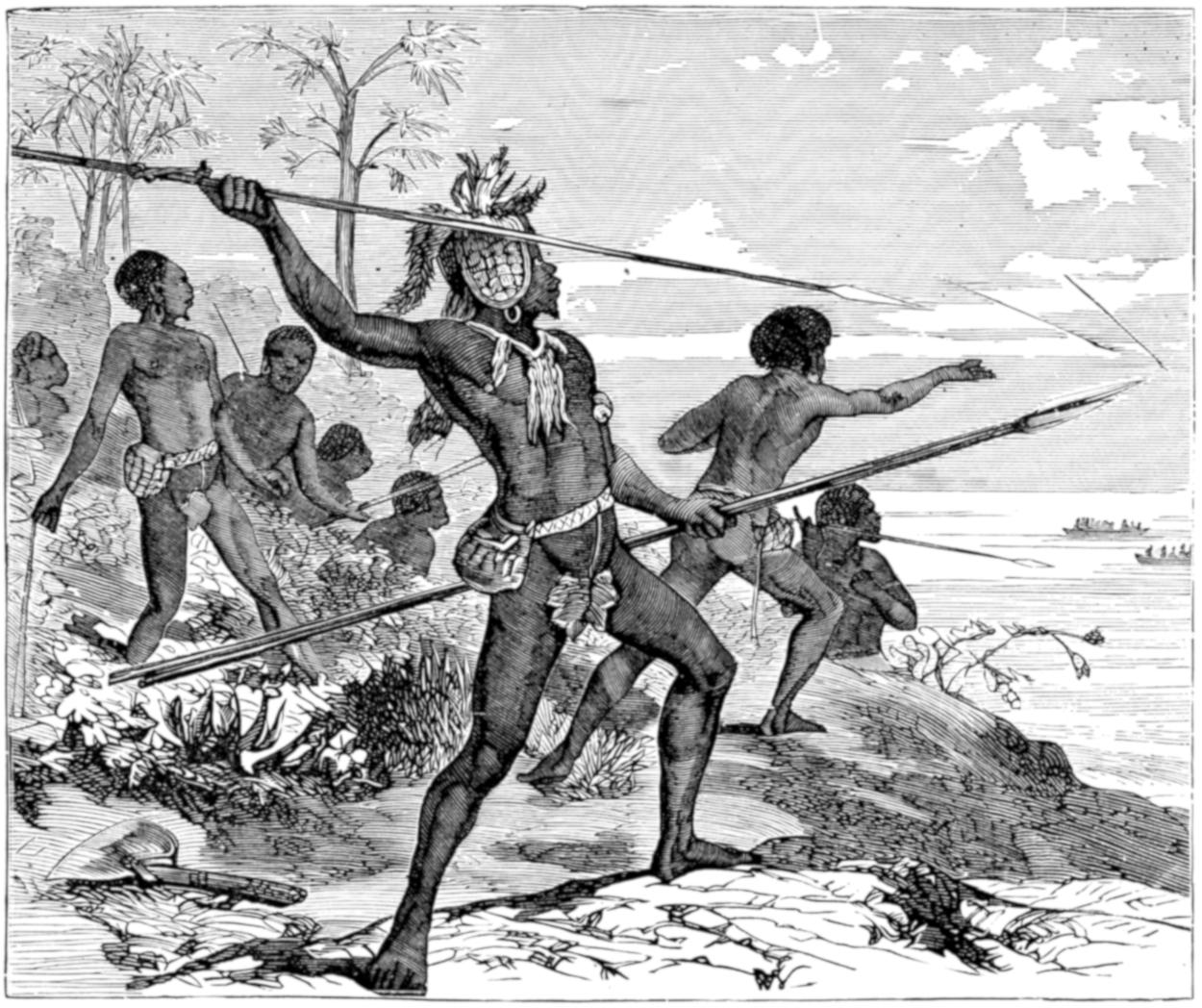
(1.) NEW CALEDONIANS DEFENDING THEIR COAST.
(See page 884.)
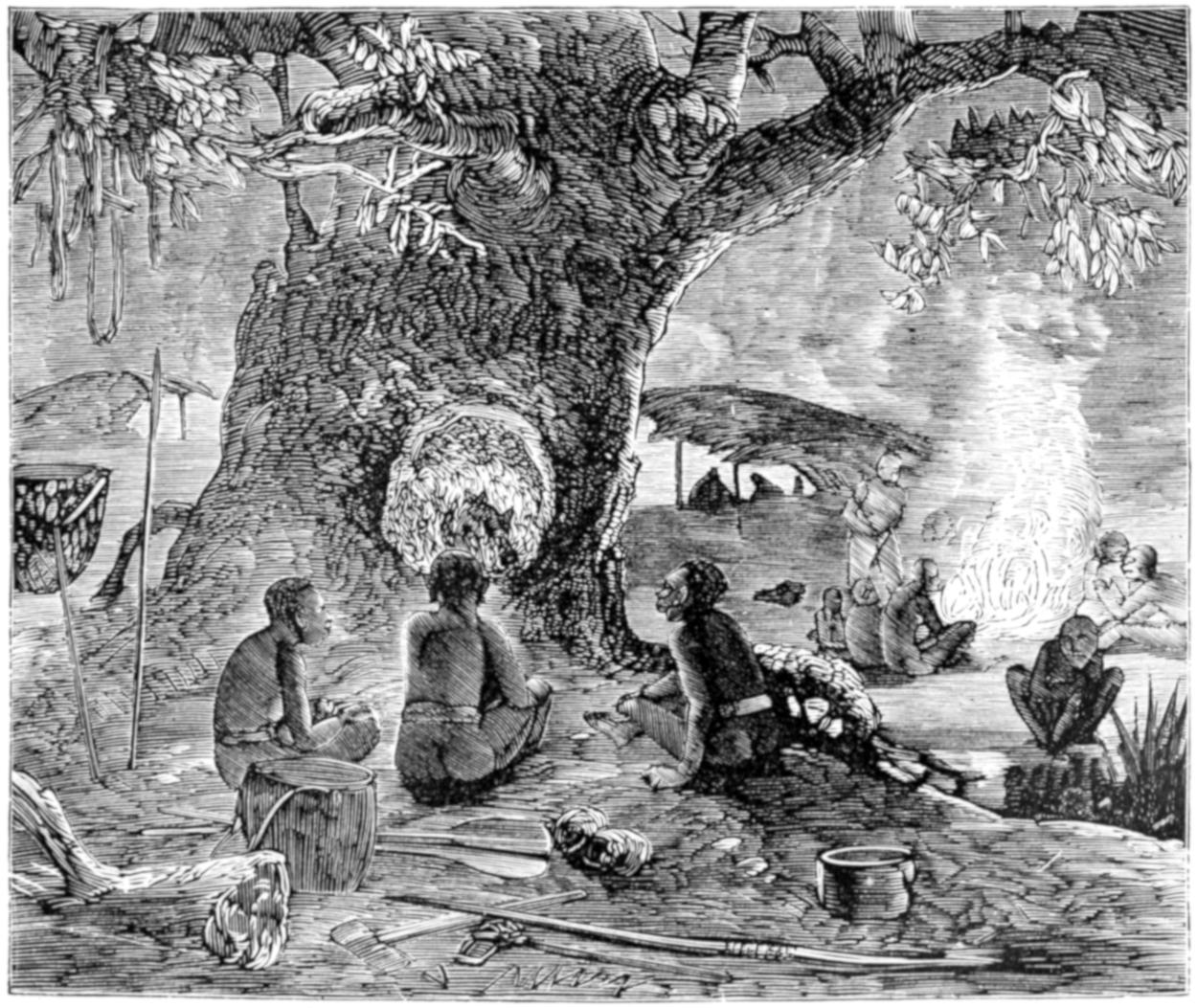
(2.) ANDAMANERS COOKING A PIG.
(See page 892.)
This man, by the way, was furnished with
two wives, mother and daughter, and, as he
was above the ordinary size, Captain Mouatt
expresses some curiosity as to the appearance
of the progeny. He made his escape
from the island before the birth of a child
that one of his wives was expecting, and, as
the Mincopie mothers are remarkable for
their affection toward their children, it is
likely that the little half-caste was allowed
to live, and that a new element may thus be
introduced into the race.
They have more than once made use of
their swimming powers in escaping from captivity.
Several instances have been known
where Andamaners have been kept prisoners
on board ship, and have seemed tolerably
reconciled to their lot. As soon, however,
as the ship neared land, they contrived to escape
for a moment from the eye of the sentry,
slipped overboard, and swam to land. They
always dived as soon as they struck the water,
swam as far as they could without rising
to the surface, and then, after taking a single
respiration, dived again, and so swam the
greater part of the distance under water.
This mode of swimming was doubtless
practised by them when trying to escape
from the arrows of an unfriendly party.
In Captain Syme’s “Embassy to Ava”
there is a curious account of two young
Mincopie girls who had been decoyed on
board the ship. They were treated very
kindly, and soon learned that no harm
would be done to them. “They suffered
clothes to be put on, but took them off
again as soon as opportunity offered, and
threw them away as useless encumbrances.
When their fears were over, they became
cheerful, chattered with freedom, and were
inexpressibly diverted at the sight of their
own persons in a mirror.
“They were fond of singing, sometimes
in a melancholy recitative, at others in a
lively key; and often danced about the deck
with great agility, slapping the lower part
of their bodies with the back of their heels.
Wine and spirituous liquors were disagreeable
to them; no food seemed so palatable
as fish, rice, and sugar. In a few weeks,
having recovered strength and become fat,
from the more than half-famished state in
which they were brought on board, they
began to think confinement irksome, and
longed to regain their native freedom.
“In the middle of the night, when all
but the watchman were asleep, they passed
in silence into the Captain’s cabin, jumped
out of the stern windows into the sea, and
swam to an island half a mile distant, where
it was in vain to pursue them, had there
been any such intention; but the object
was to retain them by kindness, and not
by compulsion, an attempt that has failed
on every trial. Hunger may (and these instances
are rare) induce them to put themselves
into the power of strangers; but the
moment that their want is satisfied nothing
short of coercion can prevent them from returning
to a way of life more congenial to
their savage nature.”
Like many other savage races, the Mincopies
make a kind of festivity on each new
moon; and as soon as the thin crescent
appears they salute it after their odd fashion,
and get up a dance. Their dances are
rather grotesque, each performer jumping
up and down, and kicking himself violently
with the sole of his foot, so as to produce
a smart slapping sound. This is the dance
which is mentioned in the preceding account
of the two captives.
When a Mincopie dies, he is buried in a
very simple manner. No lamentations are
made at the time; but the body is tied in a
sitting position, with the head on the knees,
much after the fashion employed among the
Bechuanas, and described on page 300. It is
then buried, and allowed to decay, when the
remains are dug up, and the bones distributed
among the relatives. The skull is the
right of the widow, who ties it to a cord and
hangs it round her neck, where it remains
for the rest of her life. This outward observance
is, however, all that is required of
her, and is the only way in which she
troubles herself to be faithful to the memory
of her dead husband. It is rather strange
that, though the Andamaners make no
lamentations on the death of a relative,
they do not altogether dispense with these
expressions of sorrow, but postpone them
to the exhumation and distribution of the
relics, when each one who gets a bone howls
over it for some time in honor of the dead.
Immediately to the south of the Andaman
Islands, and barely thirty miles distant,
lie the Nicobar Islands. The group consists
of nine tolerably large islands, and several
of much smaller size. One of the large
islands, called Great Nicobar, is twenty miles
long by eight wide, while Little Nicobar is
barely half these dimensions.
The islands are singularly fertile, and
abound in various kinds of vegetation, especially
in the cocoa-nut palm, not a specimen
of which is to be found in the Andaman
Islands. This curious fact is accounted
for by the character of the Andamaners,
who have an almost superstitious love for
the cocoa-nut. If one of the nuts be washed
ashore, it is always broken up and eaten;
and if perchance one of the fruit happens to
escape the sharp eyes of the natives and to
germinate, its green feathery shoots are
sure to attract the attention of the first
Mincopie who passes in that direction. A
similar barrier to the production of the cocoa-nut
is found on the coast of Australia.
Although so close to the Andaman Islands,
the inhabitants of Nicobar are very unlike
the Mincopies, being a fine tall race, and of
a copper rather than a black hue. Unlike the
Mincopies, the men are very fat, especially
about the breast, so that at a little distance
they might easily be mistaken for women.
Moreover, they wear the hair long, and
parted in the middle, which to the eyes of a
modern European, gives them a peculiar
effeminate look. They wear neither beard
nor moustache, their features are ugly, and
their large mouths are stained a dark red from
the juice of the betel-nut, which they are
continually chewing.
There is one distinction, however, which
is apparent at a considerable distance. In
lieu of clothes, the men wear a strip of cloth,
never more than two inches wide. This is
passed round the waist, under the legs in
front, and tucked through itself behind, the
end being left as long as possible. The men
place great value on the length of this tail,
and he is the best dressed man who wears it
the longest. Some of the wealthy among
them have the tail dragging along the ground
for several feet, like an European lady’s
train. If possible, this tail is made of blue
cloth, an article that is held in very high estimation
by the natives.
The women are quite as ill-favored as the
men, and increase their natural ugliness by
shaving off all their hair. They do not wear
tails like the men, but have a plaited grass
girdle, from which depends a soft fibrous
fringe about a foot in depth.
The character of the Nicobarians is far
gentler than that of the Mincopies, the latter
being proverbially fierce and cruel toward
strangers, and the former soon learning to
welcome foreigners when they have made
up their minds that no harm is intended
them. Captain Campbell, to whom I am
indebted for most of the information respecting
these natives, found them very
agreeable and hospitable, ready to barter,
and always welcoming him to their houses.
After a short time, even the women and
children, who had at first been scrupulously
concealed, after the manner of savages, came
boldly forward, and were as hospitable as the
men. On one occasion, while paying a visit
to one of their huts, Captain Campbell tried
to make friends with one of the children, all
of whom were terribly frightened at the
white face of their visitor. Finding that no
response was made to his advances, he pulled
the child from his hiding-place, and held him
for a little time, in spite of his struggles. The
mother made no opposition, but laughed
heartily at the skirmish, evidently feeling
that no harm was intended toward her little
one.
The native weapons of the Nicobarians are
very curious. As the people are not of a
warlike character like the Mincopies, their
weapons are used almost exclusively for
killing game. The most formidable is a tolerably
large spear headed with iron, which is
used for killing hogs, and is thrown like the
assagai of Southern Africa. They have also
a smaller javelin for fish-killing, and a
number of many-pointed hand-spears for the
same purpose. The most remarkable of their
weapons is a cross-bow, which is almost
exactly like that of the Fan tribe of Africa.
It is not very powerful, and only propels a
small arrow. Its chief use is in killing
birds.
Besides these weapons, every man carries
a cutlass-blade from which the hilt has been
removed, and a handle roughly made by
wrapping some six inches of the butt with
cocoa-nut fibre. It is intended not so much
as a weapon as a tool, and with it the natives
cut down trees, carve their canoes, and
perform similar operations.
The architecture of the Nicobarians is
infinitely superior to that of the Mincopies,
and is precisely similar in character to that
which is found among the inhabitants of New
Guinea, the home of the Papuan race.
The native architect begins by fixing a
number of posts in the ground, and erecting
on them a platform of split bamboo. Over
this platform he builds a roof shaped exactly
like a beehive, and his house is then complete.
The bamboo platform is the floor of the hut,
and, being elastic as well as firm, serves also
for a bed. To this hut the native ascends by
a primitive sort of ladder, and passes into the
chamber through a hole cut in the floor.
The sides of the hut are adorned with the
skulls of hogs, intermixed with spears,
knives, bows, and arrows. The huts are kept
peculiarly neat and clean.
A rather remarkable use is made of the hut.
The open space between the floor and the
ground is far too valuable not to be utilized,
as it affords a cool and airy shelter from the
sunbeams. Under this floor is suspended a
primitive sort of hammock, which is a board
about six feet in length, slung by ropes. In,
or rather on, this very uncomfortable hammock
the Nicobarian likes to lounge away his
time, dozing throughout the hot hours of the
day, sipping palm wine at intervals, and
smoking without cessation. In fact, we seem
to have got again among the inhabitants of
Western Africa, so similar is the character
of the Nicobarian to that of the negro. The
“Scene in the Nicobar Islands,” represented
on the 903d page, shows the personal appearance
of the Nicobarians and their style
of architecture.
The canoes of the Nicobarians are not so
beautifully formed as those of the Mincopies,
but are constructed on the same principle,
being hollowed out of the trunks of trees, and
supported by a slight outrigger. They have
a very high and ornamental prow, and are
propelled by short paddles. They are very
light, and, when properly manned, skim over
the water at an astonishing pace. Some of
them are nearly sixty feet in length, while
others are barely six or seven feet long, and
only intended for one person.
The mode of burial is not in the least like
that which is employed among the Mincopies.
When a man dies, the body is placed in a
coffin, which is generally made from a canoe.
The canoe is cut in half, the body being
laid in one moiety, and covered with the
other half. In order to supply the deceased
with provisions for his journey to the
spirit-land, a pig is killed and placed in the
coffin, together with a supply of yams and
cocoa-nuts. In case he should be attacked
on his journey, a quantity of weapons, such
as bows, spears, and cutlasses, are placed in
the coffin.
The body is buried in the middle of the
village, and the spot marked by a stick, to
which is attached a small streamer. After
some time, when the body has been consumed
by the earth, the coffin is dug up
again. The deceased being now supposed to
have completed his journey to his spirit-home,
his bones are thrown into the bush, and
the cutlasses and other weapons distributed
among his relatives.
CHAPTER XC. NEW GUINEA.
THE HOME OF THE PAPUAN RACE — DISTINGUISHING MARKS OF THE RACE — DERIVATION OF THE
NAME — GENERAL CHARACTER OF THE PAPUANS — THE SIGN OF PEACE — AN UNFORTUNATE MISUNDERSTANDING — DRESS
AND ORNAMENTS OF THE TRIBES OF DOURGA STRAIT — THEIR AGILITY
AMONG THE TREES — THE OUTANATA TRIBES — TATTOOING AND ORNAMENTS — ELABORATE ARCHITECTURE — WEAPONS — THE
DUST SIGNALS AND THEIR MEANING — THEIR UNSUSPICIOUS NATURE — ABRAUW,
THE CHIEF.
We now come to the very home and centre
of the Papuan race.
New Guinea is a very large island, fourteen
hundred miles in length, and, as far as
has been ascertained, containing some two
hundred thousand geographical square miles.
It is separated from Australia only by Torres
Strait, and, as we have seen, a certain amount
of intercourse has taken place between the
Papuans of the south of New Guinea and
the natives who inhabit the north of Australia.
Fertile in the vegetable kingdom, it
possesses one or two animals which have
the greatest interest for the naturalist, such
as the tree-kangaroo, the crowned pigeon,
and the bird of paradise. It is equally interesting
to the ethnologist as being the home
of the Papuan race.
Taken as a race, they are very fine examples
of savage humanity, tall, well-shaped,
and powerful. They are remarkable for two
physical peculiarities. The one is a roughness
of the skin, and the other is the growth
of the hair. The reader may remember that
some of the tribes of Southern Africa have
the hair of the head growing in regular
tufts or patches, each about the size of a
pea.
It is a remarkable fact that, in the Papuan
race, the hair grows in similar patches, but,
instead of being short like that of the South
African, it grows to a considerable length,
sometimes measuring eighteen inches from
root to tip. The Papuans are very proud of
this natural ornament, and therefore will
seldom cut it off; but as, if left untrained, it
would fall over the eyes, they have various
modes of dressing it, but in most cases manage
to make it stand out at right angles from
the head. Sometimes they take the hair of
each patch separately and screw it up into a
ringlet. Sometimes they tease out all the
hairs with a wooden comb of four or five
prongs, and, as the hair is very coarse and
stiff, it is soon induced to assume a mop-like
shape, and to increase the apparent size of
the head to an enormous extent.
Indeed, the word Papua is derived from
this peculiarity of the hair. In the Malay
language, the word which signifies “crisped”
is pua-pua, which is easily contracted into
pa-pua. Even the hair of the face grows in
similar patches, and so does that on the
breast of the man, and in the latter case the
tufts are much further apart than on the
head or face.
The color of the Papuans is a very dark
chocolate, sometimes inclining to black, but
having nothing in common with the deep
shining black of the negro. Their features
are large and tolerably well made, though
the nose is very broad at the wings, and the
lips wide. The nose, however, is not flat like
that of the negro, but is prominent, rather
arched, and descends so low that when seen
in front the tip nearly reaches the upper lip.
The natives seem to be perfectly aware of
this peculiarity, and perpetuate it in their
carvings.
Although taken as a whole, they are a fine
race, there are many diversities among the
different tribes, and they may be divided
into the large and small tribes. The former
are powerfully built, but more remarkable
for strength than symmetry—broad-breasted
and deep-chested, but with legs
not equal in strength to the upper parts of
the body.
Their character has been variously given,
some travellers describing them as gentle
and hospitable, while others decry them as
fierce and treacherous. Suspicious of strangers
they certainly are, and with good reason,
having suffered much from the ships
that visited their coasts. A misunderstanding
may soon arise between savage and
civilized people, especially when neither
understands the language of the other. An
example of such a misunderstanding is given
by Mr. Earle in his valuable work on the
native races of the Indian Archipelago.
Lieutenant Modera, an officer in the Dutch
navy, embarked with several other gentlemen
in the ship’s boat, for the purpose of
landing on the shore of Dourga Strait, a
passage between the mainland and Frederick
Henry Island.
“When the boat had proceeded to within
a musket-shot distance from them, the natives,
who were armed with bows, arrows,
and lances, commenced making singular
gestures with their arms and legs. The
native interpreter called out to them in a
language partly composed of Ceramese, and
partly of a dialect spoken by a Papuan
tribe dwelling a little further to the north;
but his words were evidently quite unintelligible
to them, as they only answered with
loud and wild yells. We endeavored, for a
long time without success, to induce them
to lay aside their weapons, but at length one
of them was prevailed upon to do so, and
the others followed his example, on which
we also laid down our arms, keeping them,
however, at hand.
“We now slowly approached each other,
and the interpreter, dipping his hand into
the sea, sprinkled some of the water over
the crown of his head as a sign of peaceful
intentions. This custom seems to be general
among all the Papuan tribes, and in
most cases their peaceful intentions may be
depended upon after having entered into
this silent compact.
“This they seemed to understand, for two
of them immediately did the same, on which
the interpreter jumped into the shallow
water, and approached them with some
looking-glasses and strings of beads, which
were received with loud laughter and yells.
They now began dancing in the water, making
the interpreter join, and the party was
soon increased by other natives from the
woods, who were attracted by the presents.
Mr. Hagenholtz also jumped into the shallow
water and joined in the dance, and they
soon became so friendly as to come close
round the boat; indeed some of them were
even induced to get in.”
Meanwhile their confidence increased,
and they began to barter with their visitors,
exchanging their ornaments, and even their
weapons, for beads, mirrors, and cloth. They
were very inquisitive about the strange objects
which they saw in the boat, and, although
they handled everything freely, did
not attempt to steal. One of them took up
a loaded pistol, but laid it down at once
when the owner said it was tapu, or forbidden.
Unfortunately, a misunderstanding
then took place, which destroyed all the amicable
feeling which had been established.
“While all this was going on, they kept
drawing the boat—unperceived, as they
thought—toward the beach, which determined
us to return, as our stock of presents
was exhausted, and there seemed no probability
of our inducing any of them to go on
board with us. Shortly before this, Mr.
Boers had ornamented a Papuan with a
string of beads, who, on receiving it, joined
two of his countrymen that were standing
a little distance off with the arms that had
been laid aside, but which they had been
gradually getting together again—a proceeding
we had observed, but, trusting in
the mutual confidence that had been established,
we did not much heed it.
“At the moment in which we were setting
off the boat to return on board, this man
fixed an arrow in his bow, and took aim at
Mr. Boers, who was sitting in the fore part
of the boat, on which the latter turned aside
to take up his gun, but before he could do
so he received the arrow in his left thigh,
which knocked him over, shouting, ‘Fire!
fire! I am hit!’ as he fell. The order was
scarcely given before every one had hold of
his arms (which, as before stated, were kept
at hand), and a general discharge put the
natives to flight, swimming and diving like
ducks.
“Before they took to flight, however, they
discharged several more arrows at our people,
one of which struck Mr. Hagenholtz in the
right knee, another hit a sailor in the leg,
while a third pierced a sailor’s hat and remained
sticking in it; and lastly, a Javanese
had the handkerchief shot off his head, but
without receiving any personal injury.”
Three of the natives were severely
wounded, if not killed, in this unfortunate
affair, which evidently arose, as Mr. Earle
points out, from misunderstanding, and not
from deliberate treachery. Seeing the boats
being pulled toward the ships while four
of their companions were on board, they
probably thought that they were being carried
off as captives, as has so often been done
along their coast by the slavers. They could
not be expected to understand the difference
between one white man and another, and
evidently mistook the Dutch sailors for
slavers, who had come for the purpose of
inveigling them into the ships, where they
could not be rescued.
The tribes of this part of the coast are not
agreeable specimens of the Papuan race.
They are barely of the middle size, and
lightly built. Their skin is decidedly black,
and they ornament their bodies with red
ochre, paying especial attention to their faces,
which are made as scarlet as ochre can make
them. The hair is deep black, and is worn
in various ways. Most of the men plait it
in a number of tresses, which fall nearly on
the shoulders, while others confine it all into
two tails, and several were seen with a curious
headdress of rushes, the ends of which
were firmly plaited among the hair. They
are a dirty set of people, and are subject to
diseases of the skin, which give them a very
repulsive appearance.
Dress is not used by the men, who, however,
wear plenty of ornaments. They mostly
have a belt made of plaited leaves or rushes,
about five inches wide, and so long that, when
tied together behind, the ends hang down
for a foot or so. Some of them adorn this
belt with a large white shell, placed exactly
in the middle. Earrings of plaited rattan,
necklaces, and bracelets, were worn by
nearly all. Some of them had a very ingenious
armlet, several inches in width. It
was made of plaited rattan, and fitted so
tightly to the limb that, when a native wished
to take it off for sale, he was obliged to smear
his arm with mud, and have the ornament
drawn off by another person.
Their principal weapons are bows, arrows,
and spears, the latter being sometimes
tipped with the long and sharp claw
of the tree-kangaroo.
The agility of these Papuans is really astonishing.
Along the water’s edge there
run wide belts of mangroves, which extend
for many miles in length with scarcely a
break in them. The ground is a thick, deep,
and soft mud, from which the mangrove-roots
spring in such numbers that no one
could pass through them even at low water
without the constant use of an axe, while at
high water all passage is utterly impossible.
As the natives, who are essentially maritime
in their mode of life, have to cross this
belt several times daily in passing from their
canoes to their houses, and vice versa, they
prefer doing so by means of the upper
branches, among which they run and leap,
by constant practice from childhood, as easily
as monkeys. (See p. 909.) There is really
nothing extraordinary in this mode of progress,
which can be learned by Europeans in
a short time, although they never can hope
to attain the graceful ease with which the
naked savages pass among the boughs. In
some places the mangroves grow so closely
together that to traverse them is a matter of
perfect ease, and Mr. Earle remarks that he
once saw a file of marines, with shouldered
arms, making their way thus over a mangrove
swamp.
The familiarity of these people with the
trees causes them to look upon a tree as a
natural fortress, and as soon as explorers succeeded
in reaching the villages, the natives
invariably made off, and climbed into the
trees that surrounded the villages.
Wild and savage as they are, the Papuans
of Dourga Strait display some acquaintance
with the luxuries of civilized life and are inordinately
fond of tobacco, the one luxury
that is common to the highest and lowest
races of mankind.
Some travellers have stated that these
Papuans are cannibals, and it is certain that
their gestures often favor such an opinion.
The Papuans of Dourga Strait are admirable
canoe men, and paddle with singular
skill and power. They always stand while
paddling, a plan whereby they obtain a great
increase of power, though perhaps at the expense
of muscular exertion. They give as
their chief reason for preferring the erect
position, that it enables them to detect turtle
better than if they were sitting, and to watch
them as they dive under water after being
wounded.
Skirting the coast of New Guinea and
proceeding northward from Dourga Strait,
we come to the Outanata River, at the
embouchure of which is a tribe that differs
much from those natives which have already
been described. They are a finer and taller
set of men than those of Dourga Strait, and
seem to have preserved many of their customs
intact since the time when Captain
Cook visited them. Their skin is a very
dark brown, and is described as having a
bluish tinge, and they are said to rub themselves
with some aromatic substance which
causes them to diffuse an agreeable odor.
It is probable that the bluish gloss may
be due to the same aromatic substance with
which the body is perfumed. Mr. Earle
thinks that the odoriferous material in question
is the bark of the tree called the
“rosamala.”
The blue tinge is never seen among Papuan
slaves, and this circumstance adds force to
Mr. Earle’s conjecture.
The features are rather large, especially
the mouth, and the lips are thick. The custom
of filing the teeth to a sharp point prevails
among this tribe, but is not universal.
The eyes are small, and the septum of the
nose is always pierced so as to carry a piece
of white bone, a boar’s tusk, or some similar
ornament. The hair is thick, and, instead
of being trained into long tails like that of
the Dourga Strait natives, it is plaited from
the forehead to the crown.
The men wear scarcely any real dress,
many of them being entirely naked, and
none of them wearing more than a small
piece of bark or a strip of coarse cloth made
either of cocoa-nut fibre or of split bamboo.
They are, however, exceedingly fond of ornament,
and have all the savage love of
tattooing, or rather scarifying, the body,
which is done in a way that reminds the
observer of the same process among the
Australians. The scarifications project
above the skin to the thickness of a finger,
and the natives say that this effect is produced
by first cutting deeply into the flesh,
and then applying heat to the wounds.
Anklets, bracelets, and other articles of savage
finery are common, and a man who does
not wear an inch of clothing will pride himself
on his boar’s teeth necklace, his bracelets
of woven rattan, and his peaked rush cap.
The women always wear some amount of
clothing, however small, the very fact of
possessing apparel of any kind being conventionally
accepted as constituting raiment.
Their solitary garment consists of
a small apron, about six inches square, made
from the cocoa-nut fibre.
It is rather remarkable that these people
have the same habit of placing their new-born
children in hot sand, as has already
been described when treating of the now
extinct Tasmanians. When the mother
goes about her work, she carries the child
by means of a sort of sling made of leaves or
the bark of a tree.
The architecture of the Outanatas is far
superior to that of their brethren of Dourga
Strait. One of these houses, described by
Lieutenant Modera, was at least a hundred
feet in length, though it was only five feet
high and six wide, so that a man could not
stand upright in it. There were nineteen
doors to this curious building, which was at
first mistaken for a row of separate huts.
The floor is covered with white sand, and
the inhabitants generally seat themselves on
mats. Each of these doors seemed to be
appropriated to a single family, and near the
doors were placed the different fireplaces.
Over the roof a fishing net had been spread
to dry in the sun, while a number of weapons
were hung under the roof.
This house was built in a few days by the
women and girls, and was placed near a
much larger building, which had been
raised on piles.
The weapons of the Outanatas are spears,
clubs, and the usual bow and arrows, which
form the staple of Polynesian arms.
The bows are about five feet in length, and
are furnished with a string sometimes made
of bamboo and sometimes of rattan. The
arrows are about four feet in length, and
made of cane or reed, to the end of which is
attached a piece of hard wood, generally
that of the betel-tree. The tips are mostly
simple, the wood being scraped to a sharp
point and hardened in the fire, but the more
ambitious weapons are armed with barbs,
and furnished with a point made of bone.
The teeth of the sawfish are often employed
for this purpose, and a few of the arrows are
tipped with the kangaroo claw, as already
mentioned in the description of the Dourga
Strait spear.
Beside these weapons, the natives carry a
sort of axe made of stone lashed to a wooden
handle, but this ought rather to be considered
as a tool than a weapon, although it can
be used in the latter capacity. With this
simple instrument the Outanatas cut down
the trees, shape them into canoes, and perform
the various pieces of carpentering that
are required in architecture.
The most remarkable part of an Outanata’s
equipment is an instrument which
greatly perplexed the earlier voyagers, and
led them to believe that these natives were
acquainted with fire-arms. Captain Cook,
who visited New Guinea in 1770, mentions
that as soon as he reached the shore and
had left his boat, three natives, or “Indians,”
as he calls them, rushed out of the wood, and
that one of them threw out of his hand
something which “flew on one side of him
and burnt exactly like powder, but made no
report.” The two others hurled their spears
at the travellers, who were in self-defence
obliged to use their fire-arms.
Not wishing to come to an engagement,
they retired to the boat, and reached it just
in time, the natives appearing in considerable
force. “As soon as we were aboard,
we rowed abreast of them, and their number
then appeared to be between sixty and
a hundred. We took a view of them at our
leisure. They made much the same appearance
as the New Hollanders, being nearly
of the same stature, and having their hair
short-cropped. Like them they also were
all stark naked, but we thought the color of
their skin was not quite so dark; this, however,
might be merely the effect of their
being not quite so dirty.
“All this time they were shouting defiance,
and letting off their fires by four or
five at a time. What those fires were, or
for what purpose intended, we could not
imagine. Those who discharged them had
in their hands a short piece of stick—possibly
a hollow cane—which they swung sideways
from them, and we immediately saw
fire and smoke, exactly resembling those of
a musket, and of no longer duration. This
wonderful phenomenon was observed from
the ship, and the deception was so great that
the people on board thought they had firearms;
and in the boat, if we had not been so
near that we must have heard the report,
we should have thought they had been firing
volleys.”
The reader will doubtless remark here
that the travellers were so accustomed to
associate fire with smoke that they believed
themselves to have seen flashes of fire as
well as wreaths of smoke issue from the
strange weapon. Many years afterward,
Lieutenant Modera contrived to see and
handle some of these implements, and found
that they were simply hollow bamboos, filled
with a mixture of sand and wood-ashes,
which could be flung like smoke-wreaths
from the tubes. The Outanatas, their weapons,
canoes and the remarkable instrument
just described, are illustrated on the following
page.
Some persons have thought that the natives
used these tubes in imitation of firearms,
but the interpreters gave it as their
opinion that they were employed as signals,
the direction of the dust cloud being indicative
of the intention of the thrower. Others
say that the tubes are really weapons, made
for the purpose of blinding their adversaries
by flinging sand in their eyes. I cannot
agree with this last suggestion, because the
other weapons of the Outanatas show that
the natives do not fight hand to hand like
the New Zealanders. I think that the interpreters
were right in their statement that
the tubes are used for signalling, and this
supposition is strengthened by the fact that
the natives of Australia do use smoke for the
same purpose, as has already been described.
The canoes of the Outanatas are often of
considerable size, measuring fifty or sixty
feet, and, although narrow in proportion to
their length from stem to stern, containing
a great number of men. They are handsomely
carved and adorned with paint, and
both ends are flat and broad. The rowers
stand up when they use their paddles,
which are necessarily of considerable length,
having long handles and oval blades slightly
hollowed. The narrowness of these canoes
strengthens the opinion of several travellers,
that the Outanatas are really an inland
tribe, descending the river in flotillas, and
returning to their inland home when the
object of their expedition is accomplished.
They seem to be less suspicious than
their countrymen of Dourga Strait, and
have no hesitation in meeting Europeans
and exchanging their own manufactures for
cloth, knives, and glass bottles, the last
mentioned objects being always favorite articles
of barter with Polynesian savages,
who employ them when entire for holding
liquids, and, if they should unfortunately
be broken, use the fragments for knives,
lancets, points of weapons, and similar purposes.
Lieutenant Modera describes the
appearance of one of their flotillas as representing
a perfect fair, the boats being laid
closely together, and their decks crowded
with natives laden with articles for barter.
Unlike the Dourga Strait natives, those
of the Outanata River had no objection to
come on board the European ships, and visited
the vessels in great numbers. Even
their principal chief came on board frequently.
On the first occasion he disguised
his rank, and merely came as an ordinary
native, but he afterward avowed himself,
and came freely on board in his own character.
For convenience’ sake he called
himself Abrauw, i. e. Abraham, a name by
which he was well known for a considerable
distance. He offered no objection to going
below and entering the Captain’s cabin,
though his subjects were rather uneasy at
his absence, and shouted his name so perseveringly
that he was obliged every now and
then to put his head out of the cabin window.
He had all the regal power of concealing
astonishment, and witnessed with
utter imperturbability the discharge of firearms,
the ticking of watches, and examples
of similar marvels. He did, however, display
a little interest in the musketry practice,
which was directed at a succession of bottles,
slung from the yard-arm, but whether he
was struck with the accuracy of aim or with
the needless destruction of valuable bottles
is doubtful.
He seemed to be worthy of his position as
chief, and was desirous of establishing an
European settlement near the mouth of the
Outanata. Unfortunately, the river, although
a noble stream, has a sandbar across
the mouth which effectually prevents vessels
of even light draught from passing except at
high water. The people in general were
wonderfully honest, not displaying the
thievish propensities which cause the visits
of many savage tribes to be so troublesome.
They even brought on board articles which
had been accidentally left on shore. They
probably owe much of their superiority to
their connection with the Malay Mohammedans,
many of whom visit New Guinea as
traders.
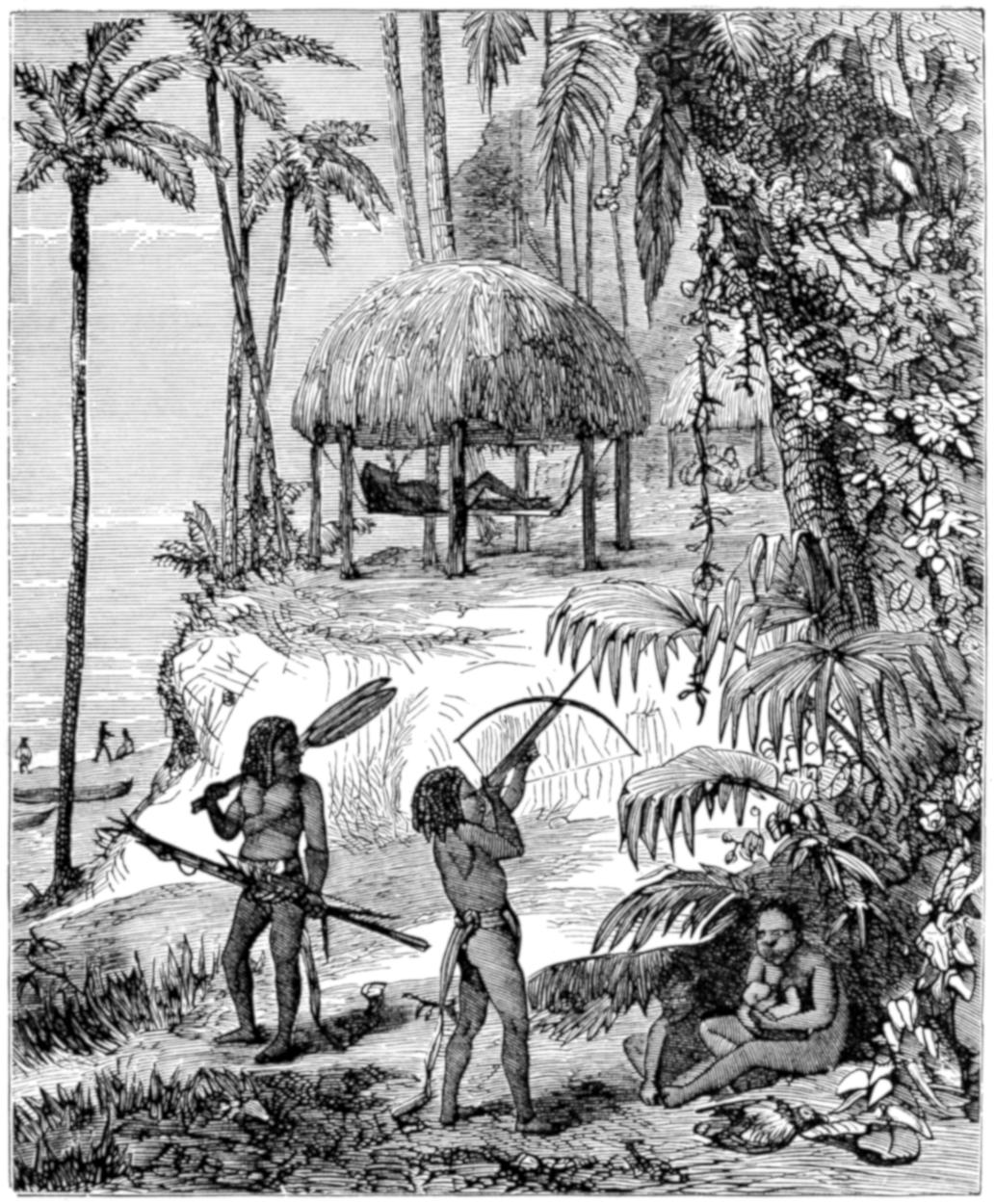
(1.) A SCENE IN THE NICOBAR ISLANDS.
(See page 897.)
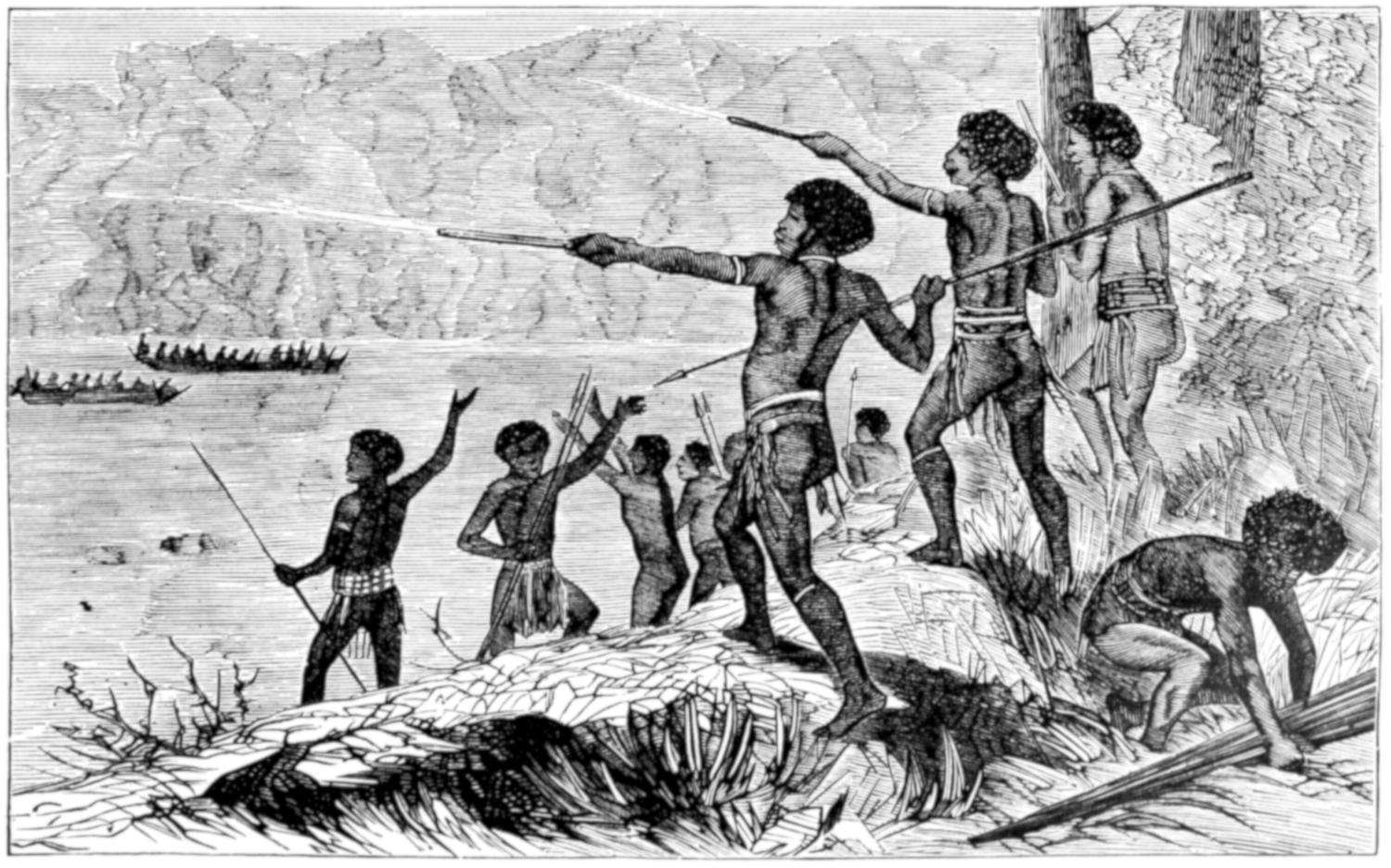
(2.) THE OUTANATAS AND THEIR WEAPONS.
(See page 902.)
CHAPTER XCI. NEW GUINEA— Concluded .
THE ALFOËRS OR HARAFORAS — VARIOUS REPORTS RESPECTING THEM — THEIR MODE OF GOVERNMENT — AN
ALFOËRIAN DIVORCE COURT — TREPANG COLLECTING — DESTRUCTION OF PROPERTY — FUNERAL
RITES — TRIBES OF THE SOUTH-EASTERN COAST — A QUAINT DRUMMER — DRESS AND
ORNAMENT — THE TATTOO — THE FULL-DRESS PETTICOAT — HAIR-DRESSING — EXCELLENCE OF
THEIR CANOES — AN INGENIOUS SAIL — HOW TO STOP A LEAK — THE PIG-PET — ARCHITECTURE — DEFENCE
AGAINST VERMIN — HOUSES OF REDSCAR BAY — DREAD OF STEEL — TRIBES OF THE
NORTH-WEST COAST — THEIR CANOES — MODES OF FISHING — AQUATIC HOUSES — MODE OF GOVERNMENT — APPOINTMENT
OF A NEW CHIEF — NEW GUINEA WEDDINGS — THE KARWAR, OR
HOUSEHOLD GOD — THE WAR-DANCE — CEREMONIES AT FUNERALS.
We must here give a short space to some
tribes called by various names, such as
Haraforas, Alfouras, and Alfoërs, and supposed
by many ethnologists to be a separate
family living in New Guinea and the
neighboring islands, but as distinct from
the generality of the inhabitants as the
Bosjesman of Southern Africa are from the
Kaffir.
This theory, however, has now been
shown to be untenable, and it is now known
that the word Alfoërs, or Alfouras, is applied
by the tribes of the coast to those who
live in the interior. The word has a Portuguese
origin, and as Mr. Earle remarks, is
applied to the mountaineers of the interior,
just as the Spaniards called the aborigines of
America “Indians,” and the Mohammedan
inhabitants of Salee and Mindano “Moros,”
or “Moors.”
Most of the accounts that have been received
of the Alfoërs are not at all to be
trusted. They have been described as peculiarly
disgusting and repulsive, ferocious,
gloomy, living in the depths of the forest, and
murdering all strangers who came in their
way. In fact, they have a worse reputation
than the Andamaners. It has been ascertained,
however, that these evil reports have
originated from the coast tribes, who have a
very strong objection to allow foreigners to
penetrate inland.
The reason is obvious. The visits of the
traders are exceedingly valuable, furnishing
all kinds of tools, weapons and ornaments,
which constitute the wealth of the
savage. The natives, having purchased these
with articles which to themselves are comparatively
valueless, can sell their superabundance
to the inland Alfoërs, and make
an enormous profit on their bargain. If the
white men were allowed to go inland and
trade directly with the natives, their profitable
traffic would be broken up.
As far as can be ascertained, the Alfoërs
are in much the same state as were the Outanatas
before they were visited by traders.
Those who were seen were remarkable for a
certain stupidity of aspect, a taciturnness of
disposition, and a slowness of movement,
which are not found among the Outanatas.
As, however, they were slaves, it is more
than likely that these characteristics were the
result of servitude.
Subsequently some discoveries were made
among the Alfoërs, which entirely contradicted
the reports of the coast tribes. They
are certainly rough in their manners, and if
they take a dislike to a foreigner, or if he
should perchance offend any of their prejudices,
they eject him from the district with
more speed than ceremony; taking care,
however, not to inflict personal damage,
and refraining from confiscating his property.
As far as can be ascertained from the
slight intercourse which has been held
with these tribes, there is no regular form
of government, the elders deciding disputes,
and their decisions being respected. They
are an honest set of people, paying the
greatest regard to the rights of property;
and being so scrupulous in this respect, that
if any one should even enter the house of
an absent man he is called to account, and
made to pay a fine to the owner of the
house. A similar law exists with regard to
the women. If a man should even touch,
though accidentally, the wife of another, he
makes himself liable to a fine.
A curious example of this regulation is
mentioned by Lieutenant Kolff. A man
set out in his canoe to fish, intending to
return in a week; but being caught by contrary
winds, he was driven away from his
own part of the coast, and was detained two
months. Unfortunately he had only left at
home provisions for a week, and his wife,
finding herself without food, asked a neighbor
to provide it for her. This he did, and
as, day after day, nothing was heard of the
husband, the woman transferred her affections
and herself to the neighbor who had
assisted her, and the pair went off to another
island.
After two months had elapsed the husband
came back, and, not finding his wife,
demanded her from her brothers, who were
then bound to produce her. They set off in
search of the guilty couple, discovered them,
and brought them back, when the injured
husband demanded an enormous sum by
way of fine. The man said that he could
not possibly pay such a sum if he were to
work for the rest of his lifetime. The affair
was eventually brought before the elders,
who decided that the husband had done
wrong in leaving his wife so ill provided
for, and that if he had supplied her with a
sufficiency of provisions the acquaintance
between herself and her paramour would
probably have been avoided. So they
decreed that the man should pay a small
fine, and advised the husband to leave
plenty of provisions at home when he next
went out fishing.
The principal object for which the natives
make these expeditions is the trepang, or
sea-slug (Holothuria), which is in great
demand in China, and is purchased by
traders from the natives for the Chinese
market. It is chiefly by means of the trepang
that a man procures a wife. As is the
case among many savage tribes, a wife can
only be obtained by purchase, so that daughters
are quite as valuable to their parents
as sons. With the Alfoërs, the marriage
present must always consist of foreign valuables,
such as elephants’ tusks, gongs, China
dishes, cloth, and similar objects. These
are obtained by exchanging trepang with
the traders.
When, therefore, a young man wants a
wife, and has settled the amount of the
marriage portion with the father, he goes
off for a year on a hunting expedition. He
takes a canoe, and sails from island to island,
catching as much trepang as possible, and
begging from all those whom he visits. At
the end of the year he returns home, knowing
that by means of the protective law his
house and property will be perfectly safe,
and presents himself to the father of the girl
with the goods which he has obtained. It
is seldom that he is able to make up the
entire amount at once, but he is allowed to
pay by instalments.
Property cannot be inherited, owing to a
peculiar custom. As soon as any one dies,
his relations assemble, gather together all
his valuables, break them to pieces, and
throw the fragments away. Even the precious
brass gongs are thus broken, the survivors
thinking that no one may use anything
belonging to the dead. Large heaps
of broken china, ivory, and metal are found
on the outskirts of villages that have existed
for any long time, showing that many deaths
must have occurred within its limits.
The rest of the funeral ceremonies are
curious, and are worthy of a brief description.
When death is ascertained, notice is sent
to all the relatives of the deceased, who
often are scattered widely apart, so that
several days usually elapse before they can
all assemble. The body meanwhile is kept
sprinkled with lime, in order to retard decay
as much as possible, and aromatic resins are
burned in the house to counteract any ill
odor. As the relatives come, they take
their places in the house, and begin drinking.
Before the traders supplied them with
arrack, they had a fermented liquor made
by themselves from fruit. They always
offer the deceased a share of everything,
putting a little food into the mouth of the
dead person, and pouring a little liquid
between the senseless lips. Meanwhile the
women utter loud lamentations, gongs are
beaten, and a stunning uproar is kept up
until the time of the funeral.
When the relatives have all assembled, a
bier is provided, covered with cloth, the
quantity and quality of which accord with
the wealth of the deceased; and the body is
then brought out in front of the house, and
supported in a sitting position against a
post. The villagers then assemble, and a
general feast takes place, a share of which
is offered to the deceased as before. Finding
that he will neither eat nor drink, in
spite of the solicitations of his friends and
companions, the body is carried into the
woods, where it is placed on a platform
erected on four feet.
This being done, the concluding ceremony
is left to the women. They remove
all their clothing, and then plant by the side
of the platform a young sapling; this ceremony
being called the “casting away of the
body,” and considered as a symbol that the
deceased has done with his body, and thrown
it from him.
Passing more to the eastward of New
Guinea, we come to some interesting nations
inhabiting Brumer’s Island, and the neighborhood.
These islands are situate about
lat. 10° 45´ S. and lon. 150° 23´ E.
Living as they do on a number of small
islands, the largest being rather less than
three miles in width, the natives are necessarily
maritime, passing from one island to
another in their admirably contrived vessels.
They are accustomed to the visits of
ships, and boldly put off to meet them, taking
no weapons, except for sale, and displaying
the greatest confidence in their
visitors.
One of these natives caused great amusement
by his imitation of the ship’s drummer.
Some one gave him a large tin can,
which he, being a musical genius, immediately
converted into a drum. At first he
merely pounded it with his hands, but when
the ship’s drummer was sent into the chains,
and began to play upon his instrument, the
man watched him for a little time, and then
began to imitate him in the most ludicrous
manner, his antics and grimaces being
especially provocative of laughter. The
effect of his buffoonery was heightened by
the manner in which he had adorned his
face. He had blackened his naturally dark
features with charcoal, and had drawn a
streak of white paint over each eyebrow,
and another under the chin to the cheekbones.
The mode of salutation is rather ludicrous
to a stranger, as it consists of pinching.
When they desire to salute any one, they
pinch the tip of the nose with the finger
and thumb of the right hand, while with
the left they pinch the middle of their stomachs,
accompanying this odd and complex
gesture with the word “Magasûka.” These
natives seem to be a hospitable people, for,
after several of them had been received on
board and treated kindly, they returned on
the following day, and brought with them a
great quantity of cooked yams, for which
they refused payment.
The men wear nothing but a small strip
of pandanus leaf, but the women have a
dress which in principle is exactly similar
to the thong-aprons of Southern Africa. It
consists of a number of very narrow strips
of pandanus leaf, reaching nearly to the
knee. The girls wear only a single row of
these strips, but the women wear several
layers of them, one coming a little below
the other, like flounces. In wet weather
the uppermost petticoat is taken from the
waist and tied round the neck, so as to protect
the shoulders from the rain, which
shoots off the leaf-strips as off a thatched
roof.
On gala days a much handsomer petticoat
is worn. This consists of much finer leaf
strips than those which constitute the ordinary
dress, and it is dyed of various colors.
Some of them which were seen by Mr.
M’Gillivray were red and green, with bands
of pale yellow and pure white. The tufts of
which they were composed were extremely
light and soft, and looked like very fine-twisted
grass blades. Several of the women,
by way of finishing their toilet, had blackened
their faces. This process, if it did not
add to their beauty, certainly did not detract
from it, as their faces were originally so
plain that the black covering could not
make them more ugly. The young men
and lads formed a curious contrast to the
women in this respect, many of them being
remarkable for their good looks.
The women usually, though not invariably,
divide their hair into a vast number of little
tresses, and twist them up like the thrums
of a mop, while the men tease out their stiff
and wiry locks as much as possible, and fix
in them a slender stick, some two feet in
length, decorated with a little plume at the
top, the base being cut into teeth and so used
as a comb.
The inhabitants of Redscar Bay use a
more elaborate system of tattooing than that
which has been described above. The men
generally restrict themselves to certain portions
of the body, such as the breast, cheeks,
forehead, and arms, and even on those spots
the tattooing is comparatively slight. But
the women are so covered with blue patterns,
that there is hardly a portion of their
bodies which has not been thus decorated.
They have various patterns, but the usual
type is formed by double parallel lines, the
intervals between which are filled with
smaller patterns, or with zigzag lines. As
the dress of the women consists merely of
the leaf-strip petticoat, the patterns of the
tattooing are very fully displayed.
The hair of the men is dressed here after
a rather singular fashion. It is shaved from
the forehead for some three inches, and the
remainder is combed backward to its full
length. A string is then tied round it, so as
to confine it as closely as possible to the
head, leaving rather more than half its length
to be frizzed into a mop-like bundle projecting
from the crown.
Those who are especially careful of their
personal appearance add an ornament which
is not unlike the pigtail of the last century.
A tolerably large bunch of hair is gathered
together and tied into a long and straight
tail, the end of which is decorated with
some ornament. In one case, a man had
attached to his pigtail a bunch of dogs’
teeth. The mouths, naturally wide, are disfigured
with the universal custom of chewing
the betel-leaf mixed with lime, which
stains the lips of a dull brick-red, and makes
the whole mouth look as if it had been
bleeding.
The hair is usually black, but some diversities
of color are often seen. Sometimes it
is black except the tips of each tress, where
the hue becomes yellow or reddish, and
sometimes the whole of the hair is red. In
all probability, this change of tint is produced
by artificial means, such as lime-water,
the use of which is known in various
parts of New Guinea. Those who have the
entire hair red have probably dyed it lately,
while those who have only the tips red have
passed several months without dyeing it.
There is but little beard or moustache.
As far as can be judged from appearances,
the women are treated better than is usually
the case among savages, and seem to be considered
as equal with the men. They are
affectionate parents, as was proved by the fact
that children were often brought by their
fathers to look at the ships.
The average stature of these natives was
rather small, few exceeding five feet four
inches in height. They were very active,
but not powerful, as was proved by testing
their strength against that of the ship’s
crew.
Allusion has already been made to their
skill in boating. These natives possess various
canoes, some so small as only to hold,
and by no means to accommodate, one person,
while others contain with ease fifty or
sixty at once.
The commonest canoe is that which is
popularly called a catamaran, and which is
more of a raft than a boat. It is formed of
three planks lashed together with rattan.
The man sits, or rather kneels, a little behind
the centre, and is able to propel this
simple vessel with great speed. Some of
these catamarans are large enough to carry
ten or twelve persons, together with a cargo.
Instead of being merely three planks, they
consist of three great logs of wood laid side
by side, and lashed firmly together with rattan
at their ends, in the centre, and midway
between the centre and each end. There is
no particular bow or stern, but the central
log is longer than the others, so as to project
at each end, and is generally carved into
rude patterns, and ornamented with red and
white paint.
Of course the sea washes freely over this
primitive vessel, so that the natives are
obliged to erect a small platform in the middle,
on which they can place any goods that
might be damaged by wetting.
One of the smaller catamarans is shown
in the foreground of illustration, No. 2, on
the next page, and just behind it is one of
the large canoes with its sail struck. Such a
canoe as this is about twenty-five feet in
length. It consists of two parts, the canoe
proper and the outrigger. The canoe
proper is very curiously formed. It is cut
from the trunk of a tree, and, in spite of its
length, is not more than eighteen or nineteen
inches in extreme width. The most
curious part of its construction is, that the
sides, after bulging out below, come together
above, so that the space between the
gunwale is barely eight inches, there is only
just room for a man’s legs to pass into the
interior of the boat. A section of the canoe
would present an outline very much like
that of the Greek Omega reversed, thus—℧.
In order to preserve the gunwales from injury,
a slight pole is lashed to them throughout
their entire length.
As is the case with the catamaran, both
ends of the canoe are alike. They are generally
raised well above the water, and are
carved into the semblance of a snake’s or
turtle’s head, and decorated with paint,
tufts of feathers, shells, and similar ornaments.
The outrigger is as long as the canoe, to
which it is attached by a series of light
poles to the gunwale of the canoe itself.
The method by which the outer ends of the
poles are fastened to the outrigger is very
curious, and can be better understood by
reference to the illustration than by a description.
Like the ends of the canoe, those
of the outrigger poles are fashioned into a
snake-like form.
The natives can run along these poles to
the outrigger with perfect safety, often sitting
upon it when the wind is high, so as to
preserve the balance of the vessel. In many
canoes, however, a slight platform is laid
upon these poles, so as greatly to increase
the burthen-carrying space of the vessel;
and a corresponding but smaller platform
projects from the opposite side of the canoe.
On this platform several paddlers are stationed,
finding it easier to work their long-handled
paddles from the platform than
from the narrow space of the canoe itself.
The sail is made of strips of palm leaf,
interlaced with each other. When it is not
required, the sail is struck and rolled up, so
as to occupy as little room as possible, and
the mast can also be struck, like those of our
sailing barges while passing under a bridge.
Two other kinds of New Guinea canoes
are shown in the same illustration. These
canoes are not found in the same part of
New Guinea, but, as the natives travel in
them for considerable distances, they have
been brought together in the same illustration
for the convenience of comparison.
Beyond the large canoe is a smaller one,
with a sail that is set in rather a curious
manner. There is no mast, but the two
edges of the sail are fastened to slight spars,
and when the native finds the wind to be
favorable, he fixes the lower ends of these
spars in the canoe, and supports the upper
ends by stays or ropes that were fore and
aft. The reader will notice the pointed end
of the cylindrical outrigger. On the opposite
side to the outrigger is a slight platform
made of planks. The platform itself
is out of sight, but the reader may see the
heads and shoulders of the two men who
are sitting on it.
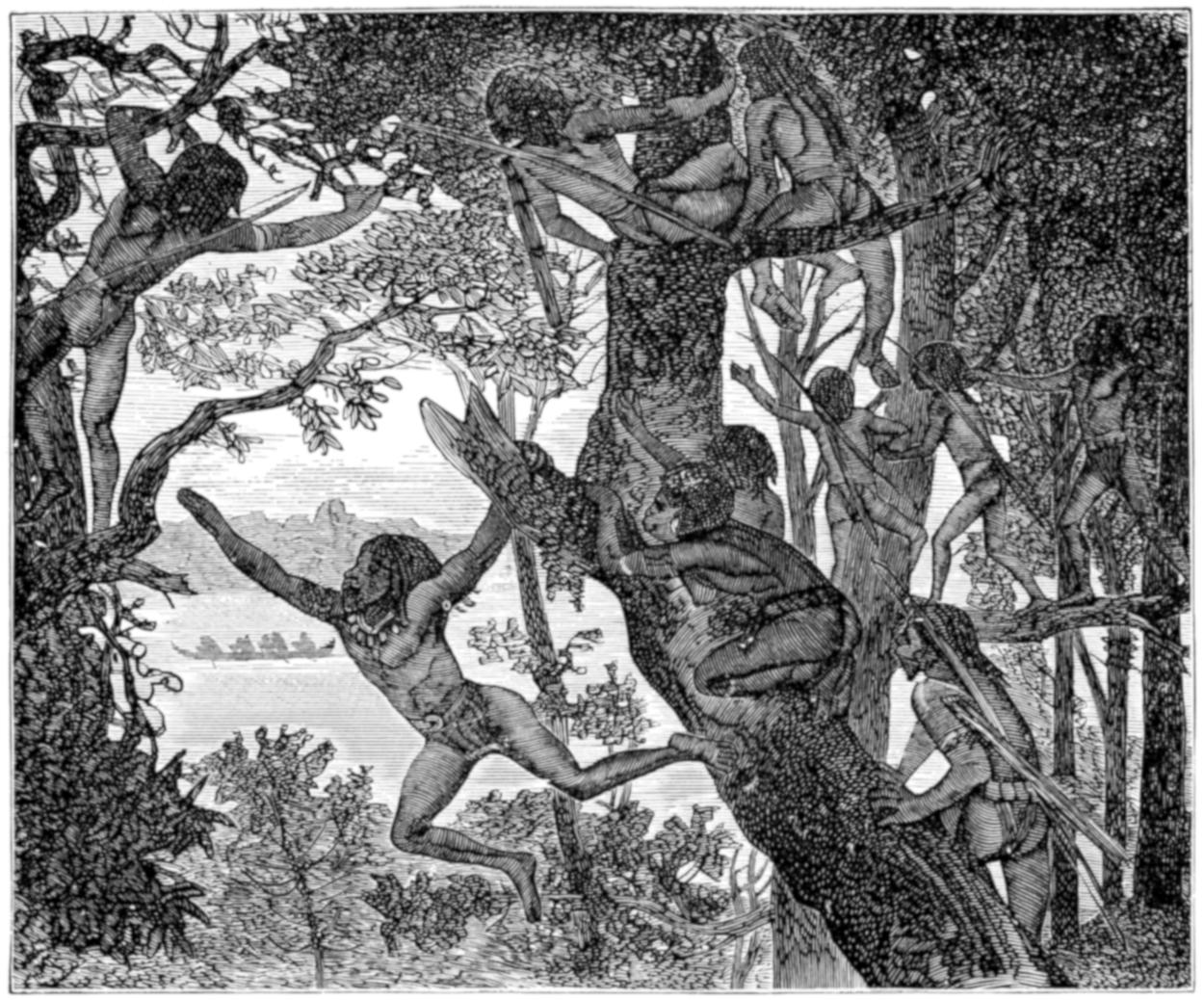
(1.) THE MONKEY MEN OF DOURGA STRAIT.
(See page 900.)
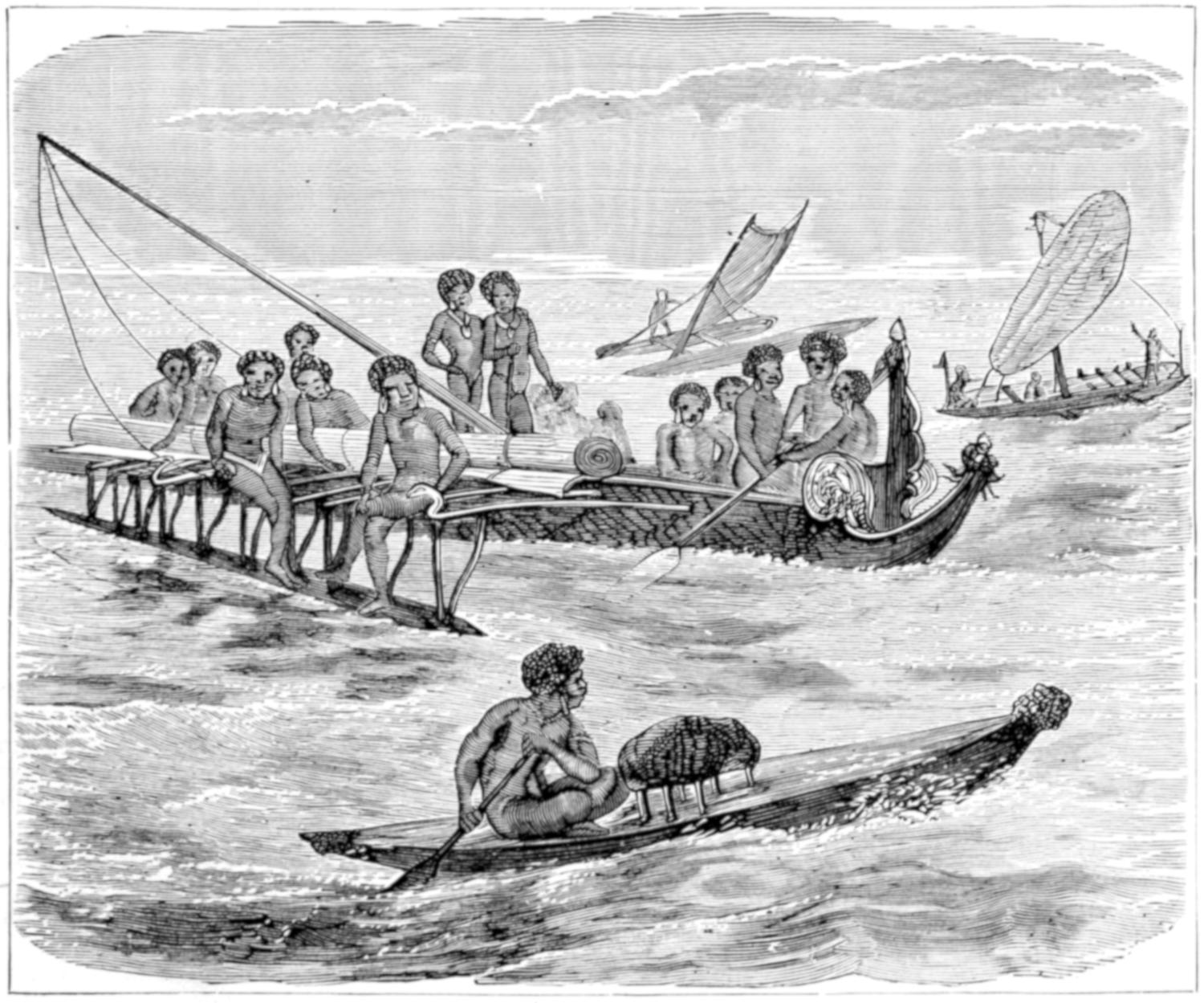
(2.) CANOES OF NEW GUINEA.
(See page 908.)
This canoe is made near Redscar Point,
and, except in the arrangement of the sail,
is somewhat similar to the vessels which are
built at Brumer Island. The paddles are
between six and seven feet in length, and
are rather clumsily formed, without any attempt
at ornament.
The canoe to the right of the illustration
is the most curious of these vessels. The
body of the canoe is made out of the trunk
of a tree, which is first shaped to a conical
form at each end, and then hollowed. Over
the ends is firmly fixed a piece of wood, several
feet in length, so as to make the two
ends into hollow cones into which the water
cannot force its way. The gunwale is raised
about two feet by planks which box in the
opening of the canoe, and act as wash-boards,
the seams being pitched and rendered water-tight.
These particulars are mentioned because
in general the natives of New Guinea are
singularly indifferent as to the amount of
water which is taken in by their canoes,
provided that they are not sunk. There is,
for example, one kind of New Guinea canoe
found in Coral Haven, in which the gunwales
are not connected at the stern, which
is left open. The water would of course
rush in, were it not that one of the crew sits
in the opening, forcing his body into it so as
to render it temporarily water-tight. Even
with this precaution it is impossible to prevent
some water from making its way between
the body of the man and the sides of
the canoe, as it heels over by the force of the
wind, and in squally weather another of the
crew is obliged to keep perpetually baling
with a large shell.
The most curious part of the canoe which
we are now examining is the sail, which,
clumsy as it looks, is a very great improvement
on those which have been previously
described, inasmuch as it can be shifted and
trimmed to suit the wind.
The mast, instead of being merely stuck
upright when wanted, is permanently fixed,
but is so short that it causes no inconvenience
when the sail is struck and the paddles
alone are employed. It is fixed, or “stepped,”
into a hole in a board at the bottom of the
canoe, and is lashed to a transverse spar that
extends across the canoe from one gunwale
to the other. At the head of the mast is a
stout projecting arm, through which is bored
a hole.
The sail is made by matting stretched between
two slight spars, and when not wanted
it can be rolled up and laid up on the platform
of the outrigger. The halyard, a rope
by which the sail is hauled to its place, is
fixed to the middle of the sail, and passes
through the hole in the projecting arm of
the mast-head. Hopes are fastened to each
end, constituting the “tack” and the “sheet.”
When the crew wish to put their canoe
about, they do so in a very expeditious manner,
merely letting go the ropes and hauling
them in again, so as to turn the sail and
convert the sheet into the tack, and vice
versâ. As both ends of the canoe are alike,
the vessel at once obeys the new impulse,
and goes off in the required direction.
The canoe is steered with one special
paddle some nine feet in length, of which
the oblong, rounded blade occupies half.
The inhabitants of the New Guinea coasts
are remarkable for their skill in swimming
and diving. When H. M. S. Rattlesnake was
off New Guinea, the anchor of one of the
boats caught in the coral, and could not be
dislodged. An old man who was standing
on the beach saw that something was wrong,
and swam off to the boat. He soon understood
the case, and, after diving several
times, succeeded in clearing the anchor, a
feat for which he was rewarded by an axe.
He always dived feet foremost, without an
effort, and remained under water for about
half a minute.
It is rather curious that the love of pigs
which is found among the New Zealanders
should be quite as strongly developed among
the natives of New Guinea. The girls and
women make great pets of them, and it is
not at all an uncommon event to see a young
girl tripping along in all the graceful freedom
of the savage, holding a young pig in her
arms, and caressing and talking to it as an
European girl talks to her doll, or to her pet
lapdog. These pigs are long-legged, black-skinned,
stiff-haired animals, not at all agreeing
with our ideas of a pig’s proper form.
The dress used by the women consists of
slender leaf-strips, and forms a really graceful
costume. Many of the women employ a
kind of tattooing, though they do not carry
it to such an extent as to disfigure themselves.
The patterns, though elaborate, are
very small and delicate, and extend over a
considerable portion of the body. The arms
and front of the body display a regular
pattern, which is usually carried over the
shoulder for a little way, but leaves the back
untouched. The most delicate pattern is
reserved for the arm and waist, where it
looks like a delicate blue lace fitting tightly
to the skin. The women are very proud of
this ornament, and are always gratified when
a stranger expresses admiration of it. The
men occasionally use the tattoo, but in a
comparatively scanty manner, confining the
patterns to a star or two on the breast. Now
and then a man will have a double series of
stars and dots extending from the centre of
the chest to the shoulders, but on an average
a native of this part of the country is not so
much tattooed as an ordinary English sailor.
The architecture of this part of New
Guinea differs from that of Dourga Strait in
being much more elaborate, but throughout
New Guinea the style of house-building is so
similar that we will take a few examples as
representatives of the whole group of islands.
All the houses are elevated on posts like
those of the Nicobar Islands, but have several
improvements in architecture.
The posts vary in number according to the
size of the house, and about four feet from
the ground each post passes through a wide
circular wooden disc, which serves as an
effectual barrier against the rats and snakes,
which would otherwise take possession of
the dwellings. The posts are connected
together at about five feet from the ground
by rafters, on which the floor is laid.
These rafters, or joists, support a row of
poles laid horizontally side by side, and
upon them are laid crosswise a great number
of slighter spars, thus forming a framework,
on which is fixed the floor itself, which consists
of a number of thin planks taken from
the cocoa-nut tree. The supporting posts
are about ten feet in total length, and are
connected at their tops by horizontal poles,
on which a second or upper floor is fixed,
precisely similar to the principal floor, though
much smaller. On this upper floor are kept
the weapons, implements, provisions, and
similar articles, for which accommodation
cannot be found on the principal floor. A
supply of water, for example, is generally
kept in the huts, a number of empty cocoa-nut
shells being used in lieu of bottles, and
closed at the orifice by a plug of grass. In
fact, they are identical in principal with the
ostrich-egg vessels of the South African
savage, which have been already described
upon a preceding page.
Entrance is gained to the house by a square
hole in the flooring, and the primitive staircase
by which the inhabitants ascend into
their houses is equally simple and effectual.
It is necessary that the stairs—if we may
use the term—should be so constructed, that
while human beings can easily obtain access
to the house, the rats and other vermin shall
be kept out. If an ordinary ladder or even
a notched pole were fixed to the house, the
rats and snakes would be sure to climb up
it and take possession of the dwelling. The
native architect, therefore, proceeds after a
different fashion.
Immediately under the opening in the floor
he fixes two stout posts in the ground, leaving
them to project rather more than three feet.
The posts have forked heads, and upon them
is laid a transverse pole, which is firmly lashed
to them. From this transverse pole another
pole is laid to the ground, so as to form an
inclined plane up which the inhabitants of
the house can walk. It will now be seen,
that if a man walk up the inclined pole, to
the transverse one, he can pass along the latter
in a stooping attitude until he comes to the
opening in the floor. He can then pass his
body through the opening and lift himself to
the level of the floor, while the space which
intervenes between the horizontal post and
the floor affords an effectual barrier against
the rats and other vermin.
The reader will better understand this
description by comparing it with illustration
No. 1, on the 916th page, which represents
three of these huts. That on the right
is seen from the end, and is represented as
half finished, in order to show the structure
of the interior.
The sides and roof of the hut are formed
of slight spars which are lashed together by
a framework, so as to form a support for the
thatching. This is made of coarse grass
pulled up by the roots in large tufts, and
covered with an outer layer of cocoa-nut
leaves. If the house be a large one, there is
an entrance at each end, and another in the
middle, each being closed with neatly woven
mats. Similar but coarser mats are fastened
to the lower portion of the sides, in order to
exclude the wind.
Up to this point the architecture is identical
throughout the island, but a divergence
takes place in the shape of the house itself,
according to the locality. The usual form is
that which is represented in the illustration.
Such a house as is there drawn is on the
average thirty feet in length, nine in width,
and thirteen in total height, so that a space
of about three feet intervenes between the
upper floor and the roof. The central
figure of the illustration shows the side
view of a finished hut, and the left-hand
figure shows the end view of a similar dwelling.
In some places, however, such for example
as Redscar Bay, the form of the houses is
different. Instead of having the slender
poles which form the framework of the walls
bent over in a curved form, they are arranged
so as to make a lofty and sharply-pointed
gable roof. A house of this description,
which measures thirty feet in length, will
reach, on an average, twenty-five feet in
height. There is no distinction between the
roof and walls of the huts, except that the
lower portion of the roof is covered with
sheets of a bark-like substance, which is supposed
to be the base of the cocoa-nut leaf
flattened by pressure. The entrance or door
of these huts is at one end, and is covered
with a mat as has already been mentioned.
Access is obtained by a sloping pole resting
on a short post. In some of these huts a
number of spears were seen in the interior,
lashed along the sides, together with several
human skulls; but whether the latter were
intended as ornaments, or whether they were
preserved in memorial of the dead owners,
is not certain.
The people who inhabit Redscar Bay and
its vicinity exhibited a curious mixture of
shyness and confidence. They came freely
to the ships as they anchored in the bay,
and were very anxious to be admitted on
board, peeping into the ports in the most
inquisitive manner, and holding up their
weapons and implements for sale. They
have in use a rather remarkable arrow, with
a head in the form of a pointed gouge or
scoop.
One of these arrows is in my collection.
The shaft is made in the usual manner from
a reed, and is weighted at one end with a
piece of hard and heavy wood. Into this
wooden tip is cut a deep groove, into which
slips the butt of the head. This is about
eight inches in length, and is made of bamboo,
the reed being nearly cut away so as to
leave a piece rather more than half an inch
in width in the middle, and tapering gently
to one end so as to form a point, and abruptly
to the other end in order to form a butt which
can be slipped, into the wooden tip of the
arrow.
Bamboo scoops of a similar description,
but of a larger size, are used as knives,
and are sharpened by the simple process of
biting off a piece of the edge. When Mr.
M’Gillivray visited New Guinea, he asked
a native the use of the bamboo scoop; and
when he found that it was used as a knife,
he produced his own knife, and, taking up a
piece of wood, he showed the superiority of
steel over bamboo by cutting a stick vigorously
with it.
Strangely enough, instead of being gratified
with the performance of the knife, the
man was so frightened that he pushed off
his canoe, called his friends around him, and
explained to them the terrible deed that had
been done. The knife was offered to him,
but he looked upon the proffered gift as an
aggravation of the original offence, and declined
all overtures toward reconciliation.
This aversion to steel was found to be prevalent
among the inhabitants of this part of
New Guinea.
The bow by which these arrows are propelled
is a very effective though clumsily
made weapon. My own specimen is about
six feet in length, and is made from some
hard and tough wood, apparently that of the
cocoa-nut tree. It is very stiff, and requires
a strong arm to draw it. The string is a
strip of rattan, like that which has already
been mentioned when treating of North
Australia.
Passing to the north-west of the island,
we find that their appearance and manners
are not very dissimilar from those which belong
to their brethren of the southern coast.
Taking the Dory people as our type, we find
that they often display good examples of
the high and narrow forehead of the Papuan
family, and many of them have narrow and
arched noses, together with lips nearly as
thin as those of an European. Indeed, some
of these natives possess a cast of countenance
which is so like that of an European
that several travellers have thought that
there must have been some admixture of
foreign blood. Such, however, is not the
case, these peculiarities belonging to the individual,
and not implying any foreign mixture.
The canoes of this part of the country are
rather different from those of the southern
coast. The mast is made of three distinct
spars, united at their tops. Two of them
are fastened to the side by pins passing
through them, on which they work backward
and forward, as if on hinges. The
third is not fastened to the vessel, but its
butt fits into a cavity from which it can be
removed at pleasure. If, therefore, the natives
wish to use their paddles, all they have
to do is to lift the foot of this spar out of its
socket, when the whole of the triple mast
can be lowered on deck. When the wind
becomes favorable, and the sail is to be employed,
the masts are raised again, the butt
of the third spar is stepped into its socket,
and the triple mast is thus kept firmly upright.
A similar contrivance is now proposed
for our ships of war, as these triple
masts made of three slight iron bars cannot
be so easily shot away as the single and solid
mast.
The natives are very expert canoe-men,
and are accustomed to the use of their vessels
from childhood. Even the small boys
have their little canoes, which are so light
that they can be carried to and from the
water without difficulty.
They excel as fishermen, being as expert
in the water as on it. The trepang fishery
is energetically conducted by them, as it is
by the sale of trepang to the merchants that
they obtain the greater part of the foreign
luxuries on which they set so high a value.
The hawksbill turtle is captured principally
for the sake of the shell, which is also purchased
by the traders, and, together with
mother-of-pearl shell, is mostly sent to the
Chinese markets.
The mode of fishing with a net is much
the same as on all these coasts. The net is
three or four feet in depth, and a hundred
feet or more in length. The meshes are
about an inch in width. One edge is furnished
with a row of flat pieces of light wood,
which act as floats, and along the other edge
are fastened a number of perforated shells by
way of weights.
When the natives wish to use this net,
they place it in a canoe, and look out for
a shoal of fish. As soon as a favorable opportunity
is found, the canoe is taken to seaward
of the shoal, and let carefully into the
water. Each end is taken in charge by one
or two men, who bring the net round the
shoal in semi-circular form, so as to enclose
the fish. These men gradually approach each
other, while another man beats the water
with a pole, or flings stones into it, so as to
frighten the fish into the enclosure. As soon
as the two ends of the net have been brought
together, the canoe comes up, and the net,
with the fish hanging in its meshes, is hauled
on board. They also use fish-traps, like
those which have been already described in
the account of Australia, sinking them by
means of a stone, and raising them by a
cord, to the end of which a bamboo buoy is
fastened.
They are tolerable smiths, and have a
kind of bellows identical in principle with
those of savage Africa, but worked in a different
manner. Instead of having a couple
of inflated skins, they have a pair of wide
bamboo tubes, about four feet in length, the
lower ends of which are buried in the earth,
and connected by means of channels with
the hole in which the fire is made. The
pistons are formed of bunches of feathers tied
to bamboos, and the blower works them alternately
up and down, so as to produce a
tolerably constant blast. It is remarkable
that the bellows of the Chinese itinerant
jeweller are fitted with feather pistons. It
is most probable that these bellows have
been borrowed from the more eastern
islands.
As to the actual working of the metal, it
bears a curious similitude to that which is
employed in savage Africa. The anvil is
generally a stone, unless the native smiths
can procure an iron “pig” or a piece of a
broken anchor. They can work in silver
and copper as well as iron, melting the two
former metals and running them into moulds,
to be afterward beaten and worked into
shape.
The architecture of these tribes is rather
remarkable. Like the generality of houses
in New Guinea, the huts are raised on
stakes in order to preserve them from vermin;
but those of the Dory people are similarly
elevated in order to preserve them
from water. These natives have a curious
predilection for building their huts on the
sea-shore, and place them below the level of
low water. They begin this curious style
of architecture by building a long pier, or
rather jetty, which extends far into the sea,
and which keeps open a communication
between the house and the shore.
At the end of this jetty the hut itself is
situated, and is made of boarded walls and
a thatched roof. Great as is the labor that
is bestowed upon it, the house does not
come up to our ideas of comfort. In the
first place, the floors are made of rough
spars, placed parallel to each other, but still
far enough apart to cause some uneasiness,
not to say danger, to an unpractised walker.
A good specimen of a Dory house is
about seventy feet long, twenty-five wide,
and fifteen high. Along the centre runs a
tolerably wide passage, and at either side
are a number of rooms, separated from each
other and from the passage by mats. At
the end next the sea there are no walls, but
only a roof, so that a sort of verandah is
formed, under which the inhabitants spend
much of their time when they are not
actively employed. Such a house as this is
usually occupied by some forty or fifty individuals,
consisting of about twenty men,
together with the wives and families of
those who are married. All cooking is carried
on by the different families in their
own chambers, each of which is furnished
with its own fireplace.
The dress of the Dory natives varies
but little from that of other Papuans of
New Guinea. The men, however, often
ornament their bodies with raised scars like
those of the Australians, and they are fond
of tattooing their breasts and arms with
figures of their weapons. They are fond of
ornaments, such as shells, twisted wire, and
armlets of plaited rattan. They ingeniously
utilize the latter ornament by plaiting a
very thick and strong bracelet, and wearing
it on the left wrist and fore-arm, so as to
protect the wearer from the recoil of the
bowstring.
Though not a warlike people, they always
go armed, carrying the invariable parang,
or chopper, which, as its very name imparts,
is procured from the Malay tribes. These
parangs are chiefly made in Borneo, as we
shall see when we come to treat of the
Dyaks. The Dory Papuans do not seem to
fight, as do some savage tribes, for the mere
love of combat; the chief object of warfare
being the capture of slaves, each of whom
is valued at fifty shillings.
This value is, however, a conventional
term; and when a bargain is made with the
Dory people for so many slaves, in most
cases the conventional money value is intended,
and not the actual slaves. In fact,
the word “slaves” is used much as we use
the word “horses” in reckoning the power
of a steam-engine, or “tons” in describing
the capacity of a ship. Perhaps the words
“pony” and “monkey,” of modern sporting
slang, are better illustrations.
Still, slavery is rife among the Dory people,
who sometimes make a raid into a district,
capture a village, and carry off the
inhabitants into servitude. They do not,
however, treat their captives badly, but feed
them well, and seem to consider them
partly in the light of domestic servants, and
partly as available capital, or as a means of
exchange when any of their own friends
are taken prisoners by hostile tribes.
The government of the Dory tribes is
nominally a delegated chieftainship, but in
reality a sort of oligarchy. There is a certain
dignitary, called the Sultan of Tidore,
under whose sway this part of the country
is supposed to be, and from him the chief of
the Dory tribes receives his rank. When
the chief dies, one of his relatives goes to
convey the news to the Sultan, taking with
him a present of slaves and birds of paradise
as tokens of allegiance. This man is
almost always appointed to the vacant place,
and is bound to pay a certain tribute of
slaves, provisions, and war canoes, the latter
being employed in collecting the Sultan’s
taxes. Should he fail to comply with these
conditions, his village would be attacked by
the Sultan’s fleet, and the whole district ransacked;
so that the position of chief has its
anxieties as well as its privileges.
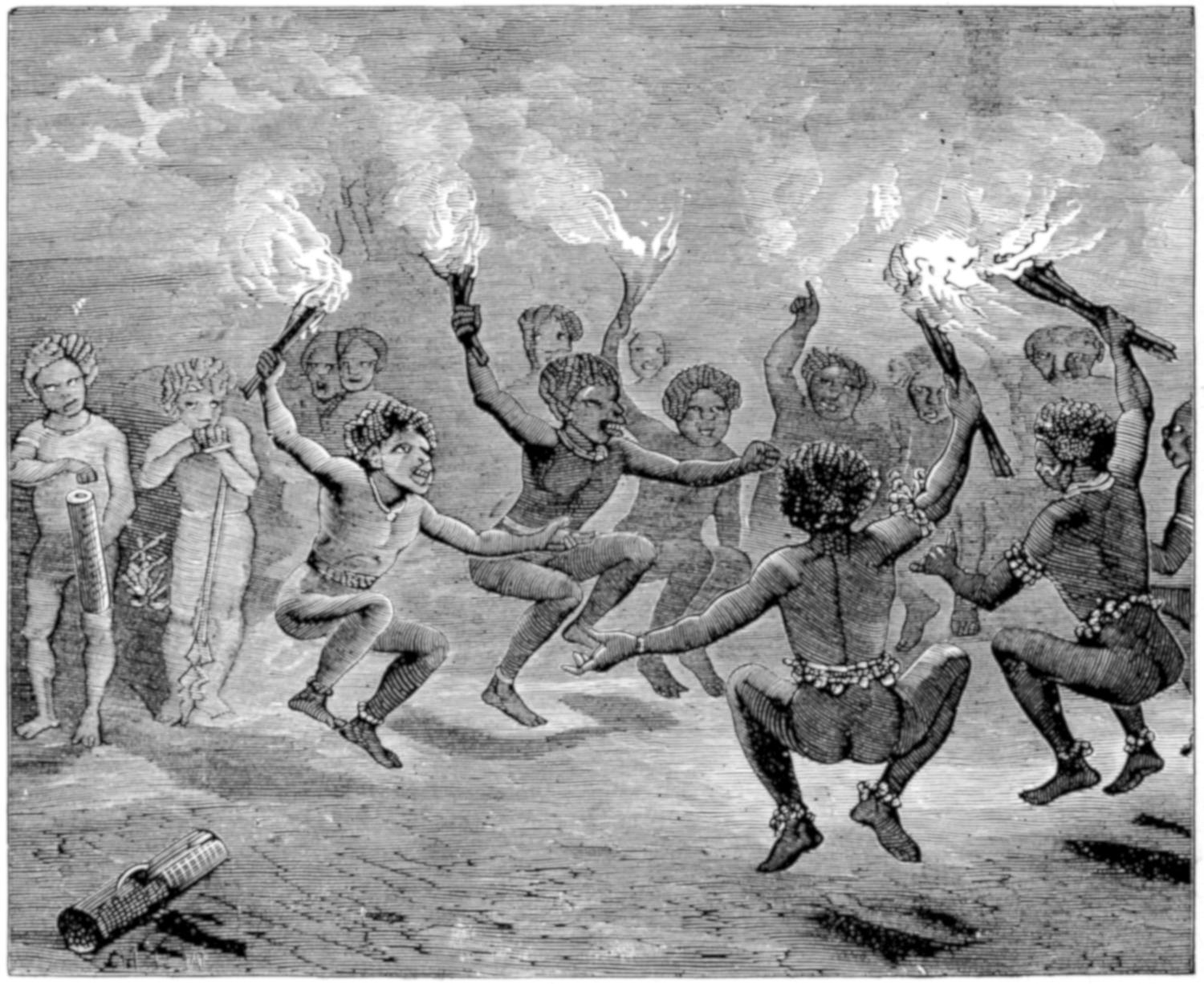
(2.) DANCE BY TORCHLIGHT, NEW GUINEA.
(See page 917.)
His authority is more nominal than real,
for he decides nothing but unimportant
matters, leaving more weighty subjects to a
council of elders, who, as a rule, administer
justice with impartiality. Their laws are
really good and sensible, and, though
lenient, are based on the principle of the
old Jewish law, the eye for the eye and the
tooth for the tooth.
Marriages are managed in a very simple
manner, the bride and bridegroom sitting
opposite each other, in front of an idol, and
the former giving the latter some betel-leaf
and tobacco. His acceptance of the present,
and taking the hand of the giver, constitute
the whole of the ceremony.
The idol which has been mentioned is
called the Karwar, and is found in every
house except those which belong to
Mohammedan natives. The Karwar is a
wooden figure, about eighteen inches in
height, large-headed, wide-mouthed, and
long-nosed,—this peculiarity of the Papuan
face being exaggerated. It is represented
as holding a shield, and wearing a calico
wrapper on the body and a handkerchief on
the head.
The Karwar plays an important part in
the life of a Dory native. It is present at
his birth, takes part in his funeral, and, as
we have seen, is witness to his marriage.
In all cases of perplexity the Karwar is
consulted, the devotee stating his intentions,
and abandoning them if he should
feel nervous, such a sensation being supposed
to be the Karwar’s answer. There
are plenty of fetishes, but these are only
supplementary to the Karwar.
Without going into the details of the
various tribes which inhabit this part of the
earth, we will glance at a few of the most
interesting customs.
These Papuans have a strong love for
flowers, especially those which possess a
powerful scent. They twine such flowers
in their hair, weave them into garlands for
their necks, and carry them in their bracelets
and armlets.
They are fond of singing and music, and,
as far as has been ascertained, are in the
habit of composing extempore songs, as well
as singing those ditties which they know by
heart. As for their musical instruments,
they consist chiefly of the cylindrical drum,
a trumpet made of a triton shell, and a sort
of Pandean pipe, composed of six or seven
reeds of different lengths lashed firmly together.
There is also a wind instrument,
which is nothing but a bamboo tube some
two feet in length.
Accompanied by these instruments, they
perform their curious dances, one of which
as been well described by Mr. M’Gillivray.
“They advanced and retreated together by
sudden jerks, beating to quick or short time
as required, and chanting an accompanying
song, the cadence rising and falling according
to the action. The attitude was a singular
one—the back straight, chin protruded,
knees bent in a crouching position,
and the arms advanced.
“On another occasion, one of the same
men exhibited himself before us in a war
dance. In one hand he held a large wooden
shield, nearly three feet in length, and
rather more than one in width, and in the
other a formidable looking weapon, two feet
in length—a portion of the snout of the
sword-fish, with long, sharp teeth projecting
on each side. Placing himself in a
crouching attitude, with one hand covered
by the shield, and holding his weapon in a
position to strike, he advanced rapidly in a
succession of short bounds, striking the
inner side of his shield with his left knee
at each jerk, causing the large cowries hung
round his waist and ankles to rattle violently.
At the same time, with fierce gestures,
he loudly chanted a song of defiance.
The remainder of the pantomime was expressive
of attack and defence, and exultation
after victory.
“But a still more curious dance was once
performed a few nights ago by a party of
natives who had left the ship after sunset,
and landed abreast of the anchorage. On
seeing a number of lights along the beach,
we at first thought they proceeded from
a fishing party, but on looking through a
night-glass the group was seen to consist of
above a dozen people, each carrying a blazing
torch, and going through the movements
of the dance. At one time they
extended rapidly into line, at another closed,
dividing into two parties, advancing and
retreating, crossing and recrossing, and
mixing up with each other. This continued
for half an hour, and, it having apparently
been got up for our amusement, a rocket
was sent up for theirs, and a blue light
burned, but the dancing had ceased, and
the lights disappeared.”
An accompanying illustration represents
this wild and curious scene. In the foreground
are the dancers, each with his torch
in his hand, and indulging in the grotesque
movements of the dance. To the left are
seen the musicians, one playing on the bamboo
pipe, and the other beating the drum
which has before been mentioned. One of
these drums is lying in the foreground. It
is a hollow cylinder of palm wood, about two
feet in length and four inches in diameter.
One end is covered with lizard-skin, and
along the side there run longitudinal slits.
The native name for this drum is “baiatú.”
The funeral ceremonies appear to differ
according to the locality. Among the Dory
people, when a man dies, the body is rolled
in white calico, and laid on its side in a
grave, its head resting on an earthenware
dish. The weapons and ornaments of the
dead man are laid in the grave, which is
then filled up, and a thatched roof erected
over it.
Should the deceased be a head of a family,
the Karwar is brought to perform its last
duties. When the man is buried, the Karwar
is placed near the grave, and violently
execrated by all the mourners for allowing
its charge to die. The thatched roof being
finished, the idol is laid upon it, and idol
and roof are left to decay together. As is
usual with savage tribes, funeral feasts are
held at the time of burial and for some days
afterward, those which celebrate the deaths
of chiefs being kept up for a whole month.
CHAPTER XCII. THE PHILIPPINE ISLANDS. THE AJITAS, OR AHITAS.
POSITION AND DIMENSIONS OF THE PHILIPPINE ISLANDS — THE MALAYS AND THE NEGRITOS, OR AJITAS — RESEMBLANCE
TO THE BOSJESMAN — THE BOW AND POISONED ARROWS — SKILL IN ARCHERY — THE
SAVAGE INSTINCT — MEETING A PARTY OF AJITAS — THEIR APPEARANCE, AND CHIRPING
SOUND OF THEIR LANGUAGE — CONCILIATING THE ABORIGINES — GOVERNMENT OF THE AJITAS — THEIR
ACTIVITY IN HUNTING — NOMADIC PROPENSITIES OF THE AJITAS — REVERENCE FOR THE
DEAD — A QUARREL, AND ITS CAUSE.
To the north-west of New Guinea lie several
islands, which are grouped together
under the general name of Philippines.
They consist of a considerable number of
islands, of which the northern island, called
Luza, and the southern island, called Magindano,
are by far the largest.
The inhabitants of the Philippines are of
two kinds; namely, the Malays and the
Negritos. The former are evidently not
the aboriginal inhabitants, but have voyaged
to the islands in their canoes and
formed a number of settlements. As in the
course of the work we shall see much of the
Malay race, we will pass them by for the
present, and only notice the Negritos, or
little negroes, so called by the Spanish on
account of their dark skins and small size.
This strange little race is mostly known
by a name which is given in different forms.
By some writers it is spelt Ajitas, by some
Ahitas, and by others Itas. Of these different
forms I select the first, which, by the
way, is pronounced as if it were spelled
Aheetas.
The Ajitas are quite as small as the Bosjesmans
of Southern Africa, their average
height being four feet six inches. They are
well shaped, and their skins, though of a very
dark hue, are not so black as those of the
negro tribes. The features are tolerably
good, except that the nose is broad and
rather flat, and that there is a marked deficiency
of chin. The hair is woolly, like that
of other Papuans, and, as they do not know
how to dress it, they wear it in a sort of mop
round the head. The eyes are remarkable
for a decided yellow tinge.
In common with other savages who lead
an uncertain kind of life, fasting sometimes
for two days together, and then gorging
themselves like wolves, they are apt to have
their limbs and projecting stomachs with a
recurved back such as is the case with the
Bosjesman, the back being bent like the
letter S. Their shape is in no way concealed
by their dress, which is nothing more
than a wide belt of plaited bark fastened
round the waist.
In many respects there is a great similarity
between the Bosjesman and the Ajita.
The latter live by the chase and by plunder,
having no idea of agriculture. They always
go armed, their weapons being bamboo
lances and bows and arrows, the latter
being poisoned. The effect of the poison
with which they are tipped is to produce an
unextinguishable thirst in the animal, which
seeks the nearest water, drinks, and dies.
As soon as it is dead, the hunter cuts away
the flesh from around the wound, as the
poison would otherwise communicate so
bitter a taste to the whole carcass that the
flesh could not be eaten.
Their bows are but slight, as are their arrows,
the poison doing the work of death,
and the depth of the wound being of no consequence.
They are skilful archers, having
the bow and arrow in their hands from infancy,
and practising at any object that may
take their attention. Both sexes use the
bow, and the little boys and girls are fond of
wading along the banks of streams and shooting
the fish.
Like the Bosjesman, the Ajita is always
at feud with the other races that inhabit
the same country, and, small as he is, makes
himself dreaded by reason of his poisoned
weapons. Sometimes Ajitas are taken prisoners,
and are generally enslaved. As they
are light, active, and not bad-looking, they
are often employed as servants by the dignitaries
of Manilla.
One of these people was in the household
of an Archbishop of Manilla, and was educated
by him with great care. To all appearance
he was thoroughly civilized, and
at last was ordained priest. But the instincts
of his savage nature were too strong
for him, and the man escaped from his position
and civilized society, threw off his garments,
and rejoined his savage relatives.
Such instances are continually occurring,
and it is almost impossible to retain an Ajita
in civilized society, no matter how well he
may be treated, or how young he may be
when captured.
The habits of the Ajitas are essentially of
a savage character, and, as a rule, travellers
in the Philippines are obliged to be very
careful lest they should suddenly be set
upon by these dangerous little creatures.
Sometimes, however, they can be gentle,
and even hospitable, and an instance of such
conduct is related by M. de la Gironière,
part of whose narrative has been translated
and quoted by Mr. Earle: “We directed
our course toward the north, among mountains
always covered with thick forests, and
which, like those we had just quitted, presented
no traced route, excepting a few narrow
pathways beaten by wild beasts. We
advanced with caution, for we were now in
the parts inhabited by the Ajitas. At night
we concealed our fires, and one of us always
acted as sentinel, for what we feared most
was a surprise.
“One morning, while pursuing our way
in silence, we heard before us a chorus of
squeaking tones, which had more resemblance
to the cries of birds than to the human
voice. We kept on our ground, concealing
our approach as much as possible
with the aid of the trees and brambles. All
at once we perceived at a little distance
about forty savages, of all sexes and ages,
who had absolutely the air of animals. They
were on the banks of a rivulet, surrounding
a great fire. We made several steps in advance,
and presented the butt-end of our
guns toward them. As soon as they perceived
us, they set up shrill cries and prepared
to take to flight; but I made signs to
them, by showing them some packets of cigars,
that we wished to offer them for their
acceptance.
“I had fortunately received at Binangonan
all the instructions necessary for knowing
how to open a communication with
them. As soon as they comprehended us,
they ranged themselves into a line, like men
preparing for a review; this was the signal
that we might approach. We went up to
them with our cigars in our hands, and I
commenced distributing them from one extremity
of the line. It was very important
that we should make friends with them, and
give each an equal share, according to their
custom. The distribution being over, an alliance
was cemented, and peace concluded,
when they commenced smoking.
“A deer was hanging to a tree, from
which the chief cut three large slices with a
knife of bamboo, and threw them upon the
fire, and, drawing them out an instant afterward,
presented a piece to each of us. The
exterior was slightly burned and sprinkled
with ashes, but the interior was perfectly
raw and bloody. It would not do, however,
to show the repugnance I felt at making a
repast scarcely better than that of a cannibal,
for my hosts would have been scandalized,
and I wished to live in good correspondence
with them for some days. I
therefore ate my piece of venison, which,
after all, was not ill flavored, and my Indian
having followed my example, our good repute
was established, and treason on their part
no longer possible.”
M. de la Gironière showed his wisdom in
accommodating himself to circumstances,
and in sacrificing his own predilections in
favor of expediency; and if all travellers had
acted in a similar manner, we should have
known much more of savage manners and
customs than we do at the present time.
After propitiating his little black hosts by
tact and kindness, he remained among them
for some time, and by means of an interpreter,
whom he was fortunate enough to obtain,
continued to procure a considerable
amount of information concerning a people
of whom scarcely anything had been previously
known since their existence.
The Ajitas live in small tribes, consisting
of some fifty or sixty individuals. They
have no fixed residence, but wander about
the country according to the amount of game
which they find. They have not the least
notion of house-building, and in this respect
are even below the aborigines of Australia,
and at night they crowd round the
fire and lie as close to it as possible. This
fire is the central point of the tribe, the old
people and children assembling round it during
the day while the adults are hunting for
game; and if the hunters should be able to
bring in enough food to last for some days,
they remain round the fire until it is all consumed.
There seems to be no particular form of
government among the Ajitas, who always
choose one of the oldest men to be the chief
of each little tribe, and do not acknowledge
any principal chief or king. Age is respected
among them, and in this point the
Ajitas show their superiority over many
savage tribes. The language of the Ajitas
is said to resemble the chirping of birds
rather than the voice of mankind, but it
must be remembered that the same was said
of the Bosjesmen’s language when European
travellers first came among them. Any
language which is heard for the first time
affects the ear unpleasantly, and even those
of Europe are generally stigmatized by foreigners
as gabbling or grunting, according
to the pitch of the voice. Of the structure
of the Ajitas’ language nothing is yet
known.
In one point they are superior to many
savage people. A man has but one wife,
and both are faithful in the married state.
When a young man wishes to marry, he
asks the consent of her parents, who, on a
fixed day, send her into the woods alone
before sunrise, and after an hour the young
man goes after her. If he can find her, and
bring her back before sunset, the marriage
is acknowledged; but if he cannot succeed
in his search, he must yield all claims to
her. It will be seen that the real choice
lies with the girl, who can always conceal
herself if she dislikes the intended bridegroom,
or, even if he did find her, could
refuse to come back with him until the stipulated
time has passed.
The religion of the Ajitas seems to be, as
far as can be ascertained on a subject from
which a savage always shrinks, a mere
fetishism; any object, such as an oddly-shaped
tree trunk or stone, being worshipped
for a day, and then forsaken in favor of some
other idol.
Any real reverence in the nature of the
Ajitas seems to be given to the dead, whom
they hold in veneration. Year after year
they will resort to the burial-places of their
friends for the purpose of laying betel-nut
and tobacco upon the grave. Over each
spot where a warrior is buried his bow and
arrows are hung, the Ajitas having an idea
that at night the man leaves his grave, and
hunts until the morning. Owing to this
reverence for the dead, M. de la Gironière’s
expedition nearly came to a fatal termination.
They had succeeded in procuring a
skeleton from the burial-place, when the
theft was discovered by the Ajitas, who at
once set upon them, and fairly chased them
out of their country, the poisoned arrows
proving to be weapons too formidable to be
resisted, especially when used by foes as
active as monkeys, who could pour their
arrows on their foes, while they scarcely
exposed an inch of their little dark bodies to
the enemy.
It is owing to another form of this veneration
for the dead that travellers have so
often come in collision with the Ajitas.
When a warrior dies, his companions are
bound to take their weapons and roam
through the country, for the purpose of
killing the first living thing that they meet,
whether man or beast. As they pass along,
they break the boughs in a peculiar manner
as warnings to others, for even one of their
own tribe would be sacrificed if he fell in
their way. Travellers from other countries
would either fail to see, or, if they saw, to
understand, the meaning of these little
broken twigs, and in consequence have
been attacked by the Ajitas, not from any
unfriendly feelings, but in fulfilment of a
national custom.
CHAPTER XCIII. FIJI. APPEARANCE AND DRESS OF THE FIJIANS.
POSITION OF THE FIJI ISLANDS — GENERAL APPEARANCE OF THE NATIVES — THEIR PECULIAR HAIR,
AND VARIOUS MODES OF DRESSING IT — HAIR-DYES — THE FIJIAN MIRROR — WIG-MAKING — THE
AMBASSADOR AND HIS MESSAGE — THE FIJIAN TURBAN — WATER-PROOF HEADDRESSES — DRESS
OF THE FIJIANS — THE “MASI,” AND METHOD OF WEARING IT — EAR-ORNAMENTS — NECKLACES
AND FLOWERS — TATTOOING AND PAINT — PATTERNS USED FOR THE FACE — DRESS OF THE WOMEN — THE
ROUGHNESS OF THE SKIN AND USE OF PAINT — HAIR-DRESSING — MAKING MASI AND MODE
OF PRODUCING PATTERNS — INGENIOUS MODE OF STENCILLING — THE WOMAN’S APRON, OR “LIKU,”
AND MODE OF WEARING IT.
To describe the inhabitants of all the multitudinous
islands of Polynesia would be an
agreeable, but impossible task, our space
confining us within limits which may not be
transgressed. We will therefore pass at
once to the large and important group of
islands which is popularly known by the
name of Fiji.
This group of islands lies due north of
New Zealand, and to the eastward of New
Guinea, so that they are just below the
Equator. The collective name of the
islands has been variously given, such as
Fiji, Beetee, Feegee, Fidge, Fidschi, Vihi,
and Viti. Of all these names, the first and
the last are correct, the northern portion of
the islands being known as Fiji, and the
southern as Viti. The reader must remember
that these names are pronounced as if
written Feegee and Veetee.
The inhabitants of Fiji are a fine race of
savages, tolerably well formed, and with
dark, though not black skin. Like other
Papuans, they are remarkable for their
thick, bushy hair, which they dress in a
singular variety of patterns. As the appearance
and costume of savage races are the
first points which strike a stranger, we will
at once proceed to describe them.
The most conspicuous part of a Fijian’s
general appearance is his headdress, in the
arrangement of which he gives the reins to
his fancy, and invents the most extraordinary
variations of form and color. Examples
of the Fijian headdress will be seen in
most of the illustrations. But as it would
be tedious to describe them as they occur, I
will mention a few of the most prominent
varieties.
The hair of the Papuan race is always
stiff, wiry, and plentiful, and grows to a considerable
length; so that it necessarily assumes
a bushy form if suffered to grow
according to its own will. The Fijian, however,
thinks that nature is to be improved
by art, and accordingly lavishes all the
resources of a somewhat artistic character
on his hair. To train the hair into any of
the graceful and flowing methods which distinguish
those soft-haired races would be
utterly impossible for a Fijian. He goes on
quite the opposite principle, and, true to real
artistic feeling, tries to develop to the utmost
those characteristics which rightly belong to
him, instead of endeavoring to produce effects
which would not be consonant with
their surroundings.
The principle on which a Fijian coiffure is
arranged is, that every hair is presumed to
grow naturally at right angles to the skin,
and to stand out stiffly and boldly. Supposing,
then, that each hair could be induced
to follow its own course, without being entangled
by others, it is evident that the whole
head of hair would form a large globular
mass, surrounding the face. It is, therefore,
the business of the Fijian hair-dresser to
accept this as the normal form of the hair,
and to change or modify it as he thinks best.
It is impossible to describe the various
modes of Fijian hair-dressing better than has
been done by Mr. Williams, who resided in
Fiji for thirteen years. “Most of the chiefs
have a hair-dresser, to whose care his
master’s hair is intrusted, often demanding
daily attention, and at certain stages of progress
requiring several hours’ labor each day.
During all this time, the operator’s hands are
tapu from touching his food, but not from
working in his garden.
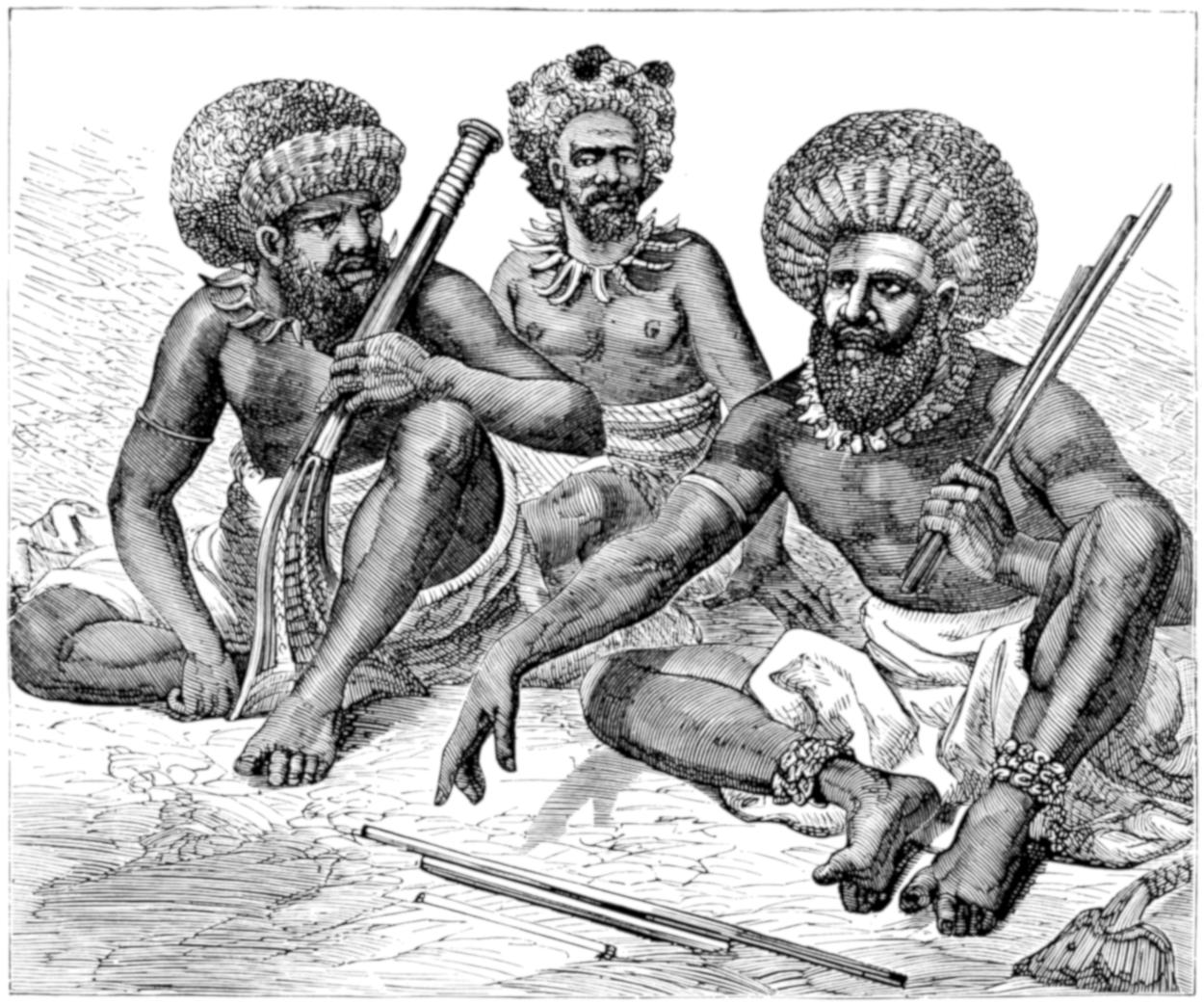
(1.) THE AMBASSADOR’S MESSAGE.
(See page 925.)
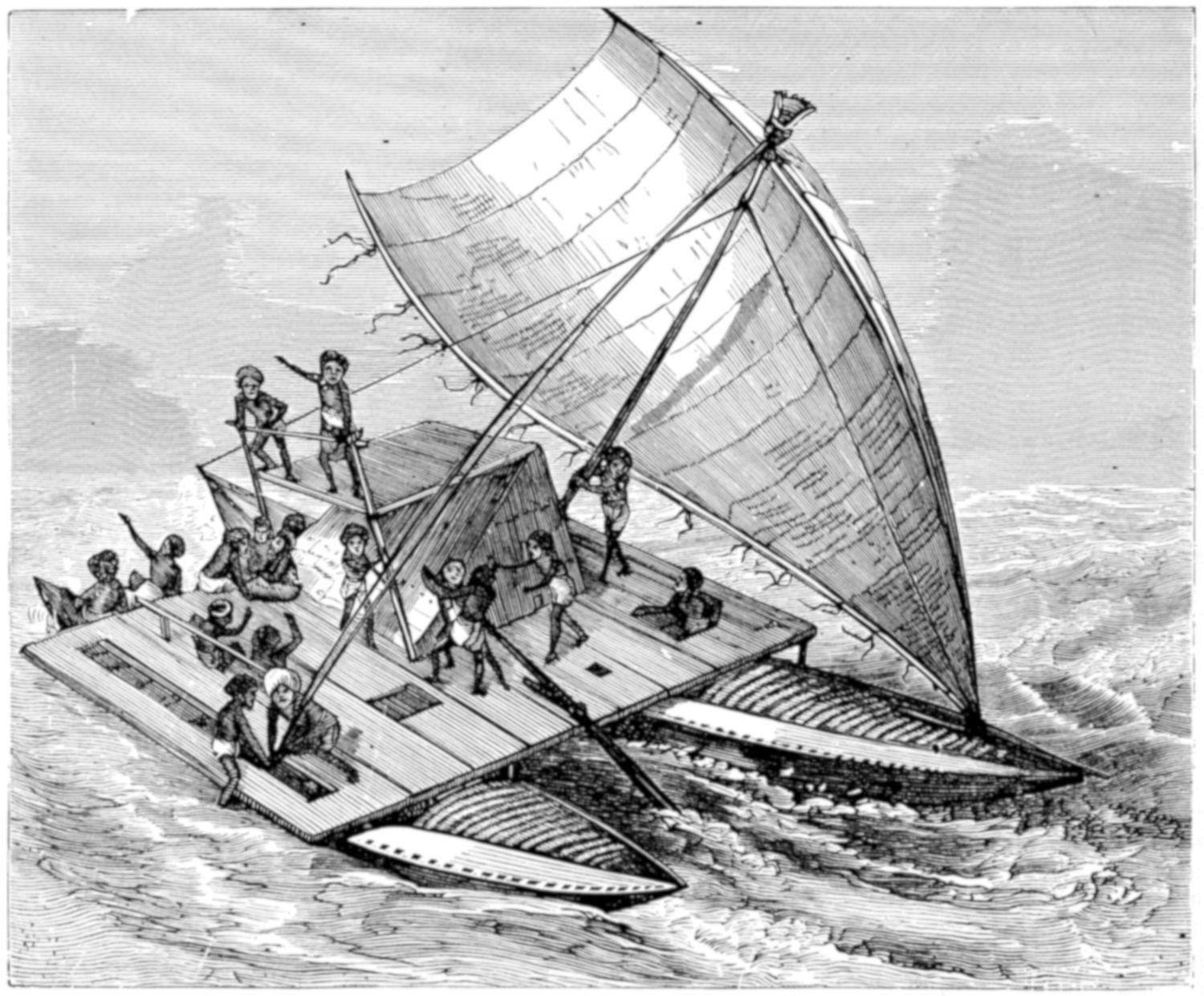
(2.) FIJIAN CANOE IN A BREEZE.
(See page 932.)
“The hair is strong, and often quite wiry,
and so dressed that it will retain the position
in which it is placed, even when projecting
from the head a distance of six or eight
inches. One stranger, on seeing their performance
in this department, exclaims,
‘What astonishing wigs!’ another thinks,
‘Surely the beau idéal of hair-dressing must
exist in Fiji;’ a third, ‘Their heads surpass
imagination.’” No wonder, then, that they
defy description.
“Whatever may be said about the appearance
being unnatural, the best coiffures
have a surprising and almost geometrical
accuracy of outline, combined with a round
softness of surface and uniformity of dye
which display extraordinary care, and merit
some praise. They seem to be carved out
of some solid substance, and are variously
colored. Jet-black, blue-black, ashy white,
and several shades of red prevail. Among
young people, bright red and flaxen are in
favor. Sometimes two or more colors meet
on the same head. Some heads are finished,
both as to shape and color, nearly like an
English counsellor’s wig.
“In some, the hair is a spherical mass of
jet black hair, with a white roll in front, as
broad as the hand; or, in lieu of this, a white,
oblong braid occupies the length of the forehead,
the black passing down on either side.
In each case the black projects further than
the white hair. Some heads have all the ornamentation
behind, consisting of a cord of
twisted coils, ending in tassels. In others,
the cords give place to a large red roll or a
sandy projection falling on the neck. On
one head, all the hair is of one uniform length,
but one-third in front is ashy or sandy, and
the rest black, a sharply defined separation
dividing the two colors.
“Not a few are so ingeniously grotesque
as to appear as if done purposely to excite
laughter. One has a large knot of fiery hair
on his crown, all the rest of the head being
bald. Another has the most of his hair cut
away, leaving three or four rows of small
clusters, as if his head were planted with
small paint brushes. A third has his head
bare, except where a black patch projects
over each temple. One, two, or three cords
of twisted hair often fall from the right
temple, a foot or eighteen inches long. Some
men wear a number of these braids so as to
form a curtain at the back of the neck, reaching
from one ear to the other.
“A mode that requires great care has the
hair wrought into distinct locks, radiating
from the head. Each lock is a perfect cone,
about seven inches in length, having the
base outward, so that the surface of the hair
is marked out into a great number of small
circles, the ends being turned in, in each lock,
toward the centre of the cone. In another
kindred style, the locks are pyramidal, the
sides and angles of each being as regular as
though formed of wood. All round the head
they look like square black blocks, the upper
tier projecting horizontally from the crown,
and a flat space being left at the top of the
head. When the hair, however, is not more
than four inches long, this flat does not exist,
but the surface consists of a regular succession
of squares or circles. The violent
motions of the dance do not disturb these
elaborate preparations, but great care is
taken to preserve them from the effects of
the dew or rain.”
Whenever the Fijian desires to know
whether his headdress is in proper order, he
has recourse to his mirror. This is not a
portable, but a fixed article of manufacture,
and is necessarily situated in the open air.
When the native sees a large tree with a
sloping trunk, he cuts in the upper part of
the trunk several deep hollows, and arranges
the leaves of the tree so that the water from
the foliage drips into them, and keeps them
full. These are his mirrors, and by their
aid he examines his hair, sees if the outline
be quite correct, and, if he be dissatisfied,
arranges it with his long-handled comb, and
then replaces the comb in his mop of a head,
carefully sticking it over one ear as a soldier
does his forage cap.
Not content with having the hair plaited
and frizzed out as has already been described,
many of the Fijians wear great wigs over
their own hair, thus increasing the size of
their heads to the most inordinate dimensions.
The natives are excellent wig-makers
and, as their object is not to imitate nature,
but to produce as fantastic an effect as possible,
it is evident that the result of their
labor is often very ludicrous. As is the case
with their own hair, they dye these wigs of
various colors, red and white being the
favorite hues.
Three examples of these curious headdresses
are shown in illustration No. 1, on
preceding page, which represents an ambassador
delivering a message from his chief to
some man of consequence. Savages such
as these have no idea of writing, but, lest
they should forget the various terms of their
message, they have recourse to a simple
memoria technica, consisting of a bundle of
sticks, no two being of the same length.
Each of these sticks answers to one of
the terms of the message, which is repeated
once or twice to the ambassador, who reckons
them over on his sticks. When he
delivers his message, he unties the bundle,
selects the sticks in their order, and, laying
them down in succession, delivers the message
without a mistake.
In the illustration, the principal figure
represents the ambassador, the others being
his attendants. He has laid down several
of the sticks, and is delivering the message
belonging to one of them, while he is holding
the rest in his left hand. His headdress
is of that remarkable kind which consists of
a number of conical locks of hair—a fashion
which denotes a man of rank, as no
other could afford to have such a coiffure
kept in order. The man seated next to the
ambassador has his hair in two colors, the
greater part being dark and frizzed out
from the head, while a couple of rolls of a
lighter hue pass over the forehead. The
central figure exhibits a favorite mode of
hair-dressing, in which the hair is clipped
very short, except in certain spots, in which
it is allowed to grow, so as to form a series
of brush-like tufts.
Men of consequence mostly protect their
enormous mops of hair by a sort of thin
turban, which is wrapped round them. The
turban is made of a piece of very delicate
bark cloth, or masi, nearly as thin as gauze,
and perfectly white. It is sometimes six
feet in length, but varies according to the
quantity of hair. It is twisted round the
head in different fashions, but is mostly
fastened by a bow on the forehead, or on
the top of the head. Several examples of
the turban will be seen in the course of the
following pages. Men of rank often wear
the masi of such length that the ends fall
down behind like a scarf.
In order to preserve their hair from
being displaced by rain, they use a waterproof
covering of their own invention. This
is a young banana leaf, which is heated over
a fire, and then becomes as thin, transparent,
and impervious to water as oiled silk.
The light turban offers no protection whatever,
being soaked as easily as tissue paper,
which it somewhat resembles.
Material similar to that which is worn on
the head is used for the dress. The masi
which is employed for this purpose is mostly
from twenty to thirty feet in length, though
a wealthy man will sometimes wear a masi
of nearly three hundred feet long. In this
case, it is made of very delicate material.
It is put on in a very simple manner, part
being wound round the loins, and the rest
passed under the legs and tucked into the
belt, so as to hang as low as the knees in
front, and to fall as low as possible behind.
A wealthy man will often have his masi
trailing far behind him like a train. This is
all the dress which a Fiji man needs. Clothing
as a protection from the weather is
needless, owing to the geniality of the climate,
and the masi is worn simply as a matter
of fashion.
Ornaments are worn in great profusion,
and are of the kinds which seem dear to all
savage races. Ear ornaments of portentous
size are worn by the inhabitants of Fiji,
some of them stretching the lobe to such an
extent that a man’s two fists could be placed
in the opening. The Fijians also wear
breast ornaments, very similar in shape and
appearance to the large dibbi-dibbi which is
worn by the Northern Australians, and has
evidently been borrowed from the Papuan
race. Any glittering objects can be made
into necklaces, which often combine the
most incongruous objects, such as European
beads, bits of tortoise-shell, dogs’ teeth, bats’
jaws, and the like.
Flowers are plentifully worn by the Fijian,
who keeps up a constant supply of these
natural ornaments, weaving them into
strings and chaplets, and passing them, like
belts, over one shoulder and under the
other. In the illustration on page 937th,
which represents the payment of taxes, several
girls are seen adorned with these garlands.
Tattooing is almost entirely confined to
the women, and even in them is but little
seen, the greater part of the patterns being
covered by the liku or fringe apron. When
young, the women usually tattoo their fingers
with lines and stars in order to make
them look ornamental as they present food
to the chief, and, after they become mothers,
they add a blue patch at each corner of the
mouth. The operation is a painful one,
though not so torturing as that which is
employed in New Zealand, the pattern
being made by the punctures of a sharp-toothed
instrument, and not by the edge of
a chisel driven completely through the skin.
Paint is used very largely, the three principal
colors being black, white, and red.
With these three tints they contrive to produce
a variety of effect on their faces, that
is only to be rivalled by the fancy displayed
in their hair-dressing. Sometimes the face
is all scarlet with the exception of the nose,
which is black, and sometimes the face is
divided like a quartered heraldic shield, and
painted red and black, or white, red, and
black in the different quarterings. Some
men will have one side of the face black and
the other white, while others paint their
countenances black as far as the nose, and
finish them off with white.
Reversing the first-mentioned pattern,
the Fijian dandy will occasionally paint his
face black and his nose red, or will have a
black face, a white nose, a scarlet ring round
each eye, and a white crescent on the forehead.
Sometimes he will wear a white face
covered with round scarlet spots like those
on a toy horse; or will substitute for the
round spots a large patch on each cheek and
another round the mouth, just like the face
of a theatrical clown.
Some very curious effects are produced by
lines. A white face with a single broad
black stripe from the forehead to the chin
has a very remarkable appearance, and so
has a face of which one side is painted longitudinally
with black stripes on a white
ground, and the other half with transverse
stripes of the same colors. A similar pattern
is sometimes produced with black upon
red. Perhaps the oddest of all the patterns
is formed by painting the face white, and
upon the white drawing a number of undulating
lines from the forehead downward,
the lines crossing each other so as to form a
sort of rippling network over the face.
So much for the dress of the men. That
of the women is different in every way.
Though possessing the same kind of stiff,
wiry, profuse hair as the men, they do not
trouble themselves to weave it into such
fantastic designs, but mostly content themselves
with combing it out so as to project
as far as possible on every side. Sometimes
they twist it into a series of locks, which are
allowed to fall on the head merely at random,
like the thrums of a mop.
Paint is employed by them as by the men,
though not with such profusion. Scarlet
seems to be their favorite color in paint,
and to this predilection Mr. Pickering was
indebted for opportunities of ascertaining
by touch the peculiar roughness of the
Papuan skin. The Fijians, an essentially
ceremonious and punctilious people, will
not allow themselves to be handled, and Mr.
Pickering was rather perplexed as to the
means of ascertaining whether this roughness
belonged to the race, or whether it
were only a peculiarity belonging to individuals.
The love of scarlet paint here
came to his assistance. The vermilion prepared
by European art was so much superior
to the pigments of Fiji, that the natives
were only too glad to have so brilliant a
color put on their faces and bodies. Accordingly
men and women, old and young,
pressed forward to have a little vermilion
rubbed on them, and the mothers, after having
their own faces painted, held out their
infants to participate in the same benefit.
The native cloth, or masi, which has
already been mentioned, is made from the
inner bark of the malo tree, and is manufactured
in a simple and ingenious manner.
As at the present day English fabrics are
largely imported into Fiji, and are rapidly
supplanting the delicate and becoming native
manufactures, the art of making the
masi will soon become extinct in Fiji, as
has been the case in other islands where
Europeans have gained a footing. I shall
therefore devote a few lines to the description
of its manufacture.
The natives cut off the bark in long strips,
and soak them in water for some time, until
the inner bark can be separated from the
outer, an operation which is performed with
the edge of a shell. After it has been removed
from the coarse outer bark, it is kept
in water so as to preserve it in the necessary
state of moisture; and when a sufficient
quantity is collected, the operation of beating
it begins.
Masi is beaten upon a log of wood flattened
on the upper surface, and so arranged
as to spring a little with the blows of the
mallet. This tool does not resemble our
mallet with a handle and a head, but is simply
a piece of wood about fourteen inches in
length and two in thickness, rounded at one
end so as to form a handle, and squared for
the remainder of its length. Three sides of
this mallet, or iki, as it is called, are covered
with longitudinal grooves, while the
fourth side is left plain. Those specimens
that I have seen have the sides not quite
flat, but very slightly convex, perhaps by
use, perhaps rounded intentionally. A masi
maker has several of these mallets, sometimes
as many as six or seven, each having
some difference in the fluting, and with them
she contrives to produce a fabric that has
all the effect of woven linens among ourselves,
the pattern being incorporated with
the material.
There are in my collection several specimens
of masi, one of which is singularly
beautiful. It is thin, snowy white, and soft
as silk, and, even at a distance, must have
looked very graceful when wrapped round
the dark body of a Fijian warrior. But it is
only on a closer examination that the real
beauty of the fabric is displayed. Instead
of merely beating the masi after the usual
fashion, so as to impress upon it the longitudinal
grooves of the mallet, the native
manufacturer has contrived to change the
position of her mallet at every blow, so as to
produce a zigzag pattern on the fabric, very
much like the well-known Greek pattern of
European decorators. It is beautifully regular,
and, when the fabric is held up to the
light, looks like the water mark in paper.
The plasticity of the malo bark is really
wonderful. A strip of two inches in length
can be beaten to the width of eighteen
inches, its length being slightly reduced as
the width increases. As the material is
very thin and flimsy, a single piece being,
when beaten out, no thicker than tissue paper,
two or more pieces are usually laid on
each other and beaten so as to form a single
thickness, the natural gluten which this material
contains being sufficient to unite them
as if they had been one piece. Some specimens
of their larger mantles, now in my
collection, are as thick as stout brown paper,
and very much tougher, appearing both to
the eye and the touch as if made of leather.
When a large masi has to be made, many
lengths of the bark are united to each other,
the ends being soaked in arrowroot starch,
laid carefully over each other, and then subjected
to the mallet, which forces the two
pieces of bark to unite as if they were one
substance, and does not exhibit the least trace
of the junction. As I have already mentioned,
some of these masis are of very great
length. Mr. Williams measured one which
was for the use of the king on festival days,
and found its length to be five hundred and
forty feet. Many of the large, and at the
same time thin masis, are used as mosquito
curtains, and in that case are decorated with
patterns of dusky red and black. The patterns
generally commence at the centre,
and are gradually extended toward the
edges. The mode of making these patterns
is well described by Mr. Williams:—
“Upon a convex board, several feet long,
are arranged parallel, at about a finger’s
width apart, thin straight strips of bamboo,
a quarter of an inch wide; and by the side of
these, curved pieces, formed of the mid-rib
of cocoa-nut leaflets, are arranged. Over
the board thus prepared the cloth is laid, and
rubbed over with a dye obtained from the
lauci (Aleurites triloba). The cloth, of
course, takes the dye upon those parts which
receive pressure, being supported by the
strips beneath, and thus shows the same
pattern in the color employed. A stronger
preparation of the same dye, laid on with a
sort of brush, is used to divide the squares
into oblong compartments, with large round
or radiated dots in the centre. The kesa, or
dye, when good, dries bright.
“Blank borders, two or three feet wide,
are still left on each side of the square, and
to elaborate the ornamentation of these so
as to excite applause is the pride of every
Fijian lady. There is now an entire change
of apparatus. The operator works on a plain
board; the red dye gives place to a jet black;
her pattern is now formed by a strip of banana
leaf placed on the upper surface of the
cloth. Out of the leaf is cut the pattern, not
more than an inch long, which she wishes
to print upon the border, and holds by her
first and middle finger, pressing it down with
the thumb. Then, taking in her right hand
a soft pad of cloth steeped in dye, she rubs
it firmly over the stencil, and a fair, sharp
figure is made.
“The practised fingers of the women
move quickly, but it is after all a tedious
process. In the work above described, the
Lakemba women excel. On the island of
Matuku very pretty curtains are made, but
the pattern is large, and covers the entire
square, while the spaces between the black
lines are filled in with red and yellow.”
We now pass to the liku, or fringed girdle
of the women. This is made of various materials,
and much trouble is usually expended
in its manufacture. The ordinary
likus are little more than a number of slight
thongs fixed to a belt, and allowed to hang
down for several inches. When worn, it is
passed round the waist and tied, not behind,
but on one side, and on festivals the bark
cord by which it is fastened is allowed to
hang so low that it often trails on the ground
as the wearer walks along.
The thongs are made of the bark of a species
of hibiscus, called by the natives vau,
and used for many purposes, of long flexible
roots like that of the cascus grass, and of
different grasses. One kind of liku which is
rather fashionable, is made of a vegetable
parasite, called by the natives waloa. The
thongs of this liku are not thicker than,
packthread, and when fresh, are as flexible
as silk. In process of time, however, they
become brittle, and are apt to break. The
color of this material is deep glossy black.
There are in my collection two specimens
of the liku, one of them being made of the
fashionable waloa. The other is the common
liku. It is made of split grass, the
blades of which are more than three feet in
length. In order to make them into the
garment they have been doubled, and the
loops woven into a narrow plaited belt of
the same material. The better kind of likus
are, however, made with far greater care
than is bestowed on this article. There is
but little difference in the thongs, the chief
labor being bestowed on the belt. In some
cases the belt of the liku is four inches in
width, and is plaited into elegant patterns,
plaiting being an art in which the natives
excel.
In general shape the liku never varies,
being worn by girls and women alike. As
long as a girl is unmarried, she wears a liku
the fringe of which is not more than three
inches in depth, and the whole article is so
scanty that when tied round the waist the
ends do not meet at the hips by several
inches. As soon as the girl is married, she
changes her liku in token of her new rank,
and wears a garment with a fringe that
reaches half-way to her knees, and which
entirely surrounds the body. After she has
become a mother, she wears an apron which
quite reaches to the knees, and sometimes
falls below them.
CHAPTER XCIV. FIJI— Continued . MANUFACTURES.
MAT MAKING — SAILS FOR THE CANOES — FLOOR MATS AND BEDDING — ROPE AND STRING — SINNET AND
ITS VARIOUS USES — THE NETTING NEEDLE AND MESH — FANS AND SUNSHADES — THE ORATOR’S
FLAPPER — BASKET WORK — FIJIAN POTTERY, AND NATIVE ART — POTTERY RESTRICTED TO THE
WOMEN — THEIR SIMPLE TOOLS AND IMPERFECT MATERIALS — MODE OF “FIRING” THE VESSELS — GLAZING
THE WATER VESSELS — FIJIAN FISHERMEN — VARIOUS KINDS OF NETS, AND MODES
OF USING THEM — THE TURTLE FISHERY — A BOLD DIVER — CONTRACTORS FOR TURTLE — MODES
OF CATCHING THE REPTILE — A “HEAD” OF TURTLE AND ITS VALUE — DANGERS OF THE
FISHERY — FIJIAN CANOES, AND MODE OF MANAGING THEM — BUILDING CANOES — INGENIOUS
METHOD OF JOINING THE PLANKS — TONGA CARPENTERS — THE FIJIANS INFERIOR SAILORS TO
THE TONGANS — FIJIAN TRADERS.
Mats of various kinds are made by the
women, and they display as much ingenuity
in mat-making as in the manufacture of masi.
Mats are employed for many purposes. The
sails of the Fijian canoes are always made
of matting, which is woven in lengths and
then sewed together afterward, just as is the
case with our own canvas sails. The width
of the strips varies from two to four feet, and
their length from three to a hundred yards.
On an average, however, the usual length of
these strips is twenty feet, that being the
ordinary length of a sail. Sail mats are
necessarily rather coarse, and are made from
the leaf of the cocoa-nut palm.
Then there are floor-mats, which are used
as carpets in the houses. These vary in
size according to the dimensions of the house,
but twenty feet by sixteen is a very ordinary
measurement. They are generally adorned
with a border or pattern round the edges,
this border being about six inches wide, and
often decorated with feathers and scraps of
any colored material that can be procured.
Mats of a similar character, but much finer
texture, are used as bedding; the best kind,
which is called ono, being of a very fine texture.
The native love of ornament is in no way
better displayed than in their rope and
string making. The best rope is formed
from several strands of sinnet. This is a sort
of plait made from the fibre of the cocoa-nut.
The fibre is carefully removed from the nut,
baked, and combed out like wool. Cordage
is made by twisting sinnet together, and
some of the Fijian cords are nearly as thick
as a cable, and possessed of extraordinary
elasticity and strength. The sinnet is used
in a great variety of offices, houses being
built and the planks of the canoes tied
together with this most useful material.
When made, the sinnet is made into great
rolls, some of them being of gigantic dimensions.
Mr. Williams saw one which was
twelve feet long, and nearly seven feet in
diameter. These rolls are differently shaped,
and each shape is known by its own name,
such as the double cone, the plain hank, the
oval ball, the honeycomb ball, and the variegated
roll. These rolls are given as presents,
and offered to the chiefs as tribute,
together with other property. In the large
illustration on page 937, which represents a
tax-paying scene, one or two of these rolls
are shown.
Sinnet is the favorite material for net
making, but as it is costly, nets are often
constructed of the hibiscus bark. Another
material is a sort of creeper named yaka,
which is steeped in water to dissolve the
green matter, then scraped to clean the
fibres, and, lastly, twisted into strings. It is
remarkable that the netting needle and
mesh are exactly similar to those which are
employed by ourselves, and the same may
be said of the mesh and needle of the Esquimaux.
The same ingenuity in plaiting which is
expended in the making and rolling of sinnet
asserts itself in various other manufactures,
such as basket and fan making. In
the latter art the Fijian excels, and, as the
fan is almost as important to the Fijian as
to the Japanese, much play of fancy is exhibited
in fan making. Dissimilar as are
these fans in shape, there is always a sort of
character about them which denotes their
origin to a practised eye.
I have a specimen in my collection, which
is a very good type of the Fijian fan. It is
two feet in length, and rather more than a
foot broad in the widest part. The handle
is made of cocoa-nut wood, and extends
nearly to the end of the fan, so as to form a
support through its entire length. It is fastened
to the fan by double bands of the finest
and most beautifully plaited sinnet. The material
of which the fan is composed is cocoa-nut
leaf, divided into doubled strips about
the third of an inch in width near the base
of the fan, and gradually decreasing toward
its tip. A strong band of the same material
runs round the edges of the fan, and the two
ends of this band are secured to the handle
by the same sinnet as has been just mentioned.
Such a fan as this is employed rather as a
sunshade or parasol than a fan, and is held
over the head when the owner happens to
be seated in the sunshine. It is very light,
and is really a much more efficient implement
than its appearance intimates.
The form of the fan is exceedingly variable.
Sometimes they are triangular, with the
handle projecting from one of the angles,
and sometimes they are square, but with
the handle passing diagonally across them.
Various modifications of the battledoor are
in much favor, and there is one form which
almost exactly resembles that of the Japanese
handscreen.
It is rather remarkable that the aborigines
of tropical America, such as the Caribs, the
Accowais, and the like, make fans of precisely
similar material and structure, except
that the handle is not separately made of
wood, but is formed from the ends of the
leaf-strips of which the implement is made.
There is another curious article of manufacture
which is properly Fijian, but extends
through several of the Polynesian group.
It is the orator’s flapper, which the native
holds in his hand while he speaks in council.
An engraving showing its form is given on
the 949th page. The handle is carved into
various patterns, and mostly, though not
invariably, is terminated by a rude representation
of a couple of human figures
seated back to back. Sometimes the entire
handle is covered with sinnet, plaited in the
most delicate patterns, as none but a Fijian
can plait. The tuft at the end is formed of
cocoa-nut fibre, which has first been soaked
in water, next rolled round a small twig,
and then dried. When it is unwound from
the stick, it has a crisp, wrinkled appearance,
very like that of the Fijian’s hair, and
is probably intended to imitate it. In the
specimens of my collection, some have sinnet-covered
handles, and some carved handles,
while some have the tuft black, and
others sandy red, just as is the case with the
hair of the natives.
In their basket making, the Fijians are
equally lavish of their artistic powers, weaving
them in patterns of such elaborate intricacy
as to put the best European makers to
shame, and then, as if not satisfied with the
amount of work bestowed upon them, covering
all the edges with sinnet, braided into
really artistic patterns.
Indeed, the Fijians are born artists. Their
work, although sometimes grotesque, is always
artistic, because always appropriate.
They carry this feeling of art into the material
whose plasticity allows the greatest
freedom of manipulation; namely, earthenware.
Some of the vessels which are intended
for cooking are quite plain, while
others which are made for other purposes
are of elegant shape, and covered with ornaments.
Mr. Williams suggests, with much
probability, that the cooking pots are made
in imitation of the cells of a species of black
bee which inhabits the Fiji group of islands.
Several specimens of Fijian pottery are in
the British Museum. As examples of intuitive
art they are far superior in outline and
ornament to the generality of decorated
earthenware in civilized countries. A conventional
imitation of nature is the principle
which is employed by the Fijian potters,
who find their chief patterns in flowers,
leaves, and fruits, thus obtaining the most
graceful curves, joined to great certainty
and precision of outline.
Rude as is the manipulation of the potter,
and coarse as is the material, the design of
the vessel is sure to be bold and vigorous,
putting to shame the feeble prettiness with
which we are too familiar in this country.
Going to nature for their models, the Fijian
potters display a wonderful power, fertility,
and originality of design. In any country,
an artist who really studies nature is sure
to produce works that are fresh and original;
and in a country like Fiji, which is within
the tropics, and in which the magnificent
vegetation of the tropics springs up in luxuriant
profusion, it is likely that an artist,
however rude he may be, who studies in
such a school, will produce works of genuine
merit.
The art of pottery is confined to the
women, and is practically restricted to the
wives and daughters of fishermen. The
material employed by them is a red or blue
clay mixed with sand, and their implements
are merely an annular cushion, a flat stone,
one or two wooden scrapers, a round stone
to hold against the inside of the vessel, and
a sharp stick. They have no wheel: and
yet, in spite of such disadvantages, they contrive
to produce vessels so true in outline,
that few persons, unless they are practically
acquainted with pottery, could believe
that they were merely rounded by the eye.
The shapes of nearly all the vessels are
very elegant, as is likely to be the case from
the models employed by the maker. They
are often wonderfully elaborate specimens
of workmanship. Permanently covered
vessels, with a hole in the lid, are very common,
and Mr. Williams saw one jar as large
as a hogshead, that was furnished with four
openings for the purpose of filling and
emptying it rapidly. The most remarkable
examples are the compound vessels, several
being united together at the point where
they touch, and further connected by arched
handles. In some cases, even the handles
are hollow, and have an opening at the top,
so that the vessels can be filled or emptied
through them. This compound form has
lately been copied by Europeans.
Considering the amount of labor and artistic
skill which is given to pottery, it is a pity
that the natives are not better off for material
and firing. The material is very coarse,
and the very imperfect mode of baking fails
to give to the vessels the hard and almost
imperishable quality which distinguishes
properly prepared earthenware.
After the vessels have been shaped, and
the decorative patterns traced on them with
a sharp stick, they are placed on the ground
close together, but not touching each other,
and covered with a quantity of dried leaves,
grass, reeds, and similar materials. The
pile is then lighted, and when it has burned
itself out the baking is supposed to be finished.
Those pots that are to be glazed are
rubbed, while still hot, with kawri, the same
resin which has already been mentioned in
the account of New Zealand.
As may be expected in an island population,
the Fijians are expert fishermen, and
employ various means of securing their prey.
Nets, weighted at one edge with shells and
floated at the other with pieces of light
wood, are much used; and so are the hook,
the creel, and the weir. In some places a
very remarkable net, or rather an imitation
of a net, called the rau, is used. To the
long, flexible stems of creepers are fastened
a quantity of split cocoa-nut leaves, so as to
make a fringe of considerable depth and
very great length, one of these raus sometimes
measuring nearly ten thousand feet
from one end to the other.
When completed, the rau is taken out to
sea and thrown into the water, the ends
being attached to canoes, which stretch it
to a straight line. They then make for a
small bay, across which the rau can be
drawn, and then capture all the fish by
smaller nets or spears. Sometimes they do
not trouble themselves to return to the
shore, but bring the net round in a circle,
the fish being so afraid of the leafy fringe
that they avoid it, and keep themselves in
the middle of the toils.
The principal use of the net is, however,
in turtle fishing, a sport which may be
almost called an art. The turtle fishers supply
themselves with sinnet nets, some ten
feet in width, and one or two hundred yards
in length. While the turtle are feeding
upon the shore, the fishermen carry out the
net and shoot it to seaward, so that when
the turtle returns to the sea after feeding, it
is sure to be intercepted by the net, which
has large meshes, in order to entangle the
flippers of the reptile.
When the fishermen feel that the turtle
is fairly caught, they proceed to get it on
board, a task of very great difficulty and
some danger, inasmuch as the turtle is in its
own element, and the men are obliged to
dive and conduct their operations under
water. The most active diver tries to seize
the end of one of the fore-flippers, and pulls
it violently downward, knowing that the
instinctive desire to rid itself of the inconvenience
will cause the reptile to rise. Of
course the diver can only retain his hold for
a limited time, but as soon as he rises to the
surface for breath another takes his place.
Should the turtle be a vicious one, as is often
the case, one of the divers grasps it across
the head, fixing his finger and thumb in the
sockets of the eyes, so as to prevent the
creature from doing mischief.
Finding itself thus hampered, the turtle
rises to the surface, when it is seized by the
other fishermen who are in the canoe,
hauled on board, and laid on its back, in
which position it is utterly helpless. The
successful fishermen then blow loud blasts
of triumph on their conch-shell trumpets,
and bring their prize to land.
In consequence of the number of men
who are employed in this pursuit, the men
almost invariably fish in parties, who are
engaged by some individual. Sometimes
they are the servants of a chief, and fish on
his account, all the captured turtles belonging
to him, but the fishermen always receive
a present of some kind when they have
been successful. Should the fishers be free
men, they hire themselves, their nets, and
canoe to some one who will pay the regular
price, for which they are bound to make ten
expeditions. Should they be entirely unsuccessful,
they get nothing, but each time that
they bring a turtle ashore they receive a
present from the hirer, who is obliged, after
the completion of the fishing, to give the
men a handsome present. Sometimes several
turtles are taken in a single day; but the
business is a very precarious one, even the
best fishermen returning day after day without
catching a single turtle.
Some of the modes of catching the turtle
are very ingenious. When the men have
no net, they chase the reptile as they best
can, keeping the shadow of the sail just
behind it so as to frighten it, and keep it
continually on the move. They will pursue
it in this way for a long time, until the
creature is so exhausted that it can be captured
by a few divers without the aid of a
net. When brought home, the turtles are
kept in pens and killed as wanted.
Although the flesh of the turtle is highly
esteemed, and the green fat is appreciated
nearly as much as in England, the chief
value of the turtle lies in its shell, the thirteen
plates of which are called a “head,” and
sold to the traders by weight. A “head”
weighing three pounds is a fair one, a head
that weighs four pounds is exceptionally
good, while one that exceeds five pounds is
hardly ever seen.
The dangers that beset the turtle fishery
are many. Chief among them is the shark,
which is very plentiful on these coasts, and
which is equally fond of men and turtle, so
that when it sees a turtle entangled in the
net it makes an attack, and is as likely to
take off the limb of one of the divers as to
seize the reptile. Another fertile source of
danger lies in the structure of the coral
reefs, which form the principal shores of
these islands. They are full of hollows and
crannies, and it sometimes happens that a
diver becomes entangled in them, and is not
able to extricate himself in time to save his
life.
As the canoes return home after turtle
fishing, the women come down to the shore
and meet them. Should the expedition be
successful, the men return with songs and
shouts of triumph, as if they were bringing
home the bodies of slain foes, on which
occasion, as we shall presently see, a scene
of horrid rejoicing takes place. Should they
be unsuccessful, they return in sad silence.
In the former case, the women welcome
the successful fishermen with songs and
dances, and sometimes become rather rough
in the exuberance of their delight. Mr.
Williams once witnessed an amusing scene,
in which the women brought a quantity of
bitter oranges down to the shore, and when
the fishermen were about to land, pelted
them so mercilessly that the men were in
self-defence obliged to drive their aggressors
off the beach.
As the canoe has so often been mentioned
in connection with fishing, it will be now
described. In principle it resembles the
form which prevails among the great Polynesian
group, though in detail it differs from
many of the ordinary vessels. All the canoes
possess modifications of the outrigger, but
the best example is the double canoe, where
two boats are placed side by side in such a
manner that one of them acts as the outrigger
and the other as the canoe.
If the reader will refer to illustration No.
2, on the 924th page, he will be able to
understand the general appearance of this
curious vessel. The two canoes are covered
over, so as to keep out the water, and are
connected by a platform which projects over
the outer edges of both boats. Hatchways
are cut through the platform, so as to enable
the sailors to pass into the interior of the
canoes. In the illustration a man is
seen emerging from the hatch of the outer
canoe. Upon this platform is erected a sort
of deck-house for the principal person on
board, and on the top of the deck-house is a
platform, on which stands the captain of the
vessel, so that he may give his orders from
this elevated position, like the captain of a
steamboat on the paddle-box or bridge.
This position also enables him to trace the
course of the turtle, if they should be engaged
in the profitable chase of that reptile.
The mode of managing the vessel is extremely
ingenious. The short mast works
on a pivot at the foot, and can be slacked
over to either end of the vessel. When the
canoe is about to get under way, the long
yard is drawn up to the head of the mast,
and the latter inclined, so that the mast, the
yard, and the deck form a triangle. The
halyards are then made fast, and act as
stays. When the vessel is wanted to go
about, the mast is slacked off to the other
end, so that the stern becomes the bow, the
tack and the sheet change places, and away
goes the vessel on the other course.
It will be seen that such a canoe sails
equally well in either direction, and, therefore,
that it can be steered from either end.
The rudder is a very large oar, some twenty
feet in length, of which the blade occupies
eight, and is sixteen inches wide. The leverage
of such an oar is tremendous, and, in
a stiff gale, several men are required to
work it. In order to relieve them in some
degree, rudder-bands are used; but even
with this assistance the men have great
difficulty in keeping the canoe to her course,
and are nearly sure to receive some very
sharp blows in the side from the handle of
the steering oar. Sometimes a sudden gust
of wind, or a large wave, will bring round
the rudder with such violence that the
handle strikes a man in the side and kills
him. With all these drawbacks, canoe sailing
is a favorite occupation with the Fijians,
who are as merry as possible while on
board, singing songs to encourage the
steersman, watching the waves and giving
notice of them, and adding to the joyous
tumult by beating any drum that they may
happen to have on board. Even when the
wind fails, and the canoe has to be propelled
by poling if she should be in shoal water,
or by sculling if she should be too far out at
sea for the poles, the crew do their work in
gangs, which are relieved at regular intervals,
those who are resting singing songs
and encouraging those who are at work.
Sculling one of these large canoes is
rather heavy work, the great paddles being
worked from side to side in perfect unison,
the men moving their feet in accordance
with the rhythm of their comrades’ song.
As many as eight sculls are sometimes
employed at the same time, should the
canoe be a large one and the crew tolerably
numerous. The sculling oars pass through
holes in the deck, an equal number being
out fore and aft.
The mode of building these canoes is so
ingenious that I will try to describe it,
though without a plentiful use of diagrams
description is very difficult. Canoes of
moderate size are cut out of single logs;
and in these there is nothing particularly
worthy of remark. But when the native
ship-builder wishes to construct one of the
great war canoes, he has to exercise all
the skill of his craft.
Here it must be mentioned that the
canoe makers form a sort of clan of their
own, and have their own chief, who is
always a man eminent for skill in his profession.
The experienced Fijians know the
workmanship of these men as well as our
artists know the touch and style of a celebrated
sculptor or painter, and contemplate
both the man and his workmanship with
respectful admiration.
The first process in canoe building is to
lay the keel, which is made of several pieces
of wood carefully “scarfed” together; and
upon it the planking is fixed, without requiring
ribs, as in our boats. The most
ingenious part of boat building is the way
that the planks are fastened, or rather tied
together, without a vestige of the sinnet
appearing on the outside. Along the inside
edge of each plank runs a bold flange,
through which a number of holes are bored
downward at regular distances, so that
when two planks are placed together, the
holes in the flanges exactly coincide, and a
cord can be run through them.
When a plank has been made, and all the
flange holes bored, the edges are smeared
with a sort of white pitch, upon which is
laid a strip of fine masi. This of course
covers the holes, which are reopened by
means of a small fire-stick. The planks
thus prepared are called “vonos.” When
the vono is ready, it is lifted to its place,
and very carefully adjusted, so that all the
holes exactly coincide. The best and strongest
sinnet is next passed eight or ten times
through the hole, drawn as tight as possible,
and then tied. It will be seen, therefore,
that all the tying is done inside the
vessel. In order to tighten the sinnet still
more, a number of little wedges are inserted
under it in different directions, and are
driven home with the mallet.
By this process the planks are brought so
tightly together that, when the carpenter
comes to smooth off the outside of the vessel
with his adze, he often has to look very
closely before he can see the line of junction.
Caulking is therefore needless, the
white pitch and masi rendering the junction
of the planks completely waterproof. The
vonos are by no means equal in size, some
being twenty feet in length, while others
are barely thirty inches, but all are connected
in exactly the same manner.
The gunwales, and other parts above the
water mark, do not require so much care,
and are fastened without flanges, a strip of
wood or “bead” being laid upon the junction,
and the sinnet bands passing over and
over it and drawn tight with wedges, and
the holes carefully caulked with fibre and
pitch. When the canoe is completed, it is
beautifully finished off, the whole of the
outside being first carefully trimmed with
the adze, and then polished with pumice
stone, so that it looks as if it were made of
one piece of wood.
Ornament is freely used in the best
canoes, especially in the two projecting
ends, which are carved in patterns, and
frequently inlaid with white shells belonging
to the genus Ovulum or egg shells.
This form of canoe has gradually superseded
the more clumsy forms that were
once in use in Tonga and the neighboring
islands. The Tongans often made voyages
to Fiji, being better and bolder sailors,
though their canoes were inferior; and,
having been struck with the superiority of
Fijian boat-building, have by degrees built
their own vessels after Fijian models. Being
also remarkably good carpenters, they
have taken to boat building even in Fiji
itself, and have in a great measure ousted
the native builders, being able to work better
and quicker, and for less pay.
In spite of their excellent canoes, and
their skill in managing their vessels, the
Fijians are not bold sailors, and, according
to Mr. Williams, “none have yet taken their
canoes beyond the boundaries of their own
group.” He knew one old man named Toalevu
(Great Fowl) who had a fancy that he
could make a profitable trading expedition
westward, and who accordingly loaded his
canoe with pottery and masi, and started
off. After two or three days, however, he
became frightened, and made the best of
his way back again, only to become a standing
warning to rash voyagers. Yet in
waters which they know the Fijians are
excellent sailors, and the women appear to
be as bold and skilful as the men, assisting
in steering, managing the sail, and even in
the laborious task of sculling or poling.
Owing to their excellence in canoe building,
the Fijians carry on a brisk trade with
other islands, supplying them not only with
the canoes, but with the masts, sails, sinnet,
and other nautical appliances, receiving in
exchange the whales’ teeth, shells, weapons,
and other valued commodities.
CHAPTER XCV. FIJI— Continued . GOVERNMENT AND SOCIAL LIFE.
A NATIVE LEGEND — THE RAT GOD, AND HIS MISHAPS ON A JOURNEY — EVASION OF A HUMILIATING
CUSTOM — MODERN CHANGES OF GOVERNMENT — THE VARIOUS RANKS OF CHIEFS AND PEOPLE — THE
SYSTEM OF VASU, OR NEPOTISM EXTRAORDINARY — SINGULAR POWER OF THE VASU — THE
SYSTEM A HINDRANCE TO INDUSTRY — THE VASU AS AN AMBASSADOR — PAYMENT OF TAXES — PRESENTATION
OF THE CANOE — TRIBUTE PAID IN KIND AND IN LABOR — THE TENURE OF
LAND — A SINGULAR CUSTOM — ATTACHMENT TO THE SOIL — THE DISAPPOINTED PURCHASER — THE
FAMILY THE TYPE OF FIJIAN GOVERNMENT — CODE OF ETIQUETTE AMONG THE FIJIANS — THE
COURT LANGUAGE — THE “TAMA,” AND ITS MODIFICATIONS — MEETING A SUPERIOR — THE “BALEMURI”
CUSTOM — THE POLITE NATIVE WHO DID NOT GET A MUSKET — HOW GREAT CHIEFS
VISIT EACH OTHER — ORATORY, AND MODES OF GREETING — STRICTNESS OF THE CODE OF ETIQUETTE — THE
YOUNG CHIEF AND THE GUANA’S TAIL — A FIJIAN FEAST — THE VAST OVENS,
AND MODE OF MAKING THEM — PREPARATIONS FOR THE FEAST — ARRANGEMENTS FOR THE
BANQUET — VARIETY OF DISHES — MODE OF DRINKING — HOW TO OPEN A COCOA-NUT — CANNIBALISM — THE
KING THAKOMBAU — PRESUMED ORIGIN OF CANNIBALISM — NATIVE LEGEND — THE
CANNIBAL FORKS — OPPORTUNITIES FOR HUMAN SACRIFICES — “TAKING DOWN THE MAST” — AN
UNFORTUNATE MISTAKE.
Owing to the geographical nature of the
Fiji group, which consists of seven groups
of islands, some of them very large and
some very small, the mode of government
has never been monarchical, the country
being ruled by a number of chiefs of greater
or less importance, according to the amount
of territory over which their sway extended.
The various islands had in former days but
little connection with each other. At the
present time, more intercourse takes place,
and in one instance the visit involves a singular
and ludicrous ceremonial.
One of the gods belonging to Somo-somo,
named Ng-gurai, went to visit Mbau a spot
on the eastern coast of Viti Lemi, one of the
greater islands, and to pay his respects to
the god of that place. He was accompanied
by a Vuna god named Vatu-Mundre, who
gave him a bamboo by way of a vessel, and
undertook to guide him on his journey.
Ng-gurai then entered into the body of a
rat, seated himself on the bamboo, and set
off on his journey. After they had sailed
for some time, Ng-gurai lost his way on
account of wanting to call at every island
which he passed, and at last, just as he arrived
on the Mbau shore, he was washed
off the bamboo and nearly drowned in the
surf.
From this fate he was rescued by a Mbau
woman, who took him into the chiefs house,
and put him among the cooks on the hearth,
where he sat shivering for four days. Meanwhile,
Vatu-Mundre arrived at his destination,
and was received in royal manner by
the Mbau god, who tried in vain to induce
him to become tributary to him.
After a proper interval, the Mbau god
returned the visit of Vatu-Mundre, who had
craftily greased the path, so that when his
visitor became animated, his feet slipped,
and he fell on his back. Vatu-Mundre then
took advantage of his situation, and forced
his visitor to become his tributary.
In consequence of this affair, the Mbau
people pay a homage to the natives of Vuna,
but indemnify themselves by exacting a most
humiliating homage from the men of Somo-somo,
though in fact Somo-somo is the
acknowledged superior of Vuna.
Whenever a Somo-somo canoe goes to
Mbau, the sail must be lowered at a certain
distance from shore, and the crew must
paddle in a sitting position. To keep up
the sail or to paddle in the usual standing
position would cost them their lives. As
soon as they come within hearing of the
shore they have to shout the Tama, i. e. the
reverential salutation of an inferior to a
superior, and to reiterate it at short intervals.
Arrived on shore, they are not allowed to
enter a house, but are kept in the open air
for four days, during which time they are
obliged to wear their worst dresses, move
about in a stooping attitude, and to say the
Tama in a low and trembling voice, in imitation
of the shivering rat-god. After the
four days have expired, they may enter
houses and dress in better clothes, but are
still obliged to walk in a half-bent attitude.
When a Mbau man meets one of these
crouching visitors, he cries out, “Ho! Ho!”
in a jeering manner, and asks the Somo-somo
man whether his god is yet at liberty.
The unfortunate visitor is then obliged to
place his hand on his heart, stoop half-way
to the ground, and say humbly that Ng-gurai
is allowed his liberty.
Naturally disliking this oppressive and
humiliating custom, the people of Somo-somo
have of late years managed to evade
it by means of foreign vessels. The custom
of lowering the sail and paddling while
seated was not binding on people of other
countries, and so they contrived to visit
Mbau on board of Tongan canoes, or, better
still, English ship-boats.
Of late years the government has assumed
a feudal aspect, the chiefs of large districts
being considered as kings, and having under
them a number of inferior chiefs who are
tributary to them, and bound to furnish men
and arms when the king declares war. According
to Mr. Williams, the Fijians may be
ranked under six distinct orders. First
come the kings, and next to them the chiefs
of separate large islands or districts. Then
come the chiefs of towns, the priests, and
the Mata-ni-vanuas, or aides-de-camp of the
great chiefs. Next to them come the chiefs
of professions, such as canoe building and
turtle fishing, and with them are ranked
any distinguished warriors of low birth.
The fifth rank includes all the commonalty,
and the sixth consists of the slaves, who are
always captives.
As is often the case in countries where
polygamy is practised, the law of descent
passes through the female line, the successor
of the king or chief being always the son
of a woman of high rank.
The oddest part of Fijian political economy
is the system of Vasu, or nephew—a
system which may be described as nepotism
carried to the greatest possible extreme.
Mr. Williams’s description of the Vasu is
very curious. “The word means a nephew,
or niece, but becomes a title of office in the
case of the male, who in some localities has
the extraordinary privilege of appropriating
whatever he chooses belonging to his uncle,
or those under his uncle’s power.
“Vasus are of three kinds: the Vasu-taukei,
the Vasu-levu and the Vasu;—the
last is a common name, belonging to any
nephew whatever. Vasu-taukei is a term
applied to any Vasu whose mother is a lady
of the land in which he was born. The fact
of Mbau being at the head of Fijian rank
gives the Queen of Mbau a pre-eminence
over all Fijian ladies, and her son a place
nominally over all Vasus.
“No material difference exists between the
power of a Vasu-taukei and a Vasu-levu,
which latter title is given to every Vasu
born of a woman of rank, and having a first-class
chief for his father. A Vasu-taukei
can claim anything belonging to a native of
his mother’s land, excepting the wives,
home, and land of a chief. Vasus cannot
be considered apart from the civil polity of
the group, forming, as they do, one of its integral
parts, and supplying the high-pressure
power of Fijian despotism.
“In grasping at dominant influence, the
chiefs have created a power, which ever and
anon turns round and grips them with no
gentle hand. However high a chief may
rank, however powerful a king may be, if he
has a nephew, he has a master, one who
will not be content with the name, but who
will exercise his prerogative to the full
seizing whatever will take his fancy, regardless
of its value or the owner’s inconvenience
in its loss. Resistance is not to be
thought of, and objection is only offered in
extreme cases. A striking instance of the
power of the Vasu occurred in the case of
Thokonauto, a Rewa chief, who, during a
quarrel with an uncle, used the right of
Vasu, and actually supplied himself with
ammunition from his enemy’s stores....
“Descending in the social scale, the Vasu
is a hindrance to industry, few being willing
to labor unrewarded for another’s benefit.
One illustration will suffice. An industrious
uncle builds a canoe in which he has not
made half-a-dozen trips, when an idle
nephew mounts the deck, sounds his trumpet-shell,
and the blast announces to all
within hearing that the canoe has that instant
changed masters.”
The Vasu of a king is necessarily a personage
of very great importance; and when
he acts as delegate for the king, he is invested
for the time with royal dignity. He
is sent, for example, to other places to collect
property, which is handed over to his
king as tribute; and were it not for a check
which the king has over him, he might
be tempted to enrich himself by exacting
more from the people than they ought to
give. In this case, however, the Vasu is
held amenable to the king, and should he
exceed his proper powers, is heavily fined.
Taxes, to which reference is here made,
are paid in a manner differing materially
from the mode adopted in more civilized
countries. In Europe, for example, no one
pays a tax if he can possibly escape from it,
and the visits of the tax-gatherer are looked
upon as periodical vexations. In Fiji the
case is different. People take a pride in
paying taxes, and the days of payment are
days of high festival.
On the appointed day the king prepares a
great feast, and the people assemble in vast
multitudes with their goods, such as rolls of
sinnet, masi, whales’ teeth, reeds, women’s
dresses—and often accompanied by their
wearers—ornaments, weapons, and the like,
and present themselves in turn before the
king. Each man is clad in his very best
raiment, is painted in the highest style of
art, and displays the latest fashion in hair-dressing.
With songs and dances the people
approach their monarch, and lay their presents
before him, returning to the banquet
which he has prepared for them.
It is hardly possible to imagine a more
animated scene than that which occurs when
the tribute from a distant place is taken to
the king, especially if, as is often the case, a
valuable article, such as a large war canoe,
is presented as part of the tribute. A fleet
of canoes, containing several hundred people
and great quantities of property, makes its
appearance off the coast, and is received with
great hospitality, as well may be the case.
The king having seated himself on a large
masi carpet, the principal chief of the tribute
bearers comes before him, accompanied
by his men bringing the presents with them
in proper ceremonial, the chief himself carrying,
in the folds of his robe, a whale’s
tooth, which is considered as the symbol of
the canoe which is about to be presented,
and which is called by the same name as the
canoe which it represents.
Approaching the king with the prescribed
gestures, the chief kneels before him, and
first offers to his master all the property
which has been deposited on the ground.
He then takes from the folds of his voluminous
dress, which, as the reader may remember,
is often several hundred feet in
length, the whale’s tooth, and makes an
appropriate speech. He compliments the
king on the prosperity which is enjoyed by
all districts under his sway, acknowledging
their entire submission, and hoping that
they may be allowed to live in order to
build canoes for him. As an earnest of this
wish, he presents the king with a new canoe,
and, so saying, he gives the king the symbolical
whale’s tooth, calling it by the name
of the vessel. On receiving the tooth, the
king graciously gives them his permission
to live, whereupon all present clap their
hands and shout, the cry of the receivers
being different from that which is employed
by the givers.
In the following illustration one of these
animated scenes is represented.
Nearly in the centre is the king seated on
the masi carpet, having his back to the
spectator in order to show the mode in
which the flowing robes of a great man are
arranged. In front of him kneels the chief
of the tax-paying expedition, who is in the
act of offering to the king the symbolical
whale’s tooth. One or two similar teeth lie
by his side, and form a part of the present.
In the distance is the flotilla of canoes, in
which the tax-paying party have come; and
near the shore is the new war canoe, which
forms the chief part of the offering.
In the foreground are seen the various
articles of property which constitute taxes,
such as yams, rolls of cloth and sinnet,
baskets, articles of dress, and young women,
the last being dressed in the finest of likus,
and being decorated, not only with their ordinary
ornaments, but with wreaths and garlands
of flowers. Behind the offering chief
are his followers, also kneeling as a mark of
respect for the king; and on the left hand
are the spectators of the ceremony, in front
of whom sit their chiefs and leading men.
Tribute is not only paid in property, but
in labor, those who accompany the tax-paying
chief being required to give their labor
for several weeks. They work in the fields,
they thatch houses, they help in canoe building,
they go on fishing expeditions, and at
the end of the stipulated time they receive a
present, and return to their homes.
Should the king take it into his head to go
and fetch the taxes himself, his visit becomes
terribly burdensome to those whom he
honors with his presence. He will be accompanied
by some twenty or thirty canoes,
manned by a thousand men or so, and all
those people have to be entertained by the
chief whom he visits. It is true that he
always makes a present when he concludes
his visit, but the present is entirely inadequate
to the cost of his entertainment.
The tenure of land is nearly as difficult a
question in Fiji as in New Zealand. It is
difficult enough when discussed between
natives, but when the matter is complicated
by a quarrel between natives and colonists,
it becomes a very apple of discord. Neither
party can quite understand the other. The
European colonist who buys land from a
native chief purchases, according to his
ideas, a complete property in the land, and
control over it. The native who sells it has
never conceived such an idea as the total
alienation of land, and, in consequence, if the
purchaser should happen to leave any part
of the land unoccupied, the natives will build
their houses upon it, and till it as before.
Then as in process of time the proprietor
wants to use his ground for his own purposes,
the natives refuse to be ejected, and there is a
quarrel.
The state of the case is very well put by
Dr. Pritchard: “Every inch of land in Fiji
has its owner. Every parcel or tract of
ground has a name, and the boundaries are
defined and well-known. The proprietorship
rests in families, the heads of families
being the representatives of the title. Every
member of the family can use the lands attaching
to the family. Thus the heads of
families are the nominal owners, the whole
family are the actual occupiers. The family
land maintains the whole family, and the
members maintain the head of the family.
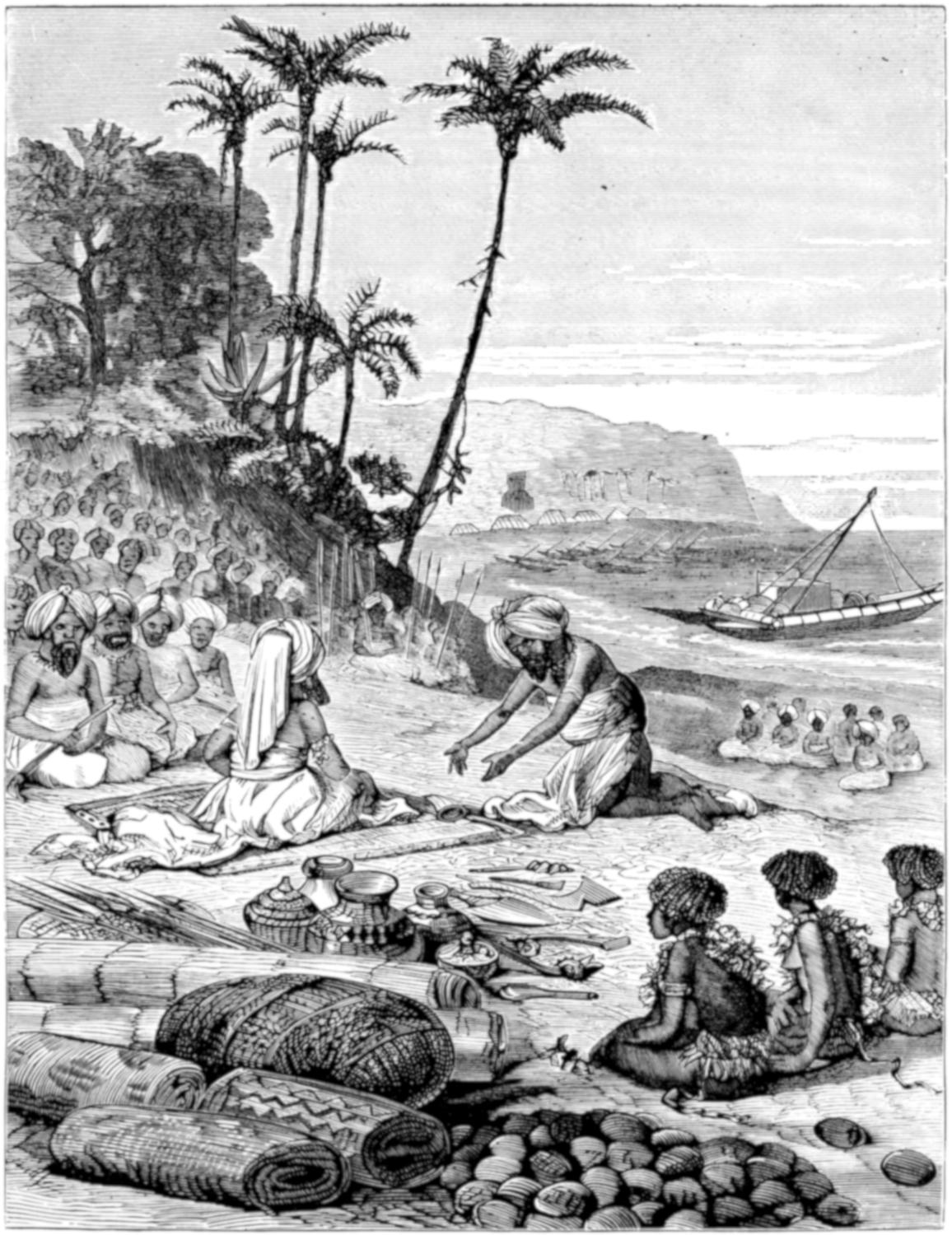
PRESENTATION OF THE CANOE.
(See page 936.)
“A chief holds his lands under precisely
the same tenure, as head of his family, and
his personal rights attain only to the land
pertaining to his family, in which right every
member of his family shares so far as on any
portion of the land. But the chief is also
head of his tribe, and, as such, certain rights
to the whole lands of the tribe appertain to
him. The tribe is a family, and the chief is
the head of the family.
“The families of a tribe maintain the chief.
In war they give him their services, and
follow him to the fight. In peace they supply
him with food. In this way, the whole
tribe attains a certain collective interest in
all the lands held by each family; and every
parcel of land alienated contracts the source
whence the collective tribal support of the
chief is drawn. From this complicated
tenure it is clear that the alienation of land,
however large or small the tract, can be made
valid only by the collective act of the whole
tribe, in the persons of the ruling chief and
the heads of families. Random and reckless
land transactions under these circumstances
would be simply another seizure of Naboth’s
vineyard, for which the price of blood would
inevitably have to be paid.”
Another cause of misunderstanding lies in
a peculiar attachment which the Fijian has
to the soil. When he sells a piece of land,
it is an understood thing between the buyer
and seller that the latter shall have the exclusive
right of working on the ground, that
none but he shall be employed to till the
ground, or build houses upon it. The white
settlers who understand the customs of the
natives have accepted the condition, and
find that it answers tolerably well. Those
who are unacquainted with native ideas have
often suffered severely for their ignorance,
and, when they have brought a gang of their
own workmen to put up a house on the newly
purchased land, have been fairly driven out
by armed parties of natives.
Mr. Pritchard narrates an amusing anecdote,
which illustrates the working of this
principle. A missionary had purchased
some land according to the code of laws which
had been agreed upon by the native chiefs
and the colonists; all the natives who belonged
to the family having been consulted,
and agreed to the purchase. As a matter of
course, they expected that the work of clearing
the ground and building the house would
be given to them. Being ignorant of this
custom, the purchaser took some of his own
people, but was immediately surrounded by
a body of armed savages, who flourished their
clubs and spears, and frightened him so much
that he retreated to his boat, and made off.
When he was well out of range, all those who
had muskets fired them in the direction of
the boat, as if to show that their intention
was not to kill but merely to intimidate.
It will be seen from the foregoing passages,
that the whole government of Fiji is
a repetition of one principle, namely, that
of the family. The head of a family is the
nominal possessor of the land. All the
members of the family use the land, and
support their head, as a return for the use
of the land. Districts again are considered
as families, the chief being the head, and
being supported by the district. The king,
again, is considered as the father of all the
chiefs, and the nominal owner of all the land
in his dominions, and he is therefore entitled
to be supported by the taxation which has
been described. Practically, however, he
has no more right to land than any other
head of a family.
From the preceding observations the
reader may see that a definite code of etiquette
prevails among the Fiji islands.
Indeed, there is no part of the world where
etiquette is carried to a greater extent, or
where it is more intimately interwoven with
every action of ordinary life. If, for example,
one man meets another on a path, both
having, as usual, their clubs on their shoulders,
as they approach each other they lower
their clubs to their knees, as a token that
they are at peace, and pass on. Retaining
the club on the shoulder would be equivalent
to a challenge to fight.
The leading characteristic of this code of
etiquette is the reverence for the chief, a
reverence which is carried to such a pitch,
that in battle a chief sometimes comes out
unhurt simply because his opponents were
so much awe-stricken by his rank that they
did not dare to strike him. Each superior
therefore partakes of the chiefly character
as far as his inferiors are concerned, and
expects the appropriate acknowledgments
of rank.
This extraordinary reverence is carried so
far that it has invented a language of etiquette,
no one with any pretensions to good
breeding speaking in ordinary language of
a chief, of a chiefs head or limbs, of a chiefs
dress, or indeed of any action performed by
a chief, but supplying a paraphrastic and
hyperbolical phraseology, of which our own
court language is but a faint shadow. The
Tama, which has before been mentioned, is
the right of a chief, and is therefore uttered
by men of inferior rank, not only when they
meet the chief himself, but when they come
within a certain distance of his village. So
elaborate is this code of ceremony that, discourteous
as it might be to omit the Tama
when due, it would be thought doubly so to
utter it on occasions when it was not due.
For example, the Tama is not used toward
the close of the day, or when the chief is
either making a sail or watching a sail maker
at work; and if the Tama were uttered on
any such occasion, it would be resented as
an insult.
Passing a superior on the wrong side,
and sailing by his canoe on the outrigger
side, are considered as solecisms in manners,
while passing behind a chief is so
deadly an insult that the man who dared
do such a deed would run the risk of getting
his brains knocked out on the spot, or, if he
were a rich man, would have to pay a very
heavy fine, or “soro,” by way of compensation.
The reason of this rule is evident
enough. The Fijian is apt to be treacherous,
and when he attacks another always tries to
take him unawares, and steals on him, if
possible, from behind. It is therefore a
rule, that any one passing behind a superior
is looked upon as contemplating assassination,
and makes himself liable to the appropriate
penalty.
If a man should meet a chief, the inferior
withdraws from the path, lays his club on
the ground, and crouches in a bent position
until the great man has passed by. If, however,
the two men should be of tolerably
equal rank, the inferior merely stands aside,
bends his body slightly, and rubs the left
arm with the right hand, or grasps his
beard and keeps his eyes fixed on the
ground.
The act of giving anything to the chief,
touching him or his dress, or anything above
his head, or receiving anything from him, or
hearing a gracious message from him, is accompanied
by a gentle clapping of the hands.
Standing in the presence of a chief is not
permitted. Any one who addresses him
must kneel; and if they move about, must
either do so on their knees, or at least in a
crouching attitude.
In some cases the code of etiquette is
carried to an extreme which appears to us
exceedingly ludicrous. If a superior fall,
or in any other way makes himself look
awkward, all his inferiors who are present
immediately do the same thing, and expect
a fee as recognition of their politeness.
Mr. Williams narrates an amusing anecdote
of this branch of etiquette, which is
called bale-muri (pronounced bahleh-moo-ree),
i. e. follow in falling. “One day I
came to a long bridge formed of a single
cocoa-nut tree, which was thrown across a
rapid stream, the opposite bank of which
was two or three feet lower, so that the
declivity was too steep to be comfortable.
The pole was also wet and slippery: and
thus my crossing safely was very doubtful.
“Just as I commenced the experiment, a
heathen said with much animation, ‘to-day
I shall have a musket.’ I had, however,
just then to heed my steps more than his
words, and so succeeded in reaching the
other side safely. When I asked him why
he spoke of a musket, the man replied, ‘I
felt certain you would fall in attempting to
go over, and I should have fallen after you
(that is, appeared to be equally clumsy);
and as the bridge is high, the water rapid,
and you a gentleman, you would not have
thought of giving me less than a musket.’”
Ludicrous as this custom appears, it is based
upon a true sense of courtesy, a desire to
spare the feelings of others.
When one person of rank visits another,
a number of ceremonies are performed in
regular order. Should the visit be paid in a
canoe, as is mostly the case, a herald is sent
a few days previously to give notice of his
coming, so as to avoid taking the intended
host by surprise. As soon as the canoe
comes in sight, a herald is sent out to inquire
the name and rank of the visitor, who
is met on the shore by a deputation of petty
chiefs, headed by one of the Matas, or aides-de-camp.
If the visitor be a personage of
very high rank, the Matas will go ten miles
to meet him.
As soon as the visitor and his retinue have
reached the house of their entertainer, they
seat themselves, and the host, after clapping
his hands gently in token of salutation,
welcomes them in a set form of words, such
as “Come with peace the chief from Mbau,”
or “Somo-somo,” as the case may be.
A series of similar remarks is made by
both parties, the main point being that
Fijian oratory is the driest and dullest of
performances, always broken up into short
sentences, without any apparent connection
between them, and further hindered by the
attitude of courtesy which the speaker has
to adopt. It is impossible for the finest
orator in the world to make an effective
speech if he has to deliver it in a kneeling
position, with his body bent forward, his
hands holding his beard, and his eyes directed
to the ground. In some parts of Fiji
etiquette requires that the orator’s back
should be toward the chief whom he is
addressing. Nobody takes the trouble to
listen to these speeches, or is expected to do
so, the chiefs often talking over indifferent
matters while the proper number of speeches
are rehearsed.
The ceremonies on leave-taking are quite
as long, as intricate, and as tedious; and,
when the speeches are over, the two great
men salute each other after the fashion of
their country, by pressing their faces together,
and drawing in the breath with a
loud noise, as if smelling each other. A
chief of inferior rank salutes his superior’s
hand, and not his face.
When the visitors start upon their return
journey, the host accompanies them for a
part of the way, the distance being regulated
by their relative rank. If they should
have come by sea, the proper etiquette is
for the host to go on board, together with
some of his chief men, and to accompany
his visitors to a certain distance from land,
when they all jump into the sea and swim
ashore.
As is the case in all countries, whether
savage or civilized, the code of etiquette is
rigidly enforced at meal-times. Even the
greatest chief, if present at a banquet, behaves
in as deferential a manner as the
commonest man present. Though he may
be in his own dominions, and though he
may hold absolute sway over every man
and woman within sight, he will not venture
to taste a morsel of food until it has first
been offered to him. Many years ago one
chief did so, and, in consequence, the Fijians
have hated his very name ever since.
So great would be the breach of manners
by such a proceeding, that the life of the
offender would be endangered by it. On
one occasion it did cost the chief his life.
He inadvertently ate a piece of cocoa-nut
which had not been offered to him; and this
insult so rankled in the mind of one of his
officers, who was in attendance, that he ran
away from his own chief, and joined another
who was at war with him. A battle took
place, the offending chief was worsted, and
was running for his life, when he met the
insulted officer, and asked for his assistance.
The man was inclined to give it, but the insult
could not be forgotten, and so, with an
apology for the duty which he was called on
to perform, he knocked out his former master’s
brains with his club.
A still more astonishing instance of this
feeling is mentioned by Mr. Williams. A
young chief and his father-in-law were
about to dine together, and a baked guana
was provided for each. The guana is a lizard
which has a long and slender tail. In
passing by his relative’s guana, the young
man accidentally broke off the end of its
tail, which would necessarily be rendered
brittle by cooking. This was held to be so
gross an insult, that the offender paid for it
with his life.
Etiquette is shown to its fullest extent
when a king or principal chief gives a great
banquet. As with the New Zealanders,
such a feast is contemplated for many
months previously; vegetables are planted
expressly for it, and no one is allowed to
kill pigs or gather fruit, lest there should
not be a sufficient quantity of provisions.
Just before the day of festival, the final
preparations are made. Messages are sent
to all the neighboring tribes, or rather to
the chiefs, who communicate them to the
people. The turtle fishers bestir themselves
to get their nets and canoes in order, and,
as soon as they are ready, start off to sea.
Yams and other root crops are dug up, the
ovens made, and the fuel chopped and
brought ready for use.
These ovens are of enormous size, as each
is capable of cooking a number of pigs, turtles,
and vast quantities of vegetables. With
all our skill in cooking, it is to be doubted
whether we are not excelled by the Fijians
in the art of cooking large quantities of
meat at a time. The ovens are simply holes
dug in the ground, some ten feet in depth
and fifteen feet or so in diameter.
The mode of cooking is very simple. A
small fire is made at the bottom of the pit,
which is then filled with firewood, and as
soon as the wood is thoroughly on fire, large
stones are placed on it. When the wood
has all burned away, the pigs, turtles, and
vegetables are laid on the hot stones, some
of which are introduced into the interior of
each animal, so that it may be the more
thoroughly cooked. The oven is then filled
up with boughs and green leaves, and upon
the leaves is placed a thick covering of
earth. The oven regulates its own time of
cooking, for as soon as steam rises through
the earthy covering, the contents of the
oven are known to be properly cooked.
For the two or three days preceding the
feast, all the people are full of activity.
They take a pride in the liberality of their
chief, and each man brings as many pigs,
yams, turtles, and other kinds of food as he
can manage to put together. The king himself
takes the direction of affairs, his orders
being communicated to the people by his
Matas, or aides-de-camp. Day and night go
on the preparations, the pigs squealing as
they are chased before being killed, the
men hard at work digging the ovens, some
loosening the earth with long pointed sticks,
others carrying off the loosened soil in
baskets, while the flames that blaze from
the completed ovens enable the workmen to
continue their labors throughout the night.
On these occasions the Fijians dispense
with their ordinary feelings respecting cooking.
In Fiji, as in New Zealand, cooking is
despised, and the word “cook” is used as a
term of reproach and derision. In consequence
of this feeling, all cooking is performed
by the slaves. But on the eve of a
great feast this feeling is laid aside, and
every man helps to cook the food. Even
the king himself assists in feeding the ovens
with fuel, arranging the pigs, stirring the
contents of the cooking pots, and performing
offices which, on the following day, none
but a slave will perform.
By the time that the cooking is completed,
the various tribes have assembled,
and the ovens are then opened and the food
taken out. It is then arranged in separate
heaps, a layer of cocoa-nut leaves being
placed on the ground by way of dish. On
the leaves is placed a layer of cocoa-nuts,
then come the yams and potatoes, then puddings,
and at the top of all several pigs.
The quantity of provisions thus brought together
is enormous. Mr. Williams mentions
that at one feast, at which he was
present, two hundred men were employed
for nearly six hours in piling up the food.
There were six heaps of food, and among
their contents were about fifty tons of
cooked yams and potatoes, fifteen tons of
pudding, seventy turtles, and about two
hundred tons of uncooked yams. There
was one pudding which measured twenty-one
feet in circumference.
Profusion is the rule upon these occasions,
and the more food that a chief produces,
the more honor he receives. One chief
gained the honorable name of High Pork,
because he once provided such vast quantities
of food that before it could be finished
decomposition had begun in the pork.
All being arranged, the distribution now
begins, and is carried out with that precision
of etiquette which pervades all society
in Fiji. The various tribes and their chiefs
being seated, the Tui-rara, or master of the
ceremonies, orders the food to be divided
into as many portions as there are tribes,
regulating the amount by the importance of
the tribe. He then takes the tribes in succession,
and calls their names. As he calls
each tribe, the people return their thanks,
and a number of young men are sent to
fetch the food. This goes on until the whole
of the food has been given away, when a
further distribution takes place among the
tribes, each village first taking a share and
then each family receiving its proper portion,
which is handed to its head.
It is evident that the Tui-rara has no sinecure.
He must possess the most intimate
knowledge of all the tribes, and the ranks
of their respective chiefs, and must at the
same time be on the alert to distinguish any
stranger that may make his appearance.
Should he be a foreigner, he is considered a
chief, and a chief’s portion, i. e. a quantity
sufficient for twenty Fijians or sixty Englishmen,
is sent to him. Of course he gives
the greater part away, but in so doing he
acts the part of a chief. It is, in fact, the
old story of Benjamin’s mess translated into
Fijian.
The men always eat their food in the
open air, but send the women’s portion to
the houses to be eaten within doors.
The first illustration on the next page will
give an idea of a Fijian feast. On the left
hand is seen the master of the ceremonies,
calling the name of a tribe, and in the
centre are seen the young men running to
fetch the food. In the foreground is the
portion of their tribe, consisting of pigs,
yams, turtles, and so forth. In front of
them are some of the curious drums, which
will be presently described, and in the distance
are seen the members of the different
tribes, some eating, and others waiting for
their portion. The curious building in the
background is one of the Burés, or temples,
which will be presently described.
From the preceding description it will be
seen that the Fijians are not bad cooks, and
that the number of dishes which they produce
is by no means small. The variety of
the dishes is, however, much greater than
has been mentioned. They eat many kinds
of fish, together with almost every living
creature that they find in the coral reefs.
Some of their preparations very much resemble
those to which we are accustomed in
England. For example, a sort of shrimp
sandwich is made by putting a layer of
shrimps between two taro leaves. Several
kinds of bread are known, and nearly thirty
kinds of puddings. Turtle soup is in great
favor, and so are various other soups.
The Fijians even make sauces to be eaten
with various kinds of food, the sweet juice
of the sugar-cane being much used for this
purpose. They also have a sort of an imitation
of tea, infusing sundry leaves and
grasses in boiling water, and drinking it
when it becomes sufficiently cool. Most of
their food is cooked; but, like ourselves,
they prefer some food in an uncooked state.
Small fish, for example, are eaten alive, just
as we eat oysters.
They mostly drink water, or the milk of
the cocoa-nut. To drink water in native
fashion is not very easy. They keep it in
long bamboo tubes, so that when it is raised
to the lips the greatest care is required lest
it should suddenly deluge the face and
body.
Cocoa-nuts are opened in rather a curious
manner. A stout stick is sharpened at
both ends, and one end driven firmly into
the ground. Taking the nut in both hands,
the native dashes it on the stick, which
splits open the thick husk, and allows the
nut to be extracted. With a stone, or even
with another cocoa-nut in case a stone
should not be at hand, the native hammers
away round the pointed end, and contrives
to knock off a small round lid, which is then
removed, leaving a natural drinking-cup in
his hand.
We now come to the terrible subject of
cannibalism, on which no more will be said
than is necessary to illustrate the character
of the people.
The Fijians are even more devoted to
cannibalism than the New Zealanders, and
their records are still more appalling. A
New Zealander has sometimes the grace to
feel ashamed of mentioning the subject in
the hearing of an European, whereas it is
impossible to make a Fijian really feel that
in eating human flesh he has committed an
unworthy act. He sees, indeed, that the
white men exhibit great disgust at cannibalism,
but in his heart he despises them for
wasting such luxurious food as human flesh.
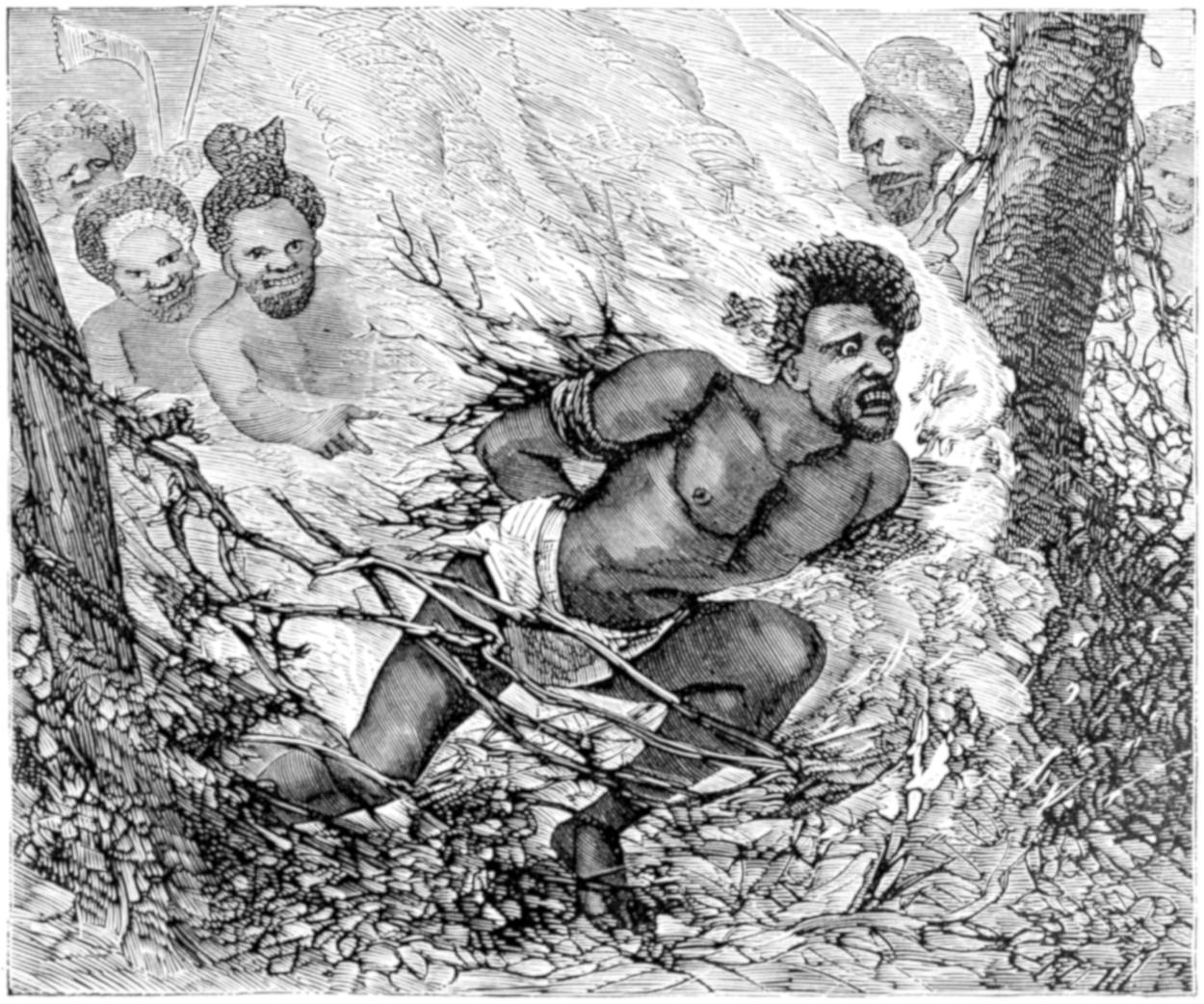
(2.) THE FATE OF THE BOASTER.
(See page 952.)
Even the Christianized natives have to
be watched carefully lest they should be
tempted by old habits, and revert to the custom
which they had promised to abjure.
For example, Thakombau, the King of Mbau,
became a Christian, or at least pretended to
do so. He was not a particularly creditable
convert. Some time after he had announced
himself to be a Christian, he went
in his war canoe to one of the districts under
his sway. He was received with the horribly
barbarous ceremonial by which a very
great chief is honored, conch-shell trumpets
blowing before him, and the people
shouting their songs of welcome. Thus accompanied,
he walked through a double row
of living victims—men, women, and children
of all ages—suspended by their feet,
and placed there to give the king his choice.
The hopeful convert was pleased to accept
the offering, touching with his club as he
passed along those victims which seemed
most to his taste.
The natives are clever enough at concealing
the existence of cannibalism when they
find that it shocks the white men. An European
cotton-grower, who had tried unsuccessfully
to introduce the culture of cotton
into Fiji, found, after a tolerably long residence,
that four or five human beings were
killed and eaten weekly. There was plenty
of food in the place, pigs were numerous,
and fish, fruit, and vegetables abundant.
But the people ate human bodies as often as
they could get them, not from any superstitious
motive, but simply because they preferred
human flesh to pork.
Many of the people actually take a pride
in the number of human bodies which they
have eaten. One chief was looked upon
with great respect on account of his feats of
cannibalism, and the people gave him a title
of honor. They called him the Turtle-pond,
comparing his insatiable stomach to the
pond in which turtles are kept; and so proud
were they of his deeds, that they even gave
a name of honor to the bodies brought for
his consumption, calling them the “Contents
of the Turtle-pond.” This man was
accustomed to eat a human body himself,
suffering no one to share it with him. After
his family were grown up, he bethought
himself of registering his unholy meals by
placing a stone on the ground as soon as he
had finished the body. His son showed these
stones to an English clergyman, who counted
them, and found that there were very nearly
nine hundred.
One man gained a great name among his
people by an act of peculiar atrocity. He
told his wife to build an oven, to fetch firewood
for heating it, and to prepare a bamboo
knife. As soon as she had concluded
her labors her husband killed her, and baked
her in the oven which her own hands had
prepared, and afterward ate her. Sometimes
a man has been known to take a victim,
bind him hand and foot, cut slices from
his arms and legs, and eat them before his
eyes. Indeed, the Fijians are so inordinately
vain, that they will do anything, no
matter how horrible, in order to gain a name
among their people; and Dr. Pritchard, who
knows them thoroughly, expresses his wonder
that some chief did not eat slices from
his own limbs.
Cannibalism is ingrained in the very nature
of a Fijian, and extends through all
classes of society. It is true that there are
some persons who have never eaten flesh,
but there is always a reason for it. Women,
for example, are seldom permitted to eat
“bakolo,” as human flesh is termed, and
there are a few men who have refrained from
cannibalism through superstition. Every
Fijian has his special god, who is supposed
to have his residence in some animal. One
god, for example, lives in a rat, as we have
already seen; another in a shark; and so on.
The worshipper of that god never eats the
animal in which his divinity resides; and as
some gods are supposed to reside in human
bodies, their worshippers never eat the flesh
of man.
According to the accounts of some of the
older chiefs, whom we may believe or not,
as we like, there was once a time when cannibalism
did not exist. Many years ago,
some strangers from a distant land were
blown upon the shores of Fiji, and received
hospitably by the islanders, who incorporated
them into their own tribes, and made
much of them. But, in process of time,
these people became too powerful, killed the
Fijian chiefs, took their wives and property,
and usurped their office.
In this emergency the people consulted
the priests, who said that the Fijians had
brought their misfortunes upon themselves.
They had allowed strangers to live, whereas
“Fiji for the Fijians” was the golden rule,
and from that time every male stranger was
to be killed and eaten, and every woman
taken as a wife.
Only one people was free from this law.
The Tongans, instead of being killed and
eaten, were always welcomed, and their
visits encouraged, as they passed backward
and forward in their canoes, and brought
with them fine mats and other articles for
barter. So much have these people intermingled,
that in the eastern islands, which
are nearest to those of Tonga, there is a
decided mixture of Tongan blood. With
this exception, however, the Fijians went
on the same principle as the Ephesians of
Shakespeare—
“If any Syracusan born
Come to the bay of Ephesus, he dies;”
save that, instead of merely putting to death
those who came from one country, they
only excepted one country from the universal
law.
The reader may remember that a sort of
respect is paid to a human body used for
food. Educated people speak of it in the
court language, and, instead of using any
vulgar term, such as a human body, they
employ the metaphorical language, and call
it the “long pig.” As a general rule, the
vessels in which human flesh is cooked are
reserved expressly for that purpose, and
both the vessel in which it is cooked and
the dish from which it is eaten are held as
tapu.
So highly is “bakolo” honored, that it is
eaten, not with fingers, but with a fork, and
the implement in question is handed down
from father to son, like the merais and
tikis of the New Zealander. These forks
are quite unlike those which are used in
England. They mostly have four prongs,
but these prongs, instead of being set in a
line, are generally arranged in a circle or
triangle as the case may be. They are
carved out of some very hard wood, and,
when they have become venerable by reason
of age or of the rank of their proprietor,
they receive names of honor. For example,
the cannibal chief who ate nearly nine hundred
human bodies had a fork which was
named “Undro-undro,” the title signifying
a small person carrying a great burden.
The fork was a small object, but it had carried
to the lips of its master the bodies of
nearly nine hundred human beings.
As the Fijians set such a value on human
flesh, it is to be expected that they will
invent a variety of excuses for obtaining it.
For example when a chief builds a house,
he kills at least one human victim to celebrate
the event. If he builds a large war
canoe, a series of sacrifices takes place. A
man is killed, for example, when the keel is
laid, and, if the chief be a very powerful
one, he will kill a victim as each plank is
fixed in its place. Even when it is finished
the slaughter is not over, as, in the first
place, the planks of the new vessel have to
be washed with human blood, and, in the
next, the launch must be commemorated
in the same way as the building. One chief
gained some notoriety by binding a number
of men, and laying them side by side along
the shore to act as rollers over which the
canoe was taken from the land into the sea.
The weight of the canoe killed the men,
who were afterward baked and eaten.
Even after the canoe is launched, excuses
are found for carrying on the system of
human butchery. Whenever it touches at
a place for the first time, a man must be
sacrificed in honor of taking down the mast,
this being done to show that the vessel
means to make some stay at the place. If a
chief should arrive in a new canoe, and
keep up his mast, the people understand the
signal, and bring on board a newly-slain
victim, so that the mast may be taken
down.
On one occasion, when a war canoe had
been built at Somo-somo, the missionaries
exerted themselves so successfully that the
canoe was launched without the sacrifice of
a single life. Eventually, however, their
well-intentioned interference rather increased
than diminished the number of victims.
When the canoe arrived at Mbau,
the chiefs were so vexed that it had reached
them unhonored by human blood that they
straightway attacked a village, killed some
fourteen or fifteen men, and ate them in
order to do honor to the ceremony of taking
down the mast.
Sometimes, in order to secure a victim
whenever one is wanted, the chiefs pick out
secretly a certain number of men, and put
them, so to speak, on the black list. Whenever
a sacrifice is needed, all the executioners
have to do is to find out how many
victims are wanted, and then to go and kill
the requisite number of the black-list men.
Whole towns are sometimes put on the
black list, a curious example of which custom
is given by Mr. Williams. “Vakambua,
chief of Mbau, thus doomed Tavua,
and gave a whale’s tooth to a Nggara chief,
that he might at a fitting time punish that
place. Years passed away, and a reconciliation
took place between Mbau and Tavua,
but, unhappily, the Mbau chief failed to
neutralize the engagement made with the
Nggara. A day came when human bodies
were wanted, and the thoughts of those
who held the tooth were turned toward
Tavua. They invited the people of that
place to a friendly exchange of food, and
slew twenty-three of their unsuspecting
victims.
“When the treacherous Nggarans had
gratified their own appetites by pieces of
the flesh cut off and roasted on the spot, the
bodies were taken to Vakambua, who was
greatly astonished, expressed much regret
that such a slaughter should have grown
out of his carelessness, and then shared the
bodies to be eaten.”
The Fijian can seldom resist meat, and
that he should resist “bakolo” could not be
expected of him. In Mrs. Smythe’s “Ten
Months in the Fiji Islands,” an amusing
instance of this predilection is recorded.
“A white man had shot and carried off a
pig belonging to a Fijian, who, being a convert,
went to a native teacher named Obadiah,
and asked him to go to the delinquent
and remonstrate with him. The teacher
put on his black coat, went to the man’s
house, and with much earnestness pointed
out to him the iniquity of the deed, asking
him how he would have liked it had a Fijian
killed one of his own pigs. The man listened
very respectfully, and allowed the
error of his ways, acknowledging that the
teacher had put the matter in a new light.
‘But,’ said he ‘the pig is now dead, and we
cannot bring it to life again. Shall we
throw it out and let it go to waste, or, as it
is just baked, and you have not breakfasted,
shall we not sit down, and you will ask a
blessing?’
“Obadiah, taken by surprise by Q——’s
penitence, and the compliment paid to his
own clerical functions, and swayed perhaps
a little by the irresistible love of all Fijians
for roast pork, bowed his head, and reverentially
said a long prayer, after which the
two set heartily to work on the pig.” When
the teacher went to the missionary to report
his successful labors, he was quite astonished
at being charged with complicity with
the thief.
CHAPTER XCVI. FIJI— Continued . WAR AND AMUSEMENTS.
WEAPONS OF THE FIJIANS — THE SLING, AND MODE OF USING IT —
THE CLUB, AND ITS VARIOUS MODIFICATIONS — GRADUAL
DEVELOPMENT OF THE CLUB INTO THE PADDLE — MODE OF MAKING THE
CLUBS, AND PREPARATION OF THE TREES — ORNAMENTS OF THE CLUBS, AND THEIR NAMES — FIJIAN
SPEARS — THEIR TERRIBLE BARBS — OBJECTS OF WAR — THE REVIEW — THE FATE OF
THE BOASTER — INGENIOUS ENGINEERING — CRUELTY TOWARD PRISONERS — “CONSECRATION” OF
A WARRIOR, AND HIS NEW NAME — DOMESTIC LIFE — CEREMONIES AT BIRTH — TRAINING IN
REVENGE — AMUSEMENTS — VARIOUS GAMES — RIRIKI — WOMEN AGAINST MEN — DANCES AND
SONGS — MARRIAGE FESTIVITIES — WEDDING OF A CHIEF’S DAUGHTER — DOMESTIC DISCIPLINE — THE
KING’S STAFF — FESTIVITIES AT HOUSE BUILDING — MODE OF THATCHING AND DECORATING
THE HOUSES — A PRACTICAL JOKE.
In accordance with the plan on which this
work has been arranged, Fijian warfare will
be described as it was before fire-arms were
introduced, and had changed the ancient
style of warfare.
The original weapons of the Fijian are the
club, the axe (which, by the way, is little
more than a modification of the club), the
bow, the sling, and the spear. In most of
these weapons is exhibited the fancifully
artistic nature of the manufacturers. The
sling is perhaps the only weapon from which
ornament is almost wholly absent. Like the
corresponding weapon of the New Caledonians,
it carries stones of tolerable weight
and great hardness, and, when wielded by a
skilful hand, becomes no inefficient weapon
even against fire-arms themselves. A stone
hurled from a Fijian sling has been known
to render a musket useless, the stone having
struck the barrel, and bent and indented it
as much as would have been done by a bullet.
The chief weapon of the Fijian is the club,
and upon this he lavishes all the artistic
power at his command, covering nearly the
whole of it with the most intricate and delicately
executed carvings. Some clubs are
straight, like thick cudgels, others are
curved. Those which are knobbed at the
end have an infinite variety in the knob, as
we shall presently see. Some are more or
less flattened, while there are some which
are so flat and so broad that it is not easy at
first sight to determine whether they are
clubs or paddles. Some are so large that
they require the whole exertion of a muscular
man to wield them, while others are so
short that they are kept stuck in the girdle,
and used as missiles, precisely as the short
knob-kerries are used by the South Africans.
A Fijian will often carry two or more of
these clubs in his girdle.
Some of the most characteristic forms of
Fijian clubs are given on the following page,
all being drawn from specimens in my collection.
Fig. 1 represents a club, and is
evidently modified from a gnarled and
knotted branch, and by comparing a number
of specimens together it is easy to trace
the progress of manufacture. This form of
club is also to be found among the Papuans
of New Guinea, the natives of the Outanata
district carrying it. With the exception of
the deep transverse cuts, there is no attempt
at ornament. It is tolerably heavy, though
not very large, and requires two hands to be
wielded properly.
Figure 2 represents one of the paddle-like
clubs which have just been mentioned. The
blade is not an inch in thickness in the middle,
and it gradually slopes off to either side,
so as to form a tolerably sharp edge. With
the exception of the handle, it is entirely
covered with carving; the dentated pattern,
which seems common to nearly all savage
art, being very conspicuous. It is extremely
weighty, and, to an European, appears a
very awkward instrument, except perhaps
that the broad blade might be utilized as a
shield.
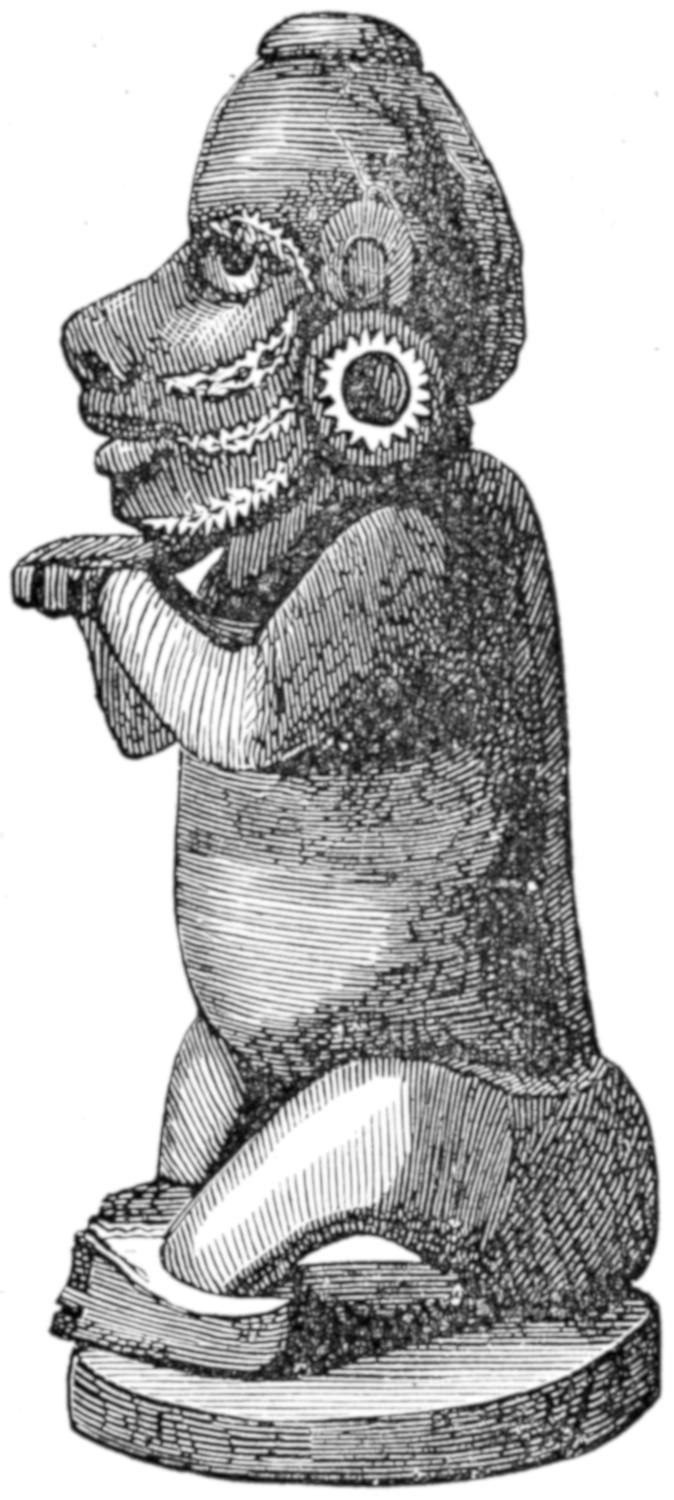
(2.) IDOL OF SOLOMON
ISLANDS.
(See page 970.)
(3.) SPEAR.
(See page 952.)
Fig. 3 is a club, which may be considered
as a sort of intermediate form between the
two already mentioned. Like the last, it
has a broad blade, but is evidently a club
and not a paddle. The blade is strengthened
by a bold ridge running along the
centre. In order to show the mode in
which it is flattened, a side view of the
lower part is shown at fig. a, and a cross
section of the blade is given at fig. b. This
kind of club is modified in various ways, but
is always made on the same principle, i. e.
a round handle and a flattened paddle-like
end, sometimes nearly plain, as in the above
mentioned specimens, and sometimes furnished
with knobs, teeth, and spikes projecting
from the sides. In some cases it
assumes the shape of a crescent, and looks,
indeed, much like a cheese knife very much
magnified.
Another very characteristic shape is given
in fig. 4. As may be imagined from the illustration,
it is very weighty, so that even to
carry it about must be rather troublesome.
It is covered with carvings in the most lavish
manner, and such value has been set by the
manufacturer upon the weapon, that he has
even taken the trouble to invent different
patterns for the opposite sides.
The peculiar form of this club is evidently
due to the structure of the branch
from which it was cut, the projecting portion
being the base of another branch. Although
in many specimens—my own among the
number—the club has been carved from a
great log of solid wood, the form has evidently
been borrowed from the junction of
two branches. The edge of the club is cut
into slight teeth, and just within the edge
are a number of round holes, set in a line.
A tolerably bold ridge runs along the head
of the club and follows its curve, and through
this ridge are also bored a number of holes,
apparently for the purpose of attaching
bunches of feathers, or other ornaments, to
the weapon.
The most characteristic club of Fiji is,
however, that of which an example is given
in fig. 5. It is made from the stem and part
of the root of a young tree. In this part of
the world there are certain trees which grow
in a manner which to us seems very peculiar.
As is the case with many trees, it sends a
tap-root deeply into the earth, and is further
supported by a number of smaller roots
which diverge from it on all sides, and retain
it in its upright position, just as a mast is
upheld by the standing rigging.
While the tree is very young, it is drawn
down nearly horizontally, and fixed in that
position, so as to be bent nearly at right
angles close to the earth. When it has
grown to the thickness of a man’s wrist, the
top is cut off and the roots dug out of the
ground. The tap-root is then scraped down
to a point, and all the smaller roots are cut off
to within an inch and a half of the tap-root,
so as to form a radiating mass of spikes,
which are sharpened, and thus present the
appearance shown in the illustration.
Such a club as this is an exceedingly valuable
weapon, and the greatest care is taken
in its manufacture. The spike at the end is
scraped and rounded until it assumes a perfectly
regular shape, and is then polished
until it shines like a well-rubbed piece of
mahogany. The radiating spikelets are each
trimmed with the greatest nicety, so that, in
whatever direction the weapon is viewed,
they all radiate with exact regularity.
The handle is polished as carefully as the
lower spike, and in most cases is adorned
with elaborately carved patterns. In many
clubs it is completely covered with black and
white sinnet made expressly for this purpose,
and plaited in patterns as elaborate as those
which are carved. Some of the best clubs
are further ornamented by having scarlet
feathers worked in with sinnet. There are,
indeed, scarcely any bounds to the decoration
of clubs, many of which are inlaid with shell,
or hogs’ tusks, or whales’ teeth, or even the
teeth of men. These latter ornaments are
chiefly reserved for the knobs of the small
missile club.
Beside these, there is an infinite variety
of forms, some of the clubs exactly resembling
the steel maces of the days of chivalry,
others being first squared and then cut into
pyramidal form, while others look just like
enormous mushrooms. Some of them have
the handles completely covered with wickerwork;
but, as a rule, these highly ornamental
weapons are not for use but for show, like
the court sword of the present day.
Some of the names given to these clubs
are highly suggestive. For example, one
was called “Weeping urges me to action,”
others “Disperser,” “Smasher,” and so forth.
Those which belong to well-known chiefs
or distinguished warriors are used much as
cards among ourselves. If, for example, a
great chief desires to pay a visit, he will send
his club as an intimation that the owner will
follow. Or, if one chief asks another for aid
in war, the ordinary mode of showing that
the application is favorably received is for
the latter to send his club by the ambassador
who brought the message.
There is as great variety of spears as of
clubs. Spears are almost invariably of great
length, some measuring fourteen or fifteen
feet in length. They are made from hard
wood and are almost invariably armed with a
series of barbs. In the manufacture and
arrangement of the barbs, the Fijians show
wonderful ingenuity. Mostly, they are not
from the same piece of wood as the spear
itself, but in many weapons they are made
of other materials. The sharp tail-bone of
the sting-ray is a favorite material, both for
the points and barbs of spears, probably
because it is very hard, and so brittle that it
is nearly sure to break off in the wound.
Other barbs are made of a wood which has
the property of swelling up when moistened,
and bursting in the wound, so that it can
hardly be extracted. Such spears as this
are called by a very ominous title, “The
priest is too late.” Some of the spears are
not only carved in various patterns, but have
the heads cut into a kind of bold open work
pattern, which has a very elegant appearance,
though it must detract greatly from
the strength of the weapon. One of the ordinary
Fijian spears is shown on page 949,
and is taken from specimens in my collection,
in which there are several others, but all of
a similar character.
Many of the weapons have more than one
point. In the specimens which I have, the
points are rather more than a yard in length,
and are made of separate pieces of wood, ingeniously
dovetailed into the shaft of the
spear, and held in their place by lashings of
sinnet. In my specimen, the manufacturer
has been so lavish of his labor, that he has
not only woven the sinnet into elegant patterns,
but has continued them along the
whole of the shaft, covering it with a sort of
mixture of the zigzag and the dentated patterns.
There are also spears with several
points, each point being barbed or deeply
serrated on the inside cap. These are not
for war, but for fishing purposes. As for
the war in which these weapons are used, it
is hardly deserving of the name.
When two chiefs have decided on going
to war, messengers pass between them, and
both sides beat up recruits for their armies
and offer gifts to the gods. Whales’ teeth
and food form the chief part of these offerings,
and the latter is often given in vast
quantities. Independent chiefs often take
advantage of war to increase their property.
Such a chief, for example, though urged by
both sides to join them, trims and hesitates,
and bides his time. One party will then
send him a bribe, and as soon as the other
party hear of it, they send a larger bribe, in
order to “press down” the former gift. The
result usually is, that the recipient keeps
both bribes, and eventually declines to fight
on either side.
The forces are gathered by a series of reviews,
held as the army marches. These
reviews form the great charm of war, as
any amount of boasting may be done without
the slightest risk. Each warrior rushes
up to the commanding chief, brandishes his
weapons, and boasts of the great deeds which
he is going to do; all the warriors being in
their very best, with bodies covered with
black powder, so as to contrast with the
snow-white masi, and their faces painted as
none but a Fijian can paint them, in order
to look as martial as possible.
The chief often ridicules the pretensions
of these men, insinuating that they will be
more ready to run away than to fight; but
this is only for the purpose of inciting them
to display their courage, and, by way of inducing
them to fight well, large gifts are
promised to those who distinguish themselves
in battle.
Sometimes a warrior, carried away by the
excitement of the moment, boasts that he
will kill the enemy’s chief, eat his flesh, and
make a drinking-cup of his skull. This is generally
a very foolish proceeding. The menaced
chief is sure to hear of it, and to promise
a large reward if the boaster be taken
alive.
Should he be captured, his fate is certain.
His hands are bound behind him, and a
large bundle of dried cocoa-nut leaves is
fastened tightly across his shoulders, projecting
for several feet on either side. The
ends of the leaves are then lighted, and the
poor wretch is left to die, the spectators
laughing and jeering at him as he runs
about, maddened by the torment. This
punishment is called by a name which signifies
carrying fuel. The artist has represented
in the lower engraving, on the 943d
page, this frightful fate of the boaster.
The party that are attacked usually retire
into a native fort, the structure of which
often shows great engineering skill. The
Fijians are very apt at selecting a spot which
is difficult of access, and fortifying it in such
a manner that two or three men could hold
it against a thousand. Mr. Williams visited
one of these forts, and found that the approach
to it was not without danger, even
in time of peace. The only path to the fort
led through thick and tangled vegetation,
and terminated on the edge of a precipice.
The entrance to the fort was on the face of
the precipice, several yards from the end of
the path, and there was no mode of getting
to it except by crawling along the perpendicular
rock by means of little holes in
which the toes and fingers could be inserted.
When the natives cannot find a place of
such natural strength, they have a way of
defending the entrance by a series of gates
with traverses between them, so that any
enemies who forced the first gate were
obliged to go for some distance through a
narrow passage which was pierced with loopholes,
through which spears could be thrust
and arrows shot. Even if they succeeded in
passing the second gate, a similar gauntlet
had to be run before they could reach the
third. Thorny trees are in great request
for the outer defences of these forts, the
bare-skinned natives greatly dreading the
prickly walls, which every year grow more
dense and less penetrable.
Knowing the strength of the forts, the
natives do not care about assaulting them,
and, as they advance to the walls, avail
themselves of every cover. They then yell
and shout derisive taunts at the enemy,
challenging them to come out and fight.
Sometimes the challenge is answered, a
number of warriors issuing from the fort
and each selecting an adversary; often, however,
as soon as the besiegers see their
challenge answered, they run away as fast
as they can, the Fijian liking to come behind
his enemy and knock him on the head
stealthily better than to oppose him in open
fight.
Should a fort be taken, the slaughter is
dreadful, and is nothing but a massacre, the
greater number being killed, and the rest
reserved to be put to death by torture. One
favorite mode of torture is to stun the unhappy
captive with a club, and to throw
him into a heated oven by way of bringing
him back to his senses. The struggles of
the unfortunate man as the fierce heat restores
him to consciousness are greeted
with laughter and jeers by the delighted
spectators. Others are bound hand and
foot and given to the sons of chiefs as subjects
on which they can try their skill at torturing.
As these expeditions are nearly always
made in canoes, the return of the war party
is seen from a great distance, and all the
population assemble on the beach to welcome
the victorious warriors, the women
dancing and singing songs of triumph in
honor of the conquerors. A horrible scene
then takes place, too horrible indeed to be
described; the bodies of the dead are offered
in the temples, the ovens are prepared, and
for some days unbridled license reigns supreme.
In connexion with warfare must be mentioned
a curious custom of giving a new
name to men who have killed any of the
enemy during the campaign. Whether the
enemy be an armed warrior slain in fair
fight, an unarmed man knocked down by
stealth, a woman, or even a little child, signifies
nothing. The warrior has clubbed an
enemy, and has a right to his new name of
honor. Should he have killed a chief, he
takes the name of his victim, and sometimes
his own chief honors him by calling the man
his flag, his canoe, his comb, &c. Of the
consecration ceremony, wherein the new
name is given, Mr. Williams once saw a
very excellent example at Somo-somo, the
subject of consecration being a young chief.
“The king and leading men having taken
their seats in the public square, fourteen
mats were brought and spread out, and
upon these were placed a bale of cloth and
two whale’s teeth. Near by was laid a sail
mat, and on it several men’s dresses. The
young chief now made his appearance, bearing
in one hand a large pine-apple club, and
in, the other a common reed, while his long
train of masi dragged on the ground behind
him.
“On his reaching the mats, an old man
took the reed out of the hero’s hand, and
despatched a youth to deposit it carefully in
the temple of the war god. The king then
ordered the young chief to stand upon the
bale of cloth; and while he obeyed, a number
of women came into the square, bringing
small dishes of turmeric mixed with oil,
which they placed before the youth, and
retired with a song. The masi was now
removed by the chief himself, an attendant
substituting one much larger in its stead.
The king’s Mata (aide-de-camp) next selected
several dishes of the colored oil, and
anointed the warrior from the roots of the
hair to his heels.
“At this stage of the proceedings one of
the spectators stepped forward and exchanged
clubs with the anointed, and soon
another did the same. Then one left him a
gun in place of the club, and many similar
changes were effected, under a belief that
the weapons thus passing through his hands
derived some virtue.
“The mats were now removed, and a portion
of them sent to the temple, some of the
turmeric being sent after them. The king
and old men, followed by the young man
and two men sounding conchs, now proceeded
to the seaside, where the anointed
one passed through the ancients to the water’s
edge, returned, while the king and
those with him counted one, two, three,
four, five, and each then threw a stone into
the sea. The whole company now went
back to the town with blasts of the trumpet
shells, and a peculiar hooting of the men.
“Custom requires that a hut should be
built, in which the anointed man and his
companions may pass the next three nights,
during which time the newly named hero
must not lie down, but sleep as he sits; he
must not change his masi, or remove the
turmeric, or enter a house in which there is
a woman, until that period has elapsed. In
the case now described, the hut had not
been built, and the young chief was permitted
to use the temple of the god of war instead.
“During the three days he was on an incessant
march, followed by half a score lads
reddened like himself. After three weeks
he paid me a visit, on the first day of his
being permitted to enter a house in which
there was a female. He informed me his
new name was Kuila, or Flag.”
When a name of honor has thus been
given to a man, the complimentary title of
Koroi, or consecrated, is prefixed to it.
The battles of the Fijians are not, as a
rule, remarkable for the slaughter that takes
place. They are, in fact, little but a series
of single combats. When a man falls, his
friends try to get him off the ground to save
his life, if possible, or to be able to bury the
body if he should die; while the enemy use
their best endeavors to secure the wounded
man in order to bake and eat him. No dishonor
is attached to the fact of a slain man
being eaten. On the contrary, it is a proof
of his courage, for none but those who die
bravely in battle are eaten in the feast
which follows upon the victory, the bodies
of slain cowards being contemptuously
thrown into the bush.
We now come to a more pleasing part of
Fijian character, namely, the various incidents
of domestic life.
As soon as the Fijian child comes into the
world, it is taken from the mother, and
given to another woman for three days, during
which time she lies at her ease. The
first clothing which the child receives is a
thick coating of turmeric oil, and the first
food which it knows is either the juice of
sugar-cane or of cocoa-nut. A name is given
to the child as soon as possible after its birth,
and these names are generally significant of
some event that has happened either to the
child itself or to some member of its family.
Though the Fijian children spend the
great part of their time in the open air,
and are untrammelled by clothing, they are
liable to a very unpleasant disease called
the “thoko,” which somewhat resembles the
“yaws” of the negro tribes. The parents
are rather glad than sorry to see their children
afflicted with this disease, as they believe
that it forms a necessary adjunct to infantile
health, and that a child who escapes
the thoko is sure to be sickly and feeble when
it grows up.
The Fijian child receives no training, unless
encouragement of every bad passion
may be called by that name. Revenge is
impressed upon the child’s mind from its
earliest infancy, and most horrible are the
means which are sometimes employed for
this purpose. In riper years the duty of revenge
is kept always before his eyes. Should
one man insult another, the offended individual
keeps himself constantly reminded of
the offence by placing some object in his
sight, and not removing it until he has
avenged himself.
Sometimes he will effect the same purpose
by depriving himself of some luxury until
he has had his revenge. One man, for example,
will plait his hair in a particular
manner, another will hang some article of
dress in his house, while another will refuse
to dance, or to eat of some particular
kind of food. One chief, for example, hung
a roll of tobacco on the roof of his house,
with the intention of refusing to smoke until
he had killed his enemy and could smoke
that tobacco over the dead body. Another
refrained from speaking, and would only answer
by whistling.
The knowledge of this custom makes the
Fijians a most nervous race. Should a
strange canoe appear off the coast, the inhabitants
of the villages are all in a stir,
some escaping to the woods, and others concealing
their food and other valuables in
secret storehouses. They do not like to
walk alone in the evening. Mr. Williams
mentions that he has seen a whole company
disperse at the lifting of a telescope, and,
more than once, when he was visited by natives
and the door suddenly slammed with
the wind, the whole of his visitors rushed
tumultuously out of the windows. On one
occasion, a number of men were dragging a
large canoe into the sea, when one of them
espied a slight crack on one side. He
whispered his discovery to the man next
him, he to the next, and so on, and in a few
minutes every man had run away from the
boat, fearing lest the owner should charge
him with having done the damage.
The amusements of the Fijians are rather
more varied than is usually the case among
savages. Some of them are identical with
many of our own children’s games, such as
“hide and seek,” “blind man’s buff,” and a
sort of “hop, skip, and jump.” A sort of
“pitch and toss,” is also in vogue, the substitute
for pence being the flat, circular fruit
of a species of mimosa.
They have one game which bears some
resemblance to that of the “kangaroo-rat”
of Australia, which has been described on
page 730. The players have a reed about
four feet in length, at one end of which is an
oval piece of hard and heavy wood some six
inches in length. This instrument is held
between the thumb and middle finger, the
end of the forefinger being applied to its extremity.
With a peculiar underhand jerk
the player drives it horizontally, so that it
glides over the ground for a considerable
distance, the player who sends the missile
farthest being the winner. In order that
this favorite game maybe constantly played,
each village has attached to it a long strip
of smooth sward, which is kept sedulously
trimmed, so that the missile may skim
along with as little resistance as possible.
Then there is the swing. This is made
much like the New Zealand swing, but is
used in a different manner. Instead of being
held by the hands alone, the rope has a
loop at the end, into which the swinger inserts
his foot. Sometimes, it has a large
knot, on which both feet can be supported.
Drawing the rope to the top of a convenient
bank, the swinger grasps it with his
hands, leaps in the air, places his foot in the
loop, and goes sweeping through an enormous
arc, the radius of which often exceeds
fifty feet. In some cases the swing is fixed
by the water side, and the more daring of
the performers loosen their grasp at the
proper moment, and are hurled through the
air into the water.
One favorite game, called Ririki, is played
after the following fashion:—Close to the
water’s edge is fixed a stout post, and on this
is laid the trunk of a tall cocoa-nut tree, so
that its base rests on the ground, and the
tip projects over the water. The game consists
in running at full speed up this inclined
tree, and jumping into the water one
after the other, swimming ashore and repeating
the process. This is a very lively
game, the natives shouting and laughing the
whole time, and plunging so rapidly in succession
that the water beneath the end of
the inclined tree is white with foam. The
people are admirable swimmers, and, having
been accustomed to swim as soon as they
could walk, disport themselves in the water
with as much ease as on land. They are
fond of swimming out to sea in parties, and
join in various aquatic games, such as trying
to push each other under water, diving, racing,
and so forth.
Some of their sports are rather rough.
They have one game which bears a certain
resemblance to snow-balling, except that the
missiles are bitter oranges instead of snow-balls.
In some places they jerk stones at
each other by means of elastic bamboos, and
do so with such force that considerable pain
is caused when the missile strikes the bare
skin.
Sometimes a sort of mock battle takes
place. When food is brought to the men,
the women suddenly rush upon them, try to
drive them away, and to seize the food.
Rough as the women may be, the men seldom
retaliate, except by taking their assailants
round the waists and throwing them
on the ground. Mr. Williams mentions one
instance when a woman actually shot a man
dead with an arrow, turning the mock fight
into a sad reality. Several cases are known
where the men have been so severely
handled that they have afterward died of
their wounds.
On certain occasions an amusing game is
played by the young men. A thin earthenware
vessel is filled with water and suspended
from a bough, and a number of
young men with their eyes blindfolded, try
to break the vessel by striking at it with
long sticks.
Music and dancing are greatly studied
among the Fijians, and any one who knows
a new dance is sure to earn plenty of goods
by teaching it. Their musical instruments
are very poor, consisting of drums, pipes,
and trumpets. The first-mentioned instruments
are nothing more than wooden cylinders,
through one side of which a groove is
cut about an inch or so in width. The pipes
are of two kinds; namely, a sort of pandean
pipe made of several strips of bamboo fastened
together, and the flute. This latter instrument
is played by placing the aperture
close to one nostril, and breathing through
it while the other is stopped with the thumb
of the left hand. The trumpets are merely
conch-shells blown through a hole in the
side.
The dances are very carefully got up, and
more resemble military movements than
dances, the similitude being increased by
the martial array of the dancers, who are all
dressed as if for war, their faces painted with
scarlet, their bodies powdered with black,
and their best clubs or spears in their hands.
They execute intricate manœuvres, marching
in various figures, wheeling, halting,
and stamping their feet in exact time to the
rhythm of the song and the beat of the
drum. Sometimes several hundred men
are engaged in the dance, while the musicians
are twenty or thirty in number.
The scene at one of these dances is very
picturesque, but it wants the furious energy
which gives such fiery animation to the war
dance of the New Zealanders, the movements,
though correct in point of time,
being comparatively dull and heavy. In
order to enliven it a little more, a professional
buffoon is usually introduced upon
the scene, who performs sundry grotesque
movements, and is usually applauded for his
exertions.
Music and dancing are always used at the
celebration of a marriage, and, as may be
imagined from the punctilious nature of the
Fijian, there is no lack of ceremony on the
occasion.
Mostly, girls are betrothed when they are
quite infants, no regard being paid to disparity
of age between themselves and their
intended husbands. The form of betrothal
is rather curious, and consists in the mother
of the child taking a small liku, or woman’s
girdle, and presenting it to the man, who
from that moment takes her daughter under
his protection until she is old enough to be
married.
In those cases where a young man takes a
liking to a young woman, he asks her of her
father, making at the same time a small
present as a matter of form. Should the
application be successful, an interchange of
presents then takes place between the
friends of both parties, and in a few days
follows the ceremony called “warming,”
which consists in conveying to the house of
the bride some food prepared by the intended
husband. In most parts of Fiji, the
bride has a complete holiday for four days,
sitting quietly at home, dressed in her finest
apparel, and painted with turmeric and oil.
At the expiration of the four days, she is
taken by a number of married women to
the sea, where they all join in fishing, and
afterward cook the fish that they have taken.
The cooking being completed, the bridegroom
is sent for, and the betrothed couple
eat together, each giving the other a portion
of food.
After this ceremony comes a period during
which the bridegroom is employed in
building a house for his intended wife, and
the girl undergoes the painful tattooing
which marks her as having taken her place
among women. During this time, she remains
within the house so as to shield her
complexion from the sun. The house being
completed, all the friends of both families
are gathered together, and a great feast
takes place, at which the givers make it a
point of honor to be as lavish as possible.
At the end of this feast, the girl is formally
handed over to her husband, and exchanges
her narrow liku for the broader garment
befitting her new condition.
When the daughter of an important chief
is married, her father always gives her a
number of female attendants, sometimes as
many as twelve or fifteen accompanying the
bride to her home. They are placed under
the charge of an elderly woman who acts as
their superintendent, and are called by a
name which signifies a pet servant. There
is always a great scene at the departure of a
bride to her home, all her relations and
friends crowding round her, and kissing her
until she is nearly smothered by their
caresses.
An interesting description of the presentation
of a bride is given by Mr. Williams,
and the artist has reproduced the scene in
the engraving No. 1, on the next page.
“She was brought in at the principal entrance
by the king’s aunt and a few matrons,
and then, led only by the old lady, approached
the king. She was an interesting
girl of fifteen, glistening with oil, wearing a
new liku, and a necklace of curved ivory
points, radiating from her neck, and turning
upward. The king then received from his
aunt the girl, with two whale’s teeth, which
she carried in her hand. When she was
seated at his feet, his majesty repeated a list
of their gods, and finished by praying that the
girl might live, and bring forth male children.
“To her friends, two men who had come
in at the back door, he gave a musket, begging
them not to think hardly of his having
taken their child, as the step was connected
with the good of the land, in which their
interests, as well as his own, were involved.
The musket, which was about equivalent to
the necklace, the men received with bent
heads, muttering a short prayer, the close of
which was exactly the same as they had
offered for years, ‘Death to Natawa.’ Tuikilakila
then took off the girl’s necklace and
kissed her. The gayest moment of her life,
as far as dress was concerned, was past; and
I felt that the untying of that polished ornament
from her neck was the first downward
step to a dreary future. Perhaps her
forebodings were like mine, for she wept,
and the tears which glanced off her bosom
and rested in distinct drops on her oily legs
were seen by the king, who said, ‘Do not
weep. Are you going to leave your own
land? You are but going a voyage, soon to
return. Do not think it a hardship to go to
Mbau. Here you have to work hard; there
you will rest. Here you fare indifferently;
there you will eat the best of food. Only do
not weep to spoil yourself.’ As he thus
spoke, he played with her curly locks, complimenting
her on her face and figure. She
reminded him of a sister of hers, who had
been taken to Mbau in years past.”
She had certainly reason for her tears, as
the condition of Fijian wives is not a very
enviable one. As is the case with most
countries in which polygamy is practised, the
wives are apt to be very jealous of each
other, and to quarrel among themselves.
Generally, their squabbles are treated with
contemptuous indifference by the husband
as long as they do not annoy him personally;
but if he should feel himself angered,
he speedily checks the tumult by belaboring
all parties alike with a very sufficient
stick which he keeps for the purpose. One
chief had a cudgel as thick as a broomstick,
in which he seemed to take no little pride,
having carved and inlaid it with ivory.
Women are not held in any great estimation,
whether they be single or married.
A rather ludicrous example of the value set
by Fijians upon women occurred in the
course of traffic between Europeans and natives.
A chief had bargained with the captain
of a ship for a musket, the price of
which was to be two pigs. The chief went
off with his musket, but could only find one
pig. So he honorably kept his bargain by
sending the one pig and a young woman instead
of the other.
In the description of the ceremonies attendant
upon a wedding, mention was made
of the custom of building a house for the
bride. The form of Fijian houses varies
according to locality. In some places they
are sharp-ridged and gabled, like those
which have already been described when
treating of New Guinea. In others they are
round, and in others conical. Some are
built on posts, and others simply on the
ground. As is the case throughout all Polynesia,
the houses are made of a wooden
framework lashed together, and covered
with a thatch of reeds. Many of these
houses are of great size, more than a hundred
feet in length and about forty in width.
A house that is meant to endure for
any length of time is made of a wood called
by the natives vesi, which is exactly similar
to the greenheart of India, and a sort of
sandal wood is also used for the same purpose.
The walls are generally made of reeds arranged
in three layers, the middle layer
being horizontal and the outer and inner
layers perpendicular. They are tied or
sewed together with sinnet, and it is the
Fijian architect’s pride to weave the sinnet
into elegant patterns. Some men are celebrated
for their skill in inserting and executing
these patterns, and go about from
place to place as they are wanted. Even the
posts that support the edifice are often covered
with reeds, bound together in the same
ingenious manner. The door is always a
small one, probably for the same reason that
induces a Kaffir to make so low an entrance
to his hut; namely, fear of enemies.
The thatch is sometimes of cocoa-nut or
sugar-cane leaves, and sometimes of grass,
while in a few of the best houses both are
used. The leaves are doubled over reeds
and sewed together, so as to form lengths of
about five or six feet. Grass thatch is fixed
almost exactly as straw is used in England
being laid on the roof in bundles, and held
down by long mangrove branches, and tied
firmly with rattan.
House thatching is one of the most animated
scenes that can be imagined. As
soon as the roof is finished, notice is given that
the thatchers are wanted, and then straightway
assemble a gang of merry laborers,
varying in number according to the size of
the house, as many as three hundred sometimes
uniting to thatch a very large house.
Some bring the leaves and grass, others
bind and sew them into the proper form,
and others take them to the thatchers.
Those who actually apply the reeds always
arrange themselves in pairs on the roof, one
outside and the other inside the building, so
that one can take the end of the lashing as
it is pushed through the thatch by his comrade,
draw it tight, and return it to him.
The reader may find house thatching represented
in a spirited engraving, on the 957th
page.
The noise that arises from a large house
during the process of thatching is almost
deafening. Naturally, the Fijian has a
great genius for shouting, and on such occasions
he fairly outdoes himself. Some call
for more grass, leaves, mangrove rods and
rattans; others from below shout in reply to
them. Those who bring the materials must
needs shout as they clamber to the roof, and
every one throws in a few yells occasionally
by way of encouragement to his companions.
The most characteristic part of a Fijian
house is the ridge pole which runs along the
top of the roof. It projects at either end for
a considerable distance, and in first-class
buildings is worked into a trumpet-like
shape at the extremities. These projecting
ends are mostly blackened, and decorated
with large white cowrie shells. A sort of
cable made of grass and bound with vine-stalks
is generally laid on the ridge pole,
and in many cases is finished off with a row
of tassels, and nearly covered with patterns
worked in sinnet.
Some, though not all, the houses have
openings by way of windows, which can be
closed by means of mats fastened over them
like curtains. Within the house, and nearly
in the centre, is the fireplace, which is sunk
in the ground to a foot or so in depth, and
surrounded by a sort of fender made of hard
wood. In very large houses, the fireplace
is ten or twelve feet square, and is covered
by a wooden framework of several tiers, on
which cooking pots and similar utensils can
be kept. There is no chimney, nor even a
hole in the roof, so that all the smoke from
the fireplace ascends to the roof, and finds
its way out through the thatch as it best can.
In nearly every case the doorway is furnished
with a projecting roof.
In connection with roof thatching, a characteristic
joke is recorded of the Mbau people.
The short missile club is called ula,
and the act of hurling it is called ulaula.
The latter word, however, also signifies
house thatching. By way of a practical
joke, the people of Mbau sent to those of
Tailevu, asking them to come and ulaula.
The latter, taking the word in its ordinary
sense, accepted the invitation, and came,
expecting the usual scene of merriment,
when to their surprise, they were saluted
by a volley of ulas hurled at them by their
entertainers.
The furniture of a Fijian house is simple.
At one end is a raised dais, on which the
master of the house sleeps by night and
reclines by day. It is covered with mats,
and over it are hung the sheets of thin masi
which are used as mosquito curtains. On
this dais are generally one or two pillows.
These implements are not unlike those of
the Kaffirs, being nothing more than cylindrical
bars of wood supported on legs at
either end. Some of them are from four to
five feet in length. This form of pillow is
used on account of the mop-like headdress
of the natives, which would be pressed out
of all shape were it laid on an ordinary pillow.
On the hearth are several large earthenware
cooking pots, oval in shape, and each
set on three stones. As the quantity of
food in them diminishes, they are gradually
tilted, so that when they contain but very
little food they lie quite on their sides.
Near the hearth lies the thick concave
board on which bread is kneaded, and close
to the board are the smooth round stones
by which the operation of kneading is conducted.
The small hand nets used for fishing
are kept near the fire, together with the
knives and other implements used in preparing
food. Several earthen water jars are
always placed near the fire. They may be
distinguished by their glazed surfaces, and
are placed carefully on a thick bed of grass.
A few bamboo vessels containing salt and
fresh water, are generally placed near the
larger jars. Round the foot of the wall are
ranged a series of bowls and jars, which
contain the arrowroot and similar articles of
food.
CHAPTER XCVII. FIJI— Continued . RELIGION AND FUNERAL RITES.
THE GODS AND THEIR ABODES — VISIT OF THE LAND CRAB — FIJIAN PRIESTS AND THEIR INSIGNIA — CONSULTING
THE DEITY — VARIOUS MODES OF DIVINATION — THE DIFFICULT PASSAGE TO HEAVEN — NATIVE
TEMPLES, THEIR STRUCTURE AND USES — FEASTS GIVEN TO THE GODS — SACRED
STONES — MURDER OF THE AGED AND SICK — A STRANGE MARK OF AFFECTION — PROVIDING THE
DEAD WITH ATTENDANTS — BURIAL OF A LIVING KING — A TERRIBLE SCENE — VOYAGE TO THE
CEMETERY, AND THE FUNERAL — SIMILARITY BETWEEN THE CUSTOMS OF FIJI AND INDIA — MODE
OF MOURNING — THE SUCCESSIVE RITES AFTER A FUNERAL — THE CUSTOM OF LOLOKU — TOMB
OF A CHIEF’S WIFE.
The religion, or rather the superstition, of
the Fijians is much like that of other polytheists.
The people acknowledge vast numbers
of gods of greater or lesser power;
most, if not all, of which are symbolized
under some natural form, such as a hawk, a
tree, or the like. Every Fijian considers
himself under the protection of some especial
god, and, as has been stated, will not
eat the animal which is his symbol.
An amusing instance of the reverence
paid to the symbols of the gods occurred at
Tilioa. A very powerful god, who is worshipped
at that place, resides in a land crab,
but, as that crustacean is scarcely ever seen
in the locality, there are but few opportunities
of paying the proper worship. Whenever
any one saw a land crab, he immediately
ran to the priest, and forthwith the
whole place was in a commotion. The people
assembled to pay their respects to their
deity, and a number of cocoa-nuts were
gathered, strung together, and humbly presented
to the crab deity in order to propitiate
him, and to induce him to give them
fair weather and a healthy season.
As to the particular doctrines of the
Fijian religion, it is scarcely possible to
learn much about them. In the first place,
the people know nothing, and the priests,
who know but little, dislike communicating
their knowledge. Even the Christian converts
can seldom be induced to speak on the
subject with any degree of truth.
The priests are known by their official
insignia, which consists of an oval frontlet
of scarlet feathers, and a long-toothed comb
made of separate pieces of wood ingeniously
fastened together. Several of these combs
are in my collection, and are excellent
examples of the artistic capabilities of the
makers. No two of them are alike, the delicate
thread which fastens them together
being woven in a singular variety of patterns.
The threads are nearly as fine as
hairs, and an additional beauty is given to
the pattern by using alternately a deep
black and a glittering yellow thread.
The priests communicate with their deities
by throwing themselves into a sort of
ecstatic state, technically called “shaking,”
in which the whole body is convulsed, and
the utterances which come from the foaming
lips are held to be the responses of the
god. A vivid idea of this mode of consulting
a deity is given by Mr. Williams in the
valuable work to which reference has often
been made.
“Nothing like regular worship or habitual
reverence is found, and a principle of fear
seems the only motive for religious observances;
and this is fully practised on by the
priests, through whom alone the people have
access to the gods, when they wish to present
petitions affecting their social or individual
interest. When matters of importance
are involved, the soro or offering consists
of large quantities of food, together with
whales’ teeth. In smaller affairs a tooth,
club, mat, or spear, is enough. Young nuts
covered with turmeric powder formed the
meanest offering I have known. On one
occasion, when Tuikilakila asked the help
of the Somo-somo gods in war, he built the
war god a large new temple, and presented
a quantity of cooked food, with sixty turtles,
beside whales’ teeth.
“Part of the offering—the sigana—is
set apart for the deity, the rest forming a
feast of which all may partake. The portion
devoted to the god is eaten by his priest and
by old men, but to youths and women it is
tapu.
“Strangers wishing to consult a god cut a
quantity of fire wood for the temple. Sometimes
only a dish of yams or a whale’s tooth
is presented. It is not absolutely necessary
for the transaction to take place at a temple.
I have known priests to become inspired in
a private house or in the open air; indeed,
in some parts of Fiji, the latter is usually the
case.
“One who intends to consult the oracle
dresses and oils himself, and, accompanied
by a few others, goes to the priest, who, we
will suppose, has been previously informed
of the intended visit, and is lying near the
sacred corner getting ready his response.
When the party arrives, he rises and sits so
that his back is near to the white cloth by
which the god visits him, while the others
occupy the opposite side of the Buré. The
principal person presents a whale’s tooth,
states the purpose of his visit, and expresses
a hope that the god will regard him with
favor. Sometimes there is placed before
the priest a dish of scented oil with which
he anoints himself, and then receives the
tooth, regarding it with deep and serious
attention.
“Unbroken silence follows. The priest
becomes absorbed in thought, and all eyes
watch him with unblinking steadiness. In
a few minutes he trembles; slight distortions
are seen in his face, and twitching movements
in his limbs. These increase to a
violent muscular action, which spreads until
the whole frame is strongly convulsed, and
the man shivers as with a strong ague fit. In
some islands this is accompanied with murmurs
and sobs, the veins are greatly enlarged,
and the circulation of the blood
quickened.
“The priest is now possessed by his god,
and all his words and actions are considered
as no longer his own, but those of the deity
who has entered into him. Shrill cries of
‘Koi au! Koi au!’ (‘It is I! It is I!’) fill the
air, and the god is supposed thus to notify
his approach. While giving the answer, the
priest’s eyes stand out and roll as if in a
frenzy; his voice is unnatural, his face pale,
his lips livid, his breathing depressed, and his
entire appearance like that of a furious madman.
The sweat runs from every pore, and
tears start from his strained eyes; after which
the symptoms gradually disappear. The
priest looks round with a vacant stare, and as
the god says ‘I depart,’ announces his actual
departure by violently flinging himself down
on the mat, or by suddenly striking the
ground with a club, when those at a distance
are informed by blasts on the conch, or the
firing of a musket, that the deity has returned
into the world of spirits.”
In many cases it is evident that the priests
enact deliberate impositions, but it is also
certain that in many others they are completely
under the dominion of frenzy, and
that they do not recollect afterward the
words which they uttered while in their
delirious state. “My own mind,” said one
of them, “departs from me, and then, when
it is truly gone, my god speaks by me.”
Various modes of divination are employed
by the Fijian priests. They have, for example,
divination by the leaf, by the reed,
by the nut, and by water. The leaf is tested
by taking it between the front teeth and
biting it. If it be completely severed, the
omen is good; if it hang together, even by a
single fibre, the omen is unfavorable. One
priest had a very strange mode of divination
by the leaf. He had two magic leaves, which
he placed on the sides of the applicant, and
then left them. If the leaf on the right side
stung the skin, the omen was good; but if
any plots or treacheries were hatched, the
leaf stung the man on the left side, and so
warned him of the danger. Another mode
of divination by the leaf is to bite it, and
judge by the flavor whether the omen be
adverse or the contrary.
The reed test is managed as follows. A
number of short reeds are cut, and laid in a
row on the ground, a name being given to
each. The priest then holds his right foot
over each, and the response is given by the
trembling of the foot.
The water test is performed by holding
the straightened arm slightly upward, and
pouring a few drops of water on the wrist.
If the water should run to the shoulder, the
response is favorable; should it fall off at the
elbow, the answer is adverse.
The next test is performed by laying a
cocoa-nut on a small surface and spinning
it. When it stops, the response is given by
the direction in which the eye points.
According to Fijian notions, the passage
to Buruto or heaven is a very difficult one,
except for great chiefs, and the only plan by
which a man of inferior rank can hope to obtain
admission is by telling the god a lie, and
proclaiming himself a chief with so much
apparent truthfulness that he is believed, and
allowed to pass. Taking on his shoulder his
war club and a whale’s tooth, the Fijian
spirit goes to the end of the world, where
grows a sacred pine, and throws the tooth at
it. Should he miss it, he can go no further;
but if he hit it, he travels on to a spot where
he awaits the arrival of the women who
were murdered at his death.
Escorted by them, he proceeds until he is
met and opposed by a god called Ravuyalo,
whom he fights with his club. Should he
fail, he is killed and eaten by the god, and
there is an end of him. Should he conquer,
he proceeds until he finds a canoe, into
which he gets, and is conveyed to the lofty
spot where the chief god, Ndengei, lives.
Over the precipice extends the long steering
oar of the god’s canoe. He is then asked
his name and rank, when he replies with a
circumstantial account of his grandeur and
magnificence, of the countries over which
he has ruled, of the deeds which he did in
war, and of the devastation which he caused.
He is then told to take his seat on the blade
of the oar. Should his story have been believed,
he is conveyed to Buruto; but should
Ndengei disbelieve his story, the oar is tilted
up, and he is hurled down the precipice into
the water below whence he never emerges.
It has been mentioned that the spirit has
to wait for the escort of his wives. This is
in order to prove that he is a married man,
bachelors having no hope of admission into
Buruto. Should a wifeless man start on his
journey, he is confronted by a goddess, called
the Great Woman, who has a special hatred
of bachelors, and, as soon as she sees one,
flies at him and tries to tear him in pieces.
Sometimes she misses him in her eagerness;
but, even in such a case, he has to deal with
another god, who hides himself in the spirit
path, and, as the soul of the bachelor passes
by, he springs on the wretched being, and
dashes him to atoms against a stone.
The Burés or temples of the gods abound
in Fiji, at least one Buré being found in
every village, and some of the villages
having many of these buildings. They are
made of the same material as the houses,
but with much more care. Instead of being
merely set on the ground, they are placed
on the top of a mound of earth, sometimes
only slightly elevated, and sometimes twenty
feet or more in height.
The natives think no labor too great for
the decoration of a Buré, and it is in those
buildings that their marvellous skill in plaiting
sinnet is best shown. Every beam, post,
and pillar is entirely covered with sinnet
plaited into the most beautiful patterns, black
and red being the favorite colors; and even
the reeds which line the window frames, and
fill up the interstices between the pillars, are
hidden in the plaited sinnet with which they
are covered. So lavish are the natives of
their work, that they are not content with
covering the pillars and reeds with sinnet
work, but they make large plaited cords
of the same material, and hang them in festoons
from the eaves.
It has already been mentioned that the
best houses have the ends of the ridge-poles
decorated with cowries, but those of the
Buré are adorned with long strings of cowries
that sometimes reach the ground. Ordinary
laths are thought too common to be
used in thatching temples, and the beautifully
carved spears of warriors are employed
instead of simple wood. When the Buré is
erected on a high mound, entrance is gained
to it by means of a very thick plank cut into
notched steps.
Although the Burés are considered as
temples, and dedicated to the god, they are
mostly used for secular purposes. Visitors
from a distance are generally quartered in
them, and in many instances the principal
men of the village make the Buré their sleeping-place.
Councils are held in the Burés,
and entertainments are given in them, of
which the offerings to the god form a large
part. Sometimes, as has been mentioned, a
chief who wishes to propitiate some deity
offers a great quantity of food in his temple,
and this food is consumed in a general feast.
A certain portion is dedicated to the god,
and may only be eaten by the priests and
the old men, but the remainder may be eaten
by any one.
None of the food is left to perish, the
Fijians having a convenient belief which
combines piety with self-indulgence. The
god is supposed to be a great eater, but only
to consume the soul of the provisions, so
that when food is cooked and offered, the
god eats the soul and the people the body.
The chief god, Ndengei, used to be both
greedy and dainty in his demands for food.
He sometimes ate two hundred hogs and a
hundred turtles at a single feast, and was
continually insisting on human sacrifices.
In order to procure these, no respect was
paid to persons, and so infatuated were the
people that, to keep up Ndengei’s supplies
of human food, chiefs were known to kill
their own wives.
No regular worship is ever offered in the
Burés, which, indeed, are often left to fall
into decay until some one desires to consult
or propitiate the god, when the building is
repaired and cleaned for the occasion. As
may be expected, during the building of the
Buré several human sacrifices are offered.
If the reader will refer to the drawing of
the Buré on the following page, he will see
that in front of it are two oddly-shaped
objects. These are examples of the sacred
stones, several of which are to be found in
various parts of Fiji. They are considered
as the dwelling-place of certain gods, and
are held to be either male or female, according
to the sex of the deity who inhabits
them. Should the god be of the female sex,
the fact is known by a woman’s apron or
liku being tied round the stone. One such
god is a very useful one, because he hates
mosquitoes, and keeps them away from the
spot in which he dwells. Food is prepared
and offered to those sacred stones, the god
as usual, eating the spirit of the food, and the
priest and officers consuming its outward
form.
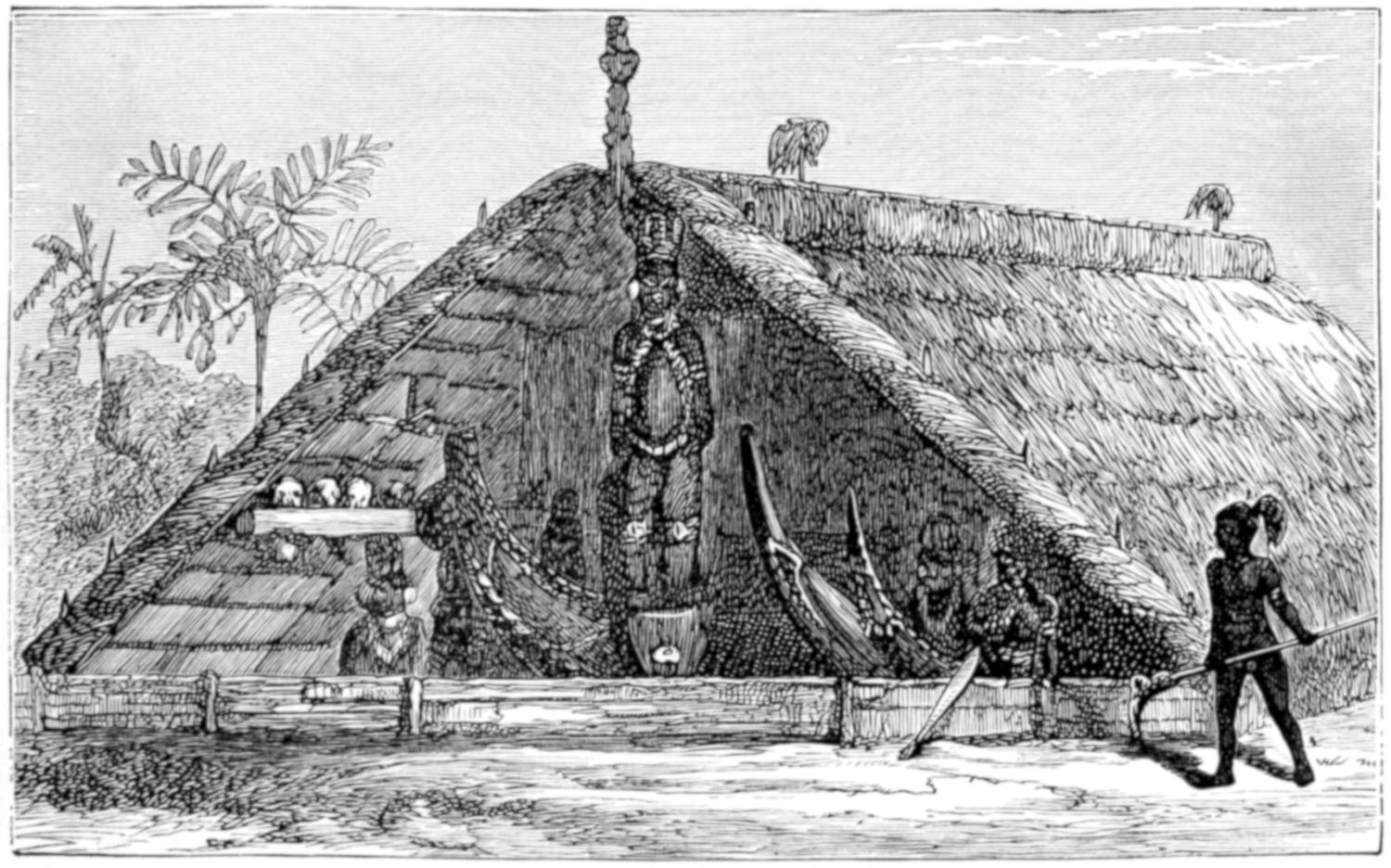
(2.) CANOE HOUSE AT MAKIRA BAY.
(See page 970.)
We now come to the funeral ceremonies
of Fiji, taking those of the chiefs as types of
the whole.
Among the Fijians a very singular superstition
reigns. When men or women become
infirm with age, they are considered to have
lived their full time on earth, and preparations
are made for their burial. So ingrained
is this belief, that if a man finds
himself becoming feeble with age or disease,
he requests his sons to strangle him, and
with this request they think themselves bound
to comply. Indeed, if they think that he is
too slow in making the request, they suggest
to him that he has lived long enough, and
ought to rest in the grave. Such conduct
seems to imply that they are destitute of
affection, but in reality it is their way of
showing their love for their parent.
They are really a most affectionate race
of people. A young chief has been seen to
sob with overpowering emotion at parting
from his father for a short time, and yet,
were his parents to become ill or infirm, he
would think it his duty to apply the fatal
rope with his own hands. To be strangled
by one’s children, or to be buried alive by
them, is considered the most honorable
mode of death. The reason for this strange
custom seems to be that the Fijians believe
the condition of the spirit in the next world
to be exactly the same as that of the individual
when in life. Consequently, affectionate
children are unwilling to allow their
parents to pass into the next world in an infirm
state of body, and therefore strangle
them out of sheer kindness.
From a similar notion of kindness, they
also strangle the favorite wives and attendants
of the dead chief, so as to provide
him with the followers to whom he has been
accustomed. They also kill a powerful warrior,
in order that he may go before his
chief through the passage into the spirit
land, and drive away the evil spirits who
oppose the progress of a new comer. These
victims go by the name of “grass,” and are
laid at the bottom of the grave; the warrior
painted and dressed for battle, with his
favorite club by his side, the women arranged
in folds of the finest masi, and the servants
with their implements in their hands; so
that the inhabitants of the spirit world may
see how great a chief has come among them.
All their preparations are carried on in a
quiet and orderly manner, the victims never
attempting to escape from their fate, but
vying with each other for the honor of
accompanying their chief. In some cases,
when a chief has died young, his mother has
insisted on sharing his grave. So deeply do
the Fijians feel the necessity for this sacrifice
that the custom has been a greater barrier
against Christianity even than cannibalism
or polygamy, and even those natives
who have been converted to Christianity are
always uneasy on the subject. On one occasion
a Christian chief was shot, and by the
same volley a young man was killed. The
Christian natives were delighted with the
latter catastrophe, inasmuch as it provided
an attendant for their slain chief.
The scene which takes place when a great
chief is expected to die has been described
by Mr. Williams with great power. The
King of Somo-somo, a magnificent specimen
of the savage, was becoming infirm through
age, and toward the middle of August 1845
was unable to do more than walk about a
little:—
“I visited him on the 21st, and was surprised
to find him much better than he had
been two days before. On being told, therefore,
on the 24th that the king was dead, and
that preparations were being made for his
interment, I could scarcely credit the report.
The ominous word preparing urged me to
hasten without delay to the scene of action,
but my utmost speed failed to bring me to
Nasima—the king’s house—in time. The
moment I entered it was evident that, as far
as concerned two of the women, I was too
late to save their lives. The effect of that
scene was overwhelming. Scores of deliberate
murderers in the very act surrounded
me: yet there was no confusion, and, except
a word from him who presided, no noise,
only an unearthly, horrid stillness. Nature
seemed to lend her aid and to deepen the
dread effect; there was not a breath stirring
in the air, and the half-subdued light in that
hall of death showed every object with
unusual distinctness.
“All was motionless as sculpture, and a
strange feeling came upon me, as though I
was myself becoming a statue. To speak
was impossible; I was unconscious that I
breathed; and involuntarily, or rather
against my will, I sunk to the floor, assuming
the cowering posture of those who were
actually engaged in murder. My arrival
was during a hush, just at the crisis of death,
and to that strange silence must be attributed
my emotions; and I was but too familiar
with murders of this kind, neither was there
anything novel in the apparatus employed.
Occupying the centre of that large room
were two groups, the business of whom
could not be mistaken.
“All sat on the floor; the middle figure
of each group being held in a sitting posture
by several females, and hidden by a large
veil. On either side of each veiled figure
was a company of eight or ten strong men,
one company hauling against the other on a
white cord which was passed twice round
the neck of the doomed one, who thus in a
few minutes ceased to live. As my self-command
was returning to me the group
furthest from me began to move; the men
slackened their hold, and the attendant
women removed the large covering, making
it into a couch for the victim.
“As that veil was lifted some of the men
beheld the distorted features of a mother
whom they had helped to murder, and smiled
with satisfaction as the corpse was laid out
for decoration. Convulsion strongly on the
part of the poor creature near me showed
that she still lived. She was a stout woman,
and some of the executioners jocosely invited
those who sat near to have pity and
help them. At length a woman said, ‘she
is cold.’ The fatal cord fell, and as the covering
was raised I saw dead the oldest wife
and unwearied attendant of the old king.”
Leaving the house of murder, Mr. Williams
went to the hut of the deceased king,
determining to see his successor, and beg
him to spare the lives of the intended victims.
To his horror and astonishment, he found
that the king was still alive. He was lying
on his couch, very feeble, but perfectly conscious,
every now and then placing his hand
to his side as he was racked by cough. The
young king was full of grief. He embraced
his visitor with much emotion, saying, “See,
the father of us two is dead.” It was useless
to dispute the point. The poor old king
certainly did move and speak and eat; but,
according to the son’s ideas, the movements
were only mechanical, the spirit having left
the body.
So the preparations for his funeral went
on. His chief wife and an assistant employed
themselves in covering his body with black
powder, as if dressing him for the war dance,
and fastening upon his arms and legs a number
of long strips of white masi, tied in
rosettes, with the ends streaming on the
ground. They had already clad him in a
new masi of immense size, the white folds of
which were wrapped round his feet. In
place of the usual masi turban, a scarlet
handkerchief was bound on his hair with a
circlet of white cowrie-shells, and strings of
the same shells decorated his arms, while
round his neck was an ivory necklace, made
of long curved claw-like pieces of whale’s
teeth.
The reader may perhaps wonder that the
chief wife of the king was suffered to live.
The fact was that the young king would not
allow her to be killed, because no executioner
of sufficient rank could be found. She
lamented her hard lot in being forbidden to
accompany her husband to the spirit land,
and begged to be strangled, but without
success.
Presently the sound of two conch-shell
trumpets was heard outside the house, this
being the official intimation that the old
king was dead, and the new king was then
formally acknowledged by the chiefs who
were present. He seemed overcome with
grief, and, gazing on the body of his father’s
attendant, he exclaimed, “Alas, Moalevu!
There lies a woman truly wearied, not only
in the day but in the night also; the fire
consumed the fuel gathered by her hands.
If we awoke in the still night, the sound of
our feet reached her ears, and, if spoken to
harshly, she continued to labor only. Moalevu!
Alas, Moalevu!”
The bodies of the murdered women were
then rolled up in mats, placed on a bier, and
carried out of the door, but the old king was
taken through a breach made in the wall of
the house. The bodies were carried down
to the seaside and placed in a canoe, the
king being on the deck, attended by his wife
and the Mata, who fanned him and kept off
the insects.
When they arrived at Weilangi, the place
of sepulture, they found the grave already
dug, and lined with mats. The bodies of the
women were laid side by side in the grave,
and on them the dying king. The shell
ornaments were then taken from him, and
he was entirely enveloped in mats, after
which the earth was filled in, and thus he
was buried alive. The poor old man was
even heard to cough after a quantity of earth
had been heaped on him.
This final scene is represented in an
illustration on the 980th page. In the foreground
is seen the open grave, with the
bodies of the murdered women lying in it as
“grass.” The still living king is being borne
to the grave by the attendants, while his successor
sits mournfully surveying a scene
which he knows will be re-enacted in his own
case, should he live to be old and infirm.
Just above the grave are the rolls of fine
mats with which the body of the king is to be
covered before the earth is filled in; and in
the background appears the mast of the canoe
which brought the party to the burial-ground.
The reader cannot but notice the resemblance
between this Fijian custom of
strangling the wives and the well-known
suttee of India. In both cases the women
are the foremost to demand death, and for
the same reason. Just as the Hindoo
women arrange their own funeral pile, and
light it with their own hands, the Fijian
woman helps to dig her own grave, lines
it with mats and then seats herself in it.
The fact is, that the woman has positively
no choice in the matter; a wife who survives
her husband is condemned to a life of
neglect, suffering, and insult, so that the
short agony of immediate death is preferable
to such a fate, especially as by yielding
to the national custom she believes that she
shall secure a happy and honored life in the
spirit land. Moreover, her relatives are
bound by custom to insist upon her death,
as, if they did not follow this custom, they
would be accused of disrespect toward her
husband and his family, and would run the
risk of being clubbed in revenge.
In consequence of this horrid custom, the
population of Fiji has been greatly checked,
for not only is there the direct sacrifice of life,
but much indirect loss is occasioned. Many
of the murdered women are mothers, whose
children die for want of maternal care, so
that, what with the perpetual feuds and
continual murders, the custom of cannibalism,
the sacrifice of wives with their husbands,
the strangling of the old or sick,
and the death of children by neglect, very
few Fijians die from natural causes. Mr.
Williams mentions that in a class of nine
children under his charge, the parents had
all been murdered with the exception of two,
and these had been condemned to death, and
only saved through the exertions of the missionaries.
After a king is buried, sundry ceremonies
are observed. For twenty days or so, no
one eats until the evening, the people shave
their heads either partially or entirely, and
the women cut off their fingers, which are
inserted in split reeds, and stuck along the
eaves of the royal house. Those who are
nearly related to the dead king show their
grief by refusing to wear their usual dress,
and substituting rude garments of leaves.
They often deny themselves the luxury of a
mat to lie upon, and pass their nights on the
grave of their friend. The coast is rendered
tapu for a certain distance, no one being allowed
to fish until the proper time has
elapsed, and the cocoa-nut trees are placed
under a similar restriction.
Various strange rites take place on certain
days after the funeral. On the fourth
day the friends assemble, and celebrate the
melancholy ceremony called the “jumping
of maggots,” in which they symbolize the
progress of corruption. Next evening is
one of a directly opposite character, called
the “causing to laugh,” in which the immediate
friends and relatives of the dead are
entertained with comic games. On the
tenth day the women have an amusing ceremony
of their own. Arming themselves
with whips, switches, or cords, they fall upon
every man whom they meet, without respect
to age or rank, the greatest chiefs only being
exempt from this persecution. The men are
not allowed to retaliate, except by flinging
mud at their assailants, and those who have
witnessed the scene say that nothing more
ludicrous can be imagined than to see grave,
elderly men running in all directions, pursued
by the women with their whips and
switches.
The last ceremony is the completion of
some special work begun in honor of the
dead. It may be the erection of a house, the
making of a huge ball of sinnet, a great bale
of cloth, and, in any case, it bears the name
of the person in whose honor it was undertaken.
Building large canoes is a favorite
form of this custom, and, during the whole
time that the work is in progress, the canoe
is put to sleep at night by the beating of
drums, and awakened every morning in a
similar manner, when the carpenters come
to their work.
A curious ceremony takes place in Fiji
when one of the principal chiefs has died.
It is called the loloku of the sail, and is a sort
of a signal of honor. Whenever a canoe
approaches the coast for the first time since
the death of the chief, the vessel is obliged
to show the loloku. This is generally a long
strip of masi tied to the head of the mast,
and as soon as the canoe touches the land,
both the sail and masi are thrown into the
water. Sometimes, when the owner of the
canoe is tolerably rich, he adds to the simple
loloku a whale’s tooth, which is flung from
the mast-head into the water, when the people
dive and scramble for it.
Should the chief perish at sea, or be killed
in a warlike expedition, and be eaten by his
enemies, the loloku is shown as carefully as
if he had been buried on shore, and his
relatives try to compensate him for his adverse
fate, by killing an unusual number of
women as his attendants. Nearly twenty
women have thus been sacrificed on the
death of a young chief who was drowned at
sea.
The graves of chiefs and their wives are
marked by tombs. These are sometimes
nothing but stones at the head and foot of
the grave, or large cairns of stones piled on
the deceased. Sometimes they are roofs
from three to six feet in height, decorated,
after Fijian custom, with patterns worked
in sinnet.
One tomb, that of a chief’s wife, was a
very remarkable one. Her husband had a
large mound of earth thrown up, and faced
with stones. On the top of the mound was
a double canoe, forty feet in length, held
firmly in its place by being imbedded in
earth. Fine shingle was strewn on the
deck, and mats were spread on the shingle
for the reception of the body. Sand was
then heaped over the canoe, and on the
sand was laid the body of a little child of
whom the deceased woman had been very
fond. Over all was then built a large roof,
made of mahogany, and adorned with white
cowrie-shells.
CHAPTER XCVIII. THE SOLOMON ISLANDS AND NEW HEBRIDES. CHARACTER, DRESS, CUSTOMS.
POSITION OF THE SOLOMON ISLANDS — REASON FOR THE NAME OF THE GROUP — CHARACTER OF THE
NATIVES — CANNIBALISM — DRESS AND ORNAMENTS — NEW IRELAND AND NEW BRITAIN — NOMAD
CHARACTER OF THE NATIVES — CAVE HOUSES — THE ADMIRALTY ISLANDS — DISTINGUISHING
MARKS OF THE CHIEFS, AND THEIR DOMINION OVER THE PEOPLE — THE BOUKA ISLAND — THE
NEW HEBRIDES — MODE OF GOVERNMENT, AND DIVERSITY OF LANGUAGE — THE INHABITANTS OF
VATÉ — CURIOUS DRESS OF THE WOMEN — ORNAMENTS OF THE HOUSES — TAUNA AND ERRUMANGA — TRADE
IN SANDAL WOOD — ANEITEUM AND VANIKORO.
Between New Guinea and the Fiji group
lie the Solomon (or Salomon) Islands. They
were discovered, as far as we know, by
Alvero de Mendana, who touched upon
them in the year 1567. Being desirous of
inducing his countrymen, who held in those
days the chief place among sailors, to visit
and colonize so fertile a land, he concocted
a pious fraud, and called the group by the
name of Solomon Islands, as being the
Ophir from which Solomon’s ships brought
the vast quantities of gold with which he
adorned the Temple and his own palace.
His scheme failed, inasmuch as, when he
again went in search of the islands, he
could not find them, the imperfect astronomical
instruments of that day being far
inferior to those of the present time, by
means of which a competent observer can
tell within a few yards his exact place on
the earth.
The natives of the Solomon Islands are
so fierce and treacherous, that comparatively
little has as yet been learned about
them. They have displayed a great genius
for lulling voyagers into a fancied security,
and then murdering and eating them; so
that the Spaniards lost nothing by Mendana’s
inability to find the islands again.
They contrived lately to entrap a gentleman
who visited their islands in his yacht, and
murdered him while he was on shore, shooting
pigeons. They have committed so
many murders on seamen, and even captured
so many vessels, that the greatest
precautions are now taken by those who
visit their shores.
Perhaps the reader may wonder that any
one should take the trouble of visiting so
inhospitable a place; but the fact is that
the hawk’s-bill turtle, so valued as supplying
the tortoise-shell of commerce, is plentiful
on the coasts, and captured by the
natives, who reserve the shell for barter
with European ships.
When ships anchor off the coast, the natives
put off in canoes; but only a certain
number are allowed to approach, the hammock
nettings being triced up so as to prevent
the natives from boarding the vessel.
Only the principal chief is allowed to come
on board, and through him the bargains are
made. These are very tedious, as the natives
will insist on haggling separately over
each piece of tortoise-shell, instead of selling
the whole “head” at once, as is done at
other places. The usual articles of merchandise
are employed in the trade, such as
glass bottles, beads, axes, cloth, knives, and
similar objects.
The natives are very dark, and may even
be called black, with thick and crisp hair.
That they are cannibals has already been
mentioned. They are such inordinate lovers
of human flesh that, according to the
accounts of some travellers, which may
however have been exaggerated, they make
it their customary diet. It is evident, however,
that this statement must be somewhat
overdrawn, as no people inhabiting a limited
country could make human flesh the
chief article of diet without gradual extermination.
That they prefer it to all other
food is likely enough, and in this they only
follow the example of the Papuans. Mendana
mentions that the chief of one of the
islands sent him a handsome present of a
quarter of a boy, and that he gave great
offence to the natives by burying instead of
eating it.
They do certainly use great quantities of
this horrible diet, and one traveller mentions
that, in visiting their houses, he has seen
human heads, legs, and arms hung from the
rafters, just as joints of meat are hung in a
larder. The houses bear token in other
ways of the cannibalistic habits of the
natives, being ornamented with skulls and
similar relics of bygone feasts, together
with other ornaments.
The Solomon Islanders are not handsome
people, and do not add to their beauty by
their modes of adornment. Their inveterate
use of the betel-nut blackens their teeth,
and their faces are disfigured with streaks
and patches of white paint, which has a horribly
ghastly appearance against the black
skin. They are fond of wearing numerous
ornaments in their ears, the lobes of which
are perforated, and so distended that they
can wear in them circular blocks of wood
nine inches in circumference. Their chief
ornament is, however, an armlet made from
a large shell found on the reefs. Shells of
sufficient size for this purpose are extremely
rare, and are prized even more than whales’
teeth among the Fijians and neighboring
people. Wars are often caused by a struggle
for the possession of a single armlet;
while, in comparison with so valuable an
article, human life is looked upon as utterly
worthless. Very great chiefs and warriors
wear several of these rings on their arms;
but they do so with the full knowledge that
their finery is as perilous as it is valuable,
and that they are likely to be murdered
merely for the sake of their ornaments.
The Solomon Islanders care little for
clothing, their whole dress being simply a
piece of matting tied round the waist; and
it is rather a remarkable fact that they pursue
the same art of staining the hair yellow,
white, or red, or discharging all color out of
it, that is practised by the Fijians.
Warlike as well as fierce, they possess a
variety of weapons; such as clubs of different
kinds, spears, bows and arrows. In
order to guard themselves against the missile
weapons, they carry shields made of
rushes, woven so thickly and tightly together
that they are able to resist the
arrows and to render the spears almost
harmless.
That they possess canoes may be inferred
from the fact that they inhabit islands of such
diminutive size. These canoes are made
in a most ingenious manner, and are constructed
in a mode that gives a clue to the
peculiar shape which is so often seen among
the islands of Polynesia. Both at the stem
and stern the ends of the canoe are very
much raised. This structure is not only for
ornament, though decoration is freely used
in it, but is principally intended for defence.
When the crew attack an enemy, or are
attacked, they always take care to present
the bow or stern of the canoe to the foe, and
thus are in a great measure protected by
the raised ends.
As is the case with most of these oceanic
peoples, the inhabitants of the Solomon
Islands profusely adorn the sides of their
canoes with carvings, feathers, and inlayings.
For the last-mentioned purpose white
shells are liberally used, and tortoise-shell is
also employed. Sometimes these portions
of the canoe are carved so as to resemble
the human face, the eyes being made of
mother-of-pearl, the ears of tortoise-shell,
and the chin furnished with a long beard.
In one of these canoes Captain Bouganville
found a great quantity of weapons and
implements, such as spears, bows and arrows,
shields, and fishing nets. The shape
of the shields was nearly oval, and the arrows
were tipped with sharp fish bones.
Various articles of food were also found in
the boat, such as cocoa-nuts and other fruits,
among which was the somewhat startling
object of a human jaw-bone partially
cooked.
Among the same group of islands are
New Ireland and New Britain, both of
which, by the way, seemed to have been
named on the lucus a non lucendo principle,
inasmuch as it is scarcely possible to find
any part of the world less like Ireland or
Britain in general than these little islands.
In their dress and ornaments the inhabitants
differ but little from the Solomon Islanders,
except that the chiefs wear circular
ornaments of pearl almost exactly like the
dibbi-dibbi of North Australia. Tortoise-shell
is also used for the purpose.
These tribes seem to be continually on
the move, the warriors being ordered by the
chiefs from stations much like our own regiments
at home, and being accompanied by
their wives and families. In their various
migrations the men are bound to look to
the interests of their families; and if they
neglect to do so, the case is brought before
a council of chiefs, who investigate the matter.
Should the accusation be proved, the
delinquent is condemned to run the gauntlet,
a punishment which is inflicted in exactly
the same mode as has been employed
in Europe.
All the inhabitants of the village, men,
women, and children, are drawn up in a
double line, and each is furnished with a
bundle of twigs bound together like the
birches of schools. The culprit is placed at
one end of this line, and at a signal from
the chief he is obliged to run through it a
certain number of times, receiving a blow
from every one as he passes. Sharp and severe
as is this law, it shows no small amount
of political wisdom, and lifts the people in a
degree from mere savage life. Among ordinary
savages the man is everything and the
women and children nothing, and that in
these remote islands they should be placed
under the protection of the government
shows a considerable advance toward civilization.
There is, moreover, an ingenious
retributive justice in the mode of punishment.
By deserting his family, the man
throws the burden of their maintenance on
the community, and it is, therefore, thought
only fair that the punishment should also
be left to the community.
The architecture of these people is good,
and we shall presently see an example of it.
When a new village is to be built a large
space is cleared, in the middle of which is
the council house, a large circular edifice,
supported on red pillars, and distinguished
by having on the roof a number of tall
poles, each bearing on its point a human
skull. The floor is carpeted with fine mats,
colored with turmeric, and adorned with
birds’ feathers woven into it.
The dwelling-houses are made in a very
different manner. The native architect
begins by digging a large square hole in the
ground some five feet deep, and over this
pit he erects the house, which is rather low,
in consequence of the depth gained in the
basement. The thatch is of weeds, and is
covered with a thick coating of clay, which
serves the double purpose of rendering the
hut fire-proof and of keeping the interior
cool.
The weapons of the warriors are much
the same as those of the other islands, but
slings are also employed, and the spears are
generally tipped with sharp flint. Like
most of the Papuans, the victorious party
eat the enemies whom they kill in battle.
Owing to the character of these islanders,
little is known of their religion. That they
have some form of worship is evident from
the fact that they make great wooden idols,
sometimes ten or more feet in height, and
plant them in different parts of the country.
The illustration No. 2, on the 949th page,
represents one of these idols. To these
idols offerings of food are constantly made;
and, as such offerings are never taken away,
the odor of decomposing figs, fowls, and
fruit betrays the presence of the idol at a
great distance. In one of the islands, called
Ysabel, the natives are said to worship
snakes, toads, and various reptiles.
The most eastward of this group, San
Christoval, is about seventy miles long and
twenty wide. In No. 2, on page 963, is
given a view taken in Makira harbor, in order
to show the ingenious houses which the
natives build for the protection of their
canoes. As may be seen, the house is capable
of accumulating a considerable number
of the beautifully carved vessels, and is elaborately
adorned, after the native fashion,
with idols in images, human skulls, tufts of
feathers, and similar ornaments.
The extremest of the group are those
which are known by the name of the Admiralty
Islands.
The natives of these islands make use of
a sort of obsidian, which they split into fragments
and use as we use steel. For example,
they make razors of it, with which they
shave every part of their bodies excepting
the head, on which the hair is allowed to
grow, and is tied up in a knot on the top of
the head. The hair is often colored with
red ochre and oil. They use the same material
as heads to their spears, tying the
head to the shaft with plaited string coated
with gum. The clothing of the Admiralty
Islanders is very simple, the women wearing
a piece of matting tied round the waist, and
the men nothing but a large white shell.
They have bracelets and armlets made of
plaited fibre, and a belt of similar material
round the waist. Some of them make their
bracelets of large sea-ear shells, grinding
out the middle and rounding the edges; and
ornaments of a similar character are hung
in the ears, which are often dragged down
to such an extent that the lower tips of the
lobes almost rest on the shoulders. This
enormous size is attained at the cost of
much trouble, an elastic hoop being constantly
kept in the aperture so as to keep it
gradually distended. A few of the natives
also have the septum of the nose pierced,
and hang upon it a string, to the end of
which are fastened teeth. The chiefs are
distinguished by a double row of little shells
on the forehead, and seem to exercise considerable
authority over their inferiors.
When Captain D’Entrecasteaux visited
the place, his boats approached the shore,
whereon a number of natives were collected,
and the captain made signs of peace. A
chief, distinguished by the insignia of rank
on his forehead, ordered one of the natives
to swim to the boats with some cocoa-nuts.
“The fear of approaching persons of whose
intentions he was ignorant, made the islander,
swimming and defenceless, hesitate
a moment. But the chief, who doubtless
was little accustomed to have his will disobeyed,
did not allow him to reflect. Blows
from a cudgel, which he held in his hand,
immediately succeeded his order, and enforced
instant obedience....
“By way of comforting the poor fellow,
our people gave him some bits of red stuff, a
few nails, and a knife, with which he was
greatly pleased. No sooner had he returned
to the island, than curiosity collected all the
rest around him, every one wishing to see
our presents. Canoes were immediately
launched, many natives took to the water
and swam, and in a short time there was
a great concourse round our boats. We
were surprised to see that neither the force
of the surf nor of the breakers discouraged
them from the attempt.
“There was another chief distinguished
by the same ornaments as he who has been
already mentioned, and also by the blows
which he inflicted with his cudgel upon
those to whom he gave his orders.”
The canoes of these people are furnished
with a double outrigger, only one touching
the water, and the other projecting at an
equal distance on the opposite side. They
are connected by a platform, on which the
commander stands when the sail is lowered
and laid on the second outrigger. When
the sail is hoisted, he stands on the place
where it had been laid. Each outrigger
projects about eight feet from the gunwale.
The paddles are about six feet in length, and
are furnished with a broad blade, which is
made separately from the handle, and firmly
lashed to it with cord.
The sail is made of matting, and about
thirteen feet square. The mast is twenty
feet in height, and when the canoe is to be
pushed to its full speed, the sail is hoisted
diagonally, with one angle projecting a yard
above the top of the mast. When the natives
desire to go slowly, they only hoist a
few feet of the sail, the rest of it lying in the
canoe; and by thus hoisting or lowering the
sail they can regulate their speed much as
they like. When the sail is hoisted to its
fullest extent, the canoe can beat the swiftest
sailing ships. The ordinary length of
a canoe is about thirty-two feet, and the
extreme breadth is only twenty-six inches.
The Admiralty Islanders chew the pepper
leaf, with the addition of lime, which they
keep in a little calabash, but do not seem to
add the cocoa-nut. Only the chiefs appear
to practise this habit, probably on account
of the difficulty of obtaining the proper materials.
One of these islands, named Bouka, was
visited by Captain D’Entrecasteaux in 1792.
The natives are black, tall, powerful, and
quite naked. The face is rather broad and
flat, the nose projects but little, the mouth
is large, and the lips peculiarly thin. They
pluck all the hair off the body, and only
allow that of the head to grow, sometimes
powdering it with red chalk. Red and
white paint are freely used on their bodies,
and their ears are pierced and loaded with
large shells, which drag them nearly to the
shoulders. Round the waist they wear a
cord which passes round the body several
times, and some of them have a custom of
binding the upper arm in a similar manner,
placing some flat pieces of wood between
the arm and the ligature.
These people are good canoe men, and,
when they man their large war canoes,
exhibit a discipline which is hardly to be
expected among savages. Between every
two paddlers on each side stands a warrior
armed with bow and arrows, while intermediate
parties of warriors stand with their
faces toward the stern, so as to observe the
enemy and fight during a retreat. Two of
the crew are told off to bale out the water,
which beats continually over the side of the
canoe when the wind blows freshly.
The bow is remarkable for having the
string coated with a sort of resinous substance
in order to preserve it, the middle of
the cord being skilfully wrapped with bark
to guard it against injury from the nock of
the arrow. The arrows are made of two
pieces, the head being shaped from a hard
and heavy wood, and the shaft being a reed.
The place where they are joined is strengthened
by a ligature of bark. The butt of the
arrow is wrapped in the same manner to
prevent it from being split by the string.
They use these weapons with much skill,
and, as was proved by Captain D’Entrecasteaux,
are able to kill birds with them.
The natives were ready to part with their
weapons in exchange for red stuff, biscuits,
bottles, and other commodities, but were
rather prone to cheat, agreeing to deliver a
bow for a handkerchief, and, when they had
got the handkerchief, pretending that the
bargain was not made for a bow but for an
arrow. The natives of Bouka Island, naked
and savage as they are, have some sort of
civilization among themselves, as is evident
from the fact that they cultivate the cocoa-nut
palm, large plantations of which useful
tree extend to the water-side along a great
portion of the coast.
Following the line of the Solomon
Islands in a south-easterly direction, we
come upon another group of islands called
the New Hebrides, extending for some
four hundred miles, and containing a considerable
number of islands of various sizes.
They are perhaps best known from the fact
that one of them, called Errumanga, was the
place in which the celebrated missionary,
John Williams, met with his death. These
islands attained importance in a secular
point of view from the fact that several of
them produce sandal-wood, and therefore
attract to them a great number of trading
vessels of different countries, with whom
a considerable commerce has been carried
on.
The islands are mostly of a volcanic nature,
and present the usual variations of such
localities, some parts being rough, craggy,
and bare, while others are fertile and prolific
to a degree that can scarcely be conceived
by those who have never seen tropical
vegetation. As is often the case with
islands of no great size and divided from
each other by moderately wide channels,
the tribes which inhabit them differ considerably
in their language and manners, and
are in a chronic state of feud with each
other. They are just far enough apart to
have but rare and infrequent intercourse
with each other, and so gradually diverge
into different customs, and they are not far
enough apart to isolate them, and confer
upon them a nationality.
We find this feeling in every one of the
innumerable groups of islands which stud
the Pacific, and, as we shall soon see, it prevails
even among those groups which preserve
the same language and customs. In
fact, among the Polynesians there is that
very feeling of local jealousy which prevails
even in civilized countries, and which is,
though necessarily more limited, far more
rancorous than the feelings of enmity which
prevail between mighty nations.
One of the largest of these islands is Vaté,
sometimes called Sandwich Island. This
latter term should not be used, as it tends
to cause confusion between a single island
of the New Hebrides and the great group of
the Sandwich Islands, which are inhabited
by a totally different race of men. To
strangers Vaté is very unhealthy, but the
causes which produce malaria also produce
a wonderful fertility of vegetation. This
island is about seventy miles in circumference,
and is remarkable for the thick growth
of forests upon its lower limits, and of verdure
upon the higher portions which are not
so well fitted for trees. The natives seem
to give some time and trouble to agriculture.
The inhabitants are black of skin, but tall
and well-formed, and their dress in many
points reminds the observer of the costume
of several African tribes. That of the men
consists of a broad belt or wrapper of matting
wrought in patterns colored with red,
white, and black. The hair is generally
gathered up into a bunch at the top of the
head, stained yellow, and adorned with a
plume of feathers.
As to ornaments, they are much like those
which have already been mentioned as belonging
to the Solomon Islanders. The
lobes of the ears are always much distended,
from the habit of wearing in them heavy
ornaments cut from white shells, or similar
materials. The septum of the nose is mostly
pierced, and the aperture filled with a white
stone. Raised scars are made in the arms
and chest, and arranged in definite patterns.
Armlets made of shells are used by these
islanders. Their figure and costume are
well represented in the engraving No. 1, on
the 973d page.
The women are equally well made with
the men, and the general fashion of the dress
is much the same. They wear, however, a
curious addition to the dress, which is very
much like that of the Ovambo women of
Africa. Passing round the waist is a belt
some seven inches wide, made of plaited
fibre woven into neat patterns. From this
belt depends in front a square apron of no
great size, and behind is attached a broad
strip of the same plaited matting as that
which faces the belt. It descends half-way
down the leg, and is finished off with a fan-like
fringe of plaited grass, some eighteen
inches long, and of proportionate width.
The women, as well as the men, practise the
custom of making raised scars on their
bodies. They differ from the men in the
mode of dressing the hair, keeping it cut
closely to the head instead of allowing it to
grow to its full length and tying it up in a
bunch.
The weapons of these islanders are remarkable
for the beauty of their finish, the
barbs of the arrows being neatly carved, and
the junction of the head and shaft being
neatly ornamented with plaited grass and
feathers. Indeed, the arrows have a curious
resemblance to those made by some of the
tribes of tropical America.
Like the Solomon Islanders, the inhabitants
of the New Hebrides have large council
chambers in their villages. Instead,
however, of being circular, they are generally
made of considerable length, sometimes
measuring as much as a hundred feet from
one end to the other. They are entirely
open on one side. For some reason which
seems rather obscure, they are adorned
with bones of various animals, the particular
species from which they are taken not seeming
to be of any consequence. For example,
in one of these houses may be seen bunches
of bones taken indiscriminately from pigs,
fowls, and fishes, while the shells of lobsters
and other crustacea are mixed with them.
It is believed that human bones are not
used for this purpose.
A curious contrast to these tribes is
presented by the inhabitants of another
island called Tanna, who are certainly inferior
to those of Vaté in stature and general
appearance, and are thought to be so in
point of intellect. They have a bad reputation,
being said to be treacherous and cruel.
That they are also reputed to be cannibals
is no matter of wonder, inasmuch as they
belong to the Papuan race. They are said
to rival the Fans of Africa in one respect,
and to dig up the bodies of the buried dead,
in order to eat them.
The island is volcanic, and the subterranean
fires seem to aid the already exuberant vegetation
of the tropics, which in Tanna attains
a development that is almost incredible.
The inhabitants of Tanna are as black as
those of Vaté, but seem to have no other
points of resemblance. The men appear to
think that they are not black enough by
nature, for they have a way of daubing their
sable countenances with black lead, and
painting upon the black groundwork sundry
patterns in red ochre. The hair is frizzed
out after the ordinary Papuan type which is
dyed a reddish dun color by means of lime.
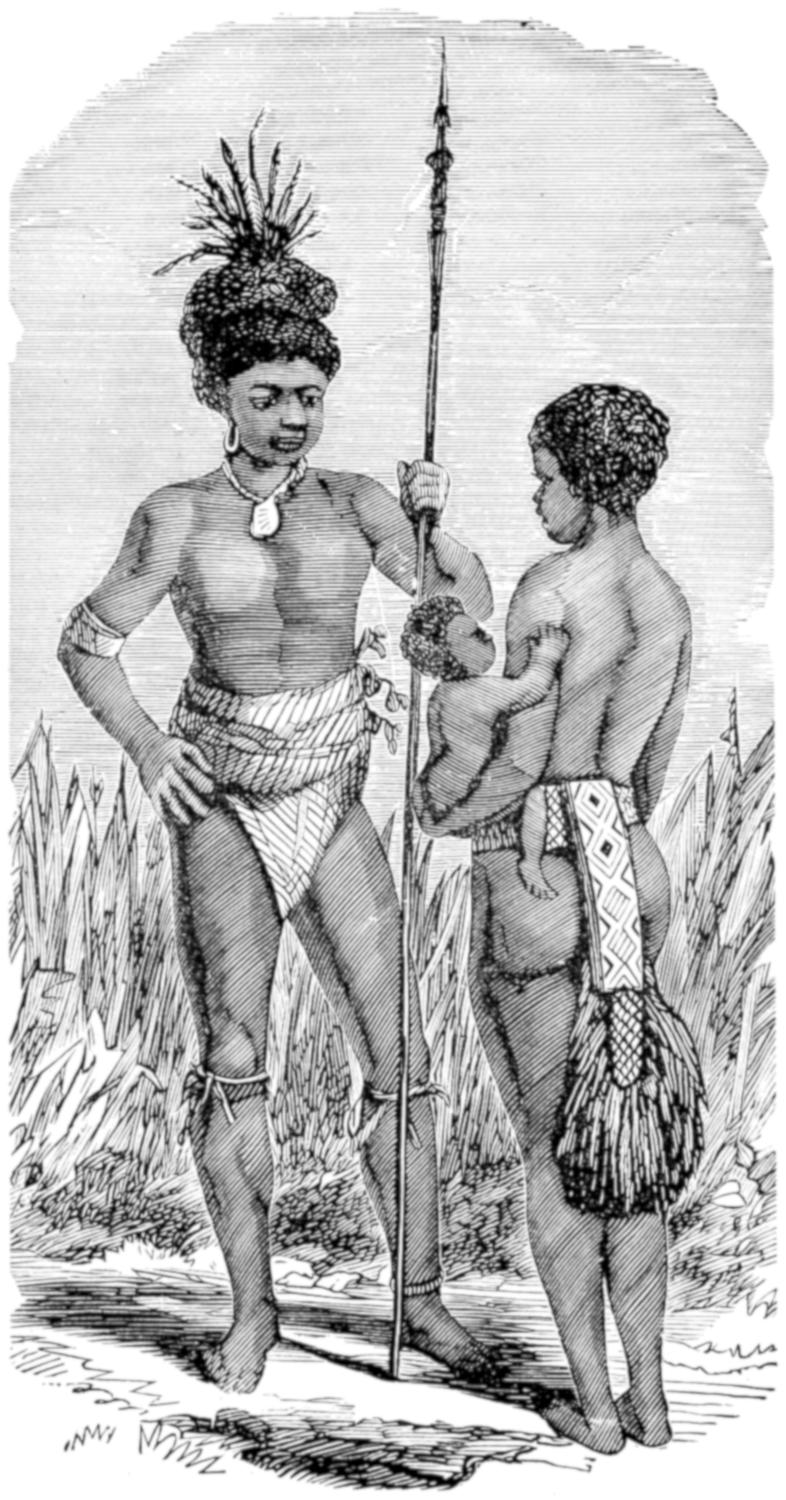
(1.) MAN AND WOMAN OF NEW HEBRIDES.
(See page 972.)
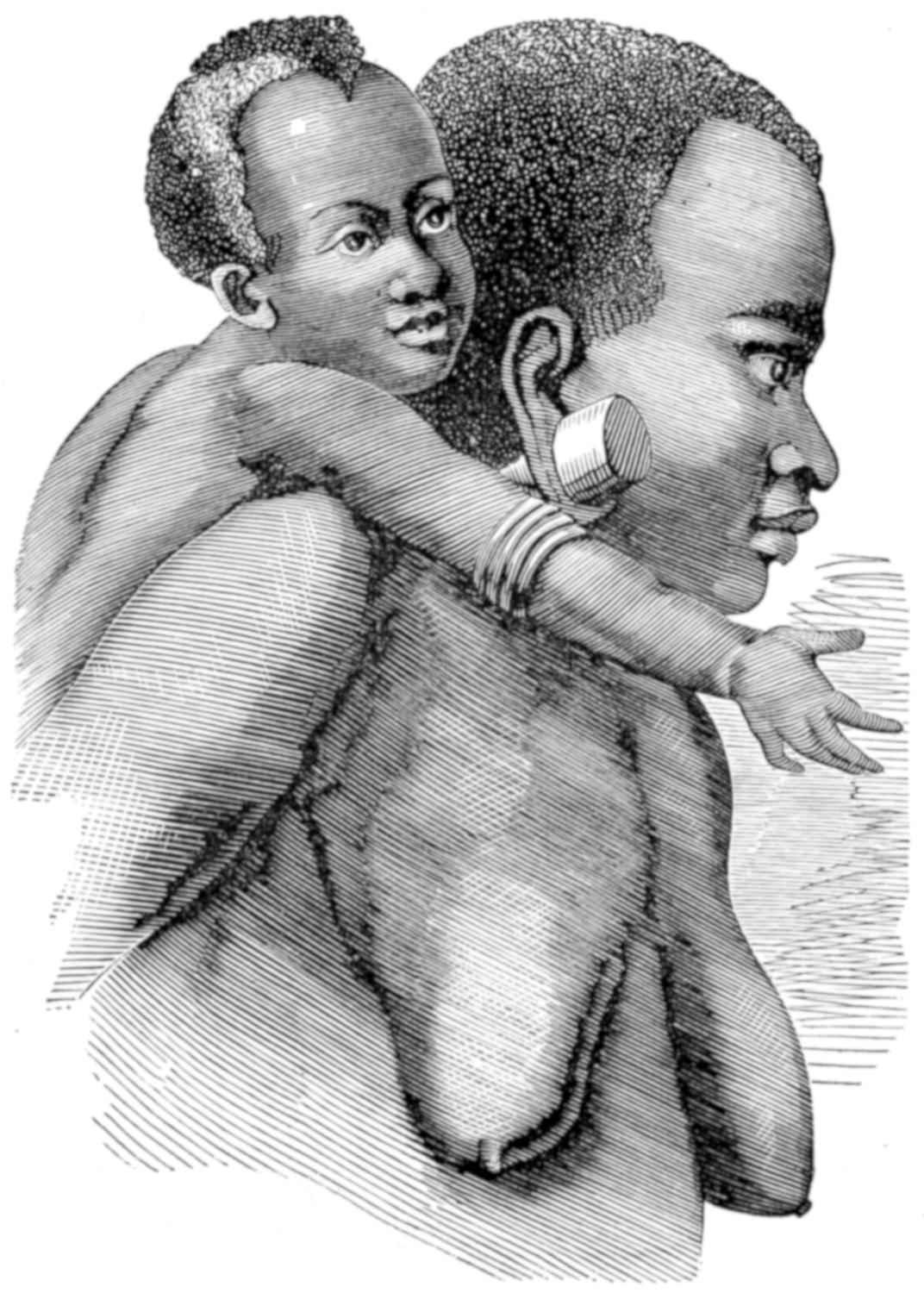
(2.) WOMAN AND CHILD OF VANIKORO.
(See page 975.)
(3.) DAUGHTER OF TONGAN CHIEF.
(See page 977.)
We come now to Errumanga. It has
kept up its traditional ferocity. Not content
with killing the first missionary who set his
foot on their shores, the people many years
afterward murdered another missionary and
his wife. This second murder was owing to
the priests, who persuaded the people that
an epidemic which had done much damage
among the natives was caused by the missionaries
from a strange land. The ignorant
people readily believed this statement, and,
wild with the uncontrolled fury of the savage,
they murdered both the accused persons.
The deed was scarcely done before
the people repented of it, and only the day
after the murder, when the bodies were
buried, the natives stood round the grave
overwhelmed with grief, the most sincere
mourner being the chief of the district.
The murder of these people, unfortunate
as it may seem, really paved the way for
others to follow in their footsteps; and, as is
generally the case with persecution, the
cause only gained additional strength by the
attempts made to repress it by main force.
At one time the inhabitants were held in
such dread that the natives were not allowed
to come on board the ships, nor were the
men permitted to land. A small trade was
carried on in sandal-wood, which the natives
carried to the boats by swimming through
the surf, and being necessarily unarmed,
could be allowed to make their bargains
without suspicion of treachery. Although,
therefore, the savage nature of the inhabitants
has occasionally broken out and
showed itself in bloodshed, the very fact
that Europeans have been allowed to reside
for any time on the island shows a great
improvement in the character of the natives.
The northernmost island of the group is
Aneiteum, one of the islands which produce
sandal-wood in great plenty. The
natural ferocity and suspicion of the natives
has been overcome by the judicious establishment
and introduction of a factory, to
which the sandal-wood is taken by the natives,
and from which it is sold to the ships,
which find here a store of this valuable wood
always ready for them. The chief market
for the wood is found in China, where it is
cut into various articles of luxury with the
customary patience which characterizes the
artists of that country. The success of this
factory shows that the best way of dealing
with savages is to treat them precisely as
children are treated, and to employ in all
dealings with them an equal mixture of
kindness and firmness, making allowances
for the different constitution of their minds
and the influence of savage habits upon their
conduct; but at the same time to be firm
almost to severity, and never to permit an
encroachment. The safest maxim in dealing
with savages is never to deceive and never
to trust.
The inhabitants of Malicolo differ considerably
from those of the islands which
have been mentioned. While the natives of
Vaté are tall and finely made, those of Errumanga
scarcely inferior to them, and those
of Tanna stout and powerful, though comparatively
short of stature, the inhabitants
of Malicolo are small, ill-proportioned people,
ugly of face, and disfiguring themselves by
wearing a belt round the waist, drawn so
tight that it gives them an hour-glass or
waspish aspect.
The reader may perhaps be aware that, in
the year 1788, the vessels Boussole and Astrolabe,
commanded by the celebrated voyager
La Pérouse, disappeared, and nothing
more was heard of them. He was last
seen at Botany Bay, where he had arrived
from Tonga.
In 1791 an expedition, consisting of two
vessels, the Recherche and the Espérance,
was fitted out under the command of Captain
D’Entrecasteaux, and sent out in search of
the missing vessels. The expedition failed
in its immediate object, though in the course
of the explorations some valuable discoveries
were made.
In 1792 D’Entrecasteaux’s vessels got
among the New Hebrides, and found themselves
in the midst of coral reefs and shoals
of which they knew nothing, and which
caused no small alarm. In consequence of
the danger of these reefs, the captain did not
touch at all the islands which were seen, but
contented himself with naming them, and
marking their places on a chart. As it
turned out, one of these islands, Vanikoro,
or Recherche Island, as D’Entrecasteaux
named it, was the place on which La Pérouse
was wrecked, so that the expedition actually
passed within sight of the very spot which
was the object of their voyage. Indeed,
D’Entrecasteaux practically completed the
voyage which La Pérouse began, and his
narrative furnishes a necessary supplement
to that of the voyager in search of whom he
sailed. It was not until some forty years
afterward that the relics were discovered
which proved beyond a doubt that Vanikoro
was the place in which La Pérouse and his
companions perished. Vanikoro is sometimes
called Pitt’s Island. An illustration
is given on the 973d page, which represents
a woman of Vanikoro, and her child, and is a
type of the expression and features of these
islanders.
CHAPTER XCIX. TONGA. GOVERNMENT AND GRADATIONS OF RANK.
FRIENDLY RELATIONS BETWEEN TONGA AND FIJI — THE ARMY OF OCCUPATION — GENERAL APPEARANCE
OF THE TONGANS — THEIR DRESS — THE GNATOO, AND MODE OF WEARING IT — MAKING
THE GNATOO — BEATING, JOINING, AND PRINTING THE PIECES — THE DISTINCTION BETWEEN
GNATOO AND TAPPA — ORNAMENTS WORN BY THE TONGANS — WHALE’S TEETH, AND THE VALUE
SET ON THEM — FINOW AND THE TEETH — DISTINCTIONS OF RANK — SECULAR AND RELIGIOUS
RANK — THE TOOI-TONGA, HIS ORIGIN AND PRIVILEGES — THE VEACHI — THE HOW, OR KING,
OFTEN INFERIOR IN RANK TO MANY OF HIS CHIEFS — THE EGI, OR NOBLES — THE MATABOOLES,
THEIR RANK AND DUTIES — THE MOOAS, OR GENTRY; AND THE TOOAS, OR COMMON PEOPLE — MATRIMONIAL
ARRANGEMENTS BETWEEN PEOPLE OF DIFFERENT RANKS — TREATMENT OF WOMEN.
Our readers may remember that, in the account
of the Fiji Islands, it was mentioned
that there was one nation which was held by
the Fijians as free from their usual custom
of killing and eating all visitors to their coast.
These people are the inhabitants of the Tongan
group, popularly known as the Friendly
Islands. Owing to their courage in war
and superior intellect, they have performed
toward the Fijians the same part that has so
often been played by more civilized people.
On one or two occasions they found the
Fijian chiefs hard pressed by rebellion, took
the part of their hosts, crushed the rebel
forces, and restored the chiefs to power.
A remarkable instance of this timely aid
occurred as late as 1855. Thakombau, of
whom we have already heard, was in danger
of losing his life and throne together through
a rebellion led by a chief named Mara. Fortunately,
he had previously given a magnificent
canoe to the Tongan king, who
sailed over, according to custom, accompanied
with a large fleet, in order to receive
the royal present with due honor. He instantly
led his forces against the rebels,
stormed a fort called Kamba which was held
by them, took it, and utterly dispersed
the enemy, Mara himself only escaping by
running over the sharp shells of the reef,
thereby nearly cutting his feet to pieces, and
swimming to a neighboring town on the
coast.
After this exploit, the Tongan chief followed
up his blow by sailing to the island of
Taviuni, where another rebellion was raging
in consequence of the murder of the chief
by his sons. He put an end to this rebellion
also, inquired which of the murdered chief’s
other sons had the best claim to his father’s
rank, and installed him formally. The vanquished
rebels, finding that the Tongan
leader was too strong for them, tried to
entrap him in an ambuscade, but only succeeded
in murdering one of his chiefs. The
Tongans immediately landed on the island,
and avenged the death of their friends in a
most terrible manner. A large party of
Tongan warriors was afterward left under
the command of a chief named Maafu, a relation
of the king, and by means of this force
the rebels were effectually suppressed.
As might be expected, the Tongans took
advantage of their situation, and enacted
over again the fable of the deer, the horse,
and the man. Some four hundred of them
generally remain in Fiji, and domineer over
the natives much like armies of occupation
in other countries. A Tongan warrior has
not the least scruple in going to a strange
village, entering the house that pleases him
best, and installing himself in the best place
with the simple words: “This part of the
house is mine.” He takes the best of the
food, and, if he builds a canoe, merely acts
as foreman, making the Fijians do all the
hard work. There is nothing that the Tongans
do, however, which so much incenses
the natives as their careless habit of shaking
the bread-fruit trees in order to procure
the fruit, which ought always to be gathered
by hand.
It is said, and perhaps with reason, that
the Tongans contemplate the complete conquest
of the Fijian group; and from their
experience, courage, and discipline, and the
fear which they have contrived to instil into
the Fijians, there is little doubt that the attempt,
if it were to be made, would be a successful
one. The Fijian warrior fights on his
own account, each man separately, while the
Tongans act in unison; so that the Fijians
who have fought against them compare
them to the gods, against whom it is useless
to struggle.
As may be gathered from these particulars,
the Tongans are a superior race to the
Fijian. They are, indeed, a different people
altogether; the Fijians belonging to the
Papuan race, whereas the Tongans belong
to the Polynesian race, which does not possess
the very crisp hair and rough skin of
the Papuans; and, as a rule, is much lighter
in skin, the complexions being often as white
as that of many Europeans. They are, on the
whole a singularly handsome set of people,
the beauty not being limited to the men, as
is the case with so many savage tribes, but
possessed equally, if not to a superior extent,
by the women. The portrait of a daughter
of a Tongan chief, on the 973d page, will
verify this statement.
The dress of both sexes is made of similar
materials, but is differently arranged.
The fabric is called in the Tongan language
“gnatoo,” and is almost identical with the
Fijian masi. It is made from the bark of
the same tree, and is beaten out in very
similar fashion, except perhaps that the Tongan
women are more particular than those
of Fiji in the care and delicacy with which
they beat out the bark with their grooved
mallets. The gnatoo varies somewhat in
quality according to the island in which it is
made, that of Vavau being considered as the
finest.
In putting on the gnatoo, there is nearly
as much diversity as in the arrangement of
a Scotch plaid, and the mode in which it is
arranged serves to denote difference of rank.
The most fashionable mode, which is practised
by the chiefs, is to wrap a portion of it
round the loins in such a manner that the
folds allow fair play to the limbs, and then
to pass the remainder round the waist like a
broad belt, and tuck the ends under the belt
in front of the body. The portion which
forms the belt is so arranged that it can be
loosened at any moment and thrown over
the head and shoulder. This is always done
when the wearer is obliged to be abroad in
the night time.
The gnatoo of the men measures about
eight feet in length, by six in width. Under
the gnatoo is a belt made of the same material.
Women have a larger piece of
gnatoo than the men, and arrange it in folds
which are as graceful as those of antique
art, and seem as likely to fall off the person.
This, however, is never the case, and, even
if the gnatoo were by any accident to slip,
the women wear under it a small mat or
petticoat about a foot in depth.
As this gnatoo plays so important a part
in the clothing of the Polynesians, its manufacture
will now be described, the account
being taken from Mariner’s valuable history
of the Tongans:—“A circular incision
being made round the tree near the root
with a shell, deep enough to penetrate the
bark, the tree is broken off at that point,
which its slenderness readily admits of.
When a number of them are thus laid on the
ground, they are left in the sun a couple of
days to become partially dry, so that the
inner and outer bark may be stripped off
together, without danger of leaving any of
the fibres behind.
“The bark is then soaked in water for a
day and a night, and scraped carefully with
shells for the purpose of removing the outer
bark or epidermis, which is thrown away.
The inner bark is then rolled up lengthwise,
and soaked in water for another day. It
now swells, becomes tougher, and more
capable of being beaten out into a fine texture.
“Being thus far prepared, the operation
of too-too, or beating commences. This part
of the work is performed by means of a mallet
a foot long and two inches thick, in the
form of a parallelopipedon, two opposite
sides being grooved horizontally to the depth
and breadth of about a line, with intervals
of a quarter of an inch.
“The bark, which is from two to three feet
long, and one to three inches broad, is then
laid on a beam of wood about six feet long
and nine inches in breadth and thickness,
which is supported about an inch from the
ground by pieces of wood at each end, so as
to allow of a certain degree of vibration.
Two or three women generally sit at the
same beam; each places her bark transversely
upon the beam immediately before
her, and while she beats with her right
hand, with her left she moves it slowly to
and fro, so that every part becomes beaten
alike. The grooved side of the mallet is
used first, and the smooth side afterward.
“They generally beat alternately, and
early in the morning, when the air is calm
and still, the beating of gnatoo in all the
plantations has a very pleasing effect.
Some sounds being near at hand, and
others almost lost by the distance,—some
a little more acute, and others more grave,—and
all with remarkable regularity, produce
a remarkable effect that is very agreeable,
and not a little heightened by the singing
of the birds and the cheerful influence
of the scene. When one hand is fatigued,
the mallet is dexterously transferred to the
other, without occasioning the smallest sensible
delay.
“In the course of about half an hour, it is
brought to a sufficient degree of thinness,
being so much spread laterally as to be now
nearly square when unfolded; for it must be
observed that they double it several times
during the process, by which means it
spreads more equally and is prevented from
breaking. The bark thus prepared is called
fetagi, and is mostly put aside till they have a
sufficient quantity to go on at a future time
with the second part of the operation,
which is called cocanga, or printing with
coca.
“When this is to be done, a number employ
themselves in gathering the berries of
the toe, the pulp of which serves for paste
(but the mucilaginous substance of the mahoá
root is sometimes substituted for it); at
the same time others are busy scraping off
the soft bark of the cocoa tree and the toodi-tooi
tree, either of which, when wrung out
without water yields a reddish-brown juice,
to be used as a dye.
“The stamp is made of the dried leaves of
the paoongo sewed together so as to be of
a sufficient size, and afterward embroidered,
according to various devices, with the wiry
fibre of the cocoa-nut husk. Making these
stamps is another employment of the women,
and mostly women of rank. They are
generally about two feet long, and a foot and
a half broad. They are tied on to the convex
side of half cylinders of wood, usually
about six or eight feet long, to admit two or
three similar operations to go on at the
same time.
“The stamp being thus fixed, with the
embroidered side uppermost, a piece of the
prepared bark is laid on it, and smeared over
with a folded piece of gnatoo dipped in one
of the reddish-brown liquids before mentioned,
so that the whole surface of the prepared
bark becomes stained, but particularly
those parts raised by the design in the
stamp. Another piece of gnatoo is now
laid upon it, but not quite so broad, which
adheres by virtue of the mucilaginous
quality in the dye, and this in like manner
is smeared over; then a third in the same
way.
“The substance is now three layers in
thickness. Others are then added to increase
it in length and breadth by pasting the edges
of these over the first, but not so as there
shall be in any place more than three folds,
which is easily managed, as the margin of
one layer falls short of the margin of the one
under it.
“During the whole process each layer is
stamped separately, so that the pattern may
be said to exist in the very substance of the
gnatoo; and when one portion is thus
printed to the size of the stamp, the material
being moved farther on, the next portion,
either in length or breadth, becomes
stamped, the pattern beginning close to the
spot where the other ended. Thus they go on
printing and enlarging it to about six feet in
breadth, and generally about forty or fifty
yards in length. It is then carefully folded up
and baked under ground, which causes the
dye to become rather dark, and more firmly
fixed in the fibre; beside which it deprives
it of a peculiar smoky smell which belongs to
the coca.
“When it has been thus exposed to heat
for a few hours, it is spread out on a grass
plat, or on the sand of the seashore, and the
finishing operation of toogi-hea commences,
i. e. staining it in certain places with the
juice of the hea, which constitutes a brilliant
red varnish. This is done in straight
lines along those places where the edges of
the printed portions join each other, and
serves to conceal the little irregularities
there; also in sundry other places, in the form
of round spots, about an inch and a quarter
in diameter. After this the gnatoo is exposed
one night to the dew, and the next
day, being dried in the sun, it is packed up
in bales to be used when required. When
gnatoo is not printed or stained, it is called
tappa.”
Various ornaments are worn by both
sexes among the Tongans, among which
may be enumerated a kind of creeper, with
flowers at intervals along the stem. This is
passed round the neck or the waist, and has
a singularly graceful and becoming appearance.
The most valued ornament is, however,
that which is made of the ivory of the
whale’s teeth, so cut as to resemble in miniature
the tooth itself. They are of different
sizes, varying from one inch to four
inches in length, and strung together by a
cord passing through a hole bored in their
thick ends.
These teeth are even more valued in
Tonga than in Fiji, and a common man
would not dare to have one in his possession,
knowing well that he would assuredly
lose his life on the very first occasion that
offered the slightest opportunity of an accusation.
Once Finow, the King of Tonga,
was told of a whale which had been stranded
on a little island inhabited only by a man
and his wife. When Finow reached the
place he found that the teeth had been removed,
and ordered the man and woman
into custody on the charge of stealing them.
Both denied that they had more than two
teeth, which they gave up, whereupon the
man was immediately killed with a club, and
the woman threatened with a similar fate.
Under fear of this threat she produced two
more teeth which she had hidden, but, refusing
to acknowledge that she knew of any
others, met with the same fate as her husband.
Many years afterward the missing
teeth were discovered, the woman having
buried them in the ground. This anecdote
shows the value in which whales’ teeth are
held, the king taking the trouble to go in
person to claim them, and the woman allowing
herself to be killed rather than part with
her treasures.
(1.) INTERIOR OF A TONGAN HOUSE.
(See page 981.)
(2.) BURIAL OF A LIVING KING.
(See page 966.)
A good idea of the appearance of a Tongan
woman of rank may be obtained from
the illustration No. 1, on the preceding page,
which represents the interior of a chief’s
house, and part of his family.
In the foreground is one of the odd
wooden pillows which are so much in vogue
throughout Polynesia; while one of the
most conspicuous objects is a roll of narrow
matting, which is used for the purpose of
surrounding men and women of high rank
as they sit on the floor. Within it is
seated the chief’s wife, in the graceful attitude
adopted by the Tongans, exhibiting the
simple and really elegant folds of the gnatoo
dress. The reader will observe the apparent
looseness with which the dress is put on,
the folds lying so loosely that they seem
ready to slip every moment. They are, however,
perfectly tight, and there is not the
least danger of their slipping.
Within doors the children never wear any
clothing until they are two years old; but
when they go out, their parents always
wrap round them a piece of gnatoo or tappa.
The natives are exceedingly fastidious about
their dress, criticising every fold with minute
care, and spending a considerable time
in arranging them. Even when bathing,
they always array themselves in a slight
dress made for such occasions, going aside
for the purpose of exchanging the usual
gnatoo for an apron of leaves or matting.
So disrespectful is utter nudity reckoned
among the Tongans, that if a man be obliged
to undress near the spot where a chief is
buried, the leaf apron is worn while the dress
is changed.
We now come to the various divisions of
rank in Tonga, and the mode of government.
Ranks may be divided into two distinct
orders, namely, the religious and the civil.
We must take them in this order, because
among the Tongans religious takes the precedence
of civil rank.
By far the greatest man in point of rank
is the Tooi-tonga. This word literally signifies
Chief of Tonga, and is given because
the man who bears it is the greatest man in
Tonga, which is the chief of the whole
group of islands. The word does not represent
a name, but a rank, the family name
being Fatagehi, and the rank passes downward
by legitimate descent. So great a
man is the Tooi-tonga, that in his presence
no man may stand, but is obliged to sit
down in the attitude of respect. Even the
king is not exempt from this law; and if he
should happen to meet the Tooi-tonga, he
would have to squat down humbly until the
great man had passed by.
The Tooi-tonga stands alone in many
particulars, and, according to our ideas, he
has plenty of dignity, but very little comfort,
leading a life somewhat like that of the
spiritual Emperor of Japan. He has certainly
one advantage over his fellows: he
does not undergo the operation of tattooing,
because there is no one of sufficiently high
rank to draw the blood of so sacred a personage.
He is married after a manner peculiar
to himself, is buried in a peculiar
manner, and is mourned in a peculiar manner.
He is so sacred, that in speaking of
him another language is used, many phrases
being reserved expressly for the Tooi-tonga.
These are probably relics of an ancient and
nearly lost language, as is the case with the
incantations of the New Zealand priests.
The reason for this extraordinary veneration
is, that the Tooi-tonga is supposed to
be a direct descendant of a chief god who
was accustomed to visit the islands; but
whether his female ancestor was a goddess
or a native of earth is an open question with
the Tongans. In spite of all the veneration
which is shown to him, the Tooi-tonga has
very little real power, and in this respect is
far surpassed by the king, and equalled by
many of the nobles.
There is another chief, the Veachi, who
is also supposed to have a divine origin, and
is therefore held in higher veneration than
any of the chiefs, but is inferior to the Tooi-tonga.
It is true that in his presence the
king has to sit on the ground in the attitude
of humility, and that he is considered a
being next in rank to the great Tooi-tonga
himself; but the other marks of veneration,
such as a separate language, and different
modes of marriage, burial, and mourning,
are not paid to him; and in power he is
equalled by many of the chiefs.
Next in rank, but at a very great distance,
come the priests. These men receive
their name from their capability of being
inspired by certain gods, and, except when
actually inspired, have no special rank, and
are paid no honor except such as may
belong to them as private individuals. Mariner
remarks that he never knew a case in
which a priest was a chief. The king occasionally
becomes inspired, because there is
one god who cannot speak except by the
royal mouth; but the king is not, in consequence,
considered as a priest. Neither are
the Tooi-tonga and Veachi considered as
priests, nor is there any connexion between
them and the priesthood.
Should, in an assembly, a priest become
inspired, he is immediately held in the
highest veneration as long as the inspiration
lasts, because a god is supposed to be speaking
through his lips. If, on such an occasion,
the king should be present, he immediately
leaves his place, and sits humbly
among the spectators. Even the great
Tooi-tonga himself acts in the same manner,
and, though the descendant of a god, he retires
before the actual presence of a divinity.
So much for the spiritual rank, and we
now pass to the temporal rank.
The highest man in a secular point of
view is the How, or king, who is the most
powerful of all the chiefs, and yet may be in
point of rank inferior to the poorest of his
nobles, or Egis. Rank is measured in
Tonga by relationship to the Tooi-tonga or
Veachi, the relatives of the former being
held superior to those of the latter. The
consequence is, that the king may meet a
poor man who has scarcely any power, and
yet who is so high in rank above the king
that the latter must sit down till his superior
has passed. Should he not do so, or
should he by any accident touch anything
that belonged to his superior, the tapu
would assume its sway, and he would not be
permitted to feed himself with his own
hands until he had gone to his superior, and
saluted him by touching his feet.
In consequence of these customs, the king
avoids associating with nobles who are his
superior in rank, and they in their turn keep
out of his way as far as possible, so as not to
humiliate him by making him sit while they
stand. Originally, the king was a descendant
of the Tooi-tonga, and thus was equally
high in spiritual and temporal rank. But
when the throne was usurped by other families,
the king still retained the temporal
power, though he yielded in spiritual rank
to others.
Next to the king come the Egis, or nobles.
These are all relations of the Tooi-tonga,
the Veachi, or the king, kinship to
the king being held as conferring rank because
he holds the reins of power. Rank
descends in Tonga, as in other Polynesian
islands, through the female line, so that all
the children of an Egi woman possess the
rank of Egi, no matter who may be the
father.
After the nobles come the Matabooles,
or councillors, who are the companions and
advisers of the chiefs, and take their rank
from that of the chief to whom they are
attached. They are always the heads of
families, and are mostly men of mature age
and experience, so that their advice is
highly valued. The eldest son of a Mataboole
is carefully trained to take his father’s
place when he dies, and is thoroughly versed
in all the rites and ceremonies, the administration
of laws, and the many points of etiquette
about which the Tongans are so fastidious.
He also learns all the traditionary
records of his people, and by the time that
he is thirty years old or so is perfectly acquainted
with his profession. But until his
father dies he has no rank, and is merely
one of the ordinary gentry, who will now be
described.
Last of all those who possess any rank
are the gentry, or Mooas. All the sons of
Matabooles are Mooas, and act as assistants
of the Matabooles, aiding on great ceremonies
in managing the dances, distributing
food, and so forth. Like their superiors,
they attach themselves to the service of
some chief, and derive their relative consequence
from his rank. As a rule, the Mooas
all profess some art, such as canoe building,
ivory carving, and superintending funeral
rites, in which three occupations the Matabooles
also take part. They also preside
over the makers of stone coffins, the makers
of nets, the fishermen, and the architects,
and all these employments are hereditary.
Just as the children and brothers of Matabooles
take the next lowest rank, that of
Mooa, so do those of Mooas take the next
lowest rank, and are considered as Tooas,
or plebeians. In this case, however, the
eldest son of a Mooa assumes the rank of
his father after his death, and is therefore
more respected than his brothers, who are
regarded like younger sons among ourselves.
The Tooas do all the menial work,
and act as cooks, barbers, tattooers, club-carvers,
and so forth. The two latter occupations,
however, as requiring artistic skill,
are also practised by Mooas.
It will be seen from this brief sketch how
elaborate, and yet how intelligible, is this
system of the Tongans, even when complicated
with the double grades of spiritual
and temporal rank. This respect for rank
is carried even into the privacy of home. If,
for example, an Egi woman marries a Mataboole,
or a Mooa, she retains her original
rank, which is shared by all her children,
so that both she and her children are superior
to the husband and father. He, on his
part, has to play a double rôle. He is master
in his own house, and his wife submits
to him as implicitly as if he were of the
same rank as herself. Yet he acknowledges
the superior rank both of his wife and children,
and, before he even ventures to feed
himself with his own hands, he goes through
the ceremony of touching the feet of his
wife or either of his children, in order to
free himself from the tapu.
When the case is reversed, and a man of
high rank marries a woman of an inferior
station, she does not rise to the rank of her
husband, but retains her original station,
which is inherited by her children, who, together
with herself, have to touch the feet
of the husband whenever they eat. They
imagine that if they did not do so a terrible
sickness would consume them. When Mariner
lived among the Tongans, he did not
trouble himself about the tapu, much to the
horror of the natives, who expected that the
offended gods would wreak their vengeance
on him. Finding that he suffered no harm,
they accounted for the phenomenon by the
fact that he was a white man, and therefore
had nothing to do with the gods of the
Tongans.
In consequence of the strictness of this
system, Finow, who was king when Mariner
lived among the Tongan islands, used to feel
annoyed if even a child of superior rank
were brought near him, and used angrily to
order it to be taken away. Such conduct,
however, would not be thought right unless
both parties were nearly equal in rank; and
if, for example, the Tooi-tonga’s child had
been brought near the king, he would at
once have done homage after the customary
fashion.
Some very curious modifications of this
custom prevail throughout Tongan society.
For example, any one may choose a foster-mother,
even though his own mother be
alive, and he may choose her from any rank.
Generally her rank is inferior to that of her
adopted son, but even this connection between
them does not earn for her any particular
respect. She would be much more
honored as an attendant of a young chief
than as his foster-mother.
So elaborate and yet simple a system implies
a degree of refinement which we could
hardly expect among savages. In consonance
with this refinement is the treatment
of women, who are by no means oppressed
and hard-worked slaves, as is the case with
most savage nations. Consequently the
women possess a gentle freedom of demeanor
and grace of form which are never
found among those people where women are
merely the drudges of the men. So long
ago as 1777, Captain Cook noticed that the
women were much more delicately formed
than the men, that they were beautifully
proportioned, and that the hands were so
small and soft that they would compare
favorably with the finest examples in Europe
and America. Hard and constant
labor, such as is usually the lot of savage
women, deteriorates the form greatly, as indeed
we can see among ourselves, by comparing
together a high-bred lady and a field
laborer. The two hardly seem to belong to
the same race, or scarcely to the same sex.
The Tongan women certainly do work,
but they are not condemned to do it all, the
men taking the hard labor on themselves,
and leaving the women the lighter tasks,
such as beating gnatoo, plaiting baskets,
making crockery, and the like. At the
great dances, the women are not only allowed
to be present, but assist in them, taking
as important a share as the men, and
infusing into the dance a really cultivated
grace which would not exist without them.
The light-colored hue of the skin, which
has already been mentioned, is much more
common among the women than the men,
for the reason that the better class of
women take more care of themselves than
the men; and, though all classes live for the
most part in the open air, the wives and
daughters of powerful and wealthy men are
careful not to expose themselves to the sun
more than is absolutely necessary, so that
many of them, instead of being brown, are
of a clear olive tint, the effect of which is
singularly beautiful when contrasted with
their dark clustering hair, their gnatoo garments,
and the leaves and flowers with
which they adorn themselves, changing them
several times daily. Altogether, a Tongan
chief looks, and is, a gentleman, and his wife
a lady.
CHAPTER C. TONGA— Continued . WAR AND CEREMONIES.
NATURAL MILDNESS OF THE TONGANS — BOASTING DISCOURAGED — WAR APPARENTLY LEARNED FROM
THE FIJIANS — FINOW’S SPEECH TO HIS SOLDIERS, AND A NEW DISCIPLINE — FATE OF THE
VANQUISHED — THE DROWNED CHIEFS — CEREMONIES — KAVA-DRINKING — STRICT CODE OF ETIQUETTE — PREPARATION
OF THE KAVA — A GRACEFUL PERFORMANCE — DISTRIBUTION OF THE
KAVA — POINTS OF CEREMONY — A TONGAN PLANTATION — SETTING THE YAMS — CEREMONY OF
INACHI — THE POLE BEARERS AND THEIR BURDEN — THE YAM PILLARS — LIFTING THE PIGS — DISTRIBUTION
OF PROVISIONS, AND CONCLUSION OF THE CEREMONY — TOW-TOW, AND ITS
OBJECT — PRESENTATION OF THE OFFERING — A GRAND SCRAMBLE — BOXING AND WRESTLING
MATCHES — GOOD-HUMORED COMBATANTS — FIGHTS WITH CLUBS — THE SAMOAN AND TONGAN
RULES.
By nature the Tongans are gentle and kind-hearted,
and present a most curious mixture
of mildness and courage. To judge by
many traits of character, they might be stigmatized
as effeminate, while by others they
are shown to possess real courage, not
merely the dashing and boastful bravery
which is, when analyzed, merely bravado,
and which is only maintained by the hope
of gaining applause. The Tongan never
boasts of his own courage, nor applauds that
of another. When he has performed a deed
of arms which would set a Fijian boasting
for the rest of his life, he retires quietly into
the background and says nothing about it.
His king or chief may acknowledge it if
they like, but he will be silent on the subject,
and never refer to it.
For the same reason, he will not openly
applaud a deed of arms done by one of
his fellows. He will regard the man with
great respect, and show by his demeanor the
honor in which he holds him, but he will
not speak openly on the subject. Mariner
relates an instance in which a young warrior
named Hali Api Api, who seems to have
been the very model of a gentleman, performed
a notable deed of arms, equally remarkable
for courage and high-minded generosity.
During a council, the king called
him out, and publicly thanked him for his
conduct. The man blushed deeply, as if
ashamed at this public recognition of his
services, saluted the king, and retired to his
place without saying a word. Neither did
he afterward refer either to his exploit or
to the public recognition of it.
One warrior actually declared that he
would go up to a loaded cannon and throw
his spear into it. He fulfilled his promise to
the letter. He ran up within ten or
twelve yards of the gun, and, as the match
was applied, threw himself on the ground,
so that the shot passed over him. He then
sprang up, and, in spite of the enemy’s
weapons, hurled his spear at the cannon,
and struck it in the muzzle. Having
performed this feat, he quietly retired, and
was never heard to refer to so distinguished
an act of courage, though he was greatly respected
for it by his countrymen.
We need not wonder that such men
should establish a moral influence over the
boastful but not warlike Fijians, and that
the small colony established in the Fiji
group should virtually be its masters. Two
hundred years ago, the Tongan appears to
have been ignorant of weapons and warfare,
and to have borrowed his first knowledge
of both from Fiji. Consequently, the Tongan
weapons are practically those of Fiji,
modified somewhat according to the taste
of the makers but evidently derived from the
same source. Captain Cook, who visited the
islands in 1777, remarks that the few clubs
and spears which he saw among the Tongans
were of Fiji manufacture, or at least
made after the Fiji pattern. Yet by a sort of
poetical justice, the Tongan has turned the
Fijian’s weapons against himself, and, by
his superior intellect and adventurous courage,
has overcome the ferocious people of
whom he was formerly in dread.
Since the introduction of fire-arms, the
superiority of the Tongans has made itself
even more manifest, the Fijians having no
idea of fighting against men who did not
run away when fired at, but rushed on in
spite of the weapons opposed to them.
It is possible that the Tongans may have
learned this mode of fighting from Mariner
and his companions. When the king
Finow was about to make war upon a
neighboring island, he assembled the warriors
and made them an address, telling
them that the system of warfare which had
been previously employed was a false one.
He told them no longer to advance or retreat
according as they met with success or
repulse, but to press forward at all risks;
and, even if a man saw the point of a spear
at his breast, he was not to flinch like a
coward, but to press forward, and at risk of
his own life to kill his foe. He also instructed
them in the art of receiving the
onset of the enemy with calmness, instead
of indulging in cries and gesticulations, telling
them to seat themselves on the ground
as the enemy approached, as if perfectly
unconcerned, and not to stir until ordered,
even if they threw spears or shot arrows.
But as soon as they got the word to advance
they were to leap to their feet, and charge
without regard to consequences. The reader
may remember that this is exactly the strategy
which was employed in Africa by the
great Kaffir chief Tchaka.
It may easily be imagined how such a
course of conduct would disconcert their
opponents, and the Fijians in particular,
with whom boasting and challenging took
the place of valor. Emboldened by the apparent
weakness of the enemy, they would
come on in great glee, expecting to make an
easy conquest, and then, just when they
raised the shout of victory, they found themselves
suddenly attacked with a disciplined
fury which they had never been accustomed
to meet, and were consequently dispersed
and almost annihilated before they could
well realize their position.
Though tolerably mild toward their captives,
the Tongans sometimes display an
unexpected ferocity. On one occasion, some
of Finow’s men surprised and captured four
of the enemy, whom they imagined to belong
to a party who had annoyed them
greatly by hanging on their track and cutting
off the stragglers.
At first they wished to take the prisoners
home and make an example of them, but
the chief of the party suggested that they
would have all the trouble of guarding them,
and proposed to decapitate them, and take
their heads home. One of them objected to
the proposal on the ground that they had no
knives, but another man, fertile in expedients,
picked up some oyster-shells that were
lying about, and suggested that they would
answer the purpose.
It was in vain that the victims protested
their innocence, and begged that at least
they might be clubbed before their heads
were cut off. The conquerors coolly took
off their dresses to prevent them being
stained with blood, and deliberately sawed
off the heads of the captives with their oyster-shells;
beginning at the back of the neck,
and working their way gradually round.
The reason for this course of action seemed
to be twofold—first, that they thought they
might spoil the heads by the club; and
secondly, that as the heads must be cut off
at all events, clubbing the captives beforehand
was taking needless trouble.
Indeed, the character of the Tongan presents
a curious mixture of mildness and
cruelty, the latter being probably as much
due to thoughtlessness as to ferocity. Once
when eighteen rebels had been captured,
Finow ordered them to be drowned. This
punishment is inflicted by taking the prisoners
out to sea, bound hand and foot, and
towing some worthless canoes. When they
are far enough from land, the culprits are
transferred to the canoes, which are then
scuttled, and left to sink. Care is taken that
the holes made in the canoes are small, so
that they shall be as long as possible in
sinking.
On that occasion twelve of the prisoners
begged to be clubbed instead of drowned,
and their request was granted. The young
men divided the prisoners among themselves,
being anxious to take a lesson in
clubbing a human being, which would serve
them when they came to make use of the
club against an enemy. The twelve were,
accordingly, despatched with the club, but
the others, being tried warriors, scorned to
ask a favor, and were drowned. The leading
chief among them employed the short
time which was left him in uttering maledictions
against Finow and his chiefs, and even
when the water came up to his mouth, he
threw back his head for the purpose of uttering
another curse.
We will now pass to a more pleasant subject,
namely, the various ceremonies in which
the Tongan delights. Chief among these is
the drinking of kava, which forms an important
part of every public religious rite, and
is often practised in private. Kava drinking
is known throughout the greater part of
Polynesia; but as the best and fullest account
of it has been obtained from Mariner’s
residence in Tonga, a description of it has
been reserved for the present occasion. It
must first be premised that the kava is made
from the root of a tree belonging to the
pepper tribe, and known by the name of
Piper methysticum, i. e. the intoxicating pepper-tree.
Disgusting as the preparation of
the kava may be to Europeans, it is held in
such high estimation by the Polynesians
that it is never made or drunk without a
complicated ceremony, which is the same
whether the party be a large or a small
one.
The people being assembled, the man of
highest rank takes his place under the eaves
of the house, sitting with his back to the
house and his face toward the marly, or open
space in front, and having a Mataboole on
either side of him. Next to these Matabooles,
who undertake the arrangement of
the festival, sit the nobles or chiefs of highest
rank, and next to them the lower chiefs,
and so forth. They are not, however, very
particular about the precise order in which
they sit, distinctions of rank being marked
by the order in which they are served.
This is the business of the presiding Matabooles,
and as the distinctions of rank are
most tenaciously observed, it is evident that
the duties of a Mataboole are of a most difficult
nature, and can only be learned by long
and constant practice. If the men sat according
to their rank, nothing would be
easier than the task of serving them in
order. But it often happens that a man of
high rank happens to come late, and, as he
is too polite to disturb those of lower rank
who have already taken their places, he sits
below them, knowing that his rank will be
recognized at the proper time.
It mostly happens, however, that when
one of the presiding Matabooles sees a man
occupying a place much below that to which
his rank entitles him, he makes some one
surrender his place to him, or even turns out
altogether a man who is seated in a high
place, and puts the chief into it. The people
thus gradually extend themselves into a
ring, sometimes single, but often several
ranks deep when the party is a large one,
every one of the members being a man of
some recognized rank. Behind those who
form the bottom of the ring opposite the
presiding chief, sit the general public, who
may be several thousand in number. It is
a remarkable fact, illustrating the rigid code
of etiquette which prevails among the Tongans,
that no one can sit in the inner ring if
a superior relative be also in it; and, no
matter how high may be his rank, he must
leave his place, and sit in the outer circle, if
his father or any superior relative enters the
inner ring.
This ring, which constitutes the essential
kava party, is formed mostly of the sons of
chiefs and Matabooles, and it often happens
that their fathers, even if they be chiefs of
the highest rank, will sit in the outer ring,
rather than disturb its arrangements. Even
the son of the king often adopts this plan,
and assists in preparing the kava like any
of the other young men.
Exactly opposite to the king is placed the
kava bowl, and behind it sits the man who
is to prepare the drink. On either side of
him sits an assistant, one of whom carries a
fan wherewith to drive away the flies, and
another takes charge of the water, which is
kept in cocoa-nut shells. The rank of the
preparer is of no consequence. Sometimes
he is a Mooa or gentleman, and sometimes a
mere cook; but, whoever he may be, he is
known to be able to perform his difficult
task with sufficient strength and elegance.
All being ready, one of the presiding
Matabooles sends for the kava root, which
is then scraped quite clean and cut up into
small pieces. These are handed to the
young men or even to the young women
present, who masticate the root, contriving
in some ingenious way to keep it quite dry
during the process. It is then wrapped in a
leaf, and passed to the preparer, who places
it in the bowl, carefully lining the interior
with the balls of chewed root, so that the
exact quantity can be seen.
When all the kava has been chewed and
deposited, the preparer tilts the bowl toward
the presiding chief, who consults with his
Matabooles, and if he thinks there is not
enough, orders the bowl to be covered over,
and sends for more kava, which is treated
as before. Should he be satisfied, the preparer
kneads all the kava together, and the
Mataboole then calls for water, which is
poured into the bowl until he orders the
man to stop. Next comes the order to put
in the fow. This is a bundle of very narrow
strips of bark of a tree belonging to the
genus hibiscus, and it has been compared to
the willow shavings that are used in England
to decorate fire-places in the summer
time. The assistant takes a quantity of this
material, and lays it on the water, spreading
it carefully, so that it lies equally on the
surface of the liquid. Now begins the
important part of the proceeding which
tests the power of the preparer.
“In the first place, he extends his left
hand to the farther side of the bowl, with
his fingers pointing downward and the palm
toward himself; he sinks that hand carefully
down the side of the bowl, carrying with it
the edge of the fow; at the same time his
right hand is performing a similar operation
at the side next to him, the fingers pointing
downward and the palm presenting outward.
He does this slowly from side to side, gradually
descending deeper and deeper till
his fingers meet each other at the bottom,
so that nearly the whole of the fibres of the
root are by these means enclosed in the fow,
forming as it were a roll of above two feet
in length lying along the bottom from side
to side, the edges of the fow meeting each
other underneath.
“He now carefully rolls it over, so that
the edges overlapping each other, or rather
intermingling, come uppermost. He next
doubles in the two ends and rolls it carefully
over again, endeavoring to reduce it to
a narrower and firmer compass. He now
brings it cautiously out of the fluid, taking
firm hold of it by the two ends, one in each
hand (the back of his hands being upward),
and raising it breast high with his arms
considerably extended, he brings his right
hand toward his breast, moving it gradually
onward; and whilst his left hand is coming
round toward his right shoulder, his right
hand partially twisting the fow, lays the end
which it holds upon the left elbow, so that
the fow lies thus extended upon that arm,
one end being still grasped by the left hand.
“The right hand being at liberty is
brought under the left fore-arm (which still
remains in the same situation), and carried
outwardly toward the left elbow, that it may
again seize in that situation the end of the
fow. The right hand then describes a bold
curve outwardly from the chest, whilst the
left comes across the chest, describing a
curve nearer to him and in the opposite
direction, till at length the left hand is
extended from him and the right hand
approaches to the left shoulder, gradually
twisting the fow by the turn and flexures
principally of that wrist: this double motion
is then retraced, but in such a way (the left
wrist now principally acting) that the fow,
instead of being untwisted, is still more
twisted, and is at length again placed on the
left arm, while he takes a new and less constrained
hold.
“Thus the hands and arms perform a
variety of curves of the most graceful
description: the muscles both of the arms
and chest are seen rising as they are called
into action, displaying what would be a fine
and uncommon subject of study for the
painter: for no combinations of animal
action can develop the swell and play of the
muscles with more grace and better effect.
“The degree of strength which he exerts
when there is a large quantity is very great,
and the dexterity with which he accomplishes
the whole never fails to excite the
attention and admiration of all present.
Every tongue is mute, and every eye is
upon him, watching each motion of his arms
as they describe the various curvilinear lines
essential to the success of the operation.
Sometimes the fibres of the fow are heard
to crack with the increasing tension, yet the
mass is seen whole and entire, becoming
more thin as it becomes more twisted, while
the infusion drains from it in a regularly
decreasing quantity till at length it denies a
single drop.”
The illustration on the preceding page
represents this portion of the ceremony.
On the right hand is seen the presiding
chief seated under the eaves of the house,
with a Mataboole on either side of him,
and just beyond him extends a portion of
the inner ring. In front of the chief sits
the performer, who is wringing out the kava,
and is just about to change the grasp of his
right hand, according to Mariner’s description.
On either side sit his assistants, both
of whom are engaged in fanning away the
flies.
Near them lie the cocoa-nut shells from
which the water has been poured. Beyond
the inner ring are seen the outer rings and
the general population, who have come to
witness the ceremony and get their chance
of a stray cup of kava or some food.
When the fow ceases to give out any more
fluid, a second and third are used in the
same manner, so that not a particle of the
root remains in the liquid. Should more
fow or water be wanted, an order is given,
and twenty or thirty men rush off for it,
going and returning at full speed, as if running
for their lives; and anything else
that may be wanted is fetched in the same
manner.
While the operator is going through his
task, those who are in the outer circle and
cannot properly see him occupy themselves
in making cups from which the kava can be
drunk. These cups are made of the unexpanded
leaves of the banana tree, cut up
into squares of about nine inches across.
The cups are made in a most ingenious
manner by plaiting up the two ends and
tying them with a fibre drawn from the
stem of the leaf. The Mataboole then orders
provisions to be served out, which is
done in an orderly manner. To the general
assembly this is the most interesting part
of the ceremony, for they have but little
chance of getting any kava, and it is very
likely that they will have a share of food, as
the regular kava drinkers never eat more
than a morsel or two at these entertainments.
The operator having done his part, now
comes the test of the Mataboole’s efficiency.
The kava is to be distributed in precisely
the proper order, a slip in this respect being
sure to give deep offence. Should a visitor
of rank be present, he gets the first cup, the
presiding Mataboole the second, and the
presiding chief the third. If, however, the
kava be given by one of the guests, the
donor always has the first cup, unless there
should be a visitor of superior rank to himself,
in which case the donor is ignored altogether,
only having the kava according to
his rank. No person is allowed to have
two cups from the same bowl, but after all
the inner circle and their relatives are
served, the remainder is given out to the
people as far as it will go, and a second
bowl is prepared. It will be seen that, if
the preparer be a man of low rank, he
stands a chance of never tasting the liquid
which he has so skilfully prepared.
The second bowl is prepared in precisely
the same way as the first, except that the
second presiding Mataboole gives the orders;
and, if a third or fourth bowl be
ordered, they take the direction alternately.
When the second bowl is prepared, the cups
are filled and handed round in exactly the
same order as before, so that those of high
rank get three or four cups, and those of
lower rank only one, or perhaps none at all.
It is a point of etiquette that no chief
ever visits the kava party of an inferior
chief, as in that case the latter would be
obliged to retire from the presidency and sit
in the outer ring. When the Tooi-tonga
presides, no one presumes to sit within six
feet of him; and if perchance an inspired
priest be present, he takes the presidency,
and the greatest chief, or even the king
himself, is obliged to retire into the outer
ring on such occasions. A priest always
presides at religious ceremonies, and the
kava party is held in front of the temple
dedicated to the particular god which they
are about to consult. But in some cases a
god has no priest, and in those cases he is
supposed to preside in person, though invisibly,
the president’s place being left vacant
for him.
The reader will see from the foregoing
account that kava is a luxury practically
confined to the higher classes. The great
chiefs and Matabooles drink it every day,
either as presidents or members of the
inner ring. Those of lower rank obtain it
occasionally; while the Tooas seldom taste
this luxury, except by taking the kava after
it has been wrung by the operator, and preparing
it afresh.
As the reader will see, it is impossible to
separate the secular and religious life of the
Tongans. They are inextricably woven
together, and therefore must be described
together. There are a vast number of ceremonies
in which these two elements are
united, one or two of which will be described,
by way of sample of the rest. The first is the
festival of Ináchi, a feast of firstfruits, a ceremony
which in principle is found throughout
the whole earth, though the details
necessarily differ. In the present case, the
offering is made to the Tooi-tonga, as being
at once the descendant and representative
of the gods.
About the latter end of July the ordinary
yams are planted in the ground; but those
which are intended for the feast of Ináchi
are of a different kind, coming to maturity
earlier, and are planted about a month
sooner. In an illustration on the next
page we may see how the yams are set in
the ground, and may get a good idea of a
Tongan plantation. In the centre of the
foreground is the chief to whom the plantation
belongs, accompanied by his little boy.
As is usual with men of rank in Tonga, he
bears in his hand a short, many-barbed
spear, which may either be used as a walking
staff or as a weapon. The former is
its normal use, but the chiefs sometimes
find the advantage of having with them a
serviceable weapon. The point of the spear
is frequently armed with the barbed tail-bone
of the sting-ray. When Finow captured
by craft the rebel chief whose death
by drowning has already been described, his
chief difficulty was the bone-tipped spear
which the chief always carried with him,
and of which he was temporarily deprived
by a stratagem.
One of his laborers is talking to him,
having in his hand the hoe with which he
has been making holes in the ground for
the reception of the yams. Behind him
are more laborers, employed in cutting the
yams in pieces, and planting them in the
holes. Just beyond the yam plantation is a
piece of ground stocked with sugar-canes;
and beyond the sugar-canes is the house of
the chief, known by the superiority of its
architecture. The house is built near the
sea-shore, and close to the beach a canoe is
seen hauled up on its support.
The greater part of the illustration is occupied
with the ingenious spiked fence
within which the storehouses and dwellings
for the Tooas, or peasants, are placed. As
may be seen, it has no doors, but at intervals
the fence is only half the usual height and
without spikes, and is crossed by means of
stiles, two of which are given in the illustration,
one to show the exterior and the
other the interior of the fence. Close to the
further stile is a young tree, surrounded with
a fencing to the height of several feet, in
order to guard it, while growing, from the
attacks of pigs and children.
The open shed is one of the peasants’
houses, under which are seated a number of
women, employed in making mats; while
some children are playing and fowls feeding
by them. Toward the further end of the
enclosure is shown one of the storehouses.
As soon as the yams are ripe, the king
sends a message to the Tooi-tonga, asking
him to fix a day for the ceremony, which is
generally settled to be on the tenth day after
the request is made, so that time may be
given for notice to be sent to all the islands.
The day before the ceremony of Ináchi, the
yams are dug up and ornamented with scarlet
streamers made of the inner membrane of
the pandanus leaf. These are in long and
narrow strips, and are woven spirally over
the yams, first in one direction and then the
other, so as to produce a neat checkered pattern,
and having the ends hanging loose.
All through the night is heard the sound
of the conch shell, and until midnight the
men and women answered each other in a
song, the men singing, “Rest, doing no
work,” and the women responding, “Thou
shalt not work.” About midnight the song
ceases; but it is resumed at daybreak, and
continues until about eight A. M., accompanied
with plenty of conch blowing. The
prohibition of work is so imperative, that the
people are not even allowed to leave their
houses, except for the purpose of assisting
in the ceremony.
(2.) CEREMONY OF INACHI.
(See page 993.)
At eight A. M. the ceremony of Ináchi
really begins, the people crowding from different
parts of the Tooi-tonga’s island toward
the capital town, and canoes approaching in
all directions from other islands. All are in
their very best, with new clothes and ribbons;
while the men carry their most beautiful
spears and clubs. Each party carries the
yams in baskets, which are taken to the marly,
or large central space of the village, and
there laid down with great ceremony. In
the marly are ready laid a number of poles,
eight or nine feet in length, and four inches
in diameter, and upon them the men sling
the yams, only one yam being hung to the
middle of each pole.
Meanwhile the great chiefs and Matabooles
have gone to the grave of the last
Tooi-tonga, should it happen to be on the
island, or, should he have been buried on
another island, the grave of any of his family
answers the purpose. They sit there in a
semicircle before the grave, their heads
bowed and their hands clasped, waiting for
the procession, which presently arrives.
First come two boys blowing conch shells,
and advancing with a slow and solemn step;
and behind them come a vast number of men
with the yams. Each pole is carried by two
men, one at each end, and, as they walk, they
sink at every step, as if overcome with the
weight of their burden. This is to signify
that the yams are of such a size that the
bearers can hardly carry them, and is a sort
of symbolized thanksgiving to the gods for
so fine a prospect of harvest. As the men
come to the grave, they lay the poles and
yams on it, and seat themselves in order
before the grave, so that they form a line
between the chiefs and the yams.
This part of the ceremony is shown in the
lower illustration, on the 991st page. In
the foreground are seated the chiefs and
Matabooles, with their clubs and spears,
while the procession of pole bearers is seen
winding along from the far distance. Two
of them have already laid their yams and
poles before the grave, and have seated themselves
between the grave and the circle of
chiefs, while others are just depositing their
burdens on the same sacred spot. Standing
by them are the two boys who headed the
procession, still blowing busily at their
conch-shell trumpets. In the distance, and
on the left hand of the illustration, may be
seen the people seated in numbers on the
ground.
One of the Tooi-tonga’s Matabooles then
sits between the pole bearers and the grave
and makes an oration, in which he gives
thanks to the gods for their bounty, and asks
for a continuance of it to their offspring, the
Tooi-tonga. He then retires to his former
place, the men take up their poles, and after
marching several times round the grave,
they return to the marly and again deposit
their loads, this time untying the yams from
the poles, but leaving the colored streamers
upon them.
Here the whole of the people seat themselves
in a large circle, at which the Tooi-tonga
presides, even the king himself retiring,
and sitting in the back ranks. Next
the remainder of the offerings are brought
forward, consisting of mats, gnatoo, dried
fish, and various kinds of food. These are
divided by one of the Tooi-tonga’s Matabooles
into four equal parts. One of these
goes to the gods, and is at once taken away
by the servants of the different priests, and
the remainder is shared by the Tooi-tonga
and the king, the latter, although of inferior
rank, getting the larger portion, because he
has four times as many dependents to feed.
The proceedings are wound up with the
kava drinking, which always accompanies
such ceremonies. While the infusion is
being prepared, the presiding Mataboole
makes a speech to the people, explaining the
right that has just been concluded, and advising
them to pay due honor to the gods
and their representative the Tooi-tonga.
When this great potentate dies, there is a
most extravagant feast, which often reduces
the people to a state of semi-starvation for
a long time, and sometimes threatens an
actual famine. In such a case, the tapu is
laid upon hogs, cocoa-nuts, and fowls for
seven or eight months, or even longer, during
which time none but the great chiefs are
allowed to touch them. Two or three plantations
are always exempted, so that there
may be a supply for the great chiefs and for
the various religious ceremonies. At the
expiration of the stated period, if the crops
look well, and the pigs and fowls have increased
in due proportion, the tapu is taken
off with very great ceremony.
One of these ceremonies was seen by
Mariner at the Hapai Islands, and a very
strange rite it turned out to be. It was held
on two marlies, one belonging to the Tooi-tonga
and the other to the king. As if to
compensate for the limited diet of the previous
month, food was piled in abundance.
On the Tooi-tonga’s marly were erected four
square hollow pillars, about four feet in
diameter, and made of four poles connected
with matting. These were about fifty or
sixty feet in height, and each of them was
crowned with a baked hog.
The king’s marly, which was about a
quarter of a mile from the other, was equally
well supplied with food, only in this case the
yams were placed in wooden cars or sledges,
and nearly four hundred half-baked hogs
were laid on the ground. The king having
arrived, and the signal given for beginning
the proceedings, the young chiefs and warriors
tried successively to lift the largest
hog, and at last, when all had failed, it was
lifted by two men and taken to the other
marly. “In the meantime the trial was
going on with the second hog, which, being
also found too heavy for one man, was carried
away by two in like manner, and so on
with the third, fourth, &c., the largest being
carried away first, and the least last.
“The second, third, fourth, &c., afforded
more sport than the others, as being a nearer
counterbalance with a man’s strength.
Sometimes he had got it neatly upon his
shoulder, when his greasy burden slipped
through his arms, and, in his endeavor to
save it, brought him down after it. It is an
honor to attempt these things, and even the
king sometimes puts his hand to it.”
The next part of the proceedings was the
carrying twenty of the largest hogs to the
late Tooi-tonga’s grave, and leaving them
there, while the rest, together with the other
provisions, were shared among the chiefs,
who in their turn distributed them to their
followers, until every man in the island gets
a piece of pork and yam. The four great
columns of yams were given, one to the
king, another to the Tooi-tonga, the third to
the Veachi and one or two of the very great
chiefs, and the fourth to the gods. The Tooi-tonga
also took the cars of yams as a matter
of tacit though unacknowledged right. Kava
drinking, dancing, and wrestling concluded
the ceremony; and as soon as the circle
broke up, the tapu was considered as annulled.
The twenty large hogs which were laid on
the grave were left there for several days;
but as soon as they showed signs of putridity,
they were cut up, and divided among all
who chose to apply for a share of the meat.
By right they belonged to the chiefs, but
as they were able to procure fresh pork for
themselves, they preferred to forego their
right, and divide the tainted meat among
the people.
The ceremony of Mo’ee-mo’ee, or taking
off the tapu contracted by touching a chief,
has already been mentioned. The tapu is
even contracted by eating in the presence of
a superior relation; but there is a conventional
way of getting rid of this tapu by
simply turning the back upon the superior,
who is then considered as not being ceremonially
in the presence of the inferior. Should
a man think that he may have contracted
the tapu unwittingly, he will not dare to
feed himself until he has gone to some chief,
whose foot he takes and presses it against
his stomach. This rite is called the Fota,
or pressing. Any chief can take away the
tapu contracted by touching an equal or inferior,
but has no power over that of a superior.
Consequently, no one but himself can
take away the Tooi-tonga’s tapu; and this
proved so inconvenient that whenever the
potentate went from his house, he left behind
him a consecrated bowl as his representative,
and this was held to be equally
powerful in removing the tapu. The Veachi
adopted a similar plan. It is a remarkable
fact that kava is exempt from all tapu,
so that if even the Tooi-tonga has touched
a piece of kava root, the lowest cook may
chew it.
There is a ceremony which in principle
somewhat resembles that of Ináchi, though
it is conducted after a very different manner.
Just as the Ináchi is an offering to the
gods in general through the Tooi-tonga, so
is this ceremony, which is called the Tow-tow,
a special thanksgiving to Alo-Alo, the
god of weather. It is begun in the early
part of November, when the yams are ripe,
and is continued for some three months, at
intervals of eight or ten days.
All the islands of Tonga are divided into
three distinct portions, namely, the northern
division, or Hahagi, the southern division,
or Hihifo, and the middle division, or Mooa.
Each of these divisions has orders to prepare
a certain amount of food, such as yams,
cocoa-nuts, and the like, and to bring them
to the marly. The correct mode of doing so
is to bring them on sticks, so that each stick
has upon it seven or eight yams, or a bunch
of plantains, or a quantity of bananas. If
sugar-canes form part of the offering, they
are tied in bundles of three or four in each:
and all the offerings, no matter what they
may be, are piled up in three great heaps,
one being erected by the people of each district.
This being done, and a few preliminary
matches of boxing and wrestling played,
after about three hours a small procession
appears, composed of eight or ten men sent
by the priest of Alo-Alo, and accompanied
by a young girl about eight or nine years
old, who represents the god’s wife. She is
always the daughter of a chief, and generally
of one of the highest chiefs, and, during the
eighty days of the ceremony, she resides at
the temple of Alo-Alo. She has nothing
particular to do, except presiding at one or
two feasts and kava parties.
The men are all dressed in mats, and have
green leaves tied round their necks. This
is the dress of humility and sorrow, and is
employed in times of mourning for the dead
and supplication for mercy. When they
have arrived, they seat themselves in a line,
having in front of them a great drum, which
is kept for this special purpose. They then
offer their prayers to Alo-Alo, begging for
propitious weather and good crops, and after
these prayers are concluded two of the piles
of provisions are carried off by the chiefs,
and the third is set aside for the gods. Suddenly
the great drum is beaten, on which a
general dash is made at the pile of food,
every one scrambling for the provisions, and
getting as much as he can. There is not
the least order in the scramble, and the
scene is a most exciting one, the yams being
torn from the sticks, and the sticks smashed
to pieces, while the sugar-canes are broken
up into fragments. Thus the gods are fed
vicariously.
The women keep prudently out of the
way during this struggle, and stand aside to
watch the chief and concluding ceremony.
This is nothing more than a general fight.
The inhabitants of the island arrange themselves
in two divisions, one half fighting
against the other. All engage in this battle,
the highest chiefs as well as the lowest
cooks taking part in it. There is no respect
of persons, the king, or even the Tooi-tonga
himself, being assaulted without compunction,
and handled as roughly as any of the
common people.
Severe as is the fighting, it is all conducted
with the greatest good humor, and
no one displays a sign of ill-temper at the
injury which he receives. If a man is
knocked down, he gets up with a smile; if
his arm is broken, he retires from the battle
and has it set, but he never thinks of complaining.
The same system is observed in
the boxing and wrestling matches of which
the Tongans are so fond.
In wrestling matches, for example, it is
not thought polite for any one man to challenge
another; he ought to give a general
challenge, by striking with the right hand
the bent elbow of the opposite arm. If the
challenge be accepted, the antagonists meet
very leisurely, and take care to fasten tightly
the gnatoo belt that surrounds the waist.
They grasp the belt with a hand on each
side, and endeavor to throw their antagonist
by lifting him from the ground and flinging
him on his back. The vanquished man rises
and retires to his place among the spectators
without showing any displeasure. Only in
one case did Mariner know a man display
ill-feeling at being beaten, and in that instance
the man, although a chief, was looked
upon as an ill-bred fellow.
The victor seats himself on the ground
for a few seconds, and then retires to his
place, his friends belonging to his own side
singing, or rather chanting, a song of victory.
After a short time he again rises and
offers another challenge, and if it be accepted
by several antagonists, he may select
one from them. If they find that they are
equally matched, they leave off by mutual
consent; and sometimes, if a man encounters
a chief much superior to him, he will
generally yield out of respect to the other’s
rank. This only takes place in single combat,
not in the general fight of the Tow-tow
festival.
Boxing is conducted on similar principles
of fair play. The challenger proceeds into
the middle of the ring, holding one arm
stretched out in front and the other behind,
and advances sideways, changing sides at
every step. When the challenge is accepted,
both combatants wrap a piece of cord
round their hands and proceed to blows,
which are given with great force and rapidity.
When one is vanquished, he retires
with apparent unconcern to the ring, and
sits to watch the combats of others, knowing
that to be vanquished is not considered
a disgrace. When the victor returns to his
people, they welcome him, but do not sing
the chant of victory unless he has knocked
his antagonist down. Falling is on these
occasions considered as equivalent to being
killed in real battle, and, in consequence,
the song of victory is not sung unless the
antagonist has fallen to the ground. If a
man be beaten in wrestling, he may not
wrestle a second time in the same day,
though he may box, and vice versâ.
In the ceremony of Tow-tow, these
scrambling, boxing, and wrestling matches
are carried on every tenth day, and are repeated
eight times, so as to make up the
eighty days of the festival. After each battle,
those who have touched a superior chief
come to be relieved of the tapu which they
have contracted by touching him. Even the
Tooi-tonga, whose nose has been flattened,
his teeth knocked out, and his face pounded
to a jelly by a mere peasant, over whom he
has supreme command of life and death,
performs the needful ceremony with perfect
good humor.
The illustration No. 1, on the 999th page,
represents the concluding scene of this
ceremony. In the foreground are seen the
two contending parties, one of which is beginning
to get the victory over the other.
In the centre of the illustration, and on the
left, are the fragments of the food-piles, with
a few men still scrambling for them, and in
the distance the women are seated under
the trees, watching the progress of the
fight.
Fighting is not confined to the men, but
is practised also by the women, who on this
occasion lay aside the ordinary gentleness
and mildness for which they are remarkable.
When Captain Cook visited Tonga,
he was much surprised to see the girls step
into the ring and box with as much spirit
and determination as had been shown by
the men. They do not, however, carry the
combat to such extremes, and if one of
them does not speedily yield, the combatants
are parted by the elder women. Even
the merest children box after a similar fashion,
the little girls knocking each other
about with hearty good-will as long as they
are allowed to fight.
On one occasion, Finow ordered that all
the women who were seated as spectators
should engage in a general fight, after the
manner of the men. They seemed nothing
loth, and all the women who lived on the
north of the island fought against those who
lived on the south side. Nearly fifteen hundred
women engaged on each side, and
fought with the greatest courage for more
than an hour, both parties contending with
such determination that neither could gain
a foot of ground; and at last Finow ordered
them to desist, seeing that several ankles
had been sprained and limbs broken.
Besides boxing and wrestling matches, the
Tongans have club fights on great occasions.
As with the other matches, the combatants
are divided into two parties, one
being seated opposite to the other, with a
considerable space of ground between them.
When all is ready, a man jumps up, runs
to the people of the opposite side, and sits
down in front of them, asking if any of
them will fight him. As in the boxing and
wrestling matches, to challenge a particular
opponent is bad manners. If the challenge
be accepted, the combatants walk to the
middle of the ring, each attended by his
second, and then settle whether they shall
fight after the Tongan or Samoan manner.
The former mode does not allow a man to
strike an antagonist after he is knocked
down, but only to flourish his club over him
in token of victory. By the latter mode he
is allowed to beat the fallen man as long as
he shows signs of life. When the fight is
over, the men on the side of the victor
chant their song of triumph, and the conqueror
advances to the king, sits down
before him in token of respect, and then
rises and returns to his own party. On one
of these occasions, the young prince fought
no less than fourteen battles, and was victorious
in every one of them.
CHAPTER CI. TONGA— Concluded . SICKNESS—BURIAL—GAMES.
SACRIFICE OF THE FINGER, AND MODE OF OPERATING — SACRIFICE OF CHILDREN — CONSULTING THE
GODS — MODES OF INSPIRATION — SACRIFICE OF WIVES — FINOW’S GOOD SENSE — SUPPOSED CAUSES
OF DEATH — FINOW’S FUNERAL — CUTTING THE HEAD — OPENING AND CLOSING THE VAULT — DRESSING
THE GRAVE — APPOINTMENT OF A SUCCESSOR — CONCLUDING CEREMONIES — IDEAS OF
RELIGION — VARIOUS SPORTS AND GAMES — RAT SHOOTING AND BIRD CATCHING — FINOW AND THE
DECOY BIRD — BALL PLAY — A DANGEROUS STAKE, AND HONORABLE PAYMENT — THE LOVER’S
CAVE, AND A NATIVE LEGEND.
As might be expected, various ceremonies
take place with regard to sickness and
burial.
If any one is ill, the inferior relations cut
off a joint of the little finger as an offering
to the gods. Sometimes a whole joint is
taken off at once, but those who have many
superior relations remove only a portion, so
that they may be able to offer the sacrifice
several times. In consequence of this superstition,
there is scarcely a person in Tonga
who has not lost a considerable portion of
the little finger of one or both hands.
The mode of amputating the finger is
simple enough. It is laid upon a flat block
of wood, and the edge of a knife or axe, or
even a sharp stone, placed on it. A smart
blow is given with a mallet, and the stump,
which bleeds but little in consequence of
the nature of the operation, is held over the
smoke of fresh grass, so as to check any
after bleeding. No application is made to it,
and in a week or two it heals without
trouble. The Tongans do not seem to fear
this operation, and even little children may
be seen quarrelling with each other for the
honor of having it performed upon them.
Should the illness take an unfavorable
turn, instead of a mere finger, a child is
offered to the gods by being strangled. For
example, when Finow fell ill of the malady
from which he died, and was apparently
sinking, his eldest son took a young child of
the king’s from its mother’s lap, strangled it,
and offered it to the gods at various consecrated
houses. The people look with the
greatest compassion on the poor little victim,
but think that it is right to sacrifice a
little child who at present is useless to the
community, and may not live to be of service,
so that they may obtain in exchange
the life of a chief who is needed by his
people.
Such a sacrifice is sometimes made on
other occasions, when the anger of some god
is to be averted. In Tonga there are several
sacred places, in which to spill blood is
a sacrilege, so that they serve the purpose
of cities of refuge. Once a chief named
Palavali was pursuing some men, who ran
for refuge to the nearest sacred spot. One
of them was just getting over the fence,
when Palavali, in the heat of the moment,
struck him on the head, so that he fell dead
within the enclosure. As soon as he had
done the deed he was filled with fear, and
reported what he had done to Finow, who
consulted a priest. The priest, becoming
inspired, said that a child must be sacrificed
to the gods, and the chiefs, after holding a
consultation, agreed that they should sacrifice
a child of one of their own number by a
female attendant. Such children are always
selected, for two reasons; firstly, because
the child of a chief is held to be a worthy
sacrifice, and secondly, because, as its
mother is of inferior rank, it could never
live to be a chief.
The mother, knowing the custom, took
alarm, and hid the child, but it was at last
found by the men who were sent to search
for it. The rest must be told in Mariner’s
words. “Its poor mother wanted to follow,
but was held back by those about her. On
hearing its mother’s voice it began to cry,
but when it arrived at the fatal place of
execution, it was pleased and delighted with
the band of gnatoo that was put round its
neck, and, looking up in the face of the man
who was about to destroy it, displayed in its
beautiful countenance a smile of ineffable
pleasure.
“Such a sight inspired pity in the heart
of every one; but adoration and fear of the
gods was a sentiment superior to any other,
and its destroyer could not help exclaiming,
as he put on the fatal bandage, ‘O yaooé chi
vale!’ (‘Poor little innocent!’) Two men
then tightened the cord by pulling at each
end, and the guiltless and unsuspecting
victim was soon relieved of its painful
struggles. The body was then placed upon
a sort of hand-barrow, supported upon the
shoulders of four men, and carried in a procession
of priests, chiefs, and Matabooles
clothed in mats, with wreaths of green
leaves round their necks.
“In this manner it was conveyed to various
houses consecrated to different gods,
before each of which it was placed on the
ground, all the company sitting behind it,
except one priest, who sat beside it, and
prayed aloud to the god that he would be
pleased to accept of this sacrifice as an
atonement for the heinous sacrilege committed,
and that punishment might accordingly
be withheld from the people. After
this was done before all the consecrated
houses in the fortress, the body was given
up to its relations, to be buried in the usual
manner.”
This particular case had a strange termination.
Four or five days after the sacrifice,
Palavali went on a foraging excursion
at the head of a body of men who were not
tried soldiers, and met with a smaller body
of real warriors. In a very short time
Palavali’s men began to run, and it was in
vain that he tried to rally them. At last, in
boldly facing the enemy to set his men an
example, he received four spears in his
body, and fell. This sight angered his men
so much that they charged the enemy,
drove them back, and rescued their dying
chief. They were proceeding to draw out
the spears, but he told them that it would be
useless, as the gods had doomed him for his
sacrilege, and he must die. His prognostication
was correct, for he died half an hour
after the battle.
When a priest is consulted on any subject—say,
on the sickness of any one—a
carefully regulated ceremony is performed.
On the previous night a hog is killed and
prepared, and taken to the place where the
priest lives, together with plantains, yams,
and kava root. Next day they all go to the
patient’s house, and there seat themselves
in order, the priest taking his place just
within the eaves, if the appointed spot be a
house. Opposite to the priest is the kava
bowl, and around him sit the Matabooles as
usual; but on this occasion the chiefs always
mix with the people, or even sit behind
them, thinking that such retiring and humble
behavior is pleasing to the gods.
From the moment that all are seated, the
god is supposed to take possession of the
priest, who sits silently with his hands
clasped in front of him, his head bowed, and
his eyes bent on the ground. The kava
being prepared, the required questions are
put to him. Sometimes he answers them at
once, but very often he remains in silence
until all the provisions are eaten and the
kava drunk. When he does speak, it is in a
low, constrained voice, generally above its
natural pitch, the words being supposed to
be the utterances of the god through him
without his volition. In some cases he is
quite calm and quiet while delivering his
answers, but at others his face becomes
inflamed, his eyes seem ready to start from
their sockets, tears pour from his eyes, and
his words issue in broken sobs and gasps.
This paroxysm lasts for some time, and
then gradually subsides. As it is passing
away, he takes up a club which is placed
near him for the purpose, gazes at it attentively,
and then looks round, apparently
without seeing the object at which he looks—“his
eyes are open, but their sense is
shut.” Suddenly he raises the club, and
dashes it violently on the ground, at which
instant the god is supposed to leave his
votary, who immediately rises and leaves
the place of honor, retiring to the back of
the ring among the people. The man of
highest rank present then takes the place of
honor, and more kava is served.
When a priest is consulted on behalf of a
sick person, the inspiration retains its hold
as long as the patient is in his presence, and
in some cases the inspiration lasts for several
days. If one priest cannot find a cure,
the patient is taken to another, and so on,
until he either recovers or dies.
The illustration No. 2, on the next page,
represents a consultation of the priest respecting
a sick child. In the foreground
are the provisions and the presents brought
to the priest, and in the centre is the kava
bowl. On the right is the priest, seated in
a state of inspiration, with crossed hands
and bowed head, listening to the questions
which are being put by the Mataboole. The
mother of the child is seen with the infant
in her arms, and around are members of her
family, all wearing coarse mats instead of
fine gnatoo, and having round their necks
the leaves which denote humility.
Other persons beside chiefs become inspired,
generally by the spirits of those
whom they had known in life. The eldest
son of Finow, who afterward succeeded to
the throne, used to be inspired by a great
chief who had been murdered by his father
and another chief. Mariner asked him
what were his feelings on such occasions,
and he replied that he felt restless and uncomfortable,
and all over in a glow of heat,
and that his mind did not seem to be his
own. When asked how he knew the name
of the spirit who then visited him, he answered
that he could not tell—he knew it
intuitively, but could give no explanation.
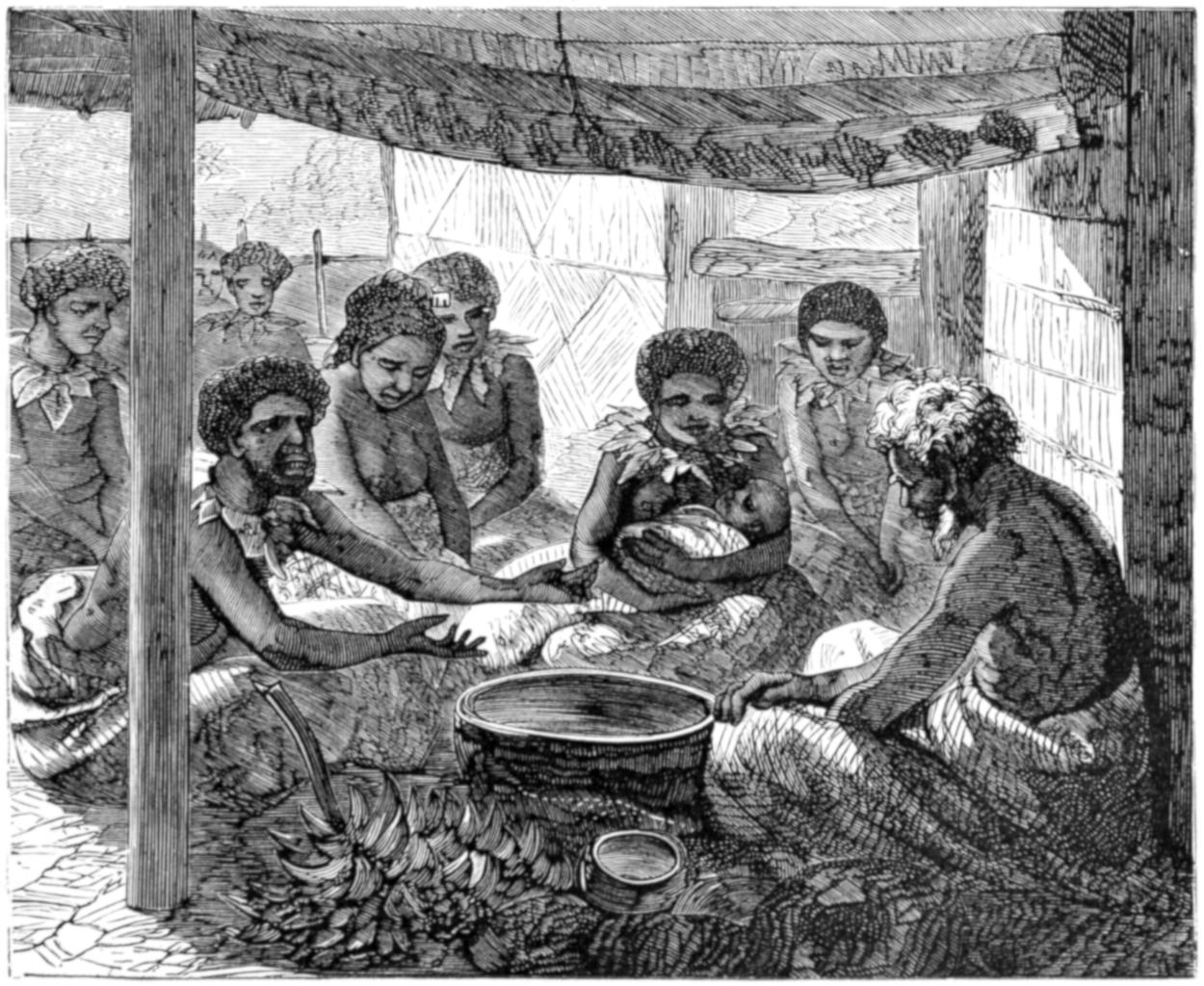
(2.) CONSULTING A PRIEST.
(See page 998.)
While Mariner was in the Tonga Islands,
a young chief, remarkable for his beauty,
became inspired to such a degree that he
fainted, and was taken to the house of a
priest, who told him that the spirit was that
of a young woman who had died two years
before, and was now in Bolotoo the Tonga
heaven. She inspired him because she
wished for him as a husband in Bolotoo, and
would soon take him there. The young chief
acknowledged the truth of the exposition,
saying that for several nights he had been
visited in his sleep by a young woman, and
had suspected that she was the person who
inspired him. Two days after he was taken
ill and died. Mariner was present when
the priest gave his explanation of the illness.
Shortly before Mariner was at the Tonga
Islands, a still graver form of human sacrifice
was practised than that of a child.
When the Tooi-tonga died, his chief widow
was strangled on the day of the funeral, and
buried in the same grave with him, just as
is the case in Fiji, whence in all probability,
the Tongans borrowed the practice. Comparatively
short as was Mariner’s stay two
Tooi-tongas died; but in neither case was
this terrible rite observed. In the one case
there happened to be no chief wife, all his
wives being so equal in rank that neither of
them ruled the household; and, in consequence
a selection of a victim became impossible.
In the second case the chief wife was
the daughter of Finow, who said openly,
that if the husband were to die first, his
daughter should not be strangled, for that
to destroy a young and beautiful woman because
her husband had died was inflicting a
double loss upon the community. As it
happened, the Tooi-tonga did not die until
after the elder Finow was dead and had been
succeeded by his son, who not only carried
out his father’s wishes on that subject, but
would not allow another Tooi-tonga to succeed;
thus abolishing the source of the only
rank that was superior to him.
The Tooi-tonga being abolished, it necessarily
follows that the ceremony of Ináchi
was abolished too, and but for the fact of
Mariner’s enforced residence in Tonga, this
curious and interesting ceremony would
have passed away without being known to
European civilization.
Mariner was present at the wedding of
Finow’s daughter to the Tooi-tonga, and describes
it with some minuteness. It much
resembled a Fijian wedding, except in the
costume of the bride, who was first copiously
anointed with cocoa-nut oil scented with
sandal-wood, and then arrayed in a vast
number of the finest Samoan mats, which
were wrapped round her in such quantities
that her arms were stuck out almost horizontally
from her body, and her legs were
so much trammelled that she could not sit
down, but had to rest in a bent attitude upon
her attendants.
She was eighteen at the time. Had it not
been for the good sense of Finow, Mariner
would have seen within a very short time
her wedding, her murder, and her burial.
The technical name for the ceremony of
strangling is Nawgía.
We now come naturally to the subject of
funerals, and will take as a typical example
the funeral of the elder Finow.
Almost immediately after the death and
burial of his favorite daughter, a child about
seven years of age, Finow fell ill, his malady
having been increased by the exertions
which he made during the long ceremony of
the funeral. It was on this occasion that
he ordered the women to box in general
combat. On the evening of that day Finow
retired to a small house that had just been
built for him, and was seized with a violent
illness, which almost deprived him of the
power of speech, though not of intellect. He
evidently knew that his end was at hand,
and continually muttered “My country! my
country!” evidently feeling that calamities
might come on his land if he were suddenly
taken away.
A child was offered on behalf of him,
which had already been selected, but, by the
time that the sacrificing party had come
back to the house where the king lay, he had
lost both his speech and his consciousness,
and in a few minutes the great and wise
Finow had departed this life. When his
death was ascertained, a curious ceremony
was performed. The body was carried to
the Tooi-tonga’s house, and placed on the
hole in which the cooks were accustomed to
light their fires. This was a symbolical expression
of humility and submission to the
gods, the cooking place being so degraded a
spot that only the lowest Tooas would condescend
to touch it.
Not only the king himself, but all those in
his confidence, fully believed that his death
was caused by a god named Toobo Totai, to
whom he had prayed in vain for his daughter’s
recovery. In revenge for the negligence
of the god, Finow had made arrangements
for killing his priest, and had been
heard to say that if Toobo Totai did not
change his conduct, and exert himself a little
more, his priest should not live long.
Finow’s sudden death put a stop to this
project, which was only known to one or
two of his immediate friends. It is not unlikely
that the threatened priest may have
heard of his intended assassination, and
saved himself by getting a dose of poison
administered to Finow at the funeral banquet.
Finow was right in his prognostications
of trouble, for no sooner was his death
known than a number of the principal
chiefs of different islands began to assemble
their forces, with the intention of seizing
on the throne. His successor, however, inherited
his father’s wisdom, and took such
precautions that the attempt of the conspirators
was quietly foiled.
After the royal corpse was brought back
from the Tooi-tonga’s dwelling, it was laid
on bales of gnatoo in the large conical
house, which was nearly filled with women,
who kept up a continual lamentation, led by
his daughter, a beautiful girl of fifteen.
Even by night the lamentations went on,
the house being lighted up with lamps made
of cocoa-nut shells half filled with cocoa-nut
oil, which is only used on such occasions;
and on the following morning the people
assembled on the marly to take part in the
obsequies of their late king, whom they
both loved and feared. Indeed, among savage
nations, there is no love toward a chief
who is not thoroughly feared.
By this time the faces of the principal
mourners were scarcely recognizable, being
swollen and disfigured by the repeated
blows which they had inflicted on themselves
as signs of sorrow. The chiefs and
Matabooles who were especially attached to
the person or household of the deceased
king proceeded to inflict even severer injuries
upon themselves, using the club, or
shell, or a sharp stone; and running two or
three at a time into the open space, while
they cut their heads with the clubs and
shells so that the blood poured down their
bodies in streams; as they did so, they uttered
a sort of dirge, some specimens of
which have been given by Mariner. The
following is his translation of the death
chant and accompanying proceedings.
“‘Finow, I know well your mind; you have
departed to Bolotoo, and left your people,
under suspicion that I or some of those about
you are unfaithful; but where is the proof
of infidelity? where is a single instance of
disrespect?’ Then inflicting violent blows
and deep cuts in the head with a club, stone,
or knife, would again exclaim at intervals,
‘Is not this a proof of my fidelity? does this
not evince loyalty and attachment to the
memory of the departed warrior?’ Then
perhaps two or three would run on and endeavor
to seize the same club, saying with a
furious tone of voice, ‘Behold, the land is
torn with strife, it is smitten to pieces, it is
split by revolts; how my blood boils; let us
haste and die! I no longer wish to live:
your death, Finow, shall be mine. But why
did I wish hitherto to live? it was for you
alone; it was in your service and defence
only that I wish to breathe; but now, alas!
the country is ruined. Peace and happiness
are at an end; your death has insured
ours: henceforth war and destruction alone
can prosper.’
“These speeches were accompanied with
a wild and frantic agitation of the body,
whilst the parties cut and bruised their
heads every two or three words with the
knife or club they held in their hands.
Others, somewhat more calm and moderate
in their grief, would parade up and down
with rather a wild and agitated step, spinning
and whirling the club about, striking
themselves with the edge of it two or three
times violently upon the top or back of the
head, and then suddenly stopping and looking
steadfastly at the instrument spattered
with blood, exclaim, ‘Alas! my club, who
could have said that you would have done
this kind office for me, and have enabled me
thus to evince a testimony of my respect to
Finow? Never, no, never, can you again
tear open the brains of his enemies. Alas!
what a great and mighty warrior has fallen!
Oh, Finow, cease to suspect my loyalty; be
convinced of my fidelity! But what absurdity
am I talking! if I had appeared treacherous
in thy sight, I should have met the
fate of those numerous warriors who have
fallen victims to your just revenge. But do
not think, Finow, that I reproach you; no,
I wish only to convince you of my innocence,
for who that has thoughts of harming
his chiefs shall grow white-headed like me
(an expression used by some of the old
men)? O cruel gods, to deprive us of our
father, of our only hope, for whom alone we
wished to live. We have indeed other
chiefs, but they are only chiefs in rank, and
not like you, alas! great and mighty in
war.’”
Such were their sentiments and conduct
on this mournful occasion. Some, more
violent than others, cut their heads to the
skull with such strong and frequent blows,
that they caused themselves to reel, producing
afterward a temporary loss of reason.
It is difficult to say to what length this extravagance
would have been carried, particularly
by one old man, if the prince had not
ordered Mr. Mariner to go up and take
away the club from him, as well as two
others that were engaged at the same time.
It is customary on such occasions, when a
man takes a club from another, to use it
himself in the same way about his own
head; but Mr. Mariner, being a foreigner,
was not expected to do this: he therefore
went up, and, after some hesitation and
struggle, secured the clubs one after
another, and returned with them to his seat,
when, after a while, they were taken by
others, who used them in like manner.
The next proceeding was to place the
body of the dead king in the grave, which
was at some distance from the place where
those wild laments had been made. Having
arrived at the spot, a small house was speedily
put together, the body was laid in it, and
the whole house was covered with coarse
black gnatoo, the sign of mourning, which
passed over the top of the house, and hung
from the eaves to the ground, so as entirely
to conceal it.
Here another set of lamentations took
place, while a number of men were employed
in opening the grave. All great
families bury their dead, not merely in the
ground, but in a solid vault, about eight feet
long by six wide, and eight deep. It is
made of six enormous stones, the upper one,
which forms the cover, being necessarily
larger than the others. For the convenience
of raising it when required, the upper
stone does not fit quite closely upon the
lower, some smaller stones being placed between
them at one end.
After digging some ten feet deep, the
men came to the vault, and, having cleared
away the earth, they passed a rope under
the end of the stone cover, and by the united
force of nearly two hundred men raised it
on end. Several bodies were already in the
grave. Two of them, which had been buried
for full forty years, were dried and nearly
perfect; while others, which had not been
buried nearly so long, were reduced to a
few bones. In some cases the vault is lined
with the gnatoo on which the body rested,
while in others it becomes the property of
the presiding Mataboole.
All being ready, the body of Finow was
handed down into the vault, still lying on
the gnatoo, and the body of his daughter,
at whose funeral he was seized with illness,
was buried by his side. The stone was then
let down with a great shout, and the head-cutting
and maiming began afresh. The
next ceremony was that of collecting sand
for the decoration of the grave.
The whole company formed themselves
in single line, the women going first, and
proceeded to the back of the island, singing
loudly to warn stragglers of their presence.
For any one not actually engaged in a
funeral to be seen on the road is held as so
great an insult that any ordinary man would
lose his life. Even if the king himself saw
a similar procession advancing, he would
hide himself until it had passed. Remaining
on his feet, though it might not actually
cost him his life, would probably be so bitterly
remembered that he might lose his
throne. As soon as the funeral party arrived
at the place where the sand was found,
they all set to work at making baskets out
of leaves, which they suspended from sticks
and carried on their shoulders. By the time
that they reached the grave, it was nearly
filled up with earth, and the remainder was
filled with sand, which was carefully and
neatly smoothed.
Next came a very curious custom, that of
burning the cheeks. The mourners, clothed
in mats and green leaves, set fire to little
rolls of bark, and pressed them against each
cheek-bone, so as to raise a circular blister.
This is then rubbed with the juice of an astringent
berry, which causes the wound to
bleed, and the blood is smeared over the
cheeks. The friction is repeated daily for
twenty days, so that an indelible scar is the
natural result.
The day after the burial a ceremony took
place by which the young prince was installed
in his father’s place, and invested
with his father’s name. Finow was the name
of the reigning family; but, according to
custom, no one but the actual king was allowed
to bear it. Sometimes, as a mark of
especial favor, he allowed it to be borne by
a relation, but always in conjunction with
some other name. The name by which the
young prince had previously been called was
Moegnagnongo.
The ceremony was begun by a kava party,
at which the young prince presided. The
two first cups having been filled and drunk,
the third was due to the president. The
Mataboole who directed the proceedings said,
while all eyes were fixed on the prince,
“Give it to Finow,” thus acknowledging him
as the king of Tonga. The young king displayed
not the least emotion on being called
by the new name, as that would have been
thought beneath his dignity, but took the
cup as quietly as if he had been called by the
name of Finow all his life.
Rites similar to those which have been described
went on for nineteen days, and on
the twentieth the concluding ceremony was
performed. All the relations of the deceased
king, together with those who had taken part
in the funeral, went to the back of the island,
and procured a great quantity of flat pebbles,
mostly white, but having a few black among
them. These they carried to the grave, and
strewed completely over the grave in the
form of an oval, each pebble being laid by
the side of the other. The black pebbles
were laid upon the white ones.
Dances, wrestling matches, and head-cutting
then took place, in which latter rite the
fishermen of the late king distinguished
themselves in a very curious manner. Into
each cheek they thrust three arrows, the
points of which passed into the mouth. The
shafts of the arrows were brought over the
shoulders, and to each pair was tied another
arrow across the shoulders, so as to make a
triangle. Equipped in this extraordinary
manner, they walked round the grave, and,
not satisfied with this proof of their devotion
to their late master, they cut their heads with
their paddles, and pinched up the skin of
their breasts, thrusting a spear through the
fold. A grand wrestling match ended this
complicated series of ceremonies.
At the burial of one great chief, who was
assassinated while walking with the king
(apparently with his connivance), a very curious
variation of the ceremony took place.
As soon as the body had been lowered into
the vault, one of the assassins, a man of exceptional
strength and stature, advanced
toward the grave, and, brandishing his club,
avowed himself as the murderer, and challenged
any friend of the deceased chief to
fight him.
The challenge was not accepted, and, although
one of the wives of the murdered man
did her best to arouse the family to vengeance,
she could only succeed in inducing
them to erect a strong fortress, in which
they hoped to bid defiance to Finow. The
king, however, was too wise to allow such a
standing menace to remain, started off with
four thousand warriors, and reduced the disaffected
chiefs to obedience. In storming
the fort, the challenging chief distinguished
himself by his deeds of arms. Though
wounded in the breast with a five-barbed
spear, he broke off the shaft, scaled alone the
enemy’s fortress, knocked out a man’s brains
with his club, and made good his escape. As
he retreated, however, he received another
spear in his back, and died on the following
day. It is remarkable that in this battle
nearly all the assassins perished.
The religious system of the Tongans is
tolerably simple. They believe that there
are several orders of gods, just as there are
several ranks of men. The principal gods
are self-existent and eternal; but the second
order of gods are the souls of deceased
chiefs and Matabooles. All of noble blood
have souls, and take rank in Bolotoo, or
Paradise, not according to their moral merit,
but according to the rank which they held
in the world. Matabooles become ministers
to the gods, just as they were ministers to
the chiefs; but they are not powerful
enough to inspire priests. There is also a
class of mischievous gods, who are, fortunately,
much less powerful than the benevolent
deities.
As to the Mooas, or middle class, the
learned are rather doubtful whether they go
to Bolotoo, or whether they have souls.
But that the Tooas, or peasantry, have no
souls, there is not the slightest doubt, and
that they can go to Bolotoo is therefore impossible.
With regard to Bolotoo, or Paradise, the
Tongans believe it to be an island somewhere
to the north-west of Tonga. It is a
most beautiful place, full of the choicest
fruits and the most lovely flowers. Pigs are
plentiful, and never die unless they are
killed to supply food for the gods, in which
case another hog comes into existence to
supply the place of the one that was killed.
So, when a fruit or a flower is plucked,
another immediately takes its place. These
particulars are learned from some Tongan
voyagers, who were returning from Fiji,
but were driven out of their reckoning by a
storm. At last they were blown to a lovely
island, on which they succeeded in landing.
There was abundance of fruit, but their
hands could not grasp it. They walked
through the trunks of trees, and through
the walls of houses as if they were mere
shadows; while some of the inhabitants
walked through their own bodies in a similar
manner. Then they found they were at
Bolotoo. The gods told them to go home at
once, and promised them a favorable wind.
They reached Tonga in safety, but all died
soon afterward, the air of Bolotoo not suiting
mere mortals.
It has already been mentioned that the
religious and secular lives of the Tongans
are so blended together that it is very difficult
to separate them, and that even their
amusements partake somewhat of the religious
character. There are, however, one
or two of their games which partake but
slightly of this element, and which are yet
characteristic of the natives. One of these
sports is called Fanna-kalai, and is a very ingenious
mode of bird catching by means of
decoys.
In order to practise this amusement, the
sportsman furnishes himself with a bow and
arrows, goes into the woods, and there ensconces
himself within a large wicker cage
covered with green leaves, so that the inmate
may not be seen, but having plenty of
openings through which the arrows can be
aimed. By his side he has a small cage, in
which is kept a hen bird, and on the top of
the large cage the cock bird is tied by the
leg. When properly trained, these birds
continue calling to each other, and thus
attract numbers of their own species, which
fall victims to the arrows.
Well-trained birds are exceedingly valuable,
and one chief has been known to make
war upon another for the sake of procuring
an especially fine bird. Indeed, the Tongans
look on these birds much as sportsmen
of the olden times looked on their falcons.
To each pair of birds there is a keeper,
whose whole business it is to attend to and
train them. He is careful to teach the cock
bird to flap its wings as it calls to its mate,
and to utter its notes loudly, so that they
may be taken as a challenge to other birds
to come and fight him. The bird keepers
have almost unlimited powers, as nothing is
allowed to interfere with the welfare of their
charge. Even when a famine visits a district,
the birds must not starve. The keeper
forages for the birds, and if he sees a fine
bunch of plantains, he is allowed to put the
tapu on it by sticking a reed in the tree,
after which the proprietor dares not touch
the fruit which he has saved for himself and
his family. He may starve, but the birds
must be fed.
As may be imagined, the keepers attend
to their own interests as well as those of the
birds, and are great pests to the neighborhood,
fleecing the people without mercy.
Now and then they go a little too far in their
insolence, and a complaint is laid against
them, in which case the man seldom escapes
without a severe beating.
In order to show the enormous value of
these birds, Mariner tells a story respecting
the elder Finow. The chief of Hihifo possessed
a bird which he had himself trained,
and which was the best that ever was known.
Finow heard of this bird, and sent a commissioner
to Hihifo in order to treat with
the chief for the purchase of it. This the
owner declined to do, saying that not only
had he an affection for the bird, which he
had himself trained, but he had sustained
many wars made on him by neighboring
chiefs who wanted to get the bird—many
lives had been lost, and he felt his honor
involved in keeping it. However, he intrusted
the ambassador with another pair of
birds, very nearly as good, and asked him to
present them to Finow.
The king tried the birds next day, and
was so delighted with their performance
that he was the more anxious to obtain the
bird which was even superior to them. He
therefore prepared a present, which according
to the Tongan ideas of that day was of
almost incalculable value, comprising, beside
whales’ teeth, gnatoo, kava, and other native
productions, several iron bolts, a quantity of
beads, a looking-glass, a grindstone, and
some axes, all of which had been procured
from Europe, and most of them from the
vessel in which Mariner had been wrecked.
Seeing that Finow was determined to have
the bird, and that he would probably make
war if again refused, the chief wisely accepted
the present, and sent the desired
prize with a polite message.
As this sport is necessarily a very expensive
one, it can only be practised by the king
and very great chiefs, even the lesser chiefs
being unable to bear the cost. There is
another sport which is limited to chiefs and
Matabooles. This is Fanna-gooma, or rat
shooting, and is conducted as follows. Two
chiefs take the command of two parties who
intend to shoot rats, and arrange the preliminaries,
i. e. settling the course which
they mean to take, the number of shooters
on each side, and so forth. On the appointed
day, they go to some place which has been
previously fixed upon, each being provided
with his bow and two arrows.
These arrows are six feet in length, and
made of a reed headed with hard wood.
They are most beautifully made, the heads
being smooth and polished with the greatest
care, and the junction of the head and shaft
guarded with plaited sinnet. In some of
these weapons in my collection, the sinnet
is scarcely broader than sewing silk, and is
laid on with a perfection that is scarcely
credible. After the sinnet is finished off, a
slight coating of transparent varnish is laid
over it, so as to bind the plait more firmly
together, and to give it an uniform polish.
In some arrows there are several similar
belts of plaited sinnet. No feather is needed,
as they are never aimed at any distance, and
their great length is requisite to allow them
to go straight through the bushes among
which the rats lurk.
The bow is about the same length as the
arrows, and not very powerful, so that the
aim may not be disturbed by the effect of
drawing it.
When they are ready to start, a couple of
attendants are sent forward, who take in
their mouths some roasted cocoa-nut, which
they chew, and spit the fragments on either
side of the path. If they come to a cross-road,
they plant in it an upright reed, by
means of which a tapu is laid on the path, in
order to prevent any one from passing along
and disturbing the rats. No one ever disregards
this tapu. Even if one of the greatest
chiefs come toward it, he will stop at a distance
and sit down until the sportsmen have
passed, while an inferior chief would to a
certainty be clubbed for his insolence if he
were to break the tapu.
When the party start, they arrange themselves
in the following manner. They walk
in Indian file along the path, the leading
chief of one party going first, followed by the
leading chief of the other side. Then come
the men of next rank on either side, and so
on alternately. Except the leading man,
no one may shoot at a rat that is in front of
him, though he may do so if it be on either
side, or behind him. As soon as any one
has shot his arrow, he changes places with
the man behind him, no matter whether the
shot be successful or not, so that each in
turn has his chance of becoming the leading
man, and so getting a double chance of a rat.
Every sportsman has an attendant who follows
the party, and, as soon as his master has
discharged an arrow, picks it up and returns
it to him.
In order to attract their game, the sportsmen
imitate the squeaking of a rat, which
often has the effect of bringing them out of
their holes, and if a rat should run away instead
of waiting to be shot, one or two of
them, with a sharp percussion of the tongue,
utter another sound, which has the effect of
making the rat stop and sit up to listen.
The party that shoots ten rats first wins
the game. Birds of any kind are counted as
rats.
These two sports are necessarily restricted
to chiefs, on account of the expense
in one case and the power of the tapu in the
other, but there is another which is played
only by chiefs and Matabooles, being restricted
to them by etiquette and not by necessity.
The two players sit opposite each other,
and one of them makes one of three
movements with his right hand, i. e. presenting
the open palm, the closed fist or the
extended forefinger. His antagonist endeavors
to imitate the movements, but if he
can succeed in making five without being
imitated, he wins a point, and marks it by
laying down a little piece of stick. Should
the antagonist be successful, he asks of the
other player what were the preceding
movements, their order and the reason for
each of them. If his opponent should fail
to give the correct answer, he loses a point,
but if he succeeds, the game is continued.
The skill lies not in seeing and imitating
the various movements, which are made so
rapidly that an inexperienced eye cannot
detect one of them, but in remembering the
movements made by the antagonist, and in
giving a feigned explanation of each. This
explanation must be made according to the
laws of the game, and alters with every variation
in the order of the movements, so that
considerable readiness and ingenuity are
needed in order to invent on the spur of the
moment an explanation according to the
laws of the game. The chiefs are exceedingly
fond of this game, and, while playing
it, work themselves up to a wonderful pitch
of excitement. The lower orders play a
game somewhat similar to this, except that
no discussion about the moves is allowable,
and the intellectual element is therefore
wanting.
There are many other games that are
common to all ranks. One of these is called
Tolo. A piece of soft wood, nine inches in
diameter, is fastened to the top of a post of
harder wood about five or six feet high, and
the game consists in throwing a heavy spear
so that it shall stick in the soft wood. Six
or eight persons play on each side, every
player being allowed three throws. Another
game with spears somewhat resembles the
djerid, and consists in hurling blunted spears
at each other.
The Tongans are singularly dexterous of
hand. They excel in ball play, and have a
game which consists in playing with five
balls, which are thrown from one hand to
the other, so as to keep four balls always in
the air. They sing a song at the same time,
each cadence coinciding with the transfer of
the balls from one hand to the other, and for
every verse that they can finish without a
mistake they score one point. They have also
a game very much resembling our cup and
ball.
Another game in which dexterity of hand
is needed is called Lafo. A mat is laid on
the ground, and the players throw beans on
it, each trying to knock off those of his antagonist.
This game has a sort of celebrity
from having been connected with one of the
few acts of cannibalism attributed to the
Tongans. During a severe famine, two
daughters of a chief played a game of lafo
with two young warriors. If the men won,
they were to have half the yam, but if they
lost, they were still to have half the yam,
but were obliged to go out, kill an enemy,
and divide his body with the girls. They
lost the game, ate their yam, and waited
until night for the fulfilment of their promise.
After dark they stole out, and hid
themselves near the fortress of the enemy.
As they had anticipated, in the early morning
one of the men came out to fetch salt
water, and passed near the spot where they
lay in ambush. They struck him down
with their clubs, and at the risk of their
lives brought his body off to the spot where
the girls lived. If in any of these games
there should be a dispute, the men settle it
by an extemporized wrestling match, and the
women by spinning a cocoa-nut.
Being islanders, they are very familiar
with the water, and practise the well-known
sport of surf swimming. This sport will be
described when we come to treat of the
Sandwich Islands. They have another
aquatic sport peculiar to themselves. Two
posts are driven into the bed of the sea,
about seventy yards apart, a spot being
chosen where the water is about ten feet
deep. Each player takes in his hands a large
stone, jumps into the water by one post, and
tries to carry it to the other post by running
along the bottom. The chief difficulty is to
pursue a straight course, as at such a distance
the winning post is not visible through the
water.
While Mr. Mariner was at the Tonga
Islands, he took part in an amusement
which derived its origin from a love legend.
He accompanied Finow to a small island
called Hoonga, and, on walking down to the
sea-shore, he saw his companions bathing
near a great rock, and was startled to find
that they one after the other dived into the
water and did not come up again. Just as
the last was preparing to dive, he asked the
meaning of this astonishing proceeding, and
was told to follow, and he would be taken to
a place where he had never been before, and
where Finow and his Matabooles were then
assembled.
He then dived into the water, and Mr.
Mariner followed him, guided by the light
reflected from his heels. Passing through
an aperture in the base of the rock which
has just been mentioned, he rose to the surface
of the water and found himself in a cavern.
At first he could see nothing, but he
could distinguish the voices of Finow and
his other friends; and after a while became
so accustomed to the dim light that he could
just manage to see that he was in a vast stalactitic
cavern.
As the only light which entered it was reflected
from the bottom of the water, and
exceedingly dim, he dived out again,
wrapped up his loaded pistol in a quantity
of gnatoo, directed a servant to prepare a
torch in the same manner, and dived back
again By means of the pistol he lighted
the torch, and probably for the first time
since it was formed, the cavern was illuminated.
It was about forty feet wide and as
many high, and ran off at one side into two
galleries. Its roof was covered with stalactites
hanging in the fantastic patterns which
they are apt to assume. The story which
was told him respecting the discovery of
this cavern is quite a romance of savage
life.
Many years ago a young chief of Vavaoo
discovered the cavern by accident, while
diving after turtles, but took care to keep
the discovery to himself, as he thought he
should find it useful in case he was detected
in a plot against the principal chief of the
island, a man of cruel and tyrannous disposition.
Another chief had the same intentions,
and was organizing a revolt, when
he was betrayed by one of his own followers,
and condemned to be drowned, together with
the whole of his family. It so happened
that he had a very beautiful daughter whom
the young chief had long loved, but to
whom he dared not speak, knowing her to
be betrothed to a man of higher rank than
himself.
When, however, he found that her life
was to be sacrificed, he contrived to make his
way to her in the evening, told her of the
fate which was in reserve for her, and offered
to save her. The girl at once consented,
and the two stole gently to the seaside,
where a little canoe was drawn up. On
their way to Hoonga the young chief told
the girl of this place of retreat, and as soon
as the day broke took her into the cavern.
He was not long in finding out that the affection
was mutual, but that the fact of her
being betrothed to another had caused her
to avoid him.
She remained in this cavern for two
months, during which her young husband
brought her the finest mats and gnatoo, the
best food, and everything which constitutes
Tongan luxury. He was, however, forced
to spend a considerable part of his time at
Vavaoo, lest the tyrannical chief should suspect
him, and he was naturally anxious to
take his wife to some place where they could
live together in safety.
Accordingly, he called together his subordinate
chiefs and Matabooles, and told them
to prepare for a voyage to the Fiji Islands,
accompanied with their wives and families.
This expedition was kept secret lest the
tyrant should put a stop to it. Just as they
started, one of the chiefs advised him to take
a Tongan wife with him, but he declined to
do so, saying that he should find one by the
way. They took his reply for a joke, and
set sail toward Hoonga. When they neared
the shores of the island, he told his men to
wait while he went into the sea to fetch a
wife, and, leaping into the sea from the side
of the canoe which was farthest from the
shore, he dived and disappeared.
After waiting for a while the people
began to be seriously alarmed, thinking that
he must have met with some accident, or
that a shark had caught him. Suddenly,
while they were debating as to the best
course to be pursued, he appeared on the
surface of the water, accompanied by a
beautiful young female, whom he took into
the canoe. At first his people were terribly
frightened, thinking that she was a goddess;
but, when they recognized her features,
they took her for an apparition, believing
that she had been drowned together with
the rest of her family. The young chief
arrived safely at the Fiji Islands, where he
lived for two years; and at the expiration
of that time, hearing that the tyrant of
Vavaoo was dead, he returned to his native
island, bringing with him his strangely rescued
wife.
The facts of this story show that the cave
must have some opening which admits the
outer air, as otherwise no one could have
lived in it so long. Even granting that the
time of the girl’s residence was exaggerated,
Mr. Mariner found that the air was perfectly
fresh and sweet after Finow and his
friends had remained in it for several hours,
and a torch had been burned in it besides.
The island in which this extraordinary
cavern is found is rather venerated by the
Tongans as being the origin of their group
of islands. Tongaloa, the god of arts and
inventions, let down a fishing-line from the
sky into the sea, when he suddenly felt his
hook caught. He hauled up his line, thinking
that from the resistance he had caught
a very large fish. It turned out, however,
that the hook had got itself fixed in the bed
of the sea, and as the god continued to haul
he drew up the Tonga islands. They would
have been much larger, only the line broke,
and the islands were left imperfect.
Mr. Mariner learned that the hook by
which the Tonga islands had been drawn
from the bed of the sea was kept in the
custody of the Tooi-tonga, but had been
burned, together with the house, about
thirty years before. It was about six inches
long, and from the description was one of
the ordinary fishhooks of the country. Mariner
asked why it did not break when hauling
up so enormous a weight, and was told
that it was a god’s hook, and therefore could
not break. Being asked how it happened
that the line, which was also the property
of a god, broke, his interlocutor declined to
pursue the subject any further, saying that
so he had been told, and that there was no
necessity for further inquiries.
CHAPTER CII. SAMOA, OR THE NAVIGATORS’ ISLANDS. APPEARANCE—CHARACTER—DRESS—MANUFACTURES.
POSITION OF THE GROUP, AND DERIVATION OF THE NAME — GENERAL APPEARANCE OF THE PEOPLE — THEIR
CHARACTER FOR GENTLENESS, HOSPITALITY, HONESTY, AND COURTESY — CARRYING A
MISSIONARY AND HIS FAMILY — AFFECTION FOR CHILDREN — DRESS OF THE SAMOANS — THE
TATTOO A PARTIAL SUBSTITUTE FOR DRESS — MODE OF TATTOOING — TIME OCCUPIED IN COMPLETING
THE OPERATION — THE FINE MATS OF SAMOA — WIG MAKING — FEATHER HEADDRESSES — DRESS
OF THE WOMEN — DANCING COSTUME — ADVICE TO FAA-SAMOA — MODE OF DRESSING
THE HAIR — TREATMENT OF WOMEN — MODE OF MAKING CLOTH — THE PROFESSIONAL AND
HEREDITARY MANUFACTURER.
North of the Tongan group, and a little to
the eastward, lie the Navigators’ Islands,
more property called by their native name
of Samoa, or Hamoa. The former of these
names was given to them by Bougainville, in
consequence of the skilful seamanship of the
natives. There are eight islands comprehended
in this group, the largest of which is
Savaii.
As is often the case among these island
groups, no single king or head chief is recognized,
each island having its own ruler; under
whom are subordinate chiefs of different
ranks. This mode of government is so similar
to that of the Tongans that we need not
expend any time upon it.
The Samoans are a fine race of people,
much exceeding the English in average stature,
and peculiarly well made. Their skin
is smooth, soft, and a warm reddish-brown
in color, and the hair, though copious, possesses
none of that woolliness which distinguishes
the hair of the Papuan races, but is
long, straight, and, in a few cases, possesses
a slight wave. Naturally there is but little
beard, and the Samoan takes a pride in extirpating
every sign of a hair upon his chin. He
is quiet, composed, and stately in manner, so
that in all things he presents a bold contrast
to the black, harsh-skinned Fijian, with his
frizzed and woolly hair, his copious beard,
and his quick, restless, suspicious manner.
Being savages, the Samoans have many
of the imperfections which necessarily accompany
savage life, but at the same time
they approach nearer to the “noble savage”
of the poet than most races of men. They
are hospitable, affectionate, honest, and
courteous, and have well been described as
a nation of gentlemen. Toward strangers
they display a liberality which contrasts
greatly with the cruel and bloodthirsty customs
of the Papuan tribes. The Fijians, for
example, do all in their power to repel
strangers from their shores, either driving
them off, or killing and eating them. The
Samoans, on the contrary, welcome strangers,
allot to them their best houses, give
them the best food, and make them feel that
they are honored guests.
They are singularly affectionate in their
disposition, and as parents are rather too
fond of their children. As a rule, a Samoan
parent cannot bear to thwart a child, and
allows it to do what it likes. In consequence
of this absence of discipline, many a child
dies through the mistaken kindness of its
parents, who have allowed it to eat food
that was unsuitable to it, or to engage
in games for which it had not sufficient
strength.
The honesty of the Samoans is really wonderful.
When a number of them were on
board of an English vessel, they scrupulously
refrained from stealing. Property
which to them was equivalent to unbounded
wealth lay within reach of their hands, but
not even a nail or a needle was touched.
In one instance, an European vessel went
ashore on the rocks. The whole of its cargo
was at the mercy of the Samoans, but not a
man went on board of the vessel, and the
whole of the property was reserved for the
rightful owners. There are many civilized
countries where the vessel would have been
ransacked within an hour of her striking on
the rocks.
Once when a great chief, named Malietoa,
went on board an English vessel, accompanied
by a younger brother, he examined
everything with great attention, but asked
for nothing, only requesting the white men
to come on shore and visit him. This they
did, bringing with them a present of axes,
mirrors, beads, knives, scissors, needles, and
similar articles. When the present was
offered, Malietoa took up each article separately,
laid it on his head, and returned
thanks for it, and after he had gone through
the whole of the present in detail, he
made a complimentary speech, in which
he thanked the donors for the entire gift.
His brother, to whom a similar present had
been offered, at first refused to take the
basket, priceless as were its contents, but
passed it on to his elder brother, saying that
he would take whatever his brother did not
happen to want.
“At the close of this important and interesting
interview, Malietoa informed his people,
who had been gazing with wonder upon
the novel proceedings, that a large quantity
of valuable property had been given to him,
and that the English chiefs, to whom he
was indebted for it, would want something
to eat on their return. ‘For,’ said he,
‘there are no pigs running about upon the
sea, neither is there any bread-fruit growing
there.’ Upon hearing this, the whole company
instantly rose and scampered away;
and in about an hour they returned, bringing
with them fifteen pigs of various sizes, with
a large quantity of bread-fruit, yams, and
other vegetables, the whole of which the
chief presented to us.” This extract, from
the journal of Mr. Williams, the well-known
missionary, gives a good idea of the hospitable
nature of the people.
Courtesy is, among the Samoans, reckoned
as one of the duties of life. They address
each other by titles of honor, and it is considered
as an essential point of etiquette that,
when one man addresses another, he should
use a title rather higher than that to which
his interlocutor has any claim. Should he be
ignorant of the rank of the person whom he
addresses, he uses the term chief, as a safe
one.
The earlier voyagers have all been struck
with the Samoans, whose gentle demeanor,
perfect honesty, scrupulous cleanliness,
graceful costume, gigantic stature, and polished
manners, made a strong impression
upon them. When Messrs. Williams and
Barth visited these islands, they were received
in the most hospitable manner. As
they went on shore, the former happened to
mention that he was tired, when a young
chief addressed a few words to the people,
and in a moment the visitor was lifted off
the ground by a number of gigantic young
men, who seized him, “some by the legs,
and others by the arms, one placing his
hand under my body, another, unable to
obtain so large a space, poking a finger
against me; and thus, sprawling at full
length upon their extended arms and hands,
I was carried a distance of half a mile, and
deposited safely in the presence of the chief
and his principal wife.”
Several children were on board, and were
carried off by the natives in great glee. One
or two of them were missing for several
hours, causing their parents great anxiety.
However, they were all brought back in
safety, their absence being due merely to
the exuberant hospitality of the Samoans.
The natives were so delighted at their good
fortune in having the charge of a white child
that they could not make up their minds to
restore it to its parents, but took it home,
killed and baked a pig and other food, feasted
the child to the fullest extent, and then, having
kept it as long as they dared, restored it
to its parents. This anecdote carries out
the statement already made, that the Samoans
are exceedingly fond of children.
Mr. Pritchard mentions that on one occasion,
when he was witnessing a native dance,
which is a performance requiring the greatest
exertion, the chief’s wife sat as a spectator,
with two fine twin children in her lap.
The chief, engaged as he was in the absorbing
amusement of the dance, could not keep
himself away from his children, but every
now and then left the dance to caress them.
The mothers nurse their children for several
years, and a child of five or six years
old may often be seen to pull away its
younger brother or sister and take its place.
The dress of the Samoans varies considerably,
according to the rank of the individual
and the occasion on which it is assumed.
The usual dress of the men is a
sort of small apron, about a foot square,
made of the green leaves of the Dracæna
tree, but on occasions of ceremony they
generally wear a flowing robe called the
lava-lava. This is made of bark cloth, and
is beautifully fine and soft, the Samoans excelling
in such manufactures, which will
presently be described. This robe is gathered
round the waist into folds, and reaches
down to the ankles.
Small as may be the ordinary dress of the
Samoan men, they always seem to be fully
dressed, in consequence of the tattooing
with which they are carefully decorated.
Even to European eyes the tattooing conveys
the same impression, and has been
mistaken for a dress by some of the early
voyagers, who described the people as being
clothed from the waist downward, with
fringed lace “made of a silken stuff, and
artificially wrought.”
The reader will remember that the New
Zealanders tattoo no part of the body except
the hips, and that even in that case a semblance
of dress is produced. The Samoans
tattoo the whole of the body from the hips
to the knees, covering the skin so completely
with the pattern that it looks at a little
distance exactly as if the man were wearing
a tight pair of ornamental drawers.
Even European eyes become so accustomed
to the tattoo that they are rather
shocked at its absence; and, according to
Mr. Pritchard, an untattooed Samoan does
in truth look unmanly, looks even naked, by
the side of one who is tattooed. So completely
is this feeling realized by the natives
that chiefs who have arrived at middle age
frequently undergo the process of tattooing
a second time, in order to renew the patterns,
as they become dim and uncertain by
lapse of years; for, though indelible, the
tattoo does fade in the course of years, as I
can testify from personal experience. When
a very young boy, I read of the custom of
tattooing, and must needs try it on my own
arm. I did not do much of it, but the whole
arm swelled up to the shoulder, and was
useless for some time. At first the marks
were bright blue, clear and well-defined, but
now the blue is of dull indigo, and the outline
very undecided.
The production of this elaborate decoration
is a work of considerable time, the
operation being, in the first place, too painful
to be continued for any long time; and,
in the second, it is apt to cause so much disturbance
in the general system that the
result would be fatal if the whole were executed
at once. The operation is generally
performed in company, a number of young
men keeping company with the son of the
chief. When, for example, a chief’s son arrives
at the proper age, i. e. about eighteen,
all the lads of his tribe assemble to partake
with him of the tattoo, which is to transform
them from boys into men.
There is quite a ceremony, or rather a
series of ceremonies, for the occasion. The
tattooer or Matai, is a man of great influence,
and his services have to be requested
in regular form, accompanied by a present
of fine mats. His acceptance of the mats
ratifies the bargain, though no regular
charge is made. On the appointed day, the
lads and their friends meet in a house set
apart for the ceremony, and more mats are
presented to the Matai. Should the youth
be wealthy, he sometimes gives a canoe.
The friends of the lads are also bound to
supply provisions as long as the operation
lasts.
The tools are simple enough, being a set
of five “combs” and a little mallet. The
combs are made of human bone, and are an
inch and a half in length, varying in width
from the eighth of an inch to an inch,
and looking very much like little bone adzes
with the edges cut into a number of teeth.
These blades are attached to handles about
six inches in length. The pigment which
is introduced into the wounds is made from
the ashes of the cocoa-nut.
All being ready, the young chief lies on
his face in front of the operator, and lays his
head in the lap of his sister or some other
female relation, while three or four young
women hold his legs, and sing at the tops of
their voices, in order to drown any groans
or cries that he may utter. This is done out
of consideration for his reputation, as it is
thought unworthy of the state of manhood
to utter a sound. Still the pain is so intense
that the lads often do utter groans, and now
and then actually yell with the pain. In
one or two instances they have been so utterly
overcome with the agony that, after
they have been released they have not dared
to submit themselves again to the operation,
in which case they are despised for life as
cowards.
Having traced out his pattern, the operator
begins his work, driving the teeth of
the comb through the skin by sharp and
rapid taps of the mallet; there is an art even
in holding this instrument, the handle of
which passes under the thumb and over the
fore-finger, and is used with wonderful
rapidity and regularity. “The rapidity with
which the Matai works his fingers,” writes
Mr. Pritchard, “the precision with which
he moves the instrument and punctures exactly
the right spot, and the regularity of
tapping with the mallet, are astounding.”
By the side of the patient are placed several
assistants, furnished with strips of white
masi, whose duty it is to wipe away the
blood as it flows from the punctures of the
comb, and to leave the skin clear for the
operator. Between every two or three
strokes the toothed end of the comb is
dipped into the pigment, which is mixed
with water.
The pattern is in its main elements alike
throughout all the Samoan Islands; but there
are usually slight variations which denote
the island in which the man lives, and others
which mark the family to which he belongs.
Sometimes, after a man has slain an enemy,
he will make an addition which corresponds
to a grant of arms among ourselves. The
form of some animal is the ordinary pattern
for such a badge of honor.
About an hour is occupied in executing a
patch of tattoo not quite three inches square,
and when this is done, the lad rises and
another takes his place. In a week or so, the
turn of the first lad comes round again, and
so the process is continued for three or four
months, according to the number of the
patients, not more than five being operated
on in a single day. When the pattern is
about half completed, the Matai has another
present; but the great payment is only made
when the last finishing touch is put to the
work. Should the Matai feel dissatisfied
with his fees, he will not go on with the
work, and, as an unfinished tattoo is thought
to be most disgraceful, the friends of the
youths get together what property they can,
and make up the deficiency.
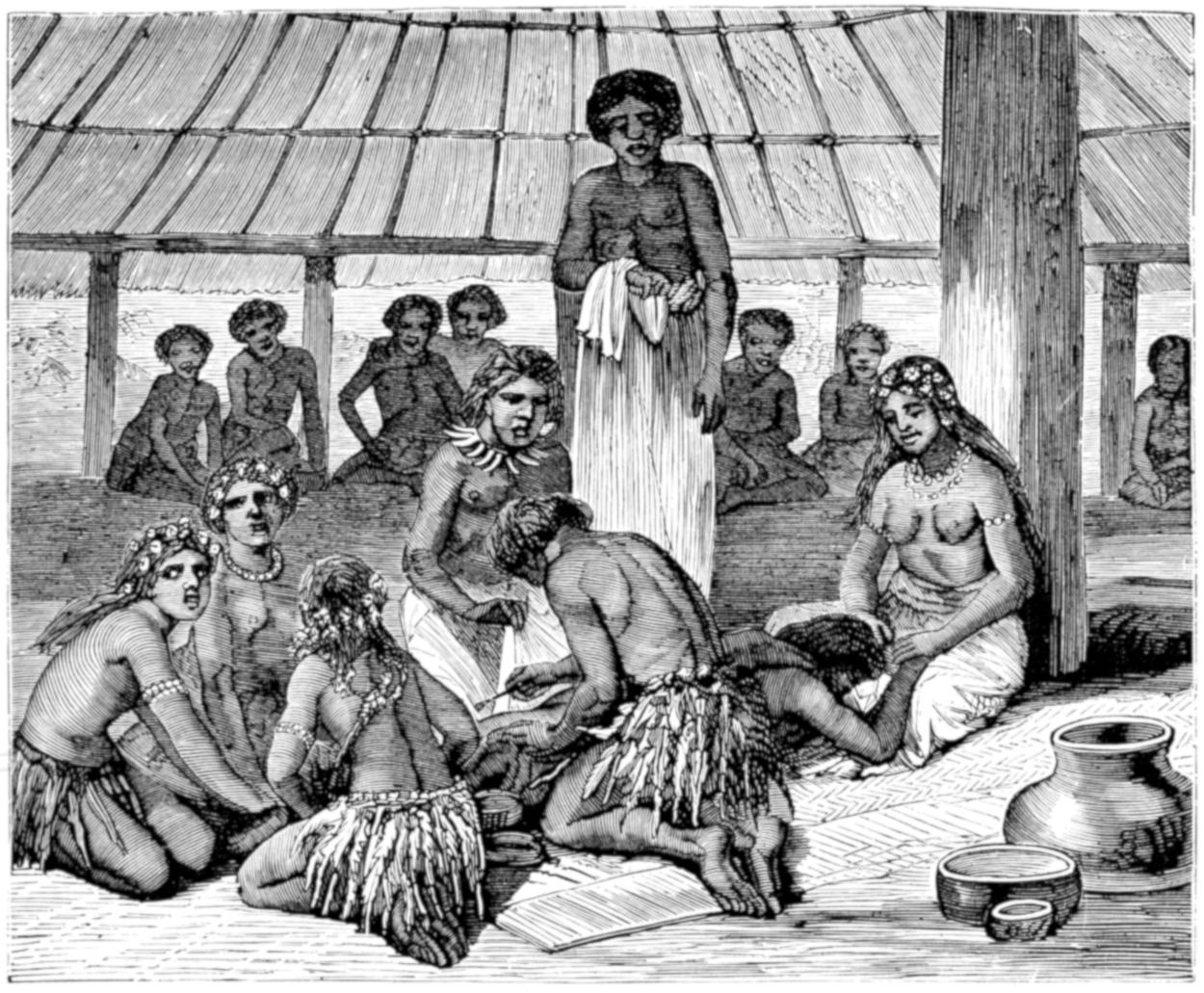
(1.) TATTOOING DAY IN SAMOA.
(See page 1013.)
During the time engaged in the operation,
the patients look most miserable beings, the
wounded parts swollen and inflamed, and
displaying as yet none of the elegant pattern
which has been traced on them. The lads
hobble about in all sorts of contorted attitudes,
fanning away the flies with flappers
made of white masi, and doing all in their
power to alleviate the pain. At last, however,
comes the reward of all their sufferings.
As soon as the wounds are healed, their
friends get up a grand dance. As the costume
of the male dancers is nothing but the
little apron of leaves which has been already
mentioned, the pattern of the tattooing is
freely displayed; and the lads, now admitted
among the men, think themselves well repaid
for their former sufferings by the honor and
glory of being ranked as men, and by the
admiration of the opposite sex.
An illustration on the preceding page represents
the process of tattooing. In the
centre is lying the patient with his head in
his sister’s lap, and his legs held by her companions,
who are singing, in order to cover
his groans, should he utter any. Near him
are two assistants with their white masi
cloths, and at his side kneels the operator,
busily at work with his mallet and comb.
The little vessel of pigment is by his side.
Ranged round the wall of the house are the
young men who are waiting their turn.
Painful as is the operation, and expensive as
it is, involving not only the fees to the operator,
but a constant supply of provisions,
all the lads look forward to it with the
greatest anxiety, knowing that they will
never be considered as men unless they can
show a complete tattoo.
Both men and women wear mats, called in
the native language “je-tonga.” One of
these mats is in my collection, and is a
beautiful piece of work. It is made of very
narrow strips of leaf scraped thin, each strip
being about the fifteenth of an inch in width.
These are plaited together with beautiful
regularity, and the whole is edged with a
very fine and almost silken fringe of the same
material.
Some of these mats are decorated with the
red feathers of the parrot tribe, and increase
in their value by age, being handed down to
successive generations, and having legends
attached to them. My own specimen has
been adorned in a way which doubtless was
very imposing to a Samoan eye, though not
to that of an European. The native maker
had evidently treasured up some scraps of
English calico, and some blue and yellow
paper such as is used for wrapping parcels.
These treasures she has fastened to the mat,
to which they give a most ludicrous appearance.
Samoan chiefs, when full dressed for war
or state, may be known at a great distance
by the splendid headdress which they wear.
In the first place, they increase the apparent
size of their heads by enormous wigs made
of their own hair, which is suffered to grow
long for this express purpose. When it has
attained sufficient length, it is cut off, and is
stained red, and frizzed out, until it assumes
as large dimensions as the woolly head of a
Papuan. They also wear great plumes of
feathers, sometimes towering to the height
of nearly two feet above their heads; so that
the height of a Samoan chief, measured from
the top of his plume, is not far from nine feet.
One of these headdresses in my collection
is made of a vast number of feathers, tied by
the stems in little bundles, and carefully arranged
so that they shall droop evenly.
There are about ten feathers in each bundle.
These tufts are arranged closely together in
circles composed of leaf stems and cocoa-nut
fibre, and there are four of these circlets
placed one over the other, so that several
hundred feather tufts are employed for this
single dress. The maker has ingeniously,
though ignorantly, copied the peacock, the
egret, and other birds which are furnished
with trains. In them, the tail feathers are
short and stiff, so as to allow the long train
of feathers to droop gracefully over them.
In a similar manner, the Samoan artificer
has employed the shortest and stiffest feathers
in the lower-most circlet, while in the uppermost
are placed the longest and most slender
plumes. The headdress is really very
handsome, and even when worn by an European
gives a most martial aspect to the
countenance, especially when the war mat
is worn, and the huge Samoan club carried
on the shoulder.
The dress of the women is made of the
same material as that of the men, but differently
arranged. Their work costume is a
petticoat of Dracæna leaves, but instead of
being, like that of the men, a mere short
apron, it is much longer, and completely
surrounds the body. On occasions of
state or ceremony, however, they wear
lava-lavas of siapo like those of the men,
only put on rather differently, and of much
larger size. A woman of rank will often
have this garment so long that it trails on
the ground far behind her.
Captain Hood, in describing an entertainment
given in honor of the white visitors,
writes as follows. After the men had danced
“a number of girls entered, who went
through a somewhat similar set of evolutions,
with infinite exactness and grace. It
may seem incredible to our fair sisters in
England, that a young lady arranged in no
other garment but a mat tied round her
waist should look handsomely dressed; but
could they see these Samoan belles enter
the circle in their full evening costume,
with their coronets of nautilus shell
and scarlet hibiscus, and their necklaces of
red and yellow flowers, I believe they would
admit that their appearance is highly imposing.
“Some wore beautifully plaited fine mats,
which are so highly prized that they cost
more than a rich silk or satin dress. Others
had white shaggy dresses, made from the
inner fibres of the hibiscus, the amplitude of
which would satisfy the most extensive patronesses
of crinoline, and indulged in trains
equalling in length that worn by those dames
of England in former days, while their carriage
and air plainly showed that, whatever
we might think, they felt themselves superior
beings.” To judge from the photographed
portraits of these Samoan beauties,
Captain Hood is perfectly right; they not
only look well dressed, but, if anything, over
dressed.
That this opinion was not a rare one is
evident from Mr. Williams’s account of
Samoa, which he visited more than thirty
years before Captain Hood. The missionaries’
wives had endeavored to persuade the
Samoan women to wrap their abundant
mantles over the whole of the body, but
without success. On the contrary, the
Samoan belles in their turn tried to convince
the white visitors that it would be much
better for them to faa Samoa, i. e. to do in
Samoa as the Samoans do. Garments that
covered the whole of the body might do well
enough in the white woman’s country, but
when they came to Samoa they ought to
dress themselves like the Samoans, tie a
shaggy mat round the waist, coquettishly
looped up on one side, and anoint themselves
with scented oil and color themselves
with turmeric; wear a flower on the head instead
of a bonnet, and a necklace of flowers
by way of a bodice. Thus accoutred, they
might faa-riaria, i. e. strut about in the consciousness
of being well dressed, and certain
of admiration. There is much to be said on
both sides of the question.
The women wear their hair differently
from the men, generally cutting it rather
short, and combing it back. It is then powdered
with fine lime made of burning coal,
which has the effect of staining it of a reddish
purple hue, which is thought to be the
most fashionable color. After this is done,
a Samoan belle merely twists a wreath of
scarlet hibiscus flowers among the hair. In
both sexes great pains are taken about the
hair, and in order to promote its growth in
after years the head is kept shaved in childhood,
the boys having a single lock of hair
on one side, and the girls one on either
side.
There is a slight distinction of dressing
the hair in the different islands of the
Samoan group. In some of them the women
separate the hair into multitudinous
ringlets, each bound with cocoa-nut fibre, and
cut square at the bottom, much like the ancient
Assyrian fashion. As if to carry out
the resemblance still further, the men preserve
their beards, and dress them almost
exactly like those of the figures on the Nineveh
marbles.
In bodily form the women are by no
means equal to the men, the latter being
truly magnificent specimens of humanity,
while the former are rather short, and
stoutly made, with features that are pleasing
in expression, but have otherwise little
beauty. They are as well treated as in
Tonga, and are not expected to do hard
work. In fact, the men seem to take a
pride in assisting the weaker sex. Mr.
Pritchard writes on this subject as follows:—“We
saw several women sitting quietly
in their canoe, whilst their cavaliers swam
alongside, towing them through the surf,
not because they are at all less at home in
the water than their husbands and brothers,
as we saw this afternoon, when a large
number of girls were alongside, who were as
often swimming about, laughing and talking,
for about half-an-hour at a time in the
water, or sitting in their boats, which they
are constantly upsetting.”
When the husband of a Samoan wife dies,
his widow is not sacrificed at his funeral,
but is usually taken by his brother, after
the ancient Jewish custom. It is remarkable,
by the way, that many of the Mosaic
laws still exist in full force among the Samoans.
In time of war no male captives are
taken, all being killed. Their female relatives,
whether wives or sisters, are considered
as the property of the victors, and
mostly become their wives. Thus it often
happens that women are related to both
sides, and, as they are by courtesy allowed
to visit their relatives, all the designs of one
side are speedily told to the other. So,
whenever the principal chief prepares any
plan of action, some of the women who
have relations on the opposite side, immediately
go off and tell them about the proposed
movements. Still, the Samoans seem
to make it a matter of honor not to take
advantage of this knowledge, and to allow
the enemy to execute his movements without
interruption.
The women seem quite at their ease in
warfare, and mostly accompany their husbands
to the wars, in order to supply them
with necessaries, and to nurse them if they
should be wounded. Mr. Pritchard says
that he has seen them in the heat of action,
carrying water to the wounded, and seeming
to care less for the thickly flying bullets
than the warriors themselves.
Before passing to another subject, we
will complete our notices of dress. The
reader may remember that on page 977 was
given a full account of the various processes
by which the inner bark of the paper mulberry
is made into garments. The Samoans
employ the same method as the Tongans,
but are even more careful in the manufacture
of the cloth, which is in great request
throughout many parts of Polynesia, and
can be recognized at once by a skilful eye.
The women are the sole manufacturers,
and are wonderfully skilful and patient over
their work. In the first place, for the finest
cloth they always employ very young trees,
not more than fourteen to fifteen months
old, and only two or three inches in diameter.
They begin their work by cutting
down the trees, peeling off the bark, and
steeping it for eight and forty hours in
water, so as to enable the rough outer bark
to be removed from the thin and delicate
inner bark. The well-known “bass,” with
which gardeners tie up flowers, is a familiar
instance of “liber,” or inner bark, procured
from the lime tree. By constant beating,
this substance becomes greatly increased in
width and reduced in thickness, and, like
gold leaf, it can be beaten out to almost any
extent.
As the strips of bark are only ten or
twelve inches wide, a number of them are
united by overlapping the edges and putting
between them arrow-root dissolved in water.
The united pieces, while still wet, are again
beaten, and after a while the two pieces
become incorporated into one, and all signs
of the junction disappear.
When a piece of sufficient size is made,
printing and staining are the next processes.
The dyes are generally of three kinds, red,
brown, and yellow. The two first tints are
obtained from clays, and the third from the
ever useful turmeric. The women who
make and print the cloth do not prepare the
dyes, that being a separate occupation, and
in these islands the different professions are
strictly limited to certain families, just as is
the case with the castes in India. The
printing is done on exactly the same principle
that is employed in rubbing brasses in
this country. The pattern is made by fastening
the flexible ribs of the cocoa-nut leaf
on a board. When the ribs are quite hard
and dry the cloth is stretched over them,
and the dye rubbed over it with a stiff
brush, so that it only adheres to those parts
of the cloth which press against the raised
pattern below. For patterns of a larger
description a softer bark is used, which holds
a quantity of color.
There are in my collection several specimens
of Samoan bark cloth; one is very
fine, pure white, six feet long, by two wide,
and ornamented with a fine fringe all round
it. Another is thicker and stronger, being
made of four layers of bark, one placed
upon the other. In some places the junction
has not been completed, and the different
layers are quite distinct. It measures
rather more than seven feet in length and
three feet ten inches in width. It has a
deep-colored border about eighteen inches
in width, composed of a diamond pattern
impressed upon a number of perpendicular
parallel lines and dots. This border is a
light red in color, and upon it are several
circles of dark brown. Circles of a similar
kind are scattered over the uncolored portion
of the robe, which is of a creamy yellow
hue.
The third specimen is still thicker, and
larger. It is seven feet square, and has
been completely covered on the outside
with the clay pigment, which has been put
on so thickly as to make the fabric comparatively
stiff. Two broad bands of deep black
are drawn across it so as to divide it into
three equal portions, and in each division
are four patterns also drawn in black, very
much resembling the “broad arrow” used
in the government mark of England.
In the second illustration on page 1012 are
shown the successive processes of converting
the bark into cloth. In the foreground
and at the right hand are seen some women
kneeling in the stream, engaged in scraping
the liber to free it from every particle of the
outer bark. One woman is examining a
piece against the light, to see whether it is
quite clean. Behind them, and toward the
left centre of the illustration are more women,
some of them beating and scraping
the bark with the square mallets which
have been already described when treating
of Tonga, and another is busily employed
in joining two pieces with arrow-root. Just
above them is another woman engaged in
the more skilful part of the manufacture, i.
e. printing by rubbing dye over the cloth
when laid on the pattern board, and one or
two of the boards themselves are given, in
order to show the cocoa-nut leaf pattern
upon them. In the distance, the other women
are seen hanging the still wet cloth up
to dry.
CHAPTER CIII. SAMOA, OR THE NAVIGATORS’ ISLANDS— Continued . WAR.
CAUSES OF WAR IN SAMOA — THE MALO, AND STRUGGLES FOR ITS POSSESSION — THE CHIEF’S VENGEANCE — FIRE-ARMS
PREVENTIVE OF WAR — SAMOAN WEAPONS — THE CLUBS — PATTERNS OF
CLUBS THROUGHOUT POLYNESIA — STRANGE MODE OF USING THE SPEAR — THE SHARK-TOOTH
GAUNTLETS — SUITS OF ARMOR — GETTING TOGETHER AN ARMY, AND MODE OF FIGHTING — UNPLEASANT
POSITION OF NEUTRALS — THE SEA-FIGHT — DISTINGUISHING PENNANTS — THE DEFIANCE
BEFORE BATTLE — TROPHIES OF WAR, AND ELATION OF THE VICTOR — DISPOSAL OF THE BODIES — THE
HEAD PILE — SINGLE COMBAT BETWEEN CHIEFS — SAMOAN LAW — PUNISHMENT FOR MURDER
AND LESSER OFFENCES — CANNIBALISM — NATIVE LAWYERS — THE PLAINTIFF DEFEATED
WITH HIS OWN WEAPONS.
It was mentioned on page 1014, that women
when captured in war become the absolute
property of those who take them; we will
therefore devote a short space to warfare
among the Samoans, omitting those characteristics
in which it resembles war among
the other Polynesian tribes, which have
already been described.
The causes of war may mostly be reduced
to four; namely, the desire of political supremacy,
disputed succession to chieftainship,
revenge for the murder of a chief, and
infringement of the strange marriage laws
of the Samoans.
The first of these causes is always rankling.
Each island is divided into several
districts, and when one begins to show signs
of special prosperity, another is sure to take
umbrage at it and go to war in order to secure
the “Malo,” or political supremacy.
One example of such a war occurred only a
few years ago in the island of Apolo.
Manono, one of the three districts into
which it is divided, held the supremacy, and
the chiefs felt indignant because another
district, Aâna, was prospering under the
teaching of the missionaries. The chiefs of
Manono therefore began to oppress Aâna
by making continual demands of property
and food. Still, in spite of their exactions,
the district would persist in flourishing; it
made and sold more cocoa-nut oil, and sold
it for more hatchets, calico, and other European
treasures, than the other districts.
The Manono chiefs were naturally indignant
that when they went to a subject district
they found it better cultivated and
richer than their own, and construed the
inferiority which they could not but feel
into an intentional insult on the part of
Aâna. So they proclaimed the people of
Aâna to be rebels, and made war against
them.
Such a cause of war, absurd as it may be,
and subversive of all real progress, is intelligible,
and to be explained by the petty
jealousies of human nature, which is too
prone to feel itself personally hurt at the
prosperity of another. Vengeance for a
murdered chief is intelligible, and so is a
war for succession; but the last cause needs
some explanation.
By the laws of Samoa, a woman once a
wife is always a wife, even though she may
be put away by her husband. The Samoan
chiefs claim the right of marrying as many
wives as they choose, and putting them
away as often as they like. Indeed, a man
often marries a girl merely for the sake of
her dower of mats and other property. But
even after he has put away a wife, he still
considers her as his own chattel; and if any
other chief takes her to his house, war is
at once declared against him. It is a curious
fact that the original husband cares
nothing about the morality of the wife
whom he has put away, but only for the insult
offered to himself by taking his property.
Such cast-off wives mostly attach
themselves to the Fala-tele, or visiting
house, leading most immoral lives, and may
do so without incurring any resentment
from their former husband. But let them
marry another, and vengeance immediately
follows the insult.
Head larger
Full length in proportion to head
MANGAIAN SPEAR.
(See page 1034.)
Before the introduction of fire-arms, the
principal weapons of Samoa were the spear
and the club. The older chiefs have a rooted
objection to the musket, and, like Hotspur’s
fop, have not been particularly willing to
take the field since that “villanous saltpetre”
has come into vogue. Muskets,
say they, are weapons for boys; clubs for
men. They have some reason to complain
of the bullets, which, as they say, do not
know chiefs, because their towering headdresses
make them so conspicuous that they
afford excellent marks to the enemy; and if
by chance one of their opponents should
have even a moderate notion of taking aim,
their chance of coming safely out of the
battle would be a very small one.
The clubs used in Samoa are remarkable
for the excellence of their make, and the
polish and finish with which the native
carver loves to ornament them. Some of
them are short, used for one hand, and made
just like the steel maces of European chivalry.
Others are almost exactly like the
club No. 1, figured on page 949. The example
which is given in the illustration entitled
“Club,” on page 1018, is drawn from a
specimen in my collection, and belonged to
the same chief who owned the war mat and
feather headdress which have been described.
It is five feet in length, and very
heavy, so that none but a very powerful
man can use it. As it has seen much work,
it has been battered about, the wood of the
head cracked, and the carving defaced. I
have therefore had it drawn as it was when
new.
As a rule the clubs of Tonga, Samoa, Fiji,
and other Polynesian groups can hardly be
definitely referred to any one of them. The
commerce which passes between them has
caused an interchange of weapons as well
as of peaceful commodities, so that the two
distinct races which inhabit Fiji and the
Tongan and Samoan group use weapons
which are almost identical. Thus the serrated
club which has just been mentioned is
equally used in New Guinea, Fiji, and Samoa,
the pattern having been found a convenient
one, and so transmitted from one
island to the other.
The spears, again, have a great similitude,
and are armed with barbs, the best being
tipped with the tail-bone of the sting-ray.
In former days, when a warrior had pierced
an enemy with his spear, he tried to lift him
from the ground upon it; and if he were
unable to do so, he was generally assisted
by several of his comrades, who all thrust
their spears into his body, lifted him in the
air, and bore him aloft in triumph, not caring
whether he were alive or dead.
One weapon, however, seems to be peculiar
to Samoa, and has been mentioned by
Mariner. It consists of a pair of gauntlets
made of cocoa-nut fibre, on the inside of
which are fixed several rows of sharks’
teeth, set edgewise. In fact, this weapon is
made exactly on the principle of the terrible
“tiger-claw” of India, and is intended
for the purpose of ripping up an adversary,
the abdomen being the part that is always
attacked, both by the Samoan and the Hindoo.
One chief, who was of gigantic dimensions,
even for a Samoan, always fought
with these terrible gauntlets. He used
them, however, in a different manner, and
disdained to tear open the body of his antagonist.
As all the points of the teeth are
directed backward, it is impossible for any
one who is grasped by these gauntlets to
tear himself away. The gigantic chief was
accustomed to rush at one of the enemy,
seize him with his gauntleted hand, fling
him on his face, place one foot on the small
of his back, grasp him by the head and
bend him forcibly upward so as to break his
spine. This was his mode of dealing with
able-bodied men. If, however, he seized a
small man, he merely threw the victim
across his knee, broke his back, and flung
his dying foe on the ground. The illustration
on page 1025 is taken from a beautiful
specimen in the collection of the United
Service Museum.
In order to guard themselves against
these weapons, the Samoan warriors gird
themselves with a very broad and thick belt,
made of cocoa-nut fibre, wide enough to
reach from the arm to the hip. It is not
quite long enough to encircle the body, but
is worn mostly on the left side, that being
the side most exposed to the enemy.
One of these belts, in my collection, is
two feet nine inches in length, so that when
fastened round the waist it leaves a considerable
portion of the right side exposed. It
is made by taking a number of plaited cords,
and passing them over two sticks, so that all
the cords are parallel to each other. They
are then bound firmly together by strings of
twisted fibre, which pass under and over
each alternately, and make a very strong
armor, through which the dreaded sharks’
teeth cannot make their way.
Sometimes the Samoan warrior seems to
have been mistrustful of the efficacy of the
belt, and to have feared the effects of the
shark’s teeth on his naked arms and legs.
There is in the collection of the United
Service Museum a complete suit of armor,
most ingeniously made out of fibre, and so
formed as to cover the greater part of the
body and limbs. It is in two portions, the
upper being put on as a coat, and the lower
as trousers. By the sides of the armor, on
p. 1018, are two small sketches, showing on
an enlarged scale the patterns of the plaiting.
There is no definite army among the
Samoans, each man being considered as a
soldier, and having his weapons always at
hand. He is liable at any time to be called
out by his chief, and, as a rule, he troubles
himself very little about the cause of the
war, only concerning himself to fight in the
train of his chief. The Samoans are a brave
race, and, if properly led and taught the
veriest rudiments of discipline, would make
good soldiers. As it is, however, no Samoan
warrior fights with the knowledge that his
movements are directed in accordance with
a definite plan, or that he will be supported
by others. He does not feel himself a simple
unit among many, but has to look out
for himself, to select his own adversary, to
advance when he thinks he can do so with
advantage, to run away when he feels himself
getting into undue peril.
Whenever a few Samoans have put themselves
under the guidance of a white man,
they have always repelled their foes. In
one such case, twenty men drove off a body
of five hundred enemies, flushed with success
and bloodshed. Both parties were armed
with muskets, but the regular though insignificant
volleys of the twenty men so completely
disorganized the five hundred undisciplined
foes, that the latter dared not
attack the little stone wall, five feet high
and twenty-five yards long, behind which
the defenders were lying.
Had the latter been left to their own devices,
they would have fired all their pieces
at once, and been left with unloaded muskets
at the mercy of their foes. But being
taught always to keep half their muskets
loaded, they had always a volley ready for
their enemies, who were utterly discomfited
at their reception, and at last were only too
glad to escape as they best could, with the
loss of many men.
The position of a neutral is not at all a
pleasant one in Samoa, as, in case either
side should appear to be likely to win the
day, those of the losing side who happen to
be friendly with the unfortunate neutral
make a point of stripping him of all his
property, to prevent it from falling into the
hands of the enemy. Those Europeans who
know the native customs always erect barricades
whenever war parties come near them,
knowing that they stand in equal danger
from friends or foes.
When a chief decides on going to war, he
calls out all the warriors in his district.
Though there is no real discipline of the
soldiers, there is at all events some semblance
of order in their arrangement. Each
town has its definite place, and the inhabitants
would resent any attempt on the part
of another town to take the place which
they consider as their own. The most honorable
post is in front, and, though it is a
post of danger, it is so honorable that if a
man belonging to any town privileged to
lead the war were placed in the rear, he
would probably desert to the enemy. In
fact, a vast amount of desertion does take
place, and by means of the deserters and the
women, both parties know tolerably well the
designs of their antagonists. The idea of
conceiving, maturing a plan, keeping it
secret, and then suddenly acting on it,
seems never to have entered the mind of
the Samoan chiefs.
Though the vanguard is the post of danger
as well as of honor, it is greatly coveted,
for it is also the post of profit both in peace
and war. The inhabitants of the privileged
towns claim the largest share at the feasts,
and generally rule the district in which they
live. As all the Samoans dress much alike
and speak the same language, they are
obliged to wear a sort of uniform, by which
they shall know friends from foes. In the
case of warriors, the hair is dressed in some
strange way, or a white shell is hung round
the neck, or a strip of cloth tied round the
arm, these symbols being changed every
three or four days, in order to prevent the
enemy from imitating them.
When canoes unite under one leader, they
hang out symbols of a similar character,
such as bunches of leaves, strips of matting,
or even a sort of flag made of native matting,
and having painted on it the rude figure
of some animal, such as a pig, a dog, or
a bird. True to the independent nature of
Samoan warriors, the two men who respectively
command the land and the sea forces
never think of consulting together, and
acting in concert together, but each does
what he thinks best on the spur of the
moment. In the case already mentioned,
where twenty Aâna men repulsed five hundred
of the Savaiis, the latter might have
been cut off to a man. While they were
kept in check by the twenty disciplined
warriors, a fleet of Aâna canoes appeared off
the shore; and, if the commander had only
landed his men, a most thorough example
would have been made of the invaders. But
he had nothing to do with the land force,
and so allowed the enemy to escape without
even attempting to stop them.
The student of anthropology always finds
that human nature is much the same in different
parts of the earth, and that manners
and customs wonderfully resemble each
other in principle, though they may be modified
in detail by the accident of time and
place. It has already been mentioned that
many of the Samoan laws are identical with
those given by Moses, though there is no possibility
that any geographical connection
could ever have taken place between Polynesia
and Sinai.
Warfare is carried on at the present day
in Samoa just as the scriptures tell us it used
to be in Palestine and Syria, and as Homer
tells us it was waged on the plains of Troy.
When two opposing bodies meet, the leaders
challenge and abuse each other in good set
terms, each boasting of his own prowess,
depreciating that of the adversary, and
threatening after he has killed his enemy
to dishonor his corpse in some way. Thus,
we find that when David had accepted the
challenge of Goliath, before they proceeded
to action they reviled each other, Goliath
threatening to give David’s flesh unto the
“fowls of the air and the beasts of the field,”
and David retorting in almost the same
words, but adding that he would do the
same by the bodies of the whole army.
Thus, in the old Homeric story, where
Ulysses flings his spear at Socus, he uses
almost exactly the same formula of words:—
“Ah, wretch! no father shall thy corpse compose,
Thy dying eye no tender mother close;
But hungry birds shall tear those balls away,
And hovering vultures scream around their prey.”
Thus, the Fijian warrior defies his enemy
in words before he proceeds to blows, threatening
to bake and eat his body and make a
drinking-cup of his scull. Thus, the Samoan
war parties always think it necessary to
pause and defy each other in words before
they proceed to blows. For example, when
the Manono and Aâna men fought in the
struggle which has just been described, they
exchanged threats and injurious epithets
wonderfully like the “winged words” of the
Homeric warriors, the sentiment being identical,
though the imagery is necessarily different.
The illustration No. 1, on page 1027,
shows these Samoan warriors exchanging
defiance with their foes.
“You banana-eating Manono men, be
your throats consumed by Moso.”
“Ye cocoa-nut eating Aâna men, be your
tongues wasted.”
“Where is that Savii pig that comes to
his death?”
“Roast that Atua king who is about to die
by my spear;” and so on ad infinitum.
These war parties afford excellent opportunities
of studying the dress and ornaments
of the Samoans. It is thought a point of
honor with them, as with the American Indians,
to go into action in the fullest dress
and decorated with every ornament that can
be procured, so that the headdress and
general accoutrements of a chief when engaged
in war are sure to be the best examples
that can be seen.
The proceedings that take place after a
battle are well described by Mr. Pritchard.
“After a fight, the heads of the slain warriors
are paraded in presence of the assembled
chiefs and people, when the heroes are individually
thanked, and their general prowess
and daring publicly acknowledged. The excitement
of the successful warrior is intense,
as he passes before the chiefs with his bleeding
trophy, capering in the most fantastic
evolutions, with blackened face and oiled
body, throwing his club high in the air, and
catching it behind his back or between his
legs; sometimes himself carrying his dead
enemy’s head, sometimes dancing round a
comrade who carries it for him, all the while
shouting in his loudest voice, ‘Ou te mau
tangata! Ou te mau tangata!’ (‘I have my
man, I have my man!’)”
To a young Samoan this is the realization
of his highest ambition, to be thus publicly
thanked by the chief for slaying an enemy in
mortal combat, as he careers before his comrades
with the reeking head of his foe in one
hand, and his club in the other.
“Then, again, when the war is over, and
he returns to his village, to hear his companions
rehearse the exploit, and the girls
pronounce him ‘toa’ i. e. brave; then it is
you see in their very perfection the complacent
dignity and latent pride that lurk
within that brown-skinned islander. As he
assumes an air of unconscious disregard of
the praises his deeds evoke, you see the
sublime and the ludicrous neatly blending,
when he turns to the girls, and mildly
exclaims, ‘Funa mai si rului!’ (‘Woman,
hand me a cigar.’) This modest little order
is at once pretty and pert, dignified and
careless, when it falls from the lips of a hero
or a beau. And proud is the girl who hands
it to him; she has but one ambition then, to
become his wife, even with the certainty
of being cast off in less than a month for
another.
“After the heads have been paraded before
the chiefs, they are piled up in the malae, or
open space in the centre of the town, the
head of the greatest chief slain being placed
uppermost. If among the visitors there are
any relatives of the slain, they claim the
heads and bury them, or send them back to
the comrades of the deceased. The unclaimed
heads are buried together in the
malae. Any bodies that may be recognized
are also buried by their friends, while those
who have no relations among the visitors
are left to rot and make food for the dogs.
“The relations are careful to bury the
bodies they identify, lest their spirits should
haunt them or wander about the field of
battle, disconsolate and mournful, lamenting
the fate which left their bodies to rot or to
be eaten by the dogs. I have often heard
the natives say, ‘Hear that spirit moaning,
I am cold! I am cold!’ when a stormy night
has thrown its darkness and poured its torrents
of rain and gusts of wind over the
battle-field. It was vain to tell them that
the noise they heard was merely the creaking
boughs or the pelting rain; to them it was
nothing else than the spirit of the unburied
dead enemy.”
The feelings of vanity are so acute in a
Samoan warrior that he will do almost anything
to procure applause at these meetings
after a battle. One man who had failed to
kill an enemy was greatly annoyed with
himself at having missed the public applause
which he had hoped to gain, and hit upon
another mode of obtaining a sort of celebrity.
He cut off the great toes of a dead enemy
whose head had already been taken, and
with these toes in his mouth paraded before
the chiefs as if he had taken a head. Finding
that this novel act excited admiration, he
became so excited that he ate the toes, even
without cooking them, in the presence of
all the people.
Such an act as this might induce the reader
to suppose that the Samoans, like many
Polynesians, are cannibals. In the ordinary
sense of the word, they are not so. After a
battle they will sometimes cook and eat a
human body, but this is done as an act of
disgrace, and not as a gratification of the
appetite. In one instance, a young woman
whose father had been killed in battle obtained
a scalp that had belonged to the
enemy. She first burned it to ashes, then
beat it to powder, and scattered the dust
on the fire over which she cooked her provisions.
After a decisive battle, the chiefs of the
beaten side come humbly before their victorious
antagonists, carrying firewood, stones
and pieces of bamboo. They lay their burdens
before the principal chief, and prostrate
themselves on the ground, lying there in
silence. Should, as is generally the case,
the victors be willing to accept the submission,
the prostrate chiefs are told to rise and
return home; but if they should not be
satisfied, the men are clubbed where they
lie, while the people whom they represent
suffer all the horrors of savage warfare.
The firewood, stones, and bamboo are considered
as emblems of the utterly abject
state to which the bearers have been reduced.
The stones, being the material with which
the native ovens are made, signify that those
who deposit them at the feet of the victors
give themselves up to be baked and eaten by
the conquerors. The firewood represents
the material with which the ovens are heated,
and the bamboo serves as a double symbol.
In the first place, the knives with which the
Samoans cut up their food were always
made of bamboo before the use of iron was
introduced by Europeans; and in the second
place, the instruments by which torture was
inflicted on prisoners by cruel captors were
made of the same material.
When the conquered party are pardoned,
they enter the house of the chief, kiss his
feet, and present him with fine mats, bark
cloth, food, and similar property. This ceremony
is called Ifonga, and is sometimes employed
on other occasions. For example,
during the war between Manono and Aâna,
two of the most influential chiefs of the
latter party took umbrage at some slight,
either real or fancied, and deserted to the
enemy. Desertion of this nature is quite a
common event in Samoan warfare, inasmuch
as the chiefs are almost entirely independent
of each other, and are bound together
by the slightest of ties. In fact, the
condition of these islanders much resembles
that of the Scottish Highlanders in the old
times, when it was hardly possible to wage
a regular war on account of the rival jealousies
of the different chiefs, besides the internal
dissensions among the members of each
clan.
Besides, as in the old Scottish clans, there
is no discipline by which even the men are
bound together. Each man serves as long
as he chooses, and no longer. If he thinks
himself slighted, or if his crops at home
have to be got in, he has no hesitation in
shouldering his club, and going off to his
own village; nor is there any law by which
he can be punished for so doing. In the
war to which we are now alluding, a vast
number of the Savaii allies of Manono had
gone off to their own plantations.
In order to carry out the principle of
obtaining the Malo, or sovereignty, it was
necessary that the deserters should do homage
to Manono, and be replaced in state in
their homes, which they were supposed to
hold under Manono as vassals in charge.
If they could take possession without being
attacked by the opposing party, they were
supposed to have asserted their rights.
Accordingly, a great ceremony was projected.
The Manono chiefs recalled all the
allies who had escaped from the war,
ostensibly to look after their plantations,
but in reality because they had a strong
objection to bullets, and summoned them to
bring the produce of their plantations to a
great “fono,” or discussion. Accordingly,
they all came back, allured by the prospect
of the feast which accompanies such a
“fono.” The two deserting chiefs were introduced
to the assembly, and went through
the ceremony of Ifonga as a matter of
form. Next they had to be safely installed
in their own villages. With one of them
this was a comparatively easy matter, as
the whole district was deserted. So the
chief was taken there in triumph, escorted
by thirty or forty canoes, and formally installed
in his own domains, as vassal to
Manono, and therefore acknowledging the
right of Malo to belong to that district. He
had no followers with him, and in a day or
two he left the place and returned to Manono.
Still, the transaction had been completed,
the time during which he held his
domain not being of any importance. The
reader may be glad to know that this chief
suffered the usual fate of renegades, being
received at first with great ceremony, and
made much of, and afterward sinking into
utter obscurity.
As to the other chief, there was a difficulty
respecting the installation. It so happened
that, he having been one of the most
influential leaders, all the united forces of
the two districts, Aâna and Atua, were encamped
in and about the place, and if he had
been taken there he would not only have
been attacked, but the invading party would
probably have been repelled by the united
forces of the other two districts. So, after
much deliberation, it was determined that
he should be installed at a convenient season,
but that the precise time for performing
the ceremony need not for the present
be fixed upon.
Sometimes a couple of chiefs quarrel, and,
instead of going to war, fight it out themselves
with their clubs. They display great
dexterity in fencing and guarding, as well
as striking, and are watched intently by the
spectators. They are usually parted before
they do any serious harm to each other,
because in case either were killed, or even
seriously injured, a war of vengeance would
be the inevitable result.
Comparatively little is known of the
native laws of Samoa, which, like all similar
institutions, are always on the change, and
of late years have been almost forgotten by
reason of the presence of Europeans in the
islands. We find, however, from several
travellers, especially from those who have
lived among the Samoans as missionaries,
that a tolerably well-defined code of laws is
recognized, and administered by the chief
and his councillors.
Murder, for example, was punishable by
death; and this was so well known that
when one man murdered another, he and
all his family generally fled to another district,
where they were sure of protection.
It was necessary that all the family should
accompany the murderer, because the relatives
of the slain man might wreak their
vengeance upon any relation of the murderer.
Practically, the punishment for murder
resolved itself into a heavy fine. The
fugitive necessarily left behind him his plantations,
his house, and other property, all of
which was seized by the chief. Sometimes
the whole of the property was confiscated,
the house burned down, the plantation devastated,
and a message sent to the murderer
that he might never return to his own village.
Generally, however, this extreme
punishment was commuted for a heavy
fine, part of which consisted in giving a
feast to the entire village.
Damaging a fruit tree was held to be a
crime deserving of heavy punishment; and
so was speaking disrespectfully to a chief,
destroying a fence, or behaving rudely to
strangers. For several offences the Samoans
had a curiously graduated scale of punishments.
Sometimes, when the offence was
a light one, the offender was sentenced to
seat himself in front of the chief and his
council, and take five bites of a cruelly pungent
root. Sometimes he was obliged to
toss and catch a certain number of times
one of the prickly sea-urchins, which are
covered with slender spikes, as sharp as
needles and as brittle as glass. Sometimes
he had to beat his head with sharp stones
until his face was covered with blood.
These punishments were usually inflicted,
but there was a severe set of penalties for
graver offences. In some cases the offender
was hung by the feet to the branch of a
tree, or stripped of all his clothes, and set
in the burning rays of the mid-day sun.
One of the severest, as well as most degrading
punishments consisted in taking a pole
cut from a very prickly tree, tying together
the culprit’s feet and hands, slinging him
on the pole as pigs are slung when they are
being taken to the oven, and carrying him
to the house or village against which he
had offended.
The degrading part of this punishment
consisted in likening the offender to a pig
going to the oven. It is always held as a
deep insult to a Samoan to compare him to
a pig; while the very idea of being baked in
the oven is most repulsive to the feelings
of the people, who have the same contempt
for any of the processes of cookery that prevails
throughout New Zealand, Fiji, and
Tonga. So utterly humiliating is this punishment,
that when the culprit is laid helpless
at the feet of those whom he has injured
he is almost invariably released and
forgiven, the extreme degradation being
accepted as an atonement for almost any
offence, no matter how heinous. This is
the reason why the ceremony of Ifonga is
considered as so degrading.
Indeed, it is in consequence of this feeling
that cannibalism is occasionally practised,
though, as has already been mentioned,
it exists in a very modified form.
Formerly, the women always attended upon
the warriors for the sake of obtaining the
bodies of the slain foes, which they dragged
out of the field, and then cooked, by way of
expressing the utmost contempt for them.
The priests used also to accompany the warriors,
and pray to the gods for success. They
had good reason for wishing for victory, as
their portion of the food was only the hands of
the slain warriors, and as long as the struggle
lasted they were not allowed to eat any
other food except these hands. The priests of
the losing side have sometimes been obliged
to fast for several days in succession.
When the body of a chief was carried off
to the oven, great rejoicings were made,
and every one was expected to eat a piece
of it, no matter how small. On such occasions,
even the women and little children
had a share, the question being frequently
asked whether all have tasted. Sometimes,
when a captive has been taken alive, the
Samoans have been known to tie him up to
a tree, dig a hole in front of him, line it
with stones, heat it before his eyes, and
then throw him into it.
According to the accounts of the natives,
wars were formerly much more common
than is now the case, the musket having
almost driven the club and spear out of the
field, and rendering useless the strength
and skill of the warriors, who prided themselves
on their dexterity of handling their
weapons. How well they fence with the
club has already been described, and that
they were equally efficient in the use of the
spear is evident from an anecdote told by
Mr. Williams.
A chief named Matetau had come on
board an English vessel, and the captain,
wishing to test the skill of his visitor, painted
on the foresail a ring about four or five
inches in diameter, and asked Matetau to
throw his spear at it. The chief retired to
the quarter-deck, about eighty feet from the
mark, poised his spear for a moment, and
sent it through the middle of the ring.
Warriors thus skilful in the use of their
weapons might well feel indignant at the
introduction of fire-arms, which equalize the
weak and the strong, and enable a mere
boy only just tattooed to kill the greatest
chief.
When cases are brought before the council
for adjudication, both plaintiff and defendant
exhibit the greatest ingenuity in
stating their case, and are wonderfully fertile
in inventing new arguments. The Samoan
litigant is as slippery as an eel, and no
sooner has he found one post untenable than
he has contrived to glide away from it and
establish himself in another. Mr. Pritchard
gives a very amusing instance of this characteristic
of the Samoan.
The property of an English resident, who
was popularly called “Monkey Jack,” had
been wantonly destroyed, and the injured
man referred the case to the council. As at
that time two ships of war arrived, the matter
was by common consent referred to the
senior officer, and the plaintiff, accompanied
by his friends, proceeded to the spot. The
chiefs were convened, and, though they
could not deny that the property had been
destroyed, they put forward a series of excuses
for refusing to pay any indemnity.
Firstly, they said that the plaintiff had
joined the enemy, and that they were therefore
entitled to wage war on him. This accusation
being refuted, they shifted their
ground from the man to his wife, saying
that she was related to the enemy, and
that her husband necessarily partook of
the relationship. Fortunately, the woman
happened to be related equally to both sides,
so that the defendants had to abandon that
plea.
Their next count was, that the destruction
of the property was accidental, and that
therefore the owner had no claim on them.
As their own previous admissions contradicted
them, there was no difficulty in disposing
of this allegation. Their next line of
defence was a very ludicrous one, and
showed that they were nearly brought to
bay. It so happened that “Monkey Jack”
was something of an armorer, and used to
repair for the natives the muskets which
their rough hands had damaged. His
opponents suddenly recollected this and
turned it to account, saying that his
charges for repairs were so much heavier
to them than to the enemy, that in self-defence
they had taken his property in compensation.
Evidence was brought that his
charges were always the same to any natives,
no matter to which party they belonged,
and so the defendants were again
beaten.
Like wise men, however, they had reserved
their weightiest argument to the
last. It has already been mentioned that in
time of war either party has no scruple in
destroying or confiscating the property of a
friend, on the plea that it is better for them
to have the use of the property than for the
enemy to take it. The defendants brought
forward an argument based on this custom,
saying that they only acted in accordance
with national custom, and that they had destroyed
the property of the plaintiff, in order
to keep it out of the hands of the enemy.
This was by far the most formidable argument
they could have employed, but
“Monkey Jack” was as clever as his opponents,
and replied with crushing effect, that
for several weeks the opposite party had
been able, if they had desired to do so, to destroy
all his property, but had refrained from
touching it.
When the chiefs saw that they had met
with men more skilful than themselves in
argument, they were sadly perplexed, and
some of the younger chiefs hit on a mode
by which they thought that they might escape
from paying the indemnity. They
agreed quietly to surround the spot where
the captain and the consul were sitting, and
suddenly carry them off, and retain them as
hostages until the indemnity should be
given up. Fortunately, Mr. Pritchard detected
their plot, and contrived to slip back
to the boats, where he arranged a counter
plot.
Before very long, the Samoans surrounded
the place where the intended captives were
sitting, and, just as they were about to seize
them, Mr. Pritchard called out to them, and
showed them that they were covered by the
levelled muskets of the sailors and marines,
who had accompanied the captain and the
consul to the spot. Knowing that, unlike
themselves, the English warriors had an inconvenient
habit of hitting when they fired,
the Samoan chiefs acknowledged themselves
conquered, and agreed to pay the indemnity.
Another case, much more petty, was a
very ludicrous one, the Samoan absolutely
granting himself to be defeated by the logic
of his opponent.
There was a certain West Indian negro,
who had taken up his residence in Samoa,
and had attained in a neighboring tribe the
rank of chief, together with the name of
Paunga. A native chief, named Toe-tangata
(called, for brevity’s sake, Toe), had a dog,
which was in the habit of stealing from
Paunga’s house. The latter had often complained
to the owner of the animal, but without
success, and at last, as the dog continued
to steal, Paunga shot it. Now in Samoa to
insult a chief’s dog is to insult the owner,
and so Toe considered himself to have been
shot by Paunga.
The case was at last referred to the captain
of an English man-of-war, but Paunga
refused to appear, saying that he was a
Samoan chief, and not under the jurisdiction
of a foreigner. A file of armed marines was
at once sent for Paunga, who ingeniously
took advantage of the proceeding, placing
himself at their head, and telling the people
that they might now see that he was a chief
among the white people as well as among
natives, and had his guard of honor, without
which he would not have stirred out of the
house.
Both being before the captain, Toe made
his complaint, and was instantly crushed by
Paunga’s reply. He admitted that the property
of a chief was identical with the owner.
Consequently, when Toe’s dog ate Paunga’s
food, he, Toe, ate Paunga. Therefore, when
Paunga shot Toe in the person of his dog,
he only balanced the account, and neither
party had grounds of complaint against the
other.
CHAPTER CIV. SAMOA, OR THE NAVIGATORS’ ISLANDS— Concluded . AMUSEMENTS—MARRIAGE—ARCHITECTURE.
SAMOAN AMUSEMENTS — PIGEON CATCHING — THE DECOY BIRDS, AND MODE OF USING THEM — TRAINING
THE BIRDS — FISHING: THE NET AND THE LINE — DARING MODE OF SHARK CATCHING — A
BOLD FISHERMAN — CURIOUS ACCIDENTS TO THE DIVERS: THE SHARK AND THE CORAL — THE
BOAR HUNT — A DANGEROUS FOE — SAMOAN COOKERY — THE PALOLO — ITS CURIOUS APPEARANCE,
MODE IN CAPTURE, AND WAY OF COOKING IT — MARRIAGE IN SAMOA — CEREMONIES IN
THE MARRIAGE OF A CHIEF — THE WEDDING FEAST AND DANCES — SAMOAN ARCHITECTURE — DIVISION
OF THE HOUSE BY MOSQUITO CURTAINS.
The amusements of the Samoans are in
many respects identical with those of other
Polynesians, and therefore only those will
be described wherein is anything characteristic
of these islanders. One of the principal
sports is pigeon shooting, which is
carried on in certain parts of the wood
expressly prepared for it. The principle on
which the sport is followed much resembles
that of the rat shooting practised by the
Tongans. Several chiefs agree to go off on
a pigeon-catching expedition, and at the
appointed time the fowling ground is cleared
of bush, a large circle is marked out by
stones, and just outside the circle are made
a number of ambushes, formed from leaves
and branches, which are cut fresh daily.
The sport is preluded by a drink of kava,
and when this indispensable preliminary is
over, the chiefs repair to their stations, each
having a net and a trained bird. The net is
small, and is fixed to the end of a bamboo,
thirty or even forty feet in length. The bird
is perched on a stick near its master, and is
attached to its perch by a string forty or
fifty yards in length.
At a given signal, the birds are thrown
into the air, and, following the instructions
they have received, wheel round and round
for some little time. The wild pigeons see
them from a distance, and fancying from
their movements that they are hovering
over food, fly to join them. As they wheel
to and fro with the decoy birds, the chiefs
raise their nets and dexterously capture
them. He who takes the greatest number
of pigeons wins the game, and receives from
each of the other players a stake which has
been previously fixed upon. Generally the
stakes consist of food or kava roots, and in
such cases the winner practically gains
nothing but the honor of winning the game,
as the food is cooked and distributed by the
winner to all his companions, and the kava
is converted into drink.
These bird-catching parties last for a very
long time, the players sometimes remaining
on the spot for a month. Huts are consequently
run up around the open space on
which the birds are flown. The second
engraving on the next page illustrates this
sport very accurately.
The decoy birds are most carefully trained,
the object of the trainer being to make them
rise at the word of command, fly to the end
of the string, wheel round in graceful circles
for some time, and then return to the
perch. When a bird will remain on the
wing for five minutes and return to its
perch at its master’s call, it is considered as
having been highly trained, and is held in
great estimation. The natives may be often
seen engaged in training the birds in the
open space in the centre of the village. The
birds are encouraged in their flight by a
peculiar mode of jerking the string.
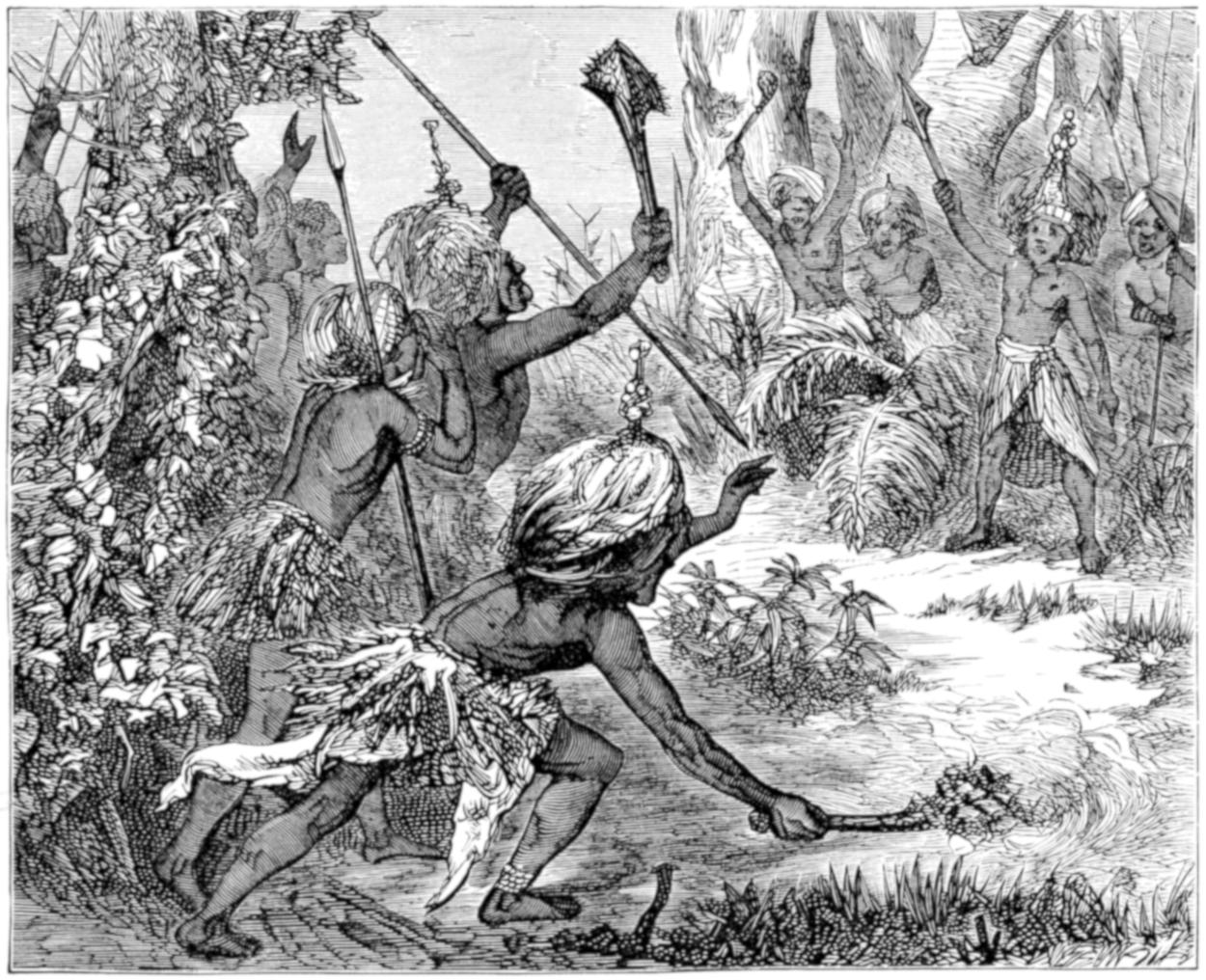
(1.) SAMOAN WARRIORS EXCHANGING DEFIANCE.
(See page 1021.)
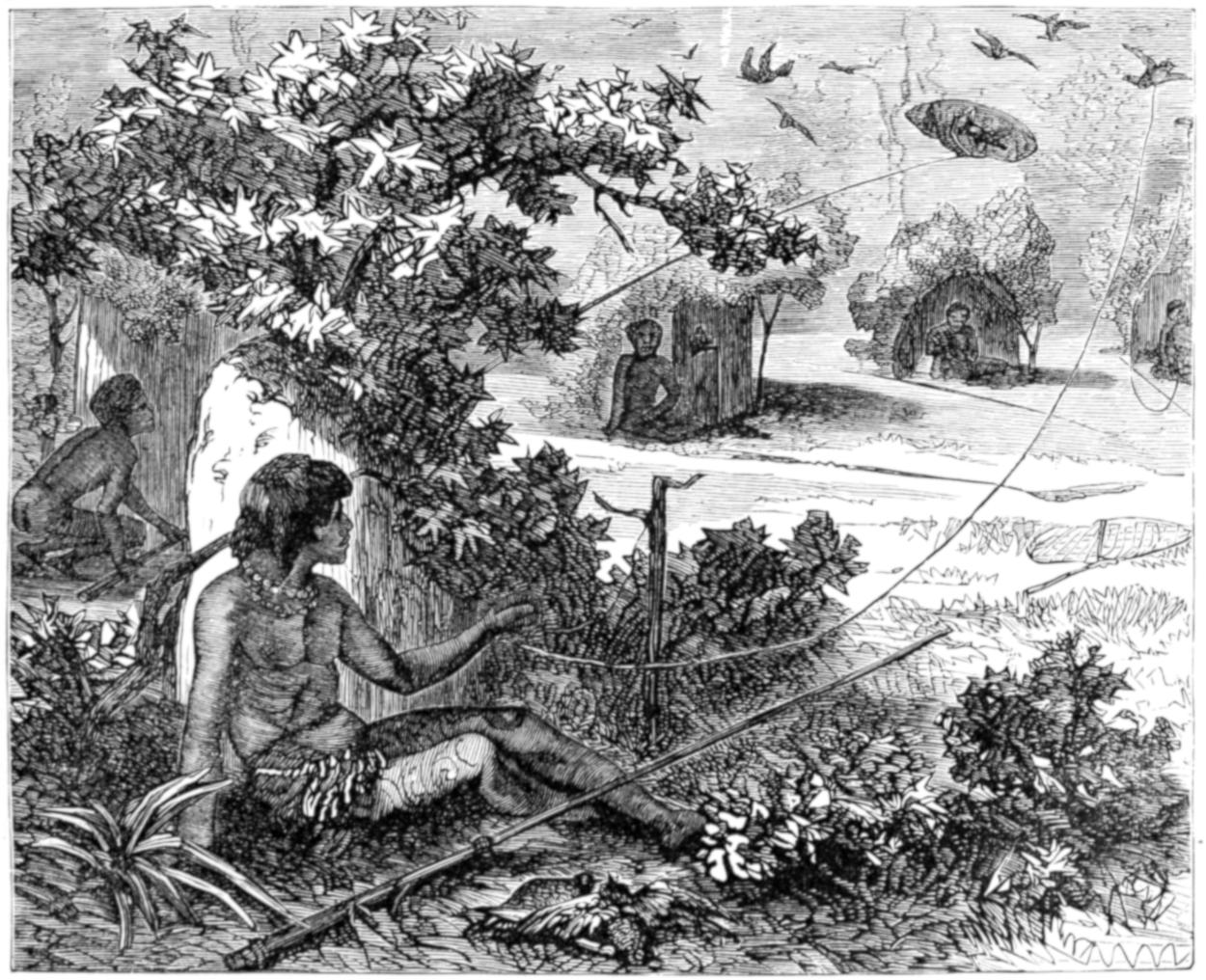
(2.) PIGEON CATCHING BY SAMOANS.
(See page 1026.)
Fishing is a very favorite amusement
with the Samoans, who display a wonderful
amount of skill and often of courage in
their sport. The latter quality is chiefly
brought into play when the natives are
occupied in shark fishing. Whenever a
great feast is to be held, the fishermen go
off in search of sharks, the flesh of this fish
being one of the principal dainties of Samoa.
The fishermen go off in canoes, each canoe
being manned by two or three fishermen,
who are supplied with a strong rope, having
a noose at one end and a quantity of animal
offal.
Going to the edge of the lagoon, where the
sharks lie under shelter of the rocks, the
men throw the offal overboard, for the
double purpose of attracting and gorging
the sharks. They then peer into the water,
and when one of the fishermen sees a shark
lazily stretching itself on the sand that lies
under the overhanging rocks, he lets himself
very quietly into the sea, dives down
with the rope in his hand, slips the noose
over the shark’s tail, and rises to the surface.
As soon as he gets into the boat, the men
drag the shark out of his retreat, and haul
away until the creature’s tail is raised out
of the sea, when it becomes nearly helpless.
A sudden jerk brings it into the canoe,
where it is instantly killed.
Sometimes the shark lies in a deep submarine
cave, with only its head out of the
opening. The Samoan fisherman, however,
is not to be baffled by this attitude, but
dives down to the shark, and taps it gently
on the head. The fish, replete with food,
feels annoyed at the interruption, and turns
round, exposing as it does so its tail to the
daring fisherman, who slips the noose over
it in a moment.
One young man, mentioned by Mr.
Pritchard, was celebrated for his daring in
this sport. He disdained assistance, and
used to go out alone in a little canoe, dropping
bait overboard in order to attract the
sharks, and throwing his noosed rope over
their tails. On one occasion the rope broke,
but the brave fellow had no idea of losing
both shark and rope. He leaped overboard
among all the sharks, seized the rope,
scrambled into his canoe again, and, after a
long and severe struggle, succeeded in killing
his shark and towing it ashore.
Sometimes the hook is used in shark fishing.
The fishermen bait a hook, carry it
out in a canoe in twelve feet or so of water,
and bring the line back to land. Before
very long a shark is nearly sure to seize the
bait; and when the fish is fairly hooked,
several men haul at the rope and drag the
shark into shallow water, where it is allowed
to flounce about until it is exhausted, and is
then killed without difficulty.
Such a sport as this is necessarily attended
with much danger, but the Samoan
fisherman is nearly as much at home in the
water as the shark itself, and treats his dangerous
game with the same easy indifference
which a Spanish matador displays toward a
furious bull. Accidents certainly do happen
in both cases, but they are the exception,
and not the rule.
Another of their amusements which is
dangerous is pig hunting. As the swine
are allowed to run loose in the woods, they
have reverted to their wild modes of life,
and are sly, swift, active, and ferocious. It
is thought a point of honor for a chief to
challenge a wild boar, and to receive no assistance
except in case of extreme need.
The hunter is armed with his knife and
tomahawk, or sometimes with a whale
spade, which makes a very formidable
weapon if the edges are kept sharp.
To kill one of the animals is no easy task.
In the first place, a wild boar is so quick
that nothing but the greatest activity can
save the hunter from its tusks; and were
the fight to take place on an open plain
instead of among trees, behind which the
hunter can jump when hard pressed, the
beast might probably get the better of the
man. Then the boar is wonderfully tenacious
of life, and has a skin so tough that a
sharp weapon and a strong arm are needed
to inflict a mortal wound. Even when the
animal has fallen, and is apparently dead,
an experienced hunter always drives his
knife into its throat, as boars have an awkward
way of suddenly reviving, leaping on
their legs, and dashing through their foes
into the bush.
The sows are even more dangerous antagonists
than the boars. They are, as a rule,
lighter, thinner, and more active, and, although
they have no long tusks wherewith
to rip up their foes, they can bite as sharply
and as quickly as wolves. Indeed, were it
not for the dogs which are trained to boar-hunting,
and are wonderfully courageous and
skilful, though very ugly and most unpromising
to the eye, they would seldom be
brought to bay.
Mr. Pritchard gives an account of an adventure
of his own with a boar, which gives
an excellent idea of the ferocity, cunning,
and activity of the animals. The boar had
actually received two rifle bullets in his
left shoulder, inflicting wounds which would
have disabled, if not killed, most animals,
but seemed only to irritate the boar by the
pain.
“The fury of the beast was intense, with
its two wounds and the worrying of the
dogs. He stood grinding his teeth and
frothing at the mouth, looking first at one
and then at another of us, as if measuring
an antagonist for fight. The chief suggested
that one of us should tackle him,
while the others looked on without interfering.
Of course I had to claim the privilege
to do so after such a challenge; though, in
truth, this being the first boar I had ever
encountered, I felt as if I had somewhat
rashly undertaken the combat, for, even
with his two wounds, I fancied he might
possibly hold out longer than myself, and, if
I failed to kill him, the failure would be fine
sport for my comrades, and not soon forgotten
in their jokes.
“However, I stepped out in front of the
infuriated beast, and no sooner was I there
than he was there too—quite promptly
enough, I thought. He made a furious
charge at me, which I received with the
butt end of my rifle, trying to throw him
over on his wounded side, but ineffectually.
A second time he came at me, and a second
time I checked him. As he drew up for the
third charge, his long bristles standing on
end, grinding his tusks and tossing the froth
from his huge mouth, I drew my tomahawk.
On he came, swifter than ever; the tomahawk
fell deep into the thick part of his
neck, and my boy Atamu did the rest with
his long knife.
“It was rather hot work, for these boars
have immense strength and no little dogged
pluck, and their skins are so tough that
often a spear will break short off without
leaving even a mark where it struck.”
The same boar had previously forced the
writer to employ rather a ludicrous manœuvre.
He had fired at the shoulder of the
animal, thinking that, if the bullet did not
reach the heart, it would at all events disable
him. But the boar made at him almost
as it received the shot, and sprang on him
so quickly that he was forced to jump over
its head upon its back, and roll off toward
the nearest tree. The smaller pigs are
killed in a different manner. The dogs are
trained to catch them by the ears, shoulders,
and tail, and when the hunters come
up they place a stick across the animal’s
throat, and press it down until the pig is dead.
As to the cookery of the Samoans, there
is little to distinguish it from that of the
Tongans and other Polynesians of the same
race. They have a great abundance of dishes,
being able to produce almost as great a variety
in that respect as the Fijians, and many
of their dishes are extremely palatable to an
European. Vegetables form the staple of
the Samoan’s food, and of those he has
abundant choice. Putting aside those vegetables
which have been imported from Europe,
he has yams, taro, bananas, bread-fruit,
cocoa-nuts, and plantains. Sometimes
these are cooked separately and sometimes
mixed, in order to produce a compound
more palatable to native taste. As a rule,
the simpler specimens of Samoan cookery
please even the English palate, but when
the native cooks dress compound dishes the
natives are generally the only persons who
can eat them.
For instance, there is nothing better in
its way than the young cocoa-nut, which is
entirely different from the hard, indigestible
state in which we see it in England. But
when the milk is poured out, its place is
supplied with salt water, and the contents
allowed to become putrid, the compound is
offensive to more senses than one. Some of
their compounds are, however, excellent.
Such is a sort of pudding made by pouring
the juice of cocoa-nuts over bananas, and
baking them together. Even the very
young kernel of the cocoa-nut makes a very
rich dish when baked.
The strangest diet of the Samoans is the
annelid called the Palolo (Palolo viridis).
Mr. Pritchard gives an excellent account of
this curious being and the mode of cooking it.
It appears only in certain strictly defined
and very limited localities in each group
(i. e. in Fiji, Tonga, and Samoa); a month
earlier, about the first week in November, in
Samoa than in the two other groups. It
rises directly from the bottom of the sea
to the surface, appearing first about four
o’clock in the morning, and continuing to
increase in number, until about half an hour
after sunrise, when it begins to dissolve, and
gradually disappears. By eight o’clock not
a trace of the palolo remains in the sea.
They look just like so many worms, from an
inch to a yard in length, showing every conceivable
color as they wriggle about, and
are soft to the touch.
“The time of their appearance is calculated
by the old men of the various tribes,
and is known by the sun, moon, and stars
having a particular bearing to each other.
A month before the great appearance, a few
are found in each of the localities where
they rise. Parties go out in their canoes to
watch for this first appearance, for by it the
calculation as to the second and great appearance
is verified.
“When that time comes, whole villages,
men, women, and children, crowd the scene;
by two o’clock the sea is covered with canoes,
the outriggers getting foul and breaking
adrift without distracting the attention, as
by four o’clock all are busied scooping up
the palolos and pouring them into baskets
made for the occasion. The noise and excitement
from four to six o’clock is something
astonishing, and the scrambling most
amusing. And when, with canoes landed,
the crowd disperses, the next thing is to
prepare the ovens to cook the palolos, which
are merely wrapped in bread-fruit leaves.
They are sent round with much formality to
friends at a distance, and sometimes kept
three or four weeks by being occasionally
warmed in an oven.
“I never could muster courage to do more
than merely taste them, so repulsive is their
very appearance as they roll and coil together,
though Englishmen and even English
women there are who eat them, and
professedly with a relish, for which I suppose
one cannot but accept their word. One
lady in particular there is, as described by
Dr. Seeman, a ‘strong-minded individual,’
who eats palolo with a remarkable gusto. I
think she will not be deprived of her fancy
dish by many of her visitors.”
There has been much discussion about
the palolo, many persons having doubted
whether it was ever an annelid, and believing
the worms to be mere strings of spawn.
The question has, however, been settled,
and there is an elaborate paper on the palolo
in the “Transactions of the Linnæan Society,”
vol. xxii. p. 237.
The worm is allied to the well-known
Nereids, several species of which are so
plentiful on our own shores. It is flattish,
about the sixth of an inch in width, and consists
of a vast number of segments. The
entire specimen has never been secured, so
delicate and fragile is the creature, and it is
with the greatest difficulty that a head can
be discovered. Among the specimens first
sent to the British Museum, not a single
head could be found, and among a large
bottle full of palolo collected expressly for
scientific purposes, only one head was discovered.
The head is a little narrower than
the joints which compose the neck, and is
furnished with two little eyes on the upper
surface, between which are placed three
tentacles, of which the middle is the longest.
The normal color of the annelid is green,
and it is remarkable for the regularly dotted
appearance of the back, one black dot being
placed on the middle of each segment. So
regularly does the palolo make its appearance,
that among the Fiji group the months
of October and November are known by
the names of the Little Palolo and Great
Palolo, the former being the month in
which it is first seen, and the second that in
which it makes its grand appearance.
Marriages in Samoa are conducted
much like those of Tonga, the latter group
of islands having borrowed many of the
Samoan customs. It is thought rather below
the dignity of a chief to court a wife
for himself, and that office is generally undertaken
by his friends, who praise him in
the most unmeasured terms, and do all in
their power to induce the girl to yield.
When her consent has been given, the chief
sends property to her father, and receives in
return fine mats and other articles, this exchange
being considered as the betrothal.
On the day of marriage, the bride, well
anointed with oil, colored with turmeric, and
dressed in large quantities of the finest mats,
is placed in the malae, or open space in the
centre of the village, attended by her young
friends, who are arrayed in all the gorgeousness
of savage finery, with wreaths of flowers
and nautilus shells on their heads. She is
also accompanied by the two duennas who
have had charge of her, and who chant her
praises and extol her virtue. The object of
this public assembly is to prove whether the
girl be worthy to be the wife of a chief.
Should the verdict be in her favor, she is
presented to the people as the chief’s wife,
and, amid their acclamations, is taken into
the house by her duennas and attendants.
Should, as is very seldom the case, the verdict
be adverse, all the male members of her
family, even her fathers and brothers, rush
on her with their clubs and kill her on the
spot, in order to take away the disgrace
which she has brought on her house.
After the bride has been led away there is
a grand dance. This differs somewhat from
the dances which are usually seen among
the Polynesians. The spectators being
seated in a circle round a cleared space,
and keeping up a monotonous chant, the
men first enter the circle, led by a young
chief, and clothed merely in the little leaf
apron, so as to show off the tattoo to the
best advantage. Their leader goes through a
vast number of steps, sometimes leaping high
in the air, and sometimes executing movements
of a slower and more graceful character,
while every step is watched and criticised
as it is danced by the leader and
imitated by his followers. After the men
have danced for some time they retire, and
a number of girls enter, who go through
evolutions of a similar character, and afterward
both men and women dance together.
The houses of the Samoans are all built
on the same model. They are very conservative
in some of their ideas, and follow
implicitly the plan which was adopted by
the chief who, according to their traditions,
first built a dwelling. At a distance, the
appearance of the house has been compared
to a large mushroom.
The first process is, to make a large platform
of rough stones, covered with gravel,
extending some twenty feet on every side
beyond the walls of the house. In the centre
are planted three posts, standing about
twenty-five feet out of the ground. Upon
these central posts are supported the rafters
of the roof, one end of each rafter being fixed
to them, and the other end to the tops of
short posts about four feet high, which form,
or rather which do duty for, the walls of the
house. Real walls there are none, but at
night the space between the posts is closed
by blinds made of plaited cocoa-nut leaves.
The whole framework of the roof is made in
several sections, so that it can be removed.
The thatch is made of the leaves of the
sugar-cane, nailed by the women to reeds
with spikes made of the ribs of the cocoa-nut
leaves. About four thousand leaves are
required for thatching a house, and they
are lashed carefully with cocoa-nut fibre.
The floor of the house is strewn with very
fine gravel and covered with mats. There
are no separate chambers, but at night the
house is divided into a number of sleeping
places by means of the mosquito curtains
which are attached to the central post, and let
down when required. It is a point of etiquette
that all guests should be supplied
with clean mats. The pillow used in Samoa
is like that of Fiji, and is nothing more than
a stick supported on a foot at each end.
CHAPTER CV. HERVEY AND KINGSMILL ISLANDS. APPEARANCE—WEAPONS—GOVERNMENT. — THE KINGSMILL ISLANDS.
POSITION OF THE HERVEY ISLANDS — FIERCE AND TREACHEROUS NATURE OF THE INHABITANTS — THE
CHIEF MOUROOA, AND HIS VISIT TO THE SHIP — SKILL IN CARVING — THEIR BEAUTIFUL
PADDLES AND CANOES — THE MANGAIAN ADZE: ITS CARVED HANDLE AND STONE HEAD — THE
MANY-BARBED SPEAR — THE CLUB AND SLING — THE FOUR RANKS IN BATTLE — FEROCITY OF THE
WOMEN — FEUDS AND THEIR CONSEQUENCES — A MANGAIAN HOUSE — FOOD — PROCURING AND
COOKING IT — A RAT HUNT — IDOLS OF THE MANGAIANS — THE KINGSMILL ISLANDERS — LOCALITY
AND GENERAL DESCRIPTION OF THE KINGSMILL ISLANDS — APPEARANCE OF THE NATIVES — ARCHITECTURE — DRESS
AND TATTOOING — WARLIKE NATURE — THE TERRIBLE WEAPONS OF
THESE ISLANDS — THE SWORD AND SPEAR — MODE OF GOVERNMENT — BURIAL OF A DEAD CHIEF.
Eastward of Samoa, and rather southward,
lie the Hervey, or Cook’s Islands.
The group includes seven islands, the principal
of which is Rarotonga, an island between
thirty and forty miles in circumference.
This island is remarkable for the
lofty mountains of the interior, and round it
extends a large reef of coral. Some of the
islands are entirely coral, and all of them
are surrounded by the dangerous coral reefs,
at which the coral “insects” are still working.
In general appearance the people bear
much resemblance to the Samoans, but seem
to be of a more warlike and ferocious character.
Indeed, so quarrelsome and bloodthirsty
are the natives of this group, that
when Mr. Williams visited Hervey’s Island
he found that only sixty of the population
survived, and a few years later they were
reduced to five men, three women, and some
children, and these were on the point of fighting
among themselves, in order to ascertain
which should be king.
One of the principal islands of this group,
namely, Mangaia, was discovered by Captain
Cook in March 1777. The natives were
very unwilling to come on board the vessel,
but at last two men put off in a canoe, their
curiosity overcoming their terror. The
name of one of them was Mourooa, and he
was distinguishable by a large scar on his
forehead, the result of a wound received in
battle.
“Mourooa,” writes Captain Cook, “was
lusty and well-made, but not very tall. His
features were agreeable, and his disposition
seemingly no less so, for he made several
droll gesticulations, which indicated both
good nature and a share of humor. He also
made others which seemed of a serious kind,
and repeated some words with a devout air
before he ventured to lay hold of the rope at
the ship’s stern; which was probably to recommend
himself to the protection of some
divinity.
“His color was nearly of the same cast
common to the most southern Europeans.
The other man was not so handsome. Both
of them had strong, straight hair, of a jet
color, tied together on the crown of the
head with a bit of cloth. They wore such
girdles as we perceived about those on shore,
and we found they wore a substance made
from the Morus papyrifera, in the same manner
as at the other islands of this ocean. It
was glazed, like the sort used by the natives
of the Friendly Islands, but the cloth on
their heads was white, like that which is
found at Otaheite.
“They had on a kind of sandal made of a
grassy substance interwoven, which we also
observed were worn by those who stood
upon the beach, and, as we supposed, intended
to defend their feet against the rough
coral rock. Their beards were long; and
the inside of their arms, from the shoulder
to the elbow, and some other parts, were
punctured or tattooed, after the manner of
the inhabitants of almost all the other islands
in the South Sea. The lobe of their ears
was pierced, or rather slit, and to such a
length that one of them stuck there a knife
and some beads which he had received from
us; and the same person had two polished
pearl-shells and a bunch of human hair
loosely twisted hanging about his neck, which
was the only ornament we observed.”
After some time, Mourooa ventured on
board the ship, but seemed very uneasy
at his position, his feelings of curiosity being
overcome by those of alarm at finding himself
in so gigantic a vessel. He showed little
curiosity about the ship and the various
objects which it contained, but the sight of
a goat entirely drove out of his mind any
emotion except wonder, he never having
seen so large an animal. He wanted to
know what bird it could be, and, as soon as
he could get ashore, he was seen narrating
to the people the wonders which he had seen
on board the great canoe.
All the Hervey Islanders are gifted with
a natural appreciation of art, and the inhabitants
of Mangaia seem to be pre-eminent in
this respect. They lavish the most minute
and elaborate carving on various objects, the
handles of tools and the paddles seeming to
be their favorite subjects. The beautiful
paddle which is shown on the 1018th page,
is drawn from a specimen in my own collection.
It is nearly four feet in length, and
the blade is eleven inches wide in the
broadest part. The pattern is given as well
as can be done, considering the minute elaboration
of the original. The opposite face
of the blade is even more carefully decorated,
and perhaps with a more artistic design.
The squared shaft of the paddle is covered
with carving, as is also the peculiarly shaped
handle.
Another paddle is made in a similar manner,
except that the shaft is rounded instead
of squared, and decorated at the handle
with a row of ornaments which seem to be
conventional imitations of the human face
(see fig. 2). The wood of which these paddles
are made is light, though strong and
elastic; and, as the implement is sometimes
used as a club, both these last-mentioned
characteristics are needed.
Captain Cook noticed the peculiar shape
of these paddles, though he does not appear
to have handled them, or to have examined
them carefully. “The canoe they
came in (which was the only one we saw)
was not above ten feet long and very narrow,
but both strong and neatly made. The
fore-part had a board fastened over it and
projecting out, so as to prevent the sea from
getting in on plunging ... but it had an
upright stern about five feet high, like some
in new Zealand, and the upper part of this
stern-post was forked. The lower part of
the canoe was of white wood, but the upper
was black, and their paddles made of wood
of the same color, not above three feet long,
broad at one end and blunted.”
Another paddle was brought to England
by the late Admiral Young, and presented
to me by his daughter. It is not so large as
the specimens which have been just described,
but is the most delicately carved
specimen I have ever seen. The wood of
which it is made is a very rich dark brown,
and takes a high polish, so that the effect of
the carving is peculiarly good. The blade
is covered with a vast number of stars, wonderfully
well carved, seeing that the native
maker had no compasses by which to take his
measurement, and that his only tools were
sharks’ teeth and bits of stone. The maker
has spared no pains over this trophy of his
skill, and, as if to show his own fertility of
invention, he has not covered the whole of
the shaft with the same pattern, as is the
case with the two paddles that have just
been described, but has changed the pattern
every few inches. I have also a much
smaller and shorter paddle, not quite three
feet in length, which is made with equal
care, but which is not intended so much for
use in propelling boats as for ornament in
dancing.
The love of ornamentation is displayed in
all their manufactures, which are decorated
in a manner equally elaborate and artistic.
Even their drinking cups, which are made
from cocoa-nut shells, are covered with
carved patterns of a nature similar to those
of the paddles.
The reader will remark that many Polynesians
adorn with carving the handles of their
tools and weapons, examples of which have
been given in the preceding pages. The
Hervey Islanders, however, leave no portion
of the implement without carving, and, in
many instances sacrifice utility to ornament.
This is generally the case with the adze
handles, many of which are so extremely ornamental
that it is not easy to see how they
can be useful.
The specimen which is represented on
page 1018 (adze magnified), is a good example
of such an adze. The lower part of
the handle is completely hollow, the native
manufacturer having contrived to cut away
the wood through the intervals between the
upright pillars. As these intervals are not
quite the third of an inch in width, the labor
of removing the interior of the handle
must have been very great, and the work
exceedingly tedious. Even with European
tools it would be a difficult piece of workmanship,
and its difficulty is greatly enhanced
by the fact that the native who
carved it had nothing but a sharp stone or
a shark’s tooth lashed to a handle by way of
a knife. This particular specimen has been
in England for many years, and must have
been made before the introduction of European
tools among the natives.
The head of the adze is made of stone,
and is lashed to the handle in a way exactly
like that which is employed by the New
Zealanders, except that it is far more elaborate.
As if desirous of giving himself as
much trouble as possible, the maker has
employed the finest plaited sinnet, not wider
than packthread and quite flat, and has laid
it on the tool in a manner so elaborate that
to give a proper idea of it the artist must
have occupied an entire page with his drawing.
Suffice it to say that the illustration
gives a good general idea of the mode in
which the head is lashed to the handle. The
sinnet is laid as regularly as if wound by
machinery, and the native artist has contrived
to produce the most extraordinary
effects with it, throwing the various portions
into a simulated perspective, and making
the lashing look as if there were four distinct
layers, one above another.
Between the stone of the adze head and
the wood of the handle is placed a piece of
very strong tappa cloth, which seems to
have been laid on while wet, so that the
bands of sinnet have pressed it well together,
and aided in strengthening the junction.
The end of this tappa is seen projecting
on the upper part of the head, just
where it is joined to the handle. That such
an implement as this should have been intended
for use seems most unlikely, and I
believe that it has only been constructed as
a sample of the maker’s skill. Sometimes
adzes of a similar character are made, the
handles of which are from four to five feet
long, and carved with a pierced pattern
throughout their entire length, so that they
could not have been intended for hard work.
A similar elaborate ornamentation is
found upon the Hervey Islanders’ spears,
one of which is shown in the illustration
entitled “Spear,” on the 1018th page.
The spear, which is in my collection, is
rather more than ten feet in length, and
beautifully made. The shaft is very straight,
very slender, and highly polished, but without
any carving; indeed, it is so slight that
it could not bear any pattern to be carved
upon it. The ornament is therefore confined
to the many-barbed head, which is a
beautiful specimen of savage art.
By referring to the illustration, the reader
will see that just below the first set of barbs
the wood of the spear swells into a slightly
oval form. This portion of the head is covered
with carving, necessarily very shallow,
but sufficient for ornament. Between the
various sets of barbs the spear is wrapped
with very narrow strips of some reed, which
is highly polished and of a bright yellow
color, so that the contrast between the dark
wood of the barbs and the shining yellow of
the wrapping is very striking. In spite of the
large size of the head, the spear is well balanced,
the length of the slender and elastic
shaft acting as a counterpoise; and altogether
the weapon is as formidable as it is
elegant.
Their clubs are ornamented in a similar
manner. Mr. Williams describes one of a
very curious form. It was carved like the
club, fig. 1, on page 949, but was bent nearly
at right angles, rather beyond the junction
of the handle with the head, and was ornamented
with a great bunch of long and
slender feathers. Slings of great length
and power are used by these people.
According to the accounts of this missionary,
the inhabitants of Mangaia can use
their weapons with great skill and courage.
They do not try to hide behind trees and
bushes, and take their foes by surprise, but
boldly meet them in the open field. When
two parties meet, they form themselves into
four lines. The warriors who compose the
first row are armed with the long spears
which have just been described, the second
rank carry clubs, the third are furnished
with slings, and the fourth rank is composed
of the women, who carry additional weapons,
in case the men should be disarmed, together
with a supply of small stones for the slingers.
This arrangement of forces is represented
in the battle scene given on the opposite
page.
Sometimes the women take an active part
in the fray. One young chief told Mr.
Williams that in one battle he was fiercely
assailed by the wife of his antagonist. He
told her to desist, as he had not come to
fight with women. However, she would
not listen to him, and exclaiming, “If you
kill my husband, what shall I do?” flung a
stone at him, which struck him to the ground.
Had it not been for the prompt assistance of
his own people, who came to the rescue, he
would assuredly have lost his life through
this woman’s fury.
The people are apt to be ferocious in battle,
and Mr. Williams mentions that several of
his converts forgot the maxims of Christianity
in the excitement of battle, and killed
their vanquished enemies in spite of their
entreaties for mercy. In all probability,
these people were carrying out some feeling
of vengeance, according to the custom of
these islands.
Throughout the greater part of Polynesia
the friends or relatives of the murdered man
are bound to avenge his death by killing the
murderer, if they can secure him, or at all
events by killing one of his family. The
family of the victim then retaliate in their
turn, so that when a man goes into battle he
mostly has a number of feuds on his hands.
Like the Corsican Vendetta, if such a feud
cannot be carried out in a man’s lifetime, he
bequeaths it to his son, so that it may be
carried on for any number of generations.
This savage custom has stood greatly in
the way of the missionaries. They found no
very great difficulty in persuading the people
that to harbor malice against another, who
might be totally innocent, was exceedingly
wrong, and that they ought to abandon the
feud. But the new converts argued that it
was very unfair to demand that they should
abandon their feuds against others while the
feuds against themselves were still in operation.
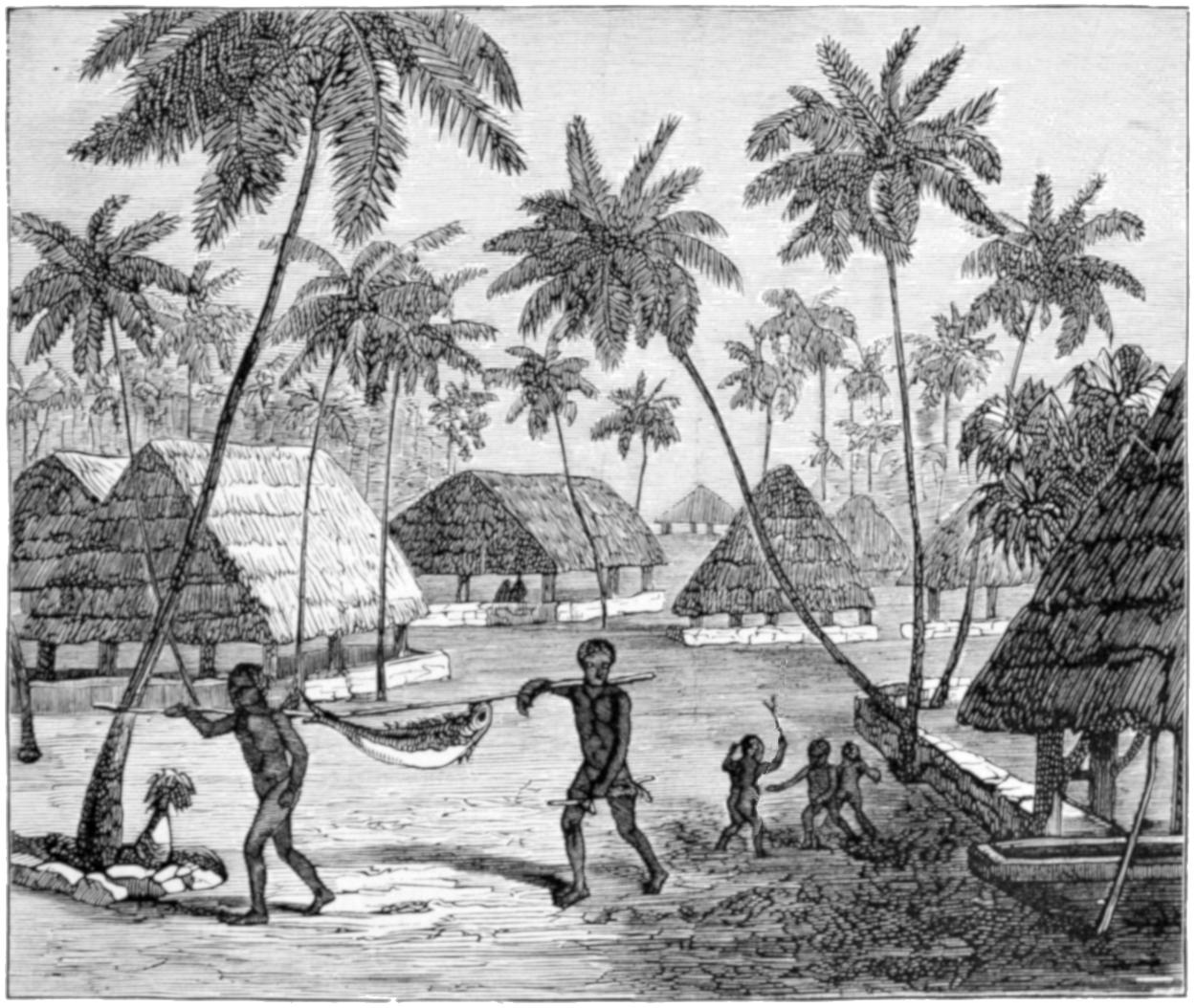
(2.) VILLAGE IN THE KINGSMILL ISLANDS.
(See page 1038.)
In their architecture the Mangaians display
the same love of carving which has already
been mentioned. Mr. Williams thus describes
a building which had been erected
for him, and which was large enough to hold
sixteen hundred persons:—
“It was a fine building, of an oval shape,
about one hundred and twenty feet in length.
The large posts which supported the roof
(eight in number), the ridge-pole, and the
rafters were most beautifully carved, and
tastefully colored with various native preparations.
“It is impossible, however, so to describe
them as to enable the reader to form a correct
idea of their appearance, or of the taste and
ingenuity displayed in their execution.
These posts were twenty-five feet high, and
from twelve to eighteen inches square, and
when we considered the tools with which
the work was done, which were principally
old nails, pieces of iron hoop, and a few
chisels, we were amazed both at the patience
and skill of the carvers. The effect on entering
the place was very striking.”
On the shores of this island fish appear to
be less plentiful than is generally the case,
and the inhabitants are obliged to have
resort to various modes of procuring and
preserving food. For example, when they
have caught a large quantity of flying fish,
they do not eat them at once, but dry them
in wood smoke, much as herrings are cured
among ourselves. They have an ingenious
method of catching these fish by night.
The boatmen go out in their double canoes,
supplied with torches and large ring nets
fastened to the end of handles ten or twelve
feet long. They stamp on their canoes so
as to make a noise, which is communicated
to the water and alarms the fish, and at
the same time wave their torches about.
According to their instinct, the flying fish
dart out of the water toward the light, and
are easily captured in the nets.
Rats form a most valued portion of their
diet. When the missionaries first visited
Mangaia, the natives were so fond of this
food that they measured all other kinds of
diet by comparison with rats’ flesh. Indeed,
the flesh of these animals is far better than
is generally supposed. Several English rat-catchers
have learned by practical experience
the value of rat’s flesh, which is said
by those who have tried it to be equal to
that of the squirrel and better than that of
the rabbit. The Mangaians caught the rats
by digging a hole in the ground, and throwing
bait into it. When a sufficient number
had entered the hole, a net was thrown over
the mouth of it, and the inmates easily
secured.
In Rarotonga, another island of this
group, the rats swarmed in such numbers
that they were not only a nuisance, but an
absolute pest; and, if it had not been for
the pigs which were introduced by the Europeans,
and allowed to run wild, the rats
would probably have driven the natives out
of their villages. At every meal one or two
persons were detailed for the sole purpose
of keeping the rats from the provisions.
When the people sat down in their houses
the rats ran over them, and when they lay
down to rest the rats had made a settlement
in their bed.
At last warfare was declared against the
rats, and a number of baskets were made to
contain the bodies of the slain, each basket
being five or six feet in length. The inhabitants
then armed themselves with sticks,
and in an hour no less than thirty of these
great baskets were filled with dead rats.
Even then no diminution seemed to have
taken place among these pests. Next, the
missionaries tried the introduction of cats,
and with some success, but the most fortunate
introduction that was made was that of
the pig. These animals were brought to
Rarotonga for the purpose of supplying the
sailors with meat which should supersede
the flesh of the rat, and the pigs repaid their
introducers by eating every rat which came
across them.
When the natives were converted to
Christianity, they consulted the missionaries,
wishing to know whether the flesh of
rats was unlawful food for Christians. They
evidently asked this question because they
saw that their teachers abstained from these
animals. The missionaries returned a very
judicious answer to this question, by saying
that in their own country rats were not
eaten, because the white man had a repugnance
to them, but that there was nothing
unlawful in eating them, and that the Mangaians
might do as they pleased. The people
were satisfied with this answer, and contented
themselves with passing a law that all
Christians should catch and cook their rats
on Saturdays, so as to avoid working on
the Sunday.
The idols of the Hervey Islanders are
very odd-looking things, and would scarcely
be recognized as objects of worship. It
might naturally be imagined that if these
people bestow such pains upon their weapons
and implements, they would at least
take equal pains with their gods. Yet
the gods of the Hervey Islanders are the
rudest possible specimens of native workmanship.
They consist principally of a
staff about sixteen or seventeen feet in
length, the upper part of which is carved
into a rude representation of a human head.
On the staff are laid a few red feathers and
a string of beads, which are called the soul
of the god. Round the staff and the beads
is wrapped a vast quantity of native cloth,
so as to form a slightly conical roll about a
yard in diameter, and ten feet in length.
One of these idols is placed at the bow of
every canoe, and whenever the natives are
out on a fishing excursion they always make
offerings to this strange deity.
North-west of the Samoans is a group
known by the name of Kingsmill Islands.
It consists of about fifteen islands, all of
coral, and all lying very low, so that they
might easily escape the attention of voyagers.
As is always the case with coral islands,
the navigation among them is very
dangerous. They are mostly very long in
proportion to their width, the largest of the
group, called Taputeonea or Drummond Island,
being nearly forty miles in length, and
in many places not a mile in width.
The inhabitants of these islands have a
character for ferocity which is not often to
be found among this race of Polynesians,
and are said to be lower in the human scale
than any whom we have hitherto described.
Those of one of the group, called Pitt Island,
are said to be less liable to this charge
than any other, being quiet, peaceable, and
not so perpetually at war as is the case with
the inhabitants of the other islands.
Their color is approaching nearer to black
than that of the inhabitants of Tonga and
Samoa, and the people are of more moderate
stature than those of the latter group of
islands. They are well made and slender,
and have black and glossy though rather
fine hair. The mouth is large, but has nothing
of the negro character about it and the
teeth are kept very white. The nose is
mostly aquiline, and the hair of the beard
and moustache black, and by no means
coarse.
It is rather remarkable that the people of
Pitt Island are not only more quiet and
peaceable than their neighbors, but are also
of a lighter hue, approaching in this respect
the naturally peaceful though courageous
inhabitants of Tonga. Their faces are oval
and neatly rounded, and their features delicate.
It may be that they have been modified
by the mixture with the Samoans or
Tongans, who have been blown out of their
course by gales, landed on the island, and
gradually became absorbed in the community.
Architecture among the Kingsmill Islands
is rather distinguished for strength and massiveness
than for beauty, the natives preferring
to employ their artistic powers on
smaller objects, such as swords, spears, and
similar articles. The houses vary much in
size and form according to their uses. For
example, the ordinary dwelling-house of
the Kingsmill Islanders consists of two stories,
the upper part being used as a sleeping-house,
and the lower entirely open. In
fact, the houses of the Kingsmill Islands are
exactly similar in principle to those of Nicobar,
which have been described on page
903.
Some of the houses wherein the chiefs sit
and talk among themselves and receive visitors
are mere sheds, being nothing more
than roofs supported on poles. As is usually
the case in Polynesia, there is in every
village a central council house, in which the
people assemble on stated occasions. It is
of enormous dimensions, having a lofty roof
thatched with leaves and lined with matting.
Several examples of their houses are illustrated
on the 1035th page, and the reader will
see that the lower part affords a complete
and yet an airy refuge from the sun in the
heat of the day, while the upper part, which
is too hot to be comfortable during the daytime,
forms comfortable sleeping-rooms at
night.
Dress varies much according to the particular
island. Tattooing is practised by
both sexes, but the women are far less decorated
than the men, the lines being very
fine and far apart. The men are tattooed at
the age of twenty, the process being always
left in the hands of professional tattooers,
who, as in other islands of Polynesia, are
paid according to the celebrity which they
have attained, in some cases obtaining very
large fees. They dress chiefly in mats made
of the pandanus leaf cut into narrow strips,
and dyed brown and yellow. These strips
are plaited together in a very ingenious
fashion so as to form diamond or square
patterns. A small cape, worn, in poncho
fashion, with a slit in the middle, through
which the head passes, is worn over the
neck, and a conical cap of pandanus leaf is
worn on the head.
The dress of the women consists of a petticoat
of leaf-strips reaching from the waist
to the knees, and fastened by a thin rope,
sometimes five or six hundred feet in length,
made of human hair. On the rope are strung
at intervals beads made of cocoa-nut and
shells, ground so as to fit closely together,
and strung alternately so as to form a contrast
between the white shell and the dark
cocoa-nut.
It has already been mentioned that the
Kingsmill Islanders are a warlike people.
War, indeed, seems to be their chief business,
and indeed their whole thoughts appear to
be given to fighting. Even their principal
amusement is of a combatant character.
There is nothing which delights the Kingsmill
Islanders so much as cock fighting, and
large groups of the people may be seen seated
in a circle, eagerly watching the progress of
the combat which is taking place in the
midst. Cock fighting is largely practised in
many other countries, but is almost invariably
accompanied by betting. The Malays,
for example, are passionately fond of the
sport, and wager whole fortunes upon it.
Betting, however, has no charms for the
Kingsmill Islander, whose martial soul is
utterly absorbed in the fight, and does not
require the additional excitement of betting.
This being the nature of the people, it is
natural that their weapons should be of a
formidable character. They are indeed exactly
suitable to the fierce and bloodthirsty
people by whom they are made. Instead of
contenting himself with a club or a spear,
the Kingsmill Islander must needs arm his
weapons with sharks’ teeth, which cut like
so many lancets.
The spears and swords which are shown
on the 1041st page are drawn from specimens
in my collection, and are admirable
examples of these extraordinary weapons.
For want of a better word, we must use
the name of sword for these weapons, as
they are constructed with edges, and are
meant more for striking than thrusting. I
have often wondered that in none of these
weapons that I have seen is the point tipped
with a sharp bone, such as that of the sting-ray,
or even with a shark’s tooth. Perhaps
they are formidable enough even for these
ferocious islanders, as the reader may easily
infer by looking at the illustration. By the
side of each figure is a specimen of the
shark’s tooth drawn on an enlarged scale,
partly to show the nature of the tooth itself,
and partly to exhibit the principal methods
by which it is fastened in its place.
On referring to these illustrations, the
reader will see that the teeth are not merely
sharply edged and pointed, but that their
edges are finely and regularly serrated, so
that their cutting power is greatly increased.
Indeed, the weapons armed with these teeth
have such a facility of inflicting wounds that
they must be handled with the greatest caution.
I have cut myself more than once
with them, and visitors who insist upon
handling them generally suffer for their curiosity.
Although these teeth are fastened to the
blade of the weapon on the same principle,
the makers vary the detail according to their
own convenience. In the weapon represented
in fig. 1, a slit runs along each edge,
into which the bases of the teeth fit rather
tightly. A hole is bored through the tooth,
and a corresponding one through the edge
of the sword, and each tooth is fixed in its
place by a piece of fine sinnet passed repeatedly
through the holes, drawn tight,
and neatly finished off. A plaited loop of
broad sinnet serves to suspend the weapon
round the wrist, and a piece of the hard,
ivory-like skate-skin holds it in its place.
The next, fig. 2, shows a much more elaborate
weapon, which, instead of consisting
of a single piece, has one central blade and
three auxiliary blades. Moreover, as the
reader may see by carefully examining the
illustration, there are four rows of teeth instead
of two on each blade, and the teeth
are larger and more deeply serrated than
those of the other weapon. In this case
the maker has most ingeniously contrived
to spare himself the trouble of making a
fresh tie for every tooth, which, as upwards
of two hundred teeth are employed, would
have been a very tedious business.
Firstly, he has shaped the wooden blades
with four bold ridges, and cut a slight groove
along each ridge, so as to keep the teeth
straight. Instead of troubling himself to
bore holes in the sword as well as in the
tooth, he has laid along the edges of each
groove a strip of elastic wood obtained from
the rib of the palm leaf, which is as hard and
elastic as whalebone. The sinnet has then
been passed through the holes in the teeth,
and over all them palm-leaf strips, so that one
piece of sinnet serves to fasten four teeth.
As in the other case, the sinnet is exceedingly
fine, and is passed several times round
the sword. It is observable that in this
weapon the teeth have been most carefully
selected and graduated, the largest and longest
being near the handle, and diminishing
equally to the point, where they are comparatively
small.
The auxiliary blades diverge more than is
shown in the illustration, and it is hardly
possible to imagine a more formidable
weapon, especially when employed against
the naked skin of a savage. In actual warfare
the Kingsmill Islander has a mode of protecting
himself, which will be presently mentioned;
but in a sudden skirmish or a quarrel
the sword would be used with terrible
effect. As may be inferred from its shape,
it is not merely used as a striking weapon,
but is driven violently backward and forward
against the body of the antagonist,
one or more of the blades being sure to
take effect somewhere.
The next sword, fig. 3, has the teeth fixed
exactly in the same manner as those of the
many-bladed sword, as may be seen by reference
to the single tooth, where is seen
not only the tooth but the strips of leaf
stem between which it is placed, and the
mode of fastening off the sinnet. The
wooden blade of this weapon is quite unlike
that of the others, being marked with a
rich black graining, to which the glittering
white teeth form an admirable contrast.
The last of these swords, fig. 4, is remarkable
for the cross-guard. I cannot but think
that the maker must have seen an European
sword with a cross-guard, and made his own
in imitation of it. Otherwise, without the
least idea of the object of a guard, it is
not easy to see why he should have armed
the guard with teeth, especially in the centre,
or where they come against the handle,
and must be quite ineffectual.
The Kingsmill Islanders do not restrict
the sharks’ teeth to the swords, but also use
them as armature to their spears. One of
these spears, also in my collection, is fifteen
feet in length, and about as formidable a
weapon as can well be imagined. It is
made of a very light wood, so that it may
be wielded more easily, and at the butt is
nearly as thick as a man’s wrist, tapering
gradually to the point. The butt is unarmed,
and rounded for about four feet, so
as to act as a handle, but from this point to
the tip it is rather flattened, like the sword
blades, for the more convenient reception
of the teeth, which are fixed along each
edge nearly to the point of the weapon.
The teeth are fastened by means of the leaf
ribs. In order to render it a more dangerous
weapon, it is furnished with three projections,
also armed with teeth, and made
exactly like the auxiliary blades of the
sword, though much smaller.
This remarkable spear is shown in the
illustration No. 2, on the next page, accompanied
by sections and a portion drawn on
a larger scale, so as to show the mode of its
construction. Fig. a represents the method
in which the teeth are fastened to the
weapon by the sinnet passing through the
hole in the teeth and bound down by the
cross loop under the little strips of wood.
At fig. b is a section of the spear, showing
the oval shape of the weapon, and the mode
in which the teeth are supported by the
wooden strips at each side. It is worthy of
notice, that if the jaw of a saw-fish were to
be cut through the section would present a
wonderfully similar appearance.
In order to show more clearly the source
whence the natives obtain such vast numbers
of sharks’ teeth, I have introduced a
drawing of a shark’s mouth on same page,
taken from a specimen in my collection.
The reader will see that the jaws are furnished
with row after row of teeth, all lying
upon each other, except the outer teeth, and
constructed so that when one tooth is broken
or falls out of the jaw, another takes its
place.
In the jaw which is here figured, the teeth
lie in five rows, and altogether there are
three hundred of them—largest toward the
middle of the jaw, and becoming gradually
smaller toward the angles of the mouth.
The native, therefore, has no difficulty either
in procuring the requisite number of teeth,
or in selecting them of the requisite shape
and dimensions.
That they may look more imposing in
battle, the chiefs wear a cap made of the
skin of the diodon, or porcupine fish, which,
when inflated, is covered with sharp spikes
projecting in every direction, and upon this
cap is fixed a bunch of feathers. Both sexes
fight in battle, and both are killed indiscriminately,
women and children being
slaughtered as well as the warriors.
The chiefs, of whom mention has just
been made, are the principal persons in the
islands. With one exception, there is no
chief who is looked upon as a king, ruling
over subordinate chiefs, each being independent
of the other. Government is carried
on by a council of chiefs, the eldest
taking the first place, and the others being
reckoned by seniority. To this council are
referred crimes of great importance, while
those of lesser moment are left to be punished
by the offended person and the relatives.
The solitary exception to the independence
of the chiefs is in the three islands
Apamama, Nanouki, and Koria, which are
governed by the chief of Apamama.
Each chief has a mark peculiar to himself,
and when a stranger arrives, and can
place himself under the protection of a chief,
he receives the mark of his protector. The
symbol is a very simple one, and consists of a
patch on the forehead, made of some colored
paint, and a stripe drawn down the middle
of the face as far as the chin. Next in rank
to the chiefs come the land-holders, and the
slaves form the third and last division of the
people.
In order to accommodate the council of
chiefs and the people in their public assemblies,
there is in every village a central
town-house, called the Mariapa. It is built
very much after the fashion of the Samoan
houses, having an enormous arched roof,
and the walls being composed of posts and
matting. It might be thought from their
warlike and ferocious character that the
Kingsmill Islanders are cannibals. Such,
however, is not the case. It is very true
that in some instances portions of a human
body have been eaten. For example, if a celebrated
warrior is killed, the victors sometimes
cook the body, and each eats a small
portion of it. This however is done, not
from any predilection for human flesh, but
from a feeling of revenge, and probably from
some underlying notion that those who partake
of such food also add to themselves a
portion of the courage which once animated
the body. Animated by the same spirit,
they preserve the skulls of such warriors,
and use them as drinking vessels.
The skulls of the dead are always preserved
by their friends, provided that they
have died natural deaths, or their bodies
been recovered in battle. The body is first
laid out on mats for eight days, being every
day washed, oiled, and laid out in the sunshine
at noon, while the friends mourn,
dance, and sing praises of the dead. The
body is then buried for a time, and lastly,
the skull is removed, cleaned, oiled, and
stowed away. Each family preserve the
skulls of their ancestors, and, occasionally,
bring them out, oil them afresh, wreathe
them with flowers, and set food before them.
When a family change their residence, they
take the skulls with them.

SHARKS TEETH
ENLARGED PIECE
OF SPEAR
SECTION
SECTION
(2.) SHARK TOOTH SPEAR.
(See page 1040.)
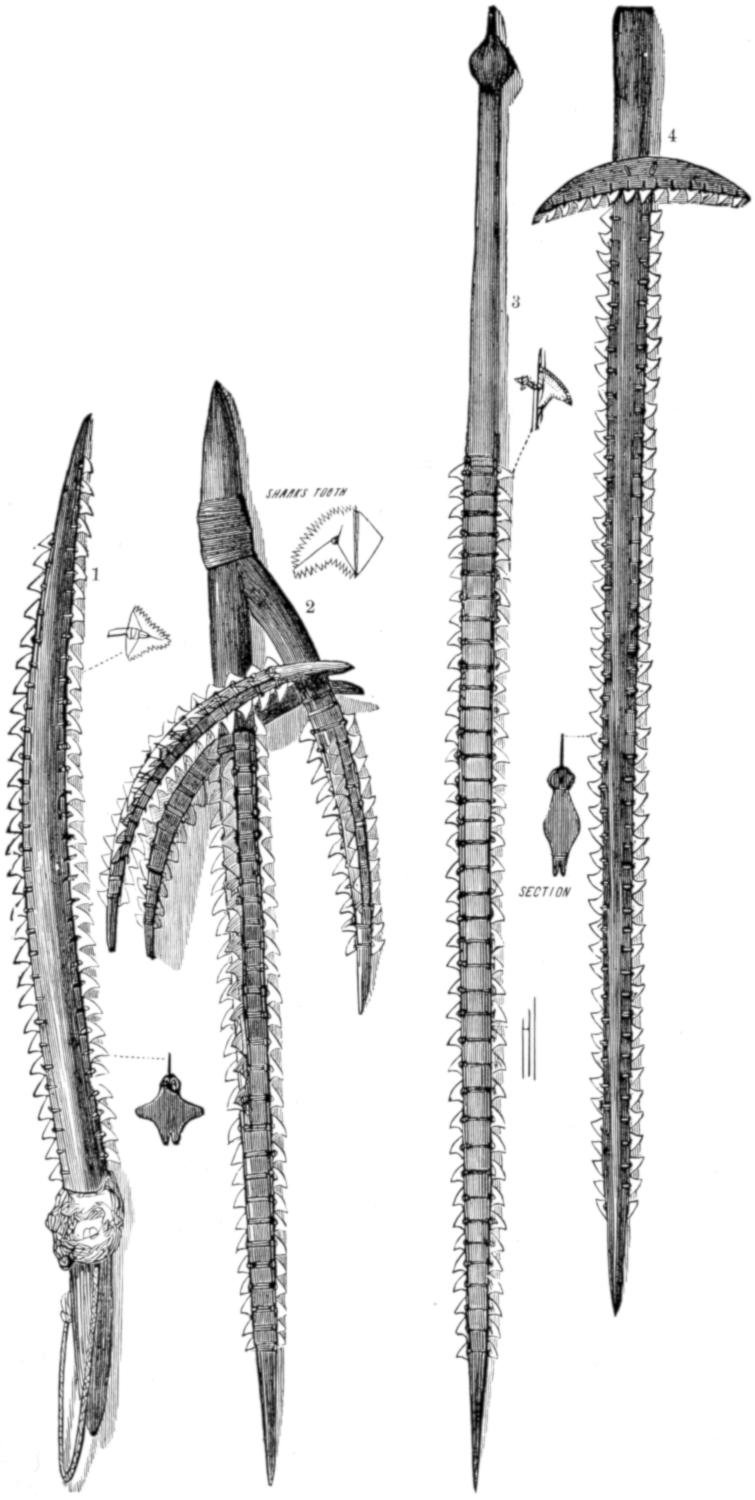
(3.) SWORDS OF KINGSMILL ISLANDERS.
(See page 1039.)
In one portion of the Kingsmill group,
Pitt Island, or Makin, there exists the most
extraordinary funeral ceremony in the world.
The body is washed, oiled, exposed to the sun,
and wailed over, as already related. But,
after the first wailing, it is laid on a new
mat spread over a great oblong plate or tray
made of tortoise-shell sewed together. A
number of persons seat themselves opposite
each other on the floor of the house, and
support the plate on their knees as long as
they are able. When they are tired, they
are relieved by others, and thus the body is
borne by friends and relations for two years,
the bearers relieving each other at intervals.
During this time a fire is kept burning in
the house, and is never extinguished night
or day.
After the two years have expired, the
head is removed, and the skull cleaned and
preserved, as has been already mentioned,
and not until that time are the bones
wrapped up in mats and buried. The place
where the warriors have been interred is
marked with three stones.
CHAPTER CVI. THE MARQUESAS ISLANDS. DRESS—AMUSEMENTS—WAR—BURIAL.
ORIGIN OF THE NAME — APPEARANCE OF THE NATIVES — THEIR DRESS — THE ELABORATE TATTOO OF
THE MEN — DIFFERENCE IN STATURE BETWEEN THE SEXES — CARE OF COMPLEXION — A BLEACHING
PROCESS — A MAN IN FULL DRESS — MODES OF WEARING THE HAIR — THE CHIEF’S NECKLACE — CLOSE
SHAVING — PECULIAR HEADDRESS — METHOD OF OBTAINING FEATHERS — ARCHITECTURE
IN THE MARQUESAS — AMUSEMENTS — DANCING AND STILT-WALKING — THE AMPHITHEATRE
OR PAHOOA — WAR — TROPHIES OF VICTORY — MODE OF WARFARE — DESTRUCTION OF
PROPERTY — ETIQUETTE OF WAR — REPLACING A PRISONER — CANOES AND FISHING — FLY-FISHING
IN THE MARQUESAS — BURIAL CUSTOMS.
We now come to that very interesting group
of islands called the Marquesas, or Mendana
Islands. Both these names derive
their origin from the Spanish navigator Mendâna,
who discovered them nearly two hundred
years ago. The discoverer named them
Los Marquesas de Mendoça, in compliment
to the then Viceroy of Peru, and by many
succeeding voyagers the islands have been
called by the name of their discoverer.
The character of the islands is rather peculiar,
and very picturesque. They are
craggy, mountainous, and volcanic, having
exceedingly lofty peaks in the centre, which
look at a distance as if they were the ruins
of vast buildings. Being situated near the
equator, their temperature is warm, and, as
at the same time they are well watered, the
vegetation is peculiarly luxuriant. Like
most of the Polynesian Islands, the Marquesas
are surrounded with coral reefs; but
these are not so large as is generally the
case, so that, although the navigation among
them is not so difficult as in many islands,
the ships do not find that protection from
storms which is afforded by the great coral
reefs of other islands.
The inhabitants are splendid specimens of
humanity, the men being remarkable for
their gigantic size, great strength, and fine
shape, which emulates those of the ancient
Greek statues. One of the chiefs was
measured carefully, and was found to be six
feet eight inches in height, and said that he
knew another chief who was at least a foot
taller than himself.
In general they wear but little raiment, a
slight piece of bark cloth round the waist
being the only garment which they think
needful, the place of clothing being supplied
by the tattoo. There are many nations
where this decoration is worn; but there are
no people on the face of the earth who carry
it out so fully as do the Marquesans, every
part of their bodies, even to the crown of
the head and the fingers and toes, being
covered with the pattern. The “Tattooed
chiefs” on the opposite page illustrate the
extent to which the Marquesans carry this
custom. This extreme elaboration is only to
be found in the men, the women contenting
themselves with a bracelet or two tattooed
on their arms, and a few similar ornaments
here and there. A very interesting description
of the tattooing of the Marquesans
is given in Langsdorff’s “Travels.”—
“Sometimes a rich islander will, either
from generosity, ostentation, or love to his
wife, make a feast in honor of her when she
has a bracelet tattooed round her arm, or
perhaps her ear ornamented. A hog is then
killed, and the friends of both sexes are invited
to partake of it, the occasion of the
feast being made known to them. It is expected
that the same courtesy should be returned
in case of the wife of any of the guests
being punctured. This is one of the few occasions
on which women are allowed to eat
hog’s flesh.
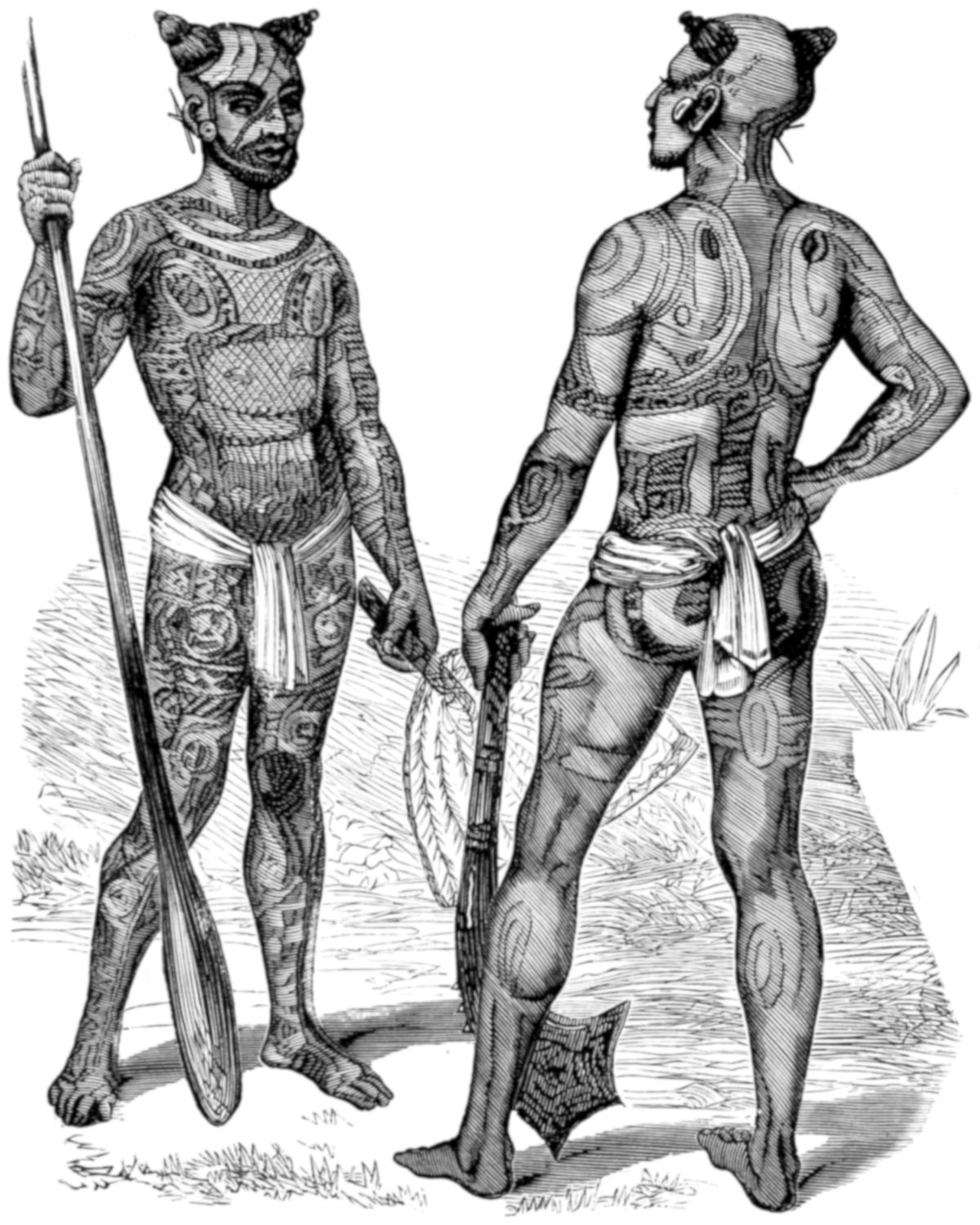
(1.) TATTOOED MARQUESAN CHIEFS.
(See page 1048.)
“If, in a very dry year, bread-fruit, hogs,
roots, and other provisions, become scarce,
any one who has a good stock of them (which
commonly happens to the chief), in order to
distribute the stores, keeps open table for
a certain time to an appointed number of
poor artists, who are bound to give in return
some strokes of the tattoo to all who choose
to come for it. By virtue of a tapu, all these
brethren are engaged to support each other,
if in future some happen to be in need while
the others are in affluence.
“The same person may be a member of
several of these societies; but, according to
what we could learn, a portion must always
be given to the priest, or magician, as he is
called, even if he be not a member. In a
time of scarcity, also, many of the people who
have been tattooed in this way unite as an
absolute troop of banditti, and share equally
among each other all that they can plunder
or kill.
“The figures with which the body is
tattooed are chosen with great care, and appropriate
ornaments are selected for the different
parts. They consist partly of animals,
partly of other objects which have some
reference to the manners and customs of the
islands; and every figure has here, as in the
Friendly Islands, its particular name. Upon
an accurate examination, curved lines, diamonds,
and other designs are often distinguishable
between rows of punctures, which
resemble very much the ornaments called à
la Grecque.
“The most perfect symmetry is observed
over the whole body. The head of a man is
tattooed in every part; the breast is commonly
ornamented with a figure resembling
a shield; on the arms and thighs are strips
sometimes broader, sometimes narrower, in
such directions that these people might be
very well presumed to have studied anatomy,
and to be acquainted with the course and
dimensions of the muscles.
“Upon the back is a large cross, which
begins at the neck and ends with the last
vertebra. In the front of the thigh are often
figures which seem intended to represent the
human face. On each side of the calf of the
leg is an oval figure, which produces a very
good effect. The whole, in fact, displays
much taste and discrimination. Some of the
tenderest parts of the body—the eyelids, for
example—are the only parts not tattooed.”
As may be seen by the illustration No. 2
on the 1046th page, even the hands are tattooed
with the same minute care that is bestowed
on the body. Each finger has its own
pattern, so that the hand looks as if enclosed
in a very tight-fitting glove. The reader
will notice the great length of the nails.
Among the Marquesans, as among the Chinese,
very long nails are esteemed as a mark
of rank, being a proof that the wearer is not
obliged to do any hard work.
This elaborate ornamentation answers the
purpose of dress, and is considered as such.
Indeed, it would be useless to undergo so
much pain, and to pay the operator such
costly fees, if the tattooing were to be hidden
by clothing. The men, therefore, wear
nothing but a slight cloth round their waists,
and the women of rank a similar garment,
with the addition of a larger piece which
they throw over their bodies to keep off the
darkening rays of the sun.
Few phenomena struck the earlier travellers
more than the difference in appearance
and stature between the men and the
women; and the same writer who has just
been quoted remarks more than once that it
was difficult to believe that the undersized,
stumpy, awkward women could have been
the parents of the magnificent, gigantic, and
graceful men. There is, however, a great
distinction between the women of rank and
those of the lower orders. As was afterward
discovered, the better class of women,
who for some time kept themselves aloof
from the strangers, being well developed,
and of a fair complexion, about which they
were very careful, enveloped themselves in
their bark cloths, and never ventured into
the sunshine without holding over their
heads a bunch of leaves by way of parasol.
So careful are they of their complexions,
that if they find themselves getting sunburnt
they have a mode of bleaching themselves
again, which they adopt before all
great ceremonies, though at the cost of much
time and trouble. They take the sap of
three trees, with which they anoint the
whole body. The immediate effect of the
mixture is to dye the skin of a deep black.
The pigment is allowed to remain on the
skin for six days, during which time the
woman remains within the house. At the
expiration of that time she bathes, when all
the black dye comes off, and the skin is left
beautifully fair.
A woman who has just undergone this
process, and who has dressed herself in all
her native finery, is a very striking object,
her body being gracefully enveloped in bark
cloth, her hair adorned with flowers, and her
fair skin almost without ornament except
upon the feet, hands, and arms, which appear
as if she were wearing boots, gloves,
and bracelets.
The mode of tattooing is almost exactly
like that of the Samoan islanders, except
that the “comb” is made of the wing-bone
of the tropic bird. The operation is always
conducted in certain houses belonging to
the professional tattooers, who lay on these
buildings a tapu, which renders them unapproachable
by women. As is the case in
Samoa, the best tattooers are men of great
importance, and are paid highly for their
services, a Marquesan thinking that he is
bound to be liberal toward a man to whom
he is indebted for the charms which he
values so highly. These men gain their
skill by practising on the lower orders, who
are too poor to pay for being tattooed, and
who would rather wear a bad tattoo than
none at all. A considerable amount is generally
exacted at each operation, which lasts
from three to six months; and so elaborate
is the process, that a really complete tattoo
can hardly be finished until the man is thirty
years old.
By the time that the last piece of tattoo is
executed, the first generally begins to fade,
and if the man is rich enough he has the
pattern renewed. Some men have been tattooed
three times, and, as the patterns cannot
be made to coincide precisely with each
other, the result is that the whole skin becomes
nearly as dark as that of a negro. In
this state it is greatly admired, not because
the effect is agreeable to the eye, but because
it is an indubitable mark of wealth. The
pigment used in the tattooing is the well-known
aleurita, or candle nut, burned to a
fine charcoal and mixed with water.
The ornaments worn by the men are more
imposing than those of the women. In the
first place, they allow the hair to grow to a
considerable length, and dispose of it in various
ways. For a number of years it is tied
in a bunch on the top of the head; but when
the man is rich enough to be entirely tattooed,
he shaves all the head with the exception
of a patch at each side, in order to allow
the pattern of the tattoo to be extended over
his head. In such a case, the tuft of hair at
each side is still suffered to grow long, but is
twisted into a conical form, so as to make a
sort of horn projecting outward over each
temple. Examples of this curious mode of
wearing the hair may be seen in the illustration
No. 1, on page 1046.
Sometimes a man may be seen wearing
the whole of his hair in curled ringlets.
Such men are cultivating a crop for sale, as
the Marquesans are very fond of decorating
with these ringlets the handles of their
spears and clubs, and of making them into
ornamental figures which are worn on the
ankles. The most valued of these decorations
are long white human beards, which
are grown for the express purpose, and sold
at a very high price. The purchaser uses
them either as plumes for his head or as
ornamental appendages to his conch-shell
trumpet. One of these beards is now always
reckoned as equivalent in value to a
musket, and before fire-arms were introduced
was estimated at an equally high
rate.
The ear ornaments of the Marquesan men
are very curious. An univalve shell, of a
dead-white color, is cut into a circular shape,
and filled with a sort of cement made of the
resin and wood of the bread-fruit tree. Into
this cement is pressed an ivory stem, carved
with figures in relief, so that the whole ornament
looks like a very large white headed
nail. The stem is pushed through a hole in
the lobe of the ear, so that the head of the
nail projects forward, as seen in the right-hand
figure of “tattooed chiefs” on page
1046. The name of the ornament is “taiana.”
Ornaments made of whales’ teeth are as
fashionable among the Marquesans as among
the Polynesians, and are worn by the chiefs
suspended round their necks. Wooden ornaments
bleached white are also used, and
others are cut from shells. One ornament
of which they are very fond is made from
wood, wax, and seeds. It is in the
form of a horseshoe, the framework being
made of wood, which is thickly covered with
wax. Into this are pressed the pretty black
and scarlet seeds of the Abrus precatorius,
arranged in rows radiating to the circumference.
One of these ornaments is shown in
the illustration No. 3, on the same page and
is drawn from a specimen in my collection.
It measures eight inches in diameter, and is
slightly concave on the outside, and convex
on the inside. Very great pains have been
taken in arranging the seeds; they are
placed in a regular series of double rows,
the black portion of each seed being pressed
into the wax, so that only the brilliant scarlet
portion is visible. Upward of eight hundred
beads have been used in making this
ornament, so that the trouble which is taken
by the natives is very great.
Some of the chiefs wear a very curious
ornament, which seems to take the place of
the hair which they shave from their own
heads, and is nothing more than a large
bunch of hair cut from the head of a wife.
As a rule, the Marquesan removes all hair
from the body, except from the head, only
one or two of the very old men allowing
a few straggling hairs on the chin.
In Langsdorff’s travels an amusing incident
occurred, illustrative of that feeling.
In those days close shaving was the custom
in Europe, so that when the officers went
on shore they were found to have conformed
to the fashion of the islands. They were
talking very amicably together, when suddenly
a chief stared intently into the face of
one of the officers, and, with horror depicted
in his features, rushed forward, and grasped
him tightly. The officer naturally thought
that he was going to be murdered; but the
fact was, that the Marquesan had actually
discovered a hair on his face, and was going
to pull it out with his shell tweezers.
When they wish to be considered as wearing
full dress, the better class of men wear
a most elaborate cap, made of fibre, feathers,
and shells. First, a broad fillet is plaited
from cocoa-nut fibre, so as to pass round the
forehead, after the manner of a cap without
a crown. On the centre of this fillet is
fixed a large plate of mother-o’-pearl, decorated
with carving. In the middle of this
plate is fixed a smaller but similarly shaded
plate of tortoise-shell, and in the middle of
that a still smaller disc of pearl shell. Some
headdresses have three of these ornaments,
as is the case with that which is figured in
the Marquesan chief on the 1046th page.
In the fillet are also fastened a number of
feathers, either from the tail of the cock or
from that of the tropic bird, so that when
the fillet is bound on the forehead the feathers
will stand upright. The feathers of the
tropic bird are greatly prized by the natives,
who use them for various ornaments, and
display great ingenuity in procuring them.
Instead of killing the birds, and so stopping
the supply of feathers, they steal upon them
when they are asleep, and dexterously twitch
out the two long tail-feathers. In process
of time the feathers grow again, and so the
supply is kept up. I mention the custom
because it is contrary to the recklessness
respecting the future which is usually found
among savages.
The houses of the Marquesans are rather
peculiar, especially those of the better kind.
The native builder begins with making a
platform of large stones, many of them
being so enormous that ten or twelve men
are required to move them. This platform
is from ten to eleven feet high, and about
thirty feet long by twelve wide. Upon this
is erected the house, which is built with the
back very much higher than the front, so
that the roof slopes considerably, the back
being perhaps twelve or more feet in height,
and the front only five feet. The door is
naturally small, and no one can enter without
stooping. The walls at the end are no
higher than that of the front, so that a considerable
portion of each end is left open.
As, however, the climate of the Marquesas
is so equable, this is rather an advantage
than otherwise.
The interior of the house is divided into
two portions, one of which is left bare, with
no covering to the stony floor, while the
other part is considered as the dwelling-place,
and the floor is covered with mats.
The walls are also covered with matting.
Near the back wall is the strangely made
family bed. Two horizontal poles are placed
about six feet apart, and a foot or so from
the ground, and the space between them is
filled with dry grass covered with mats.
The sleepers lie on the mats, resting the
back of their heads on one pole, and their
feet on the other, and pass the night in this
position, which seems to have been invented
for the purpose of making the sleepers as
uncomfortable as possible. Round the walls
are hung the weapons and implements of
the owner, such as spears, clubs, stilts,
drums, slings, axes, and similar articles.
The houses are always placed near trees,
so that they may have the advantage of
shade.
The Marquesans have a curious custom of
erecting small and highly decorated buildings
in honor of the children of great chiefs.
These buildings are considered as acknowledgments
of the legitimacy of the children;
and if they were omitted, the parents would
consider themselves insulted. They are
protected by tapu, and after they are made
are not repaired, but allowed to decay. Dr.
Bennett, in his “Whaling Voyage round
the Globe,” thus describes those edifices:—
“This compliment had been paid to
Eutiti’s daughter at Vaitahú a few weeks
before our arrival. It consisted of two
small huts, neatly built with peeled hibiscus
rods, which were covered with white tappa
(bark cloth) and stained cocoa-nut sinnet.
The interior was occupied by many of the
same rods ranged vertically, graduated in
height, and entwined with bunches of herbs.
The face of the building was ornamented by
a few boards, painted with mystic figures in
black and red.
“The white and delicate appearance of
the hibiscus rods, the fluttering pennants
of fine tappa, and the various gaudy hues
employed, gave the entire edifice a fantastic
and imposing appearance. A low stone
wall enclosed the two huts, and within its
precincts were several bundles of cocoa-nut
leaves placed upright, and intended to represent
the tutelary deities of the spot. A
striking edifice of the same description had
been erected in honor of Eutiti’s son at
Anamaihai, the territory of his guardian.
It differed from that dedicated to his sister
in being placed on an elevated stone platform,
as well as in having a long wicker
basket placed at the entrance.”
In every village there is a sort of amphitheatre,
in which the dancing and similar
amusements are conducted. For this purpose
the natives choose a sheltered and level
spot, surrounded on all sides with rising
banks. The middle of the amphitheatre is
carefully smoothed and covered with mats,
and the rising banks serve as seats for the
spectators.
When a dance is to be performed, the mats
are laid afresh, and a large amount of food
is prepared. The spectators take the food
with them, and, seated on the banks, remain
there throughout the greater part of the day.
The dances are not very graceful, consisting
principally of jumping, without moving
from the same spot. Various ornaments
are used by the dancers, the most curious
of which are the finger-rings, which are
made of plaited fibre, adorned with the long
tail-feathers of the tropic bird. When
women dance they are not allowed to wear
clothing of any description, and this for a
curious reason. None dance except those
whose husbands or brothers have been
killed in war or taken prisoners, and the
absence of clothing is accepted as an expression
of sorrow on their part, and of vengeance
on the part of the spectators.
They have several other amusements,
which are conducted in this theatre, or
pahooa, as it is called. The Marquesans are
most accomplished stilt-walkers, and go
through performances which would excite
the envy of any professional acrobat. One
of the games in which they most delight is
a race on stilts, in which each performer
tries, not only to distance his opponents,
but to cross their course and upset them.
They are such adepts at this pastime that
they walk over the rough stones of the
house platform with ease and security.
If the reader will refer to the portrait of
the Marquesan chief, he will see that the
head is not only decorated with the feather
fillet, but is also covered with a veil that
falls on either side of the face. This is a
mark of war, and is worn when chiefs go
into battle. The Marquesans do not use
the bow and arrow, but they throw spears,
sling stones, and use clubs. The slings are
made of plaited grass, and are very powerful,
often exceeding five feet in length, and
carrying stones of a considerable size. The
spears are generally about ten feet long,
and the clubs are carved out of hard wood,
which is made harder by burying the weapons
for a considerable time in the mud.
They are fierce in war, and are never satisfied
until they have gained a trophy of
victory. When a Marquesan kills an enemy,
he cuts off the head of his fallen antagonist,
tears open the skull, and eats the brain.
He then cleans the skull very carefully,
adorns it with tufts of bristles, and slings it
by a cord to his girdle. When he goes to
battle again he always carries this trophy
with him, partly on account of the respect in
which it is held by his comrades, and partly
in order to strike awe into the enemy by the
sight of so redoubtable a warrior.
According to most travellers, the Marquesans
are a quarrelsome people among themselves,
and much addicted to making raids
in each other’s districts. These districts
are generally divided from each other by
natural boundaries, such as mountain-spurs
and ridges, many of which are of enormous
height, and so steep and precipitous as to
be almost inaccessible. The worst part of
their mode of warfare is not the cruelty
exercised on the vanquished warriors, but
on the destruction to property, and the
distress indicted on non-combatants.
When one chief intends to make war
upon another, he tries to steal by night into
the district of his enemy, and silently damages
all the bread-fruit and cocoa-nut trees
he can find. The former are stripped of
their bark, and, though their vitality is so
great that they are not absolutely killed by
the injury, they bear no more fruit for five
years, and thus the whole population are deprived
of an essential article of diet, and for
a long time are reduced to great straits for
want of food.
The cocoa-nut trees are killed after a different
manner. The destroyer walks up the
tree after the mode employed by these islanders;
namely, by applying the palms of
his hands to either side of the trunk, and so
ascending the tree in monkey fashion. He
then bruises with a stone the central shoot,
or “cabbage” of the palm, and descends the
tree, knowing that it must soon die. The
reason for the fatal nature of the injury is,
that the tree is an endogenous one, and consequently
the destruction of the central bud
involves the death of the tree. Sometimes
the tree is killed in another way, a sea-slug
(bèche-demer) being laid at the root of the
“cabbage,” killing the tree as it decays.
Quarrelsome as they are and cruel to the
persons and property of the vanquished,
they have yet some slight etiquette in war,
one rule of which is so curious that it must
be given in the relator’s own words:—
“June 18.—Captain Riggs of the General
Gates, just arrived from the Marquesas, informs
us that he has had a narrow escape of
his life there. At the island of Nukahiva,
as he was attempting to go on shore, a native
chief, assisted by a posse of dependants,
seized and carried him off, stripped him of
his clothing, and then presented him to the
king, an infirm old man, who took him under
his protection. That protection, however,
could have little availed him, for the sovereign
had not power to set the prisoner at
liberty unless a suitable ransom were paid
for him.
“The captors first demanded five muskets
and five barrels of gunpowder, which being
agreed to, they rose in their violent extortion,
and required more; and this also being
conceded, they still refused to liberate him
unless their rapacity was still further gratified.
The captain then resolutely stood out,
and insisted on being set at liberty, at the
same time having but small hopes of obtaining
it, or any other issue of his captivity except
to be killed and eaten by these cannibals,
some of whom had conspired to spear him,
but the king’s authority restrained their
violence.
“At length, however, the terms of ransom
being settled, he was ordered to be released;
but here an unexpected difficulty
arose. The law of the land requires that
whoever captures another on board of a
boat must, when the prisoner is at liberty,
carry him down to the water again, and reinstate
him in the same situation as he was
found. This the cowardly and treacherous
chief, who had readily acted the part of kidnapper,
was unwilling to do, lest he should
be shot from the ship. The obligation,
however, being indispensable, he obtained
the captain’s assurance that no harm should
be attempted against him, and then performed
the ungracious office. When Captain
Riggs had reached his vessel, the natives
on the shore gave three hideous howls,
which were returned by three hearty cheers
of the crew.”
Finding that their captive had been so
profitable to them, the natives tried boldly
to take the ship, and displayed equal ingenuity
and daring in their attempt. On the
same evening a native was detected in trying
to cut the cable, and was shot for his
temerity. Finding that an open assault of
this kind was useless, the natives, who are
wonderful divers, swam off to the ship, carrying
with them a rope, one end of which
they fastened to the rudder, well under the
water, the other end being carried ashore.
Fortunately this trick was discovered in
time to save the ship, and, had not the rope
been seen, the natives would have waited
until the vessel weighed anchor, and then
have dragged her ashore.
In the above narrative the Marquesans
are described as cannibals. It is, however,
very doubtful whether they can be justly
charged with this revolting custom.
The canoes of the Marquesans are furnished
with outriggers, after the custom of
all Polynesia, and are well-built and swift
vessels. They have, besides the outrigger,
a small stage projecting over the stem, on
which the steersman stands when the vessel
is under sail. The bow of the canoe is
much turned up in front, probably for the
purpose of acting as a defence to the rowers,
when advancing against an enemy.
They are very skilful in the fishing art,
both with line and net. They have different
modes of using both these implements.
When they fish with the line, they sometimes
bait the hook, pass the line over the
side, and angle in the mode adopted in this
country. But when they fish for the albacore,
they employ a totally different method,
which bears some resemblance to fly fishing,
except that the bait is not made to represent
an insect, but a fish.
A very ingenious imitation of a flying
fish is made by cutting the shape of the fish
out of a mother-of-pearl shell, and inserting
a long tuft of hog’s bristles at either
side to represent the wing fins, and another
at the extremity to do duty for the tail.
This is armed with a hook, and fastened to
one end of a line, the other end of which is
attached to the top of a long bamboo rod
planted in the stern of the canoe. Sail is
hoisted, and the vessel is driven over the
waves at full speed, the sham flying-fish
leaping and bounding through the air in a
manner that wonderfully resembles the action
of the living fish. The albacore naturally
takes the bait for a real fish, leaps at
it, and is caught before it has time to discover
the imposition.
Net fishing is carried on in several modes,
but the most curious and perhaps the most
sportsmanlike plan is that which compels
the fisherman to pursue his occupation
under water. He takes with him a hand-net
and a stick about two feet in length,
jumps into the water, and dives among the
coral, holding his net over the nooks and
crevices with one hand, while with the
stick he drives the fish out of their hiding
places into the net.
By this mode of fishing great numbers
are captured, but the fisherman is always
exposed to two dangers. In the first place,
there is a chance that a shark may come up
unobserved, and carry off a limb, even if it
does not kill the man. The Marquesans
are such excellent swimmers that they care
little for a shark as long as they can see
him, and it is only when the terrible fish
darts unexpectedly out of a hiding place
that they know any real fear.
Sometimes a rather strange circumstance
occasions the death of the diver. It has
already been mentioned that up to the time
when a man can afford to have his head tattooed
he wears his hair very long, and tied
up in a knot on the crown of his head. Before
going into the water, the natives untie
the fillet, and allow the hair to float down
their backs. It has occasionally happened
that a diver, who has thus prepared himself,
finds, when he tries to rise to the surface of
the water, that his long floating hair has become
entangled in the branching coral; and,
as he has already remained under water
nearly as long as his breath will last, he is
sometimes drowned before he has time to
extricate himself.
When a Marquesan dies a natural death,
his relatives make great preparation for his
funeral, including the usual accompaniment
of feasting. They send for a “tana,” or
priest, who makes a long oration over the
corpse, which is then delivered to the relatives,
who have a long and disagreeable task
before them. They first wash the body
thoroughly, and then rub it with cocoa-nut
oil, laying it in the sun, and turning it continually.
Several times daily the corpse is
newly anointed, until at last the combined
effects of the sun and oil reduce it to a
mummy. Wrapped in cloth, it is laid on a
bier, and deposited in the cemetery.
Each district has its cemetery or “morai,”
which is adorned with gigantic human figures
carved in wood, and similar decorations.
It is surrounded by a wall, and held in great
respect by the inhabitants of its district.
Unfortunately, the inhabitants of other districts
hold it in no respect at all, and, when
war is declared, try to steal out of the morai
the body of any man of rank. When,
therefore, war seems to be imminent, the
bodies are carried away and hidden, or
sometimes buried. A similar custom prevails
in many parts of Polynesia, and Mr.
Williams mentions an instance where a man
climbed an apparently inaccessible precipice
with a corpse lashed to his back, placed the
body on a lofty shelf, and descended in
safety.
CHAPTER CVII. NIUE, OR SAVAGE ISLAND. ORIGIN—COSTUME—LAWS—BURIAL.
REASON FOR THE NAME OF THE ISLAND — SINGULAR LEGEND — THE SAILOR AMONG THE SAVAGES — APPEARANCE
OF THE NATIVES — A SAVAGE WAR DANCE — MODE OF DRESSING THE HAIR — COSTUME
OF THE MEN — A CURIOUS WEAPON — PRESUMED ORIGIN OF THE SAVAGE ISLANDERS — DEFEAT
OF THE TONGANS — CODE OF LAWS AND PUNISHMENTS — CANOE MAKING — SAILING — NIUAN
ARCHITECTURE — DISPOSAL OF THE DEAD.
Between the Hervey and the Tongan
groups, there lies an island which was
called by Captain Cook “Savage Island,”
on account of the behavior of the natives,
who not only declined his overtures of
peace, but attacked him “like so many wild
boars.” The native name of the island is
Niue.
This ferocity of theirs is due to an ancient
custom of putting to death all strangers
who land on their shores, a fate from which
even their own people do not escape, if they
have been absent for any length of time.
The history of this strange people has of
late years become better known, owing to
the exertions of the missionaries, who have
discovered that fear rather than ferocity
was the cause of this savage custom. They
had an idea that their island was naturally
free from disease, and that all ailments
were brought by foreigners, and they in
consequence had a law that all foreigners
should be killed as soon as they could be captured.
On one occasion a native teacher narrowly
escaped death in consequence of his
absence. He was obliged to exert all his
powers of eloquence to persuade his countrymen
to spare him for a time, so that he
might keep himself far away from their residence,
and purify himself by the healthy air
of Niue.
When Mr. Williams visited the island, he
contrived to induce two lads to go off with
him for the purpose of being instructed.
They were at first very miserable on board,
and howled incessantly for the first few
days, thinking that the white sailors were
cannibals and that they were only carried
off to be fattened and eaten. Finding, however,
that the sailors were eating pork, and
not human flesh, they became reconciled to
their lot, and were even pleased at the prospect
of seeing new lands. These lads were
taken to Raietea, and, having been educated
for their task, were sent home again. Unfortunately,
soon after their arrival, an epidemic
disease spread over the island, and the
natives, naturally attributing it to the two
travellers, killed them both.
The first white man who landed there
since the time of Cook met with a singular
fate. A ship was lying off the island, and
bartering with the natives. Just as the
ship got under weigh, the master flung one
of the sailors overboard among the savages,
who took him on shore, and held a great debate
as to the course to be pursued. Some
were for keeping up the old custom, and
killing him, but others argued that the man
had not landed of his own free will, and
that he ought not to be liable to the usual
penalty, even though salt water was in his
eye—this being the mark of a shipwreck.
After a vast amount of discussion they
agreed to a compromise, put him into a
canoe, gave him a quantity of bananas and
cocoa-nuts, and sent him out to sea. The
man contrived to slip on shore again without
being seen, and, after hiding in caves
for some days, he succeeded in getting on
board a whaler that was passing near the
island.
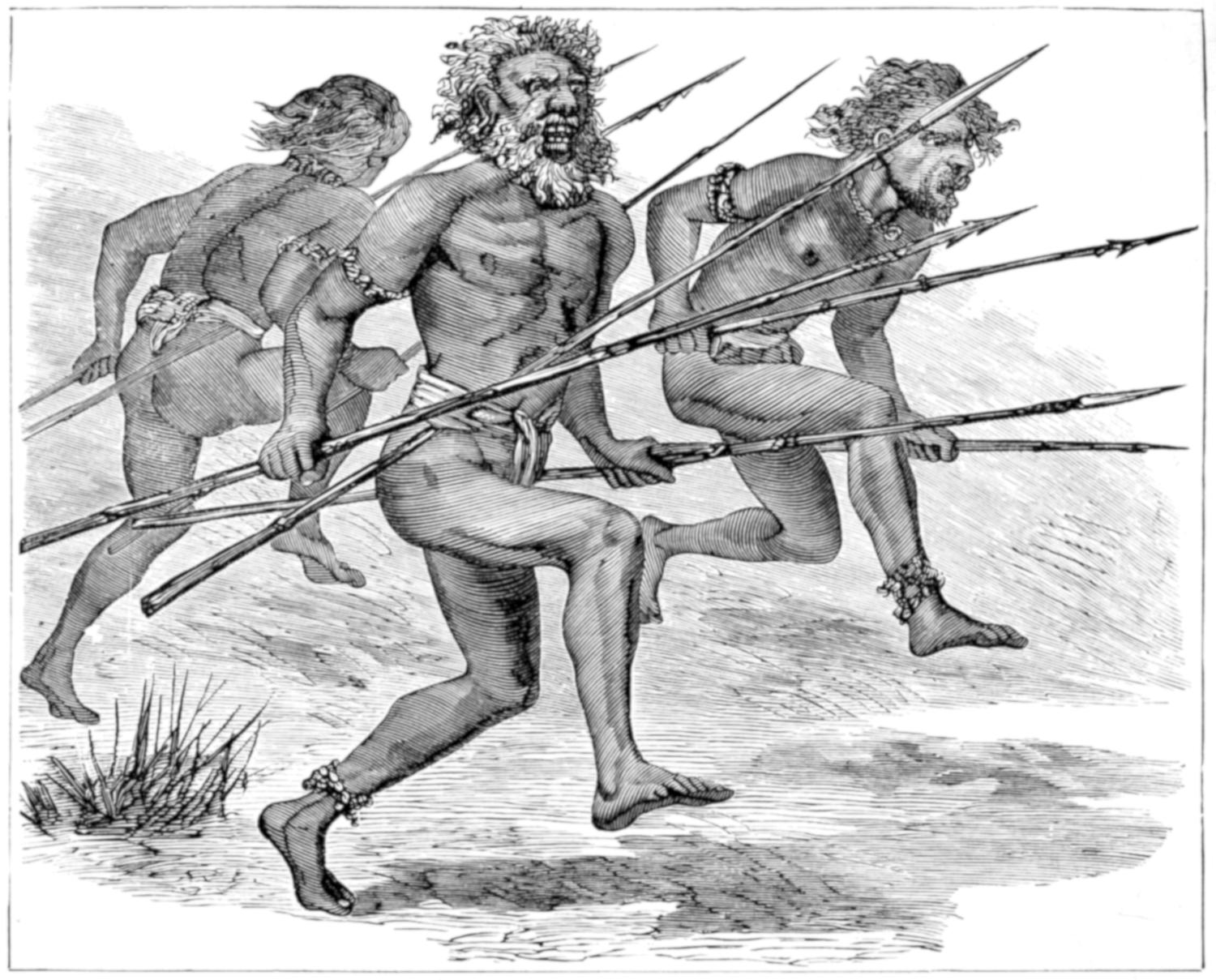
(1.) THE WAR DANCE OF THE NIUANS.
(See page 1055.)
The appearance of the natives as they were
before the missionaries came to them was
anything but prepossessing. Mr. Williams
gives a graphic account of an old chief who
was induced, after much trouble, to come on
board. “His appearance was truly terrific.
He was about sixty years of age, his person
tall, his cheek-bones raised and prominent,
and his countenance most forbidding. His
whole body was smeared with charcoal, his
hair and beard were long and gray, and the
latter, plaited and twisted together, hung
from his mouth like so many rat’s tails. He
wore no clothing except a narrow strip of
cloth round his loins, for the purpose of
passing a spear through, or any other article
he might wish to carry.
“On reaching the deck the old man was
most frantic in his gesticulations, leaping
about from place to place, and using the
most vociferous exclamations at everything
he saw. All attempts at conversation with
him were entirely useless, as we could not
persuade him to stand still for a single second.
Our natives attempted to clothe him,
by fastening round his person a piece of native
cloth, but, tearing it off in a rage, he
threw it upon deck, and, stamping upon it
exclaimed, ‘Am I a woman, that I should
be encumbered with that stuff?’
“He then proceeded to give us a specimen
of a war dance, which he commenced
by poising and quivering his spear, running
to and fro, leaping and vociferating, as
though possessed by the spirit of wildness.
Then he distorted his features most horribly
by extending his mouth, gnashing his teeth,
and forcing his eyes almost out of their
sockets. At length he concluded this exhibition
by thrusting the whole of his long
grey beard into his mouth, and gnawing it
with the most savage vengeance. During
the whole of the performance he kept up a
loud and hideous howl.” On the preceding
page the artist has given the reader an illustration
of this singular war dance of the
Niuans.
These islanders do not use the tattoo,
though they are fond of decorating their
bodies with paint. Those who come on
board European vessels are delighted to be
adorned with streaks and spots of red and
green paint, especially the latter, which is a
novelty to them, and for which they are
willing to pay highly. At a little distance,
they look much as if they were suffering
from some cutaneous disease, but a closer
inspection shows that their appearance is
partly due to the salt of the sea crystallizing
on their oiled bodies, and partly to the multitudinous
flies which settle upon them.
The hair is sometimes seen very short
and sometimes very long, and this is the
case with both sexes. They allow it to
grow to a considerable length, and when it
is a foot or eighteen inches long, they cut it
off, and plait it into thin bands which are
worn round the waist. The men prize
these ornaments highly, and Captain Hood
thinks that the love-locks are exchanged,
and are valued accordingly. The younger
men do not wear their beards, but the elders
suffer them to grow to a great length, plait
them, and adorn them with pieces of oyster
or clam shell. They know the art of coloring
the hair a yellowish red by the application
of lime.
As to dress, the men think it quite needless,
and wear nothing but the belt round
the waist. Some, however, wear a very
small apron, only ten or twelve inches
square, and this is considered rather in the
light of ornament than of dress. They are
of moderate stature, rather under than over
the middle height, thus forming a strong
contrast to the gigantic Marquesans and
Samoans. The natural color of the skin is
a clear brown, and their limbs are round
and well shaped.
In weapons, they use the spear, the club,
and the bow, all made well and neatly.
They do not seem to invade other islands,
and their warfare is therefore waged mostly
among themselves. It seems rather strange
that in an island only thirty miles in circumference
war should exist, but in Niue, the
usual Polynesian custom exists of dividing
an island into several districts, among which
is perpetual feud.
They use a very curious weapon. On
their island are a number of caves in the
coral limestone, similar in character to that
which has been described in page 1006,
though not approached in the same curious
manner. From the roof hang vast numbers
of stalactites, from which water continually
drops. Indeed, the natives owe their fresh
water almost entirely to these caves, and
since the missionaries came to reside among
them have learned to collect it by digging
wells in the caves, into which the water
flows, and so insure a certain instead of a
precarious supply. The floor of the caves is
covered with stalagmitic masses, and from
these the natives make oval balls about the
size of cricket balls, which they hurl from
the hand with wonderful force and accuracy,
not using the sling, as is the case with
so many Polynesian tribes. Specimens of
these balls are in the Christy collection.
These caves are evidently due to the
character of the island, which is partly coral
and partly volcanic, the coral having been
upheaved by volcanic force, leaving the
surface fissured and broken by the sudden
violence of the shock. The native legend
respecting the origin of the island points to
the same conclusion. They state that the
island was raised to its present elevation by
two of their ancestors, named Hananaki
and Fao, who swam there from Tonga, and
found the island only just above the waves.
They stamped twice upon it, the first stamp
elevating the island to its present height,
and the second clothing it with trees and
plants. They made wives for themselves
out of the Ti tree, and so the island became
peopled. We may easily see in this tradition
a record of the two facts that the island
was elevated suddenly from the sea, and
that the inhabitants are not aborigines, but
emigrants from some other part of Polynesia,
probably from Tonga. Though they
believe themselves to be derived from this
origin, they have been subject to invasion
from the restless and daring Tongans, whom
they repulsed by an ingenious stratagem.
The Tongans, possessed of far better weapons
and better disciplined than the Niue
islanders, and being equally courageous,
were rapidly completing the conquest of the
island, when the natives took advantage of
the peculiar formation of their country.
The reader will remember that Niue is
rocky, and covered with deep and narrow
clefts, the result of the upheaval which elevated
the island above the sea. Across one
of these the Niuans laid small branches,
which they covered with banana and cocoa-nut
leaves, and then strewed over all a slight
covering of earth, which they arranged so
as to look exactly like the surrounding soil.
They then executed a sham retreat, and
slipped round to the further side of the
chasm, so that the Tongans, flushed with
victory, rushed on their retreating enemies
with yells of triumph, and a great number
of the foremost and best warriors were
hurled down to the bottom of the cavern.
Before the survivors could recover from
their surprise, an attack was made upon them
in overwhelming numbers, and of the whole
Tongan expedition not a man escaped alive.
It was formerly thought that the Niuans
were cannibals, but, as far as can be ascertained,
the natives have never eaten human
flesh. They do not even care for animal
food of any kind; and, though at the present
time they have pigs in abundance, they
use them almost entirely for the market to
European ships, contenting themselves with
bananas, yams, taro, and fish. Strangely
enough, they have not imported into Niue
the custom of kava drinking, and they stand
almost alone in their non-use of tobacco.
Polygamy is still practised among the
inhabitants of Niue, though it is fast dying
out under the influence of the missionaries,
who have further conferred a vast boon
on the people by their discouragement of
infanticide, which at one time prevailed to
a terrible extent. The mere check which
they have placed on this custom has already
raised the number of the population by
more than three hundred—a considerable
increase when the small size of the island is
taken into consideration.
Even before the missionaries came, a tolerably
comprehensive and just code of laws
was in existence, so that the Niuans were
in reality much less savage than many of
their neighbors, and the missionaries had a
better ground to work on than in other
islands of more promising aspect. Their
standard of morality was much higher than
is usually the case among savages, infidelity
among women being severely punished. So
great was their horror of this crime that
illegitimate children were always thrown
into the sea until the missionaries taught
the people that, though the parents might
be liable to punishment, the innocent children
ought not to suffer.
Their punishment consisted generally in
deprivation of food. For example, for some
offences, the criminal was tied to a post, and
allowed no food except bitter and acrid
fruits, while for more serious offences he is
lashed hand and foot to a bamboo for a considerable
length of time, only sufficient food
being given to save him from actually dying
of starvation. For these punishments the
missionaries have induced the natives to
substitute forced labor in well sinking, road
making, and other useful works.
The Niuans are good canoe-makers, constructing
their vessels very neatly, and ornamenting
them with devices in shells and
mother-of-pearl. They manage these canoes
well, and as a rule are excellent swimmers.
There are, however, some families
living in the interior of the island who, although
they can be barely four miles from
the sea, have never visited it, and are
greatly despised by their neighbors because
they can neither swim nor sail a canoe.
The native architecture is not particularly
good, but it has been much improved by the
instructions of the Samoan teachers, who
have instructed the Niuans in their own
mode of building houses, upon which the
Niuans have engrafted their own mode of
adornment, so that altogether the effect of
a modern Niuan house is quaint, and at the
same time artistic. The natives seem to be
wonderfully quick at learning, and have even
acquired the use of the pen, so that a Niuan
can now be scarcely better pleased than by
the gift of a pencil and a supply of white
paper.
Nothing shows the wonderful advance
that these people have made more than the
fact that they have not only utterly discarded
their old habit of murdering foreigners, but
that they display the greatest eagerness to
be taken as sailors on board European ships.
They contrive to smuggle themselves on
board without the knowledge of the captain
and crew; and whereas in former times it
was scarcely possible to induce a Niuan to
venture on board an European ship, the difficulty
is now, to find a mode of keeping them
out of the vessels.
The method of disposing of the dead is twofold.
When one mode is followed, the body
is laid on a bier and left in the woods until
all the flesh has decayed, when the bones
are removed to the family burying-place,
which is usually a cave in the limestone rock.
When the other method is employed, the
body is laid in a canoe, and sent adrift in the
sea to go wherever the wind and tides may
carry it.
CHAPTER CVIII. THE SOCIETY ISLANDS. APPEARANCE, DRESS, AND SOCIAL CUSTOMS.
DISCOVERY OF THE ISLANDS, AND REASONS FOR THEIR NAMES — THE ISLAND OF TAHITI OR OTAHEITE — CONFORMATION
AND CLIMATE OF TAHITI — THEIR EFFECT UPON THE INHABITANTS — EFFEMINATE
APPEARANCE OF THE MEN, AND BEAUTY OF THE WOMEN — SOCIAL CONDITION OF
THE SEXES — GENERAL MODE OF LIFE IN TAHITI — SEPARATE TABLES FOR THE MEN AND
WOMEN — POMARÉ’S CRUCIAL TEST, AND ITS RESULTS UPON IDOLATRY — DRESS OF THE SOCIETY
ISLANDERS — MODES OF WEARING THE HAIR — TATTOOING IN TAHITI — MEANS EMPLOYED BY THE
MISSIONARIES TO ABOLISH THE PRACTICE — HOSPITALITY OF THE TAHITANS — MODE OF
MAKING PRESENTS — SOCIAL USE OF PRESENTS — THE BAKED PIG AND THE CLOTH — DISTINCTIONS
OF RANK — REASONS FOR OMAI’S FAILURE — EXTERNAL INDICATIONS OF RANK — DEPORTMENT
OF TAHITANS TOWARD THEIR SOVEREIGN — AMUSEMENTS OF THE TAHITANS — THEIR SONGS
AND MUSICAL INSTRUMENTS — SURF RIDING — BOXING AND WRESTLING MATCHES.
This interesting group of islands was originally
discovered in 1605 by De Quiros, and
has derived the name of the Society Islands
from the liberality of the Royal Society,
which, in 1767, sent an expedition under
Captain Cook for the purpose of observing
the transit of Venus over the sun. There
are many islands of this group, the best
known of which is Tahiti, or Otaiieite, as
the word was given in Cook’s Voyages.
This island forms one of a portion of the
group which is distinguished by the name of
the Georgian Islands, in honor of George III.
Tahiti is singularly picturesque when
viewed from the sea, in consequence of its
mountainous character, the island being so
filled with lofty peaks and crags that the only
way of reaching the interior is by following
the courses of the valleys. Sometimes the
rocks shoot up into sharp and spire-like
peaks, sometimes they run for miles in perpendicular
precipices, several thousand feet
in height; sometimes they are scarped and
angular like gigantic fortresses, sometimes
they are cleft into ravines of terrible depth,
and sometimes they are scooped out into
hollows like the craters of extinct volcanoes.
Down these craggy steeps dash torrents
that fertilize the soil, and so equably genial
is the temperature that every shelf and ledge
is covered with luxuriant foliage and gorgeous
flowers. Tahiti indeed, as has been
well said, is the gem of the Pacific. Our
business, however, lies not so much with the
island as with its inhabitants—not the semi-civilized
people of the present day, but the
uncivilized people of 1769, when Captain
Cook visited them. In the following description,
we will take Tahiti as the typical
island of the Society group, merely introducing
the lesser islands by way of illustration
of the manners and customs which
pervaded the whole group.
In consequence of the superior fertility of
Tahiti, and the consequent supply of food
without the need of labor, the Tahitans are
more plump and rounded of form than are
the inhabitants of most other Polynesian
islands. In the case of the men, the fair
skin and plump rounded forms give them
an effeminate appearance, and the earlier
voyagers have all noticed the strong contrast
between the dark, nervous, and muscular
frames of the Tongan men, and the
fair, smooth limbs and bodies of the Tahitans.
The men, too, wear their hair long,
and, if it were not that they permit the
beard to grow to some length, they would
well deserve the epithet of effeminate.
Not only is this smoothness and fairness
one of their distinguishing marks, but they
also are characterized by a sort of languor
in their movements and timidity in their
carriage, very unlike the demeanor of the
bold and warlike Tongans and Samoans.
“This observation,” writes Captain Cook,
“is fully verified in their boxing and wrestling,
which may be called little better than
the feeble efforts of children, if compared to
the vigor with which those exercises are
performed at the Friendly Islands.”
They are so careful of their complexion
that when they think their skins are becoming
darkened by exposure to the sun, they
have a mode of bleaching themselves. Captain
Cook merely mentions that they remain
within doors for a month or two, wear great
quantities of clothing, and eat nothing but
bread-fruit, this diet being supposed by them
to have a strong bleaching power. It is
probable, however, that besides the diet and
the confinement within the house, they also
employ some preparation similar to that
which is used by the Marquesan women
under similar circumstances.
The Tahitans place such reliance on the
effect of food on complexion, that they believe
themselves to change the hue of their
skins several times in the year, owing to the
kind of food on which, owing to the change
of season, they are obliged to live. They
do not, however, like many nations, think
that corpulence is a mark of rank and
wealth.
That fairness of skin and roundness of
form which detract from the manly beauty
of the male sex only add to the feminine
charms of the women, who are far more
beautiful even than those of Tonga, while
they infinitely surpass the short, thickset
women of the Marquesans. A Tahitan
woman would be reckoned beautiful even
among Europeans, the skin being fairer
than that of many a Spanish girl, and
the large full eyes and rich hair having
a fascination peculiar to themselves, a
charm which many travellers have endeavored
to describe, and all, according to their
own statements, have failed to convey in
words.
Yet the lot of the Tongan women is far
superior to that of the Tahitan. As we
have already seen, the woman of Tonga is
by no means the mere slave of the despotic
husband, but is often his true helpmeet and
best adviser. Among the Tahitans, however,
we find that the effeminate, smooth-limbed,
long-haired, fair-skinned man, who
would not abide the charge of a Tongan
boy, is a very tyrant at home, having no
idea that women can be anything but chattels,
and beating his wives, his dogs, or his
pigs, with equal disregard of their feelings.
The women are not allowed to eat of various
kinds of food, as they would offend the
gods by so doing, and it is a remarkable
coincidence that the gods do not permit the
women to eat exactly those articles of food
which the man likes best, such, for example,
as turtle, and certain kinds of fish and plantain.
Neither are the women allowed to eat
with their husbands, but take their meals in
a separate part of the house. This prohibition
is the more galling because, in a well-to-do
Tahitan’s family, eating goes on all
day with very short intervals. The family
breakfast at eight, and have a first dinner or
luncheon at eleven. Thus invigorated, they
are able to wait until two, when they take
their first dinner. This is followed by a
second dinner at five and supper at eight,
after which they retire to rest. But as it is
manifestly impossible to go without food for
twelve hours, they awake at two, take
another meal, or “rere-supper,” and sleep
again until daybreak.
As to the turtle, a certain sort of sanctity
is attached to it. When one of these reptiles
is caught, it is always sent to the king,
who, however, does not cook so sacred a
creature in his own house, but sends it to
the temple, where it is offered to the idol.
It is cooked in the marae, or sacred enclosure,
and, after a portion has been taken by
the priest for the idol, the remainder is sent
back to the king. Unless this offering were
made, the offender would immediately suffer
from the vengeance of the offended god.
This custom was exploded by Pomaré
about 1820. The king had long believed
that the idols were nothing more than
images, and that the gods were but human
inventions, and determined to try the subject
by a crucial test. He waited until his
subjects had caught a turtle, and sent it to
him according to the custom of the island.
Instead of sending it to the marae, he had
the turtle taken to his own kitchen and
cooked there. It was then served up, and
his whole household sat down with him to
partake of it. No one, however, except the
king, had the courage to eat a mouthful, and
even Pomaré himself was in a state of nervous
trepidation, and had very little appetite
when he came to apply his test. However,
he was a man of great moral courage,
and though he could not eat much of the
royal dainty, he ate enough to bring down
upon him the wrath of the god.
Finding that no harm happened to him,
he convened an assembly of the chiefs, and
narrated the whole of the circumstances,
telling them they were free to act as they
liked, but that for his part he abjured idolatry
from that time. The consequence was,
that of their own accord the people voluntarily
abandoned their idols, and either gave
them to the missionaries, used them as seats,
or put them in the fire with which food is
cooked, the last proceeding being the very
depth of degradation.
One of these raids on the idols was conducted
after a very curious manner.
When the converts had reached the temple
in which were deposited the idols that
they had so long worshipped, their hearts
failed them, and not a man dared to enter
the house and lay his hands on the sacred
images. They bethought themselves, however,
of trying the effect of fire-arms, with
which they were furnished, and, in the presence
of the terrified population, made ready
to fire upon the idols. After calling upon
the images, warning them that they were
about to be fired upon, and calling upon
them to avenge themselves if they could,
they fired a volley into the house. Finding
that no harm ensued, they advanced more
boldly, and burned down the temple together
with its occupants.
A curious instance of courage similar to
that of Pomaré occurred at the island of
Rurutu. A native teacher recommended at
a public assembly that a feast should be
held, and that the king, his chiefs, his
people, and their wives should together
partake of turtle and pork, both these articles
of diet being prohibited to women in
Rurutu. The test was accepted, and the
party assembled, having by a curious coincidence
selected ignorantly a piece of ground
sacred to Oro, the vengeful god of war.
That any one should eat on so sacred a spot
would have been sufficient to draw upon the
delinquents the full terrors of Oro’s anger;
but that men and women should eat together
on the spot, and that women should
absolutely eat both turtle and pork, were
enormities almost too great to be conceived.
The feast took place, and, as writes Mr.
Bennett, “when the Rurutuans saw that,
they said, ‘No doubt they will die for this
trespass on the sacred ground,’ and looked
earnestly, expecting some one to have swollen
or fallen down dead suddenly; but after
they had looked for a considerable time and
saw no one come, they changed their minds,
and said, ‘Surely theirs is the truth; but
perhaps the god will come in the night and
kill them: we will wait and see.’
“One man actually went in the night to
the wife of the chief Auüra, who also ate a
part of a hog or turtle on the sacred spot,
and said, ‘Are you still alive?’ When the
morning arrived, and the Rurutuans found
that no harm had happened to any of them,
they became exceedingly disgusted at their
having been deceived so long by the evil
spirit.”
Like many other Polynesians, the Tahitans
are of fair complexions, and very well
made. Both men and women are good-looking,
and many of the latter may be
called beautiful, their graceful robe of bark
cloth, and the flowers with which they love
to entwine their hair setting off their charms
in an admirable manner. It is rather
strange, by the way, that the women of
Eimeo, one of this group, are very inferior
to those of the other islands, being darker,
of lower stature, and not so graceful, and, as
Captain Cook remarked, if a handsome woman
were seen at Eimeo, she was sure to
have come from another island.
The men dress in rather a variable manner.
All wear the primitive garment of
Polynesia, namely, a piece of bark cloth
passed round the waist, then through the
legs, and the end tucked into the girdle.
Over this garment many wear a sort of mantle
made of finer cloth, gathered neatly
round the waist, and sometimes flowing
over their shoulders; while others wear the
tiputa, or tibuta, a garment made in poncho
fashion, with a hole in the middle through
which the head passes, and hanging down
in front and behind, but open at the sides.
This garment is found in a very great number
of Polynesian islands, the material and
the form varying according to the locality.
The bark cloth is made exactly after the fashion
employed in Tonga and Samoa.
Both sexes usually cut their hair short,
and sometimes crop it so closely at the
crown of the head that it looks as if shaven.
They anoint their locks freely with scented
cocoa-nut oil, or with a resinous gum, which
gives it a moist and glossy appearance, and
causes it to retain the shape into which it is
twisted. Beside the flowers worn in the
hair and ears, and the garlands twisted
round the head, the women wear a very
elegant and striking ornament. They take
the very young stipe of the cocoa-nut palm,
peel it into long strips, and dry it. When
properly prepared, it is of a glossy, pure
white, looking much like white satin ribbon,
and is worn twisted into rosettes and similar
ornaments. The normal color of the hair is
mostly black, but in some cases it takes a
lighter and reddish hue. In children it is
often light, but assumes a dark hue in the
course of a few years.
The Tahitans think that the shape of the
head is much improved by being flattened at
the back. Accordingly, the mothers have a
way of supporting their children during infancy
by the heels and back of the head, and,
as they think that the shape of the nose can
be improved by art, they continually squeeze
and press it with the hand while it is tender
and plastic.
Tattooing was once much esteemed, and
the operation was performed by means of a
comb and mallet, as has been described
when treating of Samoa. Professional artists
executed the tattoo, and were accustomed
to travel about the islands, remaining
for some months at each spot, and being
paid highly for each lad whom they decorated.
The face was almost invariably left
untouched; the bust, legs, arms, and even
hands being covered with the graceful patterns.
The women also employed the same
decoration, but in a less degree, wearing the
tattoo mostly on the arms, ankles, and feet,
the latter being tattooed nearly half-way to
the knees, so that at a little distance the
woman looked as if she were wearing boots
or socks fitting tightly to the skin. The missionaries,
however, discouraged the tattoo,
which by degrees came to be accepted as a
mark of a revolutionary spirit, and rendered
the offender liable to punishment.
Mr. Bennett mentions two instances where
old men were tattooed on the face as well as
the body, one of them being a man who had
been the high priest of the god Oro, the
Polynesian Mars, who was worshipped with
every accessory of bloodshed and cruelty.
This deity, together with other objects
of Tahitan worship, will be presently described.
The means that were employed to put an
end to the practice of tattooing were of a
very severe and rather despotic character,
It was found that ordinary punishments
were of little avail in checking a practice so
much in consonance with the feelings and
habits of the natives. Even after they had
submitted themselves to the laws which
the white colonists introduced, they could
scarcely bring themselves to obey the edict
which forbade the tattoo, and evaded it on
every possible pretext. They would even
voyage to another island, nominally on mercantile
affairs, but in reality for the purpose
of being tattooed while out of the reach of
the white men and their laws.
As to the punishment which ensued, the
delinquents cared little about it—the allotted
task of road making or well digging was
completed in time, whereas the decoration
of the tattoo lasted throughout life. After
trying to check the practice by various
penal laws, the new legislators hit upon a
plan described by themselves as merely disfiguring
the pattern made by the tattoo. Dr.
Bennett, however, uses more forcible terms.
“The ancient practice of tattooing the skin
is gradually declining amongst the Society
Islanders generally. The missionaries have
been much opposed to the custom, and
among the laws framed for these islands
was one which made tattooing criminal; but
this has since been repealed, or continues in
force only in the islands of Huahine, Raiatea,
and Tahaa.
“When viewed in connection with the
habits of the natives, tattooing is not, certainly,
so innocent a display of savage finery
as most Europeans imagine it to be; nevertheless,
we felt much regret, not unmingled
with indignation, when we beheld, in the
house of the royal chief of Raiatea, a native
woman of naturally agreeable features, disfigured
by an extensive patch of charcoal
embedded in her cheek—a punishment inflicted
upon her by the judges for having
slightly tattooed herself. While we were
regarding this spectacle a second female
showed us her hand, which afforded a similar
instance of judicial severity.”
The various figures employed by the Tahitans
have each a separate name, and these
figures are imprinted not only upon the
skin, but upon the bark cloth garments of
both sexes.
The Tahitans are naturally a hospitable
people, and have invented a complete code
of etiquette for making presents, the most
curious of which is that which is employed
in giving bark cloth. Captain Cook’s description
of this custom is very interesting.
It is also illustrated on the 1054th page.
“I went with Otoo to his father’s house,
where I found some people employed in
dressing two girls with a prodigious quantity
of fine cloth, after a very singular fashion.
The one end of each piece of cloth, of
which there were a good many, was held up
over the heads of the girls, while the remainder
was wrapped round their bodies,
under the arm-pits. Then the upper ends
were let fall, and hung down in folds to the
ground, one over the other, so as to bear
some resemblance to a circular hoop-petticoat.
“Afterward, round the outside of all were
wrapped several pieces of differently colored
cloth, which considerably increased the size,
so that it was not less than five or six yards
in circuit, and the weight of this singular
attire was as much as the poor girls could
support. To each were hung two taames or
breastplates, by way of enlivening the whole,
and giving it a picturesque appearance.
Thus equipped, they were conducted on
board the ship, together with several hogs
and a quantity of fruit, which, with the cloth,
was a present to me from Otoo’s father.
“Persons of either sex, dressed in this
manner, are called atee, but I believe it is
never practised except when large presents
of cloth are to be made. At least, I never
saw it practised on any other occasion; nor,
indeed, had I ever such a present before;
but both Captain Clarke and I had cloth
given to us afterward, thus wrapped round
the bearers.”
These cloths are mostly put on the bearers
by laying the end of the cloth on the ground.
The girl then lies down on the end of the
piece, holds it tightly to her body, and rolls
over and over, until she has wound herself
up in all the cloth that she is intended to
present. When the bearers are taken into
the presence of the chief to whom the offering
is made, they reverse the process, and
unroll themselves, by revolving on the floor
in the contrary direction.
Food is presented in another way. The
donor sends his servants with the hogs,
bread-fruit, and other provisions, to the
house of the person to whom the present is
made. They do not enter the house, but
simply spread leaves on the ground, lay the
provisions on them, and then return to their
master. The donor then enters the house,
and calls upon his friend to come out and
look at the present that has been brought
for him. The latter signifies his acceptance
by ordering his servants to carry the food
within his house, but utters no thanks.
In most of these cases, it is expected that
a present of equal value should be returned,
and, if the recipient should be a wealthy
man, he would be thought rather shabby if
his return present were not rather more
valuable. In consequence of this theory,
Captain Cook found that when he purchased
provisions he got them much more cheaply
than when they were presented to him.
In these islands is found the widely spread
practice of selecting friends from strangers.
When a ship arrives, each of the officers and
crew is selected by a native as his particular
friend, and during the time of the vessel’s
stay is placed under his charge. Every day,
the “apoa” or friend will come on board
with his present of cooked bread-fruit and
other provisions; and should his visitor go
on shore, he takes care that all possible
necessaries, and even luxuries, shall be provided
for him. It is assumed that when the
visitor departs he will in his turn make a
present; but there have been many instances
where the natives have been so grateful for
some kindness that they have refused to
accept anything in return for their hospitality.
One very graceful mode of giving presents
is by offering them in the name of a child.
In this case, whenever provisions are sent,
they are always accompanied by the child,
who is supposed to present them, and to
whom all returns are made.
There is a custom—once very prevalent
but now become nearly if not wholly extinct—which
is evidently based on the same principle.
When a man is in want of something
which he cannot obtain, such as a new house,
or a quantity of cloth, he bakes a pig, and
sends it by his friends to all the population
of the place. The bearers offer the pig, and
mention at the same time the needs of the
owner. All those who partake of it, even
though they eat but a mouthful, thereby
bind themselves to share in assisting the
petitioner, either in building the house or
in making the cloth.
Mr. Bennett mentions one instance, where
a man wanted thirty-six yards of cloth, and
sent a pig after the usual fashion. No one,
however, would touch it, and the poor man
would have gone without his cloth had not
the queen taken compassion on him. She
ordered the bearers to leave the pig in her
house, thereby assuming to herself alone the
task of providing the cloth. A number of
women who saw the proceeding, felt rather
ashamed that the queen should be left to
perform the task alone, so they went into
the house, ate the pig, and made the desired
cloth.
Among the Society Islands, the distinctions
of rank are jealously insisted upon, and no
one can command any respect unless he be
in the possession of some acknowledged rank.
Ignorance of this characteristic was the real
cause of Omai’s failure. Most of my readers
are aware that this man, the first Polynesian
who had ever visited England, was a native
of Raietea, one of the Society Islands, and
that he was brought to England for the
purpose of being educated, so that he might
act as a missionary both of Christianity and
civilization in his native country.
In Captain Cook’s third voyage, Omai was
taken back again, after he had been loaded
with presents of various kinds. It was
found, however, that all that he really cared
for was the possession of weapons, especially
fire-arms, by means of which he might make
himself master of the island. He had several
muskets and pistols, together with ammunition,
but Captain Cook remarked in his
journal that he fancied Omai would be
happier without the fire-arms than with
them, and expresses a doubt whether he
would not have been happier still if he had
never been removed from his island.
The result justified these anticipations.
No one, except the lower orders, would have
anything to do with a man of no rank, and
the nobles, who led public opinion, would
not even look at him as he paraded up and
down, clad in the suit of armor which had
been presented to him with more generosity
than prudence. In fact, they felt that his
possession of all these treasures was a slight
upon themselves, and the natural result was
that Omai was soon fleeced of all his property,
and speedily sank back again into his original
barbarism and idolatry.
Tenacious as they are of their rank, the
Tahitan nobles show but few external marks
of it. Even at the present day, although
they have obtained considerable wealth from
trade, and though implicit deference is paid
to them by their own people, the chiefs, as
a rule, dress and fare no better than the
generality of their subjects. The fact is,
that every person’s rank is so well known,
that there is no necessity for indicating it by
outward show or luxurious habits, which
would only serve to bring upon them the
contemptuous epithet of fahié, or conceited.
In illustration of this principle, Mr. Bennett
remarks in his “Whaling Voyage
round the Globe,” that it was “usual to see
the Queen Aimata clad in a loose cotton
gown, bare-headed and bare-footed, mingling
with natives of every class. Her
meals, too, are equally unostentatious, the
bread-fruit, poë, cocoa-nuts, and baked pig,
intended for her food, being placed on a
layer of fresh leaves spread on the ground;
while the partaking party display, by the
use of their fingers, a thorough contempt
for the modern innovation of knives and
forks, in the use of which, however, they
are perfectly well versed.” This visit to
Tahiti was made in 1834.
Nothing, perhaps, shows the innate respect
for rank more than the conduct of the
Tahitans toward their queen. Personally
she was not in the least respected, nor indeed
did she deserve respect. Being the
only daughter of Pomaré II., and deriving
from her birth the title of Pomaré Vahine,
by which she was better known than by the
name of Aimata, she became queen in 1827,
on the death of her infant brother. Her
conduct as queen was at first of the most
unqueenly kind. She resisted to the utmost
the attempts that were being made to improve
the moral condition of the people,
and did her best, both by precept and example,
to bring back the state of unrestrained
licentiousness which had reigned through
the land. Yet, in spite of her conduct, the
respect for her rank was in no way diminished,
and, as has been seen, she could be
on familiar terms with the lowest of her
subjects without derogating from her dignity.
The amusements of the Tahitans are
much like those of other Polynesians, and
therefore need but little description. The
Tahitans are fond of singing, and possess
good voices and ears, so that they have been
apt pupils in European music. As a rule,
however, they prefer singing the air, or at
most a first and second, the more elaborate
movements of concerted music scarcely
pleasing them. They excel in keeping
time, and exhibit this capacity not only in
their songs but in their dances. The native
mode of singing is not pleasing to an English
ear, being of a monotonous character,
nasal in tone, and full of abrupt transitions
from the highest to the lowest notes.
The native songs are mostly on two subjects,
namely, love and war, the former predominating,
as is likely to be the case from
the quiet and peaceable character of the
people. Sometimes their songs assume a
more patriotic cast, and set forth the praises
of their island home, the beauty of its scenery,
and the fertility of its soil. The singers
are usually women, whose sweet voices
render pleasing even the nasal intonations.
The men sing but seldom, and when they
do exert their voices, they almost invariably
use the harsh native mode of vocalization.
Their musical instruments are but few.
They have of course the drum, with which
they accompany their songs and dances, not
by beating it violently after the African
style of drumming, but gently tapping it
with the fingers. The drums are of different
sizes, and are all cylindrical, and very
long in proportion to their diameter. Like
many other uncivilized people, they display
a great fondness for the Jews’ harp, partly
because it is easy to play, and partly because
it reproduces to some extent the peculiar
intervals of savage music.
The chief native instrument that is capable
of producing different notes is a sort of
flageolet or “hoe,” which produces a low,
deep tone, something like the “drone” of
the bag-pipe. The native musician can
tune his instrument in a very simple manner.
The mouth-piece is split longitudinally,
so that the pieces vibrate like those of
any “reed” instrument. Surrounding the
mouth-piece is a ring of soft wood, and by
pushing this forward, or driving it back, the
performer can tune his instrument with
some nicety, the former movement producing
a sharp, and the latter a graver tone.
The hoe is seldom played alone, and is
generally used as an accompaniment to the
native dances. The performers, after tuning
their instruments, sit in a circle, pressed
closely together, and, bending forward so
that their heads are bowed over their knees,
play in admirable time, though as much
praise can scarcely be given to the melody.
Following the instincts of the savage nature,
the Tahitans are passionately fond of
cock-fighting, and amusements of a similar
character. Some of them are of a more
harmless character. One of the most manly
and graceful of these amusements closely
resembles the surf swimming of the Sandwich
Islanders, and is thus described by
Captain Cook:—
“Neither were they strangers to the
soothing effects produced by particular sorts
of motion, which in some cases seem to
allay any perturbation of mind with as
much success as music. Of this I met with
a remarkable instance. For on walking one
day about Matavai Point, where our tents
were erected, I saw a man paddling in a
small canoe so swiftly, and looking about
with such eagerness on each side, as to command
all my attention.
“At first I imagined that he had stolen
something from one of the ships, and was
pursued, but on waiting patiently saw him
repeat his amusement. He went out from
the shore till he was near the place where
the swell begins to take its rise; and watching
its first motion very attentively, paddled
before it with great quickness till he found
that it overtook him, and had acquired sufficient
force to carry his canoe before it without
passing underneath. He then sat motionless,
and was carried along at the same
swift rate as the wave, till it landed him
upon the beach, when he started out, emptied
his canoe, and went in search of another
swell.
“I could not help concluding that this
man felt the most supreme pleasure while
he was driven on so fast and so smoothly by
the sea, especially as, though the tents and
ships were so near, he did not seem in the
least to envy, or even to take any notice of
the crowds of his countrymen collected to
view them as objects which were rare and
curious.
“During my stay, two or three of the natives
came up, who seemed to share his
felicity, and always called out when there
was an appearance of a favorable swell, as
he sometimes missed it by his back being
turned and looking about for it. By this I
understood that this exercise, which is called
chorooe, was frequent amongst them, and
they have probably more amusements of
this sort, which afforded them at least as
much pleasure as skating, which is the only
one of ours with whose effects I could compare
it.”
Like the Tongans and Samoans, these
people are fond of boxing and wrestling
matches, not only as spectators, but actors.
They do not, however, enter into them with
the spirit and courage displayed by the
more hardy islanders, and there is little
doubt that a boxer or wrestler of Tonga
would scarcely be able to find a worthy opponent
in the Society Islands.
Of these two sports, the Society Islanders
much prefer wrestling, boxing being thought
rather too rough an amusement, and being
apt to leave unpleasant marks on the face of
the vanquished combatant. Wrestling, however,
is much more common, and is conducted
after the following manner.
The intending combatants first went to the
temples of their special gods, and laid offerings
before them, asking for their assistance
in the approaching struggle. They then
proceeded to the spot selected for the sports,
which had always a smooth surface, sometimes
covered with grass and sometimes
with sand. A circle of thirty or forty feet
in diameter was left clear for the competitors,
and around it sat the spectators, the
inhabitants of the island or district on one
side, and the visitors on the other. All
being ready, the combatants enter the arena,
wearing nothing but the simple girdle, and
mostly having well anointed their bodies
and limbs with cocoa-nut oil. The mode of
challenge and wrestling has been so well
described by Mr. Ellis that I prefer to give
his own words:—
“The fame of a celebrated wrestler was
usually spread throughout the islands, and
those who were considered good wrestlers,
priding themselves on their strength or
skill, were desirous of engaging only with
those they regarded as their equals. Hence
when a chief was expected in whose train
were any distinguished wrestlers, those
among the adherents of the chief by whom
the party were to be entertained who wished
to engage, were accustomed to send a challenge
previous to their arrival.
“If this, which was called tipaopao, had
been the case, when they entered the ring
they closed at once without ceremony. But
if no such arrangement had been made, the
wrestlers of one party, or perhaps their
champion, walked round and across the ring,
having the left arm bent with the hand on
the breast, and, striking the right hand violently
against the left, and the left against
the side, produced a loud hollow sound,
which was challenging any one to a trial of
skill. The strokes on the arm were sometimes
so violent as not only to bruise the
flesh, but to cause the blood to gush out.
“When the challenge was accepted the
antagonists closed, and the most intense
interest was manifested by the parties to
which they respectively belonged. They
grasped each other by the shoulders, and
exerted all their strength and art each to
throw his rival. This was all that was requisite;
and although they generally grappled
with each other, this was not necessary
according to the rules of the game.
“Mape, a stout and rather active though
not a large man, who was often in my house
at Eimeo, was a famous wrestler. He was
seen in the ring once with a remarkably tall
heavy man, who was his antagonist; they
had grappled and separated, when Mape
walked carelessly toward his rival, and, on
approaching him, instead of stretching out
his arms as was expected, he ran the crown
of his head with all his might against the
temple of his antagonist, and laid him flat on
the earth.
“The most perfect silence was observed
during the struggle, but as soon as one was
thrown the scene was instantly changed; the
vanquished was scarcely stretched on the
sand when a shout of exultation arose from
the victor’s friends. Their drums struck up;
the women and children danced in triumph
over the fallen wrestler, and sung in derision
of the opposite party. These were neither
silent nor unmoved spectators, but immediately
commenced a most deafening noise,
partly in honor of their own clan or tribe,
but chiefly to neutralize the triumph of the
victors. It is not easy to imagine the scenes
that must often have been presented at one
of these wrestling matches, when not less
than four or five thousand persons, dressed
in their best apparel, and exhibiting every
variety of costume and brilliancy of color,
were under the influence of excitement.
One party were drumming, dancing, and
singing, in all the pride of victory and the
menace of defiance; while, to increase the
din and confusion, the other party were
equally vociferous in reciting the achievements
of the vanquished, or predicting the
shortness of his rival’s triumph. When the
contest was at an end, victor and vanquished
once more repaired to the idol temple, and
renewed their offerings of young plantain
trees.
“Although wrestling was practised principally
by the men, it was not confined to
them. Often when they had done, the
women contended, sometimes with each
other, and occasionally with men. Persons
of the highest rank often engaged in this
sport; and the sister of the queen has been
seen wearing nearly the same clothing the
wrestlers wore, covered all over with sand,
and wrestling with a young chief in the
midst of the ring, round which thousands
of the queen’s subjects were assembled.”
CHAPTER CIX. THE SOCIETY ISLANDS— Continued . RELIGION.
RELIGION OF THE SOCIETY ISLANDS — THEIR IDOLS — PARALLEL BETWEEN THE IDOLATRY OF MODERN
POLYNESIA AND ANCIENT SYRIA — ORO, THE GOD OF WAR — EXTENT OF HIS WORSHIP — LEGEND
OF A SHELL — ORO’S MARAE, OR TEMPLE — THE HUMAN SACRIFICE — HIRO, THE GOD OF
THIEVES — HIS WORSHIP AND APOTHEOSIS — TANE, THE CHIEF GOD OF HUAHINE — HIS MARAE AND
HIS BED — DRESSING TANE — THE TREES AROUND HIS MARAE — HIS UNFORTUNATE TAIL — HIS HIGH
PRIEST — AN INGENIOUS EVASION — TANE’S HALF-WAY HOUSE — TANE AVERSE TO BLOODSHED,
BUT NEEDING THE SACRIFICE OF LIFE — TANE’S STONE CANOE — THE SHARK GOD, AND HIS
WATER TEMPLE — APOTHEOSIS OF A LIVING MAN — SINGULAR PERFORMANCE OF THE INSPIRED
PRIESTS — MOVABLE SHRINES.
We now come to the somewhat complicated
subject of the religious belief of the
Society Islanders. It is not an easy subject,
involving, as it does, a great variety of national
customs, including the all-pervading
tapu, the burial of the dead, and the human
sacrifices which accompany a funeral or are
offered on great occasions. We will begin
with a brief account of the religious system
of these islanders, as far as it is possible to
reduce to a system a subject so obscure in
itself, and so little understood by the first
travellers, who alone would be likely to witness
and gain information about the various
religious ceremonies.
As might be expected from these islanders,
their religion is pure idolatry, or
rather, it consists in the worship of certain
images which are conventionally accepted
as visible representatives of the invisible
deities. The idols are of two different kinds,
the one being rude imitations of the human
figure, and the other, certain combinations
of cloth, sinnet, and feathers, rolled round
sticks, not having the slightest similitude to
the human form, or being recognizable as
idols except by those who understand their
signification. The human figures are held
as being inferior to other idols, and are considered
in much the same light as the Lares
and Penates of the ancient Romans. They
are called by the name of Tu, and are supposed
to belong to some particular family
which is taken under their protection.
The other gods are, in the ideas of the natives,
possessed of far more extensive powers,
sometimes being supposed to watch
over particular districts, or even particular
islands. There are gods of the valleys
and gods of the hills, exactly as we
read was the belief of the Syrians nearly
three thousand years ago: when Ahab had
repulsed Benhadad, “the servants of the
king of Syria said unto him, their gods are
gods of the hills, therefore they were
stronger than we; but let us fight against
them in the plain, and surely we shall be
stronger than they.” (1 Kings xx. 23.)
Fully believing in the protection which
these deities are able to extend over their
worshippers, it is no matter of wonder that
the latter consider that they have a right to
the good offices of their gods, and complain
bitterly when anything goes wrong with
them. So, if a god has been worshipped in
some locality, and the ground becomes barren,
or the cocoa-nut trees do not produce
their full amount of fruit, or the district is
devastated by war, the people think that
their god is not doing his duty by them, and
so they depose him, and take another in his
place.
Although these gods are in a manner limited
in their scope, many of them are acknowledged
throughout the whole of the
group of islands; and the chief, because the
most dreaded, of them is Oro, the god of
war.
This terrible deity is held in the greatest
awe by his worshippers, and at one time was
feared throughout the whole of the islands.
His name was associated with sundry localities,
and with many objects, so that his
dreaded name was continually in the mouth
of the people. There was even a small
species of scallop shell which was held in
such fear that not a native would dare to
touch it. It was called tupe (pronounced
toopeh), and was said to be the special property
of Oro. When a man died, and was to
be converted into a spirit, the body had to
be entirely consumed. This was done by
Oro, who scraped the flesh from the bones
with a tupe shell, and thus ate the body.
The subsequent career of the spirit was
rather peculiar. After issuing from Oro in
its new form, it betook itself to a great lake
in Raiatea, round which is a belt of trees,
which from some cause are quite flat at the
top, presenting a level surface like a leafy
platform. On this place the newly enfranchised
spirits danced and feasted, and after
they had passed through that stage of their
existence, they were transformed into cockroaches.
In Huahine there was an enormous marae,
or sacred enclosure, dedicated to Oro. It
was a hundred and fifty-six feet long by
eighteen wide, and was built by a fence
made of flat slabs of coral-rock placed on
their edges, and the intervals between them
filled in with earth. One of these blocks of
stone measured nine feet by ten, so that the
labor of cutting them and conveying them to
such a distance from the sea must have been
enormous.
On this platform a smaller one was
erected, so as to leave a space of about four
feet in width, and within this upper story
were laid the bones of the many victims that
had been slain in the worship of the god.
The temple itself, called Fare no Oro, or the
House of Oro, was quite a small building,
eight feet long by six wide, and a little beyond
this was the square stone on which the
priest stood when about to offer a sacrifice,
a higher stone behind it answering as a seat
whereon the priest might rest himself when
wearied.
Small as was this house, it had been the
scene of many human sacrifices, and even
its erection cost a number of lives, every
post having been driven into the ground
through a human body. Besides these victims,
others had been sacrificed on many
occasions, fourteen of whom were enumerated
by an old man who had once officiated
as the priest of Oro. When the chief of the
island became converted to Christianity, this
man tried to conceal the idol which he had
so long worshipped, and to save it from destruction,
hid it in a hole in the rock. The
chief, however, very rightly feared that if the
idol were allowed to remain its worship
might revive, and accordingly insisted upon
its destruction. Besides the priest who
offered the sacrifice, Oro had another officer,
whose special duty it was to kill the victims.
He was officially termed the Mau-buna,
or Pig-owner, a human body killed
for sacrifice being named a “long pig.”
When the victim was pointed out to him,
the Mau-buna, having a round stone concealed
in his hand, found an opportunity, of
getting behind him, and, with a single blow,
struck him senseless to the ground, where
the murder was completed. He then packed
the body in a basket of cocoa-nut leaves, and
delivered it to the priest.
Next to Oro was Hiro, the Polynesian
Mercury, or god of thieves. He was originally
a man, but was elevated to the society
of the gods in consequence of his wonderful
deeds on earth, the chief of which seems to
have been his daring in taking the image of
Oro and flinging it to the ground with impunity.
The worship of Hiro extended through all
ranks, from the highest chief to the lowest
cook, and his votaries always asked for his
help when they went on a plundering expedition,
and promised him a share of the
spoil. This promise they always performed,
but as they were careful not to define the
amount of booty which was to belong to the
god, they contrived practically to have it all
to themselves. For example, a thief would
go out pig stealing, and promise Hiro a share
of the stolen pork. Accordingly, if he had
been successful, he would take home his ill-gotten
booty, bake it, break off an inch of
the tail, and go with it to the shrine of Hiro,
where he would offer it with as much ceremony
as if it had been half the pig, and at
the same time beg the god not to divulge
the theft of a votary who had kept his promise.
The natives are quite dexterous enough
in the thieving way to be worthy of the
protection of this god, having the most ingenious
modes of stealing the goods of
another. For example, if the objects are
small, a hook is fastened to the end of a long
bamboo, and the coveted article is slily
withdrawn by the actual thief while a confederate
directs the attention of the victim elsewhere.
Sometimes the hook is tied to a
line, and the thief literally angles for the
property.
The apotheosis of Hiro was a very remarkable
one. After his life of theft, rapine,
and murder, in which he did not spare even
the temples of the gods, and had, as we have
seen, the hardihood to fling Oro’s image on
the floor, and roll on it as if he had conquered
Oro in wrestling, he was thought to
have been so superhumanly wicked that he
must have been a god. Accordingly, his
skull was placed in a huge marae which he
himself had erected, while his hair was put
into an image of Oro, and both buried
together, this act constituting the apotheosis.
When Messrs. Bennett and Tyerman were
at the Society Islands, this skull was still in
existence, but it disappeared, together with
the idols and other relics of the old religions.
The next god is Tane (pronounced tahneh),
who was worshipped over a considerable
range of country, and was in one or
two islands considered as their supreme god.
Such was the case with Huahine, in which
Tane had a marae or malae of gigantic dimensions.
I may here remark that in most
Polynesian dialects the letters r and l are interchangeable,
so that marae and malae are,
in fact, the same word.
This marae is a hundred and twenty-four
feet in length by sixteen in breadth, and is
composed, like the marae of Oro, of two
stories, the last being nearly ten feet in
height, and built of coral blocks, some of
which are ten feet in width, and correspondingly
long and thick, so that their weight is
enormous. As the marae is about a hundred
yards from the shore, a prodigious
amount of labor must have been expended
in getting these huge stones out of the sea
and fixing them in their places. The upper
story is barely a yard in height, and has at
each end an upright stone six feet high.
In the middle of the principal part is the
idol’s bed, which he occupies once annually,
and in which he ought to feel comfortable,
as it is twenty-four feet long by thirteen
wide. It is built, like the marae, of stone
and earth, and is only eighteen inches high.
This is a very ancient structure, as is
shown by the trees that surround and
spread their arms over it. Near the bed is
a small house about twelve feet by six, in
which rests the god Tane, together with lesser
gods, each of whom is set over a district.
Tane himself—burned in 1817—was
carved out of a great block of wood, and
was about as large as a tall man. He was
not remarkable for an elegant shape, having
no neck and no legs, the body terminating
in a cone. The head was furnished with
apologies for eyes, mouth, nose, and ears,
and the whole was covered with sinnet.
Once in every year, Tane had a new
dress, and was invested with great solemnity.
He was brought out of his house by
his priest and laid on his bed, having four
lesser gods on either side of him. The
chiefs of the district stood each in front of
his own god, and the priests stood round
Tane as being the great god of them all.
The old garments were then removed, and
examination made into the interior of the
idol, which was hollow, and contained various
objects, such as scarlet feathers, beads,
bracelets, and other valuables. Those that
began to look shabby were removed, and
others inserted to take their place, and the
idols were then invested in their new robes.
Meanwhile, a vast amount of kava was prepared—the
natives saying that it was equal
in cubic measure to the marae—and a
scene of drunken debauch took place, lasting
for several days, even the priests being so
intoxicated that they were unable to stand
while performing their duties, but had to
chant their incantations while lying on the
ground. This stage of the idol-dressing is
represented in the fine engraving on the
opposite page. At the expiration of the
three days a special god called Moorai was
produced and stripped, and, as soon as his
garments were removed, violent rain showers
fell, as a signal for all the idols to be removed
to their respective houses. The
greatest care was taken that no woman should
witness this ceremony, and if a female of
any age had been detected coming within a
certain distance of the marae, she would be
at once killed, and even her father, husband,
or brother, would have been among the first
to strike her down.
The trees which decorated this marae are
the banyans (Ficus Indica), one of which
is described by Mr. Bennett as being seventy
feet in girth at the principal stem, and
throwing out vast horizontal branches, each
of which is supported by a root which looks
more like the trunk than the root of a tree.
“More than forty of these we counted,
standing like a family of earth-born giants
about their enormous parent. A circle
drawn round all these auxiliary stems measured
a hundred and thirty-two feet in circumference,
while a circle embracing the
utmost verge of their lateral ramification
was not less than four hundred and twenty
feet.
“The upper stories (if such we may call
them) of this multiform tree presented yet
more singular combination of interesting
and intertwisting boughs, like Gothic arches,
circles, and colonnades, propped as by magic
in mid-air. These were occasionally massy
or light, and everywhere richly embellished
with foliage, through which the flickering
sunshine gleamed in long rays that lost
themselves in the immensity of the interior
labyrinth, or danced in bright spots upon
the ground black with the shadows of hundreds
of branches, rising tier above tier,
and spreading range above range, aloft and
around.”
This tree was one of the places in which
the bodies of human beings were offered,
being packed in leaf baskets and hung to
the branches. One branch, which was
hugely thick and strong, and ran horizontally
at a small height from the ground,
was pointed out as the principal gibbet, on
which human sacrifices, thousands in number,
have been offered century after century.
Tane, all powerful though he was, labored
under one disadvantage. He had a very
long tail, and whenever he wished to leave
his house, rise into the air, and dart through
the sky on some errand of mischief, he was
restrained by his long tail, which was sure
to become entangled in some object, which
from that time became sacred to the god.
For example, the magnificent tree which
has just been described was several times
the means of detaining Tane on earth, and
the several branches round which his tail
was twisted became tapu at once. On one
side of his house there was a large stone,
which had become sacred in consequence
of having arrested the flight of the god.
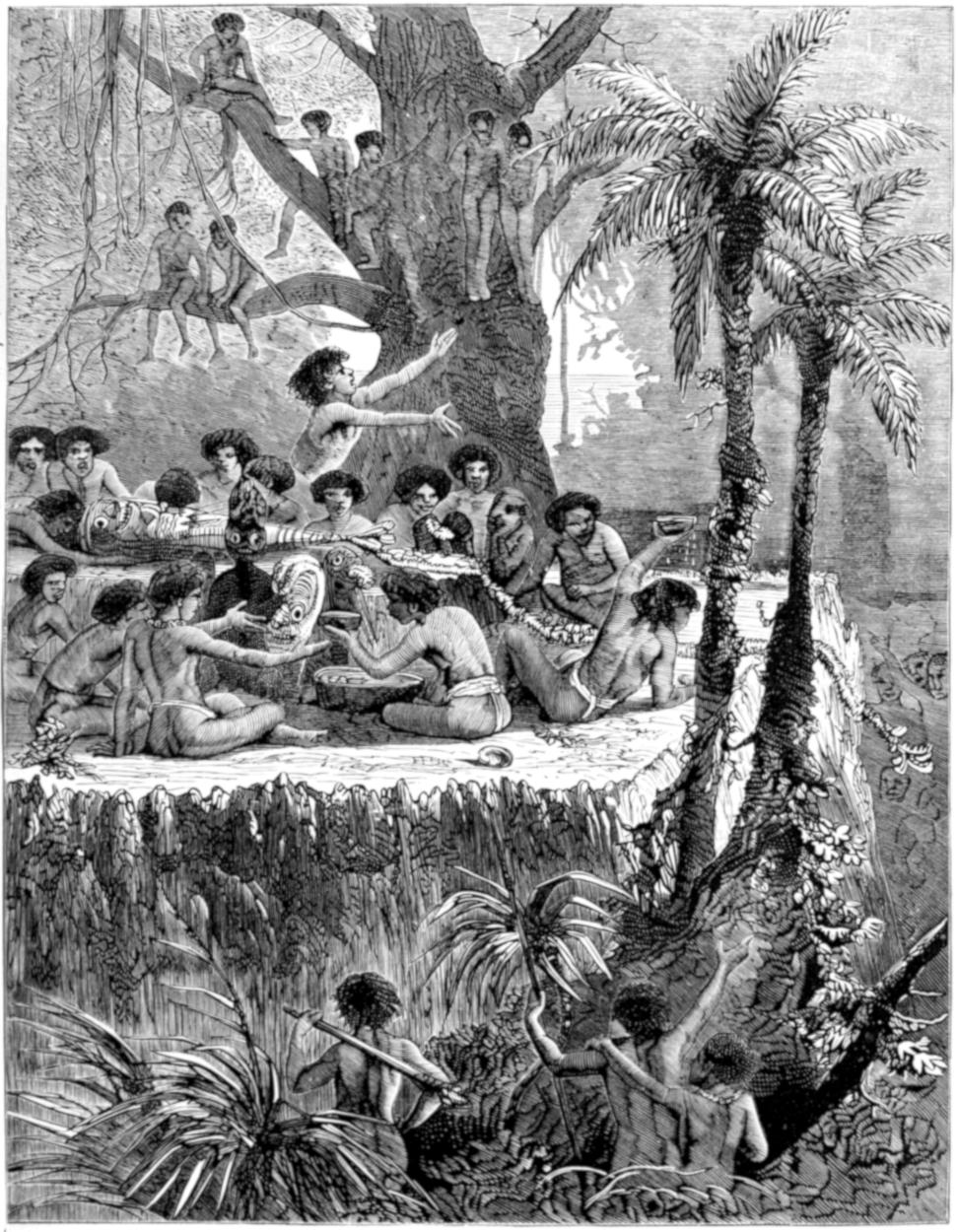
SOCIETY ISLANDERS DRESSING THE IDOLS.
(See page 1066.)
This idea of the long and streaming tail
has evidently been derived from meteors
and comets, which are supposed to be the
gods passing through the air, and whenever
a native saw one of them, he always threw
off his upper garments, and raised a shout
in honor of the passing god. Mr. Bennett
suggests that the permanent tail attached
to Tane is in all probability a commemoration
of some very magnificent comet with a
tail measuring eighty or ninety degrees in
length.
So sacred was the idol that everything
which was touched by it became tapu, and
might not be touched by profane hands.
There was only one man who was allowed
to carry it, and he was called from his office,
“Te amo attua,” i. e. the god-bearer. His
task was not an easy one, and his office,
though it caused him to be viewed with
nearly as much reverence as the god of
whom he was the special servant, must have
deprived him of many comforts. The god-bearer
was not even allowed to climb a
cocoa-nut tree, because, if he did so, the
tree would be so sacred that no one might
ascend it after him; indeed, every action of
his life was fenced about with some similar
restriction. He could not marry, as, in the
first place, no woman could be deserving of
the honor, and, in the second place, he would
be defiled and unfitted for his office if he
were to take any woman to wife.
A celibate life does not seem to us to entail
such self-denial as seems to be implied
by the prominence given to the celibacy of
the god-bearer, who appears to have been
the only bachelor in the whole group of
islands. But among most savage nations
a man’s wealth and consequence are regulated
by the number of his wives, who do all
the work of the household, and in fact keep
their husband in idleness.
The house in which the god lived was a
small hut elevated on posts twenty feet
high, and there were no means of access
except by climbing one of these posts. The
god-bearer, therefore, had no easy task in
climbing up these posts with the great
wooden image fastened to his back.
In the illustration on the 1084th page
we see the chief priest of Tane—the god-bearer—ascending
the pole of the sacred
house, with the unwieldy idol slung on his
back. A gust of wind has risen, and has
wafted Tane’s long tail into the air, so that
it has been entangled in a neighboring tree.
One of the principal priests is running to
ascend the tree and free the god’s tail, and
from that time the tree will be tapu, and no
one of lower rank than the priest who freed
the tail will be allowed to ascend the tree.
Sometimes Tane paid a visit to a marae
at some distance, and when he did so, his
bearer was naturally fatigued with the
weight of his burden. It was, however,
thought derogatory to the character of the
god to say that his bearer could by any possibility
be tired of carrying him, and so, by
an ingenious evasion, the god himself was
thought to be fatigued with the journey,
and was laid to rest for a while on a flat
stone about half a mile from the sacred tree.
This stone was tapu to women, and if a
woman had sat upon it, or even touched it
with her finger, she would have been at
once killed.
The stone was not a large one, being only
four feet long, one foot broad, and nine
inches thick. It is a singular fact that this
sacred stone, which had so often been the
witness of idolatrous rites, should also have
witnessed the destruction of the idol to
whom it was consecrated. After Christianity
had been fairly established in the island,
the chief men who adhered to the worship
of Tane made war upon the Christians, who
repelled them, so that they were obliged
to bring out their idol and lay him on the
sacred stone. The two bodies of warriors
met face to face close to the idol, and the
struggle was about to commence when the
chief of the Christians made a speech to the
enemy, laying before them the distinctions
between idolatry and Christianity, and recommended
peace instead of war.
His voice prevailed, and those who came
to fight against the Christians renounced
their idols, and, as a proof of their sincerity,
they built a large fire on the spot, threw
Tane into it, and then held a great feast, at
which the men and women ate together.
They then proceeded to Tane’s house,
burned it down, and dismantled his great
marae.
The feathers attached to these idols and
placed within their hollow bodies are mostly
the two long tail-feathers of the tropic bird,
white and broad toward the base, and narrow
and scarlet for the remainder of their
length. When the gods are newly dressed,
it is considered a meritorious act for any one
to present fresh feathers in lieu of those
which have been deteriorated by age. After
the old garments are unrolled, the feathers
are placed inside the image, and a corresponding
number of old feathers taken out
and presented to the devotee, who values
them beyond all things, as partaking of the
sanctity which surrounds the original idol.
These feathers are then carefully wrapped
with sinnet, so as to cover them, with the
exception of a little portion of both ends,
and they are then laid before the idol, while
the priest recites a prayer, in which he beseeches
the god to transfer his sanctity to
these feathers, which from that moment become
minor gods.
The happy devotee has already provided
himself with bamboo tubes, in each of which
he places one of the feathers, and from which
he never takes them except to pray to them.
Sometimes he has a smaller idol made, and
places the feathers within it; but in this
case, he has to take the new idol to be laid
before the original one, so that the transfer
of sanctity may be guaranteed to them.
This mode of honoring the sacred feathers
is usually employed when the devotee has
enjoyed some piece of good fortune after
he has received them, and in most cases he
not only encloses them in a new idol, but
builds a small temple in which that idol
lives.
Formerly, when animals were brought to
be sacrificed to Tane, no blood was shed,
but they were laid upon a stone and strangled
by pressing their necks between two
sticks. Food of all kinds was presented to
him, part of which he was supposed to consume
himself, part was taken by the priests,
and the remainder was consumed by the
worshippers. All first fruits went to Tane,
a peasant being supposed to offer him two of
the earliest fruits, while a raatira or gentleman
offered ten, and the chiefs still more,
according to their rank and wealth.
Not very far from the sacred stone was a
marae containing a very sacred object, no
less, in fact, than a piece of Tane’s own
canoe. According to the people, it was a
very miraculous canoe, for it was made of
stone, and yet floated as well as if it were
made of wood. In proof of this statement,
they placed the fragment in water, where it
floated, as it was likely to do, being nothing
more than a piece of pumice stone. No one
knew where the stone had been obtained,
but they said that there were more pieces in
different parts of the island.
Besides the idol gods, there are gods which
are symbolized by living creatures, of which
the shark is the chief, being worshipped for
the same reason that crocodiles and venomous
serpents are worshipped in some parts
of the world, viz. on account of its destructive
powers. Mr. Bennett saw a large marae
which had been consecrated to a shark god
on account of a miraculous event which was
said to have happened some time previously.
In one particular spot the ground begun to
shake and tremble, and, as the people were
flying in terror, the ground opened, and a
huge shark forced his head through the cleft
in the soil.
The formation of the maraes has already
been mentioned. Some time before Mr. Bennett
arrived at the place, a shark had contrived
to force its way through the sand into
the marae, which was situated on the shore
of the lagoon. The water flowed in with the
fish, and the natives, feeling delighted that
their god had actually come to take possession
of his temple, blocked up the passage
by which he had entered, cleared out the
marae, and kept the shark in it for the rest
of his life, feeding him abundantly with fish
and meat.
Indeed, in one bay the sharks were regularly
fed by the priests, and the consequence
was that they became quite familiar, and
would swim to the beach to be fed with fish
and pork. They would also accompany the
canoes, knowing well that the natives always
threw overboard some of the fish which they
had caught, for the sake of propitiating the
shark gods. The latter, however, were so
little sensible of the kindness bestowed upon
them, that had one of their worshippers
fallen overboard they would have eaten him,
in spite of all his propitiatory offerings.
Sometimes a living man has been elected
to the rank of a god, and worshipped as
such during his lifetime. This was done at
Raiatea, the king, Tamatoa, having been
reckoned among the gods by means of a
series of ceremonies which might have been
very appropriate in assigning him a place
among the very worst and vilest of demons,
but were singularly unsuitable to an apotheosis.
After this ceremony, the king was
consulted as an oracle, prayers and sacrifices
were offered to him, and he was treated as
reverently as if he had been Tane himself.
It is a most remarkable fact that Tamatoa
became a Christian in his later life, and
afforded most valuable information respecting
the religious belief of the Society Islanders.
He corroborated, as having been an eye-witness,
the accounts that have been given of the
astonishing deeds done by the heathen priests
while in a state of inspiration. They have
been seen to dash their hands against the
ground with such violence that they imbedded
the whole arm up to the shoulder.
Captain Henry, the son of one of the missionaries,
states that he has seen one of
these priests plunge his arm into the solid
earth as if it were water, and that he would
perform the feat on any ground wherever he
chanced to be.
“The infuriated priest, on that occasion,
foamed at the mouth, distorted his eyeballs,
convulsed his limbs, and uttered the most
hideous shrieks and howlings. After he had
seemingly buried his arm like a spear stuck
suddenly in the ground, he held it there for a
considerable time; then, drawing it out uninjured,
he rushed toward the shore, and,
laying hold upon a large canoe, which ordinarily
required three or four men to launch,
he shoved it before him with apparent ease,
and sent it adrift.
“He afterward threw himself into the sea,
wallowed about in it, and kept his head
under water for a long time. When this
act of the tragical pantomime was finished,
he sat among the waves, and delivered his
prophecies in very figurative and hyperbolical
language, at the same time sufficiently
ambiguous to be fulfilled in one of two senses,
whatever might happen.”
Portable shrines of the gods were once
used in the Society Islands, but so complete
and rapid has been the demolition of everything
connected with idolatry, that Mr. Bennett,
who was eye-witness of many idolatrous
practices, was only able to procure one specimen,
which is now in the museum of the
London Missionary Society.
In form it resembles a house, with sloping
roof, and is about a yard in length. It is supported
on four short legs, and underneath
there is a round hole through which the idol
was passed into its shrine, a door exactly fitting
and closing the aperture. The idol
which was in this shrine represented a
female god greatly venerated by the people,
because she was so very mischievous, and
had killed thousands of people, gaining from
her bloodthirsty propensities the name of Tii
Vahine, or Queen Tii. The idol is a horribly
repulsive example of the ugliness with which
savages invariably invest their deities.
The shrine, with the idol within it, was
hidden in a rock cave by priests of Tii Vahine
when idolatry was overthrown by Christianity,
and was not discovered for a considerable
time, when it was brought from
its place of concealment and sold.
CHAPTER CX. THE SOCIETY ISLANDS— Continued . HISTORY—WAR—FUNERALS—LEGENDS.
THE PRIESTS THE HISTORIANS OF THE SOCIETY ISLANDS — THE MARO, OR KING’S ROBE, AND ITS
HISTORICAL VALUE — THE HEREDITARY TITLE OF THE KING — THE KING’S BEARER — ARCHITECTURE
IN THE SOCIETY ISLANDS — TAHITAN WARFARE — RETENTIVE MEMORY, AND ITS USE
IN WAR — BEHAVIOR OF THE VICTORS TOWARD THE VANQUISHED — NAVAL BATTLES AND
MANŒUVRES — MILITARY ETIQUETTE — HUMAN SACRIFICE BEFORE BATTLES — CAPTAIN COOK’S
ACCOUNT OF THE CEREMONY — FUNERALS AMONG THE TAHITANS — EMBALMING OF A CHIEF’S
BODY — STRANGE DRESS OF THE CHIEF MOURNER — THE AREOI SOCIETY, AND THE INFLUENCE
WHICH IT EXERTED ON THIS GROUP OF ISLANDS — LEGENDARY TALES OF THE AREOIS.
The priests performed the office of historians
as well as of hierophants, every chief of consequence
having in his household at least one
of these men, who made it his business to
chant on all great occasions the most important
events which had happened in the
country, and especially those which affected
the family of his patron. Not only did he
relate those events of which he had been a
witness, but he also sang of the deeds of past
days, the records of which had been transmitted
to him by his predecessors.
The priests were, therefore, the only historians
of the Society Islands; and, indeed,
there was no other mode of delivering to
each succeeding generation the traditions
of the past. As, however, much of their accuracy
depended on the memory of the historian,
and as that memory was likely to fade
by age, it naturally followed that the history
of earlier times was considerably modified
by each succeeding narrator. Tamatoa was
himself a well-known chronicler, and could
repeat a wonderful number of narratives, in
which fact and fiction were mixed together
in a manner that exactly resembled the semi-mythic
history of ancient Greece and Rome.
These chroniclers, though they were unable
to write, were not without some means
whereby they could refresh their memories.
Chief of these was the Maro, the sacred scarf
of royalty. The word “Maro” signifies the
simple girdle which the men wear by way
of clothing, but that of the king is called, by
way of pre-eminence, The Maro; and, like
the crown of an emperor, is only worn when
the kingly rank is conferred. When not in
use, it is rolled up in native cloth so as to
make a large bundle, and is only untied
when it is wanted. When Captain Cook saw
it he described it as being fifteen feet long,
but when Mr. Bennett was in the Society
Islands it measured twenty-one feet in length,
the additional measurement being due to the
coronation of successive kings. It is only
six inches in width, and when worn is rolled
round the body, so that the end flows far
behind on the ground. It is covered with
the precious red feathers, and to it is attached
the needle with which it is worked.
So sacred is the maro thought to be, that, according
to the ideas of the natives, whenever
a new stitch was taken the event was
marked by peals of thunder.
The maro was never intended to be
finished, but, according to the original projection,
would receive an addition at the coronation
of every new king, so that it would
continue to increase in length as long as the
kingly succession was kept up. In several
respects it bears a great resemblance to the
Bayeux tapestry. It is very long in proportion
to its width, and the patterns described
upon it are records of the time when
the maro was woven, and act as aids to the
memory of the professional historians, who
celebrate in their songs the deeds of past
days.
The manufacture of the maro was stopped
in a very curious manner. After Tamatoa
became a Christian, he was so horrified at
the unspeakable iniquity of the ceremonies
that took place at each lengthening of the
maro that he determined to destroy the
maro itself. Fortunately, instead of destroying
it, he gave it up to his teachers, and it
was sent, together with many specimens of
the idolatrous arts of Polynesia, to the
museum of the London Missionary Society.
I may here mention that Tamatoa is the
hereditary name of the king, like the Pharaoh
of Egypt and the Finow of Tonga.
All the kings, or rather the principal
chiefs, have the greatest idea of their
dignity, and are regarded by their subjects
almost as demigods. Like some of the
African royalties, they are carried on men’s
shoulders when they travel from one place
to another by land, and when they go by
sea they are said to fly and not to sail.
There is a special language for the king,
whose canoe is called the Rainbow, and
whose house is termed the Cloud of Heaven.
No one is allowed to stand above him: and
this idea is so strongly impressed upon him
that a great chief dislikes going into the
cabin of an European ship, lest an inferior
should tread on the deck over his head.
The king even claims authority over the
language. We speak in England familiarly
of the king or queen’s English. In the
Society Islands the language really does
belong to the king, who invents and alters
words according to his own caprice, and
even strikes out of the language those words
which he does not happen to like.
The power of the king being so absolute,
it might be imagined that the house in
which he lived would be far superior to
those of his subjects. His power is, however,
more real than apparent, and though
he has despotic authority, he is lodged,
clothed, and fed, scarcely better than any of
his subjects, and not in the least better than
the chiefs. His house is built in the same
manner and of the same materials as those
of his subjects. It is certainly larger, because
it has to accommodate more persons;
but in other respects it is in no way superior.
The houses of the Society Islands are,
indeed, little more than thatched roofs supported
on pillars about seven or eight feet
in height, the pillars tapering from the base
to the top, and not being quite upright, but
sloping a little inward. The floor is generally
covered with grass and mats, while to
the rafters of the roof are hung baskets,
bundles of cloth, and other property.
Warfare among the Society Islands differs
little from the mode which is practised
in many other parts of Polynesia, and therefore
does not require a lengthened notice.
Formerly, when their weapons were the
spear, the club, and the sling, the wars used
to be very protracted and caused much
bloodshed, but the later introduction of fire-arms
has had its usual effect, and not only
reduced the number of wars but the loss of
life in battle.
Some of their spears were dreadful weapons,
the worst of which seems to have been
a sort of trident, something like an eel spear.
The head of it was armed with three bones
from the tail of the sting-ray. They were
not fastened to the head of the spear, but
only slipped into sockets, just tightly enough
to hold them. When an enemy was struck
with either of these points, it became detached
from the spear, and, in consequence
of its peculiarly barbed edges, kept working
its way deeper and deeper into the body, so
that certain death was the result of a wound
with one of these spears.
The natives of the Society Islands also
used the bone of the sting-ray for secret
assassination. They watched the intended
victim while he slept, and, by gently touching
him with a feather, made him turn about
until he was in a favorable position. The
fatal dagger was then struck into the body,
and the assassin made his escape, being
sure that the wound must sooner or later be
mortal.
The peculiar character of the people
shows itself in other ways. They are most
tenacious of memory in everything that has
a personal interest to them, and are equally
unwilling to forget an injury or a benefit.
They will cherish a life-long vengeance
against any one who has offended them, so
that one man has been known to follow
another from year to year, from one island
to another, with the certainty and tenacity
of the bloodhound, and never to cease from
his quest until he has avenged himself upon
his enemy. There is, however, a redeeming
point in this trait of character, namely, that
although it is mostly exercised for evil purposes,
it sometimes takes the opposite
course. Mr. Bennett mentions that on one
occasion, after a battle, a chief of the victorious
side knew that among the flying
enemy was a man who had shown a kindness
to him in a former war. Knowing the
fate that would befall the man if he fell into
the hands of the victors, he followed on the
track of the fugitive, and after seeking his
friend from cover to cover, and from bush
to bush, he at last discovered him, took him
to his own house, kept him there for a time,
and then dismissed him in safety.
Cruelty toward the vanquished is one of
the invariable accompaniments of savage
warfare, and we cannot expect to find that
the Society Islanders are more free from it
than others. The only cannibalism of which
they are guilty is in connection with war,
and even on those occasions the victorious
party only eat a small portion of the dead
adversary’s body, in accordance with custom,
and do not feast upon human flesh, as
many of the Polynesians do.
They are, however, on some occasions
very cruel to the captured or wounded enemies,
absolutely tearing them to pieces by
degrees, and taking care to avoid the vital
parts, so as to prolong the agony of the sufferer
as much as possible. Even Pomaré,
before he became a Christian, was guilty of
many abominable atrocities. He has been
known to take the children of vanquished
chiefs, run sinnet cords through the backs
of their necks, and drag them about until
they died of the torture.
Even when the enemy was dead, the victors
could not be content without insulting
the senseless corpse. “When a combatant
had slain a distinguished adversary,” writes
Mr. Bennett, “after the fray was over, the
perishing carcass was left upon the field for
a day or two. It was then dragged to the
marae, when the victor and his friends
would stand over it, and exult in the most
savage manner over the corrupted mass.
“Each taking a fibrous wand of cocoa-nut
leaf, tough as whalebone, in his hand, to
employ as a drumstick, they would beat the
body with these till they were weary; saying
to it, ‘Aha! we have you now; your
tongue fills your mouth, your eyes stand
out of your head, and your face is swollen;
so would it have been with us, had you prevailed.’
Then, after a pause, they would renew
their impotent stripes and not less impotent
taunts. ‘Now you are dead, you
will no more plague us. We are revenged
upon you; and so you would have revenged
yourself on us, if you had been the strongest
in battle.’ Again: ‘Aha! you will drink
no more kava; you will kill no more men;
you will disembowel no more of our wives
and daughters. As we use you, you would
have used us; but we are the conquerors,
and we have our vengeance.’
“When they had tired themselves, and
beaten the flesh of the corpse to a mummy,
they broke the arms above the elbows,
placed flowers within the hands, and, fastening
a rope about the neck, they suspended
the mangled remains on a tree, and danced
with fiend-like exultation about it, laughing
and shouting as the wind blew the dislocated
limbs and the rent muscles to and fro.”
The canoe fights show some skill in manœuvres.
The war canoes are double, with a
platform laid across the bars, forming a sort
of stage, on which the warriors stand to
fight. The movements of the canoes are
directed by one man, who tries to take the
adversary at a disadvantage, and orders the
vessel to advance or retreat as he thinks
best, while the warriors are dancing on the
platform, and exciting themselves to rage
by frantic shouts, brandishing club and
spear, and exchanging defiances with the
enemy when near enough. As soon as one
of them can take the other favorably, the
canoes close, and the warriors from one try
to board the other and kill its defenders.
The reserves receive and take care of the
wounded, laying them in the bottom of the
canoe, where they are safe from the weapons
of the enemy, and in their turn take
the place of those who are disabled, so that
a constant succession of fresh warriors is
continually coming to the front. When at
last one party gets the better of the other,
those of the vanquished side who are able to
use their limbs leap overboard and try to
save themselves by swimming. They have,
indeed, no other alternative, for no quarter
is ever given or expected, and if the lives
of the vanquished be spared at the time, it
is only that the unfortunate men may be
tortured to death next day.
When Captain Cook visited the Society
Islands, he found that all the decisive battles
were fought by water, and that such a
thing as a great battle on land was never
thought of. Indeed, the chief strength of
these insular people lies in their canoes, and
in a sea fight a great number of them were
usually engaged. In such a sea fight, whenever
one party found themselves being
worsted, they immediately made for the
beach, drew their canoes ashore, jumped
out, and made the best of their way to the
hills, where they concealed themselves during
the day, and at night slipped off to their
own homes.
When a pitched battle of this kind is determined
upon, it is fought out very fairly,
and becomes a sort of general tournament.
The two opposing chiefs arrange with each
other as to the time and place for the battle.
The whole of the day and night preceding
the battle are occupied by both parties in
feasting and dancing, evidently on the principle
that, if they are to be killed on the
morrow, they may as well enjoy themselves
while they can. Before daybreak the canoes
are launched and made ready for battle, and
with the dawn the fight commences.
After the engagement is over, and the
vanquished have run away, the victors go in
great triumph to the maraes, where they return
thanks to their gods, and offer to them
the dead, the wounded, and the prisoners
whom they have taken. The chief of the
conquered party then opens negotiations
with his successful opponent, and a treaty
is arranged, in which peace is restored on
certain conditions. These are often very
hard, and force the vanquished to give up
large tracts of land as well as to pay heavy
fines in property. Sometimes a whole district
changes masters, and, in one or two
cases, an entire island has been added to the
conquerors.
As human sacrifices have several times
been mentioned, it will be as well to describe
the circumstances under which they
take place. We have already seen that in
times of war the captured enemies are offered
to the idols. There is a sort of excuse
for this act, the idea being that, as the captives
had sought the lives of the worshippers
of the gods, their own lives should be
sacrificed to them as an atonement for their
presumption.
There are, however, other occasions on
which such sacrifices are offered, and where
the victim is selected by the chief and killed
in cold blood. If, for example, the king or
principal chief of an island or district should
project a war against another, he generally
sacrifices a man to his god in order to bespeak
his aid against the enemy. One of
these sacrifices was seen by Captain Cook in
1777. He did not witness the actual murder
of the victim, who was killed, as usual,
unawares, by a blow from a stone, but saw
the body as it was prepared for offering, and
was present at the curious ceremony which
accompanied the sacrifice.
It appeared that Towha, the chief of his
district, intended to make war against the
island of Eimeo, and sent a message to his
friend and relative Otoo that he had sacrificed
a man, and wished for Otoo’s presence
when the body was offered at the great marae
of Attahooroo. Having previously
doubted whether the usually mild and gentle
Tahitans would really offer human sacrifices,
Captain Cook asked permission to accompany
Otoo, and accordingly went with
him to the marae. The party accordingly
embarked in their canoes, taking with them
a miserable, half-starved dog, which was to
form part of the sacrifice.
When they arrived at the landing-place,
they found the body of the slain man already
there, lying in a canoe which was half
in and half out of the water, just in front of
the marae. Otoo, his visitors, and the chiefs
halted about ten yards from the body, while
the rest of the people looked on from a distance.
“The ceremonies now began. One of
the priests’ attendants brought a young
plantain tree, and laid it down before Otoo.
Another approached with a small tuft of red
feathers, twisted on some fibres of the cocoa-nut
husk, with which he touched one of the
king’s feet, and then retired with it to his
companions.
“One of the priests, seated at the marae,
facing those that were upon the beach, now
began a long prayer; and, at certain times,
sent down young plantain trees, which were
laid upon the sacrifice. During this prayer
a man, who stood by the officiating priest,
held in his hand two bundles, seemingly of
cloth. In one of them, as we afterward
found, was the royal maro; and the other, if
I may be allowed the expression, was the
ark of the Eatooa (i. e. the Atua, or god).
As soon as the prayer was ended, the priests
at the marae, with their attendants, went
and sat down with those upon the beach,
carrying with them the two bundles.
“Here they renewed their prayers; during
which the plantain trees were taken,
one by one, at different times, from off the
sacrifice, which was partly wrapped up in
cocoa leaves and small branches. It was
now taken out of the canoe and laid upon
the beach, with the feet to the sea. The
priests placed themselves around it, some
sitting and others standing; and one or
more of them repeated sentences for about
ten minutes. The dead body was now
uncovered by removing the leaves and
branches, and laid in a parallel direction by
the sea-shore.
“One of the priests then, standing at the
feet of it, pronounced a long prayer, in which
he was at times joined by the others; each
holding in his hand a tuft of red feathers.
In the course of this prayer some hair was
pulled off the head of the sacrifice, and the
left eye taken out; both which were presented
to Otoo, wrapped up in a green leaf.
He did not, however, touch it, but gave to
the man who presented it the tuft of feathers
which he had received from Towha. This,
with the hair and eye, was carried back to
the priests.
“Soon after, Otoo sent to them another
piece of feathers, which he had given me in
the morning to keep in my pocket. During
some part of this last ceremony, a kingfisher
making a noise in the trees, Otoo
turned to me, saying, ‘That is the Eatooa,’
and seemed to look upon it as a good omen.
“The body was then carried a little way,
with its head toward the marae, and laid
under a tree, near which were fixed three
broad thin pieces of wood, differently but
rudely carved. The bundles of cloth were
laid on a part of the marae; and the tufts of
red feathers were placed at the feet of the
sacrifice, round which the priests took their
stations; and we were now allowed to go as
near as we pleased.
“He who seemed to be the chief priest sat
at a small distance, and spoke for a quarter
of an hour, but with different tones and gestures;
so that he seemed often to expostulate
with the dead person—to whom he constantly
addressed himself—and sometimes
asked several questions, seemingly with respect
to the propriety of his having been
killed. At other times he made several demands,
as if the deceased either now had
power himself, or interest with the divinity,
to engage him to comply with such requests.
Amongst which, we understood, he asked him
to deliver Eimeo, Maheine its chief, the hogs,
women, and other things of the island, into
their hands,—which was indeed the express
intention of the sacrifice. He then chanted
a prayer, which lasted near half an hour, in
a whining, melancholy tone, accompanied
by two other priests, and in which Potatau
and some others joined. In the course of
this prayer some more hair was plucked by
a priest from the head of the corpse, and put
upon one of the bundles.
“After this, the chief priest prayed alone,
holding in his hand the feathers which came
from Towha. When he had finished, he
gave them to another, who prayed in like
manner. Then all the tufts of feathers were
laid upon the bundles of cloth; which closed
the ceremony at this place.
“The corpse was then carried up to the
most conspicuous part of the marae, with the
feathers, the two bundles of cloth, and the
drums, the last of which beat slowly. The
feathers and bundles were laid against the
pile of stones, and the corpse at the foot of
them. The priests having again seated
themselves round it, renewed their prayers,
while some of the attendants dug a hole
about two feet deep, into which they threw
the unhappy victim, and covered it over
with earth and stones. While they were
putting him into the grave a boy squeaked
aloud, and Omai said to me that it was the
Eatooa.
“During this time, a fire having been
made, the dog before mentioned was produced,
and killed, by twisting his neck, and
suffocating him. The hair was singed off,
and the entrails taken out and thrown into
the fire, where they were left to consume.
But the heart, liver, and kidneys were only
roasted, by being laid on hot stones for a few
minutes; and the body of the dog, after being
besmeared with the blood, which had been
collected in a cocoa-nut shell, and dried over
the fire, was with the liver, &c., carried and
laid down before the priests, who sat praying
round the grave.
“They continued their ejaculations over
the dog for some time, while two men at intervals
beat on two drums very loud, and a
boy screamed as before in a loud shrill voice
three different times. This, as we were told,
was to invite the Eatooa to feast on the banquet
that they had prepared for him. As
soon as the priests had ended their prayers,
the carcass of the dog with what belonged to
it were laid on a whatta, or scaffold, about
six feet high, that stood close by, on which
lay the remains of two other dogs, and of
two pigs, which had lately been sacrificed,
and at this time emitted an intolerable
stench. This kept us at a greater distance
than would otherwise have been required
of us; for after the victim was removed from
the seaside toward the marae we were allowed
to approach as near as we pleased.
Indeed, after that, neither seriousness nor
attention were much observed by the spectators.
When the dog was put upon the
whatta, the priests and attendants gave a
kind of shout, which closed the ceremonies
for the present.”
The scene is well represented in illustration
No. 1, on the opposite page. In the
foreground is the canoe, in which lies the
body of the slain victim, attended by two
priests; while just above it on the shore is
the dog that is intended to furnish the second
portion of the offering. Just in front of the
house are two platforms, on the taller of
which lie the dogs and pigs that have already
been sacrificed, and on the lower lies
the embalmed body of the late king, which
is brought out for inspection. In front of
the bier are the drummers performing on
their elaborately carved instruments. A
portion of the marae is seen on the left
hand of the illustration, and on it lie the
skulls of the human sacrifices that have been
offered on various occasions.
Next day the ceremonies were resumed;
more pigs were killed, some gifts were laid
upon the movable house in which the Atua
(or god) was carried about, and a young
plantain tree was plucked up and laid at the
feet of the king.
The mysterious bundles of cloth which had
been laid on the marae were then unrolled,
and out of one of them was taken the sacred
maro, or royal girdle, which has already been
described. It was remarkable for the fact
that a portion of the scarlet feathers with
which the maro is decorated were sewed
upon an English pennant which had been
hoisted by Captain Wallis when he landed
on the island, and left flying when he left it.
The second bundle contained the idol to
whom the sacrifices were made.
Another hog was then killed, and the entrails
inspected, exactly after the manner
employed by the old Roman augurs; and the
ceremony ended with rolling up the Atua,
together with a number of scarlet feathers,
in the bundle of cloth from which it had
been taken.
At the funerals of very great men human
sacrifices are often made, and near the large
whattas, or platforms, on which the pigs and
other provisions are offered, there are numbers
of human skulls, each a relic of a human
sacrifice. The only redeeming point
about these sacrifices is, that the victim is
quite unconscious of his fate. He is struck
to the ground suddenly by an assassin who
comes stealthily upon him, and never feels
the real bitterness of death, namely, the
dread of the coming fate.
The bodies of great chiefs undergo a process
by which they are preserved for a considerable
time. Captain Cook saw the corpse
of a chief who had been dead for several
months, and whose body had suffered scarcely
any apparent change. There was a slight
contraction of the muscles and sinking of
the eyes, but the body was otherwise perfect;
and when the attendants on the corpse
unrolled the cloth in which it was enveloped,
the limbs were found to be nearly as
pliant as in life.
This result is obtained by removing the
whole of the interior of the body, supplying
its place with cloth soaked in cocoa-nut oil,
and anointing the whole body repeatedly with
the same substance. The bodies are exposed
to public view for some time; but the embalming
only postpones the process of decay,
and, sooner or later, decomposition does its
work. At first the body is exposed for several
hours daily, provided that there be no rain;
but by degrees it is only shown at intervals,
and at last is scarcely ever exhibited, except
by request.
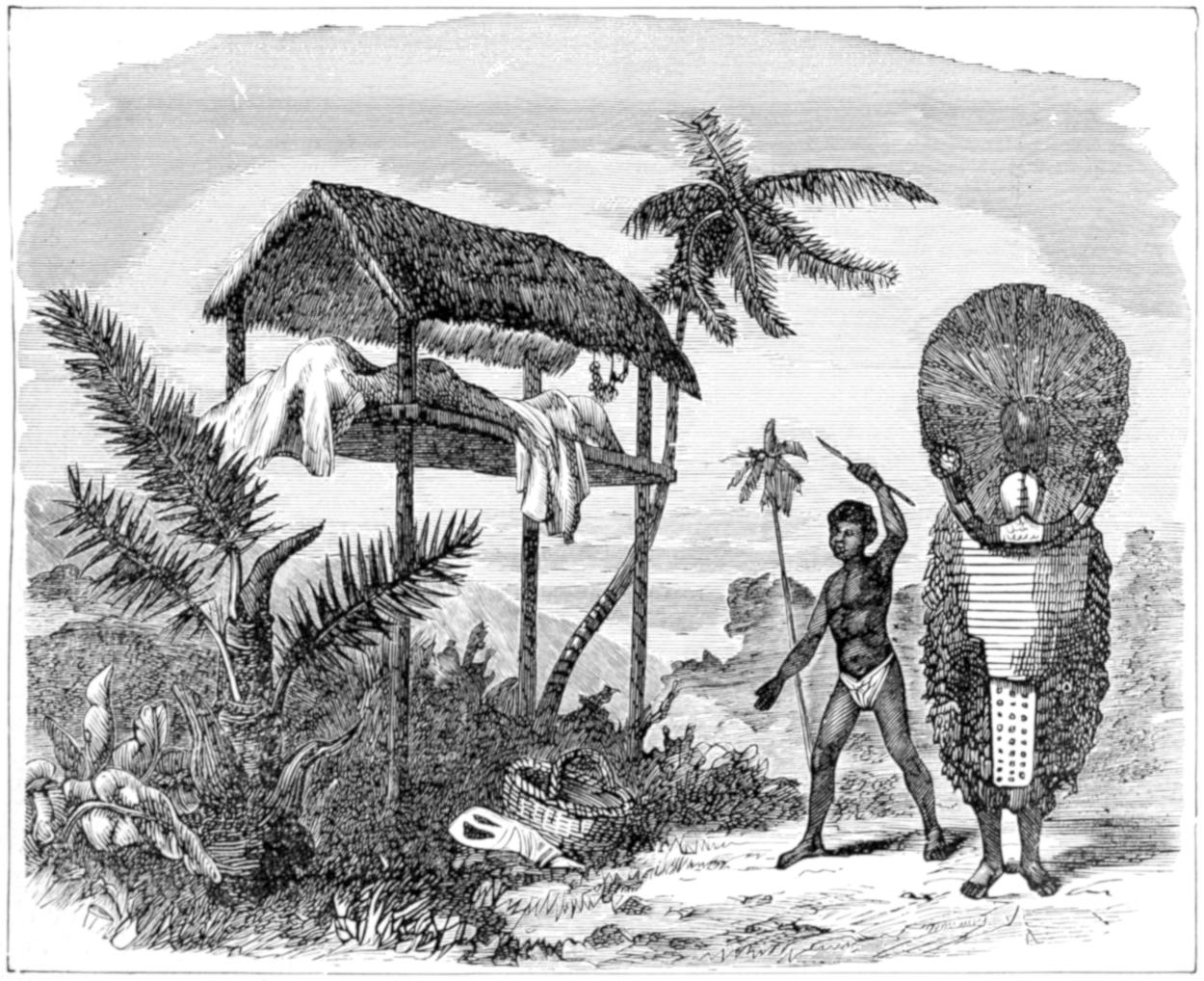
(2.) CORPSE AND CHIEF MOURNER.
(See page 1079.)
There is a special building, called a tupapau,
in which the bodies of chiefs are exhibited
when lying in state. First, there is a
tolerably large house, with a palisade around
it, and within this house is the tupapau
itself. It is made exactly like the little
pent-houses that are built upon the larger
canoes, and is profusely decorated with scarlet
feathers, cloth, and other precious ornaments.
Two men are attached to the tupapau,
who watch over it night and day, attend
to the proper arrangement of the cloth and
feathers, receive the offerings of fruit and
provisions that are constantly made, and
prevent intruders from venturing within
the palisades.
The second illustration on the 1077th page
exhibits the manner in which the bodies of
ordinary chiefs are laid out under the protection
of a covered shed, as well as the
extraordinary dress worn by the chief
mourner. The dress is composed in the
most ingenious manner of mother-of-pearl
shell, feathers, bark cloth, and similar materials,
and has a peculiarly startling appearance
from the contrast between the glittering
white of the pearl-shell and the dark
feathers with which the shell is surrounded.
Several of these extraordinary dresses have
been brought to England, and may be seen
in different collections.
Before leaving the Society Islands, it
will be necessary to mention an extraordinary
institution that in former times prevailed
among them. It consisted of a society
called the “Areois.” They were worshippers
of the god Oro; and though they
formed a single confraternity throughout
all the Society group, each island furnished
its own members.
Some writers have likened the society to
that of Freemasonry; but no two institutions
can be more utterly opposed than those
of the Masonic and the Areoi societies—the
one insisting on monotheism, while the
other is based on idolatry; the one being an
universal, and the other a local society; the
one inculcating morality, and the other
being formed for the express purpose of
throwing aside the small relics of morality
possessed by a native Polynesian.
It is not improbable, however, that on its
first foundation the Areoi society possessed
something of a religious nature. When
Areois who had been converted to Christianity
managed to shake off the dread with
which they contemplated any reference to the
mysteries of their society, they all agreed in
the main points, though differing in details.
In the first place, the Areois believed in
the immortality of the soul, and in the existence
of a heaven suited to their own characters.
Those who rose to high rank in
the Areoi society were believed, after their
death, to hold corresponding rank in their
heaven, which they called by the name of
Rohutu-noa-noa, or Fragrant Paradise. All
those who entered were restored to the
vigor and bloom of youth, no matter what
might be their age; and in almost every
respect the resemblance between the Polynesian
Rohutu and the Mohammedan Paradise
is close and almost startling.
The method by which this Paradise was
to be gained was most extraordinary. Fanatics
of an ordinary turn of mind believe
that everlasting happiness hereafter is to
be gained by self-denial and mortification of
the body during the present life. The Areois,
with an almost sublime audacity, held
precisely the opposite view, and proclaimed
both by words and deeds that a life of eternal
enjoyment in the next world was to be
obtained by leading a life of unbridled
license in the present world.
In order to carry out this theory to the
fullest extent, the Areois formed themselves
into a society, and travelled about from one
island to another, disseminating their peculiar
opinions wherever they went, and gaining
fresh recruits to their number in each island.
On one occasion Captain Cook saw seventy
canoes filled with Areois set off on an
expedition to the different islands. Wherever
they landed, they proceeded to the nearest
marae, and offered a sacrifice of a sucking
pig to the god who presided over it, this
sacrifice being in the first place a thank-offering
to the god for their safe landing,
and in the next a notification that they
wanted pigs for themselves.
Partly on account of the terror inspired
by their numbers and unanimity, and partly
on account of the spread of their very intelligible
doctrines, the invitation always met
with an immediate response, and great
numbers of pigs, together with vegetable
food, cloth, kava, and other luxuries were
produced. A great feast was then held,
during which the peculiar doctrines of the
society were carried out to the full, and a
scene ensued such as cannot be described.
Among the worst of their doctrines was
that which declared them all to be celibates,
because the god Oro was unmarried. Consequently,
the existence of children among
them could not be recognized, and as soon
as a child was born, it was murdered, and
the fact of its existence ignored. By a similarly
convenient fiction, all Areois were
presumed to be in the full vigor of human
life. Consequently, the possibility of age
and debility was ignored, and in order to
prove the non-existence of either senility or
sickness, any old or sick person was quietly
buried alive. The victims were never apprized
of their fate, as is the case in Fiji,
but a grave was dug surreptitiously, the sick
person was decoyed to it on some pretence
or other, dropped into the grave, the earth
flung on him, and stamped down almost before
he had time for a remonstrance.
Sometimes, when provisions ran short,
the Areois had a very strange method of
supplying themselves. A party of them, led
by some chief, whose rank was known by
the marks tattooed on his body, would visit
a house where they saw evidences of prosperity,
and look about until they came on a
little boy—an easy matter enough in a
country where polygamy is practised. They
would then take the child, and go through
various ceremonies, by which they represented
him as having been raised to kingly
rank.
They would then simulate the utmost deference
to the new king, place him on an
elevated seat, prostrate themselves before
him, and appeal to him as though he really
held the kingly rank. “We are come to
the king’s house, poor, naked, and hungry.
We need raiment—give us that piece of
cloth. We need food—give us that pig.”
Accordingly, the father of the child was
forced to fall in with their humor, and, in
return for the honor conferred upon his
house, to give them whatever they demanded.
The only redeeming point of the Areois
was their value in keeping up the old historical
records of the islands. The food and
clothing which they obtained from the various
people were repaid by the dramatic performances
and recitations which they gave,
and which debased as they were by the licentious
element which permeated every section
of the society, performed toward their local
history the same part which the ancient
mysteries performed toward the Christian
religion. The Polynesians being unable to
read or write, and having no mode of recording
historical events except by tradition,
these performances rendered as it were
history visible, and enacted before the eyes
of the illiterate people the deeds of days long
gone by.
Sometimes the story was that of a celebrated
ancestor, much on a par with the
semi-mythical legends of ancient European
and Asiatic history, and sometimes it took a
graver cast, and narrated the deeds and
powers of the native gods. For example,
the legend of Taroa, the father of gods and
men, was somewhat as follows:—
In ages long gone by, Taroa existed only
in the form of a vast egg, and hung high in
the firmament, inclosing in the shell the
sun, moon, and stars. After floating in
ether for ages, he thrust his hands through
the shell, so that the light of the sun burst
upon the universe and illumined the earth
beneath him. And the earth was then small
as it lay beneath him. Then Taroa saw the
sands of the sea, and cried to them, “Sands,
come up to me, and be my companions.”
But the sands replied, “We belong to the
earth and sea, O Taroa, and may not leave
them. Come thou down to us.” Then he
saw the rocks and cliffs, and cried to them,
“Rocks come up to me, and be my companions.”
But the rocks replied, “We are rooted
in the earth, O Taroa, and may not leave it.
Come thou to us.”
Then Taroa descended, and cast off his
shell, which immediately added itself to the
ground, and the earth was increased to its
present dimensions, while the sun and
moon shone above. Long did Taroa live
on the earth which he peopled with men
and women; and at last the time came
when he should depart from it. He transformed
himself into a large canoe, which
was filled with islanders, when a great
storm arose, and suddenly the canoe was
filled with blood. The islanders with their
calabashes baled out the blood, which ran to
the east and west of the sea; and ever afterward
the blood of Taroa is seen in the
clouds which accompany the rising and setting
sun, and, as of old tinges the waves with
red.
When the canoe came to land, it was but
the skeleton of Taroa, which was laid on the
ground with its face downward, and from
that time all the houses of the gods have
been built on the model of Taroa’s skeleton,
the thatched roofs representing the backbone
and the posts the ribs.
Legends such as these are often transmitted
from one reciter to another, and recited
verbatim, being merely illustrated and
exemplified by such poetical digressions as
the mind of the narrator may suggest.
With others, on the contrary, the orator has
only the mere skeleton, and tells the story
in the manner that seems him best.
CHAPTER CXI. THE SANDWICH ISLANDS. CLIMATE—DRESS—ORNAMENTS—WOMEN.
LOCALITY OF THE GROUP — CONFORMATION AND CLIMATE OF HAWAII — APPEARANCE AND DRESS OF
THE MEN — FEATHER MANTLES AND HELMETS — SINGULAR RESEMBLANCE TO CLASSIC MODELS — APPEARANCE
OF THE WOMEN — A HAWAIIAN BEAUTY — DRESS OF THE WOMEN — MODES OF
WEARING THE HAIR — BRACELETS AND OTHER ORNAMENTS — FONDNESS FOR PIGS AND DOGS — OCCUPATIONS
OF THE WOMEN — HOSPITALITY TO STRANGERS — FISH PONDS, AND MODE OF MAKING
THEM — TREATMENT OF WOMEN — SEMI-AMPHIBIOUS NATURE OF THE SANDWICH ISLANDERS — INGENIOUS
METHOD OF OBTAINING SOUNDINGS.
Considerably to the northward of the
Society Islands lie the Sandwich Islands,
so called by Captain Cook, in honor of the
Earl of Sandwich. The entire group consists
of eight inhabited islands, and a few
which are too barren and rocky to maintain
human beings. The largest and most
important of them is Hawaii, or Owhyhee,
as the word is spelt in Cook’s “Voyages.”
It was on the shore of a bay on the western
side of this island that Captain Cook was
killed in 1779. Owing to the interchange
of the letters l and r, which is so prevalent
among the Polynesian languages, the name
of this bay is sometimes spelt as Karakakooa,
and sometimes as Kealakekua.
The capital city of the Sandwich Islands
is not situated in Hawaii, but in Oahu, or
Woahu, one of the smaller islands, and is
called Honolulu. It rightly deserves the
name of a city, because it is the seat of a
bishopric. The climate of the Sandwich
Islands is said to be the most charming in
the world. The variation is exceedingly
trifling, as near the sea the temperature is
below that of sultry English summer-time,
while on the coldest winter’s day the thermometer
never sinks below 62° Fahr. Owing,
however, to the mountainous nature of
these islands, any one may live throughout
the year in almost exactly the same temperature,
by ascending into a cooler atmosphere
when the weather is too hot, and descending
into the warmer strata during the months of
winter.
Adhering to the principle which has been
followed in this work, I shall say but little
of the present Europeanized condition of
the natives of these islands, and confine myself
as far as possible to the manners and
customs of the people as they were before
the white men had introduced their own
mode of civilization. Even at the present
day, however, the old savage character continually
shows itself, and among the very
people who seem to be most completely under
the influence of civilization the original
old heathenism exhibits itself when they are
off their guard, or when they think themselves
out of the ken of white men. It will be
understood, therefore, that although the present
tense may be used in the following pages,
all descriptions apply to them as they were
originally, and not to them as they are at
the present day.
The men are tall, active and powerful,
and in color are of an olive brown, the precise
depth of tint varying much according
to the exposure to the sun, so that the skins
of the chiefs are much lighter than those of
the commonalty. The hair is jet black, and
not in the least woolly, being sometimes
quite straight, and sometimes wavy. The
face is mostly wide, and is a very handsome
one, the only fault in it being a tendency
to width across the nostrils.
The men all wear the maro or malo, i. e.
the slight girdle of cloth which has already
been mentioned, and having this, they consider
themselves dressed for all purposes of
decency. They also have a tappa, or bark-cloth
garment, which is twisted round the
waist, and falls below the knees, while the
better class wear also a sort of mantle, to
shelter their skin from the darkening sunbeams.
The great chiefs have also mantles made
of a sort of network, into each mesh of
which are interwoven the feathers of various
birds, the most precious of them being
that which supplies the yellow feathers.
This is a little bird called Melithreptes pacifica.
It is one of the honey-birds, and under
each wing there is a single yellow
feather, one inch in length. The late king,
Kamehameha, had a cloak made of these
feathers alone. It was four feet long, and
eleven feet wide at the bottom. No less
than nine successive kings died before this
priceless mantle was finished.
The headdress of the chiefs is of so graceful
and classical a form as absolutely to startle
the spectator. It is a helmet made of
wicker-work and covered with feathers, the
shape being exactly that of the ancient
Grecian helmet even to the elevated crest
which runs over the top. One of these
beautiful helmets is shown on the 1097th
page. It is not intended as a protection for
the head, the material being too fragile for
such a purpose, but is simply a badge of
rank and wealth. Mostly they are covered
with scarlet and yellow feathers, disposed in
bold bands or belts, and the wealth of the
wearer may be known by the proportion
which the yellow and scarlet feathers bear to
each other.
Examples of these beautiful ornaments
may be seen in several museums, where it is
to be hoped that they will be kept from the
destructive moths and beetles, inasmuch as
they form the sole memorials of a time now
passed away.
The birds which furnish these feathers
are eagerly sought by the Sandwich Islanders,
who have the same love of scarlet
that distinguishes not only all Polynesians
but all savages and children. The birds are
usually caught by means of a tenacious substance
much resembling our birdlime, and
used in a similar manner by being smeared
on twigs and poles, to which the birds are
attracted by means of baits.
The natural taste in color is as good as
that which displays itself in form, and although
the brightest and most boldly contrasting
colors are used by the Sandwich Islanders,
they are used with such admirable
judgment that they do not look gaudy, or
even obtrusive.
The women, when young, are singularly
beautiful, and retain their good looks longer
than is usual among Polynesians. Like the
other sex, however, they generally attain to
great size in their latter years, those of the
better sort being remarkable for their enormous
corpulence. This development is
probably owing, like that of the Kaffir
chiefs, to the great quantity of porridge
which they are continually eating. When
young, however, they are exceedingly beautiful,
their features having a peculiar charm
of their own, and their forms being like those
of the ancient Grecian statues. An American
traveller, writing under the nom de
plume of Haöle, i. e. foreigner, gives a most
animated description of a native girl, in his
interesting work on the Sandwich Islands,
showing that the partial civilization to which
the natives have been subjected has not destroyed
their beauty of features nor symmetry
of form.
“In truth to nature, it may be safely
asserted that beauty is not confined merely
to the saloon of the monarch, nor to the
tapestried chambers of the patrician. It is
more frequently found amid the lowlier
walks of life, on the desert, or the distant
isle of the ocean. In this instance I wish
to be understood as speaking of physical
beauty only. On leaving the shore-road to
ascend the mountains for Halawa, I met
just such a specimen as has often driven
men mad, and whose possession has many a
time paved the way to the subversion of
empire on the part of monarchs.
“She was rather above the medium size
of American women. Her finely chiselled
chin, nose, and forehead were singularly
Grecian. Her beautifully moulded neck
and shoulders, looked as though they might
have been borrowed from Juno. The development
of her entire form was as perfect as
nature could make it. She was arrayed in a
single loose robe, beneath which a pretty
little nude foot was just peeping out. Her
hair and eyebrows were as glossy as a
raven’s wing. Around her head was carelessly
twined a wreath of the beautiful
native ohelo flowers (Gaultheria penduliflorum).
Her lips seemed fragrant with the
odor of countless and untiring kisses. Her
complexion was much fairer than the fairest
of her countrywomen, and I was forced into
the conclusion that she was the offshoot of
some white father who had trampled on the
seventh precept in the Decalogue, or taken
to his embrace, by the marriage relation,
some good-looking Hawaiian woman.
“But her eyes! I never shall forget those
eyes! They retained something that spoke
of an affection so deep, a spiritual existence
so intense, a dreamy enchantment so inexpressibly
beautiful, that they reminded one
of the beautiful Greek girl Myrrha, in
Byron’s tragedy of ‘Sardanapalus,’ whose
love clung to the old monarch when the
flame of the funeral pile formed their winding
sheet.
“In no former period of my life had I
ever raised my hat in the presence of
beauty, but at this moment, and in such a
presence, I took it off. I was entirely fascinated,
charmed, spell-bound now. I stopped
my horse; and there I sat, to take a fuller
glance at the fair reality. And the girl
stopped, and returned the glance, while a
smile parted her lips, and partially revealed a
set of teeth as white as snow, and of matchless
perfection. I felt that smile to be an
unsafe atmosphere for the nerves of a bachelor;
so I bowed, replaced my hat, and
passed on my way, feeling fully assured that
nothing but the chisel of Praxiteles could
have copied her exquisite charms. And as
I gently moved past her, she exclaimed, in
the vocabulary of her country ‘Love to
you.’”
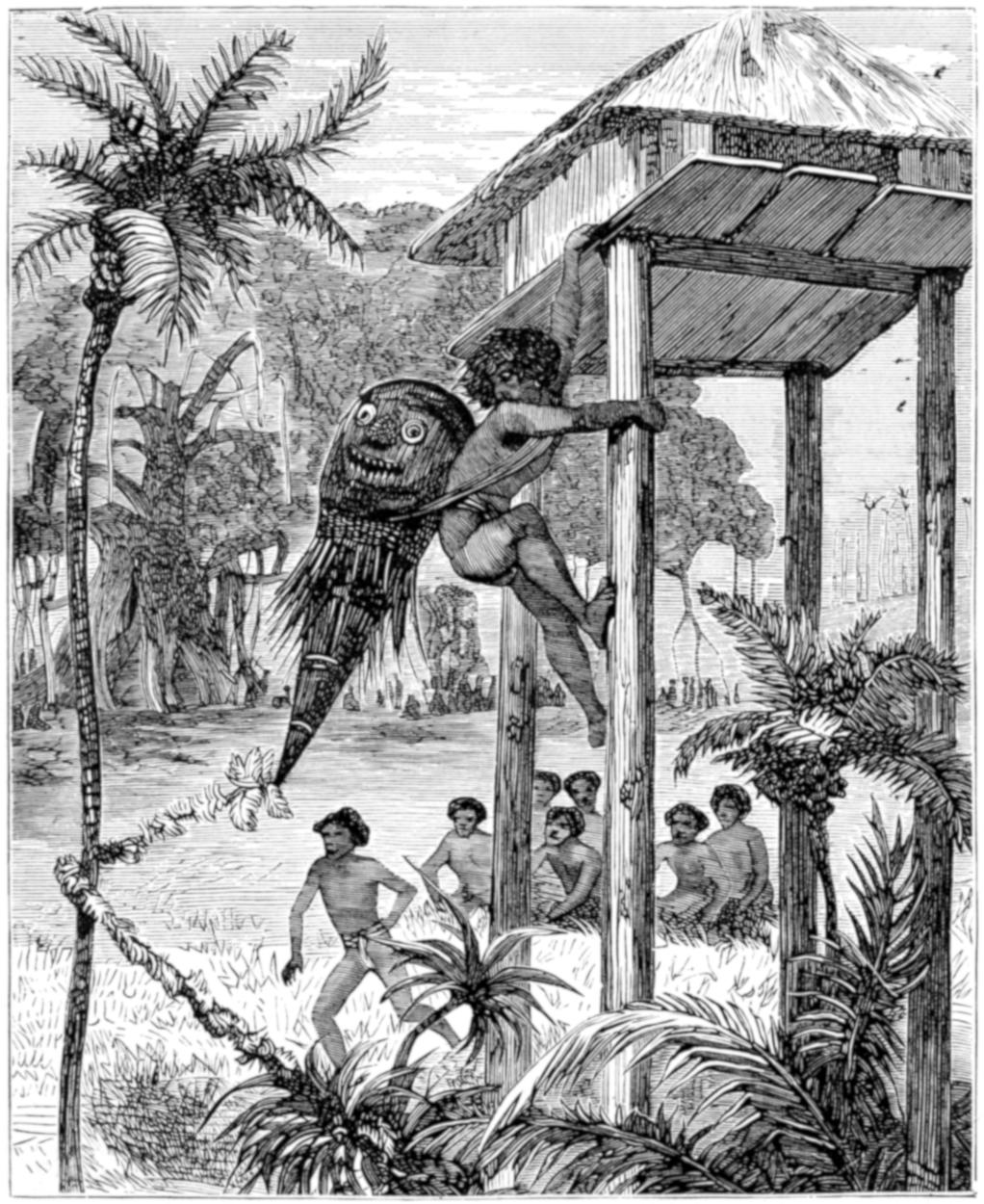
(1.) IDOL TANE RETURNING HOME.
(See page 1069.)
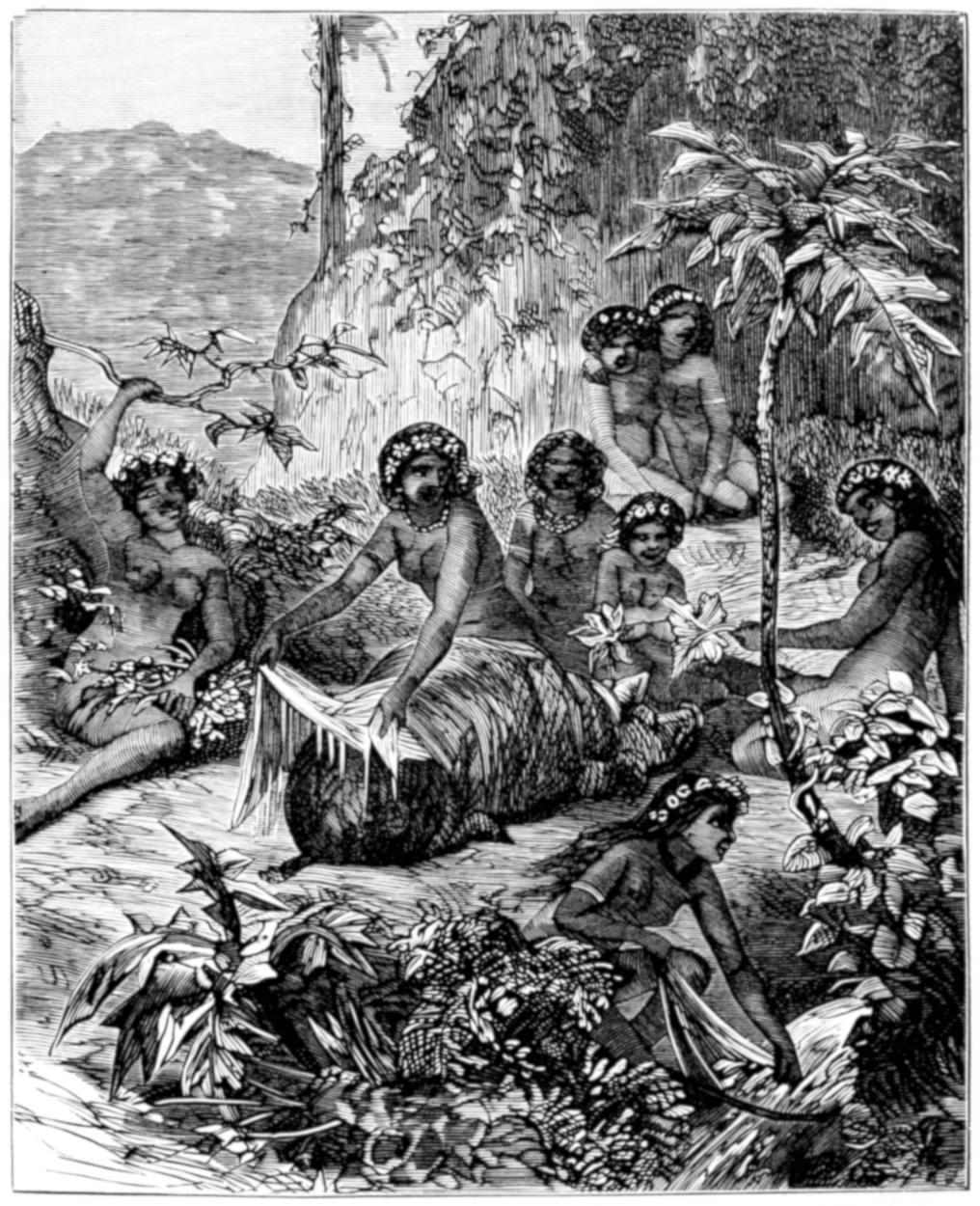
(2.) SANDWICH ISLAND WOMEN AND PIG.
(See page 1085.)
The same writer mentions in several
other places the beauty of the young girls
whom he saw in Hawaii. There was no
reason for the surmise that the girl who
impressed him so deeply was a half-caste,
because, as has already been mentioned,
people of the better class are much fairer
than those of lower rank, and are scarcely
so dark as the inhabitants of Southern
Europe.
The dress of the Sandwich Islands women
is much like that of the Tongans, and consists
essentially of a wrapper of bark cloth
passing round the waist and falling below
the knees. It is often arranged so that the
end may be thrown over the shoulders, and
many of the better class of women have a
separate piece of cloth which is used as a
mantle. When young they wear no clothing
at all.
The methods of wearing the hair are
somewhat various. The women generally
cut it behind, but allow it to grow to its full
length on the rest of the head. The men
sometimes divide the hair into a number of
locks, and plait or twist each lock into a sort
of tail about the thickness of a man’s finger.
These tails are allowed to grow to their full
length, and stream for some distance down
the back. The length of tail seems to be
much valued among these people, who are
in the habit of adding to their length by
supplementary additions of hair woven into
their own locks. The hair is often stained
of a reddish color by the use of lime, as is
done in Fiji and other parts of Polynesia.
Sometimes the men shave the whole of the
hair on either side of the head, leaving only
one crest of long hair to run from the forehead
to the nape of the neck, just like the
crests of the feather helmets.
Captain Cook remarks that the Sandwich
Islanders stand almost alone among Polynesians
in refusing to perforate their ears, and
that they have no idea of wearing ornaments
in them. They are fond of ornaments,
some of which are worth a brief
description. They have a sort of necklace
made of black cord, doubled forty or fifty
times, and supporting a piece of wood, shell,
or bone cut into the form of a broad hook.
Necklaces made of small shells strung together
are also common, as are also necklaces
of dried flowers.
Bracelets of various kinds are valued by
the women. Some of these ornaments are
made of hog’s teeth placed side by side,
with the concave parts outward, and joined
by a string running through the middle.
Some of these bracelets are made entirely
of the long curved tusks of boars, and are
really handsome ornaments. Others are
formed from pieces of black wood, fastened
together in a similar manner, and being
variegated by small pieces of hog’s teeth let
into them.
The men sometimes wear on their heads
tufts of feathers tied to slight sticks. The
most valuable of these plumes are those
which are made of the tail-feathers of the
tropic bird. Others, which are not so valuable,
are made of white dog’s hair. The
sticks are sometimes two feet in length.
Tattooing is but slightly practised among
the Sandwich Islanders, though some of
them have the arms and chest decorated
with lines and figures tolerably well executed.
Like many of the Polynesians, the Sandwich
Islanders have an absurd liking for
pigs and dogs, carrying them about and feeding
them when young, as if they had been
children. Even when the animals attain
their full growth, they are petted to no small
extent. The “Haöle” narrates an amusing
example of the extreme tenderness which
the Hawaiian women evince for these animals,
and the artist has represented the description
in engraving No. 2, on the preceding
page. He was travelling through the
island, and noticed a group of women sitting
under the shade of a pandanus tree, and surrounding
something in which they seemed
to be greatly interested. On coming closer,
he found that the object of their attention
was an enormous hog.
The women were taking it to market, a
task which usually devolves upon them, and
had to drive the animal for a considerable
distance over lofty mountains, a task which
could not occupy them less than thirty-six
hours. To produce the hog in good condition
was evidently their principal object, and
they would therefore hurry it as little as possible,
coax it along, rather than drive it, by
day, and sleep by its side at night. It so
happened that the day was a very warm one,
and the hog, which was in very good condition,
was oppressed with its own fat, with
the heat and the fatigue of the journey.
Accordingly, the women had led their charge
to a shady spot, taken off their only garments,
soaked them in water, and spread
them over the panting animal, which uttered
occasional grunts of satisfaction at the coolness
caused by the wet garments, and the
continual fanning which the women kept up
with leaves.
When the pig is of smaller size, and the
market is near at hand, so that there is no
danger the animal may get out of condition,
a much simpler plan is followed, the
legs of the pig being tied together, and a
pole run between them, which is lifted on
the shoulders of two or four men, according
to the weight of the animal.
Although the Sandwich Islanders will eat
dogs, pigs, and cats too, when they can afford
themselves the luxury, they are so fond
of them while living that a man will sooner
resent an injury done to his dog or pig than
to his child. When travelling, accompanied
by their dogs, they treat the animals just
like children, taking them in their arms,
and carrying them over any rough or muddy
places, lest perchance the poor animals
should hurt or soil their feet. It is possible
that this extraordinary predilection may
arise from the fact that none of these animals
are indigenous, but have been introduced
by Europeans.
It will be seen that the women do not
spend their lives in idleness. Indeed, though
they are not treated with the harshness that
too often falls to the lot of women in uncivilized
countries, they do a very fair share
of the work. The cooking, for example, is
entirely their business, and they are as great
adepts at procuring as at cooking food. For
example, if a stranger should call at the
house of a native, the wife is sure to come
out, pass her hand over him, and inquire
whether he is hungry. Should he reply in
the affirmative, she or another girl runs out
to one of the fish ponds, launches a small
canoe, and in a very short space of time she
has caught some fish, broiled them, cooked
some taro, and laid them on plantain leaves
before the guest.
These fish ponds are very common in
Hawaii, and are mostly made by the women.
They are formed by taking advantage of the
coral beach, which has numerous small bays
or inlets with comparatively narrow mouths.
Across the mouths of these bays the natives
pile pieces of coral rock so as to prevent any
fish from escaping. They are deepened as
occasion may require, and it is not an uncommon
thing to see a number of women up
to their waists in mud and water busily employed
in cleaning out a fish pond, and evidently
enjoying the work rather than thinking
it a hardship. While they are thus at
work on land, their husbands and brothers
are equally hard at work on sea, catching the
fish which are to be transferred to the pond.
The natives rely much for their supplies
of food on these ponds, as fish forms a considerable
portion of their diet, pork and fowls
being too expensive to be considered anything
but luxuries, and only to be eaten constantly
by the rich. The ponds vary much
in size, but are generally of considerable dimensions.
Few of them cover less than an
acre of ground, while others are a hundred
times as large. One or two of the largest
are very ancient, and may be considered as
historical monuments, the coral blocks which
shut them off from the sea being of such
enormous size as to tell of the time when the
kings or principal chiefs were absolute, and
could command any amount of human labor.
Even at the present time the natives rely
much on their fish ponds for their supplies
of food, and the size of the pond is an invariable
test of the rank and wealth of the
owner. They are watched as carefully as
game preserves in our own country, and
suffer as much from poachers, who, however,
seldom escape detection.
While, therefore, the women do their share
of the work, their life is by no means a laborious
one, because there is so little work
to be done. The taro patch has to be prepared
and cultivated, but this is not a very
laborious task; the fish ponds have to be
made and left in order, the cooking has to
be done, and the bark cloth to be made.
Of all these tasks the second is the hardest,
and this is rather considered as an amusement
than a labor, the women being so amphibious
in their habits that to spend half
the day in mud and water is no hardship to
them, as is seen by the merry talk and
laughter that accompany the work.
Mr. Bennett mentions one instance in
which a woman was badly treated by her
husband. Being in a state of intoxication,
he ordered her to carry him on her back up
one of the precipices with which these islands
abound. In spite of the almost perpendicular
rocks, which are in that spot so steep that
the white visitors could barely climb up
them without any burden at all, the woman
undertook the task, and succeeded in reaching
the summit in safety.
The semi-amphibious nature of the Sandwich
Islanders has already been mentioned.
The mode in which both sexes turn their
aquatic powers into a means of amusement
will be presently described, but we are now
dealing with the work done by the women,
and not with their amusements. There is a
salt-water lake called Loki Nomilu, which
was said by the natives to be the handiwork
of the terrible fire-goddess Pele, who dug
deep into the ground in search of fresh water,
but was baffled by the sea finding a subterranean
entrance, although the lake is many
yards from the shore. Being angry with the
sea for its misconduct she took her departure,
and took up her abode in the crater of the
great volcano of Hawaii, which is called by
her name. There is little doubt that the
lake in question is itself the crater of an extinct
volcano. The “Haöle” went to visit
this extraordinary lake, and gives the following
account of the mode by which its
actual depth was ascertained:—
“Having been informed that this lake was
fathomless, I felt only more solicitous to test
the mystery. There were no means, however,
on the premises; and, two women excepted,
the little village was temporarily deserted.
There were several canoes on the
shore, but the lake was much disturbed by
a heavy north wind, so that they would have
been rendered nearly useless. But I felt
as though I could not abandon the expedition.
The gentleman who accompanied me
thither informed the women of my object in
coming, and assured them I was extremely
anxious to know the depth of the water in
that lake, and that we would wait until some
of the men returned from their fishing excursion.
“But one of them soon provided a remedy.
She proposed swimming into the lake with
a sounding-line to make the required measurement.
Our remonstrance against such
a measure was in vain, for she resolutely assured
us it would be not only an easy performance,
but afford her much satisfaction
to have an opportunity of serving me. She
procured a piece of wili-wili wood, exceedingly
light, about six feet long, and as many
inches in diameter. This she insisted on
carrying to the north end of the lake, where,
under the lee of the high hills, she launched
the log of wood. After wading in until it
was deep enough to swim, she placed the log
firmly under her chest, keeping it there with
one hand, and retaining the sounding-line
with the other. In this position she struck
down the lake, stopping at short intervals to
let down the line, which she knotted at the
surface of the water every time she found
the bottom. This done, she would gather up
her line, replace her log, and resume her
course. And she pursued this plan until her
task was done.
“It would be superfluous to say that this
feat excited our admiration, or that we compensated
her for her pains. It was the most
novel expedition I had ever seen; nor could
I fully realize it until I remembered that in
these islands, as in other parts of Polynesia,
and in the Caribbean Sea, the women and
girls are the best swimmers. The Hawaiians
are almost amphibious. Volumes might be
written detailing their extraordinary feats in
the water. It is owing to their frequent
bathing that many of the women of Polynesia
display such an exquisite contour.”
The woman who performed the feat was
the mother of nine children, all of whom
were living—an extraordinary event in the
life of an Hawaiian woman, so many children
perishing either by neglect, disease, or
intentional violence.
CHAPTER CXII. THE SANDWICH ISLANDS— Concluded . WAR—SPORT—RELIGION.
WEAPONS OF THE SANDWICH ISLANDERS — KAMEHAMEHA AND THE SPEARS — TWO KINDS OF SLINGS — THE
WOODEN DAGGER OR PAHÚA — THE KNIFE FOR CUTTING UP THE BODIES OF SLAIN ENEMIES — THE
WAR MAT AND ITS USES — THE TOOTH BREASTPLATE — SUPPOSED CANNIBALISM OF
THE SANDWICH ISLANDERS — VARIOUS GAMES — SURF SWIMMING — CHILDREN AND THE WATER — MASKED
PADDLERS — BALL PLAY — CUP AND BALL — THE HIDDEN STONE — A BOXING MATCH IN
THE SANDWICH ISLANDS — SLEDGING AND ITS DANGERS — RELIGION OF HAWAII — FEATHER AND
WOODEN IDOLS.
Some of the weapons used by the Sandwich
Islanders are rather curious.
In the first place they have the spear,
which is made of a chestnut colored wood,
which takes a high polish, and is usually
barbed at the point and brought to a flattened
point at the butt. They are exceedingly
skilful in the use of this weapon, not
only in throwing it, but in warding off the
weapons that are flung at them. Kamehameha,
the well-known king or chief, was
celebrated for his skill with the spear. He
used to stand with a spear in his right hand
in front of six men, also armed with spears.
At a given signal they flung their spears
simultaneously at him, when he used to
strike three aside with the spear in his right
hand, and catch the other three in his left
hand. Illustration No. 1, on the next page,
shows the king performing this dangerous
and remarkable feat.
These spears, which are intended to be
thrown, are from six to eight feet in length,
and are made to fly straight by being tapered
gradually from the head to the butt. There
is another kind of spear, which is used as a
pike. This is from twelve to fifteen feet in
length, and is not barbed.
The sling is another of the Sandwich
weapons. It is of considerable length, and
the receptacle for the stone is made of
plaited matting. The stones are oval in
shape, and are ground down for the express
purpose, so that the slingers evidently possess
much accuracy of aim. There is a
modification of the sling, the use of which
seems to be forgotten at the present day,
and even in Captain Cook’s time was far
from universal. The stone is cut of an oval
shape, with a groove round it, much like a
lady’s tatting-needle, and the cord is passed
round the groove with a half-hitch, so that
when the end of the sling is liberated the
stone flies off. Some of these stones obtained
by Captain Cook were made of hæmatite, or
blood-stone, and were very heavy, weighing
at least a pound. It was rather curious that,
although there was little difficulty in purchasing
the stones, which must have cost
much trouble in making, it was not possible
to persuade the natives to part with the cord
by which they were flung.
Another of their weapons is the dagger,
or pahúa, as the natives call it. The material
of which it is made is a very hard wood,
something like ebony, and it is shaped much
like the ordinary steel dagger, except that it
has no guard. It is about two feet in length,
and is secured to the wrist by a cord passing
through a hole at the end of the handle.
Some of these daggers are still larger, and
double-pointed, being held in the middle like
the antelope-horn daggers of India. This
weapon has a mournful interest from the
fact that when Captain Cook was murdered
his body was pierced with innumerable
wounds mostly made by wooden daggers,
though one of the natives had a dagger
made of iron, which they snatched from each
other’s hands in their eagerness to inflict
fresh wounds.
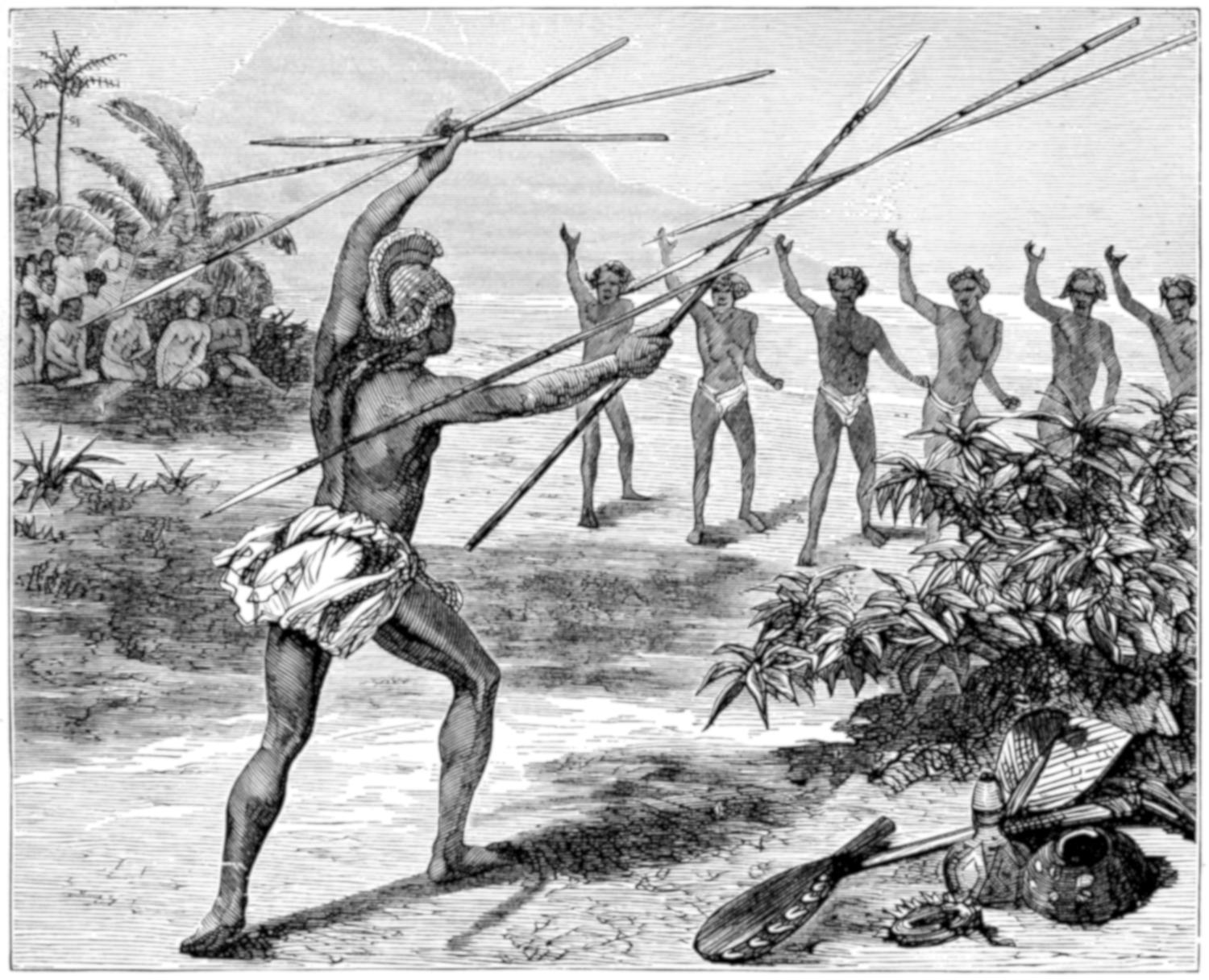
(1.) KAMEHAMEHA AND THE SPEARS.
(See page 1088.)
On some occasions the Sandwich Islanders
employ a weapon which much resembles
the merai of the New Zealanders. It is a
battledoor-shaped piece of wood, armed with
shark’s teeth round the edges. Its primary
use is that of a knife, and it is employed in
cutting to pieces the bodies of foes that are
slain in battle. Still, though it was originally
intended as an implement and not as
a weapon, it is of so formidable a character
that it is often employed in the latter capacity.
As far as can be ascertained, this knife
is considered to be especially devoted to the
one object of cutting up human bodies, and
is never employed in any meaner work.
As to clubs, they are of various shapes,
the natives having no special form, but carving
them into any device that may suit them
best, and using different kinds of wood for
the purpose.
The defensive armor of the Sandwich Islanders
is generally a thick mat, which is
worn in time of war, and is sufficiently
strong to save the wearer from the thrust of a
spear or the stroke of a dagger, and can even
greatly deaden the blow of a sling stone.
When Captain Cook was killed, the man
who precipitated the attack was wearing his
war mat, and, on threatening Captain Cook
with a dagger in one hand and a stone in
the other, the captain was obliged to fire at
him in self-defence. Not wishing to kill,
but only to wound and terrify his adversary,
he fired a charge of shot, which was resisted
by the war mat, so that the man escaped
unhurt, his impunity encouraging the natives
to proceed with their attack. Had
Captain Cook fired the other barrel, which
was loaded with ball, against which the war
mat would have been no protection, it is
probable that the natives would have been
deterred from their attack, and that Captain
Cook might have lived to complete the
voyage of discovery.
One of the most curious examples of defensive
armor is a breastplate made entirely
of teeth, so arranged that they overlap each
other just like the plates of scale armor.
One of these curious breastplates is in the
United Service Museum. Teeth hung in a
similar fashion are employed as castanets,
and are hung to the legs of dancers.
Warfare as originally practised by the
Sandwich Islanders was scarcely deserving
of the name, being little more than a series
of desultory skirmishes. They usually began
by practising in earnest the skill in
avoiding spears which has already been
mentioned as exhibited in sport. When
the opposing parties met, one of the chiefs,
clad in his feather helmet and cloak, advanced
in front of his own men, totally unarmed,
having nothing in his hand but a
fan, and challenging the enemy to throw
their spears at him. This they did, and by
means of wonderful agility in leaping, stooping,
and twisting his body, when the weapons
could not be struck aside by the fan or
caught in the left hand, he often contrived
to escape with his life.
Though it was a piece of military etiquette
that he should take no weapon into
the field, he was at liberty to hurl back at
his adversaries any of the spears which he
could catch. Should one of the enemy’s
spears bring him to the ground, or should
he be successful in killing an adversary,
there was an immediate struggle for the
possession of the dead body, which is looked
upon much as is a flag among ourselves, to
be defended or captured at all risks, even of
life.
This statement naturally brings us to the
disposal of the bodies of the slain, and to
the practice of cannibalism. That the latter
practice existed to a certain degree cannot
be denied, but it is equally certain that the
practice was always exceptional, and that it
was followed rather as a portion of military
etiquette than as a means of indulging the
appetite. As may be imagined, the higher
the rank of a slain man the greater the desire
to eat a portion, however small of his
flesh; and this theory will account for the
fact that the remains of Captain Cook which
were rescued from the natives bore evident
marks of fire.
It has often happened that cannibalism
has been thought to exist on the strength of
native evidence, which has afterward been
found to have been misunderstood. A remarkable
instance of such an error occurs
in the account of Captain Cook’s voyages.
In vol. ii. p. 209, there is an account of a native
who was observed to carry with him a
very small parcel carefully tied up with
string. After resisting many solicitations,
he allowed it to be opened, when there appeared
a small piece of flesh about two
inches long, “which to all appearance had
been dried, but was now wet with salt water.”
On being further pressed on the subject,
the man admitted that it was human
flesh, and, pointing to his own stomach, indicated
the portion of the body from which
it had been cut.
Nothing could be clearer than this account,
but in vol. iii. p. 133, the whole of
this evidence is shown to be utterly untrustworthy.
It seems that almost every
Sandwich Islander was in the habit of carrying
about with him a small piece of hog’s
flesh very highly salted, which he was accustomed
to nibble occasionally as a delicacy,
or by way of sauce when eating vegetable
food. By pointing to his stomach the man
merely used the conventional sign expressing
the excellence of the food; and as to his
statement that the flesh was that of a human
being, he was so eagerly and closely questioned
that, being a mere lad of sixteen or
seventeen, he gave an affirmative answer to
leading questions. As far as we can see, the
Polynesian race is not given to cannibalism,
while the Papuans are devoted to it.
We now come to the various games with
which the Sandwich Islanders amuse themselves.
Chief among them is the sport of
surf-swimming. This is practised in several
of the islands of Polynesia, but in none is it
carried out to such perfection as in the Sandwich
group. The following spirited account
of this sport is given in Captain Cook’s Voyages:—
“Swimming is not only a necessary art,
in which both the men and women are more
expert than any people we had hitherto seen,
but a favorite diversion amongst them. One
particular mode in which they sometimes
amused themselves with this exercise in
Karakakooa Bay, appeared to us most perilous
and extraordinary, and well deserving a
distinct relation.
“The surf, which breaks on the coast
round the bay, extends to the distance of
about one hundred and fifty yards from the
shore, within which space the surges of the
sea, accumulating from the shallowness of
the water, are dashed against the beach with
prodigious violence. Whenever from stormy
weather, or any extraordinary swell at sea,
the impetuosity of the surf is increased to
its utmost height, they choose that time for
this amusement, which is performed in the
following manner:—
“Twenty or thirty of the natives, taking
each a long narrow board, rounded at the
ends, set out together from the shore. The
first wave they meet they plunge under,
and, suffering it to roll over them, rise again
beyond it, and make the best of their way
by swimming out into the sea. The second
wave is encountered in the same manner
with the first; the great difficulty consisting
in seizing the proper moment of diving
under it, which, if missed, the person is
caught by the surf, and driven back again
with great violence; and all his dexterity is
then required to prevent himself from being
dashed against the rocks. As soon as they
have gained, by these repeated efforts, the
smooth water beyond the surf, they lay
themselves at length on their board, and
prepare for their return. As the surf consists
of a number of waves, of which every
third is remarked to be always much larger
than the others, and to flow higher on the
shore, the rest breaking in the intermediate
space, their first object is to place themselves
on the summit of the largest surge,
by which they are driven along with amazing
rapidity toward the shore.
“If by mistake they should place themselves
on one of the smaller waves, which
breaks up before they reach the land, or
should not be able to keep their plank in a
proper direction on the top of the swell,
they are left exposed to the fury of the next,
and, to avoid it, are obliged again to dive
and regain the place from which they set
out.
“Those who succeed in their object of
reaching the shore have still the greatest
danger to encounter. The coast being
guarded by a chain of rocks, with here and
there a small opening between them, they
are obliged to steer their board through one
of these, or, in case of failure, to quit it before
they reach the rocks, and, plunging
under the wave, make the best of their way
back again. This is reckoned very disgraceful,
and is also attended with the loss of the
board, which I have often seen, with great
terror, dashed to pieces at the very moment
the islander quitted it. The boldness and
address with which we saw them perform
these difficult and dangerous manœuvres
was altogether astonishing, and is scarcely
to be credited.”
These swimmers used often to pass nearly
a mile seaward, in order to enjoy the rapid
motion of their return as long as possible.
Both sexes and all ranks unite in it, and
even the very chiefs themselves, who have
attained to the corpulency which they so
much admire, join in the game of surf-swimming
with the meanest of their subjects.
Some of the performers attain to a wonderful
degree of skill, and, not content with
lying on the board, sit, kneel, and even stand
on it as they are hurled shoreward by the
giant waves. The boards are of various
sizes, according to the age and stature of
the owner. For adults they are about six
feet in length. They are slightly convex on
both sides, and are kept very smooth—all
surf-swimmers cherishing a pride in the
condition of their boards, and taking care to
keep them well polished and continually
rubbed with cocoa-nut oil. The artist has
finely represented on the following page the
marvellous conquest of the sea by these islanders.
Such utter mastery of the waves can only
be obtained by familiarity with the water
from earliest childhood. A Sandwich Island
child can swim as soon as it can walk, if not
sooner, the mothers taking them from the
breast, laying them on the surface of the
water and encouraging them to kick about
as if lying on their mats ashore. One
writer mentions his encounter with an object
which he took to be a very large frog,
but which turned out to be a Kanaka (i. e.
Sandwich Island) baby, which was lying on
its back and disporting itself quite at its
ease.
Indeed, in the mind of a Sandwich Islander
there seems to be no connection between
the ideas of water and danger, neither
does it enter his imagination that any human
being is unable to swim. Consequently,
there have been several instances
where white men have fallen into the water
and have been almost drowned, though in
the presence of the natives, simply because
the idea that any one could be endangered
by falling into the water never occurred to
them.
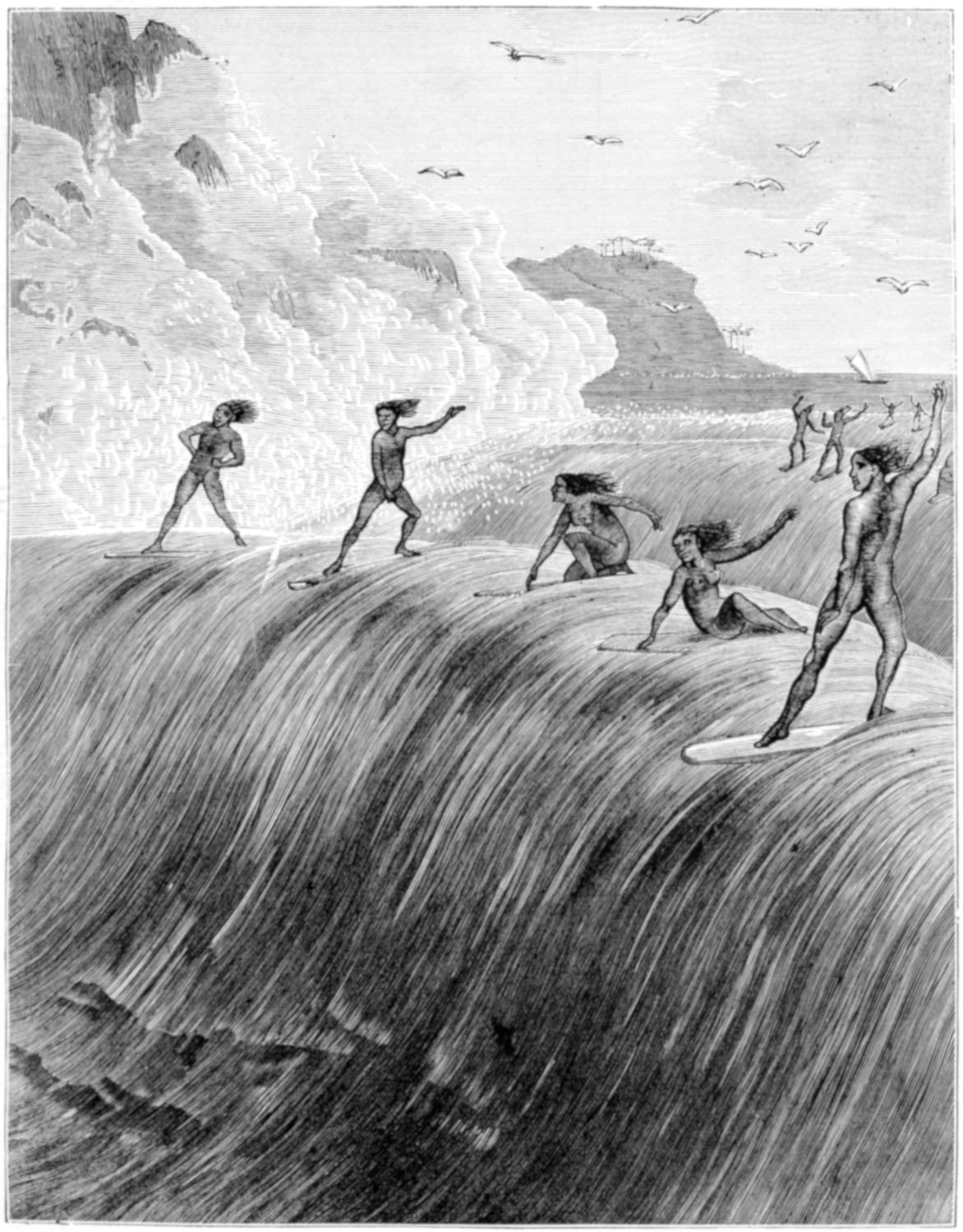
SURF SWIMMING BY SANDWICH ISLANDERS.
(See page 1092.)
They are equally skilful in managing
their canoes, and have a curious mode of
extracting amusement out of them. A
number of men will sometimes paddle a
canoe after dressing themselves up in a most
ludicrous fashion. They take large empty
gourds, and put them over their heads, after
cutting holes in them corresponding with
the eyes and nose, so that the effect is not
at all unlike that of a turnip lantern. To
the upper part of the gourd is attached a
bunch of slender green twigs, which look at
a little distance like a plume of feathers, and
to the lower part are suspended a number
of narrow strips of cloth, looking like a long
beard. Their appearance is shown in illustration
No. 2, on the 1089th page.
In every case where these masks were
worn, the wearers seemed exceedingly jovial,
laughing, shouting, and playing all kinds
of antics. It was suggested that these
masks were in fact helmets, used to protect
the wearers against the stones slung by
their adversaries; but the whole demeanor
of those who wore them was so completely
that of mere masqueraders that the helmet
theory seems quite untenable.
Ball play is a favorite sport with the
Sandwich Islanders, and is carried on with infinite
variations. Like the Tongans, they
can play with five balls at once, throwing
them from hand to hand, so that four of
them are always in the air. The balls are
extemporized on the spot, being made of
green leaves rolled together, and bound with
string.
They have a modification of this game,
which very much resembles our cup and ball.
They take a wooden stick, or handle, about
a foot or eighteen inches long, and through
one end of it they pass a peg of hard wood,
some three inches in length, so that an inch
or more projects on either side. They
bring both ends of the peg to a sharp point,
and the toy is then ready. Throwing up
the ball with the left hand, they catch it on
one of the pointed ends of the peg, and then
jerk it into the air, and catch it again, reversing
the stick so as to catch it upon the
other end of the peg. This game they will
keep up for a very long time without missing
ball once.
Another amusement is very popular.
Two players sit opposite each other, one
having a stone and a piece of bark cloth,
and the other a stick. The first player
takes the bark cloth, spreads it on the
ground, and with his right hand crumples it
up into folds, while with the other he deposits
the stone under the cloth. The peculiar
character of the cloth causes the folds
and wrinkles to remain unaltered, just as
would be the case if a piece of thin paper
were treated in the same way. The other
player carefully examines the cloth, endeavoring
to discover the spot under which the
stone is concealed, and, when he has made
up his mind, strikes at the stone with his
stick. Should he hit it, he wins a large
stake from his opponent; but in the very
likely event of missing it he forfeits a small
stake to the adversary. Great interest is
taken in the game by the spectators, and
heavy bets are laid on the two players.
They have many athletic amusements,
such as bowls, spear throwing, stick darting,
and similar sports and occasionally engage
in the rougher sport of boxing. As may be
seen from Captain Cook’s account, this sport
is not carried on with such fury and pertinacity
as in Tonga, the victory being gained
on comparatively easy terms:—
“As we had not yet seen anything of
their sports or athletic exercises, the natives,
at the request of some of our officers,
entertained us this evening with a boxing
match. These games were much inferior,
as well in point of solemnity and magnificence
as in the skill and powers of the combatants,
to what we had seen exhibited at
the Friendly Islands; yet, as they differed in
some particulars it may not be improper to
give a short account of them.
“We found a vast concourse of people assembled
on a level spot of ground, at a little
distance from our tents. A long space was
left vacant in the midst of them, at the
upper end of which sat the judges, under
three standards, from which hung slips of
cloth of various colors, the skins of two wild
geese, a few small birds, and bunches of
feathers.
“When the sports were ready to begin,
the signal was given by the judges, and immediately
two combatants appeared. They
came forward slowly, lifting up their feet
very high behind, and drawing their hand
along the soles. As they approached, they
frequently eyed each other from head to
foot in a contemptuous manner, casting several
arch looks at the spectators, straining
their muscles, and using a variety of affected
gestures. Being advanced within reach
of each other, they stood with both arms
held out straight before their faces, at which
part all their blows were aimed. They
struck, in what appeared to our eyes an awkward
manner, with a full swing of the arm;
made no attempt to parry, but eluded their
adversary’s attack by an inclination of the
body or by retreating.
“The battle was quickly decided; for if
either of them was knocked down, or even
fell by accident, he was considered as vanquished,
and the victor expressed his triumph
by a variety of gestures, which usually
excited, as was intended, a loud laugh
among the spectators. He then waited for
a second antagonist, and, if again victorious,
for a third, till he was at last in his turn
defeated.
“A singular rule observed in these combats
is, that whilst any two are preparing to
fight, a third person may step in, and choose
either of them for his antagonist, when the
other is obliged to withdraw. Sometimes
three or four followed each other in this
manner before the match was settled. When
the combat proved longer than usual, or
appeared too unequal, one of the chiefs
stepped in, and ended it by putting a stick
between the combatants. The same good
humor was preserved throughout which we
before so much admired in the Friendly
Islanders. As these games were given at our
desire we found it was universally expected
that we should have borne our part in them;
but our people, though much pressed by
the natives, turned a deaf ear to their challenge,
remembering full well the blows they
got at the Friendly Islands.”
A sport which was formerly in great
vogue in the Sandwich Islands is sledging,
the sloping sides of the mountain ranges
being pressed into the service of the players.
The game is called holua, and is
played in the following manner:—
Each player is furnished with a sledge,
made of two narrow runners, varying from
seven to eighteen feet in length, three
inches deep, and rounded off at one end,
just like the steel runner of a skate. These
are placed side by side, not parallel, but
slightly diverging, the space between the
runners being about two inches at the tips,
and five inches at the other end. They
are connected together with cross-pieces of
wood, and mostly covered with strong matting.
The native name for the sledge is
papa. In order to prepare a path on which
the sledge can travel, the natives cut a narrow
and shallow trench from the top of the
mountain to the base, and even carry it for
a mile or more on level ground. Before the
sport is begun, the trench is laid with grass
so as to make the path easier.
When the players have assembled at the
top of the mountain, one of them takes the
sledge in his hands, holding it in front of
him, retreats a few paces, and then runs
forward with all his speed, flings himself
head foremost into the trench, and glides
down it at a terrific pace, resting on his
sledge. The rapidity with which a well-managed
sledge will dash down the trench,
is absolutely fearful, the incline being often
at an angle of forty-five degrees. The art
of balancing the narrow sledge is a very
difficult one, and if a player should chance
to lean too much to one side, or should
guide his sledge out of the trench, it is
scarcely possible for him to escape with his
life. The sledge flies to pieces in a moment,
the rider is hurled high in the air, and goes
rolling down the steep hill, without any
means of guiding or stopping himself.
The winner in this game is the player
who travels the farthest along the trench,
and so fascinating is the sport, that the natives
have been known to stake the whole
of their property on their skill. They staked
their houses, their lands, their fruit trees,
and their crops. Husbands staked their
wives and children, and wives staked themselves.
And after they had lost all that
they had, or were likely to have, they
staked their very bones, to be used after
death in making fish hooks and arrow
heads.
The religion of the Sandwich Islanders
resembles so closely that of the Polynesians
that little need be said about it. What worship
they have is extorted by fear, and, in
accordance with this principle, they make
their idols as ugly as possible. There is a
certain character about the idols of the
Sandwich Islands which, like the carving of
New Zealand, cannot be mistaken.
In order to show how completely this
character is impressed upon the workmanship,
I introduce upon the following page
two specimens, one from the British Museum,
and the other from my own collection.
The former of these, No. 1, is made, like
the feather helmets, of wicker-work, and is
very much larger than any human head and
neck. It is covered with the red and yellow
feathers which have already been mentioned,
and, from the mere price of the material,
must have been, in the days in which it was
made, a most costly and precious object.
The eyes are made of mother-of-pearl,
and in the centre of each is set a black bead
by way of pupil. The enormous teeth which
beset the open mouth are simply the fangs,
or canine teeth, of dogs. The top of the
head is furnished with a crest, just like
that of the feather helmet. In spite of the
rudeness of form, the image possesses a
certain force and vigor, which shows that
the native who made it had some modicum
of artistic power, which in this case expresses
itself in outline, just as in the case
of the feather cloak it is exemplified in
color.
By way of contrast with this idol, we will
now look at another specimen (No. 2, on
same page), in which the artist has been
obliged to renounce color, and trust entirely
to outline; and it cannot be said that he has
been unsuccessful. The head and body of
this image are cut out of a white and very
light wood, and have been covered with
bark cloth. This cloth has been stained
black, and the native artist has contrived to
apply it with such perfection of manipulation
that it fits closely to all the inequalities
of the carving, and cannot even be seen
until specially pointed out.
The head and neck are separate from the
trunk, and carved out of a single piece of
wood; and even the bold crest and its supporting
rays are cut out of the same piece
of wood. The teeth of the upper jaw are
those of a human being; but those of the
lower jaw are simply a row of the palatine
teeth of some large fish, and are sixteen in
number. They are flanked at each angle of
the mouth by a human tooth. After the
teeth have been inserted into the wood, the
bark cloth has been applied, and is turned
in at the roots of the teeth, so as to represent
the gums. The eyes are simply oval
pieces of mother-of-pearl.
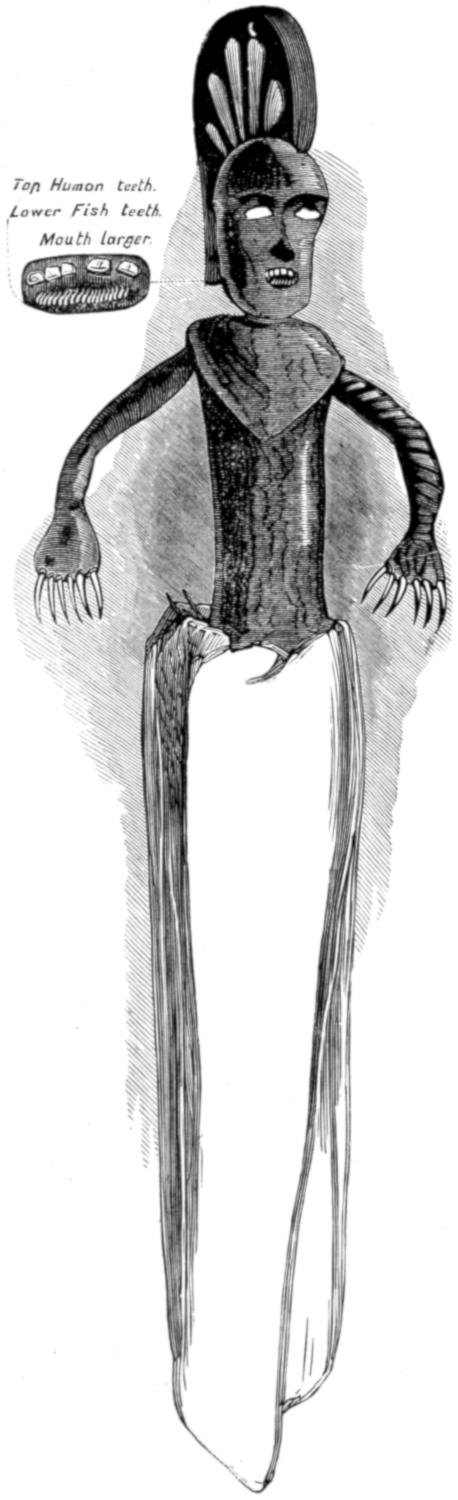
Top Human teeth.
Lower Fish teeth.
Mouth larger.
(2.) WOODEN IDOL.
(See page 1096.)
It is rather remarkable that the strip of
cloth which runs over the crest has not been
stained black, like that which covers the
head, face, and neck, but is nearly white,
and of much stronger and coarser texture.
The skill with which the maker has applied
the cloth to the wood is really admirable.
He has evidently soaked it until it was quite
soft and tender, and by means of careful
stretching and pressing has “coaxed” it
over the various irregularities—such as the
nose, eyes, and mouth—so that it fits as
closely as if it were the real skin.
The neck is small, narrow, and scarcely
worthy of the name, being in fact little more
than a large peg, by which the head may be
attached to the body when needed. In consequence
of this arrangement, the position
of the head can be altered at will, and the
variety of expression gained by so simple an
arrangement is scarcely credible.
The body of the idol is made of the same
light wood as the head, and is also covered
with the black bark cloth. There is a socket
between the shoulders, into which the neck
fits loosely. The arms are nothing more
than bundles of rushes or reeds, tied with
cloth; and each hand is furnished with six
fingers, probably as a symbol of extraordinary
power. The fingers are merely dogs’ teeth,
the whiteness of which presents a curious
contrast with the black head and body.
There are no legs, nor even any indication
of legs, the body being little more than a
block of wood, with a hole at the top for the
insertion of the neck, and a smaller hole at
each shoulder for the insertion of the arms.
Whatever artistic power the maker possessed
has been given to the head, and it
must be acknowledged that he has carried
out his idea most vigorously. The long
dress worn by this idol is not stained black,
like that which covers the face, head, and
body, but is white, and without even a
pattern.
For this interesting specimen I am indebted
to E. Randell, Esq., who has furnished
me with many of the objects which have
been figured in this work.
CHAPTER CXIII. THE CAROLINE ARCHIPELAGO. DRESS—ARCHITECTURE—AMUSEMENTS—WAR. — THE PELEW ISLANDS.
DISCOVERY AND NAMING OF THE ISLANDS — THEIR GEOGRAPHICAL EXTENT — THE MARSHALL AND
GILBERT GROUPS — INHABITANTS OF ROMANZOFF ISLAND — THE ISLAND OF BORNABI AND ITS
INHABITANTS — TATTOOING AND HAIR DRESSING — A MAN OF FASHION IN BORNABI — ARCHITECTURE
AND ANCIENT RUINS — LOVE OF COAST — THE PELEW ISLANDS — SHIPWRECK OF CAPTAIN
WILSON — COMPLEXION AND GENERAL APPEARANCE OF THE NATIVES — THE TATTOO — CURIOUS
COMBINATION OF NAKEDNESS AND MODESTY — USE OF THE BETEL-NUT — THE RUPACKS AND THE
BONE BRACELET — MODE OF INVESTITURE — SPEAR THROWING — MODE OF CONDUCTING SEA
FIGHTS — ARCHITECTURE OF THE PELEW ISLANDS — MANUFACTURE OF DOMESTIC IMPLEMENTS — DANCE
OF THE WARRIORS — IDEA OF RELIGION — A FUNERAL IN THE PELEW ISLANDS — STORY
OF LEE BOO.
Passing in a south-westerly direction from
the Sandwich Islands we come to a very
large group called the Caroline Archipelago.
These islands were discovered—as far as is
known—in 1526, by the Portuguese, who in
those days were the most enterprising navigators
in the world. About fifty years afterward
they were visited by Drake, but they
did not receive the name by which they
are known until more than a hundred years
after Drake’s voyage, when they were named
by the Spanish the Carolines, in honor of
Charles the Second, the then king of Spain.
These islands extend over a very considerable
geographical range, a space of
some fifty degrees intervening between the
most easterly and westerly of them. Owing
to the extensive range of these islands,
there is considerable difference between
the manners and customs of these natives,
and even between their form and
complexion. We will therefore take as examples
some of the easterly, central, and
western islands.
The most easterly of the group are those
which are called the Marshall and Gilbert
Islands, the former being those of the north
and the latter those of the south. They are
sometimes divided into the Eastern and
Western Islands, the former being the
Radick and the latter the Ralick chain, each
group comprising about fifteen or sixteen
islands.
These islands are all low in the water,
being mostly of coralline structure, so that
they are not visible from any great distance.
In consequence of their lowness, they seem
to have escaped the observation of voyagers
until 1788, when they were discovered by
Marshall and Gilbert, after whom they were
named. As is usual in coral islands, the soil
is but shallow, having been formed by the
decomposition of vegetable matter thrown
on the coral reefs by the waves. The vegetation
is therefore scanty, and is mostly
confined to bananas, cocoa-nut trees, bread-fruit—all
of which thrive best on a low
situation near water.
As a sample of the Marshall Islanders, I
give a portrait of a man and woman of Romanzoff
Island, on the next page. They
are a rather fine race, taller than the generality
of the Caroline Islanders, and possess
tolerably good features. They use the tattoo
with some profusion, both sexes appearing
to be equally addicted to it. They are better
clothed than many Polynesians, the men
wearing a short mat round their waists, and
the women being clad in a very fine and
neatly-made mat, falling nearly to the feet.
The hair is long, and naturally curling, and
is worn long by both sexes. Earrings are
in great request, and some of them, as may
be seen by reference to the illustration, are
enormously large.
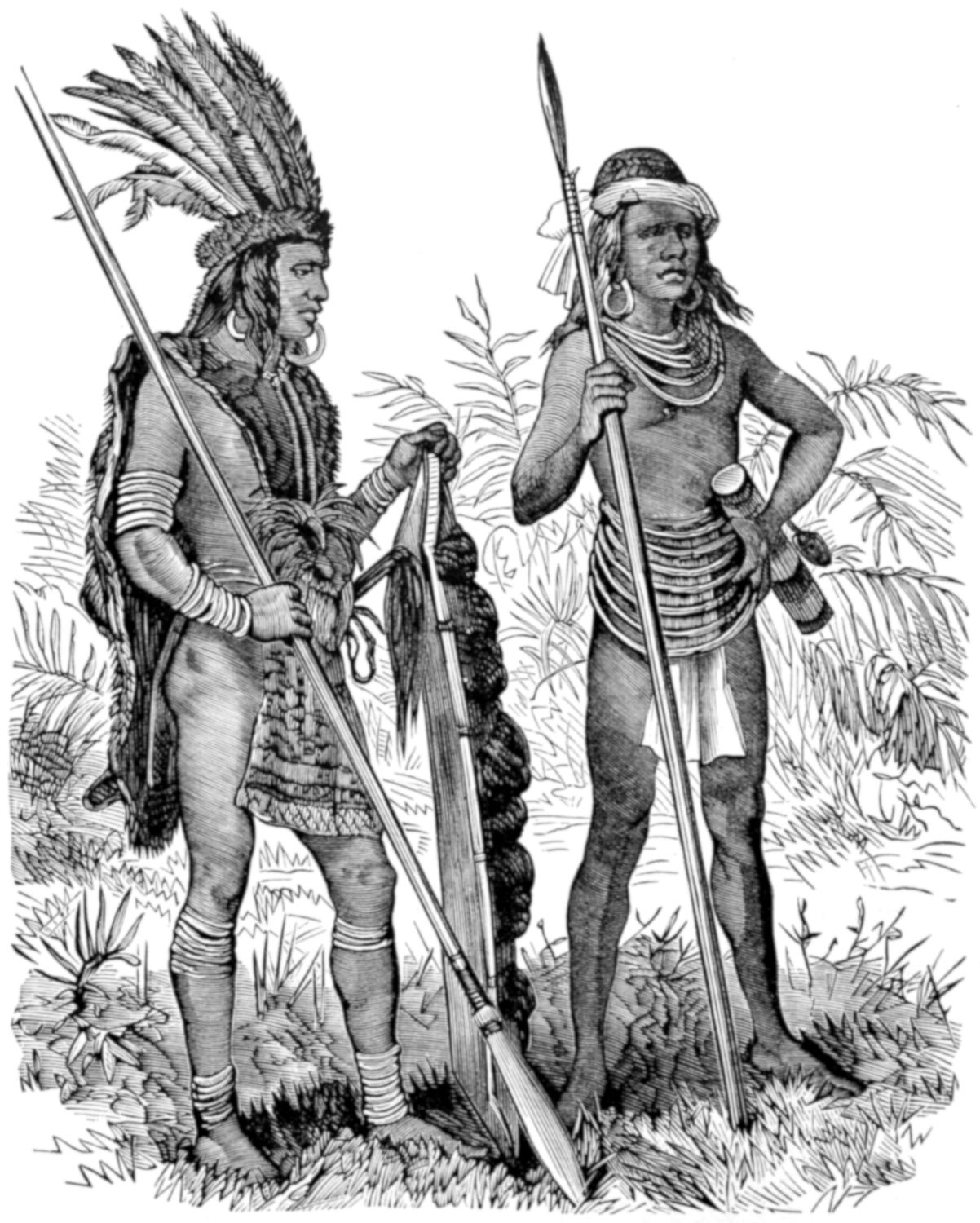
(2.) DYAK WARRIOR AND DUSUM.
(See page 1112.)
From the structure of the island, it is evident
that the present inhabitants are not
aborigines, but came from other islands at
no very remote period. They have kept up
the nautical spirit to which they owe their
presence on the island, and make long voyages
from one island to another. Their
canoes are well made, and are built of
bread-fruit wood.
Bornabi is one of the largest and most
important of these islands, being about
seventy miles in circumference, and having
a sufficient variety of soil to be very fertile.
Instead of being as low-lying as some of
these islands, it is of volcanic origin, shooting
up to a considerable height in the middle,
and surrounded by flat coral reefs.
In consequence of this structure, it affords
excellent harborage, and has become a great
place of resort for whaling vessels. Like
some parts of America within the same
zone, and having a somewhat similar contour,
the island is a very wet one, so that
the combined heat and moisture produce a
wonderful fertility of vegetation. Even on
the higher parts of the island, the fresh
water nourishes various trees and shrubs,
while on the coast the mangrove, which
delights in salt water, absolutely grows into
the sea, and, by its interlacing roots and
branches forms a barrier which cannot be
penetrated except through the apertures
made by the mouths of rivers and creeks.
The inhabitants are of a fair average
stature, the men being about five feet eight
inches high, while the women are much
shorter. They are, however, well proportioned,
and not stumpy or clumsy, as is too
often the case with the women of uncivilized
races.
Like the Romanzoff Islanders, they tattoo
themselves liberally, and both sexes wear
their black hair very long, keeping it well
oiled and carefully dressed, and, in the case
of people of rank, adorning it with wreaths
of flowers. They have the same odd passion
for turmeric which is found in the Polynesian
races generally, anointing themselves
profusely with it, and thereby converting
their naturally pleasing copper color into a
repulsive yellow.
The men dress themselves very carefully,
a Bornabi man of fashion spending a vast
amount of time on his costume. He must
not exhibit a vestige of hair on his face, but
must painfully pluck out each individual
hair by means of forceps made of a couple
of cockle-shells, or a piece of tortoise-shell
bent double. He must wear at least six
aprons, one over the other. These aprons
are made of strips of the cocoa-nut leaf
bleached white and about two feet in length.
He must have round his waist a belt or sash
made of banana fibre, and dyed scarlet and
yellow. He must have his necklaces, his
head-band, and his scarlet tassels in his
ears; and he finishes off his costume by a
sort of parasol or sunshade made of leaves,
which he ties round his head so as to preserve
the face from the sun.
This elaborate toilet must be made several
times daily, as every native bathes, oils,
and paints his skin yellow at least three
times every day. The dress of the women
bears some resemblance to that of the men,
except that, in lieu of the series of apron
fringes they wear bark cloth fastened round
the waist and reaching to the knee.
In architecture the people of Bornabi are
superior to the generality of Polynesians.
Like the Marquesans, they begin by building
a platform of stones, some four or five
feet in height, and upon this they erect the
framework of the edifice. The spaces between
the upright timbers are filled in with
wicker-work, in which are left certain apertures
that answer the purpose of windows.
The floor is covered with the same kind of
wicker-work, except a small space in the
centre, in which the fireplace is made. The
roof is thatched neatly with pandanus leaves.
In all these particulars there is little distinction
between the architecture of Bornabi
and that of many other islands. The chief
point of difference lies, however, in the fact
that the timbers are squared, and that,
instead of being merely lashed together,
they are fastened by tenon and mortise.
It seems probable that the superiority of
their architecture, more especially in the
squaring of beams and the use of the mortise,
is due not so much to themselves as to
the remembrance of buildings erected by
white men several centuries ago. Near one
of the harbors are some ruined buildings,
which are evidently not of savage architecture.
They are built of cut stones, which
have been imported from some other country,
and are arranged in streets, looking as
if they had formed a portion of a fortification.
It has been conjectured that these
buildings were the work of the Spanish
buccaneers, who used, some centuries ago,
to range these seas, and would have found
such a harbor and fort invaluable to them.
As far as is known, the inhabitants of
Bornabi keep almost entirely to the coast,
and never visit the interior. It is certain
that the cultivated grounds only extend for
a very little distance inland, and, as all the
energy of these islanders naturally takes a
seaward direction, it is very probable that
the natives speak truth when they say that
they have never even visited the centre of
their island.
The westernmost group of the Carolines
is known by the name of the Pelew or Pallou
Islands. They were discovered, in 1543,
by Villabolos, but have been made known
to us principally by means of Captain H.
Wilson, who was wrecked there in 1783.
The group consists of about twenty small
islands, which are surrounded by a reef.
The inhabitants are of a dark copper color,
well made, tall, and remarkable for their
stately gait. They employ the tattoo in
rather a curious manner, pricking the patterns
thickly on their legs from the ankles
to a few inches above the knees, so that they
look as if their legs were darker in color
than the rest of their bodies. They are
cleanly in their habits, bathing frequently,
and rubbing themselves with cocoa-nut oil,
so as to give a soft and glossy appearance to
the skin.
The hair of the head is fine and black, and
is worn long by both sexes, being rolled up
in a peculiar fashion close to the back of the
head. That of the face and chin is mostly
removed, being plucked out by tweezers,
only a few men, remarkable for the strength
and thickness of their beards, allowing them
to grow. The men wear no clothing, not
even the king himself having the least vestige
of raiment, the tattoo being supposed to
answer the purpose of dress.
So unacquainted with real clothing were
they when Captain Wilson visited them,
that they were utterly perplexed at the garments
of the white men, lifting up the flaps
of the coats, pinching the sleeves, and then
comparing them with their own naked limbs,
evidently fancying that these mysterious
objects were the skin peculiar to the white
man. They also took the blue veins on the
seamen’s wrists for lines of tattooing, and
asked to be allowed to see the whole of the
arm, in order to find out whether the blue
lines were continued beyond the wrist.
In spite, however, of the absence of dress
the deportment of the sexes toward each
other is perfectly modest. For example,
the men and women will not bathe at the
same spot, nor even go near a bathing-place
of the opposite sex unless it be deserted. If
a man is forced to pass near a women’s bathing-place,
he is obliged, when he comes
within a stipulated distance, to give a loud
shout; and, if it be answered by a female
voice, he must either pass by a circuitous
route, or turn back and wait until the women
have left the spot.
Their features are tolerably good, the nose
rather prominent, and the mouth moderately
large. They would look a tolerably
handsome people but for their custom of
chewing the betel-nut, which stains the
mouth red and the teeth black. The chiefs
and all the principal men are so devoted to
the betel that they always carry with them
a little basket containing the nuts, and a
small bamboo vessel in which they keep the
quicklime which is mixed with the betel
when chewed.
Although they care nothing for dress, and
comparatively little for ornament, the very
great chiefs wear one decoration which is
prized by them much as is the Garter in
England, or the Golden Fleece in Spain.
This is a bone bracelet, worn on the left
wrist and denoting the very highest rank
next to that of the king himself. Those who
are privileged to wear it are called Rupacks,
and, as will presently be seen, the rank is
not necessarily hereditary, but is conferred
at the pleasure of the king.
It seems strange to us that distinctions of
rank should be thus sharply defined among
a people like the Pelew Islanders, and that
“naked savages” should have their various
gradations of social position. That a definite
scale of rank should exist at all is an evidence
of some civilization, and that so complete
a system should be found among these
islanders appears a perfect enigma to those
who have been accustomed to associate
clothing and civilization as inseparable conditions.
Yet here we have the singular
fact that there is a distinct division of ranks
into king, nobles, gentry, and peasantry;
and that, although these ranks are perfectly
well defined and acknowledged, not a man,
from the almost despotic king to the lowest
subject, wears the slightest article of clothing.
Not only are these distinctions jealously
observed, but we find also that the nobles
are divided into several ranks, as is the case
in civilized lands, and that the highest rank
is denoted by a symbolical badge. This badge
is conferred only by the sovereign himself,
and the investiture with the Rupack’s bone
is conducted with a ceremonious solemnity
that denotes the estimation in which it is
held. So deeply are the Rupacks attached
to this symbol of their rank, that a rebel
Rupack, who had made war against the
king, and was taken alive, resisted every
attempt to deprive him of his bracelet, and
did not part with it until he had sacrificed
his life in its defence. In shape the bone
bears a curious resemblance to the open
jaws of a skate, and is probably made on
that model.
The mode of investiture is a very ceremonious
one, and is illustrated on the following
page. The Rupacks are assembled together
in a sort of chapter of their order, and the
Rupack elect is seated at a little distance
from them. The king, or a Rupack appointed
by him, then takes the bracelet, and
directs the candidate to throw a stone as far
as he can. This is done in order to ascertain
which hand he habitually uses, so that
if he be a right-handed man the bracelet
goes on the left wrist, and if a left-handed
man on the right wrist.
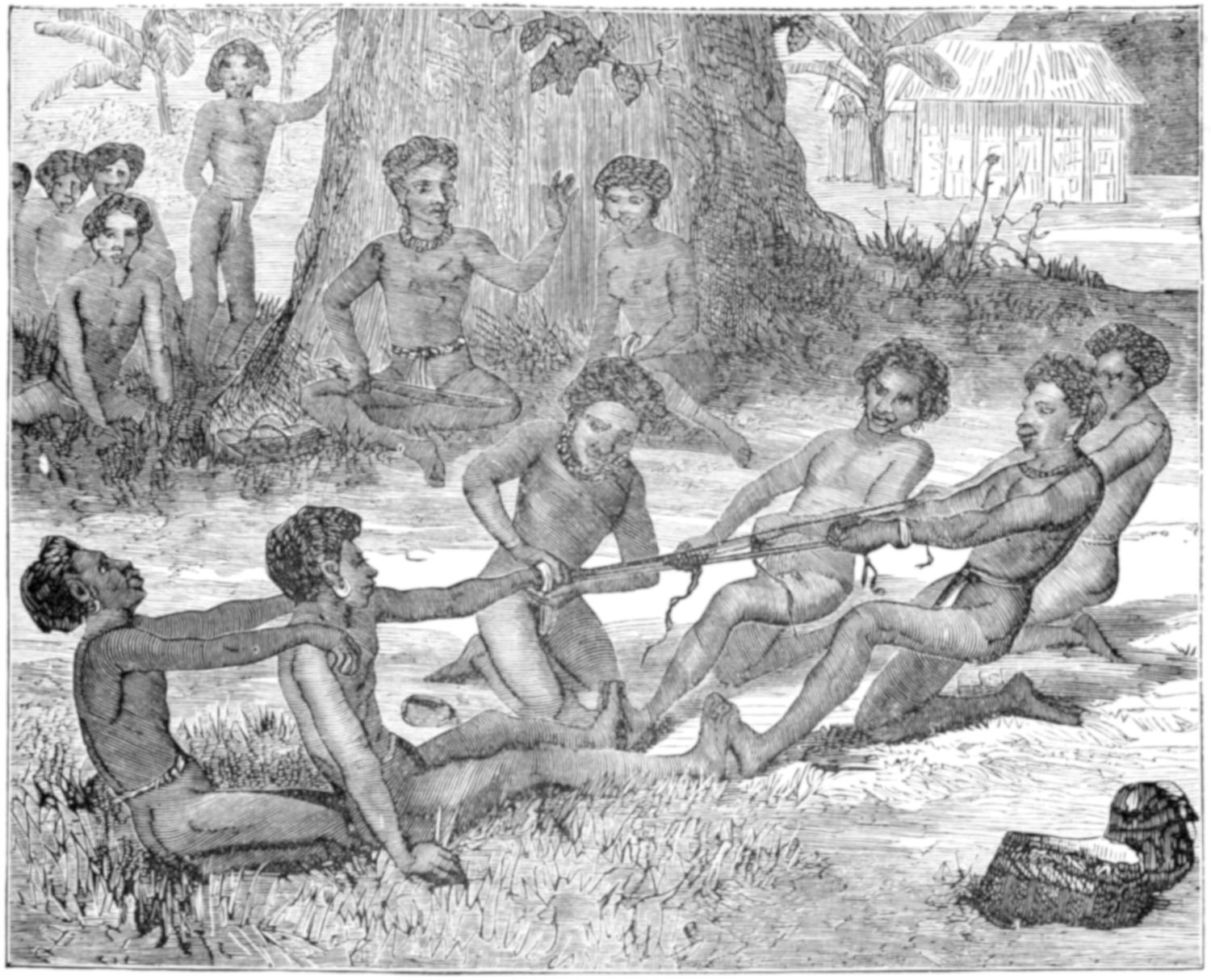
(1.) INVESTITURE OF THE RUPACK.
(See page 1104.)
A string is then tied to each finger of the
hand; the strings are passed through the
bracelet, which, together with the hand, is
plentifully anointed with cocoa-nut oil. The
principal Rupack then places himself behind
the candidate, and holds him firmly by the
shoulders, while another hauls at the strings.
The king, in the meantime, squeezes together
the fingers of the hand, and by degrees
draws the bracelet firmly on the wrist,
he then makes a speech to the new Rupack,
telling him to polish the bracelet daily, and
keep it bright; never to suffer its honor to
be tarnished, and never to part from it but
with his life.
Captain Wilson, who was himself invested
with the Rupack’s bone, writes thus of the
ceremony and its object:—“This mark of
distinction is given and received in these
regions as a reward of valor and fidelity,
and held out as the prize of merit.
“In this light such public honors were
originally considered, and still ought to be
so, in every state, from Pelew to Britain.
And while they continue to be thus regarded
they will operate on the human passions—excite
emulation, inspire courage,
promote virtue, and challenge respect. The
decoration, indeed, derives all its splendor
from the combined ideas of the mind whilst
viewing it; and the imagination is equally
impressed with the same sentiment, whether
the badge of honor be a strip of velvet tied
round the knee, a tuft of riband and a cross
dangling at the button-hole, a star embroidered
on the coat, or a bone upon the
arm.”
He might have added that the intrinsic
value of the decoration bears no comparison
with the honor which it denotes, and that
the bone of the naked Pelew Islander, the
laurel or parsley crown of the ancient warrior,
or the Victoria Cross of the modern
hero, are alike valueless and priceless. It is
remarkable that the king does not wear the
bone, so that he has no external sign to distinguish
him from the meanest peasant.
The Pelew Islanders are not a very warlike
people, and their weapons are, therefore,
simple and few. They have two kinds
of spears, one used as a missile, and the
other as a pike. The missile spear is thrown
by a very remarkable instrument, reminding
the observer of the Australian wummerah,
or throw-stick.
It consists of a piece of wood about two
feet in length, and having a notch at one
end. When the warrior wishes to throw his
spear, he places the butt in the notch of the
throwing-stick, and with his left hand bends
the elastic bamboo shaft until it is nearly
doubled. The hold of the left hand is then
loosed; and the spear projects itself to a considerable
distance by means of its own elasticity.
To an European nothing can be
more awkward than this mode of throwing
the spear; but the Pelew Islanders can send
the weapon to a considerable distance, and
aim it well besides.
Even without the aid of the throwing-stick,
they are no mean adepts at hurling
the spear. When Lee Boo, the son of the
king, was at Canton, some gentlemen who
were skilled in spear throwing asked him to
exhibit the manner in which his own people
managed the weapon. He took the spear,
and, not thinking that it was to be thrown,
merely quivered and poised it according to
the usual preliminaries. He was then requested
to throw it at a gauze cage, with a
bird painted on it. The cage was at such a
distance that the gentlemen could seldom
strike it. Lee Boo, however, took up the
spear carelessly, poised it for a moment,
hurled it, and not only hit the cage, but
struck the bird through the head.
The Rupacks mostly carry swords and
daggers. The former are made of a very
heavy wood, and nearly three feet in length.
They are inlaid with pieces of white shell,
and are strong and heavy enough to kill a
man with a single blow. The daggers are
made of the tail-bone of the sting-ray, and,
when not in use, are carried in a sheath
made of a single joint of bamboo, just as is
the case with the small knives of Borneo.
Land battles are seldom fought in these
islands, the natives trusting chiefly to their
canoes, which are of large size and well
built. Their hulls are cut out of tree
trunks, and then are carved, painted, and
inlaid with the patient care which distinguishes
savage art. When the king goes
out in state, the canoes are further adorned
with bunches of shells, strung on cords and
hung to the bows and stern-posts. The
out-rigger is used, and the sails are of the
“latine” form. Despite, however, of the
care bestowed upon their vessels, the Pelew
Islanders are not good sailors, and seldom
venture outside the chain of reefs which encircle
their group of islands. Even within it
when the sea ran at all high, they would not
venture into their canoes.
In consequence of their mode of fighting,
the capture of an enemy’s canoe is thought
of much more consequence than the slaughter
of his soldiers, and is looked upon much
in the same light as we consider the capture
of an enemy’s gun or flag. Therefore when
one party finds that the battle is going
against them, they turn their canoes landward,
and drive them ashore with all their
might, and, if possible, drag them so high
on the beach that they cannot be floated
without exposing the invaders to almost
certain death.
The principal tool used in making the
canoe is the adze, or axe. In form the
weapon is almost identical with the Polynesian
adzes which have been already described
in this work. The blade is made of
the thick and strong shell of the giant clam,
and the most curious point of the instrument
is that the head revolves in a groove,
so that it can be used as an adze or an axe
at pleasure. The Dyak boat builder has a
precisely similar instrument, as will be seen
in the course of a few pages.
Their smaller tools and implements—such
as stone knives, comb, and string—they
carry in the basket which holds their
betel; and as they have no dress, and consequently
no pockets, a man never walks to
any distance from his home without carrying
the basket with him.
The architecture of the Pelew Islanders
is very good. The houses are raised about
three feet from the ground by means of
stone posts, upon which are laid the beams
which support the flooring and side-posts.
The walls are made of thick matting, which
extends from post to post, and the floors are
generally of plank, having an inch or so of
space between the boards. Sometimes they
are made of split bamboos, which become
polished and very slippery by the constant
tread of naked feet.
Each house has in the centre its fireplace,
sunk lower than the flooring, and formed of
stones and earth. The fire is kept burning
all night, not for the purpose of warmth, but
that the smoke may fill the house, and drive
away mosquitoes. When the house is a very
large one, and employed for the general use,
there are two fireplaces, one at each end.
Along the sides of the house are arranged
certain apertures which answer equally the
purposes of windows or doors, and are furnished
with sliding shutters, by which they
can be closed at pleasure. Each of these
apertures is furnished with stepping stones,
by means of which the inhabitants can enter
or leave the house without having to
clamber from the ground to the raised floor.
The large houses are employed for public
uses, the councils being held in front of
them, or the people assembling in them for
social talk, in which the women bear their
full share. Some of these houses are from
sixty to eighty feet in length.
Being a cleanly people, the Pelew Islanders
keep their houses neatly swept, the
broom being a bundle of cocoa-nut husks
tied together. The vessels which contain
fresh water are simply joints of the bamboo,
the open ends of which are furnished with a
sort of spout or lip, by means of which the
water can be poured without danger of
being spilt.
The cooking vessels are made of earthenware,
and are mostly of an oval shape. They
are not, however, very good potters, their
pots and pans being rather fragile, and so
badly burnt that the natives dare not put
them at once on the fire, but set them
first at a little distance, and, as they become
warmer, bring them nearer, turning them
continually, so as to heat each part equally.
When Captain Wilson was at the Pelew
Islands, the king had a vessel of which he
was very proud. It was carved out of a
block of wood, plentifully inlaid with pieces
of white shell, and, when the cover was
upon it, formed a tolerably fair representation
of a bird. This vessel held about nine
gallons, and on occasions of great ceremony,
was brought out and filled with sweet
drink for the use of the king and his Rupacks.
Of the amusements of the Pelew Islanders
Captain Wilson says little, and gives but
a brief description of the very odd dance in
which they delight. This description will
be better understood by reference to the
illustration on the 1105th page. “In the
evening our people were entertained with a
dance of the warriors, who were just then
returned, which was performed in the following
manner:—
“The dancers have a quantity of plantain
leaves brought to them, which they split
and shiver into the form of ribands. These
they twine and fix round their heads, wrists,
waists, ankles, and knees; and the leaves
being of a yellowish hue, so prepared, have
not an inelegant effect when applied to their
dark copper skin. They make also bunches
or tassels of the same, which they hold in
their hands.
“When drawn out, they form themselves
into circles of two or three deep, one
within another. In general, an elderly man
amongst them begins in a very solemn tone
something like a song, or long sentence—for
our countrymen could not discriminate
which it was—and when he comes to a
pause, or what we should call the end of a
stanza, a chorus is struck up, and the
dancers all join in concert, still continuing
their figure.
“Their dancing does not so much consist
in capering or agility as in a particular
method they have of balancing themselves,
and this frequently very low sideways, singing
together all the while; during which
they will flatten their circles, so as to bring
themselves face to face to each other, lifting
up the tassels they hold in their hands,
and giving them a clashing or tremulous
motion. After this there will be a sudden
pause, and an exclamation from every one
of ‘Weel!’ Then a new sentence or stanza
is repeated, and danced to as before, and the
same ceremony continued till every man
who is engaged in the dance has in his turn
had his repetition and chorus.”
As far as was ascertained by Captain Wilson,
the Pelew Islanders have some notions
of religion, and certainly believed in a life
after death. They had several superstitions,
one of which was that the wood of a
certain tree was unlucky, and always brought
harm wherever it was used. When Captain
Wilson was building his new vessel, he used
some planks of this tree, much to the dismay
of the king, Abba Thulle, who begged
him to remove them. Captain Wilson explained
to him that as in his own country
any kind of suitable wood was employed for
ship building without producing disastrous
results, the same impunity was to be expected
in the Pelew Islands. As it happened,
shortly after the obnoxious planks had been
inserted, one of the carpenters fell from the
side of the vessel, and hurt himself severely,
thus confirming the natives in their belief.
Their funeral ceremonies are very short
and simple, and even in one instance witnessed
by Captain Wilson, when the son of
the principal chief was buried, there was
scarcely any ceremony. The corpse was
wrapped up in mats, and borne by four men
on a bier, no men except the actual bearers
attending. A number of women followed
the bier, and poured out loud lamentations
as they walked. When they arrived at the
place of burial, the body was laid in the
grave, and the earth immediately filled in
by the four bearers, while the women knelt
round, and renewed their lamentations,
marking as if they would tear up the body
from the ground.
Next day, however, Raa Kook, the father
of the deceased, went to the burial-place,
and performed a curious ceremony. He
took two old cocoa-nuts (young nuts being
always gathered for consumption) and some
red ochre, with which he drew transverse
stripes across the nuts. He then laid the
painted nuts by his side, and repeated, in an
undertone, some words which were supposed
to be an incantation or prayer of some
kind. A bundle of betel leaves was treated
in the same way, and the whole were then
delivered to an old woman, who went with
them toward the grave; but the precise termination
of the ceremony was not ascertained.
On page 1107 mention was made of Lee
Boo. As this young man was the first Pelew
Islander who ever visited England, and was
besides a very remarkable character, I will
conclude this account with a short memoir
of him.
He was the second son of the king, Abba
Thulle, who was no common man, and well
deserving of the power which he held. He
possessed great energy, wonderful liberality
of mind, and an innate nobility of disposition.
The visit of the white men taught
him their infinite superiority, and when
Captain Wilson had built his new ship, and
was about to start, Abba Thulle begged him
to take Lee Boo to England, to have him
instructed in the arts of civilization, and to
send him back again so that he might be the
teacher of his future people. The request
was granted, and Lee Boo accompanied
Captain Wilson to England, where he lived
for five months, winning the esteem and affection
of all whom he met, by his intelligent,
modest, and affectionate nature. Unfortunately
for his father’s hopes, he was attacked
with small-pox, of which he died, his
last wish being that all presents that been
given him should be sent to his father. He
died on Dec. 27, 1784, and was buried in
Rotherhithe Church, where a tomb was
erected to his memory by the India Company.
CHAPTER CXIV. BORNEO. THE DYAKS, THEIR APPEARANCE AND DRESS.
SUPPOSED ORIGIN OF THE DYAKS — NUMBER OF TRIBES — THE SEA AND LAND DYAKS — GENERAL
APPEARANCE OF THE NATIVES — TATTOOING MOST PREVALENT AMONG THE LEAST CIVILIZED
TRIBES — DRESS AND ORNAMENT — EXTRAORDINARY EARRINGS — FILING AND BLACKENING THE
TEETH — A DYAK WARRIOR IN FULL DRESS — A DUSUM WARRIOR IN ORDINARY COSTUME — THE
ILLINOAN PIRATES, THEIR ARMAMENTS AND FEROCITY — A SAGHAI DYAK AND HIS STRANGE
HEADDRESS — STRENGTH AND ACTIVITY OF THE DYAKS — “BATANG” WALKING — AN OBLIGING
DYAK — THEIR ABILITY TO PENETRATE JUNGLES — THE CHAWAT AND SARONG — A DYAK DANDY — DRESS
OF THE WOMEN — THE BEDANG AND SLEEVELESS JACKET — THE BEAUTIFUL HAIR OF
DYAK WOMEN — THE METALLIC BODICES — A SAIBAS GIRL IN FULL DRESS — DYAK BELLS — TREATMENT
OF THE WOMEN.
With the exception of Australia, which may
take rank as a continent, Borneo is the
largest island in the world. It is situated in
the tropics, the equator passing nearly
through the centre of it, and forms the
centre of the Indian Archipelago.
Until late years, scarcely anything was
known of Borneo; but since the late Sir James
Brooke accomplished his wonderful series of
exploits against the piratical tribes that infested
the coast for more than a thousand
miles, and destroyed all commerce, the
country has been tolerably explored, and
the manners and customs of its inhabitants
investigated. Following the plan on which
this work has been formed, we will only
concern ourselves about the natives of Borneo
who live to a degree the life of savages,
and only possess that amount of civilization
which is compatible with savage existence.
Putting aside the Malay Mahometans
who have settled in Borneo, we may roughly
divide the native tribes into the Land and
Sea Dyaks. The former of these divisions
seldom go to sea, either for piracy or trade,
and in this respect are very different from
the Sea Dyaks, whose existence is essentially
a naval one.
Mr. Brooke believes that the Land Dyaks
have emigrated from a country in which
they would be brought in contact with Hindooism,
inasmuch as they possess sundry
relics of that religion. “The remains of
Hindooism found among them, such as
stone-shaped bulls and other stone utensils,
and the refusal among them to touch the
flesh of cattle or deer—and so particular are
they that they will fine a man for even
spilling the blood of these animals on their
premises; the name of their deity being Juwata—these
testifying points support a fair
conjecture that they must have gained a fair
notion of Hindoo worship from people
coming into the Kapuas River from the
island of Java, which is only distant from
some of the outstretching points of Borneo
two hundred miles, and fair winds generally
prevail between.”
In confirmation of this opinion, Mr. Brooke
mentions that the expression, “in the days
of the Hindoos,” was formerly employed
when any ancient date was signified. There
are about nine or ten branches of the Land
Dyaks, each of which branches is divided
into a considerable number of tribes. It is
impossible to give the names and description
of the individual tribes on account of their
fluctuating character. The people are continually
shifting their place in search of new
lands for cultivation, and the result is that
they quarrel with each other, fight, are dispersed,
and thus form new tribes in the spots
on which they settle.
It is thought that their number does not
exceed forty thousand, many tribes of which
have never been near the sea.
Next come the Sea Dyaks, a fairer, a finer,
and a more interesting people. They are
about three times as numerous as the Land
Dyaks, and are at the present day much
what the old sea-kings were in days gone by.
They are essentially a nation of rovers, living
by piracy, and carrying out to the fullest
extent the abominable practice of head-hunting,
of which we shall see something in
the course of a few pages.
They are taller than the Land Dyaks, who
seldom exceed five feet six inches in height,
and much fairer in complexion. The skin
of the Land Dyak is brown, whereas that of the
Sea Dyak is many shades lighter, and has
been compared to the color of a new saddle—a
hue which admirably suits the well-developed
forms of these people. They are
very proud of their complexion, and the
women are fond of an excuse for throwing
off the jackets which they wear, in order to
exhibit their smooth satiny skins, polished
and shining as if of new bronze.
Their various customs in peace and war
will be described in their proper places, and
we will content ourselves at present with
their appearance and dress.
The Dyaks, as a rule, are nearly beardless,
and have a cast of countenance which might
almost be called effeminate. Occasionally,
however, a man does possess a few hairs on
his upper lip, of which he is inordinately
proud, and one or two instances have been
known where a man has possessed a well-developed
beard.
Tattooing is practised among many of the
tribes, and prevails in inverse ratio to their
civilization, those who are furthest from
civilization being most profusely tattooed,
and those who are brought in contact with
it having almost entirely abandoned the
practice. The men of some tribes are nearly
covered with tattooed patterns, while those
of other tribes have stars on their breasts
and armlets and bracelets on their legs and
arms. The Kanowit Dyaks, who belong to
the great Malanau tribe, are tattooed from
the breast to the knees with a pattern that
has the effect of scale armor, and many of
them tattoo their chins and chests so as to
look as if they had real beards and moustaches.
The tattoo of the women is often
more elaborate than that of the men, as we
shall presently see.
It is worthy of notice that, as a rule, the
Sea Dyaks do not use the tattoo. They have
an idea that it is a sign of cowardice, and are
very much surprised that English sailors,
whose courage they can but respect, will
allow themselves to be tattooed with the
anchors, true lovers’ knots, ships in full sail,
entwined initials, and other figures with
which a British sailor loves to disfigure
himself. In consequence of this feeling many
verbal skirmishes have been waged between
the Sea Dyaks and the English seamen.
The tribes among whom tattooing reaches
its greatest development are mostly those
of the Malaccan division, such as the Kanowits,
who are mightily despised by the
regular Land and Sea Dyaks, and are only
tolerated by them as being the means of
affording a constant supply of heads.
The Dyaks are exceedingly fertile in their
invention of ear ornaments. Most savages
content themselves with making one hole in
the lobe of the ear, and often enlarge it so
that a man’s hand could be passed through
the orifice. But the Dyaks go much further
in their ideas of adornment.
In common with other savages, they make
an enormous hole in the lobe of the ear, increase
it by inserting a series of gradually
enlarged plugs, and drag it down as far as
the shoulder by hanging leaden weights to
it. But they also bore a series of holes all
round the edge of the ear, and fill them with
various ornaments. The favorite plan is, to
have a series of brass rings, and to insert
them in the holes of the ear, the smallest
being at the top, and the lowest, which is
large enough to be a bracelet, at the bottom.
This decoration prevails chiefly among the
Sea Dyaks, and there is a sort of proverb
which warns the hearer to beware of a man
who wears many earrings.
Often the Dyaks do not content themselves
with wearing rings in their ears,
but fill the apertures with such a miscellany
of objects that they have been described as
“châtelaines,” rather than earrings. One
young man, the son of a chief, wore only
one large ring in each ear, but from this
ring depended a number of brass chains, to
which were suspended various ornaments.
To one ear were thus hung two boar’s tusks,
one alligator’s tooth, part of a hornbill’s
beak, three small brass rings, and two little
bells.
Many of the men wear one large earring
in the lobe, and bore a hole in the top of
the ear, through which is passed a canine
tooth of the tiger-cat.
These ornaments are only worn when
the Dyak puts on his dress of ceremony,
and at other times the holes in the ears are
kept from closing by plugs of wood. And,
as the effect of the brass is always to cause
ulcerating sores, the ordinary appearance of
a Dyak’s ears is not very pleasing. Some
of them have a curious fashion of boring
one hole at the top of the ear and another
at the bottom, and tying to it a brass plate,
to which are suspended the jingling ornaments
of which these savages are so fond.
The Dyaks are so fully impressed with
the idea that nature is meant to be improved
by art, that they cannot even allow their
teeth to retain their natural shape and color.
As a general rule, the men file their front
teeth into sharp points, while others improve
upon nature still farther by scooping
out the front face of each tooth and rendering
it concave.
Having thus rendered the shape of the
tooth as unlike its natural form as possible,
the next process is evidently to change the
color as completely as the shape, and to
turn them from white to black. The habit
of betel-eating has much to do with the
darkening of the teeth, but besides, there
is a mode by which the Dyaks deliberately
stain their teeth black. The method by
which the dye is produced and applied is
well told by Mr. Boyle, in his “Adventures
among the Dyaks”:—
“We made inquiries about the means
employed for blackening the teeth, a custom
which is universal in the far East. The
old medicine man was finally persuaded to
show us the process, and very curious it
appeared.
“He produced from his stores a piece of
dry wood of the kind called sinka: this was
set on fire, and held over the blade of a
parang (or sword), on which a few drops
of water had been poured. As the stick
blazed, a black sap oozed from it, and
dropped upon the metal, where it mingled
with the water, and in a few moments
formed a pool of thick, jetty liquid. With
this the teeth are stained in childhood, and
one application, we are told, will suffice to
preserve them black for ever, nor are there
any means of removing the color.
“The process seems peculiar, because the
wood from which exuded the sap appears to
be as dry as dust, and because the dye will
not affect any substance except the teeth,
not even bone or horn. This is the more
curious since some of the Malays file the
enamel carefully from their teeth before
applying the sinka. Many, indeed, file
them to a point as sharp as a needle, as do
some of the Dyak tribes.” The reader will
remember that several of the West African
tribes file their teeth in like manner.
Illustration No. 2, on the 1101st page,
represents two Dyak warriors, one in full
costume, and the other a Dusum Dyak in
ordinary dress. The former of these men
carries in his right hand the sumpitan, with
its spear head, and the other rests on his
wooden shield covered with tufts of human
hair. His parang-ihlang or war sword is on
his left side, with its tufts of human hair
depending from the handle. His ankles,
legs, and arms are covered with multitudes
of brass rings, he wears a sort of jacket
formed from the skin of the orang-outan, and
on his head is a kind of coronal made from
the feathers of the Argus pheasant. This
figure is taken from a photograph.
The next figure represents a man in ordinary
costume. He belongs to the tribe of
Dusums, who live on the northern coast of
Borneo, and who wear less clothing than
any of the tribes of the island, their whole
dress consisting of the chawat and a number
of large metal rings round their necks
and hips. The Dusum warriors wear their
hair long, merely bound with a piece of
cotton cloth, and their spears are as simple
as their clothing, being nothing more than a
metal head lashed to a shaft of bamboo.
In order to show at a glance the appearance
of various tribes of Borneans, two
more Dyaks are represented in the engraving
No. 1 on the following page. The left-hand
figure represents an Illinoan pirate.
These men are found at Tampassook or
Tampasuk as the name is sometimes spelt,
a place on the north-western coast of Borneo,
not very much above the island of
Labuan.
The Illinoans possess many large and formidable
war boats, which are armed in the
bows with a very long gun, and have, after
the fashion of Bornean boats, an upper
deck, which serves as a platform for the
combatants and a shelter for the rowers,
who sit beneath. There is a small cabin
astern for the captain, about the size of a
dog kennel, but the boats have no other
sleeping accommodation.
The paddles with which the rowers propel
the vessel are shaped rather curiously, looking
at a distance like mere sticks with flat
discs of wood fastened to their ends. The
boats are steered by an oar rudder at the
starboard side of the stern, and each is
furnished with a mast and huge sail, which
can be raised in a few minutes, and struck
in almost as many seconds. Although the
Illinoans are wealthy tribes, and possess
quantities of fire-arms, they are rather afraid
to use these weapons, and trust in preference
to the spear and parang.
The Illinoans were instrumental in the
murder of two native chiefs who were
friendly to the English, and who had been
suspected of aiding the cession of Labuan.
One of them, named Bud-ruddeen, a man of
celebrity as a warrior, did not fall unavenged.
When the enemy approached, he retired to
his house, together with his favorite wife
and his sister, neither of whom would leave
him. By the aid of his followers, he fought
desperately to the very last, until nearly all
his men were killed, and he himself was
dangerously wounded.
He then retired with his wife and sister
into an inner chamber, while the enemy
crowded into the house in search of him,
and then, firing his pistol into a barrel of
gunpowder which he had placed there in
readiness, blew to pieces himself, his two
relatives, and his enemies.
The other figure represents a Saghai
Dyak.
This tribe lives on the south-eastern coast
of Borneo, and is remarkable for the superb
costumes of the men, who have about them
an air of barbaric splendor, which they are
exceedingly fond of displaying. Wearing,
in common with all Dyaks, the chawat or
waist cloth, they take a pride in adorning
themselves with short tunics made of tiger
or leopard skin, or rich and embroidered
cloth; while on their heads they wear magnificent
caps made of monkey-skin, and
decorated with the beautiful feathers of the
Argus pheasant, two of the largest feathers
being placed so that one droops over each
ear. All these Dyaks have a very singular
profile, in consequence of their habit of filing
the teeth and so reducing their bulk, those
who have concave teeth presenting the most
curious outline.
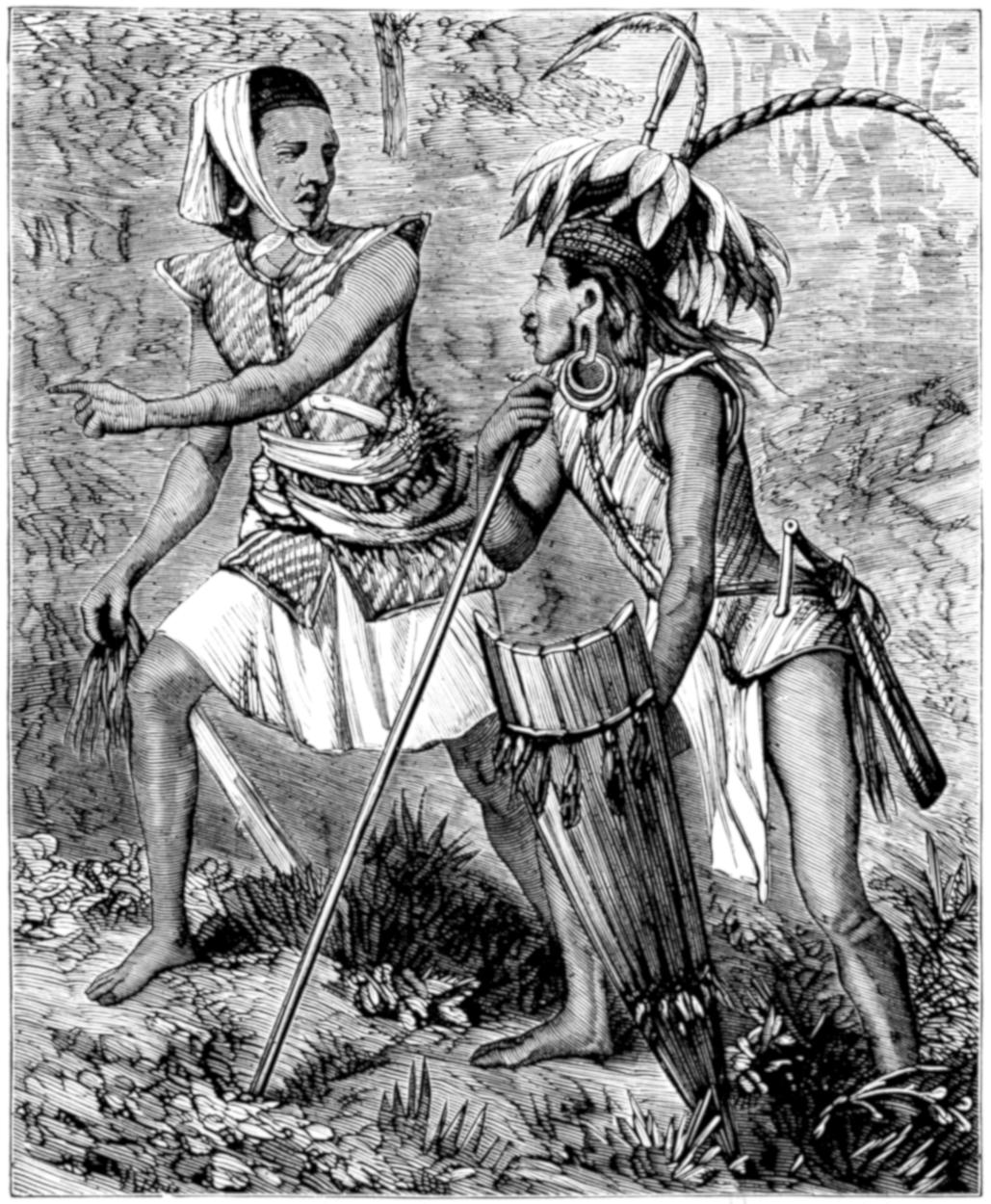
(1.) ILLINOAN PIRATE AND SAGHAI DYAK.
(See page 1112.)
Comparatively slight and feeble as the
Dyaks look by the side of the stalwart and
muscular European, their strength is really
wonderful, and enables them to perform
tasks which the powerful white man could
not by any possibility achieve. On a journey,
when an European has fallen from
sheer fatigue, a Dyak has taken the burden
with which the fallen man was laden, and
added it to his own, without seeming to display
any particular sense of having increased
his own labor; and when the stranger, in
spite of the relief, has lain down in absolute
inability to move, a little wiry Dyak has
picked him up, put him on his back, and
proceeded on his journey with perfect
ease.
The Dyaks are in the habit of crossing
the swamps with which Borneo abounds by
means of primitive bridges, called batangs.
These are the very simplest form in which
the principle of the bridge can be carried
out. If the reader wishes to obtain a correct
idea of a batang, he can do so easily
enough. Two bamboo poles are driven into
the ground so as to cross one another near
the top, like an X with the lower limbs
much developed. They are then lashed together
at the intersection, just like the supports
between which a modern rope dancer
stretches his cord. At about thirty feet
distance, another pair of poles are fixed in a
similar way, and a horizontal bamboo laid
upon them.
In fact, the whole apparatus looks just like
a rope dancer’s apparatus, a bamboo taking
the place of the rope. Beyond the second
supports others are added and connected by
horizontal bamboos as far as the marsh extends;
and so fond are the natives of these
very primitive bridges that they will make
them a mile or more in length, and extend
them over gorges of terrible depth.
To tread these extraordinary bridges is a
task that would tax the powers of a professional
rope dancer, and yet a Dyak has been
known to take a heavy white man on his
back, and carry him a mile or more over
these slippery batangs, when, in many
places, a false step would be certain destruction
for both. He does not seem at all fatigued
by this extraordinary feat of muscular
power, but rather has a sort of boyish
exultation in his strength, and a decided
delight that he is able at all events in one
respect to prove himself the superior of the
white man, whom he regards with the most
profound respect as a being of supernatural
wisdom and power.
The Dyaks are able, in some astonishing
manner, to penetrate with comparative ease
through jungles which are absolutely impervious
to Europeans. One of these men,
while on the march with some English soldiers,
exhibited his strength in a very unexpected
manner. The path was a terrible
one, all up and down steep and slippery
hills, so that the Chinese coolies who accompanied
the party first threw away their rice,
and lastly sat down and wept like children.
The English sergeant, a veteran, accustomed
to hard marching both in China and India,
broke down at the first hill, and declared his
inability to move another step under the
load which he carried. Mr. Brooke, who
was in command of the party, asked one of
the Dyaks to carry the sergeant’s burden,
and promised him an additional piece of
tobacco.
The man was delighted with the proposal,
and accepted it. He was already carrying
food for three weeks, his whole store of
clothes, one twelve-pound shot, two twelve-pound
cartridges, a double-barrelled gun, a
hundred rounds of ball cartridge, and his
own heavy sword and spear. Such a load as
this, which would be almost too great even
for a man walking on good roads, seemed a
mere trifle to the agile Dyak, who went
lightly and easily up and down paths which
the foreigners could hardly traverse even
without having to carry anything except
their own weight.
So little, indeed, was he incommoded, that
he strapped the whole of the sergeant’s kit
on his back, and walked off as easily as if
the whole load were but a feather weight.
No one who has not actually traversed
those paths can form an idea of the miseries
attending the journey. The paths themselves
are bad enough, but, in addition to
the terribly severe labor of walking, the
traveller has to endure mosquitoes, sandflies,
intense heat at mid-day, and intense
cold at night, thirst, wet, and every imaginable
discomfort.
Yet the native seems quite easy in the
journey, and gets over the ground in a
manner that is absolutely exasperating to
the Europeans who accompany him. He is
able to push his way through prickly thickets
and morasses in a way which seems almost
impenetrable. Indeed, he says himself
that it is impenetrable, and that he
achieves these feats by means of certain
charms which he carries about with him. On
one occasion it happened that at the end of
a hard five hours’ journey, a number of
sketching materials and other necessaries
had been forgotten, and a Dyak was sent to
the boats to fetch them, being promised a
pocket-knife for his trouble. He started
about two P. M. and arrived with the parcels
before sunset, having thus, in addition
to his first journey with the travellers, and
the heavy parcels which he had to carry,
twice traversed the distance which had occupied
them five hours in the transit.
When questioned about the manner in
which he performed the journey, he said
that it was owing to the virtues of a charm
which he carried, and which he produced.
It was a small misshapen horn, which he
said that he had cut from the head of an
antelope, and that its fellow horn was brass.
He further offered to sell it for fifteen dollars,
averring that its powers were unfailing,
and that even any one who borrowed it
was able to traverse the country at the
same speed which he had exhibited.
The ordinary dress of the men is simple
enough, consisting merely of the “chawat,”
or slight strip of cloth, which is twisted
round the loins in such a manner that one
end falls in front and the other behind. The
chawat is often very gaily colored. Sometimes
the Dyak wears a sarong, or short
petticoat of cotton cloth, which reaches from
the waist to a little above the knees. It is
simply a strip of cloth, with the two ends
sewed together, and is almost large enough
to encircle two ordinary men. When it is
put on the wearer steps into it, draws it
up to his waist, pulls it out in front as far as
it will go and then doubles back the fold and
turns the edges inward, in such a manner
that it is held tight in its place, while the
folds caused by its large diameter allow
the limbs full play.
One of these chawats in my collection is
woven in a sort of plaid pattern, the ground
hue being a bright and rather peculiar red,
and the cross-lines being nearly white. The
texture is rather coarse, and the whole fabric
has a stiffness which is characteristic of
native fabrics made of this material.
Those young men who are proud of their
personal appearance, and are able to afford
the expense do not content themselves with
the plain chawat, but adorn it with all
kinds of strange decorations. One of these
young dandies is well described by Mr.
Boyle:—“The young man did not dress in
Malay trousers like his father, probably because
one pair alone of such articles existed
in the house; but his chawat was parti-colored,
and his ornaments numerous. He
was about five feet four inches in height,
very fair complexioned, and his face, though
Tartar like in character, had a pleasant expression.
From the elbow to the knuckles,
both his arms were covered with rings of
brass, and above the joint were two broad
armlets of snowy shells, which contrasted
admirably with his yellow-brown skin.
“But the marvel and glory of his array
hung behind. To the end of his chawat was
attached a long network of agate beads and
bugles, which jingled merrily whenever he
moved. Round his neck were strings of
bright beads, and his knees were encircled
by brazen wire. A profusion of dried scalps
fluttered from the parang by his side; and in
walking before us through the sunny glades
of the jungle, his brazen gauntlet flashing in
the light, and his beads of agate tinkling behind,
he presented the very ideal of a barbaric
dandy.”
One chief, desirous of outdoing his fellows,
had taken a gong and beaten it out
into a belt of solid metal a foot in width. In
consequence of the extraordinary value
which the Dyaks set upon gongs, this belt
was a mark of wealth which no one could
venture to challenge. Beside the chawat,
the well-to-do man wears a sort of shawl
mantle, much like a Scotch plaid, and capable
of being disposed after as many different
fashions. They display great taste in the
graceful folds which they give to it, and
seem to take a pride in the variety which
they can produce by the different modes of
folding this simple garment.
The women dress in a manner somewhat
like that of the men; but, in lieu of the
sarong, they mostly wear a rather longer
petticoat, called a bedang. When obliged
to go out in the sun, they also wear a jacket,
without sleeves and open in front; but as
this jacket hides the glossy brown skin on
which they pride themselves, they generally
lay it aside when in the house.
In youth they are remarkable for their
slender and graceful forms; but, unfortunately,
after a woman has passed the age of
twenty, she begins to deteriorate, and at
thirty is an old woman. The face is pleasing
in expression, despite of the artificial
means whereby the women do their best to
make themselves hideous. The eyes are
black, clear, and expressive, and the lashes
singularly long. The nose is rather disposed
to turn upward than downward, and
the mouth is terribly disfigured with the
continual chewing of betel and the mode in
which the teeth are filed and blackened.
The chief point in a Dyak woman’s beauty
is her hair, which is black, wonderfully
thick, and shining, and so long that when
allowed to flow over the back it nearly
touches the ground. Of this ornament the
women are inordinately vain, and, when engaged
in conversation, are fond of flinging
their shining tresses from side to side by
coquettish tossings of the head. Unfortunately,
the fever which is so prevalent in
many parts of Borneo has the effect of
bringing off all the hair, so that many a
young girl is thus deprived of her chief ornament.
The women belonging to some of the
tribes wear a most singular bodice, composed
of bark and bamboo, and kept together
by successive rings of brass wire, which form
a strong and weighty bodice, to the lower
part of which is attached the bedang, or petticoat.
Mr. Boyle seems to have taken a strong
aversion to these bodices. “When a Dyak
lover attempts to pass a tender arm round
his sweetheart’s waist, instead of the soft
flesh, he finds himself clasping a cuirass of
solid metal. Nor is this all; for fashion ordains
that the Dyak heiress shall invest her
available means in the purchase of long
gauntlets of twisted brass wire, reaching
from the knuckles to the elbow; and if, in
her turn, she encircles her lover’s neck with a
responsive arm, the wretched man finds himself
clasped by a horrible fetter, which draws a
little bit of his flesh between each of its
links, and pinches him fearfully. For these
reasons, caresses are not common among
Dyak lovers; after all, perhaps, they are only
a habit.
“But, apart from their inconvenience,
these brazen ornaments are decidedly tasteful
and pretty. The ordinary color of a Dyak
girl, when she does not stain her body with
turmeric, is a dull brownish yellow, and
the sparkling brass rings are a great relief
to this complexion. They are not removed
at night, nor, in fact, during the wearer’s
lifetime, unless she outgrow them.”
More than once the possession of these
strange ornaments has proved fatal to the
wearer, the woman having fallen overboard
from a canoe, and drowned by the enormous
weight of her brass ornaments. In
some parts of Borneo the girls are not content
with their brass bodices, bracelets, and
anklets, but must needs encircle their
throats with the same material. They take
a long piece of stout brass wire, and twist it
spirally round their necks, so that the lower
part of the coil rests on the shoulders, and
the upper part comes just under the chin,
causing the wearer to hold her head upright,
and having a most inelegant and awkward
effect.
The Kayan women are exceedingly fond
of a peculiar bead which is of several colors,
looking as if it were a black bead into which
pieces of green, yellow, blue, and gray material
had been carefully let. A rich woman
will sometimes wear several strings of such
beads just above the hips. The different
strings are connected with each other so as
to form a single ornament. For one such
hip-lace (as Mr. St. John calls it) a woman
has given property equal to thirty-five pounds
of our money; and the same woman had
several others for which she had given
scarcely less, together with a great number of
inferior value.
The Kayan women carry the tattoo to a
great extent, and follow exactly the same
plan as the Samoan warriors, i. e. being
completely tattooed from the waist to the
knees. They are very fond of this ornament,
and are apt to wear their dress open
at the side so as to exhibit it. When the
women bathe, they think that the tattoo is
quite sufficient dress, and at a little distance
they really look as if they were
wearing short trousers.
As has been already mentioned, the Sea
Dyaks do not, as a rule, care for the tattoo,
and in this respect the women follow the example
of the men. They are, however,
equally fond of ornament with their sisters
of the land, and adorn themselves with
most scrupulous care on festive occasions.
Mr. Boyle gives an animated description of
the gala-dress worn by the Saibas Dyak
girls and women during a great feast given
by the chief.
“Meanwhile the female portion of the
community had been preparing for their
part in the proceedings. At this moment
they came from the interior of the house,
and the stately magnificence of their appearance
showed that time and labor had not
been spared in arraying themselves for this
great occasion. From the neck to the hips
they were covered over with large agate
beads; string of them was heaped on string,
till many of the women were cuirassed an
inch thick in solid stone before and behind.
“Upon their heads was placed a piece of
bead-embroidered cloth, in which were arranged
thin skewers of painted wood about
five inches long: there were about twenty
of these bits of wood disposed about their
heads, and each was attached to the other
by strings of brilliant glass beads. Five or
six of these many-colored loops hung from
each skewer, and they were entwined into
a graceful network. The effect was very
pretty, though barbarous, and the solemnity
of the ceremonies was much enhanced by
the stately uprightness which the women
were compelled to observe in moving, on
peril of disarrangement of this delicate
structure.”
They also wear conical hats, made of split
rattan. These hats are very light, and last
for a wonderful time. A specimen was presented
to me by a lady who had worn it
for four years, and had certainly not treated
it with any consideration. Yet it is as
strong and good as ever, and the colors are
as fresh and bright as when the hat was first
made. The rattan has been split into very
narrow strips, and stained red, yellow, and
black, while some of the strips have had the
natural color discharged, so as to make them
nearly white.
The hat is fixed on the head by a broad
loop of plaited palm leaf, which is fastened
to the side. Hats made on this principle
are prevalent throughout the whole Archipelago.
Among the ornaments which are worn by
the Dyaks are the little bells which have
already been mentioned as forming part of
the appendages of an earring. These ornaments
called “garunongs,” and mostly
worn by the women on the edges of the
bedang or petticoat, are almost exactly like
our hawk-bells, being nothing more than
little hollow spheres of brass or bronze
about the size of a boy’s playing marble,
with a small metal ball in the interior by
way of a clapper, and a moderately wide
slit at the bottom. To some of the bells
the remarkable beads are attached. These
bells keep up a musical chime or jingle as
the wearer walks, and are therefore used in
dances and on great occasions.
The general treatment of the Dyak women
is good. They certainly have to work hard,
but so have their husbands, and, as we shall
presently see, they are not the abject slaves
such as are too often found among savage
nations, but maintain their share of influence
in the family, and are perfectly capable of
assisting themselves when the occasion requires
it. They are accustomed to work in
the fields, and the universal chopping-knife
or parang is seldom out of their hands.
The constant use of this weapon hardens
their hands and often deforms the fingers.
When they come home from their work in
the field, they have the heaviest portion of
their work before them, their evening task
being the husking and winnowing of the
rice for supper and for the meals of the
following day. The rice is first pounded in
large troughs by means of long and heavy
wooden poles, which are held perpendicularly,
lifted up, and then allowed to fall on
the grain, and, as a rule each trough occupies
three women, who work for about half
an hour. This pounding separates the husk
from the grain, and the next process is to
winnow the rice by means of a shovel and a
fan.
The evening meal is then cooked and
eaten, the children fed, the bronze dishes
put away, and then the women can sit
quietly in the veranda, and eat their betel
in peace. Although this mode of life seems
rather hard, and the husbands appear to be
acting harshly toward their partners in letting
them work in this manner while they
sit in their houses, chew betel, and talk
over the gossip of the day, there is really a
very fair reciprocity of labor. While the
wives have been working in the fields, the
husbands have been fishing, and in so doing
have repeatedly exposed their lives to danger,
the rollers being at certain seasons of
the year exceedingly dangerous. At Mukah,
as at other places, the wives insist upon
being furnished with fish by their husbands,
and, in case the men should come home unsuccessful,
the women fasten their doors
and bar them out. Indeed, so long as the
marriage holds good, the relation of husband
and wife seems to be conducted in a
manner similar to that which is so graphically
depicted by Scott in his “Antiquary.”
In order to show the appearance of the
Dyak women in their ordinary and gala
costumes, two figures are introduced into
illustration No. 2 on page 1113. One represents
a Dyak girl before arraying herself in
the mass of ornaments with which she loves
to decorate herself on festivals. She wears,
as usual, the bedang, or petticoat, which, if
she be of ordinary condition, is made of
cotton, but if she be rich, of silk. It is
twisted round the waist in the manner practised
by the men, but, in addition, is fastened
to the brass belts which surround her
waist. Her long glossy hair is flowing to
the full extent, before the owner gathers up
its massive tresses preparatory to adorning
her head with the complicated decorations,
of full dress.
The other figure represents her as she
appears in all the glory of full gala costume.
As far as absolute dress goes, she wears no
more than she did before, the only alteration
being that her bedang is the best which
she has, and is sometimes beautifully embroidered.
On her arms are several thick
rings of brass, and the singularly uncomfortable
brass gauntlet extends from the
wrist to the elbow. Her neck and bust are
nearly covered with the heavy agate beads,
and on her head is the complicated cap,
with its curious arrangement of wooden
spikes and glass beads.
CHAPTER CXV. BORNEO— Continued . WAR.
DYAK WEAPONS — THE SUMPITAN, OR BLOW GUN — CONSTRUCTION OF THE WEAPON — THE INLAID OR
METAL BUTT — THE SPEAR HEAD, OR BAYONET — THE SUMPIT ARROW — THE UPAS POISON AND
ITS EFFECTS — DESCRIPTION OF THE TREE — THE QUIVER — THE PARANG, OR SWORD, AND ITS
VARIETIES — THE PARANG-LATOK, AND ITS CURIOUS HANDLE — POWER OF ITS BLOW — TWO
BLOWS OF AN EXECUTIONER — THE PARANG-IHLANG: ITS CURIOUSLY FORMED BLADE — AN
AWKWARD WEAPON — POWER OF THE PARANG-IHLANG, AND ITS VALUE — THE SHEATH AND ITS
ADDITIONAL KNIFE — DOUBLE-EDGED PARANG, WITH CHARMS — A SINGULAR ORNAMENT — THE
KRIS AND ITS VARIETIES — ITS WAVED AND LAMINATED BLADE — EFFECT OF THE LIME JUICE — THE
EXECUTIONER’S KRIS.
We now come to the subject of Warfare,
which forms perhaps the most important
branch of Dyak history. Whether the Dyaks
belong to the Land or Sea division, they
are always warlike, though the latter are
fiercer, perhaps braver, and certainly more
enterprising than the former. In order to
understand the system by which they wage
war, we must first examine their weapons.
I will take that which is the most characteristic;
namely, the sumpitan, or blow gun.
We have here a weapon, the like of which
we have not seen in any country that we
have hitherto investigated; namely, an instrument
by means of which missiles are
projected by means of compressed air. The
principle on which the sumpitan acts is precisely
similar to that of fire-arms, though
the propelling power is obtained in a different
and more simple manner. In fact, the
sumpitan is nothing but the “pea-shooter”
of boys, very much enlarged, and carrying
an arrow instead of a pea or clay ball.
This curious weapon is about eight feet in
length, and not quite an inch in diameter,
and is bored with the greatest accuracy, a
task that occupies a very long time, the
wood being very hard, and the interior of
the sumpitan smooth and even polished. It
is not always made of the same wood, the
specimens in my own collection being of different
material, one of very dark and the
other of very light wood. The surface is of
equal thickness from end to end, and, as it
generally has to enact the part of a spear as
well as of a sumpitan, it is very strong and
heavy.
One of these weapons, brought to England
by the late Admiral Young, is of a
beautiful colored wood, and is beautifully
inlaid, both at the butt and the point, with
metal. The last few inches of the butt are
entirely made of metal, the weight of which
causes the weapon to balance itself easily
when held to the lips. The pattern of the
inlaying may be seen in fig. 1, of the illustration
entitled “Sumpitans,” on the 1122nd
page.
The other sumpitan, fig. 2, is of a very
dark, almost black wood, which is brightly
polished on the exterior as well as in the
interior, and is not inlaid. The butt, however,
is encased with brass for five inches,
the brass being very thick and heavy at the
end, and deeply ridged, so as to look at a little
distance as if it were a spiral brass wire
coiled round the butt of the sumpitan.
At the tip of this weapon is a spear head,
very thick, broad, and strong, sharply edged
and pointed, and decorated with engraved
patterns after the manner employed by
Dyak smiths. It is firmly bound to the
sumpitan by brass wire or rattan, and is an
exact analogue of the bayonet, the spear
head being fastened to the side of the
weapon, and not interfering with the flight
of the missile. The bore of the weapon is
very small, not quite half an inch in diameter,
and it is really wonderful that the maker
could contrive to hollow it with the perfect
precision which is necessary for the accurate
flight of the arrow.
We next come to the missile which is projected
through the sumpitan. This is a very
tiny arrow, made of the thorn of the sago
palm, about seven or eight inches long,
equally thick from base to point, and not
thicker than a large steel knitting-needle.
In order to make it fit the bore so that it
can be propelled by the breath, it is furnished
at the butt with a conical piece of
pith or soft wood, so that it exactly fits the
bore. In some of the arrows, the cone is
hollow, and a few of them are furnished
with wing-like appendages along the shaft.
As a rule, however, the solid cone is in most
general use.
These arrows are so small that the wound
which they inflict is in itself insignificant,
and would not be sufficient to kill any animal
larger than a rat. They are, however,
converted into weapons of the most formidable
character by being smeared at the tip
with poison obtained from the upas-tree.
The reader is probably aware of the many
tales that are told of this tree—how that it
poisons the country for a mile round, and
how that the deadly juice can only be obtained
by means of condemned criminals,
who earn their pardon in case they can
bring off a bottle of the juice. Even in
more recent days the upas-tree has not lost
all its legends, and many persons still believe
that actual contact with the tree or its
leaves produces a sensation of faintness.
This, however, is not the case; neither is
the actual juice of the tree so deadly as is
supposed.
A wound made by an arrow poisoned with
upas juice is sure to be fatal, provided that
the poison be quite fresh; but it loses its
power very rapidly, and after it has been
exposed to the air for two hours it is useless,
and must be renewed. When fresh, it
is fatal in a very short time, as was found by
Mr. Johnson, who led an attack on the Kanowit
Dyaks in 1859. He lost thirty men in
the attack, every one of them being killed
by the tiny sumpit arrow, and not one having
a mark on him, except the little wound
made by the arrow’s point.
Should the poison have been exposed to
the air, the wounded man has a chance of
recovery; and it has been found that a large
dose of spirits, sucking the wound, and
keeping the sufferer continually in motion
will generally overcome the virulence of the
poison. Indeed, the sumpit arrow seems to
have much the same effect as the bite of the
cobra, and the treatment which is efficacious
for the snake bite answers equally well for
the arrow wound.
The juice of the upas-tree is procured
simply by boring a hole in the trunk, from
which the juice issues in a white, cream-like
state. It is received in little flasks made of
bamboo, which are closed in the most careful
manner, in order to exclude the air. One
of these flasks in my possession is five
inches in length, and about half an inch in
diameter. One end is naturally closed by a
knot, and the other is sealed with the most
scrupulous care. First, a plug of soft wood
has been inserted into the end, after the
manner of a cork. Over the plug a lump of
beeswax has been firmly kneaded, and over
the wax a piece of membrane has been tied
when wet. Although the upas juice is white
when it first issues from the tree, it speedily
becomes black when exposed to the air.
The upas-tree is called scientifically Antiaris
toxicaria, and it belongs to the natural
order Astocarpeæ, the best known species of
which order is the well-known bread-fruit
tree. All the plants of this order produce a
white milky juice, which is always acrid and
deleterious, and in many instances is exceedingly
poisonous. Yet those parts of
the plant, such as the fruit, in which the
milk is replaced by sugar in the process of
ripening, are not only harmless, but even
nutritious. The tree grows to a considerable
size, and the bark of the trunk has a
reddish hue.
The reader will at once understand how
formidable is this weapon. It is greatly to
be dreaded even when the Dyak warriors
are met in open battle, and in naval engagements
the showers of poisoned arrows that
are continually shot through the port-holes
render the gunners’ task a most unpleasant
one. But the sumpitan is much more to be
dreaded by land than by sea; and when it is
employed in bush warfare, the boldest soldier
shrinks from the encounter. The Dyak
who wields it lies hidden in the thick foliage,
sure that, even in case of discovery, he
can glide through the tangled thickets into
a place of security. The sumpitan makes
no report, and gives out no smoke as an indication
of its position, but the deadly arrow
flies silently on its errand, and the only intimation
of the presence of an adversary is
the slight tap with which the arrow strikes
its mark.
The only disadvantage of the sumpitan is
that its range is a short one, the light arrow
being seldom used at a distance exceeding
forty yards, though a man who is accustomed
to its use can propel an arrow for seventy or
eighty yards. At this distance, however, it
is not to be dreaded, as its force is so expended
that it can scarcely break the human
skin. Some of these arrows have their heads
made of the barbed bone of the sting-ray,
which snaps off at a touch, and remains in
the wound if the man tries to draw out the
weapon. Others have separate heads made
of wood, which become detached as soon as
the shaft is pulled. The native name of the
head is jowing.
The Dyak generally carries thirty or forty
of these arrows in a peculiar-shaped quiver.
It is made of the ever useful bamboo, and is
furnished with an appendage by which it can
be stuck into the belt and carried at the side.
This appendage is made of hard wood, and is
lashed to the quiver by a broad belt of rattan,
most beautifully plaited. The quiver is
closed by a conical wooden cover, which is
always secured by a string so that it shall
not be lost. Some of the Dyak quivers are
highly polished, covered with carvings, and
are almost to be ranked with works of art.
Many of these quivers have an inner case
or lining of dried skin or membrane, so as
to exclude the air, and preserve the poison
of the arrow as long as possible.
When the Dyak uses the sumpitan, he
holds the mouthpiece to his lips between
the two first fingers of his left hand, while
with his right he supports and aims the
heavy weapon, which requires a strong as
well as a practised man to direct it steadily.
The weapon which comes next in importance
to the sumpitan is the parang or
sword, of which there are several varieties.
The Dyaks pride themselves greatly on
their swords, and the excellence of their
workmanship is so great that they have
good reason for pride. Their forges are of
excellent quality, and some of the tribes are
able not only to forge their own weapons
but to smelt their own iron.
The commonest of all the Dyak weapons
is the sword called parang-latok, which is
carried by every man and nearly every
woman. It is used not only as a sword, but
as an axe, and is indifferently employed for
cutting through the jungle or cutting down
the enemy. The shape of this sword is very
peculiar, as may be seen from illustration
No. 1, on the preceding page, which represents
a specimen in my collection.
The blade is formed after a very curious
pattern. Toward the hilt it is squared, and
is in fact nothing but a square bar of steel
nearly half an inch in thickness, and three
quarters of an inch in width. From the hilt
to the point the blade becomes gradually
wider and thinner, so that the broad point,
two inches in width, contains just the
same amount of metal as the half-inch square
hilt. It is evident that the sword is first
forged into a square bar of equable size, and
is then beaten out flatter and flatter toward
the point.
The illustration shows that the blade of
the sword is bent at a considerable angle
toward the hilt. This curious shape, awkward
as it is to an unaccustomed hand, forms
the principal value of the sword. When
the parang-latok is used for cutting down
branches or chopping a path through the
jungle, it is grasped at the squared portion
of the blade, and is used just as we use the
common bill-hook in this country. But
when the object which is to be chopped lies
on the ground, the parang is held by the
handle, so that the angular shape allows the
blade to be used with full force. It is the
habit of holding the parang by the squared
portion of the blade, that disfigures and
even deforms the fingers of the women,
as has already been mentioned on page
1118.
The ordinary parangs have no attempt at
ornament upon them, but those of better
construction are covered with patterns engraved
upon the blade, of which we shall
see some examples.
In war, this sword is a most formidable
weapon. It is so heavy, weighing on an
average two pounds, that a blow from it is
sufficient to crush the skull or break the
limb of a man, and, even if it had no edge, it
would equal in efficacy the merai of the New
Zealander. But the parang-latok has a very
sharp edge, which is kept in the best order,
and, when a blow is delivered with it, the
very form of the weapon causes it to make
the terrible “drawing cut,” the blade being
drawn through the wound nearly from hilt
to point. In consequence of this peculiarity,
the wounds made by the parang-latok are
very severe, and the natives pride themselves
greatly on the depth of the wound
which they can inflict.
One of the modes by which they try their
skill is killing a pig with a single blow of a
parang-latok, a good swordsman being able
to sever the animal completely, and to drive
the point of his weapon into the earth. If
the reader has been accustomed to use the
sword, he will see that to strike downward
at an object so near the ground is by no
means an easy task.
When an English swordsman performs
the feat of severing a sheep at a single blow,
he has several advantages which are denied
to the Dyak. In the first place, the sheep is
already dead, so that he can take his aim in
quiet, whereas the pig is alive, so that the
Dyak must aim his blow as he can. Then
the sheep has been skinned and cleaned, so
that the sword has not so much resistance
to overcome. Lastly, the sheep is suspended,
so that the swordsman can use the most effective
blow, namely, “Cut 6,” i. e. a sweeping,
horizontal cut from left to right, which
can be delivered with the full swing of the
arm.
Were it not for the peculiar form of the
parang-latok the feat of severing a pig could
not be accomplished, but the angular shape
of the blade and its gradually increasing
width combine the power of the drawing
cut with the chopping force gained by the
weight of the weapon.
The sheath of this parang is neatly made
of two flat pieces of wood, neatly hollowed
inside to receive the blade, and bound together
in the most elaborate manner by a
series of belts, twelve or fourteen in number.
These belts are made of very narrow
strips of dark rattan, and are twined into an
endless four-plait. In my own specimen,
there are thirteen of these belts. Attached
to the upper end of the sheath is the cord
by which the weapon is hung to the side.
This cord is doubled, is made of scarlet
and yellow cotton plaited square, and is ornamented
at the ends with two large tassels,
the strings of which are yellow tipped with
scarlet tufts.
The parang-latok is more a Malayan than
a Dyak weapon, but it is in favor with the
Dyaks, and, as has been mentioned, has
come into general use.
The Malays use it in execution, and are
able to decapitate a man at a single blow,
the executioner standing at his side and a
little behind him. On one occasion, an executioner,
who was distinguished for the skill
with which he wielded a very heavy parang
which he possessed, stood between two
criminals as they knelt on the ground, and
with a right and left hand blow struck off
both their heads. The same man, who was
one of the police, being annoyed by the
howling of some dogs in the street, rushed
out with his parang, and with one blow cut
in two the first animal which he met.
We now come to another weapon, the
parang-ihlang, which is one of the most extraordinary
swords in the world, and more
troublesome and even dangerous to strangers
than can well be conceived. This is a
smaller, shorter, and lighter weapon than
the parang-latok. From point to hilt it
measures nineteen inches, and in extreme
breadth of blade is rather under an inch and
a half. It weighs rather less than one
pound six ounces, and altogether appears to
be quite insignificant when compared with
the parang-latok. We shall see, however,
that in the hands of an experienced swordsman
it is even superior to that weapon on
account of a strange peculiarity in construction.
The general shape of the blade of the
parang-ihlang can be seen in illustration
No. 3, on page 1122. It is very thick and
heavy toward the hilt, where it is nearly
squared, like the parang-latok, but becomes
gradually thinner toward the point, which
is finished off in a series of scooped patterns
that look at a little distance as if the sword
had been broken. The back is quite
straight, and along it and on either side of
the blade is a series of small patterns engraved
with much neatness and freedom of
execution.
But the most remarkable thing about the
blade is, that instead of being nearly flat as
are European sword blades, it is convex on
one side, and concave on the other, as is
shown at the section, fig. 5. Owing to this
form, it can only be used for two cuts, one
downward and one upward; and if used in the
wrong direction, it flies off at an angle, and
is nearly certain to inflict a wound on the man
who wields it. These swords are made either
for the right or left hand, so that a man who
is not acquainted with the peculiarities of
any parang is afraid to use it without a careful
trial, lest he should make the wrong cut
with it, and so wound himself.
Small and insignificant as this weapon
looks, it is capable of inflicting the most
dreadful wounds, the peculiar concavity of
the blade aiding it in a most remarkable
manner. Like the parang-latok, it is used
as a chopper as well as a sword, and in experienced
hands is a most effective tool.
One man, described by Mr. Brooke, was a
celebrated swordsman, and has been known
to sever at a single blow a log of tolerably
hard wood as thick as a man’s leg.
Even English officers have been so much
impressed with the value of this weapon,
that they have only carried the regulation
sword for show, preferring the parang-ihlang
for use. The Sea Dyaks, who have been already
mentioned as essentially warriors,
prefer this sword to any other weapon,
though the real inventors and principal
makers of it are the Kayans, who belong to
the Malanau division of the Land Dyaks.
As a rule, the ordinary Land Dyaks use the
parang-ihlang but little, and when they do
use it are apt to hurt themselves. Mr.
Boyle mentions an instance where the
eldest son of a chief had cut himself seriously
on both shins through his incautious use of
this weapon.
“The finest parangs,” writes Mr. Boyle,
“or those esteemed so, are found in the
graves of Kayan warriors, which are consequently
rifled by Dyaks and Malays on
every possible occasion. I have one, purchased
at Kennowit, which I was told had
been obtained from a sepulchre, three hundred
years old—a rather improbable assertion,
though I believe the weapon was
really found in a Kayan grave, for it was
strangely stained and rusted when I bought
it.”
The Dyaks are very proud of the quality
of their blades, and hold even the best European
steel in utter contempt. It is said
that their swords are made of old files,
which are imported in large quantities; but,
whatever may be the material, the temper
of their blades is marvellously excellent.
These parangs not only take a razor-like
edge, but are exceedingly tough, and when
used for bush-work beat the very best English
implements. Mr. Boyle remarks, that
whereas his own hunting-knives, which professed
to be the finest steel possible, broke and
gapped, the Dyak parangs were not in the
least injured.
Such a blade as has been described is exceedingly
valuable, even in its own country,
and one of the best quality cannot be purchased
under ten pounds sterling. It may
be easily imagined that when a Dyak is fortunate
enough to possess one of these valuable
blades he will not be content with an
ordinary handle and sheath, but will lavish
upon his weapon all the powers of his native
art. The handle, instead of being of
simple wood, is of bone, carved deeply and
boldly into patterns, and is always bent at
right angles to the line of the blade. It is
further ornamented by sundry tufts of human
hair, dyed of various colors, of which
deep red, yellow, and green are the favorites.
The hilt is generally bound with brass
wire, and, for a small-handed race like the
Dyaks, affords an excellent hold. An European
generally finds that the narrow handle
is very awkward and cramped, and is not
sufficient for his grasp.
The scabbard of this weapon is covered
with ornaments. Instead of being a plain
and simple sheath, like that of the parang-latok,
it is made of a hard wood, of a dark,
rich, mahogany color, which takes a very
high polish. This is carved in elaborate and
really artistic patterns, the carving being
confined to the front of the scabbard.
In the middle, just under the carved part,
is a piece of fur, and below the fur is a tuft
of human hair dyed red. In most cases of
swords made by uncivilized races, there is
some danger to the hand in drawing them,
the edge of the sword being apt to project
between the two flat pieces of which the
sheath is made. In order, however, to
guard against such an accident, the maker
of the parang-ihlang places a piece of rattan
against each edge of the scabbard, so that
the blade cannot by any possibility cut the
fingers, even if the hand should grasp the
sheath. The various parts of this sheath
are bound together by six belts of plaited
rattan and three belts of brass wire, plaited
most beautifully, in that form which is
known to sailors as the Turk’s head.
The belt by which the sword is attached
to the wearer is made of rattan, cut into
very narrow strips and plaited into thongs,
three of which thongs are again plaited together
to form the belt. On the opposite
side of the scabbard is a second sheath, of
the same length as that to which it is fastened,
but small and cylindrical. This
sheath is made of red and yellow cloth, is
lined with bark, and is intended for the reception
of a knife which is peculiar to the
Dyaks. One of these knives maybe seen at
fig. 3, in the illustration of the parang on
page 1129. The handle of this knife is made
of the same hard wood as that of which the
sheath is formed. It is nearly cylindrical,
about half an inch in diameter, and fourteen
inches in length, the blade being short,
pointed, and barely two inches in length.
This curious knife is used by the Dyaks for
splitting rattan, and similar purposes, the
long handle being held under the left arm,
while the rattan is drawn with both hands,
across the edge of the blade.
The natives are singularly averse to parting
with this knife. They will sell the sword,
if a sufficient price be offered, but will always
endeavor surreptitiously to withdraw the
knife, so that, out of many parangs which
have been brought to Europe, comparatively
few have the knife attached to them. In one
specimen in my collection, the weapon
appears to be quite perfect, but, on withdrawing
the knife from its sheath, it is seen
that the Dyak has cleverly substituted a
bladeless handle for the real knife.
Both the weapons which have been described
were presented to me by C. T. C.
Grant, Esq.
There is also in my collection a third kind
of parang, which at first sight looks almost
exactly like the old Roman sword. It is
thick, massive, weighty, and at first sight
looks more like an ancient than a modern
weapon. On a closer examination, however,
the peculiar Dyak workmanship is evident.
Though it is not like the preceding weapon,
convex on one side, and concave on the
other, the two sides are entirely distinct.
The blade is double-edged, very thick in the
middle, and sloped off rather abruptly to the
edge on either side.
The handle is only made of wood, but is
profusely decorated with human hair of different
colors and considerable length, and
it is bound with a broad belt of plaited rattan.
The sheath for the knife is entirely made of
bark, and the knife itself is shown at fig. 2.
Like the scabbard of the parang-ihlang already
described, that of this weapon is richly
carved, and adorned with fur and long tufts
of human hair.
The belt by which it is suspended is made
of rattan split very fine, and plaited so as to
form a strap nearly an inch in width, and the
sixth of an inch in thickness. It is rounded
at the edges, and at the upper part it is ingeniously
separated into two portions, so as
to form a loop.
The chief peculiarity of this weapon lies
in the number of charms which are attached
to it. First come two teeth, and then there
is a beautifully plaited little case, something
like the cocoon of an insect, containing
several little pieces of wood. Next comes a
small bag of netted string, about an inch and
a half in length, in which is a stone, and
then come three little flattish baskets, with
covers, which are empty. Fastened to the
belt by several thongs is a curiously shaped
piece of wood which I believe to be used for
sharpening the edges of the sword, and to
the end of the sheath is hung by a string
of beads a feather, the quill of which has
been carefully wrapped with red and black
string.
This weapon is in all ways a most formidable
one, and to European travellers is by
far the best for practical purposes. The
handle is rather larger than is the case with
either of the preceding weapons; the blade
has not that curvature which renders it so
perilous a weapon in unpractised hands;
it is double-edged, and either edge can be
used with equal facility; and lastly, it possesses
a point, which is not the case with
the other forms of the sword.
One Dyak chief had an ornament attached
to his sword of which he was exceedingly
proud. It was an enormous tuft of hair,
being nothing more nor less than the pigtails
of ten Chinese whom he had killed, and
whose hair he had fastened to the scabbard
of his sword. This ornament must have
been singularly inconvenient to him. There
is in my collection an average specimen of
a Chinese pigtail. It weighs nine ounces, so
that the weight of the ten must rather exceed
five pounds and a half, while the length is
five feet, so that ten tufts of hair, each five
feet in length, must have given the wearer
an infinity of trouble as he walked.
The reader will already have noticed how
the various forms of sword are used alike by
the Malays and the Dyak tribes. There is
another weapon, which, though strictly a
Malay invention, is used by the Dyaks, and
indeed, with some variations, throughout the
whole of the Malay Archipelago. It is called
the kris, sometimes, but wrongly, spelt creese,
and is so common that any ordinary collection
of weapons is sure to contain several
specimens of the kris. It is remarkable for
three points. In the first place, the handle
is not set in a line with the blade, as in ordinary
daggers, but is bent at a right angle;
next, the blade is almost always waved in
form, like the flaming sword with which the
old painters armed the angels who kept the
gates of Paradise; and thirdly, the blade is
never smooth, but dull, rough, and indented
with curved grooves much resembling in
form the marks on a “browned” gun-barrel.
By referring to the illustration “Kris” on
page 1129, the reader will better understand
its peculiarities.
There are few weapons which vary more
in value, or in which the price set upon them
is so apparently excessive. A first-rate
blade, even without the handle and sheath,
will cost from eighteen to twenty pounds,
and an ordinary one can scarcely be purchased
under two pounds. They have by no
means the appearance of being valuable
weapons, the steel of the blade being not only
rough and corroded, but looking as if it were
composed of successive laminæ which are on
the point of being separated. This effect is
produced by steeping the blade in lime juice,
thus causing a partial corrosion of the metal,
which is made of small pieces of steel twisted
and welded together in such a manner as to
produce exceeding toughness.
One of these weapons in my collection is
worn away almost to a mere ribbon of steel by
the action of the acid, and, strange as it
may seem, weapons of this kind, which look
much as if they were mere pieces of rusty
iron-hooping, are the most valued by connoisseurs.
The length of grain in this
weapon is wonderful, the corrosion of the
lime juice showing it in the most perfect
manner. The long grooves can be traced
from one end of the blade to the other,
following the waved form of the narrower
portion, and curling round in the wider
part near the hilt, as if the whole of the
blade had been forged out of steel wires
laid parallel to each other and then welded
together.
The lime juice takes off from the edge
that razor-like smoothness which is so much
admired in European blades, and gives it a
ragged, saw-like appearance that is peculiar
to the instrument. This edge, however, is
a terrible one for penetration into human
flesh, and answers the purpose even better
than a plain and sharp edge could do.
The form of the kris is sufficient to tell
the reader the mode of handling it, the
weapon being thrust forward just as a man
points with his extended forefinger, and not
grasped according to the conventional ideas
of painters. Spaniards, who are proverbially
expert in the use of their long knives,
hold and use them in nearly the same manner,
laying the extended forefinger along
the blade as a guide, and thrusting forward
instead of striking downward. The average
length of a kris blade is about a foot,
but some are nearly as long as ordinary
swords, while others are only six or seven
inches in length.
Very great pride is taken in an old family
kris, the owner regarding it with a veneration
that is almost superstitious. Generally,
the handle is quite plain, but the more
wealthy have it made of gold, and encrusted
with precious stones. This weapon is seldom
used in war. It is carried more as the
symbol of a gentleman than as a weapon to
be used in actual fight, and plays the part
that the sword used to play in the last century.
The kris is much used in executions, the
weapon being one made expressly for the
purpose, quite straight, thin, and narrow.
In all cases it is used in the same manner,
though there are some variations in detail.
Generally, the man who is to suffer walks
quietly and unbound to a chair, in which
he seats himself, mostly solacing his last
moments by chewing the betel-nut. His
arms are then extended, and held by two
men, while the executioner, standing behind
him, places the point of the kris just above
the left collar-bone, and strikes it downward
into the heart, so that death is instantaneous.
In some places the execution kris is very
narrow, thin, and sharp on both edges, like a
lancet. The executioner takes a small tuft
of cotton wool, and twists it lightly round
the blade of the kris, just above the point.
He then holds the cotton wool between
the finger and thumb of his left hand, so
as to keep the kris upright. After placing
the point of the weapon on the right spot
above the left collar-bone, he drives it downward
into the heart with his right hand, and
the man is dead. Still holding the cotton
wool between the finger and thumb, he
draws out the kris, and, as the point is withdrawn,
presses the cotton wool into the
small wound which it has made, so that the
weapon is quite clean and bright, and not a
drop of blood is allowed to be seen. There
is no doubt that this mode of execution is
as certain, swift and merciful as any that
can be devised. It is equal in these respects
to the guillotine, and has the great advantage
of being absolutely bloodless, and requiring
no scaffold or visible apparatus. A
traveller might pass within two yards of the
fatal spot, and not know that anything out
of the ordinary way was being done.
Some of these weapons have been used
for many successive generations, and are
highly prized, some being valued at sums
which to Europeans seem almost fabulous.
One of these execution krises was shown at
the Great Exhibition in London, but was
lost, together with many other weapons of
great value.
The spear is a weapon much favored by
many Dyak tribes, but little employed
by others, the spear head at the end of the
sumpitan answering every practical purpose.
In fact it is used, like the club of the
Fiji Islander, as a summons to battle, and
serves the same purpose as the fiery cross
of the Scotch Highlands. This symbol is
instantaneously obeyed, and, as it runs
through a country with almost magical
speed, a chief can raise a large force within
a very short time. On one occasion, during
the rajahship of Sir James Brooke, an incipient
rebellion was ingeniously stopped by
finding the “calling-out spear” as it lay
hidden in a canoe, and taking possession of
it. The people strenuously denied that such
an article ever existed; but when it was
taken from its hiding-place, the projected
rising instantly collapsed.
CHAPTER CXVI. BORNEO— Continued . WAR— Concluded .
THE BORNEAN SHIELD, ITS USUAL SHAPE AND DECORATIONS — MODE OF USING IT — A CURIOUS SHIELD
IN MY COLLECTION — HEAD HUNTING AND ITS ACCOMPANYING HORRORS — OBJECTS OF SIR JAMES
BROOKE’S MISSION — HIS MODE OF SUPPRESSING THE PRACTICE — “OPENING MOURNING” — THE
FISH SPEARING AND THE FEAST — VALUE OF HEADS — TREACHERY AND CUNNING — THE BAFFLED
HEAD HUNTERS — DYEING AND PRESERVING THE HEADS — THE HEAD HOUSES — COURAGE IN
WAR — STORMING A NATIVE FORT — A NAVAL BATTLE — TRAPS AND PITFALLS — MAKING PEACE.
By way of defensive weapons, the Dyaks
use the shield, which is made of wood, and
is generally of an oblong form. Like the
parang, it is decorated with various ornaments,
the chief of which are hair, beads,
and feathers. The hair is made into flat
tufts, and fastened at regular intervals all
over the shield, as is seen in an illustration
at the foot of next page, which represents a
fine specimen in the magnificent collection
of the late Mr. Christy. In the centre of
this shield there is a rude and evidently
conventional representation of the human
face, the eye being circular, of very great
size, and painted white in the centre. At
the top and bottom of the shield are similar
figures, but of smaller size. Some shields,
which are now very seldom seen, have the
entire human form painted on them, the
legs issuing from the chest, and the neck
being entirely dispensed with. The tufts of
hair on this shield are black.
The mode of using the shield and sword
is shown in their sword dances, and Mr.
Brooke, who had great experience in the
Dyak weapons, gives the following opinion
of their value:—Sword dances with shields
were going on. Each tribe has a peculiar
step and code of its own; but as an attack
and defence in earnest they all seemed to be
equally ridiculous.
“However, in the event of an opponent
using a shield, I feel convinced that an European
could not stand against them, as
they are able to crouch their bodies entirely
behind it, and can spring immediately from
such an attitude behind it without losing
their balance. But without a shield a man
with a rapier would be more than a match
for any of them, unless, as is possible, a
heavy Dyak weapon were to cut a light
sword in two. This, however, no dexterous
fencer would be likely to allow, and, after
the first blow from a heavy weapon had
fallen, the opponent would be at the mercy
of a light swordsman.”
With due respect to the opinion of so
competent an authority, I cannot but think
that, even when furnished with this shield,
the Dyak ought not to overcome a good
fencer. The very fact that he is obliged to
hold his shield before him, and consequently
to stand either with his left side or
at least his breast fronting his adversary,
shows that he can have but a very short
reach with his weapon, while his opponent,
armed with a small sword, and using only
the point, can remain entirely out of reach
of the parang’s edge, while he himself is
within easy distance of the Dyak, and ready
to bring in the fatal point of his weapon at
the slightest opening made by his opponent.
The reader may remember that the parang
described on page 1125 has attached to
it, among other ornaments, a single feather.
This feather has been taken from the rhinoceros
hornbill, a bird which the Dyaks
hold in much respect, and which they will
not eat, however hungry they may be. The
quill feathers of the wing and tail are black,
with a band of white, and by both Malays
and Dyaks they are thought to possess certain
virtues, and are used as talismans. The
bird is considered to be an emblem of war,
and for this reason the sword sheaths,
shields, and cloaks worn in war time are
decorated with its feathers; and the huge
horny beak of the bird is scraped thin, polished,
and made into earrings.
I insert also on page 1129, a figure of a
shield in my collection, which I believe to
be of Bornean make, the materials and
mode of employing them being evidently
Bornean. In shape it exactly resembles the
small shields used by horsemen in the early
age of English history, and, small as it is, it
forms a very efficient defence. It is twenty
inches in length, and thirteen inches in
width, and it is wielded by means of a separate
handle, firmly lashed to the body of the
shield by strips of rattan. The characteristic
feature of the shield is the manner in which
it is built up of a number of pieces, the
whole, though merely bound together by
rattan, being as firm as if it were cut out of
one piece of wood.
If the reader will look at figure 2, which
shows the back of the shield, he will see
that it is made of four flat pieces of wood,
which are laid side by side. These pieces
are of a lightish colored wood, and are but
slightly smoothed. The handle is cut from
a separate piece of wood, which runs the
whole length of the shield. As is usual with
Bornean weapons, the handle is much too
small for the grasp of an European.
The front of the shield is made of a single
flat piece of wood, to which the others are
lashed, or rather sewed, by means of rattan
passing through holes. In order to hold all
these cross-pieces more firmly together, a
deep groove has been cut in a thick rattan,
which has been bound round the shield so
as to receive the edges of the wood in the
groove, and has been sewed to them by rattan
at regular intervals.
The shield is further strengthened by an
upright piece of wood, which runs along the
front, and to which the handle at the back
is lashed by rattan, so that the handle and
the corresponding piece in front actually
strengthen the shield instead of being a
strain upon it. The materials have been
chosen with the eye for color which the
Dyak usually possesses. The thin flat
wooden plate which forms the front of the
shield is nearly black, the central piece is
yellowish white, and the rattans with which
it is edged and sewed are of a bright yellow.
The weight of the shield is exactly a pound
and a half. Besides the centre ornament on
the front, a section of the shield is also given,
so as to show the form of the handle, and
the slight curvature of the whole implement.
The perpetual feuds that rage among the
Dyak tribes are mostly caused by the practice
of “head hunting,” which is exactly
analogous to the scalp hunting propensities
of the North American tribes. Mr. Boyle
has sketched the outlines of this horrid custom
in a few nervous words, which will
afterward be examined in detail. “The
great tribes of Sakarrang and Saribas have
never been more than nominally subject to
the Malays of Kuching or Bruni, and Sir
James Brooke is the first master whom they
have really obeyed. Every year a cloud of
murderous pirates issued from their rivers
and swept the adjacent coasts. No man was
safe by reason of his poverty or insignificance,
for human heads were the booty
sought by these rovers, and not wealth
alone. Villages were attacked in the dead of
the night, and every adult cut off; the women
and grown girls were frequently slaughtered
with the men, and children alone were
preserved to be the slaves of the conquerors.
“Never was warfare so terrible as this.
Head hunting, a fashion of comparatively
modern growth, became a mania, which
spread like a horrible disease over the whole
land. No longer were the trophies regarded
as proofs of individual valor; they became
the indiscriminate property of the clan, and
were valued for their number alone. Murder
lurked in the jungle and on the river;
the aged of the people were no longer safe
among their own kindred, and corpses were
secretly disinterred to increase the grisly
store.
“Superstition soon added its ready impulse
to the general movement. The aged
warrior could not rest in his grave till his
relations had taken a head in his name; the
maiden disdained the weak-hearted suitor
whose hand was not yet stained with some
cowardly murder.
“Bitterly did the Malay Pangerans of
Kuching regret the folly which had disseminated
this frenzy. They themselves had
fostered the bloodthirsty superstition in
furtherance of their political ends, but it
had grown beyond their control, and the
country was one red field of battle and murder.
Pretexts for war were neither sought
nor expected; the possession of a human
head, no matter how obtained, was the sole
happiness coveted throughout the land.”
It was in order to stop this terrible custom
that Sir James Brooke undertook his
rule. The sultan of Bruni, in despair at the
state of things, and utterly unable to check
the increasing rage for head hunting, ceded
the territory to him, hoping that the Englishman,
with his small forces, would succeed
where he himself with all his soldiers
had failed. Although these tribes were
nominally his subjects, they never thought
of obeying him, and the only sign of their
subjection was a small tribute very irregularly
paid. The sultan was right in his conjecture,
and we know how the Englishman,
with his steady, unflinching rule, succeeded
in abolishing head hunting as an acknowledged
practice, and, by his system of inflicting
heavy fines on any one who took a head,
gradually and steadily put an end to the
practice. For several years the Dyaks
could not understand the prohibition, and
the English rajah and his officers were continually
pestered with requests from Dyaks
to be allowed to go and take heads. An old
man, for example, had lost his wife, and
begged piteously to be allowed to take just
one head, so that she might rest quietly in
her grave. Then a young man would come,
who had been rejected by a Dyak damsel,
lay his case before the authorities, and beseech
them to permit him to take a head,
and so to win the hand of the disdainful
lady. One man, after meeting with the
usual refusal, proposed a compromise, and
asked whether he might not go and take
the head of a Pakarran, because Pakarrans
really could not be considered as men. In
fact, as Mr. Brooke well remarks, the Dyaks
behaved just like children crying after
sugar-plums. No plan could have been
devised which was more effective than that
which was carried out by the English rajah.
Whenever a party of Dyaks started surreptitiously
off on a head hunting expedition, a
force was always despatched after them, in
order to cut them off and bring them to
justice, when they were fined heavily. If
they succeeded in procuring heads, their
trophies were taken away from them, and
they were fined still more heavily. Those
who refused to submit to the punishment
were declared to be enemies to the government,
and their houses were burnt down.
Dyaks of more peaceful tribes were always
employed in such expeditions, as, owing to
the feuds which had existed for so long, they
had been exasperated by the numerous murders
which had been perpetrated by the
more warlike tribes. The English rule, unlike
that of the Malay sultan, was irrespective
of persons, and the highest chiefs were
punished as swiftly and surely as the lowest
of the people. On one occasion, a quarrel
arose between two parties of Dyaks, one of
which, commanded by a chief named Jannah,
was entirely in the wrong, having first trespassed
on the property of the other party,
and then got up a quarrel because they had
hurt themselves against the spiked bamboos,
which were planted by way of fences. In
the fight that ensued Jannah himself shot
the other chief; but he gained little by his
act. As soon as the facts were known, Mr.
Brooke sent a large force against him, and
he was fined nearly two hundred pounds.
He and his party took to the bush, but they
were soon starved out, and had to submit.
The other chiefs were delighted at the result,
and were accustomed ever afterward to
check those who wished to go head hunting
by telling them to remember Jannah and
his two hundred pounds. It is rather curious
that this high-handed proceeding inspired
Jannah with the greatest respect and
affection for Mr. Brooke, for whom he afterward
entertained a sincere friendship. He
asserted that the three years subsequent to
this episode in his life had been marked
by very much better harvests than he had before
obtained from his land, and attributed
his prosperity to his friendship for the white
man.
One ingenious portion of the system was,
that a large share of the fines was distributed
among chiefs who had abstained from head-hunting.
This plan had a double effect; it
proved to the Dyaks that they were not
fined for the benefit of the English, and it
induced them to be always on the look-out
for those who were going to hunt after
heads.
It has been mentioned that the heads are
wanted to “open the mourning” after the
death of any person. This phrase requires
some little explanation. When a chief loses
a relative, he closes some stream during the
time of mourning. This is done by driving
spears into the bank, on either side, and fastening
bamboos to them across the stream.
No one is allowed to pass this obstruction
until the mourning is over, an event which
cannot take place, according to Dyak custom,
until a head had been obtained.
When he has brought home the required
trophy, he leaves it at the head house to be
prepared, while he makes ready for the feast
with which a new head is received. He
takes some plants, the juice of which has a
stupifying quality, pounds them, and throws
them into the river. The fish come floating
to the surface, and are then captured by
means of barbed spears, which are flung at
them from the bank. The spears are very
light, their shafts being made of bamboo,
so that they always float, and enable the
thrower to recover both the spear and the
fish which it has struck. The spears and
poles which closed the stream are removed
in order to allow the fishermen to use their
weapons, and thus, by the arrival of the
coveted head, the stream is again thrown
open.
One of these fish spears is shown on page
1129. It is five feet in length, and the shaft,
which is three-quarters of an inch in diameter,
is made of hollow bamboo, and is exceedingly
light. The four prongs are made
of iron, and very slightly barbed. Owing
to the manner in which they are lashed to
the shaft, they are very elastic, so that their
slight barbs are perfectly capable of retaining
the fish. With the natural love of ornament
which distinguishes the Dyaks, the
owner of this spear has decorated it with
several broad belts of split rattan, plaited in
a very artistic manner. One was placed
just below the head of the spear, another
was placed at the centre of gravity, so as to
guide the hand at once to the “balance” of
the weapon, and the third was near the butt.
Of the three, however, only the central belt
remained when the spear reached me.
Owing to the enormous demand for heads,
quantity rather than quality was the chief
requisite, so that at the time when Sir
James Brooke undertook the task of putting
down the practice of head hunting, no practical
distinction was made between the head
of a stalwart warrior and that of a tender
girl. A head was a head; the body to which
it belonged was of no consequence.
The rage for heads was so great that in
one head house an Englishman, who happened
to know something of comparative
anatomy, espied a head which seemed
scarcely human, and which, on examination,
turned out to be that of an orang-outan.
The proprietors of the head house at first
indignantly denied that any imposture had
been practised, and adhered to the human
origin of the head. At last, however, they
were obliged to yield to a certain degree,
but they only said that the head in question
was that of an Antu or goblin, which had
infested the village for a considerable time,
and had at last been killed.
One exception was made in the value of
these trophies, the head of a white man
being beyond all price, and being so valued
that a Dyak who had obtained one would
not place it in the common head house, but
would build a special house to contain it.
One of these Dyak warriors was seen exposing
himself to great danger in his anxiety
to secure a white man’s head. A boatman
had been killed, and one of the Dyak
murderers was observed dragging up the
hill the body of the slain man, hacking with
his knife at the neck so as to secure the
head, regardless of the fact that he was
likely to be shot in the endeavor.
As the possession of a head is the height
of a Dyak’s ambition, it is not extraordinary
that the natives should use all their powers
of force or craft to secure the trophy. One
example of treachery is narrated by Mr.
Brooke (the present Rajah).
“Five years ago the Saribas Malays were
living at the mouth of their river, and, with
very few exceptions, were hostile to us.
Still they were on friendly terms so far as
gaining trade, and making use of the merchandise
they could only get by communication
with Sarawak. A party of five people,
three men and two women, left Sakarrang
to go to Saribas for the purpose of meeting
some of their relatives. After they had
been absent a considerable time, the news
was brought back that they had been beheaded
by Dyaks in the river.
“It happened thus: They met a boat’s
crew of Dyaks while in Saribas, and spoke
together, saying they were traders, and were
also seeking for fish. When the Malays
were leaving Saribas to return, the Dyak
boat followed in their wake, entered this
river together, and on the following day
proceeded to carry out their sly and murderous
design.
“In the morning they offered their swords
for sale, and sold or exchanged one, suffering
the Malays to make an exceedingly profitable
bargain. They then proposed fishing
with a hand net on the mud bank, and persuaded
a Malay named Limin (who was well
known, and considered a brave man) to separate
from the others and cast the net. This
was done, and for some time they were successful
in bagging fish, and were going further
and further from the boats.
“At length the net fouled on a stump at
the bottom, and one of the Dyaks immediately
took off his sword and dived down, as
poor Limin thought, to clear it, but, instead
of doing so, the wily rascal twisted it firmly
round and round, came up to take breath,
and then again dived, and again twisted it
in various ways round the stumps; he then
rose, and said he could not clear it, but
asked Limin to try. Limin unsuspectingly
took off his sword, dived, and, on approaching
the surface breathless, the two Dyaks
struck and decapitated him without a sound.
They then took his head and returned to
their boat.
“A third Malay was persuaded to administer
some cure to a Dyak’s foot, which was
bleeding slightly. While the Malay was
leaning over and looking to the wound, one
of them chopped off his head from behind.
After this, the woman was decapitated.
They lost one head, which tumbled into the
water, but the other four, with all the property
belonging to the Malay party, were
taken and carried away to Sadok.”
On another occasion, a party of Dyaks in
a canoe met a boat containing a man, his
wife, and their young daughter. They
stopped the boat, and offered betel-nut for
sale. As soon as they came within reach,
they drew their swords, struck off the woman’s
head, and took the girl prisoner, but
the father had just time to jump overboard
and swim ashore.
This occurred in the Saribas River, and,
strangely enough, the murderer, whose
name was Sadji, nearly came in contact
with Mr. Brooke, who had gone out expressly
to check his head hunting propensities.
Mr. Brooke passed him on the river,
but, not being acquainted with him, did not
arrest him. This, as was afterward learned,
was fortunate for Sadji sat in the boat with
his sword drawn, and if the captive girl had
called for help, or if the English had shown
any signs of arresting him, he would have
struck off her head, jumped with it into the
river, swum ashore, and escaped together
with his followers through the jungle.
The same author gives another example
of head hunting, which is a curious mixture
of the terrible and the ludicrous. A young
man named Achang was brought before
Mr. Brooke in irons. He was only nineteen
years of age, and yet he had gray hair,
the natural color having vanished in consequence
of his troubles. Some time previously,
he had fallen in love with a young
Dyak girl, who spurned all his advances
because he had never taken a head, and so
proved himself to be a warrior. She was
evidently a girl of energy, for she proposed
that he should go to the Saribas fort, and
take the head of Bakir, the Dyak chief, or
of the Tuan Hassan, i. e. Mr. Watson.
Being thus pressed, Achang, with another
lad of his own age, set off for the fort, and
on the way suffered the usual drawbacks of
bad birds, bad dreams, and missing the
path, so that when they came within sight
of the fort they thought they had better
change their plans. They determined on
going to a Chinaman’s house under pretext
of purchasing his goods, and taking his
head while he was off his guard. When
well cooked and dried, one head would do
as well as another, and they thought that
they would have no difficulty in passing off
the Chinaman’s head for that of the white
man.
Accordingly, they went to a Chinaman’s
house, had their supper with him very
amicably, and then retired to rest, after
agreeing that at midnight they would strike
the fatal blow. Now it happened that
Achang overslept himself, and his friend
thought that he might as well take advantage
of his drowsiness, and secure the head
for himself. Accordingly, at midnight, hideous
yells were heard from the Chinaman’s
house, and when the people rushed into the
room, they found the unfortunate owner
with his face gashed all down one side, the
Dyak youth having missed his blow in his
haste. The actual perpetrator escaped, but
Achang was found still fast asleep, and was
instantly put in irons.
Next day he was brought down to Sakarrang,
with a chain round his waist, and on
the way he was followed by a body of Dyaks,
who were trying to bribe his keepers to let
them take his head. They actually held an
auction for his head as they went along,
each bidding higher than the other, and the
horrors of that twelve-mile march were
such that the poor lad became gray before
the next morning.
After all, Achang was really a most gentle
and innocent lad, and was only following
the habits of his country in obeying the behests
of his mistress. He was kept in irons
for about a month, and then released, after
which he attached himself to the service of
the white men, worked in the garden, and, as
the saying is, made himself generally useful.
The heads are subjected to a sort of drying
process, called “cooking,” which is tolerably
effectual, but is far inferior to that
which is employed by the New Zealanders,
and, for a considerable time after the heads
are cooked, they are very offensive to European
nostrils, though Dyaks seem to be
quite unconscious of the evil odor. They
are always kept in the pangarangs, or head
houses, which are very unlike the ordinary
dwelling-houses of the Dyaks. A very good
account of a head house is given by Mr. F.
S. Marryat:—
“We were escorted, through a crowd of
wandering Dyaks, to a house in the centre
of the village, which was very different in
construction from the others. It was perfectly
round, and well ventilated by numerous
port-holes in the roof, which was pointed.
We ascended to the room above by means
of a rough ladder, and when we entered,
we were rather taken aback by finding that
we were in the head house, as it is termed,
and that the beams were lined with human
heads, all hanging by a small line passed
through the top of the skull.
“They were painted in the most fantastic
and hideous manner. Pieces of wood painted
to imitate the eyes were inserted in the
sockets, and added not a little to their
ghastly, grinning appearance. The strangest
part of the story, and which added very
much to the effect of the scene, was, that
these skulls were perpetually moving to and
fro, and knocking against each other. This,
I presume, was occasioned by the different
currents of air blowing in at the port-holes
cut in the roof; but what with their continual
motion, their nodding their chins when
they hit each other, and their grinning
teeth, they really appeared to be endowed
with new life, and to be a very merry set of
fellows.
“However, whatever might be the first
impression occasioned by this very unusual
sight, it very soon wore off, and we amused
ourselves with their motions, which were not
life, as Byron says; and in the course of the
day we succeeded in making a very excellent
dinner in company with these gentlemen,
although we were none of us sufficiently
Don Giovannistic to invite our
friends above to supper.”
These head houses are, as we have just
seen, the places wherein guests are received,
and we can therefore understand that the
natives of any village would have a pride in
showing to their visitors the trophies won by
themselves. One of these houses scantily
furnished with heads would be held as a
scandal to the village, so that the three emotions
of pride, love, and sorrow have all
their effect in aiding the custom of head
hunting.
In these head houses, the unmarried men
of the village sleep. The reason for this
custom is two-fold. In the first place, the
bachelors are kept out of mischief; and in
the next, they are always ready with their
arms at hand to turn out in defence of the
village should it be attacked. In such expeditions,
the head house is always the central
object of attack, and by having the young
warriors at hand the Dyaks ensure the
security of their cherished trophies.
Some of the horrors of the head hunting
custom are well described by Mr. St. John:—“About
thirteen years ago, I heard the
Natuna people give an account of a horrible
transaction that took place in one of their
islands. A party of Saribas Dyaks were
cruising about among the little isles near,
and had destroyed several women and many
fishermen, when they were observed, toward
evening, creeping into a deep and
narrow inlet to remain during the night.
“The islanders quietly assembled and
surprised their enemies, killing all but
seven, who were taken prisoners—six men
and one lad. The former they roasted over
a slow fire, and they declared that the bold
fellows died without uttering a cry of pain,
but defying them to the last; the lad, who
stood trembling by, uncertain of his fate,
was sent back to the coast, with a message
to his countrymen that, if ever they came
there again, they would all be treated in the
same way. This fearful warning was sufficient
to deter their seeking heads again in
that direction.
“Parties of two and three sometimes
went away for months on an inland incursion,
taking nothing with them but salt
wrapped up in their waist-cloths, with which
they seasoned the young shoots and leaves,
and palm cabbages found in the forests; and
when they returned home, they were as
thin as scare-crows.
“It is this kind of cat-like warfare which
causes them to be formidable enemies both to
the Chinese and the Malays, who never felt
themselves safe from a Dyak enemy. They
have been known to keep watch in a well
up to their chins in water, with a covering
of a few leaves over their heads, to endeavor
to cut off the first person who might come
to draw water. At night they would drift
down on a log, and cut the rattan cable of
trading prahus, while others of their party
would keep watch on the bank, knowing
well where the stream would take the boat
ashore; and when aground they kill the men
and plunder the goods.”
In war Dyaks have often proved themselves
to be valiant soldiers. Mr. Brooke
relates that when he was attacking the fort
of a hostile chief having with him a mixed
force of Malays and Dyaks, the latter were;
by far the better soldiers. The former advanced
to thirty or forty yards of the
house, i. e. just beyond the range of the
Sumpitan arrows, which were being blown
from the fort, and ensconced themselves
behind trees and stumps, where they could
fire without exposing themselves to the
deadly darts. The Dyaks, however, dashed
boldly at the house, clambering up the posts
on which it was built, carrying their weapons
with them, hacking at the breaches
which had previously been made with shot,
and trying to force their way into the fort.
At last, one Dyak succeeded in getting into
the house, and remained there for about five
minutes, when he was obliged to retreat and
slide to the ground down the post. After
much fighting, the Dyaks managed to set fire
to the building at both ends, thus forcing the
inmates to rush out among their enemies.
Scarcely any of them escaped, some perishing
in the flames, others being badly
wounded, and the rest being taken prisoners.
The victorious Dyaks were mad with excitement,
and rushed about with furious
shouts, carrying heads in their hands, and
insensible to the wounds which many of
them had received. One lad came yelling by,
having a head in one hand, and with the
other holding on one side of his face. An
enemy’s sword had nearly sliced off the
whole of that side of his face, but he was
almost unconscious of the fact, and his excitement
prevented him from feeling any
pain. In a few minutes, however, he fainted
from loss of blood, and, in spite of the
terrible wound which he had received, eventually
recovered.
Sometimes the Dyaks are exceedingly
cruel to their captives, not being content
with merely taking their heads, but killing
them slowly by torture. Generally, however,
the competition for heads is so keen that a
man who has overcome an enemy has no time
for torturing him, and is obliged to content
himself with getting off the head as fast as
he can.
Some of these forts are most perilous
places to attack. The approaches are guarded
with “ranjows,” i. e. slips of bamboo sharpened
at the end and stuck in the ground.
Ranjows are troublesome enough on open
ground, but when they are stuck among
leaves, grass, and herbage, they become
terrible weapons, and impede very effectually
the advance of the attacking force.
Then the Dyaks set various ingenious
traps. They place bent bows near the path,
so constructed that as soon as a man comes
opposite them, the string is liberated, and an
arrow is tolerably sure to transfix both his
legs. Sometimes they bend a young tree
down, and lay a javelin, so that when the
tree is freed, it strikes the end of the javelin
and urges it onward with terrific violence,
just like the mangonel of olden times. They
dig numberless pitfalls of no very great size
in depth, but each having a sharp bamboo
stuck upright in the centre, so that any on
who falls into the pit must inevitably be impaled.
The forts themselves have been much
modified since the introduction of fire-arms,
the stockades which surround them being
made of the hardest wood, about two feet in
thickness, and capable of resisting the fire
of any small arms. In fact, nothing but artillery
is of much use against one of these
forts. Many of them are furnished with a
sally-port through which, when the place
becomes untenable, the defenders quietly
escape, just as is done with the pahs of New
Zealand.
The Sea Dyaks, as their name implies,
are a maritime set of tribes, and fight chiefly
in canoes. They have some ideas of tactics,
and can arrange their canoes in regular array
when they meet with an enemy. One of
their favorite tactics is to conceal some of
their larger boats, and then to send some
small and badly-manned canoes forward to
attack the enemy. They are, of course, soon
repulsed, and obliged to retreat. The enemy,
thinking himself victorious, follows them exultingly,
and, as soon as he passes the spot
where the larger canoes are hidden, he is attacked
by them in the rear, while the smaller
canoes, which have acted as decoys, turn and
join in the onslaught. The rivers are almost
invariably chosen for this kind of attack, the
overhanging branches of trees and the dense
foliage of the bank affording excellent hiding-places
for the canoes. An illustration of a
“Canoe fight” is given on page 1139.
When peace is declared, or when people
desire to renew friendship to each other, they
declare themselves friends by a ceremony
which is identical in principle with that
which is practised in many parts of Africa,
each of the contracting parties partaking of
the blood of the other. Sometimes the blood
is actually drunk, but generally it is taken
by mixing it with tobacco and smoking it.
Mr. St. John, in his “Forests of the Far
East,” describes this ceremony with much
force:—
“Siñganding sent on board to request me
to become his brother by going through the
sacred custom of imbibing each other’s blood.
I say imbibing, because it is either mixed
with water and drunk, or else it is placed
within a native cigar, and drawn in with the
smoke. I agreed to do so, and the following
day was fixed for the ceremony, which is
called Berbiang by the Kayans, Bersabibah
by the Borneans.
“I landed with our party of Malays, and
after a preliminary talk, to give time for the
population to assemble, the affair commenced.
We sat in the broad veranda of a
long house, surrounded by hundreds of men,
women, and children, all looking eagerly at
the white stranger who was about to enter
their tribe. Stripping my left arm, Kum-Lia
took a small piece of wood shaped like a
knife-blade, and, slightly piercing the skin,
brought the blood to the surface; this he
carefully scraped off. Then one of my Malays
drew blood in the same way from Siñganding,
and a small cigarette being produced,
the blood on the wooden blade was
spread on the tobacco.
“A chief then arose, and, walking to an
open place, looked forth upon the river, and
invoked their god and all the spirits of good
and evil to be witness of this tie of brotherhood.
The cigarette was then lighted, and
each of us took several puffs, and the ceremony
was concluded. I was glad to find
that they had chosen the form of inhaling
the blood in smoke, as to have swallowed
even a drop would have been unpleasant,
though the disgust would only arise from
the imagination.
“They sometimes vary the custom, though
the variation may be confined to the Kiniahs,
who live further up the river, and are intermarried
with the Kayans. There a pig is
brought and placed between the two who
are to be joined in brotherhood. A chief
offers an invocation to the gods, and marks
with a lighted brand the pig’s shoulder. The
beast is then killed, and, after an exchange
of jackets, a sword is thrust into the wound,
and the two are marked with the blood of
the pig.”
The stranger thus admitted into membership
with the Kayans is called Niau, or
friend, and in some cases the experiment
proves to be successful. Generally, however,
the honor, such as it is, is greater than
the profit, the Kayans assuming that their
newly-admitted member ought to make
plenty of rich presents to his tribe, in order
to show his sense of the privileges that have
been conferred upon him.
CHAPTER CXVII. BORNEO— Continued . SOCIAL LIFE.
MARRIAGE AMONG THE DYAKS — COURTSHIP, ACCEPTANCE OR REJECTION — A SIBUYAN WEDDING — CURIOUS
DOMESTIC ARRANGEMENTS — PRIDE OF BIRTH — STATE OF MORALITY — FACILITIES OF
DIVORCE — JEALOUSY, AND ITS RESULTS — HOW TO TREAT A RIVAL — FORBIDDEN DEGREES — SPORTS
AND GAMES — BEE HUNTING — THE BORNEAN SWING — TRIALS OF STRENGTH AND EQUILIBRIUM — TRICKS
WITH STRING — COCK FIGHTING — THE SWORD DANCE — A DYAK WAR DANCE
WITH HEADS — THE CAT-O’-NINE TAILS — DYAK FESTIVALS — STRANGE COOKERY — THE DURIAN
FRUIT — THE NATIONAL DRINK, ITS ODOR AND TASTE — HABIT OF INTOXICATION — A DYAK
CIRCE — STOUT DRINKERS AND STRONG HEADS — THE FORCE OF RIDICULE.
Passing from war to peace, we will begin
with marriage as practised among the
Dyaks.
In some parts of the country marriage is
a very simple business, the two parties living
together as long as they like each other,
and separating if either feels dissatisfied.
In any case, as we shall see, the facilities for
divorce are extreme, and the bonds of matrimony
are worn with marvellous looseness.
The reader cannot but have remembered
the singular coincidence that often exists
between customs of savage and of civilized
life.
Among the Sinambau Dyaks there is a
mode of courtship which still prevails in
some parts of Europe, though it is generally
falling into disuse. A young Sinambau
Dyak, when struck with the charms of a girl,
shows his preference in various ways, such
as helping her in her daily labor, carrying
home her load of wood for her, and making
her such presents as are in his power to
give.
After he has carried on these attentions
for some time, he thinks that he may proceed
to a more explicit declaration. At
night, when the family is supposed to be
asleep, he quietly slides back the bolt of the
door, steals to the spot where his beloved is
sleeping under her mosquito curtains, and
gently awakes her. He always brings with
him an abundant supply of betel-nut and
sirih leaf, and the two sit talking together
throughout the greater part of the night.
It cannot be expected that the parents of the
girl, who sleep in the same room, should be
wholly ignorant of the proceeding, but they
are conventionally supposed to be so, and if
they approve of the young man they take no
notice, while if they do not, they use their
influence with the girl to induce her to dismiss
him.
The mode of rejection is in keeping with
the rest of the proceedings. Should the girl
dislike the too adventurous suitor, she declines
accepting the betel-nut, and merely
asks him to blow up the fire or light the
lamp, a request which is tantamount to instant
dismissal.
When the marriage takes place a feast is
made, and then the parties are made man
and wife without any more ceremony. It
is very seldom that the young couple begin
housekeeping on their own account, and, as a
general rule, the bridegroom enters the
household of his father-in-law, or, at all
events, of some of his wife’s relations, and so
becomes one of the family, laboring for
the common stock, and taking his share
when the head of the household dies. Occasionally
this plan is reversed, and when the
bride is one of a large family of brothers
and sisters, or if the bridegroom is the sole
support of his parents, she accompanies her
husband, and becomes part of his household.
The ceremony of marriage among the
Sibuyan Dyaks of Lundu is worthy of notice.
The artist has given an admirable
representation of this unique ceremony on
the following page. Two bars of iron are laid
on the ground in the spot appointed for the
ceremony, and the young couple are brought
from opposite ends of the village. The first
part of the ceremony consists in seating
them on the bars of iron, as token that the
blessings of their married life are to be as
strong as iron. The priest gives to each of
the pair a cigar and some betel-nut and sirih
leaf, which they hold in their hand until the
next part of the ceremony is completed.
Taking two fowls in his hands, the priest
waves them over the heads of the couple,
and, in the course of a long address, invokes
every blessing upon them. He then solemnly
knocks their heads together three
times, after which the bridegroom places
the betel-nut in the mouth of his bride, and
inserts the cheroot between her lips, she
afterward doing the same by him, this ceremony
being the public acknowledgment
of accepting each other as husband and
wife.
After they have thus declared their acceptance
of each other, the fowls are killed, and
their blood received in two cups, the color of
the blood being carefully inspected by the
priest, and its hue being held as an omen of
the future well-being or misery of the newly
married pair. One of the feasts which
will presently be described closes the ceremonies.
It has already been mentioned that in
most cases the bridegroom enters the family
of his wife. But in any case he is bound to
honor the father of his wife even above his
own father. The young husband may never
even pronounce the name of his father-in-law,
he may not eat from the same dish,
drink from the same cup, or rest on the same
mat.
Among another tribe of Dyaks, the Balaus
of Lingga, the ceremonies of marriage are
rather different. By way of a propitiatory
offering, the mother of the bridegroom gives
to the relatives of the bride some domestic
utensil, such as a plate or a basin, and three
days afterward the very simple ceremony is
performed.
The bridegroom’s mother takes a quantity
of the areca-nut prepared for chewing, divides
it into three portions, places them in
a basket, and sets them on a sort of altar in
front of the bride’s house. The friends of
both parties then assemble, and chew the
nuts while they discuss the future prospects
of the young couple, and they decide as to
the amount of fine which the husband shall
pay to his wife in case he separates from
her after she is a mother, or when she is
likely to be so. In fact, in their own rough-and-ready
way, these Dyaks have contrived
to organize a tolerably complete code of
marriage settlements, which, in consequence
of the very easy system of divorce, is absolutely
necessary for the protection of the
women.
These Sea Dyaks of Lingga have, in common
with all the sea tribes, the greatest
pride of birth; and if a girl were to listen to
the addresses of a man of much inferior
rank, her parents would prohibit the match.
In one such case the two lovers fled into the
jungle, poisoned themselves with the juice
of the tuba plant, and were found dead next
morning in each other’s arms. So full are
they of their family pride, that they look
upon any mixture of their noble blood as a
dire disgrace, and this is carried to so great
an extent that, although within their own
degree their morals are of the laxest order,
the men would scorn an intrigue with a
woman of low condition.
The Dyaks of Sibuyan are remarkable
for the superiority of their morals when
compared with the generality of the Dyak
tribes, believing that immorality is an offence
against the higher powers, and that, if
a girl becomes a mother before she is married,
she angers the deities of the tribe, who
show their wrath by visitations upon the
whole of the tribe. If, therefore, such a
case be discovered, both the erring lovers
are heavily fined, and a pig is sacrificed in
order to avert the anger of the offended
deities. Nor do the delinquents always escape
the fine even after the sacrifice of the
pig, for every one who was smitten with
sickness, or met with an accident, within a
month of the sacrifice, has a claim on them
for damages, as having been the cause of the
misfortune, while, if any one has died, the
survivors claim compensation for the loss of
their relative.
The reader will remember that the young
people of both sexes live with their parents,
contributing their labor to the common
stock, and being therefore incapable of possessing
property of their own. In consequence
of this arrangement, the fines which
are levied upon the lovers practically fall
upon the parents, who therefore take care to
look after their daughters, while the young
men are partly kept out of mischief by
being obliged to sleep together at the head
house.
The Dyaks of the Batang Lupar are more
lax in their notion of morality than the
Sibuyans, and it is seldom that a girl is married
until she is likely to become a mother.
When this is the case, the lover marries her
as a matter of course, but in those cases
where a man denies his complicity, and the
girl is unable to prove it, she is so bitterly
scorned and reproached by her kindred that
she generally runs away from the village.
Some such delinquents have been known to
take poison in order to escape the contempt
of their relatives and acquaintances. They
are thought to have brought such a disgrace
on their family, that the parents sacrifice a
pig to the higher powers, and wash the door
of the house with its blood, in order to propitiate
the offended deities.
When the pair are married, they almost
invariably remain faithful to each other.
There is, however, small credit to them for
it, inasmuch as they can be divorced on the
slightest pretext. An evil omen in the
night, such as a “bad bird,” will frighten
both parties so much that they will separate
by mutual consent on the next day. Mr. St.
John mentions that many men and women
are married seven or eight times before they
finally fix upon a partner with whom they
mean to spend the rest of their lives, and as
an example of the exceeding facility for
divorce which exists among the Dyaks,
states that he saw a young girl of seventeen
who had already had three husbands.
Still, it is very seldom that married couples
part after they are parents; and if they do so,
the family of the women expect a heavy fine
from the fickle husband. Now and then, a
married pair are really so attached to each
other that they do not like to part, even when
they hear the voice of a “bad bird.” In
such a case they avert the anger of the superior
powers by sacrificing a pig, and are
then able to remain together without fear.
It often happens that a man and wife quarrel,
and divorce themselves. After a while, however,
they begin to think that they have
made a mistake, and are allowed to renew
their matrimonial relations without any ceremony
or fresh rites of marriage.
Mr. St. John mentions a curious case of
jealousy after a divorce, and its consequences.
The Pañgeran Mumein took a Murout
girl, and paid her father as a marriage portion
a heavy weight of brass guns—a curious
sort of currency which is much valued
by the Dyaks, and perfectly useless for any
practical purposes. He left her for some
time, and then, after she had borne him a
child, repudiated her, telling her father that
he did not want her any more, unless she
liked to follow him to Brunei. This, however,
the girl refused to do, so the Pañgeran
made her father refund the brass guns, and
besides pay a fine of double the amount, as
a penalty for not allowing the girl to go to
Brunei, where he meant to have sold her as
a slave. The father paid the fine, and was
told that the girl might then go where she
liked, and marry whom she chose, as was
only just after the previous event.
Accordingly, some little time afterward,
she did marry one of her countrymen, whereupon
the Pañgeran flew into a fit of jealousy,
and ordered the head man or Orang-Kaya
of the village to seize them and bring them
to him. The Orang-Kaya was afraid, and
hid himself, so that the Pañgeran had to
employ the Bisayas, who captured the
husband and brought him to their employer.
The unfortunate man was then tied up to the
Orang-Kaya’s landing place, and the Pañgeran
cut him to pieces with his own hand,
finishing by making a present of his head to
the Gadong Murut Dyaks. Having thus
wreaked his vengeance on the man who excited
his jealousy, he allowed the girl and
her father to go unharmed. Dyak history is
full of similar tales.
Jealousy is by no means confined to the
men, the women being far more jealous of
the men than they of their wives, and with
good reason. There is a tacit law that, whenever
a wife detects her husband in flirting,
she may beat her rival to her heart’s content,
provided that she use nothing except a stick,
and, if the woman be married, her husband
may beat the disturber of his domestic peace,
if he can. The usual result of discovery in
such cases is, that the man goes off into the
bush under the pretext of head hunting, and
stays there until he thinks his wife’s anger
has cooled down. If he is fortunate enough
to return with a head, his success as a
warrior ensures a condonation for his shortcomings
as a husband.
The Dyaks have a code of forbidden
degrees for marriages, differing slightly in
the various tribes, but tolerably uniform on
the whole. Marriage with first cousins is not
permitted, they being looked upon as brother
and sister; neither, as a general rule, is an
uncle allowed to marry his niece. To this
latter rule, however, there are exceptions.
Marriage with a deceased wife’s sister is
almost universally permitted, and, in fact,
encouraged, provided that the parents of the
woman approve of the match, because in
that case all the children belong to one
family.
Of sport, as we understand the word, the
Dyaks have no idea, though they possess all
the capabilities for it, being active, daring,
and quick sighted. All these characteristics
are shown in the mode by which they supply
themselves with honey. They do not keep
hives in or near their houses, but seldom fail
to see a bees’ nest in a tree, though the unaccustomed
eyes of an European can see
nothing of the bees at the great height at
which the nests are usually found.
Sometimes the stem of the tree rises for
a hundred feet without a branch, and is from
fifteen to twenty-five feet in circumference.
The Dyaks, however, ascend such a tree
with ease. They bore holes in the trunk of
the tree as high as they can reach, and drive
into them wooden pegs rather more than a
foot in length. A stout rattan or a bamboo
is then driven into the ground, and the ends
of the wooden pegs are lashed to it so as to
form a sort of ladder, of which the bamboo
forms one side, and the trunk of the tree the
other. On this slender ladder they ascend,
drive in more pegs, and lash them to the
bamboo, adding one bamboo after another
until the nest is reached.
Nothing looks more insecure than this
primitive ladder, which sways fearfully as the
man ascends, the rattan lashings cracking
and creaking as if the whole structure were
coming to pieces. It is, however, perfectly
adapted for its purpose, and, armed with a
flaming torch, the almost naked Dyak
ascends, and fearlessly takes the nest, which
he lowers down by means of a rattan.
The nest is generally attacked at night,
the Dyaks saying the bees always fly after
the sparks that fall from the torch, believing
them to be the enemy that is disturbing the
nest, the man himself escaping unhurt.
Some of the tribes have another plan, and
before they ascend the tree light beneath it
a large fire in which they throw a quantity
of green branches. The smoke from these
branches drives the bees out of their nest,
and stupefies them for a time, so that the
combs can be taken without danger.
Of games which are, in fact, an imitation
of war, the Dyaks are equally ignorant,
and, although so warlike a people, they do
not wrestle, nor box, nor race. It would be
expected that a people who trust so much
to the sword would exercise with sham
weapons, for the purpose of accustoming
themselves to the proper management of the
sword and shield. This, however, they never
do, thinking that all such exercises are unlucky.
They have one game which somewhat resembles
our swing, but which partakes in
some degree of the nature of a religious ceremony.
A strong derrick is erected some
forty or fifty feet high, and to this is suspended
a stout single rattan, which reaches
within a few feet of the ground. The derrick
is strengthened by rattan stays lashed to a
neighboring tree. The end of the rattan is
formed into a large loop.
At some distance from the derrick, just
where the end of the rattan describes its
circle, a slight bamboo stage is erected. One
of the swingers mounts on the stage, draws
the rattan to him by means of a string, places
his foot in the loop, and swings off with as
much impetus as he can give himself. As
he returns, another leaps on the swing, and
sometimes two at a time will do so, until
ten or twelve are all swinging away at the
same time. Of course, they cannot all put
their feet in the loop, but content themselves
with clinging to the arms and legs of those
who have done so. As they swing, they
strike up a monotonous song, which sounds
like a dirge. It is, however, merely an invocation
to the deities for a plentiful harvest
and a good fishing season. As may be imagined,
they often get bad falls from those
swings.
The boys and youths have a game which
is familiar to all gymnasts. The two competitors
sit opposite each other on the
ground, the soles of their feet being placed
in contact. They then grasp a short stick,
and each tries to pull the other on his face or
to raise him off the ground. There is also a
game which bears a close resemblance to our
“prisoners’ base,” twenty or thirty players
joining in the game; and there is another
game, which is very much like the “cock
fighting” of English school-boys. The
players stand on one foot, holding the other
foot in one hand and try to upset each other,
or at least to make their antagonists put both
feet to the ground.
In “cat’s cradle” they are wonderful proficients.
Mr. Wallace thought that he could
instruct them in the game but found that they
knew much more about it than he did.
They were acquainted with all the mysteries
of the English modification of the game, and
produced a vast number of additional
changes from the string. Indeed, the Dyaks
can do almost anything with a piece of string,
and they could well instruct our own conjurors
in this branch of legerdemain.
Cock fighting is an amusement of which
the Dyaks are very fond, though they do not
indulge in that amusement with the reckless
enthusiasm of the Malays. Mr. St. John
writes of the birds used for this purpose:
“We did not see more than a few of these
birds in Dyak houses, but since they are
usually kept, when not in training or exercise,
closely wrapped in linen bands and
hung on nails in a dry place, they might
easily escape our notice.
“Not having the fear of police magistrates
and Humane Society prosecutions before
our eyes, we assisted at one or two brief
combats, evidently mere trial matches to
assist the calculations of the ‘bookmakers,’
by testing each bird’s pluck and skill.
When this object was attained by a few
minutes’ struggle, held with much secrecy
in the veranda by the gray light of early
morning, the cocks were picked up before
any injury was inflicted, and carefully
swathed in their bandages, from the midst
of which they soothed their ruffled feelings
with an occasional crow of defiance.”
Allusion has already been made to the
feasts held by the Dyaks on several occasions,
and it is only on such festivities that
the men ever use their weapons in sham
fight. Even in those cases, they do not so
employ them by way of practising themselves,
but merely because they form part
of the movements of the dance. In one of
these dances, described by Mr. Keppel, two
swords are laid on a mat in the middle of
the room, and two men advance toward
them from opposite sides, waving their
arms, revolving on their toes, and performing
various manœuvres with their legs.
As soon as they come to the mat, they
suddenly stoop, seize the swords, and go
through the movements of actual combat,
crossing swords, advancing, retiring, cutting
at each other, kneeling at one moment as if
to collect force, and then springing up with
renewed energy. Both dancers have previously
studied and practised the various
movements, each of which they make simultaneously.
Sometimes the sword dance is performed
with the shield as well as the sword, and of
this dance Mr. Marryat has written so
graphic an account that his own words must
be used. The guests were asked if they
wished for a specimen of the war dance.
“Having expressed our wishes in the
affirmative, the music struck up; it consisted
of gongs and tom-toms. The Malay
gong, which the Dyaks also make use of, is
like the Javanese, thick with a broad rim,
and very different from the gong of the
Chinese. Instead of the clanging noise of
the latter, it gives out a muffled sound of a
deep tone. The gong and tom-tom are used
by the Dyaks and Malays in war, and for
signals at night, and the Dyaks procure
them from the Malays. I said that the
music struck up, for, rude as the instruments
were, they modulate the sound, and keep
time so admirably, that it was anything but
inharmonious.
“A space was now cleared in the centre
of the house, and two of the oldest warriors
stepped into it. They were dressed in turbans,
long loose jackets, sashes round their
waists descending to their feet, and small
bells were attached to their ankles. They
commenced by first shaking hands with the
rajah, and then with all the Europeans present,
thereby giving us to understand, as was
explained to us, that the dance was to be
considered only as a spectacle, and not to be
taken in its literal sense, as preparatory to
an attack upon us, a view of the case in
which we fully coincided with them.
“This ceremony being over, they rushed
into the centre and gave a most unearthly
scream, then poising themselves on one foot
they described a circle with the other, at
the same time extending their arms like the
wings of a bird, and then meeting their
hands, clapping them and keeping time
with the music. After a little while the
music became louder, and suddenly our ears
were pierced with the whole of the natives
present joining in the hideous war cry.
Then the motions and the screams of the
dancers became more violent, and everything
was working up to a state of excitement
by which even we were influenced.
“Suddenly a very unpleasant odor pervaded
the room, already too warm from the
numbers it contained. Involuntarily we
held our noses, wondering what might be
the cause, when we perceived that one of
the warriors had stepped into the centre,
and suspended round the shoulders of each
dancer a human head in a wide-meshed
basket of rattan. These heads had been
taken in the late Sakarran business, and
were therefore but a fortnight old. They
were encased in a wide network of rattan,
and were ornamented with beads. Their
stench was intolerable, although, as we discovered
upon after-examination, when they
were suspended against the wall, they had
been partially baked, and were quite black.
The teeth and hair were quite perfect, the
features somewhat shrunk, and they were
altogether very fair specimens of pickled
heads; but our worthy friends required a
lesson from the New Zealanders in the art
of preserving.
“The appearance of the heads was a sign
for the music to play louder, for the war cry
of the natives to be more energetic, and for
the screams of the dancers to be more piercing.
Their motions now became more
rapid, and the excitement in proportion.
Their eyes glistened with unwonted brightness,
the perspiration dropped down their
faces; and thus did yelling, dancing, gongs,
and tom-toms become more rapid and more
violent every minute, till the dancing warriors
were ready to drop. A farewell yell,
with emphasis, was given by the surrounding
warriors; immediately the music ceased,
the dancers disappeared, and the tumultuous
excitement and noise were succeeded by
a dead silence.
“Such was the excitement communicated,
that when it was all over we ourselves
remained for some time panting to recover
our breath. Again we lighted our cheroots,
and smoked for awhile the pipe of peace.
“A quarter of an hour elapsed, and the
preparations were made for another martial
dance. This was performed by two of the
Rajah’s sons, the same young men I have
previously made mention of. They came
forward each having on his arm one of the
large Dyak shields, and in the centre of
the cleared space were two long swords
lying on the floor. The ceremony of shaking
hands, as described, preparatory to the
former dance, was gone through; the music
then struck up, and they entered the arena.
“At first they confined themselves to evolutions
of defence, springing from one side
to the other with wonderful quickness, keeping
their shields in front of them, falling on
one knee, and performing various feats of
agility. After a short time, they each seized
a sword and then the display was very remarkable,
and proved what ugly customers
they must be in single conflict. Blows in
every direction, feints of every description,
were made by both, but invariably received
upon the shield. Cumbrous as these shields
were, no opening was left; retreating, pursuing,
dodging, and striking, the body was
never exposed.
“Occasionally, during this performance,
the war cry was given by the surrounding
warriors, but the combatants held their
peace; in fact, they could not afford to open
their mouths, lest an opening should be
made. It was a most masterly performance,
and we were delighted with it.”
A rather curious dance was witnessed by
Mr. Boyle at a feast of which an account will
presently be given. First two chiefs each
took a sword, and began a maniacal sort of
dance, which was intended to be very imposing,
but only succeeded in being very
ludicrous, owing to the fact that both were
too much intoxicated to preserve their balance,
and, being of opposite tempers in their
cups, one was merry and the other was
sulky.
After this performance was over, a tall
chief stepped forward with a whip, much
like a cat-o’-nine-tails, another produced a
human head, and the two began to chase
each other round the veranda of the building.
Presently, the chief with the head
stopped, and with one foot in the air began
to pirouette slowly, while he swung the head
backward and forward, the chief with the
whip lashing vigorously at the spectators,
and laughing derisively at each cut.
After a while these performers became
too tired to proceed without refreshment,
and their place was taken by four or five
others carrying blocks of wood having a
feather at each end. The foreign guests
took these objects to represent canoes, but
were told that they were rhinoceros hornbills,
and were thought by all competent
judges to be fine works of art. Suddenly a
number of gongs were beaten, and over the
mass of human beings arose swords, heads,
rhinoceros hornbills, and cat-o’-nine-tails in
profusion, the Dyaks being for the time half
mad with excitement.
It was remarkable that in this wild scene
no harm was done, no blow was struck in
anger, and no quarrel took place. Decorum
was maintained throughout the whole
of the festival, though not one of the revellers
was sober, and then, as Mr. Boyle remarks,
“a scene which, according to all precedent,
should have been disgusting, turned out to
be pleasantly amusing.”
This feast was a very good example of a
Dyak revel. It was given by the chief Gasing,
who was gorgeously attired for the occasion
in an old consular uniform coat,
covered with gold lace, the top of a dragoon’s
helmet tied on his head with a handkerchief,
a brass regimental breastplate on his
forehead, and a plated tureen cover on his
breast. This tureen cover, by the way, was
the most valued of Gasing’s possessions, and
one which was madly envied by all the
neighboring chiefs. Being a tall, thin man,
the effect of his naked, lean, yellow legs, appearing
from beneath all this splendor, was
remarkable.
He had prepared his long house carefully
for the festival. He had erected a bamboo
railing on the edge of the veranda, as a
necessary precaution against accidents, for
the veranda was at a considerable height
from the ground, and the guests are all expected
to be very unsteady on their feet,
even if they can stand at all. From the top
of the rail to the eaves of the veranda he
had thrown a quantity of cloths, so as to allow
the chiefs who sat under them to be
sheltered from the rays of the sun.
For this festival Gasing had been making
preparations for months past, half-starving
himself in order to collect the requisite
amount of provisions, and being likely to
find himself rather deeply in debt before the
preparations were completed. Unfortunately
for the English guests, the smell of
Dyak cookery is anything but agreeable,
and one of their favorite articles of food, the
fruit called the durian, exhales a most intolerable
odor, so that, if they had not been
furnished with plenty of tobacco, they
would have been obliged to retire from the
scene.
The Dyaks roast fowls without removing
the feathers, tear them joint from joint, and
so eat them. They have a most extraordinary
liking for viands in a nearly putrid
state, such as fish or molluscs in a very advanced
state of decomposition, eggs black
from age, and rotten fruit, the chief being
the durian, which smells like all the other
dishes put together, but with a sort of peculiar
fragrance of its own. Even foreigners
have learned to like the durian, but they
have not found that it acclimatizes them to
the bad eggs, burnt feathers, and very high
fish.
This very remarkable fruit is about as
large as a cocoa-nut, slightly oval, and is
covered with a thick, tough skin, armed with
sharp, short, and stout spines, the bases of
which touch each other. The skin is so
strong, that even when it falls, as it always
does when ripe, from a considerable height,
it does not break, and the spines are so sharp
and hard, that, if a durian falls on a man, it
inflicts a very severe wound, and causes great
loss of blood.
When possible it is eaten fresh, as it falls
ripe from the tree, but it is often cooked
while still green, and, when especially plentiful,
is preserved in jars by means of salt.
In this state its natural odor is very greatly
increased, and the very opening of a jar of
preserved durians is enough to drive a
stranger to the country out of the room.
Mr. Wallace gives a very interesting account
of the durian, mentioning that, although
for some time the odor of the fruit completely
deterred him from tasting it, he once
found a ripe durian just fallen from the
tree, overcame his repugnance to the fruit,
tried it, ate it, and became from that moment
a confirmed durian eater. The following passage
contains his description of the peculiar
flavor of the durian:—
“The five cells are satiny white within, and
are each filled with an oval mass of cream-colored
pulp, embedded in which are two or
three seeds about the size of chestnuts.
This pulp is the eatable part, and its consistence
and flavor are indescribable. A
rich, butter-like custard, highly flavored
with almonds, gives the best general idea of
it, but intermingled with it come wafts of
flavor that call to mind cream cheese, onion
sauce, brown sherry, and other incongruities.
“Then there is a rich glutinous smoothness
in the pulp which nothing else possesses,
but which adds to its delicacy. It is
neither acid, nor sweet, nor juicy, yet one
feels the want of none of these qualities,
for it is perfect as it is. It produces no
nausea or other bad effect, and the more
you eat of it the less you feel inclined to
stop. In fact, to eat durians is a new sensation,
worth a voyage to the East to experience.”
Mr. Wallace, in summing up the merits
of the various fruits with which we are
acquainted, says that if he had to fix on two
only, which would represent the very perfection
of flavor and refreshing qualities, he
would choose the durian and the orange,
which he terms the king and queen of
fruits.
Their national drink, called “tuak,” is
worthily matched with the viands. It is in
color like thin milk, and its odor has been
forcibly compared to that of five hundred
negroes drunk in a slave-pen. The same
traveller, having fortified his palate with
the strongest tobacco, drank some of the
liquid in honor of his host, and gives a very
vivid description of its flavor. When first
taken into the mouth, it gives the idea of
cocoa-nut milk gone very sour, and holding
in solution a considerable quantity of brown
sugar and old cheese. When it is swallowed,
the victim is conscious of a suffocating sensation,
as if the liquid were thickened with
starch and a great quantity of the strongest
cayenne pepper, the general effect produced
on the novice being comparable to nothing
but a very bad attack of sea sickness.
Strange to say, this abominable liquid
retains the strongest hold on three millions
of human beings, who can conceive no
greater luxury than the privilege of drinking
it without stint. At their feasts it is
kept in huge bathing jars, and is handed
about in all kinds of vessels, which are continually
emptied and sent back to be replenished,
so that a continual stream of full and
empty vessels passes from and to the large
jars.
Even if the warriors who are invited to
the festival were to feel inclined to sobriety,
they would be forced to drink by the women,
who seem to think themselves bound to
make every man completely intoxicated.
“No Delilah of Europe better knows her
power to make a fool of a strong man than
one of these Dyak syrens, nor is more inclined
to exert her fascinations.
“The presence of the female element was
soon felt in the noise and confusion, which
absolutely seemed to increase. Several of
the girls were so charming as to excuse the
infatuation of their victims, and I need
scarcely say that the prettiest were the
most culpable. But ugly or beautiful, old
or young, all instantly employed their most
cunning arts in enticing the bravest and
most famous warriors to drink and drink
again.
“We saw a little beauty seat herself lovingly
beside a tall fellow with a simple face
and honest eyes, whom she coaxed to toast
her from a large jar which she offered to his
lips, until he fairly fell backward upon the
floor. This satisfactory conclusion attained,
his tormentor, who, we heard, was affianced
to him, ran screaming with laughter to
bring seven other wretches as mischievous
as herself to jeer at the vanquished lover.
Raising her hopes to sport of a higher
order, she shortly after brought her jar to
the spot where we sat, in the hope, no
doubt, of beguiling the white men into the
same condition as her other admirers; but
in Europe we are accustomed to run the
gauntlet of more dangerous fascinations,
and she relinquished the attempt in despair.”
Mr. St. John mentions that the men are
in no way behind the women in their efforts
to seduce their guests to intoxication, and
it is their greatest pride to have as much
tuak drunk as possible, to drink their own
share and remain comparatively sober,
while all their guests are laid prostrate and
insensible. In fact, if we substitute punch
and port for tuak, and an open veranda for
a closed dining-room, there is little difference
between the hospitality of the present
Dyak chief and that of the average English
squire of the last century.
A chief, for example, who prides himself
on his strong head, will sit before a huge
jar of tuak, and pledge every one around.
For every one whom he serves he drinks
one cup himself, and it is his ambition to
keep his seat after all his companions are
insensible. Of course, it is impossible that
any man can drink an equal amount with
ten or twelve others, and it is most likely
that he forces the tuak on them so fast that
they are soon rendered incapable of seeing
whether their host drinks or not. They are
very proud of being fresh on the following
morning, and boast that although their
guests, who belonged to another tribe, had
severe headaches, they themselves suffered
nothing at all.
It is partly by means of appealing to this
pride that the girls are able to make the
men drink to the extent which has been
mentioned, and they derive so much amusement
from exercising their power that they
lose no opportunity that falls in their way,
and essay their blandishments even when
there is no definite feast.
Once, when Mr. St. John had travelled
from the Sibuyan Dyaks to the Bukars, he
and his guides were received, as usual, in
the head house. While the English guests
were making their toilet, two young Dyak
girls came very gently up the ladder and
slipped into the chamber. Now the head
house is, as the reader may remember, the
bachelors’ hall, and consequently the girls
had no business there. So, pretending not
to see them, the white men proceeded with
their toilets, and quietly watched their proceedings.
The two girls, after glancing cautiously at
the strangers, and thinking themselves unobserved,
made their way to the Dyak
guides, each having in her hands a vast
bowl of fresh tuak, which they offered to the
visitors. The young men, knowing their
object, declined to drink, and thereby drew
on themselves a battery of mixed blandishments
and reproaches. Above all, they
were entreated not to inflict on the girls the
shame of refusing their gift, and making
them take it back, to be laughed at by all
their friends.
Cajolery, honied words, and caresses having
been resisted, they tried the effect of
ridicule, and their taunts succeeded where
their coaxings failed. “What!” said they,
“are the Sibuyans so weak-headed as to be
afraid of drinking Bukar tuak?” This
touched the visitors on a very tender point.
The Sibuyans specially pride themselves on
the strength of their heads and of their
tuak, and a refusal to drink was thus made
tantamount to a confession of inferiority in
both respects. So they raised the huge
bowls to their lips, and were allowed no
peace until they had drained the last drops,
when their tempters ran away laughing,
knowing that in a very short time their two
victims would be senseless.
It is a most extraordinary thing that the
Dyak women, most of whom do not drink at
all, and very few drink even moderately,
take such a delight in forcing the men into
intoxication. The young girls are the most
successful temptresses. They take advantage
of their youth and beauty, and employ
all their fascinations to inveigle the men
into drinking. No man is safe from them.
Their brothers, friends, and even their
betrothed, fall, as we have seen, victims to
their blandishments. They will make up to
perfect strangers, get up a flirtation, and
lavish all their enchantments upon them
like Circe of old, until they have reduced
their helpless admirers to a state little better
than that of the mythological swine.
Even after the men have sunk on the
ground, and are incapable of raising the cup
to their lips, the women think their task not
quite completed, and pour the tuak down
the throats of the helpless men. In the
“Dyak Feast,” which the artist has so finely
drawn on the opposite page, the appeal and
dresses of these Eastern syrens are illustrated.
Yet, although on such occasions they give
themselves over to utter drunkenness, the
Dyaks are a sober race, and except at these
feasts, or when beset by women, they are
singularly temperate, the betel-nut supplying
the place of all intoxicating liquor.
CHAPTER CXVIII. BORNEO— Continued . ARCHITECTURE—MANUFACTURES.
AERIAL HOUSES — THE LONG HOUSE AND ITS ARRANGEMENTS — THE ORANG-KAYA’S ROOM — STRUCTURE
OF THE FLOORING — REASONS FOR THE DYAK ARCHITECTURE — THE NIPA PALM AND ITS
USES — THE ATAPS — SALT AND SUGAR MANUFACTURE — ERECTION OF THE FIRST POST — VARIOUS
MODES OF PROCURING FIRE — CONSTRUCTION OF THE DYAK BRIDGE — A NARROW ESCAPE — MANUFACTURES — THE
ADZE AXE OF THE DYAKS — ITS ANALOGY WITH THE BANYAI AXE — SMELTING
AND FORGING IRON — BASKET MAKING — THE DYAK MAT — SPLITTING THE RATTAN — THE
BORNEAN KNIFE, AND MODE OF USING IT — THE SACRED JARS AND THEIR PROPERTIES.
The architecture of the Dyaks is very peculiar.
The reader may find a Dyak village
represented on page 1153.
In the first place, the houses are all built
on posts, some of them twenty feet in
height, and the mode of access to them is
by climbing up a notched pole, which answers
the purpose of a ladder. The chief
dwelling in every village, and indeed practically
the village itself, is the long house,
which is of wonderfully large dimensions.
One of these houses, measured by Mr. St.
John, was more than five hundred and
thirty feet long, and was inhabited by nearly
five hundred people.
Throughout the entire length of the
house runs the broad veranda or common
room, which is open to all the members, and
at the side are rooms partitioned off for the
different families, as many as sixty or seventy
such rooms being sometimes seen in
one long house. Although the veranda is
common ground to all the tribe, and in it
the members go through their various sedentary
occupations, each family occupies by
tacit consent the portion of the veranda
opposite their own rooms.
These rooms are strictly private, and
none except the members of the family, or
their intimate friends, would think of entering
them. The chief or Orang-kaya of the
long house has a much larger room than the
others, and the space in front of his room is
considered to be devoted to the use of the
lesser chiefs and councillors, and, although
free to all the inhabitants, is frequented almost
entirely by the old men and warriors
of known courage.
One of the rooms inhabited by the Orang-kaya
was visited by Mr. Boyle, and was not
an attractive apartment. On each side of
the entrance there was a piece of furniture
somewhat resembling an old English plate-rack,
upon the lower shelf of which was
placed a flat stone. In spite of the heat,
which was terrific, a large fire was burning
on the stone, and on the range above were
wood, rice, pots, and other utensils. There
was no chimney to the house, but a sort of
flap in the roof was lifted up, and kept open
by a notched stick. This flap answered both
for window and chimney, and when it was
closed the room was in total darkness, beside
being at once filled with smoke.
The height of the chamber was barely
seven feet, and the space was rendered still
more limited by the weapons, girdles, mats,
mosquito curtains, strings of boars’ tusks,
aprons, and other property, that hung from
the rafters. The sides were adorned with a
quantity of English and Dutch crockery,
each piece being in a separate rattan basket
and suspended from the wall. The house
being an old one, the smell was abominable;
and the Orang-kaya’s chamber was, on the
whole, a singularly uncomfortable residence.
A number of fire-places, varying according
to the population of the house, are arranged
along the veranda, and, as a general
rule, one of the primitive ladders already
mentioned is placed at either end, so that
when a visitor enters the house, he sees
throughout its entire length, the range of his
eye being only interrupted by the posts,
which after supporting the floor pass upward
and serve also to support the roof. Outside
this veranda extends another, called the
outer veranda. It has no roof, and is exposed
to the blazing sunbeams. It is used,
not as a habitation, but as a kind of storehouse
and drying ground.
As the flooring is made of bamboo, the
Dyaks can easily, if they choose, keep the
interior of their rooms clean. This, however,
they seldom choose to do, limiting their
cleanliness to the simple process of sweeping
any offal through the floor so as to fall under
the house. They never think of removing
it after it has fallen, so that by degrees the
heaps of refuse become higher and higher,
and gradually diminish the distance between
the floor of the house and the soil beneath.
In some of the older houses, these
heaps of rubbish have increased to such an extent
that when the pigs are grubbing in them
their backs touch the bamboo flooring of
the house.
The reason for building the Dyak houses
on piles are several, the chief being that
such a house acts as a fort in case of attack.
The custom of building on piles is universal,
but only those tribes that are liable to invasion
employ piles of the height which have
been mentioned. This mode of architecture
also protects the inhabitants from floods and
from the intrusion of reptiles. The Dyaks
do not use the bow and arrow, and before
they learned the use of fire-arms, a house
built on piles some twenty or thirty feet in
height made a very secure fort, which could
not be fired, and which exposed the storming
party to certain and heavy loss. Even
since the English have taken up their residence
in Borneo, some of these houses, belonging
to revolted chiefs, have given great
trouble before they could be taken, artillery
appearing to be the only weapon to which
they at once succumb.
The piles are made of the hardest iron-wood,
and are very thick, much thicker than
is needed for the support of the house. The
reason for this strength and thickness is, that
in case of attack, the assailing party dash
under the house, protecting themselves from
missiles by a canoe which they turn keel
upward, and hold over their heads while they
chop at the posts, so as to bring the house
and its defenders down together. If the
posts are but moderately stout, they will
sometimes succeed; but if they are very thick
and strong, the defenders can remove part of
the floor, and throw on the attacking party
weights sufficiently heavy to break through
their roof and kill them.
It is probable that the custom of building
houses on piles is partly derived from the
Malay fashion of erecting buildings over the
water. The Dyaks copied this plan, and
became so used to it that when they built
inland they still continued the practice. The
same theory accounts for the habit already
mentioned of throwing all kinds of offal
through the open bamboo flooring. This
custom was cleanly enough when the houses
were built over the water, but became a
source of utter pollution when they were
erected on land, and the offal was allowed to
accumulate below, undisturbed except by the
dogs and pigs.
Most of these houses are built rather high
up the rivers, especially upon the tributary
streams; and booms, composed of bamboos
and rattans, are fastened across the stream
below them, so as to hinder the advance of
the enemy’s canoes. The thatch, as well as
a considerable portion of the material, is obtained
from the nipa palm, a tree which to
the Borneans is almost a necessity of existence,
and supplies a vast number of their
wants. It grows in large numbers at the
water’s edge; its huge leaves, fifteen or
twenty feet in length, projecting like the
fronds of vast ferns.
When dried, the leaves are woven into a
sort of matted fabric called “ataps,” which
is used sometimes as thatch, sometimes as
the indispensable covering of boats, and
sometimes even as walls of houses, the mats
being fastened from post to post. By the
use of these ataps certain portions of the roof
can be raised on sticks in trap-door fashion,
so as to answer the double purpose of admitting
light and securing ventilation.
Various other mats are made of the nipa
palm leaf, and so are hats and similar articles.
The entire leaf is often used in canoes as an
extemporized sail, the leaf being fastened
upright, and driving the boat onward at a
very fair pace. Besides these uses the nipa
leaves, when young, are dressed as vegetables,
and are both agreeable and nutritious,
and the fine inner leaves, when dried, are
rolled round tobacco so as to form cigars.
From the root and stem a coarse sugar
is made, which is used for all general purposes;
for, although the sugar-cane grows
magnificently in Borneo, the natives only
consider it in the light of a sweetmeat. It
seems rather strange that sugar and salt
should be extracted from the same plant, but
such is really the case, and salt-making is
one of the principal occupations of some of
the tribes.
They gather great quantities of the nipa
root, and burn them. The ashes are then
swept together, and thrown into shallow
pans half filled with water, so that the salt
is dissolved and remains in the water, while
the charcoal and woody particles float at the
surface, and can be skimmed off. When the
water is clear, the pans are placed over the
fire and the water driven off by evaporation,
after which the salt, which remains on the
bottom and sides of the pans, is scraped off.
It is of a coarse and decidedly bitter character,
but it is much liked by the natives,
and even the European settlers soon become
accustomed to it. Salt is imported largely
from Siam, but the Borneans prefer that of
their own manufacture for home use, reserving
the Siamese salt for preserving
fish.
The nipa and the mangrove grow in
similar localities and on the same streams,
and are useful to those who are engaged in
ascending rivers, as they know that the water
is always shallow where the mangrove grows,
and deep near the nipa.
In the olden times, when a long house was
projected, the erection of the first post was
always accompanied by a human sacrifice,
precisely as has been mentioned of several
other parts of the world. Mr. St. John saw
one of these houses where a human sacrifice
had been made. A deep hole was dug in the
ground, and the huge post, which, as the
reader may remember, is cut from the
trunk of the hardest and heaviest wood which
can be found, was suspended over it by
rattan lashings. A girl was laid at the
bottom of the hole, and at a given signal the
lashings were cut, permitting the post to
drop into the hole, and crush the girl to
atoms.
The same traveller saw a ceremony among
the Quop Dyaks, which showed that the
principle of sacrifice still remained, though
the victim was of a different character. The
builder wanted to raise a flag-staff near his
house, and proceeded on exactly the same
plan. The excavation was made, the pole
was suspended by a rattan, but, instead of a
human being, a fowl was bound and laid at
the bottom of the hole, so as to be crushed
to death when the lashings were cut.
These houses are often approached by
bridges, which are very curious structures,
so apparently fragile that they seem unable
to sustain the weight of a human being, and
of so slight a character that to traverse them
seems to imply the skill of a rope dancer. As
these houses are often built on the side of a
steep hill, a pole is laid from the platform to
the hill, and, if it be a tolerably long one,
supported by several rattan ropes fastened
to trees. A very slight bamboo handrail is
fastened a little above it, and the bridge is
considered as complete.
One of these simple bridges is shown in
illustration No. 2, on the 1153d page, which
gives a good idea of the height of the
house and its general style of architecture.
Near the foreground is a man engaged in
making fire by means of twirling one stick
upon another, precisely as is done by the
Kaffirs and other savage tribes. There is,
however, one improvement on the usual
mode. Instead of merely causing a pointed
stick to revolve upon another, the Dyaks
use instead of the lower stick a thick slab of
very dry wood, with a deep groove cut on
one side of it, and a small hole on the other,
bored down to the groove.
When the Dyak wishes to procure fire, he
places the wooden slab on the ground with
the groove undermost, and inserts his
pointed stick in the little hole and twirls
it rapidly between his hands. The revolution
of the stick soon causes a current of air
to pass through the groove, and in consequence
the fire is rapidly blown up as soon
as the wood is heated to the proper extent.
In consequence of this arrangement, much
labor is saved, as the firemaker is not
obliged to stop at intervals to blow upon the
just kindled dust which collects in the little
hole around the firestick. Some tribes
merely cut two cross grooves on the lower
piece of wood, and insert the point of the
firestick at their intersection.
The Saribas and Sakarrang Dyaks have a
very remarkable instrument for obtaining
fire, called by them “besi-api.” It consists
of a metal tube, about three inches in length,
with a piston working nearly air-tight in it.
A piece of dry stuff by way of tinder is introduced
into the tube, the piston rod is
slapped smartly down and withdrawn with a
jerk, when the tinder is seen to be on fire.
Europeans find that to manage the besi-api
is as difficult a task as to procure fire by
two sticks. The reader may remember
that a machine of similar construction is
sold at the philosophical instrument makers,
and that a piece of German tinder is
lighted by the sudden compression of the air.
Another form of the besi-api is thus described
by Mr. Boyle:—“Among some of
the Dyak tribes there is a manner of striking
fire much more extraordinary. The
instrument used is a slender cube of lead,
which fits tightly in a case of bamboo. The
top of the cube is hollowed into a cup, and
when fire is required this cup is filled with
tinder, the leaden piston is held upright in
the left hand, the bamboo case is thrust
sharply down over it, as quickly withdrawn,
and the tinder is found to be lighted. The
natives say that no metal but lead will produce
the effect.”
The same traveller gives an account of
another mode of obtaining fire:—“Another
interesting phenomenon these natives
showed us, which, though no doubt easily
explained on scientific principles, appeared
very remarkable. As we sat in the veranda
my cheroot went out, and I asked one of the
Dyaks squatted at our side to give me a
light.
“He took from his box of bamboo a piece
of pitcher and a little tinder; put the latter
upon the pitcher and held it under his
thumb, struck sharply against the bamboo,
and instantly offered me the tinder lighted.
Several times subsequently we watched
them obtain fire by this means, but failed
to make out a reasonable theory for the result.”
Even rivers are bridged over in the same
simple, but really efficacious manner, as the
approaches to the houses. The mountain
streams alternate greatly in depth and rapidity,
and it is no uncommon occurrence for a
heavy rain to raise a river some forty feet in
its deep and rocky channel, and even after a
single heavy shower the fords are rendered
impassable. In consequence of this uncertainty,
the Dyaks throw across the chasms
such bridges as are described by Mr. St.
John:—
“How light and elegant do these suspension-bridges
look! One, in particular, I will
attempt to describe. It was a broad part of
the stream, and two fine old trees hung over
the water opposite to each other. Long
bamboos lashed together formed the main
portion, and were fastened by smaller ones
to the branches above; railings on either
side were added to give greater strength and
security, yet the whole affair appeared so
flimsy, and was so far above the stream, that
when we saw a woman and child pass over
it we drew our breath until they were safe
on the other side. And yet we knew that
they were secure.
“I have often passed over them myself;
they are of the width of one bamboo, but
the side railings give one confidence. Accidents
do happen from carelessly allowing
the rattan lashings to rot. Once, when
pressed for time, I was passing rapidly
across with many men following close behind
me, when it began to sway most unpleasantly,
and crack! crack! was heard as
several of the supports gave way. Most of
my men were fortunately not near the centre,
and relieved the bridge of their weight
by clinging to the branches, otherwise those
who were with me in the middle would have
been precipitated on the rocks below. After
that, we always passed singly over such neglected
bridges.”
The domestic manufactures of the Dyaks
are of a very high order, and display a wonderful
amount of artistic taste. The mode
of building canoes has already been mentioned,
but the principal tool of the canoe
maker is too curious to be passed over. The
implement in question is singularly ingenious,
combining within itself a number of
qualifications. The general appearance of
it can be seen by reference to the illustration,
which is drawn from a specimen presented
to me by C. T. C. Grant, Esq.
It is apparently a most insignificant tool,
hardly worthy the hands of a child; and
yet, when wielded by a Dyak, it produces
the most remarkable results. The handle is
only ten inches in length, and the blade
measures barely an inch and a quarter
across the widest part. The handle is
made of two portions, united with a strong
lashing of rattan, backed up by cement,
The lower portion, which is curved exactly
like the hilts of the Dyak swords, is made
of a soft and light wood, while the upper
part, which carries the head, is made of a
hard, strong, and moderately elastic wood.
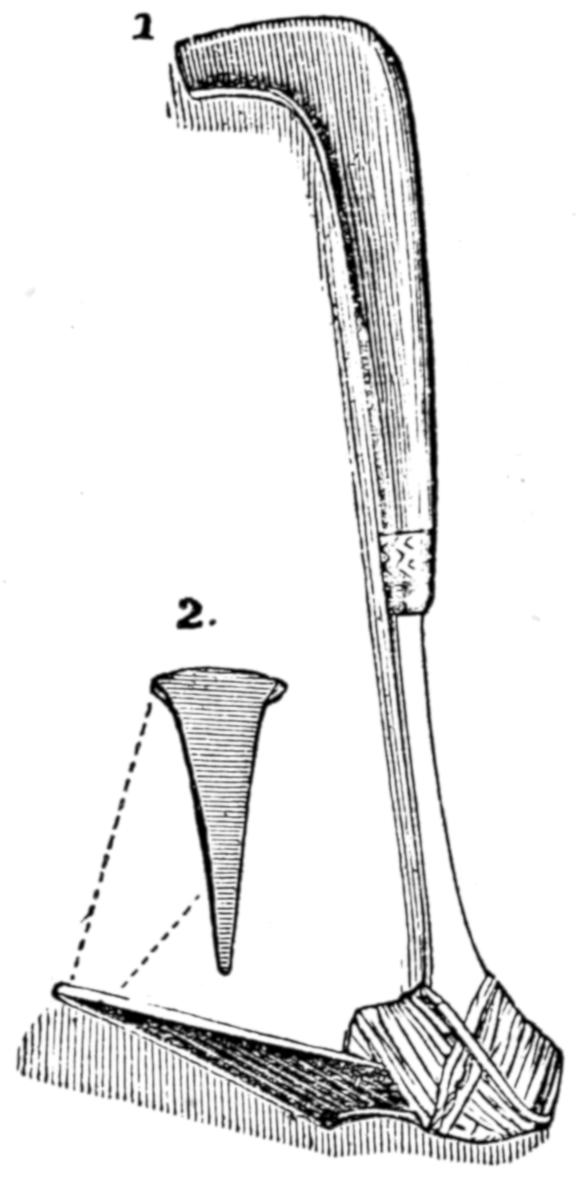
ADZE-AXE.
The head is made of iron, mostly imported,
and is in all probability formed on the model
of a stone implement that was formerly in
use. As the reader may see, it is fastened
to the wood by rattan, exactly as the stone
heads of the Polynesian axes are held in
their places by lashings of plaited sinnet.
But here the resemblance ends. The head
of the Polynesian axe is immovable, whereas
the essence of the Bornean axe is that the
head can be shifted at will, by taking it out
of the rattan lashing, reversing and replacing
it, so that it forms an axe or an adze,
as the user desires. The reader may remember
that the Banyai tribe of Southern
Africa have an axe made on a similar
principle, though in their case the reversal
is accomplished by cutting holes at right
angles to each other, through which the
shank of the iron head can be passed. (See
p. 364, figs. 4, 5.)
With this tiny instrument the Dyaks not
only shape their planks, but cut down the
largest trees with a rapidity that an English
workman could scarcely equal, in spite of the
superiority of his axe. They have a very
curious method of clearing away timber
from a space of ground. They first cut
away all the underwood with their parangs,
or choppers, and then, with their little axes,
cut the larger trees rather more than half
through, leaving the largest to the last. This
tree is then felled, and, as all the trees are
bound together with rattans and other
creepers, it brings down all the others in
its fall.
Although the iron which the Dyaks use is
mostly imported, they are capable of smelting
their own metal by a very simple process.
By way of a crucible, they dig a
small pit in the ground, and perforate the
sides with holes, through which currents of
air can be passed by means of the native
bellows. Charcoal is first placed in the pit,
and then the ore, well broken, is laid on the
charcoal; and so the Dyak workmen proceed
to fill the pit with alternate layers of charcoal
and ore. A light is then introduced by
means of a hole, the bellows are worked, and
in a short time the metal is smelted. Although
each man is generally capable of
making his own tools on a pinch, there is
generally a man in each village who is a
professional blacksmith, and makes his living
by forging spear heads and parang
blades, as well as by keeping the weapons
of the villagers in repair.
The basket work of the Dyaks is exceedingly
good, color as well as form being
studied in the manufacture. The basket
called tambok is made of the nipa palm leaf,
cut into strips not quite the twelfth of an
inch wide, and stained alternately yellow
and red. These are interwoven so as to produce
a considerable variety of pattern, somewhat
resembling that which is used in the
sarongs and other woven fabrics. These
patterns are nearly all combinations of the
square, the zigzag, and the diamond; the
last form, however, being nothing more than
the square turned diagonally.
Although made in cylindrical form, the
tambok is slightly squared by means of four
strips of hard red wood, which are tightly
fastened to the basket by rattan lashing.
The bottom of the basket is squared in a
similar manner, so as to flatten it and enable
it to stand upright, and is defended by
thicker strips of wood than those which run
up the sides. The lid is guarded by two
cross-strips of wood, and both the lid and
the top of the basket are strengthened by
two similar strips bound firmly round their
edges. This basket is exceedingly light,
elastic, strong, easily carried, and fully warrants
the estimation in which it is held.
Tamboks are made of almost all sizes, and
are extensively used by the Dyaks, the Malays,
and the European colonists.
Mats of various kinds are made by this
ingenious people. One of these mats, which
is in my possession, is a wonderful specimen
of Dyak work. It is nine feet long and five
wide, and is made of rattan, cut into very
narrow strips—not wider, indeed, than
those of the enlarged patterns of the tambok
basket. These strips are interwoven with
such skill as to form an intricate and artistic
pattern. The centre of the mat is occupied
by a number of spiral patterns, two inches
in diameter, the spiral being produced by
extensions of the zigzag already mentioned.
Around the spirals are three distinct borders,
each with a definite pattern, and the
whole is edged by a sort of selvage, which
gives strength to the fabric, and prevents it
from being torn. This kind of mat is exceedingly
durable, the specimen in question
having been long used in Borneo, then
brought over to England, and employed as
a floor-cloth; and, although cut in one or two
places by chair-legs, is on the whole as firm
as when it was made. As the rattan has not
been dyed, the color of the mat is a pale yellow;
but the pattern comes out with wonderful
distinctness, just as is the case with good
English table linen.
Like all uncivilized people, the Dyaks
never hurry themselves about their manufactures.
Time is no object to them; there
is none of the competition which hurries
European workmen through life. The
women, who make these beautiful mats, go
about their work in a very leisurely way,
interweaving the slender rattan strips with
infinite care, and certainly producing work
that is thorough and sound.
The rattan is split in rather a curious
manner. On account of the direction and
length of its fibre, it will split almost ad
infinitum into perfectly straight strips of
very great length, so that the only difficulty
is to cut the slips of precisely the same
width. The knives with which this task is
performed are rather peculiar. One of them
has already been described on page 1125, as
an appendage to the Bornean sword; but
there is another which is so remarkable that
it deserves a separate description.
The handle is bent at an angle like that
of the parang-latok, described and figured
on the page to which reference was just
made. In order to produce this effect, the
handle is made of two pieces of wood, the
ends of which are bevelled off, so that when
they are placed together they produce the
angular form which is desired. The two
pieces are fitted very neatly together, and
the joint is strengthened by a thick coating
of cement. The handle is further ornamented
by having a long piece of brass wire
coiled tightly round it, and is finished off at
the end with the same kind of cement as
that which is used at the joint.
Not only does the handle resemble that of
the parang, but there is a great resemblance
between the blades of the sword and the
knife. The blade of this knife has been
forged out of a square bar of steel, which
has been first flattened, and then beaten out
into the slightly curved form which is so
largely used throughout the whole of this
part of the world.
As is the case with the sword knife already
described, this implement is used by putting
the handle under the left arm and holding
the blade firmly in front of the body, while
both hands are at liberty to press the end of
the rattan against the edge of the knife, and
so to split it into as many strips as are needed.
In spite of the comparative roughness of the
manufacture, which dispenses with a finish
and polish, the knife can take a very fine
edge; and my own specimen, after having
suffered rather rough usage, is so sharp that
I have just mended a pen with it, and cut a
piece of note paper edgewise. The blade of
this knife is eleven inches in length.
In order to preserve the sharpness of the
edge, the Dyak carries the knife in a sheath
made simply of a small joint of bamboo,
closed at the lower end of the natural knot,
and carefully wrapped at each end with rattan
to prevent it from splitting.
The cotton fabrics are entirely made by
the women, from the preparation of the
thread to the weaving of the stuff. They
beat out the cotton with small sticks, and,
by means of a rude sort of wheel, spin it out
into thread very rapidly. They cannot
compete with the English manufacturer
in fineness of thread, but in durability there
is no comparison between the two, the Dyak
thread being stronger than that made in
England, and the dye with which it is
stained being so permanent that no fabric
wears so well as that which is of native
manufacture.
Although we can hardly rank the Dyak
jars among native manufactures, they play
so important a part in the domestic life of
these tribes that they cannot be passed over
without some notice.
The Dyaks have no real currency, and
can scarcely be made to understand it.
They perfectly comprehend direct barter,
but the secondary barter by means of a circulating
medium is, as a rule, beyond an
ordinary Dyak. He will take some goods
to the market for the purpose of exchanging
them for some article which he wants; but
he has no idea of selling his goods for money,
and buying with that money the needed
article.
The reader may remember that brass guns
have already been mentioned as a sort of
currency. These are nothing more or less
than cannon of various sizes, which are valued
by weight, and form a sort of standard
by which prices are measured, like the English
pound or the French franc. They are
bored to carry balls from one to two pounds
weight, and, though regarded chiefly in the
light of money, are serviceable weapons, and
can throw a ball to a considerable distance.
There is an advantage about this kind of
currency. It is not easily stolen, and outside
the chiefs’ houses may be seen rows of
brass guns lying on the ground unmounted
and owing their safety to their weight.
There is also a second standard of value
among the Dyaks. This is the Jar, an institution
which, I believe, is unique. These
jars are of earthenware, and as far as can be
judged by appearance, must have been of
Chinese manufacture. They are of different
descriptions, and vary greatly in value. The
commonest jars, called Naga or Dragon jars,
are worth about seven or eight pounds, and
derive their name from figures of dragons
rudely scrawled on them. They are about
two feet in height. The Rusa jar, which is
next higher in value, is worth from ten to
fifteen pounds, according to its quality, and
is known by the figures of the Rusa deer
which are drawn upon it.
But the most costly is the Gusi, which is
worth almost any sum that the owner chooses
to demand for it. The Gusi jar is neither large
nor pretty. It is of a dark olive green color,
and about two feet in height. These jars
are very scarce, and are considered as being
worth on an average about five hundred
pounds. Seven or eight hundred pounds
have been paid for a Gusi jar, and there have
been one or two so valuable that many thousands
pounds have been offered and refused
for them.
Mr. St. John mentions a jar of this kind
belonging to the Sultan of Brunei, which
derived its chief value from the fact that it
spoke on certain great occasions. For example,
the Sultan declared that on the night
before his wife died the jar uttered hollow
moaning sounds, and that it never failed to
apprize him of any coming misfortune by
wailing pitifully. This jar is kept in the
women’s apartments, and is always covered
with gold brocade, except when wanted for
consultation, or to exhibit its medicinal
properties. Water poured into a Gusi jar is
thought by the Dyaks and by the Malays to
be the best possible medicine for all kinds of
diseases, and, when sprinkled over the
fields, to be a certain means of procuring a
good crop. As the people are willing to
pay highly for this medicated water, there is
some reason for the enormous cost of these
jars.
One of them is said to possess a quality
which belongs to itself. It increased everything
that was put into it. If, for example,
it were half filled with rice in the evening it
would be nearly full in the morning; and
if water was poured into it, a few hours
would increase the depth of water by several
inches. It is remarkable that the art of
making these jars is lost. The Chinese, admirable
imitators as they are, have always
failed when they have endeavored to palm
off upon a Dyak a jar manufactured by themselves.
CHAPTER CXIX. BORNEO— Concluded . RELIGION—OMENS—FUNERALS.
THE STATE OF RELIGION AMONG THE DYAKS — THEIR BELIEF IN A SUPREME BEING — THE VARIOUS
SUBORDINATE GODS — THE ANTUS, AND THEIR FORMS — CATCHING A RUNAWAY SOUL — THE BUAU
AND HIS NATURE — ORIGIN OF LAND LEECHES — CHARMS, AND THEIR VALUE — OMENS — THE GOOD
AND EVIL BIRDS — A SIMPLE CAUSE OF DIVORCE — THE ENCHANTED LEAF — THE ORDEALS OF DIVING,
BOILING WATER, SALT, AND SNAILS — THE ENCHANTED WATER — A CURIOUS CEREMONY — DYAK
FUNERALS — THE OFFICE OF SEXTON.
The religion of the Dyaks is a very difficult
subject, as the people themselves seem to
have an exceedingly vague idea of it, and to
be rather unwilling to impart the little
knowledge which they have. It is tolerably
clear that they have an idea of a Supreme
Being, whom they call by different
names, according to their tribes; the Sea
Dyaks, for example, calling him Batara, and
the land Dyaks Tapa. Next to the Supreme,
by whom mankind was created, were
some very powerful though inferior deities,
such as Tenabi, who made the earth and the
lower animals; Iang, who taught religion to
the Dyaks, and still inspires them with
holiness; and Jirong, the lord of life and
death.
Besides those chief deities there are innumerable
Antus or minor gods, which correspond
in some degree to the fauns and
satyrs of the ancients. They are called by
many names, and as, according to Dyak
ideas, there is scarcely a square rod of forest
that does not contain its Antu, the people
live as it were in a world peopled with
supernatural beings. Some of them even
declare that they have seen the Antus, the
chief distinction of whom seems to be that
they have no heads, the neck being terminated
in a sharp point. They are capable of
assuming the form of a human being or of
any animal at will, but always without
heads, so that they can be at once recognized.
The story of one of these Antu-seers is a
very strange one. He declared that he saw
a squirrel in a tree, threw a spear at it, and
brought it to the ground. When he went
to pick it up, it suddenly rose, faced him,
and changed itself into a dog. The dog
walked a few paces, changed again into a
human being, and sat slowly down on the
trunk of a fallen tree. The body of the spectre
was parti-colored, and instead of a head
it had a pointed neck.
The Dyak ran off in terror, and was immediately
smitten with a violent fever, his
soul having been drawn from the body by
the Antu, and about to journey toward the
spirit world. The doctor, however, went off
to the spot where the Antu appeared, captured
the fugitive soul, brought it back, and
restored it to the body by means of the invisible
hole in the head through which the
Antu had summoned it. Next morning the
fever was gone, and the man was quite well.
They tell another story of one of these inimical
beings, who are supposed to be ghosts
of persons killed in battle, and called Buaus.
A Buau pounced upon a woman named
Temunyan during her husband’s absence,
carried her off, and by his magic arts fixed
her against a rock from which she could not
move. When the husband returned, he
went in search of his wife, and, having
found her, concocted a scheme by which the
Buau was induced to release her. By stratagem
the husband contrived to destroy the
Buau, and took his wife home.
She had, however, scarcely reached her
home when she gave birth to a horrible
being, of which the Buau was the father.
Her husband instantly chopped it into a
thousand pieces with his parang, and flung
it into the jungle, when each fragment took
life, and assumed the blood-sucking character
of the demon parent. And thus the
Buau was the original parent of land-leeches.
In order to propitiate these beings, the
Dyaks are in the habit of making offerings
of food, drink, and flowers to them before
they undertake any great task, mostly putting
the food into dishes or baskets, and laying
it in the jungle for the use of the Antus.
Satisfied apparently with the multitude of
their deities, the Dyaks possess no idols, a
fact which is really remarkable, as showing
the character of their minds. Charms, however,
they have in plenty, and place the
greatest reliance on them. Some charms
are credited as rendering the wearer invulnerable,
and it is likely that those attached
to the parang described on page 1125 are of
that character.
Mr. St. John mentions an amusing example
of the value set upon these charms.
There was a chief of very high rank, who
possessed some exceedingly potent charms,
which had been in his family for many generations,
and had been handed down from
father to son. They consisted of two round
pebbles, one flat pebble, a little stone which
had been found in a banana, and some sand.
All these valuables were sewed up together
and fastened to a string, by which they
could be attached to the waist in times of
peril.
Unfortunately, the chief lent these charms
to a man who lost them, and was sued by
the aggrieved owner before the English
court. He gained his case, but was nearly
as much dissatisfied with the court as with
the defendant, inasmuch as he estimated the
value of the charms at a Rusa jar, i. e. about
thirty dollars, or seven pounds, whereas the
value set on them by the court, and paid by
the defendant, was fivepence.
Allusion has been already made to the
birds on which the Dyaks so much rely as
omens. These are three in number, the
Kushah, the Kariak, and the Katupung.
When a Dyak is about to start on an expedition,
he goes to the place near the village
where the feasting sheds are built, and there
waits until he hears the cry of one of these
birds. Should either the kushah or the katupung
cry in the front, or on either side,
and not be answered, the omen is bad, and
the man gives up his expedition. It is a
good sign, however, if the bird should first
cry on one side and then be answered on
the other. The most important bird is the
kariak. If the cry of the kariak be heard
on the right, the omen is good; if on the
left, it is doubtful. But if the cry be heard
behind the diviner, the omen is as bad as it
can be, and portends at least sickness, if not
death.
The Dyaks scarcely engage in any undertaking
without consulting the birds, whom
they believe to be half Dyaks, all birds having
proceeded from the union of an Antu
with a Dyak woman.
Mr. Brooke, in treating of this subject,
has the following forcible remarks:—“Some
of our party of Dyaks had proceeded, but
most were yet behind, and will be sweeping
down for the next week or more. Many go
through the forms of their forefathers in
listening to the sounds of omens; but the
ceremony is now very curtailed, compared
with what it was a few years ago, when I
have known a chief live in a hut for six
weeks, partly waiting for the twittering of
birds to be in a proper direction, and partly
detained by his followers. Besides, the
whole way in advancing, their dreams are
religiously interpreted and adhered to; but,
as in all such matters, interpretations are
liable to a double construction. The finale
is, that inclination, or often fear, is most
powerful. A fearful heart produces a disagreeable
dream, or a bad omen in imagined
sounds from birds or deer, and this always
makes a force return. But they often loiter
about so long, that the enemy gains intelligence
of their intended attack, and is on the
alert.
“However absurdly these omens lead the
human race, they steadily continue to follow
and believe in such practices. Faith
predominates, and hugs huge wonders, and
tenaciously lives in the minds of the ignorant.
Some of the Dyaks are somewhat
shaken in the belief in hereditary omens,
and a few follow the Malay custom of using
a particular day, which has a strange effect
on European imaginations. The white man
who commands the force is supposed to
have an express bird and lucky charm to
guide him onward; and to these the Dyaks
trust considerably. ‘You are our bird, we
follow you.’ I well know the names, and
can distinguish the sounds of their birds,
and the different hands on which the good
and bad omens are interpreted.
“The effect of these signs on myself was
often very marked, and no Dyak could feel
an adverse omen more than myself when
away in the jungle, surrounded by these superstitious
people. Still, I could sympathize
with the multitude, and the difficulty lay in
the question, whether any influence would
be sufficient to counteract such phantoms.
It must not be thought I ever attempted to
lead the Dyaks to believe that I was the
owner of charms and such absurdities,
which could not have lasted above a season,
and could never be successful for a length
of time. A maias’ (orang-outan’s) head was
hanging in my room, and this they thought
to be my director to successful expeditions.”
The cries of various animals are all interpreted
by the Dyaks, those which have evil
significations far outnumbering the good-omened
cries. The worst of all omens is
the cry of a deer, which will make a Dyak
abandon any project on which he is engaged,
no matter how deeply his heart may be set
on it.
On one occasion, a Dyak had married a
young girl for whom he had a very strong
attachment, which was returned. On the
third day after the marriage, the English
missionary entered the head house and was
surprised to see the young husband sitting
in it hard at work on some brass wire. This
was a very strong circumstance, as the head
house is tenanted only by the bachelors.
The missionary naturally asked him what
he was doing there, and what had become of
his wife, to which he answered sorrowfully
that he had no wife, a deer having cried on
the preceding night, so that they were
obliged to dissolve the marriage at once.
“But,” said his interrogator, “are you not
sorry for this?”
“Very sorry!”
“What are you doing with the wire?”
“Making ornaments for the girl whom I
want for my new wife.”
It seems that the belief in the Antus is so
ingrained in the minds of the Dyaks, that
whenever any one meets with an accident,
some Antu or other is presumed to have
been the author of the injury, and to require
appeasal. Mr. Brooke mentions that he once
found the leaf of a palm tree folded in a peculiar
manner, lying near his house. This
was an offering to the Antu, because a man
had fallen down there and injured himself.
The leaf was supposed to be possessed by
the Antu, who would avenge himself if his
leaf were disturbed by causing the arm of
the offender to swell. However, Mr. Brooke
picked up the leaf and threw it away, and
within two days his arm became swollen
and inflamed, and remained in that state for
nearly a fortnight afterward.
In connection with this subject must be
mentioned the ordeals by which disputes are
often settled. These are of various kinds,
but the favorite plan is the ordeal of diving.
The two disputants are taken to the river
and wade into the water up to the chin. At
a given signal they plunge beneath the surface,
and the one who can remain longest
under water wins the case. There was a
very curious instance of such an ordeal
where the honor of a family was involved.
The daughter of a chief was found to have
disgraced herself, and laid the blame upon a
young man of rank. He, however, utterly
contradicted her story, and at last the dispute
was brought to an end by the ordeal of
diving. The young chief won his cause, and
the result was that the offending girl had to
leave the village, and her father was deserted
by his followers, so that he was also obliged
to seek another home.
Then there is the salt ordeal. Each litigant
is provided with a lump of salt of precisely
the same weight, and he whose salt
retains its shape longest in water is held to
be the winner. There is also the boiling-water
test, which is exactly the same as that
which was practised in England in former
days, the hand being dipped into the hot
liquid, and coming out uninjured if the appellant
be innocent. Lastly, there is the
snail ordeal. Each party takes a snail and
puts it on a plate, and lime juice is poured
over them, when the snail that first moves
is considered to have indicated that its
owner is in the wrong.
The reader may remember that the Dyaks
are in the habit of purchasing water that has
been poured into the sacred jars, and sprinkling
it over their fields by way of ensuring
fertility. They believe that water which has
touched the person of a white man will have
the same effect, especially if he be a man of
some rank. So as soon as English officers
arrive at a Dyak village, the natives have a
custom of seizing them, pulling off their
shoes and stockings, and washing their feet,
the water being preserved as an infallible
charm for promoting the growth of their
crops.
They carry this principle to an extent
which to us seems exceedingly disgusting.
Long bamboos filled with dressed rice are
brought to the visitors, who are requested
to spit in them. The rice thus medicated is
distributed among the assembled crowd, who
press eagerly round, each attempting to secure
a portion of the health-giving food.
Some of the more cunning among the people
try to secure a second and some a third supply,
and Mr. St. John mentions an instance
when one horrid old woman managed to be
helped six times.
The same traveller mentions that the
blood of fowls is thought to be a very powerful
charm, and the Dyaks have a ceremony
connected with the shedding of blood which
is almost identical with the Jewish Passover.
(See Exod. xii. 22.) A festival had been
given in honor of the visitors. Their feet
had been washed, and the water put aside.
Their rice had been duly medicated, and the
Orang-kaya began some curious ceremonies,
flinging rice out of the windows, and accompanying
the act with a prayer for fertility
to the fields and prosperity to the village.
He was evidently repeating a well-learned
lesson, and it was ascertained that the words
which he used were not understood by himself,
so that we find among the Dyaks the
relics of an expired language, the few remnants
of which are preserved by religion,
just as is the case with the inhabitants of
New Zealand and other islands.
This portion of the ceremony being ended
a sort of sacred dance was performed, the
Orang-kaya and the elders going successively
to the white visitors, passing their
hands over their arms, and going off in a
slow, measured tread, “moving their arms
and hands in unison with their feet until
they reached the end of the house, and came
back to where we sat. Then came another
pressure of the palm, a few more passes to
draw virtue out of us, another yell, and off
they went again—at one time there were
at least a hundred dancing.
“For three nights we had had little sleep,
on account of these ceremonies, but at
length, notwithstanding clash of gong and
beat of drum, we sank back in our beds, and
were soon fast asleep. In perhaps a couple
of hours I awoke, my companion was still
sleeping uneasily, the din was deafening,
and I sat up to look around.
“Unfortunate moment! I was instantly
seized by the hands of two priests, and led
up to the Orang-kaya, who was himself cutting
a fowl’s throat. He wanted Captain
Brooke to perform the following ceremony,
but I objected to his being awakened, and
offered to do it for him. I was taken to the
very end of the house, and the bleeding
fowl put in my hands. Holding him by his
legs I had to strike the lintel of the doors,
sprinkling a little blood over each. When
this was over, I had to wave the fowl over
the heads of the women and wish them fertility;
over the children, and wish them
health; over all the people, and wish them
prosperity; out of the window, and invoke
good crops for them.”
Funerals among the Dyaks differ
slightly in the various tribes. The common
people are buried or even burned with
scarcely any ceremony, but the bodies of
chiefs and their relatives are treated with a
whole series of rites.
As soon as a chief dies, the corpse is
dressed in his finest clothes, every ornament
that he possessed is hung upon him, and his
favorite swords and other weapons are laid
by his side. The body is then placed on an
elevated platform, and is watched and tended
as if the dead man were still alive, food,
drink, tobacco, and sirih being continually
offered him, and the air kept cool by constant
fanning. The men assemble on one side of
the corpse, and the women on the other, and
romp with each other as if the occasion were
of a joyful rather than a sorrowful character.
These games are continued until the corpse
is far gone in decomposition, when it is
placed in a coffin made of a hollowed tree
trunk, and buried in a grave which must not
be more than five feet deep.
Knowing the customs of the people, the
Malays are apt to rifle the graves of dead
chiefs, for the sake of obtaining the swords
and other valuables that are buried with
them. Formerly, after the body was laid in
the grave, the sword, a jar or two, clothes,
ornaments, and a female slave were placed
in a canoe, the woman being firmly chained
to it. When the tide was ebbing the boat
was sent adrift, and was supposed to supply
the spirit of the departed with all the goods
that were on board. This custom, however,
has been long discontinued, as the Dyaks
found that the canoe and its contents almost
invariably fell into the hands of the Malays,
who thus procured slaves without paying for
them, and enriched themselves besides with
the swords, gold, and clothing.
The sexton’s office is hereditary, and
whenever the line fails the Dyaks have
great difficulty in finding some one who
will not only take the office upon himself,
but must also entail it upon his descendants.
The office, however, is a very lucrative one,
varying from a rupee to two dollars, a sum of
money which can procure for a Dyak all the
necessaries and most of the luxuries of life
for several weeks.
The Kayan Dyaks do not bury their dead,
but place the body in a very stout coffin
made of a hollowed tree, and elevate it on
two stout carved posts, with woodwork projecting
from each corner, like the roofs of
Siamese houses.
CHAPTER CXX. TIERRA DEL FUEGO. APPEARANCE—ARCHITECTURE—MANUFACTURES.
POSITION OF THE COUNTRY AND SIGNIFICATION OF THE NAME — CONFORMATION OF THE LAND AND
ITS ANIMAL AND VEGETABLE LIFE — APPEARANCE OF THE FUEGIANS — ERRONEOUS IDEAS CONCERNING
THEM — COLOR, COSTUME, AND MODE OF WEARING THE HAIR — INDIFFERENCE TO
DRESS — PAINT AND ORNAMENTS — FUEGIAN ARCHITECTURE — THE POINTED AND ROUNDED HUTS — THE
SPEAR AND ITS HEAD — BOWS AND ARROWS — STONE THROWING — WONDERFUL STRENGTH
OF THE FUEGIANS — SKILL WITH THE SLING — STUDY OF PARTICULAR WEAPONS — FOOD OF THE
FUEGIANS — ANGLING WITHOUT HOOKS — THE DOGS, FISHERS AND BIRD CATCHERS — THE DOG
RESPECTED BY THE FUEGIANS — CANNIBALISM — THE TREE FUNGUS — CANOES — THE LARGE AND
SMALL CANOES, AND THEIR USES — SHIFTING QUARTERS AND TRANSPORTING CANOES — COOKERY — GENERAL
TEMPERAMENT OF THE FUEGIANS — JEMMY BUTTON — FUEGIAN GOVERNMENT.
At the extreme southern point of America
is a large island, or rather a collection of islands
separated by very narrow armlets of
the sea. It is separated from the mainland
by the strange tortuous Magellan’s Strait,
which is in no place wide enough to permit
a ship to be out of sight of land, and in some
points is exceedingly narrow. As Magellan
sailed through this channel by night, he saw
that the southern shore was studded with
innumerable fires, and he therefore called
the country Tierra del Fuego, or Land
of Fire. These fires were probably beacons
lighted by the natives in order to warn each
other of the approach of strangers, to whom
the Fuegians have at times evinced the
most bitter hostility, while at others they
have been kind and hospitable in their
way.
The country is a singularly unpromising
one, and Tierra del Fuego on the south and
the Esquimaux country on the north seem
to be exactly the lands in which human
beings could not live. Yet both are populated,
and the natives of both extremities of
this vast continent are fully impressed with
the superiority of their country over all
others.
Tierra del Fuego is, as its proximity to
the South Pole infers, a miserably cold
country, and even in the summer time the
place is so cold that in comparison England
would seem to be quite a tropical island. In
consequence of this extreme cold neither
animal nor vegetable life can be luxuriant.
The forests are small, and the trees short,
stumpy, and ceasing to exist at all at some
fifteen hundred feet above the level of the
sea. There is a sort of evergreen beech
(Fagus betuloides).
There is only one redeeming point in the
climate of Tierra del Fuego. The mosquito
that haunts alike the hottest and
coldest countries, and equally a terror in
tropical and Arctic America, cannot live in
Tierra del Fuego, the damp, as well as the
cold, being fatal to it. Indeed, there are
very few insects in this strange land, and
reptiles are altogether absent.
Absence of vegetable life naturally results
in absence of animal life, the herbivorous
animals being starved out for want of their
proper food, and the carnivora being equally
unable to live, as finding no animals on
which to feed. Man being omnivorous, has
a slightly better chance of living, but even
he could not multiply and fill the country
when food is so limited, provided he were
limited to the land, but, as he is master of
the waters as well as of the earth, he can
draw his living from the sea and rivers when
the land refuses to supply him with food.
Such is the case with the Fuegians, who are
essentially people of the sea and its shore,
and who draw nearly the whole of their subsistence
from its waters, as we shall see in a
future page.
Perhaps in consequence of the scantiness,
the irregularity, and the quality of their
food, the Fuegians are a very short race of
men, often shorter than the average Bosjesman
of Southern Africa, and even lower in
the social scale. They ought not to be called
dwarfs, as is too often the case, their bodies
being tolerably proportioned, and their figures
not stunted, but simply smaller than
the average of Europeans, while the muscular
development of the upper part of the body
is really wonderful. As a rule, the average
height of the Fuegian men is about five feet,
and that of the women four feet six inches.
In some parts of the islands there are natives
of much larger size, but these are evidently
immigrants from the adjacent country
of Patagonia, where the stature is as
much above the average of Europeans as that
of the Fuegians is below it.
The color of the natives is a dark coppery
brown, the reddish hue being only perceptible
in spots where they happen accidentally
to be clean. The limbs are generally
slight, so that the knees and elbows seem to
be disproportionately large, and their heads
are covered with masses of black hair, that
possesses no curl, and falls in long, wild
tangled locks over their shoulders. The
men are almost entirely beardless.
An illustration on the opposite page of a
Fuegian man and woman gives a correct representation
of the ugliness of feature and
want of intelligence which characterize this
people.
Both sexes allow their hair to run to its full
length, except over the forehead, where it
is roughly cut with a shell to prevent it from
falling into the eyes. The people have a
strange superstitious reverence for hair, and
that portion which is cut off is deposited in
a basket, and afterward carefully disposed
of. Once, when the captain had snipped off
a little hair from a Fuegian’s head, he found
that he had given great offence, and was
obliged to restore the severed hair and put
away the scissors before the angry feelings
of the native could be smoothed. On
another occasion, the only mode of pacifying
the offended native was by restoring the
lock of hair, together with a similar lock
from the head of the white man. The cut
hair is generally burned.
Captain King’s account of the Fuegian
women is not attractive.
“The hair of the women is longer, less
coarse, and certainly cleaner than that of
the men. It is combed with the jaw of a
porpoise, but neither plaited nor tied; and
none is cut away, except from over their
eyes. They are short, with bodies largely
out of proportion to their height; their features,
especially those of the old, are scarcely
less disagreeable than the repulsive ones of
the men. About four feet and some inches
is the stature of these she-Fuegians, by
courtesy called women. They never walk
upright; a stooping posture and awkward
movement is their natural gait. They may
be fit mates for such uncouth men; but to
civilized people their appearance is disgusting.
Very few exceptions were noticed.
“The color of the women is similar to
that of the men. As they are just as much
exposed, and do harder work, this is a natural
consequence. Besides, while children
they run about quite naked, picking up
shell-fish, carrying wood, or bringing water.
In the color of the older people there is a
tinge of yellow, which is not noticed in the
middle-aged or young.”
As is the case with many savage tribes,
the teeth of the Fuegians are ground down
to an almost flat surface. This is most conspicuous
in the front teeth. There is little
apparent distinction between the canine and
the incisor teeth, both being ground down to
such an extent that the only remains of the
enamel are on the sides, and, as Captain
King graphically remarks, “the front teeth
are solid, and often flat-topped like those of
a horse eight years old ... the interior
substance of each tooth is then seen as
plainly in proportion to its size as that of a
horse.”
The mouth is large, and very coarsely
formed, and as there is not a vestige of
beard its full ugliness is shown to the best
advantage.
One of the strangest phenomena connected
with the Fuegians is their lack of
clothing. In a climate so cold that in the
middle of summer people have been frozen
to death at no great elevation above the
level of the sea, it might well be imagined
that the natives would follow the same
course as that adopted by the Esquimaux,
and make for themselves garments out of
the thickest and warmest furs that can be
procured.
They might do so if they chose. In some
parts of their country they have the thick-woolled
guanaco (probably an importation
from the mainland), and in others are deer
and foxes, not to mention the dogs which
they keep in a domesticated state. Besides,
there are few furs warmer than those of the
seal, and seals of various kinds abound on
the Fuegian coasts, some, such as the sea-lion,
being of very large size. Then there
are various water birds, whose skins would
make dresses equally light and warm, such
as the penguin, the duck, the albatross, and
the like.
It is evident, therefore, that if the Fuegian
is not warmly and thickly clothed, it is
not from want of material, and that he is
naked not from necessity but choice. And
he chooses nudity, neither sex wearing any
description of clothes except a piece of seal
or deer skin about eighteen inches square
hung over one shoulder. No other covering
is worn except this patch of skin, which
is shifted about from one side of the body
to the other according to the direction of
the wind, the Fuegian appearing to be perfectly
indifferent to frost, rain, or snow. For
example, a Fuegian mother has been seen
with her child in her arms, wearing nothing
but the little patch of seal-skin on the windward
side, and yet standing unconcernedly
in the snow, which not only fell on her naked
shoulder, but was heaped between her child
and her breast, neither mother nor infant
seeming to be more than ordinarily cold.
During mild weather, or when the Fuegian
is paddling or otherwise engaged in work,
he thinks that even the piece of seal-skin is
too much for him, and throws it off.
Though careless about clothing, he is not
indifferent to ornament, and decorates his
copper-colored body in various ways. He
uses paint in profusion, generally laying on
a white ground made of a chalky clay, and
drawing patterns upon it of black or dull
brick-red. The black is simply charcoal reduced
to powder. He likes necklaces, which
are mostly white, and are made of the teeth
of fishes and seals, or of pieces of bone.
Ornaments of the same character are worn
upon the wrists and ankles, so that, although
the Fuegian has no clothes, he has plenty of
savage jewelry.
Both sexes keep their long, straggling
locks out of their eyes by means of a small
fillet made of sinews, or the hair of the
guanaco, twined round the forehead. Feathers
and similar ornaments are stuck into
this fillet; but if they be white, the spectator
must be on his guard, for white down
and feathers on the head are signs of war.
Red, on the contrary, denotes peace; so that
these people entirely reverse the symbolism
of color which is accepted almost over the
entire world. Sometimes a native may be
seen so covered with black paint that the
coppery color of the skin is entirely lost, and
the complexion is as black as that of a negro.
This is a sign of mourning, and is
used on the death of a relation or friend.
The houses of the Fuegians are as simple
as their dress, and practically are little but
rude shelters from the wind. Any boy can
make a Fuegian house in half an hour. He
has only to cut a number of long branches,
sharpen the thicker ends, and stick them
into the ground, so as to occupy seven-eighths
or so of a circle. Let him then tie
the sticks together at the top, and the framework
of the house is completed. The walls
and roof are made by twisting smaller boughs
among the uprights and throwing long coarse
grass on them, and the entire furniture of the
hut is comprised in a few armfuls of the same
grass thrown on the ground.
The opening at the side is always made
in the direction opposite the wind, and
there is no attempt at a door; so that, in
fact, as has been said, the Fuegian’s only idea
of a house is a shelter from the wind, so
that the natives have no idea of a home or
even of a dwelling-place. This is the form
of hut used by the Tekeenika tribes of
south-eastern Fuegia. A Fuegian settlement,
with houses and surrounding scenery,
is well represented on the 1169th
page.
That which is generally employed in other
parts of Fuegia is even more simple. It is
barely half the height of the Tekeenika hut,
and looks something like a large bee-hive. It
seldom, if ever, exceeds five feet in height,
but, as the earth is scraped away within,
another foot in height is given to the interior.
It is made simply by digging a circular
hole a foot or so in depth, planting
green boughs around the excavation, bending
them over, and tying their tops together.
Upon this rude framework are fastened
bunches of grass, sheets of bark, and
skins; so that, on the whole, a habitation is
formed which is equal in point of accommodation
to a gipsy’s tent. These huts vary
much in diameter, though not in height; for,
while a number of huts are from four to
five feet in height, their diameter will vary
from six to twenty feet.
The Fuegians are a quarrelsome people,
and the different tribes are constantly at
war with each other; and, although they
can scarcely be divided into definite tribes,
the spirit of local jealousy is sufficiently
strong within them to keep the inhabitants
of one district at perpetual feud with those
of another. The conformation of the country
aids this feeling of jealousy, the land
being divided by numerous ravines, armlets
of the sea, and precipitous mountains; but,
fortunately for the Fuegians, this very
structure prevents destruction in war, although
it encourages the ill-feeling which
leads to war; and the battles of the Fuegians
are, at the best, nothing but detached
skirmishes, without producing the least
political effect.
Their weapons are the bow and arrow,
the spear, and the sling. These weapons
are primarily intended for hunting, and are
much more used for killing seals, guanacos,
deer, fish, and birds than in slaying men.
In the use of them the Fuegians are wonderfully
expert. Capt. Parker Snow mentions
a case where a number of Fuegians
had assembled in their canoes round his
vessel. A large fish happened to pass,
whereupon the natives instantly speared it,
and pitched it on board the ship.
The shafts of the spears sometimes reach
the length of ten feet, and, instead of being
rounded, as is mostly the case with spear
shafts, are octagonal. The heads are made
of bone, about seven inches in length, and
have a single barb about four inches from
the point. The Patagonians use a very
similar weapon, as we shall presently see.
There is another kind of spear head, which
has a whole row of small barbs down one
side. This weapon is used as a javelin, and
is thrown with great force and accuracy, the
native grasping it near the middle, poising
for a moment, so as to look along it, and
then hurling it.
The bow and arrow are mostly used for
killing birds, the arrows being made of hard
wood, about two feet long. They are headed
with pieces of flint or obsidian, which
are merely stuck in a notch at the end of
the arrow, so that, when the shaft is withdrawn,
the head remains in the wound.
The bow is strung with twisted sinews.
Birds are also killed by stones, some thrown
by hand, and others with the sling, the wonderful
strength of these strange people enabling
them to use their missiles with terrible
effect.
Although not tall, the Fuegians are very
thick-set and enormously powerful. One of
them, named by the sailors York Minster,
was a match in point of muscular strength
for any two of the men belonging to the
ship. The women are as strong as the men.
On one occasion, when three Fuegians, a
man and two women, had treacherously
attacked a white sailor, and were trying to
beat out his brains with stones, they were
interrupted, and the sailor rescued. The
man was shot. One of the women tried to
conceal herself under the bank, and the
other was seized by the captain and his coxswain,
who tried to pinion her arms. She
struggled and fought so stoutly that they
could scarcely achieve their object, and had
no idea that they were contending with a
woman until they heard some one announce
the sex of their captive. As to the other
woman, who was the oldest of the party,
she clung so tightly to the bank that two of
the strongest sailors could scarcely remove
her.
The fate of the man was very curious,
and illustrates the reckless, not to say
senseless, courage of these people. He
was mortally wounded, and fell back
for a moment, allowing the maltreated
sailor to escape. However, he instantly
recovered himself, and, snatching stones
from the bed of the stream in which he was
standing, began to hurl them with astounding
force and quickness. He used both
hands, and flung stones with such truth
of aim that the first struck the master,
smashed his powder-horn to pieces, and
nearly knocked him down. The two next
were hurled at the heads of the nearest
seamen, who just escaped by stooping as
the missiles were thrown. All this passed
in a second or two, and with an attempt to
hurl a fourth stone the man fell dead.
Some time before this event the sailors
had been astonished at the stone-throwing
powers of the Fuegians, who nearly struck
them with stones thrown by hand when
they thought themselves even beyond musket
shot. They generally carry a store of
pebbles ready for use in the corner of their
little skin mantles.
The sling is made of a cup of seal or
guanaco skin, to which are attached two
cords similar in material to the bow-strings,
thus combining apparent delicacy with great
strength. The cords of the sling are more
than three feet in length. The skill which
the Fuegians possess with this weapon is
worthy of the reputation attained by the
Balearic islanders. Captain King has seen
them strike with a sling-stone a cap placed
on a stump at fifty or sixty yards’ distance,
and on one occasion he witnessed a really
wonderful display of dexterity. He asked a
Fuegian to show him the use of the weapon.
The man immediately picked up a stone
about as large as a pigeon’s egg, placed it in
the sling, and pointed to a canoe as his mark.
He then turned his back, and flung the stone
in exactly the opposite direction, so that it
struck the trunk of a tree, and rebounded to
the canoe. The men seem to think the
sling a necessity of life, and it is very seldom
that a Fuegian is seen without it either hung
over his neck or tied round his waist.
It is rather a curious fact that the Fuegians
always devote themselves to one particular
weapon. One, for example, will be
pre-eminent in the use of the bow, another
will excel in throwing stones with the hand,
and a third will give all his energies to the
sling. Yet, although each man selects some
particular arm in the use of which he excels,
they all are tolerable masters of the other
weapons, and it sometimes happens that a
Fuegian crosses over to the Patagonian
coast, procures the singular weapon called
the “bolas,” of which the reader will learn
more presently, and becomes almost as expert
in its use as the man from whom he
obtained it.
As for the food of the Fuegians, it is, as I
have already mentioned, chiefly drawn from
the sea. He is an excellent fisherman, and
manages to capture his prey without even a
hook. He ties a bait on the end of the
line, dangles it before the fish, and gradually
coaxes it toward the surface of the water.
He then allows it to bite, and, before it can
detach its teeth from the bait, jerks it out of
the water with his right hand, while with
the left he catches or strikes it into the
canoe. It is evident that by this manner of
angling it is impossible to catch fish of any
great size. As soon as he has caught the
fish, the Fuegian opens it by the simple plan
of biting a piece out of its under surface,
cleans it, and hangs it on a stick.
Molluscs, especially the mussels and limpets
which are found on the sea-shores, form
a very considerable portion of the Fuegian’s
diet; and it is a curious fact that these natives
never throw the empty shells about,
but carefully lay them in heaps. They are
especially careful not to throw them back
into the sea, thinking that the molluscs would
take warning by seeing the shells of their
comrades, and would forsake the coast.
Every woman is furnished with a short
pointed stick of hard wood, with which she
knocks the limpets off the rocks.
There is a very large species of mussel
found on these shores, which is particularly
useful to the Fuegian, who employs its shell
as a knife. These tools are made in a very
simple manner. The Fuegian first knocks
off the original edge of the shell, which is
brittle and rather fragile, and, by grinding
it against the rocks, produces a new edge,
which is sharp enough to cut wood and even
bone.
By means of the spear and arrows, the
Fuegian contrives even to capture seals and
sea-otters, but the pursuit in which he
shows his greatest ingenuity is the capture
of fish by means of dogs. These dogs are
little, fox-like looking dogs, which appear
utterly incapable of aiding their masters in
hunting. Yet they are singularly intelligent
in their own way, and have learned a
most curious fashion of taking fish. When
a shoal of fish approaches the land, the dogs
swim out and enclose them, splashing and
diving until they drive the shoal into a net,
or into some creek when the water is sufficiently
shallow for the spear and arrow to
be used. The dogs are also taught to catch
the birds while sleeping. They creep up to
the birds quietly, pounce upon them, carry
them to their masters, and return for more,
and all so silently that the birds around are
not disturbed.
These animals are regarded with very
mingled feelings. The Fuegian neglects
them and illtreats them, scarcely ever taking
the trouble to feed them, so that if they
depended on the food given them by their
masters they would starve. However, their
aquatic training gives them the power of
foraging for themselves, and, when not
required by their masters, they can catch
fish on their own account. They are odd,
sharp nosed, bushy tailed animals, with
large, pointed, erect ears, and usually with
dark rough hair, though a few among them
have the fur nearly white. They are watchful
and faithful to their masters, and the
sight of a stranger, much more of a clothed
stranger, sets them barking furiously.
Although the Fuegian neglects his dog,
he has a great respect and even affection for
the animal. It often happens that the mussels
and limpets fail, that the weather is too
tempestuous for fishing, and that in consequence
the people are reduced to the brink
of starvation. It might be presumed that,
having their dogs at hand, they would avail
themselves of so obvious a source of food.
This, however, they never do, except when
reduced to the last extremity, and, instead of
eating their dogs, they eat their old women,
who, as they think, are worn out and can do
no good, while the dogs, if suffered to live,
will assist in catching fish and guanacos.
When they have determined on killing an
old woman, they put a quantity of green
wood on their fire, so as to cause a thick,
suffocating smoke, and in this smoke they
hold the poor creature’s head until she is
stifled. Unless there is very great distress,
the women eat the upper part of the victim
and the men the lower, the trunk being
thrown into the sea.
Several species of echinus, or sea urchins,
are eaten by the Fuegians, who dive for them
and bring them to the surface, in spite of the
sharp prickles with which the entire surface
is beset.
The Fuegian’s great feast, however, takes
place when a whale is stranded on the
shore. All the people within reach flock to
the spot, while fleets of canoes surround the
stranded monster, and its body is covered
with little copper-colored men carving away
the blubber with their shell knives. Each
cuts as much as he can get, and when he has
torn and carved off a large piece of blubber,
he makes a hole in the middle, puts his head
through the aperture, and thus leaves his
hands free to carry more of the dainty food.
Besides this animal food, the Fuegian eats
a remarkable kind of fungus, which is found
on the antarctic beech, the tree which
has already been mentioned. Mr. Webster
gives the following description of it:—
“The antarctic beech is the common and
prevailing tree. It is an elegant evergreen.
It grows to the height of thirty or forty feet,
with a girth of from three to five feet, and
sometimes, doubling these dimensions, it
forms a majestic tree. In December it puts
forth a profusion of blossoms, with anthers
of bright pink, large and pendent. This
evergreen beech frequently has round the
upper part of the trunk, or on some of the
larger branches, large clusters of globular
fungi of a bright orange color. Each fungus
is about the size of a small apple, of a
soft pulpy nature, with a smooth yellow
skin. As it approaches maturity it becomes
cellular and latticed on its surface, and
when it drops from the tree, dries, and
shrivels into a brown mass resembling a
morel.
“The Fuegians eat this fungus with avidity.
The gelatinous mass is pale, without
taste or odor; at the part in contact with the
tree are two germs or processes. From
twenty to thirty of these fungi are clustered
together, and encircle the tree. They form
a very conspicuous object, and wherever
they are attached they produce a hard knot,
or woody tumor, of considerable density. I
did not observe them on any other tree than
the evergreen beech.”
Passing so much of his time on the sea,
the Fuegian needs a boat of some kind, and,
debased as he is in many points, he is capable
of constructing a vessel that answers
every purpose he requires. There are several
kinds of Fuegian canoes. The simplest
form is made of the bark of a sort of birch,
and is in fact formed much like the primitive
canoes of the Australians. It is a
single sheet of bark stripped from the tree,
and tied firmly together at each end. Several
sticks placed crosswise in the middle
serve to keep it open; and if any part has a
tendency to bulge in the opposite direction, a
skin thong is passed across the boat and
keeps it in shape. The ends of the canoe,
as well as any cracks or holes in the bark,
are caulked with dry rushes and a pitchy
resin procured from trees.
Like the Australian, the Fuegian carries
fire in these tiny canoes, placing a lump of
clay in the bottom of the boat, building the
fire on it, and so being able to remain at sea
for a considerable time, cooking and eating
the fish as fast as he catches them. Such a
boat as this, however, is too frail to be taken
far from land, or indeed to be used at all
when the weather is tempestuous. Moreover,
it only holds one or two persons, and
is therefore unfitted for many purposes for
which a Fuegian requires a canoe. A much
larger and better kind of canoe is therefore
made, which has the useful property of being
made in separate parts so that the canoe can
be taken to pieces, and the various portions
carried overland to any spot where the
canoe may be wanted. Such a vessel as this
is about fifteen feet in length and a yard in
width, and, being very buoyant, is capable
of holding a whole family, together with
their house, and weapons, and utensils. It
is considerably raised both at the bow and
the stern, and the various pieces of which it
is made are sewed together with thongs of
raw hide.
The very character of a Fuegian’s life
shows that he must, to a certain degree, be
a nomad. He never cultivates the soil, he
never builds a real house, he never stores up
food for the future, and so it necessarily
follows that when he has eaten all the mussels,
limpets, oysters, and fungi in one spot,
he must move to another. And, the demands
of hunger being imperious, he cannot wait,
but, even if the weather be too stormy to
allow him to take his canoe from one part of
the coast to another, he is still forced to go,
and has therefore hit upon the ingenious plan
of taking his canoe to pieces, and making the
journey by land and not by sea. An illustration
on the following page shows him
shifting quarters.
All he has to do in this case is to unlace
the hide thongs that lash the canoe together,
take it to pieces, and give each piece to some
member of the family to carry, the strongest
taking the most cumbrous pieces, such as
the side and bottom planks, while the smaller
portions are borne by the children. When
the snow lies deep, the smaller canoe is generally
used as a sledge, on which the heavier
articles are placed. As to the hut, in some
cases the Fuegians carry the upright rods
with them; but they often do not trouble
themselves with the burden, but leave the
hut to perish, and cut down fresh sticks when
they arrive at the spot on which they mean
to settle for a time.
The Fuegians are good fire makers, and do
not go through the troublesome process of
rubbing two sticks upon each other. They
have learned the value of iron pyrites (the
same mineral which was used in the “wheel-lock”
fire-arm of Elizabeth’s time), and
obtain it from the mountains of their islands.
The tinder is made either of a dried fungus
or moss, and when the pyrites and a pebble
are struck together by a skilful hand, a spark
is produced of sufficient intensity to set fire
to the tinder. As soon as the spark has
taken hold of the tinder, the Fuegian blows
it until it spreads, and then wraps it up in a
ball of dry grass. He rapidly whirls the
grass ball round his head, when the dry
foliage bursts into flames, and the fire is complete.
Still, the process of fire making is not a
very easy one, and the Fuegians never use
their pyrites except when forced to do so,
preferring to keep a fire always lighted, and
to carry a firestick with them when they
travel. Fire is, indeed, a necessary of life to
the Fuegians, not so much for cooking as for
warming purposes. Those who have visited
them say that the natives always look cold
and shivering, as indeed they are likely to
do, considering that they wear no clothes,
and that even in their houses they can but
obtain a very partial shelter from the elements.
Their cookery is of the rudest description,
and generally consists in putting the food
into the hot ashes, and allowing it to remain
there until it is sufficiently done for their
taste—or, in other words, until it is fairly
warmed through. Cooking in vessels of any
kind is unknown to them, and the first
lessons given them in cooking mussels in a
tin pan were scarcely more successful than
those in sewing, when the women invariably
made a hole in the stuff with the needle,
pulled the thread out of the eye, and then
insinuated it through the hole made by the
needle. They were repeatedly taught the
use of the eye in carrying the thread, but to
little purpose, as they invariably returned to
the old fashion which they had learned with
a fish-bone and fibre of sinew.
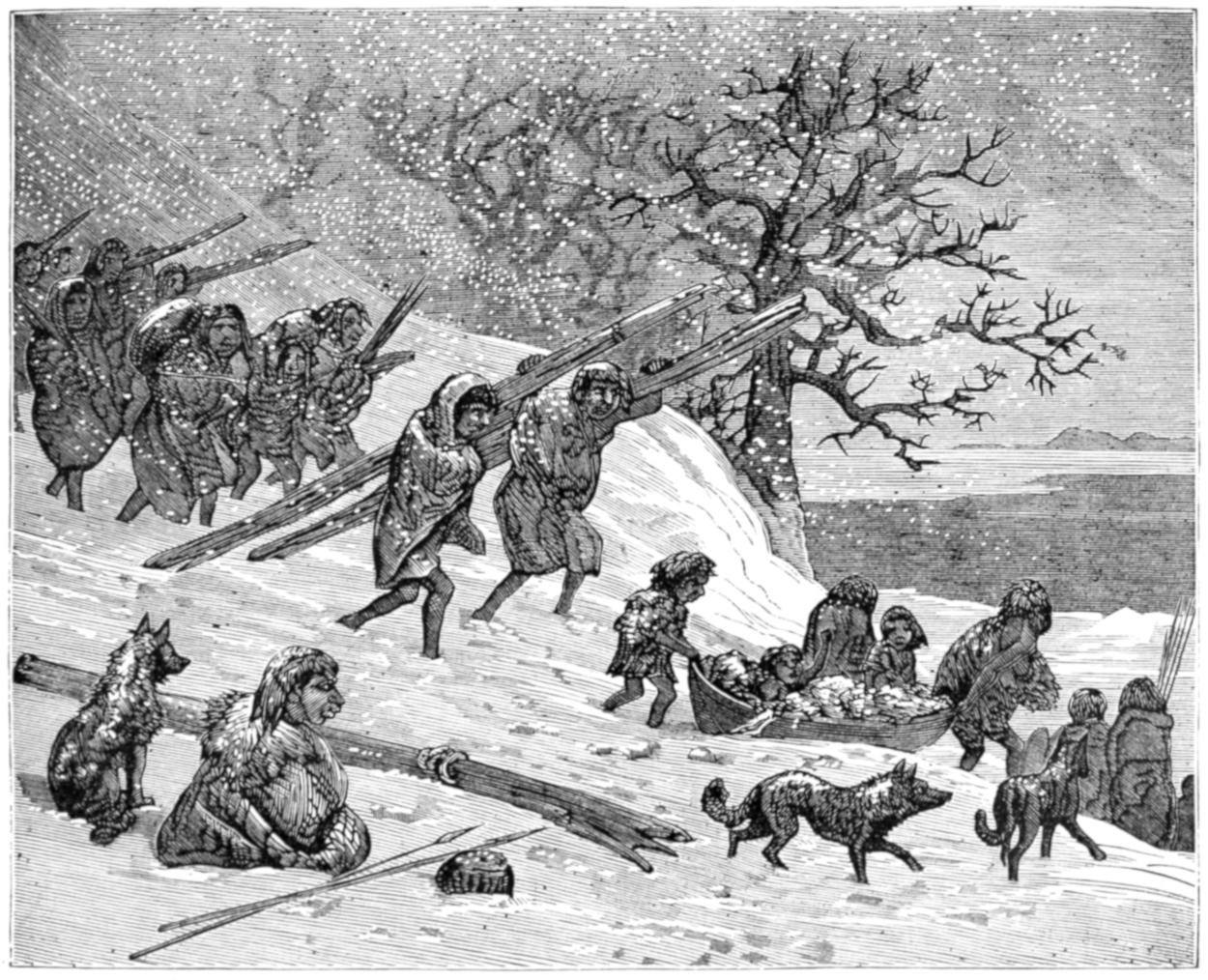
(2.) FUEGIANS SHIFTING QUARTERS.
(See page 1168.)
Though so constantly in the water, the
Fuegians have not the most distant idea of
washing themselves. Such a notion never
occurs to them, and when Europeans first
came among them, the sight of a man washing
his face seemed to them so irresistibly
ludicrous that they burst into shouts of
laughter. In consequence of this utter
neglect of cleanliness, and the habit of bedaubing
themselves with grease and clay,
they are very offensive to the nostrils, and
any one who wishes to cultivate an acquaintance
with them must make up his mind to
a singular variety of evil odors. Moreover,
they swarm with parasites, and, as they will
persist in demonstrating friendly feelings by
embracing their guest with a succession of
violently affectionate hugs, the cautious
visitor provides himself either with an oil-skin
suit, or with some very old clothes,
which he can give away to the natives as
soon as he regains his vessel.
Although the Fuegians are often ill-disposed
toward strangers, and indeed have
murdered many boats’ crews, Captain Parker
Snow contrived to be on very friendly
terms with them, going on shore and visiting
them in their huts, so as to place himself
entirely in their power, and allowing them
to come on board his ship. He was fortunate
in obtaining the services of a native, called
Jemmy Button, who had been partially
educated in England, with the hope that he
might civilize his countrymen. However,
as mostly happened in such cases, he was
soon stripped of all his goods; and when Captain
Snow visited Tierra del Fuego, twenty-three
years afterward, he found Jemmy
Button as naked and dirty as any of his
countrymen, as were his wife and daughter.
The man, however, retained much of his
knowledge of English, a few words of which
he had engrafted upon his native language.
When first he arrived on board, the English
words came with difficulty; but he soon recovered
his fluency, and had not forgotten
his manners, touching his forehead as he
stepped on the quarter-deck, and making his
bow in sailor fashion when he addressed the
captain, to the entire consternation of the
sailors, who could not understand an absolutely
naked savage speaking English, and
being as well-mannered as themselves.
The faculty of acquiring language is singularly
developed in the Fuegian. Generally,
the inhabitants of one country find
great difficulty in mastering the pronunciation,
and especially the intonation, of a foreign
land; but a Fuegian can repeat almost
any sentence after hearing it once, though
of course he has not the slightest idea of its
meaning.
A very absurd example of this curious
facility of tongue occurred to some sailors
who went ashore, and taught the natives to
drink coffee. One of the Fuegians, after
drinking his coffee, contrived to conceal the
tin pot, with the intention of stealing it.
The sailor demanded the restoration of his
property, and was greatly annoyed that
every word which he uttered was instantly
repeated by the Fuegian. Thinking at last,
that the man must be mocking him, and
forgetting for the instant that he did not
understand one word of English, the sailor
assumed a menacing attitude, and bawled
out, “You copper-colored rascal, where is
my tin pot?” The Fuegian, nowise disconcerted,
assumed precisely the same attitude,
and exclaimed in exactly the same manner,
“You copper-colored rascal, where is my tin
pot?” As it turned out, “the copper-colored
rascal” had the pot tucked under his arm.
The natives evidently seemed to think
that their white visitors were very foolish
for failing to comprehend their language, and
tried to make them understand by bawling
at the top of their voice. On one or two occasions,
when a number of them came on
board, they much annoyed Captain Snow by
the noise which they made, until a bright
thought struck him. He snatched up a
speaking trumpet, and bellowed at his
visitors through it with such a stunning
effect that their voices dropped into respectful
silence, and they began to laugh at
the manner in which they had been out-bawled
by a single man.
As far as can be ascertained, the Fuegians
have no form of government. They live in
small communities, not worthy of the name
of tribes, and having no particular leader,
except that the oldest man among them, so
long as he retains his strength, is looked up
to as a sort of authority. Their ideas of
religion appear to be as ill-defined as those
of government, the only representative of
religion being the conjuror, who, however,
exercises but very slight influence upon his
fellow countrymen.
CHAPTER CXXI. THE PATAGONIANS. APPEARANCE—WEAPONS—HORSEMANSHIP.
POSITION OF PATAGONIA — STATURE OF THE INHABITANTS — SIGNIFICATION OF THE NAME — HORSE
FURNITURE — THE STIRRUP AND BOOT — AN INGENIOUS SPUR — THE GIRTH AND ITS CONSTRUCTION — PRIMITIVE
BUCKLES — THE BRIDLE AND ITS ACCOMPANYING WHIP — THE PATAGONIAN
AND SPANISH BITS — SIZE AND STRENGTH OF THEIR HORSES — HORSE-RACING — THE BOLAS,
THEIR CONSTRUCTION, AND DIFFERENT VARIETIES OF FORM — WAR IN PATAGONIA-THE SPARE
HORSES AND THEIR USE — THE RETURN FROM BATTLE — A HUNTING EXPEDITION — CHASING THE
GUANACO — A TERRIFIED HERD — THE DISADVANTAGE OF CURIOSITY — DECOY GUANACOS — PARTRIDGE
CATCHING — THE POWER OF FASCINATION.
Separated from Tierra del Fuego by a
strait so narrow that in certain spots human
beings might converse across the water, is
the land called Patagonia.
It derives this now familiar title from a
nickname given to the inhabitants by Magellan’s
sailors. As we shall presently see
when treating of their costume, the Patagonians
wear a sort of gaiter to protect their
ankles against thorns. These gaiters are
made of the furry skin of the guanaco, the
long hair spreading out on either side of the
foot. The sailors, ever ready to ridicule any
custom new to them, remarked this conspicuous
part of the dress, and nicknamed the
natives Patagones, i. e. duck-feet, a name
which has ever since adhered to them, and
even been applied to their country.
The narrow armlet of sea, to which reference
has been made, divides two lands utterly
opposed to each other, and inhabited by
people totally distinct in appearance and
habits. Tierra del Fuego has scarcely a level
spot in it, but is composed of even set ravines
clothed with trees, and precipitous, snow-clad
mountains. Patagonia, on the contrary,
abounds in vast level plains, unfertile and
without a tree on them.
The human inhabitants of these countries
are as different as the lands themselves, the
Fuegians being below the average height,
and the Patagonians above it. Yet, just as
the Fuegian is not such an absolute dwarf, as
has often been stated, the Patagonian is not
such an absolute giant, a regiment of English
Lifeguards being as tall as an equal number
of Patagonians. It is true that if a Patagonian
regiment of picked men were raised
they would overtop even the Guardsmen,
but the old tales about an average of seven
or even eight feet are unworthy of credit.
Some of the older voyagers even attribute
to the Patagonians a much loftier stature,
saying that some of them were twelve feet
in height, and that when one of them stood
with his legs apart, an ordinary man could
walk between them without stooping.
The color of the Patagonians is somewhat
like that of the Fuegians, being a dark
copper brown, the reddish hue coming out
well on any part of the skin that happens to
be less dirty than others. The hair is
coarse, long and black, and is allowed to hang
loosely about their faces, being merely kept
out of their eyes by a small fillet of guanaco
hair. There is scarcely any eyebrow, a deficiency
which always gives an unpleasant
expression to the eyes, and indeed, even in
the old men, the face is almost devoid of
hair. The face is roundish, the width being
increased by the great projection of the
cheek-bones, and the chin is rather broad
and prominent. The small, restless eyes,
are black, as is the hair, and rather hidden
under the prominent brows. The nose is
narrow between the eyes, but the nostrils
are broad and fleshy. The mouth is large,
and the lips rather thick, but altogether the
face is not a bad one. The illustration on
the 1163d page, of a Patagonian man and
woman furnishes a striking contrast with
the Fuegians, their neighbors.
The dress of the Patagonians is simple,
but sufficient, and in this respect they form
a great contrast to the absolutely naked
Fuegians of the opposite shores. The chief
part of the costume consists of a large
mantle made of guanaco skins. The guanaco
is, as the reader may possibly be aware,
one of the llama tribe, and is about the size
of a deer. It is covered with a thick woolly
coat, the long hair of which is valuable, not
only to the Patagonians, but to Europeans,
by whom it is made into various fabrics.
It is very plentiful in this country, fortunately
for the Patagonians, to whom the
guanaco is the very staff of life, the creature
that supplies him with food, clothes, and
dwelling. Sometimes it is seen in great
droves of several hundreds in number, but
it generally associates in smaller herds of
twenty or thirty individuals. It is a shy
animal, as well it may be, considering the
many foes that are always ready to fall upon
it; and as it is swift as well as shy, great
skill is required in capturing it, as will
presently be seen.
The guanaco-skin mantle is very large,
and when folded round the body and clasped
by the arms, falls as low as the feet; and
when a tall Patagonian is seen in this
mantle, which adds apparently to his height,
he presents a very imposing appearance.
Generally, the mantle is confined round the
waist by a belt, so that when the wearer
chooses, he can throw off the upper part of
it, his hands remaining at liberty for action.
Under the mantle he wears a small apron.
Next come the curious gaiters, which have
been already mentioned. At first sight
they look like boots reaching from the
knee downward, but when examined more
closely, they are seen to be devoid of sole,
having only a strap that passes under the
middle of the foot, so that the heel and toes
and great part of the sole are left unprotected.
The reason of this structure is, that
the Patagonian is nearly always on horseback,
and the toe is made to project beyond
the gaiter in order to be placed in the stirrup,
which is very small and triangular.
As the Patagonians are so devoted to
horsemanship no sketch of this people
would be adequate without an account of their
horse accoutrements. I have a complete set
in my possession. The saddle is made of
four pieces of wood, firmly lashed together
with raw-hide thongs, and both the front
and back of the saddle are alike. From the
sides depend the stirrups, which are appended
to leathern thongs, and are made in
a very simple manner. A hole is made at
each end of a stout leathern strap, and a
short piece of stick about half an inch in diameter
is thrust through them, being retained
in its place by a groove near each
end. The strap being attached by its middle
to the thongs which act as stirrup-leathers,
the article is complete.
As the space between the grooves is
rather less than three inches, it necessarily
follows that the Patagonian horseman can
only insert his great toe in the stirrup.
This, however, is sufficient hold for him, as
he is an admirable though careless looking
rider, the greater part of his life, from childhood
upward, having been spent on horseback.
The spur is as primitive as the stirrup,
and exactly resembles in principle the prick-spurs
of the ancient knights. It consists of
two pieces of stick, exactly like those employed
for the stirrups, and two short straps
of cowhide. A hole is made at each end of
the strap, and the sticks are pushed through
them, being held in their places, like those
of the stirrups, by a groove cut half an inch
from their ends, so that the two sticks are
held parallel to each other.
To the upper ends of each stick a leathern
thong is applied, and these thongs, being tied
over the instep, hold the spur in its place.
At the other ends of the sticks holes are
bored, into each of which a sharp iron spike
is inserted. In my own specimen, the
maker has been economical of his iron, and
has only inserted spikes in one of the sticks,
so that when the spurs are worn with the
spiked stick inward, they are quite as effective
as if both sticks were armed. Still, the
hole for the reception of the spikes has been
bored in all the sticks, and there is no doubt
that the Patagonian who made the spurs
would have inserted the spikes at some time
or other.
The spur is worn as follows: The armed
sticks come on either side of the foot, the
strap which is next to the spiked ends goes
round the heel, the other strap passes under
the hollow of the foot, and the hide thongs are
tied over the instep. Such a spur as this is not
only an effective but a cruel instrument,
really as bad as the huge metal spurs, with
rowels four inches in diameter, which the
Gauchos wear. It is impossible to see this
simple form of spur without recalling the
old story of “Sandford and Merton,” and
referring to the adventure of Tommy Merton,
who, on being forbidden to use spurs,
stuck pins into the heels of his boots, and
was run away with in consequence.
The girth is a singularly ingenious piece
of work. The strength of the girth itself is
prodigious. At first sight it looks as if it were
a single broad belt of leather, but a nearer
inspection shows that it is made of twenty-two
separate cords, each about the eighth of
an inch in thickness, laid side by side, and
united at intervals by several rows of similar
cords of strings. Each of these cords is
made of two strands of raw hide, probably
that of guanaco, and looks as strong as ordinary
catgut. Buckles are unknown to the
Patagonian, who has invented in their stead
a mode of tightening the girth by passing
straps through holes, hauling upon them,
and fastening off the ends.
The bit and bridle are equally ingenious.
It consists of a squared bar of iron four and
a half inches long, the ends of which are
passed through holes in doubled pieces of
hide, and hammered when cold into a sort
of rivet-like shape, so as to retain the leather
in its place. To the lower part of the
leathers are attached a couple of stout
thongs, which are passed under the lower
jaw of the horse, and then tied, so that they
keep the bit in its place, and at the same
time act as a sort of curb.
To the upper part of the leathers are
fixed the long plaited thongs which are used
as reins, and which seem strong enough to
hold an elephant, much more a horse. The
Patagonian uses no separate whip, but has
a long double strap of stout hide, which is
fixed to the junction of the reins, so that
there is no danger of losing it.
This is the ordinary bit of a Patagonian
hunter, but those who can obtain it like to
use the cruel Spanish bit, which they fit up
in their own way with thongs of plaited hide.
One of these bits is shown in illustration No.
4 on the following page. The principal distinguishing
point about these bits is the
large iron ring, which passes over the horse’s
jaw, and gives to the rider a leverage so
powerful that he could break the jaw of any
horse without making any very great exertion.
By the use of this bit, the horse is
soon taught to stop almost suddenly, to
wheel in a very limited area, and to perform
the various evolutions which are needed in
carrying out the pursuit in which the Patagonian
depends for much of his livelihood.
The reins which are attached to this bit
are of enormous strength, and are plaited
in a square form, so that no amount of
pulling which any horse could accomplish
would endanger them. The whip is attached
to these reins like that of the last
mentioned apparatus, but is more severe,
thicker, and heavier, and is made of a long
and broad belt of hide, cut into four strips,
which are plaited together, flat and narrow
strips about four inches long answering as
the lash. It will be seen that the Patagonian
is by no means merciful to his beast,
but that he uses a bit, spur, and whip
which are, though so simple in appearance,
more severe in practice than those which
have a far more formidable aspect.
The horses which he rides are descended
from those which were introduced by the
Spaniards, and which have multiplied so
rapidly as almost to deserve the name of indigenous
animals. They are of no great
size, being under fifteen hands high, and belonging
to that well-known mustang breed
which is more celebrated for strength and
endurance than for aspect, qualities which
are indispensable in an animal that has to
carry so heavy a rider after creatures so
fleet as the guanaco or the rhea.
The Patagonians are fond of racing, but
never make their courses longer than a
quarter of a mile. The reason for these
short races is, that their horses are not required
to run for any length of time at full
speed, but to make quick and sudden dashes,
so as to enable the rider to reach his prey,
and hurl the singular missiles with which
he is armed.
There is yet an article needed to complete
the equipment of a Patagonian. This is the
celebrated “bolas,” a weapon which looks
almost contemptible, but in practised hands
is exceptionably formidable. It consists of
two or sometimes three balls at the end of
hide thongs. The form most in use is that
which is represented in illustration No. 3
on the next page. The native name for the
two-ball bolas is somai, and that for the
three-ball weapon is achico.
The first point in making the bolas is to
procure the proper balls, and the second to
prepare the proper rope to which they are
fastened. The ordinary balls are made of
stone, and are nearly as large as cricket balls.
They are made by the women, who pass much
of their time in supplying the men with these
necessaries of life. To cut and grind one
of these stones is a good day’s work, even
for an accomplished workwoman.
A still more valuable ball is made of iron,
which has the advantage of being so much
heavier than stone that the ball is considerably
smaller, and therefore experiences less
resistance from the air, a quality which is of
the first consequence in a missile weapon.
The most valuable are those which are made
of copper, as is the case with the specimen
from which the illustration is taken. Each
of these balls weighs eighteen ounces, in
spite of its small size, so that the weapon is
a very formidable one.
The thong to which the balls are attached
is nine feet in length, and is made in the
following manner: two pairs of thongs of
raw hide are cut, and, while they are still
fresh and wet, each pair is twisted together
so as to form a two-stranded rope. These
ropes are again twisted into one, so that the
aggregate strength of the four is enormous.
Round each of the balls is then laid a circular
piece of guanaco hide, with holes
bored all round the edge. The ends of the
thongs being passed through the holes and
laced tightly, the raw hide is drawn over
the balls, and encloses them in a sort of
pocket, as is seen by the enlarged figure in
the illustration. This specimen is one of
the three-ball weapons. In this case a third
thong five feet six inches in length has been
twisted, one end fastened to a ball, and the
other interlaced with the strands of the first
thong exactly at its centre. We have now
the three-ball bolas, which is made in
such a manner that, when the thongs are
grasped at their points of junction, two of
the balls hang at equal depths from the
hand, and the third is just a foot below
them.
(4.) SPANISH BIT AND PATAGONIAN
FITTINGS.
(See page 1174.)
The bolas is to the Patagonian what the
kris is to the Malay, the boomerang to the
Australian, the lasso to the Gaucho, the club
to the Fijian, and the bow to the Andamaner.
From early childhood upward no
Patagonian is without this weapon, which
seems to him an absolute necessity of existence.
Generally he carries it twisted round
his waist, like an officer’s sash of the olden
days, the balls dangling at the side like the
tassels of the sash.
It is, however, coiled on the body with
such consummate skill that it can be cast
loose with a turn of the hand, the eye being
fixed on the object of attack, and in a moment
the Patagonian is fully armed. Putting
aside warfare, which in Patagonia is
scarcely known, the tribes, or rather the
families, not being strong enough to wage
real war upon each other, the so-called battles
are unworthy of any name except that
of skirmishes, which among themselves seem
to do no great harm, however formidable
they may be to opponents who happen to
be unacquainted with the mode of fighting
practised by the Patagonians.
For example, a dozen trained riflemen, on
foot, who could thoroughly depend on each
other, would overmatch ten times their
number of mounted Patagonians, who, every
whit as brave as themselves, are ignorant
of discipline, and fight every man for his
own hand.
Let the riflemen once allow the Patagonians
to come within thirty yards, and they
would be annihilated; but as long as the foe
could be kept out of throwing distance, they
are comparatively harmless.
When a Patagonian intends to attack
either a human enemy, or some animal of
chase, or even, as often happens, some wild
beast or bird, he slips the ever-ready bolas
from his waist, grasps the thongs at their
point of union, drives his primitive spurs
into the flanks of his rough-coated steed,
and dashes off at full gallop, whirling the
bolas round his head by a dexterous movement
of his flexible wrist.
As soon as he comes within throwing distance,
which materially varies according to
the strength of the thrower and the structure
of the bolas, he hurls his singular
weapon with unerring skill. No sooner
does it leave his hand than the centrifugal
force causes the balls to diverge, and they
fly round and round in the air with a motion
exactly resembling that which an English
street acrobat imparts to a couple of padded
balls at the ends of a string, when he wants
to clear the ground.
Urged by the stalwart arm of the Patagonian,
the bolas flies straight to its mark, and
no sooner does it strike it, than the impetus
communicated to the balls causes the thongs
to twist round the unfortunate victim, and
bring him at once to a halt. Indeed, should
a man be struck by the bolas, he may congratulate
himself if in three minutes afterwards
he finds himself alive, neither having
been strangled by the cords twisting round
his neck, nor brained by the heavy balls
coming in contact with his skull.
The skill which the Patagonians attain is
really marvellous. At any distance short of
fifty yards a victim marked is a victim slain.
So terrific is the gripe of the bolas thong,
that Europeans who have been struck with
it have been found to suffer from weals as
well marked as if they had been made by
the stroke of a “cow-hide” whip upon the
bare flesh.
An excellent description of the various
kinds of bolas is given by Captain King:—
“Sometimes two balls, each of which has
a cord about a yard in length, are fastened
to the thong of the larger set. This is to
entangle the victim more effectually. They
do not try to strike objects with these balls,
but endeavor to throw them so that the
thong shall hit a prominent part; and then,
of course, the balls swing round in different
directions, and the thongs become so ‘laid
up’ (or twisted), that struggling only makes
the captive more secure.
“They can throw them so dexterously as
to fasten a man to his horse, or catch a
horse without harming him. If an animal
is to be caught without being thrown down
suddenly—an inevitable consequence of
these balls swinging round his legs while at
full speed—a somai is thrown upon his
neck. The two balls hang down, and perplex
him so much by dangling about his
fore-legs that his speed is much checked,
and another set of balls or a lasso may be
used to secure without throwing him down.
The lasso is not much used, so adroit, are
they with the balls.
“A formidable missile weapon is the
single ball, called by the Spaniards ‘bola
perdida.’ This is similar to the other in
size and substance, but attached to a slighter
rope about a yard long. Whirling this ball,
about a pound in weight, with the utmost
swiftness around their heads, they dash it at
their adversary with almost the force of a
shot. At close quarters it is used, with a
shorter scope of cord, as an efficient head-breaker.
Several of these original and not
trifling offensive weapons are kept in readiness
by each individual, and many a Spaniard,
armed with steel and gunpowder, has
acknowledged their effect.”
The raids which are dignified by the name
of warfare are more for plunder than conquest,
inasmuch as the Patagonian cares
nothing for territory, of which he has
enough and to spare, and almost nothing
for military fame. Sometimes he wants
plunder; sometimes he means to make a
hunting expedition into a district held by
another tribe; and sometimes he prepares a
short campaign against an inimical tribe in
revenge for a real or fancied insult.
When preparing for such an excursion, or
while expecting the attack of another tribe,
the Patagonians keep themselves in constant
preparation for war. They put on
three of their thickest mantles in order to
deaden the blow of the bolas, or withstand
the point of the spear and arrow. These
mantles are not wrapped round them in the
ordinary fashion of peace, but are worn like
ponchos, the head being thrust through a
hole in the middle. The innermost mantle
is of guanaco skin, with the hairy side inward,
while the others are simple leather,
without hair, the place of which is taken by
paint. Their heads are guarded by conical
caps, made of hide, and often adorned by a
tuft of feathers from the rhea.
Those who are wealthy enough purchase
a sort of armor composed of a thick hide
tunic, with a high collar and short sleeves,
and a hat or helmet made of double bull’s
hide. This garment is very heavy and
clumsy, but it will resist every weapon except
bullets, and will make even the blow of
the “bola perdida” fall harmless. Those
who are too poor to possess a horse, and are
obliged to fight on foot, carry shields made of
several layers of hide sewed together.
Sometimes they come unexpectedly upon
enemies, and a skirmish is the immediate
result. In this case they mostly fling aside
their cumbrous mantles, and fight without
any clothing except the girdle and their
spurs. When they make expeditions against
inimical districts, they take spare horses
with them, one of which is intended to bear
the plunder as they return, and to take its
share in carrying the warrior to battle. As
soon as the Patagonian finds that his weight
is beginning to tell upon the horse which he
rides, he vaults upon the other without
checking them in their gallop, and thus
makes sure of a fresh and unwearied horse
upon going into action. The second horse
is afterward used for the conveyance of
slaves, skins, weapons, and other booty.
As they return, they fling off the cumbrous
armor of coats and mantles, and ride,
according to their fashion, naked to the
waist, the innermost mantle being retained
in its place by a leathern thong, which acts
as a belt. In some of these expeditions a
whole troop of loose horses is driven in front
of the warriors, and when a man feels his
own horse becoming wearied, he rides alongside
one of the loose horses, shifts the bit,
and leaps on the fresh animal, not troubling
himself about the saddle.
When the Patagonian goes out hunting,
he carries no weapon except the bolas and a
knife, the latter being considered rather as a
tool than a weapon. Should he see a herd of
guanacos, he makes silently toward them,
imitating the cry of the young one in distress,
and doing all in his power to attract
the animals. Anything very strange is
sure to attract them, just as it attracts cows,
which are horribly afraid of the new object,
but, victims of a sort of fascination, are led
nearer and nearer by a spirit of curiosity, for
which they pay with their lives. When a
small herd—say six or eight—of guanacos
is seen, they can generally be enticed within
range of the bolas by a hunter on foot, who
steals as near them as he can manage to do
without alarming them, and then plays various
antics, such as lying on his back and
kicking his legs in the air, tying a strip of
hide or a bunch of feathers to a stick, and
waving it about. The inquisitive creatures
seem unable to resist the promptings of their
curiosity, and, though they are really afraid
of the strange object, come closer and closer,
until the hunter is able to hurl the terrible
bolas at them.
When, however, the herd is a large one,
the guanacos are much more timid, and,
until the introduction of the horse, the
Patagonians could seldom do much with
them. Now, however, the possession of the
horse, together with their knowledge of the
guanaco’s disposition, enables them to capture
and kill great numbers of the animals.
In this mode of chase the Patagonians
make use of two characteristics which belong
to the guanaco. In the first place, it is
a hill-loving animal, and when pursued, or
even afraid of pursuit, leaves the plains and
makes for some eminence. Like all gregarious
animals, the guanacos invariably have
sentinels posted on the most elevated points,
and trust their safety to their watchfulness,
the squeal of alarm being instantly followed
by the flight of the herd. Knowing this
peculiarity, the hunters are sure that if a
herd of guanacos be in the plain, and a hill
be near them, the animals will be almost
certain to take to it.
The second characteristic is, that the
guanacos, when thrown into confusion, entirely
lose their presence of mind, running
a few steps in one way and then a few steps
in another, being quite unable to fix upon
any definite plan of escape.
A large party of hunters, sometimes
nearly a hundred in number, arm themselves
with their long, light, cane-shafted
spears, called chuzos, summon their dogs,
and set off toward the spot where a herd of
guanacos is known to be. Having fixed
upon some grassy hill, half of the hunters
push forward and take up a position on the
further side, while the others drive the
guanacos gently toward their well-known
grazing place.
As soon as the animals are fairly on the
hill, the hunters spread out so as to enclose
them in a semicircle, and then dash forward,
driving the herd up the hill. The detached
band on the other side, as soon as they hear
the shouts, spread themselves out in a similar
manner, the two bodies completely surrounding
the hill, so that when the guanacos
reach the summit they find themselves environed
by enemies.
After the usual custom in such cases, the
guanacos lose all presence of mind, some
running one way, some another, mutually
hindering each other’s escape, so that the
hunters are able to pierce with their long
spears the finest animals, and thus secure in
a very short space of time so great a number,
that they are amply supplied with skins
and meat.
Although they carry the spear on these
occasions, they are not without the bolas, it
being used for capturing the young guanacos,
which are kept in a domesticated state
like sheep. Now and then a guanaco, which
possesses more sense than its comrades,
takes a line of its own, and dashes through
the circle of its enemies. Still it has but
little chance of escaping, for round the circle
of horsemen there is another circle of men
on foot, accompanied by dogs. As soon as a
guanaco breaks through the first circle, it is
instantly seized by the dogs, which terrify
it to such an extent that it is unable to
move, and neither tries to escape nor resist.
On the preceding page is a spirited
engraving which represents Patagonian
scenery, and the natives in their favorite
pursuit of hunting game. The hot chase,
the flying bolas, the bewildered guanacos
are vividly pictured.
The young guanacos which have been
mentioned as being domesticated are not
solely intended to furnish food, or even bred
merely for the sake of their skins. They are
employed for the sake of decoying the adult
animals. Taking the young guanaco to the
feeding grounds, the hunter ties it to a bush,
and then conceals himself behind it. By
imitating the mother’s cry, he induces the
captive to utter the plaintive bleating sound
by which a young one calls for its mother.
This is a sound which the adult guanacos
cannot resist, and as soon as they come
within twenty yards or so of the bush, the
bolas is launched, and the animal at which
it is aimed falls to the ground, enveloped in
the fatal coils.
The power of the bolas is eminently shown
in the chase of the rhea, or American ostrich.
This bird is as swift and wary as the true
African ostrich, and, but for the bolas, the
hunters would scarcely be able to secure it.
In the chase of this bird the Patagonians
employ the same device which is used in
capturing the guanacos. They know that
the rhea shares with the guanaco the tendency
to become confused and uncertain in
its movements when it is pressed simultaneously
from opposite directions. They
therefore try to surround the herd and converge
upon it, or, at all events, two or three
of them attack it from opposite quarters,
driving it first one way and then another,
so that the bird becomes so perplexed that
it cannot make up its mind to run in one
direction, and escape its foes by its superior
speed, but allows them to come within range
of the bolas, when its fate is sealed.
The hunters also know that, in common
with all the ostrich tribe, and, indeed, with
many wild animal of chase, the rhea always
runs against the wind. It is therefore easy
for them to ascertain the direction which the
bird will take, and by sending two or three
horsemen several miles windward the retreat
of the bird is easily cut off. The Patagonian
can even kill the little cavies with the bolas,
so accurate is his aim.
The reader may easily imagine that such
a weapon as this would be serviceable in
warfare. When the Patagonian uses it in
battle, he does not always fling it, apparently
because he does not like to deprive himself
of his weapon. Sometimes he dashes alongside
of a foe, and throws one of the balls at
him, just as if he were throwing a stone, retaining
the other ball in his hand, so as to
recover the weapon after the blow has sped.
When the Patagonian carries the three-ball
bolas, which has already been described,
he uses the third ball, which, as may be remembered,
is attached to the longest thong,
as an English robber uses his “life-preserver,”
or an American his “slung-shot.”
Another mode of procuring game is practised
by the Patagonians, and is identical
with that which is used by the North Africans
in taking the partridge, the South Africans
in killing the bustard, as well as by the inhabitants
of other parts of the earth. There
is a sort of partridge which is common on
the plains, and is called the Pampas partridge.
Its scientific name is Nothuria
major. The weapon, or rather implement,
required for this sport is a very simple one.
It is nothing more than a light reed, some
eight feet in length, at the end of which is
a noose composed of a strip cut from the
side of a long feather. This noose has
sufficient pliability to be drawn tight when
pulled and sufficient elasticity to keep itself
open.
Furnished with this implement, the Patagonian
looks out for a partridge on the ground
and, when he finds one, begins riding round
and round it in an ever decreasing circle.
The bird is much perplexed by this conduct,
and, instead of flying away, it simply crouches
closely to the ground. By degrees, the
young hunter—this sport being only practised
by boys—comes so close to the bird
that he slips the noose over its neck, and,
before it can spread its wings for flight, jerks
it into the air.
An expert bird catcher will secure three or
four birds in an hour by this curious mode
of hunting, which may be pursued on foot as
well as on horseback. The only drawback
to it lies in the very limited time during
which it can be attempted. It has been
found that, if the shadow of the hunter
should fall upon the partridge, the bird seems
to shake off the strange feeling which paralyzes
its energies, and flies away before it
can be captured. Consequently, the sport
can only be pursued so long as the sun is
toward the meridian; and as soon as the
shadows lengthen sufficiently to throw them
on the bird, the young hunter abandons his
sport. All practical naturalists are aware of
the alarm caused by a shadow falling on some
animal which they are watching or trying to
capture; and entomologists in particular
have learned that, to approach most insects,
it is necessary to keep the insect between
themselves and the sun.
As to the strange sort of fascination which
forces the bird to crouch instead of flying
away, it exists in very many birds, of which
the domestic poultry or any of the common
cage-birds are familiar examples. Any one
who is accustomed to deal with these birds
can take one, stand it or lay it on a table, go
away, and return after an absence of hours,
knowing that the bird will not dare to move.
During the time that I kept and bred canaries,
I used to free them from the dreaded
red mite by sprinkling insect powder under
their feathers, laying them on a piece of paper
covered with insect powder, and leaving
them there for an hour or two, until the
powder had destroyed all the parasites.
CHAPTER CXXIII. THE PATAGONIANS— Concluded . DOMESTIC LIFE.
PATAGONIAN MARRIAGE — APPEAL OF A SUITOR — REJECTION OF
THE OFFER, AND RESULT OF THE NEGOTIATION — CURIOUS
MODE OF SMOKING — PRESCRIPTION FOR A SICK CHILD — PATAGONIANS AT HOME — NATIVE
COOKERY — PATAGONIAN ARCHITECTURE — TREATMENT OF WOMEN, CHILDREN, AND
SLAVES — MODE OF GOVERNMENT — POWER OF THE CACIQUE — NOTIONS OF RELIGION — OFFERINGS
AND LIBATIONS — FUNERALS IN PATAGONIA — SECLUSION OF WIDOWS — VISITS OF CONDOLENCE.
We will now glance at the domestic life of
the Patagonians, if the word “domestic”
can be rightly applied to people who have
no settled home or domus.
How marriage is conducted among them
is described by Captain Bourne, who was
kept a prisoner for a considerable time, and
had every opportunity of studying their
manners and customs. It appeared that in
the house of the chief to whom he belonged
there was a daughter—a widow, with a
young child. One evening, the tramp of
many feet was heard on the outside of the
hut, together with the mutterings of voices.
Presently, one voice was heard louder than
the rest, evidently addressed to some one
within the hut. It was the voice of a suitor
come to ask the hand of the young widow.
The chief scornfully refused the offer, saying
that he was not worthy to be her husband,
having no horses or other property. The
man admitted that at the present time he
did not happen to have any horses, but that
he was a remarkably good thief, and that, if
the lady would only accept him, he would
steal horses, catch guanacos, and give her
plenty of grease.
These overtures being rejected as contemptuously
as the last, the suitor addressed
himself to the lady, who was very willing to
accept him, and entirely yielded when he
repeatedly promised to bring home plenty
of grease for her. She then besought her
father to listen to the suitor’s application,
but was angrily refused. Her mother then
tried to pacify the angry father, saying that
the young man might fulfil his promises,
catch plenty of horses, and become a great
chief.
This was too much for the old man. He
jumped up in a towering passion, seized the
cradle in which his little grandchild was lying,
flung it out of the hut, snatched up
every article which his daughter possessed,
threw them after the cradle, and then ordered
her to follow her goods. This was
exactly what she wanted; so, accompanied
by her mother, she left the hut, and was
joined by her intended husband.
A curious mode of smoking is practised
among the Patagonians, which somewhat
resembles that which is used by the Damaras,
as recorded on a preceding page.
When one of these smoking parties is organized,
the guests assemble together, sometimes
in a hut, and sometimes in the open
air. They gravely seat themselves in a circle,
round a vessel of water,—sometimes
an ox-horn stuck in the ground, and sometimes
a sort of basin made of raw hide. All
being assembled, one of them takes a stone
pipe, and fills it with a mixture of tobacco
and the shavings of some yellow wood.
The pipe being prepared, all the company
lie flat on their faces, with their mantles
drawn up to the top of their heads. The
pipe is then lighted and passed round, each
drawing into his lungs as much smoke as
he can swallow, and retains it as long as he
can exist without breathing. As soon as
the smoke is expelled, the men begin a
series of groanings and gruntings, which
become louder and louder, until they are
absolutely deafening. By degrees they die
away; and when quiet has been restored,
each takes a draught of water, sits silently
for a space, and then slowly rises and moves
away.
Captain Bourne is of opinion that this
ceremony has in it something of a religious
element. The groaning and grunting might
be due to the tobacco, or the substance
which is mixed with it, but the sounds
seemed to him to be louder and more emphatic
than they would have been if entirely
involuntary; and the breathings, writhings,
and other accompaniments, the profound
gravity, and the abstinence from speech, all
appeared to have some religious signification.
The same traveller gives a very amusing
account of a visit paid by a Patagonian physician
to the hut of a chief. The party were
just preparing to shift their quarters, after the
Patagonian fashion, when one of the daughters
came in, carrying a child who was crying
loudly, and who was supposed in consequence
to be very ill. The journey was
stopped, and a messenger despatched for
the wise man, who soon came, and brought
with him his magic medicines, rolled up in
two pieces of skin.
These were laid on the ground, and the
doctor squatted by the side of them, fixing
a steady gaze on the child, who presently
ceased crying. Encouraged by this success,
the wise man ordered a clay plaster to be
applied. This was done. Some yellow clay
was brought, moistened until it was like
paint, and with this substance the child was
anointed from head to foot. The clay
seemed to have but little good effect, for the
child began to cry as badly as ever.
The two mysterious packages were now
untied, and out of one the doctor took a
bunch of rhea sinews, and from the other a
rattle. The doctor then fingered all the
sinews successively, muttering something
in a very low tone of voice, and after he
had muttered for some five minutes or so,
he seized his rattle and shook it violently.
He next sat in front of the patient, and
stared at him as he had done before. After
an interval of silent staring, he turned to
the chief and asked whether he did not
think that the child was better. A nod and
a grunt expressed assent, and the mother on
being asked the same question gave a similar
response.
The same process was then repeated—the
silent stare, the painting with clay, the
lingering of the sinews, the muttering of
inaudible words, the shaking of the rattle,
and the concluding stare. The treatment
of the patient was then considered to be
complete. The chief gave the doctor two
pipefuls of tobacco by way of fee. This
was received gratefully by the man of skill,
who gave his rattle a final shake by way of
expressing his appreciation of the chief’s
liberality, and went his way. As soon as he
had gone, the child resumed its crying, but
the parents were satisfied that it was better,
and, as Captain Bourne testifies, it soon became
quite composed, and throve well afterward.
The general mode of life among the Patagonians
is not particularly alluring to persons
of civilized habits, if we may judge
from the graphic picture drawn by Captain
Bourne:—
“A few dry sticks and a bunch of dry
grass were brought; mine host drew from a
convenient repository a brass tinder-box
with a stone and a piece of steel, and soon
produced a blaze that brilliantly illuminated
the scene. By its light I was enabled to
survey the first specimen of Patagonian
architecture that had blessed my vision. It
was constructed in a ‘pointed’ style, though
not very aspiring, consisting of a row of
stakes about eight feet high, each terminating
in a crutch or fork, with a pole laid
across them; two parallel rows of stakes on
either side about two feet high, with similar
terminations and a similar horizontal fixture;
and a covering composed of skins of
the guanaco sewed together with the sinews
of the ostrich, the only thread used by the
people. This covering is thrown over the
framework and fastened by stakes driven
through it into the ground. For purposes
of ventilation, some interstices are left; but
these again are half closed by skins attached
to the outside, so that the air from without
and the smoke from within (in default of
a chimney) must insinuate themselves
through these apertures in great quantities.
“In truth, my first survey was rather hurried;
the first cheerful gleam had scarcely
set my eyes on the look-out, when I was
fain to shut them against an intolerable
smoke. In no long time I felt as bacon, if
conscious, might be supposed to feel in the
process of curing. No lapse of time was
sufficient to reconcile the eyes, nostrils, and
lungs to the nuisance. Often have I been
more than half strangled by it, and compelled
to lie with my face to the ground as
the only endurable position. ‘Talk that is
worse than a smoky house’ must be something
out of date, or Shakespeare’s imagination
never comprehended anything so
detestable as a Patagonian hut. The
chief and his numerous household, however,
seemed to enjoy immense satisfaction,
and jabbered and grunted and played their
antics and exchanged grimaces as complacently
as if they breathed a highly exhilarating
atmosphere.
“My meditations and observations were
shortly interrupted by preparations for a
meal. The chiefs better-half—or rather
fifth-part, for he had four wives—superintended
the culinary operations, which were
as rude and simple as the hut where they
were carried on. And now my fancy began
to conjure up visions of the beef, fowls, and
eggs, the promise of which had lured my
men from the boat, had proved stronger
than suggestions of prudence, and had made
me a prisoner. But these dainties, if they
existed anywhere within the chief’s jurisdiction,
were just at present reserved.
“The old hag threw down from the top of
one of the stakes that supported the tent
the quarter of some animal, whether dog or
guanaco was past imagining. She slashed
right and left with an old copper knife with
might and main, till it was divided into several
pieces. Then taking a number of
crotched sticks about two feet long, and
sharpened at the points, she inserted the
forked ends into pieces of the meat, and
drove the opposite points into the ground
near the fire, which, though sufficient to
smoke and comfortably warm the mess, was
too feeble to roast it. At all events, time
was too precious, or their unsophisticated
appetites were too craving, to wait for such
an operation, and the raw morsels were
quickly snatched from the smoke, torn into
bits by their dirty hands, and thrown upon
the ground before us.
“The Indians seized them with avidity,
and tossed a bit to me; but what could I do
with it? I should have no appetite for the
dinner of an alderman at such a time and
place, but as for tasting meat that came in
such a questionable shape, there was no
bringing my teeth or resolution to it. While
eyeing it with ill-suppressed disgust, I observed
the savages, like a horde of half-starved
dogs, devouring their portions with
the greatest relish, seizing the fragment
with their fine white teeth, giving every
sign of enjoyment, except what one is accustomed
to see in human beings.
“The old chief remarked the slight I was
putting upon his hospitality. ‘Why don’t
you eat, man? This meat very good to eat—very
good to eat. Eat, man, eat.’
“Seeing him so much excited, and not
knowing what deeds might follow his words
if I refused, I thought it expedient to try to
‘eat what was set before me, asking no questions,’—thinking,
moreover, that if there
were any evil spirit in it that the fire had
failed to expel, it could not possibly have
resisted the smoke. So, being sorely divided
between aversion to the strange flesh
and fear of showing it, I forced a morsel
into my mouth. Its taste was by no means
as offensive as its appearance, and I swallowed
it with less disgust than I had feared.
This was my first meal with the savages,
and a sample of many others, though better
viands afterward varied their monotony
now and then.”
It is most probable that the meat which
was so rapidly cooked and eaten was that of
the guanaco. The Patagonians are in no
way fastidious as to their diet, and eat almost
every animal which they kill, whether
it be guanaco, rhea, or cavy. They have a
repugnance to the flesh of dogs, though
they cannot, like the Fuegians, be accused
of eating the flesh of human beings rather
than that of dogs.
Their chief dainty is the flesh of a young
mare, and it is rather curious that these
strange people will not, if they can help
themselves, eat that of a horse, unless it be
disabled by an accident. They are fond of
the fat of mares and rheas, separating it
from the flesh by boiling, and pouring it
into bladders, much as lard is treated in this
country. Yet the fat obtained from the guanaco
is not stored like that of the mare
and rhea, but is eaten raw. As is the case
with the Fuegians, the Patagonians obtain
a considerable amount of food from the seashore,
great quantities of limpets, mussels,
and similar creatures being gathered by the
women and children.
Besides animal food, vegetables are consumed,
though rather sparingly, by the
Patagonians. Two roots form part of their
ordinary diet. One is called “tus,” and
looks something like a yam or potato. It is
bulbous, and when cleaned and properly
cooked bears a strong resemblance to a
baked potato. The second root is called
“chalas,” and is a long, slender root, scarcely
so thick as an ordinary pencil.
It is rather remarkable that the Patagonians
do not seem to have invented any
intoxicating drink. They soon learn to appreciate
rum and other spirits, and will
intoxicate themselves whenever they can
procure the means, but they obtain all fermented
and distilled liquors from the white
traders, and not from their own manufacture.
They have a sort of cooling drink
made of the juice of barberries mixed with
water, but it is drunk in its natural state,
and is not fermented.
The dwellings of the Patagonians are
worthy of a brief description, inasmuch as
they show the distinction between the Patagonian
and Fuegian ideas of architecture.
The reader will remember that the principal
portion of the Fuegian hut consists of
sticks and branches, whereas the Patagonian
only uses the sticks and poles by way of a
framework whereupon he can spread his
tent of skins.
These huts, called by the Spanish “toldos,”
and by the Patagonians “cows,” are of variable
dimensions. Generally they are little
more than sloping sheds, six or seven feet high
in front, and only two feet high at the back.
The length of each toldo is about twelve
feet, and its width about nine feet. As
east winds are hardly ever known in Patagonia,
the opening of the hut is always to
the east, the skin covering of this simple
tent being impervious to wind and rain.
A Patagonian village, showing the form of
these huts, is represented on the 1187th
page.
This is the ordinary kind of dwelling, but
in some places a much larger description of
hut is erected for the chief or the medicine
man. These houses are gabled, being eight
feet or so in height in the middle, and sloping
on either side to the wall, which is five
feet or so in height. Huts of this kind are
nearly square, their depth rather exceeding
their length.
The sleeping accommodation of these
habitations is very simple, and consists of
skins, which are spread on the floor. Other
skins rolled up are laid along the side of
the hut, and serve as pillows, the children
lying in a corner by themselves,
and the dogs sleeping at the feet of their
owners. Those children who are unable
to walk are laid in simple cradles made of
square pieces of guanaco skin, hung hammockwise
by four ends to the rafters of the
hut.
During the daytime the infants are kept,
or rather packed, in cradles made of flat
pieces of board, over which some pliable
sticks are bent in a semicircular form. The
child is placed between two pieces of guanaco
skin, fastened in the cradle, and can
then be carried about without trouble. Even
when the family is shifting quarters, the
cradle can be hung on the saddle-bow of the
mother’s horse, the little occupant being
perfectly contented with its situation.
It might seem from this statement that
children are treated with neglect. Such,
however, is not the case, the Patagonians
being remarkable for their parental affection,
and being much more inclined to spoil
their children by over-indulgence than to
behave unkindly toward them. Indeed,
when a Patagonian chief wishes to change
his quarters, and the people do not wish to
part with him, they take one of his children,
indulge it in every way, and declare that he
must leave it behind him. The affectionate
parent cannot bring himself either to leave
his child, or to deprive it of the society of
those who are kind to it, and in consequence
he remains with his people.
The condition of the women is a very
tolerable one. They certainly have to work
hard all their lives unless their husband be
rich enough to purchase slaves, or be fortunate
enough to procure them by a raid on
some other tribe. Many such slaves are
obtained from the Fuegians, who do not
scruple even to sell their own relatives when
they can procure a good price for them.
Even the wives of the chief men are not
exempt from labor unless their husbands
happen to possess slaves.
Generally the wives are faithful to their
husbands, but there are cases where the
woman has thought herself ill-treated, and
has betaken herself to another protector.
Should he be an inferior, the aggrieved husband
makes him pay for his offence; but if
a superior, he is obliged to put up with his
loss. Generally, however, the husband and
wife live happily together, and the husband
thinks it a point of honor to take his wife’s
part if she should fall into a dispute, no
matter whether she be right or wrong. He
will scold her severely in private, and even
inflict corporal punishment on her, for involving
him in such a dispute, but he will
make a point of upholding her in public.
The mode of punishment of the Patagonians
is rather variable, but is generally
a modification of the patriarchal system.
The heads of families or tribes possess hereditary
rank, and take the lead in all important
events of peace or war. Their
power is, however, not very great, and they
are not able to raise taxes, nor enforce
compulsory labor without payment. These
chiefs, or caciques, as they are termed, can,
if they choose, refuse the rank, and many do
so, preferring to become subjects of some
other cacique to the trouble and responsibility
which accompany the post.
According to Falkner, “the cacique has
the power of protecting as many as apply to
him; of composing or silencing any difference;
or delivering over the offending party
to be punished with death, without being
accountable for it. In these respects his will
is the law. He is generally too apt to take
bribes, delivering up his vassals, and even
his relations, when well paid for it.
“According to his orders the Indians encamp,
march, or travel from one place to
another to hunt or to make war. He frequently
summons them to his tent, and harangues
them upon their behavior, the exigencies
of the time, the injuries they have
received, the measures to be taken, &c. In
these harangues he always extols his own
prowess and personal merit. When eloquent
he is greatly esteemed; and when a
cacique is not endowed with that accomplishment,
he generally has an orator who supplies
his place.”
The religion of the Patagonian is a polytheism,
the natives believing that there are
great numbers of deities, some good and
some evil. Each family is under the guardianship
of one of the good deities, and all the
members of that family join him when they
die. Beside these gods there are subordinate
demons, good to their own friends, but
bad toward all others, so that on the whole
the bad predominates in them. They are
called by the name of Valichu.
Yet among some of the Patagonian tribes
there is even an approach to personal religion.
It has been thought that the Patagonians
are totally destitute of such religion.
This, however, is certainly not the case, as
even our limited knowledge of these people,
their language, and their habits shows that,
even though they may not possess any definite
system of religion, they are still impressed
with the idea of some Being infinitely
greater than themselves, who knows
everything that they do. Thus they believe
in an omniscient Being; and such a belief as
this, limited and imperfect though it may
be, is yet a step toward true religion.
(2.) PATAGONIAN BURIAL GROUND.
(See page 1189.)
To this unknown Being they return
thanks when they have obtained a supply of
food after long famine, so that we find them
acknowledging that the great Being, who
knows all their deeds, watches over them,
and is the Giver of all good things. When,
for example, they have procured a seal after
having been half-starved for months, they
assemble round a fire, and the oldest man
present cuts for each person a piece of the
seal, uttering over each portion a sort of
prayer, and looking upward in devotion to
the unseen God, who had sent them meat in
their need. Undisciplined as are the Patagonians,
totally unaccustomed to self-denial,
and mad with hunger, not one of them will
touch the food until this invocation has been
repeated.
The mode of burial among the Patagonians
varies in detail according to the particular
tribe, but there is a general resemblance
in the ceremonies throughout the country.
When a man dies, his body is wrapped in
his best mantle, placed on his favorite horse,
and conveyed to the place of burial, where a
square pit has already been dug, some six
feet in depth and two or three feet in width.
In this pit the body of the deceased is placed
in a sitting position, his bolas, spears, and
other property laid beside him, and the pit
is then covered with branches, on which a
quantity of earth is thrown. The horse is
next sacrificed. It is held at the grave by
one man, while another kills it by a blow on
the head from the bolas, and the skin is then
removed, stuffed, and supported at the grave
on four posts. At the grave of a cacique
four horses are sacrificed. The clothing
which is not buried with the deceased is
burned, and a feast on the body of the horse
closes the proceedings. On page 1187 the
reader may find an engraving of a Patagonian
burial ground.
The widows are obliged to remain in a
state of the strictest privacy for an entire
year, keeping themselves within their huts,
never mixing in society, and not even showing
themselves unless absolutely obliged to
do so. They must blacken themselves with
soot, and not eat the flesh of the guanaco, the
mare, or the rhea. Should a woman break
the rule of seclusion, and be detected in an
intrigue, she would at once lose her life at
the hands of her dead husband’s relations.
Among some of the tribes the tomb is
periodically opened, and the skeleton of the
deceased, which has been prepared with the
greatest care, is washed and clothed in new
robes. This office belongs to an old matron,
who is specially selected for the task, which
becomes in process of time a long and tedious
one, as the warriors are placed side by
side in the grave, each year gradually adding
to the number of those who have to be
washed and clothed annually.
Among some of the tribes the skeletons
are prepared by laying the bodies on platforms
woven from canes and twigs, and during
the time that is occupied in cleaning
and bleaching the skeleton the platform is
guarded by the friends of the dead man,
draped in long mantles, and bearing spears
or staves with which they strike the ground,
while they sing mournful strains in order to
drive away the Valichus or spirits, who may
possibly be well disposed toward the dead
man, but are more likely to be unfriendly.
Should the deceased have been a wealthy
man, many visits of condolence are paid to
the relatives, the mourners weeping loudly,
and pricking their arms and legs with thorns
in order to prove their affection by the effusion
of their blood. For these tokens of respect
they are rewarded with beads, brass
ornaments, and other presents; and it need
scarcely be said that the sorrow felt for the
deceased and the sympathy excited for his
friends depend very much on the amount of
property at the disposal of the relatives.
CHAPTER CXXIV. THE ARAUCANIANS. DRESS—ETIQUETTE—GOVERNMENT.
DIVISION OF THE NATION INTO TRIBES — THE MAPUCHÉS — PECULIAR STRUCTURE OF THE HEAD — THE
CHERIPA, PONCHO, AND BOOTS — MODE OF SHAVING — DRESSING THE HAIR — THE “PULLING HAIR”
FIGHT — DRESS OF THE WOMEN — THE ENORMOUS BREASTPIN — SINGULAR USE OF THIMBLES — ELABORATE
HEADDRESS — PAINT — EXHIBITION OF FEMALE VANITY — DRESS OF THE CHILDREN — ARCHITECTURE
OF THE ARAUCANIANS — THE CHIEF’S HOUSE AND ITS FURNITURE — LONG HOUSE OF
THE MAPUCHÉS — NUMBER OF FIRES — CODE OF ETIQUETTE — THE SPEECH OF CEREMONY — VALUE
OF ORATORY — DEMAND OF TRIBUTE — MODE OF GOVERNMENT — THE GRAND TOQUI — THE COUNCILS
OF PEACE AND WAR.
Passing northward from Patagonia, and
taking a westerly direction, we come to the
Araucanian nation. This title was given
to them by the Spaniards, just as was the
name of Patagonians to their southern
neighbors, and, although it is an incorrect
one, it has been accepted for so many years
that it cannot be conveniently exchanged
for the more correct designation.
The aborigines of Chili and a part of the
territory now occupied by the Argentine
Republic were formerly one great people,
extending over a very considerable portion
of the land, and necessarily modified in
manners and customs by the influence of climate
and geographical position. Their general
title was Alapu-ché, or People of the Land,
but they were separated into three great
divisions, namely, Pehuen-ché, or People of
the East; Mara-ché, or People of the West;
and Huili-ché, or Far-off People, being those
nearest to the Patagonians. Passing over
the wars with the Spaniards, as foreign to
the object of this work, we will describe the
Mapuchés, or People of the Country, as they
call themselves.
These people are rather below the middle
height, strong, thick-set, broad-chested, and
much inferior in point of form to the North
American tribes. The head is narrow, and
low in front, broad and high behind, and the
back of the head falls in almost a direct line
with the nape of the neck, a peculiarity by
which an Araucanian may almost invariably
be distinguished. The foot is as remarkable
as the head. It is very short and broad, and
rises straight from the toes to the ankle
with scarcely any curve, so as to produce
a very high but very clumsy looking instep.
The ordinary dress of the Mapuché men
is mostly composed of two garments, namely,
the “cheripa” (pronounced chĕreepah) and
the poncho. The cheripa is a sort of compromise
between a kilt and trousers. It is
a piece of stuff, mostly cotton, which is fastened
to the back of a girdle, passed between
the legs, drawn up in front there, and
tucked then into the girdle. The poncho
is nothing but a large circular piece of stuff,
with a hole in the centre, through which
the head passes. It is exactly similar in
principle to the cloak of Polynesia, and
is at once a primitive, efficient, and graceful
robe, assuming with every change of
attitude folds which delight the eye of an
artist.
Beside the poncho and cheripa, the Mapuché
generally wears a pair of boots, similar
to those of the Patagonians, and made of
similar materials, the skin from the hind
legs of a horse being drawn over the foot
while still fresh, so that it moulds itself to
the leg of the wearer. As with the Patagonians,
it is open in front, so as to allow the
two first toes to pass through and grasp the
small triangular stirrup. The elaborate
horse-accoutrements in which the Mapuchés
delight will be described when we
come to the manners and customs of the
people. Men of rank wear woollen bracelets
and anklets as marks of their superior
position.
Like most of the Araucanian tribes, the
Mapuchés have but little beard, and what
they have they eradicate after the usual
fashion of savages, plucking out the individual
hairs instead of shaving. Mr. R. E.
Smith had the opportunity of seeing the
operation performed:—“At one house
where we stopped I saw an Indian, who at
first sight seemed to be a white man, from
the fact that his beard was grown as though
unshaven for a week. He looked red and
blotched, and was continually raising his
hand to some part of his face, wearing all
the while an expression of patient endurance.
A close scrutiny showed that he was
engaged in shaving.
“These Indians pull out or nip off the
beard with small steel tweezers. This instrument
was originally, as the Mapuché
name signifies, a clam shell, but, by intercourse
with the whites, they have been able
to procure a more elegant article. Every
dandy carries his tweezers hanging from his
neck, and at leisure moments amuses himself
by smoothing his face to the taste of his
painted mistress. The arguments they use
in defence of their treatment of the beard
are precisely those used by shavelings the
world over.”
They do not content themselves with
merely removing the hair from the chin,
cheeks, and upper lip, but pull out the eyelashes
and eyebrows, substituting instead of
the latter a slender curved line of black
paint. They say that the presence of the
eyelashes hinders them in the pursuit of
bee hunting, a sport of which they are very
fond, and on which they pride themselves
greatly. Some of the younger warriors have
allowed a very slight fringe of hair to remain
on the upper lip, but the older chiefs
think that it is an innovation on the ancient
customs, and discountenance it as far as they
can.
The hair of the head is cut short at the
top, but is allowed to grow long at the sides,
in order that it may be easily grasped, just
as the North American tribes leave one long
lock on the crown of the head so as to assist
the enemy who slays them in getting off the
scalp.
When two lads quarrel, they settle the
dispute with a fight, which is conducted, not
by blows with the fist or with a weapon, but
by pulling the hair. “Let us pull hair, if
you are not afraid,” cries one of the disputants
to the other. The challenge is never
refused. Off goes the poncho, if they happen
to be wearing it, the cheripa is tucked tightly
into the belt, the combatants allow each
other to take a fair grasp of the long locks,
and the struggle begins. Each tries to twist
the head of his opponent so as to bring him
to the ground, and when he has once fallen,
they loosen their grasp, rub the backs of
their heads, take a fresh grasp, and repeat
the struggle until one of them yields. The
combat over, all animosity vanishes, and
they are good friends again.
The dress of the women is, like that of the
men, composed of two garments, though
they are differently put on. One is an enlarged
cheripa, and made of the same material.
It is first wrapped round the body
close under the arms, and then pinned together
over each shoulder, so that the arms
are left bare. It is confined at the waist by
a very broad belt, and falls nearly to the
ankle. This alone is a very sufficient dress,
but over it is thrown a second piece of stuff
which acts as a shawl or mantle, being fastened
in front with a pin having a most
enormously flat head, about the size of a
cheese plate. Sometimes the head is globular,
but the flat form is the favorite, and it
is adorned with engraved figures. The cloth
is mostly of native manufacture, and is
either black or a very dark indigo blue.
Like that of the men, the hair of the
women is divided into two long tails, one of
which hangs over each shoulder. The tails
are wound round with spiral strings of blue
beads, and their ends are connected by a
string of twelve or fourteen brass thimbles,
which hang side by side, like a peal of bells.
Besides these ornaments, the women wear a
sort of cap, made entirely of beads, and falling
over the back of the head as far as the
shoulders. Its lower edge is decorated with
a row of brass thimbles, like that which connects
the two queues of the hair. This
elaborate headdress is only worn on great
occasions, while ordinarily the queues are
wound round the head, the two ends projecting
in front like horns, a fillet, usually
studded with beads, being employed to keep
the hair in its place. These peculiarities of
dress are shown in the illustration of a Mapuché
family on page 1201.
Ornaments are worn according to the
wealth of the owners. Strings of beads,
silver dollars, and brass thimbles are hung
in profusion round the neck, which is further
decorated with a collar made of leather
and inlaid with silver. Wide bracelets and
anklets are also worn, similar to those of the
men, but made of variously colored beads
instead of wool.
Paint is worn by both sexes, but chiefly
by the women, and is anything but ornamental.
It is invariably of two colors, red
and black, which are mixed with grease, so
that they can be applied and removed at
pleasure. The usual plan is to have a broad
red belt from ear to ear, taking in the
cheeks, eyelids, and nose, the lower edge of
the belt being sometimes edged and scalloped
with black. The eyelids and lashes
are also edged with black, and a thin line
of the same hue takes the place of the
eyebrows, which are all removed except a
very fine row of hairs in the centre. Some
of the women further decorate their faces
by spots of black paint. The women are
exceedingly proud of these ornaments; and
an amusing instance of their vanity is related
by Mr. Smith:—“Our conversation
turned upon female dress; and, without intending
any disparagement to our fair entertainers,
we compared them to the women
whom we had seen at the house of Chancay.
The women, who were at work near by, did
not understand half-a-dozen words of Spanish;
but, with that intuitive perception
which belongs to the sex, they were not
long in discovering that our conversation
related to themselves and their dresses.
“Immediately they held a council of war;
and, entering the house, they presently returned,
each with a bag of trinkets. There
were coverings for the head and breast,
composed of strings of beads of all colors
and designs, with brass thimbles and silver
coins. There were rings and pendants for
ears and nose; bracelets and anklets, collars
and breastpins of colossal proportions.
These were held up for our admiration;
and that we might more fully realize their
wealth, the ladies proceeded to deck themselves
with all their finery. They were
at the same time jabbering at the top of
their lungs, praising their own superiority
to all other women, and appealing to us for
a confirmation of their own good opinions.
“Finally, the belle of the lot, having ornamented
her head, breast, and arms to their
fullest capacity, stepped in advance of the
others, and, raising her dress as high as the
knee, displayed to our astonished gaze a
remarkably well-rounded piece of flesh and
blood. Patting the calf with honest pride,
and turning it about for our inspection, she
hung it round with beads, adjusted the many-colored
anklets, and, snapping her fingers
contemptuously, poured out a perfect torrent
of Mapuché.
“Unfortunately, there was no one near
to interpret this language; but from her
action, and the frequent repetition of the
name ‘Chancay,’ we gathered her meaning
to be pretty much that, in whatever else the
wives of Chancay might excel, she would
defy them or any one else to produce a finer
leg than the one in question.”
The dress of the children is simple enough.
As long as they are infants, and not able to
walk, they are tightly rolled up in bandages,
so as to be unable to move. In this helpless
condition they are put into bamboo cradles,
and hung up on pegs driven into the walls
of the house, or laid in baskets suspended
from the roof, so that they can be swung
about by a cord tied to the cradle. The infants
are perfect models of behavior, never
crying, and allowing themselves to be hung
on pegs without betraying any signs of life,
except the movement of the eyes. As soon
as they can walk, they are allowed to run
about without the incumbrance of any
clothing, which is not worn until they become
boys and girls of seven or eight years
old.
The architecture of the Araucanians is
very simple, but differs slightly according to
the district, and the position of the owner of
the house. The ordinary house of a common
man is a mere hut, built of wicker-work, about
twelve feet by ten, carelessly made, and ill
calculated to withstand the elements. On a
wet day the rain pours into the hut on all
sides, a circumstance which has its advantages
to counterbalance its discomforts. On
rainy days all cooking has to be done within
the house, which would be absolutely unbearable
if the apertures which let the rain in
did not let the smoke out. At night, moreover,
these huts are overcrowded with
sleepers.
In one of these huts there were three
rude bedsteads, for the accommodation of
two married couples and a pair of grown-up
girls, while on the ground lay sixteen or
seventeen young men and children, packed
together like herrings in a barrel. Moreover,
a whole troop of dogs came sneaking into
the house as soon as the inmates closed their
eyes; so that within this limited space some
thirty living beings were contained during
the night. It is evident that, if the hut had
been weather-proof, the whole party would
have been suffocated before the morning.
A better kind of habitation, visited by Mr.
Smith, deserved the name of house. It was
rectangular instead of rounded, and measured
thirty feet in length by fifteen in
breadth. In the middle of the roof was a
hole, by way of chimney, the fire being
made directly beneath it. There was no
window, the hole and the door being the
only apertures for the admission of light
and air.
There was only one room, though a sort
of loft was made in the roof. This was used
as a storehouse, where sacks of beans and
similar luxuries were kept. As might be
supposed, the whole upper part of the house
was thickly encrusted with soot. One of
the corners was partitioned off with a sort
of wicker-work wall, and served as a granary,
in which the wheat was stored.
From the sooty, cobwebbed rafters hung
bunches of maize, pumpkins, joints of meat,
nets full of potatoes, strings of capsicum pods,
and similar articles; while earthenware pots,
dishes, and spears were scattered in profusion
over the floor. In the middle of all
these articles hung two long lances, with
their points toward the door; but, although
their heads were protected by being stuck
into lumps of fat, they were rusty, and had
evidently been long out of use.
Two of the corners were occupied with the
ordinary bedstead of the country, i. e. a
framework of cane, with a bull’s hide
stretched tightly over it; and near the beds
hung the stock of finery belonging to the
owner, namely, spurs, stirrups, and bits, all
of solid silver, belonging to the men, and
breastpins, necklaces, earrings, strings of
thimbles, and other adornments of the
women. The usual basket cradle, containing
a swathed baby, was suspended from one of
the rafters.
The house of a cacique, or chief, is very
much larger than either of those which have
been described, and somewhat resembles the
“long house” of Borneo. One of these
houses, belonging to a cacique named Ayllal,
looked at a distance something between a
very long boat and a haystack. Its height
was about fifteen feet, its width thirty, and
its length about one hundred and forty.
The middle of the house was common to
all the inhabitants, but the sides were partitioned
off so as to form a series of chambers,
each of which belonged to a married son of
the proprietor, or to one of his own wives.
In cases where the family is not a very large
one, each wife has her own fireplace; but
when the number of families under one roof
is considerable, one fire is common to two or
three of them. In Ayllal’s house there were
six fireplaces, and over each was a hole in
the roof. The fireplaces are nothing more
than a few stones, so arranged that the pots
can be kept clear of the burning wood; and,
as the ashes are allowed to accumulate
where they fall, or to be blown about by
every current of air, it is evident that the interior
of such a house is not a model of cleanliness.
In consequence of the custom of appropriating
a separate fire to each wife, the one
is conventionally accepted as a metaphor for
the other. It is not considered polite to ask
a man how many wives he has, but etiquette
permits any one to ask another how many
fires he burns. In front of the door hangs a
cross-bar, beyond which no one ventures to
pass without a special invitation, unless he
be an inmate of the house, or an intimate
friend of the family.
The Mapuchés exhibit in perfection that
curious mixture of the savage and the
gentleman that is so often found among uncivilized
people. They have a most elaborate
code of etiquette, which to a stranger is often
irksome, on account of the time which is consumed
in going through the requisite formalities.
When two persons meet, it is necessary
that they should go through a set
course of complimentary remarks, the omission
of which, except between relatives or
very intimate friends, would be held as an
unpardonable offence. Let us take Mr. E.
R. Smith’s account of the ceremonial:—
“If the guest be a stranger, the host begins
by addressing him with ‘I do not know you,
brother,’ or ‘I have never seen you before.’
Thereupon the stranger mentions his own
name and residence, and goes on to ask the
host about himself, his health, and that of his
father, mother, wives, and children; about
his lands, crops, cattle, and flocks: the chiefs
of the district, the neighbors, their wives,
children, crops, &c., are next inquired about;
and whether there have been any disturbances,
diseases, deaths, or accidents.
“If the responses given are favorable, the
questioner goes on to express his happiness,
and moralizes to the effect that health,
wealth, and friendship are great blessings,
for which God should be thanked. If, on the
contrary, the answers should convey bad
news, he condoles with the afflicted, and
philosophizes that misfortunes should be
borne with equanimity, since men cannot
always avoid evil. The guest having finished,
the host commences in turn to ask all
the same questions, making such comments
as the answers received may demand.
“This formality occupies ten or fifteen
minutes. The questions and answers are
recited (by rote) in a low monotonous voice,
with a sing-song tone, not unlike the saying
of the rosary or the chanting of friars.
At the end of each sentence, if the last word
end with a vowel, the voice is raised to a
shout; but should the final letter be a consonant,
it is rounded off with a nasal grunt.
The listener expresses his satisfaction occasionally
by a sound between a grunt and a
groan, or indicates surprise by a long-drawn
“Hué!” With these exceptions, he never interrupts
until the speaker has given notice,
by a peculiar cadence of the voice, that he
has said his say. During this palaver, the
speakers often do not look at each other, and
frequently even sit with their backs turned
to one another.”
As soon as etiquette has been satisfied by
these formalities, the speakers assume their
ordinary tone of voice, and converse freely
on subjects respecting which they really
take an interest.
Oratory is highly valued by the Mapuchés,
and should a young man have some
power of speech, and train it into eloquence,
he is on the high road to distinction, and will
probably end by becoming a chief, though
originally of inferior rank. Such young men
are always eagerly sought by the chiefs as
their messengers, inasmuch as etiquette requires
that such messengers should not only
possess a retentive memory, so as to insure,
the transmission of the message correctly,
but should also be fluent of speech and choice
of diction, the latter being a point in which
the Mapuchés are exceedingly fastidious.
A young man who shows himself to be a
proficient in these three requisites is sure to
be taken into the service of an important
chief, and indeed he knows his own value too
well to damage his prospects by serving any
except a man of very high rank. Acting as
messenger, he practically becomes a sort of
ambassador, on whom the reputation of his
principal is reflected, and by associating with
the chief men, and speaking at their assemblies,
he soon gains for himself that importance
which was formerly only accorded to
his official capacity. Men of this stamp have
frequently become the masters of those
whom they formerly served, their abilities
having raised them to their appropriate
station.
To a stranger the eloquence of these men
is utterly unintelligible. They deliver their
message in a sort of monotone, varied with
inflections, but without the least spirit or
action. In fact, they very much resemble
schoolboys reciting a piece of poetry which
they have learned by rote without taking the
trouble to understand it. Yet the Mapuchés
are held entranced during the delivery of
such a discourse by an accomplished orator,
the purity of whose diction excites the respectful
admiration of his hearers.
Etiquette is so highly valued among the
Araucanians that on one occasion an English
gentleman nearly lost his life by neglecting
a ceremonial. It seems that every chief, no
matter how petty may be his domain, expects
that every stranger who passes through his
territory shall pay him a tribute. The
amount of the tribute is of little consequence,
so that something is given as an acknowledgment
of rank.
Being new to the country, the gentleman
in question was passing through the territory
of a chief, when he was stopped and
asked for tribute, a demand which he refused
to pay, on the ground that he was only
a traveller and not a trader. Thereupon a
young man leaped into a cabin, brought out
a trumpet made of a horn, and blew a blast
upon it. The signal was answered in all
directions, and from every side there poured
in a number of mounted and armed warriors.
The traveller was not daunted, in spite of
the martial array, cocked his pistols, and
awaited the attack, when his guide ran up to
him, and begged him to give them something,
if it were only a pocket-handkerchief.
The traveller saw at once, from the smallness
of the suggested present, that it was a
mere question of etiquette, and munificently
presented the chief with a jack-knife.
Enmity at once gave way to enthusiastic
friendship. The old chief was quite overcome
by the splendor of the gift, swore
eternal friendship with the traveller, and
sent a guard of honor to accompany him for
several miles on his way.
We naturally come to the mode of government
employed by the Araucanians.
The four great divisions are subdivided
into provinces, and these into smaller districts,
each of which is presided over by a
chief, who exercises a kind of patriarchal
authority over his clansmen. He is the
judge and arbiter of the clan, and there is
no appeal from his decision. Yet he levies
no taxes, and cannot force even the lowest
of his people to work for him. He can
require the services of the men for war or
for business of state, but there his authority
ends. No land can be sold except by the
chief, to whom it is by a sort of legal fiction
supposed to belong, and even he cannot sell
it to any except a native Araucanian, under
penalty of death.
All these chiefs, or caciques, as they are
often called, are considered to be equals in
point of rank, and independent of each
other, though one is chosen on account of
his personal abilities to be the head chief of
the district, but merely as primus inter pares.
The office of chief is generally but not always
hereditary. It mostly descends to the
eldest son, but the actual holder of the office
may bequeath it even to one who belongs to
another family. Should a chief die without
sons, brother, or a recognized successor, the
people have the power of electing a chief
for themselves, and it is on such occasions
as these that the eloquent messengers lately
described find their opportunity of being
raised to the rank of cacique.
Up to this point the details of the government
are simple enough. We now have to
consider a most singular arrangement, unlike
that of any other known nation. From the
head chiefs of the various districts one is
chosen as the Toqui, or head of the province,
and these Toquis form the supreme council
by whom the affairs of the nation are managed.
From among them one is selected as
president of the council, and is called by a
title which signifies the Grand Toqui. He
is the highest personage in the state. He
can summon councils whenever he sees occasion,
he watches over the welfare of the
state, lays before his colleagues any information
that he considers important, and on
special occasions he can act on his own authority.
When Mr. E. R. Smith travelled in Araucania,
the Grand Toqui was an old chief
named Mañin, who seems to have been
worthy of the position which he held. Mañin
Hueno (“the Grass of Heaven”), as he was
called by his compatriots, or Mañin Bueno
(“Mañin the Good”), as the Chilenos
termed him, was a very old man, his age being
estimated as falling little short of a century,
though his general bearing was such
that he might have been taken for little
more than sixty. His long black hair was
but slightly sprinkled with silver, his eye
retained its brightness, and his mien its uprightness;
and though his many years had
diminished his strength, they had not affected
his intellect.
He was held in the very highest respect,
as indeed was due to his acknowledged wisdom,
by means of which war had many a
time been averted. Yet he was not a rich
man, and in point of wealth the greater
number of the lesser chiefs were far richer
than Mañin Hueno. His only marks of
wealth were the solid silver horse accoutrements—but
even these were not worth fifty
pounds of our money; while his apparel
was of the simplest kind, a red and yellow
handkerchief tied round his head being the
most costly article of his apparel.
When a council of Toquis is assembled,
the members generally endeavor to outshine
each other in the magnificence of their appointments;
and after the day’s labor is
over, they join in a general debauch, which
sometimes lasts for the whole of the next
day, and prevents the councillors from resuming
their business until they have become
sufficiently sober.
Now comes the curious part of Araucanian
government. The Supreme Council
treats only of the internal management of
the nation, and is technically called the
Council of Peace. As soon as war is declared,
the Council of Peace falls into abeyance,
and its place is taken by the Council
of War. This is headed by the Toqui of
War, who, as long as the war lasts, has unlimited
power, except over life. He appoints
the officers, settles the number of warriors
required, orders a conscription to be set in
operation in each district, and lays upon
each cacique the duty of levying a certain
number of men, and raising a certain
amount of supplies. As soon as peace is
concluded, he and all his council retire from
office, and the Council of Peace reassumes
its sway.
CHAPTER CXXV. THE ARAUCANIANS— Continued . DOMESTIC LIFE.
LOVE OF THE HORSE — THE STIRRUP, BIT, AND SPUR OF THE ARAUCANIANS — MODE OF FASTENING
THE SPUR ON THE HEEL — TRAINING OF THE HORSES — VALUE OF THE HORSE ACCOUTREMENTS — HATRED
OF SHAMS — LOVE FOR SILVER AND CARELESSNESS OF GOLD — HOW THE ARAUCANIANS
RIDE — THE BOLAS OR LAQUI, AND THE LASSO — MODE OF MAKING AND THROWING THE LASSO — CAPTURE
OF A SAVAGE BULL — COURAGE OF THE ARAUCANIANS — THEIR SUCCESSFUL STRUGGLE
FOR LIBERTY — CAREER OF A YOUNG HERO — MARRIAGE AMONG THE ARAUCANIANS — ABDUCTION
OF THE BRIDE — RECONCILIATION WITH THE PARENTS — ARAUCANIAN COOKERY — PREPARING
NACHI, CHICA, AND MUDAI — THRESHING CORN.
We now come to the ordinary life of the
Araucanians.
Like the American tribes in general, they
have become wonderful adepts in the use
of the horse, the climate, the natives, and
the horse seeming to agree with each other
in a way which is really remarkable, considering
that the animal is of comparatively
late introduction into America. Unlike the
Patagonians, they pride themselves on the
massive solidity of the accoutrements with
which they bedizen their horses; and, although
they care little about the individual
animals, and are rather hard masters to
them, they bedeck the horses in the most
lavish manner.
Their saddles are made very much after
the fashion employed by the Patagonians,
being little more than rude wooden frames.
A few skins are laid on the back of the
horse, the saddle is placed on them, a saddle
cloth of thick leather is thrown over it, and
the whole apparatus is complete. The bridle
is made, like that of the Patagonians, of
twisted hide, or sometimes of a number of
strips of horse-skin plaited together, a few
threads of silver being mingled with them.
The bit is generally the ordinary Spanish
bit, with its cruelly powerful arrangement
of curb and ring.
The stirrups are generally nothing more
than a piece of cane twisted into a triangular
form, and hung to the saddle by leathern
cords; but the wealthy Araucanians
pride themselves in having these articles of
solid silver. The shape of these stirrups
varies in some degree, the usual form resembling
that of the English stirrup, but very
much larger and heavier, the sides being
from one to two inches wide, and pierced in
ornamental patterns, while the cross-bar on
which the foot rests is fully two inches in
width.
The form of stirrup to which they are
most partial resembles the other, as far as
the side pieces are concerned; but the foot-bar
is developed into a large plate of silver,
which comes over the front of the stirrup,
and protects the toes and instep from the
thorns which are plentiful in the country.
The back of this plate projects behind in a
sharp point, which is used as a spur.
About the spurs themselves the Araucanian
is very fastidious. They are of enormous
size, and armed with rowels measuring
from two to three inches in diameter,
and sometimes even exceeding that measurement.
It may be imagined that spurs
of this size, which are exceedingly weighty,
must be buckled on the feet very tightly, so
as to keep them in their places.
This, however, is not the case. On the
contrary, the strap by which they are fastened
is quite loose, so that when the wearer
walks the rowels trail on the ground, and
when he is mounted they hang nearly perpendicularly
from his heels. The Araucanian
cares little for the impediment in walking,
as he never walks twenty yards if he can
help himself; while the position of the spurs
when he is mounted is a real necessity. An
illustration of stirrups and spurs is given on
the 1175th page.
The horses are never more than half
trained. They are taught to wheel within a
very small circle, to stop suddenly and
throw themselves on their haunches, and to
dash off at full gallop; but that is the extent
of their accomplishments. Many of them
are young, spirited, and nervous steeds, and
if, in the course of the struggles for victory
which they occasionally attempt, the spurs
were to come against their sides, they would
be greatly alarmed, and their struggles
would only be increased. But as the spurs
hang down almost below the rider’s feet,
they swing clear of the horse’s flanks, while
at any time, if they are needed for use, the
wearer has only to bend his feet, which
brings them into position.
The Araucanians have a very wholesome
contempt for shams, and will have nothing
that has any pretence about it. The poorest
peasant, who can only afford an iron spur, or
possibly not even a spur of any kind, would
scorn to wear either spur or stirrups of plated
metal, or of any imitation of silver, however
good.
They are so fastidious in this matter that
they will not use articles that have been
made abroad; and even if a spur is made of
solid silver in imitation of their own patterns,
they will be nearly certain to reject it,
the workmanship being sure to betray itself
to their experienced eyes. A high polish
always excites their suspicions, inasmuch as
the native artificers are incapable of imparting
it. All these articles are made from the
silver currency of the country, and the
wealthy Araucanian always carries with
him a pair of balances, and a number of dollars
which serve as standard weights.
It may be imagined that the purchase of
a pair of spurs or stirrups is a matter of importance
with these people. The buyer sits
in silence on the ground, takes the spurs,
and examines every part with the minutest
attention, scrutinizing every joint, smelling
the metal, tasting it, and ringing it, in order
to judge whether it has been debased by the
mixture of any inferior material. Not only
spurs and stirrups, but pendants for the
bridle, and ornaments for the headstalls and
saddles, are made of silver; so that the accoutrements
of a wealthy Araucanian will
sometimes be worth a hundred and fifty
pounds, merely as silver, without regard to
the value of the workmanship.
The men who make these highly prized
ornaments use the very rudest of tools, and
their workshops are but rough hovels, quite
out of keeping with the barbaric magnificence
of their wares. Sometimes the artificer
makes the ornaments for sale; but in
the case of large articles, such as spurs or
stirrups, which weigh several pounds, and
consume a great number of dollars, he prefers
to wait for the order, and make the required
article out of the bag of dollars with
which it is accompanied.
It is remarkable that the Araucanians,
fond as they are of silver, will have nothing
to do with gold. Besides these horse accoutrements,
they wear earrings, breastpins,
and other ornaments of silver, but
none of gold. Some travellers think that
their reason for the rejection of gold is their
wish to conceal its presence in the country
from the knowledge of the foreigner, remembering
that it was the cause of the disastrous
war with the Spanish invader. The
real cause is, probably, that it cannot be procured
in sufficient quantities without more
labor than they choose to bestow, and that
they have not learned to work gold as they
do silver.
The Araucanians are admirable riders,
though their seat would not please an European
riding master. They depend entirely
on balance for retaining their seat, and seem
rather to hang on the horse’s back than to
hold by any grip of the knee. Indeed, a
stranger to the country always thinks that
an Araucanian rider is on the point of being
thrown, so loose is his seat, whereas the very
idea that he can by any possibility be thrown
never enters his mind. He and his horse
seem one being, actuated by one mind. A
traveller once saw a horse take fright, and
leap sideways from the object of terror. He
thought that the rider must be flung by the
suddenness of the movement; but, to all appearance,
the man took fright and shied at
the same moment with his horse.
The Araucanians use the bolas in common
with their southern neighbors, the Patagonians,
and are never seen without the
“laqui,” as they term the weapon, hanging
at their waists. Some of them have a way
of leaving one of the balls without its covering
of leather, saying that the covered
bolas is used when they fight with friends,
but the bare bolas when they fight with an
enemy.
They also use the lasso, that terrible
weapon which extends over so vast a territory,
and which supersedes the bolas as it
proceeds northward.
This terrible weapon is simple enough in
principle, being nothing more than a leathern
rope, forty feet in length, with a noose
at the end. As, however, the construction
is rather ingenious, I have given an illustration
on the 1175th page, taken from specimens
in my possession. Fig. 1 shows the
lasso coiled through the strap by which it is
attached to the saddle of the rider. It is
made of a number of thongs of raw hide,
plaited into a round rope, about three-eighths
of an inch in diameter; so that, although it
appears very slender, it really possesses
enormous strength, and an elephant could
scarcely break it. This part of the rope is
shown at fig. 5.
For the last ten feet of its length the rope
is much thicker, is composed of more strips
of hide, and is plaited into a square form.
At the extreme end the various strands are
plaited round an iron ring, as seen at fig. 4.
Through this ring the lasso passes, so as to
form a running noose. The change from
the round to the square plait is seen at fig.
3, and fig. 2 shows the peculiar knot which
keeps the lasso from slipping from the
saddle.
Fig. 6 shows the end of another sort of
lasso, made of the silk-grass fibre, i. e. the
long fibres from the leaves of a species of
agave. These fibres are wonderfully strong,
and the lasso is remarkable, not only for
its strength, but its elasticity. Instead of an
iron ring being placed at the end, the rope
is brought round so as to form a loop, the
interior of which is lined with stout leather,
and the exterior adorned with colored
wools.
When the lasso is to be used, the thrower
takes the ring in his left hand, and the lasso
in the right, and separates his arms so as to
make a running noose nearly six feet in
length. Grasping the ring and the cord
with his left hand, he slips his right hand
along the rope so as to double it, and there
holds it. When he throws it, he whirls it
round his head until the noose becomes
quite circular, and then hurls it at the object,
throwing after it the remainder of the
rope, which has hung in coils on his left
arm. As it passes through the air, the
noose becomes gradually smaller, so that
the thrower can always graduate the diameter
of the noose to the object which it
is intended to secure.
The skill with which they fling this noose
is wonderful, as may be seen from Mr.
Smith’s account of a struggle with an infuriated
bull:—
“The capture of a particular animal from
a herd, within a range of pasture utterly
unbounded except by mountains and rivers,
is often difficult, and gives rise to many exciting
cases and ludicrous scenes. Even
when taken, the captives are not easy of
management, their attachment for old associates
manifesting itself in frequent attempts
to return.
“One particular bull gave great trouble.
He was a noble fellow, of spotless white,—such
an one as bore the beautiful Europa
through the waters of the Phœnician deep,
or such an one as might be worshipped on
the shores of the Ganges.
“After a long time he was lassoed, and
the horseman, who had literally taken the
bull by the horns, started off complacently
to lead him to the place of gathering. But
his bullship did not take the going as a matter
of course; for, with a mad bellow, he
charged upon his captor, who, seeing a very
formidable pair of horns dashing toward
him, started at full gallop, still holding fast
the lasso, which he in vain tried to keep
taut. The horse was jaded, and old Whitey
was fast gaining. Another Indian bounded
forward, and, dexterously throwing his
lasso, caught the unoccupied horn, bringing
up the prisoner with a round turn.
“The bull was not yet conquered. After
plunging, pawing, bellowing, and tossing
for a while, he changed his tactics. Making
a rush and a feint at one of his annoyers,
he wheeled about suddenly, and nearly succeeded
in catching the other on his horns.
Things were becoming more complicated
than ever, when, as the infuriated animal
stood head down, with his tail stuck out
at an angle of fifty-five degrees, a third
horseman came to the attack, and, whirling
his lasso with a jerk, caught the caudal extremity
in a running knot.
“Thus the two men at the sides were safe,
provided that the man behind kept his lasso
strained. But a question in the rule of
three now arose. If three men catch a bull,
one by each horn, and one by the tail, and
all pull in different directions, which way
can the bull go?
“No one seemed able to work out the
answer; but Katrilas was a man ready
for all emergencies, and, dismounting, he
started to the assistance of his companions,
armed with a long lance and an old poncho.
Running before the bull, he threw the poncho
on the ground, a few paces in front, the
man behind slackened a little, and the bellowing
captive made a desperate plunge at
the red cloth. A jerk on the tail stopped
further progress, till Katrilas, picking up
the poncho on the tip of the lance, tossed
it several yards in advance. There was
another slackening, another plunge, another
jerk, and so on, until the ‘critter’ was
brought to the desired spot.
“The next trouble was to loose the captive.
Sundry scientific pulls brought him
to the ground, and Katrilas, springing forward,
stripped the lassos from his horns.
But another remained on the tail. That no
one would venture to untie, for the bull had
risen, and stood glaring frantically around.
An Indian, unsheathing his long knife, ran
full tilt at the extended tail, and with one
blow severed the greater part of that useful
member from the body.
“The last was literally the ‘unkindest
cut of all.’ The poor brute was fairly conquered.
He stood with head hanging, eyes
glaring, the tongue lolling from his frothing
mouth, his once spotless coat defiled with
foam and dirt, while the drip, drip, drip, of
the warm blood upon his heels rendered the
abjectness of his misery complete.”
That the Araucanians are a courageous
race is evident from their struggles with
the Spaniards. Though vanquished again
and again by the superior arms and discipline
of the Spaniards, they were never conquered,
and when repulsed, only retired to
gather fresh forces. Toqui after Toqui fell
in the struggle, the most remarkable of
these warriors being a mere youth named
Lautaro, who was unanimously elected to
the post in consequence of his conduct when
the Araucanians attacked the Spaniards at
Tucapel. He was a captive and a servant
in the family of Valdivia, when the place
was attacked. The Spanish musketry told
so terribly upon the Araucanians, that they
were on the point of retreating, when Lautaro
dashed forward, rallied his countrymen,
and led them to the attack with such spirit
that the whole Spanish force was destroyed
with the exception of two, who escaped to
Concepcion with the news of the defeat.
Valdivia himself was captured, and it is said
that Lautaro desired to save the life of his
former master, when an old chief seized an
axe and dashed out the brains of the captive
general.
Foreseeing that General F. de Villa Gran,
who was at Concepcion, would march at
once to avenge the destruction of Tucapel,
Lautaro assembled the troops, pushed forward,
and concealed half of them in the
sides of a defile through which the road led,
while the other half were also concealed at
the summit of the mountain. The battle began
in the defile, and, after causing great destruction
among the enemy, the Araucanians
had to retire.
Fancying that the enemy were beaten,
the Spaniards pressed on, and arriving
wearied at the summit, found a second and
fresh army opposed to them. They fought
with the utmost courage, and their artillery
nearly turned the day in their favor, when
Lautaro told off one of his bravest officers
with orders to capture the cannon, while he
attacked Villa Gran on the flank. So furiously
was the charge made, that the guns
were taken, and the Spaniards had to retreat,
Villa Gran barely escaping with his
life.
When they entered the pass through
which they had come, they found the outlet
blocked with fallen trees, and the sides filled
with warriors, whom the far-seeing Lautaro
had despatched for that purpose at the beginning
of the conflict. The slaughter was
terrific, and only a few of the Spaniards
escaped, led by Villa Gran, who at last
forced his way through the barriers.
Lautaro showed his splendid generalship,
by pushing on at once to the headquarters
at Concepcion, which he took, pillaged, and
burned. Orders were received from Lima
to rebuild Concepcion, and no sooner was it
done than Lautaro captured and burned it
again. He then conceived the bold project
of attacking Santiago itself, and in a wonderfully
short time appeared before the
place.
Here he committed his only error in generalship.
He had to pass through the territory
of the Purumancians, who had become
allies of the Spaniards, thinking them invincible.
Lautaro should have remembered
that the late defeats must have altered the
opinions of the Purumancians, who could
have been easily induced to act against their
former allies. But his indignation at their
treachery was so great, that he stopped to
ravage their territory and destroy their
crops.
Villa Gran, who was then the governor of
Santiago, knew his enemy well, and employed
the time in fortifying the city, which
would have fallen at once had Lautaro
pushed on without stopping to punish his
traitorous countrymen. Three times Villa
Gran sent a force against the Araucanians,
the last being commanded by his own son,
but all were routed and driven back.
At last Villa Gran, stung by these repeated
defeats, determined himself to conduct
an expedition against his foes, and with
a mixed force of Spaniards and Purumancians
came stealthily upon the Araucanian
camp. Born general though he was, Lautaro
did not know the use of outposts, and the
consequence was, that Villa Gran surprised
his camp, and as he rushed to the front to
rally his followers, he was pierced by a dart
flung by one of the Purumancians, and fell
dead on the spot.
Thus fell Lautaro, a youth worthy to be
named with the greatest heroes of antiquity.
Chosen commander at the age of seventeen,
he opposed for two years the best soldiers
of Europe, armed with infinitely superior
weapons, and accustomed to military discipline.
Though a mere boy, he displayed a
military skill and a fertility of resource
worthy of the most accomplished generals,
and by sheer force of intellect and courage
won every battle except that in which he
fell.
A nation which could produce men such
as Lautaro, or the troops who fought and
conquered under his command, is evidently
capable of great things, and, at all events,
worthy of the liberty which it won from the
Spaniards, and which has never again been
threatened.
Marriage among the Araucanians is an
odd mixture of ceremonies. Theoretically,
the bridegroom is supposed to steal his wife
against her own will and in opposition to the
wishes of her parents; practically, he buys
her from her parents, who have long looked
upon their daughter as a valuable article, to
be sold to the first purchaser who will give
a sufficient price.
Sometimes the match is one of affection,
the two young people understanding each
other perfectly well. Music is the usual
mode by which an Araucanian expresses his
feelings, and the usual instrument is the
jews-harp. The Mapuché lover is never
seen without his jews-harp hanging from
his neck, tied upon a little block of wood to
prevent it from being injured, and decorated
with strings of many-colored beads. Furnished
with this indispensable instrument,
the lover seats himself at a little distance
from the object of his choice, and produces
a series of most dolorous sounds, his glances
and gestures denoting the individual for
whom they are meant.
After a little while, the lover thinks that
he had better proceed to the marriage.
Should he be a wealthy man, he has no
trouble in the matter; but if not, he goes
among his friends and asks contributions
from them. One gives an ox, another a
horse, another a pair of silver spurs, and so
on. It is a point of honor to make these
contributions, and equally so to return them
at some time or other, even if the intending
bridegroom has to wait until in his turn he
can sell his eldest girl.
The next process is, that the friends of the
young man assemble, all mounted on their
best horses, and proceed in a body to the
house of the girl’s father. Five or six of the
best speakers dismount and ask permission
for the marriage, extolling to the utmost the
merits of the bridegroom, and expatiating
on the happiness of his daughter in being
married to such a man. The father, treating
the matter as gravely as if he had not done
exactly the same thing himself, makes a
speech in his turn.
All this ceremony is intended to give time
to the young man to hunt for his intended
bride, and, until he has found her, they will
go on with their speeches. As soon as the
young man discovers the girl, he seizes her
and drags her to the door, while on her part
she screams and shrieks for protection. At
the sound of her voice all the women turn
out, armed with sticks, stones, and any other
weapons which come to hand, and rush to
her help. The friends of the bridegroom in
their turn run to help their friend, and for
some time there is a furious combat, none
of the men escaping without some sharp
bruises, and the girl screaming at the top of
her voice.
At last the bridegroom dashes at the girl,
seizes her as he can, by the hand, the hair,
or the heels, as the case may be, drags her
to his horse, leaps on its back, pulls her up
after him, and dashes off at full speed, followed
by his friends. The relatives of the
girl go off in pursuit, but are constantly
checked by the friends of the bridegroom,
who keep them back until he has dashed
into the forest with his bride. They halt at
the skirts of the forest, wait until the sounds
of the girl’s screams and the galloping of the
horse have died away, and then disperse.
This Araucanian ceremony of marriage is
represented on the following page.
The young couple are now left alone until
they emerge from the wood on the second
day after the abduction, when they are supposed
to be man and wife. That all the
fighting and screaming are a mere farce is
evident from the fact that, if a man should
offer himself who is not acceptable to the
parents of the girl, and should proceed to
carry her off, one of her relatives blows the
horn of alarm, as has already been mentioned,
and all the male relations turn out
and drive off the intruder. Sometimes, however,
he succeeds in gaining the bush before
he is caught, and in that case the marriage
holds good.
Some few days after the marriage, the
friends call on the newly-married couple,
and bring the contributions which they had
promised. The whole party then proceed to
the house of the girl’s father, and offer him
these goods, which are taken as if they were
merely offerings, and not the price for which
the girl was sold. Being satisfied with the
presents, he expresses himself pleased with
the marriage, and congratulates the young
couple and their friends.
But the mother is not so easily to be satisfied.
With her it is a point of honor that she
is not satisfied, but, on the contrary, is highly
outraged at the abduction of her child. So
she will neither speak to nor look at the
bridegroom, but sits down with her back
turned to him.
Now comes a difficult point. She is
bound, in accordance with the laws of hospitality,
to entertain the guests, and as the
offending son-in-law is the most important
person, he must be consulted first. So she
addresses the bride, “My daughter, ask your
husband if he is hungry.” The conversation
thus begun is carried on in a similar
manner, and ends with an entertainment on
which the mother of the bride exhausts all
her culinary knowledge. Sometimes the
husband never addresses his mother-in-law
for years, except with her back turned to
him, or with a fence intervening between
them. The reader may remember that a
similar custom is followed by the Kaffir
tribes of Southern Africa. See page 88.
The cookery of the Araucanians is at first
anything but agreeable to European taste.
Mutton is largely consumed in the country,
and is killed, dressed, and cooked in a
speedy and simple manner. The sheep
being hung by its hind legs to a tree, its
throat is cut, and the blood is received into
a bowl and mixed with salt, in which state
it is thought to be a very great delicacy.
The sheep is then opened, and the whole of
the interior removed to be cleaned and
cooked, this being held as the best part of
the animal. The skin is then removed, the
body is split along the spine from head to
tail, and each half is transfixed with a stick,
and set over the fire.
The greatest delicacy, however, that can
be placed before a guest is called “nachi.”
The mode of preparing this dish is a good example
of the total disregard of inflicting pain
which is common to all uncivilized people.
A sheep is hung up by the fore-legs, a
quantity of cayenne pepper and salt is mixed
in a bowl, and the throat of the sheep is cut
so as to open the windpipe, down which the
operator stuffs the salt and pepper as fast as
he can. He then draws out the jugular
vein, cuts it, and turns the end into the severed
windpipe, down which the blood flows,
so as to mix with the pepper and salt, and
carry them into the lungs. The unfortunate
sheep swells up and dies in horrible agony,
which is totally disregarded by the spectators,
not from intentional cruelty, but utter
want of thought. The sheep is then opened,
and the lungs are found distended with a
mixture of salt, pepper, and blood. This is
the nachi, which is served up by being cut in
slices and handed to the guests while still
warm.
There are two national drinks, namely,
chica and mudai. The former is a sort of
cider, and prepared as follows. A sheepskin
is laid on the ground, with the woolly side
downward, and a ponchoful of green apples
is emptied on it. Two or three men sit
round it armed with switches, with which
they beat the apples, and in a short time
convert them into a pulp. Water is next
poured upon them, and the chica is ready for
use. The men take up large handfuls of the
pulp, and squeeze them into jars, this being
all the preparation which the chica receives.
This drink is at first hated by foreigners,
and afterward liked by them. See, for example,
two extracts from the journal of the
same traveller. “After riding for a long
time in the hot sun without meeting any
running stream, we spied a farmhouse in
the distance, and, going to it asked for a
glass of water.
“‘There is not a drop of water within a
mile of the house,’ said an old woman who
came to the door, ‘but we can give you
some chica de manzanos (cider) that is very
nice,’ producing at the word a huge glass of
a green, muddy liquid. To call it vinegar
would be too high a compliment, and to add
that it was flavored with gall would convey
no adequate idea of this abominable stuff,
which had been made from the very
greenest of green apples. One mouthful
sufficed for me, and my first impressions of
chica de manzanos were not favorable; but
our guide tossed it off with infinite relish.”
This description was written immediately
after entering the country for the first time.
Here is another description of the same
liquid. After describing the mode of its
manufacture, he proceeds to say: “Such
cider is somewhat coffee colored, and rather
sour, but I soon became fond of it, especially
with the addition of a little toasted meal,
which makes it much more palatable.”
Mudai is a drink which resembles almost
exactly the kava of Polynesia, and is prepared
in the same manner, meal being substituted
for the kava root. A bushel or so
of wheat is slowly boiled for several hours,
after which the decoction is strained off and
set to cool. In order to hasten fermentation,
a quantity of meal is masticated and
added to the liquid. The effect is very rapid,
and when fermentation has fairly begun, the
mudai is fit for use, and is strained off into
jars. It has a muddy look, but possesses a
pleasant and slightly acid flavor, which is
very agreeable in a hot country if the mode
of preparation be not known.
Wheat is prepared in a rather peculiar,
not to say poetical and romantic, manner.
The sickle is not employed, but the ears are
plucked by hand. The wheat gatherers separate
themselves into pairs, a young man
and a girl taking a basket between them,
and walking slowly through the cornfield.
As they pass along, they gather the ears,
rubbing them on the back of their companion’s
hand, so that the ripe grains fall into
the basket. They accompany the light toil
with songs, which mostly treat of love, and
as the tendency of each pair is naturally to
diverge from the others, it happens that in
this way is originated many a love-match,
which afterward finds its issue in the marriage
ceremonies above described.
This plan is, however, only employed
when corn has to be gathered and threshed
on a small scale. When a large quantity is
prepared the horse is brought into requisition,
the ears being thrown into a circular
shallow pit, round and round which six or
seven horsemen urge their steeds, shouting
and yelling as if mad. When they think
that the grain is sufficiently released from
the ears, they leap out of the ring, and a
number of women and children enter, who
sweep up the corn and chaff to the edge of
the ring with bunches of twigs which serve
as brooms.
This operation, however, is a very imperfect
one, and before the corn can be taken
to the mill a further husking has to be performed.
This is done by placing the wheat
in shallow wooden dishes, getting into them
barefooted, and keeping up a sort of shuffling
dance, throwing up the grain with each
foot alternately, and rubbing it with the
other.
The winnowing is simply accomplished by
flinging the wheat into the air, so that the
chaff is blown away by the wind. As to the
grinding, it is exactly similar to that mode
which is practised by the Kaffirs, the women
placing the corn on the top of a flat,
sloping stone, and rubbing it with another
stone shaped like a rolling-pin. The mill
being placed on a sheepskin, the meal falls
upon the skin as it is ground. This is very
hard work indeed, and even the skilled
Araucanians are bathed in perspiration before
they have ground enough corn for a meal.
CHAPTER CXXVI. THE ARAUCANIANS— Concluded . GAMES AND SOCIAL CUSTOMS.
THE GAME OF PELICAN, AND ITS CLOSE RESEMBLANCE TO HOCKEY — AVAS, OR THE EIGHT BEANS
GAME — MANUFACTURES — MAKING BROTHERHOOD, AND EXCHANGING NAMES — AN IRRUPTION OF
NEW RELATIVES — STATE OF THE HEALING ART — THE MACHIS OR DOCTORS — THEIR MODE OF
WORKING CURES — A WEIRD-LIKE SCENE — THE FEMALE DOCTOR AT HER INCANTATION — FEAR
OF ALLOWING THE NAME TO BE KNOWN — BELIEF IN OMENS — THE LUCKY BIRDS — HUMAN
SACRIFICE — FUNERAL OF A CHIEF.
The games of the Araucanians are tolerably
numerous, and one or two of them
resemble some of our own games. There
is one, for example, called Pelican, which is
almost identical with the well-known game
of hockey. An animated description of this
game is given by Mr. E. R. Smith:—
“Early in the morning we saw a number
of boys engaged upon the fine lawn in front
of the house in planting out twigs at short
intervals, thus forming an alley about forty
feet wide, and some three hundred long.
They were preparing for a game of Pelican.
Others were blowing a long horn (formed
by the insertion of a cow’s horn in a hollow
cane), to the tones of which came back answering
notes, as though a rival band were
approaching over the hills. The night before,
we had heard the same challenge to
the neighboring youths, and the same echoing
reply, but more faint and distant. At
last the enemy were seen emerging from
the woods; a shout of welcome arose; there
were many salutations, a ‘big talk,’ and all
put themselves in readiness for the great
trial of skill.
“The game of Pelican ... is played with
a small wooden ball, propelled along the
ground by sticks curved at the lower end.
The two sides have their bases at opposite
extremities of the alley. The ball is placed
in a hole half-way between the bases, and
over it two boys are stationed, while the other
players are scattered along the alley, each
armed with a stick. When all is ready, the
two boys strike their sticks together in the
air, and commence a struggle for the ball,
each striving to knock it toward the opposite
party.
“The object of every one is to drive the
ball through his opponent’s base, or, in defence
of his own, to knock it sideways
beyond the bordering line of twigs, in
which case the trial is put down as drawn,
and recommences. Each game is duly
notched on a stick, and the party first tallying
a certain number gains the victory.
“There was much shouting and shuffling,
many a cracked shin and an occasional
tumble, but the greatest goodwill reigned
throughout. Some thirty players were engaged
in the game, mostly naked, with the
exception of a poncho about the loins. I
was much disappointed with their physical
development, which was not as I expected
to see. They struck me as inferior to the
laboring classes in Chili, both in muscle and
symmetry, though possessing the same general
features. Neither was their playing
remarkable either for skill or activity; and
if they were a fair sample, it would be an
easy matter to select from many of our
schools or colleges a party of young men
more than a match for the same number
of picked Araucanians, even at their own
national game of Pelican.”
When the sun is too high to allow this
game to proceed, the players generally
abandon it in favor of another game called
Avas. This is purely a game of chance. It
is played with eight beans, each having a
mark on one side, and ten sticks, which are
used in reckoning the game. Spreading a
poncho on the ground, the players sit at
opposite sides, and each in turn takes the
beans, shakes them in his hands, and flings
them on the poncho. For each bean that
falls with the marked side upward one point
is scored, a hundred completing the game.
The interest displayed in this game is extraordinary.
The players shout to the beans,
talk to them, kiss them, press them to their
breasts, and rub them on the ground, imploring
them to send good luck to themselves,
and evil fortune to their antagonists,
and treating them exactly as if they were
living creatures. At this game they stake
all the property that they can muster, and
ponchos, bolas, lassos, knives, ornaments,
and dollars when they can be got, change
hands with great rapidity amid the excited
yells of the players and spectators. At this
game the Araucanians frequently lose every
article of property which they possess, and
it is not at all uncommon to see a well-dressed
and well-armed player go disconsolately
home without his weapons, his ornaments,
and his clothes, except a ragged
cheripa.
The fate of prisoners of war often depends
on the turn of a bean, and sometimes, when
the national council have been unable to
decide on a subject, they have settled the
point by the result of a game at avas. Even
the pelican game has sometimes been entrusted
with the decision of a knotty point
of policy.
The manufactures of the Araucanians are
but few. The art of the silversmith has
already been described, as has also that of
the bolas maker, while the manufacture of
the lasso will be described in another place.
The native cloths are made of cotton or wool,
and are woven in very rude looms. The
principal dye employed by the Araucanians
is indigo, and the bright scarlet patterns
which are introduced into the best cloths are
obtained by interweaving threads unravelled
from European manufactures.
Among their social customs, the mode of
making brotherhood ought to be mentioned,
inasmuch as it resembles in some respects
that which has already been described as
practised in the Malay Archipelago and in
Africa, and in others. The ceremony is
called Lacu, and is performed after the following
manner.
One individual is selected from the family
into which the honored guest is to be received,
and to him a present is made. He
then fetches a lamb, kills it, cuts it into
two pieces, and boils one-half of the animal.
The meat is then placed in a huge wooden
bowl, and brought to the new brother in
Lacu, who is supposed to eat the whole of it,
and if he should leave a single mouthful
would grievously insult the family into which
he was to be received.
Fortunately, he is allowed by the laws of
etiquette to take advantage of the adage, qui
facit per alium facit per se; and though he
cannot by any possibility consume half a
lamb, he is allowed to eat as much as he can
manage and to distribute the remainder
among the family, who are only too happy
to take their share in fulfilling the required
conditions. From that time the two Lacus
exchange names.
Mr. E. R. Smith went through the ceremony
of Lacu, and became a member of the
Mapuché tribe, under the name of Nam-culan,
an abbreviation of Namcu-Lanquen,
i. e. Eaglet of the Sea. Sometime afterward
he found that his relations were strangely
numerous.
“After the usual meal, the usual distribution
of presents was made, and as the
family was small we were just congratulating
ourselves on escaping cheaply, when in
sauntered a neighbor, who was presented as
my brother. He had hardly settled down to
the enjoyment of his share of the booty, when
in dropped a blear-eyed old woman, who
proved to be my aunt. Next followed a
stately dowager, fair, fat, and forty, radiant
with paint and silver ornaments, looking as
innocent as though she had dropped in by
the merest accident in the world. She was
my sister, and so it went on until we began
to think that our host’s relations were innumerable.”
The Araucanians know a little about medicine,
and much more about surgery, though
the mixture of superstition with practice
lessens the former, and the absence of a
written language hinders the latter. Their
medicines are almost entirely vegetable, the
chief of which is the well-known sarsaparilla
root. Bleeding is performed by means of
sharp flakes of obsidian, which are sharper
than any knife of native manufacture, and
blisters are in great favor.
The Mapuché mode of blistering is the
very simple one of the actual cautery, and is
performed by means of a moxa made of dried
pith. This material is rolled up in little
balls and applied to the skin, where it is allowed
to remain until entirely consumed,
being pressed down so as to ensure its full
effect. This is horribly painful, but in spite
of that drawback—perhaps in consequence
of it—is very much in favor with the people.
Beside these material medicines they have
others of a different character, which are employed
when the disease is beyond the reach
of their simple medicines. The wise men
who practise this advanced system of healing
are but few in number, and are called by the
title of Machi, their mode of practice receiving
the name of machilun.
Going on the principle that a disease which
cannot be expelled by medicine must be
caused by an evil spirit, the Machi proceeds
to drive it out after his own fashion. The
hut is cleared of inhabitants, and the patient
laid on his back in the middle of the floor.
The Machi, having in the meanwhile removed
nearly the whole of his clothes, and
made himself as horrible as he can by paint,
enters the dwelling, taking with him his
magic drum, i. e. a wooden bowl with a cover
of sheepskin strained tightly over it. After
examining the patient, the Machi begins
a long-drawn monotonous incantation, accompanied
by continual beating of the drum,
until he has worked himself up to a pitch of
frenzy, and falls backward on the ground,
with breast jerking convulsively, eyes rolling,
and mouth foaming.
As soon as he falls, a number of young
men, who have been waiting close to the
hut, leap on their horses, and dash at full
speed round the house, yelling defiantly,
waving lighted torches over their heads, and
brandishing their long lances by way of
frightening the evil spirit, and warning him
not to come near the place again. Like the
Machi, they are all nearly naked, and painted
in the most hideous fashion, so as to strike
terror, not only into the spirit that has possession
of the man, but into those who are
hovering round the house, and trying to gain
admission. In the first engraving on the
next page the artist has furnished a strange,
weird scene, illustrating the Mapuché mode
of healing the sick.
After a while the Machi recovers from his
trance, and then announces the seat and
immediate cause of the malady. For the
latter he carefully searches the patient, and
after a time produces it in the shape of a
spider, a toad, a stone, an arrow head, or
similar object. Were he to do more than
this, no harm would accrue, and if the patient
should recover no harm is done.
But, should he die, the Machi is forced by
public opinion to declare that the evil spirit
has been sent to the dead man by means of
witchcraft.
The body is opened, the gall removed, and
placed in the wooden bowl of the magic
drum, where it undergoes a series of incantations.
After they are over, it is put into
a closely covered pot and placed on the fire
until it is dried up. The sign of witchcraft
is a stone found at the bottom of the pot, and
it is needless to say that such a stone is
never wanting. By means of this proof of
witchcraft, the Machi again throws himself
into a trance, in the course of which he
designates the culprit who has caused the
illness of the deceased.
No one ever disbelieves a Machi, and the
relatives of the dead man seek out the accused
and murder him. It naturally follows
that the Machis are too prone to abuse this
terrible power of their position by accusing
persons against whom they have enmity, or
whom they have been bribed to condemn.
No counter proof is admitted in the face of
a Machi’s accusation; and if the alleged
culprit should be in another district, the cacique
is requested to deliver him up to justice.
The unfortunate wretch is sure to suffer torture
for the sake of extracting a confession
of his guilt, and, whether he confess or not,
he is sure to be killed; so that a wise man
admits his guilt at once, and thereby escapes
the tortures which he would otherwise have
suffered.
Sometimes, though rarely, the Machi is
a woman. In this case she assumes the
male dress, mimics as far as she can the
masculine tone of voice and mode of walking,
and is always a very disagreeable individual,
being mostly crabbed, ill-tempered,
petulant, and irritable.
As the Machi always operates at night,
the scene is most wild and picturesque, as
may be seen from the account of Mr. E. R.
Smith, who witnessed (at a distance) the
operations of a female Machi.
“One of the neighbors was dangerously
ill, and during the night there was a grand
machilun performed by the grand exorcist,
the medicine woman of Boroa herself. I
wished to be present, but Sancho would not
listen to the proposal, insisting that we
might expose ourselves to violence by appearing
to interfere with this witch, whose
hatred of the whites and influence over the
natives were alike unbounded.
“The night was black and threatening,
well suited to her machinations. We could
plainly hear the monotonous tap of the Indian
drum, and the discordant song occasionally
rising with the frenzy of the moment
into a shrill scream, then sinking to a
low, guttural cadence, while all else was
hushed for very dread of the unhallowed
rites. Suddenly the singing stopped, and
there was a long silence, broken by the
eruption of a troop of naked savages rushing
round the house on horse and afoot,
brandishing fiercely lance, and sword, and
burning fagot and blazing torch, and making
night hideous with their demoniac cries.
The frightened dogs howled in dismal concert,
and again all was still. The evil spirit
had been cast out and driven away. It only
remained for the sick man to recover or
die.”
The witch who presided over this extraordinary
scene was a mestizo, i. e. a half-breed
between the negro and the native.
She was a singularly unprepossessing personage,
hideously ugly, and turning her ugliness
of features to account by her shrewdness
of intellect. Ugliness is not, however,
a necessary accompaniment of this particular
caste. There is now before me a photograph
of a young mestizo woman, whose
features, although they partake somewhat
of the negro character, are good and intelligent,
her color is comparatively pale, and
her hair retains the length and thickness of
the Araucanian, together with a crispness
which has been inherited from the negro
race.
Like many other uncivilized nations, the
Araucanians have a great objection to allow
a stranger to learn their names, thinking
that by means of such knowledge the wizards
may be able to practise upon them.
When they are brought into contact with
the white man, and are asked their names,
the Araucanians flatly deny that they have
any. They will take service under him, and
allow him to call them by any name that he
likes, but their own name they will never
tell, nor do they like even to invent one on
the spur of the moment. The reader will
doubtless recall many similar instances that
have been recorded in the course of this
work. They have a similar objection to
their portraits being taken, thinking that
the possessor will be able to exercise magical
influence upon them by means of the
simulated features.
This terror has been increased by the use
of books by the white travellers. Nothing
is more inexplicable to an Araucanian than
to see a white man, evidently ignorant of
the language, refer to a book and then say
the word which he wants. How such a
mystery can be achieved is beyond his comprehension,
and he regards the book and its
owner as equally supernatural beings.
In one case, an Indian of more than usually
inquisitive mind pointed to various objects,
in order to see whether his white visitor
could find out their names by looking
at a book. Being convinced that the feat
really was performed, he peered into the
book, vainly trying to detect some resemblance
between the word and the object
which it signified. As he did not gain much
information from his eyes, his white friend
pointed out the word, on which he laid his
hand as if to feel it. Just at that moment,
a slight breeze ruffled the leaves of the
book. The man drew back as if a snake
had bitten him. The mysterious voice of
the white man’s oracle had spoken to him,
and, what was worse, upon his left hand.
He said nothing, but silently withdrew, and,
wrapping his poncho round his head, sat
for several hours without speaking a word.
In consequence of this superstition, a
traveller dares not use his note book openly.
He is obliged to write his remarks surreptitiously,
and, so great is the fear inspired by
the very fact of writing, that even if the
traveller be out of sight for any lengthened
time, the people are nervous and suspicious.
The Araucanians have a firm belief in
omens, and will address prayers after their
own fashion to any of the creatures that are
supposed to have supernatural power. On
one occasion, when Mr. E. R. Smith was
travelling with his native friends, one of the
mules fell and broke its back. This was a
sinister omen, and the Araucanians were correspondingly
depressed at it. Fortunately,
an omen so good followed it that their
fears were dispelled and confidence restored.
The reader may remember that Mr. Smith
had just exchanged names with a Mapuché
lad, and was called Namcu-lanquen, i. e. Eaglet
of the Sea. Just after the unlucky mule
had injured itself, a sea eagle rose suddenly
from its perch, circled around the party, and
sailed off southward. This was indeed a fortunate
omen. In the first place, the bird was the
emblem of the white man who had recently
become a Mapuché, and in the next, the eagle
was on the right hand of the travellers.
The native guide Trauque put spurs to
his horse, dashed forward at full gallop,
shouting and yelling with excitement at the
piece of good fortune that had befallen them.
Presently he halted, and addressed a prayer
to the eagle: “O Namcu! Great being!
Look not upon us with thy left but with thy
right eye, for thou knowest that we are
poor! Watch over our children and brothers;
and grant us happiness, and allow us to
return in safety from our journey.”
Every circumstance combined to make
the omen propitious. The Namcu is the
being most venerated by the Araucanians,
who think that it is a sort of heavenly messenger
in direct communication with the
Superior Being. The reader will doubtless
be struck with the coincidence between the
bird divinations of the Araucanians and
those of the Dyaks of Borneo, as well as by
their identity with the auguries of ancient
Greece and Rome.
With the exception of the wise men above
mentioned, the Araucanians have no priests,
and as a necessary consequence they have
no temples and no religious ceremonies.
There is a general though vague belief in a
good and evil principle, which may be manifested
by a host of inferior deities or demons.
They have not even an idol, nor is there any
definite system of worship, the only prayers
which a native makes being invocations such
as that which has just been described as
made to the eagle.
Sacrifices are made at their great national
councils. An animal is killed, its blood is
poured on the ground as a libation, and the
heart, laid on a green branch, is borne round
the assembly, accompanied with dances and
songs. The flesh is then cooked and eaten,
and the bones collected and thrown into
the nearest river, so that they shall not
be polluted by being eaten by the dogs.
Sometimes in war time, a prisoner is sacrificed.
He is placed on a horse whose tail
and ears have been cropped by way of deriding
the rider, and is thus taken to the place
of execution. Here he dismounts, and is
forced to dig a hole, into which he throws a
number of sticks, calling each after the name
of some celebrated warrior of his tribe. He
is then made to fill up the hole, thus symbolically
burying the fame of his countrymen,
and as soon as he has done so, his brains are
dashed out with a club, care being taken to
inflict as little damage as possible on the
skull.
As soon as he falls, the heart is torn from
the breast and handed to the Toqui, who
sucks a few drops of the blood, and passes it
to his officers, who follow his example. The
large bones of the arms and legs are made
into flutes, the head is placed on a spear and
carried round in triumph, and the skull is
made into a drinking-cup to be used at the
principal feasts. Such a sacrifice, however,
is not to be considered as an act of worship,
but merely as a mode of propitiating the
manes of deceased warriors.
The similitude between the bird omens of
the ancient Greeks and Romans and those of
modern Araucanians has already been mentioned.
There is another semi-religious practice
which also recalls the customs of classic
times, namely, the making of libations and
offerings of food at every meal. When the
Araucanian takes his broth or wine, he pours
a few drops upon the ground as a thank offering
to the higher powers, and with the same
motive he scatters around a few morsels of
food.
The mode of burial differs slightly according
to the locality and the tribe.
When a Mapuché chief dies, the body is
exposed on an open bier for several days,
during which time the friends and neighbors
pay their respects and offer their condolence
to the family. On the day of the funeral a
procession is formed, led by a company of
young men on horseback, who dash forward
at full speed to the place of interment.
After them the body, borne by the principal
relatives, and behind them come the women,
who wail aloud and fill the air with their
cries of sorrow. Last of all comes a woman
who scatters ashes on the ground, so that
the deceased may not return by the path
along which he was borne. The illustration
No. 2, on page 1207, represents this part of
a Mapuché funeral.
The body is then bound with the knees to
the breast, and lowered into the grave, with
the face toward the west, the direction of
the Mapuché spirit-land. The saddle, bit,
spurs, and stirrups of the deceased are laid
by his side, together with some provisions
for the journey, a few beads, and a piece of
money, and the grave is then filled up. As,
however, the horse accoutrements of a chief
are of silver, and exceedingly valuable, they
are represented by wooden copies, which
are supposed to serve the purposes of the
deceased as well as the more costly articles,
which become the property of his successors.
At the head of the grave is planted the
dead man’s lance, the steel head of which is
replaced by a wooden imitation. It is also
necessary that a horse should be provided
for the dead chief, and this is done by sacrificing
his favorite steed, and hanging its skin
over the grave by means of a pole placed
across two forked props. Mr. E. R. Smith
shrewdly remarks that in all probability the
deceased would be put off with a wooden
horse to ride, were it not that the Mapuchés
are exceedingly fond of horseflesh, and take
the opportunity of holding a great banquet
on the flesh of the slaughtered animal, the
skin and spirit going to the share of the dead
man.
Such ceremonies as these are only for a
chief, a common man not being supposed to
need a horse, and consequently being buried
with slight and simple ceremonies. For the
funerals of women the rites are of a similar
character, the chief distinction being that,
instead of the saddle and weapons, some
cooking vessels, a distaff, and similar objects
are laid in the grave.
Some travellers have asserted that when
a powerful chief dies, his favorite wife is
also killed and placed in the tomb with him.
This statement is, however, very doubtful,
and was flatly contradicted by every one
of whom Mr. Smith inquired. The Mapuchés
seem to have a vague notion that the
dead are able to return to earth and watch
over the living; and when the dark thunder-clouds
lower over the distant Cordilleras,
they imagine that the deceased warriors of
their tribe are chasing away the invisible
foes of their country, and utter loud shouts
of encouragement to the supernatural warriors.
In some parts of the Mapuché territory
the graves are surrounded with a rude fence
of upright boards, from the midst of which
rises the long quivering lance with its slight
pennon fluttering in the wind. (See background
of illustration).
The Huilyichés, however, have a much
more elaborate mode of decorating the
graves of their chiefs, resembling in some
degree that which is employed by the
New Zealanders. Figures supposed to represent
the deceased chief and his wives are
set round the grave, just as the New Zealanders
plant their “tikis” round the graves
of their friends. (See page 861.)
One such memorial, seen by Mr. Smith,
had a very singular, not to say ludicrous,
appearance. Each figure was cut out of a
huge log of wood, some ten or twelve feet
in height. In the middle stood the chief
himself, wearing no clothing, but having a
hat on his head and a sword in his hand.
Round him were stationed his wives, equally
without clothing, the great object of the
artist being to leave no doubt which is the
chief and which are his wives, without
troubling himself as to details of drapery.
Rude as these figures are, only very few natives
can carve them, and these sculptors
make a large income by the exercise of
their skill. Each figure is purchased with a
fat ox, or even at a higher price, according
to its size and the amount of labor bestowed
upon it, and no grandee can be considered
as buried respectably unless the grave be
decorated with a figure of the deceased.
CHAPTER CXXVII. THE GRAN CHACO. APPEARANCE—WEAPONS—CHARACTER.
THE GRAN CHACO AND ITS INHABITANTS — THEIR LOVE OF FREEDOM — CONTRAST OF THE TWO RACES
IN SOUTH AMERICA — THE VARIOUS TRIBES IN THE COUNTRY — APPEARANCE OF THE INHABITANTS — ERADICATION
OF THE EYEBROWS AND EYELASHES — HAIR DRESSING — COSTUME OF THE
SEXES — EQUESTRIAN HABITS — THE NAKED MAN ON THE NAKED HORSE — WEAPONS — THE
MACANA CLUB, AND MODE OF USING IT — THE LONG SPEAR — CURIOUS ARMOR — THE FOOT-BOW — ATTACKING
A VILLAGE — HUTS OF THE GRAN CHACO INDIANS — CROSSING A RIVER — CHARACTER
OF THE PEOPLE.
To the east of the Araucanian territory,
and extending to the Paraguay and Panama
rivers, lies a tract of mountain country, of
indeterminate northern and southern boundaries,
called the Gran Chaco. This great
district is inhabited by a series of tribes who
deserve a short notice.
Not the least remarkable point in their
history is the manner in which they have
preserved the freedom of their own land,
despite the attacks of various white nations.
Both the Spaniards and the Portuguese
have, at different times, seized on a few positions
in the Gran Chaco, but have not been
able to retain them except on the indefinite
western frontier line. On the east, where
the great Paraguay River forms the natural
boundary, the native is left unmolested in
his freedom.
In the eloquent words of Captain Mayne
Reid: “On its eastern side, coinciding almost
with a meridian of longitude, the Indian
of the Gran Chaco does not roam; the
well-settled provinces of Corrientes, and
the dictatorial government of Paraguay,
presenting a firmer front of resistance.
But neither does the colonist of these countries
think of crossing to the western bank
of the boundary river to form an establishment
there.
“He dares not even set his foot upon the
Chaco. For a thousand miles, up and down,
the two races, European and American,
hold the opposite banks of this great stream.
They gaze across at each other—the one
from the portico of his-well-built mansion,
or perhaps from the street of his town—the
other standing by his humble ‘toldo,’ or
mat-covered tent, more probably on the
back of his half-wild horse, reined up for a
moment on some projecting promontory
that commands a view of the river. And
thus have these two races gazed at each
other for three centuries, with little other
intercourse passing between them than that
of a deadly hostility.”
As the territory of the Gran Chaco is very
extensive, being about three times as large
as that of Great Britain, and extends north
and south through eleven degrees of latitude,
it naturally follows that the tribes
which inhabit it differ from each other in
many details, those of the warm north and
cold south being in many points strongly
contrasted with each other. Still, there are
many points of similarity, and these we
will select in the following brief account of
the Gran Chaco tribe, omitting, from want
of space, those wherein they differ from
each other.
In the first place, the aborigines of the
Gran Chaco are of a much paler complexion
than those of the more northern tribes,
known from their color by the name of Red
Men, and more nearly resemble the rich
olive of the inhabitants of Southern Europe.
The nose is rather aquiline, the mouth well
formed, the cheek-bones high, and the eyes
and hair jetty black. The latter is singularly
abundant, and though coarse and without
curl is smooth and glossy when properly
dressed.
The men have but little beard, and the
scanty hairs which grow upon the chin and
face they completely eradicate, using for
that purpose a pair of shells until they are
rich enough to purchase iron tweezers. Even
the eyebrows and lashes are pulled out, the
natives saying that they only hinder the
sight, and comparing those who wear them
to the ostrich—i. e. the rhea, or American
ostrich, which is plentiful in their country.
To an European, the loss of these appendages
to the eyes has a very unsightly effect;
but the native takes a very different view of
the case, and looks upon a countenance
wherein the eyebrows and lashes are permitted
to grow much as a gentleman of
George the Second’s time would have regarded
a head which was decorated by its
own hair, and a face from which the beard
and moustache had not been removed.
The masculine mode of dressing the hair
has some resemblance to that which is practised
by the warlike tribes of Northern
America. The hair is shaved from the forehead,
as well as from a band extending behind
the head from one ear to the other.
The remainder is allowed to grow to its full
length, and carefully cherished and tended.
The Gran Chaco Indians only use paint
upon great occasions, when they decorate
themselves as fantastically as any savage
tribe can do; but, as a rule, their faces and
bodies are allowed to retain their normal
olive hue. Neither do the men use the tattoo,
this being restricted to the women, who
mark themselves with a variety of patterns
upon their arms, cheeks, and breasts, each
having a line of blue dots extending from
the corner of each eye to the ears, and a pattern
of some kind upon her forehead.
The dress of these people is very simple.
In warm and fine weather, it consists
merely of a piece of cotton or woollen fabric,
woven in the brightest hues of red,
white, and blue. It is little more than a
mere strip of cloth, and in this respect the
dress of the women scarcely differs from
that of the men. In cold and stormy
weather, both sexes wear a warm cloak
made of the skin of the jaguar, or, if so valuable
a material cannot be obtained, of that
of the nutria, or South American otter.
Earrings are worn by both sexes; but the
hideous ornaments which so many savage
tribes wear in their lips and noses are utterly
unknown to them.
The Gran Chaco Indian is essentially a
horseman, and no inhabitants of America
have made more use of the horse than he
has. He differs, however, from those which
have been already mentioned in one important
particular. He utterly despises the
costly spurs, stirrups, and headstalls which
have been described in the account of the
Araucanians, and, almost naked himself, he
rides upon an entirely naked horse. He
uses no saddle, no stirrups, and no bit, guiding
his steed by voice and touch, and not by
the power of the iron curb. The only representative
of a bridle is a slight rope of
plaited hide passed round the lower jaw of
the horse.
The weapons of the Gran Chaco Indian
are very few. He carries the bolas and
lasso, but cares little for them in war, preferring,
as his most efficient weapon, his
spear. This instrument is sometimes fifteen
feet in length, and in the hands of a skilful
rider, mounted upon a perfectly trained steed,
is a most formidable instrument of war. The
warrior uses his spear, not only for battle,
but as a means for mounting his horse. He
stands on the right hand of the animal,
places the butt of the spear upon the ground,
and, using the shaft as a leaping pole, swings
himself upon the back of the horse with
scarcely an effort.
A rather peculiar club is also used by
these people. This weapon is called “macana,”
and exists throughout a very large
portion of Southern America. It seldom
exceeds two feet in length, and in form
somewhat resembles a square dice box, being
smaller in the middle, and increasing in diameter
to each end. It is used both as a
missile, and as a hand weapon, and when
used is held by the middle. The young
warriors pride themselves on the force and
accuracy with which they hurl this instrument,
and during their leisure time vie with
each other in throwing it at a mark. The
specimen which is shown in the illustration
was presented to me by H. Bernau, Esq., together
with several other weapons and implements
of South America.
THE MACANA.
Sometimes the macana is armed with a
cylindrical piece of hard stone, which projects
from one end like the blade of an axe.
It is fastened into the wood by a very ingenious
process. Having fixed upon a young
branch which he thinks will make a good
club, the Indian bores a hole in it, and hammers
into the hole the stone cylinder which
has been previously prepared. He then allows
it to remain for two or three years, by
which time the wood has grown over the
stone, and become so firmly imbedded that it
will break to pieces rather than be loosened
by any amount of violence.
Another of these weapons in my collection
is remarkable for the slight but elaborate
carvings with which it is covered, leaving
only a small space in the centre devoid
of ornament. The patterns are scratched
rather than cut, so that they cannot properly
be seen unless the weapon is turned
from side to side, so as to ensure the light
falling properly upon it; but the extreme
hardness of the wood makes them retain
their integrity in spite of rough usage. The
tree from which these clubs are made is one
of those which are popularly called iron-wood,
on account of the hardness and
weight of the timber. It belongs to the
guaiacums. The Spaniards call the tree by
a name which signifies “axe-breaker.”
The strangest part of war as waged by
these natives is, that when they fight with
each other they adopt an elaborate system
of defensive armor, while they discard
everything of the kind when they match
themselves against the fire-arms of the
whites, knowing that the shield and costume
which will guard them against the club and
the spear are useless against a bullet.
The armor is of a most cumbersome description,
and looks nearly as awkward as
that which is worn by the soldiers of Begharmi.
(See page 638.)
First of all, the warrior puts on a coat
made from the skin of the jaguar, dressed so
as to remain soft even after being wetted.
Over this dress he wears a complete suit of
armor, made from the thick and hard hide
of the tapir. Not only the body armor, but
the helmet and shield are made of this material,
which is capable of resisting the
stroke of the lance or the point of the arrow.
It interferes, however, with the right management
of the horse, and it is very doubtful
whether its defensive powers compensate
for its exceeding clumsiness. Still, it
may have a moral effect upon the enemy;
and there is no denying that it gives the
warrior a more formidable appearance than
he would possess if he rode without armor.
To add to the ferocity of his aspect, he employs
paint on these occasions, and with scarlet
and black pigment makes himself absolutely
hideous.
When he goes to attack a village inhabited
by white men, he does so in a very ingenious
manner. Usually he fights exclusively
on horseback, being so admirable a rider
that he can even stand on the withers of his
horse when at full speed, and feeling himself
out of his element when dismounted. But
when he has to attack so formidable an enemy
as the white man, he begins after a different
fashion. He takes with him an enormous
bow, far too strong to be drawn in
the usual manner, and a number of long
arrows. Dismounting at some distance from
the village, he creeps to some spot within
range of his arrows, and then prepares for
action.
He begins by wrapping a quantity of cotton
wool round the arrows just behind the
head, and when he has treated them all in
this way, he strikes a light and sets fire to
the cotton wool on one of the arrows.
Lying on his back, he holds the bow with
the toes of both feet, and, laying the blazing
arrow in its place, he is able to use both his
hands to draw the powerful weapon. He
shoots with a wonderfully good aim and great
rapidity, so that when a number of Indians
surround a village, and pour their fiery missiles
into it from all directions, the houses
are sure to take fire.
In the midst of the confusion caused by
the flames that arise on all sides, the warriors
leap on their horses, dash at the village,
kill all whom they can reach, carry off
as much plunder as possible, and then gallop
back to their own districts, where no
one dares to follow.
Retaliation is never feared, as the Gran
Chaco Indians have no fixed habitation, and
nothing that can be called even a village. The
hut or rather tent of these people is a very
simple affair. Two upright posts are driven
firmly into the earth, and another is laid
horizontally across them. Over the horizontal
pole is hung a large mat, the ends of
which are pegged to the ground, and the
tent is then complete. The mat is made of
the epidermis of young palm leaves. In
order to prevent water from flooding the
tent in rainy weather, a trench is dug
around it. The only furniture is the hammock
in which the inhabitant sleeps, and in
fine weather, this is much more often slung
between two palm trees than between the
upright posts of the tent. In fact, the only
use of the tent is as a shelter in rainy
weather, the whole of the life being passed
in the open air.
As may be imagined from this mode of
life, the Gran Chaco Indian is essentially a
rover, passing from one part of the country
to another when game begins to be scarce
in that district which he temporarily inhabits.
Illustration No. 1, on the 1218th
page shows the manner in which a community
of these natives cross rivers. Swimming
with perfect ease themselves, they
merely with one hand guide their horses in
the water without caring to get on their
backs, while with the other hand they paddle
themselves across the stream, or hold
the spear with its light burden of ornaments.
The children and household goods are
conveyed easily enough. Square boats or
tubs made of bull’s hide are launched, and in
them are placed the children, the puppies,
of which there are always plenty, and the
heavier goods, such as the kettles and cooking
vessels. A rope is tied to the “pelota,”
as this primitive boat is called, and the cargo
is towed across the stream either by being
attached to the tail of a horse, or held in
the mouth of a good swimmer. The lighter
articles, such as dress and ornaments, are
fastened to the head of the spear, which is
held upright, so as to keep them out of the
water.
The dogs which have just been mentioned
are extremely useful to the Gran Chaco Indians,
who employ them in the chase. They
give but little trouble to their masters, living
for the most part in holes which they
scratch in the ground, and feeding contentedly
on the offal and scraps of food, which
in an uncivilized community are more than
scanty. Without the dogs the hunter could
scarcely bring to bay the jaguar, the peccary,
and similar animals, which are so
annoyed by the perpetual and noisy attacks
of the little curs that they stop in their
flight in order to revenge themselves, and
so give the hunter time to come up with
them.
Although so essentially a warrior, and
living much upon the proceeds of his plunder,
the Gran Chaco Indian is in one respect
far superior to the North American tribes.
He does not torture the prisoners whom he
takes in war, and the women and children
he treats kindly, and adopts into his own
tribe.
CHAPTER CXXVIII. THE MUNDURUCÚS. MANUFACTURES—SOCIAL CUSTOMS.
POSITION AND NUMBER OF THE MUNDURUCÚ TRIBE — THEIR GENERAL APPEARANCE — MODE OF TATTOOING — SKILL
IN FEATHER WORKING — FEATHER SCEPTRES AND APRONS — HEAD PRESERVING — THE
TRIUMPHAL FEAST AND WARRIOR’S PRIDE — TRAINING OF THE WARRIOR — THE ORDEAL
OF THE “GLOVES” — INTELLIGENCE OF THE MUNDURUCÚS — THE HEALING ART — ENCHANTED
CIGARS — COLLECTING SARSAPARILLA — THE GUARANA TEA — THE PARICA SNUFF AND ITS OPERATION — THE
SNUFF TUBE — COOKERY AMONG THE MUNDURUCÚS.
The largest, most warlike, and most powerful
of the Amazonian tribes is that which is
known by the name of Mundurucú.
Formerly, they used to inhabit the country
on the southern bank of the great Amazon
River; but since their long and valiant
struggle with the Portuguese, they have
moved considerably southward, having conceded
to their new allies the more northern
portion of their territory. Since that time,
they have been on very good terms with
Europeans, and a white man of any nation
is sure to find a welcome when he comes
among the Mundurucús. This feeling does
not extend to the negroes and mulattoes,
the dark skin arousing the anger of the
Mundurucú as a white skin excites his
friendship.
The color of the Mundurucús is warm
coppery brown; their hair is thick, black,
and straight, and with the men is cut
short, except a long fringe, which is allowed
to hang over the forehead. Their features
are good, the lips being thin, the forehead
tolerably high and arched, and the general
contour of the face oval. Unfortunately,
they disfigure themselves by a tattoo which
is just as elaborate as that of the Marquesans,
but without its elegance.
The Mundurucú seems to have no idea of
a curved or scroll-like pattern, and contents
himself with tracing straight lines and
angles. One favorite plan is, to cover the
whole body with a sort of trellis-like pattern,
the lines crossing each other diagonally
in some, and at right angles in others.
One man, seen by Mr. Bates, had a large
black patch on the centre of his face, covering
the bottom of the nose and mouth, while
his body was decorated with a blue checkered
pattern, and his arms and legs with stripes.
At first it seems strange how the people
can draw the lines with such regularity. It
is managed, however, easily enough by
means of the peculiar form of the tattooing
instrument. This, instead of being very
small and made of bone, is of considerable
size, and is in fact a comb made of the sharp
thorns of the pupunha palm set side by side.
With this instrument there is no difficulty in
producing straight lines, as all that the operator
has to do is to lay the points of the
comb on the skin, tap it sharply until a row
of little holes is made, and then rub into the
wounds the charcoal pigment.
Besides the tattoo, they use paint in profusion,
and adorn themselves with lovely ornaments
made of the feathers of the macaw,
the toucan, and other native birds. There
are other tribes which use similar decorations,
specimens of which we shall presently
see. They are perhaps the best savage
feather workers in the world, displaying an
amount of artistic taste which is really astonishing.
Their feather sceptres are beautiful
specimens of native art. They are
about three feet in length and three inches
in diameter, and are made by fastening on a
wooden rod the beautiful white and yellow
feathers from the breast of the toucan. At
the top, the sceptre expands into a wide
plume, composed of the long tail-feathers of
the trogons, macaws, and other birds. In
order to preserve these sceptres in their full
beauty, they are kept in cylindrical bamboo
cases until they are wanted. These decorations
are only used on festival days, which
are determined by the will of the Tushaúa
or chief of the tribe. On these occasions
the women prepare great quantities of “tarobá,”
which is exactly the same as the mudai
of the Araucanians, and they go on
drinking, singing, and dancing until all the
liquor is exhausted.
The illustration No. 7 on page 1231, gives
some idea of the mode of feather working,
and the kind of pattern employed by the
Amazonian aborigines, though the plain
black and white can give no idea of the gorgeous
coloring and artistic arrangement of
the hues. For this reason, I have been
obliged to limit the illustrations of the elaborate
feather work of these natives, and
only to give a few examples, where form,
as well as color, is exemplified.
The body of this apron is made of cotton
strings, plaited into a netting, so close that
it resembles a woven fabric, while they are
allowed at the upper part to be loose, and
parallel to each other. Beginning at the
bottom of the apron, we have first a row of
jetty black feathers, upon which is a tolerably
broad band of bright yellow. The
ground-work of the rest of the apron as far
as the base strings is made of scarlet feathers,
crossed by two narrow yellow bands,
and the curious double pattern in the middle
is yellow above and blue below. The
sides and top are edged by a belt of black
monkey fur.
Among the upper edge of the base strings
are a number of the elytra or wing cases of
the gorgeous Buprestis beetle. They are
loosely strung in a row by their bases, and
not only look splendid when the light of the
sun shines on them, but rattle at every
movement, so as to keep time to the steps
of the dancers, for whom such ornaments
are chiefly made. These wing cases are
used also for children’s rattles.
Like many other warlike savages, the
Mundurucús perpetuate the memory of valiant
deeds by preserving a trophy of the
slain enemy. Indeed, this is the only way
in which it is possible to preserve the accounts
of their valor, and the Mundurucús
follow in this respect the example of the
Dyaks, by cutting off and preserving the
head of the dead man. When a Mundurucú
has been fortunate enough to kill an
enemy, he cuts off the head with his bamboo
knife, removes the brain, soaks the
whole head in a bitter vegetable oil, called
“andiroba,” and dries it over a fire or in the
sun. When it is quite dry, he puts false
eyes into the empty orbits, combs, parts, and
plaits the hair, and decorates it with brilliant
feathers, and lastly passes a string through
the tongue, by means of which it can be suspended
to the beams of the malocca or council-house,
where it remains except on festival
days. When, however, the chief gives
orders for a feast, the proud owner of the
head arrays himself in his most magnificent
suit of feathers, fetches his prize from the
malocca, fixes it upon the point of his spear,
and parades himself before his companions
in all the glory of an acknowledged brave.
One of these preserved heads is shown on
page 203, drawn from a specimen in the
possession of A. Franks, Esq., of the British
Museum. In order to show the ordinary
kind of feather headdress which is worn by
the Mundurucús, a portrait of a chief is also
given on the same page, so that the contrast
between the living and preserved head is
well marked.
The value which a Mundurucú attaches to
this trophy is simply inestimable. As none
except acknowledged warriors are allowed to
contend against the enemy, the fact of possessing
a head proves that the owner has
passed triumphantly through the dreadful
ordeal of the gloves. It is very remarkable
that we find two totally distinct races of
men, the Malay and the Mongol, possessing
exactly the same custom, and reckoning the
possession of a head as the chief object in
life.
It is quite impossible that the Dyak of
Borneo and the Mundurucú of Central
Southern America could have been geographically
connected, and we must infer
that the custom took its rise from the love
of approbation inherent in human nature.
In all countries, whether civilized or not,
renown as a warrior is one of the chief objects
of ambition. In civilized countries,
where a literature exists, this renown is
spread and conserved by means of the pen;
but in uncivilized lands, some tangible proof
of success in war must be required. In this
head the necessary proof is obtained, for its
existence shows that the owner has killed
some man or other, and the form or absence
of the tattoo is a proof that the slain man
was an enemy and not a friend.
The successful warriors are so proud of
their heads that they will often remove them
temporarily from the malocca, and place
them on the fence which surrounds their
crops, so that the women, who are working
in the field, may be cheered by the sight of
their relative’s trophies. Of late years,
either this custom has fallen into abeyance,
or the people are unwilling to exhibit their
trophies to a white man, for Mr. Bates, who
spent so much time with them, never even
saw a preserved head, or could hear of one
being used.
Like many other natives, the Mundurucús
have to pass through a horribly painful
ordeal before they can be admitted into the
rank of men. There is a strange, weird-like
character about the whole proceeding.
The reader must know that South America
possesses a great number of ants, many of
which sting most horribly. There is, for
example, the muniri ant, a great black insect,
as large as a wasp and with as venomous
a sting. Then there is the fire ant,
whose bite is just like a redhot needle piercing
the flesh, together with many others.
These ants are made the instruments by
which the courage of the lad is tested.
(1.) GRAN CHACO INDIANS ON THE MOVE.
(See page 1213.)
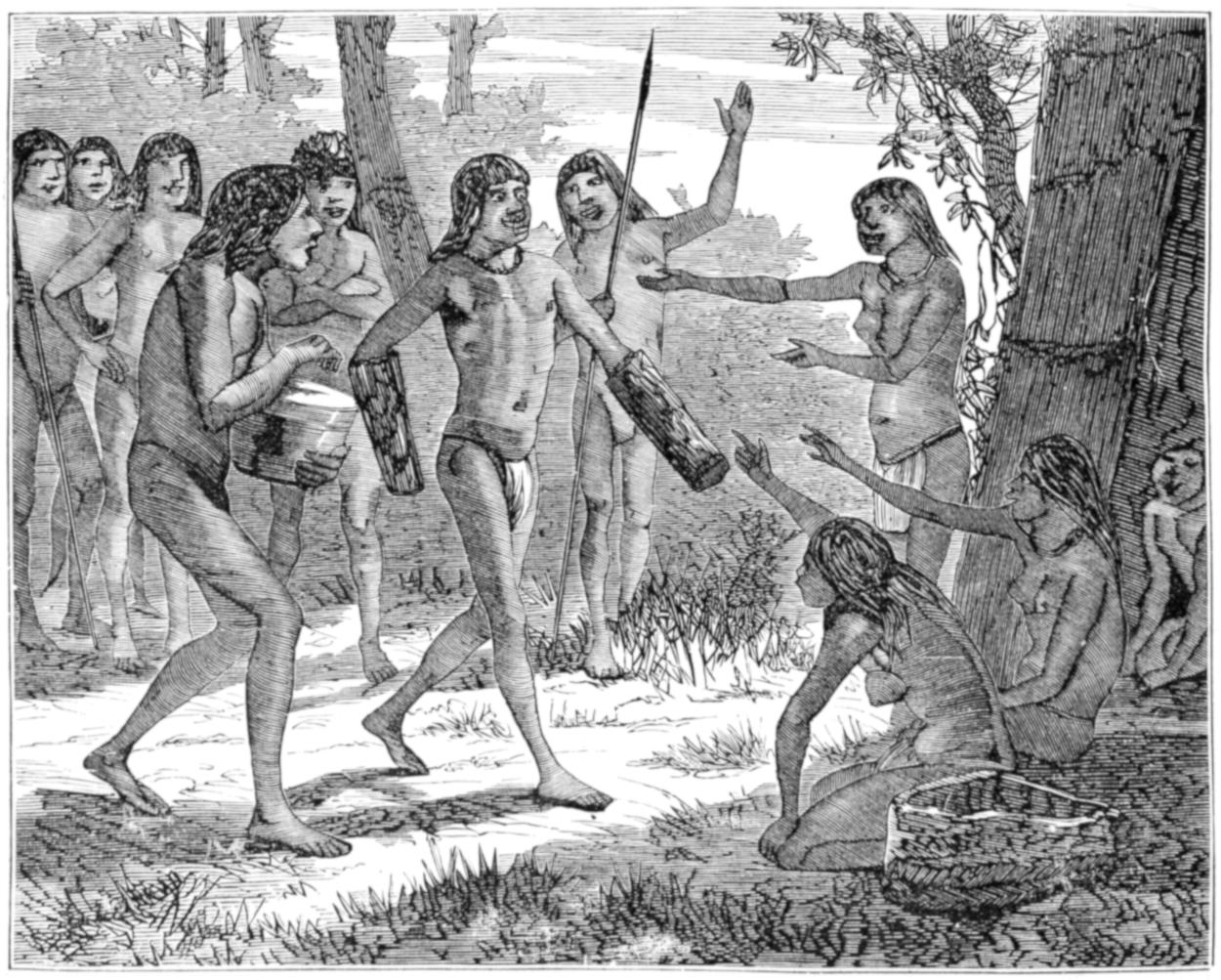
(2.) THE GLOVE DANCE OF THE MUNDURUCÚS.
(See page 1219.)
On the appointed day, the candidate for
manhood and the privilege of a warrior, goes
to the council-house, accompanied by his
friends, who sing and beat drums to encourage
him. The old men then proceed to the
test. They take two bamboo tubes, closed
at one end and open at the other, and place
in each tube or “glove” a number of the
fiercest ants of the country. Into these
tubes the wretched lad thrusts his arms, and
has them tied, so that they cannot fall off.
The drummers and singers then strike up,
and the candidate joins in the song.
Accompanied by the band and his friends,
he is taken round the village, and made to
execute a dance and a song in front of every
house, the least symptom of suffering being
fatal to his admission among the men. In
spite of the agony which he endures—an
agony which increases continually as the
venom from the stings circulates through
his frame—the lad sings and dances as if he
were doing so from sheer joy, and so makes
the round of the village. At last he comes
in front of the chief’s tent, where he sings
his song for the last time, and is admitted
by acclamation to be a man. His friends
crowd round to offer their congratulations,
but he dashes through them all, tears off the
gloves of torture, and plunges into the nearest
stream, to cool his throbbing arms.
This fearful test of manhood, called “The
glove dance,” is represented on page 1218.
The Mundurucús seem to be an intelligent
race of savages, as may be seen from
Mr. Bates’s account of the interest which
they displayed in a book of illustrations.
“To amuse the Tushaúa, I fetched from
the canoe the two volumes of Knight’s ‘Pictorial
Museum of Animated Nature.’ The
engravings quite took his fancy, and he
called his wives, of whom, as I afterward
heard from Aracú, he had three or four, to
look at them: one of them was a handsome
girl, decorated with necklace and bracelets
of blue beads. In a short time others left
their work, and I then had a crowd of
women and children around me, who all
displayed unusual curiosity for Indians.
“It was no light task to go through the
whole of the illustrations, but they would
not allow me to miss a page, making me
turn back when I tried to skip. The pictures
of the elephants, camels, orang-outangs,
and tigers seemed most to astonish them,
but they were interested in almost everything,
down even to the shells and insects.
They recognized the portraits of the most
striking birds and mammals which are found
in their own country; the jaguar, howling
monkey, parrots, trogons, and toucans.
“The elephant was settled to be a large kind
of tapir; but they made but few remarks, and
those in the Mundurucú language, of which
I understood only two or three words. Their
way of expressing surprise was a clicking
sound made with the teeth, similar to the
one we ourselves use, or a subdued exclamation,
Hm! Hm!
“Before I finished, from fifty to sixty had
assembled; there was no pushing, or rudeness,
the grown-up women letting the young
girls and children stand before them, and all
behaved in the most quiet and orderly manner
possible.”
Like other savage tribes the Mundurucús
place great faith in their medicine men, or
“pajes,” as they are termed. These men
are supposed to exercise a power over evil
spirits, especially those which cause sickness,
and which take the visible form of a
worm or some such creature.
When a Mundurucú is ill, he sends for
the paje, who goes through the gesticulations
common to all the tribe of medicine
men, until he has fixed upon some spot
wherein the evil spirit has located itself.
He then makes a huge cigar, by wrapping
tobacco in folds of tanari, i. e. the inner bark
of a tree, which is separated into layers and
then beaten out like the bark cloth of Polynesia.
Several trees, especially the monkey-root
tree (Lecythis ollaria), furnish the tanari,
the best being able to furnish a hundred
layers from one piece of bark.
The smoke from the cigar is blown for
some time upon the seat of the malady,
and after a while the paje applies his lips to
the spot, and sucks violently, producing out
of his mouth the worm which has done the
mischief. On one occasion, when a paje had
operated on a child for a headache, a white
man contrived to get possession of the
“worm,” which turned out to be nothing
but a long white air-root of some plant.
These people have, however, some genuine
medicines. In the first place, they know
the use of sarsaparilla root, and gather it in
large quantities for the market. The root,
or rather the rhizome, of a species of Smilax
is the well-known sarsaparilla of commerce.
The natives collect it during the rainy
season, when the roots can be easily torn
out of the wet earth. After washing the
roots carefully, the gatherers store them
under shelter until they are quite dry, and
then make them up into bundles of uniform
size, for the convenience of packing. These
bundles are rather more than three feet in
length, and about five inches in diameter.
They are tied up very tightly with the sipo,
a kind of creeper, and sold to the traders.
Another medicine known to them is the
guarana. It is made from the seeds of a
climbing plant belonging to the genus Paullinia.
The seeds are roasted in their envelopes,
and then taken out and pounded
between two stones. The powder is mixed
with water so as to form a stiff paste, which
is moulded into squares and left to dry.
When used, the vegetable brick is scraped
into water, about a teaspoonful going to the
pint, and the medicine is complete. It has
a stimulating effect on the system. Like
strong tea, it repels sleep, but is so valuable
in the intermittent fever of the country that
in the Brazilian settlements it obtains a very
high price.
There is another very remarkable medicine,
which, though not used by the pure
Mundurucú tribe, is in great favor with the
Cuparis, a sub-tribe of the same nation.
This is a sort of snuff, called paricá, which
is prepared and used after the following
manner. The seeds of a species of ingá (a
plant belonging to the Leguminous Order)
are dried in the sun, pounded in wooden
mortars, and the dust put into bamboo tubes.
When the people determine to have a
bout of snuff taking, they assemble together
and drink various fermented liquors until
they are half intoxicated. They then separate
into pairs, each having a hollow reed
filled with the paricá snuff. After dancing
about for some time, they blow the snuff
into the nostrils of their partners so as to
make it produce its full effect.
The action of the paricá is very singular.
Sometimes it is so violent, that the taker
drops on the ground as if shot, and lies insensible
for some time. On those who are
more used to it the effect is different. It
causes for a time the highest excitement,
driving off the heaviness of intoxication,
and imparting a lightness and exhilaration of
spirits, causing the taker to dance and sing
as if mad, which indeed he is for a time.
The effect soon subsides, and the men drink
themselves anew into intoxication.
The Muras, a quarrelsome and savage
tribe, with whom the Mundurucús are at
perpetual feud, are the most confirmed paricá
takers. The Mauhés, a neighboring
tribe, use it as a means of repelling ague in
the months between the wet and dry seasons,
when miasma always abounds.
They keep the powder in the state of
dried paste, and when they wish to use it,
scrape it into a flat shell, spreading it very
carefully with a little brush made from the
hair of the great ant-eater. They then produce
the snuff-taking apparatus. This is
made of two eagle quills tied side by side
for part of their length, and diverging at
one end to such a distance from each other
that the extremities will go easily into the
possessor’s nostrils. The shape of the instrument
is very much like that of the letter Y.
Inserting the diverging ends into his nostrils,
the Mauhé places the other end on the
powder, and draws it through the quills, the
end travelling over the shell until every
particle of the powder has been taken.
Sometimes the snuff taker employs, instead
of the quills, the bone of a plover’s leg.
This instrument, however, is very rare, and
cannot easily be procured, the possessor
esteeming it to be a most valuable piece of
property. It is remarkable that the paricá,
under different names, is used in places a
thousand miles apart.
The cookery of the Mundurucús is very
simple. They make cassava bread and tapioca,
after a fashion which will be presently
described, and feed on yams, plantains, and
similar vegetables. Animal food is obtained
by hunting, and chiefly consists of the monkeys
with which the South American forests
abound. When a monkey is to be eaten,
it is cooked in one of two ways. Should
there be time, a large fire is made and allowed
to burn nearly down, so that there is
little or no smoke. Over the red embers a
number of green sticks are laid parallel to
each other, just like the bars of a gridiron,
and on these bars the monkey is placed just
as it is killed, the skin never being removed,
and the interior seldom cleaned.
There is even a simpler plan than this,
which is employed when the Mundurucú
has no time to build a large fire. He makes
up as large a fire as he can manage, impales
the monkey on a stick sharpened at each end,
and fixes the stick diagonally in the ground,
so that the body of the monkey hangs over
the fire, just as a soldier cooks or rather
burns his rations by impaling the piece of
meat on his ramrod. Very little cooking is
required by these people, who are content
if the skin is well calcined and the flesh not
quite raw.
The Mundurucú can also procure fruits
that are capable of preservation, so that he
need be in no fear as to suffering from lack
of provisions. The chief fruits are the
“nuts” of the Lecythis and the Bertholetia.
The fruit of the former tree is popularly
known as “monkey-cup,” because the hard
envelope which encloses the seeds has a
movable lid, that falls off when the fruit is
ripe, and enables the monkeys to draw the
seeds out of their case.
The fruit of the Bertholetia is familiarly
known as the Brazil nut. A number of
these nuts are enclosed within a very thick
and hard pericarp, which has no lid, though
there is a little hole at the top through which
the seeds can be seen. When the fruit is
ripe, it falls to the ground with such force
that if it were to strike a man on the head
it would instantly kill him. One of these
fruits in my collection measures exactly a
foot in circumference, and, though very
dry, weighs nine ounces. The reader may
imagine the force with which such a fruit
would fall from the height of a hundred
feet or so.
To guard themselves against accidents,
the Mundurucús always wear thick wooden
caps when they go after the Brazil nuts, and
are careful to walk very upright, so as not to
be struck on the back or the nape of the neck.
CHAPTER CXXIX. THE TRIBES OF GUIANA. WEAPONS.
CHANGES OF LANGUAGE — INVERSION OF WORDS AND SENTENCES — THE TALKING PARROT — THE FIVE
CHIEF TRIBES OF GUIANA — PECULIARITY OF CLIMATE, AND CONSEQUENT EFFECT ON VEGETABLE
AND ANIMAL LIFE — THE HAMMOCK OF GUIANA — THE WEAPONS PECULIAR TO THE COUNTRY — THE
TWO KINDS OF BLOW GUN — THE ZARABATANA, AND MODE OF CONSTRUCTION — WEIGHT OF
THE WEAPON — THE PUCUNA — ITS DOUBLE TUBE — THE OURAH AND SAMOURAH — THE KURUMANNI
WAX — THE INGENIOUS FORE AND BACK SIGHTS — THE BLOW GUN ARROWS — THEIR CONSTRUCTION — MODE
OF SHARPENING — THE PIRAI FISH — INGENIOUS MODE OF PACKING THE
ARROWS — MODE OF PROPELLING THE ARROWS — THE WINGED ARROW — THE QUIVER AND COTTON
BASKET.
It is evident that the innumerable tribes
which inhabit the neighborhood of the
great Amazon River are members of the
same family, differing more in language
than in appearance or habits. It is natural
that families when they become large
should separate themselves, and so become
founders of fresh tribes, which spread themselves
over the country, settling down in
those spots which suit them best. They
retain the general character of their manners
and customs, but, owing to the total
want of a literature, their language is continually
changing.
This alteration in their language is also
due to the native fondness for inverting
words and sentences during their conversation
with each other, a custom which bears
some resemblance to that of punning among
ourselves. When these inverted words happen
to please the people’s fancy, they are
retained in the language, so that in a few
years after a family has separated itself
from the parent tribe the two dialects will
have receded so far from each other that the
people can hardly understand each other.
To the philologist this fluctuation of language
would be exceedingly interesting, but,
as we are concerned with manners and customs
rather than with language, we will
pass northward and eastward to Guiana.
Sir R. Schomburgk mentions a fact which is
a singular corroboration of the rapidity with
which language changes among these tribes.
There was a parrot living in 1800, which
spoke well, but many of whose words could
not be understood, because it spoke the language
of the Atures, a tribe which had
passed entirely out of recollection after it
had been mastered by the warlike Caribs.
This comparatively small country is especially
interesting to ethnologists, in consequence
of the perfect manner in which the
natives have guarded their individuality.
Evidently sprung from one source, they
have settled down in different districts
and, though alike in color and general conformation,
are as widely different in language,
and often in manners, as if they belonged
to separate quarters of the world.
Five principal nations inhabit Guiana,
and are subdivided into a vast number of
small tribes. These are the Macoushies,
the Arawâks, the Accawaios, the Caribs,
and the Waraus. The two first of these
will be taken as representatives of the
tribes in Guiana, though the others will be
mentioned in cases where they present any
marks of difference.
Taking broadly the chief points of distinction
between these tribes, we may simply
define them as follows.
The Macoushies are the largest and most
ingenious tribe. They excel in the manufacture
of the terrible wourali poison, which
they exchange for canoes and other necessaries
from other tribes. They also make the
best blow guns. Their huts are closed, and
conical like sugar loaves. Their number is
somewhere about three thousand.
The Arawâks are rather taller than the
Macoushies, being, on an average, five feet
six inches in height. Their faces are marked
with the tattoo, and, as they are much
brought into contact with white men, they
approach civilization nearer than do the
other tribes.
The Accawaios and Caribs wear no clothing
except on occasions of ceremony. The
former are distinguished by a wooden ornament
in the cartilage of the nose, and the
latter by wearing ornaments in the under
lip, and by a lump of annatto fastened to the
hair of the forehead. The Waraus are darker
than the others, and are acknowledged to be
the best canoe makers in Guiana. Some of
their vessels will carry ninety or a hundred
men, and they sell these canoes to the Macoushies
for the excellent wourali poison for
which that tribe is celebrated.
Owing to the peculiarities of the climate,
all these tribes have many customs in common.
The climate is a very remarkable
one, being exceedingly hot and exceedingly
wet. The heat is owing to the geographical
position of Guiana, which is close to the
equator, and the wet is due to the trade
winds and the configuration of the country.
Blowing across the Atlantic they absorb a
vast quantity of moisture from the ocean,
and discharge the greater portion of it before
they can reach any distance inland, the
moisture being condensed by the secondary
mountain chains, which are from five to seven
thousand feet in height.
In consequence of this perpetual heat acting
on perpetual moisture, vegetation flourishes
with a luxuriousness scarcely to be
seen in any other part of the world; and so
completely is the ground covered with tree
and bush, that many trees are unable to find
a habitation upon the ground, and are forced
to live upon each other. Thus, upon a lofty
mora tree a fig tree will grow, and upon the
fig an enormous creeper will fasten itself, its
long shoots dangling loosely from the enormous
height at which they grow, or drooping
in graceful and flower-clad festoons from one
tree to another. Such a forest as this is often
ankle-deep in water for miles together, and
the vegetation is so thick that the only way
of passing through the tangled mass of vegetation
is to cut a path with the axe. And
even then, after a week or two has elapsed,
the path will have vanished, so rapid is the
growth of vegetable life.
It follows from this description that the
animals which inhabit Guiana must be
chiefly of two kinds, those which inhabit the
trees and those which live in the water.
Accordingly, we find that the country is
tenanted by a great variety of the monkey
tribe, that the arboreal puma and jaguar
take the place of the terrestrial lion and
tiger, and that the aquatic capybara and
tapir flourish where beasts of equal size
would perish if they had to live on the land.
Birds of the most lovely plumage abound in
Guiana, which is also a very paradise of insects.
It is evident that any human beings that
live in such a country as this must have
many characteristics in common. They
need no clothes, no houses, and the woods
supply them with food without the trouble
of cultivation, so that their chief incentives
to labor are taken away. Consequently, they
may be called an idle people, though the indolence
is rather apparent than real. They
will work as long as there is a necessity for
it; but, as a man can support existence without
doing a real day’s work in his life, it is
evident that the necessity for work does not
often arise.
One habit which they have in common is
that of sleeping in the hammock. This article
is made by the natives from various
vegetable fibres, and is woven in different
ways, according to the character of the tribe
which makes it. Some of these are made
simply by laying a number of strings parallel
to each other, and knotting others across at
right angles; but the best have no knots at
all, the strings interlacing with each other
diagonally, so as to yield in every direction
to the body of the occupier. When a native
has made a particularly fine specimen, he
adorns it with feathers, and other brilliantly
colored objects.
These hammocks are of various sizes, some
being small and used for children, and others
large enough to contain an entire family.
The specimen in my collection will hold two
Guianan natives, but not two Englishmen.
It is rather more than sixteen feet in length,
and six feet in width.
The hammock is exactly adapted to the
wants of the native. It is so light that he
can roll it up and tie it round his body, so as
to carry it on a journey; so slight in texture
as to keep him cool when lying in it; and so
yielding in its structure that the bare cords
do not hurt his naked skin. On a journey
he always carries his hammock with him,
and if he wants to rest, he does not sit down,
but slings the hammock between two trees
and lies in it. Several purposes are fulfilled
by this arrangement. In the first place, the
ground is usually wet, so that the man is
kept dry in the hammock; in the next place,
he is safe from the snakes and other unpleasant
reptiles that swarm in the forests;
and lastly, he would always rather lie down
than sit.
Another point which they have in common
is the mode in which they destroy the
animals on which they live. The reader will
remember that the density of the jungle is
so great, that if an animal were able, after it
was wounded, to run for a hundred yards or
so, or a bird to fly the same distance, it would
be lost in the bush without the chance of recovery.
It is evident, therefore, that the
successful hunter must possess some means
of destroying motion, if not life, almost instantaneously,
and this he finds in the terrible
wourali poison, which has the effect of
causing instant stupor when it mixes with
the blood. The mode of manufacturing this
poison will presently be described, and at
present it is sufficient to say that nearly all
the missiles used by the Guianan aborigines,
whether propelled by the bow or by the
breath, are armed with this poison.
We will first take those missiles which are
propelled by the breath, and examine the
instrument through which they are sent.
In principle this is exactly like the sumpitan
of Borneo, described on page 1119, but the
mode of construction is different, and in the
best specimens the Guianan work is far superior
to that of Borneo.
Of this singular weapon there are several
varieties, the two principal of which are
shown over the title “Blow guns” on the
1225th page, both being taken from specimens
in my possession. On the right is the
zarabatana. This is found throughout a
very large tract of country southward of
Guiana, when it takes a somewhat modified
and improved form.
It is made of two separate pieces of wood,
in each of which is cut a semicircular groove,
so that when they are placed in contact with
each other they form a long wooden rod,
pierced with a circular bore. As the natives
use nothing but the incisor teeth of rodent
animals by way of tools, it may be seen that
the labor of making one of these instruments
is very great. The bore being carefully
smoothed, the two halves are laid together,
and bound by means of long, flat strips of
jacitara wood wound spirally round them.
To the lower end of the weapon is fastened
a large mouthpiece, with a conical
opening like the mouthpiece of a trumpet,
so as to collect the breath for the propulsion
of the arrow. A quantity of cement,
composed of a black wax made by a wild bee
mixed with a pitchy substance obtained from
several trees, is then rubbed over the whole
weapon, which is considered complete. The
zarabatana is exceedingly heavy, and requires
not only a strong but a practised arm to hold
it steady. The specimen in my collection,
which is several feet in length, weighs three
pounds twelve ounces.
A far superior weapon, called the “pucuna,”
larger, lighter, and more easily
handled, is made by the natives of many
parts of Guiana, that used by the Macoushie
tribe being the best. The specimen which
is shown on the left of the zarabatana was
brought from Guiana by the late Mr.
Waterton, who presented it to me shortly
before the accident which caused his death.
The weapon in question (called pucuna)
is double, being made of two portions,
called ourah and samourah. The essential
portion of the blow gun is the ourah. This
is a singular reed (Arundinaria Schomburgkii),
which, as far as is known, only
grows on the sandstone ridge of the Upper
Orinoco between the rivers Ventuari, Paramu,
and Mavaca. Like the bamboo, it
grows in clusters, and, though not exceeding
half an inch in diameter, the first fourteen
or sixteen feet are without a knot. From
this point spread the long, slender branches,
measuring from thirty to forty feet in length,
and waving in graceful curves when moved
by the wind.
The portion used for the blowpipe is the
first joint, which is uniform in diameter
throughout, and is naturally polished within.
But it is so thin, the walls being not twice
the thickness of a playing card, that it would
be too fragile to be used without some protection.
Accordingly, the native has recourse
to a sort of palm, called by him samourah, its
scientific title being Ireartia setigera.
This is chosen of a proper size, cut down,
and steeped in water, for the purpose of extracting
the pulp which fills the interior.
When it is quite dry, the reed is inserted
into this tube, the native gunmaker having
a wonderful talent in getting the slender
reed exactly in the centre of the palm-stem,
and fixing it in its place with the black wax
already mentioned. This wax is called kurumanni
by the Macoushies, and is used by
them as freely as is the “black-boy” wax by
the Australian aborigines. The samourah
is then scraped down to the proper thickness,
well polished, and the weapon is ready for
the accessories which complete it.
One end is chosen to serve as a mouthpiece,
and is bound with a string made of
silk-grass and the other is tipped with the
half of the acuero nut, which is very hard
and prevents the end of the weapon from
being injured by accidental blows against a
tree or the ground. This acuero seed acts
as a fore-sight, by which the native hunter
can direct his weapon; but, in order to secure
a more certain aim, he adds a singularly ingenious
back-sight. Taking a lump of kurumanni
wax, he presses it on the blowpipe
about eighteen inches from the mouthpiece,
and by means of the wax fixes upon the tube
the two lower incisor teeth of the acouchi,
one of the cavies.
Figure 1 shows the weapon itself, and fig.
2 the front view of the tip, guarded with its
ring of acuero seed, which forms the fore-sight.
Fig. 3 gives an enlarged representation
of the back-sight, made of the teeth of
the acouchi (Dasyprocta Acouchi) fixed in
their place by the black kurumanni wax. Fig.
4 is a section taken through the middle of
the back-sight, so as to show the way in
which the teeth project from the shaft. Fig.
5 is a front view of the butt, showing the
way in which the ourah reed is enclosed
within the samourah palm.
Such a weapon as this is exceedingly light
and easy to handle, presenting a strong contrast
to the heavy and cumbrous zarabatana.
The weight of the one in my collection barely
exceeds a pound and a half, although it is
eleven feet in length. It is held in rather a
curious manner. The left hand is turned
with the palm upward, and the elbow against
the hip. The hand then grasps the blow gun
within a hands-breadth of the mouthpiece,
and the right hand seizes it, palm downward,
in the space left by the other hand. In fact,
this mode of holding the weapon is exactly
similar in principle to that which is employed
by riflemen. The blowpipe is then raised,
not by the arms, but by bending back the
body; and it is astonishing to see how steady
it can be held for a lengthened time—a
steadiness which can never be gained if it be
held by stretching out the right arm and
grasping it at some distance from the mouth.
The natives are most careful respecting
the straightness of their blow guns, and
never allow them to lean against anything
lest they should be warped. When they go
hunting, they carry the blow gun upright,
like a soldier, “shouldering arms,” and when
they return to their huts, they suspend the
weapon by a loop to the top of the house.
Mr. Waterton repeatedly draws attention to
this point in his “Wanderings,” and when
he presented me with the pucuna which
he brought from Guiana, the gift was accompanied
by a condition that it should
never be allowed to lean against a wall, but
should be either laid on the ground or suspended
by its loop.
We now come to the arrows which are
propelled through the pucuna. They very
much resemble in shape and size those
which are employed by the Dyaks, but, instead
of being made to fit the bore of the
pucuna by a piece of pith or soft wood at
the butt, a small quantity of wild cotton,
taken from the Bombax ceiba, is wound
upon it, and fastened with a fibre of silk
grass. Cultivated cotton is too heavy to
serve the purpose, and nothing answers so
well as the yellow, stout-fibred cotton of the
Bombax. Very great art is required in putting
on the cotton properly. It must exactly
fit the bore, be perfectly regular, so as not to
disturb the accuracy of the flight, and must
taper gradually in front, so as to offer the
least possible resistance to the air. See illustration
No. 1, on the next page.
The shaft of the arrow is made of the leaf
ribs of the coucourite palm, a species of
areca. It is about ten inches in length, no
thicker than a crow quill, and at one end is
brought to a point as sharp as a needle by
scraping it between the teeth of the pirai
fish (Serrasalmus piraya). The teeth of this
fish are flat, pointed, and double-edged, much
like those of the shark—and, indeed, the
pirai is a veritable fresh-water shark, biting
whole mouthfuls from the bodies of animals
that enter the water, and even attacking the
alligator itself—and when the arrow is
drawn between them, delicate shavings
are taken off, just as is the case with the
double knife-sharpeners of the present day.
One half of a pirai jaw is always suspended
to the quiver of a Macoushie.
Of the poison with which the arrow is
armed we will presently treat: we are now
only concerned with the manufacture of the
weapon. In order to save space, the cotton
is not put upon the arrows until just before
they are wanted, six or seven finished arrows
being left in the quiver for immediate
use, and the rest tied in a bundle until
needed. The formation of this bundle is
singularly ingenious, the native being able
to remove any of the arrows without untying
it, and to add as many as he likes without
disturbing those which already are tied
together.
The native takes a rod of hard wood, a little
longer than the arrows, and at one end
he fixes a little wheel, rather more than two
inches in diameter. At two inches from the
wheel, and the same distance from the end
of the rod, two holes are bored, through
each of which are passed two strings made
of cotton. When the man wishes to tie up
a number of arrows, he lays them successively
between the strings, which he twists
between each arrow. When the last arrow
is laid in its place, the whole are kept firm
by a couple of sliding knots, which can be
slipped along the strings.
Illustration No. 7 on the following page,
will explain the method of stringing the arrows
better than can be done by words
alone. Two of the arrows are shown as
prepared for use, the cotton being on their
butts and the poison on their tips. A number
more are shown as they appear on the
double strings, poisoned, but without the
cotton. A hunter will sometimes have as
many as five hundred arrows at once upon a
string.
In order to keep the weapons compact, so
that they can be easily slipped into the
quiver, they are rolled round the little rod,
and bound firmly together in a cylindrical
form, the poisoned points being directed to
the wheel, of which the reader will now see
the use. It serves as a sort of shield to the
hand, so that when the hunter wishes to take
the arrows out of the quiver, he can do so
without the least danger; and when he desires
to remove some arrows to be mounted
with cotton, he can push them through the
spokes of the wheel, and take them out without
having to untie the bundle. See illustration
No. 6.
STEM ENLARGED
1 ENLARGED
2
(5.) BLOW GUNS.
(See page 1223.)
When properly made and mounted, these
arrows can be propelled with wonderful
force. I have sent one for a distance of a
hundred yards, and the natives can propel
them to a still greater distance. There is a
certain art in using the pucuna, the arrow
not being urged by a lengthened breath, but
by collecting all the air that the lungs will
hold, and giving a short expiration, as if the
object were to empty the lungs at one puff.
The force comes entirely from the lungs, the
cheeks having nothing to do with it. When
an arrow is rightly propelled, it flies from
the tube with a slight pop, like that which is
produced by quickly drawing the cork of a
small bottle. It is quite invisible for some
little time, so rapid is the motion; and even
when fitted with white instead of yellow
cotton the eye can scarcely follow its course.
Such an instrument as this is simply
invaluable for the purposes to which it is
devoted. It is intended to be used almost
exclusively for killing birds and small monkeys,
both of which creatures live on trees.
Now, as the trees of Guiana run to an enormous
height, some of them attaining at least
a hundred feet before they throw out a
branch, it will be seen that the birds are beyond
the reach of shot-guns. The foliage is
so thick that it does not permit more than
one or two shots to reach the bird, and the
height is so great that, even if they did
strike, they would produce but little effect.
But the pucuna can throw an arrow higher
than a gun can propel a shot, and if the
needle-like point enters any part of the bird
the effect is fatal.
There is another advantage which the
pucuna possesses over fire-arms. The report
of the gun frightens away every bird
within sound, whereas the pucuna is practically
noiseless. The slight “pop” with
which the arrow is expelled does not alarm
the birds, and an expert hunter can kill
twenty or thirty birds from one tree without
alarming the others. The pucuna is particularly
useful in the chase of the toucan.
The feathers of this bird are much used in
the manufacture of the beautiful gala dresses
which the natives wear on grand occasions,
and are much prized by them. Now, the
toucan has a way of sitting on the topmost
boughs of the tallest trees, and were it not
for the deadly arrow of his pucuna, the native
could seldom obtain a specimen.
Just before the arrow is put into the blowgun,
the hunter places it between two of the
pirai-teeth already mentioned, and turns it
round between his fingers. He thus cuts it
through just above the poisoned portion, so
as to leave a mere thread of wood attaching
the head to the shaft. If, therefore, the bird or
monkey, on feeling the smart, should seize
the arrow and withdraw it, the poisoned
head snaps off and is left in the wound.
In some parts of the country a very ingenious
form of arrow is used. Instead of
being made to fit the bore by means of cotton
tied on the butt, a flat piece of bark is
twisted round the arrow so as to cause it to
terminate in a hollow cone. A larger piece
of the same material is fixed along the shaft
of the arrow, and slightly twisted so as to
cause it to revolve when projected through
the air. The arrow is tipped with a slight
iron blade, instead of being merely sharpened
wood. (See illustration No. 2.) This
form of hollow base is admirably adapted for
its purpose, and has been copied by Messrs.
Lang, the well-known gunmakers of Cockspur
Street, in their blow gun darts for killing
small birds and animals without noise.
Next comes the quiver in which the arrows
are kept. This is shown in illustration
No. 4, on page 1225. The framework of the
quiver is made of the ittiritti-reed, and the
bottom is closed by a circular plate of wood.
In order to keep the poisoned arrows from
the damp, which would effectually spoil them,
the whole of the quiver is covered with a
thick coat of kurumanni wax, which is
pressed firmly into the interstices of the
wicker-work, and into the junction between
the bottom and the sides of the quiver.
Lest the rough basketwork should injure
the delicate arrows, the quiver is lined with
beautifully made mat-work, of much finer
material, and quite smooth to the hand. The
cover is made of a piece of skin, sometimes
of the tapir, but mostly of the peccary.
While fresh and wet it is moulded over a
wooden block of the proper size, just as hatters
mould their felt into its form. The
hairy side is kept inward, and when it is
pressed on the top of the quiver, and twisted
with a turn of the hand, it holds itself firmly
in its place. When the cover is on the
quiver, no water can enter, and even if the
hunter were to drop it into the river, the arrows
would be preserved quite dry in their
floating receptacle.
Before the kurumanni wax which covers
the quiver is quite dry, a flat plaited belt
made of silk grass is secured to it by means
of a long string, which encircles the quiver
several times. In this cincture is also secured
by strings a coil of silk-grass, from,
which can be drawn the fibres by which the
cotton is attached to the arrow, together with
the half jaw-bone of the pirai, with which
the arrows are sharpened. In my specimen
this jaw-bone is two inches in length.
The last article which completes the equipment
of the bird hunter is the basket of
wild cotton. This, as may be seen from illustration
No. 3, has a narrow neck, and bulging
body; so that the cotton does not fall
out of the basket, though carried with the
opening downward. The quantity which it
will hold is astonishing. From one of them
Mr. Waterton took handful after handful
until a large heap was on the table, just as
a conjuror takes vast quantities of feathers
out of an apparently empty hat.
CHAPTER CXXX. THE TRIBES OF GUIANA— Continued . WEAPONS— Concluded .
EFFECT OF THE WOURALI — DEATH OF THE AI — THE LARGER ARROWS — TUFTED ARROWS — A SINGULAR
QUIVER — ARRANGEMENT OF THE MOVABLE HEAD — QUIVER FOR THE HEADS — FATE OF THE
WOUNDED INDIAN — HOW THE ARROWS ARE FEATHERED — THE NATIVE BOW — TURTLE ARROWS — MANUFACTURE
OF THE WOURALI — THE QUAKE AND ITS USES — THE WOURALI VINE, AND
OTHER VEGETABLE CONSTITUENTS — THE HYARRI POISON, AND ITS USES — ANTS AND SNAKE
FANGS — BOILING THE WOURALI — EFFECTS OF THE PROCESS ON THE MAKER — SELF-POISONED
ARROWS — VARIOUS ARROW HEADS OF GUIANA — THE WHISTLING ARROW.
The effect of the poison is instantaneous,
provided that it be of good quality and kept
dry. There are many varieties of the wourali,
but the best, which is made by the
Macoushies, is so powerful that one of the
tiny arrows brought by Mr. Waterton from
Guiana killed a hedgehog at once, though
fifty years had elapsed since the poison was
made. Death was not instantaneous, for the
animal, which was very slightly wounded
in the hind leg, breathed for some seconds;
but the hedgehog was quite insensible, and,
as soon as it had been pricked by the dart,
it allowed me to lay it on its back, and
place my finger on the ball of its eye, without
shrinking.
Many experiments have been made in
England with the wourali poison, most of
which have tended to prove that its power
has been exaggerated, and that a man could
not be killed by the small quantity that
could be conveyed into a wound on the
point of an arrow. I feel certain, however,
that in such cases either the poison has not
been of good quality, or that it has been
carelessly kept, and allowed to become
damp, in which case it loses the greater
part of its strength. It is very difficult to
procure the strongest wourali poison from
the natives, who are very unwilling to part
with it, and will always try to substitute an
inferior kind. The only mode of procuring
the best wourali is to do as Mr. Waterton
did, i. e. live among them, and induce them
to part with the little wourali-pots from
which they have poisoned their own arrows.
Moreover, he must imitate their example in
keeping the poison in a perfectly dry place.
The natives are so careful on this point that
they frequently remove the covers of their
poison pots and put them near the fire.
There is no mistake about the potency of
such poison as this. Its effect upon a hedgehog
has already been mentioned, but Mr.
Waterton tried it on several animals. For
example, he had an Ai sloth that he wanted
to kill painlessly, and without damaging the
skin. How he did it is best told in his own
words:—
“Of all animals, not even the toad and
the tortoise excepted, this poor animal is
the most tenacious of life. It exists long
after it has received wounds which would
have destroyed any other animal, and it
may be said, on seeing a mortally wounded
sloth, that life disputes with death every
inch of flesh in its body.
“The Ai was wounded in the leg, and put
down upon the floor, almost two feet from
the table. It contrived to reach the leg of
the table, and fastened itself upon it as if
wishful to ascend. But this was its last advancing
step; life was ebbing fast, though
imperceptibly; nor could this singular production
of nature, which has been formed
of a texture to resist death in a thousand
shapes, make any stand against the wourali.
“First one fore-leg let go its hold, and
dropped down motionless by its side; the
other gradually did the same. The fore-legs
having now lost their strength, the
sloth slowly doubled its body, and placed
its head betwixt its hind-legs, which still
adhered to the table; but when the poison
had affected these also, it sank to the ground,
but sank so gently that you could not distinguish
the movement from an ordinary
motion; and had you been ignorant that it
was wounded with a poisoned arrow, you
would never have suspected that it was dying.
Its mouth was shut, nor had any
froth or saliva collected there.
“There was no subsultus tendinum, nor
any visible alteration in its breathing. During
the tenth minute from the time it was
wounded it stirred, and that was all; and
the minute after life’s last spark went out.
From the time the poison began to operate,
you would have conjectured that sleep was
overpowering it, and you would have exclaimed—
‘Pressitque jacentem
Dulcis et alta quies, placidæque simillima morti.’”
The reader will see that this account
agrees exactly with my own experiment.
In neither case was death instantaneous,
but in both cases the power or wish to move
seemed to be immediately taken from the
animal, though wounded in a limb and not
in a mortal spot.
Of course the quantity of poison must be
proportioned to the size of the animal. The
tales that are told of a mere scratch producing
death are manifest exaggerations.
It has been mentioned that in Guiana no
very large animals are found, the tapir and
the jaguar being the largest of the mammalia.
For the purpose of killing these, or
going to battle where man is to be destroyed,
the natives employ a very different
weapon, and use a bow and arrow of rather
peculiar construction.
They are extremely long, some of them
being six feet in total length. The shaft is
made of a cylindrical, hollow, and very
strong reed (Gynecium saccharinum) which
runs to some length without a knot or joint.
In one end is fixed a long spike of a very
hard and heavy wood, called letter wood,
because it is covered with red marks
like rude attempts at writing, very much
like the scribbled marks on a yellow-hammer’s
egg. In order to guard it from splitting,
the shaft of the arrow is bound for
some inches with cotton thread. The commoner
kinds of arrow are merely wrapped
with this thread, but in the better sorts the
thread is woven in patterns almost as neat
as those employed by the Polynesian islanders.
When the native wants to make a
peculiarly beautiful arrow, he ornaments it
in a most singular manner. Into the thread
which wraps the shaft are inserted a quantity
of brilliantly colored feathers, mostly
those of the various parrots which are so
plentiful in Southern America. Only the
smallest and softest feathers are used, and
they are worked into the wrapping in a
manner which produces the most artistic
combinations of color.
The natives have a marvellous eye for
color, most likely from having continually
before their eyes the gorgeous insects and
birds of their luxuriant country, and it is
wonderful to see the boldness with which
they achieve harmony from a number of
hues that scarcely any one would dare to
place in opposition with each other. Scarlet,
yellow, pink, blue, green, and snowy white
are all used in these arrows, and are arranged
in a way that would do honor to the
best European artist.
Sometimes a cap is made for the arrows,
and decorated with feathers in the same
brilliant style. Such arrows as these require
much care on the part of the owner, who is
not content with an ordinary quiver, wherein
they might be jolted about and their lovely
feathers spoiled, but constructs a special and
peculiar quiver for their reception. He
takes a number of bamboos, about the thickness
of a man’s finger, and cuts them into
pieces some eighteen inches in length.
These he lashes firmly together, and then
ties over them a bark cover, neatly wrapped
with cotton string.
Each of these tubes contains one arrow,
which fits with moderate tightness, the
downy feathers keeping it in its place. They
are fixed so perfectly, that when the arrow
is pushed into its tube the feathers are
pressed tightly against the shaft, and when
it is withdrawn, they spring out by their
own elasticity, and form an elegant colored
tuft. As the long arrow shafts are apt to
vibrate by their own weight, and might
damage the feather tufts in the tubes, a cap
is usually slipped over them—in some
cases plain, like the covering of the quiver,
but in others gorgeously made of feathers.
These arrows are tipped with the barbed
tail-bone of the sting-ray or are pointed with
iron, and not with bone. These arrows and
one of the tubes are illustrated on p. 1214.
The heads of the arrows are made in various
ways. Sometimes they are simply covered
with a series of rather blunt barbs, but
the generality of them are constructed after
a very elaborate fashion.
The barb of one kind of arrow reminds
the observer of the weapon of the Bosjesman,
though the arrow is almost a spear in
comparison with the tiny weapon of the African
savage. The point is tipped with a piece
of iron cut into a single barb, and projecting
from it and pointing in the opposite direction
a curved iron spike is slightly lashed to
the shaft with cotton.
A thick layer of wourali poison is laid on
the arrow for about three inches, aiding to
fasten the iron spike to the shaft. Now, the
wourali poison mixes instantaneously with
the blood, so that when the arrow penetrates
an animal, the poison dissolves, and allows
the spike to escape into the wound, carrying
with it a sufficient amount of the poison to
cause death, even if in its struggles the animal
should succeed in shaking out the arrow
itself. If the reader will refer to illustration
No. 4, on page 247, he will see in the
illustration (fig. 4) the Bosjesman arrow,
which is made on the same principle.
Some of these arrows appear to have been
much prized by the owners who have covered
them with an elaborate ornamentation
of cotton thread for a considerable portion of
their length—an example of which, drawn
from one of my own specimens, may be
seen in the illustration. Some of the arrows
have long ends of cotton strings hanging
from them in lieu of the feather tufts.
These dangling cords are often used as ornaments
by the natives, who decorate with
them their clubs in such a manner that two
or three blows must destroy the whole of the
work. We shall presently see examples of
these clubs.
The arrow head which is most in vogue
among the Macoushies, whom we take as the
typical tribe of this part of the world, is made
in a different fashion. A square groove, about
an inch in depth, is cut in the extremity of
the letter wood spike which terminates the
arrow, and a slight sliver of bamboo is
lashed so as to press against the opening
along the side. A barbed spike of coucourite
wood is then cut. It is about three
inches in length, flat toward the point, and
squared at the base, so as to slip easily into
the groove at the head of the arrow, where
it is slightly held by means of the little
bamboo spring. This spring enables the
head to remain in its place while the archer
is fitting the arrow to his bow and taking
aim; but as soon as the missile has struck
its object, and the animal bounds forward,
the poisoned head remains in the wound,
and the shaft falls on the ground.
There is considerable art in putting the
wourali on this kind of arrow head. It is
done in several layers, one being allowed to
dry before the other is applied, and being
managed so as to cause an edge of the
pitch-like wourali to run along each side of
the head. In consequence of the movability
of the head the native archer does not
trouble himself to carry more than one or
two shafts, though he has by him a store of
ready-poisoned heads. These are kept in a
little quiver made of a joint of bamboo fitted
with a cover, in order to keep the poison
from moisture, and with a cotton belt by
which it can be slung over the shoulders.
One of these quivers in my collection,
(see illustration No. 6, page 1231,) brought
from Guiana by Sir. R. Schomburgk, is only
seven inches long by an inch and a half
wide, and is capable of containing twelve to
fourteen poisoned heads. The native hunter
does not require more than this number, as
he rarely shoots without hitting, and when
he has struck one animal large enough to
require this kind of arrow, he seldom wants
more than one specimen. In the course of
this account of the Guiana natives the
reader will notice the many trouble saving
expedients employed by them.
Owing to the generous nature of the country,
which supplies food without requiring
labor, and the warm, moist character of the
climate, the natives are very apathetic, and
have the strongest objection to carrying one
ounce more weight, or doing one stroke more
work, than is absolutely needful. So, instead
of carrying a large bundle of arrows,
the hunter has one, or at the most two arrows,
and a quantity of small poisoned heads, the
whole equipment being so light that a child
just able to walk could carry the bow, arrows,
and quiver without being much inconvenienced.
Knowing the power of this poison, the
natives are exceedingly cautious in handling
it, and never carry the arrow with its head
bare. They always slip over the head a
small tube of bamboo, just large enough to
be held in its place by the cotton wrapping
that passes round the junction of the head
and the shaft. This is never removed except
when the arrow is to be used, and it is
scarcely possible to frighten a native more
than by taking off the guard of an arrow and
holding the point to him. It is of this kind
of arrow that the following story is told in
Mr. Waterton’s “Wanderings.”
“One day ... an Arawâk Indian told an
affecting story of what happened to a comrade
of his. He was present at his death. As it
did not interest the Indian in any point to
tell a falsehood, it is very probable that his
account was a true one. If so, it appears
that there is no certain antidote, or at least
an antidote that could be resorted to in a
case of urgent need; for the Indian gave up
all thoughts of life as soon as he was wounded.
“The Arawâk Indian said it was but four
years ago that he and his companion were
ranging in the forest in quest of game. His
companion took a poisoned arrow, and sent
it at a red monkey in a tree above him. It
was nearly a perpendicular shot. The arrow
missed the monkey, and in the descent
struck him in the arm, a little above the
elbow. He was convinced it was all over
with him. ‘I shall never,’ said he to his
companion, in a faltering voice, ‘bend this
bow again.’ And having said that, he took
off his little bamboo poison box which hung
across his shoulder, and putting it, together
with his bow and arrows, on the ground,
he laid himself down close by them, bade
his companion farewell, and never spoke
more.”
Mr. Waterton then proceeds to mention
the different antidotes, in none of which does
he place the least reliance, and in another
place remarks that if the natives knew of
any remedy for the poison, they would never
be without it.
Before passing to the manufacture of this
dreaded poison, we will finish the description
of the arrows.
The very long arrows, with their plumed
shafts, need no feathers, their great length
sufficing to keep them straight during their
flight. Were the Guianan native to attempt
a “long shot,” he would fail. He is not used
to long ranges, which for the most part are
rendered needless by the conformation of the
country and the density of the foliage. He
does not expect to shoot at an object distant
more than thirty or forty yards, and likes to
get much closer if possible. At these short
ranges, the great length of the arrow keeps
it straight, and is effectual in enabling the
hunter to strike an animal, such as a tapir,
a capybara, or a monkey, through the masses
of vegetation by which it is concealed from
most eyes except those of a native.
Most of the arrows, however, are feathered,
and there is such ingenuity in the way of
putting on the feathers that it deserves
mention. In the arrows to which we are
accustomed there are three feathers, but
in the Guianan arrow there are only two.
These are taken from the corresponding
feathers of the opposite wings of the bird, so
that when they are fixed on the end of the
shaft they curve in different directions, like
two blades of a steamer’s screw, and so communicate
a revolving motion to the arrow
as it flies through the air. So, if a native
has two or three arrows before him to which
he wishes to add the feathers, he procures
a bird, and for the first arrow takes, we will
say, the second primary feather from the
right and left wings of the bird, cuts off a
portion of the upper part, about three inches
in length, strips away the inner half of the
feather, and fastens the remainder on the
weapon. The next arrow is feathered from
the third primary of each wing, and so on.
See illustration No. 1, page 1231.
The feathers are lashed to the arrow with
cotton thread, and so rudely put on, that
they would sadly cut an English archer’s
hand when the arrow was shot. In order to
preserve the nock of the arrow from being
split by the bow-string, it is not made in the
reed shaft of the arrow itself, but in a piece
of letter wood, which is lashed to the butt
of the arrow.
The bow is often shorter than the arrows,
and is of no great strength, a long range
being, as has already been stated, not required.
Many kinds of wood furnish the
Guianan bow, but those weapons which are
most in favor are made of a species of
Lecythis. They are strung with the silk
grass which has been already mentioned.
Besides the ordinary mode of using their
bows and arrows, the Guianan natives have
another, which exactly resembles that sport
of the old English archers, when a garland
was laid on the ground, and the archers,
standing in a circle round it, shot their
arrows high into the air, so that they should
fall into the garland. It sometimes happens
that a turtle is lying in the water in such a
manner that an arrow, shot at it in the usual
manner, would only glance off its hard coat
without doing any injury. The hunter,
therefore, shoots upward, calculating the
course of the descending missile so accurately
that it falls upon the turtle’s back, and penetrates
the shell.
These arrows are heavier than the ordinary
kinds, and are furnished with a sharp
iron point, made in a very ingenious manner.
As may be seen by reference to illustration
No. 5, page 1231, the iron point is doubly
barbed. Its neck, at first flat, is soon divided
into two portions, which diverge from each
other, and have their ends sharply pointed,
so as to constitute a secondary pair of barbs.
A stout double string of silk grass is
then fixed to the neck, and cotton cord,
strengthened with kurumanni wax, is coiled
round the diverging points, so as to form a
tube. The end of the piece of hard wood
which terminates the arrow is scraped down
to a conical point, so that it can easily be
slipped into the tube. Lastly, the double
cord fastened to the head is carried for a foot
or so along the arrow, and made fast by a
couple of belts of silk grass.
As soon as this arrow strikes the turtle, it
dashes off, shaking the shaft out of the tube,
and so preventing the arrow from being
worked out of the wound by dragging the
upright shaft through the water. Whenever
the reptile comes near the surface, the light
reed shaft of the arrow rises so as to indicate
its presence, and, aided by this
mark, the hunter is soon able to secure the
reptile. The arrow, a part of which is
shown in the illustration, is rather more than
five feet in length. It is represented with
the shaft separated from the tube. The iron
point is thick and solid, and as the hard-wood
spike is fourteen inches in length, the
front part of the missile is comparatively
heavy, causing it to descend with great force.
We now come to the manufacture of the
dreaded poison which produces such fatal
effects. The natives are very chary of giving
information on the subject, and it is very
difficult to learn the precise ingredients, the
proportionate quantities, or the mode of preparing
them. The following account is obtained
partly from Mr. Waterton’s book,
partly from information given by himself,
and partly from the words and works of other
travellers in the country.
A good many articles are employed, or
said to be employed, but I believe that only
two are really needed. The native who is
about to make wourali sets about his task in
a very deliberate manner. He sets off into
the woods alone, taking on his back a peculiar
kind of basket called a “quake” or
“habbah.” This is a very ingenious kind
of basket, combining the two requisites of
lightness and strength. It is generally used
when the native wants to carry objects that
are not very heavy, and are large enough
not to slip through the interstices.
It is made from the ittiritti reed, split into
slips about the third of an inch in width.
As when tilled it swells out toward the bottom
and is narrow at the mouth, the objects
that are placed in it have no tendency to fall
out, which might easily be the case with an
ordinary basket, as the bearer is obliged to
clamber over fallen trees, to force his way
through the dense underwood of a tropical
forest, and to subject the quake to such
rough treatment that its qualities of form
and elasticity are continually brought into
operation.
The quake will hold a wonderful amount
of goods, being as dilatable as an English
carpet-bag. My own specimen (see illustration
No. 3, p. 1231,) measures twenty inches
in width, and this is the usual average.
The first thing to be sought is the wourali
vine (strychnos toxifera). It is closely allied
to the tree which furnishes the well-known
strychnine, in its coarser stages of preparation
called nux vomica, or ratsbane. The
upas tree, which furnishes the poison for
the Dyak sumpitan arrows, belongs to the
same genus. The wourali (spelt sometimes
“oorara” or “curari”), though not very
rare, is very local, and not easily discovered.
It has a vine-like appearance, with a woody
stem about three inches in diameter, covered
with rough gray bark. The leaves are
dark green, placed opposite each other, and
of an oval form. The fruit is nearly as
large as an apple, round, and smooth, with
seeds imbedded in a bitter gummy pulp.
When the poison maker has found the
wourali, he looks after two bulbous plants,
containing a green and glutinous juice, and
puts some of their stems into the quake.
The third vegetable is a bitter root, which I
believe to be the hyarri, a papilionaceous
plant, which is largely used by the natives
in poisoning the water when catching fish
on a large scale. All parts of the hyarri are
poisonous, but the root is the most powerful
part of it. The natives take some of the
root in their canoes, bale water over it, and
pound it with their clubs. After allowing
the water time to mix with the expressed
juice, the fisherman throws it overboard, and
in a few minutes every fish within a considerable
distance comes floating to the surface
perfectly helpless. One cubic foot of the
hyarri will poison an acre of water, even
among rapids, while a much less quantity is
needed for creeks and still water. The
poison has no effect on the flesh of the fish,
which is perfectly wholesome.
The wourali and the hyarri are, in my
opinion, the essential parts of the poison,
the bulbous plants probably supplying the
glutinous matter needed to make it adhere
to the point of the weapon. But the poison
maker is not content with vegetable substances,
but presses the animal kingdom into
his service.
He procures two kinds of ant, one the
muniri (Ponera grandis), a huge, black creature,
sometimes an inch in length, with a
sting so venomous that it often produces a
fever. One of these ants is in my collection,
and its very look is venomous enough to
warn any one against it. The other is the
fire-ant (Myrmica sævissima), a tiny red insect,
whose sting is just like the thrust of a
redhot needle. Besides these he takes the
poison fangs of the labarri and counacouchi
snakes, two of the most venomous serpents
of the country. These fangs are kept in
store, as the native always kills these reptiles
whenever he sees them, and extracts
their poison fangs.
That these latter ingredients can have no
effect in increasing the power of the poison
I never doubted, and some years ago I expressed
my opinion that they were not used
at all, but merely collected as a blind, to prevent
the secret of the poison being known.
This opinion is corroborated by the researches
of Dr. Herman Beigel, who analyzed
some wourali poison taken from the
same arrow with which the hedgehog was
killed, and who ascertained that there was
not a particle of bony or animal matter in
the poison, but that it was wholly of a vegetable
character. Moreover, there was no
trace of red pepper, which is said to be one
of the ingredients.
As far as the sense of taste goes, my own
experience coincides with that of Dr. Beigel.
I have tasted the poison, which is innocuous
unless mixed directly with the blood, and
found it to be intensely bitter, and rather
aromatic. These two qualities are doubtless
due to the strychnine of the wourali and to
the hyarri. There was not the least flavor
of red pepper.
All these ingredients being procured, the
poison maker sets to work in a very systematic
manner. He will not prepare the
wourali in, or even near, his own house, but
makes his preparations in the depth of the
forest, where he builds a little hut especially
for the purpose. His first care is to build a
fire, and while it is burning up, he scrapes
into a perfectly new pot a sufficient quantity
of the wourali wood, adding to it the hyarri
in proper proportion, and placing them in a
sort of colander. Holding the colander and
its contents over the pot, the Indian pours
boiling water over them, and allows the decoction
to drain into the vessel, when it
looks something like coffee. When a sufficient
quantity has been obtained, the bulbous
roots are bruised and their juice squeezed
into the pot, and, lastly, the snakes’ fangs and
ants are pounded and thrown into the pot.
The vessel is now placed on the fire, which
is kept up very gently, so as to allow the
contents to simmer, rather than boil, and
more wourali juice is added to supply the
waste by evaporation. A scum is thrown up
during the process, and carefully skimmed
with a leaf, the boiling being continued until
the poison is reduced to a thick dark brown
syrup, about the consistence of treacle. According
to some accounts, the seeds of the
red pepper are used, not as adding to the
strength of the poison, but as a test of its
preparation being complete. When the native
thinks that the poison is nearly ready,
he throws into it a single seed of red pepper,
which immediately begins to revolve.
He then allows the boiling to proceed a
little longer, and throws in another seed,
which perhaps revolves, but more slowly;
and he repeats this experiment until the
seed remains stationary, which is accepted
as a proof that the preparation is complete.
The Indian then takes a few arrows, dips
them in the poison, and tries their effect
upon some animal or bird, and, if satisfied
with the effect, pours the poison into a new
earthenware pot, ties a couple of leaves over
the mouth, and a piece of wet hide over the
leaves, so as to exclude both air and moisture,
especially the latter. The little pots
which are used for holding the wourali are
nearly spherical, and about as large as an
ordinary orange.
The above account of preparing the wourali
poison is that which is furnished by the
natives, but, as they have a definite object in
keeping the mode of preparation secret, it
cannot be absolutely relied upon. That
there is a secret connected with its manufacture
is evident from the fact that the Macoushie
poison is acknowledged to be better
and stronger than that which is manufactured
by any other tribe, and that all the
Guianan tribes are glad to purchase wourali
from the Macoushies.
It is not every native who knows how to
make this wonderful poison. The knowledge
is restricted to the conjurers, who keep
it in their families and hand it down from
father to son. They are so careful to preserve
their secret, that not only do they
make the wourali at a distance from their
houses, but when they have completed the
manufacture they burn down the huts, so as
to obliterate every trace of the means which
have been employed.
They have a sort of superstitious reverence
for the wourali. The ostensible reason
which is given for burning down the hut is,
that it is polluted by the fumes of the poison,
and may never again be inhabited, so that it
is better to burn it down at once. They allege
that during its preparation the Yabahou,
or evil spirit, is hovering over, ready to
seize upon those who are uninitiated in the
mysteries, and so by the aid of superstition
effectually prevent their proceedings from
being watched.
In order to carry out this fear of the wourali
to its full extent, the professors of poison-manufacture
will refuse to make it except
when they please, alleging any excuse that
may suggest itself. Mr. Waterton narrates
an instance where a man who had promised
to make some wourali poison declined to do
so at the last moment, on the ground that he
expected an increase to his family. The
maker is always pleased to consider himself
ill after he has completed his work, which,
in spite of the repeated washing of his face
and hands, renders him sufficiently liable to
the attacks of the invisible Yabahou to
cause indisposition. The manufacturer is
not altogether an impostor in this case, but
acts from a sort of belief in the mysterious
gloom which always surrounds the wourali.
Nothing, for example, would induce him to
eat while the poison is being prepared, and,
however hungry he may be, he will fast
until the completed wourali has been poured
into its receptacle.
Although the chief poison in Guiana, the
wourali is not the only one, the natives having
discovered a sort of wood which is sufficiently
poisonous in itself to need no other
appliance. The wood is that of some endogenous
tree, of a pale yellow color. From
this wood the natives cut long blade-shaped
heads, much resembling those of the Kaffir
assagais in form. The peculiar shape of the
head may be seen in figures 4 and 5 of illustration
No. 4, on page 1231, which represents
two views of the same arrow head. Sometimes
the head is left quite plain, but in
some specimens a pattern is rudely scribbled
on the outer surface of the blade. Annatto
is the coloring matter used, leaving a dusky
red dye behind it. I possess specimens of
these arrows, both plain and colored.
These flat heads are lashed to the hard-wood
spike that terminates the arrow by a
complicated arrangement of cotton threads,
which, though they do not possess the artistic
elegance of the Polynesian wrapping,
yet are crossed and recrossed so as to produce
a series of diamond shaped patterns.
Mr. Waterton first called my attention to
the venomous properties of this arrow head.
The young men practise diligently with
these weapons. The largest, which are intended
for the slaughter of tapirs, jaguars,
and such like animals, are tested by being
shot perpendicularly into the air, each archer
trying to send his arrow above that of his
competitor.
Mr. Brett, in his “Indian Tribes of Guiana,”
gives an interesting account of the
skill of the natives as marksmen, and relates
one little episode of the shooting, which
shows that the “inevitable dog” accompanies
sports in Guiana, just as he does in
England.
“After several rounds from each man and
boy, the archery contest closed by a simultaneous
discharge of arrows from every bow.
More than two hundred shafts flying through
the air together presented a novel spectacle,
and in an instant demolished the target amid
loud shouts from all. A dog which, unheeded,
had wandered behind it, was surrounded by
the crop of arrows which suddenly stuck in
the sand, some even beneath him. He was
a lucky dog, however, for with marvellous
fortune he escaped unhurt, though bewildered
by the adventure and the roar of
applause which followed his somewhat
hasty retirement, with deprecating look and
drooping tail.”
Spears are also used by some of the tribes.
The same writer describes the mode in which
a Warau had practised with the spear. His
weapon was made of the same material as
the arrow, but of greater size, the shaft
being of reed, and the head of hard wood.
The young spearman had fixed a mark on
the soft stem of a plantain tree. As the
missile struck the mark, the hard-wood head
remained sticking in the tree, while the
elastic shaft bounded back toward the
thrower.
The lad said that this javelin was used for
killing sundry large fishes, which are induced
to rise to the surface of the water by
means of scattering seeds and other food of
which they are fond, and are then killed by
means of this weapon.
Some of the arrows are unpoisoned, and,
as an example of the great variety assumed,
of the arrow heads of the different tribes
three more specimens are given in the three
left-hand figures of illustration No. 4, on
page 1231, taken from the “Christy” collection.
These heads are something of the
same form as those which have just been
described, but, instead of being flat, they are
curved. The reader may remember that a
similar form of arrow prevails in New
Guinea. The reason is simple enough.
The bamboo is covered with a coating of
pure flint, which forms a natural edge so
sharp, that when the bamboo is split, it can
be used as a knife.
Indeed, until the introduction of iron, the
bamboo furnished the knife in ordinary use
throughout all Polynesia and many other
countries where it grew. It is evident,
therefore, that an arrow head merely made
from a hollow bamboo stem, and retaining
the hollow shape, must be a most formidable
weapon, and inflict a very dangerous wound.
It is brittle, fragile, and would shiver to
pieces against a shield or defensive armor of
even moderate strength, but against the
naked bodies of the Indians it is a most effective
weapon.
Great pains have been taken with these
arrows, all of which have been ornamented
in some peculiar manner. One of them is
covered on the convex side with colored
patterns, just as is the case with the poison-wood
arrow just described. Another is not
only ornamented, but cut into barbs. The
third, which is plain, is distinguished by a
hollow ball, placed just below the head. The
ball is pierced with a hole, so that when the
arrow is sent from the bow a whistling
sound will be produced. The Chinese use
whistling arrows at the present time, and so
did our archers in the days when the long-bow
was the pride of England. In all these
cases, the whistle could be used for amusement
in time of peace, but for signals in
time of war.
As the thoughtful reader might gather
from the elaborate care exercised in ornamenting
these weapons, the natives would
rather exhibit than use them. It is almost
invariably found to be the case, that really
warlike people keep their weapons in the
highest state of efficiency, but trouble themselves
comparatively little about ornamenting
them, whereas those who want a reputation
for valor, without the trouble and
danger of earning it, try to gain their end
by having their weapons covered with ornament,
and themselves assuming as martial
an aspect as possible. If the reader will
remember the various peoples that have
been described in the course of this work,
he will see how completely this rule holds
good.
Take, by way of example, the Fijian and
the Tongan. The one is celebrated throughout
the world for the variety, the beauty,
the finish, and the artistic ornamentation of
his weapons. He always moves armed, feeling
himself at a loss without his club on his
shoulder; he bedizens himself in the most
extravagant manner for the war dance, and
before joining in actual battle he consumes
a vast amount of time in boasting of his
prowess, and of the use to which he will put
the body of his foe.
But the Tongan, who never thinks of
boasting before or after battle, whose weapons
are simple and unadorned, is so completely
the superior of the Fijian that he
could, if he chose, make himself the master
of the whole Fiji territory. We see the
same characteristic in several Eastern lands,
in which the men are walking arsenals of
weapons inlaid with gold, silver, and precious
stones, and yet will take the first opportunity
of running away when there is
a probability that their ornamental weapons
will be used in earnest.
So the experienced anthropologist, as
soon as he sees these beautifully carved
arms, decorated with the most delicate plumage,
and painted with all the colors which
native art can supply, at once makes up his
mind that such weapons are more for show
than use, and that the makers would not
have expended such time and trouble
upon them, if they had intended them to
undergo the rough usage of actual warfare.
CHAPTER CXXXI. THE TRIBES OF GUIANA— Continued . WAR—SUPERSTITION.
GUIANAN CLUBS — THE SAPAKANA AND POTU — WARFARE — CANNIBALISM — THE SHELL MOUND AND
ITS CONTENTS — RISE AND FALL OF THE CARIB TRIBE — BLOOD FEUDS — THE KANAIMA AND ITS
RESULTS — A STRANGE SUPERSTITION — THE GUIANAN VAMPIRE — WAR WITH THE ARAWÂKS — INGENIOUS
STRATEGY — THE AMBUSH — THE FORT AND THE BOOM — CAPTURE OF THE CHIEF AND
END OF THE WAR.
We will now pass to their clubs, in which,
as well as in the arrows, can be read the
characteristics of their makers: some of
them are wonderful examples of savage art.
The specimens which are shown in an illustration
on the preceding page are all drawn
from examples in the “Christy” collection.
Those on the right are examples of the
kind of club which is called Sapakana. They
are made of the heaviest and hardest wood
which the native can find, and some of them
are so large and heavy that they require a
strong man to wield them. The blade is
formed something like that of the New Zealand
merai, being slightly convex in the
middle, and coming to an edge on either
side, so that it is as formidable a weapon as
can well be imagined.
In order to give a firm grasp, the handle
is covered with cotton string wound upon it
very neatly, afterward being ornamented
with feathers and similar decorations. As
the heads of these clubs are very much
alike, I have only given one entire, and the
handles of two others. The central is the
most highly ornamented, having tufts of
brilliant green feathers just at the junction
of the head and the handle, and below the
feathers a series of white balls made of cotton-wool.
The reader will doubtless admire
the elaborate pattern in which the cotton
string is wound upon the handle. One of
these weapons in my own collection very
much resembles that which has been already
described, except that, instead of the feathers
and cotton-wool balls, it is ornamented with
a series of long trailing tufts made of cotton
fibre.
At the present time the use of these beautiful
clubs is practically abandoned, the musket
having superseded the native weapons,
so that the clubs, although they are still manufactured,
are made for sale, and not for use.
Next comes a club which is used by the
Caribs. It carries out fully the principle
which has just been mentioned respecting
the ratio between the ornament of the weapon
and the warlike spirit of the user. This
club is comparatively plain, being meant
for use and not for show. The makers call
it by the name of Potu, and it is evidently
a modification of the “macana” club of the
Gran Chaco Indians. To the eye it seems
no very powerful weapon, but its weight,
form, and balance render it capable of dashing
out the brains of a man with a single
blow. There is generally a wrapping of
cotton string round the middle, so as to afford
a firm grip, and a loop made of the
same material, which passes over the wrist.
A modification of the potu is shown in the
left-hand specimen.
The very shape of the potus proves that
they are meant to be used by a courageous
and warlike people. As a rule the instinct
of a really courageous people is to “get at”
the adversary, while that of an unwarlike
people is to keep the foe at a distance.
As to warfare and the mode of conducting
it, there is considerable variation in the
different tribes, some being peaceable and
quiet, while others are just the reverse. The
most warlike tribe among them is undoubtedly
the Carib, of which Raleigh wrote that
they were a naked people, but as valiant as
any under the sky.
The Caribs were at that time the most
important of the Guianan tribes, having
earned their prominence by their weapons.
If they quarrelled with another tribe, they
were accustomed to make an expedition into
the enemy’s land by night, surround in succession
their scattered villages, kill all the
men, and take the women and children prisoners.
Some of these captives were employed
as slaves among themselves, and by
degrees became incorporated with the tribe
of their captors, while others were reserved
for sale. They did not, however, restrict
themselves to this kind of secret expedition,
but openly made war with other tribes, and
boasted that they would paddle their canoes
against the stream, so that the enemy might
hear them coming and not be taken by surprise.
There seems to be little doubt that the
Caribs were at one time cannibals, though
at the present day there is great difficulty in
getting them to acknowledge the fact. The
former cannibalism of these tribes was easily
continued by some discoveries which were
made in a large mound situated on a sand
reef, some ten or twelve miles from the sea.
Thinking that this mound might be a
kitchen midden similar to those which are
found in many parts of the Old World, Mr.
Brett instituted a search, and found that,
like these mounds, the heap consisted chiefly
of shells, mostly those of mussels and periwinkles,
together with the claws and shells
of crabs, and some bones of fishes and land
vertebrates. At no very great depth from
the surface, the excavators came upon a vast
quantity of human bones, the skulls shattered
to pieces, and the bones of the arms
and legs split longitudinally.
To an experienced eye this state of the
bones told its own story. The bones were
not laid regularly, as they would have been
if they had been the remains of bodies regularly
interred, but were tossed about in
confusion, the fragments of skulls, vertebrae,
and limbs being scattered here and there
without the least order. The story which
these remains tell is simple enough. They
are the bones of human beings who have
been eaten by their fellow-men, which, after
being cracked for the sake of the marrow,
have been flung aside, together with the
shells of molluscs and other refuse. That
this horrid custom was common to all the
tribes at one time seems very probable, but
the Caribs are the last to whom cannibalism
has been attributed.
Like the Mundurucús, the Caribs had an
ordeal consisting in enduring the bites of
ants. They had no hereditary chief, though
the son of a chief would succeed his father
if he were considered to possess sufficient
ability and courage. Even in such a case,
the candidate for chieftainship had to prove
his superiority over his fellows by his capability
of bearing privations as well as torture.
He was required to show that he was
acquainted with all the stratagems of war,
that he could endure long fasting, that he
was of unflinching courage, and that he
could resist even the terrible ordeal of the
ants, and not until he had satisfactorily passed
through all those trials did the tribe lay
their weapons at his feet in token of their
submission to him.
We may naturally feel some surprise that
a people who exhibit such an indomitable
spirit, and such a love of freedom, who have
overrun vast tracts of territory and successfully
resisted even the well-armed and disciplined
troops of Europe, should not have advanced
in the scale of civilization, but have
remained as savage at the present day as we
know them to have been three hundred
years ago. Mr. Brett, whose personal knowledge
of them enables him to speak with authority,
gives his solution of the question as
follows:—
“There arose among them no master
spirit, who, combining the wisdom of the
legislator with the bravery of the warrior,
might have established humane and civilizing
institutions among his people, and permanently
united their scattered hordes. In great
emergencies the necessity for united action
led them accordingly to follow, and implicitly
obey, some one of their chiefs, invested by
themselves with superior authority, like a
dictator of ancient Rome. But at other
times each petty head of a clan or family
moved and acted in a great measure as he
pleased, there being no actual power nor
hereditary authority sufficiently respected to
command the obedience of all.
“Having thus no permanent band of cohesion,
their wild hordes could only fight,
overrun, oppress, and destroy, and in their
highest prosperity were incapable of accomplishing
any great and useful work which
might have remained as their memorial to
future ages.”
In consequence of the want of leadership,
the Carib tribe, once the greatest, and perhaps
the origin of all the Guianan tribes, is
steadily decreasing, and, valiant as they may
be, they are no longer the terror of the
other tribes, as they used to be. Indeed,
during their feud with the Acawaios, in
which they have been engaged for a long time,
the Caribs have by no means been the winners.
They have even been obliged to quit
their own district, and settle themselves near
the missionary stations for protection.
The same author who has just been quoted
mentions several instances which show
the failing power of the Caribs. On one
occasion a Carib chief came to live at the
mission station because he had found that
a party of Acawaios, painted and equipped
for war, were lurking near his home in the
forest. Even in his place of refuge he was
not safe from his enemies. One evening
the village was disturbed by loud outcries,
and it was found that a son-in-law of the
chief had been seriously hurt, and was lying
in his hammock, writhing with the pain of
a blow which he had received. He had
wandered to some little distance from the
house, when he caught sight of an Acawaio
behind him. He turned round, sprang upon
the enemy, and threw his arms round him;
but the man was too strong, hurled him to the
ground, and, as he fell, struck the blow which
had caused him to take to his hammock.
The whole Carib party was in great confusion
and terror for some time, but at last
it turned out that the attack was in consequence
of a personal feud with the wounded
man. Two years before, his father had been
assassinated by the Acawaios, and he very
naturally used his bow and arrows in a vain
attempt to save his father’s life. This act
drew upon him the vengeance of the Acawaios,
who marked him for death whenever
they could find an opportunity of killing
him. He had fled from the Essequibo to
Pomeroon, but uselessly, and was advised
by the missionary to go to the coast and
procure employment on one of the sugar
estates, where his enemies would not be
likely to follow.
Sometimes a blood feud is caused by a superstitious
practice called Kanaima. A person
dies, and the medicine man decides that
the death has been caused by some one who
has used sorcery for the purpose of taking
away his life. The supposed wizard is then
doomed to die, and a near relative of the
deceased is set apart for the purpose of carrying
out the sentence. He is supposed to
be possessed by a wandering spirit called
Kanaima, and is called by that name until
the deed of vengeance is accomplished.
During the time of possession, the Kanaima
has to suffer many privations, so that the
mere wish to be restored to his ordinary life
acts as an incentive to the fulfilment of his
office.
The mode of killing a victim according to
the Kanaima superstition is a very cruel
one. He is approached from behind (as
was the case with the young Carib above-mentioned);
and if the slayer can come
within reach, the victim is struck down with
a blow on the back of his neck. This blow
is not meant to be fatal, and is only hard
enough to cause insensibility for a time.
The Kanaima then forces open his victim’s
mouth, and presses through his tongue the
fangs of a venomous serpent. The tongue
immediately swells to such an extent as to
prevent the unfortunate wretch from speaking,
and in the course of a day or two to
end his life. Sometimes the Kanaima is
said to substitute for the serpent’s fangs a
poisonous powder, made for the express
purpose, and kept in a little tube made of
the wing-bone of a bird. The preparation
of this powder is a secret, handed down
from father to son.
The task of the Kanaima is not yet ended.
Three days after the burial of the victim,
the murderer must visit the grave and go
through some ceremony, before the Kanaima
spirit departs and allows the man to
return to his friends. The natives are very
chary of their knowledge on this subject,
but, as far as can be ascertained, the Kanaima
presses a pointed stick through the
body, tastes the blood, and by that act is relieved
from the spirit of murder.
The friends of the victim, therefore, always
endeavor to conceal the place of burial,
and it is the duty of the murderer to
hover about the place so that they shall not
be able to inter the body without his knowledge.
Should the friends be successful, the
vengeance is reversed, for the unfortunate
Kanaima is obliged to wander through the
woods until he is afflicted with madness, or
some other form of vengeance whereby the
spirit of murder punishes those who have
not carried out his wishes.
Mr. Brett witnessed several instances of
this dreadful mode of punishment, and in
one case had little doubt that he had come
upon a Kanaima who had been unable to
find the body of his victim. “An Indian,
reduced almost to a skeleton, and in a dreadful
state of exhaustion, was picked up in the
forest by some Arawâk, and brought to the
Pomeroon mission. He had lost a portion
of his scalp, and had his lower lip torn down
at each corner. This he said had been done
by a small ‘tiger,’ which had sprung on him
while lying in the forest....
“The Acawaios at the mission, whose
language he spoke, took much care of him
at first, but afterward judged, from his refusing
certain kinds of food and other signs,
that he was a devotee and victim of unappeased
Kanaima, and the murderer of a man
killed some time before. From this, and his
savage, ungrateful demeanor (though Mr.
M’Clintock aided by myself, cleansed and
dressed his sores to encourage them), we had
some difficulty in getting him nursed till his
strength had returned, as they feared lest
they should become his future victims.”
If the friends of the murdered man fear
that they will not be able to conceal the
body effectually, they remove the liver, and
put in its place a redhot axe-head, under the
belief that when the Kanaima tastes the
blood of his victim, the heat which was in the
axe-head will pass into his body and consume
him.
Putting aside private feud, the Caribs
have of late been beaten by the other tribes
in open war. They had been partially successful
against the Arawâks, who had been
driven into the swampy district near the
Waini. Here, however, the fugitives made
a stand, and placed themselves under the
supreme command of a well-known and tried
warrior. Expecting that the Caribs would
soon follow them into their place of refuge,
their leader placed his men in ambush among
the islands, and awaited the coming of the
enemy.
On came the Caribs in their great war
canoes, following each other in single file
through the narrow creeks which separate
the “wet savannah” into islands. They
were allowed to pass unhurt, until they
rounded one of the islands, when a deadly
shower of arrows from both banks disabled
or killed every man on board. The second
canoe pushed on, only to meet the same fate,
while the others, not being able to see the
carnage that was taking place, hurried onward
toward the spot whence the cries proceeded,
and were in their turn overwhelmed
with the deadly shower. The victorious
Arawâks then jumped into the water, seized
the canoes, and killed every one of the warriors
with the exception of two. These were
sent home by the victors on the promise of
a large ransom, to be paid in the cotton
hammocks for the manufacture of which the
Caribs are so famous; and an insulting message
was also sent by them, requesting the
Caribs to send another expedition.
On land the Caribs fared as badly against
the same foes as they had done by sea.
Being determined to resist the continual attacks
of the Caribs, the Arawâks made up
their minds to fly no more to the swamps for
safety, but to boldly face their enemies.
They therefore built a large house on the
banks of a rivulet, surrounded it with trees
laid with their branches outward—in fact,
the abattis of modern engineering—and
stored the house with as many arrows as
they could make. Moreover, they made
broad wooden shields, which were used on
this occasion for the first and probably for
the last time.
As had been anticipated, the Caribs were
not very long in making their attack. Seeing
a small party of men among the trees,
they gave chase and pursued them as far as
the house, which they immediately attacked.
The defenders did not return the fire of the
Caribs, but contented themselves with receiving
on their shields the arrows of the enemy.
When they judged that the arrows of the
foe were nearly exhausted, they made use of
their own stores, and poured volley after
volley on the invaders, being supplied by
the women and boys with arrows as fast as
they could shoot. The Caribs were unable
to withstand such an attack, and were
obliged to beat a retreat, during which they
lost many more of their number by the pursuing
Arawâks.
The two last decisive battles between these
great tribes ended again in favor of the
Arawâks. The latter established themselves
on the banks of a branch of the river
Moruca, a stream which is thickly wooded
on both sides. The name of this branch is
Haimara-Cabura. Across this stream the
Arawâks sank a tree trunk at such a depth
that it would allow small canoes to pass over
it, while the large and heavily-laden war-canoes
must inevitably strike upon it.
The invaders came, as had been expected,
but found nothing except empty houses.
They then descended the Moruca, looking
about for their prey, and at last caught
sight of several canoes and gave chase. The
fugitive canoes, on reaching the mouth of
the Haimara-Cabura, darted into it as if for
shelter, and were followed by the invaders,
yelling and shouting with excitement. Suddenly,
their canoes struck violently against
the sunken boom, jerked the paddles from
their places, became entangled with each
other, and caused inextricable confusion.
In the midst of their perplexity, showers of
arrows were hurled upon them, and very
few of the invading force escaped.
Among them, however, was the Carib
chief Manarrawa, who was incensed at the
repulse with which he had met, returned to
the Orinoco, organized another force, and
again attacked the Arawâks. This time he
was less fortunate, being wounded and taken
prisoner. On being brought before the
council of chiefs, Manarrawa promised that,
if his life was spared, he would cause his
people to cease from further attacks. The
Arawâks, more lenient than the Caribs,
granted his request, gave him a canoe, and
sent him home. He, on his part, performed
his promise, and from that time there has
been no regular war between the Caribs and
Arawâks, although there have been private
blood feuds of the kind described.
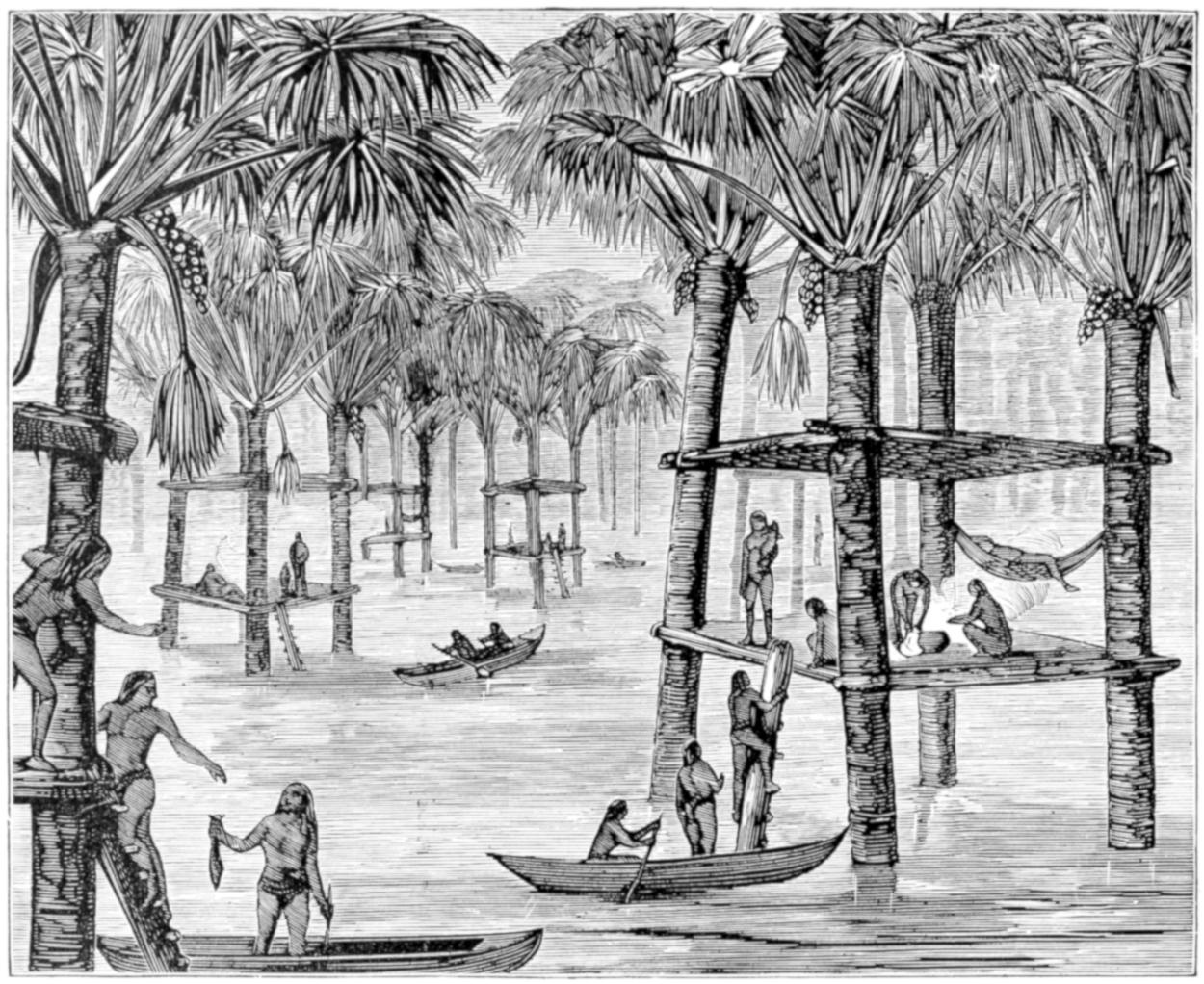
(1.) LAKE DWELLERS OF THE ORINOCO.
(See page 1269.)
CHAPTER CXXXII. THE TRIBES OF GUIANA— Continued . ARCHITECTURE AND SOCIAL CUSTOMS.
ARCHITECTURE — THE ORDINARY GUIANAN HOUSE — THE MACOUSHIE AND INLAND HUTS — CHOICE OF
THE SITE — MATRIMONIAL ARRANGEMENTS — POLYGAMY AND ITS RESULTS — A BREACH OF PROMISE
CASE — JEALOUSY AND ITS RESULTS — FORBIDDEN DEGREES AMONG THE ARAWÂKS — THE
GUIANAN MOTHER AND CHILD — A SINGULAR CUSTOM — POLYANDRY — MAKING CASSAVA — THE
MANIOC TREE AND ITS ALLIES — THE GRATER, THE BOWL, AND THE COLANDER — THE PRESS, OR
TIPITI — USE MADE OF THE POISONOUS JUICE — MAKING SUGAR — PIWARRI DRINKING — THE
MAQUARRI DANCE — CONSTRUCTION OF THE WHIPS — ENDURANCE OF PAIN.
We will now examine the domestic life of
the Guianan natives.
Their architecture differs considerably according
to the district. As a rule, the climate
is so warm that houses are but little
needed, all that is required being a simple
roof above the head. The ordinary kind of
hut is nothing more than a mere shed, a
sort of barn without the walls, supported on
posts and thatched with leaves. From the
posts and rafters are hung the personal
goods of the natives, such as fans, paddles,
clubs, blow guns, bows and arrows, and similar
articles, while from one or two of the
cross-beams is sure to be hanging the singular
cassava press, which will be presently
described. Such a house is represented on
the preceding page.
Between the upright posts, and sometimes
from the transverse beams, are suspended the
hammocks, some of which are almost invariably
occupied, as the master has a natural
genius for lying in his hammock when he
is not absolutely obliged to be on his feet.
The number of hammocks under a single roof
is almost incredible. They are hung in tiers,
one above another, like the berths on board
a passenger ship, and when thirty or forty
of them are occupied at once, it seems
rather wonderful that the building should
be able to withstand such a strain.
As the inhabitants move about, or get
into and out of their hammocks while replenishing
the nightly fires, whose smoke is
the only defence against the mosquitoes and
other winged pests, the whole building
rocks, the joints creak, and the house seems
on the point of coming down. But the
junctions of the beams and posts are so
firmly tied that they are far stronger than
they look, and however fragile the shed may
seem, it is quite equal to any strain they
may have to endure.
In the interior, however, the huts are
more of a complicated character, and have
walls as well as a roof. Their form is invariably
round, and their roofs pointed in the
centre. Some are shaped almost exactly
like single-poled tents, having a circular upright
wall, some five or six feet in height,
and from that wall a tolerably high conical
roof ending in a sharp point. Their general
shape much resembles that of the Makololo
house, seen on page 329. The roof,
however, is neater, and the central pole, by
which it is supported, rises to some height
above the top, looking like the ornamental
spikes with which English builders are fond
of decorating some of their villas.
Other houses, though built on the same
principle, are not quite conical. They have
no distinction between the wall and roof,
and, instead of being circular, are octagonal.
They may be very well imitated by cutting
out eight isosceles triangles from cardboard,
the larger sides being about four times the
length of the shortest, and sewing them together.
A knitting needle through the centre
will act as a support, and look very much
like the centre pole of the edifice.
These huts are used by the Macoushies,
the makers of the very long blow guns
which have already been described, and
from projections in the upright poles the
weapons are suspended when not in use.
It need scarcely be said that the task of
house building belongs to the women, inasmuch
as it pertains to the category of heavy
work, which is beneath the character of a
man to undertake. Indeed, with these people,
as with many other uncivilized nations,
the rooted disinclination of the men to labor,
and the consequent falling of all the
work upon the women, is one of the most
serious obstacles to their progress in civilization;
and even polygamy is not so much a
drawback as the inferior condition of the
women.
Treating of the native houses, Mr. Brett
remarks that the builders, simple as may be
the house itself, carefully select a site which
must combine several requirements. In the
first place, it must be near a stream, so that
the women may not have more trouble than
needful in fetching water for the use of the
household, and that the canoe may be within
easy reach of the house when the owner
wishes to set out upon one of the frequent
migrations which take place among these
tribes.
It must be a spot which is rather out of
the way. The native Guianan likes peace
and quietness, and has a strong objection to
being disturbed, the apathy of his nature
being supplemented by an inveterate shyness,
which makes him keep aloof from
strangers. It must also be a spot where the
ground is light and sandy, and where the
very slight cultivation needed in this land
can be easily carried on.
The house being built, the next business is
to prepare a field for the cultivation of yams
and cassava, and this is the only hard work
which the men will condescend to do. The
ground is already occupied by trees, but this is
of no consequence to the native agriculturist.
Having selected a convenient spot, he cuts
down the trees, ingeniously contriving that
the fall of one shall bring down several
others. This is done at the beginning of the
hot season, i. e. somewhere in August. The
tropical sun soon dries the fallen trees, and
when they are sufficiently parched for the
purpose, the Indian sets them on fire, a
process which rapidly consumes all but the
trunks and the largest branches. He has
now done his share of the work, and leaves
the rest to the women, who have to clear
away the débris as far as they can, and to
do all the digging, planting, and weeding
that is needed.
Among these people polygamy, though
not always the rule, is often the case, and a
man’s greatness is partly estimated by the
number of his wives. It is not, however,
carried out to such an excess as is the case
with many other peoples, inasmuch as one
chief was looked upon with the greatest
respect because he had the unusual number
of nine wives. This chief, a Warau, was
very jealous of his establishment, and was
said to have shot one of his wives, and
severely wounded another with his cutlass.
As a rule, however, a man has one wife only,
the exceptions being rarer in proportion to
the number of wives.
The Caribs appear to carry out the principle
of proprietorship in their women to the
fullest degree, as is exemplified by an amusing
anecdote related by Mr. Brett. It must
be premised that, as is usual among nearly
all uncivilized natives, the wife is purchased
from her father or oldest male relative, who
has absolute power over and can sell her as
he would sell his bow, and with as much
regard for the feelings of one article of
property as the other.
“A high-spirited Caribi girl, indignant at
being given in marriage to an elderly man,
who had already other wives (one being her
own sister), ran away from him, and bestowed
her hand on one of the Essequibo
Caribs, a younger man whom she liked better.
After a while, the old man visited that
quarter—not, however, to exercise his undoubted
right to bring her back and beat
her, but to claim compensation for her services.
It was willingly allowed, and for a
gun, a barrel of salt, or some article of like
value, the woman was left with the man of
her choice, who perhaps thought himself
secure, and the business ended.
“But the next year the old man, who well
knew what he was doing, paid them another
visit, still, as he said, in quest of compensation.
On being reminded by the husband
that he had already been paid for the woman,
he replied, ‘Yes—for the woman; but she
has since borne you a child—you must now
pay me for that.’ The unwritten law of
Caribi usage was decidedly in the old man’s
favor, and he received compensation for
that child. For each succeeding birth he
could, if he chose, reappear, like an unquiet
spirit, make a similar demand, and be supported
therein by the custom of his nation.”
Sometimes the second wife is purchased
while still a child, and brought up together
with the family of the first wife, and a prudent
chief will thus provide himself with a
succession of wives, each attaining marriageable
years as her predecessors become
too old to suit the taste of their proprietor.
Now and then, the first wife successfully
resists the introduction of a sharer of her
household. In one such case, the first wife,
after trying to commit suicide, and being
prevented, took a more sensible course.
She was an Arawâk, one of three sisters, all
living with their respective husbands at one
settlement. One day, the husband of the
eldest sister, having been on a visit to some
friends, brought home another wife, a full-grown
young woman. The first wife, after
her unavailing attempt at suicide, made an
onslaught upon the intruder, aided by her
two sisters, whose husbands stood quietly
looking on. The end of the business was,
that the woman was sent back to her
friends, and the first wife was left in the undisturbed
rule of her household.
The Arawâks have a curious and praiseworthy
regulation concerning marriage.
Their tribe is divided into a number of
families, each descending in the female line,
and being known by its own name. No one
is allowed to marry into the family bearing
the same name as himself or herself, and
this principle is carried out in a rather curious
manner.
As the succession falls in the woman’s
line, her sons and daughters, and the children
of her daughters, bear the same name
as herself, but not so the children of her
sons, who will take the names of their respective
mothers. The Arawâks are very
tenacious of this rule, and think an infraction
of it to be a great crime.
As is the case with most uncivilized nations,
the Guianan mothers think but little
of the event which lays a civilized European
woman on the bed of sickness for weeks.
Mr. Brett saw one Warau woman, only two
hours after the birth of her child, tie up her
hammock, and carry it, together with her
newly born infant, from one house to
another. When the child is very young,
it is laid in a small hammock, but when it
gains a little strength, a rather curious cradle
is provided for it.
The body of the cradle is made of the
ever-useful itirritti reed, which is split into
slips about the tenth of an inch in width,
and then woven so as to make a kind of
basket, open at one end and down one side.
The edges are strengthened by a rod of
flexible wood lashed firmly to them, and the
cradle is brought into shape by means of a
framework consisting of tolerably strong
sticks. The opening in front is much narrower
than the body of the cradle, so that
the child can be easily secured in it. The
length of my specimen, drawn on page
1238, is exactly twenty inches, and width
at the back thirteen inches, while that of
the opening is only seven inches. This
cradle is very strong, very elastic, and very
light—three great requisites in such an
article. When the mother wishes to carry
her child, she only takes a broad plaited
belt, the two ends of which are united,
passes it over the crossbars at the top of
the cradle, and then brings the belt across
her forehead.
The parents are very kind to their children,
and can seldom bring themselves to
chastise them, except in a sudden fit of
anger. The natural consequence of this
treatment is, that they have scarcely any
control over the children, though, when they
grow up, the respect shown by sons and
daughters to their parents of either sex is
worthy of all praise.
Connected with this subject, the Guianan
natives have a very singular custom, which,
according to our ideas at the present day,
entirely reverses the order of things. With
us, when a wife expects to be a mother, she
often thinks it necessary to abstain from
certain articles of food, and from too much
exertion. With the Guianan Indians, the
wife eats exactly what she chooses, and
works as hard as ever, while the husband
thinks himself bound to abstain and to rest.
For example, the Acawaios and Caribs will
not eat the flesh of the agouti, lest the future
offspring should be thin and meagre; the
haimara fish, lest it should be dim-sighted;
or the maroudi, lest it should be still-born,
the cry of this bird being held as an omen of
death. The reader may remember that a
Macoushie excused himself from making
wourali by reference to this custom. This
custom does not stop with the child’s birth,
but extends to several weeks afterward.
As soon as her child is born, the Indian
wife washes the baby, rolls it in the cradle
hammock, and goes about her business as
usual. But the Indian husband is pleased to
consider himself very ill, and straightway
takes to his hammock, where he is waited
upon by the women with the most solicitous
attention. In some districts the sick husband
has not a very pleasant part to play,
being obliged to take nauseous drinks, and
to go through a course of very unpleasant
medicine. Generally, however, he does
nothing but lie in his hammock for a week
or two, during which time he is kept amply
supplied with the daintiest food, and petted
as if he were recovering from a dangerous
sickness.
This custom has gradually expired in the
vicinity of the mission stations, but it occasionally
revives. Mr. Brett mentions an
instance where a large influx of strangers
reintroduced it into the station. It so
happened that a young Christian Indian
had become a father, and was violently importuned
by his female relatives to take to
his hammock according to ancient custom.
He resisted for some time, but was so persecuted
that he fairly ran away, and went
to work at a distance for three weeks, at
the expiration of which time he thought
he might be considered as convalescent.
Strange as this custom may seem to be, it is
one which has prevailed through a very considerable
portion of the globe, and even in
Europe has not been extinct until comparatively
late years.
Not only is polygamy practised among
these tribes, but the strange custom of polyandry
exists. On one occasion, when a missionary
was arguing with a native against
the practice of polygamy, he used an argumentum
ad hominem, and with the bad results
that usually follow such an argument.
Finding that he could not prove to his interlocutor
that a man ought not to have two
wives, the missionary asked how it would be
liked by the men if one wife were to have
two husbands. To his astonishment, the
man replied that the plan answered very
well, and that he knew a woman who at that
time had three husbands.
It has been already mentioned that the
natives of Guiana depend chiefly for their
food upon the beasts, birds, and fishes which
they capture. Vegetable food is not so important
to them as it is generally to inhabitants
of warmer climates, probably because
the almost perpetual moisture of the country
forces the inhabitants to partake of a comparatively
generous diet.
The staple vegetable food is the cassava,
which is prepared in rather a curious manner.
Strange to say, it is obtained from a
plant belonging to the natural order Euphorbiaceæ,
plants which are celebrated for containing
most poisonous juices.
Some of them are trees of the largest size,
while others are little herbs that only exist
for a few weeks. All of them, however, secrete
an acrid juice, more or less poisonous.
A familiar example of these plants may be
found in the common spurge, or wart-wort of
our gardens (Euphorbia helioscopa), the
white, acrid, milky juice of which is employed
in destroying warts. Several of these
Euphorbiaceæ produce, beside the poisonous
juice, a farinaceous substance, from which
the poison can be separated, and which is
then useful as human food.
The chief plant which produces the cassava
is the Jatropha manihot, though there
are others from which the farina can be
obtained. The juice of this plant is so
poisonous that a very small dose will produce
death. Fortunately, the venomous
principle is exceedingly volatile, and can
be driven off by heat, so that the very substance
which in its raw state is a deadly
poison becomes, when cooked, a wholesome
article of food.
The mode of preparing the cassava is as
follows: Taking on her back the quake,
which has already been described, the
Guianan woman digs up a quantity of the
cassava root, puts it into the quake, and
brings it to her hut. She next peels it by
tearing off the outer covering with her
teeth, and then proceeds to scrape it into
very fine shavings. This is done by means
of the native grater, which, rude as it looks,
is a very effective machine. It consists of
a thick board about a yard in length and
half as much in width. Into the upper surface
of this board are driven in regular rows
a number of fragments of sharp stones, which
are further secured in their places by a sort
of vegetable glue obtained from the juice of
a tree.
By being drawn over this surface, the
cassava roots are soon reduced to thin
shavings, much like those of the horse radish,
which are collected into a basket. One of
these baskets is shown in fig. 2, on page 1231.
It is made much like the cradle already mentioned,
but is of closer texture, and the strips
of cane are wider. It is about two feet in
diameter, and is capable of containing a considerable
quantity of the grated root.
When the native cassava maker does not
possess one of these graters, she uses as a
substitute the acrid root of a species of
Ireartia palm, which is covered with hard
protuberances, and answers the purpose tolerably
well, though it does not work so
smoothly or neatly as the regular grater.
Sometimes a further process of grinding is
employed, though not always. In such cases,
the grated root is placed on a flat, sloping
stone, and rubbed with another, just as is
done by the Araucanians. See page 1203.
The next process is to rid it of its poisonous
juices, and in this part of the operation
there is also considerable variation.
Among some tribes, the scraped cassava is
taken out of the dish and pressed tightly into
a sieve or colander. This instrument is very
ingeniously made. It is of basket work, but
instead of being made of flat strips of cane or
reed, round twigs are used, about as thick as
ordinary drawing pencils. The natives have
an ingenious mode in which the shape of the
vessel is preserved while the interstices are
not allowed to diminish or increase in size.
This is done by beginning with a comparatively
few twigs at the apex of the colander,
and inserting fresh twigs at regular
intervals as the vessel increases in size.
Into this colander the cassava is pressed
and kneaded with water, until a considerable
amount of the juice is expressed. It is then
left in the sieve to undergo a partial drying,
and is soon ready for another process, that
of the press; and it is remarkable that,
though presses of various descriptions have
been sent from Europe, none of them seem
to answer so well as the native Guianan press
called the “tipiti.” This press is a long,
cylindrical basket, from six to seven feet in
length, and about four inches in diameter,
made of the bark of the Jacitara palm, a
species of Desmoncus. The lower part of the
tipiti is closed, and brought nearly to a point,
while the upper part is left open, each end
terminating in a very strong loop. Owing
to the mode in which the tipiti is made, the
central portion is highly elastic, while the
mouth and tip are comparatively stiff. One of
these is represented on the following page.
Several of these tipities generally hang to
the roof or the cross-beam of the hut, so as
to be ready for use when wanted. One of
them is then filled with grated cassava, which
is thrust into the elastic tube as tightly as
possible, so as to cause it to become very
much shorter, and very much thicker in the
middle. Underneath the tipiti is placed
an earthenware bowl to receive the juice.
Vessels such as these are made by the natives,
and although they are very fragile, as
the clay is never thoroughly kneaded, and
the baking is insufficient, they can endure
the fire well enough for cooking purposes.
The vessel which is represented in the illustration
is of a deep brown color, striped and
spotted with black.
Besides these soft and fragile bowls, the
natives make bottles for the purpose of
carrying water. Some of these clay bottles
are really elegant in form, and show evidences
of artistic feeling on the part of the
potter. A figure of a double water bottle,
with its earthenware stoppers, is given on
page 1249.
A heavy weight is then fastened to the
bottom of the tipiti, which is consequently
elongated and narrowed, so as to compress
the contents forcibly, and squeeze out the
juice that remains in the cassava. After a
while a still stronger pressure is obtained by
means of the lever. A pole is passed through
the loop at the bottom of the tipiti, and the
shorter end of it is lashed to one of the
upright posts of the house. The heavy
weight—usually a large stone—is then hung
to the longer end of the pole, so as to produce
a powerful leverage on the tipiti, and
compress the cassava still further.
When the process has arrived at this state,
the cassava maker often adds her own weight
to that of the stone, by sitting on the end of
the lever, and with her baby slung in its
cradle on her back, occupies herself in some
of the lighter feminine occupations.
The cassava is now fit for baking, for
which purpose it is placed on circular iron
plates, which are laid over the fire like the
“girdles” on which oat cakes are baked.
Although little known in this country under
its proper name, cassava is largely used under
the name of semolina, which is nothing
more than the cassava roughly ground
to a coarse sort of grain.
Nothing of this useful plant is thrown
away. We have seen that the farinaceous
matter can be rendered wholesome by being
deprived of its poisonous juice, and we
shall now see that even this juice itself can
be rendered useful. If man or beast were
to drink it as it pours from between the interstices
of the tipiti, they would swell, and
die in great agony. But by means of boiling
the poisonous principle is driven off
and the juice changes to a deep brown liquid,
which is well known under the name
of cassareep, and extensively used as a
sauce. It is the foundation of the “pepper-pot”
of the West Indies, and when used by
natives is so highly impregnated with red
pepper, that when they hospitably serve a
white stranger with cassava bread and cassareep
sauce, the mouth of the stranger is
excoriated by the quantity of capsicum.
If the reader will refer to the illustration
representing a Warau house, on page 1244.
he will see the various processes of cassava-making.
On the right hand is seen a woman
kneeling before the grater, and scraping the
cassava into the dish or basket. Hanging
to the cross-beams of the hut are two of the
tipiti presses, one filled ready for the weight
and the lever, and the other stretched
nearly to its full extent. A woman is sitting
on the lever, and so expressing the last
drops from the cassava into the bowl. The
baking of the cassava cake is shown in the
background on the right hand.
A few little episodes of Guianan life are
shown in the same illustration. On the left
hand is seen a man armed with his bow and
long arrows, and having slung on his shoulders
the little bag which serves as a pocket.
Another man is lying asleep in his hammock,
and nearly in the middle is shown a
mother with her two children, one of them
dragging a huge spider tied to a string.
The spiders of this country are sometimes
as large as a man’s outspread hand, and, unpleasant
playfellows as they appear to us,
they are used in this light by the children,
as was seen by Mr. Bates.
The natives can also make sugar, though
of a rather coarse character. Some of the
tribes employ a machine with small wooden
rollers, for the purpose of crushing the sugar-cane
and expressing the juice, but the
plan followed by the Caribs is the most simple,
and at the same time the most remarkable.
They carve the upper part of a stout
post into the rude semblance of a human
bust, the post being as nearly as possible as
large as a man. The part that answers to
the collar-bone projects considerably, and a
hole is bored through the middle of the neck
under the chin.
When the Caribs wish to make their sugar,
they put one end of a long and stout
lever, into the hole in the neck, and lay the
cane horizontally upon the collar-bones.
One man then takes the end of the lever,
and by pressing it down crushes the cane
so that the juice flows down the breast
of the image into the vessel, while another
man shifts the cane so as to bring every
portion successively under the lever.
As for drink, the Guianan natives have
from time immemorial made an intoxicating
liquor called piwarri, which is almost
exactly like the mudai of the Araucanians.
A number of cakes of cassava bread are
toasted brown, thrown into a large vessel,
and boiling water poured over them. The
remainder of the cakes are masticated and
mixed with the others in the vessel. Fermentation
then takes place very rapidly,
and in a short time the liquor is fit to drink.
The natives are immoderately fond of this
disgusting preparation, and often brew
and drink great quantities at a time. A canoe
is no uncommon vessel to be filled with piwarri,
and every one who joins in the revel
is presumed to become intoxicated as soon
as possible. Mr. Brett mentions an amusing
instance of native feeling on this subject.
The Arawâks of the Mahaiconi district
having begged that a missionary might be
sent to them, the bishop determined on visiting
them personally. In honor of his arrival,
the Arawâks had got up a great festival,
including a canoe full of piwarri, and
the curious Maquarri dance, of which we
shall presently learn. Most of them were
intoxicated, but they apologized to the
bishop for their shortcomings in politeness,
and said that if they had known sooner of
his visit, they would have had two canoes
full of piwarri instead of one.
Piwarri feasts vary in detail according to
the tribe which holds them. They are,
however, always accompanied by a dance,
and by some ceremonies practised by the
piaman or conjurer. An interesting account
of a piwarri feast is given by Messrs.
Spix and Martius, in their “Travels in Brazil:”—
“By degrees, those residing at a greater
distance arrived in single troops, each with
his whole family, and with bag and baggage,
as if they were going to migrate; the men
who had not yet secreted their bows and arrows
in the neighboring woods hid them
here; the women put down their baskets,
took the children on their shoulders, and
looked for the drinking-cup (cuja). Without
conversing with each other, each member
of the family examined the surrounding
company with an unsteady look; the men
approached each other, and saluted their
neighbors, at most, by pouting out their
lips, and a scarcely audible nasal tone.
“In the middle of the assembly, and
nearest to the pot, stood the chief, who, by
his strength, cunning, and courage, had obtained
some command over them, and had
received the title of captain. In his right
hand he held the maracá, the above-mentioned
castanet, which they call gringcrina,
and rattled with it, beating time with his right
foot. We did not find any traces among the
Indians of the oracles of the maracá, mentioned
in the accounts of earlier travellers.
Rather walking than dancing, he advanced
slowly, with his body bent forward, round
the pot, toward which his eyes were constantly
turned. The dance, the measure of
which was in triple time, was accompanied
by him with a low monotonous singing,
which was more strongly marked when he
stamped with his foot. The oftener the
song was repeated, the more solemn and animated
was the expression of his voice and
features. All the rest stood motionless
round the pot, stared at him without speaking,
and only now and then, when the words
of the dancer, which seemed to be extempore,
moved them, they broke out into immoderate
cries.
“After this measured circular dance, by
which, probably, it was intended to conjure
and keep off evil spirits, the leader approached
the pot, took from the hand of his
neighbor the drinking-vessel which he held
ready, gravely dipped it into the pot, and took
a sip. The rattling of the gringerina and
the monotonous music became general, and
more and more noisy the longer the cup
went round. We, too, had a full cuja presented
to us, and though filled with disgust,
we were obliged to follow the advice of our
guide to empty it, in order not to give the
Indians any reasons for distrust.
“The beverage resembles in taste our
malt liquor, and when taken in a large
quantity is intoxicating, an effect which was
but too manifest toward the end of the feast,
by their leaping and noisy singing of, ‘Hi!
ha! ha!’ Hopes had been given us that we
should see on this occasion the dances of the
Coroados; but toward evening, after their
stomachs and heads were full, one party
slipped away after the other, as if by previous
agreement.”
The same authors give an account of a
melancholy sort of dance performed by
another tribe of natives, the Puris:—
“When they had been made familiar, and
treated with plentiful draughts of brandy, of
which, like all Indians, they are passionately
fond, they began their dance by night, on an
open spot not far from the fazenda of Guidowald.
If the compact low stature, the
brown-red color, the jet-black hair hanging
down in disorder, the disagreeable form of
their broad angular countenances, the small,
oblique, unsteady, blinking eyes, and, lastly,
the tripping, short, light step of these savages
had excited in us the most sorrowful
feelings at the debasement of humanity in
them, these were further increased by the
melancholy expression of their festivity in
the darkness of the night. The men placed
themselves close together in a line, and behind
them the women, also in a line. The
male children, sometimes two or three, took
hold of each other and of the fathers round
the waist, as the female children did their
mothers. In this position they begin their
melancholy ‘Háu—jo—há—ha—há.’ It
is remarkable that the melodies which Lery
noted above two hundred years ago among
the Indians in the neighborhood of Rio
Janeiro very much resemble those observed
by us.
“The song and the dance were repeated
several times, and the two rows moved slowly
forward in a measured triple time. In the
first three steps they put the left foot forward,
and bent the left side; at the first and third
step they stamped with the left foot, and
at the second with the right; in the following
three steps they advanced the right foot at
the first and last, bending on the right side.
In this manner they advanced a little alternately,
in short steps. As soon as the song
was concluded, they ran back in disorder,
as if in flight—first the women with their
daughters, and then the men with their sons.
After this they placed themselves in the
same order as before, and the scene was repeated.
A negro, who had lived a long time
among the Puris, explained to us the words
sung to this dance as a lamentation, the
subject of which was, that they had attempted
to pluck a flower from a tree, but had fallen
down. Ho interpretation of this melancholy
scene could have appeared to us more appropriate
than that of the loss of Paradise.”
The most curious of all the Guianan dances
is that which is called the Maquarri dance,
from the implement which forms its principal
element. The Maquarri is a whip, and
the object of the dance is giving and receiving
blows from the maquarri. The form
of this whip varies in different districts. The
form usually employed, is made of silk grass
fibre, bound together so as to form a stiff and
elastic whip. The handle is strengthened
by being bound strongly with a strip of dark
cane wound spirally around it, and is ornamented
by a tuft of fibres, which hang
from the butt. Several tufts of white cotton
wool adorn the transition between the handle
and the lash, the latter of which tapers gradually
to a point. The whole whip including
the lash, is nearly five feet in length, and is
a most formidable instrument of torture,
capable of cutting into the bare skin like a
knife, and causing the blood to spirt from
the wound which it makes. The other form
is scarcely so terrible a whip to the eye,
though it may inflict quite as much pain
when skilfully handled. It is entirely covered
with cane, and, as it is swung about, it
gives a crackling sound with every curve.
The length of this whip is three feet four
inches.
The maquarri dance is conducted in the
following manner. The young men and
boys, decorated with all the fantastic feather
work which native art can supply, range
themselves in two rows opposite each other,
the dancers being all armed with their maquarri
whips, which they wave in the air,
uttering at the same time cries which are intended
to imitate the notes of birds.
Presently two of the dancers from opposite
sides challenge each other, leave the ranks,
and dance opposite each other in the open
space between the ranks. After dancing for
a while, one of them stops, and stands firmly
on one leg, thrusting the other forward, and
remaining perfectly firm and steady. See
illustration on page 1260.
His opponent, or partner, whichever he
may be called, stoops down, takes deliberate
aim at some part of the projecting leg, and
then leaping into the air, in order to give force
to his stroke, delivers a blow with all his
strength. A practised maquarri dancer is
sure to cut deeply into the skin and to draw
blood by the stroke; but the receiver does
not shrink from the blow, gives no sign of
pain, and only smiles contemptuously as he
executes the dance. Presently his opponent
holds out his leg in turn to be struck, and
after a few lashes have been exchanged,
they retire to the piwarri vessel, drink some
of its contents, and return to their places in
the ranks.
The greatest good humor prevails during
this strange contest, though when a couple
of powerful and experienced dancers have
met, they have often scarcely been able to
walk from the severity of the blows which
they have received. Sometimes, after a hard
day’s dancing and drinking, when their legs
are stiff and sore from the blows which they
have received, and their heads are aching
from the liquid they have drunk, they declare
that they will abandon the dance for
ever. But, as soon as their legs get well and
their heads are clear again, they forget all
their promises, and join in the next maquarri
dance with unabated zest.
During one of these dances, which was
performed in Mr. Brett’s presence, a stout
little Warau came to the encampment, when
the dance was nearly over, evidently with
the idea of getting some piwarri without
undergoing the previous salutation of the
maquarri whip. The young men at once
divined his intention, and quietly passed
the word among themselves to frustrate his
design. Accordingly, he was challenged in
rapid succession by the young men, and
subjected to more than ordinary castigation
before he obtained any piwarri. However,
he bore his punishment manfully, and did
his best to look pleasant, although he soon
perceived the trap into which he had fallen.
On that occasion the dance was given in
honor of a woman who had been buried in
the house. A broad plank lay upon her
grave, and on it, among other articles, was a
bundle of silk grass being the remainder of
the material from which the maquarri whips
had been made, these articles having somewhat
of the sacred character about them.
After going through a few ceremonies, two
or three men, armed with long knives,
dashed in among the dancers, snatched
the whips from them, cut off the lashes,
and flung them into the grave. The owners
of the whips pretended to be very savage
at surrendering the whips, leaping, throwing
somersaults, and going through all
kinds of evolutions, so that it was great
matter of surprise that any of them escaped
injury.
On another occasion, when the maquarri
dance had been got up in honor of the
bishop, all the dancers, before they went
into the large house, laid their whips on a
board which had been placed there expressly
for their reception.
With regard to this dance, Mr. Brett was
much struck with the apparent indifference
to pain manifested by the natives, and asked
them how they could endure such tortures
without seeming to feel them. The Indians
replied that their insensibility to pain was
partly produced by the piwarri, and was
partly owing to the presence of the women,
who would scoff at any one who showed the
least symptom of suffering.
Giving both these reasons their full value,
there are two others of much greater importance.
One is the natural apathy of the native,
who requires a very strong stimulus for
exertion. This apathy extends to the nerves
of sensation as well as to those of volition,
and the real fact is, that a blow which would
cause the most horrible agony to a white
man is scarcely felt by the native Guianan.
The other is the effect of exposure and perfect
health of body. All those who have
gone into training for any athletic contest
will remember how different is the pain-bearing
capacity of the trained and untrained
man, the former scarcely seeming to be
aware of an injury which would have prostrated
him for weeks had he been untrained.
Now these natives are always in the state
of body to which the civilized athlete occasionally
brings himself, and the result is,
that external injuries have but little effect
on them.
Another and a rather picturesque dance is
described by Mr. Brett. This is an Arawâk
dance, and is performed in the following
manner:—Twelve young men step forward,
and arrange themselves in parallel rows; but
instead of carrying maquarri whips, they
bear slender rods, about twelve feet in length,
decorated with strips of silk grass stained
red, and having at the tips little gourds with
stones in them. They dance backward and
forward, striking the ends of their rods
against the ground, and keeping time with
the measure. From time to time the young
women go up to the dancers, seize their
arms, and dance with them, and then, as the
men clash the rattling ornaments of beetles’
wing cases with which their wrists and legs
are decorated, the women loose their hold,
and run back to their companions like
frightened deer.
A Warau dance is described by the same
missionary who witnessed the maquarri
dance. “It was little more than a measured
series of steps, accompanied with stamping,
while the persons advanced or receded,
sometimes in single rank, sometimes in two
ranks facing each other, throwing their
right arms over their right-hand neighbor’s
shoulders, and their left arms round their
left-hand neighbor’s waist, swaying their
bodies to and fro. Occasionally the women
would run, and, inserting themselves between
the men, join in the dance.
“The effect was somewhat heightened by
a monotonous chant sung in unison, and by
the clatter of beads and anklets made of
hard seeds and the wings of beetles. The
dance was intended to represent the antics
of a herd of kairounies, or bush hogs, and
the chant was a succession of mocking or
jeering expressions.”
CHAPTER CXXXIII. THE TRIBES OF GUIANA— Continued . DRESS—AMUSEMENTS.
FEATHER HEADDRESSES AND THEIR STRUCTURE — THE FEATHER APRON — DRESS OF THE WOMEN — THE
KIMISA AND QUEYU — MODE OF MANUFACTURE — HARMONY OF COLOR — MR. BAINES’ THEORY — A
SINGULAR PURCHASE — THE SAPURU OR GARTER OF THE CARIBS — PAINT AND TATTOO — THE
SPATHE CAP AND APRON — PETS AMONG THE NATIVES — SKILL IN FISHING AND CAYMAN CATCHING — MR.
WATERTON’S ADVENTURE — THE INGENIOUS HOOK — GAMES AND SPORTS — SHIELD
WRESTLING — CANOE SLAKING — NAVIGATING THE FALLS.
During their dances the natives display all
their best feather ornaments. Two of their
headdresses are shown on page 1238. The
foundation of these is a circlet made of
thin dark cane, cut into strips. One of them
(fig. 2) is made of parrots’ feathers, beautifully
shaded from dark blue to brilliant green,
and being topped with three long straight
scarlet feathers from the tail of the macaw.
The general effect of this beautiful headdress
is heightened by a row of white
downy feathers by which it is surrounded.
This specimen was made by the Macoushie
tribe.
The other headdress (fig. 1) is called
Arok, and, though very handsome in point
of color, does not possess the beauty of form
which characterizes the other. The greater
part of the headdress is bright yellow, but
just on either side of the top are two broad
bands of scarlet. The feathers in this specimen
are arranged four deep.
The reader may remember that, in many
portions of the uncivilized world, aprons are
made of thongs depending from the waist.
This principle is carried out by many of the
African tribes, who use thongs or strips of
leather, as well as in several of the islands
of Polynesia, where vegetable materials are
used. We have at fig. 4, on page 1249, an
example of the same principle carried out in
Tropical America, feathers being employed
instead of skin, grass, or bark. The length
of this apron is one foot nine inches, and its
depth one foot three inches. It is made of
feathers, blue at the base and tip, and scarlet
in the middle. As may be seen by the
smaller figure at the side, the feathers are
fastened on the string that binds the apron
on the waist by doubling over the quill, and
tying the doubled end over the string.
It is on such occasions as the Arawâk
and Warau dances, of which a description
was given in the last chapter, that the
women produce their best apparel. Generally,
as long as none but their own people
are in sight, they are not particular about
wearing clothes of any kind, but since they
have mixed with the white people they have
learned to be more fastidious. When a
white stranger comes to a native settlement,
the men and women are mostly independent
of clothing, but the latter, as soon as they
distinguish the color of their visitor, run off
to their homes to put on their dresses.
Those settlements that are tolerably near
civilization usually employ the “kimisa,”
i. e. a sort of petticoat passing round the waist,
and suspended by a string over one shoulder.
These dresses are considered merely
a concession to the peculiar notions of the
white man, and, though worn while he
is present, are taken off as soon as he departs,
and carefully put away until the next
white visitor comes.
The native dress of ceremony is, however,
the little apron called the queyu, or keu.
At the present time it is made of beads,
but before beads were procurable it was
simply of cotton, decorated with shells, beetles’
wings, and similar ornaments. Several
of these odd little aprons are in my collection.
The best and most elaborate of them
is that which is represented at fig. 5, on
page 1249, and was presented to me by H.
Bernau, Esq.
This beautiful specimen of native art is
eight inches in length and four in depth, including
the large beads that serve as a
fringe. It is made entirely of “seed” beads,
threaded on silk grass in such a manner
that the thread is scarcely visible. The
principle on which the maker has gone is,
that she has woven a sort of framework of
perpendicular threads or strings, set exactly
wide enough apart to allow two beads to be
placed between them. By this plan she has
regulated the arrangement of the beads
requisite to form the pattern, while the
beads themselves are strung upon fine silk-grass
threads that run at right angles to the
others.
The colors are blue, yellow, green, and
carmine, in transparent beads, and chalk-white
and vermilion in opaque beads, not
counting the larger beads used to form the
fringe. The principle of the pattern is that
of the square standing on an angle, or the
“diamond,” as it is more familiarly termed.
First, three diamonds have been worked in
yellow beads, a line of green beads running
down the centre of the yellow, and a rather
broad line of carmine beads passing along
the inner and outer edge of each diamond.
The dark pattern in the centre of each
diamond is made of blue beads, and the
square patterns in each angle of the diamond
are made of chalk-white beads with a
centre of vermilion. The entire apron is
edged with the chalk-white beads. The
fringe at the bottom is made of a treble row
of much larger beads, one of which is represented
of the full size, and at either end of
each bead is a small scarlet cylinder, like
coral.
On looking at the form of the apron, the
reader will notice that it is much wider at
the bottom than at the top. This is intentional.
The thick perpendicular strings
only extend as far as the upper corners, the
others being thin threads. The consequence
of this structure is, that when the
apron is held up by two loops, the middle of
it is nearly flat, while the two ends fall into
heavy folds.
There is a positively startling boldness
about the coloring of this apron; such, for
example, as the placing green beads next to
the yellow. Still, the whole arrangement of
the colors is so admirable, that in spite
of the brilliant hues of the beads, which are
of the brightest possible blue, yellow, carmine,
and vermilion, they are so well harmonized,
that in no case does one hue seem
to predominate over another, or to interfere
with another.
Some few years ago, I was discussing the
coloring of this very apron with Mr. T.
Baines, the celebrated traveller, and asking
if he had any theory by which he could account
for the artistic harmony of color which
is invariably displayed in the aprons. He
said that he had long thought that the natives
unconsciously imitated the coloring on
the wings of the gorgeous butterflies which
are so plentiful in that land, and, from specimens
in his collection, showed that the very
collocation of hues which produced harmony
of coloring in the bead apron was also to be
found in the wings of Guianan butterflies.
Perhaps the splendid plumage of many
Guianan birds may also afford hints for the
native artist.
Another queyu in my collection is made
of similar materials, and on the same principle,
but is of a totally different pattern. In
this case, the maker has evidently possessed
a preponderance of the chalk-white beads,
and comparatively few of the red, blue, and
yellow beads. She has accordingly made
the body of the apron of the white beads,
and enlivened it by two patterns, of red,
blue, and yellow, formed much like those
which occupy the centre of the diamond in
the apron which has been just described.
In shape the two aprons are identical, but
the latter is very much smaller in size, being
only four inches in length and two in
depth.
The third specimen of the queyu in my
collection is much larger, being made of
large beads, and really may take rank as an
article of dress and not a mere ornament.
It is thirteen inches in length by nine in
depth, and, though not possessing the brilliant
colors of the two queyus which have
been described, is yet a handsome article of
costume. The white beads of which the
groundwork of this apron is made are as
large as ordinary peas, so that the whole
work is of a much coarser character than
that which distinguishes the two other
aprons. Those which form the pattern are
deep garnet color, so dark that except in
particular lights it looks black. The woman
who made this apron has ingeniously selected
the beads of such a size that two of
the garnet beads occupy exactly the same
space as one white bead, and exactly fill the
interval between the perpendicular strings
of the framework.
The most remarkable point in this apron
is the pattern, which is exactly like that
which is found on old patterns, and which
has come into modern use under the name
of the Greek fret. I have seen several
queyus of different sizes and colors made
with this pattern. The lower edge of the
apron is made of six rows of topaz colored
beads, as large as the white beads, and it is
further decorated with a fringe made of
tufts of cotton strings, one such tuft being
fixed to every alternate bead.
As may be imagined from the description,
the beads employed in making the apron are
very heavy, the whole article weighing
nearly a pound and a half, so that in this
case the owner has good reason for not
wearing it except on occasions of ceremony.
Owing to the material of which these aprons
are made, none of them put forth their full
beauties unless they are held between the
spectator and the light.
One of these aprons was procured by a
friend of mine in a manner which shows that
they are considered rather as ornaments
than dress. He happened to be in one of
the civilized coast towns, and met a woman
wearing a queyu of remarkable beauty. He
stopped her and tried to induce her to sell
the apron; but all his exertions were in vain,
and for no amount of money could he purchase
it. At last a brilliant thought struck
him. He had in his pocket one of the common
printed handkerchiefs containing the
flags of all nations, and, as a last resource,
he offered the kerchief in exchange for the
queyu.
The woman could not withstand such a
temptation. The gorgeous patterns on the
handkerchief were far superior to the best
examples of native art, and might afford
new ideas for the future. Accordingly, she
then and there took off the queyu, handed it
to the purchaser, and received in exchange
the kerchief, which she tied round her head,
and then pursued her walk in all the dignity
of the best-dressed woman in Guiana.
The strangest article of dress to be found
in Guiana is undoubtedly the Carib sapuru,
or garter, an ornament which can compete
with the compressed foot of a Chinese
beauty, or the wasp-like waist of an European
belle, both for inconvenience and ugliness.
While the Carib girl is young a band of rattan
is bound tightly under the knee and
another above the ankle. To give them an
ornamental appearance they are stained
with a red dye, but in fact they are instruments
of torture, which entirely alter the
form of the human limb and convert it into a
mere spindle thicker in the middle than at
each end.
There are now before me a number of
photographic portraits of Carib women, and
it is scarcely possible to imagine anything
more hideously ludicrous than the effect of
the sapuru. Deprived of its natural powers
of extension, the limb has to expand itself
as it can, and the consequence is, that it is
obliged to develop itself in the comparatively
narrow space between the two bandages.
If the reader should wish to obtain an accurate
idea of a Carib belle’s leg from the
ankle to the knee, he can easily do so. Let
him take an ordinary broomstick, eighteen
inches in length, and push it through the
middle of a rather small Stilton cheese; then
let him wrap the stick above and below the
cheese with a red bandage, adorn the cheese
with a number of blue spots, and he will have
a very good idea of the extraordinary shape
which is assumed by the leg of a Carib female.
The women are inordinately fond of the
sapuru, and are as scornful respecting those
of their own sex who do not wear it as are
the Chinese women respecting those who
do not wear the “golden lilies.”
These women have a variety of ornaments,
but little clothes. Necklaces of various
kinds are highly esteemed among
them, especially when they are made of the
teeth of the jaguar and alligator, inasmuch
as such ornaments indicate the prowess of
their admirers. The appearance of a Carib
woman in full dress is not very attractive.
These people are short, thick necked, and
awkward looking, and in those respects the
women are much worse than the men. Of
the ten portraits there is not one that can
bear comparison with the female inhabitants
of Southern Africa, such as have been
figured in the first part of this work. Their
short necks are cumbered with row upon
row of necklaces, their only dress is a narrow
strip of blue cloth, and they have done
their best to make themselves entirely
hideous by the abominable sapuru.
Then, by way of adding to their attractions,
they perforate the under lip, and wear
in it one or several pins, the heads being
within the mouth and the points projecting
outward. Some of the women smear their
whole bodies and limbs with the annatto
dye, which gives them the appearance as
if blood were exuding from every pore; and
the reader may well imagine the appearance
of such women, with pins sticking through
their lips, their bosoms covered with row
upon row of necklaces, their reddened limbs
variegated with blue spots, and their legs
swollen and distorted by the effects of the
sapuru.
The Carib men wear an article of dress
which is almost exactly like that which is
worn by the inhabitants of the Nicobar
Islands. It is a narrow but very long scarf,
woven from cotton fibre. After passing
round the waist and between the legs, it is
tucked into the girdle, and then is so long
that it can be hung over the shoulder like a
Highlander’s plaid. The men are very
proud of a good girdle, and adorn it plentifully
with cotton tassels, beetles’ wings, and
similar ornaments.
Of all the Guianan tribes, the Waraus are
least careful respecting dress. Even the
women wear nothing but a triangular piece
of bark, or a similarly shaped article of apparel
formed from the spathe of the young
palm leaf. This spathe is also used for a head
dress by several tribes. In order to understand
the structure of this article the reader
must remember that the palm tree is an
endogenous plant, and that all the leaves
spring from a central shoot. From this
same spot there also starts a conical shoot,
which contains the flowers. In its earlier
stages of development this shoot is covered
with a membranous envelope, called a
spathe, which bursts in order to allow the
enclosed flower-stalk to develop itself. Before
it has attained its full development, the
spathe is drawn off the flower-stalk and
soaked in water for a time, until all the
green substance becomes decomposed, and
can be washed away from the fibrous framework.
The well-known skeleton leaves are
prepared in exactly the same manner.
When decomposition is complete, the
spathe is carefully washed in running water,
so that the whole of the green matter is
removed and nothing is left but the tougher
fibres. These are tangled together in a
very remarkable manner, so as to be very
elastic, and to allow the fabric to be stretched
in different directions without causing any
interstices to appear between them.
In this state the spathe is conical, of a yellow-brown
color, and extraordinarily light.
A specimen in my possession, though measuring
twenty-seven inches in length, weighs
barely half an ounce.
When the native wishes to convert the
spathe into a cap, he doubles the open end
twice, and then makes a deep fold within
eight or nine inches of the tip, thus causing
it to assume the shape which is seen in the
illustration on page 1249. Slight as is the
texture of this odd cap, it forms an excellent
defence against the rays of the sun, which
is the only object of the headdress in such
a climate.
The reader will see that the shape, as
well as the lightness of the spathe, conduces
to its usefulness as an apron as well
as a headdress. Such at all events is the
only dress for which the Waraus care; and
whether on account of the perpetual exposure
of their skins, or whether from other
causes, the short, stout, sturdy Waraus are
much darker than the other tribes—so dark,
indeed, that they have been said to approach
the blackness of the negro. Mr. Brett thinks
their want of cleanliness is one cause of
this deeper hue. They are the best native
laborers that can be found, and, when they
can be induced to shake off their national
apathy and fairly begin work, they will do
more than any other tribe. Neither do
they want so much wages as are required
by the other natives, preferring liberal rations
of rum to actual wages.
Living as do the Guianan natives in the
forests, amid all the wealth of animal life
which is found in them, and depending
chiefly for their subsistence on their success
in hunting, they attain an intimate knowledge
of the habits of the various animals,
and display considerable skill in taking
them. They capture birds, monkeys, and
other creatures, not for the sake of killing
them, but of domesticating them as pets,
and almost every hut has a parrot or two, a
monkey, or some such pet attached to it.
The women are especially fond of the
little monkeys, and generally carry them on
their heads, so that at a little distance they
look as if they were wearing a red or a
black headdress, according to the species
and color of the monkey. They carry their
fondness for their animals to such an extent
that they treat them in every respect as if
they were their children, even allowing
them to suck at their breasts in turn with
their own offspring.
Dreading the venomous snakes most thoroughly,
they have no fear of the non-poisonous
kinds, and capture them without
difficulty. Mr. Brett saw one of them catch
a young coulacanara snake by dropping a
noose over its head by means of a forked
stick, and then hauling it out and allowing
it to coil round his arm. Although a very
young specimen, only five feet or so in
length, the reptile was so strong that the
man was soon obliged to ask some one to
release his arm.
Sometimes this snake grows to a great
length, and, as it is extremely thick-bodied,
is a very dangerous reptile to deal with.
Mr. Waterton succeeded in taking a coulacanara
fourteen feet long, after a fierce
struggle, which is amusingly told in his
“Wanderings.” I have seen the skin of
this snake in the collection which then
adorned Walton Hall.
The skill of these natives is well shown
by their success in capturing a cayman with
a hook. Mr. Waterton had tried to catch
the reptile with a shark hook, but his efforts
were unavailing, the reptile declining to
swallow the bait, and at last contriving
to get it off the hook, though it was tied
on with string. After more than one
failure, he showed the hook to a native,
who shook his head at it, and said that
it would not answer the purpose, but that
he would make a hook that would hold the
cayman.
Accordingly, on the following day he returned
with a very remarkable hook. It
consisted of four pieces of hard wood about
a foot in length, curved, and sharpened at
the ends, which were slightly barbed. These
barbs, if we may so call them, were tied
back to back round the lower end of a rope,
a knot in the rope preventing it from dropping
through the barbs, which were forced
to diverge from each other by four pegs
driven between them and the rope. The
so-called hook, indeed, was very like a four-pronged
Fijian spear, supposing the shaft to
be cut off below the prongs, a hole bored
through the centre of the cut shaft, and a
rope passed through the hole and knotted
below the prongs. It is evident that if such
an instrument as this were taken into a cayman’s
throat, the diverging prongs would
prevent it from coming out again, and as
long as they remained unbroken, so long
would the cayman be held.
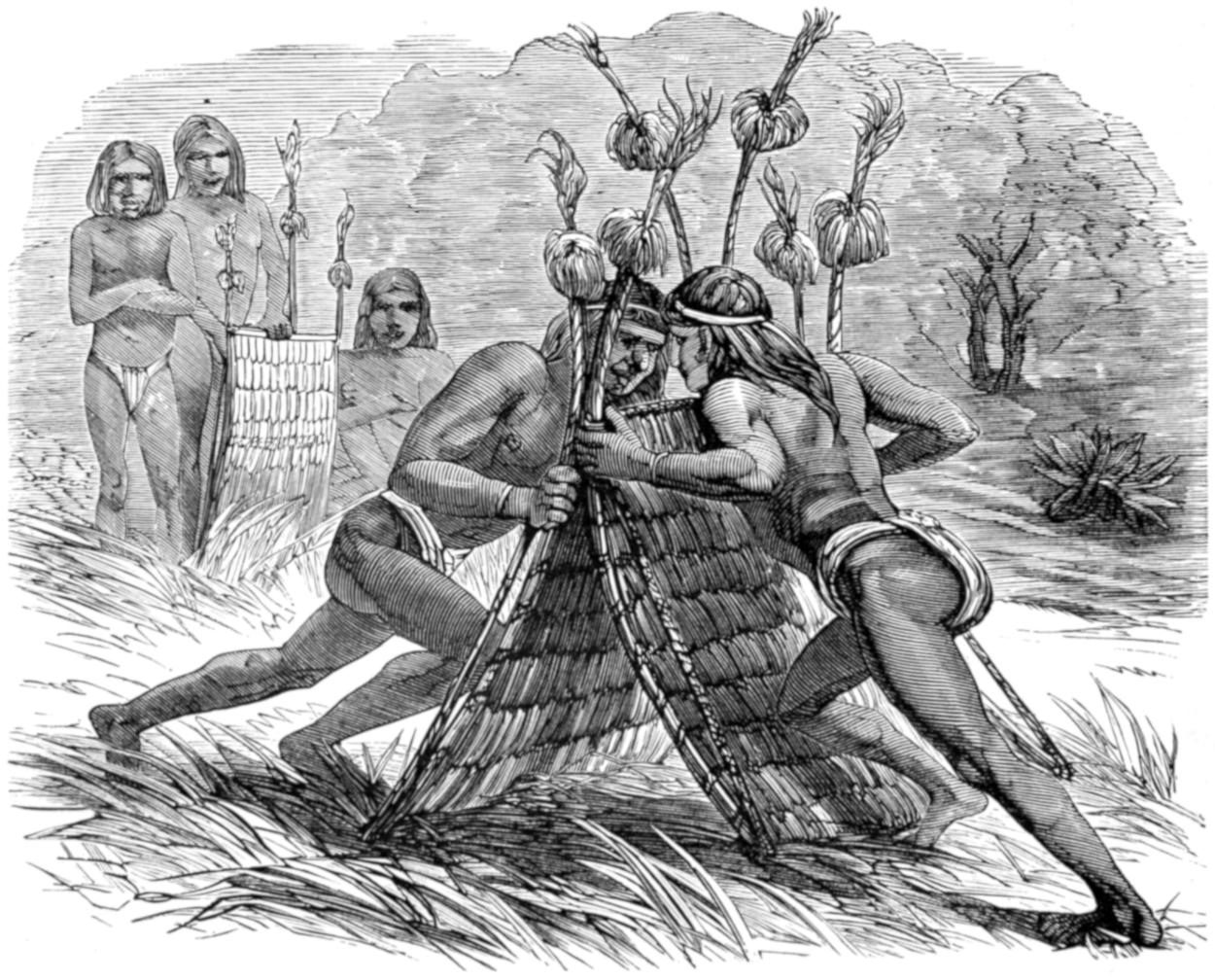
(2.) SHIELD WRESTLING OF THE WARAUS.
(See page 1261.)
This curious hook was then taken to the
river side, and baited with an agouti. The
end of the rope was made fast to a tree, and
the barbed hook suspended about a foot
from the water by means of a short stick
driven into the bank. The native then took
the empty shell of a tortoise, and struck it
several blows with an axe, by way of telling
the cayman that its meal was ready. The
result of the operation justified the Indian’s
promise. The cayman could not get at the
bait without lifting itself well out of the
water, and securing it by a sudden snap;
while the resistance offered by the stick
caused the projecting barbs to be driven
into the reptile’s throat as it fell back into
the water.
How the cayman was dragged out of the
water, and how Mr. Waterton jumped upon
its shoulders, and disabled it by seizing its
fore-paws and twisting them on its back, is
matter of history. The tale was generally
disbelieved at the time, and gave rise to no
small amount of banter; but it is a perfectly
true one, and the objections to it have long
died away. Indeed, one of Mr. Waterton’s
men, who was then little more than a mere
lad, was, as an old man, in the service of
one of my friends, and corroborated every
word of the story.
As might be inferred from the natural
apathy and indolence of the natives, they
have but few games. They only work by
fits and starts, and spend a very large proportion
of their time in their hammocks,
caring little for those contests of skill and
strength which are so absorbingly interesting
to the inhabitants of cooler and more
bracing climates. There is, however, one
such game which is played by the Waraus,
who have already been mentioned
as the stoutest and strongest of the tribes.
This game is well described by Mr. Brett:—
“There is also a kind of wrestling, or
trial of strength, practised by the Waraus
at their drinking-bouts, in which each of
the antagonists is furnished with a sort of
shield, (see illustration on page 1260), made
of the light branches of the itá, cut into
equal lengths, and firmly lashed across a
frame three or four feet in height, somewhat
less in width, and slightly bending
outward.
“The front of each shield is painted in
various colors, and with some peculiar device,
according to the fancy of the owner.
From its upper edge arise elastic stems,
generally three in number, adorned with
colored tassels, and surmounted with streamers
made of the same material as the maquarri
whips, and not much unlike them.
It has altogether a picturesque appearance.
“Each champion grasps the edges of his
shield firmly with both hands, and, after various
feints and grimaces to throw his opponent
off his guard, a clash is heard, as one
springs forward, and his shield strikes that
of his adversary. The contest is generally
one of mere strength, the shield being
pushed forward by the whole force of the
body, and supported by one knee, while the
other leg is extended behind. Sometimes
one of the players is able to push the other
off the ground, or, by a dexterous slip and
thrust on the flank, to send him rolling on
the ground. More frequently they remain
pressing, panting, and struggling, till exhausted,
when the contest ceases by mutual
consent.
“It is then a point of Warau etiquette to
shake the shields at each other in a jeering
manner, with a tremulous motion of their
elastic ornaments, and to utter a very peculiar
and ridiculously defying sound, something
like the whinnying of a young horse.
This is generally followed by a hearty, good-humored
laugh, in which the bystanders
join. Another couple then step forward to
engage.”
The itá palm, of which the Warau shields
are made, will be briefly described when we
come to that singular branch of the Warau
tribe which lives in dwellings raised above
the surface of the water. It has already
been mentioned that the Waraus are celebrated
for the excellence of their canoes.
They are universally recognized as the chief
canoe builders of the whole country, and
to them the other tribes resort from considerable
distances. Some of these canoes are
large enough to hold fifty men, so that very
considerable skill is needed in building
them without the instruments and measures
by which our own boat builders ensure the
regularity of their craft.
There are several forms of these canoes.
The most important is that which has just
been mentioned. It is hollowed out of the
trunk of a tree, and is forced into the proper
shape partly by means of fire, and partly by
wedges and cross planks. The largest of
the canoes have the sides made higher by a
narrow plank of soft wood, which is laced
upon the gunwale, and the seam well
caulked. The canoe is alike at both ends,
the stem and stern being pointed, curved,
and rising well out of the water. There is
no keel, and it draws but a few inches of
water. This formation would be very awkward
in our own rivers; but in those of Guiana,
such as the Essequibo, there are so
many falls and rapids, that the canoe must
be especially adapted for them. This kind
of canoe is called a curial, or corial.
The perils of the rapids have been well
told by Mr. Brett:—“Advantage is taken
of the eddies which are found at the base of
the huge rocks that interrupt the stream.
The Indians pass from rock to rock by wading,
leaping, or swimming, and by means of
a hawser haul the boat through the rushing
water from one resting point to another, the
steersman meantime keeping his seat, and
sometimes lashed to it, striving with his
large paddle to guide in some degree her
course. The waters dashing and foaming
amidst the surrounding rocks render this
operation as exciting as it is difficult. Still
more exciting and dangerous is the task of
descending these rapids. The safety of all
then depends on the perfect steadiness of
those in the canoe, and on the bowman and
steersman acting in concert and with instant
decision.
“The canoe is kept in the very centre of
the current, one of her best hands kneeling,
with quick eye and ready paddle, in the
bow, and the rest of the men exerting their
strength to give her headway. Darting
swiftly along, she arrives at the edge of the
fall, and, pointing downward, shoots into the
surf below it, dashing it up on either side,
and leaving her crew alone visible. If all be
well, rising above the fall, she obeys the
guiding paddles in stem and stern, and
dances over the tumbling waves, while her
excited crew with a triumphant cry exult at
their success.”
Sometimes even the skill of the natives
fails to overcome all the difficulties, and the
canoe is upset, the crew barely escaping
with their lives. It was in descending one
of these falls that Mr. Waterton’s canoe was
upset, and flung into the Essequibo the precious
store of materials from which the
wourali is made.
The simplest kind of boat, called by the
colonists a “woodskin,” is nothing more
than the flexible bark of the purple-heart
trees stripped off in one piece, forced open
in the middle, tied together at the ends, and
so left until dry. In order to prevent these
bark canoes from taking in water at the ends,
a large lump of clay is pressed firmly into the
end, so as to make a barrier against the
water. This mode of caulking is necessarily
but temporary, and the “back-dam,” as it is
called by the colonists, is sure to be washed
away sooner or later, according to the state
of the river. The reader will remember that
a similar appliance of clay is found among
the Australian savages.
CHAPTER CXXXIV. THE TRIBES OF GUIANA— Concluded . RELIGION—BURIAL.
BELIEF IN ONE CHIEF DEITY AND MANY DEMI-GODS — THE SORCERER OR PIAI-MAN, AND HIS TRAINING — THE
SACRED RATTLE — DUTIES AND PRIVILEGES OF THE PIAI-MAN — CURING DISEASE AND
DRIVING OUT THE EVIL SPIRIT — MUSICAL INSTRUMENTS — THE WATER-MAMMA — THE ORIGIN
OF THE CARIB RACE — A WILD LEGEND — DISPOSAL OF THE DEAD — THE LAKE-DWELLING
WARAUS — THE ITÁ PALM AND ITS USES — AN AËRIAL HOUSE — THE LAKE-DWELLERS OF
MARACAIBO.
We will conclude this history of the Guianan
tribes with a few remarks on their religion.
As far as is known of their religious ideas
as they were before they became intermixed
with those taught to them by the white man,
the Guianan natives believe in one supreme
Deity, and a vast number of inferior divinities,
mostly of the evil kind. All pain is said
to be caused by an evil spirit called Yauhahu,
and is said to be the Yauhahu’s arrow.
As it is necessary that these evil beings
should be propitiated when any calamity is
feared, a body of sorcerers, called piai men,
are set apart in order to communicate between
their fellow men and the unseen
world. In order to qualify themselves for
the task, the piai men are obliged to go
through sundry strange ceremonies, under
the charge of some venerable professor of
the art. The neophyte is taken to a solitary
hut, and there compelled to fast for
several days before his spirit is fit to leave
his body and receive the commands of the
Yauhahu.
For this purpose a quantity of tobacco is
boiled, and the infusion drunk by the aspirant
to priestly honors. The natural effect
of this dose is to exhaust the already weakened
body, and to throw the recipient into a
state of fainting, during which his spirit is
supposed to leave his body, and receive a
commission from the Yauhahu. Indeed, he
undergoes a civil death, he is proclaimed
as dead, and his corpse is exposed to public
view.
He recovers very slowly from the terrible
state of prostration into which he has been
thrown, and when at last he leaves his hut,
he is worn almost to a skeleton. As a mark
of office, he is solemnly presented with the
marakka, or sacred rattle. This is nothing
more than a hollow calabash, some eight
inches in diameter, having a stick run
through it, and a few white stones within it,
so as to make a rattling sound when shaken.
The calabash is painted red, and a few
feathers are generally hung to the sticks.
It is two feet in length, and adorned with
scarlet and blue feathers. These rattles are
held in the greatest veneration by the uninitiated,
who will not venture to touch them,
and are chary even of entering a house in
which a marakka is hung. In consequence
of the value set upon these instruments, the
natives can scarcely be induced to part with
them, and the few which have been sent to
England have in nearly every case been
procured from sorcerers who have been
converted to Christianity, and, as a proof of
their sincerity, have given up the emblems
of their order.
The piai man is called in on almost every
occasion of life, so that his magic rattle has
but little rest. He is present at every piwarri
feast, when he decorates himself with
feather plumes, the skins of snakes, and similar
ornaments, and shakes his rattle over
the bowl before the contents are drunk.
Chiefly is he needed in times of sickness,
when, by virtue of his rattle, he is supposed
to be capable of driving away the evil spirit
whose curse has caused the malady. When
a piai man is called to a case of sickness, he
sends all the women away, and even keeps
the men at a respectful distance. His exercises
then begin, and are continued for
hours, chants to the evil spirit being accompanied
with sundry rattlings, until in the
depth of night the Yauhahu manifests
himself to the sorcerer, and tells him how to
extract the “arrow” which he has aimed at
the sick man. Of course it is incumbent on
the sorcerer to produce the arrow in question,
which is done by sucking the affected
part, and producing from the mouth a little
pebble, a bird’s claw, a snake’s fang, or something
of the kind.
If the reader will refer to illustration No.
5, on page 1265, he will see a very complicated
and rather elegantly formed rattle. The hollow
gourd forms part of the rattle, but it is
very small, and depends from a series of three
hoops, which are strung with beetle wings.
The noise which this simple instrument
makes is really wonderful, and the slightest
movement of the string by which it is held
sets all the wings clattering against each
other. This interesting object was brought
from Guiana by H. Bernau, Esq.
Even accepting the marakka and the beetle
wing rattle as musical instruments, we find
that the Guiana natives have but little
variety in music. The only instruments
which are really worthy of the name are
pipes or flutes made of different materials.
One of these instruments is in my collection.
It is made of the ever-useful bamboo, and includes
one internode, i. e. the space between
two knots.
The mouthpiece is narrow and oblong, and
the maker has possessed sufficient knowledge
of sound to cut out a large scooped piece
from the middle of the instrument. The
owner seems to have prized this flute exceedingly,
as he has covered it with elaborate
patterns. It is blown like our own flute,
and the sound which it produces is loud, full,
but, if musical, is melancholy also, and much
resembles the wailing sound produced by
blowing into the mouth of a soda-water
bottle. The length of this flute is fourteen
inches.
The natives also make a flute of the leg
bone of the jaguar, which is very much
prized, the spoils of the jaguar having a very
high value among them. One of these is
shown on the next page. The Caribs once
used human bones for this purpose, but at the
present time are content with jaguar bones,
as equally indicative of courage and skill.
To return to the superstition of the
Guianan natives. One of the beings which
they most dread is the water mamma, or
Orehu. This is an unfortunate being who
inhabits the water, and occasionally shows
herself, though in different forms, sometimes
even assuming that of the horse, but often
taking that of the manati. The Orehu is a
female spirit, and is generally, though not
always, malicious, and, when she is in a bad
temper, is apt to rise close to the canoes, and
drag them and their crews under water.
The legends told by the various tribes respecting
their origin are very curious, as
showing a great similarity with those of
other parts of the world with whom there
could have been no geographical connexion.
For example, the legend of the earth submerged
under water, through the disobedience
of some of its inhabitants, and repeopled
by a few who were placed in a safe
spot until the waters subsided.
One of the strangest of their legends is
told by Mr. Brett. It concerns the origin
of the Warau and Carib tribes.
Originally the Waraus lived in a country
above the sky, where they had all they could
desire. One day a young hunter shot an
arrow into the air, and when he came to
search for it, found a deep hole through
which it had fallen. Looking down through
the aperture, he saw another world opened
out beneath him, and was seized with curiosity
to visit it. Accordingly, he made
himself a sort of ladder of rattan, which grows
abundantly in the upper world where he
lived, and descended to the world below.
Here he remained for some time, revelling
on the flesh of animals hitherto unknown
to him. After a while, he climbed up the
ladder with great trouble, and told his
friends the wonders which he had seen.
Struck with surprise at his narrative, and
eager to partake of the luxuries which he
described, the whole of his friends determined
on paying a visit to these wondrous
regions. Accordingly, they descended the
ladder in safety, except the last of their number,
a very fat man, who, in trying to squeeze
himself through the aperture, became fixed
in it, and could not escape, thus shutting off
all communication between the two worlds.
Nothing was left for them but to make
the best of a bad business, and first of all to
beseech the Great Spirit to send them some
water. He listened to their entreaties, created
the Essequibo, the Demerara, and
other rivers, and made for the special use of
the Waraus a small lake of the purest water,
of which they were to drink, but in which
they were forbidden to bathe.
Now it happened that there was a Warau
family of four brothers and two sisters, the
latter beautiful, but wilful maidens. They
rebelled against the prohibition, plunged
into the lake, swam to a pole that was
planted in its midst, and shook it. The presiding
genius of the lake was a male spirit,
who was kept prisoner as long as the pole
was untouched, but as soon as it was shaken
the spell was broken, and the spirit of the
lake pounced on the offending maiden and
carried her off. After a while he allowed
her to rejoin her friends, but the indignation
of her brothers was very great when they
found that their sister was about to become
a mother, and they determined to kill the
child when it was born. However, it was exactly
like any other Warau child, and so they
allowed it to live.
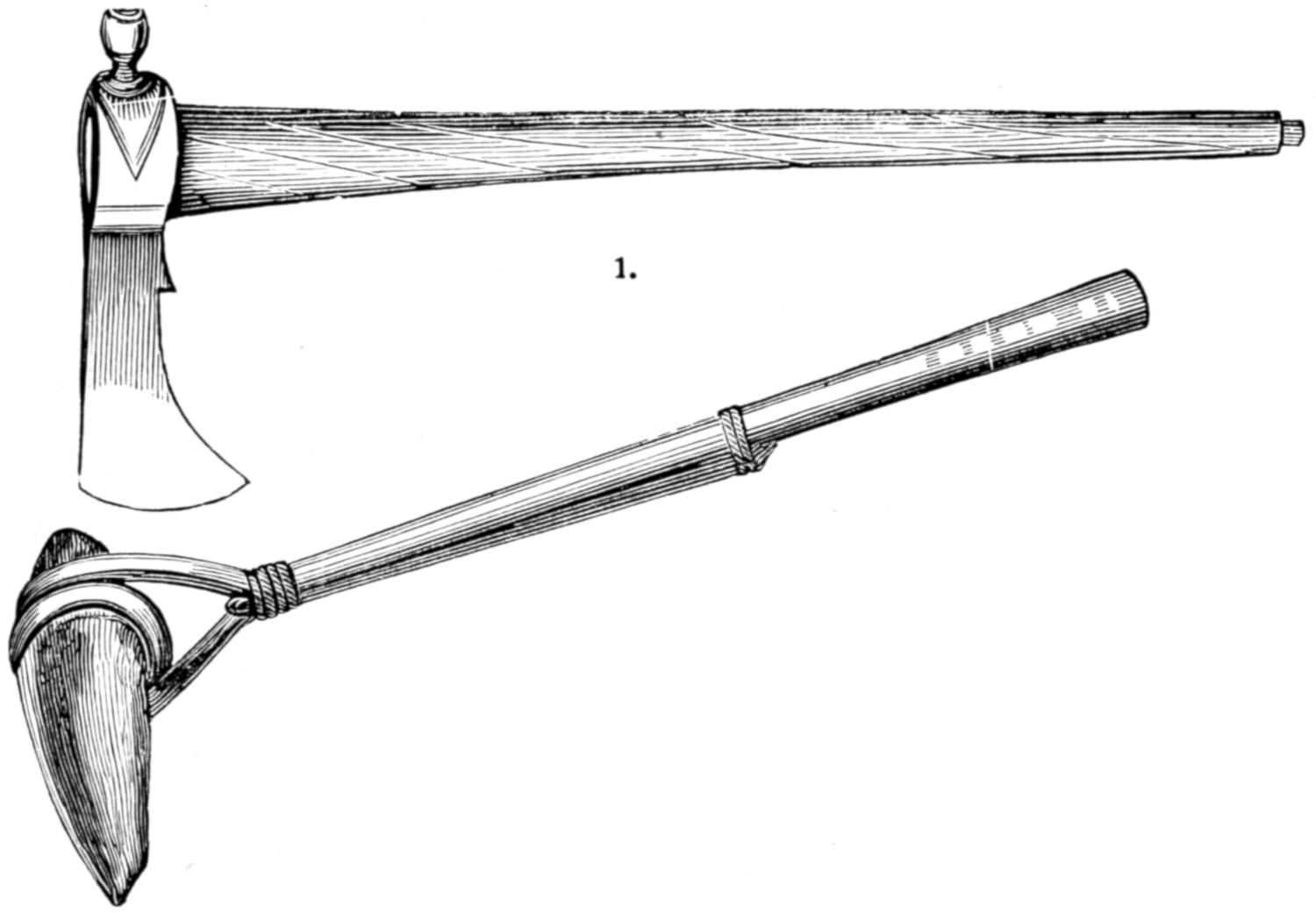
(2.) IRON AND STONE TOMAHAWKS.
(See page 1285.)
Though living among her own friends, the
girl could not forget her strange lover, and
went off again to him. A second child was
born, but this time the upper parts of the
body were those of a child, and the lower
parts were developed into a water snake.
The mother, though terrified at the appearance
of her offspring, carried it off into the
woods and cherished it, but it was discovered
by her brothers, who pierced it
with their arrows, and left it for dead. Her
attention, however, restored it to life, and it
grew to a formidable size. The brothers
held a consultation, and at last surrounded
it, transfixed it with showers of arrows, and,
to make sure of its death cut it to pieces.
“The unhappy Korobona carefully collected
the remains into a heap, which she
kept continually covered with fresh leaves,
and guarded with tender assiduity. After
long watching, her patience was rewarded.
The vegetable covering began to heave and
show signs of life. From it there slowly
arose an Indian warrior of majestic and terrible
appearance. His color was of a brilliant
red, he held bow and arrows in his
hand, and was otherwise equipped for instant
battle.
“That warrior was the first Carib, the
great father of a powerful race. He forthwith
commenced the task of revenge for the
wrongs suffered in his former existence.
Neither his uncles, nor the whole Warau
race whom they summoned, could stand before
him. He drove them hither and thither
like deer, took possession of such of their
women as pleased him, and by them became
the father of brave and terrible warriors like
himself. From their presence the unhappy
Waraus retired, till they reached the
swampy shores of the Atlantic, forsaking
those pleasant hunting grounds which they
had occupied on their first descent from
heaven.”
The Waraus are wonderfully inventive
with regard to legends; and have one which
is worthy of notice, if only for the fact that
it attributes all the learning of the white
men to a Warau origin. This is the legend
of Aboré. “Once upon a time,” there was a
very ill-conditioned female spirit, named
Wowtá, who usually preferred the form of a
frog, but who changed herself into a woman
for the purpose of stealing a very beautiful
little boy called Aboré. In the form of a
woman she obtained access to the house of
Aboré’s mother, whom she induced to leave
the child under her care. No sooner was
she alone with Aboré than she pulled and
stretched him to such a degree that in a few
hours he grew as much as he would have
done in several years, so that his mother repudiated
him on her return.
As he grew to manhood, Aboré became
the slave of his captor, whom he thought to
be his mother, until he was undeceived by a
friendly spirit who met him in the forest.
After trying several plans for escape, and
failing in them all, he hit upon the design of
making a canoe of wax. He was aided in
this task by the fondness of Wowtá for
honey, in search of which the unfortunate
Aboré passed nearly the whole of his time.
Wowtá received the combs with croaks of
delight, and as she threw them away after
eating the honey, Aboré laid the wax aside,
until he had enough for a canoe.
As soon as he had collected a sufficiency
of wax, Aboré called his mistress to look at
a hollow tree filled with bee-comb. She
crept into the tree to regale herself on the
honey, and was imprisoned by the crafty
Aboré, who fastened up the aperture so that
the sorceress could not escape, loaded his
canoe with provisions, and set off for a land
of refuge. He sailed far away until he came
to a strange country where the people were
white, naked, uneducated, and utterly barbarous.
He taught them the elements of
civilization, showed them how to forge iron,
and initiated them into the arts and sciences,
for which the white man was now so distinguished.
In that far land he still lives, and, remembering
the wants of his fellow countrymen,
he continually sends them shiploads of the
things which they most need. But in consequence
of the bad faith of those to whom they
are delivered, the poor Waraus are obliged
to pay for everything that he sends. The
moral which is derived from this legend is,
that all the white men who visit the Waraus
ought to make up for the dishonesty of their
countrymen, and give them as many beads,
knives, and guns as they can procure.
When Mr. Brett first heard this tale, he
thought that it was simply an ingenious invention
framed for the purpose of unlimited
begging, especially as the narrator asked for
a shirt as soon as he had finished the story, and
then proceeded to request a whole series of
other articles. He found, however, by questioning
different natives, that the legend was
really a national one, and not a mere invention
of an ingenious native.
There is evidently a distinction to be
drawn between the two portions of the legend.
The first part, containing the adventures
of Aboré, is evidently ancient, while
the second part is as evidently modern, and
has been introduced since the coming of white
men into Guiana.
In the disposal of the dead there is some
little variation. The mode which was most
prevalent before the missionaries introduced
Christian burial among them was as follows:
The body was placed in a net and sunk in
the river, where the whole of the flesh was
quickly eaten from the bones by the pirai
and other voracious fish. If the dead man
were a person of distinction, the skeleton
was then removed from the water, dried,
painted red, and suspended under the roof of
the house.
In the fifth book of Herodotus, chap, xv.,
occurs the following passage, which was
long thought to be a mere invention on the
part of the historian. After enumeration of
the various nations that Megabazes subdued,
he mentions that the Persian monarch also
endeavored to conquer “those who live upon
the Lake Prasias in dwellings contrived after
this manner.
“Planks fitted on lofty piles are placed in
the middle of the lake, with a narrow entrance
from the mainland by a single bridge.
These piles that support the planks all the
citizens anciently placed there at the common
charge; but afterward they established a law
to the following effect: ‘Whenever a man
marries, for each wife he sinks three piles,
bringing wood from a mountain called Orbelus,’
but every man has several wives.
“They live in the following manner.
Every man has a hut on the planks, in
which he dwells, with a trap-door closely
fitted in the planks, and leading down to the
lake. They tie the young children with a
cord round the feet, fearing lest they should
fall into the lake beneath. To their horses
and beasts of burden they give fish for fodder,
of which there is such abundance,
that when a man has opened his trap-door,
he lets down an empty basket by a cord into
the lake, and, after waiting a short time,
draws it up full of fish.”
In these words the old historian describes
with curious exactitude the mode of life
adopted by some branches of the Waraus
and Caribs. These have been described at
some length by Humboldt, in his “Personal
Narrative.” The large tract of land which
forms the delta of the Orinoco possesses
some very remarkable characteristics. It is
always wet, but during several months in
the year it is completely inundated, the river
rising to an astonishing height, and covering
with water a tract nearly half as large as
England. This seems to be as unpropitious
a spot as could be adopted for human habitations,
and yet the Waraus (or Guarános, as
Humboldt spells the word) have established
themselves there, and prefer it to any other
locality, probably because their strange mode
of life enables them to pass an existence of
freedom.
Varying much in the height to which it
rises, in some places exceeding fifty feet, the
Orinoco has the quality of rising year after
year to the same height in the same place, so
that when a mark is made to designate the
height to which the water rose in one year,
the same mark will answer year after year
with scarcely the slightest deviation. It is
evident that in such a spot, where the soil is
in the dry season nothing but mud, and in
the wet season is forty or fifty feet under
water, only a very peculiar vegetation can
live. This is the Itá (pronounced Eetáh)
palm, belonging to the genus Mauritia, a
plant which, like the mangrove of Africa,
requires plenty of heat and moisture to enable
it to develop itself fully. The native
name for this tree is Murichi.
A brief description of the itá palm must
be given before we proceed further, or the
reader will not understand the peculiar conditions
under which these water dwellers
live. When full grown, it resembles a tall,
cylindrical pillar, with a fan of ten or twelve
vast leaves spreading from its extreme top.
Each leaf is some ten feet in width, and is
supported upon a huge stem about twelve
feet in length, looking more like a branch
than a leaf-stem. Indeed, a complete leaf is
a heavy load for a man. At regular intervals
the whole fan of leaves falls off, and is replaced
by another, the tree adding to its
height at every change of leaf, until the stem
is nearly a hundred feet high, and fifteen in
circumference.
Myriads upon myriads of these marvellous
trees rise amid the waters of the Orinoco
delta, sometimes clustered into solid masses
of vegetation, sometimes scattered, and sometimes
drawn up in devious avenues, according
to the windings of the muddy channels
that even in the dry seasons traverse the
country. Whether grouped or scattered, the
itá flourishes in this delta to such an extent
that only the experienced canoe men of the
place can navigate their barks among the
tall stems, the narrow and winding channels
which form the natural paths being
completely obliterated by the waste of
water. Any stranger who tried to thread this
aquatic forest without the aid of a native guide
would soon lose himself among the armies of
itá palm, and perish miserably of hunger.
Yet this very tree supplies to the Waraus of
the Orinoco not only all the necessaries, but
the luxuries of life, and were the whole tribe
to be cut off from the mainland, they could
support themselves without the least difficulty,
the itá palm supplying house, food,
drink, clothing, and furniture.
First, as to the house. The Warau requires
for a house nothing but a floor and a
roof. In the example seen on page 1244,
the floor is supplied by the earth, but it is
evident that in a house built in a locality
where the ground is for many months together
thirty or forty feet beneath the surface
of the water, an artificial flooring is
needed. The Warau architect, therefore,
proceeds to construct his house in the following
manner.
Selecting four itá trees that grow near
each other in the form of a square, and, cutting
away any of the intervening trees, he
makes use of these four as the corner posts
of his house. He knows by marks left on
the trunks the precise height to which the
water will rise, and some three feet or so
above this mark he builds his floor, cutting
deep notches in the trunk. In these notches
are laid beams made from the stems of the
felled itá palms, and lashed tightly in their
places by ropes made of itá fibre.
On these beams are laid a number of
cross-pieces, sometimes made from the split
trunks, but usually being nothing more than
the gigantic leaf-stems which have been already
mentioned, and which are when dry
very light, very tough, and very elastic.
These cross-pieces are tied firmly together,
and constitute the essential part of the floor.
On them is placed a layer of palm leaves,
and upon the leaves is a thick coating of mud,
which soon dries under the tropical sun,
and forms a smooth, hard, and firm flooring,
which will bear a fire without risk of damage
to the wooden structure below. Ten or
twelve feet above the floor the Warau constructs
a roof of palm leaves, the corners of
which are supported by the same trees
which uphold the house, and then the chief
labors of the native architect are over. An
illustration on page 1244 shows the scenery
of the Orinoco delta and the architecture of
these lake dwellers. So much for the house
furnished by the itá palm.
Food is supplied by it in various forms.
First, there is the fruit, which, when ripe, is
as large as an ordinary apple, many hundreds
of which are developed on the single
branch produced by this tree. Next, there
is the trunk of the tree and its contents. If
it be split longitudinally at the time when
the flower branch is just about to burst from
the enveloping spathe, a large quantity of
soft, pith-like substance is found within it.
This is treated like the cassava, and furnishes
a sort of bread called yuruma.
Drink is also obtained from the itá palm.
From the trunk is drawn a sap, which,
like that of the maguey or great American
aloe, can be fermented, and then it becomes
intoxicating in quality. Another kind of
drink is procured from the fruit of the itá,
which is bruised, thrown into water, and
allowed to ferment for a while. When fermentation
has proceeded to a sufficient extent,
the liquor is strained through a sieve
made of itá fibre, and is thus ready for consumption.
The small amount of clothing required
by the Warau is also obtained from the
itá, the membrane of the young leaf being
stripped off and woven into a simple fabric.
From the same tree the Warau obtains all
his furniture. Bows, arrows, and spears are
made from its leaf-stems, the canoe in which
he goes fishing is made from a hollow itá
trunk, and the lines and nets are both furnished
from the same tree, as is also the
string of which his hammock is made. That
the one single tree should be able to supply
all the wants of an entire population is the
more extraordinary, because in former days
the Warau had no iron tools, and it is not
easy to find a tree that will at the same time
furnish all the necessaries of his life, and be
of such a character that it can be worked by
the rude stone implements which the Warau
had to use before he obtained iron from the
white men.
It may readily be imagined that the Waraus
who inhabit this strange region are
lower in the scale of civilization than those
who live on dry land, and, to use the words of
Humboldt, “in the lowest grades of man’s
development we find the existence of an entire
race dependent upon almost a single
tree, like certain insects which are confined
to particular portions of a flower.”
The Waraus are not the only lake dwellers
of Southern America. At the extreme north
of this half of the continent there is a province
which derives its name from the mode
of life adopted by the savage tribe which
dwells upon the waters of a lake. On the
north-western coast of Venezuela there is a
large gulf, called the Gulf of Maracaibo, the
name having been given to it by the Spanish
discoverers in honor of a native chief whom
they met on its shores. Close to the gulf,
and only separated from it by a narrow, is a
vast fresh-water lake, fed by the streams
that pour from the mountains which surround
it. The shape of this lake has been
well compared to that of a jews-harp, with
a rather elongated neck, and the depth of
its water varies in a most remarkable manner.
From the sides the bottom of the lake
shelves almost imperceptibly for a great distance,
so that at a distance of two or three
miles from the shore, a man would be able
to walk with his head above the surface.
Suddenly, and without the least warning,
the bed of the lake dips into almost unfathomable
depths, so that, though a man
might be barely submerged above his waist,
a single step will plunge him into water so
deep that the tallest spire ever built would
be plunged far below the surface.
Over the surface of this lake dwell numerous
human beings, and, even at the
present day, when the number of the inhabitants
has been much decreased, upon its
waters are no less than four large villages,
beside numerous detached dwellings formed
in the various bays which indent its shores.
The reason for thus abandoning the dry
land and taking to the water is a very curious
one, and may be summed up in a single
word—mosquitoes. These tiny but most
annoying insects are found in clouds around
the edge of the lake, some species flying by
night and others by day, so that at no hour
is there the least respite from their attacks.
Fortunately, they need the protection of the
luxuriant vegetation that fringes the shore
of the lake, and not being very enduring of
wing, are obliged to rest at intervals in their
flight. They therefore keep to the shore,
and do not venture to any great distance
over the water. Knowing this characteristic
of the insect, the natives manage to evade
them by making their dwellings behind the
range of the mosquito’s flight.
In building these curious habitations, the
lake dweller of Maracaibo is forced to employ
a greater skill in architecture than is
needed by the Waraus of the Orinoco delta.
In that muddy delta, formed by the alluvium
washed down by the river, the itá palm
abounds, and forms natural pillars for the
house; but the Lake Maracaibo furnishes
no such assistance, and the native architect
is therefore obliged to drive piles into
the bed of the lake in order to raise his
floor above the level of the water.
It is evidently needful that these piles
should be made of wood which will not perish
by the action of the water, and upon the
shores of the lake grows a tree which supplies
precisely the kind of timber that is
required. It is one of the numerous iron-wood
trees, and its scientific name is Guiacum
arboreum. It is a splendid tree, rising
to the height of a hundred feet or so, and
having wood so hard that it will turn the
edge of an axe. The natives, however,
manage to fell these trees, to cut them into
proper lengths, and to drive them firmly
into the bed of the lake, where they become
even stronger by submersion, being covered
in course of years with an incrustation of
lime, which makes them look as if they had
been actually converted into stone.
On these piles are laid cross-beams and
planks of lighter wood, and when a strong
roof and light walls have been added, the
house is complete. All the parts of the
house are lashed together with green sipo,
which contracts when dry, and binds the
various portions as with bands of iron.
As has been already mentioned, numbers
of these houses are gathered together into
villages. When the Spaniards first entered
the Gulf of Maracaibo, and came within
view of the lake, they were struck with
amazement, at these habitations, and called
the place Venezuela—i. e. Little Venice—a
name which has since been extended to
the whole of the large province which is
now known by that title.
It is on this lake that the gourd system
of duck catching is carried to the greatest
perfection. Great quantities of ducks frequent
its waters, but they are shy of man,
and will not allow him to come near them.
The natives, however, manage to catch
them by hand, without even employing a
snare. They take a number of large gourds,
scrape out the inside, and set them floating
on the lake. At first the timid birds are
afraid of the gourds and avoid them, but
after a while they become accustomed to
them, and allow them to float freely among
their ranks.
The Indian then takes a similar gourd
and puts it over his head, having previously
cut a couple of holes through which he can
see. He slips quietly into the water, and
makes his way toward the duck, taking care
to keep the whole of his body submerged.
As soon as he gets among them, he grasps
the nearest duck by the legs, jerks it under
water, and ties it to his girdle, where it is
soon drowned. He then makes his way to
another duck, and, if an experienced hand,
will capture as many as he can carry, and
yet not alarm the survivors.
CHAPTER CXXXV. MEXICO. HISTORY—RELIGION—ART.
MEXICO AS IT IS, AND WAS BEFORE THE SPANISH CONQUEST — WHY THE EMPIRE FAILED — CONTRADICTORY
ACCOUNTS OF THE ANCIENT MEXICANS — THE RUINS OF THEIR BUILDINGS — HUMAN
SACRIFICES — THE SACRIFICIAL KNIFE — MEXICAN ART — MOSAIC WORK AND FEATHER PICTURES — CAPABILITIES
OF THE COUNTRY.
Before passing to the North American
tribes, a brief notice must be taken of Mexico.
At the present day this land is possessed
of a sort of civilization which presents no
features of interest. It is inhabited chiefly
by a mixed people, the descendants of the
Spanish conquerors having contracted alliances
with the natives, and so produced a
hybrid race, which is continually retrograding
from the white parentage, and assuming
more of the aboriginal type.
The failure in establishing a Mexican empire
was entirely due to the question of race.
Those inhabitants who were either pure
whites, or in whom the white blood predominated,
were naturally desirous to have
a ruler of their own kind, thinking that an
empire was the only mode of civilizing the
land, and of putting an end to the constant
civil wars and repeated changes of dynasty
which kept back their most prolific and fertile
land from developing its full capabilities.
But in the great bulk of the people the Indian
blood predominated, and in consequence an
empire founded on the principles of European
civilization was as irreconcilable to
them as would be the rule of an Indian cacique
in Europe. Such an empire could only
be held by force of arms, and as soon as the
bayonet was withdrawn the empire fell. We
must, however, confine ourselves to Mexico
as it was before the Spaniard crushed
out her civilization and destroyed her history.
The accounts of ancient Mexico are most
perplexing. If the narratives of the Spanish
conquerors could be implicitly trusted,
nothing would be simpler than to condense
them into a consecutive history. But it is
quite certain that these accounts were very
much exaggerated, and that the reality fell
very far short of the romantic tales of the
Spanish conquerors.
The following is an abstract of the narratives
put forth by the Spaniards. The
capital was situated on an island in the midst
of a large lake. It contained twenty thousand
houses, which were of great magnificence.
In the midst was the emperor’s
palace, built of marble and jasper, and of
prodigious extent. It was adorned with fountains,
baths, and statues, and the walls were
covered with pictures made of feathers. Not
only the palace, but the houses of the caciques,
possessed menageries filled with all
the animals of the country, together with
museums of various natural curiosities.
One of the greatest beauties of Mexico was
a large square, daily filled with merchants,
who came to buy and sell the various works
of art in gold, silver, and feathers for which
the Mexicans were famous. Between the
city and the borders of the lake a hundred
thousand canoes were continually passing;
besides which mode of transit three vast
causeways were built on the lake. The
capital was not the only city of the waters,
for more than fifty large cities and a multitude
of villages were built on the same lake.
The dress of the nobles was most gorgeous,
and their persons were adorned with gold and
jewels in profusion. Their treasuries were
filled with the precious metals, and gold was
as plentiful in Mexico as copper in Europe.
That these statements were much exaggerated
is not to be doubted, but they were
not pure inventions, and had all some foundation
in fact. For example, the architecture
of the ancient Mexicans was of a
Cyclopean vastness, as is proved by the ruins
which are now almost the sole memorials of
a vanished system of civilization. There is
a strong resemblance between the architecture
of Mexico and that of Egypt, not
only in its massiveness, but in the frequent
use of the pyramid.
One of these pyramids has the sides exactly
twice as long as those of the large
pyramid of Egypt. This is the great pyramid
tower of Cholula, which had eight stories,
each forming a platform on which rested the
one above it, so that it closely resembled the
Temple of Belus as described by Herodotus.
The interior of these pyramidal structures
was pierced with chambers, galleries, and
flights of stairs, probably the habitations of
the priests who served the temples and performed
those terrible human sacrifices which
formed an important part of their religious
system. Viaducts which crossed deep valleys,
bridges, and roads, remains of which
are still in existence, testify to the vanished
civilization of the Mexicans, or, as some ethnologists
think, of a race that preceded
them.
Specimens of the artistic skill of the ancient
Mexicans may be seen in the magnificent
Christy Collection. There is, for example,
one of the sacrificial knives with which the
priests laid open the breast of the human
victim in order to tear out the heart and
offer it to the blood-loving deity of the temple.
The blade of this instrument is obsidian, and
its handle is a marvellous piece of mosaic
work, made of lapis lazuli, ruby, and other
precious stones. Then there are masks made
of similar materials, one being a most ghastly
imitation of a human skull.
The skill in feather working still survives,
and even at the present day pictures are
made so exquisitely from humming-birds’
feathers that they seem, at a little distance,
to be admirable specimens of enamel.
The courage of the ancient Mexicans was
very great. They opposed their naked
breasts to the mail-clad invaders, and their
comparatively feeble weapons to the dreaded
fire-arms. Even the horse, which at first
struck terror into them as a supernatural
being, soon ceased to be an object of dread,
and there is a story that they captured a
horse in battle, stabled it in a temple, and
treated it as a god, feeding it with daintily
dressed chickens and similar dishes, until the
poor beast was starved in the midst of plenty.
The conduct of the Aztecs in destroying
their once venerated Emperor Montezuma,
because he yielded to the Spaniards, and the
calm endurance of his warlike successor
Guatemozin, when stretched on the fiery
rack, are sufficient instances of the courage
possessed by the Mexicans when Cortez came
into the country.
The real prosperity of Mexico is to come.
There is every capability in the country,
which is fertile in many valuable productions,—cattle
and horses, for example,
both of which, importations from Europe,
have multiplied in an astonishing manner,
and may at some time supply half Europe
with cheap food, hides, and beasts of burden.
Insect life is almost as valuable as that of
the higher and larger animals. The cochineal
insect reproduces itself in vast
numbers, and, large as is the trade in this
valuable insect, it could be extended almost
indefinitely. There is no trouble in breeding
the insect, no risk, and scarcely any
capital required. It feeds upon the prickly
pear, a plant which springs up luxuriantly
if but a leaf be stuck in the ground.
It is indeed so luxuriant, that riders are
forced to employ a peculiar kind of stirrup,
in order to prevent their feet from being
riddled with the needle-like thorns with
which the plant, the leaf, and fruit are covered.
One of these curious stirrups is shown
in illustration No. 1, page 1265, drawn from
my own specimens, which was brought from
Mexico by Sir F. Wetherell.
It is cut from a solid block of wood, and
is therefore exceedingly heavy. A hole is
cut in the back of the stirrup, into which
the foot can be thrust nearly half way.
Owing to the size and weight of this curious
implement, the prickly pears are pushed
aside as the rider passes among them, and
thus the foot and ankle are protected from
the slender but formidable thorns with which
they are armed. The stirrup is sometimes
put to another use, and employed as a rough
and ready drinking cup. The front of the
implement is covered with bold and graceful
patterns, the effect of which is often
heightened by means of color. In my own
specimen they are colored with blue, scarlet,
and black.
As to the vegetable products of Mexico,
they are too numerous to mention, but the
principal are the indigo, the chocolate, and
the vanilla.
Then it is as prolific in mineral as in animal
wealth, and in the hands of an energetic
and industrious people, the yield of copper,
iron, gold, silver, and other metals might be
almost indefinitely extended. In all these
productions comparatively little labor is required.
Nature gives almost gratuitously
those privileges which in other lands cannot
be obtained without the expenditure of time,
labor, and money.
The past civilization of Mexico has vanished
never to return. Its present is a
comparative failure. The future is yet to
be seen, but it may even eclipse the vanished
glories of the past if guided by those
who understand the epoch, the country, and
the race.
CHAPTER CXXXVI. THE NORTH AMERICAN INDIANS. GOVERNMENT—CUSTOMS.
GENERAL NOTICE OF THE TRIBES — THEIR COLOR AND FEATURES — CATLIN’S DESCRIPTION OF A CROW
CHIEF — LONG HAIR OF THE MEN — SILVER HAIR OF THE MANDAN TRIBE — GOVERNMENT OF
THE TRIBES — THE HEREDITARY AND ELECTED CHIEFS — THEIR LIMITED POWERS — THEIR DISTINCTIVE
DRESS — COSTUME THE RECORD OF DEEDS — THE SCALP-LOCKS, PAINTED ROBES, AND
CLAW COLLAR — PRESERVATION OF SKINS — THE FEATHER PLUMES — THE HORNS, AND THEIR
SIGNIFICATION — INDIAN DANDIES — ESTIMATION IN WHICH THEY ARE HELD — THE PORTRAIT
PAINTER BAFFLED — DRESS OF THE WOMEN — BISON SKIN ROBES — WAMPUM, AND ITS SIGNIFICATION.
It has already been mentioned that, with
the exception of the shore districts, America
is inhabited from the extreme south to extreme
north by the same race.
The various tribes into which that race is
divided are naturally varied according to
the locality and climate of the spot which
they inhabit. Those, for example, who live
in the perpetual snow and ice of either the
extreme north or south are naturally different
in manners and customs from those
who inhabit the tropical centre of America.
Then, even in similar climate, there is very
definite modification according to locality.
The inhabitants of the mountains, for example,
differ materially from the dwellers of
the plain, while those tribes who live in the
forests differ from both.
Yet they are all members of one and the
same great race, and whether in the Esquimaux
of the north, the Amazonian of the
tropics, or the Patagonian of the extreme
south, all display the same race characteristics.
The color of the skin is deep copper red,
the cheek-bones are prominent, the nose
mostly aquiline, the forehead rather receding,
and the eyes apparently small, this
latter characteristic being due to the continual
exposure to the sun, and to the smoky
atmosphere of the huts. The beard is very
deficient, and even those few hairs that
make their appearance are carefully eradicated
with tweezers. Sometimes an old man
who is careless about his personal appearance
allows his beard to grow, but in that
case it is very scanty, thin, and never reaches
any great length.
The hair of the head contrasts strongly
with that of the face, being very long and
fine, in some of the tribes attaining an almost
incredible length. The Crow tribe are
remarkable for the extraordinary development
of their hair, which in some of the
warriors actually trails on the ground as
they walk. They pride themselves so much
on this peculiarity, that in 1833 their chief
received both his name of Longhair and his
office from his wonderful tresses. The hair
of this man was carefully measured by some
white travellers, who had lived in his lodge
for months together, and was found to be
ten feet seven inches in length.
He did not allow it to hang at its full
length except on occasions of ceremony,
but kept it carefully wound with a broad
leather strap, and made up into a bundle
weighing several pounds. Usually this bundle
was carried under his arm or in the
bosom of his robe, but on great occasions
the hair was let down to its full length, and
carefully smoothed with bear’s grease, and
allowed to trail on the ground several feet
behind the owner as he proudly stalked
along.
Several other tribes, such as the Blackfeet
(so called from the dark moccasins which
they wear), have very long hair, of which
they are exceedingly proud, and those individuals
whose locks do not reach the standard
of beauty are in the habit of splicing
false hair to their own tresses.
The Mandans, of whom we shall hear
much in the course of this narrative, the
Sioux, and the Minatarees, are all distinguished
by this peculiarity, though none of
them possess it so abundantly as the Crows.
When Mr. Catlin was staying among the
Minatarees, a party of Crows came to visit
them, and excited the admiration of their
hosts by their magnificent hair. One of
them possessed so picturesque an appearance
that the artist traveller transferred
him at once to canvas, and the engraver has
reproduced the sketch for the reader on the
1284th page. The following is Mr. Catlin’s
account of this splendid specimen of the
North American Indian:—
“I think I have said that no part of the
human race could present a more picturesque
and thrilling appearance on horseback
than a party of Crows rigged out in
all their plumes and trappings—galloping
about and yelling in what they call a war
parade, i. e. in a sort of tournament or sham
fight, passing rapidly through the evolutions
of battle, and vaunting forth the wonderful
character of their military exploits. This is
an amusement of which they are excessively
fond; and great preparations are invariably
made for these occasional shows.
“No tribe of Indians on the continent are
better able to produce a pleasing and thrilling
effect in these scenes, not any more vain,
and consequently better prepared to draw
pleasure and satisfaction from them, than
the Crows. They may be justly said to be
the most beautifully clad of all the Indians
in these regions, and, bringing from the
base of the Rocky Mountains a fine and
spirited breed of the wild horses, have been
able to create a great sensation among the
Minatarees, who have been paying them all
attention and all honors for some days past.
“From amongst these showy fellows who
have been entertaining us, and pleasing
themselves with their extraordinary feats
of horsemanship, I have selected one of the
most conspicuous, and transferred him and
his horse, with arms and trappings, as faithfully
as I could to the canvas, for the information
of the world, who will learn vastly
more from lines and colors than they could
from oral or written delineations.
“I have painted him as he sat for me,
balanced on his leaping wild horse, with his
shield and quiver slung on his back, and his
long lance, decorated with the eagle’s quills,
trained in his right hand. His shirt and his
leggings, and moccasins were of the mountain-goat
skins, beautifully dressed; and
their seams everywhere fringed with a profusion
of scalp-locks taken from the heads of
his enemies slain in battle. His long hair,
which reached almost to the ground while
he was standing on his feet, was now lifted
in the air, and floating in black waves over
the hips of his leaping charger. On his head,
and over his shining black locks, he wore a
magnificent crest, or headdress, made of the
quills of the war eagle and ermine skins, and
on his horse’s head was another of equal
beauty, and precisely the same in pattern
and material.
“Added to these ornaments there were
yet many others which contributed to his
picturesque appearance, and amongst them
a beautiful netting of various colors, that
completely covered and almost obscured the
horse’s head and neck, and extended over its
back and its hips, terminating in a most extravagant
and magnificent crupper, embossed
and fringed with rows of beautiful
shells and porcupine quills of various colors.
“With all these picturesque ornaments
and trappings upon and about him, with a
noble figure, and the bold stamp of a wild
gentleman on his face, added to the rage and
spirit of his wild horse, in time with whose
leaps he issued his startling though smothered
yelps, as he gracefully leaned to and
fro, leaving his plume and his plumage, his
long locks and his fringes, to float in the
wind, he galloped about; and felt exceeding
pleasure in displaying the extraordinary skill
which a lifetime of practice and experiment
had furnished him in the beautiful art of riding
and managing his horse, as well as in displaying
to advantage his weapons and ornaments
of dress, by giving them the grace of
motion, as they were brandished in the air
and floating in the wind.”
Although the hair is generally black, it
sometimes takes various colors, the Mandan
tribe being the most remarkable for this peculiarity.
Some of them, even though quite
young, have the hair of a bright silver gray,
or even white. The men dislike this kind of
hair in their own sex, and when it occurs try
to disguise it by a plentiful use of red or black
earth mixed with glue. The women, on the
contrary, are very proud of such hair, and
take every opportunity of displaying its
beauties. Generally a woman wears the
hair in two plaits, which are allowed to fall
down the back over on each side of the
head; but when they wish to appear to the
best advantage, they rapidly unplait it, pass
their fingers through it in the manner of a
comb, and spread it as widely as possible
over the shoulders. They always part it in
the middle and fill the line of parting with
red paint.
The silver gray hair is remarkable for its
coarseness, in which respect it seems like a
horse’s mane, while the dark colored hair is
quite soft. Among the Mandans almost
every shade of hair is found between white,
brown, and black, but there is never the
least tinge of red in it.
The Mandan men have a curious habit of
dividing their long hair into flat tresses, two
inches or so in width, and filling each tress
at intervals of an inch with vermilion and
glue, so as to keep them separate. These
patches of glue and earth become very hard,
and are never removed. The hair thus
treated is drawn tightly over the top of the
head, and allowed to fall down the back in
parallel tresses, which mostly reach to the
knee, and in some cases to the ground.
The government of these tribes is of a
similar character throughout. Each tribe
has at its head a chief, whose office is usually,
but not always, hereditary. Provided the
eldest son of a chief be tolerably well
qualified for the post, he is suffered to assume
the leadership when his father dies, or
becomes too old for work. Should the tribe
be dissatisfied with him, they elect a leader
from among the sub-chiefs. There is often
a double system of government, two chiefs
of equal power being appointed, one of
whom manages all matters of war, and the
other effects the administration of domestic
policy.
It often happens that, although the head
chief of the tribe is nominally the ruler, and
holds the first place, the real power lies in
the second or third chief, who pays to his
superior every deference which is due to his
position, but is practically the leader and
commander of the tribe. This was the case
among the Mandans when Mr. Catlin visited
them. The head chief, though a man of
abilities and courage, and therefore respected
and feared by the people, was by no means
loved by them, on account of his haughty
and overbearing demeanor. The real leader
of the tribe was the second chief, named
Mah-to-toh-pa, i. e. the Four Bears, a name
which he got from an exclamation of the
enemy, who said that he came at them “like
four bears.” Some of the adventures of this
extraordinary man will be mentioned in the
course of the following pages.
Great as is the power of the chief, it is
much more limited than that which is enjoyed
by the chiefs of the African tribes.
The American chief has no control over life,
or limb, or liberty. He takes the lead in
council, and if an offender be cited before
the councillors, his voice carries great weight
with it, but nothing more. Should he be the
war chief, he cannot compel a single man to
follow him to battle, nor can he punish one
of his followers for deserting him. Any of
the warriors, even the very youngest, may
follow or desert his chief as he pleases, the
principal check against desertion being the
contempt with which a warrior is sure to be
regarded if he leaves a chief who is worthy
of his office.
The chiefs have, as a rule, no advantage
over the other members of the tribe in point
of wealth. A chief would soon lose the
popularity on which his influence depends
if he were to amass wealth for himself. By
virtue of his office, he has a larger house or
tent than the rest of the tribe, and he generally
possesses a few more wives. But he
is often actually poorer than most of the
warriors, thinking himself bound in honor
to distribute among the tribe the spoils that
he takes in war. Many chiefs even dress
worse than the warriors under their command,
so as not to excite envy, and only
assume their splendid dress of office on great
occasions.
The question of dress is really an important
one. Varying as it does among the different
tribes, there is a general character
which runs through the whole.
Every man without distinction wears a
scanty dress much like the “cheripa” which
has already been described, but is very much
smaller. In battle or hunting, and in all
cases in which exertion is required, he contents
himself with this single garment; but
when he is enjoying himself at home, he assumes
his full costume. He wears a pair of
leggings reaching to the hips, and falling as
low as the ankles, sometimes spreading well
over them. These leggings are mostly
adorned with little bells, bits of fur, or similar
decorations; and if the wearer be a successful
warrior, he fringes them along the
sides with tufts of hair taken from the head
of a slain enemy.
He has also a loose coat descending to the
knees, and ornamented in a similar manner
with feathers or scalp-locks, and, when the
owner has performed any conspicuous feat
of valor, he makes a rude painting of the
event. This answers the same purpose as
the Victoria Cross among ourselves. Although
it is conferred by the man himself, it
is equally valuable. No man would dare to
depict on his robe any deed of valor which
he had not performed, as he would be challenged
by the other warriors to prove his
right to the decoration, and, if he failed to do
so, would be utterly scorned by them. The
chief Mah-to-toh-pa represented on his robe
a series of events in which he had killed no
less than fourteen of the enemy with his own
hand. Sometimes, when the tribe uses skin
huts or wigwams, the warriors also paint
their adventures upon the walls of their
dwellings.
From a similar spirit the scars and wounds
received in war are kept covered with scarlet
paint, and when a man has succeeded in
killing a grizzly bear he is entitled to wear
its skin, claws, and teeth. The usual mode
of so doing is to string the claws into necklaces
and bracelets, and to make the skin
into robes. Sometimes they dress the skin
without removing the claws, and wear it in
such a fashion that the claws are conspicuously
seen. Owing to the extreme ferocity,
strength, and cunning of the bear, to kill one
of these animals is considered equivalent to
killing a warrior, and the claw necklace is as
honorable an ornament as the much prized
scalp. Some of the most valiant hunters
have killed several of these animals, and it is
a point of honor with them to appear on
great occasions with all their spoils, so that
they have to exercise considerable ingenuity,
and display some forty huge claws about
their persons in a sufficiently conspicuous
manner.
All the dress of a North American Indian
is made of skin, mostly that of the deer, and
in dressing it the natives are unrivalled, contriving
to make a leather which is as soft as
silk, is nearly white, and which may be wetted
and dried any number of times without
becoming harsh.
The skin is first washed in strong lye,
made of wood-ashes and water, so as to
loosen the hair, which is then scraped off.
The hide is next stretched tightly upon the
ground upon a frame, or by means of a
number of wooden pegs driven firmly into
the ground. In this position it remains for
several days, the brains of the animal being
spread thickly upon it, and rubbed into it.
The next process is to scrape it carefully
with a blunt knife made of the shoulder-blade
of the bison, the native tanner pressing
heavily upon it, and scraping every portion
of the hide.
The process by which it is made capable of
resisting the effects of water has yet to be
undergone. A hole is made in the ground,
and a quantity of rotten wood is piled in it,
so that when lighted it will continue to
smoulder for a long time, and produce
smoke, but no flame. Around the hole
are stuck a number of sticks, which are
then tied together at the top, so as to make
the framework of a sort of tent. The wood
is then set on fire, the hides are placed
within the tent, and over the sticks are
wrapped other hides carefully fastened together,
so as to prevent the smoke from
escaping. For several days the hides are
left in the smoke, and at the expiration of
that time they have assumed the peculiar
quality which has been described. The
whole of the processes are conducted by
women, manual labor being beneath the dignity
of a man and a warrior.
The headdress of a North American Indian
deserves some attention. Variable as
are the modes of dressing the hair, no warrior
ever wears his hair short. By so doing
he would be taking an unfair advantage of
an adversary. When a warrior is killed, or
even totally disabled, the successful adversary
has a right to take his scalp, in which
he would be much impeded if the hair
was short. Moreover, he would lose the
honorable trophy with which he is entitled
to fringe his garments. So for a warrior to
wear his hair short would be a tacit acknowledgment
that he was afraid of losing
his scalp, and all the men therefore always
leave at least one lock of hair attached to the
crown of the head.
The process of scalping will be presently
described, when we treat of war.
A great chief always wears, in addition to
the ordinary headdress of the warrior, a
plume of eagle feathers, by which he is made
as conspicuous as possible, so that the
enemy shall have no difficulty in recognising
him. The form of plume varies according
to the different tribes. That of the
Crows may be seen in an illustration on
page 1284. That of the Mandans is represented
on the following page. It is made
of a long strip of ermine, to which are
fastened the quill feathers of the war eagle,
so as to form a crest beginning at the back
of the head and descending to the feet.
These quills are so valuable that a perfect
tail of the war eagle is considered to be
worth a first-rate horse.
In the present instance two horns may be
seen projecting from the headdress. This
is a decoration very rarely seen, and only
conferred by the chief and council upon the
most distinguished warriors. Even the
head chief will not be able to assume them
unless by the general vote of the council,
and in the case of the Mandans the second
chief wore them, while the head chief was
not privileged to do so.
Even a brave may wear them, though he
be below the rank of chief.
They are made from the horns of the bison
bull, divided longitudinally, scraped
nearly as thin as paper, and highly polished.
They are loosely attached at the base, so
that they can be flung backward or forward
by the movement of the head, and give a
wonderful animation to the action of the
wearer when he is speaking.
This elaborate headdress is very seldom
worn, and is only assumed on occasions of
special state, such as public festivals, war parades,
or the visits of other chiefs. In battle
the wearer always assumes the headdress
by way of challenge to the enemy. There
is good reason for not always wearing this
dress. I have worn the dress formerly used
by Mah-to-toh-pa, and found it to be hot,
heavy, and inconvenient.
As a contrast to the dress of a noted warrior,
we may take that of a mere dandy, a few
of whom are sure to be found in every tribe.
They are always remarkable for elegance of
person and effeminacy of nature, having the
greatest horror of exposing themselves to
danger, and avoiding equally the bear, the
bison, and the armed enemy. Consequently
they may not deck themselves with the plumage
of the war eagle, every feather of which
signifies a warrior slain by the warrior’s own
hand. Neither may they adorn their necks
with the claws of the grizzly bear, their robes
with scalp-locks and paintings, nor their
bodies with the scarlet streaks that tell of
honorable wounds received in battle.
Such ornaments would at once be torn
from them by the indignant warriors of the
tribe, and they are forced to content themselves
with mountain goat, doe, and ermine
skins, swans’ down, porcupine quills, and
similar articles—all more beautiful than
the sombre eagle quills, bears’ claws, and
scalp-locks that mark the brave.
They spend their whole lives in idleness,
and do not even join the athletic games of
which the Americans are exceedingly fond,
but devote their whole energies to the
adornment of their persons. They will occupy
four of five hours in making their toilets,
being fastidious as to the arrangement
of every hair of their eyebrows, and trying
by the mirror the effect of various expressions
of countenance.
Having spent the whole morning in this
occupation, they sally out on their horses,
seated on white and soft saddles, beautifully
ornamented with porcupine quills and ermine,
and lounge about the village for an
hour or two, displaying their handsome persons
to the best advantage. They then
saunter, still on horseback, to the place
where the young warriors are practising
athletic exercises, and watch them for an
hour or two, plying all the while their turkey-tail
fans. Fatigued with the effort,
they lounge home again, turn their horses
loose, take some refreshment, smoke a pipe,
and fan themselves to sleep.
These men are utterly despised by the
warriors, as Mr. Catlin found. He was
anxious to procure a portrait of one of these
men:—
“Whilst I have been painting, day by
day, there have been two or three of these
fops continually strutting and taking their
attitudes in front of my door, decked out in
all their finery, without receiving other information
than such as they could discover
through the seams and cracks of my cabin.
The chiefs, I observed, passed them without
notice, and, of course, without inviting
them in; and they seemed to figure about
my door from day to day in their best
dresses and best attitudes, as if in hopes
that I would select them as models for my
canvas. It was natural that I should do so,
for their costume and personal appearance
were entirely more beautiful than anything
else to be seen in the village.
“My plans were laid, and one day, when
I had got through with all of the head men
who were willing to sit to be painted, and
there were two or three of the chiefs lounging
in my room, I stepped to the door, and
tapped one of these fellows on the shoulder,
who took the hint, evidently well pleased
and delighted with the signal and honorable
notice I had at length taken of him and his
beautiful dress. Readers, you cannot imagine
what was the expression of gratitude
which beamed forth in this poor fellow’s
face, and how high his heart beat with joy
and pride at the idea of my selecting him to
be immortal alongside of the chiefs and
worthies whose portraits he saw ranged
around the room; and by which honor he undoubtedly
considered himself well paid for
two or three weeks of regular painting, and
greasing, and dressing, and standing alternately
on one leg and the other at the door of
my premises.
“Well, I placed him before me, and a
canvas on my easel, and chalked him out at
full length. He was truly a beautiful subject
for the brush, and I was filled with enthusiasm.
“His dress from head to foot was made of
the skins of the mountain goat, dressed so
neatly that they were almost as soft and
white as Canton crape. Around the bottom
and the sides it was trimmed with ermine, and
porcupine quills of beautiful dyes garnished
it in a hundred parts. His hair, which was
long and spread over his back and shoulders,
extending nearly to the ground, was
all combed back, and parted on his forehead
like that of a woman. He was a tall
and fine figure, with ease and grace in his
movements that were worthy of better caste.
In his left hand he held a beautiful pipe, in
his right hand he plied his fan, and on his
wrist was attached his whip of elk-horn and
his fly-brush, made of the buffalo’s tail.
There was nought about him of the terrible,
and nought to shock the finest and chastest
intellect.”
Unfortunately, the portrait was never
taken, for the chiefs were so exceedingly
offended that so contemptible a being should
be put on the same level as themselves by
being painted, that they left the hut in angry
silence, and sent a message to the effect
that, if Mr. Catlin painted the portrait of so
worthless a man, he must destroy all the
portraits of the chiefs and warriors. The
message was also given to the obnoxious individual,
who at once yielded the point,
walked consequentially out of the hut, and
took up his old station at the door as if nothing
had happened to disturb his equanimity.
On their feet the American Indians wear
moccasins, i. e. shoes made of soft leather,
the sole of which is no thicker than the
upper part. To an European walking in
moccasins is at first very fatiguing, on account
of the habit of turning out the toes.
When, however, the white man learns to walk
as the natives do, with his toes rather turned
in, he soon finds that the moccasin is a better
preservative of the feet than the European
shoe, with its thick and almost inflexible
sole.
The dress of the women is made of the
same materials as that of the men, and differs
chiefly in its greater length, reaching
nearly to the ankle. It is generally embroidered
in various patterns with colored
porcupine quills, as are the leggings and
moccasins. The women are fond of tattooing
themselves, and produce blue and red
patterns by the use of charcoal and vermilion
rubbed into the punctures. Both sexes
are furnished with large robes made of bison
skins, and the inner side of these robes is
often painted in curious patterns. One of
these robes in Mr. Catlin’s collection, had a
most elaborate figure of the sun in the centre,
around which were figures of men and
animals, showing the prowess of the owner
both in war and hunting.
Beads and such like ornaments, obtained
from the white men, are much in fashion;
but, long before a glass or porcelain bead
was introduced into America, the natives
had an ornament of their own manufacture.
This is the celebrated wampum, an article
which is now almost extinct. It is made of
fresh water shells, which are found on the
borders of the lakes and streams. The thick
part of the shell is cut into cylinders an inch
or so in length, and then bored longitudinally,
like the “bugles” that are worn by European
ladies. Indeed, when the shell is, as
is mostly the case, a white one, the piece of
wampum looks almost exactly like a fragment
of clay tobacco-pipe stem.
The wampum is either strung like beads
and worn round the neck, or is formed into
war belts for the waist. It answers several
purposes. In the first place, it acts, like the
cowries of Africa, as a substitute for money,
a certain number of hand breadths being
the fixed value of a horse, a gun, or a robe.
It is also the emblem of peace when presented
by one chief to another, and, when
war has ceased between two hostile tribes, a
wampum belt is presented as a token that
the two tribes are at peace.
There is no particular beauty about the
wampum. If the reader will break a tobacco-pipe
stem into pieces an inch in
length and string them on a thread, he will
produce a very good imitation of a wampum
necklace. Its only value lies in the labor
represented by it; and, as the white men
have introduced tons of imitation wampum
made of porcelain, which looks rather better
than the real article, and is scarcely one-hundredth
part of the value, the veritable wampum
is so completely extinct among many of
the tribes that, if one of the natives should
wish to see a string of wampum, he must go
to a museum for that purpose.
CHAPTER CXXXVII. THE NORTH AMERICAN INDIANS— Continued . WAR—WEAPONS.
MARTIAL CHARACTER OF THE TRIBES — THEIR MODE OF FIGHTING — DECLARATION OF WAR, AND
APPLICATION FOR VOLUNTEERS — WEAPONS — THE PLAIN AND THE SPIKED CLUB — THE SHIELD,
AND THE INGENIOUS MODE OF MAKING IT — THE LONG SPEAR — THE BOW AND ITS CONSTRUCTION — MODE
OF SHOOTING — THE STONE AND IRON TOMAHAWKS — THE SCALPING-KNIFE — MODE
OF SCALPING — USE MADE OF THE LOCKS — THE SCALP DANCE — THE EXPLOITS OF MAH-TO-TOH-PA — SHAM
BATTLES OF THE BOYS — THE TORTURE OF PRISONERS — TWO WONDERFUL ESCAPES — HOW
THE CAMANCHEES FIGHT — SMOKING HORSES.
The North American Indians are essentially
a warlike people, measuring their
respect for a man almost entirely by his
conduct in battle and the number of enemies
which he has slain.
The very constitution of the tribes, which
prevents any leader from enforcing obedience
upon his followers, as is done with
civilized armies, entirely precludes the possibility
of such military manœuvres as those
which are employed in civilized countries,
where bodies of men are wielded by the
order of one individual. The leader can
only give general orders, and leave his followers
to carry them out in the way that
best suits each individual. Consequently,
war among these tribes is much of the
guerilla kind, where each combatant fights
almost independently of the other, and the
moral effect of mutual defence and support
is therefore wanting.
A few very simple manœuvres are known
to them, and practised by them from infancy,
but they lead to nothing more than skirmishing,
the chief being merely the leader
of his men, and expected to be in the post
of danger. The idea of a general directing
the battle from a place of comparative safety
is unknown to them.
Declaration of war is made in the full
council of chiefs and doctors, the majority
deciding the question. The chief who is to
lead the expedition then asks for volunteers
by sending his reddened war pipe through
the tribe by means of his messengers, and
each warrior who draws a puff of smoke
through its stem by that act enlists himself.
After the pipe has gone its round and a
sufficient number of men have volunteered,
a grand war dance is got up in front of the
chief’s house, where has been set up a post
covered with red paint, the sign of war.
The newly enlisted warriors make their appearance
with all their weapons, and execute
a solemn dance, each man in succession
dancing up to the reddened post and
striking his axe into it as a public ratification
of his promise. As has been mentioned,
the leader always wears every decoration
to which he is entitled, so as to make
himself as conspicuous a mark as possible,
while the braves and warriors wear scarcely
any clothing, and have their faces so disguised
with black and red paint that even
their most intimate friends can scarcely
recognize them.
As among us, white and red are the signs
of peace and war, and each leader carries
with him two small flags, one of white bison’s
hide, and the other of reddened leather.
These are kept rolled round the staff like a
railway flag-signal, and only produced when
required.
At the present day fire-arms have superseded
the original weapons of the American
Indians, and much changed the mode of
warfare. We will, however, contemplate
the warfare of these tribes as it was conducted
before the introduction of these
weapons, when the bow, the club, the axe,
the spear, and in some districts the lasso,
were the only weapons employed.
In illustration No. 4, on page 1265, are
seen examples of the clubs and shield,
drawn from specimens in the Christy Collection.
The clubs are short, seldom exceeding
a yard in length, and mostly eight
or nine inches shorter. They are almost
invariably made upon one or other of two
models, examples of which are seen in the
illustration. The primitive idea of a club
is evidently derived from a stick with a
knob at the end, and that is the form which
is most in vogue. In the common kind of
club the whole of the weapon is quite plain,
but in many specimens the native has imbedded
a piece of bone or spike of iron in
the ball or bulb at the end of the club, and
has decorated the handle with feathers, bits
of cloth, scalps, and similar ornaments.
The second kind of club is shaped something
like the stock of a gun, and has always
a spike projecting from the angle. In
most cases this spike is nothing more than
a pointed piece of iron or the head of a
spear, but in some highly valued weapons
a very broad steel blade is employed, its
edges lying parallel with the length of the
weapon. Such a club as this is often decorated
with some hundreds of brass headed
nails driven into it so as to form patterns,
and is besides ornamented so profusely with
strings and feathers, and long trailing scalp-locks
five or six feet in length, that the efficacy
of the weapon must be seriously impeded
by them.
I have handled both kinds of clubs, and
found this latter weapon to be most awkward
and unwieldy, its thick, squared, sloping
handle giving scarcely any power to the
grasp, while the abundant ornaments are
liable to entanglement in the other weapons
that are carried about the person.
The shield is made by a very ingenious
process from the thick hide which covers
the shoulders of the bull bison. Making a
shield is a very serious, not to say solemn,
business, and is conducted after the following
manner.
The warrior selects a piece of hide at
least twice as large as the intended shield,
and from the hoof and joints of the bison
prepares a strong glue. He then digs in
the ground a hole the exact size of the
shield, and almost two feet in diameter, and
makes in it a smouldering fire of decayed
wood. These arrangements being completed,
his particular friends assemble for
the purpose of dancing, singing, and smoking
round the shield maker, and invoking
the Great Spirit to render the weapon proof
against spears and arrows.
The fire being lighted and the glue heated,
the skin is stretched above the hole by means
of numerous pegs round the edge, which
keep it a few inches above the ground. As
soon as the skin is thoroughly heated, the
glue is spread over it and rubbed carefully
into the fibres. This operation causes the
skin to contract forcibly, and at the same
time to become thicker. As it contracts,
the family of the shield maker busy themselves
in loosening the pegs, and shifting
them inward, so as to yield with the contraction
of the skin, and at the same time to
keep it on the full stretch. This goes on
until the skin has absorbed all the glue
which it is capable of receiving, and has
contracted to the very utmost. By this
time it is only half as wide, though twice as
thick, as it was when first placed on the fire,
and is allowed to cool slowly, after which it
is carefully trimmed into shape, furnished
with a strap, painted with the “totem” or
symbol of the owner, and decorated with
the usual ornaments.
The completed shield is rather flexible,
but is so strong that it will resist the direct
blow of a spear or arrow, and if turned a
little obliquely will throw off even a pistol
bullet. The specimen shown in the illustration
is painted light green with a white
pattern. Above it is a cover made of very
thin and soft leather, which is thrown over
it in case of rain. The long strap is for the
purpose of throwing the shield when not in
use over the shoulders, where it hangs,
together with the bow and quiver.
The spear presents nothing especially
worthy of remark, except that the blade is
leaf-shaped, long, and narrow, and the shaft
is often so covered with feathers and scalp-locks
that there is barely enough space for
the hand of the wielder. It sometimes
measures fourteen or fifteen feet in length.
Next come the bows and arrows. The
bow is always a very short and apparently
insignificant weapon, being mostly used on
horseback. It scarcely ever exceeds three
feet in length, and is mostly six inches
shorter, so that it looks more like a child’s
toy than a weapon fit for a warrior’s hand.
Yet, with this apparently feeble bow, the
American Indian can drive an arrow completely
through a man, and some of their
best hunters are known to have sent their
arrows fairly through the body of a bison, so
that the missile fell on the ground after passing
through the huge animal.
These bows are made of wood, horn, or
bone. Ash is considered the best wood for
bows, and it is strengthened enormously by
having the wet sinews of the bison or deer
fastened along the back, and so worked and
kneaded into it that they appear to be of one
substance with the wood. Several layers of
sinews are often used, so that, in spite of its
small size, the bow is a very powerful one.
Some of them are made of the horn of the
mountain or big horn sheep, and a few which
are the most valuable are made of bone,
probably obtained on the Pacific coast from
the spermaceti whale, and sent inland by
the traders. The owners of these bows do
not like to have the material questioned, and
check the interrogation with a remark of
“Hush! that is medicine.” One of these
bows is in the Christy Collection. I have
tried several of the bows in Mr. Catlin’s collection,
and found them to be very elastic,
and, in spite of their small size, very stiff.
(2.) AMERICAN INDIANS SCALPING.
(See page 1285.)
The arrow is headed with flint or bone,
and when used against the enemy is usually
poisoned. The feathers are taken from the
wing of the wild turkey. (See page 1290.)
When a warrior is fully armed, he has a
hundred or so of these arrows in a neat
quiver made of deer or cougar skin, and
tastefully decorated with patterns woven in
stained porcupine quills.
In an illustration on page 1318, the reader
may see the usual costume of the Indian
when equipped for battle. The portrait is
that of Ee-a-chin-che-a (the red thunder)
son of Black Moccasin of the Minatarees.
He was at this time one of the bravest and
most desperate warriors of this tribe. He
has on his war-dress, with quiver slung, and
shield upon his arm. “In this plight,” says
Mr. Catlin, “sans headdress, sans robe, and
sans everything that might be a useless encumbrance,—with
the body chiefly naked,
and profusely bedaubed with red and black
paint, so as to form an almost perfect disguise,
the Indian warriors sally forth to
war.” The chief only plumes himself, and
loaded with his ornaments and trophies
renders himself a conspicuous target for the
enemy.
The Indians are not celebrated for their
skill in marksmanship, which indeed is
scarcely required, as they never shoot at
long ranges, like the old English bowmen.
But they are wonderfully skilled in discharging
a number of arrows in rapid succession,
a practised archer being able to
throw twenty or more in a minute while
galloping at full speed.
There is a game much practised by the
various tribes, by means of which this peculiar
modification of skill in archery is
kept at the highest pitch. The young men
assemble with their bows and arrows, and
each brings several articles of property
which he is willing to stake on his skill, and
throws one of them on the ground. When
every one has thrown down his stake, the
first archer advances with his bow and ten
arrows clenched in his left hand. He then
draws the arrows and shoots them upward
as rapidly as he can, the object being to
throw as many arrows as possible into the
air before the first arrow has reached the
ground. He who gets the greatest number
simultaneously in the air wins the stakes.
Some archers are so skilful that they will
discharge the eighth arrow before the first
has touched the ground.
We now come to the axe or tomahawk.
The two figures in illustration No. 2, page
1265, afford excellent examples of the principal
forms of this weapon; namely, that
which is made entirely by themselves, and
that which is partly made in Europe and
finished by themselves. The most primitive
tomahawk is that which is made of a stone
fixed to a wooden handle. Fig. 2, on the above
mentioned page, shows how the head is
fixed to the handle, exactly as a blacksmith
fixes his punches. The stone axe-heads
which are found so abundantly as relics of a
bygone age, were fastened on their handles
in precisely the same manner. This kind of
weapon is now so rare that it is scarcely possible
to procure a specimen.
The steel-headed tomahawk has in most
tribes superseded that which is made of stone.
Vast numbers of these steel axe-heads are
made in Birmingham, and sold at a very
high price to the Indians.
The form which is most valued is that
which is shown in fig. 1, page 1265. It is a
“pipe-tomahawk,” the upper part of the head
being formed into a pipe-bowl, and the smoke
drawn through the handle, which is plentifully
decorated with porcupine quills and
feathers. This is specially valued by the
American Indians, because it saves them
the trouble of carrying a separate pipe, and
is most formidable as a weapon, and in time
of peace is an efficient axe for chopping firewood
and similar purposes. The tomahawk
is used both in close combat and as a missile,
in which latter capacity it is hurled with
wonderful force and accuracy of aim.
Beside these weapons, every warrior
carries the scalping knife, which, with the
poniard of early English times, is equally
useful for war and domestic purposes. Almost
without an exception every scalping
knife used in North America is nothing
more than a common butcher’s knife, made
in Sheffield for sixpence, and sold to the
Indians at the price of a horse. After all,
it is perhaps the very best instrument that
they could use. One of my friends, an experienced
hunter, said that he discarded all
his elaborate and costly hunting knives, and
preferred the Sheffield butcher’s knife, which
combines the advantages of strength, lightness,
and the capability of taking an edge
like a razor.
Every one has heard of the custom of
scalping as practised by these tribes, a custom
which takes the place of the preserved
heads of the Dyak, and Mundurucú. When
an American Indian slays an enemy, he removes
the scalp as a proof of his victory.
The scalp is a piece of skin, with the hair
attached to it, taken from the very crown of
the head, so as to exhibit that portion of the
skin where the hair radiates from a centre.
The size of the scalp is of no importance,
provided that it only contain this indispensable
mark.
Generally, the piece of skin secured is almost
as large as the palm of the hand, and
it is taken in the following manner. The
enemy being fallen, the victor sits behind
him on the ground, seizes the scalp-lock
with his left hand, and with the knife makes
two semicircular incisions in the skin, cutting
it completely down to the bone. He
then twists the scalp-lock round both his
hands, puts his feet on the victim’s shoulders,
and with a violent pull drags off the
circular piece of skin with the hair adhering
to it.
This whole scene (illustrated on page
1284) is enacted in much less time than it
has taken to write, the Indians being well
practised in their sham fights before they
come to taking scalps in actual battle.
Brandishing the scalp in one hand and the
knife in the other, the exultant conqueror
utters the terrible “scalping yell,” which
even when given in a mock battle seems as if
it were uttered by a demon rather than a man.
The scalped man is always supposed to be
dead or dying, and, as the scalp is always
accepted as a proof of death, the native
warrior would never scalp a man whom he
thought likely to recover. There have,
however, been many instances, where in the
heat of battle a man has been scalped while
stunned, though without a mortal wound,
and has afterward recovered and lived for
many years.
When the battle is over and the warrior
returns to his home, he dresses the scalp
for preservation. This is usually done by
stretching it in a sort of battledore, made
by bending a flexible stick and lashing the
ends together, and it is then solemnly
“danced” before it takes its place with the
other valuables of the owner. Some of the
scalps are quite small, not larger than a
penny, and are hung on the bridles of the
horses, or the handles of clubs.
Generally, however, they are, when quite
dry, painted on the inside so as to resemble
a human face, and hung to the end of a
long, slight pole. On a fine day, the head
chief of an encampment mostly orders that
the scalps should be hung out, and sets the example,
by protruding from the top of his own
hut the pole on which are hung the scalps
which he has taken. All the warriors at once
follow his example, so that by walking round
the village and counting the scalps, a stranger
can learn the standing of every warrior.
It has been mentioned that many of the
scalps are very small. Their limited size is
thus accounted for. If a warrior be hurried,
as is mostly the case when scalping a
fallen man in the heat of battle, he contents
himself with the scalp alone. But, if he
should have leisure, he removes the whole
of the hair-bearing portion of the skin, and
treats it as follows. He first cuts out a
small circular piece containing the crown of
the head, this being the actual scalp. The
remainder of the hair he divides into little
locks, and with them he fringes the seams
of his leggings, the arms and edges of his
coat, the shaft of his spear, the handle of
his club, etc., etc. The whole of Mah-to-toh-pa’s
dress was covered with fringes
made from the hair of those whom he slew
in battle.
A dress thus ornamented is valued beyond
all price, and there is scarcely any
price sufficiently high to tempt a warrior to
part with these trophies of his valor.
The “scalp dance” is a ceremony quite
in keeping with the custom of securing the
trophy. A scalp dance of the Sioux is thus
described by Mr. Catlin:—“Among this
tribe, as I learned whilst residing with
them, it is danced in the night by the light of
their torches, just before going to bed.
When a war party returns from a war excursion,
bringing home with them the scalps
of their enemies, they generally dance them
for fifteen nights in succession, vaunting
forth the most extravagant boasts of their
wonderful prowess in war, whilst they
brandish their war weapons in their hands.
“A number of young women are selected
to aid (though they do not actually join in)
the dance, by stepping into the centre of
the ring and holding up the scalps that have
been recently taken, while the warriors
dance, or rather jump, around in a circle,
brandishing their weapons, and barking and
yelping in the most frightful manner, all
jumping on both feet at a time, with a simultaneous
stamp, and blow, and thrust of
their weapons, with which it would seem as
if they were actually cutting and carving
each other to pieces. During these frantic
leaps and yells, every man distorts his face
to the utmost power of his muscles, darting
about his glaring eyeballs, and snapping his
teeth as if he were in the heat—and actually
breathing through his nostrils the very
hissing death—of battle.
“No description that can be written could
ever convey more than a feeble outline of the
frightful effects of these scenes enacted in the
dead and darkness of night, under the glaring
light of their blazing flambeaux; nor could
all the years allotted to mortal man in the
least obliterate or deface the vivid impression
that one scene of this kind would leave
upon his memory.”
Mr. Catlin suggests, with much reason,
that these dances are propitiatory of the
spirits of the slain men, showing how highly
their valor was prized by the conquerors,
and the great respect and estimation in
which they were held, though the fortune of
war had gone against them.
A good example of the war career of an
American Indian chief may be gained by
the exploits of Mah-to-toh-pa, as displayed
on his robe, and explained by him to Mr.
Catlin. It was covered with twelve groups
of figures, which will be briefly described.
His first exploit was killing a Sioux chief,
who had already killed three Riccarees.
This feat entitled him to wear eagles’ quills
on his lance, and in the second group he is
shown as killing with this lance a Shienne
chief, who challenged him to single combat.
The third scene represents a combat in which
Mah-to-toh-pa was forsaken by his party, and
yet, though badly wounded, killed a Shienne
warrior in the presence of some thirty of
his fellows.
The fourth scene shows a great chief of
the Shiennes killed by this warrior, whose
splendid headdress was assumed by his
slayer. The fifth picture represents a strange
episode in a battle. Mah-to-toh-pa was
travelling with a party of Riccarees, when
they were fired upon by a war party of Sioux.
The Riccarees fled, leaving Mah-to-toh-pa,
who sprang from his horse, faced the Sioux on
foot, killed one of them, and secured his scalp.
The sixth drawing illustrates a most remarkable
piece of personal history. A Riccaree
brave, named Won-ga-tap, shot the
brother of Mah-to-toh-pa with an arrow,
drove his well-known spear into the body of
the fallen man, and left it there, as a challenge
to the surviving brother. The challenge
was accepted. Mah-to-toh-pa found
the body, recognized the spear, and vowed
that he would slay the murderer of his
brother with the same weapon. Four years
passed without an opportunity to fulfil the
vow, when he could no longer brook delay,
but dashed out of his house with the
fatal spear in his hand, and a small wallet of
parched corn at his belt. He told the Mandans
to mention his name no more unless
he returned victorious with the scalp of
Won-ga-tap.
Amid the awe-struck silence of his people
he left the village, and disappeared over the
grassy bluffs. For two hundred miles he
travelled alone and by night, always concealing
himself by day, until he reached the
Riccaree village, which he boldly entered,
mixing with the inhabitants as if he were a
friendly stranger. He knew the position of
Won-ga-tap’s hut, and after having seen that
the intended victim and his wife had smoked
the evening pipe and were in bed, he walked
gently into the hut, sat down by the fire,
took some meat out of the cooking-pot, and
began to eat in order to strengthen himself
for the fulfilment of his task. This was
according to the hospitable custom of the
American Indians. If a man be hungry,
he need not ask for food, but has only to
go to the nearest hut and help himself.
The repast being ended, Mah-to-toh-pa
took the still warm pipe, filled it with tobacco,
and began to smoke it, breathing,
with every curl of smoke, a prayer for success
in his undertaking. Once or twice the
wife of Won-ga-tap asked her husband who
was eating in their hut, but he replied that
some one must be hungry, and was helping
himself.
When the last smoke-wreath had ascended,
Mah-to-toh-pa turned toward the
bed, and with his foot pushed an ember on
the fire, so as to make a blaze by which he
might see the exact position of his victim.
In an instant he leaped toward the bed,
drove the spear through the heart of Won-ga-tap,
tore off his scalp, snatched the spear
from his heart, and darted out of the hut
with the scalp of his victim in one hand, and
in the other the fatal spear, with the blood
of Won-ga-tap already drying over that of
the man he had killed four years before.
The whole village was in an uproar, but
Mah-to-toh-pa succeeded in making his escape,
and on the sixth day after leaving the
Mandan village, he re-entered it with the
scalp of his enemy. A portrait of this celebrated
chief is given on the 1277th page.
Another of these pictures records a single
combat fought with a Shienne chief in presence
of both war parties. They fought
on horseback, until Mah-to-toh-pa’s powder-horn
was shattered by a bullet. The
Shienne chief flung away his gun, horn,
and bullet pouch, and challenged the foe
with bow and arrow. Both parties were
wounded in the limbs, but kept their bodies
covered with their shields.
Presently Mah-to-toh-pa’s horse fell with
an arrow in its heart. The Shienne chief
immediately dismounted, and proceeded
with the fight until he had exhausted his
arrows, when he flung the empty quiver on
the ground, challenging with his knife, the
only weapon which he had left. The challenge
was accepted, and they rushed on each
other, but Mah-to-toh-pa had left his knife
at home, and was unarmed. He closed with
his antagonist, and a struggle ensued for
the knife. Mah-to-toh-pa was dreadfully
wounded in the hands, but at last wrested
the knife from his adversary, drove it into
his heart, and in silence claimed the scalp of
his fallen foe.
On another occasion he alone faced sixty
Assineboins, drove them back, and killed
one of them. It was in this battle that he
earned the name of “Four Bears,” by which
must be understood the grizzly bear, the
most terrible quadruped of North America.
This is a sample of the mode in which warfare
is conducted by the North American Indians—a
strange mixture of lofty and chivalrous
nobility with cunning and deceit. In fact,
in contemplating these interesting tribes,
we are thrown back to the time of Ulysses,
whose great fame was equally derived from
his prowess in battle and his skill in deceiving
his foes, or, in other words, of being a
most accomplished liar.
The men are taught the operations of war
from a very early age. Every morning, all
the lads who are above seven years old and
upward, and have not been admitted among
the men, are taken to some distance from
the village, where they are divided into two
opposing bodies, each under the command
of an experienced warrior. They are armed
with little bows, arrows made of grass stems,
and wooden knives stuck in their belts. In
their heads they slightly weave a plaited
tuft of grass to represent the scalp-lock.
The two parties then join in sham combat,
which is made to resemble a real fight as
much as possible. When any of the combatants
is struck in a vital part, he is obliged
to fall as if dead, when his antagonist goes
through the operation of scalping with his
wooden knife, places the scalp in his belt,
utters the wild yell, and again joins in the
battle. As no one may fight without a scalp-lock,
the fallen adversary is obliged to withdraw
from the fight. This goes on for an
hour or so, when the mock fight is stopped,
and the lads are praised or rebuked according
to the skill and courage which they have
shown, the number of scalps at the belt
being the surest criterion of merit.
It is well known that after a battle the
American Indians torture their prisoners,
and that they display the most diabolical
ingenuity in devising the most excruciating
torments. Still, there has been much exaggeration
in the accounts of this custom.
They do not torture all their prisoners, selecting
only a few for this purpose, the
others being absorbed into the tribe by
marriage with the widows whose husbands
have been killed in battle, and enjoying
equal rights with the original members of
the tribe.
Neither is the torture practised with the
idea of revenge, though it is likely that
vengeful feelings will arise when the victim
is bound to the stake. Superstition seems
to be at the root of the torture, which is intended
to propitiate the spirit of those members
of their own tribe who have suffered
the like treatment at the hands of their
adversaries. The doomed warrior accepts
his fate with the imperturbable demeanor
which is an essential part of a North American
Indian’s character, and, for the honor
of his tribe, matches his endurance against
the pain which his enemies can inflict.
Tortures too terrible even to be mentioned
are tried in succession; for when the
victim is once bound to the stake, the Indian
never has been known to relent in his purpose,
which is to extort acknowledgments of
suffering from the captured warrior, and
thereby to disgrace not only himself but the
tribe to which he belongs. He, in the meanwhile,
prides himself on showing his enemies
how a warrior can die. He chants the praises
of his tribe and their deeds, boasts of all the
harm that he has done to the tribe into
whose power he has fallen, ridicules their
best warriors, and endeavors to anger them
to such an extent that they may dash out
his brains, and so spare him further torture.
He will even laugh at their attempts to extort
cries of pain from a warrior, and tell
them that they do not know how to torture.
One remarkable instance of endurance in
a captured Creek warrior is told by Mr.
Adair. The man had been captured by the
Shawnees, and forced to run the gauntlet
naked through all the tribe; he had been
tied to the stake, and was horribly tortured
with gun-barrels heated redhot. All the
efforts of his enemies only drew from him
taunts and jeers, to the effect that the Shawnees
were so ignorant that they did not
even know how to torture a bound prisoner.
Great warrior though he was, he had fallen
into their hands through some fault in addressing
the Great Spirit, but that he had
enough virtue left to show them the difference
between a Creek and a Shawnee. Let
them only unbind him, and allow him to
take a redhot gun-barrel out of the fire, and
he would show them a much better way of
torturing than any which they knew.
His demeanor had excited the respect of
the Shawnees, and they unbound him and
took him to the fire, in which were lying
the redhot tubes. Unhesitatingly, he picked
up one of them with his bare hands, sprang
at the surrounding crowd, striking right and
left with this fearful weapon, cleared a passage
through the astonished warriors, and
leaped down a precipice into the river. He
swam the river amid a shower of bullets,
gained a little island in its midst, and, though
instantly followed by numbers of his disconcerted
enemies, actually succeeded in getting
away. In spite of the injuries which
he had suffered, and which would have killed
an ordinary European, he recovered, and
lived for many years, the implacable foe of
the Shawnees.
A somewhat similar adventure occurred
to a Katahba warrior, who was pursued by
a band of Senecas, and at last captured,
though not until he had contrived to kill
seven of them. A warrior of such prowess
was guarded with double vigilance, and he
was brought to the Seneca village for the
torture, after having been beaten at every
encampment through which the party had
passed.
As the torturers were taking him to the
stake, he, like the Creek warrior, burst from
his captors, and flung himself into the
river, swimming across in safety. He
paused for a moment on the opposite bank
to express emphatically his contempt for the
pursuers who were crowding down the bank
and into the river, and then dashed forward
so fast that he gained nearly a day’s journey
upon the foremost of the pursuers.
Five of the enemy pressed upon him, and,
though naked and unarmed, he deliberately
waited for them. At night, when they
were all asleep, not having thought a sentry
needful, he crept up to the party, snatched
one of their tomahawks, and killed them all
before they could wake. He scalped them,
clothed and armed himself, invigorated his
wasted frame with food, and set off to the
spot where he had slain the seven foes as he
was first pursued. They had been buried
for the sake of preserving their scalps, but he
found the place of burial, scalped them all,
and not until then did he make for his home,
which he reached in safety.
When the rest of the pursuers came to the
place where the five had been killed, they
held a council, and determined that a man
who could do such deeds unarmed must be a
wizard whom they could not hope to resist,
and that the best course that they could pursue
was to go home again.
The reader will not fail to notice the great
stress that is here laid on the possession of
the scalp. A war party of Indians care
comparatively little for the loss of one of
their number, provided that they conceal his
body so that the enemy shall not take his
scalp. Here we have an instance of a man
pursued by numbers of infuriated and relentless
foes deliberately going back to the
spot where he thought his slain enemies
might be buried, and a second time risking
his life in order to secure the trophies of victory.
He knew that his intention would
be foreseen, and yet the value set upon the
scalp was so incalculable that even the risk
of undergoing the torture was as nothing in
comparison.
On more than one occasion, a warrior who
has been struck down, and felt himself unable
to rise, has saved his life by feigning
death, and permitting his victorious foe to
tear off his scalp without giving the least
sign of suffering. He must lose his scalp at
any rate, and he might possibly contrive to
save his life.
Several of the tribes are remarkable for
the use which they make of the horse in war,
and their marvellous skill in riding. The
most celebrated tribe in this respect are the
Camanchees, the greater part of whose life
is spent on horseback. As is often the case
with those who spend much of their time on
horseback, the Camanchees are but poor
walkers, and have a slouching and awkward
gait. No sooner, however, is a Camanchee on
the back of a horse, than his whole demeanor
alters, and he and the animal which he bestrides
seem one and the same being, actuated
with the same spirit. “A Camanchee
on his feet,” writes Mr. Catlin, “is out of his
element, and comparatively almost as awkward
as a monkey on the ground without a
limb or branch to cling to. But the moment
he lays his hand upon his horse, his face becomes
handsome, and he gracefully flies
away like a different being.”
There is one feat in which all the Camanchee
warriors are trained from their infancy.
As the man is dashing along at full
gallop, he will suddenly drop over the side
of his horse, leaving no part of him visible
except the sole of one foot, which is hitched
over the horse’s back as a purchase by
which he can pull himself to an upright
position. In this attitude he can ride for
any distance, and moreover can use with
deadly effect either his bow or his fourteen-foot
lance.
One of their favorite modes of attack is to
gallop toward the enemy at full speed, and
then, just before they come within range,
they drop upon the opposite side of their
horses, dash past the foe, and pour upon
him a shower of arrows directed under their
horses’ necks, and sometimes even thrown
under their bellies. All the time it is
nearly useless for the enemy to return the
shots, as the whole body of the Camanchee
is hidden behind the horse, and there is nothing
to aim at save the foot just projecting
over the animal’s back.
To enable them to perform this curious
manœuvre, (illustrated on the 1291st
page) the Camanchees plait a short and
strong halter of horse hair. This halter is
passed under the horse’s neck, and the ends
are firmly plaited into the mane, just above
the withers, so as to leave a loop hanging
under the animal’s neck. Into this loop the
warrior drops with accurate precision, sustaining
the weight of his body on the upper
part of the bent arm, and allowing the spear
to fall into the bend of the elbow. Thus
both his arms are at liberty to draw the bow
or wield the spear; and as in such cases he
always grasps a dozen arrows in his left
hand, together with the bow, he can discharge
them without having recourse to his
quiver.
Sometimes the Camanchees try to steal
upon their enemies by leaving their lances
behind them, slinging themselves along the
sides of their steeds, and approaching carelessly,
as though they were nothing but a
troop of wild horses without riders. A very
quick eye is needed to detect this guise,
which is generally betrayed by the fact that
the horses always keep the same side toward
the spectator, which would very seldom be
the case were they wild and unrestrained in
their movements.
Every Camanchee has one favorite horse,
which he never mounts except for war or
the chase, using an inferior animal on ordinary
occasions. Swiftness is the chief
quality for which the charger is selected, and
for no price would the owner part with his
steed. Like all uncivilized people, he treats
his horse with a strange mixture of cruelty
and kindness. While engaged in the chase,
for example, he spurs and whips the animal
most ruthlessly; but as soon as he returns,
he carefully hands over his valued animal to
his women, who are waiting to receive it, and
who treat it as if it were a cherished member
of the family.
It need scarcely be added that the Camanchees
are most accomplished horse
stealers, and that they seize every opportunity
of robbing other tribes of their animals.
When a band of Camanchees sets
out on a horse stealing expedition, the warriors
who compose it are bound in honor not
to return until they have achieved their object.
Sometimes they are absent for more
than two years before they can succeed in
surprising the settlement which contains
the horses on which they have set their
hearts, and they will lie in ambush for
months, awaiting a favorable opportunity.
The value set upon horses by the equestrian
tribes cannot be better illustrated than
by the singular custom of “smoking horses,”
which prevails in some parts of the country.
The reader will find this illustrated on
the following page.
When one of these tribes determine on
making war, and find on mustering their
forces that they have not sufficient horses,
they send a messenger to a friendly tribe to
say that on a certain day they will come to
“smoke” a certain number of horses, and
expect the animals to be ready for them.
This is a challenge which is never refused,
involving as it does the honor of the tribe.
On the appointed day, the young warriors
who have no horses go to the friendly village,
stripped and painted as if for war, and
seat themselves in a circle, all facing inward.
They light their pipes and smoke in silence,
the people of the village forming a large circle
around them, leaving a wide space between
themselves and their visitors.
Presently in the distance there appears
an equal number of young warriors on
horseback, dashing along at full gallop, and
in “Indian file,” according to their custom.
They gallop round the ring, and the foremost
rider, selecting one of the seated
young men, stoops from his saddle as he
passes, and delivers a terrible blow at his
naked shoulders with his cruel whip. Each
of his followers does the same, and they
gallop round and round the smokers, at
each circuit repeating the blow until the
shoulders of the men are covered with
blood. It is incumbent upon the sufferers
to smoke on in perfect calmness, and not to
give the slightest intimation that they are
aware of the blows which are inflicted on
them. When the requisite number of circuits
have been made, the leader springs off
his horse, and places the bridle and whip in
the hands of the young man whom he has
selected, saying at the same time, “You are
a beggar; I present you with a horse: but
you will always carry my mark on your
back.” The rest follow his example.
Every one is pleased with this remarkable
custom. The young men are pleased
because they get a horse apiece; and as to
the flogging, in the first place they really
care very little for pain, and in the next place
they have enjoyed an opportunity of showing
publicly their capability of endurance.
Those who give the horses are pleased
because they have been able to show their
liberality, a trait which is held in great estimation
by these people, and they have also
the peculiar satisfaction of flogging a warrior
with impunity. Both tribes are also
pleased, the one because they have gained
the horses without which they could not
have made up their forces, and the other
because they have shown themselves possessed
of superior wealth.
CHAPTER CXXXVII. THE NORTH AMERICAN INDIANS— Continued . HUNTING—AMUSEMENTS.
NORTH AMERICAN HUNTERS — BISON OR BUFFALO HUNTING — THE CHASE ON HORSEBACK — USE OF
THE GUN — BISON DRIVING — THE SNOW SHOE, AND ITS USE IN BISON HUNTING — THE DISGUISE
IN WOLF SKINS — HORSE CATCHING — MODES OF USING THE LASSO — HOW HORSES ARE TAMED — “CREASING”
HORSES — THE BUFFALO DANCE — CREDIT OF THE BUFFALO DANCE RESTORED — A
SINGULAR MASK — INVARIABLE SUCCESS OF THE DANCE — HOW THE DANCERS ARE RELIEVED — AN
INGENIOUS DECEPTION.
As might be expected from a migratory
people like the North American Indians, all
the tribes excel in hunting, though some
are notable above the others. Next to Africa,
this country presents the finest hunting
grounds in the world, the game varying
according to the locality, and giving the
hunter an almost unrivalled scope of action.
First and most important of the North
American game is the bison, popularly but
erroneously called the buffalo. This animal
exists in countless myriads, and in spite of
the continual persecutions to which it has
been subjected, and the utterly reckless
manner in which it has been destroyed,
it still blackens the plains with its multitudes.
Before the horse came into use, the North
American Indians were obliged to chase
the bison on foot, and even at the present
day there are many celebrated hunters who
are able to run down a bison on foot and kill
it with the lance. The mode, however, which
is generally adopted is the chase by mounted
hunters, a chase which offers the greatest results,
and exhibits the wildest enthusiasm
and excitement. Armed merely with his
tiny bow and flint-headed arrows, the native
hunter mounts his horse, and goes off in
chase of the bison.
When he comes up with the animals, he
selects one, usually a fat and well-conditioned
cow, presses his horse to her and prepares
his bow and arrow. The well-trained
horse needs no guiding, but keeps close to
the right shoulder of the bison, and a little
behind it, so that it may not run upon the
horns of the animal if it should happen to
stop suddenly and turn its head. This plan,
moreover, just brings the rider into the
proper position to deliver his arrow in the
most deadly manner, i. e. directing it just
behind the shoulder. When an arrow is discharged
by a practised hand, the bison falls
mortally wounded, and, tenacious of life as
the animal is, soon breathes its last. Leaving
the arrow in the wound in order to mark the
owner of the dead animal, the successful
archer dashes on in pursuit of another animal,
and does not cease until he has expended
all his store of arrows. An illustration
on page 1299 shows a herd of bisons,
and the Indians on horseback engaged in
the exciting sport.
It is the pride of the native hunter to
kill a bison with every arrow, and not to
shoot twice at the same animal. The
younger hunters are fierce and anxious rivals
in this sport, knowing that the result
of the day’s hunt will be the talk of the
whole village, and that on their success or
failure will much depend the estimation in
which they are held. So each successive
hunt produces its eager competitors for
honor, some being desirous of wiping off
past disgrace by present success, and others
equally anxious to maintain the reputation
which they have gained on former occasions.
Even in those parts of the country where
the bow has been almost entirely superseded
by fire-arms, it is equally a point of honor
to kill the bison with a single shot, and to
claim a slain bison for every bullet. In
such cases, the hunter takes little pains
in loading his gun. He carries the powder
loose in his pocket or bag, scoops hastily a
random quantity into the gun, drops upon
it, without any wadding, a bullet wetted
in the mouth, and the loading is complete.
The muzzle of the gun is kept uppermost
until the moment for firing, when the gun
is dropped, aimed, and fired simultaneously,
without being brought to the shoulder.
The skill displayed in managing the horse
is the more remarkable, as these Indians
use no bit by which the animal can be
guided. They have nothing but a slight
hide halter tied round the lower jaw of the
horse, the only use of which is to cause it to
halt when required. This is popularly
called the “lariat,” a corruption from the
French word, l’arêt.
The excitement caused by this chase is
indescribable, though Mr. Catlin gives a very
graphic idea in a few words:—“I have always
counted myself a prudent man, yet I
have often waked, as it were, out of the delirium
of the chase, into which I had fallen
as into an agitated sleep, and through which
I had passed as through a delightful dream—where
to have died would have been to
have remained, riding on, without a struggle
or a pang.”
Sometimes the bison is destroyed in a
much less sporting manner, the precipice
and the pound being the two modes which
are usually followed. The reader may probably
be aware that, in those parts of North
America inhabited by the bison, the surface
of the plain is frequently interrupted by ravines
with precipitous sides and of tremendous
depth. When a hunting party see a
herd of bisons within several miles of one of
these ravines, they quietly separate, and steal
round the herd, so as to place the bisons between
themselves and the ravine.
They then gently move forward, and the
bisons, retreating from them, draw nearer
and nearer to the ravine, at the same time
becoming packed closer and closer together.
Suddenly the hunters raise a shout, and
dash forward at the bisons. The affrighted
animals take to flight at their best speed,
and run on until they reach the edge of the
ravine. Here the foremost bisons try to
check themselves, but to no avail, as they
are pressed forward by their companions
behind, and thus almost the whole of the
herd are forced over the precipice, and
killed by the fall. Even those in the rear,
which at last see their danger, and try to
escape, have to run the gauntlet of their
enemies, who allow but very few of them to
escape.
A somewhat similar plan is adopted with
the pound, into which the bisons are driven
by the hunters. The pound is an enclosure
made of felled trees and branches, with an
opening which gradually widens. The bisons
are driven toward the enclosure, a task
which often occupies several weeks, and,
when they arrive within the fatal arms of
the entrance, are urged forward by means
of little fires, which are lighted on either
side. Instinct urges the animals to escape
from an element which sweeps over vast
districts of country, and kills every living
thing in it, and in their haste they run
toward the pound, in which they are at
once shut up. It is fortunate for the hunters
that the bisons do not know their own
strength. They could easily break through
the walls of the pound, but they mostly content
themselves with turning round and
round, and passively await the arrival of the
destroyer. So foolish are they in this respect,
and in such numbers are they killed,
that pounds have been built of the bones of
slaughtered bisons.
In the winter another plan of hunting the
bison is followed. At this time of the year
the fur or “pelt” of the bison is the thickest
and warmest, and the skin is of the most
value. It is from these skins that the
“buffalo” rugs and robes are made, without
which out-of-door life would be scarcely
endurable in the more northern parts of this
vast continent.
During the winter months the prairies
assume a new aspect. They are not only
covered with snow, so that the ordinary
landmarks are obliterated, but the snow is
blown by the wind into the most fantastic
shapes, raised in some places into long and
sharply scarped hills where no hills were,
forming level plains where the ground is
really cut up by hollows, and leaving only
the tops of eminences bare, whence the
snow is blown away by the tempestuous
winds that sweep across the vast expanse.
On these hills the bison congregate for the
purpose of grazing, shovelling away with
their broad noses the snow which still clings
to the herbage.
The animals instinctively keep clear of
the small but treacherous plains and valleys,
knowing that the hidden crevices may at
any time swallow them up. Into these valleys
the hunters try to drive them, so that
they may be helplessly entangled in the
snow, and fall easy victims to the spear.
Were it not for some invention whereby the
hunters are enabled to skim over the surface
of the snow, the bisons would be in perfect
safety, but the snow shoe lays the poor animals
at the mercy of their pursuers. It is
necessary first to describe this ingenious
implement.
The best form of snow shoe is seen on the
next page. The shape is that of a fish, and
its framework is made of ash-wood, kept in
form by two cross-bars, one in front and one
behind. It is slightly turned up in front.
The whole of the space within the framework
is filled in with a close and strongly
made netting of hide thongs, much like those
of a racquet—indeed, the French Canadians
use the word “raquet” to represent the snow
shoe. As the snow shoe is about five feet
in length and eighteen inches or more in
breadth, it is evident that the weight of the
wearer is distributed over a large surface,
and that a heavy man wearing these shoes
can pass with impunity over snow in which
a child would sink if only supported on its
feet.
SNOW SHOE.
(From my collection.)
Just behind the opening is a triangular
space crossed by parallel thongs. When the
shoe is to be worn, the foot is placed on it so
that the heel rests on the parallel thongs,
and the centre of the foot is supported by
the thick cross-thong, called the “bimikibison,”
the toes passing into the square opening,
which is called the eye of the shoe. In
order to keep the foot in its place, two
leathern loops (not shown in the figure) are
attached to the bimikibison, one of which
passes over the instep and the other comes
round the heel.
As, therefore, the wearer moves along,
the feet play freely on the bimikibison, the
heels coming down at each step on the
parallel thongs, while the toes move up and
down through the “eye” of the shoe, which
is dragged over the snow by the instep
thong, the heel strap being only useful
in keeping the foot from slipping out backward.
After some practice, the wearer is able to
skim over the snow with astonishing speed,
but to a novice the first attempt is not only
awkward, but causes excruciating pain. The
unaccustomed movement of the foot, together
with the pressure of the instep strap,
produces a pain peculiar to the snow shoe
called by the Canadians “mal du raquet.”
Not only does blood stain the snow as
the excoriated foot drags the heavy shoe
over the surface, but a pain pervades the
whole foot, as if all the little bones were
dislocated, and rubbing against each other.
Perseverance is the only cure for the “mal
du raquet,” and after a few days the wearer
is able to proceed with perfect comfort.
The most ingenious part of the snow shoe
is the mode by which it is fitted to the foot.
It is evident that if it were fastened firmly to
the foot, like the sole of a shoe, the wearer
would be unable to stir a step. The movement
of a snow-shoe wearer is somewhat
analogous to that of a skater, the shoe being
slid over the snow, and not raised and depressed
like shoes in ordinary walking. If
the reader will refer to the illustration, he
will see that in the middle and toward the
forepart of the shoe there is a square opening,
edged by thongs, very much stronger
than the others.
It often happens that heavy snow storms
fall before the people are able to replace the
shoes, which are generally damaged in the
course of the summer months, and in this
case they are obliged to extemporize snow
shoes out of flat boards. These are shorter
and wider than the regular snow shoes, but
are used in much the same manner, the
“eye” being cut out of the board, and
the necessary thongs being fixed across the
opening. These simple instruments are
called by a name which signifies “bear’s-paw”
shoes. Some of the prairie tribes use
very long and comparatively narrow skates,
turned up in front, and precisely resembling
the “skidor” of Northern Europe.
Upborne on the snow shoe, the American
Indian has the bison at his mercy. He
drives the herd from the eminences into the
valleys, and while the poor animals are floundering
about in the deep snow, he deliberately
selects those which have the largest
and softest “robes,” and kills them with his
spears. Thousands are annually slain in this
manner, their skin removed, and with the exception
of the tongue and the hump, which
are the best parts of the bison, the whole of
the carcass is left to the prairie wolves and
birds of prey.
On these shoes the native hunters capture
the huge moose. They select a time when
there has been a partial thaw followed by a
frost, so as to leave a thin crust of ice upon
a substratum of soft snow. As the moose
plunges through the snow, it breaks through
this icy crust at every step, cutting its legs
frightfully with the broken edges, and so falls
an easy victim.
Another mode of bison hunting presents a
curious analogy with the ingenious method
of ostrich hunting which is practised by the
Bosjesmans of Southern Africa.
Upon the vast plains of North America
the so-called wolves prowl in numbers.
They will follow the hunter for weeks together
for the sake of the offal of the beasts
which he kills. They will not venture to
harm him, but follow him by day at a distance
of half a mile or so, and at night, when he
lies down to sleep, they will couch also at a
respectful distance.
Should he wound a bison and not be able
to secure it, the wolves are sure to have that
animal sooner or later, and if they manage
to detach a single bison from the herd, they
will fairly persecute the wretched animal to
death. But they will never venture to attack
a herd of bisons, and, being instinctively
aware of the protection afforded by mutual
support, the bisons allow the wolves to approach
quite close to them, and, indeed, to
wander freely among the herd. Of this fact
the hunters take advantage in the following
manner. They remove the skin of a large
wolf, and put it upon themselves, so that
when they go on all fours the head of the
wolf projects just above their own head,
and their arms and legs are partly covered
by the skin belonging to the corresponding
members of the wolf.
Thus disguised, they creep slowly and
cautiously toward the herd, bearing their
bow and arrows in their left hands. The
bisons, whose eyes are none of the best,
being overshadowed by the masses of black
hair that overlap them, think nothing of the
supposed wolves, and allow them to come
quite close. Even if an animal more wary
than his comrades does suspect the ruse, the
disguised hunter has merely to turn in
another direction, as if the creature he represents
has no business with the herd. By
degrees, he contrives to creep close to the
bison which he prefers, and drives the flint-headed
arrow to its heart. No report attending
the discharge of the arrow, the
wounded bison runs for a few paces, and
sinks on the ground, mostly without
alarming any of its companions. The hunter
leaves his dying prey, goes off after
another victim, and slays it in a similar
fashion. Thus a skilful hunter will manage
to exhaust the whole of his stock of arrows,
killing a bison with each arrow, and yet not
alarm the rest of the herd.
Both in hunting and in warfare the equestrian
warriors always carry the lasso attached
to the saddles of their horses. It is not,
however, kept coiled, as is the case in Mexico,
but is allowed to trail on the ground behind
their horse. The object of this custom is
easily understood. It often happens that,
whether in the hunt or warfare, the rider is
thrown from his horse. In such a case, as
soon as he touches the ground, he seizes the
lasso, stops his well-trained horse with a
jerk, leaps on its back, and is at once ready
to renew the combat or the chase.
The mode in which the natives supply
themselves with horses is worth a brief description.
In various parts of the country
the horses have completely acclimatized
themselves, and have run free for many
years, so that they have lost all traces of
domestication, and have become as truly
wild as the bison and the antelope, assembling
in large herds, headed by the strongest
and swiftest animals. It is from these herds
that the natives supply themselves with the
horses which of late years have become absolutely
necessary to them; and in most cases
the animals are captured in fair chase after
the following manner:—
When an American Indian—say a Camanchee—wishes
to catch a fresh horse,
he mounts his best steed, and goes in search
of the nearest herd. When he has come as
near as he can without being discovered,
he dashes at the herd at full speed, and,
singling out one of the horses, as it gallops
along, hampered by the multitude of its
companions, flings his lasso over its neck.
As soon as the noose has firmly settled,
the hunter leaps off his own steed (which is
trained to remain standing on the same
spot until it is wanted), and allows himself
to be dragged along by the affrighted animal,
which soon falls, in consequence of
being choked by the leathern cord.
When the horse has fallen, the hunter
comes cautiously up, keeping the lasso tight
enough to prevent the animal from fairly
recovering its breath, and loose enough to
guard against its entire strangulation, and
at last is able to place one hand over its
eyes and the other on its nostrils.
The animal is now at his mercy. He
breathes strongly into its nostrils, and
from that moment the hitherto wild horse
is his slave. In order to impress upon
the animal the fact of his servitude, he
hobbles together its fore-feet for a time, and
casts a noose over its lower jaw; but within
a wonderfully short period he is able to remove
the hobbles, and to ride the conquered
animal into camp. During the time occupied
in taming the horse, it plunges and
struggles in the wildest manner; but after
this one struggle it yields the point, and becomes
the willing slave of its conqueror.
Those who have seen the late Mr. Rarey
operate on a savage horse can easily imagine
the scene that takes place on the prairie.
The rapidity with which this operation is
completed is really wonderful. An experienced
hunter is able to chase, capture, and
break a wild horse within an hour, and to
do his work so effectually that almost before
its companions are out of sight the hitherto
wild animal is being ridden as if it had been
born in servitude.
The native hunter, cruel master though
he generally is, takes special care not to
damp the spirit of his horse, and prides himself
on the bounds and curvets which the
creature makes when it receives its master
upon its back.
There is only one drawback to this mode
of hunting. It is impossible to capture with
the lasso the best and swiftest specimens.
These animals always take command of the
herd, and place themselves at its head.
They seem to assume the responsibility as
well as the position of leaders, and, as soon
as they fear danger, dart off at full speed,
knowing that the herd will follow them.
Consequently, they are often half a mile or
more in advance of their followers, so that
the hunter has no chance of overtaking them
on a horse impeded by the weight of a rider.
A rather strange method of horse taking
has been invented since the introduction of
fire-arms. This is technically named “creasing,”
and is done in the following manner.
Taking his rifle with him, the hunter creeps
as near the herd as he can, and watches
until he fixes on a horse that he thinks will
suit him. Waiting till the animal is standing
with its side toward him, he aims carefully
at the top of the neck, and fires. If the
aim be correct, the bullet just grazes the
neck, and the horse falls as if dead, stunned
for the moment by the shock. It recovers
within a very short time; but before it has
regained its feet the hunter is able to come
up to the prostrate animal, place his hands
over its eyes, breathe into its nostrils, and
thus to subdue it.
This is a very effectual mode of horse
catching; but it is not in favor with those
who want horses for their own riding,
because it always breaks the spirit of the
animal, and deprives it of that fire and animation
which the native warrior prizes so
highly. Indeed, so careful is the Camanchee
of his steed, that he will not mount his
favorite war horse except in actual warfare,
or in the hunt. When he is summoned by
his chief, he attends muster, mounted on a
second horse, or hack, and leading his war
horse by the bridle.
The wild horses of North America are a
small and neat-limbed, though powerful,
breed of animal. Mr. Catlin says that their
value has been much overrated, as even those
which belong to the Camanchees, and are
thought to be equal to the best Arab horses,
are on the average worth some twenty pounds
each. The chiefs have generally one or two
horses of very superior quality; but as far as
the average goes, the Camanchee horse is not
worth more than the above mentioned sum.
The horses that are generally brought
into the market are those that are obtained
by “creasing.” Experienced purchasers,
however, do not care much about such animals.
Creasing is, moreover, liable to two
disadvantages. The hunter is equally in
danger of missing his mark altogether, in
which case the whole herd dashes off, and
gives no more chances to the hunter; or of
striking too low, in which case the horse is
killed on the spot.
In accordance with their usual custom,
some of the tribes perform a sacred dance as
a means of bringing the bison within their
reach. The most characteristic of these performances
is the Buffalo Dance as practised
by the Mandans.
Sometimes it happens that the supplies of
fresh meat fail. During the greater part of
the year the bisons are scattered with tolerable
evenness throughout the land, so that
the hunters are able to find a sufficiency of
game within a few miles of their village, to
supply them with food. Indeed, large herds
of bisons can often be seen from the village
itself, their black masses being conspicuous
against the verdure of the ground over which
they range.
At certain seasons of the year, however,
the animals are sure to withdraw themselves
further and further from the villages, so that
the hunters, in order to procure meat, are
obliged to venture so far from their own
ground that they are in danger of meeting
with war parties of an inimical tribe. At
last the hunters report to the council of chiefs
and medicine men that they can no longer
find game. A solemn conclave is at once held,
and if, after a few days of patient waiting,
during which every adult throughout the
community is reduced to a state of semi-starvation,
no bisons are found, the buffalo
dance is ordered. This remarkable dance is
a sort of homage to the Great Spirit, acknowledging
that He can send the animals to them,
and praying that He will do so; and, as we
shall presently see, it is a remedy that never
fails.
Among the Mandans every man is obliged
by law to have a buffalo mask, i. e. the skin
of the head, with the horns added to it.
Usually to the head is added a strip of
skin some four or five inches wide, extending
along the whole length of the animal, and including
the tail. When the wearer puts on
his mask, the strip of skin extends down his
back, and the tufted tail drags on the ground
behind him.
I have worn one of these strange masks,
and found it much less inconvenient than
might have been supposed. It is not nearly
so cumbrous as the chief’s dress of state, described
on page 1276. The buffalo mask is
kept by each man at the head of his bed, a
circumstance which gives a strange wildness
to the interior of the hut, or lodge, as it is
called, especially if several young warriors
sleep in the same lodge.
As soon as the mandate for the buffalo
dance is given, the men repair to their
lodges and bring out their masks, together
with the weapons which they are accustomed
to use in the hunt. Ten or fifteen of them
arrange themselves in a circle, while the
medicine men seat themselves on the
ground, beating their sacred drums and
shaking their rattles to a rhythmical sort of
movement which guides the steps of the
dancers.
These move continually in a circle, stamping,
yelping, grunting, bellowing, and imitating
in various ways the movements of the
bison. The dance goes on day and night
without cessation, and as it never ceases until
bisons are seen, the reader will understand
that it is absolutely effective in bringing
them. A spirited sketch of such a dance is
given on the following page.
The mode in which it is kept up is rather
amusing. The medicine men who beat the
drums and encourage the dancers are relieved
from time to time by their companions.
But for the dancers there is supposed
to be no relief but death. This difficulty,
however, is surmounted by a sort of legal
fiction. When one of the performers has
yelped, stamped, bellowed, and leaped until
he can dance no longer, he stoops down and
places his hands on the ground. Another
dancer, who is armed with a very weak bow
and arrows with large blunt heads, fits an
arrow to his bow, and shoots him. The
wounded dancer falls to the ground, and is
seized by the bystanders, who drag him out
of the ring, go through the movements of
skinning him and cutting him up, when he
is allowed to retire and rest from his labors.
As soon as he is dragged out of the ring,
another dancer leaps into his place, and in
this way the dance may go on for weeks without
cessation.
Meanwhile scouts are posted on all the
hills within range, and as soon as one of
them sees the bisons, he gives the signal by
tossing his rope in the air in the direction of
the game. Mr. Catlin relates a remarkable
instance of the buffalo dance and its sequel.
Game had been scarce, the dance had been
going on for days, and the village was in a
state of increasing distress, when the welcome
signal was seen from the hills. The
dance ceased, the young men flew to their
arms, sprang on their horses, and dashed off
into the prairie toward the signal.
“In the village, where hunger reigned
and starvation was almost ready to look
them in the face, all was instantly turned
to joy and gladness. The chief and doctors,
who had been for seven days dealing out
minimum rations to the community from the
public crib, now spread before their subjects
the contents of their own private caches (i. e.
hidden stores), and the last of everything
that could be mustered, that they might eat
a thanksgiving to the Great Spirit for His
goodness in sending them a supply of buffalo
meat.
“A general carouse of banqueting ensued,
which occupied the greater part of the day,
and their hidden stores, which might have
fed them on an emergency for several
weeks, were pretty nearly used up on the
occasion. Bones were half picked, dishes
half emptied, and then handed to the dogs.
I was not forgotten in the general surfeit.
Several large and generous wooden bowls of
pemmican and other palatable food were
sent to my painting room, and I received
them in this time of scarcity with great pleasure.”
When the feast was over, songs and
dances set in, and the whole village was
filled with sounds of revelry. Suddenly, in
the midst of their mirth, two or three of the
hunters dashed in among the feasters, one
having in his hands a still bleeding scalp,
another sitting wounded on his horse, whose
white coat was crimsoned with the fast-flowing
blood of the rider, while another was,
though unwounded, totally unarmed, having
flung away his weapons in the hurry of
flight.
Their fatal story was soon told. The
bisons, after whom the hunters had gone
were nothing more than empty skins,
within which a party of Sioux warriors had
hidden themselves, and were imitating the
action of the animals which they personated.
Inveterate enemies of the Mandans, they
had reconnoitred their village by night, and
ascertained that they were executing the
buffalo dance. Several of them procured
bison skins, and enacted the part of the animals,
while their comrades were concealed
behind the bluffs.
Fortunately for the Mandans, their leader
became suspicious of the supposed bisons,
and halted his troop before they had quite
fallen into the trap, and, when some eighty
or ninety mounted Sioux dashed at them
from behind the bluff, they were just starting
homeward. As it was, however, eight
of them fell, a loss which was but ill compensated
by one or two Sioux scalps secured
by the Mandans in the hurry of flight. Even
under such untoward circumstances, the buffalo
dance did not lose its reputation, for
within two days a large herd of bisons
passed near the village, and afforded an abundant
supply of meat.
CHAPTER CXXXVIII. THE NORTH AMERICAN INDIANS— Continued . RELIGION—SUPERSTITION.
THE TERRIBLE ORDEAL OF THE MANDANS — LEGEND OF THE FLOOD — APPROACH OF THE FIRST MAN — THE
GREAT MEDICINE LODGE, AND ITS CONTENTS — APPROACH OF THE CANDIDATES, AND DEPARTURE
OF THE FIRST MAN — BUFFALO DANCE, AND THE BIG CANOE — APPROACH OF THE EVIL
SPIRIT — POWER OF THE MEDICINE PIPE — COMMENCEMENT OF INITIATION — TRIAL BY SUSPENSION — SWOON
AND RECOVERY — THE LAST RACE — TWO COURAGEOUS INITIATES — LOOKING AT
THE SUN — RAIN MAKING — THE WHITE BUFFALO HAIR, AND HIS PROWESS — THE MEDICINE
BAGS AND THE TOTEMS — THE MEDICINE MAN AT WORK — THE WOUNDED MAN AND SICK GIRL — INITIATION
OF THE MIDÉ ORDER — THE PIPES OF PEACE AND WAR — SACRIFICES.
We now come to the religious ceremonies
of these remarkable tribes, and will begin
with the terrible ordeal through which the
youths have to pass before they can be acknowledged
as men. Among the Mandans,
this ordeal, for length and for severity,
throws into the shade all the various ordeals
of which we have read. Even the terrible
gloves of the Mundurucú are mild when
compared with the horrors of the Mandan
initiation.
Until late years this ceremony was quite
unknown. Every one who knew the people
was aware that the Mandan youths had to
pass through some terrible scenes of torture
before they could take their place, among the
warriors, but the details of the whole ceremony
were kept a profound secret, and were
never betrayed until Mr. Catlin, in his character
of medicine man (which he had gained
by his skill in painting), was permitted to be
present. It is most fortunate that he did so,
for the Mandan tribe has utterly perished,
and thus the records of a most extraordinary
superstition would have vanished. The ceremony
is a very long and complicated one,
and the following is a condensed account
of it.
The ceremony has a religious aspect, and
is, in fact, performed for the sake of propitiating
the Great Spirit in favor of the young
men who undergo it, so that he may make
them valiant warriors and successful hunters.
It has also another important object. Being
conducted in the presence of the great
chief and medicine man, it enables the
leader of the tribe to watch the behavior of
the young men who pass through the ordeal,
and to decide upon their ability to sustain
the various privations of Indian warfare.
The reader must first be told that among
the Mandans there survived the legend of a
flood which covered the earth, and from
which only one man escaped in a large canoe.
In the centre of the village there is a
large open space, in which is a conventional
representation of the “big canoe,” in which
the First or Only Man escaped. It is not
the least like a canoe, and in fact is nothing
more than a sort of tub standing on one
end. It is bound with wooden hoops, and
is religiously preserved from injury, not the
least scratch being allowed to defile its
smooth surface.
The ceremony only takes place once in
the year, the time being designated by the
full expansion of the willow leaves under
the banks of the river. The Mandans possess
the legend of the bird flying to the big
canoe with a leaf in its mouth, only with
them the leaf is that of the willow, and not
of the olive. The bird itself is held sacred,
and, as it may not be injured, it may often
be seen feeding on the tops of the Mandan
huts.
Early on the morning of the appointed
day, a figure is seen on a distant bluff, approaching
with slow and stately steps. As
soon as he is seen, the whole village becomes
a scene of confusion, as if the enemy
were attacking it. The dogs are caught
and muzzled, the horses that are feeding
on the surrounding pastures are driven into
the village, the warriors paint their faces for
battle, seize their spears, string their bows,
and prepare their arrows.
In the midst of the confusion the First
Man, or Nu-mohk-muck-a-nah, as he is
called in the Mandan tongue, stalks into the
central space, where the chief and principal
warriors receive him and shake hands. He
is a strange object to the eye. His nearly
naked body is painted white, a white wolf-skin
mantle is thrown over his shoulders,
his head is decorated with plumes of ravens’
feathers, and in his left hand he bears his
mystery pipe, which he treats with the
greatest veneration.
After greeting the chief, he proceeds to
the great medicine lodge, which is kept
closed during the year, and has it swept and
the floor strewn with fresh green boughs
and aromatic herbs. Several skulls of men
and bisons are laid on the floor, a number
of new ropes are thrown over the beams, a
quantity of strong wooden skewers are
placed under them, and in the centre is
built a slight platform, on the top of which
is laid the chief medicine or mystery of
the tribe. This is so sacred that no one
is allowed to approach it except the conductor
of the ceremony, and none but he
ever knows what it is.
He next goes to every hut in succession,
stands before the gate, and weeps loudly.
When the owner comes out, the First Man
narrates the circumstances of the flood and
of his own escape, and demands an axe or a
knife as a sacrifice to the Great Spirit. Every
hut furnishes an edged tool of some
kind; and when the tale is completed, they
are carried into the medicine lodge. There
they rest until the last day of the ceremonies
when they are thrown into a deep pool in
the river. No one is allowed to touch them,
and there they lie until at some future day
they will be discovered, to the great bewilderment
of antiquarians.
From the moment that the First Man enters
the village a dead silence reigns, a circumstance
quite in opposition to the usual
noisy habits of a native village. Where he
sleeps no one knows, but at dawn of the following
morning he again enters the village,
as he had done before, and walks to the
medicine lodge, whither he is followed by
the candidates for initiation walking in Indian
file, and each painted fantastically, and
carrying his bow and arrows, his shield, and
“medicine bag.” Of this article we shall
learn more in a future page. In silence they
seat themselves round the lodge, each having
his weapons hung over his head.
Here they have to sit for four days, during
which time they may not communicate
with those on the outside of the hut, and
are not allowed to eat, drink, or sleep. When
they have taken their places, the First Man
lights his pipe from the fire that is kept
burning in the centre of the lodge, and
makes an oration to the candidates, exhorting
them to be courageous and enduring,
and praying that the Great Spirit may give
them strength to pass satisfactorily through
the ordeal.
He then calls to him an old medicine
man, and appoints him to be master of the
ceremonies, handing him the mystery pipe
as a symbol of office. Addressing the assembled
company, he takes leave of the
chiefs, saying that he will return in another
year to re-open the lodge, and stalks slowly
out of the village, disappearing over the
bluffs whence he came. The master of the
ceremonies then takes his place in the centre
of the lodge, and relights the pipe, uttering
with every whiff of smoke a petition to
the Great Spirit in behalf of the candidates.
For three full days they sit silently round
the lodge, but outside it a strange series of
ceremonies takes place.
Chief among them is the buffalo dance, in
which the eight actors wear the entire skins
of bisons, and carry on their backs a large
bundle of slight twigs. They also carry a
mystery rattle in one hand, and a slender
staff in the other. They arrange themselves
in four pairs round the Big Canoe,
each pair corresponding with one of the
cardinal points of the compass. Between
each group dances a young man, two of
them painted black and covered with white
stars, so as to represent the night, and the
other two painted red, to represent the day.
Beside the Big Canoe sit two medicine
men, wearing the skins of grizzly bears, and
threatening to devour the whole village. In
order to appease their hunger, the women
bring continual relays of meat in dishes,
which are at once carried off to the prairie
by men painted entirely black, except their
heads, which are white. They are thus
colored in imitation of the bald-headed eagle.
As they run to the prairie they are pursued
by a host of little boys painted yellow, with
white heads, and called antelopes. After a
severe chase they catch the eagle-men, seize
the food, and devour it.
These dances occur several times daily,
the performers being summoned by the
master of the ceremonies, who comes out of
the medicine lodge, followed by his immediate
assistants, and proceeds to the Big Canoe,
against which he leans, and weeps aloud as if
in dire distress. The dance takes place four
times on the first day, eight times on the
second, twelve times on the third, and sixteen
times on the fourth; the sound of the
old man’s wailing cry being the signal for
the dancers to issue from the hut in which
they dress.
During each performance, the old medicine
men who are beating their drums address
the bystanders, telling them that the
Great Spirit is pleased with their invocations,
and that he has given them peace;
that even their women and children can
hold the mouths of grizzly bears; and that
the evil spirit who is challenged by these
rites has not dared to make his appearance.
Thirty-two times during the four days this
vaunt is made, and no evil spirit appears;
but after the last day he comes, and a horrible-looking
object he is.
On a distant bluff the evil spirit makes his
appearance, rushing toward the village in a
wild and devious course. Presently he enters
the circle, perfectly naked, with his body
painted black and covered with white rings,
his mouth decorated with white indentations
like great teeth, and holding in his hand a
long magic staff tipped with a red ball. As
he runs along, he slides this ball before him
on the ground, and suddenly makes a rush
at the groups of women who are witnessing
the ceremony.
They fall back on each other in terror,
and shriek for aid, which is given by the
master of the ceremonies. As soon as he
hears their cries, he runs from the Big
Canoe, where he has been weeping, and
holds his magic pipe in front of the intruder.
The demon is instantly checked by its wondrous
influence, and he stands as if petrified,
each limb remaining in the attitude which
it had taken when the pipe was held before
him.
“This check gave the females an opportunity
to get out of reach, and when they were
free from their danger, though all hearts
beat yet with the intensest excitement, their
alarm was cooled down into the most exorbitant
laughter and shouts of applause at his
sudden defeat, and the awkward and ridiculous
posture in which he was stopped and
held. The old man was braced stiff by his
side, with his eyeballs glaring him in the
face, whilst the medicine pipe held in its
mystic chain his satanic majesty, annulling
all the powers of his magical wand, and also
depriving him of the power of locomotion.
“Surely, no two human beings ever presented
a more striking group than these two
individuals did for a few moments, with their
eyeballs set in direst mutual hatred upon
each other; both struggling for the supremacy,
relying on the potency of their medicine
or mystery; the one held in check, with
his body painted black, representing, or
rather assuming to be, O-kee-hee-de (the
Evil Spirit), frowning everlasting vengeance
on the other, who sternly gazed him back
with a look of exultation and contempt, as he
held him in check and disarmed under the
charm of his sacred mystery-pipe.”
This scene is repeatedly enacted, until the
powers of the magic pipe are proved against
the assaults of the evil one, and the people
have gained confidence in its protection.
The women then begin in their turn to assail
their persecutor with jeers and laughter,
until at last one of them snatches up a handful
of mud and dashes it in his face. He is
at once vanquished by this attack, and begins
to weep piteously. Emboldened by this confession
of weakness, another woman snatches
away his magic staff, and breaks it across her
knee. The fragments are seized by the surrounding
women, who break them to pieces
and fling them at the head of the demon.
Being now deprived of all his power, he runs
off across the prairie, followed for half a mile
or so by the women, who pelt him with
sticks, stones, and mud, until at last he effects
his escape, and the village is rid of the
evil spirit for another year.
Now the remainder of the initiation may
proceed.
The little scaffold with its mystic burden
is removed from the centre of the great
medicine lodge, the hide ropes are passed
through apertures in the roof to men who
stand outside, and the master of the ceremonies,
and his assistants, together with the
chiefs and braves of the tribe, re-enter the
lodge, and take up their positions.
The first candidate is now called, and,
wasted by four days of abstinence from food,
drink, or sleep, places himself in front of two
of the operators. One of these, who is armed
with a double edged knife, purposely blunted
and notched, pinches up an inch or so of
flesh of the shoulder or breast, and pushes
the knife through it, between his finger and
thumb and the body of the candidate. The
knife is then withdrawn, and one of the
wooden skewers forced through the aperture.
This operation is repeated on the other
shoulder or breast, on each arm just below
the shoulder and below the elbow, upon
each thigh, and upon each leg just below the
knee.
While this operation is being performed,
the candidates do not allow the slightest
symptom of pain to escape them, and they
even invite the spectators to watch their
countenances, so as to ascertain that they
betray no signs of suffering. They may well
do so, for upon the verdict of these chiefs
depends the consideration in which they
will be held in after life, and no man has a
chance of being appointed the leader of a
war party if he has been seen to flinch during
the ordeal.
As soon as these preparations are completed,
two of the hide ropes are lowered
from the roof, and hitched round the skewers
on the breast or shoulders. To the others
are hung the weapons of the candidate,
while to those of the lower arm and leg are
suspended the skulls of bisons. A signal is
then given, and the poor wretch is hauled
up into the air, when he swings suspended
only by the two skewers, and sustaining not
only his own weight but that of the heavy
skulls, his feet being some six or eight feet
from the ground. In this terrible position
he has to remain until nature finally gives
way, and he faints. The artist has represented
this stage of the fearful ordeal on the
following page.
“Surrounded,” writes Mr. Catlin, “by
imps and demons, as they appear, a dozen
or more, who seem to be concocting and devising
means for his exquisite agony, gather
around him, when one of the number advances
toward him in a sneering manner,
and commences turning him round with a
pole which he brings in his hand for that
purpose. This is done in a gentle manner
at first, but gradually increased, until the
poor fellow, whose proud spirit can control
its agony no longer, bursts out in the most
lamentable and heart-rending cries that the
human voice is capable of producing, crying
forth a prayer to the Great Spirit to support
and protect him in this dreadful trial, and
continually repeating his confidence in his
protection.
“In this condition he is continued to be
turned faster and faster, and there is no hope
of escape for him, nor the chance for the
slightest relief, until, by fainting, his voice
falters, and his strugglings cease, and he
hangs a still and apparently lifeless corpse.
When he is by turning gradually brought
to this condition, which is generally done
within ten or fifteen minutes, there is a close
scrutiny passed upon him among his tormentors,
who are checking and holding each
other back as long as the least struggling or
tremor can be discovered; lest he should be
removed before he is, as they term it, entirely
dead.”
When they are satisfied, a signal is given
to the rope-holders, and the senseless man
is lowered to the ground, the skewers which
passed through his breast are removed, and
the ropes attached to another candidate.
Just as he falls, he is allowed to lie, no one
daring to touch him, for he has put himself
under the protection of the Great Spirit, and
to help him would be a sacrilege.
When he recovers a little strength, he
crawls to another part of the lodge, where
sits a medicine man with a bison skull before
him, and an axe in his hand. Holding
up the little finger of his left hand as a sacrifice
to the Great Spirit, the initiate lays it
upon the skull, when it is severed by a blow
from the axe. Sometimes the fore-finger of
the same hand is also offered, so that there
are only left the thumb and the two middle
fingers, which are all that are needed to hold
the bow.
It is a point of honor with the initiates to
recover as quickly as possible from their
swoon, and the chief warriors all watch them
narrowly on this point, inasmuch as rapidity
of recovery is a proof that the individual is
strong, and capable of enduring the hardships
which every war party is nearly certain
to undergo before their return.
The final scene of the initiation is called
the Last Race, and is, if possible, even a
more dreadful trial than any which the
candidates have yet undergone. An illustration
of it is also given the reader on the
next page.
The reader will remember that, although
the skewers by which the young men were
suspended are removed as soon as they are
lowered to the ground, there yet remain
eight more, two in each arm, and two in
each leg. To each of these is attached a
heavy weight, such as the bison skull, and
none of them may be drawn out. They
must absolutely be torn out through the
flesh by main force, and that this object may
be accomplished the Last Race is run.
Hitherto the ordeal has been confined to
the interior of the medicine lodge, but the
Last Race is run in the open air, and the
whole of the inhabitants are spectators.
The master of the ceremonies leaves the
medicine lodge, goes to the Big Canoe, leans
his head against it, and sets up his wailing
cry. At the sound of his voice twenty
young men issue from the dressing hut, all
of the same height, and all wearing beautiful
war dresses of eagle quills. Each carries
in one hand a wreath of willow boughs, and
on reaching the Big Canoe they arrange
themselves round it in a circle, holding the
wreaths as connecting links. They then
run round the canoe, from left to right,
screaming and yelping at the top of their
voices, and going as fast as their legs can
carry them.
The candidates are now brought out of the
medicine lodge, each trailing the heavy
weights attached to his limbs, and are placed
at equal intervals outside the ring of runners.
As each takes his place, he is given
into the charge of two powerful young men,
who pass round each of his wrists a broad
leathern strap, which they grasp firmly without
tying.
As soon as all are ready, a signal is given,
and the candidates are set running round
the Big Canoe, outside the inner circle, each
man being dragged along by his supporters,
until the skulls and other weights tear out
the skewers to which they are fastened.
The bystanders yell and applaud at the tops
of their voices, so as to drown the groans of
the sufferers, should the force of nature extract
a sound from them, and to encourage
them to endure this last trial. It often
happens that the flesh is so tough that the
skewers cannot be dragged out, and in such
cases the friends of the sufferers jump on
the skulls as they trail along the ground so
as to add their weight to them.
The candidates mostly faint before they
have run very far, but they are still dragged
round the circle, and not released until the
last weight has been torn away. As soon
as this occurs, the two men who have
dragged their senseless charge loosen their
holds, and run away as fast as they can, leaving
the body lying on the ground. No one
may touch the poor wretch; and there he lies,
a second time in the keeping of the Great
Spirit. After a few minutes he recovers his
senses, rises, and staggers through the crowd
to his own hut, where his friends meet him,
and do their best to succor him.
(1.) MANDAN ORDEAL OF SUSPENSION.
(See page 1304.)
The rule is absolute that the man may
not be released until the skewers have been
fairly torn through the flesh. Mr. Catlin
relates two remarkable anecdotes illustrative
of this fact. In the one case the skewer
had been unfortunately passed under a
sinew. The poor lad was in vain dragged
round the ring, and in vain did his friends
throw themselves on the elk skull that was
hung to him. At last the spectators set up
a cry of distress, and the master of the
ceremonies stopped the runners, leaving
the senseless body lying on the ground.
Presently the lad recovered himself, looked
at the cause of his torment, and with a
pleasant smile crawled on his hands and
knees to the prairie, where he remained for
three days longer without food or drink,
until suppuration took place, and enabled
him to release himself from his encumbrance.
He crawled on his hands and
knees to his home, and, in spite of his sufferings,
recovered in a few days.
In the other case, two of the weights attached
to the arms could not be removed.
The unfortunate wretch crawled to the precipitous
bank of the river, and drove a stake
into the ground. To this stake he fastened
the weights by two ropes, and let himself
down half-way to the water. In this terrible
position he hung for more than two
days, until the too stubborn flesh at last
gave way, and let him fall into the water.
He swam to the side, made his way up the
steep bank, and recovered.
Such instances as these, terrible as they
are at the time, are never regretted by
those to whom they occur, as they offer
means of proving their valor and endurance,
and any one who has overcome them
is held in much consideration by the rest of
the tribe.
Dreadful as is the whole scene of suffering,
and sufficient to kill an ordinary white
man, several of the warriors have undergone
it more than once, and Mr. Catlin saw
by the scars left on the body and limbs that
some of the chief Mandan braves had submitted
to the torture no less than five times.
Some part of the estimation in which such
men are held is owing to the belief of the Mandans
that the annual supply of bisons depends
on the proper fulfilling of these ceremonies,
and that the Great Spirit is gratified in proportion
to the number of times that the rites
are performed. Thus those who have undergone
them repeatedly are benefactors to
the tribe in general, and as such receive
their gratitude.
A somewhat similar system prevails
among the Dacotah or Sioux Indians, as
they are generally called. This, however,
is a voluntary proceeding very rarely seen,
and one which is intended simply to raise
the candidate to the rank of medicine man.
A tall and slender pole is set firmly in the
ground, and to the top of it is fastened one
end of a rope, the other being made into a
loop. The candidate for mystic honors
takes his place at the pole before dawn,
painted gaily, and holding his medicine bag
in his hand. Just before the sun rises, two
skewers are passed through his breast, as is
done by the Mandans, and the loop of the
rope is passed over them.
The man now stands opposite the spot
where the sun will rise, fixes his eyes upon
it, and leans backward so as to throw the
whole weight of his body on the rope, his
feet serving more to balance than sustain
him. As the sun passes over the heavens,
he moves gradually round, never speaking
nor taking his eyes from it; and if he can
endure this torture from sunrise to sunset
without fainting, he earns the rank to which
he aspires, together with all the valuable
presents which are laid at the foot of the
pole by his admirers.
There is great risk attending this practice.
Should the man faint in spite of the shouts
and cheering cries of his friends, and the
prayers and songs of the medicine men who
sit around the pole, chanting and beating
their magic drums, his reputation is lost,
and he will ever afterward be held up to
ridicule as one who had the presumption to
set up for a medicine man, and had no
power to sustain the character.
The Mandans have a curious mode of obtaining
the rank of medicine man, resembling
in many points the rain making ceremonies
of Africa. As they depend much
for their subsistence on the maize which
they grow, a drought is always a great
calamity, and must be averted if possible.
When such an event occurs, the women,
whose business it is to till the ground, come
to the chiefs and doctors, and beg them to
make rain, lest the corn should die. A council
is then held, and the medicine men assemble
in the council-house, and go through
their preliminary ceremonies. No one is
allowed to enter the house except the medicine
men and those candidates who aspire
to that rank.
There are generally ten or fifteen young
men who prize that rank so highly that they
are willing to run the risk of failure, and to
lose all reputation in their tribe if they fail
in drawing down the rain from the sky.
They are called one by one out of the lodge,
and take their position on the roof, when
they go through the ceremonies which they
think will produce the desired rain. They
stand there from sunrise to sunset, and if
no rain falls, they go to their houses disgraced,
and debarred from all hope of being
admitted into the Council of the tribe.
Should, however, the rain descend, the
reputation of the rain maker is assured,
and he is at once admitted into the council
among the chiefs and greatest braves.
Mr. Catlin relates a curious account of
rain making of which he was a witness.
There had been a drought for some time in
the land, and the rain makers had been at
work for three days. On the first day a
man named Wah-kee, or the Shield, essayed
his fortune, and failed. The same fate befell
Om-pah, or the Elk, in spite of his headdress
made of the skin of the raven, the
bird that soars amid the storm. Wa-rah-pa,
or the Beaver, also tried and failed; and on
the fourth day Wak-a-dah-ha-hee, the White
Buffalo Hair, took his stand on the lodge.
He placed his chief reliance on the red
lightnings with which he had painted his
shield, and the single arrow which he carried
in his hand.
He made an oration to the people, saying
that he was willing to sacrifice himself for
the good of the tribe, and either to bring
rain or live with the dogs and old women all
his life. He explained that one candidate
had failed because the shield warded off the
rain clouds; that the second failed because
the raven was a bird that soared above the
storm, and so did not care whether it rained
or not; and the third failed because the
beaver was always wet, and did not require
rain. But as for himself, the red lightnings
on his shield should bring the black thunder-cloud,
and his arrow should pierce the
cloud and pour the water on the fields.
Now it happened that just at that time a
steamboat, the first that had ever been up
the Missouri, fired a salute from a twelve-pounder
gun, as she came in sight of the
Mandan village. The sound of the gun was
naturally taken for thunder, and the village
was filled with joy. Valuable gifts were presented
on all sides to the successful candidate,
mothers were bringing their daughters
to offer them as his wives, and the
medicine men were issuing from their lodge
in order to admit him formally among themselves.
Suddenly, from his elevated post, Wak-a-dah-ha-hee
saw the steamboat ploughing
her way up the river, and emitting the
thunder from her sides. He turned to the
chiefs and the assembled multitude, and
told them that, though the sounds were
not those of thunder, his medicine was
strong, and had brought a thunder-boat to
the village. The whole population thronged
to the bank in silent wonder, and in the excitement
of the time even the rain maker
was forgotten. The passengers landed
among the Mandans, and for the rest of
the day all was turmoil and confusion. Just
before sunset the White Buffalo Hair spied
a black cloud creeping up from the horizon,
unnoticed by the excited crowd. In a moment
he was on the roof of the council-house
again, his bow strung and the arrow
brandished in his hand. He renewed his
boastings and adjurations, and as the cloud
came over the village, he bent his bow and
shot his arrow into the sky. Down came
the rain in torrents, drenching the fortunate
rain maker as he stood on the roof, still
brandishing his thunder shield and vaunting
its power.
The storm continued during the night,
but unfortunately a flash of lightning entered
a lodge, and killed a young girl. Consternation
reigned throughout the village,
and no one was more frightened than the
newly-made medicine man, who feared that
the Council would hold him responsible for
the girl’s fate, and condemn him to a cruel
death. Moreover, he really considered that
he was in some way responsible, as he had
left the top of the council-house before he
had brought rain.
So, early in the morning, he sent his
friends to bring him his three horses, and,
as the sun rose, he again mounted the lodge
and addressed the people. His medicine
was too strong, he said. “I am young, and
I was too fast. I knew not where to stop.
The wigwam of Mah-sish is laid low, and
many are the eyes that weep for Ko-ka (the
Antelope). Wak-a-dah-ha-hee gives three
horses to gladden the hearts of those that
weep for Ko-ka. His medicine is great.
His arrow pierced the black cloud, and the
lightning came, and the thunder boat also.
Who says that the medicine of Wak-a-dah-ha-hee
is not strong?” This ingenious address
was received with shouts of applause, and
from that time to his death Wak-a-dah-ha-hee
was known by the honorable title of the
“Big Double Medicine.”
We will now glance at the medicine bag,
which plays so important a part among all
the tribes of North America.
When a boy is fourteen or fifteen years
old, he is sent into the woods to find his
medicine. He makes a couch of boughs, and
then lies without food or drink for several
days, the power of his medicine being in
proportion to the length of his fast. So
severe is this discipline that instances have
been known when the lad has died from the
long abstinence to which he subjected himself.
When he has endured to the utmost,
he yields himself to sleep, and the first beast,
bird, or reptile of which he dreams becomes
his “medicine.”
He then returns home, and as soon as he
has recovered a little strength, he goes out
in search of his medicine, and, having killed
it, preserves the skin in any shape which his
fancy may dictate. It is mostly sewed up in
the form of a bag, and contains one or two
other charms. The reader will see that the
size of the medicine bag is exceedingly variable,
according to the size of the creature
from whose skin it is formed. Sometimes it
is three feet or more in length, and often it
is so small that it can be concealed under
the garments of the owner.
From the medicine bag the Indian never
parts. He considers its presence absolutely
indispensable to ensure success in any undertaking,
and even carries it into battle,
where he trusts to it for protection. Should
he lose it in battle, he is utterly disgraced,
and there is only one way of restoring himself
to reputation. An Indian can only
“make his medicine” once, so that he may
not restore it by another probation of fasting
and dreaming. But if he can slay an
enemy in open battle, and take his medicine
bag, his status in the tribe is restored, and
he thenceforth assumes the medicine of the
slain man in exchange for his own. If a
man who has not lost his own medicine
succeeds in capturing one from an enemy
in fair battle, he is entitled to assume a
“double-medicine,” and never loses an opportunity
of displaying both the medicine
bags as trophies of his prowess. Taking a
medicine bag is as honorable as taking a
scalp, and the successful warrior has the
further advantage of being doubly protected
by the two charms.
Very few instances have been known
where an Indian has voluntarily parted with
his medicine bag, and in such cases scarcely
any display of valor will reinstate him in
the opinion of his tribe. Sometimes he can
be induced by the solicitation of white men
to bury it, but he treats the grave as if it
were that of a revered relation, hovering
about it as much as possible, lying over the
sacred spot, and talking to the bag as if it
were alive. Sometimes he offers sacrifices
to it; and, if he be a wealthy man, he will
offer a horse.
Such a sacrifice as this takes rank as a public
ceremony. A long procession goes to the
prairie, the lead being taken by the owner of
the medicine bag, driving before him the
horse, which must always be the best he possesses.
The animal is curiously painted and
branded, and is held by a long lasso. When
the procession arrives at the appointed spot,
the sacrificer makes a long prayer to the
Great Spirit, and then slips the lasso from
the animal, which from that time takes its
place among the wild horses of the prairie,
and if at any time caught by the lasso, is at
once recognized by the brand, and set free
again. Such a sacrifice as this is appreciated
very highly by the tribe, and gives the man
the privilege of recording the circumstance
on his mantle and tent. One Mandan chief
sacrificed in this way no less than seventeen
horses.
In connection with the medicine bag may
be mentioned the “totem,” or mark by which
each family is known. This is mostly an
animal, such as a wolf, a bear, a dog, a tortoise,
&c. If a chief wishes to show that he
and his party have passed a given spot, he
strikes with his axe a chip off a tree and
draws on the white surface his totem. Or,
if he sends an order to a distance, he draws
his totem on a piece of bark, and gives it to
his messenger as a token.
To return to the medicine man. He is
best seen to advantage when exercising his
art upon a sick person. He wears for this
purpose one of the most extraordinary
dresses which the mind of man ever conceived.
No two medicine men wear a similar
costume, but in all it is absolutely essential
that every article shall be abnormal.
Mr. Catlin saw one of these men called in to
practise on a Blackfoot Indian, who had
been shot through the body with two bullets.
There was not the least chance of his recovery,
but still the medicine man must be
summoned. His strange, grotesque appearance,
and the wild ceremony over the sick
man are vividly represented on page
1311.
A ring was formed round the dying man,
and a lane was preserved through them, by
which the mystery man would make his appearance.
In a few minutes a general hush-h-h
ran through the assembly as the tinkling
and rattling of his ornaments heralded the
approach of the wise man. As he entered
the ring, nothing could surpass the wild
grotesqueness of his costume. By way of a
coat, he wore the skin of a yellow bear—an
article exceedingly rare in North America,
and therefore in itself a powerful medicine.
The skin of the head was formed into a
mask, which entirely hid the features of the
enchanter. The skins of various animals
dangled from his dress, and in one hand he
held his magic wand, and in the other the
mystery drum, which contained the arcana
of his order.
His actions were worthy of his appearance.
He came in with a series of wild
jumps and yells, accompanied with the rattling
and beating of his magic drum as he
approached the dying man. Having reached
his patient, he began to dance round him to
the accompaniment of his drum, to leap over
him, to roll him from side to side, and in
every imaginable way to render his last
hours unendurable. In fact, the man might
well die, if only to be rid of his physician.
In a short time he did die; but the man, not
in the least disconcerted at the failure of his
efforts, danced out of the circle as he had
entered it, and went off to his lodge to take
off and pack up his official dress.
A somewhat similar scene was witnessed
by Mr. P. Kane, in which the mode of manipulation
was almost identical, though the
medicine man, instead of disguising himself
in a strange dress, went just to the opposite
extreme. The story is narrated in Mr.
Kane’s “Wanderings of an Artist,” being as
follows:—
“About ten o’clock at night I strolled into
the village, and on hearing a great noise in
one of the lodges, I entered it, and found an
old woman supporting one of the handsomest
Indian girls I had ever seen. She
was in a state of nudity. Cross-legged and
naked, in the middle of the room, sat the
medicine man, with a wooden dish of water
before him; twelve or fifteen other men
were sitting round the lodge. The object in
view was to cure the girl of a disease affecting
her side. As soon as my presence was
noticed, a space was cleared for me to sit
down.
“The officiating medicine man appeared
in a state of profuse perspiration, from the
exertions he had used, and soon took his
seat among the rest, as if quite exhausted; a
younger medicine man then took his place
in front of the bowl, and close beside the
patient. Throwing off his blanket, he commenced
singing and gesticulating in the
most violent manner, whilst the others kept
time by beating with little sticks on hollow
wooden bowls and drums, singing continually.
After exercising himself in this manner
for about half an hour, until the perspiration
ran down his body, he darted suddenly
upon the young woman, catching hold of her
side with his teeth, and shaking her for a
few minutes, while the patient seemed to
suffer great agony. He then relinquished
his hold, and cried out he had got it, at the
same time holding his hands to his mouth;
after which he plunged them in the water,
and pretended to hold down with great difficulty
the disease which he had extracted,
lest it might spring out and return to its victim.
“At length, having obtained the mastery
over it, he turned round to me in an exulting
manner, and held something up between
the finger and thumb of each hand, which
had the appearance of a piece of cartilage;
whereupon one of the Indians sharpened his
knife, and divided it in two, leaving one in
each hand. One of the pieces he threw into
the water and the other into the fire, accompanying
the action with a diabolical noise,
which none but a medicine man can make.
After which he got up perfectly satisfied
with himself, although the poor patient
seemed to me anything but relieved by the
violent treatment she had undergone.”
Mr. Mulhausen relates an amusing anecdote
of a native doctor’s practice upon himself.
He had suffered so much in a long
march that he was at last compelled to ask
for a day’s rest. One of his companions, a
medicine man, immediately tried the effect
of his art. First he kneaded the body, and
especially the stomach, of the prostrated
traveller with all his force. This was to
drive out the evil spirit; and, in order to effectually
exorcise him, he procured his
drum, and seated himself on the ground.
Placing the drum close to the ear of his
patient, he kept up a continual rub-a-dub for
two whole hours, singing the magic chant
the while, until, in spite of his wounded feet,
Mr. Mulhausen crawled out of the tent
in sheer despair. The triumphant doctor
wiped his streaming brows, and, declaring
that no evil spirit could withstand such a
medicine as that, gave the signal for resuming
the march.
Among the Ojibbeways there is a remarkable
ceremony by which an infant is received
into the order of the Midés, a society in
some degree resembling the Freemasons,
the members of which consider themselves
as related to each other, and addressing each
other by the names of uncle, aunt, brother,
sister, cousin, &c.
A temple, forty feet in length, was constructed
for the express purpose, and built
of boughs, like the bowers of the Feast of
Tabernacles. It was built east and west,
and had the entrance door at the eastern
end, and the exit door at the western. In
the middle sit the great Midés, each with his
mystery bag, and opposite them sits the
father of the child, dressed in his full paraphernalia
of feathers, furs, and scalp-locks,
and holding in his arms the child, lying tied
on its board after the manner of Indian
babies. On either side of him are the witnesses
of the reception, and eastward of the
chief Midés lies a large rough stone, which
prevents the evil spirit.
The ceremony begins with an address of
the principal Midé, and then the chiefs rise,
and after walking in procession, each of
them runs at one of the guests, presenting
his medicine bag at him, and yelling in
quickening accents, “Ho! ho! hohohoho!
O! O! O! O! O!” As he presents the bag,
the breath proceeding from it is supposed to
overcome the person to whom it is presented,
who falls down and lies there motionless.
Having struck one person down,
the Midé runs round the temple, to allow
the medicine bag to recover its strength,
and then presents it to another victim. This
process is repeated until all the inmates of
the hut, with the exception of the officiating
Midés, are lying prostrate on the ground,
where they lie until a touch from the same
bag restores them to life and activity. This
ceremony is repeated several times during
the day, and is intended to show the virtue
of the medicine bag.
The father then presents his child to the
Midés, after which there is another speech
from the chief Midé, and then follows a curious
dance, consisting of two leaps to the
right and two to the left alternately. After
this, every one produces his medicine bag,
and tries to blow down everybody else.
And, as the bags are covered with tinkling
bells, bits of metal, and shells, and the principal
Midés are beating their drums and
shaking their rattles with all their might, it
may be imagined that the noise is deafening.
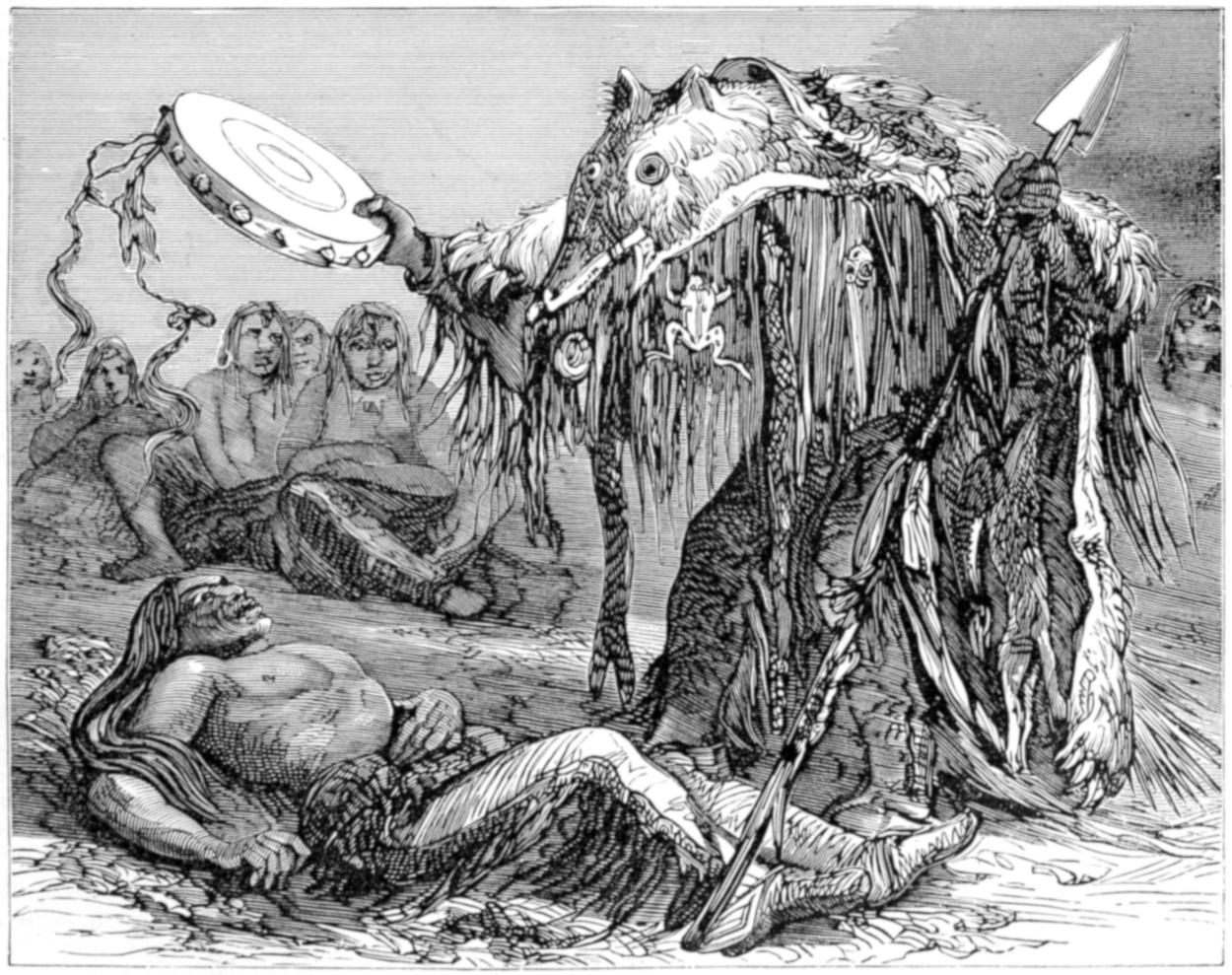
(2.) THE MEDICINE MAN AT WORK.
(See page 1309.)
This completed the first part of the ceremony.
In the next act, a pile of boughs
covered with a cloth lay in front of the evil
stone, and the chief Midé summoned all the
initiated. They formed a procession of men,
women, and children, and walked round the
lodge, each stooping over the cloth as he
passed, and looking at it. The second time
they stooped closer, and the third time they
were seized with convulsive movements as
they approached the cloth, and each ejected
from the mouth a little yellow shell upon the
cloth. By the ejection of the shell (which
typifies the sinful nature of man) the convulsions
are healed, and, after going once more
round the lodge, each performer takes one of
the shells and places it in the medicine bag.
The last scene was a general feast, and
gifts of amulets and charms presented by the
chief Midés to the child.
One of the most pleasing traits in the
character of these tribes is the strong religious
feeling which pervades the general
tenor of their lives, and which has raised
them above the rank of mere savages. However
imperfect may be their ideas on this
subject, they are not idolaters, and give all
their worship, either directly or indirectly,
to one Great Spirit, whose aid and protection
they continually invoke.
They believe in future existence and a
future recompense according to their character
in this life. Whatever their superstitions
and ignorance, the mysteries enveloping
their belief, there is running clearly
through them all, these great doctrines accepted
by the civilized Christian races.
To the Great Spirit they ascribe the possession
of all the necessaries and pleasures
of life, and to him they offer their prayers and
return their thanks on almost every occasion.
For example, the bisons, on which many of
the tribes depend for food, clothing, and lodging,
are held to be direct gifts of the Great
Spirit to the red men, and asked for accordingly.
The same is the case with the maize,
or Indian corn, and religious ceremonies are
held both at the planting and at the harvest
time.
Tobacco is placed in the same category,
and the smoke of the plant is considered to
be a sort of incense, which is offered to the
Great Spirit whenever a pipe is lighted, one
wreath of smoke being blown silently to
each quarter of the heavens, and to the sun,
as an acknowledgment that the tobacco is a
gift of the Great Spirit. Indeed, to the Indian
mind there is something peculiarly
sacred about tobacco smoke, probably on account
of the soothing, and at the same time
exhilarating, properties which have caused
its use to extend to every portion of the
globe.
Every religious ceremony is begun and
ended with the pipe; war is declared, volunteers
enlisted, negotiations conducted, and
peace concluded, by its means. The character
of the pipe varies with the occasion,
the most valued being the sacred calumet, or
medicine pipe, by which are settled the great
questions of war and peace.
Among the Cree Indians the calumet is
borne by a man who is solemnly elected to
the office, and who has to pay rather dearly
for the honor, from fifteen to twenty horses
being the usual fee which each pipe bearer
presents to his predecessor on receiving
the insignia of office. These, however, are
of considerable intrinsic value. They include
a bear skin, on which he lays the pipe-stem
when uncovered, a beautifully painted
skin tent, in which he is expected to reside,
a medicine rattle of singular virtue, a food
bowl, and other articles so numerous that
two horses are needed to carry them.
During his term of office, the pipe bearer
is as sacred as the calumet itself. He always
sits on the right side of the lodge, and no
one may pass between him and the fire. He
is not even allowed to cut his own food, but
this is done by his wives, and the food placed
in the official bowl which has just been mentioned.
The pipe, with its innumerable
wrappers, hangs outside the lodge, and is
finally enclosed in a large bag, embroidered
with the most brilliant colors which native
art can furnish.
When it is uncovered, great ceremony is
shown. No matter how severe may be the
weather,—sometimes far below zero,—the
bearer begins his operations by removing all
his garments with the exception of his cloth,
and then pours upon a burning coal some
fragrant gum, which fills the place with
smoke. He then carefully removes the different
wrappers, fills the bowl with tobacco,
and blows the smoke to the four points of the
compass, to the sky, and to the earth, at each
puff uttering a prayer to the Great Spirit for
assistance in war against all enemies, and
for bison and corn from all quarters. The
pipe is replaced with similar ceremonies.
No woman is allowed to see it, and if during
the beginning of the ceremony a single word
is spoken, it is looked upon as a very bad
omen, and all the ceremony has to be begun
again.
The bowl of the calumet is made of a peculiar
stone, found, I believe, only in one
place in the world, namely, in the Great
Pipe-stone Quarry. This is situated in the
Côteau des Prairies, about three hundred
miles west of the Falls of St. Anthony, on
the southern summit of the dividing ridge
between the Minnesota and Missouri rivers,
in the very middle of the Sioux territory.
On this sacred spot the Great Spirit is
said to have stood in the ancient times,
and to have called together all the Indian
nations. He broke from the rock a piece
of stone, moulded it in his hands into a
huge pipe bowl, and smoked it toward the
four quarters of the compass. Then he told
them that the ground was sacred, and that
no weapon of war should be raised in it, for
the red stone was their flesh, and belonged
equally to them all. At the last whiff of the
pipe the Great Spirit disappeared in the
cloud, and the whole ground was melted, and
became polished as at the present time.
In consequence of this legend, the Indians
have the greatest reverence for this place.
They will not allow any white man to touch
the stone, or even to approach the place, if
they can keep him away, saying that the
stone is their flesh, and that if a white man
takes the red men’s flesh, “a hole will be
made in their flesh, and the blood will never
stop running.”
Even the natives themselves never take a
piece without asking permission of the Great
Spirit, depositing tobacco in the hole whence
they dug it, and promising that it shall be
made into a pipe. When Mr. Catlin succeeded
in reaching this sacred spot, one of
the chief obstacles lay in the fact that a native
had once given a piece of the red stone
to a white man in order to be made into a
pipe, and he had made it into a dish, thereby
offending the Great Spirit, and “making
the heart of the Indians sick.”
Mr. Catlin’s opinion is, that the red pipes,
found among almost every tribe of Indians
on the continent, were obtained at this place.
His reasons are that every tribe he visited
alleged this as their source; and furthermore,
the stone from which they are made
is different from any mineral yet discovered
in America or Europe. He expresses the
conviction substantiated by striking proof
that the various tribes had for centuries
visited this quarry, laying aside the war
club and scalping knife, and smoking together
in amity upon this neutral ground
by command, as they thought, of the Great
Spirit.
This stone is of a soft, creamy red color,
rather variable in point of tint, and taking
a peculiar polish. It has been analyzed, and
is said to be a kind of steatite. It is cut into
various fanciful shapes, those shown in the
illustration on the next page being ordinary
examples, though in some cases the bowls
are adorned with figures of men and various
animals. Some of these pipe heads have
two bowls, one in front of the other.
These bowls are fitted with stems worthy
of their sacred character. They are generally
made of the stalk of the young ash, and
are often adorned in the most elaborate manner.
They are mostly flat, and sometimes
are twisted spirally and perforated with open
patterns in such a way that the observer
cannot but marvel how the aperture for the
smoke is made. After all, the mode of boring
is simple enough. As every one knows
who has cut a young ash sapling, the centre
is occupied with pith. This is easily burned
out with a hot wire, or bored out with a
piece of hard wood, and the aperture is completed.
Afterward the wood is cut away on two
sides, so as to leave only a flat stem, with
the bore occupying the centre. The perforated
patterns are next cut at either side
of the bore, being carefully kept clear of it;
and if the stem be then softened in boiling
water, it can be made to assume almost any
shape. One valued but rather rare form is a
screw, or spiral, and several of the pipes in
Mr. Catlin’s collection have this form.
The stems are very seldom left bare, but
are almost invariably decorated with colored
porcupine quills, woven into various patterns,
sometimes representing the forms of men
and animals. The calumet is always decorated
with a row of eagle feathers, sometimes
stained scarlet, and being tufted at
their ends with slight plumes of hair.
Indeed, this portion of the calumet is formed
on exactly the same principle as the headdress
of the chief, of which a drawing is
given on page 1277. An example of this
kind of pipe is shown in the upper figure, on
page 1315. Many pipes, instead of feathers,
have long tufts of hair dyed scarlet. This
hair is taken either from the tail of a white
horse or that of a white bison, as in the
lower figure of the same illustration. The
woodpecker furnishes many ornaments for
these pipes, and sometimes the stem passes
through the preserved skin of a bird, or
through that of a particularly beautiful ermine.
But whatever may be the ornament
of a medicine pipe, it is always the very best
and most valuable that can be procured.
The stem of the pipe varies from two to four
feet.
The natives do not restrict themselves to
tobacco, but smoke many narcotic vegetables,
whether leaves, roots, or bark. These are
generally mixed with tobacco, and go by the
general name of k’neck-k’neck.
The custom of sacrifice obtains among all
Indian tribes and is performed in various
ways and upon many occasions. Cruel as
the Indian is reputed to be, none of the
tribes, except the Pawnees, have ever made
human sacrifices; and these many years
since abandoned the inhuman custom.
Their offerings to the Great Spirit must
consist of the best of their possessions: the
choicest piece of buffalo meat, the finest
arrow, the most costly piece of cloth, the
favorite horse or dog, and sometimes their
own fingers. Such offerings are erected
over the great medicine lodge in the centre
of the village. When Mr. Catlin was among
the Mandans there was placed there beside
other gifts a beautiful skin of a buffalo,
the history of which he gives as follows:—“A
few weeks since a party of Mandans
returned from the mouth of the Yellow
Stone with information that a party of
Blackfeet were there on business with the
American Fur Company, and that they had
with them a white buffalo robe. Such a
robe is a great curiosity, even in the country
of buffaloes, and will always command
an incredible price. Being the most costly
article in the region it is usually converted
into a sacrifice, being offered to the Great
Spirit as the rarest and most acceptable gift
that can be procured. Among the vast
herds of buffaloes there is not one in a
hundred thousand, perhaps, that is white;
and when such is obtained it is considered
a great medicine or mystery.
“Receiving the intelligence above mentioned
the chiefs convened in council and
deliberated on the propriety of procuring
this valuable robe. At the close of their
deliberation eight men were fitted out on
eight of their best horses, who took from
the Fur Company’s store, on the credit of
the chief, goods exceeding the value of the
horses. They arrived in due time, made
the purchase, and leaving their horses and
all the goods carried, returned on foot,
bringing the coveted robe, which was regarded
as vastly curious and containing (as
they express it) something of the Great
Spirit. This wonderful anomaly lay several
days in the chief’s lodge, till public curiosity
was gratified; then it was taken by the high
priests, and with a great deal of ceremony
consecrated and raised on the top of a long
pole over the medicine lodge, where it
stands and will stand as an offering to the
Great Spirit, until it decays and falls to the
ground.”
CHAPTER CXXXIX. THE NORTH AMERICAN INDIANS— Continued . SOCIAL LIFE.
MARRIAGE — AN ENTERPRISING BRIDEGROOM, AND HIS SUDDEN ELEVATION TO RANK — TREATMENT OF
WOMEN — TREATMENT OF CHILDREN — PORTRAIT OF PSHAN-SHAW — OF INDIAN BOY — THE CRADLE — THE
FLAT-HEADED TRIBES — AFFECTION OF THE MOTHERS — THE COUCH OF MOURNING — ABANDONING
THE SICK AND OLD — DANCES OF THE TRIBES — GAMES — THE SPEAR AND RING
GAME — PAGESSAN, OR THE BOWL GAME — THE BALL PLAY — THE BALL DANCE — STARTING THE
GAME, AND EXCITING SCENES — THE WOMEN’S BALL PLAY — HORSE-RACING — CANOE-MAKING — THE
CANOE RACE — PRIMITIVE SAILS — SWIMMING — THE LEAPING ROCK — QUILL ORNAMENTS — BARK-BITING — WIGWAMS — MUSIC — PLEDGE
OF FIDELITY — DISPOSAL OF THE DEAD — BURIAL
OF BLACKBIRD — REFLECTIONS UPON CHARACTER AND DESTINY OF THE INDIANS.
The ordinary social life of these interesting
tribes now comes before us. As to marriage,
there is little to distinguish it from
the same ceremony among other uncivilized
tribes, the girl being in fact purchased from
her father, and her affections not necessarily,
though generally, considered. A man may
have as many wives as he can afford to keep,
and when he can purchase four or five, their
labor in the field is worth even more to the
household than his exertions in the hunting
field.
Mr. Catlin relates one rather amusing
wedding.
There was a young lad, the son of a chief,
whom his father started in life with a handsome
wigwam, or tent, nine horses, and
many other valuable presents. On receiving
these presents, the young man immediately
conceived a plan by which he could
perform an act which would be unique. He
went to one of the chiefs, and asked for the
hand of his daughter, promising in return
two horses, a gun, and several pounds of
tobacco. The marriage was fixed for a certain
day, but the transaction was to be kept
a profound secret until the proper time.
Having settled the business, he went to
three other chiefs, and made exactly the
same bargain with each of them, and imposed
silence equally upon all.
On the appointed day, he announced to
the tribe that he was to be married at a certain
hour. The people assembled, but no
one knew who was to be the bride, while
each of the four fathers stood proudly by his
daughter, inwardly exulting that he alone
was in the secret. Presently the young
bridegroom advanced to the chief to whom
he had made the first offer, and gave him,
according to his promise, the two horses,
the gun, and the tobacco. The other three
fathers immediately sprang forward, each
denouncing the whole affair, and saying that
the offer was made to his daughter, and to
his alone. In the midst of great confusion,
which was partially quelled by the chiefs
and doctors, the young bridegroom addressed
the assembly, saying that he had promised
each of the claimants two horses, a gun, and
a certain amount of tobacco in exchange for
his daughter, and that he expected them to
fulfil their part of the contract. There was
no gainsaying the argument, and in the sight
of the admiring spectators, he delivered the
stipulated price into the hands of the parents,
and led off his four brides, two in
each hand, to his wigwam.
The action was so bold, and so perfectly
unique, that the doctors immediately determined
that a lad of nineteen who could act
in this manner must have a very strong
medicine, and was worthy to be ranked
among themselves. So they at once installed
him a member of their mystery,
thereby placing him on a level with the
greatest of the tribe, and by that bold coup
the lad raised himself from a mere untried
warrior to the height of native ambition,
namely, a seat in the Council, and a voice in
the policy of the tribe.
The Indian women are the slaves of their
husbands. They have to perform all the
domestic duties and drudgeries of the tribe,
and are never allowed to unite in their
religious ceremonies or amusements.
That the reader may form a better idea of
the appearance and dress of the women, I
have given on the preceding page the portrait
of a beautiful girl of the Riccarees
(a part of the Pawnee tribe), whose name
is Pshan-shaw (the Sweet-scented Grass).
“The inner garment, which is like a frock,
is entire in one piece, and tastefully ornamented
with embroidery and beads. A
row of elk’s teeth passes across the breast,
and a robe of young buffalo’s skin, elaborately
embroidered, is gracefully thrown
over her shoulders, and hangs down to the
ground behind her.”
On the same page the reader may find, as
illustrative of Indian childhood, a portrait
of the grandson of a chief of the Blackfeet, a
boy of six years of age. He is represented
at full length, with bow and quiver slung,
and his robe of raccoon skin thrown over
his shoulder. This young chief, his father
dying, was twice stolen by the Crows, and
twice recaptured by the Blackfeet, and then
placed in the care of a Mr. M’Kenzie until
he should be old enough to assume the
chieftainship of his tribe, or be able to defend
himself against his foes.
The Indian mothers do not have many
children, possibly owing to the early age at
which they marry. For example, the ages
of the four brides just mentioned ranged
from twelve to fifteen. Two or three is the
average, and a family of five is considered
quite a large one.
The children are carried about much in
the same way as those of the Araucanians.
A sort of cradle is made by bandaging the
infant to a flat board, the feet resting on a
broad hoop that passes over the end of the
cradle. Another hoop passes over the face
of the child, and to it are hung sundry little
toys and charms; the one for the amusement
of the infant, and the other for its
preservation through the many perils of
infantile life. When the mother carries the
child, she hangs the cradle on her back by
means of a broad strap that passes over her
forehead. Both the cradle and band are
ornamented with the most brilliant colors
which native art can furnish, and are embroidered
in various patterns with dyed porcupine
quills.
Among the tribes which inhabit the banks
of the Columbia River, and a considerable
tract that lies contiguous to it, the cradle is
put to a singular use, which has earned for
the tribes the general title of Flat-heads.
To the upper part of the cradle is fastened
a piece of board, which lies on the child’s
forehead. To the other end of the board are
fastened two strings, which pass round the
foot or sides of the cradle. As soon as the
infant is laid on its back, the upper board is
brought over its forehead, and fastened down
by the strings. Every day the pressure is
increased, until at last the head is so flattened
that a straight line can be drawn from
the crown of the head to the nose. One of
these cradles with a child undergoing this
process of head flattening, is illustrated
below. The mother’s head is a type of its
permanent effect.
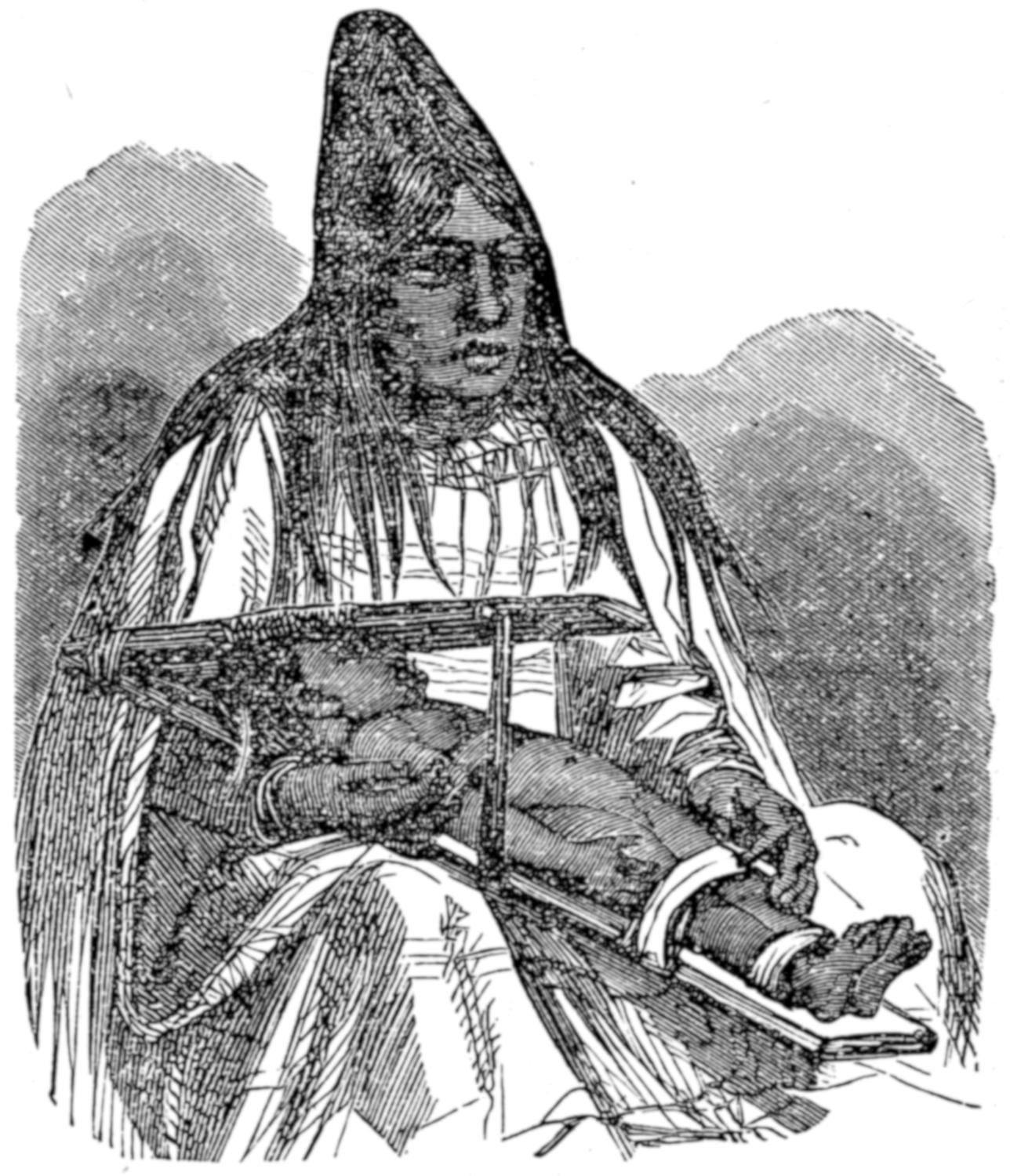
THE FLAT-HEADED WOMAN.
This is perhaps the most extraordinary of
all the fashionable distortions of the human
body, and the wasp waist of an European
belle, the distorted leg of the female Carib,
and even the cramped foot of the Chinese
beauty, appear insignificant when compared
with the flattened head of a Chinnook or
Klick-a-tack Indian. Mr. Catlin states that
this custom was one far more extended than
is the case at present, and that even the
Choctaw and Chickasaw tribes of Mississippi
and Alabama were accustomed to flatten
their heads, their burial-places affording incontrovertible
evidence that such must
have been the case, and at no very distant
date.
The reader, especially if he dabble in phrenology,
might well imagine that such a
practice must act injuriously upon the mental
capacities of those who are subjected to
it. Let us, for example, fancy a skull which
has been so ruthlessly compressed that it
only measures an inch and a half, or at the
most two inches, in depth, at the back; that
it is in consequence much elongated, and
forced outward at the sides, so that it is
nearly half as wide again as it would have
been if it had been permitted to assume its
normal form. The hair, combed down in
one place, and expanding in others, would
seem to have its natural capabilities much
altered, even if not in many cases destroyed.
Yet those who have mixed with the Flat-headed
tribes say that the intellect is in no
way disturbed, much less injured, and that
those members of the tribe who have escaped
the flattening process are in no way
intellectually superior to those who have
undergone it. Indeed, as Mr. P. Kane
observes, in his “Wanderings of an Artist,”
the Chinnooks despise those who retain the
original shape of their heads. They always
select their slaves from the round-headed
tribes, the flattened head being the sign of
freedom.
There is another point about the head
flattening which deserves attention. Seeing
that it is begun almost in the same hour
that the infant is born, and is continued for
eight months to a year or more, it might
naturally be imagined that it would cause
considerable pain to the child, and in many
cases be dangerous to life. This, however,
is not the case; and that it should not be so
is one of the many proofs of the extent to
which the human frame may be distorted
without permanent injury. Mr. Kane’s remarks
are as follows:—
“It might be supposed, from the extent
to which this is carried, that the operation
would be attended with great suffering to
the infant, but I have never heard the infants
crying or moaning, although I have
seen the eyes seemingly starting out of the
sockets from the great pressure. But on the
contrary, when the lashings were removed,
I have noticed them cry until they were replaced.
From the apparent dulness of the
children while under pressure, I should imagine
that a state of torpor or insensibility
is induced, and that the return to consciousness
occasioned by its removal must be naturally
followed by the sense of pain.”
Should a child die before it is old enough
to be released from the cradle, the mother
is not released from her maternal duties,
but, on the contrary, continues to perform
them as assiduously as if the little creature
were living.
After the child is buried, she makes a
“mourning-cradle,” i. e. in the place which
the child had formerly occupied she places
a large bundle of black feathers, by way of
representative of the deceased infant, and
treats it in all respects as if the little one
still occupied the cradle. She carries it on
her back wherever she goes, and when she
rests, stands it upright against a tree or the
side of the hut, and talks to it as if to a living
child. This custom is continued for at
least a year, and in many cases is extended
even beyond that period. And, though a
bereaved mother may be so poor as scarcely
to have sufficient clothing for herself, she
will contrive to decorate the cradle of her
lost child with the appropriate ornaments.
As a rule, the North American Indians
are affectionate parents. Mr. Catlin mentions
an instance where he had painted a
portrait of a married woman, the daughter
of a chief. Some time afterward she died,
and the father, happening to see and recognize
the portrait of his lost daughter, offered
ten horses—an enormous price for an
American Indian to pay. Of course the
portrait was presented to him at once.
Parental affection is fully reciprocated
by the children, and the greatest respect
paid by the younger to the elder men. Yet
we find even among them, as among so
many tribes which lead a semi-nomad existence,
the custom of abandoning the sick
and aged when they are obliged to make a
forced march of any distance.
This is generally done at the instance of
the victims themselves, who say that they
are old and useless, and can be only an encumbrance
to the rest of the tribe. Accordingly,
a rude shelter is formed of a bison
hide stretched over four upright rods, under
which the sick man is laid; a basin of
water and some food are placed by his side;
and he is left to perish, if not by privation
or disease, by the ranging flocks of wolves
that roam the prairies.
We will now pass to a more agreeable
phase in the life of these tribes, and take a
glance at their dances and games.
It has been the prevalent impression that
the Indian is taciturn, unsocial, and morose.
Mr. Catlin, whose testimony cannot be impeached,
takes considerable pains to correct
this opinion; and states as the result of his
travels among the Indian tribes, that “they
are a far more talkative and conversational
race than can easily be seen in the civilized
world. No one can look into the wigwams of
these people, or into any little momentary
group of them, without being at once struck
with the conviction that small talk, garrulity,
story-telling and amusements, are leading
passions with them.” To watch their games,
and hear their shouts of exultation, in any
of their villages, to sit down in their lodges
and listen to their jokes, repartee, anecdote
and laughter, would effectually banish this
erroneous opinion so generally held in regard
to the Red Men. With no anxieties for
the future—no necessities goading them, it
is natural that they should be a merry people,
and most of their life be spent in sports
and games.
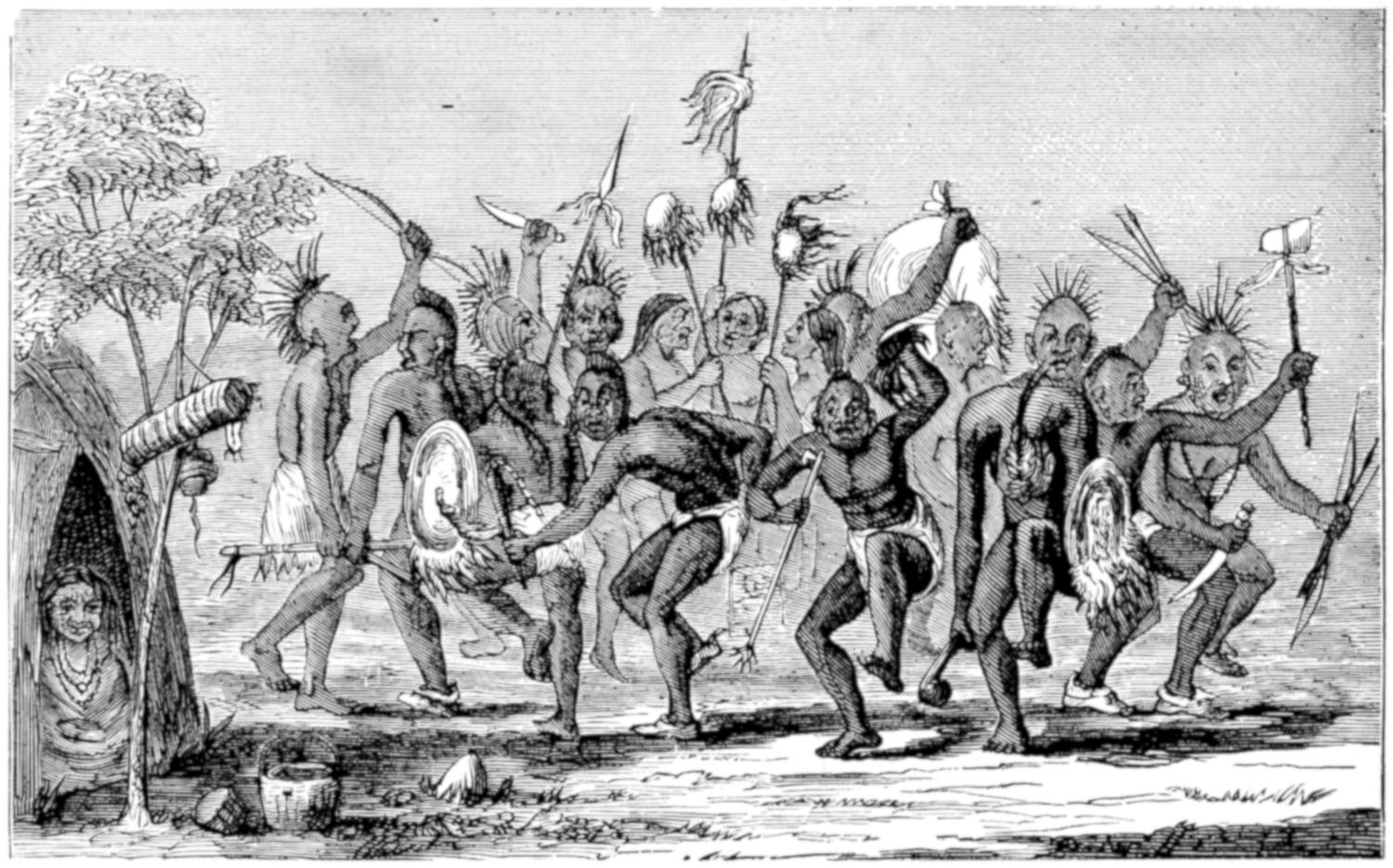
(2.) DANCE TO THE MEDICINE OF THE BRAVE.
(See page 1323.)
The Indian fondness for amusement is
shown in the great variety of their dances,
most of which are very fanciful and picturesque,
though some of them have a religious
significance. There are the ball-play
dance, pipe dance, buffalo and scalp dances
(already described), beggar’s, bear, and dog
dances. But the most pleasing of all are the
eagle dance, dance of the braves which is
peculiarly attractive, and the green corn and
snow-shoe dances. The latter is exceedingly
picturesque, and the artist has represented
it on the preceding page.
Before the first snow shoe hunt, the
Indians always perform a dance by way of
thanksgiving to the Great Spirit for sending
the snow which will enable them to live in
plenty so long as it lasts. Several spears are
stuck upright in the snow covered ground,
on one of which are tied a pair of snow shoes,
and on the others sundry sacred feathers and
similar objects. The dancers, clad in hunting
dress, and wearing snow shoes, go round
and round the spears, imitating the while
all the movements of the chase, and singing
a song of thanksgiving.
Nearly all the tribes, however remote
from each other, have a season of festivity
annually, when the ears of corn are large
enough for eating. Green corn is regarded
a great luxury, and is dealt out with most
improvident profusion—the festivities lasting
eight or ten days. The whole tribe feast
and surfeit upon it so long as it lasts, making
sacrifices, singing songs of thanksgiving
to the Great Spirit, and celebrating the green
corn dance. Every occupation is suspended
during these festivities, and all unite in the
carnival of gluttony and merriment. Mr.
Catlin thus describes this dance:—“At the
time when the corn is thought to be nearly
ready for use, several of the old women, who
have fields or patches of corn (the men disdain
such degrading occupations as cultivating
the field or garden), are appointed by
the medicine men to examine the cornfields
at sunrise every day, and bring to the council
house several ears of corn, which they
must on no account break open or look into.
When the doctors, from their examination,
decide that the corn is suitable, they send
criers to proclaim to every part of the village
or tribe that the Great Spirit has been kind,
and they must meet next day to return
thanks to Him. In the midst of the assembled
tribe, a kettle filled with corn is hung
over a fire. While this corn is being boiled,
four medicine men, each with a stalk of corn
in one hand and a rattle in the other, their
bodies painted with white clay, dance around
it chanting a thanksgiving to the Great
Spirit, to whom the corn is to be offered. In
a more extended circle around them, a number
of warriors dance, joining in the same
song. During this scene, wooden bowls are
laid upon the ground, in which the feast is
to be dealt out.”
When the doctors decide that the corn
is sufficiently boiled, the dance assumes
a different form, and a new song is sung,
the doctors in the meantime placing the
corn on a scaffold of sticks built over the
fire, where it is consumed. This fire is then
removed, the ashes are all buried, and a new
fire is originated on the same spot, and in
the same way as by the Hottentots, described
on page 100. Then corn is boiled
for the feast, at which the doctors and warriors
are seated. An unlimited license is
given to the whole tribe, who mingle excess
and amusement until the fields of corn are
stripped, or it has become too hard for eating.
The dance of the braves is beautiful and
exciting in the highest degree:—“At intervals
the dancers stop, and one of them
steps into the ring and vociferates as loudly
as possible the feats of bravery which he has
performed during his life.... He boasts of
the scalps he has taken, and reproduces the
motions and actions of the scenes in which
his exploits were performed. When his
boasting is concluded, all assent to the truth
of his story, and express their approval by
the guttural ‘waugh!’ Then the dance
commences again. At the next interval
another makes his boast, and so another
and another, till all have given a narrative
of their heroic deeds, and proved their
right to be associated with the braves of the
nation.”
The dog dance, though a favorite with the
Sioux, is not an attractive one.
The hearts and livers of two or more slain
dogs are placed entire and uncooked upon
two crotches, about as high as a man’s head,
and are cut into strips so as to hang down.
The dance then commences, which consists
in each one proclaiming his exploits in loud,
almost deafening gutturals and yells. At
the same time the dancers, two at a time,
move up to the stake, and bite off a piece of
the heart and swallow it. All this is done
without losing step or interrupting the harmony
of their voices. The significance of
the dance is that none can share in it but
the braves who can boast that they have
killed their foe in battle and swallowed a
piece of his heart.
Among the Sacs and Foxes there are several
singular dances, besides some already
mentioned, viz: the slave dance (a very curious
one), dance to the Berdashe, which is an
amusing scene, and dance to the medicine of
the brave. There is a tender and beautiful lesson
conveyed in this latter dance. In the
illustration of it on page 1322, a party of Sac
warriors are represented as returned victorious
from battle, with the scalps they have
taken as trophies. Having lost one of their
party, they appear and dance in front of his
wigwam fifteen days in succession, about an
hour each day, the widow having hung his
medicine bag on a green bush, which she
erects before her door, and under which she
sits and cries whilst the warriors dance and
brandish the scalps they have taken. At
the same time they recount the heroic exploits
of their fallen comrade, to solace the
grief of his widow, and they throw her presents
as they dance before her, that she may
be kept from poverty and suffering.
There is little in these dances that resembles
the “light fantastic toe” and giddy
maze of the dance among the civilized. The
former consist very much of jumps and
starts—oftentimes the most grotesque, and
even violent exertions—united with songs
and yells, sometimes deafening by their
sound or fearful by the wildness and intense
excitement that are manifested.
To a looker on not familiar with the peculiar
significance of these displays, they
seem only a series of uncouth and meaningless
motions and distortions, accompanied
with harsh sounds, all forming a strange,
almost frightful medley. Yet Mr. Catlin
says “every dance has its peculiar step and
every step has its meaning. Every dance
has also its peculiar song, which is so intricate
and mysterious oftentimes, that not
one in ten of the young men who are singing
know the meaning of the songs. None
but medicine men are allowed to understand
them.” There are dances and songs,
however, not so intricate, which are understood
and participated in by all the tribe.
The beating of drums, the yells, stamping,
and bellowing, the noisy demonstrations
forming so great a part of Indian
amusements, will remind the reader of similar
manifestations among some of the African
tribes, recorded in the first part of this
work.
The game which is perhaps the most popular
and widely spread is almost unintelligible
to an uninstructed bystander. Its title
is Tchung-chee, that being the name of the
spear which will be presently described. It
is played with a ring about three inches in
diameter, made of bone or wood wrapped
with cord, and a slight spear, on which are
several little projections of leather. The
players roll the ring along the ground, and
as it is about to fall, project the spear so
that, as the ring falls, it may receive within
it one of the pieces of leather. If it
does so, the player scores one or more
points, according to the particular projection
which is caught in the ring, and the
mode in which it flies.
Another variation of this game, called
Al-kol-lock, has the spear without the leathern
projections, but in their stead six colored
beads are fixed inside the ring. At
each end of the smooth clay course, which
is about fifty feet in length, a slight barrier
is erected. The players bowl the ring from
one end of the course, run after it, and as it
falls after striking the barrier, throw their
spears as described above, the points being
reckoned according to the color of the bead
which lies on them.
The absorption of the players in this
game is beyond description. They will play
at it all day, gamble away their horses, their
tents, their clothes, and, when they have lost
all their property, will stake themselves, the
loser becoming the slave of the winner.
Another game, called Pagessan, or the
bowl game, is very popular, though it is a
sedentary one, and lacks the graceful action
that gives so great a charm to the preceding
game. It is played with a wooden bowl,
containing a number of pieces of wood
carved into various forms; some, which we
may call the pieces, having round pedestals
on which to stand, and others, which we will
term the pawns, being round, and painted
on one side and plain on the other. The
players take the bowl alternately, give it a
shake, and set it in a hole in the ground.
The contents are then examined, and the
points are scored according to the number
of pieces which stand on their pedestals. If
the pawn has its colored side upward, the
player scores one point; if it has the plain
side uppermost, he deducts a point from his
score. The position of the pawns is entirely
a question of chance, but considerable
skill is exerted in getting the pieces to stand
on their pedestals.
The game which is most characteristic of
the American Indians is the celebrated ball
game, a modification of which has been introduced
into England under the name of
La Crosse. The principle on which it is
played is exactly that of foot-ball and hockey,
namely, the driving of a ball through a goal
defended by the opposite party. We will
first take the game as it is played by the
Choctaws. The reader will find it illustrated
on page 1311.
A ball is carefully made of white willow
wood, and ornamented with curious designs
drawn upon it with a hot iron. The ball-sticks,
or racquets, are much like our own
racquets, but with larger and more slender
handles, and with a very much smaller
hoop. Each player carries two of these
sticks, one in each hand. The dress of the
players is very simple, being reduced to
the waist-cloth, a tail made of white horsehair
or quills, and a mane of dyed horsehair
round the neck. The belt by which the tail
is sustained may be as highly ornamented as
possible, and the player may paint himself
as brilliantly as he likes, but no other article
of clothing is allowed, not even moccasins
on the feet.
On the evening of the appointed day, the
two parties repair to the ground where the
goals have been already set up, some two
hundred yards apart, and there perform the
ball-play dance by torchlight. Exactly in
the middle between the goals, where the
ball is to be started, sit four old medicine
men, singing and beating their drums, while
the players are clustered round their respective
goals, singing at the top of their
voices, and rattling their ball-sticks together.
This dance goes on during the
whole of the night, so that the players are
totally deprived of rest—a very bad preparation,
as one would think, for the severe
exertion of the ensuing day. All the bets
are made on this night, the article staked,
such as knives, blankets, guns, cooking
utensils, tobacco, and even horses and dogs,
being placed in the custody of the stakeholders,
who sit by them and watch them all
night.
About nine o’clock on the next morning
the play begins. The four medicine men,
with the ball in their custody, seat themselves
as before, midway between the goals,
while the players arrange themselves for the
attack and defence. At a given signal, the
ball is flung high in the air, and as it falls,
the two opposing sets of players converge
upon it. As there are often several hundred
players on each side, it may be imagined
that the scene is a most animated one.
“In these desperate struggles for the ball,”
writes Mr. Catlin “where hundreds are running
together, and leaping actually over each
other’s heads, and darting between their adversaries’
legs, tripping, and throwing, and
foiling each other in every possible manner,
and every voice raised to its highest key, in
shrill yelps and barks, there are rapid successions
of feats and incidents that astonish
and amuse far beyond the conception of any
one who has not had the singular good
luck to witness them.
“In these struggles, every mode is used
that can be devised to oppose the progress of
the foremost, who is likely to get the ball;
and these obstructions often meet desperate
individual resistance, which terminates in a
violent scuffle, and sometimes in fisticuffs.
Then their sticks are dropped, and the
parties are unmolested, whilst they are settling
it between themselves, except by a
general stampedo, to which those are subject
who are down, if the ball happen to pass in
their direction. Every weapon, by a rule of
all ball players, is laid by in the respective
encampments, and no man is allowed to go
for one; so that the sudden broils that take
place on the ground are presumed to be as
suddenly settled without any probability of
much personal injury, and no one is allowed
to interfere in any way with the contentious
individuals.
“There are times when the ball gets to
the ground, and such a confused mass is
rushing together around it, and knocking
their sticks together, without a possibility
of any one getting or seeing it for the dust
that they raise, that the spectator loses his
strength, and everything but his senses; when
the condensed mass of ball sticks and shins
and bloody noses is carried around the different
parts of the ground, for a quarter of an
hour at a time, without any one of the masses
being able to see the ball, which they are
often scuffling for several minutes after it has
been thrown off and played over another
part of the ground.
“For each time that the ball was passed
between the goals of either party, one was
counted for their game, and they halted for
about one minute; when the ball was again
started by the judges of the play, and a
similar struggle ensued; and so on until
the successful party arrived at 100, which
was the limit of the play, and accomplished
at an hour’s sun, when they took the
stakes.”
In this game the players are not allowed
to strike the ball with their sticks, or catch
it in their hands; though to do so between
the netted ends of the sticks, and then to run
away with it, is a feat which each player
tries his best to accomplish. Ball-play
among the Sioux is exactly the same in
principle as that of the Choctaws, but the
players only carry one stick, which is wielded
with both hands.
Sometimes the men are kind enough to
indulge the women with a ball-play, and to
present a quantity of goods as prizes, hanging
them across a horizontal pole, in order
to stimulate the players by the sight. Such
inferior beings as women are not, however,
allowed to use the ball and racquet of their
superiors, the men, but play with a couple
of small bags filled with sand, and attached
to each other by means of a string about
eighteen inches in length. Each of the
players is furnished with two slight sticks,
about two feet in length, and with these
sticks they dexterously catch the sand bags,
and fling them toward the goals. The
women play with quite as much enthusiasm
as the men, and the game often assumes the
appearance of a general battle rather than of
a pastime.
Since the introduction of horses, the
American Indians have become very fond
of horse racing, and bet so recklessly on the
speed of their animals that they often lose
everything which they possess. In these
races neither the horse nor the rider are
allowed to be costumed in any way, not even
a saddle or a girth being allowed. They
also have boat races, in which the spectators
take as much interest as those who witness
the Oxford and Cambridge races. The
canoes are mostly propelled by one man
only.
The canoes are of various forms and materials,
according to the tribe to which they
belong. For example, the Mandans have
an odd, circular vessel, made from a bison
hide, stretched over a wooden framework.
This is called a “bull boat,” and is propelled
in a very singular manner. A woman is
the usual paddler, and she stands or kneels
with her face toward the direction in which
she intends to proceed, and, thrusting the
paddle into the water as far forward as she
can reach, draws it smartly toward her,
and thus propels the boat with considerable
speed.
On one occasion, Mr. Catlin and two companions
were desirous of crossing the river,
and were packed into one of these bull boats
by the wife of a chief. She then went into
the water, and swam across the river, towing
the boat after her. As, however, she neared
the opposite bank, a number of young girls
surrounded the canoe, took it into their own
management, and kept it in mid-stream, until
the passengers, utterly powerless in such a
craft, ransomed themselves with bead necklaces
and other decorations. Then there is
another kind of canoe, which is simply a
hollowed tree-trunk, and which is graphically
called a “dug-out.” No very particular
care is taken about the shaping of this
simple boat, which is more like a punt than
a canoe.
The best and most characteristic form of
native canoe is that which is made of the
bark of the birch tree. The mode of making
these canoes is briefly as follows. Canoe
building is a work in which both sexes take
a part. The men first select the largest and
finest birch trees, with the smoothest skins,
and strip off large pieces of the bark. The
women then take charge of the bark, and,
while it is still fresh and moist, clean and
scrape it as if it were leather, and then sew
the pieces together, so as to make the “cloak”
of the future canoe.
While the women are at this work, the
men are busily preparing the skeleton of
the canoe. This is made of the white cedar,
the ribs being cut and scraped until they
are quite thin and light, and held in their
places by smaller cross-pieces, and a long
thin piece of wood, which runs round the
entire edge of the boat, and is, in fact, the
chief support of the canoe. This is technically
called the “maître.” No nails are
used, the whole of the junctions being effected
by means of thongs of bass, obtained
from the inner bark of the white cedar.
The skeleton being completed, it is laid
upon the cloak, which is brought over the
ribs, firmly lashed to the “maître,” and then
by degrees brought into its proper shape.
A strengthening piece, called the “faux
maître,” is next tied along the whole of the
gunwale in order to protect it from injury,
and the interior is lined with cedar boards,
scarcely thicker than pasteboard. When
the canoe is finished and dry, the holes
through which the lashings have passed, as
well as all the junctions of the bark, are
carefully stopped with pitch obtained from
the pine or fir-tree, and the weaker parts of
the bark are also strengthened with a coat
of pitch.
The bark canoe of the Chippeways is,
unquestionably, the most beautiful model of
all the water crafts ever invented. It is
usually made complete, from the rind of one
birch tree, and so ingeniously formed and
put together, that it is water-tight, and will
ride upon the water with singular grace and
swiftness.
These canoes are wonderfully light, as indeed
is necessary for the navigation of the
rivers. The many rapids would effectually
prevent a boat from passing up the river,
were it not for the plan called “portage.”
When the canoe arrives at the foot of a
rapid, it is taken ashore, the crew land, take
all the goods out of the canoe, and carry
them to the opposite side of the rapid. They
then go back for the canoe itself, launch it
in the smooth water above the rapid, and
load it, and proceed on their journey. The
figure at the head of page 1322 will give the
reader a good idea of the form of the birch
bark canoe.
These vessels can be propelled with wonderful
speed, as they sit on the surface like
ducks, and, when empty, scarcely draw two
inches of water. The number of paddlers
varies according to the size of the boat, but
the course is regulated by the two who sit
respectively in the bow and stern, whom we
may for convenience call the “bow” and
“stroke.” It is the duty of the “bow” to
look carefully ahead for any rocks or any
other obstacles, and, by movements well
understood, to indicate their presence to the
“stroke,” who, with a sweep of the paddle,
brings the canoe round in the direction indicated
by the “bow.”
The canoes which are used in races are
made of birch bark, and are almost always
of small size—so small, indeed, that a man
can easily carry his canoe on his head from
his house to the water’s edge, and then
launch it without assistance. Mr. Catlin
gives a very animated description of a canoe
race, the competitors being accompanied by
large canoes, full of their respective friends,
who yell encouragements to the antagonists,
fire guns in the air, and render the scene a
singularly exciting one, even to a stranger.
Toward the right hand of the illustration
which depicts the canoe race, on the following
page, the reader may see a curious mode
of propelling canoes, which is often adopted
when there is no necessity for speed and the
wind is favorable. The man who acts as
“bow” stands up in the front of the canoe,
extends a robe or a blanket in his two hands,
and then he presses the two other corners
at the bottom of the boat with his feet.
The robe thus becomes an extemporized
sail, of which the man is the mast. In this
manner a canoe is often carried for a considerable
distance, to the great relief of the
paddlers.
An European would instantly upset the
fragile canoe if he tried to stand erect in it;
but the natives are absolutely perfect masters
of their little vessels, and seem to move
about in them as easily and firmly as if on
dry land. They will load a canoe within an
inch and a half of the water’s edge, and
paddle it for a whole day, without dreaming
of danger. And an accomplished canoe man
will take a fish spear in his hand, place a
foot on each gunwale of the boat, and, propelled
by a friend in the stern of the boat,
dart down rapids, spearing fish as he shoots
along, hauling the struggling fish out of the
water, and shaking them into the boat behind
him.
Among most Indian tribes, when mourning
for the death of relatives, the women are
required to cut their hair entirely off, and
the period of mourning is until it has grown
to its former length. As long tresses are so
highly valued by most of the tribes this is
no small sacrifice. But long hair being of
much more importance to the men they cut
off only a lock or two, to indicate grief or
affliction for their departed kindred.
There is a game which has in it somewhat
of a religious aspect. On the border of the
Great Pipe-stone Quarry a solitary rock
rises from the plain. It resembles a large
pillar, being only a few feet in diameter,
though more than thirty feet in height. It
is situated within a short distance from the
edge of the precipice, and the Indians who
come to procure red stone for their pipes
often try to leap upon it and back again.
The mere leap to the rock is comparatively
easy, but there are two terrible dangers
which threaten the leaper. In the first
place, the small, flat surface of the rock is so
polished and smooth, that if the leaper
should exert too much power, he must slip
off, and be killed on the sharp rocks below.
Should he retain his foot-hold he has still a
difficult task in regaining the spot whence
he sprang, as he can take no run, and the
slippery surface of the rock affords but a
slight fulcrum from which he can take his
spring.
Before an Indian essays this terrible leap,
he offers up many prayers to the Great
Spirit for help and protection, and he has at
all events the satisfaction of knowing that,
if he should fail, his body will be buried in
the sacred ground of the nation. Those
who succeed leave an arrow sticking in the
rock, and have a right to boast of it at every
public meeting when they are called upon
to speak. No man would dare to boast of
this feat without having performed it, as he
would at once be challenged to visit the
Leaping Rock and to point out his arrow.
If the reader will refer to the figure of
the canoe on page 1322, he will see that its
sides are decorated with a pattern. This is
made by fastening dyed porcupine quills to
the sides of the little vessel. Porcupine
quills are used very largely for ornaments,
and, even though they have been partly
superseded by beads, are still in use for decorating
the dresses and utensils of the natives.
These quills are never so long or thick as
those of the porcupine of the Old World, and
are naturally white or gray, so that they can
easily take any desired dye. They are first
sorted very carefully into their different sizes,
the largest rarely exceeding three inches in
length, while the smaller are quite thread-like,
and can be passed through the eye of an
ordinary needle. Both ends are sharp.
When the native artist desires to produce a
pattern, the design is first drawn on the right
side of the bark or leather; the two ends of
the quill are then pushed through the fabric,
and fastened on the wrong side, the quill
acting both as needle and thread.
Perhaps the most ingenious mode of making
ornaments is that which is practised by
the Ojibbeway women, and called Bark-biting.
The following description of this
curious art is given by Mr. Kohl in his
“Kitchi-Gami:”—
“This is an art which the squaws chiefly
practise in spring, in their sugar plantations.
Still, they do not all understand it, and only
a few are really talented. I heard that a
very celebrated bark-biter resided at the
other side of St. Mary’s River, in Canada,
and that another, of the name of Angélique
Marte, lived in our cataract village. Naturally,
I set out at once to visit the latter.
“Extraordinary geniuses must usually be
sought here, as in Paris, on the fifth floor, or
in some remote faubourg. Our road to Angélique
Marte led us past the little cluster of
houses representing our village far into the
desert. We came to morasses, and had to
leap from stone to stone. Between large
masses of scattered granite block, the remains
of the missiles which the Indians say
Menaboju and his father hurled at each other
in the battle they fought here, we at length
found the half-decayed birch-hut of our
pagan artiste, who herself was living in it
like a hermit.
“The surrounding landscape seemed better
adapted for a renversi than for an atélier.
When we preferred our request for some
specimen of her tooth carving, she told us
that all her hopes as regarded her art were
concentrated in one tooth. At least she had
only one in her upper jaw properly useful
for this operation. She began, however,
immediately selecting proper pieces of bark,
peeling off the thin skin, and doubling up
the pieces, which she thrust between her
teeth.
“As she took up one piece after the other,
and went through the operation very rapidly,
one artistic production after the other fell
from her lips. We unfolded the bark, and
found on one the figure of a young girl, on
another a bouquet of flowers, on a third a
tomahawk, with all its accessories, very correctly
designed, as well as several other
objects. The bark is not bitten into holes,
but only pressed with the teeth, so that, when
the designs are held up, they resemble, to
some extent, those pretty porcelain transparencies
made as light-screens.”
The mode of constructing the wigwam is
very much the same among the various
tribes. Generally it is made of dressed buffalo
skins sewed together and arranged in
the form of a tent, with a score or more of
poles about twenty-five feet in height, as a
support, and with an opening at the apex
for the escape of smoke or the admission of
light. The Crows, however, excel all others
in the style of their lodge. They dress the
skins almost as white as linen, embellish
them with porcupine quills, and paint them
in various ways so as to make their tents
exceedingly beautiful and picturesque.
The Indian lodges may be removed in a
few minutes. The taking down and the
transportation is the work of the squaws.
A tribe will generally remove six or eight
times in a summer in order to find good
hunting grounds among the herds of buffaloes.
The Indian tribes judging from their musical
instruments, have little taste or skill in
music. These are very rude, and consist
of rattles, drums, the mystery whistle, war
whistle and deer skin flute. The war whistle
is from six to nine inches in length, made
of the bone of the deer’s or turkey’s leg, with
porcupine quills wound around it. The
chief wears this to battle under his dress.
It has only two notes—one, produced by
blowing into one end of it, is shrill, and is
the summons to battle; and the other sounds
a retreat. Even in the noise of battle and
amid the cries and yells of their fierce conflicts,
this little instrument can be distinctly
heard.
The chief pledge of friendship among
these tribes, is a dog feast. If we consider
that the dog is an object of special affection
with the Indians; that he is more valued by
them than anywhere else on the globe;—we
can understand the significance of this
feast. This sacrifice of what is dearest to
them is therefore the very strongest evidence
of friendship. On their coats of arms,
on the rocks, they carve the image of the
dog, and everywhere and always, he is the
emblem of fidelity. Accordingly, to ratify
friendship, to give the most unquestionable
proof of honor and devotion, the Indian will
take his beloved companion of the chase and
wigwam, and offer it as the sacrifice to hospitality
and affection.
These feasts are conducted in the most
solemn and impressive manner, as if with
the conviction that the pledge of friendship
is a sacred thing. Those were tender words
which Catlin gives at the conclusion of an
Indian chief’s address to him and other
white guests, to whom such a feast had been
given: “we offer you to-day not the best we
have got, for we have plenty of good buffalo
hump and marrow—but we give you our
hearts in this feast—we have killed our
faithful dogs to feed you, and the Great
Spirit will seal our friendship. I have no
more to say.”
We come now to consider the customs of
the Indians in regard to death and the disposal
of the dead.
The Mandans take the body of the deceased,
clothe it in his best robes and ornaments,
furnish it with food, pipes, tobacco, and arrows,
and wrap it up in skins previously
soaked in water, so as to render them pliant,
and cause them to exclude the air as much
as possible. The body is then placed upon a
slight scaffold, some seven feet in height, and
left to decay. In process of time, the scaffold
gives way and falls, when the relations of the
deceased bury the whole of the remains,
with the exception of the skull, which they
place on the ground, forming circles of a hundred
or more, all with the faces looking inward,
and all resting on fresh bunches of
herbs. In the centre of each circle is a little
mound, on which are placed the skulls of
a male and female bison, and on the mound
is planted a long pole, on which hang sundry
“medicine” articles, which are supposed to
aid in guarding the remains of the dead.
No people are more fond of swimming
than the Indians, the youth of both sexes
learning the art at a very early age. Such
knowledge is indispensable to them, especially
liable as they are to accidents with their
light canoes, and in their marches compelled
to cross the widest rivers. The squaws
will fasten their children to their backs, and
easily cross any river that lies in their way.
The Indian mode of swimming, however,
is quite different from ours. They do not
make a horizontal stroke outward from the
chin, but throw the body alternately from
one side to the other, and raising one arm
out of the water, reach as far forward as
possible, while the other arm having made
the same motion, goes down and becomes a
propelling power. And this, though an apparently
awkward, is yet a most effective
mode of swimming, and less likely to be
attended with injury to the chest, or with
fatigue.
The relatives constantly visit the skull
circles, and the women may often be seen
sitting by the skulls of their dead children
for hours together, going on with their work,
and talking to the dead skull as if it were a
living child. And, when tired, they will lie
down with their arms encircling the skull,
and sleep there as if in company with the
child itself. The Sioux and many other tribes
lodge their dead in the branches or crotches
of trees, enveloped in skins, and always with
a wooden dish hanging near the head of the
corpse, for the purpose, doubtless, to enable
it to quench its thirst on the long journey
they suppose awaits it after death. The
Chinnooks place them in canoes, which,
together with the warrior’s utensils accompanying
the dead, are so shattered as to be
useless.
The most singular funeral of which a record
has been preserved was that of Blackbird, an
Omaha chief. The artist has reproduced
the strange scene on page 1341.
Upon the bank of the Missouri, and in the
district over which he ruled, there is a lofty
bluff, the top of which can be seen for a vast
distance on every side. When the chief
found that he was dying, he ordered that he
should be placed on the back of his favorite
war horse, and buried on the top of the bluff.
The request was carried out to the letter.
On the appointed day, the whole tribe,
together with a vast concourse of spectators,
repaired to the bluff, leaving an open space
in the middle, where the chief was to be
buried.
Presently, the body of the dead chief was
borne up the sides of the bluff, and after him
was led his war horse, a noble milk-white
steed which he had valued exceedingly.
When the funeral procession reached the top
of the bluff, the dead chief was clothed in full
panoply of war, the feather plumes on his
head, the strung bow, quiver, arrows, shield,
and medicine bag slung on his back, his
scalps, which no other man might take, hung
to his horse’s bridle and to his weapons, and
his favorite spear in his hand. He was also
furnished with food and drink, to sustain him
in his passage to the spirit land, and with
his pipe and filled tobacco pouch, flint, and
steel, so that he might solace himself with
the luxury of smoking.
This done, he was mounted on the back of
his horse, and all the chiefs advanced in
their turn to make their farewell speeches to
their dead leader. Each, after delivering
his address, rubbed his right hand with vermilion,
pressed it against the white coat of
the horse, and left there the scarlet imprint
of his hand. Then began the burial. The
warriors brought in their hands pieces of
turf, and with them began to raise a huge
mound, in the middle of which the chief and
his horse were to be enclosed. One by one
they placed their turves around the feet of
the devoted horse, and so, by degrees, they
built the mound over the animal while yet
alive.
The mound, when completed, rose high
above the head of the chief thus strangely
buried in its centre, and there he and his
horse were left to decay together. On the
top of the mound a cedar post was erected;
and this mound has been, ever since it was
built, a familiar landmark to all the surrounding
country. This green, flower spotted
mound is visited by great numbers of
travellers, both white and red. The former
ascend the bluff partly out of curiosity to see
so strange a tomb, and partly for the sake of
the magnificent view from its summit, while
the latter visit it for the sake of paying their
respects at the burial-place of one of their
most renowned chiefs and greatest medicine
men.
The custom of burying wives and other
victims with the deceased husband seems
now to be extinct among the North American
tribes, but such an event has happened
within comparatively late years. There was
a Nachez chief, called the Stung Serpent,
who died; and as he was the head chief of the
tribe, a considerable number of victims were
devoted for sacrifice. The French, however,
remonstrated, and induced the friends
of the dead chief to limit the number to
eight or ten. Among them was a beautiful
girl, who, though not his wife, had loved him
greatly, and desired to share his grave.
On the day appointed a procession was
formed, in which the victims were led in
great state, accompanied by eight relatives
of the deceased, who were to act as executioners,
and who bore the fatal cord, the deer-skin
which was thrown over the head of the
victim, the tobacco pills which were to be
taken before the ceremony, and the other
implements required. When they were all
placed at the grave, the chief wife made a
speech, in which she took leave of her children;
and the victims, after being strangled,
were deposited in the grave.
As the object of this work is to present the
manners and customs of tribes and races
in their primitive state, and not those semi-civilized,
it will be enough to merely introduce
the names of the Cherokees, Choctaws,
Creeks, Chickasaws, Senecas, Delawares, etc.
Nor is it necessary to consider those, now
extinct, that occupied the country when first
settled by white men. For the same general
characteristics, now presented, pertain to all
the North American races. The Indian
tribes are rapidly retreating or vanishing
before the steady, irresistible march of civilization,
and the growing grandeur of the
great Republic in North America. The line,
where the echoes of the Indian’s yell blends
with the shout of advancing pioneers and
the sound of the wood-chopper’s axe, is continually
moving westward. In a few years
we have seen it pass from the Mississippi
River, to the base of the Rocky Mountains.
The settler’s cabin is unceasingly encroaching
upon the wigwams of the Red Men.
With sadness, having smoothed the graves
of their fathers, and taken a last look of their
hunting grounds, they retreat before a power
which they vainly strive to resist. Pressed
backward in two centuries and a half, across
three-quarters of the continent, from Massachusetts
Bay almost to the Pacific, except
a few decaying remnants of tribes, their history
and doom cannot but awaken sympathy
for an unfortunate and overpowered race.
Even though we do not form our estimate
of the Indian from the romantic creations
of Cooper, every right-thinking person will
accord them the tribute of many qualities
that constitute a real grandeur of character.
Their marvellous bravery, their ardent rage,
their steadfast, fiery enthusiasm in the fight
or in the chase, their manly sports, their
grave, philosophic demeanor in the council,
their stern, stoical endurance in misfortune,
their disdain of death, are traits that have
given to the Indian a character unique and
noble, a character and history that the
annalist, poet, and novelist, have transferred
to their immortal pages, and over
which multitudes of old and young alike
have bent with eager, breathless interest.
As Mr. Mangin in his “Desert World” says:—“There
was poetry in their faith, in their
customs, in their language, at once laconic
and picturesque—and even in the names
they bestowed on each tribe, each chief and
warrior, on mountain and river. One can
hardly suppress a feeling of regret that so
much of wild romance and valor should
have been swept from the face of the earth,
unless we call to mind the shadow of the
picture—the Indian’s cruelty, perfidiousness
and savage lust. Even then, our humanity
revolts from the treatment to which he has
been subjected by the white man.” Tracked
and hunted like wild beasts, driven from their
hunting grounds and the territory of their
ancestors, imbruted by drink, decimated and
dying by epidemics and vices contracted
from white men, the poor Indians vainly
struggling to avert their doom of extermination
have elicited the sympathy and commiseration
of the civilized world. The theory
advocated in the preceding part of this work,
(see page 790), in regard to the decay and
extinction of savage races, does not forbid
regrets that such a people should have suffered
so grievously at the hands of the United
States Government, by the greed of its
agents, the frauds of traders and the fatal
contagion of the vices of a civilized people.
What with American rifles and American
whiskey, their extinction has been rapid,
and their doom certain.
These tribes, contending in a most unequal
strife with the forces of modern civilization,
more readily falling victims to the vices of
white men than accepting their virtues, are
entitled to the just consideration and protection
of the government, as its wards, from
whom, or their ancestors, have been taken
their soil and their homes.
It is gratifying to know that a more humane
policy is about being inaugurated,
and though the wrongs of the past may not be
redressed, that their rights in future may be
recognized and maintained. Major-General
Thomas, of the U. S. army, whose name and
history are the guarantee of candid and wise
judgment, says, in respect to an instance of
cold-blooded, unprovoked, unpunished outrage
upon an Indian boy (it is given only
as a representative fact of many more and
bitter wrongs):—“I see no better way than to
extend civil authority over the Indians and
enable them to appear as witnesses in all
cases affecting their own status and that
of the whites toward them. This is a fair
instance of the cause of the Indian troubles;
and until white murderers and robbers
of the Indians are punished, a large force of
troops will be necessary to protect peaceful
white settlers from Indian avengers.”
And Gen. Sherman, in whose opinion the
utmost confidence can be reposed, makes the
following indorsement to General Thomas’
view:—“This case illustrates the origin of
most of the Indian wars on the frontier. A
citizen may murder an Indian with impunity,
but if the Indian retaliate, war results, and
the United States must bear the expense.”
Here we have the secret of many of the
barbarities of the Indian tribes. Inflamed
and imbruted by the whiskey sold them, their
ignorance imposed upon by the greed of
traders and even government agents, having
little or no chance for securing justice in their
real or imagined injuries, there is certainly
some extenuation if this wild son of the forest
go forth with tomahawk and scalping knife,
as the self-appointed avenger of his own and
his people’s wrongs. This is not the place,
if there were room, for a thorough discussion
of the wrongs of the Red Men, but I cannot
forego the duty, in treating of the manners,
customs and character of tribes so interesting,
so noble and superior, by many traits, to
most savage races, of recording at the same
time, this tribute and testimony. It will
unquestionably be the verdict of the future,
as coming generations shall study the memorials
and character of the North American
Indians.[1]
CHAPTER CXL. THE ESQUIMAUX. APPEARANCE—DRESS—DWELLINGS.
APPEARANCE OF THE PEOPLE — THEIR COMPLEXION, AND DIFFICULTY OF SEEING IT — AN ESQUIMAUX
CHILD WASHED AND COMBED — BODILY STRENGTH — DRESS OF THE MEN — THE TAILED COAT — “MILLING”
BOOTS — DRESS OF THE WOMEN — THE LARGE HOOD AND BOOTS — THE TATTOO, AND
MODE OF PERFORMING IT — HAIR-DRESSING — PREPARING SKINS — THE SNOW HOUSES, AND MODE
OF BUILDING THEM — CAPTAIN LYON’S DESCRIPTION — INTERNAL ARRANGEMENTS OF THE HUT — ICE
AND BONE HOUSES — THE TUPIC, OR SUMMER DWELLING — FOOD OF THE ESQUIMAUX — A
WISE TRAVELLER.
We now come to those extraordinary people,
called by Europeans the Esquimaux
(their own name being Innuit), who, placed
amid perpetual ice and snow, have bent
those elements to their own purposes, and
pass as happy lives in their inclement country
as do the apparently more favored inhabitants
of the tropics amid their perpetual
verdure. Indeed, the Esquimaux has a perfect
yearning for his beloved country,
should he be away from it. Captain Hall
relates the circumstances attendant upon the
“death of Kudlago, a singularly intelligent
man, who had visited the United States, and
fully learned to appreciate the advantages
of the high civilization which he saw there.
But all his wishes were for home, and he
was taken back. As the ship neared his native
land, he fell ill and died, his last words
being the eager inquiry, ‘Do you see ice?
Do you see ice?’”
In appearance, the Esquimaux are a peculiar
people. Their stature is short, when
compared to that of an ordinary European,
the average being about five feet three
inches for the men, and two or three inches
less for the women.
The complexion is in some cases rather
dark, but, as a rule, is not much darker than
that of the inhabitants of Southern Europe.
It looks, however, many shades darker, in
consequence of the habits of the Esquimaux,
who never wash from their birth to their
death. It is not that they neglect their ablutions,
but the very idea of washing never
enters the mind of an Esquimaux, who,
unless he has met with white men, has not
even heard of such an operation. When,
however, an Esquimaux has been induced to
allow his skin to be cleansed, he is found to
lose many shades of his original darkness.
There is an amusing passage in the journal
of Captain Hall, given in his “Life with the
Esquimaux,” a work to which frequent reference
will be made in the next few pages.
“Kimnaloo has just been Americanized.
Captain B——’s good wife had made and
sent to her a pretty red dress, a necktie, mittens,
belt, &c.
“Mr. Rogers and I, at a suggestion from
me, thought it best to commence the change
of nationality with soap and water. The
process was slow, that of arriving at the
beautiful little girl, whom we at length
found, though deeply imbedded layer after
layer in dirt. Then came the task of making
her toilet. With a very coarse comb I
commenced to disentangle her hair. She
had but little, the back part from behind her
ears having been cut short off on account of
severe pains in her head. How patiently
she submitted to the worse than curry-comb
process I had to use! This was the first
time in her life that a comb had been put to
her head. Her hair was filled with moss,
seal and reindeer hairs, and many other
things, too numerous to call them all by
name. Poor little thing! Yet she was fat
and beautiful, the very picture of health.
Her cheeks were as red as the blown rose;
Nature’s vermilion was upon them.”
The skin is smooth, soft, and yet wonderfully
tough, with a sort of unctuous surface,
probably occasioned by the enormous amount
of oil and fat which forms the principal
part of their diet. The features are not
very pleasing, the face being broad, and the
cheek-bones so high that in many cases, if a
flat ruler were laid from cheek to cheek, it
would not touch the nose. As is the case
with the Chinese section of this vast race,
the eyes slope rather downward, and the
face is often covered with wrinkles to a wonderful
extent, extending from the eyes down
each cheek.
In bodily strength, the Esquimaux present
a great contrast to the Andamaners, who,
though short, are possessed of gigantic muscular
powers. Captain Lyon found that
the natives could not raise burdens that
were easily lifted by his sailors, whereas an
ordinary Andamaner is often a match for
two powerful sailors. The neck is strangely
thin and feeble, however well-proportioned
the chest may be, and it is a curious fact
that the Esquimaux are almost wholly ignorant
of running and jumping. There is but
little beard, and the hair is black, coarse,
straight, and lanky.
The general character of the dress is alike
in both sexes, so that at a little distance it
is not easy to tell whether the spectator be
looking at a man or a woman, both sexes
wearing trousers, and jackets with a large
hood, which can either be drawn over the
head or allowed to fall on the shoulders.
The jacket of the man is made something
like a broad-tailed dress coat, hanging behind
as far as the middle of the calf, and cut
away in front just below the waist. It is
mostly made of deer-hide, and the hood is
lined and turned up with white fur, which
forms a curious contrast to the dark, broad
face within it. The edge of the coat is generally
bordered with a lighter-colored fur,
and is often decorated with little strips of
fur hanging like tassels.
Under this coat is another of similar
shape, but of lighter material, and having
the furry side turned inward. The legs are
clothed in two pairs of trousers, the outer
pair being often made of strips of differently
colored deer-skins arranged in parallel
stripes, and having the fur outward, while
the other has the fur inward, as is the case
with the coats. They only come as low as
the knee, so that the joint is often frost-bitten;
but nothing can induce the Esquimaux
to outrage fashion by adding a couple of
inches to the garment.
The boots are made of the same materials
as the other parts of the dress. In winter
time the Esquimaux wear first a pair of
boots with the fur inward, then slippers of
soft seal-skin so prepared as to be waterproof,
then another pair of boots, and, lastly,
strong seal-skin shoes. In the summer time
one pair of boots is sufficient protection.
The soles are made of thicker material than
the rest of the garment, and it is the duty of
the women to keep the soles flexible by
chewing or “milling” them, an operation
which consumes a considerable part of their
time.
Mittens are made of various skins, the
hairy side being inward; and if the wearer
be engaged in fishing, he uses mittens made
of watertight seal-skin. During the summer,
light dresses are worn, made of the skins of
ducks, with the feathers inward. Over all
there is sometimes a very thin and light
waterproof garment made of the intestines
of the walrus.
The jackets worn by the women have a
much longer and narrower tail than those of
the men, and a tolerably deep flap in front.
The hood is of enormous size, being used as
a cradle as well as a hood, in which a child
of nearly three years old is carried. The
trousers, or rather leggings, are tied to a
girdle that passes round the waist, and are
so cut away at the top, that they allow a
portion of the skin to be visible between
them and the sides of the jacket, an exposure
from which the wearers do not seem to suffer.
The oddest article of the female apparel
is, however, the boots, which more resemble
sacks or buckets than boots, and are
simply tied to the girdle by a broad strap
that passes up the front of the leg. The
boots are used as receptacles for all kinds of
portable property, food included, and in consequence
impart a most singular walk, or
rather waddle, to the wearers, who are
obliged to keep their feet widely apart, and,
as they walk, to swing one foot round the
other, rather than to use the ordinary mode
of walking.
The Esquimaux women use the tattoo,
called by them the kakeen, and in some
places cover their limbs and a considerable
portion of their persons with various patterns.
There are some who mark the forehead,
cheeks, and chin, these being mostly
proof that the woman is married, though
they are sometimes worn by unmarried
females. The mode in which the kakeen
is performed is amusingly told by Captain
Lyon, who courageously submitted to the
operation.
“My curiosity determined me on seeing
how the kakeen was performed, and I accordingly
put myself into the hands of Mrs.
Kettle, whom I had adopted as my amama,
or mother.
“Having furnished her with a fine needle,
she tore with her teeth a thread off a deer’s
sinew, and thus prepared the sewing apparatus.
She then, without a possibility of darkening
her hands beyond their standard
color, passed her fingers under the bottom
of the stove pot, from whence she collected
a quantity of soot. With this, together with
a little oil and much saliva, she soon made a
good mixture, and taking a small piece of
whalebone well blackened, she then drew a
variety of figures about my arm, differing, as
I easily saw, from those with which she herself
was marked; and, calling her housemates,
they all enjoyed a good laugh at the
figures, which perhaps conveyed some meaning
that I could not fathom.
“I had, however, only determined on a few
strokes, so that her trouble was in some
measure thrown away. She commenced her
work by blackening the thread with soot,
and taking a pretty deep but short stitch in
my skin, carefully pressing her thumb on
the wound as the thread passed through it,
and beginning each stitch at the place
where the last had ceased. My flesh being
tough, she got on but slowly, and, having
broken one needle in trying to force it
through, I thought fit, when she had completed
forty stitches, or about two inches, to
allow her to desist; then, rubbing the part
with oil in order to stanch the little blood
which appeared, she finished the operation.
I could now form an idea of the price paid
by the Esquimaux females for their embellishments,
which for a time occasion a slight
inflammation and some degree of pain. The
color which the kakeen assumes when the
skin heals is of the same light blue as we see
on the marked arms of seamen.”
The dress of the children is alike in both
sexes. None at all is worn until the infant
is nearly three years old, up to which age it
is kept naked in its mother’s hood. A dress
is then made of fawn skin, having the
jacket, trousers, boots, and hood in one
piece, the only opening being at the back.
Into this odd dress the child is put, and the
opening being tied up with a string, the
operation of dressing is completed. The
hood or cap is generally made in the shape
of the fawn’s head, so that the little Esquimaux
has the strangest appearance imaginable,
and scarcely looks like a human being.
As to the hair, the men cut it short over
the forehead, and allow the side locks to
grow to their full length, tying them, when
very long, over the top of the head in a large
knot projecting over the forehead. The
women part the hair in the middle, and
make it into two large tails. A piece of
bone or wood is introduced into each of
the tails by way of a stiffener, and they
are then bound spirally with a narrow strip
of deer-hide, with the fur outward. Those
women who can afford such a luxury pass
the hair through two brass rings, which are
then pressed as closely as possible to the
head.
The whole of the operations of preparing
the skin and making the clothes are done by
the women, the men having completed their
task when they have killed the animals.
The fat, blood, and oil are first sucked from
the skins, and the women then scrape the
inner surface with an ingenious instrument,
sometimes furnished with teeth, and at
other times plain, like blunt knives. The
skins are then rubbed and kneaded, and are
dried by being stretched by pegs to the
ground in summer, and laced over a hoop in
winter and exposed to the heat of the lamp,
which constitutes the only fire of the Esquimaux.
Bird skins are prepared in a somewhat
similar fashion, and are stripped from the
bodies of the birds in a marvellously expeditious
manner. With their knife, which exactly
resembles a cheese cutter, they make
an incision round the head and round the
outer joint of each wing. The cut part is
then seized between the teeth, and with a
pull and a jerk the skin comes off in one
piece, and turned inside out. These skins
are considered a great luxury by the Esquimaux,
who bite and suck off the fat which
adheres liberally to them.
In a country where the thermometer remains
many degrees below zero for many
months together, and in which ice and snow
are the prevailing features, it is evident that
houses cannot be built after the fashion of
those in most countries. No trees can
grow there, so that wooden houses are out
of the question, and in a land where ice has
been known to choke up the iron flue of a
stove always kept burning neither clay
could be made into bricks, nor stones cemented
with mortar. There is only one
substance of which houses can be made,
and this is frozen water, either in the form
of snow or ice, the former being the usual
material. These snow houses, called igloos,
are made in a dome-like shape, and are
built with a rapidity that is perfectly astonishing.
The reader will find the form and
mode of building these houses illustrated
on page 1327.
The general appearance of these strange
houses is thus described by Captain Lyon,
in his “Private Journal.” “Our astonishment
was unbounded, when, after creeping
through some long passages of snow, to
enter the different dwellings, we found ourselves
in a cluster of dome shaped edifices,
entirely constructed of snow, which, from
their recent erection, had not been sullied
by the smoke of the numerous lamps that
were burning, but admitted the light in
most delicate hues of verdigris green and
blue, according to the thickness of the slab
through which it passed.... There were
five clusters of huts, some having one, some
two, and others three domes, in which thirteen
families lived, each occupying a dome
or one side of it, according to their strength.
The whole number of people were twenty-one
men, twenty-five women, and eighteen
children, making a total of sixty-four.
“The entrance to the building was by a
hole about a yard in diameter, which led
through a low arched passage of sufficient
breadth for two to pass in a stooping posture,
and about sixteen feet in length;
another hole then presented itself, and led
through a similarly shaped but shorter passage,
having at its termination a round
opening about two feet across. Up this
hole we crept one step, and found ourselves
in a dome about seven feet in height, and as
many in diameter, from whence the three
dwelling-places with arched roofs were entered.
It must be observed that this is the
description of a large hut; the smaller
ones, containing one or two families, have
the domes somewhat differently arranged.
“Each dwelling might be averaged at
fourteen or sixteen feet in diameter, by six
or seven in height; but as snow alone was
used in their construction, and was always
at hand, it might be supposed that there
was no particular size, that being of course
at the option of the builder. The laying of
the arch was performed in such a manner
as would have satisfied the most regular
artist, the key piece on the top being a large
square slab. The blocks of snow used in
the buildings were from four to six inches
in thickness, and about a couple of feet in
length, carefully pared with a large knife.
Where two families occupied a dome, a seat
was raised either side two feet in height.
These raised places were used as beds, and
covered, in the first place, with whalebone,
sprigs of Andromeda, or pieces of seal-skin;
over these were spread deer-pelts and
deer-skin clothes, which had a very warm
appearance. The pelts were used as blankets,
and many of them had ornamental
fringes of leather sewed round their edges.
“Each dwelling-place was illuminated by
a broad piece of transparent fresh-water
ice, of about two feet in diameter, which
formed part of the roof, and was placed
over the door. These windows gave a most
pleasing light, free from glare, and something
like that which is thrown through
ground glass. We soon learned that the
building of a house was but the work of an
hour or two, and that a couple of men—one
to cut the slabs and another to lay them—were
sufficient laborers.
“For the support of the lamps and cooking
apparatus a mound of snow is erected
for each family; and when the master has
two wives or a mother, both have an independent
place, one at each end of the
bench.”
In the middle of the hut is erected a
slight scaffold, which supports a rudely
made net, and under the net is placed the
one essential piece of furniture of the house,
namely, the lamp. This is a very simple
contrivance. It is merely an oval shaped
dish of stone, round the edge of which is
arranged a long wick made of moss. Oil is
poured into it, and a quantity of blubber is
heaped in the centre of the lamp, so as to
keep up the supply. Over the lamp is hung
the cooking pot, the size of each being proportioned
to the rank of the possessor. It
sometimes happens that two wives occupy
the same hut. In this case, the chief or
“igloo-wife” has the large lamp and the
supporting scaffold, while the other has to
content herself with a little lamp and a
small pot, which she must support as she
can.
The value of the lamp is simply incalculable,
not so much for its use in cooking, as
the Esquimaux like meat raw quite as well
as cooked, but for its supply of warmth, for
the water which is obtained by melting
snow over it, and for its use in drying
clothes. All garments, the snow being first
beaten off them, are placed on the “dry-net”
over the lamp, where they are gradually
dried, and, after being chewed by the
women, are fit for wear again: otherwise
they become frozen quite hard, and are of
no more use than if they were made of ice.
Oil is supplied by chewing blubber, and the
women, who always perform the task, have
the curious knack of expressing the oil
without allowing a drop of moisture to mix
with it. In one minute a woman can obtain
enough oil to fill a lamp two feet in
length.
Sometimes, when snow is scarce, the igloo
is made of ice. The walls are formed of this
material, and are generally of an octagonal
form, the ice slabs being cemented together
with snow. The domed roof is usually made
of snow, but the tunnel, or passage to the interior,
is of ice. Such a house is, when first
made, so transparent that, even at the distance
of some paces, those who are within it
can be recognized through its walls.
It may seem strange that such materials
as snow and ice should be employed in the
construction of man’s dwelling-place, as
nothing seems more opposed to comfort; yet
these houses, instead of being cold, are so
warm that the inhabitants throw off the
greater part, and sometimes the whole, of
their clothes when within them; and the
bed of snow on which they recline is, when
covered with the proper amount of skins,
even warmer than an European feather
bed. In the summer time the Esquimaux
prefer the skin hut, or “tupic.” This is a
mere tent made of deer-skins thrown over
a few sticks, though the supports are sometimes
formed from the bones of whales.
The food of the Esquimaux is almost
wholly of an animal character. In the first
place, the country supplies scarcely any
vegetation; and, in the next place, an abundant
supply of animal food is required in order
to enable the inhabitants to withstand
the intense cold. The seal and the reindeer
form their favorite food, and in both
cases the fat is the part that is most highly
valued.
In the reindeer, the fat of the hinder quarters,
called by the Esquimaux “toodnoo,” is
the portion that is most valued. Captain
Hall, who very wisely lived as the Esquimaux
while staying with them, says that it
is as much superior to butter as is the best
butter to lard; and when the deer is in good
condition, the meat is so tender that a steak
almost falls to pieces if lifted by its edge.
Another part of the reindeer is almost as
valuable as the fat. This is the contents of
the deer’s paunch, eaten raw with slices of
raw venison. It has a slightly acid flavor,
like that of sorrel, and if the consumer were
not to know what he was eating, he would
be delighted with it.
This was the case with Captain Hall, while
partaking of a deer feast in an igloo. He
tried the deer flesh, and found it excellent;
he then took a morsel of the unknown substance,
and describes it as ambrosial. After
eating the greater part of it, he took it to the
light, and was horrified to find the nature of
the feast. However, he soon came to the
wise conclusion that epicurism of any kind
was nothing but the effect of education, and
that, in consequence, he would ignore his
previous prejudices on the subject, and eat
whatever the Esquimaux ate, and as they ate
it. As to the quantity consumed, neither he
nor any other white man would be a match
for an Esquimaux, who will consume nine
or ten pounds of meat at a sitting, and lie
leisurely on his back, being fed by his wife
with pieces of blubber when he is utterly
unable to help himself. An Esquimaux finds
a sort of intoxicating effect in utter repletion,
which stands him in the stead of fermented
liquors.
Putting aside the gourmandizing propensity
of the Esquimaux, Captain Hall found
that if he were to live with them, as he intended
to do, he must sooner or later come
to the same diet. He determined in making
a bold plunge, and eating whatever he saw
them eat. At first it was rather repugnant
to his feelings to eat a piece of raw meat
that had been carefully licked by a woman,
in order to free it from, hairs and other extraneous
matters. But he reflected that, if
he had not known of the licking, he would
not have discovered it from the flavor of the
meat, and he very wisely ignored the mode
in which it had been cleaned. Similarly,
fresh seal’s blood just drawn from the animal
seemed rather a strange kind of soup,
and the still warm entrails a remarkable
sort of after-dinner delicacy. But finding
that the Esquimaux considered them both
as very great dainties, he tried them, and pronounced
that the Esquimaux were perfectly
right, and that his preconceived ideas were
entirely wrong.
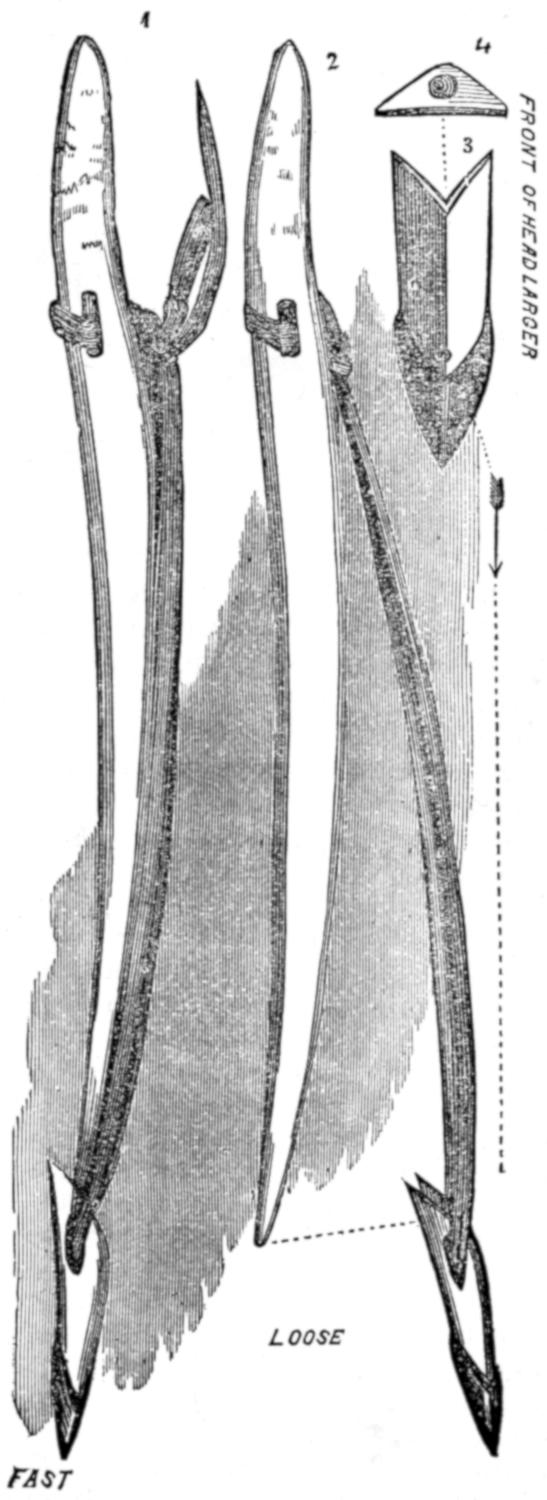
1 2 4
3 FRONT OF HEAD LARGER
LOOSE
FAST
HARPOON HEAD. (From my collection.)
(See page 1340)
CHAPTER CXLI. THE ESQUIMAUX— Continued . HUNTING—RELIGION—BURIAL.
MODES OF HUNTING — SEAL HUNTING IN THE SNOW — THE INFANT DECOY — THE SEAL’S IGLOO — AN
IVORY FLOAT — SEAL “TALK” — THE HARPOONS AND SPEARS — SPEARING THE WALRUS — THE
ICE RAFT — THE BOW AND ARROWS AND WRIST GUARD — DEER HUNTING — GROUSE SHOOTING — THE
WOLF AND FOX TRAPS — THE BIRD SLING — BEAR HUNTING — THE MEN’S AND WOMEN’S
BOATS — CONSTRUCTION OF THE KIA, AND MODE OF USING IT — AQUATIC FEATS — THE WOMEN’S
BOAT AND ITS USES — THE SLEDGE — THE VARIOUS RUNNERS — SLEDGE DOGS AND THEIR TRAINING — EXAMPLES
OF THEIR CLEVERNESS — BARBEKARK AND THE CAPELINS — MARRIAGE AND
EDUCATION OF CHILDREN — GAMES AND DANCING — RELIGION — THE ANGEKO AND HIS MYSTERIES — “IN
VINO VERITAS” — HONESTY — HOSPITALITY — DISPOSAL OF THE DEAD.
Depending wholly upon the products of the
chase for their food, the Esquimaux are most
accomplished hunters, and in their peculiar
way are simply unequalled by any other
people on earth. Take, for example, their
mode of seal catching. The reader is
doubtless aware that the seal, being a mammal,
breathes atmospheric air, and that in
consequence it cannot remain very long
under water, but is obliged to come up at
certain intervals for the purpose of breathing.
When it dives under the ice, it would
therefore be drowned did it not form for
itself certain breathing holes in the ice.
These are very small, not more than an
inch and a half, or at the most two inches,
in diameter, and do not penetrate through
the coating of snow that lies on the ice.
The hunter’s dog, which is specially
trained for this purpose, detects the breathing
hole, and the master then reverses his
harpoon, which has a long, spindle shaped
butt, and thrusts it through the snow in
search of the concealed hole, which often
lies under some two feet of snow. When
he has found it, he seats himself by the hole,
with his harpoon ready; and there he will
sit until he hears the blowing sound of the
seal, when he drives the harpoon into the
hole, and invariably secures his prey. This
is the more difficult, as, if the stroke be
wrong by even a quarter of an inch, the
seal will not be struck, and the man is often
wearied with waiting and need of sleep.
The patience with which the Esquimaux
hunter will watch a seal hole far surpasses
that of a cat at a mouse hole. Captain Hall
mentions one case, where an Esquimaux, a
notable seal hunter, actually sat watching a
seal hole for two and a half days and two
nights without either sleep or food. Considering
the nature of the climate, such a
feat as this is almost incredible. The poor
man, after all his trouble, failed to secure
the seal, but was not disheartened, and, after
taking some food, went off again to the seal
hole to renew his watch.
Some of the Esquimaux seal hunters use
a singularly ingenious instrument for enabling
them to detect the approach of the
animal. It consists of a very slender ivory
rod, about twelve inches in length, pointed
at one end, and having a round knob at the
other. It is about as thick as a crow quill.
When the hunter has found a seal hole, he
ties to the upper end a very fine thread
made of sinew, and lowers it into the seal
hole, where it is allowed to dangle by the
thread. When the seal comes to breathe, it
takes no notice of so small an object, but
rises as usual for air, pushing the little rod
before it. As soon as the hunter sees the
rod rise, he knows that the seal is there, and
drives his spear down the hole. Even a
larger float—if we may so call it—might
be unseen by the seal, but it would interfere
with the passage of the spear.
There is another mode of catching seals,
in which the young acts as a decoy for its
mother. The seal, when she is about to
produce her young, scratches away the ice
until she comes to the snow, which lies deep
upon it. She then scratches away a quantity
of the snow until she has made a dome-like
chamber, in form exactly like the snow hut
of the Esquimaux. The tunnel through the
ice is just large enough to allow the passage
of the seal, while the chamber is about five
feet in diameter, so that a tolerably large
platform of ice is left, on which the creature
can rest. Here its young is produced, and
here it remains until the sun melts away the
snow covering of the chamber, or igloo, as it
is called, by which time the young animal is
able to take care of itself.
At the proper season, the Esquimaux set
off in search of these seal igloos, and when
they are detected by the dogs, the hunter
flings himself on the snow, thus beating
down the roof of the igloo. He then thrusts
his sealing hook into the igloo, and drags
out the young seal. It is remarkable, by the
way, that the polar bear acts in precisely the
same manner, crushing down the walls of
the igloo, and dragging out the young one
with its paws.
When the Esquimaux has secured the
young seal, he ties a long line to one of the
hind flippers, and allows it to slip into the
sea through the tunnel, while he creeps into
the igloo with his hook, in hopes of catching
the mother as she comes to help her young
one. The Esquimaux always kill young
seals by putting the foot on their shoulders,
and pressing firmly down, so as to suffocate
it. This is done for the purpose of preserving
the blood.
Sometimes the seal hunter actually stalks
the wary animal on the ice. The seal has a
strange way of sleeping when lying on the
ice. It takes short naps of only a few
seconds’ duration, and between them raises
its head and looks round to see if any enemy
be approaching. The Esquimaux takes advantage
of this habit, and, lying down on the
ice, he waits for these short naps, and hitches
himself along the ice toward the animal,
looking himself very much like a seal as he
lies on the ice, covered with seal skin garments.
Whenever the seal raises its head,
the hunter stops, begins to paw with his
hands, and utters a curious droning monologue,
which is called “seal talk,” and is
supposed to act as a charm. Certain it is,
that the seal appears to be quite gratified by
the talk, is put off its guard, and allows the
hunter to approach near enough to make the
fatal stroke.
The same kind of “talk” is used when
the sealer goes out in his boat, and some of
the hunters are celebrated for the magical
power of their song. In seal hunting from
a boat, a different kind of harpoon is employed.
It is longer and slighter than that
which is used for ice hunting, and is furnished
with a float made of a leathern bag
inflated with air. This is fastened to the
shaft, and just below it one end of the harpoon
line is secured, the other end being
made fast to the head of the weapon.
When the seal is struck, the shaft is shaken
from the head, so that there is no danger of
its working the weapon out of the seal by its
leverage, and it acts as a drag, impeding the
movements of the animal, so that the hunter
is able to overtake it in his boat, and to
pierce it with another harpoon. When the
seal is dead, the float serves another purpose.
Seals, when killed in the water, almost invariably
sink so rapidly that they cannot be
secured. The float, however, remains at the
surface, so that the successful hunter has
only to paddle to it, take it into the canoe,
and haul the seal on board. Perhaps the
most curious part of the business lies in the
skill with which the hunter carries the seal
home. The boat in which he sits is entirely
covered with skin, except a small aperture
which admits his body, and yet he lays the
body of the seal upon this slight platform,
and manages to balance it as he paddles
homeward, regardless of the waves upon
which his light little canoe trembles like a
cork.
Of these boats we shall presently see
something, and will now merely look at the
weapons which are employed by the Esquimaux
in hunting.
It is worthy of remark that war is totally
unknown among the Esquimaux, who are
perhaps the only people in the world who
possess no war weapons, and have no desire
to do so. Generally, when a savage obtains
for the first time possession of fire-arms, he
uses them in warfare, and by the superiority
of his weapons raises himself to eminence.
The Esquimaux cares for none of these
things. He is essentially a family man, and
when he is fortunate enough to procure a
musket, he simply uses it for hunting purposes,
never wasting the precious powder
and lead upon the bodies of his fellow-men.
Of fame he is totally ignorant, except that
sort of local fame which is earned by skill in
hunting. He finds that all his energies are
required to procure food and clothing for his
household, and therefore he does not expend
them upon any other object.
The weapon which is to the Esquimaux
what the rifle is to the backwoodsman, the
boomerang to the Australian, the sword to
the Agageer, the lasso to the South American,
and the sumpitan to the Dyak, is the
harpoon, a weapon which undergoes various
modifications, according to the use to which
it is put, but is essentially the same in principle
throughout.
The first example is the typical harpoon.
It consists of a long wooden shaft, with a
float attached to it, as has already been described
on page 1339. Owing to the great
scarcity of wood in Esquimaux land, the
greater part being obtained from the casual
drift-wood that floats ashore from wrecks,
such a weapon is exceedingly valuable. The
shaft is generally made of a number of pieces
of wood lashed together in a most ingenious
fashion.
The barbed head is but loosely fitted to
the shaft, a hole in the base of the head receiving
a point at the end of the shaft. It is
held in its place by leathern thongs, so arranged
that, as soon as the wounded animal
darts away, the shaft is shaken from the head.
The arrangement of the leathern thongs
varies according to the kind of weapon.
The illustration on page 1337, shows the
head of the harpoon which is used for spearing
the walrus.
It is about nine inches in length, and is
made of ivory, either that of the walrus or
the narwhal, probably the former, as it partakes
of the curve of the walrus tooth. It
consists of two pieces, which we call, for
convenience’ sake the body and the head.
The upper part of the body is slightly
pointed and rounded, and is meant to be fixed
to the shaft of the harpoon. About an inch
and a half from the end two holes are bored,
through which is passed a double thong of
leather about as thick as a goose quill. Next
comes the head, which is a triangular and
deeply barbed piece of ivory, armed with a
thin, flat plate of iron, almost exactly like
the armature of the Bosjesman’s war arrow.
Through this head is bored a hole, and
through the hole passes the loop of the double
thong already mentioned. At the butt of
the head there is a hole, into which is fitted
the conical termination of the body.
By reference to the illustration, the reader
will easily comprehend the arrangement.
Fig. 1 shows the entire instrument, the head
fitted on the body, and held in its place by
the double thong. Fig. 2 shows the head
disjointed from the body. The reader will
now see what a perfect barb this instrument
forms. When the harpoon is hurled at the
walrus, the head penetrates through the
tough skin, and, becoming disjointed from
the body, sets at right angles across the little
wound which it made on entering, and
effectually prevents the weapon from being
withdrawn. Fig. 3 shows the upper view of
the head, and fig. 4 shows the hole at its
base, into which the conical end of the body
is loosely fitted.
The line attached to the shaft of this
harpoon is very long and of great strength,
and, when the hunter goes out to catch
walrus, is coiled round and round his neck in
many folds, very slightly tied together so as
to prevent the successive coils from being entangled
with one another. When the hunter
launches his harpoon with the right hand,
he with the left hand simultaneously jerks
the coils of rope off his neck, and throws
them after the harpoon. The jerk snaps the
slight ligatures, and the animal is “played”
like a salmon by an angler, until it is utterly
wearied with pain, loss of blood, and its
struggles to escape, and can be brought near
enough to receive the fatal wound from a
spear.
Casting off the rope in exact time is a most
important business, as several hunters who
have failed to do so have been caught in the
coils of the rope, dragged under the ice, and
there drowned. On the end of the harpoon
line is worked a loop, and, as soon as the
weapon is hurled, the hunter drives a spear
deeply into the ice, slips the loop over it, and
allows the walrus to struggle against the
elastic rope until it is quite tired. He then
hauls up the line until he has brought the
animal to the ice, snatches up his spear, and
with it inflicts a mortal wound. On the next
page the reader may find an illustration
showing the Esquimaux in his usual dress,
and engaged in walrus hunting.
One mode of employing this harpoon
against the walrus is singularly ingenious.
When the Esquimaux hunters see a number
of the animals sleeping on a sheet of ice,
they look out for an ice fragment small
enough to be moved, and yet large enough
to support several men. Paddling to the
ice, they lift their canoes upon it, bore holes
in it, and make their harpoon lines fast to
the holes. They then gently paddle the whole
piece of ice, men, canoes, and all, to the spot
where are lying the drowsy animals, who do
not suspect any danger from a piece of ice
floating by.
Having made their selection, the hunters
tell off two men to each walrus, and, at a
given signal, all the harpoons are hurled.
The whole herd instantly roll themselves
into the sea, the wounded animals being attached
to the piece of ice by the harpoon
lines. The hunters allow them to tow their
ice craft about until they are exhausted, when
they launch their canoes, and kill the animals
with their spears. As soon as the walrus
is dead, the hunters plug up the holes with
little pegs of ivory, for the purpose of preserving
the blood, which is so highly valued
by the Esquimaux.
The Esquimaux have another kind of
spear. The shaft is made of wood, but the
point and the barbed projections are of ivory.
This spear is chiefly used for catching fish,
and is flung by means of a throwing stick,
almost in the same manner as the spears of
the Australians. The throwing stick is made
of wood, flattish, and near one end has a hole,
into which the butt of the spear is passed.
This is altogether a much slighter and lighter
weapon than that which has been described.
Bows and arrows are also employed by
the Esquimaux. The former are made of
horn, bone, or wood, and are almost always
composed of several pieces lashed firmly together.
As is the case with the bows of the
North American tribes, the chief strength
is obtained, not so much from the material
of the bow, as from a vast number
of sinew strings which run down its back.
There are often a hundred or more of
these sinews, which are put on sufficiently
tight to give the bow a slight curvature
against the string. The shape of the bow
is rather peculiar. And though the weapon
is so powerful, it is seldom used at a greater
distance than twelve, or at most twenty
yards. The length of the bow is on an
average three feet six inches.
The arrows are extremely variable. Some
have wooden shafts tipped with bone, but
the shafts of the best specimens are half bone
and half wood, and the points are armed
with a little piece of iron. The arrows are
contained in a quiver, and the bow is kept
in a case. This quiver and bow-case are
generally made of seal skin, as being impervious
to wet, though they are frequently
made of other materials. My own specimen
is formed from the hide of the reindeer.
When the Esquimaux shoots, he always
holds his bow horizontally. The bow-string
is made of some fifteen or twenty sinew
strings, which are loosely twisted, but not
made into a cord.
The bow and arrows are chiefly used in
the capture of the reindeer and in shooting
rabbits, birds, and other small game. The
mode of deer hunting is very ingenious.
When the hunter sees some deer feeding on
the level plain, he takes his bow and arrows,
draws his hood well over his head, and
creeps as close as he can to the spot where
the deer are reposing. Here he begins to
bellow in imitation of the cry with which
the deer call each other, and thus attracts
the animals within the short distance at
which an Esquimaux archer shoots.
Even if he should not use the bellowing
call, he has only to lie patiently on the
ground to be sure that, sooner or later,
some of the deer will come and look at him.
They are most inquisitive animals, and when
they see any strange object, they cannot resist
satisfying their curiosity by inspecting
it. Providing the object of their curiosity
does not move after them, they approach in a
series of circles which they gradually narrow,
capering and tossing their heads capriciously,
and at last will come within a yard
or two of the motionless hunter, and so fall
a victim to the arrow which he has already
fitted to his bow.
Sometimes the deer hunters adopt an ingenious
ruse. Two of them walk near the
deer, and purposely show themselves. When
the animals’ attention is fixed upon them,
they walk slowly away, knowing that the
innate curiosity of the deer will induce
them to follow. They direct their course
past some stone or similar object, when one
of them quickly steps behind it, while the
other walks onward as before. The deer do
not notice that one of the men has disappeared,
and so follow the other, thus coming
within a yard or two of the deadly arrow.
The arrow is also used for shooting birds,
which are always killed when sitting. The
arctic grouse are killed in great numbers
by the arrow. They pack closely together,
so that an arrow shot at random among
them can scarcely avoid hitting one of them;
and the birds are so apathetic that, when
the missile falls among them, they only
fly a few yards further and then settle, so
that the hunter can pick up his arrow and
shoot it at them again, until he has shot the
greater number of the covey.
In order to save the wrist from the recoil
of the bow-string, the Esquimaux wears a
very ingenious guard, composed of several
pieces of bone tied together and fastened on
the wrist by a bone button and loop. The
pieces of bone are about four inches in
length. Below the wrist-guard, which is
shown on the 1353d page, some curiously
formed hooks are represented. No bait is
required with them. They are simply moved
up and down in the water so as to attract
the attention of the fish, and then are jerked
sharply upward, so as to catch the fish on
one of the projecting points. There are
many varieties of this curious hook, but
those which are illustrated are the most
characteristic.
There is also an instrument called the
kakeeway, or little nippers, which is used
in a similar manner by the Esquimaux boys.
They take a model of a fish made of ivory,
tie a string to it, and troll it about in the
water in order to attract the fish, when they
are struck with the kakeeway, and hauled
out of the water. The artificial fish are
about three inches long, and are very neatly
made, with eyes of iron pyrites. This is a
very slow process of fish catching, but the
boys, to whom time is of no object, are very
fond of it, and will sit on their heels all day
for the chance of catching two or three little
fish.
The foxes and wolves are generally taken
in traps. There are several kinds of traps,
but they are mostly made on one or the
other of two principles. The usual trap is
very like a common mouse trap, except
that it is made of ice instead of wood. It
is so long and narrow that a wolf cannot
turn himself in it, but, if he wishes to retreat,
must do so backward. The door is a
heavy slab of ice, which moves up and down
in two grooves. The door being raised, it
is held in position by a line which passes
over the top of the trap, through a hole at
the end, and is then slightly hitched over a
peg. A bait is then attached to the end of
the line, and when the wolf pulls it, the
door is released, and effectually secures the
animal in the icy prison. A hole is then
made in the side of the trap, and the wolf
is speared where he lies.
Foxes are also taken in these traps, but
the usual kind of fox trap is made on a different
plan. It is built in a form somewhat
resembling a lime-kiln, and the aperture is
covered with a piece of whalebone, along
which the animal must walk to get at the
bait. As it steps on the whalebone, the
elastic material gives way, lets the fox into
the trap, and then resumes its former position,
ready for another victim.
It has already been mentioned that birds
are often shot with arrows as they are sitting.
The Esquimaux have a singular instrument
by which they can capture birds on
the wing, provided that they do not fly at any
great height from the ground. It consists
of seven or eight pieces of bone or ivory,
or stone, the latter being preferred on account
of its weight. To each of the weights
is attached a sinew cord about two feet six
inches in length, and all the ends of the cords
are tied together, their junction being usually
ornamented by a tuft of feathers. When
the Esquimaux sees a bird flying so that it
will pass tolerably near him, he whirls the
sling round his head and flings it at the
bird. As it leaves his hand, all the weights
fly apart, on account of the rotatory motion
which has been communicated to them, so
that the weapon covers a space of five feet.
Should one of the weights or strings strike
the bird, the whole of the sling becomes
wrapped round it, and the bird falls helpless
to the ground. The reader will doubtless
see that this sling is in fact a modification of
the Patagonian bolas.
In bear hunting the Esquimaux use either
the walrus harpoon or the spear, and often
both. They set their dogs at the bear, and
while he is engaged in repelling their attacks,
which are always made at his back
and hind-quarters, the hunter drives the
harpoon at him, and fastens the end of the
line to the ice, so as to prevent the bear
from escaping. He then attacks the animal
with another harpoon and with his lance,
and, avoiding skilfully the repeated attacks
which the bear makes upon him, drives the
sharp weapon into the animal’s heart.
The Esquimaux are always very careful
not to kill a young bear without previously
killing its mother. Should one of them,
pressed by hunger, commit so rash an act,
the whole party to which he belongs are
obliged to take the strictest precautions lest
they should be assailed by the mother, who
will assuredly follow on their track. They
therefore proceed for some five or six miles
in a straight line, and then suddenly turn
off at right angles, so that the bear may
overrun their track as she presses eagerly
forward. This manœuvre is several times
repeated. When the houses are reached,
the weapons are laid ready for use by the
bedside, and the sledges are stuck upright
outside the house. This is intended by way
of a warning to the sleepers. The bear is
suspicious about the erect sledge, and always
knocks it down before attacking the
house, so that the noise of the falling sledge
awakens the sleepers, and puts them on their
guard.
The two means of transport used by the
Esquimaux are the boat and the sledge, both
of which deserve description.
There are two kinds of boats, those of the
men and those used by women. The man’s
boat is called kajak or kia, according to
the dialect of the people, and is a very remarkable
piece of workmanship. It is shuttle
shaped, both ends being sharply pointed.
It is made of a very slight framework of
wood and whalebone, over which is stretched
a covering of skin. In the middle there is a
hole just large enough to admit the body of
the rower, and when he takes his seat, he
gathers his skin together and ties it round
his waist, so that the boat is absolutely impervious
to water. The average length is
twenty-five feet, and so light are the materials
of which it is made, that a man can
carry his kia on his head from the house to
the water.
These slight canoes have no keel, and sit
so lightly on the water that they can be propelled
over, rather than through, it with
wonderful speed. The paddle is a double
one, held in the middle, and used in a manner
which is now rendered familiar to us
by the canoes which have so largely taken
the place of skiffs. It is between nine and
ten feet in length, small in the middle,
which serves as a handle, and gradually
widening to the blades, which are about
four inches in width, and edged with ivory,
not only for ornament but for strength.
The paddle acts much the same part as
the balance pole to the rope-dancer, and by
its aid the Esquimaux canoe man can perform
really astonishing feats. For example,
if two kias are out together, one of them
will remain still, the canoe man keeping his
boat exactly in the same place, by delicate
management of his paddle. The other goes
to a distance at right angles to him, and
then, urging his kia to the utmost speed,
drives it fairly over that of his friend. In
performing this remarkable feat, the skill of
both is equally tried, for it is quite as difficult
to preserve the balance of the stationary kia
as to drive the other over it.
There is one feat which is sometimes performed
in order to show the wonderful command
which an Esquimaux has over his little
vessel. He does not, however, attempt
it unless another kia is close at hand. After
seeing that the skin cover is firmly tied
round his waist, and that his neck and
wrists are well secured, the man suddenly
flings himself violently to one side, thus capsizing
the kia, and burying himself under
water. With a powerful stroke of his paddle
he turns himself and canoe completely
over, and brings himself upright again. A
skilful canoe man will thus turn over and
over some twenty times or so, almost as
fast as the eye can follow him, and yet only
his face will be in the least wet.
In the illustration on page 1347 both these
feats are shown.
The paddler is so tightly tied to the kia,
that he is unable to change his position
without assistance, or even to lift a heavy
weight, such as a seal. In such a case, he
asks assistance from a companion. The
two kias are placed near each other, and
paddles are laid from one to the other, so
that for the time they are formed into a
double canoe, which cannot be upset. Small
lines of whalebone are stretched across the
end of the kia, and under them are thrust
the points of the spears and harpoons, so
that they cannot roll off the boat, and yet
are always ready to hand. An inflated
seal’s bladder is always attached to the
canoe. When the kia is not in use, it is
taken out of the water, and rested in a reversed
position upon the snow houses, as is
seen on page 1327.
The second kind of boat is that which
is called the oomiak, and is used by the
women. It is evident that the slight and
fragile kia, useful as it is for hunting purposes,
cannot be employed for the conveyance
of baggage, or for the transport of
more persons than one, and that therefore
some other kind of boat must be made.
This is a large, clumsy, straight sided,
square ended, flat bottomed vessel, more
like a skin trough than a canoe, to which
it bears about the same analogy as a punt
does to a racing skiff. The framework of
the oomiak is made of wood and whalebone,
and the covering is of seal skin, from which
the hair has been removed. When wet,
these skins are nearly transparent, so that
the forms of the persons sitting in the boat
can be indistinctly seen.
The sides of the boat are about three feet
in height, and the weight which a well-made
oomiak will carry is really wonderful.
Captain Lyon mentions that in one of these
boats, measuring twenty-five feet in length
by eight in width and three in depth, more
than twenty human beings were conveyed.
There are two very clumsy paddles by which
the boat is slowly propelled, and it is steered
by another paddle in the stern. The post
of steerer is usually occupied by an old man,
who is unable any more to manage the kia,
but is still capable of guiding the oomiak,
and of flinging a knife, a harpoon, a seal
hook, or anything that may come to hand,
at the women, if they neglect their paddling.
To each oomiak there can be attached a
very primitive mast, with its sail. The mast
is but a short one, and is stepped in the fore-part
of the boat. Toward the top it is
pierced, and in the hollow is placed a
sheave, or deeply grooved wheel of ivory, on
which the halyards run. The sail is that
simplest of all sails, the lug, and is made of
the intestines of the walrus, split open so as
to form strips of some four inches in width.
These strips are sewed together, and produce
a sail which is remarkable both for its
strength and its extreme lightness. The
reader will doubtless have noticed the singular
contrast between the canoes of the hot
and cold parts of the world. In the former,
the canoe and sails are entirely of vegetable
materials, without a particle of hide, sinew,
or any animal product; while, in the latter,
the animal world furnishes almost the whole
of the materials.
We now come to the sledge, which is quite
as important to the Esquimaux as the canoe.
The materials and form of the sledge
differ exceedingly, so that in these respects
no two sledges are alike, while the principle
is identical in all. A sledge is nothing more
than two runners, connected with each other
by a number of cross-pieces, on which the
driver can sit and the goods be packed.
The best sledges are those in which the
runners are made from the jaw-bone of a
whale, sawn into narrow planks and cut into
the proper shape. They are always shod
with a strip of the same material. Others
are made of wood, shod with bone, and in
these cases the wooden part is usually in
several pieces, which are lashed together
with hide thongs. In the winter, the hide of
the walrus is often used for runners. It is
fully an inch in thickness, and, when frozen,
is very much stronger than a board of the
same thickness.
When neither wood, bone, nor walrus skin
can be procured, the Esquimaux is still at
no loss for runners. He cuts long strips of
seal skin, and sews the edges of each strip
together, so as to make two long tubes. The
tubes are next filled with moss and earth,
and water is then poured into them. In a
minute or two they are frozen as hard as
stone, and are then ready to form the runners
of a sledge. The lower edge of the
runner, whether it be of bone, wood, or skin,
is always shod with a coating of ice, which
is renewed as soon as it is worn off by friction,
which not only causes the sledge to
glide faster over the frozen surface, but preserves
the valuable material of the runners
from being rubbed to pieces.
The cross-bars of the sledge are generally
of bone. They project a little beyond the
runners on either side, and are so arranged
that the sledge is narrower in front than behind.
They are not lashed too tightly, as they
are required to yield to the jerks and continual
strain which the sledge undergoes in its
travels.
The sledge is drawn by a team of dogs,
varying from seven to ten, or even more, according
to the weight to be carried. They
are very simply harnessed to it by a strong
cord, or trace, made of seal hide, the trace
of the leading dog being considerably longer
than that of any of the others. Being accustomed
to the work of the sledge, as soon as
they can walk, their training is very complete,
and a good team will do almost anything
but speak.
A team of seven dogs drew a heavy sledge,
full of men, a mile in four minutes and a
half; and Captain Lyon mentions that three
dogs drew him the same distance in six
minutes, the weight of the sledge being one
hundred pounds. Several times, when returning
to the ships, the sagacious animals
brought him and his companions safely to
the vessels, though the night was pitchy
dark and the snow-drift blowing about in
clouds. They kept their noses to the ground,
and galloped on at full speed, in absolute
certainty of their proper line.
The dogs are guided, not by reins, but by
a whip, the lash of which is from eighteen
to thirty feet in length, and the handle only
one foot in length, much like the stock-whip
of Australia. A skilful driver makes but
little use of the whip when he has a good
team of dogs, but guides the animals partly
by his voice, and partly by flinging the lash
of the whip on one side or other of the
leader, who perfectly understands the signal.
When they are required to stop, the driver
gives a cry almost exactly like the “Woa!” of
our own country. He then throws the lash
gently over their backs, when they all lie
down, and will remain couched in the snow
for hours even, during their master’s absence.
The worst of these dogs is that they are
very quarrelsome, and are apt to snap and
snarl at each other as they gallop along.
Sometimes a dog will be exasperated with a
bite, and turn furiously on his assailant,
when a general fight takes place, the whole
of the dogs tumbling over each other, and
entangling the traces in a manner that none
but an Esquimaux could hope to disentangle.
A plentiful application of whip is then
made, which is always resented by the dog
that receives the stroke. He chooses to
think that his next neighbor has hurt him,
and so bites his ear. Sometimes a dog is so
unruly that the driver is obliged to use his
last argument. Making a little hole in the
snow with the toe of his boot, he presses
the dog’s snout into it, and pounds away at
it with the ivory handle of his whip. The
dog never howls, nor tries to release himself,
but only utters a low whine. Such a
punishment never has to be repeated, and
the dog always goes quietly for the rest of
the day.
The endurance of these animals is wonderful.
They are kept in the open air when
the temperature is from thirty to forty degrees
below zero. They are very ill fed,
being forced to content themselves with
the bones of fish and seals, scraps of hide,
and such very few fragments as their masters
cannot devour. Consequently they are
always hungry, and can eat almost anything.
Captain Hall mentions that in one
night they ate a whiplash thirty feet long,
and that on one occasion a single dog ate
in seven seconds a piece of walrus hide and
blubber six feet long and an inch and a half
square.
Yet, in spite of all the hardships which
they undergo, they can endure almost any
amount of fatigue without appearing to be
the worse for it, and a team has been known
to eat nothing for at least forty-eight hours,
to traverse some seventy miles of ground,
and yet to return to their homes apparently
as fresh as when they set out.
Many of them are possessed of singular
intelligence, especially those which are
trained to chase the seal, the bear, or the
deer. One of these dogs, named Barbekark,
belonging to Captain Hall, actually killed a
deer himself, took one morsel from the neck,
and then went home and fetched his master
to the spot where he had left the dead deer.
He had a brother that equally distinguished
himself in seal catching. He was the leading
dog in the team, and once, while drawing
a sledge, he caught sight of a seal on the
ice. He immediately dashed forward at full
speed, and just as the seal was plunging into
the water, caught it by the hind flippers. The
seal struggled frantically to escape, but the
dog retained his hold, and, aided by his fellows,
dragged the seal firmly on the ice,
when it was secured by his master.
A very amusing example of the intelligence
of these dogs is related by Captain Hall.
He fed the dogs on “capelins,” a small dried
fish, and used to make them stand in a circle
round him, so that each received a capelin
in turn. “Now Barbekark, a young and
shrewd dog, took it into his head that he
would play a white man’s trick. So every
time he received his fish he would back
square out, move a distance of three or four
dogs, and force himself in line again, thus receiving
double the share of any other dog.
But this joke of Barbekark’s bespoke too
much of the game many men play upon their
fellow-beings, and, as I noticed it, I determined
to check his doggish propensities.
Still, the amusing and the singular way in
which he evidently watched me induced a
moment’s pause in my intention.
“Each dog thankfully took his capelin as
his turn came round, but Barbekark, finding
his share came twice as often as his companions,
appeared to shake his tail twice as thankfully
as the others. A twinkle in his eyes as
they caught mine seemed to say, ‘Keep dark;
these ignorant fellows don’t know the game
I’m playing. I am confoundedly hungry.’
Seeing my face smiling at his trick, he now
commenced making another change, thus
getting three portions to each of the others’
one. This was enough, and it was now time
for me to reverse the order of Barbekark’s
game by playing a trick upon him.
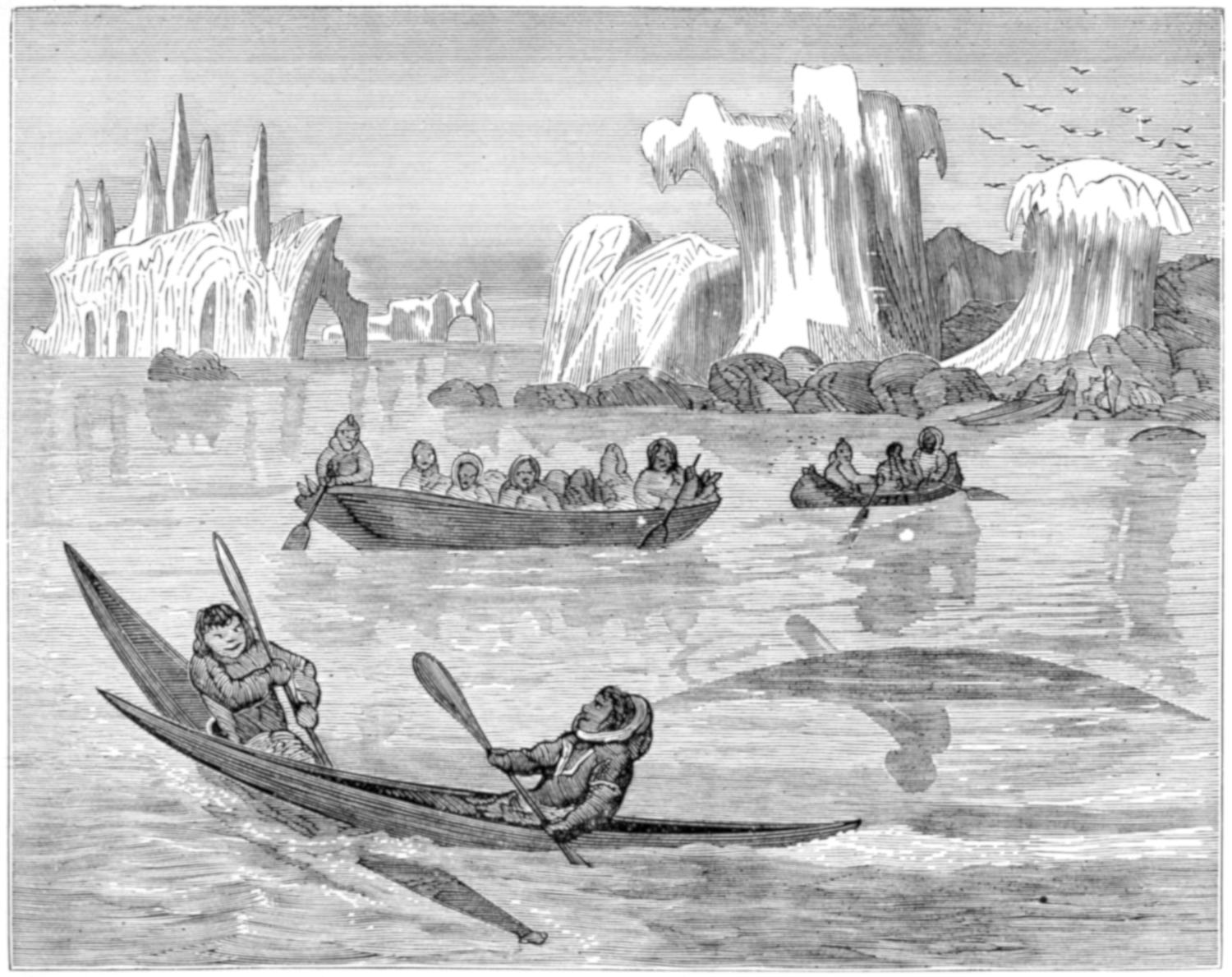
(1.) THE KAJAK AND ITS MANAGEMENT.
(See page 1344.)
“Accordingly, every time I came to him
he got no fish, and though he changed his
position three times, yet he got nothing.
Now, if ever there was a picture of disappointed
plans—of envy at others’ fortunes,
and sorrow at a sad misfortune—it was to be
found in that dog’s countenance as he
watched his companions receiving their allowance.
Finding that he could not succeed
by any change of his position, he withdrew
from the circle to where I was, and came to
me, crowding his way between my legs, and
looked up in my face as if to say, ‘I have
been a very bad dog. Forgive me, and Barbekark
will cheat his brother dogs no more.
Please, sir, give me my share of capelins.’
I went the rounds three times more, and let
him have the fish, as he had shown himself
so sagacious, and so much like a repentant
prodigal dog.”
Marriage among the Esquimaux is of
the very simplest description, and is generally
arranged by the parents of the bride and
bridegroom, the latter having nothing to do
with the affair. There is no marriage ceremony,
the parties merely going to live in the
same igloo. A man may, and often does, have
several wives, and in this case one of them
takes the position of the chief, or igloo wife,
and is supreme under her husband. She has
the largest lamp, the best bed, and the best
provision. But she also has the entire management
of the household, such as cooking the
food, and drying the clothes on the “dry-net.”
This is by no means a sinecure, as it forces
her to rise many times in the night for the
purpose of turning the clothes and drying
them equally. She also has to see that the
boots are properly “milled.”
After a child is born, the mother is obliged
to confine herself to her own igloo for some
months, and when the allotted time has expired,
she throws off all the clothing which
she has worn, and never wears it again.
She then dresses herself in a totally new suit
of clothes, and visits in succession the inhabitants
of every igloo. If a second or third
child be born, a separate igloo is always built
for the mother, to which she repairs before
the birth of the child, and in which she remains
until the customary time has elapsed
and she is able to call upon her neighbors.
The children begin their education at a
very early age; the boys being taught to paddle
the kia, to hunt and to fish, and to build
igloos; while the girls learn to row the
women’s boat, to dress skins, to manage the
lamp, to cook, and perform the multitudinous
tasks that fall to their lot. The carving of the
Esquimaux women is wonderfully good.
They make spirited, though conventional,
imitations of fish, ducks, dogs, and various
animals, from ivory, using in the manufacture
nothing but a knife. In the earlier days,
before white men visited them, the Esquimaux
were obliged to rely entirely upon flint
as a material for their knives, which were
exactly like those of the ancient and perished
races. In chopping the flakes off the flint,
the Esquimaux employed a very simple instrument,
the use of which showed an exact
knowledge of the fracture-line of flint. It is
made of bone and ivory, and is about six
inches in length. Iron, indeed, is of so late
introduction, that when Captain Lyon visited
the natives, in 1821, he could purchase a
complete harpoon, with its ivory head, float,
and line, for a nail; while a knife would purchase
a kia, or indeed anything that was asked
in exchange for it.
As may be inferred from the climate, the
games of the Esquimaux are but few. They
are wonderful experts at a sort of “cat’s-cradle,”
producing with a piece of string imitations
of seals, reindeer, ducks, canoes, and
other objects. The little ivory models of
ducks and other animals, which have already
been mentioned, are used in several of the
native games.
Their dances are remarkable for their
simplicity, the dancer inventing the steps
according to his own taste. There is a
dance in which a number of women stand in
a ring, with their hands under the front
flaps of their jackets, and sing, with half-closed
eyes, the inevitable Amna-aya song:
these are the band. The dancers are represented
by one man, who takes his place in
the middle of the ring, swings his head and
arms from side to side, his long, lank hair
flapping in the wind, while he utters sharp
yells at intervals, and occasionally flings one
leg as high as his thick garments permit.
The women have a special dance of their
own, which consists in kneeling on the
ground, leaping to their feet as fast as they
can. This is really a difficult task when the
heavy and clumsy boots are taken into consideration.
Sometimes the men challenge
each other to dance, and in that case the
challenge is accepted by employing the
“koonik,” or national salutation, which is
given by rubbing the noses together, and
inhaling strongly through the nostrils.
With regard to religion, the Esquimaux
seem to have no very definite idea of the
subject, except that they believe in a future
existence, in a heaven and a hell—the latter
being, according to their ideas, dark, full
of ice, with snow-storms always blowing,
and no seals. They have also a hazy description
of a Supreme Being, and a secondary
female divinity, the special protector of
the Esquimaux.
By way of worship, they have sundry
medicine men, or “angekos,” as they are
called, who go through a series of strange
ceremonies on various occasions, such as illness,
or when a party is setting out on a
hunting expedition. They make the people
pay heavily for their services, and rule with
a rod of iron, so that no Esquimaux is likely
to retain possession of any valuable piece of
property if an angeko should happen to be
in the neighborhood. They act upon a very
simple and intelligent principle, namely,
that the amount of success in “ankooting,”
or divining, is in exact ratio with the amount
of pay.
Sometimes, in order to impress awe upon
their victims, the angekos go through a series
of imposing ceremonies, the performance
of which infers a vast amount of practice.
By the present of a knife and some
beads, Captain Lyon induced a celebrated
angeko, named Toolemak, to have an interview
with a Tornga, or familiar spirit, in
the cabin of the ship.
“All light excluded, our sorcerer began
by chanting to his wife with great vehemence,
and she, in return, answered by
singing the Amna-aya (the favorite song of
the Esquimaux), which was not discontinued
during the whole ceremony. As far as
I could learn, he afterward began turning
himself rapidly round, and, in a loud, powerful
voice, vociferated for Tornga with
great impatience, at the same time blowing
and snorting like a walrus. His noise,
impatience, and agitation increased every
moment, and he at length seated himself on
the deck, varying his tones, and making a
rustling with his clothes.
“Suddenly the voice seemed smothered,
and was so managed as to sound as if retreating
beneath the deck, each moment becoming
more distant, and ultimately giving
the idea of being many feet below the cabin,
where it ceased entirely. His wife, now, in
answer to my queries, informed me very seriously
that he had dived, and that he would
send up Tornga.
“Accordingly, in about half a minute, a
distant blowing was heard very slowly approaching,
and a voice which differed from
that which we at first had heard was
at times mixed with blowing, until at
length both sounds became distinct, and the
old woman informed me that Tornga was
come to answer my questions. I accordingly
asked several questions of the sagacious
spirit, to each of which inquiries I
received an answer by two loud slaps on
the deck, which I was given to understand
was favorable.
“A very hollow yet powerful voice, certainly
much different from the tones of
Toolemak, now chanted for some time, and
a strange jumble of hisses, groans, shouts,
and gabblings like a turkey succeeded in
rapid succession. The old woman sang with
increased energy, and, as I took it for granted
that this was all intended to astonish the
Kabloona, I cried repeatedly that I was very
much afraid. This, as I expected, added
fuel to the fire, until the form immortal, exhausted
by its own might, asked leave to
retire. The voice gradually sank from our
hearing, as at first, and a very indistinct hissing
succeeded. In its advance, it sounded
like the tone produced by the wind upon
the bass-cord of an Æolian harp; this was
soon changed to a rapid hiss, like that of a
rocket, and Toolemak, with a yell, announced
his return. I held my breath at the first distant
hissing, and twice exhausted myself;
yet our conjuror did not once respire, and
even his returning and powerful yell was
uttered without a previous stop or inspiration
of air.
“Light being admitted, our wizard, as
might be expected, was in a profuse perspiration,
and certainly much exhausted by his
exertions, which had continued for at least
half an hour. We now observed a couple
of bunches, each consisting of two strips of
white deer-skin and a long piece of sinew,
attached to the back of his coat. These we
had not seen before, and were informed that
they had been sewed on by Tornga while
he was below.” A similar exhibition has
been seen by several travellers, and they
have expressed their astonishment at the
length of time during which an angeko can
howl, hiss, and gabble without taking breath.
While he is below the earth, the angeko
is supposed to visit the habitation of the
particular spirit whom he is addressing,
and sometimes gives a detailed account
of the places in which he has been, and of
their inhabitants. One female spirit, for
example, is called Aywilliayoo. She commands
all the bears, whales, seals, and walruses
by means of her right hand. So, when
there is a scarcety of provisions, the angeko
makes a visit to Aywilliayoo and attacks her
hand. If he can cut off her nails, the bears
immediately are set free, the loss of one
finger joint liberates the small seals, the second
joint sends the large seals, the knuckles
free the whole herds of walrus, while the
entire hand liberates the whale.
In figure this spirit is very tall, and has
only one eye and one pigtail, but this is as
large as a man’s leg, and descends to her
knee. Her house is a very fine one, but
Toolemak did not venture to enter it, because
it was guarded by a huge dog with
black hind-quarters and no tail. Her father
is no larger than a boy of ten years old, and
he has but one arm, which is always covered
with a large bear’s-skin mitten. His
house is also handsome, but its entrance is
guarded by troops of bears and walruses,
who keep up a continual growling.
Unfortunately for his own credit, Toolemak
got drunk one evening, as he might
well be, having consumed in succession
nearly ten glasses of rum, or “hot water,”
as he was pleased to call it. During his intoxication
he became very good-natured,
and betrayed the secrets of his magic art,
showing how he altered his voice by covering
his face with his hands and then with
his jacket, so as to make the voice appear
as if it came from a continually increasing
depth. He finished this singular exhibition
by drinking in succession eleven pints and
one gill of water, and within a few minutes
became sober enough to leave the ship and
walk to his sledge.
Sometimes the Esquimaux say that they
are annoyed by spirits. On one occasion
when a man nicknamed Kettle was eating
in Captain Lyon’s cabin, he became uneasy,
and frequently ceased eating, a very
remarkable circumstance in a hungry Esquimaux.
Presently he said that there was
a spirit sitting on the opposite side of the
cabin, making grimaces at him, and preventing
him from eating. He asked leave to
drive his tormenter away, which he did by
raising a long, bellowing sound, and then
blowing sharply on the ends of his fingers.
He resumed his meal quietly, and nothing
would induce him to blow on his fingers or
raise the exorcising yell again, on the ground
that the spirit was no longer to be seen.
The Esquimaux possess wonderful powers
of drawing. They know scarcely anything
of perspective, but they can make their
sketches tell their own tale; while in drawing
from memory a chart of a coast, their skill is
really admirable. In Captain Hall’s book
there are fac-similes of several native charts
and sketches, the most curious of which is
one which was not only drawn but engraved
on wood by the native draughtsman. It
represents a woman with a child nestling in
the hood behind her back, and is quite equal
in execution to wood-cutting in the earlier
stages of the art. The point about it which
most strikes a practised eye is the force and
fidelity with which the artist has marked the
texture of the different parts of the dress;
the fur coat and trowsers edged with leather,
and the white-edged, fur-lined hood, are most
admirably managed.
Of music and musical instruments the Esquimaux
know little. They have the Amna-aya
song, which has already been mentioned,
and they possess one national musical instrument,
called the “keeloun.” This is something
like a tambourine, being formed of a
very thin deer skin, or the envelope of the
whale’s liver, stretched over one side of a
wooden hoop. A handle is attached to the
hoop, and the instrument is struck, not upon
the membrane, but upon the hoop.
As a nation they are remarkable for two
good qualities, honesty and hospitality.
There are, of course, exceptions to every rule,
and such is the case with the Esquimaux.
But the early voyagers found that they might
leave their knives and axes on shore, and
that not one of them would be touched.
Now, to an Esquimaux a steel knife or axe
is more valuable than a box full of sovereigns
would be to us, and the honesty of the Esquimaux
was as much tried by the sight of
these articles as would be that of our London
poor if a heap of sovereigns were left lying
on the pavement.
As to hospitality, their food is considered
to be merely common property, so that if one
of the Esquimaux should kill a seal, all his
friends and neighbors assemble as a matter
of course to assist in eating it; and even
though the family of the successful hunter
should be starving, he will nevertheless invite
all his friends to partake of the food. In
this way, it often happens that an entire seal
barely affords a single meal to all who come
to share it.
Funerals among the Esquimaux are
rather variable in their forms. Generally,
when a sick person is on the point of death,
a new igloo is built, and carefully fitted with
lamp, provisions, and other furniture. The
dying person is carried in—not through the
regular doorway, but through a breach in
the wall—placed on the couch, the lamp
lighted, and the provisions laid ready to hand.
The attendants then leave the igloo, build
up the openings, and never trouble themselves
again about the sick person. The
principal reason why the dying are left alone
is, that if the relatives are in the igloo at the
moment of death, they are obliged to throw
away the dresses which they were wearing,
and never to wear them again. None of them
can tell the reason for this strange belief,
but it is so strongly ingrained that no argument
can induce them to abandon it.
Sometimes the body of a dead person is
simply buried in a hole scooped in the snow,
and sometimes it is laid upon a ledge of rock,
accompanied by the lamp, kettle, knives,
spears, and dresses which the deceased used
while in life. When a child dies, all its toys
are placed with it in the grave, that it may
be supplied with them in the next world.
The demeanor of the Esquimaux with
regard to their dead is a most extraordinary
mixture of affection and unconcern. After
having buried the body, whether alive or dead
does not matter, they care nothing about it,
and this strange insensibility is even displayed
before the burial. For example, a
man’s wife had died, leaving a child of a few
weeks old, which in a short time followed its
mother. The father was very sorrowful for
his dying child, and was seen in the night
lifting the curtains of its bed as it lay ill on
board ship, and sighing deeply. But, on the
next day, when he came to the ship, he made
no scruple of laying his meat on the body of
the child, and using it as a table at breakfast.
Once, when Captain Lyon visited the
grave where an Esquimaux named Pekooya
had been laid, he found that the wolves and
dogs had uncovered the body, and had eaten a
considerable portion of it. He was naturally
shocked at the scene, but the natives treated
it with absolute indifference, and though the
father and a brother of Pekooya were witnesses
of the desecration, they would not
cover up the mangled body, and only laughed
when Captain Lyon remonstrated with
them. Moreover, when the body was buried,
it was covered so slightly with snow that the
first day’s thaw would melt off all the snow,
and leave it to the mercy of the dogs.
Judging from such a fact as this, it might
be thought that the Esquimaux have but
little natural affection, and that they are indifferent
to the loss of their nearest relatives.
Such, however, is not the case. An Esquimaux
never passes the grave of an acquaintance
without depositing a piece of meat as
an offering, and the surviving relatives often
visit the burying-place of their dead, and sit
there for hours, talking to them as if they
were still alive. On comparing all the conflicting
accounts respecting the Esquimaux
and their dead, it seems likely that they
consider the dead body as something that
the deceased once possessed, but cast away
at death, and that, as their departed friend
abandoned the body, they need take no
trouble about so worthless an article.
If the reader will refer to the illustration
on page 1347, he will see that the horizon is
illuminated by strange and wild-looking
dashes of light. These represent the Aurora
Borealis, as it often appears in those parts,—not
pale and flickering as we see it in these
comparatively southern regions, but blazing
with all imaginable hues, and giving out a
light that stands the natives in stead of the
sun, which in those latitudes is absent for
months at a time. The glory and magnificence
of these displays can only be described
by those who have seen them, and very inadequately
even by such.
There is an account given by Captain Hall
of one of these marvellous exhibitions:—“I
had gone on deck several times to look at the
beauteous scene, and at nine o’clock was
below in my cabin, when the captain hailed
me with these words, ‘Come above, Hall,
come at once! The world is on fire.’
“I knew his meaning, and quick as thought
I re-dressed myself, scrambled over several
sleeping Innuits close to my berth, and
rushed to the companion stairs. In another
moment I reached the deck, and as the cabin
door swung open, a dazzling and overpowering
light, as if the world were really ablaze
under the agency of some gorgeously colored
fires, burst upon my startled senses. How
can I describe it? Again I say, No mortal
hand can truthfully do so. Let me however,
in feeble, broken words, put down my
thoughts at the time, and try to give some
faint idea of what I saw.
“My first thought was, ‘Among the gods
there is none like unto Thee, O Lord; neither
are any works like unto Thy works!’ Then
I tried to picture the scene before me. Piles
of golden light and rainbow light, scattered
along the azure vault, extended from behind
the western horizon to the zenith; thence
down to the eastern, within a belt of space,
20° in width, were the fountains of beams,
like fire-threads, that shot with the rapidity
of lightning hither and thither, upward and
athwart the great pathway indicated. No
sun, no moon, yet the heavens were a glorious
sight, flooded with light. Even ordinary
print could easily have been read on deck.
“Flooded with rivers of light! Yes, flooded
with light; and such light! Light all but inconceivable.
The golden hues predominated,
but in rapid succession prismatic colors leaped
forth. We looked, we saw, and trembled;
for as we gazed, the whole belt of aurora
began to be alive with flashes. Then each
pile or bank of light became myriads; some
were dropping down the great pathway or
belt; others springing up, others leaping
with lightning flash from one side, while
more as quickly passed into the vacated space;
some twisting themselves into folds, entwining
with others like enormous serpents,
and all these movements as quick as the eye
could follow.
“It seemed as if there were a struggle
with these blazing lights to reach and occupy
the dome above our heads. Then the
whole arch above became crowded. Down,
down it came; nearer and nearer it approached
us. Sheets of golden flame, coruscating
while leaping from the auroral belt,
seemed as if met in their course by some
mighty agency that turned them into the
colors of the rainbow, each of the seven primary
colors 3° in width, sheeted out to 21°.
“While the auroral fires seemed to be
descending upon us, one of our number
could not help exclaiming,—
“‘Hark! hark! such a display! almost as
if a warfare were going on among the
beauteous lights above—so palpable—so
near—it seems impossible without noise.’
“But no noise accompanied this wondrous
display. All was silence....
“I would here make the remark that the
finest displays of the aurora only last a few
moments. Though it may be playing all
night, yet it is only now and then that its
grandest displays are made. As if marshalling
forces, gaining strength, compounding
material, it continues on its silent workings.
At length it begins its trembling
throes; beauty anon shoots out here and
there, when all at once the aurora flashes
into living hosts of powdered coruscating
rainbows, belting to the heavenly dome
with such gorgeous grandeur that mortals
sometimes tremble to behold.”
These wonderful aërial phenomena are
characteristic of the Arctic regions. One of
the most extraordinary appearances in the
sky is called the Parhelion, or Mock Sun.
It assumes various and most astounding
forms, the sun appearing in the middle, and
being surrounded with dimmer imitations of
itself, round which run circular bands of
light. There seems, indeed, to be no end
to the extraordinary modifications of aërial
effects which take place in these regions.
Captain Hall described many of them,
among which may be mentioned a moon
distorted beyond all recognition, its lower
limb all crushed and shapeless, and the
whole appearance of the planet like that of
a man under the influence of liquor.
Then the refractive powers of the atmosphere
produce most wonderful effects, destroying
all perspective, and bringing into
sight all kinds of objects which, by the ordinary
laws of optics, are far out of sight. All
sailors are familiar with the appearance of a
vessel high in the air, sailing, as it were,
through the sky with her keel in the clouds,
and the tops of her masts pointing downward.
In these regions the refractive powers
are even terrible to accustomed eyes, so
wonderful are the sights presented to them.
In one of these strange exhibitions, witnessed
by Captain Hall, a vast white inverted
pyramid seemed to form in the sky,
and at every roll of the vessel to dip into
the sea. Presently “some land that was
seventy-five miles distant, and the top
of it only barely seen in
an ordinary way, had its
rocky base brought full
in view. The whole
length of this land in
sight was the very symbol
of distortion.
“Pendant from an even
line that stretched across
the heavens was a ridge of
mountains. Life hangs
upon a little thread, but
what think you of mountains
hanging upon a
thread? In my fancy I
said, ‘If Fate had decreed
one of the Sisters to cut
that thread while I witnessed
the singular spectacle,
what convulsions
upon the land and sea
about us might not have
followed!’ But Nature
had an admirable way of
taking down these rock-giants,
hanging between
the heavens and the
earth. Arch after arch
was at length made in
wondrous grandeur from
the rugged and distorted
atmospheric land; and, if
ever man’s eye rested
upon the sublime, in an
act of God’s creative
power, it was when He
arcuated the heavens
with such a line of stupendous
mountains.
“Between those several
mountain arches in the
sky were hung icebergs,
also inverted, moving
silently and majestically about as the sea-currents
shifted those along of which they
were the images. In addition to all this
there was a wall of water, so it appeared,
far beyond the apparent horizon. This wall
seemed alive with merry dancers of the
most fantastic figures that the imagination
could conceive, and its perpendicular columns
were ever playfully changing. Oh,
how exquisitely beautiful was this God-made,
living wall! A thousand youthful
forms of the fairest outline seemed to be
dancing to and fro, their white arms intertwined,
bodies incessantly varying, intermixing,
falling, rising, jumping, skipping,
hopping, whirling, waltzing, resting, and
again rushing to the mazy dance—never
tired—ever playful—ever light and airy,
graceful, and soft to the eye.”
Such, then, is a brief account of the remarkable
and interesting Innuit people—a
people which, according to the observation
of Captain Hall, are gradually dying out,
and in a few more years will cease to exist.
CHAPTER CXLII. VANCOUVER’S ISLAND. THE AHTS AND NEIGHBORING TRIBES.
DEFINITION OF THE AHT TRIBES — APPEARANCE OF THE NATIVES — STRENGTH OF GRASP — PECULIARITY
OF THE LEGS — GAIT OF THE WOMEN — SPEED OF THE MEN — DANCE — THE LIP ORNAMENT
OF THE WOMEN — CLOTHING — THE BOAT CLOAK AND HAT — WEAPONS — THE BOW AND ARROW — INGENIOUS
CONSTRUCTION OF THE BOW — ITS BACKING OF ELASTIC STRINGS — THE ARROWS
AND THEIR SPIRAL FEATHERING — THE FISH SPEAR AND HARPOON ARROWS — THE HALIBUT
HOOK — VARIOUS MODES OF HUNTING — SALMON SPEARING BY TORCHLIGHT — THE HERRING
RAKE — HOW TO KEEP THE BOAT FROM SINKING — THE WHALE FISHERY.
Before leaving this part of the world, we
will cast a brief glance at the tribes which
inhabit Vancouver’s Island. They are singularly
interesting, inasmuch as they combine
some of the habits which distinguish
the Esquimaux with others of the North
American tribes, and add to them several of
the customs which have been already noticed
among the Polynesians, their insular
position and peculiar climate no doubt
affording the cause for this curious mixture.
As a type of these tribes, we will take the
Ahts, though other tribes will be casually
mentioned. The Ahts may rather be called
a nation than a tribe, being divided into
some twenty tribes, the names of which all
end in “aht,” as, for example, Ohyaht,
Muchlaht, Ayhuttisaht, Toquaht, etc. Altogether
they number about seventeen hundred.
They do not, however, act together
as a nation, and each tribe is perfectly distinct,
and often at war with another.
They are not a tall people, the men averaging
a little less than five feet six inches,
and the women being just above five feet.
Possibly, from the continual paddling which
they practise almost from childhood, the upper
limbs of an Aht are exceedingly strong,
so strong, indeed, that a slight-looking native
can carry with ease on his extended
fingers a weight which a white man can
scarcely lift. Their power of grasp, probably
from the same cause, is more like the
grip of a machine than the grasp of a man;
and those who have had to fight with them
have found that if once an Aht be allowed
to seize either the clothing or the hair, the
only way to loosen his grasp is to knock
him down with a blow in the throat or in
the ribs—he cares nothing for a blow on
the head.
When he comes to such close quarters in
a quarrel, he has an awkward habit of
grasping the enemy with one hand, and
using with the other a knife which he has
kept concealed in his long hair. Fortunately
for his white opponent, so extraordinary
a proceeding as a blow from the fist,
which deprives him for a time of breath,
bewilders and alarms him to such an extent
that he seldom risks its repetition.
The legs of the Aht tribes are, as a rule,
short, ill-made, bowed, and apparently deficient
in power. This peculiarity is especially
noticeable in the women, whose legs
are so bowed, and whose toes are so turned
inward, that they waddle rather than walk,
and at every step they are obliged to cross
their feet as a parrot does. The legs of the
inland tribes are, as a rule, better developed
than those of the inhabitants of the coast.
Yet these unsightly limbs are by no means
deficient in power. An Aht, powerfully
built above, will step out of his canoe, and
exhibit a pair of legs scarcely as thick as his
arms, and yet he will walk in the woods for
a whole day without showing any signs of
fatigue.
Owing to this form of limb, the natives,
though enduring enough, are not swift of
foot, and can be easily overtaken by a white
man on the open ground, notwithstanding
the impediments of clothing, and especially
of shoes, which hinder the progress of the
pursuer, the pursued usually throwing off
the only garment that he wears. Should
he once reach the woods, pursuit is useless,
as no white man can follow a naked native
in them.
The color of the Ahts is a dull, but not
dark, brown. Their face is broad and flat,
the nose tolerably well formed when it is
not dragged out of shape by rings and other
ornaments, and the cheek-bones are strongly
marked and broad, but not high. There is
very little hair on the faces of the men, but
that of the head is long, straight, and is generally
allowed to hang loosely over the
shoulders, though it is sometimes gathered
into a knot at the back of the head, merely
covered by a cap or a wreath of grass. They
are very proud of their hair, so that when
an Aht has been guilty of some offence
which is not very serious, the best punishment
is to cut off his hair, inasmuch as he
will be an object of constant ridicule until it
has grown again. The women divide their
hair in the middle, and tie it in two plaits,
one of which hangs at each side of the face,
and often has a piece of lead suspended to
the end to keep it straight. Mr. Sproat
thinks that the physical characteristics of
the Ahts have been modified by means of a
large importation of Chinese, which took
place about the end of the last century, and
remarks that the peculiar Chinese eye is
sometimes seen among these natives. Still,
even if this be the fact, the modification can
be but slight, as both people are undoubtedly
members of the same great race, though
altered by the conditions in which they
have respectively been placed.
Some of the women have a hideously ugly
ornament which they wear in their under
lip, just as do the Botocudos of Tropical
America. This practice exists only among
the northern tribes, where it is carried out
to an enormous extent. As the size of the
ornament is gradually increased from childhood,
the lip of an old woman will contain
an oval ornament three inches long by two
wide. There is a shallow groove round the
edge so as to keep it in its place, and both
sides are slightly concave. Sometimes it is
used as a spoon, the woman putting on it a
piece of meat that is too hot, and, when it
is cool, turning it into her mouth by a contraction
of the lip.
The value that is set upon this horrible
disfigurement is almost ludicrous, a woman’s
rank being due to the size of her lip ornament.
Possibly, on account of the long time
which must be occupied in stretching the
orifice in the lip to the required size, the
opinion of a woman with a large lip is always
held in respect; and, if she should be opposed
by a younger person of her own sex,
she will contemptuously decline to enter
into argument with a woman who has so
small a lip. Some of them wear a shell ornament,
like the stem of a clay tobacco-pipe,
one or two inches long, stuck through the
lip and projecting forward at a considerable
angle with the chin. This ornament is
called the hai-qua.
As for clothing, the men wear a sort of
robe made by themselves, for which they
have in later days substituted an European
blanket. They are not at all particular as
to the disposal of this robe, and even if it
should fall off do not trouble themselves.
The women also wear the blanket, but always
have a small apron in addition to it.
In their canoes they wear a cape. It is
made of cedar-bark string, and is woven in
nearly the same manner as the mat of the
New Zealander, which has already been
described; namely, by stretching the warp
threads parallel to each other on a frame,
and tying them together at intervals with a
cross-thread which represents the woof. A
specimen in my collection has the cross-threads
at intervals of half an inch.
It is shaped exactly like the cross section
of a boat, straight above, and rounded below.
It measures five feet three inches in width,
and three feet six inches in depth in the
centre. As is usual with such robes, the
upper edge is adorned with a strip of marten
fur a quarter of an inch wide, wound spirally
round the selvage so as to form quite a thick
rope of fur. These capes are the work of
the women, who have the manufacture of all
the clothing. Fur bags are made by the
simple process of skinning the marten, the
body being then extricated through a cut
made across the abdomen just below the tail.
As the skin comes off it is reversed, and when
dry and properly dressed it is turned with the
fur outward, and the bag is complete, the tail
serving as a handle. One of these bags in
my collection was presented to me by Lieut.
Pusey.
The woof thread is also made of the white
pine bark, and the needle is nothing more
than a sharpened twig. The same useful
materials are also employed for the curious
hats which the natives wear in their canoes.
These hats are made on the principle of the
sailors’ “sou’-westers,” and are fashioned so
as to shoot rain off the shoulders. The outside
of the hat is made of cedar bark, and the inside
of white pine bark.
Depending largely upon animal food for
their nourishment, the Aht tribes are expert
hunters, and make very ingenious weapons,
some of which are shown in the illustrations
on page 1357, drawn from my own specimens.
The bow and arrows used by these people
are worthy of a brief description. The bow
is an admirable specimen of savage art, and
must be the result of long experience. It is
four feet three inches in length, and made of
one piece of wood. In general shape it resembles
the bow of the Andamans, though
it is not of such gigantic dimensions. In the
middle the wood is rounded, so as to form a
handle which is nearly four inches in circumference.
From the handle to the tips,
the wood is gradually flattened and widened
for about fourteen inches, where it is just
two inches wide. From this point it gradually
lessens again to the tip, which is
rounded and thickened, so as to receive the
notch for the string.
Were no addition made to the bow it would
still be a very powerful weapon, but the
maker has not been satisfied with the simple
wood, and has strengthened it with a wonderfully
complex arrangement of strings made
of twisted sinews. In my specimen there
are rather more than fifty of these strings,
which are laid on the bow and interwoven
with each other in a manner so strong and
neat, that the most skilful sailor might be
envious of such a piece of handiwork. Each
of these strings is double, the two strands
being about as large as thin whipcord, and
when seen against the light they are quite
translucent.
They are put on in the following manner.
Two deep notches, parallel to the line of the
bow, are made at each lip, these notches
serving two purposes: first, the reception of
the bow-strings, and next the support of the
strengthening strings. Eight of the strings,
measuring about eleven feet in length, have
been doubled, the loop passed over the tip of
the bow, and the strings led along the back
over the corresponding notch at the other
tip, and brought back to the middle. These
strings lie parallel to each other, and form
a flat belt from one end of the bow to the
other. About an inch below the tip, three
other sets of strings are fastened in a somewhat
similar manner, so that four distinct
layers of strings run throughout the length
of the weapon.

ARROWS.
Even these have not sufficed the maker,
who has added six more layers starting from
the widest and flattest part of the bow, so that
nearly three feet of the centre of the weapon
are strengthened by no less than twelve
layers of sinew strings. By referring to the
illustration, the reader will perceive the extreme
ingenuity with which the strings are
laid on the bow, so that whether the weapon
be bent or unstrung, they all keep their
places. So firmly are they lashed to the bow,
that even when it is unstrung they are all as
tight as harp strings.
The string of the bow is made of the same
material as those which strengthen the back,
and in consequence of the very great strength
of the material, it is much thinner than the
string of an ordinary archer’s bow. It is
made of two strands, each strand being about
as large as the back strings.
By referring to illustration No. 3, on the
next page, a good idea can be gained of this
singularly ingenious weapon. At first the
bow is seen as it appears when strung, fig. 3
giving a section of the wood. At fig. 2 is an
enlarged representation of one end of the bow,
so as to show the manner in which the various
sets of strings are fastened. At the upper
part are seen the strings which form
the first layer, passing over the end of the
bow, and filling up the notch in which they
lie. Just below the tip come the second and
third sets, which pass down the bow, where
they are met by, and interwoven with, the
remainder of the strings, the whole of them
being gathered in the rope with its spiral
building. This beautiful weapon was added
to my collection by Lieut. Pusey, R. N.
The arrows are of various kinds, according
to the object for which they are intended.
That which is used for ordinary occasions is
shown in the uppermost figure of the illustration.
It is two feet three inches in length,
and is headed with bone.
There is a peculiarity about these arrows
which is worthy of notice. Some time ago
an arrow was patented in England, which
had the feathers placed spirally upon the end
of the shaft, so as to give it a rapidly revolving
movement when discharged from the
bow. The principle was exactly that of the
screw which is applied to steam vessels; and
those who used the arrow acknowledged that
the spiral setting of the feathers not only
increased the power of flight, but enabled
the archer to drive his arrow through the
wind with greater ease and certainty than
could be obtained with the ordinarily feathered
arrow. There is a very old saying that
there is nothing new under the sun, and this
is the case with the arrow in question, the
savages of Northern America having adopted
the same principle long ago. In their arrows
the feathers are set spirally, with a bold curve,
and there is really no difference between the
weapon of the savage and the toy of civilization,
than the greater neatness and higher
finish of the latter.
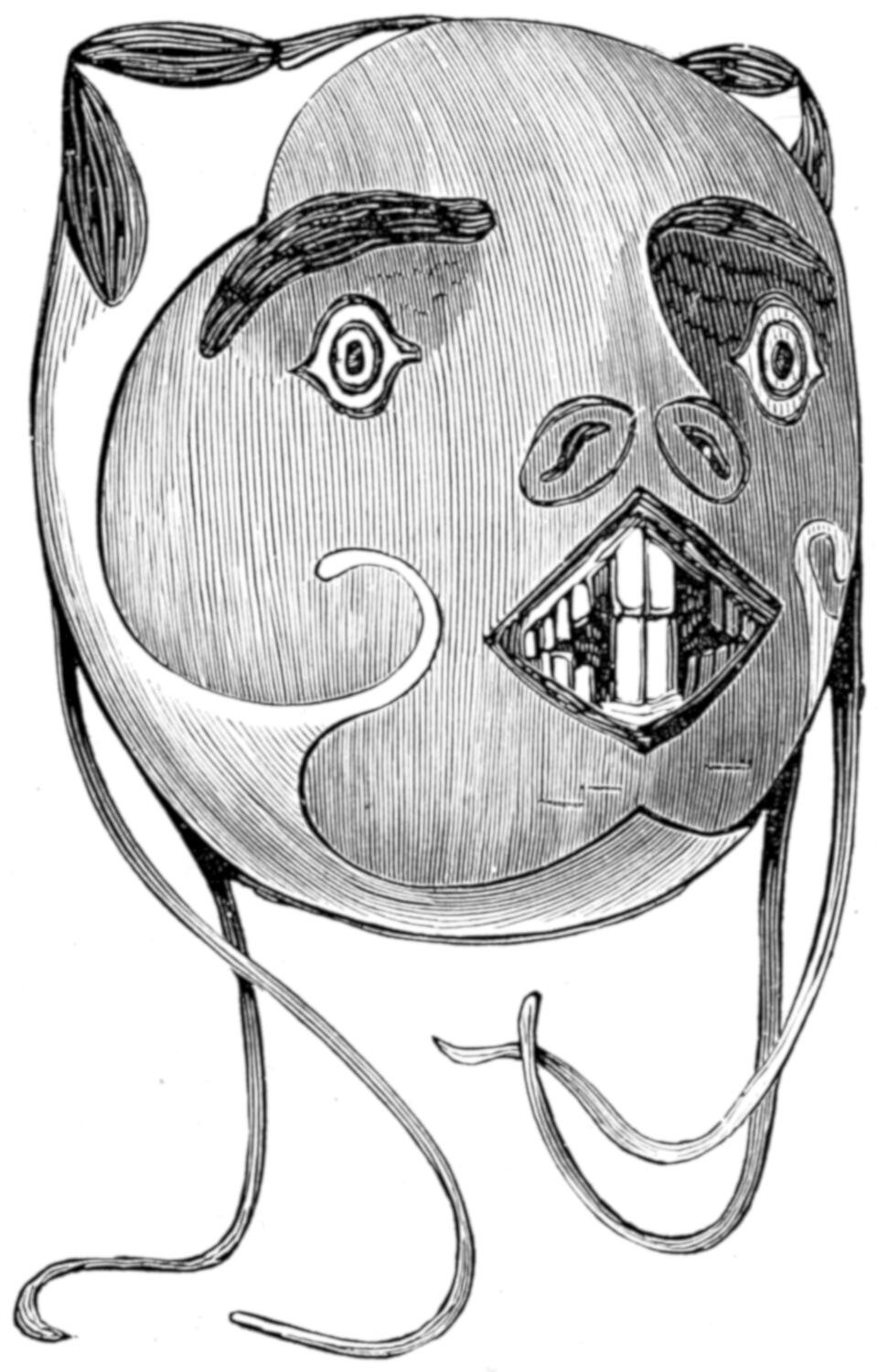
(4.) BEAVER MASK OF AHT TRIBE.
(See page 1365.)
The lower figure represents the arrow
which is used for killing fish. In this weapon
the point is also of bone, but is very
much longer, and is double, the two halves
diverging considerably from each other, and
being barbed on the inner surface. It is
firmly lashed to the shaft, and their divergence
is given by means of two pegs, which
are driven between the shaft and the two
portions of the point. If a fish be struck by
this ingenious weapon, it cannot possibly
escape, the elastic points contracting violently
and holding the fish between them.
It is worthy of notice that a police spear
made exactly on the same principle is used
by the Malays. It consists of a handle some
seven feet long, from the end of which project
two diverging points. The inner side
of each point is armed with a row of very
sharp barbs, all directed backward. Thorns
are often used for this purpose. Should a
criminal try to escape, the police officer has
only to thrust his spear against the back of
the man’s neck, when he is at once a prisoner,
the barbed points effectually preventing
him from escaping, even should the officer
drop his weapon. The zoölogical reader
will remember that the teeth of the snake
and of many fish—the pike, for example—are
set on exactly the same principle.
In some specimens the head is fitted
loosely on the shaft, and connected with it
by means of a string, which is wound spirally
round it, and when the fish is struck
the head is shaken off the shaft, which
serves both as a drag to aid in tiring the
fish, and as a float by which its presence
may be indicated.
The most ingenious of these arrows is
used for shooting seals and the larger fish,
and is very elaborately constructed. It measures
about four feet in length, and is almost
deserving of the name of harpoon rather than
arrow.
The shaft is made of very light wood, and
is about as thick as a man’s finger. At the
butt-end it is feathered in the usual manner,
and at the other it is terminated by a pear-shaped
piece of bone an inch in diameter at
the thickest part. Into the end of this bone
is bored a small conical hole, which receives
the head. This is also made of bone, and
is very small in comparison with the arrow,
and is furnished with two deeply cut barbs.
As is the case with all harpoon weapons,
the head is connected with the shaft by a
line, but in this case there is a peculiarity
about the line and its mode of attachment.
Instead of being a mere double-strand
string, it is made of a number of fibres arranged
in three strands, and plaited, not
twisted together, so as to form a flat line,
which possesses enormous strength combined
with great elasticity and small size.
The mode of attachment is as ingenious as
the method of manufacture. The line is a
double one, measuring twelve feet in length.
The line is first doubled, the loop is put
through a hole in the point and over the
head, so as to secure it, and the two halves
of the line are then lashed together about
eighteen inches from the point. One end is
then fastened to the arrow just below the
feathers, and the other to the shaft just
above the bone tip. The object of this arrangement
is evident. As soon as a seal is
struck, it dashes off, shaking the shaft from
the barbed head, which remains in its body.
Were the line simply tied to the end of the
shaft, the wounded creature would easily drag
it through the water. But, as the line is fastened
to each end of the shaft and to the
head besides, when the latter transfixes
a seal it is separated from the shaft, and
the shaft is drawn crosswise through the
water, presenting so great a resistance that
the seal becomes exhausted with its unavailing
struggles, and comes to the surface,
where it is despatched with a second or third
weapon.
Besides the harpoon and fish arrow, these
people also use the hook (see page 1357),
which is quite as ingenious in its way as
the implements which have been described.
The body of the hook is of wood, and is exactly
in the shape of the capital letter U.
The point bends slightly outward, and is
charred at the tip to render it harder. It is
also defended and strengthened by a band
of very tough vegetable fibre, which covers
it for about three inches. The barb is a
piece of bone, about five inches in length,
sharpened like a needle at the point. This
barb is not attached to the point, as is the
case with the generality of hooks, but is
fastened to the shank, and is so long that
its tip reaches to the middle of the hook.
At first sight this seems a very inadequate
arrangement for securing fish, and looks as
if the creature could easily slip off the unguarded
point. If, however, the hook, which
is a very large one, be tested, it will be found
astonishingly efficacious. If the point be inserted
between the fingers, as it would be
inserted into the jaws of a fish, and then
brought upward, it will be found that the
sharp barb effectually prevents the hook
from being withdrawn.
There is one effect of this mode of fixing
the barb which may or may not have been
intended. Should, by any accident, the line
become entangled with the hook, and reverse
it, the fish is quite as secure, the long,
straight barb forming a second hook, to which
it is transferred. The body of this hook is
made of the Douglas pine, and it is brought
into shape by steaming. The hook is chiefly
used for catching the halibut, as, for some
reason, the Ahts will not use a steel hook in
the capture of this fish.
There is plenty of game, both large and
small, in these regions, though the chase is
in all cases a severe one, and tests not only
the skill but the endurance of the hunter.
There is, for example, the black bear, which
is a most valuable animal, its fur being used
for clothing, and its flesh for food. Bear
hunting is not carried on at all times of the
year, but is generally followed toward the
end of autumn, when the bears are fat, and
about to enter their winter quarters. Sometimes
the Ahts wait until the bear has gone
into retirement, and then spear it in its winter
home. Traps are in great favor, because
they do not spoil the skin. They are very
simple; the trap consisting of a tree trunk
heavily loaded with stones, and suspended
at one end over the animal’s track. It is
kept in position by a trigger, to which is
attached a slight rope crossing the track.
It is always placed in some spot where a
large stump or the root of a fallen tree allows
the trap to be set without disturbing
the appearance of the track.
Then there are one or two deer, the largest
of which is the wapiti, commonly but
erroneously called the elk. The hunter
generally takes it by following its track, and
stalking it as it feeds, when the powerful
bow drives an arrow to its heart. The skill
of the hunter is shown as much after the
deer is dead as during the actual chase.
Captain Mayne mentions that he has seen a
wapiti killed, and in a quarter of an hour it
has been skinned, the whole of the flesh removed
from the bones, and the skin converted
into moccasins. The natives have
rather a strange way of carrying the meat.
At their first halt after killing a deer, they
cut the meat into pieces two or three inches
square, transfix them with a long stick, and
carry the stick upon their shoulder, every
now and then pulling off a piece and eating
it as they go along. In this manner the
flesh of a deer vanishes in a wonderfully
short time. Very little meat is preserved,
the Ahts generally eating it as soon as the
animal is killed.
As to the fish, there are so many that only
one or two can be mentioned. The salmon
is the fish that seems to be the most valued
by these fish-eating tribes, and it is caught,
as with us, in a variety of ways. Sometimes
the natives use a rather curious fish spear,
about fifteen feet long in the shaft, and with
a double head, made of wapiti bone. The
head is only slightly fixed in the shaft, to
which it is attached by a line, as in the harpoon
arrow already described. Should the fish be
a very heavy one, the hunter merely ties to
the line a number of inflated bladders, and
causes it to tire itself by useless struggles
before he risks the fracture of the line or loss
of the barbed head, one or both of which
events would probably happen if he were to
try to secure a fresh and powerful fish.
Sometimes, when the fish are plentiful,
they are caught by dropping among them a
stick armed with barbed points, and jerking
it upward sharply, until it impales a fish on
one or other of these points.
“Burning the water” is employed in
catching salmon, and is carried on by two
natives, one of whom paddles the canoe, while
the other stands in the bow, where a torch
is kept burning, and strikes the fish as they
glide through the water. Mr. Sproat mentions
that a single canoe has been known
to bring back forty fine salmon as the result
of a day’s fishing. Salmon traps are also
employed. These are made after a fashion
closely resembling that of the eel-traps used
in this country. They are double baskets,
externally cylindrical, and are set with their
mouths directed down the stream. When
the fish try to pass up the stream they enter
the basket, and, as the inner basket is very
much shorter than the other, shaped like a
sugar-loaf, the salmon finds itself imprisoned
between them. Some of these baskets measure
as much as twenty feet in length, and
five feet in diameter, so that they will contain
a considerable number of fish.
One of the oddest fishing instruments is
that by which the herring is caught. This
is a pole about ten feet in length, flattened
at one end like the blade of an oar, and
armed along the edge with projecting spikes.
When the fisherman gets among a shoal of
herrings, he plunges his pole into the mass
of fish, draws it through them with a peculiar
movement of the arms, so as to transfix
the herrings on the spikes, and then shakes
them into his boat. By this mode of fishing,
which is called “herring-raking,” great numbers
of fish are taken, as well as by the net,
which is ingeniously made from fibre obtained
from a native nettle, which reaches
eight or ten feet in height.
The Ahts are such keen fishermen that
they will often endanger the safety of their
canoes by the quantity of fish with which
they will heap them, so that the gunwales are
sunk within an inch or so of the water’s
edge. In calm weather they can manage
well enough, even with such a burden as
this; but if the wind should get up before
they can reach the shore, the danger is very
great. Should such an event happen, these
enterprising fishermen will not throw their
cargo overboard to save the boat, but will
fasten all the spare floats round the canoe,
so as to keep it from sinking even if
it be filled with water.
There is scarcely any end to the use which
is made by the Ahts of these floats, and
with their aid they will attack and conquer
even the gigantic whale. The following
account of their mode of whale fishing is
written by Mr. G. M. Sproat:—“A whale-chase
is an affair of some moment. The
kind of whale commonly seen on the coast
was described by an old whaling skipper as
‘finner,’ in which there is not much oil. The
season for fishing whales commences about
the end of May or in June. Many whales
are killed every season by the Nitinahts,
who live principally on the seaboard near
Barclay or Nitinaht’s Sound. This tribe
has a custom, which I have not observed
elsewhere, of separating during spring and
summer into small parties, each under a
separate head, but all still continuing under
the chieftaincy of the principal chief of the
tribe.
“Months beforehand preparations are
made for the whale fishing, which is considered
almost a sacred season. I particularly
noticed this circumstance from having, in
my boyhood, heard of the Manx custom, in
which all the crews of the herring fleet invoke
a blessing before ‘shooting’ their herring-nets.
The honor of using the harpoon in
an Aht tribe is enjoyed but by few,—about
a dozen in the tribe,—who inherit the privilege.
Instances, however, are known of the
privilege having been acquired by merit.
“Eight or nine men, selected by the harpooner,
form the crew of his canoe. For
several moons before the fishing begins,
these men are compelled to abstain from
their usual food; they live away from their
wives, wash their bodies morning, noon, and
night, and rub their skins with twigs or a
rough stone. If a canoe is damaged or capsized
by a whale, or any accident happens
during the fishing season, it is assumed that
some of the crew have failed in their preparatory
offices, and a very strict inquiry is
instituted by the chief men of the tribe.
Witnesses are examined, and an investigation
made into the domestic affairs of the accused
persons. Should any inculpatory circumstance
appear, the delinquent is severely
dealt with, and is often deprived of his
rank and placed under a ban for months.
“When the whales approach the coast,
the fishermen are out all day, let the wind
blow high or not. The canoes have different
cruising grounds, some little distance
apart. The Indian whaling gear consists
of harpoons, lines, inflated seal-skins,
and wooden or bone spears. The harpoon
is often made of a piece of the iron hoop of
an ale cask, cut with a chisel into the shape
of a harpoon blade, two barbs fashioned
from the tips of deer-horns being affixed to
this blade with gum. Close to the harpoon
the line is of deer sinews. To this the main
line is attached, which is generally made of
cedar twigs laid together as thick as a three-inch
rope. Large inflated skins are fastened
to this line about twelve feet from the
harpoon. The weapon itself is then tied
slightly to a yew handle ten feet long.
“On getting close, the harpooner, from
the bow of his canoe, throws his harpoon at
the whale with full force. As soon as the
barb enters, the fastening of the wooden
handle, being but slight, breaks, and becomes
detached from the line. The natives
raise a yell, and the whale dives quickly, but
the seal-skins impede his movements. Very
long lengths of line are kept in the canoes,
and sometimes the lines from several canoes
are joined. On the re-appearance of the
whale on the surface, he is attacked from
the nearest canoe; and thus, finally, forty or
fifty large buoys are attached to his body.
He struggles violently for a time, and beats
and lashes the water in all directions, until,
weakened by loss of blood, and fatigued by
his exertions, he ceases to struggle, and the
natives despatch him with their short spears.
The whale is then taken in tow by the whole
fleet of canoes, the crews yelling and singing,
and keeping time with their paddles.
“Sometimes, after being harpooned, the
whale escapes, and takes ropes, harpoons,
seal-skins, and everything with him. Should
he die from his wounds, and be found by
another tribe at sea, or on shore within the
territorial limits of the finders, the instruments
are returned to the losers, with a large
piece of the fish as a present. Many disputes
arise between tribes on the finding of
dead whales near the undefined boundaries
of the tribal territories. If the quarrel is
serious, all intercourse ceases, trade is forbidden,
and war is threatened. By and by,
when the loss of trade is felt, negotiation is
tried. An envoy is selected who is of high
rank in his own tribe, and, if possible, connected
with the other tribe by marriage.
He is usually a quiet man of fluent speech.
Wearing white eagle feathers in his headdress
as a mark of peace, he departs in a
small canoe. Only one female attendant,
generally an old slave, accompanies him, to
assist in paddling, as the natives never risk
two men on such occasions. The envoy’s
return is anxiously awaited. As a general
rule, the first proposition is rejected. Objections,
references, counter proposals, frequently
make three or four embassies necessary
before the question can be settled. By
that time the blubber must be very rancid.”
CHAPTER CXLIII. VANCOUVER’S ISLAND— Continued . THE AHTS AND NEIGHBORING TRIBES— Continued .
MANUFACTURE OF CANOES — CORRECT EYE OF THE NATIVE BUILDERS — MATERIAL AND SHAPE OF THE
PADDLE — MODE OF USING IT — PATTERN WITH WHICH IT IS DECORATED — “CUTTING” THE
WAVES — SKILL AND ENDURANCE OF THE PADDLERS — ESCAPE OF A NATIVE — FEASTS AMONG
THE AHT TRIBES — METHOD OF COOKING — THE WOODEN POTS AND HEATED STONES — HOW “THE
INDIANS DIED” — DISTRIBUTION OF PROPERTY, AND ITS CONSEQUENT DESTRUCTION — SACRED
CHARACTER OF A FEAST — THE SACRED MARKS — THE ARTIFICIAL SNOW-STORM — THE DOCTOR’S
DANCE — ADMIRABLE ACTING — SIMULATED MURDER AND RECOVERY OF THE CORPSE — THE
ROOF DANCE.
The canoes in which the Aht tribes make
their expeditions are carved out of solid
wood. The tree which is employed for this
purpose is a kind of cedar (Thuja gigantea),
which flourishes by the sea. When a native
wishes to make a canoe, he looks out for a
good tree as near as possible to the water,
and, with the assistance of a comrade, cuts
it down. Now that he has European tools,
he can fell a tree with some rapidity, but in
the olden times, when his sole tool was a
sort of chisel made of wapiti horn, it was a
very slow process indeed. The only way of
using this primitive instrument was by placing
the edge of the chisel against the tree,
and striking the butt with a heavy stone,
shaped something like a dumb-bell.
The tree being felled, the bark is stripped
off, and the trunk split lengthwise by wedges.
The next process is to hollow out the inside,
which is done entirely by hand, fire not
being employed, as is the case with many
savage tribes. The outside is then dubbed
down to the proper thickness by means of
an adze formed of a large mussel-shell fixed
in a handle. In this work the natives use
no measuring tools, but trust entirely to the
eye; yet their work is so true that, when the
boat is completed, it sits lightly on the water,
and is well balanced. Any of my readers
who have made even a toy boat will appreciate
the difficulty of this task.
In about three weeks or so the canoe is
roughly hewn and hollowed, and then comes
a more difficult business, namely, the bringing
it into the peculiar shape which the
Ahts think to be the best. This is done by
filling the canoe with water, and throwing
redhot stones into it till the water boils.
This part of the process is continued for a
considerable time, until the wood is quite
soft, and then a number of crosspieces are
driven into the interior, so as to force the
canoe into its proper shape, which it retains
ever afterward.
While the canoe is still soft and comparatively
pliant, several slight crosspieces are
inserted, so as to counteract any tendency
toward warping. The outside of the vessel
is next hardened by fire, so as to enable it to
resist the attacks of insects, and also to prevent
it from cracking when exposed to the
sun. Lastly, the bow and stem pieces are
fixed to the canoe, and the interior is painted
of some brilliant color, usually red. The
outside is generally quite black and highly
polished, this effect being produced by rubbing
it plentifully with oil after the fire has
done its work. Lastly, a pattern of some
kind is generally painted on the bow and
stern.
The figure on page 1361 will give the reader
a good idea of the form of this canoe. It is
drawn from a large model brought from
Vancouver’s Island by Lieut. Pusey, and
added by him to my collection. In this
specimen the patterns at the bow and stem
are red and blue. As is mostly the case with
canoes made by savages, there is no keel to
the boat.
The paddle by which the canoe is propelled
is a singularly ingenious one, combining
the three qualities of lightness, elasticity,
and strength to a really remarkable
extent. The paddle represented in fig. 1 of
illustration No. 6, on page 1357, is one of the
specimens in my collection. It is four feet
six inches in length, and the blade is about
six inches wide at the broadest part. It is
shaped with the greatest accuracy, the part
where it is grasped by the left hand being
nearly cylindrical, and then widening gradually
until it forms the blade. At this part
it is very thin—so thin, in fact, that it
seems scarcely able to bear the strain that
is put upon it when the paddler urges his
canoe swiftly over the water.
The lightness of such a paddle is wonderful.
The specimen which is figured in the
illustration only weighs eighteen ounces,
being hardly half the weight of a similarly
sized New Zealand paddle. The reader will
notice the peculiar handle. This is made in
order to suit the mode of paddling. When
the Aht gets into his canoe, he grasps the
paddle with his left hand about eighteen
inches from the end, and places his right
hand upon the crosspiece that serves as a
handle. The left hand thus acts as a fulcrum;
upon the right hand works the leverage
of the paddle. Beside this paddle is
figured another from the Solomon Islands,
in order to show how two totally distinct
races of mankind have hit upon the same
invention. There is even a similarity in
the form of their canoes, as well as in the
shape of their paddles.
The reader will observe that the blade of
the paddle is covered with a pattern which
extends some way up the handle. This is
the work of the women, who take upon
themselves the decoration of the paddles
after their husbands have shaped them.
The colors employed are generally black and
red, the latter hue being obtained by a preparation
of annatto. In this particular specimen,
red is the chief color, the large oval
marks on the side of the blade and on the
handle being red, while the more intricate
pattern on the blade is drawn in black.
No matter what may be the color of the
paddle, the pattern is always of the same
character. I have no doubt in my mind
that it is really a conventional mode of depicting
the human face, such as is seen upon
the work of many extinct races of mankind;
and although at a first glance the semblance
may not be seen, it is evident to a practised
observer, and is, moreover, quite in character
with other works of art found of these
people.
The broad, flat, sharp-edged blade of the
paddle is often used for other purposes besides
propelling the canoe. It has already
been mentioned that the Ahts will not throw
overboard their cargo of fish, no matter how
high the waves may roll, or how deeply the
canoe may be loaded. They watch carefully
for the waves, and if one of them comes in
such a manner that it would dash inboard,
they have the art of cutting it in two with a
blow from the edge of the paddle, and causing
it to fly harmlessly over the little vessel.
Both in making canoes and in other work
where holes have to be bored, the Ahts
make use of a simple drill, formed from the
bone of a bird, fixed in a wooden handle.
When it is used, the shaft is taken between
the two hands, the point placed on the object
to be bored, and the hands moved swiftly
backward and forward until the hole is
made. In the same manner, by using a
stick instead of a drill, fire is produced, precisely
as is done by the Kaffirs.
The skill of the paddlers is wonderful. Mr.
Sproat mentions the escape of an Aht Indian
who had committed several murders,
and had contrived to escape from custody.
Finding the place where he had concealed
himself, a party set out to recapture him,
and discovered him running across the snow
to gain the shelter of a wood. Had he
reached it he would have been safe, so one
of the pursuers chased him, and, notwithstanding
the disadvantage of wearing shoes,
which soon became clogged by the snow,
succeeded in gaining on him, the Ahts being,
as has already been remarked, very poor
runners.
The man soon perceived that he was no
match for his pursuer in running, and so,
abandoning his intention of reaching the
wood, he turned sharply off toward the river,
flung off his blanket, and leaped into the
stream. Presently he was seen making his
way toward a canoe which was made fast to
a drift tree in the river, and in a short time
he reached it, looked eagerly into it to see
if there were a paddle, scrambled into the
boat, cast it off, and paddled away. Meanwhile
two of his pursuers had got into a
canoe, and were paddling after him, so that
when he cast the boat loose they were not
more than twenty yards from him. It was,
however, quite enough for the fugitive, who
forced his canoe up the stream with a power
and rapidity which soon increased the distance
between the two boats, and, in spite
of all the efforts of his pursuers, he made
his way to the bank nearly fifty yards ahead
of them. As soon as he reached the shore,
he jumped out of the canoe, and dashed into
the wood, where it was useless to follow
him.
Several times during the struggle Mr.
Sproat had the man covered with his revolver,
but the skill, grace, and strength of the
fugitive were so admirable, that, much to the
discontent of his companions, he would not
fire. He remarks that in such a chase as
this a white man has no chance with an Aht,
but that in a long race on the sea the white
man will win, his powers of endurance exceeding
those of the savage.
The possession of a canoe is an object of
much ambition among the Ahts, as it confers
upon them a sort of distinction, and is
looked upon much as is the possession of a
carriage among ourselves. Each canoe is
furnished with a baling instrument, which
is always made of wood. It is, in fact, a
large spoon, the bowl being angular, and
shaped something like the gable of a house.
The domestic manners of the Ahts are,
from Mr. Sproat’s account, very interesting,
and, as he remarks, if any one only knew
their strange language well, and had the
stomach and the nose to live among them
during the winter months, he would obtain
copious information respecting them.
Winter is the time mentioned, because
during the summer the men are generally
dispersed in their pursuit of game, especially
of salmon, which they dry and preserve for
winter use. But about November they return
to their homes, and a time of general
feasting and enjoyment sets in. Cooking
goes on all day, and the revellers are perpetually
feasting, while during times of work
they only eat twice in the day, namely, in the
morning and evening, and even then do not
eat much at each meal. Fish is the principal
article of their diet, and dried salmon is
the food which is most plentiful, though they
also eat the flesh of the seal and the whale
when they can get it. Of late years the
Ahts have obtained rice and molasses, and
apparently with a bad effect upon their
health.
The pots in which the food is cooked are
made of wood, the water being boiled, not
by placing the pots on the fire, but by heating
stones red hot and throwing them into
it. Rude as this mode of boiling water may
seem, it is much more rapid and effectual
than might be imagined, which will account
for the wide spreading of the custom. In
more than one place, when the white
man visited the natives for the first time,
nothing impressed them so strongly as the
fact that, when he boiled water, he put the
vessel on the fire. The capability of making
a vessel that would endure such treatment
had, in their eyes, something of the supernatural.
An old native illustrated well the astonishment
which they themselves felt when they
saw a kettle placed on the fire for the first
time. He narrated the story to Mr. Duncan
in the following quaint but forcible language:—“The
strangers landed, and beckoned
the Indians to come to them and bring
them some fish. One of them had over his
shoulder what was supposed to be only a
stick. Presently he pointed it at a bird that
was flying past—a violent ‘poo’ went forth—down
came the bird to the ground. The
Indians died! As they revived, they questioned
each other as to their state, whether
any were dead, and what each had felt.
“The whites then made signs for a fire
to be lighted. The Indians proceeded at
once according to their tedious practice of
rubbing two sticks together. The strangers
laughed, and one of them, snatching up a
handful of dry grass, struck a spark into a
little powder placed under it. Instantly,
another ‘poo’ and a blaze! The Indians
died! After this, the new-comers wanted
some fish boiled. The Indians therefore put
the fish and some water into one of their
square wooden buckets, and set some stones
in the fire, intending, when they were hot,
to cast them into the vessel, and thus boil
the food. The whites were not satisfied
with this way. One of them fetched a tin
kettle out of the boat, put the fish and some
water into it, and then, strange to say, set it
on the fire. The Indians looked on with
astonishment. However, the kettle did not
consume, the water did not run into the fire.
Then again the Indians died!”
Sometimes a man of consequence issues
invitations for a solemn feast, and on such
an occasion he seizes the opportunity of
showing his wealth by the liberal distribution
of presents, every individual present receiving
a share of the property. Consequently,
a feast always affords a scene of destruction.
For example, Captain Mayne mentions that
at one feast which he witnessed, he recognized
three sea-otter skins, for one of which
thirty blankets had been offered and refused.
Yet, valuable as they were, they were cut
up into little pieces about three inches by one,
so that every guest might have a piece. As
each blanket is to the Aht the equivalent
of a sovereign among ourselves, the amount
of waste may be imagined. Mr. Duncan, the
successful missionary among these people,
relates several instances of the waste of property
which takes place both on these and
other occasions. For example, a chief had
just built a house, and issued invitations for
a great feast. “After feasting, I heard he
was to give away property to the amount of
four hundred and eighty blankets, of which
one hundred and eighty were his own property,
and the three hundred were to be subscribed
by his people.
“On the first day of the feast, as much as
possible of the property to be given to him
was exhibited in the camp. Hundreds of
yards of cotton were flapping in the breeze,
hung from house to house, or on lines put
up for the occasion. Furs, too, were nailed
up on the fronts of houses. Those who
were going to give away blankets or elk-skins
managed to get a bearer for every one,
and exhibited them by making the persons
walk in single file to the house of the chief.
On the next day, the cotton which had been
hung out was now brought on the beach, at
a good distance from the chief’s house, and
there run out at full length, and a number
of bearers, about three yards apart, bore it
triumphantly away from the giver to the
receivers. I suppose that about six to eight
hundred yards were thus disposed of.
“After all the property the chief is to receive
has been thus openly handed to him,
a day or two is taken up in apportioning it
for fresh owners. When this is done, all the
chiefs and their families are called together,
and each receives according to his or her
position. If, however, a chief’s wife is not
descended from a chief, she has no share in
this distribution, nor is she ever invited to
the same feasts as her husband. Thus do the
chiefs and their people go on reducing themselves
to poverty. In the case of the chiefs,
however, this poverty lasts but a short time;
they are soon replenished from the next
giving away, but the people only grow rich
again according to their industry. One cannot
but pity them, while one laments their
folly.
“All the pleasure these poor Indians seem
to have in their property is in hoarding it
up for such an occasion as I have described.
They never think of appropriating what
they can gather to enhance their comforts,
but are satisfied if they can make a display
like this now and then; so that the man possessing
but one blanket seems to be as well
off as the one who possesses twenty; and
thus it is that there is a vast amount of dead
stock accumulated in the camp, doomed
never to be used, but only now and then to
be transferred from hand to hand for the
mere vanity of the thing.
“There is another way, however, in which
property is disposed of even more foolishly.
If a person be insulted, or meet
with an accident, or in any way suffers an injury,
real or supposed, either of mind or body,
property must at once be sacrificed to avoid
disgrace. A number of blankets, shirts, or
cotton, according to the rank of the person,
is torn into small pieces, and carried off.”
Sometimes a feast assumes a sacred character,
and such festivals are held during the
latter half of the last month in the year, their
object being to induce the demons who have
charge of the weather to give them rain
instead of snow. In one of these feasts,
witnessed by Mr. Garrett, the principal part
was performed by a female chief, who lay on
her back in the middle of the house as if
dead, while all the people assembled were
making a hideous noise, howling, wailing,
and beating with sticks the bench on which
they sat, while a young man added to the
hubbub by drumming upon a wooden box.
After a while the prostrate woman began to
show signs of life, and gradually assumed a
sitting posture. In this attitude she contrived
to jump round the room, and exhibited
some extraordinary vagaries, the other occupants
of the room alternating dead silence
with deafening uproar at signals from her
hand.
The costumes that are worn at such feasts
are very remarkable articles, especially the
head-dresses that are worn by the chiefs.
They take the form of masks, and are cut out
of solid wood, generally imitating the heads
of various birds and beasts, though they
sometimes are carved in the semblance of a
grotesque human face. The specimens which
are shown in the illustrations on page 1357
will give a good idea of these strange headdresses.
One of them, which was presented
to me by Lieut. Pusey, is carved in imitation
of a beaver’s head, and is tied on the wearer’s
head with strings. There are holes bored
through the eyes, by means of which the
wearer is enabled to see, and these holes
are cleverly bored in a slanting direction, so
as to coincide with the pupil of the eye.
Some of these masks are made with great
goggle eyes and large jaws. Both the eyes
and the jaws are movable, and are worked
by strings that pass down the back, so that
the wearer can make the eyes roll and the
jaws open and close without any apparent
cause.
Sometimes the masks are made in the
form of birds, and by a similar arrangement
of cords, the birds can be made to turn their
heads from side to side, and to flap their
wings while the wearer speaks. There is a
very remarkable specimen of these masks in
the museum at Maidstone. It is double, one
mask within another. The outer mask is
divided by lines drawn from forehead to chin,
down the centre of the nose, and across
the face, so that it is in four distinct pieces.
The pieces all work on hinges, and are so
well fitted to each other that a spectator
could not suspect that they were not one
solid piece. Suddenly, while the wearer is
dancing, he will fling all the pieces open, and
discover a second and more hideous mask
beneath.
When the chief wishes to pay an extraordinary
compliment to a visitor, he puts on a
mask that is fitted with a number of porcupine
quills. Upon this head-dress he heaps
a vast quantity of swan’s down, which is retained
in its position by the quills. He then
dances up to the visitor, and, as he retreats
backward in the dance, gives a jerk with his
head, and sends the down flying over him.
It is a point of honor that the visitor should
be kept enveloped in a shower of down, as
if he were in a snow-storm, and this can only
be done by perpetually dancing and nodding
the head, which is kept well supplied
with down by attendants.
White feathers and down always signify
peace, and hence, when a man sets off on a
mission of peace to a neighboring tribe with
whom there has been a quarrel, he puts
white down on his head, and knows that
his person will be as sacred as that of the
bearer of a flag of truce in civilized warfare.
One of the dances practised by the Ahts
displays a really wonderful amount of ingenuity,
and must take no little time to practise.
It was witnessed by Mr. Sproat, who
describes it in the following terms. The
different dances are called Nooks in Aht
language. This might be called the “Doctor’s
(Ooshtukyu) Nook.” A fine representation
of it by the artist is given on the
following page.
“During the song and dance, which at
first seemed to present nothing peculiar, a
well-known slave (one, however, who was in
a comparatively independent position, being
employed as a sailor on board the steamer
Thames), suddenly ceased dancing, and fell
down on the ground apparently in a dying
state, and having his face covered with
blood. He did not move or speak, his head
fell on one side, his limbs were drawn up,
and he certainly presented a ghastly spectacle.
While the dance raged furiously
around the fallen man, the doctor, with some
others, seized and dragged him to the other
side of the fire round which they were dancing,
placing his naked feet very near the
flames.
“After this a pail of water was brought
in, and the doctor, who supported the dying
man on his arm, washed the blood from his
face; the people beat drums, danced, and
sang, and suddenly the patient sprang to his
feet and joined in the dance, none the worse
for the apparently hopeless condition of the
moment before. While all this was going
on, I asked the giver of the feast whether it
was real blood upon the man’s face, and if
he were really wounded. He told me so
seriously that it was, that I was at first inclined
to believe him, until he began to explain
that the blood which came from the
nose and mouth was owing to the incantations
of the medicine man, and that all the
people would be very angry if he did not
afterward restore him.
“I then recalled to mind that in the early
part of the day, before the feast, I had seen
the doctor and the slave holding very friendly
conferences; and the former had used his
influence to get a pass for the latter to be
present at the entertainment, to which, probably,
he had no right to come. I feel sure
that many of the Indians really believed in
this exhibition of the doctor’s power. When
the affair was over, many of the natives
asked me what I thought of it, and referred
to it as if it must set at rest for ever any
possible doubts with regard to the abilities
of their native doctors. The Indian, who
explained this and other performances to
me, said that the cure was not entirely owing
to the doctor, but to the large body of
dancers and singers, who all ‘exerted their
hearts’ to desire the recovery of the sick
man, and so procured the desired effect.”
This simulated production of blood forms
an element in several of the Aht dances. In
one of them a man, stripped even of his
blanket, is bound with his hands behind
him, and driven about at the end of long
cords, while the spectators yell, shout, and
hammer with sticks upon wooden dishes
and drums made of bear-skin.
Suddenly the chief dashes among the people,
brandishing a knife, and, on seeing the
bound man, gives chase to him, and to all
appearance drives the knife deeply into his
back. Blood pours abundantly from the
wound, and the man rushes wildly about in
search of shelter, followed by the chief, who
plunges his bloody weapon repeatedly into
the man’s back. Exhausted by his wounds
and loss of blood, the victim staggers, falls,
and dies. His friends gather round the dead
body, and carry it outside the house, when
it washes itself, and puts on its blanket.
Mr. Sproat remarks of this dance that the
illusion is absolutely perfect, and the acting
so lifelike, that the performers would make
the fortune of a minor theatre in London.
The red liquid which simulates blood is a
mixture of red gum, resin, oil, and water;
and is, indeed, the material which is used for
painting the inside of the canoes.
Another of these “nooks” is called the
seal dance. The performers take off their
blankets, and, though in the depth of winter,
go into the sea, and crawl upon the shore,
imitating the movements of the seals as they
flounder along the ground. They proceed in
the same manner until they reach the houses,
which they enter, and crawl about the fires,
which are purposely kept brightly blazing
by being fed with oil. The dance is finished
by jumping up and dancing round the house
until the performers are tired.
There is one dance which belongs specially
to the Sesaht tribe, and, absurd as it may
seem, appears to have in it something of a
religious nature. It is peculiar to that tribe,
and may not be omitted. While the people
are singing and dancing within the house, a
number of the performers clamber up the
posts, push some of the roof-boards aside,
get on the roof, and dance there, making
a noise like thunder. As the dancers become
fatigued, they descend from the roof
and others take their places, so that there is
a constant stream of men ascending and descending
the roof.
After the dance is over, an old man makes
a speech to the owner of the house, saying
that he is aware that the roof-boards are damaged
by the dance, but at the same time the
ceremony may not be omitted. A number of
men then come forward, and each presents
the owner of the house with a small stick,
which is a token that the owner will redeem
it with a new roof-board as soon as possible.
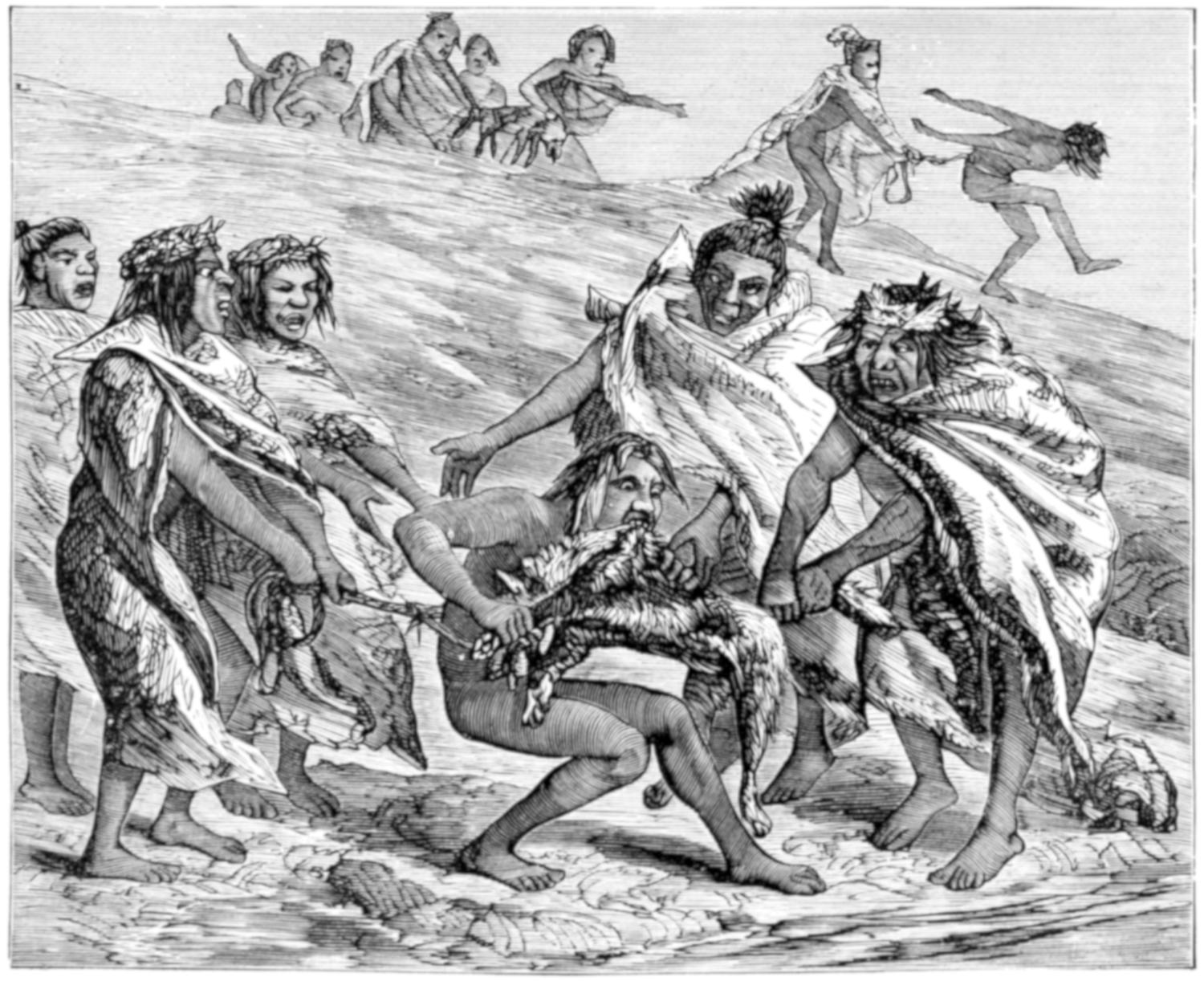
(2.) INITIATION OF A DOG EATER.
(See page 1371.)
CHAPTER CXLIV. VANCOUVER’S ISLAND— Concluded . THE AHTS AND NEIGHBORING TRIBES— Concluded .
ARCHITECTURE OF THE AHTS — SEMI-NOMADIC CHARACTER OF THE PEOPLE — THE PERMANENT FRAMEWORK,
AND MOVABLE WALLS AND ROOF — DIVISION OF THE HOUSE — RANK OF THE OCCUPANTS — OBJECT
AND MODE OF MIGRATION — PIPES OF THE AHT TRIBES — LABOR EXPENDED IN THEIR
MANUFACTURE — RELIGIOUS SYSTEM OF THE TRIBES — AN AHT PROMETHEUS — SOCIETY OF THE
“ALLIED” — THE MEDICINE MEN AND THEIR EDUCATION — THE CANNIBALS AND DOG-EATERS — REVOLTING
SCENES — THE TWO CANNIBALS — SACRED RATTLES — TERROR INSPIRED BY THE
MEDICINE MEN — DISPOSAL OF THE DEAD — RESPECT FOR THE CEMETERY.
From the account of the Roof-dance in the
preceding chapter, it is evident that the
houses are built very strongly, or they would
not be able to endure the violent stamping
and jumping which constitute the principal
charms of the dance. The houses of the
Ahts are constructed after a very peculiar
manner, the posts and framework being stationary,
and the roof and sides movable.
The effect of this arrangement is to enable
the people to shift from one place to another.
At each of the spots to which they migrate
they find the framework of their houses ready
for them, and all that they have to do is to
carry with them the roofs and walls. The
mode of migrating will be presently described.
The framework of the houses consists of
stout posts about twelve feet in diameter, and
twelve feet or so in height, placed at distances
of twenty feet from each other. The
top of the post is hollowed so as to receive
the cross pieces which connect them. A
house is some eighty feet in length, and the
ridgepole which supports the roof is made of
a single tree trunk. The roof, which is
gabled-shaped, but slopes gently from the
back to the front of the house, so as to throw
off the rain, is made of cedar boards, about
five feet long and nearly two inches thick.
The walls are made of similar boards lashed
to small upright posts driven into the ground.
Just below the roof a rude framework is
extended, on which the inhabitants keep
their stores of food, their weapons, and similar
articles. About six feet from the walls,
a strong stockade is erected, so that each
house becomes a sort of fortress. There are
no windows, and the only chimney is formed
by removing one of the roof-boards above
the fireplace. In many of these houses, the
large inside posts are ornamented by having
great faces carved upon them, face-carving
being an art in which these tribes excel, just
as is the case with the New Zealanders. Mr.
Sproat mentions, that he has seen a row of
such houses extending for the third of a mile
along a river’s bank, and that the depth of
the houses varied from twenty-five to forty
feet.
Inside the house, the earth is dug away
for a foot or so in depth, in order to give
additional height to the interior. Every
house is partitioned off into several divisions,
each of which is occupied by a family, which
is thus separated from the other inhabitants
by a sort of bulkhead about four feet high.
These partitions are movable, so that on occasion
of a great festival they can be taken
away, and the whole of the space kept clear.
There is a fire in the middle of each division,
and around it are placed wooden couches,
about nine inches from the floor, and covered
with a whole series of mats by way of bedding.
There is to each building one main entrance,
and other small doors, which are always
in a corner of one of the divisions. The
rank of the different occupants is marked by
the position which they occupy in the house.
For example, the chief of the house occupies
the extreme end on the left of the
building, the next in rank lives in the corresponding
place at the other end, while the
common people occupy the space between
the two great men.
These houses are much more agreeable to
the eye than to the nostrils. Having no
windows, and all the stores of salt fish and
other provisions being kept in them, the
interior atmosphere is close, fishy, rank, and
pungent, the last quality being due to the
wood smoke of the several fires. Neither is
the exterior air better than that of the interior,
for the ground is covered with heaps
of putrefying heads, tails, and bones of fish,
decaying mollusks, and refuse of all kinds,
which is simply flung into heaps and never
removed, the nostrils of the natives being
incapable of feeling any annoyance from the
horrible odor that arises from the decomposing
heaps.
The ownership of these houses is rather a
complicated question. The framework of
the house is generally considered as being
in several divisions, each division being
called after the name of the owner, while
the planks are the common property of the
inhabitants.
When the Ahts wish to move to another
spot, which is done for the purpose of changing
to better fishing, hunting, and fruit
grounds, according to the time of year, they
always migrate by water. They place two
large canoes about five or six feet apart, and
connect them together with the planks of
the roof and walls, which thus form a platform
on which can be placed the stores and
household goods. Mr. Sproat remarks that
he has seen this platform heaped to a height
of fourteen feet, only just enough space being
left for the passengers. As soon as they
arrive at their destination, the travellers
unpack the boats, and, assisted by the slaves
who have been sent forward in readiness,
fix the boards on the already existing framework,
so that in a very short time the house
is ready for the occupants.
These migrations have one beneficial effect.
While the people have deserted their villages,
the birds, aided by the elements, the
only scavengers of Vancouver’s Island, clear
away a considerable portion of the heaps of
putrefying rubbish, which would otherwise
become too much even for native endurance.
In the meetings which are held within
these houses the pipe naturally plays an important
part; and, as the pipes made by
these tribes differ from those of any other
part of the world, a short description is here
given of them. Both in shape and material
these pipes are most remarkable. They
seem to have been made for the express object
of expending the greatest possible
amount of labor upon the clumsiest possible
pipe. I have seen and tried many of these
pipes, and, except that they draw the smoke
very well, there is not a redeeming point
about them.
In the first place, they are carved—stem
and bowl—out of solid stone, a sort of very
dark slate. The upper figure in illustration
No 2, on page 1357, which represents
one of these pipes in my collection, shows
the lightest and least cumbrous form of pipe.
Although only eight inches in length, it
weighs six ounces, no trifle for a pipe of that
description. As is usually the case with
these pipes, it is adorned with a human figure
and a human head. The figure evidently
represents a man seated in a canoe. On
account of the details of dress, it seems
likely that it is intended to represent a
native—possibly the carver himself—in
European costume, the features being of a
strongly-marked Indian type, while the dress
is European. This pipe was presented to me
by Lieut. Pusey.
Sometimes the natives absolutely run riot
in pipe making, and expend infinite labor
in making pipes which look utterly unlike
pipes, and which cannot be smoked without
the very greatest inconvenience. The lower
specimens represent two views of a pipe of
this kind, belonging to T. W. Wood, Esq.,
which has apparently been made for the purpose
of trying how many heads of men and
birds could be compressed into a certain
space. As the reader may observe, the
whole character of this carving bears a very
strong resemblance to the art of the ancient
Mexicans, so strong, indeed, that it might
almost be passed off as a specimen of that
art.
In total length it is a very little more
than eight inches, but from bowl to the
mouth-piece it only measures five inches,
the remaining three inches being simply
superabundant material. The number of
heads that the carver has contrived to introduce
into this pipe is really wonderful, the
ingenuity of combination, together with
force of effect, being worthy of all praise,
especially when the rudeness of the workmanship
is considered. Taken as a work of
art, it is admirable; taken as a pipe, it is
detestable. It is so heavy that the mere exertion
of holding it is fatiguing, and it is so
thick and clumsy that it does not at all
adapt itself to the lips. And, in so cold a
climate, to grasp or to put to the lips such a
piece of hard, cold stone, must involve very
great inconvenience.
The religious ideas of the Aht tribes are,
as may be expected, exceedingly vague, and
are rendered still more so by the reticence
which a savage always exhibits on such subjects.
Mr. Sproat remarks that he lived for
two years among the Ahts, with his mind
constantly directed toward this subject, before
he could discover whether the people
believed in any overruling power, or had any
idea of a future existence. He then proceeds
to say that “a traveller must have
lived for many years among savages, really
as one of themselves, before his opinion as
to their mental and spiritual condition is of
any value at all.” How true this statement
is, none know better than the missionaries,
who find that even their most promising
converts are almost as unwilling to give information
on such subjects as they were during
their state of heathenism.
It is, however, ascertained that the Ahts
really have a belief in a deity and in a future
state, and that they possess several legends
on these subjects. Some of these legends
treat of a certain Quawteaht, who made the
earth and the animals, but would not give
them fire, this being concealed in the body
of the cuttle-fish. In those days they needed
fire, because the Indians, who were afterward
to people the earth, were hidden in
their bodies. At last the deer succeeded in
discovering the fire, and carried away some
of it in the joint of his hind leg. The reader
will doubtless perceive the similarity of this
legend to the old myth of Prometheus.
As far as can be understood, this Quawteaht
is the chief of their deities, but they
have a whole host of minor divinities, who
preside over the sea, the woods, and their
inmates, as well as rule the elements. So,
if a native sees a sudden breeze curl the surface
of the sea, he thinks it signifies the
approval of some spirit; and if he should
hear a rustling in the woods for which he
cannot account, or a sound which he does
not recognize, he immediately puts it down
to the presence of some demon or other.
As might be expected, there are plenty
of medicine men, who have great power over
the people, and are implicitly trusted by
them. They have to go through a long and
unpleasant ordeal before they can be admitted
into the order of the “Allied,” as the
medicine men call themselves. When their
education is nearly finished, they go into
the bush alone, and remain there for several
days, fasting until they have received the
spiritual gifts. The society of the Allied is
encouraged by the chiefs, not from religious
motives, but because they become enriched
by it. No one can become an Allied unless
he possesses considerable wealth, the whole
of which he must give away before he can
be admitted into the society. The act of
giving away his property is done as ostentatiously
as possible, the candidate being escorted
by a large body of men, who shout
and make as great a noise as they can. In
front of them goes the candidate, with one
end of a large rope round his waist, the other
end being held by fifteen or twenty men,
who pretend that all their strength is required
in order to hold him back.
Captain Mayne relates a curious anecdote
respecting the doings of these medicine
men. He was called one evening to see a
moon on the beach. On arriving at the
spot he found that the men had made a flat
disk of wax to represent the moon, and had
painted a man upon it,—they having the
belief, which is still prevalent among the
illiterate of our own country, respecting
a man who lives in the moon. They had
lighted a torch and placed it behind the artificial
moon, so as to illuminate it, and
were supposed to be holding converse with
its inhabitant, much to the awe of the surrounding
crowd.
These medicine men seem to be divided
into three parties, or sects. One of them
does not appear to be particularly distinguished,
but the other two gradually rise in
circumstances of horror. The former sect
is called the Dog-eaters, a portion of whose
initiation is described by Mr. Duncan, and
is illustrated on page 1367.
“Early in the morning the pupils would
be out on the beach or on the rocks, in a
state of nudity. Each had a place in front
of his own tribe, nor did intense cold interfere
in the slightest degree. After the poor
creature had crept about, jerking his head
and screaming for some time, a party of
men would rush out, and, after surrounding
him, would commence singing. The dog-eating
party occasionally carried a dead dog
to their pupil, who forthwith commenced to
tear it in the most dog-like manner. The
party of attendants kept up a low, growling
noise, or a whoop, which was seconded by a
screeching noise made from an instrument
which they believe to be the abode of a
spirit.
“In a little time the naked youth would
start up again, and proceed a few more
yards in a crouching posture, with his arms
pushed out behind him, and tossing his flowing
black hair. All the while he is earnestly
watched by the group about him,
and when he pleases to sit down, they again
surround him and commence singing. This
kind of thing goes on, with several little
additions, for a time.
“Before the prodigy finally retires, he
takes a run into every house belonging to
his tribe, and is followed by his train.
When this is done, in some cases he has a
ramble on the tops of the same houses, during
which he is anxiously watched by his
attendants, as if they expected his flight.
By and by he condescends to come down,
and they then follow him to his den, which
is signified by a rope made of red bark
being hung over the doorway, so as to prevent
any person from ignorantly violating
its precincts. None are allowed to enter
that house but those connected with the art:
all I know, therefore, of their further proceedings
is, that they keep up a furious
hammering, singing, and screeching, for
hours during the day.
Even this mode of initiation cannot be
very pleasant, involving, as it does, the
devouring of raw dog-flesh; but it is nothing
in comparison to that of the most powerful
and dreaded of the three sects, namely, the
cannibals. Mr. Duncan was also a witness
to part of the initiation of a cannibal Allied.
In order to give his assistance to the ceremony,
a chief ordered one of his slaves,
an old woman, to be killed, and her body
flung into the sea. As soon as this was
done, the whole of the uninitiated population
left their houses and formed themselves
into groups at a distance from the
fatal spot, lest they should also become victims,
a fear for which there was very good
reason. Presently two bands of Allied men
came rushing along, producing the most
hideous sounds, each being headed by a
candidate for membership.
The two candidates advanced with a long
creeping step, waving their arms, and jerking
their heads backward and forward, so as
to make their long hair wave in the breeze.
They pretended for some time to be seeking
for the body, and at last they discovered it,
and made a simultaneous rush at it. In a
moment they were closely surrounded by
their respective bands, but in a few minutes
the crowd opened, and out passed the two
men, each bearing half the body of the
murdered woman, which they had actually
torn in two with their hands and teeth alone.
They then began devouring the body, when
the spectator was unable to endure the sight
any longer, and left the spot.
These cannibal medicine men are the
dread of their country. At the cost of such
revolting practices, as have been but very
lightly touched, they gain such a complete
influence over the people, that they can do
exactly as they choose, no man daring to
contradict them. Sometimes at a feast one
of them will be taken with a fit of inspiration,
and dash among the people, biting like
a mad dog at every one whom he meets. On
such occasions it is thought very manly and
praiseworthy of the guests to welcome instead
of repelling his attacks, and to offer
their arms or shoulders for him to bite. The
Allied cannibal responds to the invitation
by biting at and swallowing a piece of the
flesh, and the man who offers it thinks himself
honored in proportion to the size of the
piece that is removed. The wound thus
made is not only productive of excruciating
pain, but is also dangerous, many men having
died from the effects of it. Yet they are
willing to have both the pain and the danger
for the sake of the honor which is conferred
upon them.
The general public have very good reason
for getting out of the way when one of these
cannibals chooses to make an excursion in
search of a human body. Should not one
be found, the cannibal Allied who escort their
companions would think themselves bound
to provide a corpse for his eating, and would
seize and kill the first person whom they
might meet. Therefore, when the sound of
the horrid cannibal songs is heard in the distance,
the whole population of a village will
desert their houses, take to their canoes, and
remain at a distance from the shore until
the danger is over for the time.
These medicine men are considered all-powerful
in the cure of the sick, and are
always called in when any one is ill. They
almost invariably say that the malady is
local, and that it is due to some object or
other, which they can extract by their incantations.
In the ceremonies which they
employ, they make much use of a rattle, the
material of which does not seem to be of
much consequence, provided that it can
only make a noise. For example, a favorite
form is a hollow wooden case, carved like a
bird or a frog, and containing a few stones.
Some rattles, however, are made on totally
different principles, and resemble the beetle-shell
rattle of Guiana that is figured on
page 1265. Captain Mayne saw one which
was made of three or four dozen puffin-beaks
strung loosely together.
Incisions are often made over the part
affected, or the doctor uses the actual cautery
by means of a moxa, made of a pledget of
dried flax. These remedies often do have
the effect of relieving pain, and when that
is the case, the patient and his friends present
the doctor with liberal gifts, all which,
however, he is bound to return should a
relapse come on and the patient die. They
even say that, when they are violently excited
by their incantations, they can see the
soul of the patient, which they say is in the
shape of a fly, with a long curved proboscis.
One man, who had recovered from a dangerous
illness, said that he had seen his own
soul, which the medicine man had caught as
it was escaping from the body, and had put
back again.
The noise which these medicine men
make at their incantations is almost indescribable.
Mr. Sproat describes their howling
as being perfectly demoniacal, and says
that no wild beast could utter sounds so calculated
to strike sudden horror into the
heart. Even himself, though a white man,
and in perfect security, has often shuddered
at the savage yells of the mystery men.
Indeed, their object is to keep up the dread
in which they are held, and, in order to do
this, they must ever be doing something to
keep themselves before the eyes of the people.
Sometimes they will assemble together on
the outskirts of the village, set up a furious
howling, and then rush like a pack of wolves
through the village, the cannibals and dog-eaters
tearing to pieces with their teeth any
corpses or dogs that they may find. Sometimes
a single man will leave the place and
bury himself in the woods, whence he will
suddenly rush, quite naked, reduced to a
skeleton through his long fast, with his body
and limbs covered with wounds inflicted by
himself in his mad violence, and with foam
flying from his lips, while he utters wild
yells and beats furiously his drum or shakes
his magic rattle. As is the case in Africa,
women as well as men can enter this sacred
order, and exercise quite as powerful an influence
over the people as do their male colleagues.
Sometimes a man will leap up in the night
terrified, and crying that he sees a spirit.
All within the house are at once in motion.
The women begin to sing, while the visionary
tears his blanket to pieces, snatches
feathers from his pillow, eating some of
them, and scattering the others over his
head. His nearest relation then makes incisions
in his legs and arms, receives the
blood in a dish, and scatters it over the place
where the spirit is supposed to be standing.
Should the spirit withstand this exorcism, it
is evident that he wants property. Accordingly
the friends of the visionary throw his
property on the fire; his clothes, his mats,
and even the very boxes in which they were
kept, go to make up the demands of the
spirit, which will not take its leave until all
the property has been destroyed.
The mode of disposal of the dead varies
extremely among the different tribes, and
even in the same tribe is not always uniform.
The bodies of slaves and people of no
consequence are simply taken to the burial-ground—which
is usually a small island—wrapped
in mats, and merely laid on the
ground, covered with sticks and stones. The
bodies of chiefs and young girls of rank
are placed in boxes, and hoisted into the
branches of trees, where they are allowed to
remain. The rank of the person is indicated
by the height to which the body is raised,
that of a great chief or of his daughter being
nearly at the top of the tree, while that of
an inferior chief will be on one of the lowest
branches.
Over the coffin are thrown blankets and
mats, and similar articles are hung on the
boughs of neighboring trees. They are
always torn into strips, partly perhaps as a
sign of mourning, and partly to guard them
from being stolen. With the dead man is
deposited all the property which he has not
given away before his death, except his best
canoe, his share of the roof and wall boards,
his weapons, and his slaves, all of which belong
by right to his eldest son. In some
cases even his house is burned, and in others
the posts are dug up, and the whole house
transported to another position.
Near the bodies of chiefs are placed large
wooden images intended to represent the
dead man. One of them, seen by Mr. Sproat,
held a skull in its hand, which it was grimly
contemplating; another, which represented
a deceased orator, had its hand outstretched
as in the act of speaking; and a third was
shown as if grasping a wolf. The relatives
often visit their burial-places. They come
about dark, light a great fire, and feed it with
oil and other inflammable materials, while
they wail loudly at intervals.
To the honor of these tribes, it may be
said that they never disturb the relics of the
departed, even if they occupy the burial-ground
of a hostile tribe. In consequence
of the mode of burial, nothing can have
a more dreary or forlorn look than an island
which has been selected as a burial-ground.
On the branches of the trees are
the mouldering bodies of the dead, and on
their boughs flutter the tattered remains
of their clothing. And on the ground the
scene is no better, for it is occupied with
decaying boards, broken boxes, shattered
canoes, rotten paddles, and other emblems
of decay.
When the dead chief has been a man of
very great importance, his emblem or crest
is either painted or carved. In the former
case it is painted on the coffin, but in the
latter it is generally placed on a post or a
tree near the body. According to Mr. Duncan,
if the crest should happen to be an
eagle or a raven, it is carved as if in the act
of flying, and fixed to the edge of the coffin
with its wings spread, as if it were typical
of the escaping and aspiring spirit of the
dead chief.
CHAPTER CXLV. ALASKA. MALEMUTES—INGELETES—CO-YUKONS. — INGELETES. — THE CO-YUKONS.
LARGE STATURE — THE TO-TOOK — ORNAMENTS — BAIDARRES — UNDERGROUND HOUSES — MALEMUTE
DANCE — CHIEF ALEUYANUK — INGELETES — HOUSES — HONESTY — CO-YUKONS — DRESS — MOURNING
FOR THE DEAD — WAKE — DISPOSAL OF THE DEAD — APPEARANCE OF THE WOMEN — AFFECTION
FOR CHILDREN — COMMUNITY OF GOODS — CHARACTER.
The United States Government having
recently purchased the territory of Alaska,
this work will be increased in value to the
American public, by including some account
of the uncivilized tribes which are its most
numerous inhabitants.
At the mouth of the Unalachleet River is
the most northern settlement on the coast,
a Russian trading post. To the northwest
of this post Mr. Whymper found a large
village of Malemute and Kaveak Indians.
They resemble the Esquimaux, except that
they are a tall and stout race. It is not
unusual to find men among them six feet in
height, and some even taller than this. The
men shave the crown of the head, and
are fond of an ornament called the To-took.
It is made by pieces of bone run through
holes on either side of the face just below
the mouth. The ornaments of the women,
who are stout and good-humored, are a
tattoo on the chin, beads hanging from
their hair, and also leaden or iron bracelets.
Both sexes wear skin clothing. The coat
has a hood almost always, which is generally
of wolf skin. Men and women alike
wear pantaloons of seal or reindeer skin,
the women having the socks attached and in
one piece. The “baidarres” of these natives,
similar to the Esquimaux kajak, are
admirably made. The frames are light
and strong, the skin covering being sewed
with sinew, and the seams made water-tight
by fat rubbed into them.
Their houses are usually underground,
and have a tunnel, through which one must
crawl to enter them. A hole in the roof—which
is just above the surface of the
ground—lets out the smoke. When there
is no fire, this aperture is closely covered
with a skin.
Mr. Whymper gives the following account
of a dance to which he and his party were
invited:—
“On arriving at the doorway, we found a
subterranean passage, two and a half feet
high, crawling through which we at last
reached the room,—dimly lighted by blubber
lamps. The Indians who were to take
part in the dance, chiefly young men, were
nude to the waist, and wore seal, deerskin
or cotton pantaloons, with tails of wolves
or dogs hanging behind, and feathers round
their heads. The elders sat on a bench or
shelf, running round the entire building, and
looked on approvingly, while they consumed
their own smoke, like the Tchuktchis, by
swallowing it, and getting partially intoxicated
thereby. The women brought in berries
and fish in large ‘contogs,’ or wooden
bowls.
“The performance commenced by the
actors ranging themselves in a square, and
raising these dishes of provisions to the four
cardinal points successively, and once to the
skies, with a sudden noise like ‘swish!’ or
the flight of a rocket.
“Then came the feast; and that over, a
monotonous chorus, with an accompaniment
of gongs, was started. The words of the song
commenced, ‘Yung i ya, i ya, i ya!’ and continued
throughout, ‘Yung i ya!’ Then a boy
sprang out on the floor; he was joined by a
second, then a third, till a circle of twenty
was formed. Now they appeared violently
attracted together, and now as much repelled;
now they were horrified at one another’s
conduct, and held up their arms in
warning gestures, and again all were friends
and made pantomime of their happiness. In
this performance there was nearly as much
done by arms and bodies, as with feet. When
there was a lull in the entertainment, small
presents were given to all the strangers invited.”
The Malemutes and Kaveaks, though
intermingling, and having similar habits,
manners, and customs, yet speak different
dialects and inhabit different parts of the
territory. They are considered as superior
to the other Indian tribes of that region.
The Malemute chief “Aleuyanuk,” whom
Mr. Whymper saw, “was a fine-looking old
man, erect and soldierly, and, wearing a
mustache and imperial, his manners would
not have disgraced a civilized assembly.”
The Ingeletes speak a dialect entirely different
from that of the Malemutes,—one
nearly allied to the Co-yukon. They are a
stout, noble-looking race, good-natured, and
having considerable intelligence.
Polygamy, though allowed, is not very
common, and marriage is a permanent relation,
except occasionally, when the wife is
barren or has too many daughters. Female
children not being prized so highly as sons,
in such instances the wife is sometimes dismissed.
They live in underground houses,
such as have been described, and in mild,
wet weather, the passage-way is nothing
but a sewer. The entrance being covered
with a skin, the mixture of foul smells inside,
arising from stale fish and meat, old
skins, dogs, dirt and smoke, is sickening and
unendurable by any but an Indian. Mr.
Whymper testifies to the good temper of
the children and the honesty of the people.
“At their villages our goods lay unguarded
in our absence, and I cannot recall a single
case of proved dishonesty among them,
although we found them becoming more
greedy in their demands for payment.”
The Co-yukons are an interior tribe, and
the largest on the Yukon, which is the great
river of the north, being 2,000 miles long,
and navigable 1,000 miles. They may be
found on the banks of the Co-yukuk, and
other interior rivers. These Indians resemble
the Ingeletes, already mentioned, but
have a more ferocious countenance. Their
dress is a double-tailed coat, one tail before,
the other behind, and this style, with some
modifications, prevails for a thousand miles
on the Yukon.
The dress of the women is cut more
squarely, and they wear an ornament of
Hy-a-qua shells on the nose, which runs
through a hole made in the cartilage between
the nostrils. It is a singular fact that
higher up the river it is the men only who
wear this ornament.
Among these tribes the period of mourning
for the dead is one year, the women during
this time often gathering to talk and
cry over the deceased. At the end of the
year, they have a feast or “wake,” which is
generally a queer compound of jollity and
grief. One such scene, to commemorate the
death of a child, was witnessed by Mr. Whymper
at Nulato. “The poor old mother and
some of her friends wept bitterly, while the
guests were gayly dancing round a painted
pole, on which strings of beads and some
magnificent wolf skins were hung. They
kept up singing and dancing to a fashionable
hour of the morning, and one little savage,
who had been shouting at the top of his
lungs for hours, got up the next day without
any voice at all, a case of righteous retribution.
The decorations of the pole were divided
among those who took part in the
‘wake.’”
Their method of disposing of the dead is
not interment, but enclosure in oblong boxes,
raised on posts. These are sometimes ornamented
with strips of skin, and the possessions
of the deceased, as the canoe, paddles, &c., are
placed on the top of the box. Smaller articles
are placed within the box. This four-post
coffin is a custom also among the coast
tribes already described. The women are
quite prepossessing in appearance, are affectionate
toward their children, and especially
fond of their first-born. They are good-natured
and playful, snowballing and rolling each
other in the snow, sliding down hill on sledges
or snow-shoes, with the enthusiasm of
children.
There are other tribes, the names of which
need only be mentioned, viz: the Kotch-a-Kutchins
(or lowland people), the Au Kutchins,
the Tatauchok Kutchins, Birch River
and Rat River Indians. The Zanana Indians
(or knoll people), Mr. Whymper thinks
are the most unsophisticated of all the Indian
tribes of the present day. Those he
saw “were gay with painted faces, feathers
in their long hair, patches of red clay at the
back of their heads, covered with small fluffy
feathers, double-tailed coats and pantaloons
of buckskin, much adorned with fringes and
beads, and elaborately worked fire-bags and
belts.” Many of them, as in other Indian
tribes, wore through the nose the Hy-a-qua
shell as an ornament. The women of the
upper tribes wear less ornament than the
men, and are compelled to do more drudgery
than those of the lower Yukon and coast of
Alaska.
Among the coast tribes, and especially
on the Yukon, there is, to some extent, a
community of goods, the industrious hunter
supplying the village crowd. This is a custom
so much practised that the hunter gets
no praise for his service. Some of the chiefs
maintain their position by frequent distributions
of their effects, and the game which
they, being good hunters, have been able
to take. “These chiefs are often the worst
clothed and worst fed of all the tribe. Such
generosity is expected as a matter of course.
No man, woman, or child among them goes
unfed, unhoused, or unwarmed, if there be
food, dwelling, or fire in the settlement.”
Among the tribes of Alaska, a system of
slavery exists that can hardly be surpassed
for barbarism. They all buy and sell slaves.
“Parents will sell their children for three or
four blankets or a few dollars, and have no
compunction of conscience for the use they
may be put to in the future. When one
tribe goes to war with another, all the prisoners
taken by either tribe are called and
used as slaves. When a chief or any
of his family dies, it is the custom to kill
one or more of these slaves, so that the chief
or his deceased relative may have a servant
in the other world to wait on him. In 1868
an old chief of the Sitka tribe died, and a
few days before his death, when his relatives
were satisfied that he could live but a short
time, they selected as a victim for sacrifice
a young, healthy, good-looking warrior,
whom the Sitka tribe had taken prisoner
while at war with one of the tribes down
near Queen Charlotte’s Sound. The slave
had been tied up two days about the time
the old chief died, and by some means some
of his friends were apprised of his condition,
and immediately notified Gen. Davis that
the Indian slave was liable to be killed at
any moment. Gen. Davis had one of the
chiefs brought before him, and after a long
conversation about the foolishness of such
sacrifices, he agreed to let the slave go free;
and lest they might attempt to put into execution
their original idea of killing him, the
General permitted the Indian to remain in
the city, where he would be protected.
“Recently one of the chiefs tried hard to
get hold of a half-breed, named Evanoff, to
sacrifice him. For the two preceding weeks
this chief would go up every day to Gen.
Davis, stating that he had a slave in the
city, and wanting to know if he could not get
him into Indiantown. The General, supposing
the chief wanted one of his Indians,
told him to go and get him, but it was not
until the day in question that the effort was
made to get this man. It seems that Evanoff’s
mother was an Indian woman, but his
father was a Russian, and when he was but
three years of age a lady named Bengeman
adopted and brought him up. The
chief who claimed him had a child that was
expected to die, and afterward did die. Having
no slave but his claim on Evanoff, he made
this effort to sacrifice him that he might be
a servant for his child in the spirit world.
When the general saw whom the chief
claimed, in a very few well-timed words he
taught him and several of his warriors more
about civilization than ever they knew before.
He asked the chief what he wanted with this
man. Pointing to Evanoff, the Indian told
him his child was sick, and he only wanted
him for three hours, and then he would let
him go free. The General told him that the
best thing he could do was to look on Evanoff
as a free man already, and warned the Indian
if in the future he should ever attempt to
trouble Evanoff again, he would put him in
the guard-house and keep him there. The
Indian went off well pleased, and stated that
he would be a good Indian thereafter.
“The slaves are put to death as follows.
As soon as a chief dies, the slave is compelled
to wash the body of the corpse; and
is then taken out and thrown flat on his
back and held there, when a stick of wood is
placed across his throat, and two Indians sit
down on each end of it, and in this way
strangle him to death. His body is then
placed inside a large pile of wood and burned
to ashes. It is customary when a big chief
dies to put to death two or more slaves. All
slaves taken in war have to act as servants
for the chiefs who own them.”—(Sitka Times
of Nov. 27, 1869.)
The Indian population of the whole territory
of Alaska is estimated at about 30,000.
They are peaceful and quite capable, learning
quickly, and exhibiting considerable
skill in their utensils and weapons.
CHAPTER CXLVI. SIBERIA. THE TCHUKTCHI—JAKUTS—TUNGUSI. — JAKUTS. — THE TUNGUSI.
HOME OF THE TCHUKTCHI — INDEPENDENCE — DISTRICT OF THE RUSSIANS — CARAVANS — INTOXICATION
BY TOBACCO — FAIR OF OSTROWNOJE — GRAVITY OF THE TCHUKTCHI — THEIR TENT — MADAME
LEÜTT — HOSPITALITY — SHAMANISM — HUMAN SACRIFICE — POLYGAMY — MURDER
OF THE AGED — JAKUTS — THEIR ENDURANCE — RESERVE — SUPERSTITION — THE TUNGUSI — DIFFERENT
TRIBES — CANNIBALISM — ORNAMENTS — BRAVERY — DIET — SHAMANISM — DISPOSAL
OF THE DEAD — A NIGHT’S HALT WITH THE TUNGUSI IN THE FOREST — SPORTS — FAIRS.
Crossing Behring’s Straits into Asia, we
find in Northern Siberia several peoples
whose condition and character bring them
within the scope of this work.
The home of the Tchuktchi is at the extreme
north-eastern point of Asia; bounded
by the Polar Ocean on one side, and by
Behring Sea on the other. It is, as the few
travellers who have visited it say, one of the
dreariest regions of the earth. There is no
indication of summer before July 20th, and
winter begins about the 20th of August.
The sea coasts abound with seals, sea-lions,
and walruses; while the wolf, reindeer, and
Arctic fox abound in the interior. In this
cold, desolate region dwell the only aboriginal
race of Northern Asia that has resisted
all attempts of the Russian government to
take away its independence. Dr. Hartwig,
in his sketch of this tribe, says: “The
rulers of Siberia have confined them within
narrower limits, but they obey no foreign
leader, and wander unmolested, with their
numerous reindeer herds, over the naked
tundras.”
A natural distrust of their powerful neighbors
has rendered them long unwilling to
enter into any commercial intercourse with
the Russians, and to meet them at the fair
of Ostrownoje, a small town, situated not
far from their frontiers, on a small island of
the Aninj, in 68° N. lat.
From the East Cape of Asia, where, crossing
Behring’s Strait in boats covered with
skins, they barter furs and walrus teeth
with the natives of America, the Tchuktchi
come with their goods and tents drawn on
sledges to the fair of Ostrownoje. One of
these caravans generally consists of fifty or
sixty families, and one fair is scarcely at an
end when they set off to make their arrangements
for the next.
Tobacco is the primum mobile of the trade
which centres in Ostrownoje. Their pipes
are of a peculiar character, larger at the
stem than the bowl, which holds a very small
quantity of tobacco. In smoking, they swallow
the fumes of the tobacco, and often, after
six or eight whiffs, fall back, completely intoxicated
for the time.
But Ostrownoje attracts not only Tchuktchi
and Russians; a great number of the
Siberian tribes, from a vast circuit of 1,000
or 1,500 versts,—Jukahiri, Lamutes, Tungusi,
Tschuwanzi, Koriacks,—also come
flocking in their sledges, drawn partly by
dogs, partly by horses, for the purpose of
bartering their commodities against the
goods of the Tchuktchi. Fancy this barbarous
assembly meeting every year during
the intense cold and short days of the beginning
of March. Picture to yourself the
fantastic illumination of their red watch-fires
blazing under the starry firmament, or
mingling their ruddy glare with the aurora
flickering through the skies, and add to the
strange sight the hollow sound of the Shaman’s
drum, and the howling of several
hundreds of hungry dogs, and you will surely
confess that no fair has a more original character
than that of Ostrownoje.
The imperturbable gravity of the Tchuktch
forms a remarkable contrast with the greedy
eagerness of the Russian trader. Although
the Tchuktchi have no scales with them, it
is not easy to deceive them in the weight,
for they know exactly by the feeling of the
hand whether a quarter of a pound is wanting
to the pound. The whole fair seldom
lasts longer than three days, and Ostrownoje,
which must have but very few stationary
inhabitants indeed (as it is not even
mentioned in statistical accounts, which cite
towns of seventeen souls), is soon after abandoned
for many months to its ultra-Siberian
solitude.
But before we allow the Tchuktchi to
retire to their deserts, we may learn something
more of their habits by accompanying
Mr. Matiuschkin Wrangell’s companion on
a visit to the ladies of one of their first
chiefs. “We enter the outer tent, or
‘wamet,’ consisting of tanned reindeer
skins supported on a slender framework.
An opening at the top to let out the smoke,
and a kettle in the centre, announce that
antechamber and kitchen are here harmoniously
blended into one. But where are
the inmates? Most probably in that large
sack made of the finest skins of reindeer
calves, which occupies, near the kettle, the
centre of the ‘wamet.’ To penetrate into
this sanctum sanctorum of the Tchuktch
household, we raise the loose flap which
serves as a door, creep on all-fours through
the opening, cautiously re-fasten the flap by
tucking it under the floor-skin, and find
ourselves in the reception or withdrawing-room,—the
‘polog.’ A snug box, no doubt,
for a cold climate, but rather low, as we cannot
stand upright in it, and not quite so
well ventilated as a sanitary commissioner
would approve of, as it has positively no
opening for light or air. A suffocating
smoke meets us on entering. We rub our
eyes, and when they have at length got
accustomed to the biting atmosphere, we
perceive, by the gloomy light of a train-oil
lamp, the worthy family squatting on the
floor in a state of almost complete nudity.
Without being in the least embarrassed,
Madame Leütt and her daughter receive us
in their primitive costume. But, to show us
that the Tchuktchi know how to receive
company, and to do honor to their guests,
they immediately insert strings of glass
beads in their greasy hair. Their hospitality
equals their politeness; for, instead of a
cold reception, a hot dish of boiled reindeer
flesh, copiously irrigated with rancid train-oil
by the experienced hand of the mistress
of the household, is soon after smoking
before us. Unfortunately, our effeminate
taste is not up to the haut goût of her culinary
art, and while Mr. Leütt does ample
justice to the artistic talent of his spouse,
by rapidly bolting down pieces as large as a
fist, we are hardly able to swallow a morsel.”
Though most of the Reindeer or nomadic
Tchuktchi have been baptized, yet Wrangell
supposes the ceremony to have been a mere
financial speculation on their part, and is
convinced that the power of the Shamans is
still as great as ever. An epidemic had carried
off a great number of persons, and also
whole herds of reindeer. In vain the Shamans
had recourse to their usual conjurations.
The plague continued. They consulted together,
and directed that one of their most
respected chiefs, named Kotschen, must be
sacrificed, to appease the irritated spirits.
Kotschen was willing to submit to the sentence,
but none could be found to execute it,
until his own son, prevailed on by his father’s
exhortations, and terrified by his threatened
curse, plunged a knife into his heart, and
gave his body to the Shamans.
Polygamy is general among the Tchuktchi,
and they change their wives as often as
they please. Still, though the women are
certainly slaves, they are allowed more influence,
and are subjected to less labor, than
among many savages. Among other heathenish
and detestable customs, is that of
killing all deformed children, and all old people
as soon as they become unfit for the
hardships and fatigues of a nomad life.
They do not indulge in any needless cruelty,
but stupefy the aged victim, by putting
some substance up the nostrils before opening
a vein. Two years before Wrangell’s
arrival at Kolyma there was an instance
of this in the case of one of their richest
chiefs. Waletka’s father became infirm and
tired of life, and was put to death at his own
express desire, by some of his nearest relations.
The number of the Tchuktchi is greater
than one might expect to find in so sterile a
country. According to the Russian missionaries,
there were, some years back, 52
ulusses or villages of the Onkilon (or stationary
Tchuktchi), with 1,568 tents, and
10,000 inhabitants, and Wrangell tells us
that the Tennygk (or Reindeer Tchuktchi),
are at least twice as numerous, so that the
entire population of the land of the Tchuktchi
may possibly amount to 30,000.
The Jakuts are the most energetic of
these races, having reached a higher civilization
than the others in the same latitude,
with the exception of Iceland, Finland, and
Norway. They are a pastoral people, hospitable,
possess considerable mechanical skill,
and are so shrewd and cunning that no
Russian can compete with them.
“Even in Siberia,” Wrangell says, “they
are called ‘men of iron.’ Often have I seen
them sleeping at a temperature of 4° in
the open air, and with a thick ice rind covering
their almost unprotected bodies.”
Though reserved and unsocial, they are
kind to strangers that need assistance.
They are the universal carriers to the east
of the Lena. Bidding defiance to the cold
and the storm, fearing neither the gloom
of the forest nor the dangers of the icy
stream, yet they are not emancipated from
the old belief in Schamanism—the dread
of evil spirits. They number about 200,000,
and form the principal part of the
population of the vast and dreary province
of Jakutsk.
This race having spread over East Siberia,
driving before them the Jakuts, Jukahiri,
Tchuktchi, and other aboriginal tribes, were
conquered by the Russians, and are now as
ignorant and uncivilized as they were two
hundred and fifty years ago. Dr. Hartwig,
deriving his information from Wrangell,
the Arctic explorer, thus sketches the traits
of this people:—
“According to their occupations, and the
various domestic animals employed by them,
they are distinguished by the names of Reindeer,
Horse, Dog, Forest, and River Tungusi;
but, although they are found from the
basins of the Upper, Middle, and Lower
Tunguska, to the western shore of the sea of
Ochotsk, and from the Chinese frontiers and
the Baikal to the Polar Ocean, their whole
number does not amount to more than 30,000,
and diminishes from year to year, in consequence
of the ravages of the small-pox and
other epidemic disorders transmitted to them
by the Russians. Only a few rear horses and
cattle, the reindeer being generally their domestic
animal; and the impoverished Tunguse,
who has been deprived of his herd by
some contagious disorder, or the ravages of
the wolves, lives as a fisherman on the borders
of a river, assisted by his dog, or retires into
the forests as a promyschlenik, or hunter.”
Of the miseries which here await him,
Wrangell relates a melancholy instance. In
a solitary hut, in one of the dreariest wildernesses
imaginable, he found a Tunguse and
his daughter. While the father, with his
long snow-shoes, was pursuing a reindeer
for several days together, this unfortunate
girl remained alone and helpless in the hut,—which
even in summer afforded but an
imperfect shelter against the rain and wind,—exposed
to the cold, and frequently to
hunger, and without the least occupation.
No wonder that the impoverished Tungusi
not seldom sink into cannibalism. Neither
the reindeer nor the dogs, nor the wives
and children of their more fortunate countrymen,
are secure from the attacks and
voracity of these outcasts, who, in their turn,
are treated like wild beasts, and destroyed
without mercy. A bartering trade is, however,
carried on with them, but only at a
distance, and by signs; each party depositing
its goods, and following every motion of
the other with a suspicious eye.
The Russian government, anxious to relieve
the misery of the impoverished nomads,
has given orders to settle them along
the river banks, and to provide them with
the necessary fishing implements; but only
extreme wretchedness can induce the Tunguse
to relinquish his free life of the forest.
His careless temper, his ready wit, and
sprightly manner, distinguish him from the
other Siberian tribes,—the gloomy Samoïede,
the uncouth Ostiak, the reserved Jakut,—but
he is said to be full of deceit and malice.
His vanity shows itself in the quantity of
glass beads with which he decorates his
dress of reindeer leather, from his small
Tartar cap to the tips of his shoes. When
chasing or travelling on his reindeer through
the woods, he of course lays aside most of
his finery, and puts on large water-tight
boots, or sari, well greased with fat, to keep
off the wet of the morass. His hunting apparatus
is extremely simple. A small axe,
a kettle, a leathern bag containing some
dried fish, a dog, a short gun, or merely a
bow and a sling, is all he requires for his
expeditions into the forest. With the assistance
of his long and narrow snow-shoes,
he flies over the dazzling plains, and protects
his eyes, like the Jakut, with a net
made of black horse-hair. He never hesitates
to attack the bear single-handed, and
generally masters him. The nomad Tunguse
naturally requires a movable dwelling.
His tent is covered with leather, or large
pieces of pliable bark, which are easily rolled
up and transported from place to place. The
yourt of the sedentary Tunguse resembles
that of the Jakut, and is so small that it can
be very quickly and thoroughly warmed by
a fire kindled on the stone hearth in the
centre. In his food the Tunguse is by no
means dainty. One of his favorite dishes
consists of the contents of a reindeer’s
stomach mixed with wild berries, and
spread out in thin cakes on the rind of
trees, to be dried in the air or in the sun.
Those who have settled on the Wiluj and in
the neighborhood of Nertschinsk likewise
consume large quantities of brick tea, which
they boil with fat and berries into a thick
porridge, and this unwholesome food adds,
no doubt, to the yellowness of their complexion.
But few of the Tungusi have been converted
to Christianity, the majority being
still addicted to Shamanism. They do not
like to bury their dead, but place them, in
their holiday dresses, in large chests, which
they hang up between two trees. The
hunting apparatus of the deceased is buried
beneath the chest. No ceremonies are used
on the occasion, except when a Shaman
happens to be in the neighborhood, when a
reindeer is sacrificed, on whose flesh the sorcerer
and the relatives regale themselves,
while the spirits to whom the animal is supposed
to be offered are obliged to content
themselves with the smell of the burnt fat.
As among the Samoïedes or the Ostiaks,
woman is a marketable ware among the
Tungusi. The father gives his daughter in
marriage for twenty or a hundred reindeer,
or the bridegroom is obliged to earn her
hand by a long period of service.
In East Siberia the Tungusi divide with
the Jakuts the task of conveying goods or
travellers through the forests, and afford the
stranger frequent opportunities for admiring
their agility and good humor. On halting
after a day’s journey, the reindeer are unpacked
in an instant, the saddles and the
goods ranged orderly on the ground, and the
bridles collected are hung on branches of
trees.
Comfortably seated on his reindeer saddle,
the traveller may now amuse himself with
the dances, which the Tungusi accompany
with an agreeable song; or, if he choose to
witness their agility in athletic exercises, it
only costs him a word of encouragement
and a small donation of brandy. Two of the
Tungusi hold a rope, and swing it with all
their might, so that it does not touch the
ground. Meanwhile a third Tunguse skips
over the rope, picks up a bow and arrow,
spans the bow and shoots the arrow, without
once touching the rope. Some particularly
bold and expert Tungusi will dance
over a sword which a person lying on his
back on the ground is swinging about with
the greatest rapidity. Should our traveller
be a friend of chess, the Tungusi are equally
at his service, as they are passionately fond
of this noblest of games, especially in the
Kolymsk district.
Like all other Siberian nomads, they visit,
at least once a year, the various fairs which
are held in the small towns scattered here
and there over their immense territory, such
as Kirensk, Olekminsk, Bargusin and Ochotsk,
which, before the opening of Amoor to
trade, was the chief port of East Siberia.
CHAPTER CXLVII. SIBERIA— Concluded . THE SAMOÏEDES AND OSTIAKS. — THE OSTIAKS.
THEIR BARBARISM — NUM, OR JILIBEAMBAERTJE — SHAMANISM — SAMOÏEDE IDOLS — SJADÆI — HAHE — THE
TADEBTSIOS, OR SPIRITS — THE TADIBES, OR SORCERERS — THEIR DRESS — THEIR INVOCATIONS — THEIR
CONJURING TRICKS — REVERENCE PAID TO THE DEAD — A SAMOÏEDE OATH — APPEARANCE
OF THE SAMOÏEDES — THEIR DRESS — A SAMOÏEDE BELLE — CHARACTER OF THE
SAMOÏEDES — THEIR DECREASING NUMBERS — TRADITIONS OF ANCIENT HEROES — OSTIAKS — WHAT
IS THE OBI? — A SUMMER YOURT — POVERTY OF OSTIAK FISHERMEN — A WINTER YOURT — ATTACHMENT
OF OSTIAKS TO THEIR ANCIENT CUSTOMS — ARCHERY — APPEARANCE AND CHARACTER
OF THE OSTIAKS.
The Samoïedes, the neighbors of the Laplanders,
are still farther removed from
civilized society, and plunged in even
deeper barbarism. The wildest tundras
and woods of Northern Russia and Western
Siberia are the home of the Samoïede.
With his reindeer herds he wanders over
the naked wastes, from the eastern coasts
of the White Sea to the banks of the
Chatanga, or hunts in the boundless forests
between the Obi and the Jenissei. His
intercourse with the Russians is confined to
his annual visit at the fairs of such miserable
settlements as Obdorsk and Pustosersk,
where, far from improving by their company,
he but too often becomes the prey of
their avarice, and learns to know them
merely as cheats and oppressors. Protestant
missionaries have long since brought
instruction to the Laplander’s hut, but the
majority of the less fortunate Samoïedes
still adhere to the gross superstitions of
their fathers. They believe in a Supreme
Being,—Num, or Jilibeambaertje,—who
resides in the air, and, like the Jupiter of
old, sends down thunder and lightning, rain
and snow; and as a proof that something of
a poetic fancy is to be found even among
the most savage nations, they call the rainbow
“the hem of his garment.” As this
deity, however, is too far removed from
them to leave them any hope of gaining his
favor, they never think of offering him
either prayer or sacrifice. But, besides
Num, there are a great many inferior
spirits, or idols, who directly interfere in
human concerns,—capricious beings, who
allow themselves to be influenced by offerings,
or yield to magical incantations; and
to these, therefore, the Samoïede has
recourse when he feels the necessity of
invoking the aid or averting the wrath of a
higher power.
The chief of all Samoïede idols is in the
island of Waygatz,—a cold and melancholy
Delos,—where it was already found by old
Barentz. This idol is a mere block of stone,
with its head tapering to a point. It has
thus been fashioned, not by a mortal artist,
but by a play of nature. After this original
the Samoïedes have formed many idols of
stone or wood of various sizes, which they
call “Sjadæi,” from their possessing a human
physiognomy (sja). These idols they dress
in reindeer skins, and ornament them with
all sorts of colored rags. But a resemblance
to the human form is not the necessary attribute
of a Samoïede idol; any irregularly
shaped stone or tree may be thus distinguished.
If the object is small, the savage carries
it everywhere about with him, carefully
wrapped up; if too cumbersome to be transported,
it is reserved as a kind of national
deity. As with the Ostiaks, each Samoïede
tribe has in its train a peculiar sledge,—the
Hahengan,—in which the household idols
(or Hahe) are placed. One of these Penates
protects the reindeer, another watches over
the health of his worshippers, a third is the
guardian of their connubial happiness, a
fourth takes care to fill their nets with fish.
Whenever his services are required, the
Hahe is taken from his repository, and
erected in the tent or on the pasture ground,
in the wood or on the river’s bank.
His mouth is then smeared with oil or
blood, and a dish with fish or flesh is set
before him, in the full expectation that his
good offices will amply repay the savory repast.
When his aid is no longer necessary,
he is put aside without any further ceremony,
and as little noticed as the Madonna
of the Neapolitan fisherman after the storm
has ceased.
The Hahe, or idols, are very convenient
objects of reverence to the Samoïede, as he
can consult them, or ask their assistance,
without being initiated in the secrets of
magic; while the Tadebtsios, or invisible
spirits, which everywhere hover about in
the air, and are more inclined to injure than
to benefit man, can only be invoked by a
Tadibe, or sorcerer, who, like the Cumæan
sibyl, works himself into a state of ecstatic
frenzy. When his services are required,
the first care of the Tadibe is to invest himself
with his magical mantle,—a kind of
shirt made of reindeer leather, and hemmed
with red cloth. The seams are covered in
a similar manner, and the shoulders are decorated
with epaulettes of the same gaudy
material. A piece of red cloth veils the eyes
and face,—for the Tadibe requires no external
organs of sight to penetrate into the
world of spirits,—and a plate of polished
metal shines upon his breast.
Thus accoutred, the Tadibe seizes his
magical drum, whose sounds summon the
spirits to his will. Its form is round, it has
but one bottom, made of reindeer skin, and
is more or less decorated with brass rings,
and other ornaments, according to the wealth
or poverty of its possessor. During the ceremony
of invocation, the Tadibe is generally
assisted by a disciple, more or less initiated
in the magic art. They either sit down, or
walk about in a circle. The chief sorcerer
beats the drum, at first slowly, then with
increasing violence, singing at the same
time a few words to a mystic melody. The
disciple immediately falls in, and both repeat
the same monotonous chant.
At length the spirits appear, and the consultation
is supposed to begin; the Tadibe
from time to time remaining silent, as if
listening to their answers, and but gently
beating his drum, while the assistant continues
to sing. Finally, this mute conversation
ceases, the song changes into a wild
howling, the drum is violently struck, the
eye of the Tadibe glows with a strange fire,
foam issues from his lips, when suddenly the
uproar ceases, and the oracular sentence is
pronounced. The Tadibes are consulted, not
only for the purpose of recovering a strange
reindeer, or to preserve the herd from a contagious
disorder, or to obtain success in fishing.
The Samoïede, when a prey to illness,
seeks no other medical advice; and the sorcerer’s
drum either scares away the malevolent
spirits that cause the malady, or summons
other to the assistance of his patient.
Besides dealing with the invisible world,
the Tadibe does not neglect the usual arts of
an expert conjurer, and knows by this means
how to increase his influence over his simple-minded
countrymen. One of his commonest
tricks is similar to that which has been practised
with so much success by the brothers
Davenport. He sits down, with his hands
and feet bound, on a reindeer skin stretched
out upon the floor, and, the light being removed,
begins to summon the ministering
spirits to his aid. Strange, unearthly noises
now begin to be heard; bears growl, snakes
hiss, squirrels rustle about the hut. At
length the tumult ceases, the audience anxiously
awaits the end of the spectacle, when
suddenly the Tadibe, freed from his bonds,
steps into the hut, no one doubting that the
spirits have set him free.
As barbarous as the poor wretches who
submit to his guidance, the Tadibe is incapable
of improving their moral condition,
and has no wish to do so. Under various
names,—Schamans among the Tungusi,
Angekoks among the Esquimaux, medicine-men
among the North American Indians,—we
find similar magicians or impostors
assuming a spiritual dictatorship over all
the Arctic nations of the Old and the New
World, wherever their authority has not
been broken by Christianity or Buddhism.
This dreary faith still extends its influence
over at least half a million of souls, from
the White Sea to the extremity of Asia, and
from the Pacific to Hudson’s Bay.
Like the Ostiaks and other Siberian
tribes, the Samoïedes honor the memory of
the dead by sacrifices and other ceremonies.
They believe that their deceased friends
have still the same wants and pursue the
same occupations as when in the land of the
living; and thus they place in or about their
graves a sledge, a spear, a cooking-pot, a
knife, an axe, etc., to assist them in procuring
and preparing their food. At the
funeral, and for several years afterward,
the relations sacrifice reindeer over the
grave. When a person of note, a prince,
a Starschina, the proprietor of numerous
herds of reindeer, dies (for even among the
miserable Samoïedes we find the social
distinctions of rich and poor), the nearest
relations make an image, which is placed in
the tent of the deceased, and enjoys the
respect paid to him during his lifetime. At
every meal the image is placed in his former
seat, and every evening it is undressed and
laid down in his bed. During three years
the image is thus honored, and then buried;
for by this time the body is supposed to be
decayed, and to have lost all sensation of
the past. The souls of the Tadibes, and of
those who have died a violent death, alone
enjoy the privilege of immortality, and after
their terrestrial life hover about in the air
as unsubstantial spirits.
Like the Ostiaks, the Samoïedes consider
the taking of an oath as an action of the
highest religious importance. When a crime
has been secretly committed against a Samoïede,
he has the right to demand an oath
from the suspected person.
If no wooden or stone Hahe is at hand, he
manufactures one of earth or snow, leads
his opponent to the image, sacrifices a dog,
breaks the image, and then addresses him
with the following words: “If thou hast committed
this crime, then must thou perish
like this dog.” The ill consequences of perjury
are so much dreaded by the Samoïedes,—who,
though they have but very faint ideas
of a future state, firmly believe that crime
will be punished in this life: murder with
violent death, or robbery by losses of reindeer,—that
the true criminal, when called
upon to swear, hardly ever submits to the
ceremony, but rather at once confesses his
guilt, and pays the penalty.
The most effectual security for an oath is
that it should be solemnized over the snout
of a bear,—an animal which is highly revered
by all the Siberian tribes, from the
Kamschatkans to the Samoïedes, as well as
by the Laplanders. Like the Laplanders,
they believe that the bear conceals under
his shaggy coat a human shape with more
than human wisdom, and speak of him in
terms of the highest reverence. Like the
Lapps, also, they will drive an arrow or a
bullet through his skin; but they preface
the attack with so many compliments that
they feel sure of disarming his anger.
The appearance of the Samoïedes is as
wild as the country which they inhabit. The
dwarfish stature of the Ostiak or the Lapp,
thick lips, small eyes, a low forehead, a broad
nose, so much flattened that the end is
nearly upon a level with the bone of the upper
jaw (which is strong and greatly elevated),
raven-black, shaggy hair, a thin beard, and
a yellow-brown complexion, are their characteristic
features, and in general they do
nothing to improve a form which has but
little natural beauty to boast of. The Samoïede
is satisfied if his heavy reindeer dress
affords him protection against the cold and
rain, and cares little if it be dirty or ill-cut;
some dandies, however, wear furs trimmed
with cloth of a gaudy color. The women, as
long as they are unmarried, take some pains
with their persons; and when a Samoïede
girl, with her small and lively black eyes,
appears in her reindeer jacket tightly fitting
round the waist, and trimmed with dog-skin,
in her scarlet moccasins, and her long, black
tresses, ornamented with pieces of brass or
tin, she may well tempt some rich admirer
to offer a whole herd of reindeer for her
hand. For among the Samoïedes no father
ever thinks of bestowing a portion on his
daughter; on the contrary, he expects from
the bridegroom an equivalent for the services
which he is about to lose by her marriage.
The consequence of this degrading
custom is that the husband treats his consort
like a slave, or as an inferior being. A
Samoïede, who had murdered his wife, was
quite surprised at being summoned before
a court of justice, for what he considered a
trifling offence; “he had honestly paid for
her,” he said, “and could surely do what he
liked with his own.”
The senses and faculties of the Samoïedes
correspond to their mode of life as nomads
and hunters. They have a piercing eye, delicate
hearing, and a steady hand; they shoot
an arrow with great accuracy, and are swift
runners.
The Samoïede is good-natured, melancholy,
and phlegmatic. He has, indeed, but
indistinct notions of right and wrong, of
good and evil; but he possesses a grateful
heart, and is ready to divide his last morsel
with his friend. Cruelty, revenge, the
darker crimes that pollute so many of the
savage tribes of the tropical zone, are foreign
to his character. Constantly at war
with a dreadful climate, a prey to ignorance
and poverty, he regards most of the things
of this life with supreme indifference.
A common trait in the character of all
Samoïedes is the gloomy view which they
take of life and its concerns; their internal
world is as cheerless as that which surrounds
them. True men of ice and snow, they relinquish,
without a murmur, a life which
they can hardly love, as it imposes upon
them many privations, and affords them but
few pleasures in return.
The entire number of the European and
Asiatic Samoïedes is estimated at no more
than about 10,000, and this number, small as
it is when compared to the vast territory
over which they roam, is still decreasing
from year to year. Before their subjugation
by the Russians, the Samoïedes were frequently
at war with their neighbors, the
Ostiaks, the Woguls, and the Tartars, and
the rude poems which celebrate the deeds of
the heroes of old are still sung in the tents
of their peaceful descendants. The minstrel,
or troubadour,—if I may be allowed to use
these names while speaking of the rudest of
mankind,—is seated in the centre of the hut,
while the audience squat around. His gesticulations
endeavor to express his sympathy
with his hero. His body trembles, his voice
quivers, and during the more pathetic parts
of his story, tears start to his eyes, and he
covers his face with his left hand, while the
right, holding an arrow, directs its point to
the ground. The audience generally keep
silence, but their groans accompany the
hero’s death; or when he soars upon an
eagle to the clouds, and thus escapes the
malice of his enemies, they express their
delight by a triumphant shout.
What is the Obi? “One of the most
melancholy rivers on earth,” say the few
European travellers who have ever seen it
roll its turbid waters through the wilderness;
“its monotonous banks a dreary succession
of swamps and dismal pine forests,
and hardly a living creature to be seen, but
cranes, wild ducks, and geese.” If you
address the same question to one of the few
Russians who have settled on its banks, he
answers, with a devout mien, “Obi is our
mother”; but if you ask the Ostiak, he
bursts forth in a laconic but energetic
phrase, “Obi is the god whom we honor
above all other gods.”
To him the Obi is a source of life. With
its salmon and sturgeon he pays his taxes
and debts, and buys his few luxuries; while
the fishes of inferior quality which get
entangled in his net he keeps for his own
consumption and that of his faithful dog,
eating them mostly raw, so that the perch
not seldom feels his teeth as soon as it is
pulled out of the water. In spring, when
the Obi and its tributaries burst their bonds
of ice, and the floods sweep over the plains,
the Ostiak is frequently driven into the
woods, where he finds but little to appease
his hunger. At length, however, the waters
subside, the flat banks of the river appear
above their surface, and the savage erects
his summer hut close to its stream. This
hovel has generally a quadrangular form,
low walls, and a high-pointed roof, made of
willow branches covered with large pieces
of bark. These, having first been softened
by boiling, are sewed together, so as to form
large mats or carpets, easily rolled up and
transported. The hearth, a mere hole inclosed
by a few stones, is in the centre, and
the smoke escapes through an aperture at the
top. Close to the hut there is also, generally,
a small store-house erected on high poles, as
in Lapland; for the provisions must be
secured against the attacks of the glutton,
the wolf, or the owner’s dogs.
At the beginning of winter the Ostiaks
retire into the woods, where they find, at
least, some protection against the Arctic
blasts, and are busy hunting the sable or
squirrel; but as fishing affords them at all
times their chief food, they take care to establish
their winter huts on some eminence
above the reach of the spring inundations,
near some small river, which, through holes
made in the ice, affords their nets and anglers
a precarious supply. Their winter yourt
is somewhat more solidly constructed than
their summer residence, as it is not removed
every year. It is low and small, and
its walls are plastered with clay. Light is
admitted through a piece of ice inserted in
the wall or on the roof.
Besides those who live solely upon fishes
and birds of passage, there are other Ostiaks
who possess reindeer herds, and wander in
summer to the border of the Polar Sea,
where they also catch seals and fish. When
winter approaches, they slowly return to the
woods. Finally, in the more southerly districts,
there are some Ostiaks who, having
entirely adopted the Russian mode of life,
cultivate the soil, keep cattle, or earn their
livelihood as carriers.
In general, however, the Ostiak, like the
Samoïede, obstinately withstands all innovations,
and remains true to the customs
of his forefathers. He has been so often
deceived by the Russians that he is loth to
receive the gifts of civilization from their
hands. He fears that if his children learn
to read and write, they will no longer be
satisfied to live like their parents, and that
the school will deprive him of the support of
his age. He is no less obstinately attached
to the religion of his fathers, which in all
essential points is identical with that of the
Samoïedes. In some of the southern districts,
along the Irtysch, at Surgut, he has
indeed been baptized, and hangs up the
image of a saint in his hut, as his Russian
pope or priest has instructed him to do; but
his Christianity extends no further. Along
the tributaries of the Obi, and below
Obdorsk, he is still plunged in Schamanism.
Like the Samoïedes, the Ostiaks, whose
entire number amounts to about 25,000, are
subdivided into tribes, reminding one of the
Highland clans. Each tribe consists of a
number of families, of a common descent,
and sometimes comprising many hundred
individuals, who, however distantly related,
consider it a duty to assist each other in distress.
The Ostiaks are excellent archers, and,
like all the other hunting tribes of Siberia,
use variously constructed arrows for the different
objects of their chase.
They are generally of a small stature, and
most of them are dark-complexioned, with
raven-black hair like the Samoïedes; some
of them, however, have a fairer skin and
light-colored hair. They are a good-natured,
indolent, honest race; and though they are
extremely dirty, yet their smoky huts are
not more filthy than those of the Norwegian
or Icelandic fishermen.
As among the Samoïedes, the women are
in a very degraded condition, the father always
giving his daughter in marriage to the
highest bidder. The price is very different,
and rises or falls according to the circumstances
of the parent; for while the rich
man asks fifty reindeer for his child, the
poor fisherman is glad to part with his
daughter for a few squirrel-skins and dried
sturgeon.
CHAPTER CXLVIII. INDIA. THE SOWRAHS AND KHONDS. — THE KHONDS.
LOCALITY OF THE SOWRAH TRIBE — GENERAL APPEARANCE — THE TARTAR CHARACTER OF THE FEATURES — DRESS
OF THE MEN, THEIR SCANTY COSTUME AND PLENTIFUL ORNAMENTS — CURIOUS
EAR-RINGS — DRESS OF THE WOMEN — MODE OF OBTAINING CLOTHES FOR WINTER USE — WEAPONS
OF THE SOWRAHS — THEIR COURAGE, AND THE APPREHENSION WHICH THEY EXCITE — A SOWRAH
WEDDING — RELIGIOUS SYSTEM OF THE SOWRAHS — THEIR TRUTHFULNESS — THE KHONDS — DRESS
AND APPEARANCE — THE KHOND POCKET — FEATURES OF THE WOMEN — THE MERIAH
SACRIFICE AND ITS OBJECT — PROCURING OF THE VICTIM — VARIOUS MODES OF PERFORMING THE
SACRIFICE — SUBSTITUTE FOR THE MERIAH — STRANGE USE OF BRACELETS — THE MERIAHS’
INDIFFERENCE TO THEIR FATE — INFANTICIDE — WEAPONS OF THE KHONDS — DEATH OF A BEAR — PRIDE
OF THE KHONDS — SUPERSTITION — BELIEF IN THE POWER OF TRANSFORMATION — A
KHOND MARRIAGE.
The reader may remember that the Andaman
Islands trench closely upon the shores
of India, thus bringing closely together the
two phases of utter savagery that never has
advanced in the scale of humanity, and of a
civilization which has advanced to the utmost
limits of which it is capable. In the
following pages I propose to give a brief
account of various phases of Indian life,
throwing most emphasis upon those which
trench least upon civilization, as being most
akin to the objects of this work.
From the figures which illustrate this
country, and which are all taken from photographs,
the reader will notice the very
distinct type of man which is exhibited
throughout India; and though in some of
the tribes there is a facial resemblance to the
Australian type, and in others to the Mongolian,
it is impossible to mistake an entire
figure in either instance. We will begin
with those parts of India which are the least
civilized, and in which the inhabitants retain
most of their aboriginal manners and customs.
There is a remarkable hill tribe of India
which deserves a short description, as the
people seem to have preserved the original
characteristics of their race better than
any other inhabitants of the country. They
are called Sowrahs, and live in a tract of
country about lat. 18° 30´ N., and long. 72°
30´ E.
The Sowrahs are a tolerably good-looking
tribe, some of the girls being even handsome,
were not their faces disfigured by the
nose rings, of which one woman will often
wear three. The men, as is the case with
all the Indian tribes, are slenderly built, and
appear to be devoid of muscles, especially in
the legs. This apparent slightness, however,
conceals great muscular power, as has often
been shown in the skirmishes which their
predatory habits constantly entail upon them.
In one of these skirmishes, a Sowrah who had
been taken prisoner suddenly snatched a
bayonet out of the hands of his captor, and
bent the blade double.
There is about the features of the Sowrahs
a decidedly Tartar look, which increases
with age, and is marked most
strongly in the men. Some photographs
of them now before me exhibit this characteristic
very distinctly marked, and in one
case so strongly that, but for color and the
mode of dressing the hair, the face might
easily be mistaken for those of a genuine
Tartar. Indeed, Mr. Hooper, from whose
paper this account is condensed, thinks that
they may have a Tartar origin.
One remarkable point about the Sowrahs
is, that they have no distinction of caste,
though they are divided into two distinct
classes, the Hill Sowrahs and the Sowrahs
of the Plain. The latter are comparatively
civilized, and live in villages, and it is only
of the former that this work will treat.
The dress of the Sowrahs is primitive
enough. The men wear nothing but the
“languti,” i. e. a narrow strip of cloth passing
round the waist, through the legs, and
tucked into the waistband. They are, however,
very fond of ornaments, though they
care so little about dress, and have their
necks loaded with beads, and their ears and
nostrils filled with rings. A photograph of
one of these men shows that he is wearing
no less than twenty-seven bead necklaces, as
well as a broad brass collar. Besides the
ordinary ear-rings, he wears an ornament
which seems rather popular among the
Sowrahs. A hole is bored in the upper
part of the ear, and through it is passed one
end of a string almost four inches in length,
to the other end of which is attached a glittering
bead about as large as a walnut.
Some of the Sowrahs also thread small beads
upon the string.
The hair of the men is allowed to grow to
a considerable length, and on festival days
it is gathered into a knot at the back of the
head, and adorned with feathers, mostly
those of the peacock. This mode of dressing
the hair gives a very effeminate look to
the countenance, and on seeing a photograph
of the face alone, especially if it be
that of a young man, it is not very easy at a
hasty glance to discover whether it is the
portrait of a man or woman.
The dress of the women consists of a cloth
wrapped round the waist. Those women
who have been photographed wear long
calico cloths wrapped round them from
shoulder to knee after the ordinary Indian
fashion; but it is evident that they have
borrowed these cloths for the occasion, and
so, after the custom of all uncivilized people,
have contrived, through anxiety to look
their best, to baffle the real object of the
photographer, i. e. to represent them as they
really appear. Like the men, they wear an
abundance of necklaces, and also are fond of
simple bracelets, consisting of broad metal
bands wound spirally round the wrists. The
hair is parted down the middle, but no particular
care is expended upon it.
When the colder weather comes on, and
the Sowrahs want more clothing, they do
not make it, but have recourse to the simple
plan of waylaying travellers, killing them,
and taking their garments. In these robberies,
as well as in the skirmishes to which
they often tend, the Sowrahs chiefly use the
bow and arrow. The bow is a comparatively
weak one, only being a yard or so in
length, and having a string made of the outer
coating of the bamboo. The arrows are of
reed, armed with a flat, many-barbed iron
head. The Sowrahs always lie in wait for
their victims, and direct their aim at the
stomach and legs, so that the wounds are
always dangerous, and generally mortal.
They also carry a kind of battle-axe. They
are a brave as well as a warlike people, and
are the terror of the inhabitants of the
plains. Even the Khonds, who will be presently
described, ready as they are to fight
among each other, and skilled as they are in
the use of the bow and the battle-axe, stand in
awe of the Sowrahs, and do not like to be
drawn into a quarrel with them. They are
especially afraid of these enemies, because
the favorite mode of attack with the Sowrahs
is to make a raid under cover of night, and,
after securing all the plunder they can seize,
and doing all the harm in their power, to return
to their hill fastnesses as rapidly as they
issued from them.
General Campbell thinks that their mode
of life may have something to do with this
superiority, and that their more abstemious
and less dissipated life renders them stronger
and more enduring than their self-indulgent
neighbors. In some places, Sowrahs and
Khonds dwell together in tolerable amity,
but both of the tribes, although they may
derive their origin from the same source,
and both assert themselves to be the aboriginal
inhabitants of the land, and to have a
right to its possession, preserve their own
characteristic differences so rigidly that there
is no difficulty in distinguishing a Sowrah
from a Khond.
The ceremony of marriage among the
Sowrahs, illustrated on the following page,
is thus described by Mr. Hooper: “A
young man, or his friends for him, having
selected a bride, messengers are sent to her
parents, and finally the young man goes, bearing
a pot of toddy, or other present. If the
consent of the parents is obtained, the ceremony
is commenced by fixing three posts in
the ground, between which the bride and
bridegroom, with their respective friends,
assemble, and a feast is commenced at which
nearly every person gets drunk upon toddy.
“The bride and bridegroom sit together,
while turmeric water is poured on their
heads. Presents of cloth, beads, rings, etc.,
are exchanged, fowls, and if possible sheep,
are sacrificed to propitiate the demons, and
the flesh is then cooked, made up into balls
with some sort of grain, and distributed
among the party. On these occasions they
all join in a dance, which seems to consist
principally in hopping from one leg to the
other, at each movement snapping their
fingers and uttering an ejaculation, while at
intervals the whole of the dancers come
bumping together, and then separate.
“If the parents of the bride refuse to consent
to the marriage, it frequently happens
that the friends of the bridegroom watch
their opportunity, and if the girl is found
alone, they seize and carry her off. The
relatives of the girl then pursue and attack
the opposite party, but, even though successful
in retaking her, they are prohibited by
their customs from giving her in marriage
to any one else. Should such a thing be
attempted, the parties would have to fight it
out in a more serious manner with bows
and arrows.”
The reader will doubtless recognize the
similarity of these marriage rites to those
which are practised by savage tribes in many
parts of the world.
In the account of the wedding, the propitiation
of the demons is mentioned. This
is the key to their religious system, such as
it is, and explains the reason for the absence
of caste. The Sowrahs of the Plains seem
to have a rather better religious system, but
that of the Hill Sowrahs is simply demonolatry.
They seem to have but little notion
of worship, the only ceremonies which have
been observed taking place at harvest time.
When the crops reach maturity, the owners
set small stones upright in the earth as
emblems of the presiding demons, and lay
before them little heaps of each crop. After
the offerings have remained there for some
little time, they are consumed at a feast to
which the proprietor of the crops invites his
relatives and friends.
When a Sowrah dies, his body is burned,
the ashes buried, and a small building
erected over the spot. Five days after the
burial a pot of toddy is laid on the grave,
round which are placed a number of leaves
representing the ancestors of the deceased.
A little toddy is poured upon each leaf, and
the remainder is drunk by the people
who have assisted at the ceremony. A
somewhat similar rite, but accompanied with
feasting, is celebrated at the end of the first
and fourth years after burial.
According to General Campbell, they do
not destroy their female infants, as is done
by too many of the Indian tribes, neither do
they practise human sacrifice. Yet they will
sometimes participate in the remarkable
Meriah sacrifice, which will presently be
described, and will travel some distance to
do so. They do not, however, seem to attach
very great importance to the rite, and when
General Campbell remonstrated with them
on the subject, they at once promised to
abandon it, and not even to be present as
spectators.
Perhaps the most characteristic trait of the
Sowrahs is their absolute truthfulness, which,
according to Mr. Hooper, is the result from
their want of capacity to invent a lie.
In the now renowned district of Orissa live
the remarkable tribes called Khonds, who,
like the Sowrahs, appear to be immediately
descended from the aboriginal inhabitants,
and to have retained, though in a somewhat
modified form, several of the customs of their
savage forefathers, the chief of which will be
briefly described.
The Khonds are active, wiry, and of much
darker complexion than the inhabitants of
the plains, and neither sex trouble themselves
much about clothing. The men wear
a few yards of coarse cotton round their
waists, a separate piece dyed red hanging
down behind like a tail. Their hair is allowed
to grow to its full length, and is twisted round
and round the head, and fastened in a knot
in front, in which the Khond always keeps a
few cigars made of tobacco rolled in a green
leaf. He generally decorates this top-knot
with a piece of red cloth and feathers.
The women wear a rather large cloth round
their loins, and decorate themselves with
vast quantities of beads and other ornaments,
among which the most conspicuous are some
heavy bracelets, which are little more than
thick brass bands twined round their wrists.
Among some of the tribes, these ornaments
are put to a very tragical use, as we shall
presently see. Slips of red cloth are considered
very fashionable ornaments by the
Khond women, and in some cases strings of
copper coins are worn by way of necklaces.
These, however, are mostly reserved for the
children. There is some excuse for the
anxiety of the Khond women to make the
best of themselves, as they are very inferior
to the men in appearance, being short,
stumpy, and so plain in features, that they
are pronounced by General Campbell to be
absolutely repulsive. Some photographs,
however, which are now before me, do not
give this impression. Perhaps these women
were selected for their good looks.
They are divided into many tribes, and as
a rule live in villages varying in population
from forty to ten times the number. We
will now proceed to the manners and customs
of the Khond tribes.
Throughout the whole of Khondistan
there is a system of human sacrifice, varying
exceedingly in detail according to the locality,
but agreeing in all principal points. There
is one point especially which seems to be the
very essence of the sacrifice, and which is
common to all the tribes. The victim, or
Meriah, must be bought with a price. Should
a captive be taken in war, he may not be
offered as a Meriah by his captor, but he may
be sold for that purpose, and will then be
accepted by the priests.
There is no restriction of age, sex, or caste,
but adults are thought more acceptable
because they are more costly, and the healthy
more likely to propitiate the gods than the
sick or feeble. That the Meriah should be
sacrificed is thought an absolutely necessary
condition for the prosperity of every undertaking,
but especially for the growth of the
crops, and the Khonds therefore use every
endeavor to secure a succession of victims.
Sometimes they purchase children from their
parents or relations when they have fallen
into poverty, but, as a rule, they are stolen
by a set of robber tribes called Pannoos,
who decoy them into the hills, seize them,
and sell them to the Khonds. It is rather
remarkable that although the Khonds avail
themselves of the services of the Pannoos,
and are very glad to purchase victims, they
bear an intense hatred and contempt toward
them, and, except in the way of business,
will have no dealings with them.
The Meriah victims have no reason to complain
of their lot, with the one exception
that it must soon come to an end. They are
well fed and kindly treated, and, with the
ruling fatalism of the Oriental character,
generally resign themselves to their fate, and
make no efforts to escape. Often a Meriah
girl is married to a Khond man, and allowed
to live until she has borne children. These,
as well as herself, are liable to be sacrificed,
but must never be offered in the village
wherein they were born. In order to avoid
this difficulty, the various towns agree to
exchange their Meriah children.
The mode of sacrificing the Meriah is so
exceedingly variable that it will be necessary
to give a short abstract of the various modes.
In the first place, the Meriah must always
be sacrificed openly in the sight of the people,
and this rule is absolute throughout all
the land.
In Goomsur, the sacrifice is offered to the
Earth-god, Tado Pennor, who is represented
by the emblem of a peacock. When the
time is fixed, the victim is selected, and for a
month there is much rejoicing, feasting, and
dancing round the Meriah, who is abundantly
supplied with food and drink, and is in all appearance
as merry and unconcerned as any of
the people. On the day previous to the sacrifice
a stout pole is set up, having on its top the
peacock emblem of Tado Pennor, and to it
is bound the Meriah. The people then dance
round him, saying, in their chants, that they
do not murder the victim, but sacrifice one
who was bought with a price, and that therefore
no sin rests with them. As the Meriah
is previously intoxicated with toddy, he can
give no answer, and his silence is taken as
consent to his sacrifice.
Next day he is anointed with oil, and carried
round the village, after which he is
brought to the peacock post, at the foot of
which is a small pit. A hog is then killed,
and the blood poured into the pit and mixed
with the soil, so as to form a thick mud. The
Meriah, who has been previously made senseless
from intoxication, is thrown into the
pit, with his face pressed into the mire until
he is dead. The officiating priest or zani
then cuts off a small piece of the flesh of the
victim and buries it near the pit, as an offering
to the earth, and, as soon as he has done
so, all the spectators rush upon the body,
hack it to pieces, and carry off the fragments
to bury them in their fields as a propitiation
to the earth deities who produce the crops.
Revolting as this custom is, it is much more
merciful than most modes of Meriah sacrifice,
inasmuch as suffocation is not a death involving
much physical pain, and the victim
has been previously deprived of his senses.
In Boad, the Meriah is taken round the
village, when every one tries to procure one
of his hairs, or to touch his lips with their
fingers so that they may anoint their heads
with the sacred moisture. After being
drugged into insensibility, he is taken to the
fatal spot, where he is strangled by placing
his neck between the two halves of a split
bamboo, the ends of which are then brought
together by the priests. The head priest
next breaks the bones of the arms and legs
with his axe, and when he has done so, the
body is cut to pieces as in Goomsur.
In Chinna Kimeday a grotesquely cruel
mode of sacrifice is employed. In lieu of
the peacock which is used at Goomsur, a
large wooden figure of an elephant is placed
on the post, and revolves on a pivot. The
Meriah is tied to the extended proboscis of
the elephant, and, amid the yells of the spectators,
is whirled round as fast as the figure
can be turned. In this case the Meriah is
not drugged. At a signal from the officiating
zani, the crowd rush on the Meriah with
their knives, and in a few moments hack him
to pieces as he is tied, still living, on the
elephant.
General Campbell, while executing his
mission of mercy in Khondistan, saw as
many as fourteen of their elephant images,
all of which he caused to be pulled down
and destroyed by the baggage elephants
attached to his force, so that the Khonds
might see that those venerated emblems of
a cruel worship were powerless even against
the animals which they simulated. His task
was naturally a difficult one, as it involved
the abolition of a rite which had existed
from time immemorial, and which no amount
of reasoning could persuade them to be
wrong, much less criminal. So deeply was
it ingrained in their nature, that their only
idea of his object in setting free so many
hundred Meriahs was, that he might sacrifice
them on his own account, in order to
bring back water into a large tank which he
was thought to have constructed for the use
of his elephants.
In this very place, a most singular circumstance
occurred. The English officer was
told that a sacrifice was being actually performed,
the victim being a young and handsome
girl, only fifteen or sixteen years old.
He instantly started off with an armed party,
and found the offering of the Meriah already
complete, and nothing wanting but the actual
sacrifice. The aged priest was ready
to give the signal, and the surrounding people
were mad with excitement, when the
armed party came to the rescue, and demanded
the girl. The Khonds, furious as
they were, found that they dared not risk a
collision, and so the party retired with the
rescued victim.
The remainder of the story has yet to be
told. Scarcely were the English soldiers
out of sight than the assembled Khonds
broke out into loud murmurings at their disappointment.
At last one of them hit upon
a happy thought. “Why,” said he, “should
we be debarred from our sacrifice? See our
aged priest. Seventy summers have passed
over his head—what further use is he?
Let us sacrifice him.” And forthwith the
old man was tied on the elephant, spun
round, and cut to pieces.
In Maji Deso another mode of sacrifice is
employed. They do not keep a large supply
of Meriahs, as do most of the tribes, but buy
them immediately before the sacrifice. The
consequence is, that it is very difficult to
detect them, except in the very act of offering
the victim. Their mode of killing the
Meriah is as follows. The Khonds surround
the victim, and beat him on the head with
the heavy metal bracelets, which they are in
the habit of wearing. Mostly they kill him
in this way, but if they fail in doing so, they
strangle him with a split bamboo, as has already
been described. The flesh of the back
is then cut into long and narrow strips, and
each person carries off a strip and suspends
it on a pole, which he thrusts into the bed
of the stream which waters his fields.
In Patna, the mode of sacrifice varies exceedingly.
In some cases the victim is
stoned, in others beaten to death with bamboos,
together with other barbarous modes
of putting to death. General Campbell remarks,
that in this district there are places
where sacrificing and non-sacrificing tribes
inhabit the same village. They live harmoniously
together until the time of sacrifice,
when the non-sacrificing tribes retire to
their houses, and never pass through the
front door of their dwellings until seven
days are over, and the remains of the Meriah
buried. After that time, all goes on as usual,
until the next sacrifice takes place.
Bundari appears to be the place where
the people adhere most firmly to the Meriah
system. When General Campbell visited
this district, they refused to give up the
Meriah, and on the near approach of his
force, fled to their hiding-places in the mountains.
As he approached Bundari, he found
that the people had been actually offering a
sacrifice, and that they had gone off in such
haste that they had left behind them the
sacrificial post with the head of a victim
hanging to it by the hair, and the fatal knife
suspended beside it. The mode of sacrifice
employed in this district is thus described:—
“The sacrifice which had taken place, and
which is called Junnah, is performed as follows,
and is always succeeded by the sacrifice
of three other human victims, two to
the sun to the east and west, and one in the
centre, with the usual barbarities. A stout
wooden post is firmly fixed in the ground.
At the foot of it a narrow grave is dug, and
to the top of the post the victim is firmly
fastened by the long hair of his head. Four
assistants hold his outstretched arms and
legs, the body being suspended horizontally
over the grave, with the face toward the
earth. The officiating zani, or priest, standing
on the right side, repeats the following
invocation, at intervals hacking with his sacrificing
knife the back part of the shrieking
victim’s neck:—
“‘O mighty Manicksoro, this is your festal
day (to the Khonds the sacrifice is Meriah,
to the Rajahs, Junnah). On account of this
sacrifice you have given to Rajahs countries,
guns, and swords. The sacrifice we now
offer, you must eat; and we pray that our
battle-axes may be turned into swords, and
our bows and arrows into gunpowder and
balls, and if we have any quarrels with other
tribes, give us the victory, and preserve us
from the tyranny of Rajahs, and other officers.’
“Then, addressing the victim, he added,
‘that we may enjoy prosperity, we offer you
a sacrifice to our god Manicksoro, who will
immediately eat you, so be not grieved at
our slaying you. Your parents were aware
when we purchased you from them for sixty
gunties (articles) that we did it with intent
to sacrifice you; there is, therefore, no sin
on our heads, but on those of your parents.
After you are dead, we shall perform your
obsequies.’”
This speech being concluded, the head of
the victim is severed from the body, and
allowed to hang from the post until it is
eaten by wild beasts. The knife is also suspended
from the post, and allowed to remain
there until the three additional sacrifices
have been offered, when it is removed with
many ceremonies. Eight of these posts
were found in the village, and were all destroyed.
It is this mode of sacrifice which is shown
in the illustration on page 1387. In the
centre is seen the aged priest in the act of
sacrificing the Meriah, which in this case is
a young girl. Her head is supported by her
long hair, which is tied to the top of the
post, and her body is held horizontally by
the four assistants, who each grasp a hand
or a foot. On the right hand is shown a post,
to which hangs the head of the first sacrificed
Meriah, and on the other side is another
victim bound by the hair to the post,
waiting until the priest had completed the
sacrifice in which he is engaged.
One circumstance connected with the Meriah
sacrifice is rather remarkable, namely,
the indifference to their fate that seems to
possess the victims. One young man, a
Meriah, said that it was better to be sacrificed
among his own people, and to give
them pleasure, than to live upon the plains.
The natives believe that this indifference is
caused by the Meriah food, a mixture of rice,
turmeric, and other ingredients, prepared
with certain magical ceremonies. Even the
Meriahs themselves have this belief. For
example, three young women were hired by
a seller of salt fish to carry his goods among
the Khonds, and when he got them there,
the treacherous dealer sold not only the fish
but the women. Twice the victims attempted
to escape, but were recaptured, and after the
second attempt, the Khonds fed them on
Meriah food, when they became reconciled
to their fate, and made no further efforts to
escape.
Other ties seem to have their effect on the
Meriahs. Sometimes a man wishes to buy
a Meriah, that being a very meritorious act;
but the cost is so great, amounting on an
average to sixty-five rupees, that the Khond
is almost reduced to poverty. Under such
circumstances, he is unable to marry, inasmuch
as he cannot pay the heavy price
which is demanded of a bridegroom. Accordingly,
he buys a Meriah girl, and takes
her as his wife until the time when she may
be required for sacrifice.
It has already been mentioned that children
are sold by their parents as Meriahs.
This seems so cruel and heartless a system,
that some explanation ought to be offered.
It is very seldom that such a purchase is
made, unless the parents be very poor, and
fear that they shall not be able to provide
their children with food. In such cases they
argue that it is better for the child to be nourished
and kindly treated, and then to die as
a sacrifice to the deities, than to perish by
degrees of starvation. Moreover, it is considered
rather a meritorious action for a
parent to devote a child to the gods, and,
when it is done, the parents are very proud
of such children, and regard them with respect
and admiration as belonging to the
deities.
Another reason for the continuance of the
Meriah sacrifice is the slight regard in which
the Khonds hold human life, sacrificing that
which we consider as priceless because they
are indifferent to it, not only with regard to
others, but with regard to themselves.
That the custom of propitiating the deities
of agriculture with living sacrifices should
be entirely abolished could not be expected,
and General Campbell found that the best
mode of extinguishing human sacrifice was
to induce the Khonds to substitute that of a
beast. This was done in many cases, the
sacrificers apologizing to the god for the substitution,
and begging him, if he should be
angry, to vent his wrath, not upon them, but
upon the foreigner who had suggested the
alteration. He had no objection to this arrangement,
and as the crops turned out well
afterward, it was to be supposed that all
parties, the gods included, were satisfied.
A very similar custom was once prevalent
among certain tribes of the Lower Amazon.
The name of these tribes was Tapuyos, but
this title has now been given to all the inhabitants
of the Lower Amazon district.
Prisoners taken in war by them were reserved
for sacrifice. They were treated with
extreme kindness, fed in the most liberal
manner, so that they might be plump and
fat, and were provided with wives. They
were generally allowed to live for several
years, until their wives had borne children.
They were then taken to the place of sacrifice,
and killed with a single blow of a club;
their children being carefully reared, for the
purpose of undergoing a similar fate after
they had grown up.
Even without reference to the Meriah system,
the Khonds are in the habit of killing
their female children. This custom has
arisen partly from the fear of poverty, and
partly from the system on which marriages
are conducted. The Khonds dislike marrying
among themselves, and seek their wives
among distant tribes, alleging as a reason
that they can purchase them at a cheaper
rate. But General Campbell tried to show
them that if they were to rear their own female
children, they would find them much
cheaper as wives, and recommended them,
as a beginning, to marry their Meriah women,
for whom a high price had already
been paid.
In some of the hills of Chinna Kimedy,
children of both sexes are put to death. As
soon as a child is born, a priest is called to
ascertain whether it is to live or die. To
effect this purpose, he employs a plan very
like the “Sortes Virgilianæ.” He produces
a book, and, after some prayers, thrusts an
iron style at random among the leaves. He
then reads the passage to which the style
points, and if it be unfavorable, the child
must die, or the fields would bear no more
crops.
The fatal edict having been pronounced,
the child is placed in a new earthen vessel
(which has been painted in red and black
stripes), the cover is fastened down, and the
jar is buried. Some flowers and rice are laid
on the cover, and, after the earth is filled in,
a fowl is sacrificed upon the poor little victim’s
grave.
Before leaving these remarkable tribes,
we will glance slightly at one or two of their
most characteristic customs.
Their weapons are very simple, consisting
of a curious sword fixed to a gauntlet, the
bow and arrow, and the axe. The last is the
national weapon of the Khonds, and in its
use they are wonderfully adroit. General
Campbell mentions that a British officer was
out in the evening for the purpose of shooting
a bear, but only wounded the animal
slightly, instead of killing it outright. The
bear started for the hills, but was pursued by
several Khonds, who overtook it, got between
the hill and the bear, and then, armed
only with their axes, attacked and hacked
the animal to pieces. These axes are about
four feet long in the handle, and have but
small heads. These, however, are made of
good steel, and in the practised hand of a
Khond the axe is a weapon much more formidable
than it looks. This exhibition of
courage is the more remarkable, because the
actors in it were Meriah men who had been
rescued from sacrifice. The sword that has
been mentioned is a comparatively rare
weapon, and belongs rather to the Ooryahs
than to the Khonds proper.
The Khond tribes seem to be rather fond
of quarrelling among each other, and carry
on a kind of desultory or guerilla warfare.
Pitched battles they dislike, preferring to
steal cattle from their opponents, and to kill
them by stealth, to meeting them in open
fight. Indeed, they pride themselves on doing
as much injury as possible to their antagonists,
while receiving the least possible
harm themselves. Accordingly, when the
delegates of two inimical tribes meet for the
purpose of restoring peace, some very absurd
scenes take place. The umpires call upon
the representatives of the tribes to declare
the number of cattle stolen and men killed;
and it is generally found that the latter item
is equally balanced, neither party caring to
acknowledge that a man of their own tribe
has been killed, unless the adversaries can
prove it. They cannot but admit that the
man was killed, but attribute his death to
accident, such as being carried off by a tiger,
or bitten by a snake.
Pride forms a great element in the Khond
character. The people are fond of their
land, and nothing can induce a Khond to
sell one yard of ground to a foreigner, nor
even to part with a single tree that grows
on that soil. Generally, they are too proud
to barter, but leave that business to the
Pannoo tribes, by whom, as may be remembered,
the Meriah victims are generally
furnished. Among the Khonds there
are but two employments worthy of their
dignity, i. e. warfare and agriculture, and all
persons are despised who carry on any other
profession or business, even though they
may profit by it themselves. Yet there is
no system of caste among them, such as we
find among the Hindoos, neither have they
any prejudice in regard of diet, except perhaps
a dislike to milk.
As to the religion of the Khonds, it is of
the simplest description, and their worship
is practically comprised in the Meriah sacrifice.
There are certain very barbarous sacred
images to be found in the hill districts,
but no one seems to care or even to know
much about them, and the priests, or medicine
men, are as ignorant or careless on the
subject as the people in general. It ought
to be mentioned that very elaborate accounts
have been published respecting the religion
of the Khonds, their vast army of deities, and
their quadruple souls. But there is now no
doubt that the information upon which these
accounts were based was simply invented
by the narrators in order to suit their own
purposes.
Putting aside the Meriah system, the
Khonds have several superstitions in which
they firmly believe, and the strangest of
them is their idea that certain human beings
can transform themselves into tigers. These
persons are called “Pulta Bags,” and are
very much dreaded by the people, upon
whose fears they intentionally play for the
purpose of extortion. Knowing that the
ignorant people believe them to be possessed
of such a power, they extort food, clothing,
and other property from them at intervals,
saying that they are poor, and unless supplied
with the necessaries of life, they will
be forced to transform themselves into tigers,
and to carry off the cattle.
General Campbell mentions an instance
where he was brought in contact with, or
rather in opposition to, this superstition.
An excited crowd came to him, accompanied
by several armed men, who guarded two
women. One of the men then said that he
and his son were in the jungle cutting firewood,
when a tiger sprang upon the lad and
carried him off. The father pursued the
animal, shouting after it until it turned the
corner of the rock, when it disappeared, and
on the top of the rock were then seen the
two women. The case was clear. These two
women were Pulta Bags. While in the
tiger form they had carried off his son, but,
alarmed by his shouts, had hidden the body
of the lad and resumed their human shapes.
On being questioned, the women acknowledged
that the story was true, and that they
did possess the power attributed to them.
General Campbell then offered to release
them, provided that they would transform
themselves into tigers in his presence. This,
to his astonishment, they agreed to do, provided
that he accompanied them to a neighboring
jungle. Finding, however, that the
English general was not so easily frightened
as a Khond warrior, and that they would
be taken at their word, they threw themselves
at his feet, and acknowledged their
imposture.
A remarkable instance of this belief is
narrated by the same writer. A brave little
Khond, belonging to the irregular force, was
engaged in a conflict when several of the
enemy were killed, among whom was one
who was shot by his own hand. Instead of
being proud of his exploit, he was seized
with terror, declaring that the man whom
he had killed was a Pulta Bag, and that he
would assume the shape of a tiger and
avenge himself. After the campaign was
over, he obtained leave to visit his family,
and, previous to his departure, he brought
his uniform, asking that care might be taken
of it, as he felt sure that he should never
wear it again. He joined his family, and
lived with them for some weeks, when, as
he was watching his cattle, a tiger sprang
on him, and wounded him so cruelly that he
shortly died. Nothing could persuade him
that the tiger was not the man whom he had
shot, and the event only strengthened the
hold which the superstition has on the native
mind.
Marriage is generally celebrated at the
hunting season, probably because the stores
of food and drink are secured for that time,
and there is always plenty of food for the
marriage feast. Among them prevails the
custom of carrying off the bride. The bridegroom
snatches up the girl and runs off with
her, pursued by a number of young women
who try to snatch her from him, or at least
pretend to do so. He, however, is protected
by twenty or thirty young men, who keep
him and his burden in their midst, and do
their best to shield him from the bamboos,
stones, and other missiles which are hurled
at him by the women. When he reaches
the boundaries of his own village, he is supposed
to have won his bride, while the assailing
party scamper at full speed to their
own dwellings.
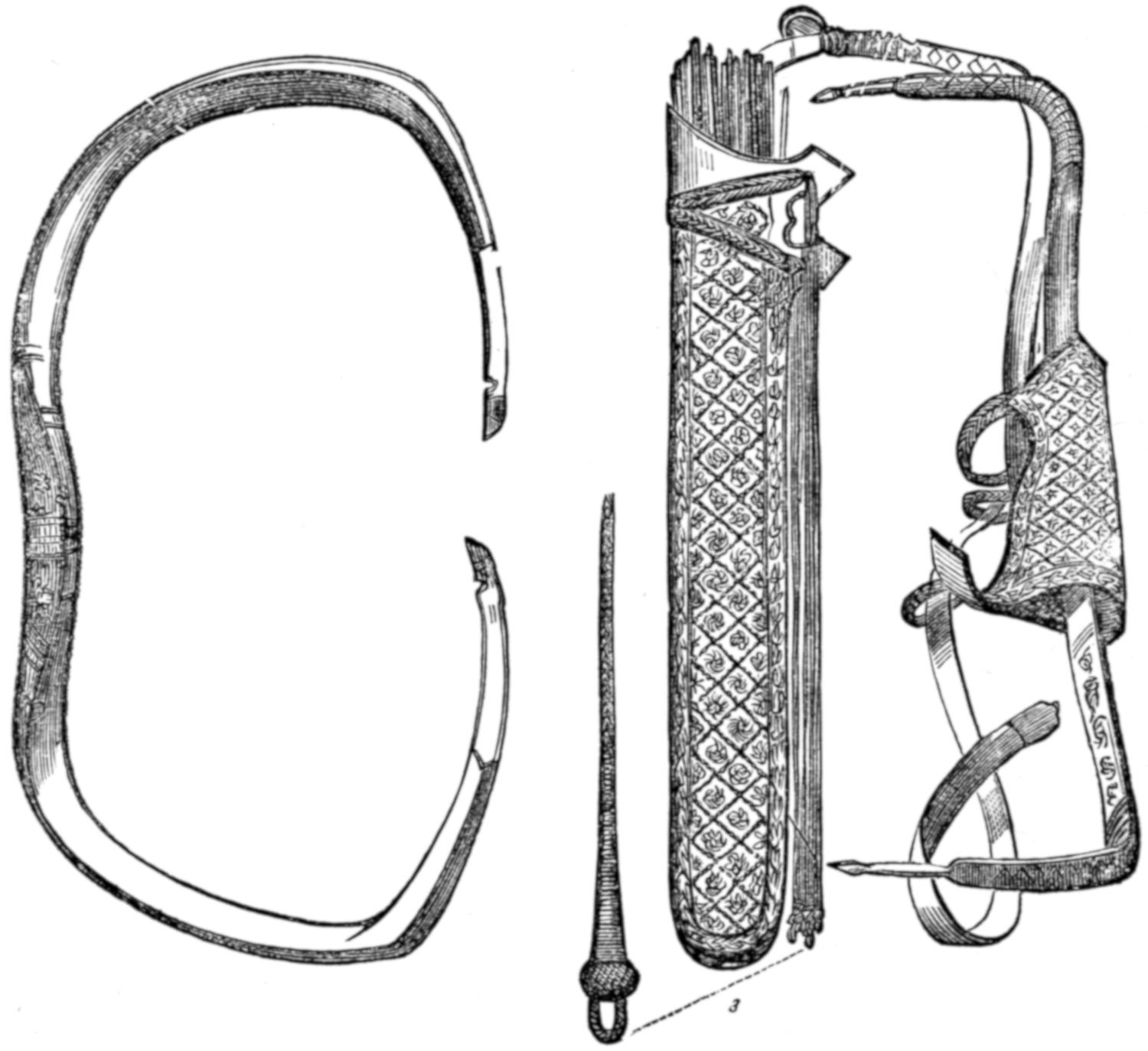
BOWS AND QUIVER. (From my Collection.)
(See page 1401.)
CHAPTER CXLIX. INDIA— Continued . WEAPONS.
THE GHOORKA TRIBE AND THEIR FAVORITE WEAPON — BLADE AND CURVED HANDLE OF THE “KOOKERY” — MODE
OF STRIKING WITH IT — THE ADDITIONAL KNIVES — MAKING “WOOTZ” STEEL — FIGHTING
A TIGER — THE HUNTER’S NECKLACE — ROBBERS OF INDIA — THE BURGLAR, THE BURROWER — THE
PURSE CUTTER — AN INGENIOUS THEFT — STRANGE MODE OF ESCAPING OBSERVATION — VARIOUS
BOWS — THE PELLET BOW AND ITS DOUBLE STRING — THE REVERSED BOW AND
MODE OF USING IT — STRINGING THE BOW — THE VARIOUS ARROWS — ARMOR AND CHAIN MAIL — SIR
HOPE GRANT’S SPECIMEN — INDIAN SWORDS AND MODE OF USING THEM — VARIOUS DAGGERS — THE
“CHAKRA” OR QUOIT WEAPON.
One of the hill tribes, called the Ghoorka
tribe, is worthy of notice, if only for the remarkable
weapon which they use in preference
to any other. It is called the “kookery,”
and is of a very peculiar shape. One
of the knives, drawn from a specimen in
my collection, is given in illustration No. 2,
on page 1403. As may be seen by reference
to the drawing, both the blade and hilt are
curved. The blade is very thick at the back,
my own specimen, which is rather a small
one, measuring a little more than a quarter
of an inch in thickness. From the back it
is thinned off gradually to the edge, which
has a curve of its own, quite different to
that of the back, so that the blade is widest
as well as thickest in the middle, and tapers
at one end toward the hilt, and at the other
toward the point. The steel of which the
blade is formed is of admirable temper, as is
shown by the fact that my specimen, which,
to my knowledge, has not been cleaned for
thirty years, but has been hung upon the wall
among other weapons, is scarcely touched
with rust, and for the greater part of its surface
is burnished like a mirror. Indeed, on
turning it about, I can see reflected upon its
polished surface the various objects of the
room. The handle is made after a very remarkable
fashion, and the portion which
forms the hilt is so small that it shows the
size of the hand for which it was intended.
This smallness of hilt is common to all Indian
swords, which cannot be grasped by an
ordinary English soldier. My own hand is
a small one, but it is too large even for the
heavy sabre or “tulwar,” while the handle
of the kookery looks as if the weapon were
intended for a boy of six or seven years old.
Indeed, the Ghoorkas are so small, that their
hands, like those of all Indian races, are
very delicate, about the same size as those
of an English boy of seven. The point of
the kookery is as sharp as a needle, so that
the weapon answers equally well for cutting
or stabbing. In consequence of the great
thickness of the metal, the blade is exceedingly
heavy, and it is a matter of much wonder
how such tiny hands as those of the
Ghoorkas can manage so weighty a weapon,
which seems almost as much beyond their
strength as does the Andamaner’s gigantic
bow to the dwarfish man who wields it. It
may be imagined that a blow from such a
weapon as this must be a very terrible one.
The very weight of the blade would drive it
half through a man’s arm, if it were only
allowed to fall from a little height. But the
Ghoorkas have a mode of striking which resembles
the “drawing” cut of the broadsword,
and which urges the sharp edge
through flesh and bone alike.
Before passing to the mode in which the
kookery is used, I may mention that it is not
employed for domestic purposes, being too
highly valued by the owner. For such purposes
two smaller knives are used, of very
similar form, but apparently of inferior metal.
These are kept in little cases attached to the
side of the kookery-sheath, just as is the case
with the knives attached to a Highlander’s
dirk, or the arrangement of the Dyak sword,
which has already been described in the article
upon Borneo. There is also a little flat
leathern purse, with a double flap. This is
pointed like a knife-sheath, and is kept in a
pocket of its own fastened upon the larger
sheath.
In the illustration the kookery is shown
with all its parts. Fig. 1 shows the kookery
in its scabbard, the top of the purse and the
handles of the supplementary knives being
just visible as they project from the sheaths.
At Fig. 2 the kookery itself is drawn, so as
to show the peculiar curve of the blade and
the very small handle. Fig. 3 represents
the purse as it appears when closed, and
Figs. 4 and 5 are the supplementary knives.
My own specimen, which, as I have already
mentioned, is a small one, measures fifteen
inches from hilt to point in a straight line,
and twenty-one inches if measured along
the curve of the back. Its weight is exactly
twelve ounces. The knife is a very plain
one, no ornament of any kind being used,
and the maker has evidently contented himself
with expending all his care upon the
blade, which is forged from the celebrated
“wootz” steel.
This steel is made by the natives in a
very simple but effectual manner. After
smelting the iron out of magnetic ore, the
Indian smith puts small pieces of it in a
crucible, and mixes little bits of wood
with them. He then covers the crucible
with green leaves and plenty of clay, and
puts it in his simple furnace. The furnace
being lighted, a constant blast of air is
driven through it for about three hours,
at the expiration of which time the iron,
now converted into cast-steel, is found in
the form of a small cake at the bottom
of the crucible. Wootz steel was at one
time much used in England, and great
numbers of these cakes were imported.
In the hands of an experienced wielder
this knife is about as formidable a weapon
as can be conceived. Like all really good
weapons, its efficiency depends much more
upon the skill than the strength of the
wielder, and thus it happens that the little
Ghoorka, a mere boy in point of stature,
will cut to pieces a gigantic adversary who
does not understand his mode of onset. The
Ghoorka generally strikes upward with the
kookery, possibly in order to avoid wounding
himself should his blow fail, and possibly
because an upward cut is just the one
that can be least guarded against.
Years ago, when we were engaged in the
many Indian wars which led at last to our
Oriental empire, the Ghoorkas proved themselves
most formidable enemies, as since
they have proved themselves most invaluable
allies. Brave as lions, active as monkeys,
and fierce as tigers, the lithe, wiry
little men came leaping over the ground to
the attack, moving so quickly, and keeping
so far apart from each other, that musketry
was no use against them. When they came
near the soldiers, they suddenly crouched to
the ground, dived under the bayonets, struck
upward at the men with their kookeries,
ripping them open with a single blow, and
then, after having done all the mischief in
their power, darting off as rapidly as they
had come. Until our men learned this
mode of attack, they were greatly discomfited
by their little opponents, who got under
their weapons, cutting or slashing with
knives as sharp as razors, and often escaping
unhurt from the midst of bayonets.
They would also dash under the bellies of
the officers’ horses, rip them open with one
blow of the kookery, and aim another at
the leg of the officer as he and his horse fell
together.
Perhaps no better proof can be given of
the power of the weapon, and the dexterity
of the user, than the fact that a Ghoorka
will not hesitate to meet a tiger, himself
being armed with nothing but his kookery.
He stands in front of the animal (see the next
page), and as it springs he leaps to the left,
delivering as he does so a blow toward the
tiger. As the reader is aware, all animals of
the cat tribe attack by means of the paw;
and so the tiger, in passing the Ghoorka,
mechanically strikes at him.
The man is well out of reach of the tiger’s
paw, but it just comes within the sweep of
the kookery, and, what with the force of the
tiger’s stroke, what with the blow delivered
by the man, the paw is always disabled,
and often fairly severed from the limb.
Furious with pain and rage, the tiger leaps
round, and makes another spring at his little
enemy. But the Ghoorka is as active as the
tiger, and has sprung round as soon as he
delivered his blow, so as to be on the side of
the disabled paw. Again the tiger attacks,
but this time his blow is useless, and the
Ghoorka steps in and delivers at the neck or
throat of the tiger a stroke which generally
proves fatal.
The favorite blow is one upon the back of
the neck, because it severs the spine, and the
tiger rolls on the ground a lifeless mass. For
so fierce is the tiger’s fury, that, unless the
animal is rendered absolutely powerless, rage
supplies for a few moments the place of the
ebbing life, and enables it to make a last expiring
effort. All experienced hunters know
and dread the expiring charge of a wounded
lion or tiger, and, if possible, hide themselves
as soon as they inflict the death wound. If
they can do so, the animal looks round for
its adversary, cannot see him, and at once
succumbs; whereas, if it can espy its enemy,
it flings all its strength into one effort, the
result of which is frequently that the man
and the tiger are found lying dead together.
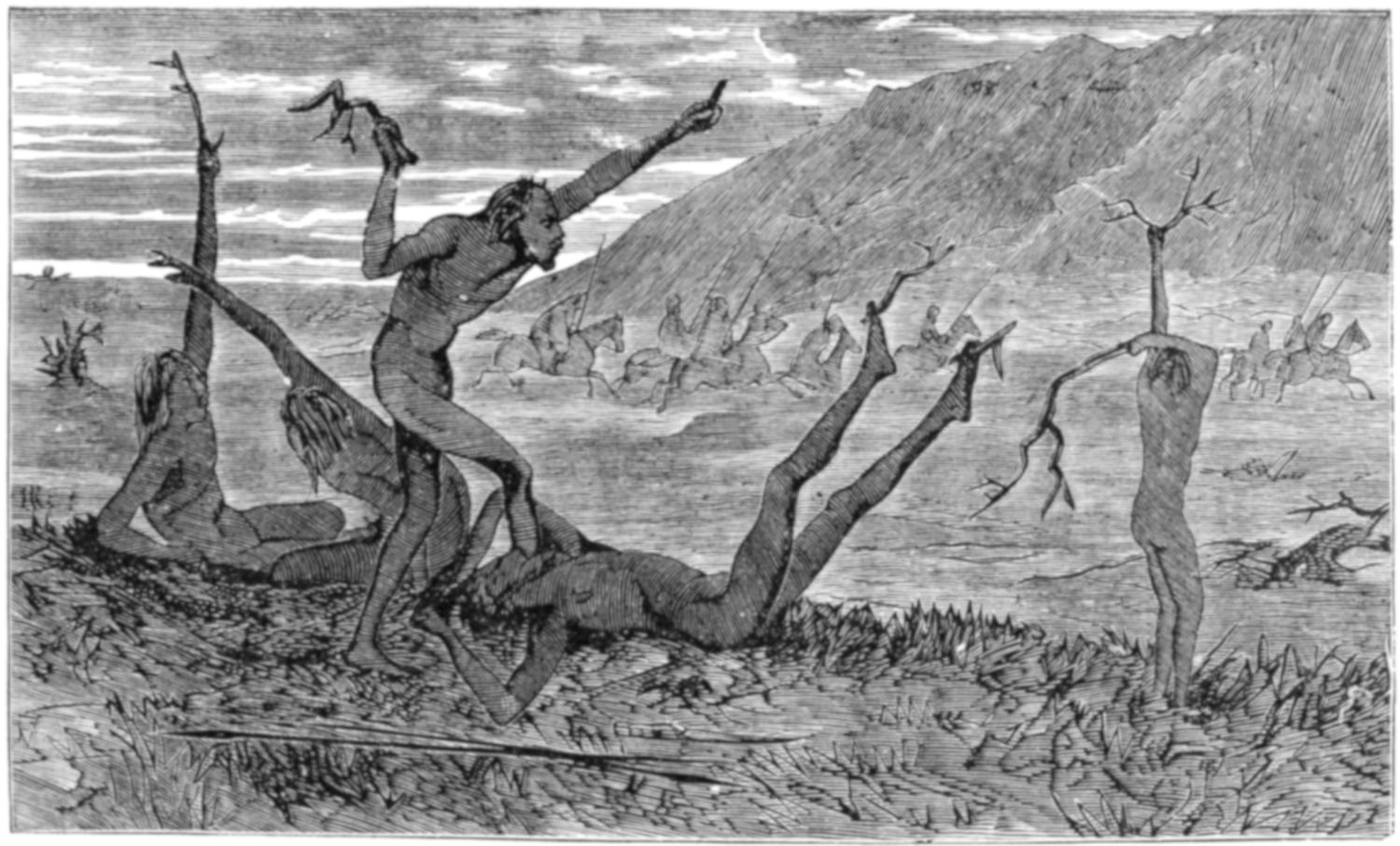
(1.) INGENIOUS RUSE OF BHEEL ROBBERS.
(See page 1400.)
(2.) GHOORKA ATTACKED BY A TIGER.
(See page 1396.)
Many of these little hunters are decorated
with necklaces made from the teeth and
claws of the animals which they kill. One
of these necklaces is in my collection, and is
figured in illustration No. 1, on page 1403.
It is made of the spoils of various animals,
arranged in the following way. The central
and most prominent object is one of the
upper canine teeth of a tiger. The man may
well be proud of this, for it is a very fine
specimen, measuring five inches and a half
in length, and more than three inches in circumference.
This tooth is shown at Fig. 5.
At Fig. 1 is a claw from a fore-foot of a tiger,
evidently the same animal; and at Fig. 9 is a
claw of the hind-foot. Figs. 2, 3, 7, 8 are
differently sized teeth of the crocodile; and
Figs. 4 and 6 represent claws from the foot of
the sloth-bear. The reader may remember
that in all uncivilized countries such spoils
are of the highest value, and play the same
part with regard to them, that titles and
decorations do among more civilized nations.
Consequently, it is almost impossible to procure
such ornaments, the natives having as
strong objection to part with them as a
holder of the Victoria Cross would have to
resign at the same time his badge and a right
to wear it.
Among men of such a stamp, leading a
half-savage existence, with ideas necessarily
limited to their own range of thought, it is
likely that a strange sort of morality should
prevail. We have already seen that there is
one existing system in which treacherous
murder, instead of being regarded as a capital
offence, is exalted into a religion, and we
may therefore expect that robbery may in
some cases be considered as a virtue. Certain
it is that there are no more accomplished
thieves in the world than those of India.
The natives are justly celebrated for their
wonderful powers of posture making and
conjuring, and it is to be expected that, when
they turn those powers to an evil use, they
must be most dangerous opponents. Lately
a most valuable report has been issued by the
Inspector-General of Prisons, relating to the
thieves of Lower Bombay, in the perusal of
which it is impossible to restrain a smile, so
wonderfully ingenious are the devices of the
thieves, and so astonishing is the skill with
which they are employed.
For example, there are the regular burglars,
who completely carry out the description
of the Scriptures, “breaking through
the wall and stealing.” Two of these burglars
work together. One acts as sentinel,
while the other gently bores a hole through
the wall, large enough to admit the passage
of his person. When he has completed the
breach, he pushes through it a stick, with a
piece of grass wrapped round it, so as to
look like a human head. This is done to
ascertain whether the inmates are alarmed,
for it sometimes happens that the owner of
the house hears the miner at work, and
quietly stands by the side of the hole, armed
with a sword or cudgel, with which he
strikes at the head of the robber, as soon as
it appears through the wall. Should the
sham head be smashed by a blow from the
inside, the thieves escape as fast as they can.
If not, one of them crawls through the
breach, steals all the property on which he
can lay his hands, and returns to his comrade,
who has been keeping careful watch,
and will alarm him, should danger appear.
Other thieves appear to be more harmless,
though they probably steal as much money
as the burglars. They carry in their mouths
a tiny knife, with a blade as sharp as that of
a razor. They frequent the bazaars, mix
with the crowd, and contrive to feel for the
money which is wrapped up in the girdle.
With their little knives, they gently cut the
cloth, noiselessly extract the money, and
slink off into the midst of the crowd, where
they can scarcely be detected. In short,
they act precisely after the manner of our
European cut-purses.
The most ingenious of all the thieves are
those who get into the zenanas, or women’s
apartments, and steal their jewelry. As the
reader is probably aware, the women’s apartments
are in the most central portion of the
house, and are so carefully guarded that little
precaution is taken with respect to the
costly jewels with which the women deck
themselves so abundantly. The Indian
burglar knows of this wealth, and sometimes
manages to steal it. He digs a hole
in the ground outside the walls of the house,
and burrows under the foundation until he
comes beneath the floor of the zenana. He
then cautiously works his way upward, and
so obtains admission into the apartment.
But even when there his task is not completed,
as a large portion of the jewelry consists
of nose rings and bangles, or bracelets.
The skill of these thieves is now
shown, for they will contrive to cut the
rings and bangles, remove them from the
wearers, and make good their escape without
disturbing the sleeping women.
These adroit burglars often commit the
most daring robberies in the very midst of
an army. Knowing the position of the
tents, they mark out that which is the residence
of a great man, and creep silently
toward it. Arrived at the tent, their sharp
knife cuts a hole and they glide into the interior
without making the slightest noise.
Indeed, so wonderfully adroit are they, that
even the very watch-dogs do not discover
them, and a thief has been known actually
to step over the body of a dog without disturbing
the animal. They take an extraordinary
pride in their skill, and have not the
least objection to boasting of it. Once, an
English officer, who had been robbed of all
his valuables, his clothing included, in the
course of a night, was talking to a robber,
who made very light of the exploit, and
boasted that if he chose he could steal the
blanket from under him as he slept. Such
a challenge as this could not but be accepted,
and the officer laid a wager with the man
that his blanket could not be stolen without
arousing him.
Accordingly, one morning, when the officer
awoke, he found his blanket missing. The
thief came openly with the blanket, restored
it, and told him how he had achieved the
theft. It was done by gently tickling the
face and hands of the sleeping man, so that
he involuntarily turned on his bed. As he
moved, the thief gave the blanket a slight
pull, and so by degrees “coaxed” it away
without fairly awaking the sleeper.
When these thieves set about their task of
robbery, they remove all their clothes, and
rub themselves with oil. Round their neck
is a slight string, which holds their razor-bladed
knife, so that, if they should be detected,
the pursuer has no hold of them; and
even should he succeed in grasping them,
the ready knife is used to sever his wrist and
to deal a fatal stab.
Then there are other thieves of altogether
a sneaking and despicable character. The
burglars have, at all events, the redeeming
points of audacity and ingenuity. The
Mooches exhibit neither of these qualities,
but act in a way that exactly resembles the
proceedings of the gipsy thieves as described
by Mr. Borrow. They lay poison on plantain
leaves, and drop them about at night
among the cattle. The bait is sure to be
taken, and the dead cattle are thrown away
next morning. This is exactly what the
Mooches have expected, and they flay the
dead cattle and sell their skins.
Sometimes a band of these thieves is pursued,
and then the robbers are often driven
to use all their ingenuity in evading their
pursuers. One stratagem is marvellously
clever. Should a company of these men
succeed in reaching the jungle, there is no
hope of capturing them; but when they find
that they must be overtaken on a level plain,
they are not without a mode of avoiding detection.
As is the case in many hot countries,
the ground is often cleared by fire,
which destroys all the coarse, dry, rank herbage,
and leaves it free for the fresh green
blades that at the first rains shoot through
the surface. In those spots where the grass
is short, the fire does but little damage; but
where it is long, the flames are powerful
enough to destroy the small trees which
grow upon them, and to leave nothing but a
number of blackened stumps.
If the thieves think that they cannot pass
the plain without being observed, they put
in practice a ruse which they may have borrowed
from the habits of many insects.
They strip off all their clothes, place them
and their weapons under their little round
shields, which they disperse so as to look
like stones, and then dispose themselves in
such strange attitudes that their slender and
nearly fleshless limbs bear the most exact
resemblance to the blackened branches of
which their bodies represent the trunks. In
these attitudes they will remain fixed until
the enemy has passed them, when they slip
off as fast as they can to the nearest jungle.
An illustration on page 1397 shows with
what rare ingenuity, even artistic verisimilitude
these rascals simulate the charred trunks
and branches of the trees.
Before the English had become used to
these manœuvres, a very ludicrous incident
occurred. An officer, with a party of horse,
was chasing a small body of Bheel robbers,
and was fast overtaking them. Suddenly
the robbers ran behind a rock or some such
obstacle, which hid them for a moment, and,
when the soldiers came up, the men had
mysteriously disappeared. After an unavailing
search, the officer ordered his men
to dismount beside a clump of scorched and
withered trees, and, the day being very hot,
he took off his helmet and hung it on a
branch by which he was standing. The
branch in question turned out to be the leg
of a Bheel, who burst into a scream of
laughter, and flung the astonished officer to
the ground. The clump of scorched trees
suddenly became metamorphosed into men,
and the whole party dispersed in different
directions before the soldiers could recover
from their surprise, carrying with them the
officer’s helmet by way of a trophy.
This stratagem is not confined to one
tribe, or even one race, but is practised in
many parts of the world where the country
is cleared by means of fire.
We will now examine some of the weapons
used by the Indians. I intentionally omit
any description of their fire-arms, as such
weapons are of a modern date, and the use
of gunpowder has been imported from other
countries. In the following pages will be
described some of the most characteristic
weapons of India.
The reader will probably notice that whatever
may be their form, there is a nameless
something which designates the country in
which they were produced. No matter
whether the weapon has belonged to a rich
or a poor man, whether it be plain wood
and iron, or studded with jewels and inlaid
with gold, the form remains the same, and
there is about that form a graceful elegance
which is peculiar to India. Take, for example,
that simplest of weapons, the kookery,
and see how beautiful are the curves of the
blade and handle, and how completely they
satisfy the eye. In the same manner we
shall find that, with all the weapons that
will be figured, there is always a graceful
curve or a well-balanced arrangement of
lines.
We will begin with the bow and arrows.
Many kinds of bows are used by the Hindoos,
the most simple of which is made from
a piece of male bamboo. Even this simple
weapon is not complete in the eyes of an
Indian without some ornament, and accordingly
it is bound at intervals by belts of split
reed drawn tightly round it, and tied up at
the back of the bow in a sort of rosette form.
This kind of bow is often used for shooting
bullets or stones. For this purpose two
strings are placed side by side, and kept
apart by a little piece of wood near one end,
so that in the middle there is an interval of
a couple of inches between the strings. A
strip of leather rather more than an inch
in width is then sewed to the strings, so that
when the bow is bent the leather is stretched
tightly between them.
The bow is used in the following manner.
A bullet or stone is placed on the leather,
and the two strings are grasped by the forefinger
and thumb of the right hand, so as to
enclose the bullet in the leather. The bow
is then drawn and aimed, and when the
strings are released from the pressure of the
fingers, they fly asunder and permit the
bullet to escape. The precision that may be
obtained by this weapon is really wonderful,
and even Europeans soon learn to pride
themselves on their skill with the “pellet-bow.”
Squirrel shooting with this bow is a
favorite amusement with many persons, and
some of the natives of rank occasionally
amuse themselves with shooting at the earthenware
jars carried on the heads of the
women, a successful shot smashing the jar
to pieces, and deluging the women with the
water which had been contained in it.
There is another kind of bow which is
much used in different parts of Asia, varying
somewhat in form and material, but
smaller in principle. The bow is so formed
that when it is unstrung it curves in exactly
the opposite direction to the string. The
amount of curvature varies considerably in
different bows, the most perfect being that
in which the two ends almost touch each
other. The specimen which is shown in Fig.
1 of the illustration on page 1394, and
which is drawn from a bow in my collection,
is a singularly perfect example of this kind
of weapon. It is made in the following
manner:—
A horn of the buffalo is sawn longitudinally,
so as to produce two tapering pieces
of exactly the same size. These are then
flattened by heat and pressure, and are
trimmed until when bent they give exactly
the same amount of curvature. The handle
and the tips are made of very hard wood,
and are fitted to the horn with the greatest
care, the wood which forms the tips running
for some distance along the under side of the
horn. After the handle and tips are fitted
in their places, a great number of sinews are
laid wet over the back of the bow, and
kneaded so carefully that the wood, the
sinews, and the horn seem to be altogether
one substance. After this part of the work
is finished, the whole of the bow is covered
with repeated layers of a kind of glue, which
is very carefully smoothed and polished.
The bow is practically complete, but the
maker is not satisfied unless he adds plenty
of ornament. This is always a sort of conventional
flower pattern, gilt on a brilliantly
colored background. I possess several such
bows, in each of which there is a dissimilarity
of color and pattern. In the bow now
before us, the groundwork is vivid green
and scarlet, on which are drawn the most
elaborate patterns of flowers, leaves, and
arabesques in gold. It is impossible, on
looking at the surface, not to admire both
the beauty of the patterns and the excellence
of the paint and varnish, which can be
subjected to such violent treatment as is
caused by the bending of the bow and shooting
the arrow, and yet not be cracked to
pieces.
The elasticity of this bow is wonderful.
I have often tried to string it, but without
effect, and indeed I never saw but one man,
the late Colonel Hutchinson, of the Indian
Army, who could do so. It is strung by
passing it under one leg, bending it back
sharply over the other leg, at the same time
slipping the loop of the string into its notch.
A groove passes along the back of the bow,
so as to guide the string. When strung it
assumes quite a different shape, and looks
something like the bow which the ancient
sculptors placed in the hands of Cupid. I
regret that the bow could not be strung, so
as to give two illustrations of the same bow
in its different aspects.
The classical reader may perhaps remember
that this weapon is exactly similar to the
ancient Scythian bow. Reference is made
to this shape by Athenæus (book X.) when
an unlearned shepherd, trying to describe
the letters which formed a name, said that
“the third (i. e. c) was like a Scythian bow.”
This kind of bow was of horn, as indeed were
most of the ancient bows.
The length of the bow above mentioned,
measured along the back, is a little more
than four feet, whereas the measurement
across it as it appears when unbent is only
nineteen inches. The reader will see how
useful a bow of this description would be to
a horseman, its peculiar curvature rendering
it easy of carriage. It could even be carried
along on the bridle arm, if required, so as to
leave the sword hand at liberty, and in a
moment could be strung when needed, by
passing it under the leg as the rider sits on
horseback. Small as this bow seems, almost
indeed insignificant in appearance as a weapon,
its performances in skilful hands are
something marvellous. With one of these
bows an arrow has been shot to a distance
which was said to be six hundred yards, and
was actually not much short of that measurement.
And, although so powerful, it is
wonderfully manageable. Colonel Hutchinson
told me that he once saw an archer shoot
an arrow along a corridor, and send the missile
through a hole which a bullet had made
in a pane of glass at the end of the corridor.
Next comes a form of bow which is much
more common than the preceding. In this
bow the reflex curvature is strongly marked,
though not so strongly as in the case of the
weapon just described.
Several of these bows are in my collection,
the handsomest of which was presented to
me by J. Allen, Esq. This bow, with its case,
its quiver, and score of arrows, is shown in
Fig. 2 of the illustration, on page 1394. Measuring
along the back, the bow is four feet five
inches in length, whereas the space between
the two tips is only twenty-eight inches.
The color with which the bow is painted is
bright scarlet, profusely covered with gilt
flowers and arabesques, so that it is a more
showy weapon at a distance than the previous
specimen, though it is not nearly so handsome
when closely examined, the patterns being
larger and more roughly executed. The
bow-string is made of some vegetable fibre,—I
think that of some species of aloe,—and is
very thick, being composed of nine strands
twisted very closely together.
The case, quiver, and straps by which they
are held have been once very splendid,
being crimson velvet, so covered with gold
embroidery that scarcely any part of the velvet
is visible. The arrows are two feet three
inches in length, and are very carefully
made. The shaft is of reed, and to either
end is fixed a piece of hard wood four inches
in length. On one end of the shaft is fixed
the point, which is a heavy and solid quadrangular
piece of steel brought to a sharp
point. The hard wood at the end receives
the feathers, and is enlarged at the extreme
end, so as to allow space for the nock or notch
in which the thick bow-string is received.
Both the pieces of hard wood are colored,
that in which the point is fixed being simply
green, but that at the other end being gilt,
and covered with patterns in blue and
scarlet.
This is the most common kind of arrow,
but there are many varieties, of which I
possess specimens. Several varieties are in
many collections, the chief distinction being
in the shape of the point. In most of them
it is more or less quadrangular; though in
some it is leaf-shaped, like a spear head, in
others it is conical, and in others round and
blunt. In one of the arrows the place of
the lower piece of hard wood is taken by a
solid piece of steel nearly four inches in
length, and weighing about three ounces,
looking something like a rather elongated
Whitworth bullet.
The most primitive form of Indian arrow
is that which is made by the hill tribes.
The shaft is of wood, not of reed, and the
head is deeply barbed, and tied to the shaft
with fibre, exactly as is done with the flint-headed
arrows, which this weapon almost
precisely resembles in form, though not in
material. Instead of feathers, dry leaves are
substituted, cut into the required shape, and
passed through slits in the shaft of the
arrow, these slits being afterward bound up.
In one arrow the nock has been formed in a
very strange manner, a piece of wood being
lashed to each side of the shaft, and projecting
a little beyond it.
Some very beautiful examples of the best
kinds of weapons are shown in the illustration
on page 1406. They belong to General
Sir Hope Grant, G.C.B. etc., who kindly
allowed them to be drawn for the use of this
work. They are splendid instances of
Indian art, one or two of them displaying a
most elaborate ornamentation.
The first of the illustrations shows a suit of
armor and weapons, which is made of steel
most elaborately engraved and inlaid with
gold, the patterns resembling those on the
bow, and looking much as if they had been
taken from the bow and sunk into the steel,
the freedom and grace of the lines being
quite as remarkable as the elaborate minuteness
of the pattern.
In the centre (Fig. 1) is seen the martial
looking helmet, with its slight feather plume.
There are often several of these plumes in a
helmet, their shafts being adorned with gold
and jewels, and placed in sockets projecting
from the helmet. In front is seen the flat
bar which protects the nose and upper part
of the face from a sword cut. This bar slides
up and down through a groove for the convenience
of the wearer. From the helmet
depends a piece of very slight but very
strong chain-mail, which falls behind and
on either side of the face, and hangs
as low as the shoulders, so that, however
abruptly the wearer may move his head, the
folds of the chain-mail protect his neck. In
several of these helmets the links of the mail
are gilt, and arranged so as to form patterns,
mostly of a diamond shape.
By the side of the helmet (Fig. 3) is the
curious gauntlet, which extends far up the
arm, and has no joint at the wrist. The absence
of the joint, unpleasant as it would be
to an European swordsman, is no obstacle to
the proper use of the sword by the Oriental
warrior. If the reader will refer to the figure
of the sword (Fig. 6), he will see that the
hilt is terminated by a large circular plate
of steel. In a specimen in my own collection,
this plate is three inches in diameter,
so that when the sword is grasped after the
European fashion, the plate comes against
the wrist, and acts as a fulcrum by which,
when a blow is struck, the leverage of the
blade forces the sword out of the grasp.
(3.) THE CHAKRA, OR QUOIT WEAPON.
(See page 1406.)
But the whole system of swordsmanship
in India differs essentially from that which
is employed in England, or indeed in Europe
generally, strength not being used so much
as dexterity. For the object of this weapon
its curved form is essential. The stroke of
the sword is done by a turn of the wrist
more than by a direct blow, so that the
curved edge of the weapon is drawn rapidly
over the object of attack.
The mode of employing the Indian sword
was illustrated to me by the same Colonel
Hutchinson whose name has already been
mentioned.
He took a large mangold-wurzel, and laid
it on a table. He then placed the flat side
of the sword upon the root, so that no blow
could be dealt, and then, with a slight turn
of the wrist, he drew the blade toward him,
and the root fell apart, severed in two pieces.
In the same manner he cut the whole of the
root into slices. The feat looked so easy
that I tried it on another root, but, instead
of cutting it in two, the edge of the sword
glided off it as if it had been a solid piece of
glass, and jarred my arm to the shoulder.
However, after a few lessons, the feat became
tolerably easy.
The same effect can also be produced by
pushing the blade from the swordsman instead
of drawing it toward him. It is to this
delicate, drawing cut that the Indian sword
owes its efficiency, the steel of the blade not
being nearly of so good a quality as that of
our common dragoon swords, and not being
capable of taking so fine an edge. But if in
battle an Indian warrior meets or overtakes
an enemy, he does not strike at him with
the whole power of the arm, as is done by
our swordsmen, but places the edge of his
weapon against the neck of the enemy, and
with a turn of his wrist nearly severs the
head from the body.
In the same illustration is seen the circular
shield or target. This is of no great size,
measuring about eighteen inches in diameter,
and sometimes even less. It is made of
the hide of the rhinoceros, which, when
properly dressed and dried, is of considerable
thickness, as hard as horn, though not
so brittle, and almost equally translucent.
The shield is generally adorned with four
circular plates of metal, which in an ordinary
specimen are merely of iron, but in a
peculiarly handsome one are covered with
lacquered gilding. The reader will doubtless
see the almost exact resemblance between
the Indian shield and the target of
the Scotch Highlander. The other portions
of the armor are adorned with gold inlaying,
like those parts which have been described.
Illustration No. 4, on page 1403, contains
several articles used in warfare, all of which
are drawn from specimens in Sir Hope
Grant’s collection. In the centre is seen a
coat of mail. This is one of the most beautiful
pieces of armor I have ever seen, each
of the links bearing upon it a sentence from
the Koran. Three of the links are shown
underneath the coat of mail, drawn of the
size of the originals. If the reader will
reflect upon the vast number of such links
which are required to form a coat of mail, he
will appreciate the amount of labor that
must have been expended on it, the letters
having to be formed after the links are put
together, so that they may not be obliterated
in the forging. The helmet belonging to
this suit is seen by its side at Fig. 2.
Between the helmet and the coat of mail
is a Coorg knife or dagger, and its sheath.
This weapon is sometimes very plain, and
sometimes blazes with gold and jewels on
the hilt and sheath. A specimen in my collection
is of the former kind, and, though the
blade is of good quality, the handle is of
wood, and is secured to the blade by a stout
brass rivet which passes through the tang.
A bold ridge runs along either side of the
blade.
Two more characteristic forms of the Indian
dagger are shown at Figs. 7 and 9 in the
illustration. One, Fig. 7, with its sheath at
Fig. 8, is in great favor, especially with the
rich. It is made entirely of steel, the two
cross-bars constituting the handle. The
form of the blade varies somewhat in different
specimens, but the general form is the
same in all. A good specimen in my
collection is altogether twenty inches in
length, and weighs exactly a pound, so that
it must be rather an awkward weapon for
the girdle. The blade, if it can be so called,
is nearly a foot in length, flat toward the
handle, and within five inches of the tips
welling suddenly into a sort of quadrangular
bayonet, rather more than half an inch in
thickness.
The reader will see that when this dagger
is grasped, the steel continuations of the
handle project on either side of the wrist,
and effectually guard it and the lower part
of the arm from a sword-blade. The weight
of this instrument, as well as the force with
which a thrust can be delivered by a straight
blow as in boxing, render the weapon well
calculated to drive its way through the folds
of dress, or even between the joints of armor.
Next comes a weapon (Fig. 9) which
would scarcely be recognized as a dagger.
It is, however a dagger, made from the two
horns of the Indian antelope. In the simplest
form of this curious weapon, the horns
are arranged with their bases crossing each
other for about six inches. The curvature
of the bases thus furnishes a sort of handle,
which can be grasped in such a way that
the holder of the weapon can strike right
and left with it, and, among a number of
people, could do a vast amount of damage in
a very short time.
A dagger such as has been described
could be made in half an hour, and, indeed,
a temporary weapon might be made in a
few minutes by lashing the horns together.
But the Indians prefer to add ornament to
the weapon, and so they often make a hollow
steel hilt in the form of a cup, with the
curved side outward. The hand passes into
this cup as into the basket-hilt of a single-stick,
and is effectually guarded from injury.
The dagger shown in the illustration has
one of these steel hilts. In some places this
weapon is in such favor that, instead of making
it of antelope horns, with a steel hilt, the
entire dagger is of steel, the points made in
imitation of the horns.
The last weapon (Fig. 10) is one which is
used by the Afghans, and is a sort of compromise
between a sword and a dagger. A
weapon of a similar form and character is
carried by the Moors.
There is one kind of sword which ought
not to be passed without some notice. It is
a most murderous looking weapon, and is
made on precisely the opposite principle to
that of the sword which has already been
described. In that form of sword, the edge
is on the outer curve of the blade, which
narrows toward the point. In the other
sword, the edge is on the inside curve, and
the blade widens greatly at the tip, which is
curved like a bill-hook. Indeed, the weapon
bears some resemblance to a bill-hook with
a greatly elongated blade. In a specimen in
my collection the blade is very little more
than an inch wide by the hilt, but at the
point (or rather the tip, for this part of the
blade is squared) it is just four inches in
width. The weight of this sword is rather
more than two pounds.
There is also the quoit, or chakra, a missile
weapon, that bears some resemblance to the
boomerang of Australia or the casting-knife
of the Fan tribe, it being intended to cut
and not to pierce, as is generally the case
with missiles. It is made of thin steel, and
is sharpened to a razor-like edge on the outside.
The mode of casting it is to spin it on
the forefinger and then to hurl it. The
reader may imagine that such a missile,
which not only strikes an object, but revolves
rapidly at the time, must be a very
formidable one. It is generally aimed at
the face of the adversary, and a skilful
warrior will hurl four or five in such rapid
succession that it is scarcely possible to
avoid being struck by one of them, and
having the face laid open, or the nose or lip
absolutely cut off. These quoit-like articles
are carried upon a tall, conical head-dress
worn by the natives, into the folds of which
they also put several small knives, as Irish
laborers stick their pipes in their hats. See
illustration No. 3, on page 1403.
A similar weapon, made of brass instead
of steel, is used by the cattle-poisoning
Mooches, who have already been described.
They call it by the name of “thâl.”
The chakra is the special weapon of
Vishnu, and may be seen in the various
representations of that deity, hanging in
one of the hands. Reference is made to
this by Southey in the “Curse of Kehama.”
Other deities also hold the chakra in the
many-armed images by which the Indian
artists clumsily attempt to depict omnipotence.
This takes us to another branch of
the subject.
Suit of Armor Inlaid with Gold.
(See page 1402.)
CHAPTER CL. INDIA— Continued . SACRIFICIAL RELIGION.
PRINCIPLE OF HUMAN SACRIFICE — THE SUTTEE, OR WIDOW BURNING — HER FATE DESIRED BY HERSELF
AND HER NEAREST RELATIVES — REASONS FOR THE SACRIFICE — CONTRAST BETWEEN
THE LIFE OF A WIFE AND A WIDOW OF HIGH CASTE — SOCIAL STATUS OF THE BRAHMINS — HONOR
IN WHICH THE SUTTEE IS HELD — MODE OF CONDUCTING THE SACRIFICE — STRUCTURE
OF THE PILE — COURAGEOUS CONDUCT OF THE VICTIM — ATTEMPTED ESCAPE OF A SUTTEE — BERNIER’S
DESCRIPTION — GRADUAL ABOLITION OF THE SUTTEE — THE GODDESS KALI AND HER
WORSHIPPERS — THE THUGS AND THEIR CONSTITUTION — THE SACRED “ROOMAL” OR NOOSE — MODE
OF OFFERING A VICTIM — THE FESTIVAL OF JUGGERNAUT — HARDSHIPS OF THE PILGRIMS — FORM
OF THE IDOL — SELF-SACRIFICE IN THE GANGES — SACRIFICE OF BEASTS — THE GODDESS
DOORGA OR KALI — FAKIRS OR JOGIS — THEIR VARIOUS MODES OF SELF-TORTURE — THE SWINGING
FESTIVAL — THE MOTIONLESS FAKIR.
There is no part of the world, not even
Africa itself, where the principle of human
sacrifice is so widely spread, and is developed
so variously, as in India. Several forms of
human sacrifice, such as the Meriah, which
has already been described, belong to definite
districts, and even in them are carried out
with certain limitations. Some forms of
the same principle, such as the murders by
Thugs or Phânsigars in their worship of the
dread goddess Kali, are restricted to certain
societies of men. Again, the victims annually
crushed under the wheels of Juggernaut’s
car are comparatively few, and can
only be sacrified in a certain locality, and at
certain times.
There is, however, one mode of human
sacrifice which at no distant period prevailed
over the whole of India, and has only been
checked by the influence of England in
those parts of the country which have been
subject to British dominion. Even in those
districts the task has been a very difficult
one, and there is no doubt that if the strong
hand of England were ever lifted, the practice
would again prevail as it did before.
This form of human sacrifice is the dreadful
Suttee, or the death of the widow on the
funeral pyre of her dead husband. Both
in Africa and Polynesia we have seen several
instances where the widow is sacrificed
on the grave of her husband, so that
he may not find himself wifeless when he
reaches the spirit land. But it is remarkable
that even among the lowest of the
savages, whose indifference to inflicting
pain is well known, there are none who
exercise such horrible cruelty toward the
widow as do the highly civilized Hindoos.
On referring to the former portions of this
work, the reader will see that in some places
the widows are strangled and laid in the
grave, in others they are buried alive, and
in others they are killed by a blow of a club
(perhaps the most merciful death that can
be inflicted), but that in no instance is the
surviving wife burned alive, as is the case
with the Hindoo.
At the first glance, it seems strange that
not only should the relatives of the miserable
wife desire her to be burned, but that
she herself should wish it, and should adhere
to her determination in spite of every opportunity
of escaping so dreadful a death. Yet
the calm, dispassionate cruelty of the Hindoo
nature is shown by the fact that, painful as
is a death by burning, the life of a widow
who survives her husband is made so miserable
that the short though sharp agony of
the funeral pyre is infinitely preferable to
life. She loses all caste, and a Brahmin
widow who refuses to be burned is loathed
and despised even by the very Pariahs,
whose shadow would have been a contamination
to her during the lifetime of her husband.
The horror of such a life can scarcely
be conceived by an European, even supposing
a delicate girl, bred in the midst of all
luxury and refinement, to be suddenly cast
among the most debased of savages without
possibility of rescue, and to be made an object
of scorn and contempt even to them.
To realize the depths of utter degradation
which a high-caste widow incurs, we must
first see what is her opinion of her own status.
The reader is doubtless aware that the
Hindoos are divided into a number of distinct
castes, the peculiarity of which is, that
no one can ascend to a superior caste, though
he may fall into a lower. Now, of all the
castes, the Brahmins are immeasurably the
highest, and the reverence which is paid to
them by their countrymen is almost incredible.
Wealth or secular rank have nothing
to do with this reverential feeling. A Hindoo
of inferior caste may be, and often is, a
man of almost unbounded wealth, may possess
almost unbounded power, and, in his
own way, unbounded pride. But the very
poorest of Brahmins is infinitely his superior,
and should he meet one of these exalted
beings, he bows before him, and pays divine
honors to him. And, according to his belief,
he is right in so doing, the Brahmin
being an incarnation of Deity, sprung from
the mouth of Vishnu, the Saviour God himself.
He may be mounted on a magnificent
elephant, covered with glittering trappings,
he may be clothed in gorgeous robes and
sparkle with costly gems, but before a Brahmin,
with a single cloth round his waist, and
bearing the solitary sign of his caste,—the
slight cord hung over one shoulder and
under the other,—he is an abject slave.
Even if, as sometimes happens, he should
employ a Brahmin as his cook, that Brahmin
retains his rank, and receives the worship
of the man by whom he is paid.
According to their sacred books, “when
a Brahmin springs to light, he is born above
the world; the chief of all creatures; assigned
to guard the treasury of duties, religious
and civil.” According to the same
books, the very existence of mankind, and
even of the world itself, depends upon the
forbearance of the Brahmins whose power
even exceeds that of the gods themselves.
Should there be one who cannot be slain
by the great god Indra, by Kali, the goddess
of destruction, or even by Vishnu himself,
he would be destroyed if a Brahmin were to
curse him, as if he were consumed by fire.
In the same spirit, princes were warned not
to take the property of the Brahmins, however
much in want of money, for that if
these holy men were once enraged, they
could by a word destroy them, their armies,
elephants, and horses.
By them, under Brahma, were originally
made the earth, the sun, the moon, and the
fire, and by them they could be destroyed.
“What prince could gain wealth by oppressing
those who, if angry, could frame other
worlds, and legions of worlds, could give
being to new gods and mortals?” Just as
these tremendous privileges are independent
of the external circumstances of wealth
and rank, so are they independent of individual
character. The pure soul of a Brahmin
is beyond all moral elevation, and above
all moral pollution. He may be a man of
the purest life and loftiest morality, but he
is none the better Brahmin for that; he may
be one of the vilest of debauchees, and be
none the worse Brahmin for that, provided
he does not commit any act which would
forfeit his caste,—such, for example, as killing
a cow, or eating food that had been
cooked by an inferior.
To fall from such an estate as this, above
humanity and equal to divinity, must be
something almost too terrible to conceive,
and we can easily imagine that any death
would be preferable to such a life. But not
even the horror of a life like this would be
equivalent to the sufferings of the Indian
widow, who believes that her very soul is
contaminated beyond hope by the loss of her
caste, and who feels herself degraded below
the level of those on whom she had looked
with an utter loathing that is almost incomprehensible
to the Western mind. She has
to cut off her hair, she has to live on the
coarsest of food, she has to clothe herself in
the coarsest of raiment, and altogether to lead
a life utterly and hopelessly miserable in
every hardship that can afflict the body, and
every reproach that can torture the mind.
On the other side comes the belief, that if
she follows the dictates of her religion, and
suffers herself to be burned on the funeral
pile of her husband, she qualifies herself for
everlasting happiness. From the moment
that the ceremonies of the sacrifice are
begun, she becomes an absolutely sacred
being, whose very touch sanctifies the objects
on which she lays her hands; she renders
herself a model to be imitated by all
her sex, and her memory is forever venerated
by her family. It is therefore no wonder
that, swayed by such considerations, the
Indian widow prefers death to life, and that
the sacrifice of the Suttee has taken such
hold upon the people.
Varying slightly in details according to
the rank of the individual and the particular
district in which the sacrifice takes place,
the ceremony is conducted after the following
manner.
A hole is dug in the ground, over which
the funeral pile is raised. The object of the
hole is to supply a current of air by which
the fire may be fed. Sticks are then driven
round the edge of the hole to support the
materials of the pile, which are dry wood,
rushes, and hemp. These are heaped carefully
to a height of four feet or so, and resin
and ghee (i. e. liquid butter) are thrown
on the pile, so as to increase the vehemence
of the flames. The body is then taken to
the river, on whose bank the pyre is always
erected, and is there washed by the relatives,
and afterward wrapped in a new cloth and
laid on the pile.
During this time the widow stands on the
bank, uttering prayers, and waving in her
hand a branch of mango. After the corpse
is removed from the water, she descends
into it herself, and, having washed, distributes
to her friends all her ornaments, which
are eagerly sought, as being sanctified by
having been touched by the sacred hand of
a suttee. She is then dressed in a new robe,
and places herself by the side of the body, to
which she is usually, though not always,
lashed. Dry rushes and wood are next
heaped over her, only her head being suffered
to be uncovered, so that she may
breathe for the short time she has to live.
Two long bamboos are then laid across the
pile, the ends being held by the relations, so
as to press her down should she struggle to
escape when the flames reach her. The fire
is lighted by her nearest relation, and, if the
pile has been properly constructed, the suttee
is soon dead, being killed rather by
suffocation from the smoke than by the
flames.
Sometimes, however, when the building
of the pile has been entrusted to inexperienced
hands, a terrible scene takes place,
the wretched victim trying to escape from
the flames that torture her, and being ruthlessly
held down by the bamboo poles across
her body. Dr. Massie relates several instances
of attempted escape. In one case,
the mode of preparing the pile was evidently
the cause of the poor victim’s sufferings.
At each corner a stout pole was erected, and
from this pole was suspended a second pile,
like a canopy, elevated three or four feet
above the surface of the principal pile. This
canopy was chiefly made of logs of wood,
and was exceedingly heavy.
After the suttee had been laid upon the
pile, and covered with straw saturated with
ghee, the fire was kindled, and the smoke
rolled in thick volumes over the head of the
victim. The flames began to blaze fiercely,
and if they had been allowed to burn in their
own way, the death of the poor woman would
have been almost immediate. But just at
this time four assistants severed with their
swords the ropes which upheld the canopy,
so that it fell with its whole weight upon
her.
Possibly it was intended as an act of mercy,
but its effect was anything but merciful.
For the moment she was stunned by the
blow, but the mass of billets checked the
action of the fire, and caused it to burn
slowly instead of rapidly. The creeping
flames soon restored her to consciousness
through the agony which they inflicted upon
her, and she shrieked pitifully for the help
that none would give her, until death at last
put an end to her sufferings.
The same author quotes an account of a
suttee who actually did succeed in escaping
from the flames, in spite of the resistance
offered by the officiating Brahmins and her
relatives:—
“Another well-authenticated and brutal
instance of this sacrifice occurred about the
same time in a more northern province of
India: ‘The unfortunate Brahminee, of her
own accord, had ascended the funeral pile of
her husband’s bones, but finding the torture
of the fire more than she could bear, by a
violent struggle she threw herself from the
flames, and, tottering to a short distance, fell
down. Some gentlemen, who were spectators,
immediately plunged her into the
river, which was close by, and thereby saved
her from being much burnt. She retained
her senses completely, and complained of
the badness of the pile, which, she said, consumed
her so slowly that she could not bear
it; but expressed her willingness again to try
it if they would improve it. They would not
do so, and the poor creature shrunk with
dread from the flames, which were now
burning intensely, and refused to go on.
“‘When the inhuman relations saw this,
they took her by the head and heels, and
threw her into the fire, and held her there till
they were driven away by the heat; they also
took up large blocks of wood, with which
they struck her, in order to deprive her of
her senses; but she again made her escape,
and, without any help, ran directly into the
river. The people of her house followed her
here, and tried to drown her by pressing her
under the water, but an European gentleman
rescued her from them, and she immediately
ran into his arms and cried to him to save
her.
“‘I arrived at the ground as they were
bringing her the second time from the river,
and I cannot describe to you the horror I felt
on seeing the mangled condition she was in:
almost every inch of skin on her body had
been burnt off; her legs and thighs, her arms
and back, were completely raw, her breasts
were dreadfully torn, and the skin hanging
from them in threads; the skin and nails of
her fingers had peeled wholly off, and were
hanging to the back of her hands. In fact,
I never saw and never read of so entire a
picture of misery as this poor woman displayed.
She seemed to dread being again
taken to the fire, and called out to “the Ocha
Sahib” to save her. Her friends seemed no
longer inclined to force, and one of her relations,
at our instigation, sat down beside
her, and gave her some clothes, and told her
they would not. We had her sent to the
hospital, where every medical assistance was
immediately given her, but without hope
of recovery. She lingered in the most excruciating
pain for about twenty hours, and
then died.’”
It is often said that the woman is stupefied
with opium or Indian hemp before she is
brought to the pile, and that the bystanders
beat drums and shout in order to drown her
shrieks. This, however, is not the case, the
woman requiring the use of all her senses to
enable her to go through the various ceremonies
which precede the actual burning,
and the pile being generally made so carefully
that death is so rapid that the victim
scarcely utters a cry or makes a single struggle
to escape.
Additions to the mere burning of the
widow have been mentioned by various travellers.
Bernier, for example, says that, while
travelling near Agra, he heard that a Suttee
was about to take place. He went to the
spot, and there saw a great pit, in the midst
of which was a large pile of wood. On the
pile lay the body of a man, and beside it sat
a young and handsome woman, whose dress
was almost saturated with oil, as was the
wood of the pile. The fire being lighted, she
sat on the pile, and as the flames wrapped
her body, she exclaimed with a loud voice
that, according to the Indian belief in the
transmigration of souls, this was the fifth
time that she had become a suttee, and that
she would have to do so twice more in order
to attain perfection.
Round the edge of the pit danced five
women, holding each other by the hand, and
appearing regardless of the fire. Presently
the flames seized upon the dress of one of
them; whereupon she detached herself from
her companions, and flung herself headlong
into the burning pit. The remaining four
continued their dance, and, as the fire caught
their garments, they one by one leaped into
the flaming pit. These women, it appeared,
had been slaves of the suttee. They were
greatly attached to their mistress, and when
they heard her offer the vow to die on the
funeral pile, they determined to die with her.
The same traveller relates a very curious
anecdote of a suttee who employed the dreadful
ceremony for a strange purpose.
She was a widow by her own act, having
poisoned her husband in order to carry on
an intrigue with a young tailor, a Mohammedan,
who was celebrated for his skill in
playing the drum. He, however, was alarmed
at her crime, and declined her society. On
account of the caste to which she belonged,
the death by burning was not a necessity, but
on her lover’s refusal she went to her relations,
reported the sudden death of her
husband, and declared that she would be
burned with him.
“Her kindred, well satisfied with so generous
a resolution, and the great honor that
she did to the whole family, presently had a
pit made and filled with wood, exposing the
corpse upon it, and kindling the fire. All
being prepared, the woman goes to embrace
and bid farewell to all her kindred that were
there about the pit, among whom was also
the tailor, who had been invited to play upon
the tabor that day, with many others of that
sort of men, according to the custom of the
country. This fury of a woman, being also
come to this young man, made sign as if she
would bid him farewell with the rest, but,
instead of gently embracing him, she taketh
him with all her force about his collar, pull
him to the pit, and tumbles him, together
with herself, into the ditch, where they both
were soon despatched.”
The date at which the Suttee was instituted
is not known, but it was in operation at the
time of Alexander the Great, and must have
been established long before. Under the
British rule the Suttee system has gradually
been abolished, and we may hope that never
again will the dread scene be repeated.
Reference has already been made to
several other modifications of human sacrifice,
and we will give a few pages to a description
of them.
There is in the Indian mythology a certain
dreadful goddess of destruction, named Kali.
Her statues show her attributes, her many
hands being filled with all kinds of weapons,
and her person decorated with a huge necklace
of human skulls. In order to propitiate
this terrible divinity, a system has been developed
which is perhaps the most remarkable,
illogical, and best regulated system that
is to be found upon the face of the earth.
It is simply murder raised to the rank of a
religious rite, and differs from all other human
sacrifices in that blood is not shed, that the
victim is always killed by stratagem, and
that the worshippers need neither temple
nor altar.
The members of the society call themselves
Thugs, from a Hindoo word which
signifies “deception,” and which is given to
them in consequence of the mode in which
the victims are entrapped. In some parts
of India they are called Phânsigars, from
a Sanscrit word which signifies “a noose.”
Perhaps the strangest point, in this country
of strict and separate caste, is that the
Thugs do not belong to one caste, nor even
to one religion. They all agree in worshipping
Kali, but in other respects they admit
among their numbers men and women of
all castes, and a large number of them are
Mahommedans, who have no caste at all.
Indeed, the Mahommedan Thugs claim for
themselves the origin of the system, though
the Hindoos say that it was in existence
long before the time of Mahommed.
They always go in companies, a complete
band often consisting of several hundred
persons of all ages and both sexes. As the
very essence of the sacrifice is secrecy, they
assume all kinds of disguises, the usual
being that of travelling merchants. In this
capacity they act their part to perfection,
and endeavor to entice travellers into their
clutches.
For this purpose they have a regular
organization. At their head they have a
chief, or Sirdar, who directs the operations
of the band. Then an old experienced
Thug acts as instructor, and teaches the
younger men how to use the sacred noose by
which the victims are strangled. This is
not a cord with a running knot, but a sort
of handkerchief, which is flung round the
neck of the unsuspecting man, and suddenly
drawn tight. This noose, or handkerchief, is
called the “roomal.” Then come the men
who are entrusted with the noose. These
are called Bhuttotes, or stranglers, and are
generally men possessing both strength and
activity. Next are the entrappers, or Sothas,
namely, those whose business it is to entrap
the victim into a convenient spot for his
assassination, and to engage his attention
while preparations are being made for his
death. Lastly come the Lughaees, or grave-diggers,
who prepare the grave for the
reception of the body.
The method in which the Thugs perform
their sacrifices is almost exactly like that
which is employed by the modern garroters,
except that a noose is used instead of the
arm, and that the victim is always killed, instead
of being only made insensible for a time.
Having pitched upon a person whom they
think will be a fit offering for Kali, the
Sothas manage to induce him to come to
the fatal spot. Several days are often spent
in this endeavor; for, unless there is every
probability that the murder will not be
executed before any except members of
their own society, the Thugs will not attempt
the traveller’s life. The women and
children attached to the band are usually
employed as Sothas, inasmuch as they would
excite less suspicion than if they were
men. If the women be young and handsome,
they are the more valuable as decoys;
and, horrible to say, even young girls take
the greatest interest in decoying travellers
within the fatal noose.
When the party have arrived at the appointed
spot, the attention of the traveller is
adroitly directed to some object in front of
him, while the Bhuttote who acts the part
of executioner steals quietly behind him.
Suddenly the noose is flung round the
victim’s neck, the knee of the murderer is
pressed into his back, and in a short time he
ceases to live. Generally the executioner is
so adroit at his dread office that the murdered
man makes no resistance, but dies
almost without a struggle, the first pressure
of the noose causing insensibility.
The body of the murdered man is then
stripped, and his property falls to the band.
Sometimes a whole party of travellers is
entrapped by a band of Thugs, and all are
simultaneously murdered. This is generally
the case when several wealthy men travel
together, in which case they and their servants
are all murdered in honor of Kali;
who, on her part, yields to her servants the
goods of the murdered men, by way of recompense
for their piety.
The sacrifice over, the body is pierced in
several places to prevent it from swelling,
and is then laid in the grave. The soil is
carefully filled in, and levelled with such
ingenious care that scarcely any except
those who dug the grave can discover it
after the burial. In one case, when an
English force was in chase after a band of
Thugs, they passed over ground which was
full of bodies, and never suspected it until
one of the Thug prisoners exultingly
pointed out grave after grave as proofs of
their success.
After the body is buried, and all signs of
the murder removed, the Thugs go through
a sort of religious ceremony, sitting round a
white cloth, on which are laid the sacred
pickaxes with which the graves are dug, a
piece of silver, and some sugar. The Sirdar
then sits on the sheet, facing westward, with
the most accomplished stranglers on either
side of him, and distributes the sugar to all
present, who eat it in solemn silence. The
sheet is then put away, and to all appearance
the Thugs are nothing more than a
party of harmless travellers.
So secretly is the whole business conducted,
that the system has only been discovered
within late years. Numbers of
persons had mysteriously disappeared; but
in India the natives are singularly apathetic,
and it is always easy to account for the disappearance
of a traveller by saying that he
has been carried off by a tiger. The Thugs
take the greatest pride in their profession,
and, when captured, do not attempt to disguise
it, but openly boast of the number of
victims whom they have slain, and describe
with glee the method in which they destroyed
them; and, when themselves led to
the gallows, they treat the whole business
with calm contempt, having no more care
for their own lives than for those of their
victims.
We now come to another ceremony, in
which human life is sacrificed, though as an
adjunct, and not as its essential feature.
This is the celebrated procession of Juggernaut,
or Jaganatha. The ceremonies
connected with this idol, and indeed the invention
of the idol itself, seem to be of comparatively
modern date, and, except for the
great annual procession of the car, are of
little interest.
The great temple of the idol is situated
in Orissa, rather more than three hundred
miles southwest from Calcutta. It is a tall,
pyramidal tower, some two hundred feet in
height, built of a warm red sandstone,
covered with the lime-cement called “chunam.”
Being on the sea-coast, this tower is
a most useful landmark to navigators in the
Bay of Bengal.
Once in every year the great festival of
Juggernaut takes place, and the huge idol-car
is brought out for the procession. The
car is an enormous edifice of wood, more
than forty feet high, and thirty-five feet
square. This mass of timber is supported
on sixteen wheels, each more than six feet
in diameter, some of the wheels being under
the body of the car. The car itself is plentifully
adorned with sculptures of the usual
character, and it is conventionally supposed
to be drawn by two great wooden horses,
which are attached to it in readiness for the
procession, and kept inside it during the
rest of the year.
On the appointed day three idols are
placed in the car. The central figure represents
Krishna, and the others are his brother
Bala Rama and his sister Sûbhadra. They
are nothing but three enormous and hideous
busts, not nearly so well carved as the tikis
of New Zealand, and, in fact, much resemble
the human figures scribbled on walls by
little boys. Stout and long cables are attached
to the car, by means of which the
worshippers of the idol drag it along. The
scene that takes place at the procession is
most vividly described by Bruton:—
“In this chariot, on their great festal days,
at night they place their wicked god, Jaggarnat;
and all the Bramins, being in number
nine thousand, attend this great idol,
besides of ashmen and fackeeres (fakirs)
some thousands, or more than a good many.
“The chariot is most richly adorned with
most rich and costly ornaments; and the
aforesaid wheels are placed very complete
in a round circle, so artificially that every
wheel doth its proper office without any impediment;
for the chariot is aloft, and in the
centre betwixt the wheels: they have also
more than two thousand lights with them.
And this chariot, with the idol, is also drawn
with the greatest and best men of the town;
and they are so greedy and eager to draw it,
that whosoever, by shouldering, crowding,
shoving, heaving, thrusting, or in any insolent
way, can but lay a hand upon the rope,
they think themselves blessed and happy;
and when it is going along the city, there
are many that will offer themselves as a sacrifice
to this idol, and desperately lie down
on the ground, that the chariot-wheels may
run over them, whereby they are killed outright;
some get broken arms, some broken
legs, as that many of them are so destroyed;
and by this means they think to merit
heaven.”
Another of the earlier writers on this subject
states that many persons lie down in the
track of the car a few hours before it starts,
and, taking a powerful dose of opium, or
“bhang,” i. e. Indian hemp, meet death
while still unconscious.
In former days the annual assemblage at
the temple of Juggernaut, which is to the
Hindoos what Mecca is to the Mahommedans,
was astonishing, a million and a half
of pilgrims having been considered as the
average number. Putting aside the comparative
few who perished under the wheels
of the great car (for, indeed, had the whole
road been paved with human bodies, they
would have been but a few), the number
that died from privation and suffering was
dreadful.
We know by many a sad experience how
difficult it is to feed a large army, even with
the great advantage of discipline on the
part of the commissariat and the recipients.
It is therefore easy to see how terrible must
be the privation when a vast multitude,
quadruple the number of any army that ever
took the field, arrives simultaneously from
all directions at a place where no arrangements
have been made to supply them with
provisions, and where, even if the locality
could furnish the requisite food, the greater
number of the pilgrims are totally without
money, and therefore unable to pay for food.
In those days the pilgrims perished by thousands,
as much victims to Juggernaut as
those who were crushed under his chariot
wheels, and, indeed, suffering a far more
lingering and painful death. Still, according
to their belief, they died in the performance
of their duty, and by that death had earned
a high place in the paradise of the Hindoos.
Such was the case before the English raj
was established in India. Since that time a
gradual but steady diminution has taken
place in the number of the pilgrims to Juggernaut’s
temple; and we have lately seen a
most astonishing and portentous event.
Formerly, the vast crowd of worshippers
pressed and crowded round the cables by
which the car was drawn, trying to lay but
a hand upon the sacred rope. Of late years
the Brahmins have found fewer and fewer
devotees for this purpose, and on one occasion,
in spite of all their efforts, the ropes
were deserted, and the car left stationary, to
get along as it could.
As to the idol Juggernaut itself, Bruton
gives a curious description of it, saying that
it is in shape like a serpent with seven heads,
and that on the cheeks of each head there
are wings which open and shut and flap
about as the car moves along.
An idol in the form of a five-headed cobra
is mentioned by Messrs. Tyerman and Bennett
in their “Missionary Voyages”: “We
happened to be visiting a very handsomely
built stone temple (at Allahabad), covered
with well executed sculptures of their idols,
holy persons, etc., in stone of the highest relief.
In the temple were several stone idols
representing the serpent—the cobra capella,
or hooded snake. The largest, which represents
a serpent twelve feet long, with five
heads, and the heads all expanded, coiled
into a sort of Gordian knot, is the principal
object of worship in this temple.
“While we were looking at this stone
snake, a horrid-looking man, unclothed,
rushed in (he was about twenty-five years
old), being covered with ashes, and his huge
quantity of hair matted with mud dust.
His eyes appeared inflamed; he bowed before
the serpent, then prostrated himself,
afterward respectfully touched his head,
looked fixedly upon the serpent, prostrated
himself again, then touched it and rushed out,
as if in a paroxysm of delight at the thought of
having worshipped this thing. When he got
out of the temple, he walked all round within
the verandah, and, having once more bowed
at the door of the temple, he departed with a
hurried step. We cannot conceive of any
human being having more the appearance
of a demoniac than this miserable creature,
who, nevertheless, is regarded by the poor
Hindoos as one of the holiest of men.”
Another form of human sacrifice was
intended, like the prostration under Juggernaut’s
car, to take the devotee to Paradise,
though by a less painful and less revolting
process.
The Ganges has always been reckoned as
a most sacred stream, whose waters wash
from the soul all taint of sin. There is, however,
one spot, namely, the confluence of the
Jumna with the Ganges, which is so very
sacred, that any one who dies there must of
necessity go straight to Paradise. It is evident,
therefore, that the simplest plan of entering
Paradise is to ensure death at the
junction of the rivers. For this purpose the
devotee entered a boat, and tied to each of
his feet a chatty or earthenware jar filled
with sand. The boat was rowed into mid-stream,
and the devotee dropped overboard
into the river. The boats used for this purpose
were kept by Brahmins, who charged
a fee for officiating at the sacrifice.
Sometimes the devotees managed to sacrifice
themselves without the assistance of the
Brahmins and their boat. They tied an
empty chatty to their waists in front and
behind, and, buoyed up by the empty vessels,
paddled themselves with their hands
until they reached the desired spot. They
then scooped water into the chatties, until
they were filled, and so sank, the weight of
the vessels being sufficient to take them to
the bottom. In like manner are corpses
entrusted to the keeping of the holy river,
when the relatives of the deceased are not
able to afford the great expense of a funeral
pile. The body is surrounded by lighted
straw, so that it is scorched, and therefore
considered to be purified by fire. Two chatties
are then fastened to it, the relatives tow
the body into mid-stream, fill the chatties
with water, and allow the body to sink.
What becomes of it afterward they care
nothing, and though it be devoured by the
many creatures of prey which haunt the rivers
in search of their loathsome food, they
are perfectly satisfied with their share in its
disposal.
In many cases beasts are substituted for
human sacrifices. A short, stout post is
fixed in the ground, and on its top is cut a
deep notch, in which is received the neck of
the animal, the size of the notch and height
of the post being suited to the size of the
victim. Sacrifices are thus offered to Doorga,
the goddess of nature, and it is of the utmost
importance that the head of the victim
should be severed at a single blow. This is
easy enough with a lamb, or even a goat, but
when a buffalo is to be sacrificed, the success
of the blow is so doubtful that many
ceremonies are employed to ensure its right
performance. The sacrificial knife is a tremendous
weapon, shaped something like a
bill-hook, very broad, very heavy, and kept
as sharp as a razor. When the sacrifice is
to take place, the buffalo is brought to the
post, which stands before the ten-armed
image of Doorga, its horns are painted red,
turmeric is poured over its head, water from
the Ganges is sprinkled over it, and garlands
of flowers are hung about its neck.
The animal is then placed so that its neck
rests in the fork of the post, to which it is
firmly secured by an iron bar which passes
through holes in the fork, and presses its
head downward. The body is supported on
a mound of earth in front of the post, and
the legs are drawn apart and held by ropes,
so that a movement is impossible. The sacrificer,
always a man of great muscular
power, then comes forward and takes the
sacrificial knife from the altar before
Doorga’s statue, and, together with the
assembled multitude, prays that strength
may be given to enable him to fulfil his
office.
Amid the breathless silence of the assembled
worshippers, he raises the heavy blade,
and with one blow drives it through the
neck of the helpless victim. As the head
falls to the ground, it is snatched up by the
officiating Brahmins, who offer it to the goddess,
while the people, in a frenzy of delight,
dance round the sacrificer, embrace him,
chant songs in his honor, and crown him
with garlands of flowers. The body of the
buffalo becomes the property of the spectators,
who struggle for it until one party
gains the superiority over the other, and
carries off the prize. Around the blood,
that lies in pools on the ground, the multitude
crowd, dip their fingers in it, and daub
it on their bodies and on the walls of the
temple.
The goddess Doorga, to whom these sacrifices
are made, is in fact Kali under
another title; the former name meaning the
Inaccessible, and the latter the Black One.
She is represented as the wife of the Destroying
God, Shiva, and as the mother of
the God of War, Kartikeya. As Doorga,
her many-armed figure is carved of wood,
or modelled in pasteboard, and painted rose
color. She is seated cross-legged on a peacock,
and surrounded by many other deities
of the multitudinous Hindoo mythology.
Before her is represented a man being
devoured by a nondescript beast, something
like the heraldic griffin. As soon as the
sacrifice is over, the goddess is supposed to
depart from her image, which is then taken
in procession to the Ganges, and amid the
deafening shouts of the people, the blast of
trumpets, and the beating of kettle-drums, is
cast into the stream.
The reader may remember that on page
1413 was given a short description of a holy
man who came to worship the many-headed
snake-god. He was one of the Fakirs, or
Jogis, i. e. ascetics, who in India are wonderfully
numerous, and submit themselves
to the most dreadful tortures in honor of
their deities. By rights the Fakirs are Mohammedans,
though the English have been
accustomed to call both the Mohammedan
and Hindoo ascetics by the common title of
Fakir. “Jogi” is the usual title for the
Hindoo devotees, though they are divided
into a number of sects, such as Bairágès,
Sangasés, Gosárés, &c.
In all ages and in almost all countries,
there have been religious enthusiasts, who
have sought to gain the favor or propitiate
the anger of the deity by voluntary suffering,
but there is perhaps no country where
we find so great a variety of this principle
as we do in India. There are Mohammedan
as well as Hindoo ascetics, and the latter
have this advantage, that they need not belong
to any particular caste. To describe
fully the extraordinary proceedings of these
men would occupy much more space than
can be afforded, and we will therefore only
take a few of the most characteristic examples.
One of the commonest, as well as one of
the lightest, of these tortures is, to have the
tongue bored with a red-hot iron. This
practice used to prevail largely at Chinsurah,
at the temple of the Bull-god.
Under a clump of banyan trees the devotees
assembled in order to inflict various
tortures upon themselves, and by far the
most common was that of tongue boring.
The operation was performed by a native
smith, who was reckoned very skilful at it,
and at certain seasons he was completely
beset by applicants, doubly clamorous in the
first place to have their tongues bored, and
in the next to have it done as cheaply as
possible. At these seasons he used to range
the applicants in regular lines, and take them
in their turn, varying his fee according to
their number, rank, and impatience.
A strange instance of self-torture is described
by Colonel Campbell. At Colar, the
birthplace of Tippoo Sultan, a man was
seen marching up and down before a mosque,
chanting a hymn. He was shod with a pair
of wooden sandals, not tied but nailed to
his feet by long iron spikes that had been
driven through the sole and projected above
the instep. Yet he walked with a firm, unconcerned
step, and chanted his measured
tune as if utterly unconscious of the horrible
torture which each step must have cost
him.
Sometimes these devotees show their
piety by long pilgrimages to certain sacred
spots, making the journey as difficult
and fanciful as possible. Some will lie on
the ground and roll the whole distance,
while others measure the track by prostrating
themselves on their faces, marking the
spot where their heads lay, getting up,
placing their feet on the marked spot, and
then prostrating themselves again. Sometimes
they will lie on their backs and push
themselves along the road by their heels,
thus cutting and bruising their backs terribly
against the rough ground. Some of
these men practise a most extraordinary
penance in honor of the goddess Doorga,
a penance which in some respects resembles
the initiation of the Mandans. A stout
pole, some twenty feet high, is fixed in the
ground, and a long bamboo is placed horizontally
over the top, on which it revolves
by means of a pivot. Sometimes two or
even three poles cross each other on the top
of the post. Ropes hang from each end of
the bamboos, and to half of them are
fastened large unbarbed hooks of polished
iron. The devotees having placed themselves
under the bamboo, the hooks are run
into their backs, and by persons hauling on
the rope at the other end of the bamboo
they are raised into the air. The men who
hold the ropes then run in a circle, so as to
swing the devotees round at a great pace,
the whole weight of their bodies being
borne by the hooks. While swinging they
scatter flowers and other gifts among the
spectators, who eagerly scramble for them,
thinking they possess very great virtues.
Both men and women submit to this terrible
torture, and do so for a variety of reasons.
Some permit themselves to be swung
in pure honor of the goddess, some do it in
fulfilment of a vow, while many submit to
the operation for pay, acting as substitutes
of persons who have made the vow and are
afraid to fulfil it personally, or who prefer
honoring the goddess by deputy rather than
in their own person. From one to two
rupees, i. e. from two to four shillings, is
considered a fair price to the substitute.
Sometimes the upright post is fastened
upon an ordinary bullock wagon, and is
shorter than when it is fixed in the ground.
After the hooks have been inserted, the
opposite end of the bamboo is drawn down,
so as to elevate the devotee some thirty
feet in the air, and made fast to the wagon.
The cart is then drawn as fast as possible
round the enclosure by six or eight bullocks,
which are harnessed to it for the occasion,
and selected for their speed.
In many instances, the Jogis (pronounced
Yogees) perform their penance by keeping
one or more of their limbs in one attitude,
until after a time it becomes incapable of
motion, and the muscles almost entirely
waste away. Some of these men will hold
one arm stretched upward to its fullest
extent. This is done by supporting the arm
by a cord when the wearied muscles refuse
to uphold the limb any longer. In some
instances, where the Jogi has clenched his
hand, the nails have grown fairly through
the hand, forced their way through the back,
and hung nearly to the wrist.
A very common practice is to sit completely
motionless, in which case the legs
become in time totally incapable of moving,
so that the man could not change his position
even if he desired to do so. In some
instances they even go beyond this, and
manage to stand instead of sit, with scarcely
any support for their bodies during sleep.
One of these men is described by Mr.
Williamson: “Within a few yards of the
river on our left stood one of those horrid
figures called a yogee, or Indian saint,—a
gentleman beggar, who had placed himself
in a certain attitude, from which he had
vowed never to swerve during the remainder
of his life, but to spend his life in mental
abstraction.
“He appeared on a platform of earth
raised about eighteen inches from the
ground. At one end of this mound (which
might be seven feet long by five broad)
were erected two bamboos, seven or eight
feet high, and sufficiently apart for him to
stand between them. At elbow height a
broad board was placed from one bamboo to
the other, and upon the middle of this another
piece of plank, two feet long by five
inches wide, was fixed, sloping upward from
him. He therefore, standing on the platform,
and resting his arms upon the cross-bar,
held with his hands on each side
of the upright sloping board. He seemed
to press equally on either foot, leaning a
little forward, with his face turned rather
aside, and raised toward the sun.
“His personal appearance was squalid
and miserable. His body was daubed all
over with blue mud; his hair—long, matted,
discolored to a yellowish brown with
exposure—dangled in all directions. His
beard was bushy and black, and the rest of
his face so disfigured with hair, that it might
be said to be all beard.
“Not the slightest motion in one of his
limbs, nor in a muscle of his countenance,
was perceptible. He was altogether without
clothing, except a slip of brown stuff about
the loins. He wore the ‘poita,’ or sacred
thread, indicating that he was a Brahmin.
Night and day, it is understood, the wretched
sufferer (if indeed his state can be called one
of suffering) maintains without any variation
this paralyzing position.”
Mr. Bennett then expresses some disbelief
in the constant immobility of the devotee,
and evidently suspects him to be an
impostor, who, under cover of night, leaves
his post, and refreshes himself with sleep in
a recumbent position. This, however, was
certainly not the case, and indeed the very
language of the account shows that it could
not be so. A very long period must have
elapsed before the devotee in question could
have trained his body to remain, as Mr.
Bennett admits was the case, without the
movement of a muscle during the whole
time that his proceedings were watched.
And, before such a consummation could
have been attained, the limbs of the man
must have been so entirely stiffened by
non-usage, that they would be as inflexible
as if they had been cut out of wood or
stone, and whether he stood or lay would
have been a matter of perfect indifference.
As to sitting, or assuming any attitude that
involved the flexion of a limb, it would have
been utterly impossible.
We may see a similar phenomenon, if it
may be so called, among ourselves. There
is not one man in a thousand who preserves
the normal flexibility of his limbs, unless he
be a professional athlete. Naturally, the
limbs of every man and woman are as flexible
as those of the posture-masters, who can
cross their feet over the back of their necks,
pick up a coin with their mouths from the
ground between their heels, or sit on the
ground with their legs stretched straight at
either side of their bodies. But, unless men
preserve this flexibility by constant use, the
limbs become stiff, and it is quite as difficult,
not to say impossible, for an ordinary Englishman
to perform the feats of the professional
acrobat, as it is for the Jogi to bend
the knees or ankles that have been unbent
for a series of years.
Moreover, the spectators who assemble
round such devotees, and who never leave
him unwatched by day or night, would be
very ready to detect any attempt at imposture,
and would be excited by it to such a
pitch of religious fury, that the man would
be torn to pieces by the excited crowd.
And the very fact that the man was a
Brahmin was proof enough that he was no
impostor. By virtue of his Brahminical
rank, he was at the summit of humanity.
Had he been a low-caste man, he might
with reason have been suspected of imposture,
in order to obtain respect from his
countrymen. But, as the man was already
a Brahmin, such imposture was totally
needless, and his devotion, superstitious
and fanatical as it might be, was undoubtedly
sincere.
CHAPTER CLI. INDIA— Concluded . THE INDIANS WITH RELATION TO ANIMALS.
FALCONRY — THE MINA BIRD AND ITS FEATS — SNAKE CHARMERS — SUSPICION OF IMPOSTURE — GENERAL
CAMPBELL’S ACCOUNT OF THE COBRA AND THE CHARMER — DEATH OF THE MAN — DIFFICULTY
OF THE TASK — THE POISON FANGS NOT REMOVED — INITIATION OF A NOVICE — ELEPHANT
HUNTING — CATCHING ELEPHANTS WITH KOOMKIES — TAMING THE CAPTURED ANIMAL — AN ENTHUSIASTIC
KOOMKIE — HUNTING IN NEPÂL — JUNG BAHADÛR AND THE ELEPHANTS — HUNTING
WITH TRAINED STAGS AND ANTELOPES — THE CHETAHS OR HUNTING LEOPARDS.
We will end this description of India with
a few remarks on one of the chief peculiarities
of native character, namely, the wonderful
capacity of the Indians in taming and
training animals. This capacity develops
itself in various ways, some partaking of a
religious character, and being considered as
in some sense miraculous, and some only
illustrative of the natural ascendancy which
these men exert over beasts, birds, and
reptiles.
The Indians are, for example, unsurpassed
in their powers of training falcons, which
they teach to attack, not only birds, but
antelopes and other game. These falcons are
of course unable of themselves to kill an antelope,
but they will mark out any one that
has been designated by their master, and will
swoop down upon its head, clinging firmly
with their talons, and buffeting the poor beast
about the eyes with their wings, so that it
runs wildly hither and thither, and thus
allows itself to be captured by the dogs, from
which it could have escaped had it been able
to proceed in a straight line. A thoroughly
trained falcon is held in very great esteem,
and many a petty war, in which many lives
were lost, has been occasioned by the desire
of one rajah to possess a falcon owned by
another.
Then there is a little bird called the Mina,
belonging to the Grakles. It is a pretty bird,
about as large as a starling, with plumage
of velvety black, except a white patch on the
wing. From either side of the head proceeds
a bright yellow wattle. This bird can
be taught to talk as well as any parrot, and
it is said that, as a rule, the mina’s tones
more closely resemble those of the human
voice than do those of any parrot. It is very
intelligent besides, and can be taught to
perform many pretty tricks.
One trick, which is very commonly taught
to the bird, is to dart down upon the women,
snatch away the ornaments which they wear
on their heads, and carry them to its master.
This is a little trick that is sometimes played
by a young man upon the object of his affections,
and is intended to make her grant an
interview in order to have her property restored.
As to reptiles, the cobra seems to be as
unlikely a creature to be tamed as any on the
face of the earth. Yet even this terrible
serpent, whose bite is nearly certain death,
is tamed by the Indians, and taught to go
through certain performances. For example,
a couple of serpent charmers will come, with
their flat baskets and their musical instruments,
and begin to give a performance.
One of them plays on a rude native pipe,
while the other removes the cover of one of
the baskets. Out comes the hooded head of
the cobra, which seems as if it were about
to glide among the spectators, when a gesture
and a few notes from the piper check its
progress, and it begins to rise and fall, and
sway its head from side to side, as if in time
to the music. The men will then take up
the venomous reptile, allow it to crawl over
their bodies, tie it round their necks, and
take all kinds of liberties with it, the serpent
appearing to labor under some strange fascination,
and to be unable or unwilling to
use its fangs.
Some persons think that the serpents are
innocuous, their poison fangs having been
extracted. This may be the case in some instances,
but in them the performers are not
the genuine snake charmers. Moreover,
there are several sets of fangs, one behind
the other, so that when one pair is broken
or extracted, another pair speedily comes
forward.
That the genuine charmers do not depend
upon such imposture for their success is
evident from many cases in which the serpents
have been carefully examined before
and after the performance, and their fangs
found to be perfect in every respect. One
such instance is narrated by General Campbell
in his “Indian Journal.” He had previously
been under the impression that the
fangs were always removed from the serpents,
but the following circumstance convinced
him that the charmers could perform their
tricks with snakes whose fangs were perfect:—
“When I was on General Dalrymple’s staff
at Trichinopoly, there was a dry well in the
garden which was the favorite haunt of
snakes, and in which I shot several. One
morning I discovered a large cobra-capella at
the bottom of this well, basking in the sun;
but while I ran to fetch my gun some of the
native servants began to pelt him with stones,
and drove him into his hole among the
brickwork. I therefore sent for the snake
charmers to get him out. Two of these
worthies having arrived, we lowered them
into the well by means of a rope. One of
them, after performing sundry incantations,
and sprinkling himself and his companion
with ashes prepared from the dung of a
sacred cow, began to play a shrill, monotonous
ditty upon a pipe ornamented with shells,
brass rings, and beads, while the other stood
on one side of the snake’s hole, holding a rod
furnished at one end with a slip-noose.
“At first the snake, who had been considerably
bullied before he took refuge in his
hole, was deaf to the notes of the charmer, but
after half an hour’s constant playing the spell
began to operate, and the snake was heard
to move. In a few minutes more he thrust
out his head, the horse-hair noose was dexterously
slipped over it and drawn tight, and
we hoisted up the men dangling their snake
in triumph.
“Having carried him to an open space of
ground, they released him from the noose.
The enraged snake immediately made a rush
at the by-standers, putting to flight a crowd
of native servants who had assembled to
witness the sport. The snake charmer, tapping
him on the tail with a switch, induced
him to turn upon himself, and at the same
moment sounding his pipe. The snake
coiled himself up, raised his head, expanded
his hood, and appeared about to strike, but,
instead of doing so, he remained in the same
position as if fascinated by the music, darting
out his slender forked tongue, and following
with his head the motion of the man’s
knee, which he kept moving from side to
side within a few inches of him, as if tempting
him to bite.
“No sooner did the music cease, than the
snake darted forward with such fury that it
required great agility on the part of the man
to avoid him, and immediately made off as
fast as he could go. The sound of the pipe,
however, invariably made him stop, and
obliged him to remain in an upright position
as long as the man continued to play.
“After repeating this experiment several
times, he placed a fowl within his reach,
which he instantly darted at and bit. The
fowl screamed out the moment he was
struck, but ran off, and began picking among
his companions as if nothing had happened.
I pulled out my watch to see how long the
venom took to operate.
“In about half a minute the comb and
wattles of the fowl began to change from a
red to a livid hue, and were soon nearly
black, but no other symptom was apparent.
In two minutes it began to stagger, was
seized with strong convulsions, fell to the
ground, and continued to struggle violently
till it expired, exactly three minutes and a
half after it had been bitten. On plucking
the fowl, we found that he had merely been
touched on the extreme point of the pinion.
The wound, not larger than the puncture of
a needle, was surrounded by a livid spot, but
the remainder of the body, with the exception
of the comb and wattles (which were of
a dark livid hue), was of the natural color,
and I afterward learned that the coachman,
a half-caste, had eaten it.
“The charmer now offered to show us his
method of catching snakes, and seizing the
reptile (about five feet long) by the point of
the tail with his left hand, he slipped the
right hand along the body with the swiftness
of lightning, and grasping him by the throat
with his finger and thumb, held him fast,
and forced him to open his jaws and display
his poisonous fangs.
“Having now gratified my curiosity, I proposed
that the snake should be destroyed, or
at least that his fangs might be extracted, an
operation easily performed with a pair of
forceps. But, the snake being a remarkably
fine one, the charmer was unwilling to extract
his teeth, as he said the operation
sometimes proved fatal, and begged so hard
to be allowed to keep him as he was, that I
at last suffered him to put him in a basket
and carry him off. After this he frequently
brought the snake to the house to exhibit
him, and still with his fangs entire, as I ascertained
by personal inspection, but so
tame that he handled him freely, and apparently
without fear or danger.”
The best proof that the snake’s fangs were
not extracted is, that some weeks afterwards
the reptile bit the charmer, and killed him.
It seems strange that serpents should be
thus subject to man. It is comparatively
easy to tame a bird or a beast, as hunger can
be employed in the process, and really is
the chief power, the creature learning to be
fond of the person who furnishes it with
food. Or, in extreme cases, the power of inflicting
pain is employed, so that the animal
is ruled by fear, if not by love.
But, in the case of a snake, the tamer is
deprived of both of these adjuncts. As a
serpent only feeds at very long intervals, and
possesses an almost inexhaustible power of
fasting, hunger cannot be employed; and its
peculiar constitution would render the infliction
of pain useless. The charmer has,
therefore, to fall back upon some other mode
of working upon his pupil, and finds it in
music, to which the cobra seems peculiarly
accessible. That it is powerfully influenced
by music was known many centuries ago, as
we may see by the references to serpent
charming in the Scriptures. Any music
seems to affect the creature, and, if it can be
rendered docile by the harsh sounds that
proceed from the charmer’s flute, we may
conjecture that more melodious sounds
would have a like effect. Mr. Williams, who
was very much inclined to be sceptical on
the subject of serpent charming, and thought
that the poison fangs were always removed,
mentions that a gentleman at Chinsurah,
who was a very excellent violinist, was
forced to lay aside his instrument because
the sounds of the violin attracted so many
serpents to his house.
Serpent charming is thought to be a semi-sacred
calling, and is one of those cases
where the process of taming partakes of the
religious character. The charmers are regularly
initiated into their duties, and undergo
certain ceremonies before they are
thought to be impervious to the serpent’s
teeth. Sometimes an European has been
initiated into these mysteries, as happened
to Lady Duff Gordon, to whom a snake
charmer took a fancy, and offered to initiate
her. He and his pupil sat opposite each
other, and joined their hands. The charmer
then twisted a cobra round their joined
hands, and repeated some invocation. Both
of them afterward spat on the snake, and
the novice was pronounced to be safe, and
enveloped in snakes as a proof of the success
of the incantation.
There is perhaps no better instance of
the mastery of the Indians over animals
than the manner in which they catch and
instruct elephants.
The reader will doubtless remember that,
though the elephant is abundant both in
Africa and India, the inhabitants of the former
country never attempt to domesticate
it. It has been thought that the African
elephant is not trained, because it is fiercer
than the Asiatic species or variety, and lacks
the intelligence which distinguishes that
animal. This, however, is not the case.
The African elephant is as docile and intelligent
as that of Asia, and quite as capable
of being trained. The elephants which were
used in the time of the ancient Romans
were brought from Africa, and yet we read
of the most wonderful feats which they
could perform. Moreover, the African elephants
which have been in the Zoölogical
Gardens for some years are quite as tractable
as the Asiatic animals. The real cause
for the non-use of the African elephant is,
not its incapacity for domestication, but the
lack of capacity in the Africans to domesticate
it.
In almost all cases of domesticated animals,
the creatures are born in captivity, so
that they have never been accustomed to a
wild life. The Indian, however, does not
trouble himself by breeding elephants, but
prefers to capture them when sufficiently
grown to suit his purposes. There are two
modes of catching the elephant, one of
which is so ingenious that it deserves some
description, however brief. A common way
is by making a large enclosure, called a
“keddah,” and driving the elephants into it.
The keddah is so made, that when the elephants
have fairly entered it they cannot get
out again, and are kept there until subdued
by hunger and thirst.
By this mode of elephant catching, the
animals are taken in considerable numbers,
and of all sizes. The genuine elephant
hunter, however, cares little for this method,
and prefers to pick out for himself the best
animals, the Indians being exceedingly particular
about their elephants, and an elephant
having as many “points” as a prize pigeon
or rabbit.
In every herd of elephants the males are
given to fighting with each other for the
possession of the females, and it often happens
that a male, who for some time has reigned
supreme in the herd, is beaten at last.
Furious with rage and disappointment, he
leaves the herd, and ranges about by himself,
destroying in his rage everything which
opposes him. In this state he is called a
“rogue” elephant by the English, and saun
by the natives. Now, furious and dangerous
as is the saun, he is always a splendid
animal, scarcely inferior indeed to the master
elephant of the herd. The elephant
hunters, therefore, are always glad to hear
of a saun, and take measures to capture so
valuable a prize.
They possess several female elephants,
called “koomkies,” which are used as decoys,
and, strangely enough, take the greatest
interest in capturing the saun. When
the hunter goes out on his expedition, he
takes with him at least two koomkies, and
sometimes three, if the saun should happen
to be a very large one; and in all cases he
takes care that the koomkies shall not be
much smaller than the saun.
The hunters, furnished with ropes and the
other apparatus for securing the saun, lie
flat on the koomkies’ backs, cover themselves
with a large dark cloth, and proceed toward
the place where the saun was seen. Often
the koomkies carry in their trunks branches
of trees, which they hold in such a manner
as to prevent their intended captive from
seeing that they carry anything on their
backs. The saun, seeing them approach,
loses some of his fury, and thinks that he is
in great good-fortune to meet with females
over whom he can rule as he had done before.
He is so delighted with this idea that
he fails to perceive the hunters, who usually
slip off behind a tree as they near him, but
sometimes boldly retain their post.
The koomkies then go up to the saun and
begin to caress him, one on each side, and
sometimes another in front of him, when
three decoys are employed. They caress
him, make much of him, and gradually bring
him near a stout tree, where they detain
him. The hunters then creep under the
huge animal, and pass stout ropes round his
forelegs, binding them tightly together, being
aided in this by the decoys, who place their
trunks so that their masters cannot be seen,
and sometimes even assist him by passing
the rope when he cannot conveniently reach
it. The forelegs being secured, the hunter
places round the elephant’s hindlegs a pair
of strong fetters. These are made of wood,
and open with a hinge of rope. They are
studded inside with sharp iron spikes, and,
when clasped round the feet of the elephant,
are fastened to the trunk of the tree with
strong ropes.
The elephant being now made fast, the
hunters creep away, and are followed by the
koomkies, who receive their masters on their
necks, and go off, leaving the unfortunate
saun to his fate. If he was furious before,
he is tenfold more so when he has to add
to disappointment the sense of confinement,
and the knowledge that he has been tricked.
He screams with rage, tears branches off the
tree, pulls up the grass by the roots and
flings it about, and even tries to break the
rope which holds him to the tree, or to pull
up the tree itself by the roots. The spikes
with which the wooden fetters are lined
give him such pain, that he is soon forced to
desist, and wearied out with pain and exertion,
he becomes more quiet. On the following
day the same men and elephants
come to him, and bring him a little food;
and so they go on until he has learned first
to endure, and afterward to desire their presence.
When they judge him to be sufficiently
tamed, strong ropes are fastened to his legs,
and attached to the koomkies, and, the ligatures
round his feet being removed, he is
marched off to his new quarters.
Sometimes he resists, on finding his limbs
at liberty. In such a case the koomkies
drag him along by the ropes, while a large
male pushes him on from behind, sometimes
using his tusks by way of spurs. When he
has been taken to his abode, he is treated
with firm but kind discipline, and is so
effectually tamed, that in a few months
after he was ranging wild about the forest
he may be seen assisting to convey a
refractory brother to his new home.
The intelligence of the koomkies is really
wonderful, and they take quite as much interest
in the pursuit as their masters. Captain
Williams mentions an instance where
a gentleman had purchased a koomkie, not
knowing her to be such. The mahout or
driver would not mention her capacity, because
he very much preferred the ease and
comfort of a gentleman’s establishment to
the dangers and hardships of a hunter’s life.
The wealthy natives of the neighborhood
would not mention it, because each of them
hoped to buy the animal for himself at a less
price than would be asked for a koomkie.
One day the animal was missing, and did
not return for several days. However, she
came back, and was harnessed as usual for
a walk. When she came to a certain spot,
she became restive, and at last dashed into
the jungle, where she brought her master to
a fine saun, whom she had crippled by fastening
a chain round his forelegs.
In Nepâl the natives adopt a very dangerous
mode of elephant hunting. They go
to the hunt on elephants, and furnish themselves
with very strong ropes, one end of
which is made fast to the body of the riding
elephant, and the other furnished with a
slip-knot, to which is attached a line, by
which the noose can be relaxed. They give
chase to the herd, and, selecting a suitable
animal, the hunter dexterously flings the
noose upon the head of the animal just behind
its ears and on its brows. The elephant
instinctively curls up its trunk, whereupon
the noose slips fairly over its head.
The hunter then checks the pace of his
animal, so that the noose is drawn tightly
round the neck of the captured elephant,
and causes a partial choking. His speed
being checked, another hunter comes up
and flings a second noose, so that by their
united force the captive can be strangled if
necessary. Sometimes, when he is very
furious, the hunters are obliged to render
him insensible over and over again, before
he can be induced to obey his new masters.
The well-known Nepâlese ambassador, Jung
Bahadûr, was celebrated for his skill and
daring in this dangerous sport.
As an example of the perfect command
which the Indian mahouts have over their
animals, Captain Williams mentions an
adventure which took place at Chittagong.
During a stormy night, an elephant got
loose, and escaped into the forest. Four
years afterward, when a herd of elephants
was driven into a keddah, the mahout, who
had climbed the palisades to view the enclosed
animals, thought that he recognized
among them his missing elephant. His
comrades ridiculed him, but he persisted
in his idea, and called the animal by name.
The elephant recognized the voice of its
driver, and came toward him. The man was
so overjoyed at this, that, regardless of the
danger which he ran, he climbed over the
palisades, and called to the elephant to
kneel down. The animal obeyed him, he
mounted on its neck, and triumphantly rode
it out of the keddah.
Elephants are sometimes taken in pits, at
the bottom of which are laid bundles of
grass in order to break the fall of the heavy
animal. The elephants are generally decoyed
into these pits by a tame animal which
is guided close to the pit by the mahout, who
has placed certain marks by which he knows
its exact locality. Sometimes they are
merely dug in the paths of the elephants,
which fall into them in their nightly rambles,
and by their moanings inform the hunters
of their proceedings.
In these pits they are forced to remain
until they have been tamed by hunger, just
as is the case with those animals that are
tied to the trees. When they are sufficiently
tame, the hunter throws into the pit successive
bundles of jungle grass. These the
sagacious animal arranges under his feet
in such a way that he soon raises himself
sufficiently high to step upon the level
earth, where he is received by the hunters
and his tame elephants. These “pitted”
elephants, as they are called, are not held in
high estimation, as there is always danger
that they may have suffered some injury by
the fall.
Just as tame elephants are brought to
capture the wild animals, so are tame stags
taught to capture those of their own species.
An account of the sport is given in the
“Private Life of an Eastern King”:—
“I have never heard of trained stags
being employed elsewhere as I saw them
employed in Oude.... In our rides in
the neighborhood of the lake, near which
we encamped, we lighted upon a fine open
country adjoining a forest, which would
answer admirably for the purpose. The
adjoining wood was full of the smaller game
of Oude, or, if not smaller, at all events the
more harmless, among which the wild deer
must be classed as one. Skilful beaters
were sent off into the forest to drive the
deer, as if unintentionally,—that is, without
violence, or making much noise,—toward
the point of the forest adjoining
the open space which I have just mentioned.
Here, protected by its watching guardians,
the most warlike and powerful of its males,
the herd was congregated in apparent safety.
“We had about a dozen trained stags, all
males, with us. These, well acquainted
with the object for which they were sent
forward, advanced at a gentle trot over the
open ground toward the skirt of the wood.
They were observed at once by the watchers
of the herd, and the boldest of the wild animals
advanced to meet them. Whether the
intention was to welcome them peaceably, or
to do battle for their pasturage, I cannot
tell, but in a few minutes the parties were
engaged in a furious contest. Head to head,
antlers to antlers, the tame deer and the
wild fought with great fury. Each of the
tame animals, every one of them large and
formidable, was closely contested with a
wild adversary, standing chiefly on the defensive,
not in any feigned battle or mimicry
of war, but in a hard-fought combat. We
now made our appearance in the open
ground on horseback, advancing toward the
scene of conflict. The deer on the skirts of
the wood, seeing us, took to flight, but those
actually engaged maintained their ground,
and continued the contest.
“In the meantime a party of native huntsmen,
sent for the purpose, gradually drew
near to the wild stags, getting in between
them and the forest. What their object
was we were not at the time aware; indeed,
it was not one that we could have approved
or encouraged. They made their way to the
rear of the wild stags, which were still combating
too fiercely to mind them; they approached
the animals, and, with a skilful cut
of their long knives, the poor warriors fell
hamstrung. We felt pity for the noble
animals as we saw them fall helplessly on
the ground, unable longer to continue the
contest, and pushed down by the tame
stags. Once down, they were unable to
rise again.
“The tame ones were called off in a moment;
not one of them pursued his victory.
Their work was done; they obeyed the call
of their keepers almost at once, and were
led off like hounds, some of them bearing
evidence in their gored chests that the contest
in which they had been engaged was no
sham, but a reality. As we rode up we
saw them led off, triumphantly capering
over the ground as if proud of their exploits,
tossing their fine spreading antlers about
joyously, and sometimes looking as if they
would enjoy a little more fighting,—this
time with each other.”
The antelope is sometimes used in a similar
manner. The largest and most powerful
male antelopes are trained for the purpose,
and are sent toward the herd with nooses
fastened on their horns. The wild antelopes
soon come out to fight the intruders,
and are caught by the nooses.
There is another sport of which the
Indians are very fond, namely, the chase of
the deer by means of the chetah, or hunting
leopard. This animal is by no means the
same species as the common leopard, from
which it is easily distinguished by its much
larger legs, its comparatively bushy tail, and
a crest or ridge of hair along the neck. It
is not so much of a tree-climber as the common
leopard, and though it can ascend a
tree, very seldom does so. Whether the
common leopard could be trained to catch
deer is rather doubtful. The experiment
has not been tried, probably owing to the
fact that the chetah performs its part so
well that there is no object in trying another
animal.
Chetahs are very docile creatures, and,
when tame, seem to be as fond of notice as
cats. This I can personally testify, having
been in the same cage with the animals at
the Zoölogical Gardens, and found them
very companionable, even allowing me,
though after some protest in the way of
growling and spitting, to take their paws in
my hand, and push out the talons.
Those which are used for the sport are led
about by their attendants, merely having a
cord round their necks, and are so gentle
that no one is afraid to be near them. Lest,
however, they might be irritated, and in a
moment of passion do mischief, they wear
on their heads a sort of hood, shaped something
like the beaver of an ancient helmet.
This hood is generally worn on the back of
the head, but if the keeper should think that
his charge is likely to be mischievous, he has
only to slip the hood over the eyes, and the
animal is at once rendered harmless.
When the hunters go out in search of deer,
the chetahs are taken on little flat-topped
carts, not unlike the costermongers’ barrows
of our streets. Each chetah is accompanied
by its keeper, and is kept hooded during the
journey. When they have arrived within
sight of deer, the keeper unhoods the animal
and points out the prey. The chetah instantly
slips off the cart, and makes its way
toward the deer, gliding along on its belly
like a serpent, and availing itself of every
bush and stone by which it can hide its
advance. When it can crawl no closer, it
marks out one deer, and springs toward it in
a series of mighty bounds. The horsemen
then put their steeds to the gallop, and a
most exciting scene ensues.
The chase is never a very long one, for
the chetah, though of wonderful swiftness for
a short distance, does not possess the conformation
needful for a long chase. Sometimes
a chetah of peculiar excellence will
continue the chase for some little time, but,
as a rule, a dozen mighty bounds bring the animal
to its prey. We all know the nature of
the cat tribe, and their great dislike to be interrupted
while their prey is in their grasp.
Even a common cat has a strong objection
to be touched while she has a mouse in her
mouth, and we may therefore wonder how
the keepers contrive to make the chetah relinquish
its prey. This is done either by
cutting off part of the leg and giving it to
the chetah, or filling a ladle with its blood
and allowing the leopard to lap it. The hood
is then slipped over the eyes, and the chetah
allows itself to be replaced in its cart.
Sometimes it is necessary to leave the cart,
and lead the animal by its chain toward the
place where the animals are known to be.
This is always a difficult business, because
the animal becomes so excited that the least
noise, or the scent left by a passing deer, will
cause it to raise its head aloft, and stare round
for the deer. In a few moments it would,
become unmanageable, and dash away from
its keeper, were not he prepared for such an
event. He carries with him a kind of ladle,
made of a hollowed cocoa-nut shell at the
end of a handle. This is sprinkled on the
inside with salt, and as soon as the man perceives
a change of demeanor on the part of
his charge, he puts the ladle over the muzzle
of the chetah. The animal licks the salt,
forgets the cause of excitement, and walks
on quietly as before.
Some of the great men in India take considerable
pride in their chetahs, and have
them paraded daily, covered with mantles
of silk heavily embroidered with gold,
and wearing hoods of similarly rich materials.
CHAPTER CLII. TARTARY. THE MANTCHU TARTARS.
MUTUAL INFLUENCE OF THE TARTARS AND CHINESE UPON EACH OTHER — A CHINESE BATTLE — DASH
AND COURAGE OF TARTAR HORSEMEN — TARTAR GUNNERS — “CATCHING A TARTAR” — THE BOW,
AND MODE OF STRINGING IT — SYSTEMATIC TRAINING OF THE ARCHER — THE TARTAR ARROW — ATHLETIC
EXERCISES — BLOODLESS CONQUEST OF THE TARTARS BY THE CHINESE.
We now proceed to the more civilized portions
of the vast Mongolian race, namely
the Tartars, the Chinese, and the Japanese.
It will of course be impossible to give even
the briefest account of the numerous nations
which have been called Tartars, and we will
therefore confine ourselves to the Mantchu
Tartars, who have exercised so remarkable
an influence on the empire of China.
It has been well said, that when a strong
people invade and conquer the territory of
a weaker, their conquest has a double effect.
The victors impose certain habits and modes
of life upon the vanquished, and, in so doing,
generally strengthen them in those points
where they are weak. But, in return, the
vanquished exert an influence upon their conquerors
which has precisely the opposite
effect, and tends to diminish rather than to
increase their strength. So it has been with
the Tartars and the Chinese, whose history
during the last few centuries has been most
instructive to the ethnologist,—I should
rather say, to the anthropologist.
Just as in one family we invariably find
that there are members of very different
powers, and that the possessor of the stronger
intellect invariably obtains dominion over
the others, so it has been with the two great
divisions of the Asiatic Mongols. The Tartar
is in many points superior to the Chinese,
and, as a rule, is easily distinguished even by
his appearance. He possesses more decided
features, is more alert in his movements,
and certainly possesses more courage. The
Chinese will fight wonderfully well behind
walls, or on board ship, and even in the field
display great courage of a quiet nature if they
are led by European officers. But, when
left to themselves, they are not good soldiers
in the field, unless opposed to enemies much
inferior. Mr. Scarth, who had the opportunity
of witnessing a battle, describes it as
an absolute farce.
“One day, when a great many soldiers
were out, I saw more of the contest than was
pleasant. Having got into the line of fire,
I was forced to take shelter behind a grave,
the bullets striking the grave from each side
every second. Why they came my way it
was difficult to discover, for they ought to
have passed on the other side of a creek,
about twenty yards distant, to the people
they were intended for; but to see the
dodging of the soldiers, then of the rebels,
each trying to evade the other, was almost
amusing.
“One fellow, ready primed and loaded,
would rush up the side of a grave-hillock,
drop his matchlock over the top, and, without
taking aim, blaze away. There is no
ramrod required for the shot they use; the
bullet, or bar of iron, is merely dropped in
loose upon the powder.
“There was a fine scene on an occasion
when the Shanghai rebels made a sortie.
One of the men was cut off by an imperial
skirmisher, who had his piece loaded. The
rebel had no time to charge his; so he ran
round and round a grave, which was high
enough to keep his enemy from shooting
him when on the opposite side. Hare hunting
was nothing to it. Red-cap described
hosts of circles, and the royalist was fast
getting blown, when the gods took pity on
his wind, for, by some unlucky chance, the
rebel tripped and fell. The soldier was at
him in a moment, and, to make sure of his
prize, put the muzzle of his matchlock close
to Red-cap’s head, fired, and took to his
heels as fast as he could go. It is difficult to
say who was most astonished, when Mr.
Red-cap did exactly the same! The bullet
that dropped down readily on the powder
fell out as easily when the barrel was depressed.
The rebel got off with a good
singeing of his long hair.”
The Tartars, however, are very different
men in battle, as was frequently proved
during our wars in China; and though
they were comparatively ignorant of the art
of war, and were furnished with weapons
that were mere toys in comparison with the
arms to which they were opposed, they
showed themselves to be really formidable
antagonists. As irregular cavalry, they displayed
an amount of dash and courage which
would make them most valuable allies, could
they be trained by European officers. They
boldly charged in the face of field-batteries
of Armstrong guns, and, though the shells
burst among them with murderous precision,
they came on in the most gallant
manner.
Indeed, a British officer, who was opposed
to them, said that scarcely any regular cavalry
would have advanced in the face of such
a fire, delivered from fifteen breech-loading
guns. Of course, when they did close, the
superior discipline of their opponents prevailed
against them, and the Sikh cavalry of
Probyn and Fane at once routed their undisciplined
ranks. But, had they been drilled
and commanded by such men as those who
led the Sikh cavalry against them, the issue
of the fight might have been very different.
They served their guns with dauntless
courage, and allowed themselves to be cut
to pieces by the Armstrong shell rather than
leave them. A single man would sometimes
be seen working a gun by himself
after his comrades had been killed, and he
expected the same fate every moment; and
it therefore happened, that of the slain in
that war by far the greatest number were
Tartars. They are better horsemen than
the Chinese, and both themselves and their
steeds are hardy, active, and capable of existing
on very little food. One of their peculiarities
is the method in which they carry
the sword. Instead of hanging it to the
waist, and letting it bang against the horse’s
side, they pass it under the saddle-flap,
where it is held tight by the pressure of the
leg. They thus avoid the jingle and swing
of the European sabre, and moreover are
free from the drag of a heavy weapon upon
the waist of the rider.
Of the courage displayed by the Tartars
under adverse circumstances, a curious instance
is given by Mr. M’Ghee. After one
of the charges of Probyn’s horse, the Tartar
cavalry, in spite of their skill in evading
the thrust of a lance or the stroke of a
sword, had suffered severe loss, and many
were stretched on the ground. Among
them was the body of a very powerful man,
who had carried a handsome lance. As Mr.
M’Ghee found himself without arms, in a
rather dangerous position, he thought he
would arm himself with the lance, and began
to dismount.
As he took his foot from the stirrup, the
supposed dead man sprang to his feet, lance
in hand, and showed fight. An officer just
then rode to the rescue with his revolver,
and shot the Tartar in the back. The man
fell, but rose again, charged the officer with
his lance, unhorsed him, and made off, but
was killed by a lance thrust from a Sikh
horseman. The fact was, his horse had been
killed in battle, and he meant to feign death
until he could find an opportunity of slipping
away. Even the wounded men, knowing
nothing of the amenities of civilized
war, and expecting no quarter, used to fire
at the enemy when they lay writhing with
pain on the ground.
These Tartar soldiers are commanded by
a general belonging to their own people, and
his immediate subordinate is almost invariably
a Tartar also. The office of Tartar
general is one of great importance, because,
as the Emperor is always of a Tartar family,
it is thought that the safety of his person
and dynasty ought to be confided not to a
Chinese, but to a Tartar. The lieutenant-general,
who serves under him, though his
post is perhaps the least lucrative in the
Imperial household, is glad to hold the appointment,
because he is usually selected to
succeed to the generalship.
The chief weapons of these soldiers are
the bow and the spear, the sword and fire-arms
playing a comparatively subordinate
part. Being good riders, they naturally
take to the spear, the true weapon of a
horseman, and are drilled in the various
modes of delivering a thrust, and of avoiding
one, the latter feat being performed
with a dexterity almost equalling that of a
Camanchee Indian. Although they carry
fire-arms with them, they really place little
dependence on the heavy, clumsy weapons
which they use, that require two men to
fire them, and generally knock down the
firer by the recoil. Nor do they care very
much for the improved fire-arms of Europeans,
for, as one warrior said, guns get
out of order, spears and swords do not.
The bow of the Tartar (which has spread
throughout all China) is much on the principle
of the reversed bows which have already
been described, though the curve is
not so continuous. The bow is nearly
straight for the greater part of its length,
and then takes an abrupt curve within a foot
or so of each end. One of these bows, in
my collection, is nearly six feet in length,
and measures two inches in width. About
seven inches from each end, a broad piece
of bone nearly an inch in length is fixed to
the bow, so that the string passes over it,
and does not strike against the wood.
The strength of these bows is enormous,
varying, according to our mode of reckoning,
from sixty to ninety pounds. The
weapon is strung in manner somewhat resembling
that which has already been described
in connection with Indian bows.
It must be done in a moment, or not at all,
and the only method of doing so is, by placing
it behind the right thigh and in front of
the left, and then bending it with a sudden
stoop of the body, at the same time slipping
the loop of the string into its notch. My
own weapon is so powerful that I can
scarcely make any impression upon it,
though I have used my best efforts.
The soldiers undergo a vast amount of
practice in the use of this weapon, of which
they are as proud as were the English archers
of their long-bow and cloth-yard arrow.
They have a saying, that the first and most
important duty of a soldier is to be a good
archer, and that a man ought even to sleep
with a bow in his hands. In order to instruct
them in the proper attitude of an
archer, they have invented a simple piece of
machinery, by means of which the soldier
undergoes a vast amount of “position drill,”
so that he may learn to keep his body
straight and firm, his shoulders immovable,
and his hands in the right position.
From a beam or branch are suspended two
rings, which can be moved up and down, to
suit the height of the learner. The young
archer places his hands in the rings as far as
the wrists, and then goes through the various
movements of the weapon. When he
can satisfy his instructor, a bow is placed
in his hands, and he then practises the art
of drawing the string to its proper tension.
Lastly, he has an arrow besides, and
shoots it repeatedly. The head of the
arrow is blunted, and the target is a piece
of stout leather, hung loosely at a little
distance, so that it partially yields to the
arrow, and allows the missile to fall to the
ground.
The arrow corresponds to the bow. One
of these missiles in my collection is three
feet three inches in length. It is made of
some light wood, and is terminated by a flat,
spear-shaped head, two inches long and one
inch wide. The other end of the arrow is
expanded, so as to allow a large “nock” for
the reception of the thick string, and is
bound with fish-skin as far as the feathers,
which are exactly a foot in length. The
shaft is extremely slight in comparison with
the length of the arrow.
These men train their muscular powers to
a great extent, and have several exercises
for this purpose. One of them is called
Suay-tau, or throwing the weight. They
have a nearly square stone, weighing rather
more than fifty pounds, and having a handle
in a hollow cut in its upper surface.
The men mark out a square on the
ground, and the players stand at some distance
apart. One of them takes the stone,
swings it once or twice, and hurls it in the
air toward the next player. It is thrown
with such skill that the hollow always comes
uppermost, and the stone descends into the
hand with a shock that makes the man spin
round on his heels. The same movement,
however, is utilized to give force to the
stone; and so the players pass this heavy
weight from one to the other with apparent
ease, and with the regularity of a machine.
A similar exercise is conducted with a
heavy sand-bag.
It may easily be imagined how such men
would vanquish in battle the comparatively
sluggish Chinese, and how they would impose
upon them many of their manners and
customs. But, though they succeeded in
their conquest, though they changed the
dress of the Chinese, though they placed a
Tartar monarch on the throne, and though
they have been the chief military power in
China, they have themselves suffered a far
severer, though slower, conquest at the
hands of the vanquished.
The Chinese, being essentially a contemplative
and intellectual nation, care very
little for military ability, so that the lowest
civil mandarin feels a thorough contempt
for the highest military mandarin, because
the active life of the latter precludes him
from following up those peculiar studies
which can raise a Chinese from the state of
a peasant to that of the highest in the land.
Especially do the Chinese despise their intellectual
capacities, though they may appreciate
and utilize their bodily strength and
military prowess. “The Tartars,” said a
Chinese shopkeeper, “are cows.”
The extraordinary reaction of the vanquished
upon their conquerors is admirably
put by Mr. Fleming, in his “Travels on
Horseback in Mantchu Tartary.”
“By dint of their extraordinary industry,
thrifty habits, an unceasing desire to accumulate
wealth by any amount of plodding,
cunning, or hardship, the Chinaman has
wormed himself beyond the Great Wall,
built towns and villages, cultivated every
rood of land, and is at once the farmer and
the trader everywhere. He claims the best
part of Mantchuria as his own, and dares
even to scandalize the Tartar race in their
own capital, though it is barely two centuries
since that race filed in long cavalry
troops through those gates at Shan-kis-Kwan,
and were introduced by an indiscreet
Chinese general to the vast empire which
they soon conquered and sternly governed.
“Now the Chinese seem the conquerors,
for they have not only obtained possession
of the land, and converted it into a region
thoroughly Chinese, but they have imposed
their language, their habits and customs,
and every trait belonging to them, on those
of the original occupants who choose to mix
with them, and ousted out every grim old
banner-man who would not condescend to
shopkeeping, or handling the spade or
plough.
“There is not the most trifling Mantchu
word to designate town, hamlet, mountain,
or river, in use among the people nowadays,
and anything that might at all tell of the
character and power of the original proprietors
is entirely effaced. If the Mantchus
obtained possession of the Dragon Throne
at Pekin, partly by force of arms in military
prowess, and partly by perfidy, aided by
rebellions among the Chinese themselves;
if they compelled the hundreds of millions
over whom they found cause to rule to alter
their dress, wear tails, and perhaps smoke
tobacco,—the people thus subjugated have
made ample retaliation by wiping out every
trace of their invaders in their own country,
and leaving the existence of the usurpers all
but traditionary in the metropolis where,
two hundred years ago, they held their
court, and where one of their kings boldly
vowed vengeance for seven great grievances
that he imagined had been brought on
him by the Chinese Emperor.
“Nothing prevents the invasion of the
Corea by these wonderful Chinese but the
high palisade that keeps them within the
limits of Mantchuria. For, if once they got
a footing in that country, the Coreans
would suffer the same fate as the Mantchus,
and there is no telling when these
sons of Ham would stop in their bloodless
aggrandizement and territorial acquisitiveness.”
REPEATING CROSSBOW. (From my Collection.)
(See page 1434.)
CHAPTER CLIII. CHINA. APPEARANCE—DRESS—FOOD.
APPEARANCE OF THE CHINESE — MODE OF PLAITING THE “TAIL” — THE CHINESE BARBER — THE
REFUSE HAIR AND ITS USES — CEREMONIOUS EMPLOYMENT OF THE TAIL — DRESSING THE HAIR
OF THE WOMEN — MUTUAL ASSISTANCE — POWDER FOR THE SKIN, AND MODE OF APPLYING IT — SMALL
FEET OF THE CHINESE WOMEN — ORIGIN AND DATE OF THE CUSTOM OF COMPRESSING
THE FEET — DRESS OF THE WOMEN — DRESS OF THE MEN — THE “BUTTON” OF RANK — SYSTEM
OF EXAMINATION — INGENIOUS MODES OF EVASION — EXCEPTION IN FAVOR OF OLD AGE — THE
FAN AND ITS VARIOUS USES — CHINESE LANTERNS — THE “STALKING-HORSE LANTERN” — FEAST
OF LANTERNS — THE GREAT DRAGON — CHOPSTICKS, AND THE MODE OF USING THEM — THE
CASE OF CHOPSTICKS — FOOD OF THE CHINESE — LIVING CRABS — BIRDS’-NEST SOUP — TEA, AND
MODE OF PREPARATION.
We now come to China, a country of such
extent, so thickly populated, and containing
so many matters of interest, that justice
could not be fully done if an entire volume
were devoted to it. We will therefore restrict
ourselves to a selection of those particulars
in which the Chinese appear to
offer the greatest contrast to Europeans.
The appearance of the Chinese possess
many of the characteristics of the Tartar,
both nations being different branches of the
same great family. The Chinese, however,
are, as a rule, of a less determined and
manly cast than the Tartars, and have about
them a sort of effeminacy which accounts
for the conquest suffered at their hands.
One of the chief peculiarities in a Chinaman’s
appearance is his “tail.” This mode
of dressing the hair was imposed upon the
Chinese by the Tartars, and has remained
in full force ever since. The Tae-ping
rebels, however, viewing the “tail” as an
ignominious sign of conquest, refuse to
wear it, and allow the whole of their hair to
grow.
With the loyal Chinese, however, the tail
has become quite an institution, and they
regard it with the same sort of reverence
which is felt by an Arab, a Turk, or a Persian
for his beard. It is scarcely possible to
punish a Chinaman more severely than by
cutting off his tail, and, though he may
supply its place with an artificial tail curiously
woven into the hair, he feels the
indignity very keenly. Sometimes, when
two men are to be punished severely, they
are tied together by their tails, and exposed
to the derision of the public.
The tail bears some resemblance to the
scalp-lock of the American Indian, but it
includes very much more hair than is comprehended
in the scalp-lock. The Chinaman
shaves the hair from his forehead and
round the temples, but leaves a circular
patch of tolerable size, the hair of which is
allowed to grow to its full length. Sometimes,
if the patch be not large enough to
nourish a sufficient quantity of hair to produce
a good tail, it is enlarged by allowing
more and more hair to grow at each successive
shaving. On an average, the head
is shaved once in ten days, and no one
would venture to go into good society unless
the hair of his head were clean shaven. As
for his face, he has so few hairs upon it, that
he does not trouble the barber very much
with his countenance.
Owing to the position of the tail, a man
cannot dress it properly without aid, and,
chiefly for this purpose, the peripatetic
barber has become quite an institution in
China. All the materials of his trade are
carried at the ends of a bamboo pole,
which the barber carries in yoke fashion
across his shoulders. When his services are
required, he puts down his load, arranges
his simple apparatus in a few moments, and
sets to work upon the cherished tail of his
customer.
Very little capital is required to set up a
barber in trade. There is the razor, a most
primitive triangle of steel, two inches long
by one inch wide, which cost, perhaps, three
half-pence, or twopence if it be of the best
kind. There is the linen strop, which costs
a penny, and a bamboo seat and table, which
cost, perhaps, twopence each. There is one
expensive article, namely, the brass basin,
but, as a rule, a Chinese barber can be well
set up in trade at the expenditure of about
six or seven shillings, and can make a good
living by his business. This sum includes a
supply of black silk, wherewith to supplement
the tails of his customers, and a few
locks of real hair, with which he can supply
artificial tails in cases where they are denied
by nature.
The customer always holds a sort of basin
in which to catch the clippings of hair.
These are preserved, not from any superstitious
ideas, as is the case in many parts of
the world, but are put aside for the hair
collector, who makes his daily rounds with
his basket oil his back. The contents of the
basket are carefully utilized. The long hair
combed from women’s heads is separated
and made into false tails for the men, while
the short pieces shaven from men’s heads
are used as manure, a tiny pinch of hair
being inserted into the ground with each
seed or plantlet. In consequence of the
universal practice of shaving the head and
wearing a tail, the number of barbers is
very great, and in 1858 they were said to
exceed seven thousand in Canton alone.
The right management of the tail is,
among the Chinese, what the management
of the hat is among ourselves. For example,
it is a mark of respect to allow
the tail to hang at full length, and
any one who ventured to address
an equal without having his tail
hanging down his back would
be thought as boorish as would
an Englishman who went into a
lady’s drawing-room without removing
his hat. When the people
are at work, they always coil the
cherished tail round their heads,
so as to get it out of the way; but
if a man of superior rank should
happen to pass, down go all the
tails at once.
MUTUAL ASSISTANCE.
During the late war in China,
the common people soon found
that the English, in their ignorance
of Chinese customs, did not
trouble themselves whether the
tails hung down their backs or
were twisted round their heads.
Accordingly, Oriental-like, they
took advantage of this ignorance, and,
though they would lower their tails for the
meanest official who happened to pass near
them, they made no sign even when an
English general came by. However, one
of the English officers discovered this ruse,
and every now and then one of them used
to go through the streets and compel every
Chinaman to let down his tail.
The tail is never entirely composed of the
hair of the wearer. Sometimes it is almost
wholly artificial, a completely new tail being
fixed to a worn-out stump, and, as a general
rule, the last eighteen inches are almost entirely
made of black silk. Besides being a
mark of fashion, the tail is often utilized.
A sailor, for example, will tie his hat to his
head with his tail when the wind rises, and
a schoolmaster sometimes uses his tail in
lieu of a cane.
Absurd as the tail looks when worn by
any except a Chinese or Tartar, it certainly
does seem appropriate to their cast of countenance,
and it is to be doubted whether the
Tartar conquerors did not confer a benefit
instead of inflicting an injury on the Chinese
by the enforcement of the tail.
The hair of the women is not shaven, but
on the contrary, additions are made to it.
While they are unmarried, it hangs down
the back in a long queue, like that of the
men; but when they marry, it is dressed in
various fantastic forms. There is a very
fashionable ornament in China, called the
“butterfly’s wings.” This is a quantity of
false hair made in fanciful imitation of a
huge butterfly, and fastened to the back of
a woman’s head. Fashions, however, vary
in different parts of China, and even in the
same locality the women are not tied to the
absolute uniformity which distinguishes the
hair of the men. One mode of hair-dressing
which is very prevalent makes the hair look
very much like a teapot, the long tresses
being held in their place by a strong cement
made from wood shavings. Another mode
of hair-dressing which prevails in Northern
China is thus described by Mr. Fleming:
“Here it is dressed and gummed in the
form of an ingot of sycee silver, which is
something in shape like a cream-jug, or an
oval cup, wide at the top and narrow at the
bottom, with a piece scooped out of the edge
at each side, and with bright-colored flowers
fastened by, or stuck about with skewers
and pins, that stand out like porcupine
quills. Though their necks be ever so
dirty, and their faces not much better, yet
the hair must be as exquisitely trimmed and
plastered, according to the local rage, as that
in a wax model seen in a London barber’s
shop-window.”
In the accompanying illustration two
women are shown, who render aid to each
other in arranging their hair after the “teapot”
fashion. In the households of Chinese
women, dressing-cases are considered almost
the chief requisites of life. In the drawers
are the combs, pins, and paint for the cheeks
and lips, and the white powder which is
rubbed into the skin. This powder is made
from white marble, which is broken small
with a hammer, and then thrown into a tub
in which revolve two stones turned by a
buffalo, just like the wheels which are used
in making gunpowder. The coarsely ground
mass is then transferred, together with water,
to a second mill, in which it is reduced to a
mixture like cream. This creamy substance
is then levigated in a succession of tubs, the
sediment of which is taken out and returned
to the mill, and the remainder is allowed to
settle, the superfluous water drawn off, and
the sediment pressed, while still moist, into
cakes.
When used it is not only rubbed on the
skin, but actually worked into it with string,
which is placed on the hands in a sort of cat’s-cradle,
and worked backward and forward
until the required effect is produced. This
powder is also used to give rice a factitious
whiteness. The coarser portions are employed
for making whitewash and whitening
mortar.
Many of the Chinese of both sexes are remarkable
for the great length to which they
allow their nails to grow. This is supposed
to be a sign of rank or literary occupation,
inasmuch as the nails would be broken by
any laborious work. For this purpose, they
are kept carefully oiled to prevent them from
being brittle, and are further preserved by
being enclosed in tubes which slip over the
end of the finger. These tubes are sometimes
of bamboo, sometimes of silver, and a
few of the most precious minerals.
The feet of the Chinese women are often
more strangely decorated than their heads.
A vast number of the women have their feet
cramped by bandages into a state which
renders them little better than mere pegs on
which to walk, or rather totter. It is not
only the rich who are thus deformed, but the
poorest often have their feet cramped. The
operation is begun at a very early age, so
that the feet of the full-grown woman may not
exceed in size that of a child of five or six.
Bandages are bound firmly round the foot in
such a way as to force it into an arched
shape, the heel being pressed forward and
the ball of the foot backward, while the four
middle toes are bent under the foot, and so
completely squeezed into its substance that
they almost lose their identity. In fact, the
member is made artificially into a club-foot,
which, repugnant as it may be to European
eyes, is the delight of the Chinese, who call
it metaphorically by the name of “golden
lily.”
CHINESE WOMAN’S FOOT AND MODEL OF
A SHOE.
(From my collection.)
Clay models of these “golden lilies” are
sold at many of the shops; and as they are
very accurate imitations of the foot, and it
is almost impossible to induce a Chinese
woman to remove the bandages and exhibit
the member, a representation of one of
these models is here given. The gait of the
woman is necessarily reduced to an awkward
waddle. There is no play of the beautiful
machinery of the human foot, and the
wearer of the “golden lily” walks exactly
as she would do if she had no feet at all.
Indeed, her gait is even more awkward, inasmuch
as the weight of the body is thrown
forward upon the great toe, than which
nothing can be imagined more opposed to
the real intention of the foot.
Fast walking is impossible with these feet,
and running is out of the question, the women
being obliged to support themselves by holding
to walls or other objects, or to balance
themselves by holding out their arms at
right angles to their bodies. Indeed, even
when walking quietly in the house, the
woman generally leans on the various articles
of furniture as she passes them, the act appearing
to be instinctive, and one of which
she is not conscious. Stairs are of course a
difficulty in the way of “golden lilies.” Fortunately,
there are not many stairs in a
Chinese dwelling-house, the living rooms of
which are mostly on the ground floor. I
have noticed that a small-footed Chinawoman
can ascend stairs easily enough, but that she
always holds by the banisters or wall as she
descends.
The deformity in question does not end
with the foot. As the toes and ankles are
deprived of motion, the muscles which work
them, and which form the calf of the leg,
gradually dwindle away for want of use, so
that from the ankle to the knee the leg is
scarcely thicker than a broomstick.
Utterly hideous as is this deformity, it is
coveted by all, and those who do not possess
it try to look as if they did. This they
achieve by making an artificial “golden lily”
of wood, putting it into a fashionable shoe,
and fastening the contrivance on the sole of
the real and serviceable foot. Mr. Milne
remarks that a nurse, if called up suddenly
in the night, will make her appearance walking
firmly on her full-sized bare feet, instead
of hobbling along with the fashionable waddle
which she has been exhibiting by day.
By a similar ruse, the boys who enact female
parts on the stage imitate not only the feet
but the peculiar walk of the women, and do
it with such perfection that no one who was
not in the secret would have the least idea
that they are not what they pretend to be.
Of the origin or date of the custom nothing
is known, though there are various legends
which attempt to account for both. One
legend, for example, attributes it to an empress
of China named Tan-key, who lived
some three thousand years ago, and who,
having club feet by nature, induced her
husband to impose the same deformity on all
his female subjects. Another legend states
that a certain empress was discovered in the
chamber of a courtier, and laid the fault on
her feet, which carried her against her will.
The emperor accepted the excuse, but cut
off the fore-part of her feet in order to
render them more subordinate for the future.
Another legend, which is a very popular one,
attributes the custom to a certain prince
named Le-yuh, who in consequence was
condemned to seven hundred years’ torture
in the infernal regions, and to make with
his own hands one million shoes for the
women.
The dress of the Chinese varies greatly
according to the rank of the individual and
the season of the year. Without going into
detail, which would occupy too much time,
it is sufficient to say that the principle of the
dress is similar, not only among different
classes, but with the two sexes, the coat and
trousers being the principal articles, modified
in material and form according to circumstances.
The dress of a mandarin or
noble, and of his wife, may be seen in the
illustration on the 1437th page. The richness
of material and beauty of work displayed
in some of these dresses are really marvellous.
They are generally of the most
delicate silks, and are covered with embroidery
of such harmonious coloring and
exquisite workmanship as no country can
equal.
It is not, however, the richness of dress
which denotes rank among the Chinese.
The symbol of social status is simply a
spherical “button,” about as large as a boy’s
playing marble, placed on the apex of the
cap. The different colors and materials of
the buttons designate the rank, the “blue
ribbon” being a plain red coral button. The
possession of these buttons is an object of
high ambition for the Chinese, and its value
is increased by the fact that there is no
hereditary rank in China, and that the
coveted button must be earned, and can
neither be purchased nor given by favor.
It can only be gained by passing through
a series of examinations, each increasing in
severity, and no candidate for high rank being
permitted to compete unless he can show
the certificate that he has gained the rank
immediately below it. The examinations are
conducted in a building expressly made for
the purpose. It has double walls, between
which sentinels are continually pacing. The
gates are watched in the strictest manner,
and each candidate is locked into a tiny cell,
after having undergone the strictest search
in order to ascertain that he has not carried
in any scrap of writing that may help him in
the examination.
The examiners themselves are conveyed
from a distance, and surrounded by troops,
so that no one can approach them; and so
careful are the officers who conduct the examination
that the examiners are not allowed
to see the original passages written by the
candidates, but only copies made by official
scribes. When they have passed a paper as
satisfactory, the original is produced, the two
are compared, and not until then does any
one know the name of the writer, which has
been pasted between two leaves.
The precautions are most stringent, but
the ingenuity exercised in evasion sometimes
conquers all the barriers set up between
a candidate and external assistance.
Sometimes a man, already a graduate, will
manage to substitute himself for the candidate,
write all the essays, and contrive a
second change on leaving the place, so that
the real candidate takes up the substituted
essays. Sometimes a friend within the
building will learn the subject of the essays,
write them in tiny characters on very thin
paper, enclose the paper in wax, and drop it
into the water which is supplied to the candidates.
One man of peculiar daring hit on
the plan of getting a friend to tunnel under
the walls of the college, and push the required
documents through the floor of the
cell. Should any such attempt be discovered,
the candidate is at once ejected,
and disqualified from a second attempt.
The Chinese have good reason to be ambitious
of the honors of a button, as even
the very lowest button exempts the wearer
from military service and from arrest by the
police. The bearer of this coveted symbol
becomes at once one of the privileged
classes; he wears an official costume when
he likes, and is qualified to enter as candidate
for still higher honors. Such privileges
are worth much trouble to obtain, and accordingly
the rejected candidates will enter
the examination year after year, even until
they are gray-headed. With the respect for
old age which is one of the most pleasing
characteristics of the Chinese, there is a law
that if a man should attend the examinations
annually until he is eighty years of age,
and still be unable to pass, he is invested
with an honorary degree, and may wear the
button and official dress honoris causâ.
The same rule holds good with the higher
degrees.
The very highest posts in the kingdom are
denoted by a peacock’s feather, which falls
down the side of the cap. The gradations
in rank of the feather wearers are marked
by the number of “eyes” in the ornament,
the summit of a Chinaman’s ambition being
to wear a feather with three eyes, denoting
a rank only inferior to that of the Emperor.
There is one article common to all ranks
and both sexes, and equally indispensable
to all. This is the fan, an article without
which a Chinaman is never seen. The
richer people carry the fan in a beautifully
embroidered case hung to their girdles; but
the poorer class content themselves with
sticking it between the collar of the jacket
and the back of the neck. Whenever the
hand is not actually at work on some task,
the fan is in it, and in motion, not violently
agitated, as is mostly the case in Europe,
but kept playing with a gentle, constant,
and almost imperceptible movement of the
wrist, so as to maintain a continuous though
slight current of air.
Sometimes, in very hot weather, a stout
mandarin will quietly lift up the skirts of
his jacket, place his fan under the garment,
and send a current of cool air round his
body; and this done, he drops the skirts
afresh into their place, and directs the
refreshing breeze over his countenance.
Sometimes it is used by way of a parasol, the
man holding it over his head as he walks
along. Sometimes the schoolmaster uses it
by way of a ferule, and raps his pupils unmercifully
on the knuckles; and so inveterate
is the use of the fan, that soldiers, while
serving their guns, have been observed
quietly fanning themselves in the midst of
a brisk fire of shot, shell, and bullets.
The materials and patterns of Chinese fans
are innumerable. They are made of paper,
silk, satin, palm-leaf, wood, feathers, horn,
or ivory. Some of them are made so that
when they are opened from left to right they
form very good fans, but when spread from
right to left all the sticks fall apart, and look
as if they never could be united again.
Those which are made of paper have various
patterns painted or printed on them,
and thousands are annually sold on which
are complete maps of the larger Chinese
cities, having every street and lane marked.
Those which are made of silk or satin are
covered with the most exquisite embroidery;
while the horn and ivory fans are cut into
patterns so slight and so delicate that they
look more like lace than the material of
which they really are composed. The
wooden fans are made in much the same
way, though the workmanship is necessarily
coarser: the material of these fans is sandal-wood,
the aromatic odor of which is much
prized by the Chinese.
Choice sentences and aphorisms from celebrated
authors are often written on the fan;
and it is the custom for Chinese gentlemen
to exchange autographs written on each
other’s fans. The price of these fans varies
according to the material and workmanship,
common ones being worth about four or five
for a penny, while a first-class fan will cost
several pounds.
The lantern is almost as characteristic of
the Chinese as the fan, inasmuch as every
one who goes abroad after dark is obliged by
law to carry a lantern, whereas he need not
carry a fan unless he chooses. These lanterns
have of late years become very common
in England, the subdued light which
they give through their colored envelopes
having a very pretty effect at night, especially
in conservatories. There is a
wonderful variety of these lanterns, some of
them being most complicated in structure,
enormous in size, and hung round with an
intricate arrangement of scarlet tassels.
Others are made of a balloon-like shape, the
framework being a delicate net of bamboo,
over which is spread a sheet of very thin
paper saturated with varnish, so that it is
nearly as transparent as glass. Figures of
various kinds are painted upon the lantern,
and so great is the sale of these articles,
that many artists make a good living by
painting them. Generally, when a man
buys a lantern, he purchases a plain one,
and then takes it to the painter to be
decorated. The name of the owner is often
placed upon his lantern, together with his
address, and sometimes the lantern is used
as a representative of himself.
Many of the lanterns shut up flat, on the
principle of the fan; some of them open out
into cylinders, and some into spherical and
oval shapes.
One of the most ingenious of these articles
is the “stalking-horse lantern,” which is
only used for festivals. It is of large size,
and contains several tapers. Above the
tapers is a horizontal paddle-wheel, which is
set revolving by the current of air caused by
the flame, and from the wheel silk threads
are led to a series of little automaton figures
of men, women, birds, beasts, etc., all of
which move their arms, legs, and wings as
the wheel runs round. A good specimen of
this lantern is really a wonderful piece of
work, the threads crossing each other in the
most complicated style, but never getting out
of order.
So completely is the Chinaman a lantern-carrying
being, that, during our war in
China, when a battery had been silenced by
our fire in a night attack, and the garrison
driven out, the men were seen running
away in all directions, each with a lighted
lantern in his hand, as if to direct the aim
of the enemy’s musketry.
In connection with this subject, the celebrated
Feast of Lanterns must not be omitted.
In this remarkable ceremony, every
lantern that can be lighted seems to be
used, and the Chinese on this occasion
bring out the complicated “stalking-horse
lantern” which has just been described.
The chief object, however, is the Great
Dragon. The body of the Dragon is made
of a number of lanterns, each as large as a
beer barrel, and having large candles fastened
within it. Nearly a hundred of these joints
are sometimes used in the construction of a
single Dragon, each joint being tied to its
neighbor, so as to keep them at the same
distance from each other. At one end is an
enormous head with gaping jaws, and at
the other is a tail of proportionate dimensions.
This Dragon is carried through the streets
and villages, and has a most picturesque effect
as it goes winding along its course, the
bearers contriving to give it an undulating
movement by means of the sticks to which the
different joints are attached. A similar festival
is held in the autumn. Accompanying
the Dragon are a number of men dressed in
various fantastic ways, as representations of
the attendants of the gods. Some of them
have heads like oxen, others like horses, and
they are all armed with curious pronged
weapons. Then there are simulated giants
and dwarfs, the former being carried on the
shoulders of men whose legs are concealed
by the robes of the image, and the latter by
boys whose heads are received into the hats
which the images wear. In neither instance
do the bearers trouble themselves to conceal
their faces.
Various ceremonies of a like nature are
enacted, of which no description can be
given for want of space.
Of the Chinaman’s social habits none has
been more widely known than the use of the
“chopsticks,” or the two little rods by means
of which the solid food is eaten. This is not
the Chinese name, but is one invented by
foreigners, who have employed the term as
a sort of equivalent for the “kwai-tsze,” or
nimble-lads, as they are very appropriately
termed by the Chinese. Originally they
were simply two slips of bamboo, but now
they are of wood, bone, ivory, or sometimes
silver. Two pairs of chopsticks in my collection
are nearly ten inches in length, and
about as thick at the base as a small goose-quill,
tapering gradually to half the thickness
at the tip.
Much misunderstanding prevails as to the
use of the chopsticks, many persons supposing
that they are held one in each hand,
after the manner of knives and forks in
Europe. These curious implements are both
held in the right hand after the following
manner: One of them is taken much as a
pen is held, except that, instead of being
held by the thumb and forefinger, it passes
between the tips of the second and third fingers.
This chopstick is always kept stationary.
The second chopstick is held lightly
between the thumb and forefinger, and can
be worked so as to press with its tip against
the point of the other, and act after the manner
of pincers.
The adroitness displayed by the Chinese
in the use of these implements is worthy of
all admiration. I have seen them pick up
single grains of rice with the chopsticks, dip
them in soy, and carry them to the mouth
with perfect precision; and, indeed, after
some few lessons, I could do it tolerably well
myself. In eating rice after the usual manner,
the tips of the chopsticks are crossed,
and the rice lifted with them as if on a
spoon. If, however, the man be very hungry,
he does not trouble himself about such
refinement, but holds the bowl to his lips,
and scoops the rice into his mouth with a
celerity that must be seen to be believed.
In point of speed a spoon would be nothing
compared with the chopstick.
The reader must understand that the Chinese
never carve at table, thinking that to
do so is an utterly barbarous and disgusting
custom. The meat is brought to table ready
cut up into small morsels, which can be
taken up with the chopsticks. The only
use made of a knife at table is to separate
any small pieces of meat that may adhere
together; and for this purpose, a narrow,
long-bladed knife is generally kept in the
same sheath with the chopstick.
As a rule, every Chinaman who can afford
so cheap a luxury has his chopstick-case
hanging from his girdle. The case is made
of different materials, such as shagreen, tortoise
shell, and ivory. Specimens of the two
latter kinds of case are in my collection.
The ordinary case contains the two chopsticks,
the knife, and a flat ivory toothpick.
Sometimes, however, a wealthy man will
carry a much more complicated set of table
apparatus. Besides the usual chopsticks,
the knife, and the toothpick, there is a spoon
for eating soup, a neat little quatrefoil saucer
for soy, and a peculiar two-pronged fork,
with its prongs united in the middle by a
floriated ornament.
As to the food of the Chinese, it varies
according to the wealth of the individual, so
that a man of property would not think of
eating the food which the poor man thinks
luxurious. In fact, it is much the same as
with ourselves, so that it is impossible to
make the dietary of one station the sample
for that of the nation in general. There
are, perhaps, one or two articles of food
which ought to be casually mentioned. One,
which is not generally known, is rather
graphically described by Mr. Milne: “Like
other Chinese, he” (i. e. a Chinese officer
named Le) “invited me to dine with him on
an early day after our acquaintance was
formed. On this occasion I met at his table
with a peculiar dish, which I had never seen
under the roof of any other host, though I
was informed that it was not a monopoly of
Mr. Le’s taste.
“When our party of six had seated themselves
at the centre table, my attention was
attracted by a covered dish, something unusual
at a Chinese meal. On a certain signal,
the cover was removed, and presently
the face of the table was covered with juvenile
crabs, which made their exodus from
the dish with all possible rapidity. The
crablets had been thrown into a plate of
vinegar just as the company sat down, such
an immersion making them more brisk and
lively than usual. But the sprightly sport
of the infant crabs was soon checked by
each guest seizing which he could, dashing
it into his mouth, and swallowing the whole
morsel without ceremony.
“Determined to do as the Chinese did, I
tried this novelty also with one. With two
I succeeded, finding the shell soft and gelatinous,
for they were tiny creatures, not
more than a day or two old. But I was
compelled to give in to the third, who had resolved
to take vengeance, and gave my lower
lip a nip so sharp and severe as to make me
relinquish my hold, and likewise desist from
any further experiment of this nature.”
The celebrated birds’-nests, which the
Chinese convert into soup, are not, as some
persons seem to think, made of sticks, and
straws, and wool, but are formed from the
gelatinous substance obtained by masticating
a sort of seaweed. The nests are transparent,
as if made of gelatine, and when placed
in hot water they dissolve as readily. The
nest, when dissolved, is very much like the
well-known “Irish moss,” or carrageen; and
I fully believe that, if the Chinese were to
obtain the seaweed itself, and prepare it like
the nests, it would answer every purpose.
I possess specimens both of the seaweed
and the nest, and, after tasting both, have
found them to be identical in flavor and consistence.
And, as the seaweed might be obtained
for about ten shillings per hundredweight,
and the finest kind of nest costs
eight hundred pounds for the same amount,
the importation of the seaweed instead of
the nests from Java might be a good speculation.
With regard to the great staple of the
country, namely tea, very little can be said
here. In the first place, the public is very
well informed on the subject, and, in the
next, the tea question is so large that it
would occupy far too great space. The
mode of preparing tea differs much from
that practised by ourselves. Instead of
allowing the tea to be made and then to stand
for a considerable time, the Chinaman puts
a little tea into a cup, pours boiling rain-water
on it, inverts the saucer over it, so as
to prevent the aroma from escaping, and
drinks it immediately, using the saucer as a
strainer whereby to keep the tea-leaves out
of his mouth. As to adulterating the tea
with such abominations as cream and sugar,
he would be horrified at the idea. The Chinese
never use milk for themselves, though
of late years they have learned to milk their
buffaloes for the service of the foreigner,
and they consume sugar in almost every
shape except in tea.
We who use either of these accessories
cannot understand the true flavor of tea, the
aroma of which is as much destroyed by
such admixture as would be that of the choicest
wine. Even those who do not spoil their
tea in the usual manner can seldom know
what the best tea is, because it is never sent
to this country. Not in China can a foreigner
purchase it, as it is not made for general
sale, but is reserved for “cumshaws,”
or presents.
CHAPTER CLIV. CHINA— Continued . WARFARE.
WEAPONS OF THE CHINESE — BREECH-LOADING CANNON — VARIOUS FORMS OF THE JINGALL — CHINESE
ARTILLERYMEN AND THEIR MAGAZINE — BOWS AND ARROWS — THE REPEATING CROSS-BOW AND
ITS MECHANISM — CONSTRUCTION OF THE ARROWS — CHINESE SWORDS — THE DOUBLE SWORD,
AND MODE OF USING IT — TWO-HANDED SWORDS — CRUELTY OF THE VICTORS — VARIOUS MODES
OF TORTURE — KNEELING ON THE CHAIN — THE CANGUE — FINGER AND ANKLE SQUEEZING — USE
OF TORTURE IN MONEY-GETTING — THE LARGE AND SMALL BAMBOO — MODE OF EVADING IT — EXPOSURE
IN A CAGE — THE HOT-WATER SNAKE — CAPITAL PUNISHMENTS — SUICIDE BY ORDER — STRANGLING — CRUCIFIXION
PREFERRED TO BEHEADING — EXECUTION OF A THIEF — SAWING
ASUNDER — CONDUCT OF THE MANDARINS — THE “UMBRELLA OF A THOUSAND PEOPLE” — THE
ROBE OF HONOR — TRANSFER OF RANK.
Without going into the question of warfare
in China, we will mention one or two
of the characteristic weapons.
Fire-arms have apparently been known to
them for ages, but in all the years that we
have been acquainted with China, no improvement
has been made in these weapons,
the cannon, the jingall, and the hand-gun
being as rude and ineffective as they were
two centuries ago. The cannon are little
more than thick tubes of iron, mostly hooped
to strengthen them, and of various lengths
and bores. As to preserving any exactness
of size in the bores, the Chinese care little
for it, and if the ball is too small to fit the
cannon, they wrap it up in cotton and then
push it upon the powder. Wadding is
thought to be needless in fire-arms. It is
rather remarkable, however, that the
Chinese have used breech-loading cannon
from time immemorial. Each of these guns
is supplied with several separate chambers,
which can be kept loaded, and dropped one
by one into the aperture of the gun as fast
as they can be fired.
Clumsy as may be the jingall, it appears
to be the most efficient of the Chinese firearms.
It looks something like a duck-gun,
and is supposed to carry an ounce ball,
though the missiles sent from it are generally
of a very miscellaneous character.
Some of these guns are pivoted and fixed
on tripod stands, while others are either supported
on the shoulder of an assistant gunner
while the firer takes aim, or rest upon
two supports which are pivoted to the stock
not very far from the muzzle of the gun.
Of the manner in which the jingall is fired,
Captain Blakiston gives a very amusing account,
the whole proceeding having a very
ludicrous aspect to an English artillery
officer.
“We explained to them that we should
like to see some practice with their artillery,
on which the bombardier, as he seemed to
be, went to the powder magazine, which
was an old sack carefully tied up and lying
under a bed in the hut, and brought forth
the charge in a tea-cup. Then he mounted
on a stool, and poured the powder in at the
muzzle; the jingall was thumped on the
ground, and with a long bamboo, which
served as a ramrod, they rammed the powder
home. A little of the already soft powder
was then mealed, and the touch-hole
filled with it.
“One man then held on tight to the butt,
while another, coming out with a hot poker,
discharged the weapon, the effect of which
in noise and smoke was marvellous; but the
poor fellow who was doing the marksman
was knocked heels over head backward.
He seemed, however, quite accustomed to
that sort of thing, for, picking himself up in
a minute, he performed what I certainly
took for the coup d’état of the whole proceeding.
Suddenly swinging round the jingall
on its pivot, he applied his mouth to
the muzzle, and blew violently down it,
which sent the remaining sparks flying out
of the vent, and then swung it back into its
former position, by which manœuvre he
nearly knocked my companion off his legs.
“The piece was then left with its muzzle
inclined well upward, so that any rain
which might fall would trickle nicely down
the barrel and accumulate at the breech.
The picket seemed to be without any shot
for their jingall, for we tried to get them to
put one in, so that we might fire across the
bows of our junks, in order to test the courage
of the boat coolies. Probably shot are
not used in the warfare of the interior: our
after experience was favorable to this supposition.”
Captain Blakiston rather maliciously adds,
that the picket was placed there for the purpose
of giving an alarm by running away as
soon as any body of rebels might come in
sight.
I possess a specimen of the jingall. It is
exactly seven feet in length, and is, in fact,
nothing more than a heavy iron tube
mounted on a stock, and supplied with the
rudest imaginable arrangement for the
match. Altogether, I think that the risk of
firing it would be rather greater than that of
being fired at with it.
As for the bow and arrow, they are substantially
the same as that which has been
described when treating of the Tartars, the
weapon having been taken up by the Chinese,
and its use carefully learned after the
same fashion as has been mentioned.
The most characteristic Chinese weapon
with which I am acquainted is the repeating
crossbow (shown on page 1425), which,
by simply working a lever backward and
forward, drops the arrows in succession in
front of the string, draws the bow, shoots the
missile, and supplies its place with another.
The particular weapon from which the
drawings are taken was said to have been
one of the many arms which were captured
in the Peiho fort.
It is not at all easy to describe the working
of this curious bow, but, with the aid of
the illustration, I will try to make it intelligible.
The bow itself is made of three strong,
separate pieces of bamboo, overlapping each
other like the plates of a carriage-spring,
which indeed it exactly resembles. This is
mounted on a stock, and, as the bow is intended
for wall defence, it is supported in
the middle by a pivot. So far, we have a
simple crossbow; we have now to see how
the repeating machinery is constructed.
Upon the upper surface of the stock lies an
oblong box, which we will call the “slide.”
It is just wide and long enough to contain
the arrows, and is open above, so as to allow
them to be dropped into it. When in the
slide, the arrows necessarily lie one above
the other, and, in order to prevent them
from being jerked out of the slide by the
shock of the bowstring, the opening can be
closed by a little wooden shutter which
slides over it.
Through the lower part of the slide a
transverse slit is cut, and the bowstring is
led through this cut, so that the string
presses the slide upon the stock. Now we
come to the lever. It is shaped like the Greek
letter π, the cross-piece forming the handle.
The lever is jointed to the stock by an iron
pin or bolt, and to the slide by another bolt.
Now, if the lever be worked to and fro, the
slide is pushed backward and forward along
the stock, but without any other result.
Supposing that we wish to make the
lever draw the bow, we have only to cut a
notch in the under part of the slit through
which the string is led. As the slide passes
along the stock, the string by its own pressure
falls into the notch, and is drawn back,
together with the slide, thus bending the
bow. Still, however much we may work
the lever, the string will remain in the
notch, and must therefore be thrown out by
a kind of trigger. This is self-acting, and is
equally simple and ingenious. Immediately
under the notch which holds the string, a
wooden peg plays loosely through a hole.
When the slide is thrust forward and the
string falls into the notch, it pushes the peg
out of the hole. But when the lever and
slide are drawn backward to their full extent,
the lower end of the peg strikes against
the stock, so that it is forced violently
through the hole, and pushes the string out
of the notch.
We will now refer to the illustration.
Fig. 1 represents the bow as it appears after
the lever and slide have been thrust forward,
and the string has fallen into the
notch. Fig. 2 represents it as it appears
when the lever has been brought back, and
the string released.
A is the bow, made of three layers of male
bamboo, the two outer being the longest. B
is the string. This is made of very thick catgut,
as is needed to withstand the amount
of friction which it has to undergo, and the
violent shock of the bow. It is fastened in a
wonderfully ingenious manner, by a “hitch”
rather than a knot, so that it is drawn tighter
in proportion to the tension. It passes round
the end of the bow, through a hole, and
then presses upon itself.
C C show the stock,
and D is the slide. E
is the opening of the slide, through which the
arrows are introduced into it, and it is
shown as partially closed by the little shutter
F. The lever is seen at G, together with
the two pins which connect it with the stock
and the slide. H shows the notch in the slide
which receives the string. I is the pivot on
which the weapon rests, K is the handle, and
L the place whence the arrows issue.
If the reader should have followed this
description carefully, he will see that the
only limit to the rapidity of fire is the quickness
with which the lever can be worked to
and fro. As it is thrust forward, the string
drops into its notch, the trigger-peg is set,
and an arrow falls with its butt just in front
of the string. When it is drawn sharply
back, the string is released by the trigger-peg,
the arrow is propelled, and another
falls into its place. If, therefore, a boy be
kept at work supplying the slide with arrows,
a constant stream of missiles can be
poured from this weapon.
The arrows are very much like the “bolts”
of the old English cross-bow. They are
armed with heavy and solid steel heads, and
are feathered in a very ingenious manner.
The feathers are so slight, that at first sight
they appear as if they were mere black
scratches on the shaft. They are, however,
feathers, projecting barely the fiftieth of an
inch from the shaft, but being arranged in a
slightly spiral form so as to catch the air,
and impart a rotatory motion to the arrow.
By the side of the cross-bow on Fig. 2 is
seen a bundle of the arrows.
The strength of this bow is very great,
though not so great as I have been told. It
possesses but little powers of aim, and
against a single and moving adversary
would be useless. But for the purpose for
which it is designed, namely, a wall-piece
which will pour a series of missiles upon a
body of men, it is a very efficient weapon,
and can make itself felt even against the
modern rifle. The range of this bow is
said to be four hundred yards, but I should
think that its extreme effective range is at
the most from sixty to eighty yards, and that
even in that case it would be almost useless,
except against large bodies of soldiers.
Of swords the Chinese have an abundant
variety. Some are single-handed swords,
and there is one device by which two swords
are carried in the same sheath, and are
used one in each hand. I have seen the
two-sword exercise performed, and can
understand that, when opposed to any person
not acquainted with the weapon, the
Chinese swordsman would be irresistible.
But in spite of the two swords, which fly
about the wielder’s head like the sails of a
mill, and the agility with which the Chinese
fencer leaps about and presents first one
side and then the other to his antagonist, I
cannot but think that any ordinary fencer
would be able to keep himself out of reach,
and also to get in his point, in spite of the
whirling blades of his adversary.
Two-handed swords are much used. One
of these weapons in my collection is five
feet six inches in length, and weighs rather
more than four pounds and a quarter. The
blade is three feet in length and two inches
in width. The thickness of metal at the
back is a quarter of an inch near the hilt,
diminishing slightly toward the point. The
whole of the blade has a very slight curve.
The handle is beautifully wrapped with
narrow braid, so as to form an intricate
pattern.
There is another weapon, the blade of
which exactly resembles that of the two-handed
sword, but it is set at the end of a
long handle some six or seven feet in length,
so that, although it will indict a fatal wound
when it does strike an enemy, it is a most
unmanageable implement, and must take
so long for the bearer to recover himself, in
case he misses his blow, that he would be
quite at the mercy of an active antagonist.
Should they be victorious in battle, the
Chinese are cruel conquerors, and are apt to
indict horrible tortures, not only upon their
prisoners of war, but even upon the unoffending
inhabitants of the vanquished
land. They carry this love for torture even
into civil life, and display a horrible ingenuity
in producing the greatest possible suffering
with the least apparent means of indicting
it. For example, one of the ordinary
punishments in China is the compulsory
kneeling bare-legged on a coiled chain.
This does not sound particularly dreadful,
but the agony that is caused is indescribable,
especially as two officers stand by the sufferer
and prevent him from seeking even a transient
relief by shifting his posture. Broken
crockery is sometimes substituted for the
chain.
The most common punishment in China
is that of the cangue, a sort of moveable
pillory. A piece of wood, some four feet
square and nearly four inches in thickness,
has a hole in the middle, through which the
culprit’s head is passed. The machine opens
with a hinge, and when closed is locked, and
a placard designating the offence is pasted
on it. As long as the cangue is worn, the
unhappy delinquent cannot feed himself, so
that he would be starved to death were he
not fed by casual contributions. Fortunately,
it is considered a meritorious action
to feed a prisoner in the cangue, so that
little risk of actual starvation is run, and
the principal terror of the cangue lies in the
pain caused by carrying such a weight upon
the neck and shoulders. This instrument is
often worn for weeks and sometimes for
three months, which is the extent of its
legal use.
Finger squeezing is another torture which
is frequently used. Four pieces of bamboo
are tied loosely together at one end, and a
string passes through the other ends, so arranged
that by drawing it they can be pulled
closely together. The fingers are introduced
between the bamboos, and by pulling at the
string they can be crushed almost to pieces.
This torture is often employed by the mandarins,
when endeavoring to extort money
from persons whom they suspect of concealing
their wealth. The ankles are squeezed
after a similar fashion, only in this case the
bamboos are much larger. Both these modes
of torture are shown in the illustration on
the next page.
Most of the so-called minor tortures, i. e.
those which are not directly aimed at life, are
employed for the purpose of extorting money.
The fact is, the mandarins who are set over
districts only have a limited term of office,
and may, indeed, be transferred at any time.
As during their term of office they have
to make up a certain sum demanded by their
superiors, and have also to keep up considerable
state on a nominal salary, it follows
that they oppress the people to the utmost of
their power, looking upon them merely in
the light of tax-producing animals. It is,
therefore, no wonder that a Chinaman of any
ability strives for literary rank, and the privilege
of wearing the button, which exempts
him from arrest except by imperial order.
Beating with the bamboo is another common
punishment. There are two kinds of
bamboo for this purpose, the small and the
large; the latter being capable of producing
death if used with severity. Indeed, even
the lesser bamboo, if the blows be struck
with the edge, instead of the flat, bruises the
flesh so completely as to bring on mortification,
of which the sufferer is sure to die in
a few days. This punishment is chiefly used
by the peculative mandarins, in order to
extort money, and is employed for men and
women alike; the only difference being that
the man is thrown prostrate on the ground,
while the woman suffers in a kneeling
posture.
A man of forethought, however, never
suffers much from the bamboo, and, if possible,
nothing at all. In the former case, he
bribes the executioner, who strikes so as to
produce a very effective sounding blow, but
in reality inflicts very little injury. In the
latter case, he bribes a man to act as a substitute,
and, just as the first blow is about to
be struck, some of the officers, who are also
bribed, get between the judge and the culprit,
while the latter rolls out of the way, and the
substitute takes his place. A similar ruse is
enacted at the completion of the punishment.
It may seem strange that any one should act
as a substitute in such a business; but in
China men care little for their skins, or even
for their lives, and it is possible to purchase
a substitute even for capital punishment, the
chief difficulty being not to bribe the substitute,
but to find enough money to bribe
all the officials, who must act in concert.
Powerful as they may be, the mandarins
have not all the power of life and death,
though they can inflict punishments which
practically lead to the same result. Mr.
Milne mentions a case of this kind. Two
men had been arrested in the act of robbing
a house during a fire. This is rightly held
to be the most heinous kind of theft, and is
generally punished with decapitation. The
mandarin of the district had not the power
to inflict death, but contrived to manage that
the men should die. Accordingly, he had
two tall bamboo cages made, placed a man
inside each, and tied him by his tail to the
top bars of the cage. The cages were placed
in the open air, in charge of officers, who
would not allow any communication with the
offenders. The natural consequence was,
that privation of food, drink, sleep, and rest
of any kind, together with exposure to the
elements, killed the men as effectually as the
sword of the executioner.
A modification of this mode of punishment
is by covering the top of the cage with a
board through a hole in which the head of
the sufferer passes. It is, in fact, a fixed
cangue. The top of the cage is adjusted so
that the man is forced to stand on tiptoe as
he is suspended by the neck. His hands
being bound behind him, relief is impossible.
This mode of punishment is shown in the
last figure but one, on the right-hand side.
The other figures speak for themselves,
except that of the kneeling figure with snakes
coiled round his body. These snakes are
tubes of soft metal, fashioned in the shape
of snakes with open mouths. They are coiled
round the naked limbs and body of the
sufferer, and boiling water is then poured into
them, producing the most horrible torture.
As to capital punishments, they are inflicted
in various ways. The mode that is
thought to be the least terrible is the command
to commit suicide, because in that case
they can avoid the mangling of the body, and
so make their appearance in the spirit world
whole and entire. This is a privilege only
accorded to officers of very high rank, and is
conferred upon them by sending the “silken
cord.” No cord is really sent, but the mandate
implies the instrument of death. When
it is received, the doomed man takes some of
his nearest relatives and most valued friends
to his house, fastens the silken cord to a
beam, places himself on a stool, passes the
noose round his neck, and then leaps off the
stool, and so dies. Officers of lower rank,
when they see that they will probably be condemned
to death, generally anticipate their
sentence by hanging themselves on their
own responsibility.
For criminals of no status, strangulation
is the mode of death most preferred. It is
accomplished in a manner exactly resembling
the Spanish garrote. The criminal stands
with his back to a post, through which a hole
is bored at the level of his neck. The two
ends of a cord are passed through the hole,
the loop embracing the man’s neck. The
ends are then twisted round a stick, and, by
a few rapid turns of the stick, the man is
killed. The rapidity of the process is such
that Mr. Lockhart mentions an instance
where he and a friend saw a file of soldiers
coming along, carrying a pole and a pinioned
man in a basket. They stopped, lashed the
pole to an upright post, took the man out of
the basket, tied him to the pole, and strangled
him before the foreigners could find out what
they were doing. The strange part of the
business was that the officials had bribed the
apparent culprit and his friends, as they
wanted to make the foreigners believe that
he was an opium smuggler, and that they
were doing their best to stop the trade.
Truly it is a strange country.
To beheading the Chinese have the
strongest aversion, because they shrink from
the idea of appearing headless in the next
world, and they will therefore do all in their
power to avoid it. A most remarkable instance
of the extent to which a Chinaman
will go to avoid decapitation is given in the
following extract from a letter to an Indian
newspaper. The man was a well-known
and most abandoned criminal, who with his
wife had been arrested.
“On his trial before his judge he refused
to criminate himself, although repeatedly
scourged until his back was raw. If a
female witness fails in giving satisfactory
evidence in a court of justice, she is beaten
with a leather strap across the mouth. His
wife, desirous of sparing her husband, refused
to give evidence, but after two or three
applications of strap her courage gave way.
She confessed his guilt. The prisoner was
then sentenced to decapitation,—deemed by
the Chinese to be the most severe of punishments,
because they imagine that if a
man leaves this world minus any of his
members, he appears in the same condition
in the next. The culprit, therefore, prayed
to be crucified instead of being beheaded.
“The cross was of the Latin form, the
foot being inserted in a stout plank, and the
criminal, standing on a board, had nails
driven through his feet, and his hands
stretched and nailed to the cross-beam. His
legs were fastened to the cross with an iron
chain, and his arms bound with cords, and
on the cord round his waist was inserted a
piece of wood on which was written his
name and offence; a similar piece on his
right arm contained his sentence, namely,
to remain on the cross night and day until
he died; another on his left arm had the
name of the judge, with his titles and
offices.
“The criminal was nailed to the cross inside
the Yamun in the presence of the magistrate,
and then carried by four coolies to
one of the principal thoroughfares leading
from the city, where he was left during the
day, but removed at night inside the prison
for fear of his friends attempting to rescue
him, and again carried forth at daylight in
charge of two soldiers. He was crucified at
noon on the Wednesday, and Mr. Jones conversed
with him at five in the evening. He
complained of a pain in the chest, and
thirst. On Thursday he slept for some
hours, when the cross was laid down within
the jail compound. No one was allowed to
supply him with food or drink, and during
the day there was quite a fair in front of the
cross, people being attracted from a distance,
and the sweetmeat venders driving a
large trade.
“On Saturday he was still alive, when the
Taotai was appealed to by a foreigner to put
an end to the wretch’s sufferings, and he
immediately gave orders that the vinegar
should be administered, which he expected
would produce immediate death; but the
result was otherwise, and at sunset, when
the cross was taken within the jail, two soldiers
with stout bamboos broke both his
legs, and then strangled him.”
It is no matter of wonder that the woman
confessed her husband’s guilt, for the face is
sometimes beaten with a hard leather strap
until the jaws are broken, and the whole of
the lips fall from them. In all probability
she was quite as guilty as her husband, so
that she was not altogether deserving of
pity.
Decapitation is always conducted with
much judicial solemnity, and, as a rule, is
restricted to certain seasons of the year,
when large batches of criminals are executed.
There are, however, occasional exceptions
to the rule. The instrument employed
is a sword made expressly for the
purpose. It is a two-handed weapon, very
heavy, and with a very broad blade. The
executioners pride themselves on their skill
in its management, and, in order to show
their powers, will draw a black-ink line
round a turnip, and sever it at a blow, the
cut never passing on either side of the line.
Before a man is admitted to be an executioner,
he is obliged to prove his ability by
this test.
The criminal is carried to the place of
execution in a bamboo cage, and by his side
is the basket in which his head will be removed.
He is pinioned in a very effective
manner. The middle of a long and thin rope
is passed across the back of his neck, and the
ends are crossed on the chest, and brought
under the arms. They are then twisted
round the arms, the wrists tied together behind
the back, and the ends fastened to the
portion of rope upon the neck. A slip of
paper containing his name, crime, and sentence
is fixed to a reed, and stuck at the
back of his head. See illustration No. 1,
on page 1451.
On arriving at the place of execution, the
officials remove the paper, and take it to the
presiding mandarin, who writes on it in red
ink the warrant for execution. The paper
is then replaced, a rope loop is passed over
the head of the culprit, and the end given to
an assistant, who draws the head forward so
as to stretch the neck, while a second assistant
holds the body from behind; and in a
moment the head is severed from the body.
The head is taken away, and generally hung
up in a bamboo cage near the scene of the
crime, with a label announcing the name
and offence of the criminal, and the name
of the presiding mandarin by whose order
he was executed. In some places
these heads are unpleasantly numerous.
In many cases the rope and assistants are
not employed.
There is even a lower depth of degradation
than mere beheading. This is called
“cutting into small pieces.” Before striking
the fatal blow, the executioner makes long
but not deep cuts on the face and in all the
fleshy parts of the body, taking care to avoid
the chief blood-vessels, so that when the
culprit is released by the loss of his head,
he may enter the next world not only without
a head, but with scarcely any flesh on
his bones.
The last of the punishments which will
be mentioned in this work is that of sawing
asunder, a punishment which of late years
has been but rarely inflicted, and we may
hope is dying out, though in reality it does
not cause nearly as much pain to the sufferer
as many of the minor punishments. The
mode in which it is performed may be seen
from an anecdote related by Mr. Fleming,
in the work which has been already quoted.
There was a distinguished Imperial officer
named Sun-kwei who was taken prisoner by
the rebel leader Kih-yung. Knowing the
ability of his prisoner, the rebel leader
offered to spare his life on the condition
that he would accept a command in his army.
Sun-kwei flatly refused to do so, saying that
as he was defeated he must die, for that to
take service against his emperor was impossible.
Bribes, threats, and promises were of
no avail, and at last Kih-yung ordered his
prisoner to be sawn asunder.
The executioners began to exercise their
dreadful office, but with all their endeavors
could not make the saw enter the body of
their victim, who only jeered at them for
their ignorance in not knowing how to saw
a man asunder. At last Sun-kwei was good
enough to instruct them in their business.
“You dead dogs and slaves,” said he, “if you
would saw a man asunder, you should compress
his body between two planks; but how
could you know it?” The men followed his
advice, and sawed him and the planks asunder
at the same time, he never relenting,
but scoffing at them to the last moment.
It is with some reluctance that I describe,
however briefly, these horrible scenes, but
to pass over them would be to omit some of
the most characteristic traits of this strange
people. Those who know the Chinese nation
will be aware that I have touched the
subject very lightly, and that the most revolting
modes of punishment have not been,
and for obvious reasons cannot be mentioned
at all.
Although the mandarins are generally
hated by those over whom they are placed,
there are exceptions to the usual rule, and
men are found who resist the temptation of
extorting money from the people,—a temptation
which is rendered the stronger because
a mandarin who can report that his
district has paid a very large sum into the
Imperial treasury is sure of promotion, and
if he has “squeezed” a large tribute out of
a district that previously had paid but a
small sum, he may almost reckon on obtaining
the coveted peacock’s feather, with all
its privileges.
When an honest and kind-hearted mandarin
vacates his post at the expiration of
his term of office, the people subscribe to
present him with an umbrella of state, called
“The Umbrella of Ten Thousand of the
People.” It is made of red silk and satin,
with three rows of flounces, and bears upon
it the names of the chief donors written in
golden characters. When he takes his formal
leave of office, the umbrella is carried in
procession by his attendants, and he is followed
for a certain distance by those who
presented it.
The highest honorary reward of this kind
that can be given is an outer garment made
of the same material as the umbrella, and
also decorated with the names of the principal
donors. This robe of honor is carried in
procession, hung within a kind of pavilion
that all may see it, and accompanied by a
band of music. Such a robe is very seldom
presented, and the recipient naturally values
it very highly.
While treating of honorary rewards, one
particular kind must be mentioned. If a
man distinguishes himself greatly, and feels
that he is under great obligation to some
person who has no real claim on him, he
will solicit some high title from the emperor,
and then ask permission to transfer it to
his benefactor. Thus it has frequently
happened that a man, without any rank of
his own, has taken upon himself the education
of a young lad of promising abilities,
and has been afterward rewarded by finding
himself raised even to a higher rank than
that of his protégé. Sometimes, when a man
who has been thus educated is presented to
a higher title, the emperor bestows on his
benefactor the lower rank from which he
has been raised. Thus it will be seen that
in this country every incentive is employed
to promote education among the people, and
that not only the educated man obtains the
reward which his powers have earned, but
that those by whom he was educated have
their share in his honors.
CHAPTER CLV. CHINA— Continued . SOCIAL CHARACTERISTICS.
OPIUM SMOKING — SINGULAR RESULT OF THE HABIT — MODE OF USING THE OPIUM PIPE — TOBACCO
SMOKING — THE WATER PIPE — WEIGHTS AND MEASURES — THE STEELYARD AND ITS USES — BOAT-LIFE
IN CHINA — CORMORANT FISHING — FISH SPEARING — CATCHING FISH WITH THE FEET — THE
DUCK BOATS — AGRICULTURE — MODE OF IRRIGATION — CHINESE MUSIC AND INSTRUMENTS — A
SKILFUL VIOLINIST — CHINESE SINGING — ART IN CHINA — PORCELAIN — CARVING IN IVORY
AND JADE — MAGIC MIRRORS — RESPECT TO AGE.
We will conclude this subject with a short
account of the miscellaneous manners and
customs of the Chinese.
Among the chief of their characteristic
customs is opium smoking, a vice which is
terribly prevalent, but which is not so universally
injurious as is often stated. Of
course, those who have allowed themselves
to be enslaved by it become gradually debased,
but the proportion of those who do so
is very small, though, by the terrible sight
which they present, they are brought prominently
into notice. It seems, moreover, that
the quantity consumed at a time is not of so
much importance as the regularity of the
habit.
Let a man once fall into the way of smoking
opium, though it be but one pipe, at a
certain hour of the day, that pipe will be an
absolute necessity, and he takes it, not so
much to procure pleasure, as to allay the
horribly painful craving from which he suffers.
In fact, a man destroys his health by
opium smoking in China, much as a drunkard
does in England, not so much by taking
immoderate doses occasionally, but by making
a habit of taking small doses repeatedly.
From such a habit as this very few have the
courage to break themselves, the powers of
their mind being shattered as well as those
of the body.
A confirmed opium smoker really cannot
exist beyond a certain time without the
deadly drug, and those who are forced to
exert themselves are generally provided
with some opium pills, which they take in
order to give them strength until they can
obtain the desired pipe. An anecdote illustrative
of this practice is narrated by Mr.
Cobbold in his “Pictures of the Chinese”:—
“A small salesman, or pedler, was seen
toiling along with great difficulty through
the gates of Ningpo, as if straining every
nerve to reach some desired point. He was
seen to stagger and fall, and his bundle flew
from him out of his reach. While many
pass by, some good Samaritan comes to him,
lifts up his head, and asks what is the matter,
and what he can do for him. He has just
strength to whisper, ‘My good friend,
please to untie that bundle; you will find
a small box in the centre; give me two or
three of the pills which are in it, and I shall
be all right.’ It was soon done; the opium
pills had their desired effect, and he was
soon able to rise and pursue his journey to
his inn.”
This most graphically describes the extreme
state of exhaustion which comes on if
the usual period of taking the pipe has
passed by. The pedler thought, no doubt,
he had strength just to reach his inn, where
he would have thrown himself upon a bed
and called for the opium pipe; but he miscalculated
by a few minutes his power of
endurance, and the pills (often resorted to
in like cases of extremity), when supplied
him by his friend, perhaps saved him from
an untimely end. Very similar scenes have
happened to foreigners travelling in sedan
chairs through the country, the bearers having
been obliged to stop and take a little of
the opium, in order to prevent complete
exhaustion. A long hour or more, in the
middle of the day, has frequently to be allowed,
nominally for the sake of dinner and
rest, but really, in some instances, for the
opium pipe.
The pipe which is used for smoking opium
is not in the least like that which is employed
for tobacco. The stem is about as
large as an ordinary office-ruler, and it has
a hole near one end, into which the shank of
the bowl is fixed. The bowl itself is about
as large as a Ribstone pippin, and nearly of
the same shape, the bud representing the
tiny aperture in which the opium is placed,
and the stalk representing the shank which
fits into the stem. These pipes are made of
various materials, some being mere bamboo
and wood, while others have bowls of the
finest porcelain, and the stem richly enamelled.
My own specimen has the stem
twenty inches in length, and an inch and a
half in diameter, the bore not being large
enough to admit an ordinary crowquill.
The bowl is of some light-colored wood,
well varnished, and covered with landscape
scenes in black lines. Although it
has not been in use for many years, it still
smells strongly of opium, showing that it
had been saturated with the fumes of the
drug before it came into my possession.
The mode of using it is as follows: The
smoker has a couch prepared, together with
a little lamp, and his usual supply of the prepared
opium. He lays his head on the pillow,
with a long, needle-like implement
places over the aperture of the bowl a little
piece of the opium, about as large as a mustard
seed, holds it to the flame of the lamp,
and, with a long and steady inspiration, the
whole of the opium is drawn into the lungs
in the state of vapor. The smoke is retained
for a few seconds, and then expelled.
The generality of opium smokers are content
with one pipe, but the votary of the
drug will sometimes take as many as twelve
in succession before he is completely under
the influence of the opium. As he finishes
the last morsel of opium, the pipe falls from
his hand, and he passes into that dreamland
for which he has bartered everything that
makes life precious.
The terrible scenes which have so often
been related take place for the most part at
the opium shops, places which are nominally
illegal, but which carry on their trade
by payment of periodical bribes to the ruling
official of the place. In Tien-tsin alone
there were upwards of three hundred of
these shops, in which opium could be purchased
or sold wholesale, or could be refined
for smoking, and consumed on the premises.
There is only one redeeming point in
opium smoking, namely, that it does not
produce the brutal scenes which too often
take place in the gin palaces of this country.
Mr. Fleming remarks of this vice: “If
opium smoking is a great evil among the
Chinese people, as it is no doubt, yet they
endeavor to hide it, they are ashamed of it,
and it offends neither the eyes nor the hearing
by offensive publicity. It is not made a
parade of by night and by day, neither does
it give rise to mad revels and murderous
riots. Its effects on the health may be
more prejudicial than our habits of alcohol
drinking, but yet it is hard to see any of
those broken-down creatures that one reads
about.”
Indeed, the Chinese themselves, who are
apt to drink more than they ought of a fiery
liquid called samshu, say that the spirit is far
more injurious than the drug.
We will now see how the Chinese smoke
tobacco. The pipe which is ordinarily used
has a very little bowl of brass, at the end of
a slight stem about as large as a drawing
pencil. The bowl is scarcely large enough
to hold the half of a boy’s playing marble,
and is almost exactly like the Japanese pipe,
which will be presently described.
A pipe that is very much in fashion, especially
with the women, is a kind of water-pipe
made of brass, and enlarged at the bottom
so as to stand upright. The enlarged portion
is filled with water, through which the
smoke passes, as in a hookah. The little
brass tube which serves the purpose of a
bowl can be drawn out of the body of the
pipe, so as to be charged afresh; and in most
cases each pipe is supplied with several
bowls, so that they can be used successively
as wanted. Only three whiffs are taken at
a time; and indeed the quantity of tobacco
used is so small, that more would be almost
out of the question. For this pipe, tobacco
is prepared in a peculiar manner, a minute
quantity of arsenic being mixed with it.
One peculiarity about the Chinese is their
almost universal employment of weight as
a measure. With the exception of objects
of art, nearly everything is bought by
weight, and the consequence is, that the
most absurd modes of increasing the weight
are often employed. Fowls and ducks, for
example, are sold alive by weight, so that
the dishonest vendor has a habit of cramming
with stones before he brings them to
market. Fish are also taken to market
while still living, and are improved in appearance
by being blown up with bellows,
and in weight by being crammed with
stones. Through the lips of each fish a ring
is passed, so that it may be at once taken
from the water and hung upon the hook of
the balance. Nor is the fish dealer particular
as to the sufferings of the creatures which
he sells, and he has not the least hesitation
in cutting off a pound or two in case his customer
does not wish to purchase an entire
fish.
In these transactions the Chinese do
not use scales, but employ a “steelyard”
balance, made of various materials and
various sizes, according to the object for
which it was intended. That which is
meant for ordinary market use is made
of wood, and is marked at regular distances
by small brass studs, so as to designate
the exact places on which the weight
should be hung. Those which are intended
for finer work are of ivory.
It is kept in a case, which looks something
like two wooden spoons laid upon each
other, so that their bowls enclose any object
placed between them. They are united by
a rivet or pivot, which passes through the
ends of the handles, enabling them to be
separated at will by drawing them sideways.
In order to prevent them from coming apart
needlessly, a ring of bamboo is plaited
loosely round the stem, so that when it is
slipped toward the bowl, the two halves
of the case are kept together, and when
it is slid to the end of the stem, they can be
separated. In one of the halves of the bowl
a large hole is scooped, in which the pan of
the balance lies, and a smaller hole is cut for
the reception of the weight. The steelyard
itself lies in a groove cut along the inside of
the stem. The reader will see that when
the apparatus is closed, it lies very compactly,
and can be stuck into the girdle ready for
use at any moment.
The “yard” of this balance is of ivory,
and is longer and more slender than the
chopsticks which have already been described.
In my specimen it is eleven inches
in length, and the sixth of an inch in diameter
in the thickest part. Three distinct sets of
marks are made upon it, and there are three
separate fulcra, so that when the weight exceeds
the amount which can be measured
with one fulcrum, the second or third fulcrum
can be used with its own set of marks.
The arrangement of these marks is a fertile
source of dispute among the Chinese.
There is no standard by which all the balances
can be regulated, but each dealer has
his own balance, and his own arrangement
of the gradations upon it. The natural consequence
is, that quarrels take place with
every purchase. A vast amount of time is
wasted upon disputes which might easily be
avoided, were the government to establish
a standard balance, by which all others
might be graduated. Time, however, is not
of the least importance to a Chinese, and as
a prolonged bargain has a positive fascination
for him, it is probable that such a regulation
would not be popular, and would indeed
be evaded in every mode which Chinese
ingenuity could invent. The larger
steelyards have a hook whereon to hang the
article to be weighed, but those which are
intended for weighing small and valuable
objects are furnished with a shallow brass
pan, attached to the end of the balance by
four silken threads.
The extraordinary economy which distinguishes
the Chinese is characteristically
shown in the population which crowds the
rivers near the principal towns. A vivid
picture of Chinese boat-life is given by Mr.
Tiffany, in his “American’s Sojourn in the
Celestial Empire.” After describing the
various kinds of boats that he has seen, he
proceeds as follows:—
“We have passed through several miles
of boats, and have not seen the quarter of
them. It is, indeed, impossible to give an
idea of their number. Some say that there
are as many as seventy thousand of them at
the city of Canton alone. But let us be
content with forty thousand. Then fancy
forty thousand wild swans, closely packed
together, floating on some wide pond, and
mostly restless, and you would say that they
would cover many acres of their element.
Now, by the enchantment of imagination,
convert the pond into the roaring Pekiang
River, the swans into boats of every shape
and size, the notes of the birds into the yells,
the shrieks, the piercing voices of the river
people, and you may have the actual scene
before you.
“And all these boats, miles upon miles,
from border to border, are densely packed
with human beings in every stage of life, in
almost every occupation that exists upon the
shore that they seldom trespass upon; and
there they are born and earn their scanty
bread, and there they die. The boats are
moored side by side, in long-reaching thousands,
so that the canal which they form
stretches to a point in the distance. In the
Shaneem quarter, above the foreign factories,
they form large squares and avenues.
Forty thousand floating tenements would,
under any circumstances, be considered a
singular sight, but here the swarming occupants
give them the appearance of a mighty
metropolis.”
It seems strange that so vast a population
should live on the river, within pistol shot
of the land, and yet that the greater number
of them, from their birth to their death, have
never known what it is to put a foot on the
shore. When one of the older boatmen
does so for the first time, he can hardly
walk, the firm land being as difficult for
him to tread as the deck of a tossing vessel
is to a landsman.
Though the smallest of all the vessels that
traverse a Chinese river, the sampans are
perhaps the most conspicuous. They are
rather small boats, drawing but little water,
and for the most part propelled by two
women, one sitting in the bow with her oar,
and the other stationed in the stern, working
the huge implement, half oar, half rudder,
by which the boat is at once propelled
and guided. Many of the boat-steerers are
quite young girls, but they manage their
craft with wonderful skill and power, hardly
ever touching another boat, no matter how
many may be darting about the river, and,
with one mighty sweep of the huge scull,
sending the boat clear of the obstacle from
which escape seemed impossible but a second
before. To the eye of a foreigner, the boatwomen
are more pleasing in appearance than
their sisters of the land, inasmuch as their
feet are allowed to assume their proper
shape, and exposure to the air and exercise
take away the sickly, pasty complexion
which often distinguishes the better-class
women on shore, and is heightened by the
white powder with which they persist in
disfiguring themselves.
Some of the mandarin boats present the
greatest possible contrast to the little sampans.
They are, in fact, floating palaces,
decorated in the most picturesque and
sumptuous manner, and furnished with
every luxury that a wealthy Chinaman can
command. They often have thirty or forty
oars of a side, are gaily bedecked with flags
and brilliant lanterns, and mostly carry several
cannon, together with abundance of
fire-arms, in order to deter the pirates, who
would be likely to swoop down upon an unarmed
vessel, kill the passengers, and seize
the boat for their own purposes.
In connection with the river life of the
Chinese may be mentioned the various
modes of fishing. The most celebrated
method is that in which the fish are caught
by cormorants. The fisherman has several
of these birds, which are trained to the
sport, and indeed are bred from the egg for
the purpose, and sold at high prices when
fully trained. The man goes out in a boat
or on a raft, accompanied by his birds, and
when he comes to a favorable spot, sends
them into the water. They immediately
dive, and dart upon the fish, which they are
taught to bring to the boat.
Should the fish be too large, the man generally
takes both fish and bird into his boat
by means of a net at the end of a handle;
and often when a bird has captured a very
large fish, and is likely to lose it, one or two
of its companions will come to its assistance,
and by their united efforts hold the fish
until their master can come up. A ring is
put loosely round the throats of the birds, so
that they cannot swallow the fish even if
they desire to do so; but a well-trained cormorant
will no more eat a fish than a well-trained
pointer will eat a partridge. Each
time that the cormorant brings a fish to the
boat, it is rewarded with a mouthful of food,
generally a mouthful of eel, its master raising
the ring to allow it to swallow.
Fishing with cormorants is almost invariably
carried on at high tide, and near
bridges, as fish always love to congregate
under shelter. At such times the bridges
are always crowded with spectators watching
the feats of the cormorants.
The raft on which the fisherman stands is
made of five or six bamboos, about twenty
feet in length. Now and then a cormorant
which has not completed its course of training
is so delighted when it catches a fish,
that it swims away from its master as fast as
it can. The fisherman, however, can propel
his light raft faster than the cormorant can
swim, and soon brings the truant to
reason. This sport has recently been introduced
into England, and bids fair to be
successful.
Though caring little for sport, and pursuing
game merely for the “pot,” the Chinese
employ one or two methods of fishing which
have the sporting element in them,—i. e.
which give the quarry a fair chance of escape.
Such, for example, is fish spearing,
which is practised after rather a curious
manner. The fisherman generally takes his
stand upon a low bridge, and is furnished
with a trident spear and a decoy fish. The
decoy fish is prepared by lacing a strip of
wood to either side of its dorsal fin, and to
these sticks a slight line is fastened.
All being prepared, the fisherman takes
his place on the bridge, drops the decoy into
the water, and ties the end of the line
to a stick like a fishing-rod, while he holds
the three-pronged spear in his right hand.
As large a fish as the sportsman can procure
is used for the decoy; and as it swims about,
its fellows come up to it, apparently attracted
by its peculiar movements. As they come
within reach, they are struck with the trident,
and deposited in the fisherman’s
basket.
A very inferior kind of fishing is carried
on in places where the bed of the river is
muddy. The fisherman wades into the
river up to his knees or deeper, and every
now and then strikes the surface of the
water violently. As he does so, the fish
which love such localities dive under the
mud, where they are felt and held down by
the bare feet of the man. As soon as he
feels the wriggling of a fish under his foot,
he stoops down, often having to plunge entirely
under water, draws the fish from under
his foot, and drops it into his basket. It is
evident that only small fish can be caught
by this method. I have tried it myself, and
found that after a little trouble it was easy
to catch any quantity of small flounders and
similar fish,—too small, indeed, to be of any
use, except to the thrifty Chinese, two of
whom will buy a duck’s head and divide it
for their dinner.
Among other river industries may be
mentioned the system of duck feeding that
is there carried on. Vast quantities of
ducks’ eggs are hatched by artificial heat,
and are purchased, when only a day or two
old, by the persons who make their living
by feeding and selling the birds. One favorite
mode of duck feeding is to keep the birds
in a boat fitted up for the purpose, and to
take the boat along the banks of the river.
At low water the keeper lets out the ducks,
which find abundance of food in the multitudinous
creatures that swarm in the mud,
and when he thinks fit, he recalls them by a
signal. As soon as they hear the signal,
they hurry to the boat with an alacrity that
seems rather ludicrous, unless the spectator
knows that the last duck always gets a sharp
blow from a switch.
The characteristic thrift of the Chinese is
well shown in their various agricultural
operations, which are marvellously successful,
not only on account of the real skill and
knowledge possessed by the Chinese, but by
reason of the systematic and ceaseless labor
bestowed upon the various crops. Not a
weed is allowed to absorb the nutriment
which ought to go to the rice, and between
the rows of plants the laborer creeps on his
hands and knees, searching for every weed,
and working with his fingers the earth round
every root. Taken alone, this is hard and
disagreeable work, but, as the rice is planted
in mud, as sharp stones are often hidden
under the mud, and as leeches abound in it,
the hardships of a rice-weeder’s life may be
conceived.
The water which is so necessary for the
crop is mostly supplied by mechanical
means. If the agriculturist is fortunate
enough to have land near the river or canal,
his task is comparatively easy. He has only
to erect a certain number of water-engines.
These are almost all on the same principle,—i. e.
an endless chain passing over two
wheels, and drawing the water through an
inclined trough. The wheels are generally
worked by men, who turn them with their
feet, supporting themselves on a horizontal
bamboo. A larger and more complicated
apparatus is worked by a buffalo.
At the smaller wheels all labor, as Mr.
Milne observes: “In working them the
energies of every household appeared taxed
to the utmost vigor, as if each individual felt
convinced of the necessity of his personal aid
in securing a good and plentiful crop. I saw
both young and old leaning on the same
frame, treading the same wheel, and humming
together their rustic song as they trod.
Boys six years of age kept the step very
well with men of fifty, and if too small to
mount the wheel, they were placed on the
ground to work the paddles with their little
hands; and women, too, whose tiny and
compressed feet disable them from treading
the mill, stood at the feet of the men, keeping
time with their hands.... None
were indolent. There was no cessation, nor
was there exemption from labor; and, while
they fought among the thorns and thistles
with which the ground had been cursed,
and with the sweat of the brow under a
blazing sun sowed, weeded, and watered the
earth, no murmurs were heard, save the
undulating sound of the husbandman’s song
as it waved over the field.” Those women
who are fortunate enough to possess feet of
the natural size work as hard in the field
as the men do, and are then almost as
scantily attired, a wide and short pair of
trousers, and a wide hat to shelter them
from the sun, being all the clothing they
care for.
Though the earth be poor, the Chinese
agriculturist forces it to bear, for every substance
which can serve as manure is carefully
saved for that purpose. Not only do
the Chinese dispose of all the refuse of their
houses and streets in the fields, but, as we
have seen, even the little scraps of hair that
are shaved from the head are saved and used
as manure. Indeed, it is only by means of
this exceeding economy that the inhabitants
of so densely populated a country can sustain
life.
Our concluding notes on Chinese life
must be few and short.
According to their own ideas, they are as
much adepts in music as in the other arts
and sciences, which, as they believe, have
placed them at the very summit of humanity.
They have a tolerable variety of musical
instruments, the most common of which
is the San-hien, a sort of three-stringed guitar,
with a very long neck and a very little
cylindrical body. The strings are of silk,
and are struck with a thin slip of bamboo at
the end of the finger. Then, as a type of
stringed instruments played with a bow,
may be mentioned the Urh-heen, or two-stringed
fiddles, the sounds of which are
generally very disagreeable,—that is, when
produced for Chinese ears; but when the
player desires to imitate the characteristics
of European music, he can do so very perfectly,
as is shown by Mr. Fleming:—
“In one of the most thronged streets I
was, on one afternoon, elbowing my way
along, exploring the ‘Heavenly Ford,’ when
the sound of a violin playing
a well-known waltz
fixed my attention in a bylane;
and there, instead of
a hairy Briton flourishing
a bow over a Cremona, was
a blind beggar eliciting
those pleasant notes with
as great precision and tone
from the rude and weighty
mallet-shaped urh-heen, as
if he had been all his public
life first violin at the
opera.”
MOUTH ORGAN.
The same traveller remarks
of the vocal music
of the Chinese, that “a
Chinaman rehearsing a
song looks and gives utterance
to such goat-like
bleats, that it is impossible
to avoid the conclusion that
he is laboring under a
violent attack of chronic
whooping-cough, combined
with intermittent seizures
of hiccough,—the ‘dying
falls’ of the inhuman falsetto
at the end of each
verse finishing in the most confounding
hysterical perturbations of the vocal chords.”
There are several Chinese wind instruments.
For instance, there is a clarionet,
called Shu-teh, an instrument with a very
loud and piercing note, and a peculiar
“mouth-organ,” in which are a number of
pipes. One of these instruments, drawn
from a specimen in my collection, is shown
on page 1445. It contains sixteen pipes, of
different lengths, arranged in pairs. Some
of the pipes, however, are “dummies,” and
are only inserted to give the instrument an
appearance of regularity. The length of the
pipes has nothing to do with the pitch of
the note, as they speak by means of brass
vibrators inserted into the lower end, exactly
like those of harmoniums. The pipes are
bound together by means of a horn band
that passes around them. When it is used,
the player blows into the projecting mouthpiece,
and with his fingers stops or opens the
apertures in the pipes. The tone of this instrument
is not pleasing to European ears.
Strange as Chinese music seems to us, and
unpleasant as are the odd and unexpected
intervals of their melodies, the art is evidently
cultivated among the people, and
there is scarcely a house without its musical
instrument of some kind. In the evening,
according to Mr. Fleming, “in passing
through the narrow streets, one is sure to
hear from the dimly lighted houses the
squealing, incoherent, and distorted
vibrations tumbling out
on the night air with a spasmodic
reality and a foreignness
of style that at once remind
the listener of the outlandish
country he is in.”
The preference of the Chinese
for the strange, wild, abrupt
intervals of their own music
is not, as the reader may see,
merely occasioned by ignorance
of a more perfect scale,
but is the result of deliberate
choice on their part. They
have no objection to European
music. On the contrary, they
are pleased to express their
approbation of it, but with
the proviso that it is decidedly
inferior to their own.
From Music we turn to
Art. In their own line of art
the Chinese are unsurpassed,
not to say inimitable. Ignorant
of perspective as they
may be, there is a quaint
force and vigor about their
lines that is worthy of all
praise, while their rich softness
of color can scarcely be equalled. From
time immemorial they have been acquainted
with the art of color printing from wooden
blocks, and some of their oldest examples of
color printing are so full of life and spirit,
despite their exaggeration of gesture, and
their almost ludicrous perspective, that the
best English artists have admired them sincerely.
Of their porcelain, in which they simply
stand alone, it is impossible to treat fully in
such a work as this, as the subject would
demand a volume to itself. Their carved
work in ivory is familiarly known throughout
the greater part of the civilized world. In
many of these carvings the object of the
artist seems to have been, not to develop any
beauties of form, but to show his power of
achieving seeming impossibilities. Among
the best-known forms of Chinese carving
may be reckoned the sets of concentric balls,
which are cut out of solid ivory, or at least
are said to be so made.
SPECIMENS OF CHINESE ART. (From Sir Hope Grant’s
Collection.)
There is quite a controversy about the
mode of cutting these balls, and even those
who have spent much time in China, and are
thoroughly acquainted with the arts and
manufactures of the country, disagree on
this subject, some saying that the balls are
really cut from solid ivory, and others that
each ball is made of two separate portions,
which are joined very artificially by cement,
and can be separated by steeping in boiling
water. Of the two explanations I am rather
inclined to believe the former, as none of
those who say that the balls can be separated
seem to have tried the experiment for themselves.
The mode of cutting these curious
specimens of art is said to be by boring
conical holes from the circumference of the
ball to its centre with a spherical piece of
ivory, and then detaching each ball in succession
with curved tools.
The jade carving of China is also celebrated.
This material is remarkable for the beautifully
soft polish which can be given to it,
and, as it is a rare mineral and exceedingly
hard, coming next in that respect to the ruby,
articles made of jade are valued very highly
by the Chinese. In the accompanying illustration
are shown a number of jade carvings
belonging to Sir Hope Grant, who kindly
allowed me to have them engraved for this
work. The bowl in the front is carved in
imitation of a water-lily, the handle being
formed from the flower-stem. The ring
which hangs from the handle is cut from the
same piece of jade. Just behind it is a jar
of the same material, which is a wonderful
specimen of carving, and admirably shows
the patient industry of the Chinese worker.
The second small bowl in the front, and the
jar behind it, are also of jade.
The elegant jar which occupies the centre
of the group is a splendid specimen of enamel,
and beside it is a large piece of lapis lazuli,
on which is engraved a poem written by the
emperor himself.
The celebrated Summer Palace or Yuenming-yuen,
which was sacked and burned
by the English and French forces, was
filled with splendid specimens of jade carving,
some of which are shown in the preceding
illustration. There are three kinds
of jade, the cream-colored, the clear white,
and the bright green. This last is the most
esteemed, and is so valuable that a single
bead, not so large as a boy’s playing marble,
is worth a pound, or even more. Some necklaces
made of these beads were sold after the
destruction of the Summer Palace, and
though they only contained about a hundred
and fifty beads, a hundred and twenty pounds
were given for them, the Chinese commissioners
thinking that they were sold at a
very cheap rate. The Chinese name for this
jade is “feh-tsui.”
One of the most remarkable instances of
Chinese art is the magic mirror. This article
is a circular plate of metal rather more than
a quarter of an inch thick, having its face
smooth and highly polished, and its back
dark and ornamented with various patterns,
among which four Chinese characters are
conspicuous. These characters are in honor
of literature, and seem to be generally
employed for the decoration of these mirrors.
When used simply for the purpose of reflecting
the face, the mirrors present nothing
worthy of notice, but when they are held to
the sun, and the beams thrown upon a white
surface, the whole of the characters on the
back are shown in the reflection. The mirror
will even show its powers when used with a
lamp, but the sun is required to bring out
the characters clearly. A small but excellent
specimen of this mirror was presented to me
by Dr. Flaxman Spurrell, and always excites
great admiration wherever it is shown. Not
the least trace of any figure is to be found in
the face of the mirror, and the higher the
polish given to the face, the clearer is the representation
of the figures on the back.
Several theories have been promulgated
respecting the mode of making these extraordinary
mirrors, the most probable one
being that the characters and patterns on the
back are made of a harder and more condensed
metal than that of the rest of the
mirror, and that, when a high polish is given
to the face, the difference of the metal is not
perceptible, except by the mode in which it
reflects light.
There is much to say respecting the
customs of the Chinese. The small space,
however, which remains will not permit us
to treat fully of such wide subjects as religion,
marriage, and disposal of the dead, and that
they should be cursorily treated is impossible.
We will therefore conclude with one
of the most pleasing traits in the Chinese
character, namely, the respect paid to old
age.
According to Mr. Milne, “The sacred
regard which Chinese pay to the claims of
kindred secures to the patriarchs of respectable
families ample support in the
advanced and helpless stage of their pilgrimage;
and charity often relieves poor septuagenarians
whose relations may be unable
to supply them with comforts or necessaries
at their mature age. In China one’s feelings
are not harrowed with the sad spectacle of
an aged parent discarded by his children, and
left to perish, unattended and unnursed,
under a scorching sun, or on the banks of a
rolling river. But you will see the tottering
senior, man or woman, who has not the
means to hire a sedan, led through the alleys
and streets by a son or a grandchild, commanding
the spontaneous respect of each
passer-by, the homage of every junior.
“The deference of the polloi to the extreme
sections of old age is manifest likewise from
the tablets and monuments you may any day
stumble upon, that have been erected by
public subscription to the memory of octogenarians,
nonagenarians, and centenarians.
Nor is the government backward in encouraging
this, but the reverse. Hence I
have often seen very aged men and women
in the streets, arrayed in yellow, i. e. imperial,
robes, the gift of the emperor, in mark of
honor, and out of respect to their gray hairs.”
The reader will remember that an honorary
degree is given to competitors who have
reached an advanced age.
On one occasion, the emperor called
together about four thousand old men at his
palace, entertained them with a banquet, at
which they were served by his own children
and grandchildren, presented each of them
with money and a yellow robe, and conferred
upon the oldest of the assembly, a man aged
one hundred and eleven years, the rank and
dress of a mandarin.
Family festivals are held, something like
the silver and golden wedding of the Germans,
to celebrate each decade of life; and
so important do the Chinese consider these
festivals that they are often held by children
even after the death of their parents, the
only difference being that they have somewhat
of a funeral cast, white, the color of
mourning, being substituted for red, the color
of joy. On those occasions the children offer
gifts, and no present is thought to be more
grateful to the recipient than a very handsome
coffin. All Chinese who can afford it
purchase during their lifetime a coffin as
handsome as their means will permit, and so,
should they not have been able to purchase
this their last resting-place, their children
think themselves honored by taking the purchase
into their own hands. These coffins
are nearly square, are made of immense
thickness, and are so carefully cemented that
the body may be kept in them without needing
burial.
Filial respect is inculcated into the Chinese
with their earliest breath, and their youthful
minds are filled with legends of pious children.
For example: Wu Mang was the son
of parents who were too poor to possess
mosquito curtains. So at night Wu Mang
used to allow the mosquitoes to feed upon
him, hoping that they would prefer a young
boy to aged people. Wang Liang lost his
mother, and had a step-mother who disliked
him. Still he behaved to her as though she
had been his own mother, and once, when she
wished for some fresh fish and the river was
frozen, Wang Liang went to the river, took
off his clothes, and lay on the ice, hoping to
melt it. Suddenly, in reward for his filial
conduct, the ice opened, and out leaped two
fine carp, which he took to his step-mother.
Again, Lae, when he was seventy years of
age, dressed and behaved like a child, in order
that his parents should not be troubled, when
looking at him, with the idea of their own
age.
In every town or village, the oldest persons
are treated with the greatest consideration,
not on account of their rank or wealth, but
of their age. Every one gives way to them,
they have the best places in the theatres, are
brought forward at every public spectacle,
and are indulged in every possible way. Such
has been the custom from time immemorial
in this great nation, which was civilized when
the inhabitants of England were naked
savages. The oldest civilized nation in the
world, they have honored their fathers and
their mothers, and their days have been long
in the land.
CHAPTER CLVI. JAPAN. DRESS—ART—AMUSEMENTS.
POSITION AND NAME OF JAPAN — APPEARANCE OF THE JAPANESE — DRESS OF THE MEN — USE OF
SLEEVES — HAIR-DRESSING — COURT DRESS — THE TATTOO AND ITS USES — A STREET SCENE IN
JAPAN — DRESS OF THE WOMEN — ARRANGEMENT OF THE HAIR — THE ANCIENT HAIR-PINS — USE
OF PAINT — BLACKENING TEETH AND PULLING OUT EYEBROWS — MR. OLIPHANT’S OPINION UPON
THE CUSTOM — DISREGARD OF CLOTHING — THE PUBLIC BATHS — HOMERIC SIMPLICITY — JAPANESE
DRAWINGS — TRAVELLING IN JAPAN — A LADY ON HORSEBACK — JAPANESE RIDERS — THE GAME
OF MALL — HORSE ACCOUTREMENTS — A SINGULAR HORSESHOE — THE NORIMON, OR PALANQUIN — FASHION
OF THE POLE — THE CANGO, OR CHAIR — A NOBLE IN HIS NORIMON — ATHLETIC
POWERS OF THE JAPANESE — THE LADDER BALANCING, TOP SPINNING, AND BUTTERFLY TRICK.
The Empire of Japan extends over a vast
cluster of Islands, of different sizes, situated
on the north eastern coast of Asia. There
are nearly four thousand of these islands,
but the kingdom practically consists of three
chief Islands, Niphon, Kiou-siou, or Kew-sew,
and Sikok, or Sitkokf. The first of
these islands gives its name to the entire
empire, our word Japan not having even a
Japanese origin, but being a corruption of
the Chinese rendering of the word Niphon,
i. e. Land of the Sunrise. As might be inferred,
it is within the island of Niphon that
the capital, Jeddo or Yedo, is placed.
The complexion of the Japanese is yellowish,
with a little brown, and in many
cases is no darker than that of a Portuguese
or southern Italian. The eyes are small,
and not so much sunk in the head as those
of the Chinese; the hair is black, straight,
and coarse, and the nose, though thick, is
well formed. Their stature is about equal
to that of ordinary Europeans, and their
limbs, though not large, are often very powerful,
a slightly-made Japanese being able
to lift easily a weight which a stalwart Englishman
would find a heavy burden.
The dress of the Japanese is very peculiar,
and well suited to their features and complexion.
Although it has about it something of a
Chinese aspect, it is as distinct from the
Chinese as is the character of the two people.
As in China, the dress consists of much
the same articles with both sexes, that of the
women differing from male apparel chiefly
in the comparative length of the robes and
the mode of dressing the hair. A male
Japanese may or may not wear trousers,
his liberty in this point being absolute,
sometimes amounting to a practical dispensation
with all dress whatever.
The chief articles of male dress are robes
of differing lengths, one being worn upon
the other, until a man will sometimes carry
four or five robes at once. They are girt
round the waist with a broad sash, so that
if the wearer wishes to remove his dress, he
has only to loosen the sash, and draw his
arms out of the sleeves, when all the garments
fall to the ground together. The
sleeves are very large, and, being partly
closed at the ends, are used as pockets, in
which are carried various little articles of
portable property. In the sleeves, for example,
are carried the squares of white paper
which serve as pocket handkerchiefs, and
which are always thrown away when used;
and in the same convenient receptacle the
Japanese guest will carry off the remains of
the feast to which he has been invited, such
being the custom of this strange country.
The material of these robes differs according
to the wealth and quality of the wearer,
some being of simple cotton, while those of
the higher classes are made of the finest
silks, and ornamented with the device or
arms of the family, embroidered on the
breast and back of the outer robe.
The hair of the men is dressed in a very
singular manner. The front and temples of
the head are shaved, as in China, and the
remaining hair is made into a tail, as is the
case with the Chinese. The hair, however,
is not allowed to grow to its utmost length,
and to hang down the back, but is made into
a short queue, about three inches in length,
and as thick as the finger, and is turned up
over the top of the head. Generally the
head is bare, but it is sometimes covered
with a hat. The hats differ much in shape.
That which is in general use is nearly flat,
and is fastened to the head by six strings,
two of which pass under the chin, two are
crossed at the back of the head, and two
more are passed under the nose. A hat thus
fastened gives to the head a very singular
aspect, making the face look as if it had
suffered from a severe accident, and was
covered with bandages. Some hats look
like beehives, and entirely conceal the features,
and are worn by outlaws, or “lonins,”
and disgraced nobles. Sometimes the men
pass a piece of stuff over their heads in such
a way as to hide the forehead and chin, and
only to leave the eyes, nose, and mouth exposed;
and in winter they throw over the
hat a piece of cloth, which is tied over the
nose so as to shield that member from the
cold blasts.
Men of consideration also wear a scarf
over the shoulders, its length being regulated
by the rank of the wearer, and thus serving
to indicate the amount of courtesy which is
due from one man to another. When two
Japanese gentlemen meet, they bow until
the ends of the scarf touch the ground. It
is evident, therefore, that the man who, in
virtue of his rank, wears the longest scarf,
has the less distance to bow.
In addition to the ordinary costume, the
dress of ceremony has two extraordinary
additions. The first is the “kami-samo,”
respecting which the Japanese are exceedingly
punctilious. It consists of a piece of
stuff which is folded back over the shoulders
in a fan-like form, and gives a most extraordinary
and awkward look to the wearer.
Courtiers wear another article of dress
which is exactly opposed to our customs.
In European courts the nether garments
are abbreviated, and only come to the knee;
in Japan the custom is reversed. When the
nobles appear before the emperor, they wear
a pair of trousers with legs fully twice as
long as those of the wearer, so that in walking
they trail a yard or so on the ground.
Walking in such garments is an art which
can only be attained by long practice, and
which, even when learned, is nothing more
than an ungainly shuffle, threatening every
moment to throw the courtier on his face.
The attitudes which are assumed by fashionable
courtiers are so absurd that the Japanese
picture books abound in caricatures of noblemen
at court. The object of this curious
custom is probably to give the wearer of the
court dress an aspect as if he were kneeling
instead of standing.
Men of the better classes always appear
in public carefully dressed, but those of
the lower orders consider themselves sufficiently
clothed if they have a mere strip of
cloth like the “languti” of India. Coolies,
for example, laborers of various kinds, post-runners,
etc., wear nothing but the cloth strip
while at work.
Mr. Oliphant, in his “Narrative,” mentions
this fact in connection with the custom
of tattooing, which is carried out in
Japan to as much perfection as in Polynesia.
“Some, however, denied themselves the
benefit of dress, apparently for the purpose
of exhibiting the brilliant patterns in which
their skins were tattooed. One man had a
monster crab on the small of his back, and a
pretty cottage on his chest. It is rather fashionable
to have scarlet fish playing sportively
between your shoulders. The scarlet
tattooing presents a very disgusting appearance.
The skin looks as if it had been carefully
peeled off into the required pattern.
“On a really well-tattooed man there is
not an inch of the body which does not form
part of a pictorial representation. If the
general effect is not agreeable, it is perfectly
decent, for the skin ceases to look bare, or
like skin at all; it rather resembles a harlequin’s
costume. It must be dreadful to feel
that one can never undress again. Yet
what anguish does not the victim undergo,
in order to put himself into a permanent
suit of red dye and gunpowder!” The
Japanese are very fond of their children,
and in summer time a man may often be
seen in the streets, wearing nothing but the
cloth strip, and carrying in his arms his infant
child, who has no clothing whatever.
Sometimes a man will appear in a costume
which even seems more absurd than
the almost entire nudity which has just
been mentioned, and will walk about in a
hat, a short jacket, and nothing else but the
cloth.
In an illustration on the next page, the
artist has shown a number of the ordinary
costumes as they appear when the wearers
are gathered round a ballad-singer. The
most conspicuous figure is that of a Samourai
or Yaconin, an armed retainer of a
nobleman, swaggering along with the two
swords emblematic of his office, and his features
nearly hidden under his hat. The
men wearing the extraordinary piebald
dresses are a sort of street constable, who
accompany a man of rank on his journey,
and who jingle an iron rod laden with rings,
in order to warn people to get out of the
way of the great man. The other figures of
men are arranged so as to show the mode of
dressing the hair, and one or two varieties
of costume.
(1.) DECAPITATION OF CHINESE CRIMINAL.
(See page 1440.)
(2.) THE STREET BALLAD-SINGER.
(See page 1450.)
The general appearance of the women’s
dress is well shown by a figure opposite to
that of the Samourai. The dress is almost
exactly like that of the men, except that the
materials are generally finer, and the sash
which confines the garments to the waist is
very broad, and gathered up into a large
and peculiar knot, almost exactly like the
“panier” of European fashion. Both sexes
wear stockings made like mittens, and having
a separate place for the reception of the
great toe. Without this provision they
would not be able to wear the peculiar sandals
and clogs of the country, which are
held on the foot by a Y-shaped strap, the
fork of which passes between the great and
the second toe. The clogs that are worn by
the women very much resemble those of the
Malays in general shape, and, awkward as
they look, are easily manageable after a little
practice. Some clogs in my collection elevate
the foot of the wearer six inches above
the ground, but I have found that walking, or
rather shuffling, in them is not at all difficult.
The chief distinction between masculine
and feminine attire lies in the hair.
Whereas the men shave nearly the whole
of the head, the women allow their hair to
grow, and even add to it when they do not
possess a sufficient amount to produce the
extraordinary forms into which they twist
their locks. Various fashions of hair-dressing
prevail in different parts of the country,
but in all cases the women take extraordinary
pains with their heads, and twist their
hair into elaborate and fantastic patterns,
which scarcely any European hairdresser
could equal.
Hair-pins are very fashionable, not so
much for the purpose of confining the locks
in their places, as of mere adornment. The
pins are of enormous size, seven or eight
inches in length, and half an inch wide, and
are made of various substances, such as
tortoise shell, carved wood, and ivory.
Some of the most characteristic hair-pins
are made of glass. They are hollow, and
nearly filled with some colored liquid, so
that at every movement of the wearer an air
bubble runs from one end of the pin to the
other. Sometimes a woman will wear a
dozen or more of these pins in her hair, so
that at a little distance her head looks as if a
bundle of firewood had been stuck loosely
into it.
Having pleasing features by nature, it
may be expected that the women do their
best to disfigure them by art. The soft pale
brown of their complexions is made ghastly
and hideous by white paint, with which the
face, neck, and bust are thickly covered.
The natural pink of the lips is rendered disgusting
by a layer of red paint, the white
teeth are blackened, and the eyebrows are
pulled out. This style of adornment belongs
only to the married women, so that a really
pretty girl will in a few hours transform herself
into a repulsive hag.
Mr. Oliphant, in the work which has already
been mentioned, gives rather a humorous
reason for this strange custom.
“The first impression of the fair sex which
the traveller receives in a Japanese crowd
is in the highest degree unfavorable; the
ghastly appearance of the faces and bosoms,
thickly coated with powder, the absence of
eyebrows, and the blackened teeth, produce
a most painful and disagreeable effect.
Were it not for this abominable custom,
Japanese women would probably rank high
among Eastern beauties, certainly far before
Chinese.
“All Japanese writers whom I have read
upon the subject affirm that to have no eyebrows
and black teeth is considered a beauty
in Japan, and that the object of the process
is to add to the charms of the fair one. The
result of my inquiry and observation, however,
rather led me to form an opposite conclusion.
“In the first place, young ladies do not,
as a rule, neglect any opportunity of improving
their looks; but no Japanese young
ladies, even after they are ‘out,’ think of taking
this method of increasing their powers
of fascination; they color their lips and
cheeks, and deck their hair, but it is not
until they have made a conquest of some
lucky swain, that, to prove their devotion to
him, they begin to blacken their teeth and
pull out their eyebrows.
“He, privileged being, is called upon to
exhibit no such test of his affection: on the
contrary, his lawful wife having so far disfigured
herself as to render it impossible
that she should be attractive to any
one else, seems to lose her charms for
her husband as well. So he places her at
the head of his establishment; and adds to
it an indefinite number of handmaidens, who
neither pull out their eyebrows nor blacken
their teeth. Hence it seems not difficult to
account for the phenomenon which is universally
admitted, that while Japanese wives
are celebrated for their virtue, their husbands
are no less notorious for their licentiousness.”
While upon the subject of dress, we must
not pass unnoticed the extraordinary ideas
which the Japanese have on the subject.
Possessed as they are of much taste in dress,
and having certain complete costumes for
various ranks, it seems very remarkable that
they are utterly indifferent to clothing considered
in the light of covering. They attach
no sense of indelicacy to exposure of
the person, and men, women, and children
may be seen bathing exposed to the sight of
every passer-by.
Even their public baths, though some of
them have two doors, one for men and one
for women, are common to both sexes, and
in those baths which are specially set apart
for women the attendant is often a man.
Sometimes there is a partition, about breast
high, to separate the sexes, but the usual
baths have no such refinement. The baths
are merely shallow pans or depressions in
the floor, in which the bathers sit while they
pour over themselves abundant supplies of
hot and cold water. Baths of this nature
are attached to all the “tea-houses,” so
that travellers can refresh themselves with
a bath, in true Homeric style, before they
take their meals. And, in Homeric style
also, the attendants are women. The baths
are known by a dark blue strip of cloth
which hangs like a banner over the doorway.
Europeans, when they first visit the
country, are rather surprised when they
pass along the streets to see a whole family
“tubbing” in front of their houses, or, when
they pass a public bath, to see the inmates
run out to look at the strangers; but they
very soon become used to such spectacles,
and think no more of them than do the
Japanese themselves.
Sir Rutherford Alcock, in dealing with
this subject, and illustrating it by a Japanese
drawing representing a bath tenanted
by a man, a boy, and five women, makes
the following remarks: “Men and women
steaming in the bathing-houses raise themselves
to the open bars of the lattice fronts
to look out, the interior behind them presenting
a view very faithfully represented
in the following sketch by a native artist.
“In reference to which, I cannot help
feeling there is some danger of doing injustice
to the womanhood of Japan if we judge
them by our rules of decency and modesty.
Where there is no sense of immodesty,
no consciousness of wrong-doing, there is,
or may be, a like absence of any sinful or
depraving feeling. It is a custom of the
country. Fathers, brothers, and husbands
all sanction it; and from childhood the feeling
must grow up as effectually shielding
them from self-reproach or shame, as their
sisters in Europe in adopting low dresses in
the ball-room, or any other generally adopted
fashion of garments or amusements. There
is much in the usual appearance and expression
of Japanese women to lead to this conclusion.
Any one of the real performers in
the above scene,—a bathing saturnalia as it
may appear to us,—when all is over, and
the toilet completed, will leave the bath-door
a very picture of womanly reserve and
modesty.”
Certainly, no women can be more decently
clad than those of Japan, as we may see by
any of the multitudinous native drawings;
and that they should attach no sense of
decency to the dress, or indecency to its absence,
is one of the many strange characteristics
of this remarkable and enigmatic
country.
The travelling dress of the women is little
more than their ordinary costume, plus a
large flat hat, which serves as a parasol.
Japanese picture books abound with illustrations
of women travelling, and, multitudinous
as they are, each has always some characteristic
point, and no two are exactly alike.
Sometimes we see the women sauntering
quietly along the river bank, sometimes
they are being carried across the river on
the shoulders of men, or, if they be of importance,
in “norimons” or chairs borne by
six or eight coolies. Some of the drawings
depict women as sitting in boats, as
being caught in a heavy snow or rain storm
(see illustration), as walking by moonlight,
and as they appear when riding.
The attitude and general appearance of a
female equestrian in Japan differ considerably
from those of an European. Side-saddles
are unknown, the fair rider perching
herself upon a saddle which lifts her high
above the back of the animal, concealing
her body downward, holding on tightly by
the front part of the saddle, and, in fact, giving
herself a look very much resembling
that of a gayly attired monkey on horseback,
as shown on the next page. This mode
of riding is even followed by the opposite
sex, the retainers of the high nobles sitting
in their lofty saddles in very much the same
attitude as that employed by the women,
and being in consequence absolutely useless,
except in looks, as cavalry.
Yet, when they choose, the Japanese can
ride tolerably, as is shown by the fact of a
game which is played among them, in which
the competitors are all mounted. In this
game the players have to contend against
very great disadvantages. In the first place,
the horses which they bestride are wretched
animals, mere rough ponies, and the accoutrements
are so clumsy, that it is a wonder
how the horse can be guided at all. According
to our ideas, a horse is guided by
the pressure of the leg and the touch of the
rein, but the Japanese saddles render such
guidance impossible.
The former mode is prevented by the
shape of the saddle, which has large flaps of
stiff leather hanging so low that the heel or
knee of the rider has no effect upon the animal;
and the latter mode is nearly as impossible
as the former, by reason of the bit and
the fashion of riding. The bit is a mere
light snaffle placed loosely in the mouth,
and the reins are used, not so much for the
purpose of guiding the horse, as of keeping
the rider in his seat. The horsemen grasp
a rein tightly in each hand, and so hang to
the bit. The natural consequence is, that the
mouths of the horses are nearly as tough as
the leather saddle-flaps, and the animals
always go with their noses in the air, so as to
counteract the perpetual haul on the bridle.
The game which is played under these
untoward conditions is a sort of mall. A
large space is marked out, and at each end
is a curtain. At some few feet from the
ground a circular hole is cut in the curtain.
Each player is furnished with a long-handled,
small-headed racket, almost exactly
resembling that which is employed by the
North American Indians in their ball play,
described on page 1324. The object of the
game is to pick up the ball from the ground
with the racket, and to throw it through the
hole. In order that there may be no doubt
whether the ball has really passed through
the hole, a net is hung loosely on the opposite
side of the hole, and receives the ball.
The players arrange themselves in two
parties, distinguished by colors, and the
chief point of the game is to pursue the
opponent as he is galloping triumphantly
toward the goal, and knock the ball out of
the racket just as he is going to throw it
through the hole.
The stirrups used by the Japanese are
very curious in shape, and not at all like the
ordinary models. Their general outline resembles
that of the letter S, the foot being
thrust into the opening as far as it will go.
The comparatively small stirrups used by
Europeans are as troublesome to the Japanese
as would be the tiny triangular stirrups
of Patagonia to an English rider.
The strangest part of horse equipment in
Japan is, however, the shoe. Our idea of a
horseshoe is a metallic plate to protect the
horse against hard ground. The Japanese
shoe is made of plaited straw, and is, in fact,
nothing more than a straw sandal tied to the
foot, giving it a very clumsy appearance.
As may be imagined, their shoes never last
very long, and on a stony road are soon cut
to pieces. The rider, therefore, takes a supply
of shoes with him, and renews them as
fast as they are worn out. Indeed, a journey
is often roughly calculated as a distance of so
many shoes.
Under such circumstances, it is not surprising
that the horse is seldom used in
travelling. None but a poor noble will condescend
to ride from one place to another,
as it might be supposed that he could not
afford the retinue which is required to carry
him. Sometimes a nobleman will condescend
to ride in public, but then his horse
must be held by two grooms, who tug continually
at the poor animal’s mouth, and
shout continually, “Chai! chai!” i. e. gently,
for haste is always thought undignified by
the Japanese, and a person of consideration
would suffer a great infraction of dignity if
he allowed himself to hurry over the road.
For those who can afford so expensive a
luxury, the usual mode of conveyance is a
sort of palanquin called a Norimon. It is a
square cage, hung from a pole, and carried
by four men, two in front and two behind.
For Japanese travellers this is a very comfortable
conveyance, but for Europeans,
who are not accustomed to the
crouching attitude so characteristic
of the Japanese, even a short
journey in a norimon is a source
of torture, the unfortunate passenger
finding great difficulty in getting
into the machine, and, when
the journey is over, almost as
much difficulty in getting out
again, his limbs being stiff and
cramped by the position into which
they have been forced.
The pole of the norimon is stout,
and very long; and it is a matter
of rivalry between young and fashionable
men to have their norimon
poles as long and as profusely
decorated as possible. When the
coolies carry the norimon, they
hoist it on their shoulders at a signal
from their master, and step
along at some three miles an hour.
In many parts the coolies much resemble
the palanquin bearers of India, but are in
this respect superior, that they travel in
silence, and do not weary the soul of their
master by the perpetual grunts and moans
with which the Indian bearers are accustomed
to lighten their journey.
Uncomfortable as is the norimon, there is
a popular conveyance which is even more
painful to European limbs. This is called
the Cango, and it bears about the same relationship
to the norimon as a wheelbarrow
does to a carriage. Indeed, if the reader can
imagine the wheel, the legs, and handle of
a wheelbarrow to be removed, and the body
of the machine to be hung from a pole, he
can form some idea of a cango. In the norimon
the inmate has to crouch, in the cango
he has almost to tie himself in a knot. Yet
the Japanese limbs are so supple, that cango
employers travel for many successive hours
without being in the least oppressed by the
attitude which they are compelled to assume.
Cangos are largely used in Japan, and are
indeed what cabs are to Londoners, the norimons
supplying the place of carriages.
When a great noble or Daimio travels, he
always uses the norimon, partly because
it is the most luxurious conveyance which
he knows, and partly because it gives him
an excuse for displaying the strength of his
retinue, which is about the only mode of
ostentation known to the Japanese. The
norimon is preceded by some of the men
called Samourais, or Yaconins, i. e. men who
are permitted to attach themselves to his
service, and thereby to gain the privilege of
wearing two swords. As their master passes
along, they continually utter the word
“Shitanirio!” i. e. kneel down, whereupon
every one that hears it must at once prostrate
himself on the ground, or remain erect
at his peril. The most serious quarrels
that have arisen between strangers and the
natives in Japan have originated in this
custom, the strangers either not knowing
the custom, or refusing to comply with it
lest they should compromise the dignity of
their nation. Refusing to obey such an
order is sure to cause a quarrel, and is likely
to end in loss of life, as the Yaconins who
give the order to kneel are always ready to
enforce obedience with their swords.
Around the norimon is a crowd of servants,
each wearing his master’s badge on
his back, and each armed according to his
rank. Some led horses generally accompany
the procession, so that the great man may
ride when he is tired of the norimon, and a
number of coolies bear umbrellas covered
with waterproof cases, and large boxes on
poles. These boxes are almost invariably
empty, but are conventionally supposed to
contain the stores of baggage without which
so great a man could not be expected to
stir. Superior officers in norimons, and inferior
officers on horseback, accompany the
procession, for which a passage is kept by a
number of men fantastically dressed in harlequin-like
suits of various colors. Each of
them carries a long iron rod, to which are
attached a number of rings made of the same
metal. As they walk they strike the end of
the rod against the ground at each step, so
that a clashing sort of jingle is produced,
and strikes awe into the people.
That the Japanese should be such poor
horsemen is very singular, considering the
marvellous perfection to which they have
brought other athletic exercises. As “acrobats”
the performers are far superior to
those of any other nation, performing the
most audacious and apparently impossible
feats with an absolute precision which quite
removes any idea of danger.
Until the Japanese gymnasts came to this
country, we were inclined to treat the accounts
of travellers as exaggerated, but they
proved to be capable of performing any
feats which our professional athletes could
achieve, and many others which they never
even dreamt of attempting. For example,
nothing seems much more difficult than for
a man to lie on his back and balance on the
soles of his feet a ladder thirty feet high.
But when we add that to the top of the ladder
a second ladder was attached at right
angles, like the top of the letter F, and that
a boy went up and down the ladder, and
even crawled to the end of the cross piece
and there hung by his instep, while the ladder
was balanced on the soles of the reclining
man’s feet, we appear to be romancing
rather than relating a fact. Yet this astonishing
performance was repeated day after
day, and nothing was more wonderful than
the elaborate perfection and finish of the
performance. The heavy ladder was placed
on the upturned feet, and in a moment it
was as steady as if it had been planted in
the ground. Though, owing to the crosspiece,
it was considerably inclined, its steadiness
was not impaired, and even when the
boy ascended and descended it, causing the
centre of gravity to be continually altered,
there was not the slightest wavering perceptible.
So with the other feats achieved by these
remarkable performers. Everything was
done with the deliberation which forms an
essential part of the Japanese nature, but
there were no needless delays, and whether
the man was balancing the ladder on his
feet, or whether he was spinning tops and
making them act as if they were rational
beings, or whether he was making two paper
butterflies flutter about as if they were real
insects, the same quiet perfection characterized
the whole of the performance, and
every feat was done with such consummate
ease that it looked as if it really required no
skill at all. The extraordinary life which
the Japanese performers contrive to infuse
into inanimate objects is almost incredible.
Had not the feat been actually seen, it would
be scarcely possible to believe that a top
could be spun, and then launched off to perform
the following feats without being even
touched:—
It ascended an inclined plane to a temple,
the doors of which were closed. It knocked
open one of the doors, entered the temple,
waited inside some time, and then knocked
open another door at right angles to the
former, and emerged. It then went over an
inclined bridge, entered another temple, and
went up stairs, emerging at an upper story.
It then proceeded along an inclined plane
standing at right angles to the temple, and
passed over a drawbridge, which was immediately
lifted, leaving a gap over which the
top had to pass in order to get back again.
However, by the loosing of a catch, the top
was flung over the gap, and went on as gayly
as ever, finishing with entering a third temple,
ringing a bell inside, coming out again,
and running over two more bridges into
the hands of the spinner, having traversed
some forty feet, besides the work in the temples.
The same man spun a top upon the edge
of a sword, making it pass from one end of
the blade to the other. He flung the top in
the air and threw the string at it: the top
caught the middle of the string by the peg,
wound itself up, and was again flung into
the air, spinning faster than before. It was
then caught on the slender stem of a pipe,
along which it ran as if alive, was passed
behind the back, and caught again in front,
and lastly, was received upon the hem of
the sleeve, made to spin up the garment,
over the neck and shoulders, and down the
sleeve of the opposite side. It was also
made to spin upon a slight string stretched
from the wall, and to pass backward and
forward as long as the spinner chose.
Some of these tops required no string, but
were merely spun with the hand; they
could be taken up and put down again, still
spinning, or they could be stood on their
heads and still spin, or they could be built
into a perfect edifice of tops, three or four
spinning upon each other, sometimes each
leaning in a different direction, and then
being brought upright by a touch of the
ever-ready fan. The concluding feat was a
very curious one. Some thirty feet above
the heads of the spectators was hung a model
of a temple, from which depended a string.
The chief top-spinner then took a small but
very heavy top, wound up its string, and
flung the top in the air, drawing back the
arm so that the top came flying into his
hand. He went under the temple, gave the
pendent string a half turn round the peg,
and away went the top into the temple,
bursting open its doors, and flinging out a
quantity of rose leaves, which came fluttering
down round the top as it descended
the string, and fell into the hands of the
performer.
CHAPTER CLVII. JAPAN— Concluded . MISCELLANEOUS CUSTOMS.
SUMPTUARY LAWS — SYSTEM OF ESPIONAGE — THE DUPLICATE EMPIRE — POWERS OF THE TYCOON
AND MIKADO — THE DAIMIOS AND THEIR RETAINERS — THE TWO SWORDS — LONINS, OR OUTLAWS — JAPANESE
FENCERS — DEFENSIVE ARMOR — ARCHERY — THE HAPPY DESPATCH — PUBLIC EXECUTIONS — ARCHITECTURE — REASONS
FOR ITS FRAGILITY — PRECAUTIONS AGAINST FIRE — SIMPLE
HABITS OF THE JAPANESE — AMUSEMENTS AND GAMES — WRESTLERS — THEATRES IN JAPAN — CURIOUS
ARRANGEMENT OF PLAYS — THE TEA-HOUSES AND THEIR ATTENDANTS — JAPANESE ART — THE
PORTABLE INKSTAND — THE CRANE, HERON, AND STORK — THE SNOW-CLOAK — SILK MADE
BY NOBLES.
In Japan there is a tolerably strict code of
sumptuary laws, certain modes of dress and
the power of carrying certain weapons being
denied to all except the privileged classes.
We will, therefore, take a hasty glance at
the different ranks in Japan.
With regard to all official ranks a duplicate
system exists throughout the kingdom. At
the head of the government there are two
emperors,—the civil emperor, or Tycoon,
and the spiritual emperor, or Mikado. The
former of these potentates (whose title is
sometimes spelled as Siogoon) is the real
administrator of the empire, although he is
nominally inferior to the Mikado, an inferiority
which is carefully marked by certain
visits of ceremony paid to the Mikado, but
is not allowed to proceed beyond mere etiquette.
Indeed, the powers of the Tycoon himself
are practically limited, though theoretically
unbounded, and the government is in fact
exercised by the nobles, through a double
council, one of which is chosen by the emperor,
and the other selected by the nobles
from themselves. Every man who is employed
in the duties of government has his
duplicate, or “shadow,” as he is called; he
is subject to espionage on every side, and is
himself a spy on others.
This system, uncomfortable as it may appear,
has its advantages. According to Mr.
Oliphant: “One most beneficial result arising
from this universal system of espionage—for
it extends through all classes of society—is
the entire probity of every government
employé. So far as we could learn or see,
they were incorruptible. When men can
neither offer nor receive bribes; when it is
almost impossible, even indirectly, to exercise
corrupt influences, there is little fear of
the demoralization of public departments of
the state. In this respect Japan affords a
brilliant contrast to China, and even to some
European countries. So long as this purity
exists, even though purchased at the cost of
secret espial, there can be little cause to fear
the decadence of Japan.”
It is as well to mention in this place that the
word Tycoon, or Tai-kû, is not of Japanese
but of Chinese origin, and that it came into
use through its insertion in an official document,
the unlucky minister who employed it
having in consequence fallen into disgrace
and poverty. The name of Tycoon is never
applied to him by the Japanese, who use
instead the title which has been conferred
upon him by his nominal superior, the
Mikado.
The Mikado, or spiritual emperor, is held
in the greatest veneration, and many of the
honors paid to him are almost identical with
those which are rendered to the Grand
Lama of Thibet. He is too sacred to touch
the earth with his feet, and is carried on
men’s shoulders on the rare occasions when
he moves from one part of the palace to
another. Outside it he never goes. He is
too holy to wear any garment twice, or to
use any article a second time, and, should
any one venture to wear or use a garment
or utensil sanctified by his touch, he would
bring down on himself the vengeance of
heaven. Consequently, every garment that
he has worn or every wooden utensil which
he has employed is burned, and those which
are made of earthenware are broken.
A similar rule extends to his wives, of
whom he has twelve, one of them being the
head wife or queen. A curious piece of etiquette
is practised by the wives of the
Mikado. All other women dress their hair
into fantastic shapes, but the Mikado’s
wives are obliged to allow their hair to flow
at length down their backs. In consequence
of the innumerable restrictions to which he
is subjected, the Mikado generally becomes
tired of his comfortless rank, and resigns in
favor of his heir.
Next come the Daimios or nobles, who, as
among ourselves, are of different ranks, and
who are the real rulers of the country. The
difficulties which foreigners have experienced
in Japan have almost invariably been
caused by the Daimios, who fear that their
position as feudal nobles may be endangered
by the introduction of foreigners into the
country. The greater Daimios are as formidable
as were the great barons of early
English history, and in like manner keep
vast numbers of armed retainers. There is
a general idea that in Japan every man
wears a pair of swords. This is far from
being the case, as none are permitted to wear
even one sword unless he be in the service
of the State. Even the wealthiest merchant
may not wear a sword unless he is enrolled
among the retainers of a Daimio, and, as the
privilege is a great one, it is purchased for
a certain annual sum. This indirect tribute
is a lucrative source of income to the Daimios,
and enables them to maintain the
enormous retinue with which they are surrounded.
The higher classes in Japan are privileged
to wear a garment called the “hakkama.”
This is much like the huge petticoat trousers
of the French Zouave, and is indeed a
very full and abundantly plaited petticoat,
sewed together in the middle, and gathered
in at the knees. The wearers are inordinately
proud of this garment, and, though
one of the unprivileged classes may purchase
the right to carry a sword, no expenditure
of money will enable a man to wear the
hakkama.
The most troublesome of the retainers are
the Yaconins or Samourais, men who have
been admirably described by Sir Rutherford
Alcock in his “Capital of the Tycoon”:—
“All of a certain rank are armed with
this formidable weapon projecting from
their belt; swords, like everything else in
Japan, to our worse confusion, being double,
without much or any obvious distinction between
military and civil, or between Tycoon’s
officers and Daimios’ retainers. These
are the classes which furnish suitable specimens
of that extinct species of the race in
Europe still remembered as Swashbucklers,—swaggering,
blustering bullies; many
cowardly enough to strike an enemy in the
back, or cut down an unarmed and inoffensive
man; but also supplying numbers ever
ready to fling their own lives away in accomplishing
a revenge, or carrying out the
orders of their chief.
“They are all entitled to the privilege of
two swords, rank and file, and are saluted
by the unprivileged (professional, mercantile,
and agricultural classes) as Sama, or
Lord. With a rolling straddle in his gait,
reminding one of Mr. Kinglake’s graphic
description of the Janissary, and due to the
same cause,—the heavy, projecting blades
at his waist, and the swaddling clothes round
his body,—the Japanese Samourai or Yaconin
moves on in a very ungainly fashion,
the hilts of his two swords at least a foot in
advance of his person, very handy, to all
appearance, for an enemy’s grasp. One is
a heavy, two-handed weapon, pointed and
sharp as a razor; the other short, like a Roman
sword, and religiously kept in the same
serviceable state.
“In the use of these he is no mean adept.
He seldom requires a second thrust with the
shorter weapon, but strikes home at a single
thrust, as was fatally proved at a later period;
while with the longer weapon he severs a
limb at a blow. Such a fellow is a man to
whom all peace-loving subjects and prudent
people habitually give as wide a berth as they
can. Often drunk, and always insolent, he
is to be met with in the quarters of the town
where the tea-houses most abound; or returning
about dusk from his day’s debauch,
with a red and bloated face, and not over-steady
on his legs, the terror of all the unarmed
population and street dogs. Happy
for the former, when he is content with trying
the edge of a new sword on the quadrupeds;
and many a poor crippled animal is
to be seen limping about, slashed over the
back, or with more hideous evidences of
brutality. But, at other times, it is some
coolie or inoffensive shopkeeper, who, coming
unadvisedly between ‘the wind and his
nobility,’ is just as mercilessly cut down at
a blow.”
In some sort of a way, each noble is responsible
for the acts of his retainers. Therefore,
if any of these men determine upon
some act which they know will compromise
their master,—say the assassination of some
one whom he dislikes,—they formally divest
themselves of his protection, and become
“lonins,” or outlaws, or almost exactly the
same as the “masterless-men” of the feudal
English days. Each of them carries with
him a paper on which his renunciation is
written, and to perform such an act is thought
extremely honorable. Nearly all the men
who murdered Europeans were lonins.
The swords which these men wear in virtue
of their rank are most formidable weapons,
the temper of the steel, the balance of the
weapon, and the slight curve of the edge,
being all that can be desired. They are finished
with the utmost care, and every part
receives the minutest attention. A very
beautiful specimen of the shorter sword was
presented to me by C. Allen, Esq., of Blackheath.
It measures two feet four inches in
total length, of which the handle occupies
nearly nine inches. This roomy handle of
the Japanese sword presents a remarkable
contrast with the small and cramped hilts of
the Indian weapons. It affords an admirable
grasp for the hand, being covered with diamond-shaped
patterns of silken cord twisted
over a basis of rough skate-skin. The
blade is a little more than an inch in width,
and even after a stay of many years in this
country, is as bright as a mirror and sharp
as a razor.
Indeed, for a hand-to-hand encounter, it
would be difficult to find a more formidable
weapon, even the kookery of India being inferior
to it, as being heavier and less manageable.
It is equally adapted for thrusting
or cutting, and is so effective for the former
purpose that one of these swords has been
driven completely through a man’s body by
a single thrust. The balance of the weapon
is admirable, and, though it is somewhat
unsightly, it can be managed with perfect
ease.
The amount of labor that has been bestowed
on this particular weapon is really
astonishing. The effect is not in the least
obtrusive, and it is only by close examination
that its beauties can be seen. The
blade is left entirely without ornament, its
excellence being shown by its high polish
and sharp edge. But, with the exception of
the blade, every portion of the weapon has
its ornament. On the guard is represented
a buffalo grazing under a tree, the groundwork
being of bronze, and the leaves of the
tree and the herbage being gold. Between
the silken cords of the hilt and the skate-skin
are inserted two beautifully executed models,
in bronze, of a bow and arrows, the feathers
of the arrows and wrappings of the head
being gilt. One of these models is inserted
on either side of the hilt, which is terminated
by a richly engraved bronze ornament.
In the upper part of the sheath is kept a
small knife, somewhat similar in shape to
that which is kept in the chopstick-case of
the Chinese. The handle of the knife is
bronze, and is adorned with the figure of a
crayfish, beautifully wrought in gold, together
with a banner and one or two other
devices. The sheath itself is a wonderful
piece of workmanship. At a little distance
it looks as if it were covered with dark-brown
leather; but a closer inspection shows
that it is entirely covered with a minute and
delicate pattern that looks as if it had been
traced with a needle’s point, and must have
cost the artist a very considerable expenditure
of labor.
The larger sword is made after precisely
the same pattern, except that it is four feet
in length, and must be used with both
hands. With one of these swords a Japanese
will strike off a limb at a single blow;
and so sharp are they, that an executioner,
in beheading a criminal, scarcely raises the
sword a foot for his stroke. The Japanese
swordsmen practise the use of their weapon
by means of sham swords, with which they
fence, the combatants padding their limbs
and sides, and covering their faces with wire
masks. They have a very dangerous cut,
which is made by the mere motion of unsheathing
the sword, and takes effect at a
distance where an inexperienced person
would think himself safe.
So good is the temper of these weapons,
that a Japanese has been known to sever a
thick iron bolt with a single blow, the edge
of the sword not showing the slightest indication
of the severe test to which it had
been put. The Japanese name for the large
sword is “ken”; that of the shorter, “kattan.”
Defensive armor was at one time much
worn by the Japanese, though at the present
day the introduction of improved firearms
has caused them to abandon armor,
except for purposes of show. A complete
suit of Japanese armor is shown on page
1469. It is made of multitudinous plates
hung upon cloth, and profusely ornamented
by gilding. Though very light, it is strong
enough to resist the blow of the long sword,
though it is worse than useless against rifled
fire-arms. Indeed, had it not been for the
recent disuse of protective armor, we should
scarcely have been able to procure a suit;
but, finding their suits of mail to be practically
useless, the Japanese nobles very generously
presented many of them to their
foreign guests, and allowed others to be
sold.
The oddest part of the suit is the helmet,
with its appendages. The fantastic crest is
very light, being made of exceedingly thin
material, covered with gilding; and is so
slight that a blow with a stick would crush
it. Perhaps the reader may wonder at the
beards which apparently depend from the
chins of the soldiers. The fact is, the helmet
is furnished with a very complete visor,
shaped like a mask, which covers the whole
of the face, and is decorated with a large
gray beard and mustache, in order to strike
terror into the beholders.
The bow is a favorite weapon with the
Japanese, who expend nearly as much labor
upon it as they do upon the sword. It
is mostly japanned in black, and adorned
with various decorations. Some of these
bows are very powerful, and are strung in
rather a peculiar manner, the archer placing
the lower end of the bow on the ground,
and grasping the upper end with his right
hand. He plants his right foot on the middle
of the bow, bends it with the united
powers of his foot and right hand, and with
his left slips the string into its place. The
arrows are made like those of China, but, in
accordance with the national character of
the people, are more highly finished.
One of the strangest weapons used by the
Japanese is the war fan. Like the Chinese,
the Japanese are never without the fan,
and are obliged, by force of long habit, to
take it into battle. The fan which is kept
for this purpose has its sheath made of iron,
and is of very large size, so that if the warrior
be surprised without his sword, he is
sure to have his fan ready by way of a club.
These fans are decorated with the national
emblem, a red sun on a black ground.
In connection with the Japanese weapons
must be mentioned some of their modes of
punishment. The first is the celebrated
Hara-kiri, or Happy Despatch, and consists
of suicide by ripping open the abdomen
with two cuts in the form of a cross. Only
the upper classes are privileged to perform
the Happy Despatch, and to them it is in
reality a privilege. If a Japanese official
has failed in some duty, or committed some
act which is likely to call upon him the anger
of his superiors, he applies for permission
to perform the Hara-kiri. At the appointed
time, he assembles his friends,
dresses himself in white, as a token of innocence,
gives an entertainment, and makes a
speech upon the position in which he is
placed. He then takes the fatal knife, and
as he raises his clothing for the purpose of
inflicting the wounds, a good swordsman
comes behind him, bearing a two-handed
sword or “ken.” The victim begins the
Hara-kiri, but, as soon as he has made a
slight incision, his head is swept off, so that
death is not the result of the horrid wounds
in the abdomen.
Sometimes, however, when time presses,
the victim is obliged to perform the Hara-kiri
as he can, and in that case dies from
the self-inflicted wounds. For example, in
several cases where assassination has been
attempted, and notably in the celebrated
attack on the British Legation, when the
would-be assassins were chased on the succeeding
day, it was found that three of them
had committed the Hara-kiri, two of whom
were already dead, but one was still living and
was captured. In these cases the weapon
used for the purpose is the shorter sword, or
“kattan.”
When a man has committed the Hara-kiri,
he is supposed to have died an honorable
death, and so to have earned for himself
a reputation as a brave man. His family
are proud of him, and his memory is reverenced.
But should he lose his life by the
hand of the executioner, his whole property
is confiscated, his family falls under ban,
and his name is held as infamous. It will
be seen, therefore, that the Hara-kiri is
really a very great privilege, especially
among a people so entirely indifferent to life
as the Japanese.
Public executions are very simply carried
out. The criminal is taken to the spot on a
horse, and when he arrives, is bound, and
made to kneel on the ground over a hole
which is to receive his head. The executioner,
who uses the “ken” above named,
arranges the culprit’s head in the proper
position, and, apparently without any effort,
decapitates the man with a blow. The old
traveller Purchas very neatly expresses
the mode of execution by a single word.
After narrating the preliminaries, he states
that the criminal “holds out his head, presently
wiped off.”
Crucifixion is employed by the Japanese
as well as by the Chinese, and is mostly
reserved for high treason. Minor punishments
are not much in vogue, inasmuch as
a theft above a certain sum entails the penalty
of death, and so does a theft of a smaller
sum if repeated. Flogging and banishment
are sometimes employed as punishments.
The dreadful tortures to which the earlier
Christian missionaries and their converts
were subjected appear to be reserved for
political and religious offenders.
The architecture of the Japanese is rather
peculiar. Owing to the physical condition
of the country, and its liability to earthquakes,
the houses are not remarkable for
size or beauty. Private houses are never of
any great height, a little exceeding forty
feet being the utmost limit. They are built
of wood, and, wherever possible, are only
one story in height. They have a very ingenious
mode of dividing their houses into
rooms. Instead of using permanent walls
for that purpose, they prefer folding screens
made of wood and paper, so that they can
alter at will the size and shape of the
rooms.
The floors are covered with mats, which
serve also as measurements. They are beautifully
made of straw and rushes, are several
inches in thickness, and by law obliged to be
exactly of the same dimensions, i. e. one
“kin,” or seven feet four and a half inches
in length, and half as much in breadth.
The window frames are movable, and, instead
of glass, are filled with oiled paper,
mica, and the translucent shell of the great
pearl oyster. The partitions of the houses
and all the posts are curiously varnished
and painted, and the Japanese, essentially a
cleanly people, are very careful in keeping
the interior of their houses in the best possible
order. Like many Orientals, they always
remove their sandals before entering
a house, and no one even enters a shop
without slipping off his shoes.
The roof is also of wood, and is generally
composed of thick boards, which are kept in
their places by wooden pegs, or by heavy
stones laid upon them. The ends of the
roof project considerably beyond the walls,
so that they protect the doorways from the
sun. On the roof of each house is kept a
tub full of water, and near at hand is a
broom, so that, in case of a fire, all the wooden
roofs are at once drenched with water. The
extremely inflammable nature of the materials
renders this precaution needful; and, in
addition, there are cisterns and tubs kept in
the streets, together with tolerably effective
fire-engines.
The furniture of the houses is on the same
simple plan as the edifices themselves. A
Japanese, no matter what his rank or
wealth, has but little furniture. From the
highest Daimio to the ordinary workman,
the furniture of the houses is much the
same. The room is bare, and floored by
mats; a few shelves hold some cups and
saucers, and there are generally several
small trays on stands. This, with a few coverlids
and a small pillow, made of wood and
having a padding on the top, constitutes the
furniture of the living-room. As to the
kitchen, one or two small movable stoves, a
few pans of metal, and some brooms, are all
that are needed.
The Japanese cannot in the least understand
why their Western visitors should encumber
themselves with such quantities of
furniture, which, to them, are not only useless,
but absolutely in their way. They need
neither tables, chairs, sideboards, nor bedsteads,
and care nothing for large and handsome
rooms.
Some years ago, when preparations were
made for the reception of a British Consul
in Hakodadi, it was almost impossible to find
any place that could accommodate him. However,
after much trouble, a locality was found.
After the arrangements had been made, the
Japanese Governor rose, took Sir R. Alcock
by the hand, and led him through a corridor
to a little room, or rather closet, nine feet by
six, and quietly remarked that in that room
his successor would be installed.
Sir R. Alcock has some very pertinent
remarks on this subject: “As we slowly
wended our way through the streets, I had
full opportunity of observing the absence
of all the things we deem so essential to
comfort, and which crowd our rooms almost
to the exclusion, and certainly to the great
inconvenience, of the people who are intended
to occupy them, as well as to the detriment
of the proprietor’s purse.
“If European joints could only be made
supple enough to enable their owners to dispense
with sofas and chairs, and, par conséquence,
with tables; and we were hardy
enough to lie on straw mats, six feet by three,
stuffed with fine straw, and beautifully made
with a silk border, so as to form a sort of
reticulated carpet for rooms of any size; the
solution of that much-debated question, the
possibility of marrying on 400l. a year, might
certainly be predicted with something like
unanimity in favor of matrimony. The upholsterer’s
bill can never offer any impediment
to a young couple in Japan.
“Their future house is taken, containing
generally three or four little rooms, in which
clean mats are put. Each then brings to the
housekeeping a cotton stuffed quilt, and a box
of wearing apparel for their own personal
use; a pan to cook the rice, half-a-dozen
larger cups and trays to eat off, a large tub
to bathe and wash in are added, on the
general account: and these complete the
establishment.”
Such being the simplicity of the house
and furniture, it is evident that loss by fire—an
event by no means uncommon—is not
nearly so severe as is the case with us. The
Japanese have, however, a very sincere
dread of fire, and at the end of every principal
street there is an elevated station, furnished
with a bell, by means of which information
can be given as to the part of the
city in which the fire rages, so that all can
go to assist in extinguishing it. Fires are
of almost daily occurrence, and whole streets
are levelled at a time. The Japanese take
these fires as a matter of course, and look
on the destruction of an entire quarter with
characteristic equanimity. Indeed, they calculate
that, taking one part with another,
Yeddo is burned down once in every seven
years; and so they build their houses with
the least possible expense, considering them
to be sooner or later food for fire.
Of the amusements of the Japanese only
a very short account can be given. First
among them must be placed the calm and
contemplative amusement of the pipe, in
which the Japanese indulge largely. The
pipe which they use is very small, the bowl
being scarcely large enough to contain a
moderately sized pea. The tobacco is very
mild, something like Turkish tobacco, and it
is smoked by drawing the vapor into the
lungs, so that the whole of the tobacco is
consumed at one inhalation. The ashes are
then turned out of the pipe, which is replaced
in its case, and the smoke is leisurely
exhaled. A Japanese will smoke thirty or
forty such pipes in a morning.
Games for children are almost identical
with those used in England; the ball, the
shuttlecock, the stilt, the kite, and the hoop,
being all common toys. As for adults, they
have dice, the theatre, the wrestling matches.
The dice are prohibited by law, and therefore
they are made so minute as to be easily
concealed. A pair of dice and their box are so
small that they can be concealed between
the tips of two fingers, the dice being barely
the tenth of an inch in diameter, and the
box just large enough to hold them.
The wrestling matches are very singular
performances. The wrestlers are the strangest
imaginable beings, being fattened to the
last possible degree, so that they seem incapable
of any feats of activity. Yet one
of these elephantine men took in his arms a
sack of rice weighing a hundred and twenty-five
pounds, and turned repeated somersaults
with as much ease as any light and unencumbered
gymnast could do. The wrestlers
are kept by the Daimios, who are very
proud of them, and fond of exhibiting their
powers. Each wrestler is supplied with
several attendants, and clad in magnificent
garments, the privilege of wearing two
swords being also accorded to them. When
they perform, all their robes are removed,
leaving them in the wrestler’s garb, a fringed
apron, embroidered with the cognizance of
their patron.
In wrestling, they try, not only to throw
their antagonist, but to push him out of the
arena, a man who is forced beyond the
boundary being held as vanquished. One
of these encounters is vividly described by
an American traveller.
“They were, in fact, like a pair of fierce
bulls, whose nature they had not only acquired,
but even their look and movements.
As they continued to eye each other, they
stamped the ground heavily, pawing as it
were with impatience, and then, stooping
their huge bodies, they grasped handfuls of
the earth, and flung it with an angry toss
over their backs, or rubbed it impatiently
between their massive palms, or under their
stalwart shoulders. They now crouched
down low, still keeping their eyes fixed
upon one another, and watching each movement,
when, in a moment, they had both
simultaneously heaved their massive frames
in opposing force, body to body, with a shock
that might have stunned an ox.
“The equilibrium of their monstrous
persons was hardly disturbed by the encounter,
the effect of which was barely visible in
the quiver of the hanging flesh of their
bodies. As they came together, they had
flung their brawny arms about each other,
and were now entwined in a desperate
struggle, with all their strength, to throw
their antagonist. Their great muscles rose
with the distinct outline of the sculptured
form of a colossal Hercules, their bloated
faces swelled up with gushes of red blood,
which seemed almost to burst through the
skin, and their bodies palpitated with savage
emotion as the struggle continued. At last
one of the antagonists fell with his immense
weight upon the ground, and, being declared
vanquished, he was assisted to his feet and
conducted out of the ring.”
The theatres much resemble those of the
Chinese, the building being a mere temporary
shed, and the parts of the women taken
by young lads. The plays last for some two
hours, and the Japanese have a very odd plan
of arranging them. Suppose that five plays
are to be acted in a day: the performers go
through the first act of the first play, then
the first act of the second play, and so on,
until they have taken in succession the first
act of every play. They then take the second
act of each play, and so on until the whole
are concluded. The object of this custom is,
to enable spectators to see one act, go away,
and come again in time for the next act.
Often, however, the spectators remain
throughout the entire day, and in that case
refreshments are openly consumed. It is
also thought correct for ladies to change
their dress as often as possible during the
day, so that there is as much change of costume
in front of the stage as upon it. In
these plays there is generally a considerable
amount of love-making, and a still greater
amount of fighting, the “terrific combat”
being an acknowledged essential of the Japanese
stage.
Perhaps the most characteristic and most
perplexing institution of Japan is that of the
Tea-house. In many points the whole tone
of thought differs so much in Japan from
anything that we Westerns have learned,
that it is scarcely possible for two so diverse
people to judge each other fairly. We have
already seen that nudity conveys no ideas of
indecency to a Japanese, the people having
been accustomed to it from infancy, and
thinking no more of it than do infants. In
the tea-houses we find a state of things
which in Europe would be, and rightly,
stigmatized as national immorality: in Japan
it is taken as a matter of course. These tea-houses
are situated in the most picturesque
spots, and are furnished with every luxury.
The extraordinary part of them is, that the
attendants are young women, who are sold
for a term of years to a life of vice. They
are purchased by the proprietors of the tea-houses,
and instructed in various accomplishments,
so as to make them agreeable companions.
No sort of infamy attaches to
them, men of high rank taking their wives
and families to the tea-houses, so that they
may benefit by the many accomplishments
of the attendants.
When the term of servitude is over, the
girls retire from their business, and may re-enter
their families without losing the regard
of their relatives. Many enter a Buddhist
order of mendicant nuns, but the greater
number find husbands. It is one of the
most startling characteristics of this strange
people that institutions such as this should
exist, and yet that female virtue should be
so highly valued. No sooner does one of
these girls marry, than she is supposed to
begin her life afresh, and, no matter what
may have been their previous lives, no wives
are more faithful than those of the Japanese.
The only resting-point in this mass of contradiction
is, that, though the girls incur no
shame for the course of life into which they
have been sold, the keepers of the tea-houses
are looked upon as utterly infamous, and no
one of respectability will associate with
them.
That the men should resort to such places
is no matter of surprise, but that they should
be accompanied by their wives is rather remarkable.
Sometimes the husbands prefer to go without
their wives, and in that case the ladies are
apt to resent the neglect. The accompanying
illustration is copied from a Japanese
book in my collection, and is a good example
of the humorous power which a Japanese
artist can put into his work. The engraving
tells its own story. Two husbands are going
off together, and are caught by their wives.
The different expressions thrown into the
faces and action of the truants are admirably
given,—the surprise and horror of the one,
who has evidently allowed his wife to be
ruler in the house, and the dogged determination
of the other to get away, are rendered
with such force that no European artist
could surpass the effect.
CAPTURE OF THE TRUANTS.
We cannot take leave of this remarkable
people without a few remarks upon the
state of art among them. The Japanese are
evidently an art-loving people. Fond as
they are of the grotesque in art, they are
capable of appreciating its highest qualities;
and, indeed, a Japanese workman can
scarcely make any article of ordinary use
without producing some agreeable combination
of lines in color.
Even the pen, or rather the brush, with
which they write is enclosed in an ingenious
and decidedly artistic case. The case is made
of bronze, and consists of a hollow stem and
a square bowl closed by a lid. The bowl contains
India ink, and into the hollow stem
the pen is passed. When not in use the pen
is slipped into the stem, and the lid is closed
and kept down by twisting over it the string
which hangs from the end of the case,
and which is decorated with a ball of
agate.
One reason for the excellence of Japanese
art is, that the artists, instead of copying
from each other, invariably go to nature
for their models. They have teachers just
as we do, but the great object of these professors
is to teach their pupils how to produce
the greatest effect with the fewest lines.
Book after book may be seen entirely filled
with studies for the guidance of the young
artists, in which the master has depicted
various scenes with as few lines as possible.
One of these books is entirely filled with
studies of falling rain, and, monotonous as
the subject may seem, no two drawings are
in the least alike, and a separate and forcible
character is given to each sketch. Another book has nothing but outlines of
landscape scenery, while some are entirely
filled with grass-blades, some bending in the
wind, others beaten down by rain, and others
flourishing boldly upright. The bamboo is
another favorite subject; and so highly do
the Japanese prize the skill displayed by a
master, that they will often purchase at a
high price a piece of paper with nothing on
it but a few strokes of the brush, the harmony
of the composition and the balance of
the different lines of beauty being thoroughly
appreciated by an artistic eye.
Studying as the Japanese do in the school
of nature, they are marvellously apt at expressing
attitude, whether of man, beast, or
bird. They never have any difficulty in
disposing of the arms of their figures, and,
no matter what may be the action, there is
always an ease about it which betrays the
artist’s hand even in the rudest figures.
Among living objects the crane appears to
be the special favorite of the Japanese, its
popularity being shared, though not equalled,
by the stork and the heron.
These birds are protected both by law and
popular opinion, and in consequence are so
tame that the native artists have abundant
opportunities of studying their attitudes,
which they do with a patient love for the
subject that is almost beyond praise. No
figure is so frequently introduced in Japanese
art as the crane, and so thoroughly is
the bird understood, that it is scarcely possible
to find in all the figures of cranes,
whether cast in bronze, drawn on paper, or
embossed and painted on articles of furniture,
two specimens in which the attitude is
exactly the same. With us, even the professional
animal painters are apt to take a
sketch or two, and copy them over and over
again, often repeating errors as well as excellences,
while the Japanese artist has too
genuine a love for his subject to descend to
any such course. Day by day he studies his
living models, fills his book with sketches
taken rapidly, but truly, and so has always
at hand a supply of genuine and original
attitudes. In order to show how admirably
the Japanese artist can represent the crane,
I have introduced below drawings of some
beautiful specimens in Sir Hope Grant’s
collection.
CANDLESTICK AND CENSERS. (From Sir Hope Grant’s Collection.)
The reader cannot fail to perceive the
consummate knowledge of the bird which is
displayed in these figures, while the perfection
of the work and the delicate finish of
the detail are almost beyond praise. Nothing
can be more true to nature than the three
attitudes there shown. In one case, the bird
stands upright and contemplative on one
leg, after the manner of its kind. In the
second instance, the bird is standing on a
tortoise, and, as the neck is thrown into
action, both legs are used for support. Then,
in the flying bird, whose body serves as a
censer, the attitude of the outspread wings
and outstretched legs is just as true to
nature as the others, all the attitudes having
been undoubtedly taken from nature.
The porcelain of the Japanese is singularly
beautiful, and sometimes is adorned with
ornaments which may be reckoned under
the head of “conceits.” For instance, a cup
will be adorned with a representation of
pleasure boats on the river. With a needle
the tiny windows of the boats can be raised,
when a party of ladies and gentlemen drinking
tea are discovered inside the boat.
Sometimes a little tortoise may be seen
reposing quietly at the bottom of the cup,
until the hot tea is poured into it, when the
creature rises to the surface, shaking its
head and kicking with its legs as if in pain
from the hot liquid.
In Japanese pictures certain curious
figures may be seen, looking as if human
beings had been wrapped in a bundle of
rushes. This strange costume is the snow-cloak
of the ordinary Japanese. For mere
rain the Japanese generally wear a sort of
overcoat made of oiled paper, very thin,
nearly transparent, and very efficient, though
it is easily torn. But when a snow-storm
comes on, the Japanese endues another garment,
which is made in a way equally simple
and effective.
A sort of skeleton is made of network, the
meshes being about two inches in diameter.
Upon each point of the mesh is tied a bunch
of vegetable fibre, like very fine grass, the
bundles being about as thick as an ordinary
pencil where they are tied, and spreading
toward the ends. The garment thus made
is exceedingly light, and answers its purpose
in the most admirable manner. The bunches
of fibres overlapping each other like the
tiles of a house, keep the snow far from the
body, while any snow that may melt simply
runs along the fibres and drops to the ground.
To wet this snow cloak through is almost
impossible, even the jet of a garden engine
having little effect upon it except when
quite close, while no amount of snow would
be able to force a drop of water through the
loose texture of the material.
The Japanese silks have long been celebrated,
but there is one kind of which
scarcely anything is known in England.
During Lord Elgin’s mission to Japan, a
number of rolls of silk were presented to
the members of the embassy. They were all
in strips about three yards long and one wide,
so that they seemed to be useless. They happened,
however, to be exceedingly valuable;
in fact, absolutely priceless, as no money
could buy them. They were made by exiled
nobles, who were punished by being
sent to the island of Fatsizio, where they
spend their time in making these peculiar
silks. No one below a certain rank is allowed
to wear the silk which has been
woven by noble fingers, or even to have the
fabric in the house, and in consequence not
a piece ever even found its way to the
shops.
The subject of Japanese art is most interesting,
but we must now close our notice,
and proceed to the next people on our
list.
CHAPTER CLVIII. SIAM. GOVERNMENT—DRESS—RELIGION.
DUPLEX GOVERNMENT — PERSONAL CHARACTER OF THE KING — THE LATE FIRST KING AND HIS
ACCOMPLISHMENTS — APPEARANCE OF THE SIAMESE — THE MODE OF ARRANGING THE HAIR — DRESS
OF BOTH SEXES — CEREMONIES IN SIAM — AUDIENCE OF A NOBLE — ACTORS AND THEIR
COSTUMES — AN ACTRESS IN ROYAL ROBES — THE ARISTOCRATIC ELBOW — PRECAUTIONS AGAINST
CRIME — SYSTEM OF PUNISHMENT — RELIGION OF SIAM — THE WHITE ELEPHANT, AND REASON OF
THE HONORS THAT ARE PAID TO IT — HAIRS OF THE TAIL — ARCHITECTURE OF SIAM — THE
FUNERAL PILE.
In the empire of Siam, and its dependent
kingdoms, Laos and Cambodia, we find the
principle of the duplex rule which we have
already seen existing in Japan, though in
these cases the distinction between the two
kings is merely one of dignity, and has nothing
to do with the secular and spiritual element,
as in Japan. In Siam, the two kings
are mostly near relations, and often brothers;
and sometimes, though by no means as
a rule, the Second King becomes First King
on the death of his superior. Practically,
the whole of the royal power is vested in
the first King, the secondary ruler being,
although enjoying royal rank, nothing more
than the first subject in the land.
In China and Japan, the personal character
of the king seems to exercise but little
influence over the people. This is not the
case with Siam, in which country the influence
of the king pervades the whole of
the realm, and is of infinite importance for
good or evil. The Siamese have been very
fortunate in the king who lately held the
First Throne. As is the custom with the
Siamese kings, he spent a series of years in
a Buddhist monastery, secluding himself from
all society, even from that of his own children.
During twenty-seven years he devoted
himself to the studies which he
thought would fit him for his future office;
and when he mounted the throne in 1851,
being then about forty-seven years of age,
he astonished every one by his learning. He
had made himself master of the history and
geography of his own country; he was good
enough astronomer to calculate eclipses, and
determine the latitude and longitude of a
place. He could speak and write English so
well, that he was a valued contributor to the
scientific journals of Hong Kong, and, on
account of his writings, was elected a member
of the Asiatic Society. He was a fair
Latin and French scholar, was thoroughly
acquainted with all the various dialects of
Siam and Indo-China, and was also learned
in Sanscrit, a language of which he was very
fond.
He was always desirous of attracting to him
any English people who could give him instruction,
and showed his preference for
Great Britain by invariably wearing a Glengary
cap, except on occasions of ceremony,
when he had to wear the heavy national
crown; and, strange to say, to judge from
several photographic portraits of the King
in various costumes, the Glengary cap suits
his countenance better than any other headdress.
The full Siamese name of the King
was Phra Chomklau chau yu hua; but the
Sanscrit form, which he always used, was
Somdetch Phra Paramendra Maha Mongkut.
He generally signed his name as S. P. P. M.
Mongkut. His name before he came to the
throne was Chau Fa Yai. The death of this
wise ruler and accomplished gentleman
was a very severe loss to Siam, and was felt
even among the scientific societies of Europe.
A portrait of this remarkable man is given
on the 1469th page, dressed in the costume
which he usually wore. The Glengary
cap gives a curiously Europeanized
look to his face; but as, contrary to the habit
of the bare-headed Siamese, he constantly
wore it, he is drawn with it upon his head.
I possess portraits of him in several dresses,
but that which he generally wore is selected
as being the most characteristic of the man.
His brother, Chau Fa Noi, was by universal
consent made the Second King, or Wanqua.
When he received the crown, he took
the name of Somdetch Piu Klau Chau yu
hua. The choice was in both cases an excellent
one, the brothers resembling each
other in their love of literature, and their
anxiety to promote the welfare of their
people by the arts of peace, and not of war.
We will now turn to the general appearance
of the Siamese.
They are rather small, but well proportioned,
and their color is a warm olive. The
hair of the men is shaved, except a tuft
upon the top of the head, which is kept
rather short; and the hair being black and
coarse, the tuft looks as if a short brush
had been stuck on the head. According
to Siamese ideas, the tuft resembles the
closed lotus flower. This tuft is held in the
highest esteem; and for any one even to
give indications of approaching the head-tuft
of a great man, is considered either as
a deadly insult or a mark of utter ignorance
of manners. When a young Siamese comes
of age, the head-tuft is shaved with great
ceremonies, the relations being called together,
priests being invited to recite prayers
and wash the head of the young man,
and all the family resources being drawn
upon for the feast. The exact moment of the
shaving is announced by a musket shot.
After the tuft is removed, the lad is sent to
the pagodas to be taught by the priests, and
many of them never leave these quiet retreats,
but enter the ranks of the regular
priesthood.
Even the women wear the hair-tuft, but
in their case the hair is allowed to grow to
a greater length, and is carefully oiled and
tended. The woman’s head-tuft is said to
represent the lotus flower opened. The
head is seldom covered, the cap worn by
King S. Phra Mongkut being quite an exceptional
instance. As for clothing, the
Siamese care but little for it, though the
great people wear the most costly robes on
state occasions. But even the highest mandarins
content themselves during the warmer
months of the year with the single garment
called the Pa-nung. This is a wide strip of
strong Indian chintz, generally having a
pattern of stars upon a ground of dark blue,
green, red or chocolate. When worn, “the
Siamese place the middle of this, when
opened, to the small of the back, bringing
the two ends round the body before, and
the upper edges, being twisted together, are
tucked in between the body and the cloth.
The part hanging is folded in large plaits,
passed between the legs, and tucked in behind
as before.” (See Bowring’s “Kingdom
and People of Siam.”)
Sometimes the men have a white cloth
hanging loosely over their shoulders, and occasionally
throw it over their heads. When
walking in the open air, a broad palm-leaf
hat is used to keep off the sunbeams, and is
worn by both sexes alike.
There is very little difference in the dress
of the sexes. When very young, girls wear
a light and airy costume of turmeric powder,
which gives them a rich yellow hue,
and imparts its color to everything with
which they come in contact. Up to the age
of ten or eleven, they generally wear a
slight gold or silver string round the waist,
from the centre of which depends a heart-shaped
piece of the same metal, and, when
they reach adult years, they assume the regular
woman’s dress. This consists of the
chintz or figured silk wrapper, which, however,
falls little below the knees, and a piece
of lighter stuff thrown over one shoulder
and under the other. This latter article of
dress is, however, of little importance, and,
even when used, it often falls off the shoulder,
and is not replaced. Even the Queen
of Siam, when in state dress, wears nothing
but these two garments. As a rule, the feet
are bare, embroidered slippers being only
occasionally used by great people.
The appearance of the king in his royal
robes may be seen from the portrait of a celebrated
actress on the next page. In Siam,
as in China, the actors are dressed in the
most magnificent style, and wear costumes
made on the pattern of those worn by royalty.
To all appearance, they are quite as
splendid as the real dresses, for gilding can
be made to look quite as well as solid gold,
and sham jewels can be made larger and
more gorgeous than real gems. The reader
will notice that upon the fingers the actress
wears inordinately long nail-preservers,
which are considered as indicating that the
nails beneath are of a proportionate length.
The actors in the king’s theatre are all his
own women, of whom he has some six or
seven hundred, together with an average of
five attendants to each woman. No male is
allowed to enter this department of the
palace, which is presided over by ladies
chosen from the noblest families in the
land. These plays are all in dumb show,
accompanied by music, which in Siam is of
a much sweeter character than is usual in
that part of the world. Besides the chief
actors, at least a hundred attendants assist
in the play, all being magnificently attired.
The play is continued ad infinitum. When
any of the spectators become wearied, they
retire for a while, and then return, and it is
thought a compliment to the principal guest
to ask him the hour at which he would like
the play to be stopped.
The veritable crown is shaped much like
the mock ornaments of the actress. The
King brought for the inspection of Sir J.
Bowring the crown used at his coronation.
It is very heavy, weighing about four
pounds, and is of enormous value, being
covered with valuable diamonds, that which
terminates the peak being of very great
size and splendor. The King also exhibited
the sword of state, with its golden scabbard
covered with jewels. When the sword is
drawn, it is seen to be double, one blade being
inserted into the other, as into a second
sheath. The inner blade is of steel, and the
outer of a softer metal. The handle is of
wood, and, like the sheath, is profusely
adorned with jewels.
The Siamese are among the most ceremonious
people, and in this respect equal,
even if they do not surpass, the Chinese
and Japanese. Their very language is a
series of forms, by which persons of different
rank address each other; and, although
there may be no distinction of dress between
a nobleman and a peasant, the difference
of rank is marked far more strongly
than could be done by mere dress. It is
an essential point of etiquette, for example,
that the person of inferior rank should always
keep his head below that of his superior.
Should a man of low degree meet a nobleman,
the former will stoop at the distance of
thirty or forty yards, sink on his knees as
his superior approaches, and finally prostrate
himself on his face. Should he wish
to present anything to his superior, he must
do so by pushing it along the ground,
and, indeed, must carry out in appearance
the formal mode of address in which he
likens himself to a worm. Just as the
peasants grovel before the nobles, so do the
nobles before the king; and if either of them
has a petition to offer, he must put it in a jar,
and so crawl and push it along the ground
as humbly as if he were a mere peasant.
Siamese artists are fond of depicting the various
modes of approaching a superior, and
never forget to indicate the great man by
two points. In the first place, he sits erect,
while the others crouch; and, in the second,
he leans on his left arm, and bends the left
elbow inward. This most strange and ungraceful
attitude is a mark of high birth and
breeding, the children of both sexes being
trained to reverse the elbow-joint at a very
early age.
As may be expected from the progress of
civilization, the Siamese have a tolerably
complete code of laws, which are administered
by regularly appointed officers. The
laws are rather severe, though not much
more so than were our own a century ago.
Murder, for example, is punished with death;
and in every case of murder or suicide, the
houses within a circle of eighty yards from
the spot on which the crime was committed
are considered responsible, and fined heavily.
This curious law forces the people to be very
cautious with regard to quarrels, and to check
them before the two antagonists become
sufficiently irritated to seek each other’s life.
This respect for human life contrasts strongly
with the utter indifference with which it is
regarded in China and Japan.
Nobles of very high rank are exempt from
capital punishment in one way, i. e. their
blood may not be shed; but, if guilty of a
capital offence, they are put into sacks, and
beaten to death with clubs made of sandal
wood. Some punishments are meant to
inflict ignominy. Such, for example, is that
of a bonze, or priest, who is detected in
breaking his vow of chastity. He is taken
to a public place, stripped of his sacred yellow
robe, flogged until the blood streams down
his back, and then kept in the king’s stables
for the rest of his life, employed in cutting
grass for the elephants.
Another similar punishment is inflicted on
laymen. A cangue is fastened round his
neck, his hands and wrists are chained, and
he is taken round the city, preceded by drums
and cymbals. The worst part of the punishment
is, that he is compelled to proclaim his
crime aloud as he passes through the streets;
and if he ceases to do so, or drops his voice,
he is beaten severely with the flat of a sword.
Prisoners are mostly employed on public
works, and at night they are all fastened
together with one long chain.
Of the religion of the Siamese it is impossible
to treat, because Buddhism is far
too wide and intricate a subject to be discussed
in a few pages. There is, however,
one modification of this religion which must
be mentioned; namely, the divine honors
paid to the White Elephant.
By the Siamese, these animals are thought
to be the incarnations of some future Buddha,
and are accordingly viewed with the deepest
respect. The fortunate man who captures a
white elephant sends the news to the capital,
and in return for the auspicious news is
thenceforth freed, with his posterity, from
all taxation and liability to military service.
A road is cut through the forest, and a magnificent
raft is built on the Meinam River,
for the reception of the sacred animal. When
the elephant reaches the raft, he is taken on
board under a splendid canopy, and kept in
good temper by gifts of cakes and sweetmeats.
Meanwhile, a noble of the highest
rank, sometimes even the First King himself,
goes in a state barge to meet the elephant,
accompanied by a host of boats with flags
and music, and escorts the sacred animal to
the capital, each boat trying to attach a rope
to the raft. When arrived, the animal is
taken to the palace, when he receives some
lofty title, and is then led to the magnificent
house prepared for him, where, to the end
of his life, he is petted and pampered and has
everything his own way, the king himself
deeming it an honor if the sacred beast will
condescend to feed out of his hand. On the
head of the elephant is placed a royal crown,
his tusks are encircled with precious rings,
and a royal umbrella is carried over him when
he goes to bathe.
When the animal dies, the hairs of the
tail are reserved as relics of a divine incarnation,
and the body is buried with royal
honors. The hairs of the tail are set in
golden handles, profusely adorned with precious
stones; and the reader may possibly
remember that the First King, Somdetch
Phra Mongkut, sent one of these tufts to
Queen Victoria, as a priceless proof of the
estimation in which he held her. The King
also gave the ambassador, Sir J. Bowring,
a few hairs from the tail, as a gift about equal
to that of the Garter in England, and when,
to the great grief of the nation, the elephant
died in 1855, the King sent Sir J. Bowring,
as a further mark of his favor, a small piece
of the skin preserved in spirits of wine.
The color of the elephant is not really
white, but a sort of pale, brick-dust red.
Albino animals of all kinds are venerated by
the Siamese, the white monkey being in rank
next to the white elephant. This veneration
is so marked that a talapoin—a sort of
preaching fakir—who will not condescend
to salute the King himself, bows humbly if
he should see even a white cock, much more
a white monkey.
The architecture of Siam deserves a brief
notice. It possesses some of the characteristics
of Chinese, Japanese, and Burmese,
but has an aspect that belongs peculiarly to
itself. Ordinary houses are of comparatively
small dimensions, but the temples are often
of enormous size, and in their way are exceedingly
beautiful. They are full of lofty
and gabled roofs, five or six of which often
rise above each other, in fantastic beauty, so
as to lead the eye upward to the central
tower. This is always a sort of spire or pinnacle,
which is made of a succession of stories,
and is terminated by the slender emblem of
sovereignty, namely, an ornament that looks
like a series of spread umbrellas placed over
each other, and become less and less as they
approach the summit. The whole of the
tower is profusely adorned with grotesque
statues in strange attitudes, and there is
scarcely a square foot which is undecorated
in some way or other.
The palaces are built on much the same
model, and their gates are often guarded by
gigantic figures carved in stone. At the
door of the Hall of Audience at Bangkok
are two figures made of granite. They
are sixty feet in height, and represent men
with the tails of fish projecting from the
spine. In fact, they are almost exact reproductions
of the Assyrian Dagon, as it is
represented on the Nineveh sculptures.
The funeral pile on (or rather in) which
is burned the body of a king or any of the
royal family, is built on the same principle
as the temples, and is in fact a temple, though
made of combustible materials. There is
before me a photograph of the funeral pile
which was made for the body of the First
King’s son, and another of a pile erected for
the purpose of consuming the body of his
wife. They are very similar in appearance,
being temples made of wood and canvas,
covered with gilt paper. They are about a
hundred and twenty feet in height, and on
the photograph, where the nature of the
material is not shown, look like magnificent
specimens of Siamese architecture.
The central spire, terminated with its
royal emblem, rises in the centre, and
round it are clustered gables, roofs, pinnacles,
and pillars, in bewildering profusion.
The door is guarded by two gigantic statues,
and the body lies in the centre of the
building, hidden by curtains. On account
of the flimsiness of the materials, to all the
pinnacles are attached slight ropes, which
are fastened firmly to the ground, so that
they act like the “stays” of a ship’s mast.
Inflammable as are the wood, paper, and
canvas of which the edifice is made, they are
rendered still more so by being saturated
with oil, tar, and similarly combustible substances.
Vast, therefore, as is the building,
a very short time suffices to consume it, and
the intense heat reduces the corpse to a mere
heap of ashes, which are gathered together,
and solemnly placed in the temple dedicated
to that purpose.
CHAPTER CLIX. ANCIENT EUROPE. THE SWISS LAKE-DWELLERS.
DISCOVERY OF THE DWELLINGS AND RELICS — MODE OF BUILDING THE HOUSES — POPULATION OF THE
LAKES — GENERAL CHARACTER OF THE RELICS.
Many of my readers may be aware of the
remarkable discovery that was made in 1853-4,
showing that even in Europe there lived,
at one time, a race of men having exactly the
same habits as the swamp-dwellers of New
Guinea, or the lake-dwellers of Maracaibo
on the Amazon. During the winter months
of those two years, the weather in Switzerland
was very dry and very cold, so that the
rivers did not receive their usual supplies of
water. Consequently, the water in the lakes
fell far below its usual level, and this disclosed
the remarkable fact that in those lakes
had once been assemblages of human habitations,
built upon piles driven into the bed
of the lake.
These houses, appropriately called “Pfahlbauten,”
or Pile-buildings, were, as their
name implies, built upon piles; and it is a
most interesting fact, that not only have the
piles been discovered, on which the houses
were built, but also fragments of the walls
of those houses; many specimens of the
weapons and implements of the inhabitants,
their ornaments, and even their food, have
been brought to light, after having been
buried for centuries beneath the water.
The resemblance, not to say the identity,
between many articles found under the
waters of the Swiss lakes and those which
are still used by savage tribes of the Western
hemisphere is absolutely startling; and not
the least remarkable point about the relics
which have just been discovered is, that
several of them are identical with inventions
which we fondly deem to be modern.
The chief part of these lake-dwellings
was constructed during the Stone period,
i. e. a period when axes, spear-heads, etc.,
were made of stone, the use of fire being
unknown. This is proved by the quantity
of stone weapons and implements which
have been found in the lakes. That various
improvements have been made in the architecture
is also shown by the difference in
details of construction.
From the relics that have been discovered,
it is easy to see what these lake-dwellings
must have been. They were built on a
scaffolding made of piles driven into the bed
of the lake, and connected with cross-beams,
so as to make the foundation for a platform.
Upon this platform the huts themselves were
built. They were mostly circular, and the
walls were made of wattle, rendered weather-tight
by the clay which could be obtained in
any quantity from the bed of the lake.
The reason for building these edifices is
analogous to the feeling which induces
military engineers to surround their forts
with moats filled with water. In those
primitive times, man waged an unequal
war against the wild animals, such as the
bear, the wolf, and the boar, and in consequence,
these lacustrine habitations proved
to be strongholds which such enemies could
not assault. It is natural, also, that persons
thus threatened should congregate together,
and in consequence we find that in one lake
alone, that of Neufchâtel, a population of
some five thousand had congregated.
A vast number of relics of this bygone
age have been recovered from the lakes,
and are of absorbing interest to the anthropologist.
In the first place, the original
piles have been discovered, still standing,
and several have been drawn, in order to
ascertain the depth to which they were
driven. Portions of the wattled walls of
the huts have also been found, together
with great numbers of stone implements,
denoting a very early age. Great quantities
of pottery have also been found, the crescent
being a favorite ornament, and several
utensils of a crescentic shape having been
discovered.
Then, as time went on, men improved
upon their earlier works, and took to metal
instead of stone, as examples of which may
be mentioned the wonderful series of metallic
objects that have been found in the lakes.
There are axes, spears and arrow-heads,
necklaces, bracelets, and hair-pins, and—most
remarkable—there is the very article
that was patented some years since as the
“Safety Pin” for nurseries.
As to the food which these people ate, we
have abundant evidence in the way of bones
belonging to various animals, and—strangest
of all—specimens of bread have been
discovered. As may be supposed, the bread
in question was of the coarsest possible
character, the grains of corn being roasted,
slightly ground, and then pressed into
lumps, which may by courtesy be termed
cakes. Even fruits have been found ready
cut and prepared for consumption, the apple
being the most plentiful of these fruits.
Seeds of different fruits, such as the plum,
the raspberry, and the blackberry, have
been found, together with the shells of
hazel and beech-nuts, showing that all these
different fruits were used for food in the
olden times now so long passed away.
CHAPTER CLX. AFRICA— Continued . — THE MAKONDÉ. — THE MATAMBWÉ TRIBE. — THE MAKOA TRIBE.
DR. LIVINGSTONE’S LAST EXPEDITION — MAKONDÉ — JUNGLE —
NATIVES WILLING TO WORK — THEIR FOOD — NUMBER
REDUCED BY SLAVE TRADE — MODE OF SALUTATION — PERSONAL APPEARANCE — MAKONDÉ
WITHOUT A PARAMOUNT CHIEF — METAMBWÉ — MATUMORA THEIR CHIEF — THEIR IDEA
OF GOD — TATTOOING — RAIN SCARCELY KNOWN ON THE EAST COAST — THE MAKOA, KNOWN BY
HALF-MOON FIGURE — A RAIN-MAKER — VILLAGES REMARKABLE FOR CLEANLINESS — POTTERY,
HOW MADE — SINGULAR CUSTOM.
When this work was published, the celebrated
explorer, Dr. David Livingstone, who
had done so much in opening to the civilized
world the great continent of Africa,
had disappeared in its interior. In the beginning
of 1866 he started from Zanzibar,
on the East Coast, on that journey which at
length terminated with his life in the village
of Ilala, in April, 1873. By the providential
preservation of his journal we are
favored with the results of his explorations,
and learn of the tribes and peoples whom he
visited, and has described with so truthful
and fascinating a pen.
No inconsiderable portion of this work
is derived from the travels of Dr. Livingstone.
It seems important, therefore, that
his contribution to a knowledge of the uncivilized
races, made since this work was
issued, should, so far as our space will permit,
be appended to it.
In March, 1866, Dr. Livingstone, having
left Zanzibar, arrived in Mikindany Bay,
which is about twenty-five miles north of
the Rovuma River. Starting from Pemba,
on the north side of the bay, April 4th, he
entered the country of the Makondé.
The path lay in a valley with well-wooded
heights on each side; and with the tall grass
towering over the head, and now and then
a jungle to be cleared, and no air stirring,
the entrance upon his seven years’ journeying
was difficult and oppressive.
In passing through the jungles, though
they offered no obstruction to foot-passengers,
it was necessary to heighten and widen
the paths for the tall camels. The Makondé
of the village were very willing to
aid Livingstone in this work, as wood-cutters
or carriers. He organized a party of
about ten jolly young men, paying each a
yard of calico per day. Being accustomed
to make clearing-places for their gardens,
they worked with a will. They were perfectly
satisfied with their small compensation.
Using tomahawks, climbing and young
trees disappeared before their steady and
vigorous blows like clouds before the sun.
This work, however, told upon them in two
or three days. The tallest men became exhausted
soonest. Not being a meat-eating
people, except one is fortunate enough to
kill a wild hog or antelope, their physical
strength was not equal to any prolonged demand
for hard work. They will not eat the
flesh of beasts like that of the leopard and
lion, which is readily eaten by other tribes,
and the reason they give is, that these animals
devour men. Such a fact refutes the
allegation that this tribe are guilty of cannibalism.
In the open spaces were cleared gardens
for maize, cassava, and sorghum. The soil
being very fertile and with no rocks, very
heavy crops of these products are obtained.
The cassava bushes grow to the height of
six or seven feet. Food is very plenty and
cheap. Just before Livingstone’s visit, they
had been ravaged by the Mazitu, who had
carried away many of their people as slaves.
The Mehambwé, a branch of the Makondé
tribe, had also three months before been invaded,
and robbed of all their food, so that
they were obliged to send in every direction
for provisions.
The Makondé have been very greatly diminished
in numbers since the slave trade
was introduced, one village making war upon
another, kidnapping as many as possible to
sell them to the Arab slave-dealers. They
ascribe diseases and death to witches, and
when one of a village dies, the whole population
move off, saying “That is a bad spot.”
They pray to their mothers when dying or
overtaken by any disaster. Livingstone’s
Somalie guide, Ben Ali, represented that
they had no idea of a deity or a future state,
and believe in nothing but medicine. All
the head men of the villages pretend to be
or are really doctors. Livingstone, however,
discovered some consciousness of the
existence of a God. They get large quantities
of the gum-copal, which attracts the
coast Arabs as an article of commerce. The
people have the belief that in the vicinity
of the kumbé, or gum-copal trees, the more
ancient trees stood and must have dropped
their gum upon the ground. They therefore
dig for it, and will give as a reason for
want of success at any time, “In digging,
none may be found one day, but Mulungu
(God) may give it to us on the next.”
Bhang, which is a species of hemp, is not
smoked, but only tobacco. They raise no
sheep or goats, but only fowls, pigeons, and
ducks. Honey is so abundant that a gallon-pot
and four fowls were given for two yards
of calico. One of their modes of salutation
is to catch each others’ hands and say, “Ai!
ai!” but the more common custom is to take
hold of the right hand and say, “Marhaba”
(welcome).
The Makondé are all independent of each
other, and have no paramount chief. Their
physical characteristics are well-formed limbs
and body, small hands and feet, medium
height, and manly bearing. Their lips are
full but not excessively thick; their foreheads
are compact, narrow, and low; the
alæ nasi are expanded laterally.
The Matambwé, whose country extends
up to Ngomano, seem to be a branch of the
Makondé, and are very numerous. Their
country stretches far to the south, and
abounds with copal trees and elephants.
Matumora, the chief at Ngomano, was a
tall, well-proportioned man, with a countenance
severe in expression, on account of
the wrinkles on his forehead. In character
he is much superior to other chiefs. He is
often resorted to for defence against oppression.
He had been assailed on all sides by
slave-hunters, but had never taken captives
nor engaged in any way in the slave trade.
His customary politeness was quite remarkable
toward Livingstone and his party. He
took them over the Loendi River. Sitting
on the bank of the river till all their goods
were carried over, and then going over with
Livingstone in the same canoe, he opened a
fish-basket in a weir and gave Livingstone
the contents, and afterward some sorghum.
And yet a short time previously he had been
robbed of all his corn in an attack of the
Mazitu, and was obliged to take refuge in
Marumba, a rocky island in Rovuma. He
had never seen a European before he met
Livingstone.
When Matumora was asked whether the
Matambwé believed in God, he replied that
“he did not know him, and the people must
not be asked if they pray to him, because
they would imagine I desired them to be
killed. When they pray they first offer a
little meal.” They have great reverence
for the Deity, and they say, “We don’t know
him,” in order to avoid speaking irreverently,
as that may injure the country. The
name with them is “Mulungu.” Machochera,
a head man, said afterward, that “God
is not good because he kills so many people.”
The marks on their foreheads and bodies
are intended as ornaments and to give beauty
in the dance; they also have a sort of
heraldic significance, for by them one can
tell to what tribe or portion of a tribe a man
belongs. The tattoo or tembo of the Matambwé
of Upper Makondé is very similar
to the drawings of the old Egyptians, wavy
lines, such as the ancients used to indicate
water, trees, and gardens, enclosed in
squares. The tattoo has been transmitted
from father to son, but the meaning seems
now to be lost. It shows very clearly in
persons of light complexion, who are quite
common among these tribes.
The Matambwé file their front teeth to
points, but the Machinga, a Waiyau tribe,
leave two points on the front teeth, and
knock out one of the middle incisors above
and below.
It is quite remarkable that the trade in
rum is almost unknown on the East Coast of
Africa, though it is so common on the West
Coast. It cannot be that the religious convictions
of the Arabs have had any influence
in producing this result. The Portuguese
south of Cape Delgado are the personification
of what is mercenary and mean. They
would even “sell their grandfathers as well
as rum,” Livingstone sharply says, “if they
could make money by the transaction.”
They have built distilleries for making a vile
liquor from the fruit of the cashew and other
fruits and grains; but the business is a failure.
They will furnish their slaves with
“mata bicho,” which signifies “kill the
creature” or “craving within,” and the
natives will drink it if given to them; but
there is no such passion for intoxicating
drinks as to render the manufacture profitable.
The use of rum, so common in all political
transactions on the West Coast, has
no counterpart with the chiefs of the East
Coast.
One part of the Makondé, known as Makoa
or Makoané, are distinguished by a half-moon
figure tattooed on the forehead or
elsewhere. Many of the men have their
faces tattooed in double raised lines about
half an inch in length. Charcoal is rubbed
into the incisions and the flesh is pressed out
so that the cuts are raised above the surface.
This gives them an ugly and ferocious look.
The people, however, are kindly in their
feelings, and conferred favors with no apparent
object of being remunerated by calico
and beads. They were in constant dread of
the invasion of the Mahiba from across the
Rovuma, who steal their women for the Ibo
slave-market. It is impossible to realize the
terror in young and old inspired by these
Mazitu: if they shake their shields, the people
are beside themselves and fly like frightened
sheep.
A doctress or rain-maker in the village of
Nyamba presented a large basket of soroko,
or “mung” as it is called in India, and a
fowl. Her tall and finely-proportioned form
was profusely tattooed all over, her hips and
buttocks being elaborately marked. There
was no apparent shame in the exposure of
these parts. The women as well as the men
delight in the ornamentation of the tattoo.
The villages are remarkable for their cleanliness,
and the people are intelligent, kindly,
and courteous. One began to talk during
a religious service, but when Livingstone
said “Kusoma Mlungu,” “We wish to pray
to God,” he immediately desisted, and all
were silent and respectful. They seem to
be free from the debasing and brutal wickedness,
the selfishness and treachery, which
characterize so many of the barbarous tribes
in Africa and elsewhere.
Stone-boiling is not known to these tribes,
but ovens are made in ant-hills. For baking
the heads of large game, as the zebra,
feet of the elephant, and hump of the rhinoceros,
they excavate holes in the ground. Fire
is produced by drilling between the hands, a
custom universal among the natives. They
wet the blunt end of the upright stick with
the tongue, so that when dipped in the sand
some particles of saliva will adhere, and this
is then inserted into the horizontal stick.
The wood of a wild fig-tree is generally used
because igniting so readily.
Their pottery for cooking and other uses
is made by the women, the form being fashioned
by the eye, no machine ever being
used. The foundation or bottom is first
made, the clay being scraped by a piece of
bone or bamboo. Leaving the vessel to dry
during the night, a piece is added to the rim
the next day, and according as the air is dry
and favorable several rounds may be added.
The whole is then carefully smoothed off and
is ready to be thoroughly sun-dried. They
usually embellish their pots for two or three
inches near the rim before they are hardened.
The ornamentation is in imitation of basket
work.
The art of pottery seems to have been
known to the Africans from the earliest
times, for fragments are discovered everywhere
among the oldest fossil bones of the
country.
Near many of the villages may be seen a
wand bent, with both ends inserted in the
ground. A quantity of medicine is buried
beneath it. If sickness occur in a village,
the men go to the place, wash themselves
with the medicine and water, creep through
under the wand, and then bury the medicine,
and, as they think, the evil influence
too. The wand is thought to be a protection
against evil spirits, enemies, and wild
beasts.
CHAPTER CLXI. AFRICA— Continued . — THE WAIYAU.
THEIR CURIOSITY — APPEARANCE OF THE WOMEN — MATAKA’S RECEPTION OF LIVINGSTONE — REMARKABLE
DECISION OF THIS CHIEF — HIS VIEWS OF SLAVE TRADE — THE WAIYAU WILLING AGENTS
OF THE ARAB SLAVE DEALERS — INCIDENT SHOWING THE DREADFUL WRONG OF THIS BUSINESS — LIVINGSTONE’S
RESCUE OF AKOSAKONÉ — IRON-SMELTING POPULATION — AGRICULTURAL PRODUCTS
OF THE COUNTRY — WORK HONORABLE AMONG THE WAIYAU — THEIR PERSONAL APPEARANCE.
The country occupied by this tribe is
somewhat mountainous, and the land, sloping
for a mile down to the south bank of
the Rovuma, teems with an immense population.
When Livingstone passed through
this district (July 1, 1866) some were cutting
down trees and burning them in order
to make gardens; others were moving
their grain, of which they had stored large
quantities, to new places.
The Waiyau, as a tribe, have a great deal
of curiosity, staring at strangers, and sometimes
showing great rudeness. Large
crowds of people came to gaze upon Livingstone
and his party, bursting into laughter
at the remarks which were made in regard
to the appearance and conduct of their
visitors. They would gather round his tent
to peer into it. This rude curiosity was
very annoying and could be abated by only
one method: sudden rising to the feet
would produce a stampede of the women
and children.
In person, the women are strong and
well-built, having large limbs. The fashion
in ornament is blue and black beads, with
arm-coils of brass wire. These people
strive to copy the Arabs as nearly as possible
in dress and chewing tobacco with “nora”
lime instead of betel-nuts. The gaudy
prints were, however, sought by some,
though the tribes in the interior are desirous
of strength rather than show in the
fabrics they buy.
The town of Mataka, one of the petty
Waiyau chiefs, is situated in an elevated valley
about twenty-seven hundred feet above
the sea, and is surrounded with mountains.
It consisted of about a thousand houses
when Livingstone was there. There were
many other villages near.
Mataka kept Livingstone waiting in the
veranda of his house, and at length made
his appearance, smiling good-naturedly.
About sixty years of age, he was dressed as
an Arab. He seemed to possess considerable
humor, for his people would often greet
his remarks with laughter. His courtesy
was shown by giving Livingstone a large
square house to live in and sending him
generous donations of food, as porridge,
meat, and milk.
A number of his men had gone without
his knowledge to Nyassa, and in a foray
stolen both cattle and people; but when
they returned with their spoil, Mataka
peremptorily ordered all to be sent back.
When he went up to see Livingstone soon
after, he told of what he had done. Livingstone
replied that it was “the best piece
of news he had heard in the country.”
Delighted with this testimony, he turned to
his people, and asked if they heard what
was said by the white stranger among them.
He then repeated Livingstone’s remark, and
added, “You silly fellows think me wrong
to restore the captives, but all wise men
approve of it.” He then reproached
them most severely for their disgraceful
conduct. Livingstone gave Mataka a
trinket as a remembrancer of his honorable
conduct toward the Nyassa. He replied
that he would always act in a similar
manner. His conduct is surely deserving
the highest commendation because it was
spontaneous and contrary to the custom
of other chiefs and the prevailing spirit
of the people. One day he asked Livingstone
what he ought to take to secure some
gold if he should go to Bombay. The reply
was, “Ivory.” He rejoined, “Would
not slaves be a good speculation?” The
answer was, “If you take slaves there for
sale, they will put you in prison.” The
idea of his being “in durance vile” was
not quite compatible with his consciousness
of personal dignity and superiority; and
as his countenance fell, the laugh of his
people, who heard what was said, was
turned against him. It was a new thing
for these almost defenceless people, familiar,
as they were, with the scenes of pillage
and barbarity, to hear these protests against
stealing and selling others into slavery.
Ready as they were to regard Mataka’s sayings
as witty and to reward them with their
approval, it was no small satisfaction to
them to have him impaled on Livingstone’s
sharp rejoinder. They probably had but a
vague idea of the guilt of the traffic, but
the suffering and loss of life they had witnessed,
and all of which might perhaps become
their own bitter experience any day,
made the matter one of personal safety,
and this was an idea they could fully comprehend.
Mataka, though now in his later years
desiring quiet, had been actively engaged in
slave wars. The Waiyau generally are the
most ready coadjutors of the slave traders
in their nefarious business. The Arab
merchants arriving at a Waiyau village
show the goods they have brought to the
elders, who tell them to tarry there and
enjoy themselves.
This means that slaves enough will soon
be procured to pay for the merchandise. A
raid against the Manganja, a peaceable, unwarlike
tribe, who have few guns, is undertaken.
The Waiyau, being provided with
guns by the Arabs, easily accomplish their
purpose, and the caravan is re-enforced with
captive men and women for the slave
market.
Nor are Mataka’s people always the assailants.
Makanjela, another Waiyau chief,
about a third of the way from Mtendé’s to
Mataka, unable to reach the Manganja, will
kidnap from Mataka if any of his tribe
are found outside of their own district. He
has forfeited the friendship of all his neighbors
by his plundering from them and selling
their people. All who for any reason
cross their borders are seized and sold, and
so bitter feuds are engendered and perpetuated
by frequent forays.
The following incident gives a glimpse of
the wide-spread and dreadful curse of the
African tribes, viz., the slave trade; it also
illustrates the conduct of Livingstone and
his uniform protest against the traffic
wherever he went. Though we shall treat
this subject more fully in another chapter,
yet the circumstance referred to may
properly find a place here.
One morning, as Livingstone relates the
story, when he and his party were proceeding
on their way, they were loudly accosted
by a well-dressed woman, upon whose neck
a heavy, slave-taming stick had just been
fastened. Her manner was so dignified
and earnest in telling of the cruel wrong
inflicted upon her that all stopped to listen
to her case. She was a near relative of
Chirikaloma, and was on her way up the
river to meet her husband, when the old
man, in whose house she was a prisoner,
had seized her, taken her servant away, and
reduced her to the helpless and degraded
condition in which she was first seen by
Livingstone. Her captor said in defence
of his conduct that she was running away
from Chirikaloma, and he would be displeased
if she was not secured for him.
The presence of several slave-traders
near by led Livingstone to the conviction
that she was seized that she might be sold
to them. He accordingly gave the old man
a piece of cloth, to propitiate Chirikaloma
if he should be offended, and told him to
say that Livingstone was ashamed to see
one of his relatives in a slave-stick, and
would take her to her husband. He also
explained to the head men in the village
what he had done and sent messengers to
Chirikaloma so that he might not misunderstand
the proceeding.
The appearance of the woman and her
numerous beads gave evidence of her being
a lady among her tribe. Her high spirit
was also seen when, after she was liberated,
she went into the house of her captor to get
her basket and calabash, in spite of the
resistance of the virago wife of the old man.
But the sympathy of all was with her, and
she came off victorious. During the whole
journey Akosakoné (this was her name)
acted like a lady, being modest in all her
conduct, and sleeping at a fire apart from
the men. In every village she enlisted the
sympathy of the people by relating the
gross insult that had been put upon her.
She was also of great service to Livingstone,
and abundantly repaid him for the interposition
in her behalf. Being of fine address,
she could buy twice as much food as any of
the men with the same quantity of cloth.
If any injustice was attempted against Livingstone
or his men, she would plead in their
behalf, and when carriers were needed she
volunteered to carry a bag of beads on
her head. Her husband was brother of
Chimseia, a chief to whom she introduced
Livingstone, and induced him to be generous
toward the travellers on account of
the great service rendered to her. When
she and Livingstone parted, her expressions
of gratitude were profuse, and it was evident
that the kindness done in rescuing her from
the doom of slavery was neither undervalued
nor undeserved.
To the northeast of Moembe, Livingstone
found an extensive tract of valuable
land, which retained numerous evidences of
having once supported a very large iron-smelting
and agricultural population. The
clay pipes that are put in the nozzles of
their bellows are found everywhere. So,
too, the ridges on which were planted beans,
cassava, maize, and sorghum are visible
still, and evince the industrious habits of
the people. Pieces of broken pottery, with
their rims embellished by rude designs in
imitation of basket-work, show the handiwork
of the women.
The cattle of this region are a small breed,
with various colors, and their milk is greatly
valued by the Waiyau. The sheep are
generally black in color but large in size.
This tribe have no other useful domestic
animals, except fowls and pigeons, unless
the miserable village curs to be found
everywhere be included in this category.
The fertility of the soil is manifested by the
great size of its products. The sweet
potatoes become very large, and so abundant
were they that Livingstone bought two
loads of them for three cubits and two needles.
The maize grows to a remarkable
size, one cob bearing sixteen hundred seeds.
The character of the soil, the coolness of the
climate, the abundance of water, and the
means of building square houses, combine
to render this region one of the most delightful
for residence. It is an elevated
and attractive country, about thirty-four
hundred feet above the level of the sea.
South of Lake Nyassa Livingstone visited
another chief, Mukaté. He and Mponda
and Kabinga were the only chiefs of the
Waiyau then engaged in the slave trade,
making periodical raids upon the Manganja
and the Maravi. Mukaté’s village is about
eight hundred feet above the lake. The
heights, so far as the eye could see, were
covered with villages, and the population,
though very large, seemed to revel in plenty.
Mukaté’s house and those of the other Waiyau
chiefs were square buildings, both substantial
and convenient. He and all his people
wear the beard trained upon the chin, after
the Arab style.
Livingstone had long discussions with this
chief about the slave trade. The barbarities
and horrors of the business, so visible to all
in the skulls scattered along the way, the
desolate villages, the sufferings of those who
perish in the journey to the coast, the murders
committed,—all these frightful evils
Mukaté tried to dismiss with a laugh, as if
they were of little consequence; but his
conscience was not altogether dead, and his
people, many of them, were anxious that he
should abandon his raids in the interest of
the Kilwa slave dealers.
The religious notions of this people are
very crude. The traditions they have are
that they came from the west originally, and
that their forefathers taught them to make
nets and kill fish. No moral instruction
seems to have been transmitted, and they
have no idea of a teacher above them. With
no book, and never having heard of such a
thing till Livingstone’s visit, with no carvings
or writing on the rocks, they are sunk in
mental darkness, though surrounded by such
abundance of the earth’s riches. Their ancestors
had never taught them anything of
their condition after death, though they had
heard it said of those who died that “God
took them.”
The differences between the Waiyau and
the Manganja, of whom there is an account
in a preceding part of this work, are very
marked. The exactions and superciliousness
of the Waiyau indicate that they regard
themselves the dominant race. Though they
are continually making raids upon their
neighbors, for the sake of the slave trade,
yet they are inferior to them in many
respects.
The Waiyau have round, apple-shaped
heads, understand the use of fire-arms, and
with dash and courage easily overpower the
Manganja, who use only bows and arrows,
and are a more peaceable, as they are a more
intelligent and ingenious race. Fond of
roving, scattered and broken by their slave
wars and internal feuds, they make little if
any progress in the matters of husbandry,
but by their greater bravery and restless
spirit, they are successful in their plundering
forays among their neighbors, who are
made tributary to their selfish schemes in
stocking the slave markets on the coast.
Among the tribes of the Waiyau, especially
Mpondas and Kabingas, agricultural
labor is esteemed; all cultivate the ground,
from the chief down. Mponda was in his
garden at work when Livingstone reached
his village. With this example before the
people there is no disgrace attached to such
work. Vast stores of grain are raised by
these tribes, though they are given to roving
and marauding. Notwithstanding they
plundered the Manganja of their large breed
of humped cattle, yet they do not milk them,
and accordingly the number dwindled from
the thousands of former times to a few hundreds.
The idea of drinking milk, with
these tribes, is one to excite disgust. A
boy will undergo chastisement rather than
milk a goat.
Their method of making salt is to lixiviate
the soil that is impregnated with it and boil
the water that filters through a tuft of grass
placed in a hole in the bottom of a pot till all
is evaporated. A residuum of salt is left.
Hundreds of people may be seen at times
engaged in the manufacture of this needful
article.
The Waiyau, though not a handsome
race, have not the prognathous appearance
of those on the West Coast. Their foreheads
are compact, but not receding; their
lips are full, and with the women an additional
thickness is given by a small lip-ring.
This would not alone so much disfigure
their faces, but they file their teeth
to points, which gives a hideous look.
They are strong and equal to the work
which belongs to them. The men are
large, sturdy fellows, capable of great endurance.
A rite obtains among them similar
to that which distinguished the Jews.
This is performed at the age of puberty,
and the young man then takes a new name.
This custom dates back to a period previous
to the coming of the Arabs, and its origin
is accordingly unknown.
CHAPTER CLXII. AFRICA— Continued . — THE BABISA AND BABEMBA. — THE BABEMBA TRIBE.
APPEARANCE OF THE BABISA — MODE OF SALUTATION — COWARDICE AND FALSEHOOD — THE RAIN
DANCE — THEIR IMPLEMENTS — THEIR FOOD — THEIR SUSPICION — SLAVE TRADE — DEGRADED
CONDITION — LOCALITY OF THE BABEMBA — ROMANTIC SCENERY — LAWSUIT BEFORE THE CHIEF — NSAMA’S
TERRITORY — A BRAVE AND SUCCESSFUL WARRIOR — HIS BREACH OF PUBLIC LAW — HIS
PUNISHMENT BY THE ARABS — PEACE-MAKING — MARRIAGE OF HIS DAUGHTER — BRIEF
HONEYMOON — CASEMBÉ’S TOWN — LIVINGSTONE’S RECEPTION — APPEARANCE OF CASEMBÉ — HIS
BARBAROUS PUNISHMENTS — UNDERGROUND HOUSES IN RUA — SINGULAR SUPERSTITIONS — CASEMBÉ’S
JUST DECISION — THE UNFAITHFUL WIFE SOLD AS A SLAVE — HATRED OF THE SLAVE
TRADER — BELIEF IN A LIFE AFTER DEATH — APPEARANCE OF THE BABEMBA — THE TYPICAL
NEGRO.
The territory occupied by The Babisa is
the district northwest of Lake Nyassa,
lying between the parallels 10° and 12°
south latitude.
Moanzabamba was the founder of this
tribe. The singular plaits of hair which are
worn as a head-dress, and look like large
ears, was the curious style originating with
this chief.
This tribe resembles in many respects the
Bushmen or Hottentots. Their roving habits
indicate Bushman blood. They have
round, bullet-shaped heads, short, pug noses,
and an upward slant of the eyes. The mode
of salutation among the men is to lie down
upon the back, and while clapping the
hands make a disagreeable, half-kissing
sound with the lips.
They are destitute of courage, yet possess
considerable craft and prefer to tell falsehoods
rather than the truth. They seem to
be more inclined to answer questions by
misstatements than to give correct replies.
Their want of valor subjects them to frequent
invasions of the Mazitu. In order to
escape starvation in consequence of the
plundering raids of their enemies, they cultivate
small patches, some ten yards in
diameter, at wide intervals in the forest.
They plant millet and pumpkins, as it is
difficult for the Mazitu to carry off these.
The Babisa dismantle their huts and take
the thatch to their gardens, where they live
till the harvest is over. This exposure of
the framework to the rains and sun helps to
destroy the vermin that may always be
found in the dwellings of this tribe. When
the party is a strong one they build their
sheds so as to form a circle and have but
one opening. The ridgepole, or rather a
series of ridgepoles, constitutes one long shed
with no partitions in the roof-shaped hut.
The women have a dance called the rain-dance
in which their faces are smeared with
meal, and they carry axes and endeavor to
imitate the male voice in their singing.
Their implements of husbandry are exceedingly
rude. The hoe they use is made
of wood in a kind of V shape, or it is a
branch with another springing out of it,
about an inch in diameter at the sharp
point. With this they claw the soil after the
seed has been scattered. Their food consists
principally of wild fruits, leaves, roots,
and mushrooms. Of the latter they choose
some five or six kinds and reject the others.
One species grows to some six inches in
diameter, is pure white with a blush of
brown in the centre, and is very palatable
when roasted. The natives readily distinguish
the good from the poisonous. One
trait very prominent in the character of the
Babisa is their distrust. Full of suspicion
they demand payment in advance for what
they sell. Their distrust of all others develops
into dishonesty in themselves; to use
Livingstone’s words, “They give nothing to
each other for nothing.” If this enlargement
of mind be produced by commerce,
commend me to the untrading African.
Like the Makoa, this tribe possess a very
dull sense of delicacy and politeness. Some
tribes, like the Babemba, will retire when
food is presented to any one.
They are engaged in the slave trade, and
its effects are seen in the depopulation of
their country, their neglect of husbandry,
on account of the raids they fear, and their
consequent poverty and almost starvation.
Famine and famine prices everywhere obtain,
and the people do not see that their
own roving and slaving habits are the cause
of their being so degraded and reduced to
the condition of dependents of the Babemba.
They are, as Livingstone briefly says,
“a miserable, lying lot of serfs.”
Lobisa, Lobemba, Ulungu, and Itawa-Lunda
are the names by which the portions
of an elevated region between the parallels
11° and 8° S. and meridian 28° 53° Lon. E.
are known. The altitude of this section of
country is from four thousand to six thousand
feet above the level of the sea. It is
the water-shed between the Loangwa, a
tributary of the river Zambesi, and several
rivers which flow toward the north. It
abounds in forest lands and is watered by
numerous rivulets. The soil is remarkably
fertile, yielding abundantly wherever cultivated.
Lake Liemba, which lies in this
basin, is, however, twenty-five hundred feet
above the level of the sea. The land around
this lake is very steep, the rocks in many
instances running from a height of two
thousand feet down to the surface of the
lake. The tops, sides, and bottom of these
cliffs are covered with wood and grass.
The scenery of this region is romantic
and very beautiful. The Acasy, a stream
about fifty feet wide, comes down the cliffs,
forming cascades by leaping three hundred
feet at a time, exciting the admiration and
wonder of the traveller. Buffalos, elephants,
and antelopes are found in great abundance
on these slopes, and in the waters of the
lake crocodiles, hippopotami, and fish of various
kinds.
The lake is from fifteen to twenty miles
broad and from forty to fifty long, sending
out an arm some two miles wide toward
Tanganyika, of which it may be only a
branch. Groves of palm-oil and other trees
may be found on the banks of the lake.
These palm-trees are large and fruitful.
Livingstone saw a cluster from one carried
past the door of his hut that required two
men to bear it. Though there are villages
around this lake yet most of the natives live
on two islands, where they raise goats, cultivate
the soil, and catch fish.
Livingstone had an opportunity to hear a
case tried in Lobemba, before the chief.
An old man talked an hour, the chief all the
while listening and maintaining a grave and
dignified deportment. When the trial was
finished he gave his decision in about five
minutes. Thereupon the successful party
went away lullilooing. The custom with
the attorneys in such cases is to turn the
back upon the chief or judge, then lie down
upon the ground, clapping the hands. Saluting
him in this way they then are prepared
to make their appeal or argument.
The chief Nsama, a very old man when
Livingstone saw him, had a good head and
face and an enormous abdomen. He was so
large and helpless his people had to carry
him. Women were constantly in attendance
pouring pombé into him.
This tribe is very much more warlike
than any of those south of them. They
dig deep ditches around their villages and
stockade them also. Their politeness is
manifested in their retiring when food is
presented to any one.
Nsama’s territory is called Itawa, and is
generally cleared of trees for cultivation,
lying about three thousand feet above the
sea. The river Chiséra, a mile and a half
broad, gives off its water to the Kalongosi,
a feeder of Lake Moero. This is about
twelve miles broad, having on the east and
west sides lofty, tree-covered mountains.
The western range is part of the country
Rua Moero. What is of most interest about
this lake is that it forms one of a chain of
lakes linked by a river some five hundred
miles in length. First, the Chambeze rises
in the country of Mambwé, northeast of
Molembé. Flowing southwest and west, till
it reaches latitude 11° S. and longitude
29° E., it forms Lake Bemba or Bangueolo;
emerging thence it takes the name Luapala
and flows down to fall into Moero. Going
out of this lake, it is known by the name of
Lualaba, as it flows northwest to form
another lake named Urengué or Ulengé.
No positive information could be ascertained
as to whether it enters Tanganyika or a lake
beyond that.
Nsama had been a brave and successful
warrior, and was regarded as invincible, but
his power had waned and he was defeated
by a party of twenty Arabs with guns. Some
of them got within the stockade, and though
Nsama’s men were very numerous they
were overcome and soon fled carrying the
bloated carcass of their chief.
The defeat of Nsama caused a great panic
among the various tribes of the region. He
had been the ablest and most successful
warrior at the head of a brave and warlike
people. That this “Napoleon,” before
whom none could stand, should be conquered,
created a surprise and a revolution
in the minds of the people, and the superiority
of guns over bows and arrows had to be
acknowledged by those little inclined to
admit the fact. But as the people have
considerable intelligence they cannot resist
the logic of events. It seems that Nsama
had given great offence by some outrage
upon the Arab traders, and was charged
with “having broken public law by attacking
people who brought merchandise into
the country.” But though it was difficult
to ascertain whether the Arabs were the
aggressors or Nsama, the feud raged till the
former had punished him by an ignominious
defeat, routing a large number, besides killing
some fifty, with the loss of about the
same number by the Arab assailants. The
consequences of the quarrel were most disastrous.
His son was captured, and his
country, which was but lately so densely peopled,
seemed as if deserted, the inhabitants
having scattered in various directions to
escape the plunder of their goods and the
stealing of their wives and children for the
slave-market.
The peacemaking between these hostile
parties absorbed three and a half months,
thus delaying Livingstone, as it was not
thought safe for him to enter Nsama’s territory
till a reconciliation was effected. A
custom of drinking each other’s blood is one
of the formalities of making peace. But
this did not altogether avail.
At length, as a final method of settling the
difficulty, Nsama promised his daughter as
wife to Hamees. So one afternoon, she who
was to be a reconciler of the hostile parties
came riding pick-a-back on a man’s shoulders.
Livingstone describes her as “a nice, modest,
good-looking young woman, her hair
rubbed all over with nkola, a red pigment
made from the cam-wood and much used as
an ornament. She was accompanied by
about a dozen young and old female attendants,
each carrying a small basket with some
provisions, as cassava, ground-nuts, etc. The
Arabs were all dressed in their finery, and
the slaves, in fantastic dresses, flourished
swords, fired guns, and yelled. When she
was brought to Hamees’ hut she descended
and with her maids went into the hut. She
and her attendants had all small, neat features.
I had been sitting with Hamees,
and now rose up and went away. As I
passed him he spoke thus to himself, ‘Hamees
Wadim Tagh! see to what you have
brought yourself.’” But the condition he so
much deprecated was not of long duration.
The next day he set off with his new wife
to make a visit upon his father-in-law, and
was soon met by two messengers informing
him that he must delay his visit. Yet when
he went, Nsama would not admit him into
the stockade unless he would lay aside gun
and sword. But these conditions Hamees
would not submit to. Soliciting guides
from Nsama, yet he was annoyed by the
chief’s delay and vacillation, although he
had promised them. At length having secured
them and making preparations for
their journey, Hamees’ wife, supposing an
attack upon her father was contemplated,
decamped with the guides by night, forsaking
her new Arab husband after a honeymoon
of only a week, and without ceremony,
relieving him of the humiliating attitude of
marrying a negro wife for the sake of peace.
Not far from the lower part of Moero, and
near the north end of the lakelet Mofwé is Casembé’s
town. This covers about a mile
square of cassava plantations. Some of the
huts have square enclosures of reeds, but the
whole resembles a rural village more than a
town. The population, judged from the huts
scattered irregularly over the space, was
about a thousand. The court or palace of Casembé
was an enclosure about two hundred
yards by three hundred long; within this
hedge of high reeds was the large hut of the
chief and smaller huts for his domestics. The
queen’s hut, with other small huts, was behind
that of Casembé. In the reception that he
gave Livingstone he sat before his hut on a
square seat placed on lion and leopard skins.
“He was dressed in a coarse blue and white
Manchester print edged with red baize, and
arranged in large folds so as to look like
crinoline put on wrong side foremost. His
arms, legs, and head were covered with
sleeves, leggings, and cap made of various
colored beads in neat patterns; a crown of
yellow feathers surmounted his cap. Each
of his head men came forward shaded by a
huge, ill-made umbrella and followed by his
dependents, made obeisance to Casembé and
sat down on his right and left. Various
bands of musicians did the same. When
called upon, I rose and bowed, and an old
councillor with his ears cropped, gave the
chief as full an account as he had been able
to gather of the English in general and my
antecedents in particular. My having
passed through Lunda and visited chiefs of
whom he scarcely knew anything excited
most attention. He assured me I was welcome
to his country to go where I liked and
do what I chose. We then went (two boys
carrying his train behind him) to an inner
apartment, where the articles of my present
were exhibited in detail. They consisted of
eight yards of orange-colored serge, a large
striped table-cloth, another large cloth made
at Manchester in imitation of west-coast
manufacture, which never fails to excite
the admiration of Arabs and natives, and a
large, richly gilded comb for the back hair,
such as ladies wore fifty years ago. As Casembé’s
and Nsama’s people cultivate the
hair into large knots behind, I was sure that
this article would tickle the fancy. Casembé
expressed himself pleased and again
bade me welcome. Casembé has an ungainly
look and an outward squint in each
eye. A number of human skulls adorned
the entrance to his court-yard, and great
numbers of his principal men having their
ears cropped and some with their hands
lopped off showed his barbarous way of
making his ministers attentive and honest.”
The Portuguese visited Casembé many
years before Livingstone’s visit. Each
Casembé builds a new town. The last seven
Casembés had their towns within seven
miles of the present. These Casembés
have differed very widely in character.
Pereira, an early traveller, states that the
Casembé of his time had twenty thousand
trained soldiers, watered his streets daily, and
sacrificed twenty human victims every day.
Livingstone, however, saw no evidence of
human sacrifices. The present Casembé
had but a small following, and was very
poor. When he usurped power some five
years before, the region was thickly populated.
But his barbarity in punishment of
offences—cropping the ears, cutting off the
hands, and other mutilations, selling children
for small misdemeanors—gradually
drove many of his people into neighboring
countries to escape his brutal tyranny. As
there is no rendition of fugitives, this is the
method of the oppressed who can no
longer endure the tyrant. Casembé is so
selfish that he has reduced himself to poverty.
If any of his people killed elephants
he would not share with them the profits
from the sale of the ivory. Accordingly
the successful hunters, aggrieved by this
selfish robbery, have gone elsewhere or
abandoned the chase, and the chief now
has no tusks to sell to the Arab traders
from Tanganyika. The predecessor of the
present Casembé treated Major Monteiro,
the traveller, so badly that the Portuguese
have not ventured so far into Central Africa
since.
West of Casembé’s country is Katanga.
The people smelt copper ore into large bars,
shaped like the letter I. These bars are
found in great abundance, weighing from
fifty to a hundred pounds. The natives
draw the copper into wire for armlets and
leglets. There are also traces of gold in
this region.
One of the most remarkable of the vegetable
products of this region is a potato that
belongs to the pea family. Its flowers emit
a very grateful fragrance. The tuber is
oblong, like our common potato, and it is
easily propagated from cuttings of the root
or stalk. It tastes, when cooked, like our
potato, but has some bitterness when unripe.
It is a good remedy for nausea when
raw. It is found only on the uplands and
cannot endure a hot climate.
A very remarkable feature of the country
is the stone under-ground houses in
Rua. They are very extensive, running
along mountain-sides for twenty miles.
The door-ways, in some cases, are level
with the ground, in others, a ladder is
needed to climb up to them. Inside, these
houses are very large, and in one part a
rivulet flows. They are probably natural
formations, though there are many indications
of their being artificial.
It is a widely-spread superstition that if
a child cuts its upper front teeth before the
lower it is unlucky, and it is therefore killed.
If a child be seen to turn from one side to
the other in sleep, it is killed. A child having
any of these defects is called an Arab’s
child, because the Arabs have none of
these superstitions. Such children are
readily given to the Arabs, fearing ill-luck,
“milando” or guilt to the family if they
be kept. They never sell their children
to slavers, but part with them to avoid the
misfortunes they apprehend, their fears
being caused by these superstitious notions.
If Casembé dream of any man twice or
three times the man is supposed to be practising
secret arts against his chief, and is
accordingly put to death. If one be pounding
or cooking food for him, silence must
be invariably preserved. At Katanga the
people are afraid to dig for gold, because, as
they believe, it was hidden there in the
earth by “Ngolu,” which means, as the
Arabs say, Satan, and also departed spirits.
The fear of death among this people
is universal and very strong. They never
molest the wagtails, believing, if one
be killed, death would visit and destroy
them. The whydah birds are protected by
this same superstitious notion that death
would ensue if they be harmed. The people
are everywhere degraded and oppressed
by these and similar notions, which seem
very absurd to us, and yet, after all, are not
much more unreasonable and silly than
some of the superstitions that are cherished
by people in civilized countries. Are there
not many believers still in the efficacy of
the horse-shoe over the door? Who would
not rather see the new moon over his right
shoulder, as the token of better luck than if
seen over the left? Do not multitudes forbear
to undertake a journey or any new enterprise
on Friday, because they regard it an
unlucky day?
Unless he has swilled beer or pombé to
excess, Casembé is a chief of very considerable
good sense. His decisions often
evince an independence and wisdom that
show him to be worthy of his place at the
head of the people. The Arabs are enthusiastic
in his praise. A case of crim.
con. was brought before him involving an
Arab’s slave. An effort was made to arrange
the matter privately by offering cloths,
beads, and another slave. The complainant
declined every proposition; but Casembé
dismissed the case by saying to the complainant,
“You send your women to entrap
the strangers in order to get a fine, but you
will get nothing.” This verdict was exceedingly
gratifying to the Arabs, and the
owner of the slave especially.
Kapika, an old chief, had charged his
young and handsome wife with infidelity,
and in punishment thereof had sold her as a
slave. But the spectacle of a woman of
high rank in the slave-gang greatly excited
the ladies of Lunda, and learning from her
that she was really a slave, they clapped
their hands on their mouths, in a way
peculiar to them and expressive of horror
and indignation. The hard fate of the
young chieftainess evoked the sympathy of
all the people. Kapika’s daughters brought
her refreshments, offers were made by one
and another to redeem her with two and
even three slaves; but Casembé, who is
very rigorous in his treatment of all violations
of chastity, said, “No; though ten
slaves be offered, she must go.” Possibly
a fear that he might lose his own queen, if
such infidelities were not severely punished,
may have led him to his stern and inexorable
decision. Pérembé, the oldest man in
Lunda, had a young wife who was sold as a
punishment; but she was redeemed. The
slave-trader is undoubtedly a means of making
the young wives of some of these old
men faithful to their marriage.
The people, however, are not kindly disposed
toward the slave dealer, who is used
as a means of punishing those who have
family feuds,—as a wife with her husband, or
a servant with his master. In cases of jealousy,
revenge, or real criminality, they are
the ready instrumentalities for effecting the
just or the unjust punishment. The slaves
are said to be generally criminals, and are
sold in revenge or as a punishment.
The incident narrated below indicates the
belief of the Africans in a future state,—a
belief, however, around which cluster the
darkest and saddest superstitions. The
reader will see how the miseries and wrongs
of their life shaped and colored their anticipations
of the life to come. The hope of
avenging the barbarities they endured inspired
them with a sort of ghastly satisfaction,
so that they blended songs with their
sufferings.
“Six men slaves,” as Livingstone relates
the incident, “were singing as if they did
not feel the weight and degradation of the
slave-sticks. I asked the cause of their mirth,
and was told that they rejoiced at the idea of
coming back after death, and haunting and
killing those who had sold them. Some of
the words I had to inquire about; for instance,
the meaning of the words, ‘To haunt
and kill by spirit power’; then it was, ‘Oh!
you sent me off to manga (sea-coast), but the
yoke is off when I die, and back I shall
come to haunt and to kill you.’ Then all
joined in the chorus, which was the name of
each vender. It told not of fun, but of the
bitterness and tears of such as were oppressed,
and on the side of the oppressors
there was a power.—There be higher than
they!
“The slave owner asked Kapika’s wife if
she would return to kill Kapika. The others
answered to the names of the different men
with laughter. Her heart was evidently
sore: for a lady to come so low down is to
her grievous. She has lost her jaunty air,
and is, with her head shaved, ugly; but she
never forgets to address her captors with
dignity, and they seem to fear her.”
In personal appearance the Babemba are
very handsome, many of them having heads
as finely formed as the majority of Europeans.
They are distinguished by small hands
and feet, and have none of the gross ugliness
of the Congo tribes of West Africa,
who are with most persons the typical
negroes.
Dr. Livingstone’s observations led him
to adopt the opinion which Winwood Reade
formed,—that the ancient Egyptian is the
type of the negro race, and not the awkward
forms and hideous features of the West Coast
tribes. It is probable that this beautiful and
romantic region was the real home of the
negro. The women excited the admiration
of the Arabs by the charms of their full forms
and delicate features. The only drawback was
the result of a fashion among them, as is
often the case among their civilized sisters:
they file their teeth to points, and this
“makes their smile like that of a crocodile.”
CHAPTER CLXIII. AFRICA— Continued . THE MANYUEMA COUNTRY.
LIVINGSTONE’S DEPARTURE FROM UJIJI — LORD OF THE PARROT — GRAPHIC PICTURE — MOENÉKUSS AND
HIS SONS — FEAR OF THE MANYUEMA — THEIR HORRIBLE DEEDS — REMARKABLE BEAUTY OF THE
COUNTRY — AGRICULTURE OF THE PEOPLE — THEIR VILLAGES — DWELLINGS — THE WOMEN CLEVER
TRADERS — THEIR VALUE AS WIVES — RITE OF CIRCUMCISION — LARGE POPULATION — THE CHITOKA — VIVID
DESCRIPTION OF MARKET-DAY — DREADFUL MASSACRE.
The Manyuema country, for which Livingstone
set out on the 12th of July, 1869, from
Ujiji, the Arab settlement on Lake Tanganyika,
had till then never been visited by any
white man. It will be seen that its people differ
from any of the tribes on the East Coast.
Thinking that this portion of Africa, hitherto
untravelled by foot of civilized man, must
abound in ivory, the Arab merchants were
desirous of securing the rich stores awaiting
the earliest adventurers. Livingstone accompanied
the first of these bands of Ujijan traders
who entered this new field. The distance
from Lake Tanganyika to Bambarré or Moenékuss
(the paramount chief of the Manyuema)
is about forty days’ travel.
The light-gray parrot with red tail which
is so common in this region, and which is
called Kuss or Koos, gives this chief his name,
which means Lord of the Parrot. The pronunciation
by the Manyuema is Monanjoose.
This district is in the large bend of the Lualaba
River, which is much larger here than at
Mpwéto’s, near Moero Lake.
The course taken by the great explorer led
over a very uneven country. It was up and
down hills perpetually; now into dells filled
with enormous trees, some of which were
twenty feet in circumference and sixty or
seventy feet to the first branches; then, rising
upon some commanding height, the vast
valley Jorumba lay before him with all its
remarkable beauty. There were many villages
dotted over the slopes of these mountains.
One had been destroyed, showing by
the hard clay walls and square form of the
houses that it belonged to the Manyuema.
A graphic picture of the country and its
scenery is given by Dr. Livingstone. “Our
path lay partly along a ridge, with a deep
valley on each side. On the left the valley
was filled with primeval forests, into which
elephants, when wounded, escape completely.
The bottom of this great valley was two thousand
feet below us. Then ranges of mountains,
with villages on their bases, rose as far
as they could reach. On our right there was
another deep but narrow gorge, and mountains
much higher than on the ridge close
adjacent. Our ridge wound from side to side,
and took us to the edge of deep precipices,—first
on the right, then on the left, till down
we came to the villages of chief Monandenda.
The houses were all filled with fire-wood, and
each had a bed on a raised platform in an
inner room.
“The paths are very skilfully placed on the
tops of ridges of hills, and all gulleys are
avoided; otherwise the distance would be
doubled and the fatigue greatly increased.
The paths seem to have been used for ages;
they are worn deep on the heights, and in the
hollows a little mound rises on each side,
formed by the feet tossing a little soil on one
side. Many villages teeming with a prodigious
population were passed on the route.”
Approaching a village they were met by
a company of natives beating a drum. This
is a signal of peace: if war be meant the attack
is stealthy. The people are friendly if they
have not been assailed and plundered by the
Arabs. The arrows used are small, made
of strong grass-stalks, and poisoned; those
for elephants and buffaloes are large and poisoned
also. The two sons of Moenékuss, who
had lately died, had taken his place. As there
were signs of suspicion on their part, the
ceremony of mixing blood was performed.
This consists in making a small incision
on the forearm of each person and then
mixing the bloods and making declarations
and vows of friendship. Moenembagg, the
elder of the two sons, and the spokesman on
all important occasions said, “Your people
must not steal: we never do,”—which was
no unwarrantable claim in behalf of his tribe.
Blood in a small quantity was then conveyed
from one to the other by a fig-leaf. “No
stealing of fowls or of men,” said this chief.
“Catch the thief and bring him to me. One
who steals a person is a pig,” said Mohamad.
Stealing, however, began on our side,
a slave purloining a fowl. “They had good
reason,” says Livingstone, “to enjoin honesty
upon us. They think that we have
come to kill them; we light on them as if
from another world; no letters come to tell
who we are or what we want. We cannot
conceive their state of isolation and helplessness,
with nothing to trust but their charms
and idols, both being bits of wood.”
The village huts are very inconvenient,
with low roofs and low door-ways. The
men build them, but the women have to keep
them well supplied with fire-wood and water.
They carry their burdens in large baskets
hung to the shoulders, like some of the
fish-women in European cities.
Other tribes live in great terror of the
Manyuema, whom they represent as man-eaters.
A woman’s child crept into the corner
of the hut to eat a banana. The mother,
having missed him, at once suspected that
the Manyuema had kidnapped him to eat
him. She ran in a frenzy through the camp,
screaming “Oh, the Manyuema have stolen
my child to make meat of him! Oh, my
child eaten! Oh! Oh!”
Two fine-looking young men made a visit
to Livingstone one day. After preliminary
questions about his country, such as
“Where is it?” they asked whether people
die there, and where they go after death.
“Who kills them? Have you no charm
(buanga) against death?” They were told
that his people pray to the Great Father
Mulungu, and he hears them, all which
seemed to satisfy their curiosity as very reasonable.
The bloody and murderous propensity of
the Bambarré people is evinced by the most
horrible deeds. If a man be at work alone
in the field he is almost sure of being slain.
When they tell of each other’s deeds the
heart sickens at the recital. Kandahara,
brother of old Moenékuss, murdered three
women and a child and also a trading-man,
for no reason but to eat their bodies.
“The head of Moenékuss is said to be preserved
in a pot in his house, and all public
matters are gravely communicated to it, as if
his spirit dwelt therein; his body was eaten;
the flesh was removed from the head and
eaten too. His father’s head is said to be
kept also. In other districts graves show that
sepulture is customary, but here no grave
appears. Some admit the existence of this
practice, but others deny it. In the Metamba
country, adjacent to the Lualaba, a quarrel
with a wife often ends in the husband killing
her and eating her heart mixed up in a
huge mess of goat’s flesh; this has the charm
character. Fingers are taken as charms in
other parts, but in Bambarré alone is the
depraved taste the motive for cannibalism.”
The country inhabited by the Manyuema,
which means forest people, is surpassingly
beautiful. Livingstone gives this description
in his journal: “Palms crown the loftiest
heights of the mountains and their gracefully
bended fronds wave beautifully in the
wind; and the forests, usually about five miles
broad between groups of villages, are indescribable.
Climbers, of cable size, in great
number, are hung among the gigantic trees;
many unknown wild-fruits abound, some the
size of a child’s head, and strange birds and
monkeys are everywhere.
“The soil is very rich, and the people,
although isolated by old feuds that are never
settled, cultivate largely. They have selected
a kind of maize that bends its fruit-stalk
round into a hook, and hedges, some eighteen
feet high, are made by inserting poles which
sprout, like Robinson Crusoe’s hedge, and
never decay. Lines of climbing plants are
tied so as to go along from pole to pole, and
the maize-cobs are suspended to these by
their own hooked fruit-stalk. As the corncob
is forming, the hook is turned round so
that the fruit-leaves of it hang down and form
a thatch for the grain beneath or inside of it.
This upright granary forms a solid looking
wall round the village. The people are not
stingy, but take down maize and hand it to the
men freely. Plantains, cassava, and maize
are the chief food.
“The hoeing of the Manyuema is very
superficial, being little better than the scraping
of the soil. They leave the roots of
maize, dura, ground-nuts, sweet potatoes, to
find their way into the soft, rich earth. There
is no need of plowing for ground-nuts, and
cassava will resist the encroachments of grass
for years. Rice will yield one hundred and
twenty fold of increase, showing the wonderful
fertility of the land. If kept free from
weeds, the soil yields its grains and roots in
the rankest profusion; pumpkins, melons,
meleza, plantains, bananas, all flourish most
abundantly. The Bambarré, however, are
indifferent husbandmen, planting but a few
things. The Balégga, like the Bambarré, rely
chiefly upon plantains and ground-nuts.
Their principal amusement is playing with
parrots.
“It is the custom among this people to
make approaches to the villages as difficult as
possible. The hedges, which sprout and grow
into a living fence, are covered with a sort of
calabash, with its broad leaves, so that nothing
appears of the fence outside.
“The villages are perched in the talus of
each great range, so as to secure quick drainage.
The streets generally run east and west
in order that the heat of the sun may rapidly
dissipate the moisture. The houses are
mostly in line with meeting-houses at each
end, fronting the middle of the street. The
walls of these houses are of well-beaten clay,
protected from the weather by the roof, the
rafters of which are often the leaf-stalk of
palms, split so as to be thin. The roofs are
low, but well thatched with a leaf resembling
that of the banana, but more durable. The
leaf-stalk has a notch made in it of two or
three inches lengthwise. This hooks to the
rafters.”
These dwellings inside are very comfortable,
and until the Arabs visited this tribe,
vermin were unknown. Bugs and vermin
go wherever the Arabs and Suaheli go.
“Where the southeast rains abound, the
Manyuema place the back side of their
houses to this quarter, and protect the walls
by carrying the low roof considerably below
the top of the walls. These clay walls will
last for ages, and men often return after long
years of absence to restore the portions that
may have been washed away. Each housewife
has from twenty-five to thirty earthen
pots strung to the ceiling by neat, cord-swinging
trestles, and often as many neatly-made
baskets hung up in the same way, filled with
fire-wood.”
The women are good traders, and ready
for a bargain, bringing loads of provisions to
exchange for beads. They are very strong,
one basket three feet high being a woman’s
load. They wear no dress, and their hair is
plaited in the form of a basket behind. It
is first rolled into a very large coil, then
wound around something till it is eight or
ten inches long, projecting from the back of
the head.
The Manyuema buy their wives from each
other. A pretty girl costs ten goats. When
brought to the husband’s house, the new
wife stays five days, then goes back and remains
five days at home. The husband then
goes for her again, and she remains with him
afterward.
The remark is a common one among the
Arabs, “If we had Manyuema wives, what
beautiful children we should beget.” The
men are usually handsome, and the women
many of them are beautiful,—hands and feet,
limbs and forms, perfect in shape, and the
color light-brown. The women dress in a
kilt of many folds of gaudy lambas. The
orifices of the nose are widened by snuff-taking.
Those addicted to the habit push the
snuff as far up as possible with finger and
thumb. The only filing of the teeth is a small
space between the two upper front teeth.
Yet with these disfigurements, Livingstone
adds, “I would back a company of Manyuema
men to be far superior in shape of head
and generally in physical form too, against
the whole Anthropological Society.”
Among all the Manyuema the rite of circumcision
is performed upon the male children.
If a head man’s son is to be operated on, an
experiment is first made on a slave. Certain
times of the year are regarded as unfavorable.
If the trial prove successful, they go
into the forest, beat drums, and have a feast.
Unlike all other Africans they do not hesitate
to speak about the rite even in the presence
of women.
The inquiry very naturally arises, Whence
came this custom? It seems to link this
tribe, but lately unknown by all civilized
peoples, dwelling in the interior of the great
African continent, to a memorable people of
whom this rite is the distinguishing characteristic.
But, doubtless, somewhere and
somehow along the centuries, this ancient
rite of the Jewish people was communicated
to this tribe.
Children in Manyuema do not creep, as
those in civilized lands on their knees, but
begin by putting forward one foot and using
one knee; they will use both feet and both
hands, but never both knees. An Arab
child will do the same, never creeping, but
getting up on both feet and holding on till he
can walk.
The country swarms with villages. At
some places the people are civil and generous,
but at others, where the palm-trees flourish
and palm-toddy is abundant, the people
are consequently degraded and disagreeable,
often inclined to fight on account of real or
imaginary offences.
The Manyuema will not buy slaves, except
females to make wives of them. They prefer
to let their ivory rot than exchange it
with the Arab traders for male slaves, who
are generally criminals.
Iron bracelets are the usual medium of
exchange and coarse beads and cowries.
Copper is much more highly prized, and for
a bracelet of this metal three fowls and three
and a half baskets of maize are given.
Effigies of men made of wood may often
be seen in Manyuema. Some are of clay,
and cone-like, with a small hole in the top.
They are called Bathata (fathers or ancients),
and the name of each is carefully preserved.
Ancient or later chiefs are thus kept in
remembrance. The natives are very careful
to have the exact pronunciation of the name.
On certain occasions goat’s flesh is offered to
them by the old men. No young person and
no women are permitted to partake. The flesh
of the parrot, though often eaten by old men,
is forbidden to young men, with the belief
that if eaten by them their children will have
the waddling gait of this bird.
The banks of the Lualaba are thickly peopled.
One of the best methods of judging
in regard to the number of the inhabitants
is a visit to the chitoka or market. This is
attended principally by women. They hold
market one day, and then have an interval of
three days, going to other markets in other
places. All prefer to buy and sell in the
market rather than elsewhere. If one says,
“Come, sell me that fowl or cloth,” the
answer is, “Come to the chitoka,” or market-place.
This market is an important and
cherished institution in Manyuema. The
large numbers inspire confidence, and also
help to maintain or enforce justice between
the traffickers. “To-day,” adds Livingstone,
“the market contained over a thousand people
carrying earthen pots and cassava, grass-cloth,
fishes, and fowls. They were alarmed
at my coming among them, and were ready
to flee. Many stood afar off in suspicion.”
At another time he counted over seven
hundred passing his hut on their way to
market. It is the supreme pleasure of these
women to haggle and joke, to laugh and chaffer.
The sight of the throng is a peculiar
one: women, some old, some young and
beautiful, are mingled together.
All chiefs claim the privilege of shaking
hands; that is, they touch the hand held out
with their palm, then clap two hands together,
then touch again and clap again, and
the ceremony is ended.
Livingstone gives this description of market-day
in Manyuema: “The market is a busy
scene; every one is in dead earnest; little
time is lost in friendly greetings. Venders of
fish run along with potsherds full of snails
or small fishes, or young Clarias capensis,
smoke-dried and spitted on twigs, or other relishes,
to exchange for cassava-roots, dried
after being steeped about three days in water;
potatoes, vegetables or grain, bananas, flour,
palm-oil, fowls, salt, pepper. Each is intensely
eager to barter food for relishes, and makes
strong assertions as to the goodness or badness
of everything; the sweat stands in beads
on their faces; cocks crow briskly even when
strung over the shoulder, with their heads
hanging down, and pigs squeal; iron knobs,
drawn out at each end to show the goodness
of the metal, are exchanged for cloth of the
muabe-palm. They have a large funnel of
basket-work below the vessel holding the
wares, and slip the goods down, if they are
not to be seen.
“They deal fairly, and when differences
arise they are easily settled by the men interfering
or pointing to me; they appeal to each
other and have a strong sense of natural
justice. With so much food changing hands
among the three thousand attendants, much
benefit is derived. Some come from twenty
to twenty-five miles. The men flaunt about
in gaudy-colored lambas of many-folded kilts;
the women work hardest; the potters slap
and ring their earthenware all around, to
show that there is not a single flaw in them.
I bought two finely-shaped earthen bottles of
porous earthenware, to hold a gallon each,
for one string of beads. The women carry
huge loads of them in their funnels above
the baskets strapped to the shoulders and
foreheads, and their hands are full besides.
The roundness of the vessels is wonderful,
seeing no machine is used. No slave could
be induced to carry half so much as they do
willingly. It is a scene of the finest natural
acting imaginable,—the eagerness with
which all sorts of assertions are made; the
earnestness with which, apparently, all creatures
above, around, and beneath are called on
to attest the truth of what they allege; and
then the intense surprise and withering scorn
cast on those who despise their goods: but
they show no concern when the buyers turn
up their noses at them. Little girls run
about selling cups of water for a few small
fishes to the half-exhausted, wordy combatants.
To me it was an amusing scene.
I could not understand the words that flowed
off their glib tongues, but the gestures were
too expressive to need interpretation.
“Dugumbé’s horde tried to domineer over
these market-women. ‘I shall buy that,’
said one. ‘These are mine,’ said another.
‘No one must touch these but me,’ said a
third. They soon learned, however, that
they could not monopolize nor coerce, but
must deal fairly. These women are very
clever traders, stand by each other, and will
not submit to nor allow overreaching by any
one.”
But this cheerful scene of eager and
active life was doomed to be darkened by a
dreadful deed of bloodshed and horror. We
leave Livingstone to narrate in his graphic
way the story of this merciless and unpardonable
massacre of unoffending women:—
“It was a hot and sultry day, and when I
went into the market I saw Adie and Manilla
and three of the men who had lately
come with Dugumbé. I was surprised to
see these three with their guns, and felt inclined
to reprove them, as one of my men did,
for bringing weapons into the market; but I
attributed it to their ignorance. It being
very hot I was walking away to go out of the
market, when I saw one of the fellows haggling
about a fowl and seizing hold of it.
Before I had got thirty yards out, the discharge
of two guns in the middle of the
crowd told me that slaughter had begun.
Crowds dashed off from the place and threw
down their wares in confusion and ran. At
the same time that the three opened fire
on the mass of people near the upper end of
the market-place, volleys were discharged
from a party down near the creek on the
panic-stricken women who dashed at the
canoes. These, some fifty or more, were
jammed in the creek. The men forgot
their paddles in the terror that seized all.
The canoes were not to be got out, for the
creek was too small for so many. Men and
women, wounded by the balls, poured into
them and leaped and scrambled into the
water, shrieking. A long line of heads in
the river showed that great numbers struck
out for an island a full mile off. In going
toward it they had put the left shoulder to
the current of about two miles an hour. If
they had struck away diagonally to the opposite
bank, the current would have aided
them, and though nearly three miles off,
some would have gained land; as it was, the
heads above water showed the long line of
those that would inevitably perish.
“Shot after shot continued to be fired on
the helpless and perishing. Some of the
long line of heads disappeared quietly, while
other poor creatures threw their arms high,
as if appealing to the great Father above,
and sank. One canoe took in as many as it
could hold, and all paddled with hands and
arms; three canoes, got out in haste, picked
up sinking friends until all went down together
and disappeared. One man in a long
canoe, which could have held forty or fifty,
had clearly lost his head; he had been out
in the stream before the massacre began,
and now paddled up the river nowhere, and
never looked to the drowning. By and by all
the heads disappeared; some had turned
down stream toward the bank and disappeared.
Dugumbé put people into one of
the deserted vessels to save those in the
water, and rescued twenty-one; but one
woman refused to be taken on board, thinking
that she was to be made a slave: she
preferred the chance of life by swimming,
to the lot of a slave. The Bagenya women
are experts in the water, as they are accustomed
to dive for oysters, and those who
went down stream may have escaped; but
Arabs themselves estimated the loss of life
at between three hundred and thirty and
four hundred people. The shooting parties
near the canoes were so reckless they killed
two of their own people; and a Banyamwezi
follower who got into a deserted canoe to
plunder, fell into the water, went down, then
came up again, and down to rise no more.
“My first impulse was to pistol the murderers,
but Dugumbé protested against my
getting into a blood-feud, and I was thankful
afterward that I took his advice.
“After the terrible affair in the water this
party of Tagamoio’s, who were the chief perpetrators,
continued to fire on the people
and burn their villages. As I write I hear
the loud wails on the left bank over those
who are there slain, ignorant of their many
friends now in the depths of the Lualaba.
Oh, let Thy kingdom come! No one will
ever know the exact loss on this bright,
sultry summer morning. It gave me the
impression of being in hell. All the slaves
in the camp rushed at the fugitives on
land and plundered them; women were
for hours collecting and carrying loads of
what had been thrown down in terror.
“Some escaped to me and were protected.
Dugumbé saved twenty-one, and of his own
accord liberated them. They were brought
to me and remained over night near my
house. I sent men with our flag to save
some, for without a flag they might have
been victims, for Tagamoio’s people were
shooting right and left like fiends. I
counted twelve villages burning this morning.
I asked the question of Dugumbé and
others, ‘Now, for what is all this murder?’
All blamed Manilla as its cause, and in one
sense he was the cause; but it is hardly
credible that they repeat that it is in order
to be avenged on Manilla for making friends
with head men, he being a slave. The wish
to make an impression in the country as to
the importance and greatness of the new-comers
was the most potent motive; but it
was terrible that the murdering of so many
should be contemplated at all. It made me
sick at heart. Who could accompany Dugumbé
and Tagamoio to Lomané and be
free from blood-guiltiness?
“I proposed to Dugumbé to catch the
murderers and hang them up in the market-place
as our protest against the bloody
deeds before the Manyuema. If, as he and
others added, the massacre was committed
by Manilla’s people he would have consented,
but it was done by Tagamoio’s
people and others of the party headed by
Dugumbé.
“This slaughter was peculiarly atrocious as
we have always heard that women coming to
and from market have never been known to
be molested. Even when two districts are
engaged in actual hostilities ‘the women’ say
they ‘pass among us to market unmolested,’
nor has one ever been known to be plundered
by the men. These nigger Moslems
are inferior to the Manyuema in justice and
right. The people under Hasani began the
superwickedness of capture and pillage of
all indiscriminately. Dugumbé promised to
send over men to order Tagamoio’s men to
cease firing and burning villages. They
remained over among the ruins, feasting on
goats and fowls, all night, and next day continued
their infamous work till twenty-seven
villages were destroyed.
“I restored thirty of the rescued to their
friends.... An old man called Kabolo
came for his old wife. I asked her if this
was her husband; she went to him and put
her arms lovingly around him and said
‘Yes.’ I gave her five strings of beads to
buy food, all her stores being destroyed with
her house. She bowed down and put her
forehead to the ground as thanks, and old
Kabolo did the same; the tears stood in her
eyes as she went off.
“The murderous assault on the market-people
felt to me like Gehenna without the
fire and brimstone; but the heat was oppressive,
and the firearms pouring their iron bullets
on the fugitives was not an inapt representation
of burning in the bottomless pit.”
CHAPTER CLXIV. AFRICA— Continued . THE MANYUEMA— Concluded .
THEIR BLOOD-THIRSTY CHARACTER — BRUTAL CUSTOMS — UNTRUTHFUL BUT HONEST — FEAR OF GUNS — BAD
REPUTATION — CANNIBALISM — ONLY ENEMIES EATEN — ABUNDANCE OF FOOD — WANT OF
POLITICAL COHESION — NO PROGRESS — THE SAFURA — THE COUNTRY UNHEALTHY — THE SOKO — LIVINGSTONE’S
GRAPHIC DESCRIPTION.
The Manyuema do not lack in industry
and energy. In their villages they are orderly,
courteous and kind toward each other.
But if a man of another district ventures into
a village, it is in peril of his life; he is not
regarded as one of their tribe, and is almost
sure to be killed. Those who served as
guides to Livingstone would desert him as
they approached a village, not daring to go
near those between whom and their own people
there was a bitter feud. The head men of
the villages, in a strange blindness, often
enlist by gifts of ivory the Arab traders to
inflict punishment upon their enemies. Livingstone
passed through eleven villages that
had been burned, and all on account of one
string of beads,—a mournful illustration of
the barbarities committed.
The better he became acquainted with
this people the more convinced was he of
their degraded and blood-thirsty character.
He noticed at one time a pretty woman, the
young wife of Monasimba. Ten goats were
given for her. Her friends, not satisfied,
came and tried to obtain another goat. This
being refused they enticed her away. She
became sick and died a few days afterward,
yet no one expressed one word of regret for
the beautiful young creature, but all the grief
was for the loss of the goats. “Oh, our ten
goats! Our ten goats! Oh, oh!”
Monasimba went to his wife, and after
washing he may appear among men. If no
widow can be obtained, he must sit naked
behind his house till some one happens
there; all the clothes he wore are thrown
away. The man who killed a woman goes
free; he offered his grandmother to be killed
in his stead, and after a great deal of talk
nothing was done to him. They are the
lowest of the low especially in blood-thirstiness.
A strong man among them is lawless,
doing whatever he lists without any remonstrance
or resistance by the head man.
Thus, for example, a man’s wife was given
away to another for ten goats, and then his
child was sold also. For goats and cattle
this people will do any mean or brutal thing.
Livingstone has to record this testimony
after discovering some new proofs respecting
the debasement of this people: “The
Manyuema are the most bloody, callous
savages I know. One puts a scarlet feather
from a parrot’s tail on the ground, and challenges
those near to stick it in the hair.
He who accepts this challenge must kill a
man or a woman.
“Another custom is that none dare wear
the skin of the musk-cat (ngawa) unless he
has murdered somebody. Guns alone prevent
their killing us all, and for no reason
either; some will kill people in order
to be permitted to wear the red tail-feathers
of the parrot in their hair. Yet these are
not ugly-looking like the West Coast negroes,
for many of the men have as finely
formed heads as can be found in London.
We English, if naked, would make but
poor figures beside the strapping forms and
finely-shaped limbs of Manyuema men and
women.”
So blood-thirsty are the people that travellers
are asked everywhere that some of
their fellow-men be killed. They are afraid
to go to villages three or four miles off,
because there are murderers of fathers and
mothers and other relations living there.
The moral condition of this people is one of
pre-eminent degradation.
They are far from being a generous people.
Hassani, a Moslem trader, told Dr.
Livingstone that no Manyuema had ever
presented him with a mouthful of food, not
even a potato or banana, though he had
made many presents to them. They are untruthful
as a people, but very honest. No
articles are even purloined by them. If a
fowl or goat be lost or anything else, it may
be known that an Arab slave is the thief.
It is a somewhat remarkable fact that Livingstone
and the Arab merchants kept
their fowls in the Manyuema villages, to
prevent their being stolen by their own
slaves. A conscientious, rigorous sense of
justice, allied with their blood-thirstiness, is
a singular feature in the character of this
tribe.
The Manyuema have great fear of guns.
Often a man will borrow one to help him
settle a dispute. Going with it on his
shoulder he can readily adjust the difficulty
by the fear the weapon inspires, even though
it is known by his opponent that he could
not use it.
Though the presence of guns will always
awaken such terror, yet if their enemies be
armed only with spears, however numerous,
these men are brave. It is a common expression
“The Manyuema are bad.” They
are exceedingly cruel among themselves,
but their reputation for badness is in no
small degree caused by the representations of
the Arab traders, who plunder them in every
possible way. It is no wonder that some
badness should be manifested when their
huts are appropriated without leave, compensation,
or thanks. Firewood, pots, baskets,
food, in fact everything is taken that
they fancy. The women usually flee into
the forest, to return only after the invaders
have gone, but to find their possessions
plundered or destroyed. If treated kindly,
they make overtures of friendship by gifts of
provisions and fruits. The Arabs will eat
up all they can lay hands on, and then say,
“The Manyuema are bad, very bad.”
In respect to cannibalism, it is the fact
that the Manyuema eat only their foes and
those who are killed in war. Some have
alleged that captives also are eaten, and
that a slave is bought with a goat to be
eaten, but there is doubt of the truth of
this assertion. From the most careful observation,
Livingstone concluded that it is
only those slain in battle who are eaten, and
this in revenge. Mokandira said, “The meat
is not nice; it makes one dream of the dead
man.”
On the west of Lualaba it is thought that
men eat those bought for the purpose of a
feast. All unite in saying that human flesh
is saltish, and needs very little condiment.
At the market a stranger appeared who had
ten human under-jaw bones hung on a string
over his shoulder. When interrogated he
professed to have killed and eaten the owners,
and he showed with his knife how he
had cut them up. When disgust was expressed
at his recital he and others laughed.
A great fight had taken place at Muanampunda’s,
and Livingstone saw the meat cut
up to be cooked. The natives betrayed a
shame about the matter, and said, “Go on,
and let our feast alone.” They eat their foes
to inspire courage. It will seem very remarkable
that this custom prevails, for there is no
want of food of all kinds. The country is
full of it, overflowing with farinaceous products,
with meat and every variety of fish,
and they have stimulating luxuries in palm-toddy,
tobacco or bange. With nature so
lavish of her gifts, showing that cannibalism
is not the result of want or starvation, it
must be merely a depraved appetite that
craves for meat that we call “high.”
“They are said to bury a dead body for a
couple of days in the soil in a forest, and in
that time, owing to the climate, it soon becomes
putrid enough to regale the strongest
stomachs.”
The great necessity of this people is some
bond of union or national life. But there is
no supreme chief in Manyuema or Balegga,
and thus the tribe is disintegrated. Each
head man regards himself as mologhwe or
chief, however small his village, even if only
four or five huts, and so is independent.
This explains the fact of no political cohesion
among the people. Jealousy and fear of each
other among the head men are the great obstacles
to their uniting for the common welfare.
With no unity of interest, no concert
of action, no ruler to whom all must pay
allegiance, it is inevitable that offences must
come, and feuds and wars will follow. Crimes
against person or property cannot be punished
except by revenge, reprisal, war, in
which blood is shed. Enmities are thus
caused between neighboring villages that
last for generations, resulting in a vast
amount of rapine and suffering. In this
condition of mutual hostility they become the
easy prey of the Arab adventurers, succumbing
to their extortion and rapacity with only
the feeblest resistance.
No progress or improvement is made
among this tribe; they seem to have come
to a permanent stand-still. The influence of
intelligent and wise chiefs does not avail to
start them out of the degradation into which
their character and life have crystallized.
Moenékuss was a sagacious ruler, ambitious
to improve the condition of his people. He
paid smiths to teach his sons how to work in
copper and iron, but he could never inspire
them with his own generous and far-seeing
spirit. They could not emulate his virtues,
being devoid of all magnanimity, sagacity, or
ambition.
The disease called safura, the result of clay
or earth eating, is quite common among the
Manyuema. Though slaves are more addicted
to this habit, yet it is not confined to
them. They do not eat clay in order to end
their lives and their sufferings. The Manyuema
women eat it when pregnant, and
many who do not lack food will form this
fatal appetite. The disease shows itself
in swollen feet, loss of flesh, and haggard
face. The victim walks with great difficulty
on account of shortness of breath and weakness,
and yet persists in eating till death
terminates his life. Only by the most powerful
drastics and entire abstinence from
clay-eating can a cure be effected after one
has become diseased with safura.
The Manyuema country is unhealthy, not
so much from fevers as from a general prostration
caused by the damp, cold, and indigestion.
This debility is ascribed by some to the
maize, which is the common food, producing
weakness of the bowels or choleraic purging.
Ulcers form on any part of the body that is
abraded, and they are like a spreading fungus,
for the matter adhering to any part of the body
forms a fresh centre of propagation. These
ulcers will eat very rapidly if not allowed
quiet. They are exceedingly difficult of
healing, eating into the bone, especially on
the shins. Many slaves die of them. Rheumatism
is frequent, and many of the natives
die of it. Tape-worm is common, and no
remedy is known to the Arabs or natives.
One of the animals found in Manyuema
is so remarkable as to require some special
notice. It is undoubtedly a new species of the
chimpanzee, and not the gorilla. The stuffed
specimen of the latter in the British Museum
was seen by Susi and Chuma, Livingstone’s
men, and they, familiar with the sight of
sokos, pronounced them unlike the gorilla,
yet as large and as strong.
The description, by Livingstone, of this
animal is so graphic and interesting that
we give it below in full:—“They often go
erect, but place the hand on the head, as
if to steady its body. When thus seen
the soko is an ungainly beast. The most
sentimental young lady would not call him a
‘dear,’ but a bandy-legged, pot-bellied, low-looking
villain, without a particle of the gentleman
in him.
“Other animals, especially the antelopes,
are graceful, and it is pleasant to see them,
either at rest or in motion. The natives also
are well-made, lithe, and comely to behold,
but the soko, if large, would do well to stand
for a picture of the devil.
“He takes away my appetite by his disgusting
bestiality of appearance. His light-yellow
face shows off his ugly whiskers and
faint apology for a beard; the forehead, villainously
low, with high ears, is well in the
background of the great dog-mouth; the
teeth are slightly human, but the canines
show the beast by their large development.
“The hands, or rather the fingers, are like
those of the natives. The flesh of the feet
is yellow, and the eagerness with which the
Manyuema devour it leaves the impression
that eating sokos was the first stage by which
they arrived at being cannibals. They say
the flesh is delicious. The soko is represented
by some to be extremely knowing, successfully
stalking men and women while at their
work, kidnapping children and running up
trees with them.
“He seems to be amused by the sight of the
young native in his arms, but comes down
when tempted by a bunch of bananas, and
as he lifts that drops the child; the young
soko in such a case would cling closely to the
armpit of the elder. One man was cutting
out honey from a tree, and naked, when a
soko suddenly appeared and caught him, then
let him go. A man was hunting, and missed
in his attempt to stab a soko; it seized the
spear and broke it, then grappled with the
man, who called to his companions, ‘Soko
has caught me!’ The soko bit off the ends
of his fingers and escaped unharmed. Both
men are now alive at Bambarré.
“The soko is so cunning, and has such
sharp eyes that no one can stalk him in front,
without being seen; hence, when shot, it is
always in the back. When surrounded by
men and nets, he is generally speared in the
back too; otherwise, he is not a very formidable
beast. He is nothing, as compared in
power of damaging his assailant, to a leopard
or lion, but is more like a man unarmed, for
it does not occur to him to use his canine
teeth, which are long and formidable.
“Numbers of them come down in the forest
within a hundred yards of our camp, and
would be unknown but for giving tongue like
fox-hounds: this is their nearest approach to
speech. A man hoeing was stalked by a
soko and seized. He roared out, but the soko
giggled and grinned, and left him as if he
had done it in play. A child caught up by a
soko is often abused by being pinched and
scratched and let fall.
“The soko kills the leopard occasionally by
seizing both paws and biting them so as to
disable them; he then goes up a tree, groans
over his wounds, and sometimes recovers,
while the leopard dies. At other times both
soko and leopard die. The lion kills him at
once, and sometimes tears his limbs off, but
does not eat him. The soko eats no flesh;
small bananas are his dainties, but not
maize. His food consists of wild fruits,
which abound. One, staféné, or Manyuema
mamwa, is like large, sweet sop, but indifferent
in taste and flesh. The soko brings
forth at times twins. A very large soko was
seen by Mohamad’s hunters sitting picking
his nails. They tried to stalk him, but he
vanished.
“Some Manyuema think that their buried
dead rise as sokos, and one was killed, with
holes in his ears, as if he had been a man.
He is very strong and fears guns, but not
spears; he never catches women.
“Sokos collect together and make a drumming
noise, some say with hollow trees, then
burst forth into loud yells, which are well
imitated by the natives’ embryotic music.
When men hear them, they go to the sokos;
but sokos never go to men with hostility.
Manyuema say, ‘Soko is a man, and nothing
bad in him.’
“If a man has no spear the soko goes away
satisfied; but if wounded he seizes the wrist,
lops off the fingers and spits them out, slaps
the cheeks of his victim, and bites without
breaking the skin. He draws out a spear
(but never uses it), and takes some leaves
and stuffs them into his wound to staunch
the blood. He does not wish an encounter
with an armed man. He sees women do him
no harm, and never molests them; a man
without a spear is nearly safe from him.
“They live in communities of about ten,
each having his own female. An intruder
from another camp is beaten off with their
fists and loud yells. If one tries to seize the
female of another he is caught on the ground,
and all unite in boxing and biting the offender.
A male often carries the child,
especially if they are passing from one patch
of forest to another over a grassy space; he
then gives it to the mother.”
Sometime after the soko hunt, which gave
rise to the striking portrait of the beast that
Livingstone has left, Katomba presented to
him a young soko that had been caught when
its mother was killed. “She sits eighteen
inches high; has fine, long black hair all
over, which was pretty, so long as it was
kept in order by her dam. She is the least
mischievous of all the monkey tribe I have
seen, and seems to know that in me she has
a friend, and sits quietly on the mat beside
me. In walking the first thing I observed is,
that she does not tread on the palms of her
hands, but on the backs of the second line of
bones of the hands; in doing this the nails
do not touch the ground, nor do the knuckles.
She uses the arms thus supported crutch-fashion,
and hitches herself along between
them; occasionally, one hand is put down
before the other, and alternates with the
feet, or she walks upright, and holds up a
hand to any one to carry her; if refused she
turns her face down and makes grimaces of
the most bitter human weeping, wringing
her hands, and sometimes adding a fourth
hand or foot to make the appeal more touching.
Grass or leaves she draws around her
to make a nest, and resents any one meddling
with her property. She is a most friendly
little beast, and came up to me at once,
making her chirrup of welcome, smelled my
clothing, and held out her hand to be shaken.
I slapped her palm without offence, though
she winced. She began to untie the cord,
with which she was afterward bound, with
fingers and thumbs in quite a systematic
way, and on being interfered with by a man,
looked daggers, and screaming, tried to beat
him with her hands. She was afraid of his
stick and faced him, putting her back to me
as a friend. She holds out her hand for
people to lift her up and carry her quite like
a spoiled child, then bursts into a passionate
cry, somewhat like that of a kite, wrings
her hands quite naturally, as if in despair.
She eats everything, covers herself with a
mat to sleep, and makes a nest of grass or
leaves, and wipes her face with a leaf.”
A soko alive is thought by the natives to
be a good charm for rain. There being a
drought, one was caught; but the captor
met with the usual fate of those men who,
without weapons, contend with this animal;
he lost the ends of his fingers and toes.
CHAPTER CLXV. AFRICA— Continued . UNYAMWEZI.
SIGNIFICATION OF UNYAMWEZI — EXTENT OF ITS TERRITORY — CHARMING SCENERY — STANLEY’S
DESCRIPTION — TREES OF FOREST — FRUIT-BEARING TREES — THE “MEDICINE MAN” — CREDULITY
OF THE PEOPLE — DISEASE — PEN-PORTRAIT OF A MNYAMWEZI — THE YANKEE OF AFRICA — LOVE
OF MUSIC — SINGULAR CUSTOMS IN REGARD TO BIRTH AND BURIAL — OLD AGE SELDOM
SEEN — PROBABLE EXTINCTION OF THIS TRIBE.
Although an extended and interesting
account of the people of Unyamwezi has
been given in a former portion of this work
(see page 386), we think our readers will be
grateful for the additional sketch of them
compiled from Stanley’s “Travels and Adventures
in Central Africa,” resulting from
his romantic and successful expedition in
search of Livingstone.
The name Wanyamwezi, or Banyamwezi,
as Livingstone gives it, is derived, he
says, from an ivory ornament of the shape
of the new moon, hung to the neck, with a
horn reaching round over either shoulder.
The tradition is that their forefathers came
from the sea coast, and when people inquired
after them they said, “We mean the men of
the moon ornament.” This ornament is
worn very extensively now and a large
amount of ivory is used in its manufacture.
Sometimes, however, the curved tusks of
hippopotami are substituted for ivory.
If the name referred to the “moon ornament”
as the people think, the name would
be Ba or Wamwezi, but Banyamwezi means
probably Ba, they or people, Nya, place,
Mwezi, moon, people of the moon locality
or moonland.
The pronunciation of this word, Unyamwezi,
by the natives is Oo-nya-mwezi. Its
meaning, according to the African explorers,
Krapf, Burton, Speke, is “Country of
the Moon.” Mr. Desbrough Cooley thinks
it means “Lord of the World,” and its orthography,
he thinks, should be Monomoezi.
Mr. Stanley, however, differs from them all,
and gives the following as the reason for his
interpretation: There once lived a powerful
and successful king in Ukalaganza, the original
name of the country as known to the
western tribes. His name was Mwezi, and
after his death his sons contended for the
possession of his power. The portions they
secured as the result of their wars were
named from them. The people of the central
portion, Ukalaganza, accepting the one
whom the old king had appointed his successor,
came to be known at length as Children
of Mwezi, and the country as Unyamwezi,
while the other districts were called
Konongo, Sagozi, Gunda, Simbiri, etc. This
theory, so in conflict with the opinion of
other travellers, Stanley bases upon a tradition
related to him by the old chief of Masangi,
which lies on the road to Mfuto. He
confirms it also by the fact that the name of
the king of Urundi is Mwezi, and the name
of almost every village in Africa is named
from some chief either living or dead.
This country contains about 24,500 square
miles, and is divided into districts known
as Unyanyembe, the most populous, Ugunda,
Usagara, Ugara, Nguru, Usongo, etc.
No portion of East or Central Africa equals
Unyamwezi in beauty of scenery. The blending
of its forests with the clearings and plains,
the rocky elevations here and there seen
rising above the vari-colored leafage that lies
like a carpet widely extended, constitute a
view of unusual attraction. Though there
are no majestic mountains, no picturesque
or startling scenes, and a journey through
the country does not awaken the emotion of
sublimity, yet the landscape, as far as the eye
can stretch in every direction, is one so lovely
as to be forever remembered.
Stanley in describing it says, “The foliage
is of all the colors of the prism; but as the
woods roll away into the distance, the calm,
mysterious haze enwraps them in its soft
shroud, paints them first a light blue, then
gradually a deeper blue, until, in the distance,
there appears but a dim looming, and on
gazing at its faded contour we find ourselves
falling into a day-dream, as indistinct in its
outline as the view which appears in the
horizon. I defy any one to gaze on such a
scene without wishing his life would fade
away as serenely as the outlines of the forests
of Unyamwezi.”
These forests abound with a great variety
of trees, the wood of which, according to the
peculiarity of each, is made useful by the
natives.
The mkurongo is harder and more lasting
than hickory and is susceptible of a very high
polish. The pestle for pounding grain is
made of this tree.
The bark from which their cloth is made
comes from the mbugu. After being thoroughly
soaked, it is pounded and then dried
and rubbed, so that it resembles felt. The
natives sometimes make ropes from this
bark, and also round boxes for storing grain.
These they ornament in various ways.
Another tree, called the imbite, is capable
of being ornamentally carved, when made
into the shape of doors and pillars. As it
also emits an agreeable odor, this quality,
with its beautiful color, makes it a choice
and favorite wood. Stanley mentions some
twenty other varieties, most of which are
made subservient to some useful purpose.
These trees abound everywhere in equatorial
Africa.
From the Guinea palm-tree the natives
extract an intoxicating liquor, called “tembo.”
A toddy which they call “zogga” is
made from plantains.
There are various fruit-bearing trees in
Central Africa, and the kinds of grapes,
some of which are poisonous, are numerous.
The common articles of food among the
different tribes are sorghum, sesame, millet,
and maize or Indian corn, pulse, beans, and
rice, with many kinds of fish. There is one
kind called “dogara,” which, though one of
the smallest, contributes more than any
other to the food of the people. It is minute,
a kind of white-bait, and is caught in nets
in great quantities, in Lake Tanganyika.
They are then dried in the sun or salted, and
often become an article of commerce as far
as Unyanyembe.
Belief in the power of the “medicine man”
is almost unlimited. The natives thought
Stanley was able to make rain; that, with
some preparation, he could kill all the people
of Mirambo, a hostile chief who was making
frequent raids upon them. They would
carry their sick to him, believing he could
cure them. It was only by his most earnest
and positive assertion that he possessed no
such power that he could satisfy them. One
old man took to him a fine, fat sheep and a
dish of vegetables, to enlist his services in
curing a chronic dysentery, but he refused
them, disclaiming any ability to help him.
This credulity of the people is the basis of
the wide and sometimes terrible sway of the
“medicine man” in Africa. Says Stanley,
“No hunting expedition of Wanyamwezi
starts without having consulted the mganga
(medicine man), who, for a consideration,
supplies them with charms, potions, herbs,
and blessings. A bit of the ear of a zebra,
the blood of a lion, the claw of a leopard,
the lip of a buffalo, the tail of a giraffe, the
eyebrow of a harte-beest, are treasures not to
be parted with save for a monetary value.
To their necks are suspended a bit of quartz,
polished and of triangular shape, and pieces
of carved wood, and an all-powerful talisman
in the shape of a plant, sewed up
jealously in a small leathern pouch.”
The same diseases to which civilized peoples
are subject prevail in Central and East
Africa. The most terrible scourge of all is
the small-pox; its ravages are seen everywhere
on the line of caravans and in the
depopulation of villages. A rigorous quarantine
is attempted, yet multitudes die by
this foul and fearful disease. If any of a
caravan become sick with it, they are left in
the wilderness, as the caravan can not stop.
The poor sufferers will not be received into
any village. They therefore betake themselves
to the jungle, with store of food and
water, and there await the issue of recovery
or death,—most frequently the latter. The
skulls bleaching in the air on the line of
every caravan indicate the ravages made by
this loathsome disease.
Mr. Stanley thinks the Wanyamwezi are
the most remarkable tribe in Central Africa.
His fine characterization of them, given below,
is taken from his interesting book,
“How I found Livingstone.”
“A beau ideal of a Mnyamwezi to me
will be a tall, long-limbed black man, with
a good-natured face, always with a broad
smile upon it; displaying in the upper row
of teeth a small hole, which was cut out
when he was a boy to denote his tribe; with
hundreds of long, wiry ringlets hanging
down his neck; almost naked, giving me a
full view of a form which would make an excellent
model for a black Apollo. I have
seen many of this tribe in the garb of the
freedmen of Zanzibar, sporting a turban of
new American sheeting, or wearing the long
diskdasheh (shirt) of the Arab, presenting
as fine and intelligent an appearance as any
Msawahili from the Zanzibar coast,—but I
cannot rid myself of my ideal.
“A Mnyamwezi is the Yankee of Africa;
he is a born trader and traveller. From days
immemorial his tribe has monopolized the
carrying of goods from one country to
another. The Mnyamwezi is the camel, the
horse, the mule, the ass, the beast of burden
to which all travellers anxiously look to
convey their luggage from the coast to the
far African interior. The Arab can go nowhere
without his help; the white traveller,
bound on an exploring trip, cannot travel
without him.... He is like the sailor,
having his habitat in certain sailors’ boarding
houses in great seaport towns, and, like
the sailor, is a restless rover. The sea-coast
to a Mnyamwezi is like New York to an
English sailor. At New York the English
sailor can re-ship with higher pay; so can
the Mnyamwezi re-hire himself on the coast,
for a return trip, at a higher rate than from
Unyamwezi to the sea. He is in such demand,
and during war time so scarce, that his
pay is great, ranging from thirty-six to one
hundred yards of cloth. A hundred of these
bites de somme will readily cost the traveller
10,000 yards of cloth even as far as Unyanyembe,
a three months’ journey, and 10,000
yards of cloth represent $5,000 in gold.
“The Wanyamwezi, weighted with the
bales of Zanzibar, containing cottons and domestics
from Massachusetts, calicoes from
England, prints from Muscat, cloths from
Cutch, beads from Germany, brass wire from
Great Britain, may be found on the Lualaba,
in the forests of Ukawendi, on the hills of
Uganda, the mountains of Karagwah, on the
plains of Urori, on the plateau of Ugogo, in
the park lands of Ukonongo, in the swamps
of Useguhha, in the defiles of Usagara, in
the wilderness of Ubena, among the pastoral
tribes of the Watuta, trudging along the
banks of the Rufigi, in slave-trading Kilwa,—everywhere
throughout Central Africa.
“While journeying with caravans they
are docile and tractable; in their villages
they are a merry-making set; on trading expeditions
of their own they are keen and
clever; as Ruga-Ruga they are unscrupulous
and bold; in Ukonongo they are hunters; in
Usukuma they are drovers and iron smelters;
in Lunda they are energetic searchers for
ivory; on the coast they are a wondering and
awe-struck people.”
The Wanyamwezi are very industrious
and quite ingenious. They smelt their iron,
and make their weapons of war and implements
of agriculture. They are ready to
exchange their hatchets, bill-hooks, spears,
bows, etc., for cloth. It is a common sight,—the
peddler endeavoring to make a barter
trade with his various wares. He will sell a
first-class bow for four yards of sheeting, and
two yards will buy a dozen arrows.
They are quite clever smiths and manufacture
iron and copper wire. The process
is as follows: a heavy piece of iron with a
funnel-shaped hole is firmly fixed in the
fork of a tree. A fine rod is then thrust
into it and a line attached to the first few
inches which can be coaxed through. A
number of men haul on this line singing
and dancing in tune and thus it is drawn
through the first drill; it is subsequently
passed through others to render it finer.
Excellent wire is the result.
Love of music is one of the characteristics
of this tribe, as of almost all Africans.
Though the music is rude, yet those who
hear it are not usually the most accomplished
and fastidious critics. It therefore has its
uses and merits. Sometimes it is made the
vehicle of satire or humor. The latest
scandal or sensation is incorporated into the
song, for many of the people have the faculty
of the improvisatore, and so contribute to
the amusement or interest of their villages
by these allusions to or criticisms of matters
of public concern or personal gossip.
The women are generally very homely
and coarse, unlike those of the Batusi who
are very often beautiful. Their chief ornament
is of the half-moon shape. They are
not generous having learned the Arab adage
“nothing for nothing” yet they are respectful
in deportment.
This tribe have some very singular customs
in regard to birth and burial. “When a
child is born,” says Mr. Stanley, “the father
cuts the caul, and travels with it to the frontier
of his district, and there deposits it under the
ground; if the frontier be a stream, he
buries it on the banks; then taking the root
of a tree, he conveys it, on his return, and
buries it at the threshold of his door. He
then invites his friends to a feast that he has
prepared. He kills an ox or half a dozen
goats, and distributes pombe. The mother,
when approaching childbirth, hastens to the
woods, and is there attended by a female
friend.
“After death the Wanyamwezi remove
the body into the jungle, or, if a person of
importance, bury it in a sitting posture, or
on its side, as in Wagogo. On the march
the body is merely thrown aside and left for
a prey to the hyena, the cleanest scavenger
of the forest. When death has taken away
a member of a family, it is said by the relatives
of the deceased, that the ‘Miringu
has taken him or her,’ or, ‘He or she is lost,’
or, ‘It is God’s work.’”
Very few old men are seen in Central
Africa. There are the evidences in every
village of premature age, such as gray hair
and bent forms. The Wanyamwezi seem to
be diminishing in numbers. What with
emigration to other tribes, the hardships of
the life of travel and burden-bearing to which
many of them are exposed, and the ravages
of the slave wars in which their chiefs are
engaged, this people is evidently dying out.
It is a saddening spectacle, this decay and
disappearance of one of the most intelligent
and capable tribes of Africa.
It is the testimony of Stanley that “eight
out of ten of the bleached skulls along the
line of commerce in the interior are those
of the unfortunate Wanyamwezi, who succumbed
to the perils and privations attending
the footsteps of every caravan. What a
power in the land might not a philanthropic
government make of these people! What a
glorious testimony to the charity of civilization
might they not become! What docile
converts to the gospel truths through a practical
missionary would they not make!”
CHAPTER CLXVI. AFRICA— Continued . UVINZA AND UHHA.
UVINZA, ITS LOCATION — MODE OF SALUTATION — GREAT MUTWARE OF KIMENYI — HIS EXTORTION — THE
CARAVAN STOPPED — LONG PARLEY WITH CHIEF MIONVU — MIONVU’S SPEECH — STANLEY’S
REPLY — MIONVU’S DEMAND FOR TRIBUTE — THE CHIEF INFLEXIBLE — STANLEY ENRAGED, BUT
POWERLESS — CONSULTATION WITH HIS MEN — THEIR COUNSEL OF PEACE ADOPTED — ENORMOUS
BONGA PAID — STANLEY’S STORES SADLY REDUCED — BOLD PLAN TO ESCAPE THE ROBBERS — ITS
SUCCESS — LIVINGSTONE FOUND.
On the north of Unyanyembe is Uvinza,
a rugged and somewhat mountainous country.
Its numerous ravines and ridges, while
imparting picturesqueness to the views, do
not however contribute to its productiveness.
It is but poorly watered, the banks of Malagarazi
River being almost the only portion
of great fertility. It has many salt pans,
from which the people manufacture their
salt. Crossing the Malagarazi, new customs
and peculiarities greet the traveller.
The method of salutation is singular and
tiresome. As persons approach, they stretch
out both hands to each other, uttering the
words “Wake, wake!” They then seize
each other by the elbows, and rubbing each
other’s arms, say rapidly, “Wake, wake,
waky, waky!” and finally terminate the tiresome
formula with grunts of “Huh, huh!”
as token of satisfaction. They dress in
cloth when able to purchase it of the caravans;
but if poor, they use “goat-skins,
suspended by a knot fastened over the
shoulder and falling over one side of their
bodies.”
After many perils and delays Stanley
entered the Uhha country. The boundary
between Uvinza and Uhha, is a narrow,
dry ditch. Numerous small villages could be
seen, without the usual defence of a stockade,
indicating that the people were living
in quiet and without fear of marauders.
Halting at Kawanga he soon learned from
the chief that he was “the great Mutware of
Kimenyi under the king, and therefore the
tribute-gatherer for his Kiha majesty.” As
an illustration of the African character and
the difficulties of travelling in the interior,
we give the narrative in Stanley’s own
words:—
“He declared he was the only one in
Kimenyi, an eastern division of Uhha, who
could demand tribute, and that it would be
very satisfactory to him and a saving of
trouble to ourselves if we settled his claim
of twelve doti of good cloth at once. We did
not think it the best way of proceeding,
however, knowing as we did the character
of the native African; so we at once proceeded
to diminish the demand, but after
six hours’ hot argument the mutware only
reduced it by two. This claim was then settled
upon the understanding that we should
be allowed to travel through Uhha, as far
as Rusugi River, without being further
mulcted.
“Leaving Kawanga early in the morning
and continuing our march over the boundless
plain we were marching westward, joyfully
congratulating ourselves that within
five days we should see that which I had
come far from civilization and through so
many difficulties to see, and were about
passing a cluster of villages with all the confidence
which men possess against whom no
one has further claim or word to say, when
I noticed two men darting from a group of
natives, who were watching us, and running
toward the head of the expedition, with
the object, evidently, of preventing further
progress.
“The caravan stopped, and I walked forward
to ascertain the cause from the two
natives. I was greeted politely by the two
Wahha with the usual yambos, and was
then asked, ‘Why does the white man pass
by the village of the King of Uhha without
salutation and a gift? Does not the white
man know that there lives a king in Uhha
to whom the Wangwana and Arabs pay
something for the right of passage?’
“‘Why, we paid last night to the chief of
Kawanga, who informed us he was the man
deputed by the King of Wahha to collect the
toll.’
“‘How much did you pay?’
“‘Ten doti of good cloth.’
“‘Are you sure?’
“‘Quite sure. If you ask him he will tell
you so.’
“‘Well!’ said one of the Wahha, a fine,
handsome, intelligent-looking youth, ‘it is
our duty to the king to halt you here until
we find out the truth of this. Will you
walk to our village and rest yourselves,
under the shade of the trees until we can
send messengers to Kawanga?’
“‘No, the sun is but an hour high, and we
have far to travel; but in order to show you
we do not seek to pass through your country
without doing that which is right, we will
rest where we now stand, and we will send
with your messenger two of our soldiers, who
will show you the man to whom we paid the
cloth.’
“The messenger departed; but in the
meantime the handsome youth, who turned
out to be a nephew of the king, whispered
some order to a lad, who immediately hastened
away, with the speed of an antelope, to
the cluster of villages we had just passed.
The result of this errand, as we soon saw,
was the approach of a body of warriors,
about fifty in number, headed by a tall, fine-looking
man, who was dressed in a crimson
robe, called joho, two ends of which were
tied in a knot over the left shoulder; a new
piece of American sheeting was folded like a
turban around his head, and a large, curved
piece of polished ivory was suspended to his
neck. He and all his people were armed
with spears and bows and arrows, and their
advance was marked with a deliberation that
showed they felt perfect confidence in any
issue that might transpire.
“The gorgeously-dressed chief was a remarkable
man in appearance. His face was
oval in form, with high cheek-bones, eyes
deeply sunk, a prominent and bold forehead
and a well-cut mouth; he was tall in figure
and perfectly symmetrical.
“When near to us he hailed me with the
words ‘Yambo, bana?’ (How do you do,
master?) in quite a cordial tone.
“I replied cordially also, ‘Yambo, mutware?’
(How do you do, chief?)
“We, myself and men, interchanged yambos
with his warriors, and there was nothing
to indicate that the meeting was of a
hostile character.
“The chief seated himself, his haunches
resting on his heels, and laying down his
bow and arrows by his side, his men did
likewise. I seated myself on a bale, and
each of my men sat down on their loads,
forming quite a semi-circle. The Wahha
slightly outnumbered my party, but while
they were armed with only bows and arrows,
spears and knob-sticks, we were armed
with rifles, muskets, revolvers, pistols, and
hatchets.
“All were seated, and deep silence was
maintained by the assembly. Then the
chief spoke: ‘I am Mionvu, the great Mutware
of Kimenyi and am next to the king,
who lives yonder,’ pointing to a large village
near some naked hills, about ten miles
to the north. ‘I have come to talk with the
white man. It has always been the custom
of the Wangwana and the Arabs to make a
present to the king when they pass through
his country. Does not the white man mean
to pay the king’s dues? Why does the white
man halt in the road? Why will he not
enter the village of Lukomo, where there
are food and shade, where we can discuss this
thing quietly? Does the white man mean to
fight? I know well he is stronger than we
are. His men have guns, and the Wahha
have but bows and arrows and spears; but
Uhha is large and our villages are many.
Let him look about him everywhere: all is
Uhha, and our country extends much farther
than he can see or walk in a day. The
King of Uhha is strong, yet he wishes
friendship only with the white man. Will
the white man have war or peace?’ A deep
murmur of assent followed this speech of
Mionvu from his people and disapprobation,
blended with uneasiness, from my men.”
Stanley replied as follows:—
“‘Mionvu, the great Mutware, asks me if I
have come for war. When did Mionvu ever
hear of white men warring against black
men? Mionvu must understand that white
men are very different from the black.
White men do not leave their country to
fight the black people, neither do they come
here to buy ivory or slaves. They come to
make friends with the black people; they
come to search for rivers and lakes and
mountains; they come to discover what
countries, what peoples, what rivers, what
lakes, what forests, what plains, what mountains
and hills are in your country, that
when they go back they may tell the white
kings and men and children. The white
people are different from the Arabs and
Wangwana, the white people know everything
and are very strong; when they fight
the Arabs and Wangwana run away. We
have great guns which thunder, and when
they shoot the earth trembles; we have
guns which carry bullets further than you
can see. Even with these little things (pointing
to my revolvers) I could kill ten men
quicker than you could count. I could kill
Mionvu now, yet I talk to him as a friend.
I wish to be a friend to Mionvu and to all
black people. Will Mionvu say what I can
do for him?’
“As these words were translated to him,
imperfectly I suppose but still intelligibly,
the faces of the Wahha showed how well
they appreciated them. Once or twice I
thought I detected something like fear,
but my assertions that I desired peace and
friendship with them soon obliterated all
such feelings.”
Mionvu replied,—
“‘The white man tells me he is friendly:
why does he not come to our village? Why
does he stop on the road? The sun is hot.
Mionvu will not speak here any more. If
the white man is a friend he will come to
the village.’
“‘We must stop now. It is noon. You
have broken our march. We will go and
camp in your village,’ I said, at the same
time rising, and pointing to the men to
take up their loads.
“We were compelled to camp, there was
no help for it; the messengers had not returned
from Kawanga. Having arrived at
his village, Mionvu cast himself at full length
under the scanty shade afforded by a few
trees without the boma. About 2 P. M. the
messengers returned, saying it was true the
chief of Kawanga had taken ten cloths, not
however for the King of Uhha, but for himself.
“Mionvu, who, evidently, was keen-witted
and knew perfectly what he was about, now
roused himself and began to make miniature
fagots of thin canes, ten to each fagot,
and shortly he presented ten of these
small bundles, which together contained one
hundred, to me, saying, ‘Each stick represents
a cloth.’ The amount of the bonga required
by the King of Uhha was one hundred cloths,—nearly
two bales.
“Recovering from our astonishment, which
was almost indescribable, we offered ten.
‘Ten to the King of Uhha! Impossible. You
do not stir from Lukomo until you pay one
hundred,’ exclaimed Mionvu in a significant
manner.
“I returned no answer, but went to my
hut, which Mionvu had cleared for my use,
and Bombay, Asmani, Mabruski, and Chowpereh
were invited to come to me for consultation.
Upon my asking them if we
could not fight our way through Uhha, they
became terror-stricken, and Bombay, in imploring
accents, asked me to think well what
I was about to do, because it was useless to
enter on a war with the Wahha. Said he,
‘Uhha is a plain country; we cannot hide
anywhere. Every village will rise all about
us; and how can forty-five men fight thousands
of people? Think of it, my dear master,
and do not throw your life away for a
few rags of cloth.’
“‘Well, but, Bombay, this is robbery.
Shall we give the fellow everything he asks?
He might as well ask me for all the cloth and
all my guns without letting him see that we
can fight.’
“‘No, no, dear master; don’t think of it
for a moment. Pay Mionvu what he asks
and let us go away from here. This is the
last place we shall have to pay, and in four
days we shall be in Ujiji.’
“‘Did Mionvu tell you that this is the last
place we should have to pay?’
“‘He did, indeed.’”
Each of the others whom Stanley had
chosen as counsellors advised him to yield
to the extortion of Mionvu and pay rather
than provoke a fight.
“‘Pay, bana,’ said Chowpereh. ‘It is
better to get along quietly in this country.
If we were strong enough they would
pay us.’
“‘Well, then, Bombay and Asmani, go to
Mionvu, and offer him twenty; if he will not
take twenty, give him thirty; if he refuses
thirty, give him forty; then go up to eighty,
slowly; make plenty of talk; not one doti
more. I swear to you, I will shoot Mionvu
if he demands more than eighty. Go, and
remember to be wise.’
“I will cut the matter short. At 9 P. M.
sixty-four doti were handed over to Mionvu
for the King of Uhha, six doti for himself,
and five doti for his sub,—altogether seventy-five
doti, a bale and a quarter.
“No sooner had we paid than they began
to fight amongst themselves over the booty.
At dawn we were on the road, very silent
and sad.”
After a four hours’ march, crossing the
Kanengi River, they entered the boma of
Kahirigi, and were told that the brother of
the King of Uhha lived there. This roused
the apprehension that another exaction of
bonga would be made, despite Mionvu’s
assertion that his was the last. The king’s
brother demanded thirty doti, or half a bale.
Stanley was in a rage, ready and willing to
fight and die rather than be “halted by a
set of miserable, naked robbers.”
He was also informed that there were
five more chiefs about two hours’ distance
apart from each other. This intelligence
led him to adopt a plan of evading this
extortion. Accordingly, arrangements were
secretly made for leaving the usual route
and taking to the jungle; and though the
plan came near being defeated several times,
yet at length success crowned the adventurous
undertaking, and Stanley “had passed
the boundary of wicked Uhha and entered
Ukaranga,—an event that was hailed with
extravagant shouts of joy.”
He saw inevitable ruin before him if his
cloth was to be filched from him at this rate
by other chiefs. Beggary or bravery was
the alternative. He chose the latter. In a
few days afterward he found Livingstone at
Ujiji.
CHAPTER CLXVII. AFRICA— Continued . THE MONBUTTOO.
DR. SCHWEINFURTH, THE DISCOVERER OF THIS TRIBE — THEIR LOCALITY — THEIR GOVERNMENT — KINGS
DOGBERRA AND MUNZA — BONGWA AND HIS WIFE VISIT DR. SCHWEINFURTH — RECEPTION
OF SCHWEINFURTH BY IZINGERRIA — PIPES OF THE MONBUTTOO — THEIR ACCURACY
OF JUDGMENT — WONDERFUL BEAUTY OF THE COUNTRY — KING MUNZA’S COURT — ARROWS
OF THE MONBUTTOO — DRESS AND MARTIAL EQUIPMENTS — NEGLECT OF AGRICULTURE — SPHERE
OF THE WOMEN — SUBJECTION OF THE MEN — UNCHASTITY OF BOTH SEXES — THEIR
CANNIBALISM.
Dr. G. A. Schweinfurth, a young
German explorer, having received a grant
of money from the Humboldt Institution
in 1868, landed in Egypt and thence penetrated
the “heart of Africa.” Following
out the footsteps of Sir Samuel Baker, he
took a westerly course and passing through
the country of Niam-niam (of which
there is an account on pages 440-444)
he visited the hitherto unknown kingdom
of Monbuttoo. His scientific and ethnological
discoveries have placed his name
among the eminent explorers of the African
continent, and the results of his explorations,
published under the title, “In the
Heart of Africa,” are given to the public
in a style that is rarely equalled.
On the south of the Niam-niam territory,
between the parallels of 3° and 4° north lat.
and 28° and 29° east long. there is a district
of some 4,000 square miles inhabited
by a people differing widely from the usual
type of the negro race. They are of a
brownish complexion, and are in many
respects superior to the tribes of Central
Africa. They are generally called Monbuttoo,
though the name of Gurrugurroo is applied
by the ivory traders. It is derived from
the custom universal among this people of
piercing their ears. The density of population,
estimated from the observations of
Dr. Schweinfurth, is probably not exceeded
by any portion of the continent. If the
average be, as he thought, at least two
hundred and fifty inhabitants to a square
mile, the aggregate must be about a million
people.
The government of this tribe, when Dr.
Schweinfurth visited it, was in the hands
of two chieftains who had divided the sovereignty
between them. Dogberra was
the king of the Eastern Division, while
the Western was under the sway of Munza,
a more powerful and capable man.
His father was Tikkibah, who was the sole
ruler of the Monbuttoo country, but had
been murdered by Dogberra, his brother,
some thirteen years before.
Nembey, a local chieftain under Dogberra,
was visited by Schweinfurth as soon
as he entered the Monbuttoo territory, and
showed his friendly disposition by going to
the hut of the explorer with his wives and
carrying a present of poultry. Schweinfurth
was treated in the same friendly way
by Bongwa, another chief whose district
he entered. This Bongwa was subject to
pay tribute to Munza and Dogberra alike,
as his possessions were contiguous to
those of the rival kings.
Bongwa, attended by his wife, made a
visit to the camp of Schweinfurth and permitted
him the unusual privilege of taking
a sketch of both himself and his better-half.
Madame Bongwa took her seat on a
Monbuttoo bench, clad in nothing save “a
singular band like a saddle-girth across her
lap, in the fashion of all the women of the
country.” Her complexion was several
shades lighter than that of her husband.
The tattooing upon her person was quite
remarkable and consisted of two different
kinds. A portion ran over the bosom and
shoulders, forming a line and ornament
just where our ladies wear their lace collars,
which terminated in large crosses on the
breast. The other pattern was traced over
the stomach, and stood out in such relief
that it must have been made by a hot iron.
“It consisted of figures set in square frames,
and looked like the tracery which is sculptured
on cornices and old arches. Bodkins
of ivory projected from her towering chignon,
which was surmounted by a plate as
large as a dollar, fastened on by a comb
with fine teeth manufactured of porcupine-quills.”
The reception of Dr. Schweinfurth and
his party by Izingerria, King Munza’s
viceroy and brother, was so hospitable as
to be worthy of narration. It was somewhat
late in the afternoon that they made
their entrance into the viceroy’s mbanga.
Both sides of the roadway were thronged
with wondering people who were attracted
by curiosity to see the white strangers.
The officials were arrayed in full state,
their hats ornamented with plumes waving
in the air. Their shield-bearers accompanied
them, and benches were brought so
that they might receive their guests with
ease and sit comfortably to observe their
appearance in the interview.
When Schweinfurth visited Izingerria
in the evening at his dwelling, he found
him sitting on his bench in the open space,
surrounded by his chief men. It is a custom
of the country that all persons of any
distinction, heads of families and officials,
when they pay a visit, take with them their
slaves who carry their benches, because,
unlike the Turks, the Munbuttoo consider
it very unbecoming to sit upon the ground
even though it be covered with mats. The
bench is indispensable. The women sit on
stools having only one leg. Having been
made acquainted with this custom, Schweinfurth
always gave instructions that some
of his party should accompany him carrying
his cane chair.
In this interview they sat opposite each
other, and by a double translation were
enabled to confer together till late in the
night. There were none of the usual
expression of hospitalities. Even the explorer’s
cigars did not attract the natives,
though they smoke tobacco excessively,
nor did they offer the accustomed eleusine
beer.
The Monbuttoo pipes, though of a primitive
character are ingenious and serviceable.
They are made of the mid-rib of a
plantain leaf generally, though the upper
classes often use a metal tube, some five
feet long and made by their smiths. “The
lower extremity of the pipe is plugged up
and an opening is made in the side, near
the end, into which is inserted a plantain
leaf twisted up and filled with tobacco.
This extemporized bowl is changed as often
as requisite, sometimes every few minutes,
by the slaves who are kept in attendance.
The only tobacco that is known here is the
Virginian.” Pipes constructed in this novel
way have a decided merit in modifying the
rankness of the tobacco as perfectly as if
it had been inhaled through the water-reservoir
of a narghileh.
It excited the wonder of Dr. Schweinfurth
that the natives could so accurately,
by the indication of the finger, point to
any particular place. Their skill in telling
the hour of the day by the elevation of
the sun was equally surprising. He could
rarely detect an error of more than half an
hour in their conjectures. On the plains
and deserts like those of Nubia a straight
course is often pursued for many miles
without the least variation. The exactitude
of their estimate is so remarkable
that if a lance be laid upon the ground
the path to which it directs will lead with
scarcely a hair’s-breadth deviation to the
destination desired. This singular precision
of judgment has been observed and
mentioned by other African travellers.
Munza’s kingdom which Schweinfurth
at length entered lies about midway between
the Atlantic and the Indian Ocean
in the “heart of Africa.” The description
of this remote region, hitherto unvisited
by the white man, we give in his
own language:—
“Nothing could be more charming than
that last day’s march, which brought us to
the limit of our wanderings. The twelve
miles which led to Munza’s palace were
miles enriched by such beauty as might
be worthy of Paradise. The plantain
groves harmonized so perfectly with the
clustering oil-palms that nothing could
surpass the perfection of the scene; whilst
the ferns that adorned the countless stems
in the background of the landscape enhanced
the charms of the tropical groves.
A clear and invigorating atmosphere contributed
to the enjoyment of it all, refreshing
water and grateful shade being never
far away. In front of the native dwellings
towered the splendid fig-trees of which
the spreading coronets defied the passage
of the sun. The crowds of bearers made
their camp around the stem of a colossal
Cordia Abyssinica, which stood upon the
open space in front of the abode of the
local chief and reminded me of the
Abyssinian villages, where this tree is cultivated....
These trees with their goodly
coronets of spreading foliage are the survivors
from generations that are gone,
and form a comely ornament in well-nigh
all the villages of the Monbuttoo.
“And then, finally, conspicuous amidst
the massy depths of green was descried the
palace of the king. Halting on the hither
side of a stream at a place clear of trees
they fixed their camp. In front was visible
a sloping area covered with a multitude
of huts, some in a conical shape and
others like sheds. Surmounting all with
ample courts, broad and imposing, unlike
anything we had seen since we left the
edifices of Cairo, upreared itself the
spacious pile of King Munza’s dwelling.”
The king is invested with large prerogatives,
and always appears in great state,
accompanied with a numerous body of
courtiers. Whenever he leaves his residence
he is attended by hundreds of his
retinue, besides his special body-guard,
and a large number of trumpeters, drummers,
and subordinates with great iron
bells lead the procession. Munza had
three viceroys in the persons of his
brothers, and next to them were the sub-chiefs
who were governors of the provinces,
and generally selected from the
numerous members of the blood royal.
The subordinate chiefs, to whom are
assigned separate and well-defined portions
of the Monbuttoo territory, are accustomed
to surround themselves with the tokens of
authority and state, little inferior to those
of their respective kings.
Next to them in rank are the chief officers
of state, five in number. “These are
the keeper of the weapons, the master of
the ceremonies, the superintendent of the
commissariat stores, the master of the
household to the royal ladies, and the
interpreter for intercourse with strangers
and foreign rulers.” Besides, there is a
vast number of civil officers and overseers
in various districts of the land to guard
the interests and maintain the prerogatives
and dignity of the sovereign. In addition
to the courtiers there are numerous officials
assigned to special duties, such as private
musicians, trumpeters and buglers, eunuchs
and jesters, ballad singers and dancers,
who are retained to give splendor to the
court and furnish amusement on public
and festal occasions. There are also
stewards whose duty is to maintain order
at the feasts, and they are authorized to
inflict bodily chastisement if any be guilty
of disturbance and indecorum.
The arrows of the Monbuttoo differ from
those of other tribes except the A-Banga,
by being furnished at the extremity of the
shaft with two wings. These are made
either of pieces of plantain leaves or of
hairs of the tail of the genet. The points,
when not of iron, are made of a kind of
wood that is almost as hard as iron. The
shaft consists of the firm, reedy steppe-grass,
and is about the size of a common
lead-pencil. Schweinfurth says, “by a
cruel refinement of skill, which might
almost be styled diabolical, they contrive
to place one of the joints of the reed just
below the barbs, with the design that the
arrow should break off short as soon as it
has inflicted the wound, making it a very
difficult matter to extract the barbs from
the flesh. The usual method of extracting
a lance head is to take a knife and make a
sufficiently large incision in the wounded
muscle for the barb to be withdrawn, but, in
fact, the result generally is that very jagged
and troublesome wounds are inflicted.”
The Monbuttoo resemble the A-Banga
in their dress and martial equipments.
They have the custom of piercing the ears
of both sexes so that quite a large stick
can be run through the opening. In order
to effect this the concave portion of the
ear is cut out. This tribe, as well as the
A-Banga, have by this peculiarity received
the name from the Nubians of Gurrugurroo
(derived from the word gurgur, which
means “bored,”) to distinguish them from
Niam-niam. Both the first-mentioned
tribes practise circumcision, while the
latter allow no mutilation of the human
body.
This people, living in so remote and
secluded a region, and having no intercourse
with Mohammedan or Christian nations,
have never learned the art of weaving.
Accordingly their clothing is made
of the bast from the bark of the fig-trees,
which are so much prized that they may
be seen contiguous to almost every hut.
The custom of wearing skins, which obtains
among the Niam-niam, does not
exist among this tribe save when a fancy
dress is needed for dancers. There is a
singular absence of domestic animals
among the Monbuttoo, with the exception
of the little dogs known as the “nessey,”
and their poultry. They do not engage in
cattle-breeding, and have only one specimen
of the swine family, the potamochoerus,
which they keep in a half-tame state.
Their supply of meat for food is obtained
in their hunting expeditions, their taste
giving preference to the flesh of elephants,
buffaloes, wild boars, and antelopes. As
they understand the art of preserving meat
they are not under the necessity of keeping
cattle or resorting constantly to the
field to supply their ever-recurring wants.
There is very little that can be called
agriculture among them, the soil producing
very abundantly and without the need of
much care or cultivation. Besides, it is
somewhat remarkable that what is the
common feed of the tribes in the interior
of Africa, viz. sorghum and pencillaria,
are entirely disregarded by this people.
They are too idle to devote any time to the
raising of cereals. The cultivation of plantain,
which is common, requires very little
attention; all that is requisite is to let the
old plants die down where they are and
simply stick the young shoots in the ground
after it has been softened by rain. The
Monbuttoo exhibit a remarkable discrimination
in the selection of plants, being
able to tell whether a shoot will bear fruit
or not, and thus avoid those not worth the
trouble of planting,—a faculty that would
be of great service to gardeners everywhere.
There are only a few plants that they cultivate
at all, and these are such as require
but the least possible exertion. The sesame,
earthnuts, sugar-canes, and tobacco
constitute the bulk of their products from
the soil.
This work of tillage and of gathering the
harvest is the sphere of the women, the
men spending the day in lounging, talking,
and smoking, except when engaged in war
or the hunt. They avoid all labor. In the
morning they may be seen reclining under
the shade of the oil-palms upon their
carved benches and regaling themselves
with tobacco. In the middle of the day
they betake themselves to the cool halls
where they can give utterance to their opinions
with entire freedom. These groups
form an animated picture of the social life
of these distant people. Their vivacity
and gesticulation are truly visible in all
these noonday gatherings of the Monbuttoo
men.
The manufacture of pottery is also here
confined exclusively to the women as
in other parts of Africa. The men
however are the smiths, and they share
the work of basket-making and wood-carving
with the women. The greater
portion of the manual labor, it will be
seen, is performed by the weaker sex.
While, however, they are subjected to this
servile labor, the relation of wives to their
husbands is one of independence and
authority.
The subjection of men was illustrated
by the answer made when they were solicited
to sell anything: “Oh, ask my wife;
it is hers.” Polygamy prevails among
this people, and very little regard is paid
to the obligations of marriage. Considering
their intelligence and general improvement
in some of the arts of civilization,
rendering them superior to most other
tribes, the character of the women, in
respect to deportment and chastity, is an
anomaly. They suffer greatly in comparison
with the Niam-niam women, who
are modest and retiring. The conduct of
the men and women toward each other is
one of offensive laxity. Many of the latter
indulged in gross obscenity, and the immodesty
of this sex, generally, far exceeded
anything Schweinfurth had seen among
other tribes, even the lowest. The contrast
of this general freedom and unchastity,
with so much that is commendable
and interesting in the character of the
Monbuttoo, excited his surprise.
In the culinary arts they exhibit a very
considerable superiority over the African
tribes. Yet blended with this higher culture
in the mode of preparing their food
there is another horrid anomaly. Human
fat is in universal use among them, and
this leads us to consider their cannibalism.
Among no people of the continent is the
eating of human flesh so much a recognized
and systematic custom as among the
Monbuttoo. The testimony of Dr. Schweinfurth
we give in his own language:
“Surrounded as the Monbuttoo are by a
number of people who are blacker than
themselves, and who, being inferior to
them in culture, are consequently held in
great contempt, they have just the opportunity
which they want for carrying on
expeditions of war or plunder that result
in the acquisition of a booty which is
especially coveted by them, consisting of
human flesh. The carcasses of all who
fall in battle are distributed upon the
battle-field, and are prepared by drying
for transport to the homes of the conquerors.
They drive their prisoners before
them without remorse, as butchers
would drive sheep to the shambles, and
those are only reserved to fall victims on a
later day to their horrible and sickening
greediness. During our residence at the
court of Munza, the general rumor was quite
current, that nearly every day some little
child was sacrificed to supply his meal.
It would hardly be expected that many
opportunities would be afforded to strangers
of witnessing the natives at their repast,
and to myself there occurred only two
instances when I came upon any of them
whilst they were actually engaged in preparing
human flesh for consumption. The
first of these happened by my coming
unexpectedly upon a number of young
women who had a supply of boiling hot
water upon the clay floor in front of the doorway
of a hut, and were engaged in the task
of scalding the hair off the lower half of a
human body. The operation, so far as it
was effected, had changed the black skin
into a fawny gray, and the disgusting
sight could not fail to make me think of
the soddening and scouring of our fatted
swine. On another occasion I was in a
hut and observed a human arm hanging
over the fire, obviously with the design of
being at once dried and smoked.
“Incontrovertible tokens and indirect
evidence of the prevalence of cannibalism
were constantly turning up at every step
we took. On one occasion Mohammed
and myself were in Munza’s company,
and Mohammed designedly turned the
conversation to the topic of human flesh,
and put the direct question to the king,
how it happened at this precise time, while
we were in the country, there was no consumption
of human flesh? Munza expressly
said, ‘that being aware that such
a practice was held in aversion by us, he
had taken care that it should only be carried
on in secret.’”
There was no opportunity granted to
any of Schweinfurth’s caravan of seeing
the Monbuttoo at their meals. The
Nubians had conscientious scruples which
forbade their partaking food with these
cannibals. The others, belonging to inferior
native tribes, as the Mittoo or Bonga
servants, were regarded as unworthy,
being uncircumcised and savages, to sit at
meal with the Monbuttoo.
Schweinfurth bought, with pieces of
copper, quite a number of human skulls,
that are now in the Anatomical Museum,
in Berlin,—the unquestionable proofs that
this people are unsurpassed in their devotion
to this degrading and horrible practice;
yet they are a remarkable and in
many respects a noble race of men, “who
display a certain national pride, and are
endowed with an intellect and judgment
such as few natives of the African wilderness
can boast, men to whom one may put
a reasonable question and who will return
a reasonable answer.”
CHAPTER CLXVIII. AFRICA— Continued . THE PYGMIES.
A TRADITION OF THE CENTURIES — AN ETHNOLOGICAL QUESTION SETTLED — DR. SCHWEINFURTH’S
DISCOVERY OF THE AKKA RACE — HIS INTERVIEW WITH ADIMOKOO — WAR-DANCE OF THE
LITTLE PYGMY — CORPS OF AKKA WARRIORS — DR. SCHWEINFURTH’S PYGMY PROTEGÉ, NSEWUE — PHYSICAL
PECULIARITIES OF THE AKKA — THEIR RESEMBLANCE TO THE BUSHMEN — DR.
SCHWEINFURTH’S CONCLUSIONS IN REGARD TO THE ORIGIN OF THE PYGMIES.
One of the chief results of Dr. Schweinfurth’s
travels in Africa is the solution of
a problem that for thousands of years has
remained without any satisfactory answer.
The ethnological question respecting the
existence of a dwarf race in Central Africa,
which has occasioned so much discussion,
this traveller has forever settled. The
classical writers of the centuries gone make
mention of the Pygmies. The poet of the
Iliad alludes to them as though the fact of
their existence had been long and well-known.
Historians like Herodotus and
Aristotle, as well as the poets, give similar
testimony. For three or four centuries
before the Christian era, the Greeks seem
to have fully believed in the existence of a
dwarf race in equatorial Africa.
So, too, modern travellers on the Nile
have much to say about these small people.
Du Chaillu asserts that he met them in
Ashango Land. Knapf says he saw one
on the eastern coast. But despite all the
ancient traditions from the earlier ages
and the testimony of recent explorers, the
existence of such a race has been stoutly
denied. It has been regarded as the “immortal
myth of poetry,” over which scholars
and travellers have fought a long and, till
recently, only a drawn battle. To Dr.
Schweinfurth is to be ascribed the credit
of having turned the tide of this conflict
and caused victory to perch on the banners
of those who have believed in the veritable
existence of the Pygmy race.
This traveller found that his Nubian
attendants never wearied of talking about
the Automoli or dwarfs, whose country
they were daily approaching. It seemed
strange that they should be so thoroughly
possessed with the conviction of the existence
of such a people. They would state,
with the utmost confidence, that south of
the Niam-niam land lived a race not more
than three feet in height and wearing
beards so long as to reach to their knees.
They described them as armed with lances
and accustomed to creep beneath the
bellies of elephants and kill them, so
adroitly managing their own movements
as to avoid any injury from the trunk of
the infuriated beasts. This skill, it was
represented, made them of great service to
the ivory traders. The name assigned them
was “Shebber-diginto,” meaning the
growth of the elongated beard.
That those of Dr. Schweinfurth’s attendants
and servants who had been attached
to the Niam-niam expedition should be such
firm believers in the fact of a dwarf race
that they never described the wonders and
splendors of the court of the cannibal
kings without referring to and describing
the Pygmies who filled the office of court
buffoons, excited the surprise of the traveller,
and awakened the keenest desire to
solve, if possible, the vexed question of the
ages. He could not resist the impression
that there must be some substantial basis
for these unequivocal and positive assertions
of the natives. The way in which
his doubts were all dispelled and this ethnological
problem of the centuries solved is
graphically described by him:—
“Several days elapsed after my taking
up my residence by the palace of the Monbuttoo
king without my having a chance
to get a view of the dwarfs, whose fame
had so keenly excited my curiosity. My
people, however, assured me that they had
seen them. I remonstrated with them for
not having secured me an opportunity of
seeing for myself, and for not bringing
them into contact with me. I obtained no
other reply but that the dwarfs were too
timid to come. After a few mornings my
attention was arrested by a shouting in the
camp, and I learned that Mohammed had
surprised one of the Pygmies in attendance
upon the king, and was conveying him, in
spite of a strenuous resistance, straight to
my tent. I looked up, and there, sure
enough, was the strange little creature,
perched upon Mohammed’s right shoulder,
nervously hugging his head, and casting
glances of alarm in every direction. Mohammed
soon deposited him in the seat of
honor. A royal interpreter was stationed
at his side. Thus, at last, was I able veritably
to feast my eyes upon a living embodiment
of the myths of some thousand
years.
Eagerly, and without loss of time, I proceeded
to take his portrait. I pressed him
with innumerable questions, but to ask for
information was an easier matter altogether
than to get an answer. There was the
greatest difficulty in inducing him to remain
at rest, and I could only succeed by exhibiting
a store of presents. Under the
impression that the opportunity before me
might not occur again, I bribed the interpreter
to exercise his influence to pacify
the little man, to set him at his ease, and
to induce him to lay aside any fear of me
that he might entertain. Altogether we
succeeded so well that in a couple of hours
the Pygmy had been measured, sketched,
feasted, presented with a variety of gifts,
and subjected to a minute catechism of
searching questions.
His name was Adimokoo. He was the
head of a small colony, which was located
about half a league from the royal residence.
With his own lips I heard him
assert that the name of his nation was
Akka, and I further learned that they inhabit
large districts to the south of the
Monbuttoo, between lat. 2° and 1° N.
A portion of them are subject to the
Monbuttoo king, who, desirous of enhancing
the splendor of his court by the addition
of any available natural curiosities, had
compelled several families of the Pygmies
to settle in the vicinity.
My Niam-niam servants, sentence by
sentence, interpreted to me everything that
was said by Adimokoo to the Monbuttoo
interpreter, who was acquainted with no
dialects but those of his own land.
In reply to my question put to Adimokoo
as to where his country was situated, pointing
toward the south-south-east, he said,
“Two days’ journey and you come to the
village of Mummery; on the third day you
will reach the River Nalobe; the fourth
day you arrive at the first of the villages of
the Akka.”
The patience of Adimokoo having been
exhausted by the persistent and prolonged
questioning of Dr. Schweinfurth, he made
a sudden, violent effort to escape from his
curious inquisitor, but being surrounded
by so many in the tent his attempt was
fruitless. After some persuasion he was
prevailed upon to go through with some of
the war-dances characteristic of his race.
His dress was like that of the Monbuttoo,
and he was armed with a small lance and a
bow and arrow. The height of this interesting
representative of the Pygmies was four
feet and ten inches, which is about the average
measurement of these small people. Dr.
Schweinfurth was familiar with the war-dances
of the Niam-niam, and they had
excited his astonishment by the wonderful
evolutions displayed; but the exhibition
that this dwarf gave surpassed all he had
ever seen. Notwithstanding his bandy
legs and large, bloated belly and his age,
his rapid and dexterous movements were
simply marvellous. The spectators were
convulsed with laughter at the grotesque
expressions that accompanied the leaps
and various attitudes assumed by this
little fellow.
Dr. Schweinfurth won the confidence of
Adimokoo, and loading him with presents
sent him away, expressing the desire to
see others of his people, and promising
that they should lose nothing by making
him a visit. Having overcome their fear
of the stranger, some of them visited him
almost every day. It is to be regretted
that Schweinfurth’s sudden departure
from the Monbuttoo territory interrupted
his study of this singular and interesting
race, and prevented him from learning all
their peculiarities. A somewhat amusing
incident occurred which corroborates Dr.
Schweinfurth’s discovery. Mummery, brother
and viceroy of King Munza, was
returning from a campaign against the
Momvoo. Among his soldiers was a corps
of Akka warriors, the Akka being tributary
to him. Dr. Schweinfurth had occasion to
pass through the village where these troops
were halted. Just as he reached the open
space in front of the royal halls he found
himself surrounded by what he supposed to
be a throng of rude, insulting boys. They
pointed their arrows at him and made a
show of fight, and treated him with so
much disrespect as to excite his indignation.
But his Niam-niam attendants immediately
corrected his misapprehension.
“They are Tikkitikki” (the Niam-niam
word for Akka), said they. “You imagine
that they are boys, but in truth they
are men; nay, men that can fight.” Mummery
discovering the situation, at once relieved
Schweinfurth’s fears. The strange
spectacle of such a company of trained
warriors, yet all so small, deeply impressed
the mind of the traveller, and he resolved
to inspect their camp the next morning.
But his purpose was defeated, for Mummery
and all his followers took an early
departure; and thus, as Schweinfurth says,
“‘like the baseless fabric of a vision,’ this
people, so near and yet so unattainable, had
vanished into the thin obscurity of the innermost
continent.”
None of the measurements taken of these
Pygmies much exceeded four feet and ten
inches, except in instances in which they
were descended from the Monbuttoo by
intermarriages. Dr. Schweinfurth secured
one of these little men and made him his
protégé, departing from an hitherto invariable
rule, allowing Nsewue (this being the
name of the little Akka), to be the companion
of his meals, a privilege he never
allowed to any other native African.
The race of dwarfs does not differ materially
from surrounding tribes, except in
size. They have a redder or brighter complexion,
and reports of travellers vary in
regard to the growth of the hair. The
Niam-niam, however, uniformly represent
the Pygmies as having long beards, and
yet Schweinfurth never found this characteristic
in any of the Akka who came
under his notice.
The head of the Akka is disproportionately
large and is balanced on a weak,
thin neck. The upper portion of the body
is long; the chest being flat and much contracted,
widens out in the lower part, to
support the huge belly. From behind,
their bodies seem to form a curve that resembles
the letter S. Turning their feet
inward, unlike other Africans, who walk
straight, they have a waddling gait.
Nsewue could never carry a dish without
spilling a part of its contents, as every step
was a kind of lurch, and he was a good
representative of the physical peculiarities
of his race.
The structure of their hands is singularly
delicate and handsome. The most marked
peculiarity of these people is the shape of
the skull and head. The prognathous character
of the face is developed to a large
degree, the facial angles in the two portraits
that Schweinfurth gives, being 60° and 66°
respectively. “The snout-like projection
of the jaw, with an unprotruding chin and
a wide, almost spherical skull and gaping
lips, suggest a resemblance to the ape.
In these peculiarities the Akka and Bushmen
of South Africa exhibit undeniable
resemblances. We conclude this account of
the Pygmies with the summary into which
their discoverer has briefly embodied his
opinion in regard to the origin of the Akka
and their relationship to other African
peoples.
“Scarcely a doubt,” says he, “can exist
but that all these people, like the Bushmen
of South Africa, may be considered as the
scattered remains of an aboriginal population
now becoming extinct; and their isolated
and sporadic existence bears out the
hypothesis. For centuries after centuries,
Africa has been experiencing the effects
of many immigrations; for thousands of
years one nation has been driving out another,
and as the result of repeated subjugations
and interminglings of race with
race, such manifold changes have been
introduced into the conditions of existence
that the succession of new phases, like the
development in the world of plants, appears
almost, as it were, to open a glimpse into
the infinite.
“Incidentally, I have just referred to the
Bushmen, those notorious natives of the
South African forests who owe their name
to the likeness which the Dutch colonists
conceived they bore to the ape, as the prototype
of the human race. I may further
remark that their resemblance to the equatorial
Pygmies is in many points very striking.
Gustav Fritsch, the author of a standard
work upon the natives of South Africa,
first drew my attention to the marked similarity
between my portraits of the Akka
and the general type of the Bushmen, and
so satisfied did I become in my own mind,
that I feel quite justified (in my observations
upon the Akka) in endeavoring to
prove that all the tribes of Africa, whose
proper characteristic is an abnormally low
stature, belong to one and the self-same
race.”
CHAPTER CLXIX. AFRICA— Continued . GENERAL CHARACTERISTICS OF THE AFRICAN RACE.
BEADS AS CURRENCY — MOST POPULAR KINDS — MODE OF BECKONING — NATIVE SURGERY — RELIGION — IDOLS,
REPRESENTING DECEASED KINDRED — COMMUNION WITH DEPARTED SPIRITS — THEIR
RETURN TO AVENGE INJURIES — SINGULAR CUSTOMS — THE MILANDO — WOMEN THE PRINCIPAL
CAUSE — THE DREAD OF RIDICULE — POLITENESS A TRAIT OF THE AFRICANS — MODES OF SALUTATION — THE
NATURAL KINDNESS OF AFRICAN TRIBES — THEIR BARBARITY CAUSED BY WRONGS
AGAINST THEM — THEIR KINDNESS TOWARD LIVINGSTONE — MISTAKE OF SPEKE — CHILD SELLING — EDUCATION
OF THE WORLD — AFRICANS QUICK TO RECOGNIZE GOODNESS.
In concluding the description of the tribes
of Eastern and Central Africa of which we
have learned from the pages of Livingstone,
Schweinfurth and Stanley, we present some
general features and characteristics not confined
merely to one tribe.
It is well-known to our readers that beads
are a most important part of the currency
throughout Africa; but it is not so well-known
that great judgment must be exercised
in the selection of them in regard to size and
color. These are far from being matters of
indifference to the natives, and fashions obtain
among them as inexorable and fatal to
the trader oftentimes as the fashions among
civilized peoples. With few exceptions the
beads used in Africa are manufactured in
Venice. If not informed in regard to the
prevalent fashion among a people whom
the traveller is intending to visit, he will
be likely to load himself with what cannot
be exchanged at all, and will prove utterly
valueless.
The following nomenclature and description
of the most valuable and popular beads
are derived from Chuma and Susi, those
faithful servants of Dr. Livingstone who
came to England bearing the precious remains
of their beloved master.
“The beads that the Waiyau prefer are
exceedingly small, the size of a mustard
seed and of various colors, but they must be
opaque; among them, dull, white chalk varieties
called ‘catchokolo’ are valuable besides
black and pink named respectively ‘bububu’
and ‘sekundereché,’ (the dregs of pombé).
One red bead of various sizes, which has a
white centre, is always valuable in any part
of Africa. It is called ‘samisami’ by the
Suahélé, ‘chitakaraka’ by the Waiyau,
‘mangazi’ (blood) by the Nyassa, and was
found popular even among the Manyuema,
under the name of ‘masokantussi,’ (birds’
eyes). It is interesting to observe that one
peculiar, long bead, recognized as common in
the Manyuema land, is only sent to the west
coast of Africa, and never to the east. On
Chuma’s pointing to it as a sort found at the
extreme limit explored by Livingstone, it
was at once seen that he must have touched
that part of Africa which begins to be within
the reach of the traders in the Portuguese
settlements.
“‘Machua kangu’ (guinea fowls’ eyes) is
another popular variety; and the ‘moiompio’
(new heart), a large, pale-blue bead, is a
favorite among the Wabisa; but by far the
most valuable of all is a small, white, oblong
bead which when strung looks like the
joints of the cane-root, from which it takes
its name ‘salami’ (canes). Susi says that
one pound weight of these beads would buy
a tusk of ivory at the south end of Tanganyika,
so big that a strong man could not
carry it more than two hours.
“Africans all beckon to a person with the
hand in a way very different from that of
Europeans and Americans. We beckon
with the hand supine, or the palm up, but
they with the palm down. This mode arises
from their idea of beckoning, which is to lay
the hand on the person and so draw him
toward them. If the person wished for be
near, the beckoner puts out his right hand
on a level with his heart and makes the motion
of catching the other, by shutting the
fingers and drawing him to himself. If the
person be farther off, this motion is increased
by lifting the right hand as high as he can;
he then brings it down with a sweep toward
the ground, the hand being held prone during
all the operation. Their method of assent is
entirely opposite from ours. We nod assent
bringing the chin down: they lift it to signify
their concurrence. This raising of the
chin, though not appearing so strange after
becoming familiar with the custom, is yet
not so natural as the use of the hand in
beckoning.”
As the servants of Livingstone were faithfully
bearing his dead body from the interior
of Africa to the coast, they reached a village
of the Kawendé people. A present of a cow
was made to the caravan; but she must be
caught. These animals being very wild, a
hunt was undertaken. Saféné, firing recklessly,
unfortunately wounded one of the
villagers, fracturing his thigh-bone. The
process adopted for setting the broken limb
is so peculiar that we give its description as
an illustration of native surgery.
“First of all, a hole was dug, say two feet
deep and four in length, in such a manner
that the patient could sit in it with his legs
out before him. A large leaf was then
bound round the fractured thigh, and earth
thrown in, so that the patient was buried up
to the chest. The next act was to cover
the earth which lay over the man’s legs with
a thick layer of mud; then plenty of sticks
and grass were collected and a fire lighted on
the top, directly over the fracture. To prevent
the smoke from smothering the sufferer,
they held a tall mat as a screen before
his face, and the operation went on.
After some time the heat reached the limbs
under ground. Bellowing with fear and covered
with perspiration, the man implored
them to let him out. The authorities, concluding
he had been under treatment a sufficient
time, quickly burrowed down and
lifted him from the hole. He was now held
perfectly fast, while two strong men stretched
the wounded limb with all their might.
Splints duly prepared were afterward bound
round it, and we must hope that in due time
benefit accrued; but as the ball passed
through the limb, we must have doubts on
the subject. The villagers told Chuma that
after the Banyamwezi engagements they
constantly treated bad gun-shot wounds in
this way with perfect success.”
In respect to religion of the African tribes,
it is the belief that there is a power superior
to man, which is sometimes beneficent,
and sometimes evil, and to be dreaded. This
is the elementary belief, arising from the
feelings of dependence on a divine or unseen
power, yet with a vague conception of the
attributes of this power, and so idols may
come to be regarded as the modes or channels
for its manifestation.
In Central Africa an idol may be found in
almost every village. It is made of wood,
and resembles the people in features, marking,
and fashion of the hair. Some are in
the houses, others have little huts made for
them. They are called Nkisi by the Bahemba,
and Kalubi by the people of Rua.
Presents of pombé, flour, bhang, tobacco are
made to the idol and a fire is lighted for
it to smoke by.
They represent the departed father or
mother, and it is thought that they are gratified
by the offerings made to their representatives.
Casembe has many of these nkisi;
one with long hair, named Motombo, is carried
in front when he takes the field. Sometimes
the names of dead chiefs are given to
them. It is doubtful whether prayers are
ever offered to these idols. The Arabs, who
are familiar with their language, assert that
they have no prayers and think that death is
the end of the man. There are, however,
evidences of a belief in a Superior Power.
Some think there are two Superior Beings,—Rua
above, who kills people, and Rua
below, who carries them away after death.
The existence of and communion with departed
spirits is deeply imbedded in the
faith of the African and has been from time
immemorial. The keenest distress is felt in
the prospect of any bodily mutilation or
burning of the body after death. They regard
these as bars to their intercourse with
relatives that survive; they think they
would thereby be unable to aid those they
love or retaliate upon those who have
wronged them. As we have seen, this hope
inspires the slaves to sing in their bondage,
giving them a kind of enjoyment in their
anticipated revenge upon those who have
captured or cruelly treated them.
This is a prevalent belief among the tribes
in the interior. Their conception of the
future state is that a desire for vengeance
upon enemies still alive on earth is the ruling
purpose and passion, and hence there is a
superstitious horror connected with the dead.
This was one of the most serious dangers
imperilling the success of Livingstone’s
faithful servants, in their endeavor to bring
the dead body of their master out of Central
Africa and deliver it up to his kindred and
his native land.
The religion of the African is therefore
an effort to propitiate those who show that
they are able to revisit the earth and torment
and work mischief by any unfortunate
accident or the opening of a war. All their
ceremonies hinge upon this belief. Accordingly
chief and people make common cause
against those who, in going through their
territory, lose any of their number by death.
Such events are regarded as most serious
offences, and therefore excite the strongest
apprehension of the natives and unite them
as one in hostilities against those who thus are
brought into conflict with their superstition.
In some of the villages a singular custom
prevails in regard to the dead. When a
child or relative dies, a small miniature hut,
about two feet high, is built and very neatly
thatched and plastered. If any food especially
palatable be cooked, or beer be brewed,
a portion of it is placed in this tiny hut for
the departed soul, that is believed to enjoy it.
Another peculiarity of these uncivilized
Africans is not without some counterpart
among more intelligent and self-styled civilized
people. A chief whose town Livingstone
entered was absent on some milando.
Livingstone writes in connection with this
circumstance that “these milandos are the
business of their lives. They are like petty
lawsuits; if one trespasses on his neighbor’s
rights in any way it is a milando, and the
head men of all the villages are called to
settle it. Women are a fruitful source of
milando.” If an intelligent African traveller
should visit this country to learn the customs
and traits of the people he might possibly
conclude that the truth of Livingstone’s
last statement is not applicable only to
equatorial Africa. A few ears of Indian
corn had been taken by a person, and Chitikola
had been called a full day’s journey off
to settle this milando. He administered
muave[2] and the person vomited; therefore
innocence was clearly established. In cases
of milando they rely on the most distant
connections and relations to plead their
cause, and seldom are they disappointed,
though time at certain seasons is felt by all
to be precious.
Another characteristic of the African is
that he cannot withstand ridicule and
sneers. He is extremely sensitive to any
manifestations of derision, and is restive
under criticism. Livingstone describes this
trait in this way:—
“When any mishap occurs in the march
(as when a branch tilts a load off a man’s
shoulder), all who see it set up a yell of
derision; if anything is accidentally spilled or
one is tired and sits down, the same yell
greets him, and all are excited thereby to
exert themselves. They hasten on with
their loads and hurry with the sheds they
build, the masters only bringing up the rear
and helping any one who may be sick. The
distances travelled were quite as much as
the masters or we could bear.”
Sensitive as Africans are to anything like
derision or depreciation, they are naturally
mindful of what is due to others. Such a
disposition is the foundation of politeness.
Livingstone, passing through a village of
Manyuema, saw a newly-married couple
standing with arms around each other very
lovingly, but “no one joked or poked fun at
them.”
The Africans, as a race, are distinguished
for politeness, and their modes of salutation
indicate courtesy and deference. In Ulungu,
the custom “among relations is to place the
hands around each other’s chests, kneeling;
they then clap their hands close to the ground.
Some more abject individuals kiss the soil
before the chief. The generality kneel only,
with the forearms close to the ground and
the head bowed down to them, saying ‘O
Ajadla, chiusa, Mari a bwéno!’
“The Usanga say ‘Ajé senga.’ The clapping
of hands to superiors and even equals
is in some villages a perpetually occurring
sound. Aged persons are usually saluted.
How this extreme deference to each other
could have arisen, I cannot conceive; it does
not seem to be fear of each other that elicits
it. Even the chiefs inspire no fear, and
those cruel old platitudes about governing
savages by fear seem unknown; yet governed
they certainly are, and upon the whole very
well. The people were not very willing to
go to punish Nsama’s breach of public law;
yet, on the decision of its chiefs, they went,
and came back,—one with a wooden stool,
another with a mat, a third with a calabash
of ground-nuts or some dried meat, a hoe
or a bow,—poor, poor pay for a fortnight’s
hard work, hunting fugitives and burning
villages.”
The African people have naturally a great
deal of kindness of disposition. They are not
treacherous, savage, and blood-thirsty without
some cause. Their bitter and sore experience
from the Arab traders has made them
suspicious of all strangers, and has transformed
their native kindness into sullen
hatred and a desire for vengeance upon
their enemies.
Moenemokata, an Arab who had travelled
among African tribes more extensively than
any of his race, said to Livingstone, “If a
man go with a good-natured, civil tongue, he
may pass through the worst people in Africa
unharmed.” It is a remarkable fact that Livingstone,
who traversed so large a portion of
the great continent of Africa, and visited so
many tribes widely differing in spirit and
character, never resorted to violence. In
no instance during his long wanderings and
his manifold perils among these heathen
people did he use his weapon to the injury
of the natives.
Even in Manyuema, among the people that
all said “are bad, very bad,” blood-thirsty
cannibals, if none of them had been wronged
by the Arab traders, plundered and spoliated,
they would not be so inspired with feelings
of malice and revenge. Livingstone had little
difficulty in obtaining what he needed.
He says, “None of the people are ferocious
without cause.” It was a quite frequent
occurrence for old men to come forward
to him with bananas as a present, saying
as he passed, with trembling accents, “Bolongo,
bolongo!” (Friendship, friendship).
If he paused to return the favor by some
gift, others ran for plantains or palm-toddy.
The Arabs would seize what they wished,
demand food peremptorily, and eat it without
one word of thanks, and then say to Livingstone,
“They are bad. Don’t give them
anything.” “Why, what badness is there
in giving food?” Livingstone replied. “Oh!
they like you, but hate us.”
Much of the barbarity and badness of
these African tribes may be ascribed to the
heartlessness, falsehood, pillage, and murder
by the Mohammedan slave-dealers. Livingstone
gives in his journal these incidents to
show the characteristic kindness of the African
race:—
“When we were on the Shiré, we used to
swing the ship into mid-stream every night
in order to let the air which was put in motion
by the water pass from end to end. Musa’s
brother-in-law stepped into the water one
morning in order to swim off for a boat, and
was seized by a crocodile. The poor fellow
held up his hands imploringly, but Musa and
the rest allowed him to perish. On my denouncing
his heartlessness, Musa replied,
‘Well, no one tell him to go in there.’
When at Senna, a slave-woman was seized
by a crocodile; four Makololo rushed in unbidden
and rescued her, though they knew
nothing about her. From long intercourse
both with Johanna men and Makololo, I take
these incidents as typical of the two cases.
Those of mixed blood possess the vices of
both races and the virtues of neither.”
Speke, at Kasangé Islet, made this statement,
viz., “The mothers of these savage
people have infinitely less affection than many
savage beasts of my acquaintance. I have
seen a mother-bear galled by frequent shots,
obstinately meet her death by repeatedly
returning under fire while endeavoring to
rescue her young from the grasp of intruding
men. But here, for a simple loin-cloth or
two, human mothers eagerly exchanged
their little offspring, delivering them into
perpetual bondage to my Beluch soldiers.”—Speke,
pp. 234, 235.
Livingstone contradicts this statement as
a general one, and thinks it was only a single
and exceptional case. His inquiries, put
to Arabs who have travelled most extensively
among the African tribes, failed to
elicit any corroboration of this assertion of
Speke, except in the very infrequent case of
a child cutting the upper front teeth before
the under, and because such a child is
thought to be moiko (unlucky), and certain
to bring death into the family. It is
called an Arab child, and sold to the first
Arab, or even left at his door. The Arabs
knew of no child-selling except under these
circumstances, which seldom occur, and the
transaction, accordingly, grows out of a superstition.
“Speke had only two Beluch
soldiers with him, and the idea that they
loaded themselves with infants stamps this
tale as fabulous. He may have seen one
sold,—an extremely rare and exceptional
case, but the inferences drawn are just like
that of the Frenchman who thought the
English so partial to suicide in November
that they might be seen suspended from trees
in the common highways.”
Livingstone well says, “The education of
the world is a terrible one, and it has come
down on Africa with relentless vigor from
most remote times. What the African will
become after this awfully hard lesson is
learned, is among the future developments
of Providence. When He who is higher
than the highest, accomplishes His purposes,
this will be a wonderful country, and again
something like that which it was of old,
when Zerah and Tirhaka flourished and
were great.”
Among the reflections inspired by his
desire for the redemption of Africa which
the missionary explorer was in the habit of
recording from time to time in his journal,
we find tributes to the character of these benighted
men. The following is one of these
testimonies by him who, better than any
other man, knew the African race:—
“No jugglery or sleight-of-hand, as was
recommended to Napoleon III, would have
any effect in the civilization of Africa. They
have too much good sense for that. Nothing
brings them to place thorough confidence in
Europeans but a long course of well-doing.
They believe readily in the supernatural as
effecting any new process or feat of skill,
for it is part of their original faith to ascribe
everything above human agency to unseen
spirits. Goodness or unselfishness impresses
their minds more than any kind of skill or
power. They say ‘You have different hearts
from ours; all black men’s hearts are bad,
but yours are good.’ The prayer for a new
heart and right spirit at once commends
itself as appropriate.”
CHAPTER CLXX. AFRICA— Concluded . THE SLAVE-TRADE.
THE UNLIKENESS OF RACES — LIVINGSTONE’S PROTEST AGAINST MAN-SELLING — DISCUSSIONS WITH
AFRICAN CHIEFS — THEIR EXCUSES FOR SLAVE-TRADE — HORRORS OF THE TRAFFIC — ARAB
RAGE AND ATROCITIES — A STRANGE DISEASE — BROKEN-HEARTEDNESS — AN ENGLISH SAILOR’S
OPINION — BARBARITIES OF SLAVE-TRADE NOT OVERSTATED — THE GELLAHBAS — THE PETTY
SLAVE-TRADERS — WHOLESALE MERCHANTS — THE FAKIS — COST OF SLAVES — TERRITORIES AND
TRIBES THAT SUPPLY THE SLAVE-MARKETS — PROFITS OF THE TRAFFIC — STANLEY’S TESTIMONY — LIVINGSTONE’S
GREAT DESIRE — NO HOPE FOR AFRICA WHILE SLAVE TRADE EXISTS — WESTERN
COAST EMANCIPATED — WORK TO BE DONE — GRAND FUTURE OF AFRICA — DUTY OF
ENGLAND AND AMERICA — THE OPEN SORE OF THE WORLD — LIVINGSTONE’S LAST APPEAL — MEMORABLE
WORDS ON HIS TABLET IN WESTMINSTER ABBEY.
The unlikeness of races that in many
respects are similar, and the tenacity with
which peculiar ideas and customs are maintained
are facts abundantly verified in this
work. The strange fantasy that one can
have property in his fellow-man, which
includes the right to control his thoughts,
conduct, life, and sell him to another as
a slave, is cherished by some tribes and
wholly repudiated by others. The Arabs
excluded, the Manganja and Waiyau are
the only two families of slavers in that part
of Central Africa which finds its outlet at
the great slave-market of Zanzibar. No
idea of slavery exists among the Kaffirs or
Zulus and Bechuanas.
Livingstone, the heroic and world-renowned
explorer, availed himself of every
opportunity to protest against the selling
of their people by the African chiefs. He
sought to educate them by kindly counsels
and arguments, so that they would be able
to see the wrong and ruin they were bringing
upon themselves and their subjects by
wars with neighboring tribes, and the selling
of captives to the mercenary Arabs.
When among the Waiyau he had long
discussions with the chief, Mukatè. To
counteract the effect of Livingstone’s influence
the slave-drivers had represented
to the natives that his object in capturing
and releasing their slaves was to make
them of his own religion; but the terrible
evils of the slave trade, the ruined villages,
the numerous bones and skulls bleaching in
the sun along every path, the fearful sufferings
of those who falter and perish on the
journey to the coast, the rapine, plunder,
and wholesale murder of neighboring tribes
in order to secure captives for sale to Arab
merchants, all these direful evidences of
the terrible curse of the country Mukatè
could not deny. He would often end the
discussion by dismissing these facts with
a laugh. A headman, who was Livingstone’s
guide for a mile or two, whispered
to him, “Speak to Mukatè to give his
forays up.”
The chiefs and people were fertile in excuses
for their participation in the slave
traffic. One said that the Arabs, who
come and tempt them with fine clothes,
are the cause of their man-selling. Livingstone
replied, “Very soon you will have
none to sell. Your country is becoming a
jungle, and all the people who do not die
on the road will be making gardens for
Arabs at Kilwa and elsewhere.” The common
argument in defence of the business
by African chiefs was, “What could we
do without Arab cloth?” “Do what you did
before the Arabs came into the country,”
was Livingstone’s answer. But the greed
for cloth, which the natives are too indolent
to spin and weave, overmasters all
the latent humanity and reason of the
chiefs, and keeps up a chronic condition of
war and spoliation, decimating the population
of the country and transforming
some of its fairest districts into deserts.
In order to have the means to buy the
coveted cloth, one village makes an incursion
upon another, and thus there is
almost perpetual pillage, kidnapping, and
murder. The village whose chief is victorious
at one time is, in its turn, sacked
and burned by a stronger party. And so
the traveller through the country often
passes the ruins of what were once populous
and pleasant villages of unoffending
people.
From village to village the missionary
traveller carried his lessons and appeals,
sowing the good seed, with confidence that
it would sometime bear fruit in the regeneration
of his beloved Africa. “It is but
little we can do,” is his sad reflection when
among the Waiyau; “but we lodge a protest
in the heart against a vile system, and
time may ripen it.” His counsels to those
unenlightened, tempted, and misguided people
were not all lost, however impervious
they seemed, generally, to moral considerations
and appeals. Visiting Kimsuma,
a chief on the Nyassa, he received this
gratifying testimony. Kimsuma told him
it was by following the advice given in his
former visit, and not selling the people as
slaves, that his village had grown to three
times its former size.
Women faint, starving, dying by the
roadside—the dead bodies of those of former
gangs who could not march longer—were
the frequent and painful sights that
Livingstone beheld as he moved on toward
Central Africa.
A slave-gang is usually composed of men
and women, and children of a tender age.
The adults are fastened into the heavy
slave-sticks, weighing from thirty to forty
pounds. From these there is no escape.
The younger are secured by thongs that pass
around the neck of each. Multitudes die
on the journey to the coast, overpowered
by the burden of the slave-stick. The
following fact illustrates how thoroughly
all sentiments of sympathy and humanity,
and every idea of justice are destroyed by
this traffic in human life. In reply to Livingstone’s
inquiry why people were tied
to trees and left to die, as he had seen on
his way, there was the usual answer that
this was the work of the Arabs, because
they are enraged when their slaves can go
no farther, and prefer they should die
rather than have their freedom if they
should, perchance, be succored and recover.
The numerous empty slave-sticks scattered
along the road led Livingstone to the
conviction, though the natives denied the
charge, that they make it a practice to follow
the slave-caravans, and cut off the
sticks from those who falter in the march,
in order to steal and sell them over again,
and so obtain an additional quantity of
cloth. Another fact, revealing the atrocious
wickedness of these Arab man-stealers,
is also stated by Livingstone. Those
who sink under the burden of the slave-stick,
or from sickness fall by the way, are
not unfrequently murdered. In vexation
and rage at the loss of the money value of
the slaves, the Arab drivers will shoot or
stab them. It was no uncommon sight
which met the eye of the philanthropic
traveller, that of some dead or dying African,
weltering, perhaps, in a pool of blood,
or tied to a tree by the neck.
“The strangest disease,” says Livingstone,
“I have seen in this country is
broken-heartedness, and it attacks free
men who have been kidnapped and made
slaves.” Of a large gang that had been
captured by Syde bin Habib, many died
three days after they crossed the Lualaba.
Enduring their chains till then, when they
saw the broad river rolling between them
and their old homes, they lost all spirit and
hope. They ascribed their only pain to
the heart, and placed their hands on their
breasts, exactly over that organ. Some
slavers expressed surprise that they should
die, seeing that they had plenty to eat and
no work. “Children would keep up with
remarkable endurance; but if, perchance,
passing near a village, and hearing the
sound of dancing and the merry tinkle
of the small drums, the memories of home
and happy days would prove too much for
them; they cried and sobbed, the ‘broken
heart’ came on, and they rapidly sank.”
The atrocity of the system was forcibly
expressed by an English sailor, who had
opportunity of seeing the slave-traders in
their business. “Shiver my timbers,
mate, if the devil don’t catch these fellows,
we might as well have no devil at
all!”
“The Ujiji slavers,” he says, “like the
Kilwa and Portuguese, are the vilest of the
vile. It is not a trade, but a system of
consecutive murders. They go to plunder
and kidnap, and every trading-trip is nothing
but a foray.” His idea at first that
there were degrees in the atrocities and
sufferings inflicted upon the slaves, and
that the barbarities perpetrated by the
Portuguese of Tette are absent from the
slave traffic, as conducted by the Arabs,
was wholly corrected. The better he came
to know the system, the more convinced
was he that it is everywhere and by whomsoever
pursued only a story of murder,
horror, and destruction.
“While endeavoring to give some account
of the slave-trade in East Africa,” says Livingstone,
“it was necessary to keep far
within the truth in order not to be thought
guilty of exaggeration. To overdraw its
evils is simply an impossibility. The sights
I have seen, though common incidents of
the traffic, are so nauseous that I always
strive to drive them from memory. In the
case of most disagreeable recollections, I
can succeed in time in consigning them to
oblivion; but the slaving scenes come back
unbidden, and make me start up at dead of
night horrified by their vividness.” After
an assault upon a village, in which several
were killed and women and children captured,
he writes in his diary these words:
“I am heart-sore and sick of human
blood.”
The Gellahbas, as the slave-dealers of
Equatorial Africa are called, are first the
petty traders, who, with a small stock of
goods, start forth each with his ass or bullock,
on which he rides from village to
village. His cloth will purchase two or
three slaves, and exchanging the donkey for
one or two more, the return is commenced
on foot. His slaves are compelled to carry
all the articles needed on the journey.
His stock in trade, worth perhaps $25, has
been exchanged for four or five slaves,
that will bring in Khartoom $250. And
yet the journeys of these speculative traders
are not always lucrative to the peddler.
If the donkey chance to die, the
enterprise is a failure, as his goods have to
be sold at a ruinous sacrifice. The slaves
also frequently escape, and thus loss is entailed.
Schweinfurth says of them, “Their
powers of endurance are wonderful. I
repeatedly asked them what induced them
to leave their homes to suffer the greatest
hardships in a strange land, for the sake
of pursuing an occupation attended with
so much pecuniary hazard. ‘We want
groosh,’ they would reply. Too lazy to
work at home, it is the irresistible propensity
to traffic in human beings that impels
them to this toilsome life.
Besides these travelling traders, there
are also wholesale slave-merchants, who
have their agents or partners permanently
established in the large Scribas. These
traverse the country protected by a large
retinue of armed slaves, and with long
trains of oxen and asses, loaded with goods
for exchange, they are able to purchase
large numbers of slaves. Generally these
agents are priests or Fakis, though this name
is usually applied to those who interpret the
Scriptures. Strange as it may seem, and
almost incredible, it is an incontrovertible
fact that this slave business is included
among the secondary occupations of these
Fakis, and with very few exceptions they
are more or less involved in the iniquitous
traffic. To multiply facilities for securing
slaves, they act as retail dealers, brokers,
quacks, match-makers, and school-masters.
The richer and more intelligent class act
as directors of schools, or are proprietors
of inns, where they have sub-agents to
advance their interests. “The doctrines
of the Prophet,” says Schweinfurth, “are
taught in their schools, and the merissa-shops
are dedicated in a large degree to
the worship of Venus. But in spite of
everything, these people are held in the
greatest veneration.
“A few words will suffice to exhibit these
holy men in their true colors. With the Suras
of the Koran in hand, they rove all over
the country, leading what might be termed
a life of perpetual prayer. But the wide
difference between faith and practice is
exemplified in the unrighteous dealings of
these Fakis. Never did I see slaves so
mercilessly treated as by these fanatics,
and yet they would confer upon the poor
souls, whom they purchased, like stolen
goods, for a mere bagatelle, the most religious
of names, such as Allagabo (i. e.,
‘given of God’).” Schweinfurth, who had
witnessed their abominable cruelties, adds
that their treatment of the sick and dying
was “such as a common scavenger would
not inflict upon a dying dog.”
He mentions another hideous atrocity
connected with their business—the emasculation
of boys so as to fit them for the
position of the eunuch. It is perpetrated
as soon after capture as convenient, and
though attempted only upon children of a
tender age, it is said that four fifths of
those thus mutilated perish from the injuries
they receive. This infernal crime,—which
is committed principally by the
Fakis, who traverse the country with the
Koran in one hand and the operating-knife
in the other, is peculiar to Moslem slavery
alone, and specially entitles it to be called
an accursed system, deserving to be swept
from the earth in the fiery indignation of
all civilized peoples.
There is another class who supply the
slave-markets of the East. This consists
of the colonized slave-dealers, who live on
their own property. These are the only
ones who penetrate beyond the Scribas
into the negro countries with bands of
armed men, and return with great caravans
of slaves.
The price paid for slaves varies of course,
according to the difficulty of obtaining
them, and as cotton, the principal medium
of exchange, fluctuates in value. In 1871
Schweinfurth found that sittahsi (literally
six spans high), that is children eight or
ten years of age, were bought for £1 10s.,
or about $7.00 in our currency. Women
slaves, if specially attractive, cost double
this price.
As an illustration of how cheap is human
life among some tribes, Livingstone mentions
the case of an elderly woman and
her son, about three years old, who were
bought for six yards of calico, the child
being regarded twice as valuable as the
mother. After the raids of slave-dealers,
when the villages are pillaged and famine
succeeds, boys and girls are often bought
for a few handfuls of maize. Vigorous
and healthy women who are ugly are
cheaper than young girls, and old women
have little value, and are bought for a trifle.
Men are seldom purchased, because more
difficult to manage or to transport. It will
be remembered that the principal object
for which slaves are held in the East is not
their capability for labor.
Nationality, also, is an element affecting
the price of slaves. Of those brought from
the Bahr-el-Ghazal districts the Bongo are
most in demand, because they are easily
taught, faithful, good-looking, and industrious.
The Niam-niam girls are more
costly than the Bongo slaves, but they are
so rarely in the market it is not easy to
state their price. The Mittoo are of the
least value, because so ugly, and the Babucker
are so spirited and resolute that
they are rarely sought. No kindness and
no appeals avail to subdue their love of
freedom or repress their struggles to escape.
The Loobah and Abaka tribes are
like them in this respect. The demand
for slaves by the Mohammedan residents
of the Western territories, as the Kredy
Golo and Sehre, who greatly exceed the
aboriginal population, is sufficient of itself
to sustain a very considerable slave-trade.
The number of the private slaves owned
by the Moslems who have settled in various
portions of Northern Africa Schweinfurth
estimated to be about sixty thousand.
But this number is small compared with
those who, along all the highways, are
brought out of the interior to the great
slave markets to supply the insatiable and
licentious demands of Egypt, Arabia, Persia,
and Asiatic Turkey. It is these, the
prey of Arab rapacity or the pitiable and
powerless victims of the selfishness and
inhumanity of their fellow Africans, that
form the numerous caravans moving toward
the coast. It is these that drain and
depopulate the tribes of Eastern and Central
Africa. It is thus their very life blood
is sacrificed to the luxurious caprices and
sensuality of the Moslem race.
The territories that supply the slave-trade
in northeastern Africa (Nile district)
are the Galla countries to the south
of Abyssinia, between latitude 3° and 8°
north, the region between the white and
blue Niles, Azoa, in the centre of Abyssinia,
and its northwestern frontier, and
the upper district of the Bahr-el-Ghazal.
But the most fruitful sources of supply are
the negro countries to the south of Darfoor.
During the last forty years there
has been an exodus from the numerous
and unprotected Kredy tribes of 12,000 to
15,000 annually, to minister to the lust or
laziness of the Mohammedans of the East.
And the territories west of the Niam-niam
tribe have been the principal supply in the
northern part of Africa. This energetic
race, under their king Mofio, has made constant
raids upon their neighbors, thus furnishing
vast numbers for exchange with
Arab slave-merchants.
There is a portion of the country called
Mrima or Sawahili, and formerly Zanguebar.
The latter name will be recognized
by older readers as that of a strip of sea
coast from the mouth of Jub to Cape
Delgado, or from the equator to S. lat. 10°
41´. This part of Eastern Africa now attracts
the attention of the civilized world
because of its connection with the slave-trade.
By means of its ports three fourths
of the slaves kidnapped or purchased in
the interior are shipped abroad. Here is
the famous port of Kilwa, “the hornets’
nest,” as Stanley names it, the great
entrepot of slave-traders, who have received
such scathing condemnation in Livingstone’s
journals.
Zanzibar, an island near the east coast
in lat. 6° S., is, however, the principal mart
to which the ivory and slave merchants
gather from the interior of Africa. The
Banyans, who are among the more influential
residents, are the principal traders
in slaves, and have accumulated great
wealth. Here tens of thousands of Africans
are annually sold, some to be transported
to the Spanish West Indies, but the great
majority to Arabia.
The profits of this infamous traffic are so
enormous as to offer a resistless temptation
to the cupidity of the unscrupulous. The
lucrative character of a business, though
fraught with terrible evils and wrongs, has,
not unfrequently, overcome the conscience,
humanity, and even the religion of those
acknowledged to be civilized if not Christian.
The statements of the most trustworthy
travellers in regard to the profitableness
of the slave-trade tax the credulity
of the most sceptical. The estimate that
Mr. Stanley has given, as the result of a
careful observation, must, we think, be
accepted. “We will suppose,” says he,
“for the sake of illustrating how trade
with the interior is managed, that the Arab
conveys by his caravan $5,000 worth of
goods; at Unyanyembe, the goods are
worth $10,000; at Ujiji they are worth
$15,000, or have trebled in price. Seven
dollars and fifty cents will purchase a slave
in the markets of Ujiji, who will bring in
Zanzibar thirty dollars. Ordinary men
slaves may be purchased for six dollars
who will sell for twenty-five dollars on the
coast. We will say he purchases slaves to
the full extent of his means; from these he
will realize about $14,000, leaving a net
profit of $9,000 from an investment of
$5,000, in one trip from Zanzibar to Ujiji.
It is from such a traffic that the Banyans
have come to be ranked among the wealthiest
of the 200,000 residents of Zanzibar.”
Livingstone was intensely absorbed with
the passion for exploration, and longed to
be the discoverer that should solve the
great geographical problem which has enlisted
the curiosity and toil of centuries,
viz., the sources of the Nile. During eight
years in his last expedition, he traversed
Central Africa, enduring sufferings and
sacrifices inexpressible, holding on with a
fortitude and inflexibility never surpassed,
till he sank down in death at Ilala, May 1,
1873. But this most illustrious of African
explorers, when in weariness he was journeying
toward Bangweolo for the last time,
eager to learn some fact that would settle
the great enigma with which Africa has
baffled the nations and the ages, writes,
“The discovery of the true source of the
Nile is nothing to me except as it may be
turned to the advantage of Christian missions.”
So, too, in a letter that he sent
by Stanley to Mr. Bennett, of New York,
he writes, “If my disclosures regarding
the terrible Ujijian slavery should lead to
the suppression of the East Coast slave-trade,
I shall regard that as a greater matter
by far than the discovery of all the
Nile sources together. This fine country
is blighted as with a curse from above, in
order that the slavery privileges of the
Sultan of Zanzibar may not be infringed.”
It may safely be asserted that, had it
not been for the slave-trade, this indomitable,
sagacious, philanthropic traveller
would have succeeded in laying the foundation
for Christian missions in Central
Africa, and also have given to the civilized
world the discovery it has so laboriously
sought. No progress can be made in the
arts or commerce, no social and moral
development among the African tribes
can be secured so long as this system, the
offspring of Moslem cupidity and lust, is
permitted to desolate this fair land.
Stricken, suffering Africa! Despoiled
and desolated by stronger and more civilized
nations for centuries, her youth, her
strength, her life-blood on the Western
Coast, subsidized by force and barbarities
unspeakable to minister to the comfort
and affluence of England, Spain, and
America! But the awful scourge that
freighted the slave-ships of the Great
Republic and caused the horrors of “the
middle passage” has been, through the
combined agency of England and America,
inspired by the appeals of the philanthropic
spirit of the last half-century,
utterly suppressed. The Western Coast of
that great continent has been emancipated,
and is fast being regenerated. Instead
of slave-ships in the lagoons and harbors
waiting for the return of their armed
crews from raids upon the villages along
the coast and in the interior, thus stealing
annually in the middle of the last century
not less than 100,000 human beings, there
are now populous villages springing up, the
inhabitants of which are engaged in peaceful
pursuits, and making rapid progress in
all the arts and comforts of civilized life.
The slave-ship is exchanged for the school-house,
and with this most formidable barrier
removed, the redemption of Western
Africa has begun.
That “fine country,” as Livingstone
calls it, is needed with its measureless
riches for the world’s commerce and civilization.
Its gigantic, wide-spreading curse
is the slave-trade. Eastern and Central
Africa still, over large portions of territory,
is blighted with this “sum of all
villanies.” Its history has darker shades
than any human pencil can portray. Livingstone
has told it, and startled the civilized
world with the story of murders innumerable
and horrors unutterable, of
perpetual inter-tribal wars, instigated by
the rapacious Arabs, so that captives,
numerous and cheap, may be kidnapped
or bought for the slave-markets of the
coast.
This Mohammedan abomination is a
standing, shameless affront to the civilization
of the great Christian powers of the
earth. Commerce, Humanity, Christianity,
demand that it be blotted out. The progress
that has been made but recently in this
country and Great Britain, in respect to
the doctrine of human rights and the
claims of the African people, indicates
the duty of these powerful nations to this
long-benighted and sorely-stricken race.
When this powerful barrier against commerce,
industry, science, education, Christianity
is removed, what will be the glory
and grandeur of this great continent, with
its numberless population “stretching out
their hands unto God,” its uncivilized
races transformed into Christian and prosperous
peoples, ministering to the world’s
advancement by the inexhaustible treasures
with which the Creator has endowed
their broad and beautiful land!
Exactly one year before the death of the
most eminent explorer of the century,
Dr. Livingstone, he finished, so his journal
informs us, a letter to the New York
Herald, in which he endeavors to enlist
American enterprise and philanthropy in
the suppression of the East Coast slave-trade
of Africa. The last words of the letter
are these: “All I can add in my loneliness
is, may Heaven’s rich blessing come
down on every one, American, English, or
Turk, who will help to heal the open sore
of the world.” No words could more perfectly
represent the life and spirit of this
missionary traveller; and these—his appeal
to the American people—were chosen to
be inscribed upon the tablet erected to his
memory near his grave in Westminster
Abbey.
Loving America, rejoicing in her triumph
over slavery, grateful to her for
rescuing him, when lost to the civilized
world, by her brave and adventurous Stanley,
he bequeathes his great life-work, the
fervent aspiration of his heart, to her
Christian zeal. And England, his own
country, takes that memorable invocation
and inscribes it as the most expressive
memorial of the life and character of her
noble son where he is laid to rest among
the great and renowned ones of her history.
Thus the devoted missionary, the
world-known, world-honored explorer of
the vast continent of Africa, to which he
had given his long and laborious service,
entrusts to Great Britain and America
united, the accomplishment of the noble
undertaking that absorbed and consecrated
his life, viz.,
The Regeneration of Africa.
CHAPTER CLXXI. CENTRAL ASIA. THE KAKHYENS.
HIGHLANDERS OF WESTERN CHINA — PATRIARCHAL GOVERNMENT — TRIBUTE PAID TO THE CHIEF — ARCHITECTURE
OF THE KAKHYENS — PERSONAL APPEARANCE — THEIR PRINCIPAL WEAPON — SERVILE
LOT OF WOMEN — THE MEETWAY OR DIVINER — EXTRAORDINARY MANIFESTATIONS — FAVORABLE
PREDICTIONS — SEVERE ORDEAL OF THE ASPIRANT TO THE POSITION OF MEETWAY — MARRIAGE
CEREMONIES — COST OF A WIFE — PUNISHMENT FOR INFIDELITY — RITES
ATTENDING BIRTH OF A CHILD — BURIAL RITES — SERVICES OF THE TOOMSA — THE DEATH-DANCE — A
CRUEL CUSTOM — RELIGION OF THE KAKHYENS — THE VARIOUS NATS OR DEITIES — MORAL
CHARACTERISTICS OF THE KAKHYENS — THEIR KIDNAPPING — CHARITABLE EXPLANATION.
For many years the attention of the
British Government has been directed to
the consideration of an overland route to
Western China. To avoid the long and
perilous voyage by the Straits and the
Indian Ocean seemed to be an object
fraught with so many commercial advantages
as to repay almost any endeavor to
accomplish it. Accordingly in January,
1868, the government of India sent an
expedition, under the command of Col.
Edward B. Sladen, from the royal city of
Mandalay, on the Irrawaddy, to explore the
unknown country beyond. The narrative
of the expedition, written by Dr. John
Anderson, its medical officer and naturalist,
has recently been given to the public.
The only use our limits permit us to make
of it, interesting though it is, is to introduce
to our readers the Kakhyens, or the
wild Highlanders of that distant and little
known region of Western China.
The Kakhyens are a race of mountaineers
inhabiting the hills that bound the
Irrawaddy basin. They are probably cognate
with the hill tribes of the Mishmees
and Nagas. They call themselves Chingpaw,
or “men,” and Kakhyens is their
Burmese appellation.
Among this people the patriarchal government
has universally prevailed. Each
clan has its hereditary chief, assisted by
pawmines, or lieutenants, who determine
all questions about which the people are
at variance. The youngest son is entitled
to the office of chieftain; and if there be
no sons, it descends to the youngest
brother. The eldest sons inherit the rank
of pawmine.
The chief of a clan exacts toll of all
travellers through his territory, and its
payment secures his friendship and protection,
and accordingly that of his people.
The slaves who were stolen as children or
kidnapped as adults belong to the tsawbwa,
or head man of the clan. The females are
concubines, and the men, if obedient and
industrious, are kindly treated, their children
being regarded as members of the
chieftain’s family. A basket of rice is the
annual tribute due the chief from every
family, and if a buffalo be killed, a quarter
must be presented to him.
With singular good taste the Kakhyens
build their villages near a mountain stream
in a sheltered glen, or a row of houses
climbs some gentle slope.
These are constructed of bamboo in an
oblong form, with closely matted sides,
and raised on piles several feet from the
ground. The roof is thatched with grass
and slopes nearly to the earth; the eaves
being propped by bamboo posts form a
portico which is used at night as a stable for
pigs, ponies, and fowls, and as a lounging
place for the men during the day. These
houses are generally built so as to face
eastward, and in size are about one hundred
and fifty to two hundred feet in
length by forty to fifty feet in breadth.
The front room is devoted to hospitality
and reserved for guests. Those in
the rear are occupied by different families
more or less connected by blood or marriage.
Owing to the admixture of Shan and
Burmese blood, there are two styles of
face among these people, but the most
common, that of the true Chingpaw, has
these characteristics. The face is round
and short, with a low forehead and prominent
molars. The slightly oblique eyes,
with a wide space between, the broad
nose and thick, protruding lips, give a look
of ugliness to their faces; but this is relieved
considerably by an expression of
good-nature and kindness. There is a
disproportionate shortness of the legs,
though they are slight, and otherwise
well formed. The Kakhyen possess remarkable
agility. The young girls bound
along the hill paths with great fleetness,
and bring down from the mountains loads
of wood and lumber that would task the
strength of full-grown Englishmen. With
many attractions in personal appearance,
yet it is the universal custom never to
change a garment till it be worn out.
Their clothes and persons are never
washed, and they, both women and men,
leave their hair uncombed, so that it becomes
a thick, matted mass upon the head.
A piece of bamboo or of embroidered red
cloth is inserted in the lobe of the ear;
sometimes a piece of paper is used, and
old newspapers are in great demand.
Around the leg, below the knee, they wear
a number of rattan rings.
The dah, or knife, is the invariable
companion of these Highlanders. “Half
sheathed in wood and suspended to a rattan
hoop covered with embroidered cloth and
adorned by a leopard’s tooth, it is slung
over the right shoulder so as to bring the
hilt in front ready to the grasp of the right
hand.” The most common style of knife
is short and broad, widening from the hilt
to the tip. This is called by the Burmese
“the Kakhyen’s chief,” because of the
dexterity with which it is handled by these
mountaineers. It is the instrument for
carving and tracing ornaments on pipes
and other articles, as well as the weapon
which is relied upon for attack or defence.
With it the Kakhyen settles his dispute,
and employs it with marvellous readiness
against his visible enemies or the invisible
nats or deities. They have other arms,
such as the matchlock and a cross-bow,
with poisoned arrows.
Though some of the more industrious of
the men aid the women in their agricultural
labor, yet it is characteristic of these
hill men that they dislike work, and all
the toil and drudgery are the lot of the
women. The custom of the men is to
wander from house to house and from village
to village, to gossip and drink and
smoke. Having no inventive talent, they
do not work in metal, their dahs even,
though they are the indispensable attendants
of the Kakhyens, being made by the
Shans of the Hotha Valley. Their artistic
work does not exceed the simplest designs
of tracery in straight lines and the rude
figures of bird and animal.
The Kakhyens never undertake any enterprise
or begin a journey without seeking
to learn the will of the nats, through a
meetway or diviner. Sala, a Ponline
chief, whose co-operation Col. Sladen desired,
privately intimated that the nats
must be propitiated before any advance
into his country was begun. He and his
party were accordingly invited to the ceremony
for ascertaining through a meetway,
the will of the demons in regard to
their expedition. Dr. Anderson thus describes
it:—
“Accordingly after dinner we all adjourned
to the hall of the tsawbwa’s new
house, and reclining on mats brought by
his wife, chatted for some time with the
chiefs and headmen assembled round the
fire. The meetway now entered and seated
himself on a small stool, in one corner,
which had been through sprinkled with water;
he then blew through a small tube, and
throwing it from him, with a deep groan,
fell into an extraordinary state of tremor;
every limb quivered, and his feet beat a
literal ‘devil’s tattoo’ on the bamboo flooring.
He groaned as if in pain, tore his
hair, passed his hand with maniacal gestures
over his head and face, then broke
into a short, wild chant, interrupted with
sighs and groans, his features appearing
distorted with madness or rage, while the
tones of his voice changed to an expression
of anger or fury. During this extraordinary
scene, which realized all one had read
of demoniacal possession, the tsawbwa and
his pawmines occasionally addressed him
in low tones, as if soothing or deprecating
the anger of the dominant spirit, and at
last the tsawbwa informed Sladen that the
nats must be propitiated with an offering.
Fifteen rupees and some cloth were produced.
The silver on a bamboo, sprinkled
with water, and the cloth on a platter of
plantain leaves were humbly laid at the
diviner’s feet; but with one convulsive
jerk of the legs rupees and cloth were instantly
kicked away, and the medium, by
increased convulsions and groans, intimated
the dissatisfaction of the nats with the
offering. The tsawbwa in vain supplicated
for its acceptance, and then signified to
Sladen that more rupees were required, and
that the nats mentioned sixty as the propitiatory
sum. Sladen tendered five more,
with an assurance that no more would be
given. The amended offering was again,
but more gently, pushed away, of which no
notice was taken. After another quarter
of an hour, during which the convulsions
and groans gradually grew less violent, a
dried leaf, rolled into a cone and filled with
rice, was handed to the meetway. He raised
it to his forehead several times, and then
threw it on the floor; a dah, which had been
carefully washed, was next handed to him,
and treated the same way, and after a few
gentle sighs he rose from his seat and,
laughing, signed us to look at his legs and
arms, which were very tired. The oracle
was in our favor, and predictions of all
manner of success were interpreted to us
as the utterances of the inspired diviner.”
The ordeal which a young man, who
shows some signs of the diviner’s gift, has
to undergo before becoming an accredited
meetway is an extremely difficult one.
“A ladder is prepared, the steps of which
consist of sword-blades with the sharp
edges turned upward, and this is reared
against a platform thickly set with sharp
spikes. The barefooted novice ascends
the perilous path to fame, and seats himself
on the spikes without any apparent
inconvenience; he then descends by the
same ladder, and if, after having been
carefully examined, he is pronounced free
from any trace of injury he is thenceforward
accepted as a true diviner.”
Purchase and abduction, which constitute
so prominent a part of the nuptial
rites of many races, also enter very largely
into the marriage ceremonies of the Kakhyens.
A rich Kakhyen pays for his wife,
a female slave, ten pieces of silver, ten
spears, ten buffaloes, ten dahs, a gong, two
suits of clothes, a matchlock, and an iron
cooking-pot. Clothes and presents of silver
are given by him to the bridesmaids,
and he must pay all the expenses of the
marriage feast.
Preliminary to a marriage the diviner or
toomsa is consulted in regard to the fortune
of the intended bride; some portion
of her dress or some ornament is obtained
and given to the seer, who then predicts
her destiny. If his report be favorable,
messengers are sent with presents to the
girl’s parents to make proposals and learn
from them the amount of the dowry required;
if these terms be accepted, the
bridegroom sends two messengers to inform
the bride’s parents that such a day is
selected for the marriage. These are
feasted, and then attended on their return
by two of her kindred, who agree to be prepared
for the marriage. “When the day
comes five young men set out from the
bridegroom’s village to that of the bride,
where they wait till nightfall in a neighboring
house. At dusk the bride is brought
thither by one of the stranger girls, as it
were, without the knowledge of her parents,
and told that these men have come
to claim her. They all set out for the
bridegroom’s village. In the morning, the
bride is placed under a closed canopy outside
the bridegroom’s house. Presently
there arrives a party of young men from
her village to search, as they say, for one
of their girls who has been stolen. They
are invited to look under the canopy, and
bidden, if they will, to take the girl away,
but they reply, ‘It is well, let her remain
where she is.’ While a buffalo, etc., are
being killed as a sacrifice, the bridegroom
hands over the dowry, and shows the
trousseau prepared for his bride. Meanwhile,
the toomsa, or officiating priest has
arranged bunches of fresh grass, pressed
down with bamboos at regular intervals, so
as to form a carpet between the canopy and
the bridegroom’s house.”
At every marriage there is an invocation
to the household nats, and a libation of
sheroo and water. The grass-path over
which the bride passes from the canopy is
sprinkled with the blood of fowls. Boiled
eggs, ginger, and dried fish are offered to
the household deities. This ends the ceremony.
The bridegroom is merely a spectator
of all these rites. Then a grand feast
follows. In addition to the usual fare, such
as plantains, rice, fish, and pork, the flesh
of the buffalo, offered in sacrifice, and that
of the barking deer are provided for the
guests. These viands, together with liberal
supplies of sheroo and the Chinese
samshu, are the preparations for the dance.
Various musical instruments are employed
to contribute to the entertainment of the
occasion; and the marriage feast ends at
length, like all their festal gatherings, in
drunkenness and often in a brutal quarrel.
Female infidelity after marriage the Kakhyens
regard as a crime punishable by
death, which the aggrieved husband may
inflict at any time upon both the offenders.
If a wife elope the husband is entitled to
damages double the amount of the marriage
dowry, and this the kinsmen of the wife’s
seducer must make good or incur the penalty
of a feud.
The household nats are propitiated the
day after the birth of a child by the sacrifice
of a hog and offerings of sheroo. The
toomsa, the slayer and the cook, and the
head of the household only share in the
flesh; but the entrails, with eggs, fish, and
ginger, are put upon the altars so that the
villagers may partake. All are invited,
and sheroo is offered in the order of seniority.
When the feast is over the oldest
man among the guests rises, and pointing
to the child announces its name.
The peculiarities of their burial rites
can best be given in the language of Dr.
Anderson: “When a Kakhyen dies the
news is announced by a discharge of
matchlocks. This is a signal for all to
repair to the house of death. Some cut
bamboos and timber for the coffin, others
prepare for the funeral rites. A circle of
bamboos is driven into the ground slanting
outward, so that the upper circle is
much wider than the base. To each a
small flag is fastened, grass is placed between
this circle and the house, and the
toomsa scatters grass over the bamboos
and pours a libation of sheroo. A hog is
then slaughtered, and the flesh cooked and
distributed, the skull being fixed on one of
the bamboos. The coffin is made of the
hollowed trunk of a large tree, which the
men fell with their dahs. Just before its
fall a fowl is killed by being dashed against
the tottering stem. The place where the
head is to rest is blackened with charcoal
and a lid constructed. The body is washed
and dressed in new clothes. Some of the
pork, boiled rice, and sheroo are placed
before it, and a piece of silver is inserted
in the mouth to pay ferry dues over the
streams the spirit may have to cross. It
is then coffined and carried to the grave,
amidst the discharge of firearms. The old
clothes of the deceased are laid on the
mound, and sheroo is poured out, the best
being drunk by the friends around it. In
returning the mourners strew ground-rice
along the path, and when near the village
they cleanse their legs and arms with fresh
leaves. Before re-entering the house all
are lustrated with water by the toomsa
with an asperge of grass, pass over a
bundle of grass sprinkled with the blood
of a fowl, sacrificed during their absence
to the spirit of the dead. Eating and
drinking wind up the day. Next morning
an offering of a hog and sheroo is made to
the spirit of the dead man, and a feast and
dance are held till late at night and resumed
in the morning. A final sacrifice
of a buffalo in honor of the household nats
then takes place, and the toomsa breaks
down the bamboo fence, after which the
final death-dance successfully drives forth
the spirit, which is believed to have been
still lingering round its former dwelling.”
In the death-dance all classes and ages
participate,—men, women, and children,—each
carrying a small stick with which
they beat time as they move round the
hall with measured step, which is a sort of
prance and side-shuffle. The drummers
vigorously beat their instruments, and ever
and anon the dancers burst into loud yells
and increase the speed and violence of
their movements.
No funeral rites are granted to those
who are killed by shot or steel. Such are
buried in jungles, their bodies being merely
wrapped in mats. A small, open hut is
constructed over the grave for the occupancy
of the spirits, and a dah, bag, and
basket are deposited there for them. So,
too, those dying of small-pox and women
dying in child-birth are refused the usual
rites of burial. A strange superstition
possesses the people respecting the mother
and her unborn child,—they are supposed
to become a terrible compound vampire.
All the young people hurry from the house
in terror, and the diviner is summoned to
discover what animal the evil spirit will
devour, and with what other it will transmigrate.
The first animal is sacrificed and
a part of the flesh put before the corpse.
The other animal indicated by the toomsa
is hung, and a grave is dug in the direction
to which the head of the animal pointed
when dead. The clothes and ornaments
of the deceased are deposited in the grave
and the other property is burned upon it,
and a small hut is built over it.
These singular rites indicate in some degree
the prominent idea in the religion of
this wild race. There is a universal and
irresistible belief in good and evil spirits,
and the ancient forms of worshipping them
are retained. All missionary endeavors
to produce any change in their religious
thought and customs have been fruitless.
There is a belief in a future existence and
a vague conception of a Supreme Author
of all things.
“The objects of worship are the nats,
benign or malignant,—the first such as
Sinlah, the sky spirit, who gives rain and
good crops; Chan and Shitah, who cause
the sun and moon to rise. These they worship
because their fathers did so and told
their children that they were good. Cringwan
is the beneficent patron of agriculture;
but the malignant nats must be bribed
not to ruin the crops. When the ground is
cleared for sowing, Masoo is appeased with
pork and fowls burned at the foot of the
village altars; when the paddy is eared,
buffaloes and pigs are sacrificed to Cajat.
A man about to travel is placed under the
care of Muron, the toomsa, after due sacrifices,
requesting him to tell the other nats
not to harm that man. Neglect of Mowlain
will result in the want of compraw, or
silver, the great object of a Kakhyen’s
desire; and if hunters forbear offerings to
Chilong some one will be killed by stag or
tiger. Chilong and Muron are two of ten
brothers who have an especial interest in
Kakhyen affairs, and another, named Phee,
is the guardian of the night. Every hill,
forest, and stream has its own nat of
greater or less power; every accident or
illness is the work of some malignant or
vindictive one of ‘these viewless ministers.’
The character of this race of mountaineers
is not attractive. They are not brave as
warriors, but are quarrelsome and revengeful,
and if atonement for a wrong be not
made they perpetuate a feud implacably.
They do not seek an open, fair fight, but
lie in wait and attack stealthily, springing
like the tiger upon their foes. Anderson
touches their portrait with these dark lines,—“lazy,
thievish, and untrustworthy.”
Their thieving propensity extends to
man-stealing. They are the kidnappers of
the country.
Dr. Anderson, however, charitably intimates
that perhaps the moral deterioration
of these fierce, cruel highlanders may
be the result of “the knavish injustice of
the Chinese traders, or the high-handed
extortion and wrong on the part of the
Burmese.” The readers of this work will
remember many and sad proofs in these
sketches of the uncivilized races, that
tribes, possessing naturally many excellent
traits, have been transformed and degraded
into most selfish, brutal, and cruel
people by the pillage and piracy of their
neighbors, and sometimes by the rapacity
and fraud of those that are called civilized
and Christian nations.
INDEX. — Transcriber’s Notes
- A.
- Abyssinia, 641.
- Accawaios, So. America, 1222.
- Admiralty Islanders, 970.
- Adoption of Parents, Namaquas, 279.
- Agriculture among the
Badema, 367.
Bakalai, 492.
Batoka, 350.
Bayeye, 338.
Bouka, 971.
Dinka, 470.
Djour, 448.
Fuegians, 1168.
Gani, 430.
Guianans, 1246.
Hebrides, New, 972.
Hottentots, 231.
Kaffirs, 138, 139-144.
Manganjas, 355.
Ovambos, 319.
Shekiani, 522.
Wasagara, 407.
Watusi, 409.
- Ahitas, Philippine Islands, 920.
- Ahts, Vancouver’s Island, 1354.
- Ajitas, Philippine Islands, 920.
- Alapu-ches, Chili, S. A., 1190.
- Alfoërs, New Guinea, 905.
- Alfouras, New Guinea, 905.
- Amaharas, Africa, 667.
- Amakosa, Africa, 12.
- Amaponda, Africa, 12.
- Amaswazi, Africa, 12.
- Amatonga, Africa, 12.
- Amazonians, So. Am., 1215.
- Amazons, Africa, 567.
- Amazulu, Africa, 12.
- Amulets, see Charms.
- Amusements among the
Ahts, 1336.
Apono, 487.
Araucanians, 1204.
Australians, 748-753.
Bayeye, 339.
Bechuanas, 293, 297.
Begharmis, 639.
Bosjesmans, 262-4.
Camma, 509.
Co-yukons, 1375.
Damaras, 313.
Dory, 917.
Dyaks, 1141-1144.
Esquimaux, 1349.
Fanti, 553.
Fijians, 954.
Gallas, 671.
Ghoorkas, 1424.
Guianans, 1252-1255.
Hottentots, 234-236.
Indians, N. A., 1285-1298,
1320-1325.
Ishogo, 479.
Japanese, 1454, 1462.
Kaffirs, 144-147.
Korannas, 270.
Madi, 433.
Makololo, 335.
Malemutes, 1374.
Maories, 845.
Marquesans, 1049.
Namaquas, 278.
Ovambos, 320.
Pelew Islanders, 1108.
Samoans, 1026.
Sandwich Islanders, 1092-1096.
Shooas, 629.
Tahitans, 1062, 1063.
Tasmanians, 753.
Tibboos, 633.
Tongans, 995, 996, 1004.
Tuaricks, 634.
Tungusi, 1380.
Wanyoro, 426.
Wanyamuezi, 390-393.
Waraus, 1261.
Watusi, 409.
Zealanders, New, 818-822.
- Ancient Europe, 1473.
- Andamaners, 888.
- Anecdote of Korannas, 269.
- Anecdotes of Bosjesmans, 267.
- Aneiteum, New Hebrides, 975.
- Angolese, Africa, 380.
- Animals of
Australia, 701.
Guiana, 1222.
Fondness for in Guiana, 1258.
Dogs of Esquimaux, 1346.
Of Africa, 126.
Of Kaffirs, 127, 140.
Of India, 1416-1421.
- Apingi, Africa, 488.
- Apono, Africa, 484.
- Aprons of Kaffirs, Africa, 48.
- Arabs, Africa, 687.
- Araucanians, S. A., 1190.
- Arawaks, Guiana, 1222.
- Architecture of
Abyssinia, 667.
Ahts, 1369.
Ancient Europe, 1473.
Andamaners, 892.
Apono, 487.
Australians, 784-786.
Bakalai, 491.
Balonda, 378.
B ari, 464.
Bayeye, 339.
Bechuanas, 297, 299.
Bedouins, 682.
Begharmis, 635.
Bonny, 601.
Bornabi, 1103.
Bornuese, 626.
Bosjesmans, 251.
Britain, New, 970.
Caledonians, New, 884.
Dahome, 562.
Damaras, 310-311.
Dor, 447.
Dory, 914.
Dyaks, 1149-1150.
Egbas, 592.
Esquimaux, 1335.
Fijians, 956.
Fuegians, 1165.
Gani, 429.
Guianans, 1245-1270.
Guinea, New, 912.
Hassaniyeh, 686.
Hervey Islanders, 1037.
Hottentots, 227, 228.
Hovas, 690.
Indians, N. A., 1329.
Ingeletes, 1375.
Ireland, New, 970.
Ishogos, 476.
Japanese, 1461.
Kaffirs, 56, 62, 207.
Kanemboos, 627.
Kingsmill Islanders, 1038.
Madi, 433.
Makololo, 328.
Malagasy, 690.
Malemutes, 1374.
Maories, 866.
Mapuchés, 1192.
Marquesans, 1049.
Mexicans, 1272.
Nicobarians, 896.
Niuans, 1056.
Nubians, 674.
Obongos, 482.
Ostiaks, 1384.
Outanatas, 901.
Ovambos, 316.
Patagonians, 1185.
Pelew Islanders, 1108.
Samoans, 1031.
Shekiani, 522.
Shillooks, 472.
Shooas, 629.
Siamese, 1472.
Society Islanders, 1073.
Tungusi, 1379.
Waganda, 419.
Wanyamuezi, 389.
Waraus, 1268.
Wazaramo, 406.
- Armor of Japanese, 1460.
- Art of Japanese, 1465.
- Ashangos, Africa, 480.
- Ashanti, Africa, 554.
- Ashira, Africa, 496.
- Assagais, Kaffir, Africa, 94, 100.
- Aurora, description of, 1352.
- Australia, Polynesia, 694.
- Ayhuttisahts, Vancouver’s Island, 1354.
- B.
- Badema, Africa, 367.
- Baenda-pezi, or Go-Nakeds, Batoka, 349.
- Bahurotsi, Africa, 280.
- Bakalai, Africa, 491.
- Bakoba, Africa, 337.
- Bakwains, Africa, 280.
- Balonda, Africa, 369.
- Balondo, Africa, 369.
- Bamairis, Africa, 286.
- Bamangwato, Africa, 295.
- Bantus, Africa, 11.
- Banyai, Africa, 361.
- Barber, Chinese, 1427.
- Barea, Africa, 668.
- Bari, Africa, 462.
- Barolongs, Africa, 280.
- Bathing, Japanese, 1453, 1454.
- Batlapis, Africa, 280.
- Batlares, Africa, 286.
- Batoanas, Africa, 337.
- Batoka, Africa, 348.
- Batonga, Africa, 348.
- Bayeye, Africa, 337.
- Beauty, see Women.
- Bechuanas, Africa, 280.
- Bedouins, Africa, 681.
- Begharmis, Africa, 635.
- Betrothal, see Marriage.
- Blackfeet, North America, 1273.
- Bonny, Africa, 600.
- Bornabi, Caroline Islands, 1103.
- Bornuese, Africa, 620.
- Bosjesman, Africa, 242.
- Bouka, Polynesia, 971.
- Brahmins, India, 1408.
- Britain, New, Polynesia, 969.
- Brumer’s Island, Australasia, 907.
- Bubes, Africa, 610.
- Burial of the dead among
Abyssinians, 659.
Ahitas, 921.
Ahts, 1373.
Ajitas, 921.
Alfoërs, 906.
Angolese, 328-383.
Apingi, 490.
Apono, 488.
Araucanians, 1210.
Ashira, 503.
Australians, 772-777.
Balonda, 380.
Bari, 464.
Bechuanas, 300.
Camma, 520.
Co-yukons, 1375.
Dahome, 588.
Damaras, 314.
Dory, 917.
Dyaks, 1160.
Esquimaux, 1351.
Fanti, 550.
Fijians, 965-967.
Of Fijian chief, 965.
Hottentots, 241.
Indians, N. A., 1330.
Kaffir, 200-295.
Karague, 405.
Kingsmill Islanders, 1043.
Krumen, 548.
Latookas, 459.
Makololo, 336.
Manganjas, 360.
Marquesans, 1051.
Mincopies, 895.
Mpongwé, 527.
Nicobarians, 897.
Niuans, 1056.
Obongos, 483.
Patagonians, 1189.
Pelew Islanders, 1109.
Samoïedes, 1382.
Siamese, 1472.
Sioux, 1330.
Society Islanders, 1076.
Sowrahs, 1389.
Tongans, 1004.
Waganda, 421.
Wanyamuezi, 396.
Wanyoro, 428.
Wazaramo, 406.
Zealand, New, 869-874.
- Bushman, Africa, 242.
- Button, Chinese, 1429.
- C.
- Caledonians, New, 883.
- Camanchees, N. A., 1289.
- Camma, Africa, 504.
- Cannibalism among
Ahts, 1372.
Andamaners, 891.
Australians, 747.
In Britain, New, 970.
Bonny, 602.
Caledonia, New, 885.
Among Caribs, 1240.
Fans, 530-535.
Fijians, 942-946.
Fuegians, 1167.
In Ireland, New, 970.
Among Isle of Pines Men, 887.
Kingsmill Islanders, 1040.
Maories, 834-837.
Marquesans, 1051.
Niuans, 1056.
Papuans, 900.
Samoans, 1022-1023.
Sandwich Islanders, 1091.
Society Islanders, 1073.
Solomon Islanders, 968.
Tanna, 972.
Tungusi, 1379.
- Canoes, making and skill in management of, among
Admiralty Islanders, 971.
Ahts, 1362.
Australians, 701-717.
Batoka, 349.
Bayeye, 338.
Bouka, 971.
Brumer Islanders, 908-911.
Caledonians, New, 829.
Dyaks, 1136.
Esquimaux, 1344.
Fanti, 549.
Fijians, 932.
Fuegians, 1168.
In Guinea, New, 913.
Among Indians, N. A., 1325.
Krumen, 544.
Makoba, 340.
Makololo, 327.
Maories, 825.
Marquesans, 1051.
Mincopies, 890.
Nicobarians, 897.
Niuans, 1056.
Outanatas, 902.
Papuans, 900.
Pelew Islanders, 1107.
Samoans, 1020.
In San Christoval, 970.
Among Society Islanders, 1074,
Solomon Islanders, 969.
Waraus, 1222, 1262.
- Caribs, Guiana, S. A., 1222.
- Caroline Islands, 1100.
- Caste, among
Damaras, 312.
Karague, 399.
Khonds, 1393.
Sowrahs, 1385.
Zealanders, New, 792.
- Catlin’s portrait of Indian dandy, 1279.
- Cattle of the
Balonda, 376.
Bosjesmans, 254.
Damaras, 310.
Hottentots, 233.
Kaffirs, 66-71.
Kytch, 439.
Latookas, 454.
Malagasy, 690.
Namaquas, 277.
Shooas, 629.
Watusi, 409.
- Ceremonies, connected with
Accession of son, Damaras, 314.
Battle, before and after, New Zealand, 851.
Becoming men, Australians, 761-764.
Birth, Abyssinians, 658.
Fijians, 954,
New Zealanders, 816.
Burial of King, Fijians, 967.
Cementing friendship, Balondos, 378.
Cooking war dish, Ashangos, 480.
Coronation, Congoese, 616,
Mpongwé, 527.
Customs, Dahomans, 573.
Death of King, Tongans, 993-994.
Death and Mourning, Camma, 520.
Drinking kava, Tongans, 985-990.
Entering boyhood, Kaffirs, 18.
Fallen in war, Caledonians, New, 886.
Feast of First Fruits, Tongans, 990-993.
Funeral of Finow, Tongans, 998.
Going to War, Bechuanas, 292.
Head-worship, Dahomans, 587.
Homage to Manono, Samoans, 1022.
Initiation of Cannibal, Malemutes, 1372.
Kangaroo, Australians, 762.
King, appearing before, Dahomans, 574.
Making brotherhood, Australians, 767,
Araucanians, 1205.
Marriage, Kaffirs, 86,
Samoans, 1031,
Sowrahs, 1386.
M’paza, or twin, Ishogos, 479.
Moon, full, Camma, 510,
Fans, 539.
Moon, New, Karagne, 401,
Mincopies, 895.
Mourning, Australians, 772.
Ox of the Girl, Kaffirs, 86.
Ox of the Surplus, Kaffirs, 86.
Receiving Guests, Waganda, 419.
Reception into “Mides,” N. A. Indians, 1310.
Religious, Abyssinians, 658,
Esquimaux, 1350.
“Rupack,” Pelew Islanders, 1104.
Sacrificial, Kaffirs, 172,
Society Islanders, 1075.
Setting apart “piai” men, Guiana, 1263.
Shedding of blood, Dyaks, 1159.
Sickness, Tongans, 998.
Society of hunters, Australians, 763.
Sprinkling water, Dahomans, 588,
New Zealand, 817.
Tow-tow, Tongans, 994-995.
Visiting, Fijians, 940.
- Charms among
Abyssinians, 665, 666.
Angolese, 381.
Apingi, 490.
Australians, 771.
Bechuanas, 292.
Dyaks, 1158.
Fans, 539.
Indians, N. A., 1313.
Kaffir, 181-183.
Karague, 402.
Namaquas, 277.
Nubians, 674.
Waganda, 419.
Wanyoro, 428.
- Charming serpents, India, 1416.
- Cherokees, No. America, 1331.
- Chickasaws, No. America, 1319.
- Children, treatment of among
Andamaners, 892.
Arawaks, 1247.
Australians, 757, 758.
Bakalai, 492.
Co-yukons, 1375.
Esquimaux, 1349.
Fijians, 954.
Flat-heads, 1319, 1320.
Indians, Gran Chaco, 1214.
Indians, N. A., 1319.
Ingeletes, 1375.
Ishogo, 479.
Kaffir, 16-18.
Madi, 433.
Mapuchés, 1192.
Outanatas, 901.
Patagonians, 1186.
Samoans, 1009.
Wanyamuezi, 393.
Zealanders, New, 816, 817.
- Chinese, China, 1426.
- Chinnooks, No. America, 1319.
- Choctaws, No. America, 1319.
- Chopsticks, Chinese, 1431.
- Christie’s sketch, Bosjesman, 266.
- Chuanas, Africa, 280.
- Cleanliness among
Abyssinians, 667.
Bakalai, 492, 493.
Esquimaux, 1333.
Fuegians, 1168.
Kaffirs, 45.
Madi, 430.
Manganjas, 359.
Ostiaks, 1384.
Wanyamuezi, 393.
Wanyoro, 422-426.
Waraus, 1258.
Watusi, 409.
- Commi, Africa, 504.
- Complexion of
Abyssinians, 642.
Ahitas, 290.
Ahts, 1355.
Angolese, 380.
Apingi, 488.
Australians, 694.
Bakalai, 492.
Balondo, 370.
Batoka, 348.
Begharmis, 636.
Bosjesmans, 243.
Bouka, 971.
Caledonians, New, 883.
Camma, 505.
Djibbas, 464.
Dyaks, 1111.
Egbas, 590.
Esquimaux, 1333.
Fans, 529.
Fanti, 549.
Fijians, 922.
Fuegians, 1162.
Gallas, 671.
Hebrides, New, 972.
Hervey Islanders, 1032.
Hottentots, 217.
Hovas, 690.
Indians, Gran Chaco, 1211.
Indians, N. Am. 1273.
Isle of Pines Men, 887.
Japanese, 1449.
Karague, 399.
Kingsmill Islanders, 1038.
Krumen, 545.
Makololo, 327.
Marquesans, 1047.
Mundurucús, 1215.
Neam-Nam, 442.
Nicobarians, 896.
Nubians, 673.
Obongos, 482.
Outanatas, 900.
Papuans, 898.
Patagonians, 1172.
Pelew Islanders, 1104.
Samoans, 1008.
Sandwich Islanders, 1081.
Shekiani, 522.
Siamese, 1468.
Solomon Islanders, 968.
Tahitans, 1058.
Tanna Islanders, 972.
Tongans, 977.
Vaté Islanders, 972.
Waraus, 1222.
Zealanders, New, 792.
- Congoese, Africa, 614.
- Cooking, see Food.
- Cook’s Islanders, Polynesia, 1032.
- Co-yukons, Alaska, 1375.
- Cree tribe, North America, 1313.
- Creeks, North America, 1331.
- Crow tribe, North America, 1273.
- “Crowing” of Damaras, 310.
- Crucifixion, Chinese, 1439.
- Crucifixion, Japanese, 1461.
- Cruelty to aged among
Fijians, 954.
Indians, 1320.
Namaquas, 278.
To prisoners, Fijians, 954.
- Customs, Dahome, 573.
- Customs, curious, of
Alfoërs, 906.
Araucanians, 1205.
Ashanti, Yam and Adai, 559.
Caledonians, New, 887.
Dyaks, 1136.
Fijians, Loloku of the sail, 967.
Guianans, 1247.
Hervey Islanders, 1034.
Kanemboos, 627.
Kingsmill Islanders, 1040.
Marquesans, 1049.
Obongos, domestic, 482.
Ovambos, at meals, 322.
Tahitans, 1061.
Tchuktchi, 1378.
Tongans, 982.
- D.
- Dacotahs, North America, 1307.
- Dahomans, Africa, 561.
- Damaras, Africa, 304.
- Dancing, see Amusements.
- Dances of
Ahts, doctor’s nook, 1366,
roof, 1366.
Apono, giant, 487.
Arawaks, puris, 1252.
Australians, kuri, 748,
palti, 752,
kangaroo, 752,
pedeku, 751,
frog, 751,
corrobboree, 752.
Bechuanas, 297.
Bosjesmans, 262.
Camma, gorilla, 509.
Damaras, 313.
Dyaks, sword, 1143,
war, 1143,
head, 1143.
Esquimaux, 1349.
Fans, full moon, 539.
Fijians, 955.
Guianans, maquarri, 1255.
Hottentots, melon, 235.
Indians, N. A., scalp, 1286,
buffalo, 1297,
ball-play, 1320,
pipe, 1320,
beggar’s bear, 1320,
dog, 1320,
eagle, 1323,
braves, 1323,
green corn, 1323,
snow-shoe, 1323,
slave, 1323.
Kaffir, wedding, 55.
Korannas, 270.
Latookas, funeral, 459.
Madi, 433.
Malemutes, 1374.
Marquesans, 1049.
New Guinea, war, 917.
New Zealand, war, 845.
Niuans, war, 1055.
Pelew Islanders, 1108.
Samoans, wedding, 1031.
Shooas, 668.
Tasmanians, 753.
Tungusi, 1380.
Wanyamuezi, 390.
Watusi, 409.
- Dankallis, Africa, 671.
- Delawares, North America, 1331.
- Dingan, Kaffir chief, visit to, 91.
- Dingan at home, 207.
- Dinkas, Africa, 469.
- Djibba, Africa, 464.
- Djour, Africa, 448.
- Dog eater, initiation of, Ahts, 1371.
- Dôr, Africa, 444.
- Dory, Africa, 914.
- Dress among
Abyssinians, 642-647.
Accawaios, 1222.
Admiralty Islanders, 970.
Ahts, 1355.
Andamaners, 889.
Apingi, 489.
Apono, 484.
Ashango, 480.
Ashanti, 554.
Ashira, 496.
Australians, 699-705.
Bakalai, 492.
Balonda, 370.
Bari, 463, 464.
Batoka, 348.
Bayeye, 339.
Bechuanas, 284.
Bedouins, 681.
Bonny, 603.
Bornabi, 1103.
Bornuese, 621.
Bosjesmans, 246.
Bouka, 971.
Britain, New, 969.
Brumer’s Islanders, 907.
Bubes, 610.
Caledonians, New, 883.
Caribs, 1222.
Chinese, 1429.
Congoese, 616.
Co-yukons, 1375.
Dahomans, 568.
Damaras, 306.
Dinkas, 469.
Djibbas, 467.
Dor, 447.
Dory, 914.
Dyaks, 1112-1116-1118.
Egbas, 591.
Esquimaux, 1334.
Fans, 529.
Fanti, 549.
Fijians, 926-928.
Fuegians, 1162.
Gallas, 671.
Gani, 430.
Guianans, 1256-1258.
Hebrides, New, 972.
Hervey Islanders, 1032.
Hottentots, 222.
Hovas, 690.
Indians, Gran Chaco, 1212.
Indians, North America, 1275, 1276.
Ireland, New, 969.
Ishogos, 479.
Isle of Pines Men, 887.
Japanese, kami-samo, 1449-1453.
Kaffirs, 28-51, 53,
change of on betrothal, Kaffir, 51.
Kanemboos, 627.
Karague, 405.
Khonds, 1389.
Kingsmill Islanders, 1038.
Korannas, 270.
Krumen, 545.
Kytch, 436.
Latookas, 453.
Madi, 430-433.
Makoba, 339.
Makololo, 327.
Malagasy, 690.
Malemutes, 1374.
Manganja, 356.
Mapuchés, 1190-1191.
Marquesans, 1044.
Mpongwé, 524.
Musguese, 639.
Namaquas, 275.
Neam-Nam, 442.
Nicobarians, 896.
Niuans, 1055.
Nubians, 673.
Nuehr, 468.
Obbo, 434.
Obongos, 482.
Outanatas, 900.
Ovambos, 316.
Papuans, 900.
Patagonians, 1173.
Pelew Islanders, 1104.
Romanzoff Islanders, 1100.
Samoans, 1009, 1013, 1014.
Samoïedes, 1383.
Sandwich Islanders, 1081.
Shillooks, 472.
Shir, 461.
Shooas, 630.
Siamese, 1468.
Solomon Islanders, 969.
Soumaulis, 672.
Sowrahs, 1386.
Tahitans, 1059.
Tibboos, 630.
Tongans, gnatoo, 977.
Tuaricks, 634.
Vaté Islanders, 972.
Wagogo, 385.
Wanyamuezi, 386.
Waraus, 1269.
Wasagara, 407.
Watusi, 408.
Wazaramo, 406.
Zealanders, New, 807-813.
- Drinks, intoxicating, of
Abyssinia, 657.
Apingi, 490.
Apono, 484.
Ashira, 498.
Araucanians, 1203.
Balonda, 377.
Chinese, 1429.
Congoese, 616.
Dyaks, 1145.
Fans, 539.
Guianans, 1251.
Kaffir, 152.
Karague, 400, 401.
Krumen, 546.
Manganja, 359.
Wanyamuezi 393, 394.
Waraus, 1269.
- Dust signals of Outanatas, 902.
- Dutulu, adventures of, 69.
- Dyaks, Land, Borneo, 1110.
- Dyaks, Sea, 1110.
- E.
- Eastern Islands, 1100.
- Economy of Chinese, 1443.
- Egbas, Africa, 590.
- Elephant catching, Bayeye, 338.
- Elephant, white, Siam, 1471.
- Endurance, see Strength.
- Errumanga, New Hebrides, 975.
- Esquimaux, N. America, 1333.
- Etiquette among
Abyssinians, 657.
Ashiras, 498.
Araucanians, 1205.
Balonda. 377.
Batokas, 350.
Bonny, 601.
Cammas, 505-509.
Dahomans, 566, 585.
Fijians, 940, 941.
Japanese, 1459.
Kaffir, 87, 148, 160.
Makololo, 326.
Maories, 824, 850.
Mapuchés, 1193.
Samoans, 1009.
Siamese, 1471.
Tahitans, 1069.
Waganda, 410.
Wanyanmuezi, 389.
Waraus, 1261.
Watusi, 408.
- Europe, Ancient, 1473.
- F.
- Fans, Africa, 529.
- Fans, Chinese, 1430.
- Fans, war, Japanese, 1461.
- Fanti, Africa, 548.
- Feasts of
Abyssinians, raw flesh, 656.
Abyssinians, wedding, 658.
Ahts, 1364.
Arawaks, piwarri, 1252.
Chinese, of lanterns, 1431.
Fans, marriage, 536.
Fijians, given to gods, 942.
Fuegians, 1167.
Indians, N. A., dog, 1330.
Kaffir, first fruits, 172.
Malemutes, 1374.
Samoans, wedding, 1031.
Waikato, hui, 827.
- Feet of women, Chinese, 1428.
- Female soldiers, Dahomans, 567.
- Fetishes, Ashanti, 559.
- Fijians, Australia, 922.
- Fire-Making among
Australians, 786.
Dyaks, 1151.
Fuegians, 1168.
Kaffir, 100.
- Fishing among
Ahts, 1356-1361.
Australians, 710, 728.
Badema, with nets, 367.
Balonda, 377.
Bayeye, 388.
Chinese, with cormorants, 1444.
Dyaks, 1118, 1132.
Esquimaux, 1343.
Fijians, turtle, 931.
Fuegians, 1166.
Guinea, New, 913.
Hervey Islanders, 1037.
Kanemboos, 627.
Malemutes, whale, 1361,
salmon, 1360.
Maories, 830-833.
Marquesans, 1051.
Ostiaks, 1384.
Ovambo, 320.
Samoans, 1026.
Sandwich Islanders, 1086.
Shillooks, 472.
- Flat Heads, N. America, 1319.
- Food of, and modes of eating among
Abyssinians, 655.
Ahts, 1364.
Andamaners, 891.
Angolese, manioc, 381.
Araucanians, 1200.
Ashira, 497.
Australians, turtle and snakes, 702-714.
Bakalai, 492.
Balonda, manioc, 376.
Banyai, 366.
Bechuanas, 296.
Bedouins, 684.
Bosjesmans, 252.
Caledonians, New, 885.
Chinese, bird-nests, 1432.
Damaras, 313.
Dyaks, 1118-1144.
Esquimaux, 1336,
special dainties, 1337.
Fans, 534.
Fijians, 941, 942.
Fuegians, 1166, 1168.
Guianans, 1248, 1249.
Hervey Islanders, 1037.
Hottentots, 232, 233.
Kaffir, 131, 132, 147-151, 157.
Kytch, 439.
Makololo, 326.
Mandingoes, 608.
Maories, 827-834.
Mpongwé, 524.
Mundurucús, 1220.
Neam-Nam, 442.
Ovambo, 322.
Patagonians, 1185.
Samoans, palolo, 1030, 1031.
Sandwich Islanders, 1086.
Shir tribe, 462.
Shoas, 668.
Swiss Lake-dwellers, 1474.
Tungusi, 1380.
Wanyamuezi, 394.
Wanyoro, 426.
Waraus, 1269.
- Form of women, Hottentots, 218.
- Fox tribe, N. America, 1323.
- Fuegians, Tierra del Fuego, 1161.
- Funerals, see Burial.
- Furniture,
Japanese, 1462.
Kaffir, 206.
See Architecture.
- G.
- Gallas, Africa, 671.
- Games of
Abyssinians, the ladies, 653.
Araucanians, pelican, 1204.
Avas, 1204.
Dyaks, 1141-1143.
Fijians, 954.
Indians, N. A., archery, 1285,
chung-chee, 1324,
al-kol-lock, 1324,
pagessan, or bowl, 1324,
ball, 1324,
leaping rock, 1329.
Japanese, children’s, 1462.
Japanese mall, 1454,
ladder balancing, 1456,
top spinning, 1456,
butterfly trick, 1456.
Makololo, children’s, 332.
New Zealand children’s, 818.
Society Islanders, children’s, 1095.
Wanyamuezi, children’s, 393.
- Gani, Africa, 429.
- Ghou Damup, Africa, 304.
- Ghoorkas, India, 1395.
- Gilbert Islands, 1100.
- Gold washing, Ashanti, 555.
- Gonaquas, Africa, 274.
- Goura, musical instrument, Bosjesmans, 264.
- Government, mode of among
Abyssinians, 649.
Ajitas, 920.
Alfoërs, 905.
Angolese, 380.
Balonda, 369.
Banyai, 361.
Bechuanas, 286.
Bornuese, 621.
Camina, 504-506.
Dory, 914.
Fijians, 934.
Fuegians, 1171.
Indians, N. A., 1275.
Kingsmill Islanders, 1040.
Krumen, 546.
Makololo, 331.
Manganja, 355.
Mapuchés, 1194.
Mpongwé, 524.
Ovambo, 321.
Shekiani, 521.
Shillooks, 473.
Tasmanians, 754.
Tongans, 981.
Wanyoro, 422.
- Goza’s
Portrait, 35.
Young Warriors, 35.
And his Wives, 75.
- Grapple plant, 214.
- Griquas, Africa, 274.
- Guiana, So. America, 1221.
- Guinea, New, Africa, 898.
- H.
- Hair-dressing, mode of among
Abyssinians, 642-648.
Ahts, 1355.
Australians, 705.
Balonda, 370.
Batoka, 348.
Bornuese, 620.
Brumer’s Islanders, 907.
Chinese 1426.
Egbas, 590.
Esquimaux, 1335.
Fanti, 549.
Fijians, 922, 925.
Fuegians, 1162.
Gallas, 671.
Gani, queue, 430.
Hovas, 690.
Indians, Gran Chaco, 1212.
Indians, N. A., 1273, 1274.
Ishogos, 475.
Japanese, 1450-1453.
Khonds, 1389.
Krumen, 545.
Mandans, 1274, 1275.
Mapuchés, 1191.
Musguese, 639.
Niuans, 1055.
Nubians, 674.
Papuans, 898.
Samoans, 1014.
Sandwich Islanders, 1085.
Siamese, 1468.
Soumaulis, 672.
Sowrahs, 1386.
Tahitans, 1059.
Zealanders, New, 814.
- Hamoa, Navigator’s Island, 1008.
- Hamran Arabs, Africa, 675.
- Haraforas, New Guinea, 905.
- Hara-kiri, Japan, 1461.
- Harem of Kaffir, 76.
- Hassaniyehs, Africa, 686.
- Head-dresses of
Ahts, 1365.
Fijians, waterproof, 926.
Guianans, feather, 1255.
Indians, N. A., 1276.
Ishogos, 475.
Kaffir, 41.
Mapuchés, 1191.
Marquesans, 1048.
Samoans, 1013.
- Head hunting, Dyaks, 1135.
- Hebrides, New, Polynesia, 971.
- Hervey Islands, Polynesia, 1032.
- Hindoo’s, India, 1395.
- Honesty of the
Apono, 484.
Ashira, 497.
Australians, 695, 696.
Barea, 668.
Bayeye, 337.
Bechuanas, 284, 285.
Caledonians, New, 886.
Esquimaux, 1351.
Indians, East, 1399, 1400.
Krumen, 546.
Latookas, 459.
Makoba, 339.
Makololo, 326.
Outanatas, 902.
Ovambos, 315.
Samoans, 1008.
Shillooks, 473.
Society Islanders, 1065.
Tuaricks, 634.
- Hopo, the elephant trap, 895.
- Horses of
Indians, N. A., 1296, 1297.
- Horsemanship of
Araucanians, 1196.
Camanchees, 1289, 1290.
Crows, 1274.
Hamran Arabs, 676.
Indians, Gran Chaco, 1212.
Indians, North America, 1325.
Japanese, 1454, 1455.
Patagonians, 1174.
- Hospitality of
Abyssinians, 655.
Ajitas, 920.
Apingi, 490.
Batoka, 353.
Esquimaux, 1351.
Fuegians, 1171.
Gani, 429.
Ishogos, 480.
Jakuts, 1379.
Kaffir, 16.
Makololo, 326.
Manganja, 355.
Maories, 827.
Samoans, 1008.
Shoas, 667.
Shooas, 629.
Tahitans, 1060.
Tchuktchi, 1378.
Wazaramo, 406.
Zealand, New, 826.
- Hottentots, Africa, 217.
- Hovas, Africa, 690.
- Huili-chés, South America, 1190.
- Hunting among
Ahts, deer, 1355.
Araucanians, 1198.
Ashira, 502.
Australians, 717-725.
Badema, with nets, 367.
Batoka, 353.
Banyai, hippopotamus and elephant, 362-365.
Bayeye, 338.
Bosjesmans, ostrich, 252-253.
Camma, 509.
Dahomans, 571.
Dinkas, 470.
Dor, 444-446.
Dyaks, 1131-1133.
Esquimaux, seal, deer, fox, wolf, bear, 1338-1344.
Fans, elephant, gorilla, 533-542.
Ghoorkas, 1396.
Guianans, 1223-1270.
Hamran Arabs, elephant, lion, hippopotamus, buffalo, 675-677.
Hottentots, 231.
Indians, North America, buffalo, 1293-1296.
Indians, Asia, elephant, deer, 1418.
Kaffir, antelope, giraffe, elephant, rhinoceros, lion, buffalo, 126-138.
Kanemboos, 627.
Makoba, 341.
Neam-Nam, elephant, 443.
Ostiaks, 1384.
Patagonians, 1178-1182.
Samoans, 1029.
Samoïedes, 1383.
Shooas, buffalo, elephant, 628.
Tasmanians, 753.
Tungusi, 1379.
- I.
- Illinoans, Borneo, 1112.
- India, Asia, 1395.
- Indians, Gran Chaco, 1211.
- Indians, North American, 1273.
- Industry of
Bubes, 610.
Congoese, 616.
Dyaks, 1118.
Fanti, 548.
Guianans, 1222.
Manganja, 355.
Ostiaks, 1384.
Ovambo, 319.
Watusi, 409.
Zealanders, New, 826.
- Ingeletes, Alaska, N. A., 1374.
- Ireland, New, Australasia, 969.
- Ishogos, Africa, 475.
- Isi-baya, of Kaffir, 66.
- Isle of Pines Men, 887.
- Issikoko, or head ring, Kaffir, 41.
- J.
- Japanese, Japan, 1449.
- Jakuts, Siberia, Asia, 1379.
- Jukahiri, Siberia, Asia, 1377.
- K.
- Kaffir, Africa, 11.
Chivalry of, 42.
Picturesque aspect of, 42.
Perfume of, 42.
Gallantry, 55.
Ostentation, 59.
Harem, inmates, etc., 62.
Dread of death, 76.
Law of inheritance, 78.
Courtship, 79.
Names, mode of choosing, 88, 89.
Boaster, fate of, 89.
Love of Justice, 149.
Love of honey, 154.
Fondness for tobacco, 166.
Torture for bewitching, 185.
Sleeping accommodations, 206.
- Kanemboos, Africa, 627.
- Karague, 399.
- Katchiba,
Chief of Obbo, 434.
His family, 435.
His character, 435.
His palace, 435.
Treatment of guests, 435.
- Katema, the Balonda Chief, 376.
- Kaveaks, Siberia, 1375.
- Kingsmill Islanders, Polynesia, 1038.
- Knob kerry of Kaffir, 106.
- Kona’s Illness and its results, 185.
- Kora, Africa, 269.
- Korannas, Africa, 269.
- Koraquas, Africa, 269.
- Kraal of Kaffir, 54.
- Krumen, Africa, 544.
- Kytch, Africa, 436.
- L.
- Language of
Ajitas, 921.
Bosjesmans, “clicks,” 242.
Fijians, court, 939.
Fuegians, 1171.
Hottentots, “clicks,” 234.
Ingeletes, 1375.
Kaveaks, 1375.
Malemutes, 1375.
Mandingoes, 607.
New Zealand, sacred, 857.
Siamese, 1471.
- Lanterns, Chinese, 1430.
- Lasso, Araucanians, 1197.
- Lasso, North Am. Indians, 1296.
- Latookas, Africa, 453.
- Laws, code of among
Abyssinians, 653.
Alfoërs, 906.
Australians, 747.
In Britain, New, 969.
Fiji, 935.
Ireland, New, 969.
Karague, 405.
Makololo, 331.
Niuans, 1056.
Samoans, 1016-1024.
Siamese, 1471.
Waganda, 410.
Zealanders, New, 798.
- Legends of
Apono, 488.
Areois, 1080.
Balonda, 379.
Bubes, 610.
Chinese, 1429.
Fanti, 549.
Fijians, 934.
Guianans, 1264-1267.
Indians, N. A., 1313.
Kaffirs, 141, 169.
Mandans, 1301.
Maories, 858.
Namaquas, 276.
New Zealanders, 829.
Niuans, 1052.
Society Islanders, 1065.
- Life, human, value of, among
Bechuanas, 285.
Dahomans, 567, 579.
Fans, 539.
Tenacity of among Hottentots, 240.
Waganda, 413.
- Lloyd’s account of Australians, 789.
- M.
- Macoushies, Guiana, S. A., 1221.
- Madagascar, Africa, 690.
- Madi, Africa, 430.
- Mah-to-toh-pa, exploits of, 1286, 1287.
- Makoba, Africa, 339.
- Makololo, Africa, 324.
- Malagasy, Africa, 690.
- Malays, Malaisia, 920.
- Malemutes, Alaska, N. A., 1374.
- Malicolo, New Hebrides, 975.
- Mandans, N. America, 1301.
- Mandingoes, Africa, 607.
- Manenko in command, Balondo, 375.
- Manganjas, Africa, 355.
- Mantatees, Africa, 286.
- Mantchu Tartars, Tartary, 1422.
- Manufactures, skill in among
Ahts, 1355.
Apingi, 489.
Araucanians, 1205.
Arawaks, 1233-1235.
Australians, 726.
Banyai, 366, 367.
Bechuanas, 280-283.
Djour, 451.
Dyaks, 1151-1156.
Esquimaux, 1349.
Fans, 532.
Fijians, 929-931.
Guinea, New, 914.
Hervey Islanders, 1033.
Hottentots, 226, 228.
Kaffirs, 45-47, 95-99, 148-154, 206-212.
Latookas, 455.
Macoushies, 1221.
Maories, 880.
Mpongwé, 528.
Samoans, 1015.
Shir, 462.
Swiss Lake-dwellers, 1474.
Tongans, 977.
- Maories, New Zealand, 824.
- Mapuchés, So. America, 1190.
- Mara-chés, So. America, 1190.
- Marksmen of Arawaks, 1235.
- Marquesas Islands, 1044.
- Marriage among
Abyssinians, 658.
Ajitas, 921.
Alfoërs, 906.
Andamaners, 888, 892.
Angolese, 382.
Apingi, 489.
Araucanians, abduction of bride, 1199, 1200.
Arawaks, 1247.
Australians, 755.
Banyai, 362.
Bornuese, 626.
Bosjesmans, 244.
Bubés, 613.
Dahomans, 586.
Damaras, 313.
Dory, 917.
Dyaks, 1137-1141.
Esquimaux, 1349.
Fans, 536.
Fijians, 955.
The Fijian bride, 956.
Among Ghoorkas, carrying off bride, 1394.
Hassaniyeh, 686.
Hottentots, 233.
Indians, N. A., 1316.
Ingeletes, 1375.
Kaffirs, bridegroom on approval, 77-87.
In Karague, 402.
Among Krumen, earning wives, 546, 547.
Kytch, 439.
Makololo, 328.
Mandingoes, 608.
Namaquas, 277.
Obongos, 482.
Ostiaks, 1385.
Ovambos, 322.
Patagonians, 1183.
Samoans, 1031.
Samoïedes, 1383.
Sowrahs, 1386.
Tungusi, 1380.
Waganda, 413, 414.
Zealanders, New, 818.
- Marshall Islanders, 1100.
- Mbondemo, Africa, 521.
- Mbicho, Africa, 521.
- Mbousha, Africa, 521.
- Medicine, see Treatment of Sick.
- Medicine bag, N. A. Indians, 1308.
- Medicine Men, of
Ahts, 1371.
N. A. Indians, 1307-1309.
Kaffirs, 17.
- Mendana Islands, 1044.
- Mexico, North America, 1271.
- Minatarees, North America, 1274.
- Mincopie girls, 895.
- Mincopies, Andaman Islands, 889.
- Mirage, notions of Hassaniyeh, 688.
- Mirror Ink of Hassaniyeh, 689.
- Mnande’s burial, 202.
- Moheenda, Africa, 399.
- Mongolians, Asia, 1422.
- Monkey Men, New Guinea, 900.
- Mourning among
Abyssinians, 659.
Australians, 772.
Australians, widow’s cap, 777.
Bakalai, “keen,” 495.
Camma, 520.
Damaras, 314.
Dyaks, 1160.
Esquimaux, 1351.
Fijians, 967.
Flat-heads, mourning cradle, 1320.
Indians, N. A., 1329.
Mpongwé, 524.
New Zealand, tangi, 869.
- Mpongwé, Africa, 524.
- Muchlahts, Vancouver’s Island, 1354.
- Mumbo Jumbo, of Bonny, 603.
- Mundurucús, S. America, 1215.
- Musguese, Africa, 639.
- Music of
Balonda, 375.
Bosjesman, 263-265.
Chinese, 1446.
Damaras, 313.
Kaffirs, 208.
Korannas, 273.
- Musical Instruments of
Abyssinians, 660.
Balonda, 375.
Batoka, 353.
Bechuanas, 297.
Bosjesmans, goura, guitar, drum, 264-265.
Camma, 509.
Chinese, 1445.
Dor, 448.
Dory, 917.
Esquimaux, 1351.
Fans, 540.
Guianans, 1264.
Indians, N. A., 1330.
Kaffirs, 55, 208-211.
In Karague, 405.
Among Latookas, 459-460.
Madi, 433.
Malagasy, 693.
Shillooks, 474.
Tahitans, 1062.
Zealanders, New, 822.
- N.
- Namaquas, Africa, 274.
- Names among
Araucanians, exchanging of, 1209.
Bosjesmans, 244.
Kaffirs, mode of choosing, 88,
praise and birth, 89.
Krumen, 546.
Maganjas, changing, 360.
New Zealanders, signification of, and changing, 817.
- Neam-Nam, Africa, 440.
- Necklace, talismanic, Kaffir, 199.
- Negritos, Philippine Islands, 920.
- New Britain, Australasia, 969.
- New Caledonia, Australasia, 883.
- New Guinea, Africa, 898.
- New Hebrides, Polynesia, 971.
- New Ireland, Australasia, 969.
- New Zealand, Australasia, 792.
- Nga-te-kahuhuna, New Zealand, 796.
- Nicobarians, Nicobar Islands, 896.
- Niué, Polynesia, 1052.
- North American Indians, 1273.
- Nubia, Africa, 673.
- Nuehr tribe, Africa, 468.
- O.
- Obbo, Africa, 434.
- Obongos, Africa, 482.
- Oerlams, Africa, 274.
- Ohyahts, Vancouver’s Island, 1354.
- Ojibbeways, North America, 1329.
- Omens, see Superstitions.
- Ordeals of the
Angolese, 382.
Ashira, the ring, 502.
Batoka, 353.
Bechuanas, boys, 292,
for girls, 295.
Camma, drinking m’boundou, 515.
Caribs, 1240.
Conguese, drinking poison, 615.
Dacotahs, medicine men, 1307.
Dyaks, diving, 1159,
boiling water, 1159,
salt, 1159,
snails, 1159.
Mandans, on reaching manhood, 1301,
suspension, 1303,
last race, 1304.
Mundurucús, of gloves, 1216.
- Order of the Scar, Bechuanas, 289.
- Ornaments of
Abyssinians, 646, 647.
Admiralty Islanders, 970.
Ahts, lip, 1355.
Araucanians, 1197.
Ashango, 481.
Ashanti, 555.
Australians, dibbi-dibbi nose-bone, turtle scar, 703, 704.
Balonda, 373.
Bayeye, 339.
Bechuanas, 284.
Bedouins, 683.
Bornabi, 1103.
Bosjesmans, 249.
Caledonians, New, 883.
Co-yukons, nose, 1375.
Damaras, 306.
Dinkas, 470.
Djibba, scalp-lock, 467.
Djour, 451.
Dor, lip, 447.
Dyaks, earrings, etc., 1111-1117.
Egbas, 591.
Fanti, 549.
Fijians, 926.
Fuegians, 1165.
Gani, 430.
Ghoorkas, 1399.
Hebrides, New, 972.
Hervey Islanders, 1033.
Hottentots, 225.
Indians, N. A., wampum, 1280, 1329.
Isle of Pines Men, 887.
Japanese, hair-pins, 1453.
Kaffirs, 33-55, 198.
Kanemboos, 627.
Kaveak, 1374.
Khonds, 1389.
Latookas, lips, 453, 454.
Madi, 433.
Makololo, 327.
Malemutes, to-took, 1374.
Manganjas, 356.
Mapuchés, breast-pin, 1191.
Marquesans, 1048.
Mpongwé, 524.
Musguese, lip, 639.
Namaquas, 275.
Neam-Nam, 442.
Nubians, 674.
Nuehr, 468.
Obbo, 434.
Outanatas, 901.
Ovambos, 316.
Pelew Islanders, bone bracelet, 1104.
Romanzoff Islanders, 1100.
Sandwich Islanders, 1082.
Shillooks, 472.
Shir, 462.
Solomon Islanders, 969.
Sowrahs, necklaces, 1386.
Swiss Lake-dwellers, 1474.
Tongans, whales’ teeth, 978.
Tungusi, 1379.
Vaté Islanders, 972.
Wagogo, 385.
Wanyamuezi, “sambo” rings, 386.
Watusi, 409.
Wazaramo, 406.
Zealanders, New, 813, 814.
- Ostiaks, Siberia, Asia, 1384.
- Otaheitans, Society Islands, 1058.
- Outanatas, New Guinea, 900.
- Ovaherero, Africa, 315.
- Ovambos, Africa, 315.
- Ovampos, Africa, 315.
- Ovaquangari, Africa, 320.
- Ovat-jumba, Africa, 305.
- Oyos, Africa, 566.
- Ox of the girl, Kaffirs, 86.
- Ox of the surplus, Kaffirs, 86.
- P.
- Pain, indifference to of the
Bosjesmans, 250.
Damaras, 306.
Guianans, 1254.
- Panda, song in honor of, 89.
- Papuans, New Guinea, 898.
- Pasuen, Africa, 529.
- Patagonians, South America, 1172.
- Patagonians, life among, 1184.
- Pehuen-chés, So. America, 1190.
- Pelele, or lip ring, Manganjas, 359.
- Pelew Islands, 1104.
- Penalties or Punishments among
Caribs, 1241.
Chinese, cangue, 1436,
finger-squeezing, 1436,
beating with bamboo, 1436,
strangulation, 1439,
crucifixion, 1439,
decapitation, 1440,
cutting into pieces, 1440,
sawn asunder, 1440.
Japanese, crucifixion, 1461,
hara-kiri, 1461.
Patagonians, 1186.
Niuans, 1056.
Samoans, beating in sacks, 1023.
Siamese, 1471.
- Pipes of
Australians, 701.
Bosjesmans, 244.
Chinese, 1442.
Co-yukons, 1377.
Crees, calumet, 1313.
Japanese, 1462.
Kaffirs, 163-166.
Malemutes, 1370.
See Smoking.
- Poison
upon arrows of Ajitas, 920.
Araucanians, 1229-1236.
Bosjesmans, 260.
Mundurucús, 1234.
In wells, Bosjesmans, 261.
Drank by Mr. Moffat, 261,
grub, the N’gwa, 258,
hyarri, Mundurucús, 1234,
upas, Dyaks, 1120,
wourali, 1228.
- Poison grub, the N’gwa, 258.
Wourali, 1228.
- Politeness of
Batokas, 350.
Bedouins, 683.
In Karague, 399.
Of Tchuktchi, 1378.
Watusi, 409.
- Polygamy
among Australians, 755.
Bornuese, 626.
Egbas, 593.
Fijians, 935.
Guianans, 1246, 1247.
Hottentots, 233.
Ingeletes, 1375.
Kaffirs, 75, 76.
Makololo, 328.
Niuans, 1056.
Shillooks, 473.
Tchuktchi, 1378.
- Ponda, Africa, 12.
- Porcelain, Japanese, 1465.
- Pritchard’s adventure with wild boar, 1029.
- Prophetess, Kaffir, 189.
- Prophets, among
Kaffirs, 175-180, 186-189, 195.
Preparation of, 176.
Consultation of, 180.
Curing sickness, Bechuanas, 292.
False, 190.
- R.
- Races, causes of, and reflections upon decay and extinction of
Australians, 790, 791.
Esquimaux, 1353.
New Zealanders, 880.
N. Am. Indians, 1331, 1332.
- Rain-Making among
Kaffirs, 126, 192-194.
Namaquas, 277.
- Rangitani, New Zealand, 796.
- Rank, distinction of among
Bosjesmans, 244.
Japanese, 1459.
Pelew Islanders, 1104.
Tahitans, 1061.
- Religion of
Abyssinians, 660-664.
Ahts, 1370.
Ajitas, 921.
Angolese, 332.
Apingi, 490.
Apono, 488.
Araucanians, 1209.
Ashangos, 481.
Ashanti, 559.
Ashira, 501.
Australians, 778.
Bakalai, 494.
Balonda, 379.
Banyai, 367.
Batokas, 353.
Bechaunas, 291.
Bedouins, 685.
Britain, New, 970.
Bornuese, 625.
Cammas, 510.
Congoese, 615.
Dahomans, 562, 586.
Damaras, 314.
Dyaks, 1110, 1157.
Egbas, 594.
Esquimaux, 1349.
Fans, 539.
Fanti, 550.
Fijians, 960-964.
Fuegians, 1171.
Guianans, 1263.
Hervey Islanders, 1037.
Hottentots, 234.
Indians, East, 1407.
Indians, N. A., 1301, 1313.
Ireland, New, 970.
Kaffirs, 169-171.
Krumen, 547.
Malagasy, 693.
Mandingoes, 607.
Manganjas, 360.
Maories, 856-858.
Namaquas, 276.
Ovambos, 322.
Patagonians, 1186.
Pelew Islanders, 1108.
Samoïedes, 1381.
Sandwich Islanders, 1096.
Siamese, 1471.
Society Islanders, 1064-1071.
Tongans, 1004.
Tungusi, 1380.
Waganda, 420.
Wanyamuezi, 395.
Wanyoro, 427.
Wazaramo, 406.
- Rewards, honorary, Chinese, 1441.
- Riccarees, N. America, 1319.
- Rob Roy, a Kaffir, 69.
- Romanzoff Island, 1100.
- S.
- Sacrifices among
Araucanians, 1209.
Ashanti, instruments of, 559.
Co-yukons, 1376.
Dahomans, 578-582.
In India, suttee, 1407-1410,
sacred noose, 1411,
juggernaut, 1411,
drowning in Ganges, 1413,
beasts substituted for human, 1413.
Indians, N. A., 1309, 1314.
Kaffirs, animal, 171, 172.
Khonds, “meriah,” 1389-1392.
Samoïedes, 1382.
Society Islanders, 1074.
Sowrahs, 1389.
Tahitans, 1075.
Tongans, 997-1001.
Waganda, 420.
- Sacs, N. America, 1323.
- Salutation, mode of, among
Ashira, 498.
Balonda, 373.
Brumer’s Islanders, 907.
Egbas, 591.
Esquimaux, 1349.
Gani, 429.
Hassaniyeh, 686.
In Karague, 399.
Among Makololo, 326.
Manganjas, 356.
Nuehr, 469.
Ovambo, 322.
Wanyamuezi, 389.
Watusi, 409.
Zealanders, New, 823.
- Samoans, Polynesia, 1008.
- Samoïedes, Siberia, 1381.
- San Christoval, Solomon Islands, 970.
- Sandal wood, Aneiteum, 975.
- Sandwich Islands, 1081.
- Saqua, Africa, 251.
- Savage Island, 1052.
- Scalping, mode of, 1285, 1286.
- Sea Dyaks, Borneo, 1110.
- Sechuanas, Africa, 280.
- Senecas, N. America, 1288.
- Shekiani, Africa, 521.
- Shields of Kaffirs, 108.
- Shillooks, Africa, 472.
- Shir, Africa, 461.
- Shoas, Africa, 667.
- Shooas, Africa, 628.
- Siam, Asia, 1467.
- Sick, treatment of among
Angolese, 381.
Araucanians, 1205.
Ashira, 501.
Australians, 769-771.
Damaras, 205.
Hottentots, 233-240.
Kaffirs, 183, 184, 190.
Korannas, 274.
Makoba, 347.
Makololo, 336.
Maories, 862.
Mundurucús, 1219.
Namaquas, 277.
Patagonians, 1184.
Tongans, 997.
Tuaricks, 634.
- Sickness, theory of, Angolese, 382.
- Silks of Japanese, 1466.
- Singing, see Amusements.
- Sioux, N. America, 1274.
- Slavery among
Ashira, 501.
Dory, 914.
Gallas, 671.
Malagasy, 693.
Musguese, 639.
Zealanders, New, 797.
- Sledges, of Esquimaux, 1345.
- Sleep, power of, Hottentot, 233.
- Smoking among
Ahts, 1370.
Ashira, 501.
Australians, 701.
Batokas, 350.
Bayeye, hemp, 339.
Bosjesmans, 244, 262.
Chinese, opium, 1441.
Crees, calumet, 1313.
Damaras, hemp or dagha, 165.
Dor, “bark quids,” 452.
Djours, 452.
Indians, N. A., 1313.
Japanese, 1462.
Kaffirs, 163-166.
Makololo, 336.
Mundurucús, “enchanted” cigars, 1219.
Patagonians, 1183.
Tchutkchi, 1377.
Wanyamuezi, 393.
- “Smoking horses,” Indians, 1290.
- Snake Worship, Dahomans, 565.
- Snake cooking and eating, Australians, 717.
- Snake charming, India, 1416.
- Snow-shoes of N. A. Indians, 1294, 1295.
- Snuff boxes, Kaffir, 161.
- Snuff taking, Kaffir, 159.
- Society Islands, 1057.
- Solomon Islands, 968.
- Songs,
Esquimaux, amna-aya, 1349.
Kaffir, war, 90, 147, 208.
Makanna’s gathering, 197.
New Zealand, canoe, 853.
New Zealand, tattoo, 802.
See Amusements.
- Soumaulis, Abyssinia, 671.
- Sowrahs, India, 1385.
- Strength of
Dyaks, 1115.
Esquimaux, 1334.
Fuegians, 1166.
Waraus, 1261.
- Succession, law of, among
Angolese, 380.
Arawaks, 1247.
Ashanti, 556.
Fijians, 935.
Indians, N. A., 1275.
In Karague, 400.
Among Ovambos, 322.
Waganda, 416.
- Superstition among
Ahts, 1372.
Angolese, 382.
Apingi, 490.
Arabs, 687-689.
Araucanians, 1205.
Ashangos, 481.
Ashira, 502.
Australians, 745, 778-783.
Bakalai, 493.
Banyai, 366.
Bedouins, 685.
Bonny, 604.
Camma, 510-515.
Caribs, 1241.
Damaras, 314.
Dyaks, 1131, 1157-1159.
Egbas, 594.
Esquimaux, 1350.
Fans, 539.
Fanti, 550.
Fijians, 960-965.
Guianans, 1264.
Kaffirs, 88, 172, 190, 191.
Makoba, 346.
Malagasy, 693.
Mandingoes, 609.
Maories, 856-858, 864.
Pelew Islanders, 1108.
Samoïedes, 1383.
Shekiani, 523.
Society Islanders, 1079, 1080.
Tahitans, 1058.
Tongans, 1007.
Waganda, 419.
Wanyamuezi, 395.
Wanyoro, 427.
Wazaramo, 406.
- Swazi, Africa, 12.
- Swimming among
Alfoërs, 911.
Bosjesmans, 255.
Indians, North America, 1330.
Marquesans, 1051.
Sandwich Islanders, 1086, 1087, 1092.
Tongans, 1006.
- Swiss Lake-dwellers, 1473.
- T.
- Taboo of Banyai, 367.
- Taboo, see Tapu.
- Tahitans, Society Islands, 1058.
- Tanna Island, New Hebrides, 972.
- Taranakis, New Zealand, 850.
- Tapu of Maories, 863-868.
- Tartars, Mantchu, Asia, 1422.
- Tasmanians, Van Dieman’s Land, 753.
- Tattooing among
Abyssinians, 648.
Apingi, 489.
Arawaks, 1222.
Australians, 704.
Bedouins, 683.
Bornabi, 1103.
Bornuese, 620.
Brumer’s Islanders, 907.
Dahomans, 589 Dyaks, 1111, 1117.
Egbas, 591.
Esquimaux, 1334.
Fans, 530.
Fijians, 926.
In Guinea, New, 911.
Among Japanese, 1450.
Kingsmill Islanders, 1038.
Manganjas, 359.
Marquesans, 1044.
Mundurucús, 1215.
Niuans, 1055.
Pelew Islanders, 1104.
Romanzoff Islanders, 1100.
Samoans, 1010-1013.
Sandwich Islanders, 1085.
Soumaulis, 672.
Tahitans, 1059.
Wanyamuezi, 389.
Watusi, 409.
Zealanders, New, 800, 806.
- Tchaka, suspected of death of mother, 124.
- Tchaka’s vision, Kaffir chief, 170.
- Tchaka at funeral of mother, 202.
- Tchuktchi, Siberia, 1377.
- Tea of Chinese, 1432.
- Tea houses, Japanese, 1464.
- Te Ohie, a native priest, 857.
- Theatres of Japanese, 1463.
- Thieves of Ghoorkas, 1399, 1400.
- Thugs of India, 1410.
- Tibboos, Africa, 630.
- Tigre, Africa, 667.
- Tikis, New Zealand, 861.
- Tobacco among
Kaffirs, 159-162, 166.
Mundurucús, snuff, paricu, 1220.
New Zealanders, 850.
- Tools, see Manufactures.
- Tongans, Polynesia, 976.
- Toquahts, Vancouver’s Island, 1354.
- Torture, modes of among
Chinese, 1436.
Hindoos, 1414.
N. A. Indians, 1288.
- Training by East Indians of
Antelopes, 1420,
elephants, 1418,
falcons, 1416,
stags, 1420.
- Transmigration, belief in by
Australians, 780.
Makoba, 346.
Shekiani, 523.
- Travelling, mode of,
Japan, 1455-1456.
- Trees of
Africa, thorns, 213,
grapple plant, 214,
wait-a-bit, hook and prick, and monkey ropes, 215.
Aneiteum, sandal wood, 975.
Australia, grass, 726.
Borneo, nipa palm, 1150,
Upas, Borneo, 1120.
Guiana, ita palm, 1268.
Hova, travellers, 693.
Tierra del Fuego, Antarctic beech, 1167.
- Tuaricks, Africa, 634.
- Tungusi, Siberia, Asia, 1379.
- U.
- Uzaramo, Africa, 406.
- Uzinto, adventures of, 80.
- V.
- Vancouver’s Island, N. A., 1354.
- Vaté, New Hebrides, 972.
- W.
- Waganda, Africa, 410.
- Wagogo, Africa, 384.
- Wahuma, Africa, 399.
- Waikatos, New Zealand, 850.
- Wanganja, Africa, 355.
- Wanyambo, Africa, 399.
- Wanyamuezi, Africa, 386.
- Wanyoro, Africa, 422.
- War, see sacrifice, Songs, Warfare.
- Waraus, Guiana, S. A., 1222.
- Warfare among
Araucanians, 1199.
Ashangos, 480.
Australians, 744, 745.
Balonda, 378.
Barea, 671.
Bari, 462.
Batoka, 354.
Bechuanas, 289.
Bedouins, 681, 684.
Begharmis, 635.
Bornuese, 622.
Bosjesmans, 254.
Caledonians, New, 885.
Camma, 506.
Caribs, 1239, 1242.
Chinese, 1433.
Congoese, 615.
Dahomans, 567.
Dinkas, 469.
Djibbas, 467.
Dor, 445.
Dory, 914.
Dyaks, 1119, 1131-1135.
Egbas, 593.
Fans, 531.
Fijians, 952, 953.
Fuegians, 1165.
Gallas, 671.
Ghoorkas, 1396.
Hervey Islanders, 1034.
Hottentots, 239.
Illinoans, 1112.
Indians, Gran Chaco, 1213.
Indians, N. A., 1281.
Kaffirs, 19, 92, 113-125, 196-198.
Kingsmill Islanders, 1039.
Latookas, 455, 456.
Mantchu Tartars, 1422, 1423.
Maories, 838, 846-850.
Marquesans, 1050.
Musguese, 640.
Neam-Nam, 443.
Nubians, 674.
Pelew Islanders, 1107.
Samoans, 1016-1020.
Sandwich Islanders, 1091.
Society Islanders, 1073.
Soumaulis, 671.
Tibboos, 633.
Tongans, 984, 985.
Waganda, 414, 415.
Wagogo, 385.
Wazaramo, 406.
See Dances.
- Waterton’s story of Arawaks, 1230.
- Wasagara, Africa, 407.
- Watusi, Africa, 408.
- Watuta tribes, Africa, 402.
- Wazaramo, Africa, 406.
- Weapons of
Abyssinians, 646-647.
Ahts, 1355.
Ajitas, 920.
Andamaners, 889.
Apono, 487.
Araucanians, bolas, 1197.
Ashangos, 480.
Ashanti, 556.
Australians, throw stick, kangaroo rat, boomerang, 719-724, 728-743.
Balonda, 378.
Banyai, axe, 366.
Bari, 464.
Bechuanas, 289.
Bedouins, 681.
Begharmis, 635.
Bornuese, 623.
Bosjesmans, 257, 261.
Bouka, 971.
Britain, New, 970.
Caledonians, New, 884.
Chinese, jingall, cross-bow, 1433-1436.
Congoese, 615.
Dahomans, 561, 571.
Damaras, 312.
Dinkas, 469.
Djibbas, 464.
Dor, 444.
Dyaks, sumpitan, or blowgun, parang-ihlang, kris, 1119-1131.
Esquimaux, harpoon, 1339.
Fans, 531.
Fijians, 948-952.
Fuegians, 1165.
Ghoorkas, kookery, 1395.
Guianans, 1223-1236.
Guinea, New, 913.
Hamran Arabs, 675.
Hebrides, New, 972.
Hervey Islanders, 1034.
Hottentots, 232.
Illinoans, 1112.
Indians, East, 1400-1406.
Indians, Gran Chaco, armor, 1212.
Indians, N. A., tomahawk, 1282.
Ireland, New, 970.
Ishogos, 476.
Japanese, sword, 1459.
Kaffirs, 93, 94, 100-113.
Karague, 399.
Khonds, axe, 1392.
Kingsmill Islanders, 1039.
Latookas, 453.
Madi, 433.
Mantchu Tartars, bows, 1423.
Maories, 838-844.
Marquesans, 1050.
Mincopies, bow, 890.
Musguese, 639.
Neam-Nam, 443.
Nicobarians, 896.
Niuans, 1055.
Nubians, peculiar sword, 673.
Outanatas, 901.
Ovambos, 319.
Papuans, 900.
Patagonians, bolas, 1174-1178.
Pelew Islanders, 1107.
Samoans, 1019.
Sandwich Islands, 1088.
Shekiani, 521.
Shir, 461.
Society Islanders, 1073.
Soumaulis, 671.
Sowrahs, 1386.
Swiss Lake-dwellers, 1474.
Tibboos, 633.
Vaté, 972.
Waraus, 1269.
- Wedding, see Dances, Marriage.
- Weezees, Africa, 386.
- Western Islands, 1100.
- Witchcraft among
Araucanians, 1206.
Ashanti, 560.
Bakalai, 493.
Camma, 515-520.
Caribs, 1241.
Esquimaux, 1350.
Fans, 539.
Kaffirs, 184, 188.
Maories, 861.
Shekiani, 522.
Waganda, 410.
Wanyamuezi, 395.
- Women, condition of among
Angolese, 381.
Ashira, 496.
Australians, 695, 756.
Banyai, 362.
Bonny, 603.
Brumer’s Islanders, 908.
Congoese, 616.
Dahomans, 589.
Damaras, singular caps of married, 313.
Dyaks, 1118.
Fijians, 956.
Gani, 430.
Guianans, 1246.
Indians, Gran Chaco, 1214.
Indians, North America, 1319.
Isle of Pines Men, 887.
Kaffirs, 24-27, 90.
In Karague, 402.
Among Latookas, 455.
Makololo, 327.
Musguese, 639.
Ostiaks, 1385.
Patagonians, 1186.
Samoans, 1014.
Samoïedes, 1383.
Sandwich Islanders, 1082-1086.
Shooas, 630.
Tahitans, 1058.
Tongans, 983.
Waganda, 413.
Wanyoro, 426.
Wanyoro, fattening of, 426.
- Z.
- Zealanders, New, Australasia, 792.
- Zingian Tribes, Africa, 12.
- Zulus, Africa, 12.
Unless listed under Changes below, the language used in this e-book is that of the source document, including inconsistencies,
archaic and unusual spelling and hyphenation, pejorative and offensive terms, etc. Non-English names, words and phrases in
particular are not always spelled correctly or consistently. Factual errors have not been corrected.
The differences in wording between the Table of Contents and the chapter headings in the text have not been standardised. The
same applies to the List of Illustrations and the illustration captions in the text. The order of illustrations in the List of
Illustrations is not always the same as the order in which they are presented in the book. What appear as major divisions in the
Table of Contents are part of the chapter titles in the text. The original work contains a Table of Contents per Volume, the List
of Illustrations in Volume I, and the Index in Volume II; for ease of reference, all of these have been included in both
volumes.
The differences in structure and wording between the Table of Contents and the chapter headings in the text have been retained.
Auto-generated Tables of Contents may therefore differ from the original one. The same applies to the List of Illustrations and
the illustration captions in the text. The order of illustrations in the List of Illustrations is not always the same as the order
in which they are presented in the book.
Depending on the hard- and software used to read this text and their settings, not all elements may display as intended.
List of Illustrations, 259, Fijian idol: the text and the illustration caption describe this as being from the Solomon Islands.
The Bornese shield on page 1129 is not included in the List of Illustrations.
Page 814, ... shown at figs. 4 and 5, ...: there is no fig. 5 in the illustration.
Page 839, ... lowly and laboriously ground into shape ...: possibly an error for ... slowly and laboriously ground into
shape ....
Page 840, ... fig. 1 of the illustration “Merais,” ... and similar figure numbers: the illustration has no numbered figures.
Page 951, paragraph starting Fig. 3 is a club, ...: reference letters a and b are not present in the illustration.
Page 966, Convulsion strongly on the part of the poor creature ...: the source for this quote (Williams’s and
Calvert’s book) reads: Convulsive struggles on the part of the poor creature ....
Page 993, ... the right that has just been concluded ...: possibly an error for ... the rite that has just been
concluded ....
Page 1030, ... the annelid called the Palolo (Palolo viridis): possibly an error for Palola viridis.
Page 1040, reference to figs. a and b: the reference letters are not present in the illustration.
Page 1050, bèche-demer: bêche-de-mer, sea cucumber.
Page 1131, If the reader will look at figure 2 ...: there are no reference numbers in the illustration.
Page 1204, “There was much shouting and shuffling, ...: the closing quote mark is lacking.
Page 1295: ... call the “bimikibison,” ... changed to ... called the “bimikibison,” ....
Page 1355, ... some of which are shown in the illustrations on page 1357 ...: there is but a single bow in the illustrations.
Page 1369, ... stout posts about twelve feet in diameter ...: as printed in the source document; possibly an error for twelve
inches.
Page 1371, “Before the prodigy finally retires ...: the closing quote mark is lacking.
Page 1401, ... but smaller in principle: possibly an error for ... but similar in principle. The specimen which is shown
in Fig. 1 of the illustration: there is no Fig. 1 in the illustration; the description refers to the left hand bow.
Page 1402, Fig. 2 of the illustration: there is no Fig. 2 in the illustration; the description refers to the right hand bow.
Page 1407: ... which has been subject to British dominion ... changed to ... which have been subject to British dominion ....
Page 1475, ... except one is fortunate enough ...: as printed in the source document.
Page 1508, “Several days elapsed ...: the closing quote mark is lacking.
Page 1517, “Their powers of endurance ...: the closing quote mark is lacking.
Page 1523, “The objects of worship are the nats ...: the closing quote mark is lacking.
Changes
Illustrations amd (foot)notes have been moved out of text paragraphs.
Index, illustration captions, table of contents, list of illustrations and lists of subjects per chapter: some entries
have been corrected slightly to conform to the spelling in the main text.
Some minor obvious formatting, typographical and punctuation errors and misprints have been corrected silently. Some
superfluous repeated words have been deleted.
Text in a dashed box under illustrations has been transcribed from the illustration for the
sake of legibility, and does not occur as text in the source document.
McGillivray, M’Gillivray and M‘Gillivray have been standardised to M’Gillivray; guacho and gaucho to gaucho.
Page 828: E Toki changed to E’ Toki.
Page 838: Chapter title NEW ZEALAND—Continued. inserted.
Page 870: ... at the pah of Hurewenua ... changed to ... at the pah of Huriwenua ....
Page 881: Number (3.) inserted.
Page 932: ... refer to illustration No. 1, on the 924th page ... changed to ... refer to illustration No. 2, on the 924th
page ....
Page 949: Number (3.) inserted.
Page 1055: closing double quote mark inserted after ... a loud and hideous howl.
Page 1082: Gualtheria changed to Gaultheria.
Page 1129: (4.) BORNESE SHIELD changed to (2.) BORNESE SHIELD as referred to in text.
Page 1160: opening double quote marks inserted before Unfortunate moment!
Page 1193: closing double quote marks inserted after Hué!
Page 1204: closing double quote mark inserted after their ... own national game of Pelican.
Page 1255: WEATHER HEADDRESSES changed to FEATHER HEADDRESSES.
Page 1264: maraka changed to marakka as elsewhere.
Page 1333: Chapter heading CHAPTER CXL. inserted.
Page 1377: closing double quote mark inserted after ... over the naked tundras.
Page 1391: closing single quote mark inserted after ... we shall perform your obsequies.
Page 1402: ... Fig. 2 of illustration 0, on page 000 ... changed to ... Fig. 2 of the illustration, on page 1394.
Page 1459: ... a heavy, two-handled weapon ... changed to ... a heavy, two-handed weapon ....
Page 1513: closing double quote mark inserted after ... as the masters or we could bear.
Page 1518: closing double quote mark inserted after ... the 200,000 residents of Zanzibar.