The Uncivilized Races of Men in all Countries of the World Vol. I
Whole book · 82 sections
THE UNCIVILIZED RACES OF MEN IN ALL COUNTRIES OF THE WORLD;
Transcriber’s Notes
This is Volume I of II of this work, containing (after the front matter) pages 11-768, chapters I-LXXV, and illustration
numbers 1-211; Volume II contains (after the front matter) page numbers 769-1481, chapters LXXVI-CLXX, and illustration
numbers 212-443. For ease of reference, the Table of Contents, List of Illustrations
and Index have been included in both volumes. Hyperlinks have only been provided for links internal to
this volume.
More information on the transcription and the changes made may be found in the
Transcriber’s Notes at the end of this text.
The cover image and music transcriptions have been created for this e-text and are in the
public domain.
A COMPREHENSIVE ACCOUNT OF THEIR MANNERS AND CUSTOMS,
AND OF THEIR PHYSICAL, SOCIAL, MENTAL, MORAL AND
RELIGIOUS CHARACTERISTICS.
BY
Rev. J. G. WOOD, M.A., F.L.S.
AUTHOR OF “ILLUSTRATED NATURAL HISTORY OF ANIMALS,” “ANECDOTES OF
ANIMAL LIFE,” “HOMES
WITHOUT HANDS,” “BIBLE ANIMALS,” “COMMON OBJECTS OF THE COUNTRY AND SEASHORE,” ETC.
WITH NEW DESIGNS BY ANGAS, DANBY, WOLF, ZWECKER, Etc., Etc.
IN TWO VOLUMES.
VOL. I.
HARTFORD: THE J. B. BURR PUBLISHING CO.
1877.
PREFACE .
This work is simply, as the title-page states, an account of the manners and customs
of uncivilized races of men in all parts of the world.
Many travellers have given accounts, scattered rather at random through their
books, of the habits and modes of life exhibited by the various people among whom
they have travelled. These notices, however, are distributed through a vast number
of books, many of them very scarce, many very expensive, and most of them ill-arranged;
and it has therefore been my task to gather together in one work, and to
present to the reader in a tolerably systematic and intelligible form, the varieties of
character which develop themselves among races which have not as yet lost their
individuality by modern civilization. In this task I have been greatly assisted by
many travellers, who have taken a kindly interest in the work, and have given me
the invaluable help of their practical experience.
The engravings with which the work is profusely illustrated have been derived
from many sources. For the most part the countenances of the people have been
drawn from photographs, and in many instances whole groups taken by the photographer
have been transferred to the wood-block, the artist only making a few changes
of attitude, so as to avoid the unpleasant stiffness which characterizes photographic
groups. Many of the illustrations are taken from sketches made by travellers, who
have kindly allowed me to make use of them; and I must here express my thanks to
Mr. T. Baines, the accomplished artist and traveller, who made many sketches
expressly for the work, and placed at my disposal the whole of his diaries and portfolios.
I must also express my thanks to Mr. J. B. Zwecker, who undertook the
onerous task of interpreting pictorially the various scenes of savage life which are
described in the work, and who brought to that task a hearty good-will and a wide
knowledge of the subject, without which the work would have lost much of its spirit.
The drawings of the weapons, implements, and utensils, are all taken from actual
specimens, most of which are in my own collection, made, through a series of several
years, for the express purpose of illustrating this work.
That all uncivilized tribes should be mentioned, is necessarily impossible, and I
have been reluctantly forced to dismiss with a brief notice, many interesting people,
to whom I would gladly have given a greater amount of space. Especially has this
been the case with Africa, in consequence of the extraordinary variety of the native
customs which prevail in that wonderful land. We have, for example, on one side
of a river, a people well clothed, well fed, well governed, and retaining but few of
the old savage customs. On the other side, we find people without clothes, government,
manners, or morality, and sunk as deeply as man can be in all the squalid
miseries of savage life. Besides, the chief characteristic of uncivilized Africa is the
continual change to which it is subject. Some tribes are warlike and restless, always
working their way seaward from the interior, carrying their own customs with them,
forming settlements on their way, and invariably adding to their own habits and
superstitions those of the tribes among whom they have settled. In process of time
they become careless of the military arts by which they gained possession of the country,
and are in their turn ousted by others, who bring fresh habits and modes of life
with them. It will be seen, therefore, how full of incident is life in Africa, the great
stronghold of barbarism, and how necessary it is to devote to that one continent a
considerable portion of the work.
AMERICAN PUBLISHERS’ PREFACE. — EXPLANATION OF THE FRONTISPIECE.
This work, which has been nearly three years going through the press in London,
is one of the most valuable contributions that have been made to the literature of
this generation. Rev. Dr. Wood, who ranks among the most popular and foremost
writers of Great Britain, conceiving the idea of the work many years since, and
commencing the collection of such articles, utensils, weapons, portraits, etc., as
would illustrate the life and customs of the uncivilized races, was, undoubtedly, the
best qualified of all living writers for such an undertaking. The work is so costly
by reason of its hundreds of superior engravings, that few only will, or can avail
themselves of the imported edition. Yet it is so replete with healthful information,
so fascinating by its variety of incident, portraiture and manners, so worthy of a
place in every household library, that we have reprinted it in order that it may be
accessible to the multitude of readers in this country.
With the exception of a few paragraphs, not deemed essential by the American
editor, and not making, in the aggregate, over four pages, the text of the two royal
octavo volumes of nearly sixteen hundred pages, is given UNABRIDGED. The errors,
incident to a first edition, have been corrected. By adopting a slightly smaller, yet
very handsome and legible type, the two volumes are included in one. The beauty
and value of the work are also greatly enhanced by grouping the engravings and
uniting them, by cross references, with the letter-press they illustrate.
In one other and very essential respect is this superior to the English edition.
Dr. Wood has given too brief and imperfect an account of the character, customs
and life of the North American Indians, and the savage tribes of the Arctic regions.
As the work was issued in monthly parts of a stipulated number, he may have found
his space limited, and accordingly omitted a chapter respecting the Indians, that he
had promised upon a preceding page. This deficiency has been supplied by the
American editor, making the account of the Red Men more comprehensive, and
adding some fine engravings to illustrate their appearance and social life. Having
treated of the Ahts of Vancouver’s Island, the author crosses Behring Strait and
altogether omits the interesting races of Siberia, passing at once from America to
Southern Asia. To supply this chasm and make the work a complete “Tour round
the World,” a thorough survey of the races “in all countries” which represent savage
life, we have added an account of the Malemutes, Ingeletes and Co-Yukons of
Alaska. An interesting chapter respecting the Tungusi, Jakuts, Ostiaks, and
Samoiedes of Siberia, compiled from Dr. Hartwig’s “Polar World,” is also given.
The usefulness and value of such a work as this are greatly enhanced by a minute
and comprehensive index. In this respect, the English edition is very deficient,—its
index occupying only a page. We have appended to the work one more than
ten times as large, furnishing to the reader and student an invaluable help.
Thus enlarged by letter-press and illustrations, this work is a complete and invaluable
resumé of the manners, customs, and life of the Uncivilized Races of the
World.
The Frontispiece gives a pictorial representation of African mankind. Superstition reigning
supreme, the most prominent figure is the fetish priest, with his idols at his feet, and holding up for
adoration the sacred serpent. War is illustrated by the Kaffir chief in the foreground, the Bosjesman
with his bow and poisoned arrows, and the Abyssinian chief behind him. The gluttony of the Negro
race is exemplified by the sensual faces of the squatting men with their jars of porridge and fruit. The
grace and beauty of the young female is shown by the Nubian girl and Shooa woman behind the Kaffir;
while the hideousness of the old women is exemplified by the Negro woman above with her fetish.
Slavery is illustrated by the slave caravan in the middle distance, and the pyramids speak of the interest
attached to Africa by hundreds of centuries.
THE KAFFIR, OR ZINGIAN TRIBES, AND THEIR PHYSICAL PECULIARITIES — ORIGIN OF THE NAME — THEORIES
AS TO THEIR PRESENCE IN SOUTHERN AFRICA — THE CHIEF TRIBES AND THEIR LOCALITIES — THE
ZULUS AND THEIR APPEARANCE — THEIR COMPLEXION AND IDEAS OF BEAUTY — POINTS
OF SIMILITUDE AND CONTRAST BETWEEN THE KAFFIR AND THE NEGRO — MENTAL CHARACTERISTICS
OF THE KAFFIR — HIS WANT OF CARE FOR THE FUTURE, AND REASONS FOR IT — CONTROVERSIAL
POWERS OF THE KAFFIR — THE SOCRATIC MODE OF ARGUMENT — THE HORNS OF
A DILEMMA — LOVE OF A KAFFIR FOR ARGUMENT — HIS MENTAL TRAINING AND ITS CONSEQUENCES — PARTHIAN
MODE OF ARGUING — PLACABLE NATURE OF THE KAFFIR — HIS SENSE OF SELF-RESPECT — FONDNESS
FOR A PRACTICAL JOKE — THE WOMAN AND THE MELON — HOSPITALITY OF
THE KAFFIRS — THEIR DOMESTICATED NATURE AND FONDNESS FOR CHILDREN — THEIR HATRED
OF SOLITUDE.
Over the whole of the Southern portion
of the great Continent of Africa is spread a
remarkable and interesting race of mankind.
Though divided into numerous tribes, and
differing in appearance, manners, and customs,
they are evidently cast in the same
mould, and belong to the same group of the
human race. They are dark, but not so
black as the true negro of the West. Their
hair is crisp, short, and curled, but not so
woolly as that of the negro; their lips,
though large when compared with those of
Europeans, are small when compared to
those of the negro. The form is finely
modelled, the stature tall, the limbs straight,
the forehead high, the expression intelligent;
and, altogether, this group of mankind
affords as fine examples of the human form
as can be found anywhere on the earth.
To give a name to this large group is not
very easy. Popularly, the tribes which
compose it are known as Kaffirs; but that
term has now been restricted to the tribes
on the south-east of the continent, between
the sea and the range of the Draakensberg
Mountains. Moreover, the name Kaffir is a
very inappropriate one, being simply the
term which the Moslem races apply to all
who do not believe with themselves, and by
which they designate black and white men
alike. Some ethnologists have designated
them by the general name of Chuanas, the
word being the root of the well-known
Bechuana, Sechuana, and similar names;
while others have preferred the word Bantu,
and others Zingian, which last word is perhaps
the best.
Whatever may be the title, it is evident
that they are not aborigines, but that they
have descended upon Southern Africa from
some other locality—probably from more
northern parts of the same continent. Some
writers claim for the Kaffir or Zingian tribes
an Asiatic origin, and have a theory that in
the course of their migration they mixed
with the negroes, and so became possessed
of the frizzled hair, the thick lips, the dark
skin, and other peculiarities of the negro
race.
Who might have been the true aborigines
of Southern Africa cannot be definitely
stated, inasmuch as even within very recent
times great changes have taken place. At
the present time South Africa is practically
European, the white man, whether Dutch or
English, having dispossessed the owners of
the soil, and either settled upon the land or
reduced the dark-skinned inhabitants to the
rank of mere dependants. Those whom
they displaced were themselves interlopers,
having overcome and ejected the Hottentot
tribes, who in their turn seem but to have
suffered the same fate which in the time of
their greatness they had brought upon
others.
At the present day the great Zingian group
affords the best type of the inhabitants of
Southern Africa, and we will therefore begin
with the Kaffir tribes.
If the reader will refer to a map of Africa,
he will see that upon the south-east coast a
long range of mountains runs nearly parallel
with the sea-line, and extends from lat.
27° to 33°. It is the line of the Draakensberg
Mountains, and along the strip of land
which intervenes between these mountains
and the sea are found the genuine Kaffir
tribes. There are other tribes belonging to
the same group of mankind which are found
on the western side of the Draakensberg,
and are spread over the entire country, from
Delagoa Bay on the east to the Orange River
on the west. These tribes are familiar to readers
of African travel under the names of
Bechuanas, Bayeye, Namaqua, Ovampo, &c.
But, by common consent, the name of Kaffir
is now restricted to those tribes which
inhabit the strip of country above mentioned.
Formerly, a considerable number of tribes
inhabited this district, and were sufficiently
distinct to be almost reckoned as different
nations. Now, however, these tribes are
practically reduced to five; namely, the Amatonga
on the north, followed southward by
the Amaswazi, the Amazulu, the Amaponda,
and the Amakosa. Here it must be
remarked that the prefix of “Ama,” attached
to all the words, is one of the forms
by which the plural of certain names is designated.
Thus, we might speak of a single
Tonga, Swazi, Zulu, or Ponda Kaffir; but
if we wish to speak of more than one, we
form the plural by prefixing “Ama” to the
word.
The other tribes, although they for the
most part still exist and retain the ancient
names, are practically merged into those
whose names have been mentioned.
Of all the true Kaffir tribes, the Zulu is
the chief type, and that tribe will be first
described. Although spread over a considerable
range of country, the Zulu tribe has
its headquarters rather to the north of Natal,
and there may be found the best specimens
of this splendid race of men. Belonging, as
do the Zulu tribes, to the dark-skinned portion
of mankind, their skin does not possess
that dead, jetty black which is characteristic
of the Western negro. It is a more transparent
skin, the layer of coloring matter
does not seem to be so thick, and the ruddy
hue of the blood is perceptible through the
black. It is held by the Kaffirs to be the
perfection of human coloring; and a Zulu, if
asked what he considers to be the finest
complexion, will say that it is, like his own,
black, with a little red.
Some dark-skinned nations approve of a
fair complexion, and in some parts of the
world the chiefs are so much fairer than
the commonalty, that they seem almost to
belong to different races. The Kaffir, however,
holds precisely the opposite opinion.
According to his views of human beauty, the
blacker a man is the handsomer he is considered,
provided that some tinge of red be
perceptible. They carry this notion so far,
that in sounding the praises of their king,
an act at which they are very expert, they
mention, as one of his excellences, that he
chooses to be black, though, being so powerful
a monarch, he might have been white if
he had liked. Europeans who have resided
for any length of time among the Kaffir
tribes seem to imbibe similar ideas about
the superior beauty of the black and red
complexion. They become used to it, and
perceive little varieties in individuals,
though to an inexperienced eye the color
would appear exactly similar in every person.
When they return to civilized society
they feel a great contempt for the pale, lifeless-looking
complexion of Europeans, and
some time elapses before they learn to view
a fair skin and light hair with any degree of
admiration. Examples of albinos are occasionally
seen among the Kaffirs, but they
are not pleasant-looking individuals, and
are not admired by their blacker and more
fortunate fellow-countrymen. A dark olive
is, however, tolerably common, but the
real hue of the skin is that of rather blackish
chocolate. As is the case with the negro
race, the newly born infant of a Kaffir is
nearly as pale as that of a European, the
dark hue becoming developed by degrees.
Though dark of hue, the Kaffirs are as
fastidious about their dusky complexion as
any European belle could be of her own
fairer skin; and the pride with which a
Kaffir, even though he be a man and a tried
warrior, regards the shining, transparent
black of his skin, has in it something ludicrous
to an inhabitant of Europe.
The hair of the Kaffir, whether it belong
to male or female, never becomes long, but
envelopes the head in a close covering of
crisp, woolly curls, very similar to the hair
of the true negro. The lips are always
large, the mouth wide, and the nose has
very wide nostrils. These peculiarities the
Kaffir has in common with the negro, and
it now and then happens that an individual
has these three features so strongly marked
that he might be mistaken for a negro at
first sight. A more careful view, however,
would at once detect the lofty and intellectual
forehead, the prominence of the nose,
and the high cheek-bones, together with a
nameless but decided cast of countenance,
which marks them out from all other groups
of the dark-skinned natives of Africa. The
high cheek-bones form a very prominent
feature in the countenances of the Hottentots
and Bosjesmans, but the Kaffir cannot
for a moment be mistaken for either one or
the other, any more than a lion could be
mistaken for a puma.
The expression of the Kaffir face, especially
when young, is rather pleasing; and,
as a general rule, is notable when in repose
for a slight plaintiveness, this expression
being marked most strongly in the young,
of both sexes. The dark eyes are lively and
full of intellect, and a kind of cheerful good
humor pervades the features. As a people,
they are devoid of care. The three great
causes of care in more civilized lands have
but little influence on a Kaffir. The clothes
which he absolutely needs are of the most
trifling description, and in our sense of the
word cannot be recognized as clothing at
all. The slight hut which enacts the part of
a house is constructed of materials that can
be bought for about a shilling, and to the
native cost nothing but the labor of cutting
and carrying. His food, which constitutes
his only real anxiety, is obtained far more
easily than among civilized nations, for
game-preserving is unknown in Southern
Africa, and any bird or beast becomes the
property of any one who chooses to take the
trouble of capturing it. One of the missionary
clergy was much struck by this utter
want of care, when he was explaining the
Scriptures to some dusky hearers. The advice
“to take no thought for the morrow”
had not the least effect on them. They
never had taken any thought for the morrow,
and never would do so, and rather
wondered that any one could have been
foolish enough to give them such needless
advice.
There is another cause for this heedless
enjoyment of the present moment; namely,
an instinctive fatalism, arising from the
peculiar nature of their government. The
power of life and death with which the
Kaffir rulers are invested is exercised in so
arbitrary and reckless a manner, that no
Kaffir feels the least security for his life.
He knows perfectly well that the king may
require his life at any moment, and he
therefore never troubles himself about a future
which may have no existence for him.
Of course these traits of character belong
only to the Kaffir in their normal condition;
for, when these splendid savages have placed
themselves under the protection of Europeans,
the newly-felt security of life produces
its natural results, and they will display
forethought which would do no discredit to
a white man. A lad, for example, will give
faithful service for a year, in order to obtain
a cow at the end of that time. Had he been
engaged while under the rule of his own
king, he would have insisted on prepayment,
and would have honorably fulfilled his task
provided that the king did not have him
executed. Their fatalism is, in fact, owing to
the peculiarly logical turn of a Kaffir’s mind,
and his determination to follow an argument
to its conclusion. He accepts the acknowledged
fact that his life is at the mercy
of the king’s caprice, and draws therefrom
the inevitable conclusion that he can calculate
on nothing beyond the present moment.
The lofty and thoughtful forehead of the
Kaffir does not belie his character, for, of all
savage races, the Kaffir is perhaps the most
intellectual. In acts he is honorable and
straightforward, and, with one whom he
can trust, his words will agree with his
actions. But he delights in controversy,
and has a special faculty for the Socratic
mode of argument; namely, by asking a
series of apparently unimportant questions,
gradually hemming in his adversary, and
forcing him to pronounce his own sentence
of condemnation. If he suspects another
of having committed a crime, and examines
the supposed culprit before a council, he
will not accuse him directly of the crime,
but will cross-examine him with a skill
worthy of any European lawyer, each question
being only capable of being answered
in one manner, and so eliciting successive
admissions, each of which forms a step in
the argument.
An amusing example of this style of argument
is given by Fleming. Some Kaffirs
had been detected in eating an ox, and
the owner brought them before a council,
demanding payment for the ox. Their defence
was that they had not killed the animal,
but had found it dying from a wound
inflicted by another ox, and so had considered
it as fair spoil. When their defence
had been completed, an old Kaffir began to
examine the previous speaker, and, as
usual, commenced by a question apparently
wide of the subject.
Q. “Does an ox tail grow up, down, or
sideways?”
A. “Downward.”
Q. “Do its horns grow up, down, or sideways?”
A. “Up.”
Q. “If an ox gores another, does he not
lower his head and gore upward?”
A. “Yes.”
Q. “Could he gore downward?”
A. “No.”
The wily interrogator then forced the
unwilling witness to examine the wound
which he asserted to have been made by the
horn of another ox, and to admit that the
slain beast had been stabbed and not gored.
Mr. Grout, the missionary, mentions an
instance of the subtle turn of mind which
distinguishes an intelligent Kaffir. One of
the converts came to ask what he was to do
if he went on a journey with his people.
It must first be understood that a Kaffir
takes no provisions when travelling, knowing
that he will receive hospitality on the
way.
“What shall I do, when I am out on a
journey among the people, and they offer
such food as they have, perhaps the flesh of
an animal which has been slaughtered in
honor of the ghosts of the departed? If I
eat it, they will say, ‘See there! he is a
believer in our religion—he partakes with
us of the meat offered to our gods.’ And
if I do not eat, they will say, ‘See there!
he is a believer in the existence and power
of our gods, else why does he hesitate to
eat of the meat which we have slaughtered
to them?’”
Argument is a Kaffir’s native element,
and he likes nothing better than a complicated
debate where there is plenty of hair-splitting
on both sides. The above instances
show that a Kaffir can appreciate a
dilemma as well as the most accomplished
logicians, and he is master of that great key
of controversy,—namely, throwing the burden
of proof on the opponent. In all his
controversy he is scrupulously polite, never
interrupting an opponent, and patiently
awaiting his own turn to speak. And
when the case has been fully argued, and
a conclusion arrived at, he always bows to
the decision of the presiding chief, and
acquiesces in the judgment, even when a
penalty is inflicted upon himself.
Trained in such a school, the old and influential
chief, who has owed his position
as much to his intellect as to his military
repute, becomes a most formidable antagonist
in argument, especially when the question
regards the possession of land and the
boundaries to be observed. He fully recognizes
the celebrated axiom that language
was given for the purpose of concealing the
thoughts, and has recourse to every evasive
subterfuge and sophism that his subtle brain
can invent. He will mix truth and falsehood
with such ingenuity that it is hardly
possible to separate them. He will quietly
“beg the question,” and then proceed as
composedly as if his argument were a perfectly
fair one. He will attack or defend, as
best suits his own case, and often, when he
seems to be yielding point after point, he
makes a sudden onslaught, becomes in his
turn the assailant, and marches to victory
over the ruins of his opponent’s arguments.
On page 13 the reader will find a portrait
of one of the councillors attached to Goza,
the well-known Kaffir chief, of whom we
shall learn more presently. And see what
a face the man has—how his broad forehead
is wrinkled with thought, and how
craftily his black eyes gleam from under
their deep brows. Half-naked savage though
he be, the man who will enter into controversy
with him will find no mean antagonist,
and, whether the object be religion
or politics, he must beware lest he find
himself suddenly defeated exactly when he
felt most sure of victory. The Maori of
New Zealand is no mean adept at argument,
and in many points bears a strong
resemblance to the Kaffir character. But,
in a contest of wits between a Maori chief
and a Zulu councillor, the latter would be
nearly certain to come off the victor.
As a rule, the Kaffir is not of a revengeful
character, nor is he troubled with that
exceeding techiness which characterizes
some races of mankind. Not that he is
without a sense of dignity. On the contrary,
a Kaffir can be among the most dignified
of mankind when he wishes, and
when there is some object in being so. But
he is so sure of himself that, like a true
gentleman, he never troubles himself about
asserting his dignity. He is so sure that no
real breach of respect can be wilfully committed,
that a Kaffir will seldom hesitate to
play a practical joke upon another—a proceeding
which would be the cause of instant
bloodshed among the Malays. And, provided
that the joke be a clever one, no one
seems to enjoy it more than the victim.
One resident in Kaffirland mentions several
instances of the tendency of the Kaffirs
toward practical joking. A lad in his service
gravely told his fellow-countrymen
that all those who came to call on the Englishmen
were bound by etiquette to kneel
down and kiss the ground at a certain distance
from the house. The natives, born
and bred in a system of etiquette equal to
that of any court in Europe, unhesitatingly
obeyed, while the lad stood by, superintending
the operation, and greatly enjoying the
joke. After a while, the trick was discovered,
and no one appreciated the boy’s wit
more than those who had fallen into the
snare.
Another anecdote, related by the same
author, seems as if it had been transplanted
from a First of April scene in England. A
woman was bringing home a pumpkin, and,
according to the usual mode of carrying
burdens in Africa, was balancing it on her
head. A mischievous boy ran hastily to
her, and, with a face of horror, exclaimed,
“There’s something on your head!” The
woman, startled at the sudden announcement,
thought that at least a snake had got
on her head, and ran away screaming.
Down fell the pumpkin, and the boy picked it
up, and ate it before the woman recovered
from her fright.
The Kaffir is essentially hospitable. On
a journey, any one may go to the kraal of a
stranger, and will certainly be fed and
lodged, both according to his rank and
position. White men are received in the
same hospitable manner, and, in virtue of
their white skin and their presumed knowledge,
they are always ranked as chiefs, and
treated according.
The Kaffirs are singularly domestic people,
and, semi-nomad as they are, cling with
great affection to their simple huts. Chiefs
and warriors of known repute may be seen
in their kraals, nursing and fondling their
children with no less affection than is exhibited
by the mothers. Altogether, the Kaffir
is a social being. He cannot endure living
alone, eating alone, smoking alone, snuffing
alone, or even cooking alone, but always
contrives to form part of some assemblage
devoted to the special purpose. Day by
day, the men assemble and converse with
each other, often treating of political affairs,
and training themselves in that school of
forensic argument which has already been
mentioned.
CHAPTER II.
COURSE OF A KAFFIR’S LIFE — INFANCY — COLOR OF THE NEW-BORN BABE — THE MEDICINE-MAN AND
HIS DUTIES — KAFFIR VACCINATION — SINGULAR TREATMENT OF A CHILD — A CHILD’S FIRST
ORNAMENT — CURIOUS SUPERSTITION — MOTHER AND CHILD — THE SKIN-CRADLE — DESCRIPTION
OF A CRADLE BELONGING TO A CHIEF’S WIFE — KINDNESS OF PARENTS TO CHILDREN OF BOTH
SEXES — THE FUTURE OF A KAFFIR FAMILY, AND THE ABSENCE OF ANXIETY — INFANTICIDE
ALMOST UNKNOWN — CEREMONY ON PASSING INTO BOYHOOD — DIFFERENT THEORIES RESPECTING
ITS CHARACTER AND ORIGIN — TCHAKA’S ATTEMPTED ABOLITION OF THE RITE — CURIOUS IDEA
OF THE KAFFIRS, AND RESUMPTION OF THE CEREMONY — A KAFFIR’S DREAD OF GRAY HAIRS — IMMUNITIES
AFTER UNDERGOING THE RITE — NEW RECRUITS FOR REGIMENTS, AND THEIR
VALUE TO THE KING — THE CEREMONY INCUMBENT ON BOTH SEXES.
Having glanced rapidly over the principal
traits of Kaffir character, we will proceed to
trace his life with somewhat more detail.
When an infant is born, it is, as has been
already mentioned, of a light hue, and does
not gain the red-black of its parents until
after some little time has elapsed. The same
phenomenon takes place with the negro of
Western Africa. Almost as soon as the
Kaffir is born the “medicine-man” is called,
and discharges his functions in a manner
very different from “medical men” in our
own country. He does not trouble himself
in the least about the mother, but devotes
his whole care to the child, on whom he performs
an operation something like that of
vaccination, though not for the same object.
He makes small incisions on various parts
of the body, rubs medicine into them, and
goes his way. Next day he returns, takes
the unhappy infant, deepens the cuts, and
puts more medicine into them. The much-suffering
child is then washed, and is dried
by being moved about in the smoke of a
wood fire. Surviving this treatment by
some singular tenacity of life, the little creature
is then plentifully bedaubed with red
paint, and the proud mother takes her share
of the adornment. This paint is renewed as
fast as it wears off, and is not discontinued
until after a lapse of several months.
CRADLE.
“Once,” writes Mr. Shooter, “when I saw
this paint put on, the mother had carefully
washed a chubby boy, and made him clean
and bright. She then took up the fragment
of an earthenware pot, which contained a
red fluid, and, dipping her fingers into it, proceeded
to daub her son until he became the
most grotesque-looking object it was ever
my fortune to behold. What remained,
being too precious to waste, was transferred
to her own face.” Not until all these absurd
preliminaries are completed, is the
child allowed to take its natural food; and it
sometimes happens that when the “medicine-man”
has delayed his coming, the
consequences to the poor little creature have
been extremely disastrous. After the lapse
of a few days, the mother goes about her
work as usual, carrying the child strapped
on her back, and, in spite of the load, she
makes little, if any, difference in the amount
of her daily tasks. And, considering that
all the severe work falls upon the women, it
is wonderful that they should contrive to do
any work at all under the circumstances.
The two principal tasks of the women are,
breaking up the ground with a heavy and
clumsy tool, something between a pickaxe
and a mattock, and grinding the daily supply
of corn between two stones, and either
of these tasks would prove quite enough for
any ordinary laborer, though the poor
woman has to perform both, and plenty of
minor tasks besides. That they should have
to do all this work, while laboring under the
incumbrance of a heavy and growing child
hung on the back, does really seem very
hard upon the women. But they, having
never known any other state of things, accept
their laborious married life as a matter
of course.
When the mother carries her infant to
the field, she mostly slings it to her back by
means of a wide strip of some soft skin,
which she passes round her waist so as to
leave a sort of pocket behind in which the
child may lie. In this primitive cradle the
little creature reposes in perfect content,
and not even the abrupt movements to
which it is necessarily subjected will disturb
its slumbers.
The wife of a chief or wealthy man will
not, however, rest satisfied with the mere
strip of skin by way of a cradle, but has
one of an elaborate and ornamental character.
The illustration represents a remarkably
fine example of the South African
cradle, and is drawn from a specimen in
my collection.
It is nearly two feet in length by one in
width, and is made of antelope skin, with
the hair still remaining. The first care of
the maker has been to construct a bag, narrow
toward the bottom, gradually widening
until within a few inches of the opening,
when it again contracts. This form
very effectually prevents an active or restless
child from falling out of its cradle. The
hairy side of the skin is turned inward, so
that the little one has a soft and pleasant
cradle in which to repose. In order to
give it this shape, two “gores” have been
let into the back of the cradle, and are
sewed with that marvellous neatness which
characterizes the workmanship of the Kaffir
tribes. Four long strips of the same skin
are attached to the opening of the cradle,
and by means of them the mother can
bind her little one securely on her back.
As far as usefulness goes, the cradle is now
complete, but the woman is not satisfied unless
ornament be added. Though her rank—the
wife of a chief—does not exonerate
her from labor, she can still have the satisfaction
of showing her position by her dress,
and exciting envy among her less fortunate
companions in the field. The entire front
of the cradle is covered with beads, arranged
in regular rows. In this specimen, two colors
only are used; namely, black and white.
The black beads are polished glass, while
the others are of the color which are known
as “chalk-white,” and which is in great
favor with the Kaffirs, on account of the
contrast which it affords to their dusky skin.
The two central rows are black. The cradle
weighs rather more than two pounds, half
of which is certainly due to the profusion of
beads with which it is covered.
Except under peculiar circumstances, the
Kaffir mother is a kind, and even indulgent
parent to her children. There are, however,
exceptional instances, but, in these cases,
superstition is generally the moving power.
As with many nations in different parts of
the earth, although abundance of children
is desired, twins are not in favor; and when
they make their appearance one of them is
sacrificed, in consequence of a superstitious
notion that, if both twins are allowed to live,
something unlucky would happen to the
parents.
As the children grow, a certain difference
in their treatment is perceptible. In most
savage nations, the female children are comparatively
neglected, and very ill treatment
falls on them, while the males are considered
as privileged to do pretty well what
they like without rebuke. This, however,
is not the case with the Kaffirs. The parents
have plenty of respect for their sons
as the warriors of the next generation, but
they have also respect for their daughters
as a source of wealth. Every father is
therefore glad to see a new-born child, and
welcomes it whatever may be its sex—the
boys to increase the power of his house, the
girls to increase the number of his cattle.
He knows perfectly well that, when his little
girl is grown up, he can obtain at least
eight cows for her, and that, if she happens
to take the fancy of a rich or powerful man,
he may be fortunate enough to procure
twice the number. And, as the price which
is paid to the father of a girl depends very
much on her looks and condition, she is not
allowed to be deteriorated by hard work or
ill-treatment. These generally come after
marriage, and, as the wife does not expect
anything but such treatment, she does not
dream of complaining.
The Kaffir is free from the chief anxieties
that attend a large family in civilized countries.
He knows nothing of the thousand
artificial wants which cluster round a civilized
life, and need not fear lest his offspring
should not be able to find a subsistence.
Neither is he troubled lest they should sink
below that rank in which they were born. Not
that there are no distinctions of rank in
Kaffirland. On the contrary, there are few
parts of the world where the distinctions of
rank are better appreciated, or more clearly
defined. But, any one may attain the rank
of chief, provided that he possesses the mental
or physical characteristics that can raise
him above the level of those who surround
him, and, as is well known, some of the most
powerful monarchs who have exercised despotic
sway in Southern Africa have earned
a rank which they could not have inherited,
and have created monarchies where the
country had formerly been ruled by a number
of independent chieftains. These points
may have some influence upon the Kaffir’s
conduct as a parent, but, whatever may be
the motives, the fact remains, that among
this fine race of savages there is no trace of
the wholesale infanticide which is so terribly
prevalent among other nations, and
which is accepted as a social institution
among some that consider themselves
among the most highly civilized of mankind.
As is the case in many parts of the world,
the natives of South Africa undergo a ceremony
of some sort, which marks their transition
from childhood to a more mature age.
There has been rather a sharp controversy
respecting the peculiar ceremony which the
Kaffirs enjoin, some saying that it is identical
with the rite of circumcision as practised
by the Jews, and others that such a
custom does not exist. The fact is, that it
used to be universal throughout Southern
Africa, until that strange despot, Tchaka,
chose arbitrarily to forbid it among the
many tribes over which he ruled. Since his
death, however, the custom has been gradually
re-introduced, as the men of the tribes
believed that those who had not undergone
the rite were weaker than would otherwise
have been the case, and were more liable to
gray hairs. Now with a Kaffir a hoary head
is by no means a crown of glory, but is
looked upon as a sign of debility. A chief
dreads nothing so much as the approach of
gray hairs, knowing that the various sub-chiefs,
and other ambitious men who are
rising about him, are only too ready to
detect any sign of weakness, and to eject
him from his post. Europeans who visit
elderly chiefs are almost invariably asked if
they have any preparation that will dye
their gray hairs black. So, the dread of such
a calamity occurring at an early age would
be quite sufficient to make a Kaffir resort to
any custom which he fancied might prevent
it.
After the ceremony, which is practised in
secret, and its details concealed with inviolable
fidelity, the youths are permitted three
months of unlimited indulgence: doing no
work, and eating, sleeping, singing, and
dancing, just as they like. They are then
permitted to bear arms, and, although still
called “boys,” are trained as soldiers and
drafted into different regiments. Indeed,
it is mostly from these regiments that the
chief selects the warriors whom he sends on
the most daring expeditions. They have
nothing to lose and everything to gain, and,
if they distinguish themselves, may be allowed
to assume the “head-ring,” the proud
badge of manhood, and to marry as many
wives as they can manage to pay for. A
“boy”—no matter what his age might be—would
not dare to assume the head-ring
without the permission of his chief, and
there is no surer mode of gaining permission
than by distinguished conduct in the
field, whether in open fight, or in stealing
cattle from the enemy.
The necessity for undergoing some rite
when emerging from childhood is not restricted
to the men, but is incumbent on
the girls, who are carried off into seclusion
by their initiators, and within a year from
their initiation are allowed to marry.
CHAPTER III.
A KAFFIR’S LIFE, CONTINUED — ADOLESCENCE — BEAUTY OF FORM IN THE KAFFIRS, AND REASONS
FOR IT — LIVING STATUES — BENJAMIN WEST AND THE APOLLO — SHOULDERS OF THE KAFFIRS — SPEED
OF FOOT CONSIDERED HONORABLE — A KAFFIR MESSENGER AND HIS MODE OF CARRYING
A LETTER — HIS EQUIPMENT FOR THE JOURNEY — LIGHT MARCHING-ORDER — HOW THE
ADDRESS IS GIVEN TO HIM — CELERITY OF HIS TASK, AND SMALLNESS OF HIS PAY — HIS FEET
AND THEIR NATURE — THICKNESS OF THE SOLE, AND ITS SUPERIORITY OVER THE SHOE — ANECDOTE
OF A SICK BOY AND HIS PHYSICIAN — FORM OF THE FOOT — HEALTHY STATE OF A
KAFFIR’S BODY — ANECDOTE OF WOUNDED GIRL — RAPIDITY WITH WHICH INJURIES ARE HEALED — YOUNG
WOMEN, AND THEIR BEAUTY OF FORM — PHOTOGRAPHIC PORTRAITS — DIFFICULTY OF
PHOTOGRAPHING A KAFFIR — THE LOCALITY, GREASE, NERVOUSNESS — SHORT TENURE OF
BEAUTY — FEATURES OF KAFFIR GIRLS — OLD KAFFIR WOMEN AND THEIR LOOKS.
When the youths and maidens are in the
full bloom of youth, they afford as fine specimens
of humanity as can be seen anywhere.
Their limbs have never been subject
to the distorting influences of clothing,
nor their forms to the absurd compression
which was, until recently, destructive of all
real beauty in this and neighboring countries.
Each muscle and sinew has had fair
play, the lungs have breathed fresh air, and
the active habits have given to the form
that rounded perfection which is never seen
except in those who have enjoyed similar
advantages. We all admire the almost
superhuman majesty of the human form as
seen in ancient sculpture, and we need only
to travel to Southern Africa to see similar
forms, yet breathing and moving, not motionless
images of marble, but living statues
of bronze. This classic beauty of form is not
peculiar to Southern Africa, but is found in
many parts of the world where the inhabitants
lead a free, active, and temperate life.
My readers will probably remember the
well-known anecdote of West the painter
surprising the critical Italians with his remarks.
Bred in a Quaker family, he had no
acquaintance with ancient art; and when he
first visited Rome, he was taken by a large
assembly of art-critics to see the Apollo Belvedere.
As soon as the doors were thrown
open, he exclaimed that the statue represented
a young Mohawk warrior, much to
the indignation of the critics, who foolishly
took his exclamation as derogatory to the
statue, rather than the highest and most
genuine praise. The fact was, that the
models from whom the sculptor had composed
his statue, and the young Mohawk
warriors so familiar to West, had received a
similar physical education, and had attained
a similar physical beauty. “I have seen
them often,” said West, “standing in the
very attitude of this Apollo, and pursuing
with an intent eye the arrow which they
had just discharged from the bow.”
There is, indeed, but one fault that the
most captious critic can find with the form
of the Kaffir, and that is, a slight deficiency
in the fall of the shoulder. As a race, the
Kaffirs are slightly high-shouldered, though
there are many instances where the slope
from the neck to the arm is exactly in
accordance with the canons of classic art.
These young fellows are marvellously
swift of foot, speed reckoning as one of the
chief characteristics of a distinguished soldier.
They are also possessed of enormous
endurance. You may send a Kaffir for sixty
or seventy miles with a letter, and he will
prepare for the start as quietly as if he had
only a journey of some three or four miles
to perform. First, he cuts a stick some three
feet in length, splits the end, and fixes the
letter in the cleft, so that he may carry the
missive without damaging it by the grease
with which his whole person is liberally
anointed. He then looks to his supply of
snuff, and, should he happen to run short of
that needful luxury, it will add wings to his
feet if a little tobacco be presented to him,
which he can make into snuff at his first halt.
Taking an assagai or two with him, and
perhaps a short stick with a knob at the
end, called a “kerry,” he will start off at a
slinging sort of mixture between a run and
a trot, and will hold this pace almost without
cessation. As to provision for the
journey, he need not trouble himself about
it, for he is sure to fall in with some hut,
or perhaps a village, and is equally sure of
obtaining both food and shelter. He steers
his course almost as if by intuition, regardless
of beaten tracks, and arrives at his
destination with the same mysterious certainty
that characterizes the migration of
the swallow.
It is not so easy to address a letter in
Africa as in England, and it is equally difficult
to give directions for finding any particular
house or village. If a chief should
be on a visit, and ask his host to return
the call, he simply tells him to go so many
days in such a direction, and then turn for
half a day in another direction, and so on.
However, the Kaffir is quite satisfied with
such indications, and is sure to attain his
point.
When the messenger has delivered his
letter, he will squat down on the ground,
take snuff, or smoke—probably both—and
wait patiently for the answer. As a matter
of course, refreshments will be supplied
to him, and, when the answer is handed to
him, he will return at the same pace. Europeans
are always surprised when they first
see a young Kaffir undertake the delivery
of a letter at so great a distance, and still
more at the wonderfully short time in
which he will perform the journey. Nor
are they less surprised when they find
that he thinks himself very well paid with
a shilling for his trouble. In point of fact,
the journey is scarcely troublesome at all.
He has everything his own way. There
is plenty of snuff in his box, tobacco wherewith
to make more, the prospect of seeing
a number of fellow-countrymen on the way,
and enjoying a conversation with them, the
dignity of being a messenger from one white
chief to another, and the certainty of obtaining
a sum of money which will enable
him to adorn himself with a splendid set of
beads at the next dance.
Barefoot though he be, he seldom complains
of any hurt. From constant usage
the soles of his feet are defended by a
thickened skin as insensible as the sole of
any boot, and combining equal toughness
with perfect elasticity. He will walk with
unconcern over sharp stones and thorns
which would lame a European in the first
step, and has the great advantage of possessing
a pair of soles which never wear
out, but actually become stronger by use.
Mr. Baines, the African hunter, narrates a
rather ludicrous instance of the insensibility
of the Kaffir’s foot. Passing by some
Kaffir houses, he heard doleful outcries, and
found that a young boy was undergoing a
medical or surgical operation, whichever
may be the proper name. The boy was
suffering from some ailment for which the
medicine-man prescribed a thorough kneading
with a hot substance. The plan by
which the process was carried out was simple
and ingenious. A Kaffir man held his
own foot over the fire until the sole became
quite hot. The boy was then held firmly
on the ground, while the man trampled on
him with the heated foot, and kneaded him
well with this curious implement of medicine.
When that foot was cold, he heated
the other, and so proceeded till the operation
was concluded. The heat of his sole was
so great that the poor boy could scarcely endure
the pain, and struggled hard to get
free, but the operator felt no inconvenience
whatever from subjecting his foot to such
an ordeal. The dreaded “stick” of the
Orientals would lose its terrors to a Kaffir,
who would endure the bastinado with comparative
impunity.
Among these people, the foot assumes its
proper form and dimensions. The toes are
not pinched together by shoes or boots,
and reduced to the helpless state too common
in this country. The foot is, like that
of an ancient statue, wide and full across
the toes, each of which has its separate
function just as have the fingers of the
hand, and each of which is equally capable
of performing that function. Therefore
the gait of a Kaffir is perfection itself.
He has not had his foot lifted behind and
depressed in front by high-heeled boots,
nor the play of the instep checked by leathern
bonds. The wonderful arch of the foot—one
of the most astonishing pieces of
mechanism that the world affords—can
perform its office unrestrained, and every
little bone, muscle and tendon plays its
own part, and none other.
The constant activity of the Kaffirs, conjoined
to their temperate mode of life, keeps
them in perfect health, and guards them
against many evils which befall the civilized
man. They are free from many of the minor
ailments incident to high civilization,
and which, trifling as they may be singly,
detract greatly in the aggregate from the
happiness of life. Moreover, their state of
health enables them to survive injuries
which would be almost instantly fatal to any
ordinary civilized European. That this
comparative immunity is owing to the mode
of life and not to the color of the skin is a well-known
fact, Europeans being, when in thorough
good health, even more enduring than
their dark-skinned companions. A remarkable
instance of this fact occurred during
the bloody struggle between the Dutch colonists
and Dingan’s forces in 1837. The Kaffirs
treacherously assaulted the unsuspecting
Dutchmen, and then invaded their villages,
spearing all the inhabitants and destroying
the habitations. Near the Blue Krantz
River was a heap of dead, among whom were
found two young girls, who still showed signs
of life. One had received nineteen stabs
with the assagai, and the other twenty-one.
They were removed from the corpses, and
survived their dreadful wounds, reaching
womanhood, though both crippled for life.
On one occasion, while I was conversing
with Captain Burton, and alluding to the
numerous wounds which he had received,
and the little effect which they had upon
him, he said that when the human frame
was brought, by constant exercise and simple
diet, into a state of perfect health, mere
flesh wounds were scarcely noticed, the cut
closing almost as easily as if it had been made
in India-rubber. It may also be familiar to
my readers, that when in this country men
are carefully trained for any physical exertion,
whether it be pedestrianism, gymnastics,
rowing, or the prize-ring, they receive
with indifference injuries which would have
prostrated them a few months previously,
and recover from them with wonderful
rapidity.
The young Kaffir women are quite as remarkable
for the beauty of their form as are
the men, and the very trifling dress which they
wear serves to show off their figures to the
best advantage. Some of the young Kaffir
girls are, in point of form, so perfect that
they would have satisfied even the fastidious
taste of the classical sculptor. There is,
however, in them the same tendency to high
shoulders which has already been mentioned,
and in some cases the shoulders are
set almost squarely across the body. In
most instances, however, the shoulders have
the proper droop, while the whole of the
bust is an absolute model of perfection—rounded,
firm, and yet lithe as the body of a
panther.
There is now before me a large collection
of photographs, representing Kaffir girls of
various ages, and, in spite of the invariable
stiffness of photographic portraits, they exhibit
forms which might serve as models for
any sculptor. If they could only have been
photographed while engaged in their ordinary
pursuits, the result would have been
most artistic, but the very knowledge that
they were not to move hand or foot has
occasioned them to assume attitudes quite
at variance with the graceful unconsciousness
of their ordinary gestures.
Besides the stiffness which has already
been mentioned, there are several points
which make a really good photographic
portrait almost an impossibility. In the
first place, the sunlight is so brilliant that
the shadows become developed into black
patches, and the high lights into splashes of
white without the least secondary shading.
The photographer of Kaffir life cannot put
his models into a glass room cunningly
furnished with curtains and tinted glass.
He must take the camera into the villages,
photograph the inhabitants as they stand
or sit in the open air, and make a darkened
hut act as a developing-tent.
Taking the portrait properly is a matter
of extreme difficulty. The Kaffirs will
rub themselves with grease, and the more
they shine the better they are dressed.
Now, as every photographer knows, nothing
is more perplexing than a rounded
and polished surface in the full rays of the
sunbeams; and if it were only possible to rub
the grease from the dark bodies, and deprive
them of their gloss, the photographer would
have a better chance of success. But the Kaffir
ladies, old and young alike, think it a point
of honor to be dressed in their very best
when their portraits are taken, and will insist
upon bedizening themselves exactly in
the way which is most destructive to photography.
They take fresh grease, and rub
their bodies until they shine like a well-polished
boot; they indue every necklace, girdle,
bracelet, or other ornament that they can
muster, and not until they are satisfied with
their personal appearance will they present
themselves to the artist. Even when they
have done so, they are restless, inquisitive,
and rather nervous, and in all probability will
move their heads just as the cap of the lens
is removed, or will take fright and run away
altogether. In the case of the two girls represented
in the illustration, on page 25, the
photographer has been singularly fortunate.
Both the girls belonged to the tribe commanded
by the well-known chief Goza,
whose portrait will be given on a subsequent
page. The girls are clad in their ordinary costume
of every-day life, and in fact, when their
portraits were taken, were acting as housemaids
in the house of an European settler.
Unfortunately, this singular beauty of
form is very transient; and when a girl has
attained to the age at which an English girl
is in her full perfection, the Kaffir girl has
begun to age, and her firm, lithe, and graceful
form has become flabby and shapeless.
In the series of portraits which has been
mentioned, this gradual deterioration of form
is curiously evident; and in one example,
which represents a row of girls sitting under
the shade of a hut, young girls just twenty
years of age look like women of forty.
The chief drawback to a Kaffir girl’s beauty
lies in her face, which is never a beautiful
one, according to European ideas on
this subject. It is mostly a pleasant, good-humored
face, but the cheek-bones are too
high, the nose too wide, and the lips very
much too large. The two which have been
already represented are by far the most favorable
specimens of the collection, and no
one can say that their faces are in any way
equal to their forms. It may be that their
short, crisp, harsh, woolly hair, so different
from the silken tresses of European women,
produces some feeling of dislike; but, even
if they were furnished with the finest and
most massive head of hair, they could never
be called handsome. People certainly do
get used to their peculiar style, and sometimes
prefer the wild beauty of a Kaffir
girl to the more refined, though more insipid,
style of the European. Still, few Englishmen
would think themselves flattered
if their faces were thought to resemble the
features of a Kaffir of the same age, and the
same rule will apply to the women as well
as to the men.
Unfortunately, the rapidity with which
the Kaffir women deteriorate renders them
very unsightly objects at an age in which
an European woman is in her prime.
Among civilized nations, age often carries
with it a charming mixture of majesty and
simplicity, which equally command our reverence
and our love. Among this people,
however, we find nothing in their old age
to compensate for the lost beauty of youth.
They do not possess that indefinable charm
which is so characteristic of the old age of
civilized woman, nor is there any vestige of
that spiritual beauty which seems to underlie
the outward form, and to be even more
youthful than youth itself. Perhaps one
reason for this distinction may be the uncultivated
state of the mind; but, whatever
may be the cause, in youth the Kaffir
woman is a sylph, in old age a hag.
CHAPTER IV.
DRESS AND ORNAMENTS — DRESS OF THE MEN — DRESS DEPENDENT ON COUNTRY FOR MATERIAL — SKIN
THE CHIEF ARTICLE OF DRESS IN SOUTHERN AFRICA — FUR-PRODUCING ANIMALS — A KAROSS
OR CLOAK OF MEERKAT SKIN — ANOTHER OF JACKAL SKINS — NATIVE TASTE IN DRESS — PROFESSIONAL
KAROSS MAKERS — NEEDLE USED BY THE KAFFIRS — ITS CLUMSY SHAPE AND DIMENSIONS — ITS
LEATHER SHEATH — A FASHIONABLE NEEDLE AND ITS BELT OF BEADS — TASTEFUL
ARRANGEMENT OF COLOR — THREAD USED BY KAFFIRS — SINGULAR MATERIAL AND MODE OF
PREPARING IT — HOW A KAFFIR SEWS — A MAN’S ORDINARY DRESS — THE APRON OR “TAILS” — SPECIMEN
IN MY COLLECTION — BRASS BUTTONS — THE “ISINENE” AND “UMUCHA” — PORTRAIT
OF GOZA — OBESITY OF THE CHIEFS — FULL DRESS AND UNDRESS — A KAFFIR AIDE-DE-CAMP.
Having now described the general appearance
of the Kaffirs from childhood to age,
we will proceed to the costume which they
wear, and the ornaments with which they
decorate their dark persons. The material
of which dress is made depends much on
the characteristics of the country. In some
parts of the world linen is used, in another
silk, and in another cotton. In Southern
Africa, however, and indeed throughout a
very large portion of the continent, the
dress, whether of men or women, is composed
of the skins and furs of animals.
The country abounds in game, especially of
the antelope tribe; and the antelopes, the
zebras and their kin, the beasts of prey, the
monkey tribes and the oxen, afford a vast
store from which the Kaffir can take his
clothing, and vary it almost without
bounds.
The Kaffir is an admirable dresser of furs.
He bestows very great pains on the process,
and arrives at a result which cannot be surpassed
by the best of European furriers,
with all his means and appliances. Kaffir
furs, even those made from the stiff and stubborn
hide of the ox, are as soft and pliable as
silk; and if they be wetted, they will dry
without becoming harsh and stiff. For
large and thick skins a peculiar process is
required. The skin of the cow, for example,
will become as hard as a board when dry,
and even that of the lion is apt to be very
stiff indeed when dried. The process of
preparing such skins is almost absurdly
simple and expeditious, while its efficacy is
such that our best fur-dressers cannot produce
such articles as the Kaffirs do.
Supposing that a cow-skin is to be made
into a robe, the Kaffir will ask two or three
of his comrades to help him. They all sit
round the skin, and scrape it very carefully,
until they have removed every particle of
fat, and have also reduced the thickness.
They then stretch it in every direction,
pulling against each other with all their
might, working it over their knees, and
taking care that not an inch of it shall
escape without thorough manipulation. Of
course they talk, and sing, and smoke, and
take snuff while performing the task, which
is to them a labor of love. If, indeed, it
were not, they would not perform it, but
hand it over to their wives. When they
have kneaded it as much as they think
necessary, they proceed to another operation.
They take eight or ten of their skewer-like
needles, and tie them together in a bundle,
each man being furnished with one of these
bundles. The points are then placed perpendicularly
upon the skin, and the bundle
made to revolve backward and forward between
the hands. This process tears up
the fibres of the skin, and adds to its pliancy,
besides raising a sort of nap, which in some
of their dresses is so thick and fine as to
resemble plush.
Sometimes, when needles are scarce, the
long straight thorns of the acacia are tied
together, and used in a similar manner.
Although not so strong, their natural points
are quite as sharp as the artificial points
made of iron, and do their work as effectually.
Some of my readers may remember
that the nap on cloth is raised by a method
exactly similar in principle, the thorny seed-vessels
of the teasle thistle being fastened
on cylinders and made to revolve quickly
over the surface of the cloth, so as to raise
a “nap” which conceals the course of the
threads. These acacia thorns are used for
a wonderful variety of purposes, and are
even pressed into the service of personal
vanity, being used as decorations for the
hair on festive occasions.
The skin is now ready for the ingredient
that forms a succedaneum for the tanpit,
and that does its work in a very short time.
As the reader is perhaps aware, the acacia
is one of the commonest trees in Southern
Africa. The sap of the tree is of a very astringent
character, and communicates its
properties to the bark through which it percolates.
In consequence, the white inhabitants
of Southern Africa are in the habit of
using the bark of the acacia just as in England
we use the bark of the oak, and find
that it produces a similar effect upon skins
that are soaked in a strong solution of
acacia bark in water. The native, however,
does not use the bark for this purpose,
neither does he practise the long and tedious
process of tanning which is in use among
ourselves. The acacia tree supplies for him
a material which answers all the purposes of
a tanpit, and does not require above a fraction
of the time that is employed in ordinary
tanning.
The acacia trees are constantly felled for
all sorts of purposes. The hard wood is
used in native architecture, in making the
fence round a kraal, in making wagon poles,
and in many similar modes. The root
and stump are left to rot in the ground, and,
thanks to the peculiar climate and the attacks
of insects, they soon rot away, and can
be crumbled with the fingers into a reddish
yellow powder. This powder is highly
astringent, and is used by the Kaffirs for
dressing their furs, and is applied by assiduous
rubbing in with the hand. Afterward,
a little grease is added, but not much, and
this is also rubbed in very carefully with
the hand.
A large kaross is always worn with the
furry side inward, and there is a mode of
putting it on which is considered highly
fashionable. If the robe is composed of
several skins,—say, for example, those of
the jackal or leopard,—the heads are placed
in a row along the upper margin. When
the Kaffir indues his kaross, he folds this
edge over so as to form a kind of cape, and
puts it on in such a way that the fur-clad
heads fall in a row over his shoulders.
The rapidity with which a Kaffir will prepare
a small skin is really surprising. One
of my friends was travelling in Southern
Africa, and saw a jackal cantering along,
looking out for food. Presently, he came
across the scent of some steaks that were
being cooked, and came straight toward the
wagon, thinking only of food, and heedless
of danger. One of the Kaffirs in attendance
on the wagon saw the animal, picked up a
large stone, and awaited his coming. As he
was nearing the fire, the Kaffir flung the
stone with such a good aim that the animal
was knocked over and stunned. The wagon
started in an hour and a half from that time,
and the Kaffir who killed the jackal was
seen wearing the animal’s dressed skin.
The skin of this creature is very much prized
for robes and similar purposes, as it is thick
and soft, and the rich black mottlings along
the back give to the robe a very handsome
appearance.
I have before me a beautiful example of a
kaross or cloak, made from the skins of the
meerkat, one of the South African ichneumons.
It is a pretty creature, the coat
being soft and full, and the general color a
reddish tawny, variegated in some specimens
by dark mottlings along the back, and
fading off into gray along the flanks. The
kaross consists of thirty-six skins, which are
sewed together as neatly as any furrier
could sew them. The meerkat, being very
tenacious of life, does not succumb easily,
and accordingly there is scarcely a skin
which has not been pierced in one or more
places by the spear, in some instances leaving
holes through which a man’s finger
could easily be passed. In one skin there
are five holes, two of them of considerable
size. Yet, when the kaross is viewed upon
the hairy side, not a sign of a hole is visible.
With singular skill, the Kaffir fur-dresser
has “let in” circular pieces of skin cut from
another animal, and done it so well that no
one would suspect that there had been any
injury to the skin. The care taken in
choosing the color is very remarkable, because
the fur of the meerkat is extremely
variable in color, and it must have been
necessary to compare a considerable number
of skins, in order to find one that was of
exactly the right shade.
The mantle in question is wonderfully
light, so light, indeed, that no one would
think it capable of imparting much warmth
until he has tried it. I always use it in
journeys in cold weather, finding that it can
be packed in much less space than an ordinary
railway rug, that it is lighter to carry,
and is warmer and more comfortable.
Although every Kaffir has some knowledge
of skin-dressing and tailoring, there
are some who greatly surpass their companions,
and are popularly known as “kaross
makers.” It is easy to tell at a glance
whether a garment is the work of an ordinary
Kaffir, or of a regular kaross maker.
The kaross which has been noticed affords
a good example of both styles, which can
be distinguished as easily by the touch as by
the sight.
When a kaross maker sets to work, he
takes the two pieces of the fur which he has
to join, and places them together with the
hairy side inward, and the edges exactly
matching each other. He then repeatedly
passes his long needle between the two
pieces, so as to press the hair downward,
and prevent it from being caught in the
thread. He then bores a few holes in a line
with each other, and passes the sinew fibre
through them, casting a single hitch over
each hole, but leaving the thread loose.
When he has made two or three such holes,
and passed the thread through them, he
draws them tight in regular succession, so
that he produces a sort of lock-stitch, and his
work will not become loose, even though it
may be cut repeatedly. Finally, he rubs down
the seam, and, when properly done, the two
edges lie as flat as if they were one single
piece of skin.
In the kaross before mentioned, the original
maker was not one of the professed
tailors, but thought that he could do all the
plain sewing himself. Accordingly, the
seams which connect the various skills are
rather rudely done, being merely sewed over
and over, and are in consequence raised
above the level of the skins. But the various
patches that were required in order to
complete the garment in its integrity needed
much more careful work, and this portion
of the work has been therefore intrusted to
one of the professed kaross makers. The
difference of the seams is at once apparent,
those made by the unskilled workman being
raised, harsh, and stiff; while those made by
the professional are quite flat, and look exactly
like the well-known lock-stitch of our
sewing machines.
A singularly handsome specimen of a
kaross is now before me. It is made of the
skins of the gray jackal, and, although not so
attractive to European eyes as if it had been
made from the skin of the black-backed
jackal, is, in a Kaffir’s estimation, a far more
valuable article, inasmuch as the gray
species is much rarer than the black-backed.
The man who designed this kaross may
fairly be entitled to the name of artist. It
is five feet three inches in depth, and very
nearly six feet in width, and therefore a
considerable number of skins have been used
in making it. But the skins have not
merely been squared and then sewed together,
the manufacturer having in his mind
a very bold design. Most persons are aware,
that in the majority of animals, the jackal
included, the skin is darkest along the back,
a very dark stripe runs along the spine, and
that the fur fades into whitish gray upon
the flanks and under the belly. The kaross
maker has started with the idea of forming
the cloak on the same principle, and making
it look as if it were composed of one large
skin. Accordingly, he has selected the
darkest skins for the centre of the kaross, and
arranged them so that they fade away into
gray at the edges. This is done, not by
merely putting the darker skins in the
middle, and the lighter toward the edges,
but by cutting the skins into oblong pieces
of nearly the same size, and sewing them
together so neatly that the lines of junction
are quite invisible. All the heads are set in
a row along the upper edges, and, being
worked very flat, can be turned over, and
form a kind of cape, as has already been
mentioned. The lower edge of the kaross
has a very handsome appearance, the gray
color of the fur rapidly deepening into black,
which makes a broad stripe some four inches
in depth. This is obtained by taking the
skin of the paws, which are very black, and
sewing them to the cape of the mantle.
Of course, a Kaffir has no knowledge of
gloves, but there are seasons when he really
wants some covering for his hands. A creature
of the sun, he cannot endure cold; and
in weather when the white men are walking
in their lightest clothing and exulting in
the unaccustomed coolness, the Kaffir is
wrapped in his thickest kaross, cowering
over the fire, and absolutely paralyzed, both
bodily and mentally, with the cold. He
therefore makes certain additions to his
kaross, and so forms a kind of shelter for the
hands. About two feet from the top of the
kaross, and on the outer edges, are a pair of
small wings or projections, about a foot in
length, and eight inches in width. When
the Kaffir puts on the kaross, he doubles the
upper part to form the cape, turns the furry
side within, grasps one of these winglets
with each hand, and then wraps it round
his shoulders. The hands are thus protected
from the cold, and the upper part of
the body is completely covered. The kaross
descends as far as the knees in front, and is
about a foot longer at the sides and at the
back. The whole edge of the kaross is
bound on the inside with a narrow band of
thin, but very strong membrane, and is thus
rendered less liable to be torn. The membrane
is obtained as follows. A skin of
some animal, usually one of the antelopes, is
rolled up and buried in the ground until a
certain amount of putrefaction takes place.
It is then removed, and the Kaffir splits it
by introducing his knife, and then, with a
quick jerk, strips off the membranous skin.
If it does not separate easily, the skin is replaced
in the ground, and left for a day or
two longer.
This fine specimen was brought from
Southern Africa by Mr. Christie, who has had
it in constant use as a railway rug and for similar
purposes for some fourteen years, and it is
still as serviceable as ever. I ought to mention
that both this and my own kaross were
made by Bechuanas, and not by Zulus, the
latter tribe always using for their kaross a
single hide of an ox dressed soft. The
peculiar mode of manipulating a hide when
dressing it is called “braying,” perhaps because
it bears some resemblance to the
“braying” or rubbing of a substance in a
mortar, as distinguished from pounding it.
A handful of the hide is taken in each hand
and gathered up, so as to form two or three
wrinkles on the fleshy side. The wrinkles
are then rubbed on each other, with a peculiar
twisting movement, which is almost
identical with that of the gizzard in grain-eating
birds.
Of similar skins the Kaffir makes a kind
of bag in which he puts his pipe, tobacco,
and various other little comforts. This bag,
which is popularly called a knapsack, deserves
more rightly the name of haversack,
as it is not carried on the back, but slung to
the side. It is made of the skin of some
small animal, such as a hare or a hyrax, and
is formed in a very simple manner. When
the Kaffir has killed the animal, he strips off
the skin by making a cut, not along the
belly, as is the usual fashion, but from one
hind leg to the other. By dint of pushing
and pulling, he contrives to strip off the
skin, and of course turns it inside out in so
doing, much as is the case when a taxidermist
skins a snake or frog. The skin is then
“brayed” in the ordinary fashion, while the
furry side is inward; and when this operation
is completed, the mouth, ears and eyelids
are sewed up, and it is then reversed so
as to bring the fur outward. Straps are
attached to the two hind legs, so that the
wearer can sling the bag over his shoulder.
The natives put these bags to all kinds of
uses, some of them being rather odd according
to our ideas. It has been mentioned that
the pipe, tobacco, and other little articles
which a Kaffir has, are kept in the bag. If, perchance,
the wearer should discover a bees’
nest, he empties his “knapsack,” turns it inside
out, shakes it well in order to get rid of
the scraps of tobacco and other debris of a
Kaffir’s pouch, and then proceeds to attack
the bees. When he has succeeded in
reaching the honeycombs, he removes them
from the nest, puts them into the bag, and
goes off with his prize, regardless of the state
in which the interior of the bag will be left.
The skill of the Kaffir in sewing fur is the
more notable when we take into consideration
the peculiar needle and thread which
he uses. The needle is not in the least like
the delicate, slender articles employed by
European seamstresses. In the first place,
it has no eye; and in the second, it is more
like a skewer than a needle. If any of my
classical readers will recall to their minds
the “stylus” which the ancients used instead
of a pen, he will have a very good idea of a
Kaffir’s needle.
As the Kaffir likes to carry his needle
about with him, he makes a sheath or case
of leather. There is great variety in these
cases. The simplest are merely made of
strips of hide rolled round the needle, and
sewed together at the edges.
The most ornamental needle that I have
seen was brought to England by the late
H. Jackson, Esq., who kindly placed it and
the rest of his valuable collection at my disposal.
This needle is represented at fig. 1,
in the illustration “Kaffir needles,” page 33.
It is of the ordinary shape, though much
larger than most that are used; but it is
upon the sheath and its ornaments that the
proud owner has lavished his powers. The
sheath is made of leather, but is modelled
into a curious pattern, which may be easily
imitated. Roll up a tube of paper, about
the third of an inch in diameter. At an
inch from the end, pinch it tightly between
the right thumb and finger, until it is
squeezed flat. Still retaining the grasp,
pinch it with the left hand just below the
finger and thumb of the right, and at right
angles to them. Proceed in this manner
until the whole of it has been pinched.
Then, if we suppose that the tube is made of
raw hide thoroughly wetted, that a well oiled
needle is placed in it, and that the leather is
worked carefully upon the needle so as to
make a sheath, ornamented with flattened
projections at right angles to each other, we
shall see how the sheath is made.
The siring of beads by which it is hung
around the neck is put together with great
taste. The pale-tinted beads are white with
rings of scarlet, and the others are blue with
large spots of white, the whole forming a very
artistic contrast with the skin of the wearer.
The best point of this needle case is, however,
the ornament which hangs to it just
by the head of the needle. This is a piece
of rhinoceros horn, cut into the shape of a
buffalo head and part of the neck—very
much, indeed, as if it had been intended for
the handle of a seal. The skill with which
the artist—for he really deserves the name—has
manipulated this stubborn substance
is really admirable. The sweep of the animal’s
horns is hit off with a boldness of line
and a freedom of execution that would
scarcely be expected from a savage. That
he should make an accurate representation
of the animal was likely enough, considering
his familiarity with the subject, but that
he should be able to carve with his assagai-blade
so artistic a design could hardly have
been expected from him.
By the side of this needle hangs another,
which I have introduced because the sheath,
instead of being made of leather, is a wooden
tube, closed at one end, and guarded at
both ends by a thong of raw hide rolled
round it.
As the Kaffirs employ needles of this
description, it is evident that they cannot
use the same kind of thread as ourselves,
since a cotton thread would not make its
way through the leather, and therefore the
Kaffir has recourse to the animal kingdom
for his thread as well as for his garments.
The thread is made of the sinews
of various animals, the best being made of
the sinews taken from the neck of a giraffe.
One of these bundles of thread is now before
me, and a curious article it is—stiff,
angular, elastic, and with an invincible tendency
to become entangled among the other
objects of the collection. Few persons to
whom it is shown for the first time will
believe that it is thread, and mostly fancy
that I am trying to take advantage of their
ignorance.
When this strange thread is wanted for
use, it is steeped in hot water until it is
quite soft, and is then beaten between two
smooth stones. This process causes it to
separate into filaments, which can be obtained
of almost any degree of strength or
fineness. The sinew thus furnishes a thread
of astonishing strength when compared with
its diameter, surpassing even the silk grass
of Guiana in that respect.
When a Kaffir wishes to sew, he prepares
some of this thread, squats on the ground,
takes his needle, and bores two little holes
in the edges of the garment on which he is
working. He then pushes the thread through
the holes thus made, and makes two more
holes opposite each other. He continues
to draw the stitches tight as he proceeds,
and thus gets on with his work at a rate
which would certainly not pay a seamstress
in this country, but which is very well suited
to Africa, where time is not of the least value.
As he works with wet sinew upon wet hide,
it naturally follows that, in the process of
drying, the seams become enormously
strengthened, the stitches being drawn
tightly by the contraction of sinew, and the
contraction of the hide forcing the stitches
deeply into its own substance, and almost
blending them together. So, although the
work is done very slowly, one of our sewing
machines being equal to a hundred Kaffirs,
or thereabouts, in point of speed, it is done
with a degree of efficacy that no machine
can ever approach. I have in my collection
very many examples of Kaffir sewing, and
in every instance the firmness and solidity
of the workmanship are admirable. Their
fur-sewing is really wonderful, for they use
very close stitches, very fine thread, and
join the pieces so perfectly that the set of
the hairs is not disturbed, and a number of
pieces will look and feel exactly as if they
were one single skin.
We will begin an account of Kaffir dress
with the ordinary costume of a man. Until
he approaches manhood, the Kaffir does not
trouble himself about so superfluous a luxury
as dress. He may wear beads and ornaments,
but he is not troubled with dress in
our acceptation of the word. When he
becomes a man, however, he assumes the
peculiar apron which may be seen by reference
to any of the illustrations of Kaffir
men. This garment is intended to represent
the tails of animals, and by Europeans is
generally called by that name. Thus, instead
of saying that a man has put on his dress or
his apron, he is said to have put on his
“tails.” It is notable, by the way, that this
form of dress extends over a considerable
part of Africa, and is common to both sexes,
though the details are carried out in a different
manner. The principal is a belt
round the waist, with a number of thongs
depending from it, and we find this characteristic
dress as far northward as Egypt.
Indeed, strings or thongs form a considerable
portion, not only of a Kaffir’s dress, but
of his ornaments, as will be seen presently.
The apron of the men is called “isinene,”
and is conventionally supposed to be made
of the tails of slain leopards, lions, or buffaloes,
and to be a trophy of the wearer’s courage
as well as a mark of his taste in dress.
Such a costume is sometimes, though very
rarely, seen; there being but few Kaffirs
who have killed enough of these ferocious
beasts to make the “isinene” of their tails.
I have one which was presented to me
by Captain Drayson, R.A., who bought it,
together with many other objects, after the
late Kaffir war. It is represented by fig. 1 in
the illustration of “Costume” on page 33. It
is made of strips of monkey skin, each about
an inch and a half in width. These strips
have been snipped half through on either
side alternately, and then twisted so as to
make furry cylinders, having the hair on the
outside, and being fixed in that position until
dry and tolerably stiff. There are fourteen
of these strips, each being about fourteen
inches long, but those in the middle exceeding
the others by an inch or two.
The strips or “tails” are gathered together
above, and sewed firmly to a broad belt of
the same material, which is so covered with
red and white beads that the leather cannot
be seen. Across the belt are two rows of
conical brass buttons, exactly identical with
those that decorate the jacket of the modern
“page.” These brass buttons seem to charm
a Kaffir’s heart. He cannot have too many
of them, and it is his delight and pride to
keep them burnished to the highest amount
of polish which brass will take. I have
various specimens of dress or ornament
formerly belonging to Kaffirs of both sexes,
and, in almost every instance where the article
has been very carefully made, at least
one brass button is attached to it.
As long as the Kaffir stands or sits, the
“isinene” hangs rather gracefully, and reminds
the spectator of the sporran or skin
pouch, which forms part of the Highlander’s
dress. But when he runs, especially when
he is rushing at full speed, the tails fly
about in all directions, and have a most
ludicrous effect, almost as if a bundle of
living eels or snakes had been tied round
the man’s waist. If a Kaffir should be too
lazy to take the trouble of making so elaborate
a set of “tails,” he merely cuts his “isinene”
out of a piece of skin. An example of
this kind of apron is seen in the illustration,
“Dolls,” 33d page, which represents a pair
of figures, a Kaffir and his wife, made by the
natives out of leather. Here the male figure,
on the right, is shown as wearing the
isinene, and having besides a short kaross,
or cloak, over his shoulders. These figures
are in my own collection, and will be more
particularly described when we come to the
dress of Kaffir females.
Most of the men wear a similar duplicate
of this apron, which falls behind, and corresponds
with the isinene; this second apron
is called the “umucha,” and is mostly made
of one piece of skin. Its use is not, however,
universal, and indeed, when in his
own kraal or village, the Kaffir does not
trouble himself about either isinene or
umucha, and considers himself quite sufficiently
clothed with a necklace and a snuff
box.
An illustration on page 117, gives a good
idea of the appearance presented by a Kaffir
of rank in his ordinary dress. It is a portrait
of Goza, the well-known Zulu chief,
whose name came prominently forward
during the visit of Prince Albert to the
Cape. He is one of the most powerful
chiefs of the Zulu tribe, and can at any
moment summon into the field his five or
six thousand trained and armed warriors.
Yet in ordinary life he is not to be distinguished
from the meanest of his subjects
by any distinction of dress. An experienced
eye would, however, detect his rank
at a single glance, even though he were not
even clad in his “tails.” He is fat, and
none but chiefs are fat in Kaffirland. In
fact, none but chiefs have the opportunity,
because the inferior men are forced to such
constantly active employment, and live on
such irregular nourishment, that they have
no opportunity of accumulating fat.
But a chief has nothing whatever to do,
except to give his orders, and if those orders
are within human capacity they will be
executed. Tchaka once ordered his warriors
to catch a lion with their unarmed
hands, and they did it, losing, of course,
many of their number in the exploit. The
chief can eat beef and porridge all day long
if he likes, and he mostly does like. Also,
he can drink as much beer as he chooses,
and always has a large vessel at hand full
of that beverage. Panda, the king of the
Zulu tribes, was notable for being so fat
that he could hardly waddle; but, as the
reader will soon be presented with a portrait
of this doubly great monarch, nothing
more need be said about him.
As to Goza, he is a wealthy man, possessing
vast herds of cattle, besides a great
number of wives, who, as far as can be
judged by their portraits, are not beautiful
according to European ideas of beauty, but
are each representatives of a considerable
number of cows. He wields undisputed
sway over many thousands of subjects, and
takes tribute from them. Yet he dresses
on ordinary occasions like one of his own
subjects, and his house is just one of the
ordinary huts of which a village is composed.
When he wishes to appear officially,
he alters his style of dress, and
makes really a splendid appearance in all
the pomp of barbaric magnificence. Also,
when he mixes with civilization, he likes
to be civilized in dress, and makes his
appearance dressed as an Englishman, in a
silk hat, a scarlet coat, and jackboots, and
attended in his rides by an aide-de-camp,
dressed in a white-plumed cocked hat, and
nothing else.
A portrait of Goza in his full war-dress is
given in the chapter that treats of Kaffir
warfare.
CHAPTER V.
ORNAMENTS WORN BY KAFFIR MEN — BEADS, BUTTONS, AND STRINGS — FASHIONABLE COLORS OF BEADS — GOOD
TASTE OF THE KAFFIRS — CAPRICES OF FASHION — GOZA’S YOUNG WARRIORS — CURIOUS
BEAD ORNAMENT — A SEMI-NECKLACE — A BEAD BRACELET, AND MODE OF CONSTRUCTION — A
CHEAP NECKLACE — TWO REMARKABLE NECKLACES — ORNAMENTS MADE OF LEATHERN THONGS — OX-TAILS
USED AS ORNAMENTS, AND INDICATIONS OF THE WEALTH OF THEIR OWNER — THE
SKULL USED FOR A SIMILAR PURPOSE — A YOUNG KAFFIR IN FULL DRESS — CURIOUS DECORATIONS
OF THE HEAD — THE ISSIKOKO, OR HEAD-RING — KAFFIR CHIVALRY — PICTURESQUE ASPECT
OF THE KAFFIR — THE EYE AND THE NOSTRIL — THE KAFFIR PERFUME, AND ITS TENACITY — CLEANLY
HABITS OF THE KAFFIR — CONDITIONS ALTER CIRCUMSTANCES — ANOTHER METHOD OF
DRESSING SKINS — THE BLANKET AND THE KAROSS — ARMLETS, ANKLETS, AND BRACELETS — A
SIMPLE GRASS BRACELET — IVORY ARMLETS, AND METHOD OF CONSTRUCTION — BEAD ARMLETS — METALLIC
ARMLETS — AN ANCIENT ROYAL ARMLET OF BRASS — IRON ARMLETS — A NEW METAL — ITS
ADOPTION BY THE CHIEFS — SINGULAR SUPERSTITION, AND ABANDONMENT OF THE METAL — DEATH
OF THE DISCOVERER.
As to the ornaments which a Kaffir man
wears, they may be summed up in three
words—beads, buttons, and strings, all three
being often employed in the manufacture of
one ornament. All the beads come from
Europe, and there is as much fashion in
them as in jewelry among civilized nations.
The Kaffirs will have nothing to do with
beads that do not form a good contrast with
the dark skin of the wearer, so that beads
which would be thought valuable, even in
England, would be utterly contemned by
the poorest Kaffir. Dark blue, for example,
are extremely unfashionable, while light
azure blue are in great favor. Those
beads which contain white and red are the
most valued; and if it were possible to
make beads which would have the dazzling
whiteness of snow, or the fiery hue of the
scarlet verbena, almost any price might be
obtained for them in Kaffirland.
The capriciousness of fashion is quite as
great among the Kaffirs as among Europeans,
and the bead trade is, therefore, very
precarious, beads which would have been
purchased at a very high price one year
being scarcely worth their freight in the
next. Still, there is one rule which may
always guide those who take beads as a
medium of barter among savages. The
beads should always contrast boldly with the
color of the skin. Now, the average color
of a Kaffir is a very dark chocolate; and if
the intended trader among these tribes
wishes to make a successful speculation, he
cannot do better than have a lay figure
painted of a Kaffir’s color, and try the effect
of the beads upon the image. Beads cannot
be too brilliant for a savage, and almost any
small articles which will take a high polish
and flash well in the sunshine will find a
market.
Having procured his beads, either by exchange
of goods or by labor, the Kaffir proceeds
to adorn himself with them. In a
photograph before me, representing a group
of young warriors belonging to Goza’s
army, three of the men have round their
necks strings of beads which must weigh
several pounds, while another has a broad
belt of beads passing over the shoulder just
like the sash of a light infantry officer.
The ordinary mode of wearing them is in
strings round the neck, but a Kaffir of ingenuity
devises various other fashions. If he
has some very large and very white beads,
he will tie them round his forehead, just
over his eyebrows, allowing some of them to
dangle over his nose, and others on either
side of the eyes. In “Kaffir ornaments” on
page 33, fig. 1, is shown a sash somewhat
similar to that which has just been mentioned,
though it is not made wholly of
beads. Its groundwork is a vast number of
small strings laid side by side, and bound at
intervals by bands of different colored beads,
those toward the ends being white, and the
others scarlet, pink, or green. Its length is
about eight feet. A small portion is given on
an enlarged scale, to show the mode of structure.
The other articles belong to female
costume, and will be described presently.
The group of ornaments illustrated upon
page 33 is very interesting, and is taken
from specimens kindly lent me by the
late H. Jackson, Esq. The round article
with dark centre (fig. 3) is the first which
we will notice. In form it resembles a hollow
cone, or rather a Malay’s hat, and is
made of leather, ingeniously moulded and
sewed while wet, and then kept in its shape
until dry. The whole of the interior is so
thickly covered with beads that the leather
is quite concealed. The beads in the centre
are red, and the others are white. This
ornament is worn on the breast, and to all
appearance must be a very awkward article
of decoration. If the outside had been covered
with beads, it is easy to understand
that it would have rested very comfortably
on the breast with its bead-covered apex
projecting like a huge sugar-loaf button.
But, as the peak has to rest on the breast,
the ornament must sway about in a most
uncomfortable manner.
The ornament at the bottom of the illustration
is a semi-necklace, much in request
among the Kaffirs. A string is fastened to
each upper corner and then tied behind the
neck, so that none of the beads are wasted
upon a back view of the person. The
groundwork of this semi-necklace is white,
and the marks upon it are differently colored.
Some of them are red in the interior
and edged with yellow, while in others these
colors are reversed. A narrow line of scarlet
beads runs along the lower edge. The
necklace is formed of a sort of network, of
which the meshes are beads, so that as it is
moved by the action of the body, the light
shines through the interstices, and has a very
pretty effect.
A bracelet, also made of beads, is shown
in the same illustration at fig. 2. The beads
are strung on threads, and then twisted together
so as to form a loose rope, very similar
in construction to the rope ring used
so much by sailors, and known technically
as a “grummet.” The strings of beads are
variously colored, and are arranged with
considerable taste, so that when they are
twisted together the general effect is very
good.
There is a more common kind of beads
which are called “chalk-white.” Their only
value is that they contrast well with the
dark skin of the wearer. Still, there are
many young men who would be only too
glad to have even so simple a set of beads,
for beads are money in Kaffirland, and are
not to be obtained without labor. However,
ornament of some kind the young
men will have, and if they cannot obtain
beads they will wear some other ornament
as a succedaneum for them.
One of these very simple necklaces is in
my collection. It consists merely of nuts,
which the wearer could have for the picking.
A hole is bored through each nut, just
above the smaller end, so that they fit closely
together, and stand boldly out, without
showing the string on which they are
threaded. So closely do they lie that, although
the necklace is only just large enough
to be passed over the head, it contains more
than a hundred nuts. The two necklaces
which are represented at the foot of the
39th page, have been selected because they
show how the native artist has first made a
necklace of beads and teeth, and has then
imitated it in metal. No. 1 represents a
bracelet that is entirely made of beads and
teeth. First, the maker has prepared six or
seven very fine leathern thongs, and has
strung upon them black glass beads of rather
a small size. When he has formed rows of
about an inch and a half in length, he has
placed in each string a single bead of a much
larger size, and being white in color, spotted
with bright blue. Another inch and a half of
black beads follow, and then come the teeth.
These are the canine teeth of the leopard
and other felidæ, and are arranged in groups
varying from three to five in number. A
tolerably large hole is bored through the
base of each, and all the strings are passed
through them. The maker then goes on
with the black beads, then with the white,
then with the teeth, and so on, until his materials
are exhausted, and the necklace
finished.
The necklace No. 2 is of a far more ambitious
character, and, whether or not it has
been made by the same artificer, it shows
that the same principle has been carried out.
The former ornament belonged to a man
who had been skilful as a hunter, and who
wore the teeth of the slaughtered leopards
as trophies of his valor and success. He
would also wear the skins, and lose no
opportunity of showing what he had done.
But we will suppose that a Kaffir, who has
some notion of working in metal, saw the
bracelet, and that he was fired with a desire
to possess one of a similar character. Leopards’
teeth he could not, of course, possess
without killing the animal for himself, because
no one who has achieved such a feat
would sell to another the trophies of his
own prowess. So he has tried to imitate
the coveted ornament as well as he could;
and though he might not possess either the
skill or the courage of the hunter, he could,
at all events, make a necklace which would
resemble in shape that of his companion,
be very much more showy, and possess a
considerable intrinsic value.
So he set up his forge, and, in a manner
which will be described in a future page,
made his own bronze, brass, or bell-metal,
and cast a number of little cylinders.
These he beat into shape with his primitive
hammer, and formed them into very tolerable
imitations of leopards’ teeth. Being
now furnished with the material for his
necklace, he began to put it together. First,
he strung rows of chalk-white beads, and
then a brass tooth. Next to the tooth
comes a large transparent glass bead, of
ruby-red, decorated with white spots. Then
comes a tooth, then more beads, and so on,
until the ornament has been completed. In
order to give the necklace an air of reality,
he cut a piece of bone so as to look like a
very large tooth, and strung it in the centre
of the ornament, so as to fall on his chest.
This is really a handsome piece of workmanship,
and when in use must have a very
excellent effect. The colors are selected
with remarkable taste, as nothing can look
better on a dark skin than white and ruby.
Moreover, the metal teeth are burnished so
as to glisten brilliantly in the sun, and will
dazzle the eye at the distance of some
feet. Both these necklaces are drawn from
specimens in the collection of Colonel Lane
Fox.
It is a remarkable fact that good taste in
color, if not in material, seems to be inherent
in the race, despite the very small
amount of clothes which either sex wears.
When they become partially civilized,
especially if they owe any allegiance to missionaries,
they assume some portion of ordinary
European costume. The men, whose
wardrobe is generally limited to a shirt and
trousers, have little scope for taste in dress;
but the women always contrive to develop
this faculty. Whether in the gay colors of
the gowns which they wear, or whether in
the more sober hue of the handkerchief
which they invariably tie round their heads,
they always manage to hit upon a combination
of colors which harmonize with their
complexions.
Perhaps it is fortunate that such should
be the case, for the assumption of European
costume is, artistically speaking, anything
but an improvement in the appearance of a
Kaffir, or, indeed, of any wearer of a dark
skin; and it is a curious fact, that the better
the clothes, the worse do they look. A
young Kaffir, wearing nothing but his few
tufts of fur, moves with a free and upright
gait, and looks like one of nature’s noblemen.
But the moment that he puts on the
costume adopted in civilized Europe, he
loses every vestige of dignity, and even his
very gait is altered for the worse.
The metropolitan reader can easily witness
such a metamorphosis by visiting the
Hammâm, or any similar establishment,
where dark-skinned attendants are employed.
While engaged in their ordinary
vocation, clad with nothing but a cloth
round their loins, they look just like ancient
statues endued with life, and it is impossible
to avoid admiring the graceful dignity
of their gestures, as they move silently
about the room. But when any of them
leave the room, and put on the ordinary
dress, the change is complete and disappointing,
and it is hardly possible to believe
the identity of such apparently different
individuals. In the time long passed away,
when Scotland was still contesting with
England, the statesmen of the latter country
showed no small knowledge of human
nature when they forbade the use of the
Highland dress, and forced the Highlanders
to abandon the picturesque costume which
seems to harmonize so well with the wild
hills of their native land. A Highlander
in his kilt and tartan was not the same man
when in the costume of the Lowlander, and
it was impossible for him to feel the same
pride in himself as when he wore the garb
of the mountaineer and the colors of his
clan.
Many of the young men who cannot afford
beads make bracelets, necklaces, armlets,
and anklets from the skins of animals.
After cutting the skin into strips, they twist
the strips spirally, so as to convert them
into hollow ropes, having all the hair on the
outside. When made of prettily colored
skins, these curious ornaments have a very
good, though barbaric effect. (See page 49.)
By cutting the strips spirally, almost any
length can be obtained; and the consequence
is, that the young men sometimes
appear with their bodies, legs, and arms
covered with these furry ropes.
Another kind of ornament of which the
Kaffir is very fond is the tufted tail of an
ox. A man of consequence will sometimes
wear a considerable number of these tails.
Some he will form into an apron, and others
will be disposed about his person in the
quaintest possible style. He will tie one
under each knee, so as to bring it on the
shin bone. Others he will fix to leathern
loops, and hang them loosely on his arms,
like the curious bracelet worn by Jung
Bahadoor when in England. Some he will
divide into a multitude of strips, and sew
them together so as to make fringed belts,
which he will tie round his waist, or with
which he will encircle the upper arms.
Others, again, will be attached to his ankles,
and a man thus decorated is contemplated
enviously by those not so fortunate.
The very fact of possessing such ornaments
shows that the wearer must be a rich
man, and have slaughtered his own cattle.
It is hardly possible to obtain cow tails in
any other method; for the owner of a slain
cow is sure to keep the tail for himself, and
will not give so valuable an ornament to
another. For the same reason, when the
cow has been eaten up, its owner fastens
the skull on the outside of his hut. Every
one who passes within sight can then see
that a rich man lives in that dwelling.
Even when the tails are sold to Europeans,
an absurdly high price is asked for them.
One of these arm-tufts is now before me.
The skin has been stripped from the tail,
leaving a thong of eighteen inches in length
above the tuft of hair. This thong has
then been cut into three strips of half an
inch in width, and the strips have been
rolled up spirally, as already described. As
the slit is carried to the very end of the
tail, the tuft is spread open, and therefore
looks twice as large as would have been the
case had it been left untouched. Each of
these tufts representing a cow, it is evident
that the possession of them shows that the
owner must be wealthy enough, not only to
possess cows, but to have so many that he
could afford to slaughter them.
An illustration on page 43 represents a
Kaffir who is both young and rich, and who
has put on his dress of ceremony for the
purpose of paying a visit. Under such circumstances,
a Kaffir will exercise the greatest
care in selecting ornaments, and occupy
hours in putting them on to the best advantage.
Among the furs used by the Kaffir
for this purpose is that of the Angora goat,
its long soft hair working up admirably into
fringes and similar ornaments. Feathers
of different birds are worked into the head
dress, and the rarer the bird and the more
brilliant the color the better is the wearer
pleased. One decoration which is sometimes
worn on the head is a globular tuft,
several inches in diameter, formed from the
feathers of a species of roller. The lovely
plumage of the bird, with its changeful
hues of green and blue, is exactly adapted
for the purpose: and in some cases two of
these tufts will be worn, one on the forehead
and the other on the back of the head.
Eagles’ feathers are much used among the
Kaffirs, as, in spite of their comparatively
plain coloring, their firm and graceful shape
enables the wearer to form them into very
elegant head dresses. Ostrich feathers
are also used for the purpose, as are the
richly colored plumes of the lory; but the
great ambition of a Kaffir beau is to procure
some feathers of the peacock, of which
he is amazingly vain.
On such occasions the Kaffir will wear
much more dress than usual; and, in addition
to the quantity of beads which he contrives
to dispose upon his person, he ties
so many tufts and tails round his waist that
he may almost be said to wear a kilt. He
will carry his shield and bundle of spears
with him, but will not take the latter weapons
into the host’s house, either exchanging
them for imitative spears of wood, or taking
a simple knobbed stick. Some sort of a
weapon he must have in his hand, or he
would feel himself quite out of his element.
When the “boy” has at last obtained the
chief’s permission to enter the honored
class of “men,” he prepares himself with
much ceremony for the change of costume
which indicates his rank. The change does
not consist so much in addition as in subtraction,
and is confined to the head. All
unmarried men wear the whole of their
hair, and sometimes indulge their vanity in
dressing it in various modes; such as drawing
it out to its fullest extent, and stiffening
it with grease and shining powders, so that
it looks something like the wigs which bishops
used to wear, but which have been judiciously
abandoned. If particular pains are
taken with the hair, and it happens to be
rather longer than usual, the effect is very
remarkable. I have a photographic portrait
of a young Zulu warrior, whose hair is
so bushy and frizzled that it might be taken
for that of a Figian; and as in his endeavors
to preserve himself in a perfectly motionless
attitude, he has clenched his teeth
tightly and opened his eyes very wide, he
looks exactly as if all his hair were standing
on end with astonishment.
Proud, however, as he may be, as a “boy,”
of his hair, he is still prouder when he has
the permission of his chief to cut it off, and
at once repairs to a friend who will act as
hairdresser. The friend in question takes
his best assagai, puts a fine edge upon it,
furnishes himself with a supply of gum,
sinews, charcoal powder, and oil, and
addresses himself to his task. His first care
is to make an oval ring of the sinews, about
half an inch in thickness, and then to fit it
on the head. The hair is then firmly woven
into it, and fixed with the gum and charcoal,
until the hair and ring seem as if they were
one substance. Oil or grease is next liberally
applied, until the circlet shines like a
patent leather boot, and the ring is then
complete. The officiating friend next takes
his assagai, and shaves the whole of the
head, outside and inside the ring, so as to
leave it the sole decoration of his bald head.
The ring, or “issikoko,” is useful for several
purposes. It answers admirably to hold
feathers firmly, when the courtier decorates
his head for ceremony, or the soldier for
war. It serves also more peaceful uses,
being the usual place where the snuff spoon
is worn. This mode of dressing the hair
has its inconvenience, for the ring continually
needs to be repaired and kept in order.
As to the “issikoko” itself, it is too hard to
be easily damaged; but as the hair grows
it is raised above the head, and, when neglected
for some time, will rise to a height of
two inches or so. Moreover, the shaven
parts of the head soon regain their covering,
and need again to be submitted to the primitive
razor. No man would venture to
appear before his chief with the head unshaven,
or with the ring standing above it;
for if he did so, his life would probably
answer for his want of respect.
The reverence with which a Kaffir regards
the “issikoko” is equal to that which an Oriental
entertains for his beard. Mr. Moffatt
mentions a curious illustration of this fact.
A warrior of rank, an “Induna,” or petty
chief, was brought before the king, the
dreaded Moselekate, charged with an offence
the punishment of which was death. He was
conducted to the king, deprived of his spear
and shield. “He bowed his fine elastic
figure, and kneeled before the judge. The
case was investigated silently, which gave
solemnity to the scene. Not a whisper was
heard among the listening audience, and the
voices of the council were only audible to
each other and to the nearest spectators.
The prisoner, though on his knees, had
something dignified and noble in his mien.
Not a muscle of his countenance moved,
but a bright black eye indicated a feeling
of intense interest, which the swerving balance
between life and death only could produce.
The case required little investigation;
the charges were clearly substantiated, and
the culprit pleaded guilty. But, alas! he
knew that it was at a bar where none ever
heard the heart reviving sound of pardon,
even for offences small compared with his.
A pause ensued, during which the silence of
death pervaded the assembly.
“At length the monarch spoke, and, addressing
the prisoner, said: ‘You are a dead
man; but I shall do to-day what I never did
before. I spare your life, for the sake of my
friend and father,’ pointing to where I stood.
‘I know that his heart weeps at the shedding
of blood; for his sake I spare your life.
He has travelled from a far country to see
me, and he has made my heart white; but he
tells me that to take away life is an awful
thing, and never can be undone again. He
has pleaded with me not to go to war, nor to
destroy life. I wish him, when he returns to
his own home again, to return with a heart as
white as he has made mine. I spare you for
his sake; for I love him and he has saved the
lives of my people. But,’ continued the
king, ‘you must be degraded for life; you
must no more associate with the nobles of
the land, nor enter the towns of the princes
of the people, nor ever again mingle in the
dance of the mighty. Go to the poor of the
field, and let your companions be the inhabitants
of the desert.’
“The sentence passed, the pardoned man
was expected to bow in grateful adoration
to him whom he was wont to look upon and
exalt in songs applicable only to One, to
whom belongs universal sway and the destinies
of man. But no! Holding his hands
clasped on his bosom, he replied: ‘O king,
afflict not my heart! I have incited thy displeasure:
let me be slain like the warrior.
I cannot live with the poor.’ And, raising
his hand to the ring he wore on his brow,
he continued: ‘How can I live among the
dogs of the king, and disgrace these badges
of honor which I won among the spears and
shields of the mighty? No; I cannot live!
Let me die, O Pezoolu!’ His request was
granted, and his hands tied erect over his
head. Now my exertions to save his life
were vain. He disdained the boon on the
conditions offered, preferring to die with the
honors he had won at the point of the spear—honors
which even the act which condemned
him did not tarnish—to exile and
poverty among the children of the desert.
He was led forth, a man walking on each side.
My eye followed him until he reached the
top of a high precipice, over which he was
precipitated into the deep part of the river
beneath, where the crocodiles, accustomed
to such meals, were yawning to devour him
ere he could reach the bottom.”
The word “issikoko,” by which the Kaffir
denominates the head-ring, is scarcely to be
pronounced, not by European lips, but by
European palates; for each letter k is preceded,
or rather accompanied, by a curious
clucking sound, produced by the back of the
tongue and the roof of the mouth. There
are three of these “clicks,” as they are
called, and they will be more particularly
described when we come to the subject of
Kaffir language.
Under nearly all circumstances a Kaffir
presents a singularly picturesque figure—except,
perhaps, when squatting on the
ground with his knees up to his chin—and
nothing can be more grateful to an artistic
eye than the aspect of a number of these splendid
savages in the full panoply of all their
barbaric magnificence. Their proud and
noble port, their dusky bodies set off with
beads and other brilliant ornaments, and the
uncommon grace and agility that they display
when going through the fierce mimicry
of a fight which constitutes their war dances,
are a delight to the eye of an artist. Unfortunately,
his nose is affected in a different
manner. The Kaffirs of all ages and both
sexes will persist in copiously anointing
themselves with grease. Almost any sort
of grease would soon become rancid in that
country; but, as the Kaffirs are not at all
particular about the sort of grease which
they use, provided that it is grease, they
exhale a very powerful and very disagreeable
odor. Kaffirs are charming savages,
but it is always as well to keep to the windward
of them, at all events until the nostrils
have become accustomed to their odor.
This peculiar scent is as adhesive as it is
powerful, and, even after a Kaffir has laid
aside his dress, any article of it will be
nearly as strongly scented as the owner.
Some time ago, while I was looking over
a very fine collection of savage implements
and dress, some articles of apparel were
exhibited labelled with tickets that could
not possibly have belonged to them. The
owner said that he suspected them to be
African, and asked my opinion, which was
unhesitatingly given, the odor having betrayed
their real country as soon as they
were brought within range of scent.
A few years ago, I assisted in opening a
series of boxes and barrels full of objects
from Kaffirland. We took the precaution
of opening the cases in the garden, and, even
in the open air, the task of emptying them
was almost too much for our unaccustomed
senses. All the objects were genuine specimens,
not merely made for sale, as is so
often the case, but purchased from the
wearers, and carefully put away. The
owner of the collection was rather humorous
on the subject, congratulating us on our
preparation for a visit to Kaffirland, and
telling us that, if either of us wished to
form a good idea of the atmosphere which
prevailed in a Kaffir hut with plenty of company,
all we had to do was to get into the
empty cask, sit at the bottom of it, and put
the lid on. Several of the articles of clothing
were transferred to my collection, but
for some time they could not be introduced
into the room. Even after repeated washings,
and hanging out in the garden, and
drenching with deodorizing fluid, they retained
so much of their peculiar scent that
they were subjected to another course,
which proved more successful,—namely, a
thorough washing, then drying, then exposure
to a strong heat, and then drying in
the open air.
This extremely powerful odor is a considerable
drawback to an European hunter
when accompanied by Kaffir assistants.
They are invaluable as trackers; their eyes
seem to possess telescopic powers; their ears
are open to sounds which their white companion
is quite incapable of perceiving, and
their olfactory nerves are sensitive to any
odor except that which themselves so powerfully
exhale. But the wild animals are even
more sensitive to odors than their dusky
pursuers, and it is popularly said that an
elephant to leeward can smell a Kaffir at the
distance of a mile. All are alike in this respect,
the king and his meanest subject being imbrued
with the same unctuous substance;
and the only difference is, that the king can
afford more grease, and is therefore likely to
be more odoriferous, than his subject.
Yet the Kaffir is by no means an uncleanly
person, and in many points is so
particularly clean that he looks down with
contempt upon an European as an ill-bred
man. The very liberal anointing of the person
with grease is a custom which would be
simply abominable in our climate, and with
our mode of dress, but which is almost a
necessity in a climate like that of Southern
Africa, where the natives expose nearly the
whole of their bodies to the burning sunbeams.
Even in the more northern parts
of Africa the custom prevails, and Englishmen
who have resided there for a series
of years have found their health much
improved by following the example of the
natives. In England, for example, nothing
could be more absurd than to complete the
morning’s toilet by putting on the head a
large lump of butter, but in Abyssinia no
native of fashion thinks himself fully dressed
until he has thus put the finishing touch to
his costume. Setting aside the different
effects of the sun upon a black skin and a
white one, as long as European residents in
Southern Africa are able to wear their cool
and light garments, so long can they dispense
with grease. But, if they were suddenly
deprived of their linen or cotton garments,
and obliged to clothe themselves
after the fashion of the Kaffirs, it is likely
that, before many weeks had elapsed, they
would be only too glad to resort to a custom
which has been taught to the natives by the
experience of centuries. Had not the practice
of greasing the body been productive of
good, their strong common sense would long
ago have induced the Kaffirs to dispense
with it.
In this, as in all other matters, we must
not judge others by supposing them to be
under similar conditions with ourselves.
Our only hope of arriving at a true and
unbiassed judgment is by mentally placing
ourselves in the same conditions as those of
whom we are treating, and forming our
conclusions accordingly. The knowledge of
this simple principle is the key to the singular
success enjoyed by some schoolmasters,
while others, who may far surpass them in
mere scholarship, have failed to earn for
themselves either the respect or the love of
their pupils.
Men, as well as women, generally possess
cloaks made of the skins of animals, and
called karosses. Almost any animal will
serve for the purpose of the kaross maker,
who has a method of rendering perfectly
supple the most stiff and stubborn of hides.
The process of preparing the hide is very
simple. The skin is fastened to the ground
by a vast number of pegs around its edges,
so as to prevent it from shrinking unequally,
the hairy side being next to the ground. A
leopard skin thus pegged to the ground may
be seen by reference to the illustration of a
Kaffir hut, on page 155. The artist, however,
has committed a slight error in the sketch,
having drawn the skin as if the hairy side
were upward. The Kaffir always pegs a
skin with the hairy side downward, partly
because the still wet hide would adhere to
the ground, and partly because he wishes
to be able to manipulate the skin before it
is dry. This plan of pegging down the
skin is spread over the whole world; and,
whether in Europe, Africa, Asia, America,
or Australia, the first process of hide dressing
is almost exactly the same. The subsequent
processes vary greatly in different
quarters of the globe, and even in different
parts of the same country, as we shall see
in subsequent pages.
The frontier Kaffirs, and indeed all those
who can have communication with Europeans,
have learned the value of blankets,
and will mostly wear a good blanket in preference
to the best kaross. But to the older
warriors, or in those places to which European
traders do not penetrate, the skin kaross
still retains its value. The ox is the animal
that most generally supplies the kaross
maker with skin, because it is so large that
the native need not take much trouble in
sewing. Still, even the smaller animals are
in great request for the purpose, and the
karosses made from them are, to European
eyes, far handsomer than those made from
single skins. Of course, the most valued by
the natives are those which are made from
the skins of the predaceous animals, a kaross
made of lion-skin being scarcely ever seen
except on the person of sable royalty. The
leopard skin is highly valued, and the fortunate
and valiant slayer of several leopards is
sure to make their skins into a kaross and
their tails into an apron, both garments being
too precious to be worn except on occasions
of ceremony.
As to the various adornments of feathers,
strange head dresses, and other decorations
with which the Kaffir soldier loves to bedeck
himself, we shall find them described in the
chapter relating to Kaffir warfare. There
is, however, one class of ornaments that
must be briefly mentioned; namely, the
rings of different material which the Kaffirs
place on their wrists, arms, and ankles.
These are sometimes made of ivory, often of
metal, sometimes of hide, sometimes of
beads, and sometimes of grass. This last
mentioned bracelet is perhaps the simplest
of them all.
Men who have been fortunate enough to
kill an elephant, and rich enough to be able
to use part of the tusks for their own purposes,
generally cut off a foot or so from the
base of each tusk for the purpose of making
armlets, at once trophies of their valor and
proofs of their wealth. The reader is perhaps
aware that the tusk of an elephant,
though hard and solid at the point, is soft at
the base, and has only a mere shell of hard
ivory, the interior being filled with the soft
vascular substance by which the tusk is continually
lengthened and enlarged. Indeed,
the true ivory is only found in that portion
of the tusk which projects from the head;
the remainder, which is deeply imbedded in
the skull, being made of soft substance inclosed
in a shell of ivory.
It is easy enough, therefore, for the Kaffir
hunter to cut off a portion of the base of
the tusk, and to remove the soft vascular
substance which fills it, leaving a tube of
ivory, very thin and irregular at the extreme
base, and becoming thicker toward the
point. His next business is, to cut this tube
into several pieces, so as to make rings of
ivory, some two or three inches in width,
and differing much in the thickness of material.
Those which are made from the base
of the tusk, and which have therefore a
large diameter and no great thickness, are
carefully polished, and placed on the arm
above the elbow, while those of smaller diameter
and thicker substance are merely
slipped over the hand and worn as bracelets.
There is now before me a photographic portrait
of a son of the celebrated chief Macomo,
who is wearing two of these ivory rings,
one on the left arm and the other on the
wrist. A necklace, composed of leopard’s
teeth and claws, aids in attesting his skill as
a hunter, and for the rest of his apparel the
less said the better.
A pair of these armlets is shown in the
illustration on page 39. They are sketched
from specimens in the collection of Colonel
Lane Fox. The first of them is very simple.
It consists merely of a piece, some two
inches in width, cut from the base of an
elephant’s tusk, and moderately polished.
There is no attempt at ornament about it.
The second specimen is an example of
much more elaborate construction. It is
cut from the more solid portion of the tusk,
and weighs very much more than its companion
armlet. Instead of being of uniform
thickness throughout, it is shaped something
like a quoit, or rather like a pair of quoits,
with their flat sides placed together. The
hole through which the arm passes is nicely
rounded, and very smoothly polished, the
latter circumstance being probably due to
the friction of the wearer’s arm. It is ornamented
by a double row of holes made
around the aperture. The ivory is polished
by means of a wet cord held at both ends,
and drawn briskly backward and forward.
If the reader will refer to page 33, he
will see that by the side of the conical
breast ornament which has already been
described there is a bracelet of beads. This
is made of several strings of beads, white
predominating, and red taking the next
place. The bead strings are first laid side
by side, and then twisted spirally into a
loose kind of rope, a plan which brings
out their colors very effectively. Metal is
sometimes used for the same purpose, but
not so frequently as the materials which
have been mentioned. Mr. Grout mentions
a curious specimen of one of these ornaments,
which was made of brass. “I have
a rare antique of this kind before me, a royal
armlet of early days, of the Zulu country.
It is said to have been made in the time of
Senzangakona, and to have descended from
him to Tchaka, thence to Dingan, thence to
Umpande (Panda), who gave it to one of
his chief captains, who, obliged to leave
Zululand by Kechwayo’s uprising, brought
it with him and sold it to me. It is made of
brass, weighs about two pounds, and bears
a good many marks of the smith’s attempt at
the curious and the clever.”
Brass and iron wire is frequently used for
the manufacture of armlets, and tolerably
heavy ornaments are sometimes found of
the latter metal. Some years ago, a curious
circumstance occurred with regard to these
metallic armlets. A shining metallic powder
was one day discovered, and was found
capable of being smelted like iron, and
made into ornaments. The chiefs were so
pleased with this metal, which was more
glittering than iron, that they reserved it
for themselves, and gave away their iron
ornaments to their followers. Some little
time afterward, a contagious disease spread
through the country, and several chiefs
died. Of course the calamity was attributed
to witchcraft, as is every death or
illness among the Kaffir chiefs, and the
business of discovering the offender was
intrusted, as usual, to the witch doctors, a
strange class of men, who will be fully
described in a future page. After making
a number of ineffectual guesses, they came
to the conclusion that the cause of the disease
lay in the new-fangled metal, which
had superseded the good old iron of the
past. In consequence of this verdict, the
unfortunate man who discovered the metal
was put to death as an accessory, the chiefs
resumed their iron ornaments, and the king
issued an edict forbidding the use of the
metal which had done so much harm.
CHAPTER VI. FEMININE DRESS AND ORNAMENTS.
WHEN DRESS IS FIRST WORN — PAINT AND OIL — THE FIRST GARMENT, AND ITS IMPORT — APRONS OF
KAFFIR GIRLS — VARIOUS MATERIALS OF WHICH THE APRONS ARE MADE — BEADS AND LEATHER — CHANGE
OF DRESS ON BETROTHAL — DRESS OF A MARRIED WOMAN — THE RED TOP-KNOT, AND
ESTIMATION IN WHICH IT IS HELD — JEALOUSY AND ITS RESULTS — AN ELABORATE DRESS — ORDINARY
APRON OF A MARRIED WOMAN — BEAD APRON OF A CHIEF’S WIFE — CURIOUS BRACELETS
OF METAL — THEIR APPARENT INCONVENIENCE — BRACELETS MADE OF ANTELOPE’S HOOF — COSTUMES
USED IN DANCES — QUANTITY OF BEADS USED IN THE DRESS — A STRANGE HEAD
DRESS — BELTS AND SEMI-BELTS OF KAFFIR WOMEN — NECKLACES — GOOD INTEREST AND BAD
SECURITY — IMITATION OF EUROPEAN FASHION — SUBSTITUTE FOR HANDKERCHIEFS — ANECDOTE
OF A WEDDING DANCE — KAFFIR GALLANTRY — A SINGULAR DECORATION — KAFFIR CASTANETS — EARRINGS
OF VARIOUS KINDS.
As in the last chapter the dress and ornaments
of the Kaffir men were described,
the subject of this chapter will be the costume
and decoration of the women.
Both in material and general shape, there
is considerable resemblance between the
garments of the two sexes, but those of the
females have a certain character about them
which cannot be misunderstood. We will
begin with the dress, and then proceed to
the ornaments.
As is the case with the boys, the Kaffir
girls do not trouble themselves about any
clothes at all during the first few years of
their life, but run about without any garments
except a coat of oil, a patch of paint,
and perhaps a necklace, if the parents be
rich enough to afford such a luxury. Even
the paint is beyond the means of many
parents, but the oil is a necessity, and a
child of either sex is considered to be respectably
dressed and to do credit to its
parents when its body shines with a polish
like that of patent leather.
When a girl is approaching the age when
she is expected to be exchangeable for cows,
she indues her first and only garment,
which she retains in its primitive shape
and nearly its primitive dimensions until
she has found a suitor who can pay the
price required by her parents. This garment
is an apron, and is made of various
materials, according to the means of the
wearer.
The simplest and most common type of
apron is a fringe of narrow leathern strips,
each strip being about the sixth of an inch
wide, and five or six inches in length. A
great number of these strips are fastened to
a leathern thong, so that they form a kind
of flexible apron, some ten or twelve inches
in width. Generally, eight or ten of the
strips at each side are double the length of
the others. Examples of these aprons may
be seen by referring to the figures of the
two Kaffir girls on page 25, and, as their
general make is sufficiently indicated, nothing
more need be said about them. I have,
however, several specimens of aprons which
were worn by the daughters of wealthy
men, and others were lent to me by Mr. H.
Jackson. From them I have made a selection,
which will illustrate well the modes of
forming this dress which were in fashion
some few years ago.
The apron represented by fig. 4 in the
illustration of “dress and ornaments,” page
49, is that which is most generally used. It
is made of very delicate thongs twisted together
in rope fashion, and having the ends
unravelled so as to make a thick fringe, and,
as has already been observed, the thongs at
each end are twice as long as those which
occupy the centre. A broad belt of beads is
placed along the upper edge of the apron,
and festoons of beads hang below the belt.
The colors are rather brilliant, being red,
yellow, and white, and nearly all the thongs
have one large white bead just above the
knob, which prevents them from unravelling
too much. The band by which it is suspended
is also covered with beads, and it is
fastened by means of a loop at one end,
and a large brass button at the other.
These aprons are fixed in their position by
two strings, one of which passes round the
waist, and the other below the hips.
Another apron is seen at the side of the
illustration entitled “Dress and ornaments,”
on page 49, fig. 1. This is a very elaborate
affair, and is made on a totally different
principle. It is wholly made of beads, the
threads which hold them together being
scarcely visible. In order to show the ingenious
manner in which the beads are
strung together, a portion of the apron is
given separately. The colors of these beads
are black and white, in alternate stripes, and
the two ends are a trifle larger than the
middle of the dress. The belt by which it is
suspended is made from large round beads,
arranged in rows of white, blue, and red,
and the two ends are fastened to the apron
by the inevitable brass button which has
been so frequently mentioned.
In the same collection is a still smaller
apron, intended for a younger girl. This is
made after the same principle, but the beads
are arranged in a bold zigzag pattern of
black, scarlet, and white, relieved by the
glitter of highly polished brass buttons.
This apron is illustrated in fig. 4 of “Kaffir
ornaments,” page 49, and a small portion
of it is given on an enlarged scale, so as to
show the arrangement of the beads.
When the Kaffir girl is formally betrothed
she alters her dress, and, besides the small
apron, indues a piece of soft hide, which
reaches to her knees, or a little below them,
and this she wears until she is married,
when she assumes the singularly ungraceful
attire of the matron. Among the Zulu
tribes, she shaves nearly the whole of her
head on the crown, leaving only a little tuft
of hair. This is gathered together with
grease, red paint, and similar substances,
and stands erect from the crown of her head.
The young wife is then quite in the fashion.
It is evidently the feminine substitute for
the “issikoko” worn by the men. So fond
are the married women of this rather absurd
decoration, that it formed the subject of a
curious trial that took place some years ago.
Noie, the youngest wife of a native named
Nongue, became suddenly disfigured; and
among other misfortunes, lost the little tuft
of reddened hair. Poison was immediately
suspected, and one of the elder wives was
suspected as the culprit. She was accordingly
brought up before the council, and a
fair trial of five hours’ duration was accorded
to her. The investigation clearly proved
that she had in her possession certain poisons,
and that she had administered some
deleterious substance to the young wife, of
whom she had become jealous. The force
of evidence was so great that she confessed
her crime, and stated that she intended to
make Noie’s hair tuft fall off in order that
the husband might be disgusted with the
appearance of his new wife, and return to
his old allegiance to herself. She was condemned
to death, that being the punishment
for all poisoners, and was led away to instant
execution—a fate for which she seemed
perfectly prepared, and which she met with
remarkable unconcern, bidding farewell to
the spectators as she passed them.
The curious respect paid by the natives
to this ornament is the more remarkable,
because its size is so very small. Even before
shaving the head, the short, crisp hair
forms a very scanty covering; and when it
is all removed except this little tuft, the
remainder would hardly cover the head of
a child’s sixpenny doll.
Among the illustrations given on p. 39, is
shown a remarkably elaborate apron belonging
to a chief’s wife, drawn from a specimen
in Mr. Jackson’s collection. It is made of
leather, dressed and softened in the usual
manner, but is furnished with a pocket and
a needle. In order to show this pocket, I
have brought it round to the front of the
apron, though in actual wear it falls behind
it. In the pocket were still a few beads and
a brass button. Thread is also kept in it.
On the inside of the apron is suspended one
of the skewer-like needles which has been
already described, so that the wearer is
furnished with all appliances needful for a
Kaffir seamstress.
But the chief glory of the apron is its
ornament of beads, which has a very bold
effect against the dark mahogany hair of
the apron itself. This ornament is made in
the form of a triangular flap, quite distinct
from the apron itself, and fastened to it only
by the lower edge and the pointed tip. The
beads are arranged in a series of diamond
patterns, the outer edge of each diamond
being made of white beads, and the others
of different colors, red predominating.
Figs. 2 and 3 in the “articles of costume,”
p. 33, and next to the men’s “tails,” already
described, present two good examples of
the women’s aprons, both drawn from specimens
in my collection. Fig. 3 is the thong
apron of the women. It is made of an
infinity of leather thongs, fastened together
in a way rather different from that
which has been mentioned. Instead of
having the upper ends fixed along the belt
so as to form a fringe, they are woven together
into a tolerably thick bunch, some
four inches in width, and wider below than
above. In many cases these thongs are
ornamented by little scraps of iron, brass,
tin, or other metal, wrapped round them;
and in some instances beads are threaded
on the thongs. This apron would not
belong to a woman of any high rank, for it
has no ornament of any kind (except a
thorough saturation with highly perfumed
grease), and is made of materials within
the reach of every one. Any odd slips of
hide thrown away in the process of Kaffir
tailoring can be cut into the narrow thongs
used for the purpose, and no very great skill
is needed in its construction; for, though
strongly made, it is the work of a rather
clumsy hand.
Such is not the case with the remarkable
apron shown at fig. 2 of the same illustration.
This specimen is made in a rather
unusual manner. The basis of the apron is
a piece of the same leather which is usually
employed for such purposes; but, instead of
being soft and flexible, it is quite hard and
stiff, and cannot be bent without danger of
cracking. The beads are sewed firmly on
the leather, and are arranged in parallel
lines, alternately white and lilac, a few
black beads being pressed into the service
by the maker, apparently for want of those
of a proper color. Even the belt by which
it is supported is covered profusely with
beads; so that, altogether, this is a remarkably
good specimen of the apron belonging
to a Kaffir woman of rank.
The object represented at fig. 4 is a headdress,
which will be described when we
come to Kaffir warfare.
A general idea of a Kaffir woman’s dress
may be gained by reference to the illustration
“Dolls,” page 33, representing a Kaffir
and his wife. He is shown as wearing the
apron and a short kaross; while she wears
a larger mantle, and the thong-apron which
has just been described. She is also carrying
the sleeping mat; he, of course, not
condescending to carry anything. Her
ankles are bound with the skin ropes which
have been already described; and a chain
or two of beads completes her costume.
Young wives have usually another ornament
on which they pride themselves. This
is a piece of skin, generally that of an antelope,
about eighteen inches wide, and a yard
or even more in length. This is tied across
the upper part of the chest, so as to allow
the end to fall as low as the knees, and is
often very gaily decorated. Down the centre
of this skin a strip about six inches in
width is deprived of hair, and on this
denuded portion the wearer fastens all the
beads and buttons that can be spared from
other parts of her own costume. In one
costume of a young Zulu wife, the bottom
of this strip is covered with several rows of
brass buttons, polished very highly, and
glittering in the sunbeams. This article of
dress, however, is disappearing among the
frontier Kaffirs, who substitute European
stuffs for the skin garments which they formerly
wore, and which are certainly more
becoming to them. The same may be said
of many other articles of clothing, which,
as well as the manners and customs, have
undergone so complete a modification by
intercourse with Europeans, that the Kaffir
of the present day is scarcely to be recognized
as the same being as the Kaffir of fifty
years ago. As to the Hottentots, of whom
we shall soon treat, they are now a different
people from the race described by Le
Vaillant and earlier travellers.
Married women are also fond of wearing
bracelets, or rather gauntlets, of polished
metal; sometimes made of a single piece,
sometimes of successive rings, and sometimes
of metal wound spirally from the
wrist upward. Some of these ornaments
are so heavy and cumbrous, that they must
greatly interfere with the movements of the
wrist; but in this country, as in others,
personal inconvenience is little regarded
when decorations are in the case.
In the illustration at the head of 39th p.
are shown some bracelets of a very peculiar
fashion, drawn from specimens in my own
collection. They belonged to one of the
wives of Goza, and were taken from her
wrists by the purchaser. They are made in
a very ingenious manner from the hoofs of
the tiny African antelope, the Bluebok, and
are formed in the following manner:—The
leg of the antelope having been cut off, the
skin was cut longitudinally on either side as
far as the hoof, which was then separated
from the bone, leaving the sharp, horny
hoofs adhering to the skin. As the skin
was cut so as to leave a flat thong attached
to each side of the hoof, it was easy enough
to form the bracelet into the shape which is
seen in the illustration.
One remarkable point about these bracelets
is their very small size, which shows
the diminutiveness of the Kaffir hand;
although the owner of these bracelets was
a married woman, and therefore accustomed
to tasks which would not be very
light even for an English laborer. Both
the bracelets are shown, and by the side of
them is another made from ordinary string,
such as is used for tying parcels in England.
What could have induced a wife of so powerful
a chief as Goza to wear so paltry an
ornament I cannot conceive, except that
perhaps she may have purchased it from
one of the witch doctors, who has performed
some ceremony over it, and sold it
as a charm. Kaffirs have the most profound
faith in charms, and will wear anything,
no matter how commonplace it may
be, if they even fancy that it may possess
magic powers.
If the reader will refer to the “Kaffir ornaments”
on page 33, fig. 1, he will see a circular
one, made of beads. This is one of
the most cherished decorations of a Kaffir
girl, and it is such as cannot be afforded by
any person who is not in affluent circumstances.
It is made in a very ingenious
manner, so as to preserve its shape, although
it has to be worn round the waist,
and consequently to be forced over the
shoulders. The centre of this handsome
belt is made of leather, sewed firmly together
so as to form a cylindrical circle,
and plentifully imbrued with grease to render
it elastic. Upon this structure the
beads are fastened, in regular spiral rows,
so that the belt may be pulled about and
altered in shape without disturbing the
arrangement of the beads. The projector
of this belt has contrived to arrange the
beads in such a manner as to present alternate
zigzags of blue and yellow, the effect of
which on the dark chocolate skin would be
very telling.
This belt may be seen round the waist of
the young girl, whose likeness is given on
page 43. The damsel in question is supposed
to be arrayed for a dance, and, in
such a case, she would put on every article of
finery that she possessed. Her woolly hair
is ornamented by a quantity of porcupine
quills, the alternate black and white of which
have a very good effect. Porcupine quills
are, however, not very easily obtained.
Hunting the porcupine is a task that belongs
to the other sex, and is quite out of the way
of the women.
The animal is not a pleasant antagonist;
and if his burrow be stopped, and he be
finally driven to bay, he gives his pursuer
no small trouble, having a nasty habit of
erecting all his quills, and then suddenly
backing in the direction where he is least
expected. A Kaffir’s naked legs have no
chance against the porcupine’s quills, and
when several porcupines are simultaneously
attacked by a group of Kaffirs, the scene is
exceedingly ludicrous, the Kaffirs leaping
about as if bewitched, but, in reality, springing
into the air to avoid the sudden rushes
of the porcupines. Unless, therefore, the
parent or admirer of a young woman should
happen to present her with quills, she is
forced to put up with some other ornament.
One rather common decoration is by fastening
into the hair a number of the long, straight
thorns of the mimosa, and so defending her
head from imaginary assaults as effectually
as her more fortunate sister. The energy
which these girls display in the dance is
extraordinary, and it need be so, when some
of them will wear nearly fifty pounds’ weight
of beads, bracelets, anklets, belts, and other
ornaments. However, the knowledge of
their magnificence is sufficient to sustain
them, and they will go through the most
violent exertions when displaying their activity
in the dance.
As to the belt which has just been mentioned,
I was anxious to know whether it
could be worn by our own countrywomen.
So, after taking the precaution of washing it
very thoroughly with a hard brush, soap,
and soda, I tried it on a young lady, and was
surprised to find that it passed into its place
without much trouble, though its progress
was, of course, impeded by dress, whereas
the naked and well-oiled body of the Kaffir
girl allows the belt to slip over the arms and
shoulders at once.
There is another remarkable ornament of
the young Kaffir women, which I call the
semi-belt. It is flat, generally made of
strings and thongs, and ornamented at intervals
with beads arranged in cross-bands.
At each end is a loop, through which a string
is passed, so that the wearer can fasten it
round her body. Now, the belt is only long
enough to go half round the body, and the
mode of wearing it is rather remarkable.
Instead of placing the whole of the belt in
front, as naturally might be supposed, the
wearer passes it round one side of the
body, so that one end is in front, and the
other behind. Strange as is this mode of
wearing it, the custom is universal, and in
every group of girls or young women several
are sure to be wearing a semi-belt
round the body. Another of these belts is
shown in the illustration of “Kaffir ornaments”
on page 49, fig. 3. This is not so
elaborate an article, and has only a few
bands of beads, instead of being nearly covered
with them.
As for the necklaces worn by the Kaffir
women, they are generally nothing more
than strings of beads, and require no particular
notice. There is one, however,
which is so different from the ordinary necklaces,
that I have had it engraved. It may
be seen in the illustration at page 49, fig. 3,
next to the handsome bead apron which has
already been described. As may be seen
by reference to the illustration, it is formed
entirely of beads, and is ornamented with six
triangular appendages, also made of beads.
The general color of the beads is white, but
the interior of the triangular appendages is
cobalt blue; while the larger beads that are
placed singly upon the necklace are of ruby
glass. When this remarkable necklace is
placed round the neck, the triangular flaps
fall regularly on the breast and shoulders,
and, when contrasted with the dark skin of
the wearer, have an admirable effect.
Lately, two articles of dress, or rather of
ornament, have been imported from Europe
into Africa, and have met with great success
among the chocolate-colored belles of
Kaffirland. Enterprising traders in Southern
Africa do not set up permanent shops
as we do in England, but stock a wagon
with all sorts of miscellaneous goods, and
undertake journeys into the interior, where
they barter their stock for elephants’ tusks
and teeth, horns, skins, ostrich feathers,
and similar commodities. They have a most
miscellaneous assortment of goods, and act
very much in the same manner as those
wandering traders among ourselves who are
popularly called “cheap Johns,” the chief
distinction being that their stock is by no
means cheap, but is sold at about 1,000 per
cent. profit on the original outlay. This
seems rather an excessive percentage; but it
must be remembered that the old adage of
high interest and bad security holds good in
this as in other speculations. War may
break out, the trader be speared, his wagon
robbed, and his oxen confiscated. The
dreaded murrain may carry off his cattle, or
they may be starved for want of food, slowly
killed by thirst, or drowned by a sudden
rush of water, which may almost instantaneously
convert a dry gully into a raging
torrent that sweeps everything before it.
Fashions may change, and his whole stock
be valueless; or some “prophet” may take it
into his head to proclaim that the sound
of his wagon wheels prevents the rain
from falling. Moreover, he is unmercifully
fleeced by the different chiefs through
whose territories he passes, and who exact
an extortionate toll before they will allow
him to pass to the next chief, who will
serve him in much the same manner. Altogether,
if the journey be a successful one,
the trader will make about fifty or sixty
per cent. clear profit; but, as the journey is
often an utter failure, this is really no very
exorbitant rate of interest on his outlay.
The trader will, above all things, take
plenty of tobacco—this being the key to the
heart of a Kaffir, old or young, man or
woman. He will take guns and ammunition
for the men; also spirits of the roughest
and coarsest kind, a better and purer article
being quite wasted on his sable customers.
Beads, of course, he carries, as well as buttons,
blankets, and other luxuries; also he
will have the great iron hoe blades with
which the women till the ground, that he
can sell for one-sixth of the price and which
are twice the quality of the native-made
hoe. One of these bold wagon-owners
bethought himself of buying a few gross of
brass curtain rings of the largest size, and
was gratified by finding that they were
eagerly bought up wherever he went. The
natives saw at once that the brass rings were
better bracelets than could be made by
themselves, and they accordingly lavished
their savage treasures in order to buy them.
One of the oddest examples of the vicissitude
of African trade occurred some few
years ago. An English vessel arrived at
the port, a large part of her cargo consisting
of stout iron wire, nearly the whole of which
was bought by the natives, and straightway
vanished, no one knowing what had become
of it. The mystery was soon solved. Suddenly
the Kaffir belles appeared in new and
fashionable costume. Some of them had
been to the towns inhabited by Europeans,
and had seen certain “cages” hung outside
the drapers’ shops. They inquired the use
of these singular objects, and were told that
they were the fashionable attire of European
ladies. They straightway burned to possess
similar costumes, and when the vessel
arrived with its cargo of wire they bought
it up, and took it home for the purpose of
imitating the white ladies. Of course they
had not the least idea that any other article
of apparel was necessary, and so they wore
none, but walked about the streets quite
proud of their fashionable appearance.
As the dancers are encumbered with such
an amount of decoration, and as they exert
themselves most violently, a very natural
result follows. The climate is very hot, and
the exercise makes the dancer hotter, so
that the abundant grease trickles over the
face and body, and inconveniences the performer,
who is certainly not fastidious in her
notions. As to handkerchiefs, or anything
approaching to the idea of such articles, she
is in perfect ignorance, her whole outfit consisting
of the little apron above mentioned,
and an unlimited supply of beads. But she
is not unprovided for emergencies, and carries
with her an instrument very like the
“strigil” of the ancients, and used for much
the same purpose. Sometimes it is made of
bone, sometimes of wood, sometimes of ivory,
and sometimes of metal. It varies much in
shape, but is generally hollowed slightly,
like a carpenter’s gouge, and has its edges
made about as sharp as those of an ordinary
paper knife. In fact, it very much
resembles a magnified marrow spoon.
A specimen of the commoner sort is given
at fig. 6, in “Kaffir ornaments,” on page 49.
The material of this strigil is iron, and it is
attached to a plain leather strap.
Sometimes a rather unexpected article is
substituted for the strigil, as may be seen
from the following anecdote related by Mr.
G. H. Mason. He went to see the wedding
of a Kaffir chief, who was about to marry his
fourteenth wife, and found the bridegroom
seated in the midst of the village, encircled
by a row of armed warriors, and beyond
them by a row of women with children.
“Scarcely had we taken our station near
the Umdodie (husband), when a low shrill
chant came floating on the breeze from the
bottom of a lovely vale hard by, where I
descried a long train of damsels slowly
wending their way among bright green
patches of Indian corn and masses of flowering
shrubs, studded with giant cactus, and
the huge flowering aloe. As the procession
neared the huts, they quickened their pace
and raised their voices to the highest pitch,
until they arrived at the said cattle-kraal,
where they stood motionless and silent.
“A messenger from the Umdodie then
bade them enter the kraal, an order that
they instantly obeyed, by twos, the youngest
leading the way, closely followed by the rest,
and terminated by a host of marriageable
young ladies (Intombies), clustering thick
around the bride—a fat, good-natured girl,
wrapped round and round with black glazed
calico, and decked from head to foot with
flowers, beads, and feathers. Once within
the kraal, the ladies formed two lines, with
the bride in the centre, and struck up a
lively air; whereupon the whole body of
armed Kaffirs rushed from all parts of the
kraal, beating their shields, and uttering
demon yells as they charged headlong at the
smiling girls, who joined with the stalwart
warriors in cutting capers and singing lustily,
until the whole kraal was one confused
mass of demons, roaring out hoarse war-songs
and shrill love-ditties. After an hour,
dancing ceased, and joila (Kaffir beer) was
served round, while the lovely bride stood
in the midst of the ring alone, stared at by
all, and staring in turn at all, until she
brought her eyes to bear on her admiring
lord. Then, advancing leisurely, she danced
before him, amid shouts of the bystanders,
singing at the top of her voice, and brandishing
a huge carving-knife, with which she
scraped big drops of perspiration from her
heated head, produced by the unusually violent
exercise she was performing.”
It appears, from the same observant writer,
that whatever the amount of finery may be
which a Kaffir girl wears, it is considered
only consistent with ordinary gallantry that
it should be admired. While he was building
a house, assisted by a number of Kaffirs,
he found that his men never allowed the
dusky maidens to pass within sight without
saluting them, or standing quite motionless,
full in their path, so that each might mutually
inspect the other.
“Thus it frequently happened that troops
of girls came in from the Kaffir kraals with
maize, thatch, milk, eggs, wild fruit, sugar-cane,
potatoes, &c., &c., for sale; and no
sooner did their shrill song reach the ears
of our servants, than they rushed from their
work, just as they were, some besmeared
with mud, others spattered with whitewash,
and the rest armed with spades, pickaxes,
buckets, brick-moulds, or whatever else
chanced to be in their hands at the moment.”
There is a curious kind of ornament much
in vogue among the Kaffir women, namely, a
series of raised scars upon the wrists, and extending
partially up the arms. These scars are
made in childhood, and the wounds are filled
with some substance that causes them to
be raised above the level of the skin. They
fancy that these scars are useful as well as
ornamental, and consider them in the light
of amulets. Other portions of the limbs are
sometimes decorated with these scars; and
in one or two cases, not only the limbs, but
the whole body, has been nearly covered
with them. The material with which the
wounds are filled is supposed to be the ashes
of a snake.
During their dances, the Kaffirs of both
sexes like to make as much noise as possible,
and aid their voices by certain mechanical
contrivances. One of the most simple
is made of a number of dry seeds. In shape
these seeds are angular, and much resemble
the common Brazil nut in form. The shell
of the seed is very thin and hard, and the
kernel shrinks within it so as to rattle
about with every movement. In some cases
the kernel is removed, and the rattling
sound is produced entirely by the hard shells
striking against each other. When a number
of these seeds are strung together, and
upon the legs or arms, they make quite a
loud rattling sound, in accordance with the
movements of the dancers, and are, in fact,
the Kaffir substitutes for castanets. In some
parts of Central Africa, a curious imitation
of these natural castanets is made. It consists
of a thin shell of iron, exactly resembling
in form that of the nut, and having a
little iron ball within, which takes the place
of the shrivelled kernel.
Earrings are worn in Kaffirland as well as
in other parts of the world, and are equally
fashionable in both sexes. The ears are
pierced at a very early age, and the aperture
enlarged by having a graduated series of bits
of wood thrust through them, until they are
large enough to hold a snuff box, an ivory
knob, or similar ornament.
One of these earring snuff boxes may be
seen in the illustration “Dress” p. 49, fig. 6.
It is made of a piece of reed, three inches
in length, closed at one end; and having a
stopper thrust into the other. The original
color of the reed is bright yellow, with a
high natural polish, but the Kaffir is not satisfied
with having it in its natural state, and
ornaments it with various patterns in black.
These are produced by charring the wood
with a hot iron, and the neatness and truth
of the work is very astonishing, when the
rudeness of the tools is taken into consideration.
In the present specimen, the pattern
is alternate diamonds of black and yellow.
This mode of decorating their ornaments
and utensils is very common among the
Kaffirs, and we shall see more of it as we
proceed. Snuff boxes are not, however, the
only ornaments which a Kaffir will wear in
the ears, for there is scarcely anything which
is tolerably showy and which can be
fastened to the ear that will not be worn
there.
CHAPTER VII. ARCHITECTURE.
CHIEF CHARACTERISTICS OF KAFFIR ARCHITECTURE — PREVALENCE OF THE CIRCULAR FORM — INABILITY
OF THE KAFFIR TO DRAW A STRAIGHT LINE — GENERAL FORM OF THE KAFFIR’S HUT — THE
INCREDULITY OF IGNORANCE — METHOD OF HOUSE-BUILDING — PRECAUTION AGAINST INUNDATION — FEMALE
ARCHITECTS — MODE OF PLANNING A HUT — KAFFIR OSTENTATION — FRAGILITY
OF THE HUT — ANECDOTE OF WARFARE — THE ENRAGED ELEPHANT, AND A DOMESTIC TRAGEDY — HOW
THE ROOF IS SUPPORTED — SMOKE AND SOOT — THE HURDLE DOOR — HOW IT IS MADE — SCREENS
FOR KEEPING OFF THE WIND — DECORATIONS OF DINGAN’s HOUSE — AVERAGE FURNITURE
OF THE KAFFIR HUT — THE KRAAL, ITS PLAN AND PRINCIPLES OF CONSTRUCTION — KNOWLEDGE
OF FORTIFICATION — CHIEF OBJECT OF THE KRAAL — TWO MODES OF MAKING THE FENCE — THE
ABATTIS AND THE CHEVAUX DE FRISE — SIZE OF THE KRAAL — THE KING’S MILITARY KRAAL
OR GARRISON TOWN — VISIT TO ONE OF PANDA’S KRAALS — THE HAREM, ITS INMATES AND ITS
GUARDIANS.
The architecture of these tribes is very
simple, and, although slightly variable in
different localities, is marked throughout by
similar characteristics. On looking at any
specimen of Kaffir architecture, the spectator
is at once struck with one peculiarity,
namely, that all his buildings are circular.
It is a remarkable fact that the Kaffir does
not seem to be capable of marking out a
straight line, and whether he builds a hut,
or erects a fence, he takes the circle as his
guide. A Kaffir’s attempts to erect a square
enclosure, or even to build a fence in a
straight line, are ludicrous failures. With
Europeans the case is different. A settler
who desires to build a fence wherein to enclose
his garden, or a stockade within which
his house and property can remain in safety,
invariably builds on the rectilinear principle,
and makes the fence in the form of a
square. He would feel himself quite fettered
if he were forced to build a circular enclosure,
whereas the Kaffir would be as much at
a loss if he were obliged to build a square
edifice. Indeed, though the European could,
at the cost of some trouble, build a circular
house, and would make his circle true, the
Kaffir would utterly fail in attempting to
make a building of a square or an oblong
form.
One of my friends, who has travelled much
among the Kaffir tribes, and gone among
villages whose inhabitants had never seen
an European building, told me that it was
hardly possible to make the natives comprehend
the structure of an European house.
The very shape of it puzzled them, and the
gable ends and the ridged roof seemed so
strange to them as to be scarcely credible.
As to the various stories in a house, several
rooms on a story, and staircases which lead
from one to the other, they flatly declined
to believe that anything of the kind could
exist, and thought that their guest was trying
to amuse himself at the expense of their
credulity. They did believe in the possibility
of St. Paul’s cathedral, on account of its
domed roof, but they could not be induced
to believe in its size. They defended their
position by argument, not merely contenting
themselves with assertions. Their chief
argument was derived from the impossibility
of such a building sustaining its own
weight. The only building materials of
which they had any experience were the
posts and sticks of which their own houses
were made, and the reeds wherewith they
were thatched. Sometimes a very luxurious
house-owner would plaster the interior
with mud, producing that peculiar style
of architecture which is popularly called
“wattle-and-daub.” They could not comprehend
in the least that stone could be used
in building dwelling-houses; and the whole
system of cutting stone into rectangular
pieces, and the use of bricks, was equally
beyond their comprehension. Mortar also
was an inexplicable mystery, so that on
the whole they decided on discrediting the
tales told them by the white man.
A Kaffir house (see page 155) looks just
like an exaggerated beehive. It is of precisely
the same shape, is made of nearly the
same materials, and has a little arched door,
just like the entrance of a beehive, through
which a man can barely creep on his hands
and knees. The structure of these huts is
very simple. A circle is drawn of some fourteen
feet in diameter, and around it are stuck
a number of long, flexible sticks. These
sticks are then bent over at the top and tied
together, so as to form a framework very like
a common wire mousetrap. A reed thatching
is then laid over the sticks, and secured
in its place by parallel lashings. These
lashings are made of “monkey-ropes,” or
the creepers that extend their interminable
length from tree to tree, and are found of
every size, from a cable to a packthread.
They twist themselves into so rope-like a
shape, that many persons have refused to
believe that they have not been artificially
made. The rows of lashing are about eighteen
inches apart. In shape, the hut is exactly
like the well-known snow house of the
Esquimaux.
As, during the wet season, the rain pours
down in torrents, the huts would be
swamped for several months but for the precaution
which the natives take of digging
round each hut a trench of some eighteen
inches or two feet in depth, and the same in
breadth. This trench is about six inches
from the wall of the hut, and serves to keep
the floor dry. The reader may remember
that all European soldiers are taught to dig
a trench round each hut while they are
under canvas, the neglect of this precaution
being sure to cause both great inconvenience
and unhealthiness.
The woman generally marks the outline
of her hut in a very simple manner. She
takes a number of flexible sticks, and ties
them together firmly with leathern thongs,
or the rough and ready string which the
Kaffirs make from rushes by tearing them
into strips and rolling them on the leg with
the palm of the hand. Three or even four
sticks are usually joined together, in order
to attain sufficient length. She then pushes
one end deeply into the ground, bends the
other end over so as to make an arch, and
pushes that into the ground also. This arch
becomes the key to the whole building, settling
its height and width. Another arch
is set in the ground at right angles to the
former, and the two are lashed together at
the top where they cross, so that a rough
kind of skeleton of the hut is made in a very
short time.
On the roof of the hut may sometimes be
seen the skulls of oxen. This ornament is
highly characteristic of the Kaffir. The
high value which he sets on his cows is not
surpassed by the love of the most confirmed
miser for his gold. But there is another
trait of the Kaffir mind, which is even
stronger than avarice, and that is ostentation,
to which his cattle become of secondary
consideration. Unwilling as he is to kill
any of the cattle which constitute his wealth,
and which he values scarcely less than his
own life, he will, on certain occasions,
slaughter one, and give a feast to his neighbors,
who are sure to praise him in terms
suitable to the magnificence—i. e. the quantity—of
the banquet. He is nearly certain
to be addressed as Father, and perhaps some
of the more enthusiastic, when excited by
beef, beer, and snuff, may actually hail him
as Chief. The slaughter of an ox is therefore
a great event in the life of a Kaffir, and
is sure to act as a step toward higher rank.
Lest the memory of such an event should
fade away as soon as the banquet has been
ended, the proud donor takes the skull of
the slaughtered ox and places it on the roof
of his hut, where it remains as a sign that
the owner of the dwelling is a man of property,
and has been able to spare one of his
oxen to serve as a feast for his friends.
The building being now finished, the
opening which serves as a door is cut on
one side, its edges guarded with plaited
twigs, and the Kaffir desires no better
house. Though it has no window, no
chimney, and no door that deserves the
name, he would not exchange it for a
palace, and many instances have been
known where Kaffirs who have been taken
to European cities, have travelled much,
and been tolerably educated, have flung
off their civilized garments, re-assumed
the skin-dress of their nation, and gone
off to live in huts instead of houses. The
whole structure is necessarily very fragile,
and the walls cannot endure much violence.
A curious example of their fragility occurred
some time ago, when one chief
made a raid upon the village of another.
A number of men had taken refuge in a
hut, from which it was not easy to drive
them. Assagais were hurled through the
sides of the hut, and did much damage to the
inmates. The survivors tried to save themselves
by climbing up the framework of the
hut and clinging to the roof, but the slight
structure could not support their bodies,
and by yielding to their weight betrayed
them to the watchful enemies without.
The upper illustration on page 63 represents
the interior of an exceptionally large
hut, being, in fact, the principal residence of
a chief. Very few huts have more than
four supporting posts. On the left may be
seen two of the large store baskets, in which
milk is kept and made into “amasi,” while
just beyond the first basket is a sleeping
mat rolled up and resting against the wall.
Some large earthenware pots, such as are
used in cookery, are seen at the farther end of
the hut, and a calabash rests against one of
the posts. To the roof are hung bunches
of maize, according to the curious Kaffir custom,
which seems to ignore the fact that
every thing on the roof of a hut is soon
blackened with soot, owing to the smoke
from the fire. Whether large or small,
all the houses are made on exactly the same
principle, and except for their superior
size, and the ox skulls which decorate
them, the houses occupied by chiefs have
nothing to distinguish them from those
which are inhabited by their dependants.
Against brute foes the hut is sometimes
but a frail protection. On one occasion an
elephant was attracted by a quantity of millet,
which was stored within a fence. He pushed
his way through the useless barrier, and
began feeding on the millet. There was a
fire in one of the huts, and the elephant, instead
of being scared by it, became angry,
knocked the house to pieces, and walked
over the ruins, trampling to death a woman
who was lying asleep. Her husband nearly
shared the same fate, but managed to roll
out of the way, and then to escape by
creeping between the legs of the angry
elephant.
The roof of the hut is not wholly dependent
for support on the flexible sticks
which form its walls, but is held up by a
post or two, on the top of which is laid a
cross-beam. This arrangement also permits
the owner of the hut to hang to the
beam and posts sundry articles which he
does not wish to be injured by being
thrown on the ground, such as gourds,
baskets, assagai-shafts, spoons, and other
implements.
Ranged carelessly round the hut are the
rude earthenware pots, in which the Kaffir
keeps his beer, his milk, and present stores
of grain. The floor of the hut is always
kept scrupulously clean, and is generally
as hard as stone, being made of well-kneaded
clay laid very smoothly, and
beaten until it is quite hard. The best
clay for this purpose is obtained from the
nests of the white ant, which are beaten
to pieces, then pounded, and then mixed
very carefully with water. In a well-regulated
hut, the women are very careful of
their floor, and rub it daily with flat stones,
until it is not only smooth, but even polished.
Just within the entrance is the primitive
fireplace. This, like almost everything
which the Kaffir makes, is circular in
form, and is made usually of mud; its
only object is to confine the embers within
a limited space.
Cooking is not always carried on in the
ordinary house, nor is the fire kept constantly.
In a permanent kraal there are
cooking huts erected for that one special
purpose, and not used for any other. They
may be called demi-huts, as their only object
is to guard the fire from the effect of
wind. They are circular, like all ordinary
huts, but their walls are only four feet or
so in height, and are carefully daubed with
a mixture of clay and cowdung, so as to
form a most efficient protection against the
wind. The smoke from the fire is allowed
to escape as it can. Some of it contrives
to force its way between the interstices
of the thatch, as may be seen by reference
to the illustration on page 63. Some
of it circles around the walls and pours
through the door-way, but the greater
part of it settles, in the form of soot,
upon the interior of the hut, blackening
everything within it. When the Kaffirs
wish to season the wood of their
assagai-shafts or knobkerries, they stick
it into the roof of the house, just above
the fireplace, exactly as bacon is cured in
the smoke.
A curious reference to this custom is
made in a song composed in honor of
Panda, King of the Zulu tribes. When
Dingan murdered his predecessor Tchaka,
he killed other chiefs at the same time, but
was persuaded to leave Panda alive—
“Of the stock of Ndabitza, ramrod of brass, Survivor alone of all other rods; Others they broke, but left this in the soot, Thinking to burn it some rainy cold day.”
Reference is here made to the custom of
leaving sticks and shafts in the sooty roof.
At night, the entrance of the hut is closed
by a simple door made of wicker work, and
looking much like the closely-woven sheep
hurdles which are used in some parts of
England. With the exception that the
Kaffir always sits down at his work, the
mode of making these doors is almost identical
with that which is employed by the
shepherds in this country.
The Kaffir begins by choosing some
straight and tolerably stout sticks, and driving
them into the ground at regular distances
from each other. These are intended
as the supports or framework of the door.
He then takes a quantity of pliant sticks,
like the osiers of our basket makers, and
weaves them in and out of the upright
stakes, beating them down continually to
make them lie closely together. When the
door is completed, the upright sticks are cut
off to the proper length, and it can then be
fitted to the hut. If the reader has any
acquaintance with military affairs, he may
remember that gabions are made in precisely
the same manner, except that the upright
stakes are placed in a circle, and not in a
straight line. In order to keep the wind
from blowing too freely into their huts, the
Kaffirs make screens, which are placed so as
to shelter the entrance. These screens are
made of sticks and rushes such as the door
is made of, only of lighter materials, and
their position can be shifted with every
change of wind.
Some of the permanent houses are built
with a great amount of care, and occupy at
least a month in their construction. In most
of them the interior view is much the same,
namely, the domed roof, supported by four
posts placed in the form of a square, with
the fireplace exactly in the centre. The
natives will often expend much time and
trouble in decorating their permanent mansions,
and Mr. Christie tells me that he
has seen the very posts thickly encrusted
with beads. Of course they soon become
blackened by the smoke, but a quick rub of
the palm of the hand brings out the colors
anew. One of Dingan’s huts, which was
visited by Retief, the Dutch colonist, was
most beautifully built, and supported by
twenty-two pillars, each of which was entirely
covered with beads.
The huts are, from the nature of the material
of which they are made, exceedingly
inflammable, and it sometimes happens that
if one of the houses of a village take fire, the
whole of them are consumed in a very short
time. Fortunately, they are so easily built
that the inconvenience is not nearly so great
as is the case when European houses are
burned. Moreover, the furniture which
they contain is so limited in quantity and so
simple in material, that it can be replaced
without much difficulty. A mat or two, a
few baskets, a pillow, a milking pail, one or
two rude earthenware pots, and a bundle of
assagais, constitute an amount of property
which is not to be found in every hut.
The huts of the Kaffirs are generally gathered
together into little groups, which are
popularly called “kraals.” This is not a
Zulu or a Hottentot word, and is probably a
corruption of the word “corral.” There
are two modes of forming a kraal, and the
particular mode is determined by the locality.
The Kaffir tribes generally like to
place their kraal on the side of a hill in the
vicinity of the bush, in order that they may
obtain plenty of building material. They
are, however, sufficiently acquainted with
the principles of fortification to clear a large
space around their dwellings, so that, in
case they should be attacked, the enemy
cannot conceal his movements from the
defenders.
The first care of a Kaffir is to protect his
beloved cows, and for that purpose a circular
space is enclosed with a high fence,
made very strongly. The fence is about
six or seven feet in height, and is made in a
simple and very effective manner. The
fence which surrounds the cattle and the
huts is mostly made in one of two modes—at
all events, in the more southern part of
the country, where timber is exceedingly
plentiful. The tribes on the north of Kaffirland,
who live where timber is comparatively
scarce, build their walls of large stones
piled on one another, without any mortar,
or even mud, to fill up the interstices. The
southern tribes use nothing but wood, and
form the walls by two different methods.
That which is commonly employed is very
simple. A number of trees are felled, and
their trunks severed a few feet below the
spot whence the branches spring. A great
number of these tree tops are then arranged
in a circle, the severed ends of the stems
being inward, and the branches pointing
outward. In fact, the fence is exactly that
species of rapid and effective fortification
called, in military language, an “abattis.”
If the branches of a tree are very large, they
can be laid singly on the ground, just as if
they were the entire heads of trees.
In some cases, where the kraal is more
carefully built, the fence is formed of stout
poles, which are driven into the ground, in
a double row, some three feet apart, and are
then lashed together in such a way that
their tops cross each other. In consequence
of this arrangement, the fence stands very
firmly on its broad basis, while the crossing
and projecting tops of the poles form a chevaux
de frise as effectual as any that is made
by the European soldier. If the enemy try
to climb the fence, they can be wounded by
spears thrust at them from the interior; and
if they succeed in reaching the top, the
sharp tips of the poles are ready to embarrass
them.
The entrance to this enclosure is just wide
enough to allow a cow to pass; and in some
places, where the neighborhood is insecure,
it is so narrow that there hardly seems to be
space enough for the cattle to pass in and
out. Each night it is carefully closed with
poles and sticks, which are kept just within
the entrance, so as to be ready to hand when
wanted. Opposite to the entrance, and at
the further extremity, a small enclosure,
also with circular walls, is built. In this
pen the larger calves are kept, the younger
being inmates of the huts, together with the
human inhabitants. By the side of this enclosure
a little gap is left in the fence, just
large enough for a man to squeeze himself
through, and not large enough to allow even
a calf to pass. This little aperture is the
chief’s private door, and intended for the
purpose of saving time, as otherwise, if the
chief were inspecting his cattle, and wished
to go to his own hut, he would be obliged to
walk all round the fence. The Zulu name
for the space within this fence is “isi-baya.”
Around the isi-baya are set the huts
which constitute the kraal. Their number
is exceedingly variable, but the general average
is from ten to fourteen. Those which
are placed at either side of the entrance to
the isi-baya are devoted to the servants,
while that which is exactly opposite to it is
the habitation of the chief man. There are
mostly a great many kraals belonging to one
tribe, and it often happens that several
neighboring kraals are all tenanted by the
members of one family and their dependants.
For example, when the son of a chief
attains sufficient consequence to possess several
wives and a herd of cattle, he finds that
the paternal kraal is not large enough to
afford to each wife the separate hut to which
she is entitled; so he migrates with his family
to a short distance, and there builds a
kraal for himself, sometimes so close to that
of his father that he connects them by means
of a short fenced passage. The chief hut
may easily be known, not only by its position,
but by its larger dimensions. Some of
the other huts are occupied by married men,
some by his wives, some by his servants;
while at least one hut is reserved for the use
of the unmarried men, or “boys,” as they are
called.
This is all that is needed to complete a
kraal, i. e. the circular isi-baya, and the huts
round it. But, in situations where plenty
of wood can be found, the Kaffir architect
erects a second fence, which encloses
all the huts, as well as the isi-baya, and has
its entrance in exactly the same position,
i. e. opposite to the chief’s hut. The distant
view of one of these doubly-fenced
kraals, when it happens to be situated on
the slope of a hill, is extremely curious,
and would scarcely give a stranger an idea
of a village.
It will be seen in an engraving opposite,
that the central portion of the kraal is
given to the isi-baya, and that the Kaffirs
devote all their energies toward preserving
their cows, while they seem to look
with comparative indifference on the risk
of exposing themselves or their fragile huts
to the inroads of the enemy. As has already
been stated, the size of the kraal
varies with the wealth and rank of its chief
man, and, owing to its mode of construction,
can be gradually enlarged as he rises
to higher dignities and the possession of
more cattle. In shape, however, and the
principle of construction, kraals are alike,
that of the king himself and the newly-made
kraal of a younger son being exactly
the same in these respects.
The king’s kraals, however, are of enormous
dimensions, and are several in number.
Panda, for example, has one kraal,
the central enclosure of which is nearly
a mile in diameter. This enclosure is supposed
to be filled with the monarch’s cows,
and is consequently called by the name of
isi-baya. Practically, however, the cattle are
kept in smaller enclosures, arranged along
the sides of the isi-baya, where they can
be watched by those who have the charge
of them, and whose huts are placed conveniently
for that purpose. The vast central
enclosure is used almost exclusively as a parade
ground, where the king can review his
troops, and where they are taught to go
through the simple manœuvres of Kaffir
warfare. Here, also, he may be seen in
council, the isi-baya being able, to accommodate
an unlimited number of suitors.
Around the isi-baya are arranged the
huts of the warriors and their families,
and are placed in four or even five-fold
ranks; so that the kraal almost rises to the
dignity of a town, having several thousand
inhabitants, and presenting a singularly
imposing appearance when viewed at a distance.
At the upper portion of the kraal,
and at the further end from the principal
entrance, are the huts specially erected for
the king, surrounded by the other huts
containing his harem. The whole of this
part of the kraal is separated from the remainder
by lofty and strong fences, and its
doors are kept by sentinels especially set
aside for this purpose. In some cases, the
warriors to whom this important duty is
confided are not permitted to wear clothes
of any kind, and are compelled to pass the
whole of the time, day and night, when
on guard, without even a kaross to cover
them. This rule lies rather heavily upon
them in the winter nights, when the cold is
often severe, and the wind sweeps chillily
around the fence of the isi-baya.
However, the young ladies will sometimes
contrive to evade the vigilance of
the sentries, when their attention is otherwise
engaged, as is amusingly shown in
a few remarks by Mr. Angas. He had
gone by Panda’s invitation to see him at
one of his great kraals:—“Last night we
slept at the new military kraal, or garrison
town, of Indabakaumbi, whither the king
had sent word by message that he would
be waiting to receive us. The Inkosikasi,
or queen, of the kraal sent us a small
quantity of thick milk and a jar of millet,
and soon afterward made her appearance,
holding two of the king’s children by the
hand, for whom she requested a present
of beads. The children were remarkably
pretty, nicely oiled, and tastefully decorated
with girdles of blue and scarlet beads. The
old lady, on the contrary, was so alarmingly
stout, that it seemed almost impossible
for her to walk; and that it required some
considerable time for her to regain the
harem at the upper end of the kraal was
made manifest by some fifty of the king’s
girls effecting their escape from the rear
of the seraglio, and sallying down the slope
to stare at us as we rode away from the
kraal. The agility of the young ladies,
as they sprang from rock to rock, convinced
us that they would be all quietly sitting
in the harem, as though nothing had happened,
long before the Inkosikasi gained
her dwelling.”
At that time Panda had thirteen of these
great military kraals, each serving as the
military capital of a district, and he had
just completed a fourteenth. He takes up
his residence in these kraals successively,
and finds in each everything that he can
possibly want—each being, indeed, almost
identical in every respect with all the
others. As a general rule, each of these
military kraals forms the residence of a
single regiment; while the king has many
others, which are devoted to more peaceful
objects.
It has already been mentioned that the
women live in a portion separated from the
rest of the kraal, and it may almost be said
that they reside in a small supplementary
kraal, which communicates by gates with
the chief edifice. As the gates are strongly
barred at night, it is necessary that the sentinel
should enter the sacred precincts of
the harem, for the purpose of closing them
at night, and opening them in the morning.
For this purpose, certain individuals of the
sentinels are told off, and to them alone
is the delicate duty confided. The Kaffir
despot does not employ for this purpose
the unfortunate individuals who guard the
harems in Turkey, Persia, and even in
Western Africa. But the king takes care
to select men who are particularly ill-favored;
and if any of them should happen
to be deformed, he is sure to be chosen as a
janitor. Mr. Shooter’s servant, when talking
with his master on the subject, mentioned
several individuals who would make
excellent janitors. One of them had a
club-foot, another had a very protuberant
chest, while a third had bad eyes, and was
altogether so ugly that he would never succeed
in procuring a wife. The matrimonial
adventures of this man will be narrated in
a future page. His uniform failures in procuring
a legitimate wife were exceedingly
ludicrous and mortifying, and quite justified
the opinion expressed by his companion.
CHAPTER VIII. CATTLE KEEPING.
THE ISI-BAYA AND ITS PRIVILEGES — MILKING COWS — THE CURIOUS MILK PAIL — MODE OF MAKING IT — A
MILKING SCENE, AND THE VARIOUS PERSONAGES EMPLOYED IN IT — PRECAUTIONS TAKEN
WITH A RESTIVE COW — KAFFIR COW WHISTLES — CHIEFS AND THEIR CATTLE — MANAGEMENT
OF THE HERDS, AND CATTLE “LIFTING” — A COW THE UNIT OF KAFFIR CURRENCY — A KAFFIR’S
WEALTH, AND THE USES TO WHICH IT IS PUT — A KAFFIR ROB ROY — ADVENTURES OF DUTULU,
HIS EXPLOITS, HIS ESCAPES, AND HIS DEATH — ODD METHOD OF ORNAMENTING COWS — LE VAILLANT’S
ACCOUNT OF THE METHODS EMPLOYED IN DECORATING THE CATTLE — HOW OBSTINATE
COWS ARE FORCED TO GIVE THEIR MILK — A KAFFIR HOMESTEAD — VARIOUS USES OF CATTLE — HOW
MILK IS PREPARED — “AMASI,” OR THICKENED MILK — OTHER USES FOR CATTLE — THE SADDLE
AND PACK OXEN — HOW THEY ARE LADEN AND GIRTHED.
The isi-baya is quite a sacred spot to a
Kaffir, and in many tribes the women are so
strictly prohibited from entering it, that if
even the favorite wife were discovered within
its precincts she would have but a very poor
chance of her life.
During the day-time the herd are out at
pasture, watched by “boys” appointed to this
important office, but when night approaches,
or if there is any indication of danger from
enemies, the cows are driven into the isi-baya,
and the entrances firmly barred. It is
mostly in this enclosure that the cattle are
milked, this operation being always intrusted
to the men. Indeed, as is well observed by
Mr. Shooter, milking his cows is the only
work that a Kaffir really likes. About ten
in the morning the cattle are taken into the
isi-baya, and the Kaffir proceeds to milk
them. He takes with him his milk pail,
an article very unlike that which is in
use in Europe. It is carved out of a solid
piece of wood, and has a comparatively small
opening. The specimen from which the
figure on page 67 is drawn was brought to
England by Mr. Shooter, and is now before
me. It is rather more than seventeen
inches in length, and is four inches wide at
the top, and six inches near the bottom. In
interior measurement it is only fourteen
inches deep, so that three inches of solid
wood are left at the bottom. Its capacity
is not very great, as the Kaffir cow does not
give nearly as much milk as the cows of an
English farmyard. Toward the top are two
projecting ears, which enable the milker to
hold it firmly between the knees.
In hollowing out the interior of the pail,
the Kaffir employs a rather ingenious device.
Instead of holding it between his
knees, as he does when shaping and ornamenting
the exterior, he digs a hole in the
ground, and buries the pail as far as the two
projecting ears. He then has both his
hands at liberty, and can use more force than
if he were obliged to trust to the comparatively
slight hold afforded by the knees. Of
course he sits down while at work, for a Kaffir,
like all other savages, has the very strongest
objection to needless labor, and will never
stand when he has any opportunity of sitting.
It will be seen that the pail is not
capable of holding much more than the
quantity which a good cow ought to yield,
and when the Kaffir has done with one cow,
he pours the milk into a large receptacle, and
then goes off with his empty pail to another
cow for a fresh supply.
The scene that presents itself in the isi-baya
is a very singular one, and strikes
oddly upon European ears, as well as eyes.
In the first place, the figure of the milker
is calculated to present an aspect equally
strange and ludicrous. Perfectly naked, with
the exception of the smallest imaginable
apology for a garment, adorned with strings
of beads that contrast boldly with his red-black
skin, and with his head devoid of hair,
except the oval ring which denotes his position
as a married “man,” the Kaffir sits on
the ground, his knees on a level with his
chin, and the queer-looking milk pail grasped
between them.
Then we have the spectacle of the calf trying
to eject the milker, and being continually
kept away from her mother by a young
boy armed with a stick. And, in cases
where the cow is vicious, a third individual
is employed, who holds the cow by her horns
with one hand, and grasps her nostrils firmly
with the other. As soon as the supply of
milk ceases, the calf is allowed to approach
its mother and suck for a short time, after
which it is driven away, and the man resumes
his place. Cattle are milked twice in
the day, the second time being at sunset,
when they are brought home for the night.
Generally, however, a cow will stand still to
be milked, as is the case with our own cattle,
and in that case no precaution is needed,
except that of putting through the nose a
stick of some eighteen inches in length.
The cattle know by experience that if
this is grasped and twisted it gives great
pain, and so they prefer to remain quiet.
The hole in the nose is made at a very early
age.
So much for the strangeness of the sight,
which is very unlike a corresponding scene
in an English farmyard. The Kaffir is
never silent while milking his cows, but
thinks it necessary to utter a series of the
oddest sounds that ever greeted mortal ears.
Even in England there seems to be a kind
of universal cow language, in which every
dairy-maid and farmyard laborer is versed,
and which is not easily learned by an uninitiate.
But the Kaffir, who is naturally an
adept at shouting and yelling, encourages
the cow by all the varied screams at his command,
mixed with loud whistles and tender
words of admiration. One consequence of
this curious proceeding is, that the cows
have always been so accustomed to associate
these sounds with the process of being
milked, that when an Englishman buys
cows he is obliged to have a Kaffir to milk
them, no white man being able to produce
those cries, screams, and whistles to which
they have always been accustomed.
In driving the cattle, and in calling them
from a distance, the Kaffir makes great use
of whistling, an art in which he excels.
With his lips alone he can produce the most
extraordinary sounds, and by the aid of his
fingers he can whistle so loudly as to half
deafen any one who may be near. Sometimes,
however, he has recourse to art, and
makes whistles of great efficacy, though of
simple construction. They are made of bone,
or ivory, and are used by being held to the
lower lip, and sounded exactly as we blow a
key when we wish to ascertain whether it is
clear.
The chiefs who possess many oxen are
very fastidious about them, and have an odd
fancy of assembling them in herds, in which
every animal is of the same color. The
oxen also undergo a sort of training, as was
remarked by Retief, who was killed in battle
with Dingan, the Zulu king. He paid a
visit to that treacherous despot, and was entertained
by dances in which the cattle had
been trained to assist. “In one dance,” he
says, “the people were intermixed with one
hundred and seventy-six oxen, all without
horns, and of one color. They have long
strips of skin hanging pendent from the
forehead, cheeks, shoulders, and under the
throat; these strips being cut from the hide
when the animals are calves. These oxen
are divided into two and three among the
whole army, which then dance in companies,
each with its attendant oxen. In this way
they all in turn approach the king, the oxen
turning off into a kraal, and then manœuvring
in a line from the king. It is surprising
that the oxen should be so well trained; for,
notwithstanding all the startling and yelling
which accompany the dance, they never
move faster than a slow walking pace.
Dingan showed me, as he said, his smallest
herd of oxen, all alike, and with white backs.
He allowed two of my people to count them,
and the enumeration amounted to two thousand
four hundred and twenty-four. I am
informed that his herds of red and black
oxen consist of three to four thousand each.”
I may here mention casually, that the same
fashion of keeping animals of similar colors
in separate herds is in force in South America,
among the owners of the vast herds
of horses which thrive so well in that
country.
The Kaffirs manage their cattle with wonderful
skill, and the animals perfectly understand
the meaning of the cries with
which they are assailed. Consequently, it
is almost as difficult for an Englishman to
drive his cows as to milk them, and assistance
has to be sought from the natives.
This noisy method of cattle driving is the
source of much difficulty to the soldiers,
when they have been sent to recover cattle
stolen by those inveterate thieves, the Kaffir
tribes, who look upon the cattle of the white
man as their legitimate prize, and are constantly
on the look-out for them. Indeed,
they enact at the present day that extinct
phase of Scottish life when the inhabitants
of the Highlands stole the cattle of the Lowlanders,
and euphemistically described the
operation as “lifting;” themselves not being
by any means thieves, but “gentleman
drovers,” very punctilious in point of honor,
and thinking themselves as good gentlemen
as any in the land.
The cow constitutes now, in fact, the
wealth of the Kaffir, just as was the case in
the early patriarchal days. Among those
tribes which are not brought into connection
with the white man, money is of no value,
and all wealth is measured by cows. One of
the great inland chiefs, when asking about
the Queen of England, was naturally desirous
of hearing how many cattle she possessed,
and on hearing that many of her subjects
had more cows than herself, conceived
a very mean opinion of her power. He
counted his cattle by the thousand, and if
any inferior chief had dared to rival him in
his wealth, that chief would very soon be incapacitated
from possessing anything at all,
while his cattle would swell the number of
the royal herds. His idea was, that even if
her predecessor had bequeathed so poor a
throne to her, she ought to assert her dignity
by seizing that wealth which she had
not been fortunate enough to inherit.
The cow is the unit of money. The
cost of anything that is peculiarly valuable
is reckoned by the number of cows that it
would fetch if sold, and even the women
are reckoned by this standard, eight cows
equalling one woman, just as twelve pence
equal one shilling. Most of the wars which
devastate Southern Africa are caused entirely
by the desire of one man to seize the
herds that belong to another, and when the
white man is engaged in African warfare,
he is perforce obliged to wage it on the
same principle. During the late Kaffir war,
the reports of the newspapers had a singularly
unimposing appearance. The burden
of their song was invariably cows. General
Blank had advanced so far into the enemy’s
country, and driven off five thousand head
of cattle. Or perhaps the case was reversed;
the position of the European troops
had been suddenly surprised, and several
thousand cattle stolen. In fact, it seemed
to be a war solely about cattle, and, to a certain
extent, that was necessarily the case.
The cattle formed not only the wealth of
the enemy, but his resources, so that there
was no better way of bringing him to terms
than by cutting off his commissariat, and
preventing the rebellious chiefs from maintaining
their armed forces. We had no
wish to kill the Kaffirs themselves, but
merely that they should be taught not to
meddle with us, and there was no better
way of doing so than by touching them on
their tenderest point.
The greatest ambition of a Kaffir is to
possess cattle, inasmuch as their owner can
command every luxury which a savage millionaire
desires. He can eat beef and
drink sour milk every day; he can buy as
many wives as he likes, at the current price
of eight to fourteen cows each, according to
the fluctuation of the market; he can make
all kinds of useful articles out of the hides;
he can lubricate himself with fat to his
heart’s content, and he can decorate his
sable person with the flowing tails. With
plenty of cattle, he can set himself up as a
great man; and, the more cattle he has, the
greater man he becomes. Instead of being
a mere “boy,” living with a number of
other “boys” in one hut, he becomes a
“man,” shaves his head, assumes the proud
badge of manhood, and has a hut to himself.
As his cattle increase, he adds more
wives to his stock, builds separate huts for
them, has a kraal of his own, becomes the
“umnumzana,” or great man—a term
about equivalent to the familiar “Burra
Sahib” of Indian life—and may expect to
be addressed by strange boys as “inkosi,”
or chief. Should his cattle prosper, he gathers
round him the young men who are still
poor, and who are attracted by his wealth,
and the hope of eating beef at his cost.
He assigns huts to them within his kraal,
and thus possesses an armed guard who will
take care of his cherished cattle. Indeed,
such a precaution is absolutely necessary.
In Africa, as well as in Europe, wealth
creates envy, and a man who has succeeded
in gathering it knows full well that there
are plenty who will do their best to take it
away. Sometimes a more powerful man
will openly assault his kraal, but stratagem
is more frequently employed than open violence,
and there are in every tribe certain
old and crafty cattle-stealers, who have survived
the varied dangers of such a life, and
who know every ruse that can be employed.
There is a story of one of these men,
named Dutulu, who seems to have been a
kind of Kaffir Rob Roy. He always employed
a mixture of artifice and force. He
used to set off for the kraal which he intended
to rob, and, in the dead of night,
contrived to place some of his assistants by
the entrance of the huts. Another assistant
then quietly removed the cattle from the
isi-baya, while he directed the operations.
Dutulu then caused an alarm to be made,
and as the inmates crept out to see what
was the matter, they were speared by the
sentinels at the entrance. Not one was
spared. The men were killed lest they
should resist, and the women lest they
should give the alarm. Even when he had
carried off the cattle, his anxieties were not
at an end, for cattle cannot be moved very
fast, and they are not easily concealed. But
Dutulu was a man not to be baffled, and he
almost invariably succeeded in reaching
home with his spoil. He never, in the first
instance, allowed the cattle to be driven in
the direction which he intended to take. He
used to have them driven repeatedly over
the same spot, so as to mix the tracks and
bewilder the men who were sure to follow.
More than once he baffled pursuit by taking
his stolen herd back again, and keeping it
in the immediate neighborhood of the desolated
kraal, calculating rightly that the
pursuers would follow him in the direction
of his own home.
The man’s cunning and audacity were
boundless. On one occasion, his own kraal
was attacked, but Dutulu was far too clever
to fall into the trap which he had so often
set for others. Instead of crawling out of
his hut and getting himself speared, he
rolled up his leather mantle, and pushed it
through the door. As he had anticipated,
it was mistaken in the semi-darkness for a
man, and was instantly pierced with a spear.
While the weapon was still entangled in the
kaross, Dutulu darted from his hut, sprang
to the entrance of his isi-baya fully armed,
and drove off the outwitted assailants.
Even in his old age his audacity did not
desert him, and he actually determined on
stealing a herd of cattle in the day-time.
No one dared to join him, but he determined
on carrying out his desperate intention single-handed.
He succeeded in driving the
herd to some distance, but was discovered,
pursued, and surrounded by the enemy.
Although one against many, he fought his
foes bravely, and, although severely wounded,
succeeded in escaping into the bush, where
they dared not follow him.
Undeterred by this adventure, he had no
sooner recovered than he planned another
cattle-stealing expedition. His chief dissuaded
him from the undertaking, urging that
he had quite enough cattle, that he had been
seriously wounded, and that he was becoming
too old. The ruling passion was, however,
too strong to be resisted, and Dutulu
attacked a kraal on his old plan, letting the
cattle be driven in one direction, killing as
many enemies as he could, and then running
off on the opposite side to that which had
been taken by the cattle, so as to decoy his
pursuers in a wrong direction. However,
his advanced years, and perhaps his recent
wounds, had impaired his speed, and as
there was no bush at hand, he dashed into
a morass, and crouched beneath the water.
His enemies dared not follow him, but surrounded
the spot, and hurled their assagais
at him. They did him no harm, because he
protected his head with his shield, but he
could not endure the long immersion. So,
finding that his strength was failing, he suddenly
left the morass, and dashed at his enemies,
hoping that he might force his way
through them. He did succeed in killing
several of them, and in passing their line,
but he could not run fast enough to escape,
and was overtaken and killed.
So, knowing that men of a similar character
are hankering after his herd, their dusky
owner is only too glad to have a number of
young men who will guard his cattle from
such cunning enemies.
The love that a Kaffir has for his cattle
induces him to ornament them in various
ways, some of which must entail no little
suffering upon them. To this, however, he
is quite indifferent, often causing frightful
tortures to the animals which he loves, not
from the least desire of hurting them, but
from the utter unconcern as to inflicting
pain which is characteristic of the savage,
in whatever part of the earth he may be.
He trims the ears of the cows into all kinds
of odd shapes, one of the favorite patterns
being that of a leaf with deeply serrated
edges. He gathers up bunches of the skin,
generally upon the head, ties string tightly
round them, and so forms a series of projecting
knots of various sizes and shapes.
He cuts strips of hide from various parts of
the body, especially the head and face, and
lets them hang down as lappets. He cuts
the dewlap and makes fringes of it, and all
without the least notion that he is causing
the poor animal to suffer tortures.
But, in some parts of the country, he lavishes
his powers on the horns. Among us
the horn does not seem capable of much
modification, but a Kaffir, skilful in his art,
can never be content to leave the horns as
they are. He will cause one horn to project
forward and another backward, and he
will train one to grow upright, and the
other pointing to the ground. Sometimes
he observes a kind of symmetry, and has
both horns bent with their points nearly
touching the shoulders, or trains them so
that their tips meet above, and they form
an arch over their head. Now and then an
ox is seen in which a most singular effect
has been produced. As the horns of the
young ox sprout they are trained over the
forehead until the points meet. They are
then manipulated so as to make them coalesce,
and so shoot upward from the middle
of the forehead, like the horn of the fabled
unicorn.
Le Vaillant mentions this curious mode
of decorating the cattle, and carefully describes
the process by which it is performed.
“I had not yet taken a near view of the
horned cattle which they brought with them,
because at break of day they strayed to the
thickets and pastures, and were not brought
back by their keepers until the evening.
One day, however, having repaired to their
kraal very early, I was much surprised when
I first beheld one of these animals. I
scarcely knew them to be oxen and cows,
not only on account of their being much
smaller than ours, since I observed in them
the same form and the same fundamental
character, in which I could not be deceived,
but on account of the multiplicity of their
horns, and the variety of their different
twistings. They had a great resemblance
to those marine productions known by naturalists
under the name of stag’s horns.
Being at this time persuaded that these concretions,
of which I had no idea, were a
peculiar present of nature, I considered the
Kaffir oxen as a variety of the species, but
I was undeceived by my guide, who informed
me that this singularity was only the effect
of their invention and taste; and that, by
means of a process with which they were
well acquainted, they could not only multiply
these horns, but also give them any
form that their imaginations might suggest.
Having offered to exhibit their skill in my
presence, if I had any desire of learning
their method, it appeared to me so new and
uncommon, that I was willing to secure an
opportunity, and for several days I attended
a regular course of lessons on this subject.
“They take the animal at as tender an
age as possible, and when the horns begin
to appear they make a small vertical incision
in them with a saw, or any other instrument
that may be substituted for it, and divide
them into two parts. This division makes
the horns, yet tender, separate of themselves,
so that in time the animal has four
very distinct ones. If they wish to have
six, or even more, similar notches made with
the saw produce as many as may be required.
But if they are desirous of forcing
one of these divisions in the whole horn to
form, for example, a complete circle, they
cut away from the point, which must not be
hurt, a small part of its thickness, and this
amputation, often renewed, and with much
patience, makes the horn bend in a contrary
direction, and, the point meeting the
root, it exhibits the appearance of a perfect
circle. As it is certain that incision always
causes a greater or less degree of bending,
it may be readily conceived that every variation
that caprice can imagine may be produced
by this simple method. In short, one
must be born a Kaffir, and have his taste
and patience, to submit to that minute care
and unwearied attention required for this
operation, which in Kaffirland can only be
useless, but in other climates would be hurtful.
For the horn, thus disfigured, would
become weak, whereas, when preserved
strong and entire, it keeps at a distance the
famished bears and wolves of Europe.”
The reader must remember that the words
refer to France, and that the date of Le
Vaillant’s travels was 1780-85.
The same traveller mentions an ingenious
method employed by the Kaffirs when a cow
is bad-tempered, and will not give her milk
freely. A rope is tied to one of the hind
feet, and a man hauls the foot off the ground
by means of the rope. The cow cannot run
away on account of the man who is holding
her nose, and the pain caused by the violent
dragging of her foot backward, together
with the constrained attitude of standing
on three legs, soon subdues the most refractory
animal.
Before proceeding to another chapter, it
will be well to explain the illustration on
page 57, called “The Kaffirs at Home.”
The spectator is supposed to be just inside
the outer enclosure, and nearly opposite to
the isi-baya, in which some cattle are seen.
In the centre of the plate a milking scene
is shown. The cow, being a restive one, is
being held by the “man,” by means of a
stick passed through its nostrils, and by
means of the contrast between the man
and the animal the small size of the latter
is well shown. A Kaffir ox averages only
four hundred pounds in weight. Beneath
the cow is seen the milker, holding between
his knees the curiously shaped milkpail.
On the right hand is seen another Kaffir
emptying a pailful of milk into one of the
baskets which are used as stores for this
article. The reader will notice that the orifice
of the basket is very small, and so would
cause a considerable amount of milk to be
spilt, if it were poured from the wide mouth
of the pail. The Kaffir has no funnel, so he
extemporizes one by holding his hands over
the mouth of the pail, and placing his
thumbs so as to cause the milk to flow in a
narrow stream between them.
A woman is seen in the foreground, going
out to labor in the fields, with her child slung
at her back, and her heavy hoe on her shoulder.
In order to show the ordinary size of
the huts a young Kaffir is shown standing
near one of them, while a “man” is seated
against it, and engaged alternately in his
pipe and conversation. Three shield sticks
are seen in the fence of the isi-baya, and the
strip of skin suspended to the pole shows
that the chief man of the kraal is in residence.
In front are several of the odd-shaped
Cape sheep, with their long legs
and thick tails, in which the whole fat of
the body seems to concentrate itself. Two
of the characteristic trees of the country
are shown, namely, an euphorbia standing
within the fence, and an acacia in the background.
This last mentioned tree is sometimes
called Kameel-dorn, or Camel-thorn,
because the giraffe, which the Dutch colonists
will call a camel, feeds upon its leaves.
In the distance are two of those table-topped
mountains which are so characteristic
of Southern Africa.
The Kaffir uses his cattle for various purposes.
Whenever he can afford such a luxury,
which is very seldom, he feasts upon its
flesh, and contrives to consume a quantity
that seems almost too much for human
digestion to undertake. But the chief diet
is the milk of the cows, generally mixed
with meal, so as to form a kind of porridge.
The milk is never eaten in its fresh state, the
Kaffirs thinking it to be very indigestible.
Indeed, they look upon fresh milk much as
a beer-drinker looks upon sweet-wort, and
have an equal objection to drinking the
liquid in its crude state. When a cow has
been milked, the Kaffir empties the pail into
a large store basket, such as is seen on the
right-hand of the engraving “Kaffirs at
Home,” page 57. This basket already contains
milk in the second stage, and is never
completely emptied. Soon after the milk
has been placed in the basket, a sort of fermentation
takes place, and in a short time
the whole of the liquid is converted into a
semi-solid mass, and a watery fluid something
like whey. The latter is drawn off,
and used as a drink, or given to the children;
and the remainder is a thick, clotted
substance, about the consistency of Devonshire
cream.
This is called “amasi,” and is the staff of
life to a Kaffir. Europeans who have lived
in Kaffirland generally dislike amasi exceedingly
at first, but soon come to prefer it to
milk in any other form. Some persons have
compared the amasi to curds after the whey
has been drawn off; but this is not a fair
comparison. The amasi is not in lumps or
in curd, but a thick, creamy mass, more like
our clotted cream than any other substance.
It has a slightly acid flavor. Children,
whether black or white, are always very fond
of amasi, and there can be no better food for
them. Should the Kaffir be obliged to use
a new vessel for the purpose of making this
clotted milk, he always takes some amasi
ready prepared, and places it in the vessel
together with the fresh milk, where it acts
like yeast in liquid fermentation, and soon
reduces the entire mass to its own consistency.
The oxen are also used for riding purposes,
and as beasts of burden. Europeans
employ them largely as draught oxen, and
use a great number to draw a single wagon;
but the wagon is an European invention,
and therefore without the scope of the present
work. The native contrives to ride the
oxen without the use of a saddle, balancing
himself ingeniously on the sharply ridged
back, and guiding his horned steed by means
of a stick through its nostrils, with a cord
tied to each end of it. He is not at all a
graceful rider, but jogs along with his arms
extended, and his elbows jerking up and
down with every movement of the beast.
Still, the ox answers his purpose; and, as it
never goes beyond a walking pace, no great
harm is done by a fall.
Since the introduction of horses, the Kaffirs
have taken a great liking to them, and
have proved themselves capable of being
good horsemen, after their fashion. This
fashion is, always to ride at full gallop; for
they can see no object in mounting a swift
animal if its speed is not to be brought into
operation. It is a very picturesque sight when
a party of mounted Kaffirs come dashing
along, their horses at full speed, their shields
and spears in their hands, and their karosses
flying behind them as they ride.
When they have occasion to stop, they pull
up suddenly, and are off their horses in a
moment.
However the Kaffir may be satisfied with
the bare back of the ox, the European cannot
manage to retain his seat. In the first
place, the sharp spine of the ox does not
form a very pleasant seat; and in the next
place, its skin is so loose that it is impossible
for the rider to retain his place by any
grasp of the legs. A few cloths or hides are
therefore placed on the animal’s back, and
a long “reim,” or leathern rope, is passed
several times round its body, being drawn
tightly by a couple of men, one at each side.
By this operation the skin is braced up
tight, and a saddle can be fixed nearly as
firmly as on a horse. Even under these circumstances,
the movements of the ox are
very unpleasant to an European equestrian,
and, although not so fatiguing as those of a
camel, require a tolerable course of practice
before they become agreeable.
This custom of tightly girthing is not confined
to those animals which are used for
the saddle, but is also practised on those
that are used as pack-oxen; the loose skin
rendering the packages liable to slip off the
animal’s back. The whole process of girthing
the ox is a very curious one. A sturdy
Kaffir stands at each side, while another
holds the ox firmly by a stick passed through
its nostrils. The skins or cloths are then
laid on the back of the ox, and the long rope
thrown over them. One man retains his
hold of one end, while the other passes the
rope round the animal’s body. Each man
takes firm hold of the rope, puts one foot
against the ox’s side, by way of a fulcrum,
and then hauls away with the full force of
his body. Holding his own part of the rope
tightly with one hand, the second Kaffir dexterously
throws the end under the animal to
his comrade, who catches it, and passes it
over the back, when it is seized as before.
Another hauling-match now takes place,
and the process goes on until the cord is
exhausted, and the diameter of the ox notably
diminished. In spite of the enormous pressure
to which it is subject, the beast seems to
care little about it, and walks away as if unconcerned.
If the journey is a long one, the
ropes are generally tightened once or twice,
the native drivers seeming to take a strange
pleasure in the operation.
The illustration No. 1, on page 73, shows
the manner in which the Kaffir employs the
ox for riding and pack purposes. A chief is
returning with his triumphant soldiers from
a successful expedition against an enemy’s
kraal, which they have “eaten up,” as their
saying is. In the foreground is seen the
chief, fat and pursy, dressed in the full paraphernalia
of war, and seated on an ox. A
hornless ox is generally chosen for the saddle,
in order to avoid the danger of the rider
falling forward and wounding himself; but
sometimes the Kaffir qualifies an ox for saddle
purposes by forcing the horns to grow
downward, and in many instances contrives
to make the horns flap about quite loosely,
as if they were only suspended by thongs
from the animal’s head. The soldiers are
seen in charge of other oxen, laden with the
spoils of the captured kraal, to which they
have set fire; and in the middle distance, a
couple of men are reloading a refractory ox,
and drawing the rope tightly round it, to
prevent it from shaking off its load a second
time.
(1.) KAFFIR CATTLE—TRAINING THE HORNS.
(See page 70.)
POLYGAMY PRACTISED AMONG THE KAFFIRS — GOZA AND HIS WIVES — NUMBER OF A KING’S HAREM — TCHAKA,
THE BACHELOR KING — THE KING AND HIS SUCCESSORS — A BARBAROUS CUSTOM — CAUSES
AND EFFECTS OF POLYGAMY AMONG THE KAFFIRS — DOMESTIC LIFE AND ITS CUSTOMS — THE
VARIED DUTIES OF A WIFE — ANECDOTE OF A KAFFIR HUSBAND — JEALOUSY AND ITS
EFFECTS — A FAVORITE WIFE MURDERED BY HER COMPANIONS — MINOR QUARRELS, AND SUMMARY
JUSTICE — THE FIRST WIFE AND HER PRIVILEGES — MINUTE CODE OF LAWS — THE LAW
OF INHERITANCE AND PRIMOGENITURE — THE MASTERSHIP OF THE KRAAL — PROTECTION TO THE
ORPHAN — GUARDIANS, THEIR DUTIES AND PRIVILEGES — PRELIMINARIES TO MARRIAGE — KAFFIR
COURTSHIP — THE BRIDEGROOM ON APPROVAL — AN UNWILLING CELIBATE — A KAFFIR LOVE
TALE — UZINTO AND HER ADVENTURES — REWARD OF PERSEVERANCE.
Contrary to general opinion, marriage
is quite as important a matter among the
Kaffirs as with ourselves, and even though
the men who can afford it do not content
themselves with one wife, there is as much
ceremony in the last marriage as in the
first. As to the number of wives, no law
on that subject is found in the minute,
though necessarily traditional, code of
laws, by which the Kaffirs regulate their
domestic polity. A man may take just
as many wives as he can afford, and the
richer a man is, the more wives he has
as a general rule. An ordinary man has
generally to be content with one, while
those of higher rank have the number of
wives dependent on their wealth and position.
Goza, for example, whose portrait
is given on page 117 and who is a powerful
chief, has a dozen or two of wives. There
is now before me a photograph representing
a whole row of his wives, all sitting on
their heels, in the attitude adopted by Kaffir
women, and all looking rather surprised
at the photographer’s operations. In our
sense of the word, none of them have the
least pretence to beauty, whatever may
have been the case when they were young
girls, but it is evident that their joint husband
was satisfied with their charms, or
they would not retain a position in his
household.
As to the king, the number of his wives
is illimitable. Parents come humbly before
him, and offer their daughters to him, only
too proud if he will accept them, and asking
no payment for them. The reverence
for authority must be very strong in a
Kaffir’s breast, if it can induce him to
forego any kind of payment whatever, especially
as that payment is in cattle. The
king has perhaps twenty or thirty large
kraals in different parts of the country,
and in each of them he has a considerable
number of wives, so that he is always at
home whenever he changes his residence
from one kraal to another. In fact, he
never knows, within fifty or so, how many
wives he has, nor would he know all his
wives by sight, and in consequence he is
obliged to keep a most jealous watch over
his household, lest a neglected wife should
escape and take a husband, who, although
a plebeian, would be her own choice. In
consequence of this feeling, none of the
inhabitants of the royal harem ever leave
their house without a strong guard at
hand, besides a number of spies, who
conceal themselves in unsuspected places,
and who would report to the king the
slightest indiscretion on the part of any
of his wives. It is not even safe for a
Kaffir to speak to one of these closely
guarded beauties, for, even if no guards are
openly in sight, a spy is sure to be concealed
at no great distance, and the consequence
of such an indiscretion would be,
that the woman would certainly lose her
life, and the man probably be a fellow sufferer.
That able and sanguinary chief Tchaka
formed an exception to the ordinary rule.
He would accept as many dark maidens as
might be offered to him, but he would not
raise one of them to the rank of wife. The
reason for this line of conduct was his horror
of seeing a successor to his throne. A
Kaffir of rank always seems to think that
he himself is exempt from the ordinary lot
of humanity, and will never speak of the
possibility of his own death, nor allow any
one else to do so. In a dependent, such a
piece of bad breeding would be looked upon
as an overt act of treachery, and the thoughtless
delinquent would instantly lose the
power of repeating the offence by forfeiting
his life. Even in an European, the offence
would be a very grave one, and would jar
gratingly on the feelings of all who heard
the ill-omened words. This disinclination
to speak of death sometimes shows itself very
curiously. On one occasion, an Englishman
went to pay a visit to Panda, after the contradiction
of a report of that monarch’s death.
After the preliminary greetings, he expressed
his pleasure at seeing the chief so well, especially
after the report of his death. The
word “death” seemed to strike the king and
all the court like an electric shock, and an
ominous silence reigned around. At last
Panda recovered himself, and, with a voice
that betrayed his emotion, said that such
subjects were never spoken of, and then
adroitly changed the conversation.
Now, the idea of a successor implies the
death of the present occupant of the throne,
and therefore Tchaka refused to marry any
wives, from whom his successor might be
born. More than that, if any of the inmates
of his harem showed signs that the population
was likely to be increased, they were
sure to be arrested on some trivial pretence,
dragged out of their homes, and summarily
executed. We may feel disposed to wonder
that such a heartless monster could by any
means have found any inmates of his
harem. But we must remember that of all
men a Kaffir chief is the most despotic,
having absolute power over any of his subjects,
and his orders being obeyed with an
instantaneous obedience, no matter how
revolting they might be. Parents would
kill their children and children their parents
at his command; and so strange a
hold has obedience to the king upon the
mind of a Kaffir, that men have been
known to thank him and utter his praises
while being beaten to death by his orders.
Therefore the parents of these ill-fated
girls had no option in the matter. If he
wanted them he would take them, probably
murdering their parents, and adding their
cattle to his own vast herds. By voluntarily
offering them they might possibly
gain his good graces, and there might be a
chance that they would escape the fate that
had befallen so many of their predecessors
in the royal favor. These strange effects
of despotism are by no means confined to
Southern Africa, but are found among more
civilized people than the Kaffirs. We all
remember the opening story of the “Arabian
Nights,” which furnishes the thread on
which all the stories are strung. How a
king found that his wife was unworthy of
her position, and how he immediately
rushed to the conclusion that such unworthiness
was not the fault of an individual,
but a quality inherent in the sex. How he
reduced his principle to practice by marrying
a new wife every evening, and cutting
off her head next morning, until his purpose
was arrested by the ingenious narrator
of the tales, who originated the practice
now prevalent in periodicals, namely, always
leaving off unexpectedly in an interesting
part of the story.
This extraordinary proceeding on the part
of an Oriental monarch is told with a perfect
absence of comment, and neither the
narrator nor the hearer displays any signs
that such a line of conduct was strange,
or even culpable. The subjects who were
called upon to supply such a succession
of wives certainly grumbled, but they continued
to supply them, and evidently had
no idea that their monarch’s orders could
be disobeyed.
The effect of polygamy among the wives
themselves is rather curious. In the first
place, they are accustomed to the idea, and
have never been led to expect that they
would bear sole rule in the house. Indeed,
none of them would entertain such an idea,
because the very fact that a man possessed
only one wife would derogate from his
dignity, and consequently from her own.
There is another reason for the institution
of polygamy, namely, the division of labor.
Like all savages, the Kaffir man never condescends
to perform manual labor, all real
work falling to the lot of the women. As
to any work that requires bodily exertion,
the Kaffir never dreams of undertaking it.
He would not even lift a basket of rice on
the head of his favorite wife, but would
sit on the ground and allow some woman
to do it. One of my friends, when rather
new to Kaffirland, happened to look into
a hut, and there saw a stalwart Kaffir sitting
and smoking his pipe, while the women
were hard at work in the sun, building
huts, carrying timber, and performing all
kinds of severe labor. Struck with a natural
indignation at such behavior, he told the
smoker to get up and work like a man.
This idea was too much even for the native
politeness of the Kaffir, who burst into a
laugh at so absurd a notion. “Women
work,” said he, “men sit in the house and
smoke.”
The whole cares of domestic life fall upon
the married woman. Beside doing all the
ordinary work of the house, including the
building of it, she has to prepare all the
food and keep the hungry men supplied.
She cannot go to a shop and buy bread.
She has to till the ground, to sow the grain,
to watch it, to reap it, to thrash it, to grind
it, and to bake it. Her husband may perhaps
condescend to bring home game that
he has killed, though he will not burden
himself longer than he can help. But the
cooking falls to the woman’s share, and she
has not only to stew the meat, but to make
the pots in which it is prepared. After a
hard day’s labor out of doors, she cannot go
home and rest, but is obliged to grind the
maize or millet, a work of very great labor,
on account of the primitive machinery
which is employed—simply one stone upon
another, the upper stone being rocked backward
and forward with a motion like that
of a chemist’s pestle. The Kaffirs never
keep flour ready ground, so that this heavy
task has to be performed regularly every
day. When she has ground the corn she
has either to bake it into cakes, or boil it
into porridge, and then has the gratification
of seeing the men eat it. She also has to
make the beer which is so popular among
the Kaffirs, but has very little chance of
drinking the product of her own industry.
It will be seen, therefore, that the work
of a Kaffir wife is about twice as hard as
that of an English farm laborer, and that
therefore she is rather glad than otherwise
when her husband takes another wife, who
may divide her labors. Moreover, the first
wife has always a sort of preëminence over
the others, and retains it unless she forfeits
the favor of her husband by some peculiarly
flagrant act, in which case she is deposed,
and another wife raised to the vacant
honor. When such an event takes place,
the husband selects any of his wives that he
happens to like best, without any regard for
seniority, and, as a natural consequence, the
youngest has the best chance of becoming
the chief wife, thus causing much jealousy
among them. Did all the wives live in the
same house with their husband, the bickerings
would be constant; but, according to
Kaffir law, each wife has her own hut, that
belonging to the principal wife being on the
right hand of the chief’s house.
Sometimes, however, jealousy will prevail,
in spite of these preventives, and has been
known to lead to fatal results. One case
of poisoning has already been mentioned
(page 51), and others occur more frequently
than is known. One such case was a rather
remarkable one. There had been two
wives, and a third was afterward added.
The other two wives felt themselves injured
by her presence, and for a year subjected
her to continual persecution. One day,
when the husband returned to his house, he
found her absent, and asked from the
others where she was. They replied that
they did not know, and that when they went
to fetch firewood, according to daily custom,
they had left her in the kraal. Dissatisfied
with the answer, he pressed them more
closely, and was then told that she had gone
off to her father’s house. At the first dawn
he set off to the father’s kraal, and found
that nothing had been heard of her. His
next step was to go to one of the witch
doctors, or prophets, and ask him what had
become of his favorite wife. The man answered
that the two elder wives had murdered
her. He set off homeward, but before
he reached his kraal, the dead body of the
murdered wife had been discovered by a
herd boy. The fact was, that she had gone
out with the other two wives in the morning
to fetch firewood, a quarrel had arisen,
and they had hanged her to a tree with the
bush-rope used in tying up the bundles of
wood.
As to minor assaults on a favorite wife,
they are common enough. She will be
beaten, or have her face scratched so as to
spoil her beauty, or the holes in her ears
will be torn violently open. The assailants
are sure to suffer in their own turn for their
conduct, their husband beating them most
cruelly with the first weapon that happens
to come to hand. But, in the mean time,
the work which they have done has been
effected, and they have at all events enjoyed
some moments of savage vengeance. Fights
often take place among the wives, but if the
husband hears the noise of the scuffle he
soon puts a stop to it, by seizing a stick,
and impartially belaboring each combatant.
The position of a first wife is really one
of some consequence. Although she has
been bought and paid for by her husband,
she is not looked upon as so utter an article
of merchandise as her successors. “When
a man takes his first wife,” says Mr.
Shooter, “all the cows he possesses are
regarded as her property. She uses the
milk for the support of her family, and,
after the birth of her first son, they are
called his cattle. Theoretically, the husband
can neither sell nor dispose of them
without his wife’s consent. If he wish to
take a second wife, and require any of these
cattle for the purpose, he must obtain her
concurrence.”
“When I asked a native how this was to
be procured, he said by flattery and coaxing,
or if that did not succeed, by bothering her
until she yielded, and told him not to do so
to-morrow, i. e. for the future. Sometimes
she becomes angry, and tells him to take all,
for they are not hers, but his. If she comply
with her husband’s polygamous desires, and
furnish cattle to purchase and indue a new
wife, she will be entitled to her services, and
will call her my wife. She will also be entitled
to the cattle received for a new wife’s
eldest daughter. The cattle assigned to the
second wife are subject to the same rules,
and so on, while fresh wives are taken. Any
wife may furnish the cattle necessary to add
a new member to the harem, and with the
same consequences as resulted to the first
wife; but it seems that the queen, as the first
is called, can claim the right of refusal.” It
will be seen from this account of the relative
stations of the different wives, that the
position of chief wife is one that would be
much prized, and we can therefore understand
that the elevation of a new comer to
that rank would necessarily create a strong
feeling of jealousy in the hearts of the
others.
In consequence of the plurality of wives,
the law of inheritance is most complicated.
Some persons may wonder that a law which
seems to belong especially to civilization
should be found among savage tribes like
the Kaffirs. But it must be remembered
that the Kaffir is essentially a man living
under authority, and that his logical turn of
intellect has caused him to frame a legal
code which is singularly minute in all its
details, and which enters not only into the
affairs of the nation, but into those of private
life. The law respecting the rank held by
the wives, and the control which they exercise
over property, is sufficiently minute to
give promise that there would also be a law
which regulated the share held in the property
of their respective children.
In order to understand the working of this
law, the reader must remember two facts
which have been mentioned: the one, that
the wives do not live in common, but that
each has her own house; and moreover, that
to each house a certain amount of cattle is
attached, in theory, if not in practice.
When the headman of a kraal dies, his property
is divided among his children by virtue
of a law, which, though unwritten, is
well known, and is as precise as any similar
law in England. If there should be an
eldest son, born in the house of the chief
wife, he succeeds at once to his father’s
property, and inherits his rank. There is a
very common Kaffir song, which, though not
at all filial, is characteristic. It begins by
saying, “My father has died, and I have all
his cattle,” and then proceeds to expatiate
on the joys of wealth. He does not necessarily
inherit all the cattle in the kraal, because
there may be sons belonging to other
houses; in such cases, the eldest son of each
house would be entitled to the cattle which
are recognized as the property of that house.
Still, he exercises a sort of paternal authority
over the whole, and will often succeed in
keeping all the family together instead of
giving to each son his share of the cattle,
and letting them separate in different directions.
Such a course of proceeding is the
best for all parties, as they possess a strength
when united, which they could not hope to
attain when separated.
It sometimes happens that the owner of
the kraal has no son, and in that case, the
property is claimed by his father, brother, or
nearest living relative,—always, if possible,
by a member of the same house as himself.
It sometimes happens that no male relation
can be found, and when such a failure takes
place, the property goes to the chief, as the
acknowledged father of the tribe. As to the
women, they very seldom inherit anything,
but go with the cattle to the different heirs,
and form part of their property. To this
general rule there are exceptional cases, but
they are very rare. It will be seen, therefore,
that every woman has some one who
acts as her father, whether her father be living
or not, and although the compulsory dependent
state of women is not conducive to
their dignity, it certainly protects them from
many evils. If, for example, a girl were left
an orphan, an event which is of very frequent
occurrence in countries where little
value is placed on human life, she would be
placed in a very unpleasant position, for
either she would find no husband at all, or
she would be fought over by poor and turbulent
men who wanted to obtain a wife
without paying for her. Kaffir law, however,
provides for this difficulty by making
the male relations heirs of the property, and,
consequently, protectors of the women; so
that as long as there is a single male relation
living, an orphan girl has a guardian. The
law even goes further, and contemplates a
case which sometimes exists, namely, that
all the male relatives are dead, or that they
cannot be identified. Such a case as this
may well occur in the course of a war, for
the enemy will sometimes swoop down on a
kraal, and if their plans be well laid, will kill
every male inhabitant. Even if all are not
killed, the survivors may be obliged to flee
for their lives, and thus it may often happen
that a young girl finds herself comparatively
alone in the world. In such a case, she
would go to another chief of her tribe, or
even to the king himself, and ask permission
to become one of his dependants, and
many instances have been known where
such refugees have been received into tribes
not their own.
When a girl is received as a dependant,
she is treated as a daughter, and if she
should happen to fall ill, her guardian would
offer sacrifices for her exactly as if she were
one of his own daughters. Should a suitor
present himself, he will have to treat with
the guardian exactly as if he were the father,
and to him will be paid the cattle that are
demanded at the wedding. Mr. Fynn mentions
that the women are very tenacious
about their relatives, and that in many cases
when they could not identify their real relations,
they have made arrangements with
strangers to declare relationship with them.
It is possible that this feeling arises from the
notion that a husband would have more
respect for a wife who had relations than for
one who had none.
As an example of the curious minuteness
with which the Kaffir law goes into the details
of domestic polity, it may be mentioned
that if a female dependant be married, and
should afterward be fortunate enough to
discover her real relatives, they may claim
the cattle paid for her by the husband. But
they must give one of the cows to her protector
as payment for her maintenance, and
the trouble taken in marrying her. Moreover,
if any cattle have been sacrificed on
her behalf, these must be restored, together
with any others that may have been slaughtered
at the marriage-feast. The fact that
she is paid for by her husband conveys no
idea of degradation to a Kaffir woman. On
the contrary, she looks upon the fact as a
proof of her own worth, and the more cattle
are paid for her, the prouder she becomes.
Neither would the husband like to take a
wife without paying the proper sum for her,
because in the first place it would be a tacit
assertion that the wife was worthless, and
in the second, it would be an admission
that he could not afford to pay the usual
price. Moreover, the delivery of the cattle,
on the one side, and the delivery of the
girl on the other, are considered as constituting
the validity of the marriage contract,
and are looked upon in much the
same light as the giving of a ring by
the husband and the giving away of the bride
by her father in our own marriage ceremonies.
What that price may be is exceedingly
variable, and depends much on the beauty
and qualifications of the bride, and the rank
of her father. The ordinary price of an
unmarried girl is eight or ten cows, while
twelve or fifteen are not unfrequently paid,
and in some cases the husband has been
obliged to give as many as fifty before the
father would part with his daughter. Payment
ought to be made beforehand by
rights, and the man cannot demand his wife
until the cattle have been transferred. This
rule is, however, frequently relaxed, and the
marriage is allowed when a certain instalment
has been paid, together with a guarantee
that the remainder shall be forthcoming
within a reasonable time. All preliminaries
having been settled, the next business is for
the intending bridegroom to present himself
to his future wife. Then, although a certain
sum is demanded for a girl, and must
be paid before she becomes a wife, it does
not follow that she exercises no choice whatever
in accepting or rejecting a suitor, as
may be seen from the following passages
taken from Mr. Shooter’s valuable work on
Kaffirland:—
“When a husband has been selected for a
girl, she may be delivered to him without
any previous notice, and Mr. Fynn acknowledges
that in some cases this is done. But
usually, he says, she is informed of her
parent’s intention a month or some longer
time beforehand, in order, I imagine, that
she may, if possible, be persuaded to think
favorably of the man. Barbarians as they
are, the Kaffirs are aware that it is better to
reason with a woman than to beat her; and
I am inclined to think that moral means are
usually employed to induce a girl to adopt
her parent’s choice, before physical arguments
are resorted to. Sometimes very
elaborate efforts are made, as I have been
told, to produce this result. The first step
is to speak well of the man in her presence;
the kraal conspire to praise him—her sisters
praise him—all the admirers of his
cattle praise him—he was never so praised
before. Unless she is very resolute, the girl
may now perhaps be prevailed on to see
him, and a messenger is despatched to
communicate the hopeful fact, and summon
him to the kraal. Without loss of
time he prepares to show himself to the
best advantage; he goes down to the river,
and having carefully washed his dark person,
comes up again dripping and shining
like a dusky Triton; but the sun soon dries
his skin, and now he shines again with
grease.
“His dancing attire is put on, a vessel of
water serving for a mirror; and thus clothed
in his best, and carrying shield and assagai,
he sets forth, with beating heart and gallant
step, to do battle with the scornful belle.
Having reached the kraal he is received
with a hearty welcome, and squatting down
in the family ‘circle’ (which is here something
more than a figure of speech), he
awaits the lady’s appearance. Presently
she comes, and sitting down near the door
stares at him in silence. Then having surveyed
him sufficiently in his present attitude,
she desires him through her brother (for she
will not speak to him) to stand up and exhibit
his proportions. The modest man is
embarrassed; but the mother encourages
him, and while the young ones laugh and
jeer, he rises before the damsel. She now
scrutinizes him in this position, and having
balanced the merits and defects of a front
view, desires him (through the same medium
as before) to turn round and favor her with
a different aspect. (See page 97.) At length
he receives permission to squat again,
when she retires as mute as she came.
The family troop rush after her impatient
to learn her decision; but she declines to
be hasty—she has not seen him walk, and
perhaps he limps. So, next morning, the
unfortunate man appears in the cattle fold,
to exhibit his paces before a larger assembly.
A volley of praises is showered upon him
by the interested spectators; and perhaps
the girl has come to think as they think,
and signifies her approval. In this case,
arrangements are made for the betrothal.”
This amusing ceremony has two meanings—the
first, that the contract of marriage
is a voluntary act on both sides; and
the second, that the intending bridegroom
has as yet no authority over her. This last
point seems to be thought of some importance,
as it is again brought forward when
the marriage ceremony takes place. That
the girl has no choice in a husband is evidently
not true. There are, of course, instances
in Kaffirland, as well as in more
civilized countries, where the parents have
set their hearts on a particular alliance, and
have disregarded the aversion of their
daughters, forcing her by hard words and
other cruelties to consent to the match.
But, as a general rule, although a girl must
be bought with a certain number of cows, it
does not at all follow that every one with the
requisite means may buy her.
A rather amusing proof to the contrary is
related by one of our clergy who resided for
a long time among the Kaffir tribes. There
was one “boy,” long past the prime of life,
who had distinguished himself in war, and
procured a fair number of cows, and yet
could not be ranked as a “man,” because he
was not married. The fact was, he was so
very ugly that he could not find any of the
dusky beauties who would accept him, and
so he had to remain a bachelor in spite of
himself. At last the king took compassion
on him, and authorized him to assume the
head-ring, and take brevet rank among the
men, or “ama-doda,” just as among ourselves
an elderly maiden lady is addressed
by courtesy as if she had been married.
Sometimes a suitor’s heart misgives him,
and he fears that, in spite of his wealth and
the costly ornaments with which he adorns
his dark person, the lady may not be propitious.
In this case he generally goes to a
witch doctor and purchases a charm, which
he hopes will cause her to relent. The
charm is sometimes a root, or a piece of
wood, bone, metal, or horn, worn about the
person, but it most usually takes the form of
a powder. This magic powder is given to
some trusty friend, who mixes it surreptitiously
in the girl’s food, sprinkles it on her
dress, or deposits it in her snuff box, and
shakes it up with the legitimate contents.
Not unfrequently, when a suitor is very
much disliked, and has not the good sense
to withdraw his claims, the girl takes the
matter into her own hands by running
away, often to another tribe. There is
always a great excitement in these cases,
and the truant is hunted by all her relations.
One of these flights took place when a girl
had been promised to the ill-favored bachelor
who has just been mentioned. He
offered a chief a considerable number of
cattle for one of his wards, and paid the
sum in advance, hoping so to clench the
bargain. But when the damsel found who
her husband was to be, she flatly refused to
marry so ugly a man. Neither cajolements,
threats, nor actual violence had any effect,
and at last she was tied up with ropes and
handed over to her purchaser. He took her
to his home, but in a few hours she contrived
to make her escape, and fled for refuge
to the kraal of a neighboring chief,
where it is to be hoped she found a husband
more to her taste. Her former possessor
declined to demand her back again, inasmuch
as she had been paid for and delivered
honorably, and on the same grounds he declined
to return the price paid for her. So
the unfortunate suitor lost not only his
cattle but his wife.
This man was heartily ashamed of his
bachelor condition, and always concealed it
as much as he could. One day, an Englishman
who did not know his history asked
him how many wives he had; and, although
he knew that the falsehood of his answer
must soon be detected, he had not moral
courage to say that he was a bachelor, and
named a considerable number of imaginary
wives.
Now that the English have established
themselves in Southern Africa, it is not at
all an unusual circumstance for a persecuted
girl to take refuge among them, though
in many instances she has to be given up to
her relations when they come to search for
her.
Sometimes the young damsel not only
exercises the right of refusal, but contrives
to choose a husband for herself. In one
such instance a man had fallen into poverty,
and been forced to become a dependant.
He had two unmarried daughters,
and his chief proposed to buy them. The
sum which he offered was so small that the
father would not accept it, and there was in
consequence a violent quarrel between the
chief and himself. Moreover, the girls
themselves had not the least inclination to
become wives of the chief, who already had
plenty, and they refused to be purchased,
just as their father refused to accept so niggardly
a sum for them. The chief was very
angry, went off to Panda, and contrived to
extort an order from the king that the girls
should become the property of the chief at
the price which he had fixed. The girls
were therefore taken to the kraal, but they
would not go into any of the huts, and sat
on the ground, much to the annoyance of
their new owner, who at last had them carried
into a hut by main force. One of the
girls, named Uzinto, contrived ingeniously
to slip unperceived from the hut at dead of
night, and escaped from the kraal by creeping
through the fence, lest the dogs should
be alarmed if she tried to open the door.
In spite of the dangers of night-travelling,
she pushed on toward Natal as fast as she
could, having nothing with her but the
sleeping mat which a Kaffir uses instead of
a bed, and which can be rolled up into a cylinder
and slung over the shoulders. On her
way she met with two adventures, both of
which nearly frustrated her plan. At the
dawn of the day on which she escaped, she
met a party of men, who saw tears in her
face, and taxed her with being a fugitive.
However, she was so ready with the answer
that she had been taking snuff (the Kaffir
snuff always makes the eyes water profusely),
that they allowed her to proceed on
her journey.
The next was a more serious adventure.
Having come to the territories of the Amakoba
tribe, she went into a kraal for shelter
at night, and the inhabitants, who knew
the quarrel between her father and the
chief, first fed her hospitably, and then tied
her hand and foot, and sent off a messenger
to the chief from whom she had escaped.
She contrived, however, to get out of the
kraal, but was captured again by the women.
She was so violent with them, and
her conduct altogether so strange, that they
were afraid of her, and let her go her own
way. From that time she avoided all dwellings,
and only travelled through the bush,
succeeding in fording the Tugela river at
the end of the fourth day, thus being out of
Panda’s power. Her reason for undertaking
this long and perilous journey was twofold;
first, that she might escape from a
husband whom she did not like, and secondly,
that she might obtain a husband
whom she did. For in the Natal district
was living a young man with whom she had
carried on some love-passages, and who,
like herself, was a fugitive from his own
land. After some difficulty, she was received
as a dependant of a chief, and was
straightway asked in marriage by two young
men. She would have nothing to say to
them, but contrived to find out her former
lover. Then followed an absurd series of
scenes, too long to be narrated in detail.
First the young man was rather cool
toward her, and so she went off in a huff,
and would not speak to him. Then he went
after her, but was only repulsed for his
pains. Then they met while the chief’s
corn was being planted, and made up the
quarrel, but were espied by the chief, and
both soundly beaten for idling instead of
working. Then he fell ill, and she went to
see him, but would not speak a word. Then
he got well, and they had another quarrel,
which was unexpectedly terminated by
Uzinto insisting on being married. The
young man objected that he did not know
how many cows the chief would want for
her, and that he had not enough to pay for
a wife. She was equal to the occasion, however,
fixed her own value at ten cows, and
ordered him to work hard until he had
earned them. Meanwhile her protector
had made up his mind to take her for his
own wife, thinking it a good opportunity to
gain another wife without paying for her.
Uzinto, however, had not gone through so
much to lose the husband on whom she had
set her heart, and she went to the young
man’s kraal, appeared before the headman,
and demanded to be instantly betrothed.
He naturally feared the anger of the chief,
and sent her back again to his kraal, where,
with tears, sulking fits, anger fits, and
threats of suicide, she worried all the
inmates so completely, that they yielded the
point for the sake of peace and quietness,
accepted four cows from the lover as an
instalment of the required ten, and so married
her to him at last.
There is another instance, where a girl
fell ardently in love with a young Kaffir
chief, as he was displaying his agility in a
dance. He did not even know her, and was
rather surprised when she presented herself
at his kraal, and avowed the state of
her affections. He, however, did not return
them, and as the girl refused to leave his
kraal, he was obliged to send for her
brother, who removed her by force. She
soon made her way back again, and this
time was severely beaten for her pertinacity.
The stripes had no effect upon her;
and in less than a week she again presented
herself. Finding that his sister was so determined,
the brother suggested that the
too-fascinating chief had better marry the
girl, and so end the dispute; and the result
was that at last the lady gained her point,
the needful cows were duly paid to the
brother, and the marriage took place.
Even after marriage, there are many
instances where the wife has happened to
possess an intellect far superior to that of
her husband, and where she has gained a
thorough ascendancy over him, guiding
him in all his transactions, whether of
peace or war. And it is only just to say
that in these rare instances of feminine
supremacy, the husband has submitted to
his wife’s guidance through a conviction
that it was exercised judiciously, and not
through any weakness of character on his
own part, or ill-temper on hers.
CHAPTER X. MARRIAGE— Concluded .
WEDDING CEREMONIES — PROCESSION OF THE BRIDE — THE WEDDING DRESS — THE OXEN — THE WEDDING
DANCE — MUTUAL DEPRECIATION AND ENCOURAGEMENT — ADVICE TO THE BRIDEGROOM — MUTUAL
RELATIONS OF HUSBANDS AND WIVES — A KAFFIR PETRUCHIO — THE OX OF THE GIRL — UZINTO
AGAIN — THE OX OF THE SURPLUS — ITS IMPORT — VARIETIES OF MARRIAGE CEREMONIES — POWER
OF DIVORCE — COMPARISON OF THE KAFFIR AND MOSAIC LAWS — IRRESPONSIBLE
AUTHORITY OF THE HUSBAND — CURIOUS CODE OF ETIQUETTE — KAFFIR NAMES, AND MODES OF
CHOOSING THEM — THE BIRTH-NAME AND THE SURNAMES — SUPERSTITIONS RESPECTING THE
BIRTH-NAME — AN AMUSING STRATAGEM — THE SURNAMES, OR PRAISE-NAMES — HOW EARNED
AND CONFERRED — VARIOUS PRAISE-NAMES OF PANDA — A KAFFIR BOASTER — SONG IN PRAISE OF
PANDA — THE ALLUSIONS EXPLAINED — A STRANGE RESTRICTION, AND MODE OF EVADING IT — INFERIOR
POSITION OF WOMEN — WOMEN WITH FIREWOOD — DIFFERENCE BETWEEN GIRLS OF
VARIOUS RANKS.
When the marriage-day is fixed, a ceremonial
takes place, differing in detail according
to the wealth of the parties, but similar
in all the principal points. The bride,
decked in all the beads and other finery that
she can muster, proceeds in a grand procession
to the kraal of her future husband.
Her head is shaved with an assagai before
she starts, the little tuft of hair on the
top of her bare pate is rubbed with red
paint, and dressed with various appliances,
until it stands on end, and the odd little tuft
looks as much as possible like a red shaving
brush, with very short, diverging bristles.
She is escorted by all her young friends, and
is accompanied by her mother and many
other married women of the tribe, all bedizened
to the utmost. Her male relatives
and friends make a point of joining the procession,
also dressed in their best, but each
bearing his shield and a bundle of assagais,
so as to guard the bride against enemies.
She then seats herself, surrounded by her
companions, outside the kraal.
About this period of the ceremony there
is generally a considerable amount of by-play
respecting certain oxen, which have to
be given by the bridegroom and the father
of the bride. The former is called the
“Ukutu” ox, which is given to the mother
of the bride by the bridegroom. The word
“Ukutu” literally signifies the leathern
thongs which are hung about the bodies of
children by way of charms, and the present
of the ox to the mother is made in order to
reimburse her for the expenditure in thongs
during her daughter’s childhood. The
mother does not keep the ox, but slaughters
it and dresses it for the marriage feast, and
by the time that the wedding has been fairly
begun, the Ukutu ox is ready for the guests.
Another ox, called by the curious name of
“Umquoliswa,” is given by the bridegroom
to the girl’s father, and about this there
is much ceremony, as is narrated by Mr.
Shooter. “The day having considerably advanced,
the male friends of the bride go to
the bridegroom’s kraal to claim the ox called
Umquoliswa. In a case which I witnessed,
they proceeded in a long file, with a step difficult
to describe, being a sort of slow and
measured stamping, an imitation of their
dancing movement. Wearing the dress and
ornaments previously mentioned as appropriated
to occasions of festivity, they brandished
shields and sticks, the usual accompaniment
of a wedding dance; while their
tongues were occupied with a monotonous
and unsentimental chant—
“‘Give us the Umquoliswa, We desire the Umquoliswa.’
“In this way they entered the kraal, and,
turning to the right, reached the principal
hut. The father of the girl now called upon
the bridegroom, who was inside, to come
forth and give them the Umquoliswa. The
latter replied that he had no ox to present
to them. He was then assured that the
bride would be taken home; but he remained
invisible until other members of
the party had required him to appear.
Having left the house, he hurried to the
gateway, and attempted to pass it. His
exit, however, was barred by a company of
women already in possession of the entrance,
while a smile on his face showed
that his efforts to escape were merely formal,
and that he was going through an
amusing ceremony. The Umquoliswa was
now fetched from the herd, and given to the
bride’s party, who were bivouacking under
the lee of a clump of bush. Her sisters
affected to despise it as a paltry thing, and
bade the owner produce a better. He told
them that it was the largest and the fattest
that he could procure; but they were not
satisfied—they would not eat it. Presently,
the father put an end to their noisy by-play,
and accepted the beast. The bride then ran
toward the kraal, and after a while the
dances commenced.”
The dances are carried on with the violent,
and almost furious energy that seems
to take possession of a Kaffir’s soul when
engaged in the dance, the arms flourishing
sticks, shields, and spears, while the legs are
performing marvellous feats of activity.
First, the bridegroom and his companions
seat themselves in the cattle pen, and refresh
themselves copiously with beer, while
the party of the bride dances before him.
The process is then reversed, the bride sitting
down, and her husband’s party dancing
before her. Songs on both sides accompany
the dance.
The girl is addressed by the matrons
belonging to the bridegroom’s party, who
depreciate her as much as possible, telling
her that her husband has given too many
cows for her, that she will never be able to
do a married woman’s work, that she is
rather plain than otherwise, and that her
marriage to the bridegroom is a wonderful
instance of condescension on his part. This
cheerful address is intended to prevent her
from being too much elated by her translation
from the comparative nonentity of
girlhood to the honorable post of a Zulu
matron.
Perfect equity, however, reigns; and
when the bride’s party begin to dance and
sing, they make the most of their opportunity.
Addressing the parents, they congratulate
them on the possession of such a
daughter, but rather condole with them on
the very inadequate number of cows which
the bridegroom has paid. They tell the
bride that she is the most lovely girl in
the tribe, that her conduct has been absolute
perfection, that the husband is quite
unworthy of her, and ought to be ashamed
of himself for making such a hard bargain
with her father. Of course neither party
believes a word that is said, but everything
in Kaffirland must be conducted with the
strictest etiquette.
After each dance, the leader—usually
the father—addresses a speech to the contracted
couple; and, if the bridegroom be
taking a wife for the first time, the quantity
of good advice that is heaped upon him by
the more experienced would be very useful
if he were likely to pay any attention to it.
He is told that, being a bachelor, he cannot
know how to manage a wife, and is advised
not to make too frequent use of the stick,
by way of gaining obedience. Men, he is
told, can manage any number of wives
without using personal violence; but boys
are apt to be too hasty with their hands.
The husband of Uzinto, whose adventures
have already been related, made a curious
stipulation when thus addressed, and promised
not to beat her if she did not beat him.
Considering the exceedingly energetic character
of the girl, this was rather a wise
condition to make.
All these preliminaries being settled, the
bridegroom seats himself on the ground
while the bride dances before him. While
so doing, she takes the opportunity of calling
him by opprobrious epithets, kicks dust
in his face, disarranges his elegant headdress,
and takes similar liberties by way of
letting him know that he is not her master
yet. After she is married she will take no
such liberties.
Then another ox comes on the scene, the
last, and most important of all. This is
called the Ox of the Girl, and has to be presented
by the bridegroom.
It must here be mentioned that, although
the bridegroom seems to be taxed rather
heavily for the privilege of possessing a wife,
the tax is more apparent than real. In the
first place, he considers that all these oxen
form part of the price which he pays for the
wife in question, and looks upon them much
in the same light that householders regard
the various taxes that the occupier of a
house has to pay—namely, a recognized
addition to the sum demanded for the property.
The Kaffir husband considers his
wife as much a portion of his property as
his spear or his kaross, and will sometimes
state the point very plainly.
When a missionary was trying to remonstrate
with a Kaffir for throwing all the
hard work upon his wife and doing nothing
at all himself, he answered that she was
nothing more or less than his ox, bought
and paid for, and must expect to be worked
accordingly. His interlocutor endeavored
to strengthen his position by mentioning
the manner in which Europeans treated
their wives, but met with little success
in his argument. The Kaffir’s reply was
simple enough, and perfectly unanswerable.
“White men do not buy their wives, and
the two cases are not parallel.” In fact,
a Kaffir husband’s idea of a wife does not
differ very far from that of Petruchio,
although the latter did happen to be an
European—
“I will be master of what is mine own; She is my goods, my chattels, she is my house, My household stuff, my field, my barn, My horse, my ox, my ass, my anything.”
And the Kaffir wife’s idea of a husband is
practically that of the tamed Katherine—
though she could by no manner of means
finish the speech with truth, and say that
he labors for her while she abides at home
at ease, and asks no other tribute but obedience
and love. The former portion of
that tribute is exacted; the latter is not
so rare as the circumstances seem to denote.
The sums which a Kaffir pays for his
wife he considers as property invested by
himself, and expected to return a good
interest in the long run, and, as has already
been mentioned, there are often circumstances
under which he takes credit for the
amount, and expects to be repaid. So,
although a bridegroom is obliged to part
with certain cattle on the occasion of his
wedding, he keeps a very accurate mental
account of them, and is sure to repay himself
in one way or another.
After the Ox of the Girl has been furnished,
it is solemnly slaughtered, and this
constitutes the binding portion of the marriage.
Up to that time the father or owner
of the girl might take her back again, of
course returning the cattle that had been
paid for her, as well as those which had
been presented and slaughtered. Our heroine,
Uzinto, afforded an example of this
kind. The bridegroom had a natural antipathy
to the chief, who had tried to marry
the lady by force, and showed his feelings
by sending the very smallest and thinnest
ox that could be found. The chief remonstrated
at this insult, and wanted to annul
the whole transaction. In this he might
have succeeded, but for a curious coincidence.
The father of the bride had
finally quarrelled with his chief, and had
been forced to follow the example of his
daughter and her intended husband, and
to take refuge in Natal. Just at the wedding
he unexpectedly made his appearance,
and found himself suddenly on the way to
wealth. His daughter was actually being
married to a man who had engaged to pay
ten cows for her. So he did not trouble
himself in the least about the size of the
ox that was to be slaughtered, but accepted
the animal, and accordingly became owner
of the cows in question, minus those which
had to be paid as honorary gifts to the disappointed
chief and the successful lover.
After the ceremonies are over, the husband
takes his wife home, the character
of that home being dependent on his rank
and wealth. But when the couple have
fairly taken up their abode, the father or
previous owner of the wife always sends
one ox to her husband. This ox is called
the Ox of the Surplus, and represents several
ideas. In the first place it is supposed
to imply that the girl’s value very far exceeds
that of any number of oxen which
can be given for her, and is intended to
let the bridegroom know that he is not
to think too much of himself. Next, it
is an admission on the father’s side that he
is satisfied with the transaction, and that
when he dies he will not avenge himself
by haunting his daughter’s household, and
so causing the husband to be disappointed
in his wishes for a large family of
boys and girls, the first to be warriors
and extend the power of his house, and
the second to be sold for many cows
and increase his wealth. So curiously
elaborate are the customs of the Kaffirs,
that when this Ox of the Surplus enters
the kraal of the husband it is called by
another name, and is then entitled “The
Ox that opens the Cattle-fold.” The theory
of this name is, that the husband has paid
for his wife all his oxen, and that in consequence
the cattle-fold is empty. But the
ox that she brings with her reopens the
gate of the fold, and is looked upon as an
earnest of the herds that are to be purchased
with the daughters which she may
have in the course of her married life.
These curious customs strongly remind us
of the old adage respecting the counting of
chickens before they are hatched, but the
Kaffir seems to perform that premature
calculation in more ways than one.
The reader will understand that these
minute and complicated ceremonies are not
always observed in precisely the same
manner. In many cases, especially when
the Kaffirs have lived for any length of
time under the protection of white men,
there is very little, if any ceremony; the
chief rites being the arrangement with
the girl’s owner or father, the delivery of
the cattle, and the transfer of the purchased
girl to the kraal of her husband. Moreover,
it is very difficult for white men to be
present at Kaffir ceremonies, and in many
cases the Kaffirs will pretend that there is
no ceremony at all, in order to put their
interrogators off the track. The foregoing
account is, however, a tolerably full description
of the ceremonies that are, or have
been, practised by the great Zulu tribe.
A marriage thus made is considered quite
as binding as any ceremony among ourselves,
and the Kaffir may not put away his
wife except for causes that are considered
valid by the councillors of the tribe. Infidelity
is, of course, punished by instant
dismissal of the unfaithful wife, if not by
her death, the latter fate invariably befalling
the erring wife of a chief. As for the
other culprit, the aggrieved husband has
him at his mercy, and sometimes puts him
to death, but sometimes commutes that
punishment for a heavy fine. Constant and
systematic disobedience is also accepted as
a valid cause of divorce, and so is incorrigible
idleness. The process of reasoning
is, that the husband has bought the woman
in order to perform certain tasks for him.
If she refuses to perform them through
disobedience, or omits to perform them
through idleness, it is clear that he has paid
his money for a worthless article, and is
therefore entitled to return her on the
hands of the vendor, and to receive back
a fair proportion of the sum which he has
paid. Sometimes she thinks herself ill
treated, and betakes herself to the kraal
of her father. In this case, the father can
keep her by paying back the cattle which
he has received for her; and if there should
be any children, the husband retains them
as hostages until the cattle have been delivered.
He then transfers them to the
mother, to whom they rightly belong.
Another valid cause of divorce is the
misfortune of a wife being childless. The
husband expects that she shall be a fruitful
wife, and that his children will add to
his power and wealth; and if she does not
fulfil this expectation, he is entitled to a
divorce. Generally, he sends the wife to
the kraal of her father, who propitiates the
spirits of her ancestors by the sacrifice of
an ox, and begs them to remove the cause
of divorce. She then goes back to her husband,
but if she should still continue childless,
she is sent back to her father, who is
bound to return the cattle which he has
received for her. Sometimes, however, a
modification of this system is employed,
and the father gives, in addition to the
wife, one of her unmarried sisters, who,
it is hoped, may better fulfil the wishes of
the husband. The father would rather follow
this plan than consent to a divorce,
because he then retains the cattle, and to
give up a single ox causes pangs of sorrow
in a Kaffir’s breast. Should the sister become
a fruitful wife, one or two of the children
are transferred to the former wife,
and ever afterward considered as belonging
to her house.
All these details remind the observer of
similar details in the Mosaic law of marriage,
and, in point of fact, the social condition
of the Kaffir of the present day is
not very different from that of the Israelite
when the Law was first promulgated
through the great legislator. Many
of the customs are identical, and in others
there is a similitude that is almost startling.
But, as far as the facility of divorce goes,
the Kaffir certainly seems to look upon
marriage, even though he may have an
unlimited number of wives, with more
reverence than did the ancient Israelite,
and he would not think of divorcing a wife
through a mere caprice of the moment,
as was sanctioned by the traditions of the
Jews, though not by their divinely given
law.
Still, though he does not, as a general
rule, think himself justified in such arbitrary
divorces, he considers himself gifted
with an irresponsible authority over his
wives, even to the power of life and death.
If, for example, a husband in a fit of passion
were to kill his wife—a circumstance that
has frequently occurred—no one has any
business to interfere in the matter, for, according
to his view of the case, she is his
property, bought, and paid for, and he has
just as much right to kill her as if she were
one of his goats or oxen. Her father cannot
proceed against the murderer, for he
has no further right in his daughter, having
sold her and received the stipulated
price. The man has, in fact, destroyed
valuable property of his own—property
which might be sold for cows, and which
was expected to work for him, and produce
offspring exchangeable for cows. It is
thought, therefore, that if he chooses to
inflict upon himself so severe a loss, no
one has any more right to interfere with
him than if he were to kill a number of
oxen in a fit of passion. Sometimes, however,
the chief has been known to take
such a matter in hand, and to fine the delinquent
in a cow or two for destroying a
valuable piece of property, which, though
his own, formed a unit in the strength of
the tribe, and over which he, as the acknowledged
father of the tribe, had a jurisdiction.
But, even in such rare instances,
his interference, although it would be made
ostensibly for the sake of justice, would in
reality be an easy mode of adding to his
own wealth by confiscating the cattle which
he demanded as a fine from the culprit.
Between married persons and their relatives
a very singular code of etiquette prevails.
In the first place, a man is not
allowed to marry any one to whom he is
related by blood. He may marry two or
more sisters, provided that they come from
a different family from his own, but he may
not take a wife who descended from his own
immediate ancestors. But, like the ancient
Hebrews, a man may not only marry the
wife of a deceased brother, but considers
himself bound to do so in justice to the
woman, and to the children of his brother,
who then become to all intents and purposes
his own.
The peculiar etiquette which has been
mentioned lies in the social conduct of
those who are related to each other by marriage
and not by blood. After a man is
married, he may not speak familiarly to his
wife’s mother, nor even look upon her face,
and this curious custom is called “being
ashamed of the mother-in-law.” If he
wishes to speak to her, he must retire to
some distance, and carry on his communication
by shouting: which, as has been truly
said, is certainly no hardship to a Kaffir.
Or, if the communication be of a nature that
others ought not to hear, the etiquette is
thought to be sufficiently observed provided
that the two parties stand at either side of a
fence over which they cannot see.
If, as is often the case, the man
and his mother-in-law happen to
meet in one of the narrow paths
that lead from the kraal to the
gardens and cultivated fields, they
must always pretend not to see
each other. The woman generally
looks out for a convenient
bush, and crouches behind it,
while the man carefully holds his
shield to his face. So far is this
peculiar etiquette carried that
neither the man nor his mother-in-law
is allowed to mention the
name of the other. This prohibition
must in all places be exceedingly
awkward, but it is more
so in Kaffirland, where the name
which is given to each individual
is sure to denote some mental or
physical attribute, or to be the
name of some natural object
which is accepted as the embodiment
of that attribute.
Supposing, then, that the name
of the man signified a house, and that the
name of his mother-in-law signified a cow,
it is evident that each must be rather embarrassed
in ordinary conversation. Persons
thus situated always substitute some
other word for that which they are forbidden
to pronounce, and that substitution is
always accepted by the friends. Curiously
circumlocutory terms are thus invented, and
very much resemble the euphemisms which
prevail both in Northern America and
Northern Europe. In such a case as has
been mentioned, the man might always
speak of a cow as the “horned one,” and
the woman would use the word “dwelling”
or “habitation” instead of “house.”
As, moreover, a man has generally a considerable
number of mothers-in-law, it is
evident that this rule must sometimes be
productive of much inconvenience, and
cause the memory to be always on the
stretch. How such a man as Panda, who
has at least a thousand mothers-in-law, contrives
to carry on conversation at all, is
rather perplexing. Perhaps he is considered
to be above the law, and that his words
are as irresponsible as his actions. The
reader may perhaps remember that a similar
custom prevails throughout the greater
part of Polynesia.
KAFFIR PASSING HIS MOTHER-IN-LAW.
The wife, again, is interdicted from pronouncing
the name of her husband, or that
of any of his brothers. This seems as if she
would be prevented from speaking to him
in familiar terms, but such is not really the
case. The fact is, that every Kaffir has
more than one name; and the higher the
rank, the greater the number of names.
At birth, or soon afterward, a name is
given to the child, and this name has always
reference to some attribute which the
child is desired to possess, or to some circumstance
which has occurred at the time.
For example, a child is sometimes called
by the name of the day on which it is born,
just as Robinson Crusoe called his servant
Friday. If a wild beast, such as a lion or a
jackal, were heard to roar at the time when
the child was born, the circumstance would
be accepted as an omen, and the child called
by the name of the beast, or by a word
which represents its cry. Mr. Shooter
mentions some rather curious examples of
these names. If the animal which was
heard at the time of the child’s birth were
the hyæna, which is called impisi by the
natives, the name of the child might be
either U’mpisi, or U-huhu, the second being
an imitative sound representing the laugh-like
cry of the hyæna. A boy whose father
prided himself on the number of his
stud, which of course would be very much
increased when his son inherited them,
called the child “Uso-mahashe,” i. e. the
father of horses. This child became afterward
a well-known chief in the Natal district.
A girl, again, whose mother had
been presented with a new hoe just before
her daughter was born, called the girl
“Uno-ntsimbi,” i. e. the daughter of iron.
The name of Panda, the king of the Zulu
tribes, is in reality “U-mpande,” a name
derived from “impande,” a kind of root.
These birth-names are known by the title
“igama,” and it is only to them that the
prohibitive custom extends. In the case of
a chief, his igama may not be spoken by
any belonging to his kraal; and in the case
of a king, the law extends to all his subjects.
Thus, a Kaffir will not only refuse to
speak of Panda by his name, but when he
has occasion to speak of the root impande,
he substitutes another word, and calls it
“ingxabo.”
A Kaffir does not like that a stranger
should even hear his igama, for he has a
hazy sort of idea that the knowledge might
be used for some evil purpose. One of my
friends, who lived in Kaffirland for some
years, and employed a considerable number
of the men, never could induce any of them
to tell him their igama, and found that they
would always prefer to be called by some
English name, such as Tom, or Billy. At
last, when he had attained a tolerable idea
of the language, he could listen to their
conversation, and so find out the real names
by which they addressed each other. When
he had mastered these names, he took an
opportunity of addressing each man by his
igama, and frightened them exceedingly.
On hearing the word spoken, they started
as if they had been struck, and laid their
hands on their mouths in horrified silence.
The very fact that the white man had been
able to gain the forbidden knowledge affected
them with so strong an idea of his
superiority that they became very obedient
servants.
In addition to the igama, the Kaffir takes
other names, always in praise of some
action that he has performed, and it is
thought good manners to address him by
one or more of these titles. This second
name is called the “isi-bonga,” a word which
is derived from “uku-bonga,” to praise.
In Western Africa, a chief takes, in addition
to his ordinary name, a whole series of
“strong-names,” all allusive to some portion
of his history. Sometimes, the isi-bonga
is given to him by others. For
example, as soon as a boy is enrolled among
the youths, his parents give him an isi-bonga;
and when he assumes the head-ring
of manhood, he always assumes another
praise-name. If a man distinguishes himself
in battle, his comrades greet him by an
isi-bonga, by which he is officially known
until he earns another. On occasions of
ceremony he is always addressed by one or
more of these praise-names; and if he be
visited by an inferior, the latter stands outside
his hut, and proclaims aloud as many
of his titles as he thinks suitable for the
occasion. It is then according to etiquette
to send a present of snuff, food, and drink to
the visitor, who again visits the hut, and
recommences his proclamation, adding more
titles as an acknowledgment of the chief’s
liberality.
A king has, of course, an almost illimitable
number of isi-bongas, and really to
learn them all in order requires a memory
of no mean order. Two or three of them
are therefore selected for ordinary use, the
remainder being reserved for the heralds
whose peculiar office it is to recite the
praises of their monarch. Panda, for example,
is usually addressed as “O Elephant.”
This is merely a symbolical isi-bonga, and
is given to the king as admitting him to
be greatest among men as the elephant is
greatest among beasts. In one sense it is
true enough, the elephantine proportions of
Panda quite justifying such an allusion.
This title might be given to any very great
man, but it is a convenient name by which
the king may be called, and therefore by
this name he is usually addressed in council
and on parade.
For example, Mr. Shooter recalls a little
incident which occurred during a review by
Panda. The king turned to one of the
“boys,” and asked how he would behave if
he met a white man in battle? Never was
there a more arrant coward than this
“boy,” but boasting was safe, and springing
to his feet he spoke like a brave: “Yes, O
Elephant! You see me! I’ll go against
the white man. His gun is nothing. I’ll
rush upon him quickly before he has time
to shoot, or I’ll stoop down to avoid the ball.
See how I’ll kill him!” and forthwith his
stick did the work of an assagai on the body
of an imaginary European. Ducking to
avoid a bullet, and then rushing in before
the enemy had time to reload, was a very
favorite device with the Kaffir warriors,
and answered very well at first. But their
white foes soon learned to aim so low that
all the ducking in the world could not elude
the bullet, while the more recent invention
of revolvers and breech-loaders has entirely
discomfited this sort of tactics.
In a song in honor of Panda, a part of
which has already been quoted, a great
number of isi-bongas are introduced. It
will be therefore better to give the song
entire, and to explain the various allusions
in their order. It must be remembered
that in his earlier days Panda, whose life
was originally spared by Dingan, when he
murdered Tchaka and the rest of the family,
was afterward obliged to flee before
him, and very ingeniously contrived to get
off safely across the river by watching his
opportunity while the army of Dingan was
engaged in another direction. He then
made an alliance with the white men,
brought a large force against Dingan, and
conquered him, driving him far beyond the
boundaries, and ending by having himself
proclaimed as King of the Zulu tribes.
This fight took place at the Makonko, and
was witnessed by Panda’s wife, who came
from Mankebe. The various praise-names
of Panda, or the isi-bongas, are marked by
being printed in italics.
“1.
Thou brother of the Tchakas, considerate forder,
2.
A swallow which fled in the sky;
3.
A swallow with a whiskered breast;
4.
Whose cattle was ever in so huddled a crowd,
5.
They stumbled for room when they ran.
6.
Thou false adorer of the valor of another,
7.
That valor thou tookest at the battle of Makonko.
8.
Of the stock of N’dabazita, ramrod of brass,
9.
Survivor alone of all other rods;
10.
Others they broke and left this in the soot,
11.
Thinking to burn it some rainy cold day.
12.
Thigh of the bullock of Inkakavini,
13.
Always delicious if only ’tis roasted,
14.
It will always be tasteless if boiled.
15.
The woman from Mankebe is delighted;
16.
She has seen the leopards of Jama
17.
Fighting together between the Makonko.
18.
He passed between the Jutuma and Ihliza,
19.
The Celestial who thundered between the Makonko.
20.
I praise thee, O king! son of Jokwane, the son of Undaba,
21.
The merciless opponent of every conspiracy.
22.
Thou art an elephant, an elephant, an elephant.
23.
All glory to thee, thou monarch who art black.”
The first isi-bonga in line 1, alludes to
the ingenuity with which Panda succeeded
in crossing the river, so as to escape out of
the district where Dingan exercised authority.
In the second line, “swallow which
fled in the sky,” is another allusion to the
secrecy with which he managed his flight,
which left no more track than the passage
of a swallow through the air. Lines 4 and
5 allude to the wealth, i. e. the abundance of
cattle, possessed by Panda. Line 6 asserts
that Panda was too humble-minded, and
thought more of the power of Dingan than
it deserved; while line 7 offers as proof of
this assertion that when they came to fight
Panda conquered Dingan. Lines 8 to 11
all relate to the custom of seasoning sticks
by hanging them over the fireplaces in
Kaffir huts. Line 14 alludes to the fact that
meat is very seldom roasted by the Kaffirs,
but is almost invariably boiled, or rather
stewed, in closed vessels. In line 15 the
“woman from Mankebe” is Panda’s favorite
wife. In line 19, “The Celestial” alludes
to the name of the great Zulu tribe over
which Panda reigned; the word “Zulu”
meaning celestial, and having much the
same import as the same word when employed
by the Chinese to denote their origin.
Line 21 refers to the attempts of
Panda’s rivals to dethrone him, and the
ingenious manner in which he contrived
to defeat their plans by forming judicious
alliances. Line 22 reiterates the chief isi-bonga
by which he is orally addressed, and
the words “Monarch who art black” have
already been explained at p. 12, when treating
of the appearance of the Kaffir tribes.
As is the case in many countries, when a
man has his first-born son presented to him
he takes as a new isi-bonga the name of the
son, with that of “father” prefixed to it;
while, on the other hand, if his father
should happen to be a man of peculiar
eminence he takes as a praise-name that
of his father, with the word “son” prefixed.
It will be seen, therefore, that while the original
name, or igama, is permanent, though
very seldom mentioned, his isi-bonga, or
praise-name, is continually changing.
Fortunately, the Zulu language is complex
in its structure, and its purity is jealously
preserved by the continual councils
which are held, and the displays of oratory
which always accompany them. Otherwise,
this curious custom of substituting arbitrarily
one word for another might have an
extremely injurious effect on the language,
as has indeed been the case in the countries
where a similar custom prevails, and in
which the language has changed so completely
that the natives who had left their
own country, and returned after a lapse of
some thirty years, would scarcely be able to
make themselves understood, even though
they had perfectly retained the language as it
was when they last spoke it in their own land.
There is a curious regulation among the
Kaffirs, that a man is not allowed to enter
the hut in which either of his son’s wives
may be. If he wishes to enter he gives
notice, and she retires. But, when he is in
possession of the hut, she is placed at equal
disadvantage, and cannot enter her own
house until he has left it. This rule, however,
is seldom kept in all its strictness, and
indeed such literal obedience is hardly possible,
because the eldest son very seldom
leaves his father’s kraal until he has married
at least two wives. In consequence of
the great practical inconvenience of this
rule, the Kaffirs have contrived to evade it,
although they have not openly abandoned it.
The father-in-law presents an ox to his son’s
wife, and in consideration of this liberality,
she frees him from the obligation of this peculiar
and troublesome courtesy. The native
name for this custom is “uku-hlonipa.”
From what has been said, it is evident
that women hold a very inferior position
among the Kaffirs, and are looked upon
quite as if they were cattle; liable, like
cattle, to be bought and sold. A Kaffir
never dreams that he and his wife are on
terms of the least equality, or that he does
not deserve praise at her hand for his condescension
in marrying her at all. A man
will scarcely condescend to notice the women
of his own household. If they go out
on their several labors, they go their several
ways. Supposing, for example, that a man
were to cut sticks for firing, or poles for the
support of a new house; his wives, in going
to the same spot, would be careful to choose
a different path. When he has cut the
wood he walks off, leaving his wives to perform
the really heavy labor of bringing it
home, and no man would ever think of
assisting a woman in so menial a labor.
There are now before me several photographs
representing women carrying bundles
of sticks, and it is wonderful what huge
burdens these hard worked women will
carry. A man will not even lift the wood
upon the head of his wife, but expects that
one of her own sex will assist her. Sometimes,
when a number of women are returning
from wood cutting, walking in single
file, as is their custom, a “boy” will take
the head of the procession. But he will
not degrade himself by carrying so much as
a stick, and bears nothing but his weapons,
and perhaps a small shield.
The unceremonious manner in which
these hard worked women are treated is
little less singular than the cheerful acquiescence
with which they obey the commands
of their sable masters. Once, when
Captain Gardiner was visiting Dingan, he
was roused long before daybreak by the
vociferation of a man who was running
through the kraal, and shouting some command
in a most peremptory tone. It
turned out that Dingan had suddenly taken
into his head to build a new kraal, and had
ordered all the women into the bush to procure
reeds and branches for building purposes.
In a few minutes a vast number
of female voices were heard uniting in a
pleasing melody, which became louder and
louder as the numbers of the singers increased
on their mustering ground, and
then gradually died away in the distance as
they moved to the scene of their labors.
The bush to which they were sent was ten
miles from the kraal, but they went off
quite cheerfully, and in the afternoon, when
they returned, each bearing a huge bundle
of bushes on her head, they were singing
the same song, though they had walked so
long a distance and so heavily laden. The
song does not seem to have possessed much
variety, as it chiefly consisted of one line,
“Akoosiniki, ingonyama izezewi,” and a chorus
of “Haw! haw! haw!” It was probably
intended for the same purpose as the tunes
played by regimental bands; namely, to enable
the party to keep step with each other.
Dingan was so tenacious of the superiority
of his own sex that he would never allow
his wives to stand in his presence, but made
them shuffle about from place to place on
their knees.
In consequence of their different habits of
life, the men and women hardly seem to
belong to the same race. The men, as a
rule, are exceptionally fine specimens of
humanity; and, despite their high cheek-bones,
woolly hair, and thick lips, might
serve as models for a sculptor. Their stature
is tall, their forms are elastic and muscular,
and their step is free and noble, as becomes
the gait of warriors. In all these respects
they are certainly not inferior to Europeans,
and in many are decidedly superior. The
women, however, are rather stunted than
otherwise: their figures are bowed by reason
of the heavy weights which they have
to carry, and they rapidly lose that wonderful
symmetry of form which distinguished
them while still in the bloom of youth. The
men preserve their grandeur of demeanor
and their bold, intelligent aspect, even until
their hair is gray from age, while the elderly
Kaffir woman is at best awkward and unsightly,
and the old woman irresistibly
reminds the observer of an aged and withered
monkey.
Exceptions to the general rule are sometimes
found. A chief or wealthy man, for
example, would take a pride in freeing his
daughters and chief wife from the exceptionally
hard labor which falls to the lot of the
sex in Kaffirland. In the case of the daughters,
he is moved quite as much by self-interest
as by parental affection. A girl
fetches a price commensurate with her
appearance, and the very best price is
always to be obtained for the best article.
The daughter of a poor man, or dependant,
is obliged to work hard and live hard; and
the natural consequence is, that she has
scarcely any real youth, and that her form
is spoiled by the heavy labors which are
imposed upon her at an age when all the
bodily powers ought to be employed in adding
to the physical energy of her frame.
Therefore, when such a girl is old enough
to be married, she is thin, careworn, and
coarse, and no one will give very much for
her. Indeed, if she should be married, she
is perfectly aware that her real post in the
kraal of her husband is little more than that
of a purchased drudge.
The daughter of a wealthy man, on the
contrary, undertakes but little of the really
hard work which falls to the lot of her sex;
and as she is not only allowed, but encouraged,
to eat the most fattening food with as
much despatch as possible, it naturally follows
that, when compared with the ordinary
drudge of every-day life, she is by far the
more prepossessing, and her father is sure to
obtain a very much higher price for her
than would have been the case if she had
been forced to do hard labor. Thus the
three great requisites of a Kaffir girl are,
that she should be fat, strong, and have
a tolerably good-looking face. This last
qualification is, however, subordinate to the
other two. That she is fat, shows that she
has not been prematurely worn out by hard
work; and that she is strong, gives promise
that she will be able to do plenty of work
after her marriage, and that the purchaser
will not have reason to think that he has
wasted his money.
CHAPTER XI. WAR—OFFENSIVE WEAPONS.
THE KAFFIR MILITARY SPIRIT, HOW GENERATED, AND HOW FOSTERED — DREAD OF THE UNKNOWN — ARTILLERY — ITS
MORAL EFFECT ON THE KAFFIR — NATIVE NAME FOR CANNON — ORGANIZATION
OF THE ARMY — WEAPONS USED BY THE ZULU TRIBES — PRIMITIVE FORMATION OF THE SPEAR — MATERIALS
USED FOR SPEAR-HEADS — ZULU SPEARS, OR “ASSAGAIS” — THE ZULU AS A BLACKSMITH — SHAPE
OF THE ASSAGAI HEAD — THE KAFFIR’S PREFERENCE FOR SOFT STEEL — THE
KAFFIR KNIFE AND AXE — RUST-RESISTING PROPERTY — THE KAFFIR FORGE AND BELLOWS — SMELTING
IRON — A KAFFIR CHIEF ASTONISHED — LE VAILLANT INSTRUCTING THE NATIVES IN
THE USE OF THE FORGE — WIRE-DRAWING AND WORKING IN BRASS — HOW THE KAFFIR CASTS
AND MODELS BRASS — DIFFICULTIES IN IRON WORKING — HOW A KAFFIR OBTAINS FIRE — TEMPER
OF ASSAGAI HEADS — ASSAGAI SHAFTS — CURIOUS METHOD OF FASTENING THE HEAD TO THE SHAFT — A
REMARKABLE SPECIMEN OF THE ASSAGAI — HOW THE ASSAGAI IS THROWN — A KAFFIR
CHIEF’S STRATAGEM, AND A CLASSICAL PARALLEL — THE TWO KINDS OF ASSAGAI — THE KNOB-KERRY,
AND MODE OF USING IT.
If there is any one trait which distinguishes
the true Kaffir race, it is the innate genius
for warfare. The Kaffir lives from his childhood
to his death in an atmosphere of war.
Until he is old and wealthy, and naturally
desires to keep his possessions in tranquillity,
a time of peace is to him a time of trouble.
He has no opportunity of working off his
superabundant energy; he has plenty of
spears which he cannot use against an enemy,
and a shield which he can only employ
in the dance. He has no chance of distinguishing
himself, and so gaining both
rank and wealth; and if he be a young
bachelor, he cannot hope to be promoted to
the rank of “man,” and allowed to marry,
for many a long year. It is true, that in a
time of war he may be killed; but that is a
reflection which does not in the least trouble
a Kaffir. For all he knows, he stands in just
as great danger of his life in a time of peace.
He may unintentionally offend the king; he
may commit a breach of discipline which
would be overlooked in war time; he may
be accused as a wizard, and tortured to
death; he may accumulate a few cows, and
so excite the cupidity of the chief, who will
fine him heavily for something which either
he did not do, or which was not of the slightest
importance.
Knowing, therefore, that a violent death
is quite as likely to befall him in peace as in
war, and as in peace he has no chance of
gratifying his ambitious feelings, the young
Kaffir is all for war. Indeed, had it not been
for the judicious councils of the old men,
the English Government would have had
much more trouble with these tribes than
has been the case. Even under Panda’s
rule, there have been great dissensions
among the army. All agreed in disliking
the rule of the English in the Natal district,
because Natal formed a refuge for thousands
of Kaffirs, most of them belonging to the
Zulu tribe, and having fled from the tyranny
of Panda; while others belonged to
tribes against which Panda had made war,
and had fled for protection to the English
flag.
The younger warriors, fierce, arrogant,
despising the white man because they do
not know him, have repeatedly begged to
be allowed to invade Natal. They urge, in
pursuance of their request, that they will
conquer the country, restore to their king
all the fugitives who have run away from
him, and inflame their own minds, and those
of the young and ignorant, by glowing descriptions
of the rich spoil which would fall
to the conquerors, of the herds of cattle, the
tons of beads, the quantities of fire-arms and
ammunition, and, in fact, the unlimited supply
of everything which a Kaffir’s heart can
possibly desire. The older men, however,
who have more acquaintance with the white
men, and a tolerably good experience of the
fact that when a white man fires his gun he
generally hits his mark, have always dissuaded
their younger and more impetuous
comrades from so rash an attempt.
Strangely enough, the argument which
has proved most powerful is really a very
weak one. The Kaffir, like other men, is
brave enough when he can comprehend his
danger; but he does not at all like to face a
peril which he cannot understand. Like all
unknown things, such a peril is indeed terrible
to a Kaffir’s mind, and this unknown
peril is summed up in the word cannon, or
“By-and-by”—to use the native term.
Why cannon are so called will presently be
mentioned. The Kaffirs have heard that the
dreadful By-and-by eats up everything—trees,
houses, stones, grass; and, as they
justly argue, it is very likely to eat up Kaffir
soldiers. Of course, in defending a fort
against Kaffirs, cannon, loaded with grape
and canister, would be of terrible efficacy,
and they would be justified in declining to
assault any place that was defended with
such dreadful weapons. But they do not
seem to be aware that guns in a fort and
guns in the bush are two very different
things, and that, if they could decoy the
artillery into the bush, the dreaded weapons
would be of scarcely more use than if they
were logs of wood. This distinction the
Kaffir never seems to have drawn, and the
wholesome dread of cannon has done very
much to insure tranquillity among the impetuous
and self-confident soldiery of Kaffirland.
The odd name of “By-and-by” became
attached to the cannon in the following
manner:—When the natives first saw some
pieces of artillery in the Natal district, they
asked what such strange objects could be,
and were answered that they would learn
“by-and-by.” Further questions, added to
the firing of a few shots, gave them such a
terror of the “By-and-by,” that they have
never liked to match themselves against such
weapons.
The Zulu tribes are remarkable for being
the only people in that part of Africa who
have practised war in an European sense of
the word. The other tribes are very good
at bush-fighting, and are exceedingly crafty
at taking an enemy unawares, and coming
on him before he is prepared for them.
Guerilla warfare is, in fact, their only mode
of waging battle, and, as is necessarily the
case in such warfare, more depends on the
exertion of individual combatants than on
the scientific combination of masses. But
the Zulu tribe have, since the time of
Tchaka, the great inventor of military tactics,
carried on war in a manner approaching
the notions of civilization.
Their men are organized into regiments,
each subdivided into companies, and each
commanded by its own chief, or colonel,
while the king, as commanding general, leads
his forces to war, disposes them in battle
array, and personally directs their movements.
They give an enemy notice that
they are about to march against him, and
boldly meet him in the open field. There is
a military etiquette about them which some
of our own people have been slow to understand.
They once sent a message to the
English commander that they would “come
and breakfast with him.” He thought it
was only a joke, and was very much surprised
when the Kaffirs, true to their promise,
came pouring like a torrent over the
hills, leaving him barely time to get his
men under arms before the dark enemies
arrived.
As, in Kaffir warfare, much stress is laid
upon the weapons, offensive and defensive,
with which the troops are armed, it will be
necessary to give a description of their
weapons before we proceed any further.
They are but few and simple, and consist of
certain spears, called “assagais,” short clubs,
called “kerries,” and shields made of the
hides of oxen.
Almost every nation has its distinguishing
weapons, or, at all events, one weapon
which is held in greater estimation than any
other, and which is never used so skilfully
as by itself. The Australian savage has the
boomerang, a weapon which cannot be used
rightly except by an Australian. Many
Europeans can throw it so as to make it perform
some trifling evolution in the air, but
there are none who can really use it as an
efficient weapon or instrument of hunting.
The Dyak has his sumpitan, and the Macoushie
Indian his analogous weapon, the zarabatana,
through which are blown the tiny
poisoned arrows, a hundred of which can
be held in the hand, and each one of which
has death upon its point. The Ghoorka has
his kookery, the heavy curved knife, with
which he will kill a tiger in fair fight, and
boldly attack civilized soldiers in spite of
their more elaborate arms. Then the Sikh
has the strange quoit weapon, or chakra,
which skims through the air or ricochets
from the ground, and does frightful execution
on the foe. The Esquimaux have their
harpoons, which will serve either for catching
seals or assaulting the enemy. The
Polynesians have their terrible swords and
gauntlets armed with the teeth of sharks,
each of which cuts like a lancet, and inflicts a
wound which, though not dangerous by itself,
becomes so when multiplied by the score
and inflicted on the most sensitive part of
the body.
Some of these weapons are peculiar in
shape, and are not used in other countries,
whereas some are modifications of implements
of warfare spread over a great part of
the globe, and altered in shape and size to
suit the locality. Of such a nature is the
special weapon of the Kaffirs inhabiting the
Natal district, the slight-looking but most
formidable spear or assagai. The spear is
one of the simplest of all weapons, the
simplest of all excepting the club. In its
primitive state the spear is nothing but a
stick of greater or lesser length, sharpened
at one end. The best example of this primitive
spear may be found in Borneo, where
the weapon is made in a few minutes by
taking a piece of bamboo of convenient
length, and cutting off one end diagonally.
The next improvement in spear making
was to put the pointed end in the fire for a
few moments. This process enabled the
spear maker to scrape the point more easily,
while the charred wood was rendered hard,
and capable of resisting damp better than if
it had been simply scraped to a point.
Spears of this kind are to be found in
almost every primitive savage tribe.
A further improvement now takes place.
The point is armed with some material
harder than wood, which material may be
bone, horn, stone, metal, or other similar
substance. Some nations arm the heads of
their spears with sharp flakes of flint or
obsidian. Some tip them with the end of
a sharp horn, or even with the claws of a
mammal or a bird—the kangaroo, emu, and
cassowary being used for this singular purpose.
In many parts of the earth, the
favorite spears are armed with the teeth of
sharks, while others are headed with the
tail spine of the sting-ray, which not only
penetrates deeply, but breaks into the
wound, and always causes death. These
additions to the spears, together with others
formed of certain marine shells, are
necessarily the productions of tribes that
inhabit certain islands in the warmer seas.
The last and greatest improvement that is
made in the manufacture of spears is the
abolition of all additions to the head, and
making the head itself of metal. For this
purpose iron is generally used, partly because
it takes a sharp edge, and partly
because it can be easily forged into any
required shape. The natives of Southern
Africa are wonderful proficients in forging
iron, and indeed a decided capability for the
blacksmith’s art seems to be inherent in the
natives of Africa, from north to south and
from east to west. None of the tribes can
do very much with the iron, but the little
which they require is worked in perfection.
As is the case with all uncivilized beings,
the whole treasures of the art are lavished
on their weapons; and so if we wish to see
what an African savage can do with iron,
we must look at his spears, knives, and
arrows—the latter indeed being but spears
in miniature.
The heads of the Kaffir’s spears are
extremely variable in form, some being a
mere spike, but the generality being blade
shaped. Very few are barbed, and the
ordinary shape is that which is seen several
times in the illustration on page 103. Still,
wherever the blade is adopted, it has always
one peculiarity of structure, whether it be
plain or barbed. A raised ridge passes
along the centre, and the blade is convex
on one side of the ridge, and concave on the
other. The reason of this curious structure
seems to be twofold. In the first place, it
is possible that this structure of the blade
acts much as the feathers of an arrow, or
the spiral groove on the rifle balls invented
by Dr. Croft, and which can be used in
smooth bore barrels. Colonel Lane Fox
finds that if a thread be tied to the point of
an assagai, and the weapon be thrown with
great care, so that no revolving force is
given by the thrower, the thread is found
spirally twisted round the head and shaft
by the time that the weapon has touched
the ground. That certainly seems to be
one reason for the form. Another reason
is, that a blade thus shaped can be sharpened
very easily, when it becomes blunt.
Nothing is needed but to take a flint, or
even the back of a common knife, and
scrape it along the edge, and, if properly
done, a single such scrape will sharpen the
weapon afresh. The head is always made
of soft iron, and so yields easily to the
sharpening process. The reader may remember
that the harpoons which we use
for whale hunting are always made of the
softest iron; were they made of steel, the
first furious tug of the whale might snap
them, while, if they were to become blunt,
they could not be sharpened without much
trouble and hard work at the grindstone.
Setting aside the two questions of rotatory
motion and convenience of sharpening,
it is possible that the peculiar structure of
the blade may be owing to the fact that
such a structure would produce the greatest
amount of strength with the least amount
of material. The sword bayonet of the
Chassepot rifle is made on a similar principle.
Whether the Kaffir is aware of this
principle and forges his spear head in
accordance with it, is another point. The
reader, better informed than the Kaffir, may
perhaps remember that the identical principle
is carried out in the “corrugated”
iron, now in such general use for buildings,
roofs, and similar purposes.
Kaffirs have a great fondness for implements
made of soft iron, and prefer a knife
made of that material to the best blade that
Sheffield can produce. They admit that for
some purposes the steel blade is superior
to their own, but that for ordinary work
nothing can compare with the soft iron.
The steel blade breaks, and is useless, while
the soft iron only bends. Moreover, when
they want to scoop out a hollow in a piece
of wood, such as the bowl of a spoon, the
inflexible steel blade would be nearly useless.
But a Kaffir simply takes his soft iron
knife, bends it to the requisite curve, and
thus can make, at a moment’s notice, a
gouge with any degree of curvature. When
he has finished his work, he puts the blade
on a flat stone, and beats it straight again
in a few seconds. The Kaffir knife is not at
all like our own, but is shaped just like the
head of an assagai. In using it, he grasps
the handle just as artists represent assassins
holding daggers, and not as we hold knives.
He always cuts away from himself, as is
shown on page 73, No. 1; and, clumsy as
this mode of using a knife may appear, Englishmen
have often learned to appreciate it,
and to employ it in preference to the ordinary
European fashion.
Unfit as would be the tools made by a
Kaffir when employed in Europe, those
made in Europe and used in Southern
Africa are still less useful. Being unacquainted
with this fact, both travellers and
settlers are apt to spend much money in
England upon articles which they afterward
find to be without the least value—articles
which an experienced settler would
not take as a gift. As a familiar example
of the difference between the tools required
in various countries, the axe may be mentioned.
It is well known that, of all the
varieties of this tool, the American axe is
the best, as it has attained its present superiority
by dint of long experience on part of
the makers among the vast forests of their
country. Emigrants, therefore, almost invariably
supply themselves with a few
American axes, and in most cases they
could not do better. But in Southern
Africa this excellent tool is as useless as
would be a razor in chipping stones. The
peculiar wood of the mimosa, a tree which
is used so universally in Southern Africa, is
sure to notch the edge of the axe, and in a
short time to render it incapable of doing
its work; whereas the South African axe,
which would be a clumsy and slow working
tool in America, can cut down the hardest
mimosa without suffering any injury.
There is another reason why a Kaffir
prefers his own iron work to that of European
make. His own manufacture has
the property of resisting damp without
rusting. If an European knife or steel tool
of the finest quality be left in the open air
all night, and by the side of it a Kaffir’s
assagai, the former will be covered with
rust, while the latter is as bright as ever.
Such is the case with those assagais which
are brought to England. It is possible that
this freedom from rust may be obtained by
a process similar to that which is employed
in the manufacture of geological hammers,
namely, that while the metal is hot, it is
plunged into oil, and then hammered. The
excellence of the blade is partially owing to
the fact that the fire in which the metal is
smelted, and afterward heated for the forge,
is made of charcoal, so as to convert the
iron into a kind of steel. The celebrated
“wootz” steel of India is made by placing
the iron in small crucibles together with
little twigs of certain trees, and then submitting
the crucible to a very intense heat.
It is evident that, in order to produce
such weapons, the Kaffir must be a good
blacksmith, and it is certain that, when we
take into consideration the kind of work
which has to be done, he can hardly be surpassed
in his art. Certainly, if any English
blacksmith were given a quantity of iron
ore, and only had the very primitive tools
which the Kaffir blacksmith employs, he
would be entirely vanquished by his dusky
brother of the forge.
Among the Kaffirs, a blacksmith is a man
of considerable importance, and is much
respected by the tribe. He will not profane
the mystery of his craft by allowing uninitiated
eyes to inspect his various processes,
and therefore carries on his operations at
some distance from the kraal. His first care
is to prepare the bellows. The form which
he uses prevails over a very large portion of
Africa, and is seen, with some few modifications,
even among the many islands of Polynesia.
It consists of two leathern sacks, at
the upper end of which is a handle. To the
lower end of each sack is attached the hollow
horns of some animal, that of the cow
or the eland being most commonly used;
and when the bags are alternately inflated
and compressed, the air passes out through
the two horns. Of course the heat of the
fire would destroy the horns if they were
allowed to come in contact with it, and they
are therefore inserted, not into the fire, but
into an earthenware tube, which communicates
with the fire. The use of valves is
unknown; but as the two horns do not open
into the fire, but into the tube, the fire is
not drawn into the bellows as would otherwise
be the case. This arrangement, however,
causes considerable waste of air, so
the bellows blower is obliged to work much
harder than would be the case if he were
provided with an instrument that could conduct
the blast directly to its destination.
The ancient Egyptians used a bellows of
precisely similar construction, except that
they did not work them entirely by hand.
They stood with one foot on each sack, and
blew the fire by alternately pressing on
them with the feet, and raising them by
means of a cord fastened to their upper
ends.
When the blacksmith is about to set to
work, he digs a hole in the ground, in which
the fire is placed, and then sinks the earthenware
tube in a sloping direction, so that
the lower end opens at the bottom of the
hole, while the upper end projects above the
level of the ground. The two horns are
next inserted into the upper end of the
earthenware tube, and the bellows are then
fastened in their places, so that the sacks
are conveniently disposed for the hands of
the operator, who sits between them. A
charcoal fire is then laid in the hole, and is
soon brought to a powerful heat by means
of the bellows. A larger stone serves the
purpose of an anvil, and a smaller stone
does duty for a hammer. Sometimes the
hammer is made of a conical piece of iron,
but in most cases a stone is considered sufficient.
The rough work of hammering the
iron into shape is generally done by the
chief blacksmith’s assistants, of whom he
has several, all of whom will pound away
at the iron in regular succession. The
shaping and finishing the article is reserved
by the smith for himself. The other tools
are few and simple, and consist of punches
and rude pincers made of two rods of iron.
With these instruments the Kaffir smith
can cast brass into various ornaments.
Sometimes he pours it into a cylindrical
mould, so as to make a bar from which
bracelets and similar ornaments can be
hammered, and sometimes he makes studs
and knobs by forming their shapes in clay
moulds.
In the illustration No. 2, on page 97, a
native forge is seen in full operation. The
chief smith is at the left of the engraving,
seated at the bellows and blowing the fire,
in which is placed an iron rod which is going
to be forged into an assagai head. The
manner in which the horn tubes of the
bellows are fastened to the ground—a stick
being laid across each horn, and a heavy
stone upon each stick—is well shown. At
the right hand of the smith is a basket containing
charcoal, and another is seen near
the assistant. On the opposite side sits the
assistant or apprentice blacksmith, busily
hammering with a conical stone at the spear
head which is being forged, and at his side
lie one or two finished heads. Behind them,
another smith is hard at work with a huge
stone with which he is crushing the ore.
On the right hand of the illustration is seen
the reed fence which is erected in order to
keep off the wind, and in the middle distance
is the kraal to which the smiths belong.
The reed fence is supported by being lashed
to a mimosa. Some jars of beer stand
within the shadow of the fence for the occasional
refreshment of the blacksmiths.
How the blacksmith contrives to work
without burning his right hand is rather
unintelligible. I have handled the conical
hammer, and find that the hand is brought
so close to the iron that, when it is heated
to a glowing redness, the effect upon the
fingers must be singularly unpleasant, not
to mention the sparks that fly about so liberally
when heated iron is struck. Sometimes,
when a native is making small
objects, he takes a tolerably large hammer,
reverses it, and drives the small end deeply
into the ground. The face of the hammer is
then uppermost, and answers as an anvil, on
which he works with a hammer of smaller
size.
Although the bellows which a Kaffir makes
are sufficiently powerful to enable him to melt
brass, and to forge iron into various shapes,
they do not seem to give a sufficiently
strong and continuous blast to enable him
to weld iron together. Mr. Moffatt mentions
a curious anecdote, which illustrates
this point. He was visiting Moselekatse,
the king of the northern division of the
Zulu tribes, and very much frightened the
savage monarch by the sight of the wagon,
the wheels of which seemed to his ignorant
mind to be endowed with motion by some
magic power. His greatest wonder was,
however, excited by the tire of the wheel,
as he could not comprehend how such a
piece of iron could be made without the
junction of the ends being visible. A
native who had accompanied Mr. Moffatt
explained to the king how the mystery was
solved. He took the missionary’s right
hand in his own, held it up before the king,
and said, “My eyes saw that very hand cut
those bars of iron, take a piece off one end,
and then join them as you see now.” After
a careful inspection, the spot where the iron
had been welded was pointed out. The
king then wanted to know whether medicine
were given to the iron in order to
endow it with such wonderful powers, but
was told that nothing was used except fire,
a chisel, and a hammer. Yet Moselekatse
was king of the essentially warlike Zulus, a
nation which possessed plenty of blacksmiths
who were well versed in their art,
and could forge the leaf shaped blades of
the assagais with such skill that the best
European smiths could not produce weapons
more perfectly suited for the object
which they were intended to fulfil.
Le Vaillant narrates an amusing instance
of the astonishment caused to some Kaffir
blacksmiths by a rude kind of bellows
which he made after the European fashion.
After paying a just tribute of admiration to
the admirable work produced by the dusky
blacksmiths in spite of their extremely rude
and imperfect tools, he proceeds to describe
the form of bellows that they used, which
is just that which has been already mentioned.
“I had great difficulty in making them
comprehend how much superior the bellows
of our forges in Europe were to their invention;
and being persuaded that the little
they might catch of my explanation would
soon escape from their memories, and
would consequently be of no real advantage
to them, I resolved to add example to
precept, and to operate myself in their
presence.
“Having despatched one of my people to
our camp with orders to bring the bottoms
of two boxes, a piece of a summer kaross, a
hoop, a few small nails, a hammer, a saw,
and other small tools that I might have
occasion for, as soon as he returned I
formed in great haste, and in a very rude
manner, a pair of bellows, which were not
more powerful than those generally used in
our kitchens. Two pieces of hoop which I
placed in the inside served to keep the skin
always at an equal distance; and I did not
forget to make a hole in the inferior part,
to give a readier admittance to the air—a
simple method of which they had no conception,
and for want of which they were
obliged to waste a great deal of time in filling
the sheepskin.
“I had no iron pipe, but, as I only meant
to make a model, I fixed to the extremity of
mine a toothpick case, after sawing off one
of its ends. I then placed my instrument
on the ground near the fire, and, having
fixed a forked stick in the ground, I laid
across it a kind of lever, which was fastened
to a bit of packthread proceeding from the
bellows, and to which was fixed a piece of
lead weighing seven or eight pounds. To
form a just idea of the surprise of these
Kaffirs on this occasion, one must have
seen with what attention they beheld all
my operations; the uncertainty in which
they were, and their anxiety to discover
what would be the event. They could not
resist their exclamations when they saw
me, by a few easy motions and with one
hand, give their fire the greatest activity by
the velocity with which I made my machine
draw in and again force out the air. Putting
some pieces of iron into their fire, I
made them red hot in a few minutes, which
they undoubtedly could not have done in
half an hour.
“This specimen of my skill raised their
astonishment to the highest pitch. I may
venture to say that they were almost convulsed
and thrown into a delirium. They
danced and capered round the bellows;
each tried them in turn, and they clapped
their hands the better to testify their joy.
They begged me to make them a present
of this wonderful machine, and seemed to
await for my answer with impatience, not
imagining, as I judged, that I would readily
give up so valuable a piece of furniture. It
would afford me great pleasure to hear, at
some future period, that they have brought
them to perfection, and that, above all, they
preserve a remembrance of that stranger
who first supplied them with the most essential
instrument in metallurgy.”
As far as can be judged by the present
state of the blacksmith’s art in Kaffirland,
the natives have not derived the profit from
Le Vaillant’s instructions which he so ingenuously
predicted. In all probability, the
bellows in question would be confiscated by
the chief of the tribe, who would destroy
their working powers in endeavoring to
make out their action. Moreover, the Kaffir
is eminently conservative in his notions,
and he would rather prefer the old sheepskin,
which only required to be tied at the
legs and neck with thongs, to the comparatively
elaborate instrument of the white
traveller, which needed the use of wooden
hoops, nails, saw, hammer, and the other
tools of the civilized workman.
The Kaffir smiths have long known the
art of wire drawing, though their plates are
very rude, the metal comparatively soft, and
the wire in consequence irregularly drawn.
Moreover, they cannot make wire of iron,
but are obliged to content themselves with
the softer metals, such as brass and copper.
Mr. Moffat, the African missionary, relates
an amusing anecdote of an interview with a
native metal worker. As a missionary
ought to do, he had a practical knowledge
of the blacksmith’s art, and so became on
friendly terms with his dark brother of the
forge; and after winning his heart by making
him a new wire drawing plate, made of
steel, and pierced for wires of twenty variations
in thickness, induced him to exhibit
the whole of his mystic process.
His first proceeding was to prepare four
moulds, very simply made by building a
little heap of dry sand, and pushing into it
a little stick about a quarter of an inch in
diameter. He then built and lighted a charcoal
fire, such as has already been described,
and he next placed in a kind of rude clay crucible
some copper and a little tin. A vigorous
manipulation of the bellows fused the copper
and tin together, and he then took out
the crucible with a rude kind of tongs made
of bark, and poured the contents into the
holes, thus making a number of short brass
rods about a quarter of an inch in diameter
and three or four inches in length. These
rods were next removed from the moulds
and hammered with a stone until they were
reduced to half their diameter. During this
operation, the rods were frequently heated
in the flame of burning grass.
Next came the important operation of
drawing the rods through the holes, so as to
convert them into wire. The end of a rod
was sharpened and forced through the
largest hole, a split stick being used by way
of pincers, and the rod continually greased.
By repeating this process the wire is passed
through holes that become regularly smaller
in diameter, until at last it is scarcely thicker
than sewing thread. The wire plate is
about half an inch in thickness. The brass
thus made is not equal in color to that in
which zinc is used instead of tin, but as it is
capable of taking a high polish, the native
cares for nothing more. The reader may
perhaps remember that Mr. Williams, the
well-known missionary, established his reputation
among the savages to whom he was
sent by making an extemporized set of bellows
out of boxes and boards, the rats
always eating every scrap of leather that was
exposed.
The knowledge of forge work which Mr.
Moffatt possessed was gained by him under
very adverse circumstances. A broken-down
wagon had to be mended, and there
was no alternative but to turn blacksmith
and mend the wagon, or to abandon the
expedition. Finding that the chief drawback
to the powers of the forge was the
inefficient construction of the native bellows,
he set to work, and contrived to make
a pair of bellows very similar to those of
which Le Vaillant gave so glowing a
description. And, if any proof were needed
that the French traveller’s aspirations had
not been realized, it may be found in the
fact that the rude bellows made by the
English missionary were as much a matter
of astonishment to the natives as those which
had been made by Le Vaillant some sixty
years before.
Much of the iron used in Southern Africa
seems to be of meteoric origin, and is found
in several localities in a wonderfully pure
state, so that very little labor is needed in
order to make it fit for the forge.
The Kaffir blacksmith never need trouble
himself about the means of obtaining a fire.
Should he set up his forge in the vicinity
of a kraal, the simplest plan is to send his
assistant for a firebrand from one of the
huts. But, if he should prefer, as is often
the case, to work at some distance from
the huts, he can procure fire with perfect
certainty, though not without some labor.
He first procures two sticks, one of them
taken from a soft wood tree, and the other
from an acacia, or some other tree that
furnishes a hard wood. Of course both
the sticks must be thoroughly dry, a condition
about which there is little difficulty
in so hot a climate. His next care is to
shape one end of the hard stick into a
point, and to bore a small hole in the middle
of the soft stick. He now squats down,
places the pointed tip of the hard stick
in the hole of the soft stick, and, taking
the former between his hands, twirls it
backward and forward with extreme rapidity.
As he goes on, the hole becomes
enlarged, and a small quantity of very
fine dust falls into it, being rubbed away
by the friction. Presently, the dust is
seen to darken in color, then to become
nearly black; and presently a very slight
smoke is seen to rise. The Kaffir now
redoubles his efforts; he aids the effect of
the revolving stick by his breath, and in
a few more seconds the dust bursts into
a flame. The exertion required in this
operation is very severe, and by the time
that the fire manifests itself the producer
is bathed in perspiration.
Usually, two men, at least, take part in
fire making, and, by dividing the labor, very
much shorten the process. It is evident
that, if the perpendicular stick be thus
worked, the hands must gradually slide
down it until they reach the point. The
solitary Kaffir would then be obliged to stop
the stick, shift his hands to the top, and begin
again, thus losing much valuable time.
But when two Kaffirs unite in fire making,
one sits opposite the other, and as soon
as he sees that his comrade’s hands have
nearly worked themselves down to the bottom
of the stick, he places his own hands
on the top, continues the movement, and
relieves his friend. Thus, the movement
of the stick is never checked for a moment,
and the operation is consequently hastened.
Moreover, considerable assistance is given
by the second Kaffir keeping the dust
properly arranged round the point of the
stick, and by taking the part of the bellows,
so as to allow his comrade to expend all his
strength in twirling the stick.
I have now before me one of the soft
sticks in which fire has been made. There
is a hole very much resembling in shape
and size the depressions in a solitaire
board, except that its sides are black and
deeply charred by the fire, and in places
highly polished by the friction. Some of
my readers may perhaps remember that
English blacksmiths are equally independent
of lucifer matches, flint and steel, and
other recognized modes of fire raising.
They place a small piece of soft iron on
the anvil, together with some charcoal
dust, and hammer it furiously. The result
is that enough heat is evolved to light
the charcoal, and so to enable the blacksmith
to set to work.
We will now see how the native makes
his assagai.
With their simple tools the native smiths
contrive to make their spear heads of such
an excellent temper that they take a very
sharp edge; so sharp, indeed, that the assagai
is used, not only for cutting up meat
and similar offices, but for shaving the head.
Also, it is so pliable, that a good specimen
can be bent nearly double and beaten straight
again, without being heated.
When the Kaffir smith has finished the
head of the assagai, it looks something like
the blade of a table knife before it is inserted
into the handle, and has a straight
projecting peg, by which it is fastened into
the wooden shaft. This peg, or tang as cutlers
call it, is always notched, so as to make
it retain its hold the better.
Now comes the next process. The spear
maker has already by him a number of
shafts. These are cut from a tree which
is popularly called “assagai-wood,” and on
the average, are nearly live feet in length.
In diameter they are very small, seldom
exceeding that of a man’s little finger at
the thick end, while the other end tapers
to the diameter of an ordinary black-lead
pencil. The assagai-tree is called scientifically
Curtisia Jaginea, and is something
like the mahogany. The shaft of the assagai
is seldom, if ever, sufficiently straight
to permit the weapon to be used at once.
It is straightened by means of heating it
over the fire, and then scraping, beating,
and bending it until the maker is pleased
with the result. Even after the weapon
has been made and in use, the shaft is
very apt to warp, and in this case the
Kaffir always rapidly straightens the assagai
before he throws it. In spite of its
brittle nature, it will endure a considerable
amount of bending, provided that the curve
be not too sharp, and that the operator
does not jerk the shaft as he bends it. Indeed,
if it were not for the elasticity of
the shaft, the native would not be able to
produce the peculiar quivering or vibrating
movement, to which the weapon owes so
much of its efficiency.
By means of heating the “tang” of the
head red hot, a hole is bored into the thick
end of the shaft, and the tang passed into
it. Were it left without further work, the
spear would be incomplete, for the head
would fall away from the shaft whenever
the point was held downward. In order
to fasten it in its place, the Kaffir always
makes use of one material, namely, raw
hide. He cuts a narrow strip of hide,
sometimes retaining the hair, and binds
it while still wet upon the spear. As it
dries, the hide contracts, and forms a band
nearly as strong as if made of iron. There
is no particular art displayed in tying this
band; we never see in that portion of an
assagai the least trace of the elaborate and
elegant patterns used by the New Zealanders
in the manufacture of their weapons.
The strip of hide is merely rolled round
the spear and the loose end tucked beneath
a fold. Yet the Kaffir is not without the
power of producing such patterns, and will
commonly weave very elaborate and elegant
ornaments, from the hair of the elephant’s
tail and similar materials. These ornamental
lashings are, however, always placed on
the shaft of the weapon, and are never employed
in fastening the head of the assagai
in its place.
In the illustration on page 103 is drawn
a group of assagais, in order to show the
chief varieties of this weapon. The whole
of them have been drawn from specimens
in my own possession. The word “assagai”
is not a Kaffir term, but, like the
popular name of the tribe, like the words
kaross, kraal, &c., has been borrowed from
another language. The Zulu word for the
assagai is um-konto, a word which has a
curious though accidental resemblance to
the Latin contus.
The ordinary form or “throwing assagai”
is shown at fig. 5. It is used as a missile,
and not as a dagger. In some cases the
throwing assagai is shaped in a more simple
manner, the head being nothing but a sharpened
spike of iron, without any pretensions
of being formed into a blade. This weapon
is five feet seven inches in total length, and
the blade measures a foot in length from its
junction with the shaft. Sometimes the
blade is much longer and wider, as seen at
fig. 4, which represents the ordinary “stabbing
assagai.” This weapon can be used as
a missile, but is very seldom employed
except as a manual weapon. Its long,
straight blade is much used in the more
peaceful vocations of daily life, and a Kaffir
in time of peace seldom uses it for any worse
purpose than slaughtering cattle, and cutting
them up afterward. This is the assagai
that is usually employed as a knife, and with
which the ingenious native contrives to
shave his head.
At fig. 7 is shown a very remarkable specimen
of the barbed assagai. Intending to
produce an extremely elegant weapon, the
artificer has lavished much pains on his
work. In the first place, he has forged a
deeply barbed head, a form which is but
rarely seen. He has then fastened it to the
shaft in a rather singular way. Instead of cutting
a strip of raw hide and binding it round
the weapon, he has taken the tail of a calf,
cut off a piece about four inches in length,
drawn the skin from it so as to form a tube,
and slipped this tube over the spear. As is
the case with the hide lashing, the tube contracts
as it dries, and forms a singularly
effective mode of attaching the head to
the shaft. The hair has been retained, and,
in the maker’s opinion, a very handsome
weapon has been produced.
The assagai, in its original form, is essentially
a missile, and is made expressly for
that purpose, although it serves several
others. And, insignificant as it looks when
compared with the larger and more elaborate
spears of other nations, there is no
spear or lancet that can surpass it in efficacy.
The Kaffir, when going on a warlike or
hunting expedition, or even when travelling
to any distance, takes with him a bundle, or
“sheaf,” of assagais, at least five in number,
and sometimes eight or nine. When he
assails an enemy, he rushes forward, springing
from side to side in order to disconcert
the aim of his adversary, and hurling spear
after spear with such rapidity that two or
three are in the air at once, each having
been thrown from a different direction.
There is little difficulty in avoiding a single
spear when thrown from the front; but
when the point of one is close to the heart,
and another is coming to the right side, and
the enemy is just hurling another on the
left, it is a matter of no small difficulty to
escape one or other of them. If the assailed
individual stands still, he is sure to be hit,
for the Kaffir’s aim is absolute certainty;
while if he tries to escape a spear coming
from the left, he will probably be hit by
another coming from the right.
Moreover, the mode in which the weapon
is thrown serves to disconcert the enemy,
and bewilder his gaze. Just before he
throws the spear, the Kaffir makes it quiver
in a very peculiar manner. He grasps it
with the thumb and forefinger of the right
hand, holding it just above the spot where
it balances itself, and with the head pointing
up his arm. The other fingers are laid
along the shaft, and are suddenly and firmly
closed, so as to bring the balance spot of the
spear against the root of the hand. This
movement causes the spear to vibrate
strongly and is rapidly repeated, until the
weapon gives out a peculiar humming or
shivering noise, impossible to be described,
and equally impossible to be forgotten when
once heard. It is as menacing a sound as
the whirr of the rattlesnake, and is used by
the Kaffirs when they wish to strike terror
into their opponents. When thrown, the
assagai does not lose this vibrating movement,
but seems even to vibrate stronger
than before, the head describing a large arc
of a circle, of which the balance point forms
the centre. This vibration puzzles the eye
of the adversary, because it is almost impossible
to tell the precise direction which the
weapon is taking. Any one can calculate
the flight of a rigid missile, such as a thick
spear or arrow, but when the weapon is
vibrating the eye is greatly bewildered.
The whole look of an assagai in the air is
very remarkable, and has never been properly
represented. All illustrations have
represented it as quite straight and stiff in
its flight, whereas it looks just like a very
slender serpent undulating itself gracefully
through the air. It seems instinct with life,
and appears rather to be seeking its own
course than to be a simple weapon thrown
by the hand of a man. As it flies along it
continually gives out the peculiar shivering
sound which has been mentioned, and this
adds to the delusion of its aspect.
An illustration on page 111 represents a
group of Kaffir warriors engaged in a skirmish.
In the present instance they are
exhibiting their prowess in a mock fight,
the heads of the assagais being of wood
instead of iron, and blunted, but still hard
and sharp enough to give a very severe
blow—experto crede. In the background
are seen a number of soldiers standing
behind their shields so as to exemplify the
aptness of their title, the Matabele, or Disappearers.
In the immediate foreground is
a soldier in the full uniform of his regiment.
He has just hurled one assagai, and, as
may be seen by the manner in which his
dress is flying, has leaped to his present
position with another assagai ready in his
hand. Two soldiers are plucking out of
the ground the assagais thrown by their antagonists,
covering themselves with their
shields while so doing. All these soldiers
belong to the same regiment, as may be
seen by the headdress, which constitutes
their distinctive uniform.
The skill displayed by the Kaffirs in the
use of this weapon is really surprising.
The rapidity with which the assagais are
snatched from the sheaf, poised, quivered,
and hurled is almost incredible. We are
told that the great mastery of the old English
archers over the powerful bows which
they used, was not so much owing to the
personal strength of the archer, as to the
manner in which he was taught to “lay his
body in his bow,” and thus to manage with
ease a weapon that much stronger men
could not draw. In a similar manner, the
skill of the Kaffir in hurling the assagai is
attributable not to his bodily strength, but
to the constant habit of using the weapon.
As soon as a boy can fairly walk alone, he
plays at spear throwing—throwing with
sticks; and as he grows up, his father makes
sham assagais for him, with wooden instead
of iron heads. Two of these mock weapons
are shown at fig. 8 in the illustration on p.
103. They exactly resemble the ordinary
assagai, except that their heads are of wood;
and if one of them happened to hit a man,
it would inflict rather an unpleasant wound.
When the Kaffir grasps his assagai, he
and the weapon seem to become one being,
the quivering spear seeming instinct with
life imparted to it by its wielder. In hurling
it, he assumes intuitively the most
graceful of attitudes, reminding the observer
of some of the ancient statues, and
the weapon is thrown with such seeming
ease that, as a sojourner among them told
me, “the man looks as if he were made of
oil.” As he hurls the weapon, he presses
on his foe, trying to drive him back, and at
the same time to recover the spent missiles.
Sometimes, when he has not space to
raise his arm, or when he wants to take his
foe by surprise, he throws the assagai with
a kind of underhand jerk, his arm hanging
at full length. An assagai thus delivered
cannot be thrown so far as by the ordinary
method, but it can be propelled with considerable
force, and frequently achieves the
object for which it was intended. He never
throws the last of the sheaf, but if he cannot
succeed in picking up those that are already
thrown, either by himself or his enemy,
he dashes forward, and, as he closes with
the foe, snaps the shaft of the assagai in
the middle, throws away the tip, and uses the
remaining portion as a dagger.
The wood of which the shaft is made,
though very elastic, is very brittle, and a
novice in the art is sure to break several
of his spears before he learns to throw
them properly. Unless they are rightly
cast, as soon as the blade reaches the
ground the shaft gives a kind of “whip”
forward, and snaps short just above the
blade. One of the great warrior chiefs
made a singular use of this property. Just
before going into action, he made his men
cut the shafts of their assagais nearly across,
just beyond the junction of the shaft and
the head. The consequence of this ingenious
ruse became evident enough when
the action commenced. If the weapon
went true to its mark, it pierced the body
of the foe just as effectually as if nothing
had been done to it; while if it missed, and
struck the ground or a shield, the shaft
instantly snapped, and the weapon was
thereby rendered useless to the foe.
Unknowingly, the barbaric chief copied
the example that was set by a Roman general
nearly two thousand years ago. When
Marius made war against the Cimbri, his
troops carried the short heavy javelin,
called the pilum. This weapon had a thick
handle, to the end of which the long blade
was attached by two iron rivets, one in
front of the other. Before going to battle,
he ordered the soldiers to remove the rivet
farthest from the point, and to supply its
place with a slight wooden peg, just strong
enough to hold the head in its proper position
as long as no force was used. When
the javelin was hurled, the enemy tried to
receive it on their shields; and if they succeeded
in doing so, they drew out the weapon
and flung it back at the foe. But as
soon as the action began, the Cimbri found
themselves in a sore strait. No sooner had
they caught the javelin in their shields, than
the slight wooden peg snapped, and allowed
the shaft to dangle from the blade. Not
only was the weapon useless, but it became
a serious incumbrance. It could not be
pulled out of the shield, as it afforded no
grasp, and the heavy shaft dragged on the
ground so as to force the soldier to throw
away his shield, and to fight without it.
A very singular modification of the assagai
was made by the terrible Tchaka, a
chief who lived but for war, and was a man
of wonderful intellect, dauntless courage,
singular organizing power, and utterly devoid
of compassion. Retaining the assagai,
he altered its shape, and made it a much
shorter and heavier weapon, unfit for throwing,
and only to be used in a hand-to-hand
encounter. After arming his troops with
this modified weapon, he entirely altered
the mode of warfare.
His soldiers were furnished with a very
large shield and a single assagai. When
they went into action, they ran in a compact
body on the enemy, and as soon as the first
shower of spears fell, they crouched beneath
their shields, allowed the weapons to expend
their force, and then sprang in for a
hand-to-hand encounter. Their courage,
naturally great, was excited by promises of
reward, and by the certainty that not to
conquer was to die. If a soldier was detected
in running away, he was instantly
killed by the chief, and the same punishment
awaited any one who returned from
battle without his spear and shield. Owing
to these tactics, he raised the tribe of the
Amazulu to be the most powerful in the
country. He absorbed nearly sixty other
tribes into his own, and extended his dominions
nearly half across the continent of
Africa.
He at last formed the bold conception of
sweeping the whole South African coast
with his armies, and extirpating the white
inhabitants. But, while at the zenith of his
power, he was treacherously killed by two
of his brothers, Dingan and Umlangane.
The two murderers fought for the kingdom
on the following day, and Dingan ascended
the throne over the bodies of both his
brothers. The sanguinary mode of government
which Tchaka had created was not
likely to be ameliorated in such hands, and
the name of Dingan was dreaded nearly as
much as that of his brother. His successor
and brother, Panda, continued to rule in
the same manner, though without possessing
the extraordinary genius of the mighty
founder of his kingdom, and found himself
obliged to form an alliance with the English,
instead of venturing to make war upon
them. Tchaka’s invention of the single
stabbing assagai answered very well as long
as the Zulus only fought against other tribes
of the same country. But, when they came
to encounter the Dutch Boers, it was found
that the stabbing assagai was almost useless
against mounted enemies, and they
were obliged to return to the original form
of the weapon.
If the reader will refer to the illustration
which has already been mentioned, he will
see two specimens of the short stabbing
assagai with the large blade. A fine example
of this weapon is seen at fig. 1. The
reader will see that the blade is extremely
wide and leaf shaped, and that the other
end, or but of the spear, is decorated with
a tuft of hairs taken from the tail of a cow.
Another example is seen at fig. 3. The
maker has bestowed great pains on this
particular weapon. Just at the part where
the spear balances, a piece of soft leather is
formed into a sort of handle, and is finished
off at either end with a ring made of the
wire-like hair of the elephant’s tail. Several
wide rings of the same material decorate
the shaft of the weapon, and all of them are
like the well-known “Turk’s-head” knot of
the sailors. Fig. 6 shows another assagai,
which has once had a barbed blade like that
at fig. 7, but which has been so repeatedly
ground that the original shape is scarcely
perceptible. The spear which is drawn at
fig. 13 is one of the ornamental wooden
weapons which a Kaffir will use when etiquette
forbids him to carry a real assagai.
This particular spear is cut from one piece
of wood, and is decorated according to Kaffir
notions of beauty, by contrasts of black and
white gained by charring the wood. The
ornamental work on the shaft is thus blackened,
and so is one side of the broad wooden
blade. The spear shown at fig. 9 is used in
elephant hunting, and will be described in a
future chapter.
To a Kaffir the assagai is a necessary
of life. He never stirs without taking a
weapon of some kind in his hand, and that
weapon is generally the assagai. With it
he kills his game, with it he cuts up the
carcass, with it he strips off the hide, and
with it he fashions the dresses worn by
the women as well as the men. The ease
and rapidity with which he performs these
acts are really astonishing. When cutting
up slaughtered cattle, he displays as much
knowledge of the various cuts as the most experienced
butcher, and certainly no butcher
could operate more rapidly with his knife,
saw, and cleaver, than does the Kaffir with
his simple assagai. For every purpose
wherein an European uses a knife, the
Kaffir uses his assagai. With it he cuts the
shafts for his weapons, and with its sharp
blade he carves the wooden clubs, spoons,
dishes, and pillows, and the various utensils
required in his daily life.
When hurling his assagai, whether at an
animal which he is hunting or at a foe, or
even when exhibiting his skill to a spectator,
the Kaffir becomes strongly excited,
and seems almost beside himself. The
sweetest sound that can greet a Kaffir’s
ears is the sound of his weapon entering
the object at which it was aimed, and in
order to enjoy this strange gratification, he
will stab a slain animal over and over again,
forgetful in the excitement of the moment
that every needless stab injures the hide
which might be so useful to him. When
the chief summons his army, and the warriors
go through their extraordinary performances
in his presence, they never fail
to expatiate on the gratification which they
shall derive from hearing their assagais
strike into the bodies of their opponents.
It is rather a curious fact that the true
Kaffir never uses the bow and arrow.
Though nearly surrounded by tribes which
use this weapon, and though often suffering
in skirmishes from the poisoned arrows of
the Bosjesmans, he rejects the bow in warfare,
considering it to be a weapon inconsistent
with the dignity of a warrior. He
has but two weapons, the assagai and the
club, and he wields the second as skilfully as
the first. The clubs used by the Kaffir tribes
are extremely variable in size, and rather so
in form. Some of them are more than six
feet in length, while some are only fourteen
or fifteen inches. But they all agree in one
point, namely, that they are straight, or, at
all events, are intended to be so; and that
one end is terminated by a knob. They are
popularly known as “knob-kerries.”
In order to show the extreme difference
of size that is found among them, several
specimens are figured in the illustration on
page 103. Three specimens are seen at fig.
10. That on the right hand is used as a
weapon, and is wielded in a very curious
manner. Not only can it be employed as a
weapon with which an opponent can be
struck, but it is also used as a missile, sometimes
being flung straight at the antagonist,
and sometimes thrown on the ground in
such a manner that its elasticity causes it to
rebound and strike the enemy from below
instead of from above. The Australian
savages possess clubs of a similar shape,
and also employ the ricochet. The other
two kerries are not meant as weapons.
It is contrary to etiquette for a Kaffir to
carry an assagai when he enters the hut of
a superior, and he therefore exchanges the
weapon for the innocent kerrie. And it is
also contrary to etiquette to use the real
assagai in dances. But, as in their dances
the various operations of warfare and hunting
are imitated, it is necessary for the performers
to have something that will take
the place of an assagai, and they accordingly
provide themselves with knob-kerries
about the same length as the weapons
whose place they supply.
One very common form of the short knob-kerrie
is shown at fig. 14. This weapon is
only twenty inches in length, and can be
conveniently carried in the belt. At close
quarters it can be used as a club, but it is
more frequently employed as a missile.
The Kaffir is so trained from infancy to
hurl his weapons that he always prefers
those which can be thrown. The force and
precision with which the natives will fling
these short kerries is really astonishing. If
Europeans were to go after birds, and provide
themselves with knobbed sticks instead
of guns, they would bring home but very
little game. Yet a Kaffir takes his knob-kerries
as a matter of course, when he goes
after the bustard, the quail, or other birds,
and seldom returns without success.
The general plan is for two men to hunt
in concert. They walk some fifty yards
apart, and when they come to any spot
which seems a likely place for game, they
rest their kerries on their right shoulders,
so as to lose no time in drawing back the
hand when they wish to fling the weapon.
As soon as a bird rises, they simultaneously
hurl their kerries at it, one always aiming a
little above the bird, and the other a little
below. If, then, the bird catches sight of the
upper club, and dives down to avoid it, the
lower club takes effect, while, if it rises from
the lower kerrie, it falls a victim to the
upper. This plan is wonderfully efficacious,
as I have proved by personal experience.
One of my friends and myself determined to
try whether we could kill game in the Kaffir
fashion. So we cut some knobbed sticks,
and started off in search of snipe. As soon
as a snipe rose, we flung the stick at it, and
naturally missed, as it was quite beyond the
range of any missile propelled by hand.
However, marking the spot where it alighted,
we started it afresh, and by repeating
this process, we got sufficiently near to bring
it within the compass of our powers, and succeeded
in knocking it down.
Generally the short, thick, heavily knobbed
kerrie belongs rather to the Hottentot and
the Bosjesman than to the Zulu, who prefers
the longer weapon, even as a missile.
But it is evident that the former shape of
the weapon is the original one, and that
the Kaffir, who derived it from its original
inventor, the Hottentot, has gradually
lengthened the shaft and diminished the
size of the head.
The material of which the kerrie is made
is mostly wood, that of the acacia being
frequently used for this purpose. The long
knob-kerries of the Zulus are generally cut
from the tree that is emphatically, though
not euphoniously, named Stink-wood, on
account of the unpleasant odor which it gives
out while being worked. As soon as it is
dry, this odor goes off, and not even the
most sensitive nostril can be annoyed by it.
The stink-wood is a species of laurel, and its
scientific name is Laurus bullata. The
most valuable, as well as the most durable
knob-kerries are those which are cut out of
rhinoceros horn, and a native can hardly be
induced to part with a fine specimen for any
bribe. In the first place, the very fact of
possessing such an article shows that he
must be a mighty hunter, and have slain a
rhinoceros; and in the second place, its great
efficacy, and the enormous amount of labor
expended in carving out of the solid horn,
endear it so much to him, that he will not
part with it except for something which will
tend to raise him in the eyes of his comrades.
In England, a fine specimen of
knob-kerrie, made from the horn of the
white rhinoceros, has been known to fetch
even ten pounds.
Thus much for the offensive weapons of
the Zulu Kaffir. Toward the north as well
as to the west of the Draakensberg Mountains,
a peculiar battle-axe is used, which is
evidently a modification of the barbed spear
which has already been described; but the
true Zulu uses no weapon except the assagai
and the kerrie.
CHAPTER XII. WAR— Concluded . DEFENSIVE WEAPONS, AND MODE OF FIGHTING.
BODY ARMOR NOT WORN — THE KAFFIR’S SHIELD — ITS SHAPE, MATERIAL, AND COLOR — THE SHIELD
AS A UNIFORM — CURIOUS RUSE — HOW THE SHIELD IS HELD AND USED — THE SHIELD STICK AND
ITS ORNAMENTS — VALUE OF THE SHIELD AGAINST SPEARS AND ARROWS — THE BLACK AND WHITE
SHIELD REGIMENTS — DISTRIBUTION OF SHIELDS — MILITARY AMBITION AND ITS INCENTIVES — CHIEF
OBJECTS OF WARFARE — DISCIPLINE OF KAFFIR ARMY — CRUELTY OF TCHAKA AND OTHER
ZULU MONARCHS — OBSERVANCES BEFORE A CAMPAIGN — SUPERSTITIOUS CEREMONIES — HOW THE
ARMY IS MAINTAINED IN THE FIELD — TRACK OF AN ARMY THROUGH AN ENEMY’S LAND — JEALOUSY
BETWEEN THE DIFFERENT REGIMENTS — ORGANIZATION OF THE ARMY — NUMBER OF
REGIMENTS AND GARRISON TOWNS — NAMES OF THE DIFFERENT REGIMENTS — GOZA AND SANDILLI — DISTINGUISHING
UNIFORMS OF THE REGIMENTS — THE REVIEW AFTER A BATTLE, AND ITS
CONSEQUENCES — THE SHIELD BEARER AND HIS PERILOUS TASK — THE ROYAL ATTENDANTS — REWARD
AND PUNISHMENT — KAFFIR HERALDS — VARIOUS TITLES OF THE KING — PANDA’S
REVIEW COSTUME — THE KING’S PROGRESS THROUGH HIS COUNTRY — INVENTION AND COMPLETION
OF A MILITARY SYSTEM — TCHAKA’S POLICY COMPARED WITH THAT OF THE FIRST NAPOLEON — TCHAKA’S
RISE AND FALL — AN UNSUCCESSFUL EXPEDITION — FAMILY QUARRELS — A
TREACHEROUS CONSPIRACY — MURDER OF TCHAKA, AND ACCESSION OF DINGAN.
The Zulu tribe have but one piece of
defensive armor, namely, the shield. The
Kaffirs either are ignorant of, or despise
bodily armor of any kind, not even protecting
their heads by caps and helmets, but
exposing their naked bodies and limbs to
the weapons of the foe. The shields are
always made of ox-hide, and their color
denotes the department of the army to which
the owner belongs. None but “men,” who
are entitled to wear the head-ring, are privileged
to carry white shields, while the
“boys” on their promotion are furnished
with black shields. Some of them have their
black and white shields spotted with red or
brown, this coloring denoting the particular
regiment to which they belong. It will be
seen, therefore, that the shield constitutes a
kind of uniform, and it has more than once
happened, that when the Zulu warriors have
got the better of their enemies, some of the
more crafty among the vanquished have
contrived to exchange their own shields for
those belonging to slain Zulu warriors, and
have thus contrived to pass themselves off
as victorious Amazulu until they could find
an opportunity of making their escape.
The double row of black marks down the
centre of the shield (see Goza’s, page 117,)
is an addition which is invariably found in
these weapons of war, and serves partly as
an ornament, and partly as a convenient
mode for fastening the handle. In ornamenting
the shield with these marks, the
Kaffir cuts a double row of slits along the
shield while it is still wet and pliant, and
then passes strips of black hide in and out
through the slits, so as to make the black of
the strip contrast itself boldly with the white
of the shield.
The handle of the Kaffir’s shield is quite
unique. Instead of being a mere loop or
projection in the centre of the shield, it is
combined with a stick which runs along the
centre of the shield, and is long enough to
project at both ends. This stick serves
several purposes, its chief use being to
strengthen the shield and keep it stiff, and
its second object being to assist the soldier
in swinging it about in the rapid manner
which is required in the Kaffir’s mode of
fighting and dancing. The projection at
the lower end is used as a rest, on which
the shield can stand whenever the warrior
is tired of carrying it in his arms, and the
shield ought to be just so tall that, when
the owner stands erect, his eyes can just
look over the top of the shield, while the
end of the stick reaches to the crown of
his head. It will be seen that the upper
end of the stick has an ornament upon it.
This is made of the furry skin of some
animal, which is cut into strips just like
those which are used for the “tails,” and
the strips wound upon the stick in a drum-like
shape.
If the reader will refer to the illustration
on p. 57, entitled “Kaffirs at Home,” he will
see three of these shield-sticks placed in the
fence of the cattle-fold, ready to be inserted
in the shield whenever they are wanted.
At each side of the shield there is a slight
indentation, the object of which is not very
clear, unless it be simple fashion. It prevails
to a large extent throughout many
parts of Africa, in some places being comparatively
slight, and in others so deep that
the shield looks like a great hour-glass.
Although the shield is simply made of the
hide of an ox, and without that elaborate
preparation with glue and size which
strengthens the American Indian’s shield,
the native finds it quite sufficient to guard
him against either spear or club, while
those tribes which employ the bow find
that their weapons can make but little impression
on troops which are furnished with
such potent defences. The Bosjesmans, and
all the tribes which use poisoned arrows,
depend entirely on the virulence of the
poison, and not on the force with which
the arrow is driven, so that their puny
bow and slender arrows are almost useless
against foes whose whole bodies are covered
by shields, from which the arrows recoil as
harmlessly as if they were bucklers of iron.
As is the case in more civilized communities,
the shields, which constitute the uniforms,
are not the private property of the
individual soldier, but are given out by the
chief. Moreover, it seems that the warlike
chief Dingan would not grant shields to
any young soldier until he had shown himself
worthy of wearing the uniform of his
sovereign. The skins of all the cattle in
the garrison towns belong of right to the
king, and are retained by him for the purpose
of being made into shields, each skin
being supposed to furnish two shields—a
large one, and a small, or hunting shield.
Men are constantly employed in converting
hides into shields, which are stored in
houses devoted to the purpose.
Captain Gardiner gives an interesting account
of an application for shields made by a
party of young soldiers, and their reception
by the king. It must be first understood
that Dingan was at the time in his chief garrison
town, and that he was accompanied
by his two favorite Indoonas, or petty chiefs,
one of whom, by name Tambooza, was a
singularly cross-grained individual, whose
chief delight was in fault finding. After
mentioning that a chief, named Georgo,
had travelled to the king’s palace, at the
head of a large detachment, for the purpose
of asking for shields, he proceeded as
follows:—
“Their arrival at the principal gate of
the town having been notified to the king,
an order was soon after sent for their admission,
when they all rushed up with a
shout, brandishing their sticks in a most
violent manner, until within a respectable
distance of the Issigordlo, when they halted.
Dingan soon mounted his pedestal and
showed himself over the fence, on which a
simultaneous greeting of ‘Byāte!’ ran
through the line into which they were
now formed. He soon disappeared, and
the whole party then seated themselves
on the ground they occupied. Dingan
shortly after came out, the two Indoonas
and a number of his great men having already
arrived, and seated themselves in
semi-circular order on each side of his
chair, from whom he was, however, removed
to a dignified distance. Tambooza,
who is the great speaker on all these occasions,
and the professed scolder whenever
necessity requires, was now on his legs; to
speak publicly in any other posture would,
I am convinced, be painful to a Zulu; nor
is he content with mere gesticulation—actual
space is necessary; I had almost said
sufficient for a cricket ball to bound in, but
this would be hyperbole—a run, however,
he must have, and I have been surprised
at the grace and effect which this novel accompaniment
to the art of elocution has
often given to the point and matter of the
discourse.
“In this character Tambooza is inimitable,
and shone especially on the present occasion,
having doubtless been instructed by
the king, in whose name he addressed
Georgo and his party, to interlard his oration
with as many pungent reproofs and
cutting invectives as his fertile imagination
could invent, or his natural disposition suggest.
On a late expedition, it appears that
the troops now harangued had not performed
the service expected—they had
entered the territory of Umselekaz, and,
instead of surrounding and capturing the
herds within their reach, had attended to
some pretended instructions to halt and
return; some palliating circumstances had
no doubt screened them from the customary
rigor on such occasions, and this untoward
occurrence was now turned to the best advantage.
After a long tirade, in which
Tambooza ironically described their feeble
onset and fruitless effort, advancing like a
Mercury to fix his part, and gracefully retiring
as though to point a fresh barb for
the attack; now slaking his wrath by a
journey to the right, and then as abruptly
recoiling to the left, by each detour increasing
in vehemence, the storm was at length
at its height, and in the midst of the tempest
he had stirred he retired to the feet
of his sovereign, who, I remarked, could
scarcely refrain from smiling at many of
the taunting expressions that were used.
“Georgo’s countenance can better be imagined
than described at this moment.
Impatient to reply, he now rose from the
centre of the line, his person decorated with
strings of pink beads worn over his shoulders
like a cross belt, and large brass rings
on his arms and throat. ‘Amanka’ (it is
false), was the first word he uttered. The
various chivalrous deeds of himself and his
men were then set forth in the most glowing
colors, and a scene ensued which I
scarcely know how to describe. Independent
of his own energetic gesticulations, his
violent leaping and sententious running;
on the first announcement of any exculpatory
fact indicating their prowess in arms,
one or more of the principal warriors would
rush from the ranks to corroborate the statement
by a display of muscular power in
leaping, charging, and pantomimic conflict,
which quite made the ground to resound
under their feet; alternately leaping and
galloping (for it is not running) until, frenzied
by the tortuous motion, their nerves
were sufficiently strong for the acme posture—vaulting
several feet in the air, drawing
the knees toward the chin, and at the
same time passing the hands between the
ankles. (See illustration No. 2 on page
opposite.)
“In this singular manner were the charges
advanced and rebutted for a considerable
time; Dingan acting behind the scenes as a
moderator, and occasionally calling off Tambooza
as an unruly bull-dog from the bait.
At length, as though imperceptibly drawn
into the argument, he concluded the business
in these words:—‘When have we
heard anything good of Georgo? What has
Georgo done? It is a name that is unknown
to us. I shall give you no shields until you
have proved yourself worthy of them; go
and bring me some cattle from Umselekaz,
and then shields shall be given you.’ A
burst of applause rang from all sides on this
unexpected announcement; under which,
in good taste, the despot made his exit,
retiring into the Issogordlo, while bowls of
beer were served out to the soldiers, who
with their Indoon were soon after observed
marching over the hills, on their way to collect
the remainder of their regiment, for the
promised expedition.
“I am inclined to think that there was
much of state policy in the whole of these
proceedings, particularly as the order for the
attack on Umselekaz was shortly after
countermanded, and not more than ten or
twelve days elapsed before the same party
returned, and received their shields. At this
time I was quietly writing in my hut; one
of the shield houses adjoined; and I shall
never forget the unceremonious rush they
made. Not contented with turning them
all out, and each selecting one, but, in order
to prove them and shake off the dust, they
commenced beating them on the spot with
sticks, which, in connection with this sudden
incursion, occasioned such an unusual
tumult that I thought a civil war had commenced.”
Having now seen the weapons used by
the Kaffir warriors, we will see how they
wage war.
When the chief arranges his troops in
order of battle, he places the “boys” in the
van, and gives them the post of honor, as
well as of danger. In this position they
have the opportunity of distinguishing themselves
for which they so earnestly long, and,
as a general rule, display such valor that it
is not very easy to pick out those who have
earned especial glory. Behind them are
arranged the “men” with their white
shields. These have already established
their reputation, and do not require further
distinction. They serve a double purpose.
Firstly, they act as a reserve in case the
front ranks of the “black-shields” should
be repulsed, and, being men of more mature
age, oppose an almost impregnable front to
the enemy, while the “black-shields” can
re-form their ranks under cover, and then
renew the charge. The second object is,
that they serve as a very effectual incitement
to the young men to do their duty.
They know that behind them is a body of
skilled warriors, who are carefully noting all
their deeds, and they are equally aware that
if they attempt to run away they will be
instantly killed by the “white-shields” in
their rear. As has already been mentioned,
the dearest wish of a young Kaffir’s heart is
to become a “white-shield” himself, and
there is no prouder day of his life than that
in which he bears for the first time the
white war shield on his arm, the “isikoko”
on his head, and falls into the ranks with
those to whom he has so long looked up
with admiration and envy.
In order to incite the “black-shields” to
the most strenuous exertions, their reward
is promised to them beforehand. Just before
they set out on their expedition, the
young unmarried girls of the tribe are paraded
before them, and they are told that
each who succeeds in distinguishing himself
before the enemy shall be presented with
one of those damsels for a wife when he returns.
So he does not only receive the barren
permission to take a wife, and thus to
enrol himself among the men, but the wife
is presented to him without pay, his warlike
deeds being considered as more than an
equivalent for the cows which he would
otherwise have been obliged to pay for her.
A curious custom prevails in the households
of the white-shield warriors. When
one of them goes out to war, his wife takes
his sleeping mat, his pillow, and his spoon,
and hangs them upon the wall of the hut.
Every morning at early dawn she goes and
inspects them with loving anxiety, and looks
to see whether they cast a shadow or not.
As long as they do so, she knows that her
husband is alive; but if no shadow should
happen to be thrown by them, she feels certain
that her husband is dead, and laments
his loss as if she had actually seen his dead
body. This curious custom irresistibly reminds
the reader of certain tales in the
“Arabian Nights,” where the life or death
of an absent person is known by some object
that belonged to him—a knife, for
example—which dripped blood as soon as
its former owner was dead.
Before Tchaka’s invention of the heavy
stabbing-assagai, there was rather more
noise than execution in a Kaffir battle, the
assagais being received harmlessly on the
shields, and no one much the worse for
them. But his trained troops made frightful
havoc among the enemy, and the destruction
was so great, that the Zulus were
said to be not men, but eaters of men. The
king’s place was in the centre of the line,
and in the rear, so that he could see all the
proceedings with his own eyes, and could
give directions, from time to time, to the favored
councillors who were around him, and
who acted as aides-de-camp, executing their
commissions at their swiftest pace, and then
returning to take their post by the sacred
person of their monarch.
The commander of each regiment and
section of a regiment was supposed to be its
embodiment, and on him hung all the blame
if it suffered a repulse. Tchaka made no
allowance whatever for superior numbers
on the part of the enemy, and his warriors
knew well that, whatever might be the force
opposed to them, they had either to conquer
or to die; and, as it was better to die fighting
than to perish ignominiously as cowards
after the battle, they fought with a frantic
valor that was partly inherent in their nature,
and was partly the result of the strict
and sanguinary discipline under which they
fought. After the battle, the various officers
are called out, and questioned respecting the
conduct of the men under their command.
Reward and retribution are equally swift in
operation, an immediate advance in rank
falling to the lot of those who had shown
notable courage, while those who have been
even suspected of cowardice are immediately
slain.
Sometimes the slaughter after an expedition
is terrible, even under the reign of
Panda, a very much milder man than his
great predecessor. Tchaka has been known
to order a whole regiment for execution;
and on one occasion he killed all the
“white-shields,” ordering the “boys” to assume
the head-ring, and take the positions
and shields of the slain. Panda, however,
is not such a despot as Tchaka, and, indeed,
does not possess the irresponsible power of
that king. No one ever dared to interfere
with Tchaka, knowing that to contradict
him was certain death. But when Panda
has been disposed to kill a number of his
subjects his councillors have interfered, and
by their remonstrances have succeeded in
stopping the massacre.
Sometimes these wars are carried on in
the most bloodthirsty manner, and not only
the soldiers in arms, but the women, the old
and the young, fall victims to the assagais
and clubs of the victorious enemy. Having
vanquished the foe, they press on toward
the kraals, spearing all the inhabitants, and
carrying off all the cattle. Indeed, the “lifting”
of cattle on a large scale often constitutes
the chief end of a Kaffir war.
Before starting on an expedition the soldiers
undergo a series of ceremonies, which
are supposed to strengthen their bodies, improve
their courage, and propitiate the spirits
of their forefathers in their favor. The
ceremony begins with the king, who tries to
obtain some article belonging to the person
of the adverse chief, such as a scrap of any
garment that he has worn, a snuff box, the
shaft of an assagai, or, indeed, anything that
has belonged to him. A portion of this substance
is scraped into certain medicines
prepared by the witch doctor, and the king
either swallows the medicine, or cuts little
gashes on different parts of his body, and
rubs the medicine into them. This proceeding
is supposed to give dominion over
the enemy, and is a sign that he will be
“eaten up” in the ensuing battle. So fearful
are the chiefs that the enemy may thus
overcome them, that they use the most minute
precautions to prevent any articles belonging
to themselves from falling into the
hands of those who might make a bad use
of them. When a chief moves his quarters,
even the floor of his hut is carefully scraped;
and Dingan was so very particular on this
point that he has been known to burn down
an entire kraal, after he left it, in order that
no vestige of anything that belonged to
himself should fall into evil hands.
After the king, the men take their turn of
duty, and a very unpleasant duty it is. An
ox is always slain, and one of its legs cut
off; and this extraordinary ceremony is
thought to be absolutely needful for a successful
warfare. Sometimes the limb is
severed from the unfortunate animal while
it is still alive. On one occasion the witch
doctor conceived the brilliant idea of cutting
off the leg of a living bull, and then
making the warriors eat it raw, tearing the
flesh from the bone with their teeth. They
won the battle, but the witch doctor got
more credit for his powerful charms than
did the troops for their courage.
Of course the animal cannot survive very
long after such treatment; and when it is
dead, the flesh is cut away with assagais,
and a part of it chopped into small morsels,
in each of which is a portion of some
charmed powder. The uncleared bones are
thrown among the warriors, scrambled for,
and eaten; and when this part of the ceremony
has been concluded, the remainder of
the flesh is cooked and eaten. A curious
process then takes place, a kind of purification
by fire, the sparks from a burning
brand being blown over them by the witch
doctor. Next day they are treated to a dose
which acts as a violent emetic; and the ceremonies
conclude with a purification by
water, which is sprinkled over them by the
chief himself. These wild and savage ceremonies
have undoubtedly a great influence
over the minds of the warriors, who fancy
themselves to be under the protection of
their ancestors, the only deities which a
Kaffir seems to care much about.
As to the department of the commissariat,
it varies much with the caprice of the
chief. Tchaka always used to send plenty
of cattle with his armies, so that they never
need fear the weakening of their forces by
hunger. He also sent very large supplies
of grain and other food. His successors,
however, have not been so generous, and
force their troops to provide for themselves
by foraging among the enemy.
Cattle are certainly taken with them, but
not to be eaten. In case they may be able
to seize the cattle of the enemy, they find
that the animals can be driven away much
more easily if they are led by others of their
own kind. The cattle that accompany an
expedition are therefore employed as guides.
They sometimes serve a still more important
purpose. Clever as is a Kaffir in finding
his way under ordinary circumstances,
there are occasions where even his wonderful
topographical powers desert him. If, for
example, he is in an enemy’s district, and is
obliged to travel by night, he may well lose
his way, if the nights should happen to be
cloudy, and neither moon nor stars be visible;
and, if he has a herd of the enemy’s oxen
under his charge, he feels himself in a very
awkward predicament. He dares not present
himself at his kraal without the oxen,
or his life would be instantly forfeited; and
to drive a herd of oxen to a place whose
position he does not know would be impossible.
He therefore allows the oxen that he
has brought with him to go their own way,
and merely follows in their track, knowing
that their instinct will surely guide them to
their home.
When the Kaffir soldiery succeed in capturing
a kraal, their first care is to secure
the oxen; and if the inhabitants should have
been prudent enough to remove their much
loved cattle, their next search is for maize,
millet, and other kinds of corn. It is not a
very easy matter to find the grain stores,
because they are dug in the ground, and,
after being filled, are covered over so neatly
with earth, that only the depositors know the
exact spot. The “isi-baya” is a favorite
place for these subterranean stores, because
the trampling of the cattle soon obliterates
all marks of digging. The isi-baya is, therefore,
the first place to be searched: and in
some cases the inhabitants have concealed
their stores so cleverly that the invaders
could not discover them by any other means
except digging up the whole of the enclosure
to a considerable depth. Now and then,
when the inhabitants of a kraal have received
notice that the enemy is expected,
they remove the grain from the storehouses,
and hide it in the bush, closing the granaries
again, so as to give the enemy all the
trouble of digging, to no purpose.
Panda, who refuses to send provisions
with his forces, has sometimes caused them
to suffer great hardships by his penurious
conduct. On one occasion they discovered
a granary with plenty of corn in it, and
were so hungry that they could not wait to
cook it properly, but ate it almost raw, at
the same time drinking large quantities of
water. The consequence was, that many of
them were so ill that they had to be left
behind when the march was resumed, and
were detected and killed by the inhabitants
of the kraal, who came back from their hiding
places in the bush as soon as they saw
the enemy move away. In one case, Panda’s
army was so badly supplied with provisions
that the soldiers were obliged to levy contributions
even on his own villages. In
some of these kraals the women, who expected
what might happen, had emptied
their storehouses, and hidden all their food
in the bush, so that the hungry soldiers
could not even find some corn to grind into
meal, nor clotted milk to mix with it. They
were so angry at their disappointment that
they ransacked the cattle-fold, discovered
and robbed the subterranean granaries, and,
after cooking as much food as they wanted,
carried off a quantity of corn for future
rations, and broke to pieces all the cooking
vessels which they had used. If they could
act thus in their own country, their conduct
in an enemy’s land may be easily conjectured.
One reason for the withholding of supplies
may probably be due to the mode of fighting
of the Zulu armies. They are entirely composed
of light infantry, and can be sent to
great distances with a rapidity that an ordinary
European soldier can scarcely comprehend.
The fact is, they carry nothing
except their weapons, and have no heavy
knapsack nor tight clothing to impede their
movements. In fact, the clothing which
they wear on a campaign is more for ornament
than for covering, and consists chiefly
of feathers stuck in the hair. So careful are
the chiefs that their soldiers should not be
impeded by baggage of any kind, that they
are not even allowed to take a kaross with
them, but must sleep in the open air without
any covering, just as is the case with the
guardians of the harem, who are supposed,
by virtue of their office, to be soldiers engaged
in a campaign.
As to pay, as we understand the word,
neither chief nor soldiers have much idea of
it. If the men distinguish themselves, the
chief mostly presents them with beads and
blankets, not as pay to which they have a
right, but as a gratuity for which they are
indebted to his generosity. As to the
“boys,” they seldom have anything, being
only on their promotion, and not considered
as enjoying the privileges of manhood.
This custom is very irritating to the “boys,”
some of whom are more than thirty years of
age, and who consider themselves quite as
effective members of the army as those who
have been permitted to wear the head-ring
and bear the white shield. Their dissatisfaction
with their rank has, however, the
good effect of making them desirous of
becoming “ama-doda,” and thus increasing
their value in time of action.
Sometimes this distinction of rank breaks
out in open quarrel, and on one occasion
the “men” and the “boys” came to blows
with each other, and would have taken to
their spears if Panda and his councillors had
not personally quelled the tumult. The fact
was, that Panda had organized an invasion,
and, as soon as they heard of it, the black-shield
regiment begged to be sent off at
once to the scene of battle. The white-shields,
however, suspected what was really
the case; namely, that the true destination
of the troops was not that which the king
had mentioned, and accordingly sat silent,
and took no part in the general enthusiasm.
Thereupon the “boys” taunted the “men”
with cowardice, and said that they preferred
their comfortable homes to the hardships of
warfare. The “men” retorted that, as they
had fought under Tchaka and Dingan, as
well as Panda, and had earned their advancement
under the eye of chiefs who
killed all who did not fight bravely, no one
could accuse them of cowardice; whereas the
“boys” were ignorant of warfare, and were
talking nonsense. These remarks were too
true to be pleasant, and annoyed the “boys”
so much that they grew insolent, and provoked
the “men” to take to their sticks.
However, instead of yielding, the “boys”
only returned the blows, and if Panda had
not interfered, there would have been a
serious riot.
His conduct on this occasion shows the
strange jealousy which possesses the mind
of a Kaffir king. The “men” were, in this
case, undoubtedly right, and the “boys”
undoubtedly wrong. Yet Panda took the
part of the latter, because he was offended
with the argument of the “men.” They
ought not to have mentioned his predecessors,
Tchaka and Dingan, in his presence,
as the use of their names implied a slight
upon himself. They might have prided
themselves as much as they liked, in the
victories which they had gained under him,
but they had no business to mention the
warlike deeds of his predecessors. Perhaps
he remembered that those predecessors had
been murdered by their own people, and
might have an uneasy fear that his own
turn would come some day. So he showed
his displeasure by sending oxen to the
“boys” as a feast, and leaving the “men”
without any food. Of course, in the end
the “men” had to yield, and against their
judgment went on the campaign. During
that expedition the smouldering flame broke
out several times, the “boys” refusing to
yield the post of honor to the “men,” whom
they taunted with being cowards and afraid
to fight. However, the more prudent counsels
of the “men” prevailed, and harmony
was at last restored, the “men” and the
“boys” dividing into two brigades, and
each succeeding in the object for which they
set out, without needlessly exposing themselves
to danger by attacking nearly impregnable
forts.
We will now proceed to the soldiers themselves,
and see how the wonderful discipline
of a Kaffir army is carried out in detail.
First we will examine the dress of the soldier.
Of course, the chief, who is the general
in command, will have the place of
honor, and we will therefore take the portrait
of a well-known Zulu chief as he
appears when fully equipped for war. If
the reader will refer to page 117, No. 1, he
will see a portrait of Goza in the costume
which he ordinarily wears. The illustration
No. 2, same page, represents him in full
uniform, and affords a favorable example of
the war dress of a powerful Kaffir chief. He
bears on his left arm his great white war
shield, the size denoting its object, and the
color pointing out the fact that he is a married
man. The long, slender feather which
is fastened in his head-ring is that of the
South African crane, and is a conventional
symbol denoting war. There is in my collection
a very remarkable war headdress,
that was worn by the celebrated Zulu chief,
Sandilli, who gave the English so much
trouble during the Kaffir war, and proved
himself worthy of his rank as a warrior, and
his great reputation as an orator. Sandilli
was further remarkable because he had triumphed
over physical disadvantages, which
are all-important in a Kaffir’s eyes.
It has already been mentioned that a deformed
person is scarcely ever seen among
the Kaffirs, because infants that show signs of
deformity of any kind are almost invariably
killed as soon as born. Sandilli was one of
these unfortunate children, one of his legs
being withered as high as the knee, so that
he was deprived of all that physical agility
that is so greatly valued by Kaffirs, and
which has so great a share in gaining promotion.
By some strange chance the life
of this deformed infant was preserved, and,
under the now familiar name of Sandilli,
the child grew to be a man, rose to eminence
among his own people, took rank as
a great chief, and became a very thorn in
the sides of the English colonists. After
many years of struggle, he at last gave in
his submission to English rule, and might
be often seen on horseback, dashing about
in the headlong style which a Kaffir loves.
The headdress which he was accustomed to
wear in time of war is represented in “articles
of costume,” page 33, at fig. 4. Instead
of wearing a single feather of the crane, Sandilli
took the whole breast of the bird, from
which the long, slender feathers droop. The
skin has been removed from the breast,
bent and worked so as to form a kind of
cap, and the feathers arranged so that
they shall all point upward, leaning rather
backward. This curious and valuable headdress
was presented to me by G. Ellis, Esq.,
who brought it from the Cape in 1865. Sandilli
belongs to the sub-tribe Amagaika, and
is remarkable for his very light color and
commanding stature.
It will be seen that both Goza and his
councillors wear plenty of feathers on their
heads, and that the cap of the left-hand
warrior bears some resemblance to that
which has just been described. The whole
person of the chief is nearly covered with
barbaric ornaments. His apron is made of
leopards’ tails, and his knees and ankles are
decorated with tufts made of the long flowing
hair of the Angora goat. Twisted
strips of rare furs hang from his neck and
chest, while his right hand holds the long
knob-kerrie which is so much in use among
the Zulu warriors. The portrait of Goza is
taken from a photograph. The councillors
who stand behind him are apparelled with
nearly as much gorgeousness as their chief,
and the odd-shaped headdresses which they
wear denote the regiments to which they
happen to belong. These men, like their
chief, were photographed in their full dress.
It has already been mentioned that the
soldiers are divided into two great groups;
namely, the married men and the bachelors,
or, as they are popularly called, the “men”
and the “boys.” But each of these great
groups, or divisions, if we may use that
word in its military sense, is composed of
several regiments, varying from six hundred
to a thousand or more in strength. Each of
these regiments inhabits a single military
kraal, or garrison town, and is commanded
by the headman of that kraal. Moreover,
the regiments are subdivided into companies,
each of which is under the command
of an officer of lower grade; and so
thoroughly is this system carried out, that
European soldiers feel almost startled when
they find that these savages have organized
a system of army management nearly identical
with their own. The regiments are
almost invariably called by the name of
some animal, and the soldiers are placed in
them according to their physical characteristics.
Thus, the Elephant regiment
consists of the largest and strongest warriors,
and holds a position like that of our
Grenadiers. Then the Lion regiment is
composed of men who have distinguished
themselves by special acts of daring; while
the Springbok regiment would be formed
of men noted for their activity, for the
quickness with which they can leap about
when encumbered with their weapons, and
for their speed of foot, and ability to run
great distances. They correspond with our
light cavalry, and are used for the same
purpose.
There are twenty-six of these regiments
in the Zulu army, and they can be as easily
distinguished by their uniform as those of
our own army. The twenty-sixth regiment
is the equivalent of our household
troops, being the body-guard of the king,
and furnishing all the sentinels for the
harem. Their uniform is easily distinguishable,
and is very simple, being, in fact, an
utter absence of all clothing. Only the
picked men among the warriors are placed
in this distinguished regiment, and neither
by day nor night do they wear a scrap of
clothing. This seems rather a strange
method of conferring an honorable distinction;
but entire nudity is quite as much
valued by a Kaffir soldier as the decoration
of the Bath or Victoria Cross among ourselves.
The first regiment is called Omobapankue,
a word that signifies “Leopard-catchers.”
Some years ago, when Tchaka was
king of the Zulus, a leopard killed one of
his attendants. He sent a detachment of
the first regiment after the animal, and the
brave fellows succeeded in catching it alive,
and bearing their struggling prize to the
king. In order to reward them for their
courage, he gave the first regiment the honorary
title of “Leopard-catchers,” which title
has been ever since borne by them.
There are three commissioned officers—if
such a term may be used—in each regiment:
namely the colonel, or “Indoona-e’nkolu,”
i. e. the Great Officer; the captain,
“N’genana,” and the lieutenant, “N’gena-obzana.”
The headman of any kraal
goes by the name of Indoona, and he who
rules over one of the great garrison towns
is necessarily a man of considerable authority
and high rank. The king’s councillors
are mostly selected from the various Indoonas.
Below the lieutenant, there are
subordinate officers who correspond almost
exactly to the sergeants and corporals of
our own armies.
(1.) GOZA, THE ZULU CHIEF, IN ORDINARY DRESS.
(See page 115.)
(2.) GOZA IN FULL WAR DRESS, ATTENDED BY HIS COUNCILLORS.
(See page 115.)
In order to distinguish the men of the
different regiments, a peculiar headdress is
assigned to each regiment. On these headdresses
the natives seem to have exercised
all their ingenuity. The wildest fancy
would hardly conceive the strange shapes
that a Kaffir soldier can make with feathers,
and fur, and raw hide. Any kind of feather
is seized upon to do duty in a Kaffir soldier’s
headdress, but the most valued plumage is
that of a roller, whose glittering dress of
blue green is worked up into large globular
tufts, which are worn upon the back of the
head, and on the upper part of the forehead.
Such an ornament as this is seldom if ever
seen upon the head of a simple warrior, as
it is too valuable to be possessed by any but
a chief of consideration. Panda is very fond
of wearing this beautiful ornament on occasions
of state, and sometimes wears two at
once, the one on the front of his head-ring,
and the other attached to the crown of the
head.
The raw hide is stripped of its fur by
being rolled up and buried for a day or two,
and is then cut and moulded into the most
fantastic forms, reminding the observer of
the strange devices with which the heroes
of the Niebelungen decorated their helmets.
Indeed, some of these headdresses of the
Kaffir warriors might easily be mistaken at
a little distance for the more classical though
not more elaborate helmet of the ancient
German knights. The soldiers which are
here represented belong to two different
regiments of the Zulu army, and have been
selected as affording good examples of the
wild and picturesque uniform which is
adopted by these dusky troops. In some
headdresses the fur is retained on the skin,
and thus another effect is obtained.
The object of all this savage decoration
is twofold: firstly, to distinguish the soldiers
of the different regiments, and, secondly to
strike terror into the enemy. Both their
objects are very thoroughly accomplished,
for the uniforms of the twenty-six regiments
are very dissimilar to each other, and all the
neighboring tribes stand in the greatest
dread of the Amazulu, who, they say, are
not men, but eaters of men.
Beside the regular regiments, there is
always a body-guard of armed men whose
duty it is to attend the chief and obey his
orders. Each chief has his own body-guard,
but that of the king is not only remarkable
for its numerical strength, but for the rank
of its members. Dingan, for example, had
a body-guard that mustered several hundred
strong, and every member of it was a man
of rank. It was entirely composed of Indoonas
from all parts of the country under
his command. With the admirable organizing
power which distinguishes the Kaffir
chiefs, he had arranged his Indoonas so
methodically, that each man had to serve in
the body-guard for a certain time, until he
was relieved by his successor. This simple
plan allowed the king to exercise a personal
supervision over the ruling men of his dominions,
and, on the other side, the subordinate
chiefs were able to maintain a personal
communication with their monarch,
and to receive their orders directly from
himself.
It has already been mentioned that, after
a battle, the king calls his soldiers together,
and holds a review. One of these assemblages
is a most astonishing sight, and very
few Europeans have been privileged to see
it. This review is looked upon by the troops
with the greatest reverence, for few of them
know whether at the close of it they may be
raised to a higher rank or be lying dead in
the bush. As to the “boys,” especially
those who are conscious that they have
behaved well in the fight, they look to it
with hope, as it presents a chance of their
elevation to the ranks of the “men,” and
their possession of the coveted white shield.
Those who are not so sure of themselves are
very nervous about the review, and think
themselves extremely fortunate if they are
not pointed out to the king as bad soldiers,
and executed on the spot.
The review takes place in the great enclosure
of one of the garrison towns, and the
troops form themselves into a large circle.
It is a curious fact that not even in military
matters has the Kaffir an idea of forming
in line, and that the evolutions, such as they
are, are all carried out in curved lines, which
are the abhorrence of European tacticians.
The white and black shield divisions are
separated from each other in each regiment,
and the whole army “stands at ease,” with
the shield resting on the ground, and the
whole body covered by it as high as the lips.
They stand motionless as statues, and in
death-like silence await the coming of their
king.
After the customary lapse of one hour
or so, the king, with his councillors, chief
officers, and particular friends, comes into
the circle, attended by his chair bearer, his
shield bearer, his page, and a servant or
two. The shield bearer has an honorable,
though perilous, service to perform. He has
to hold the shield so as to shade the royal
person from the sun, and should he happen,
through any inadvertence, to allow the king
to feel a single sunbeam, he may think himself
fortunate if he escape with his life, while
a severe punishment is the certain result.
The chair is placed in the centre of the
circle, in order for his sable majesty to
repose himself after the exertion of walking
nearly two hundred yards. Large baskets
full of beer are placed near the royal chair,
and before he can proceed to business the
king is obliged to recruit his energies with
beer and snuff, both of which are handed to
him by his pages.
He next orders a number of cattle to be
driven past him, and points to certain animals
which he intends to be killed in honor
of his guests. As each ox is pointed out, a
warrior leaps forward with his stabbing-assagai,
and kills the animal with a single
blow, piercing it to the heart with the skill
of a practised hand. Much as a Kaffir loves
his oxen, the sight of the dying animal
always seems to excite him to a strange
pitch of enthusiasm, and the king contemplates
with great satisfaction the dying oxen
struggling in the last pangs of death, and
the evolutions of the survivors, who snuff
and snort at the blood of their comrades,
and then dash wildly away in all directions,
pursued by their keepers, and with difficulty
guided to their own enclosures. The king
then rises, and, with the assistance of his
attendants, walks, or rather waddles, round
the inner ring of warriors as fast as his
obesity will permit him, resting every now
and then on his chair, which is carried after
him by his page, and refreshing himself at
rather short intervals with beer.
Next comes the most important part of
the proceedings. The chief officers of the
various regiments that have been engaged
give in their reports to the king, who immediately
acts upon them. When a warrior
has particularly distinguished himself, the
king points to him, and calls him by name.
Every man in the army echoes the name at
the full pitch of his voice, and every arm is
pointed at the happy soldier, who sees his
ambition as fully gratified as it is possible to
be. Almost beside himself with exultation
at his good fortune, he leaps from the ranks,
“and commences running, leaping, springing
high into the air, kicking, and flourishing
his shield, and going through the most
surprising and agile manœuvres imaginable;
now brandishing his weapons, stabbing,
parrying, and retreating; and again
vaulting into the ranks, light of foot and
rigid of muscle, so rapidly that the eye can
scarcely follow his evolutions.” Sometimes
six or seven of these distinguished warriors
will be dancing simultaneously in different
parts of the ring, while their companions
encourage them with shouts and yells of
applause. Many of the “boys” are at
these reviews permitted to rank among the
“men,” and sometimes, when a whole regiment
of the black-shields has behaved especially
well, the king has ordered them all to
exchange their black for the white shield,
and to assume the head-ring which marks
their rank as ama-doda, or “men.”
Next come the terrible scenes when the
officers point out those who have disgraced
themselves in action. The unfortunate soldiers
are instantly dragged out of the ranks,
their shields and spears taken from them,
and, at the king’s nod, they are at once
killed and their bodies thrown into the
bush. Sometimes they are beaten to death
with knob-kerries, and sometimes their
necks are twisted by the executioner laying
one hand on the crown of the head and the
other under the chin. The wretched sufferers
never think of resisting, nor even of
appealing for mercy; and to such a pitch of
obedience did Tchaka bring this fierce and
warlike nation, that men guiltless of any
offence have been known to thank him for
their punishment while actually dying under
the strokes of the executioners.
When the double business of rewarding
the brave soldiers and punishing the cowards
has been completed, the professional
minstrels or praisers come forward, and
recite the various honorary titles of the
king in a sort of recitative, without the least
pause between the words, and in most stentorian
voices. Perhaps the term Heralds
would not be very inappropriate to these
men. The soldiers take up the chorus of
praise, and repeat the titles of their ruler in
shouts that are quite deafening to an unaccustomed
ear. Each title is assumed or
given to the king in commemoration of
some notable deed, or on account of some
fancy that may happen to flit through the
royal brain in a dream; and, as he is continually
adding to his titles, the professional
reciters had need possess good memories, as
the omission of any of them would be considered
as an insult.
Some of Panda’s titles have already been
mentioned, but some of the others are so
curious that they ought not to be omitted.
For example, he is called “Father of men,”
i. e. the ama-doda, or married warriors; “He
who lives forever”—a compliment on his
surviving the danger of being killed by
Dingan; “He who is high as the mountains”—“He
who is high as the heavens”—this
being evidently the invention of a
clever courtier who wished to “cap” the
previous compliment; “Elephant’s calf;”
“Great black one;” “Bird that eats other
birds”—in allusion to his conquests in battle;
“Son of a cow;” “Noble elephant,”
and a hundred other titles, equally absurd
in the mind of a European, but inspiring
great respect in that of a Kaffir.
When all this tumultuous scene is over,
the review closes, just as our reviews do,
with a “march past.” The king sits in his
chair, as a general on his horse, while the
whole army defiles in front of him, each soldier
as he passes bowing to the ground, and
lowering his shield and assagais, as we
droop our colors in the presence of the sovereign.
In order to appear to the best advantage
on these occasions, and to impress
the spectators with the solemnity of the ceremony,
the king dresses himself with peculiar
care, and generally wears a different costume
at each review. The dress which he
usually wears at his evening receptions,
when his officers come to report themselves
and to accompany him in his daily inspection
of his herds, is the usual apron or kilt,
made either of leopard’s tails or monkey’s
skin, a headdress composed of various feathers
and a round ball of clipped worsted,
while his arms are decorated with rings of
brass and ivory.
It is easy to see how this custom of holding
a review almost immediately after the
battle, and causing either reward or punishment
to come swiftly upon the soldiers,
must have added to the efficiency of the
armies, especially when the system was carried
out by a man like its originator Tchaka,
an astute, sanguinary, determined, and pitiless
despot. Under the two successive
reigns of Dingan and Panda, and especially
under the latter, the efficiency of the Zulu
army—the eaters of men—has notably diminished,
this result being probably owing
to the neighborhood of the English colony
at Natal, in which the Zulu warriors can find
a refuge when they fear that their lives are
endangered. Formerly, the men had no
possible refuge, so that a Kaffir was utterly
in the power of his chief, and the army was
therefore more of a machine than it is at
present.
Reviews such as have been described are
not only held in war time, but frequently
take place in times of peace. It has been
mentioned that the king of the Zulu tribe
has twenty-six war-kraals, or garrison
towns, and he generally contrives to visit
each of them in the course of the year.
Each time that he honors the kraal by his
presence the troops are turned out, and a
review is held, though not always accompanied
by the lavish distribution of rewards
and punishment which distinguishes those
which are held after battle.
The vicissitudes of Kaffir warfare are
really remarkable from a military point of
view. Originally, the only idea which the
Kaffirs had of warfare was a desultory kind
of skirmishing, in which each man fought
“for his own hand,” and did not reckon on
receiving any support from his comrades,
each of whom was engaged in fight on his
own account. In fact, war was little more
than a succession of duels, and, if a warrior
succeeded in killing the particular enemy
to whom he was opposed, he immediately
sought another. But the idea of large
bodies of men acting in concert, and being
directed by one mind, was one that had not
occurred to the Kaffirs until the time of
Tchaka.
When that monarch introduced a system
and a discipline into warfare, the result was
at once apparent. Individual skirmishers
had no chance against large bodies of men,
mutually supporting each other, moving as
if actuated by one mind, and, under the
guidance of a single leader, advancing with
a swift but steady impetuosity that the
undisciplined soldiers of the enemy could
not resist. Discipline could not be turned
against the Zulus, for Tchaka left the conquered
tribes no time to organize themselves
into armies, even if they had possessed
leaders who were capable of that
task. His troops swept over the country
like an army of locusts, consuming everything
on their way, and either exterminating
the various tribes, or incorporating
them in some capacity or other among the
Zulus.
In truth, his great policy was to extend
the Zulu tribe, and from a mere tribe to
raise them into a nation. His object was,
therefore, not so much to destroy as to
absorb, and, although he did occasionally
extirpate a tribe that would not accept his
conditions, it was for the purpose of striking
terror into others, and proving to them the
futility of resistance. Those that had accepted
his offers he incorporated with his
own army, and subjected to the same discipline,
but took care to draught them off into
different regiments, so that they could not
combine in a successful revolt. The result
of this simple but far-seeing policy was, that
in a few years the Zulu tribe, originally
small, had, beside its regular regiments on
duty, some twelve or fifteen thousand men
always ready for any sudden expedition,
and at the end of five or six years the Zulu
king was paramount over the whole of
Southern Africa, the only check upon him
being the European colonies. These he
evidently intended to sweep away, but was
murdered before he could bring his scheme
to maturity. Tchaka’s system was followed
by Moselekatze in the north of Kaffirland,
who contrived to manage so well that the
bulk of his army belonged to Bechuanan
and other tribes, some of whose customs he
adopted.
The military system of Tchaka prevailed,
as must be the case when there is no very
great inequality between the opposing forces,
and discipline is all on one side. But,
when discipline is opposed to discipline, and
the advantage of weapons lies on the side of
the latter, the consequences are disastrous
to the former. Thus it has been with the
Kaffir tribes. The close ranks of warriors,
armed with shield and spear, were irresistible
when opposed to men similarly armed,
but without any regular discipline, but, when
they came to match themselves against fire-arms,
they found that their system was of
little value.
The shield could resist the assagai well
enough, but against the bullet it was powerless,
and though the stabbing-assagai was a
terrible weapon when the foe was at close
quarters, it was of no use against an enemy
who could deal destruction at the distance
of several hundred yards. Moreover, the
close and compact ranks, which were so efficacious
against the irregular warriors of the
country, became an absolute element of
weakness when the soldiers were exposed
to heavy volleys from the distant enemy.
Therefore, the whole course of battle was
changed when the Zulus fought against the
white man and his fire-arms, and they found
themselves obliged to revert to the old system
of skirmishing, though the skirmishers
fought under the commands of the chief,
instead of each man acting independently,
as had formerly been the case.
We remember how similar changes have
taken place in our European armies, when
the heavy columns that used to be so resistless
were shattered by the fire of single
ranks, and how the very massiveness of the
column rendered it a better mark for the
enemy’s fire, and caused almost every shot
to take effect.
Tchaka was not always successful, for he
forgot that cunning is often superior to
force, and that the enemy’s spears are not
the most dangerous weapons in his armory.
The last expedition that Tchaka organized
was a singularly unsuccessful one. He had
first sent an army against a tribe which
had long held out against him, and which
had the advantage of a military position so
strong that even the trained Zulu warriors,
who knew that failure was death, could
not succeed in taking it. Fortunately for
Tchaka, some Europeans were at the time
in his kraal, and he obliged them to fight
on his behalf. The enemy had, up to that
time, never seen nor heard of fire-arms; and
when they saw their comrades falling without
being visibly struck, they immediately
yielded, thinking that the spirits of their
forefathers were angry with them, and spat
fire out of their mouths. This, indeed, was
the result which had been anticipated by
the bearers of the fire-arms in question, for
they thought that, if the enemy were intimidated
by the strange weapons, great loss of
life would be saved on both sides. The
battle being over, the conquered tribe
were subsidized as tributaries, according to
Tchaka’s custom, and all their cattle given
up.
The success of this expedition incited
Tchaka to repeat the experiment, and his
troops had hardly returned when he sent
them off against a chief named Sotshangana.
This chief had a spy in the camp of
Tchaka, and no sooner had the army set off
than the spy contrived to detach himself
from the troops, and went off at full speed
to his master. Sotshangana at once sent
out messengers to see whether the spy had
told the truth, and when he learned that the
Zulu army was really coming upon him, he
laid a trap into which the too confident
enemy fell at once. He withdrew his
troops from his kraals, but left everything
in its ordinary position, so as to look as if
no alarm had been taken. The Zulu regiments,
seeing no signs that their presence
was expected, took possession of the kraal,
feasted on its provisions, and slept in fancied
security. But, at the dead of night,
Sotshangana, accompanied by the spy,
whom he had rewarded with the command
of a regiment, came on the unsuspecting
Zulus, fell upon them while sleeping, and
cut one regiment nearly to pieces. The
others rallied, and drove off their foes; but
they were in an enemy’s country, where
every hand was against them.
Their wonderful discipline availed them
little. They got no rest by day or by night.
They were continually harassed by attacks,
sometimes of outlying skirmishers, who
kept them always on the alert, sometimes
of large forces of soldiers who had to be
met in battle array. They could obtain no
food, for the whole country was against
them, and the weaker tribes, whom they
attacked in order to procure provisions,
drove their cattle into the bush, and set fire
to their own corn-fields. It is said also, and
with some likelihood of truth, that the water
was poisoned as well as the food destroyed;
and the consequence was, that the once victorious
army was obliged to retreat as it
best could, and the shattered fragments at
last reached their own country, after suffering
almost incredible hardships. It was in
this campaign that the soldiers were obliged
to eat their shields. At least twenty thousand
of the Zulu warriors perished in this
expedition, three-fourths having died from
privation, and the others fallen by the
spears of the enemy.
What would have been Tchaka’s fury at
so terrible a defeat may well be imagined;
but he never lived to see his conquered
warriors. It is supposed, and with some
show of truth, that he had been instrumental
in causing the death of his own mother,
Mnande. This word signifies “amiable” or
“pleasant,” in the Zulu tongue, and never
was a name more misapplied. She was violent,
obstinate, and wilful to a degree, and
her son certainly inherited these traits of
his mother’s character, besides superadding
a few of his own. She was the wife of the
chief of the Amazulu, then a small and
insignificant tribe, who lived on the banks
of the White Folosi river, and behaved in
such a manner that she could not be kept
in her husband’s kraal. It may be imagined
that such a mother and son were not
likely to agree very well together; and
when the latter came to be a man, he was
known to beat his mother openly, without
attempting to conceal the fact, but rather
taking credit to himself for it.
Therefore, when she died, her family had
some good grounds for believing that
Tchaka had caused her to be killed, and
determined on revenge. Hardly had that
ill-fated expedition set out, when two of
her sisters came to Dingan and Umhlangani,
the brothers of Tchaka, and openly
accused him of having murdered Mnande,
urging the two brothers to kill him and
avenge their mother’s blood. They adroitly
mentioned the absence of the army, and the
terror in which every soldier held his bloodthirsty
king, and said that if, on the return
of the army, Tchaka was dead, the soldiers
would be rejoiced at the death of the tyrant,
and would be sure to consider as their
leaders the two men who had freed them
from such a yoke. The two brothers briefly
answered, “Ye have spoken!” but the
women seemed to know that by those words
the doom of Tchaka was settled, and withdrew
themselves, leaving their nephews to
devise their own plans for the murder of the
king.
This was no easy business. They would
have tried poison, but Tchaka was much too
wary to die such a death, and, as force was
clearly useless, they had recourse to treachery.
They corrupted the favorite servant
of Tchaka, a man named Bopa, and having
armed themselves with unshafted heads of
assagais, which could be easily concealed,
they proceeded to the king’s house, where
he was sitting in conference with several of
his councillors, who were unarmed, according
to Kaffir etiquette. The treacherous
Bopa began his task by rudely interrupting
the councillors, accusing them of telling
falsehoods to the king, and behaving with
an amount of insolence to which he well
knew they would not submit. As they rose
in anger, and endeavored to seize the man
who had insulted them, Dingan and Umhlangani
stole behind Tchaka, whose attention
was occupied by the extraordinary
scene, and stabbed him in the back. He
attempted to escape, but was again stabbed
by Bopa, and fell dying to the ground,
where he was instantly slain. The affrighted
councillors tried to fly, but were
killed by the same weapons that had slain
their master.
This dread scene was terminated by an
act partly resulting from native ferocity,
and partly from superstition. The two
murderers opened the still warm body of
their victim, and drank the gall. Their
subsequent quarrel, and the accession of
Dingan to the throne, has already been
mentioned. The new king would probably
have been murdered by the soldiers on their
return, had he not conciliated them by relaxing
the strict laws of celibacy which
Tchaka had enforced, and by granting indulgences
of various kinds to the troops.
As to the dead Mnande, the proximate
cause of Tchaka’s death, more will be said
on a future page.
CHAPTER XIII. HUNTING.
THE KAFFIR’S LOVE FOR THE CHASE — THE GAME AND CLIMATE OF AFRICA — THE ANTELOPES OF
AFRICA — HUNTING THE KOODOO — USES OF THE HORNS — A SCENE ON THE UMGENIE RIVER — THE
DUIKER-BOK AND ITS PECULIARITIES — ITS MODE OF ESCAPE AND TENACITY OF LIFE — SINGULAR
MODE OF CONCEALMENT — THE ELAND, ITS FLESH AND FAT — CURIOUS SUPERSTITION
OF THE ZULU WARRIORS — THIGH-TONGUES — MODE OF HUNTING THE ELAND — THE GEMSBOK — ITS
INDIFFERENCE TO DRINK — DIFFICULTY OF HUNTING IT — HOW THE GEMSBOK WIELDS ITS
HORNS — THEIR USES TO MAN — MODES OF TRAPPING AND DESTROYING ANTELOPES WHOLESALE — THE
HOPO, OR LARGE PITFALL, ITS CONSTRUCTION AND MODE OF EMPLOYMENT — EXCITING
SCENE AT THE HOPO — PITFALLS FOR SINGLE ANIMALS — THE STAKE AND THE RIDGE — THE
GIRAFFE PITFALL — HUNTING THE ELEPHANT — USE OF THE DOGS — BEST PARTS OF THE ELEPHANT — HOW
THE FOOT IS COOKED — VORACITY OF THE NATIVES — GAME IN A “HIGH” CONDITION — EXTRACTING
THE TUSKS AND TEETH — CUTTING UP AN ELEPHANT — FLESH, FAT, AND
SKIN OF THE RHINOCEROS — SOUTH AFRICAN “HAGGIS” — ASSAILING A HERD OF GAME — SLAUGHTER
IN THE RAVINE — A HUNTING SCENE IN KAFFIRLAND — THE “KLOOF” AND THE “BUSH” — FALLS
OF THE UMZIMVUBU RIVER — HUNTING DANCE — CHASE OF THE LION AND ITS SANGUINARY
RESULTS — DINGAN’S DESPOTIC MANDATE — HUNTING THE BUFFALO.
Excepting war, there is no pursuit which
is so engrossing to a Kaffir as the chase; and
whether he unites with a number of his
comrades in a campaign against his game,
whether he pursues it singly, or whether he
entices it into traps, he is wholly absorbed
in the occupation, and pursues it with an
enthusiasm to which a European is a
stranger. Indeed, in many cases, and certainly
in most instances, where a Kaffir is
the hunter, the chase becomes a mimic warfare,
which is waged sometimes against the
strong, and sometimes against the weak;
which opposes itself equally to the fierce
activity of the lion, the resistless force of the
elephant, the speed of the antelope, and the
wariness of the zebra. The love of hunting
is a necessity in such a country, which
fully deserves the well-known title of the
“Happy Hunting Grounds.” There is, perhaps,
no country on earth where may be
found such a wonderful variety of game in
so small a compass, and which will serve to
exercise, to the very utmost, every capacity
for the chase that mankind can possess.
Southern Africa possesses the swiftest,
the largest, the heaviest, the fiercest, the
mightiest, and the tallest beasts in the
world. The lofty mountain, the reed-clad
dell, the thorny bush, the open plain, the
river bank, and the very water itself, are
filled with their proper inhabitants, simply
on account of the variety of soil, which
always produces a corresponding variety of
inhabitants. The different kinds of herbage
attract and sustain the animals that are
suited to them; and were they to be extinct,
the animals must follow in their wake. The
larger carnivora are in their turn attracted
by the herbivorous inhabitants of the country,
and thus it happens that even a very
slight modification in the vegetation has
altered the whole character of a district.
Mr. Moffatt has mentioned a curious instance
of this fact.
He and his companions were in great
jeopardy on account of a disappointed
“rain-maker.” The country had originally
been even remarkable for the quantity of
rain which fell in it, and for its consequent
fertility. The old men said that their forefathers
had told them “of the floods of ancient
times, the incessant showers which
clothed the very rocks with verdure, and
the giant trees and forests which once studded
the brows of the Hamhana hills and
neighboring plains. They boasted of the
Kuruman and other rivers, with their impassable
torrents, in which the hippopotami
played, while the lowing herds walked up to
their necks in grass, filling their makukas
(milk-sacks) with milk, making every heart
to sing for joy.”
That such tales were true was proved by
the numerous stumps of huge acacia-trees,
that showed where the forest had stood, and
by the dry and parched ravines, which had
evidently been the beds of rivers, and clothed
with vegetation. For the drought the missionaries
were held responsible, according
to the invariable custom of the rain-makers,
who are only too glad to find something
on which to shift the blame when no rain
follows their incantations. It was in vain
that Mr. Moffatt reminded them that the
drought had been known long before a
white man set his foot on the soil. A
savage African is, as a general rule, impervious
to dates, not even having the least
idea of his own age, so this argument failed
utterly.
The real reason was evidently that which
Mr. Moffatt detected, and which he tried in
vain to impress upon the inhabitants of the
land. They themselves, or rather their forefathers,
were responsible for the cessation
of rain, and the consequent change from a
fertile land into a desert. For the sake of
building their kraals and houses, they had
cut down every tree that their axes could
fell, and those that defied their rude tools
they destroyed by fire. Now it is well
known that trees, especially when in full
foliage, are very powerful agents in causing
rain, inasmuch as they condense the moisture
floating in the air, and cause it to fall
to the earth, instead of passing by in suspension.
Every tree that is felled has some
effect in reducing the quantity of rain; and
when a forest is levelled with the ground,
the different amount of rainfall becomes
marked at once.
These tribes are inveterate destroyers of
timber. When they wish to establish themselves
in a fresh spot, and build a new kraal,
they always station themselves close to the
forest, or at all events to a large thicket,
which in the course of time is levelled to
the ground, the wood having been all used
for building and culinary purposes. The
tribe then go off to another spot, and cut
down more timber; and it is to this custom
that the great droughts of Southern Africa
may partly be attributed.
The game which inhabited the fallen forests
is perforce obliged to move into districts
where the destructive axe has not
been heard, and the whole of those animals
that require a continual supply of water
either die off for the want of it, or find
their way into more favored regions. This
is specially the case with the antelopes,
which form the chief game of this land.
Southern Africa absolutely teems with antelopes,
some thirty species of which are
known to inhabit this wonderful country.
They are of all sizes, from the great elands
and koodoos, which rival our finest cattle in
weight and stature, to the tiny species which
inhabit the bush, and have bodies scarcely
larger than if they were rabbits. Some of
them are solitary, others may be found in
small parties, others unite in herds of incalculable
numbers; while there are several
species that form associations, not only
with other species of their own group, but
with giraffes, zebras, ostriches, and other
strange companions. Each kind must be
hunted in some special manner; and, as
the antelopes are generally the wariest as
well as the most active of game, the hunter
must be thoroughly acquainted with his
business before he can hope for success.
One of the antelopes which live in small
parties is the koodoo, so well known for its
magnificent spiral horns. To Europeans
the koodoo is only interesting as being one
of the most splendid of the antelope tribe,
but to the Kaffir it is almost as valuable an
animal as the cow. The flesh of the koodoo
is well-flavored and tender, two qualities
which are exceedingly rare among South
African antelopes. The marrow taken from
the leg bones is a great luxury with the
Kaffirs, who are so fond of it that when they
kill a koodoo they remove the leg bones,
break them, and eat the marrow, not only
without cooking, but while it is still warm.
Revolting as such a practice may seem to
us, it has been adopted even by English
hunters, who have been sensible enough to
accommodate themselves to circumstances.
Then, its hide, although comparatively
thin, is singularly tough, and, when cut
into narrow slips and properly manipulated,
is used for a variety of purposes
which a thicker hide could not fulfil. The
toughness and strength of these thongs are
really wonderful, and the rapidity with
which they are made scarcely less so. I
have seen an experienced skindresser cut
a strip from a dried koodoo skin, and in less
than half a minute produce a long, delicate
thong, about as thick as ordinary whipcord,
as pliant as silk, and beautifully rounded.
I have often thought that the much vexed
question of the best leather for boot-laces
might be easily solved by the use of koodoo
hide. Such thongs would be expensive
in the outset, but their lasting powers would
render them cheap in the long run.
The horns of the koodoo are greatly valued
in this country, and command a high
price, on account of their great beauty.
The Kaffirs, however, value them even more
than we do. They will allow the horns of the
eland to lie about and perish, but those of
the koodoo they carefully preserve for two
special purposes,—namely, the forge and the
smoking party. Although a Kaffir blacksmith
will use the horns of the domestic
ox, or of the eland, as tubes whereby the
wind is conveyed from the bellows to the
fire, he very much prefers those of the koodoo,
and, if he should be fortunate enough
to obtain a pair, he will lavish much pains
on making a handsome pair of bellows. He
also uses the koodoo horn in the manufacture
of the remarkable water-pipe in which
he smokes dakka, or hemp. On page 167
may be seen a figure of a Kaffir engaged in
smoking a pipe made from the koodoo horn.
Like many other antelopes, the koodoo is
a wary animal, and no small amount of
pains must be taken before the hunter can
succeed in his object. The koodoo is one
of the antelopes that require water, and is
not like its relative, the eland, which never
cares to drink, and which contrives, in some
mysterious manner, to be the largest, the
fattest, and the plumpest of all the antelope
tribe, though it lives far from water, and its
principal food is herbage so dry that it can
be rubbed to powder between the hands.
Each of the antelopes has its separate
wiles, and puts in practice a different method
of escape from an enemy. The pretty
little Duiker-bok, for example, jumps about
here and there with an erratic series of
movements, reminding the sportsman of
the behavior of a flushed snipe. Suddenly
it will stop, as if tired, and lie down
in the grass; but when the hunter comes
to the spot, the animal has vanished. All
the previous movements were merely for
the purpose of distracting the attention
of the hunter, and as soon as the little antelope
crouched down, it lowered its head
and crawled away on its knees under cover
of the herbage. It is owing to this habit
that the Dutch colonists called it the Duiker,
or Diver. This little antelope is found in
long grass, or among stunted bushes, and
the wary Kaffir is sure to have his weapons
ready whenever he passes by a spot where
he may expect to find the Duyker, or Impoon,
as he calls it. The creature is wonderfully
tenacious of life, and, even when
mortally wounded, it will make its escape
from a hunter who does not know its peculiarities.
Other antelopes that inhabit grass and
bush land have very ingenious modes of
concealing themselves. Even on the bare
plain they will crouch down in such odd
attitudes that all trace of their ordinary
outline is gone, and they contrive to arrange
themselves in such a manner that at
a little distance they much resemble a heap
of withered grass and dead sticks, the former
being represented by their fur, and the latter
by their horns and limbs. An untrained
eye would never discover one of these animals,
and novices in African hunting can
seldom distinguish the antelope even when
it is pointed out to them.
Whenever a practised hunter sees an
antelope crouching on the ground, he may
be sure that the animal is perfectly aware of
his presence, and is only watching for an
opportunity to escape. If he were to go
directly toward it, or even to stop and look
at it, the antelope would know that it is
detected, and would dart off while still out
of range. But an experienced hunter always
pretends not to have seen the animal,
and instead of approaching it in a direct
line, walks round and round the spot where
it is lying, always coming nearer to his
object, but never taking any apparent notice
of it. The animal is quite bewildered by
this mode of action, and cannot make up its
mind what to do. It is not sure that it has
been detected; and therefore does not like
to run the risk of jumping up and openly
betraying itself, and so it only crouches
closer to the ground until its enemy is within
range. The pretty antelope called the Ourebi
is often taken in this manner.
Some antelopes cannot be taken in this
manner. They are very wary animals, and,
when they perceive an enemy, they immediately
gallop off, and will go wonderful
distances in an almost straight line. One of
these animals is the well-known eland, an
antelope which, in spite of its enormous size
and great weight, is wonderfully swift and
active; and, although a large eland will be
nearly six feet high at the shoulders, and as
largely built as our oxen, it will dash over
rough hilly places at a pace that no horse
can for a time equal. But it cannot keep up
this pace for a very long time, as it becomes
extremely fat and heavy; and if it be continually
hard pressed, and not allowed to
slacken its pace or to halt, it becomes so
exhausted that it can be easily overtaken.
The usual plan in such cases is to get in
front of the tired eland, make it turn round,
and thus drive it into the camping spot,
where it can be killed, so that the hunters
save themselves the trouble of carrying the
meat to camp.
Eland hunting is always a favorite sport
both with natives and white men, partly
because its flesh is singularly excellent, and
partly because a persevering chase is almost
always rewarded with success. To the
native, the eland is of peculiar value, because
it furnishes an amount of meat which
will feed them plentifully for several days.
Moreover, the flesh is always tender, a quality
which does not generally belong to South
African venison. The Zulu warriors, however,
do not eat the flesh of the eland, being
restrained by superstitious motives.
Usually, when an antelope is killed, its
flesh must either be eaten at once, before
the animal heat has left the body, or it must
be kept for a day or two, in order to free it
from its toughness. But the flesh of the
eland can be eaten even within a few hours
after the animal has been killed. The hunters
make a rather curious preparation from
the flesh of the eland. They take out separately
the muscles of the thighs, and cure
them just as if they were tongues. These
articles are called “thigh-tongues,” and are
useful on a journey when provisions are
likely to be scarce. Perhaps one of the
greatest merits of the eland in a Kaffir’s
eyes is the enormous quantity of fat which
it will produce when in good condition.
As has already been mentioned, fat is one
of the necessaries of life to a Kaffir, as well
as one of the greatest luxuries, and a bull
eland in good condition furnishes a supply
that will make a Kaffir happy for a month.
There is another South African antelope,
which, like the eland, runs in a straight
course when alarmed, but which, unlike the
eland, is capable of great endurance. This
is the splendid gemsbok, an antelope which
is nearly as large as the eland, though not
so massively built. This beautiful antelope
is an inhabitant of the dry and parched
plains of Southern Africa, and, like the eland,
cares nothing for water, deriving all the
moisture which it needs from certain succulent
roots of a bulbous nature, which lie
hidden in the soil, and which its instinct
teaches it to unearth. This ability to sustain
life without the aid of water renders its
chase a very difficult matter, and the hunters,
both native and European, are often baffled,
not so much by the speed and endurance of
the animal, as by the dry and thirsty plains
through which it leads them, and in which
they can find no water. The spoils of the
gemsbok are therefore much valued, and its
splendid horns will always command a high
price, even in its own country, while in
Europe they are sure of a sale.
The horns of this antelope are about three
feet in length, and are very slightly curved.
The mode in which they are placed on the
head is rather curious. They are very
nearly in a line with the forehead, so that
when the animal is at rest their tips nearly
touch the back. Horns thus set may be
thought to be deprived of much of their
capabilities, but the gemsbok has a rather
curious mode of managing these weapons.
When it desires to charge, or to receive the
assaults of an enemy, it stoops its head nearly
to the ground, the nose passing between the
fore-feet. The horns are then directed
toward the foe, their tips being some eighteen
or twenty inches from the ground. As
soon as the enemy comes within reach, the
gemsbok turns its head strongly upward,
and impales the antagonist on its horns,
which are so sharp that they seem almost to
have been pointed and polished by artificial
means.
Dogs find the gemsbok to be one of their
worst antagonists; for if they succeed in
bringing it to bay, it wields its horns with
such swift address that they cannot come
within its reach without very great danger.
Even when the animal has received a mortal
wound, and been lying on the ground
with only a few minutes of life in its body, it
has been known to sweep its armed head so
fiercely from side to side that it killed several
of the dogs as they rushed in to seize
the fallen enemy, wounded others severely,
and kept a clear space within range of its
horns. Except at certain seasons of the
year, when the gemsbok becomes very fat,
and is in consequence in bad condition for
a long chase, the natives seldom try to pursue
it, knowing that they are certain to
have a very long run, and that the final capture
of the animal is very uncertain.
As to those antelopes which gather themselves
together in vast herds, the South
African hunter acts on very different principles,
and uses stratagem rather than speed
or force. One of their most successful methods
of destroying the game wholesale is by
means of the remarkable trap called the
Hopo. The hopo is, in fact, a very large
pitfall, dug out with great labor, and capable
of holding a vast number of animals.
Trunks of trees are laid over it at each end,
and a similar arrangement is made at the
sides, so that a kind of overlapping edge is
given to it, and a beast that has fallen into
it cannot possibly escape. From this pit
two fences diverge, in a V-like form, the pit
being the apex. These fences are about a
mile in length, and their extremities are a
mile, or even more, apart.
Many hundreds of hunters then turn out,
and ingeniously contrive to decoy or drive
the herd of game into the treacherous space
between the fences. They then form themselves
into a cordon across the open end of
the V, and advance slowly, so as to urge the
animals onward. A miscellaneous company
of elands, hartebeests, gnoos, zebras, and
other animals, is thus driven nearer and
nearer to destruction. Toward the angle of
the V, the fence is narrowed into a kind of
lane or passage, some fifty yards in length,
and is made very strongly, so as to prevent
the affrighted animals from breaking
through. When a number of them have
fairly entered the passage, the hunters dash
forward, yelling at the full stretch of their
powerful voices, brandishing their shields
and assagais, and so terrifying the doomed
animals that they dash blindly forward, and
fall into the pit. It is useless for those in
front to recoil when they see their danger,
as they are pushed onward by their comrades,
and in a few minutes the pit is full of
dead and dying animals. Many of the herd
escape when the pit is quite full, by passing
over the bodies of their fallen companions,
but enough are taken to feast the whole
tribe for a considerable time. Those on the
outskirts of the herd often break wildly
away, and try to make their escape through
the cordon of armed hunters. Many of
them succeed in their endeavors, but others
fall victims to the assagais which are hurled
at them upon all sides.
Even such large game as the giraffe, the
buffalo, and the rhinoceros have been taken
in this ingenious and most effective trap.
Dr. Livingstone mentions that the small
sub-tribe called the Bakawas took from
sixty to seventy head of cattle per week in
the various hopos which they constructed.
The animated scene which takes place at
one of these hunts is well described by Mr.
H. H. Methuen, in his “Life in the Wilderness.”
After mentioning the pitfall and
the two diverging fences, between which a
herd of quaggas had been enclosed, he proceeds
as follows: “Noises thickened round
me, and men rushed past, their skin cloaks
streaming in the wind, till, from their black
naked figures and wild gestures, it wanted
no Martin to imagine a Pandemonium. I
pressed hard upon the flying animals, and
galloping down the lane, saw the pits choke-full;
while several of the quaggas, noticing
their danger, turned upon me, ears back,
and teeth showing, compelling me to retreat
with equal celerity from them. Some natives
standing in the lane made the fugitives
run the gauntlet with their assagais.
As each quagga made a dash at them, they
pressed their backs into the hedge, and held
their hard ox-hide shields in his face, hurling
their spears into his side as he passed
onward. One managed to burst through
the hedge and escape; the rest fell pierced
with assagais, like so many porcupines.
Men are often killed in these hunts, when
buffaloes turn back in a similar way.
“It was some little time before Bari and
I could find a gap in the hedge and get
round to the pits, but at length we found
one, and then a scene exhibited itself which
baffles description. So full were the pits
that many animals had run over the bodies
of their comrades, and got free. Never can
I forget that bloody, murderous spectacle; a
moaning, wriggling mass of quaggas, huddled
and jammed together in the most inextricable
confusion; some were on their
backs, with their heels up, and others lying
across them; some had taken a dive and
only displayed their tails; all lay interlocked
like a bucketful of eels. The savages, frantic
with excitement, yelled round them,
thrusting their assagais with smiles of satisfaction
into the upper ones, and leaving
them to suffocate those beneath, evidently
rejoicing in the agony of their victims.
Moseleli, the chief, was there in person, and
after the lapse of half an hour, the poles at
the entrance of the pits being removed, the
dead bodies, in all the contortions and stiffness
of death, were drawn out by hooked
stakes secured through the main sinew of
the neck, a rude song, with extemporary
words, being chanted the while.”
The narrator mentions that out of one pit,
only twelve feet square and six deep, he
saw twenty “quaggas” extracted.
Sometimes pitfalls are constructed for the
reception of single animals, such as the elephant,
the hippopotamus, and the rhinoceros.
These are made chiefly in two modes. The
pitfalls which are intended for catching the
three last mentioned animals are tolerably
large, but not very deep, because the size
and weight of the prisoners prevent them
from making their escape. Moreover, a
stout stake, some five feet or more in length,
and sharpened at the top, is placed in the
middle of the pit, so that the animal falls
upon it and is impaled. The pits are neatly
covered with sticks, leaves, and earth, so
ingeniously disposed that they look exactly
like the surface of the ground, and are dangerous,
not only to the beasts which they
are intended to catch, but to men and
horses. So many accidents have happened
by means of these pits, that when a traveller
goes from one district to another he
sends notice of his coming, so that all the
pitfalls that lie in his way may be opened.
Elephants are, of course, the most valuable
game that can be taken in these traps,
because their tusks can be sold at a high
price, and their flesh supplies a vast quantity
of meat. As the elephant is a terrible
enemy to their cornfields and storehouses,
the natives are in the habit of guarding the
approaches by means of these pitfalls, and at
first find their stratagem totally successful.
But the elephants are so crafty that they
soon learn caution from the fate of their
comrades, and it is as difficult to catch an
elephant in a pitfall as it is to catch an old
rat in a trap. Having been accustomed to
such succulent repasts, the elephants do not
like to give up their feasts altogether, and
proceed on their nocturnal expeditions much
as usual. But some of the oldest and wariest
of the herd go in front, and when they
come near the cultivated ground, they beat
the earth with their trunks, not venturing a
step until they have ascertained that their
footing is safe. As soon as they come to a
pitfall, the hollow sound warns them of danger.
They instantly stop, tear the covering
of the pitfall to pieces, and, having thus
unmasked it, proceed on their way.
The pitfall which is made for the giraffe
is constructed on a different principle. Owing
to the exceedingly long limbs of the
animal, it is dug at least ten feet in depth.
But, instead of being a mere pit, a wall or
bank of earth is left in the middle, about
seven feet in height, and shaped much like
the letter A. As soon as the giraffe tumbles
into the pit, its fore and hind legs fall
on opposite sides of the wall, so that the
animal is balanced on its belly, and wastes
its strength in plunging about in hopes of
finding a foothold.
Sometimes a number of Kaffirs turn out
for the purpose of elephant hunting. By
dint of the wary caution which they can
always exercise when in pursuit of game,
they find out the animal which possesses
the finest tusks, and mark all his peculiarities;
they then watch the spot where he
treads, and, by means of a lump of soft clay,
they take an impression of his footmarks.
The reason for doing so is simple enough,
viz. that if they should have to chase him,
they may not run the risk of confounding
his footmarks with those of other elephants.
The sole of every elephant’s foot is traversed
by a number of indented lines, and in no two
specimens are these lines alike. The clay
model of the footprints serves them as a
guide whereby they may assure themselves
that they are on the right track whenever
they come to the neighborhood of water,
where the ground is soft, and where the
footprints of many elephants are sure to be
found. Their next endeavor is to creep
near enough to the elephant to inflict a
severe wound upon it, an object which is
generally attained by a number of the dark
hunters gliding among the trees, and simultaneously
hurling their spears at the unsuspecting
animal. The wounded elephant is
nearly certain to charge directly at the spot
from which he fancies that the assault has
been made, and his shriek of mingled rage
and alarm is sure to cause the rest of the
herd to rush off in terror. The hunters
then try by various stratagems to isolate the
wounded animal from its comrades, and to
prevent him from rejoining them, while at
every opportunity fresh assagais are thrown,
and the elephant is never permitted to rest.
As a wounded elephant always makes for
the bush, it would be quite safe from white
hunters, though not so from the lithe and
naked Kaffirs, who glide through the underwood
and between the trees faster than the
elephant can push its way through them.
Every now and then it will turn and charge
madly at its foes, but it expends its strength
in vain, as they escape by nimbly jumping
behind trees, or, in critical cases, by climbing
up them, knowing that an elephant
never seems to comprehend that a foe can
be anywhere but on the ground.
In this kind of chase they are much assisted
by their dogs, which bark incessantly
at the animal, and serve to distract its attention
from the hunters. It may seem strange
that so huge an animal as the elephant
should be in the least impeded by such
small creatures as dogs, which, even if he
stood still and allowed them to bite his legs
to their hearts’ content, could make no impression
on the thick and tough skin which
defends them. But the elephant has a
strange terror of small animals, and especially
dreads the dog, so that, when it is
making up its mind to charge in one direction,
the barking of a contemptible little cur
will divert it from its purpose, and enable
its intended victim either to secure himself
behind a tree, or to become the assailant, and
add another spear to the number that are
already quivering in the animal’s vast body.
The slaughter of an elephant by this mode
of hunting is always a long and a cruel process.
Even when the hunters are furnished
with the best fire-arms, a number of wounds
are generally inflicted before it dies, the exceptional
case, when it falls dead at the first
shot, being very rare indeed. Now, however
powerful may be the practised aim of
a Kaffir, and sharp as may be his weapon,
he cannot drive it through the inch-thick
hide into a vital part, and the consequence
is that the poor animal is literally worried
to death by a multitude of wounds, singly
insignificant, but collectively fatal. At last
the huge victim falls under the loss of blood,
and great are the rejoicings if it should
happen to sink down in its ordinary kneeling
posture, as the tusks can then be extracted
with comparative ease, and the grove of
spears planted in its body can be drawn out
entire; whereas, when the elephant falls on
one side, all the spears upon that side are
shattered to pieces, and every one must be
furnished with a new shaft.
The first proceeding is to cut off the tail,
which is valued as a trophy, and the next is
to carve upon the tusks the mark of the
hunter to whom they belong, and who is
always the man who inflicted the first wound.
The next proceeding is to cut a large hole in
one side, into which a number of Kaffirs
enter, and busy themselves by taking out
the most valuable parts of the animal. The
inner membrane of the skin is saved for
water-sacks, which are made in a very primitive
manner, a large sheet of the membrane
being gathered together, and a sharp stick
thrust through the corners. The heart is
then taken out, cut into convenient pieces,
and each portion wrapped in a piece of the
ear. If the party can encamp for the night
on the spot, they prepare a royal feast, by
baking one or two of the feet in the primitive
but most effective oven which is in use,
not only in Southern Africa, but in many
other parts of the world.
A separate oven is made for each foot,
and formed as follows:—A hole is dug in
the ground, considerably larger than the
foot which is to be cooked, and a fire is built
in it. As soon as it burns up, a large heap
of dry wood is piled upon it, and suffered to
burn down. When the heap is reduced to
a mass of glowing ashes, the Kaffirs scrape
out the embers by means of a long pole,
each man taking his turn to run to the hole,
scrape away until he can endure the heat
no longer, and then run away again, leaving
the pole for his successor. The hole
being freed from embers, the foot is rolled
into it, and covered with green leaves and
twigs. The hot earth and embers are then
piled over the hole, and another great bonfire
lighted. As soon as the wood has entirely
burned itself out, the operation of
baking is considered as complete, and the
foot is lifted out by several men furnished
with long sharpened poles. By means of
this remarkable oven the meat is cooked
more thoroughly than could be achieved in
any oven of more elaborate construction,
the whole of the tendons, the fat, the immature
bone, and similar substances being converted
into a gelatinous mass, which the
African hunter seems to prefer to all other
dishes, excepting, perhaps, the marrow taken
from the leg bones of the giraffe or eland.
Sometimes the trunk is cut into thick
slices, and baked at the same time with the
feet. Although this part of the elephant
may not be remarkable for the excellence of
its flavor, it has, at all events, the capability
of being made tender by cooking, which is
by no means the case with the meat that is
usually obtained from the animals which
inhabit Southern Africa. Even the skull
itself is broken up for the sake of the oily fat
which fills the honeycomb-like cells which
intervene between the plates of the skull.
The rest of the meat is converted into “biltongue,”
by cutting it into strips and drying
it in the sun, as has already been described.
As a general rule, the Kaffirs do not like to
leave an animal until they have dried or
consumed the whole of the meat. Under the
ready spears and powerful jaws of the natives,
even an elephant is soon reduced to a
skeleton, as may be imagined from the fact
that five Kaffirs can eat a buffalo in a day
and a half.
The skull and tusks can generally be left
on the spot for some time, as the hunters
respect each other’s marks, and will not, as
a rule, take the tusks from an elephant that
has been killed and marked by another.
The object in allowing the head to remain
untouched is, that putrefaction may take
place, and render the task of extracting the
tusks easier than is the case when they are
taken out at once. It must be remembered
that the tusks of an elephant are imbedded
in the skull for a considerable portion of
their length, and that the only mode of
extracting them is by chopping away their
thick, bony sockets, which is a work of much
time and labor. However, in that hot climate
putrefaction takes place very readily, and by
the time that the hunters have finished the
elephant the tusks can be removed. Sometimes
the flesh becomes more than “high,”
but the Kaffirs, and indeed all African savages,
seem rather to prefer certain meats
when in the incipient stage of putrefaction.
Careless of the future as are the natives of
Southern Africa, they are never wasteful of
food, and, unlike the aborigines of North
America, they seldom, if ever, allow the
body of a slain animal to become the prey of
birds and beasts. They will eat in two days
the food that ought to serve them for ten,
and will nearly starve themselves to death
during the remaining eight days of famine,
but they will never throw away anything
that can by any possibility be eaten. Even
the very blood is not wasted. If a large
animal, such as a rhinoceros, be killed, the
black hunters separate the ribs from the
spine, as the dead animal lies on its side,
and by dint of axe blades, assagai heads, and
strong arms, soon cut a large hole in the
side. Into this hole the hunters straightway
lower themselves, and remove the intestines
of the animal, passing them to their
comrades outside, who invert them, tie up
the end, and return them. By this time a
great quantity of blood has collected, often
reaching above the ankles of the hunters.
This blood they ladle with their joined hands
into the intestines, and so contrive to make
black puddings on a gigantic scale.
The flesh of the rhinoceros is not very
tempting. That of an old animal is so very
tough and dry that scarcely any one except
a native can eat it; and even that of the
young animal is only partly eatable by a
white man. When a European hunter kills
a young rhinoceros, he takes a comparatively
small portion of it,—namely, the hump, and
a layer of fat and flesh which lies between
the skin and the ribs. The remainder he
abandons to his native assistants, who do
not seem to care very much whether meat
be tough or tender, so long as it is meat.
The layer of fat and lean on the ribs is only
some two inches in thickness, so that the
attendants have the lion’s share, as far as
quantity is concerned. Quality they leave
to the more fastidious taste of the white
man.
The intestines of animals are greatly valued
by the native hunters, who laugh at
white men for throwing them away. They
state that, even as food, the intestines are
the best parts of the animal, and those
Europeans who have had the moral courage
to follow the example of the natives have
always corroborated their assertion. The
reader may perhaps remember that the backwoodsmen
of America never think of rejecting
these dainty morsels, but have an odd
method of drawing them slowly through the
fire, and thus eating them as fast as they are
cooked. Moreover, the intestines, as well
as the paunch, are always useful as water-vessels.
This latter article, when it is taken
from a small animal, is always reserved for
cooking purposes, being filled with scraps of
meat, fat, blood, and other ingredients, and
then cooked. Scotch travellers have compared
this dish to the “haggis” of their
native land.
The illustration opposite represents the
wild and animated scene which accompanies
the death of an elephant. Some two
or three hours are supposed to have elapsed
since the elephant was killed, and the chief
has just arrived at the spot. He is shown
seated in the foreground, his shield and
assagais stacked behind him, while his page
is holding a cup of beer, and two of his
chief men are offering him the tusks of the
elephant. In the middle distance are seen
the Kaffirs preparing the oven for the reception
of the elephant’s foot. Several men are
seen engaged in raking out the embers from
the hole, shielding themselves from the heat
by leafy branches of trees, while one of the
rakers has just left his post, being scorched
to the utmost limit of endurance, and is in
the act of handing over his pole to a comrade
who is about to take his place at the
fire.
Two more Kaffirs are shown in the act
of rolling the huge foot to the oven, and
strips of the elephant’s flesh are seen suspended
from the boughs in order to be converted
into “biltongue.” It is a rather
remarkable fact that this simple process of
cutting the meat into strips and drying it
in the air has the effect of rendering several
unsavory meats quite palatable, taking
away the powerful odors which deter even
a Kaffir, and much more a white man, from
eating them in a fresh state.
In the extreme distance is seen the
nearly demolished body of the elephant, at
which a couple of Kaffirs are still at work.
It may here be mentioned that after an elephant
is killed, the Kaffirs take very great
pains about making the first incision into
the body. The carcass of the slain animal
generally remains on the ground for an
hour or two until the orders of the chief
can be received; and even in that brief
space of time the hot African sun produces
a partial decomposition, and causes the
body of the animal to swell by reason of the
quantity of gas which is generated. The
Kaffir who takes upon himself the onerous
task of making the first incision chooses his
sharpest and weightiest assagai, marks the
direction of the wind, selects the best spot
for the operation, and looks carefully round
to see that the coast is clear. Having made
all his preparations, he hurls his weapon
deeply into the body of the elephant, and
simultaneously leaps aside to avoid the
result of the stroke, the enclosed gas escaping
with a loud report, and pouring out in
volumes of such singularly offensive odor
that even the nostrils of a Kaffir are not
proof against it.
I have more than once witnessed a somewhat
similar scene when engaged in the
pursuit of comparative anatomy, the worst
example being that of a lion which had
been dead some three or four weeks, and
which was, in consequence, swollen out of
all shape. We fastened tightly all the windows
which looked upon the yard in which
the body of the animal was lying, and held
the door ready to be closed at a moment’s
notice. The adventurous operator armed
himself with a knife and a lighted pipe,
leaned well to the opposite side of the animal,
delivered his stab, and darted back to
the door, which was instantly closed. The
result of the operation was very much like
that which has been mentioned when performed
on the elephant, though on a smaller
scale, and in a minute or so the lion was reduced
to its ordinary size.
Sometimes a great number of hunters
unite for the purpose of assailing one of the
vast herds of animals which have already
been mentioned. In this instance, they do
not resort to the pitfall, but attack the animals
with their spears. In order to do so
effectually, they divide themselves into two
parties, one of which, consisting chiefly of
the younger men, and led by one or two
of the old and experienced hunters, sets off
toward the herd, while the others, armed
with a large supply of assagais and kerries,
proceed to one of the narrow and steep-sided
ravines which are so common in
Southern Africa. (See engraving No. 2, p.
121.)
The former party proceed very cautiously,
availing themselves of every cover, and being
very careful to manœuvre so as to keep on
the leeward side of the herd, until they
have fairly placed the animals between
themselves and the ravine. Meanwhile,
sentries are detached at intervals, whose
duty it is to form a kind of lane toward the
ravine, and to prevent the herd from taking
a wrong course. When all the arrangements
are completed, the hunters boldly
show themselves in the rear of the animals,
who immediately move forward in a body—not
very fast at first, because they are not
quite sure whether they are going to be
attacked. As they move along, the sentinels
show themselves at either side, so as to
direct them toward the ravine; and when
the van of the herd has entered, the remainder
are sure to follow.
Then comes a most animated and stirring
scene. Knowing that when the leaders of
the herd have entered the ravine, the rest
are sure to follow, the driving party rushes
forward with loud yells, beating their shields,
and terrifying the animals to such a degree
that they dash madly forward in a mixed
concourse of antelopes, quaggas, giraffes, and
often a stray ostrich or two. Thick and fast
the assagais rain upon the affrighted animals
as they try to rush out of the ravine, but when
they reach the end they find their exit barred
by a strong party of hunters, who drive them
back with shouts and spears. Some of them
charge boldly at the hunters, and make their
escape, while others rush back again through
the kloof, hoping to escape by the same way
as they had entered. This entrance is, however,
guarded by the driving party, and so the
wretched animals are sent backward and forward
along this deadly path until the weapons
of their assailants are exhausted, and the
survivors are allowed to escape.
These “kloofs” form as characteristic features
of Southern Africa as do the table
mountains. They have been well defined
as the re-entering elbows or fissures in a
range of hills; and it is a remarkable fact
that the kloof is mostly clothed with thick
bush, whatever may be the character of the
surrounding country. In Colonel E. Napier’s
“Excursions in Southern Africa,”
there is so admirable a description of the
kloof and the bush that it must be given in
the language of the writer, who has drawn a
most perfect word-picture of South African
scenery:—
“The character of the South African
‘bush’ has features quite peculiar in itself,
and sometimes unites—while strongly contrasting—the
grand and sublime with the
grotesque and ridiculous. When seen afar
from a commanding elevation—the undulating
sea of verdure extending for miles and
miles, with a bright sun shining on a green,
compact, unbroken surface—it conveys to
the mind of a spectator naught save images
of repose, peace, and tranquillity. He forgets
that, like the hectic bloom of a fatal
malady, these smiling seas of verdure often
in their entangled depths conceal treacherous,
death-dealing reptiles, ferocious beasts
of prey, and the still more dangerous,
though no less crafty, and more cruel
Kaffir.
“On a nearer approach, dark glens and
gloomy kloofs are found to fence the mountain
sides. These often merge downward
into deep ravines, forming at their base
sometimes the bed of a clear, gurgling brook,
or that of a turbid, raging torrent, generally
shadowed and overhung by abundant vegetation,
in all the luxuriance of tropical
growth and profusion. Noble forest trees,
entwined with creepers, encircled by parasitical
plants and with long gray mantles of
lichen, loosely and beardlike floating from
their spreading limbs, throw the ‘brown
horrors’ of a shadowy gloom o’er the dark,
secluded, Druidical-looking dells. But jabbering
apes, or large, satyr-like baboons,
performing grotesque antics and uttering
unearthly yells, grate strangely on the ear,
and sadly mar the solemnity of the scene;
whilst lofty, leafless, and fantastic euphorbia,
like huge candelabra, shoot up in bare profusion
from the gray, rocky cliffs, pointing
as it were in mockery their skeleton arms
at the dark and luxuriant foliage around.
Other plants of the cactus and milky tribes—of
thorny, rugged, or smooth and fleshy
kinds—stretch forth in every way their
bizarre, misshapen forms; waving them to
the breeze, from yon high, beetling crags, so
thickly clothed to their very base with graceful
nojebooms, and drooping, palm-like aloes;
whose tall, slender, and naked stems spring
up from amidst the dense verdure of gay and
flowering mimosas.
“Emerging from such darksome glens to
the more sunny side of the mountain’s brow,
there we still find an impenetrable bush, but
differing in character from what we have
just described—a sort of high, thorny underwood,
composed chiefly of the mimosa and
portulacacia tribe; taller, thicker, more impenetrable,
and of more rigid texture than
even the tiger’s accustomed lair in the far
depths of an Indian jungle; but, withal, so
mixed and mingled with luxuriant, turgid,
succulent plants and parasites, as—even
during the dryest weather—to be totally
impervious to the destroying influence of
fire.
“The bush is, therefore, from its impassable
character, the Kaffir’s never-failing
place of refuge, both in peace and war. In
his naked hardihood, he either, snake-like,
twines through and creeps beneath its
densest masses, or, shielded with the kaross,
securely defies their most thorny and abrading
opposition. Under cover of the bush, in
war, he, panther-like, steals upon his foe;
in peace, upon the farmer’s flock. Secure, in
both instances, from pursuit, he can in the
bush set European power, European skill,
and European discipline at naught; and
hitherto, vain has been every effort to
destroy by fire this, his impregnable—for it
is impregnable to all save himself—stronghold.”
After a successful hunt, such as has just
been described, there are great rejoicings,
the chief of the tribe having all the slaughtered
game laid before him, and giving orders
for a grand hunting dance. The chief,
who is generally too fat to care about
accompanying the hunters, takes his seat in
some open space, mostly the central enclosure
of a kraal, and there, in company with a
huge bowl of beer and a few distinguished
guests, awaits the arrival of the game. The
animals have hardly fallen before they are
carried in triumph to the chief, and laid
before him. As each animal is placed on
the ground, a little Kaffir boy comes and
lays himself over his body, remaining in this
position until the dance is over. This curious
custom is adopted from an idea that it
prevents sorcerers from throwing their
spells upon the game. The boys who are
employed for this purpose become greatly
disfigured by the blood of the slain animals,
but they seem to think that the gory
stains are ornamental rather than the reverse.
At intervals, the hunting dance takes
place, the hunters arranging themselves in
regular lines, advancing and retreating with
the precision of trained soldiers, shouting,
leaping, beating their shields, brandishing
their weapons, and working themselves up
to a wonderful pitch of excitement. The
leader of the dance, who faces them, is, if
possible, even more excited than the men,
and leaps, stamps, and shouts with an energy
that seems to be almost maniacal. Meanwhile,
the chief sits still, and drinks his beer,
and signifies occasionally his approval of the
dancers.
Besides those animals which the Kaffir
kills for food, there are others which he only
attacks for the sake of their trophies, such
as the skin, claws, and teeth. The mode
adopted in assailing the fierce and active
beasts, such as the lion, is very remarkable.
Each man furnishes himself, in addition to
his usual weapons, with an assagai, to the
but-end of which is attached a large bunch
of ostrich feathers, looking very much like
the feather brushes with which ladies dust
delicate furniture. They then proceed to
the spot where the lion is to be found, and
spread themselves so as to make a circle
round him. The lion is at first rather disquieted
at this proceeding, and, according
to his usual custom, tries to slip off unseen.
When, however, he finds that he cannot do
so, and that the circle of enemies is closing
on him, he becomes angry, turns to bay, and
with menacing growls announces his intention
of punishing the intruders on his
domain. One of them then comes forward,
and incites the lion to charge him, and as
soon as the animal’s attention is occupied by
one object, the hunters behind him advance,
and hurl a shower of assagais at him. With
a terrible roar the lion springs at the bold
challenger, who sticks his plumed assagai
into the ground, leaping at the same time to
one side. In his rage and pain, the lion
does not at the moment comprehend the
deception, and strikes with his mighty paw
at the bunch of ostrich plumes, which he
takes for the feather-decked head of his
assailant. Finding himself baffled, he turns
round, and leaps on the nearest hunter, who
repeats the same process; and as at every
turn the furious animal receives fresh
wounds, he succumbs at last to his foes.
It is seldom that in such an affray the
hunters come off scathless. The least hesitation
in planting the plumed spear and
leaping aside entails the certainty of a
severe wound, and the probability of death.
But, as the Kaffirs seldom engage in such a
hunt without the orders of their chief, and
are perfectly aware that failure to execute
his commands is a capital offence, it is
better for them to run the risk of being
swiftly killed by the lion’s paw than cruelly
beaten to death by the king’s executioners.
That sanguinary monarch, Dingan, used
occasionally to send a detachment with
orders to catch a lion alive, and bring it to
him. They executed this extraordinary
order much in the same manner as has
been related. But they were almost totally
unarmed, having no weapons but their
shields and kerries, and, as soon as the lion
was induced to charge, the bold warriors
threw themselves upon him in such numbers
that they fairly overwhelmed him,
and brought him into the presence of Dingan,
bound and gagged, though still furious
with rage, and without a wound. Of course,
several soldiers lost their lives in the assault,
but neither their king nor their comrades
seemed to think that anything out of the
ordinary course of things had been done.
On one occasion, Dingan condescended to
play a practical joke upon his soldiers.
A traveller had gone to see him, and had
turned loose his horse, which was quietly
grazing at a distance. At that time horses
had not been introduced among the Kaffirs,
and many of the natives had never even
seen such an animal as a horse. It so
happened that among the soldiers that
surrounded Dingan were some who had
come from a distant part of the country, and
who were totally unacquainted with horses.
Dingan called them to him, and pointing to
the distant horse, told them to bring him
that lion alive. They instantly started off,
and, as usual, one stood in advance to tempt
the animal to charge, while the others closed
in upon the supposed lion, in order to seize
it when it had made its leap. They soon
discovered their mistake, and came back
looking very foolish, to the great delight of
their chief.
The buffalo is, however, a more terrible
foe than the lion itself, as it will mostly take
the initiative, and attack before its presence
is suspected. Its habit of living in the
densest and darkest thicket renders it a
peculiarly dangerous animal, as it will dash
from its concealment upon any unfortunate
man who happens to pass near its lair; and
as its great weight and enormously solid
horns enable it to rush through the bush
much faster than even a Kaffir can glide
among the matted growths, there is but
small chance of escape. Weapons are but
of little use when a buffalo is in question, as
its armed front is scarcely pervious to a rifle
ball, and perfectly impregnable against such
weapons as the Kaffir’s spear, and the suddenness
of the attack gives but little time
for escape.
As the Kaffirs do not particularly care for
its flesh, though of course they will eat it
when they can get nothing better, they will
hunt the animal for the sake of its hide,
from which they make the strongest possible
leather. The hide is so tough that, except
at close quarters, a bullet which has not
been hardened by the admixture of some
other metal will not penetrate it. Sometimes
the Kaffir engages very unwillingly
in war with this dangerous beast, being
attacked unawares when passing near its
haunts. Under these circumstances the
man makes for the nearest tree, and if he
can find time to ascend it he is safe from the
ferocious brute, who would only be too glad to
toss him in the air first, and then to pound
his body to a jelly by trampling on him.
CHAPTER XIV. AGRICULTURE.
DIVISION OF LABOR — HOW LAND IS PREPARED FOR SEED — CLEARING THE LAND AND BREAKING UP
THE GROUND — EXHAUSTIVE SYSTEM OF AGRICULTURE — CROPS CULTIVATED BY KAFFIRS — THE
STAFF OF LIFE — WATCH-TOWERS AND THEIR USES — KEEPING OFF THE BIRDS — ENEMIES OF
THE CORN-FIELD — THE CHACMA AND ITS DEPREDATIONS — THE BABIANA ROOT — USES OF THE
CHACMA — THE HIPPOPOTAMUS AND ITS DESTRUCTIVE POWERS — THE ELEPHANT — SINGULAR PLAN
OF TERRIFYING IT — ANTELOPES, BUFFALOES, AND WILD SWINE — ELABORATE FORTIFICATION — BIRD
KILLING — THE LOCUST — CURIOUS KAFFIR LEGEND — FRUITS CULTIVATED BY THE KAFFIR — FORAGE
FOR CATTLE — BURNING THE BUSH AND ITS RESULTS.
As by the chase the Kaffirs obtain the
greater part of their animal food, so by agriculture
they procure the chief part of their
vegetable nourishment. The task of providing
food is divided between the two sexes,
the women not being permitted to take part
in the hunt, nor to meddle with the cows,
while the men will not contaminate their
warrior hands with the touch of an agricultural
implement. They have no objection
to use edge-tools, such as the axe, and will
cut down the trees and brushwood which
may be in the way of cultivation; but they
will not carry a single stick off the ground,
nor help the women to dig or clear the soil.
When a new kraal is built, the inhabitants
look out for a convenient spot in the
immediate neighborhood, where they may
cultivate the various plants that form the
staple of South African produce. As a general
rule, ground is of two kinds, namely,
bush and open ground, the former being
the more fertile, and the latter requiring
less trouble in clearing. The experienced
agriculturist invariably prefers the former,
although it costs him a little more labor at
first, and although the latter is rather more
inviting at first sight. This favorable impression
soon vanishes upon a closer inspection,
for, as a general rule, where it is
not sandy, it is baked so hard by the sun
that a plough would have no chance against
it, and even the heavy picks with which the
women work cannot make an impression
without much labor. Moreover, it requires
much more water than is supplied from
natural sources, and, even when well moistened,
is not very remarkable for its fertility.
Bush land is of a far better quality, and is
prepared for agriculture as follows:—
The men set to work with their little
axes, and chop down all the underwood and
small trees, leaving the women to drag the
fallen branches out of the space intended
for the field or garden. Large trees they
cannot fell with their imperfect instruments,
and so they are obliged to content
themselves with cutting off as many
branches as possible, and then bringing the
tree down by means of fire. The small trees
and branches that are felled are generally
arranged round the garden, so as to form
a defence against the numerous enemies
which assail the crops. The task of building
this fence belongs to the men, and when
they have completed it their part of the
work is done, and they leave the rest to the
women.
Furnished with the heavy and clumsy
hoe, the woman breaks up the ground by
sheer manual labor, and manages, in her
curious fashion, to combine digging and
sowing in one operation. Besides her pick,
laid over her shoulder, and possibly a baby
slung on her back, she carries to the field a
large basket of seed balanced on her head.
When she arrives at the scene of her
labors, she begins by scattering the seed
broadcast over the ground, and then pecks
up the earth with her hoe to a depth of
some three or four inches. The larger
roots and grass tufts are then picked out by
hand and removed, but the smaller are
not considered worthy of special attention.
This constitutes the operation of sowing,
and in a wonderfully short time a mixed
crop of corn and weeds shoots up. When
both are about a month old, the ground is
again hoed, and the weeds are then pulled
up and destroyed. Owing to the very imperfect
mode of cultivation, the soil produces
uncertain results, the corn coming up
thickly and rankly in some spots, while in
others not a blade of corn has made its
appearance. When the Kaffir chooses the
open ground for his garden, he does not
always trouble himself to build a fence, but
contents himself with marking out and sowing
a patch of ground, trusting to good fortune
that it may not be devastated by the
numerous foes with which a Kaffir’s garden
is sure to be infested.
The Kaffir seems to have very little idea
of artificial irrigation, and none at all of
renovating the ground by manure. Irrigation
he leaves to the natural showers, and,
beyond paying a professional “rain-maker”
to charm the clouds for him, he takes little,
if any, trouble about this important branch
of agriculture. As to manuring soil, he
is totally ignorant of such a proceeding,
although the herds of cattle which are kept
in every kraal would enable him to render
his cultivated land marvellously fertile.
The fact is, land is so plentiful that when
one patch of it is exhausted he leaves it,
and goes to another; and for this reason,
abandoned gardens are very common, their
position being marked out by remnants of
the fence which encircled them, and by
the surviving maize or pumpkin plants
which have contrived to maintain an unassisted
existence.
Four or five gardens are often to be seen
round a kraal, each situated so as to suit
some particular plant. Various kinds of
crops are cultivated by the Kaffirs, the principal
being maize, millet, pumpkins, and
a kind of spurious sugar-cane in great use
throughout Southern Africa, and popularly
known by the name of “sweet reed.” The
two former constitute, however, the necessaries
of life, the latter belonging rather to
the class of luxuries. The maize, or, as it
is popularly called when the pods are severed
from the stem, “mealies,” is the very
staff of life to a Kaffir, as it is from the
mealies that is made the thick porridge on
which the Kaffir chiefly lives. If an European
hire a Kaffir, whether as guide, servant,
or hunter, he is obliged to supply him
with a stipulated quantity of food, of which
the maize forms the chief ingredient. Indeed,
so long as the native of Southern
Africa can get plenty of porridge and sour
milk, he is perfectly satisfied with his lot.
When ripe, the ears of maize are removed
from the stem, the leafy envelope is stripped
off, and they are hung in pairs over sticks
until they are dry enough to be taken to
the storehouse.
A watch-tower is generally constructed
in these gardens, especially if they are of
considerable size. The tower is useful
for two reasons: it enables the watcher
to see to a considerable distance, and
acts as a protection against the wild boars
and other enemies which are apt to devastate
the gardens, especially if they are
not guarded by a fence, or if the fence
should be damaged. If the spot be unfenced,
a guard is kept on it day and night,
but a properly defended garden needs no
night watchers except in one or two weeks
of the year. The watch-tower is very simply
made. Four stout poles are fixed firmly
in the ground, and a number of smaller
poles are lashed to their tops, so as to make
a flat platform. A small hut is built on part
of the platform as a protection against the
weather, so that the inmate can watch the
field while ensconced in the hut, and, if any
furred or feathered robbers come within its
precincts, can run out on the platform and
frighten them away by shouts and waving
of arms. The space between the platform
and ground is wattled on three sides, leaving
the fourth open. The object of this
wattling is twofold. In the first place, the
structure is rendered more secure; and in
the second, the inmate of the tower can
make a fire and cook food without being
inconvenienced by the wind.
The task of the fields is committed to the
women and young girls, the men thinking
such duties beneath them. In order to
keep off the birds from the newly sprouted
corn blades, or from the just ripening grain,
a very ingenious device is employed. A
great number of tall, slender posts are
stuck at intervals all over the piece of
land, and strings made of bark are led from
pole to pole, all the ends being brought to
the top of the watch-tower, where they are
firmly tied. As soon as a flock of birds
alight on the field, the girl in charge of the
tower pulls the strings violently, which sets
them all vibrating up and down, and so the
birds are frightened, and fly away to another
spot. A system almost identical with this
is employed both in the Chinese and Japanese
empires, and the complicated arrangement
of poles and strings, and the central
watch-tower, is a favorite subject for illustration
in the rude but graphic prints which
both nations produce with such fertility.
The enemies of the cornfield are innumerable.
There are, in the first place, hosts
of winged foes, little birds and insects,
which cannot be prohibited from entering,
and can only be driven away when they
have entered. Then there are certain members
of the monkey tribes, notably the
baboons, or chacmas, which care very little
more for a fence than do the birds, and
which, if they find climbing the fence too
troublesome, can generally insinuate themselves
through its interstices. This cunning
and active animal is at times too clever
even for the Kaffir, and will succeed in
stealing unobserved into his garden, and carrying
off the choicest of the crops. Whatever
a man will eat a chacma will eat, and
the creature knows as well as the man when
the crops are in the best order. Whether
the garden contain maize, millet, pumpkins,
sweet reed, or fruits, the chacma is sure to
select the best; and even when the animals
are detected, and chased out of the garden,
it is very annoying to the proprietor to see
them go off with a quantity of spoil, besides
the amount which they have eaten.
The ordinary food of the chacma is a plant
called Babiana, from the use which the
baboons make of it. It is a subterranean
root, which has the property of being always
full of watery juice in the dryest weather, so
that it is of incalculable value to travellers
who have not a large supply of water with
them, or who find that the regular fountains
are dried up. Many Kaffirs keep tame
chacmas which they have captured when
very young, and which have scarcely seen
any of their kind. These animals are
very useful to the Kaffirs, for, if they come
upon a plant or a fruit which they do not
know, they offer it to the baboon; and if he
eats it, they know that it is suitable for
human consumption.
On their journeys the same animal is very
useful in discovering water, or, at all events,
the babiana roots, which supply a modicum
of moisture to the system, and serve to support
life until water is reached. Under
these circumstances, the baboon takes the
lead of the party, being attached to a long
rope, and allowed to run about as it likes.
When it comes to a root of babiana, it is
held back until the precious vegetable can
be taken entire out of the ground, but, in
order to stimulate the animal to further
exertions, it is allowed to eat a root now and
then. The search for water is conducted in
a similar manner. The wretched baboon is
intentionally kept without drink until it is
half mad with thirst, and is then led by a
cord as before mentioned. It proceeds with
great caution, standing occasionally on its
hind legs to sniff the breeze, and looking at
and smelling every tuft of grass. By what
signs the animal is guided no one can even
conjecture; but if water is in the neighborhood
the baboon is sure to find it. So, although
this animal is an inveterate foe of
the field and garden, it is not without its
uses to man when its energies are rightly
directed.
If the gardens or fields should happen to
be near the river side, there is no worse foe
for them than the hippopotamus, which is
only too glad to exchange its ordinary food
for the rich banquet which it finds in cultivated
grounds. If a single hippopotamus
should once succeed in getting into a garden,
a terrible destruction to the crop takes
place. In the first place, the animal can
consume an almost illimitable amount of
green food: and when it gets among such
dainties as cornfields and pumpkin patches,
it indulges its appetite inordinately. Moreover,
it damages more than it eats, as its
broad feet and short thick legs trample
their way through the crops. The track of
any large animal would be injurious to a
standing crop, but that of the hippopotamus
is doubly so, because the legs of either side
are so wide apart that the animal makes a
double track, one being made with the feet
of the right side, and the other with those
of the left.
Against these heavy and voracious foes, a
fence would be of little avail, as the hippopotamus
could force its way through the
barrier without injury, thanks to its thick
hide. The owner of the field therefore
encloses it within a tolerably deep ditch,
and furthermore defends the ditch by
pointed stakes: so that, if a hippopotamus
did happen to fall into the trench, it would
never come out again alive. A similar
defence is sometimes made against the inroads
of the elephants. Those animals do
not often take it into their heads to attack a
garden in the vicinity of human habitations;
but when they do so, it is hardly possible to
stop them, except by such an obstacle as a
ditch. Even the ordinary protection of a
fence and the vicinity of human habitations
is worthless, when a number of elephants
choose to make an inroad upon some field;
and, unless the whole population turns out
of the kraal and uses all means at their command,
the animals will carry out their plans.
The elephant always chooses the night for
his marauding expeditions, so that the
defenders of the crops have double disadvantages
to contend against. One weapon
which they use against the elephant is a
very singular one. They have an idea that
the animal is terrified at the shrill cry of an
infant, and as soon as elephants approach a
kraal, all the children are whipped, in hopes
that the elephants may be dismayed at the
universal clamor, and leave the spot.
Antelopes of various kinds are exceedingly
fond of the young corn blades, and, if
the field be without a fence, are sure to
come in numbers, and nibble every green
shoot down to the very ground. Near the
bush the buffalo is scarcely less injurious,
and more dangerous to meddle with; and
even the porcupine is capable of working
much damage. The wild swine, however,
are perhaps the worst, because the most constant
invaders, of the garden. Even a fence
is useless against them, unless it be perfect
throughout its length, for the pigs can force
themselves through a wonderfully small aperture,
owing to their wedge-shaped head,
while their thick and tough skins enable
them to push their way through thorns and
spikes without suffering any damage.
The “pigs,” as the wild swine are popularly
called, always come from the bush;
and when several kraals are built near a
bush, the chiefs of each kraal agree to make
a fence from one to the other, so as to shut
out the pigs from all the cultivated land.
This fence is a very useful edifice, but, at
the same time, has a very ludicrous aspect
to an European. The reader has already
been told that the Kaffir cannot draw a
straight line, much less build a straight
fence; and the consequence is, that the
builders continually find that the fence is
assuming the form of a segment of a circle
in one direction, and then try to correct the
error by making a segment of a circle in the
opposite direction, thus making the fence
very much larger than is necessary, and giving
themselves a vast amount of needless
trouble.
As to the winged enemies of the garden,
many modes of killing them or driving them
away are employed. One method for frightening
birds has already been described, and
is tolerably useful when the corn is young
and green; but when it is ripe, the birds are
much too busy to be deterred by such flimsy
devices, and continue to eat the corn in
spite of the shaking strings. Under such
circumstances, war is declared against the
birds, and a number of Kaffirs surround the
enclosure, each being furnished with a number
of knob-kerries. A stone is then flung
into the corn for the purpose of startling
the birds, and as they rise in a dense flock,
a shower of kerries is rained upon them
from every side. As every missile is sure
to go into the flock, and as each Kaffir contrives
to hurl four or five before the birds
can get out of range, it may be imagined
that the slaughter is very great. Tchaka,
who was not above directing the minutiæ of
domestic life, as well as of leading armies,
subsidizing nations, and legislating for an
empire, ordered that the birds should be continually
attacked throughout his dominions;
and, though he did not succeed in killing
them all, yet he thinned their numbers so
greatly, that during the latter years of his
life the graminivorous birds had become
scarce instead of invading the fields in vast
flocks.
Locusts, the worst of the husbandman’s
enemies, could not be extirpated, and, indeed,
the task of even thinning their numbers
appeared impracticable. The only
plan that seems to have the least success
is that of burning a large heap of grass,
sticks, and leaves well to windward of the
fields, as soon as the locusts are seen in the
distance. These insects always fly with
the wind, and when they find a tract of country
covered with smoke, they would naturally
pass on until they found a spot which
was not defiled with smoke, and on which
they might settle. It is said that locusts
were not known in the Zulu territories
until 1829, and that they were sent by the
supernatural power of Sotshangana, a chief
in the Delagoa district, whom Tchaka attacked,
and by whom the Zulu warriors
were defeated, as has already been mentioned
on page 124. The whole story was
told to Mr. Shooter, who narrates it in the
following words:—
“When they had reached Sotshangana’s
country, the Zulus were in great want of
food, and a detachment of them coming to
a deserted kraal, began, as usual, to search
for it. In so doing, they discovered some
large baskets, used for storing corn, and
their hungry stomachs rejoiced at the prospect
of a meal. But when a famished warrior
impatiently removed the cover from
one of them, out rushed a multitude of insects,
and the anticipated feast flew about
their ears. Astonishment seized the host,
for they never beheld such an apparition
before; every man asked his neighbor, but
none could ‘tell its quality or name.’ One
of their number at last threw some light on
the mystery. He had seen the insects in
Makazana’s country, and perhaps he told
his wandering companions that they had
been collected for food. But they soon
learned this from the people of the kraal,
who had only retired to escape the enemy,
and whose voices were heard from a neighboring
rock. In no case would the fugitives
have been likely to spare their lungs,
since they could rail and boast and threaten
with impunity; but when they saw that
their food was in danger, they lifted up
their voices with desperate energy, and uttered
the terrible threat that if the invaders
ate their locusts, others should follow them
home, and carry famine in their train. The
Zulus were too hungry to heed the woe, or
to be very discriminating in the choice of
victuals, and the locusts were devoured.
But when the army returned home, the
scourge appeared, and the threatening was
fulfilled.”
How locusts, the destroyers of food, are
converted into food, and become a benefit
instead of a curse to mankind, will be seen
in the next chapter.
As to the fruits of this country, they are
tolerably numerous, the most valued being
the banana, which is sometimes called the
royal fruit; a Kaffir monarch having laid
claim to all bananas, and forced his subjects
to allow him to take his choice before they
touched the fruit themselves. In some favored
districts the banana grows to a great
size, a complete bunch being a heavy load
for a man.
Next in importance to food for man is
forage for cattle, and this is generally found
in great abundance, so that the grazing of
a herd costs their owner nothing but the
trouble of driving his cattle to and from the
grass land. In this, as in other hot countries,
the grass grows with a rapidity and
luxuriance that tends to make it too rank
for cattle to eat. When it first springs up,
it is green, sweet, and tender; but when it
has reached a tolerable length it becomes so
harsh that the cattle can hardly eat it. The
Kaffir, therefore, adopts a plan by which
he obtains as much fresh grass as he likes
throughout the season.
When a patch of grass has been fed upon
as long as it can furnish nourishment to the
cattle, the Kaffir marks out another feeding-place.
At night, when the cattle are safely
penned within the kraal, the Kaffir goes out
with a firebrand, and, when he has gone
well to windward of the spot which he
means to clear, he sets fire to the dry grass.
At first, the flame creeps but slowly on, but
it gradually increases both in speed and
extent, and sweeps over the plain in obedience
to the wind. On level ground, the fire
marches in a tolerably straight line, and is
of nearly uniform height, except when it
happens to seize upon a clump of bushes,
when it sends bright spires of flame far
into the sky. But when it reaches the
bush-clad hills, the spectacle becomes imposing.
On rushes the mass of flame, climbing
the hill with fearful strides, roaring
like myriads of flags ruffled in the breeze,
and devouring in its progress every particle
of vegetation. Not an inhabitant of the
bush or plain can withstand its progress,
and the fire confers this benefit on the
natives, that it destroys the snakes and
the slow-moving reptiles, while the swifter
antelopes are able to escape.
When the fire has done its work, the
tract over which it has passed presents a
most dismal spectacle, the whole soil being
bare and black, and the only sign of former
vegetation being an occasional stump of a
tree which the flames had not entirely consumed.
But, in a very short time, the wonderfully
vigorous life of the herbage begins
to assert itself, especially if a shower of
rain should happen to fall. Delicate green
blades show their slender points through
the blackened covering, and in a short time
the whole tract is covered with a mantle of
uniform tender green. Nothing can be
more beautiful than the fresh green of the
young blades, as they are boldly contrasted
with the deep black hue of the ground. The
nearest approach to it is the singularly beautiful
tint of our hedgerows in early spring—a
tint as fleeting as it is lovely. The
charred ashes of the burned grass form an
admirable top-dressing to the new grass,
which springs up with marvellous rapidity,
and in a very short time affords pasture to
the cattle. The Kaffir is, of course, careful
not to burn too much at once; but by selecting
different spots, and burning them in regular
succession, he is able to give his beloved
cows fresh pasturage throughout the
year.
CHAPTER XV. FOOD.
THE STAFF OF LIFE IN KAFFIRLAND — HOW A DINNER IS COOKED — BOILING AND GRINDING CORN — THE
KAFFIR MILL, AND MODE OF USING IT — FAIR DIVISION OF LABOR — A KAFFIR DINNER-PARTY — SINGING
IN CHORUS — ACCOUNT OF A KAFFIR MEETING AND WAR-SONG — HISTORY OF
THE WAR-SONG, AND ITS VARIOUS POINTS EXPLAINED — TCHAKA’s WAR-SONG — SONG IN HONOR
OF PANDA — HOW PORRIDGE IS EATEN — VARIOUS SPOONS MADE BY THE NATIVES — A USEFUL
COMBINATION OF SPOON AND SNUFF-BOX — THE GIRAFFE SPOON — HOW THE COLORING IS MANAGED — PECULIAR
ANGLE OF THE BOWL AND REASONS FOR IT — KAFFIR ETIQUETTE IN DINING — INNATE
LOVE OF JUSTICE — GIGANTIC SPOON — KAFFIR LADLES — LOCUSTS EATEN BY KAFFIRS — THE
INSECT IN ITS DIFFERENT STAGES — THE LOCUST ARMIES AND THEIR NUMBERS — DESTRUCTIVENESS
OF THE INSECT — DESCRIPTION OF A FLIGHT OF LOCUSTS — EFFECT OF WIND ON
THE LOCUSTS — HOW THE INSECTS ARE CAUGHT, COOKED, AND STORED — GENERAL QUALITY OF
THE MEAT OBTAINED IN KAFFIRLAND — JERKED MEAT, AND MODE OF COOKING IT — THE HUNGER-BELT
AND ITS USES — EATING SHIELD — CEREMONIES IN EATING BEEF — VARIOUS DRINKS USED
BY THE KAFFIR — HOW HE DRINKS WATER FROM THE RIVER — INTOXICATING DRINKS OF DIFFERENT
COUNTRIES — HOW BEER IS BREWED IN SOUTHERN AFRICA — MAKING MAIZE INTO MALT — FERMENTATION,
SKIMMING, AND STRAINING — QUANTITY OF BEER DRUNK BY A KAFFIR — VESSELS
IN WHICH BEER IS CONTAINED — BEER-BASKETS — BASKET STORE-HOUSES — THE KAFFIR’S
LOVE FOR HONEY — HOW HE FINDS THE BEES’ NESTS — THE HONEY-GUIDE AND THE
HONEY-RATEL — POISONOUS HONEY — POULTRY AND EGGS — FORBIDDEN MEATS — THE KAFFIR
AND THE CROCODILE.
We have now seen how the Kaffirs obtain
the staple of their animal food by the cattle-pen
and hunting-field, and how they procure
vegetable food by cultivating the soil.
We will next proceed to the various kinds
of food used by the Kaffirs, and to the
method by which they cook it. Man, according
to a familiar saying, has been defined as
par excellence the cooking animal, and we
shall always find that the various modes used
in preparing food are equally characteristic
and interesting.
The staff of life to a Kaffir is grain, whether
maize or millet, reduced to a pulp by careful
grinding, and bearing some resemblance to
the oatmeal porridge of Scotland. When a
woman has to cook a dinner for her husband,
she goes to one of the grain stores,
and takes out a sufficient quantity of either
maize or millet, the former being called
umbila, and the latter amabele. The great
cooking pot is now brought to the circular
fireplace, and set on three large stones, so as
to allow the fire to burn beneath it. Water
and maize are now put into the pot, the
cover is luted down, as has already been
mentioned, and the fire lighted. The cooking
pot is made of clay, which is generally
procured by pounding the materials of an
ant-hill and kneading it thoroughly with
water.
Her next proceeding is to get her mill
ready. This is a very rude apparatus, and
requires an enormous amount of labor to
produce a comparatively small effect. It
consists of two parts, namely, the upper and
lower millstones, or the bed and the stone.
The bed is a large, heavy stone, which has
been flat on the upper surface, but which
has been slightly hollowed and sloped. The
stone is oval in shape, and about eight or
nine inches in length, and is, in fact, that
kind of stone which is popularly known
under the name of “cobble.”
When the corn is sufficiently boiled, and
the woman is ready to grind it, she takes it
from the pot, and places it on the stone,
under which she has spread a mat. She
then kneels at the mill, takes the stone in
both hands, and with a peculiar rocking and
grinding motion reduces it to a tolerably
consistent paste. As fast as it is ground, it
is forced down the sloping side of the stone,
upon a skin which is ready to receive it.
This form of mill is perhaps the earliest
with which we are acquainted, and it may be
found in many parts of the world. In Mexico,
for example, the ordinary mill is made
on precisely the same principle, though the
lower stone is rudely carved so as to stand
on three legs.
It is more than probable that the operation
of grinding corn, which is so often
mentioned in the earlier Scriptures, was
performed in just such a mill as the Kaffir
woman uses. The labor of grinding the
corn is very severe, the whole weight of
the body being thrown on the stone, and the
hands being fully occupied in rolling and
rocking the upper stone upon the lower.
Moreover, the labor has to be repeated
daily, and oftentimes the poor hard-worked
woman is obliged to resume it several times
in the day. Only sufficient corn is ground
for the consumption of a single meal; and
therefore, so often as the men are hungry,
so often has she to grind corn for them.
The boiled and ground corn takes a new
name, and is now termed “isicaba;” and
when a sufficient quantity has been ground,
the woman takes it from the mat, puts it
into a basket, and brings it to her husband,
who is probably asleep or smoking his pipe.
She then brings him a bowl, some clotted
milk, and his favorite spoon, and leaves
him to mix it for himself and take his meal,
she not expecting to partake with him, any
more than she would expect him to help her
in grinding the corn.
As the Kaffir is eminently a social being,
he likes to takes his meals in company, and
does so in a very orderly fashion.
When a number of Kaffirs meet for a
social meal, they seat themselves round the
fire, squatted in their usual manner, and
always forming themselves into a circle,
Kaffir fashion. If they should be very
numerous, they will form two or more concentric
circles, all close to each other, and all
facing inward. The pot is then put on to
boil, and while the “mealies,” or heads of
maize, are being cooked, they all strike up
songs, and sing them until the feast is ready.
Sometimes they prefer love songs, and are
always fond of songs that celebrate the possession
of cattle. These melodies have a
chorus that is perfectly meaningless, like
the choruses of many of our own popular
songs, but the singers become quite infatuated
with them. In a well known cattle
song, the burden of which is E-e-e-yu-yu-yu,
they all accompany the words with gestures.
Their hands are clenched, with the palms
turned upward; their arms bent, and at each
E-e-e they drive their arms out to their full
extent; and at each repetition of the syllable
“yu,” they bring their elbows against
their sides, so as to give additional emphasis
to the song. An illustration on page 145,
represents such a scene, and is drawn from
a sketch by Captain Drayson, R. A., who has
frequently been present in such scenes, and
learned to take his part in the wild chorus.
As to the smoke of the fire, the Kaffirs care
nothing for it, although no European singer
would be able to utter two notes in such a
choking atmosphere, or to see what he
was doing in a small hut without window
or chimney, and filled with wood smoke.
Some snuff gourds are seen on the ground,
and on the left hand, just behind a pillar, is
the Induna, or head of the kraal, who is the
founder of the feast.
The number of Kaffirs that will crowd
themselves into a single small hut is almost
incredible. Even in the illustration they
seem to be tolerably close together, but the
fact is, that the artist was obliged to omit a
considerable number of individuals in order
to give a partial view of the fireplace and
the various utensils.
One African traveller gives a very amusing
account of a scene similar to that which
is depicted in the engraving. In the evening
he heard a most singular noise of
many voices rising and falling in regular
rhythm, and found it to proceed from an
edifice which he had taken for a haycock,
but which proved to be a Kaffir hut. He
put his head into the door, but the atmosphere
was almost too much for him, and
he could only see a few dying embers,
throwing a ruddy glow over a number of
Kaffirs squatting round the fireplace, and
singing with their usual gesticulations. He
estimated their number at ten, thinking
that the hut could not possibly hold, much
less accommodate, more than that number.
However, from that very hut issued thirty-five
tall and powerful Kaffirs, and they did
not look in the least hot or uncomfortable.
The song which they were singing with
such energy was upon one of the only two
subjects which seem to inspire a Kaffir’s
muse, namely, war and cattle. This particular
composition treated of the latter subject,
and began with “All the calves are
drinking water.”
A very graphic account of the method in
which the Kaffirs sing in concert is given
by Mr. Mason, who seems to have written
his description immediately after witnessing
the scene, and while the impression was
still strong on his mind:—
“By the light of a small oil lamp I was
completing my English journal, ready for
the mail which sailed next day; and, while
thus busily employed, time stole away so
softly that it was late ere I closed and sealed
it up. A fearful shout now burst from
the recesses of the surrounding jungle, apparently
within a hundred yards of our
tent; in a moment all was still again, and
then the yell broke out with increased
vigor, till it dinned in our ears, and made
the very air shake and vibrate with the
clamor. At first we were alarmed, and
looked to the priming of our pistols; but, as
the sounds approached no nearer, I concluded
that it must be part of some Kaffir
festival, and determined on ascertaining its
meaning; so, putting by the pistol, I started,
just as I was, without coat, hat, or waistcoat,
and made my way through the dripping
boughs of the jungle, toward the spot from
whence the strange sounds proceeded.
“By this time the storm had quite abated;
the heavy clouds were rolling slowly from
over the rising moon; the drops from the
lofty trees fell heavily on the dense bush
below; thousands of insects were chirping
merrily; and there, louder than all the rest,
was the regular rise and fall of some score
of Kaffirs. I had already penetrated three
hundred yards or more into the bush, when
I discovered a large and newly erected
Kaffir hut, with a huge fire blazing in its
centre, just visible through the dense smoke
that poured forth from the little semicircular
aperture which served for a doorway.
These huts of the Kaffirs are formed of
trellis-work, and thatched; in appearance
they resemble a well rounded haycock,
being, generally, eight or ten feet high at
the vertex, circular in form, and from twenty
to twenty-five feet broad, with an opening
like that of a beehive for a doorway, as before
described.
“But, as it was near midnight, it seemed
to me that my visit might not be altogether
seasonable. However, to have turned back
when so near the doorway might have
brought an assagai after me, since the occupants
of the hut would have attributed a
rustling of the bushes, at that late hour, to
the presence of a thief or wild beast. I
therefore coughed aloud, stooped down, and
thrust my head into the open doorway,
where a most interesting sight presented
itself.
“Fancy three rows of jet-black Kaffirs,
ranged in circles around the interior of the
hut, sitting knees and nose altogether, waving
their well oiled, strongly built frames
backward and forward, to keep time in
their favorite ‘Dingan’s war-song;’ throwing
their arms about, and brandishing the
glittering assagai, singing and shouting,
uttering a shrill piercing whistle, beating
the ground to imitate the heavy tramp of
marching men, and making the very woods
echo again with their boisterous merriment.
“My presence was unobserved for a moment,
until an old gray-headed Kaffir (an
Umdodie) pointed his finger toward me.
In an instant, the whole phalanx of glaring
eyes was turned to the doorway; and
silence reigned throughout the demoniac-looking
group. A simultaneous exclamation
of ‘Molonga! Molonga!’ (white man!
white man!) was succeeded by an universal
beckon for me to come in and take a place
in the ring. This of course I complied
with; and, having seen me comfortably
seated, they fell to work again more vociferously
than ever, till I was well near
bewildered with the din, and stifled with
the dense smoke issuing from the huge fire
in the centre of the ring.”
Dingan’s war-song, which is here mentioned,
is rather made in praise of Dingan’s
warlike exploits. To a Kaffir, who understands
all the allusions made by the poet,
it is a marvellously exciting composition,
though it loses its chief beauties when
translated into a foreign language, and
deprived of the peculiar musical rhythm
and alliteration which form the great
charms of Kaffir poetry. The song was
as follows:—
“Thou needy offspring of Umpikazi, Eyer of the cattle of men. Bird of Maube, fleet as a bullet, Sleek, erect, of beautiful parts. Thy cattle like the comb of the bees, O herd too large, too huddled to move. Devourer of Moselekatze, son of Machobana, Devourer of Swazi, son of Sobuza. Breaker of the gates of Machobana. Devourer of Gundave of Machobana. A monster in size, of mighty power. Devourer of Ungwati of ancient race; Devourer of the kingly Uomape; Like heaven above, raining and shining.”
If the reader will refer to the song in
honor of Panda, which is given on page
90, he will see the strong resemblance that
exists between the two odes, each narrating
some events of the hero’s early life, then
diverging into a boast of his great wealth,
and ending with a list of his warlike achievements.
Mr. Shooter mentions a second song
which was made in honor of Tchaka, as,
indeed, he was told by that renowned chief
himself. It was composed after that warlike
despot had made himself master of the
whole of Kaffirland, and the reader will not
fail to notice the remarkable resemblance
between the burden of the song, “Where
will you go out to battle now?” and the
lament of Alexander, that there were no
more worlds to conquer.
“Thou hast finished, finished the nations! Where will you go out to battle now? Hey! where will you go out to battle now? Thou hast conquered kings! Where are you going to battle now? Thou hast finished, finished the nations! Where are you going to battle now? Hurrah! Hurrah! Hurrah! Where are you going to battle now?”
I have already mentioned that in eating
his porridge the Kaffir uses a spoon. He
takes a wonderful pride in his spoon, and
expends more trouble upon it than upon
any other article which he possesses, not
even his “tails,” pipes, or snuff box, being
thought worthy of so much labor as is lavished
upon his spoons. Although there is
a great variety of patterns among the spoons
manufactured by the Kaffir tribes, there is
a character about them which is quite unmistakable,
and which points out the country
of the maker as clearly as if his name
were written on it. The bowl, for example,
instead of being almost in the same line
with the stem, is bent forward at a slight
angle, and, instead of being rather deep, is
quite shallow. It is almost incapable of
containing liquids, and is only adapted for
conveying to the mouth the thick porridge
which has already been described. Several
of these spoons are represented on page 103,
drawn from specimens in my collection.
Fig. 1 is a spoon rather more than two
feet in length, cut from a stout branch of a
tree, as is shown by the radiating circles,
denoting the successive annual deposits of
woody fibre. The little dark mark in the
bowl shows the pithy centre of the branch.
The end of the handle is made to represent
the head of an assagai, and the peculiar
convexity and concavity of that weapon is
represented by staining one side of the
blade black. This staining process is very
simply managed by heating a piece of iron
or a stone, and charring the wood with it, so
as to make an indelible black mark. Part
of the under side of the bowl is stained
black in a similar manner, and so is a portion
of the handle, this expeditious and
easy mode of decoration being in great
favor among the Kaffirs, when they are
making any article of wood. The heads of
the wooden assagais shown on page 103 are
stained in the same fashion. According to
English ideas, the bowl is of unpleasantly
large dimensions, being three inches and a
quarter in width. But a Kaffir mouth is a
capacious one, and he can use this gigantic
instrument without inconvenience.
Fig. 2 represents a singularly elaborate
example of a spoon, purchased from a native
by the late H. Jackson, Esq. It is
more than three feet in length and is
slightly curved, whereas the preceding example
is straight. The wood of which it is
made is much harder than that of the other
spoon, and is therefore capable of taking a
tolerably high polish. The maker of this
spoon has ornamented it in a very curious
manner. Five rings are placed round the
stem, and these rings are made of the wire-like
hairs from the elephant’s tail. They
are plaited in the manner that is known to
sailors as the “Turk’s-head” knot, and are
similar to those that have been mentioned
on page 101 as being placed on the handle of
the assagai. In order to show the mode in
which these rings are made, one of them is
given on an enlarged scale.
At the end of the handle of the spoon
may be seen a globular knob. This is
carved from the same piece of wood as the
spoon, and is intended for a snuff box, so
that the owner is doubly supplied with luxuries.
It is cut in order to imitate a gourd,
and, considering the very rude tools which
a Kaffir possesses, the skill displayed in hollowing
it is very great. Round the neck of
the opening is one of the elephant’s hair
rings, and at the bottom there is some
rather deep carving. This odd snuff box
is ornamented by being charred, as is the
bowl and the greater part of the stem.
Sometimes the Kaffirs exert great ingenuity
in carving the handles of their spoons
into rude semblances of various animals.
On account of its long neck and legs and
sloping back, the giraffe is the favorite.
Fig. 1 on page 103 shows one of these
spoons. It is rather more than a foot in
length, and represents the form of the animal
better than might be supposed from
the illustration, which is taken from the
front, and therefore causes its form to be
foreshortened and the characteristic slope
of the back to be unseen. It is made of
the acacia wood, that being the tree on
which the giraffe loves to feed, and which
is called by the Dutch settlers “Kameel-dorn,”
or camel-thorn, in consequence. The
peculiar attitude of the head is a faithful
representation of the action of the giraffe
when raising its head to browse among the
foliage, and the spotted skin is well imitated
by application of a red-hot iron.
In some examples of the giraffe spoon,
the form of the animal is much better
shown, even the joints of the legs being
carefully marked, and their action indicated.
Sometimes the Kaffir does not
make the whole handle into the form of
an animal, but cuts the handle of the
usual shape, and leaves at the end a large
block of solid wood, which he can carve
into the required shape. The hippopotamus
is frequently chosen for this purpose,
and so is the rhinoceros, while the hyæna
is always a favorite, apparently because its
peculiar outline can easily be imitated in
wood.
The reader will probably have noticed the
angle at which the shallow bowl is set, and
it appears to make the spoon a most inconvenient
instrument. If held after the European
fashion, the user would scarcely be
able to manage it at all, but the Kaffir has
his own way of holding it, which is perfectly
effective. Instead of taking it between the
thumb and the forefinger, he grasps the stem
with the whole hand, having the bowl to the
left, and the handle to the right. He then
dips the shallow bowl into the tenacious
porridge, takes up as much as it will possibly
hold, and inserts the whole of the bowl into
his mouth, the convex side being uppermost.
In this position the tongue can lick the spoon
quite clean, so as to be ready for the next
visit to the porridge.
If a number of Kaffirs are about to partake
of a common meal, they always use a
common spoon. Were each man to bring
his own with him, and all to dip in the pot
at once, it is evident that he who had the
largest spoon, would get the largest share,
than which nothing would be more distasteful
to the justice loving Kaffir, besides giving
rise to a scene of hurry, and probably contention,
which would be a breach of good
manners. So the chief man present takes
the spoon, helps himself to a mouthful, and
hands the clean spoon to his next neighbor.
Thus the spoon goes round in regular order,
each man having one spoonful at a time, and
none having more than another.
This love of justice pervades all classes of
Kaffirs, and even adheres to them when they
are partially civilized—a result which does
not always take place when the savage has
taken his first few lessons in the civilization
of Europe. Some time ago, when a visitor
was inspecting an English school for Kaffir
children, he was struck by the method
adopted in giving the scholars their meals.
Porridge was prepared for them, and served
out by one of their own nation, who used
the most scrupulous accuracy in dividing
the food. She was not content with giving
to each child an apparently equal share, but
went twice or thrice round the circle, adding
to one portion and taking away from
another, until all were equally served. Not
until she was satisfied that the distribution
was a just one, did the dusky scholars think
of beginning their meal.
Sometimes the Kaffirs will amuse themselves
by making spoons of the most portentous
dimensions, which would baffle even
the giants of our nursery tales, did they
endeavor to use such implements. One of
these gigantic spoons is in the collection of
Colonel Lane Fox. It is shaped much like
fig. 1, in the illustration at page 103, and if
very much reduced in size would be a serviceable
Kaffir spoon of the ordinary kind.
But it is between five and six feet in length,
its stem is as thick as a man’s arm, and its
bowl large enough to accommodate his whole
head.
At fig. 2 of the illustration on the upper
part of same page may be seen an article
which looks like a spoon, but rather deserves
the name of ladle, as it is used for substances
more liquid than the porridge. It is carved
from a single piece of wood, and it is a singular
fact that the maker should have been
able to carve the deeply grooved handle
without the aid of a lathe. If this handle be
turned round on its axis, so that the eye can
follow the spiral course of the grooves, it
becomes evident that they have been cut
without the use of any machinery. But the
truth of their course is really wonderful, and
the carver of this handsome handle has taken
care to darken the spiral grooves by the
application of a hot iron. This remarkable
specimen was brought from Africa by the
Rev. J. Shooter, and the illustration has
been taken from the specimen itself.
Two more similar ladles are illustrated on
page 155. The uppermost figure represents
a ladle about fourteen inches in length. The
pattern has no pretence to elaborate detail;
but the whole form is very bold and decided,
and the carver has evidently done his work
thoroughly, and on a definite plan. The
black marks on the stem and handle are
made by a hot iron, and the under surface
of the bowl is decorated with two triangular
marks made in the same manner.
At figure 2 of the same illustration is
shown a rather remarkable ladle. It is
eighteen inches in length, and the bowl is
both wide and deep. It is made from the hard
wood of the acacia, and must have cost the
carver a considerable amount of trouble. In
carving the ladle, the maker has set himself
to shape the handle in such a manner that
it resembles a bundle of small sticks tied
together by a band at the end and another
near the middle. So well has he achieved
this feat that, when I first saw this ladle, in
rather dim light, I really thought that some
ingenious artificer had contrived to make a
number of twigs start from one part of a
branch, and had carved that portion of the
branch into the bowl, and had tied the twigs
together to form the handle. He has heightened
the deception, by charring the sham
bands black, while the rest of the handle is
left of its natural color. Figs. 3 and 4 of
the same illustration will be presently
described.
There is an article of food which is used
by the natives, in its proper season, and
does not prepossess a European in its favor.
This is the locust, the well-known insect
which sweeps in countless myriads over the
land, and which does such harm to the crops
and to everything that grows. The eggs of
the locust are laid in the ground, and at the
proper season the young make their appearance.
They are then very small, but they
grow with great rapidity—as, indeed, they
ought to do, considering the amount of food
which they consume. Until they have passed
a considerable time in the world, they have
no wings, and can only crawl and hop. The
Kaffirs call these imperfect locusts “boyane,”
and the Dutch settlers term them “voetgangers,”
or “foot-goers,” because they cannot
fly. Even in this stage they are terribly
destructive, and march steadily onward consuming
every green thing that they can
eat.
Nothing stops them in their progress
short of death, and, on account of their vast
myriads, the numbers that can be killed
form but an insignificant proportion of the
whole army. A stream of these insects, a
mile or more in width, will pass over a country,
and scarcely anything short of a river
will stop them. Trenches are soon filled up
with their bodies, and those in the rear
march over the carcasses of their dead comrades.
Sometimes the trenches have been
filled with fire, but to no purpose, as the fire
is soon put out by the locusts that come
crowding upon it. As for walls, the insects
care nothing for them, but surmount them,
and even the very houses, without suffering
a check.
When they become perfect insects and
gain their wings, they proceed, as before, in
vast myriads; but this time, they direct their
course through the air, and not merely on
land, so that not even the broadest river can
stop them. They generally start as soon as
the sun has dispelled the dews and warmed
the air, which, in its nightly chill, paralyzes
them, and renders them incapable of flight
and almost unable even to walk. Toward
evening they always descend, and perhaps
in the daytime also; and wherever they
alight, every green thing vanishes. The
sound of their jaws cutting down the leaves
and eating them can be heard at a great distance.
They eat everything of a vegetable
nature. Mr. Moffatt saw a whole field of
maize consumed in two hours, and has seen
them eat linen, flannel, and even tobacco.
When they rise for another flight, the spot
which they have left is as bare as if it were
desert land, and not a vestige of any kind of
verdure is to be seen upon it.
A very excellent description of a flight of
locusts is given by Mr. Cole, in his work on
South Africa:—
“Next day was warm enough, but the
wind was desperately high, and, much to
my disgust, right in my face as I rode away
on my journey. After travelling some ten
miles, having swallowed several ounces of
sand meanwhile, and been compelled occasionally
to remove the sand-hills that were
collecting in my eyes, I began to fall in with
some locusts. At first they came on gradually
and in small quantities, speckling the
earth here and there, and voraciously devouring
the herbage.
“They were not altogether pleasant, as
they are weak on the wing, and quite at the
mercy of the wind, which uncivilly dashed
many a one into my face with a force that
made my cheeks tingle. By degrees they
grew thicker and more frequent. My progress
was now most unpleasant, for they flew
into my face every instant. Flung against
me and my horse by the breeze, they clung
to us with the tightness of desperation, till
we were literally speckled with locusts.
Each moment the clouds of them became
denser, till at length—I am guilty of no
exaggeration in saying—they were as thick
in the air as the flakes of snow during a
heavy fall of it; they covered the grass and
the road, so that at every step my horse
crushed dozens; they were whirled into my
eyes and those of my poor nag, till at last
the latter refused to face them, and turned
tail in spite of whip and spur. They crawled
about my face and neck, got down my shirt
collar and up my sleeves—in a word they
drove me to despair as completely as they
drove my horse to stubbornness, and I was
obliged to ride back a mile or two, and
claim shelter from them at a house I had
passed on my route; fully convinced that a
shower of locusts is more unbearable than
hail, rain, snow, and sleet combined. I
found the poor farmer in despair at the
dreadful visitation which had come upon
him—and well he might be so. To-day he
had standing crops, a garden, and wide pasture
lands in full verdure; the next day the
earth was as bare all round as a macadamized
road.
“I afterwards saw millions of these insects
driven by the wind into the sea at
Algoa Bay, and washed on shore again in
such heaps, that the prisoners and coolies
in the town were busily employed for a day
or two in burying the bodies, to prevent the
evil consequence that would arise from the
putrefying of them close to the town. No
description of these little plagues, or of the
destruction they cause, can well be an exaggeration.
Fortunately, their visitations are
not frequent, as I only remember three during
my five years’ residence in South Africa.
Huge fires are sometimes lighted
round corn-lands and gardens to prevent
their approach; and this is an effective
preventive when they can steer their own
course; but when carried away by such a
wind as I have described, they can only go
where it drives them, and all the bonfires
in the world would be useless to stay their
progress. The farmer thus eaten out of
house and home (most literally) has nothing
to do but to move his stock forthwith to
some other spot which has escaped them—happy
if he can find a route free from their
devastation, so that his herds and flocks may
not perish by the way.”
Fortunately, their bodies being heavy in
proportion to their wings, they cannot fly
against the wind, and it often happens that,
as in the old Scripture narrative, a country
is relieved by a change of wind, which
drives the insects into the sea, where they
are drowned; and, as Mr. Cole observes,
they were driven by the wind into his face
or upon his clothes, as helplessly as the
cockchafers on a windy summer evening.
Still, terrible as are the locusts, they have
their uses. In the first place, they afford
food to innumerable animals. As they fly,
large flocks of birds wait on them, sweep
among them and devour them on the wing.
While they are on the ground, whether in
their winged or imperfect state, they are
eaten by various animals; even the lion
and other formidable carnivora not disdaining
so easily gained a repast. As the
cool air of the night renders the locusts
incapable of moving, they can be captured
without difficulty. Even to mankind the
locusts are serviceable, being a favorite
article of food. It is true that these insects
devour whole crops, but it may be
doubted whether they do not confer a benefit
on the dusky cultivators rather than
inflict an injury.
As soon as the shades of evening render
the locusts helpless, the natives turn out in
a body, with sacks, skins, and everything
that can hold the expected prey, those who
possess such animals bringing pack oxen in
order to bear the loads home. The locusts
are swept by millions into the sacks, without
any particular exertion on the part
of the natives, though not without some
danger, as venomous serpents are apt to
come for the purpose of feeding on the
insects, and are sometimes roughly handled
in the darkness.
When the locusts have been brought
home, they are put into a large covered
pot, such as has already been described, and
a little water added to them. The fire is
then lighted under the pot, and the locusts
are then boiled, or rather steamed, until
they are sufficiently cooked. They are then
taken out of the pot, and spread out in the
sunbeams until they are quite dry; and
when this part of the process is completed,
they are shaken about in the wind until the
legs and wings fall off, and are carried away
just as the chaff is carried away by the
breeze when corn is winnowed. When
they are perfectly dry, they are stored away
in baskets, or placed in the granaries just as
if they were corn.
Sometimes the natives eat them whole,
just as we eat shrimps, and, if they can
afford such a luxury, add a little salt to
them. Usually, however, the locusts are
treated much in the same manner as corn
or maize. They are ground to powder by
the mill until they are reduced to meal,
which is then mixed with water, so as to
form a kind of porridge. A good locust season
is always acceptable to the natives, who
can indulge their enormous appetites to
an almost unlimited extent, and in consequence
become quite fat in comparison with
their ordinary appearance. So valuable,
indeed, are the locusts, that if a native conjurer
can make his companions believe that
his incantations have brought the locusts,
he is sure to be richly rewarded by them.
Meat, when it can be obtained, is the great
luxury of a Kaffir. Beef is his favorite
meat; but he will eat that of many of the
native animals, though there are some, including
all kinds of fish, which he will not
touch. With a very few exceptions, such
as the eland, the wild animals of Southern
Africa do not furnish very succulent food.
Venison when taken from a semi-domesticated
red deer, or a three-parts domesticated
fallow deer, is a very different meat when
obtained from a wild deer or antelope. As
a general rule, such animals have very little
fat about them, and their flesh, by reason of
constant exercise and small supply of food,
is exceedingly tough, and would baffle the
jaws of any but a very hungry man.
Fortunately for the Kaffirs, their teeth
and jaws are equal to any task that can be
imposed upon them in the way of mastication,
and meat which an European can
hardly manage to eat is a dainty to his dark
companions. The late Gordon Cumming,
who had as much experience in hunter life as
most men, used to say that a very good idea
of the meat which is usually obtained by the
gun in Kaffirland may be gained by taking
the very worst part of the toughest possible
beef, multiplying the toughness by ten, and
subtracting all the gravy.
The usual plan that is adopted is, to eat at
once the best parts of an animal, and to cure
the rest by drying it in the sun. This process
is a very simple one. The meat is cut
into thin, long strips, and hung on branches
in the open air. The burning sunbeams
soon have their effect, and convert the scarlet
strips of raw meat into a substance that
looks like old shoe-leather, and is nearly as
tough. The mode of dressing it is, to put it
under the ashes of the fire, next to pound
it between two stones, and then to stew it
slowly in a pot, just as is done with fresh
beef. Of course, this mode of cooking meat
is only employed on the march, when the
soldiers are unable to take with them the
cooking-pots of domestic life.
Sometimes, especially when returning from
an unsuccessful war, the Kaffirs are put to
great straits for want of food, and have
recourse to the strangest expedients for
allaying hunger. They begin by wearing
a “hunger-belt,” i. e. a belt passed several
times round the body, and arranged so as
to press upon the stomach, and take off
for a time the feeling of faint sickness that
accompanies hunger before it develops into
starvation. As the hours pass on, and the
faintness again appears, the hunger-belt is
drawn tighter and tighter. This curious
remedy for hunger is to be found in many
parts of the world, and has long been practised
by the native tribes of North America.
The hungry soldiers, when reduced to the
last straits, have been known to eat their
hide-shields, and, when these were finished,
to consume even the thongs which bind the
head of the assagai to the shaft. The same
process of cooking is employed in making
the tough skin eatable; namely, partial broiling
under ashes, then pounding between
stones, and then stewing, or boiling, if any
substitute for a cooking-pot can be found.
One of the missionaries relates, in a manner
that shows the elastic spirit which animated
him, how he and his companions were once
driven to eat a box which he had made of
rhinoceros hide, and seems rather to regret
the loss of so excellent a box than to demand
any sympathy for the hardships which he
had sustained.
We now come to the question of the
liquids which a Kaffir generally consumes.
Ordinary men are forced to content themselves
with water, and there are occasions
when they would only be too glad to obtain
even water. Certain ceremonies demand
that the warriors shall be fed plenteously
with beef during the night, but that they
shall not be allowed to drink until the dawn
of the following day. At the beginning of
the feast they are merry enough; for beef
is always welcome to a Kaffir, and to be
allowed to eat as much as he can possibly
manage to accommodate is a luxury which
but seldom occurs.
However, the time comes, even to a hungry
Kaffir, when he cannot possibly eat any
more, and he craves for something to drink.
This relief is strictly prohibited, no one
being allowed to leave the circle in which
they are sitting. It generally happens that
some of the younger “boys,” who have been
but recently admitted into the company of
soldiers, find themselves unable to endure
such a privation, and endeavor to slip away
unobserved. But a number of old and tried
warriors, who have inured themselves to
thirst as well as hunger, and who look with
contempt on all who are less hardy than
themselves, are stationed at every point of
exit, and, as soon as they see the dusky form
of a deserter approach the spot which they
are guarding, they unceremoniously attack
him with their sticks, and beat him back to
his place in the circle.
On the march, if a Kaffir is hurried, and
comes to a spot where there is water, he
stoops down, and with his curved hand flings
the water into his mouth with movements
almost as rapid as those of a cat’s tongue
when she laps milk. Sometimes, if he comes
to a river, which he has to ford, he will contrive
to slake his thirst as he proceeds, without
once checking his speed. This precaution
is necessary if he should be pursued, or
if the river should happen to be partially infested
with crocodiles and other dangerous
reptiles. (See engraving No. 2 on p. 145.)
Kaffirs are also very fond of a kind of
whey, which is poured off from the milk
when it is converted into “amasi,” and which
is something like our buttermilk to the
taste. Still, although the Kaffirs can put up
with water, and like their buttermilk, they
have a craving for some fermented liquor.
Water and buttermilk are very well in their
way; but they only serve for quenching
thirst, and have nothing sociable about them.
Now the Kaffir is essentially a sociable
being, as has already been mentioned, and
he likes nothing better than sitting in a
circle of friends, talking, grinding snuff or
taking it, smoking, and drinking. And,
when he joins in such indulgences, he prefers
that his drink should be of an intoxicating
nature, therein following the usual instincts
of mankind all over the world.
There are few nations who do not know
how to make intoxicating drinks, and the
Kaffir is not likely to be much behindhand
in this respect. The only fermented drink
which the genuine Kaffirs use is a kind of
beer, called in the native tongue “outchualla.”
Like all other savages, the Kaffirs
very much prefer the stronger potations
that are made by Europeans; and their love
for whisky, rum, and brandy has been the
means of ruining, and almost extinguishing,
many a tribe—just as has been the case in
Northern America. The quantity of spirituous
liquid that a Kaffir can drink is really
astonishing; and the strangest thing is, that
he will consume nearly a bottle of the commonest
and coarsest spirit, and rise at daybreak
on the next morning without even a
headache.
The beer which the Kaffirs make is by no
means a heady liquid, and seems to have
rather a fattening than an intoxicating
quality. All men of note drink large quantities
of beer, and the chief of a tribe rarely
stirs without having a great vessel of beer at
hand, together with his gourd cup and ladle.
The operations of brewing are conducted
entirely by the women, and are tolerably
simple, much resembling the plan which is
used in England. Barley is not employed
for this purpose, the grain of maize or millet
being substituted for it.
The grain is first encouraged to a partial
sprouting by being wrapped in wet mats,
and is then killed by heat, so as to make it
into malt, resembling that which is used in
our own country. The next process is to
put it into a vessel, and let it boil for some
time, and afterward to set it aside for fermentation.
The Kaffir has no yeast, but
employs a rather curious substitute for it,
being the stem of a species of ice-plant,
dried and kept ready for use. As the liquid
ferments, a scum arises to the top, which is
carefully removed by means of an ingenious
skimmer, shown at figs. 3 and 4, on page
155. This skimmer is very much like those
wire implements used by our cooks for taking
vegetables out of hot water, and is made
of grass stems very neatly woven together;
a number of them forming the handle, and
others spreading out like the bowl of a spoon.
The bowls of these skimmers are set at different
angles, so as to suit the vessel in
which fermentation is carried on.
When the beer is poured into the vessel
in which it is kept for use, it is passed
through a strainer, so as to prevent any of
the malt from mixing with it. One of these
strainers is shown at fig. 3, on page 67.
The specimen from which the drawing was
taken is in my own collection, and is a good
sample of the Kaffir’s workmanship. It is
made of reeds, split and flattened; each reed
being rather more than the fifth of an inch
wide at the opening and the twelfth of an
inch at the smaller end, and being carefully
graduated in width. In shape it resembles
a jelly-bag, and, indeed, has much the same
office to perform. The reeds are woven in
the “under three and over three” fashion,
so as to produce a zigzag pattern; and the
conical shape of the strainer is obtained, not
by any alteration in the mode of weaving,
but by the gradual diminution of the reeds.
These strainers are of various sizes; but my
own specimen, which is of the average
dimensions, measures fifteen inches in
length, and nine in width across the opening.
Beer, like milk, is kept in baskets, which
the Kaffirs are capable of making so elaborately,
that they can hold almost any liquid
as well as if they were casks made by the
best European coopers. Indeed, the fineness
and beauty of the Kaffir basket-work
may excite the admiration, if not the envy,
of civilized basket-makers, who, however
artistic may be the forms which they produce,
would be sadly puzzled if required to
make a basket that would hold beer, wine,
or even milk.
One of the ordinary forms of beer basket
may be seen in the illustration on page 67,
the small mouth being for the greater convenience
of pouring it out. Others can be
seen in the illustration on page 63, representing
the interior of a Kaffir hut. Beer
baskets of various sizes are to be found in
every kraal, and are always kept in shady
places, to prevent the liquid from being
injured by heat. A Kaffir chief hardly
seems to be able to support existence without
his beer. Within his own house, or in
the shadow of a friendly screen, he will sit
by the hour together, smoking his enormous
pipe continually, and drinking his beer at
tolerably constant intervals, thus contriving
to consume a considerable amount both of
tobacco and beer. Even if he goes out to
inspect his cattle, or to review his soldiers,
a servant is sure to be with him, bearing
his beer basket, stool, and other luxurious
appendages of state.
He generally drinks out of a cup, which
he makes from a gourd, and which, in shape
and size, much resembles an emu’s egg with
the top cut off. For the purpose of taking
the beer out of the basket, and pouring it
into the cup, he uses a ladle of some sort.
The form which is most generally in use is
that which is made from a kind of gourd;
not egg-shaped, like that from which the
cup is made, but formed very much like an
onion with the stalk attached to it. The
bulb of the onion represents the end of the
gourd, and it will be seen that when a slice
is cut off this globular end, and the interior
of the gourd removed, a very neat ladle can
be produced. As the outer skin of the
gourd is of a fine yellow color, and has a
high natural polish, the cup and ladle have
a very pretty appearance.
Sometimes the Kaffir carves his ladles
out of wood, and displays much skill and
taste in their construction, as may be seen
by the specimens. Occasionally the beer
bowl is carved from wood as well as the
ladle; but, on account of its weight when
empty, and the time employed in making it,
none but a chief is likely to make use of
such a bowl. One of these wooden bowls is
shown at fig. 2, in the illustration on page
67, and is drawn from a specimen brought
from Southern Africa by Mr. H. Jackson.
It is of large dimensions, as may be seen by
comparing it with the milkpail at fig. 1.
The color of the bowl is black.
It is rather remarkable that the Kaffir who
carved this bowl has been so used to baskets
as beer vessels that he has not been able
to get the idea out of his mind. The bowl
is painfully wrought out of a single block
of wood, and must have cost an enormous
amount of labor, considering the rudeness of
the tools used by the carver. According to
our ideas, the bowl ought therefore to show
that it really is something more valuable
than usual, and as unlike the ordinary
basket as possible. But so wedded has
been the maker to the notion that a basket,
and nothing but a basket, is the proper vessel
for beer, that he has taken great pains to
carve the whole exterior in imitation of a
basket. So well and regularly is this decoration
done, that when the bowl is set some
little distance, or placed in the shade, many
persons mistake it for a basket set on three
wooden legs, and stained black.
At fig. 5 of the same illustration is an
example of the Kaffir’s basket-work. This
is one of the baskets used by the women
when they have been to the fields, and have
to carry home the ears of maize or other
produce. This basket is very stout and
strong, and will accommodate a quantity of
corn which would form a good load for an
average English laborer. But she considers
this hard work as part of woman’s
mission, asks one of her companions to
assist in placing it on her head, and goes off
with her burden, often lightening the heavy
task by joining in a chorus with her similarly-laden
friends. Indeed, as has been
well said by an experienced missionary, in
the normal state of the Kaffir tribes the
woman serves every office in husbandry,
and herself fulfils the duties of field laborer,
plough, cart, ox, and horse.
Basket-work is used for an infinity of
purposes. It is of basket-work, for example,
that the Kaffir makes his curious
and picturesque storehouses, in which he
keeps the corn that he is likely to require
for household use. These storehouses are
always raised some height from the ground,
for the double purpose of keeping vermin
from devastating them, and of allowing a
free passage to the air round them, and so
keeping their contents dry and in good condition.
Indeed, the very houses are formed
of a sort of basket-work, as may be seen by
reference to Chapter VII.; and even their
kraals, or villages, are little more than
basket-work on a very large scale.
Almost any kind of flexible material
seems to answer for baskets, and the Kaffir
workman impresses into his service not
only the twigs of pliant bushes, like the
osier and willow, but uses grass stems, grass
leaves, rushes, flags, reeds, bark, and similar
materials. When he makes those that are
used for holding liquids, he always uses fine
materials, and closes the spaces between
them by beating down each successive row
with an instrument that somewhat resembles
a very stout paper-knife, and that is
made either of wood, bone, or ivory. As
is the case with casks, pails, quaighs, and
all vessels that are made with staves, the
baskets must be well soaked before they
become thoroughly water-tight.
One of these baskets is in my own collection.
It is most beautifully made, and certainly
surpasses vessels of wood or clay in
one respect; namely, that it will bear very
rough treatment without breaking. The
mode of weaving it is peculiarly intricate.
A vast amount of grass is employed in its
construction, the work is very close, and
the ends of the innumerable grass blades
are so neatly woven into the fabric as
scarcely to be distinguishable. Soon after
it came into my possession, I sent it to a
conversazione, together with a large number
of ethnological curiosities, and, knowing
that very few would believe in its
powers without actual proof, I filled it with
milk, and placed it on the table. Although
it had been in England for some time, and
had evidently undergone rather rough treatment,
it held the milk very well. There was
a very slight leakage, caused by a mistake
of the former proprietor, who had sewed a
label upon it with a very coarse needle,
leaving little holes, through which a few
drops of milk gradually oozed. With this
exception, however, the basket was as serviceable
as when it was in use among the
Kaffir huts.
Honey is a very favorite food with the
Kaffirs, who are expert at attacking the
nests, and removing the combs in spite of
the attacks of the bees. They detect a bees’
nest in many ways, and, among other plans
for finding the nest, they set great value on
the bird called the honey-guide. There
are several species of honey-guide, two of
which are tolerably common in Southern
Africa, and all of which belong to the
cuckoo family. These birds are remarkable
for the trust which they instinctively repose
in mankind, and the manner in which they
act as guides to the nest. Whenever a
Kaffir hears a bird utter a peculiar cry,
which has been represented by the word
“Cherr! cherr!” he looks out for the
singer, and goes in the direction of the
voice. The bird, seeing that the man is
following, begins to approach the bees’ nest,
still uttering its encouraging cry, and not
ceasing until the nest is found.
The Kaffirs place great reliance on the
bird, and never eat all the honey, but make
a point of leaving some for the guide that
conducted them to the sweet storehouse.
They say that the honey-guide voluntarily
seeks the help of man, because it would
otherwise be unable to get at the bee-combs,
which are made in hollow trees,
thus being protected in secure fortresses,
which the bird could not penetrate without
the assistance of some being stronger than
itself. And as the bird chiefly wants the
combs which contain the bee-grubs, and
the man only wants those which contain
honey, the Kaffir leaves all the grub-combs
for the bird, and takes all the honey-combs
himself; so that both parties are equally
pleased. Whether this be the case or not,
it is certain that the bird does perform this
service to mankind, and that both the Kaffir
and the bird seem to understand each other.
The honey-ratel, one of the largest species
of the weasel tribe, and an animal which
is extremely fond of bee-combs, is said to
share with mankind the privilege of alliance
with the honey-guide, and to requite
the aid of the bird with the comb which it
tears out of the hollow tree. It is remarkable
that both the ratel and the honey-guide
are so thickly defended, the one with fur,
and the other with feathers, that the stings
of the bees cannot penetrate through their
natural armor.
It is rather curious, however, that the
honey-guide does not invariably lead to the
nests of bees. It has an odd habit of guiding
the attention of mankind to any animal
which may be hiding in the bush, and the
wary traveller is always careful to have his
weapons ready when he follows the honey-guide,
knowing that, although the bird generally
leads the way to honey, it has an
unpleasant custom of leading to a concealed
buffalo, or lion, or panther, or even to a spot
where a cobra or other poisonous snake is
reposing.
Although honey is much prized by Kaffirs,
they exercise much caution in eating
it; and before they will trust themselves to
taste it, they inspect the neighborhood, with
the purpose of seeing whether certain poisonous
plants grow in the vicinity, as in
that case the honey is sure to be deleterious.
The euphorbia is one of these poisonous
plants, and belongs to a large order, which
is represented in England by certain small
plants known by the common denomination
of spurge. One of them, commonly called
milky-weed, sun-spurge, or wort-spurge, is
well known for the white juice which pours
plentifully from the wounded stem, and
which is used in some places as a means
of destroying warts. In our own country
the juice is only remarkable for its milky
appearance and its hot acrid taste, which
abides in the mouth for a wonderfully long
time; but in Africa the euphorbias grow to
the dimensions of trees, and the juice is
used in many parts of that continent as a
poison for arrows. Some of them look so
like the cactus group that they might be
mistaken for those plants; but they are
easily known by the milky juice that pours
from them when wounded, and by the fact
that their thorns, when they have any, grow
singly, and not in clusters, like those of the
cactus. The white juice furnishes, when
evaporated, a highly poisonous drug, called
euphorbium.
Honey is often found in very singular
places. A swarm has been known to take
possession of a human skull, and combs
have been discovered in the skeleton framework
of a dead elephant.
Like many other nations, the Zulus use
both poultry and their eggs for food, and
both are employed as objects of barter.
The unfortunate fowls that are selected for
this purpose must be singularly uncomfortable;
for they are always tied in bundles
of three, their legs being firmly bound
together. While the bargaining is in progress,
the fowls are thrown heedlessly on the
ground, where they keep up a continual
cackling, as if complaining of their hard
treatment. The Kaffir does not intend to
be cruel to the poor birds; but he has really
no idea that he is indicting pain on them,
and will carry them for miles by the legs,
their heads hanging down, and their legs
cut by the cords.
An illustration on page 155 represents one
of the ingenious houses which the Kaffirs
build for their poultry. The house is made
of rough basket-work, and is then plastered
thickly with clay, just like the low walls of
the cooking-house mentioned on page 139.
By the side of the henhouse is an earthenware
jar, with an inverted basket by way of
cover. This jar holds corn, and in front of
it is one of the primitive grain mills. A
beer bowl and its ladle are placed near the
mill.
It is a curious fact that nothing can induce
the Kaffirs to eat fish, this prejudice
being shared by many nations, while others
derive a great part of their subsistence from
the sea and the river. They seem to feel as
much disgust at the notion of eating fish
as we do at articles of diet such as caterpillars,
earthworms, spiders, and other creatures,
which are considered as dainties in
some parts of the world.
In the article of diet the Zulus are curiously
particular, rejecting many articles of
food which the neighboring tribes eat without
scruple, and which even the European
settlers do not refuse. As has already been
mentioned, fish of all kinds is rejected, and
so are reptiles. The true Zulu will not eat
any species of monkey nor the hyæna, and
in this particular we can sympathize with
them. But it is certainly odd to find
that the prohibited articles of food include
many of the animals which inhabit
Africa, and which are eaten not only by
the other tribes, but by the white men.
The most extraordinary circumstance is,
that the Zulus will not eat the eland, an
animal whose flesh is far superior to that of
any English ox, is preferred even to venison,
and can be procured in large quantities,
owing to its size.
Neither will the Zulus eat the zebra, the
gnu, the hartebeest, nor the rhinoceros; and
the warriors refrain from the flesh of the
elephant, the hippopotamus, and the wild
swine. The objection to eat these animals
seems to have extended over a considerable
portion of Southern Africa; but when Tchaka
overran the country, and swept off all the
herds of cattle, the vanquished tribes were
obliged either to eat the hitherto rejected
animals or starve, and naturally preferred
the former alternative. It is probable that
the custom of repudiating certain articles
of food is founded upon some of the superstitious
ideas which take the place of a
religion in the Kaffir’s mind. It is certain
that superstition prohibits fowls, ducks, bustards,
porcupines, and eggs, to all except the
very young and the old, because the Kaffirs
think that those who eat such food will
never enjoy the honorable title of father
or mother; and, as is well known, a childless
man or woman is held in the supremest
contempt.
There is perhaps no article of food more
utterly hateful to the Kaffir than the flesh of
the crocodile, and it is doubtful whether
even the pangs of starvation would induce
a Zulu Kaffir to partake of such food, or to
hold friendly intercourse with any one who
had done so. An amusing instance of this
innate horror of the crocodile occurred some
years ago. An European settler, new to
the country, had shot a crocodile, and having
heard much of the properties possessed
by the fat of the reptile, he boiled some of
its flesh for the purpose of obtaining it.
Unfortunately for him, the only vessel at
hand was an iron pot, in which his Kaffir
servants were accustomed to cook their
food, and, thinking no harm, he used the pot
for his purpose. He could not have done
anything more calculated to shock the feelings
of the Kaffirs, who deserted him in a
body, leaving the polluted vessel behind
them.
It has already been mentioned that none
but a Kaffir can either drive or milk the native
cattle, and the unfortunate colonist was
obliged to visit all the kraals within reach
in order to hire new servants. But the
news had spread in all directions, that the
white man cooked crocodile in his porridge
pot, and not a single Kaffir would serve him.
At last he was forced to go to a considerable
distance, and visited a kraal which he
thought was beyond the reach of rumor.
The chief man received him hospitably,
promised to send one of his “boys” as
a servant, and volunteered permission to
beat the “boy” if he were disobedient.
He finished by saying that he only made
one stipulation, and that was, that the
“boy” in question should not be obliged
to eat crocodile.
It will be understood that these peculiarities
regarding food apply only to the Zulu
tribe, and that, even in that tribe, great
modifications have taken place in later
years.
CHAPTER XVI. SOCIAL CHARACTERISTICS.
THE UNIVERSAL LOVE OF TOBACCO — SNUFFING AND SMOKING — HOW A KAFFIR MAKES HIS SNUFF — HOW
A KAFFIR TAKES SNUFF — THE SNUFF SPOON, ITS FORMS, AND MODE OF USING IT — ETIQUETTE
OF SNUFF TAKING — BEGGING AND GIVING SNUFF — COMPARISON WITH OUR ENGLISH
CUSTOM — DELICACY OF THE KAFFIR’S OLFACTORY NERVES — VARIOUS FORMS OF SNUFF BOX — THE
EAR BOX — THE SINGULAR BLOOD BOX — A KAFFIR’S CAPACITY FOR MODELLING — GOURD
SNUFF BOX — THE KAFFIR AND HIS PIPE — PIPE LOVERS THROUGHOUT THE WORLD — A SINGULAR
INLAID PIPE — THE WATER PIPE OF THE KAFFIR — HEMP, OR DAGHA, AND ITS OPERATION ON
THE SYSTEM — THE POOR MAN’S PIPE — CURIOUS ACCOMPANIMENT OF SMOKING — MAJOR ROSS
KING’S SMOKING ADVENTURE — CULTIVATION AND PREPARATION OF TOBACCO.
After the food of the Kaffir tribes, we
naturally come to their luxuries. One of
these luxuries, namely, beer, is scarcely
considered as such by them, but is reckoned
as one of the necessaries of life. There
is, however, one gratification in which the
Kaffir indulges whenever he can do so, and
that is the use of tobacco, either in the form
of smoke or snuff. The love of tobacco, which
is universally prevalent over the world, is
fully developed in the Kaffir, as in all the
savage tribes of Africa. For tobacco the
native undergoes exertions which no other
reward would induce him to undertake. He
is not at all particular about the quality,
provided that it be strong, and it is impossible
to produce tobacco that can be too
coarse, rough, or powerful for his taste.
He likes to feel its effects on his system,
and would reject the finest flavored cigar
for a piece of rank stick tobacco that an
English gentleman would be unable to
smoke. He uses tobacco in two forms,
namely, smoke and snuff, and in both cases
likes to feel that he has the full flavor of
the narcotic.
His snuff is made in a very simple manner,
and is mostly manufactured by the
women. The first process is to grind the
tobacco to powder between two stones, and
when it is partially rubbed down a little water
is added, so as to convert it into a paste.
Meanwhile, a number of twigs are being
carefully burnt to ashes, a pure white feathery
ash being one of the chief ingredients.
The leaf of the aloe, previously dried, is often
used for this purpose, and by connoisseurs
is preferred to any other material. When
the snuff maker judges that the tobacco is
sufficiently ground, she spreads the paste
upon a flat stone, and places it in the rays
of the sun. The great heat soon dries up
the caked tobacco, which is then rubbed
until it becomes a very fine powder. A
certain proportion of wood-ash is then
added and carefully mixed, and the snuff
is made. The effect of the ashes is to give
pungency to the snuff, such as cannot be
obtained from the pure tobacco. Of this
snuff the Kaffirs are immoderately fond,
and even European snuff takers often prefer
it to any snuff that can be purchased.
I know one African traveller, who acquired
the habit of snuff taking among the Kaffirs,
and who, having learned to make snuff in
Kaffir fashion, continues to manufacture his
own snuff, thinking it superior to any that
can be obtained at the tobacconists’ shops.
The manner of taking snuff is, among the
Kaffirs, by no means the simple process in
use among ourselves. Snuff taking almost
assumes the character of a solemn rite, and
is never performed with the thoughtless
levity of an European snuff taker. A Kaffir
never thinks of taking snuff while standing,
but must needs sit down for the purpose, in
some place and at some time when he will
not be disturbed. If he happens to be a man
tolerably well off, he will have a snuff spoon
ready stuck in his hair, and will draw it out.
These snuff spoons are very similar in form,
although they slightly differ in detail. They
are made of bone or ivory, and consist of a
small bowl set on a deeply pronged handle.
Some spoons have two prongs, but the generality
have three. The bowl is mostly
hemispherical, but in some specimens it is
oblong. I possess specimens of both forms,
and also a snuff spoon from Madagascar,
which is very similar both in shape and size
to that which is used by the Kaffir.
Supposing him to have a spoon, he takes
his snuff box out of his ear, or from his belt,
and solemnly fills the bowl of the spoon.
He then replaces the box, inserts the bowl
of the spoon into his capacious nostrils, and
with a powerful inhalation exhausts the contents.
The pungent snuff causes tears to
pour down his cheeks; and as if to make
sure that they shall follow their proper
course, the taker draws the edges of his
thumbs down his face, so as to make a kind
of groove in which the tears can run from
the inner angle of the eyes to the corner of
the mouth. This flood of tears constitutes
the Kaffir’s great enjoyment in snuff taking,
and it is contrary to all etiquette to speak to
a Kaffir, or to disturb him in any way, while
he is taking his snuff.
If, as is often the case, he is not rich
enough to possess a spoon, he manages it in
another fashion. Taking care to seat himself
in a spot which is sheltered from the
wind, he pours the snuff on the back of his
hand, making a little conical heap that exactly
coincides with his wide nostrils. By
putting the left side of his nose on the snuff
heap, and closing the other nostril with his
forefinger, he contrives to absorb it all without
losing a grain of the precious substance—an
act which he would consider as the
very acme of folly.
The rules of etiquette are especially minute
as regards snuff taking.
It is considered bad manners to offer snuff
to another, because to offer a gift implies
superiority; the principal man in each assembly
being always called upon to give
snuff to the others. There is an etiquette
even in asking for snuff. If one Kaffir sees
another taking snuff, he does not ask directly
for it, but puts a sidelong question, saying,
“What are you eating?” The first answer
to this question is always to the effect that
he is not eating anything, which is the polite
mode of refusing the request—a refusal to
the first application being part of the same
singular code of laws. When a second request
is made in the same indirect manner
as the former, he pours a quantity of snuff
into the palm of his left hand, and holds it
out for the other to help himself, and, at the
same time, looks carefully in another direction,
so that he may not seem to watch the
quantity which is taken, and to appear to
grudge the gift. Or, if several be present,
and he is a rich man, he helps himself first,
and then throws the box to his guests,
abstaining, as before, from looking at them
as they help themselves. When a chief has
summoned his dependants, he calls a servant,
who holds his two open hands together,
so as to form a cup. The chief then fills his
hands with snuff, and the servant carries the
valued gift to the guests as they sit around.
It has already been mentioned that when
a Kaffir takes snuff, he sits on the ground.
This is one of the many small points of etiquette
which the natives observe with the
minutest care. Its infringement is looked
upon not only as an instance of bad manners,
but as a tacit acknowledgment that the
man who stands up while he is engaged with
his snuff with another is trying to take
advantage of him. Mr. Shooter remarks
that many a man has been murdered by
being entrapped into snuff taking, and then
stabbed while in a defenceless position.
The very act of holding out one hand filled
with snuff, while the other is occupied with
the snuff box, prevents the donor from using
his weapons, so that he might be easily overpowered
by any one who was inclined to be
treacherous.
The reader will probably have observed
the analogy between this custom and an
ancient etiquette of England, a relic of
which still survives in the “grace cup”
handed round at municipal banquets. There
are few points in Kaffir life more remarkable
than the minute code of etiquette concerning
the use of tobacco. It must have been
of very recent growth, because tobacco,
although much cultivated in Africa, is not
indigenous to that country, and has been
introduced from America. It almost seems
as if some spirit of courtesy were inherent
in the plant, and thus the African black man
and the American red man are perforce
obliged to observe careful ceremonial in its
consumption.
It might naturally be thought that the
constant inhalations of such quantities of
snuff, and that of so pungent a character,
would injure the olfactory nerves to such an
extent that they would be scarcely able
to perform their office. Such, however, is
not the case. The Kaffir’s nose is a wonderful
organ. It is entirely unaffected by the
abominable scent proceeding from the rancid
grease with which the natives plenteously
besmear themselves, and suffers no
inconvenience from the stifling atmosphere
of the hut where many inmates are assembled.
But, notwithstanding all these assaults
upon it, conjoined with the continual
snuff taking, it can detect odors which are
quite imperceptible to European nostrils,
and appears to be nearly as sensitive as that
of the bloodhound.
Being so fond of their snuff, the Kaffirs
lavish all their artistic powers on the boxes
in which they carry so valuable a substance.
They make their snuff boxes of various materials,
such as wood, bone, ivory, horn; and
just as Europeans employ gems and the
precious metals in the manufacture of their
snuff boxes, so do the Kaffirs use for the
same purpose the materials they most value,
and exhaust upon them the utmost resources
of their simple arts.
One of the commonest forms of snuff box
is a small tube, about three inches in length,
and half an inch in diameter. This is merely
a joint of reed, with its open end secured by
a plug. The natural color of the reed is
shining yellow; but the Kaffir mostly decorates
it with various patterns, made by partially
charring the surface. These patterns
are differently disposed; but in general form
they are very similar, consisting of diamonds
and triangles of alternate black and yellow.
This box answers another purpose besides
that of holding the snuff, and is used as an
ornament. The correct method of wearing
it is to make a hole in the lobe of the ear, and
push the snuff box into it. In that position
it is always at hand, and the bold black and
yellow pattern has a good effect against the
dark cheek of the wearer. This box is seen
at fig. 6 of “dress and ornaments,” on page
49.
Another form of snuff box is shown at
fig. 5 on the same page. This is a small
article, and is cut out of solid ivory. Much
skill is shown in the external shaping of it,
and very great patience must have been
shown in scraping and polishing its surface.
But this is mere child’s play contrasted with
the enormous labors of hollowing it with
the very imperfect tools possessed by a Kaffir
workman. The common bottle gourd is
largely used in the manufacture of snuff
boxes. Sometimes it is merely hollowed,
and furnished with a plaited leathern thong,
whereby it may be secured to the person of
the owner. The hollowing process is very
simple, and consists of boring a hole in the
end as the gourd hangs on the tree, and
leaving it to itself. In process of time the
whole interior decomposes, and the outer
skin is baked by the sun to a degree of
hardness nearly equal to that of earthenware.
This form of snuff box is much
used. As the bottle gourd attains a large
size, it is generally employed as a store box,
in which snuff is kept in stock, or by a chief
of liberal ideas, who likes to hand round a
large supply among his followers. In the
generality of cases it is ornamented in some
way or other. Sometimes the Kaffir decorates
the whole exterior with the angular
charred pattern which has already been
mentioned; but his great delight is to
cover it with beads, the ornaments which
his soul loves. These beads are most ingeniously
attached to the gourd, and fit it
as closely as the protective envelope covers
a Florence oil flask.
One favorite kind of snuff box is made
from the bone of a cow’s leg. The part
which is preferred is that just above the
fore foot. The foot being removed, the
Kaffir measures a piece of the leg some
four inches in length, and cuts it off. From
the upper part he strips the skin, but takes
care to leave a tolerably broad belt of hide
at the wider end. The bone is then polished,
and is generally decorated with a
rudely engraved but moderately regular
pattern, somewhat similar to that which
has been already described as placed upon
the gourd. The natural hollow is much
enlarged, and the opening being closed with
a stopper, the snuff box is complete.
Sometimes the Kaffir makes his snuff box
out of the horn of a young ox; but he will
occasionally go to the trouble of cutting it
out of the horn of a rhinoceros. Such a
box is a valuable one, for the bone of the
rhinoceros is solid, and therefore the hollow
must be made by sheer labor, whereas that
of the ox is already hollow, and only needs
to be polished. Moreover, it is not so easy
to procure the horn of a rhinoceros as that
of an ox, inasmuch as the former is a powerful
and dangerous animal, and can only be
obtained at the risk of life, or by the laborious
plan of digging a pitfall.
There is one form of snuff box which is,
as far as I know, peculiar to the tribes of
Southern Africa, both in shape and material.
The Kaffir begins by making a clay
model of some animal, and putting it in the
sun to dry. He is very expert at this art,
and, as a general rule, can imitate the various
animals with such truth that they can
be immediately recognized. Of course he
has but little delicacy, and does not aim at
any artistic effect; but he is thoroughly acquainted
with the salient points of the animal
which he is modelling, and renders
them with a force that frequently passes
into rather ludicrous exaggeration.
The next process is a very singular one.
When a cow is killed, the Kaffir removes
the hide, and lays it on the ground with the
hair downward. With the sharp blade of
his assagai he then scrapes the interior of
the hide, so as to clean off the coagulated
blood which adheres to it, and collects it all
in one place. With this blood he mixes
some powdered earth, and works the blood
and the powder into a paste. Of course a
small quantity of animal fibre is scraped
from the hide and mixed with the paste,
and aids to bind it more closely together.
The paste being ready, the Kaffir rubs it
over the clay model, taking care to lay it
on of a uniform thickness. A few minutes
in the burning sunshine suffices to harden
it tolerably, and then a second coat is added.
The Kaffir repeats this process until he has
obtained a coating about the twelfth of an
inch in thickness. Just before it has become
quite hard, he takes his needle or a
very finely pointed assagai, and raises a
kind of coarse nap on the surface, so as to
bear a rude resemblance to hair. When
it is quite dry, the Kaffir cuts a round hole
in the top of the head, and with his needle
aided by sundry implements made of thorns,
picks out the whole of the clay model, leaving
only the dry coating of paste. By this
time the plastic paste has hardened into a
peculiar consistency. It is very heavy in
proportion to its bulk, partly on account of
the earthy matter incorporated with it, and
partly on account of its extremely compact
nature. It is wonderfully strong, resisting
considerable violence without suffering any
damage. It is so hard that contact with
sharp stones, spear heads, or a knife blade
is perfectly innocuous, and so elastic, that
if it were dropped from the clouds upon the
earth, it would scarcely sustain any injury.
My own specimen represents an elephant,
the leathern thong by which the plug is retained
being ingeniously contrived to play
the part of the proboscis. But the Kaffirs
are singularly ingenious in their manufacture
of these curious snuff boxes, and imitate
the form of almost every animal in
their own country. The ox and the elephant
are their favorite models: but they
will sometimes make a snuff box in the
form of a rhinoceros; and the very best
specimen that I have as yet seen was in
the shape of a hartebeest, the peculiar recurved
horns, and shape of the head, being
rendered with wonderful truth.
Modelling must naturally imply a mind
with some artistic powers; and it is evident
that any one who can form in clay a recognizable
model of any object, no matter how
rude it may be, has within him some modicum
of the sculptor’s art. This implies a
portion of the draughtsman’s art also, because
in the mind of the modeller there
must exist a tolerably accurate conception
of the various outlines that bound the object
which he models. He can also carve
very respectably in wood; and, as we have
seen—when we came to the question of a
Kaffir’s food and how he eats it—he can
carve his spoons into very artistic forms,
and sometimes to the shape of certain objects,
whether artificial or natural. There
is now before me an admirably executed
model of the head of a buffalo, carved by a
Kaffir out of a rhinoceros horn, the peculiar
sweep and curve of the buffalo’s enormous
horn being given with a truth and freedom
that are really wonderful.
Yet it is a most remarkable fact that a
Kaffir, as a general rule, is wholly incapable
of understanding a drawing that includes
perspective. An ordinary outline he can
understand well enough, and will recognize
a sketch of an animal, a house, or a man,
and will sometimes succeed in identifying
the individual who is represented. Yet
even this amount of artistic recognition is
by no means universal; and a Kaffir, on
being shown a well-executed portrait of a
man, has been known to assert that it was a
lion.
But when perspective is included, the
Kaffir is wholly at a loss to comprehend it.
One of my friends, who was travelling in
South Africa, halted at a well-known spot,
and while there received a copy of an illustrated
newspaper, in which was an engraving
of the identical spot. He was delighted
at the opportunity, and called the Kaffirs to
come and look at the print. Not one of
them could form the slightest conception of
its meaning, although, by a curious coincidence,
a wagon had been represented in
exactly the situation which was occupied by
that in which they were travelling. In vain
did he explain the print. Here was the
wagon—there was that clump of trees—there
was that flat-topped hill—down in
that direction ran that ravine—and so
forth. They listened very attentively, and
then began to laugh, thinking that he was
joking with them. The wagon, which
happened to be in the foreground, they
recognized, but the landscape they ignored.
“That clump of trees,” said they, “is more
than a mile distant; how can it be on this
flat piece of paper?” To their minds the
argument was ended, and there was no
room for further discussion.
I have another snuff box, which is remarkable
as being a combination of two
arts; namely, modelling and bead work.
The author of this composition does not
seem to have been a man of original genius,
or to have possessed any confidence in
his power of modelling. Instead of making
a clay model of some animal, he has
contented himself with imitating a gourd,
one of the easiest tasks that a child of four
years old could perform. There is nothing
to do but to make a ball of clay, for the body
of the box, and fix to it a small cylinder of
clay for the neck. The maker of this snuff
box has been scarcely more successful in
the ornamental cover than in the box itself.
With great labor he has woven an envelope
made of beads, and up to a certain point
has been successful. He has evidently
possessed beads of several sizes, and has
disposed them with some ingenuity. The
larger are made into the cover for the neck
of the box, a number of the very largest
beads being reserved to mark the line
where the neck is worked into the body of
the bottle. All the beads are strung upon
threads made of sinews, and are managed
so ingeniously that a kind of close network
is formed, which fits almost tightly to the
box. But the maker has committed a slight
error in his measurements, and the consequence
is that, although the cover fits
closely over the greater part of the box, it
forms several ungainly wrinkles here and
there; the maker having forgotten that,
owing to the globular shape of the box, the
diameter of the bead envelope ought to
have been contracted with each row of
beads.
The colors of the beads are only three—namely,
chalk-white, garnet, and blue; the
two latter being translucent. The groundwork
is formed of the opaque white beads,
while those of the other two colors are disposed
in bands running in a slightly spiral
direction.
There is now before me a most remarkable
snuff box, or “iquaka,” as the Kaffirs
call it, which perplexed me exceedingly.
The form is that of a South African gourd,
and it is furnished with a leathern thong,
after the pure African fashion. But the
carving with which it is almost entirely
covered never was designed by a Kaffir
artist. The upper portion is cut so as to
resemble the well-known concentric ivory
balls which the Chinese cut with such infinite
labor, and a similar pattern decorates
the base. But the body of the gourd is
covered with outline carvings, one of which
represents a peacock, a bird which does not
belong to Kaffirland, and the rest of which
are very fair representations of the rose,
thistle, and shamrock. The peacock is
really well drawn, the contrast between the
close plumage of the body and the loose,
discomposed feathers of the train being
very boldly marked; while the attitude of
the bird, as it stands on a branch, with
reverted head, is very natural. (See page
167.) Major Ross King, to whose collection
it belongs, tells me that if he had not
seen it taken from the body of a slain warrior,
he could hardly have believed that it
came from Southern Africa. He thinks
that it must have been carved by a partially
civilized Hottentot, or Kaffir of exceptional
intelligence, and that the design must have
been copied from some English models, or
have been furnished by an Englishman to
the Kaffir, who afterward transferred it to
the gourd.
The same gentleman has also forwarded
to me another gourd of the same shape, but
of much larger size, which has been used
for holding amasi, or clotted milk. This
specimen is chiefly remarkable from the
fact that an accident has befallen it, and a
hole made in its side. The owner has evidently
valued the gourd, and has ingeniously
filled up the hole with a patch of raw
hide. The stitch much resembles that
which has already been described when
treating of Kaffir costume. A row of small
holes has been drilled through the fracture,
and by means of a sinew thread the patch
has been fastened over the hole. The piece
of hide is rather larger than the hole which
it covers, and as it has been put on when
wet, the junction has become quite water-tight,
and the patch is almost incorporated
with the gourd.
The gourd is prepared in the very simple
manner that is in use among the Kaffirs—namely,
by cutting off a small portion of the
neck, so as to allow the air to enter, and
thus to cause the whole of the soft substance
of the interior to decay. The severed
portion of the neck is carefully preserved,
and the stopper is fixed to it in such a manner
that when the gourd is closed it seems
at first sight to be entire. These gourds
are never washed, but fresh milk is continually
added, in order that it may be converted
into amasi by that which is left in
the vessel.
Next to his snuffbox, the Kaffir values his
pipe. There is quite as much variety in
pipes in Kaffirland as there is in Europe, and,
if possible, the material is even more varied.
Reed, wood, stone, horn, and bone are the
principal materials, and the reader will see
that from them a considerable variety can
be formed. The commonest pipes are made
out of wood, and are formed on the same
principle as the well-known wooden pipes of
Europe. But the Kaffir has no lathe in
which he can turn the bowl smooth on the
exterior, and gouge out the wood to make
its cavity. Neither has he the drills with
which the European maker pierces the stem,
nor the dedicate tools which give it so neat a
finish. He has scarcely any tools but his
assagai and his needle, and yet with these
rude implements he succeeds in making a
very serviceable, though not a very artistic
pipe.
One of the principal points in pipe making,
among the Kaffirs, is, to be liberal as
regards the size of the bowl. The smallest
Kaffir pipe is nearly three times as large as
the ordinary pipe of Europe, and is rather
larger than the great porcelain pipes so
prevalent in Germany. But the tobacco
used by the Germans is very mild, and is
employed more for its delicate flavor than
its potency; whereas the tobacco which a
Kaffir uses is rough, coarse, rank, and extremely
strong. Some of the pipes used by
these tribes are so large that a casual observer
might easily take them for ladles,
and they are so heavy and unwieldy, especially
toward the bowl, that on an emergency
a smoker might very effectually use his pipe
as a club, and beat off either a wild beast or
a human foe with the improvised weapon.
Generally, the bowl is merely hollowed,
and then used as soon as the wood is dry;
but in some cases the dusky manufacturer
improves his pipe, or at least thinks that he
does so, by lining it with a very thin plate
of sheet iron. Sometimes, though rather
rarely, a peculiar kind of stone is used for
the manufacture of pipes. This stone is of
a green color, with a wavy kind of pattern,
not unlike that of malachite. Many of the
natives set great store by this stone, and
have almost superstitious ideas of its value
and properties.
The Kaffir possesses to the full the love of
his own especial pipe, which seems to distinguish
every smoker, no matter what his
country may be. The Turk has a plain
earthen bowl, but incrusts the stem with
jewels, and forms the mouthpiece of the
purest amber. The German forms the bowl
of the finest porcelain, and adorns it with
his own coat of arms, or with the portrait of
some bosom friend, while the stem is decorated
with silken cords and tassels of brilliant
and symbolical colors. Even the Englishman,
plain and simple as are the tastes on
which he values himself, takes a special
pride in a good meerschaum, and decorates
his favorite pipe with gold mounting and
amber mouthpiece. Some persons of simple
taste prefer the plain wooden or clay pipe to
the costliest specimen that art can furnish;
but others pride themselves either upon the
costly materials with which the pipe is made,
or the quantity of gold and silver wherewith
it is decorated. Others, again, seem to prefer
forms as grotesque and fantastic as any
that are designed by the Western African
negro, as is shown by the variety of
strangely-shaped pipes exhibited in the tobacconists’
windows, which would not be so
abundantly produced if they did not meet
with a correspondingly large sale.
The North American Indian lavishes all
his artistic powers upon his pipe. As a
warrior, upon a campaign he contents himself
with a pipe “contrived a double debt to
pay,” his tomahawk being so fashioned that
the pipe bowl is sunk in the head, while
the handle of the weapon is hollowed, and
becomes the stem. But, as a man of peace,
he expends his wealth, his artistic powers,
and his time upon his pipe. He takes a
journey to the far distant spot in which the
sacred redstone is quarried. He utters invocations
to the Great Spirit; gives offerings,
and humbly asks permission to take
some of the venerated stone. He returns
home with his treasure, carves the bowl
with infinite pains, makes a most elaborate
stem, and decorates it with the wampum
and feathers which are the jewelry of a
savage Indian. The inhabitant of Vancouver’s
Island shapes an entire pipe, bowl
and stem included, out of solid stone, covering
it with an infinity of grotesque images
that must take nearly a lifetime of labor.
The native of India forms the water-pipe,
or “hubble-bubble,” out of a cocoa-nut shell
and a piece of bamboo and a clay bowl; and
as long as he is a mere laborer, living on
nothing but rice, he contents himself with
this simple arrangement. But, in proportion
as he becomes rich, he indicates his
increasing wealth by the appearance of his
pipe; so that when he has attained affluence,
the cocoa-nut shell is incased in gold
and silver filagree, while the stem and
mouthpiece are covered with gems and the
precious metals.
It is likely, therefore, that the Kaffir will
expend both time and labor upon the decoration
of his pipe. Of artistic beauty he has
very little idea, and is unable to give to his
pipe the flowing curves which are found in
the handiwork of the American Indian, or
to produce the rude yet vigorous designs
which ornament the pipe of New Caledonia.
The form of the Kaffir’s pipe seldom varies,
and the whole energies of the owner seem
to be concentrated on inlaying the bowl
with lead. The patterns which he produces
are not remarkable either for beauty or
variety, and, indeed, are little more than
repetitions of the zig-zag engravings upon
the snuff boxes.
There is now before me a pipe which has
evidently belonged to a Kaffir who was a
skilful smith, and on which the owner has
expended all his metallurgic knowledge.
The entire stem and the base of the bowl
are made of lead, and the edge of the bowl
is furnished with a rim of the same metal.
The pattern which is engraved upon it is
composed of lead, and it is a remarkable
fact that the lead is not merely let into the
wood, but that the bowl of the pipe is cut
completely through, so that the pattern is
seen in the inside as well as on the exterior.
The pipe has never been smoked, and the
pattern seems to be unfinished. The skill
which has been employed in making this
pipe is very great, for it must require no
small amount of proficiency both in wood
carving and metal working, to combine the
two materials together so perfectly as to be
air-tight.
The hookah, or at least a modification of
this curious pipe, is in great use among the
Kaffir tribes, and is quite as ingenious a piece
of art as the “hubble-bubble” of the Indian
peasant. It is made of three distinct parts.
First, there is the bowl, which is generally
carved out of stone, and is often ornamented
with a deeply engraved pattern.
The commonest bowls, however, are made
from earthenware, and are very similar in
shape to that of the Indian pipe. Their
form very much resembles that of a barrel,
one end having a large and the other a small
aperture.
The next article is a reed some four or
five inches in length, which is fitted tightly
into the smaller aperture of the bowl; the
last, and most important part, is the body
of the pipe, which is always made of the
horn of some animal, that of the ox being
most usually found. The favorite horn,
however, and that which is most costly, is
that of the koodoo, the magnificent spiral-horned
antelope of Southern Africa. A
hole is bored into the horn at some little
distance from the point, and the reed, which
has been already attached to the bowl, is
thrust into it, the junction of the reed and
horn, being made air-tight. (See illustration
No. 4, page 155.)
The bowl is now filled with tobacco, or
with another mixture that will be described,
and the horn nearly filled with water. In
order to smoke this pipe, the native places
his mouth to the broad, open end of the
horn, presses the edge of the opening to his
cheeks, so as to exclude the air, and then
inhales vigorously. The smoke is thus
obliged to pass through the water, and is
partially freed from impurities before it
reaches the lips of the smoker. During its
passage through the water, it causes a loud
bubbling sound, which is thought to aid the
enjoyment of the smoker. Pure tobacco is,
however, seldom smoked in this pipe, and,
especially among the Damara tribe, an
exceedingly potent mixture is employed.
Tobacco is used for the purpose of giving
the accustomed flavor, but the chief ingredient
is a kind of hemp, called “dagha,”
which possesses intoxicating powers like
those of the well-known Indian hemp.
Smoking this hemp is exalted into an important
ceremony among this people, and is
conducted in the following manner:—
A number of intending smokers assemble
together and sit in a circle, having only a
single water pipe, together with a supply of
the needful tobacco and the prepared hemp,
called “dagha” by the natives. The first in
rank fills the pipe, lights it, and inhales as
much smoke as his lungs can contain, not
permitting any of it to escape. He then
hands the pipe to the man nearest him, and
closes his mouth to prevent the smoke from
escaping. The result of this proceeding is
not long in manifesting itself. Convulsions
agitate the body, froth issues from the mouth,
the eyes seem to start from the head, while
their brilliancy dies away, and is replaced
by a dull, film-like aspect, and the features
are contorted like those of a person attacked
with epilepsy.
This stage of excitement is so powerful
that the human frame cannot endure it for
any length of time, and in a minute or two
the smoker is lying insensible on the ground.
As it would be dangerous to allow a man to
remain in this state of insensibility, he is
roused by his still sober comrades, who
employ means, not the most gentle, to bring
him to his senses. They pull his woolly
hair, they box his ears, and they throw water
over him, not in the most delicate manner,
and thus awake him from his lethargy.
There are, however, instances where these
remedial means have failed, and the senseless
smoker has never opened his eyes again
in this world. Whence the gratification
arises is hard to say, and the very fact that
there should be any gratification at all is
quite inexplicable to an European. These
dusky smokers, however, regard the pipe as
supplying one of the greatest luxuries of life,
and will sacrifice almost everything to possess
it.
Although the Damara tribe are special
victims to this peculiar mode of smoking, it
is practised to some extent by the Kaffirs.
These, however, are not such slaves to the
pipe as the Damaras, neither do they employ
the intoxicating hemp to such an
extent, but use tobacco. Their water pipes
are mostly made of an ox horn. They
sometimes fasten the bowl permanently in
its place by means of a broad strap of antelope
hide, one part of which goes round the
bowl, and the other round the stem, so as to
brace them firmly together by its contraction.
The hair of the antelope is allowed to
remain on the skin, and, as the dark artist
has a natural eye for color, he always chooses
some part of the skin where a tolerably
strong contrast of hue exists.
There is a very singular kind of pipe which
seems to be in use over a considerable portion
of Southern Africa. The native of this
country is never at a loss for a pipe, and if
he does not happen to possess one of the
pipes in ordinary use, he can make one in a
few minutes, wherever he may be. For
this purpose he needs no tools, and requires
no wood, stone, or other material of which
pipes are generally made. There is a certain
grandeur about his notion of a pipe, for
he converts the earth into that article, and
the world itself becomes his tobacco pipe.
The method of making this pipe is perfectly
simple. First, he pours some water
on the ground, and makes a kind of mud
pie. The precise manner in which this pie
is made is depicted in Hogarth’s well-known
plate of the “Enraged Musician.” He now
lays an assagai or a knob-kerrie on the
ground, and kneads the mud over the end of
the shaft so as to form a ridge some few
inches in length, having a rather large lump
of mud at the end. This mud ridge is the
element of the future pipe. The next proceeding
is to push the finger into the lump
of mud until it reaches the spear shaft, and
then to work it about until a cavity is made,
which answers the purpose of the bowl.
The assagai is then carefully withdrawn,
and the pipe is complete, the perforated
mud ridge doing duty for the stem. A few
minutes in the burning sunbeams suffices to
bake the mud into a hard mass, and the pipe
is ready for use. The ingenious manufacturer
then fills the bowl with tobacco and
proceeds to smoke. This enjoyment he
manages to secure by lying on his face, putting
his lips upon the small orifice, and at
the same time applying a light to the tobacco
in the bowl.
In some places the pipe is made in a
slightly different manner. A shallow hole
is scooped in the ground, some ten or twelve
inches in diameter, and two or three deep,
and the earth that has been removed is then
replaced in the hole, moistened and kneaded
into a compact mud. A green twig is then
taken, bent in the form of a half circle, and
the middle of it pressed into the hole, leaving
the ends projecting at either side. Just
before the mud has quite hardened, the twig
is carefully withdrawn, and at the same time
the bowl is made by pushing the finger after
the twig and widening the hole. In such
case the pipe is of such a nature that an
European could not smoke it, even if he
could overcome the feeling of repugnance in
using it. His projecting nose would be in
the way, and his small thin lips could not
take a proper hold. But the broad nose,
and large, projecting lips of the South African
native are admirably adapted for the
purpose, and enable him to perform with
ease a task which would be physically impracticable
to the European. (See engraving
No. 3, on opposite page.)
It is a remarkable fact that in some parts
of Asia the natives construct a pipe on the
same principle. This pipe will be described
in its proper place.
When the Kaffirs can assemble for a quiet
smoke, they have another curious custom.
The strong, rank tobacco excites a copious
flow of saliva, and this is disposed of in a
rather strange manner. The smokers are
furnished with a tube about a yard in length,
and generally a reed, or straight branch,
from which the pith has been extracted. A
peculiarly handsome specimen is usually
covered with the skin of a bullock’s tail.
Through this tube the smokers in turn discharge
the superabundant moisture, and it
is thought to be a delicate compliment to
select the same spot that has been previously
used by another. Sometimes, instead of a
hole, a circular trench is employed, but the
mode of using it is exactly the same.
The illustration No. 4, same page, represents
a couple of well-bred gentlemen—a
married man and a “boy”—indulging in a
pipe in the cool of the evening. The man
has taken his turn at the pipe, and handed
it to his comrade, who inhales the smoke
while he himself is engaged with the tube
above-mentioned. Wishing to give some
little variety to the occupation, he has
drawn an outlined figure of a kraal, and is
just going to form one of the huts. Presently,
the boy will hand the pipe back
again, exchange it for the tube, and take his
turn at the manufacture of the kraal, which
will be completed by the time that the pipe
is finished.
Major Ross King describes this curious
proceeding in a very amusing manner.
“Retaining the last draught of smoke in his
mouth, which he fills with a decoction of
bark and water from a calabash, he squirts
it on the ground by his side, through a long
ornamented tube, performing thereon, by
the aid of a reserved portion of the liquid,
a sort of boatswain’s whistle, complacently
regarding the soap-like bubbles, the joint
production of himself and neighbor.
“On this occasion, finding a blanketed
group sitting apart in a circle, smoking the
dagha before described, at their invitation I
squatted down cross-legged in the ring, and
receiving the rude cow-horn pipe in my
turn, took a pull at its capacious mouth,
coughing violently at the suffocating fumes,
as indeed they all did more or less, and after
tasting the nasty decoction of bark which
followed round in a calabash, took the
politely offered spitting-tube of my next
neighbor, signally failing, however, in the
orthodox whistle, to the unbounded delight
of the Fingoes, whose hearty, ringing
laughter was most contagious.”
Tobacco is cultivated by several of the
tribes inhabiting Southern Africa, and is
prepared in nearly the same method as is
employed in other parts of the world, the
leaves being gathered, “sweated,” and
finally dried. Still, they appreciate the
tobacco which they obtain from Europeans,
and prefer it to that which is manufactured
by themselves.
Some of the Kaffirs are very successful in
their cultivation of tobacco, and find that a
good crop is a very valuable property. A
Kaffir without tobacco is a miserable being,
and, if it were only for his own sake, the
possession of a supply which will last him
throughout the year is a subject of congratulation.
But any tobacco that is not needed
for the use of himself or his household is as
good as money to the owner, as there are
few things which a Kaffir loves that tobacco
cannot buy. If he sees a set of beads that
particularly pleases him, and the owner
should happen to be poorer than himself, he
can purchase the finery by the sacrifice of
a little of his fragrant store. Also, he can
gain the respect of the “boys,” who seldom
possess property of any kind except their
shield and spears, and, by judicious gifts of
tobacco, can often make them his followers,
this being the first step toward chieftainship.
Generally, a Kaffir makes up the
crop of each garden into a single bundle,
sometimes weighing fifty or sixty pounds,
and carefully incases it with reeds, much
after the fashion that naval tobacco is
sewed up in canvas. He is sure to place
these rolls in a conspicuous part of the
house, in order to extort the envy and
admiration of his companions.
(1.) NECKLACE MADE OF HUMAN FINGER BONES.
(See page 198.)
IMPERFECT RELIGIOUS SYSTEM OF THE KAFFIR — HIS IDEA OF A CREATOR — HOW DEATH CAME INTO
THE WORLD — LEGENDS AND TRADITIONS — BELIEF IN THE IMMORTALITY OF THE SOUL — THE
SPIRITS OF THE DEAD, AND THEIR SUPPOSED INFLUENCE — TCHAKA’s VISION — A KAFFIR SEER
AND HIS STORY — PURSUITS OF DEPARTED SPIRITS — THE LIMITS OF THEIR POWER — ANIMALS
USED FOR SACRIFICE TO THEM — TEMPORARY TRANSMIGRATION — VARIOUS OMENS, AND MEANS
FOR AVERTING THEM — WHY SACRIFICES ARE MADE — A NATIVE’S HISTORY OF A SACRIFICE, AND
ITS OBJECTS — THE FEAST OF FIRST-FRUITS — SACRIFICE OF THE BULL, AND THE STRANGE CEREMONIES
WHICH ATTEND IT — KAFFIR PROPHETS AND THEIR OFFICES — HEREDITARY TRANSMISSION
OF PROPHECY — PROGRESS OF A PROPHET — THE CHANGE — INTERVIEW WITH AN OLD PROPHET — THE
PROBATIONARY STAGES OF PROPHECY — A PROPHET’S RETURN TO HIS FAMILY — SCHOOL
OF THE PROPHETS — SEARCH FOR THE SPIRITS — THE GREAT SACRIFICE, AND RECEPTION INTO
THE COMPANY OF PROPHETS — THE WAND OF OFFICE — DRESS OF A PROPHET.
It is not very easy to say whether a Kaffir
possesses any religion at all, in our sense of
the word. With superstition he is deeply
imbued, and passes his lifetime in considerable
dread of witchcraft and of evil spirits.
But religion which conveys any sense of
moral responsibility, seems to be incomprehensible
to the ordinary Kaffir, and even his
naturally logical mind inclines him to practical
atheism. As far as is known, the Kaffir
tribes have a sort of tradition concerning a
Creator, whom they call by a compound
word that may be translated as the Great-Great,
and to whom they attribute the first
origin of all things. But it is certain they
offer him no worship, and make no prayers
to him, and have no idea that they are personally
responsible to him for their acts.
Moreover many of the tribes do not even
possess this imperfect knowledge; and even
in those cases where it does exist, its origin
is very uncertain, and it is impossible to
ascertain whether the tradition may not be
a corrupted recollection of instruction received
from some European. Such, indeed,
has been known to be the case among the Kaffirs,
and it is probable that the knowledge of
a Creator is really derived from European
sources. At all events, such knowledge is
by no means universal, and exercises such
small influence on the people that it is
scarcely worthy of mention.
There are, indeed, one or two legendary
stories concerning the Great-Great, relating
to the creation of man, and to the duration
of human life. The man is supposed to have
been created by splitting a reed, from which
the first parents of the human race proceeded.
This legend is probably due to a
double meaning of the word signifying
“origin” and “create,” which also signify
“reed” and “splitting.” Another form of
the tradition deprives the Great-Great of all
creatorship, and makes him to be one of the
two who issued from the split reed, so that
he is rather the great ancestor of the human
race than its creator.
The tradition concerning the affliction of
death upon the human race is a very curious
one, and was related to the missionaries by
a native who had been converted to Christianity.
When mankind had increased upon the
earth, the Great-Great took counsel with
himself, and sent two messengers to them,
one the giver of life, the other the herald of
death. The first messenger was the chameleon,
who was ordered to go and utter the
proclamation, “Let not the people die!”
The chameleon set off on its mission, but
lingered on the road, stopping occasionally
to eat by the way, and walking leisurely
instead of running. The second messenger
was the salamander, who was commanded to
proclaim, “Let the people die!” But the
latter was the more obedient, and ran the
whole of the journey, until he reached
the habitation of men, when he proclaimed
his message of death. Shortly afterward, the
chameleon arrived and delivered his message,
when the salamander beat him and
drove him away, as having failed in his duty
to his Master. Then the people lamented
because they had received the message of
death before that of life, and from that time
men have been subject to the power of
death. The consequence is, that both animals
are detested by the Kaffirs, who kill
the chameleon when they find it, because it
lingered on the way, and lost them the gift
of immortality. And they are equally sure
to kill the salamander, because, when it was
charged with such a dread message, it hastened
on its journey, and anticipated the
chameleon in its message of life. There are
many variations of this story, but in its
main points it is current throughout many
parts of Southern Africa.
Although the Kaffir’s ideas of the Creator
are so vague and undefined, he has at all
events a very firm belief in the existence of
the soul and its immortality after death.
Tchaka once made use of this belief in a
very ingenious manner. The people had
become rather tired of war, and required
some inducement to make them welcome
the order for battle as heretofore. Whereupon,
Tchaka had a vision of Umbia, a well-known
chief, who had served under his
father, and who appeared to Tchaka to tell
him that his father was becoming angry with
the Zulu tribe because they had become
lazy, and had not gone to war against the
remaining unconquered tribes. This laziness
on the part of the Zulus who still
inhabited the earth was displeasing to the
spirits of the dead, who would be very comfortable
below ground with a plenty of wives
and cattle, as soon as they saw their tribe in
supreme authority over the whole land,
from the Draakensberg to the sea.
In honor of this messenger from the
shades, Tchaka ordered numbers of cattle
to be slaughtered in all his military kraals,
gave sumptuous feasts, and raised the descendants
of Umbia to the rank of Indunas.
Of course, the name of Umbia was in all
mouths, and, while the excitement was at its
height, an old man suddenly disappeared
from his hut, having been dragged away,
according to his wife’s account, by a lion.
The affair was reported to Tchaka in council,
but he affected to take no notice of it.
After the lapse of three months, when the
immediate excitement had died away, the
old man reappeared before Tchaka with
his head-ring torn off, and clothed in a wild
and fantastic manner.
He said that the lion had dragged him
away to its den, when the earth suddenly
opened and swallowed them both up. The
lion accompanied him without doing him
any harm, and brought him to a place where
there was some red earth. This also gave
way, and he fell into another abyss, where
he lay stunned by the fall. On recovering,
he found himself in a pleasant country, and
discovered that it was inhabited by the spirits
of Zulus who had died, and whom he had
known in life. There was Senzangakona,
the father of Tchaka, with his councillors, his
chiefs, his soldiers, his wives, and his cattle.
Umbia was also there, and enjoyed himself
very much. Since his departure into the
shades, he had become a great doctor, and
was accustomed to stroll about at night,
instead of staying at home quietly with his
family. No one seemed to know where he
had gone, but he told the narrator that he
used to revisit earth in order to see his
friends and relatives. For three months
the narrator was kept in the shades below,
and was then told to go back to his tribe
and narrate what he had seen.
Tchaka pretended to disbelieve the narrative,
and publicly treated with contempt
the man, denouncing him as a liar, and sending
for prophets who should “smell” him,
and discover whether he had told the truth.
The seers arrived, performed their conjurations,
“smelt” the man, and stated that he
had told the truth, that he had really visited
the spirits of the dead, and that he had been
fetched by the lion because the people did
not believe the vision that had appeared to
Tchaka. It is needless to observe that the
whole business had been previously arranged
by that wily chief, in order to carry out his
ambitious purposes.
Unbounded as is in one respect their reverence
for the spirits of their ancestors, they
attribute to those same spirits a very limited
range of power. A Kaffir has the very highest
respect for the spirits of his own ancestors,
or those of his chief, but pays not the
least regard to those which belong to other
families. The spirit of a departed Kaffir is
supposed to have no sympathy except with
relations and immediate descendants.
It has been already mentioned that, after
the death of a Kaffir, his spirit is supposed
to dwell in the shade below, and to have the
power of influencing the survivors of his own
family, whether for good or evil. He likes
cattle to be sacrificed to his name, because,
in that case, he adds the spirits of the dead
cattle to his herd below, while his friends
above eat the flesh, so that both parties are
well pleased. Sometimes, if he thinks that
he has been neglected by them, he visits his
displeasure by afflicting them with various
diseases, from which they seldom expect to
recover without the sacrifice of cattle. If
the ailment is comparatively trifling, the
sacrifice of a goat is deemed sufficient; but
if the malady be serious, nothing but an ox,
or in some cases several oxen, are required
before the offended spirits will relent.
Sheep seem never to be used for this purpose.
If the reader will refer to page 78, he will
see that the sacrifice of cattle in case of
sickness forms part of a guardian’s duty
toward a young girl, and that, if her temporary
guardian should have complied
with this custom, her relatives, should they
he discovered, are bound to refund such
cattle.
That the spirits of the dead are allowed
to quit their shadowy home below and to
revisit their friends has already been mentioned.
In some instances, as in the case of
Umbia, they are supposed to present themselves
in their own form. But the usual
plan is, for them to adopt the shape of some
animal which is not in the habit of entering
human dwellings, and so to appear under a
borrowed form. The serpent or the lizard
shape is supposed to be the favorite mark
under which the spirit conceals its identity,
and the man whose house it enters is left to
exercise his ingenuity in guessing the particular
spirit that may be enshrined in the
strange animal. In order to ascertain precisely
the character of the visitor, he lays a
stick gently on its back; and if it shows no
sign of anger, he is quite sure that he is
favored with the presence of one of his dead
ancestors. There are few Kaffirs that will
make such a discovery, and will not offer a
sacrifice at once, for the prevalent idea in
their mind is, that an ancestor would not
have taken the trouble to come on earth,
except to give a warning that, unless he
were treated with more respect, some evil
consequence would follow. In consequence
of this belief, most of the Kaffirs have a
great dislike to killing serpents and lizards,
not knowing whether they may not be acting
rudely toward some dead ancestor who
will avenge himself upon them for their
want of respect.
Should a cow or a calf enter a hut, the
Kaffir would take no notice of it, as these
animals are in the habit of entering human
dwellings; but if a sheep were to do so, he
would immediately fancy that it was inspired
with the shade of one of his ancestors. The
same would be the case with a wild animal
of any kind, unless it were a beast of prey,
in which case it might possibly have made
its way into the hut in search of food. A
similar exception would be made with regard
to antelopes and other animals which
had been hunted, and had rushed into the
kraal or crept into the hut as a refuge from
their foes.
Sacrifices are often made, not only to
remove existing evils, but to avert impending
danger. In battle, for example, a soldier
who finds that the enemy are getting the
upper hand, will make a vow to his ancestors
that if he comes safely out of the fight,
he will make a sacrifice to them, and this
vow is always kept. Even if the soldier
should be a “boy,” who has no cattle, his
father or nearest relation would think himself
bound to fulfil the vow. Now and then,
if he should find that the danger was not so
great as was anticipated, he will compromise
the matter by offering a goat. Unless a
sacrifice of some kind were made, the vengeance
of the offended spirits would be terrible,
and no Kaffir would willingly run such
a risk.
Sacrifices are also offered for the purpose
of obtaining certain favors. For example,
as has been already mentioned, when an
army starts on an expedition, sacrifices are
made to the spirits, and a similar rite is performed
when a new kraal is built, or a new
field laid out. Relatives at home will offer
sacrifices in behalf of their absent friends;
and when a chief is away from home in
command of a war expedition, the sacrifices
for his welfare occur almost daily. Sacrifices
or thank-offerings ought also to be
made when the spirits have been propitious;
and if the army is victorious, or the chief
returned in health, it is thought right to add
another sacrifice to the former, in token of
acknowledgment that the previous offering
has not been in vain.
The Kaffir generally reserves the largest
and finest ox in his herd for sacrifice under
very important circumstances, and this animal,
which is distinguished by the name of
“Ox of the Spirits,” is never sold except on
pressing emergency. Mr. Shooter, who has
given great attention to the moral culture
of the Kaffir tribes, remarks with much
truth, that the Kaffir’s idea of a sacrifice is
simply a present of food to the spirit. For
the same reason, when an ox is solemnly
sacrificed, the prophet in attendance calls
upon the spirits to come and eat, and adds
to the inducement by placing baskets of beer
and vessels of snuff by the side of the slaughtered
animal. Indeed, when a man is very
poor, and has no cattle to sacrifice, he contents
himself with these latter offerings.
The account of one of these sacrifices has
been translated by Mr. Grout, from the
words of a native. After mentioning a great
variety of preliminary rites, he proceeds to
say, “Now some one person goes out, and
when he has come abroad, without the kraal,
all who are within their houses keep silence,
while he goes round the kraal, the outer
enclosure of the kraal, and says, ‘Honor to
thee, lord!’ (inkosi.) Offering prayers to
the shades, he continues, ‘A blessing, let a
blessing come then, since you have really
demanded your cow; let sickness depart
utterly. Thus we offer your animal.’
“And on our part we say, ‘Let the sick
man come out, come forth, be no longer sick,
and slaughter your animal then, since we
have now consented that he may have it for
his own use. Glory to thee, lord; good
news; come then, let us see him going about
like other people. Now then, we have given
you what you want; let us therefore see
whether or not it was enjoined in order that
he might recover, and that the sickness
might pass by.’
“And then, coming out, spear in hand, he
enters the cattle fold, comes up and stabs it.
The cow cries, says yeh! to which he replies,
‘An animal for the gods ought to show signs
of distress’; it is all right then, just what you
required. Then they skin it, eat it, finish
it.” Sometimes the gall is eaten by the sacrificer,
and sometimes it is rubbed over the
body.
Another kind of sacrifice is that which is
made by the principal man of a kraal, or
even by the king himself, about the first of
January, the time when the pods of the
maize are green, and are in a fit state for
food. No Kaffir will venture to eat the produce
of the new year until after the festival,
which may be called the Feast of First-fruits.
The feast lasts for several days, and
in order to celebrate it, the whole army
assembles, together with the young recruits
who have not yet been entrusted with shields.
The prophets also assemble in great force,
their business being to invent certain modes
of preparing food, which will render the
body of the consumer strong throughout the
year. At this festival, also, the veteran soldiers
who have earned their discharge are
formally released from service, while the
recruits are drafted into the ranks.
The first business is, the sacrifice of the
bull. For this purpose a bull is given to
the warriors, who are obliged to catch it and
strangle it with their naked hands. They
are not even allowed a rope with which to
bind the animal, and the natural consequence
is, that no small amount of torture
is inflicted upon the poor animal, while the
warriors are placed in considerable jeopardy
of their lives. When the bull is dead, the
chief prophet opens it, and removes the
gall, which he mixes with other medicines
and gives to the king and his councillors.
The dose thus prepared is always as unsavory
a mixture as can well be conceived,
but the Kaffir palate is not very delicate,
and suffers little under the infliction. The
body of the bull is next handed over to the
“boys,” who eat as much as they can, and
are obliged to burn the remainder. As a
general rule, there is very little to be
burned. The men do not eat the flesh of
this animal, but they feast to their heart’s
content on other cattle, which are slaughtered
in the usual manner. Dancing, drinking,
and taking snuff now set in, and continue
in full force for several days, until
not even Kaffir energy can endure more
exertion.
Then comes the part of the king. The
subjects form themselves into a vast ring,
into which the king, dressed in all the
bravery of his dancing apparel, enters with
a bound, amid shouts of welcome from the
people. He proceeds to indulge in one of
the furious dances which the Kaffirs love,
springing high into the air, flourishing his
stick of office, and singing songs in his own
praises, until he can dance and sing no
longer. Generally, this dance is not of very
long duration, as the king is almost invariably
a fat and unwieldy man, and cannot
endure a prolonged exertion. The crowning
incident of the feast now takes place. The
king stands in the midst of his people—Dingan
always stood on a small mound of
earth—takes a young and green calabash
in his hands, and dashes it upon the ground,
so as to break it in pieces; by this act declaring
the harvest begun, and the people at
liberty to eat of the fruits of the new year.
A very similar ceremony takes place among
the tribes of American Indians, the consequence
of which is frequently that the people
abuse the newly granted permission,
and in a few days consume all the maize
that ought to have served them for the
cold months of winter.
The Kaffir has a strong belief in omens;
though perhaps not stronger than similar
credulity in some parts of our own land.
He is always on the look-out for omens,
and has as keen an eye for them and their
meaning as an ancient augur. Anything
that happens out of the ordinary course of
events is an omen, either for good or evil,
and the natural constitution of a Kaffir’s
mind always inclines him to the latter feeling.
As in the ancient days, the modern
Kaffir finds most of his omens in the actions
of animals. One of the worst of
omens is the bleating of a sheep as it is
being slaughtered. Some years ago this
omen occurred in the kraal belonging to
one of Panda’s “indunas,” or councillors.
A prophet was immediately summoned, and
a number of sacrifices offered to avert the
evil omen. Panda himself was so uneasy
that he added an ox to the sacrifices, and
afterward came to the conclusion that a
man whose kraal could be visited by such
an infliction could not be fit to live. He
accordingly sent a party of soldiers to kill
the induna, but the man, knowing the character
of his chief, took the alarm in time,
and escaped into British territory in Natal.
If a goat were to leap on a hut, nothing
would be thought of it; but if a dog or a
sheep were to do so, it would be an omen.
It is rather remarkable that among the
North American tribes the roofs of houses
form the usual resting-place of the dogs
which swarm in every village. If a cow
were to eat grain that had been spilled on
the ground, it would be no omen; but if she
were to push off the cover of a vessel containing
grain, and eat the contents, the act
would be considered ominous.
Mention has been made once or twice
of the prophets, sometimes, but erroneously,
called witch doctors. These personages
play a most important part in the
religious system of the Kaffir tribes; and
although their office varies slightly in detail,
according to the locality to which they
belong, their general characteristics are the
same throughout the country. Their chief
offices are, communicating with the spirits of
the departed, and ascertaining their wishes;
discovering the perpetrators of crimes; reversing
spells thrown by witchcraft; and
lastly, and most important, rain-making.
The office of prophet cannot be assumed
by any one who may be ambitious of such a
distinction, but is hedged about with many
rites and ceremonies. In the first place, it
is not every one who is entitled even to
become a candidate for the office, which is
partly hereditary. A prophet must be descended
from a prophet, though he need not
be a prophet’s son. Indeed, as a general
rule, the sons of prophets do not attain the
office which their fathers held, the supernatural
afflatus generally passing over one generation,
and sometimes two. In the next
place, a very long and arduous preparation
is made for the office, and the candidate,
if he passes successfully through it, is solemnly
admitted into the order by a council
of seers, who meet for the purpose.
When first the spirit of prophecy manifests
itself to a Kaffir, he begins by losing
all his interest in the events of every-day
life. He becomes depressed in mind; prefers
solitude to company; often has fainting
fits; and, what is most extraordinary of all,
loses his appetite. He is visited by dreams
of an extraordinary character, mainly relating
to serpents, lions, hyænas, leopards,
and other wild beasts. Day by day he
becomes more and more possessed, until
the perturbations of the spirit manifest
themselves openly. In this stage of his
novitiate, the future prophet utters terrible
yells, leaps here and there with astonishing
vigor, and runs about at full speed, leaping
and shrieking all the time. When thus
excited he will dart into the bush, catch
snakes (which an ordinary Kaffir will not
touch), tie them round his neck, boldly fling
himself into the water, and perform all kinds
of insane feats.
This early stage of a prophet’s life is
called by the Kaffirs Twasa, a word which
signifies the change of the old moon to the
new, and the change of winter to spring in
the beginning of the year. During its progress,
the head of his house is supposed to
feel great pride in the fact that a prophet is
to be numbered among the family, and to
offer sacrifices for the success of the novice.
When the preliminary stage is over, the
future prophet goes to some old and respected
seer, gives him a goat as a fee, and
remains under his charge until he has completed
the necessary course of instruction.
He then assumes the dress and character of
a prophet, and if he succeeds in his office he
will rise to unbounded power among his
tribe. But should his first essay be unsuccessful,
he is universally contemned as one
whom the spirits of the departed think to
be unworthy of their confidence.
Mr. Shooter gives a very graphic account
of the preparation of a prophet, who was
father to one of his own servants. The
reader will not fail to notice that the man in
question was entitled by birth to assume the
prophet’s office.
“Some of the particulars may be peculiar
to his tribe, and some due to the caprice
of the individual. A married man (whose
mother was the daughter of a prophet)
had manifested the symptoms of inspiration
when a youth; but his father, not
willing to slaughter his cattle as custom
would have required, employed a seer of
reputation to check the growing ‘change.’
The dispossession was not, however, permanent;
and when the youth became a man, the
inspiration returned. He professed to have
constantly recurring dreams about lions,
leopards, elephants, boa-constrictors, and all
manner of wild beasts; he dreamed about
the Zulu country, and (strangest thing of
all) that he had a vehement desire to return
to it.
“After a while he became very sick; his
wives, thinking he was dying, poured cold
water over his prostrate person; and the
chief, whose induna he was, sent a messenger
to a prophet. The latter declared that
the man was becoming inspired, and directed
the chief to supply an ox for sacrifice. This
was disagreeable, but that personage did
not dare to refuse, and the animal was sent;
he contrived however to delay the sacrifice,
and prudently ordered that, if the patient died
in the mean time, the ox should be returned.
Having begun to recover his strength, our
growing prophet cried and raved like a
delirious being, suffering no one to enter his
hut, except two of his younger children—a
girl and a boy. Many of the tribe came
to see him, but he did not permit them
to approach his person, and impatiently
motioned them away. In a few days he
rushed out of his hut, tore away through
the fence, ran like a maniac across the
grass, and disappeared in the bush. The
two children went after him; and the boy
(his sister having tired) eventually discovered
him on the sea-shore. Before the child
could approach, the real or affected madman
disappeared again, and was seen no more
for two or three days. He then returned
home, a strange and frightful spectacle:
sickness and fasting had reduced him almost
to a skeleton; his eyes glared and
stood out from his shrunken face; the ring
had been torn from his head, which he had
covered with long shaggy grass, while, to
complete the hideous picture, a living serpent
was twisted round his neck. Having
entered the kraal, where his wives were in
tears, and all the inmates in sorrow, he
saluted them with a wild howl to this effect:
‘People call me mad, I know they say I am
mad; that is nothing; the spirits are influencing
me—the spirits of Majolo, of Unhlovu,
and of my father.’ (See the illustrations
on page 173.)
“After this a sort of dance took place, in
which he sung or chanted, ‘I thought I was
dreaming while I was asleep, but, to my
surprise, I was not asleep.’ The women
(previously instructed) broke forth into a
shrill chorus, referring to his departure from
home, his visit to the sea, and his wandering
from river to river; while the men did
their part by singing two or three unmeaning
syllables. The dance and the accompanying
chants were several times repeated,
the chief actor conducting himself consistently
with his previous behavior.
“His dreams continued, and the people
were told that he had seen a boa-constrictor
in a vision, and could point out the spot
where it was to be found. They accompanied
him; and, when he had indicated
the place, they dug, and discovered two of
the reptiles. He endeavored to seize one,
but the people held him back, and his son
struck the animal with sufficient force to
disable but not to kill it. He was then
allowed to take the serpent, which he placed
round his neck, and the party returned
home. Subsequently having (as he alleged)
dreamed about a leopard, the people accompanied
him, and found it. The beast was
slain, and carried in triumph to the kraal.
“When our growing prophet returned
home after his absence at the sea, he began
to slaughter his cattle, according to custom
and continued doing so at intervals until the
whole were consumed. Some of them were
offered in sacrifice. As the general rule,
when there is beef at a kraal the neighbors
assemble to eat it; but, when an embryo-seer
slays his cattle, those who wish to eat
must previously give him something. If
however the chief were to give him a cow,
the people of the tribe would be free to go.
In this case the chief had not done so, and
the visitors were obliged to buy their entertainment,
one man giving a knife, another a
shilling. An individual, who was unable or
unwilling to pay, having ventured to present
himself with empty hands, our neophyte was
exceedingly wroth, and, seizing a stick, gave
the intruder a significant hint, which the
latter was not slow to comprehend. During
the consumption of his cattle, the neophyte
disappeared again for two days. When it
was finished he went to a prophet, with whom
he resided two moons—his children taking
him food; and afterward, to receive further
instruction, visited another seer. He was
then considered qualified to practise.”
The reader may remember that the novitiate
prophet occasionally flings himself into
water. He chooses the clearest and deepest
pool that he can find, and the object of doing
so is to try whether any of the spirits will
reveal themselves to him at the bottom of
the water, though they would not do so on
dry land. In the foregoing story of a prophet’s
preparation, the narrator does not touch
upon the space that intervenes between
the novitiate and the admission into the
prophetic order. This omission can be supplied
by an account given to Mr. Grout, by
a native who was a firm believer in the
supernatural powers of the prophets.
The state of “change” lasts for a long
time, and is generally terminated at the
beginning of the new year. He then rubs
himself all over with white clay, bedecks himself
with living snakes, and goes to a council
of seers. They take him to the water—the
sea, if they should be within reach
of the coast—throw him into the water, and
there leave him. He again goes off into
solitude, and, when he returns, he is accompanied
by the people of his kraal, bringing
oxen and goats for sacrifice. He does not
sacrifice sheep, because they are silent when
killed, whereas an ox lows, and a goat bleats,
and it is needful that any animal which is
slaughtered as a sacrifice must cry out.
As they are successively sacrificed, he
takes out the bladders and gall-bags, inflates
them with air, and hangs them about his
body, as companions to the snakes which he
is already wearing. “He enters pools of
water, abounding in serpents and alligators.
And now, if he catches a snake, he has
power over that; or if he catches a leopard,
he has power over the leopard; or if he
catches a deadly-poisonous serpent, he has
power over the most poisonous serpent.
And thus he takes his degrees, the degree of
leopard, that he may catch leopards, and
of serpent, that he may catch serpents.”
Not until he has completed these preparations
does he begin to practise his profession,
and to exact payment from those who
come to ask his advice.
I have in my possession a photograph
which represents a Zulu prophet and his
wife. It is particularly valuable, as showing
the singular contrast in stature between
the two sexes, the husband and wife—so
small is the latter—scarcely seeming to
belong to the same race of mankind. This,
indeed, is generally the case throughout the
Kaffir tribes. The Kaffir prophet always
carries a wand of office—generally a cow’s
tail, fastened to a wooden handle—and in
his other hand he bears a miniature shield
and an assagai.
The engraving opposite represents two
prophets, in the full costume of their profession.
These were both celebrated men,
and had attained old age when their portraits
were taken. One of them was
peculiarly noted for his skill as a rain-maker,
and the other was famous for his
knowledge of medicine and the properties
of herbs. Each is arrayed in the garments
suitable to the business in which he is
engaged. Although the same man is generally
a rain-maker, a witch-finder, a necromancer,
and a physician, he does not wear
the same costume on all occasions, but
indues the official dress which belongs to
the department, and in many cases the
change is so great that the man can
scarcely be recognized. In one case, he
will be dressed merely in the ordinary Kaffir
kilt, with a few inflated gall-bladders in
his hair, and a snake-skin wound over his
shoulders. In another, he will have rubbed
his face and body with white earth, covered
his head with such quantities of charms that
his face can hardly be seen under them, and
fringed his limbs with the tails of cows, the
long hair-tufts of goats, skins of birds, and
other wild and savage adornments; while a
perpetual clanking sound is made at every
movement by numbers of small tortoise-shells
strung on leathern thongs. His
movements are equally changed with his
clothing; and a man who will, when invoking
rain, invest every gesture with solemn
and awe-struck grace, will, when acting as
witch-finder, lash himself into furious excitement,
leap high in the air, flourish his
legs and arms about as if they did not
belong to him, fill the air with his shrieks,
and foam at the mouth as if he had been
taken with an epileptic fit. It is rather
curious that, while in some Kaffir tribes a
man who is liable to fits is avoided and
repelled, among others he is thought to be
directly inspired by the souls of departed
chiefs, and is ipso facto entitled to become a
prophet, even though he be not of prophetical
descent. He is one who has been
specially chosen by the spirits, and may
transmit the prophetical office to his descendants.
CHAPTER XVIII. RELIGION AND SUPERSTITION— Continued .
DUTIES OF THE PROPHET — A PROPHET AND HIS CLIENTS — PROBABLE RESULT OF THE INQUIRY — A
KAFFIR’S RELIEF IN CHARMS — CHARM-STICKS AND THEIR VARIOUS PROPERTIES — COURAGE AND
THUNDER CHARMS — A SOUTH AFRICAN THUNDERSTORM — LOVE, LION, AND FATIGUE CHARMS — THE
KAFFIR CATTLE DOCTOR — ILLNESS OF A CHIEF — THE WIZARD SUMMONED — SMELLING
THE WIZARD — A TERRIBLE SCENE — KONA’S ILLNESS AND ITS RESULTS — A FEMALE PROPHET
AND HER PROCEEDINGS — INGENIOUS MODE OF EXTORTION — THE IMPOSTURE DETECTED — HEREDITARY
CHARACTER OF PROPHECY — A PROPHETESS AT HOME — DEMEANOR OF FEMALE PROPHETS — SURGERY
AND MEDICINE — A PRIMITIVE MODE OF CUPPING — A FALSE PROPHET AND HIS FATE — A
SINGULAR SUPERSTITION — KAFFIR VAMPIRES — THE NIGHT CRY — PROCURING EVIDENCE.
The object for which the Kaffir prophet is
generally consulted is the discovery of
witchcraft. Now, the reader must understand
that the belief in witchcraft is universal
throughout Africa, and in no part of that
continent is it so strong as in Kaffirland.
There is scarcely an ill that can befall mankind
which is not believed to be caused by
witchcraft, and, consequently, the prophet
has to find out the author of the evil. The
most harmless discovery that he can make
is, that the charm has not been wrought by
any individual, but has been the work of
offended spirits. All illness, for example, is
thought to be caused by the spirits of the
departed, either because they are offended
with the sufferer, or because they have been
worked upon by some necromancer.
Mr. Shooter has so well described the
course of proceeding in such a case that his
own words must be given:—
“When people consult a prophet, they do
not tell him on what subject they wish to
be enlightened. He is supposed to be
acquainted with their thoughts, and they
merely intimate that they wish to have the
benefit of his knowledge. Probably he will
‘take time to consider,’ and not give his
responses at once. Two young men visiting
him, in consequence of their brother’s illness,
found the prophet squatting by his
hut, and saluted him. He then invited
them to sit down, and, retiring outside the
kraal, squatted near the gate, to take snuff
and meditate. This done to his satisfaction,
he sends a boy to call the visitors into his
presence; when they immediately join him,
and squat.
“The prophet asks for his ‘assagai’—a
figurative expression for his fee—when the
applicants reply that they have nothing to
give at present; after a while, they will seek
something to pay him with. ‘No,’ answers
the prophet, not disposed to give credit;
‘you want to cheat me—everybody tries
to do so now. Why don’t you give me two
shillings?’ They offer him a small assagai;
but he is not satisfied with the weapon, and,
pointing to a larger one, says, ‘That is
mine.’ The man who had brought this
excuses himself by saying that it does not
belong to him; but the prophet persists,
and it is given. Having no hope of extorting
a larger fee, the prophet says, ‘Beat and
hear, my people.’ Each of the applicants
snaps his fingers, and replies, ‘I hear.’ The
beating is sometimes, and perhaps more
regularly, performed by beating the ground
with sticks. The prophet now pretends
to have a vision, indistinct at first, but
becoming eventually clearer, until he sees
the actual thing which has occurred. This
vision he professes to describe as it appears
to him. We may imagine him saying, for
instance, ‘A cow is sick—no, I see a man;
a man has been hurt.’ While he runs on in
this way, the applicants reply to every assertion
by beating, as at first, and saying, ‘I
hear.’ They carefully abstain from saying
whether he is right or wrong; but when he
approaches the truth, the simple creatures
testify their joy by beating and replying
with increased vigor.
“The prophet’s simulated vision is not a
series of guesses, in which he may possibly
hit upon the truth, but a systematic enumeration
of particulars, in which he can scarcely
miss it. Thus, he may begin by saying that
the thing which the applicants wish to know
relates to some animal with hair, and, going
through each division of that class, suggests
whatever may be likely to occur to a cow, a
calf, a dog. If he find no indication that
the matter relates to one of this class, he
takes another, as human beings, and proceeds
through it in the same manner. It is
obvious that a tolerably clever practitioner
may, in this way, discover from the applicants
whatever may have happened to them,
and send them away with a deep impression
of his prophetic abilities, especially if
he have any previous knowledge of their circumstances.
The following sketch will give
the reader a general idea of the prophet’s
manner of proceeding. A few particulars
only, as being sufficient for illustration, are
given:—
“‘Beat and hear, my people.’
“They snap their fingers, and say, ‘I
hear.’
“‘Attend, my people.’
“They beat, and say, ‘I hear.’
“‘I don’t know what you want; you want
to know something about an animal with
hair. A cow is sick; what’s the matter
with her? I see a wound on her side—no;
I’m wrong. A cow is lost; I see a cow in
the bush. Nay, don’t beat, my people; I’m
wrong. It’s a dog; a dog has ascended a
hut.[1] Nay, that’s not it, I see now; beat
vigorously; the thing relates to people.
Somebody is ill—a man is ill—he is an
old man. No; I see a woman—she has
been married a year: where is she? I’m
wrong; I don’t see yet.’
[1] This, it will be remembered, is one of the evil
omens which a Kaffir fears.
“Perhaps he takes snuff, and rests a
while.
“‘Beat and hear, my people. I see now;
it’s a boy—beat vigorously. He is sick.
Where is he sick? Let me see—there’
(placing his hand on some part of his
own person). ‘No—beat and attend, my
people—I see now. There!’ (indicating
the actual place). ‘Where is he? Not
at his kraal; he is working with a white
man. How has he been hurt? I see
him going to the bush—he has gone to
fetch wood; a piece of wood falls upon him;
he is hurt; he cannot walk. I see water;
what’s the water for? They are pouring it
over him; he is fainting—he is very ill.
The spirits are angry with him—his father
is angry; he wants beef. The boy received
a cow for his wages; it was a black cow.
No; I see white. Where is the white? a
little on the side. The spirit wants that
cow; kill it, and the boy will recover.’”
Fortunate indeed are the spectators of
the scene if the necromancer makes such
an announcement, and any one of these
would be only too glad to compound for the
sacrifice of a cow, if he could be sure of
escaping accusation as a wizard. In the
case of a “boy,” or even of a married
man of no great rank or wealth, such will
probably be the result of the inquiry—the
prophet will get his fee, the spectators will
get a feast, and the patient may possibly get
better. But when a chief is ill, the probability
is that some one will be accused of
witchcraft, and if the king is ailing such an
accusation is a matter of certainty.
In the eye of a Kaffir, any one may be a
witch or a wizard—both sexes being equally
liable to the impeachment—and on that subject
no man can trust his neighbor. A husband
has no faith in his own wife, and the
father mistrusts his children. As a natural
consequence, the faith in charms is coextensive
with the belief in witchcraft, and
there is scarcely a Kaffir who does not carry
with him a whole series of charms, each
being destined to avert some particular evil.
The charms are furnished to them by the
prophets, and as they never are of the least
intrinsic value, and are highly paid for, the
business of a prophet is rather a lucrative
one. Anything will serve as a charm,—bits
of bone, scraps of skin, feathers, claws,
teeth, roots, and bits of wood. A Kaffir
will often have a whole string of such
charms hung round his neck, and, to a
European, a superstitious Kaffir has often
a very ludicrous aspect. One man, who
seems to have been peculiarly impressible
to such observances, had bedecked his head
with pigs’ bristles set straight, so as to
stand out on all sides, like the quills of a
hedgehog, while round his neck he had
strung a quantity of charms, the principal
of which were pieces of bone, the head of
a snake, the tooth of a young hippopotamus,
and a brass door-handle. Sometimes the
charms are strung on the same thong with
the beads, needles, knives, snuff boxes, and
other decorations of a Kaffir’s toilet, but
generally they are considered worthy of a
string to themselves.
But the generality of charms are made
of various roots and bits of wood, which
are hung round the neck, and nibbled when
the wearer feels a need of their influence.
One powerful set of charms is intended for
the purpose of securing the wearer against
the feeling of fear, and the prophets have
very ingeniously managed to invent a separate
charm for every kind of fear. For
example, if a Kaffir has to go out at night,
and is afraid of meeting ghosts, he has recourse
to his ghost-charm, which he nibbles
slightly, and then sallies out in bold defiance
of the shades below. When he has come
to his journey’s end, he finds that he has
met no ghosts, and, consequently, he has
unlimited faith in his charm. If he should
go into action as a soldier, he takes care to
have his enemy-charm ready for use, and
just before he enters the battle bites off a
portion of the wood, masticates it thoroughly,
and then blows the fragments toward
the foe, confident that he is thus taking
away from the courage of the enemy,
and adding the subtracted amount to his
own. The only misgiving which disturbs
his mind is, that the enemy is doing exactly
the same thing, and he cannot be quite sure
that the opposing charm may not be more
potent than his own. The prophet rather
fosters than discourages this feeling, because
the soldier—knowing that, if he retreats,
he will be executed as a coward—is so
anxious to possess a double share of courage
that he will pay largely in order to secure a
powerful charm.
Frequently, when a soldier has been thus
disgraced, his friends abuse the prophet
for furnishing so impotent a charm. His
reply, however, is always easy: “He only
gave me a goat, and could only expect
goat-charms; if he wanted ox-charms, he
ought to have given me a cow, or at least
a calf.” Even if an adequate fee has been
paid, the answer is equally ready—the man
was a wizard, and the spirits of his ancestors
were angry with him for troubling them
so much with his conjurations.
Very few Kaffirs will venture out during
the stormy season without a thunder-charm
as a preservative against lightning. This
object looks just like any other charm, and
is, in fact, nothing more than a small piece
of wood or root. The Kaffir’s faith in it is
unbounded, and, in consequence of the awful
severity of thunderstorms, the sale of such
charms is a very lucrative part of the prophet’s
business. We can scarcely wonder that
the Kaffir has recourse to such preservatives,
for he well knows that no art of man
can avail against the terrific storms of that
country. Even in our own country we often
witness thunderstorms that fill the boldest
with awe, while the weaker-minded of both
sexes cower in abject fear at the crashing
thunder and the vivid lightning streaks.
But the worst storm that has been known
in England or the United States is as nothing
compared to the ordinary thunderstorms
of Southern Africa—storms in which the
native, who has been accustomed to them
all his life, can do nothing but crouch to the
ground, and lay his hand on his mouth in
silence. What an African storm can be
may be imagined from the following account
by Mr. Cole:—
“Emerging after a few days from these
freezing quarters, I found myself in the
plains of the Graaf-Reinet district. It was
pleasant to feel warm again, but what I
gained in caloric I decidedly lost in the picturesque:
never-ending plains of burnt grass,
treeless, riverless, houseless—such were the
attractions that greeted my eyes. How anything
in the vegetable or animal kingdom
could exist there seemed a perfect mystery.
Yet the mystery is soon explained. I was
there when there had been a long-continued
drought—one of those visitations to which
these districts are especially subject. One
day the clouds began to gather, the wind
fell, the air became oppressively sultry, and
all gave notice of an approaching storm.
My horses became restive and uneasy, and
for myself I felt faint and weary to excess.
My after-rider looked alarmed, for truly the
heavens bore a fearful aspect. I can conceive
nothing more dismal than the deep,
thick, black, impenetrable masses of clouds
that surrounded us. It might have been
the entrance to the infernal regions themselves
that stood before us. Suddenly we
saw a stream of light so vivid, so intensely
bright, and of such immense height (apparently),
that for a moment we were half
blinded, while our horses snorted and turned
sharp round from the glare. Almost at the
same instant burst forth a peal of thunder,
like the artillery of all the universe discharged
at once in our ears.
“There was no time to be lost: we struck
spurs to our horses’ flanks, and galloped to
a mountain side, a little way behind us,
where the quick eye of my Hottentot had
observed a cave. In a few minutes—moments
rather—we were within it, but not
before the storm had burst forth in all its
fury. One moment the country round us
was black as ink—the next it was a sheet
of living flame, whiter than the white heat
of the furnace. One long-continued, never-ceasing
roar of thunder (not separate claps
as we hear them in this country) deafened
our ears, and each moment we feared destruction;
for, more than once, huge masses of
rock, detached by the lightning blast from
the mountain above us, rolled down past our
cavern with the roar of an avalanche. The
Hottentot lay on his face, shutting out the
sight, though he could not escape the sound.
At length the rain-spouts burst forth, and to
describe how the water deluged the earth
would be impossible; suffice it, that though
we had entered the cave from the road without
passing any stream, or apparently any
bed of one, when we again ventured forth
from our place of shelter, three hours later,
a broad and impassable torrent flowed between
ourselves and the road, and we had
to crawl along the mountain sides on foot,
with great difficulty, and in the momentary
danger of losing our footing on its
slippery surface, and being dashed into the
roaring torrent, for about two miles ere we
could find a fordable spot. Two days later
these plains were covered with a lovely verdure.”
Other charms are intended for softening
the heart of a girl whom a man wants to
marry, or of her father, in order to induce
him to be moderate in his demand for cows,
or of the chief if he should have to prefer a
request. All these charms are exactly alike
to the look, and it is needless to say that
they do not possess the least efficacy in one
way or another.
There are some charms which undoubtedly
do possess some power, and others
which owe their force to the imagination of
the user. The many charms which they
possess against various kinds of fear belong
to this class. For example, if a man meets
a lion or a leopard, and nibbles a little scrap
of wood, it is plain that the efficiency of
these charms is wholly imaginary. In many
instances this is undoubtedly the case. If a
man, meeting a lion, nibbles a little piece of
lion-charm, and the animal moves off, leaving
him unmolested, his fears are certainly
allayed by the use of the charm, though his
escape is due to the natural dread of man
implanted in the nature of the inferior animal,
and not to the power of the charm. In
battle, too, a man who thinks that his charms
will render the enemy afraid of him is much
more likely to fight with doubled valor, and
so to bring about the result attributed to the
charm. In cases of illness, too, we all know
how powerful is the healing effect of the
imagination in restoration of health.
But there are many instances where the
material used as a charm possesses medicinal
properties, of which the prophet is
perfectly aware. There is, for example, one
charm against weariness, the efficacy of
which clearly depends upon the properties
of the material. One of my friends, who was
quite weary after a day’s hard hunting, was
persuaded by one of his Kaffir servants to
eat a little of his fatigue-charm. It was evidently
made from the root of some tree, and
was very bitter, though not unpleasantly so.
He tried it, simply from curiosity, and was
agreeably surprised to find that in a few
minutes he felt his muscular powers wonderfully
restored, so that he was enabled to
resume his feet, and proceed briskly homeward,
the extreme exhaustion having passed
away. Imagination in this case had nothing
to do with the success of the charm, and it
is evident that the prophet who sold it to
the Kaffir was aware of its medicinal properties.
So deeply rooted in the Kaffir mind is the
idea that all sickness is caused by witchcraft
of some kind or other, that even if
cattle are ill, their sickness is supposed to
have been caused by some supernatural
power. The first course that is taken is
necessarily the propitiation of the spirits, in
order that they may overrule the machinations
of the evil-doer, and preserve the
cattle, which constitute the wealth and
strength of the kraal. One of the best oxen
is therefore sacrificed to them with the usual
ceremonies, and, when it is dead, the gall
and contents of the stomach are scattered
over the cattle pen, and the spirits are solemnly
invoked.
Here is one of these curious prayers, which
was obtained from a Kaffir. “Hail! friend!
thou of this kraal, grant us a blessing, beholding
what we have done. You see this
distress; remove it, since we have given you
an animal. We know not what more you
want, whether you still require anything
more or not. Grant us grain that it may be
abundant, that we may eat, and not be in
want of anything, since we have given you
what you want. This kraal was built by
yourself, father, and now why do you diminish
your own kraal? Build on, as you have
begun, let it be larger, that your offspring,
still hereabout, may increase, increasing
knowledge of you, whence cometh great
power.”
The flesh of the slaughtered ox is then
taken into a hut, the door is closed, and no
one is allowed to enter for a considerable
time, during which period the spirits are
supposed to be eating the beef. The door is
then opened, the beef is cooked, and all who
are present partake of it. If the propitiatory
sacrifice fails, a prophet of known skill
is summoned, and the herd collected in the
isi-baya, or central enclosure, in readiness
against his arrival. His first proceeding is
to light a fire in the isi-baya and burn medicine
upon it, taking care that the smoke
shall pass over the cattle. He next proceeds
to frighten the evil spirit out of them by a
simple though remarkable proceeding. He
takes a firebrand in his hand, puts a lump
of fat in his mouth, and then walks up to
one of the afflicted oxen. The animal is
firmly held while he proceeds to masticate
the fat, and then to eject it on the firebrand.
The mixed fat and water make a great sputtering
in the face of the ox, which is greatly
terrified, and bursts away from its tormentors.
This process is repeated upon the entire
herd until they are all in a state of furious
excitement, and, as soon as they have
reached that stage, the gate of the enclosure
is thrown open, and the frightened animals
dash out of it. All the inhabitants of the
kraal rush after them, the men beating their
shields with their knob-kerries, the women
rattling calabashes with stones in them, and
all yelling and shouting at the top of their
voices. The cattle, which are generally
treated with peculiar kindness, are quite
beside themselves at such a proceeding, and
it is a considerable time before they can
recover their equanimity. This may seem
to be rather a curious method of treating the
cattle disease, but, as the fee of the prophet
is forfeited if the animals are not cured, it is
to be presumed that the remedy is more
efficacious than it appears to be.
When a chief of rank happens to be ill,
and especially if the king himself should be
ailing, no one has the least doubt that sorcery
was the cause of the evil. And, as the
chiefs are given to eating and drinking, and
smoking and sleeping, until they are so fat
that they can hardly walk, it is no wonder
that they are very frequently ill. It thus
becomes the business of the prophet to find
out the wizard, or “evil-doer,” as he is
called, by whom the charm was wrought.
To doubt that the illness was caused by
witchcraft would be a sort of high treason,
and afford good grounds for believing that
the doubter is himself the wizard. For a
Kaffir chief always chooses to think himself
above the common lot of humanity—that
he is superior to others, and that he cannot
die like inferior men. It is evident, therefore,
that any ailment which may attack him
must be caused by witchcraft, and that, if
the evil-doer can be detected, the spell will
lose its potency, and the sufferer be restored
to health.
Charms which cause ill-health are usually
roots, tufts of hair, feathers, bits of bone, or
similar objects, which have been in the possession
of the victim, or at least have been
touched by him. These are buried in some
secret spot by the wizard, who mutters spells
over them, by means of which the victim
droops in health in proportion as the buried
charm decays in the ground. The object of
the prophet, therefore, is twofold; first, to
point out the wizard, and, secondly, to discover
the buried charms, dig them up, and
reverse the spell.
The “evil-doer” is discovered by a process
which is technically named “smelling.” A
large circle is formed of spectators, all of
whom squat on the ground, after the usual
manner of Kaffirs. When all is ready, the
prophet clothes himself in his full official costume
and proceeds into the circle, where he
is received with a great shout of welcome.
Though every one knows that before an
hour has elapsed one at least of their number
will be accused of witchcraft, and though no
one knows whether he himself may not be
the victim, no one dares to omit the shout
of welcome, lest he should be suspected as
the wizard. The prophet then begins to
pace slowly in the circle, gradually increasing
his speed, until at last he breaks into a
dance, accompanying his steps with a measured
chant. Louder and louder peals the
chant, quicker and wilder become the steps
of the magic dancer, until at last the man
lashes himself into a state of insane fury, his
eyes rolling, tears streaming down his cheeks,
and his chant interrupted by shrieks and
sobs, so that the spectators may well believe,
as they most firmly do, that he is possessed
by the spirits of departed chiefs.
Then comes the anxious part of the ceremony.
The prophet leaps in great bounds
over the arena, first rushing to one part and
then to another, inhaling his breath violently,
like a dog trying to discover a lost
scent, and seeming to be attracted to or
repelled from certain individuals by a power
not his own. Each Kaffir sits in trembling
awe, his heart sinking when he sees the terrible
prophet coming toward him, and his
courage returning as the seer turns off in
another direction. At last the choice is
made. The prophet stops suddenly opposite
one portion of the circle, and begins to sniff
violently, as if trying to discover by the
sense of smell who the offender may be.
The vast assembly look on in awe-struck
silence, while the prophet draws nearer and
nearer, as if he were supernaturally attracted
to the object of which he is in search. Suddenly
he makes a dash forward, snatches his
wand of office out of his belt, touches the
doomed man with it and runs off. The hapless
victim is instantly seized by the executioners,
and hurried off before the chief in
order to be examined.
In the mean while, the prophet is followed
by a number of people who wish to see him
discover the buried charm. This part of the
proceeding is very similar to that which has
been mentioned. He dances through the
kraal, entering hut after hut, and pretending
to be satisfied by the sense of smell that the
charm is not to be found in each place. By
degrees he approaches nearer the right spot,
on which he throws his assagai, and tells the
people to dig and find the charm, which, of
course, he has previously taken care to place
there. How this part of the performance is
sometimes managed will be presently narrated.
The wretched man who is once accused
openly as being accessory to the illness of
his king has no hope of mercy, and yields
to the dreadful fate that awaits him. The
nominal examination to which he is subjected
is no examination at all, but merely
a succession of the severest tortures that
human ingenuity can suggest, prolonged as
long as life is left in him. He is asked to
confess that he has used witchcraft against
his king, but invariably denies his guilt,
though he well knows the result of his
answer. Torture after torture is inflicted
upon him, fire applied in various ways being
the principal instrument employed. The
concluding torture is generally the same,
namely, breaking a hole in an ant’s nest,
tying him hand and foot and thrusting him
into the interior, or fastening him in the
ground, and breaking upon him a nest of
large ants, noted for the fierceness of their
tempers, and the agonizing venom of their
stings. How ruthlessly cruel a Kaffir can
be when he is excited by the fear of witchcraft
can be imagined from the following
account of the trial and execution of a supposed
wizard. The reader must, moreover,
be told that the whole of the details are not
mentioned. The narrative is taken from
Major W. Ross King’s interesting “Campaigning
in Kaffirland,” a work which describes
the Kaffirs of 1851-2:—
“The same Kona, some years before,
having fallen sick, a ‘witch doctor’ was
consulted, according to custom, to ascertain
the individual under whose evil influence
he was suffering; and, as usual, a man of
property was selected, and condemned to
forfeit his life for his alleged crime. To
prevent his being told of his fate by his
friends, a party of men left Macomo’s kraal
early in the morning to secure the recovery
of the sick young chief by murdering one
of his father’s subjects. The day selected
for the sacrifice appeared to have been a
sort of gala day with the unconscious victim;
he was in his kraal, had just slaughtered
one of his cattle, and was merrily
contemplating the convivialities of the day
before him, over which he was about to preside.
The arrival of a party of men from
the ‘great place’ gave him no other concern
than as to what part of the animal he should
offer them as his guests. In a moment, however,
the ruthless party seized him in his
kraal; when he found himself secured with
a rheim round his neck, he calmly said, ‘It
is my misfortune to be caught unarmed, or
it should not be thus.’
“He was then ordered to produce the matter
with which he had bewitched the son of
his chief. He replied, ‘I have no bewitching
matter; but destroy me quickly, if my
chief has consented to my death.’ His executioners
said they must torture him until
he produced it, to which he answered, ‘Save
yourselves the trouble, for torture as you
will I cannot produce what I have not.’ He
was then held down on the ground, and several
men proceeded to pierce his body all
over with long Kaffir needles. The miserable
victim bore this with extraordinary
resolution; his tormentors tiring, and complaining
of the pain it gave their hands, and
of the needles or skewers bending.
“During this time a fire had been kindled,
in which large flat stones were placed to heat;
the man was then directed to rise, they
pointed out to him the fire, telling him it
was for his further torture unless he produced
the bewitching matter. He answered,
‘I told you the truth when I said, Save yourselves
the trouble; as for the hot stones, I
can bear them, for I am innocent; I would
pray to be strangled at once, but that you
would say I fear your torture.’ Here his
wife, who had also been seized, was stripped
perfectly naked, and cruelly beaten and ill-treated
before his eyes. The victim was
then led to the fire, where he was thrown on
his back, stretched out with his arms and
legs tied to strong pegs driven into the
ground, and the stones, now red-hot, were
taken out of the fire and placed on his naked
body—on the groin, stomach, and chest,
supported by others on each side of him,
also heated and pressed against his body. It
is impossible to describe the awful effect of
this barbarous process, the stones slipping
off the scorched and broiling flesh, being
only kept in their places by the sticks of the
fiendish executioners.
“Through all this the heroic fellow still
remained perfectly sensible, and when asked
if he wished to be released to discover his
hidden charm, said, ‘Release me.’ They did
so, fully expecting they had vanquished his
resolution, when, to the astonishment of all,
he stood up a ghastly spectacle, broiled
alive! his smoking flesh hanging in pieces
from his body! and composedly asked his
tormentors, ‘What do you wish me to do
now?’ They repeated their demand, but
he resolutely asserted his innocence, and
begged them to put him out of his misery;
and as they were now getting tired of their
labor, they made a running noose on the
rheim around his neck, jerked him to the
ground, and savagely dragged him about on
the sharp stones, then placing their feet on the
back of his neck, they drew the noose tight,
and strangled him. His mangled corpse was
taken into his own hut, which was set on fire
and burnt to ashes. His sufferings commenced
at ten A. M. and only ended at sunset.”
Kona, whose illness was the cause of this
fearful scene, was a son of Macomo, the
well-known Kaffir chief, who resisted the
English forces for so long a time.
It seems strange that the Kaffir should
act in this manner; naturally, he is by no
means of a vindictive or cruel nature. Hot-tempered
he is, and likely enough to avenge
himself when offended, by a blow of a club
or the point of an assagai. But, after the
heat of the moment has passed away, his
good-humor returns, and he becomes as
cheerful and lively as ever. Even in war,
as has already been mentioned, he is not
generally a cruel soldier, when not excited
by actual combat, and it seems rather
strange that when a man toward whom he
has felt no enmity, and who may, perhaps,
be his nearest relative, is accused of a crime—no
matter what it may be—he should be
guilty, in cold blood, of deliberate cruelty
too terrible to be described. The fact is,
this conduct shows how great is his fear of
the intangible power of witchcraft. Fear is
ever the parent of cruelty, and the simple
fact that a naturally kind-hearted and good-tempered
man will lose all sense of ruth,
and inflict nameless tortures on his fellow,
shows the abject fear of witchcraft which
fills a Kaffir’s mind.
Sometimes the prophet is not able to hide
a charm in a convenient place, and is
obliged to have recourse to other means.
If, for example, it would be necessary to
show that the “evil-doer” had buried the
charm in his own hut, the prophet would
not be able to gain access to the spot, and
would therefore have the earth dug up, and
try to convey surreptitiously some pieces of
root or bone into the hole. Mr. Isaacs once
detected a notable prophetess in this proceeding,
and exposed the trick before the
assembled people.
Some of his immediate followers were ill,
and they sent for a prophetess who knew
that the white man did not believe in her
powers. So she sent him a message, saying
that, if he would give her a cow, she would
detect the charms that were destroying his
people, and would allow him to be present
when she dug up the enchanted roots. So
he sent a cow, and two days afterward had
another message, stating that the cow was
too small, and she must have a larger one,
or that the difference must be made up in
calico. At the same time she asked for the
services of one of his men, named Maslamfu.
He sent the calico, but declined the
latter portion of the request, knowing
that the man was only wanted as a means
of gaining information. The expected day
arrived, and, on account of the celebrity
of the prophetess, vast numbers of men
belonging to various tribes came in bodies,
each headed by a chief of a kraal. Messenger
after messenger came to announce her
advance, but she did not make her appearance,
and at last a courier came to say that
the spirit would not allow her to proceed
any further until some beads were sent to
her. The chiefs, of whose arrival she had
heard, and on whose liberality she doubtlessly
depended, made a collection straightway,
got together a parcel of beads, and
sent the present by the messenger.
The beads having softened her heart, she
made her solemn entry into the kraal, followed
by a guard of fifty warriors, all in full
panoply of war. The procession moved in
solemn march to the centre of the isi-baya,
and then the warriors formed themselves
in a line, their large shields resting on the
ground and covering the body as high as
the chin, and their assagais grasped in their
right hands. She was also accompanied by
Maslamfu, the very man whom she had
asked for, and who was evidently an old
attendant of her own. The prophetess was
decorated in the usual wild and extravagant
manner, and she had improved her complexion
by painting her nose and one eyelid
with charcoal, and the other eyelid with red
earth. She had also allowed all her hair to
grow, and had plastered it together with a
mixture of charcoal and fat. The usual
tufted wand of office was in her hand.
Having now made her appearance, she
demanded more beads, which were given
to her, in order that she should have no
excuse for declining to proceed any further
in her incantations. She then began her
work in earnest, leaping and bounding
from one side of the enclosure to the other,
and displaying the most wonderful agility.
During this part of the proceedings she
sang a song as an accompaniment to her
dance, the words of the song itself either
having no meaning, or being quite incomprehensible
to the hearers. The burden of
each stanza was, however, simple enough,
and all the assembled host of Kaffirs joined
in it at the full stretch of their lungs. After
rushing to several huts, and pretending to
smell them, she suddenly stopped before
the white men, who were carefully watching
her, and demanded another cow, on the
plea that if the noxious charm were dug up
without the sacrifice of a second cow, the
spirits would be offended. At last she
received the promise of a cow, under the
proviso that the rest of the performance
was to be satisfactory.
After a variety of strange performances,
she suddenly turned to her audience, and
appointed one of them to dig up the fatal
soil. The man was a great muscular Kaffir,
but he trembled like a child as he approached
the sorceress, and was evidently
so terrified that she was obliged to lay a
spell upon him which would counteract the
evil influence of the buried charm. She
gave him an assagai by way of a spade, a
pot for the roots, and directed him successively
to three huts, making him dig in
each, but was baffled by the vigilant watch
which was kept upon all her movements.
Having vainly searched the three huts, she
suddenly turned and walked quickly out of
the kraal, followed by the still terrified excavator,
her husband, and Maslamfu, and
proceeded to a garden, into which she flung
an assagai, and told her man to dig up the
spot on which the spear fell. “Being now
outdone, and closely followed by us, and
finding all her efforts to elude our vigilance
were vain, for we examined into all her
tricks with the most persevering scrutiny,
she suddenly turned round, and at a quick
pace proceeded to the kraal, where she very
sagaciously called for her snuff box. Her
husband ran to her, and presented one.
This attracted my notice, as Maslamfu had
hitherto performed the office of snuff box
bearer, and I conjectured that, instead of
snuff in the box, her husband had presented
her with roots. I did not fail in my prediction;
for, as she proceeded to the upper part
of the kraal, she took the spear from the
man appointed to dig, and dug herself in
front of the hut where the people had been
sick, took some earth, and added it to that in
the pot; then proceeded as rapidly as possible
to the calf kraal, where she dug about
two inches deep, and applied two fingers of
the left hand to scoop a little earth out, at
the same time holding the roots with her
other two fingers; then, in a second, closed
her hand, mixing the roots with the earth,
and putting them into the pot, saying to the
man, ‘These are the things you have been
looking for.’”
The natural end of this exposure was,
that she was obliged to escape out of the
turmoil which was caused by her manifest
imposture; and it is needless to say that
she did not ask for the cows.
The female professors of the art of witchcraft
go through a series of ceremonies
exactly similar to those which have been
already described, and are capable of transmitting
to any of their descendants the
privilege of being admitted to the same
rank as themselves. As may be gathered
from the preceding account, they perform
the ordinary duties of life much as do other
women, whether married or single; and it
is, perhaps, remarkable that, so far from
celibacy being considered a necessary qualification
for the office, neither men nor women
seem to be eligible for it unless they
are married. When once admitted into the
college of prophets, the members of it
always endeavor to inspire awe into the
public by the remarkable style of adornment
which they assume; and they are considered
at liberty to depart from the usual
sumptuary laws which are so strictly enforced
among the Kaffir tribes, and to dress
according to their individual caprice. One
of the female prophets was visited by Captain
Gardiner, and seems to have made a
powerful impression upon him, both by her
dress and her demeanor.
“This woman may be styled a queen of
witches, and her appearance bespeaks her
craft. Large coils of entrails stuffed with
fat were suspended round her neck; while
her thick and tangled hair, stuck over in all
directions with the gall-bladders of animals,
gave to her tall figure a very singularly wild
and grotesque appearance. One of her devices,
which occurred about six months ago, is
too characteristic to be omitted. Tpāi had
assembled his army, and was in the act of
going out to war, a project which, for some
reason, she thought it necessary to oppose.
Finding that all her dissuasions were ineffectual,
she suddenly quitted the place, and,
accompanied only by a little girl, entirely
concealed herself from observation. At the
expiration of three or four days, she as mysteriously
returned; and holding her side,
apparently bleeding from an assagai-wound,
pretended to have been received, in her
absence, from the spirit of her late husband
Maddegān, she presented herself before
Tpāi. ‘Your brother’s spirit,’ she exclaimed,
‘has met me, and here is the
wound he has made in my side with an
assagai; he reproached me for remaining
with people who had treated me so ill.’
Tpāi, either willingly or actually imposed
upon by this strange occurrence, countermanded
the army; and, if we are to credit
the good people in these parts, the wound
immediately healed! For several months
subsequent to this period, she took it into
her head to crawl about upon her hands
and knees; and it is only lately, I understand,
that she has resumed her station in
society as a biped.”
One of the female prophets had a curious
method of discovering an “evil-doer.” She
came leaping into the ring of assembled
Kaffirs, with great bounds of which a woman
seems hardly capable. It is possible that
she previously made use of some preparation
which had an exciting effect on the brain,
and assisted in working herself up to a pitch
of terrible frenzy. With her person decorated
with snakes, skulls, heads and claws
of birds, and other strange objects—with
her magic rattle in one hand, and her staff
of office in the other—she flew about the
circle with such erratic rapidity that the eye
could scarcely follow her movements, and
no one could in the least anticipate what she
would do next. Her eyes seemed starting
from her head, foam flew from her clenched
jaws, while at intervals she uttered frantic
shrieks and yells that seemed scarcely to
belong to humanity. In short, her appearance
was as terrible as can well be imagined,
and sure to inspire awe in the simple-minded
and superstitious audience which surrounded
her. She did not go through the usual process
of smelling and crawling, but pursued
her erratic course about the ring, striking
with her wand of office the man who happened
to be within its reach, and running
off with an incredible swiftness.
The illustration No. 1, on page 188, represents
her engaged in her dread office.
She has been summoned by a rich chief,
who is seen in the distance, lying on his
mat, and attended by his wives. The terrified
culprit is seen in the foreground, his
immediate neighbors shrinking from him
as the prophetic wand touches him, while
others are pointing him out to the executioners.
There is very marked distinction between
the Kaffir prophetess and an ordinary
woman, and this distinction lies principally
in the gait and general demeanor. As has
already been observed, the women and the
men seem almost to belong to different
races, the former being timid, humble, and
subdued, while the latter are bold, confident,
and almost haughty. The prophetess, however,
having assumed so high an office, takes
upon herself a demeanor that shows her
appreciation of her own powers, and walks
about with a bold, free step, that has in it
something almost regal.
In one point, both sexes are alike when
they are elevated to prophetical rank. They
become absolutely ruthless in their profession,
and lost to all sense of mercy. No
one is safe from them except the king himself;
and his highest and most trusted councillor
never knows whether the prophetic
finger may not be pointed at him, and the
prophetic voice denounce him as a wizard.
Should this be the case, his rank, wealth,
and character will avail him nothing, and
he will be seized and tortured to death as
mercilessly as if he were one of the lowest
of the people.
Mixed up with these superstitious deceptions,
there is among the prophets a considerable
amount of skill both in surgery and
medicine. Partly from the constant slaughter
and cutting-up of cattle, and partly from
experience in warfare and executions, every
Kaffir has a tolerable notion of anatomy—far
greater, indeed, than is possessed by the
generality of educated persons in our own
country. Consequently, he can undertake
various surgical operations with confidence,
and in some branches of the art he is quite
a proficient. For example, a Kaffir prophet
has been known to operate successfully in a
case of dropsy, so that the patient recovered;
while in the reducing of dislocated joints,
the setting of fractured bones, and the treatment
of wounds, he is an adept.
A kind of cupping is much practised by
the Kaffirs, and is managed in much the
same way as among ourselves, though with
different and ruder instruments. Instead of
cupping glasses, they use the horn of an ox
with a hole bored through the smaller end.
The operator begins his work by pressing
the large end of the horn against the part
which is to be relieved, and, applying his
mouth to the other end, he sucks vigorously
until he has produced the required effect.
A few gashes are then made with the sharp
blade of an assagai, the horn is again applied,
and suction employed until a sufficient
amount of blood has been extracted.
As the Kaffirs are acquainted with poisons,
so are they aware of the medicinal
properties possessed by many vegetable
productions. Their chief medicines are
obtained from the castor-oil plant and the
male fern, and are administered for the
same complaints as are treated by the same
medicines in Europe and America. Sometimes
a curious mixture of surgery and medicine
is made by scarifying the skin, and
rubbing medicine into it. It is probable the
“witch doctors” have a very much wider
acquaintance with herbs and their properties
than they choose to make public; and this
conjecture is partly carried out by the efficacy
which certain so-called charms have
on those who use them, even when imagination
does not lend her potent aid. Possessing
such terrible powers, it is not to be
wondered at that the prophets will sometimes
use them for the gratification of
personal revenge, or for the sake of gain.
In the former case of action, they are only
impelled by their own feelings; but to the
latter they are frequently tempted by others,
and an unprincipled prophet will sometimes
accumulate much wealth by taking bribes
to accuse certain persons of witchcraft.
How Tchaka contrived to work upon the
feelings of the people by means of the
prophets has already been mentioned. Mr.
Shooter narrates a curious instance where
a false accusation was made by a corrupt
prophet. One man cherished a violent jealousy
against another named Umpisi (i. e.
The Hyæna), and, after many attempts,
succeeded in bribing a prophet to accuse his
enemy of witchcraft. This he did in a very
curious manner, namely, by pretending to
have a vision in which he had seen a wizard
scattering poison near the hut. The wizard’s
name, he said, was Nukwa. Now,
Nukwa is a word used by women when they
speak of the hyæna, and therefore signified
the same as Umpisi. Panda, however, declined
to believe the accusation, and no
direct indictment was made. A second
accusation was, however, more successful,
and the unfortunate man was put to death.
Afterward, Panda discovered the plot, and
in a rude kind of way did justice, by depriving
the false prophet of all his cattle, forbidding
him to practise his art again, and
consigning the accuser to the same fate
which he had caused to be inflicted on his
victim.
The Kaffirs very firmly believe in one
sort of witchcraft, which is singularly like
some of the superstitious of the Middle
Ages. They fancy that the wizards have
the power of transforming the dead body of
a human being into a familiar of their own,
which will do all their work, and need neither
pay nor keep.
The “evil-doer” looks out for funerals,
and when he finds that a body has been
interred upon which he can work his
spell without fear of discovery, he prepares
his charms, and waits until after sunset.
Shielded by the darkness of midnight, he
digs up the body, and, by means of his
incantations, breathes a sort of life into it,
which enables the corpse to move and to
speak; the spirit of some dead wizard being
supposed to have entered into it. He then
heats stones or iron in the fire, burns a hole
in the head, and through this aperture he
extracts the tongue. Further spells are then
cast around the revivified body, which have
the effect of changing it into the form of
some animal, such as a hyæna, an owl, or a
wild-cat; the latter being the form most
in favor with such spirits. This mystic animal
then becomes his servant, and obeys all
his behests, whatever they be. By day, it
hides in darkness; but at night it comes
forth to do its master’s bidding. It cuts
wood, digs and plants the garden, builds
houses, makes baskets, pots, spears, and
clubs, catches game, and runs errands.
But the chief use to which it is put is to
inflict sickness, or even death, upon persons
who are disliked by its master. In the dead
of night, when the Kaffirs are all at home,
the goblin servant glides toward a doomed
house, and, standing outside, it cries out,
“Woe! woe! woe! to this house!” The
trembling inmates hear the dread voice; but
none of them dares to go out or to answer, for
they believe that if they so much as utter a
sound, or move hand or foot, they will die, as
well as the person to whom the message is
sent. Should the wizard be disturbed in
his incantations, before he has had time to
transform the resuscitated body, it wanders
through the country, powerful, a messenger
of evil, but an idiot, uttering cries and
menaces, but not knowing their import.
In consequence of this belief, no Kaffir
dares to be seen in communication with any
creature except the recognized domestic
animals, such as cattle and fowls. Any
attempt to tame a wild animal would assuredly
cause the presumptuous Kaffir to be
put to death as an “evil-doer.” A rather
curious case of this kind occurred in Natal.
A woman who was passing into the bush
in order to cut wood, saw a man feeding a
wild-cat—the animal which is thought to
be specially devoted to the evil spirit. Terrified
at the sight, she tried to escape unseen;
but the man perceived her, pushed the animal
aside, and bribed her to be silent about
what she had seen. However, she went
home, and straightway told the chief’s head
wife, who told her husband, and from that
moment the man’s doom was fixed. Evidence
against a supposed wizard is always
plentiful, and on this occasion it was furnished
liberally. One person had overheard
a domestic quarrel, in which the man had
beaten his eldest wife, and she threatened
to accuse him of witchcraft; but he replied
that she was as bad as himself, and that if
he was executed, she would suffer the same
fate. Another person had heard him say
to the same wife, that they had not been
found out, and that the accusers only wanted
their corn. Both man and wife were summoned
before the council, examined after
the usual method, and, as a necessary consequence,
executed on the spot.
CHAPTER XIX. SUPERSTITION— Concluded .
RAIN-MAKING — EFFECTS OF A DROUGHT — THE HIGHEST OFFICE OF A KAFFIR PROPHET, ITS REWARDS
AND ITS PERILS — HOW THE PROPHET “MAKES RAIN” — INGENIOUS EVASIONS — MR. MOFFATT’s
ACCOUNT OF A RAIN-MAKER, AND HIS PROCEEDINGS — SUPPOSED POWERS OF EUROPEANS — KAFFIR
PROPHETS IN 1857 — PROGRESS OF THE WAR, AND GRADUAL REPULSE OF THE KAFFIRS — KRELI,
THE KAFFIR CHIEF, AND HIS ADVISERS — STRANGE PROPHECY AND ITS RESULTS — THE
PROPHETS’ BELIEF IN THEIR OWN POWERS — MORAL INFLUENCE OF THE PROPHETS — THE CELEBRATED
PROPHET MAKANNA AND HIS CAREER — HIS RISE, CULMINATION, AND FALL — MAKANNA’S
GATHERING SONG — TALISMANIC NECKLACE — THE CHARM-STICK OF THE KAFFIRS — WHY THE
PROPHETS ARE ADVOCATES OF WAR — A PROPHET WHO TOOK ADVICE.
The highest and most important duty
which falls to the lot of the prophets is
that of rain-making. In Southern Africa,
rain is the very life of the country; and,
should it be delayed beyond the usual time,
the dread of famine runs through the land.
The Kaffirs certainly possess storehouses,
but not of sufficient size to hold enough
grain for the subsistence of a tribe throughout
the year—nor, indeed, could the Kaffirs
be able to grow enough food for such a
purpose.
During a drought, the pasture fails, and
the cattle die; thus cutting off the supply
of milk, which is almost the staff of life to
a Kaffir—certainly so to his children. The
very idea of such a calamity makes every
mother in Kaffirland tremble with affright,
and there is nothing which they would not
do to avert it, even to the sacrifice of their
own lives. Soon the water-pools dry up,
then the wells, and lastly the springs begin
to fail; and consequently disease and death
soon make dire havoc among the tribes. In
this country, we can form no conception of
such a state of things, and are rather apt to
suffer from excess of rain than its absence;
but the miseries which even a few weeks’
drought in the height of summer can inflict
upon this well-watered land may enable us
to appreciate some of the horrors which
accompany a drought in Southern Africa.
Among the prophets, or witch doctors,
there are some who claim the power of
forcing rain to fall by their incantations.
Rain-making is the very highest office which
a Kaffir prophet can perform, and there are
comparatively few who will venture to attempt
it, because, in case of failure, the
wrath of the disappointed people is sometimes
known to exhibit itself in perforating
the unsuccessful prophet with an assagai,
knocking out his brains with a knob-kerrie,
or the more simple process of tearing him
to pieces. Those, however, who do succeed,
are at once raised to the very summit of
their profession. They exercise almost unlimited
sway over their own tribe, and over
any other in which there is not a rain-maker
of equal celebrity. The king is the only
man who pretends to exercise any authority
over these all-powerful beings; and even
the king, irresponsible despot though he
be, is obliged to be submissive to the rain-maker
while he is working his incantations.
It is, perhaps, not at all strange that the
Kaffirs should place implicit faith in the
power of the rain-makers; but it is a
strange fact that the operators themselves
believe in their own powers. Of course
there are many instances where a rain-maker
knowingly practises imposture; but
in those cases he is mostly driven to such a
course by the menaces of those who are
employing him; and, as a general fact, the
wizard believes in the efficacy of his own
charms quite as firmly as any of his followers.
A prophet who has distinguished himself
as a rain-maker is soon known far and wide,
and does not restrict his practice to his own
district. Potentates from all parts of the
country send for him when the drought continues,
and their own prophets fail to produce
rain. In this, as in other countries,
the prophet has more honor in another land
than in his own, and the confidence placed
in him is boundless. This confidence is
grounded on the fact that a rain-maker from
a distant land will often produce rain when
others at home have failed. The reason is
simple enough, though the Kaffirs do not
see it. By the time that the whole series
of native prophets have gone through their
incantations, the time of drought is comparatively
near to a close; and, if the
prophet can only manage to stave off the
actual production of rain for a few days,
he has a reasonable chance of success, as
every hour is a positive gain to him.
It is needless to mention that the Kaffirs
are well acquainted with the signs of the
weather, as is always the case with those
who live much in the open air. The
prophets, evidently, are more weather-wise
than the generality of their race, and, however
much a rain-maker may believe in himself,
he never willingly undertakes a commission
when the signs of the sky portend a
continuance of drought. Should he be absolutely
forced into undertaking the business,
his only hope of escape from the dilemma is
to procrastinate as much as possible, while at
the same time he keeps the people amused.
The most common mode of procrastination
is by requesting certain articles, which he
knows are almost unattainable, and saying
that until he has them his incantations will
have no effect. Mr. Moffatt narrates a very
amusing instance of the shifts to which a
prophet is sometimes put, when the rain will
not fall, and when he is forced to invoke it.
“The rain-maker found the clouds in our
country rather harder to manage than those
he had left. He complained that secret
rogues were disobeying his proclamations.
When urged to make repeated trials, he
would reply, ‘You only give me sheep and
goats to kill, therefore I can only make goat-rain;
give me for slaughter oxen, and I shall
let you see ox-rain.’ One day, as he was
taking a sound sleep, a shower fell, on which
one of the principal men entered his house
to congratulate him, but to his utter amazement
found him totally insensible to what
was transpiring. ‘Hélaka rare!’ (Hallo,
by my father!) ‘I thought you were making
rain,’ said the intruder, when, arising from
his slumbers, and seeing his wife sitting on
the floor shaking a milk-sack in order to
obtain a little butter to anoint her hair, he
replied, pointing to the operation of churning,
‘Do you not see my wife churning rain
as fast as she can?’ This reply gave entire
satisfaction, and it presently spread through
the length and breadth of the town, that the
rain-maker had churned the shower out of a
milk-sack.
“The moisture caused by this shower was
dried up by a scorching sun, and many long
weeks followed without a single cloud, and
when these did appear they might sometimes
be seen, to the great mortification of
the conjurer, to discharge their watery
treasures at an immense distance. This
disappointment was increased when a heavy
cloud would pass over with tremendous
thunder, but not one drop of rain. There
had been several successive years of drought,
during which water had not been seen to
flow upon the ground; and in that climate,
if rain does not fall continuously and in considerable
quantities, it is all exhaled in a
couple of hours. In digging graves we
have found the earth as dry as dust at four
or five feet depth, when the surface was
saturated with rain.
“The women had cultivated extensive
fields, but the seed was lying in the soil as
it had been thrown from the hand; the
cattle were dying for want of pasture, and
hundreds of living skeletons were seen going
to the fields in quest of unwholesome roots
and reptiles, while many were dying with
hunger. Our sheep, as before stated, were
soon likely to be all devoured, and finding
their number daily diminish, we slaughtered
the remainder and put the meat in
salt, which of course was far from being
agreeable in such a climate, and where
vegetables were so scarce.
“All these circumstances irritated the rain-maker
very much; but he was often puzzled
to find something on which to lay the blame,
for he had exhausted his skill. One night,
a small cloud passed over, and the only flash
of lightning, from which a heavy peal of
thunder burst, struck a tree in the town.
Next day, the rain-maker and a number of
people assembled to perform the usual ceremony
on such an event. It was ascended,
and ropes of grass and grass roots were
bound round different parts of the trunk,
which in the Acacia giraffa is seldom much
injured. A limb may be torn off, but of
numerous trees of that species which I have
seen struck by lightning, the trunk appears
to resist its power, as the fluid produces
only a stripe or groove along the bark to
the ground. When these bandages were
made he deposited some of his nostrums,
and got quantities of water handed up,
which he poured with great solemnity on
the wounded tree, while the assembled multitude
shouted ‘Pùla pùla.’ This done the
tree was hewn down, dragged out of the
town, and burnt to ashes. Soon after this
unmeaning ceremony, he got large bowls of
water, with which was mingled an infusion
of bulbs. All the men of the town then
came together, and passed in succession
before him, when he sprinkled each with a
zebra’s tail which he dipped in the water.
“As all this and much more did not succeed,
he had recourse to another stratagem.
He knew well that baboons were not very
easily caught among the rocky glens and
shelving precipices, therefore, in order to
gain time, he informed the men that, to
make rain, he must have a baboon; that
the animal must be without a blemish, not
a hair was to be wanting on its body.
One would have thought any simpleton
might have seen through his tricks, as
their being able to present him with a
baboon in that state was impossible, even
though they caught him asleep. Forth sallied
a band of chosen runners, who ascended
the neighboring mountain. The
baboons from their lofty domiciles had been
in the habit of looking down on the plain
beneath at the natives encircling and pursuing
the quaggas and antelopes, little
dreaming that one day they would themselves
be objects of pursuit. They hobbled
off in consternation, grunting, and screaming
and leaping from rock to rock, occasionally
looking down on their pursuers, grinning
and gnashing their teeth. After a long pursuit,
with wounded limbs, scratched bodies,
and broken toes, a young one was secured,
and brought to the town, the captors exulting
as if they had obtained a great spoil.
The wily rogue, on seeing the animal, put
on a countenance exhibiting the most intense
sorrow, exclaiming, ‘My heart is rent
in pieces; I am dumb with grief’; and
pointing to the ear of the baboon, which
was scratched, and the tail, which had lost
some hairs, added, ‘Did I not tell you I
could not make rain if there was one hair
wanting?’
“After some days another was obtained;
but there was still some imperfection, real
or alleged. He had often said that, if they
would procure him the heart of a lion, he
would show them that he could make rain
so abundant that a man might think himself
well off to be under shelter, as when it fell
it might sweep whole towns away. He had
discovered that the clouds required strong
medicine, and that a lion’s heart would do
the business. To obtain this the rain-maker
well knew was no joke. One day it was
announced that a lion had attacked one of
the cattle out-posts, not far from the town,
and a party set off for the twofold purpose of
getting a key to the clouds and disposing of
a dangerous enemy. The orders were imperative,
whatever the consequences might
be, which, in this instance, might have been
very serious, had not one of our men shot
the terrific animal dead with a gun. This
was no sooner done than it was cut up for
roasting and boiling; no matter if it had previously
eaten some of their relations, they
ate it in its turn. Nothing could exceed
their enthusiasm when they returned to the
town, bearing the lion’s heart, and singing
the conqueror’s song in full chorus; the rain-maker
prepared his medicines, kindled his
fires, and might be seen upon the top of the
hill, stretching forth his puny hands, and
beckoning the clouds to draw near, or even
shaking his spear, and threatening that, if
they disobeyed, they should feel his ire.
The deluded populace believed all this, and
wondered the rains would not fall.
“Asking an experienced and judicious
man, the king’s uncle, how it was that so
great an operator on the clouds could not
succeed, ‘Ah,’ he replied, with apparent
feeling, ‘there is a cause for the hardheartedness
of the clouds if the rain-maker could
only find it out.’ A scrutinizing watch was
kept upon everything done by the missionaries.
Some weeks after my return from a
visit to Griqua Town, a grand discovery was
made, that the rain had been prevented by
my bringing a bag of salt from that place in
my wagon. The charge was made by the
king and his attendants, with great gravity
and form. As giving the least offence by
laughing at their puerile actions ought
always to be avoided when dealing with a
people who are sincere though deluded, the
case was on my part investigated with more
than usual solemnity. Mothibi and his aid-de-camp
accompanied me to the storehouse,
where the identical bag stood. It was open,
with the white contents full in view. ‘There
it is,’ he exclaimed, with an air of satisfaction.
But finding, on examination, that the
reported salt was only white clay or chalk,
they could not help laughing at their own
incredulity.”
An unsuccessful Kaffir prophet is never
very sorry to have white men in the country,
because he can always lay the blame of failure
upon them. Should they be missionaries,
the sound of the hymns is quite enough
to drive away the clouds; and should they
be laymen, any habit in which they indulged
would be considered a sufficient reason for
the continuance of drought. The Kaffir
always acknowledges the superior powers
of the white man, and, though he thinks his
own race far superior to any that inhabit
the earth, he fancies that the spirits which
help him are not so powerful as those who
aid the white man, and that it is from their
patronage, and not from any mental or physical
superiority, that he has obtained his
pre-eminence. Fully believing in his own
rain-making powers, he fancies that the
white men are as superior in this art as in
others, and invents the most extraordinary
theories in order to account for the fact.
After their own prophets have failed to produce
rain, the Kaffirs are tolerably sure to
wait upon a missionary, and ask him to perform
the office. The process of reasoning
by which they have come to the conclusion
that the missionaries can make rain is rather
a curious one. As soon as the raw, cold
winds begin to blow and to threaten rain,
the missionaries were naturally accustomed
to put on their overcoats when they left their
houses. These coats were usually of a dark
color, and nothing could persuade the natives
but that the assumption of dark clothing
was a spell by which rain was compelled
to fall.
It has just been mentioned that the prophets
fully believe in their own supernatural
powers. Considering the many examples of
manifest imposture which continually take
place, some of which have already been
described, most Europeans would fancy that
the prophets were intentional and consistent
deceivers, and their opinion of themselves
was something like that of the old Roman
augurs, who could not even look in each
other’s faces without smiling. This, however,
is not the case. Deceivers they undoubtedly
are, and in many instances wilfully so, but it
is equally certain that they do believe that
they are the means of communication between
the spirits of the dead and their
living relatives. No better proof of this
fact can be adduced than the extraordinary
series of events which took place in 1857, in
which not only one prophet, but a considerable
number of them took part, and in which
their action was unanimous. In that year,
the Kaffir tribes awoke to the conclusion
that they had been gradually but surely
yielding before the European settlers, and
they organized a vast conspiracy by which
they hoped to drive every white man out of
Southern Africa, and to re-establish their
own supremacy. The very existence of the
colony of Natal was a thorn in their sides,
as that country was almost daily receiving
reinforcements from Europe, and was
becoming gradually stronger and less likely
to be conquered. Moreover, there were continual
defections of their own race; whole
families, and even the population of entire
villages, were escaping from the despotic
sway of the native monarch, and taking refuge
in the country protected by the white
man’s rifle. Several attempts had been
previously made under the celebrated chief
Sandilli, and the equally famous prophet-warrior
Makanna, to dispossess the colonists,
and in every case the Kaffir tribes had
been repulsed with great loss, and were at
last forced to offer their submission.
In 1857, however, a vast meeting was
convened by Kreli, in order to organize a
regularly planned campaign, and at this
meeting a celebrated prophet was expected
to be present. He did not make his appearance,
but sent a messenger, saying that the
spirit had ordered the Kaffirs to kill all
their cattle. This strange mandate was
obeyed by many of the people, but others
refused to obey the prophet’s order, and
saved their cattle alive. Angry that his
orders had been disobeyed, the prophet
called another meeting, and had a private
interview with Kreli, in which he said that
the disobedience of the people was the reason
why the white men had not been driven
out of the land. But, if they would be obedient,
and slay every head of cattle in the
country, except one cow and one goat, the
spirits of the dead would be propitiated by
their munificence, and would give their aid.
Eight days were to be allowed for doing the
murderous work, and on the eighth—at
most on the ninth day—by means of spells
thrown upon the surviving cow and goat,
the cattle would all rise again, and they
would repossess the wealth which they had
freely offered. They were also ordered to
throw away all the corn in their granaries
and storehouses. As a sign that the prophecy
would be fulfilled, the sun would not
rise until half-past eight, it would then turn
red and go back on its course, and darkness,
rain, thunder, and lightning would warn the
people of the events that were to follow.
The work of slaughter then began in
earnest: the goats and cattle were exterminated
throughout the country, and, except
the two which were to be the reserve, not a
cow or a goat was left alive. With curious
inconsistency, the Kaffirs took the hides to
the trading stations and sold them, and so
fast did they pour in that they were purchased
for the merest trifle, and many thousands
could not be sold at all, and were left
in the interior of the country. The eighth
day arrived, and no signs were visible in the
heavens. This did not disturb the Kaffirs
very much, as they relied on the promised
ninth day. On that morning not a Kaffir
moved from his dwelling, but sat in the
kraal, anxiously watching the sun. From
six in the morning until ten they watched
its course, but it did not change color or
alter its course, and neither the thunder,
lightning, nor rain came on in token that
the prophecy was to be fulfilled.
The deluded Kaffirs then repented themselves,
but too late, of their credulity. They
had killed all their cattle and destroyed all
their corn, and without these necessaries of
life they knew that they must starve. And
they did indeed starve. Famine in its worst
form set in throughout the country; the
children died by hundreds; none but those
of the strongest constitutions survived, and
even these were mere skeletons, worn away
by privations, and equally unable to work
or to fight. By this self-inflicted blow the
Kaffirs suffered far more than they would
have done in the most prolonged war, and
rendered themselves incapable of resistance
for many years.
That the prophets who uttered such
strange mandates must have been believers
in the truth of their art is evident enough,
for they sacrificed not only the property of
others, but their own, and we have already
seen how tenaciously a Kaffir clings to his
flocks and herds. Moreover, in thus destroying
all the food in the country, they
knew that they were condemning to starvation
not only the country in general, but
themselves and their families, and a man is
not likely to utter prophecies which, if false,
would reduce him from wealth to poverty,
and condemn himself, his family, and all
the country to the miseries of famine, did
he not believe those prophecies to be true.
Although the influence exercised by the
prophets is, in many cases, wielded in an
injurious manner, it is not entirely an unmixed
evil. Imperfect as their religious
system is, and disastrous as are too often
the consequences, it is better than no religion
at all, and at all events it has two
advantages, the one being the assertion of
the immortality of the soul, and the second
the acknowledgment that there are beings
in the spiritual world possessed of far
greater powers than their own, whether for
good or evil.
One of the most extraordinary of these
prophets was the celebrated Makanna, who
united in his own person the offices of
prophet and general, and who ventured to
oppose the English forces, and in person
to lead an attack on Grahamstown. This
remarkable man laid his plans with great
care and deliberation, and did not strike a
blow until all his plots were fully developed.
In the first place he contrived to obtain
considerable military information by conversation
with the soldiers, and especially
the officers of the regiments who were quartered
at Grahamstown, and in this manner
contrived to learn much of the English military
system, as well as of many mechanical
arts.
The object which he proposed to himself
is not precisely known, but as far as can be
gathered from his actions, he seems to have
intended to pursue a similar course to that
which was taken by Tchaka among the
more modern Zulus, and to gather together
the scattered Amakosa tribes and to unite
them in one great nation, of which he
should be sole king and priest. But his
ambition was a nobler one than that of
Tchaka, whose only object was personal aggrandizement,
and who shed rivers of blood,
even among his own subjects, in order to
render himself supreme. Makanna was a
man of different mould, and although personal
ambition had much to do with his
conduct, he was clearly inspired with a wish
to raise his people into a southern nation
that should rival the great Zulu monarchy
of the north, and also, by the importation of
European ideas, to elevate the character
of his subjects, and to assimilate them as far
as possible with the white men, their acknowledged
superiors in every art.
That he ultimately failed is no wonder,
because he was one of those enthusiasts
who do not recognize their epoch. Most
people fail in being behind their day, Makanna
failed in being before it. Enjoying
constant intercourse with Europeans, and
invariably choosing for his companions men
of eminence among them, his own mind
had become sufficiently enlarged to perceive
the infinite superiority of European civilization,
and to know that if he could only
succeed in infusing their ideas into the
minds of his subjects, the Kosa nation
would not only be the equal of, but be far
superior to the Zulu empire, which was
erected by violence and preserved by bloodshed.
Conscious of the superstitious character
of his countrymen, and knowing that
he would not be able to gain sufficient influence
over them unless he laid claim to
supernatural powers, Makanna announced
himself to be a prophet of a new kind. In
this part of his line of conduct, he showed
the same deep wisdom that had characterized
his former proceedings, and gained
much religious as well as practical knowledge
from the white men, whom he ultimately
intended to destroy. He made a
point of conversing as much as possible
with the clergy, and, with all a Kaffir’s
inborn love of argument, delighted in getting
into controversies respecting the belief
of the Christians, and the inspiration of the
Scriptures.
Keen and subtle of intellect, and possessed
of wonderful oratorical powers, he would at
one time ask question after question for the
purpose of entangling his instructor in a
sophism, and at another would burst into
a torrent of eloquence in which he would
adroitly make use of any unguarded expression,
and carry away his audience by the spirit
and fire of his oratory. In the mean while
he was quietly working upon the minds of
his countrymen so as to prepare them for
his final step; and at last, when he had
thoroughly matured his plans, he boldly
announced himself as a prophet to whom
had been given a special commission from
Uhlanga, the Great Spirit.
Unlike the ordinary prophets, whose utterances
were all of blood and sacrifice, either
of men or animals, he imported into his
new system of religion many ideas that he
had obtained from the Christian clergy,
and had the honor of being the first Kaffir
prophet who ever denounced vice and enforced
morality on his followers. Not only
did he preach against vice in the abstract,
but he had the courage to denounce all
those who led vicious lives, and was as
unsparing toward the most powerful chiefs
as toward the humblest servant.
One chief, the renowned Gaika, was direfully
offended at the prophet’s boldness,
whereupon Makanna, finding that spiritual
weapons were wasted on such a man, took
to the spear and shield instead, led an extemporized
force against Gaika, and defeated
him.
Having now cleared away one of the obstacles
to the course of his ambition, he
thought that the time had come when he
might strike a still greater blow. The English
had taken Gaika under their protection
after his defeat, and Makanna thought that
he could conquer the British forces as he
had those of his countryman. Accordingly,
he redoubled his efforts to make himself
revered by the Kaffir tribes. He seldom
showed himself, passing the greater part of
his time in seclusion; and when he did
appear in public, he always maintained a
reserved, solemn, and abstracted air, such
as befitted the character which he assumed,
namely, a prophet inspired, not by the
spirits of the dead, but by the Uhlanga, the
Great Spirit himself. Now and then he
would summon the people about him, and
pour out torrents of impetuous eloquence, in
which he announced his mission from above,
and uttered a series of prophecies, wild and
extravagant, but all having one purport;
namely, that the spirits of their fathers would
fight for the Kaffirs, and drive the inhabitants
into the sea.
Suddenly he called together his troops,
and made a descent upon Grahamstown,
the whole attack being so unexpected that
the little garrison were taken by surprise;
and the commander was nearly taken prisoner
as he was riding with some of his officers.
More than 10,000 Kaffir warriors were
engaged in the assault, while the defenders
numbered barely 350 Europeans and a few
disciplined Hottentots. The place was very
imperfectly fortified, and, although a few
field-guns were in Grahamstown, they were
not in position, nor were they ready for
action.
Nothing could be more gallant than the
conduct of assailants and defenders. The
Kaffirs, fierce, warlike, and constitutionally
brave, rushed to the attack with wild war
cries, hurling their assagais as they advanced;
and when they came to close quarters,
breaking their last weapon, and using
it as a dagger. The defenders on the other
hand contended with disciplined steadiness
against such fearful odds, but the battle
might have gone against them had it not
been for a timely succor. Finding that the
place could not be taken by a direct assault,
Makanna detached several columns to attack
it both in flank and rear, while he kept the
garrison fully employed by assailing it in
front. Just at that moment, an old experienced
Hottentot captain, named Boezak,
happened to arrive at Grahamstown with a
party of his men. Without hesitation he
led his little force against the enemy, and,
being familiar with Kaffir warfare, and also
practised marksmen, he and his followers
neglected the rank and file of the enemy,
and directed their fire upon the leaders who
were conducting the final charge. In a few
seconds a number of the most distinguished
chiefs were shot down, and the onset received
a sudden check.
The Amakosa warriors soon recovered
themselves and returned to the charge, but
the English had taken advantage of the
brief respite, and brought their field-guns
to bear. Volley after volley of grape-shot
was poured into the thickest columns of the
enemy, and the front ranks fell like grass
before the mower’s scythe. Still, the courage
of the Kaffirs, stimulated by the mystic
utterances of their prophet-general, was not
quelled, and the undaunted warriors charged
up to the very mouths of the guns, stabbing
with their last spears at the artillerymen.
But brave as they might be, they could not
contend against the deadly hail of grape-shot
and musketry that ceaselessly poured into
their ranks, while as soon as a leader made
himself conspicuous, he was shot by Boezak
and his little body of marksmen. Makanna
rallied his forces several times, but at last
they were put to flight, and he was obliged
to accompany his discomfited soldiers.
Short as was this battle, it was a terrible
one for the Kaffirs. Fourteen hundred
bodies were found dead on the field, while
at least as many more died of their wounds.
After this decisive repulse, Makanna surrendered
himself to the English, and was
sent as a prisoner to Robben Island. Here
he remained for a year, with a few followers
and slaves whom he was permitted to retain.
One day he disarmed the guard, and tried
to escape in a boat, but was drowned in the
attempt.
The subjoined spirited rendering of Makanna’s
gathering song is by Mr. Pringle,
the poet-traveller in Southern Africa.
MAKANNA’S GATHERING.
“Wake! Amakosa, wake! And arm yourselves for war, As coming winds the forest shake, I hear a sound from far: It is not thunder in the sky. Nor lion’s roar upon the hill, But the voice of him who sits on high, And bids me speak his will!
“He bids me call you forth, Bold sons of Kahabee, To sweep the White Man from the earth, And drive them to the sea: The sea, which heaved them up at first, For Amakosa’s curse and bane, Howls for the progeny she nursed, To swallow them again.
“Then come, ye chieftains bold, With war-plumes waving high; Come, every warrior young and old, With club and assagai. Remember how the spoiler’s host Did through the land like locusts range! Your herds, your wives, your comrades lost,— Remember, and revenge!
“Fling your broad shields away, Bootless against such foes; But hand to hand we’ll fight to-day, And with the bayonets close. Grasp each man short his stabbing spear, And, when to battle’s edge we come, Rush on their ranks in full career, And to their hearts strike home!
“Wake! Amakosa, wake! And muster for the war: The wizard-wolves from Keisi’s brake, The vultures from afar, Are gathering at Uhlanga’s call, And follow fast our westward way— For well they know, ere evening fall, They shall have glorious prey!”
There is now before me a remarkable
necklace, which was taken from the neck of
a Kaffir who was killed in the attack of the
74th Highlanders on the Iron Mount. (See
illustration No. 1, on p. 167.) This stronghold
of the dark enemies was peculiarly
well adapted for defence, and the natives
had therefore used it as a place wherein
they could deposit their stores; but, by a
false move on their part, they put themselves
between two fires, and after severe loss had
to abandon the post. The necklace belongs
to the collection of Major Ross King, who
led the 74th in the attack. It has evidently
been used for superstitious purposes, and has
belonged to a Kaffir who was either one of
the prophets, or who intended to join that
order. It is composed of human finger-bones,
twenty-seven in number, and as
only the last joint of the finger is used,
it is evident that at least three men must
have supplied the bones in question. From
the nature of the ornament, it is likely that
it once belonged to that class of which doctors
make a living, by pretending to detect
the evil-doers who have caused the death of
chiefs and persons of rank.
As another example of the superstitious
ideas of the Kaffirs, I may here describe one
of the small bags which are sometimes called
knapsacks, and sometimes “daghasacs,” the
latter name being given to them because
their chief use is to hold the “dagha,” or
preparation of hemp which is so extensively
used for smoking, and which was probably
the only herb that was used before the
introduction of tobacco from America.
Sometimes the daghasac is made of the
skin of some small animal, taken off entire;
but in this instance it is made of small
pieces of antelope skin neatly joined together,
and having some of the hair still left
in the interior. The line of junction between
the upper and lower pieces of skin is
ingeniously concealed by the strings of black
and white beads which are attached to it;
and the same beads serve also to conceal a
patch which is let in in one side. The bag is
suspended over the shoulders of the wearer
by means of a long chain formed of iron
wire, the links of which are made so neatly
that, but for a few irregularities, they would
be taken for the handiwork of an European
wire-worker.
From the end of the bag hang two thongs,
each of which bears at the extremity a valued
charm. One of these articles is a piece
of stick, about three inches in length, and
about as thick as an artist’s pencil; and the
other is a small sea-shell. The bone necklace,
which has just been described, does
really look like a charm or an amulet; but
these two objects are so perfectly harmless
in appearance that no one would detect their
character without a previous acquaintance
with the manners and customs of the natives.
The stick in question is formed of a sort of
creeper, which seems to be invariably used
in the manufacture of certain charms. It
has small dark leaves and pale-blue flowers,
and is found plentifully at the Cape, growing
among the “Boerbohne,” and other
bushes, and twining its flexible shoots among
their branches.
Major King, to whose collection the daghasac
belongs, possesses a large specimen
of the same stick, five feet in length and
perfectly straight. It was taken from the
centre of a bundle of assagais that had fallen
from the grasp of a Kaffir, who was killed in
a skirmish by the Highlanders. This stick
was employed as a war charm, and probably
was supposed to have the double effect of
making certain the aim of the assagais and
of guarding the owner from harm. Vast
numbers of those wooden charms were
issued to the soldiers by the celebrated
prophet Umlangeni, who prophesied that by
his incantations the bullets of the white man
would turn to water as soon as they were
fired. As the charm cost nothing except the
trouble of cutting the stick to the proper
length, and as he never issued one without
a fee of some kind, it is evident that the
sacred office became in his hands a very
profitable one.
As war occupies so much of the Kaffir’s
mind, it is to be expected that the prophets
encourage rather than suppress the warlike
spirit of the nation. During times of peace,
the objects for which the prophet will be
consulted are comparatively few. Anxious
parents may come to the prophet for the
purpose of performing some ceremony over
a sick child; or, with much apparent anxiety,
a deputation from the tribe may call him to
attend upon the chief, who has made himself
ill by eating too much beef and drinking
too much beer; or he may be summoned in
case of sickness, which is always a tolerably
profitable business, and in which his course
of treatment is sure to be successful; or if he
should enjoy the high but perilous reputation
of being a rain-maker, he may be called
upon to perform his incantations, and will
consequently receive a goodly number of
presents.
These, however, are the sum of the prophet’s
duties in times of peace, and he is naturally
inclined to foster a warlike disposition
among the people. The reader will remember
that when Tchaka found that his subjects
were in danger of settling down to a quiet
agricultural life, he induced one of the
prophets to stir up a renewal of the old
martial spirit. And we may be sure that he
found no unwilling agents in the prophets,
at least three of whom must have been
engaged in the deception.
In war, however, the prophet’s services
are in constant demand, and his influence
and his wealth are equally increased. He
retains all the privileges which he enjoyed
in time of peace, in addition to those which
belong to him as general adviser in time of
war. From the beginning to the end of the
war every one consults the prophet. When
the king forms the conception of making
war, he is sure to send for the prophet, and
ask him to divine the result of the coming
contest, and whatever his advice may be it
is implicitly followed. Then, after war has
been announced, another ceremony is necessary
in order to propitiate the spirits of
ancestors, and cause them to fight for their
descendants, who sacrifice so many oxen to
them, and thus enrich their cattle pen in the
shades below. Next comes the grand series
of ceremonies when the troops are mustered,
and another, scarcely less grand, when they
march off.
In the mean time almost every soldier will
want a charm of some kind or other, and
will pay for it. Moreover, he will generally
owe the sacrifice of a cow, or at least a goat,
if he return home safely at the end of a campaign,
and of all sacrifices the prophet gets
his share. The old men and wives who
remain at home, and are sure to feel anxious
about their husbands and children who are
with the army, are equally sure to offer sacrifices
as propitiations to the spirits. When
the army returns the prophet is still in
request, as he has to superintend the various
sacrifices that have been vowed by the survivors
and their friends. As to those who
fell they have already paid their fees, and
for the failure of the charm there is always
some excuse, which the simple people are
quite ready to believe.
Mr. Baines has kindly sent me an account
of one of these prophets, and the manner in
which he performed his office. Besides the
snakes, skins, feathers, and other strange
ornaments with which a Kaffir prophet is
wont to bedeck himself, he had hung round
his neck a string of bones and skulls, an
amulet of which he evidently was exceedingly
proud. He was consulted by some of
the soldiers about the result of the expedition,
and straightway proceeded to work.
Taking off the necklace he flung it on the
ground, and then squatted down beside it,
scanning carefully the attitude assumed by
every bone, and drawing therefrom his conclusions.
(See the engraving No. 2, on page
188.) At last he rose, and stated to his awe-struck
clients that before the war was over
many of them would eat dust, i. e. be killed.
This announcement had a great effect
upon the dark soldiers, and their spirits
were sadly depressed by it. The commander,
however, was a man who was independent
of such actions, and did not intend
to have his men disheartened by any
prophet. So he sent for the seer in question,
and very plainly told him that his
business was to foretell success, and not
failure; and that, if he did not alter his line
of prophecy, he must be prepared to take
the consequences. Both the seer and the
spirits of departed chiefs took this rather
strong hint, and after that intimation the
omens invariably proved to be favorable,
and the soldiers recovered their lost equanimity.
CHAPTER XX. FUNERAL RITES.
BURIAL OF THE DEAD — LOCALITIES OF THE TOMBS — THE CHIEF’S LAST RESTING-PLACE — SACRIFICES
AND LUSTRATION — BODIES OF CRIMINALS — REPUGNANCE TOWARD DEAD BODIES — ORDINARY
RITES — FUNERAL OF A CHILD — THE DEATH AND BURIAL OF MNANDE — HER GENERAL CHARACTER,
AND SUSPICIOUS NATURE OF HER ILLNESS — TCHAKA’s BEHAVIOR — ASSEMBLAGE OF THE
PEOPLE AND TERRIBLE MASSACRE — MNANDE’S COMPANIONS IN THE GRAVE — THE YEAR OF
WATCHING — A STRANGE ORDINANCE — HOW TCHAKA WENT OUT OF MOURNING — A SUMMARY
MODE OF SEPULTURE — ABANDONMENT OF THE AGED SICK — MR. GALTON’S STORY.
Closely connected with the religion of
any country is the mode in which the
bodies of the dead are disposed of.
Burial in the earth is the simplest and
most natural mode of disposing of a dead
body, and this mode is adopted by the Kaffirs.
There are slight variations in the
method of interment and the choice of a
grave, but the general system prevails
throughout Kaffirland. The body is never
laid prostrate, as among ourselves; but a
circular hole is dug in the ground, and the
body is placed in it in a sitting position,
the knees being brought to the chin, and
the head bent over them. Sometimes, and
especially if there should be cause for haste,
the Kaffirs select for a grave an ant-hill,
which has been ransacked by the great ant-bear
or aard-vark, and out of which the
animal has torn the whole interior with its
powerful claws, leaving a mere oven-shaped
shell as hard as a brick. Generally, however,
a circular hole is dug, and the body is
placed in it, as has been already mentioned.
As to the place of burial, that depends upon
the rank of the dead person. If he be the
head man of a kraal he is always buried in
the isi-baya, or cattle enclosure, and the
funeral is conducted with much ceremony.
During the last few days of illness, when it
is evident that recovery is impossible, the
people belonging to the kraal omit the
usual care of the toilet, allowing their hair
to grow as it likes, and abstaining from the
use of grease or from washing. The worst
clothes are worn, and all ornaments are
removed. They also are bound to fast until
the funeral, and there is a humane custom
that the children are first supplied with an
abundant meal, and not until they have
eaten are they told of their father’s death.
The actual burial is performed by the
nearest relatives, and on such an occasion it
is not thought below the dignity of a man
to assist in digging the grave. The body is
then placed in the grave; his spoon, mat,
pillow, and spears are laid beside him: the
shafts of the latter are always broken, and
the iron heads bent, perhaps from some
vague idea that the spirit of the deceased
will come out of the earth and do mischief
with them. Should he be a rich man, oxen
are also killed and placed near him, so that
he may go into the land of spirits well furnished
with cattle, implements, and weapons.
If the person interred should not be
of sufficient rank to be entitled to a grave in
the isi-baya, he is buried outside the kraal,
and over the grave is made a strong fence
of stones or thorn-bushes, to prevent the
corpse from being disturbed by wild beasts
or wizards. As soon as the funeral party
returns, the prophet sends the inhabitants
of the kraal to the nearest stream, and after
they have washed therein he administers
some medicine to them, and then they are
at liberty to eat and drink, to milk their
cattle, and to dress their hair. Those, however,
who dug the grave and handled the
body of the dead man are obliged to
undergo a double course of medicine and
lustration before they are permitted to
break their fast.
It is not every Kaffir who receives the
funeral rites. Those who have been killed
by order of the king are considered unworthy
of receiving honorable sepulture, and no
matter what may be the crime of which they
are accused, or whether indeed they have
not been killed through some momentary
caprice of the despot, their bodies are merely
dragged away by the heels into the bush,
and allowed to become the prey of the vultures
and hyænas. Except when heated by
conflict, the Kaffir has an invincible repugnance
to touching a dead body, and nothing
can show greater respect for the dead than
the fact, that the immediate relatives conquer
this repugnance, and perform the last
office in spite of their natural aversion to
such a duty, and with full knowledge of the
long and painful fast which they must undergo.
The friends of the family then assemble
near the principal hut, and loudly bewail
the loss which the kraal has sustained. An
ox is killed, and its flesh cooked as a feast
for the mourners, the animal itself being
offered as a sacrifice to the departed chief.
Having finished their banquet, and exhausted
all their complimentary phrases
toward the dead, they generally become
anything but complimentary to the living.
Addressing the eldest son, who has now
succeeded to his father’s place, they bewail
his inexperience, condole with the wives
upon their hard lot in being under the
sway of one so inferior in every way to the
deceased, and give the son plenty of good
advice, telling him not to beat any of his
mothers if he can keep them in order without
manual correction, to be kind to all his
brothers and sisters, and to be considerate
towards the dependants. They enforce
their arguments by copious weeping. Tears
always come readily to a Kaffir, but, if there
should be any difficulty in shedding them, a
liberal use of pungent snuff is sure to produce
the desired result.
Such is the mode in which ordinary men
and chiefs are buried. The funerals of children
are conducted in a much quicker and
simpler manner, as may be seen by the following
extract from Gardiner’s work on
Southern Africa. He is describing the
funeral of a child belonging to a Kaffir with
whom he was acquainted:—
“After threading an intricate path, and
winding about for some little distance, they
stopped. Inquiring if that was the spot they
had chosen, Kolelwa replied, ‘You must
show us.’ On being again told that it was
left entirely for his decision, they proceeded
a few paces further, and then commenced
one of the most distressing scenes I ever
witnessed, a father with his own hand opening
the ground with his hoe, and scooping
out a grave for his own child, assisted only
by one of his wives—while the bereaved
mother, in the bitterness of her grief, seated
under some bushes like another Hagar,
watched every movement, but dared not
trust herself nearer to the mournful spot.
“When all was prepared Kolelwa returned,
with the wife who had assisted him,
for the body—Nombuna, the mother, still
remaining half concealed among the trees.
Everything was conducted so silently that
I did not perceive their return, until suddenly
turning to the spot I observed the
woman supporting the body so naturally
upon her lap, as she sat on the ground, that
at first I really supposed it had been a living
child. Dipping a bundle of leafy boughs
into a calabash of water, the body was first
washed by the father, and then laid by him
in the grave; over which I read a selection
from the Burial Service (such portions only
as were strictly applicable); concluding with
a short exhortation to those who were present.
The entire opening was then filled in
with large fagots, over which earth was
thrown, and above all a considerable pile of
thorny boughs and branches heaped, in
order to render it secure from the approach
of wild animals.”
In strange contrast with this touching and
peaceful scene stand the terrible rites by
which Tchaka celebrated the funeral of his
mother Mnande. It has already been mentioned,
on page 124, that Tchaka was suspected,
and not without reason, of having
been accessory, either actively or passively,
to his mother’s death; and it was no secret
that she was a turbulent, quarrelsome, bad-tempered
woman, and that Tchaka was very
glad to be rid of her. Now, although a
Kaffir is much despised if he allows his
mother to exercise the least authority over
him when he has once reached adult age,
and though it is thought rather a praiseworthy
act than otherwise for a young man
to beat his mother, as a proof that he is no
more a child, the murder of a parent is
looked upon as a crime for which no excuse
could be offered.
Irresponsible despot as was Tchaka, he
was not so utterly independent of public
opinion that he could allow himself to be
spoken of as a parricide, and accordingly,
as soon as his mother was beyond all chance
of recovery, he set himself to work to make
his people believe that he was really very
sorry for his mother’s illness. In the first
place, he cut short a great elephant-hunting
party at which he was engaged; and although
he was fully sixty miles from the
kraal in which his mother was residing, he
set off at once, and arrived at home in the
middle of the following day. At Tchaka’s
request, Mr. Fynn went to see the patient,
and to report whether there was any chance
of her recovery. His account of the interview
and the subsequent ceremonies is as
follows:—
“I went, attended by an old chief, and
found the hut filled with mourning women,
and such clouds of smoke that I was obliged
to bid them retire, to enable me to breathe
within it. Her complaint was dysentery, and
I reported at once to Tchaka that her case
was hopeless, and that I did not expect that
she would live through the day. The regiments
which were then sitting in a semi-circle
around him were ordered to their
barracks: while Tchaka himself sat for about
two hours, in a contemplative mood, without
a word escaping his lips; several of the
elder chiefs sitting also before him. When
the tidings were brought that she had expired,
Tchaka immediately arose and entered
his dwelling; and having ordered the principal
chiefs to put on their war dresses, he in
a few minutes appeared in his. As soon as
the death was publicly announced, the
women and all the men who were present
tore instantly from their persons every description
of ornament.
“Tchaka now appeared before the hut in
which the body lay, surrounded by his principal
chiefs, in their war attire. For about
twenty minutes he stood in a silent, mournful
attitude, with his head bowed upon his
shield, on which I saw a few large tears fall.
After two or three deep sighs, his feelings
becoming ungovernable, he broke out into
frantic yells, which fearfully contrasted with
the silence that had hitherto prevailed.
This signal was enough: the chief and
people, to the number of about fifteen
thousand, commenced the most dismal and
horrid lamentations....
“The people from the neighboring kraals,
male and female, came pouring in; each
body, as they appeared in sight, at the distance
of half a mile, joining to swell the
terrible cry. Through the whole night it
continued, none daring to take rest or
refresh themselves with water; while, at
short intervals, fresh bursts were heard as
more distant regiments approached. The
morning dawned without any relaxation,
and before noon the number had increased
to about sixty thousand. The cries became
now indescribably horrid. Hundreds were
lying faint from excessive fatigue and want
of nourishment; while the carcasses of
forty oxen lay in a heap, which had been
slaughtered as an offering to the guardian
spirits of the tribe.
“At noon the whole force formed a circle,
with Tchaka in their centre, and sang a war
song, which afforded them some relaxation
during its continuance. At the close of it,
Tchaka ordered several men to be executed
on the spot, and the cries became, if possible,
more violent than ever. No further
orders were needed; but, as if bent on convincing
their chief of their extreme grief,
the multitude commenced a general massacre—many
of them received the blow of
death while inflicting it on others, each
taking the opportunity of revenging his
injuries, real or imaginary. Those who
could no more force tears from their eyes—those
who were found near the river, panting
for water—were beaten to death by
others mad with excitement. Toward the
afternoon I calculated that not fewer than
seven thousand people had fallen in this
frightful, indiscriminate massacre. The adjacent
stream, to which many had fled
exhausted to wet their parched tongues,
became impassable from the number of
dead bodies which lay on each side of it;
while the kraal in which the scene took
place was flowing with blood.”
On the second day after Mnande’s death
her body was placed in a large grave, near
the spot where she had died, and ten of the
best-looking girls in the kraal were enclosed
alive in the same grave. (See the illustration
opposite.) Twelve thousand men, all
fully armed, attended this dread ceremony,
and were stationed as a guard over the
grave for a whole year. They were maintained
by voluntary contributions of cattle
from every Zulu who possessed a herd, however
small it might be. Of course, if
Tchaka could celebrate the last illness and
death of his mother with such magnificent
ceremonies, no one would be likely to think
that he had any hand in her death. Extravagant
as were these rites, they did not
quite satisfy the people, and the chiefs unanimously
proposed that further sacrifices
should be made. They proposed that every
one should be killed who had not been
present at Mnande’s funeral; and this horrible
suggestion was actually carried out,
several regiments of soldiers being sent
through the country for the purpose of executing
it.
Their next proposal was that the very
earth should unite in the general mourning,
and should not be cultivated for a
whole year; and that no one should be
allowed either to make or eat amasi, but
that the milk should be at once poured out
on the earth. These suggestions were
accepted; but, after a lapse of three months,
a composition was made by large numbers
of oxen offered to Tchaka by the chiefs.
The last, and most astounding, suggestion
was, that if during the ensuing year any
child should be born, or even if such an
event were likely to occur, both the parents
and the child should be summarily executed.
As this suggestion was, in fact, only
a carrying out, on a large scale, of the principle
followed by Tchaka in his own households,
he readily gave his consent; and
during the whole of the year there was
much innocent blood shed.
After the year had expired, Tchaka determined
upon another expiatory sacrifice, as
a preliminary to the ceremony by which he
went out of mourning. This, however, did
not take place, owing to the remonstrances
of Mr. Fynn, who succeeded in persuading
the despot to spare the lives of his subjects.
One reason why Tchaka acceded to the
request was his amusement at the notion
of a white man pleading for the life of
“dogs.”
The whole of the able-bodied part of the
population had taken warning by the massacre
of the previous year, and presented
themselves at the ceremony. They were
arranged in regiments, and, as soon as the
chief made his appearance, they moved
simultaneously to the tops of the hills that
surrounded the great kraal in which the
ceremony was to take place. Upward of a
hundred thousand oxen were brought together
to grace the ceremony, their bellowing
being thought to be a grateful sound to
the spirits of the dead. Standing amidst
this savage accompaniment to his voice,
Tchaka began to weep and sob loudly, the
whole assembly echoing the sound, as in
duty bound, and making a most hideous
din. This noisy rite began in the afternoon,
and closed at sunset, when Tchaka
ordered a quantity of cattle to be killed for
a feast. Next day came the ceremony by
which Tchaka was released from his state of
mourning. Every man who owned cattle
had brought at least one calf with him, and
when the king took his place in the centre
of the kraal, each man cut open the right
side of the calf, tore out the gall-bladder,
and left the wretched creature to die. Each
regiment then moved in succession before
Tchaka, and, as it marched slowly round
him, every man sprinkled gall over him.
After he had been thus covered with gall,
he was washed by the prophets with certain
preparations of their own; and with this
ceremony the whole proceedings ended,
and Tchaka was out of mourning.
It has already been mentioned that in
some instances, especially those where the
dead have been murdered by command of
the king, or have been tortured to death as
wizards, the bodies are merely dragged into
the bush, and are left to be devoured by
the hyænas and the vultures. Cases are
also known where a person on the point of
death has been thrown into the river by the
relatives before life was quite extinct. The
actors in these strange tragedies seem to
have thought that the dying person need
not be particular about an hour more or
less in the world, especially as by such a
proceeding they freed themselves from the
hated duty of handling a dead body. Sometimes
those who are sick to death receive
even a more horrible treatment than the
comparatively merciful death by drowning,
or by the jaws of crocodiles; the dying and
the very old and infirm being left to perish,
with a small supply of food and drink,
enough to sustain life for a day or two.
Mr. Galton relates one such instance that
occurred within his own experience.
“I saw a terrible sight on the way, which
has often haunted me since. We had taken
a short cut, and were a day and a half from
our wagons, when I observed some smoke
in front, and rode to see what it was. An
immense black-thorn tree was smouldering,
and, from the quantity of ashes about,
there was all the appearance of its having
burnt for a long time. By it were tracks
that we could make nothing of—no footmarks,
only an impression of a hand here
and there. We followed them, and found a
wretched woman, most horribly emaciated;
both her feet were burnt quite off, and the
wounds were open and unhealed. Her account
was that, many days back, she and
others were encamping there; and when
she was asleep, a dry but standing tree,
which they had set fire to, fell down and
entangled her among its branches: there
she was burnt before she could extricate
herself, and her people left her. She had
since lived on gum alone, of which there
were vast quantities about: it oozes down
from the trees, and forms large cakes in the
sand. There was water close by, for she
was on the edge of a river-bed. I did not
know what to do with her; I had no means
of conveying her anywhere, nor any place
to convey her to.
“The Damaras kill useless and worn-out
people—even sons smother their sick fathers;
and death was not far from her. I
had three sheep with me; so I off-packed,
and killed one. She seemed ravenous; and,
though I purposely had off-packed some
two hundred yards from her, yet the poor
wretch kept crawling and dragging herself
up to me, and would not be withheld,
for fear I should forget to give her the
food I promised. When it was ready, and
she had devoured what I gave her, the meat
acted as it often does in such cases, and
fairly intoxicated her; she attempted to
stand, regardless of the pain, and sang, and
tossed her lean arms about. It was perfectly
sickening to witness the spectacle. I did the
only thing I could; I cut the rest of the
meat in strips, and hung it within her reach,
and where the sun would jerk (i. e. dry and
preserve) it. It was many days’ provision
for her. I saw she had water, firewood, and
gum in abundance, and then I left her to
her fate.”
This event took place among the Damaras;
but Captain Gardiner mentions that
among the Zulus a dying woman was carried
into the bush, and left there to perish
in solitude. That such a custom does prevail
is evident, and it is likely that it may
be more frequently practised than is generally
supposed. People of rank are tended
carefully enough during sickness; but men
and women of low condition, especially if
they are old and feeble, as well as prostrated
with sickness, are not likely to have much
chance of being nursed in a country where
human life is so little valued.
CHAPTER XXI. DOMESTIC LIFE.
SLEEPING ACCOMMODATION — HOW SOLDIERS ON THE CAMPAIGN SLEEP — THE KAFFIR’S BED — IGNORANCE
OF WEAVING — PORTABLE FURNITURE — A SINGULAR PROJECTILE — THE KAFFIR’S PILLOW — ITS
MATERIAL AND USUAL SHAPE — A KAFFIR’S IDEAS OF ORNAMENT — MODE OF REPOSING — DINGAN
AT HOME — DOMESTIC DISCIPLINE — KAFFIR MUSIC — ENERGETIC PERFORMANCE — SOME
NATIVE MELODIES — QUALITY OF VOICE — MUSICAL INSTRUMENTS — THE “HARP” AND MODE OF
PLAYING IT — PECULIAR TONES OF THE HARP — THE KAFFIR’S FLUTE — EARTHENWARE AMONG
THE KAFFIRS — WOMEN THE ONLY POTTERS — HOW THE POTS ARE MADE — GENERAL FORM OF
THE POTS AND THEIR USES — EARTHEN GRAIN-STORES — THRESHING OUT GRAIN BEFORE STOWAGE — THE
TREES OF AFRICA — THE THORNS AND THEIR PROPERTIES — THE GRAPPLE-PLANT — THE
WAIT-A-BIT, AND HOOK-AND-SPIKE THORNS — MONKEY-ROPES — VARIOUS TIMBERS.
The sleeping accommodation of a Kaffir is
of the simplest kind, and to European minds
forms about as uncomfortable a set of articles
as can be imagined. Indeed, with
many of the young unmarried men, the
only permanent accommodation for sleeping
is that which is furnished by the floor of the
hut, or the ground itself if they should be
forced to sleep in the open air. Soldiers on
a campaign always sleep on the ground, and
as they are forced to leave all their clothes
behind them, they seek repose in the most
primitive manner imaginable. It has already
been mentioned that, in order to
secure celerity of movement, a Kaffir soldier
carries nothing but his weapon, and is not
even encumbered by dress. Hence he has
a notable advantage over European soldiers,
who would soon perish by disease were they
obliged to go through a campaign without
beds, tents, kit, or commissariat.
Our Highland soldiers are less dependent
on accessory comforts than most European
regiments, and will contentedly wrap themselves
in their plaids, use their knapsacks as
pillows, and betake themselves to sleep in
the open air. But they have at all events
their plaid, while the Kaffir warrior has
nothing but his shield, which he may use
as a bed if he likes, and it is, perhaps, fortunate
for him that long training in hard
marches renders him totally indifferent as
to the spot on which he is to lie. His chief
care is that the place which he selects
should not be wet, or be in the close neighborhood
of ants’ nests or snakes’ haunts,
and his next care is to arrange his body and
limbs so as to fit the inequalities of the
ground. As to the hardness of his extemporized
couch, he thinks little or nothing
of it.
But when our Kaffir lad is admitted into
the ranks of men, and takes to himself his
first wife, he indulges in the double luxury
of a bed and a pillow—the former being
made of grass stems and the latter of wood.
This article of furniture is almost the same
throughout Southern Africa, and, among
the true Kaffir tribes, the bed of the king
himself and that of his meanest subject are
identical in material and shape. It is made
of the stems of grasses, some three feet in
length, and about as thick as crowquills.
These are laid side by side, and are fastened
together by means of double strings which
pass round the grass stems, and are continually
crossed backward and forward so as to
form them into a mat about three feet in
width and six in length. This method of
tying the grass stems together is almost
identical with that which is employed by
the native tribes that inhabit the banks of
the Essequibo River, in tying together the
slender arrows which they project through
their blow-guns. The ends of the grass
stems are all turned over and firmly bound
down with string, so as to form a kind of
selvage, which protects the mat from being
unravelled.
On looking at one of these sleeping-mats,
the observer is apt to fancy that a vast
amount of needless trouble has been taken
with it—that the maker would have done his
work quicker and better, and that the article
itself would have looked much more elegant,
had he woven the materials instead of lashing
them with string. But the Kaffir has
not the faintest idea of weaving, and even
the primitive hand-loom, which is so prevalent
in different parts of the world, is not
to be found in Southern Africa.
The Kaffir can dress skins as well as any
European furrier. He can execute basket-work
which no professional basket-maker
can even imitate, much less rival. He can
make spear blades and axes which are more
suitable to his country than the best specimens
of European manufacture. But he
has not the least notion of the very simple
operation of weaving threads into cloth.
This ignorance of an almost universal art is
the more remarkable because he can weave
leather thongs and coarse hairs into elaborate
ornaments, and can string beads together
so as to form flat belts or even aprons.
Still, such is the fact, and a very curious
fact it is.
When the sleeper awakes in the morning,
the bed is rolled into a cylindrical form,
lashed together with a hide thong, and suspended
out of the way in the hut. The
student of Scripture will naturally be reminded
of the command issued to the paralytic
man, to “take up his bed and walk,”
the bed in question being the ordinary thin
mattress in use in the East, which is spread
flat on the ground when in use, and is rolled
up and put away as soon as the sleeper rises
from his couch. If a Kaffir moves from one
residence to another, his wife carries his
bed with her, sometimes having her own
couch balanced on the top of her head, and
her husband’s strapped to her shoulders.
This latter mode of carrying the bed may be
seen in the illustration “Dolls,” on page 33,
where the woman is shown with the bed
partly hidden under her kaross.
Should the Kaffir be a man of rather a
luxurious disposition, he orders his wife to
pluck a quantity of grass or fresh leaves,
and by strewing them thickly on the ground
and spreading the mat over them, he procures
a bed which even an ordinary European
would not despise. Although the bed
is large enough to accommodate a full-sized
man, it is wonderfully light. My own specimen,
which is a very fair example of a
Kaffir bed, weighs exactly two pounds and
one ounce, so that the person who carries it
is incommoded not so much by its weight as
by its bulk. The bulk is, however, greatly
diminished by the firmness with which it is
rolled up, so that it is made into a cylinder
only three or four inches in diameter. The
reader may remember a story of a runaway
bride, named Uzinto, who rather
astonished a Kaffir chief by pitching her
bed headlong through the door of the hut.
By reference to the illustration on page 209,
it is easy to see how readily the bed could be
thrown through the narrow entrance, and
how sharp a blow could be struck by it if
thrown with any force.
The pillow used by the Kaffir is even less
comfortable than his bed, inasmuch as it
consists of nothing but a block of wood.
The shape and dimensions of these pillows
are extremely variable. The specimens that
I have are fifteen inches in length and nearly
six in height, and, as they are cut out of
solid blocks of the acacia tree, the weight is
considerable.
Upon the pillow the maker has bestowed
great pains, and has carved the eight legs in
a very elaborate manner, cutting them into
pyramidal patterns, and charring the alternate
sides of each little pyramid, so as to
produce the contrast of black and white
which seems to be the Kaffir’s ideal of beauty
in wood-carving. It may here be noticed
that the Kaffir is not at all inventive in patterns,
and that a curious contrast exists
between his architecture and his designs.
The former, it may be remarked, is all built
upon curved lines, while in the latter the
lines are nearly straight. It is very seldom
indeed that an uncivilized Kaffir draws a
pattern which is not based upon straight
lines, and even in those instances where he
introduces circular patterns the circles are
small.
Comfortless as these pillows seem to us,
they are well enough suited to the Kaffir;
even the married men, whose heads are
closely shaven, and who have not even the
protection of their hair against the hardness
of the wood, are far better pleased with their
pillow than they would be with the softest
cushion that could be manufactured out of
down and satin. Nor is this taste peculiar
to the Kaffir, or even to the savage. No
Englishman who has been accustomed to a
hard and simple mattress would feel comfortable
if obliged to sleep in a feather-bed;
and many travellers who have been long
accustomed to sleep on the ground have
never been able to endure a bed afterward.
I have known several such travellers, one of
whom not only extended his dislike of English
sleeping accommodations to the bed,
but to the very pillow, for which article he
always substituted a block of oak, slightly
rounded at the top.
The illustration, “Dingan at home,” on
page 209, represents the mode in which a
Kaffir reposes. The individual who is reclining
is the great Kaffir monarch, Dingan,
and the reader will observe that his bed is
a mere mat, and that his pillow is only a
block of wood. The hut which is here represented
is the celebrated one which he
built at his garrison town Ukunginglove,
and it was specially noted because it was
supported by twenty pillars. The fireplace
of this hut was remarkable for its shape,
which, instead of being the simple circle in
general use among the Kaffirs, resembled in
form that ornament which is known to architects
by the name of quatrefoil. A few of
his wives are seen seated round the apartment,
and, as Dingan was so great a man,
they were not permitted to stand upright, or
even to use their feet in any way, so that, if
they wished to move from one part of the
hut to another, they were obliged to shuffle
about on their knees. The illustration is
taken from a sketch by Captain Gardiner,
who was invited by Dingan to an interview
in the house, and during which interview
he rather astonished his guest by retiring
for a short time, and then presenting himself
with his face, limbs, and body entirely
covered with red and white spots, like those
on toy horses.
The reader can form, from the contemplation
of this drawing, a tolerably accurate
idea of the luxuries afforded by the wild,
savage life which some authors are so fond
of praising.
As to music, the Kaffir has rather curious
ideas on the subject. His notion of melody
is but very slight, while his timing is perfection
itself. The songs of the Kaffir tribes
have already been mentioned, and the very
fact that several hundred men will sing the
various war songs as if they were animated
with a single spirit shows that they must
all keep the most exact time. In this point
they aid themselves by the violent gestures
in which they indulge. A Kaffir differs
from an European vocalist in this point,
namely, that he always, if possible, sits
down when he sings. He and his companions
will squat in a circle, sometimes three
or four rows deep, and will shout some well-known
song at the top of their voices, swaying
their polished bodies backward and forward
as if they were one man, and aiding
the time by thumping the ground with their
knob-kerries, and bringing their elbows violently
against their ribs so as to expel the
notes from their lungs with double emphasis.
Play
Play
Play
Play
Some of the tunes which are sung by
the Kaffirs at their dances are here given,
the music being taken from the Rev. J.
Shooter’s work. The reader will at once
see how boldly the time is marked in them,
and how well they are adapted for their
purpose. Neither are they entirely destitute
of tune, the last especially having a
wild and quaint sort of melody, which is
calculated to take a strong hold of the ear,
and to haunt the memories of those who
have heard it sung as only Kaffirs can sing
it. Among some of the Bosjesman tribes
a sort of harmony—or rather sustained
discord—is employed, as will be seen in a
succeeding page, but the Zulus seem to
excel in unison songs, the force of which
can be imagined by those who are familiar
with the grand old hymns and Gregorian
tunes that have been suffered to lie so long
in obscurity.
Of course, the quality of a Kaffir’s voice is
not that which would please an European
vocalist. Like all uncultivated songsters,
the Kaffir delights in strong contrasts, now
using a high falsetto, and now dropping suddenly
into a gruff bass. It is a very remarkable
fact that this method of managing the
voice is tolerably universal throughout the
world, and that the accomplished vocalist
of Kaffirland, of China, of Japan, of Persia,
and of Arabia, sings with exactly that falsetto
voice, that nasal twang, and that abrupt
transition from the highest to the lowest
notes, which characterize our uneducated
singers in rural districts. Put a Wiltshire
laborer and a Chinese gentleman into different
rooms, shut the doors so as to exclude
the pronunciation of the words, ask them to
sing one of their ordinary songs, and the
hearer will scarcely be able to decide which
room holds the English and which the
Chinese vocalist. In the specimens of music
which have been given, the reader will
notice in several places the sudden rise or
drop of a whole octave, and also the curiously
jerking effect of many passages, both
eminently characteristic of music as performed
in country villages where modern
art has not modified the voice.
The musical instruments of the Kaffir are
very few, and those of the most simple kind.
One is the whistle that is often diverted from
its normal duty as a mere whistle, to become
a musical instrument, which, although it has
no range of notes, can at all events make
itself heard through any amount of vocal
accompaniment. And, as a Kaffir thinks
that a song is no song unless it is to be sung
with the whole power of the lungs, so does
he think that the whistle in question is a
valuable instrument in his limited orchestra.
There is, however, one musical instrument
which is singularly soft and low in its
tones, and yet which is in great favor with
the Kaffir musicians. This is the instrument
which is sometimes called a harp,
sometimes a guitar, and sometimes a fiddle,
and which has an equal right to either title,
inasmuch as it has not the least resemblance
to either of those instruments. For the
sake of brevity, we shall take the first of
these names, and call it a harp. At first
sight, the spectator would probably take it
for an ordinary bow, to which a gourd had
been tied by way of ornament, and, indeed,
I have known the instrument to be thus
described in a catalogue.
The instrument which is represented in
the illustration entitled “Harp” on page
155 is taken from a specimen which was
brought from the Natal district by the
late H. Jackson, Esq., to whom I am indebted
for so many of the weapons and implements
which appear in this work. The
bow is about five feet in length, and is made
exactly as if it were intended to be used for
propelling arrows. The true Kaffir, however,
never uses the bow in warfare, or
even in hunting, thinking it to be a cowardly
sort of weapon, unworthy of the hand
of a warrior, and looking upon it in much
the same light as the knights of old looked
first on the cross-bows, and afterward on
fire-arms, neither of which weapons give
fair play for a warrior’s skill and strength.
The cord is made of twisted hair, and is
much longer than the bow, so that it can be
tightly or loosely strung according to the
tone which the dusky musician desires to
produce. Near one end of the bow a round
hollow gourd is firmly lashed by means of a
rather complicated arrangement of leathern
thongs. When the gourd is in its place,
and the string is tightened to its proper
tension, the instrument is complete.
When the Kaffir musician desires to use
it, he holds it with the gourd upon his breast,
and strikes the cord with a small stick, producing
a series of sounds which are certainly
rather musical than otherwise, but
which are so faint as to be scarcely audible
at the distance of a few yards. Although
the sound is so feeble, and the instrument
is intended for time rather than tone, the
Kaffirs are very fond of it, and will play on
it by the hour together, their enthusiasm
being quite unintelligible to an European
ear.
Generally the performer is content with
the tones which he obtains by stringing the
bow to a certain note, but an expert player
is not content with such an arrangement.
He attaches a short thong to the string, and
to the end of the thong he fastens a ring.
The forefinger of the left hand is passed
through the ring, and the performer is able
as he plays to vary the tone by altering the
tension of the string. The object of the
calabash is to give depth and resonance to
the sound, and it is remarkable that a similar
contrivance is in use in many parts of the
world, hollow bamboo tubes, earthenware
drums, and brass vessels being used for the
same purpose.
The reader may perhaps remember that
in the middle ages, and indeed in some districts
up to a comparatively later time, a
single-stringed fiddle was used in the country.
It was simply a bow, with a blown
bladder inserted between the string and the
staff, and looked very much like the Kaffir
instrument with the gourd turned inside, so
as to allow the string to pass over it. Instead
of being merely struck with a small
stick, it was played with a rude kind of
bow; but, even in the hands of the most
skilful performer, its tones must have been
anything but melodious. The Kaffir harp
is used both by men and women. There
is also a kind of rude flageolet, or flute,
made of a reed, which is used by the Kaffirs.
This instrument is, however, more general
among the Bechuanas, and will be described
in a future page.
In the course of the work, mention has
been made of the earthenware pots used by
the Kaffirs. These vessels are of the rudest
imaginable description, and afford a curious
contrast to the delicate and elaborate basket-work
which has been already mentioned.
When a Kaffir makes his baskets, whether
he be employed upon a small milk-vessel or
a large store-house, he invents the most
delicate and elaborate patterns, and, out of
the simplest possible materials, produces
work which no European basket-maker can
surpass. But when vessels are to be made
with clay the inventive powers of the maker
seem to cease, and the pattern is as inferior
as the material. Perhaps this inferiority
may be the result of the fact that basket-making
belongs to the men, who are accustomed
to cut patterns of various kinds upon
their spoons and gourds, whereas the art of
pottery, which implies really hard work, such
as digging and kneading clay, is handed
over to the women, who are accustomed to
doing drudgery.
The Kaffir has no knowledge of machinery,
and, just as he is ignorant of the
rudest form of a loom for weaving thread
into fabrics, so is he incapable of making
the simplest kind of a wheel by which he
may aid the hand in the shaping of pottery.
This is perhaps the more remarkable, as
the love of the circular form is so strong in
the Kaffir mind that we might naturally
imagine him to invent a simple kind of
wheel like that which is employed by the
peasants of India. But, as may be conjectured
from the only attempts at machinery
which a Kaffir makes, namely, a bellows
whereby he saves his breath, and the extremely
rude mill whereby he saves his
teeth, the construction of a revolving wheel
is far beyond him. In making their pots
the women break to pieces the nests of the
white ant, and, after pounding the material
to a fine powder, mix it with water, and
then knead it until it is of a proper consistency.
They then form the clay into rings,
and build up the pots by degrees, laying
one ring regularly upon another until the
requisite shape is obtained. It is evident
therefore, that the manufacture of a tolerably
large pot is a process which occupies a
considerable time, because it has to be built
up very slowly, lest it should sink under its
own weight.
The only tool which is used in the manufacture
of Kaffir pottery is a piece of wood,
with which the operator scrapes the clay
rings as she applies them, so as to give a
tolerably smooth surface, and with which
she can apply little pieces of clay where
there is a deficiency. The shapes of these
pots and pans are exceedingly clumsy, and
their ungainly look is increased by the frequency
with which they become lop-sided
in consequence of imperfect drying. Examples
of these articles may be seen in
several parts of this work. At the farther
end of the illustration No. 1, on page 63,
may be seen several of the larger pots,
which are used for holding grain after it
has been husked.
The operation of husking, by the way, is
rather a peculiar one, and not at all pleasant
for the spectators who care for their eyes
or faces. The dry heads of maize are
thrown in a heap upon the hard and polished
floor of the hut, and a number of
Kaffirs sit in a circle round the heap, each
being furnished with the ever-useful knob-kerrie.
One of them strikes up a song, and
the others join in full chorus, beating time
with their clubs upon the heads of maize.
This is a very exciting amusement for the
performers, who shout the noisy chorus at
the highest pitch of their lungs, and beat
time by striking their knob-kerries upon
the grain. With every blow of the heavy
club, the maize grains are struck from their
husks, and fly about the hut in all directions,
threatening injury, if not absolute destruction,
to the eyes of all who are present in
the hut. Yet the threshers appear to enjoy
an immunity which seems to be restricted
to themselves and blacksmiths; and while a
stranger is anxiously shading his eyes from
the shower of hard maize grains, the threshers
themselves do not give a thought to the
safety of their eyes, but sing at the top of
their voice, pound away at the corn cobs,
and make the grains fly in all directions, as
if the chorus of the song were the chief
object in life, and the preservation of their
eyesight were unworthy of a thought.
After the maize has been thus separated
from the husk, a large portion is hidden
away in the subterranean granaries, which
have already been mentioned, while a considerable
quantity is placed in their large
earthen jars for home consumption. In
boiling meat, two pots are employed, one
being used as a cover inverted over the
other, and the two are luted tightly together
so as to preserve the flavor of the
meat. Except for the three purposes of
preserving grain, cooking food, and boiling
beer, the Kaffir seldom uses earthenware
vessels, his light baskets answering every
purpose, and being very much more convenient
for handling.
From the preceding pages, the reader
may form a tolerable idea of the habits
and customs of the tribes which inhabit this
portion of the world, and of whom one race
has been selected as the typical example.
Of the many other tribes but slight
notice will be taken, and only the most
salient points of their character will be
mentioned. On the whole it will be seen
that the life of a South African savage is
not so repulsive as is often thought to be
the case, and that, bating a few particulars,
a Kaffir lives a tolerably happy and peaceful
life. He is of course called upon to serve
in the army for a certain time, but he
shares this liability with inhabitants of most
civilized nations, and when he returns after
the campaign he is rewarded for good conduct
by a step in social rank, and the means
wherein to maintain it.
Domestic life has, of course, its drawbacks
among savages as among civilized
nations; and there are, perhaps, times when
the gallant soldier, who has been rewarded
with a wife or two for his courage in the
field, wishes himself once more engaged on
a war march. The natural consequence of
the low esteem in which the women are
viewed, and the state of slavery in which
they are held, is that they are apt to quarrel
fiercely among themselves, and to vent
upon each other any feelings of irritation
that they are forced to suppress before their
lords and masters.
Even among ourselves we see how this
querulous spirit is developed in proportion
to want of cultivation, and how, in the most
degraded neighborhoods, a quarrel starts up
between two women on the very slightest
grounds, and spreads in all directions like
fire in tow. So, in a Kaffir kraal, a couple
of women get up a quarrel, and the contagion
immediately spreads around. Every
woman within hearing must needs take part
in the quarrel, just like dogs when they hear
their companions fighting, and the scene in
the kraal becomes, as may be seen by the
illustration No. 2, page 209, more lively than
pleasant. Even this drawback to domestic
life is not without its remedy, which generally
takes the shape of a stick, so that the
men, at least, pass tolerably tranquil lives.
Their chief characteristics are the absolute
power of their king, and their singular subservience
to superstition; but, as they have
never been accustomed to consider their
lives or their property their own, they are
quite happy under conditions which would
make an Englishman miserable.
Any account of Southern Africa would be
imperfect without a short description of one
or two of the conspicuous trees, especially
of the thorns which render the “bush” so
impervious to an European, but which have
no effect on the naked and well-oiled skin of
a Kaffir. Frequently the traveller will pursue
his journey for many days together, and
will see scarcely a tree that does not possess
thorns more or less formidable. These
thorns may be roughly divided into two
groups, namely, the straight and the hooked.
The straight thorns are produced by trees
belonging to the great group of Acacias, in
which Southern Africa is peculiarly rich.
They are too numerous to be separately
noticed, and it is only needful to say that
the two chief representatives of this formidable
tree are the Kameel-dorn (Acacia giraffæ)
and the Karroo-dorn (Acacia Capensis).
The former tree has sharp brown
thorns, very thick and strong, and is remarkable
for the fact that its pod does not open
like that of most trees of the same group.
It is called by the Dutch colonists the
Kameel-dorn, because the giraffe, or kameel,
grazes upon its delicate leaves; but its
native name is Mokáala, and by that title it
is known throughout the greater part of
Southern Africa. The wood of the Kameel-dorn
varies in color, being pale-red toward
the circumference of the trunk, and deepening
toward the centre into dark reddish-brown.
The very heart of the tree, which
is extremely heavy, and of a very dark color,
is used in the manufacture of knob-kerries,
and similar articles, the chief of which are
the handles of the feather-headed sticks,
which have already been mentioned in the
chapter upon hunting. The tree is found
almost exclusively on rich sandy plains
where is little water.
The other species, which is known by the
name of Karroo-dorn, or White-thorn, is
generally found on the banks of rivers or
water-courses, and is therefore a most valuable
tree to the thirsty traveller, who always
looks out for the Karroo-thorn tree, knowing
that it is generally on the bank of some
stream, or that by digging at its foot he may
find water. The leaves of this tree are
extremely plentiful; but they are of so small
a size that the tree affords but very little
shade, and the effect of the sunbeams passing
through a thick clump of these trees is
most singular. Several stems generally rise
from the same root, and it is a remarkable
fact that the older trees can easily be known
by the dead branches, which snap across,
and then fall downward, so that their tips
rest on the ground, while at the point of
fracture they are still attached to the tree.
Insects, especially the wood-devouring beetles,
are supposed to be the cause of this
phenomenon, as the dead branches are always
found to be perforated with their
burrows.
Every branch and twig of this tree is
covered with the sharp white thorns, which
grow in pairs, and vary much in length,
averaging generally from two to four inches.
They are sometimes even seven inches in
length; and deficiency in length is more
than compensated by great thickness, one of
them in some cases measuring nearly two
inches in circumference. They are white in
color, and are hollow, the thickness of their
walls scarcely exceeding that of a quill.
They are, however, exceedingly strong, and
are most formidable impediments to any
who encounter them. There is a story of a
lion, which I could not bring myself to believe
until I had seen these thorns, but
which now seems perfectly credible. The
lion had sprung at his prey, but had slipped
in his spring, and fallen into a thorn-bush,
where he lay impaled among the sharp
spikes, and so died from the effects of his
many wounds. If the bush had been composed
of such thorns as those which have
been described, it would have been a much
more wonderful thing for him to have escaped
than to have perished.
The danger, as well as annoyance, which
is caused by these thorns may be imagined
from an accident which befell one of
Le Vaillant’s oxen. The animal happened
to be driven against an acacia, and some of
the thorns penetrated its breast, of course
breaking into the wound. All those which
could be seen were extracted with pincers;
but several of them had broken beneath the
skin, and could not be touched. These
caused so violent an inflammation that, after
waiting for twenty-four hours in hopes of
saving its life, it was found necessary to put
it to death.
This thorn is very useful for various reasons.
In the first place, its bark is employed
in the manufacture of the strings with which
the natives weave their mats together, and
which they often use in tying together the
flexible sticks which form the framework of
their huts. From the thorns of the tree the
young maidens form various ornaments, and
with these thorns they decorate their heads,
if they should not be fortunate enough to
procure the quills of the porcupine for that
purpose. Moreover, the dried wood makes
an excellent fire, burning easily and rapidly,
and throwing out a brisk and glowing,
though rather transient heat.
Several of the acacias are useful as food-providers,
the gum which exudes from them
being eaten as a regular article of diet. The
reader may remember that the poor Damara
woman, who was left to die in the wilderness,
was supplied with gum as an article of
food. Several of the trees supply the gum
in very large quantities. Mr. Burchell, the
well-known traveller, thinks that the gum
which exudes from these trees is so clear
and good that it might largely take the place
of the gum-arabic of commerce, and form as
regular article of merchandise as the ivory,
hides, and feathers, which form the staple of
South African trade. “On the branches of
these acacias, which have so great a resemblance
to the true acacia of the ancients, or
the tree which yields the gum-arabic, as to
have been once considered the same species,
I frequently saw large lumps of very good
and clear gum.
“Wherever they had been wounded by
the hatchets of the natives, there most commonly
the gum exuded; and by some similar
operations it is probable that the trees
might, without destroying them, be made
to produce annually a large crop. And if a
computation could be made of the quantity
that might be obtained from those trees
only which line the banks of the Gariep and
its branches, amounting to a line of wood
(reckoning both sides) of more than two
thousand miles, one would feel inclined to
suppose that it might be worth while to
teach and encourage the natives to collect
it. This they certainly would be ready to
do, if they heard that tobacco could always
be obtained in exchange.
“But if to the acacias of the river are
added the myriads which crowd almost
every river in extra-tropical Southern Africa,
or even between the Cape and the
Gariep only, we may feel satisfied that there
are trees enough to supply a quantity of this
drug more than equal to the whole consumption
of Great Britain. Of the productiveness
of the Acacia Capensis as compared
with that of the Acacia vera, I have no information
that enables me to give an opinion;
but with respect to the quality, I think we
may venture to pronounce it to be in no
way inferior.”
These are fair representatives of the
straight-thorned plant of Southern Africa.
The best example of the hook-thorned vegetation
is that which is described by Burchell
as the Grapple-plant; but it is better
known by the expressive name of Hook-thorn.
The scientific title of this plant is
Uncaria procumbens, the former name being
given to it on account of the hooks with
which it is armed, and the latter to the mode
in which it grows along the ground.
When in blossom, this is a singularly
beautiful plant, the large flowers being of a
rich purple hue, and producing a most lovely
effect as they spread themselves over the
ground, or hang in masses from the trees
and shrubs. The long, trailing branches
are furnished throughout their length with
sharp barbed thorns, set in pairs. Unpleasant
as are the branches, they become worse
when the purple petals fall and the seed-vessels
are developed. Then the experienced
traveller dreads its presence, and, if
he can do so, keeps clear of the ground
which is tenanted by such a foe. The large
seed-vessels are covered with a multitude of
sharp and very strong hooked thorns. When
the seed is ripe, the vessel splits along the
middle, and the two sides separate widely
from each other, so that they form an array
of hooks which reminds the observer of the
complicated devices used by anglers in pike-fishing.
The illustration No. 1, on page 247,
represents a still closed seed-vessel, and,
formidable as it looks, its powers are more
than doubled when it is open and dry, each
half being covered with thorns pointing in
opposite directions. The thorns are as sharp
as needles, and nearly as strong as if they
were made of the same material.
The reader may easily imagine the horrors
of a bush which is beset with such
weapons. No one who wears clothes has
a chance of escape from them. If only one
hooked thorn catches but his coat-sleeve, he
is a prisoner at once. The first movement
bends the long, slender branches, and hook
after hook fixes its point upon him. Struggling
only trebles the number of his thorned
enemies, and the only mode by which he
can free himself is to “wait-a-bit,” cut off
the clinging seed-vessels, and, when he is
clear of the bush, remove them one by one.
This terrible plant was most fatal to the
English soldiers in the last Kaffir wars, the
unwieldy accoutrements and loose clothing
of the soldier being seized by the thorns,
and holding the unfortunate man fast, while
the naked Kaffir could glide among the
thorns unharmed, and deliver his assagai
with impunity. If the reader would like to
form an idea of the power of these thorns,
he can do so by thrusting his arm into the
middle of a thick rose-bush, and mentally
multiplying the number of thorns by a hundred,
and their size by fifty. In shape the
thorns have a singular resemblance to the
fore-claws of the lion, and they certainly,
though inanimate, are scarcely less efficacious.
There is one of the acacia tribe (Acacia
detinens) which is nearly as bad in its way
as the grapple-plant. In Burchell’s “Travels”
there is a very good account of this
shrub, which is known to the colonists by
the title of Vacht-een-bidgt, or Wait-a-bit
thorn. “The largest shrubs were about
five feet high—a plant quite unknown
to me, but well known to the Klaarwater
people... and is the same thorny bush
which gave us so much annoyance the
night before, where it was above seven feet
high.
“I was preparing to cut some specimens
of it, which the Hottentots observing, warned
me to be very careful in doing so, otherwise
I should be certainly caught fast in its
branches. In consequence of this advice. I
proceeded with the utmost caution; but,
with all my care, a small twig got hold of
one sleeve. While thinking to disengage it
quietly with the other hand, both arms were
seized by these rapacious thorns; and the
more I tried to extricate myself, the more
entangled I became; till at last it seized my
hat also, and convinced me that there was
no possibility for me to free myself but by
main force, and at the expense of tearing
all my clothes. I therefore called out for
help, and two of my men came and released
me by cutting off the branches by which I
was held. In revenge for the ill-treatment,
I determined to give to the tree a name
which should serve to caution future travellers
against allowing themselves to venture
within its clutches.” The monitory
name to which allusion has been made is
that of detinens as applied to that particular
species of acacia.
Besides these plants, there is one which
deserves a brief mention, on account of its
remarkable conformation. This is the Three-thorn,
a species of Rhigozum, which is very
common in parts of Southern Africa. It is
a low shrub, somewhere about three or four
feet in height, and its branches divide very
regularly into threes, giving it a quaint and
altogether singular aspect. There is another
remarkable species, called the Haak-en-steek,
or the Hook-and-prick thorn. In this
species the thorns are very curiously arranged.
First comes a short, hooked thorn;
and if the traveller contrives to be caught
by this hook, and tries to pull himself away,
he forces down upon himself a pair of long,
straight thorns, two inches in length, and as
sharp as needles.
It will be seen that the variety of thorns
which beset the traveller is very great indeed.
Dr. Kirk ingeniously divides them
into three classes, namely, those which tear
the flesh, those which tear the clothes, and
those which tear both—this last class being
by far the largest.
The reader may remember that the
“Stink-wood” has occasionally been mentioned.
This same tree with the unsavory
name seems to have been rather neglected,
if we may believe the account written by
Le Vaillant nearly a century ago. He remarks
of this tree, that it grows plentifully
in several parts of Southern Africa, and is
found near Algoa Bay, whence it is transported
to the Cape, and there used in the
manufacture of furniture. The tree is a
very slow-growing one, and, like such trees,
produces wood of a very hard texture.
When freshly cut it is pale, but after the
lapse of time it gradually darkens into a
rich chestnut varied with black. Like the
hard woods, it is susceptible of a very high
polish, and possesses besides the invaluable
property of being free from worms, which
seem to perceive even in the dried wood the
unpleasant odor which distinguishes it when
green. In general look and mode of growth
this tree much resembles the oak of our
own country.
When a traveller first enters a South
African forest, he is rather surprised by two
circumstances; the first being that the trees
do not surpass in size those which grace an
ordinary English copse, and that in many
cases they are far inferior both in size and
beauty. The next point that strikes his
attention is, the vast number of creepers
which spread their slender branches from
tree to tree, and which, in some instances,
envelope the supporting tree so completely
that they wholly hide it from view. They
have the faculty of running up the trunks
of trees, pushing their branches to the very
extremity of the boughs, and then letting
drop their slender filaments, that are caught
by lower boughs and hang in festoons from
them. At first the filaments are scarcely
stronger than packthread, but by degrees
they become thicker and thicker, until they
are as large as a man’s arm. These creepers
multiply in such profusion that they become
in many places the chief features of the
scenery, all the trees being bound together
by the festoons of creepers which hang from
branch to branch.
The Dutch settlers call them by the name
of Bavians-tow, or Baboon-ropes, because
the baboons and monkeys clamber by means
of them to the extremities of the branches
where the fruit grows. The scientific name
for the plant is Cynanchum obtusifolium.
The natives, ever watchful for their own
interests, make great use of these creepers,
and the Kaffirs use them largely in lashing
together the various portions of their huts.
The fruit of the Bavians-tow is only found
at the extremity of the branches, where the
young filaments shoot out. When ripe it is
something like a cherry, and is of a bright
crimson color. It goes by the popular name
of “wild grape,” and is much liked by monkeys,
birds, and men. From the fruit a kind
of spirit is distilled, and a very good preserve
can be made from it.
These baboon-ropes are not the only parasitic
growths upon trees. In many parts of
the country there is a kind of long, fibrous
moss which grows upon the trees, and is
often in such profusion that it completely
covers them, hiding not only the trunk and
branches, but even the twigs and leafage.
This mossy growth extends to a considerable
length, in some cases attaining as much as
ten or twelve feet. It is yellow in color,
and when short is very soft and fine, so that
it can be used for most of the purposes to
which cotton or tow are applied. But,
when it reaches the length of six or seven
feet, it becomes hard and wiry, and is comparatively
useless. I have now before me a
quantity of this tow-like lichen, which had
been used in packing a large box full of
Kaffir weapons and implements. There is a
tree which furnishes a very useful timber,
called from its color, “Geele-hout,” a yellow
wood. This tree is a species of Taxus, but
there are at least two species which produce
the wood. The timber is much used for
beams, planks, and building purposes generally.
Many travellers have thought that these
and several other trees would form valuable
articles of merchandise, and that they might
be profitably imported to Europe. That
they afford really valuable woods, and that
some of them would be extremely useful in
delicate and fancy work, is indisputable. The
only difficulty is, that to cut and transport
them at present involves so much expense
that the arrangement would hardly be sufficiently
profitable for the investment of so
much capital.
CHAPTER XXII. THE HOTTENTOT RACES.
THE CONTRASTED RACES — MUTUAL REPULSION BETWEEN THE KAFFIR AND THE HOTTENTOT — NATIVE
ALLIES — APPEARANCE OF THE HOTTENTOT RACE; THEIR COMPLEXION AND FEATURES — RESEMBLANCE
TO THE CHINESE — THE SUN AND ITS SUPPOSED EFFECT ON COLOR — THE HOTTENTOT IN
YOUTH AND AGE — RAPID DETERIORATION OF FORM — SINGULAR FORMATION OF HOTTENTOT
WOMEN — PORTRAIT-TAKING WITH A SEXTANT — GROWTH OF THE HAIR — GENERAL CHARACTER
OF THE HOTTENTOTS — DRESS OF THE MEN — WOMEN’S DRESS AND ORNAMENTS — OSTRICH EGG
SHELLS USED AS AN ORNAMENT — A CURIOUS FRONTLET — GREASE, SIBILO, AND BUCHU — NATURE
OF THE SIBILO, AND THE MODE IN WHICH IT IS PROCURED — USE OF THE BUCHU — MODE OF
PREPARING SKINS — THE TANNING-VAT — ROPE-MAKING — BOWLS AND JARS — HIDE ROPES AND
THEIR MANUFACTURE — THE HOTTENTOT SPOON — A NATIVE FLY-TRAP — MAT-MAKING — HOTTENTOT
ARCHITECTURE — SIMPLE MODE OF AVOIDING VERMIN — NOMAD HABITS OF THE HOTTENTOTS — THE
DIGGING-STICK.
Before proceeding with the general view
of the remaining tribes which inhabit Africa,
it will be necessary to give a few pages to
the remarkable race which has lived for so
long in close contact with the Kaffir tribes,
and which presents the curious phenomenon
of a pale race living in the same land with
a black race, and yet having preserved its
individuality. About three centuries ago,
the whole of Southern Africa was inhabited
by various tribes belonging to a large and
powerful nation. This nation, now known
collectively under the name of Hottentot,
was at that time the owner and master of
the land, of which it had held possession
for a considerable period. Whether or not
the Hottentots were the aboriginal inhabitants
of Southern Africa, is rather doubtful;
but the probability is, that they came
from a distant source, and that they dispossessed
the aborigines, exactly as they themselves
were afterward ejected by the Kaffirs,
and the Kaffirs supplanted by the Europeans.
The Hottentots have a deadly and almost
instinctive hatred of the Kaffir race. The
origin of this feeling is evidently attributable
to the successive defeats which they
suffered at the hands of the Kaffirs, and
caused them to be merely tolerated inhabitants
of a land in which they were formerly
the masters. The parents have handed down
this antipathy to their children, and, as is
often the case, it seems to have grown
stronger in each generation, so that the
semi-civilized Hottentot of the present day,
though speaking the European language,
and wearing European clothing, hates the
Kaffirs as cordially as did his wild ancestors,
and cannot even mention their name without
prefixing some opprobrious epithet.
In consequence of this feeling, the Hottentot
is an invaluable cow-herd, in a land
where Kaffirs are professional cow-stealers.
He seems to detect the presence of a Kaffir
almost by intuition, and even on a dark
night, when the dusky body of the robber
can hardly be seen, he will discover the
thief, work his stealthy way toward him,
and kill him noiselessly with a single blow.
In the late South African war, the Hottentots
became most useful allies. They were
docile, easily disciplined, and were simply
invaluable in bush-fighting, where the English
soldier, with all his apparatus of belts
and accoutrements, was utterly useless.
It is rather a remarkable fact that, in
every country into which the English have
carried their arms, the natives have become
the best allies against their own countrymen,
and have rendered services without
which the English could scarcely have kept
their footing. No one can track up and capture
the Australian native rebel so effectually
as a native policeman. The native
African assists them against those who at
all events inhabit the same land, though they
may not happen to belong to the same race.
The natives of China gave them great assistance
in the late Chinese war, and the
services which were rendered them by
native forces during the great Indian mutiny
can hardly be overrated.
However much the Hottentot may dislike
the Kaffir, the feeling of antagonism is
reciprocal, and the vindictive hatred borne
by the defeated race toward their conquerors
is scarcely less intense than the contemptuous
repugnance felt by the victors toward
the vanquished.
Neither in color nor general aspect do the
Hottentots resemble the dark races around
them. Their complexion is sallow, and
much like that of a very dark person suffering
from jaundice. Indeed, the complexion
of the Hottentots much resembles that of the
Chinese, and the general similitude between
the two nations is very remarkable. (See
page 224.) One of my friends who lived long
in South Africa had a driver who dressed like
a Hottentot, and who, to all appearance, was a
Hottentot. One day, however, he astonished
his master by declaring himself a Chinese,
and proving the assertion by removing his hat
and showing the long pig-tail twisted round
his head. He was, in fact, a Chinese Coolie,
who had been imported into Southern Africa,
and who, after the fashion of his people, had
accommodated himself to the manners and
customs of those among whom he lived.
Mr. Moffatt, the missionary author, mentions
that he saw two Chinese children, whom he
would have taken for Hottentots had he not
been informed of their true character.
The existence of this light-colored race in
such a locality affords a good proof that
complexion is not entirely caused by the
sun. There is a very popular idea that the
hot sun of tropical countries produces the
black color of the negro and other races, and
that a low temperature bleaches the skin.
Yet we have the Hottentots and their kindred
tribes exhibiting pale skins in a country
close to the tropics, while the Esquimaux,
who live amid eternal ice, are often so dark
that they might almost be mistaken for
negroes, but for the conformation of their
faces and the length of their hair.
The shape of the Hottentot face is very
peculiar, as may be seen by reference to any
engravings which illustrate scenes in Hottentot
life. The cheek-bones project sharply
from the face, and the long chin is narrow
and pointed. These characteristics are not
so visible in youth, but seem to grow
stronger with age. Indeed, an old Hottentot,
whether man or woman, seems to have
scarcely any real face, but to be furnished
with a mere skin drawn tightly over the
skull.
What were the manners and customs of
the Hottentots before they were dispossessed
by the Kaffirs, or deteriorated by contact
with bad specimens of European civilization,
is extremely difficult to say, as no trustworthy
historian of their domestic economy
has lived among them. Kolben, whose
book of travels has long been accepted as
giving a true account of the Hottentot, is
now known to be utterly unworthy of belief,
insomuch as his information is second-hand,
and those from whom he obtained it have
evidently amused themselves by imposing
upon his credulity.
As this work treats only of the normal
habits and customs of the various parts of
the world, and has nothing to do with the
modifications of civilization, the account of
the Hottentot will be necessarily brief.
In shape the Hottentots alter strangely
according to their age. When children, they
are not at all agreeable objects—at least, to
an unaccustomed eye, being thin in the
limbs, with an oddly projecting stomach,
and a corresponding fall in the back. If tolerably
well fed, they lose this strange shape
when they approach the period of youth,
and as young men and girls are almost
models of perfection in form, though their
faces are not entitled to as much praise.
But they do not retain this beauty of form
for any long period, some few years generally
comprehending its beginning and its
end. “In five or six years after their arrival
at womanhood”, writes Burchell, “the
fresh plumpness of youth has already given
way to the wrinkles of age; and, unless we
viewed them with the eye of commiseration
and philanthropy, we should be inclined to
pronounce them the most disgusting of
human beings.” Their early, and, it may
be said, premature symptoms of age, may
perhaps, with much probability, be ascribed
to a hard life, an uncertain and irregular
supply of food, exposure to every inclemency
of weather, and a want of cleanliness, which
increases with years. These, rather than
the nature of the climate, are the causes of
this quick fading and decay of the bloom
and grace of youth.
The appearance of an ordinary Hottentot
woman can be seen by reference to the
illustration No. 2, opposite, taken from a
sketch by the author whose words have just
been quoted. The subject of the drawing
looks as if she were sixty years old at the
very least, though, on account of the early deterioration
of form, she might be of any age
from twenty-seven upward. It is hardly
possible to conceive that so short a period
would change the graceful form of the
Hottentot girl, as shown on the same page,
into the withered and wrinkled hag who is
here depicted, but such is really the case,
and the strangest part is, that it is scarcely
possible to tell whether a woman is thirty
or sixty years of age by her looks alone.
Not the least remarkable point in the
Hottentot women is the singular modification
of form to which they are often, though
not universally, subject—a development of
which the celebrated “Hottentot Venus”
afforded an excellent example. A very
amusing description of one of these women
is given by Mr. Galton, in his well-known
work on Southern Africa:—
“Mr. Hahn’s household was large. There
was an interpreter and a sub-interpreter,
and again others, but all most excellently
well-behaved, and showing to great advantage
the influence of their master. These
servants were chiefly Hottentots, who had
migrated with Mr. Hahn from Hottentotland,
and, like him, had picked up the language
of the Damaras. The sub-interpreter
was married to a charming person, not only
a Hottentot in figure, but in that respect a
Venus among Hottentots. I was perfectly
aghast at her development, and made inquiries
upon that delicate point as far as I
dared among my missionary friends. The
result is, that I believe Mrs. Petrus to be
the lady who ranks second among all the
Hottentots for the beautiful outline that
her back affords, Jonker’s wife ranking as
the first; the latter, however, was slightly
passée, while Mrs. Petrus was in full embonpoint.
“I profess to be a scientific man, and was
exceedingly anxious to obtain accurate measurement
of her shape; but there was a
difficulty in doing this. I did not know a
word of Hottentot, and could never, therefore,
explain to the lady what the object of
my foot-rule could be; and I really dared
not ask my worthy missionary host to interpret
for me. I therefore felt in a dilemma
as I gazed at her form, that gift of bounteous
nature to this favored race, which no
mantua-maker, with all her crinoline and
stuffing, can do otherwise than humbly imitate.
The object of my admiration stood
under a tree, and was turning herself about
to all points of the compass, as ladies who
wish to be admired usually do. Of a sudden
my eye fell upon my sextant; the bright
thought struck me, and I took a series of
observations upon her figure in every direction,
up and down, crossways, diagonally,
and so forth, and I registered them carefully
upon an outline drawing for fear of
any mistake. This being done, I boldly
pulled out my measuring tape, and measured
the distance from where I was to the
place where she stood, and, having thus
obtained both base and angles, I worked
out the result by trigonometry and logarithms.”
This remarkable protuberance, which
shakes like jelly at every movement of the
body, is not soft as might be imagined, but
firm and hard. Mr. Christie, who is rather
above the middle size, tells us that he has
sometimes stood upon it without being supported
by any other part of the person.
The scientific name for this curious development
is Steatopyga. It does not cause
the least inconvenience, and the women find
it rather convenient as affording a support
whenever they wish to carry an infant.
Another peculiarity in this curious race is
the manner in which the hair grows on the
head. Like that of the negroes it is short,
crisp, and woolly, but it possesses the peculiarity
of not covering the entire head, but
growing in little patches, each about as
large as a pea. These patches are quite
distinct, and in many instances are scattered
so sparingly over the head, that the skin can
be plainly seen between them. Perhaps
this odd growth of the hair affords a reason
for the universal custom of wearing a
cap, and of covering the head thickly with
grease and mineral powder. The original
manners and customs of the Hottentots
have entirely vanished, and, unlike the
fiercer and nobler Kaffir tribes, they have
merged their own individuality in that of
the white settlers. They always dress in
European apparel, but it has been noticed
by those who have lived in the country,
that the Hottentot, though fully clothed,
is far less modest in appearance than the
Kaffir, who wears scarcely any clothing at
all. In this point seems to be one of the
great distinctions between the Hottentot
and other races. It is quite true that Le
Vaillant and travellers antecedent to him
have written of the Hottentots in the most
glowing terms, attributing to them almost
every virtue that uncivilized man is likely
to possess, and praising them for the absence
of many vices that disgrace civilized
humanity.
Now, the fact is, that Le Vaillant was evidently
a man of exceptional abilities in the
management of inferiors, and that he possessed
an intuitive knowledge of character
that is very seldom to be found. Consequently
the men who were submissive, docile,
and affectionate under his firm, yet determined
sway, might have been captious, idle,
and insubordinate under a less judicious
leader. They looked upon him as a being
infinitely superior to themselves, untouched
by the impulsive and unreasoning motives
by which these children of nature are led,
and in consequence yielded to the subtle
and all-powerful influence which a higher
nature exercises over a lower.
The Hottentots with whom our author
came in contact were free from the many
vices which degrade the Hottentot of the
present day, but it is clear that they were
innocent simply because they were ignorant.
Those of the present time have lost all their
ancient simplicity, and have contrived to
imbue themselves with the vices in which
the advent of the white men enabled them
to indulge, without at the same time improving
their intellectual or social condition.
We will now endeavor to see the Hottentot
as he used to be before he was conquered
by the Kaffirs, and reduced to servitude by
the European colonists.
The general appearance of the Hottentot
may be seen by reference to the illustration
No. 2, opposite, which represents a young
man named Klaas, who was the favorite
attendant of Le Vaillant, and of whom the
traveller speaks in the highest terms. He
has, therefore, been selected as a favorable
specimen of his nation. The reader will
understand that in the following account of
the Hottentot tribes, they are described as
they used to be, and not as they are at the
present day.
The ordinary dress of a Hottentot man
can be tolerably imagined from the portrait
of Klaas. Over his shoulder is thrown a
large mantle, or kaross, made of cow-hide
tanned and softened, and worn with the fur
inward. This mantle is most in fashion,
and when engaged in his ordinary occupations
the Hottentot throws it off, so as to be
unencumbered. Around his waist are a
number of leathern thongs, mingled with
strings of beads and other ornaments, and
to one of these thongs are fastened two
aprons, one in front and the other behind.
That one in front is called the “jackal,” because
it is generally made of a piece of jackal
skin or similar fur. The second apron, if it
may be so named, is not universally worn,
though a Hottentot of taste does not consider
himself dressed without it. It is simply a
triangular flap of leather, barely a foot in
length, two inches in width at the top, where
it joins the girdle, and widening to four
inches at the bottom. This curious appendage
is ornamented with bits of metal, steel,
beads, and other decorations, and the owner
seems to take a great pride in this odd article
of dress. Of course it is not of the least
use, and may be compared to the tails of a
modern dress-coat, or the bag attached to
the collar of a court suit.
Some families among the Hottentots vary
the shape of the “staart-rheim,” as the
Dutch colonists call it, and make it of different
forms. Some have it square, and
others circular or oblong, while some, who
are possessed of more than ordinary ingenuity,
make it into the form of a crescent
or a cross. This article of dress still survives
among some of the African tribes, as
will be seen on a future page.
Round the ankles are fastened thongs of
hide. These articles gave rise to the absurd
statement that Hottentots wore the intestines
of animals until they became softened
by putridity, and then ate them, carefully
keeping up the supply by adding fresh
thongs in the place of those which were
eaten. The real fact is, that these leathern
bands act as a defence against the thorns
among which the Hottentots have to walk,
and for that purpose they are used by both
sexes. It is true that, in some cases, the
wearers have been reduced to such a state
of starvation that they have been obliged to
eat the hide circlets from their limbs, and
eat them with the aid of what rude cooking
could be extemporized. But it will be
remarked that the Kaffir soldiers have been
reduced to eat their shields and the leathern
thongs which bound the assagai-heads to
the shaft, and no one would therefrom infer
that the Kaffirs made their shields an ordinary
article of diet.
The feet are protected from sharp stones
and thorns by a simple kind of shoe, or sandal,
which is little more than a piece of stout
leather, larger than the sole of the foot, and
tied on by thongs. The feet of the card-players,
on page 237, show this sandal. It is
not worn, however, when the Hottentot
is engaged in his ordinary vocations, and is
only employed when he is on a journey, and
the ground which he has to traverse is
exceptionally rough and thorny. These sandals
are in use throughout a large portion
of Southern Africa, and the best are made
by the Bachapins, a sub-tribe of the Bechuanas.
The dress of the women is essentially the
same as that of the men, although it is more
complicated, and there is more of it. As is
the case with the Kaffir, the children of both
sexes wear no clothing at all until they are
eight or nine years old, and then the girls
assume the little leathern apron called the
“makkâbi.” This portion of dress is somewhat
similar to that which is worn by the
Kaffir girls, and is simply a flat piece of
leather cut into thin strips. The thongs
are generally longer than those worn by the
Kaffir, and sometimes reach nearly to the
knee. Over this is sometimes, but not universally,
worn a second apron of skin, ornamented
with beads, bits of shining metal,
and similar decorations. The beads are
arranged in patterns, an idea of which
can be gained from the illustration No. 1,
page 219, which represents a Gonaqua Hottentot
girl, about sixteen years of age. This
girl was a special favorite of Le Vaillant’s,
and certainly seems from his account to have
been a singularly favorable instance of unsophisticated
human nature. The attitude
in which she is depicted is a very characteristic
one, being that which the Hottentot
girls are in the habit of assuming. It is
remarkable, by the way, that the pleasing
liveliness for which the Hottentot youth
are notable departs together with youth,
the demeanor of the men and women being
sedate and almost gloomy.
Around the loins is fastened a much
larger apron without any decoration. This
is of variable size and shape, but the usual
form is that which is shown in the illustration.
Its name is “musesi,” and, like the
“staart-rheim” of the men, is not thought
to be a necessary article of clothing, being
put on more for ceremony than for use.
This apron is also variable in size, sometimes
being so long as nearly to touch the
ground, and sometimes barely reaching to
the knee. The Dutch settlers called these
aprons the “fore-kaross,” and “hind-kaross,”
words which sufficiently explain themselves.
The leather thongs which encircle the leg
are mostly ornamented with wire twisted
round them, and sometimes a woman will
wear on her legs one or two rings entirely
composed of wire. Sometimes there are so
many of these rings that the leg is covered
with them as high as the knee, while in a
few instances four or five rings are even
worn above the knee, and must be extremely
inconvenient to the wearer. Beads
of various colors are also worn profusely,
sometimes strung together on wire, and
hung round the neck, waist, wrists, and
ankles, and sometimes sewed upon different
articles of apparel.
Before beads were introduced from Europe,
the natives had a very ingenious
method of making ornaments, and, even
after the introduction of beads, the native
ornament was much prized. It was made
by laboriously cutting ostrich shells into
thin circular disks, varying in size from the
sixth of an inch to nearly half an inch in
diameter, and pierced through the middle.
Many hundreds of these disks are closely
strung together, so as to form a sort of circular
rope, white as if made of ivory. Sometimes
this rope is long enough to pass several
times round the body, against which
the shining white disks produced a very
good effect.
Burchell mentions a curious kind of ornament
which was worn by a young Hottentot
girl, and which seemed to be greatly prized
by her. It consisted of three pieces of ivory
about the size and shape of sparrow’s eggs,
each tied to the end of a thong, and so arranged
that one of them hung over the nose
and another on each cheek. As she moved
her head in conversation these ivory beads
swung about from side to side, and in her
estimation produced a very telling effect. I
have in my collection a good specimen of a
similar frontlet. It consists of a leathern
thong three feet in length, at each end of
which is a cowrie shell. One foot in length
of its centre is composed of a double row of
the ostrich egg-rope which has just been
described, so that, when the frontlet is tied
on the head, the white egg-shell ropes cross
the forehead. From the exact centre fall
six short thongs, at the end of each of which
is an ornament of pearly-shell or tortoise-shell.
Four of these thongs are covered
with native beads, made from the bone of
the ostrich, and are further ornamented
with a large scarlet seed in the middle. At
each end of the egg-shell rope are two shell-clad
thongs, exactly like those which have
been described, and, when the frontlet is in
its place, these ornaments hang upon each
cheek. The illustration No. 5 upon page
247 shows the frontlet as it appears when
bound upon the head of a Hottentot belle.
The dress of the married woman is, of
course, more elaborate than that of the
young girl. Although they sometimes appear
with a very slight costume, they usually
prefer to be tolerably well clad. With
married women both the aprons are larger
than with the girls, and they wear besides a
shorter apron over the breast. Their kaross,
too, is of comparatively large size. The Hottentot
females always wear a cap of some
kind, the usual material being leather, which
is dressed in the same manner as the skin
of which the kaross and the aprons are
made.
The hair is plentifully imbued with grease,
in which has been mixed a quantity of the
metallic powder of which the Hottentots
are immoderately fond, and which is called
by the Dutch colonists “Black-klip,” or
Shining Rock, on account of its glittering
appearance. The natives call it by the name
of Sibilo. which is pronounced as if it were
written Sibeelo. The sibilo is extremely
local, being only known to exist in one part
of Africa, and is dug from a rock called
Sensavan. It seems to be a very friable
kind of iron ore, plentifully interspersed with
minute particles of mica, the union of these
two substances giving it the appearance
which is so much admired by the natives.
This substance is a “shining, powdery iron
ore, of a steel-gray or bluish lustre, soft and
greasy to the touch, its particles adhering to
the hands or clothes, and staining them of a
dark-red or ferruginous lustre. The skin is
not easily freed from these glossy particles,
even by repeated washings, and whenever
this substance is used everything becomes
contaminated, and its glittering nature betrays
it on every article which the wearer
handles.” Burchell goes on to say that
oxidization gives to the iron ore that peculiar
rust-red of which the Hottentots are so
fond, while the micaceous particles impart
to it that sparkling glitter which is scarcely
less prized.
To the Sensavan rock come all the surrounding
tribes for a supply of this precious
substance, and those who are nearest are in
the habit of digging it, and using it as a
means of barter with more distant tribes.
By degrees the rock has been quarried so
deeply that a series of caverns have been
worked into it, some penetrating for a
considerable distance. Burchell relates an
anecdote of a party of Hottentots who were
engaged in digging the sibilo, and who were
overwhelmed by the fall of the cavern in
which they were working. The various
caverns are never without inhabitants, for
by day they are full of bats, and by night
they form the resting-place of pigeons.
Besides the sibilo, another substance
called Buchu is in universal use among the
Hottentots. This is also a powder, but it is
of vegetable, and not of mineral origin. It
is not nearly as valuable as the sibilo,
although considered to be nearly as necessary
an article of adornment, so that any
one who is not bedaubed with sibilo, and
perfumed with buchu, is considered unworthy
of entrance into polite society. Sibilo,
as the reader may remember, is to be obtained
only from one spot, and is therefore
a peculiarly valuable material, whereas the
buchu can be obtained from several sources,
and is accordingly held in lower esteem.
Buchu (pronounced Bookoo) is mostly
obtained from a species of Diosma, and is
made by reducing the plant to a powder.
It possesses a strong odor, which to the nostrils
of a Hottentot is extremely agreeable,
but which has exactly the opposite effect
upon the more sensitive organs of an European.
When a number of Hottentots are
assembled in one of their rude huts, the
odor of the buchu, with which the karosses
as well as the hair of the natives are plentifully
imbued, is so exceedingly powerful,
that no one except a native can breathe in
such an atmosphere. The Hottentots have
a wonderful veneration for this plant, and
use it for various purposes. It is thought
to form an admirable application to a wound,
and for this purpose the leaves of the plant
are infused in strong vinegar, and are generally
steeped for so long a time that they
form a kind of mucilage.
There are several species of plants from
which the indispensable buchu is made, and
one of them is a kind of fragrant croton,
named by Burchell Croton gratissimum, from
its pleasant aromatic odor. It is a handsome
bushy shrub, from four to seven feet
in height. Both flowers and leaves possess
an agreeable scent, and the buchu is made
by drying and pounding the latter, which
are lance-shaped, green above, and whitish
below. The powder is used as a perfume,
which to the nostrils of the Hottentot is
highly agreeable, but to the European is
simply abominable, especially when mingled
with the odor of rancid grease and long-worn
skin dresses.
Skins are prepared in some places after a
different manner to that which has been
described when treating of the Kaffirs, and
undergo a kind of tanning process. When
a Hottentot, wishes to make a leathern robe,
or other article of dress, he deprives the skin
of its hair by rolling it up with the furry
side inward, and allowing it to undergo a
partial putrefaction. In the mean while he
prepares his tanning-vat, by fixing four
stakes into the ground, connecting their
tops with cross-bars, and lashing a tolerably
large hide loosely to them, so as to form a
rude kind of basin or tub. A quantity of
the astringent bark of the karroo thorn is
placed in the vat together with the skin,
and a sufficient quantity of ley is poured
over them until the vessel is full. The bark
of this acacia not only possesses a powerful
tanning principle, but at the same time imparts
to the leather that reddish hue which
is so much admired by Hottentots, and
which is afterward heightened by the sibilo
and buchu which are rubbed upon it.
Mr. Baines is, however, of opinion that
this mode of preparing skins, primitive as
it may appear, is not the invention of the
Hottentot race, but is due to the superiority
of the white settlers. The tanning-vat of
hide appears simple enough to have been
invented by a savage race, but, as it is only
used near European settlements, the idea
has probably been borrowed by the Hottentots.
In places remote from the white settlers,
and where their influence is not felt,
the Hottentots do not tan the hides by steeping
them in ley, but prepare them by manual
labor in a manner somewhat similar to that
which is used by the Kaffir. When a large
cow-hide is to be prepared, several men take
part in the proceeding, and make quite a
festival of it. They sit in a circle, with the
hide in their midst, and work it with their
hands, occasionally rubbing in some butter
or other grease. They sing songs the while,
and at regular intervals they grasp the hide
with both hands, and give it a violent pull
outward, so as to stretch it equally in every
direction.
The cord or string of which the Hottentots
make so much use is twisted in a very
simple manner. The bark of the ever-useful
acacia is stripped from the branches, and
divided into fibres by being steeped in water,
and then pounded between two stones.
Sometimes the rope-maker prefers to separate
the fibres by chewing the bark, which is
thought to have an agreeable flavor. When
a sufficient quantity of fibre has been prepared,
the workwoman seats herself on the
ground, takes two yarns of fibre, and rolls
them with the palm of her hand upon the
thigh. She then brings them together,
gives them a quick roll in the opposite direction,
and thus makes a two-stranded rope
with a rapidity that could hardly be conceived,
seeing that no tools of any kind are
used. If any of my readers should happen
to be skilled in nautical affairs, they will see
that this two-stranded rope made by the
Hottentots is formed on exactly the same
principle as the “knittles” which are so
important in many of the nautical knots
and splices.
Rope-making is entirely a woman’s business,
and is not an agreeable one. Probably
it is remitted to the women for that very
reason. The friction of the rope against
the skin is apt to abrade it, and makes it so
sore that the women are obliged to relieve
themselves by rolling the rope upon the calf
of the leg instead of the thigh, and by the
time that the injured portion has recovered
the other is sore; and so the poor women
have to continue their work, alternating
between one portion and another, until by
long practice the skin becomes quite hard,
and can endure the friction without being
injured by it.
Among all the tribes of Southern Africa
the taste for hide ropes is universal. Ropes
of some kind are absolutely necessary in any
country, and in this part of the world, as
well as in some others, ropes made of hide
are very much preferred to those which are
formed from any other material. The reason
for this preference is evidently owing to
the peculiarities of the country. There are
plenty of fibrous plants in Southern Africa
which would furnish ropes quite equal to
those which are in use in Europe, but ropes
formed of vegetable fibre are found to be
unsuitable to the climate, and, as a natural
consequence, they have been abandoned
even by European colonists.
The mode of preparing the hide ropes
varies but little, except in unimportant details,
and is briefly as follows:—The first
process is to prepare a vessel full of ley,
which is made by steeping the ashes of several
plants, known under the generic title of
Salsola. The young shoots of these plants
are collected for the purpose, burned, and
the ashes carefully collected. When an ox is
killed, the hide is cut into narrow strips, and
these strips are placed in the tub of ley and
allowed to soak for some four-and-twenty
hours. At the expiration of that time, a
sufficient number of the strips are joined
together, loosely twisted, and passed over
the horizontal branch of a tree, a heavy
weight being suspended from each end, so
as to keep the thongs always on the stretch.
A couple of natives then set to work, one
stationing himself at each end of the rope,
and twisting it by means of a short stick
passed between the strands, while by the aid
of the sticks they drag the rope backward
and forward over the bough, never allowing
it to rest on the same spot for any length of
time, and always twisting the sticks in opposite
directions. The natural consequence is,
that the rope becomes very pliant, and at
the same time is equally stretched throughout
its length, the regularity of the twist
depending on the skill of the two rope-makers.
No other treatment is required,
as the powerful liquid in which the raw
thongs have been steeped enacts the part of
the tanning “fat,” and the continually dragging
over the branch serves to make it pliant,
and to avoid the danger of “kinking.”
The use of the rope among the European
settlers affords a good example of the reaction
that takes place when a superior race
mingles with an inferior. The white men
have taught the aborigines many useful arts,
but at the same time have been obliged to
them for instruction in many others, without
which they could not maintain their
hold of the country. The reader will notice
that the hide ropes are made by men, because
they are formed from that noble animal,
the ox, whereas ropes made of ignoble
vegetable fibre are handed over to the
women.
A remarkable substitute for a spoon is
used by this people. It consists of the stem
of a fibrous plant, called Umphombo, and is
made in the following manner. The stem,
which is flattish, and about an inch in
width, is cut into suitable lengths and
soaked in water. It is then beaten between
two stones, until the fibres separate from
each other, so as to form a sort of brush.
This is dipped in the liquid, and conveys a
tolerable portion to the mouth. The mention
of this brush-spoon recalls a curious
method of catching flies. The reader may
remember that in Southern Africa, as well
as in other hot parts of the world, the flies
are so numerous as to become a veritable
plague. They come in swarms into the
houses, and settle upon every article of
food, so that the newly-arrived traveller
scarcely knows how to eat his meals. Being
thirsty creatures, they especially affect any
liquid, and will plunge into the cup while
its owner is in the act of drinking. The
natives contrive to lessen this evil, though
they cannot entirely rid themselves of it,
and mostly do so by the following ingenious
contrivance:—
They first shut the doors of the hut, and
then dip a large wisp of hay in milk, and
hang it to the roof. All the flies are attracted
to it, and in a few seconds nothing
can be seen but a large, seething mass of
living creatures. A bag is then gently
passed over them, and a smart shake given
to the trap, which causes all the flies to fall
in a mass to the bottom of the bag. The
bag is then removed, so as to allow a fresh
company of flies to settle on the hay wisp,
and by the time that the first batch of flies
is killed, another is ready for immolation.
Sometimes nearly a bushel of flies will be
thus taken in a day. It is most likely that
the natives were led to this invention by
seeing the flies cluster round their brush-spoons
when they had been laid aside after
use.
In some parts of the country, the flies are
captured by means of the branches of a
bush belonging to the genus Roridula.
This is covered with a glutinous secretion,
and, whenever the flies settle upon it, they
are held fast and cannot escape. Branches
of this useful plant are placed in different
parts of the hut, and are very effective in
clearing it of the little pests. Many of
these flies are identical with the common
house-fly of England, but there are many
other species indigenous to the country.
The Hottentot is a tolerably good carver
in wood, not because he has much idea of
art, but because he has illimitable patience,
and not the least idea of the value of time.
Bowls and jars are carved from wood,
mostly that of the willow tree, and the carver
prefers to work while the sap is still in
the wood. A kind of willow grows by the
water-side, as is the case in this country,
and this is cut down with the odd little
hatchets which are used in this part of the
world. These hatchets are made on exactly
the same principle as the hoes which have
been so often mentioned, and which are
represented on page 57. The head, however,
is very much smaller, and the blade is
set in a line with the handle instead of
transversely. They are so small and feeble,
that the labor of several men is required to
cut down a tree only eighteen inches or so
in diameter; and the work which an American
axeman would complete in a few minutes
occupies them a day or two. When
the trunk has been at last severed, it is cut
into convenient lengths by the same laborious
process, and the different portions are
mostly shaped by the same axe. If a bowl
is the article to be made, it is partly hollowed
by the axe, and the remainder of the
work is done with a knife bent into a hook-like
shape. These bowls are, on the average,
a foot or eighteen inches in diameter.
Making bowls is a comparatively simple
business, but the carving of a jar is a most
laborious task. In making jars, the carver
is forced to depend almost entirely upon the
bent knife, and from the shape of the article
it is evident that, when it is hollowed, the
carver must work in a very constrained
manner. Still, as time is of no value, the
jar is at last completed, and, like the bowl,
is well rubbed with fat, in order to prevent
it from splitting. Generally, these jars hold
about a gallon, but some of them are barely
a quarter of that size, while others are large
enough to contain five gallons. An European,
with similar tools, would not be able
to make the smaller sizes of these jars, as
he would not be able to pass his hand into
the interior. The hand of the Hottentot is,
however, so small and delicate, that he finds
no difficulty in the task. The jar is called
Bambus in the Hottentot language.
Unlike the Kaffirs, the Hottentots are
rather a nomad race, and their huts are so
made that they can be taken to pieces and
packed for transportation in less than an
hour, while a couple of hours’ labor is
all that is required for putting them up
afresh, even when the architect works as
deliberately as is always the case among
uncivilized natives. Consequently, when a
horde of Hottentots travels from one place
to another, a village seems to spring up
almost as if by magic, and travellers who
have taken many Hottentots in their train
have been very much astonished at the sudden
transformation of the scene.
In general construction, the huts are
made on the same principle as those of the
Kaffir, being formed of a cage-like framework,
covered with lighter material. A
Hottentot kraal is illustrated opposite. The
Kaffir, however, interweaves the withes and
reeds of which the hut is made among the
framework, and binds them together with
ropes, when, if he is going to settle determinately
in one spot, or if he builds a
hut in a well-established kraal, he plasters
the interior with clay, so as to make the
structure firm and impervious to weather.
The Hottentot, on the contrary, covers his
hut with reed mats, which look very much
like the sleeping-mats of the Kaffirs, and
can be easily lashed to the framework, and
as easily removed. These mats are made of
two species of reed, one of which is soft,
and can be easily manipulated, while the
other is hard, and gives some trouble to the
maker. But the former has the disadvantage
of being very liable to decay, and of
lasting but a short time, whereas the latter
is remarkable for its powers of endurance.
These plants are called respectively the Soft
Reed and the Hard Reed, and their scientific
titles are Cyperus textilis and Scriptus
tegetalis.
The method of making the mats is somewhat
similar to that which is employed by
the Kaffirs. The reeds are cut so as to
measure six feet in length, and are placed
in a heap by the side of the mat-maker,
together with a quantity of the bark string
which has already been mentioned. He
pierces them with a bone or metal needle,
or with a mimosa thorn if he does not possess
a needle, and passes the string through
the holes, so as to fasten the reeds together.
Even considering the very slow and deliberate
manner in which the Hottentot works,
the mats can be made with considerable
rapidity, and it is needless to observe that
three Hottentots do not get through nearly
as much work as an average Englishman.
In some cases, the Hottentot substitutes
the skins of sheep or oxen for mats, but the
latter are most generally in use—probably
because the skins are too valuable as articles
of apparel to be employed for the
mere exterior of a house. Owing to the
manner in which these huts are made, they
are more impervious to weather than those
of the Kaffir, and, as a necessary consequence,
are less capable of letting out the
smoke. An European can, on a pinch,
exist in a Kaffir hut, but to do so in a skin-covered
Hottentot house is almost impossible.
To a restless and ever-moving people
like the Hottentots, these mats are absolute
necessaries. A hut of ordinary size can be
packed on the back of an ox, while another
ox can carry all the simple furniture and
utensils, together with the young children;
and thus a whole family can be moved at a
few minutes’ notice, without much inconvenience.
The huts are, in fact, nothing
but tents made of mats, and resemble, in
many particulars, the camel-hair tents of
the equally nomad Arabs.
No one—not even the owner—knows,
on seeing a Hottentot hut, whether he will
find it in the same place after a few hours
have elapsed. Sometimes, a Hottentot wife
will set to work, pull the hut to pieces, but,
instead of packing it on the back of an ox,
rebuild her house within twenty or thirty
yards of its original locality. The object of
this strange conduct is to rid herself and
family from the fleas, which, together with
other vermin, swarm exceedingly in a Hottentot’s
house, and drive the inmates to
escape in the manner related. These unpleasant
parasites are generally attacked in
the early morning, the mantles, sheepskins,
mats, and other articles, being taken outside
the hut, and beaten soundly with a
stick. Sufficient, however, remain to perpetuate
the breed, and at last, as has been
seen, they force the Hottentot fairly to remove
the house altogether.
As to the Hottentots themselves, they
suffer but comparatively little inconvenience
from the bites of these creatures, against
which the successive coatings of grease,
buchu, and sibilo act as a partial defence.
But, whenever the insects are fortunate
enough to attack a clean-skinned European,
they take full advantage of the opportunity,
and drive him half mad. Gordon
Cumming relates an amusing account of a
small adventure which happened to himself
in connection with these insects. He
was extremely tired, and fell asleep among
his followers, one of whom compassionately
took off the kaross which he was wearing,
and spread it over him. Presently the
sleeper started up in a state of unbearable
irritation from the bites of the numerous
parasites with which the kaross was stocked.
He was obliged instantly to remove every
single article of apparel, and have them all
beaten and searched before he could again
resume them.
As may be seen by inspection of the
illustration, the huts are not of quite the
same shape as those belonging to the Kaffirs,
the ends being flattened, and the apertures
square instead of rounded, the door, in fact,
being simply made by the omission of one
mat. The nomad life of the Hottentots is
necessitated by their indolent habits, and
their utter want of forethought. The Kaffir
is not remarkable for the latter quality, as
indeed is the case with most savage nations.
But the Kaffir is, at all events, a tolerable
agriculturist, and raises enough grain to
supply his family with food, besides, in
many cases, enclosing patches of ground in
which to plant certain vegetables and fruit.
The Hottentot, however, never had much
notion of agriculture, and what little he
attempts is of the rudest description.
The unwieldy hoe with which the Kaffir
women break up the ground is a sufficiently
rude and clumsy instrument, but it is perfection
itself when compared with the digging
stick of the Hottentot. This is nothing
more than a stick of hard wood sharpened
at one end, and weighted by means of a perforated
stone through which it is passed,
and which is held in its place by a wedge.
With this rude instrument the Hottentot
can break up the ground faster than might
be imagined, but he oftener uses it for digging
up wild plants, and unearthing sundry
burrowing animals, than for any agricultural
purposes.
The life of a Hottentot does not tie him
to any particular spot. A sub-tribe or
horde, which tolerably corresponds with the
kraal of the Kaffir, settles down in some locality
which they think will supply nourishment,
and which is near water. Here,
if the spot be favorable, they will sometimes
rest for a considerable time, occasionally for
a space of several years. Facility for hunting
has much to do with the length of time
that a horde remains in one spot, inasmuch
as the Hottentots are admirable hunters,
and quite rival the Kaffirs in this respect,
even if they do not excel them. They are
especially notable for the persevering obstinacy
with which they will pursue their
game, thinking a whole day well bestowed
if they succeed at last in bringing down
their prey.
CHAPTER XXIII. WEAPONS.
WEAPONS OF THE HOTTENTOT AND THEIR USE — HIS VORACITY, AND CAPABILITY OF BEARING HUNGER — MODE
OF COOKING — POWER OF SLEEP — DISTINCTION BETWEEN HOTTENTOTS AND KAFFIRS — CATTLE
AND THEIR USES — THE BAKELEYS OR FIGHTING OXEN — A HOTTENTOT’S MEMORY FOR A
COW — MARRIAGE — POLYGAMY NOT OFTEN PRACTISED — WANT OF RELIGION — LANGUAGE OF THE
HOTTENTOTS — THE CHARACTERISTIC “CLICKS” — AMUSEMENTS OF THE HOTTENTOTS — SINGING
AND DANCING — SUBJECT OF THEIR SONGS — THE MAN’S DANCE — ALL AMUSEMENTS RESTRICTED
TO NIGHT — THE MELON DANCE — “CARD-PLAYING” — LOVE OF A PRACTICAL JOKE — INABILITY
TO MEASURE TIME — WARFARE — SICKNESS, DEATH, AND BURIAL.
The weapons which the Hottentots use are
mostly the bow and arrow. These weapons
are almost identical with those employed by
the Bosjesmans, and will be described in a
future page. They also employ the assagai,
but do not seem to be particularly fond of
it, lacking the muscular strength which enables
the Kaffir to make such terrible use of
it. Moreover, the Hottentot does not carry
a sheaf of these weapons, but contents himself
with a single one, which he does not
throw until he is at tolerably close quarters.
He is, however, remarkable for his skill in
throwing the knob-kerrie, which is always of
the short form, so that he can carry several
of them in his belt. In fact, he uses the
kerrie much as the Kaffir uses the assagai,
having always a quantity of them to his
hand, and hurling them one after the other
with deadly accuracy of aim. With these
weapons, so useless in the hands of an ordinary
European, he can match himself against
most of the ordinary animals of Southern
Africa, excepting, of course, the larger elephants,
rhinoceros, and hippopotamus, and
the predaceous felidæ, such as the lion or
leopard. These, however, he can destroy
by means of pitfalls and other ingenious
devices, and if a Hottentot hunter sets himself
determinedly to kill or capture any given
animal, that creature’s chances of life are
but small.
When he has succeeded in killing game,
his voracity is seen to equal his patience.
Hunger he can endure with wonderful indifference,
tightening his belt day by day, and
contriving to support existence on an almost
inappreciable quantity of food. But, when
he can only procure meat, he eats with a continued
and sustained voracity that is almost
incredible. For quality be cares but little,
and so that he can obtain unlimited supplies
of meat, he does not trouble himself whether
it be tough or tender. Whenever one of a
horde of Hottentots succeeds in killing a
large animal, such as an elephant or hippopotamus,
and it happens to be at a distance
from the kraal, the inhabitants prefer to
strike their tent-like houses and to remove
them to the animal rather than trouble
themselves by making repeated journeys to
and fro. The chief reason for this strange
conduct is, that, if they took the latter alternative,
they would deprive themselves of
one of the greatest luxuries which a Hottentot
can enjoy. Seldom tasting meat, they
become semi-intoxicated under its influence,
and will gorge themselves to the utmost
limit of endurance, sleeping after the fashion
of a boa-constrictor that has swallowed a
goat, and then awaking only to gorge themselves
afresh, and fall asleep again.
There is an excuse for this extraordinary
exhibition of gluttony, namely, that the hot
climate causes meat to putrefy so rapidly
that it must be eaten at once if it is eaten at
all. Even as it is, the Hottentots are often
obliged to eat meat that is more than tainted,
and from which even the greatest admirer
of high game would recoil with horror.
They do not, however, seem to trouble
themselves about such trifles, and devour
the tainted meat as eagerly as if it were
perfectly fresh. Whatever may be the
original quality of the meat, it owes nothing
to the mode in which it is dressed, for the
Hottentots are perhaps the very worst cooks
in the world. They take an earthen pot,
nearly fill it with water, put it on the fire,
and allow it to boil. They then cut up their
meat into lumps as large as a man’s fist,
throw them into the pot, and permit them
to remain there until they are wanted.
Sometimes, when the feasters are asleep
themselves, they allow the meat to remain
in the pot for half a day or so, during which
time the women are obliged to keep the
water continually boiling, and it may be imagined
the ultimate result of their cooking
is not particularly palatable.
It has already been mentioned that the
Hottentot tribes are remarkable for their
appetites. They are no less notable for
their power of sleep. A thorough-bred
Hottentot can sleep at any time, and it is
almost impossible to place him under conditions
in which he will not sleep. If he be
pinched with hunger, and can see no means
of obtaining food either by hunting or from
the ground, he lies down, rolls himself up in
his kaross, and in a few moments is wrapped
in slumber. Sleep to him almost answers
the purpose of food, and he can often say
with truth that “he who sleeps dines.”
When he sleeps his slumber is truly remarkable,
as it appears more like a lethargy than
sleep, as we understand the word. A gun
may be fired close to the ear of a sleeping
Hottentot and he will not notice it, or, at all
events, will merely turn himself and sink
again to repose. Even in sleep there is a
distinction between the Kaffir and the Hottentot.
The former lies at full length on his
mat, while the other coils himself up like a
human hedgehog. In spite of the evil
atmosphere of their huts, the Hottentots are
companionable even in their sleep, and at
night the door of a hut will be covered with
a number of Hottentots, all lying fast asleep,
and so mixed up together that it is scarcely
possible to distinguish the various bodies to
which the limbs belong. The illustration
No. 3, page 247, gives a good idea of this
singular custom.
The cattle of the Hottentots have several
times been mentioned. These, like the
Kaffir oxen, are used as beasts of burden
and for riding, and are accoutred in the
same manner, i. e. by a leathern rope passed
several times round the body, and hauled
tight by men at each end. Perhaps the
reader may remember that in days long
gone by, when the Hottentots were a powerful
nation and held the command of Southern
Africa, their kraals or villages were
defended by a peculiar breed of oxen, which
were especially trained for that purpose,
and which answered the same purpose as
the watch-dogs which now beset the villages.
These oxen were said to be trained to guard
the entrance of the kraal, and to know every
inhabitant of the village, from the oldest
inhabitant down to the child which could
only just crawl about. Strangers they would
not permit to approach the kraal except
when escorted by one of the inhabitants, nor
would they suffer him to go out again except
under the same protection.
This story is generally supposed to be a
mere fabrication, and possibly may be so.
There is, however, in my collection an ox-horn
which was brought from Southern
Africa by the Rev. Mr. Shooter, and of which
no one could give an account. It is evidently
very old, and, although the horn of a
domesticated variety of cattle, is quite unlike
the horns of the oxen which belong to the
native tribes of the present day, being twice
as large, and having altogether a different
aspect. It is just such a horn as might have
belonged to the oxen aforesaid, and, although
it cannot be definitely said to have grown
on the head of one of these animals, there is
just a possibility that such may have been
the case.
Like the Kaffir, the Hottentot has a wonderful
recollection of an ox. If he but sees
one for a minute or two he will remember
that ox again, wherever it may be, and
even after the lapse of several years. He
will recognize it in the midst of a herd, even
in a strange place, where he could have no
expectation of meeting it, and he will remember
its “spoor,” and be able to trace
its footsteps among the tracks of the whole
herd. He has even been known to discover
a stolen cow by seeing a calf which she had
produced after she was stolen, and which he
recognized from its likeness to its mother.
The marriages of the Hottentots are very
simple affairs, and consist merely in paying
a certain price and taking the bride home.
In Kolben’s well-known work there is a
most elaborate and circumstantial description
of a Hottentot marriage, detailing with
needless precision a number of extraordinary
rites performed by the priest over the
newly-wedded pair. Now, inasmuch as the
order of priests is not known to have existed
among the Hottentots, and certainly did
not exist in Kolben’s time, the whole narrative
falls to the ground. The fact is, that
Kolben found it easier to describe second-hand
than to investigate for himself, and
the consequence was, that the Dutch colonists,
from whom he gained his information,
amused themselves by imposing upon his
credulity.
Polygamy, although not prohibited among
the Hottentots, is but rarely practised. Some
men have several wives, but this is the exception,
and not the rule.
As they have no priests, so they have no
professional doctors. They are all adepts in
the very slight amount of medical and surgical
knowledge which is required by them,
and have no idea of a separate order of men
who practise the healing art. Unlike the
Kaffirs, who are the most superstitious of
mankind, the Hottentots are entirely free
from superstition, inasmuch as they have
not the least conception of any religious
sentiments whatsoever. The present world
forms the limit of all their ideas, and they
seem, so far as is known, to be equally ignorant
of a Creator and of the immortality of
the soul.
The language of the Hottentot races is
remarkable for a peculiarity which is, I believe,
restricted to themselves and to the
surrounding tribes, who have evidently
learned it from them. This is the presence
of the “click,” which is found in almost all
the tribes that inhabit Southern Africa,
with the exception of the Amazulu, who
are free from this curious adjunct to their
language, and speak a tongue as soft as
Italian. There are three of these “clicks,”
formed by the tongue, the teeth, and the
palate, and each of them alters the signification
of the word with which it is used.
The first, which is in greatest use, is made
by pressing the tip of the tongue against
the upper front teeth, and then smartly disengaging
it. The sound is exactly like that
which is produced by some persons when
they are annoyed. The second click is
formed by pressing the tongue against the
roof of the mouth, and then sharply withdrawing
it, so as to produce a sound like
that which is used by grooms when urging
a horse. It has to be done, however, with
the least possible force that will produce the
effect, as otherwise the click and the syllable
to which it is joined cannot be sounded
simultaneously. The last click is much
louder than the others, and is formed by
drawing the tongue back as far as possible,
and pressing the tip against the back of the
palate. It is then forced rapidly toward the
lips, so as to produce a much deeper and
more sonorous sound than can be obtained
by the two former modes.
In the few words which can be given to
this branch of the subject, we will distinguish
these several sounds by the titles of “clack,”
“click,” and “cluck.” The reader will find
it very difficult to produce either of these
sounds simultaneously with a part of a
word, but, if he should desire to make himself
understood in the Hottentot dialect,
it is absolutely necessary that he should do
so. How needful these curious adjuncts are
has been well shown by Le Vaillant. For
instance, the word Aap, without any click
at all, signifies a horse, but with the click
it signifies an arrow, and with the clack it
becomes the name of a river. It is, of
course, impossible to reduce this language
to any known alphabet, and the necessary
consequence is that hardly any two travellers
who have written accounts of the Hottentot
tribes have succeeded in spelling
words so that they would be recognized,
or in such a manner that the reader would
be able to pronounce them. The general
mode of expressing these clicks is by prefixing
the letters ts or g to the word, and
the reader may find a very familiar example
in the word Gnoo, which ought really to be
spelt without the g, and with some prefix
which would denote the kind of click which
is used with it.
The amusements of the Hottentots consist
chiefly of singing and dancing, together
with playing on a curious instrument called
the Goura. This instrument, however, belongs
rather to the Bosjesman group of the
Hottentot race, and will therefore be described
in a future page. Their songs are
also evidently derived from the same source,
and their melodies are identical. Examples
of Bosjesman songs will be presently given,
together with the description of the Goura.
In the words of the songs, however, the
Hottentots have the advantage, as they
always have some signification, whereas
those of the Bosjesmans have not even the
semblance of meaning, and are equivalent
to the do, re, mi, &c., of modern music.
Le Vaillant mentions that the subject of
the songs which the Hottentots sang was
almost always some adventure which had
happened to themselves, so that, like the
negroes, they can sing throughout the whole
night, by the simple expedient of repeating
the words of their song over and over
again. They prefer the night to the day
for this purpose, because the atmosphere
is cooler, and the tasks of the day are over.
“When they are desirous of indulging in
this amusement, they join hands and form
a circle of greater or less extent, in proportion
to the number of male and female
dancers, who are always mixed with a kind
of symmetry. When the chain is made,
they turn round from one side to another,
separating at certain intervals to mark the
measure, and from time to time clap their
hands without interrupting the cadence,
while with their voices they accompany
the sound of the instrument, and continually
chant ‘Hoo! Hoo!’ This is the general
burden of their song.
“Sometimes one of the dancers quits the
circle, and, going to the centre, performs
there alone a few steps after the English
manner, all the merit and beauty of which
consist in performing them with equal quickness
and precision, without stirring from the
spot where he stands. After this they all
quit each other’s hands, follow one another
carelessly with an air of terror and melancholy,
their heads leaning to one shoulder,
and their eyes cast down toward the ground,
which they look at with attention; and in a
moment after they break forth in the liveliest
demonstration of joy, and the most
extravagant merriment.
“They are highly delighted with this contrast
when it is well performed. All this is
at bottom but an alternate assemblage of
very droll and amusing pantomimes. It
must be observed that the dancers make a
hollow monotonous kind of humming, which
never ceases, except when they join the
spectators and sing the wonderful chorus,
‘Hoo! Hoo!’ which appears to be the life
and soul of this magnificent music. They
usually conclude with a general ball; that
is to say, the ring is broken and they all
dance in confusion as each chooses, and
upon this occasion they display all their
strength and agility. The most expert
dancers repeat, by way of defiance to each
other, those dangerous leaps and musical
quivers of our grand academies, which excite
laughter as deservedly as the ‘Hoo!
Hoo!’ of Africa.”
Whether for singing, dancing, or other
relaxation, the Hottentots never assemble
except by night, the day being far too precious
for mere amusement. During the day
the men are engaged in the different pursuits
of their life, some being far from their home
on the track of some animal which they are
hunting, and whose flesh is devoted to the
support of themselves and their families.
Other are laboriously making snares, digging
pitfalls, or going the rounds of those
which are already made, so that animals
which have been captured may be removed,
and the snares reset. They have also to make
their bows, arrows, spears, and clubs, operations
which absorb much time, partly because
their tools are few and imperfect, and partly
because all their work is undertaken with
a degree of deliberation which is exceedingly
irritating to an European spectator.
The women, too, are engaged in their
own occupations, which are infinitely more
laborious than those of the men, and consist
of all kinds of domestic work, including
taking down and putting up the huts, collecting
wood for the evening fires, and preparing
the food for the men when they
return home. With the shades of evening
all attempts at industry are given up, and
the Hottentots amuse themselves throughout
nearly the entire night. The savage
does not by any means go to bed with the
birds and arise with them, as is popularly
supposed, and almost invariably is an incorrigible
sitter-up at night, smoking, talking,
singing, dancing, and otherwise amusing
himself, as if he had done nothing whatever
all day.
Perhaps he may owe the capability of
enduring such constant dissipation to the
fact that he can command sleep at will, and
that his slumber is so deep as to be undisturbed
by the clamor that is going on
around him. If, for example, a Hottentot
has been hunting all day, and has returned
home weary with the chase and with carrying
the animals, he will not think of sleeping
until he has had his supper, smoked his
pipe, and enjoyed an hour or two of dancing
and singing. But, as soon as he feels disposed
to cease from his amusements, he
retires from the circle, rolls himself up in
his kaross, lies down, and in a few seconds
is fast asleep, unheeding the noise which is
made close to his ears by his companions
who are still pursuing their revels.
There is a singular dance which is much
in vogue among the young Hottentot girls,
and which is, as far as I know, peculiar to
them. As a small melon is the chief object
of the sport, it goes by the name of the
Melon Dance, and is thus performed:—In
the evening, when the air is cool, the girls
assemble and choose one of their number
as a leader. She takes a small round melon
in her hands, and begins to run in a circle,
waving her arms and flinging about her
limbs in the wildest imaginable way. The
others follow her and imitate her movements,
and, as they are not impeded by
many trammels of dress, and only wear the
ordinary cap and girdle of leathern thongs,
their movements are full of wild grace. As
the leader runs round the course, she flings
the melon in the air, catches it, flings it
again, and at last stoops suddenly, leaps into
the air, and throws the melon beneath her
toward the girl who follows her. The object
of this dance is twofold. The second girl
has to catch the melon without ceasing
from her course, and the first has to throw
it when she fancies that the second is off
her guard. Consequently, she makes all
kinds of feints, pretending to throw the
melon several times, and trying to deceive
by every means in her power. If the
second girl fails in catching the melon the
first retains her leadership, but if she succeeds
she becomes leader, and goes through
the same manœuvres. In this way the
melon goes round and round, and the sport
is continued until the dancers are too
fatigued to continue it.
From the above description some persons
might fancy that this dance offends the
sense of decorum. It does not so. It is
true that the style of clothing which is
worn by the dancers is not according to
European notions, but, according to their
own ideas, it is convenient and according to
usage. Neither is there anything in the
dance itself which ought to shock a rightly
constituted mind. It is simply an ebullition
of youthful spirits, and has nothing in common
with dances in many parts of the world
which are avowedly and intendedly licentious,
and which, whether accompanied by
more or less clothing than is worn by these
Hottentot girls, are repulsive rather than
attractive to any one who possesses any
amount of self-respect.
In this instance the dance is conducted in
perfect innocence, and the performers have
no more idea of impropriety in the scanty
though graceful and artistic dress they
wear, than has an English lady at appearing
with her face unveiled. As long as
clothing is not attempted, it does not seem
to be required, but, when any portion of
European clothing is assumed, the whole
case is altered. Mr. Baines narrates a little
corroborative incident. He was travelling
in a wagon, accompanied, as usual, by Hottentots
and their families. The latter,
mostly females, were walking by the side of
the wagon, wearing no costume but the
slight leathern girdle. It so happened that
some old shoes were thrown out of the
wagon, and immediately appropriated by
the women, who have an absurd hankering
after European apparel. No sooner had
they put on shoes than they looked naked.
They had not done so before, but even that
slight amount of civilized clothing seemed
to suggest that the whole body had to be
clothed also, and so strong was this feeling
that Mr. Baines found means of removing
the obnoxious articles of apparel.
The Hottentots have a remarkable game
which they call by the name of Card-playing,
apparently because no cards are used
in it. This game is simply an exhibition of
activity and quickness of hand, being somewhat
similar in principle to our own boy’s
game of Odd and Even. It is illustrated
on the opposite page, and is thus described
by Burchell:—
“At one of the fires an amusement of a
very singular and nearly unintelligible kind
was the source of great amusement, not
only to the performers themselves, but to
all the bystanders. They called it Card-playing,
a word in this instance strangely
misapplied. Two Hottentots, seated opposite
each other on the ground, were vociferating,
as if in a rage, some particular
expressions in their own language: laughing
violently, throwing their bodies on
either side, tossing their arms in all directions—at
one moment with their hands
close together, at another stretched out
wide apart; up in the air at one time, or in
an instant down to the ground; sometimes
with them closed, at other times exhibiting
them open to their opponent. Frequently
in the heat of the game they started upon
their knees, falling back immediately on
the ground again; and all this in such a
quick, wild, extraordinary manner, that it
was impossible, after watching their motions
for a long time, to discover the nature
of their game, or to comprehend the principle
on which it was founded, any more than
a person entirely ignorant of the moves at
chess could learn that by merely looking
on.
“This is a genuine Hottentot game, as
every one would certainly suppose, on seeing
the uncouth manner in which it is
played. It is, they say, of great antiquity,
and at present practised only by such as
have preserved some portion of their original
customs, and they pretend that it is not
every Hottentot who possesses the talent
necessary for playing it in perfection.
“I found some difficulty in obtaining an
intelligible explanation, but learned at last
that the principle consists in concealing a
small piece of stick in one hand so dexterously
that the opponent shall not be able,
when both closed hands are presented to
him, to distinguish in which it is held, while
at the same time he is obliged to decide by
some sign or motion either on one or the
other. As soon as the opponent has gained
a certain number of guesses, he is considered
to have won a game, and it then
becomes his turn to take the stick, and display
his ingenuity in concealing it and in
deceiving the other. In this manner the
games are continued alternately, often the
whole night long, or until the players are
exhausted with fatigue. In the course of
them various little incidents, either of ingenuity
or of mistake, occur to animate their
exertions, and excite the rude, harmless
mirth of their surrounding friends.” The
reader will probably see the close resemblance
between this game played by the
Hottentots of Southern Africa and the well-known
game of “Morro,” that is so popular
in several parts of Southern Europe.
The Hottentot seems to be as fond of a
practical joke as the Kaffir, and to take it as
good-humoredly. On one occasion, when a
traveller was passing through Africa with a
large party, several of the Hottentots, who
ought to have been on the watch, contrived
to draw near the fire, and to fall asleep.
Some of their companions determined to
give them a thorough fright, and to recall
to their minds that they ought to have been
watching and not sleeping. Accordingly,
they went off to a little distance, and shot
a couple of Bosjesman arrows close to the
sleepers. Deep as is a Hottentot’s slumber,
he can shake off sleep in a moment at the
approach of danger, and, although the
loudest sound will not wake him, provided
that it be of a harmless character, an almost
inaudible sound will reach his ears, provided
that it presage danger. As soon as
the sleeping Hottentots heard the twang of
the bow, they sprang up in alarm, which
was not decreased by the sight of the
arrows falling close to them, sprang to the
wagon for their arms, and were received
with a shout of laughter.
However, they soon had their revenge.
One dark evening the young men were
amusing themselves with setting fire to
some dried reeds a few hundred yards from
the camp. While they were enjoying the
waves of fire as they rolled along, driven by
the wind, the Hottentots stole behind the
reeds, and with the shell of an ostrich egg
imitated the roar of an approaching lion so
accurately, that the young men began to
shout in order to drive the lion away, and
at last ran to the camp screaming with terror.
Of course the songs that were sung
in the camp that night were full of reference
to Bosjesmans and lions.
The Hottentot has a constitutional inability
to compute time. A traveller can
never discover the age of a Hottentot,
partly because the man himself has not the
least notion of his age, or indeed of annual
computation at all, and partly because a
Hottentot looks as old at thirty-five as at
sixty-five. He can calculate the time of
day by the position of the sun with regard
to the meridian, but his memory will not
serve him so far as to enable him to compute
annual time by the height of the sun
above the horizon. As is the case with
most savage races, his unit of time is the
new moon, and he makes all his reckonings
of time to consist of so many moons. An
amusing instance of this deficiency is given
by Dr. Lichtenstein, in his “Travels in
South Africa”:—
“A Hottentot, in particular, engaged our
attention by the simplicity with which he
told his story. After he had harangued for
a long time in broken Dutch, we collected
so much as that he agreed with a colonist to
serve him for a certain time, at fixed wages,
as herdsman, but before the time expired
they had parted by mutual agreement. The
dispute was how much of the time remained;
consequently, how much wages the master
had a right to deduct from the sum which
was to have been paid for the whole time.
“To illustrate this matter, the Hottentot
gave us the following account:—‘My Baas,’
said he, ‘will have it that I was to serve so
long’ (and here he stretched out his left
arm and hand, and laid the little finger of
his right hand directly under the arm);
‘but I say that I only agreed to serve so
long,’ and here he laid his right hand upon
the joint of the left. Apparently, he meant
by this to signify that the proportion of
the time he had served with that he had
agreed to serve was the same as the proportion
of what he pointed out of the arm to
the whole length of it. At the same time
he showed us a small square stick, in which,
at every full moon, he had made a little
notch, with a double one at the full moon
when he quitted the colonist’s service. As
the latter was present, and several of the
colonists and Hottentots, who attended as
auditors, could ascertain exactly the time of
entering on the service, the conclusion was,
as is very commonly the case, that both the
master and the servant were somewhat in
the wrong; that the one reckoned too much
of the time expired, the other too little;
and that, according to the Hottentot’s mode
of measuring, the time expired came to
about the knuckle.
“The Hottentots understand no other
mode of measuring time but by lunar
months and days; they have no idea of the
division of the day into hours. If a man
asks a Hottentot how far it is to such a
place, he either makes no answer, or points
to a certain spot in the heavens, and says,
‘The sun will be there when you get to it.’”
Warfare among the Hottentots scarcely
deserves the name, because we can hardly
use such a term as “warfare” where there
is no distinction of officer or private, where
there is no commander, and no plan of action.
The men who are able to wield the bow and
arrow advance in a body upon the enemy,
and are led by any one who thinks himself
brave enough to take the command. When
they come to close quarters with the enemy,
every one fights in the way that suits himself
best, without giving support to those of
his own side, or expecting it from his comrades.
Even the chief man of a horde is
not necessarily the leader, and indeed his
authority over the horde is more nominal
than real. A mere boy may assume the
leadership of the expedition, and, if he is
courageous enough to take the lead, he may
keep it until some still braver warrior
comes to the front. It evident that such
warfare is merely a succession of skirmishes
or duels, much as was the case in the days
of Hector and Achilles, each soldier selecting
his own particular adversary, and fighting
him until one of the two is killed, runs
away, or renders himself prisoner.
As far as is known, the Hottentots never
made war, according to the usual acceptation
of the word. If insulted or aggrieved
by having their cattle stolen, they would go
off and make reprisals, but they had no idea
of carrying on war for any political object.
This is probably the reason why they were
so completely overcome by the Kaffir tribes,
who had some knowledge of warfare as an
art, and who drove them further and further
away from their own domains, until their
nationality was destroyed, and they were
reduced to a mere aggregation of scattered
tribes, without unity, and consequently without
power.
However nationally unwarlike the Hottentot
may be, and however incapable he
may be of military organization, he can be
made into a soldier who is not only useful,
but unapproachable in his own peculiar
line. Impatient, as a rule, of military discipline,
he hates above all things to march
in step, to go through the platoon exercise,
and to perform those mechanical movements
which delight the heart of the drill-sergeant.
He is, as a rule, abhorrent of
anything like steady occupation, and this
tendency of mind incapacitates him from
being an agriculturist, while it aids in qualifying
him for the hunter’s life. Now, as a
rule, a good hunter makes a good soldier,
especially of the irregular kind, and the
training which is afforded by the pursuit
of the fleet, powerful, and dangerous beasts
of Africa, makes the Hottentot one of the
best irregular soldiers in the world.
But he must be allowed to fight in his
own way, to choose his own time for attack,
to make it in the mode that suits him best,
and to run away if flight happens to suit
him better than battle. He has not the
least idea of getting himself killed or
wounded on mere points of honor; and
if he sees that the chances of war are likely
to go much against him, he quietly retreats,
and “lives to fight another day.” To this
mode of action he is not prompted by any
feeling of fear, but merely by the commonsense
view of the case. His business is to
kill the enemy, and he means to do it. But
that desirable object cannot be attained if
he allows them to kill him, and so he
guards himself against the latter event as
much as possible. Indeed, if he is wounded
when he might have avoided a wound, he
feels heartily ashamed of himself for having
committed such an error; and if he succeeds
in killing or wounding an enemy without
suffering damage himself, he glories in his
superior ingenuity, and makes merry over
the stupidity of his foe.
Fear—as we understand the word—has
very little influence over the Hottentot soldier,
whether he be trained to fight with the
white man’s fire-arms, or whether he uses
the bow and arrow of his primitive life. If
he must fight, he will do so with a quiet and
dogged valor, and any enemy that thinks to
conquer him will find that no easy task lies
before him.
Mr. Christie has narrated to me several
incidents which show the obstinate courage
with which a Hottentot can fight when
pressed. One of them is as follows:—
“During the Kaffir war of 1847, a body
of Hottentots were surrounded by a large
party of Kaffirs, and, after a severe struggle,
succeeded in cutting their way through
their dark foes. One of the Hottentots,
however, happened to be wounded near the
spine, so that he lost the use of his legs, and
could not stand. Even though suffering
under this severe injury, he would not surrender,
but dragged himself to an ant-hill,
and supported his back against it, so that
his arms were at liberty. In this position
he continued to load and fire, though completely
exposed to the bullets and assagais
of the Kaffirs. So true was his aim, even
under these circumstances, that he killed
and wounded a considerable number of
them; and, when a reinforcing party came
to their help, the brave fellow was at the
point of death, but still breathing, though
his body was completely riddled with bullets,
and cut to pieces with spears.”
This anecdote also serves to show the
extraordinary tenacity of life possessed by
this race—a tenacity which seems to rival
that of the lower reptiles. On one occasion,
Mr. Christie was in a surgeon’s house in
Grahamstown, when a Hottentot walked in,
and asked the surgeon to look at his head,
which had been damaged on the previous
night by a blow from a knob-kerrie. He
took off his hat and the handkerchief which,
according to custom, was wrapped round his
head, and exhibited an injury which would
have killed most Europeans on the spot,
and certainly would have prostrated them
utterly. On the crown of his head there
was a circular wound, about an inch in
diameter, and more than half an inch deep,
the bone having been driven down on the
brain by a blow from the heavy knob of the
weapon. The depressed part of the skull
was raised as well as could be done, and the
remainder cut away. The operation being
over, the man replaced his hat and handkerchief,
and walked away, apparently little
the worse for his accident, or the operation
which succeeded it.
On another occasion, the same gentleman
saw a Hottentot wagon-driver fall from his
seat under the wheels. One of the forewheels
passed over his neck, and, as the
wagon was loaded with some two tons of
firewood, it might be supposed that the man
was killed on the spot. To the surprise of
the beholder, he was not only alive when
free of the wheel, but had presence of
mind to roll out of the way of the hind
wheel, which otherwise must have gone
over him. Mr. Christie ran to him, and
helped him to his feet. In answer to anxious
questions, he said that he was not
much hurt, except by some small stones
which had been forced into his skin, and
which he asked Mr. Christie to remove.
Indeed, these men seem not only to be
tenacious of life, but to suffer very little
pain from injuries that would nearly kill a
white man, or at all events would cause him
to be nearly dead with pain alone. Yet,
callous as they are to bodily injuries, they
seem to be peculiarly susceptible to poison
that mixes with the blood, and, if bitten by
a snake, or wounded by a poisoned arrow,
to have very much less chance of life than
a European under similar conditions.
We will conclude this history of the Hottentots
with a few remarks on their treatment
of sickness and their burial of the
dead.
When Hottentots are ill they obey the instinct
which seems to be implanted equally
in man and beast, and separate themselves
from their fellows. Sometimes they take
the trouble to have a small hut erected at a
distance from the kraal, but in all cases they
keep themselves aloof as far as possible, and
do not mix with their companions until
their health is restored. Of professional
physicians they know nothing, and have in
this respect a decided advantage over the
Kaffirs, who are horribly tormented in their
hours of sickness by the witch-doctor, who
tries, by all kinds of noisy incantations, to
drive out the evil spirit which is tormenting
the sick man. There are certainly some
men among them who possess a kind of
knowledge of pharmacy, and these men are
liberal enough of their advice and prescriptions.
But they do not form a distinct order
of men, nor do they attempt to work cures
by superhuman means. They are more successful
in treating wounds and bodily injuries
than in the management of diseases,
because in the former case there is something
tangible with which they can cope,
whereas they cannot see a disease, nor can
they produce any immediate and visible effect,
as is the case with a bodily injury.
Sometimes a curious kind of ceremony
seems to be performed, which is probably
analogous to the shampooing that is in
vogue in many parts of the earth. The patient
lies prostrate while a couple of women,
one on either side, pound and knead him
with their closed fists, at the same time
uttering loud cries close to his ear. This
apparently rough treatment seems to have
some amount of efficacy in it, as Sparrman
mentions that he has seen it practised on
the apparently lifeless body of a young man
who eventually recovered.
Of all diseases the Hottentots dread nothing
so much as the small-pox; and if a single
member of the horde be taken with it they
leave him in his hut, strike all their habitations,
and move off into the desert, where
they remain until they think that the danger
is past. All ties of relationship and
affection are broken through by this dread
malady, for which they know no cure, and
which always rages with tenfold violence
among savages. The husband will abandon
his wife, and even the mother her children,
in the hope of checking the spread of the
disorder, and the wretched sufferers are left
to perish either from the disease itself or
from privation.
When a Hottentot dies the funeral is conducted
without any ceremony. The body is
disposed in as small a compass as possible,—indeed,
into the attitude that is assumed
during sleep, and the limbs and head are
firmly tied together. A worn-out kaross is
then rolled round the body, and carefully
arranged so as to conceal it entirely. The
place of burial is, with certain exceptions,
chosen at a distance from the kraal, and the
corpse is then placed in the grave, which is
never of any great depth. Earth is then
thrown on the body; and if there are any
stones near the spot, they are mixed with
the earth, and heaped above the grave in
order to defend it from the hyænas and
jackals, which are sure to discover that an
interment has taken place. If stones cannot
be found, thorn-bushes are used for the
same purpose. Generally, the grave is so
shallow, and the stones are so few, that the
whole process of burial is practically rendered
nugatory, and before another day has
dawned the hyænas and jackals have scattered
the frail defences, dug up the body,
and devoured it.
Should the headman of the kraal die,
there are great wailings throughout the
kraal. These cries are begun by the family,
taken up by the inhabitants of the village,
and the whole night is spent in loud howlings
and lamentation. His body is usually
buried in the middle of the cattle-pen, as it
is a safe place so long as the cattle are in it,
which are watched throughout the night,
and over his remains a considerable pile of
stones is raised.
CHAPTER XXIV. THE BOSJESMAN OR BUSHMAN.
ORIGIN OF THE NAME — THEORIES RESPECTING THEIR ORIGIN — THEIR LANGUAGE AND ITS PECULIARITIES — THE
GESTURE-LANGUAGE — SMALL SIZE OF THE BOSJESMANS — THEIR COMPLEXION AND
GENERAL APPEARANCE — A STRANGE VISITOR — THE BOSJESMAN’S PIPE AND MODE OF SMOKING — SAID
TO HAVE NO NAMES, AND NO DISTINCTIONS OF RANK — SOCIAL LIFE AMONG THE BOSJESMANS — MATRIMONY
AND ITS TROUBLES — INDIVIDUALITY OF THE BOSJESMAN — HIS INDIFFERENCE
TO PAIN — A CULPRIT AND HIS PUNISHMENT — DRESS OF BOTH SEXES — THE BOSJESMAN FROM
INFANCY TO AGE.
We now come to a singular race of human
beings, inhabiting various parts of Southern
Africa, and being evidently allied to the
Hottentots. They are called Bosjesmans
by the Dutch settlers. This word is pronounced
Bushes-man, and is popularly contracted
into Bushman,—a word which is,
indeed, an exact translation of the Dutch
title. As, however, several groups of savages
in different parts of the world are called
Bushmen, we will retain the original Dutch
name.
Inspecting the precise relationship there
are three distinct theories. The first is, that
they are the aboriginal inhabitants upon
whom the Hottentots have improved; the
second is, that they are degenerate offshoots
of the Hottentot race; and the third is, that
they form a totally distinct group of mankind.
On the whole, I am inclined rather
to accept the theory that they are a variety
of the Hottentot race, which they closely
resemble in many particulars. The peculiar
form of the countenance, the high cheek-bones,
the little contracted eyes, and the
long narrow chin, are all characteristics of
the Hottentot race. The color of the skin,
too, is not black, but yellow, and even paler
than that of the Hottentot, and the women
are notable for that peculiarity of form which
has already been noticed.
Their language much resembles that of
the Hottentots in sound, the characteristic
“click” being one of its peculiarities. But,
whereas the Hottentots generally content
themselves with one click in a word, the
Bosjesman tribes employ it with every syllable,
and have besides a kind of croaking
sound produced in the throat, which is not
used by the Hottentots, and which they find
the greatest difficulty in imitating. But
though their tongue resembles the language
of the Hottentots in sound, the words of the
two languages are totally different, so that a
Hottentot is quite as much at a loss to
understand a Bosjesman as would be a
European. Even the various tribes of Bosjesmans
differ much in their language, each
tribe having a dialect of their own, and even
changing their dialect in the course of a few
years. This is accounted for by the fact
that the hordes or families of Bosjesmans
have but little intercourse with each other,
and remain as widely separated as possible,
so that they shall not interfere with the
hunting-grounds of their fellow-tribesmen.
In their conversation among each other
also, they are continually inventing new
words. Intellectually, they are but children,
and, like children, the more voluble condescend
to the weakness of those who cannot
talk as well as themselves, and accept their
imperfect words as integral parts of their
language. So imperfect, indeed, is the language
of the Bosjesmans, that even those
of the same horde often find a difficulty in
understanding each other without the use
of gesture; and at night, when a party of
Bosjesmans are smoking, dancing, and talking,
they are obliged to keep up a fire so as
to be able by its light to see the explanatory
gestures of their companions.
Like many other savage nations, they
possess a gesture-language which is universally
understood, even where words are quite
unintelligible, and by means of this language
a European can make himself understood by
them, even though he does not know a word
of their spoken language. When a Bosjesman
is speaking, he uses a profusion of
gestures, animated, graphic, and so easily
intelligible that a person who is wholly ignorant
of the language can readily follow his
meaning. I have heard a Bosjesman narrate
the manner in which he hunted different
animals, and, although the precise words
which he employed were unknown to me,
the whole process of the chase was rendered
perfectly intelligible. Perhaps some of my
readers may remember that the late Gordon
Cumming was accompanied by a Bosjesman
named Ruyter. This little man survived
the perils of the desert, he escaped from the
claws of a lion which dragged his companion
from the blanket in which the two were
rolled, and lived for some years in England.
He was an admirable actor, and would sometimes
condescend to display his wonderful
powers. It is scarcely possible to imagine
anything more graphic than Ruyter’s acted
description of a lion stealing into the camp,
and the consternation of the different animals
which found themselves in such close
proximity to their dreaded enemy. The
part of each animal was enacted in turn by
Ruyter, whose best rôles were those of the
lion himself and a tame baboon—the voices
and action of both animals being imitated
with startling accuracy.
The Bosjesmans differ from the true Hottentots
in point of size, being so small as to
deserve the name of a nation of pigmies,
being, on the average, very little above five
feet in height, while some of the women are
seven or eight inches shorter. This does
not apply to the Kora Bosjesmans, who are
about five feet four or five inches in height.
Still, small as they are, there is no proof
either that they have degenerated from
the ancient stock, which is represented by
the true Hottentot, or that they represent
the original stock, on which the Hottentots
have improved, and it is more likely
that they simply constitute a group of the
Hottentot race.
It has been mentioned that their color is
rather more yellow than dark. This curious
fairness of complexion in a South African
race is even more strongly marked than is
the case among the Hottentots, although in
their native state it is scarcely so conspicuous.
The fact is, the Bosjesmans think
fresh water far too valuable to be used for
ablutions, and, by way of a succedaneum
for a bath, rub themselves with grease, not
removing the original layer, but adding a
fresh one whenever they make their toilets.
Thus they attract the smoke of the fire over
which they love to crouch at night, and,
when they are performing the operation
which they are pleased to consider as cooking,
the smoke settles on their bodies, and
covers them with a sooty-black hue that
makes them appear nearly as dark as the
Kaffirs. There is generally, however, a tolerably
clean spot under each eye, which is
caused by the flow of tears consequent on
snuff taking. But when well washed, their
skins are wonderfully fair, and therefore the
Bosjesmans who visit this country, and who
are obliged to wash themselves, give very
little idea of the appearance of these curious
beings in their native state.
Of the ordinary appearance of the Bosjesman
in his normal state, a good description
is given by Dr. Lichtenstein, in his
well-known work on Southern Africa:—“After
some hours two Bosjesmans appeared,
who saluted us with their T’abeh,
asked for tobacco, and, having received it,
seated themselves behind a bush, by a little
fire, to revel at their ease in the delights of
smoking. I devoted a considerable time to
observing these men very accurately, and
cannot forbear saying that a Bosjesman,
certainly in his mien and all his gestures,
has more resemblance to an ape than a
man.
“One of our present guests, who appeared
about fifty years of age, had gray hair and a
bristly beard; his forehead, nose, cheeks,
and chin were all smeared over with black
grease, having only a white circle round the
eye, washed clean with tears occasioned by
smoking. This man had the true physiognomy
of the small blue ape of Kaffraria.
What gave the more verity to such a comparison
was the vivacity of his eyes, and
the flexibility of his eyebrows, which he
worked up and down with every change
of countenance. Even his nostrils and the
corners of his mouth, even his very ears,
moved involuntarily, expressing his hasty
transitions from eager desire to watchful
distrust. There was not, on the contrary,
a single feature in his countenance that
evinced a consciousness of mental powers,
or anything that denoted emotions of the
mind of a milder character than belongs to
man in his mere animal nature.
“When a piece of meat was given him,
half rising, he stretched out a distrustful
arm, snatched it hastily, and stuck it immediately
into the fire, peering around with
his little keen eyes, as if fearing lest some
one should take it away again. All this
was done with such looks and gestures, that
any one must have been ready to swear
that he had taken the example of them
entirely from an ape. He soon took the
meat from the embers, wiped it hastily
upon his left arm, and tore out with his
teeth large half-raw bits, which I could see
going entire down his meagre throat. At
length, when he came to the bones and
sinew, as he could not manage these with
his teeth, he had recourse to a knife which
was hanging round his neck, and with this
he cut off the piece which he held in his
teeth, close to the mouth, without touching
his nose or lips—a feat of dexterity which
a person with a Celtic countenance could
not easily have performed. When the
bone was picked clean, he stuck it again
into the fire, and, after beating it between
two stones, sucked out the marrow. This
done, he immediately filled the emptied
bone with tobacco. I offered him a clay
pipe, which he declined, and taking the
thick bone a long way into his mouth, he
drew in the smoke by long draughts, his
eyes sparkling like those of a person who,
with more than usual pleasure, drinks a
glass of costly wine. After three or four
draughts, he handed the bone to his countryman,
who inhaled three or four mouthfuls
in like manner, and then stuck it, still
burning, into his pouch, to be reserved for
future occasions.”
This very simple pipe is preferred by the
Bosjesman to any other, probably because
he can take in a larger quantity of smoke
at a single inhalation than could be the case
if he were to use the small-bored pipe of
civilization. Reeds, hollow sticks, and similar
objects are used for the same purpose.
Sometimes the Bosjesman inhales the whole
of the smoke into his lungs, and takes
draught after draught with such eagerness,
that he falls down in a state of insensibility,
and has to be restored to consciousness by
being rolled on the ground, and having
water thrown over him. This is certainly
an economical mode of consuming the tobacco,
as, in this manner, a single pipeful
will serve to intoxicate several smokers in
succession. As is the case with other savages,
the Bosjesman has but little idea of
using a luxury in moderation. The chief
value of tobacco is, in a Bosjesman’s eyes,
its intoxicating power, and he therefore
smokes with the avowed intention of being
intoxicated as soon as possible, and with the
least expenditure of material.
It is stated by old travellers who have
had much intercourse with the Bosjesmans,
that they have no names by which different
individuals are distinguished. This may
possibly be the case, and, if so, it denotes a
depth of degradation which can scarcely be
conceived. But as the Bosjesmans are
not without the average share of intellect
which, in their peculiar conditions, they
could be expected to possess, it is possible
that the statement may be rather too
sweeping. It is well known that among
many savage nations in different parts of
the earth, there is a great disinclination to
allow the name to be known.
As has already been mentioned, the Kaffirs
will not allow a stranger to hear their
true names, and, if asked for their names,
will only entrust him with their titles, but
never with their true names. It is therefore
very probable that the Bosjesmans may
be actuated by similar motives, and pretend
to have no names at all, rather than take
the trouble of inventing false ones. They
have not the least objection to take European
names, mostly preferring those of
Dutch parentage, such as Ruyter, Kleinboy,
Andries, Booy, &c.; and as they clearly
comprehend that those names are used in
order to distinguish them from their fellows,
it seems scarcely possible to believe
that they have not some nomenclature
among themselves.
Whatever may be the case with regard to
their names, it is certain that the Bosjesmans
have no idea of distinctions in rank,
differing, however, from the natives which
surround them. The Kaffir tribes are remarkable
for the elaborate code of etiquette
which they possess, and which could not
exist unless social distinctions were definitely
marked. The Hottentots have their
headmen, who possess supreme power in
the kraal, though they do not exhibit any
external mark of dignity. But the Bosjesman
has not the least notion of rank, and
affords the most complete example of anarchic
life that can be conceived. In the
small hordes of Bosjesmans who wander
about the country, there is no chief, and
not even a headman. Each horde, as a
general rule, consists of a single family,
unless members of other hordes may choose
to leave their own friends and join it. But
the father of the family is not recognized as
its head, much less does he exercise any
power. The leadership of the kraal belongs
to the strongest, and he only holds it until
some one stronger than himself dispossesses
him.
It is the same with the social relations of
life. Among the Kaffirs and Hottentots—especially
among the former—the women
are jealously watched, and infidelity to the
marriage compact is severely punished.
This, however, is not the case with the Bosjesmans,
who scarcely seem to recognize
any such compact, the marriage tie being
dissoluble at the will of the husband. Although
the man can divorce his wife whenever
he chooses, the woman does not possess
the same power—not because either
party has any regard to the marriage tie,
but because he is the stronger of the two,
and would beat her if she tried to go away
without his permission. Even if a couple
should be pleased with each other, and do
not wish to separate, they cannot be sure
that they will be allowed to remain together;
for if a man who is stronger than
the husband chooses to take a fancy to the
wife, he will take her away by force, and
keep her, unless some one still stronger
than himself happens to think that she will
suit his taste. As to the woman herself,
she is not consulted on the subject, and is
either given up or retained without the
least reference to her feelings. It is a curious
fact, that in the various dialects of the
Bosjesmans, there are no words that express
the distinction between an unmarried girl
or wife, one word being indiscriminately
used.
In this extraordinary social condition the
Bosjesman seems to have lived for centuries,
and the earliest travellers in Southern
Africa, who wrote accounts of the inhabitants
of that strange land, have given descriptions
which exactly tally with narratives
which have been published within the last
few years.
The character of the true Bosjesman
seems to have undergone no change for
many hundreds of years. Civilization has
made no impression upon him. The Kaffirs,
the Dutch, and the English have in turn
penetrated into his country, and have driven
him further into the wilderness, but he has
never submitted to either of these powerful
foes, nor has he condescended to borrow
from them any of the arts of civilization.
Both Kaffirs and Hottentots have been in so
far subjected to the inroads of civilization
that they have placed themselves under the
protection of the white colonists, and have
learned from them to substitute the blanket
for the kaross, and the gun for the spear or
arrow. They have also acted as domestic
servants to the white men, voluntarily hiring
themselves for pay, and performing their
work with willingness. But the Bosjesman
has preserved his individuality, and while
the Hottentots have become an essentially
subservient race, and the Kaffirs have preferred
vassalage to independence, he is still
the wild man of the desert, as free, as untamable,
as he was a thousand years ago.
Kaffirs, Dutch, and English have taken
young Bosjesmans into their service. The
two former have made them their slaves;
the latter have tried to educate them into
paid servants. But they have been equally
unsuccessful, and the Bosjesman servant
cannot, as the saying is, be trusted further
than he can be seen, and, by a wise master,
not so far. His wild nature is strong within
him, and, unless closely watched, he is apt
to throw off all appearance of civilization,
and return to the privations and the freedom
of his native state.
The principal use to which a Bosjesman
servant is put is to serve the office of “fore-louper,”
i. e. the guide to the oxen. When
a wagon is harnessed with its twelve or fourteen
oxen, the driver sits on the box—which
really is a box—and wields a most
formidable whip, but has no reins, his office
being to urge, and not to guide. His own
department he fulfils with a zest all his
own. His terrific whip, with a handle like
a salmon-rod, and a lash nearly as long as
its line, can reach the foremost oxen of the
longest team, and, when wielded by an
experienced driver, can cut a deep gash in
the animal’s hide, as if a knife, and not a
whip, had been used. A good driver can
deliver his stroke with equal certainty upon
the furthest ox, or upon those that are just
beneath him, and so well are the oxen aware
of this, that the mere whistle of the plaited
cord through the air, or the sharp crack of
its lash, will cause every ox in the team to
bend itself to its work, as if it felt the stinging
blow across its back, and the hot blood
trickling down its sides.
But the driver will not condescend to
guide the animals, that task being considered
the lowest to which a human being can
be put, and which is in consequence handed
over to a Hottentot boy, or, preferably, to a
Bosjesman. The “fore-louper’s” business
is to walk just in front of the leading oxen,
and to pick out the track which is most suitable
for the wheels. There is now before
me a beautiful photograph of a harnessed
wagon, with the driver on his seat, and the
fore-louper in his place in front of the oxen.
He is a very little man, about four feet six
inches in height, and, to judge from his face,
may be of any age from sixteen to sixty.
How the fore-louper will sometimes behave,
if he thinks that his master is not an
experienced traveller, may be seen from the
following account by a traveller who has
already been quoted: “My ‘leader’ (as the
boy is called who leads the two front oxen
of the span), on my first wagon journey, was
a Bushman: he was about four feet high,
and decidedly the ugliest specimen of the
human race I ever beheld, without being
deformed in body or limbs; the most prominent
feature in his face was the mouth, with
its huge, thick, sensual lips. The nose could
scarcely be called a projection; at all events,
it was far less distinguishable in the outline
of the side face than the mouth; it was an
inverted (or concave) Roman,—that is to
say, the bridge formed a curve inward; the
nostrils were very wide and open, so that
you seemed, by means of them, to look a
considerable distance into his head.
“With regard to the eyes, I am guilty of
no exaggeration when I assert that you
could not see the eyeballs at all as you
looked at his profile, but only the hollows
which contained them; it was like looking at
a mask when the eyes of the wearer are far
removed from the orifices cut for them in
the pasteboard. The cheek-bones were immense,
the cheeks thin and hollow; the forehead
was low and shelving—in fact, he
could scarcely be said to have a forehead at
all. He was two or three shades from being
black, and he had even less hair on his head
than his countrymen generally; it was composed
of little tight woolly knots, with a considerable
space of bare skin between each.
“So much for the young gentleman’s features.
The expression was diabolically bad,
and his disposition corresponded to it. I
firmly believe that the little wretch would
have been guilty of any villany, or any
cruelty, for the mere love of either. I found
the only way to keep him in the slightest
control was to inspire him with bodily fear—no
easy task, seeing that his hide was so
tough that your arms would ache long before
you produced any keen sense of pain
by thrashing him.
“On one occasion the wagon came to the
brow of a hill, when it was the duty of the
leader to stop the oxen, and see that the
wheel was well locked. It may readily be
imagined that a wagon which requires
twelve oxen to draw it on level ground
could not be held back by two oxen in its
descent down a steep hill, unless with the
wheel locked. My interesting Bushman,
however, whom I had not yet offended in
any manner, no sooner found himself at the
top of the hill, than he let go the oxen with
a yell and ‘whoop,’ which set them off at a
gallop down the precipitous steep. The
wagon flew from side to side of the road,
destined, apparently, to be smashed to atoms
every moment, together with myself, its
luckless occupant. I was dashed about,
almost unconscious of what could be the
cause, so suddenly had we started on our
mad career. Heaven only knows how I
escaped destruction, but we positively
reached the bottom of the hill uninjured.
“The Bushman was by the wagon-side in
an instant, and went to his place at the
oxen’s heads as coolly and unconcernedly as
if he had just performed part of his ordinary
duties. The Hottentot driver, on the contrary,
came panting up, and looking aghast
with horror at the fear he had felt. I
jumped out of the wagon, seized my young
savage by the collar of his jacket, and with
a heavy sea-cowhide whip I belabored him
with all my strength, wherein, I trust, the
reader will think me justified, as the little
wretch had made the most barefaced attempt
on my life. I almost thought my
strength would be exhausted before I could
get a sign from the young gentleman that
he felt my blows, but at length he uttered a
yell of pain, and I knew he had had enough.
Next day I dropped him at a village, and
declined his further services.”
Missionaries have tried their best to convert
the Bosjesman to Christianity, and
have met with as little success as those who
have endeavored to convert him to civilization.
Indeed, the former almost presupposes
some amount of the latter, and, whatever
may be done by training up a series of
children, nothing can be done with those
who have once tasted of the wild ways of
desert life.
The dress of the Bosjesman bears some
resemblance to that of the Hottentot, but is,
if possible, even more simple. Like the
Hottentot, the Bosjesman likes to cover his
head, and generally wears a headdress made
of skin. Sometimes he pulls out the scanty
tufts of hair to their fullest extent—an inch
at the most—and plasters them with grease
until they project stiffly from the head.
Sometimes also he shaves a considerable
portion of the head, and rubs red clay and
grease so thickly into the remaining hair
that it becomes a sort of felt cap. To this
odd headdress he suspends all kinds of small
ornaments, such as beads, fragments of ostrich
shells, bright bits of metal, and other
objects.
When a Bosjesman kills a bird, he likes
to cut off the head, and fasten that also to
his hair-cap in such a manner that the beak
projects over his forehead. Mr. Baines mentions
two Bosjesmans, one of whom wore the
head of a secretary bird, and the other that
of a crow. One of these little men seemed
to be rather a dandy in his costume, as he
also wore a number of white feathers, cut
short, and stuck in his hair, where they radiated
like so many curl-papers.
As for dress, as we understand the word,
all that the Bosjesman cares for is a kind
of small triangular apron, the broad end of
which is suspended to the belt in front, and
the narrow end passed between the legs and
tucked into the belt behind. Besides this
apron, if it may be so called, the Bosjesman
has generally a kaross, or mantle, made
from the skin of some animal. This kaross
is generally large enough to hang to nearly
the feet when the wearer is standing upright,
and its chief use is as an extemporized
bed. Like the Hottentot, the Bosjesman
rolls himself up in his kaross when
he sleeps, gathering himself together into a
very small compass, and thus covering himself
completely with a mantle which would
be quite inadequate to shelter a European
of equal size.
As to the women, their dress very much
resembles that of the Hottentot. They
wear a piece of skin wrapped round their
heads, and the usual apron, made of leather
cut into narrow thongs. They also have
the kaross, which is almost exactly like that
of the men. These are the necessities of
dress, but the female sex among this curious
race are equally fond of finery with their
more civilized sisters. Having but little
scope for ornament in the apron and kaross,
they place the greater part of their decoration
on the head, and ornament their hair
and countenances in the most extraordinary
way. Water, as has been already observed,
never touches their faces, which are highly
polished with grease, so that they shine in
the sunbeams with a lustre that is literally
dazzling. To their hair they suspend various
small ornaments, like those which have
been mentioned as forming part of the men’s
dress. Among these ornaments, the money-cowrie
is often seen, and is much valued,
because this shell does not belong to the
coast, but is used as money, and is thus
passed over a very great portion of Southern
Africa as a sort of currency.
A curious and very inconvenient ornament
is mentioned by Burchell, and the reader
will see that it bears some resemblance to
the frontlet which is drawn on page 247.
The girl who was wearing it had evidently
a great idea of her own attractions, and indeed,
according to the writer, she had some
grounds for vanity. She had increased the
power of her charms by rubbing her whole
dress and person thickly with grease, while
her arms and legs were so loaded with
leathern rings, that she evidently had an
admirer who was a successful hunter, as
in no other way could she obtain these
coveted decorations. Her hair was clotted
with red ochre, and glittering with sibilo,
while her whole person was perfumed with
buchu.
Her chief ornament, however, was a frontlet
composed of three oval pieces of ivory,
about as large as sparrow’s eggs, which
were suspended from her head in such a
way that one fell on her nose, and the other
two on her cheeks. As she spoke, she coquettishly
moved her head from side to side,
so as to make these glittering ornaments
swing about in a manner which she considered
to be very fascinating. However, as
the writer quaintly observes, “her vanity
and affectation, great as they were, did
not, as one may sometimes observe in both
sexes in other countries, elate her, or produce
any alteration in the tone of her voice,
for the astonishing quantity of meat which
she swallowed down, and the readiness with
which she called out to her attendants for
more, showed her to be resolved that no
squeamishness should interfere on this occasion.”
As is the case with the Hottentots, the
Bosjesman female is slightly and delicately
formed while she is young, and for a few
years is almost a model of symmetry. But
the season of beauty is very short, and
in a few years after attaining womanhood
the features are contracted, sharpened, and
wrinkled, while the limbs look like sticks
more than arms and legs of a human being.
The illustration No. 2 on page 247, which
represents a Bosjesman woman with her
child, will give a good idea of the appearance
which these people present. Even
naturally, the bloom of youth would fade
quickly, but the decay of youth is accelerated
by constant hardships, uncertain supply
of food, and a total want of personal
cleanliness. The only relic of beauty that
remains is the hand, which is marvellously
small and delicate, and might be envied by
the most refined lady in civilized countries,
and which never becomes coarse or disfigured
by hard work.
The children of the Bosjesmans are quite
as repulsive in aspect as their elders, though
in a different manner, being as stupendously
thick in the body as their elders are shapelessly
thin. Their little eyes, continually kept
nearly closed, in order to exclude the sandflies,
look as if they had retreated into the
head, so completely are they hidden by the
projecting cheek-bones, and the fat that surrounds
them. Their heads are preternaturally
ugly, the skull projecting exceedingly
behind, and the short woolly hair growing so
low down on the forehead that they look as
if they were afflicted with hydrocephalus.
In fact, they scarcely seem to be human infants
at all, and are absolutely repulsive,
instead of being winning or attractive.
They soon quit this stage of formation,
and become thin-limbed and pot-bellied,
with a prodigious fall in the back, which
is, in fact, a necessary consequence of the
other deformity.
It is astonishing how soon the little things
learn to lead an independent life. At a few
months of age they crawl on the sand like
yellow toads of a larger size than usual, and
by the time that they are a year old they
run about freely, with full use of arms as
well as legs. Even before they have attained
this age, they have learned to search
for water bulbs which lie hidden under the
sand, and to scrape them up with their
hands and a short stick. From eight to
fourteen seems to be the age at which these
people are most attractive. They have lost
the thick shapelessness of infancy, the ungainliness
of childhood, and have attained
the roundness of youth, without having
sunk into the repulsive attributes of age.
At sixteen or seventeen they begin to show
marks of age, and from that time to the
end of their life seem to become more
and more repulsive. At the age when our
youths begin to assume the attributes of
manhood, and to exhibit finely-knit forms
and well-developed muscles, the Bosjesman
is beginning to show indications of senility.
Furrows appear on his brow, his body becomes
covered with wrinkles, and his abdomen
falls loosely in successive folds. This
singularly repulsive development is partly
caused by the nature of the food which he eats,
and of the irregularity with which he is supplied.
He is always either hungry, or gorged
with food, and the natural consequence of
such a mode of life is the unsightly formation
which has been mentioned. As the Bosjesman
advances in years, the wrinkles on his
body increase in number and depth, and at
last his whole body is so covered with hanging
folds of loose skin, that it is almost impossible
for a stranger to know whether he is
looking at a man or a woman.
It has already been mentioned that the
eyes of the Bosjesman are small, deeply
sunken in the head, and kept so tightly
closed that they are scarcely perceptible.
Yet the sight of the Bosjesman is absolutely
marvellous in its penetration and
precision. He needs no telescope, for his
unaided vision is quite as effective as any
ordinary telescope, and he has been known
to decide upon the precise nature of objects
which a European could not identify, even
with the assistance of his glass.
This power of eyesight is equalled by the
delicacy of two other senses, those of hearing
and smell. The Bosjesman’s ear catches
the slightest sound, and his mind is instantly
ready to take cognizance of it. He
understands the sound of the winds as they
blow over the land, the cry of birds, the
rustling of leaves, the hum of insects, and
draws his own conclusions from them. His
wide, flattened nostrils are equally sensitive
to odors, and in some cases a Bosjesman
trusts as much to his nose as to his eyes.
Yet these senses, delicate as they may be,
are only partially developed. The sense of
smell, for example, which is so sensitive to
odors which a civilized nose could not perceive,
is callous to the abominable emanations
from his own body and those of his
comrades, neither are the olfactory nerves
blunted by any amount of pungent snuff.
The sense of taste seems almost to be in
abeyance, for the Bosjesman will eat with
equal relish meat which has been just
killed, and which is tough, stringy, and
juiceless, or that which has been killed for
several days, and is in a tolerably advanced
state of putrefaction. Weather seems to
have little effect on him, and the sense of
pain seems nearly as blunt as it is in the
lower animals, a Bosjesman caring nothing
for injuries which would at once prostrate
any ordinary European.
CHAPTER XXV. THE BOSJESMAN— Continued .
HOMES OF THE BOSJESMANS — THE ROCK-CAVE — THE BUSH-HOUSE — TEMPORARY HABITATIONS — FOOD,
AND MODE OF OBTAINING IT — HUNTING — CHASE OF THE OSTRICH — A SINGULAR STRATAGEM — OSTRICH
FEATHERS, AND METHOD OF PACKING THEM — USES OF THE OSTRICH EGG-SHELL — CUNNING
ROBBERS — CATTLE-STEALING — WARFARE — PETTY SKIRMISHING — BOSJESMANS AT BAY — SWIMMING
POWERS OF THE BOSJESMANS — THE “WOODEN HORSE” — BENEVOLENT CONDUCT OF
BOSJESMANS — THE WEAPONS OF THE BOSJESMANS — THE ARROW, AND ITS CONSTRUCTION — HOW
ARROWS ARE CARRIED — POISON WITH WHICH THE ARROW IS COVERED — VARIOUS METHODS OF
MAKING POISON — IRRITATING THE SERPENT — THE N’GWA, K’AA, OR POISON GRUB, AND ITS TERRIBLE
EFFECTS — THE GRUB IN ITS DIFFERENT STAGES — ANTIDOTE — POISONED WATER — UNEXPECTED
CONDUCT OF THE BOSJESMANS — THE QUIVER, SPEAR, AND KNIFE.
Having now glanced at the general appearance
of the Bosjesman, we will rapidly
review the course of his ordinary life.
Of houses or homes he is nearly independent.
A rock cavern is a favorite house
with the Bosjesman, who finds all the shelter
he needs, without being obliged to exert
any labor in preparing it. But there are
many parts of the country over which he
roams, in which there are no rocks, and
consequently no caves. In such cases, the
Bosjesman imitates the hare, and makes a
“form” in which he conceals himself. He
looks out for a suitable bush, creeps into it,
and bends the boughs down so as to form a
tent-like covering. The mimosa trees are
favorite resorts with the Bosjesman, and it
has been well remarked, that after a bush
has been much used, and the young twigs
begin to shoot upward, the whole bush
bears a great resemblance to a huge bird’s-nest.
The resemblance is increased by the
habit of the Bosjesman of lining these primitive
houses with hay, dried leaves, wool,
and other soft materials. The Tarchonanthus
forms the usual resting-place of these
wild men, its pliant branches being easily
bent into the required shape.
These curious dwellings are not only used
as houses, but are employed as lurking-places,
where the Bosjesman can lie concealed,
and whence he launches his tiny but
deadly arrows at the animals that may pass
near the treacherous bush. It is in consequence
of this simple mode of making
houses that the name of Bosjesman, or
Bushman, has been given to this group of
South African savages. This, of course, is
the Dutch title; their name, as given by
themselves, is Saqua.
In places where neither rocks nor bushes
are to be found, these easily contented people
are at no loss for a habitation, but make
one by the simple process of scratching a
hole in the ground, and throwing up the
excavated earth to windward. Sometimes
they become rather luxurious, and make a
further shelter by fixing a few sticks in the
ground, and throwing over them a mat or a
piece of hide, which will answer as a screen
against the wind. In this hole a wonderful
number of Bosjesmans will contrive to stow
themselves, rolling their karosses round their
bodies in the peculiar manner which has
already been mentioned. The slight screen
forms their only protection against the wind—the
kaross their sole defence against the
rain. When a horde of Bosjesmans has
settled for a time in a spot which promises
good hunting, they generally make tent-like
houses by fixing flexible sticks in the
ground, bending them so as to force them
to assume a cage-like form, and then covering
them with simple mats made of reeds.
These huts are almost exactly like the primitive
tents in which the gypsies of England
invariably live, and which they prefer to
the most sumptuous chamber that wealth,
luxury, and art can provide.
So much for his houses. As to his food,
the Bosjesman finds no difficulty in supplying
himself with all that he needs. His
wants are indeed few, for there is scarcely
anything which a human being can eat
without being poisoned, that the Bosjesman
does not use for food. He has not the least
prejudice against any kind of edible substance,
and, provided that it is capable of
affording nourishment, he asks nothing
more. His luxuries are comprised in two
words—tobacco and brandy; but food is a
necessary of life, and is not looked upon in
any other light.
There is not a beast, and I believe not a
bird, that a Bosjesman will not eat. Snakes
and other reptiles are common articles of
diet, and insects are largely used as food by
this people. Locusts and white ants are
the favorite insects, but the Bosjesman is in
no wise fastidious, and will eat almost any
insect that he can catch. Roots, too, form
a large portion of the Bosjesman’s diet, and
he can discover the water-root without the
assistance of a baboon. Thus it happens
that the Bosjesman can live where other
men would perish, and to him the wild desert
is a congenial home. All that he needs
is plenty of space, because he never cultivates
the ground, nor breeds sheep or
cattle, trusting entirely for his food to the
casual productions of the earth, whether they
be animal or vegetable.
It has already been mentioned that the
Bosjesman obtains his meat by hunting.
Though one of the best hunters in the
world, the Bosjesman, like the Hottentot,
to whom he is nearly related, has no love
of the chase, or, indeed, for any kind of
exertion, and would not take the trouble to
pursue the various animals on which he
lives, if he could obtain their flesh without
the trouble of hunting them. Yet, when he
has fairly started on the chase, there is no
man more doggedly persevering; and even
the Esquimaux seal-hunter, who will sit for
forty-eight hours with harpoon in hand,
cannot surpass him in endurance.
Small as he is, he will match himself
against the largest and the fiercest animals
of South Africa, and proceeds with perfect
equanimity and certainty of success to the
chase of the elephant, the rhinoceros, the
lion, and the leopard. The former animals,
whose skins are too tough to be pierced
with his feeble weapons, he entraps by
sundry ingenious devices, while the latter
fall victims to the deadly poison with which
his arrows are imbued. The skill of the
Bosjesman is severely tested in the chase
of the ostrich, a bird which the swiftest horse
can barely overtake, and is so wary as well
as swift, that a well-mounted hunter, armed
with the best rifle, thinks himself fortunate
when he can kill one.
The little Bosjesman has two modes of
killing these birds. If he happens to find
one of their enormous nests while the
parent birds are away, he approaches it
very cautiously, lest his track should be
seen by the ever-watchful ostrich, and
buries himself in the sand among the eggs.
The reader will doubtless remember that
several ostriches deposit their eggs in one
nest, and that the nest in question is simply
scraped in the sand, and is of enormous
dimensions. Here the tiny hunter will lie
patiently until the sun has gone down, when
he knows that the parent birds will return
to the nest. As they approach in the distance,
he carefully fits a poisoned arrow to
his bow, and directs its point toward the
advancing ostriches. As soon as they come
within range, he picks out the bird which
has the plumpest form and the most luxuriant
plumage, and with a single arrow
seals its fate.
The chief drawback to this mode of hunting
is, that the very act of discharging the
arrow reveals the form of the hunter, and
frightens the other birds so much that a
second shot is scarcely to be obtained, and
the Bosjesman is forced to content himself
with one dead bird and the whole of the
eggs. Fortunately, he is quite indifferent
as to the quality of the eggs. He does not
very much care if any of them should be
addled, and will eat with perfect composure
an egg which would alarm an European at
six paces’ distance. Neither does he object
to the eggs if they should be considerably
advanced in hatching, and, if anything,
rather fancies himself fortunate in procuring
a young and tender bird without the
trouble of chasing and catching it. Then
the egg-shells, when the contents are removed,
are most valuable for many purposes,
and especially for the conveyance of
water. For this latter purpose they are
simply invaluable. The Bosjesmans always
contrive to have a supply of water, but no
one except themselves has the least notion
where it is stored. If a Bosjesman kraal is
attacked, and the captives interrogated as to
the spot where the supply of water has been
stored, they never betray the precious secret,
but always pretend that they have none,
and that they are on the point of dying with
thirst. Yet, at some quiet hour of the night,
a little yellow woman is tolerably sure to
creep to their sides and give them a plentiful
draught of water, while their captors are
trying to lull their thirst by sleep. How
they utilize their egg-shells of water, the
reader will see in another place.
The eyes of the ostrich are keen enough,
but those of the Bosjesman are keener, and
if the small hunter, perched on his rocky
observatory, happens to catch a glimpse of
a number of ostriches in the far distance, he
makes up his mind that in a few hours
several of those birds will have fallen before
the tiny bow and the envenomed arrow
which it projects. He immediately creeps
back to his apology for a hut, and there
finds a complete hunter’s suit which he has
prepared in readiness for such an occasion.
It consists of the skin of an ostrich, without
the legs, and having a stick passed up the
neck. The skin of the body is stretched
over a kind of saddle, which the maker has
adapted to his own shoulders.
He first rubs his yellow legs with white
chalk, and then fixes the decoy skin on his
back, taking care to do it in such a manner,
that, although it is quite firm as long as it
has to be worn, it can be thrown off in a
moment. The reason for this precaution will
be seen presently. He then takes his bow
and arrows and sets off in pursuit of the
ostriches, using all possible pains to approach
them in such a direction that the
wind may blow from them to him. Were
he to neglect this precaution, the watchful
birds would soon detect him by the scent,
and dash away where he could not possibly
follow them.
As soon as the ostriches see a strange bird
approaching, they cease from feeding, gather
together, and gaze suspiciously at their supposed
companion. Were the disguised hunter
to approach at once, the birds would
take the alarm, so he runs about here and
there, lowering the head to the ground, as if
in the act of feeding, but always contriving
to decrease the distance between himself
and the birds. At last he manages to come
within range, and when he has crept tolerably
close to the selected victim, he suddenly
allows the head of the decoy-skin to fall to
the ground, snatches up an arrow, speeds it
on its deadly mission, and instantly raises
the head again.
The stricken bird dashes off in a fright on
receiving the wound, and all its companions
run with it, followed by the disguised Bosjesman.
Presently the wounded bird begins
to slacken its speed, staggers, and falls to the
ground, thus allowing the hunter to come up
to the ostriches as they are gazing on their
fallen companion, and permitting him to
secure another victim. Generally, a skilful
hunter will secure four out of five ostriches
by this method of hunting, but it sometimes
happens that the birds discover that there
is something wrong, and make an attack on
the apparent stranger. An assault from so
powerful a bird is no trifle, as a blow from
its leg is enough to break the limb of a powerful
man, much more of so small and feeble
a personage as a Bosjesman hunter. Then
comes the value of the precaution which has
just been mentioned. As soon as he finds
the fraud discovered, the hunter runs round
on the windward side of the ostriches, so as
to give them his scent. They instantly take
the alarm, and just in that moment when
they pause in their contemplated attack, and
meditate immediate flight, the Bosjesman
flings off the now useless skin, seizes his
weapons, and showers his arrows with marvellous
rapidity among the frightened birds.
In this way are procured a very large proportion
of the ostrich feathers which are
sent to the European market, and the lady
who admires the exquisite contour and beautiful
proportions of a good ostrich plume has
seldom any idea that it was procured by a
little yellow man disguised in an ostrich
skin, with bow and arrows in his hand, and
his legs rubbed with chalk.
After he has plucked the feathers, he has
a very ingenious mode of preserving them
from injury. He takes hollow reeds, not
thicker than an ordinary drawing pencil,
and pushes the feathers into them as far as
they will go. He then taps the end of the
reeds against the ground, and, by degrees,
the feather works its own way into the protecting
tube. In this tube the feathers are
carried about, and it is evident that a considerable
number of them can be packed so
as to make an easy load for a man.
When they kill an ostrich, they prepare
from it a substance of a rather remarkable
character. Before the bird is dead, they cut
its throat, and then tie a ligature firmly
over the wound, so as to prevent any blood
from escaping. The wretched bird thus
bleeds inwardly, and the flow of blood is promoted
by pressing it and rolling it from side
to side. Large quantities of mixed blood
and fat are thus collected in the distensible
crop, and, when the bird happens to be in
particularly good condition, nearly twenty
pounds of this substance are furnished by
a single ostrich. The natives value this
strange mixture very highly, and think that
it is useful in a medicinal point of view.
The shell of the ostrich egg is nearly as valuable
to the Bosjesman as its contents, and
in some cases is still more highly valued. Its
chief use is as a water vessel, for which it is
admirably adapted. The women have the task
of filling these shells; a task which is often a
very laborious one when the water is scanty.
In common with many of the kindred
tribes, they have a curious method of obtaining
water when there is apparently nothing
but mud to be found. They take a long
reed, and tie round one end of it a quantity
of dried grass. This they push as deeply as
they conveniently can into the muddy soil,
and allow it to remain there until the water
has penetrated through the primitive filter,
and has risen in the tube. They then apply
their lips to the tube, and draw into their
mouths as much water as they can contain,
and then discharge it into an empty egg-shell
by means of another reed; or, if they
do not possess a second reed, a slight stick
will answer the purpose if managed carefully.
When filled, the small aperture that
has been left in each egg is carefully closed
by a tuft of grass very tightly forced into it,
and the women have to undertake the labor
of carrying their heavy load homeward.
There is one mode of using these egg-shells
which is worthy of mention.
The Bosjesmans are singularly ingenious
in acting as spies. They will travel to great
distances in order to find out if there is anything
to be stolen, and they have a method
of communicating with each other by means
of the smoke of a fire that constitutes a very
perfect telegraph. The Australian savage
has a similar system, and it is really remarkable
that two races of men, who are certainly
among the lowest examples of humanity,
should possess an accomplishment which
implies no small amount of mental capability.
Property to be worth stealing by a Bosjesman
must mean something which can be
eaten, and almost invariably takes the shape
of cattle. Thus, to steal cattle is perhaps
not so difficult a business, but to transport
them over a wide desert is anything but
easy, and could not be accomplished, even
by a Bosjesman, without the exercise of
much forethought.
In the first place, the Bosjesman is very
careful of the direction in which he makes
his raids, and will never steal cattle in places
whence he is likely to be followed by the
aggrieved owners. He prefers to carry off
animals that are separated from his own district
by a dry and thirsty desert, over which
horses cannot pass, and which will tire out
any pursuers on foot, because they cannot
carry with them enough water for the journey.
When his plans are laid, and his line
of march settled, he sends the women along
it, with orders to bury ostrich egg-shells full
of water at stated distances, the locality of
each being signified by certain marks which
none but himself can read. As soon as this
precaution is taken, he starts off at his best
pace, and, being wonderfully tolerant of
thirst, he and his companions reach their
destination without making any very great
diminution in the stock of water. They
then conceal themselves until nightfall, their
raids never taking place in the daytime.
In the dead of night they slink into the
cattle pen, silently killing the watchman, if
one should be on guard, and select the best
animals, which they drive off. The whole
of the remainder they either kill or maim,
the latter being the usual plan, as it saves
their arrows. But, if they should be interrupted
in their proceedings, their raid is not
the less fatal, for, even in the hurry of flight,
they will discharge a poisoned arrow into
every animal, so that not one is left. (See
the engraving No. 2 on page 237.)
We will suppose, however, that their
plans are successful, and that they have got
fairly off with their plunder. They know
that they cannot conceal the tracks of the
cattle, and do not attempt to do so, but push
on as fast as the animals can be urged, so as
to get a long start of their pursuers. When
they are fairly on the track, some of their
number go in advance to the first station,
dig up the water vessels, and wait the arrival
of the remainder. The cattle are supplied
with as much water as can be spared
for them, in order to give them strength
and willingness for the journey; the empty
vessels are then tied on their backs, and
they are again driven forward. In this
manner they pass on from station to station
until they arrive at their destination.
Should, however, the pursuers come up with
them, they abandon the cattle at once; invariably
leaving a poisoned arrow in each by
way of a parting gift, and take to flight with
such rapidity, that the pursuers know that
it is useless to follow them.
The needless destruction which they work
among the cattle, which to a Hottentot or a
Kaffir are almost the breath of life, has
exasperated both these people to such a
degree that they will lay aside for a time
their differences, and unite in attacking the
Bosjesman, who is equally hated by both.
This, however, they do with every precaution,
knowing full well the dangerous character
of the enemies against whom they are
about to advance, and not attempting any
expedition unless their numbers are very
strong indeed.
Of systematic warfare the Bosjesmans
know nothing, although they are perhaps
the most dangerous enemies that a man can
have, his first knowledge of their presence
being the clang of the bow, and the sharp
whirring sound of the arrow. Sometimes a
horde of Bosjesmans will take offence at
some Hottentot or Kaffir tribe, and will
keep up a desultory sort of skirmish for
years, during which time the foe knows not
what a quiet night means.
The Bosjesmans dare not attack their
enemies in open day, neither will they venture
to match themselves in fair warfare
against any considerable number of antagonists.
But not a man dares to stray from
the protection of the huts, unless accompanied
by armed comrades, knowing that the
cunning enemies are always lurking in the
neighborhood, and that a stone, or bush,
or tree, will afford cover to a Bosjesman.
These tiny but formidable warriors will even
conceal themselves in the sand, if they
fancy that stragglers may pass in that direction,
and the puff-adder itself is not more
invisible, nor its fangs more deadly, than
the lurking Bosjesman. On the bare cliffs
they can conceal themselves with marvellous
address, their yellow skins being so like
the color of the rocks that they are scarcely
visible, even when there is no cover. Moreover,
they have a strange way of huddling
themselves up in a bundle, so as to look like
conical heaps of leaves and sticks, without
a semblance of humanity about them.
Open resistance they seldom offer, generally
scattering and escaping in all directions
if a direct charge is made at them, even if
they should be assailed by one solitary
enemy armed only with a stick. But they
will hang about the outskirts of the hostile
tribe for months together, never gathering
themselves into a single band which can be
assaulted and conquered, but separating
themselves into little parties of two or
three, against whom it would be absurd for
the enemy to advance in force, which cannot
be conquered by equal numbers, and
yet which are too formidable to be left
unmolested. The trouble and annoyance
which a few Bosjesmans can inflict upon a
large body of enemies is almost incredible.
The warriors are forced to be always on the
watch, and never venture singly without
their camp, while the women and children
have such a dread of the Bosjesmans, that
the very mention of the name throws them
into paroxysms of terror. The difficulty of
attacking these pertinacious enemies is
very much increased by the nomad character
of the Bosjesmans. The Hottentot
tribes can move a village in half a day, but
the Bosjesmans, who can exist without fixed
habitations of any kind, and whose most
elaborate houses are far simpler than the
worst specimens of Hottentot architecture,
can remove themselves and their habitations
whenever they choose; and, if necessary,
can abolish their rude houses altogether,
so as not to afford the least sign of
their residence.
Sometimes, but very rarely, the Kaffirs,
exasperated by repeated losses at the hands
of the Bosjesmans, have determined to
trace the delinquents to their home, and to
extirpate the entire community. The expedition
is one which is fraught with special
danger, as there is no weapon which a Kaffir
dreads more than the poisoned arrow of the
Bosjesman. In such cases the overwhelming
numbers of the assailants and the absolute
necessity of the task which they have
set themselves, are sure to lead to ultimate
success, and neither men nor women are
spared. The very young children are sometimes
carried off and made to act as slaves,
but, as a general rule, the Kaffirs look upon
the Bosjesmans much as if they were a set
of venomous serpents, and kill them all
with as little compunction as they would
feel in destroying a family of cobras or puff-adders.
It has been mentioned that the Bosjesmans
will seldom offer any resistance in
open fight. Sometimes, however, they will
do so, but only in case of being driven to
bay, preferring usually to lie in wait, and in
the dead of night to steal upon their foes,
send a few poisoned arrows among them,
and steal away under cover of the darkness.
Yet when flight is useless, and they are
fairly at bay, they accept the position, and
become as terrible foes as can be met; losing
all sense of fear, and fighting with desperate
courage. A small band of them has
often been known to fight a large party of
enemies, and to continue their struggles
until every man has been killed. On one
such occasion, all had been killed except
one man, who had ensconced himself so
closely behind a stone that his enemies
could not manage to inflict a mortal wound.
With his bow he drew toward him the
spent arrows of his fallen kinsmen, and,
though exhausted by loss of blood from
many wounds on his limbs, he continued
to hurl the arrows at his foes, accompanying
each with some abusive epithet. It was not
until many of his enemies had fallen by his
hand, that he exposed himself to a mortal
blow.
It is a curious custom of the Bosjesman,
who likes to have his arrows ready to hand,
to carry them in his headdress, just as an
old-fashioned clerk carries his pen behind
his ear. Generally he keeps them in his
quiver with their points reversed, but, when
he is actively engaged in fighting, he takes
them out, turns the points with their poisoned
ends outward, and arranges them at
each side of his head, so that they project
like a couple of skeleton fans. They give a
most peculiar look to the features, and are
as sure an indication of danger as the
spread hood of the cobra, or the menacing
“whirr” of the rattlesnake. He makes
great use of them in the war of words,
which in Southern Africa seems invariably
to accompany the war of weapons, and
moves them just as a horse moves his ears.
With one movement of the head he sends
them all forward like two horns, and with
another he shakes them open in a fan-like
form, accompanying each gesture with rapid
frowns like those of an angry baboon, and
with a torrent of words that are eloquent
enough to those who understand them.
He does not place all his arrows in his
headdress, but keeps a few at hand in the
quiver. These he uses when he has time
for a deliberate aim. But, if closely pressed,
he snatches arrow after arrow out of his
headdress, fits them to the string, and shoots
them with a rapidity that seems almost incredible.
I have seen a Bosjesman send
three successive arrows into a mark, and do
it so quickly that the three were discharged
in less than two seconds. Indeed, the three
sounds followed one another as rapidly as
three blows could have been struck with
a stick.
Traversing the country unceasingly, the
Bosjesman would not be fit for his ordinary
life if he could be stopped by such an obstacle
as a river; and it is accordingly found
that they can all swim. As the rivers are
often swift and strong, swimming across
them in a straight line would be impossible
but for an invention which is called “Houtepaard,”
or wooden horse. This is nothing
more than a piece of wood six or seven feet
in length, with a peg driven into one end.
When the swimmer crosses a stream, he
places this peg against his right shoulder so
that the wood is under his body, and helps
to support it. How this machine works
may be seen from the following anecdote by
Dr. Lichtenstein, which not only illustrates
the point in question, but presents the Bosjesmans
in a more amiable light than we
are generally accustomed to view them.
“A hippopotamus had been killed, and its
body lashed to the bank with leathern ropes.
The stream, however, after the fashion of
African streams, had risen suddenly, and
the current swept downward with such
force, that it tore asunder the ropes in
question, and carried off the huge carcass.
Some Bosjesmans went along the
bank to discover the lost animal, and at
last found it on the other bank, and having
crossed the river, carrying with them the
ends of some stout ropes, they tried unsuccessfully
to tow the dead animal to the
other side. Some other means of accomplishing
the proposed end were now to be
devised, and many were suggested, but
none found practicable. The hope of retrieving
the prize, however, induced a young
colonist to attempt swimming over; but, on
account of the vast force of the stream, he
was constrained to return ere he had reached
a fourth part of the way. In the mean time,
the two Bosjesmans who had attained the
other side of the water, having made a
large fire, cut a quantity of fat off the monster’s
back, which they baked and ate most
voraciously.
“This sight tempted five more of the
Bosjesmans to make a new essay. Each
took a light flat piece of wood, which was
fastened to the right shoulder, and under
the arm; when in the water the point was
placed directly across the stream, so that
the great force of water must come upon
that, while the swimmer, with the left arm
and the feet, struggled against the stream,
in the same manner as a ship with spread
sails, when, according to the sailor’s language,
it sails before the wind. They arrived
quicker than the first, and almost
without any effort, directly to the opposite
point, and immediately applied all their
strength, though in vain, to loosening the
monster from the rock on which it hung.
“In the mean time, a freed slave, belonging
to the Governor’s train, an eager, spirited
young fellow, and a very expert swimmer,
had the boldness to attempt following
the savages without any artificial aid, and
got, though slowly, very successfully, about
half-way over. Here, however, his strength
failed him; he was carried away and sunk,
but appeared again above the water, struggling
with his little remaining powers to
reach the shore. All efforts were in vain;
he was forced to abandon himself to the
stream; but luckily, at a turn in the river,
which soon presented itself, he was carried
to the land half dead.
“The Bosjesmans, when they saw his situation,
quitted their fire, and, hastening to his
assistance, arrived at the spot just as he
crawled on shore, exhausted with fatigue,
and stiffened with cold. It was a truly
affecting sight to behold the exertions made
by the savages to recover him. They threw
their skins over him, dried him, and rubbed
him with their hands, and, when he began
somewhat to revive, carried him to the
fire and laid him down by it. They then
made him a bed with their skins, and put
more wood on the fire, that he might be
thoroughly warmed, rubbing his benumbed
limbs over with the heated fat of the river-horse.
But evening was now coming on,
and, in order to wait for the entire restoration
of the unfortunate adventurer, it was
necessary for the whole party to resolve on
passing the night where they were. Some
of the Bosjesmans on this side exerted themselves
to carry the poor man’s clothes over
to him, that he might not be prevented by
the cold from sleeping, and recovering
strength for his return.
“Early the next morning the Bosjesmans
were seen conducting their protégé along the
side of the stream, to seek out some more
convenient spot for attempting to cross it.
They soon arrived at one where there was
a small island in the river, which would of
course much diminish the fatigue of crossing;
a quantity of wood was then fastened
together, on which he was laid, and thus
the voyage commenced. The young man,
grown timid with the danger from which he
had escaped, could not encounter the water
again without great apprehensions; he with
the whole party, however, arrived very
safely and tolerably quick at the island,
whence, with the assistance of his two
friends, he commenced the second and most
toilsome part of the undertaking. Two of
the Bosjesmans kept on each side of the bundle
of wood, while the young man himself
exerted all his remaining powers to push on
his float. When they reached a bank in
the river, on which they were partially
aground, having water only up to the middle,
he was obliged to stop and rest awhile; but
by this time he was so completely chilled,
and his limbs were so benumbed with the
cold, that it seemed almost impossible for
him to proceed. In vain did his comrades,
who looked anxiously on to see the termination
of the adventure, call to him to take
courage, to make, without delay, yet one
more effort; he, as well as an old Bosjesman,
the best swimmer of the set, seemed
totally to have lost all presence of mind.
“At this critical moment, two of the Bosjesmans
who had remained on our side of
the water were induced, after some persuasion,
to undertake the rescue of these unfortunate
adventurers. A large bundle of
wood was fastened together with the utmost
despatch; on the end of this they laid themselves,
and to the middle was fastened a
cord; this was held by those on shore, so
that it might not fall into the water and
incommode them in swimming. It was astonishing
to see with what promptitude they
steered directly to the right spot, and came,
notwithstanding the rapidity of the stream,
to the unfortunate objects they sought. The
latter had so far lost all coolness and presence
of mind, that they had not the sense
immediately to lay hold of the cord, and
their deliverers were in the utmost danger
of being carried away the next moment by
the stream. At this critical point, the third,
who was standing on the bank, seized the
only means remaining to save his companions.
He pushed them before him into the
deep water, and compelled them once more,
in conjunction with him, to put forth all their
strength, while the other two struggled with
their utmost might against the stream. In
this manner he at length succeeded in making
them catch hold of the rope, by means
of which all five were ultimately dragged in
safety to the shore.”
We will now proceed to the weapons with
which the Bosjesman kills his prey and
fights his enemies. The small but terrible
arrows which the Bosjesman uses with such
deadly effect are constructed with very
great care, and the neatness with which
they are made is really surprising, when we
take into consideration the singularly inefficient
tools which are used.
The complete arrow is about eighteen
inches in length, and it is made of four distinct
parts. First, we have the shaft, which
is a foot or thirteen inches long, and not as
thick as an ordinary black-lead pencil. This
is formed from the common Kaffir reed,
which, when dry, is both strong and light.
At either end it is bound firmly with the
split and flattened intestine of some animal,
which is put on when wet, and, when dry,
shrinks closely, and is very hard and stiff.
One end is simply cut off transversely, and
the other notched in order to receive the
bowstring. Next comes a piece of bone,
usually that of the ostrich, about three
inches in length. One end of it is passed
into the open end of the shaft, and over the
other is slipped a short piece of reed, over
which a strong “wrapping” of intestine has
been placed. This forms a socket for the
true head of the arrow—the piece of ostrich
bone being only intended to give the
needful weight to the weapon.
The head itself is made of ivory, and is
shaped much like the piece of bone already
described. One end of it is sharpened, so
that it can be slipped into the reed socket,
and the other is first bound with intestine,
and then a notch, about the eighth of an
inch deep, is made in it. This notch is for
the reception of the triangular piece of flattened
iron, which we may call the blade.
The body of the arrow is now complete,
and all that is required is to add the poison
which makes it so formidable. The poison,
which is first reduced to the consistency of
glue, is spread thickly over the entire head
of the arrow, including the base of the head.
Before it has dried, a short spike of iron or
quill is pushed into it, the point being directed
backward, so as to form a barb. If
the arrow strikes a human being, and he
pulls it out of the wound, the iron blade,
which is but loosely attached to the head, is
nearly sure to come off and remain in the
wound. The little barb is added for the
same purpose, and, even if the arrow itself
be immediately extracted, enough of the
poison remains in the wound to cause death.
But it is not at all likely that the arrow will
be extracted. The head is not fastened permanently
to the shaft, but is only loosely
slipped into it. Consequently the shaft is
pulled away easily enough, but the head is
left in the wound, and affords no handle
whereby it can be extracted. As may be
seen from the illustration No. 4 on the 247th
page, a considerable amount of the poison is
used upon each arrow.
This little barb, or barblet, if the word
may be used, is scarcely as large as one nib
of an ordinary quill pen, and lies so close to
the arrow that it would not be seen by an
inexperienced eye. In form it is triangular,
the broader end being pressed into the poison,
and the pointed end directed backward,
and lying almost parallel with the shaft. It
hardly seems capable of being dislodged in
the wound, but the fact is, that the poison is
always soft in a warm climate, and so allows
the barb, which is very slightly inserted, to
remain in the wound, a portion of poison
of course adhering to its base.
This is the usual structure of a good
arrow, but the weapons are not exactly
alike. Some of them have only a single
piece of bone by way of a head, while many
are not armed with the triangular blade.
Arrows that possess this blade are intended
for war, and are not employed in the peaceful
pursuit of game. Hunting arrows have
the head shaped much like a spindle, or, to
speak more familiarly, like the street boy’s
“cat,” being tolerably thick in the middle
and tapering to a point at each end. When
not in actual use, the Bosjesman reverses
the head, so that the poisoned end is received
into the hollow shaft, and thus is
debarred from doing useless harm. These
heads are not nearly as thick as those
which are used for war, neither do they
need as much poison.
The Bosjesman quiver and arrows which
are illustrated on page 247 were taken from
the dead body of their owner, and were
kindly sent to me by H. Dennett, Esq.
They are peculiarly valuable, because they
are in all stages of manufacture, and show
the amount of labor and care which is bestowed
on these weapons. There is first
the simple reed, having both ends carefully
bound with sinew to prevent it from splitting.
Then comes a reed with a piece of
bone inserted in one end. On the next
specimen a small socket is formed at the
end of the bone, in order to receive the
ivory head; and so the arrows proceed until
the perfect weapon is seen.
As to the poison which is used in arming
the arrows, it is of two kinds. That which
is in ordinary use is made chiefly of vegetable
substances, such as the juice of certain
euphorbias, together with the matter
extracted from the poison-gland of the puff-adder,
cobra, and other venomous serpents.
In procuring this latter substance they are
singularly courageous. When a Bosjesman
sees a serpent which can be used for poisoning
arrows, he does not kill it at once, but
steals quietly to the spot where it is lying,
and sets his foot on its neck. The snake,
disturbed from the lethargic condition which
is common to all reptiles, starts into furious
energy, and twists and struggles and hisses,
and does all in its power to inflict a wound on
its foe. This is exactly what the Bosjesman
likes, and he excites the serpent to the utmost
pitch of fury before he kills it. The reason
of this conduct is, that the desire to bite excites
the poison-gland, and causes it to secrete
the venomous substance in large quantities.
The Bosjesmans say that not only is the
poison increased in volume, but that its
venomous properties are rendered more
deadly by exciting the anger of the reptile
before it is killed. The materials for
making this poison are boiled down in a
primitive kind of pot made of a hollowed
sandstone, and, when thoroughly inspissated,
it assumes the color and consistency of
pitch. It is put on very thickly, in some
parts being about the eighth of an inch
thick. In some arrows, the little triangular
head is only held in its place by the poison
itself, being merely loosely slipped into a
notch and then cemented to the shaft with
the poison. In this case it acts as a barb,
and remains in the wound when the arrow
is withdrawn.
In our climate the poison becomes hard,
and is exceedingly brittle, cracking in various
directions, and being easily pulverized
by being rubbed between the fingers. But
in the comparatively hot temperature of
Southern Africa it retains its soft tenacity,
and even in this country it can be softened
before a fire and the cracked portions
mended. It is very bitter, and somewhat
aromatic in taste, and in this respect much
resembles the dreaded wourali poison of
tropical Guiana. In some places the poison
bulb is common, and in its prime it is very
conspicuous, being recognized at a considerable
distance by the blue undulated leaves
which rise, as it were, out of the ground,
and spread like a fan. Soon, however, the
leaves fall off and dry up, and nothing is
seen but a short, dry stalk, which gives little
promise of the bulb below.
In some parts of the Bosjesmans’ country,
the juice of amaryllis is used for poisoning
arrows, like that of euphorbia, and is then
mixed with the venom extracted from a
large black spider, as well as that which is
obtained from serpents. An antidote for
this mixed poison is not at present known
to white men, and whether the Bosjesmans
are acquainted with one is at present unknown.
It would be a great boon, not only
to science, but to the inhabitants of that
part of Africa, if a remedy could be discovered,
inasmuch as such a discovery would
at once deprive the Bosjesman of the only
means whereby he can render himself terrible
to those who live in his neighborhood.
Property would then be rendered comparatively
safe, and the present chronic state of
irregular warfare would be exchanged for
peace and quiet. The twofold nature of the
poison, however, renders such a discovery a
matter of exceeding difficulty, as the antidote
must be equally able to counteract the
vegetable poison as well as the animal
venom.
Terrible as is this mixed poison, the Bosjesman
has another which is far more cruel
in its effects. If a human being is wounded
with an arrow armed with this poison, he
suffers the most intolerable agony, and soon
dies. Even if a small portion of this poison
should touch a scratch in the skin, the result
is scarcely less dreadful, and, in Livingstone’s
graphic words, the sufferer “cuts
himself, calls for his mother’s breast, as if
he were returned in idea to his childhood
again, or flies from human habitations a
raging maniac.” The lion suffers in much
the same way, raging through the woods,
and biting the trees and the ground in the
extremity of his pain. The poison which
produces such terrible effects is simply the
juice which exudes from a certain grub,
called the N’gwa, or K’aa—the former title
being used by Dr. Livingstone, and the latter
by Mr. Baines, who has given great
attention to this dread insect. His account
of the insect is as follows:—
There is a tree called the Maruru papeerie,
which is about the size of an ordinary elm,
but which has its stems and branches covered
with thorns. The wood of this tree is
of very soft texture. Upon the Maruru
papeerie are found the poison grubs, which
are of a pale flesh-color, something like that
of the silkworm, and about three quarters
of an inch in length. One curious point in
its habits is the singular covering with
which it is invested. “We were much puzzled
by a covering of green matter similar
in color to the leaf it feeds on. At first we
thought it was the first skin peeling off, as
it lay in loose rolls parallel to the muscular
rings of the body; it seemed gradually
driven forward toward the head, where it
formed a shield or hood, portions breaking
off as it dried, and being replaced by fresh.
At length we were enabled to decide that it
must be the excrement of the creature, issuing
not only in the usual manner, but from
the pores that are scattered over nearly the
whole of its body.
“When the grub attains a length of three
quarters of an inch, this matter is more
sparingly distributed, and is of a brownish
color. In a short time the grub drops from
the tree, and, burying itself about two feet
below the surface, forms its cocoon of a thin
shell of earth agglutinated round its body.
Its entrails, or rather the whole internal
juices, are, in all stages of its grubdom, of
the most deadly nature, and, if brought in
contact with a cut, or sore of any kind,
cause the most excruciating agony.”
Through the kindness of Mr. Baines, who
enriched my collection with some specimens
of the N’gwa, I am enabled to present my
readers with some figures of this dread
insect. Fig. 1 shows the N’gwa, or K’aa, of
its natural size. The specimen was dry,
shrivelled, and hard, but a careful administration
of moisture caused it to relax its
stiffened segments, and the wrinkled skin to
become plump as in life.
POISON GRUB.
Fig. 1 shows the under surface of the
grub, as it appears when lying on its back,
and exhibits its six little legs, the dark head
and thorax, and the row of spiracles, or
breathing apertures, along the sides. Fig.
2 exhibits the same grub, as it appears when
coiled up inside its cocoon, and serves also
to show the flattened form of the N’gwa in
this stage of existence.
Fig. 3 represents the cocoon itself. This
domicile made of grains of dark brown
earth or sand, agglutinated together, is
wonderfully hard, strong, and compact,
although its walls are exceedingly thin.
When entire, it is so strong that it will bear
rather rough handling without injury, but
when it is broken, it tumbles into fragments
almost at a touch. The specimens are represented
of their natural size.
When the Bosjesman wishes to poison
an arrow-head, he first examines his hands
with the minutest care, so as to be certain
that his skin is not broken even by a slight
scratch. He then takes a grub between his
fingers, and squeezes it so as to force out the
whole contents of the abdomen, together
with the juices of the body. These he places
in little drops upon the arrow-point, arranging
them at a tolerably regular distance
from each other; and when this is done, the
dreadful process is complete. It is no wonder
that people who wield such weapons as
these should be equally feared and hated by
all around them. It is bad enough to be
shot with arrows which, like those of the
Macoushies, cause certain death, but the
terrors of the poison are aggravated a hundred-fold
when it causes fearful agony and
absolute mania before death relieves the
sufferer.
A question now naturally arises, namely,
the existence of any antidote to this dreadful
poison. Probably there is an antidote to
every poison if it were but known, and it is
likely, therefore, that there is one for the
N’gwa. The Kaffirs say that the only antidote
is fat. They have a theory that the
N’gwa requires fat, and that it consumes the
life of the wounded beings in its attempts to
find fat. Consequently, when a person is
wounded with a poisoned arrow, they saturate
the wound with liquid fat, and think
that, if it can be applied in time, and in sufficient
quantities, it satisfies the N’gwa, and
saves the man’s life.
The Bosjesmans themselves deny that
there is any antidote, but this they might be
expected to do, from their natural unwillingness
to part with so valuable a secret. It is
no light matter to possess a poison which
keeps every enemy in terror, as well it may,
when we consider its effects. Dr. Livingstone
mentions that the efficiency of this
poison is so great that it is used against the
lion. After watching the lion make a full
meal, two Bosjesman hunters creep up to
the spot where the animal is reposing, according
to his custom, and approach so
silently that not even a cracked stick announces
the presence of an enemy. One of
them takes off his kaross, and holds it with
both hands, while the other prepares his
weapons. When all is ready, a poisoned
arrow is sent into the lion’s body, and, simultaneously
with the twang of the bowstring,
the kaross is flung over the animal’s head,
so as to bewilder him when he is so unceremoniously
aroused, and to give the bold
hunters time to conceal themselves. The
lion shakes off the blinding cloak, and
bounds off in terror, which soon gives way
to pain, and in a short time dies in convulsive
agonies.
When the N’gwa is used for poisoning
arrows, no other substance is used, and in
consequence the head of the weapon presents
a much neater appearance than when
it is armed with the pitch-like euphorbia or
serpent poison. This substance being of so
terrible a character, its possessors would
naturally be anxious to discover some antidote
which they might use in case of being
accidentally wounded, and to give foreigners
the idea that no antidote existed. Consequently
Mr. Baines and his companions
found that they persistently denied that they
knew of any antidote, but when they mentioned
the very name of the plant which
they had heard was used by them for that
purpose, the Bosjesmans yielded the point,
said that white men knew everything, and
that it was useless to conceal their knowledge.
The antidote is called by the name of Kàla
haètlwe, and is chiefly made from a small
soft-stemmed plant. The flower is yellow,
star-shaped, and has five petals. The stamens
are numerous, and the calyx is divided
into two sepals. The root is “something
between a bulb and a tuber, rough and
brown outside, and when cut is seen marked
with concentric lines of light reddish brown
and purple.” The leaves are two inches
and a half in length, and only a quarter of
an inch wide. The mid-rib of the leaf projects
on the under surface, and forms a
depression on the upper. There are, however,
two other plants which bear the same
title, and are used for the same purpose.
One of them has a broader leaf and a larger
flower, and tastes something like sorrel,
while the third has a waved or wrinkled leaf.
When the Kàla haètlwe is used, the root or
bulb is chewed and laid on the wound, and
is followed by the application of plenty of
fat. I may here mention that the word
“kàla” signifies “friend,” and is therefore
very appropriate to the plant.
This is not the only use which they make
of poisons. If they are retreating over a
district which they do not intend to visit for
some time, they have an abominable custom
of poisoning every water-hole in their
track. Sometimes they select one fountain,
and mix its waters with poison for the purpose
of destroying game. The substance
that is used for poisoning water is generally
of a vegetable nature. The bulb of the
poison-root (Amaryllis toxicaria) is much
employed, and so is the juice of the euphorbia.
Mr. Moffatt nearly fell a victim to
this custom. After a long and tedious ride
under the hot sunbeams, he approached a
Bosjesman village, near which his horse
discovered a small pool of water surrounded
with bushes. Pushing his way through
them, Mr. Moffatt lay down and took a long
draught at the water, not having understood
that the surrounding bushes were in fact a
fence used to warn human beings from the
water. As soon as he had drunk, he perceived
an unusual taste, and then found that
the water had been poisoned. The effects of
the poison were rather irritable, though not
so painful as might have been imagined.
“I began to feel a violent turmoil within,
and a fulness of the system, as if the arteries
would burst, while the pulsation was exceedingly
quick, being accompanied by a slight
giddiness in the head.” Fortunately, a profuse
perspiration came on, and he recovered,
though the strange sensations lasted for several
days.
To the honor of the Bosjesmans, it must
be said that they displayed the greatest
solicitude on this occasion. One of them
came running out of the village, just after
the water had been drunk, and, not knowing
that the mischief had already been done,
tried to show by gestures that the water
must not be drunk. They then ran about
in all directions, seeking for a remedy; and
when they found that the result would not
be fatal, they showed extravagant joy. The
escape was a very narrow one, as a zebra
had died on the previous day from drinking
at the same fountain.
This anecdote, when taken in conjunction
with Dr. Lichtenstein’s narrative, shows
that this despised race of people are not, as
some seem to think, devoid of all human
affections, and thereby degraded below the
level of the brute beasts. Subjected, as
they are, to oppression on every side, and
equally persecuted by the Hottentots, the
Kaffirs, and the white colonists, it is not to
be supposed that they could be remarkable
for the benevolence of their disposition, or
their kindly feelings toward the hostile people
with whom they are surrounded: and,
whenever they find an opportunity for retaliation,
it is but natural that they should
take advantage of it.
Small, few, and weak, they would have
been long ago exterminated but for their one
weapon, the poisoned arrow, and, through
its possession, they have exacted from their
many foes the same feeling of respectful
abhorrence which we entertain toward a
hornet or a viper. All hate and dread the
Bosjesman, but no one dares to despise him.
However powerful may be a tribe of Kaffirs
or Hottentots, or however carefully an European
settlement may be protected, a single
Bosjesman will keep them in constant alarm.
Sentries are almost useless when a Bosjesman
chooses to make a nocturnal attack, for
he can crawl unseen within a few yards of
the sentinel, lodge a poisoned arrow in his
body, and vanish as imperceptibly as he
arrived. As to finding the retreat in which
he hides himself by day, it is almost impossible,
even to a Hottentot, for the Bosjesman
is marvellously skilful in obliterating
tracks, and making a false spoor, and has
besides the art of packing his tiny body
into so small a compass, that he can lie at
his ease in a hole which seems hardly large
enough to accommodate an ordinary rabbit.
Yet, though he is hunted and persecuted
like the hornet and the viper, and, like
those creatures, can use his venomed weapon
when provoked, it is evident that he is
not incapable of gratitude, and that he can
act in a friendly manner toward those who
treat him kindly. Vindictive he can be
when he thinks himself offended, and he
can wreak a most cruel vengeance on those
who have incurred his wrath. But that he
is not destitute of the better feelings of humanity
is evident from the above-mentioned
accounts, and we ought to feel grateful to
the writer for giving, on undoubted authority,
a better character to the Bosjesman than
he was thought to have deserved.
The shape of the arrows, together with
the want of feathers, and the feeble nature
of the bow, implies that they are not intended
for long ranges. The Bosjesman is,
indeed, a very poor marksman, and does not
care to shoot at an object that is more than
thirty or forty yards from him, preferring a
distance of eight or ten yards, if he can manage
to creep so near. In order to test the
Bosjesman’s marksmanship, Mr. Burchel
hung on a pole an antelope skin kaross, nearly
seven feet square. One of the men took his
bow and arrows, crept toward it until he
was within twenty yards, and missed it with
his first arrow, though he struck it with the
second.
The quiver, which seems to be a necessary
accompaniment to the bow and arrow in all
nations which use these weapons, is sometimes
made of wood, and sometimes of
leather. The example which is shown on
page 247 is of the latter material, and is
drawn from a specimen in my own collection.
It is made very strongly, and is an
admirable example of Bosjesman workmanship.
The hide of which it is made is that of
some large animal, such as the ox or the
eland, but as the hair has been carefully removed,
no clue is left as to the precise animal
which furnished the skin. The wooden
quivers are almost invariably made from one
of the aloes (Aloe dichotoma), which has
therefore received from the Dutch colonists
the name of “Kokerboom,” or quiver-tree.
Occasionally, however, they are made from
the karree tree, a species of Rhus, which
grows on the banks of rivers, and in habits
and appearance much resembles the English
willow.
The Bosjesman has a very ingenious
method of carrying his weapons when
upon a journey, the bow, quiver, and
knob-kerrie being tied together, and the
whole group slung over the back. A perfectly
equipped Bosjesman, however, has a
kind of skin case, in which he places his
weapons. Sometimes it is merely a leathern
bag, but in its best form it is composed of
an entire antelope skin, the body of which
forms the case, and the legs acting as straps
by which it can be hung on the back.
The bow is extremely small and simple,
inasmuch as the Bosjesman cares little
about its strength, because he never shoots
at objects at more than a few yards’ distance.
It is mostly made of a species of
Tarchonanthus, but the Bosjesman is not
particular about its material, so that it be
tolerably elastic. Neither is he fastidious
about its size, which is seldom more than
four feet in length, and often less; nor
about its shape, for the curve is often extremely
irregular, the thickest portion of
the bow not having been kept in the centre.
Any little boy can make, with a stick and a
string, a bow quite as good as that which is
used by the Bosjesman. In using it, the
Bosjesman does not hold it vertically, after
the manner of the ordinary long-bow, but
horizontally, as if it were a cross-bow—a
fact which explains the extremely indifferent
aim which can be taken with it.
The Bosjesman generally carries an assagai,
but it is not of his own manufacture,
as he is quite ignorant of the blacksmith’s
art. Even the little triangular tips which
are placed on the arrow-heads are hammered
with infinite labor, the iron being laid cold
on one stone, and beaten perseveringly with
another, until it is at last flattened. Of
softening it by heat the Bosjesman knows
nothing, nor does he possess even the rude
instruments which are necessary for heating
the iron to the softening point. The assagai
is usually the work of the Bechuanas,
and is purchased from them by the Bosjesman.
Now and then, an ordinary Kaffir’s
assagai is seen in the hand of the Bosjesman,
and in this case it is generally part of
the spoils of war, the original owner having
been killed by a poisoned arrow. From the
same source also is derived the knife which
the Bosjesman usually wears hanging by a
thong round his neck, the instrument being
almost invariably of Bechuana manufacture.
The Bosjesman, indeed, makes nothing
with his own hands which is not absolutely
necessary to him. The assagai and the
knife are rather luxuries than necessaries,
and are obtained from strangers. The bow
and poisoned arrow, however, with which he
fights human enemies, or destroys the larger
animals, are absolutely necessary to him,
and so is the knob-kerrie, with which he
obtains the smaller animals and birds. He
also beats his wife with it, and perhaps considers
it a necessary article of property on
that score also. These, therefore, every
Bosjesman can make for himself, and considers
himself sufficiently equipped when
he possesses them.
CHAPTER XXVI. THE BOSJESMAN— Concluded .
THE AMUSEMENTS OF THE BOSJESMAN — HOW HE SMOKES —
HIS DANCE — CURIOUS ATTITUDES — DANCING-RATTLES — THE
WATER-DRUM — SPECIMENS OF BOSJESMAN MUSIC — ITS SINGULAR SCALE AND
INTERVALS — SUCCEDANEUM FOR A HANDKERCHIEF — A TRAVELLER’S OPINION OF THE DANCE
AND SONG — THE GOURA — ITS CONSTRUCTION, AND MODE OF USING IT — QUALITY OF THE TONES
PRODUCED BY IT — A BOSJESMAN MELODY AS PERFORMED ON THE GOURA — THE JOUM-JOUM
AND THE PERFORMER — SOOTHING EFFECT OF THE INSTRUMENT — ART AMONG THE BOSJESMANS — MR.
CHRISTIE’S DESCRIPTIVE SKETCH — THE BOSJESMAN’S BRUSH AND COLORS — HIS APPRECIATION
OF A DRAWING — ANECDOTES OF BOSJESMANS.
The amusements of the Bosjesmans are
very similar to those of the Hottentots, and
can be generally comprised in two words,
namely, singing and dancing. Both these
words are to be understood in their South
African sense, and are not to be taken in an
European signification. Perhaps smoking
ought to be included in the category of
amusements. How a Bosjesman smokes
after a meal has already been narrated.
But there are seasons when he does not
merely take a few whiffs as a conclusion to
a meal, but deliberately sets to work at a
smoking festival. He then takes the smoke
in such quantities, swallowing instead of
ejecting it, that he is seized with violent
coughing fits, becomes insensible, and falls
down in convulsions. His companions then
take upon themselves the duty of restoring
him, and do so in a rather singular manner.
As is usual in smoking parties, a supply
of fresh water is kept at hand, together with
reeds, through which the smokers have a
way of discharging the smoke and water
after a fashion which none but themselves
can perfectly accomplish. When one of
their number falls down in a fit of convulsions,
his companions fill their mouths with
water, and then spirt it through the tube
upon the back of his neck, blowing with all
their force, so as to produce as great a shock
as possible. This rather rough treatment is
efficacious enough, and when the man has
fairly recovered, he holds himself in readiness
to perform the like office on his companions.
The dance of the Bosjesman is of a very
singular character, and seems rather oddly
calculated for producing amusement either
in performers or spectators. “One foot,”
writes Burchell, “remains motionless, while
the other dances in a quick, wild, irregular,
manner, changing its place but little, though
the knee and leg are turned from side to
side as much as the attitude will allow. The
arms have but little motion, their duty
being to support the body.
“The dancer continues singing all the
while, and keeps time with every movement,
sometimes twisting the body in sudden
starts, until at last, as if fatigued by the
extent of his exertions, he drops upon the
ground to recover breath, still maintaining
the spirit of the dance, and continuing to
sing and keep time, by the motion of his
body, to the voices and accompaniments of
the spectators. In a few seconds he starts
up again, and proceeds with increased vigor.
When one foot is tired out, or has done its
share of the dance, the other comes forward
and performs the same part; and thus,
changing legs from time to time, it seemed
as though he meant to convince his friends
that he could dance forever.”
When the Bosjesman dances in a house
he is not able to stand upright, and consequently
is obliged to support himself between
two sticks, on which he leans with
his body bent forward. Very little space is
required for such a dance, and in consequence
the hut is nearly filled with spectators,
who squat in a circle, leaving just
space enough in the centre for the dancer
to move in. In order to assist him in marking
time, he has a set of rattles which he
ties round his ankles. They are made of
the ears of the springbok, the edges being
sewed together, and some fragments of ostrich
shell placed loosely in the interior.
They are tied on the outside of the ankle.
The dances which I have seen performed
by the Bosjesmans resembled those described
by Burchell, the dancer supporting
himself on a long stick, though he was in
the open air, and occasionally beating time
with the stick upon the ground to the peculiar
Bosjesman measure. The spectators,
whether men or women, accompany the
dancer in his song by a sort of melody of
their own, and by clapping their hands, or
beating sticks on the ground, in time with
his steps. They also beat a simple instrument
called the Water-Drum. This is
nothing more than a wooden bowl, or
“bambus.” A little water is previously
poured into the bowl, and by its aid the
skin is kept continually wet. It is beaten
with the forefinger of the right hand, and is
kept to the proper pitch by pressing the
thumb and forefinger of the left hand upon
the skin.
Not being skilled in the Bosjesman’s language,
I was unable to distinguish a single
syllable used by the Bosjesman in dancing,
but Mr. Burchell gives them as follows.
The dancer uses the word “Wawa-koo,”
repeated continually, while the spectators
sing “Aye-O,” separating the hands at the
first syllable, and bringing them sharply
together at the second. The effect of the
combined voices and dances may be seen
by the following notation, which was taken
by Burchell. This strange combination of
sounds, which is so opposed to our system of
music, is grateful to the ear of most South
Africans, and in principle is prevalent among
many of the tribes, though there are differences
in their modes and measures.
Play
When engaged in this singular performance,
the dancer seems so completely
wrapped up in his part, that he has no
thought except to continue his performance
in the most approved style. On the occasion
just mentioned, the dancer did not interrupt
his movement for a single moment when the
white man made his unexpected entrance
into the hut, and, indeed, seemed wholly
unconscious of his presence. Shaking and
twisting each leg alternately until it is tired
does not seem to our eyes to be a particularly
exhilarating recreation, especially
when the performer cannot stand upright,
is obliged to assume a stooping posture, and
has only a space of a foot or two in diameter
in which he can move. But the Bosjesman
derives the keenest gratification from this
extraordinary amusement, and the more he
fatigues himself, the more he seems to enjoy
it.
As is likely in such a climate, with such
exertions, and with an atmosphere so close
and odorous that an European can scarcely
live in it, the perspiration pours in streams
from the performer, and has, at all events,
the merit of acting as a partial ablution.
By way of a handkerchief, the dancer carries
in his hand the bushy tail of a jackal fastened
to a stick, and with this implement
he continually wipes his countenance. He
seems to have borrowed this custom from
the Bechuanas, who take great pains in
their manufacture of this article, as will
be seen when we come to treat of their
habits.
After dancing until he is unable even to
stand, the Bosjesman is forced to yield his
place to another, and to become one of the
spectators. Before doing so, he takes off the
rattles, and passes them to his successor, who
assumes them as essential to the dance, and
wears them until he, in his turn, can dance
no longer. Here is another dancing tune
taken down by Mr. Burchell on the same
evening:—
Play
It may seem strange that such odd music
could have any charms for an European who
knew anything of music. Yet that such can
be the case is evident from the words of the
above mentioned traveller. “I find it impossible
to give, by any means of mere
description, a correct idea of the pleasing
impressions received while viewing this
scene, or of the kind of effect which the evening’s
amusements produced upon my mind
and feelings. It must be seen, it must be
participated in, without which it would not
be easy to imagine its force, or justly to
conceive its nature. There was in this
amusement nothing which can make me
ashamed to confess that I derived as much
enjoyment from it as the natives themselves.
There was nothing in it which approached
to vulgarity, and, in this point of view, it
would be an injustice to these poor creatures
not to place them in a more respectable
rank than that to which the notions of
Europeans have generally admitted them.
It was not rude laughter and boisterous
mirth, nor drunken jokes, nor noisy talk,
which passed their hours away, but the
peaceful, calm emotion of harmless pleasure.
“Had I never seen and known more of
these savages than the occurrences of this
day, and the pastimes of the evening, I
should not have hesitated to declare them
the happiest of mortals. Free from care,
and pleased with a little, their life seemed
flowing on, like a smooth stream gliding
through flowery meads. Thoughtless and
unreflecting, they laughed and smiled the
hours away, heedless of futurity, and forgetful
of the past. Their music softened all
their passions, and thus they lulled themselves
into that mild and tranquil state in
which no evil thoughts approach the mind.
The soft and delicate voices of the girls,
instinctively accordant to those of the women
and the men; the gentle clapping of the
hands; the rattles of the dancer; and the
mellow sound of the water drum, all harmoniously
attuned, and keeping time together;
the peaceful, happy countenances of the
party, and the cheerful light of the fire, were
circumstances so combined and fitted to produce
the most soothing effects on the senses,
that I sat as if the hut had been my home,
and felt in the midst of this horde as though
I had been one of them; for some few moments
ceasing to think of sciences or of
Europe, and forgetting that I was a lonely
stranger in a land of untutored men.”
Nor is this a solitary example of the effect
of native music in its own land, for other travellers
have, as we shall see, written in equally
glowing terms of the peculiar charms of the
sounds produced by the rude instruments of
Southern Africa, accompanied by the human
voice.
We now come to the instrument which is,
par excellence, the characteristic instrument
of Southern Africa. The water-drum is a
rather curious musical instrument, but there
is one even more remarkable in use among
the Bosjesmans, which is a singular combination
of the stringed and wind principles.
In general form it bears a great resemblance
to the Kaffir harp, but it has no gourd by
way of a sounding-board, and the tones are
produced in a different manner. This instrument
is called the Goura, and is thus
described by Le Vaillant:—
“The goura is shaped like the bow of a
savage Hottentot. It is of the same size,
and a string made of intestines, fixed to one
of its extremities, is retained at the other by
a knot in the barrel of a quill which is flattened
and cleft. This quill being opened,
forms a very long isosceles triangle, about
two inches in length; and at the base of this
triangle the hole is made that keeps the
string fast, the end of which, drawn back,
is tied at the other end of the bow with a
very thin thong of leather. This cord may
be stretched so as to have a greater or less
degree of tension according to the pleasure
of the musician, but when several gouras
play together, they are never in unison.
“Such is the first instrument of a Hottentot,
which one would not suppose to be a
wind instrument, though it is undoubtedly
of that kind. It is held almost in the same
manner as a huntsman’s horn, with that end
where the quill is fixed toward the performer’s
mouth, which he applies to it, and
either by aspiration or inspiration draws
from it very melodious tones. The savages,
however, who succeed best on this instrument,
cannot play any regular tune; they
only emit certain twangs, like those drawn
in a particular manner from a violin or violoncello.
I took great pleasure in seeing
one of my attendants called John, who was
accounted an adept, regale for whole hours
his companions, who, transported and ravished,
interrupted him every now and then
by exclaiming ‘Ah! how charming it is;
begin that again.’ John began again, but
his second performance had no resemblance
to the first: for, as I have said, these people
cannot play any regular tune upon this
instrument, the tones of which are only the
effect of chance, and of the quality of the
quill. The best quills are those which are
taken from the wings of a certain species of
bustard, and whenever I happened to kill one
of these birds, I was always solicited to make
a small sacrifice for the support of our
orchestra.”
In playing this remarkable instrument,
the performer seats himself, brings the quill
to his mouth, and steadies himself by resting
his elbows on his knees, and putting the
right forefinger into the corresponding ear,
and the left forefinger into his wide nostril.
A good performer uses much exertion in
order to bring out the tones properly, and it
is a curious fact, that an accomplished player
contrives to produce octaves by blowing
with increased strength, just as is done with
the flute, an instrument on which the sound
of the goura can be tolerably represented.
Play
The same traveller contrived to write
down the air which was played by a celebrated
performer, and found that he always
repeated the same movement. The time
occupied in playing it through was seventy
seconds.
“When a woman plays the goura, it changes
its name merely because she changes the
manner of playing it, and it is then transformed
into a joum-joum. Seated on the
ground, she places it perpendicularly before
her, in the same manner as a harp is held in
Europe. She keeps it firm in its position by
putting her foot between the bow and the
string, taking care not to touch the latter.
With the right hand she grasps the bow in
the middle, and while she blows with her
mouth in the quill, she strikes the string in
several places with a small stick five or six
inches in length, which she holds in the
other hand. This produces some variety in
the modulations, but the instrument must
be brought close to the ear before one can
catch distinctly all the modulations of the
sounds. This manner of holding the goura
struck me much, especially as it greatly
added to the graces of the female who performed
on it.”
The reader will see from this description
that the tones of the goura are not unlike
those of the jews-harp, though inferior both
in volume and variety to those which can be
produced from a tolerably good instrument.
Both the Hottentots and Bosjesmans soon
learn to manage the jews-harp, and, on account
of its small size and consequent portability,
it has almost superseded the native
goura.
Two more musical instruments are or
were used by these people. One is the
native guitar, or Rabouquin, which somewhat
resembles the familiar “banjo” of the
negro. It consists of a triangular piece of
board, furnished with a bridge, over which
are stretched three strings, made of the
twisted intestines of animals. The strings
are attached to pegs, by which they can be
tightened or loosened so as to produce the
required note. As Le Vaillant quaintly observes:
“Any other person might perhaps
produce some music from it and render it
agreeable, but the native is content with
drumming on the strings with his fingers at
random, so that any musical effect is simply
a matter of chance.”
The last instrument which these natives
possess is a kind of drum, made of a hollowed
log, over one end of which a piece of tanned
skin is tightly stretched. The drum is sometimes
beaten with the fists and sometimes
with sticks, and a well-made drum will give
out resonant notes which can be heard at a
considerable distance. This drum is called
by the name of Romelpot.
The effect of native music on an European
ear has already been mentioned on page 264.
Dr. Lichtenstein, himself a good musician,
corroborates Burchell’s account, and speaks
no less highly, though in more technical and
scientific language, of that music, and the
peculiar scale on which it is formed.
“We were by degrees so accustomed to
the monotonous sound that our sleep was
never disturbed by it; nay, it rather lulled
us to sleep. Heard at a distance, there is
nothing unpleasant in it, but something
plaintive and soothing. Although no more
than six tones can be produced from it,
which do not besides belong to our gamut,
but form intervals quite foreign to it, yet
the kind of vocal sound of these tones, the
uncommon nature of the rhythm, and even
the oddness, I may say wildness, of the harmony,
give to this music a charm peculiar
to itself. I venture to make use of the term
‘harmony,’ for so it may indeed be called,
since, although the intervals be not the same
as ours, they stand in a proportion perfectly
regular and intelligible, as well as pleasing
to the ear.
“Between the principal tones and the
octave lie only three intervals; the first is
at least somewhat deeper than our great
third; the second lies in the middle, between
the little and the great fifth; and the
third between the great sixth and the little
seventh; so that a person might imagine he
hears the modulation first in the smallest
seventh accord. Yet everyone lies higher
in proportion to the principal tone; the ear
feels less the desire of breaking off in the
pure triple sound; it is even more satisfied
without it. Practised players continue to
draw out the second, sometimes even the
third, interval, in the higher octave. Still
these high tones are somewhat broken, and
seldom pure octaves of the corresponding
deep tones. Melodies, properly speaking,
are never to be heard; it is only a change
of the same tones long protracted, the principal
tone being struck before every one.
It deserves to be remarked, that the intervals
in question do not properly belong
to the instrument; they are, in truth, the
psalmodial music of the African savages.”
There is nothing more easy than to theorize,
and nothing more difficult than to make
the theory “hold water,” as the saying is.
I knew a learned philologist, who elaborated
a theory on the structure of language,
and illustrated it by careful watching
of his successive children, and noting the
mode in which they struggled through their
infantile lispings into expression. First
came inarticulate sounds, which none but
the mother could understand, analogous to
the cries of the lower animals, and employed
because the yet undeveloped mind had not
advanced beyond the animal stage of existence.
Then came onomatopœia, or imitative
sounds, and so, by regular degrees,
through substantives, verbs, adjectives, and
pronouns, the powers of language were systematically
developed. This theory answered
very well with the first two children, but
broke down utterly with the third, whose
first utterance was, “Don’t tease, go away.”
So has it been with the Bosjesman race;
and, while they have been described as the
most degraded of the great human family,
signs have been discovered which show that
they have some knowledge of the rudiments
of art. I allude here to the celebrated
Bosjesman paintings which are scattered
through the country, mostly in caves and
on rocks near water springs, and which are
often as well drawn as those produced so
plentifully by the American Indians. They
almost invariably represent figures of men
and beasts, and in many cases the drawing
is sufficiently good to enable the spectator
to identity the particular animals which the
native artist has intended to delineate.
The following account of some of these
drawings is taken from the notes of Mr.
Christie, which he has liberally placed at
my disposal:—
“I cannot add much to what is written of
them, except to allude to what are termed
Bushman paintings, found in caverns and
on flat stone surfaces near some of their
permanent water supplies. I have only
met with two instances of the former paintings,
and they were in a cave in the side of
a krantz, in the north part of the Zwart
Ruggens. I came upon them while hunting
koodoos. One side of the cavern was
covered with outlines of animals. Only
the upper part was distinguishable, and evidently
represented the wildebeest, or gnoo,
the koodoo, quagga, &c. The figures were
very rudely drawn, and the colors used
were dull-red and black, and perhaps white;
the latter may possibly have been a stalactite
deposition from water.
“The other instance was near an outspan
place on the Karroo road to Graff Reinet,
known as Pickle Fountain, where there is a
permanent spring of fresh water, near the
course of an ancient stream now dry. On
a flat piece of sandstone which had once
formed part of the bank of the stream were
the remains of a drawing, which may have
been the outline of a man with a bow and
arrow, and a dog, but it was so weather-worn
that little more could be made out
than the fact of its being a drawing. The
colors used, as in the cave, were red and
black. At the time of my seeing the drawings,
I had with me a Bushman, named
Booy (who was born near what is marked
in the map as the Commissioner’s Salt
Pan), but he could give me no information
on the subject of the paintings, and I am
rather inclined to think that they are the
work of one of the Hottentot tribes now
extinct.
“My Bushman was a very shrewd fellow,
but, although I had been at that time for
some years among the natives, I had not
become aware of the poverty of their intellect.
I had shown them drawings numberless
times, had described them, and listened
to their remarks, but had not then discovered
that even the most intelligent had no
idea of a picture beyond a simple outline.
They cannot understand the possibility of
perspective, nor how a curved surface can
be shown on a flat sheet of paper.”
Together with this account, Mr. Christie
transmitted a copy of a similar drawing
found in a cavern in the George district.
The color used in the drawings is red, upon
a yellow ground—the latter tint being that
of the stone on which they were delineated.
The subject of the drawing is rather obscure.
The figures are evidently intended
to represent men, but they are unarmed,
and present the peculiarity of wearing headdresses,
such as are not used by any of the
tribes with whom the Bosjesmans could
have come in contact. They might have
often seen the Kaffirs, with their war ornaments
of feathers, and the Hottentots with
their rude skin caps, but no South African
tribe wears a headdress which could in any
way be identified with these. Partly on this
account, and partly because the figures are
not armed with bows and arrows, as is usual
in figures that are intended to represent
Bosjesmans, Mr. Christie is of opinion that
many years ago a boat’s crew may have
landed on the coast, and that the Bosjesmans
who saw them recorded the fact by
this rock-picture.
The tools of the Bosjesman artist are
simple enough, consisting of a feather
dipped in grease, in which he has mixed
colored clays, and, as Mr. Baines well observes,
he never fails to give the animals
which he draws the proper complement of
members. Like a child, he will place the
horns and ears half down the neck, and distribute
the legs impartially along the body;
but he knows nothing of perspective, and
has not the least idea of foreshortening, or
of concealing one limb or horn behind
another, as it would appear to the eye.
The same traveller rather differs from
Mr. Christie in his estimation of the artistic
powers of the Bosjesman, and his capability
for comprehending a picture. According to
him, a Bosjesman can understand a colored
drawing perfectly. He can name any tree,
bird, animal, or insect, that has been drawn
in colors, but does not seem to appreciate a
perspective drawing in black and white.
“When I showed them the oil-painting of
the Damara family, their admiration knew
no bounds. The forms, dress, and ornaments
of the figures were freely commented
on, and the distinctive characteristics between
them and the group of Bushmen
pointed out. The dead bird was called by
its name, and, what I hardly expected, even
the bit of wheel and fore part of the wagon
was no difficulty to them. They enjoyed
the sketch of Kobis greatly, and pointed
out the figures in the group of men, horses,
and oxen very readily. Leaves and flowers
they had no difficulty with, and the only
thing they failed in was the root of the
markwhae. But when it is considered that
if this, the real blessing of the desert, were
lying on the surface, an inexperienced Englishman
would not know it from a stone at
a little distance, this is not to be wondered
at. The dead animals drawn in perspective
and foreshortened were also named as fast
as I produced them, except a half-finished,
uncolored sketch of the brindled gnoo.
They had an idea of its proper name, but,
said they, ‘We can see only one horn, and
it may be a rhinoceros or a wild boar.’”
The following anecdotes have been kindly
sent to me by Captain Drayson, R. A., who
was engaged in the late Kaffir war:—
“The habits of the Bushman are those of
a thoroughly wild hunter; to him cattle are
merely an incumbrance, and to cultivate
the soil is merely to do himself what Nature
will do for him. The country in which
he resides swarms with game, and to kill
this is to a Bushman no trouble. His neighbors
keep cattle, and that is as a last resource
a means of subsistence; but, as the
Bushman wanders over the country, and
selects those spots in which the necessaries
of life abound, he rarely suffers from want.
If a young Bushman be captured, as sometimes
happens when the Dutch Boers set
out on an expedition against these thieves,
the relatives at once track the captive to its
prison, and sooner or later recover it. I
once saw a Bushboy who had been eight
years in a Dutchman’s family, had learned
to speak Dutch, to eat with a knife and fork,
and to wear clothes; but at the end of that
time the Bushboy disappeared. His clothes
were found in the stables in the place of a
horse which he had taken with him. The
spoor being rapidly followed, was found
to lead to the Draakensberg Mountains,
among the fastnesses of which the Boers
had no fancy to follow, for from every
cranny and inaccessible ridge a poisonous
arrow might be discharged, as the youth
had evidently rejoined his long-lost relatives.
“It was a great surprise to notice the
effect on our Dutch sporting companions of
the intimation of ‘Bushmen near.’ We
were riding on an elevated spur of the
Draakensberg, near the Mooi River, when
a Boer suddenly reined up his horse, and
exclaimed:—
“‘Cess, kek die spoor von verdamt
Boschmen!’
“Jumping off his horse he examined the
ground, and then said: ‘A man it is; one
naked foot, the other with a velschoen.’
The whole party immediately became intensely
excited, they scattered in all directions
like a pack of hounds in cover; some
galloped to the nearest ridge, others followed
on the spoor, all in search of the
Bushman. ‘He has not long gone,’ said
one of my companions; ‘be ready.’
“‘Ready for what?’ I inquired.
“‘Ready to shoot the schelm.’
“‘Would you shoot him?’ I asked.
“‘Just so as I would a snake.’
“And then my companion explained to
me that he had not long since bought at a
great price a valuable horse which he had
taken to his farm. In three weeks the
horse was stolen by Bushmen. He followed
quickly, and the animal being fat, begun to
tire, so two Bushmen who were riding it
jumped off, stabbed it with their arrows,
and left it. The horse died that night.
Again, a neighbor had about twenty oxen
carried off. The Bushmen were the thieves,
and, on being followed closely, stabbed all
the oxen, most of which died.
“Many other similar tales were told, our
informant winding up with these remarks:
“‘I have heard that every creature God
makes is useful, and I think so too; but it is
only useful in its place. A puff-adder is
useful where there are too many toads or
frogs; but when he comes into my house
he is out of place, and I kill him. A Bushman
near my farm is out of place, and I
shoot him; for if I let him alone he poisons
my horses and cattle, and very likely
me too.’
“Only twice did I ever see the Bushman
at home; on the first occasion it was just
after a fearful storm, and they had sought
shelter in a kloof near our quarters. They
emerged about three hundred yards in advance
of us, and immediately made off like
the wind. Not to be unconventional, we
sent a bullet after them, but high over their
head; they stayed not for another. On a
second occasion I was close to them, and
was first made aware of their presence in
consequence of an arrow striking a tree
near; not aimed at me, but at some Daas,
or rock-rabbits, which were on the rocks
close by. With no little care and some
speed I retreated from the neighborhood of
such implements as poisoned arrows, and
then by aid of a glass saw the Bushmen
first find their arrow and then my spoor, at
which latter they took fright, and disappeared
in a neighboring kloof.”
CHAPTER XXVII. THE KORANNAS AND NAMAQUAS.
NOMAD CHARACTER OF THE TRIBE — THEIR GENERAL CHARACTER — DISTINCT FROM THE BOSJESMAN
TRIBE — THEIR HORSES AND CATTLE — GOVERNMENT — DRESS OF THE KORANNAS — SINGULAR
MODE OF DANCING — DESIRE OF OBTAINING KNOWLEDGE — THE MUSICAL ALPHABET — “AULD
LANG SYNE” — TENACIOUS MEMORY OF A YOUNG KORANNA — HIS GROTESQUE APPEARANCE — FONDNESS
FOR MEDICINE — THE NAMAQUA TRIBE — CHARACTER OF GREAT NAMAQUA-LAND — VICISSITUDES
OF THE CLIMATE — EFFECT ON THE INHABITANTS — AFRICANER, AND HIS HISTORY — DRESS
OF THE NAMAQUAS — THEIR IDEAS OF RELIGION — SUPERSTITIONS — STORY OF A NAMAQUA
HUNTER AND A BOSJESMAN WOMAN — RAIN-MAKING — HEALING THE SICK — THE DOCTOR’S
PANACEA — POLYGAMY AND DIVORCE — CATTLE-TRAINING — CRUELTY TOWARD THE INFIRM AND
AGED — ADOPTION OF PARENTS.
In accordance with the plan of this work,
we will now glance slightly at a few of the
more conspicuous tribes which inhabit
Southern Africa from the Cape to that part
of the continent which is occupied by the
negro races.
Among the offshoots of the Hottentots is
a tribe called indifferently Kora, Koraqua,
Korans, or Korannas. On account of their
nomad habits, it is impossible to fix any
particular locality for them, and besides it
often happens that they extend their peregrinations
into the territories of tribes more
adherent to the soil, and for a time are as
completely mixed up with them as if they
belonged to the same tribe. Owing to their
want of civilization, and general manners,
some travellers have considered them as a
rude tribe of Bosjesmans, but they have
been satisfactorily proved to belong to the
Hottentots.
They seem to be quiet and well-behaved,
and possessed of much curiosity. Burchell
relates one or two anecdotes of the latter
quality, and gives an amusing description of
their astonishment at the sight of a colored
drawing which he had made of a yellow
fish. One of them had struck one of these
fishes, and Burchell had borrowed it in
order to make a colored drawing of it.
When the owner came to take it back, he
happened to glance at the drawing, and was
struck dumb with amazement, gazing at it
with mouth and eyes wide open. At last
he found his tongue, and called his companions
to see the new wonder. At the sight
of the drawing, they behaved much as a
company of monkeys might be supposed to
conduct themselves, turning the paper to
look at the back of it, feeling it with their
fingers, and being quite unable to comprehend
how an object could at once be
rounded to the eye, and flat to the touch.
Of the general character of the Koranna
Hottentots, Dr. Lichtenstein has written so
admirable an analysis in so small a compass,
that I cannot do better than give his
own words:—
“These Korans are the oldest original
inhabitants of the country; they are a tolerably
numerous race, mild, and well-disposed,
speaking almost the same language that was
formerly spoken by the Hottentot tribes
within the colony, but which has not hitherto
been sufficiently known by the Europeans
to acquire from it much insight into the
ancient customs and habits of the people.
They still live, after the manner of their
forefathers, in small villages or kraals, in
huts of a hemispherical form, and are slothful
by nature, so that they are not so successful
in breeding cattle—though their
country is extremely well adapted to it, as
the stronger and more industrious Kaffir
tribes. With these, who are their nearest
neighbors, they live on very good terms;
but a perpetual warfare subsists between
them and the Bosjesmans; the latter are
hated by them to excess.
“The Korans have hitherto been very
erroneously confounded with the Bosjesmans,
but they are a totally distinct people,
having their principal residence on the
banks of the Narb and Vaal rivers, northeast
from where we now were, and south of
the Bechuana country. They are divided
into several tribes, the principal of which
are called the Kharemankis and the Khuremankis.
In their size and corporeal structure
they resemble the Hottentots very
much, but the cheek and chin bones are less
prominent, and the whole face is more oval
than some other of the Hottentot tribes.
They have all a kind of voluptuous expression
about the mouth, which, united with a
peculiar wild roll of the eye, and a rough,
broken manner of speaking, give them altogether
the appearance of intoxication, nor
indeed are they falsified by it, since they are
truly a voluptuous race, deficient in bodily
strength, and destitute of martial courage.
“Their clothing consists of a mantle of
prepared skin, made either from the hides of
their cattle, or from those of the antelopes:
it is smaller, and of a somewhat different
form from that worn by the Bechuanas, and
is never made of several small skins sewed
together. A favorite mode with them is to
scrape figures of various kinds on the hairy
side of these mantles. They trade with
the Bechuanas for ornaments for the ears,
neck, and arms.
“The cattle are held in high estimation
by them; they take much more care of these
creatures than the other tribes, or than most
of the colonists. They are so much celebrated
for training the oxen as riding and
draught animals, that the Bechuanas acknowledge
them to be in this instance their
masters, and purchase of them those that
they use for riding. These animals go an
exceedingly good trot or gallop, and clear a
great deal of ground in a very short time.
There is no occasion ever to be harsh with
them; ’tis sufficient to touch them with a
thin osier. The rider never neglects, when
he dismounts, to have the animal led about
slowly for a quarter of an hour, that he may
cool by degrees. The bridle is fastened to a
wooden pin, stuck through the nose, and a
sheep’s or a goat’s skin serves as a saddle.
On this the rider has so firm a seat, that he
is in no danger of being thrown by even the
wildest ox.
“The Korans do not apply themselves at
all to agriculture; their dwellings are spherical
huts, very much like those of the
Koossas, but not so spacious. Some skins
and mats, on which they sleep, some leather
knapsacks, and a sort of vessel somewhat in
the form of cans, which are cut out of a piece
of solid wood, with some calabashes and
bamboo canes, compose the whole of their
household furniture. Most of them wear a
knife of the Bechuana manufactory, in a
case slung round their necks, with a small
leather bag, or the shell of a tortoise, in
which is the pipe, the tobacco and the flint
for striking fire.
“They have no fixed habitation, but often
move from one place to another, always carrying
with them, as is the custom among
the other tribes, the staves and mats of
which their huts are built. All their goods
and chattels are packed together within a
very small compass on the back of the
patient ox; and thus a whole Koran village
is struck and in full march in a few moments.
Their form of government is the
same as with the other Hottentot tribes; the
richest person in the kraal is the captain or
provost; he is the leader of the party, and
the spokesman on all occasions, without
deriving from this office any judicial right
over the rest. His authority is exceedingly
circumscribed, and no one considers himself
as wholly bound to yield obedience to him,
neither does he himself ever pretend to
command them. Only in case of being
obliged to defend themselves against a foreign
enemy he is the first, because, being
the richest, he suffers most from the attack.
“Plurality of wives is not contrary to
their institutions; yet I never heard of anybody
who had more than one wife. They
are by nature good-tempered; but they are
indolent, and do not take any great interest
for others; less cunning than the Hottentot,
therefore easy to be deceived in trafficking
with them; and, from their simplicity, easily
won to any purpose by the attraction of
strong liquors, tobacco, and the like luxuries.”
On the next page is an illustration of a
Koranna chief dressed as described by Lichtenstein.
The kaross worn by the individual
from whom the portrait was taken was so
plentifully bedaubed with red earth and
grease, that it left traces of his presence
wherever he went, and, if the wearer happened
to lean against anything, he caused a
stain which could not easily be removed.
Suspended to his neck is seen the all-pervading
Bechuana knife, and exactly in front
is the shell of a small tortoise, in which he
kept his snuff.
The leathern cap is universal among them
as among other Hottentots, and as the fur is
retained, it can be put on with some degree
of taste, as may be seen by reference to
the portrait. The use of sibilo is common
among the Korannas, and, like other Hottentot
tribes, the women load their hair so
thickly with this substance, that they appear
to be wearing a metal cap. Their language
is full of clicks, but not so thickly studded
with them as that of the Hottentots, and in
a short time any person who understands
the ordinary Hottentot dialect will be able
to learn that of the Korannas.
These tribes have a dance which is very
similar to that of Bosjesmans, a drum being
used, made of a joint of aloe over which
an undressed sheepskin is stretched. The
women sit on the ground in a circle, with
their arms stretched toward the dancer, and
singing a song very much resembling the
“Aye-O” of the Bosjesmans. The dancer
leans against two sticks, as if they were
crutches, twines his arms around his body,
and sways himself backward and forward,
bending first toward one of the women, and
then toward another, until he loses his
balance, and as he falls is caught in the outstretched
arms of the woman who happens
to be nearest to him. Of course, she falls on
the ground with the shock, and as soon as
they can rise to their feet he resumes his
place in the circle, replaces the sticks under
his arms, and dances with renewed vigor,
while she takes her seat again, in order to
catch him if he should happen to fall again
in her direction.
The women, by the way, are liable to
that extraordinary conformation which has
already been mentioned when treating of
the Hottentot, and to European eyes their
beauty is not increased by it, though a native
sees nothing remarkable in it. It is a curious
fact that this development should occur
in the country which produces an analogous
formation in the sheep, whose bodies are
thin and meagre, but whose tails are of
enormous size, and little but masses of pure
fat.
Their names are, as far as can be ascertained,
nicknames, given to them on account
of any remarkable incident that may have
happened to them, and, in consequence,
variable from day to day.
Mr. Moffatt, speaking as a missionary, has
a very high opinion of the Koranna tribe.
He found them docile, good-tempered, and
not only willing, but impatiently desirous of
gaining knowledge. After preaching and
attending the sick all day, in the evening
he began to teach some of the younger Korannas
the rudiments of learning, when some
of the principal men heard of the proceeding,
and insisted on being taught also. The
whole scene which followed was very amusing.
“It was now late, and both mind and
body were jaded, but nothing would satisfy
them; I must teach them also. After a
search, I found among some waste paper a
large sheet alphabet with a corner and two
letters torn off. This was laid on the ground,
when all knelt in a circle round it, and of
course the letters were viewed by some just
upside down. I commenced pointing with
a stick, and, when I pronounced one letter,
all hallooed out to some purpose. When
I remarked that perhaps we might manage
with somewhat less noise, one replied that
he was sure the louder he roared, the sooner
would his tongue get accustomed to the
‘seeds,’ as he called the letters.
“As it was growing late, I rose to straighten
my back, which was beginning to tire, when
I observed some young folks coming dancing
and skipping toward me, who, without any
ceremony, seized hold of me. ‘Oh! teach
us the A B C with music!’ every one cried,
giving me no time to tell them it was too
late. I found they had made this discovery
through one of my boys. There were presently
a dozen or more surrounding me, and
resistance was out of the question. Dragged
and pushed, I entered one of the largest
native houses, which was instantly crowded.
The tune of ‘Auld Lang Syne’ was pitched
to A B C, each succeeding round was joined
by succeeding voices until every tongue was
vocal, and every countenance beamed with
heartfelt satisfaction. The longer the song,
the more freedom was felt, and ‘Auld Lang
Syne’ was echoed to the farthest end of the
village. The strains which inspire pleasurable
emotions into the sons of the North
were no less potent among the children of
the South. Those who had retired to their
evening’s slumber, supposing that we were
holding a night service, came; for music, it
is said, charms the savage ear. It certainly
does, particularly the natives of Southern
Africa, who, however degraded they may
have become, still retain that refinement of
taste which enables them to appreciate those
tunes which are distinguished by melody
and softness.
“After two hours’ singing and puffing, I
obtained permission, though with some difficulty
of consent, and greater of egress, to
leave them, now comparatively proficient.
It was between two and three in the morning.
Worn out in mind and body, I laid
myself down in my wagon, cap and shoes
and all, just to have a few hours’ sleep preparatory
to departure on the coming day.
As the ‘music-hall’ was not far from my
pillow, there was little chance of sleeping
soundly, for the young amateurs seemed
unwearied, and A B C to ‘Auld Lang Syne’
went on till I was ready to wish it at John
o’ Groat’s House. The company at length
dispersed, and, awaking in the morning
after a brief repose, I was not a little surprised
to hear the old tune in every corner
of the village. The maids milking the cows,
and the boys tending the calves, were humming
the alphabet over again.” Perhaps
this fine old tune may be incorporated into
Koranna melodies, just as the story of “Jane
Eyre” has taken a place among Arab tales.
During this sojourn among the Korannas,
Mr. Moffatt observed a singular instance of
retentive memory. He had just finished a
sermon, and was explaining portions of it
to groups of hearers, when his attention
was attracted by a young man who was
holding forth to a crowd of attentive hearers.
On approaching the spot, he was more
than surprised to find that this young man
was preaching the sermon second-hand to
his audience, and, more than this, was reproducing,
with astonishing fidelity, not
only the words of a discourse which he had
heard but once, but even the gestures of
the speaker. When complimented on his
wonderful powers of memory, he did not
seem at all flattered, but only touched his
forehead with his finger, saying, that when
he heard anything great, there it remained.
This remarkable youth died soon afterward,
having been previously converted to Christianity.
When preaching, he presented a
singular, not to say grotesque appearance,
being dressed in part of one leg of a quondam
pair of trousers, a cap made of the skin
stripped from a zebra’s head, with the ears
still attached, and some equally fantastic
ornament about his neck. The contrast between
the wild figure and the solemnity of
the subject, which he was teaching with
much earnestness, was most remarkable.
It has been mentioned that Mr. Moffatt
was engaged in attending upon the sick.
This is an invariable part of a missionary’s
duties, as the natives have unbounded faith
in the medicinal powers of all white men,
and naturally think that those who come to
heal their souls must know how to heal
their bodies. Fortunately, their faith makes
them excellent patients, and is in itself the
best cure for affections of a nervous character,
to which all men seem liable, no matter
what may be the color of their skin.
They are passionately desirous of medicine,
and it is impossible to mix a draught that
can be too nauseous for them; in fact, the
more distasteful it is, the greater they think
its efficacy. On one occasion, a woman came
for some medicine for her husband who was
ill, and two very little doses were given her,
one to be taken at sunset and the other at
midnight. However, she settled that point
by immediately taking both draughts herself,
stating that it would equally benefit her
husband whether he or she happened to
take it.
The termination of the word Namaquas
shows that it is a Hottentot term, and consequently
that the people who bear that
name belong to the Hottentot nation. The
suffix Qua is analogous among the Hottentots
to the prefix Ama among the Kaffir
tribes, and signifies “men.” Thus the terms
Namaqua, Griqua, Koraqua, Gonaqua, &c.,
signify that those tribes are branches of the
Hottentot nation. Namaquas themselves,
however, prefer to be called by the name of
Oerlam, a word of uncertain derivation.
The Namaquas, unlike the Korannas, can
be referred to a totally distinct locality,
their habitation being a large tract of country
on the southwest coast of Africa, lying
north of the Orange River, or Gariep, and
being called from its inhabitants Great Namaqua-land.
It is a wild and strange country—dry,
barren and rugged, and therefore
with a very thinly scattered population,
always suffering from want of water, and at
times seeming as parched as their own land.
For several consecutive years it often happens
that no rain falls in a large district,
and the beds of the streams and rivers are
as dry as the plains. Under these circumstances,
the natives haunt the dried water-courses,
and, by sinking deep holes in their
beds, contrive to procure a scanty and precarious
supply of water at the cost of very
great labor. Sometimes these wells are dug
to the depth of twenty feet, and even when
the water is obtained at the expense of so
much labor, it is in comparatively small
quantities, and of very inferior quality.
Branches of trees are placed in these pits
by way of ladders, and by their means the
Namaquas hand up the water in wooden
pails, first filling their own water-vessels,
and then supplying their cattle by pouring
the water into a trough. This scene is
always an animated one, the cattle, half
mad with thirst, bellowing with impatience,
crowding round the trough, and thrusting
one another aside to partake of its contents.
A similar scene takes place if a
water-hole is discovered on the march. A
strong guard, mostly of women, is placed
round the precious spot, or the cattle would
certainly rush into it in their eagerness to
drink what water they could get, and trample
the rest into undrinkable mud.
In this strange country, the only supplies
of rain are by thunderstorms, and, much
as the natives dread the lightning, they welcome
the distant rumble of the thunder, and
look anxiously for its increasing loudness.
These thunderstorms are of terrific violence
when they break over a tract of country,
and in a few hours the dry watercourses
are converted into rushing torrents, and the
whole country for a time rejoices in abundant
moisture. The effect on vegetation is
wonderful. Seed that have been lying in
the parched ground waiting in vain for the
vivifying moisture spring at once into life,
and, aided by the united influence of a burning
sun and moist ground, they spring up
with marvellous rapidity. These storms are
almost invariably very partial, falling only
on a limited strip of country, so that the
traveller passes almost at a step out of a
barren and parched country, with scarcely
a blade of grass or a leaf of herbage, into a
green tract as luxuriant as an English
meadow.
The geological formation is mostly granite,
and the glittering quartz crystals are
scattered so profusely over the surface, that
a traveller who is obliged to pursue his
journey at noon can scarcely open his eyes
sufficiently to see his way, so dazzling are
the rays reflected on every side. In many
parts the ground is impregnated with nitre,
which forms a salt-like incrustation, and
crumbles under the feet, so that vegetation
is scarcely possible, even in the vicinity of
water. There seem to be few inhabited
lands which are more depressing to the
traveller, and which cause more wonder
that human beings can be found who can
endure for their whole lives its manifold
discomforts. Yet they appear to be happy
enough in their own strange way, and it is
very likely that they would not exchange
their dry and barren land for the most fertile
country in the world.
The euphorbia best flourishes in the ravines,
but, from its poisonous nature, adds
little to the comfort of the traveller. Even
the honey which the wild bees deposit in
the rocks is tainted with the poison of the
euphorbia flowers, and, if eaten, causes most
painful sensations. The throat first begins
to feel as if cayenne-pepper had been incautiously
swallowed, and the burning heat
soon spreads and becomes almost intolerable.
Even in a cool country its inward
heat would be nearly unendurable, but in
such a place as Namaqua-land, what the
torture must be can scarcely be conceived.
Water seems to aggravate instead of allaying
the pain, and the symptoms do not go
off until after the lapse of several days.
On account of their privations, which they
are constantly obliged to endure, the inhabitants
are, as a rule, almost hopelessly ignorant,
and without the martial spirit which
distinguishes so many tribes which inhabit
Southern Africa. Still, the celebrated chief,
Africaner, contrived to make good soldiers
out of the Namaquas, and under his leadership
they made his name dreaded throughout
a large portion of South-western Africa.
He revolutionized the ordinary system of
warfare, which consisted in getting behind
bushes and shooting arrows at each other,
by which much time was consumed and
little harm done, and boldly led his men on
at the run, driving his astonished antagonists
out of their sheltering places. In this
way he subdued the neighboring tribes,
especially the Damaras, who looked upon
him as a sort of wild beast in human form.
Not only did he fight against native
enemies, but matched himself successfully
against the Dutch Boers, in this case having
recourse to stratagem when he knew he
could not succeed by open force in face of
such an enemy. On one occasion, when
the Dutch forces had made a raid on Africaner’s
territory, and carried off all his cows,
he pursued them, swam a river at dead
of night, fell upon the unsuspecting enemy
as they slept, killed numbers of them, and
recovered all his own cattle, together with
those belonging to the assailants. It will be
seen therefore that the military spirit is not
wanting in the Namaqua character, but that
it merely slumbers for want of some one
to awake it.
In former days they may possibly have
been a warlike nation, inasmuch as they
possessed rather peculiar weapons, namely,
the bow and arrow, and an enormous shield
made of the entire skin of an ox, folded
singly. They also used the assagai, but in
the present day civilization has so far penetrated
among them that the only weapon
which they use is the gun, and it is many
years since a Namaqua has been seen with
the ancient weapons of his nation.
Like other Hottentots, the Namaquas are
fond of wearing European apparel, and, as
usual in such cases, look very bad in it.
The men are merely transformed from
respectable savages into disreputable vagabonds,
and to them it is not so very unsuitable,
but to the women it is peculiarly so,
owing to the odd manner in which they
paint their faces. A girl, dressed in her
little skin apron and ornamented with coils
of leathern thongs, may paint her face as
much as she pleases without appearing grotesque.
But nothing can look more ridiculous
than a girl in a striped cotton dress,
with a red handkerchief round her head, and
the outlines of her cheeks, nose, and eyelids
defined with broad stripes of blue paint.
The costume of the men resembles that of
the women, minus the skin apron, the place
of which is taken by the ends of the leathern
thongs. The Namaquas are very fond of
bead-work, and display some taste in their
designs. They are not contented with buying
glass beads from Europe, but manufacture
those ornaments themselves. The
mode of manufacture is simple enough.
A resinous gum is procured, moistened
thoroughly, and kneaded with charcoal. It
is then rolled between the hands into long
cylinders, which are cut up into small pieces,
and again rolled until a tolerably spherical
shape is obtained. They also have a
great love for glittering ornaments made of
metal, and decorate themselves profusely
with native jewelry, made of polished iron,
brass, and copper. They also tattoo their
skins, and make great use of the buchu perfume.
As the Namaquas have not been accustomed
to exercise their minds on any subject
except those immediately connected
with themselves, it is found very difficult to
drive any new ideas into their heads. Some
writers say that many of them have no
names, and not a single one has the least
idea of his own age, or of counting time by
years. Indeed, counting at all is an intellectual
exertion that is positively painful to
them, and a man who knows the number
of his fingers is scarcely to be found among
them. Such statements are often the result
of ignorance, not of the savages, but of their
visitors, who must needs live among them
for years, and be thoroughly acquainted with
their language, before they can venture to
generalize in so sweeping a fashion. Mr.
Moffatt, who did live among the Namaquas,
and knew their language intimately,
says that he never knew a man who had not
a name, and that mere children are able to
count beyond the number ten.
Of religion they appear to have but the
faintest glimmering, and it is more than
suspected that even their rude and imperfect
ideas on the subject are corruptions
of information obtained from Europeans.
Superstitions they have in plenty, some of
them resembling those which are held by
the tribes which have already been mentioned.
Their idea of the coming of death into the
world is one of these odd notions. It seems
that in former days, when men were first
made, the hare had no cleft in its lip. The
moon sent a hare to the newly created
beings with this message: “As I die, and
am born again, so you shall die and be born
again.” The hare, however, delivered the
message wrongly, “As I die and am not
born again, so you shall die and not be born
again.” The moon, angry at the hare’s disobedience,
threw a stick at it as it fled away
from his wrath, and split its lip open. From
that time the hare has a cleft lip, and is
always running away. In consequence of
this legend, the Namaquas will not eat the
hare. They have such a horror of it, that
if a man should happen even to touch a
fire at which a hare has been cooked he
is banished from his community, and not
readmitted until he has paid a fine.
During the terrible thunderstorms which
occasionally pass over the country, the
Namaquas are in great dread of the lightning,
and shoot their poisoned arrows at
the clouds in order to drive it away. This
is illustrated on page 271. As may be imagined,
there is no small danger in this performance,
and a man has been killed by the
lightning flash, which was attracted by his
pointed arrow. Other tribes have a similar
custom, being in the habit of throwing
stones or other objects at the clouds.
As far as can be ascertained, their only
notion of a supreme being is one who is the
author of death and inflicter of pain, and
one consequently whom they fear, but cannot
love. Still, all statements of this nature
made by savages must be received with very
great caution, owing to the invincible repugnance
which they feel toward revealing any
portion of their religious system. They will
rather state anything than the truth, and
will either invent a series of imaginative
stories on the spur of the moment, or say
whatever they think is likely to please their
interrogator. Even if they are converted to
Christianity, sufficient of the old nature remains
to render them averse to speaking on
their former superstition, and they will
mostly fence with the question or evade it
rather than tell the whole truth.
Being superstitious, they have, of course,
sorcerers in plenty. Besides the usual pretensions
of such personages, they claim the
power of voluntary transmigration, and their
followers implicitly believe that they can
assume the form of any beast which they
choose to select. They fancy, however, that
their own sorcerers or witch doctors share
this power with the Bosjesman race. Mr.
Anderson quotes the following legend in
support of this statement. “Once on a time
a certain Namaqua was travelling in company
with a Bushwoman carrying a child
on her back. They had proceeded some distance
on their journey when a troop of wild
horses (zebras) appeared, and the man said
to the woman, ‘I am hungry, and as I know
you can turn yourself into a lion, do so now,
and catch us a wild horse that we may eat.’
The woman answered, ‘You will be afraid.’
“‘No, no.’ said the man, ‘I am afraid of
dying of hunger, but not of you.’
“Whilst he was speaking, hair began to
appear at the back of the woman’s neck, her
nails assumed the appearance of claws, and
her features altered. She set down the child.
The man, alarmed at the change, climbed
up a tree close by, while the woman glared
at him fearfully; and, going to one side, she
threw off her skin petticoat, when a perfect
lion rushed out into the plain. It bounded
and crept among the bushes toward the wild
horses, and, springing on one of them, it fell,
and the lion lapped its blood. The lion then
came back to the place where the child was
crying, and the man called from the tree,
‘Enough! enough! Do not hurt me. Put
off your lion’s shape. I will never ask to
see this again.’ The lion looked at him and
growled. ‘I’ll remain here till I die!’ exclaimed
the man, ‘if you do not become a
woman again.’ The mane and tail began to
disappear, the lion went toward the bush
where the skin petticoat lay; it was slipped
on, and the woman in her proper shape took
up the child. The man descended, partook
of the horse’s flesh, but never again asked
the woman to catch game for him.”
Their notions about the two chief luminaries
seem rather variable, though there is
certainly a connecting link between them.
One account was, that the sun was made of
people living in the sea, who cut it in pieces
every night, fried the fragments, put them
together again, and sent it afresh on its
journey through the sky. Another story, as
told to Mr. Anderson, is to the effect that
the sun is a huge lump of pure fat, and that,
when it sinks below the waves, it is seized
by the chief of a white man’s ship, who cuts
off a piece of it, and then gives it a kick
which throws it into the sky again. It is
evident that this story has at all events
received some modification in recent times.
As to worship, the Namaquas seem to
have little idea of it. They are very much
afraid of a bad spirit, but have no conception
of a good one, and therefore have no worship.
Of praise they have not the least conception.
So far are they from feeling gratitude
to a supreme being, that their language
does not possess a word or a phrase by
which they can express their thanks to their
fellow creatures. Some travellers who have
lived among them say that they not only do
not express, but do not feel gratitude, nor
feel kindness, and that, although they will
feign friendship for a superior in order to
get what they can from him, they will desert
him as soon as he can give no more, and
ridicule him for his credulity. In short,
“they possess every vice of savages, and
none of their noble qualities.” This, however,
seems rather too sweeping an assertion,
especially as it is contradicted by others
of equal experience, and we may therefore
calculate that the Namaqua Hottentot is, in
his wild state, neither worse nor better than
the generality of savages, and that higher,
feelings cannot be expected of him until
they have been implanted in him by contact
with a higher race.
Rain-making is practised by Namaqua
witch doctors, as well as by the prophets of
the Kaffir tribes, and the whole process is
very similar, deriving all its efficacy from
the amount of the fee which the operator
receives. These men also practise the art
of healing, and really exercise no small
amount of ingenuity. They have a theory,
and, like theorists in general, they make
their practice yield to their theory, which is,
that the disease has insinuated itself into
the patient in the guise of some small reptile,
and must be expelled. They seem to
be clever conjurers, for they perform the
task of exorcism with such ingenuity that
they have deceived, not only the credulous,
but the sharper gaze of Europeans.
One such performance was witnessed by
a Dutchman, who fully believed that the
operation was a genuine one. A sheep was
killed as soon as the doctor arrived, and the
sinews of the back rolled up and made into
a kind of pill, which was administered to the
patient, the rest of the animal being the fee
of the doctor. The mysterious pill was then
left for a day or two to transform the disease
into a visible shape, so that it could be removed
before the eyes of the spectators.
On the return of the doctor, he solemnly cut
some little holes in the stomach of the patient,
from which there issued, first a small
snake, then a lizard, and then a whole series
of smaller creatures. As is the case among
the Kaffirs, the richer a patient is, the larger
is the animal required for the production
of the sacred pill. If he be a man of no particular
consequence, a goat or a sheep will
work the charm, while, if he should happen
to be a chief, not a disease will condescend
to assume bodily form unless instigated by
an ox or a cow.
The witch doctors have another theory of
disease, namely, that a great snake has shot
an invisible arrow into the sufferer. Of
course, this ailment has to be treated in a
similar manner. The reader may perhaps
call to mind the very similar superstition
which once prevailed in England, namely,
that cattle were sometimes shot with fairy
arrows, which had to be extracted by the
force of counter-charms. The great panacea
for diseases is, however, a sort of charm
which requires several years for its production,
and which has the property of becoming
more powerful every year. When a
man is initiated into the mysteries of the
art, he puts on a cap, which he wears continually.
In the course of time it becomes
saturated with grease, and is in a terribly
filthy condition. Not until then is it thought
to possess healing properties; but when it
is in such a state that no one with ordinary
feelings of cleanliness would touch it, the
hidden virtues are supposed to be developed.
The mode of administering the remedy
is by washing a little portion of the cap,
and giving the patient the water to drink.
One of the chiefs, named Amral, assured
Mr. Anderson that he possessed a cap of
this kind, which was absolutely infallible,
he would not use it unless every other
remedy failed, but, whenever he did so, the
cure was certain.
The Namaquas have great faith in amulets
and charms of various kinds, the strangest
of which is a rather curious one. When a
chief dies, cattle are sacrificed, in order to
furnish a great feast. One of the sons of
the deceased succeeds his father in the
chieftainship, and, in recognition of his new
rank, the fat and other choice portions are
brought to him as they had been to his
father in his lifetime. The young chief
places the fat on his head, and allows it to
remain there until the fat has been melted
out of it by the sun’s rays, and only the
enclosing membrane remains, dry and
shrivelled. This is thought to be a powerful
charm, and is held in great estimation.
The reader will notice the fact that there
seems to be in the mind of the Namaquas
some connection between the head and the
power of charming.
On the tombs of chiefs the Namaquas
have a habit of flinging stones, each throwing
one stone upon it whenever he passes
by. Why they do so, they either cannot or
will not tell—probably the latter; but in
process of time, the heap attains a considerable
size. This is the only superstition
which gives any indication of their belief in
a future life, for they have a kind of dim
notion about an invisible but potent being,
whom they name Heitjeebib, or Heitjekobib,
who, they think, is able to grant or
withhold prosperity. Spirit though he be,
they localize him in the tombs, and the
casting of stones has probably some reference
to him.
Like other savage nations, they have certain
ceremonies when their youth attain
manhood, and at that time the youth is
instructed in the precepts which are to govern
his life for the future. These are rather
of a negative than a positive nature, and
two very important enactments are, that he
must never eat the hare, and must cease
from sucking the goats. The latter injunction
requires a little explanation. As long
as the Namaquas are children, they are
accustomed to visit the female goats, drive
away the kids, and take their place. This,
however, is considered to be essentially a
childish occupation, to be abandoned forever
when the boy seeks to be admitted
among the men.
As far as is known, there are few, if any,
matrimonial ceremonies among the Namaqua
Hottentots. When a man wishes to
marry any particular woman, he goes to her
parents and simply demands her. If the demand
is acceded to, an ox is killed outside
the door of the bride’s house, and she then
goes home to her new husband. Polygamy
is permitted among this people, and, as is the
case in other countries, has its drawbacks
as well as its advantages. In a country
where the whole of the manual labor is performed
by the women, such a state is necessary,
each woman being a sort of domestic
servant, and in no sense the equal companion
of the man. Its drawbacks may be
summed up in the word “jealousy,” that
being a failing to which the Namaqua women
are very subject, and which generally
finds its vent in blows. If a man becomes
tired of his wife, he needs no divorce court,
but simply cuts the conjugal knot by sending
the woman back to her family. She has no
redress; and, however much she and her
parents may object to the proceeding, they
cannot prohibit it.
In peaceful arts they have some skill,
especially in training oxen. This is a difficult
process, and is managed with great
care. The young animal is first induced to
step into the noose of a rope which is laid
on the ground, and, as soon as it has done
so, a number of men seize the other end of
the rope, and, in spite of his struggles, hold
the animal tightly. Sometimes the infuriated
animal charges at them, and in that
case they let go the rope and scatter in
all directions, only to renew their hold
when the fury of the animal is exhausted.
Another rope is then thrown over his
horns, and by sharply pulling this and his
tail, and at the same time jerking his leg off
the ground, the trainers force the animal to
fall. His head is then held on the ground,
and a sharp stick thrust through his nostrils,
a tough leathern thong being then
attached to each end of the stick, and acting
as a bridle.
The more an ox struggles and fights, the
more docile he becomes afterward, and the
more is he valued, while an ox which is
sulky, especially if he lies down and declines
to rise, is never of much use. Loads, carefully
graduated, are then fastened on his
back, beginning with a simple skin or
empty bag, and ending with the full burden
which an ox is supposed to carry. The
hide rope with which the burden is lashed
on the back of the ox is often one hundred
and fifty feet in length, and consequently
passes round and round the body of the
animal.
The chief difficulty is, to train an ox that
will act as leader. The ox is naturally a
gregarious animal, and when he is associated
with his fellows, he never likes to walk
for any distance unless there is a leader
whom he can follow. In a state of nature
the leader would be the strongest bull, but
in captivity he finds that all are very
much alike in point of strength, while their
combative powers have been too much
repressed to allow any one animal to fight
his way to the leadership. Very few oxen
have the qualities which enable them to be
trained as leaders, but the Namaquas, who
have excellent eyes for the chief points of
an ox, always select for this purpose the
animals of lightest build and most sprightly
look, so that they may keep their followers
at a brisk pace when on the march. Their
activity would naturally induce them to
keep ahead of their companions, so that the
Namaquas merely assist nature when they
select such animals to serve as leaders.
The dreadful practice of abandoning the
aged prevails in Namaqua-land. A slight
fence is built round the unfortunate victim
of so cruel a custom, who is then abandoned,
having been furnished with a little
food, fire, and water, which are destined to
play the part of the bread and water placed
in the tomb of an offending vestal. Travellers
through this country sometimes come
upon the remains of a small fence, within
which are a heap of ashes, the remains of a
water vessel, and a heap of whitened bones,
and they know that these are the memorials
of an old Namaqua who has been left to
perish with hunger and thirst. Such persons
must be very old when they succumb
to such a death, for some have been known
to live to the age of ninety, and now and
then a centenarian is found.
It is hardly credible, though true, that the
Namaquas are so used to this parricidal
custom that they look at it with indifference.
They expect no other fate if they themselves
should happen to live until they are so old
as to be an incumbrance to their people, and
the strangest thing is the acquiescence with
which those who are thus abandoned resign
themselves to their fate. Mr. Moffatt mentions
an instance where an old woman,
whom he found in a most pitiable state of
suffering, refused to be taken away by him
and fed. It was the custom of the tribe, she
said; she was already nearly dead, and did
not want to die twice.
Their amusements are so similar to those
which have already been mentioned that
there is no need to describe them separately.
As to work, the men do little or nothing, preferring
to lounge about in the sun for days
together, and will sit half dead with hunger
and thirst, rather than take the trouble to
go and look for food and water. They have
an odd way of comparing a man who works
with the worms of the ground, and that
comparison is thought to be a sufficient reason
why a man should not work.
One very curious custom prevails among
the Namaquas. Those who visit them are
expected to adopt a father and mother, and
the newly-made relations are supposed to
have their property in common. This is
probably a native practice, but the Namaquas
have had no scruple in extending it to
Europeans, finding that in such cases a community
of goods becomes rather a lucrative
speculation.
CHAPTER XXVIII. THE BECHUANAS.
THEIR NAME AND LANGUAGE — THEIR DRESS — SKILL IN THE ARTS OF PEACE — THE BECHUANA KNIFE — SKILL
IN CARVING — THE BECHUANA ASSAGAI, OR “KOVEH” — INGENIOUS BELLOWS — A METAL
APRON — DRESS OF THE WOMEN, AND THEIR FONDNESS FOR METALLIC ORNAMENTS — CHARACTER
OF THE BECHUANAS — THEIR TENDENCY TOWARD LYING AND THIEVING — DISREGARD FOR HUMAN
LIFE — REDEEMING QUALITIES OF THE BECHUANAS — MODE OF GOVERNMENT — THE NATIVE PARLIAMENT — MR.
MOFFAT’S ACCOUNT OF A DEBATE — CUSTOMS AFTER BATTLE — THE ORDER OF
THE SCAR, AND MODE OF CONFERRING IT — A DISAPPOINTED WARRIOR — AN UNPLEASANT CEREMONY — MODE
OF MAKING WAR — THE BECHUANA BATTLE-AXE.
We now leave the Hottentot race, and take
a passing glance at the appearance of a few
other tribes. Chief among these is the very
large tribe called by the name of Bechuana,
which includes a considerable number of
sub-tribes. Just as the Hottentot names
are recognized by the affix Qua, so are the
Bechuanas by the prefix Ba. Thus, the
Bakwains, Barolongs, Batlapis, and Bahurotsi,
all belong to the great Bechuana tribe.
It is rather curious that in this language
prefixes are used where suffixes, or even
separate words, might be expected. Thus,
a man will speak of himself as Mochuana,
i. e. a Chuana man; the tribe is called Bechuana,
i. e. the Chuana men, and they
speak Sichuana, i. e. the Chuana language.
Nearly every syllable ends with a vowel,
which gives the language a softness of pronunciation
hardly to be expected in such a
country. The love of euphony among the
Bechuana tribes causes them to be very
indifferent about substituting one letter for
another, provided that by so doing a greater
softness of pronunciation can be obtained.
In appearance they are a fine race of men,
in some respects similar to the Kaffirs, with
whom they have many customs in common.
Their dress is not very remarkable, except
that they are perhaps the best dressers of
skins that are to be found in Africa, the
pliancy of the skin and the neatness of the
sewing being unrivalled. They are good
workers in metal, and supply many of the
surrounding tribes both with ornaments and
weapons.
Perhaps the Bechuana knife is the most
common of all the implements made by this
ingenious tribe. The general form of this
knife may be seen from the two figures
in the engraving No. 2, opposite, one of
which was taken from a specimen in my
own collection. It is ten inches in length
inclusive of the handle, and the blade, which
is double-edged, is nearly flat, being a little
thicker along the middle than at the edges.
In fact, it is simply a spear-head inserted
into a handle. The sheath is made of two
pieces of wood, hollowed just sufficiently to
receive the blade tightly, and then lashed
firmly together with sinews. On one side
of the sheath a kind of loop is carved out of
the solid wood, through which the wearer
can pass the string by which he hangs it to
his neck.
The ordinary forms are simply a handle,
sheath, and blade, all without any ornament,
but the ingenious smith often adds a considerable
amount of decoration. One favorite
mode of doing so is to make the handle of
ivory, and carve it into the form of some
animal. My own specimen represents a
hyæna, and, in spite of the rudeness of the
sculpture, no naturalist could possibly mistake
the animal for which it is intended.
The handle is often cut into the form of the
hippopotamus or the giraffe, and in all cases
the character of the animal is hit off exactly
by the native carver. Along the sheath is
generally a pattern of some nature, and
in many instances it is really of an artistic
character, worthy to be transferred to
European weapons. A thong of leather
passes along the opposite side of the sheath,
and is attached by the same sinews which
bind the two halves of the sheath together.
All the Hottentot and Bosjesman tribes use
this peculiar knife, as do sundry other inhabitants
of Southern Africa. They always suspend
it to their necks, and use it for a variety
of purposes, the chief of which is cutting up
meat when they are fortunate enough to
procure any.
(4.) ORNAMENTS MADE
OF MONKEYS’ TEETH.
(See page 284.)
The carved work of the knife, sheath,
and handle is, however, not done with this
kind of knife, but with one which has a very
short blade and a tolerably long handle. One
of these knives is shown in the illustration
No. 1 on page 281, and in this instance the
handle is made of the end of an antelope’s
horn. With this simple instrument are
cut the various patterns with which the
Bechuanas are so fond of decorating their
bowls, spoons, and other articles of daily
use, and with it are carved the giraffes,
hyænas, and other animals, which serve as
hilts for their dagger-knives, and handles
to their spoons.
Sometimes the bowls of the spoons are
covered on the outside with carved patterns
of a singularly artistic character, some of
them recalling to the spectator the ornaments
on old Etruscan vases. They have a
way of bringing out the pattern by charring
either the plain surface or the incised pattern,
so that in the one case the pattern is
white on a black ground, and sometimes
vice versâ. The pattern is generally a modification
of the zigzag, but there are many
instances where curved lines are used without
a single angle in them, and when the
curves are traced with equal truth and freedom.
One of the best specimens of Bechuana
art is a kind of assagai which they forge,
and which is equally to be praised for its
ingenuity and execrated for its abominable
cruelty. Two forms of this dreadful weapon
are given in figs. 1 and 2 in the same
engraving. The upper figure shows the entire
head of the assagai and parts of the
shaft, while the other are representations of
the barbs on a larger scale. On examining
one of these weapons carefully, it is seen
that the neck of the assagai has first been
forged square, and then that the double
barbs have been made by cutting diagonally
into the metal and turning up the barbs thus
obtained. This is very clear with the upper
assagai, and is still better seen in the enlarged
figure of the same weapon. But the
other is peculiarly ingenious, and exhibits
an amount of metallurgic skill which could
hardly be expected among savage nations.
These assagais bear a curious resemblance
to some arrows which are made in Central
Africa. Indeed, the resemblance is so great,
that an arrow if enlarged would serve admirably
as an assagai. This resemblance—unknown
to Mr. Burchell—confirms his
idea that the art of making these weapons
came from more northern tribes.
The use to which these terrible weapons
are put is, of course, to produce certain
death, as it is impossible that the assagai
can be either drawn out of the wound, or
removed by being pushed through it, as
done with other barbed weapons. As, however,
the temporary loss of the weapon is
necessarily involved in such a case, the natives
do not use it except on special occasions.
The native name for it is “kóveh,”
and it is popularly called the “assagai of
torture.” It is generally used by being
thrust down the throat of the victim—generally
a captured chief—who is then
left to perish miserably.
The bellows used by the Bechuana blacksmith
are singularly ingenious. In all the
skin bellows used by the natives of Southern
Africa there is one radical defect, namely,
the want of a valve. In consequence of
this want the bellows cannot be worked
quickly, as they would draw the fire, or, at
all events, suck the heated air into their
interior, and so destroy the skin of which
they are made. The Bechuana, however,
contrives to avoid this difficulty. The
usual mode of making a bellows is to skin
a goat, then sew up the skin, so as to make
a bag, insert a pipe—usually a horn one—into
one of the legs, and then use it by
alternately inflating and compressing the
bag.
The Bechuana smith, however, does not
use a closed bag, but cuts it completely
open on one side, and on either side of the
slit he fastens a straight stick. It is evident
that by separating these sticks he can
admit the air into the bag without drawing
the fire into the tube, and that when he
wants to eject the air, he has only to press
the sticks together. This ingenious succedaneum
for a valve allows the smith to
work the bellows as fast as his hands can
move them, and, in consequence, he can
produce a much fiercer heat than can be
obtained by the ordinary plan.
On the 281st page the reader may find an
engraving that illustrates the skill with
which they can work in metals. It is a
woman’s apron, about a foot square, formed
of a piece of leather entirely covered with
beads. But, instead of using ordinary glass
beads, the maker has preferred those made
of metal. The greater part of the apron is
formed of iron beads, but those which produce
the pattern are made of brass, and
when worn the owner took a pride in keeping
the brass beads polished as brilliantly
as possible. In shape and general principle
of structure, this apron bears a close
resemblance to that which is shown in
“Articles of costume,” on page 33, fig. 2.
This specimen is in the collection of Col.
Lane Fox.
In the same collection is an ornament
ingeniously made from the spoils of slain
monkeys. A part of the upper jaw, containing
the incisive and canine teeth, has
been cut off, cleaned, and dried. A whole
row of these jaws has then been sewed on
a strip of leather, each overlapping its predecessor,
so as to form a continuous band
of glittering white teeth.
As to dress, the Bechuanas, as a rule, use
more covering than many of the surrounding
tribes. The women especially wear
several aprons. The first is made of thongs,
like those of the Kaffirs, and over that is
generally one of skin. As she can afford it
she adds others, but always contrives to
have the outside apron decorated with
beads or other adornments.
This series of aprons, however, is all that
a Bechuana woman considers necessary in
the way of dress, the kaross being adopted
merely as a defence against the weather,
and not from any idea that covering to the
body is needed for the purpose of delicacy.
In figure they are not so prepossessing as
many of the surrounding tribes, being usually
short, stout, and clumsy, which latter
defect is rendered still more conspicuous by
the quantities of beads which they hang in
heavy coils round their waists and necks,
and the multitude of metal rings with
which they load their arms and ankles.
They even load their hair as much as possible,
drawing it out into a series of little
twists, and dressing them so copiously with
grease and sibilo, that at a few yards they
look as if their heads were covered with a
cap composed of metallic tags, and at a
greater distance as if they were wearing
bands of polished steel on their heads.
They consider a plentiful smearing of
grease and red ochre to be the very acme
of a fashionable toilet, and think that washing
the body is a disgusting custom. Women
are the smokers of the tribe, the men
preferring snuff, and rather despising the
pipe as a woman’s implement.
The Bechuanas can hardly be selected as
examples of good moral character. No
one who knows them can believe a word
that they say, and they will steal everything
that they can carry. They are singularly
accomplished thieves, and the habit of
stealing is so ingrained in their nature, that
if a man is detected in the very act he feels
not the least shame, but rather takes blame
to himself for being so inexpert as to be
found out. Small articles they steal in the
most ingenious manner. Should it be
hanging up, they contrive to handle it carelessly
and let it fall on the ground, and then
they begin active operations. Standing
near the coveted article, and trying to look
as if they were not aware of its existence,
they quietly scrape a hole in the sand with
one of their feet, push the object of their
desire into the hole, cover it up again with
sand, and smooth the surface so as to leave
no trace that the ground has been disturbed.
They steal each other’s goods, whenever
they can find an opportunity, but they are
only too glad to find an opportunity of
exercising their art on a white man, whose
property is sure to be worth stealing. A
traveller in their country has therefore a
hard life, for he knows that there is not a
single article in his possession which will
not vanish if he leaves it unguarded for a
few minutes. Indeed, as Mr. Baines well
observes, there is not an honest nerve or
fibre in a Bechuana’s body; from the root
of his tongue to the tips of his toes, every
muscle is thoroughly trained in the art of
thieving. If they merely sit near an article
of moderate size, when they move off it
moves with them, in a manner that no
wearer of trousers can conceive. Even
Mr. Moffatt, who had a singular capacity for
discovering good qualities which had lain
latent and unsuspected, writes in very forcible
terms respecting the utter dishonesty
of the Bechuanas:—
“Some nights, or rather mornings, we
had to record thefts committed in the
course of twenty-four hours, in our houses,
our smith-shop, our garden, and among our
cattle in the field. These they have more
than once driven into a bog or mire, at a
late hour informing us of the accident, as
they termed it; and, as it was then too dark
to render assistance, one or more would fall
a prey to the hyænas or hungry natives.
One night they entered our cattle-fold,
killed one of our best draught oxen, and
carried the whole away, except one shoulder.
We were compelled to use much
meat, from the great scarcity of grain and
vegetables; our sheep we had to purchase
at a distance, and very thankful might we
be if out of twenty we secured the largest
half for ourselves. They would break their
legs, cut off their tails, and more frequently
carry off the whole carcass.
“Tools, such as saws, axes, and adzes,
were losses severely felt, as we could not at
that time replace them, when there was
no intercourse whatever with the colony.
Some of our tools and utensils which they
stole, on finding the metal not what they
expected, they would bring back beaten
into all shapes, and offer them in exchange
for some other article of value. Knives
were always eagerly coveted; our metal
spoons they melted; and when we were
supplied with plated iron ones, which they
found not so pliable, they supposed them
bewitched. Very often, when employed
working at a distance from the house, if
there was no one in whom he could confide,
the missionary would be compelled to carry
them all to the place where he went to seek
a draught of water, well knowing that if
they were left they would take wings before
he could return.
“The following ludicrous circumstance
once happened, and was related to the
writer by a native in graphic style. Two
men had succeeded in stealing an iron pot.
Having just taken it from the fire, it was
rather warm for handing conveniently over
a fence, and by doing so it fell on a stone,
and was cracked. ‘It is iron,’ said they,
and off they went with their booty, resolving
to make the best of it: that is, if it
would not serve for cooking, they would
transform it into knives and spears. After
some time had elapsed, and the hue and cry
about the missing pot had nearly died away,
it was brought forth to a native smith, who
had laid in a stock of charcoal for the occasion.
The pot was further broken to make
it more convenient to lay hold of with the
tongs, which are generally made of the
bark of a tree. The native Vulcan, unacquainted
with cast iron, having with his
small bellows, one in each hand, produced a
good heat, drew a piece from the fire. To
his utter amazement, it flew into pieces
at the first stroke of his little hammer.
Another and another piece was brought
under the action of the fire, and then under
the hammer, with no better success. Both
the thief and the smith, gazing with eyes
and mouth dilated on the fragments of iron
scattered round the stone anvil, declared
their belief that the pot was bewitched, and
concluded pot-stealing to be a bad speculation.”
To the thieving propensities of these
people there was no end. They would
peep into the rude hut that was used for
a church, in order to see who was preaching,
and would then go off to the preacher’s
house, and rob it at their ease. When the
missionaries, at the expense of great labor,
made a series of irrigating canals, for the
purpose of watering their gardens, the women
would slyly cut the banks of the channels,
and divert the water. They even
broke down the dam which led the water
from the river, merely for the sake of depriving
somebody of something; and when, in
spite of all their drawbacks, some vegetables
had been grown, the crops were stolen,
even though a constant watch was kept over
them. These accomplished thieves have
even been known to steal meat out of the
pot in which it was being boiled, having also
the insolence to substitute a stone for the pilfered
meat. One traveller found that all his
followers were so continually robbed by the
Bechuanas, that at last he ceased from
endeavoring to discover the thieves, and
threatened instead to punish any man who
allowed an article to be stolen from him.
They do not even spare their own chief,
and would rob him with as little compunction
as if he were a foreigner.
Dr. Lichtenstein, who certainly had a
better opinion of the Bechuanas than they
deserved, was once cheated by them in a
very ingenious manner. He had purchased
three ivory rings with some tobacco, but
when he left the place he found that the
same ring had been sold to him three successive
times, the natives behind him having
picked his pocket with the dexterity of
a London thief, and then passed the ring to
their companions to be again offered for
sale.
Altogether, the character of the Bechuanas
does not seem to be an agreeable one,
and even the missionaries who have gone
among them, and naturally are inclined to
look on the best side of their wild flocks,
have very little to say in their favor, and
plenty to say against them. They seem to
be as heartless toward the infirm and aged as
the Namaquas, and if one of their number is
ill or wounded, so that he cannot wait upon
himself, he is carried outside the camp, and
there left until he recovers or dies. A small
and frail hut is built for him, a portion of
food is given to him daily, and in the evening
a fire is made, and fuel placed near so
that it may be kept up. On one occasion
the son of a chief was wounded by a buffalo,
and, according to ancient custom, was
taken out of the camp. The fire happened
to go out, and in consequence a lion came
and carried off the wounded man in the
night. It was once thought that this cruel
custom arose from the fear of infection, but
this is evidently not the case, as persons
afflicted with infectious diseases are not disturbed
as long as they can help themselves.
Superstition may probably be the true reason
for it.
They have but little regard for human
life, especially for that of a woman, and a
husband may kill his wife if he likes, without
any particular notice being taken of
it. One traveller mentions that a husband
became angry with his wife about some trifling
matter, seized his assagai, and killed her
on the spot. The body was dragged out by
the heels, and thrown into the bush to be
devoured by the hyænas, and there was an
end of the whole business. The traveller,
being horrified by such an action, laid an
information before the chief, and was only
laughed at for his pains, the chief thinking
that for any one to be shocked at so ordinary
an occurrence was a very good joke.
Still, the Bechuana has his redeeming
qualities. They are not quarrelsome, and
Burchell remarks that, during all the time
which he spent among them, he never saw
two men openly quarrelling, nor any public
breach of decorum. They are persevering
and industrious in the arts of peace, and, as
has been seen, learn to work in iron and to
carve wood with a skill that can only be
attained by long and careful practice. They
are more attached to the soil than many of
the neighboring tribes, cultivating it carefully,
and in this art far surpassing the Kaffirs.
Their houses, too, are of elaborate construction,
and built with a care and solidity
which show that the inhabitants are not
nomads, but residents on one spot.
The government of the Bechuanas is primarily
monarchical, but not entirely despotic.
The king has his own way in most matters,
but his chiefs can always exercise a check
upon him by summoning a parliament, or
“Picho,” as it is called. The Picho affords
a truly wild and picturesque spectacle. The
artist has illustrated this on page 287. The
warriors, in their full panoply of war, seat
themselves in a circle, in the midst of which
is the chair of the king. The various speakers
take their turns at addressing the assembly,
and speak with the greatest freedom,
not even sparing the king himself, but
publicly arraigning him for any shortcomings,
real or fancied, and sometimes gaining
their point. As to the king himself, he generally
opens the parliament with a few sentences,
and then remains silent until all the
speeches have been delivered. He then
answers those that have been made against
himself, and becomes greatly excited, leaping
about the ring, brandishing his spear
and shield, and lashing himself into an
almost frantic state. This is the usual
procedure among savages, and the more
excited that a man becomes, the better he
is supposed to speak afterward.
An extract from Mr. Moffatt’s account of
a Picho will give a good idea of the proceedings:—“Although
the whole exhibits
a very grotesque scene, business is carried
on with the most perfect order. There is
but little cheering, and still less hissing,
while every speaker fearlessly states his
own sentiments. The audience is seated
on the ground (as represented in the engraving),
each man having before him his
shield, to which is attached a number of
spears. A quiver containing poisoned arrows
is hung from the shoulder, and a battle-axe
is held in the right hand. Many
were adorned with tiger-skins and tails, and
had plumes of feathers waving on their
heads. In the centre a sufficient space was
left for the privileged—those who had
killed an enemy in battle—to dance and
sing, in which they exhibited the most violent
and fantastic gestures conceivable,
which drew forth from the spectators the
most clamorous applause.
“When they retire to their seats, the
speaker commences by commanding silence.
‘Be silent, ye Batlapis, be silent, ye Barolongs,’
addressing each tribe distinctly, not
excepting the white people, if any happen to
be present, and to which each responds with
a groan. He then takes from his shield a
spear, and points it in the direction in which
the enemy is advancing, imprecating a curse
upon them, and thus declaring war by repeatedly
thrusting his spear in that direction,
as if plunging it into an enemy. This
receives a loud whistling sound of applause.
He next directs his spear toward the Bushman
country, south and southwest, imprecating
also a curse on those ‘ox-eaters,’ as
they are called.
“The king, on this, as on all similar occasions,
introduced the business of the day by
‘Ye sons of Molchabanque’—viewing all
the influential men present as the friends or
allies of his kingdom, which rose to more
than its former eminence under the reign of
that monarch, his father—‘the Mantatees
are a strong and victorious people; they
have overwhelmed many nations, and they
are approaching to destroy us. We have
been apprised of their manners, their deeds,
their weapons, and their intentions. We
cannot stand against the Mantatees; we must
now concert, conclude, and be determined to
stand. The case is a great one.... I now
wait to hear what the general opinion is.
Let every one speak his mind, and then I
shall speak again.’ Mothibi manœuvred his
spear as at the commencement, and then
pointing it toward heaven, the audience
shouted, ‘Pula’ (rain), on which he sat
down amidst a din of applause. Between
each speaker a part or verse of a war-song
is sung, the same antics are then performed,
and again universal silence is commanded....
“When several speakers had delivered
their sentiments, chiefly exhorting to unanimity
and courage, Mothibi resumed his
central position, and, after the usual gesticulations,
commanded silence. Having noticed
some remarks of the preceding speakers,
he added: ‘It is evident that the best
plan is to proceed against the enemy, that
they come no nearer. Let not our towns
be the seat of war; let not our houses be
the scenes of bloodshed and destruction.
No! let the blood of the enemy be spilt
at a distance from our wives and children.’
Turning to the aged chief, he said: ‘I hear
you, my father; I understand you, my father;
your words are true, they are good for the
ear; it is good that we be instructed by the
Makoöas; I wish those evil who will not
obey; I wish that they may be broken in
pieces.’
“Then addressing the warriors, ‘There
are many of you who do not deserve to eat
out of a bowl, but only out of a broken pot;
think on what has been said, and obey without
murmuring. I command you, ye chiefs
of the Batlapis, Batlares, Bamairis. Barolongs,
and Bakotus, that you acquaint all
your tribes of the proceedings of this day;
let none be ignorant; I say again, ye warriors,
prepare for the battle; let your shields
be strong, your quivers full of arrows, and
your battle-axes as sharp as hunger.... Be
silent, ye kidney-eaters’ (addressing the old
men), ‘ye are of no farther use but to hang
about for kidneys when an ox is slaughtered.
If your oxen are taken, where will you
get any more?’ Turning to the women,
he said, ‘Prevent not the warrior from
going out to battle by your cunning insinuations.
No, rouse the warrior to glory, and
he will return with honorable scars, fresh
marks of valor will cover his thighs, and
we shall then renew the war song and dance,
and relate the story of our conquest.’ At
the conclusion of this speech the air was
rent with acclamations, the whole assembly
occasionally joining in the dance; the women
frequently taking the weapons from the hands
of the men and brandishing them in the
most violent manner, people of all ages
using the most extravagant and frantic gestures
for nearly two hours.”
In explanation of the strange word, “kidney-eaters,”
the reader must be made aware
that kidneys are eaten only by the old of
both sexes. Young people will not taste
them on any account, from the superstitious
idea that they can have no children if they
do so. The word of applause, “pula,” or
rain, is used metaphorically to signify that
the words of the speaker are to the hearers
like rain on a thirsty soil.
In the last few lines of the king’s speech,
mention is made of the “honorable scars
upon the thighs.” He is here alluding to
a curious practice among the Bechuanas.
After a battle, those who have killed an
enemy assemble by night, and, after exhibiting
the trophies of their prowess, each
goes to the prophet or priest, who takes a
sharp assagai and makes a long cut from the
hip to the knee. One of these cuts is made
for each enemy that has been slain, and some
distinguished warriors have their legs absolutely
striped with scars. As the wound is
a tolerably deep one, and as ashes are plentifully
rubbed into it, the scar remains for
life, and is more conspicuous than it would
be in an European, leaving a white track
upon the dark skin. In spite of the severity
of the wound, all the successful warriors
join in a dance, which is kept up all night,
and only terminates at sunrise. No one is
allowed to make the cut for himself, and
any one who did so would at once be detected
by the jealous eyes of his companions.
Moreover, in order to substantiate
his claim, each warrior is obliged to produce
his trophy—a small piece of flesh with
the skin attached, cut from the body of his
foe.
When the ceremony of investiture with
the Order of the Scar takes place, a large
fire is made, and around it is built a low
fence, inside which no one may pass except
the priest and those who can show a trophy.
On the outside of the fence are congregated
the women and all the men who have not
been fortunate enough to distinguish themselves.
One by one the warriors advance
to the priest, show the trophy, have it approved,
and then take their place round the
fire. Each man then lays the trophy on
the glowing coals, and, when it is thoroughly
roasted, eats it. This custom arises from a
notion that the courage of the slain warrior
then passes into the body of the man who
killed him, and aids also in making him invulnerable.
The Bechuanas do not like this
custom, but, on the contrary, view it with
nearly as much abhorrence as Europeans
can do, only yielding to it from a desire not
to controvert the ancient custom of their
nation.
It may well be imagined that this ceremony
incites the warriors, both old and
young, to distinguish themselves in battle,
in order that they may have the right of
entering the sacred fence, and be publicly
invested with the honorable scar of valor.
On one such occasion, a man who was well
known for his courage could not succeed in
killing any of the enemy, because their numbers
were so comparatively small that all
had been killed before he could reach them.
At night he was almost beside himself with
anger and mortification, and positively wept
with rage at being excluded from the sacred
enclosure. At last he sprang away from the
place, ran at full speed to his house, killed
one of his own servants, and returned to
the spot, bringing with him the requisite
passport of admittance. In this act he was
held to be perfectly justified, because the
slain man was a captive taken in war, and
therefore, according to Bechuanan ideas, his
life belonged to his master, and could be
taken whenever it might be more useful to
him than the living slave.
In war, the Bechuanas are but cruel enemies,
killing the wounded without mercy,
and even butchering the inoffensive women
and children. The desire to possess the
coveted trophy of success is probably the
cause of their ruthlessness. In some divisions
of the Bechuana tribes, such as the
Bachapins, the successful warriors do not
eat the trophy, but dry it and hang it round
their necks, eating instead a portion of the
liver of the slain man. In all cases, however,
it seems that some part of the enemy
has to be eaten.
The weapons used in war are not at all
like those which are employed by the Kaffirs.
The Bechuanan shield is much smaller
than that of the Kaffirs, and on each side a
semi-circular piece of leather is cut out.
The reader may remember that in the Kaffir
shield, as may be seen by the illustration,
page 21, there is a slight depression on each
side. In the Bechuanan shield, however,
this depression is scooped out so deeply
that the shield is almost like an hour-glass
in shape. The assagai, which has already
been described, is not intended to be used
as a missile, but as a weapon for hand-to-hand
combat. Indeed, the amount of labor
which is bestowed upon it renders it too
valuable to be flung at an enemy, who might
avoid the blow, and then seize the spear and
keep it.
The Bechuanas have one weapon which
is very effective at close quarters. This is
the battle-axe. Various as are the shapes of
the heads, they are all made on one principle,
and, in fact, an axe is nothing more than an
enlarged spear-head fixed transversely on
the handle. The ordinary battle-axes have
their heads fastened to wooden handles, but
the best examples have the handles made of
rhinoceros horn.
A remarkably fine specimen of these battle-axes
is now before me. It is simply
a knob-kerrie made of rhinoceros horn,
through the knob of which the shank of the
head has been passed. The object of this construction
is twofold. In the first place, the
increased thickness of the handle prevents,
in a great measure, the liability to split when
a severe blow is struck; and, secondly, the
increased weight adds force to the stroke.
In some of these axes the knob at the end of
the handle seems disproportionately large.
The axe is carried, together with the shield,
in the left hand, while the right is at liberty
to hold the assagai. But, if the warrior is
driven to close quarters, or if his spear
should be broken, he snatches the axe from
the shield, and is then armed anew.
CHAPTER XXIX. BECHUANAS— Concluded .
RELIGION AND SUPERSTITION — A NATIVE CONJURER, AND HIS DEXTERITY — CURING A SICK MAN — THE
MAGIC DICE — AMULETS — SPARTAN PRACTICES — THE GIRL’S ORDEAL — A SINGULAR PRIVILEGE — FOOD
OF THE BECHUANAS — THE MILK-BAG — MUSIC AND DANCING — THE REED PIPE, OR
LICHAKA — THE BECHUANAN DANCE — REMARKABLE CAP WORN BY THE PERFORMERS — THE SUBSTITUTE
FOR A HANDKERCHIEF — ARCHITECTURE OF THE BECHUANAS, AND ITS ELABORATE
CHARACTER — CONSTRUCTION OF THE HOUSES — CONCENTRIC MODE OF BUILDING — MR. BAINES’S
VISIT TO A BECHUANA CHIEF — BURIAL OF THE DEAD, AND ATTENDANT CEREMONIES.
Of religion the Bechuanas know nothing,
though they have plenty of superstition, and
are as utter slaves to their witch doctors as
can well be conceived. The life of one of
these personages is full of danger. He
practises his arts with the full knowledge
that if he should fail, death is nearly certain
to be the result. Indeed, it is very seldom
that a witch doctor, especially if he should
happen to be also a rain-maker, dies a
natural death, he generally falling a victim
to the clubs of his quondam followers.
These men evidently practise the art of
conjuring, as we understand the word, and
they can perform their tricks with great
dexterity. One of these men exhibited several
of his performances to Mr. Baines, and
displayed no small ingenuity in the magic
art. His first trick was to empty, or to
appear to empty, a skin bag and an old hat,
and then to shake the bag over the hat,
when a piece of meat or hide fell from the
former into the latter. Another performance
was to tie up a bead necklace in a wisp
of grass, and hand it to one of the white
spectators to burn. He then passed the bag
to the most incredulous of the spectators,
allowed him to feel it and prove that it was
empty, while the hat was being examined
by Mr. Baines and a friend. Calling out to
the holder of the bag, he pretended to throw
something through the air, and, when the
bag was duly shaken, out fell the beads into
the hat.
This was really a clever trick, and, though
any of my readers who have some practical
acquaintance with the art of legerdemain
can see how it was done, it is not a little
surprising to see such dexterity possessed
by a savage. The success of this trick was
the more remarkable because the holder of
the bag had rather unfairly tried to balk the
performer. On a subsequent occasion, however,
the conjurer attempted the same trick,
varying it by requesting that the beads
should be broken instead of burned. The
holder of the beads took the precaution of
marking them with ink before breaking
them, and in consequence all the drumming
of the conjurer could not reproduce them
until after dark, when another string of
beads, precisely similar in appearance, was
found under the wagon. Being pressed on
the subject, the conjurer admitted that they
were not the same beads, but said that they
had been sent supernaturally to replace
those which had been broken.
The same operator was tolerably clever
at tricks with cord, but had to confess that
a nautical education conferred advantages
in that respect to which his supernatural
powers were obliged to yield. He once
invited Mr. Baines to see him exhibit his
skill in the evening. “A circle of girls and
women now surrounded the wizard, and
commenced a pleasing but monotonous
chant, clapping their hands in unison, while
he, seated alternately on a carved stool and
on a slender piece of reed covered with a
skin to prevent its hurting him, kept time
for the hand-clapping, and seemed trying to
work himself up to the required state of
inspiration, till his whole flesh quivered like
that of a person in the ague.
“A few preparatory anointings of the
joints of all his limbs, his breast and forehead,
as well as those of his choristers, followed;
shrill whistlings were interchanged
with spasmodic gestures, and now I found
that the exhibition of the evening was a
bonâ fide medical operation on the person of
a man who lay covered with skins outside
of the circle. The posterior portion of the
thigh was chosen for scarification, but, as
the fire gave no light in that direction, and
the doctor and the relatives seemed not to
like my touching the patient, I did not
ascertain how deep the incisions were made.
Most probably, from the scars I have seen
of former operations of the kind, they were
merely deep enough to draw blood.
“The singing and hand-clapping now
grew more vehement, the doctor threw
himself upon the patient, perhaps sucked
the wound, at all events pretended to inhale
the disease. Strong convulsions seized him,
and, as he was a man of powerful frame, it
required no little strength to hold him.
At length, with upturned eyes and face expressive
of suffocation, he seized his knife,
and, thrusting it into his mouth, took out
a large piece apparently of hide or flesh,
which his admiring audience supposed him
to have previously drawn from the body of
the patient, thus removing the cause of the
disease.”
MAGIC DICE.
Sometimes the Bechuana doctor uses a
sort of dice, if such a term may be used
when speaking of objects totally unlike the
dice which are used in this country. In
form they are pyramidal, and are cut from
the cloven hoof of a small antelope. These
articles do not look very valuable, but they
are held in the highest estimation, inasmuch
as very few know how to prepare
them, and they are handed down from
father to son through successive generations.
The older they are, the more powerful
are they supposed to be, and a man
who is fortunate enough to possess them
can scarcely be induced to part with them.
Those which are depicted in the illustration
are taken from specimens that were, after a
vast amount of bargaining, purchased by
Dr. Lichtenstein, at the price of an ox for
each die.
These magic dice are used when the proprietor
wishes to know the result of some
undertaking. He smooths a piece of ground
with his hand, holds the die between his
fingers, moves his hands up and down several
times, and then allows them to fall. He
then scans them carefully, and judges from
their position what they foretell. The
reader may remember the instance where a
Kaffir prophet used the magic necklace for
the same purpose, and in a similar manner.
The characters or figures described on the
surface have evidently some meaning, but
what their signification was the former possessor
either did not know, or did not
choose to communicate.
The children, when they first begin to
trouble themselves and their parents by the
process of teething, are often furnished
with a kind of amulet. It is made of a
large African beetle, called scientifically
Brachycerus apterus. A number of them
are killed, dried, and then strung on leathern
thongs, so as to be worn round the
neck. These objects have been mistaken
for whistles. The Bechuanas have great
faith in their powers when used for teething,
and think that they are efficacious in
preventing various infantine disorders.
Like the Kaffirs, the Bechuanas make
use of certain religious ceremonies before
they go to war. One of these rites consists
in laying a charm on the cattle, so that they
shall not be seized by the enemy. The oxen
are brought singly to the priest, if we may
so call him, who is furnished with a pot of
black paint, and a jackal’s tail by way of a
brush. With this primitive brush he makes
a certain mark upon the hind leg of the animal,
while at the same time an assistant,
who kneels behind him, repeats the mark
in miniature upon his back or arms. To
this ceremony they attribute great value;
and, as war is almost invariably made for
the sake of cattle, the Bechuanas may well
be excused for employing any rite which
they fancy will protect such valued possessions.
Among one branch of the Bechuana
tribe, a very remarkable ceremony is observed
when the boys seek to be admitted
into the rank of men. The details are kept
very secret, but a few of the particulars
have been discovered. Dr. Livingstone,
for example, happened once to witness the
second stage of the ceremonies, which last
for a considerable time.
A number of boys, about fourteen years
of age, without a vestige of clothing, stood
in a row, and opposite those was an equal
number of men, each having in his hand a
long switch cut from a bush belonging to
the genus Grewia, and called in the native
language moretloa. The twigs of this bush
are very strong, tough, and supple. Both
the men and boys were engaged in an odd
kind of dance, called “koha,” which the
men evidently enjoyed, and the boys had to
look as if they enjoyed it too. Each boy
was furnished with a pair of the ordinary
hide sandals, which he wore on his hands
instead of his feet. At stated intervals, the
men put certain questions to the boys,
respecting their future life when admitted
into the society of men. For example:—
“Will you herd the cattle well?” asks
the man.
“I will,” answers the boy, at the same
time lifting his sandalled hands over his
head. The man then leaps forward, and
with his full force strikes at the boy’s head.
The blow is received on the uplifted sandals,
but the elasticity of the long switch
causes it to curl over the boy’s head with
such force that a deep gash is made in his
back, some twelve or eighteen inches in
length, from which the blood spirts as if it
were made with a knife. Ever afterward,
the lesson that he is to guard the cattle is
supposed to be indelibly impressed on the
boy’s mind.
Then comes another question, “Will you
guard the chief well?”
“I will,” replies the boy, and another
stroke impresses that lesson on the boy’s
mind. And thus they proceed, until the
whole series of questions has been asked
and properly answered. The worst part of
the proceeding is, that the boys are obliged,
under penalty of rejection, to continue their
dance, to look pleased and happy, and not
to wince at the terrible strokes which cover
their bodies with blood, and seam their
backs with scars that last throughout their
lifetime. Painful as this ordeal must be,
the reader must not think that it is nearly
so formidable to the Bechuanas as it would
be to Europeans. In the first place, the
nervous system of an European is far more
sensitive than that of South African natives,
and injuries which would lay him
prostrate have but little effect upon them.
Moreover, their skin, from constant exposure
to the elements, is singularly insensible,
so that the stripes do not inflict a
tenth part of the pain that they would if
suffered by an European.
Only the older men are allowed to take
part in this mode of instruction of the boys,
and if any man should attempt it who is
not qualified, he is unpleasantly reminded of
his presumption by receiving on his own
back the stripes which he intended to inflict
on the boys, the old men being in such a
case simultaneously judges and executioners.
No elevation of rank will allow a man to
thus transgress with impunity; and on one
occasion, Sekomi himself, the chief of the
tribe, received a severe blow on the leg from
one of his own people. This kind of ordeal,
called the Sechu, is only practised among
three tribes, one of which is the Bamangwato,
of which Sekomi was the chief. The
reader will probably see by the description
that the ceremony is rather of a civil than
a religious character. It is illustrated on
the previous page. The other stage of the
rite, which is called by the general name of
Boguera, is also of a secular character.
It takes place every six or seven years, so
that a large number of boys are collected.
These are divided into bands, each of which
is under the command of one of the sons of
the chief, and each member is supposed to
be a companion of his leader for life. They
are taken into the woods by the old men,
where they reside for some time, and where,
to judge from their scarred and seamed
backs, their residence does not appear to be
of the most agreeable description. When
they have passed through the different stages
of the boguera, each band becomes a regiment
or “mopato,” and goes by its own
name.
According to Dr. Livingstone, “they recognize
a sort of equality and partial communion
afterward, and address each other
by the name of Molekane, or comrade. In
cases of offence against their rules, as eating
alone when any of their comrades are within
call, or in cases of dereliction of duty, they
may strike one another, or any member of
a younger mopato, but never one of an older
band; and, when three or four companies
have been made, the oldest no longer takes
the field in time of war, but remains as a
guard over the women and children. When
a fugitive comes to a tribe, he is directed to
the mopato analogous to that to which in his
own tribe he belongs, and does duty as a
member.”
The girls have to pass an ordeal of a somewhat
similar character before they are admitted
among the women, and can hope to
attain the summit of an African girl’s hopes,
namely, to be married. If possible, the details
of the ceremony are kept even more
strictly secret than is the case with the boys,
but a part of it necessarily takes place in
public, and is therefore well known. It is
finely illustrated in the engraving No. 2, on
previous page.
The girls are commanded by an old and
experienced woman, always a stern and
determined personage, who carries them off
into the woods, and there instructs them in
all the many arts which they will have to
practise when married. Clad in a strange
costume, composed of ropes made of melon-seeds
and bits of quill, the ropes being
passed over both shoulders and across their
bodies in a figure-of-eight position, they are
drilled into walking with large pots of water
on their heads. Wells are purposely chosen
which are at a considerable distance, in
order to inure the girls to fatigue, and the
monitress always chooses the most inclement
days for sending them to the greatest
distance. They have to carry heavy loads
of wood, to handle agricultural tools, to
build houses, and, in fact, to practise before
marriage those tasks which are sure to fall
to their lot afterward. Capability of enduring
pain is also insisted upon, and the monitress
tests their powers by scorching their
arms with burning charcoal. Of course, all
these severe labors require that the hands
should be hard and horny, and accordingly,
the last test which the girls have to endure
is holding in the hand for a certain time a
piece of hot iron.
Rough and rude as this school of instruction
may be, its purport is judicious
enough; inasmuch as when the girls are
married, and enter upon their new duties,
they do so with a full and practical knowledge
of them, and so escape the punishment
which they would assuredly receive if they
were to fail in their tasks. The name of
the ceremony is called “Bogale.” During
the time that it lasts, the girls enjoy several
privileges, one of which is highly prized.
If a boy who has not passed through his
ordeal should come in their way, he is
at once pounced upon, and held down
by some, while others bring a supply of
thorn-branches, and beat him severely with
this unpleasant rod. Should they be in sufficient
numbers, they are not very particular
whether the trespasser be protected by the
boguera or not; and instances have been
known when they have captured adult men,
and disciplined them so severely that they
bore the scars ever afterward.
In their feeding they are not particularly
cleanly, turning meat about on the fire with
their fingers, and then rubbing their hands
on their bodies, for the sake of the fat
which adheres to them. Boiling, however,
is the usual mode of cooking; and when
eating it, they place a lump of meat in the
mouth, seize it with the teeth, hold it in the
left hand so as to stretch it as far as possible,
and then, with a neat upward stroke of
a knife or spear head, cut off the required
morsel. This odd mode of eating meat may
be found among the Abyssinians and the
Esquimaux, and in each case it is a marvel
how the men avoid cutting off their noses.
The following is a description of one of
the milk bags. It is made from the skin of
some large animal, such as an ox or a zebra,
and is rather more than two feet in length,
and one in width. It is formed from a
tough piece of hide, which is cut to the
proper shape, and then turned over and
sewed, the seams being particularly firm
and strong. The hide of the quagga is said
to be the best, as it gives to the milk a
peculiar flavor, which is admired by the
natives. The skin is taken from the back of
the animal, that being the strongest part.
It is first stretched on the ground with
wooden pegs, and the hair scraped off with
an adze. It is then cut to the proper shape,
and soaked in water until soft enough to be
worked. Even with care, these bags are
rather perishable articles; and, when used
for water, they do not last so long as when
they are employed for milk. A rather large
opening is left at the top, and a small one
at the bottom, both of which are closed by
conical plugs. Through the upper orifice
the milk is poured into the bag in a fresh
state, and removed when coagulated; and
through the lower aperture the whey is
drawn off as wanted. As is the case with
the Kaffir milk baskets, the Bechuana milk
bags are never cleaned, a small amount
of sour milk being always left in them, so
as to aid in coagulating the milk, which the
natives never drink in a fresh state.
When travelling, the Bechuanas hang
their milk bags on the backs of oxen; and
it sometimes happens that the jolting of
the oxen, and consequent shaking of the
bag, causes the milk to be partially churned,
so that small pieces of butter are found
floating in it. The butter is very highly
valued; but it is not eaten, being reserved
for the more important office of greasing
the hair or skin.
The spoons which the Bechuanas use are
often carved in the most elaborate manner.
In general shape they resemble those used
by the Kaffirs—who, by the way, sometimes
purchase better articles from the Bechuanas—but
the under surface of the bowl is entirely
covered with designs, which are always
effective, and in many cases are absolutely
artistic from the boldness and simplicity of
the designs. I have several of these spoons,
in all of which the surface has first been
charred and polished, and then the pattern
cut rather deeply, so as to leave yellowish-white
lines in bold contrast with the jetty
black of the uncut portion. Sometimes it
happens that, when they are travelling, and
have no spoons with them, the Bechuanas
rapidly scoop up their broth in the right
hand, throw it into the palm of the left,
and then fling it into the mouth, taking care
to lick the hands clean after the operation.
Music is practised by the Bechuana tribes,
who do not use the goura, but merely employ
a kind of reed pipe. The tunes that
are played upon this instrument are of a
severely simple character, being limited to
a single note, repeated as often as the performer
chooses to play it. A very good
imitation of Bechuanan instrumental music
may be obtained by taking a penny whistle,
and blowing it at intervals. In default of
a whistle, a key will do quite as well. Vocal
music is known better among the Bechuanas
than among the preceding tribes—or, at all
events, is not so utterly opposed to European
ideas of the art. The melody is simple
enough, consisting chiefly of descending and
ascending by thirds; and they have a sufficient
appreciation of harmony to sing in
two parts without producing the continuous
discords which delight the soul of the Hottentot
tribes.
These reed pipes, called “lichâka,” are of
various lengths, and are blown exactly like
Pandean pipes, i. e. transversely across the
orifice, which is cut with a slight slope.
Each individual has one pipe only, and, as
above stated, can only play one note. But
the Bechuanas have enough musical ear to
tune their pipes to any required note, which
they do by pushing or withdrawing a movable
plug which closes the reed at the
lower end. When a number of men assemble
for the purpose of singing and dancing,
they tune their pipes beforehand, taking
great pains in getting the precise note
which they want, and being as careful about
it as if they belonged to a European orchestra.
The general effect of these pipes,
played together, and with certain intervals,
is by no means inharmonious, and has been
rather happily compared to the sound of
sledge or wagon bells. The correct method
of holding the pipe is to place the thumb
against the cheek, and the forefinger over
the upper lip, while the other three fingers
hold the instrument firmly in its place.
These little instruments run through a scale
of some eleven or twelve notes. The dances
of the Bechuanas are somewhat similar to
those of the Amakosa and other Kaffirs; but
they have the peculiarity of using a rather
remarkable headdress when they are in full
ceremonial costume. This is made from porcupine
quills arranged in a bold and artistic
manner, so as to form a kind of coronet.
None of the stiff and short quills of the
porcupine are used for this purpose, but
only the long and slender quills which adorn
the neck of the animal, and, in consequence
of their great proportionate length, bend
over the back in graceful curves. These
headdresses are worn by the men, who
move themselves about so as to cause the
pliant quills to wave backward and forward,
and so contrive to produce a really graceful
effect. The headdress is not considered
an essential part of the dance, but is used
on special occasions.
When dancing, they arrange themselves
in a ring, all looking inward, but without
troubling themselves about their number or
any particular arrangement. The size of
the ring depends entirely upon the number
of dancers, as they press closely together.
Each is at liberty to use any step which he
may think proper to invent, and to blow his
reed pipe at any intervals that may seem
most agreeable to him. But each man contrives
to move very slowly in a slanting
direction, so that the whole ring revolves
on the same spot, making, on an average,
one revolution per minute.
The direction in which it moves seems
perfectly indifferent, as at one time it will
revolve from right to left, and then, without
any apparent reason, the motion is reversed.
Dancers enter and leave the ring just as
they feel inclined, some of the elders only
taking part in the dance for a few minutes,
and others dancing for hours in succession,
merely retiring occasionally to rest their
wearied limbs. The dancers scarcely speak
at all when engaged in this absorbing
amusement, though they accompany their
reed whistles with native songs. Round
the dancers is an external ring of women
and girls, who follow them as they revolve,
and keep time to their movements by clapping
their hands.
As is usual in this country, a vast amount
of exertion is used in the dance, and, as
a necessary consequence, the dancers are
bathed in perspiration, and further inconvenienced
by the melting of the grease with
which their heads and bodies are thickly
covered. A handkerchief would be the
natural resort of an European under such
circumstances; but the native of Southern
Africa does not possess such an article, and
therefore is obliged to make use of an implement
which seems rather ill adapted for its
purpose. It is made from the bushy tail of
jackals, and is prepared as follows: The
tails are removed from the animals, and,
while they are yet fresh, the skin is stripped
from the bones, leaving a hollow tube of
fur-clad skin. Three or four of these tails
are thus prepared, and through them is
thrust a stick, generally about four feet in
length, so that the tail forms a sort of large
and very soft brush. This is used as a
handkerchief, not only by the Bechuanas,
but by many of the neighboring tribes, and
is thought a necessary part of a Bechuana’s
wardrobe. The stick on which they are
fixed is cut from the very heart of the kameel-dorn
acacia, where the wood is peculiarly
hard and black, and a very great
amount of labor is expended on its manufacture.
The name of this implement is
Kaval-klusi, or Kaval-pukoli, according to
the animal from which it is made; the
“klusi” being apparently the common yellow
jackal, and the “pukoli” the black-tailed
jackal. The natives fancy that the
jackal possesses some quality which benefits
the sight, and therefore they may often be
seen drawing the kaval-klusi across their
eyes. A chief will sometimes have a far
more valuable implement, which he uses for
the same purpose. Instead of being made of
mere jackal tails, it is formed from ostrich
feathers.
The remarkable excellence of the Bechuanas
in the arts of peace has already been
mentioned. They are not only the best fur-dressers
and metal-workers, but they are
preëminent among all the tribes of that portion
of Africa in their architecture. Not
being a nomad people, and being attached
to the soil, they have no idea of contenting
themselves with the mat-covered cages of
the Hottentots, or with the simple wattle-and-daub
huts of the Kaffirs. They do not
merely build huts, but erect houses, and
display an ingenuity in their construction
that is perfectly astonishing. Whence they
derived their architectural knowledge, no one
knows. Why the Kaffirs, who are also men
of the soil, should not have learned from
their neighbors how to build better houses,
no one can tell. The fact remains, that the
Bechuana is simply supreme in architecture,
and there is no neighboring tribe that
is even worthy to be ranked in the second
class.
We have already seen that the house of
Dingan, the great Kaffir despot, was exactly
like that of any of his subjects, only larger,
and the supporting posts covered with
beads. Now a Bechuana of very moderate
rank would be ashamed of such an edifice
by way of a residence; and even the poor—if
we may use the word—can build
houses for themselves quite as good as that
of Dingan. Instead of being round-topped,
like so many wickerwork ant-hills, as is
the case with the Kaffir huts, the houses
of the Bechuanas are conical, and the shape
may be roughly defined by saying that a
Bechuana’s hut looks something like a huge
whipping-top with its point upward. The
artist has represented them on page 287.
A man of moderate rank makes his house
in the following manner—or, rather, orders
his wives to build it for him, the women
being the only architects. First, a number
of posts are cut from the kameel-dorn acacia-tree,
their length varying according to the
office which they have to fulfil. Supposing,
for example, that the house had to be sixteen
or twenty feet in diameter, some ten
or twelve posts are needed, which will be
about nine feet in height when planted in
the ground. These are placed in a circle
and firmly fixed at tolerably equal distances.
Next comes a smaller circle of much smaller
posts, which, when fixed in the ground,
measure from fifteen to eighteen feet in
height, one of them being longer than the
rest. Both the circles of posts are connected
with beams which are fastened to
their tops.
The next process is to lay a sufficient
quantity of rafters on these posts, so that
they all meet at one point, and these are
tightly lashed together. This point is seldom
in the exact centre, so that the hut
always looks rather lop-sided. A roof made
of reeds is then placed upon the rafters, and
the skeleton of the house is complete. The
thatch is held in its place by a number of
long and thin twigs, which are bent, and the
end thrust into the thatch. These twigs are
set in parallel rows, and hold the thatch
firmly together. The slope of the roof is
rather slight, and is always that of a depressed
cone, as may be seen by reference
to the illustration.
Next come the walls. The posts which
form the outer circle are connected with a
wall sometimes about six feet high, but frequently
only two feet or so. But the wall
which connects the inner circle is eight or
ten feet in height, and sometimes reaches
nearly to the roof of the house. These walls
are generally made of the mimosa thorns,
which are so ingeniously woven that the
garments of those who pass by are in no
danger, while they effectually prevent even
the smallest animal from creeping through.
The inside of the wall is strengthened as
well as smoothed by a thick coating of clay.
The family live in the central compartment
of the house, while the servants inhabit the
outer portion, which also serves as a verandah
in which the family can sit in the daytime,
and enjoy the double benefit of fresh
air and shade.
The engraving gives an idea of the ordinary
construction of a Bechuana hut.
Around this house is a tolerably high paling,
made in a similar fashion of posts and
thorns, and within this enclosure the cattle
are kept, when their owner is rich enough
to build an enclosure for their especial use.
This fence, or wall, as it may properly be
called, is always very firmly built, and sometimes
is of very strong construction. It is
on an average six feet high, and is about two
feet and a half wide at the bottom, and a
foot or less at the top. It is made almost
entirely of small twigs and branches, placed
upright, and nearly parallel with each other,
but so firmly interlaced that they form an
admirable defence against the assagai, while
near the bottom the wall is so strong as to
stop an ordinary bullet. A few inches from
the top, the wall is strengthened by a double
band of twigs, one band being outside, and
the other in the interior.
The doorways of a Bechuana hut are
rather curiously constructed. An aperture
is made in the wall, larger above than below,
so as to suit the shape of a human being,
whose shoulders are wider than his feet.
This formation serves two purposes. In the
first place it lessens the size of the aperture,
and so diminishes the amount of draught,
and, in the next place, it forms a better
defence against an adversary than if it were
of larger size, and reaching to the ground.
The fireplace is situated outside the hut,
though within the fence, the Bechuanas
having a very wholesome dread of fire, and
being naturally anxious that their elaborately
built houses should not be burned
down. Outside the house, but within the
enclosure, is the corn-house. This is a
smaller hut, constructed in much the same
manner as the dwelling-house, and containing
the supply of corn. This is kept in jars,
one of which is of prodigious size, and would
quite throw into the shade the celebrated
oil jars in which the “Forty Thieves” hid
themselves. There is also a separate house
in which the servants sleep.
This corn jar is made of twigs plaited and
woven into form, and strengthened by sticks
thrust into the ground, so that it is irremovable,
even if its huge dimensions did not
answer that purpose. The jar is plastered
both on the outside and the interior with
clay, so that it forms an admirable protection
for the corn. These jars are sometimes
six feet in height and three in width, and
their shape almost exactly resembles that of
the oil jars of Europe. The best specimens
are raised six or seven inches from the
ground, the stakes which form their scaffolding
answering the purpose of legs. Every
house has one such jar; and in the abode of
wealthy persons there is generally one large
jar and a number of smaller ones, all packed
together closely, and sometimes entirely
filling the store-house.
As is the case with the Kaffirs, the Bechuanas
build their houses and walls in a
circular form, and have no idea of making a
wall or a fence in a straight line. Mr. Burchell
accounts for it by suggesting that they
have discovered the greater capacity of a
circle compared with any other figure of
equal circumference, and that they make
circular houses and cattle-pens in order to
accommodate the greatest number of men
or cattle in the least possible space. I rather
doubt the truth of this theory, because these
people cannot build a straight wall or a
square house, even if they wished to do so,
and believe that the real cause must be
looked for in their mental conformation.
We will now examine the illustration
which exhibits a plan of the house belonging
to a Bechuana chief named Molemmi.
It is taken from Burchell’s valuable work.
PLAN OF HOUSE.
Encircling the whole is the outer wall,
and it will be seen that the enclosure is
divided by means of cross walls, one of which
has a doorway. At the top of the plan is the
corn-house, in which is one large jar and
one of the smaller sort. The shaded portion
represents that part of the building which is
covered by the roof. The servants’ house
is also separate, and may be seen on the
right of the plan. The fireplace is shown
by the small circle just below the cross wall
on the right hand of the plan. In the middle
is the house itself, with its verandahs and
passages covered by a common roof. In the
very centre is the sleeping-place of the family;
immediately outside it is the passage
where the servants sit, and outside it again
is the verandah. The little circles upon the
plan represent the places occupied by the
posts.
In further explanation of the exceeding
care that a Bechuana bestows on his house,
I here give a portion of a letter sent to me
by Mr. T. Baines, the eminent African
traveller. “About 1850, while that which
is now the Free State was then the Orange
River Sovereignty, my friend Joseph Macabe
and I were lying at Coqui’s Drift on
the Vaal (or Yellow-Dun) River, and, needing
corn and other supplies, we spanned-in
the cattle and proceeded to the village.
This we found very prettily situated
among bold and tolerably well-wooded hills,
against whose dark sides the conical roofs,
thatched with light yellowish reeds, contrasted
advantageously.
“As usual, the tribe was beginning to lay
desolate the surrounding country by recklessly
cutting down the wood around their
dwellings, a process by which in many
instances they have so denuded the hills
that the little springs that formerly flowed
from them are no longer protected by the
overhanging foliage, and are evaporated by
the fierce heat of the sun upon the unsheltered
earth. Of this process, old Lattakoo,
the former residence of the missionary Moffatt,
is a notable example, and it is proverbial
that whenever a native tribe settles by
a little rivulet, the water in a few years
diminishes and dries up.
“The women and children, as usual in
villages out of the common path of travellers,
fled half in fear and half in timidity at
our approach, and peeped coyly from behind
the fences of mud or reeds as we advanced.
We left our wagon in the outskirts of the
village, and near to the centre found the
chief and his principal men seated beneath
a massive bower or awning of rough timber,
cut with the most reckless extravagance
of material, and piled in forked trunks
still standing in the earth, as if the design
of the builders had been to give the least
possible amount of shade with the greatest
expenditure of material.... Most of the
men were employed in the manufacture
of karosses or skin cloaks from the spoils of
various animals killed in the chase. Some
were braying or rubbing the skins between
the hands to soften them, others were scraping
the inner surface, so as to raise the nap
so much prized by the natives, and others,
having cut the skins into shape with their
knives or assagais, were slowly and carefully
sewing them together. One man was
tinkling with a piece of stick on the string
of a bow, to which a calabash had been tied
in order to increase the resonance, and all
looked busy and happy. Our present of
snuff was received with intense gratification,
but very few of them were extravagant
enough to inhale the precious stimulant
in its pure state, and generally a small
portion was placed upon the back of the left
hand, and then a quantity of dust was lifted
with a small horn spoon, carefully mixed
with the snuff, and inhaled with infinite
satisfaction.
“Their habitations were arranged in concentric
circles, the outermost of which encloses
a more or less spacious court or yard,
fenced either with tall straight reeds, or
with a wall of fine clay, carefully smoothed
and patted up by the hands of the women.
It is afterward covered with transverse
lines, the space between which are variously
etched with parallel lines, either
straight, waved, or zigzag, according to
fancy. The floor of this court is also
smoothed with clay, and elevations of the
same material in the form of segments of a
circle serve for seats, the whole being kept
so clean that dry food might be eaten from
the floor without scruple.
“The walls of the hut are also of clay,
plastered upon the poles which support the
conical roof, but the eaves project so as to
form a low verandah all around it. Low
poles at intervals give this also an additional
support, and a “stoep” or elevation,
about nine inches high and three feet
broad, surrounds the house beneath it.
“The doorway is an arch about three feet
high. The inside of the wall is scored and
etched into compartments by lines traced
with the fingers or a pointed stick. Sometimes
melon or pumpkin seeds are stuck
into the clay in fanciful patterns, and afterward
removed, leaving the hollows lined
with their slightly lustrous bark.
“Within this again is another wall, enclosing
a still smaller room, which, in the
case of the chief’s hut, was well stored with
soft skin mantles, and, as he said, must have
been most agreeably warm as a sleeping
apartment in the cold weather, more especially
as the doorway might be wholly or
partially closed at pleasure. Pilasters of
clay were wrought over the doorway, mouldings
were run round it, and zigzag ornaments
in charcoal, or in red or yellow clay,
were plentifully used. The circular mouldings
seen upon what may be called the ceiling
are really the bands of reeds upon the
under side of the roof, by which those that
form the thatch are secured.
“The space between the inner chamber
and the outer wall extended all round the
hut, and in it, but rather in the rear, were
several jars and calabashes of outchualla,
or native beer, in process of fermentation.
My first impression of this beverage was,
that it resembled a mixture of bad table-beer
and spoiled vinegar, but it is regarded
both as food and drink by the natives and
travellers who have become accustomed to
it. A host considers that he has fulfilled
the highest duties of hospitality when he
has set before his guest a jar of beer. It is
thought an insult to leave any in the vessel,
but the guest may give to his attendants
any surplus that remains after he has satisfied
himself.”
The burial of the dead is conducted after
a rather curious manner. The funeral ceremonies
actually begin before the sick person
is dead, and must have the effect of
hastening dissolution. As soon as the relations
of the sick man see that his end is
near, they throw over him a mat, or sometimes
a skin, and draw it together until the
enclosed individual is forced into a sitting,
or rather a crouching posture, with the
arms bent, the head bowed, and the knees
brought into contact with the chin. In this
uncomfortable position the last spark of life
soon expires, and the actual funeral begins.
The relatives dig a grave, generally within
the cattle fence, not shaped as is the case in
Europe, but a mere round hole, about three
feet in diameter. The interior of this
strangely shaped grave is then rubbed with
a bulbous root. An opening is then made
in the fence surrounding the house, and the
body is carried through it, still enveloped in
the mat, and with a skin thrown over the
head. It is then lowered into the grave,
and great pains are taken to place it exactly
facing the north, an operation which consumes
much time, but which is achieved at
last with tolerable accuracy.
When they have settled this point to their
satisfaction, they bring fragments of an ant-hill,
which, as the reader may remember, is
the best and finest clay that can be procured,
and lay it carefully about the feet of the
corpse, over which it is pressed by two men
who stand in the grave for that purpose.
More and more clay is handed down in
wooden bowls, and stamped firmly down,
the operators raising the mat in proportion
as the earth rises. They take particular
care that not even the smallest pebble shall
mix with the earth that surrounds the body,
and, as the clay is quite free from stones, it
is the fittest material for their purpose.
As soon as the earth reaches the mouth, a
branch of acacia is placed in the grave, and
some roots of grass laid on the head, so that
part of the grass projects above the level of
the ground. The excavated soil is then
scooped up so as to make a small mound,
over which is poured several bowlfuls of
water, the spectators meanwhile shouting
out, “Pula! Pula!” as they do when applauding
a speaker in the parliament. The
weapons and implements of the deceased
are then brought to the grave, and presented
to him, but they are not left there, as is the
case with some tribes. The ceremony ends
by the whole party leaving the ground, amid
the lamentations of the women, who keep
up a continual wailing crying.
(2.) GRAVE AND MONUMENT OF DAMARA CHIEF.
(See page 314.)
These are the full ceremonials that take
place at the death of a chief,—at all events,
of a man of some importance, but they vary
much according to the rank of the individual.
Sometimes a rain-maker has forbidden all
sepulchral rites whatever, as interfering with
the production of rain, and during the time
of this interdict every corpse is dragged into
the bush to be consumed by the hyænas.
Even the very touch of a dead body is forbidden,
and, under this strange tyranny, a
son has been seen to fling a leathern rope
round the leg of his dead mother, drag her
body into the bush, and there leave it, throwing
down the rope and abandoning it, because
it had been defiled by the contact of a
dead body, and he might happen to touch
the part that had touched the corpse.
The concluding scene in a Bechuana funeral
is illustrated on the previous page.
In the background is seen the fence of the
kraal, in which a hole has been broken,
through which the body of the deceased has
been carried. Behind the men who are
lowering the body into the grave is a girl
bearing in her hands the branch of acacia
which is to be placed on the head of the
corpse—evidently a relic of some tradition
long ago forgotten, or, at all events, of which
they profess to be ignorant. At the side
stands the old woman who bears the weapons
of the deceased chief—his spears, axe,
and bow—and in the foreground are the
bowl of water for lustration, and the hoes
with which the grave has been dug.
CHAPTER XXX. THE DAMARA TRIBE.
LOCALITY AND ORIGIN OF THE DAMARAS — DIVISIONS OF THE TRIBE — THE RICH AND POOR DAMARAS — CHARACTER
OF THE COUNTRY — APPEARANCE OF THE PEOPLE — THEIR PHYSICAL CONSTITUTION — MAN’S
DRESS — THE PECULIAR SANDALS, AND MODE OF ADORNING THE HAIR — WOMEN’S
DRESS — COSTUME OF THE GIRLS — PORTRAIT OF A DAMARA GIRL RESTING HERSELF — SINGULAR
CAP OF THE MARRIED WOMEN — FASTIDIOUSNESS CONCERNING DRESS — CATTLE OF THE DAMARAS — “CROWING”
FOR ROOTS AND WATER — ARCHITECTURE AND FURNITURE — INTELLECT OF THE
DAMARAS — ARITHMETICAL DIFFICULTIES — WEAPONS — THE DAMARA AS A SOLDIER — THE DIFFERENT
CASTES OR EANDAS — FOOD, AND MODE OF COOKING — DAMARA DANCES AND MUSIC — MATRIMONIAL
AFFAIRS — VARIOUS SUPERSTITIONS — THE SACRED FIRE AND ITS PRIESTESS — APPARITIONS — DEATH
AND BURIAL OF A CHIEF — CEREMONIALS ON THE ACCESSION OF HIS SON — THE
DAMARA OATH.
If the reader will refer to a map of Africa,
and look at the western coast just below lat.
20° S., he will see that a large portion of the
country is occupied by a people called Damaras,
this word being a euphonious corruption
of the word Damup, which signifies
“The People.” Who the Damaras originally
were, how long they have occupied
the land, and the place where they originally
came from, are rather dubious, and
they themselves can throw no light on the
subject.
The tribe is a very interesting one. Once
of great power and importance, it spread
over a vast tract of country, and developed
its own peculiar manners and customs,
some of which, as will be seen, are most
remarkable. Its day of prosperity was,
however, but a short one, as is the case
with most tribes in this part of the world.
It has rapidly sunk from its high estate, has
suffered from the attacks of powerful and
relentless enemies, and in a few more years
will probably perish off the face of the
earth. So rapid have been the changes,
that one traveller, Mr. Anderssen, remarks
that within his own time it has been his
fate to witness the complete ruin and downfall
of the once great Damara nation.
Such being the case, it is my intention to
give a brief account of the tribe, noticing
only those peculiarities which serve to distinguish
it from other tribes, and which
might in the course of a few years be altogether
forgotten. The account given in the
following pages has been partly taken from
Mr. Anderssen’s “Lake Ngami,” partly
from Mr. Galton’s work on Southwestern
Africa, and partly from the well-known
book by Mr. Baines, to whom I am also
indebted for many sketches, and much
verbal and written information.
As far as can be ascertained, the aborigines
were a race called, even by themselves,
the Ghou Damup—a name quite
untranslatable to ears polite, and therefore
euphonized by the colonists into Hill Damaras,
though in reality there is no connection
between them. The Ghou Damup say
that their great ancestor was a baboon, who
married a native lady, and had a numerous
progeny. The union, however, like most
unequal matches, was not a happy one, the
mother priding herself on her family, and
twitting her sons with their low connections
on the paternal side. The end of the matter
was, that a split took place in the family,
the sons behaving so badly that they dared
no longer face their high-born Hottentot
connections, and fled to the hills, where
they have ever since dwelt.
The Damaras may be roughly divided
into two bodies, the rich and the poor, the
former being those who possess cattle, and
live chiefly on the milk, and the latter those
who have either no cattle, or only one or
two, and who, in consequence, live by the
chase and on the wild roots which they dig.
For the Damaras are not an agricultural
people, probably because their soil is not, as
a general rule, adapted for the raising of
crops.
The poor Damaras, called Ovatjumba,
are looked down upon by the richer sort,
and, in fact, treated as if they were inferior
beings. Their usual position is that of servitude
to the wealthy, who consider them
rather as slaves than servants, punish them
with great severity, and do not hesitate
even to take their lives. It will be seen
from this fact that the primitive simplicity
of the savage life is not precisely of an Arcadian
character; and that savages are not
indebted to Europeans for all their vices.
For some undoubtedly they are, and display
a singular aptitude in acquiring them;
but most of the greatest evils of the world,
such as drunkenness, cruelty, immorality,
dishonesty, lying, slavery, and the like, are
to be found in full vigor among savage
nations, and existed among them long
before they ever saw an European. To say
that the vices above mentioned were introduced
to savages by Europeans is a libel on
civilization. Whenever a savage can intoxicate
himself he will do so, no matter in
what part of the world he lives. So determinedly
is he bent on attaining this result,
that he will drink vast quantities of the
native African beer, which is as thick as
ordinary gruel, or he will drink the disgustingly-prepared
kava of Polynesia; or he
will smoke hemp in a pipe, or chew it as a
sweetmeat; or swallow tobacco smoke until
he is more than half choked, or he will take
opium if he can get it, and intoxicate himself
with that.
Similarly, the savage is essentially cruel,
not having the least regard for the sufferings
of others, and inflicting the most frightful
tortures with calm enjoyment. As for
morality, as we understand the word, the
true savage has no conception of it, and the
scenes which nightly take place in savage
lands are of such a nature that travellers
who have witnessed them are obliged to
pass them over in discreet silence. Honesty,
in its right sense, is equally unknown,
and so is truthfulness, a successful theft and
an undetected falsehood being thought evidences
of skill and ingenuity, and by no
means a disgrace. Slavery, again, thrives
mightily among savages, and it is a well-known
fact that savages are the hardest
masters toward their slaves on the face of
the earth.
The land in which the Damaras live is
rather a remarkable one, and, although it is
of very large extent, only a small portion
is habitable by human beings. The vegetation
is mostly of the thorny kind, while
water is scarce throughout a great portion
of the year, the rainy season bringing
with it sudden floods which are scarcely
less destructive than the previous drought.
“Being situated in the tropic of Capricorn,
the seasons are naturally the reverse of
those in Europe. In the month of August,
when our summer may be said to be at an
end, hot westerly winds blow, which quickly
parch up and destroy the vegetation. At
the same time, whirlwinds sweep over the
country with tremendous velocity, driving
along vast columns of sand, many feet in
diameter and several hundred in height.
At times, ten or fifteen of these columns
may be seen chasing each other. The
Damaras designate them Orukumb’ombura,
or, Rain-bringers, a most appropriate name,
as they usually occur just before the first
rains fall.
“Showers, accompanied by thunder and
vivid lightning, are not unusual in the
months of September and October; but the
regular rains do not set in till December
and January, when they continue, with but
slight intermission, till May. In this month
and June, strong easterly winds prevail,
which are not only disagreeable, but injurious
to health. The lips crack, and the skin
feels dry and harsh. Occasionally at this
time, tropical rains fall, but they do more
harm than good, as sudden cold, which
annihilates vegetation, is invariably the
result. In July and August the nights are
the coldest, and it is then no unusual thing
to find ice half an inch thick.”
The Damaras have a very odd notion of
their origin, thinking that they sprang from
a tree, which they call in consequence the
Mother Tree. All the animals had the same
origin; and, after they had burst from the
parent tree, the world was all in darkness.
A Damara then lighted a fire, whereupon
most of the beasts and birds fled away in terror,
while a few remained, and came close to
the blaze. Those which fled became wild
animals, such as the gnoo, the giraffe, the
zebra, and others, while those which remained
were the sheep, the ox, the goat,
and dog, and became domesticated. The
individual tree is said still to exist at a
place called Omariera, but, as it happens,
every sub-tribe of the Damaras point to a different
tree, and regard it with filial affection
as their great ancestor. The natives
call this tree Motjohaara, and the particular
individual from which they believe that they
sprung by the name of Omumborumbonga.
The timber is very heavy, and of so close
and hard a texture, that it may be ranked
among the ironwoods.
In appearance the Damaras are a fine
race of men, sometimes exceeding six feet
in height, and well proportioned. Their
features are tolerably regular, and they
move with grace and freedom. (See illustration
No. 1, on p. 308.) They are powerful,
as becomes their bulk; but, as is the case
with many savages, although they can put
forth great strength on occasions, they are
not capable of long and continued exertion.
The bodily constitution of the Damaras is
of the most extraordinary character. Pain
for them seems almost non-existent, and an
injury which would be fatal to the more
nervously constituted European has but
little effect on the Damara. The reader
may remember the insensibility to pain
manifested by the Hottentots, but the Damaras
even exceed them in this particular.
Mr. Baines mentions, in his MS. notes,
some extraordinary instances of this peculiarity.
On one occasion a man had broken
his leg, and the fractured limb had been put
up in a splint. One day, while the leg was
being dressed, Mr. Baines heard a great
shout of laughter, and found that a clumsy
assistant had let the leg fall, and had rebroken
the partially united bones, so that
the leg was hanging with the foot twisted
inward. Instead of being horrified at such
an accident, they were all shouting with
laughter at the abnormal shape of the limb,
and no one seemed to think it a better joke,
or laughed more heartily, than the injured
man himself. The same man, when his injuries
had nearly healed, and nitrate of silver
had to be applied freely to the parts,
bore the excruciating operation so well that
he was complimented on his courage. However,
it turned out that he did not feel the
application at all, and that the compliments
were quite thrown away.
On another occasion, a very remarkable
incident occurred. There had been a mutiny,
which threatened the lives of the whole
party, and the ringleader was accordingly
condemned to death, and solemnly executed
by being shot through the head with a pistol,
the body being allowed to lie where it fell.
Two or three days afterward, the executed
criminal made his appearance, not much the
worse for the injury, except the remains of a
wound in his head. He seemed to think
that he had been rather hardly used, and
asked for a stick of tobacco as compensation.
Yet, although so indifferent to external
injuries, they are singularly sensitive to illness,
and are at once prostrated by a slight
indisposition, of which an European would
think nothing at all. Their peculiar constitution
always shows itself in travelling.
Mr. Baines remarks that a savage is ready
to travel at a minute’s notice, as he has
nothing to do but to pick up his weapons and
start. He looks with contempt upon the
preparation which a white man makes, and
for two or three days’ “fatigue” work will
beat almost any European. Yet in a long,
steady march, the European tires out the
savage, unless the latter conforms to the
usages which he despised at starting.
He finds that, after all, he will require
baggage and clothing of some kind. The
heat of the mid-day sun gives him a headache,
and he is obliged to ask for a cap as a
protection. Then his sandals, which were
sufficient for him on a sandy soil, are no
protection against thorns and so he has to
procure shoes. Then, sleeping at night
without a rug or large kaross cannot be
endured for many nights, and so he has to
ask for a blanket. His food again, such as
the ground-nuts on which the poorer Damaras
chiefly live, is not sufficiently nutritious
for long-continued exertion, and he is
obliged to ask for his regular rations. His
usual fashion is to make a dash at work, to
continue for two or three days, and then to
cease altogether, and recruit his strength by
passing several days in inaction.
The dress of the Damaras is rather peculiar—that
of the women especially so. The
principal part of a man’s dress is a leathern
rope of wonderful length, seldom less than
a hundred feet, and sometimes exceeding
four or even five hundred. This is wound
in loose coils round the waist, so that it falls
in folds which are not devoid of grace. In
it the Damara thrusts his axes, knob-kerries,
and other implements, so that it serves the
purpose of a belt, a pocket, and a dress.
His feet are defended by sandals, made
something like those of the Bechuanas, and
fastened to the feet in a similar manner,
but remarkable for their length, projecting
rather behind the heel, and very much before
the toes, in a way that reminds the
observer of the long-toed boots which were
so fashionable in early English times. Sometimes
he makes a very bad use of these sandals,
surreptitiously scraping holes in the
sand, into which he pushes small articles of
value that may have been dropped, and then
stealthily covers them up with the sand.
They are very fond of ornament, and place
great value on iron for this purpose, fashioning
it into various forms, and polishing it
until it glitters brightly in the sunbeams.
Beads, of course, they wear, and they are
fond of ivory beads, some of which may be
rather termed balls, so large are they. One
man had a string of these beads which hung
from the back of his head nearly to his heels.
The uppermost beads were about as large as
billiard balls, and they graduated regularly in
size until the lowest and smallest were barely
as large as hazel-nuts. He was very proud
of this ornament, and refused to sell it,
though he kindly offered to lend it for a day
or two.
(1.) DAMARA WARRIOR AND WIFE.
(See pages 305,
306.)
His headdress costs him much trouble in
composing, though he does not often go
through the labor of adjusting it. He divides
his hair into a great number of strands,
which he fixes by imbuing them with a mixture
of grease and red ochre, and then allows
them to hang round his head like so many
short red cords. A wealthy man will sometimes
adorn himself with a single cockleshell
in the centre of the forehead, and Mr.
Baines remarks, that if any of his friends at
home would only have made a supper on a
few pennyworth of cockles, and sent him the
shells, he could have made his fortune. The
men have no particular hat or cap; but, as
they are very fastidious about their hair, and
as rain would utterly destroy all the elaborately-dressed
locks, they use in rainy
weather a piece of soft hide, which they
place on their heads, and fold or twist into
any form that may seem most convenient to
them. The fat and red ochre with which he
adorns his head is liberally bestowed on the
whole body, and affords an index to the
health and general spirits of the Damara.
When a Damara is well and in good spirits
he is all red and shining like a mirror, and
whenever he is seen pale and dull he is sure
either to be in low spirits or bad circumstances.
As a rule, the Damaras do not
wash themselves, preferring to renew their
beauty by paint and grease, and the natural
consequence is, that they diffuse an odor
which is far from agreeable to European
nostrils, though their own seem to be insensible
to it. Indeed, so powerful are the
odors of the African tribes, that any one
who ventures among them must boldly
abnegate the sense of smell, and make up
his mind to endure all kinds of evil odors,
just as he makes up his mind to endure the
heat of the sun and the various hardships of
travel in a foreign land.
The dress of the women is most remarkable,
not to say unique. As children, they
have no clothing whatever; and, until they
are asked in marriage, they wear the usual
costume of Southern Africa, namely, the
fringe-apron, and perhaps a piece of leather
tied round the waist, these and beads constituting
their only dress. The illustration
No. 2, opposite, is from a drawing by Mr.
Baines, which admirably shows the symmetrical
and graceful figures of the Damara
girls before they are married, and their contours
spoiled by hard work. The drawing
was taken from life, and represents a young
girl as she appears while resting herself. It
seems rather a strange mode of resting, but
it is a point of honor with the Damara girls
and women not to put down a load until
they have conveyed it to its destination, and,
as she has found the heavy basket to fatigue
her head, she has raised it on both her hands,
and thus “rests” herself without ceasing
her walk or putting down her burden.
Not content with the basket load upon
her head, she has another load tied to her
back, consisting of some puppies. The
Damara girls are very fond of puppies, and
make great pets of them, treating them as if
they were babies, and carrying them about
exactly as the married women carry their
children.
As soon as they have been asked in marriage,
the Damara woman assumes the
matron’s distinctive costume. This is of
the most elaborate character, and requires a
careful description, as there is nothing like
it in any part of the world. Round her
waist the woman winds an inordinately long
hide rope, like that worn by her husband.
This rope is so saturated with grease that it
is as soft and pliable as silk, but also has the
disadvantage of harboring sundry noxious
insects, the extermination of which, however,
seems to afford harmless amusement to
the Damara ladies. Also, she wears a dress
made of skin, the hair being worn outward,
and the upper part turned over so as to form
a sort of cape.
Many Damara women wear a curious kind
of bodice, the chief use of which seems to
be the evidence that a vast amount of time
and labor has been expended in producing a
very small result. Small flat disks of ostrich-shell
are prepared, as has already been mentioned
when treating of the Hottentots, and
strung together. A number of the strings
are then set side by side so as to form a
wide belt, which is fastened round the body,
and certainly forms a pleasing contrast to
the shining red which is so liberally used,
and which entirely obliterates the distinctions
of dark or fair individuals. Round
their wrists and ankles they wear a succession
of metal rings, almost invariably iron
or copper, and some of the richer sort wear
so many that they can hardly walk with
comfort, and their naturally graceful gait
degenerates into an awkward waddle. It is
rather curious that the women should value
these two metals so highly, for they care
comparatively little for the more costly
metals, such as brass or even gold. These
rings are very simply made, being merely
thick rods cut to the proper length, bent
rudely into form, and then clenched over
the limb by the hammer. These ornaments
have cost some of their owners very dear, as
we shall presently see.
The strangest part of the woman’s costume
is the headdress, which may be seen
in the illustration opposite, of a warrior’s
wife. The framework of the headdress is a
skull-cap of stout hide, which fits closely to
the head, and which is ornamented with
three imitation ears of the same material,
one being on each side, and the third behind.
To the back of this cap is attached a
flat tail, sometimes three feet or more in
length, and six or eight inches in width. It
is composed of a strip of leather, on which
are fastened parallel strings of metal beads,
or rather “bugles,” mostly made of tin.
The last few inches of the leather strip are
cut into thongs so as to form a terminal
fringe. The cap is further decorated by
shells, which are sewed round it in successive
rows according to the wealth of the
wearer. The whole of the cap, as well as
the ears, is rubbed with grease and red
ochre. So much for the cap itself, which,
however, is incomplete without the veil.
This is a large piece of thin and very soft
leather which is attached to the front of the
cap, and, if allowed to hang freely, would
fall over the face and conceal it. The women,
however, only wear it thus for a short
time, and then roll it back so that it passes
over the forehead, and then falls on either
shoulder.
Heavy and inconvenient as is this cap,
the Damara woman never goes without it,
and suffers all the inconvenience for the
sake of being fashionable. Indeed, so highly
is this adornment prized by both sexes that
the husbands would visit their wives with
their heaviest displeasure (i. e. beat them
within an inch of their lives) if they ventured
to appear without it. One woman,
whose portrait was being taken, was recommended
to leave her headdress with the
artist, so that she might be spared the
trouble of standing while the elaborate decorations
were being drawn. She was horrified
at the idea of laying it aside, and said
that her husband would kill her if she was
seen without her proper dress. If she wishes
to carry a burden on her head, she does not
remove her cap, but pushes it off her forehead,
so that the three pointed ears come
upon the crown instead of the top of the
head, and are out of the way.
However scanty may be the apparel which
is worn, both sexes are very particular
about wearing something, and look upon
entire nudity much in the same light that
we do. So careful are they in this respect
that an unintentional breach of etiquette
gave its name to a river. Some Damara
women came to it, and, seeing that some
berries were growing on the opposite side,
and that the water was not much more than
waist-deep, they left their aprons on the
bank and waded across. While they were
engaged in gathering the berries, a torrent
of water suddenly swept down the river,
overflowed its banks, and carried away the
dresses. Ever afterward the Damaras gave
that stream the name of Okaroschekè, or
“Naked River.”
They have a curious custom of chipping
the two upper front teeth, so as to leave a
V-shaped space between them. This is
done with a flint, and the custom prevails,
with some modifications, among many other
tribes.
It has been mentioned that the Damaras
have many cattle. They delight in having
droves of one single color, bright brown
being the favorite hue, and cattle of that
color being mostly remarkable for their enduring
powers. Damara cattle are much
prized by other tribes, and even by the
white settlers, on account of their quick
step, strong hoofs, and lasting powers.
They are, however, rather apt to be wild,
and, as their horns are exceedingly long
and sharp, an enraged Damara ox becomes
a most dangerous animal. Sometimes the
horns of an ox will be so long that the tips
are seven or eight feet apart. The hair of
these cattle is shining and smooth, and the
tuft at the end of the tail is nearly as remarkable
for its length as the horns. These
tail-tufts are much used in decorations, and
are in great request for ornamenting the
shafts of the assagais. As is generally the
case with African cattle, the cows give but
little milk daily, and, if the calf should happen
to die, none at all. In such cases, the
Damaras stuff the skin of the dead calf with
grass, and place it before the cow, who is
quite contented with it. Sometimes a rather
ludicrous incident has occurred. The cow,
while licking her imagined offspring, has
come upon the grass which protrudes here
and there from the rudely stuffed skin, and,
thrusting her nose into the interior, has
dragged out and eaten the whole of the
grass.
It has been mentioned that the Damaras
find much of their subsistence in the ground.
They are trained from infancy in digging
the ground for food, and little children who
cannot fairly walk may be seen crawling
about, digging up roots and eating them.
By reason of this diet, the figures of the
children are anything but graceful, their
stomachs protruding in a most absurd manner,
and their backs taking a corresponding
curve. Their mode of digging holes is
called “crowing,” and is thus managed:
they take a pointed stick in their right hand,
break up the ground with it, and scrape out
the loose earth with the left. They are
wonderfully expeditious at this work, having
to employ it for many purposes, such as
digging up the ground-nuts, on which they
feed largely, excavating for water, and the
like. They will sometimes “crow” holes
eighteen inches or more in depth, and
barely six inches in diameter. The word
“crow” is used very frequently by travellers
in this part of Africa, and sadly puzzles the
novice, who does not in the least know
what can be meant by “crowing” for roots,
“crow-water,” and the like. Crow-water,
of course, is that which is obtained by digging
holes, and is never so good as that
which can be drawn from some open well
or stream.
“Crowing” is very useful in house-building.
The women procure a number of
tolerably stout but pliant sticks, some eight
or nine feet long, and then “crow” a corresponding
number of holes in a circle about
eight feet in diameter. The sticks are
planted in the holes, the tops bent down
and lashed together, and the framework of
the house is complete. A stout pole, with
a forked top, is then set in the middle of the
hut, and supports the roof, just as a tent-pole
supports the canvas. Brushwood is
then woven in and out of the framework,
and mud plastered upon the brushwood.
A hole is left at one side by way of a door,
and another at the top to answer the purpose
of a chimney. When the fire is not
burning, an old ox-hide is laid over the
aperture, and kept in its place by heavy
stones. Moreover, as by the heat of the
fire inside the hut, and the rays of the sun
outside it, various cracks make their appearance
in the roof, hides are laid here and
there, until at last an old Damara hut is
nearly covered with hides. These act as
ventilators during the day, but are carefully
drawn and closed at night; the savage, who
spends all his day in the open air, almost
invariably shutting out every breath of air
during the night, and seeming to have the
power of existing for six or eight hours
without oxygen. As if to increase the
chance of suffocation, the Damaras always
crowd into these huts, packing themselves
as closely as possible round the small fire
which occupies the centre.
As to furniture, the Damaras trouble
themselves little about such a superfluity.
Within the hut may usually be seen
one or two clay cooking-pots, some wooden
vessels, a couple of ox-hides by way of
chairs, a small bag of grease, another of red
ochre, and an axe for chopping wood. All
the remainder of their property is either
carried on their persons, or buried in some
secret spot so that it may not be stolen.
The intellect of the Damaras does not
seem to be of a very high order, or, at all
events, it has not been cultivated. They
seem to fail most completely in arithmetic,
and cannot even count beyond a certain
number. Mr. Galton gives a very amusing
description of a Damara in difficulties with
a question of simple arithmetic.
“We went only three hours, and slept at
the furthest watering-place that Hans and I
had explored. Now we had to trust to the
guides, whose ideas of time and distance
were most provokingly indistinct; besides
this, they have no comparative in their
language, so that you cannot say to them,
‘Which is the longer of the two, the next
stage or the last one?’ but you must say,
‘The last stage is little; the next, is it
great?’ The reply is not, ‘It is a little longer,’
‘much longer,’ or ‘very much longer,’ but
simply, ‘It is so,’ or ‘It is not so.’ They
have a very poor notion of time. If you
say, ‘Suppose we start at sunrise, where
will the sun be when we arrive?’ they make
the wildest points in the sky, though they
are something of astronomers, and give
names to several stars. They have no way
of distinguishing days, but reckon by the
rainy season, the dry season, or the pig-nut
season.
“When inquiries are made about how
many days’ journey off a place may be, their
ignorance of all numerical ideas is very annoying.
In practice, whatever they may
possess in their language, they certainly use
no numeral greater than three. When they
wish to express four, they take to their fingers,
which are to them as formidable instruments
of calculation as a sliding rule is to
an English school-boy. They puzzle very
much after five, because no spare hand remains
to grasp and secure the fingers that
are required for ‘units.’ Yet they seldom
lose oxen: the way in which they discover
the loss of one is not by the number of the
herd being diminished, but by the absence
of a face they know.
“When bartering is going on, each sheep
must be paid for separately. Thus, suppose
two sticks of tobacco to be the rate of exchange
for one sheep, it would sorely puzzle
a Damara to take two sheep and give
him four sticks. I have done so, and seen
a man first put two of the sticks apart, and
take a sight over them at one of the sheep
he was about to sell. Having satisfied himself
that that one was honestly paid for, and
finding to his surprise that exactly two
sticks remained in hand to settle the account
for the other sheep, he would be
afflicted with doubts; the transaction seemed
to come out too ‘pat’ to be correct, and he
would refer back to the first couple of sticks;
and then his mind got hazy and confused,
and wandered from one sheep to the other,
and he broke off the transaction until two
sticks were put into his hand, and one sheep
driven away, and then the other two sticks
given him, and the second sheep driven
away.
“When a Damara’s mind is bent upon
number, it is too much occupied to dwell upon
quantity; thus a heifer is bought from a
man for ten sticks of tobacco, his large
hands being both spread out upon the
ground, and a stick placed upon each finger.
He gathers up the tobacco, the size
of the mass pleases him, and the bargain is
struck. You then want to buy a second
heifer; the same process is gone through,
but half sticks instead of whole sticks are
put upon his fingers; the man is equally
satisfied at the time, but occasionally finds
it out, and complains the next day.
“Once, while I watched a Damara floundering
hopelessly in a calculation on one
side of me, I observed Dinah, my spaniel,
equally embarrassed on the other. She was
overlooking half a dozen of her new-born
puppies, which had been removed two or
three times from her, and her anxiety was
excessive, as she tried to find out if they
were all present, or if any were still missing.
She kept puzzling and running her
eyes over them backward and forward, but
could not satisfy herself. She evidently had
a vague idea of counting, but the figure was
too large for her brain. Taking the two as
they stood, dog and Damara, the comparison
reflected no great honor on the man.
“Hence, as the Damaras had the vaguest
notions of time and distance, and as their
language was a poor vehicle for expressing
what ideas they had, and, lastly, as truth-telling
was the exception and not the rule,
I found their information to be of very little
practical use.”
Although the Damaras managed to overrun
the country, they cannot be considered
a warlike people, neither have they been
able to hold for any length of time the
very uninviting land they conquered. Their
weapons are few and simple, but, such as
they are, much pains are taken in their
manufacture, and the Damara warrior is as
careful to keep his rude arms in good order
as is the disciplined soldier of Europe. The
chief and distinctive weapon of the Damara
is the assagai, which has little in common
with the weapons that have already been
described under that name. It is about six
feet in length, and has an enormous blade,
leaf-shaped, a foot or more in length, and proportionately
wide. It is made of soft steel,
and can be at once sharpened by scraping
with a knife or stone. The shaft is correspondingly
stout, and to the centre is attached
one of the flowing ox-tails which have already
been mentioned. Some of these assagais
are made almost wholly of iron, and
have only a short piece of wood in the middle,
which answers for a handle, as well as
an attachment for the ox-tail, which seems
to be an essential part of the Damara assagai.
The weapon is, as may be conjectured, an
exceedingly inefficient one, and the blade is
oftener used as a knife than an offensive
weapon. It is certainly useful in the chase of
the elephant and other large game, because
the wound which it makes is very large, and
causes a great flow of blood; but against
human enemies it is comparatively useless.
The Damara also carries a bow and arrows,
which are wretchedly ineffective weapons,
the marksman seldom hitting his object at a
distance greater than ten or twelve yards.
The weapon which he really handles well is
the knob-kerrie or short club, and this he
can use either as a club at short quarters,
or as a missile, in the latter case hurling it
with a force and precision that renders it
really formidable. Still, the Damara’s entire
armament is a very poor one, and it is not
matter of wonder that when he came to
match himself against the possessors of fire-arms
he should be hopelessly defeated.
In their conflicts with the Hottentots,
the unfortunate Damaras suffered dreadfully.
They were literally cut to pieces by far inferior
forces, not through any particular valor
on the part of the enemy, nor from any
especial cowardice on their own, but simply
because they did not know their own powers.
Stalwart warriors, well armed with their
broad-bladed assagais, might be seen paralyzed
with fear at the sound and effects
of the muskets with which the Hottentots
were armed, and it was no uncommon occurrence
for a Damara soldier to stand still
in fear and trembling while a little Hottentot,
at twenty paces’ distance, deliberately
loaded his weapon, and then shot him down.
Being ignorant of the construction and
management of fire-arms, the Damaras had
no idea that they were harmless when discharged
(for in those days breech-loaders
and revolvers were alike unknown to the
Hottentots), and therefore allowed themselves
to be deliberately shot, while the
enemy was really at their mercy.
If the men suffered death in the field, the
fate of the women was worse. According
to the custom of the Damara tribe, they
carried all their wealth on their persons, in
the shape of beads, ear-rings, and especially
the large and heavy metal rings with which
their ankles and wrists were adorned. Whenever
the Hottentot soldiers came upon a
Damara woman, they always robbed her of
every ornament, tearing off all her clothing
to search for them, and, as the metal rings
could not be unclenched without some
trouble, they deliberately cut off the hands
and feet of the wretched woman, tore off
the rings, and left her to live or die as might
happen. Strangely enough they often lived,
even after undergoing such treatment; and,
after stanching the flowing blood by thrusting
the stumps of their limbs into the hot
sand, some of them contrived to crawl for
many miles until they rejoined their friends.
For some time after the war, maimed Damara
women were often seen, some being
without feet, others without hands, and
some few without either—these having
been the richest when assaulted by their
cruel enemies.
The Damaras are subdivided into a number
of eandas—a word which has some
analogy with the Hindoo “caste,” each
eanda having its peculiar rites, superstitions,
&c. One eanda is called Ovakueyuba,
or the Sun-children; another is
Ovakuenombura, or the Rain-children; and
so on. The eandas have special emblems
or crests—if such a word may be used.
These emblems are always certain trees or
bushes, which represent the eandas just as
the red and white roses represented the two
great political parties of England. Each of
these castes has some prohibited food, and
they will almost starve rather than break
the law. One eanda will not eat the flesh of
red oxen—to another, the draught oxen are
prohibited; and so fastidious are they, that
they will not touch the vessels in which such
food might have been cooked, nor even stand
to leeward of the fire, lest the smoke should
touch them. These practices cause the Damaras
to be very troublesome as guides, and
it is not until the leader has steadily refused
to humor them that they will consent to
forego for the time their antipathies.
This custom is the more extraordinary, as
the Damaras are by nature and education
anything but fastidious, and they will eat all
kinds of food which an European would
reject with disgust. They will eat the flesh of
cattle or horses which have died of disease,
as well as that of the leopard, hyæna, and
other beasts of prey. In spite of their unclean
feeding, they will not eat raw, or even
underdone meat, and therein are certainly
superior to many other tribes, who seem to
think that cooking is a needless waste of
time and fuel. Goats are, happily for themselves,
among the prohibited animals, and
are looked upon by the Damaras much as
swine are by the Jews.
Fond as they are of beef, they cannot
conceive that any one should consider meat
as part of his daily food. On special occasions
they kill an ox, or, if the giver of the
feast should happen to be a rich man, six
or seven are killed. But, when an ox is
slaughtered, it is almost common property,
every one within reach coming for a portion
of it, and, if refused, threatening to annihilate
the stingy man with their curse. They
are horribly afraid of this curse, supposing
that their health will be blighted and their
strength fade away. Consequently, meat is
of no commercial value in Damara-land, no
one caring to possess food which practically
belongs to every one except himself. Cows
are kept for the sake of their milk, and oxen
(as Mr. Galton says) merely to be looked at,
just as deer are kept in England, a few being
slaughtered on special occasions, but not
being intended to furnish a regular supply
of food. Much as the Damaras value their
oxen when alive—so much so, indeed, that
a fine of two oxen is considered a sufficient
reparation for murder—they care little for
them when dead, a living sheep being far
more valuable than a dead ox. These people
know every ox that they have ever seen.
Their thoughts run on oxen all day, and cattle
form the chief subject of their conversation.
Mr. Galton found that, whenever he
came to a new station, the natives always
inspected his oxen, to see if any of their
own missing cattle were among them; and
if he had by chance purchased one that had
been stolen, its owner would be sure to pick
it out, and by the laws of the land is empowered
to reclaim it. Knowing this law,
he always, if possible, bought his oxen from
men in whose possession they had been for
several years, so that no one would be likely
to substantiate a claim to any of them.
When the Damaras are at home, they
generally amuse themselves in the evening
by singing and dancing. Their music is of
a very simple character, their principal if
not only instrument being the bow, the
string of which is tightened, and then
struck with a stick in a kind of rhythmic
manner. The Damara musician thinks that
the chief object of his performance is to
imitate the gallop or trot of the various
animals. This he usually does with great
skill, the test of an accomplished musician
being the imitation of the clumsy canter of
the baboon.
Their dances are really remarkable, as
may be seen by the following extract from
the work of Mr. Baines:—“At night,
dances were got up among the Damaras,
our attention being first drawn to them by
a sound between the barking of a dog and
the efforts of a person to clear something
out of his throat, by driving the breath
strongly through it. We found four men
stooping with their heads in contact, vying
with each other in the production of these
delectable inarticulations, while others, with
rattling anklets of hard seed-shells, danced
round them. By degrees the company
gathered together, and the women joined
the performers, standing in a semi-circle.
They sang a monotonous chant, and clapped
their hands, while the young men and boys
danced up to them, literally, and by no
means gently, ‘beating the ground with
nimble feet,’ raising no end of dust, and
making their shell anklets sound, in their
opinion, most melodiously. Presently the
leader snatched a brand from the fire, and,
after dancing up to the women as before,
stuck it in the ground as he retired, performing
the step round and over it when he
returned, like a Highlander in the broadsword
dance, without touching it. Then
came the return of a victorious party, brandishing
their broad spears ornamented with
flowing ox-tails, welcomed by a chorus of
women, and occasionally driving back the
few enemies who had the audacity to approach
them.
“This scene, when acted by a sufficient
number, must be highly effective. As it
was, the glare of the fire reflected from the
red helmet-like gear and glittering ornaments
of the women, the flashing blades
and waving ox-tails of the warriors, with
the fitful glare playing on the background
of huts, kraal, and groups of cattle, was
picturesque enough. The concluding guttural
emissions of sound were frightful; the
dogs howled simultaneously; and the little
lemur, terrified at the uproar, darted wildly
about the inside of the wagon, in vain
efforts to escape from what, in fact, was his
only place of safety.”
In Damara-land, the authority of the
husband over the wife is not so superior as
in other parts of Africa. Of course, he has
the advantage of superior strength, and,
when angered, will use the stick with tolerable
freedom. But, if he should be too liberal
with the stick, she has a tacit right of
divorce, and betakes herself to some one
who will not treat her so harshly. Mr. Galton
says that the women whom he saw
appeared to have but little affection either
for their husbands or children, and that he
had always some little difficulty in finding
to which man any given wife happened for
the time to belong. The Damara wife costs
her husband nothing for her keep, because
she “crows” her own ground-nuts, and so
he cannot afford to dispense with her services,
which are so useful in building his
house, cooking his meals, and carrying his
goods from place to place. Each wife has
her own hut, which of course she builds
for herself; and, although polygamy is in
vogue, the number of wives is not so great
as is the case with other tribes. There is
always one chief wife, who takes precedence
of the others, and whose eldest son is
considered the heir to his father’s possessions.
Though the Damaras have no real religion,
they have plenty of superstitious practices,
one of which bears a striking resemblance
to the sacred fire of the ancients.
The chief’s hut is distinguished by a fire
which is always kept burning, outside the
hut in fine weather, and inside during rain.
To watch this fire is the duty of his daughter,
who is a kind of priestess, and is called
officially Ondangere. She performs various
rites in virtue of her office; such as
sprinkling the cows with water, as they go
out to feed; tying a sacred knot in her
leathern apron, if one of them dies; and
other similar duties. Should the position
of the village be changed, she precedes the
oxen, carrying a burning brand from the
consecrated fire, and taking care that she
replaces it from time to time. If by any
chance it should be extinguished, great are
the lamentations. The whole tribe are
called together, cattle are sacrificed as expiatory
offerings, and the fire is re-kindled by
friction. If one of the sons, or a chief man,
should remove from the spot, and set up a
village of his own, he is supplied with some
of the sacred fire, and hands it over to his
own daughter, who becomes the Ondangere
of the new village.
That the Damaras have some hazy notion
of the immortality of the soul is evident
enough, though they profess not to believe
in such a doctrine; for they will sometimes
go to the grave of a deceased friend or
chief, lay down provisions, ask him to eat,
drink, and be merry, and then beg him, in
return, to aid them, and grant them herds
of cattle and plenty of wives. Moreover,
they believe that the dead revisit the earth,
though not in the human form: they generally
appear in the shape of some animal,
but are always distinguished by a mixture
of some other animal. For example, if a
Damara sees a dog with one foot like that
of an ostrich, he knows that he sees an
apparition, and is respectful accordingly.
If it should follow him, he is dreadfully
frightened, knowing that his death is prognosticated
thereby. The name of such an
apparition is Otj-yuru.
When a Damara chief dies, he is buried
in rather a peculiar fashion. As soon as
life is extinct—some say, even before the
last breath is drawn—the bystanders break
the spine by a blow from a large stone.
They then unwind the long rope that encircles
the loins, and lash the body together in
a sitting posture, the head being bent over
the knees. Ox-hides are then tied over it,
and it is buried with its face to the north,
as already described when treating of the
Bechuanas. Cattle are then slaughtered in
honor of the dead chief, and over the grave
a post is erected, to which the skulls and
hair are attached as a trophy. The bow,
arrows, assagai, and clubs of the deceased
are hung on the same post. Large stones
are pressed into the soil above and around
the grave, and a large pile of thorns is also
heaped over it, in order to keep off the
hyænas, who would be sure to dig up and
devour the body before the following day.
The grave of a Damara chief is represented
on page 302. Now and then a chief orders
that his body shall be left in his own house,
in which case it is laid on an elevated platform,
and a strong fence of thorns and
stakes built round the hut.
The funeral ceremonies being completed,
the new chief forsakes the place, and takes
the whole of the people under his command.
He remains at a distance for several
years, during which time he wears the sign
of mourning, i. e. a dark-colored conical cap,
and round the neck a thong, to the ends of
which are hung two small pieces of ostrich
shell.
When the season of mourning is over, the
tribe return, headed by the chief, who goes
to the grave of his father, kneels over it,
and whispers that he has returned, together
with the cattle and wives which his father
gave him. He then asks for his parent’s
aid in all his undertakings, and from that
moment takes the place which his father
filled before him. Cattle are then slaughtered
and a feast held to the memory of the
dead chief, and in honor of the living one;
and each person present partakes of the
meat, which is distributed by the chief himself.
The deceased chief symbolically partakes
of the banquet. A couple of twigs
cut from the tree of the particular eanda to
which the deceased belonged are considered
as his representative, and with this emblem
each piece of meat is touched before the
guests consume it. In like manner, the
first pail of milk that is drawn is taken to
the grave, and poured over it.
These ceremonies being rightly performed,
the village is built anew, and is
always made to resemble that which had
been deserted; the huts being built on the
same ground, and peculiar care being taken
that the fireplaces should occupy exactly
the same positions that they did before the
tribe went into voluntary exile. The hut
of the chief is always upon the east side of
the village.
The Damaras have a singular kind of
oath, or asseveration—“By the tears of my
mother!”—a form of words so poetical and
pathetic, that it seems to imply great moral
capabilities among a people that could invent
and use it.
CHAPTER XXXI. THE OVAMBO OR OVAMPO TRIBE.
LOCALITY OF THE TRIBE — THEIR HONESTY — KINDNESS TO THE SICK AND AGED — DOMESTIC HABITS — CURIOUS
DRESS — THEIR ARCHITECTURE — WOMEN’S WORK — AGRICULTURE — WEAPONS — MODE
OF CAMPING — FISH-CATCHING — INGENIOUS TRAPS — ABSENCE OF PAUPERISM — DANCES — GOVERNMENT
OF THE OVAMBO — THEIR KING NANGORO — HIS TREACHEROUS CHARACTER — MATRIMONIAL
AFFAIRS — THE LAW OF SUCCESSION — THEIR FOOD — CURIOUS CUSTOM AT MEAL-TIMES — MODE
OF GREETING FRIENDS.
There is a rather remarkable tribe inhabiting
the country about lat. 18° S. and long.
15° E. called by the name of Ovampo, or
Ovambo, the latter being the usual form.
In their own language their name is Ovaherero,
or the Merry People. They are
remarkable for their many good qualities,
which are almost exceptional in Southern
Africa. In the first place, they are honest,
and, as we have already seen, honesty is a
quality which few of the inhabitants of
Southern Africa seem to recognize, much
less to practise.
A traveller who finds himself among the
Damaras, Namaquas, or Bechuanas, must
keep a watchful eye on every article which
he possesses, and, if he leaves any object
exposed for a moment, it will probably
vanish in some mysterious manner, and
never be seen again. Yet Mr. Anderssen,
to whom we owe our chief knowledge of the
Ovambo tribe, mentions that they were so
thoroughly honest that they would not even
touch any of his property without permission,
much less steal it; and, on one occasion,
when his servants happened to leave
some trifling articles on the last camping
ground, messengers were despatched to him
with the missing articles. Among themselves,
theft is fully recognized as a crime,
and they have arrived at such a pitch of
civilization that certain persons are appointed
to act as magistrates, and to take
cognizance of theft as well as of other
crimes. If a man were detected in the act
of stealing, he would be brought before the
house of the king, and there speared to
death.
They are kind and attentive to their sick
and aged, and in this respect contrast most
favorably with other tribes of Southern Africa.
Even the Zulus will desert those who
are too old to work, and will leave them to
die of hunger, thirst, and privation, whereas
the Ovambo takes care of the old, the sick,
and the lame, and carefully tends them.
This one fact alone is sufficient to place
them immeasurably above the neighboring
tribes, and to mark an incalculable advance
in moral development.
It is a remarkable fact that the Ovambos
do not live in towns or villages, but in separate
communities dotted over the land, each
family forming a community. The corn
and grain, on which they chiefly live, are
planted round the houses, which are surrounded
with a strong and high enclosure.
The natives are obliged to live in this
manner on account of the conduct of some
neighboring tribes, which made periodical
raids upon them, and inflicted great damage
upon their cottages. And, as the
Ovambos are a singularly peaceable tribe,
and found that retaliation was not successful,
they hit upon this expedient, and formed
each homestead into a separate fort.
Probably for the same reason, very few
cattle are seen near the habitations of the
Ovambos, and a traveller is rather struck
with the fact that, although this tribe is
exceptionally rich in cattle, possessing vast
herds of them, a few cows and goats are
their only representatives near the houses.
The fact is, the herds of cattle are sent away
to a distance from the houses, so that they
are not only undiscernible by an enemy, but
can find plenty of pasturage and water. It
is said that they also breed large herds of
swine, and have learned the art of fattening
them until they attain gigantic dimensions.
The herds of swine, however, are never
allowed to come near the houses, partly for
the reasons already given, and partly on
account of their mischievous propensities.
The first engraving on page 329 represents
the architecture of the Ovambos. The
houses, with their flat, conical roofs, are so
low that a man cannot stand upright in
them. But the Ovambos never want to
stand upright in their houses, thinking them
to be merely sleeping-places into which they
can crawl, and in which they can be sheltered
during the night. Two grain-stores
are also seen, each consisting of a huge jar,
standing on supports, and covered with a
thatch of reeds. In the background is a
fowl-house. Poultry are much bred among
the Ovambos, and are of a small description,
scarcely larger than an English bantam.
They are, however, prolific, and lay an
abundance of eggs.
The dress of the Ovambos, though scanty,
is rather remarkable. As to the men, they
generally shave the greater part of the head,
but always leave a certain amount of their
short, woolly hair upon the crown. As the
skull of the Ovambos is rather oddly formed,
projecting considerably behind, this fashion
gives the whole head a very curious effect.
The rest of the man’s dress consists chiefly
of beads and sandals, the former being principally
worn as necklaces, and the latter
almost precisely resembling the Bechuanan
sandals, which have already been described.
They generally carry a knife with them,
stuck into a band tied round the upper part
of the arm. The knife bears some resemblance
in general make to that of the Bechuanas
and is made by themselves, they
being considerable adepts in metallurgy.
The bellows employed by the smiths much
resembles that which is in use among the
Bechuanas, and they contrive to procure a
strong and steady blast of wind by fixing
two sets of bellows at each forge, and having
them worked by two assistants, while
the chief smith attends to the metal and
wields his stone hammer. The metal, such
as iron and copper, which they use, they obtain
by barter from neighboring tribes, and
work it with such skill that their weapons,
axes, and agricultural tools are employed by
them as a medium of exchange to the very
tribes from whom the ore had been purchased.
The women have a much longer dress
than that of the other sex, but it is of rather
scanty dimensions. An oddly-shaped apron
hangs in front, and another behind, the ordinary
form much resembling the head of an
axe, with the edge downward.
The portrait on the next page was taken
from a sketch by Mr. Baines, and represents
the only true Ovambo that he ever saw.
While he was at Otjikango Katiti, or “Little
Barman,” a Hottentot chief, named Jan
Aris, brought out a young Ovambo girl,
saying that she was intrusted to him for
education. Of course, the real fact was, that
she had been captured in a raid, and was
acting as servant to his wife, who was the
daughter of the celebrated Jonker, and was
pleased to entitle herself the Victoria of
Damara-land. The girl was about fourteen,
and was exceedingly timid at the sight of
the stranger, turning her back on him, hiding
her face, and bursting into tears of
fright. This attitude gave an opportunity
of sketching a remarkable dress of the
Ovambo girl, the rounded piece of hide
being decorated with blue beads. When
she was persuaded that no harm would be
done to her, she turned round and entered
into conversation, thereby giving an opportunity
for the second sketch. Attached to
the same belt which sustains the cushion
was a small apron of skin, and besides this
no other dress was worn. She was a good-looking
girl, and, if her face had not been
disfigured by the tribal marks, might have
even been considered as pretty.
The headdress of the women consists
chiefly of their own hair, but they continually
stiffen it with grease, which they
press on the head in cakes, adding a vermilion-colored
clay, and using both substances
in such profusion that the top of the head
looks quite flat, and much larger than it is
by nature. The same mixture of grease
and clay is abundantly rubbed over the
body, so that a woman in full dress imparts
a portion of her decorations to every object
with which she comes in contact.
Round their waists they wear such masses
of beads, shells, and other ornaments, that a
solid kind of cuirass is made of them, and
the centre of the body is quite covered with
these decorations. Many of the women display
much taste in the arrangement of the
beads and shells, forming them into patterns,
and contrasting their various hues in
quite an artistic manner. Besides this bead
cuirass, they wear a vast number of necklaces
and armlets made of the same materials.
Their wrists and ankles are loaded
with a profusion of huge copper rings, some
of which weigh as much as three pounds;
and, as a woman will sometimes have two
of these rings on each ankle, it may be
imagined that the grace of her deportment
is not at all increased by them. Young
girls, before they are of sufficient consequence
to obtain these ornaments, and while
they have to be content with the slight apparel
of their sex, are as graceful as needs
be, but no woman can be expected to look
graceful or to move lightly when she has to
carry about with her such an absurd weight
of ornaments. Moreover, the daily twelve
hours’ work of the women tends greatly
toward the deterioration of their figures.
To them belongs, as to all other South African
women, the labor of building the houses.
The severity of this labor is indeed great,
when we take into consideration the dimensions
of the enclosures. The houses themselves
do not require nearly so much work
as those of the Bechuanas, for, although
they are of nearly the same dimensions, i. e.
from fourteen to twenty feet in diameter,
they are comparatively low pitched, and
therefore need less material and less labor.
A number of these houses are placed in each
enclosure, the best being for the master and
his immediate family, and the others for the
servants. There are besides grain-stores,
houses for cattle, fowl-houses, and even sties
for pigs, one or two of the animals being
generally kept in each homestead, though
the herds are rigidly excluded. Within the
same enclosure are often to be seen a number
of ordinary Bosjesman huts. These
belong to members of that strange tribe,
many of whom have taken up their residence
with the Ovambos, and live in a kind
of relationship with them, partly considered
as vassals, partly as servants, and partly as
kinsfolk.
Moreover, within the palisade is an open
space in which the inhabitants can meet for
amusement and consultation, and the cultivated
ground is also included, so that the
amount of labor expended in making the
palisade can easily be imagined. The palisade
is composed of poles at least eight feet
in length, and of corresponding stoutness,
each being a load for an ordinary laborer.
These are fixed in the ground at short intervals
from each other, and firmly secured by
means of rope lashing.
As to the men, they take the lighter
departments of field work, attend to the
herds of cattle, and go on trading expeditions
among the Damaras and other tribes.
The first of these labors is not very severe,
as the land is wonderfully fertile. The
Ovambos need not the heavy tools which a
Kaffir woman is obliged to use, one hoe being
a tolerable load. The surface of the ground
is a flinty sand soil, but at a short distance
beneath is a layer of blue clay, which appears
to be very rich, and to be able to nourish the
plants without the aid of manures. A very
small hoe is used for agriculture, and, instead
of digging up the whole surface, the Ovambos
merely dig little holes at intervals, drop
a handful of corn into them, cover them up,
and leave them. This task is always performed
at the end of the rainy season, so
that the ground is full of moisture, and the
young blades soon spring up. They are
then thinned out, and planted separately.
When the corn is ripe, the women take
possession of it, and the men are free to
catch elephants in pitfalls for the sake of
their tusks, and to go on trading expeditions
with the ivory thus obtained. When the
grain is beaten out of the husks, it is placed
in the storehouses, being kept in huge jars
made of palm leaves and clay, much resembling
those of the Bechuanas, and, like them,
raised a foot or so from the ground. Grinding,
or rather pounding the grain, also falls
to the lot of the women, and is not done
with stones, but by means of a rude mortar.
A tree trunk is hollowed out, so as to form
a tube, and into this tube the grain is thrown.
A stout and heavy pole answers the purpose
of a pestle, and the whole process much
resembles that of making butter in the old-fashioned
churn.
The illustration No. 2 on page 317 is from
an original sketch by T. Baines, Esq., and
exhibits a domestic scene within an Ovambo
homestead. Two women are pounding corn
in one of their mortars, accompanied by
their children. On the face of one of them
may be seen a series of tribal marks. These
are scars produced by cutting the cheeks
and rubbing clay into the wounds, and are
thought to be ornamental. In the foreground
lies an oval object pierced with
holes. This is a child’s toy, made of the
fruit of a baobab. Several holes are cut in
the rind, and the pulp squeezed out. The
hard seeds are allowed to remain within the
fruit, and when dry they produce a rattling
sound as the child shakes its simple toy. In
a note attached to his sketch, Mr. Baines
states that this is the only example of a
child’s toy that he found throughout the
whole of Southern Africa. Its existence
seems to show the real superiority of this
remarkable tribe. In the background are
seen a hut and two granaries, and against
the house is leaning one of the simple hoes
with which the ground is cultivated. The
reader will notice that the iron blade is set
in a line with the handle, and not at right
angles to it. A water-pipe lies on the
ground, and the whole is enclosed by the
lofty palisades lashed together near the top.
The weapons of the Ovambo tribe are
very simple, as it is to be expected from a
people who are essentially peaceful and unwarlike.
They consist chiefly of an assagai
with a large blade, much like that of the
Damaras, and quite as useless for warlike
purposes, bow and arrows, and the knob-kerrie.
None of them are very formidable
weapons, and the bow and arrows are perhaps
the least so of the three, as the Ovambos
are wretched marksmen, being infinitely
surpassed in the use of the bow by the Damaras
and the Bosjesmans, who obtain a
kind of skill by using the bow in the chase,
though they would be easily beaten in range
and aim by a tenth-rate English amateur
archer.
When on the march they have a very ingenious
mode of encamping. Instead of
lighting one large fire and lying round it, as
is the usual custom, their first care is to collect
a number of stones about as large as
bricks, and with these to build a series of
circular fireplaces, some two feet in diameter.
These fireplaces are arranged in a
double row, and between them the travellers
make up their primitive couches. This
is a really ingenious plan, and especially
suited to the country. In a place where
large timber is plentiful, the custom of making
huge fires is well enough, though on a
cold windy night the traveller is likely to
be scorched on one side and frozen on the
other. But in Ovambo-land, as a rule,
sticks are the usual fuel, and it will be seen
that, by the employment of these stones,
the heat is not only concentrated but economized,
the stones radiating the heat long
after the fire has expired. These small
fires are even safer than a single large one,
for, when a large log is burned through and
falls, it is apt to scatter burning embers to a
considerable distance, some of which might
fall on the sleepers and set fire to their
beds.
The Ovambos are successful cultivators,
and raise vegetables of many kinds. The
ordinary Kaffir corn and a kind of millet
are the two grains which are most plentiful,
and they possess the advantage of having
stems some eight feet in length, juicy and
sweet. When the corn is reaped, the ears
are merely cut off, and the cattle then turned
into the field to feed on the sweet stems,
which are of a very fattening character.
Beans, peas, and similar vegetables are in
great favor with the Ovambos, who also cultivate
successfully the melon, pumpkins,
calabashes, and other kindred fruits. They
also grow tobacco, which, however, is of a
very poor quality, not so much on account
of the inferior character of the plant, as of
the imperfect mode of curing and storing
it. Taking the leaves and stalks, and mashing
them into a hollow piece of wood, is not
exactly calculated to improve the flavor of
the leaf, and the consequence is, that the
tobacco is of such bad quality that none but
an Ovambo will use it.
There is a small tribe of the Ovambos,
called the Ovaquangari, inhabiting the
banks of the Okovango river, who live
much on fish, and have a singularly ingenious
mode of capturing them. Mr. Anderssen
gives the following account of the fish-traps
employed by the Ovaquangari:—“The
river Okovango abounds, as I have
already said, in fish, and that in great variety.
During my very limited stay on its
banks, I collected nearly twenty distinct
species, and might, though very inadequately
provided with the means of preserving them,
unquestionably have doubled them, had sufficient
time been afforded me. All I discovered
were not only edible, but highly
palatable, some of them possessing even an
exquisite flavor.
“Many of the natives devote a considerable
portion of their time to fishing, and
employ various simple, ingenious, and highly
effective contrivances for catching the finny
tribe. Few fish, however, are caught in the
river itself. It is in the numerous shallows
and lagoons immediately on its borders, and
formed by its annual overflow, that the great
draughts are made. The fishing season, indeed,
only commences in earnest at about the
time that the Okovango reaches its highest
water-mark, that is, when it has ceased to
ebb, and the temporary lagoons or swamps
alluded to begin to disappear.
“To the best of my belief, the Ovaquangari
do not employ nets, but traps of various
kinds, and what may not inaptly be called
aquatic yards, for the capture of fish. These
fishing yards are certain spots of eligible
water, enclosed or fenced off in the following
manner:—A quantity of reeds, of such
length as to suit the water for which they
are intended, are collected, put into bundles,
and cut even at both ends. These reeds
are then spread in single layers flat on the
ground, and sewed together very much in
the same way as ordinary mats, but by a less
laborious process. It does not much matter
what the length of these mats may be, as
they can be easily lengthened or shortened
as need may require.
“When a locality has been decided on for
fishing operations, a certain number of these
mattings are introduced into the water on
their ends, that is, in a vertical position,
and are placed either in a circle, semi-circle,
or a line, according to the shape of
the lagoon or shallow which is to be enclosed.
Open spaces, from three to four
feet wide, are, however, left at certain intervals,
and into these apertures the toils, consisting
of beehive-shaped masses of reeds,
are introduced. The diameter of these at
the mouth varies with the depth to which
they have to descend, the lower side being
firmly fastened to the bottom of the water,
whilst the upper is usually on a level with
its surface, or slightly rising above it. In
order thoroughly to disguise these ingenious
traps, grasses and weeds are thrown carelessly
over and around them.”
The Ovambos are fond of amusing themselves
with a dance, which seems to be exceedingly
agreeable to the performers, but
which could not be engaged in by those who
are not well practised in its odd evolutions.
The dancers are all men, and stand
in a double row, back to back. The music,
consisting of a drum and a kind of guitar,
then strikes up, and the performers begin
to move from side to side, so as to pass and
repass each other. Suddenly, one of the
performers spins round, and delivers a tremendous
kick at the individual who happens
then to be in front of him; and the gist of
the dance consists in planting your own
kick and avoiding that of others. This
dance takes place in the evening, and is
lighted by torches made simply of dried
palm branches. Nangoro used to give a
dance every evening in his palace yard,
which was a most intricate building, a hundred
yards or so in diameter, and a very
labyrinth of paths leading to dancing-floors,
threshing-floors, corn stores, women’s apartments,
and the like.
Among the Ovambos there is no pauperism.
This may not seem to be an astonishing
fact to those who entertain the popular
idea of savage life, namely, that with them
there is no distinction of rich and poor,
master and servant. But, in fact, the distinctions
of rank are nowhere more sharply
defined than among savages. The king or
chief is approached with a ceremony which
almost amounts to worship; the superior
exacts homage, and the inferior pays it.
Wealth is as much sought after among savages
as among Europeans, and a rich man
is quite as much respected on account of
his wealth as if he had lived in Europe all
his life. The poor become servants to the
rich, and, practically, are their slaves, being
looked down upon with supreme contempt.
Pauperism is as common in Africa as it
is in Europe, and it is a matter of great
credit to the Ovambos that it is not to be
found among them.
The Ovambos are ruled by a king, and
entertain great contempt for all the tribes
who do not enjoy that privilege. They
acknowledge petty chiefs, each head of a
family taking rank as such, but prefer monarchy
to any other form of government.
As is the case with many other tribes, the
king becomes enormously fat, and is generally
the only obese man in the country. Nangoro,
who was king some few years ago, was especially
remarkable for his enormous dimensions,
wherein he even exceeded Panda, the
Kaffir monarch. He was so fat that his gait
was reduced to a mere waddle, and his breath
was so short that he was obliged to halt
at every few paces, and could not speak
two consecutive sentences without suffering
great inconvenience, so that in ordinary conversation
his part mostly consisted of monosyllabic
grunts. His character was as much
in contrast to those of his subjects as was
his person. He was a very unpleasant
individual,—selfish, cunning, and heartless.
After witnessing the effect of the fire-arms
used by his white visitors, he asked them
to prove their weapons by shooting elephants.
Had they fallen into the trap which was
laid for them, he would have delayed their
departure by all kinds of quibbles, kept up
the work of elephant-shooting, and have
taken all the ivory himself.
After they had left his country, Nangoro
despatched a body of men after them, with
orders to kill them all. The commander of
the party, however, took a dislike to his
mission—probably from having witnessed
the effect of conical bullets when fired by the
white men—and took his men home again.
One party, however, was less fortunate, and
a fight ensued. Mr. Green and some friends
visited Nangoro, and were received very
hospitably. But, just before they were
about to leave the district, they were suddenly
attacked by a strong force of the
Ovambos, some six hundred in number, all
well armed with their native weapons, the
bow, the knob-kerrie, and the assagai, while
the armed Europeans were only thirteen in
number.
Fortunately, the attack was not entirely
unsuspected, as sundry little events had
happened which put the travellers on their
guard. The conflict was very severe, and
in the end the Ovambos were completely
defeated, having many killed and wounded,
and among the former one of Nangoro’s
sons. The Europeans, on the contrary, only
lost one man, a native attendant, who was
treacherously stabbed before the fight began.
The most remarkable part of the fight was,
that it caused the death of the treacherous
king, who was present at the battle. Although
he had seen fire-arms used, he had a
poor opinion of their power, and had, moreover,
only seen occasional shots fired at a
mark. The repeated discharges that stunned
his ears, and the sight of his men falling
dead and dying about him, terrified him so
exceedingly that he died on the spot from
sheer fright.
The private character of this cowardly
traitor was by no means a pleasant one, and
he had a petty way of revenging himself for
any fancied slight. On one occasion, when
some native beer was offered to Mr. Anderssen,
and declined in consequence of an
attack of illness, Nangoro, who was sitting
in front of the traveller, suddenly thrust at
him violently with his sceptre, and caused
great pain. This he passed off as a practical
joke, though, as the sceptre was simply a
pointed stick, the joke was anything but
agreeable to its victim. The real reason for
this sudden assault was, that Mr. Anderssen
had refused to grant the king some request
which he had made.
He became jealous and sulky, and took a
contemptible pleasure in thwarting his white
visitors in every way. Their refusal to shoot
elephants, and to undergo all the dangers of
the hunt, while he was to have all the profits,
was a never-failing source of anger, and
served as an excuse for refusing all accommodation.
They could not even go half a
mile out of camp without first obtaining permission,
and, when they asked for guides to
direct them on their journey, he refused,
saying that those who would not shoot elephants
for him should have no guides from
him. In fine, he kept them in his country
until he had exacted from them everything
which they could give him, and, by way of
royal remuneration for their gifts, once sent
them a small basket of flour. He was then
glad to get rid of them, evidently fearing
that he should have to feed them, and, by
way of extraordinary generosity, expedited
their departure with a present of corn, not
from his own stores, but from those of his
subjects, and which, moreover, arrived too
late. His treacherous conduct in sending
after the European party, and the failure of
his plans, have already been mentioned.
The Ovambo tribe are allowed to have as
many wives as they please, provided that
they can be purchased at the ordinary price.
This price differs, not so much from the
charms or accomplishments of the bride, as
from the wealth of the suitor. The price of
wives is much lower than among the Kaffirs,
two oxen and one cow being considered the
ordinary sum which a man in humble circumstances
is expected to pay, while a man
of some wealth cannot purchase a wife under
three oxen and two cows. The only exception
to this rule is afforded by the king himself,
who takes as many wives as he pleases
without paying for them, the honor of his
alliance being considered a sufficient remuneration.
One wife always takes the
chief place, and the successor to the rank
and property of his father is always one of
her children. The law of royal succession
is very simple. When the king dies, the
eldest son of his chief wife succeeds him, but
if she has no son, then the daughter assumes
the sceptre. This was the case with the fat
king, Nangoro, whose daughter Chipanga
was the heir-apparent, and afterward succeeded
him.
It is, however, very difficult to give precise
information on so delicate a subject.
The Ovambo tribe cannot endure to speak,
or even to think, of the state of man after
death, and merely to allude to the successor
of a chief gives dire offence, as the mention
of an heir to property, or a successor to rank,
implies the death of the present chief. For
the same reason, it is most difficult to extract
any information from them respecting
their ideas of religion, and any questions
upon the subject are instantly checked.
That they have some notions of religion is
evident enough, though they degrade it into
mere superstition. Charms of various kinds
they value exceedingly, though they seem
to be regarded more as safeguards against
injury from man or beast than as possessing
any sanctity of their own. Still, the constitutional
reticence of the Ovambo tribe on
such subjects may cause them to deny such
sanctity to others, though they acknowledge
it among themselves.
As is the case with many of the South
African tribes, the Ovambos make great use
of a kind of coarse porridge. They always
eat it hot, and mix with it a quantity of
clotted milk or semi-liquid butter. They
are quite independent of spoons at their
meals, and, in spite of the nature of their
food, do not even use the brush-spoon that
is employed by the Hottentots.
Mr. Anderssen, while travelling in the
land of the Ovambos, was hospitably received
at a house, and invited to dinner.
No spoons were provided, and he did not
see how he was to eat porridge and milk
without such aid. “On seeing the dilemma
we were in, our host quickly plunged his
greasy fingers into the middle of the steaming
mass, and brought out a handful, which
he dashed into the milk. Having stirred it
quickly round with all his might, he next
opened his capacious mouth, in which the
agreeable mixture vanished as if by magic.
He finally licked his fingers, and smacked
his lips with evident satisfaction, looking at
us as much as to say, ‘That’s the trick, my
boys!’ However unpleasant this initiation
might have appeared to us, it would have
been ungrateful, if not offensive, to refuse.
Therefore we commenced in earnest, according
to example, emptying the dish, and
occasionally burning our fingers, to the
great amusement of our swarthy friends.”
On one occasion, the same traveller, who
was accompanied by some Damaras, fell in
with a party of Ovambos, who gave them a
quantity of porridge meal of millet in exchange
for meat. Both parties were equally
pleased, the one having had no animal food
for a long time, and the other having lived
on flesh diet until they were thoroughly
tired of it. A great feast was the immediate
result, the Ovambos revelling in the unwonted
luxury of meat, and the Europeans
and Damaras only too glad to obtain some
vegetable food. The feast resembled all
others, except that a singular ceremony was
insisted upon by the one party, and submitted
to by the other. The Damaras had
a fair share of the banquet, but, before they
were allowed to begin their meal, one of the
Ovambos went round to them, and, after
filling his mouth with water, spirted a little
of the liquid into their faces.
This extraordinary ceremony was invented
by the king Nangoro when he was a
young man. Among their other superstitions,
the Ovambos have an idea that a man is
peculiarly susceptible to witchcraft at meal-times,
and that it is possible for a wizard to
charm away the life of any one with whom
he may happen to eat. Consequently, all
kinds of counter-charms are employed, and,
as the one in question was invented by the
king, it was soon adopted by his loyal subjects,
and became fashionable throughout
the land. So wedded to this charm was
Nangoro himself, that when Mr. Galton first
visited him he was equally alarmed and
amazed at the refusal of the white man to
submit to the aspersion. At last he agreed
to compromise the matter by anointing his
visitor’s head with butter, but, as soon as
beer was produced, he again became suspicious,
and would not partake of it, nor
even remain in the house while it was being
drunk.
He would not even have consented to the
partial compromise, but for a happy idea
that white men were exceptional beings,
not subject to the ordinary laws of Nature.
That there was a country where they were
the lords of the soil he flatly refused to
believe, but, as Mr. Galton remarks, considered
them simply as rare migratory animals
of considerable intelligence.
It is a rather curious fact that, although
the Damaras are known never to take salt
with their food, the Ovambos invariably
make use of that condiment.
They have a rather odd fashion of greeting
their friends. As soon as their guests
are seated, a large dish of fresh butter is
produced, and the host or the chief man
present rubs the face and breast of each
guest with the butter. They seem to enjoy
this process thoroughly, and cannot understand
why their white guests should object
to a ceremony which is so pleasing to themselves.
Perhaps this custom may have some
analogy with their mode of treating the
Damaras at meal-times. The Ovambos still
retain a ceremony which is precisely similar
to one which prevails through the greater
part of the East. If a subject should come
into the presence of his king, if a common
man should appear before his chief, he
takes off his sandals before presuming to
make his obeisance.
The reader may remember that on page
314, certain observances connected with
fire are in use among the Damaras. The
Ovambo tribe have a somewhat similar
idea on the subject, for, when Mr. Anderssen
went to visit Nangoro, the king of the
Ovambos, a messenger was sent from the
king bearing a brand kindled at the royal
fire. He first extinguished the fire that
was already burning, and then re-kindled it
with the glowing brand, so that the king
and his visitor were supposed to be warmed
by the same fire. In this ceremony there is
a delicate courtesy, not unmixed with poetical
feeling.
CHAPTER XXXII. THE MAKOLOLO TRIBE.
RISE AND FALL OF AFRICAN TRIBES — ORIGIN OF THE
MAKOLOLO TRIBE — ORGANIZATION BY SEBITUANE — INCAPACITY
OF HIS SUCCESSOR, SEKELETU — MODE OF GOVERNMENT — APPEARANCE OF THE
MAKOLOLO — THEIR GENERAL CHARACTER — HONESTY — GRACEFUL MODE OF MAKING PRESENTS — MODE
OF SALUTATION — FOOD AND COOKING — A MAKOLOLO FEAST — ETIQUETTE AT MEALS — MANAGEMENT
OF CANOES — THE WOMEN, THEIR DRESS AND MANNERS — THEIR COLOR — EASY
LIFE LED BY THEM — HOUSE-BUILDING — CURIOUS MODE OF RAISING THE ROOF — HOW TO HOUSE
A VISITOR — LAWSUITS AND SPECIAL PLEADING — GAME LAWS — CHILDREN’S GAMES — A MAKOLOLO
VILLAGE — M’BOPO AT HOME — TOBY FILLPOT — MAKOLOLO SONGS AND DANCES — HEMP-SMOKING,
AND ITS DESTRUCTIVE EFFECTS — TREATMENT OF THE SICK, AND BURIAL OF THE DEAD.
In the whole of Africa south of the equator,
we find the great events of the civilized
world repeated on a smaller scale. Civilized
history speaks of the origin and rise of
nations, and the decadence and fall of empires.
During a course of many centuries,
dynasties have arisen and held their sway
for generations, hiding away by degrees
before the influx of mightier races. The
kingdoms of Egypt, Assyria, Babylon,
Greece, Rome, Persia, and the like, have
lasted from generation after generation,
and some of them still exist, though with
diminished powers. The Pharaohs have
passed from the face of the earth, and their
metropolis is a desert; but Athens and
Rome still retain some traces of their
vanished glories.
In Southern Africa, however, the changes
that take place, though precisely similar in
principle, are on a much smaller scale, both
of magnitude and duration, and a traveller
who passes a few years in the country may
see four or five changes of dynasty in that
brief period. Within the space of an ordinary
life-time, for example, the fiery genius
of Tchaka gathered a number of scattered
tribes into a nation, and created a dynasty,
which, when deprived of its leading spirit,
fell into decline, and has yearly tended to
return to the original elements of which it
was composed. Then the Hottentots have
come from some unknown country, and dispossessed
the aborigines of the Cape so
completely that no one knows what those
aborigines were. In the case of islands,
such us the Polynesian group, or even the
vast island of Australia, we know what the
aborigines must have been; but we have no
such knowledge with regard to Southern
Africa, and in consequence the extent of
our knowledge is, that the aborigines, whoever
they might have been, were certainly
not Hottentots. Then the Kaffirs swept
down and ejected the Hottentots, and the
Dutch and other white colonists ejected the
Kaffirs.
So it has been with the tribe of the Makololo,
which, though thinly scattered, and
by no means condensed, has contrived to
possess a large portion of Southern Africa.
Deriving their primary origin from a branch
of the great Bechuana tribe, and therefore
retaining many of the customs of that tribe
together with its skill in manufactures, they
were able to extend themselves far from
their original home, and by degrees contrived
to gain the dominion over the
greater part of the country as far as lat.
14° S. Yet, in 1861, when Dr. Livingstone
passed through the country of the Makololo,
he saw symptoms of its decadence.
They had been organized by a great and
wise chief named Sebituane, who carried
out to the fullest extent the old Roman
principle of mercy to the submissive, and
war to the proud. Sebituane owed much
of his success to his practice of leading his
troops to battle in person. When he came
within sight of the enemy, he significantly
felt the edge of his battle-axe, and said,
“Aha! it is sharp, and whoever turns his
back on the enemy will feel its edge.” Being
remarkably fleet of foot, none of his soldiers
could escape from him, and they found
that it was far safer to fling themselves on
the enemy with the chance of repelling
him, than run away with the certainty of
being cut down by the chief’s battle-axe.
Sometimes a cowardly soldier skulked, or
hid himself. Sebituane, however, was not
to be deceived, and, after allowing him to
return home, he would send for the delinquent,
and, after mockingly assuming that
death at home was preferable to death on
the field of battle, would order him to instant
execution.
He incorporated the conquered tribes
with his own Makololo, saying that, when
they submitted to his rule, they were all
children of the chief, and therefore equal;
and he proved his words by admitting them
to participate in the highest honors, and
causing them to intermarry with his own
tribe. Under him was an organized system
of head chiefs, and petty chiefs and elders,
through whom Sebituane knew all the affairs
of his kingdom, and guided it well and
wisely. But, when he died, the band that
held together this nation was loosened, and
bid fair to give way altogether. His son
and successor, Sekeletu, was incapable of
following the example of his father. He
allowed the prejudices of race to be again
developed, and fostered them himself by
studiously excluding all women except the
Makololo from his harem, and appointing
none but Makololo men to office.
Consequently, he became exceedingly unpopular
among those very tribes whom his
father had succeeded in conciliating, and, as
a natural result, his chiefs and elders being
all Makololo men, they could not enjoy the
confidence of the incorporated tribes, and
thus the harmonious system of Sebituane
was broken up. Without confidence in their
rulers, a people cannot retain their position
as a great nation; and Sekeletu, in
forfeiting that confidence, sapped with his
own hands the foundation of his throne.
Discontent began to show itself, and his people
drew unfavorable contrasts between his
rule and that of his father, some even doubting
whether so weak and purposeless a man
could really be the son of their lamented
chief, the “Great Lion,” as they called him.
“In his days,” said they, “we had great
chiefs, and little chiefs, and elders, to carry
on the government, and the great chief, Sebituane,
knew them all, and the whole country
was wisely ruled. But now Sekeletu
knows nothing of what his underlings do,
and they care not for him, and the Makololo
power is fast passing away.”
Then Sekeletu fell ill of a horrible and
disfiguring disease, shut himself up in his
house, and would not show himself; allowing
no one to come near him but one favorite,
through whom his orders were transmitted
to the people. But the nation got
tired of being ruled by deputy, and consequently
a number of conspiracies were
organized, which never could have been
done under the all-pervading rule of Sebituane,
and several of the greater chiefs
boldly set their king at defiance. As long
as Sekeletu lived, the kingdom retained a
nominal, though not a real existence, but
within a year after his death, which occurred
in 1864, civil wars sprang up on
every side; the kingdom thus divided was
weakened, and unable to resist the incursions
of surrounding tribes, and thus, within
the space of a very few years, the great Makololo
empire fell to pieces. According
to Dr. Livingstone, this event was much to
be regretted, because the Makololo were
not slave-dealers, whereas the tribes which
eventually took possession of their land
were so; and, as their sway extended over
so large a territory, it was a great boon that
the abominable slave traffic was not permitted
to exist.
Mr. Baines, who knew both the father and
the son, has the very meanest opinion of the
latter, and the highest of the former. In
his notes, which he has kindly placed at my
disposal, he briefly characterizes them as
follows:—“Sebituane, a polished, merciful
man. Sekeletu, his successor, a fast young
snob, with no judgment. Killed off his
father’s councillors, and did as he liked.
Helped the missionaries to die rather than
live, even if he did not intentionally poison
them—then plundered their provision
stores.”
The true Makololo are a fine race of men,
and are lighter in color than the surrounding
tribes, being of a rich warm brown,
rather than black, and they are rather peculiar
in their intonation, pronouncing each
syllable slowly and deliberately.
The general character of this people seems
to be a high one, and in many respects will
bear comparison with the Ovambo. Brave
they have proved themselves by their many
victories, though it is rather remarkable that
they do not display the same courage when
opposed to the lion as when engaged in warfare
against their fellow-men. Yet they are
not without courage and presence of mind
in the hunting-field, though the dread king
of beasts seems to exercise such an influence
over them that they fear to resist his
inroads. The buffalo is really quite as much
to be dreaded as the lion, and yet the Makololo
are comparatively indifferent when pursuing
it. The animal has an unpleasant
habit of doubling back on its trail, crouching
in the bush, allowing the hunters to
pass its hiding-place, and then to charge
suddenly at them with such a force and fury
that it scatters the bushes before its headlong
rush like autumn leaves before the
wind. Yet the Makololo hunters are not in
the least afraid of this most formidable animal,
but leap behind a tree as it charges,
and then hurl their spears as it passes them.
Hospitality is one of their chief virtues,
and it is exercised with a modesty which is
rather remarkable. “The people of every
village,” writes Livingstone, “treated us
most liberally, presenting, besides oxen, butter,
milk, and meal, more than we could
stow away in our canoes. The cows in this
valley are now yielding, as they frequently
do, more milk than the people can use, and
both men and women present butter in such
quantities, that I shall be able to refresh my
men as we go along. Anointing the skin
prevents the excessive evaporation of the
fluids of the body, and acts as clothing in
both sun and shade.
“They always made their presents gracefully.
When an ox was given, the owner
would say, ‘Here is a little bit of bread for
you.’ This was pleasing, for I had been
accustomed to the Bechuanas presenting a
miserable goat, with the pompous exclamation,
‘Behold an ox!’ The women persisted
in giving me copious supplies of shrill
praises, or ‘lullilooing,’ but although I frequently
told them to modify their ‘Great
Lords,’ and ‘Great Lions,’ to more humble
expressions, they so evidently intended to
do me honor, that I could not help being
pleased with the poor creatures’ wishes for
our success.”
One remarkable instance of the honesty
of this tribe is afforded by Dr. Livingstone.
In 1853, he had left at Linyanti, a place
on the Zambesi River, a wagon containing
papers and stores. He had been away from
Linyanti, to which place he found that letters
and packages had been sent for him.
Accordingly, in 1860, he determined on revisiting
the spot, and, when he arrived there,
found that everything in the wagon was
exactly in the same state as when he left it
in charge of the king seven years before.
The head men of the place were very glad
to see him back again, and only lamented
that he had not arrived in the previous year,
which happened to be one of special plenty.
This honesty is the more remarkable, because
they had good reason to fear the attacks
of the Matabele, who, if they had heard that
a wagon with property in it was kept in the
place, would have attacked Linyanti at once,
in spite of its strong position amid rivers
and marshes. However, the Makololo men
agreed that in that case they were to fight in
defence of the wagon, and that the first man
who wounded a Matabele in defence of the
wagon was to receive cattle as a reward. It
is probable, however, that the great personal
influence which Dr. Livingstone exercised
over the king and his tribe had much
to do with the behavior of these Makololo,
and that a man of less capacity and experience
would have been robbed of everything
that could be stolen.
When natives travel, especially if they
should be headed by a chief, similar ceremonies
take place, the women being intrusted
with the task of welcoming the
visitors. This they do by means of a shrill,
prolonged, undulating cry, produced by a
rapid agitation of the tongue, and expressively
called “lullilooing.” The men follow
their example, and it is etiquette for the
chief to receive all these salutations with
perfect indifference. As soon as the new
comers are seated, a conversation takes
place, in which the two parties exchange
news, and then the head man rises and
brings out a quantity of beer in large pots.
Calabash goblets are handed round, and
every one makes it a point of honor to
drink as fast as he can, the fragile goblets
being often broken in this convivial rivalry.
Besides the beer, jars of clotted milk are
produced in plenty, and each of the jars is
given to one of the principal men, who is at
liberty to divide it as he chooses. Although
originally sprung from the Bechuanas, the
Makololo disdain the use of spoons, preferring
to scoop up the milk in their hands,
and, if a spoon be given to them, they
merely ladle out some milk from the jar,
put it into their hands, and so eat it. A
chief is expected to give several feasts of
meat to his followers. He chooses an ox,
and hands it over to some favored individual,
who proceeds to kill it by piercing its
heart with a slender spear. The wound is
carefully closed, so that the animal bleeds
internally, the whole of the blood, as well
as the viscera, forming the perquisite of the
butcher.
Scarcely is the ox dead than it is cut up,
the best parts, namely, the hump and ribs,
belonging to the chief, who also apportions
the different parts of the slain animal
among his guests, just as Joseph did with
his brethren, each of the honored guests
subdividing his own portion among his
immediate followers. The process of cooking
is simple enough, the meat being merely
cut into strips and thrown on the fire, often
in such quantities that it is nearly extinguished.
Before it is half cooked, it is
taken from the embers, and eaten while so
hot that none but a practised meat-eater
could endure it, the chief object being to
introduce as much meat as possible into the
stomach in a given time. It is not manners
to eat after a man’s companions have
finished their meal, and so each guest eats
as much and as fast as he can, and acts as if
he had studied in the school of Sir Dugald
Dalgetty. Neither is it manners for any
one to take a solitary meal, and, knowing
this custom, Dr. Livingstone always contrived
to have a second cup of tea or coffee
by his side whenever he took his meals, so
that the chief, or one of the principal men,
might join in the repast.
Among the Makololo, rank has its drawbacks
as well as its privileges, and among
the former may be reckoned one of the customs
which regulate meals. A chief may
not dine alone, and it is also necessary that
at each meal the whole of the provisions
should be consumed. If Sekeletu had an
ox killed, every particle of it was consumed
at a single meal, and in consequence he
often suffered severely from hunger before
another could be prepared for him and his
followers. So completely is this custom ingrained
in the nature of the Makololo, that,
when Dr. Livingstone visited Sekeletu, the
latter was quite scandalized that a portion
of the meal was put aside. However, he
soon saw the advantage of the plan, and
after a while followed it himself, in spite of
the remonstrances of the old men; and,
while the missionary was with him, they
played into each other’s hands by each
reserving a portion for the other at every
meal.
Mention has been made of canoes. As
the Makololo live much on the banks of the
river Zambesi, they naturally use the canoe,
and are skilful in its management. These
canoes are flat-bottomed, in order to enable
them to pass over the numerous shallows of
the Zambesi, and are sometimes forty feet
in length, carrying from six to ten paddlers,
besides other freight. The paddles are about
eight feet in length, and, when the canoe gets
into shallow water, the paddles are used as
punt-poles. The paddlers stand while at
work, and keep time as well as if they were
engaged in a University boat race, so that
they propel the vessel with considerable
speed.
Being flat-bottomed, the boats need very
skilful management, especially in so rapid
and variable a river as the Zambesi, where
sluggish depths, rock-beset shallows, and
swift rapids, follow each other repeatedly.
If the canoe should happen to come broadside
to the current, it would inevitably be
upset, and, as the Makololo are not all
swimmers, several of the crew would probably
be drowned. As soon, therefore, as
such a danger seems to be impending, those
who can swim jump into the water, and
guide the canoe through the sunken rocks
and dangerous eddies. Skill in the management
of the canoe is especially needed
in the chase of the hippopotamus, which
they contrive to hunt in its own element,
and which they seldom fail in securing, in
spite of the enormous size, the furious
anger, and the formidable jaws of this
remarkable animal.
The dress of the men differs but little
from that which is in use in other parts of
Africa south of the equator, and consists
chiefly of a skin twisted round the loins,
and a mantle of the same material thrown
over the shoulders, the latter being only
worn in cold weather. The Makololo are a
cleanly race, particularly when they happen
to be in the neighborhood of a river or lake,
in which they bathe several times daily.
The men, however, are better in this respect
than the women, who seem rather to
be afraid of cold water, preferring to rub
their bodies and limbs with melted butter,
which has the effect of making their skins
glossy, and keeping off parasites, but also
imparting a peculiarly unpleasant odor to
themselves and their clothing.
As to the women, they are clothed in a
far better manner than the men, and are
exceedingly fond of ornaments, wearing a
skin kilt and kaross, and adorning themselves
with as many ornaments as they can
afford. The traveller who has already been
quoted mentions that a sister of the great
chief Sebituane wore enough ornaments to
be a load for an ordinary man. On each
leg she had eighteen rings of solid brass, as
thick as a man’s finger, and three of copper
under each knee; nineteen similar rings on
her right arm, and eight of brass and copper
on her left. She had also a large ivory
ring above each elbow, a broad band of
beads round her waist, and another round
her neck, being altogether nearly one hundred
large and heavy rings. The weight of
the rings on her legs was so great, that she
was obliged to wrap soft rags round the
lower rings, as they had begun to chafe her
ankles. Under this weight of metal she
could walk but awkwardly, but fashion
proved itself superior to pain with this
Makololo woman, as among her European
sisters.
Both in color and general manners, the
Makololo women are superior to most of
the tribes. This superiority is partly due
to the light warm brown of their complexion,
and partly to their mode of life. Unlike
the women of ordinary African tribes,
those of the Makololo lead a comparatively
easy life, having their harder labors shared
by their husbands, who aid in digging the
ground, and in other rough work. Even
the domestic work is done more by servants
than by the mistresses of the household, so
that the Makololo women are not liable to
that rapid deterioration which is so evident
among other tribes. In fact they have so
much time to themselves, and so little to
occupy them, that they are apt to fall into
rather dissipated habits, and spend much of
their time in smoking hemp and drinking
beer, the former habit being a most insidious
one, and apt to cause a peculiar eruptive
disease. Sekeletu was a votary of the
hemp-pipe, and, by his over-indulgence in
this luxury, he induced the disease of which
he afterward died.
The only hard work that falls to the lot of
the Makololo women is that of house-building,
which is left entirely to them and their
servants. The mode of making a house is
rather remarkable. The first business is to
build a cylindrical tower of stakes and reeds,
plastered with mud, and some nine or ten
feet in height, the walls and floor being
smoothly plastered, so as to prevent them
from harboring insects. A large conical
roof is then put together on the ground,
and completely thatched with reeds. It is
then lifted by many hands, and lodged on
top of the circular tower. As the roof projects
far beyond the central tower, it is supported
by stakes, and, as a general rule, the
spaces between these stakes are filled up
with a wall or fence of reeds plastered with
mud. This roof is not permanently fixed
either to the supporting stakes or the central
tower, and can be removed at pleasure.
When a visitor arrives among the Makololo,
he is often lodged by the simple process
of lifting a finished roof off an unfinished
house, and putting it on the ground.
Although it is then so low that a man can
scarcely sit, much less stand upright, it
answers very well for Southern Africa,
where the whole of active life is spent, as a
rule, in the open air, and where houses are
only used as sleeping-boxes. The doorway
that gives admission into the circular
chamber is always small. In a house that
was assigned to Dr. Livingstone, it was
only nineteen inches in total height, twenty-two
in width at the floor, and twelve at the
top. A native Makololo, with no particular
encumbrance in the way of clothes, makes
his way through the doorway easily enough;
but an European with all the impediments
of dress about him finds himself sadly hampered
in attempting to gain the penetration
of a Makololo house. Except through this
door, the tower has neither light nor ventilation.
Some of the best houses have two,
and even three, of these towers, built concentrically
within each other, and each having
its entrance about as large as the door
of an ordinary dog-kennel. Of course the
atmosphere is very close at night, but the
people care nothing about that.
The illustration No. 2, upon the next page,
is from a sketch furnished by Mr. Baines.
It represents a nearly completed Makololo
house on the banks of the Zambesi river, just
above the great Victoria Falls. The women
have placed the roof on the building, and
are engaged in the final process of fixing the
thatch. In the centre is seen the cylindrical
tower which forms the inner chamber, together
with a portion of the absurdly small
door by which it is entered. Round it is
the inner wall, which is also furnished with
its doorway. These are made of stakes and
withes, upon which is worked a quantity of
clay, well patted on by hand, so as to form a
thick and strong wall. The clay is obtained
from ant-hills, and is generally kneaded up
with cow-dung, the mixture producing a
kind of plaster that is very solid, and can be
made beautifully smooth. Even the wall
which surrounds the building and the whole
of the floor are made of the same material.
It will be seen that there are four concentric
walls in this building. First comes the
outer wall, which encircles the whole premises.
Next is a low wall which is built up
against the posts that support the ends of
the rafters, and which is partly supported by
them. Within this is a third wall, which encloses
what may be called the ordinary living
room of the house; and within all is the inner
chamber, or tower, which is in fact only
another circular wall of much less diameter
and much greater height. It will be seen
that the walls of the house itself increase
regularly in height, and decrease regularly
in diameter, so as to correspond with the
conical roof.
On the left of the illustration is part of a
millet-field, beyond which are some completed
houses. Among them are some of
the fan-palms with recurved leaves. That
on the left is a young tree, and retains all its
leaves, while that on the right is an old one,
and has shed the leaves toward the base of
the stem, the foliage and the thickened portion
of the trunk having worked their way
gradually upward. More palms are growing
on the Zambesi River, and in the background
are seen the vast spray clouds arising
from the Falls.
The comparatively easy life led by the
Makololo women makes polygamy less of a
hardship to them than is the case among
neighboring tribes, and, in fact, even if the
men were willing to abandon the system,
the women would not consent to do so.
With them marriage, though it never rises
to the rank which it holds in civilized countries,
is not a mere matter of barter. It is
true that the husband is expected to pay a
certain sum to the parents of his bride, as a
recompense for her services, and as purchase-money
to retain in his own family the children
that she may have, and which would
by law belong to her father. Then again,
when a wife dies her husband is obliged to
send an ox to her family, in order to recompense
them for their loss, she being still reckoned
as forming part of her parent’s family,
and her individuality not being totally
merged into that of her husband.
Plurality of wives is in vogue among
the Makololo, and is, indeed, an absolute
necessity under the present conditions of
the race, and the women would be quite as
unwilling as the men to have a system of monogamy
imposed upon them. No man is
respected by his neighbors who does not possess
several wives, and indeed without them
he could not be wealthy, each wife tilling a
certain quantity of ground, and the produce
belonging to a common stock. Of course,
there are cases where polygamy is certainly
a hardship, as, for example, when old men
choose to marry very young wives. But on
the whole, and under existing conditions,
polygamy is the only possible system.
Another reason for the plurality of wives,
as given by themselves, is that a man with
one wife would not be able to exercise that
hospitality which is one of the special duties
of the tribe. Strangers are taken to the huts
and there entertained as honored quests, and
as the women are the principal providers of
food, chief cultivators of the soil, and sole
guardians of the corn stores, their co-operation
is absolutely necessary for any one who
desires to carry out the hospitable institutions
of his tribe. It has been mentioned
that the men often take their share in the
hard work. This laudable custom, however,
prevailed most among the true Makololo
men, the incorporated tribes preferring to
follow the usual African custom, and to make
the women work while they sit down and
smoke their pipes.
The men have become adepts at carving
wood, making wooden pots with lids, and
bowls and jars of all sizes. Moreover, of
late years, the Makololo have learned to
think that sitting on a stool is more comfortable
than squatting on the bare ground,
and have, in consequence, begun to carve
the legs of their stools into various patterns.
Like the people from whom they are descended,
the Makololo are a law-loving race
and manage their government by means of
councils or parliaments, resembling the pichos
of the Bechuanas, and consisting of a
number of individuals assembled in a circle
round the chief, who occupies the middle.
On one occasion, when there was a large
halo round the sun, Dr. Livingstone pointed
it out to his chief boatman. The man immediately
replied that it was a parliament
of the Barimo, i. e. the gods, or departed
spirits, who were assembled round their
chief, i. e. the sun.
For major crimes a picho is generally
held, and the accused, if found guilty, is condemned
to death. The usual mode of execution
is for two men to grasp the condemned
by his wrists, lead him a mile from the town,
and then to spear him. Resistance is not
offered, neither is the criminal allowed to
speak. So quietly is the whole proceeding
that, on one very remarkable occasion, a
rival chief was carried off within a few yards
of Dr. Livingstone without his being aware
of the fact.
Shortly after Sebituane’s death, while his
son Sekeletu was yet a young man of eighteen,
and but newly raised to the throne, a
rival named Mpepe, who had been appointed
by Sebituane chief of a division of the tribe,
aspired to the throne. He strengthened his
pretensions by superstition, having held for
some years a host of incantations, at which
a number of native wizards assembled, and
performed a number of enchantments so
potent that even the strong-minded Sebituane
was afraid of him. After the death
of that great chief Mpepe organized a conspiracy
whereby he should be able to murder
Sekeletu and to take his throne. The
plot, however, was discovered, and on the
night of its failure his executioners came
quietly to Mpepe’s fire, took his wrists, led
him out, and speared him.
Sometimes the offender is taken into the
river in a boat, strangled, and flung into the
water, where the crocodiles are waiting to
receive him. Disobedience to the chief’s
command is thought to be quite sufficient
cause for such a punishment. To lesser
offences fines are indicted, a parliament not
being needed, but the case being heard before
the chief. Dr. Livingstone relates in a
very graphic style the manner in which
these cases are conducted. “The complainant
asks the man against whom he means
to lodge his complaint to come with him to
the chief. This is never refused. When
both are in the kotla, the complainant stands
up and states the whole case before the chief
and people usually assembled there. He
stands a few seconds after he has done this
to recollect if he has forgotten anything.
The witnesses to whom he has referred then
rise up and tell all that they themselves have
seen or heard, but not anything that they
have heard from others. The defendant,
after allowing some minutes to elapse, so
that he may not interrupt any of the opposite
party, slowly rises, folds his cloak about
him, and in the most quiet and deliberate
way he can assume, yawning, blowing his
nose, &c., begins to explain the affair, denying
the charge or admitting it, as the case
may be.
“Sometimes, when galled by his remarks,
the complainant utters a sentence of dissent.
The accused turns quietly to him and says,
‘Be silent, I sat still while you were speaking.
Cannot you do the same? Do you
want to have it all to yourself?’ And, as
the audience acquiesce in this bantering, and
enforce silence, he goes on until he has finished
all he wishes to say in his defence. If
he has any witnesses to the truth of the
facts of his defence, they give their evidence.
No oath is administered, but occasionally,
when a statement is questioned, a man will
say, ‘By my father,’ or ‘By the chief, it is
so.’ Their truthfulness among each other
is quite remarkable, but their system of
government is such that Europeans are not
in a position to realize it readily. A poor
man will say in his defence against a rich
one, ‘I am astonished to hear a man so
great as he make a false accusation,’ as if
the offence of falsehood were felt to be one
against the society which the individual
referred to had the greatest interest in upholding.”
When a case is brought before the king
by chiefs or other influential men, it is
expected that the councillors who attend the
royal presence shall give their opinions, and
the permission to do so is inferred whenever
the king remains silent after having heard
both parties. It is a point of etiquette that
all the speakers stand except the king, who
alone has the privilege of speaking while
seated.
There is even a series of game-laws in the
country, all ivory belonging of right to the
king, and every tusk being brought to him.
This right is, however, only nominal, as the
king is expected to share the ivory among
his people, and if he did not do so, he would
not be able to enforce the law. In fact, the
whole law practically resolves itself into this:
that the king gets one tusk and the hunters
get the other, while the flesh belongs to
those who kill the animal. And, as the
flesh is to the people far more valuable than
the ivory, the arrangement is much fairer
than appears at first sight.
Practically it is a system of make-believes.
The successful hunters kill two elephants,
taking four tusks to the king, and make
believe to offer them for his acceptance. He
makes believe to take them as his right, and
then makes believe to present them with
two as a free gift from himself. They acknowledge
the royal bounty with abundant
thanks and recapitulation of titles, such as
Great Lion, &c., and so all parties are equally
satisfied.
On page 319 I have described, from Mr.
Baines’ notes, a child’s toy, the only example
of a genuine toy which he found in the
whole of Southern Africa. Among the Makololo,
however, as well as among Europeans,
the spirit of play is strong in children,
and they engage in various games, chiefly
consisting in childish imitation of the more
serious pursuits of their parents. The following
account of their play is given by Dr.
Livingstone:—“The children have merry
times, especially in the cool of the evening.
One of their games consists of a little girl
being carried on the shoulders of two others.
She sits with outstretched arms, as they
walk about with her, and all the rest clap
their hands, and stopping before each hut,
sing pretty airs, some beating time on their
little kilts of cow-skin, and others making a
curious humming sound between the songs.
Excepting this and the skipping-rope, the
play of the girls consists in imitation of the
serious work of their mothers, building little
huts, making small pots, and cooking, pounding
corn in miniature mortars, or hoeing
tiny gardens.
“The boys play with spears of reeds
pointed with wood, and small shields, or
bows and arrows; or amuse themselves in
making little cattle-pens, or cattle in clay,—they
show great ingenuity in the imitation
of variously shaped horns. Some, too,
are said to use slings, but, as soon as they
can watch the goats or calves, they are sent
to the field. We saw many boys riding on
the calves they had in charge, but this is an
innovation since the arrival of the English
with their horses. Tselane, one of the
ladies, on observing Dr. Livingstone noting
observations on the wet and dry bulb thermometers,
thought that he too was engaged
in play. On receiving no reply to her question,
which was rather difficult to answer,
as their native tongue has no scientific
terms, she said with roguish glee, ‘Poor
thing! playing like a little child!’”
On the opposite page I present my readers
with another of Mr. Baines’s sketches.
The scene is taken from a Makololo village
on the bank of the river, and the time is
supposed to be evening, after the day’s work
is over. In the midst are the young girls
playing the game mentioned by Mr. Anderssen,
the central girl being carried by two
others, and her companions singing and
clapping their hands. The dress of the
young girls is, as may be seen, very simple,
and consists of leathern thongs, varying
greatly in length, but always so slight and
scanty that they do not hide the contour of
the limbs. Several girls are walking behind
them, carrying pots and bundles on the head,
another is breaking up the ground with a
toy hoe, while in the foreground is one girl
pretending to grind corn between two stones,
another pounding in a small model mortar,
and a third with a rude doll carried as a
mother carries her child. The parents are
leaning against their houses, and looking at
the sports of the children. On the left are
seen some girls building a miniature hut,
the roof of which they are just lifting upon
the posts.
In the foreground on the left are the boys
engaged in their particular games. Some
are employed in making rude models of cattle
and other animals, while others are engaged
in mimic warfare. In the background
is a boy who has gone out to fetch the flock
of goats home, and is walking in front of
them, followed by his charge. A singular
tree often overhangs the houses and is very
characteristic of that part of Africa. In the
native language it is called Mosaawe, and by
the Portuguese, Paopisa. It has a leaf somewhat
like that of the acacia, and the blossoms
and fruit are seen hanging side by
side. The latter very much resembles a
wooden cucumber, and is about as eatable.
On the same page is another sketch by
Mr. Baines, representing a domestic scene
in a Makololo family. The house belongs
to a chief named M’Bopo, who was very
friendly to Mr. Baines and his companions,
and was altogether a fine specimen of a savage
gentleman. He was exceedingly hospitable
to his guests, not only feeding them
well, but producing great jars of pombe, or
native beer, which they were obliged to consume
either personally or by deputy. He
even apologized for his inability to offer
them some young ladies as temporary wives,
according to the custom of the country, the
girls being at the time all absent, and engaged
in ceremonies very similar to those
which have been described when treating
of the Bechuanas.
M’Bopo is seated in the middle, and may
be distinguished by the fact that he is wearing
all his hair, the general fashion being to
crop it and dress it in various odd ways.
Just behind him is one of his chief men,
whom Mr. Baines was accustomed to designate
as Toby Fillpot, partly because he was
very assiduous in filling the visitor’s jars
with pombe, and partly because he was
more than equally industrious in emptying
them. It will be noticed that he has had
his head shaved, and that the hair is beginning
to grow in little patches. Behind him
is another man, who has shaved his head
at the sides, and allowed a mere tuft of
hair to grow along the top. In front of
M’Bopo is a huge earthen vessel full of
pombe, and by the side of it is the calabash
ladle by which the liquid is transferred to
the drinking vessels.
M’Bopo’s chief wife sits beside him, and is
distinguished by the two ornaments which
she wears. On her forehead is a circular
piece of hide, kneaded while wet so as to
form a shallow cone. The inside of this
cone is entirely covered with beads, mostly
white, and scarlet in the centre. Upon her
neck is another ornament, which is valued
very highly. It is the base of a shell, a
species of conus—the whole of which has
been ground away except the base. This
ornament is thought so valuable that when
the great chief Shinte presented Dr. Livingstone
with one, he took the precaution of
coming alone, and carefully closing the
tent door, so that none of his people should
witness an act of such extravagant generosity.
This lady was good enough to express her
opinion of the white travellers. They were
not so ugly, said she, as she had expected.
All that hair on their heads and faces was
certainly disagreeable, but their faces were
pleasant enough, and their hands were well
formed, but the great defect in them was,
that they had no toes. The worthy lady
had never heard of boots, and evidently
considered them as analogous to the hoofs
of cattle. It was found necessary to remove
the boots, and convince her that the white
man really had toes.
Several of the inferior wives are also
sitting on the ground. One of them has her
scalp entirely shaved, and the other has capriciously
diversified her head by allowing
a few streaks of hair to go over the top of
the head, and another to surround it like a
band. The reed door is seen turned aside
from the opening, and a few baskets are
hanging here and there upon the wall.
The Makololo have plenty of amusements
after their own fashion, which is certainly
not that of an European. Even those who
have lived among them for some time, and
have acknowledged that they are among the
most favorable specimens of African heathendom,
have been utterly disgusted and
wearied with the life which they had to lead.
There is no quiet and no repose day or night,
and Dr. Livingstone, who might be expected
to be thoroughly hardened against annoyance
by trifles, states broadly that the dancing,
singing, roaring, jesting, story-telling,
grumbling, and quarrelling of the Makololo
were a severer penance than anything which
he had undergone in all his experiences.
He had to live with them, and was therefore
brought in close contact with them.
The first three items of savage life, namely,
dancing, singing, and roaring, seem to be
inseparably united, and the savages seem to
be incapable of getting up a dance unless accompanied
by roaring on the part of the performers,
and singing on the part of the
spectators—the latter sounds being not more
melodious than the former. Dr. Livingstone
gives a very graphic account of a Makololo
dance. “As this was the first visit
which Sekeletu had paid to this part of his
dominions, it was to many a season of great
joy. The head men of each village presented
oxen, milk, and beer, more than the
horde which accompanied him could devour,
though their abilities in that way are something
wonderful.
“The people usually show their joy and
work off their excitement in dances and
songs. The dance consists of the men standing
nearly naked in a circle, with clubs or
small battle-axes in their hands, and each
roaring at the loudest pitch of his voice,
while they simultaneously lift one leg, stamping
twice with it, then lift the other and give
one stamp with it; this is the only movement
in common. The arms and head are
thrown about also in every direction, and
all this time the roaring is kept up with
the utmost possible vigor. The continued
stamping makes a cloud of dust ascend,
and they leave a deep ring in the ground
where they have stood.
“If the scene were witnessed in a lunatic
asylum, it would be nothing out of the way,
and quite appropriate as a means of letting
off the excessive excitement of the brain.
But here, gray-headed men joined in the
performance with as much zest as others
whose youth might be an excuse for making
the perspiration start off their bodies with
the exertion. Motebe asked what I thought
of the Makololo dance. I replied, ‘It is
very hard work, and brings but small profit.’
‘It is,’ he replied; ‘but it is very nice, and
Sekeletu will give us an ox for dancing for
him.’ He usually does slaughter an ox for
the dancers when the work is over. The
women stand by, clapping their hands, and
occasionally one advances within the circle,
composed of a hundred men, makes a few
movements, and then retires. As I never
tried it, and am unable to enter into the
spirit of the thing, I cannot recommend the
Makololo polka to the dancing world, but I
have the authority of no less a person than
Motebe, Sekeletu’s father-in-law, for saying
that it is very nice.”
Many of the Makololo are inveterate
smokers, preferring hemp even to tobacco,
because it is more intoxicating. They delight
in smoking themselves into a positive
frenzy, “which passes away in a rapid stream
of unmeaning words, or short sentences, as,
‘The green grass grows,’ ‘The fat cattle
thrive,’ ‘The fishes swim.’ No one in the
group pays the slightest attention to the vehement
eloquence, or the sage or silly utterances
of the oracle, who stops abruptly, and,
the instant common sense returns, looks
foolish.” They smoke the hemp through
water, using a koodoo horn for their pipe,
much in the way that the Damaras and
other tribes use it.
Over-indulgence in this luxury has a very
prejudicial effect on the health, producing
an eruption over the whole body that is quite
unmistakable. In consequence of this effect,
the men prohibit their wives from using the
hemp, but the result of the prohibition seems
only to be that the women smoke secretly
instead of openly, and are afterward discovered
by the appearance of the skin. It
is the more fascinating, because its use imparts
a spurious strength to the body, while
it enervates the mind to such a degree that
the user is incapable of perceiving the state
in which he is gradually sinking, or of exercising
sufficient self-control to abandon or
even to modify the destructive habit. Sekeletu
was a complete victim of the hemp-pipe,
and there is no doubt that the illness,
something like the dreaded “craw-craw”
of Western Africa, was aggravated, if not
caused, by over-indulgence in smoking hemp.
The Makololo have an unbounded faith
in medicines, and believe that there is no ill
to which humanity is subject which cannot
be removed by white man’s medicine. One
woman who thought herself too thin to suit
the African ideas of beauty, asked for the
medicine of fatness, and a chief, whose six
wives had only produced one boy among a
number of girls, was equally importunate for
some medicine that would change the sex
of the future offspring.
The burial-places of the Makololo are
seldom conspicuous, but in some cases the
relics of a deceased chief are preserved, and
regarded with veneration, so that the guardians
cannot be induced to sell them even for
the most tempting prices.
CHAPTER XXXIII. THE BAYEYE AND MAKOBA TRIBES. — THE BAYEYE TRIBE. — THE MAKOBA TRIBE.
MEANING OF THE NAME — GENERAL APPEARANCE AND CHARACTER — THIEVING — ABILITY IN FISHING —
CANOES — ELEPHANT-CATCHING — DRESS — THE MAKOBA TRIBE — THEIR LOCALITY — A MAKOBA
CHIEF’S ROGUERY — SKILL IN MANAGING CANOES — ZANGUELLAH AND HIS BOATS — HIPPOPOTAMUS
HUNTING WITH THE CANOE — STRUCTURE OF THE HARPOON — THE REED-RAFT AND ITS USES —
SUPERSTITIONS — PLANTING TREES — TRANSMIGRATION — THE PONDORO AND HIS WIFE.
As the Bayeye tribe has been mentioned
once or twice during the account of the
Makololo, a few lines of notice will be given
to them. They originally inhabited the
country about Lake Ngami, but were conquered
by another tribe, the Batoanas, and
reduced to comparative serfdom. The conquerors
called them Bakoba, i. e. serfs, but
they themselves take the pretentious title
of Bayeye, or Men. They attribute their
defeat to the want of shields, though the
superior discipline of their enemies had
probably more to do with their victory than
the mere fact of possessing a shield.
On one notable occasion, the Bayeye
proved conclusively that the shield does not
make the warrior. Their chief had taken
the trouble to furnish them with shields,
hoping to make soldiers of them. They
received the gift with great joy, and loudly
boasted of the prowess which they were
going to show. Unfortunately for them, a
marauding party of the Makololo came in
sight, when the valiant warriors forgot all
about their shields, jumped into their
canoes, and paddled away day and night
down the river, until they had put a hundred
miles or so between them and the
dangerous spot.
In general appearance, the Bayeye bear
some resemblance to the Ovambo tribe, the
complexion and general mould of features
being of a similar cast. They seem to have
retained but few of their own characteristics,
having accepted those of their conquerors,
whose dress and general manners
they have assumed. Their language bears
some resemblance to that of the Ovambo
tribe, but they have contrived to impart
into it a few clicks which are evidently
derived from the Hottentots.
They are amusing and cheerful creatures,
and as arrant thieves and liars as can well
be found. If they can only have a pot on
the fire full of meat, and a pipe, their happiness
seems complete, and they will feast,
dance, sing, smoke, and tell anecdotes all
night long. Perhaps their thievishness is
to be attributed to their servile condition.
At all events, they will steal everything
that is not too hot or heavy for them, and
are singularly expert in their art. Mr. Anderssen
mentions that by degrees his Bayeye
attendants contrived to steal nearly the
whole of his stock of beads, and, as those
articles are the money of Africa, their loss
was equivalent to failure in his journey.
Accordingly, he divided those which were
left into parcels, marked each separately,
and put them away in the packages as
usual. Just before the canoes landed for
the night, he went on shore, and stood by
the head of the first canoe while his servant
opened the packages, in order to see if anything
had been stolen. Scarcely was the
first package opened when the servant exclaimed
that the Bayeye had been at it.
The next move was to present his double-barrelled
gun at the native who was in
charge of the canoe, and threaten to blow
out his brains if all the stolen property was
not restored.
At first the natives took to their arms,
and appeared inclined to fight, but the sight
of the ominous barrels, which they knew
were in the habit of hitting their mark,
proved too much for them, and they agreed
to restore the beads provided that their
conduct was not mentioned to their chief
Lecholètébè. The goods being restored,
pardon was granted, with the remark that,
if anything were stolen for the future, Mr.
Anderssen would shoot the first man whom
he saw. This threat was all-sufficient, and
ever afterward the Bayeye left his goods in
peace.
In former days the Bayeye used to be a
bucolic nation, having large herds of cattle.
These, however, were all seized by their
conquerors, who only permitted them to
rear a few goats, which, however, they value
less for the flesh and milk than for the
skins, which are converted into karosses.
Fowls are also kept, but they are small, and
not of a good breed. In consequence of
the deprivation of their herds, the Bayeye
are forced to live on the produce of the
ground and the flesh of wild animals. Fortunately
for them, their country is particularly
fertile, so that the women, who are
the only practical agriculturists have little
trouble in tilling the soil. A light hoe is
the only instrument used, and with this the
ground is scratched rather than dug, just
before the rainy season; the seed deposited
almost at random immediately after the first
rains have fallen. Pumpkins, melons, calabashes,
and earth fruits are also cultivated,
and tobacco is grown by energetic natives.
There are also several indigenous fruits,
one of which, called the “moshoma,” is
largely used. The tree on which it grows
is a very tall one, the trunk is very straight,
and the lowermost branches are at a great
height from the ground. The fruit can
therefore only be gathered when it falls by
its own ripeness. It is first dried in the
sun, and then prepared for storage by being
pounded in a wooden mortar. When used,
it is mixed with water until it assumes a
cream-like consistency. It is very sweet,
almost as sweet as honey, which it much
resembles in appearance. Those who are
accustomed to its use find it very nutritious,
but to strangers it is at first unwholesome,
being apt to derange the digestive system.
The timber of the moshama-tree is useful,
being mostly employed in building canoes.
The Bayeye are very good huntsmen, and
are remarkable for their skill in capturing
fish, which they either pierce with spears
or entangle in nets made of the fibres of a
native aloe. These fibres are enormously
strong, as indeed is the case with all the
varieties of the aloe plant. The nets are
formed very ingeniously from other plants
besides the aloe, such for example as the
hibiscus, which grows plentifully on river
banks, and moist places in general. The
float-ropes, i. e. those that carry the upper
edge of the nets, are made from the “ifé”
(Sanseviere Angolensis), a plant that somewhat
resembles the common water-flag of
England. The floats themselves are formed
of stems of a water-plant, which has the
peculiarity of being hollow, and divided
into cells, about an inch in length, by transverse
valves. The mode in which the net
is made is almost identical with that which
is in use in England. The shaft of the
spear which the Bayeye use in catching fish
is made of a very light wood, so that, when
the fish is struck, the shaft of the spear
ascends to the surface, and discharges the
double duty of tiring the wounded fish, and
giving to the fisherman the means of lifting
his finny prey out of the water.
The Bayeye are not very particular as to
their food, and not only eat the ten fishes
which, as they boast, inhabit their rivers,
but also kill and eat a certain water-snake,
brown in color and spotted with yellow,
which is often seen undulating its devious
course across the river. It is rather a curious
circumstance that, although the Bayeye
live so much on fish, and are even proud of
the variety of the finny tribe which their
waters afford them, the more southern Bechuanas
not only refuse themselves to eat
fish, but look with horror and disgust upon
all who do so.
The canoes of the Bayeye are simply
trunks of trees hollowed out. As they are
not made for speed, but for use, elegance of
shape is not at all considered. If the tree
trunk which is destined to be hewn into a
canoe happens to be straight, well and good.
But it sometimes has a bend, and in that
case the canoe has a bend also. The Bayeye
are pardonably fond of their canoes, not to
say proud of them. As Dr. Livingstone
well observes, they regard their rude vessels
as an Arab does his camel. “They
have always fires in them, and prefer sleeping
in them when on a journey to spending
the night on shore. ‘On land you have
lions,’ say they, ‘serpents, hyænas, as your
enemies; but in your canoe, behind a bank
of reeds, nothing can harm you.’”
“Their submissive disposition leads to
their villages being frequently visited by
hungry strangers. We had a pot on the
fire in the canoe by the way, and when we
drew near the villages, devoured the contents.
When fully satisfied ourselves, I
found that we could all look upon any intruders
with much complaisance, and show
the pot in proof of having devoured the last
morsel.”
They are also expert at catching the larger
animals in pitfalls, which they ingeniously
dig along the banks of the rivers, so as to
entrap the elephant and other animals as
they come to drink at night. They plant
their pitfalls so closely together that it is
scarcely possible for a herd of elephants to
escape altogether unharmed, as many as
thirty or forty being sometimes dug in a
row, and close together. Although the old
and experienced elephants have learned to
go in front of their comrades, and sound
the earth for concealed traps, the great
number of these treacherous pits often
makes these precautions useless.
The dress of the Bayeye is much the same
as that of the Batoanas and their kinsfolk,
namely, a skin wrapped round the waist, a
kaross, and as many beads and other ornaments
as can be afforded. Brass, copper,
and iron are in great request as materials
for ornaments, especially among the women,
who display considerable taste in arranging
and contrasting the colors of their simple
jewelry. Sometimes a wealthy woman is so
loaded with beads, rings, and other decorations,
that, as the chief Secholètébè said,
“they actually grunt under their burden”
as they walk along.
Their architecture is of the simplest description,
and much resembles that of the
Hottentots, the houses being mere skeletons
of sticks covered with reed mats. Their
amusements are as simple as their habitations.
They are fond of dancing, and in
their gestures they endeavor to imitate the
movements of various wild animals—their
walk, their mode of feeding, their sports,
and their battles. Of course they drink,
smoke, and take snuff whenever they have
the opportunity. The means for the first
luxury they can themselves supply, making
a sort of beer, on which, by drinking vast
quantities, they manage to intoxicate themselves.
Snuff-taking is essentially a manly
practice, while smoking hemp seems to be
principally followed by the women. Still,
there are few men who will refuse a pipe
of hemp, and perhaps no woman who will
refuse snuff if offered to her. On the
whole, setting aside their inveterate habits
of stealing and lying, they are tolerably
pleasant people, and their naturally cheerful
and lively disposition causes the traveller
to feel almost an affection for them, even
though he is obliged to guard every portion
of his property from their nimble fingers.
Toward the east of Lake Ngami, there
is a river called the Bo-tlet-le, one end
of which communicates indirectly with the
lake, and the other with a vast salt-pan.
The consequence of this course is, that occasionally
the river runs in two directions,
westward to the lake, and eastward to the
salt-pan; the stream which causes this curious
change flowing into it somewhere about
the middle. The people who inhabit this
district are called Makoba, and, even if not
allied to the Bayeye, have much in common
with them. In costume and general appearance
they bear some resemblance to the
Bechuanas, except that they are rather of a
blacker complexion. The dress of the men
sometimes consists of a snake-skin some six
or seven feet in length, and five or six
inches in width. The women wear a small
square apron made of hide, ornamented
round the edge with small beads.
Their character seems much on a par
with that of most savages, namely, impulsive,
irreflective, kindly when not crossed,
revengeful when angered, and honest when
there is nothing to steal. To judge from
the behavior of some of the Makoba men,
they are crafty, dishonest, and churlish;
while, if others are taken as a sample, they
are simple, good-natured, and hospitable.
Savages, indeed, cannot be judged by the
same tests as would be applied to civilized
races, having the strength and craft of man
with the moral weakness of children. The
very same tribe, and even the very same
individuals, have obtained—and deserved—exactly
opposite characters from those
who have known them well, one person
describing them as perfectly honest, and
another as arrant cheats and thieves. The
fact is, that savages have no moral feelings
on the subject, not considering theft to be
a crime nor honesty a virtue, so that they
are honest or not, according to circumstances.
The subjugated tribes about Lake
Ngami are often honest from a very curious
motive.
They are so completely enslaved that they
cannot even conceive the notion of possessing
property, knowing that their oppressors
would take by force any article which they
happened to covet. They are so completely
cowed that food is the only kind of property
that they can appreciate, and they do not
consider even that to be their own until
it is eaten. Consequently they are honest
because there would be no use in stealing.
But, when white men come and take them
under their protection, the case is altered.
At first, they are honest for the reasons
above mentioned, but when they begin to
find that they are paid for their services,
and allowed to retain their wages, the idea
of property begins to enter their minds, and
they desire to procure as much as they can.
Therefore, from being honest they become
thieves. They naturally wish to obtain
property without trouble, and, as they find
that stealing is easier than working, they
steal accordingly, not attaching any moral
guilt to taking the property of another, but
looking on it in exactly the same light as
hunting or fishing.
Thus it is that the white man is often accused
of demoralizing savages, and converting
them from a simple and honest race into
a set of cheats and thieves. Whereas, paradoxical
as it may seem, the very development
of roguery is a proof that the savages
in question have not been demoralized, but
have actually been raised in the social scale.
Mr. Chapman’s experiences of the Makoba
tribe were anything but agreeable.
They stole, and they lied, and they cheated
him. He had a large cargo of ivory, and
found that his oxen were getting weaker,
and could not draw their costly load. So he
applied to the Makoba for canoes, and found
that they were perfectly aware of his distress,
and were ready to take advantage of
it, by demanding exorbitant sums, and
robbing him whenever they could, knowing
that he could not well proceed without their
assistance. At last he succeeded in hiring
a boat in which the main part of his cargo
could be carried along the river. By one
excuse and another the Makoba chief delayed
the start until the light wagon had
gone on past immediate recall, and then
said that he really could not convey the
ivory by boat, but that he would be very
generous, and take his ivory across the
river to the same side as the wagon. Presently,
the traveller found that the chief had
contrived to open a tin-box in which he
kept the beads that were his money, and
had stolen the most valuable kinds. As all
the trade depended on the beads he saw
that determined measures were needful,
presented his rifle at the breast of the
chief’s son, who was on board during the
absence of his father, and assumed so menacing
an aspect that the young man kicked
aside a lump of mud, which is always plastered
into the bottom of the boats, and discovered
some of the missing property. The
rest was produced from another spot by
means of the same inducement.
As soon as the threatening muzzles were
removed, he got on shore, and ran off with a
rapidity that convinced Mr. Chapman that
some roguery was as yet undiscovered. On
counting the tusks it was found that the
thief had stolen ivory as well as beads, but
he had made such good use of his legs that
he could not be overtaken, and the traveller
had to put up with his loss as he best could.
Yet it would be unfair to give all the
Makoba a bad character on account of this
conduct. They can be, and for the most
part are, very pleasant men, as far as can be
expected from savages. Mr. Baines had no
particular reason to complain of them, and
seems to have liked them well enough.
The Makoba are essentially a boatman
tribe, being accustomed to their canoes from
earliest infancy, and being obliged to navigate
them through the perpetual changes of
this capricious river, which at one time is
tolerably quiet, and at another is changed
into a series of whirling eddies and dangerous
rapids, the former being aggravated by
occasional back-flow of the waters. The
canoes are like the racing river-boats of our
own country, enormously long in proportion
to their width, and appear to be so frail that
they could hardly endure the weight of a
single human being. Yet they are much
less perilous than they look, and their safety
is as much owing to their construction as to
the skill of their navigator. It is scarcely
possible, without having seen the Makoba
at work, to appreciate the wonderful skill
with which they manage their frail barks,
and the enormous cargoes which they will
take safely through the rapids. It often happens
that the waves break over the side, and
rush into the canoe, so that, unless the water
were baled out, down the vessel must go.
The Makoba, however, do not take the
trouble to stop when engaged in baling out
their boats, nor do they use any tool for this
purpose. When the canoe gets too full of
water, the boatman goes to one end of it so
as to depress it, and cause the water to run
toward him. With one foot he then kicks
out the water, making it fly from his instep
as if from a rapidly-wielded scoop. In fact,
the canoe is to the Makoba what the camel
is to the Arab, and the horse to the Comanches,
and, however they may feel an inferiority
on shore, they are the masters when on
board their canoes. The various warlike
tribes which surround them have proved
their superiority on land, but when once
they are fairly launched into the rapids of
the river or the wild waves of the lake, the
Makobas are masters of the situation, and the
others are obliged to be very civil to them.
One of the typical men of this tribe was
Makáta, a petty chief, or headman of a village.
He was considered to be the best
boatman and hunter on the river, especially
distinguishing himself in the chase of the
hippopotamus. The illustration No. 1 on
page 351 is from a sketch by Mr. Baines,
who depicts forcibly the bold and graceful
manner in which the Makobas manage their
frail craft. The spot on which the sketch
was taken is a portion of the Bo-tlet-le river,
and shows the fragile nature of the canoes,
as well as the sort of water through which
the daring boatman will take them. The
figure in the front of the canoe is a celebrated
boatman and hunter named Zanguellah.
He was so successful in the latter pursuit
that his house and court-yard were
filled with the skulls of the hippopotami
which he had slain with his own hand. He
is standing in the place of honor, and guiding
his boat with a light but strong pole.
The other figure is that of his assistant. He
has been hunting up the river, and has killed
two sable antelopes, which he is bringing
home. The canoe is only fifteen or sixteen
feet long, and eighteen inches wide, and yet
Zanguellah ventured to load it with two
large and heavy antelopes, besides the weight
of himself and assistant. So small are some
of these canoes, that if a man sits in them,
and places his hands on the sides, his fingers
are in the water.
The reeds that are seen on the left of the
illustration are very characteristic of the
country. Wherever they are seen the water
is sure to be tolerably deep—say at least
four or five feet—and they grow to a great
height, forming thick clumps some fifteen
feet in height. It often happens that they
are broken by the hippopotamus or other
aquatic creatures, and then they lie recumbent
on the water, with their heads pointing
down the stream. When this is the case,
they seem to grow ad libitum, inasmuch as
the water supports their weight, and the
root still continues to supply nourishment.
In the background are seen two canoes
propelled by paddles. The scene which is
here represented really occurred, and was
rather a ludicrous one. The first canoe
belongs to the Makololo chief, M’Bopo, who
was carrying Messrs. Baines and Chapman
in his canoe. He was essentially a gentleman,
being free from the habit of constant
begging which makes so many savages disagreeable.
He had been exceedingly useful
to the white men, who intended to present
him with beads as a recompense for his services.
It so happened that another chief,
named Moskotlani, who was a thorough
specimen of the begging, pilfering, unpleasant
native, suspected that his countryman
might possibly procure beads from the white
men, and wanted to have his share. So he
stuck close by M’Bopo’s canoe, and watched
it so jealously that no beads could pass without
his knowledge. However, Moskotlani
had his paddle, and M’Bopo had his beads,
though they were given to him on shore,
where his jealous compatriot could not see
the transaction.
It has been mentioned that Makáta was a
mighty hunter as well as an accomplished
boatman, and, indeed, great skill in the
management of canoes is an absolute essential
in a hunter’s life, inasmuch as the chief
game is the hippopotamus. The next few
pages will be given to the bold and sportsmanlike
mode of hunting the hippopotamus
which is employed by the Makoba and some
other tribes, and the drawings which illustrate
the account are from sketches by Mr.
Baines. As these sketches were taken on
the spot, they have the advantage of perfect
accuracy, while the fire and spirit which
animates them could only have been attained
by one who was an eye-witness as well as an
artist.
According to Dr. Livingstone, these people
are strangely fearful of the lion, while
they meet with perfect unconcern animals
which are quite as dangerous, if not more
so. That they will follow unconcernedly
the buffalo into the bush has already been
mentioned, and yet the buffalo is even more
to be dreaded than the lion himself, being
quite as fierce, more cunning, and more
steadily vindictive. A lion will leap on a
man with a terrific roar, strike him to the
ground, carry him off to the den, and then
eat him, so that the pressure of hunger
forms some excuse for the act. But, with
the buffalo no such excuse can be found.
A “rogue” buffalo, i. e., one which has
been driven from his fellows, and is obliged
to lead a solitary life, is as fierce, as cunning,
and as treacherous an animal as can
be found. He does not eat mankind, and
yet he delights in hiding in thick bushes,
rushing out unexpectedly on any one who
may happen to approach, and killing him at
a blow. Nor is he content with the death
of his victim. He stands over the body,
kneels on it, pounds it into the earth with
his feet, walks away, comes back again, as if
drawn by some irresistible attraction, and
never leaves it, until nothing is visible save
a mere shapeless mass of bones and flesh.
Yet against this animal the Makoba hunters
will match themselves, and they will
even attack the hippopotamus, an animal
which, in its own element, is quite as formidable
as the buffalo on land. Their first
care is to prepare a number of harpoons,
which are made in the following manner.
A stout pole is cut of hard and very heavy
wood some ten or twelve feet long, and
three or four inches in thickness. At one
end a hole is bored, and into this hole is
slipped the iron head of the harpoon. The
shape of this head can be seen in the illustration
No. 1 on page 343. It consists of a
spear-shaped piece of iron, with a bold barb,
and is about a foot in length.
The head is attached to the shaft by a
strong band composed of a great number of
small ropes or strands laid parallel to each
other, and being quite loosely arranged.
The object of this multitude of ropes is to
prevent the hippopotamus from severing
the cord with his teeth, which are sharp as
a chisel, and would cut through any single
cord with the greatest ease. The animal is
sure to snap at the cords as soon as he feels
the wound, but, on account of the loose
manner in which they are laid, they only
become entangled among the long curved
teeth, and, even if one or two are severed,
the others retain their hold. To the other
end of the shaft is attached a long and
strongly-made rope of palm-leaf, which is
coiled up in such manner as to be carried
out readily when loosened. Each canoe
has on board two or three of these harpoons,
and a quantity of ordinary spears.
Preserving perfect silence, the boatmen
allow themselves to float down the stream
until they come to the spot which has been
chosen by the herd for a bathing-place.
They do not give chase to any particular
animal, but await until one of them comes
close to the boat, when the harpooner takes
his weapon, strikes it into the animal’s back
and loosens his hold.
The first illustration on page 343 represents
this phase of the proceedings. In the
front is seen the head of a hippopotamus as
it usually appears when the animal is swimming,
the only portion seen above the water
being the ears, the eyes, and the nostrils.
It is a remarkable fact that when the hippopotamus
is at liberty in its native stream,
not only the ears and the nostrils, but even
the ridge over the eyes are of a bright scarlet
color, so brilliant indeed that color can
scarcely convey an idea of the hue. The
specimens in the Zoological Gardens, although
fine examples of the species, never
exhibit this brilliancy of color, and, indeed,
are no more like the hippopotamus in its
own river than a prize hog is like a wild
boar.
A very characteristic attitude is shown in
the second animal, which is represented as
it appears when lifting its head out of the
water for the purpose of reconnoitring.
The horse-like expression is easily recognizable,
and Mr. Baines tells me that he
never understood how appropriate was the
term River Horse (which is the literal
translation of the word hippopotamus) until
he saw the animals disporting themselves at
liberty in their own streams.
In the front of the canoes is standing
Makáta, about to plunge the harpoon into
the back of the hippopotamus, while his
assistants are looking after the rope, and
keeping themselves in readiness to paddle
out of the way of the animal, should it make
an attack. Perfect stillness is required for
planting the harpoon properly, as, if a
splash were made in the water, or a sudden
noise heard on land, the animals would take
flight, and keep out of the way of the canoes.
On the left is a clump of the tall reeds which
have already been mentioned, accompanied
by some papyrus. The huge trees seen on
the bank are baobabs, which sometimes
attain the enormous girth of a hundred feet
and even more. The small white flowers
that are floating on the surface of the water
are the white lotus. They shine out very
conspicuously on the bosom of the clear,
deep-blue water, and sometimes occur in
such numbers that they look like stars in
the blue firmament, rather than mere flowers
on the water. It is rather curious, by
the way, that the Damaras, who are much
more familiar with the land than the water,
call the hippopotamus the Water Rhinoceros,
whereas the Makoba, Batoka, and other
tribes, who are more at home on the water,
call the rhinoceros the Land Hippopotamus.
Now comes the next scene in this savage
and most exciting drama. Stung by the
sudden and unexpected pang of the wound,
the hippopotamus gives a convulsive spring,
which shakes the head of the harpoon out
of its socket, and leaves it only attached to
the shaft by its many-stranded rope. At
this period, the animal seldom shows fight,
but dashes down the stream at its full
speed, only the upper part of its head and
back being visible above the surface, and
towing the canoe along as if it were a cork.
Meanwhile, the harpooner and his comrades
hold tightly to the rope, paying out if
necessary, and hauling in whenever possible—in
fact, playing their gigantic prey
just as an angler plays a large fish. Their
object is twofold, first to tire the animal, and
then to get it into shallow water; for a hippopotamus
in all its strength, and with the
advantage of deep water, would be too much
even for these courageous hunters. The
pace that the animal attains is something
wonderful, and, on looking at its apparently
clumsy means of propulsion, the swiftness
of its course is really astonishing.
Sometimes, but very rarely, it happens
that the animal is so active and fierce, that
the hunters are obliged to cast loose the
rope, and make off as they best can. They
do not, however, think of abandoning so valuable
a prey—not to mention the harpoon
and rope—and manage as well as they can
to keep the animal in sight. At the earliest
opportunity, they paddle toward the
wounded, and by this time weakened animal,
and renew the chase.
The hippopotamus is most dangerous
when he feels his strength failing, and with
the courage of despair dashes at the canoe.
The hunters have then no child’s play before
them. Regardless of everything but
pain and fury, the animal rushes at the
canoe, tries to knock it to pieces by blows
from his enormous head, or seizes the edge
in his jaws, and tears out the side. Should
he succeed in capsizing or destroying the
canoe, the hunters have an anxious time to
pass; for if the furious animal can gripe
one of them in his huge jaws, the curved,
chisel-like teeth inflict certain death, and
have been known to cut an unfortunate man
fairly in two.
Whenever the animal does succeed in upsetting
or breaking the boat, the men have
recourse to a curious expedient. They dive
to the bottom of the river, and grasp a
stone, a root, or anything that will keep
them below the surface, and hold on as long
as their lungs will allow them. The reason
for this manœuvre is, that when the animal
has sent the crew into the river, it raises its
head, as seen on page 343, and looks about
on the surface for its enemies. It has no
idea of foes beneath the surface, and if it
does not see anything that looks like a man,
it makes off, and so allows the hunters to
emerge, half drowned, into the air. In
order to keep off the animal, spears are
freely used; some being thrust at him by
hand, and others flung like javelins. They
cannot, however, do much harm, unless one
should happen to enter the eye, which is so
well protected by its bony penthouse that
it is almost impregnable to anything except
a bullet. The head is one huge mass of
solid bone, so thick and hard that even fire-arms
make little impression on it, except in
one or two small spots. The hunters, therefore,
cannot expect to inflict any material
damage on the animal, and only hope to
deter it from charging by the pain which
the spears can cause.
The last scene is now approaching. Having
effectually tired the animal, which is
also weakened by loss of blood from the
wound, and guided it into shallow water,
several of the crew jump overboard, carry
the end of the rope ashore, and pass it with
a “double turn” round a tree. The fate of
the animal is then sealed. Finding itself
suddenly checked in its course, it makes
new efforts, and fights and struggles as if it
were quite fresh. Despite the pain, it tries
to tear itself away from the fatal cord; but
the rope is too strong to be broken, and the
inch-thick hide of the hippopotamus holds
the barb so firmly that even the enormous
strength and weight of the animal cannot
cause it to give way. Finding that a fierce
pull in one direction is useless, it rushes in
another, and thus slackens the rope, which
is immediately hauled taut by the hunters
on shore, so that the end is much shortened,
and the animal brought nearer to the bank.
Each struggle only has the same result, the
hunters holding the rope fast as long as
there is a strain upon it, and hauling it in
as soon as it is slackened. The reader may
easily see how this is done by watching a
sailor make fast a steamer to the pier, a
single man being able to resist the strain of
several tons.
As soon as the hippopotamus is hauled up
close to the bank, and its range of movements
limited, the rope is made fast, and
the hunters all combine for the final assault.
Armed with large, heavy, long-bladed spears,
made for the express purpose, they boldly
approach the infuriated animal, and hurl
their weapons at him. Should the water be
deep beyond him, some of the hunters take
to their canoes, and are able to attack the
animal with perfect security, because the
rope which is affixed to the tree prevents
him from reaching them. At last, the unfortunate
animal, literally worried to death by
numerous wounds, none of which would be
immediately fatal, succumbs to fatigue and
loss of blood, and falls, never to rise again.
The second illustration on page 343 represents
this, the most active and exciting scene
of the three. In the centre is the hippopotamus,
which has been driven into shallow
water, and is plunging about in mingled
rage and terror. With his terrible jaws he
has already crushed the shaft of the harpoon,
and is trying to bite the cords which
secure the head to the shaft. He has severed
a few of them, but the others are lying
entangled among his teeth, and retain their
hold. Some of the hunters have just carried
the end of the rope ashore, and are
going to pass it round the trunk of the tree,
while some of their comrades are boldly
attacking the animal on foot, and others are
coming up behind him in canoes.
On the Zambesi River, a harpoon is used
which is made on a similar principle, but
which differs in several details of construction.
The shaft is made of light wood,
and acts as a float. The head fits into a
socket, like that which has already been
mentioned; but, instead of being secured
to the shaft by a number of small cords, it
is fastened to one end of the long rope, the
other end of which is attached to the butt
of the shaft. When arranged for use, the
rope is wound spirally round the shaft,
which it covers completely. As soon as the
hippopotamus is struck, the shaft is shaken
from the head by the wounded animals
struggles, the rope is unwound, and the
light shaft acts as a buoy, whereby the rope
can be recovered, in case the hippopotamus
should sever it, or the hunters should be
obliged to cast it loose.
Sometimes these tribes, i. e. the Makololo,
Bayeye, and others, use a singularly ingenious
raft in this sport. Nothing can be simpler
than the construction of this raft. A
quantity of reeds are cut down just above
the surface, and are thrown in a heap upon
the water. More reeds are then cut, and
thrown crosswise upon the others, and so
the natives proceed until the raft is formed.
No poles, beams, nor other supports, are
used, neither are the reeds lashed together
in bundles. They are merely flung on the
water, and left to entangle themselves into
form. By degrees the lower reeds become
soaked with water, and sink, so that fresh
material must be added above. Nothing
can look more insecure or fragile than this
rude reed-raft, and yet it is far safer than
the canoe. It is, in fact, so strong that it
allows a mast to be erected on it. A stout
pole is merely thrust into the centre of the
reedy mass, and remains fixed without the
assistance of stays. To this mast is fastened
a long rope, by means of which the raft can
be moored when the voyagers wish to land.
One great advantage of the raft is, the extreme
ease with which it is made. Three
or four skilful men can in the course of an
hour build a raft which is strong enough to
bear them and all their baggage.
The canoes are always kept fastened to
the raft, so that the crew can go ashore
whenever they like, though they do not
seem to tow or guide the raft, which is simply
allowed to float down the stream, and
steers itself without the aid of a rudder.
Should it meet with any obstacle, it only
swings round and disentangles itself; and
the chief difficulty in its management is its
aptitude to become entangled in overhanging
branches.
Such a raft as this is much used in the
chase of the hippopotamus. It looks like a
mere mass of reeds floating down the stream,
and does not alarm the wary animal as much
as a boat would be likely to do. When the
natives use the raft in pursuit of the hippopotamus,
they always haul their canoes upon
it, so that they are ready to be launched in
pursuit of the buoy as soon as the animal is
struck.
The same tribes use reeds if they wish to
cross the river. They cut a quantity of
them, and throw them into the river as if
they were going to make a raft. They then
twist up some of the reeds at each corner,
so as to look like small posts, and connect
these posts by means of sticks or long reeds,
by way of bulwarks. In this primitive ferry-boat
the man seats himself, and is able
to carry as much luggage as he likes, the
simple bulwarks preventing it from falling
overboard.
It is rather a strange thing that a Makololo
cannot be induced to plant the mango
tree, the men having imbibed the notion
from other tribes among whom they had
been travelling. They are exceedingly fond
of its fruit, as well they may be, it being
excellent, and supplying the natives with
food for several weeks, while it may be
plucked in tolerable abundance during four
months of the year. Yet all the trees are
self-planted, the natives believing that any
one who plants one of these trees will soon
die. This superstition is prevalent throughout
the whole of this part of Africa, the
Batoka being almost the only tribe among
whom it does not prevail.
The Makololo have contrived to make
themselves victims to a wonderful number
of superstitions. This is likely enough,
seeing that they are essentially usurpers,
having swept through a vast number of
tribes, and settled themselves in the country
of the vanquished. Now, there is nothing
more contagious than superstition, and, in
such a case, the superstitions of the conquered
tribes are sure to be added to those
of the victors.
The idea that certain persons can change
themselves into the forms of animals prevails
among them. One of these potent
conjurers came to Dr. Livingstone’s party,
and began to shake and tremble in every
limb as he approached. The Makololo
explained that the Pondoro, as these men
are called, smelled the gunpowder, and, on
account of his leonine habits, he was very
much afraid of it. The interpreter was
asked to offer the Pondoro a bribe of a
cloth to change himself into a lion forthwith,
but the man declined to give the message,
through genuine fear that the transformation
might really take place.
The Pondoro in question was really a
clever man. He used to go off into the
woods for a month at a time, during which
period he was supposed to be a lion. His
wife had built him a hut under the shade of
a baobab tree, and used to bring him regular
supplies of food and beer, his leonine appetite
being supposed to be subsidiary to that
which belonged to him as a human being.
No one is allowed to enter this hut except
the Pondoro and his wife, and not even the
chief will venture so much as to rest his
weapons against the baobab tree; and so
strictly is this rule observed that the chief
of the village wished to inflict a fine on
some of Dr. Livingstone’s party, because
they had placed their guns against the sacred
hut.
Sometimes the Pondoro is believed to be
hunting for the benefit of the village, catching
and killing game as a lion, and then
resuming his human form, and telling the
people where the dead animal is lying.
There is also among these tribes a belief
that the spirits of departed chiefs enter the
bodies of lions, and this belief may probably
account for the fear which they feel
when opposed to a lion, and their unwillingness
to attack the animal. In Livingstone’s
“Zambesi and its tributaries,” there is a
passage which well illustrates the prevalence
of this feeling.
“On one occasion, when we had shot a
buffalo in the path beyond the Kapie, a
hungry lion, attracted probably by the smell
of the meat, came close to our camp, and
roused up all hands by his roaring. Tuba
Mokoro (the ‘Canoe-smasher’), imbued
with the popular belief that the beast was
a chief in disguise, scolded him roundly
during his brief intervals of silence. ‘You
a chief! Eh! You call yourself a chief, do
you? What kind of a chief are you, to
come sneaking about in the dark, trying
to steal our buffalo-meat? Are you not
ashamed of yourself? A pretty chief, truly!
You are like the scavenger-beetle, and think
of yourself only. You have not the heart
of a chief; why don’t you kill your own
beef? You must have a stone in your
chest, and no heart at all, indeed.’”
The “Canoe-smasher” producing no effect
by his impassioned outcry, the lion was
addressed by another man named Malonga,
the most sedate and taciturn of the party.
“In his slow, quiet way he expostulated
with him on the impropriety of such conduct
to strangers who had never injured him.
‘We were travelling peaceably through the
country back to our own chief. We never
killed people, nor stole anything. The buffalo-meat
was ours, not his, and it did not
become a great chief like him to be prowling
about in the dark, trying, like a hyæna, to
steal the meat of strangers. He might go
and hunt for himself, as there was plenty of
game in the forest.’ The Pondoro being
deaf to reason, and only roaring the louder,
the men became angry, and threatened to
send a ball through him if he did not go
away. They snatched up their guns to
shoot him, but he prudently kept in the dark,
outside of the luminous circle made by our
camp fires, and there they did not like to
venture.”
Another superstition is very prevalent
among these tribes. It is to the effect that
every animal is specially affected by an appropriate
medicine. Ordinary medicines are
prepared by the regular witch-doctors, of
whom there are plenty; but special medicines
require special professionals. One
man, for example, takes as his specialty the
preparation of elephant medicine, and no
hunter will go after the elephant without
providing himself with some of the potent
medicine. Another makes crocodile medicine,
the use of which is to protect its owner
from the crocodile. On one occasion, when
the white man had shot a crocodile as it lay
basking in the sun, the doctors came in
wrath, and remonstrated with their visitors
for shooting an animal which they looked
upon as their special property. On another
occasion, when a baited hook was laid for
the crocodile, the doctors removed the bait,
partly because it was a dog, and they preferred
to eat it themselves, and partly because
any diminution in the number of
crocodiles would cause a corresponding loss
of fees.
Then since the introduction of fire-arms
there are gun-doctors, who make medicines
that enable the gun to shoot straight. Sulphur
is the usual gun medicine, and is
mostly administered by making little incisions
in the hands, and rubbing the sulphur
into them. Magic dice are also used, and
are chiefly employed for the discovery of
thieves. Even the white men have come to
believe in the efficacy of the dice, and the
native conjurer is consulted as often by the
Portuguese as by his own countrymen.
CHAPTER XXXIV. THE BATOKA AND MANGANJA TRIBES. — THE MANGANJA TRIBE.
LOCALITY OF THE BATOKA — THEIR GENERAL APPEARANCE AND DRESS — THEIR SKILL AS BOATMEN — THE
BAENDA-PEZI, OR GO-NAKEDS — AGRICULTURE — MODE OF HUNTING — MUSICAL INSTRUMENTS — WAR
CUSTOMS — THE MANGANJA TRIBE — GOVERNMENT — INDUSTRY OF BOTH SEXES — SALUTATION — DRESS — THE
PELELE, OR LIP-RING — TATTOOING — WANT OF CLEANLINESS — BEER-BREWING
AND DRINKING — EXCHANGING NAMES — SUPERSTITIONS — FUNERAL AND MOURNING.
Somewhere about lat. 17° S. and long. 27°
E. is a tribe called the Batoka, or Batonga,
of which there are two distinct varieties; of
whom those who live on low-lying lands,
such as the banks of the Zambesi, are very
dark, and somewhat resemble the negro in
appearance, while those of the higher lands
are light brown, much of the same hue as
café au lait. Their character seems to differ
with their complexions, the former variety
being dull, stupid, and intractable, while the
latter are comparatively intellectual.
They do not improve their personal appearance
by an odd habit of depriving themselves
of their two upper incisor teeth. The
want of these teeth makes the corresponding
incisors of the lower jaw project outward,
and to force the lip with them; so that even
in youth they all have an aged expression of
countenance. Knocking out these teeth is
part of a ceremony which is practised on
both sexes when they are admitted into the
ranks of men and women, and is probably
the remains of some religious rite. The
reason which they give is absurd enough,
namely, that they like to resemble oxen,
which have no upper incisors, and not to
have all their teeth like zebras. It is probable,
however, that this statement may be
merely intended as an evasion of questions
which they think themselves bound to parry,
but which may also have reference to the
extreme veneration for oxen which prevails
in an African’s mind.
In spite of its disfiguring effect, the custom
is universal among the various sub-tribes
of which the Batoka are composed,
and not even the definite commands of the
chief himself, nor the threats of punishment,
could induce the people to forego it. Girls
and lads would suddenly make their appearance
without their teeth, and no amount of
questioning could induce them to state when,
and by whom, they were knocked out.
Fourteen or fifteen is the usual age for performing
the operation.
Their dress is not a little remarkable,
especially the mode in which some of them
arrange their hair. The hair on the top of
the head is drawn and plastered together in
a circle some six or seven inches in diameter.
By dint of careful training, and plenty
of grease and other appliances, it is at last
formed into a cone some eight or ten inches
in height, and slightly leaning forward. In
some cases the cone is of wonderful height,
the head-man of a Batoka village wearing
one which was trained into a long spike
that projected a full yard from his head,
and which must have caused him considerable
inconvenience. In this case other materials
were evidently mixed with the hair:
and it is said that the long hair of various
animals is often added, so as to mingle with
the real growth, and aid in raising the edifice.
Around the edges of this cone the
hair is shaven closely, so that the appearance
of the head is very remarkable, and somewhat
ludicrous.
The figures of the second engraving on
page 357 are portraits by Mr. Baines. Mantanyani,
the man who is sitting on the edge
of the boat, was a rather remarkable man.
He really belongs to the Batoka tribe,
though he was thought at first to be one of
the Makololo. Perhaps he thought it better
to assume the membership of the victorious
than the conquered tribe. This was certainly
the case with many of the men who,
like Mantanyani, accompanied Dr. Livingstone.
He was a singularly skilful boatman,
and managed an ordinary whaling
boat as easily as one of his own canoes.
The ornament which he wears in his hair is
a comb made of bamboo. It was not manufactured
by himself, but was taken from
Shimbesi’s tribe on the Shire, or Sheereh
River. He and his companions forced the
boat up the many rapids, and, on being
interrogated as to the danger, he said that
he had no fears, for that he could swim like
a fish, and that, if by any mischance he
should allow Mr. Baines to fall overboard
and be drowned, he should never dare to
show his face to Dr. Livingstone again.
Mr. Baines remarks in his MS. notes,
that Mantanyani ought to have made a
good sailor, for he was not only an adept at
the management of boats, but could appreciate
rum as well as any British tar. It so
happened that at night, after the day’s boating
was over, grog was served out to the
men, and yet for two or three nights Mantanyani
would not touch it. Accordingly
one night the following colloquy took
place:—
“Mantanyani, non quero grog?” (i. e. Cannot
you take grog?)
“Non quero.” (I cannot.)
“Porquoi non quero grog?” (Why cannot
you take grog?)
“Garaffa poco, Zambesi munta.” (The
bottle is little and the Zambesi is big.)
The hint was taken, and rum unmixed
with water was offered to Mantanyani, who
drank it off like a sailor.
A spirited account of the skill of the
natives in managing canoes is given in
“The Zambesi and its Tributaries.” The
canoe belonged to a man named Tuba
Mokoro, or the “Canoe-smasher,” a rather
ominous, but apparently undeserved, title
inasmuch as he proved to be a most skilful
and steady boatman. He seemed also to be
modest, for he took no credit to himself for
his management, but attributed his success
entirely to a certain charm or medicine
which he had, and which he kept a profound
secret. He was employed to take the
party through the rapids to an island close
to the edge of the great Mosi-oa-tunya, i. e.
Smoke Sounding Falls, now called the Victoria
Falls. This island can only be reached
when the water happens to be very low
and, even in that case, none but the most
experienced boatmen can venture so near
to the Fall, which is double the depth of
Niagara, and a mile in width, formed entirely
by a vast and sudden rift in the basaltic
bed of the Zambesi.
“Before entering the race of water, we
were requested not to speak, as our talking
might diminish the value of the medicine,
and no one with such boiling, eddying
rapids before his eyes would think of disobeying
the orders of a ‘canoe-smasher.’ It
soon became evident that there was sound
sense in the request of Tuba’s, though the
reason assigned was not unlike that of the
canoe man from Sesheke, who begged one
of our party not to whistle, because whistling
made the wind come.
“It was the duty of the man at the bow
to look out ahead for the proper course, and,
when he saw a rock or a snag, to call out
to the steersman. Tuba doubtless thought
that talking on board might divert the
attention of his steersman at a time when
the neglect of an order, or a slight mistake,
would be sure to spill us all into the chafing
river. There were places where the utmost
exertions of both men had to be put forth
in order to force the canoe to the only safe
part of the rapid and to prevent it from
sweeping broadside on, when in a twinkling
we should have found ourselves among the
plotuses and cormorants which were engaged
in diving for their breakfast of small
fish.
“At times it seemed as if nothing could
save us from dashing in our headlong race
against the rocks, which, now that the river
was low, jutted out of the water; but, just
at the very nick of time, Tuba passed the
word to the steersman, and then, with ready
pole, turned the canoe a little aside, and we
glided swiftly past the threatened danger.
Never was canoe more admirably managed.
Once only did the medicine seem to have
lost something of its efficacy.
“We were driving swiftly down, a black
rock over which the white foam flew lay
directly in our path, the pole was planted
against it as readily as ever, but it slipped
just as Tuba put forth his strength to turn
the bow off. We struck hard, and were
half full of water in a moment. Tuba recovered
himself as speedily, shoved off the
bow, and shot the canoe into a still, shallow
place, to bail the water out. He gave us to
understand that it was not the medicine
which was at fault—that had lost none
of its virtue; the accident was owing to
Tuba having started without his breakfast.
Need it be said that we never let Tuba go
without that meal again.”
Among them there is a body of men
called in their own language the “Baenda-pezi,”
i. e. the Go-nakeds. These men never
wear an atom of any kind of clothing, but
are entirely naked, their only coat being
one of red ochre. These Baenda-pezi are
rather a remarkable set of men, and why
they should voluntarily live without clothing
is not very evident. Some travellers
think that they are a separate order among
the Batoka, but this is not at all certain. It
is not that they are devoid of vanity, for
they are extremely fond of ornaments upon
their heads, which they dress in various
fantastic ways. The conical style has already
been mentioned, but they have many
other fashions. One of their favorite modes
is, to plait a fillet of bark, some two inches
wide, and tie it round the head in diadem
fashion. They then rub grease and red
ochre plentifully into the hair, and fasten
it to the fillet, which it completely covers.
The head being then shaved as far as the
edge of the fillet, the native looks as if he
were wearing a red, polished forage-cap.
Rings of iron wire and beads are worn
round the arms; and a fashionable member
of this order thinks himself scarcely fit for
society unless he carries a pipe and a small
pair of iron tongs, with which to lift a coal
from the fire and kindle his pipe, the stem
of which is often ornamented by being
bound with polished iron wire.
The Baenda-pezi seem to be as devoid of
the sense of shame as their bodies are of
covering. They could not in the least be
made to see that they ought to wear clothing,
and quite laughed at the absurdity of
such an idea; evidently looking on a proposal
to wear clothing much as we should
entertain a request to dress ourselves in
plate armor.
The pipe is in constant requisition among
these men, who are seldom seen without a
pipe in their mouths, and never without it
in their possession. Yet, whenever they
came into the presence of their white visitors,
they always asked permission before
lighting their pipes, an innate politeness
being strong within them. Their tobacco is
exceedingly powerful, and on that account
is much valued by other tribes, who will
travel great distances to purchase it from
the Batoka. It is also very cheap, a few
beads purchasing a sufficient quantity to
last even these inveterate smokers for six
months. Their mode of smoking is very
peculiar. They first take a whiff after the
usual manner, and puff out the smoke. But,
when they have expelled nearly the whole
of the smoke, they make a kind of catch at
the last tiny wreath, and swallow it. This
they are pleased to consider the very essence
or spirit of the tobacco, which is lost if the
smoke is exhaled in the usual manner.
The Batoka are a polite people in their
way, though they have rather an odd method
of expressing their feelings. The ordinary
mode of salutation is for the women to clap
their hands and produce that ululating sound
which has already been mentioned, and for
the men to stoop and clap their hands on
their hips. But, when they wish to be especially
respectful, they have another mode
of salutation. They throw themselves on
their backs, and roll from side to side, slapping
the outside of their thighs vigorously,
and calling out “Kina-bomba! kina-bomba!”
with great energy. Dr. Livingstone says
that he never could accustom his eyes to
like the spectacle of great naked men wallowing
on their backs and slapping themselves,
and tried to stop them. They, however,
always thought that he was not satisfied
with the heartiness of his reception,
and so rolled about and slapped themselves
all the more vigorously. This rolling and
slapping seems to be reserved for the welcoming
of great men, and, of course, whenever
the Batoka present themselves before
the chief, the performance is doubly vigorous.
When a gift is presented, it is etiquette for
the donor to hold the present in one hand,
and to slap the thigh with the other, as he
approaches the person to whom he is about
to give it. He then delivers the gift, claps
his hands together, sits down, and then
strikes his thighs with both hands. The
same formalities are observed when a return
gift is presented; and so tenacious are they
of this branch of etiquette, that it is taught
regularly to children by their parents.
They are an industrious people, cultivating
wonderfully large tracts of land with
the simple but effective hoe of their country.
With this hoe, which looks something like
a large adze, they not only break up the
ground, but perform other tasks of less importance,
such as smoothing the earth as a
foundation for their beds. Some of these
fields are so large, that the traveller may
walk for hours through the native corn, and
scarcely come upon an uncultivated spot.
The quantity of corn which is grown is very
large, and the natives make such numbers
of granaries, that their villages seem to be
far more populous than is really the case.
Plenty, in consequence, reigns among this
people. But it is a rather remarkable fact
that, in spite of the vast quantities of grain,
which they produce, they cannot keep it in
store.
The corn has too many enemies. In the
first place, the neighboring tribes are apt to
send out marauding parties, who prefer
stealing the corn which their industrious
neighbors have grown and stored to cultivating
the ground for themselves. Mice,
too, are very injurious to the corn. But
against these two enemies the Batoka can
tolerably guard, by tying up quantities of
corn in bundles of grass, plastering them
over with clay, and hiding them in the low
sand islands left by the subsiding waters of
the Zambesi. But the worst of all enemies is
the native weevil, an insect so small that no
precautions are available against its ravages,
and which, as we too often find in this country,
destroys an enormous amount of corn
in a very short time. It is impossible for
the Batoka to preserve their corn more than
a year, and it is as much as they can do to
make it last until the next crop is ready.
(1.) BOATING SCENE ON THE BO-TLET-LE RIVER.
(See page 340.)
As, therefore, the whole of the annual
crop must be consumed by themselves or
the weevil, they prefer the former, and what
they cannot eat they make into beer, which
they brew in large quantities, and drink
abundantly; yet they seldom, if ever, intoxicate
themselves, in spite of the quantities
which they consume. This beer is called
by them either “boala” or “pombe,” just
as we speak of beer or ale; and it is sweet
in flavor, with just enough acidity to render
it agreeable. Even Europeans soon come
to like it, and its effect on the natives is to
make them plump and well nourished. The
Batoka do not content themselves with
simply growing corn and vegetables, but
even plant fruit and oil-bearing trees—a
practice which is not found among the other
tribes.
Possibly on account of the plenty with
which their land is blessed, they are a most
hospitable race of men, always glad to see
guests, and receiving them in the kindest
manner. If a traveller passes through a
village, he is continually hailed from the
various huts with invitations to eat and
drink, while the men welcome the visitor
by clapping their hands, and the women by
“lullilooing.” They even feel pained if the
stranger passes the village without being
entertained. When he halts in a village for
the night, the inhabitants turn out to make
him comfortable; some running to fetch firewood,
others bringing jars of water, while
some engage themselves in preparing the
bed, and erecting a fence to keep off the
wind.
They are skilful and fearless hunters,
and are not afraid even of the elephant or
buffalo, going up closely to these formidable
animals, and killing them with large spears.
A complete system of game-laws is in operation
among the Batoka, not for the purpose
of prohibiting the chase of certain game, but
in order to settle the disposal of the game
when killed. Among them, the man who
inflicts the first wound on an animal has the
right to the spoil, no matter how trifling
may be the wound which he inflicts. In
case he does not kill the animal himself,
he is bound to give to the hunter who inflicts
the fatal wound both legs of one side.
As to the laws which regulate ordinary
life, there is but little that calls for special
notice, except a sort of ordeal for which they
have a great veneration. This is called the
ordeal of the Muave, and is analogous to the
corsned and similar ordeals of the early ages
of England. The dread of witchcraft is very
strong here, as in other parts of Southern
Africa; but among the Batoka the accused
has the opportunity of clearing himself by
drinking a poisonous preparation called
muave. Sometimes the accused dies from
the draught, and in that case his guilt is
clear; but in others the poison acts as an
emetic, which is supposed to prove his innocence,
the poison finding no congenial evil
in the body, and therefore being rejected.
No one seems to be free from such an
accusation, as is clear from Dr. Livingstone’s
account: “Near the confluence of the Kapoe
the Mambo, or chief, with some of his headmen,
came to our sleeping-place with a
present. Their foreheads were smeared
with white flour, and an unusual seriousness
marked their demeanor. Shortly before our
arrival they had been accused of witchcraft:
conscious of innocence, they accepted the
ordeal, and undertook to drink the poisoned
muave. For this purpose they made a journey
to the sacred hill of Nehomokela, on
which repose the bodies of their ancestors,
and, after a solemn appeal to the unseen
spirit to attest the innocence of their children,
they swallowed the muave, vomited,
and were therefore declared not guilty.
“It is evident that they believe that the
soul has a continued existence, and that the
spirits of the departed know what those they
have left behind are doing, and are pleased
or not, according as their deeds are good or
evil. This belief is universal. The owner
of a large canoe refused to sell it because it
belonged to the spirit of his father, who
helped him when he killed the hippopotamus.
Another, when the bargain for his
canoe was nearly completed, seeing a large
serpent on a branch of a tree overhead, refused
to complete the sale, alleging that this
was the spirit of his father, come to protest
against it.
Some of the Batoka believe that a medicine
could be prepared which would cure
the bite of the tsetse, that small but terrible
fly which makes such destruction among the
cattle, but has no hurtful influence on mankind.
This medicine was discovered by a
chief, whose son Moyara showed it to Dr.
Livingstone. It consisted chiefly of a plant,
which was apparently new to botanical science.
The root was peeled, and the peel
sliced and reduced to powder, together with
a dozen or two of the tsetse themselves.
The remainder of the plant is also dried.
When an animal shows symptoms of being
bitten by the tsetse, some of the powder is
administered to the animal, and the rest of
the dried plant is burned under it so as to
fumigate it thoroughly. Moyara did not
assert that the remedy was infallible, but
only stated that if a herd of cattle were to
stray into a district infested with the tsetse,
some of them would be saved by the use of
the medicine, whereas they would all die
without it.
The Batoka are fond of using a musical
instrument that prevails, with some modifications,
over a considerable portion of Central
Africa. In its simplest form it consists
of a board, on which are fixed a number of
flat wooden strips, which, when pressed
down and suddenly released, produce a kind
of musical tone. In fact, the principle of the
sansa is exactly that of our musical-boxes,
the only difference being that the teeth,
or keys, of our instrument are steel, and
that they are sounded by little pegs, and
not by the fingers. Even among this one
tribe there are great differences in the formation
of the sansa.
The best and most elaborate form is that
in which the sounding-board of the sansa is
hollow, in order to increase the resonance;
and the keys are made of iron instead of
wood, so that a really musical sound is produced.
Moreover, the instrument is enclosed
in a hollow calabash, for the purpose
of intensifying the sound; and both the
sansa and the calabash are furnished with
bits of steel and tin, which make a jingling
accompaniment to the music. The calabash
is generally covered with carvings. When
the sansa is used, it is held with the hollow
or ornamented end toward the player, and
the keys are struck with the thumbs, the
rest of the hand being occupied in holding
the instrument.
This curious instrument is used in accompanying
songs. Dr. Livingstone mentions
that a genuine native poet attached himself
to the party, and composed a poem in honor
of the white men, singing it whenever they
halted, and accompanying himself on the
sansa. At first, as he did not know much
about his subject, he modestly curtailed his
poem, but extended it day by day, until at
last it became quite a long ode. There was
an evident rhythm in it, each line consisting
of five syllables. Another native poet was
in the habit of solacing himself every evening
with an extempore song, in which he
enumerated everything that the white men
had done. He was not so accomplished a
poet as his brother improvisatore, and occasionally
found words to fail him. However,
his sansa helped him when he was at a loss
for a word, just as the piano helps out an
unskilful singer when at a loss for a note.
They have several musical instruments
besides the sansa. One is called the marimba,
and is in fact a simple sort of harmonicon,
the place of the glass or metal keys
being supplied by strips of hard wood fixed
on a frame. These strips are large at one
end of the instrument, and diminish regularly
toward the other. Under each of the
wooden keys is fixed a hollow gourd, or
calabash, the object of which is to increase
the resonance. Two sticks of hard wood
are used for striking the keys, and a skilful
performer really handles them with wonderful
agility. Simple as is this instrument,
pleasing sounds can be produced from it.
It has even been introduced into England,
under the name of “xylophone,” and, when
played by a dexterous and energetic performer,
really produces effects that could
hardly have been expected from it. The
sounds are, of course, deficient in musical
tone; but still the various notes can be obtained
with tolerable accuracy by trimming
the wooden keys to the proper dimensions.
A similar instrument is made with strips of
stone, the sounds of which are superior to
those produced by the wooden bars.
The Batoka are remarkable for their clannish
feeling; and, when a large party are
travelling in company, those of one tribe
always keep together, and assist each other
in every difficulty. Also, if they should
happen to come upon a village or dwelling
belonging to one of their own tribe, they
are sure of a welcome and plentiful hospitality.
The Batoka appear from all accounts to
be rather a contentious people, quarrelsome
at home, and sometimes extending their
strife to other villages. In domestic fights—i. e.
in combats between inhabitants of
the same village—the antagonists are careful
not to inflict fatal injuries. But when
village fights against village, as is sometimes
the case, the loss on both sides may be considerable.
The result of such a battle would
be exceedingly disagreeable, as the two villages
would always be in a state of deadly
feud, and an inhabitant of one would not
dare to go near the other. The Batoka,
however, have invented a plan by which the
feud is stopped. When the victors have
driven their opponents off the field, they
take the body of one of the dead warriors,
quarter it, and perform a series of ceremonies
over it. This appears to be a kind of
challenge that they are masters of the field.
The conquered party acknowledge their defeat
by sending a deputation to ask for the
body of their comrade, and, when they
receive it, they go through the same ceremonies;
after which peace is supposed to be
restored, and the inhabitants of the villages
may visit each other in safety.
Dr. Livingstone’s informant further said,
that when a warrior had slain an enemy, he
took the head, and placed it on an ant-hill,
until all the flesh was taken from the bones.
He then removed the lower jaw, and wore
it as a trophy. He did not see one of these
trophies worn, and evidently thinks that the
above account may be inaccurate in some
places, as it was given through an interpreter;
and it is very possible that both the
interpreter and the Batoka may have invented
a tale for the occasion. The account of
the pacificatory ceremonies really seems to
be too consistent with itself to be falsehood;
but the wearing of the enemy’s jaw, uncorroborated
by a single example, seems to be
rather doubtful. Indeed, Dr. Livingstone
expressly warns the reader against receiving
with implicit belief accounts that are
given by a native African. The dark interlocutor
amiably desires to please, and, having
no conception of truth as a principle,
says exactly what he thinks will be most
acceptable to the great white chief, on whom
he looks as a sort of erratic supernatural
being. Ask a native whether the mountains
in his own district are lofty, or whether
gold is found there, and he will assuredly
answer in the affirmative. So he will if
he be asked whether unicorns live in his
country, or whether he knows of a race of
tailed men, being only anxious to please, and
not thinking that the truth or falsehood of
the answer can be of the least consequence.
If the white sportsman shoots at an animal
and makes a palpable miss, his dusky attendants
are sure to say that the bullet went
through the animal’s heart, and that it only
bounded away for a short distance. “He is
our father,” say the natives, “and he would
be displeased if we told him that he had
missed.” It is even worse with the slaves,
who are often used as interpreters; and it is
hardly possible to induce them to interpret
with any modicum of truth.
On the river Shire (pronounced Sheereh),
a northern tributary of the Zambesi, there
is a rather curious tribe called the Manganja.
The country which they inhabit is well and
fully watered, abounding in clear and cool
streams, which do not dry up even in
the dry season. Pasturage is consequently
abundant, and yet the people do not trouble
themselves about cattle, allowing to lie unused
tracts of land which would feed vast
herds of oxen, not to mention sheep and goats.
Their mode of government is rather curious,
and yet simple. The country is divided
into a number of districts, the head of which
goes by the title of Rundo. A great number
of villages are under the command of
each Rundo, though each of the divisions is
independent of the others, and they do not
acknowledge one common chief or king.
The chieftainship is not restricted to the
male sex, as in one of the districts a woman
named Nyango was the Rundo, and exercised
her authority judiciously, by improving the
social status of the women throughout her
dominions. An annual tribute is paid to the
Rundo by each village, mostly consisting of
one tusk of each elephant killed, and he in
return is bound to assist and protect them
should they be threatened or attacked.
The Manganjas are an industrious race,
being good workers in metal, especially
iron, growing cotton, making baskets, and
cultivating the ground, in which occupation
both sexes equally share; and it is a pleasant
thing to see men, women, and children
all at work together in the fields, with perhaps
the baby lying asleep in the shadow
of a bush. They clear the forest ground
exactly as is done in America, cutting down
the trees with their axes, piling up the
branches and trunks in heaps, burning them,
and scattering the ashes over the ground by
way of manure. The stumps are left to rot
in the ground, and the corn is sown among
them. Grass land is cleared in a different
manner. The grass in that country is
enormously thick and long. The cultivator
gathers a bundle into his hands, twists the
ends together, and ties them in a knot. He
then cuts the roots with his adze-like hoe, so
as to leave the bunch of grass still standing,
like a sheaf of wheat. When a field has
been entirely cut, it looks to a stranger as if
it were in harvest, the bundles of grass
standing at intervals like the grain shocks.
Just before the rainy season comes on, the
bundles are fired, the ashes are roughly dug
into the soil, and an abundant harvest is the
result.
The cotton is prepared after a very simple
and slow fashion, the fibre being picked
by hand, drawn out into a “roving,” partially
twisted, and then rolled up into a ball. It is
the opinion of those who have had practical
experience of this cotton, that, if the
natives could be induced to plant and dress
it in large quantities, an enormous market
might be found for it. The “staple,” or fibre,
of this cotton is not so long as that which
comes from America, and has a harsh, woolly
feeling in the hand. But, as it is very strong,
and the fabrics made from it are very durable,
the natives prefer it to the foreign plant.
Almost every Manganja family of importance
has its own little cotton patch, from
half an acre to an acre in size, which is kept
carefully tended, and free from weeds. The
loom in which they weave their simple cloth
is very rude, and is one of the primitive
forms of a weaver’s apparatus. It is placed
horizontally, and not vertically, and the
weaver has to squat on the ground when
engaged in his work. The shuttle is a mere
stick, with the thread wound spirally round
it, and, when it is passed between the crossed
threads of the warp, the warp is beaten into
its place with a flat stick.
They are a hospitable people, and have a
well-understood code of ceremony in the
reception of strangers. In each village there
is a spot called the Boala, i. e. a space of
about thirty or forty yards diameter, which
is sheltered by baobab, or other spreading
trees, and which is always kept neat and
clean. This is chiefly used as a place where
the basket makers and others who are engaged
in sedentary occupations can work in
company, and also serves as a meeting-place
in evenings, where they sing, dance, smoke,
and drink beer after the toils of the day.
As soon as a stranger enters a village, he
is conducted to the Boala, where he takes
his seat on the mats that are spread for him,
and awaits the coming of the chief man of
the village. As soon as he makes his appearance,
his people welcome him by clapping
their hands in unison, and continue this salutation
until he has taken his seat, accompanied
by his councillors. “Our guides,”
writes Livingstone, “then sit down in front
of the chief and his councillors, and both
parties lean forward, looking earnestly at
each other. The chief repeats a word, such
as ‘Ambuiata’ (our father, or master), or
‘Moio’ (life), and all clap their hands. Another
word is followed by two claps, a third
by still more clapping, when each touches
the ground with both hands placed together.
Then all rise, and lean forward with measured
clap, and sit down again with clap, clap,
clap, fainter and still fainter, until the last
dies away, or is brought to an end, by a smart
loud clap from the chief. They keep perfect
time in this species of court etiquette.”
This curious salutation is valued very
highly, and the people are carefully instructed
in it from childhood. The chief
guide of the stranger party then addresses
the chief, and tells him about his visitors,—who
they are, why they have come, &c.; and
mostly does so in a kind of blank verse—the
power of improvising a poetical narrative
being valued as highly as the court salutations,
and sedulously cultivated by all of
any pretensions to station. It is rather
amusing at first to the traveller to find
that, if he should happen to inquire his
way at a hut, his own guide addresses the
owner of the hut in blank verse, and is answered
in the same fashion.
The dress of this tribe is rather peculiar,
the head being the chief part of the person
which is decorated. Some of the men save
themselves the trouble of dressing their hair
by shaving it off entirely, but a greater number
take a pride in decorating it in various
ways. The headdress which seems to be
most admired is that in which the hair is
trained to resemble the horns of the buffalo.
This is done by taking two pieces of hide
while they are wet and pliable, and bending
them into the required shape. When the
two horns are dry and hard, they are fastened
on the head, and the hair is trained over
them, and fixed in its place by grease and
clay. Sometimes only one horn is used,
which projects immediately over the forehead;
but the double horn is the form which
is most in vogue.
Others divide their hair into numerous
tufts, and separate them by winding round
each tuft a thin bandage, made of the inner
bark of a tree, so that they radiate from the
head in all directions, and produce an effect
which is much valued by this simple race.
Some draw the hair together toward the
back of the head, and train it so as to hang
down their backs in a shape closely resembling
the pigtail which was so fashionable an
ornament of the British sailor in Nelson’s
time. Others, again, allow the hair to grow
much as nature formed it, but train it to
grow in heavy masses all round their heads.
The women are equally fastidious with
the men, but have in addition a most singular
ornament called the “pelele.” This is a
ring that is not fixed into the ear or nose,
but into the upper lip, and gives to the
wearer an appearance that is most repulsive
to an European. The artist has illustrated
its form and effect, in an engraving on page
357. The pelele is a ring made of ivory,
metal, or bamboo, nearly an inch in thickness,
and variable in diameter, sometimes
measuring two inches across. When the
girl is very young, the upper lip is pierced
close to the nose, and a small pin inserted
to prevent the orifice from closing. When
the wound is healed, the small pin is withdrawn,
and a larger one introduced; and
this plan is carried on for years, until at last
the full-sized “pelele” can be worn.
The commonest sort of pelele is made of
bamboo, and is in consequence very light.
When a wearer of this pelele smiles, or
rather tries to smile, the contraction of the
muscles turns the ring upward, so that its
upper edge comes in front of the eyes, the
nose appearing through its middle. The
whole front teeth are exposed by this motion,
so as to exhibit the fashionable way in
which the teeth have been chipped, and,
as Livingstone says, they resemble the
fangs of a cat or a crocodile. One old lady,
named Chikanda Kadze, had a pelele so
wide and heavy that it hung below her chin.
But then she was a chief, and could consequently
afford to possess so valuable an
ornament.
The use of the pelele quite alters the natural
shape of the jaws. In the natural state
the teeth of the upper jaw are set in an
outward curve, but in a wearer of the pelele
the constant, though slight, pressure of the
ring first diminishes the curve, then flattens
it, and, lastly, reverses it. Livingstone suggests
that a similar application of gradual
pressure should be applied to persons whose
teeth project forward, not knowing that such
a plan has long been practised by dentists.
How this frightful ornament came to be
first introduced is unknown. The reasons
which they give for wearing it are rather
amusing. A man, say they, has whiskers
and a beard, whereas a woman has none.
“What kind of a creature would a woman
be, without whiskers and without the pelele?
She would have a mouth like a man,
and no beard!” As a natural result of
wearing this instrument, the language has
undergone a modification as well as the lips.
The labial letters cannot be pronounced
properly, the under lip having the whole
duty thrown upon them.
In different parts of the country the pelele
takes different shapes. The most valued
pelele is a piece of pure tin hammered into
a dish-like shape. Some are made of a red
kind of pipeclay, and others of a white
quartz. These latter ornaments are generally
cylindrical in form, so that, as has been
well observed, the wearer looks as if she
had an inch or so of wax-candle thrust
through the lips, and projecting beyond the
nose. Some of them are so determined to
be fashionable that they do not content
themselves with a pelele in the upper lip,
but also wear one in the lower, the effect
upon the expression of countenance being
better imagined than described. The pelele
is seen to the greatest advantage in the lake
district, where every woman wears it, and
where it takes the greatest variety of form.
Along the river it is not so universally
worn, and the form is almost always that of
the ring or dish.
In this part of the country the sub-tribes
are distinguished by certain marks wherewith
they tattoo themselves, and thereby
succeed in still farther disfiguring countenances
which, if allowed to remain untouched,
would be agreeable enough. Some
of them have a fashion of pricking holes all
over their faces, and treating the wounds in
such a way that, when they heal, the skin is
raised in little knobs, and the face looks
as if it were covered with warts. Add to
this fashion the pelele, and the reader may
form an opinion of the beauty of a fashionable
woman. If the object of fashion be to
conceal age, this must be a most successful
fashion, as it entirely destroys the lines of
the countenance, and hardens and distorts
the features to such an extent, that it is difficult
to judge by the face whether the
owner be sixteen or sixty.
One of the women had her body most
curiously adorned by tattooing, and, indeed,
was a remarkable specimen of Manganja
fashion. She had shaved all her head, and
supplied the want of hair by a feather tuft
over her forehead, tied on by a band. From
a point on the top of her forehead ran lines
radiating over the cheeks as far as the ear,
looking something like the marks on a New
Zealander’s face. This radiating principle
was carried out all over her body. A similar
point was marked on each shoulder
blade, from which the lines radiated down
the back and over the shoulders, and on
the lower part of the spine and on each arm
were other patterns of a similar nature.
She of course wore the pelele; but she
seemed ashamed of it, probably because she
was a travelled woman, and had seen white
men before. So when she was about to
speak to them, she retired to her hut, removed
the pelele, and, while speaking, held
her hand before her mouth, so as to conceal
the ugly aperture in her lip.
Cleanliness seems to be unsuitable to the
Manganja constitution. They could not in
the least understand why travellers should
wash themselves, and seemed to be personally
ignorant of the process. One very old
man, however, said that he did remember
once to have washed himself; but that it
was so long ago that he had quite forgotten
how he felt. A very amusing use was once
made of this antipathy to cold water. One
of the Manganjas took a fancy to attach
himself to the expedition, and nothing
could drive him away. He insisted on
accompanying them, and annoyed them
greatly by proclaiming in every village to
which they came, “These people have wandered;
they do not know where they are
going.” He was driven off repeatedly: but,
as soon as the march was resumed, there he
was, with his little bag over his shoulder,
ready to proclaim the wandering propensities
of the strangers, as usual. At last a
happy idea struck them. They threatened
to take him down to the river and wash
him; whereupon he made off in a fright,
and never made his appearance again.
Perhaps in consequence of this uncleanliness,
skin diseases are rife among the
Manganjas, and appear to be equally contagious
and durable; many persons having
white blotches over their bodies, and many
others being afflicted with a sort of leprosy,
which, however, does not seem to trouble
them particularly. Even the fowls are liable
to a similar disease, and have their feet
deformed by a thickening of the skin.
Sobriety seems as rare with the Manganjas
as cleanliness; for they are notable
topers, and actually contrive to intoxicate
themselves on their native beer, a
liquid of so exceedingly mild a character
that nothing but strong determination and
a capability of consuming vast quantities
of liquid would produce the desired effect.
The beer is totally unlike the English drink.
In the first place, it is quite thick and opaque,
and looks much like gruel of a pinkish hue.
It is made by pounding the vegetating grain,
mixing it with water, boiling it, and allowing
it to ferment. When it is about two days
old, it is pleasant enough, having a slightly
sweetish-acid flavor, which has the property
of immediately quenching thirst, and is
therefore most valuable to the traveller,
for whose refreshment the hospitable people
generally produce it.
As to themselves, there is some excuse
for their intemperate habits. They do not
possess hops, or any other substance that
will preserve the beer, and in consequence
they are obliged to consume the whole brewing
within a day or two. When, therefore,
a chief has a great brew of beer, the people
assemble, and by day and night they continue
drinking, drumming, dancing, and
feasting, until the whole of the beer is gone.
Yet, probably on account of the nourishing
qualities of the beer—which is, in fact,
little more than very thin porridge—the
excessive drinking does not seem to have
any injurious effect on the people, many
being seen who were evidently very old,
and yet who had been accustomed to drink
beer in the usual quantities. The women
seem to appreciate the beer as well as the
men, though they do not appear to be so
liable to intoxication. Perhaps the reason
for this comparative temperance is, that
their husbands do not give them enough of
it. In their dispositions they seem to be
lively and agreeable, and have a peculiarly
merry laugh, which seems to proceed from the
heart, and is not in the least like the senseless
laugh of the Western negro.
In this part of the country, not only
among the Manganjas, but in other tribes,
the custom of changing names is prevalent,
and sometimes leads to odd results. One
day a headman named Sininyane was called
as usual, but made no answer; nor did a
third and fourth call produce any result. At
last one of his men replied that he was no
longer Sininyane, but Moshoshama, and to
that name he at once responded. It then
turned out that he had exchanged names
with a Zulu. The object of the exchange
is, that the two persons are thenceforth
bound to consider each other as comrades,
and to give assistance in every way. If, for
example, Sininyane had happened to travel
into the country where Moshoshama lived,
the latter was bound to receive him into his
house, and treat him like a brother.
They seem to be an intelligent race, and
to appreciate the notion of a Creator, and
of the immortality of the soul; but, like
most African races, they cannot believe that
the white and the black races have anything
in common, or that the religion of the former
can suit the latter. They are very ready
to admit that Christianity is an admirable
religion for white men, but will by no means
be persuaded that it would be equally good
for themselves.
They have a hazy sort of idea of their
Creator, the invisible head-chief of the spirits,
and ground their belief in the immortality
of the soul on the fact that their departed
relatives come and speak to them in their
dreams. They have the same idea of the
muave poison that has already been mentioned;
and so strong is their belief in its
efficacy that, in a dispute, one man will
challenge the other to drink muave; and
even the chiefs themselves will often offer
to test its discriminating powers.
When a Manganja dies, a great wailing is
kept up in his house for two days; his tools
and weapons are broken, together with the
cooking vessels. All food in the house is
taken out and destroyed; and even the beer
is poured on the earth.
The burial grounds seem to be carefully
cherished—as carefully, indeed, as many of
the churchyards in England. The graves
are all arranged north and south, and the
sexes of the dead are marked by the implements
laid on the grave. These implements
are always broken; partly, perhaps, to signify
that they can be used no more, and partly
to save them from being stolen. Thus a
broken mortar and pestle for pounding corn,
together with the fragments of a sieve, tell
that there lies below a woman who once
had used them; whilst a piece of a net and
a shattered paddle are emblems of the fisherman’s
trade, and tell that a fisherman is
interred below. Broken calabashes, gourds,
and other vessels, are laid on almost every
grave; and in some instances a banana is
planted at the head. The relatives wear a
kind of mourning, consisting of narrow
strips of palm leaf wound round their heads,
necks, arms, legs, and breasts, and allowed
to remain there until they drop off by decay.
CHAPTER XXXV. THE BANYAI AND BADEMA TRIBES. — THE BADÉMA TRIBE.
GENERAL APPEARANCE OF THE BANYAI TRIBE — GOVERNMENT AND LAW OF SUCCESSION — DISCIPLINE
OF YOUTH — MARRIAGE CUSTOMS — HUNTING — THE HIPPOPOTAMUS-TRAP — MANGROVE SWAMP — RAPACITY
OF THE BANYAI CHIEF — BANYAI AXES, AND MODE OF MAKING THEM — ELEPHANT
HUNTING — BOLDNESS OF THE MEN — SUPERSTITIONS OF THE BANYAI — IDEA ABOUT THE HYÆNA — THE
“TABOO” — CURIOUS BEEHIVES — THE BADEMA TRIBE — FISHING AND HUNTING WITH
NETS — CONCEALMENT OF PROPERTY.
On the south bank of the Zambesi, somewhere
about lat. 16° S. and long. 30° E., there
is a tribe called the Banyai, who inhabit a
tract of country called Shidima. The Banyai
are a remarkably fine race of men, being
tall, well made, and agile, and are moreover
very fair, being of that café au lait color
which is so fashionable in many parts of
Africa. As some of their customs are unlike
those of other tribes, a short mention will be
made of them.
Their appearance is rather pleasing, and
they have a curious fashion of dressing their
hair, which much resembles that which was
in use among the ancient Egyptians. The
fashionable Banyai youth first divides his
hair into small tufts, and draws them out as
far as he can, encircling each tuft with a spiral
bandage of vegetable tissue. The various
tufts are then dyed red, and as they are
sometimes a foot in length, and hang upon
the shoulders, they present a very remarkable
aspect. When the Banyai travel, they
are fearful of damaging their elaborate headdress,
and so they gather it up in a bundle,
and tie it on the top of the head.
Their government is equally simple and
sensible. They choose their own chief, although
they always keep to the same family.
When a chief dies, his people consult
together as to his successor. His immediate
descendants are never selected, and, if possible,
one of his brothers, or a nephew, is
chosen. If they cannot find a qualified person
at home, they go further afield, and look
out for those relatives who have mingled
with other tribes, thus bringing a new population
into their own tribe. Traders from
other tribes are always very cautious about
visiting the Banyai during the interregnum,
as the people think that while there is
no chief there is no law, and will in consequence
rob without compunction those
whom they would never venture to touch as
long as the chief was living.
When the future chief is chosen, the electors
go to him and tell him of their choice.
It is then thought manners for him to assume
a nolo episcopari air, to modestly deprecate
his own character, and to remonstrate with
the deputation for having elected a person
so unworthy to fill the place of his revered
predecessor, who possessed all the virtues
and none of the weaknesses of humanity.
In fact, the speech of the Banyai king-elect
would answer excellently for newly-elected
dignitaries of our own country, who make
exactly the same kind of oration, and would
be equally offended were they to be taken at
their word.
Of course the new chief, after his deprecatory
speech, assumes the vacant office,
together with all the property, including the
wives and children, of his predecessor, and
takes very good care to keep the latter in
subservience. Sometimes one of the sons
thinks that he ought to be a man, and set up
for a kind of chief himself, and accordingly
secedes from the paternal roof, gathers round
him as many youths as he can persuade to
accompany him, and becomes a petty chief
accordingly. The principal chief, however,
has no idea of allowing an imperium in imperio
in his dominions, and, when the young
chieftain has built his village and fairly settled
down, he sends a body of his own soldiery
to offer his congratulations. If the
young chieftain receives them with clapping
of hands and humble obeisance, all is well,
as the supreme authority of the chief is
thereby acknowledged. If not, they burn
down all the village, and so teach by very
intelligible language that before a youth
dares to be a chieftain he had better perform
the duties which a vassal owes to his sovereign.
There is a system among the Banyai which
has a singular resemblance to the instruction
of pages in the days of chivalry. When
a man attains to eminence, he gathers around
him a band of young boys, who are placed
by their parents under his charge, and who
are taught to become accomplished gentlemen
after Banyai ideas. While they are yet
in the condition of pagehood, they are kept
under strict discipline, and obliged to be
humble and punctilious toward their superiors,
whom they recognize with the hand-clapping
which is the salute common throughout
Central Africa. At meal-times they are
not allowed to help themselves, but are
obliged to wait patiently until the food is
divided for them by one of the men. They
are also instructed in the Banyai law; and
when they return to their parents, a case is
submitted to them, and the progress which
they have made is ascertained by their
answers. To their teachers they are exceedingly
useful. They are all sons of free men
who are tolerably well off, and who send servants
to accompany their sons, and to till the
ground for their maintenance. They also
send ivory to the teacher, with which he
purchases clothing for the young scholars.
This custom shows that a certain amount
of culture has been attained by the Banyai,
and the social condition of their women is a
still stronger proof. In most parts of savage
Africa the woman is little more than a
beast of burden, and has no more to do
with the management of affairs or with her
husband’s counsels than the cows for which
he has bought her. In Banyai-land, however,
the women have not only their full
share of power, but rather more than their
share, the husbands never venturing to
undertake any business or to conduct any
bargain without the consent of their wives.
The women even act as traders, visiting
other towns with merchandise, and acting
fairly toward both the purchaser and themselves.
Their marriages are conducted in a manner
which shows that the wife is quite the
equal of her husband. In most parts of
Southern Africa a wife is bought for a stipulated
number of cows, and, as soon as the
bargain is concluded, and the girl handed
over to the purchaser, she becomes his
property, and is treated as such. But,
among the Banyai, the young bridegroom
does not take his wife to his hut; he goes
to the house of her parents. Here he is
quite the inferior, and is the special servant
of his mother-in-law, cutting wood for her
use, and being very respectful in demeanor.
Should he not like this kind of life, and be
desirous of leaving it, he may do so whenever
he likes; but he has to relinquish wife
and children, unless he can pay the parents
of the wife a sufficient sum to compensate
them for their loss. Nevertheless, this is
the principle on which the custom of buying
wives is founded: but there are few
places where the theory is reduced to practice.
Among the Banyai, as among many of
the tribes along the river, the flesh of the
hippopotamus is much eaten, and the capture
of the animal is consequently a matter
of importance. They do not care for boldly
chasing the hippopotamus, as do the tribes
which have already been mentioned, but
they prefer to resort to the pitfall and
the drop-trap. The pitfalls are always dug
in places where the animal is likely to tread;
and the pits are not only numerous, but
generally placed in pairs close to each
other. On one occasion a white traveller
happened to fall into one of these pits, and
after he had recovered from the shock of
finding himself suddenly deprived of the
light of day and enclosed in a deep hole, he
set to work, and after many hours’ labor
managed to free himself from his unpleasant
position. But no sooner had he fairly
got out of the pit than he unfortunately
stepped upon its companion, and fell into it
just as he had fallen into the other.
The most ingenious mode of capturing
the animal is by means of the drop-trap.
For this purpose the native cuts a rather
long and heavy log of wood, and, in order to
make it still heavier, a couple of large stones
are tied to it near one end, or a quantity of
clay is kneaded round it. At the loaded end
a hole is made, into which is set a spear-head,
sometimes that of a large assagai, but
mostly a sort of harpoon like that which has
been described on page 341. A rope loop is
then fastened to the other end, and the
weapon is ready. The hunter now goes to
a hippopotamus track, and looks out for a
branch that overhangs it. Generally he can
find a branch that will suit his purpose; but
if not, he rigs up a sort of gallows on which
he can suspend the armed log. When he
has found a convenient branch, he takes a
long rope, one end of which is fastened to a
stick, places the stick across the branch, and
hangs the loop of the harpoon upon the
other end. He next passes the cord round
a peg at the foot of the tree, about eighteen
inches or so from the ground, draws it across
the path, and then makes it fast.
The engraving No. 1, opposite, will explain
how the whole business is managed.
The tree on which the weapon is suspended
is the mangrove, a tree utterly unlike any of
those which we have in this land. The
extraordinary vitality of this tree is well
shown by the sketch, which was made by
Mr. Baines. The trunk has been broken
off, but the upper part has fallen against
another tree and been supported by it. It
has then thrown out a number of roots,
which have descended to the moist ground,
and give the tree a new support of its own.
In such a case, the branches that tend downward
wither away and die, those that tend
upward increase rapidly, while those that
project sideways take a turn, and then curve
themselves upward. Examples of these
branches may be seen in the sketch.
The mangrove is a self-sowing tree, and
performs this act in a very curious manner.
The seeds are very long, and furnished at
the end with a hard, pointed tip. As soon
as it is ripe, the seed falls, burying the
pointed tip several inches into the soft,
swampy soil, which mangroves love, and
there remains. The object of this curious
provision of Nature is, that the seed shall
not be washed away by the periodical floods
which inundate the country.
In such a soil there is no difficulty in finding
the path of the hippopotamus, for the
heavy and clumsy animal leaves a track
which could be followed in the darkest
night. Owing to the great width of its
body, the feet of the opposite sides are set
rather wider apart than is the case with
lighter animals, so that when the hippopotamus
walks through grass it makes a distinct
double path, with a ridge of grass in
the middle. When it walks on the soft
muddy soil of the river bank, the animal
makes a most curious track, the feet sinking
deeply into the earth, and forming a sort of
double rut studded with holes at the distance
of an inch or two from each other, a ridge
some two inches in width dividing the ruts.
There is no path so trying to a traveller
as a hippopotamus track. In that part of
the country it is necessary to walk barefoot,
or, at all events, to use nothing more than
the native sandals. If the traveller tries to
walk on the central ridge, he finds that the
exertion of keeping the balance is almost
equivalent to walking on a tight-rope or a
Bornean “batang,” and that the pressure on
the middle of the foot soon becomes too
painful to be borne. If he tries to walk in
the ruts, he is no better off, for his feet sink
deeply into the holes punched by the limbs
of the hippopotamus, the toes are forcibly
pressed upward, and the leg is fixed so
tightly in the hole that the traveller cannot
withdraw it until the earth has been removed.
Over one of these tracks the native hunter
suspends his harpoon, taking care that the
blade shall hang exactly above the central
ridge. As the hippopotamus comes walking
along he strikes his foot against the cord.
The blow releases the harpoon, which falls
with tremendous violence, burying the iron
head deep into the animal’s back. Now and
then the head comes exactly on the spine,
and in that case the animal falls helpless on
the spot. Usually, however, the wound is
not immediately fatal, and the hippopotamus
rushes to the river, hoping thus to shake
off the cruel weapon which had tortured
him on land. Sooner or later, he is sure to
die from the wound, and then the natives,
who, like the hippopotamus, never hurry
themselves, drag the huge carcass to land,
and hold a mighty feast upon it.
In some parts of the country these fall-traps
are set nearly as thickly as the pits
which have already been mentioned, and
the result is, that the animals have become
exceedingly suspicious, and will not approach
anything that looks like a trap.
They are so thoroughly afraid of being injured,
that the native agriculturists are in
the habit of imitating traps by suspending
mangrove seeds, bits of sticks, and other
objects, to the branches of the trees, knowing
that the wary animal will keep very
clear of so dangerous-looking a locality.
The trap has to be set with considerable
skill, and much care must be taken to conceal
the rope which crosses the path, or the
animal will not strike it. Large and heavy,
and apparently clumsy, as he is, he can look
out for himself, and, in places where traps
are plentiful, he becomes so suspicious that
if even a twig lie across his path he will
rather go round it than tread it under foot.
The Banyai chiefs do not neglect the
usual African custom of demanding toll from
every traveller who passes through their
territories, although they do not appear to
be quite so rapacious as some, of whom we
shall presently treat. The Banyai enforce
their tribute much as the owner of a ferry
compels payment for the passengers. Knowing
that their permission, and even assistance,
is needed in passing through the
country, they set a very high price upon
their services, and will not allow the traveller
to proceed until he has complied with
their demands. Feeling sure of their position,
they are apt to be violent as well as
extortionate, flinging down the offered sum
with contemptuous gestures, and abusing
their victims with a wonderful flow of disparaging
language.
Dr. Livingstone, knowing their customs,
contrived to get the better of the Banyai
in a place where they were accustomed to
carry things with a high hand, even over the
Portuguese traders. At night, when the
time came for repose, instead of going
ashore, after the usual custom of the native
canoe men, he anchored in the middle of
the stream, and had couches made on board.
This device completely disconcerted the
plans of the Banyai, who expected the travellers
to come ashore, and, of course, would
have kept them prisoners until they had
paid a heavy toll for permission to embark
again. They even shouted invitations from
the river bank to come and sleep on land,
but dared not attack a boat filled with armed
men commanded by Europeans. The oddest
part of the whole proceeding was, that
the Makololo and Batoka boatmen, who
were accompanying Dr. Livingstone, had
never thought of so simple a device, and
roared exultant jeers from their boat to the
Banyai on shore.
The country in which the Banyai live
furnishes various kinds of food of which
an European would be ignorant, and therefore
would run a great risk of starving in
a place where the Banyai would be revelling
in plenty. Ant-hills, for example,
almost always furnish huge mushrooms,
which are at once palatable and nutritious;
and there are several kinds of subterranean
tubers that are only to be found by
striking the ground with stones and listening
to the sound. One of these tubers
is remarkable for the fact that in winter
time it has a slight but perceptible quantity
of salt in it.
The Banyai, like other African tribes,
have their peculiar superstitions, such as
pouring out the contents of their snuff box
as an offering to the spirits of the dead
when they are engaged in hunting, hoping
thereby to propitiate them and procure
their aid. One man who had performed
this act of devotion was quite scandalized
at the irreverence of hunters who belonged
to other tribes, and who, as he said, did not
know how to pray. The same man took to
himself the credit of having destroyed an
elephant which had been killed by others,
his prayers and snuff, and not the weapons
of the hunters, having, according to his
idea, been the real instruments by which
the animal fell.
The particular animal, by the way, was
killed in a manner peculiar to some of the
tribes in this part of Africa. These native
hunters are very Nimrods for skill and
courage, going after the elephant into the
depths of his own forest, and boldly coping
with him, though armed with weapons
which an European would despise.
The chief weapon which is used by these
tribes is a kind of axe. It is made much
after the fashion of those used by the
Bechuanas described on page 290. The
“tang,” however, which is fastened into the
handle, is at least three feet in length, and
the handle is sometimes six or seven feet
long, so that the instrument looks more like
a scythe than an axe. The handle is made
by cutting off a branch of convenient thickness,
and also a foot or two of the trunk at
its junction. A hole is then bored through
the piece of the trunk, the tang of the head
inserted into it, and the rough wood then
dressed into shape; thus the necessary
weight is gained without the expenditure
of valuable metal.
The illustration No. 2 on page 363 will
make this ingenious process clear. Fig. 2
represents part of the trunk of a tree,
marked A, from which starts a convenient
branch. Seeing that this branch will answer
for the handle of an axe, the native
cuts across the trunk, and thus has a very
rude kind of mallet, possessed of considerable
weight. A hole is next bored through
the part of the trunk, and the iron tang of
the axehead thrust through it. The superabundant
wood is then trimmed off, as
shown in the cut, the branch is scraped and
smoothed, and the simple but effective axe
is complete.
Figs. 4 and 5 represent a convertible axe
which is much used by this people. As in
their work they sometimes need an adze,
and sometimes an axe, they have ingeniously
made a tool which will serve either
purpose. The handle and butt are made
exactly as has already been described, but,
instead of piercing a single hole for the iron
head, the Banyai cut two holes at right
angles to each other, as seen in the diagram,
fig. 4. The iron, therefore, can be
fixed in either of these sockets, and, according
to the mode in which it is inserted, the
tool becomes either an axe or an adze. At
fig. 4 it is placed in the horizontal socket,
and accordingly the tool is an adze; but at
fig. 5 it is transformed into an axe, merely
by shifting the iron head into the perpendicular
socket.
It is a curious fact that the Water Dyaks
of Borneo have a very similar tool, which
they use in boat-building. It is much
smaller than the Banyai axe, being only
used in one hand, and the head is fixed to
the handle by an elaborate binding of split
rattan, which is so contrived that the head
can be turned at pleasure with its edge parallel
to or across the handle.
Fig. 3 represents a rather curious form of
axe, which is sometimes found among the
Banyai and other tribes. The head is made
very long, and it is made so that, when the
owner wishes to carry it from one place to
another, he does not trouble himself to hold
it in his hand, but merely hangs it over his
shoulder.
The elephant axe is shown at fig. 1, but it
is hardly long enough in the handle. In
one part of Central Africa the head is
fastened to the handle by means of a
socket; but this form is exceedingly rare,
and, in such a climate as is afforded by tropical
Africa, is far inferior to that which has
been described.
The hunters who use this curious weapon
go in pairs, one having the axe, which
has been most carefully sharpened, and
the other not troubling himself about any
weapon, except perhaps a spear or two.
When they have found an elephant with
good tusks, they separate, and work their
way round a wide circuit, so as to come
upon him from different quarters, the axeman
always approaching from behind, and
the assistant coming toward the front. As
soon as they knew, by well-understood signals,
that they are near the animal, they
begin their work. The assistant begins to
rustle among the branches at some distance
in front, not in such a manner as to alarm
the elephant, but to keep his attention fixed,
and make him wonder what the singular
movements can mean. While he is engaged
with the man in front, the axeman
steals gradually on him from behind, and
with a sweep of his huge weapon severs the
tendon of the hock, which in the elephant
is at a very short distance from the ground.
From that moment the animal is helpless,
its enormous weight requiring the full use
of all its limbs; and the hunters can, if they
choose, leave it there and go after another,
being quite sure that they will find the
lamed animal in the same place where it
was left. Even if the axe blow should not
quite sever the tendon, it is sure to cut so
deeply that at the first step which the animal
takes the tendon gives way with a loud
snap.
To return to the religious notions of the
Banyai. The man who made oblation of
his snuff said that the elephant was specially
directed by the Great Spirit to come to the
hunters, because they were hungry and
wanted food; a plain proof that they have
some idea, however confused and imperfect
it may be, of a superintending and guiding
Providence. The other Banyai showed by
their conduct that this feeling was common
to the tribe, and not peculiar to the individual;
for when they brought corn, poultry,
and beads, as thank-offerings to the hunters
who had killed the elephant, they mentioned
that they had already given thanks to the
Barimo, or gods, for the successful chase.
The Banyai seem to have odd ideas about
animals; for when the hyænas set up their
hideous laugh, the men said that they were
laughing because they knew that the men
could not eat all the elephant, and must
leave some for the hyænas. In some parts
of the country the hyænas and lions are so
numerous, that when the inhabitants are
benighted at a distance from human habitations,
they build little resting places in
the branches of trees, and lodge there for
the night, leaving their little huts in the
branches as memorials of their visit.
Among the peculiar superstitions is one
which is much in vogue. This is a mode of
protecting property from thieves, and consists
of a strip of palm leaf, smeared with
some compound, and decorated with tufts
of grass, bits of wood, little roots, and the
like. It is chiefly used for the protection of
honey, which is sometimes wild, the bees
making a nest for themselves in the hollow
of a tree, and sometimes preserved in hives,
which are made of bark, and placed in the
branches. The hives are long and cylindrical,
and laid on their sides. The protecting
palm leaf is tied round the tree, and the
natives firmly believe that if a thief were to
climb over it, much more to remove it, he
would be at once afflicted with illness, and
soon die. The reader will see here an analogous
superstition to the “tapu,” or taboo,
of Polynesia.
The hives are made simply enough. Two
incisions are made completely round the
tree, about five feet apart, and a longitudinal
slit is then cut from one incision to
the other. The bark is carefully opened at
this slit, and by proper management it comes
off the tree without being broken, returning
by its own elasticity to its original shape.
The edges of the slit are then sewed together,
or fastened by a series of little
wooden pegs. The ends are next closed
with grass ropes, coiled up just like the
targets which are used by modern archers;
and, a hole being made in one of the ends,
the hive is complete. Large quantities of
honey and wax are thus collected and used
for exportation; indeed all the wax that
comes from Londa is collected from these
hives.
There is still left a small fragment of
one of the many African tribes which are
rapidly expiring. These people are called
Badéma, and from their ingenuity seem to
deserve a better fate. They are careful
husbandmen, and cultivate small quantities
of tobacco, maize, and cotton in the hollows
of the valleys, where sufficient moisture
lingers to support vegetation. They are
clever sportsmen, and make great use of the
net, as well on the land as in the water.
For fishing they have a kind of casting
net, and when they go out to catch zebras,
antelopes, and other animals, they do so by
stretching nets across the narrow outlets
of ravines, and then driving the game into
them. The nets are made of baobab bark,
and are very strong.
They have a singularly ingenious mode
of preserving their corn. Like many other
failing tribes, they are much persecuted by
their stronger neighbors, who are apt to
make raids upon them, and carry off all their
property, the chief part of which consists of
corn. Consequently they are obliged to conceal
their stores in the hills, and only keep
a small portion in their huts, just sufficient
for the day’s consumption. But the mice
and monkeys are quite as fond of corn
as their human enemies, and would soon
destroy all their stores, had not the men
a plan by which they can be preserved.
The Badéma have found out a tree, the
bark of which is hateful both to the mice
and the monkeys. Accordingly they strip
off the bark, which is of a very bitter character,
roll it up into cylindrical vessels, and
in these vessels they keep their corn safely
in caves and crevices among the rocks.
Of course, when their enemies come upon
them, they always deny that they have any
food except that which is in their huts, and
when Dr. Livingstone came among them
for the first time they made the stereotyped
denial, stating that they had been robbed
only a few weeks before.
CHAPTER XXXVI. THE BALONDO OR BALONDA AND THE ANGOLESE. — THE ANGOLESE.
GENERAL APPEARANCE — MODE OF GOVERNMENT — WOMAN’S DRESS — MANENKO AND HER STRANGE
COSTUME — FASHIONS IN HAIR-DRESSING — COSTUME OF THE MEN — THEIR ORNAMENTS — PECULIAR
GAIT — MODE OF SALUTATION — CURIOSITY — MILDNESS OF TEMPERAMENT — AN ATTEMPT AT EXTORTION — A
SCENE AT COURT — BALONDA MUSIC — MANENKO IN COMMAND — KATEMA AND HIS
BEARER — LOVE OF CATTLE — FOOD OF THE BALONDA — FISH-CATCHING — BALONDA ARCHITECTURE — CEMENTING
FRIENDSHIP — RELIGION AND IDOLS — A WILD LEGEND — FUNERAL CUSTOMS — THE
ANGOLESE — THEIR CHARACTER — AGRICULTURE — THE MANIOC, AND ITS USES — MEDICINES AND
CUPPING — SUPERSTITIONS — MARRIAGES AND FUNERALS — DR. LIVINGSTONE’S SUMMARY.
We now come to a rather important tribe
that lives very close to the equator. This
is called the Balondo or Balonda tribe, i. e.
the people who inhabit Londa-land, a very
large district on the western side of Africa.
A great number of small tribes inhabit this
country, but, as they really are offshoots of
the one tribe, we will treat of them all under
the common name of Balondo.
The chief ruler, or king, of the Balonda
tribes is Matiamvo, a name which is hereditary,
like that of the Czar or Pharaoh. He
has absolute power of life and death, and
one of them had a way of proving this authority
by occasionally running about the
town and beheading every one whom he
met, until sometimes quite a heap of human
heads was collected. He said that his people
were too numerous to be prosperous,
and so he took this simple method of diminishing
their numbers. There seems to be
no doubt that he was insane, and his people
thought so too; but their reverence for his
office was so great that he was allowed to
pursue his mad course without check, and
at length died peaceably, instead of being
murdered, as might have been expected.
He was a great slave-dealer, and used to
conduct the transaction in a manner remarkable
for its simplicity. When a slave-merchant
came to his town, he took all his
visitor’s property, and kept him as a guest
for a week or ten days. After that time,
having shown his hospitality, he sent out a
party of armed men against some populous
village, killed the headman, and gave the
rest of the inhabitants to the slave merchant
in payment for his goods. Thus he enriched
his treasury and thinned his population
by the same act. Indeed, he seemed
always to look upon villages as property
which could be realized at any time, and
had, besides, the advantage of steadily increasing
in value. If he heard of or saw
anything which he desired exceedingly,
and the owner declined to part with it, he
would destroy a whole village, and offer the
plunder to the owner of the coveted property.
Still, under this régime, the people lead,
as a general rule, tolerably happy and contented
lives. They are not subjected to the
same despotism as the tribes of the Southern
districts, and, indeed, often refuse to obey
the orders of the chief. Once, when Katema
sent to the Balobale, a sub-tribe under his
protection, and ordered them to furnish men
to carry Dr. Livingstone’s goods, they flatly
refused to do so, in spite of Katema’s threat
that, if they did not obey, he would deprive
them of his countenance, and send them back
to their former oppressors. The fact is,
each of the chiefs is anxious to collect round
himself as many people as possible, in order
to swell his own importance, and he does
not like to do anything that might drive
them away from him into the ranks of some
rival chief. Dr. Livingstone remarks, that
this disobedience is the more remarkable, as
it occurs in a country where the slave-trade
is in full force, and where people may be
kidnapped and sold under any pretext that
may happen to occur to the chief.
As is frequently the case with African
tribes, there is considerable variety of color
among the Balondo, some being of a notably
pale chocolate hue, while others are
so black as to rival the negro in darkness of
complexion. They appear to be a rather
pleasing set of men, tainted, as must be the
case, with the ordinary vices of savage life,
but not morose, cruel, or treacherous, as is
too often the case. The women appear to
be almost exceptionally lively, being full of
animal spirits, and spending all their leisure
time, which seems to be considerable, in
chattering, weddings, funerals, and similar
amusements. Dr. Livingstone offers a suggestion
that this flow of spirits may be one
reason why they are so indestructible a
race, and thinks that their total want of
care is caused by the fatalism of their religious
theories, such as they are. Indeed, he
draws rather a curious conclusion from their
happy and cheerful mode of life, considering
that it would be a difficulty in the way of a
missionary, though why a lively disposition
and Christianity should be opposed to each
other is not easy to see.
One woman, named Manenko, afforded a
curious example of mixed energy, liveliness,
and authority. She was a chief, and,
though married, retained the command in
her own hands. When she first visited Dr.
Livingstone, she was a remarkably tall and
fine woman of twenty or thereabouts, and
rather astonished her guest by appearing
before him in a bright coat of red ochre,
and nothing else, except some charms hung
round her neck. This absence of clothing
was entirely a voluntary act on her part, as,
being a chief, she might have had any
amount of clothing that she liked; but she
evidently thought that her dignity required
her to outdo the generality of Balondo
ladies in the scantiness of apparel which
distinguishes them.
In one part of Londa-land the women are
almost wholly without clothes, caring nothing
for garments, except those of European
manufacture, which they wear with much
pride. Even in this latter case the raiment
is not worn so much as a covering to the
body as a kind of ornament which shows
the wealth of the wearer, for the women will
purchase calico and other stuffs at extravagant
prices. They were willing to give
twenty pounds’ weight of meal and a fowl
for a little strip of calico barely two feet in
length, and, having put it on, were quite
charmed with their new dress.
The fact is, they have never been accustomed
to dress, and “are all face,” the
weather having no more effect on their
bodies than it does on our faces. Even the
very babies are deprived of the warm fur-clad
wrapper in which the generality of
African mothers carry them, and the infant
is as exposed to the weather as its mother.
The Londa mother carries her child in a
very simple manner. She plaits a bark belt,
some four inches or so in width, and hangs
it over one shoulder and under the other,
like the sash of a light infantry officer. The
child is partly seated on its mother’s hip,
and partly supported by the belt, which, as
is evident, does not afford the least protection
against the weather. They even sleep
in the same state of nudity, keeping up a
fire at night, which they say is their clothing.
The women tried very hard to move
the compassionate feelings of their white
visitors by holding up their little naked
babies, and begging for clothes; but it was
clear that the real destination of such
clothes was for ornaments for themselves.
As is the case with several other tribes
which care little for clothes, they decorate
their heads with the greatest care, weaving
their hair into a variety of patterns, that
must cost infinite trouble to make, and
scarcely less to preserve. They often employ
the “buffalo-horn” pattern, which has
already been mentioned, sometimes working
their hair into two horns, and sometimes
into one, which projects over the forehead.
Some of them divide the hair into a number
of cords or plaits, and allow them to hang
all round the face. The most singular
method of dressing the hair is one which is
positively startling at first sight, on account
of the curious resemblance which it bears
to the “nimbus” with which the heads of
saints are conventionally surrounded. The
hair is dressed in plaits, as has already been
mentioned, but, instead of being allowed to
hang down, each plait or strand is drawn
out in a radiating fashion, and the ends are
fastened to a hoop of light wood. When
this is done, the hoop itself represents the
nimbus, and the strands of hair the radiating
beams of light. (See next page.)
The features of the Balondo women are
pleasing enough, and in some cases are
even tolerably regular. The teeth are allowed
to retain their original form and
whiteness; and it is a pity that so many
good countenances are disfigured by the
custom of thrusting pieces of reed through
the septum of the nose.
The dress of the Balondo men is more
worthy of the name than that of the women,
as it consists of a girdle round the
waist, with a softly-dressed skin of a jackal
in front, and a similar skin behind. Dr.
Livingstone relates an anecdote concerning
this dress, which shows how arbitrary is the
feeling of decency and its opposite. He had
with him a number of Makololo men, whose
dress is similar to that of many other tribes,
and consists merely of a piece of soft hide
fastened to the girdle in front, brought
under the legs, and tucked into the girdle
behind. Now this dress is much more
worthy of the name than the double skin of
the Balonda. Yet the Balonda girls, themselves
in a state of almost complete nudity,
were very much shocked when they found
that the Makololo men wore no back-apron.
Whenever a Makololo man happened to
turn his back upon the women and girls,
they laughed and jeered at him to such an
extent that he was made quite wretched by
their scorn. Had they been even moderately
clad, such behavior might seem excusable,
but, when it is remembered that
the dress of the despised visitor would have
furnished costumes to four or five of the
women who were laughing at him, we can
but wonder at the singular hold which fashion
takes of the human mind.
(1.) THE MARIMBA OR AFRICAN PIANO.
(See page 375.)
The Balondo men are as fond of ornaments
as their wives, and, as with them, the
decorations chiefly belong to the head and
the feet. In some places they have a fashion
of dressing their hair into a conical form,
similar to that which has been already mentioned;
while a man who is fond of dress
will generally show his foppery by twisting
his beard into three distinct plaits. Some
of the Balondo men have a considerable
quantity of thick woolly hair, and dress it
in a singular fashion. They begin by parting
it down the middle, and then forming
the hair of each side into two thick rolls,
which pass between the ears and fall down
as far as the shoulders. The rest of the hair
is gathered up into a bundle, and hangs on
the back of the neck.
Whenever they can afford it, the Balondo
men will carry one of the large knives which
are so prevalent in this part of the continent.
Throughout the whole of Western Africa
there is one type of knife, which undergoes
various modifications according to the particular
district in which it is made, and this
type is as characteristic of Western Africa
as the Bechuana knife is of the southern
parts. Their curious form is almost identical
with that of weapons taken from tumuli
in Europe. The sheath is always very wide,
and is made with great care, being mostly
ornamental as well as useful.
Heavy rings of copper and other metals
are as much in vogue as among the Damaras;
only the men prefer to wear them on
their own limbs, instead of handing them
over to their wives. As wealth is mostly
carried on the person in this country, a rich
Balondo man will have six or seven great
copper rings encircling his ankles, each ring
weighing two pounds or so. The gait of a
rich man is therefore singularly ungraceful,
the feet being planted widely apart, so that
the massive rings should not come in contact.
The peculiar gait which is caused by
the presence of the treasured rings is much
admired among the Balondo, and is studiously
imitated by those who have no need
to use it. A young man, for example, who
is only worth half a dozen rings weighing
half an ounce or so each, will strut about
with his feet wide apart, as if he could hardly
walk for the weight of his anklets.
The ornament which is most prized is
made from a large species of shell belonging
to the genus Conus. The greater part of
the shell is chipped away, and only the flat
and spiral base is left. This is pierced in
the middle, and a string is passed through
the middle, so that it can be hung round the
neck. Dr. Livingstone tells an anecdote
which shows the estimation in which this
ornament is held. Just before his departure
the king, Shinte, came into his tent, and
passed a considerable time in examining his
books, watch, and other curiosities. At last
he carefully closed the door of the tent, so
that none of his people might see the extravagance
of which he was about to be
guilty, and drew one of these shells from his
clothing, hung it round his host’s neck, with
the words, “There, now you have a proof of
my friendship.” These shells are used, like
stars and crosses in England, as emblems of
rank; and they have besides a heavy intrinsic
value, costing the king at the rate of a
slave for two, or a large elephant’s tusk for
five.
The very fact that they possess insignia of
rank shows that they must possess some
degree of civilization; and this is also shown
by the manner in which inferiors are bound
to salute those above them. If a man of low
rank should meet a superior, the former immediately
drops on his knees, picks up a
little dirt, rubs it on his arms and chest, and
then claps his hands until the great man has
passed. So punctilious are they in their
manner, that when Sambanza, the husband
of Manenko, was making a speech to the
people of a village, he interspersed his discourse
with frequent salutations, although
he was a man of consequence himself, being
the husband of the chief.
There are many gradations in the mode
of saluting. Great chiefs go through the
movements of rubbing the sand, but they
only make a pretence of picking up sand.
If a man desires to be very polite indeed, he
carries with him some white ashes or powdered
pipe-clay in a piece of skin, and, after
kneeling in the usual manner, rubs it on his
chest and arms, the white powder being an
ocular proof that the salutation has been
properly conducted. He then claps his
hands, stoops forward, lays first one cheek
and then the other on the ground, and continues
his clapping for some little time.
Sometimes, instead of clapping his hands, he
drums with his elbows against his ribs.
On the whole, those travellers who have
passed through Londa seem to be pleased
with the character of the inhabitants. Dr.
Livingstone appears to have had but little
trouble with them, except when resisting
the extortionate demands which they, like
other tribes, were apt to make for leave
of passage through their country. He
writes:—
“One could detect, in passing, the variety
of character found among the owners of
gardens and villages. Some villages were
the picture of neatness. We entered others
enveloped in a wilderness of weeds, so high
that, when sitting on an ox-back in the middle
of the village, we could only see the tops
of the huts. If we entered at mid-day, the
owners would come lazily forth, pipe in
hand, and leisurely puff away in dreamy
indifference. In some villages weeds were
not allowed to grow; cotton, tobacco, and
different plants used as relishes, are planted
round the huts; fowls are kept in cages; and
the gardens present the pleasant spectacle
of different kinds of grain and pulse at
various periods of their growth. I sometimes
admired the one class, and at times
wished I could have taken the world easy,
like the other.
“Every village swarms with children, who
turn out to see the white man pass, and run
along with strange cries and antics; some
run up trees to get a good view—all are
agile climbers through Londa. At friendly
villages they have scampered alongside our
party for miles at a time. We usually made
a little hedge round our sheds; crowds of
women came to the entrance of it, with children
on their backs, and pipes in their
mouths, gazing at us for hours. The men,
rather than disturb them, crawled through
a hole in the hedge; and it was common to
hear a man in running off say to them, “I
am going to tell my mamma to come and
see the white man’s oxen.”
According to the same authority, the Balonda
do not appear to be a very quarrelsome
race, generally restricting themselves
to the tongue as a weapon, and seldom resorting
to anything more actively offensive.
The only occasion on which he saw a real
quarrel take place was rather a curious one.
An old woman had been steadily abusing a
young man for an hour or two, with that
singular fluency of invective with which
those women seem to be gifted. He endured
it patiently for some time, but at last uttered
an exclamation of anger. On which another
man sprang forward, and angrily demanded
why the other had cursed his mother. They
immediately closed with each other, and a
scuffle commenced, in the course of which
they contrived to tear off the whole of each
other’s clothing. The man who began the
assault then picked up his clothes and ran
away, threatening to bring his gun, but he
did not return, and the old woman proceeded
with her abuse of the remaining
combatant. In their quarrels the Balonda
make plenty of noise, but after a while they
suddenly cease from their mutual invective,
and conclude the dispute with a hearty
laugh.
Once a most flagrant attempt at extortion
was made by Kawawa, a Balonda chief who
had a very bad character, and was in disfavor
with Matiamvo, the supreme chief of
the Balonda. He sent a body of men to a
ferry which they had to cross, in order to
prevent the boatman taking them over the
river. The canoes were removed; and as
the river was at least a hundred yards wide,
and very deep, Kawawa thought he had the
strangers at his mercy, and that if the cart,
the ox, the gun, the powder, and the slave,
which he required, were not forthcoming,
he could keep the strangers until they were
forced to comply with his demands. However,
during the night Dr. Livingstone
swam to the place where the canoes were
hidden, ferried the whole party across, replaced
the canoe, together with some beads
as payment for its use, and quietly swam to
the side, on which their party were now
safely landed. Kawawa had no idea that
any of the travellers could swim, and the
whole party were greatly amused at the
astonishment which they knew he must feel
when he found the travellers vanished and
the canoes still in their place of concealment.
Some of the Balonda have a very clever
but rather mean method of extorting money
from travellers. When they ferry a party
over the river, they purposely drop or leave
in a canoe a knife or some other object of
value. They then watch to see if any one
will pick it up, and, if so, seize their victim
and accuse him of the theft. They always
manage to do so just before the headman of
the party has been ferried across, and
threaten to retain him as a hostage until
their demand be paid. Dr. Livingstone
once fell a victim to this trick, a lad belonging
to his party having picked up a knife
which was thrown down as a bait by one of
the rascally boatmen. As the lad happened
to possess one of those precious shells which
have been mentioned, he was forced to
surrender it to secure his liberty. Such
conduct was, however, unusual with the
Balonda, and the two great chiefs, Shinte
and Katema, behaved with the greatest kindness
to the travellers. The former chief
gave them a grand reception, which exhibited
many of the manners and customs of
the people.
The royal throne was placed under the
shade of a spreading banian tree, and was
covered with a leopard skin. The chief had
disfigured himself with a checked jacket and
a green baize kilt; but, besides these portions
of civilized costume, he wore a multitude
of native ornaments, the most conspicuous
being the number of copper and iron
rings round his arms and ankles, and a sort
of bead helmet adorned with a large plume of
feathers. His three pages were close to
him, and behind him sat a number of
women headed by his chief wife, who was
distinguished from the others by a cap of
scarlet material.
In many other parts of Africa the women
would have been rigidly excluded from a
public ceremony, and at the best might have
been permitted to see it from a distance;
but among the Balonda the women take
their own part in such meetings: and on
the present occasion Shinto often turned and
spoke to them, as if asking their opinion.
Manenko’s husband, Sambanza, introduced
the party, and did so in the usual
manner, by saluting with ashes. After him
the various subdivisions of the tribe came
forward in their order, headed by its chief
man, who carried ashes with him, and saluted
the king on behalf of his company.
Then came the soldiers, who dashed forward
at the white visitor in their usually
impetuous manner, shaking their spears in
his face, brandishing their shields, and making
all kinds of menacing gestures, which in
this country is their usual way of doing
honor to a visitor. They then turned and
saluted the king, and took their places.
Next came the speeches, Sambanza marching
about before Shinte, and announcing in
a stentorian voice and with measured accents
the whole history of the white men
and their reasons for visiting the country.
His argument for giving the travellers leave
to pass through the territory was rather an
odd one. The white man certainly said that
he had come for the purpose of opening the
country for trade, making peace among the
various tribes, and teaching them a better
religion than their own. Perhaps he was
telling lies; for it was not easy to believe
that a white man who had such treasures at
home would take the trouble of coming out of
the sea where he lived for the mere purpose
of conferring benefits on those whom he had
never seen. On the whole, they rather
thought he was not speaking the truth. But
still, though he had plenty of fire-arms, he
had not attacked the Balonda; and it was
perhaps more consistent with Shinte’s character
as a wise and humane chief, that he
should receive the white men kindly, and
allow them to pass on.
Between the speeches the women filled up
the time by chanting a wild and plaintive
melody; and that they were allowed to take
more than a passive part in the proceedings
was evident from the frequency with which
they applauded the various speeches. Music
was also employed at the reception, the
instruments being the marimba, which has
already been mentioned, and drums. These
latter instruments are carved from solid
blocks of wood, cut into hollow cylinders,
the ends of which are covered with antelope
skin, and tightly fastened by a row of small
wooden pegs. There is no method of bracing
the skins such as we use with our drums,
and when the drum-heads become slack they
are tightened by being held to the fire.
These drums are played with the hand, and
not with sticks.
The most curious part of these drums is
the use of a small square hole in the side,
which seems to serve the same purpose as
the percussion hole in the European instrument.
Instead, however, of being left open,
it is closed with a piece of spider’s web,
which allows the needful escape of air, while
it seems to have a resonant effect. The web
which is used for this purpose is taken from
the egg-case of a large species of spider. It
is of a yellow color, rather larger than a
crown piece in diameter, and is of wonderful
toughness and elasticity. The custom of
using spider’s web in this manner prevails
through a very large portion of Africa, and
is even found in those parts of Western
Africa which have introduced many European
instruments among those which belonged
to them before they had made
acquaintance with civilization.
The drums and marimba are played
together; and on this occasion the performers
walked round and round the enclosure,
producing music which was really not
unpleasant even to European ears. The
marimba is found, with various modifications,
throughout the whole of this part of
Africa. Generally the framework is straight,
and in that case the instrument is mostly
placed on the ground, and the musician
plays it while in a sitting or kneeling posture.
But in some places, especially where
it is to be played by the musician on the
march, the framework is curved like the
tire of a cart-wheel, so that, when the instrument
is suspended in front of the performer,
he can reach the highest and lowest keys
without difficulty. The illustration on page
371 represents one of the straight-framed
marimbas, and is drawn from a specimen in
Colonel Lane Fox’s collection.
After this interview Shinte always behaved
very kindly to the whole party, and,
as we have already seen, invested Dr. Livingtone
with the precious shell ornament
before his departure.
As to Shinte’s niece, Manenko, the female
chief, she was a woman who really deserved
her rank, from her bold and energetic character.
She insisted on conducting the party
in her own manner; and when they set out,
she headed the expedition in person. It
happened to be a singularly unpleasant one,
the rain falling in torrents, and yet this very
energetic lady marched on at a pace that
could be equalled by few of the men, and
without the slightest protection from the
weather, save the coat of red grease and a
charmed necklace. When asked why she
did not wear clothes, she said that a chief
ought to despise such luxuries, and ought to
set an example of fortitude to the rest of
the tribe. Nearly all the members of the
expedition complained of cold, wet, and
hunger, but this indefatigable lady pressed
on in the very lightest marching order, and
not until they were all thoroughly wearied
would she consent to halt for the night.
Her husband, Sambanza, had to march in
her train, accompanied by a man who had
instructions to beat a drum incessantly, which
he did until the perpetual rain soaked the
skin-heads so completely that they would
not produce a sound. Sambanza had then
to chant all kinds of invocations to the rain,
which he did, but without any particular
effect.
She knew well what was her dignity, and
never allowed it to be encroached upon. On
one occasion Dr. Livingstone had presented
an ox to Shinte. Manenko heard of it, and
was extremely angry that such a gift should
have been made. She said that, as she was
the chief of the party who had brought the
white men, the ox was hers, and not theirs,
as long as she was in command. So she
sent for the ox straightway, had it slaughtered
by her own men, and then sent Shinte
a leg. The latter chief seemed to think that
she was justified in what she had done, took
the leg, and said nothing about it.
Yet she did not forget that, although she
was a chief, she was a woman, and ought
therefore to perform a woman’s duties.
When the party stopped for the night in
some village, Manenko was accustomed to
go to the huts and ask for some maize,
which she ground and prepared with her
own hands and brought to Dr. Livingstone,
as he could not eat the ordinary country
meal without being ill afterward. She was
also careful to inform him of the proper
mode of approaching a Balonda town or
village. It is bad manners to pass on and
enter a town without having first sent notice
to the headman. As soon as a traveller
comes within sight of the houses, he ought
to halt, and send forward a messenger to
state his name, and ask for permission to
enter. The headman or chief then comes
out, meets the stranger under a tree, just as
Shinte received Dr. Livingstone, giving him
a welcome, and appointing him a place
where he may sleep. Before he learned
this piece of etiquette, several villages had
been much alarmed by the unannounced
arrival of the visitors, who were in consequence
looked upon with fear and suspicion.
Afterward, when they came to visit the
great chief Katema, they found him quite as
friendly as Shinte had been. He received
them much after the same manner, being
seated, and having around him a number of
armed men or guards, and about thirty
women behind him. In going to or coming
from the place of council, he rode on the
shoulders of a man appointed for the purpose,
and who, through dint of long practice,
performed his task with apparent ease,
though he was slightly made, and Katema
was a tall and powerful man. He had a
great idea of his own dignity, and made a
speech in which he compared himself with
Matiamvo, saying that he was the great
Moéne, or lord, the fellow of Matiamvo.
He was very proud of a small herd of
cattle, about thirty in number, mostly white
in color, and as active as antelopes. He
had bred them all himself, but had no idea
of utilizing them, and was quite delighted
when told that they could be milked, and
the milk used for food. It is strange that
the Balonda are not a more pastoral people,
as the country is admirably adapted for the
nurture of cattle, and all those which were
possessed by Katema, or even by Matiamvo
himself, were in splendid condition. So
wild were Katema’s cattle, that when the
chief had presented the party with a cow,
they were obliged to stalk and shoot it, as if
it had been a buffalo. The native who shot
the cow being a bad marksman, the cow
was only wounded, and dashed off into the
forest, together with the rest of the herd.
Even the herdsman was afraid to go among
them, and, after two days’ hunting, the
wounded cow was at last killed by another
ball.
The Balonda are not only fond of cattle,
but they do their best to improve the breed.
When a number of them went with Dr.
Livingstone into Angola, they expressed
much contemptuous wonder at the neglect
both of land and of domesticated animals.
They themselves are always on the look-out
for better specimens than their own, and
even took the trouble of carrying some large
fowls all the way from Angola to Shinte’s
village. When they saw that even the
Portuguese settlers slaughtered little cows
and heifer calves, and made no use of the
milk, they at once set the white men down
as an inferior race. When they heard that
the flour used by these same settlers was
nearly all imported from a foreign country,
they were astonished at the neglect of a
land so suited for agriculture as Angola.
“These know nothing but buying and selling;
they are not men,” was the verdict
given by the so called savages.
The food of the Balonda is mostly of a
vegetable character, and consists in a great
measure of the manioc, or cassava, which
grows in great abundance. There are two
varieties of this plant, namely, the sweet and
the bitter, i. e. the poisonous. The latter,
however, is the quicker of growth, and consequently
is chiefly cultivated. In order to
prepare it for consumption, it is steeped in
water for four days, when it becomes partially
rotten, the skin comes off easily, and
the poisonous matter is easily extracted. It
is then dried in the sun, and can be pounded
into a sort of meal.
When this meal is cooked, it is simply
stirred into boiling water, one man holding
the vessel and putting in the meal, while
the other stirs it with all his might. The
natives like this simple diet very much, but
to an European it is simply detestable. It
has no flavor except that which arises from
partial decomposition, and it looks exactly
like ordinary starch when ready for the
laundress. It has but little nutritive power,
and however much a man may contrive to
eat, he is as hungry two hours afterward as
if he had fasted. Dr. Livingstone compares
it in appearance, taste, and odor, to potato
starch made from diseased tubers. Moreover,
owing to the mode of preparing it,
the cooking is exceedingly imperfect, and,
in consequence, its effects upon ordinary
European digestions may be imagined.
The manioc plant is largely cultivated,
and requires but little labor, the first planting
involving nearly all the trouble. In the
low-lying valleys the earth is dug with the
curious Balonda hoe, which has two handles
and one blade, and is scraped into parallel
beds, about three feet wide and one
foot in height, much resembling those in
which asparagus is planted in England.
In these beds pieces of the manioc stalk are
planted at four feet apart. In order to save
space, ground-nuts, beans, or other plants
are sown between the beds, and, after the
crop is gathered, the ground is cleared of
weeds, and the manioc is left to nurture
itself. It is fit for eating in a year or eighteen
months, according to the character of
the soil; but there is no necessity for digging
it at once, as it may be left in the
ground for three years before it becomes
dry and bitter. When a root is dug, the
woman cuts off two or three pieces of the
stalk, puts them in the hole which she has
made, and thus a new crop is begun. Not
only the root is edible, but also the leaves,
which are boiled and cooked as vegetables.
The Balonda seldom can obtain meat, and
even Shinte himself, great chief as he was,
had to ask for an ox, saying that his mouth
was bitter for the want of meat. The reader
may remember that when the ox in question
was given, he was very thankful for the
single leg which Manenko allowed him to
receive. The people are not so fastidious
in their food as many other tribes, and they
are not above eating mice and other small
animals with their tasteless porridge. They
also eat fowls and eggs, and are fond of fish,
which they catch in a very ingenious manner.
When the floods are out, many fish, especially
the silurus, or mosala, as the natives
call it, spread themselves over the land.
Just before the waters retire, the Balonda
construct a number of earthen banks across
the outlets, leaving only small apertures for
the water to pass through. In these apertures
they fix creels or baskets, so made
that the fish are forced to enter them as
they follow the retreating waters, but, once
in, they cannot get out again. Sometimes,
instead of earthen walls, they plant rows
of mats stretched between sticks, which
answer the same purpose.
They also use fish traps very like our
own lobster pots, and place a bait inside in
order to attract the fish. Hooks are also
employed; and in some places they descend
to the practice of poisoning the water, by
which means they destroy every fish, small
and great, that comes within range of the
deadly juice. The fish when taken are
cleaned, split open, and dried in the smoke,
so that they can be kept for a considerable
time.
Like other Africans, the Balonda make
great quantities of beer, which has more a
stupefying than an intoxicating character,
those who drink it habitually being often
seen lying on their faces fast asleep. A
more intoxicating drink is a kind of mead
which they make, and of which some of
them are as fond as the old Ossianic heroes.
Shinte had a great idea of the medicinal
properties of this mead, and recommended
it to Dr. Livingstone when he was very ill
with a fever: “Drink plenty of mead,” said
he, “and it will drive the fever out.” Probably
on account of its value as a febrifuge,
Shinte took plenty of his own prescription.
They have a most elaborate code of etiquette
in eating. They will not partake of
food which has been cooked by strangers,
neither will they eat it except when alone.
If a party of Balonda are travelling with
men of other tribes, they always go aside to
cook their food, and then come back, clap
their hands, and return thanks to the leader
of the party. Each hut has always its own
fire, and, instead of kindling it at the chief’s
fire, as is the custom with the Damaras,
they always light it at once with fire produced
by friction.
So careful are the Balonda in this respect,
that when Dr. Livingstone killed an ox, and
offered some of the cooked meat to his party,
the Balonda would not take it, in spite of
their fondness for meat, and the very few
chances which they have of obtaining it.
They did, however, accept some of the raw
meat, which they took away and cooked
after their own fashion. One of them was
almost absurd in the many little fashions
which he followed and probably invented.
When the meat was offered to him, he,
would not take it himself, as it was below
his dignity to carry meat. Accordingly he
marched home in state, with a servant behind
him carrying a few ounces of meat on a
platter. Neither would he sit on the grass
beside Dr. Livingstone. “He had never
sat on the ground during the late Matiamvo’s
reign, and was not going to degrade
himself at his time of life.” So he seated
himself on a log of wood, and was happy at
his untarnished dignity.
One of the little sub-tribes, an offshoot of
the Balonda, was remarkable for never eating
beef on principle, saying that cattle are
like human beings, and live at home like
men. (There are other tribes who will not
keep cattle, because, as they rightly say, the
oxen bring enemies and war upon them.
But they are always glad to eat beef when
they can get it.) This tribe seems to be
unique in its abstinence. Although they
have this idea about cattle, they will eat
without compunction the flesh of most wild
animals, and in many cases display great
ingenuity in hunting them. They stalk the
animals through the long grass and brushwood,
disguising themselves by wearing a
cap made of the skin taken from the head
of an antelope, to which the horns are still
attached. When the animal which they
are pursuing begins to be alarmed at the
rustling of the boughs or shaking of the
grass, they only thrust the horned mask
into view, and move it about as if it were
the head of a veritable antelope. This
device quiets suspicion, and so the hunter
proceeds until he is near enough to deliver
his arrow. Some of these hunters prefer
the head and neck of the jabiru, or great
African crane.
As far as is known, the Balonda are not
a warlike people, though they are in the
habit of carrying arms, and have a very
formidable look. Their weapons are short
knife-like swords, shields, and bows and arrows,
the latter being iron headed. The
shields are made of reeds plaited firmly
together. They are square or rather oblong,
in form, measuring about five feet in
length and three in width.
The architecture of the Balonda is simple,
but ingenious. Every house is surrounded
with a palisade which to all appearance has
no door, and is always kept closed, so that
a stranger may walk round and round it,
and never find the entrance. In one part
of the palisade the stakes are not fastened
to each other, but two or three are
merely stuck into their holes in the ground.
When the inhabitants of the huts wish to
enter or leave their dwellings, they simply
pull up two or three stakes, squeeze themselves
through the aperture, and replace
them, so that no sign of a doorway is left.
The reader may perhaps remember that
the little wooden bird-cages in which canaries
are brought to England are opened
and closed in exactly the same manner,
some movable bars supplying the place of a
door.
Sometimes they vary the material of their
fences, and make them of tall and comparatively
slight rods fastened tightly together.
Shinte’s palace was formed after this manner,
and the interior space was decorated
with clumps of trees which had been planted
for the sake of the shade which they afforded.
That these trees had really been
planted, and not merely left standing, was
evident from the fact that several young
trees were seen recently set, with a quantity
of grass twisted round their stems to
protect them against the sun. Even the
corners of the streets were planted with
sugar-canes and bananas, so that the social
system of the Balonda seems to be of rather
a high order. One petty chief, called Mozinkwa,
had made the hedge of his enclosure
of green banian branches which had taken
root, and so formed a living hedge.
It is a pity that so much care and skill
should be so often thrown away. As the
traveller passes through the Londa districts
he often sees deserted houses, and even villages.
The fact is, that either the husband
or the chief wife has died, and the invariable
custom is to desert the locality, and never
to revisit it except to make offerings to the
dead. Thus it happens that permanent
localities are impossible, because the death
of a chief’s wife would cause the whole village
to be deserted, just as is the case with
a house when an ordinary man dies. This
very house and garden underwent the usual
lot, for Mozinkwa lost his favorite wife, and
in a few months house, garden, and hedges
had all gone to ruin.
The Balonda have a most remarkable custom
of cementing friendship. When two
men agree to be special friends, they go
through a singular ceremony. The men
sit opposite each other with clasped hands,
and by the side of each is a vessel of beer.
Slight cuts are then made on the clasped
hands, on the pit of the stomach, on the right
cheek, and on the forehead. The point of
a grass blade is then pressed against each of
these cuts, so as to take up a little of the
blood, and each man washes the grass blade
in his own beer-vessel. The vessels are then
exchanged and the contents drunk, so that
each imbibes the blood of the other. They
are then considered as blood relations, and
are bound to assist each other in every possible
manner. While the beer is being
drunk, the friends of each of the men beat on
the ground with clubs, and bawl out certain
sentences as ratification of the treaty. It is
thought correct for all the friends of each
party to the contract to drink a little of the
beer. This ceremony is called “kasendi.”
After the ceremony has been completed, gifts
are exchanged, and both parties always give
their most precious possessions.
Dr. Livingstone once became related to a
young woman in rather a curious manner.
She had a tumor in her arm, and asked him
to remove it. As he was doing so, a little
blood spirted from one of the small arteries
and entered his eye. As he was wiping it
out, she hailed him as a blood relation, and
said that whenever he passed through the
country he was to send word to her, that she
might wait upon him, and cook for him.
Men of different tribes often go through this
ceremony, and on the present occasion all
Dr. Livingstone’s men, whether they were
Batoka, Makololo, or of other tribes, became
Molekanes, or friends, to the Balonda.
As to their religious belief, it is but confused
and hazy, still it exercises a kind of
influence over them. They have a tolerably
clear idea of a Supreme Being, whom they
call by different names according to their
dialect. The Balonda use the word Zambi,
but Morimo is one name which is understood
through a very large tract of country. The
Balonda believe that Zambi rules over all
other spirits and minor deities just as their
king Matiamvo rules over the greater and
lesser chiefs. When they undergo the poison
ordeal, which is used as much among
them as in other tribes, they hold up their
hands to heaven, and thus appeal to the
Great Spirit to judge according to right.
Among the Balonda we come for the first
time among idols or fetishes, whichever may
be the correct title. One form of idol is very
common in Balonda villages, and is called by
the name of a lion, though a stranger uninitiated
in its mysteries would certainly take it
for a crocodile, or at all events a lizard of
some kind. It is a long cylindrical roll of
grass plastered over with clay. One end
represents the head, and is accordingly furnished
with a mouth, and a couple of cowrie
shells by way of eyes. The other end
tapers gradually into a tail, and the whole is
supported on four short straight legs. The
native modeller seems to have a misgiving
that the imitation is not quite so close as
might be wished, and so sticks in the neck
a number of hairs from an elephant’s tail,
which are supposed to represent the mane.
These singular idols are to be seen in most
Balonda villages. They are supposed to
represent the deities who have dominion
over disease; and when any inhabitant of
the village is ill, his friends go to the lion
idol, and pray all night before it, beating
their drums, and producing that amount of
noise which seems to be an essential accompaniment
of religious rites among Africans.
Some idols may be perhaps more
properly called teraphim, as by their means
the medicine men foretell future events.
These idols generally rest on a horizontal
beam fastened to two uprights—a custom
which is followed in Dahomé when a human
sacrifice has been made. The medicine men
tell their clients that by their ministrations
they can force the teraphim to speak, and
that thus they are acquainted with the future.
They are chiefly brought into requisition
in war-time, when they are supposed
to give notice of the enemy’s approach.
These idols take various shapes. Sometimes
they are intended to represent certain
animals, and sometimes are fashioned into
the rude semblance of the human head.
When the superstitious native does not care
to take the trouble of carving or modelling
an idol, he takes a crooked stick, fixes it in
the ground, rubs it with some strange compound,
and so his idol is completed. Trees
are pressed into the service of the heathen
worshipper. Offerings of maize or manioc
root are laid on the branches, and incisions
are made in the bark, some being mere
knife-cuts, and others rude outlines of the
human face. Sticks, too, are thrown on the
ground in heaps, and each traveller that
passes by is supposed to throw at least one
stick on the heap.
Sometimes little models of huts are made,
and in them are placed pots of medicine;
and in one instance a small farmhouse was
seen, and in it was the skull of an ox by
way of an idol. The offerings which are
made are generally some article of food; and
some of the Balonda are so fearful of offending
the denizens of the unseen world, that
whenever they receive a present, they always
offer a portion of it to the spirits of
their dead relations.
One curious legend was told to Dr. Livingstone,
and is worthy of mention, because
it bears a resemblance to the old
mythological story of Latona. There is a
certain lake called in Londa-land Dilolo,
respecting which the following story was
told to the white visitors:—
“A female chief, called Moéne (lord)
Monenga, came one evening to the village
of Mosogo, a man who lived in the vicinity,
but who had gone to hunt with his dogs.
She asked for a supply of food, and Mosogo’s
wife gave her a sufficient quantity.
Proceeding to another village, standing on
the spot now occupied by the water, she
preferred the same demand, and was not
only refused, but, when she uttered a threat
for their niggardliness, was taunted with
the question, ‘What could she do though
she were thus treated?’
“In order to show what she could do, she
began a song in slow time, and uttered her
own name, ‘Monenga-wo-o.’ As she prolonged
the last note, the village, people,
fowls, and dogs sank into the space now
called Dilolo. When Kasimakàte, the headman
of the village, came home and found
out the catastrophe, he cast himself into
the lake, and is supposed to be in it still.
The name is taken from ‘ilólo,’ despair,
because this man gave up all hope when his
family was destroyed. Monenga was put to
death.”
The Balonda are certainly possessed of a
greater sense of religion than is the case
with tribes which have been described.
They occasionally exhibit a feeling of reverence,
which implies a religious turn of
mind, though the object toward which it
may manifest itself be an unworthy one.
During Dr. Livingstone’s march through
the Londa country the party was accompanied
by a medicine man belonging to the
tribe which was ruled by Manenko. The
wizard in question carried his sacred implements
in a basket, and was very reverential
in his manner toward them. When near
these sacred objects, he kept silence as far
as possible, and, if he were forced to speak,
never raised his voice above a whisper.
Once, when a Batoka man happened to
speak in his usual loud tones when close to
the basket, the doctor administered a sharp
reproof, his anxious glances at the basket
showing that he was really in earnest. It
so happened that another female chief,
called Nyamoana, was of the party, and,
when they had to cross a stream that passed
by her own village, she would not venture
to do so until the doctor had waved his
charms over her, and she had further fortified
herself by taking some in her hands,
and hanging others round her neck.
As the Balonda believe in a Supreme
Being, it is evident that they also believe in
the immortality of the human spirit. Here
their belief has a sort of consistency, and
opposes a curious obstacle to the efforts of
missionaries; even Dr. Livingstone being
unable to make any real impression on
them. They fancy that when a Balonda
man dies, he may perhaps take the form of
some animal, or he may assume his place
among the Barimo, or inferior deities, this
word being merely the plural form of Morimo.
In either case the enfranchised spirit
still belongs to earth, and has no aspirations
for a higher state of existence.
Nor can the missionary make any impression
on their minds with regard to the
ultimate destiny of human souls. They
admit the existence of the Supreme Being;
they see no objection to the doctrine that
the Maker of mankind took on Himself the
humanity which He had created; they say
that they always have believed that man
lives after the death of the body; and apparently
afford a good basis for instruction in
the Christian religion. But, although the
teachers can advance thus far, they are suddenly
checked by the old objection that
white and black men are totally different,
and that, although the spirits of deceased
white men may go into a mysterious and
incomprehensible heaven, the deceased Balonda
prefer to remain near their villages
which were familiar to them in life, and to
assist those who have succeeded them in
their duties. This idea may probably account
for the habit of deserting their houses
after the death of any of the family.
During the funeral ceremonies a perpetual
and deafening clamor is kept up, the
popular notion seeming to be, that the more
noise they can make, the greater honor is
due to the deceased. Wailing is carried on
with loud piercing cries, drums are beaten,
and, if fire-arms have been introduced
among them, guns are fired. These drums
are not beaten at random, but with regular
measured beats. They are played all night
long, and their sound has been compared
to the regular beating of a paddle-wheel
engine. Oxen are slaughtered and the flesh
cooked for a feast, and great quantities of
beer and mead are drunk. The cost of a
funeral in these parts is therefore very
great, and it is thought a point of honor to
expend as much wealth as can be got
together for the purpose.
The religious element is represented by a
kind of idol or figure covered with feathers,
which is carried about during some parts of
the ceremony; and in some places a man,
in a strange dress, covered with feathers,
dances with the mourners all night, and
retires to the feast in the early morning.
He is supposed to be the representative of
the Barimo, or spirits.
The position of the grave is usually marked
with certain objects. One of these graves
was covered with a huge cone of sticks laid
together like the roof of a hut, and a palisade
was erected round the cone. There
was an opening on one side, in which was
placed an ugly idol, and a number of bits of
cloth and strings of beads were hung around.
Westward of the country which has just
been described is a large district that embraces
a considerable portion of the coast,
and extends far inward. This country is
well known under the name of Angola.
As this country has been held for several
centuries by the Portuguese, who have
extended their settlements for six or seven
hundred miles into the interior, but few of
the original manners and customs have survived,
and even those have been modified
by the contact with white settlers. As,
however, Angola is a very important, as
well as large country, a short account will
be given of the natives before we proceed
more northward.
The chiefs of the Angolese are elected,
and the choice must be made from certain
families. In one place there are three
families from which the chief is chosen in
rotation. The law of succession is rather
remarkable, the eldest brother inheriting
property in preference to the son; and if a
married man dies, his children belong to his
widow’s eldest brother, who not unfrequently
converts them into property by
selling them to the slave dealers. It is in
this manner, as has been well remarked,
that the slave trade is supplied, rather than
by war.
The inhabitants of this land, although
dark, are seldom if ever black, their color
being brownish red, with a tinge of yellow;
and, although they are so close to the country
inhabited by the true negroes, they have
but few of the negro traits. Their features
are not those of the negro, the nose being
rather aquiline, and broad at base, their hair
woolly, but tolerably long and very abundant,
and their lips moderately thick. The
hands and feet are exquisitely small, and, as
Mr. Reade observes, Angolese slaves afford
a bold contrast with those who are brought
from the Congo.
Of the women the same traveller writes
in terms of considerable praise, as far as
their personal appearance goes. There are
girls in that country who have such soft
dark eyes, such sweet smiles, and such
graceful ways, that they involuntarily win a
kind of love, only it is that sort of semi-love
which is extended to a dog, a horse, or
a bird, and has in it nothing of the intellect.
They are gentle, and faithful, and loving in
their own way; but, though they can inspire
a passion, they cannot retain the love
of an intellectual man.
As is the case with the Balonda, the Angolese
live greatly on manioc roots, chiefly
for the same reason as the Irish peasantry
live so much on the potato, i. e. because its
culture and cooking give very little trouble.
The preparation of the soil and planting of
the shrub are the work of slaves, the true
Angolese having a very horror of hard
work. Consequently the labor is very
imperfectly performed, the ground being
barely scratched by the double-handled hoe,
which is used by dragging it along the
ground rather than by striking it into the
earth.
The manioc is, however, a far more useful
plant than the potato, especially the
“sweet” variety, which is free from the poisonous
principle. It can be eaten raw, just
as it comes out of the ground, or it can be
roasted or boiled. Sometimes it is partially
fermented, then dried and ground into meal,
or reduced to powder by a rasp, mixed with
sugar, and made into a sort of confectionery.
The leaves can be boiled and eaten as a vegetable,
or, if they be given to goats, the latter
yield a bountiful supply of milk. The
wood affords an excellent fuel, and, when
burned, it furnishes a large quantity of potash.
On the average, it takes about a year
to come to perfection in Angola, and only
requires to be weeded once during that
time.
The meal or roots cannot be stored, as
they are liable to the attacks of a weevil
which quickly destroys them, and therefore
another plan is followed. The root is
scraped like horseradish, and laid on a cloth
which is held over a vessel. Water is then
poured on it, and the white shavings are
well rubbed with the hands. All the starch-globules
are thus washed out of their cells,
and pass through the cloth into the vessel
below together with the water. When this
mixture has been allowed to stand for some
time, the starchy matter collects in a sort of
sediment, and the water is poured away.
The sediment is then scraped out, and
placed on an iron plate which is held over
a fire. The gelatinous mass is then continually
stirred with a stick, and by degrees it
forms itself into little translucent globules,
which are almost exactly identical with the
tapioca of commerce. The advantage of
converting the manioc-root into tapioca is,
that in the latter state it is impervious to
the destructive weevil.
Some parts of Angola are low, marshy,
and fever-breeding, and even the natives
feel the effects of the damp, hot, malarious
climate. Of medicine, however, they have
but little idea, their two principal remedies
being cupping and charms. The former is a
remedy which is singularly popular, and is
conducted in much the same way throughout
the whole of Africa south of the equator.
The operator has three implements, namely,
a small horn, a knife, and a piece of wax.
The horn is cut quite level at the base, and
great care is taken that the edge be perfectly
smooth. The smaller end is perforated with
a very small hole. This horn is generally
tied to a string and hung round the neck of
the owner, who is usually a professional
physician. The knife is small, and shaped
exactly like the little Bechuana knife shown
at the top of page 281.
When the cupping horn is to be used, the
wide end is placed on the afflicted part, and
pressed down tightly, while the mouth is
applied to the small end, and the air exhausted.
The operator continues to suck
for some moments, and then removes the
horn, and suddenly makes three or four
gashes with the knife on the raised and
reddened skin. The horn is again applied,
and when the operator has sucked out the
air as far as his lungs will allow him, he
places with his tongue a small piece of wax
on the end of the horn, introduces his finger
into his mouth, presses the wax firmly on
the little aperture so as to exclude the air,
and then allows the horn to remain adherent
by the pressure of the atmosphere. The
blood of course runs into the horn, and in a
short time coagulates into a flat circular
cake. The wax is then removed from the
end of the horn, the latter is taken off, the
cake of blood put aside, and the process
repeated until the operator and patient are
satisfied.
Dr. Livingstone mentions a case in which
this strange predilection for the cupping
horn clearly hastened, even if it did not produce,
the death of a child. The whole story
is rather a singular one, and shows the state
of religious, or rather superstitious, feeling
among the native Angolese. It so happened
that a Portuguese trader died in a village,
and after his death the other traders met
and disposed of his property among themselves,
each man accounting for his portion
to the relations of the deceased, who lived at
Loanda, the principal town of Angola. The
generality of the natives, not understanding
the nature of written obligations, thought
that the traders had simply sold the goods
and appropriated the money.
Some time afterward the child of a man
who had bought some of this property fell
ill, and the mother sent for the diviner in
order to find out the cause of its ailment.
After throwing his magic dice, and working
himself up to the proper pitch of ecstatic
fury, the prophet announced that the child
was being killed by the spirit of the deceased
trader in revenge for his stolen property.
The mother was quite satisfied with the revelation,
and wanted to give the prophet a
slave by way of a fee. The father, however,
was less amenable, and, on learning the
result of the investigation, he took a friend
with him to the place where the diviner was
still in his state of trance, and by the application
of two sticks to his back restored him
to his senses. Even after this the ignorant
mother would not allow the child to be
treated with European medicines, but insisted
on cupping it on the cheek; and the
consequence was, that in a short time the
child died.
The Angolese are a marvellously superstitious
people, and, so far from having lost
any of their superstitions by four centuries
of connection with the Portuguese, they
seem rather to have infected their white
visitors with them. Ordeals of several kinds
are in great use among them, especially the
poison ordeal, which has extended itself
through so large a portion of Africa, and
slays its thousands annually. One curious
point in the Angolese ordeal is, that it is
administered in one particular spot on the
banks of the river Dua, and that persons
who are accused of crime, especially of
witchcraft, will travel hundreds of miles to
the sacred spot, strong in their belief that
the poison tree will do them no harm. It is
hardly necessary to state that the guilt or
innocence of the person on trial depends
wholly on the caprice of the medicine man
who prepares the poisonous draught, and
that he may either weaken it or substitute
another material without being discovered
by these credulous people.
As, according to Balonda ideas, the spirits
of the deceased are always with their friends
on earth, partaking equally in their joys and
sorrows, helping those whom they love, and
thwarting those whom they hate, they are
therefore supposed to share in an ethereal
sort of way in the meals taken by their
friends; and it follows that when a man
denies himself food, he is not only starving
himself, but afflicting the spirits of his ancestors.
Sacrifices are a necessary result of
this idea, as is the cooking and eating of the
flesh by those who offer them.
Their theory of sickness is a very simple
one. They fancy that if the spirits of the
dead find that their living friends do not
treat them properly, and give them plenty
to eat and drink, the best thing to do is to
take out of the world such useless allies, in
order to make room for others who will treat
them better. The same idea also runs into
their propitiatory sacrifices. If one man
kills another, the murderer offers sacrifices
to his victim, thinking that if when he first
finds himself a spirit, instead of a man, he
is treated to an abundant feast, he will not
harbor feelings of revenge against the man
who sent him out of the world, and deprived
him of all its joys and pleasures. It is said
that in some parts of the country human
sacrifices are used, a certain sect existing
who kill men in order to offer their hearts to
the spirits.
Marriages among the Angolese still retain
some remnant of their original ceremonies.
The bride is taken to a hut, anointed with
various charmed preparations, and then left
alone while prayers are offered for a happy
marriage and plenty of male children, a
large family of sons being one of the
greatest blessings that can fall to the lot of
an Angolese household. Daughters are
comparatively despised, but a woman who
has never presented her husband with children
of either sex is looked upon with the
greatest scorn and contempt. Her more
fortunate companions are by no means slow
in expressing their opinion of her, and in the
wedding songs sung in honor of a bride are
sure to introduce a line or two reflecting upon
her uselessness, and hoping that the bride will
not be so unprofitable a wife as to give neither
sons nor daughters to her husband as a recompense
for the money which he has paid
for her. So bitter are these words, that the
woman at whom they were aimed has been
more than once known to rush off and
destroy herself.
After several days of this performance,
the bride is taken to another hut, clothed in
all the finery that she possesses or can borrow
for the occasion, led out in public, and
acknowledged as a married woman. She
then goes to her husband’s dwelling, but
always has a hut to herself.
Into their funeral ceremonies the Angolese
contrive to introduce many of their
superstitions. Just before death the friends
set up their wailing cry (which must be
very consolatory to the dying person), and
continue this outcry for a day or two almost
without cessation, accompanying themselves
with a peculiar musical instrument which
produces tones of a similar character. For
a day or two the survivors are employed in
gathering materials for a grand feast, in
which they expend so much of their property
that they are often impoverished for
years. They even keep pigs and other animals
in case some of their friends might
die, when they would be useful at the
funeral. True to the idea that the spirit of
the dead partakes of the pleasures of the living,
they feast continually until all the food
is expended, interposing their revelling with
songs and dances. The usual drum beating
goes on during the time, and scarcely one of
the party is to be found sober. Indeed, a
man who would voluntarily remain sober
would be looked upon as despising the
memory of the dead. Dr. Livingstone mentions
that a native who appeared in a state
of intoxication, and was blamed for it,
remarked in a surprised tone, “Why, my
mother is dead!”
They have a curious hankering after
cross-roads as a place of interment, and
although the Portuguese, the real masters of
the land, have endeavored to abolish the custom,
they have not yet succeeded in doing
so, even though they inflict heavy fines on
those who disobeyed them, and appointed
places of public interment. Even when the
interment of the body in the cross-road
itself has been prevented, the natives have
succeeded in digging the grave by the side
of the path. On and around it they plant
certain species of euphorbias, and on the
grave they lay various articles, such as cooking
vessels, water bottles, pipes, and arms.
These, however, are all broken and useless,
being thought equally serviceable to the
dead as the perfect specimens, and affording
no temptation to thieves.
A very remarkable and striking picture
of the Angolese, their superstitions, and their
country, is given by Dr. Livingstone in the
following passage:—
“When the natives turn their eyes to the
future world, they have a view cheerless
enough of their own utter helplessness and
hopelessness. They fancy themselves completely
in the power of the disembodied
spirits, and look upon the prospect of following
them as the greatest of misfortunes.
Hence they are constantly deprecating the
wrath of departed souls, believing that, if
they are appeased, there is no other cause of
death but witchcraft, which may be averted
by charms.
“The whole of the colored population of
Angola are sunk in these gross superstitions,
but have the opinion, notwithstanding, that
they are wiser in these matters than their
white neighbors. Each tribe has a consciousness
of following its own best interests in
the best way. They are by no means destitute
of that self-esteem which is so common
in other nations; yet they fear all manner of
phantom, and have half-developed ideas and
traditions of something or other, they know
not what. The pleasures of animal life are
ever present to their minds as the supreme
good; and, but for the innumerable invisibilities,
they might enjoy their luxurious climate
as much as it is possible for man
to do.
“I have often thought, in travelling
through their land, that it presents pictures
of beauty which angels might enjoy. How
often have I beheld in still mornings scenes
the very essence of beauty, and all bathed in
a quiet air of delicious warmth! yet the
occasional soft motion imparted a pleasing
sensation of coolness, as of a fan. Green
grassy meadows, the cattle feeding, the goats
browsing, the kids skipping; the groups of
herdboys with miniature bows, arrows, and
spears; the women wending their way to
the river, with water-pots poised jauntily on
their heads; men sewing under the shady
banians; and old gray-headed fathers sitting
on the ground, with staff in hand, listening
to the morning gossip, while others carry
trees or branches to repair their hedges; and
all this, flooded with the bright African sunshine,
and the birds singing among the
branches before the heat of the day has
become intense, form pictures which can
never be forgotten.”
CHAPTER XXXVII. THE WAGOGO AND WANYAMUEZI. — THE WANYAMUEZI.
THE MANY AND TRANSITORY TRIBES OF AFRICA — UGOGO AND THE PEOPLE — UNPLEASANT CHARACTER
OF THE WAGOGO — THEFT AND EXTORTION — WAGOGO GREEDINESS — THE WANYAMUEZI OR WEEZEE
TRIBE — THEIR VALUE AS GUIDES — DRESS OF THE MEN — “SAMBO” RINGS — WOMEN’S DRESS AND
ORNAMENTS — HAIR-DRESSING — GENERAL CHARACTER OF THE WOMEN — WEEZEE ARCHITECTURE — USE
OF THE DRUM — SALUTATION — SULTAN STIRABOUT — THE HUSBAND’S WELCOME — GAMES
AND DANCES — SHAM FIGHTS — PITCH AND TOSS — NIGHT IN A WEEZEE VILLAGE — BREWING AND
DRINKING POMBE — HARVEST SCENE — SUPERSTITIONS — FUNERALS.
We will now pass from the west to the east
of Africa, and accompany Captains Speke
and Grant in their journey through the
extraordinary tribes that exist between
Zanzibar and Northern Africa. It will be
impossible to describe in detail the many
tribes that inhabit this tract, or even to
give the briefest account of them. We
shall therefore select a few of the most important
among them, and describe them as
fully as our very limited space will permit.
Perhaps the reader may think it strange
that we are lingering so long in this part
of the world. The reason is, that Africa,
southern and equatorial, is filled with a bewildering
variety of singular tribes, each of
which has manners and customs unique in
themselves, and presents as great a contrast
to its neighbors as if they were separated
by seas or mountain ranges. Sometimes
they merge into each other by indefinable
gradations, but often the line of demarcation
is boldly and sharply drawn, so that
the tribe which inhabits one bank of a river
is utterly unlike that which occupies the
opposite bank, in appearance, in habits, and
in language. In one case, for example, the
people who live on one side of the river are
remarkable for the scrupulous completeness
with which both sexes are clad, while on
the other side no clothing whatever is worn.
The same cause which has given us the
knowledge of these remarkable tribes will
inevitably be the precursor of their disappearance.
The white man has set his foot
on their soil, and from that moment may
be dated their gradual but certain decadence.
They have learned the value of
fire-arms, and covet them beyond everything.
Their chiefs have already abandoned
the use of their native weapons,
having been wealthy enough to purchase
muskets from the white men, or powerful
enough to extort them as presents. The
example which they have set is sure to extend
to the people, and a few years will
therefore witness the entire abandonment
of native-made weapons. With the weapons
their mode of warfare will be changed,
and in course of time the whole people will
undergo such modifications that they will
be an essentially different race. It is the
object of this work to bring together, as far
as possible in a limited space, the most
remarkable of these perishing usages, and
it is therefore necessary to expend the most
space on the country that affords most of
them.
The line that we now have to follow can
be seen by referring to a map of Africa.
We shall start from Zanzibar on the east
coast, go westward and northward, passing
by the Unyamuezi and Wahuma to
the great N’yanza lakes. Here we shall
come upon the track of Sir Samuel Baker,
and shall then accompany him northward
among the tribes which he visited.
Passing by a number of tribes which we
cannot stop to investigate, we come upon
the Wagogo, who inhabit Ugogo, a district
about lat. 4° S. and long. 36° E. Here I
may mention that, although the language of
some of these tribes is so different that the
people cannot understand each other, in
most of them the prefix “Wa” indicates
plurality, like the word “men” in English.
Thus the people of Ugogo are the
Wagogo, and the inhabitants of Unyamuezi
are the Wanyamuezi, pronounced, for brevity’s
sake, Weezee. An individual of the
Wagogo is called Mgogo.
The Wagogo are a wild set of people,
such as might be expected from the country
in which they live. Their color is reddish-brown,
with a tinge of black; and when the
skin happens to be clean, it is said to look
like a very ripe plum. They are scanty
dressers, wearing little except a cloth of
some kind round the waist; but they are
exceedingly fond of ornaments, by means
of which they generally contrive to make
themselves as ugly as possible. Their principal
ornament is the tubular end of a
gourd, which is thrust through the ear;
but they also decorate their heads with
hanks of bark fibre, which they twist
among their thick woolly hair, and which
have a most absurd appearance when the
wearer is running or leaping. Sometimes
they weave strings of beads into the hair
in a similar manner, or fasten an ostrich
feather upon their heads.
They are not a warlike people, but, like
others who are not remarkable for courage,
they always go armed; a Mgogo never
walking without his spear and shield, and
perhaps a short club, also to be used as a
missile. The shield is oblong, and made of
leather, and the spear has nothing remarkable
about it; and, as Captain Speke remarks,
these weapons are carried more for
show than for use.
They are not a pleasant people, being
avaricious, intrusive, and inquisitive, ingrained
liars, and sure to bully if they
think they can do so with safety. If travellers
pass through their country, they are
annoying beyond endurance, jeering at
them with words and insolent gestures,
intruding themselves among the party, and
turning over everything that they can
reach, and sometimes even forcing themselves
into the tents. Consequently the
travellers never enter the villages, but
encamp at some distance from them, under
the shelter of the wide-spreading “gouty-limbed
trees” that are found in this country,
and surround their camp with a strong
hedge of thorns, which the naked Mgogo
does not choose to encounter.
Covetous even beyond the ordinary avarice
of African tribes, the Wagogo seize
every opportunity of fleecing travellers who
come into their territory. Beside the usual
tax or “hongo,” which is demanded for
permission to pass through the country,
they demand all sorts of presents, or rather
bribes. When one of Captain Speke’s porters
happened to break a bow by accident,
the owner immediately claimed as compensation
something of ten times its value.
Magomba, the chief, proved himself an
adept at extortion. First he sent a very
polite message, requesting Captain Speke to
reside in his own house, but this flattering
though treacherous proposal was at once
declined. In the first place, the houses of
this part of the country are small and inconvenient,
being nothing more than mud
huts with flat-topped roofs, this kind of
architecture being called by the name of
“tembe.” In the next place, the chief’s
object was evidently to isolate the leader
of the expedition from his companions, and
so to have a hold upon him. This he could
more easily do, as the villages are strongly
walled, so that a traveller who is once
decoyed inside them could not escape without
submitting to the terms of the inhabitants.
Unlike the villages of the Southern
Africans, which are invariably circular, these
are invariably oblong, and both the walls and
the houses are made of mud.
Next day Magomba had drunk so much
pombé that he was quite unfit for business,
but on the following day the hongo was
settled, through the chief’s prime minister,
who straightway did a little business on his
own account by presenting a small quantity
of food, and asking for an adequate return,
which, of course, meant one of twenty
times its value. Having secured this, he
proceeded to further extortion by accusing
Captain Grant of having shot a lizard on a
stone which he was pleased to call sacred.
So, too, none of them would give any information
without being paid for it. And,
because they thought that their extortion
was not sufficiently successful, they revenged
themselves by telling the native
porters such horrifying tales of the countries
which they were about to visit and the
cruelty of the white men, that the porters
were frightened, and ran away, some forgetting
to put down their loads. These
tactics were repeated at every village near
which the party had to pass, and at one
place the chief threatened to attack Captain
Speke’s party, and at the same time sent
word to all the porters that they had better
escape, or they would be killed. Half of
them did escape, taking with them the
goods which would have been due to them
as payment; and, as appeared afterward,
the rascally Wagogo had arranged that
they should do so, and then they would
go shares in the plunder.
They were so greedy, that they not only
refused to sell provisions except at an exorbitant
rate, but, when the leaders of the
expedition shot game to supply food for
their men, the Wagogo flocked to the spot
in multitudes, each man with his arms, and
did their best to carry off the meat before
the rightful owners could reach it. Once,
when they were sadly in want of food, Captain
Speke went at night in search of game,
and shot a rhinoceros. By earliest dawn
he gave notice to his men that there was
plenty of meat for them.
“We had all now to hurry back to the
carcass before the Wagogo could find it;
but, though this precaution was quickly
taken, still, before the tough skin of the
beast could be cut through, the Wagogo
began assembling like vultures, and fighting
with my men. A more savage, filthy, disgusting,
but at the same time grotesque,
scene than that which followed cannot be
described. All fell to work with swords,
spears, knives, and hatchets, cutting and
slashing, thumping and bawling, fighting
and tearing, up to their knees in filth and
blood in the middle of the carcass. When
a tempting morsel fell to the possession of
any one, a stronger neighbor would seize
and bear off the prize in triumph. All right
was now a matter of pure might, and lucky
it was that it did not end in a fight between
our men and the villagers. These might
be afterward seen, covered with blood,
scampering home each one with his spoil—a
piece of tripe, or liver, or lights, or whatever
else it might have been his fortune to
get off with.” The artist has represented
this scene on the next page.
It might be imagined that the travellers
were only too glad to be fairly out of the
dominions of this tribe, who had contrived
to cheat and rob them in every way, and
had moreover, through sheer spite and covetousness,
frightened away more than a hundred
porters who had been engaged to carry
the vast quantities of goods with which the
traveller must bribe the chiefs of the different
places through which he passes.
The next tribe which we shall mention
is that which is called Wanyamuezi. Fortunately
the natives seldom use this word
in full, and speak of themselves as Weezee,
a word much easier to say, and certainly
simpler to write. In the singular the name
is Myamuezi. The country which they
inhabit is called Unyamuezi, The Country
of the Moon. Unyamuezi is a large district
about the size of England, in lat. 5° S.
and between long. 3° and 5° E. Formerly
it must have been a great empire, but it has
now suffered the fate of most African tribes,
and is split into a number of petty tribes,
each jealous of the other, and each liable to
continual subdivision.
For many reasons this is a most remarkable
tribe. They are almost the only people
near Central Africa who will willingly
leave their own country, and, for the sake
of wages, will act as porters or guides to
distant countries. It seems that this capability
of travel is hereditary among them,
and that they have been from time immemorial
the greatest trading tribe in Africa.
It was to this tribe that the porters belonged
who were induced by the Wagogo to desert
Captain Speke, and none knew better than
themselves that in no other tribe could he
find men to supply their places.
The Weezee are not a handsome race,
being inferior in personal appearance to the
Wagogo, though handsome individuals of
both sexes may be found among them.
Like the Wagogo, they are not a martial
race, though they always travel with their
weapons, such as they are, i. e. a very inefficient
bow and a couple of arrows. Their
dress is simple enough. They wear the
ordinary cloth round the loins; but when
they start on a journey they hang over their
shoulders a dressed goatskin, which passes
over one shoulder and under the other. On
account of its narrowness, it can hardly
answer any purpose of warmth, and for the
same reason can hardly be intended to serve
as a covering. However, it seems to be the
fashion, and they all wear it.
They decorate themselves with plenty of
ornaments, some of which are used as amulets,
and the others merely worn as decoration.
They have one very curious mode of
making their bracelets. They take a single
hair of a giraffe’s tail, wrap it round with
wire, just like the bass string of a violin,
and then twist this compound rope round
their wrists or ankles. These rings are
called by the name of “sambo,” and, though
they are mostly worn by women, the men
will put them on when they have nothing
better. Their usual bracelets are, however,
heavy bars of copper or iron, beaten into
the proper shape. Like other natives in
the extreme South, they knock out the two
central incisor teeth of the lower jaw, and
chip a V-like space between the corresponding
teeth of the upper jaw.
The women are far better dressed. They
wear tolerably large cloths made by themselves
of native cotton, and cover the whole
body from under the arms to below the
knees. They wear the sambo rings in vast
profusion, winding them round and round
their wrists and ankles until the limbs are
sheathed in metallic armor for six or seven
inches. If they can do so, they naturally
prefer wearing calico and other materials
brought from Europe, partly because it is a
sign of wealth, and partly because it is much
lighter than the native-made cotton cloths,
though not so durable.
Their woolly hair is plentifully dressed
with oil and twisted up, until at a little distance
they look as if they had a headdress
of black-beetle shards. Sometimes they
screw it into tassels, and hang beads at the
end of each tassel, or decorate them with
little charms made of beads. The manner
in which these “tags” are made is very
simple. There is a kind of banian tree
called the miambo, and from this are cut a
quantity of slender twigs. These twigs are
then split longitudinally, the outer and inner
bark separated, and then well chewed until
the fibres are properly arranged. At first
they are much lighter in color than the
black woolly hair to which they are fastened,
but they soon become blackened by use and
grease. They use a little tattooing, but not
much, making three lines on each temple,
and another down the middle of the nose.
Lines of blue are often seen on the foreheads
of both sexes, but these are the permanent
remains of the peculiar treatment which they
pursue for the headache, and which, with
them, seems to be effectual.
The character of the women is, on the
whole, good, as they are decent and well-conducted,
and, for savages, tidy, though scarcely
clean in their persons. They will sometimes
accompany their husbands on the march, and
have a weakness for smoking all the time that
they walk. They carry their children on
their backs, a stool or two and other implements
on their heads, and yet contrive to
act as cooks as soon as they halt, preparing
some savory dish of herbs for their husbands.
They have a really wonderful practical knowledge
of botany, and a Weezee will live in comfort
where a man from another tribe would
starve. Besides cooking, they also contrive
to run up little huts made of boughs, in
shape like a reversed bell, and very tiny, but
yet large enough to afford shelter during
sleep.
The houses of the Weezee are mostly of
that mud-walled, flat-topped kind which is
called “tembe,” though some are shaped
like haystacks, and they are built with considerable
care. Some, of these have the
roof extending beyond the walls, so as to
form a verandah like that of a Bechuana
house; and the villages are surrounded with
a strong fence. The door is very small,
and only allows one person to pass at a time.
It is made of boards, and can be lifted to
allow ingress and egress. Some of the
stakes above and at the side of the door
are decorated with blocks of wood on their
tops; and some of the chiefs are in the habit
of fixing on the posts the skulls of those
whom they have put to death, just as in
former years the heads of traitors were fixed
over Temple Bar. The architecture of the
Weezee is illustrated on page 387.
Some of the villages may lay claim to the
title of fortified towns, so elaborately are
they constructed. The palisading which
surrounds them is very high and strong,
and defended in a most artistic manner, first
by a covered way, then a quickset hedge of
euphorbia, and, lastly, a broad dry ditch, or
moat. Occasionally the wall is built out in
bastion-fashion, so as to give a good flanking
fire. Within the valleys the houses extend
to the right and left of the entrances, and
are carefully railed off, so that the whole
structure is really a very strong one in a
military point of view.
They are a tolerably polite race, and
have a complete code of etiquette for receiving
persons, whether friends or strangers.
If a chief receives another chief, he
gets up quite a ceremony, assembling all the
people of the village with their drums and
other musical instruments, and causing them
to honor the coming guest with a dance, and
as much noise as can be extracted out of
their meagre band. If they have fire-arms,
they will discharge them as long as their
powder lasts; and, if not, they content themselves
with their voices, which are naturally
loud, the drums, and any other musical instrument
that they may possess.
But, whatever may be used, the drum is
a necessity in these parts, and is indispensable
to a proper welcome. Even when the
guest takes his leave, the drum is an essential
accompaniment of his departure; and,
accordingly, “beating the drum” is a phrase
which is frequently used to signify departure
from a place. For example, if a traveller
is passing through a district, and is bargaining
with the chief for the “hongo”
which he has to pay, the latter will often
threaten that, unless he is paid his demands
in full, he will not “beat the drum,” i. e. will
not permit the traveller to pass on. So well
is this known, that the porters do not take
up their burdens until they hear the welcome
sound of the drum. This instrument
often calls to war, and, in fact, can be made
to tell its story as completely as the bugle of
European armies.
When ordinary men meet their chief,
they bow themselves and clap their hands
twice, and the women salute him by making
a courtesy as well as any lady at court.
This, however, is an obeisance which is
only vouchsafed to very great chiefs, the
petty chiefs, or headmen of villages, having
to content themselves with the simple clapping
of hands. If two women of unequal
rank meet, the inferior drops on one knee,
and bows her head; the superior lays one
hand on the shoulder of the other; and they
remain in this position for a few moments,
while they mutter some words in an undertone.
They then rise and talk freely.
To judge from Captain Grant’s account of
the great chief Ugalee (i. e. Stirabout), who
was considered a singularly favorable specimen
of the sultans, as these great chiefs are
called, the deference paid to them is given to
the office, and not to the individual who holds
it. Ugalee, who was the finest specimen
that had been seen, was supposed to be a
clever man, though he did not know his
own age, nor could count above ten, nor
had any names for the day of the week,
the month, or the year.
“After we had been about a month in his
district, Sultan Ugalee arrived at Mineenga
on the 21st of April, and was saluted by file-firing
from our volunteers and shrill cries
from the women. He visited us in the
verandah the day following. He looks about
twenty-two years of age; has three children
and thirty wives; is six feet high, stout, with
a stupid, heavy expression. His bare head
is in tassels, hanks of fibre being mixed in
with the hair. His body is loosely wrapped
round with a blue and yellow cotton cloth,
his loins are covered with a dirty bit of oily
calico, and his feet are large and naked. A
monster ivory ring is on his left wrist, while
the right one bears a copper ring of rope
pattern; several hundreds of wire rings are
massed round his ankles.
“He was asked to be seated on one of our
iron stools, but looked at first frightened,
and did not open his mouth. An old man
spoke for him, and a crowd of thirty followers
squatted behind him. Speke, to
amuse him, produced his six-barrelled revolver,
but he merely eyed it intently. The
book of birds and animals, on being shown
to him upside down by Sirboko, the headman
of the village, drew from him a sickly
smile, and he was pleased to imply that he
preferred the animals to the birds. He received
some snuff in the palm of his hand,
took a good pinch, and gave the rest to his
spokesman.
“He wished to look at my mosquito-curtained
bed, and in moving away was invited
to dine with us. We sent him a message at
seven o’clock that the feast was prepared,
but a reply came that he was full, and could
not be tempted even with a glass of rum.
The following day he came to bid us good-by,
and left without any exchange of presents,
being thus very different from the
grasping race of Ugogo.”
It has been mentioned that the Wanyamuezi
act as traders, and go to great distances,
and there is even a separate mode of
greeting by which a wife welcomes her husband
back from his travels. The engraving
No. 1, on the next page, illustrates this
wifely welcome. As soon as she hears
that her husband is about to arrive home
after his journey to the coast, she puts on
all her ornaments, decorates herself with
a feathered cap, gathers her friends round
her, and proceeds to the hut of the chiefs
principal wife, before whose door they all
dance and sing. Dancing and singing are
with them, as with other tribes, their chief
amusement. There was a blind man who
was remarkable for his powers of song, being
able to send his voice to a considerable distance
with a sort of ventriloquial effect. He
was extremely popular, and in the evenings
the chief himself would form one of the
audience, and join in the chorus with which
his song was accompanied. They have several
national airs which, according to Captains
Speke and Grant, are really fine.
Inside each village there is club-house
or “Iwansa,” as it is called. This is a structure
much larger than those which are used
for dwelling-houses, and is built in a different
manner. One of these iwansas, which
was visited by Captain Grant, “was a long,
low room, twelve by eighteen feet, with one
door, a low flat roof, well blackened with
smoke, and no chimney. Along its length
there ran a high inclined bench, on which
cow-skins were spread for men to take their
seats. Some huge drums were hung in one
corner, and logs smouldered on the floor.
“Into this place strangers are ushered
when they first enter the village, and here
they reside until a house can be appropriated
to them. Here the young men all
gather at the close of day to hear the news,
and join in that interminable talk which
seems one of the chief joys of a native African.
Here they perform kindly offices to
each other, such as pulling out the hairs of
the eyelashes and eyebrows with their curious
little tweezers, chipping the teeth into
the correct form, and marking on the cheeks
and temples the peculiar marks which designate
the clan to which they belong.”
These tweezers are made of iron, most
ingeniously flattened and bent so as to give
the required elasticity.
Smoking and drinking also go on largely
in the iwansa, and here the youths indulge
in various games. One of these games is
exactly similar to one which has been introduced
into England. Each player has a
stump of Indian corn, cut short, which he
stands on the ground in front of him. A
rude sort of teetotum is made of a gourd and
a stick, and is spun among the corn-stumps,
the object of the game being to knock down
the stump belonging to the adversary. This
is a favorite game, and elicits much noisy
laughter and applause, not only from the
actual players, but from the spectators who
surround them.
In front of the iwansa the dances are conducted.
They are similar in some respects
to those of the Damaras, as mentioned on
page 313, except that the performers stand
in a line instead of in a circle. A long strip
of bark or cow-skin is laid on the ground,
and the Weezees arrange themselves along
it, the tallest man always taking the place of
honor in the middle. When they have
arranged themselves, the drummers strike
up their noisy instruments, and the dancers
begin a strange chant, which is more like a
howl than a song. They all bow their heads
low, put their hands on their hips, stamp
vigorously, and are pleased to think that they
are dancing. The male spectators stand in
front and encourage their friends by joining
in the chorus, while the women stand
behind and look on silently. Each dance
ends with a general shout of laughter or
applause, and then a fresh set of dancers
take their place on the strip of skin.
Sometimes a variety is introduced into
their dances. On one occasion the chief had
a number of bowls filled with pombé and set
in a row. The people took their grass
bowls and filled them again and again from
the jars, the chief setting the example, and
drinking more pombé than any of his subjects.
When the bowls had circulated plentifully,
a couple of lads leaped into the circle,
presenting a most fantastic appearance.
They had tied zebra manes over their heads,
and had furnished themselves with two long
bark tubes like huge bassoons, into which
they blew with all their might, accompanying
their shouts with extravagant contortions
of the limbs. As soon as the pombé
was all gone, five drums were hung in a
line upon a horizontal bar, and the performer
began to hammer them furiously.
Inspired by the sounds, men, women, and
children began to sing and clap their hands
in time, and all danced for several hours.
“The Weezee boys are amusing little fellows,
and have quite a talent for games. Of
course they imitate the pursuits of their
fathers, such as shooting with small bows
and arrows, jumping over sticks at various
heights, pretending to shoot game, and
other amusements. Some of the elder lads
converted their play into reality, by making
their bows and arrows large enough to kill
the pigeons and other birds which flew about
them. They also make very creditable imitations
of the white man’s gun, tying two
pieces of cane together for the barrels, modelling
the stock, hammer, and trigger-guard
out of clay, and imitating the smoke by tufts
of cotton wool. That they were kind-hearted
boys is evident from the fact that
they had tame birds in cages, and spent
much time in teaching them to sing.”
From the above description it may be
inferred that the Weezees are a lively race,
and such indeed is the fact. To the traveller
they are amusing companions, singing their
“jolliest of songs, with deep-toned choruses,
from their thick necks and throats.” But
they require to be very carefully managed,
being independent as knowing their own
value, and apt to go on, or halt, or encamp
just when it happens to suit them. Moreover,
as they are not a cleanly race, and are
sociably fond of making their evening fire
close by and to windward of the traveller’s
tent, they are often much too near to be
agreeable, especially as they always decline
to move from the spot on which they have
established themselves.
Still they are simply invaluable on the
march, for they are good porters, can always
manage to make themselves happy, and do
not become homesick, as is the case with
men of other tribes. Moreover, from their
locomotive habits, they are excellent guides,
and they are most useful assistants in hunting,
detecting, and following up the spoor of
an animal with unerring certainty. They
are rather too apt to steal the flesh of the
animal when it is killed, and quite sure to
steal the fat, but, as in nine cases out of ten
it would not have been killed at all without
their help, they may be pardoned for these
acts of petty larceny. They never seem at
a loss for anything, but have a singular
power of supplying themselves out of the
most unexpected materials. For example,
if a Wanyamuezi wants to smoke, and has
no pipe, he makes a pipe in a minute or two
from the nearest tree. All he has to do is
to cut a green twig, strip the bark off it as
boys do when they make willow whistles,
push a plug of clay into it, and bore a hole
through the clay with a smaller twig or a
grass-blade.
Both sexes are inveterate smokers, and,
as they grow their own tobacco, they can
gratify this taste to their hearts’ content.
For smoking, they generally use their home-cured
tobacco, which they twist up into a
thick rope like a hayband, and then coil into
a flattened spiral like a small target. Sometimes
they make it into sugar-loaf shape.
Imported tobacco they employ as snuff,
grinding it to powder if it should be given
to them in a solid form, or pushing it into
their nostrils if it should be in a cut state,
like “bird’s-eye” or “returns.”
The amusements of the Weezees are tolerably
numerous. Besides those which have
been mentioned, the lads are fond of a
mimic fight, using the stalks of maize instead
of spears, and making for themselves
shields of bark. Except that the Weezee
lads are on foot, instead of being mounted,
this game is almost exactly like the “djerid”
of the Turks, and is quite as likely to inflict
painful, if not dangerous, injuries on the
careless or unskilful.
Then, for more sedentary people, there
are several games of chance and others of
skill. The game of chance is the time-honored
“pitch and toss,” which is played
as eagerly here as in England. It is true
that the Weezee have no halfpence, but
they can always cut discs out of bark, and
bet upon the rough or smooth side turning
uppermost. They are very fond of this
game, and will stake their most valued possessions,
such as “sambo” rings, bows,
arrows, spear-heads, and the like.
The chief game of skill has probably
reached them through the Mohammedan
traders, as it is almost identical with a
game long familiar to the Turks. It is
called Bao, and is played with a board on
which are thirty-two holes or cups, and
with sixty-four seeds by way of counters.
Should two players meet and neither possess
a board, nor the proper seeds, nothing
is easier than to sit down, scrape thirty-two
holes in the ground, select sixty-four stones,
and then begin to play. The reader may
perhaps call to mind the old English game
of Merelles, or Nine-men’s Morris, which
can be played on an extemporized board
cut in the turf, and with stones instead of
counters.
The most inveterate gamblers were the
lifeguards of the sultan, some twenty in
number. They were not agreeable personages,
being offensively supercilious in their
manner, and flatly refusing to do a stroke of
work. The extent of their duty lay in
escorting their chief from one place to
another, and conveying his orders from one
village to another. The rest of their time
was spent in gambling, drum-beating, and
similar amusements; and, if they distinguished
themselves in any other way, it was
by the care which they bestowed on their
dress. Some of these lifeguards were very
skilful in beating the drum, and, when a
number were performing on a row of suspended
drums, the principal drummer always
took the largest instrument, and was
the conductor of the others, just as in a
society of bellringers the chief of them
takes the tenor bell. For any one, except a
native, to sleep in a Weezee village while
the drums are sounding is perfectly impossible,
but when they have ceased the place
is quiet enough, as may be seen by Captain
Grant’s description of a night scene in
Wanyamuezi.
“In a Weezee village there are few sounds
to disturb one’s night’s rest: the traveller’s
horn, and the reply to it from a neighboring
village, are accidental alarms; the chirping
of crickets, and the cry from a sick child,
however, occasionally broke upon the stillness
of one’s night. Waking early, the first
sounds we heard were the crowing of cocks,
the impatient lowing of cows, the bleating
of calves, and the chirping of sparrows and
other unmusical birds. The pestle and
mortar shelling corn would soon after be
heard, or the cooing of wild pigeons in the
grove of palms.
“The huts were shaped like corn-stacks,
supported by bare poles, fifteen feet high,
and fifteen to eighteen feet in diameter.
Sometimes their grass roofs would be protected
from sparks by ‘michans,’ or frames of
Indian corn-stalks. There were no carpets,
and all was as dark as the hold of a ship. A
few earthern jars, made like the Indian
‘gurrah,’ for boiling vegetables or stirabout,
tattered skins, an old bow and arrow, some
cups of grass, some gourds, perhaps a stool,
constitute the whole of the furniture. Grain
was housed in hard boxes of bark, and goats
or calves had free access over the house.”
Their customs in eating and drinking are
rather remarkable. Perhaps we ought to
transfer those terms, drinking holding the
first place in the mind of a Weezee. The
only drink which he cares about is the
native beer or “pombé,” and many of the
natives live almost entirely on pombé, taking
scarcely any solid nourishment whatever.
Pombé making is the work of the
women, who brew large quantities at a
time. Not being able to build a large tank
in which the water can be heated to the
boiling point, the pombé maker takes a
number of earthen pots and places them in
a double row, with an interval of eighteen
inches or so between the rows. This intermediate
space is filled with wood, which is
lighted, and the fire tended until the beer
is boiled simultaneously in both rows of
pots. Five days are required for completing
the brewing.
The Sultan Ukulima was very fond of
pombé, and, indeed, lived principally upon
it. He used to begin with a bowl of his
favorite beverage, and continue drinking it
at intervals until he went to his tiny sleeping-hut
for the night. Though he was half
stupefied during the day, he did not suffer
in health, but was a fine, sturdy, hale
old man, pleasant enough in manner, and
rather amusing when his head happened to
be clear. He was rather fond of a practical
joke, and sometimes amused himself by
begging some quinine, mixing it slyly with
pombé, and then enjoying the consternation
which appeared on the countenances of
those who partook of the bitter draught.
Every morning he used to go round to
the different houses, timing his visits so as
to appear when the brewing was finished.
He always partook of the first bowl of beer,
and then went on to another house and
drank more pombé, which he sometimes
sucked through a reed in sherry-cobbler
fashion. (See page 391.) Men and women
seldom drink in company; the latter assembling
together under the presidency of the
sultana, or chief wife, and drinking in company.
As to food, regular meals seem to be
almost unknown among the men, who
“drop in” at their friends’ houses, taking a
small potato at one place, a bowl of pombé
at another, and, on rare occasions, a little
beef. Indeed, Captain Grant says that he
seldom saw men at their meals, unless they
were assembled for pombé drinking. Women,
however, who eat, as they drink, by
themselves, are more regular in their meals,
and at stated times have their food prepared.
The grain from which the pombé is made
is cultivated by the women, who undertake
most, though not all, of its preparation.
When it is green, they reap it by cutting off
the ears with a knife, just as was done by
the Egyptians of ancient times. They then
carry the ears in baskets to the village,
empty them out upon the ground, and
spread them in the sunbeams until they are
thoroughly dried. The men then thresh
out the grain with curious flails, looking
like rackets, with handles eight or nine feet
in length.
When threshed, it is stored away in various
fashions. Sometimes it is made into a
miniature corn-rick placed on legs, like the
“staddles” of our own farmyards. Sometimes
a pole is stuck into the earth, and the
corn is bound round it at some distance
from the ground, so that it resembles an
angler’s float of gigantic dimensions. The
oddest, though perhaps the safest, way of
packing grain, is to tie it up in a bundle,
and hang it to the branch of a tree. When
wanted for use, it is pounded in a wooden
mortar like those of the Ovambo tribe, in
order to beat off the husk, and finally it is
ground between two stones. A harvest
scene, illustrating these various operations,
is given on the 397th page.
The Wanyamuezi are not a very superstitious
people,—at all events they are not
such slaves to superstition as many other
tribes. As far as is known, they have no
idols, but then they have no religious system,
except perhaps a fear of evil spirits,
and a belief that such spirits can be exorcised
by qualified wizards. A good account
of one of these exorcisms is given by Captain
Grant.
“The sultan sits at the doorway of his hut,
which is decorated with lion’s paws.
“His daughter, the possessed, is opposite
to him, completely hooded, and guarded by
two Watusi women, one on each side, holding
a naked spear erect. The sultana completes
the circle. Pombé is spirted up in
the air so as to fall upon them all. A cow
is then brought in with its mouth tightly
bound up, almost preventing the possibility
of breathing, and it is evident that the poor
cow is to be the sacrifice.
“One spear-bearer gives the animal two
gentle taps with a hatchet between the
horns, and she is followed by the woman
with the evil spirit and by a second spear-bearer,
who also tap the cow. A man now
steps forward, and with the same hatchet
kills the cow by a blow behind the horns.
The blood is all caught in a tray (a Kaffir
custom), and placed at the feet of the possessed,
after which a spear-bearer puts spots
of the blood on the woman’s forehead, on the
root of the neck, the palms of the hands, and
the instep of the feet. He spots the other
spear-bearers in the same manner, and the
tray is then taken by another man, who
spots the sultan, his kindred, and household.
“Again the tray is carried to the feet of
the possessed, and she spots with the blood
her little son and nephews, who kneel to
receive it. Sisters and female relatives come
next to be anointed by her, and it is pleasant
to see those dearest to her pressing forward
with congratulations and wishes. She
then rises from her seat, uttering a sort of
whining cry, and walks off to the house of
the sultana, preceded and followed by spear-bearers.
During the day she walks about the
village, still hooded, and attended by several
followers shaking gourds containing grain,
and singing ‘Heigh-ho, massa-a-no,’ or ‘masanga.’
An old woman is appointed to
wrestle with her for a broomstick which she
carries, and finally the stick is left in her
hand.
“Late in the afternoon a change is
wrought; she appears as in ordinary, but
with her face curiously painted in the same
way. She sits without smiling to receive
offerings of grain, with beads or anklets
placed on twigs of the broomstick, which
she holds upright; and, this over, she walks
among the women, who shout out, ‘Gnombe!’
(cow), or some other ridiculous expression
to create a laugh. This winds up the ceremony
on the first day, but two days afterward
the now emancipated woman is seen
parading about with the broomstick hung
with beads and rings, and looking herself
again, being completely cured. The vanquished
spirit had been forced to fly!”
Like many other African tribes, the Weezees
fully believe that when a person is ill
witchcraft must have been the cause of the
malady, and once, when Captain Grant was
in their country, a man who used to sell fish
to him died suddenly. His wife was at once
accused of murdering him by poison (which
is thought to be a branch of sorcery), was
tried, convicted, and killed. The truth of
the verdict was confirmed by the fact that
the hyænas did not touch the body after
death.
They have all kinds of odd superstitions
about animals. Captain Grant had shot an
antelope, which was quite new to him, and
which was therefore a great prize. With
the unwilling aid of his assistant he carried
it as far as the village, but there the man
laid it down, declining to carry it within the
walls on the plea that it was a dangerous
animal, and must not be brought to the
houses. The Sultan Ukalima was then
asked to have it brought in, but the man,
usually so mild, flew at once into a towering
rage, and would not even allow a piece of
the skin to be brought within the village.
He said that if its flesh were eaten it would
cause the fingers and toes to fall off, and that
if its saliva touched the skin an ulcer would
be the result. Consequently, the skin was
lost, and only a sketch preserved. These
ideas about the “bawala,” as this antelope
was called, did not seem to have extended
very far; for, while the body was still lying
outside the walls, a party of another tribe
came up, and were very glad to cook it and
eat it on the spot.
All lions and lynxes are the property of
the sultan. No one may wear the lion skin
except himself, and he decorates his dwelling
with the paws and other spoils. This
may be expected, as the lion skin is considered
as an emblem of royalty in other lands
beside Africa. But there is a curious superstition
about the lion, which prohibits any
one from walking round its body, or even its
skin. One day, when a lion had been killed,
and its body brought into the village, Captain
Grant measured it, and was straightway
assailed by the chief priest of the place for
breaking the law in walking round the animal
while he was measuring it. He gave
as his reason that there was a spell laid on
the lions which kept them from entering
the villages, and that the act of walking
round the animal broke the spell. He said,
however, that a payment of four cloths to
him would restore the efficacy of the spell,
and then he would not tell the sultan. Captain
Grant contrived to extricate himself
very ingeniously by arguing that the action
which broke the spell was not walking round
the body, but stepping over it, and that he
had been careful to avoid. After sundry
odd ceremonies have been performed over
the dead body of the lion, the flesh, which is
by that time half putrid, is boiled by the
sultan in person, the fat is skimmed off, and
preserved as a valued medicine, and the skin
dressed for regal wear.
The Wanyamuezi have a way of “making
brotherhood,” similar to that which has
already been described, except that instead of
drinking each other’s blood, the newly-made
brothers mix it with butter on a leaf and
exchange leaves. The butter is then rubbed
into the incisions, so that it acts as a healing
ointment at the same time that the blood
is exchanged. The ceremony is concluded
by tearing the leaves to pieces and showering
the fragments on the heads of the
brothers.
The travellers happened to be in the
country just in time to see a curious mourning
ceremony. There was a tremendous
commotion in the chiefs “tembe,” and on
inquiry it turned out that twins had been
born to one of his wives, but that they were
both dead. All the women belonging to his
household marched about in procession,
painted and adorned in a very grotesque
manner, singing and dancing with strange
gesticulations of arms and legs, and looking,
indeed, as if they had been indulging in
pombé rather than afflicted by grief. This
went on all day, and in the evening they
collected a great bundle of bulrushes, tied it
up in a cloth, and carried it to the door of
the mother’s hut, just as if it had been the
dead body of a man. They then set it down
on the ground, stuck a quantity of the rushes
into the earth, at each side of the door, knelt
down, and began a long shrieking wail,
which lasted for several hours together.
CHAPTER XXXVIII. KARAGUE. — THE WAZARAMO AND WASAGARA. — THE WASAGARA TRIBE.
LOCALITY OF KARAGUE — DISTINCT CLASSES OF THE INHABITANTS — THEIR GENERAL CHARACTER — MODE
OF SALUTATION — THE RULING CASTE, OR WAHUMA, AND THE ROYAL CASTE, OR
MOHEENDA — LAW OF SUCCESSION — THE SULTAN RUMANIKA AND HIS FAMILY — PLANTAIN WINE — HOW
RUMANIKA GAINED THE THRONE — OBSEQUIES OF HIS FATHER — NEW-MOON CEREMONIES — TWO
ROYAL PROPHETS — THE MAGIC HORNS — MARRIAGE — EASY LOT OF THE WAHUMA WOMEN — WIFE-FATTENING — AN
ODD USE OF OBESITY — DRESS OF THE WOMEN — MUSICAL INSTRUMENTS — RUMANIKA’S
PRIVATE BAND — FUNERAL CUSTOMS.
Passing by a number of tribes of more
or less importance, we come to the country
called Karague (pronounced Kah-rah-góo-eh),
which occupies a district about
lat. 3° S. and long. 31° E. The people of
this district are divided into two distinct
classes,—namely, the reigning race, or
Wahuma, and the peasantry, or Wanyambo.
These latter were the original
inhabitants of the land, but were dispossessed
by the Wahuma, who have turned
them into slaves and tillers of the ground.
Among the Wahuma there is another distinction,—namely,
a royal caste, or Moheenda.
As to the Wanyambo, although they are
reduced to the condition of peasants, and
have been compared to the ryots of India,
they seem to preserve their self-respect,
and have a kind of government among
themselves, the country being divided into
districts, each of which has its own governor.
These men are called Wakungo,
and are distinguished by a sort of uniform,
consisting of a sheet of calico or a scarlet
blanket in addition to the ordinary dress.
They are an excitable and rather quarrelsome
people, and are quite capable of
taking their own parts, even against the
Weezees, with whom they occasionally quarrel.
They do not carry their weapons continually,
like the Wagogo and the Weezees,
contenting themselves with a stick about
five feet long, with a knob at the end, without
which they are seldom to be seen, and
which is not only used as a weapon, but is
employed in greeting a friend.
The mode of saluting another is to hold
out the stick to the friend, who touches the
knobbed end with his hand, and repeats a
few words of salutation. Yet, although
they do not habitually carry weapons, they
are very well armed, their bows being exceedingly
powerful and elastic, more than
six feet in length, and projecting a spear-headed
arrow to a great distance. Spears
are also employed, but the familiar weapon
is the bow. A bow belonging to M’nanagee,
the brother of Rumanika, the then
head chief or “sultan” of Karague, was a
beautiful specimen of native workmanship.
It was six feet three inches in length, i. e.
exactly the height of the owner, and was so
carefully made that there was not a curve
in it that could offend the eye. The string
was twisted from the sinews of a cow, and
the owner could project an arrow some two
hundred yards. The wood of which it was
made looked very like our own ash.
The Wanyambo were very polite to Captain
Grant, taking great care of him, and
advising him how to preserve his health,
thus affording a practical refutation of the
alarming stories respecting their treachery
and ferocity of which he had been told when
determining to pass through their country.
The Wanyambo are obliged to furnish provisions
to travellers free of charge, but,
although they obey the letter of the law,
they always expect a present of brass wire
in lieu of payment. They are slenderly
built, very dark in complexion, and grease
themselves abundantly. They do not, however,
possess such an evil odor as other
grease-using tribes, as, after they have
anointed themselves, they light a fire of
aromatic wood, and stand to leeward of it,
so as to allow the perfumed smoke to pass
over them.
The Wahuma are of much lighter complexion,
and the royal caste, or Moheenda,
are remarkable for their bronze-like complexions,
their well-cut features, and their
curiously long heads. The members of this
caste are further marked by some scars under
the eyes, and their teeth are neither filed
nor chipped. There is rather a curious law
about the succession to the throne. As with
us, the king’s eldest son is the acknowledged
heir, but then he must have been born when
his father was actually king. Consequently,
the youngest of a family of brothers is sometimes
the heir to the throne, his elder brothers,
having been born before their father
was king, being ineligible to the crown.
According to Captain Speke, the Wahuma,
the Gallas, and the Abyssinians are but different
branches of the same people, having
fought and been beaten, and retired, and so
made their way westward and southward,
until they settled down in the country which
was then inhabited by the Wanyambo. Still,
although he thinks them to have derived
their source from Abyssinia, and to have
spread themselves over the whole of the
country on which we are now engaged, he
mentions that they always accommodated
themselves to the manners and customs of
the natives whom they supplanted, and that
the Gallas or Wahuma of Karague have
different customs from the Wahuma of Unyoro.
The king or sultan of Karague, at the
time when our travellers passed through the
country, was Rumanika. He was the handsomest
and most intelligent ruler that they
met in Africa, and had nothing of the African
in his appearance except that his hair
was short and woolly. He was six feet two
inches in height, and had a peculiarly mild
and open expression of countenance. He
wore a robe made of small antelope skins,
and another of bark cloth, so that he was
completely covered. He never wore any
headdress, but had the usual metallic armlets
and anklets, and always carried a long
staff in his hand. His four sons appear to
have been worthy of their father. The oldest
and youngest seem to have been peculiarly
favorable specimens of their race. The
eldest, named Chunderah, was twenty-five
years old, and very fair, so that, but for his
woolly hair and his rather thick lips, he
might have been taken for a sepoy. “He
affected the dandy, being more neat about
his lion-skin covers and ornaments than the
other brothers. He led a gay life, was always
ready to lead a war party, and to preside at
a dance, or wherever there was wine and
women.
“From the tuft of wool left unshaven on
the crown of his head to his waist he was
bare, except when decorated round the muscle
of the arms and neck with charmed
horns, strips of otter skin, shells, and bands
of wood. The skin covering, which in the
Karague people is peculiar in shape, reaches
below the knee behind, and is cut away in
front. From below the calf to the ankle
was a mass of iron wire, and, when visiting
from neighbor to neighbor, he always, like
every Karague, carried in his hand a five-feet
staff with a knob at the end. He
constantly came to ask after me, bringing
flowers in his hand, as he knew my fondness
for them, and at night he would take Frij,
my headman, into the palace, along with
his ‘zeze,’ or guitar, to amuse his sisters
with Zanzibar music. In turn, the sisters,
brothers, and followers would sing Karague
music, and early in the morning Master Frij
and Chunderah would return rather jolly
to their huts outside the palace enclosure.
This shows the kindly feeling existing between
us and the family of the sultan; and,
although this young prince had showed me
many attentions, he never once asked me
for a present.”
The second son, who was by a different
mother, was not so agreeable. His disposition
was not bad, but he was stupid and
slow, and anything but handsome. The
youngest of the four, named Kukoko, seemed
to have become a general favorite, and was
clearly the pet of his father, who never went
anywhere without him. He was so mild
and pleasant in his manner, that the travellers
presented him with a pair of white
kid gloves, and, after much trouble in coaxing
them on his unaccustomed fingers, were
much amused by the young man’s added
dignity with which he walked away.
Contrary to the usual African custom,
Rumanika was singularly abstemious, living
almost entirely upon milk, and merely sucking
the juice of boiled beef, without eating
the meat itself. He scarcely ever touched
the plantain wine or beer, that is in such
general use throughout the country, and
never had been known to be intoxicated.
This wine or beer is made in a very ingenious
manner. A large log of wood is
hollowed out so as to form a tub, and it
seems essential that it should be of considerable
size. One end of it is raised upon
a support, and a sort of barrier or dam of
dried grass is fixed across the centre. Ripe
plantains are then placed in the upper division
of the tub, and mashed by the women’s
feet and hands until they are reduced to a
pulp. The juice flows down the inclined
tub, straining itself by passing through the
grass barrier. When a sufficient quantity
has been pressed, it is strained several times
backward and forward, and is then passed
into a clean tub for fermentation. Some
burnt sorghum is then bruised and thrown
into the juice to help fermentation, and the
tub is then covered up and placed in the
sun’s rays, or kept warm by a fire. In the
course of three days the brewing process is
supposed to be completed, and the beer or
wine is poured off into calabashes.
The amount of this wine that is drunk by
the natives is really amazing, every one
carrying about with him a calabash full of
it, and even the youngest children of the
peasants drinking it freely. It is never
bottled for preservation, and, in fact, it is in
such request that scarcely a calabash full
can be found within two or three days after
the brewing is completed. This inordinate
fondness for plantain wine makes Rumanika’s
abstinence the more remarkable.
But Rumanika was really a wonderful
man in his way, and was not only king, but
priest and prophet also. His very elevation
to the throne was, according to the account
given by him and his friends, entirely due
to supernatural aid. When his father, Dagara,
died, he and two brothers claimed the
throne. In order to settle their pretensions
a small magic drum was laid before them,
and he who could lift it was to take the
crown. The drum was a very small one,
and of scarcely any weight, but upon it
were laid certain potent charms. The consequence
was, that although his brothers put
all their strength to the task, they could not
stir the drum, while Rumanika raised it
easily with his little finger. Ever afterward
he carried this drum with him on occasions
of ceremony, swinging it about to show
how easy it was for the rightful sovereign
to wield it. Being dissatisfied with such a
test, one of the chiefs insisted on Rumanika’s
trial by another ordeal. He was then
brought into a sacred spot, where he was
required to seat himself on the ground, and
await the result of the charms. If he were
really the appointed king, the portion of the
ground on which he was seated would rise
up in the air until it reached the sky; but
if he were the wrong man, it would collapse,
and dash him to pieces. According
to all accounts, his own included, Rumanika
took his seat, was raised up into the sky,
and his legitimacy acknowledged.
Altogether, his family seem to have been
noted for their supernatural qualities.
When his father, Dagara, died, his body
was sewed up in a cow-hide, put into a
canoe, and set floating on the lake, where it
was allowed to decompose. Three maggots
were then taken from the canoe and given
in charge of Rumanika, but as soon as they
came into his house one of them became a
lion, another a leopard, and the third was
transformed into a stick. The body was
then laid on the top of a hill, a hut built
over it, five girls and fifty cows put into it,
and the door blocked up and watched, so
that the inmates gradually died of starvation.
The lion which issued from the corpse
was supposed to be an emblem of the peculiar
character of the Karague country,
which is supposed to be guarded by lions
from the attack of other tribes. It was said
that whenever Dagara heard that the enemy
was marching into his country, he used to
call the lions together, send them against
the advancing force, and so defeat them by
deputy.
In his character of high-priest, Rumanika
was very imposing, especially in his new-moon
levee, which took place every month,
for the purpose of ascertaining the loyalty of
his subjects. On the evening of the new
moon he clothes himself in his priestly
garb, i. e. a quantity of feathers nodding
over his forehead, and fastened with a kind
of strap of beads. A huge white beard
covers his chin and descends to his breast,
and is fastened to his face by a belt of beads.
Having thus prepared himself, he sits behind
a screen, and waits for the ceremony
to begin.
This is a very curious one. Thirty or
forty long drums are ranged on the ground,
just like a battery of so many mortars; on
their heads a white cross is painted. The
drummers stand behind them, each with a
pair of sticks, and in front is their leader,
who has a pair of small drums slung to his
neck. The leader first raises his right arm,
and then his left, the performers imitating
him with exact precision. He then brings
down both sticks on the drums with a rapid
roll, which becomes louder and louder, until
the noise is scarcely endurable. This is
continued at intervals for several hours,
interspersed with performances on smaller
drums, and other musical instruments. The
various chiefs and officers next advance, in
succession, leaping and gesticulating, shouting
expressions of devotion to their sovereign,
and invoking his vengeance on them
should they ever fail in their loyalty. As
they finish their salutation they kneel successively
before the king, and hold out their
knobbed sticks that he may touch them, and
then retire to make room for their successors
in the ceremony. In order to give
added force to the whole proceeding, a horn
is stuffed full of magic powder, and placed
in the centre, with its opening directed
toward the quarter from which danger is to
be feared.
A younger brother of Rumanika, named
M’nanagee, was even a greater prophet and
diviner than his royal brother, and was
greatly respected by the Wahuma in consequence
of his supernatural powers. He had
a sacred stone on a hill, and might be seen
daily walking to the spot for the purpose of
divination. He had also a number of elephant
tusks which he had stuffed with
magic powder and placed in the enclosure,
for the purpose of a kind of religious worship.
M’nanagee was a tall and stately personage,
skilled in the knowledge of plants, and,
strange to say, ready to impart his knowledge.
As insignia of his priestly office, he
wore an abundance of charms. One charm
was fastened to the back of his shaven head,
others hung from his neck and arms, while
some were tied to his knees, and even the
end of his walking stick contained a charm.
He was always attended by his page, a little
fat boy, who carried his fly-flapper, and his
master’s pipe, the latter being of considerable
length, and having a bowl of enormous
size. He had a full belief in the power of
his magic horns, and consulted them on
almost every occasion of life. If any one
were ill, he asked their opinion as to the
nature of the malady and the best remedy
for it. If he felt curious about a friend at a
distance, the magic horns gave him tidings
of the absent one. If an attack were intended
on the country, the horns gave him warning
of it, and, when rightly invoked, they either
averted the threatened attack, or gave victory
over their enemies.
The people have an implicit faith in the
power of their charms, and believe that they
not only inspire courage, but render the
person invulnerable. Rumanika’s head magician,
K’yengo, told Captain Speke that the
Watuta tribes had invested his village for six
months; and, when all the cattle and other
provisions were eaten, they took the village
and killed all the inhabitants except
himself. Him they could not kill on account
of the power of his charms, and, although
they struck at him with their spears as he
lay on the ground, they could not even
wound him.
The Wahuma believe in the constant
presence of departed souls, and that they
can exercise an influence for good or evil
over those whom they had known in life.
So, if a field happens to be blighted, or the
crop does not look favorable, a gourd is laid
on the path. All passengers who see the
gourd know its meaning, and set up a wailing
cry to the spirits to give a good crop to
their surviving friends. In order to propitiate
the spirit of his father, Dagara, Rumanika
used annually to sacrifice a cow on his tomb,
and was accustomed to lay corn and beer near
the grave, as offerings to his father’s spirit.
In Karague, marriage is little more than
a species of barter, the father receiving
cows, sheep, slaves, and other property for
his daughter. But the transaction is not a
final one, for if the bride does not happen to
approve of her husband, she can return the
marriage gifts and return to her father.
There is but little ceremony in their marriages,
the principal one seeming to consist
of tying up the bride in a blackened skin,
and carrying her in noisy procession to her
husband.
The Wahuma women lead an easy life
compared with that of the South African
women, and indeed their chief object in life
seems to be the attainment of corpulence.
Either the Wahuma women are specially
constituted, or the food which they eat is
exceptionally nutritious, for they attain
dimensions that are almost incredible. For
example, Rumanika, though himself a slight
and well-shaped man, had five wives of
enormous fatness. Three of them were
unable to enter the door of an ordinary hut,
or to move about without being supported by
a person on either side. They are fed on
boiled plantains and milk, and consume vast
quantities of the latter article, eating it all
day long. Indeed, they are fattened as systematically
as turkeys, and are “crammed”
with an equal disregard of their feelings.
Captain Speke gives a very humorous account
of his interview with one of the women
of rank, together with the measurements
which she permitted him to take:—
“After a long and amusing conversation
with Rumanika in the morning, I called on
one of his sisters-in-law, married to an elder
brother, who was born before Dagara ascended
the throne. She was another of
these victims of obesity, unable to stand
except on all fours. I was desirous to
obtain a good view of her, and actually to
measure her, and induced her to give me
facilities for doing so by offering in return to
show her a bit of my naked legs and arms.
The bait took as I wished it, and, after getting
her to sidle and wriggle into the middle
of the hut, I did as I had promised, and
then took her dimensions as noted.
“Round arm, one foot eleven inches.
Chest, four feet four inches. Thigh, two
feet seven inches. Calf, one foot eight
inches. Height, five feet eight inches. All
of these are exact except the height, and I
believe I could have obtained this more
accurately if I could have had her laid on
the floor. But, knowing what difficulties I
should have to contend with in such a piece
of engineering, I tried to get her height by
raising her up. This, after infinite exertions
on the part of us both, was accomplished,
when she sank down again fainting,
for the blood had rushed into her head.
“Meanwhile the daughter, a lass of sixteen,
sat stark naked before us, sucking at a
milk-pot, on which the father kept her at
work by holding a rod in his hand: for, as
fattening is the first duty of fashionable
female life, it must be duly enforced with
the rod if necessary. I got up a bit of a
flirtation with missy, and induced her to rise
and shake hands with me. Her features
were lovely, but her body was as round as a
ball.”
In one part of the country, the women
turned their obesity to good account. In
exchanging food for beads, the usual bargain
was that a certain quantity of food
should be paid for by a belt of beads that
would go round the waist. But the women
of Karague were, on an average, twice as
large round the waist as those of other districts,
and the natural consequence was, that
food practically rose one hundred per cent
in price.
Despite their exceeding fatness, their features
retain much beauty, the face being
oval, and the eyes peculiarly fine and intelligent.
The higher class of women are very
modest, not only wearing the cow-skin petticoat,
but also a large wrapper of black cloth,
with which they envelope their whole
bodies, merely allowing one eye to be seen.
Yet up to the marriageable age no clothing
of any kind is worn by either sex, and both
boys and girls will come up to the traveller
and talk familiarly with him, as unconscious
of nudity as their first parents. Until they
are married they allow their hair to grow,
and then shave it off, sometimes entirely,
and sometimes partially. They have an odd
habit of making caps of cane, which they
cover on the outside with the woolly hair
shaved off their own heads.
Mention has been made of various musical
instruments used in Karague. The
most important are the drums, which vary
in size as much as they do in England.
That which corresponds to our side-drum is
about four feet in length and one in width,
and is covered at the wide end with an
ichneumon skin. This instrument is slung
from the shoulder, and is played with the
fingers like the Indian “tom-tom.” The
large drums used at the new-moon levee are
of similar structure, but very much larger.
The war drum is beaten by the women, and
at its sound the men rush to arms and repair
to the several quarters.
There are also several stringed instruments
employed in Karague. The principal of
these is the nanga, a kind of guitar, which,
according to Captain Grant, may be called
the national instrument. There are several
varieties of the nanga. “In one of these,
played by an old woman, six of the seven
notes were a perfect scale, the seventh being
the only faulty string. In another, played
by a man, three strings were a full harmonious
chord. These facts show that the people
are capable of cultivation. The nanga
was formed of heavy dark wood, the shape
of a tray, twenty-two by nine inches, or
thirty by eight, with three crosses in the
bottom, and laced with one string seven or
eight times over bridges at either end.
Sometimes a gourd or sounding-board was
tied to the back.
“Prince M’nanagee, at my request, sent
the best player he knew. The man boldly
entered without introduction, dressed in the
usual Wanyambo costume, and looked a
wild, excited creature. After resting his
spear against the roof of the hut, he took a
nanga from under his arm, and commenced.
As he sat upon a mat with his head averted,
he sang something of his having been sent
to me, and of the favorite dog Keeromba.
The wild yet gentle music and words attracted
a crowd of admirers, who sang the
dog-song for days afterward, as we had it
encored several times.
“Another player was an old woman, calling
herself Keeleeamyagga. As she played
while standing in front of me, all the song
she could produce was ‘sh! sh!’ screwing
her mouth, rolling her body, and raising
her feet from the ground. It was a miserable
performance, and not repeated.”
There is another stringed instrument
called the “zeze.” It differs from the nanga
in having only one string, and, like the
nanga, is used to accompany the voice in
singing. Their wind instruments may be
called the flageolet and the bugle. The former
has six finger holes; and as the people
walk along with a load on their heads, they
play the flageolet to lighten their journey,
and really contrive to produce sweet and
musical tones from it. The so-called “bugle”
is made of several pieces of gourd,
fitting into one another in telescope fashion,
and is covered with cow-skin. The
notes of a common chord can be produced
on the bugle, the thumb acting as a key.
It is about one foot in length.
Rumanika had a special military band
comprised of sixteen men, fourteen of
whom had bugles and the other two carried
hand drums. They formed in three ranks,
the drummers being in the rear, and played
on the march, swaying their bodies in time
to the music, and the leader advancing with
a curiously active step, in which he touched
the ground with each knee alternately. The
illustration opposite will give the reader a
good idea of Rumanika’s private band.
The code of laws in Karague is rather
severe in some cases, and strangely mild in
others. For example, theft is punished
with the stocks, in which the offender is
sometimes kept for many months. Assault
with a stick entails a fine of ten goats, but
if with a deadly weapon, the whole of the
property is forfeited, the injured party taking
one half, and the sultan the other. In
cases of actual murder, the culprit is executed,
and his entire property goes to the
relations of the murdered man. The most
curious law is that against adultery. Should
the offender be an ordinary wife, the loss of
an ear is thought to be sufficient penalty;
but if she be a slave, or the daughter of the
sultan, both parties are liable to capital
punishment.
When an inhabitant of Karague dies, his
body is disposed of according to his rank.
Should he be one of the peasants, or Wanyambo,
the body is sunk in the water; but
if he should belong to the higher caste, or
Wahuma, the corpse is buried on an island
in the lake, all such islands being considered
as sacred ground. Near the spot
whereon one of the Wahuma has died,
the relations place a symbolical mark, consisting
of two sticks tied to a stone, and laid
across the pathway. The symbol informs
the passenger that the pathway is for the
present sacred, and in consequence he turns
aside, and makes a détour before he resumes
the pathway. The singular funeral of the
sultan has already been mentioned.
Before proceeding to other African countries,
it will be as well to give a few lines to
two other tribes, namely,—the Wazaramo
and the Wasagara. The country in which
the former people live is called Uzaramo,
and is situated immediately southward of
Zanzibar, being the first district through
which Captains Speke and Grant passed.
It is covered with villages, the houses of
which are partly conical after the ordinary
African fashion, and partly gable-ended, according
to the architecture of the coast, the
latter form being probably due to the many
traders who have come from different parts
of the world. The walls of the houses are
“wattle and daub,” i. e. hurdle-work plastered
with clay, and the roofs are thatched
with grass or reeds. Over these villages
are set headmen, called phanzes, who ordinarily
call themselves subjects of Said
Majid, the Sultan of Zanzibar. But as soon
as a caravan passes through their country,
each headman considers himself as a sultan
in his own right, and levies tolls from the
travellers. They never allow strangers to
come into their villages, differing in this
respect from other tribes, who use their
towns as traps, into which the unwary traveller
is induced to come, and from which he
does not escape without suffering severely
in purse.
The people, although rather short and
thick-set, are good-looking, and very fond
of dress, although their costume is but limited,
consisting only of a cloth tied round
the waist. They are very fond of ornaments,
such as shells, pieces of tin, and
beads, and rub their bodies with red clay
and oil until they look as if they were new
cast in copper. Their hair is woolly, and
twisted into numerous tufts, each of which
is elongated by bark fibres. The men are
very attentive to the women, dressing their
hair for them, or escorting them to the
water, lest any harm should befall them.
A wise traveller passes through Uzaramo
as fast as he can, the natives never furnishing
guides, nor giving the least assistance,
but being always ready to pounce on him
should he be weak, and to rob him by open
violence, instead of employing the more
refined “hongo” system. They seem to be
a boisterous race, but are manageable by
mixed gentleness and determination. Even
when they had drawn out their warriors in
battle array, and demanded in a menacing
manner a larger hongo than they ought to
expect, Captain Speke found that gentle
words would always cause them to withdraw,
and leave the matter to peaceful arbitration.
Should they come to blows, they
are rather formidable enemies, being well
armed with spears and bows and arrows,
the latter being poisoned, and their weapons
being always kept in the same state of
polish and neatness as their owners.
Some of these Phanzes are apt to be very
troublesome to the traveller, almost always
demanding more than they expect to get,
and generally using threats as the simplest
means of extortion. One of them, named
Khombé la Simba, or Lion’s-claw, was very
troublesome, sending back contemptuously
the present that had been given him, and
threatening the direst vengeance if his demands
were not complied with. Five miles
further inland, another Phanze, named Mukia
ya Nyani, or Monkey’s-tail, demanded
another hongo; but, as the stores of the
expedition would have been soon exhausted
at this rate, Captain Speke put an abrupt
stop to this extortion, giving the chiefs the
option of taking what he chose to give
them, or fighting for it; and, as he took
care to display his armory and the marksmanship
of his men, they thought it better
to comply rather than fight and get nothing.
Owing to the rapidity with which the
travellers passed through this inhospitable
land, and the necessity for avoiding the
natives as much as possible, very little was
learned of their manners and customs. The
Wazaramo would flock round the caravan
for the purpose of barter, and to inspect the
strangers, but their ordinary life was spent
in their villages, which, as has been already
mentioned, are never entered by travellers.
Nothing is known of their religion, though
it is possible that the many Mahometans
who pass through their land may have introduced
some traces of their own religion,
just as is the case in Londa, where the religion
is an odd mixture of idolatrous, Mahometan,
and Christian rites, with the meaning
ingeniously excluded. In fact they do not
want to know the meaning of the rites,
leaving that to the priests, and being perfectly
contented so long as the witch-doctor
performs his part. That the Wazaramo
have at all events a certain amount of superstition,
is evident from the fact that they
erect little model huts as temples to the
Spirit of Rain. Such a hut or temple is
called M’ganga. They also lay broken articles
on graves, and occasionally carve rude
wooden dolls and fix them in the ground at
the end of the grave; but, as far as is known,
they have no separate burying-place.
The second of these tribes, the Wasagara,
inhabits a large tract of country, full
a hundred miles in length, and is composed
of a great number of inferior or sub-tribes.
Like other African nations, who at one time
were evidently great and powerful, the Wasagara
have become feeble and comparatively
insignificant, though still numerous.
Being much persecuted by armed parties
from the coast, who attack and carry them
off for slaves, besides stealing what property
they have, the Wasagara have mostly taken
to the lofty conical mountains that form
such conspicuous objects in their country,
and there are tolerably safe. But, as they
are thus obliged to reside in such limited
districts, they can do but little in agriculture,
and they are afraid to descend to the
level ground in order to take part in the
system of commerce, which is so largely
developed in this country. Their villages
are mostly built on the hill spurs, and they
cultivate, as far as they can, the fertile lands
which lie between them. But the continual
inroads of inimical tribes, as well as those of
the slave-dealers, prevent the inhabitants
from tilling more land than can just supply
their wants.
So utterly dispirited are they, that as soon
as a caravan is seen by a sentry, warning is
given, and all the population flock to the
hill-top, where they scatter and hide themselves
so completely that no slaving party
would waste its time by trying to catch them.
Resistance is never even thought of, and it is
hardly possible to induce the Wasagara to descend
the hills until the caravan has passed.
Consequently it is scarcely possible to obtain
a Wasagara as a guide through his country.
If, however, the traveller does succeed in so
doing, he finds that the man is trustworthy,
lively, active, and altogether an amusing
companion. The men seem to be good hunters,
displaying great skill in discovering
and tracking game. Owing to the precarious
nature of their lives, the Wasagara have
but little dress, a small strip of cloth round
the waist being the ordinary costume.
CHAPTER XXXIX. THE WATUSI AND WAGANDA. — THE WAGANDA TRIBE.
LOCALITY OF THE WATUSI TRIBE — MODE OF DRESS — A WATUSI
WOMAN — THEIR VALUE AS HERDSMEN — SALUTATION — WATUSI
DANCING — THE WAGANDA — ROAD SYSTEM OF UGANDA — CODE OF
ETIQUETTE — DISREGARD OF HUMAN LIFE — CRUELTY — THE WIFE-WHIP — AN AFRICAN BLUEBEARD — LIFE
IN THE PALACE — REVIEWING THE TROOPS — ORIGIN OF THE WAGANDA TRIBE — KIMERA,
AND HIS MODE OF GOVERNMENT — SYSTEM OF ORGANIZATION — THE LAW OF SUCCESSION — M’TESA,
THE PRESENT KING, AND HIS COURT — THE ROYAL PALACE — GENERAL ARCHITECTURE
OF THE WAGANDA — RECEPTION OF A GUEST — THE ROYAL WALK — A COUNCIL — SUPERSTITIONS — THE
WATER-SPIRIT AND HIS HIGH PRIEST — RELIGION OF THE WAGANDA — HUMAN SACRIFICES — THE
SLAVE-TRADE — BURYING GROUNDS OF THE WAGANDA.
There is one tribe which, though small,
has sufficient individuality to deserve a brief
notice. The Watusi are a race of herdsmen,
who live on either side of the equator,
and, according to Captain Grant, resemble
the Somalis in general appearance. They
generally take service in the households of
wealthy persons, and devote themselves
almost entirely to the care of the cattle.
They have plentiful and woolly hair, and
the men shave their beards with the exception
of a crescent-shaped patch. They have
an odd fashion of staining their gums black,
using for the purpose a mixture of the tamarind
seed calcined and powdered, and then
mixed with a salt of copper. The men carry
their weapons when walking, and seldom
appear without a bow and arrows, a five-feet-long
stick with a knob at one end, and a
pipe.
When they meet a friend, they hold out
the knobbed end of the stick to him; he
touches it, and the demands of etiquette are
supposed to be fulfilled. This knobbed stick
is quite an institution among the tribes that
have recently been mentioned, and a man
seems to be quite unhappy unless he has in
his hand one of these curious implements.
They are fond of ornament, and wear multitudinous
rings upon their wrists and ankles,
the latter being generally of iron and the
former of brass.
They are a fine-looking race, and the
women are equally remarkable in this respect
with the men,—a phenomenon rarely
seen in this part of the world. They are
tall, erect, and well-featured, and, as a rule,
are decently clad in dressed cow-skins. The
general appearance of the Watusi women
can be gathered from Captain Grant’s description.
“One morning, to my surprise, in a wild
jungle we came upon cattle, then upon a
‘bomah’ or ring fence, concealed by beautiful
umbrageous large trees, quite the place
for a gipsy camp. At the entry two strapping
fellows met me and invited my approach.
I mingled with the people, got
water from them, and was asked, ‘Would I
prefer some milk?’ This sounded to me
more civilized than I expected from Africans,
so I followed the men, who led me up
to a beautiful lady-like creature, a Watusi
woman, sitting alone under a tree.
“She received me without any expression
of surprise, in the most dignified manner;
and, after talking with the men, rose smiling,
showing great gentleness in her manner,
and led me to her hut. I had time to
scrutinize the interesting stranger: she
wore the usual Watusi costume of a cow’s
skin reversed, teased into a fringe with a
needle, colored brown, and wrapped round
her body from below the chest to the ankles.
Lappets, showing zebra-like stripes of many
colors, she wore as a ‘turn-over’ round the
waist, and, except where ornamented on one
arm with a highly polished coil of thick
brass wire, two equally bright and massive
rings on the right wrist, and a neck pendant
of brass wire,—except these, and her
becoming wrapper, she was au naturelle.
“I was struck with her peculiarly-formed
head and graceful long neck; the beauty of
her fine eyes, mouth, and nose; the smallness
of her hands and naked feet—all were
faultless; the only bad feature, which is
considered one of beauty with them, was
her large ears. The arms and elbows were
rounded off like an egg, the shoulders were
sloping, and her small breasts were those
of a crouching Venus—a perfect beauty,
though darker than a brunette.
“Her temporary residence was peculiar;
it was formed of grass, was flat-roofed, and
so low that I could not stand upright in it.
The fireplace consisted of three stones;
milk vessels of wood, shining white from
scouring, were ranged on one side of the
abode. A good-looking woman sat rocking
a gourd between her knees in the process of
churning butter. After the fair one had
examined my skin and my clothes, I expressed
great regret that I had no beads to
present to her. ‘They are not wanted,’ she
said; ‘sit down, drink this buttermilk, and
here is also some butter for you.’ It was
placed on a clean leaf. I shook hands, patted
her cheek, and took my leave, but some
beads were sent her, and she paid me a visit,
bringing butter and buttermilk, and asking
for more presents, which she of course got,
and I had the gratification to see her eyes
sparkle at the sight of them.
“This was one of the few women I met
during our whole journey that I admired.
None of the belles in Usui could approach
her; but they were of a different caste,
though dressing much in the same style.
When cow’s skins were not worn, these
Usui women dressed very tidily in bark
cloths, and had no marks or cuttings observable
on their bodies. Circles of hair
were often shaved off the crowns of their
heads, and their neck ornaments showed
considerable taste in the selection of the
beads. The most becoming were a string
of the M’zizama spheres of marble-sized
white porcelain, and triangular pieces of
shell rounded at the corners.
“An erect fair girl, daughter of a chief,
paid us a visit, accompanied by six maids,
and sat silently for half an hour. She had
a spiral circle of wool shaved off the crown
of her head; her only ornament was a necklace
of green beads; she wore the usual
wrapper, and across her shoulders a strip
of scarlet cloth was thrown; her other fineries
were probably left at home. The
women of the district generally had grace
and gentleness in their manner.”
Some of the women tattoo themselves on
the shoulders and breasts in rather a curious
fashion, producing a pattern that looks in
front like point lace, and which then passes
over the shoulders and comes on the back
down to the waist, like a pair of braces. A
band of similar markings runs round the
waist.
The wages of the Watusi tribe for the
management of the cattle are simple
enough. Half the milk is theirs, and as
a cow in these regions is singularly deficient
in milk, producing a bare pint per
diem, the herdsmen have but small reward
for their labor. They are very clever at
managing the animals placed under their
control. If they have to drive an unruly
cow, they simply tie a cord to the hock of
one of the hind legs, and walk behind it
holding the end of the cord. This very
simple process has the effect of subduing
the cow, who yields as if to a charm, and
walks quietly in whatever direction she is
told to go. Goats are led by taking up one
of the fore legs in the hand, when it is
found that the animal walks along quietly
on three legs; the temporary deprivation
of the fourth limb being no particular impediment.
Perhaps on account of this mastery
over the cattle, even the Wanyamuezi
look upon the Watusi with great respect.
Should members of those tribes meet, the
Weezee presses the palms of his hands together,
and the Watusi gently clasps them
in his own, muttering at the same time a
few words in a low tone of voice. If a
Watusi man meets a woman of the same
tribe, she allows her arms to fall by her side,
and he gently presses her arms below the
shoulders. For an illustration of this mode
of salutation, see the engraving No. 2 on
page 397.
They are an industrious people, and make
baskets with considerable skill, using a
sharp-pointed spear, and doing nearly as
much of the work with their feet as with
their hands. They also work in metals,
and have a kind of bellows made of wood,
with cane handles,—very small, but efficient
enough for the purpose. The dances
with which the Watusi amuse themselves
in the evening are as simple and peaceful
as the dancers, and women take equal part
with the men in them. They array themselves
in a circle, singing, and clapping
hands in time. Presently a woman passes
into the ring, dances alone, and then, making
a graceful obeisance to some favorite in
the ring, she retires backward to her place.
A young man then comes forward, goes
through a number of evolutions, bows to
one of the girls, and then makes way for
a successor.
Captain Grant always speaks in the highest
terms of the Watusi, whom he designates
as his favorite race. He states that
they never will permit themselves to be
sold into slavery, but prefer death to such
dishonor. This people are always distinguishable
by their intelligence and the easy
politeness of their manners. They are also
remarkable for their neatness and personal
cleanliness, in which they present a strong
contrast to the neighboring tribes.
Passing still northward, and keeping to
the westward of the Victoria N’yanza, we
come to the Uganda district, the inhabitants
of which are named Waganda.
This country is situated on the equator,
and is a much more pleasant land than
might be supposed from its geographical
position, being fertile, and covered with
vegetation. It is a peculiarly pleasant land
for a traveller, as it is covered with roads,
which are not only broad and firm, but are
cut almost in a straight line from one point
to another. Uganda seems to be unique in
the matter of roads, the like of which are
not to be found in any part of Africa, except
those districts which are held by Europeans.
The roads are wide enough for carriages, but
far too steep in places for any wheeled conveyance;
but as the Waganda do not use
carriages of any kind, the roads are amply
sufficient for their purposes. The Waganda
have even built bridges across swamps and
rivers, but their knowledge of engineering
has not enabled them to build a bridge that
would not decay in a few years.
Like many other tribes which bear, but do
not deserve, the name of savages, the Waganda
possess a curiously strict code of etiquette,
which is so stringent on some points
that an offender against it is likely to lose
his life, and is sure to incur a severe penalty.
If, for example, a man appears before the
king with his dress tied carelessly, or if he
makes a mistake in the mode of saluting,
or if, in squatting before his sovereign, he
allows the least portion of his limbs to be
visible, he is led off to instant execution.
As the fatal sign is given, the victim is seized
by the royal pages, who wear a rope turban
round their heads, and at the same moment
all the drums and other instruments strike
up, to drown his cries for mercy. He is
rapidly bound with the ropes snatched
hastily from the heads of the pages, dragged
off, and put to death, no one daring to take
the least notice while the tragedy is being
enacted.
They have also a code of sumptuary laws
which is enforced with the greatest severity.
The skin of the serval, a kind of leopard cat,
for example, may only be worn by those of
royal descent. Once Captain Speke was visited
by a very agreeable young man, who
evidently intended to strike awe into the
white man, and wore round his neck the
serval-skin emblem of royal birth. The
attempted deception, however, recoiled upon
its author, who suffered the fate of the daw
with the borrowed plumes. An officer of
rank detected the imposture, had the young
man seized, and challenged him to show
proofs of his right to wear the emblem of
royalty. As he failed to do so, he was
threatened with being brought before the
king, and so compounded with the chief for
a fine of a hundred cows.
Heavy as the penalty was, the young man
showed his wisdom by acceding to it; for
if he had been brought before the king, he
would assuredly have lost his life, and probably
have been slowly tortured to death.
One punishment to which M’tesa, the king
of Uganda, seems to have been rather partial,
was the gradual dismemberment of the
criminal for the sake of feeding his pet vultures;
and although on some occasions he
orders them to be killed before they are dismembered,
he sometimes omits that precaution,
and the wretched beings are slowly
cut to pieces with grass blades, as it is
against etiquette to use knives for this purpose.
The king alone has the privilege of wearing
a cock’s-comb of hair on the top of his
head, the remainder being shaved off. This
privilege is sometimes extended to a favorite
queen or two, so that actual royalty may be
at once recognized. Even the mode of sitting
is carefully regulated. Only the king
is allowed to sit on a chair, all his subjects
being forced to place themselves on the
ground. When Captains Speke and Grant
visited Uganda, there was a constant struggle
on this point, the travellers insisting on
sitting in their arm-chairs, and the king
wanting them to sit on the ground. On one
occasion, when walking with M’tesa and his
suite, a halt was ordered, and Captain Speke
looked about for something to sit upon.
The king, seeing this, and being determined
not to be outdone, called a page, made him
kneel on all fours, and then sat on his back.
The controversy at last ended in a compromise,
the travellers abandoning their
chairs in the king’s presence, but sitting on
bundles of grass which were quite as high.
When an inferior presents any article to
his superior, he always pats and rubs it
with his hands, and then strokes with it each
side of his face. This is done in order to
show that no witchcraft has been practised
with it, as in such a case the intended evil
would recoil on the donor. This ceremony
is well enough when employed with articles
of use or apparel; but when meat, plantains,
or other articles of food are rubbed with the
dirty hands and well-greased face of the
donor, the recipient, if he should happen to
be a white man, would be only too happy
to dispense with the ceremony, and run his
risk of witchcraft.
The officers of the court are required to
shave off all their hair except a single cockade
at the back of the head, while the pages
are distinguished by two cockades, one over
each temple, so that, even if they happen to
be without their rope turbans, their rank
and authority are at once indicated. When
the king sends the pages on a message, a
most picturesque sight is presented. All
the commands of the king have to be done
at full speed, and when ten or a dozen pages
start off in a body, their dresses streaming
in the air behind them, each striving to outrun
the other, they look at a distance like a
flight of birds rather than human beings.
Here, as in many other countries, human
life, that of the king excepted, is not of the
least value. On one occasion Captain Speke
had given M’tesa a new rifle, with which he
was much pleased. After examining it for
some time, he loaded it, handed it to one of
his pages, and told him to go and shoot somebody
in the outer court. The page, a mere
boy, took the rifle, went into the court, and
in a moment the report of the rifle showed
that the king’s orders had been obeyed.
The urchin came back grinning with delight
at the feat which he had achieved, just like
a schoolboy who has shot his first sparrow,
and handed back the rifle to his master. As
to the unfortunate man who was fated to be
the target, nothing was heard about him,
the murder of a man being far too common
an incident to attract notice.
On one occasion, when M’tesa and his
wives were on a pleasure excursion, one
of the favorites, a singularly good-looking
woman, plucked a fruit, and offered it to the
king, evidently intending to please him.
Instead of taking it as intended, he flew into
a violent passion, declared that it was the
first time that a woman had ever dared to
offer him anything, and ordered the pages
to lead her off to execution. “These words
were no sooner uttered by the king than the
whole bevy of pages slipped their cord turbans
from their heads, and rushed like a
pack of Cupid beagles upon the fairy queen,
who, indignant at the little urchins daring
to touch her majesty, remonstrated with the
king, and tried to beat them off like flies, but
was soon captured, overcome, and dragged
away, crying in the names of the Kamraviona
and M’zungu (myself [i. e. Captain
Speke]) for help and protection, whilst Lubuga,
the pet sister, and all the other women
clasped the king by his legs, and, kneeling,
implored forgiveness for their sister. The
more they craved for mercy, the more brutal
he became, till at last he took a heavy
stick and began to belabor the poor victim
on the head. The artist has represented this
scene in the engraving on previous page.
“Hitherto I had been extremely careful
not to interfere with any of the king’s acts of
arbitrary cruelty, knowing that such interference
at an early stage would produce
more harm than good. This last act of barbarism,
however, was too much for my English
blood to stand; and as I heard my name,
M’zungu, imploringly pronounced, I rushed
at the king, and, staying his uplifted arm,
demanded from him the woman’s life. Of
course I ran imminent risk of losing my own
in thus thwarting the capricious tyrant, but
his caprice proved the friend of both. The
novelty of interference made him smile, and
the woman was instantly released.”
On another occasion, when M’tesa had
been out shooting, Captain Grant asked what
sport he had enjoyed. The unexpected
answer was that game had been very scarce,
but that he had shot a good many men instead.
Beside the pages who have been
mentioned, there were several executioners,
who were pleasant and agreeable men in
private life, and held in great respect by the
people. They were supposed to be in command
of the pages who bound with their
rope turbans the unfortunates who were to
suffer, and mostly inflicted the punishment
itself.
This particular king seems to have been
rather exceptionally cruel, his very wives
being subject to the same capriciousness of
temper as the rest of his subjects. Of course
he beat them occasionally, but as wife beating
is the ordinary custom in Uganda, he
was only following the ordinary habits of
the people.
There is a peculiar whip made for the
special purpose of beating wives. It is
formed of a long strip of hippopotamus hide,
split down the middle to within three or
four inches of the end. The entire end is
beaten and scraped until it is reduced in
size to the proper dimensions of a handle.
The two remaining thongs are suffered to
remain square, but are twisted in a screw-like
fashion, so as to present sharp edges throughout
their whole length. When dry, this whip
is nearly as hard as iron, and scarcely less
heavy, so that at every blow the sharp
edges cut deeply into the flesh. Wife flogging,
however, was not all; he was in the
habit of killing his wives and their attendants
without the least remorse. While Captain
Speke was residing within the limits
of the palace, there was scarcely a day
when some woman was not led to execution,
and some days three or four were murdered.
Mostly they were female attendants
of the queens, but frequently the royal pages
dragged out a woman whose single cockade
on the top of her head announced her as
one of the king’s wives.
M’tesa, in fact, was a complete African
Bluebeard, continually marrying and killing,
the brides, however, exceeding the victims
in number. Royal marriage is a very
simple business in Uganda. Parents who
have offended their king and want to pacify
him, or who desire to be looked on favorably
by him, bring their daughters and offer
them as he sits at the door of his house.
As is the case with all his female attendants,
they are totally unclothed, and stand before
the king in ignorance of their future. If
he accept them, he makes them sit down,
seats himself on their knees, and embraces
them. This is the whole of the ceremony,
and as each girl is thus accepted, the happy
parents perform the curious salutation called
“n’yanzigging,” i. e. prostrating themselves
on the ground, floundering about, clapping
their hands, and ejaculating the word
“n’yans,” or thanks, as fast as they can
say it.
Twenty or thirty brides will sometimes
be presented to him in a single morning,
and he will accept more than half of them,
some of them being afterward raised to
the rank of wives, while the others are
relegated to the position of attendants. It
was rather remarkable, that although the
principal queen was most liberal with these
attendants, offering plenty of them to Captain
Speke and his companions, not one of
them would have been permitted to marry
a native, as she might have betrayed the
secrets of the palace.
Life in the palace may be honorable
enough, but seems to be anything but agreeable,
except to the king. The whole of the
court are abject slaves, and at the mercy of
any momentary caprice of the merciless,
thoughtless, irresponsible despot. Whatever
wish may happen to enter the king’s
head must be executed at once, or woe to
the delinquent who fails to carry it out.
Restless and captious as a spoiled child, he
never seemed to know exactly what he
wanted, and would issue simultaneously the
most contradictory orders, and then expect
them to be obeyed.
As for the men who held the honorable
post of his guards, they were treated something
worse than dogs—far worse, indeed,
than M’tesa treated his own dog. They
might lodge themselves as they could, and
were simply fed by throwing great lumps
of beef and plantains among them. For
this they scramble just like so many dogs,
scratching and tearing the morsels from
each other, and trying to devour as much
as possible within a given number of seconds.
The soldiers of M’tesa were much better
off than his guards, although their position
was not so honorable. They are well
dressed, and their rank is distinguished by
a sort of uniform, the officers of royal birth
wearing the leopard-skin tippet, while those
of inferior rank are distinguished by colored
cloths, and skin cloaks made of the hide of
oxen or antelopes. Each carries two spears,
and an oddly-formed shield, originally oval,
but cut into deep scallops, and having at
every point a pendent tuft of hair. Their
heads are decorated in a most curious manner,
some of the men wearing a crescent-like
ornament, and some tying round their
heads wreaths made of different materials,
to which a horn, a bunch of beads, a dried
lizard, or some such ornament, is appended.
Not deficient in personal courage, their
spirits were cheered in combat by the certainty
of reward or punishment. Should
they behave themselves bravely, treasures
would be heaped upon them, and they
would receive from their royal master plenty
of cattle and wives. But if they behaved
badly, the punishment was equally certain
and most terrible. A recreant soldier was
not only put to death, but holes bored in his
body with red-hot irons until he died from
sheer pain and exhaustion.
Now and then the king held a review, in
which the valiant and the cowards obtained
their fitting rewards. These reviews offered
most picturesque scenes. “Before us was
a large open sward, with the huts of the
queen’s Kamraviona or commander-in-chief
beyond. The battalion, consisting of what
might be termed three companies, each containing
two hundred men, being drawn up
on the left extremity of the parade ground,
received orders to march past in single file
from the right of companies at a long trot,
and re-form again at the end of the square.
“Nothing conceivable could be more wild
or fantastic than the sight which ensued;
the men all nearly naked, with goat or cat
skins depending from their girdles, and
smeared with war colors, according to the
taste of the individual; one half of the body
red or black, the other blue, not in regular
order; as, for instance, one stocking would
be red, and the other black, whilst the
breeches above would be the opposite colors,
and so with the sleeves and waistcoat.
Every man carried the same arms, two
spears and one shield, held as if approaching
an enemy, and they thus moved in three
lines of single rank and file, at fifteen or
twenty paces asunder, with the same high
action and elongated step, the ground leg
only being bent, to give their strides the
greater force.
“After the men had all started, the captains
of companies followed, even more fantastically
dressed; and last of all came the
great Colonel Congow, a perfect Robinson
Crusoe, with his long white-haired goat-skins,
a fiddle-shaped leather shield, tufted
with hair at all six extremities, bands of long
hair tied below the knees, and a magnificent
helmet covered with rich beads of every
color in excellent taste, surmounted with
a plume of crimson feathers, in the centre
of which rose a bent stem tufted with goat’s-hair.
Next, they charged in companies to
and fro, and finally the senior officers came
charging at their king, making violent professions
of faith and honesty, for which they
were applauded. The parade then broke up,
and all went home.”
At these reviews, the king distributes
rewards and metes out his punishments.
The scene is equally stirring and terrible.
As the various officers come before the king,
they prostrate themselves on the ground,
and, after going through their elaborate salutation,
they deliver their reports as to the
conduct of the men under their command.
To some are given various presents, with
which they go off rejoicing, after floundering
about on the ground in the extremity of
their gratitude; while others are seized by
the ever-officious pages, bound, and dragged
off to execution, the unfortunate men struggling
with their captors, fighting, and denying
the accusation, until they are out of
hearing. As soon as the king thinks that
he has had enough of the business, he rises
abruptly, picks up his spears, and goes off,
leading his dog with him.
The native account of the origin of the
Waganda kingdom is very curious. According
to them, the country which is now called
Uganda was previously united with Unyoro,
a more northerly kingdom, of which we
shall presently treat. Eight generations
back there came from Unyoro a hunter
named Uganda, bringing with him a spear,
a shield, a woman, and a pack of dogs. He
began to hunt on the shores of the lake, and
was so successful that he was joined by vast
numbers of the people, to whom he became
a chief.
Under his sway, the hitherto scattered
people assumed the character of a nation,
and began to feel their strength. Their
leading men then held a council on their
government, and determined on making
Uganda their king. “For,” said they, “of
what avail to us is the king of Unyoro?
He is so far distant that, when we sent him
a cow as a present, the cow had a calf, and
that calf became a cow and gave birth to
another calf, and yet the present has not
reached the king. Let us have a king of
our own.” So they induced Uganda to be
their king, changed his name to Kimera,
and assigned his former name to the country.
Kimera, thus made king, took his station
on a stone and showed himself to his new
subjects, having in his hand his spears and
shield, and being accompanied by a woman
and a dog; and in this way all succeeding
kings have presented themselves to their
subjects. All the Waganda are, in consequence,
expected to keep at least two spears,
a shield and a dog, and the officers are also
entitled to have drums. The king of Unyoro
heard of the new monarch, but did not
trouble himself about a movement at such a
distance, and so the kingdom of Uganda
became an acknowledged reality.
However, Kimera organized his people in
so admirable a manner, that he became a
perfect terror to the king of Unyoro, and
caused him to regret that, when Kimera’s
power was not yet consolidated, he had not
crushed him. Kimera formed his men into
soldiers, drafted them into different regiments,
drilled and organized them thoroughly.
He cut roads through his kingdom,
traversing it in all directions. He had
whole fleets of boats built, and threw bridges
over rivers wherever they interrupted his
line of road. He descended into the minutest
particulars of domestic polity, and enforced
the strictest sanitary system throughout
his country, not even suffering a house
to be built unless it possessed the means of
cleanliness.
Organization, indeed, seems now to be
implanted in the Waganda mind. Even the
mere business of taking bundles of wood
into the palace must be done in military
style. “After the logs are carried a certain
distance, the men charge up hill with walking
sticks at the slope, to the sound of the
drum, shouting and chorusing. On reaching
their officer, they drop on their knees to
salute, by saying repeatedly in one voice the
word ‘n’yans’ (thanks). Then they go
back, charging down hill, stooping simultaneously
to pick up the wood, till step by step,
it taking several hours, the neatly cut logs
are regularly stacked in the palace yards.”
Each officer of a district would seem to
have a different mode of drill. The Wazeewah,
with long sticks, were remarkable well-disciplined,
shouting and marching all in
regular time, every club going through the
same movement; the most attractive part
of the drill being when all crouched simultaneously,
and then advanced in open ranks,
swinging their bodies to the roll of their
drums.
By such means Kimera soon contrived to
make himself so powerful that his very
name was dreaded throughout Unyoro, into
which country he was continually making
raids. If, for example, at one of his councils
he found that one part of his dominions
was deficient in cattle or women, he ordered
one or two of his generals to take their
troops into Unyoro, and procure the necessary
number. In order that he might
always have the means of carrying his
ideas into effect, the officers of the army
are expected to present themselves at the
palace as often as they possibly can, and, if
they fail to do so, they are severely punished;
their rank is taken from them;
their property confiscated, and their goods,
their wives, and their children are given to
others.
In fact, Kimera proceeded on a system
of reward and punishment: the former he
meted out with a liberal hand; the latter
was certain, swift, and terrible. In process
of time Kimera died, and his body was dried
by being placed over an oven. When it was
quite dry, the lower jaw was removed and
covered with beads; and this, together with
the body, were placed in tombs, and guarded
by the deceased monarch’s favorite women,
who were prohibited even from seeing his
successor.
After Kimera’s death, the people proceeded
to choose a king from among his
many children, called “Warangira,” or
princes. The king elect was very young,
and was separated from the others, who
were placed in a suite of huts under charge
of a keeper. As soon as the young prince
reached years of discretion, he was publicly
made king, and at the same time all his
brothers except two were burned to death.
The two were allowed to live in case the
new king should die before he had any sons,
and also as companions for him. As soon
as the line of direct succession was secured,
one of the brothers was banished into
Unyoro, and the other allowed to live in
Uganda.
When Captains Speke and Grant arrived
in Uganda, the reigning sovereign
was M’tesa, the seventh in succession from
Kimera. He was about twenty-five years
of age, and, although he had not been formally
received as king, wielded a power as
supreme as if he had passed through this
ceremony. He was wise enough to keep up
the system which had been bequeathed to
him by his ancestors, and the Uganda kingdom
was even more powerful in his time
than it had been in the days of Kimera. A
close acquaintance proved that his personal
character was not a pleasant one, as indeed
was likely when it is remembered that he
had possessed illimitable power ever since
he was quite a boy, and in consequence had
never known contradiction.
He was a very fine-looking young man,
and possessed in perfection the love of
dress, which is so notable a feature in the
character of the Waganda. They are so
fastidious in this respect, that for a man to
appear untidily dressed before his superiors
would entail severe punishment, while, if
he dared to present himself before the king
with the least disorder of apparel, immediate
death would be the result. Even the
royal pages, who rush about at full speed
when performing their commissions, are
obliged to hold their skin cloaks tightly
round them, lest any portion of a naked
limb should present itself to the royal
glance.
The appearance of M’tesa is well described
by Captain Speke:—“A more theatrical
sight I never saw. The king, a good-looking,
well-formed young man of twenty-five,
was sitting upon a red blanket, spread
upon a square platform of royal grass,
encased in tiger-grass reeds, scrupulously
dressed in a new ’mbugu (or grass-cloth).
The hair of his head was cut short, except
upon the top, where it was combed up into
a high ridge, running from stem to stern,
like a cock’s comb. On his neck was a very
neat ornament—a large ring of beautifully-worked
small beads, forming elegant patterns
by their various colors. On one arm
was another bead ornament, prettily devised,
and on the other a wooden charm,
tied by a string covered with a snake skin.
On every finger and toe he had alternate
brass and copper rings, and above the
ankles, half-way up the calf, a stocking of
very pretty beads.
“Everything was light, neat, and elegant
in its way; not a fault could be
found with the taste of his ‘getting-up.’
For a handkerchief, he had a well-folded
piece of bark, and a piece of gold-embroidered
silk, which he constantly employed to
hide his large mouth when laughing, or
to wipe it after a drink of plantain wine, of
which he took constant and copious draughts
from little gourd cups, administered by his
ladies in waiting, who were at once his sisters
and his wives. A white dog, spear,
shield, and woman—the Uganda cognizance—were
by his side, as also a host of
staff officers, with whom he kept up a brisk
conversation, on one side; and on the other
was a band of ‘Wichwézi,’ or lady sorcerers.”
These women are indispensable appendages
to the court, and attend the king wherever
he goes, their office being to avert the
evil eye from their monarch, and to pour
the plantain wine into the royal cups. They
are distinguished by wearing dried lizards
on their heads, and on their belts are fastened
goat-skin aprons, edged with little
bells. As emblems of their office, they
also carry very small shields and spears,
ornamented with cock-hackles.
M’tesa’s palace is of enormous dimensions,
and almost deserves the name of a
village or town. It occupies the whole side
of a hill, and consists of streets of huts
arranged as methodically as the houses of
an European town, the line being preserved
by fences of the tall yellow tiger-grass of
Uganda. There are also squares and open
spaces, and the whole is kept in perfect
order and neatness. The inner courts are
entered by means of gates, each gate being
kept by an officer, who permits no one to
pass who has not the king’s permission. In
case his vigilance should be evaded, each
gate has a bell fastened to it on the inside,
just as they are hung on shop-doors in England.
In the illustration No. 1, opposite, the
artist has selected the moment when the
visitor is introduced to the immediate presence
of the king. Under the shade of the
hut the monarch is seated on his throne,
having on one side the spears, shield, and
dog, and on the other the woman, these
being the accompaniments of royalty. Some
of his pages are seated near him, with their
cord turbans bound on their tufted heads,
ready to obey his slightest word. Immediately
in front are some soldiers saluting
him, and one of them, to whom he has
granted some favor, is floundering on the
ground, thanking, or “n’yanzigging,” according
to the custom of the place. On
the other side is the guest, a man of rank,
who is introduced by the officer of the gate.
The door itself, with its bells, is drawn
aside, and over the doorway is a rope, on
which are hung a row of charms. The
king’s private band is seen in the distance,
performing with its customary vigor.
The architecture of the huts within these
enclosures is wonderfully good, the Waganda
having great natural advantages, and making
full use of them. The principal material
in their edifices is reed, which in Uganda
grows to a very great height, and is thick
and strong in the stem. Grass for thatching
is also found in vast quantities, and
there is plenty of straight timber for the
rafters. The roof is double, in order to
exclude the sunbeams, and the outer roof
comes nearly to the ground on all sides.
The fabric is upheld by a number of poles,
from which are hung corn-sacks, meat, and
other necessaries.
The interior is separated into two compartments
by a high screen made of plantain
leaf, and within the inner apartment
the cane bedstead of the owner is placed.
Yet, with all this care in building, there is
only one door, and no window or chimney;
and although the Waganda keep their houses
tolerably clean, the number of dogs which
they keep fill their huts with fleas, so that
when a traveller takes possession of a house,
he generally has the plantain screen removed,
and makes on the floor as large a fire
as possible, so as to exterminate the insect
inhabitants.
The ceremonies of receiving a royal guest
are as elaborate as the architecture. Officers
of rank step forward to greet him,
while musicians are in attendance, playing
on the various instruments of Uganda, most
of them being similar to those which have
already been described. Even the height of
the seat on which the visitor is to place himself
is rigorously determined, the chief object
seeming to be to force him to take a seat
lower than that to which he is entitled. In
presence of the king, who sits on a chair or
throne, no subject is allowed to be seated on
anything higher than the ground; and if he
can be induced to sit in the blazing sunbeams,
and wait until the king is pleased to
see him, a triumph of diplomacy has been
secured.
When the king has satisfied himself with
his guest, or thinks that he is tired, he rises
without any warning, and marches off to his
room, using the peculiar gait affected by the
kings of Uganda, and supposed to be imitated
from the walk of the lion. To the eyes
of the Waganda, the “lion’s step,” as the
peculiar walk is termed, is very majestic,
but to the eyes of an European it is simply
ludicrous, the feet being planted widely
apart, and the body swung from side to side
at each step. If any of my readers should
have known Christ’s Hospital, they may remember
the peculiar style of walking which
was termed “spadging,” and which used to
be, and may be now, an equivalent to the
“lion-step” of the Uganda king.
After M’tesa had received his white visitor,
he suddenly rose and retired after the
royal custom, and, as etiquette did not permit
him to eat until he had seen his visitors,
he took the opportunity of breaking his
fast.
Round the king, as he sits on his grass-covered
throne, are his councillors and officers,
squatted on the ground, with their
dresses drawn tightly around them, and
partly seated on the royal leopard skins
which are strewed on the ground. There is
also a large drum, decorated with little bells
strung on wire arches, and some smaller
drums, covered with beads and cowrie shells,
worked into various patterns. Outside the
inner circle sit the ordinary officers, and
while the king is present not a word is
spoken, lest he should take offence at it;
and not an eye is lifted, lest a casual glance
might fall on one of the king’s women, and
be the precursor of a cruel death.
The Waganda are much given to superstition,
and have a most implicit faith in
charms. The king is very rich in charms,
and, whenever he holds his court, has vast
numbers of them suspended behind him,
besides those which he carries on his person.
These charms are made of almost
anything that the magician chooses to
select. Horns, filled with magic powder,
are perhaps the most common, and these
are slung on the neck or tied on the head
if small, and kept in the huts if large.
Their great object of superstitious dread
is a sort of water-spirit, which is supposed
to inhabit the lake, and to wreak his vengeance
upon those who disturb him. Like
the water-spirits of the Rhine, this goblin
has supreme jurisdiction, not only on the
lake itself, but in all rivers that communicate
with it; and the people are so afraid of
this aquatic demon, that they would not
allow a sounding-line to be thrown into the
water, lest perchance the weight should
happen to hit the water-spirit and enrage
him. The name of this spirit is M’gussa,
and he communicates with the people by
means of his own special minister or priest,
who lives on an island, and is held in nearly
as much awe as his master.
M’tesa once took Captain Speke with him
to see the magician. He took also a number
of his wives and attendants, and it was
very amusing, when they reached the boats,
to see all the occupants jump into the water,
ducking their heads so as to avoid seeing
the royal women, a stray glance being sure
to incur immediate death. They proceeded
to the island on which the wizard lived.
“Proceeding now through the trees of
this beautiful island, we next turned into
the hut of the M’gussa’s familiar, which at
the further end was decorated with many
mystic symbols, among them a paddle, the
badge of high office; and for some time we
sat chatting, when pombé was brought, and
the spiritual medium arrived. He was
dressed Wichwézi fashion, with a little
white goatskin apron, adorned with various
charms, and used a paddle for a walking-stick.
He was not an old man, though he
articled to be so, walking very slowly and
deliberately, coughing asthmatically, glimmering
with his eyes, and mumbling like a
witch. With much affected difficulty he sat
at the end of the hut, beside the symbols
alluded to, and continued his coughing full
half an hour, when his wife came in in the
same manner, without saying a word, and
assumed the same affected style.
“The king jokingly looked at me and
laughed, and then at these strange creatures
by turns, as much as to say, ‘What
do you think of them?’ but no voice was
heard, save that of the old wife, who croaked
like a frog for water, and, when some was
brought, croaked again because it was not
the purest of the lake’s produce—had the
first cup changed, wetted her lips with the
second, and hobbled away in the same manner
as she had come.”
On their pathways and roads, which are
very numerous and well kept, they occasionally
place a long stick in the ground,
with a shell or other charm on the top, or
suspend the shell on the overhanging branch
of a tree. Similar wands, on a smaller
scale, are kept in the houses, and bits of
feathers, rushes, and other articles are tied
behind the door. Snake-skin is of course
much used in making these charms, and
a square piece of this article is hung round
the neck of almost every man of this country.
The religion of the Waganda is of course
one inspired by terror, and not by love, the
object of all their religious rites being to
avert the anger of malignant spirits. Every
new moon has its own peculiar worship,
which is conducted by banging drums, replenishing
the magic horns, and other ceremonies
too long to describe. The most terrible
of their rites is that of human sacrifice,
which is usually employed when the king
desires to look into the future.
The victim is always a child, and the sacrifice
is conducted in a most cruel manner.
Having discovered by his incantations that
a neighbor is projecting war, the magician
flays a young child, and lays the bleeding
body in the path on which the soldiers pass
to battle. Each warrior steps over the
bleeding body, and thereby is supposed to
procure immunity for himself in the approaching
battle. When the king makes
war, his chief magician uses a still more
cruel mode of divination. He takes a large
earthen pot, half fills it with water, and
then places it over the fireplace. On the
mouth of the pot he lays a small platform
of crossed sticks, and having bound a young
child and a fowl, he lays them on the platform,
covering them with another pot,
which he inverts over them. The fire is
then lighted, and suffered to burn for a given
time, when the upper pot is removed, and
the victims inspected. If they should both
be dead, it is taken as a sign that the war
must be deferred for the present; but if
either should be alive, war may be made at
once.
Speaking of these and other black tribes,
Captain Speke very rightly observes: “How
the negro has lived so many ages without
advancing seems marvellous, when all the
countries surrounding Africa are so forward
in comparison. And, judging from
the progressive state of the world, one is led
to suppose that the African must soon either
step out from his darkness, or be superseded
by a being superior to himself. Could a
government be formed for them like ours in
India, they would be saved, but without it I
fear there is very little chance. For at present
the African neither can help himself nor
be helped by others, because his country is
in such a constant state of turmoil that he
has too much anxiety on hand looking out
for his food to think of anything else.
“As his fathers did, so does he. He works
his wife, sells his children, enslaves all he
can lay hands on, and, unless when fighting
for the property of others, contents himself
with drinking, singing, and dancing like a
baboon, to drive dull care away. A few
only make cotton cloth, or work in wool,
iron, copper, or salt, their rule being to do
as little as possible, and to store up nothing
beyond the necessities of the next season,
lest their chiefs or neighbors should covet
and take it from them.”
The same experienced traveller then proceeds
to enumerate the many kinds of food
which the climate affords to any one of
ordinary industry, such as horned cattle,
sheep, goats, pigs, fowls, ducks, and pigeons,
not to mention the plantain and other vegetable
products, and expresses a feeling of
surprise that, with such stores of food at his
command, the black man should be so often
driven to feed on wild herbs and roots, dogs,
cats, rats, snakes, lizards, insects, and other
similar animals, and should be frequently
found on the point of starvation, and be
compelled to sell his own children to procure
food. Moreover, there are elephants,
rhinoceroses, hippopotamus, buffaloes, giraffes,
antelopes, guinea-fowls, and a host of
other animals, which can be easily captured
in traps or pitfalls, so that the native
African lives in the midst of a country which
produces food in boundless variety. The
reasons for such a phenomenon are simple
enough, and may be reduced to two,—namely,
utter want of foresight and constitutional
indolence.
As to the question of slavery, it may perhaps
be as well to remark that slaves are
not exclusively sold to white men. On the
contrary, there is no slave-holder so tenacious
of his acquired rights as the black man,
and, for every slave sold to a white man,
ten are bought by the dark races, whether
on the east or west of Africa. And, when
a slave begins to raise himself above a mere
menial rank, his first idea is to buy slaves
for himself, because they are the articles
of merchandise which is most easily to be
procured, and so, as Captain Speke well
observes, slavery begets slavery ad infinitum.
The summary of Captain Speke’s experience
is valuable. “Possessed of a wonderful
amount of loquacity, great risibility, but no
stability—a creature of impulse—a grown
child in short—at first sight it seems wonderful
how he can be trained to work, for
there is no law, no home to bind him. He
would run away at any moment, and, presuming
on this, he sins, expecting to be
forgiven. Great forbearance, occasionally
tinctured with a little fatherly severity, is, I
believe, the best dose for him. For he says
to his master, after sinning, ‘You ought to
forgive and to forget, for are you not a big
man who would be above harboring spite,
though for a moment you may be angry?
Flog me if you like, but do not keep count
against me, or else I shall run away, and what
will you do then?’”
The burying-places of the Waganda are
rather elaborate. Captain Grant had the
curiosity to enter one of them, and describes
it as follows: “Two huts on a height appeared
devoted to the remains of the dead.
On getting over the fence surrounding
them, a lawn having straight walks led up
to the doors, where a screen of bark cloth
shut out the view of the interior. Conquering
a feeling of delicacy, I entered one
of the huts. I found a fixed bedstead of
cane, curtained as if to shade its bed of
grass from the mosquito, spears, charms,
sticks with strange crooks, tree-creepers,
miniature idol-huts of grass, &c. These
were laid in order in the interior, but no one
was there, and we were told that it was a
mausoleum.”
Many of such houses were seen on the
hill-sides, but few so elaborately built.
Usually they were little more than square
patches of ground enclosed with a reed fence.
These were called by the name of “Looaleh,”
or sacred ground.
CHAPTER XL. THE WANYORO.
CHARACTER OF THE WANYORO TRIBE — DIRTY HABITS — MODE OF GOVERNMENT — KING KAMRASI — HIS
DESPOTIC CHARACTER — HIS BODY-GUARD AND THEIR PRIVILEGES — HIS PERSONAL APPEARANCE — HIS
GRASPING SELFISHNESS — A ROYAL VISIT — KAMRASI’S COWARDICE — EXECUTION OF
CRIMINALS — CRUSHING A REBELLION — LAWS OF SUCCESSION — THE KING’S SISTERS — WANYORO
SINGING — CONDITION OF WOMEN — FOOD OF THE WANYORO — CARRYING PROVISIONS ON THE
MARCH — USES OF THE PLANTAIN TREE — FRAUDS IN TRADE — SUPERSTITIONS — THE MAGICIAN AT
WORK — THE HORNED DOG — SPADE-MONEY.
Proceeding still northward, we come to the
land of Unyoro, from which, as the reader
will remember, the country of Uganda was
separated. The inhabitants of Unyoro form a
very unpleasant contrast to those of Uganda,
being dirty, mean-looking, and badly dressed.
The country, too, is far inferior to Uganda,
which might be made into a perpetually
blooming garden; for, as the traveller leaves
the equator and passes to the north, he finds
that the rains gradually decrease, and that
vegetation first becomes thin, then stunted,
and lastly disappears altogether. The same
structure of language prevails here as in
Uganda, so that the people of Unyoro are
called Wanyoro, and a single person is a
M’yoro.
The character of the Wanyoro is quite on
a par with their appearance, for they are a
mean, selfish, grasping set of people, sadly
lacking the savage virtue of hospitality, and
always on the lookout for opportunities to
procure by unfair means the property of
others. They seem, indeed, to be about as
unpleasant a nation as can well be imagined,
and in almost every point afford a strong
contrast to others which have already been
described.
They are singularly dirty in their domestic
habits, their huts being occupied equally by
men, goats, and fowls, and the floor, which is
thickly covered with straw, is consequently
in a most abominable condition. It is so
bad, indeed, that even the natives are obliged
to make a raised bedstead on which to sleep.
Even the king’s palace is no exception to
the general rule; the cattle are kept within
the enclosure, and even his very sleeping-hut
is freely entered by calves. To visit
the “palace” without stilts and a respirator
was too severe a task even to so hardened
a traveller as Captain Speke, but the king
walked about among the cows, ankle-deep
in all sorts of horrors, and yet perfectly at
his ease.
The government of this country is pure
despotism, the king possessing irresponsible
and unquestioned power. The subject can
really possess property, but only holds it by
the king’s pleasure. This theory is continually
reduced to practice, the king taking from
one person, and giving, or rather lending, to
another, anything that he chooses,—land,
cattle, slaves, wives, and children being
equally ranked in the category of property.
The king who reigned over Unyoro at the
time when Captain Speke visited it was
named Kamrasi. He was a man who united
in himself a singular variety of characters.
Merciless, even beyond the ordinary type
of African cruelty; capricious as a spoiled
child, and scattering death and torture
around for the mere whim of the moment;
inhospitable and repellant according to the
usual Wanyoro character; covetous and
grasping to the last degree; ambitious of
regaining the lost portion of his kingdom,
and yet too cowardly to declare war. He was
a man who scarcely seemed likely to retain
his hold on the sceptre.
Yet, although contemptible as he was in
many things, he was not to be despised, and,
although no one cared to meet him as a
friend, all knew that he could be a most
dangerous enemy. For he possessed a large
share of cunning, which stood him in stead
of the nobler virtues which ought to adorn
a throne, and ruled his subjects by a mixture
of craft and force. His system of espionage
would have done honor to M. de Sartines,
and there was nothing that happened in his
country that he did not know.
The whole land was divided into districts,
and over each district was set an officer
who was responsible for everything which
occurred in it, and was bound to give information
to the king. The least failure in this
respect entailed death or the “shoe,” which
was nearly as bad, and often terminated in
death. The “shoe” is simply a large and
heavy log of wood with an oblong slit cut
through it. Into this slit the feet are passed,
and a stout wooden peg is then driven
through the log and between the ankles, so
as to hold the feet tightly imprisoned. As
to the exact position of the peg, the executioner
is in no way particular; and if he
should happen to drive it against, instead of
between, the ankles, he cares nothing about
it. Consequently, the torture is often so
great, that those who have been so imprisoned
have died of sheer exhaustion.
CULPRIT IN THE SHOE.
In order to be able to carry out his orders
without having a chance of disobedience, he
kept a guard of armed soldiers, some five
hundred in number. These men always
carried their shields and spears; the latter
have hard blades, kept very sharp, and their
edges defended by a sheath, neatly made of
antelope skin, sewed together with thongs.
The ordinary spears are not nearly so good,
because the Wanyoro are not remarkable
for excellence in smith’s work, and the better
kind of spear heads which are hawked
through the country are bought by the Waganda,
who are a richer people.
This body-guard is dressed in the most
extraordinary manner, their chief object
seeming to be to render themselves as unlike
men and as like demons as possible.
They wear leopard or monkey skins by way
of tunic, strap cows’ tails to the small of
their backs, and tie a couple of antelope’s
horns on their heads, while their chins are
decorated with long false beards, made of
the bushy ends of cows’ tails.
When Sir S. Baker visited Kamrasi, this
body-guard rushed out of the palace to meet
him, dancing, yelling, screaming, brandishing
their spears, pretending to fight among
themselves, and, when they reached their
visitors, flourishing their spears in the faces of
the strangers, and making feints
of attack. So sudden was their
charge, and so menacing their
aspect, that several of his men
thought that they were charging
in real earnest, and begged him
to fire at them. Being, however,
convinced that their object was
not to kill, but to do him honor,
he declined to fire, and found that
the threatening body of men were
simply sent by Kamrasi as his escort.
Had his armed Turks been
with him, they would certainly
have received these seeming demons
with a volley.
A curious instance of his craft
was given by his reception of Sir
S. Baker. When the traveller
was first promised an interview,
Kamrasi ordered his brother,
M’Gambi, to personate him, while
he himself, disguised as one of
the escort, secretly watched the
travellers. M’Gambi executed
his office admirably, and personated
his royal brother to perfection,
asking for everything which he saw—guns,
watches, beads, and clothes being
equally acceptable,—and finished by asking
for Lady Baker. In case the article should
be thought more valuable than the others,
he offered to give one of his own wives
in exchange. This proposal nearly cost
M’Gambi his life, and it may be that the
wily king had foreseen the possibility of
some such result when he ordered his
brother to personate him, and permitted
him to take his place on the copper stool of
royalty. In fact. M’Gambi did admit that
the king was afraid that his visitors might
be in league with an adverse power.
In order to attach his guards to his person,
Kamrasi allowed them all kinds of license,
permiting them to rob and plunder
as much as they liked; his theory being
that, as everything within his reach belonged
to him, he in reality did no harm to his
subjects, the loss eventually falling on himself.
Thus it will be seen that the king was
a far-sighted man in some things, and that he
knew how to rule by fear, if not by love.
He was tall and slender, and scarcely
looked his age, which was about forty, and
his features on the whole were good, as
were his eyes, which were soft and gentle,
sadly belying his character. His face was,
however, disfigured by the national custom
of removing the lower incisor and eye-teeth,
and he said that the dentist who performed
the operation had been rewarded with a fee
of a hundred cows. His color was dark
brown, and, but for the sinister expression
of his countenance, he would really be a
handsome man. His features were, however,
rather disfigured by the scars which
covered his forehead, and which still remained
as vestiges of sundry cauterizations.
In Unyoro, the actual cautery, i. e. a red-hot
iron, is in great favor as a means of cure;
and whenever a man chooses to intoxicate
himself with native beer or imported rum,
and to suffer the usual penalty of a headache
on the following morning, he immediately
thinks that he is bewitched, and proceeds
to drive out the demon by burning
his forehead in a multitude of spots. Kamrasi
had gone a little beyond the ordinary
custom, and had applied the hot iron to
his nose, causing such a scar that he was
anxious to have it removed, and his nose
restored to its ordinary color.
He did not take to European clothing,
preferring the manufactures of his own
country. His ordinary dress was a mantle
tied round his waist and descending to his
feet. Sometimes it was made of cloth, and
at others of skins; but it was always of a
light red color, and was decorated with little
patches of black cloth, with which it was
covered. He had his head shaved at intervals,
but between the times of shaving his
hair grew in little knobby tufts, like those of
the Bosjesman. He wore but few ornaments,
the chief being a necklace of beads, which
hung to his waist.
Kamrasi had a very tolerable idea of effect,
as was seen from the manner in which
he received his guests. A hut was built for
the express purpose, and within it was the
royal throne, i. e. a stool—to sit on which is
the special privilege of royalty. A quantity
of grass was formed into a rather high platform,
which was covered first with cow-hides
and then with leopard skins, the latter
being the royal fur. Over this throne was
hung a canopy of cow-skin, stretched on
every side and suspended from the roof, in
order to keep dust off the royal head. On
the throne sat Kamrasi, enveloped in fine
grass cloth, his left wrist adorned with a
bracelet, and his hair carefully dressed.
He sat calm, motionless, and silent, like an
Egyptian statue, and with unchanged countenance
contemplated the wonderful white
men of whom he had heard so much.
It is hardly possible to conceive a more
unpleasant person than Kamrasi, putting
aside the total want of cleanliness which he
exhibited, and which may be considered as
a national and not as an individual characteristic.
His avarice induced him to wish for
the presence of travellers who would create
a new line of trade, while his intense cowardice
made him fear a foe in every stranger.
He was horribly afraid of M’tesa, and
when he found that white travellers had been
hospitably received by that potentate, he
thought that they must come with sinister
intentions, and therefore was on his guard
against his fancied foes. When he got over his
fears, he was as provoking in the character
of mendicant as he had been in that of a
terrified despot. When Sir S. Baker was in
his dominions, Kamrasi insisted on paying
him a visit, although he knew well that his
guest was only just recovering from fever,
and therefore had not been able to attend at
the palace.
“Although I had but little remaining
from my stock of luggage except the guns,
ammunition, and astronomical instruments,
I was obliged to hide everything underneath
the beds, lest the avaricious eyes of
Kamrasi should detect a ‘want.’ True to
his appointment, he appeared with numerous
attendants, and was ushered into my
little hut. I had a very rude but serviceable
arm-chair that one of my men had constructed—in
this the king was invited to
sit. Hardly was he seated, when he leant
back, stretched out his legs, and, making
some remark to his attendants concerning
his personal comfort, he asked for the chair
as a present. I promised to have one made
for him immediately. This being arranged,
he surveyed the barren little hut, vainly
endeavoring to fix his eyes upon something
that he could demand. But, so fruitless was
his search, that he laughingly turned to his
people and said, ‘How was it that they
wanted so many porters if they have nothing
to carry?’ My interpreter explained that
many things had been spoiled during the
storms on the lake, and had been left behind;
that our provisions had long since
been consumed, and that our clothes were
worn out—that we had nothing left but a
few beads.
“‘New varieties, no doubt,’ he replied;
‘give me all that you have of the small blue
and the large red.’
“We had carefully hidden the main stock,
and a few had been arranged in bags to be
produced as the occasion might require.
These were now unpacked by the boy Saat,
and laid before the king. I told him to
make his choice, which he did, precisely as
I had anticipated, by making presents to
his surrounding friends out of my stock, and
monopolizing the remainder for his share.
The division of the portions among his people
was a modest way of taking the whole,
as he would immediately demand their return
on quitting my hut.
“No sooner were the beads secured than
he repeated the original demand for my
watch and the No. 24 double rifle; these I
resolutely refused. He then requested permission
to see the contents of a few of the
baskets and bags that formed our worn-out
luggage. There was nothing that took his
fancy except needles, thread, lancets, medicines,
and a small tooth comb. The latter
interested him exceedingly, as I explained
that the object of the Turks in collecting
ivory was to sell it to Europeans, who manufactured
it into many articles, among which
were small tooth combs, such as he then
examined. He could not understand how
the teeth could be so finely cut.
“Upon the use of the comb being explained,
he immediately attempted to practise
upon his woolly head. Failing in the
operation, he adapted the instrument to a
different purpose, and commenced scratching
beneath the wool most vigorously. The
effect being satisfactory, he at once demanded
the comb, which was handed to
each of the surrounding chiefs, all of whom
had a trial of its properties. Every head
having been scratched, it was returned to
the king, who handed it to Quonga, the
headman that received his presents. So
complete was the success of the comb, that
he proposed to send me one of the largest
tusks, which I was to take to England and
cut into as many small tooth combs as it
would produce for himself and his chiefs.”
During this interview, Kamrasi discovered
a case of lancets, and begged for them, as
they were so well adapted for paring his
nails. Also, he opened the medicine chest,
and was so determined to take a dose at
once that Sir S. Baker took a little revenge,
and administered three grains of tartar
emetic, not to be taken until he reached
his own hut. As to the No. 24 rifle, which
has already been mentioned, Kamrasi was
always hankering after it, at one time openly
begging for it, and at another asking to borrow
it just for a day or two, when, of course,
it never would have escaped the grasp of the
royal clutches.
This provoking man evidently considered
his guests to be sent especially for his own
aggrandizement, and his only idea was, how
to use them best for his service. Having
once got them safely into his domains, he
had no intention of letting them go again
until he had squeezed them quite dry.
First, he wanted to make them pay for the
privilege of entering his dominions; and,
when they had once entered, he was sure
to make them pay before they got out again.
His first ruse was, to pretend that they
were weak and insignificant, whereas he
was great and strong, and that, if they
wanted his protection, they must pay for
it. When once they had entered his district,
and had shown themselves to be more
formidable than he had chosen to admit, he
asked them to aid him against his enemies,
and to lead his army against the adverse
tribe.
This stratagem failing, even though he
was good enough to offer half his kingdom
for the privilege of alliance, he had still
one resource,—namely, forbidding them
to leave his kingdom until he gave permission,
i. e. until he had extracted from them
everything of value. To leave the country
without his permission was simply impossible,
on account of the system of espionage
which has already been mentioned, and,
although it might have been possible to
force a way by dint of superior arms, such
a struggle would have neutralized the very
object of the expedition.
Bully though he was where he could
tyrannize with safety, he was a most contemptible
coward when he thought himself
in the least danger. A very amusing example
was shown during the visit of Sir S.
Baker. One morning, just at sunrise, Kamrasi
came hastily into his hut shorn of all
regal dignity. In his hands he grasped
two spears and a rifle, and wanted to bring
them into the hut, contrary to all etiquette.
This could not be allowed, and he reluctantly
left them outside. He had laid aside
his usual cold and repellent manner, and
was full of eagerness. He had also thrown
off his ordinary apparel of beautifully-dressed
skins, and only wore a kind of
short kilt and a scarf across his shoulders.
Knowing that an attack was meditated by
a neighboring chief, and having seen the
people all in war costume—horned, bearded,
and tailed—Sir S. Baker naturally thought
that Kamrasi was in fighting costume, and
congratulated him on its appropriate lightness.
“I fight!” exclaimed the king. “I am
not going to fight; I am going to run away,
and put on this dress to be able to run
faster.”
He then explained in great trepidation
that the enemy were approaching with a
hundred and fifty muskets, and that, as it
was useless to fight against such odds, he
meant to run away and hide himself in the
long grass, and his guest had better follow
his example. From the anticipated attack
he was saved by the timely intervention of
his guest, and the only mark of gratitude
which he showed was to ask again for the
double-barrelled rifle.
Still, in spite of these unamiable characteristics,
the man had his redeeming points;
and although he was, on occasions and on a
large scale, almost as cruel as a man could
be, he did not commit those continual murders
of his subjects which disgraced the
reign of M’tesa. Personal chastisement
was used in many cases in which M’tesa
would have inflicted death, and probably a
lengthened torture besides.
The mode of passing sentence on a prisoner
was very remarkable. Should the king
or his brother M’Gambi touch him with the
point of a spear, the executioners immediately
fall upon him with their clubs, and
beat him to death. But, if he should touch
the prisoner with his stick, the executioners
instantly pierce him with their spears; so
that the instrument used in killing the man
is always the opposite to that with which
the king touches him.
Even in cases where death was inflicted,
the criminal was generally killed by a blow
with a club on the back of the neck. There
were of course exceptions to this rule. For
example, a hostile chief, named Rionga, one
of his thirty brothers, had been taken prisoner
by a treacherous act on the part of
Kamrasi, who first pretended to make peace,
then invited him to a banquet, and seized
upon him while he was off his guard. Kamrasi
then ordered him to die by a cruel
death. There was a hut with high mud
walls and no doorway. Into this hut
Rionga was hoisted, and the king gave
orders that on the following morning the
hut should be fired, and its inmate burned
to death.
Another chief, however, named Sali, ingeniously
brought out great quantities of
beer, knowing that the guards would be
sure to assemble in any spot where beer
was to be found. This they did; and while
they were engaged at one side of the prison
drinking, dancing, and singing, Sali’s men
were engaged on the other side in digging
a hole through the mud wall of the hut, and
soon succeeded in making an aperture large
enough to allow the prisoner to make his
escape.
After this feat, Sali, having seen how
treacherous Kamrasi could be, ought to
have secured his own safety by flight, but
chose to remain, thinking that his share
in the rescue would not be discovered.
Kamrasi, however, suspected his complicity,
and had him arrested at once. He
was sentenced to the cruel death of being
dismembered while alive, and the sentence
was carried out by cutting off his hands at
the wrists, his arms at the elbows, and so on
until every joint was severed. While undergoing
this torture, he proved himself a
brave man by trying to help his friends,
calling aloud from the stake that they had
better escape while they could, lest they
should suffer the same penalty.
A curious custom prevails in Unyoro
with regard to the king’s sisters. Like
other women of rank, they are fattened
on curdled milk, and attain such a size that
they are not able to walk, and, whenever
they leave the hut, each has to be borne on
a litter by eight men. Each woman consumes
daily the milk of fifteen or twenty
cows, a cow producing barely one quart of
milk. Yet, though this fattening process is
an ordinary preliminary to marriage, the
king’s sisters are forbidden to marry, and
are kept in strict seclusion in his palace.
So are his brothers; but, unlike the king of
Uganda, he does not think it necessary to
kill them when he reaches the throne.
During the short interval of peace which
followed upon Sir S. Baker’s intervention,
the people gave themselves up to debauchery,
the men drinking and dancing and yelling,
blowing horns and beating drums all
through the night. The women took no
part in this amusement, inasmuch as they
had been hard at work in the fields all day,
while their husbands had been sleeping at
home. Consequently they were much too
tired to dance, and tried to snatch what
rest they could in the midst of the night-long
din.
“The usual style of singing was a rapid
chant, delivered as a solo, while at intervals
the crowd burst out in a deafening chorus,
together with the drums and horns. The
latter were formed of immense gourds,
which, growing in a peculiar shape, with
long, bottle necks, were easily converted
into musical instruments. Every now and
then a cry of ‘Fire!’ in the middle of the
night enlivened the ennui of our existence.
The huts were littered deep with straw,
and the inmates, intoxicated, frequently fell
asleep with their huge pipes lighted, which,
falling in the dry straw, at once occasioned
a conflagration. In such cases the flames
spread from hut to hut with immense rapidity,
and frequently four or five hundred huts
in Kamrasi’s large camp were destroyed by
fire, and rebuilt in a few days. I was anxious
concerning my powder, as, in the event
of fire, the blaze of the straw hut was so
instantaneous that nothing could be saved;
should my powder explode, I should be entirely
defenceless. Accordingly, after a conflagration
in my neighborhood, I insisted
on removing all huts within a circuit of
thirty yards of my dwelling. The natives
demurring, I at once ordered my men to
pull down the houses, and thereby relieved
myself from drunken and dangerous neighbors.”
The condition of the women in Unyoro
is not at all agreeable, as indeed may be
inferred from the brief mention of the hard
work which they have to perform. They
are watched very carefully by their husbands,
and beaten severely if they ever
venture outside the palisades after sunset.
For unfaithfulness, the punishment seems
to be left to the aggrieved husband, who
sometimes demands a heavy fine, sometimes
cuts off a foot or a hand, and sometimes
inflicts the punishment of death.
Dirty as are the Wanyoro in some things,
in others they are very neat and clean.
They are admirable packers, and make up
the neatest imaginable parcels. Some of
these parcels are surrounded with the bark
of the plantain, and some with the pith or
interior of a reed, from which the outside
has been carefully stripped, so as to leave a
number of snow-white cylinders. These
are laid side by side, and bound round the
object, producing a singularly pretty effect.
Little mats, formed of shreds of these reeds,
are very much used, especially as covers to
beer jars. When a M’yoro is on the march,
he always carries with him a gourd full of
plantain wine. The mouth of the gourd is
stopped with a bundle of these reed-shreds,
through which passes a tube, so that the
traveller can always drink without checking
his pace, and without any danger of spilling
the liquid as he walks.
In their diet the Wanyoro make great use
of the plantain, and it is rather remarkable
that, in a land which abounds with this
fruit, it is hardly possible to procure one in
a ripe state, the natives always eating them
while still green. The plantain tree is to
the Wanyoro the chief necessity of existence,
as it affords them means for supplying
all the real wants of life. Sometimes the
plantain is boiled and eaten as a vegetable,
and sometimes it is dried and ground into
meal, which is used in making porridge.
The fruit is also peeled, cut into slices, and
dried in the sun, so as to be stowed away
for future consumption, and from this dried
plantain the Wanyoro make a palatable and
nutritious soup. Wine, or rather beer, is
made from the same fruit, which thus supplies
both food and drink.
The tree itself is most useful, the leaves
being split into shreds, and woven into cloth
of remarkable elegance, and the bark is
stripped off, and employed like paper in
wrapping up parcels of the meal. Strong
ropes and the finest thread are twisted from
the plantain fibre, and the natives are clever
at weaving ornamental articles, which look
so like hair, that a very close inspection is
needful to detect the difference. In all
these manufactures the Wanyoro show a
neatness of hand and delicacy of taste that
contrast strangely with the slovenly, careless,
and repulsive habits of their daily life.
Curdled milk is much used by the natives,
who employ it in fattening their wives and
daughters, but, unlike the Arabs, they will
not mix red pepper with it, believing that
those who eat the capsicum will never be
blessed with children. Butter is used as an
unguent, and not for food, and the natives
are very much scandalized at seeing the
white visitors eat it. According to the custom
of their nation, they once played a
clever trick. Butter is packed most carefully
in leaves, a little bit being allowed to
project as a sample. One day the natives
brought some butter to their white visitors,
but as it was quite rancid it was rejected.
They took it away, and then brought a fresh
supply, which was approved and purchased.
But, when the wrapper was taken off, it was
found that the butter was the same that had
been refused, the natives having put a little
piece of fresh butter at the top. Itinerant
cheesemongers play very similar tricks at
the present day, plugging a totally uneatable
cheese with bits of best Cheshire, and scooping
out the plugs by way of sample.
As to religion, the Wanyoro have none
at all. They are full of superstition, but, as
far as is known, they have not the least idea
of a religion which can exercise any influence
on the actions. In common with most
uncivilized people, they make much of each
new moon, this being the unit by which
they reckon their epochs, and salute the
slender crescent by profuse dancing and
gesticulation.
They have a wonderful faith in demons,
with whom the prophets or wizards aver
that they hold communication. Some of
their guesses at the future occasionally
come true. For example, one of the men
of the expedition was said to be possessed
by a demon, who told him that the expedition
would succeed, but that the demon
required one man’s life and another man’s
illness. This prediction was literally accomplished,
one of the escort being murdered,
and Captain Grant falling seriously
ill. Again the same man saw the demon,
who said that in Uganda one man’s life
would be required, and accordingly Kari, a
man belonging to the expedition, was murdered.
A third time, when in Unyoro, he
saw the demon, who said that no more lives
were needed, but that the expedition would
succeed, though it would be protracted.
And such eventually proved to be the case.
The magicians lay claim to one most valuable
power,—namely, that of finding lost
articles. On one occasion Captain Speke
saw the whole process. A rain-gauge and
its bottle had been stolen, and every one
disclaimed knowledge of it. A sorcerer
was therefore summoned to find the missing
article. The following account of the proceeding
is given by Captain Speke:—
“At 9 A. M., the time for measuring the
fall of rain for the last twenty-four hours,
we found the rain-gauge and bottle had
been removed, so we sent to Kidgwiga to
inform the king we wished his magicians to
come at once and institute a search for it.
Kidgwiga immediately returned with the
necessary adept, an old man, nearly blind,
dressed in strips of old leather fastened to
the waist, and carrying in one hand a cow’s
horn primed with magic powder, carefully
covered on the mouth with leather, from
which dangled an iron bell.”
The curious scene now to be described
the artist has reproduced in the engraving
No. 2 on page 417.
“The old creature jingled the bell, entered
our hut, squatted on his hams, looked
first at one, then at the other—inquired
what the missing things were like, grunted,
moved his skinny arm round his head, as if
desirous of catching air from all four sides
of the hut, then dashed the accumulated air
on the head of his horn, smelt it to see if
all was going right, jingled the bell again
close to his ear, and grunted his satisfaction;
the missing articles must be found.
To carry out the incantation more effectually,
however, all my men were sent for to
sit in the open air before the hut, but the
old doctor rose, shaking the horn and tinkling
the bell close to his ear. He then, confronting
one of the men, dashed the horn
forward as if intending to strike him on the
face, then smelt the head, then dashed at
another, and so on, till he became satisfied
that my men were not the thieves.
“He then walked into Grant’s hut, inspected
that, and finally went to the place
where the bottle had been kept. Then he
walked about the grass with his arm up,
and jingling the bell to his ear, first on one
side, then on the other, till the track of a
hyæna gave him the clue and in two or
three more steps he found it. A hyæna
had carried it into the grass and dropped it.
Bravo, for the infallible horn! and well done
the king for his honesty in sending it! so I
gave the king the bottle and gauge, which
delighted him amazingly; and the old doctor,
who begged for pombé, got a goat for
his trouble.”
As in Uganda, the sorcerers are distinguished
by the odd ornaments which they
wear; dried roots, lizards, lions’ claws, crocodiles’
teeth, little tortoise shells, and other
objects being strung together and tied on
their heads. There is also an order of religious
mendicants called “Bandwa,” both
sexes being eligible to the office. They are
distinguished by an abundance of ornaments,
such as bits of shining metal, and
little tinkling bells, and one man had distinguished
himself greatly by wearing the
skin of a long-haired monkey down his back
from the top of his head, to which he had
attached a couple of antelope horns. The
women when dressed in the full robes of
office look very handsome, being clothed in
colored skins, and wearing turbans made
of the plaintain bark. They walk about from
house to house singing their peculiar songs,
and always expecting a present. The office
of a Bandwa is not hereditary, for any one
may join them by undergoing certain ceremonies,
and the children of a Bandwa are
at liberty to follow any business that they
may happen to like. Although they are
mendicants, they do not wholly depend on
their profession, having cattle and other
property of their own.
In many countries where superstition
takes the place of religion, the birth of
twins is looked upon as a bad omen, which
must be averted by the sacrifice of one or
both of the children. In Unyoro the case
is different. Captain Speke had been annoyed
by certain drums and other musical
instruments which were played day and
night without cessation, and, when he inquired
as to their object, was told that they
were in honor of twins that had been born
to Kamrasi, and that they would be played
in the same manner for four months.
The use of the cow’s horn in magic is
explained by a tradition that once upon a
time there was a dog with a horn. When
the dog died, the horn was stuffed with
magic powder, and was a powerful charm
in war, soldiers who stepped over it when
on the march being thereby rendered victorious.
Kamrasi possessed several magic
horns, and when he sent an ambassador to
a neighboring potentate, one of these horns
was hung round the man’s neck as his credentials;
and when he returned, he brought
with him another magic horn as a proof
that his message had been delivered. No
one dared to touch a man who bore so potent
an emblem, and this was peculiarly
fortunate, as on one occasion Kamrasi had
sent an expedition which took with them
six hundred majembé or iron spades, which
form a sort of currency, the expenditure of
two majembé per diem being sufficient to
buy food for the whole party. Laden with
wealth therefore as they were, the magic
horn protected the party, and they performed
their journey in safety.
War charms are in great request, and
while Captain Speke was in Unyoro he saw
the preliminary act in charm making. A
feud was in action between Kamrasi and
the Chopi tribe. Kamrasi therefore sent
spies into the Chopi district, with orders to
bring some grass from the hut of a chief.
This they did, with the addition of a spear,
much to Kamrasi’s delight, who thought
that the possession of this weapon would
enable him to bewitch the spears as well as
the courage of his enemies, and so prevent
the weapons from hurting his tribe.
In order to ensure prosperity to their
family, or to cure a sick relative, the Wanyoro
kill some animal, split it open, and lay
it at the intersection of two cross roads,
such spot being held by them, as by the
Balonda, in great reverence. If the man
is rich enough, he sacrifices a goat, but, if
not, a fowl will answer; and if a man is
very poor indeed, he makes a frog serve his
purpose.
These people seem to have kept their
burial ceremonies very secret, as a funeral
was never seen in Central Africa, but it is
said that the dead are buried near the house
or in the cattle-fold, wrapped in bark cloth
or a cow-skin. When the king dies his
body is first dried, and then the lower jaw-bone
is removed and buried by itself. Officers
of the palace are privileged to have
their heads and hands treated in the same
manner.
CHAPTER XLI. GANI, MADI, OBBO, AND KYTCH. — THE MADI TRIBE. — THE OBBO. — THE KYTCH.
POSITION OF THE GANI TRIBE — THEIR HOSPITABLE CHARACTER — GANI ARCHITECTURE — SINGULAR
MODE OF DRESS — THE GANI QUEUE — TOILET MAKING IN PUBLIC — THE MADI TRIBE — CARE OF
CHILDREN — DRESS OF THE WOMEN — VARIOUS DANCES — MADI VILLAGES — ILL TREATMENT OF
THE NATIVES — POSITION OF THE OBBO TRIBE — GENERAL APPEARANCE OF THE NATIVES — SINGULAR
MODE OF DRESS — KATCHIBA, THE OBBO CHIEF — HIS LARGE FAMILY — HIS REPUTATION AS
A SORCERER — INGENIOUS ESCAPE FROM A DILEMMA — KATCHIBA’S PALACE — A VISIT TO THE
CHIEF — HIS HOSPITALITY AND GENEROUS CONDUCT — CHARACTER OF KATCHIBA.
We now come to a large district about lat.
3° N. and long. 32° E. This country is
inhabited by a group of tribes, who are perhaps
more remarkable for their style of dress
than any which we have yet noticed. We
will first take the Gani.
The Gani are a hospitable people, and,
when Captains Speke and Grant passed
through their country, received them with
great kindness, even though they had never
seen white men before, and might be expected
to take alarm at an armed party penetrating
into their land.
One day, when Captain Grant was walking
in search of plants, he was hailed by a native,
who contrived to make him understand that
he wished to conduct the white man. He
was very polite to his guest, acting as pioneer,
beating down the thorny branches that
obstructed the path, and pointing out the
best places for crossing rocks. He evidently
thought that Captain Grant had lost his way,
and so guided him back to the camp, previously
leaving his spear in a hut, because to
appear armed in the presence of a superior
is contrary to their system of etiquette.
The mode of welcome was rather remarkable.
The old chief of the village advanced
to meet the strangers, accompanied by his
councillors and a number of women, one
of whom carried a white chicken, and the
others beer and a bunch of a flowering plant.
When the two parties met, the chief, whose
name was Chongi, took the fowl by one leg,
stooped, and swung it backward and forward
close to the ground, and then passed it to his
male attendants, who did the same thing.
He then took a gourd full of beer, dipped the
plant in it, and sprinkled the liquid over his
guests, and then spread cow-skins under a
tree by way of couches, on which his guests
might repose. They were next presented
with a supply of beer, which was politely
called water.
The villages of the Gani are extremely neat,
and consist of a quantity of huts built round
a flat cleared space which is kept exceedingly
smooth and neat. In the middle of
this space are one or two miniature huts
made of grass, and containing idols, and a
few horns are laid near them. When the
Gani lay out plans for a new village, they
mostly allow one large tree to remain in the
centre of the cleared space, and under its
shade the inhabitants assemble and receive
their guests. The houses are shaped like
beehives, are very low, and composed simply
of a mud wall, and a roof made of bamboo
thatched with grass. The doors are barely
two feet high, but the supple-bodied Gani,
who have never been encumbered with
clothes, can walk through the aperture with
perfect ease. The floor is made of clay
beaten hard, and is swept with great care.
Cow-skins are spread on the floor by way of
beds, and upon these the Gani sleep without
any covering.
Close to the huts are placed the grain
stores, which are very ingeniously made.
First, a number of rude stone pillars are set
in a circle, having flat stones laid on their
tops, much resembling the remains of Stonehenge.
Upon these is secured an enormous
cylinder of basket work plastered with
clay, the top of which is covered with a
conical roof of bamboo and grass. When a
woman wishes to take grain out of the storehouse,
she places against it a large branch
from which the smaller boughs have been
cut, leaving stumps of a foot or ten inches in
length, and by means of this rude ladder she
easily ascends to the roof.
The appearance of this tribe is most remarkable,
as they use less clothing and more
ornament than any people at present known.
We will begin with the men. Their dress is
absolutely nothing at all as far as covering
the body is concerned, but, as if to compensate
for this nudity, there is scarcely a square
inch of the person without its adornment.
In the first place, they use paint as a succedaneum
for dress, and cover themselves
entirely with colors, not merely rubbing
themselves over with one tint, but using
several colors, and painting themselves in a
wonderful variety of patterns, many of them
showing real artistic power, while others are
simply grotesque.
Two young men who came as messengers
from Chongi had used three colors. They
had painted their faces white, the pigment
being wood ashes, and their bodies were
covered with two coats of paint, the first
purple, and the second ashen gray. This
latter coat they had scraped off in irregular
patterns, just as a painter uses his steel
comb when graining wood, so that the purple
appeared through the gray, and looked
much like the grain of mahogany. Some of
the men cover their bodies with horizontal
stripes, like those of the zebra, or with vertical
stripes running along the curve of the
spine and limbs, or with zigzag markings of
light colors. Some very great dandies go
still further, and paint their bodies chequer
fashion, exactly like that of a harlequin.
White always plays a large part in their
decorations, and is often applied in broad
bands round the waist and neck.
The head is not less gorgeously decorated.
First the hair is teased out with a pin, and
is then dressed with clay so as to form it
into a thick felt-like mass. This is often
further decorated with pipe-clay laid on in
patterns, and at the back of the neck is inserted
a piece of sinew about a foot in length.
This odd-looking queue is turned up, and
finished off at the tip with a tuft of fur, the
end of a leopard’s tail being the favorite
ornament. Shells, beads, and other ornaments
are also woven into the hair, and in
most cases a feather is added by way of a
finishing touch. The whole contour of the
headdress is exactly like that of the pantaloon
of the stage, and the sight of a man
with the body of a harlequin and the head of
a pantaloon is too much for European gravity
to withstand.
Besides all this elaborate decoration, the
men wear a quantity of bracelets, anklets;
and earrings. The daily toilet of a Gani
dandy occupies a very long time, and in the
morning the men may be seen in numbers
sitting under the shade of trees, employed
in painting their own bodies or dressing the
hair of a friend, and applying paint where
he would not be able to guide the brush.
As may be inferred, they are exceedingly
vain of their personal appearance; and when
their toilet is completed, they strut about
in order to show themselves, and continually
pose themselves in attitudes which they
think graceful, but which might be characterized
as conceited.
Each man usually carries with him an odd
little stool with one leg, and instead of sitting
on the ground, as is done by most savages,
the Gani make a point of seating themselves
on these little stools, which look very
like those which are used by Swiss herdsmen
when they milk the cows, and only
differ from them in not being tied to the
body. The engraving No. 1 on page 431
will help the reader to understand this description.
The women are not nearly such votaries
of fashion as their husbands, principally
because they have to work and to nurse the
children, who would make short work of any
paint that they might use. Like the parents,
the children have no clothes, and are merely
suspended in a rather wide strap passing
over one shoulder of the mother and under
the other. As, however, the rays of the sun
might be injurious to them, a large gourd
is cut in two pieces, hollowed out, and one
of the pieces inverted over the child’s head
and shoulders.
The Gani have cattle, but are very poor
herdsmen, and have suffered the herd to
deteriorate in size and quality. They cannot
even drive their cattle properly, each
cow recognizing a special driver, who grasps
the tail in one hand and a horn in the other,
and thus drags and pushes the animal along.
Not very far from the Gani are situated
the Madi tribe. They are dressed, or
rather undressed, in a somewhat similar
fashion. (See engraving on page 431.) The
women are very industrious, and are remarkable
for the scrupulously neat and
clean state in which they keep their huts.
Every morning the women may be seen
sweeping out their houses, or kneeling in
front of the aperture which serves as a door,
and patting and smoothing the space in front
of the doorway. They are also constantly
employed in brewing beer, grinding corn,
and baking bread.
They take great care of their children,
washing them daily with warm water, and
then, as they have no towels, licking them
dry as a cat does with her kittens. When
the child is washed and dried, the mother
produces some fat with which vermilion has
been mixed, and rubs it over the child’s
body until it is all red and shining. The
next process is to lay the child on its back
upon a goatskin, the corners of which are
then gathered up and tied together so as to
form a cradle. Should the mother be exceedingly
busy, she hangs the cradle on a
peg or the branch of a tree, the child offering
no objection to this treatment.
The dress of the women consists of a petticoat
reaching a little below the knees, but
they often dispense with this article of
dress, and content themselves with a few
leathern thongs in front, and another cluster
of thongs behind. In default of leathern
thongs, a bunch of chickweed answers
every purpose of dress. They wear iron
rings round their arms above the elbow,
and generally have a small knife stuck between
the rings and the arm.
They are fond of wearing little circular
disks cut from a univalve shell. These
shells are laid out to bleach on the tops of
the huts, and, when whitened, are cut into
circles about as large as fourpenny pieces,
each having a hole bored through the
middle. They are then strung together and
worn as belts, and have also the advantage
of being used as coin with which small
articles of food, as fruit or beer, could be
purchased. The men are in the habit of
wearing ornaments made of the tusks of
the wild boar. The tusks are tied on the
arm above the elbow, and contrast well with
the naturally dark hue of the skin and the
brilliant colors with which it is mostly
painted.
Whenever a child is born, the other women
assemble round the hut of the mother,
and make a hideous noise by way of congratulation.
Drums are beaten violently,
songs are sung, hands are clapped, gratulatory
sentences are yelled out at the full
stretch of the voice, while a wild and furious
dance acts as an accompaniment to the
noise. As soon as the mother has recovered,
a goat is killed, and she steps backward
and forward over its body. One of
the women, the wife of the commandant,
went through a very curious ceremony
when she had recovered her health after
her child was born. She took a bunch of
dry grass, and lighted it, and then passed it
from hand to hand three times round her
body while she walked to the left of the
door. Another grass tuft was then lighted,
and she went through a similar performance
as she walked to the front of the door,
and the process was again repeated as she
walked to the right.
The dances of the Madi are rather variable.
The congratulatory dance is performed
by jumping up and down without
any order, flinging the legs and arms about,
and flapping the ribs with the elbows. The
young men have a dance of their own,
which is far more pleasing than that of the
women. Each takes a stick and a drum,
and they arrange themselves in a circle,
beating the drums, singing, and converging
to the centre, and then retiring again in
exact time with the rhythm of the drumbeats.
Sometimes there is a grand general dance,
in which several hundred performers take
part. “Six drums of different sizes, slung
upon poles, were in the centre; around these
was a moving mass of people, elbowing and
pushing one another as at a fair; and
outside them a ring of girls, women, and
infants faced an outer circle of men sounding
horns and armed with spears and clubs,
their heads ornamented with ostrich feathers,
helmets of the cowrie shell, &c. Never
had I seen such a scene of animated savage
life, nor heard a more savage noise. As the
two large circles of both sexes jumped simultaneously
to the music, and moved round at
every leap, the women sang and jingled
their masses of bracelets, challenging and
exciting the men, forcing them to various
acts of gallantry, while our Seedees joined
in the dance, and no doubt touched many a
fair breast.”
The weapons of the Madi are spears and
bows and arrows. The spears are about six
feet long, with bamboo shafts, and with an
iron spike at the butt for the purpose of
sticking it in the ground. They are better
archers than the generality of African tribes,
and amuse themselves by setting up marks,
and shooting at them from a distance of
forty or fifty yards. The arrows are mostly
poisoned, and always so when used for war.
The villages of the Madi are constructed
in a very neat manner, the floors being
made of a kind of red clay beaten hard and
smoothed. The thresholds of the doors are
of the same material, but are paved with
pieces of broken earthenware pressed into
the clay, and ingeniously joined so as to
form a kind of pattern. In order to prevent
cattle from entering the huts, movable bars
of bamboo are generally set across the entrance.
The villages are enclosed with a
fence, and the inhabitants never allow the
sick to reside within the enclosure. They
do not merely eject them, as they do in
some parts of Africa, but build a number of
huts outside the walls by way of a hospital.
The roofs of the huts are cleverly made
of bamboo and grass, and upon them is
lavished the greater part of the labor of
house-building. If therefore the Madi are
dissatisfied with the position of a village,
or find that neighboring tribes are becoming
troublesome, they quietly move off to
another spot, carrying with them the most
important part of their houses, namely, the
roofs, which are so light that a few men can
carry them. A village on the march presents
a most curious and picturesque spectacle,
the roofs of the huts carried on the
heads of four or five men, the bamboo stakes
borne by others, while some are driving the
cattle, and the women are carrying their
children and their simple household furniture.
The engraving No. 2 on page 431
represents such a removal.
The Turkish caravans that occasionally
pass through the country are the chief
cause of these migrations, as they treat the
Madi very roughly. When they come to a
village, they will not take up their abode
inside it, but carry off the roofs of the huts
and form a camp with them outside the enclosure.
They also rob the corn-stores, and,
if the aggrieved owner ventures to remonstrate,
he is knocked down by the butt of a
musket, or threatened with its contents. In
some parts of the country these men had
behaved so cruelly to the natives that, as
soon as the inhabitants of a village saw a
caravan approaching, all the women and
children forsook their dwellings, and hid
themselves in the bush and grass.
We now come to Obbo, a district situated
in lat. 4° 55´ N. and long. 31° 45´ E. Sir S.
Baker spent a considerable time in Obbo,—much
more, indeed, than was desirable,—and
in consequence learned much of the
peculiarities of the inhabitants.
In some respects the natives look something
like the Gani and Madi, especially in
their fondness for paint, their disregard of
clothing, and the mode in which they dress
their heads. In this last respect they are
even more fastidious than the tribes which
have been just mentioned, some of them
having snowy white wigs descending over
their shoulders, and finished off with the
curved and tufted pigtail. The shape of
the Obbo headdress has been happily compared
to that of a beaver’s tail, it being
wide and flat, and thicker in the middle
than at the edges. The length of this headdress
is not owing to the wearer’s own hair,
but is produced by the interweaving of hair
from other sources. If, for example, a man
dies, his hair is removed by his relations,
and woven with their headdresses as a souvenir
of the departed, and an addition to
their ornaments. They also make caps of
shells, strung together and decorated with
feathers; and instead of clothing they wear
a small skin slung over one shoulder.
The men have an odd fashion of wearing
round their necks several thick iron rings,
sometimes as many as six or eight, all
brightly polished, and looking like a row of
dog collars. Should the wearer happen to
become stout, these rings press so tightly on
his throat that he is nearly choked. They
also are fond of making tufts of cow’s tails,
which they suspend from their arms just
above the elbows. The most fashionable
ornaments, however, are made of horse tails,
the hairs of which are also highly prized for
stringing beads. Consequently, a horse’s
tail is an article of considerable value, and
in Obbo-land a cow can be purchased for a
horse’s tail in good condition.
Paint is chiefly used as a kind of war
uniform. The colors which the natives use
are vermilion, yellow, and white, but the
particular pattern is left much to their own
invention. Stripes of alternate scarlet and
yellow, or scarlet and white, seem, however,
to form the ordinary pattern, probably
because they are easily drawn, and present
a bold contrast of color. The head is decorated
with a kind of cap made of cowrie
shells, to which are fixed several long
ostrich plumes that droop over the shoulders.
Contrary to usual custom, the women are
less clad than the men, and, until they are
married, wear either no clothing whatever,
or only three or four strings of white-beads,
some three inches in length. Some of the
prudes, however, tie a piece of string round
their waists, and stick in it a little leafy
branch, with the stalk uppermost. “One
great advantage was possessed by this costume.
It was always clean and fresh, and
the nearest bush (if not thorny) provided
a clean petticoat. When in the society of
these very simple, and, in demeanor, always
modest Eves, I could not help reflecting
upon the Mosaical description of our first
parents.” Married women generally wear a
fringe of leathern thongs, about four inches
long and two wide. Old women mostly
prefer the leaf branch to the leathern fringe.
When young they are usually pretty, having
well-formed noses, and lips but slightly partaking
of the negro character. Some of the
men remind the spectators of the Somauli.
Katchiba, the chief of Obbo, was rather a
fine-looking man, about sixty years of age,
and was a truly remarkable man, making
up by craft the lack of force, and ruling his
little kingdom with a really firm, though
apparently lax, grasp. In the first place,
having a goodly supply of sons, he made
them all into sub-chiefs of the many different
districts into which he divided his
domains. Owing to the great estimation in
which he was held by his people, fresh
wives were continually being presented to
him, and at first he was rather perplexed
by the difficulty of accommodating so many
in his palace. At last he hit on the expedient
of distributing them in the various
villages through which he was accustomed
to make his tour, so that wherever he was
he found himself at home.
It so happened that when Sir S. Baker
visited Katchiba he had one hundred and
sixteen children living. This may not seem
to be a very wonderful fact when the number
of his wives is considered. But, in
Africa, plurality of wives does not necessarily
imply a corresponding number of
children, several of these many-wived chiefs
having only one child to every ten or twelve
wives. Therefore the fact that Katchiba’s
family was so very large raised him greatly
in the minds of his people, who looked
upon him as a great sorcerer, and had the
most profound respect for his supernatural
power.
Katchiba laid claim to intercourse with
the unseen world, and to authority over the
elements; rain and drought, calm and tempest,
being supposed by his subjects to be
equally under his command. Sometimes, if
the country had been afflicted with drought
beyond the usual time of rain, Katchiba
would assemble his people, and deliver a
long harangue, inveighing against their evil
doings, which had kept off the rain. These
evil doings, on being analyzed, generally
proved to be little more than a want of liberality
toward himself. He explained to
them that he sincerely regretted their conduct,
which “has compelled him to afflict
them with unfavorable weather, but that it
is their own fault. If they are so greedy
and so stingy that they will not supply him
properly, how can they expect him to think
of their interests? No goats, no rain; that’s
our contract, my friends,” says Katchiba.
“Do as you like: I can wait; I hope you
can.” Should his people complain of too
much rain, he threatens to pour storms and
lightning upon them forever, unless they
bring him so many hundred baskets of corn,
&c., &c. Thus he holds his sway.
“No man would think of starting on a
journey without the blessing of the old chief,
and a peculiar ‘hocus-pocus’ is considered
necessary from the magic hands of Katchiba,
that shall charm the traveller, and
preserve him from all danger of wild animals
upon the road. In case of sickness he
is called in, not as M. D. in our acceptation,
but as Doctor of Magic, and he charms both
the hut and patient against death, with the
fluctuating results that must attend professionals,
even in sorcery. His subjects have
the most thorough confidence in his power;
and so great is his reputation, that distant
tribes frequently consult him, and beg his
assistance as a magician. In this manner
does old Katchiba hold his sway over his
savage but credulous people; and so long
has he imposed upon the public, that I believe
he has at length imposed upon himself,
and that he really believes that he has the
power of sorcery, notwithstanding repeated
failures.”
Once, while Sir S. Baker was in the country,
Katchiba, like other rain-makers, fell
into a dilemma. There had been no rain
for a long time, and the people had become
so angry at the continued drought, that
they assembled round his house, blowing
horns, and shouting execrations against
their chief, because he had not sent them a
shower which would allow them to sow their
seed. True to his policy, the crafty old man
made light of their threats, telling them
that they might kill him if they liked, but
that, if they did so, no more rain would ever
fall. Rain in the country was the necessary
result of goats and provisions given to the
chief, and, as soon as he got the proper fees,
the rain should come. The rest of the story
is so good, that it must be told in the author’s
own words.
“With all this bluster, I saw that old
Katchiba was in a great dilemma, and that
he would give anything for a shower, but
that he did not know how to get out of the
scrape. It was a common freak of the tribes
to sacrifice their rain-maker, should he be
unsuccessful. He suddenly altered his tone,
and asked, ‘Have you any rain in your
country?’ I replied that we had every now
and then. ‘How do you bring it? Are you
a rain-maker?’ I told him that no one
believed in rain-makers in our country, but
that we knew how to bottle lightning (meaning
electricity). ‘I don’t keep mine in bottles,
but I have a house full of thunder and
lightning,’ he most coolly replied; ‘but if you
can bottle lightning, you must understand
rain-making. What do you think of the
weather to-day?’
“I immediately saw the drift of the cunning
old Katchiba; he wanted professional advice.
I replied that he must know all about
it, as he was a regular rain-maker. ‘Of
course I do,’ he answered; ‘but I want to
know what you think of it.’ ‘Well,’ I said,
‘I don’t think we shall have any steady rain,
but I think we may have a heavy shower
in about four days’ (I said this, as I had
observed fleecy clouds gathering daily in
the afternoon). ‘Just my opinion,’ said
Katchiba, delighted. ‘In four, or perhaps
in five, days I intend to give them one
shower—just one shower; yes. I’ll just step
down to them, and tell the rascals that if
they will give me some goats by this evening,
and some corn by to-morrow morning,
I will give them in four or five days just one
shower.’
“To give effect to his declaration, he gave
several toots on his magic whistle. ‘Do
you use whistles in your country?’ inquired
Katchiba. I only replied by giving so shrill
and deafening a whistle on my fingers, that
Katchiba stopped his ears, and, relapsing
into a smile of admiration, he took a glance
at the sky from the doorway, to see if any
effect had been produced. ‘Whistle again,’
he said; and once more I performed like the
whistle of a locomotive. ‘That will do; we
shall have it,’ said the cunning old rain-maker;
and, proud of having so knowingly
obtained ‘counsel’s opinion’ in his case, he
toddled off to his impatient subjects. In a
few days a sudden storm of rain and violent
thunder added to Katchiba’s renown, and
after the shower horns were blowing and
nogaras beating in honor of their chief.
Entre nous, my whistle was considered infallible.”
When his guests were lying ill in their
huts, struck down with the fever which is
prevalent in hot and moist climates such as
that of Obbo, Katchiba came to visit them
in his character of magician, and performed
a curious ceremony. He took a small leafy
branch, filled his mouth with water, and
squirted it on the branch, which was then
waved about the hut, and lastly stuck over
the door. He assured his sick guests that
their recovery was now certain; and, as
they did recover, his opinion of his magical
powers was doubtless confirmed.
After their recovery they paid a visit to
the chief, by his special desire. His palace
consisted of an enclosure about a hundred
yards in diameter, within which were a
number of huts, all circular, but of different
sizes; the largest, which was about twenty-five
feet in diameter, belonging to the chief
himself. The whole of the courtyard was
paved with beaten clay, and was beautifully
clean, and the palisades were covered with
gourds and a species of climbing yam.
Katchiba had but little furniture, the chief
articles being a few cow-hides, which were
spread on the floor and used as couches. On
these primitive sofas he placed his guests,
and took his place between them. The rest
of his furniture consisted of earthen jars,
holding about thirty gallons each, and intended
for containing or brewing beer.
After offering a huge gourdful of that
beverage to his guests, and having done
ample justice to it himself, he politely asked
whether he should sing them a song. Now
Katchiba, in spite of his gray hairs, his rank
as chief, and his dignity as a sorcer, was a
notable buffoon, a savage Grimaldi, full of
inborn and grotesque fun, and so they naturally
expected that the performances would
be, like his other exhibitions, extremely
ludicrous. They were agreeably disappointed.
Taking from the hand of one of
his wives a “rababa,” or rude harp with
eight strings, he spent some time in tuning
it, and then sang the promised song. The
air was strange and wild, but plaintive and
remarkably pleasing, with accompaniment
very appropriate, so that this “delightful
old sorcerer” proved himself to be a man of
genius in music as well as in policy.
When his guests rose to depart, he brought
them a sheep as a present; and when they
refused it, he said no more, but waited on
them through the doorway of his hut, and
then conducted them by the hand for about
a hundred yards, gracefully expressing a
hope that they would repeat their visit.
When they reached their hut, they found
the sheep there, Katchiba having sent it on
before them. In fine, this chief, who at first
appeared to be little more than a jovial sort
of buffoon, who by accident happened to
hold the chief’s place, turned out unexpectedly
to be a wise and respected ruler, a polished
and accomplished gentleman.
Not far from Obbo-land there is a district
inhabited by the Kytch tribe. In 1825 there
was exhibited in the principal cities of Europe
a Frenchman, named Claude Ambroise
Seurat, who was popularly called the “Living
Skeleton,” on account of his extraordinary
leanness, his body and limbs looking
just as if a skeleton had been clothed with
skin, and endowed with life. Among the
Kytch tribe he would have been nothing
remarkable, almost every man being formed
after much the same model. In fact, as
Sir S. Baker remarked of them, they look
at a distance like animated slate-pencils
with heads to them. The men of the
Kytch tribe are tall, and, but for their extreme
emaciation, would be fine figures; and
the same may be said of the women. These
physical peculiarities are shown in the engraving
No. 1 on the next page.
Almost the only specimens of the Kytch
tribe who had any claim to rounded forms
were the chief and his daughter, the latter
of whom was about sixteen, and really good-looking.
In common with the rest of the
tribe she wore nothing except a little piece
of dressed hide about a foot square, which
was hung over one shoulder and fell upon
the arm, the only attempt at clothing being
a belt of jingling iron circlets, and some
beads on the head.
Her father wore more clothing than his
inferiors, though his raiment was more for
show than for use, being merely a piece of
dressed leopard skin hung over his shoulders
as an emblem of his rank. He had on
his head a sort of skull-cap made of white
beads, from which drooped a crest of white
ostrich feathers. He always carried with
him a curious instrument,—namely, an
iron spike about two feet in length, with a
hollow socket at the butt, the centre being
bound with snake skin. In the hollow butt
he kept his tobacco, so that this instrument
served at once the offices of a tobacco box,
a dagger, and a club.
It is hardly possible to conceive a more
miserable and degraded set of people than
the Kytch tribe, and, were it not for two
circumstances, they might be considered as
the very lowest examples of humanity.
For their food they depend entirely upon
the natural productions of the earth, and
pass a life which is scarcely superior to that
of a baboon, almost all their ideas being
limited to the discovery of their daily food.
From the time when they wake to the hour
when they sleep, they are incessantly looking
for food. Their country is not a productive
one; they never till the ground,
and never sow seed; so that they are always
taking from the ground, and never putting
anything into it. They eat almost every
imaginable substance, animal and vegetable,
thinking themselves very fortunate if they
ever find the hole of a field-mouse, which
they will painfully dig out with the aid of a
stick, and then feed luxuriously upon it.
So ravenous are they, that they eat bones
and skin as well as flesh; and if by chance
they should procure the body of an animal
so large that its bones cannot be eaten
whole, the Kytch break the bones to fragments
between two stones, then pound them
to powder, and make the pulverized bones
into a sort of porridge. In fact, as has been
forcibly remarked, if an animal is killed, or
dies a natural death, the Kytch tribe do not
leave enough for a fly to feed upon.
The two facts that elevate the Kytch
tribe above the level of the beasts are, that
they keep cattle, and that they have a law
regarding marriage, which, although repugnant
to European ideas, is still a law, and
has its parallel in many countries which are
far more advanced in civilization.
The cattle of the Kytch tribe are kept
more for show than for use, and, unless they
die, they are never used as food. A Kytch
cattle-owner would nearly as soon kill himself,
and quite as soon murder his nearest
relation, as he would slaughter one of his
beloved cattle. The milk of the one is, of
course, a singular luxury in so half-starved
a country, and none but the wealthiest men
are likely ever to taste it. The animals are
divided into little herds, and to each herd
there is attached a favorite bull, which seems
to be considered as possessing an almost
sacred character. Every morning, as the
cattle are led out to pasture, the sacred bull
is decorated with bunches of feathers tied
to his horns, and, if possible, with little
bells also. He is solemnly adjured to take
great care of the cows, to keep them from
straying, and to lead them to the best pastures,
so that they may give abundance of
milk.
The law of marriage is a very peculiar
one. Polygamy is, of course, the custom in
Kytch-land, as in other parts of Africa, the
husband providing himself with a succession
of young wives as the others become old
and feeble, and therefore unable to perform
the hard work which falls to the lot of African
wives. Consequently, it mostly happens
that when a man is quite old and infirm he
has a number of wives much younger than
himself, and several who might be his grandchildren.
Under these circumstances, the
latter are transferred to his eldest son, and
the whole family live together harmoniously,
until the death of the father renders
the son absolute master of all the property.
CHAPTER XLII. THE NEAM-NAM, DÔR, AND DJOUR TRIBES. — THE DÔR. — THE DJOUR.
LOCALITY OF THE NEAM-NAM TRIBE — THEIR WARLIKE NATURE — A SINGULAR RECEPTION — EFFECT
OF FIRE-ARMS — DRESS AND GENERAL APPEARANCE OF THE NEAM-NAM TRIBE — MODE OF
HUNTING ELEPHANTS — REMARKABLE WEAPONS — THE DÔR TRIBE AND ITS SUBDIVISIONS — WEAPONS
OF THE DÔR — A REMARKABLE POUCH OR QUIVER — THE ARROWS AND THEIR TERRIBLE
BARBS — A DÔR BATTLE — TREATMENT OF DEAD ENEMIES — “DROPPING DOWN” UPON THE
ELEPHANT — DRESS OF THE DÔR — THE LIP-ORNAMENT — THEIR ARCHITECTURE — CURIOUS APPROACH
TO THE VILLAGE — THE WOODEN CHIEFS AND THEIR FOLLOWERS — MUSICAL INSTRUMENTS — THE
DJOUR TRIBE — ABSENCE OF CATTLE — THE TSETSE-FLY — METALLURGY — INGENIOUS
SMELTING FURNACE — WOMEN’S KNIVES — EXTENSIVE TRAFFIC — SMOKING — THE BARK
“QUIDS.”
Just over the Equator, and in the Nile district,
is a very remarkable tribe called the
Neam-Nam. They are a fierce and warlike
people, and aggressive toward all the surrounding
tribes, making incursions into
their territories, and carrying off their
children into slavery. Consequently they
are held in the utmost dread, and the lands
that surround the Neam-Nam borders are
left uncultivated, no one daring to occupy
them for fear of their terrible neighbors.
The Neam-Nam seem not only to have
firmly established themselves, but even to
have gradually extended their boundaries,
their neighbors falling farther and farther
back at each successive raid.
When Mr. Petherick passed through their
country, many of his porters could not be
induced to enter the territory of such a terrible
tribe, even though protected by the
white man’s weapons. Several of them
deserted on the way, and at last, when they
were come in sight of the first village, the
rest flung down their loads and ran away,
only the interpreter being secured.
As they neared the village, the menacing
sound of the alarm drum was heard, and out
came the Neam-Nams in full battle array,
their lances in their right hands and their
large shields covering their bodies. They
drew up in line, and seemed disposed to dispute
the passage; but as the party marched
quietly and unconcernedly onward, they
opened their ranks and allowed them to
enter the village, from which the women
and children had already been removed.
They then seated themselves under the
shade of a large sycamore tree, deposited
the baggage, and sat in a circle round it,
keeping on all sides a front to the armed
natives, who now began to come rather
nearer than was agreeable, some actually
seating themselves on the traveller’s feet.
They were all very merry and jocose, pointing
at their visitors continually, and then
bursting into shouts of approving laughter.
There was evidently some joke which tickled
their fancy, and by means of the interpreter
it was soon discovered.
The fact was, that the Neam-Nam were
cannibals, and meant to eat the strangers
who had so foolishly trusted themselves in
the country without either spears, swords,
or shields, but they did not like to kill them
before their chief arrived. When this pleasant
joke was explained, the astonished visitors
were nearly as amused as the Neam-Nam,
knowing perfectly well that their
weapons were sufficient to drive off ten
times the number of such foes.
Presently the chief arrived—an old, gray-headed
man, who, by his sagacity, certainly
showed himself worthy of the post which
he held. After a colloquy with the interpreter,
he turned to his people, and the following
extraordinary discourse took place:—
“Neam-Nam, do not insult these strange
men. Do you know whence they come?”
“No; but we will feast on them,” was the
rejoinder. Then the old man, holding up
his spear, and commanding silence, proceeded
thus:
“Do you know of any tribe that would
dare to approach our village in such small
numbers as these men have done?”
“No!” was again vociferated.
“Very well; you know not whence they
come, nor do I, who am greatly your senior,
and whose voice you ought to respect. Their
country must indeed be distant, and to
traverse the many tribes between their
country and ours ought to be a proof to you
of their valor. Look at the things they
hold in their hands: they are neither spears,
clubs, nor bows and arrows, but inexplicable
bits of iron mounted on wood. Neither
have they shields to defend their bodies
from our weapons. Therefore, to have
travelled thus far, depend on it their means
of resistance must be as puzzling to us, and
far superior to any arms that any tribe, ay,
even our own, can oppose to them. Therefore,
Neam-Nam, I, who have led you to
many a fight, and whose counsels you have
often followed, say, shed not your blood in
vain, nor bring disgrace upon your fathers,
who have never been vanquished. Touch
them not, but prove yourselves to be worthy
of the friendship of such a handful of brave
men, and do yourselves honor by entertaining
them, rather than degrade them by the
continuance of your insults.”
It is impossible not to admire the penetration
of this chief, who was wise enough
to deduce the strength of his visitors from
their apparent weakness, and to fear them
for those very reasons that caused his more
ignorant and impetuous people to despise
them.
Having thus calmed the excitement, he
asked to inspect the strange weapons of his
guests. A gun was handed to him—the
cap having been removed—and very much
it puzzled him. From the mode in which it
was held, it was evidently not a club; and
yet it could not be a knife, as it had no edge;
nor a spear, as it had no point. Indeed, the
fact of the barrel being hollow puzzled him
exceedingly. At last he poked his finger
down the muzzle, and looked inquiringly at
his guest, as if to ask what could be the use
of such an article. By way of answer, Mr.
Petherick took a gun, and, pointing to a
vulture that was hovering over their heads,
fired, and brought it down.
“But before the bird touched the ground,
the crowd were prostrate, and grovelling in
the dust, as if every man of them had been
shot. The old man’s head, with his hands
on his ears, was at my feet; and when I
raised him, his appearance was ghastly, and
his eyes were fixed on me with a meaningless
expression. I thought that he had lost
his senses.
“After shaking him several times, I at
length succeeded in attracting his attention
to the fallen bird, quivering in its last agonies
between two of his men. The first sign
of returning animation he gave was putting
his hand to his head, and examining himself
as if in search of a wound. He gradually
recovered, and, as soon as he could regain
his voice, called to the crowd, who one after
the other first raised their heads, and then
again dropped them at the sight of their
apparently lifeless comrades. After the repeated
call of the old man, they ventured to
rise, and a general inspection of imaginary
wounds commenced.”
This man, Mur-mangae by name, was
only a sub-chief, and was inferior to a very
great chief, whose name was Dimoo. There
is one single king among the Neam-Nam,
who are divided into a number of independent
sub-tribes, each ruled by its own chief,
and deriving its importance from its numbers.
While they were recovering from the
effect of the shot, Dimoo himself appeared,
and, after hearing the wonderful tale, seemed
inclined to discredit it, and drew up his men
as if to attack. Just then an elephant
appeared in the distance, and he determined
to use the animal as a test, asking whether
the white men’s thunder could kill an elephant
as well as a vulture, and that, if it
could do so, he would respect them. A
party was at once despatched, accompanied
by the chief and all the savages. At the
first volley down went most of the Neam-Nam,
including the chief, the rest running
away as fast as their legs could carry them.
After this event the whole demeanor of
the people was changed from aggressive
insolence to humble respect, and they immediately
showed their altered feelings by
sending large quantities of milk and porridge
for the party, and half a fat dog for
Mr. Petherick’s own dinner. They also
began to open a trade, and were equally
astonished and amused that such common
and useless things as elephants’ tusks could
be exchanged for such priceless valuables as
beads, and were put in high good-humor
accordingly. Up to that time trade had
been entirely unknown among the Neam-Nam,
and, though the people made great use
of ivory in fashioning ornaments for themselves,
they never had thought of peaceful
barter with their neighbors, thinking that
to rob was better than to exchange.
Dimoo, however, still retained some of his
suspicious nature, which showed itself in
various little ways. At last Mr. Petherick
invented on the spur of the moment a plan
by which he completely conquered his host.
Dimoo had taken an inordinate fancy for
the tobacco of his guests, and was always
asking for some. As the supply was small,
Mr. Petherick did not like to make it still
smaller, while, at the same time, a refusal
would have been impolitic. So, one day,
when the usual request was made, he acceded
to it, at the same time telling Dimoo
that the tobacco was unsafe to smoke, because
it always broke the pipes of those who
meditated treachery toward him.
Meanwhile, a servant, who had been previously
instructed, filled Dimoo’s pipe, at
the same time inserting a small charge of
gunpowder, for which there was plenty of
room, in consequence of the inordinate size
of the bowl. Dimoo took the pipe and began
to smoke it defiantly, when all at once
an explosion took place, the bowl was shattered
to pieces, and Dimoo and his councillors
tumbled over each other in terror.
Quite conquered by this last proof of the
white man’s omniscience, he humbly acknowledged
that he did meditate treachery—not
against his person, but against his
goods—and that his intention was to detain
the whole party until he had got possession
of all their property.
The appearance of the Neam-Nam tribe is
very striking. They are not quite black, but
have a brown and olive tint of skin. The
men are better clothed than is usually the
case in Central Africa, and wear a homemade
cloth woven from bark fibres. A tolerably
large piece of this cloth is slung round
the body in such a way as to leave the arms
at liberty. The hair is plaited in thick
masses, extending from the neck to the
shoulders.
In the operation of hair dressing they use
long ivory pins, varying from six to twelve
or fourteen inches in length, and very
slightly curved. One end is smoothly pointed,
and the other is much thicker, and for some
four inches is carved into various patterns,
mostly of the zigzag character which is so
prevalent throughout Africa. When the
hair is fully combed out and arranged, two
of the largest pins are stuck through it
horizontally, and a number of shorter pins
are arranged in a radiating form, so that
they form a semi-circle, something like the
large comb of a Spanish lady.
One of these pins is now before me. It is
just a foot in length, and at the thick end is
almost as large as a black-lead pencil, tapering
gradually to the other end. The butt,
or base, is covered with a multitude of
scratches, which are thought to be ornamental,
but which look exactly as if they
had been cut by a child who for the first
time had got hold of a knife, and they are
stained black with a decoction of some root.
The dress of the women consists partly of
a piece of cloth such as has been described,
but of smaller dimensions, and, besides this,
they wear a rather curious apron made of
leather. The one in my collection somewhat
resembles that of the Zulu apron,
shown in “Articles of Costume,” at page
33, fig. 3, but is not nearly so thick nor so
heavy, and indeed is made on a different
plan. The top is a solid square of thick
leather doubled in the middle and then
beaten flat. To both of the edges has been
firmly sewed a triple row of flat leathern
thongs, almost the eighth of an inch in
width, and scarcely thicker than brown
paper. Six rows of these flat thongs are
therefore attached to the upper leather.
All the ornament, simple as it is, is confined
to the front layer of thongs, and consists
entirely of iron. Flat strips of iron, evidently
made by beating wire flat, are twisted
round the thongs and then hammered down
upon them, while the end of each thong is
further decorated with a ring or loop of iron
wire.
The centre of the solid leather is ornamented
with a circular piece of iron, boss-shaped,
scratched round the edges, and having
an iron ring in its centre. The strap
which supports the apron is fastened to a
couple of iron rings at the upper corners.
In some aprons bead ornaments take the
place of the iron boss, but in almost every
instance there is an ornament of some kind.
The women have also an ornament made by
cutting little flat pieces of ivory, and placing
them on a strip of leather, one over the
other, like fish scales. This ornament is
worn as a necklace. They also carve pieces
of ivory into a tolerable imitation of cowrie-shells,
and string them together as if they
were the veritable shells.
There is another ornament that exhibits
a type of decoration which is prevalent
throughout the whole of Central Africa. It
is composed of a belt of stout leather—that
of the hippopotamus being preferred, on
account of its strength and thickness—to
which are attached a quantity of empty nutshells.
Through the upper end of the nut a
hole is bored with a redhot iron, and an iron
ring passes through this hole and another
which has been punched through the leather.
The shell is very hard and thick, and, when
the wearer dances with the energetic gestures
which accompany such performances,
the nuts keep up a continual and rather loud
clatter.
The Neam-Nam all wear leathern sandals,
and although their clothing is so scanty,
they are remarkable for their personal cleanliness,
a virtue which is so rare in Africa
that it deserves commemoration whenever
it does occur.
As may already have been seen, the
Neam-Nam are a cannibal race, and always
devour the bodies of slain enemies. This
repulsive custom is not restricted to enemies,
but is extended to nearly all human
beings with whom they come in contact,
their own tribe not proving any exception.
Mr. Petherick was told by themselves that
when a Neam-Nam became old and feeble,
he was always killed and eaten, and that
when any were at the point of death, the
same fate befell them.
Should one of their slaves run away and
be captured, he is always slain and eaten as
a warning to other slaves. Such an event,
however, is of very rare occurrence, the
slaves being treated with singular kindness,
and master and slave being mutually proud
of each other. Indeed, in many families
the slaves are more valued than the children.
Indeed, much of the wealth of the
Neam-Nam consists of slaves, and a man
measures his importance by the number of
slaves whom he maintains. All these slaves
belong to some other tribe, and were captured
by their owners, so that they are living
witnesses of prowess as well as signs of
wealth. They are never sold or bartered,
and therefore a slave dealer is not known
among them, and they are spared one of the
chief curses of Africa. As a general rule,
the slaves are so faithful, and are so completely
incorporated with the household to
which they belong, that in case of war they
are armed, and accompany their masters to
battle.
The Neam-Nam are skilful hunters, and
make great use of fire when chasing the
elephant. As they were desirous of procuring
tusks to exchange for Mr. Petherick’s
beads, they anxiously awaited the first rains,
which would bring the elephants into their
country.
“Successive showers followed, and, after
a fortnight’s sojourn, a herd of eighteen
elephants was announced by beat of tom-tom,
as being in the vicinity. Old men,
boys, women, and children, collected with
most sanguine expectations; and, anxious
to witness the scene, I accompanied the
hunters. A finer body of well-grown and
active men I never beheld. The slaves,
many of them from the Baer, but most of
them appertaining to unknown tribes from
the west, were nearly black, and followed
their more noble-looking and olive-colored
masters. Two hours’ march—the first part
through cultivated grounds and the latter
through magnificent bush—brought us to
the open plain, covered hip-deep with dry
grass, and there were the elephants marching
leisurely toward us.
“The negroes, about five hundred, swift
as antelopes, formed a vast circle round
them, and by their yells brought the huge
game to a standstill. As if by magic, the
plain was on fire, and the elephants, in
the midst of the roar and crackling of the
flames, were obscured from our view by the
smoke. Where I stood, and along the line,
as far as I could see, the grass was beaten
down to prevent the outside of the circle
from being seized in the conflagration; and,
in a short time—not more than half an
hour—the fire having exhausted itself, the
cloud of smoke, gradually rising, again displayed
the group of elephants standing as if
petrified. As soon as the burning embers
had become sufficiently extinct, the negroes
with a whoop closed from all sides upon
their prey. The fire and smoke had blinded
them, and, unable to defend themselves,
they successively fell by the lances of their
assailants. The sight was grand, and, although
their tusks proved a rich prize, I
was touched at the massacre.”
When the Neam-Nam warrior goes out
to battle, he takes with him a curious series
of weapons. He has, of course, his lance,
which is well and strongly put together, the
blade being leaf-shaped, like that of a hog
spear, only very much longer. On his left
arm he bears his shield, which is made of
bark fibre, woven very closely together,
and very thick. The maker displays his
taste in the patterns of the work, and in
those which he traces upon it with variously
colored dyes. Within the shield he
has a sort of wooden handle, to which are
attached one or two most remarkable weapons.
One of these is wholly flat, the handle
included, and is about the thickness of an
ordinary sword-blade. The projecting portions
are all edged, and kept extremely
sharp, while the handle is rather thicker
than the blade, and is rounded and roughened,
so as to afford a firm grip to the hand.
(See the “Neam-Nam Fight” on p. 437.)
When the Neam-Nam comes near his
enemy, and before he is within range of
a spear thrust, he snatches one of these
strange weapons from his shield, and hurls
it at the foe, much as an Australian flings
his boomerang, an American Indian his
tomahawk, and a Sikh his chakra, giving it
a revolving motion as he throws it. Owing
to this mode of flinging, the weapon covers
a considerable space, and if the projecting
blades come in contact with the enemy’s person,
they are sure to disable, if not to kill,
him on the spot.
And as several of these are hurled in rapid
succession, it is evident that the Neam-Nam
warrior is no ordinary foe, and that even the
possessor of fire-arms might in reality be
overcome if taken by surprise, for, as the
“boomerangs” are concealed within the
shield, the first intimation of their existence
would be given by their sharp blades whirling
successively through the air with deadly
aim.
Besides the lance and the “boomerangs,”
each Neam-Nam carries a strangely-shaped
knife in a leathern sheath, and oddly enough
the hilt is always downward. It is sharp at
both edges, and is used as a hand-to-hand
weapon after the boomerangs have been
thrown, and the parties have come too close
to use the spear effectually. From the projection
at the base of the blade a cord is tied
loosely to the handle, and the loop passed
over the wrist, so as to prevent the warrior
from being disarmed.
Some of the Neam-Nam tribes use a very
remarkable shield. It is spindle-shaped,
very long and very narrow, measuring only
four or five inches in breadth in the middle,
and tapering to a point at either end. In
the middle a hole is scooped, large enough
to contain the hand, and a bar of wood is
left so as to form a handle. This curious
shield is carried in the left hand, and is used
to ward off the lances or arrows of the enemy,
which is done by giving it a smart
twist.
In principle and appearance it resembles
so closely the shield of the native Australian,
that it might easily be mistaken for one
of those weapons. Sometimes a warrior
decorates his shield by covering it with the
skin of an antelope, wrapped round it while
still wet, and then sewed together in a line
with the handle. The Shilloch and Dinka
tribes use similar weapons, but their shields
are without the hollow guard for the hand,
and look exactly like bows without the
strings.
Each warrior has also a whistle, or call,
made of ivory or antelope’s horn, which is
used for conveying signals; and some of the
officers, or leaders, have large war trumpets,
made of elephants’ tusks. One form of these
trumpets is seen in the illustration “Caboceer
and soldiers,” on page 564. The reader
will observe that, as is usual throughout
Africa, they are sounded from the side, like
a flute, and not from the end, like ordinary
trumpets.
Altogether Mr. Petherick passed a considerable
time among this justly dreaded
tribe, and was so popular among them, that
when he left the country he was accompanied
by crowds of natives, and the great chief
Dimoo not only begged him to return, but
generously offered his daughter as a wife in
case the invitation were accepted, and promised
to keep her until wanted.
Passing by a number of small and comparatively
insignificant tribes, we come to the
large and important tribe of the Dôr. Like
all African tribes of any pretence, it includes
a great number of smaller or sub-tribes,
which are only too glad to be ranked among
so important and powerful a tribe, and, for
the sake of belonging to it, they forego their
own individuality.
Like the Neam-Nam, the Dôr acknowledged
no paramount chief, the innumerable
sub-tribes of which it is composed being each
independent, and nearly all at feud with one
another. Indeed the whole political condition
of the Dôr is wonderfully similar to that
of Scotland, when clan was set against clan,
and a continual state of feud prevailed
among them, though they all gloried in the
name of Scotchman.
As in the old days of Chevy Chase, a hunt
is almost a sure precursor of a fight. The
Dôr are much given to hunting, and organize
battues on a grand scale. They weave
strong nets of bark fibre, and fasten them between
trunks of trees, so as to cover a space
of several miles. Antelopes and other game
are driven from considerable distances into
these nets; and as the hunters have to pass
over a large space of country, some of which
is sure to be claimed by inimical tribes, a
skirmish, if not a regular battle, is sure to
take place.
The weapons carried by the Dôr are of
rather a formidable description. One of the
most curious is the club. It is about two
feet six inches in length, and is remarkable
for the shape of the head, which is formed
like a mushroom, but has sharp edges. As
it is made of very hard wood, it is a most
effective weapon, and not even the stone-like
skull of a Dôr warrior can resist a blow
from it. The bow exhibits a mode of construction
which is very common in this part
of Africa, and which must interfere greatly
with the power of the weapon. The string
does not extend to the tips of the bow, so
that eighteen inches or so of the weapon are
wasted, and the elasticity impaired. The
reader will see that, if the ends of the bow
were cut off immediately above the string,
the strength and elasticity would suffer no
diminution, and that, in fact, the extra
weight at each end of the bow only gives the
weapon more work to do.
The Africans have a strange habit of making
a weapon in such a way that its efficiency
shall be weakened as much as possible. Not
content with leaving a foot or so of useless
wood at each end of the bow, some tribes
ornament the weapon with large tufts of
loose strings or fibres, about half way between
the handle and the tip, as if to cause
as much disturbance to the aim as possible.
Spears again are decorated with tufts to such
an extent that they are rendered quite unmanageable.
Much more care is taken with the arrows
than with the bows. There is a great variety
in the shape of the arrows, as also in
their length. They are all iron-headed, and
every man seems to make his arrows after
his own peculiar fashion; sometimes large
and broad-headed, sometimes slightly barbed,
though more commonly slender and sharply
pointed.
In my collection there is a most remarkable
quiver, once belonging to a warrior of
one of the Dôr sub-tribes. It was brought
from Central Africa by Mr. Petherick.
Nothing can be simpler than the construction
of this quiver. The maker has cut a
strip of antelope hide rather more than
three feet in length and fourteen inches in
width. He has then poked his knife through
the edges at moderately regular intervals, so
as to make a series of holes. A thong about
half an inch wide has next been cut from
the same hide, and passed through the topmost
hole or slit, a large knot preventing it
from slipping through. It has then been
passed through the remaining slits, so as to
lace the edges together like the sides of a
boot. The bottom is closed by the simple
plan of turning it up and lacing it by the
same thong to the side of the quiver.
It is hardly possible to conceive any
rougher work. The maker has cut the slits
quite at random, so that he has occasionally
missed one or two, and he has not taken the
least pains to bring the sides of the quiver
together throughout their length. So stupid
or careless has he been, that he has begun
by cutting the strip of skin much too narrow,
and then has widened it, never taking
the pains to sew up the cut, which extends
two-thirds down the quiver.
Four or five of the arrows have the leaf-shaped
head and need not be particularly
described. The largest of the arrows, being
a “cloth-yard shaft,” but for the absence of
feathers, might vie with the weapons of the
old English archers. The head is remarkable
for a heavy ridge which runs along the
centre on both sides. There is another not
so boldly barbed as that which has just been
mentioned, but which is quite as formidable
a weapon, on account of a thick layer of
poison that begins just behind the head, and
extends nearly as far as the shaft.
The most characteristic forms, however,
are these two. The first is an arrow which
is barbed with a wonderful ingenuity, the
barbs not being mere projections, but actual
spikes, more than an inch in length, and at
the base nearly as thick as a crow quill.
They have been separated from the iron
head by the blow of a chisel, or some such
implement, and have then been bent outward,
and sharpened until the points are
like those of needles. Besides these long
barbs, the whole of the square neck of the
iron is jagged exactly like the Bechuana
assagai which has been figured on page
281.
Such an arrow cannot be extracted, and
the only mode of removing it is to push it
through the wound. But the Central Africans
have evidently thought that their enemy
was let off too cheaply by being allowed to
rid himself of the arrow by so simple a process,
and accordingly they have invented a
kind of arrow which can neither be drawn
out nor pushed through. In the second of
these arrows there is a pair of reversed barbs
just at the junction of the shaft and the iron
head, so that when the arrow has once penetrated,
it must either be cut out or allowed
to remain where it is. Such an arrow is not
poisoned, nor does it need any such addition
to its terrors. Both these arrows are
remarkable for having the heads fastened to
the shaft, first in the ordinary way, by raw
hide, and then by a band of iron, about the
sixth of an inch in width. Though shorter
than some of the other arrows, they are on
that account much heavier.
One of the fights consequent on a hunt is
well described by Mr. Petherick. He was sitting
in the shade at noon-day, when he perceived
several boys running in haste to the
village for an additional supply of weapons
for their fathers. “The alarm spread instantly
that a fight was taking place, and
the women en masse proceeded to the scene
with yellings and shrieks indescribable.
Seizing my rifle, and accompanied by four of
my followers, curiosity to see a negro fight
tempted me to accompany them. After a stiff
march of a couple of hours through bush
and glade, covered with waving grass reaching
nearly to our waists, the return of several
boys warned us of the proximity of the
fight, and of their fear of its turning against
them, the opposing party being the most
numerous. Many of the women hurried
back to their homes, to prepare, in case of
emergency, for flight and safety in the bush.
For such an occurrence, to a certain extent,
they are always prepared; several parcels of
grain and provisions, neatly packed up in
spherical forms in leaves surrounded by network,
being generally kept ready in every
hut for a sudden start.
“Accelerating our pace, and climbing up
a steep hill, as we reached the summit, and
were proceeding down a gentle slope, I came
in contact with Djau and his party in full
retreat, and leaping like greyhounds over
the low underwood and high grass. On
perceiving me, they halted, and rent the air
with wild shouts of ‘The White Chief! the
White Chief!’ and I was almost suffocated
by the embraces of the chief. My presence
gave them courage to face the enemy again;
a loud peculiar shrill whoop from the gray-headed
but still robust chief was the signal
for attack, and, bounding forward, they were
soon out of sight. To keep up with them
would have been an impossibility; but,
marching at the top of our pace, we followed
them as best we could. After a long
march down a gentle declivity, at the bottom
of which was a beautiful glade, we
again came up with them drawn up in line,
in pairs, some yards apart from each other,
within the confines of the bush, not a sound
indicating their presence.
“Joining them, and inquiring what had
become of the enemy, the man whom I
addressed silently pointed to the bush on
the opposite side of the glade, some three
hundred yards across. Notwithstanding
my intention of being a mere spectator, I
now felt myself compromised in the fight;
and, although unwilling to shed blood, I
could not resist my aid to the friends
who afforded me an asylum amongst them.
Marching, accordingly, into the open space
with my force of four men, I resolved that
we should act as skirmishers on the side of
our hosts, who retained their position in the
bush. We had proceeded about a third of
the way across the glade, when the enemy
advanced out of the wood and formed, in a
long line of two or three deep, on its confines
opposite to us. I also drew up my
force, and for an instant we stood looking
at each other. Although within range, at
about two hundred yards’ distance, I did
not like to fire upon them; but in preference
continued advancing, thinking the
prestige of my fire-arms would be sufficient.
“I was right. We had scarcely marched
fifty yards when a general flight took place,
and in an instant Djau and his host, amounting
to some three or four hundred men,
passed in hot pursuit. After reflection on
the rashness of exposing myself with so few
men to the hostility of some six hundred
negroes, and in self-congratulation on the
effect my appearance in the fight had produced,
I waited the return of my hosts. In
the course of an hour this took place; and,
as they advanced, I shall never forget the
impression they made upon me. A more
complete picture of savage life I could not
have imagined. A large host of naked
negroes came trooping on, grasping in their
hands bow and arrow, lances and clubs, with
wild gesticulations and frightful yells proclaiming
their victory, whilst one displayed
the reeking head of a victim. I refused to
join them in following up the defeat of their
enemies by a descent on their villages.
“With some difficulty they were persuaded
to be content with the success
already achieved—that of having beaten off
a numerically superior force—and return
to their homes. Their compliance was only
obtained by an actual refusal of further co-operation;
but in the event of a renewed
attack upon their villages, the probability
of which was suggested, I promised them
my willing support.”
The death of an enemy and the capture
of his body are always causes of great rejoicing
among the Dôr tribes, because they
gain trophies whereby they show their skill
in warfare. In the centre of every village
there is a large open space, or circus, in the
middle of which is the venerated war tree.
Beneath this tree are placed the great war
drums, whose deep, booming notes can be
heard for miles. On the branches are hung
the whitened skulls of slain warriors, and
the war drums only sound when a new head
is added to the trophy, or when the warriors
are called to arms.
Four of the enemy were killed in this
skirmish, and their bodies were thrown into
the bush, their heads being reserved for the
trophy. On the same evening they were
brought into the village circus, and dances
performed in honor of the victors. The
great drums were beaten in rhythmic measure,
and the women advanced in pairs,
dancing to the sound of the drum and chanting
a war-song. As they approached the
heads of the victims, they halted, and addressed
various insulting epithets to them,
clanking their iron anklets and yelling with
excitement. On the following day the heads
were taken into the bush to be bleached,
and, after they were completely whitened,
they were hung on the trophy with the
accompaniment of more shouts and dances.
All their hunting parties, however, are
not conducted in this manner, nor do they
all lead to bloodshed. When they hunt the
elephant, for example, the animal is attacked
by a small party, and for the sufficient reason,
namely, that he who first wounds the elephant
takes the tusks, and therefore every
additional man only decreases the chance.
They have one singularly ingenious mode
of hunting the elephant, which is conducted
by one man alone. The hunter takes with
him a remarkable spear made for the express
purpose. One of these spears, which
was brought from Central Africa by Mr.
Petherick, is in my collection, and a representation
of it may be seen on page 103, fig.
2. They vary slightly in size, but my specimen
is a very fair example of the average
dimensions. It is rather more than six feet
in length, three feet of which are due to
the iron head and the socket into which the
shaft passes. As may be seen, the shaft
tapers gradually, so as to permit it to pass
into the socket. To the butt is fastened a
heavy piece of wood, rather more than four
inches in diameter. It is a heavy weapon,
its whole weight being a little more than
seven pounds, and is so ill-balanced and so
unwieldy, that, unless its use were known,
it would seem to be about the most clumsy
weapon that ever was invented. This, however,
is the spear by which the Dôr and Baer
tribes kill the elephant, and very ingeniously
they do it.
Knowing the spots where the elephant
loves to hide itself in the noon-tide, and
which are always in the depths of the forest,
the hunter proceeds thither in the early
morning, and carries with him his heavy
spear and some rope. When he approaches
the place, he proceeds to take some large
stones, and binds them to the butt of the
spear, plastering them over thickly with
lumps of clay, so as to make his heavy
weapon still heavier. He then ties one end
of the rope to the spear, and after selecting
a suitable tree, climbs it, and works his way
out upon one of the horizontal branches,
hauling up his weapon when he has settled
himself.
He now awaits the coming of the herd,
and, when they are close to the tree, unties
the spear, and holds it in readiness. When
an elephant with good tusks passes under
him, he drops the spear upon the animal’s
back, the weight of the weapon causing it
to penetrate deeply into the body. Startled
at the sudden pang, the elephant rushes
through the trees, trying to shake off the
terrible spear, which sways about from side
to side, occasionally striking against the
trunks or branches of the trees, and so cutting
its way deeper among the vital organs,
until the unfortunate animal falls from loss
of blood. The hunter does not trouble himself
about chasing his victim at once. He
can always track it by its bloody traces, and
knows full well that within a moderate distance
the unfortunate animal will halt, and
there die, unless it is disturbed by the presence
of man, and urged to further exertions.
The reader will note the curious similarity
between this mode of elephant hunting
and the Banyai method of trapping the hippopotamus,
as described on page 342. The
Dôr also use lances, at least eleven feet long,
for elephant hunting, the blades measuring
between two and three feet in length. These,
however, are not dropped from a tree, but
wielded by hand, the hunters surrounding
the animal, and each watching his opportunity,
and driving his spear into its side
when its attention is directed toward some
on the other side.
The Dôr hold in great contempt the perfect
nudity which distinguishes the Kytch
and several other tribes, but no one on first
entering their villages would suppose such
to be the case. The dress which the men
wear is simply a little flap of leather hanging
behind them. This, however, in their
ideas constitutes dress; and when some of
the Djour people entered a Dôr village, the
latter, as a mark of respect to the visitors,
turned their little aprons to the front, and
so were considered as having put on full
dress.
The women use a still simpler dress. Until
they are married, they wear no dress at
all; but when that event takes place, they
clothe themselves in a very simple manner.
In their country is an abundance of evergreens
and creepers, and with these they
form their dress, a branch tucked into the
girdle in front, and another behind, answering
all purposes of clothing. They use
these leafy dresses of such a length that
they fall nearly to the ground. Ornaments,
however, they admire exceedingly, and the
weight of a Dôr woman’s decorations is
more than an ordinary man would like to
carry about with him for a whole day. Heavy
strings of beads are hung on their necks and
tied round their waists, the most valued
beads being as large as pigeon’s eggs, and
consequently very heavy. Strings of beads
also fall from their ears. On their wrists
they wear bracelets, made simply of iron
bars cut to the proper length, and bent
round the wrist. Others, but of greater
dimensions, encircle the ankles; and as
some of them are fully an inch thick, and
quite solid, their united weight is very considerable.
Like most African tribes, the Dôr are
fond of wearing amulets, though they do
not seem to have any particular idea of
their meaning, and certainly do not attach
any sanctity to them. They have a hazy
idea that the possession of a certain amulet
is a safeguard against certain dangers, but
they do not trouble themselves about the
modus operandi.
In this tribe we may notice the re-appearance
of the lip ornament. In the manner
in which it is worn it resembles the “pelele”
described on page 356, but it is worn
in the under instead of the upper lip. One
of these ornaments is now before me. It is
cylindrical, with a conical top, and measures
three-quarters of an inch in diameter, and
exactly an inch in length. The base, which
comes against the lower teeth and gum, is
nearly flat, and well polished, while the conical
top, which projects in front of the
mouth, is carved very neatly with a “cross-hatching”
sort of a pattern, the effect of
which is heightened by the charring of a
certain portion of it, the blackened and polished
surfaces contrasting well with the
deep-red color of the wood. In order to
keep it in its place, a shallow groove runs
round it. This is one of the smaller specimens,
but it is the custom of the owner to
wear larger and larger lip ornaments, until
some of them contrive to force into their
lips pieces of wood three inches in circumference.
Before taking leave of the Dôr
costume, it may be as well to observe that
in the Botocudo tribe of Tropical America
both sexes wear a similar ornament in
their lips, and in most instances have these
strange decorations twice as large as those
of the Dôr women.
The villages of the Dôr tribes are really
remarkable. The houses are neatly constructed
of canes woven into a sort of basket
work. The perpendicular walls are about
six feet high, and are covered by a conical
roof, the whole shape of the hut being almost
exactly like that of the lip ornament
which has just been described. The reed
roof is ornamented on the exterior with
pieces of wood carved into the rude semblance
of birds.
In the middle of each hut is the bedstead,
and, as no cooking is done within it, the
interior of the hut is very clean, and in that
respect entirely unlike the sooty homes of
the Kaffir tribes. All the cooking is performed
in a separate hut, or kitchen, and is
of a rather simple character, the chief food
being a kind of porridge. The doorway is
very small, and is barricaded at night by
several logs of wood laid horizontally upon
each other, and supported at each end by
two posts driven into the ground. The
whole village is kept as clean as the individual
houses, and the central circus is not only
swept, but kept well watered, so as to lay
the dust.
The most singular point in the Dôr village
lies in the approaches to it, which are
narrow footpaths, marked out on each side
by wooden posts roughly carved into the
human form. They are placed about four
feet apart, and are different in size. The
one nearest the village is the largest, while
the others are much smaller, and are represented
as carrying bowls on their heads.
The natives say that the first is the chief
going to a feast, and that the others are his
attendants carrying food on their heads.
Several of these wooden figures were
brought to England by Mr. Petherick, and
two of the chiefs are represented on the
next page. They are about four feet in
length. It may be imagined that a double
row of such figures must give a most curious
aspect to the road.
“The village,” writes Mr. Petherick, “was
prettily situated at the foot of a hill, around
which were two or three other villages, this
forming the entire community of a large
district. From its summit a beautiful view
of the surrounding country was obtained.
Surrounding the village at a moderate distance
were the unfenced gardens of the villagers,
in which cucurbits, vegetables, and
seeds were grown; and beyond, to the eastward,
was a large plain of cultivated dourra
fields; and southward, at about a mile distant,
a winding brook was to be seen, bordered
with superb trees and flourishing
canes. The bush supplied a variety of
game, consisting of partridges, guinea-fowl,
a large white boar, gazelles, antelopes, and
giraffes. Elephants and buffaloes I did not
encounter, and I was told that they only
frequented the locality in the rainy season.”
There are three forms of the guitar, or
rababa, yet in neither instrument is the
neck rigid, as in the guitars and violins with
which we are all familiar. This is, however,
intentional on the part of the maker, its
object being to keep the strings at a proper
tension. The mode in which it is tuned
is equally simple and effective. A ring,
mostly made of the same fibre as the
strings, is passed over each neck, so that, as
it is slipped up or down, the sound becomes
proportionately grave or acute. It can be
thus tuned with reasonable accuracy, as I
can testify by experience, the only drawback
being that the notes cannot be altered
by pressure of the fingers upon the strings,
on account of the angle which they make
with the neck. Five sounds only can be
produced by this instrument, but it is worthy
of notice that one string is very much
longer than the others, so that it produces a
deep tone, analogous to the “drone” in the
bagpipes.
Although tolerably well-mannered to travellers
with whom they were acquainted, the
Dôr are very apt to behave badly to those
whom they do not know. Mr. Petherick
nearly lost his life by a sudden and treacherous
attack that was made on him by some
of this tribe. Accompanied by the friendly
chief, Djau, he went to a village, and began
to purchase ivory. In spite of Djau’s presence
the people were suspicious, and became
more and more insolent, asking higher prices
for every tusk, and at last trying to run off
with a tusk and the beads that had been
offered in payment for it. The tusk was
regained, whereupon a sudden attack was
made, and a lance hurled at Mr. Petherick,
whom it missed, but struck one of his men
in the shoulder. Three more were wounded
by a volley of spears, and there was nothing
for it but to fire. One of the assailants having
been wounded in the leg, firing was
stopped. On going for their donkey, who
had been brought to carry back the tusks,
he was found lying dead, having been killed
by the vengeful Dôr.
Hereupon Djau recommended that the
village should be sacked as a warning,
which was done, and the spoil carried home.
Next day the chief of the village came very
humbly to apologize, bringing some tusks
as an equivalent for the donkey, and as a
proof of good-will for the future. So the
tusks were accepted, the plunder of the village
restored, and harmony was thus established,
a supplementary present of beads
being added as a seal to the bargain.
The Djour tribe afford a remarkable instance
of the influence which is exercised
over man by the peculiarities of the country
in which he is placed. Surrounded by pastoral
tribes, which breed cattle and trouble
themselves but little about the cultivation
of the ground, the Djour are agriculturists,
and have no cattle except goats. The sole
reason for this fact is, that the dread tsetse-fly
is abundant in the land of Djour, and
consequently neither horse nor ox has a
chance of life. This terrible insect, harmless
to man and to most animals, is certain
death to the horse, dog, and ox tribe.
It is very little larger than the horse-fly,
and its only weapons are a kind of lancet,
which projects from its mouth, as one may
see in the gad-fly. Like the gad-fly, the
tsetse only causes a temporary irritation
when it bites a human being, and the strangest
thing is that it does no harm to calves
until they are weaned. It does not sting,
but, like the gnat, inserts its sharp proboscis
into the skin for the purpose of sucking
the blood. After an ox has been bitten, it
loses condition, the coat starts, the muscles
become flaccid, and in a short time the animal
dies, even the muscle of the heart having
become so soft that, when pinched, the
fingers can be made to meet through it.
Yet the mule, ass, and goat enjoy a perfect
immunity from this pest, and consequently
the only domesticated animal among
the Djour is the goat. The tsetse is a singularly
local insect. It will swarm along
one bank of a river, and the other bank be
free; or it will inhabit little hills, or perhaps
a patch of soil on level ground. Tsetse-haunted
places are well known to the natives,
and it has often happened that, when
a herd of oxen has been driven through one
of these dreaded spots, not a single animal
has escaped.
Being deprived of cattle, the Djour do
not depend wholly upon agriculture, but are
admirable workers in iron, and by them are
made many of the weapons and polished
iron ornaments which are so much in request
throughout Central Africa. Iron ore
is abundant in their country, and, after they
have finished getting in their crops, the
industrious Djour set to work at their metallurgy,
at which every man is more or less
an adept. After procuring a sufficient quantity
of ore, they proceed to smelt it in furnaces
very ingeniously built.
“The cupolas are constructed of stiff clay,
one foot thick, increasing toward the bottom
to about fourteen inches in diameter, and
four feet in height. Underneath is a small
basin for the reception of the metal, and on
a level with the surface are four apertures,
opposite each other, for the reception of
the blast pipes. These are made of burnt
clay, and are attached to earthen vessels
about eighteen inches in diameter and six
inches in height, covered with a loose
dressed goat-skin tied tightly over them,
and perforated with a few small holes. In
the centre there is a loop to contain the fingers
of the operator. A lad, sitting between
two of these vessels, by a rapid alternate
vertical motion with each hand drives a
current of air into the furnace, which,
charged with alternate layers of ore and
charcoal, nourished by eight of these rude
bellows, emits a flame some eighteen inches
in height at the top.
“Relays of boys keep up a continual blast,
and, when the basin for the reception of the
metal is nearly full, the charging of the furnace
is discontinued, and it is blown out.
Through an aperture at the bottom the
greater part of the slag is withdrawn, and
the temperature of the furnace not being
sufficient to reduce the metal to the fluid
state, it is mixed up with a quantity of impurities,
and broken, when still warm, into
small pieces. These are subsequently submitted
to the heat of a smith’s hearth, and
hammered with a huge granite boulder on a
small anvil, presenting a surface of one and
a half inches square, stuck into an immense
block of wood. By this method the metal
is freed from its impurities, and converted
into malleable iron of the best quality. The
slag undergoes the operations of crushing
and washing, and the small globules of iron
contained in it are obtained. A crucible
charged with them is exposed to welding
heat on the hearth, and its contents are
welded and purified as above.
“The iron being reduced to small malleable
ingots, the manufacture of lances, hoes,
hatchets, &c., is proceeded with. These are
beaten into shape by the boulder wielded by
a powerful man; and the master smith with
a hammer, handleless, like the pestle of a
mortar, finishes them. With these rude
implements, the proficiency they have attained
is truly astonishing, many lances and
other articles of their manufacture which I
now possess having been pronounced good
specimens of workmanship for an ordinary
English smith.”
In an illustration on page 449 may be seen
an example of the workmanship of the Djour
tribe. The remarkable ornament with a
long hook is an armlet, the hooked portion
being passed over the arm, and then bent,
so as to retain its hold. The singular objects
entitled “Women’s knives” are good examples
of the patient skill displayed by the
Djour tribe with such very imperfect tools.
These and other products of their ingenuity
are dispersed throughout several of
the tribes of Central Africa, many of them
being recognized as currency, just as is the
English sovereign on the Continent. As if
to illustrate the truth of the proverb, that
men are always longing for that which they
do not possess, the Djours are always hankering
after beef, and in consequence buy
cattle largely from their warlike neighbors,
the Dinka tribe. The tsetse prevents the
Djour from keeping the cattle just purchased,
and so they only buy them in order to kill
and eat them at once.
Owing to this traffic, the Djour are recognized
as the chief smiths of Central Africa,
and they can always find a market for their
wares. Consequently, they are a very prosperous
tribe, as even the Dinkas would not
wish to destroy a people from whom they
procure the very weapons with which they
fight; and there is not a Djour man who
cannot with ordinary industry earn enough
for the purchase and maintenance of a wife
as soon as he is old enough to take one.
Among themselves they do not care particularly
about wearing as ornaments the products
of their own skill, but prize beads
above every other personal decoration; and
so far do they carry this predilection, that
their wives are purchased with beads, and
not with goats—the only cattle which they
can breed. There is scarcely a Djour of full
age who has not a wife, if not in fact, yet in
view; and so brisk is the matrimonial market,
that there is not a girl in the country
above eight years of age who has not been
purchased by some one as a wife.
Tobacco is as dear to the Djour as to other
African tribes, and they are fond of smoking
it in pipes of very great capacity. They
have a rather odd mode of managing their
pipes. The bowl is of reddish clay, worked
on the outside into a kind of pattern like
that in frosted glass. The stem is of bamboo,
and is very thick, and the junction between
the stem and the bowl is made tolerably air-tight
by binding a piece of raw hide round
it. A long and narrow gourd forms the
mouthpiece, and round it is wrapped a piece
of leather like that which fastens the bowl
to the stem. Lest the mouthpiece should
fall off, a string is passed round it, and the
other end fastened to the lower end of the
stem.
When the pipe is used, a quantity of fine
bark fibres are rolled up into little balls, and,
the gourd mouthpiece being removed, they
are thrust into it and into the stem, so that,
when the pipe is lighted, they may become
saturated with tobacco oil. This fibre is not
inserted for the purpose of purifying the
smoke, for the tobacco oil is thought to be
much too valuable an article to be wasted,
and the fibre balls, when thoroughly saturated,
are taken out and chewed as if they
were the best pigtail tobacco.
It is thought to be a delicate attention for
two friends to exchange “quids” from each
other’s pipe, and, when one person has obtained
as much tobacco oil as he cares for,
he passes the quid to another, and so on,
until the flavor has all been extracted. I
have in my collection one of these pipes. It
is two feet in length, and the bowl is capable
of holding a large handful of tobacco.
Pipes of this description, though differing
slightly in details, prevail through the whole
of Central Africa, and especially along the
east bank of the Nile. In the splendid collection
gathered by Mr. Petherick, and exhibited
in London in 1862, more than twenty
such pipes were exhibited, several with horn
stems, some mounted with iron, and in one
or two the bark “quids” were still in their
places. The specimen described above belonged
to the collection.
CHAPTER XLIII. THE LATOOKA TRIBE.
THEIR LIVELY AND PLEASANT DISPOSITION — SINGULAR HEADDRESS — WEAPONS — THE ARMED BRACELET
AND ITS USE — LATOOKA WOMEN AND THEIR DRESS — THE CURIOUS LIP ORNAMENT — BOKKÈ
AND HER DAUGHTER — WEALTH OF THE LATOOKAS — INGENIOUS STRUCTURE OF THE VILLAGES — TARRANGOLLÉ,
THE CAPITAL OF LATOOKA — CONDITION OF THE WOMEN — BOKKÈ AND THE SOLDIER — MODE
OF GOVERNMENT — ABSENCE OF RELIGIOUS IDEAS — SKILL AT THE FORGE — THE
MOLOTE, OR IRON HOE — FONDNESS FOR CATTLE — REPULSE OF A RAID, AND A LATOOKA VICTORY — THE
DRUM SIGNALS — FUNERAL CEREMONIES — THE STRANGE DANCES — LATOOKA BELLS.
The Latooka tribe inhabit a tract of country
on the east of the Nile, lat. 40° N. Equally
warlike when war is needed, they are not
the morose, inhospitable set of savages we
have seen some of their neighbors to be,
but are merry, jocose, and always ready
either for fighting, laughing, or playing.
The dress of the Latookas is at once simple
and complicated. The men wear but
little dress upon their bodies, but bestow
a wonderful amount of attention upon their
heads, the proper tiring of which is so long
a process, that a man cannot hope to dress
his head perfectly until he has arrived at full
age. Indeed, from the time that a Latooka
begins to dress his head at least seven or
eight years must elapse before his toilet is
completed. The following account, given
by Sir S. Baker, affords an excellent idea
of the Latooka headdress.
“However tedious the operation, the result
is extraordinary. The Latookas wear most
exquisite helmets: all of them are formed
of their own hair, and are of course fixtures.
At first sight it appears incredible, but a
minute examination shows the wonderful
perseverance of years in producing what
must be highly inconvenient. The thick,
crisp wool is woven with fine twine, formed
from the bark of a tree, until it presents a
thick net-work of felt. As the hair grows
through this matted substance, it is subjected
to the same process, until, in the
course of years, a compact substance is
formed, like a strong felt, about an inch and
a half thick, that has been trained into the
shape of a helmet. A strong rim, of about
two inches deep, is formed by sewing it together
with thread; and the front part of
the helmet is protected by a piece of polished
copper; while a plate of the same
metal, shaped like the half of a bishop’s
mitre, and about a foot in length, forms the
crest.
“The framework of the helmet being at
length completed, it must be perfected by
an arrangement of beads, should the owner
be sufficiently rich to indulge in the coveted
distinction. The beads most in fashion are
the red and the blue porcelain, about the
size of small peas. These are sewed on the
nape of the felt, and so beautifully arranged
in sections of blue and red, that the entire
helmet appears to be formed of beads; and
the handsome crest of polished copper, surmounted
by ostrich plumes, gives a most
dignified and martial appearance to this
elaborate head-gear. No helmet is supposed
to be complete without a row of cowrie-shells
stitched round the rim, so as to
form a solid edge.”
Necklaces of metal are also worn by the
men, and also bracelets of the same material.
Each warrior carries in addition a most
remarkable bracelet on his right wrist. This
is a ring of iron, round which are set four
or five knife-blades with points and edges
scrupulously kept sharp. With this instrument
they can strike terrible blows, and, if
in action the spear is dropped, the wearer
instantly closes with his enemy, and strikes
at him with his armed bracelet. The other
weapons of the Latooka tribe are a strong
lance, or a short mace, mostly made of iron,
and a shield about four feet long by two
wide. The shields are generally made of
buffalo hide, but the best are formed from
the skin of the giraffe, this combining the
two qualities of lightness and toughness.
Bows and arrows are not used by the Latookas.
The women take comparatively little pains
with their toilet. Instead of spending their
time in working up their woolly hair into
the felt-like mass which decorates the men,
they shave their heads entirely, and trust
for their ornaments to beads, paint, and
tattooing. Like the belles of more Southern
tribes, the Latooka women extract the four
incisor teeth of the lower jaw; and the
favorite wife of the king told Lady Baker
that she would really not be bad-looking if
she would only remove those teeth, and give
herself a coat of grease and vermilion.
Bokkè, the queen in question, with her
daughter, were the only good-looking women
that were seen in that country; the females
being strangely large, coarse, and powerful.
On bodily strength they pride themselves,
and each woman makes it a daily task to
carry on her head a ten-gallon jar to the
water, fill it, and bring it back again, the
distance being seldom less than a mile.
Their dress is rather remarkable. It consists
of a leathern belt, to which is attached
a large flap of tanned leather in front, while to
the back are tied a number of thongs, two feet
or more in length, which look at a distance
exactly like a horse’s tail.
The most fashionable feminine ornament
in the Latooka country is a long piece of
polished crystal, about as thick as a drawing
pencil. A hole is bored in the under
lip, and the ornament hung from it. Sir S.
Baker commended himself greatly to Bokkè
and her daughter by presenting them with
the glass stem of a thermometer that had
been accidentally broken, and his gift was
valued much as a necklace of brilliants
would be by European ladies. In order to
prevent this ornament from falling, a piece
of twine is knotted upon the end that passes
through the lip. As the lower teeth are
removed, the tongue of course acts upon it,
and when a lady is speaking the movements of
the tongue cause the crystal pendant to move
about in a very ludicrous manner. Tattooing
is mostly confined to the cheeks and
forehead, and consists chiefly of lines.
The men are also fond of decorating their
heads with the feathers of various birds, and
the favorite ornament is the head of the
crested crane, its black, velvet-like plumage,
tipped with the gold-colored crest, having a
very handsome appearance when fixed on
the top of the head.
When Sir S. Baker was encamping among
the Latookas, he could not purchase either
goats or cows, though large herds were
being driven before him, and he was therefore
forced to depend much on his gun for
subsistence. The feathers of the cranes,
ducks, geese, and other birds were thrown
over the palisade of his encampment, and,
during the whole time of his visit, the boys
were to be seen with their heads comically
dressed with white feathers, until they
looked like huge cauliflowers. The longest
feathers were in greatest request, and
were taken as perquisites by the boys who
volunteered to accompany the sportsman, to
carry home the game which he shot, and
then to pluck the birds.
In general appearance, the Latookas are
a singularly fine race of men. They are,
on an average, all but six feet in height,
and, although they are exceedingly muscular
and powerful, they do not degenerate into
corpulency nor unwieldiness. The expression
of the countenance is pleasing, and the
lips, although large, are not of the negro
type. The forehead is high, the cheek-bones
rather prominent, and the eyes large.
It is thought that their origin must have
been derived from some of the Galla tribes.
The Latookas are rich as well as powerful,
and have great herds of cattle, which
they keep in stockades, constructed after a
most ingenious fashion; as many as ten or
twelve thousand head of cattle being often
herded in one town. Knowing that there
are plenty of hostile tribes, who would seize
every opportunity of stealing their cows, the
Latookas always pen them in very strong
stockades, the entrance to which is only a
yard or thereabouts in width. These entrances
are arch-shaped, and only just wide
enough to allow an ox to pass through, and
from the top of each arch is hung a rude
kind of cattle bell, formed from the shell of
the dolapè palm nut, against which the animal
must strike as it passes in or out of
the stockade.
The path which leads from the entrances
is no wider than the door itself, and is
flanked at either side by a high and strong
palisade, so that, if an enemy were to attack
the place, they could hardly force their way
along passages which a few men could guard
as effectually as a multitude. Through the
village runs a tolerably wide street, and into
the street open the larger entrances into
the cattle enclosures, so that, if the inhabitants
desired, they could either remove
their oxen singly by the small doors, or
drive them out in herds through the gates
that open into the central street.
Thus it will be seen that the aspect of a
Latooka town is very remarkable. It is
surrounded by a very strong palisade, in
which are several doorways. Through the
centre of the village runs the main street,
upon which all the cattle-pens open, and the
rest of the interior is traversed by lanes, so
narrow that only one cow can pass at a
time. The various gates and doors of the
village are closed at night, and carefully
barred with branches of the thorny mimosa.
Sometimes these villages are so large as to
deserve the name of towns. Tarrangollé,
the capital of the Latookas, comprised at
least three thousand homesteads; and not
only was the whole town surrounded by a
strong iron-wood palisading, but each homestead
was fortified in like manner.
The wives of the Latookas seem tolerably
well off in comparison with their married
sisters of other tribes. They certainly
work hard, and carry ponderous weights,
but then they are so tall and strong, that
such labor is no very great hardship to
them. That they are not down-trodden, as
women are in too many parts of Africa, is
evident from the way in which they comport
themselves. On one occasion one of the
armed soldiers belonging to the Turkish
caravan met a woman, who was returning
from the water with her heavy jar on her
head. He demanded the water, and, when
she refused to give it him, threatened her
with his stick. Bokkè, the pretty wife of
Commoro, seeing this proceeding, went to
the rescue, seized the soldier by the throat,
and wrested his stick from him, while
another woman twisted his gun out of his
hand. Several other women came running
to the spot, threw the man down, and administered
a sound pommelling, while others
poured water down the muzzle of his gun,
and plastered great lumps of wet mud over
the lock and trigger.
Wives are purchased in Latooka-land for
cows, and therefore a large family is a sure
step to prosperity: the boys becoming warriors,
who will fight for their tribe; and the
girls being always saleable for cows, should
they live to womanhood. Every girl is sure
of being married, because, when a man
begins to procure wealth, the first thing
that he does is to buy a wife, and he adds to
the number of his wives as fast as he can
muster cows enough to pay for them.
When Sir S. Baker passed through the
country, the great chief of the Latookas
was named Moy. He had a brother, named
Commoro, and, although in actual rank Moy
took precedence of his brother, Commoro
was virtually the king, having far more influence
over the people than his brother.
Commoro was really deserving of this influence,
and was remarkable for his acuteness
and strong common sense. Without his
exertions the Latookas would certainly have
assaulted the caravan, and great slaughter
must have ensued, the natives having
learned to despise guns on account of a victory
which they had lately gained over a
party of slave-stealers. He had a long argument
with his visitor respecting the immortality
of the soul, and resurrection after
death, but could in no way be convinced
that a man could live after death. Had he
had even any superstitious feelings, something
might have been done with him, but,
like many other sceptics, he flatly refused to
believe anything which is without the range
of his senses.
The familiar illustration of the grain of
corn planted in the earth was used, but
without effect. He was quite willing that
the grain in question should represent himself,
but controverted the conclusion which
was drawn from the premises. The ears
of corn filled with grains, which would
spring up after the decay of the original
seed, were not, he said, representatives of
himself, but were his children, who lived
after he was dead. The ingenuity with
which he slipped out of the argument was
very considerable, and, as Sir S. Baker
remarks, “it was extraordinary to see so
much clearness of perception combined
with such complete obtuseness to anything
ideal.”
The Latookas are very good blacksmiths,
and excel in the manufacture of iron hoe-blades,
or “molotes” as they are called.
This instrument is also used as money.
The bellows are made on the same principle
as those used by the Kaffir tribes, but,
instead of using merely a couple of leather
bags, the Latooka blacksmith employs two
earthenware pots, and over the mouth of
each pot is loosely tied a large piece of soft,
pliable leather, kept well greased to insure
its softness. A perpendicular stick about
four feet in length is fastened to the centre
of each skin, and, when these are worked
rapidly up and down, the wind is forced
through earthenware tubes which communicate
with the bottom of the pots.
The tools are very simple, a large stone
doing duty for an anvil, and a smaller for a
hammer, while a cleft stick of green wood is
used by way of pincers. Great care is taken
in shaping the molotes, which are always
carefully tested by balancing them on their
heads, and making them ring by a blow of
the finger. When used for agriculture, the
molotes are fastened to the end of wooden
shafts, seldom less than seven, and often ten,
feet in length, and thus a powerful leverage
is gained.
Although the Latooka is generally ready
for war, he is not a born warrior, as is the
case with many tribes. The Zulu, for example,
lives chiefly for war; he thinks of it
day and night, and his great ambition is to
distinguish himself in battle. The Latooka,
on the other hand, seldom wages war without
a cause which he is pleased to think a
good one; but, when he does, he fights well.
The chief cause for which a Latooka will
fight to the death is his cattle. He will
sometimes run away when a powerful party
makes a raid on his village, and carries off
his wives and children for slaves; but if they
attempt to drive off his cattle, the spirit of
the noble savage is set a-blaze, and he is at
once up in arms.
A curious example of this trait of character
occurred during Sir S. Baker’s residence
in Latooka-land. One of the Mahometan
traders (who, it will be remembered, are the
very pest and scourge of the country) gathered
together a band of three hundred natives,
and more than a hundred of his own
countrymen, for the purpose of making a
raid upon a certain village among the
mountains. The men ran away, and the invaders
captured a great number of women
and children, with whom they might have
escaped unmolested. Unfortunately for
them, they were told of a large herd of
cattle which they had missed, and accordingly
returned, and began to drive off
their spoil.
The Latookas had witnessed the capture
of their wives and children without attempting
a rescue, but the attack on their beloved
cattle was too much for them, and they
poured out of their hiding places like a
swarm of angry wasps. Maddened with the
idea of losing their cattle, they bravely faced
the muskets with their spears and shields,
and clustered round the invaders in resistless
numbers. Each man, as he advanced,
leaped behind some cover, from which he
could hurl a lance, while others climbed up
the rocks, and rolled great stones on their
enemies. The attack was so sudden and
simultaneous, that the Turks found themselves
beset on all sides, and yet could hardly
see a man at whom they could aim.
They fled in terror down the path, and,
mistaking in their haste the right road, they
turned aside to one which led to a precipice
five hundred feet in depth. Seeing their
danger, they tried to retreat, but the ever-increasing
multitudes pressed closer and
closer upon them, forced them nearer to the
precipice, and at last drove them all over it.
Not a man escaped, and although a few
turned and fought with the courage of despair,
they were hurled over the precipice
after their comrades. The artist has represented
this victory on the next page.
This was the victory over fire-arms which
had inspired the Latookas with such contempt
for these weapons, and had it not been
for Commoro’s mediation, they would have
attacked the English party. That subtle
chief, however, well knew the difference
between assaulting an assemblage of Turks
and Africans among the rocky passes and
attacking in the open country a well-armed
party commanded by Europeans. Such an
attack was once meditated, and Sir Samuel
Baker’s account of it gives an excellent idea
of the Latooka mode of warfare. The reader
must remember that the war drum is an
institution throughout the greater part of
Central Africa.
“It was about five P. M., one hour before
sunset. The woman who usually brought
us water delivered her jar, but disappeared
immediately after, without sweeping the
courtyard, as was her custom. Her children,
who usually played in this enclosure, vanished.
On searching her hut, which was in
one corner of the yard, no one was to be
found, and even the grinding-stone was
gone. Suspecting that something was in
the wind, I sent Karka and Gaddum-Her,
the two black servants, to search in various
huts in the neighborhood to observe whether
the owners were present, and whether the
women were in their houses. Not a woman
could be found. Neither woman nor child
remained in the large town of Tarrangollé.
There was an extraordinary stillness, where
usually all was noise and chattering. All
the women and children had been removed
to the mountains, about two miles distant,
and this so quickly and noiselessly that it
appeared incredible.”
Commoro and Moy were then sent for,
and said that the Turks had behaved so
badly, by robbing and beating the women,
that the people were much excited, and
would endure it no longer; and, not being
accustomed to any travellers except slave-dealers,
they naturally included Sir S. Baker’s
party in that category. Commoro,
however, took his leave, saying that he
would do his best to quiet the people.
“The sun set, and, as is usual in tropical
climates, darkness set in within half an
hour. Not a woman had returned to the
town, nor was the voice of a man to be heard.
The natives had entirely forsaken the portion
of the town that both I and the Turks
occupied. There was a death-like stillness
in the air. Even the Turks, who were
usually uproarious, were perfectly quiet; and,
although my men made no remark, it was
plain that we were all occupied by the same
thoughts, and that an attack was expected.
“It was about nine o’clock, and the stillness
had become almost painful. There
was no cry of a bird; not even the howl of a
hyæna: the camels were sleeping; but every
man was wide awake, and the sentries well
on the alert. We were almost listening to
the supernatural stillness, if I may so describe
the perfect calm, when suddenly every
one startled at the deep and solemn boom
of the great war drum, or nogara! Three
distinct beats, at slow intervals, rang
through the apparently deserted town, and
echoed loudly from the neighboring mountain.
It was the signal! A few minutes
elapsed, and, like a distant echo from the
north, the three mournful notes again distinctly
sounded. Was it an echo? Impossible!
“Now from the south, far distant, but unmistakable,
the same three regular beats
came booming through the still night air.
Again and again from every quarter, spreading
far and wide, the signal was responded
to, and the whole country echoed these
three solemn notes so full of warning. Once
more the great nogara of Tarrangollé
sounded the original alarm within a few
hundred paces of our quarters. The whole
country was up. There was no doubt
about the matter. The Turks well knew
those three notes to be the war signal of the
Latookas....
“The patrols shortly reported that large
bodies of men were collecting outside the
town. The great nogara again beat, and
was answered, as before, from the neighboring
villages; but the Turk’s drum kept up
an uninterrupted roll, as a challenge, whenever
the nogara sounded. Instead of the
intense stillness, that had formerly been
almost painful, a distinct hum of voices betokened
the gathering of large bodies of men.
However, we were well fortified, and the
Latookas knew it. We occupied the very
stronghold which they themselves had constructed
for the defence of their town; and
the square, being surrounded with strong
iron-wood palisades, with only a narrow
entrance, would be impregnable when held,
as now, by fifty men well armed against a
mob whose best weapons were only lances.
“I sent men up the watchmen’s stations.
These were about twenty-five feet high;
and, the night being clear, they could distinctly
report the movements of a large mass
of natives that were ever increasing on the
outside of the town, at about two hundred
yards distance. The rattle of the Turk’s
drum repeatedly sounded in reply to the
nogara, and the intended attack seemed destined
to relapse into a noisy but empty battle
of the drums.”
Toward midnight Commoro came in person,
and said that the nogara had been
beaten without his orders, and that he would
try to quiet the people. He admitted, however,
that, if the exploring party had not
been on their guard, an attack would really
have been made. After this business, Sir
Samuel very wisely determined to separate
entirely from the Turks, and therefore built
himself a camp about a quarter of a mile
from the town, so that the Latookas might
not again think that the two parties had a
common interest.
On the following morning the women appeared
with their water jars as usual, and
the men, though still excited, and under
arms, returned to their homes. By degrees
the excitement died away, and then they
talked over the affair with perfect frankness,
admitting that an attack was meditated, and
rather amused that the intended victims
should have been aware of their plans.
The Latookas are not free from the vice
of thieving, and, when employed as porters,
have exercised their craft with so little
attempt at concealment, that they have deliberately
broken open the parcels which
they carried, not taking any notice of the
fact that a sentry was watching them within
a few yards. Also they would occasionally
watch an opportunity, slip aside from the
caravan, and sneak away with their loads.
Funeral ceremonies differ among the Latookas
according to the mode of death. If
a man is killed in battle, the body is not
touched, but is allowed to remain on the
spot where it fell, to be eaten by the hyænas
and the vultures. But should a Latooka,
whether man, woman, or child, die a natural
death, the body is disposed of in a rather
singular manner. Immediately after death,
a shallow grave is dug in the enclosure that
surrounds each house, and within a few feet
of the door. It is allowed to remain here
for several weeks, when decomposition is
usually completed. It is then dug up, the
bones are cleaned and washed, and are then
placed in an earthenware jar, and carried
about a quarter of a mile outside the village.
No particular sanctity attaches itself either
to the bones or the spot on which they are
deposited. The earthen jars are broken in
course of time, and the bones scattered
about, but no one takes any notice of them.
In consequence of this custom the neighborhood
of a large town presents a most
singular and rather dismal aspect, the
ground being covered with bones, skulls,
and earthenware jars in various states of
preservation; and, indeed, the traveller
always knows when he is approaching a
Latooka town by coming across a quantity
of neglected human remains.
The Latookas have not the least idea
why they treat their dead in this singular
manner, nor why they make so strange a
distinction between the bodies of warriors
who have died the death of the brave and
those who have simply died from disease,
accident, or decay. Perhaps there is no
other country where the body of the dead
warrior is left to the beasts and birds, while
those who die natural deaths are so elaborately
buried, exhumed, and placed in the
public cemetery. Why they do so they do
not seem either to know or to care, and, as
far as has been ascertained, this is one of
the many customs which has survived long
after those who practise it have forgotten
its signification.
During the three or four weeks that elapse
between the interment and exhumation of
the body funeral dances are performed.
Great numbers of both sexes take part in
these dances, for which they decorate themselves
in a very singular manner. Their
hair helmets are supplemented by great
plumes of ostrich feathers, each man wearing
as many as he can manage to fasten on
his head, and skins of the leopard or monkey
are hung from their shoulders. The
chief adornment, however, is a large iron
bell, which is fastened to the small of the
back, and which is sounded by wriggling
the body after a very ludicrous fashion. A
faithful representation of one of these dances
is given the reader on page 465.
“A large crowd got up in this style created
an indescribable hubbub, heightened
by the blowing of horns and the beating of
seven nogaras of various notes. Every
dancer wore an antelope’s horn suspended
round the neck, which he blew occasionally
in the height of his excitement. These
instruments produced a sound partaking of
the braying of a donkey and the screech of
an owl. Crowds of men rushed round and
round in a sort of galop infernel, brandishing
their arms and iron-headed maces, and
keeping tolerably in line live or six deep,
following the leader, who headed them, dancing
backward.
“The women kept outside the line, dancing
a slow, stupid step, while a long string
of young girls and small children, their
heads and necks rubbed with red ochre and
grease, and prettily ornamented with strings
of beads round their loins, kept a very good
line, beating time with their feet, and jingling
the numerous iron rings which adorned
their ankles to keep time to the drums.
“One woman attended upon the men,
running through the crowd with a gourdful
of wood-ashes, handfuls of which she
showered over their heads, powdering them
like millers: the object of the operation I
could not understand. The première danseuse
was immensely fat; she had passed the
bloom of youth, but, malgré her unwieldy
state, she kept up the pace to the last, quite
unconscious of her general appearance, and
absorbed with the excitement of the dance.”
These strange dances form a part of every
funeral, and so, when several persons have
died successively, the funeral dances go on
for several months together. The chief
Commoro was remarkable for his agility
in the funeral dances, and took his part in
every such ceremony, no matter whether it
were for a wealthy or a poor man, every
one who dies being equally entitled to the
funeral dance without any distinction of
rank or wealth.
The bells which are so often mentioned
in those tribes inhabiting Central Africa
are mostly made on one principle, though
not on precisely the same pattern. These
simple bells evidently derive their origin
from the shells of certain nuts, or other
hard fruits, which, when suspended, and a
wooden clapper hung within them, can produce
a sound of some resonance.
The next advance is evidently the carving
the bell out of some hard wood, so as to increase
its size and add to the power of its
sound. Next, the superior resonance of iron
became apparent, and little bells were made,
shaped exactly like the before-mentioned
nuts. This point once obtained, the variety
in the shape of the bells is evidently a mere
matter of caprice on the part of the maker.
One form approaches nearer to our familiar
type of bell than any other, and really
bears a very close resemblance to the
strangely-shaped bells of Siam or Burmah.
Instead of being flattened, as are the others,
it is tolerably wide, and is so formed that a
transverse section of it would give the figure
of a quatrefoil.
CHAPTER XLIV. THE SHIR, BARI, DJIBBA, NUEHR, DINKA, AND SHILLOOK TRIBES. — THE BARI. — THE DJIBBA. — THE NUEHR. — THE DINKA. — THE SHILLOOKS.
LOCALITY OF THE SHIR TRIBE — THEIR PORTABLE PROPERTY — DRESS AND GENERAL APPEARANCE — A
STRANGE STORY — BASKET MAKING — THE BARI TRIBE AND THEIR CHARACTER — SLAVE DEALING — BARI
ARCHERS — A DARING SHARPSHOOTER — THE BOY’S STRATAGEM — ARCHITECTURE OF THE
BARI — THE DJIBBA TRIBE — THEIR NATIONAL PRIDE — DJIBBA WEAPONS — THE AXE, CLUB, AND
KNIFE — BRACELET — THE SCALP-LOCKS ORNAMENT — A PROUD WARRIOR — THE NOUAER OR NUEHR
TRIBE — THE CLAY WIG AND BEAD HELMET — THE CHIEF, JOCTIAN, AND HIS IMPORTUNITY — NUEHR
SALUTATION — THE DINKA TRIBE AND ITS WARLIKE CHARACTER — ZENEB TO THE RESCUE — FEUD
WITH THE SHILLOOKS AND BAGARAS — DRESS OF THE DINKA — TREACHERY, AND THE
TABLES TURNED — THE DINKA MARKET — AN EMBASSY OF PEACE — THE SHILLOOKS, THEIR LOCALITY,
DRESS, AND APPEARANCE — THEIR PREDATORY HABITS — SKILL IN BOATING — A PASTORAL
COLONY AND ITS MANAGEMENT — FISH-SPEARING — A SHILLOOK FAMILY — GOVERNMENT
AMONG THE SHILLOOKS — MUSICAL INSTRUMENTS.
As the Shir tribe are frequently mentioned
by those travellers who have passed through
Central Africa, a brief mention of them will
be necessary. The Shir country extends on
either side of the Nile, in lat. 6° N., and
long. 30° E.
The men are remarkable for never stirring
out of their villages without all their
personal property about them. Clothes, in
our sense of the word, are not considered as
property, the principal article of costume
being a tuft or two of cock’s-feathers on the
top of the head. But they always carry
their little stools slung on their backs, and
no one ever moves without his loved pipe.
Upon their pipe they lavish all their artistic
powers, which, however, are not very
considerable. Precious as is iron in this
country, being used, like gold in Europe, as
a medium of currency, the pipes are all
mounted with this costly metal. The bowls
are made of clay, conical in shape, and having
a couple of prongs on which to rest.
They are very large, holding quite a handful
of tobacco, and their mouthpieces are almost
invariably made of iron.
Besides the implements of peace, the Shir
always carry with them their weapons of
war. These consist of clubs, made of a kind
of ebony, black, solid, and heavy, a couple of
lances, a bow, and a bundle of arrows, so
that their hands are quite full of weapons.
The bows are always kept strung, and the
arrows are pointed with some hard wood,
iron being too costly a metal for such a purpose.
They are about three feet in length,
and without feathers, so that they can only
be used at a short distance.
The women, however, have some pretensions
to dress. To a belt which goes round
the waist is attached a small lappet of leather,
which hangs in front. This is balanced
behind by a sort of tail or long tassel of very
thin leather thongs, which reach nearly
down to the knees. Captain Speke remarks
that this article of dress is probably the
foundation of the reports that in Central
Africa there is a race of men who have tails
like horses. Such reports are rife, not only
among Europeans, but among the Central
Africans themselves, each tribe seeming to
think that they are the only perfect race of
men, and that all others have some physical
defect.
A very amusing instance of such a belief
is narrated by Mr. Petherick, a native having
given him a most circumstantial account
of tribes among which he had been, and
where he had seen some very singular people.
In one tribe, for example, he had seen
people who, like the white man, could kill at
a great distance. But instead of having odd-shaped
pieces of wood and iron, which made
a noise, they had bows and arrows, which latter
could not be extracted. Had he stopped
here he might have been believed, the only
exaggeration being in the range of the
weapon. Unfortunately for his own character,
he must needs add a number of other
circumstances, and proceeded to tell of a
people who had four eyes, two in the usual
places and two behind, and who could therefore
walk backward as well as forward—like
the decapitated lady in the fairy tale, whose
head was replaced wrong side forward,
“which was very useful in dressing her
back hair.”
The next tribe through which he passed
frightened him exceedingly. They had the
usual number of eyes, but one eye was under
each arm, so that, when they wanted to look
about them, they were obliged to lift up their
arms. Not liking these strange companions,
he went still farther southward, and there he
saw people with tails a yard in length, and
with faces like monkeys. But the most horrible
people among whom he travelled were
dwarfs, who had such enormous ears that,
when they wished to rest for the night, they
spread one ear beneath them for a mattress,
and the other above them by way of covering.
The strange part in connection with these
wild tales is, that none of them are new. To
the lovers of old legends all these monstrous
races of men are perfectly familiar. Moreover,
in that wonderful old book, the “Nuremberg
Chronicle,” there are woodcuts of all
the strange people. There are the Acephali;
whose eyes are in their breasts; there are
the tailed men, the ape-faced men, the
dwarfs, and the large-eared men. The origin
of several of these wild notions is evident
enough, and it seems probable that the
idea of the large-eared race arose from the
enormous ears of the African elephant, one
of which is large enough to shelter a man
beneath its covert.
To return to the Shir women. They are
very fond of ornament, and nearly all the
iron in the country which is not used in
the decoration of pipes, or for the “spade-money,”
is worn upon the legs of the women.
Rings of considerable thickness are fastened
round the ankles, and a woman of consideration
will often have so many of these rings
that they extend far up the leg. As the
women walk, these rings make a clanking
sound, as if they wore iron fetters; but
among the Shir belles this sound is thought
to be very fashionable, and they cultivate
the art of walking so as to make the anklets
clank as much as possible. There is another
ornament of which they are very fond.
They take the shells of the river mussel,
and cut it into small circular pieces, about
the size of ordinary pearl buttons. These
are strung together with the hair of the giraffe’s-tail,
which is nearly as strong as iron
wire, and are rather effective when contrasted
with the black skins of the wearers. Like
the Wanyoro and other tribes, the Shir of
both sexes knock out the incisor teeth of the
lower jaw.
These women are skilful as basket makers,
the principal material being the leaf of the
dome or doom palm. I have a mat of their
manufacture, which is woven so neatly and
closely, and with so tasteful an arrangement
of colors, that it might easily be taken for
the work of an European. It is oval, and
about eighteen inches in diameter. The
centre is deep-red, surrounded by alternate
rings of red and black, which have a very
admirable effect upon the pale-yellow of the
mat itself.
The food of the Shir tribe consists largely
of the lotus-seed, the white species being
that which is commonly used. Just before
the seed is ripe it is gathered in the pod,
which looks something like an artichoke,
and contains a vast quantity of little grains,
rather like those of the poppy both in size
and flavor. When gathered, the pods are
bored and strung upon reeds about four feet
in length. They are then taken into the
village, dried in the sun, and stored away for
food. The fruit of the doom palm is also
ground and used as flour.
There is one very strange kind of diet
which prevails along the upper part of the
White Nile. The people have large herds
of cattle, and they not only live on the milk,
but bleed them monthly, and cook the blood
with their flour and meal.
Between lat. 4° and 8° N. and long. 31°
33´ E. there are several tribes so peculiar as
to deserve a brief notice before we pass
westward to the land of the negroes. The
first of these is the Bari tribe, which is situated
on the eastern bank of the Nile.
They are a warlike and dangerous tribe,
being well armed, and capable of using their
weapons, so that a traveller who wishes to
pass safely through their land must be able
to show an armed front. When Captains
Speke and Grant passed through their country,
an umbrella was accidentally left behind,
and some of the men sent to fetch it. The
Bari, however, drew up in battle array, evidently
knowing that without their leaders
the men might be safely bullied, so that the
umbrella was left to the mercies of the Bari
chief.
Owing to their position on the Nile, they
do a great business in the slave trade, for as
far as Gondokoro, the capital of the Bari
country, steamers have been able to ascend
the river. Consequently, every party of
strangers is supposed—and mostly with
truth—to be a slaving expedition, and is
dreaded by one part of the population, while
it is courted by the other. The quarrelsome
disposition of the Bari has often brought
them into collision with the traders, and, as
might be imagined, the superior arms and
discipline of the latter have given them such
a superiority, that the Bari are not as
troublesome as they used to be. Still, they
are always on the watch for an opportunity
of extortion, and, if a traveller even sits
under a tree, they will demand payment for
its shade.
When Sir S. Baker was at Gondokoro, he
was looked upon as a spy and opposer of
the slave-trade, and consequently ran much
greater risk of being killed than among the
acknowledged savage tribes of the interior.
And as the slave dealers had further complicated
matters by stealing cattle from one
sub-tribe, with which they bought slaves
from another, the journey through Bari-land
was certain to be most perilous, and probably
would be rendered impossible.
Once they organized a regular attack upon
the party, stationing themselves on either
side of a rocky gorge through which the road
ran, and keeping up a continual discharge
of their poisoned arrows. Fortunately, some
of the natives, brilliant in their scarlet war
paint, had been seen ahead of the gorge,
and preparations had been made for receiving
the attack. They ran along the rocks
like monkeys, every now and then halting
to discharge a poisoned arrow, and then
running on in readiness for another shot.
They showed much courage on the occasion,
coming within fifty or sixty yards of the
armed escort, in spite of their fire-arms,
which they seemed justifiably to despise, as
the men who carried them had no idea of
aim, and, provided that they pointed a musket
somewhere toward the enemy, and fired
it, thought that they had done all that was
required.
However, the Bari were quite as bad as
archers, and not a single arrow took effect.
Many were diverted from their line by the
branches of trees and the clusters of bamboo,
while those that flew straight were
easily avoided, on account of the weakness
and stiffness of the bow, which would only
project them feebly and slowly. The end of
the skirmish was that, although the leader
of the expedition did not think it worth
while to fire at so insignificant an enemy,
one of the Bari was somehow shot through
the body, probably by a bullet aimed at
somebody else, and a few were thought to
be wounded. They then took to their heels
and ran off.
During the march the Bari still hung
about the caravan, and at night completely
surrounded it, their forms being quite invisible
unless the sentinel lay on the ground,
and contrived to see the outline of their
forms above the horizon. They even were
audacious enough to creep close to the camp,
and discharge their arrows at random into it,
in the hope of hitting some one; but this
mode of assault was effectually checked by a
volley of buckshot, which killed one of the
most daring of them. When his body was
found next morning, lying about thirty yards
from the camp, the bow was in his hand, and
a supply of poisoned arrows by his side.
Four of his arrows were afterward found in
the camp, and their ingeniously barbed heads
charged with deadly poison showed that the
death of the former owner was well deserved.
It was fortunate for the travellers that the
Bari are such wretched archers, as the arrows,
when they do strike a man, are tolerably
sure to kill him. The poison with which
they are imbued has not the rapidity of action
which distinguishes that of the Bosjesman,
but it is scarcely less formidable,
though less swift. The effect of the poison
is to destroy the life of the surrounding flesh,
so that a limb which has been pierced by
one of the arrows is attacked by a slow kind
of mortification, and thus the wound ensures
death, which is far more painful, because so
much slower, than that which is caused by
the poison-grub, the euphorbia juice, or the
venom of the serpent.
Unpleasant as these Bari are in their
ordinary state, they can be trained into good
and faithful attendants, and are excellent
material for soldiers. On one occasion,
when a large party of the Madi had attacked
a body of traders, killed the standard-bearer,
and nearly carried off the standard itself, a
young Bari boy came to the rescue, shot
with his pistol the man who was carrying off
the standard, snatched it from him, and took
it safely to his master.
One of these Bari lads, a drummer named
Arnout, saved the life of his master by a
stratagem. While the latter was reloading
his gun, he was attacked by several natives,
when young Arnout ran up, and, though
weaponless, presented his drumstick at the
enemy. Thinking it to be some novel kind
of fire-arm, the assailants ran away, leaving
Arnout master of the field.
The appearance of the Bari is rather
remarkable. Their heads are round and bullet-shaped,
with low foreheads, and much
development behind the ears and at the
nape of the neck, so that the general conformation
of the head is anything but pleasing,
and is a good index to the character of
the people. As they shave their heads, the
formation of the skull is easily seen. They
are a tall, well-grown, and well-fed people,
thus being a great contrast to the Kytch and
several other tribes; and, although they
wear but little clothing, they contrive to
spend much time on personal adornment.
The men shave the whole of their heads,
with the exception of a little tuft of hair on
the top, which is preserved as an attachment
for a few feathers from a cock’s tail. When
they go to war, and even in their own villages,
they rub themselves with a kind of
vermilion mixed with grease, and cover the
whole of their persons with this pigment.
The men never stir without their weapons,
which consist of a bow, arrows, and a
spear.
The bow is fully six feet in length, and
looks a very formidable weapon; but it is so
stiff and inelastic that, as has been already
mentioned, it cannot propel the heavy arrows
with much force. The arrows are
cruelly barbed, and the butt of the shaft is
spread out so as to allow a wide notch to be
cut in it. This widened butt is seen in arrows
throughout a large part of Africa; and
there is now before me a Zanzibar quiver,
full of arrows, kindly presented by J. A.
Wood, Esq., R.N. These arrows are made
with wonderful neatness, but are spoiled in
appearance by the width of the butt. How
the natives can use these arrows without
having their left hand cut to pieces by the
butt is really wonderful; and as it must
strike against the bow, and deflect the arrow
from its intended course, the wretched
archery of the natives is accounted for.
Besides his weapon, the Bari man always
carries his stool, slinging the latter behind
him. When he stands, he has an odd mode
of reposing himself, which reminds the
observer of the stork, flamingo, and other
long-shanked birds. One foot rests on the
ground, while the other is pressed against
the leg just below the knee, and the man
steadies himself by resting the butt of the
spear on the ground. Generally, the bow,
arrows, and pipe are tucked between the
legs while the owner is standing.
The women shave the whole of their
heads, and, by way of dress, wear a little
apron about six inches square, sometimes
made of beads strung together, and sometimes
of iron rings linked in each other like
chain mail. These last aprons are much
valued. They also adorn themselves by
making a vast quantity of semi-circular scars
on the body, from the breast down to the
waist, so that at a little distance they look
as if they wore a cuirass of scales. They
are as fond of the vermilion and grease as
their husbands, and the effect of this pigment
on the scars is to increase the resemblance
to scale armor.
The houses are neatly built. Each family
resides within a considerable space surrounded
by a hedge of euphorbia, and the
whole of the interior is levelled, and carefully
laid down with a sort of cement, composed
of wood-ashes, cow-dung, and clay.
This mixture soon dries in the sun, and
forms a kind of asphalt, so that it can be
swept easily. The huts are floored with
the same material, and both they and the
enclosure are kept scrupulously clean. The
homestead (see engraving) consists of a
number of huts, according to the size of the
family; and near them are placed the granaries,
which are carefully raised on posts.
As is the case in so many parts of Africa,
the roof of the circular hut projects for some
distance beyond the low walls, so as to form
a sort of shady veranda. The door of
the hut is not more than two feet high.
This form of hut reminds the traveller of
the Bechuana houses, while another custom
is almost exactly identical with one which is
practised among the Damaras. If the reader
will refer to page 302, he will see a representation
of a Damara tomb. The Bari
bury their dead within the enclosure of the
homestead, and in like manner fix a pole in
the ground, and tie to it the horns and skulls
of oxen. In order to show that it is the tomb
of a Bari, a tuft of cock’s feathers is fastened
to the top of the pole, in imitation of that
which the deceased once bore on his head.
Proceeding still northward, and diverging
a little to the east, we come to a large
and formidable tribe called the Djibba.
Their territory is situated about lat. 7° N.
and long. 34° E., and occupies a large tract of
country almost encircled by the Sobat River,
one of the many tributaries of the Nile.
The Djibba are a bold and warlike tribe.
They are not negroes, neither are they
black, their color being a dark brown.
Their stature is tall, and, except in color,
they bear much resemblance to the Shillooks,
who will be presently described. It
has been thought that they may be an offshoot
of that tribe, but they indignantly
deny any relationship either to the Shillook
or any other tribe; and even hold themselves
aloof from the warlike Dinkas, with
whom so many inferior tribes are only too
glad to claim relationship.
These people are essentially warriors, and
have a most remarkable set of weapons.
Spears of course they possess, and he is a
happy man who has a weapon with an iron
head. Iron is scarce in the Djibba country,
and, in consequence, many of the warriors
are obliged to content themselves with fastening
the sharp horns of antelopes to their
spear shaft, until they can manage to procure
the coveted iron head. When a Djibba
warrior does possess so valuable a weapon,
he takes very great care of it, keeping the
edges as sharp as a razor, and covering the
head with a hide sheath. The sheath is
attached to the shaft by a thong, so that
there shall be no danger of losing it, and it
is never uncovered except when the spear
is to be used. They also have clubs and
axes of different shapes. The most common
club is formed from a dark, hard, and heavy
wood, and is remarkable for the mushroom-like
shape of the head. This shape is particularly
mentioned, because it is a favorite
one in Central Africa, and among the Dôr
tribe expands until it is exactly like a large
flat-headed mushroom, with sharp edges.
The most characteristic form of axe resembles
the battle-axe of the Middle Ages,
which was equally adapted for thrusting or
striking.
If the reader will refer to p. 449, he will
see, over the title “Bracelets,” two objects
which serve the double purpose of ornaments
and weapons. As is evident from
their shape, they are worn on the wrist, so
that the wearer is never entirely unarmed.
The Djibba workman takes a thin plate of
iron, sharpens the edges, and cuts a row of
deep notches along them; he then rolls it
longitudinally, so as to form half a cylinder;
and, lastly, bends it round into the form of a
bracelet. When it is placed on the wrist,
the two ends are pressed or hammered together,
until the bracelet is held firmly in
its place.
Another far more formidable weapon, fig.
2, is a bracelet made of a flat plate of iron,
about an inch and a half in width. On the
inside it is very thick, a quarter of an inch
at least, and it is thinned gradually to the
edge, which is kept exceedingly sharp. In
order to prevent it from injuring the wearer,
a sort of sheath of stout leather runs round
the edge, and is held in its place by its own
elasticity, so that it can be pulled off in a
moment, and replaced almost as quickly.
Whenever the warrior comes to close quarters,
he strips off the leathern sheath, and,
rushing in upon his adversary, strikes at the
face with the sharp edge, or, flinging the left
arm round him, cuts his naked body almost
into pieces with rapid strokes of this terrible
weapon.
A well-armed Djibba warrior also carries
a club made on exactly the same principle.
It is about the size of an ordinary racket,
and very nearly the same shape, except that
the flattened portion is not so regular. Indeed,
if an ordinary golf-club had a head
which could be flattened out until it was
about a foot long, and seven or eight inches
wide, it would almost exactly resemble the
“assaya,” as this club is called. The edge
of the weapon is kept very sharp, and is
guarded by a sheath of hide exactly like
that of the knife-bracelet. The New Zealanders
formerly used an axe-club of similar
construction, though very much larger.
In the illustration on page 449, entitled
“Scalp-locks,” is shown another proof of the
essentially warlike nature of the Djibba tribe.
When a Djibba warrior kills a foe in battle,
he cuts off his head, and takes it home with
him; he then cuts a number of leathern
thongs, removes all the hair from the head
of the enemy, and hands them both to a
friend, who undertakes the office of decorating
the victor with the proofs of valor.
First the thongs are plaited into sixteen
or seventeen bands, a part of one being
shown of its original size at fig. 2. One
end of the bands is then woven firmly into
the back of the head, and is so managed,
that as the hair grows it renders the fastening
more and more secure. The hair of the
dead man is then matted together into a
sort of felt, about a quarter of an inch in
thickness, and sewed firmly to the under
side of the leathern bands. This process
being accomplished, the Djibba warrior
stalks proudly forth, feeling himself every
inch a man, and enjoying the envy and
admiration of those who have not as yet
been fortunate enough to attain such an
honorable trophy.
Whenever he kills another enemy, he
adds to the length, but not to the width, of
this singular ornament; and as he despoils
the slain man of all his ornaments, he is
able to buy cowries with which to enhance
the beauty of his scalp-locks, fastening them
in rows along the leathern bands. A warrior
of eminence will sometimes have this
trophy of inordinate length. I have seen
one that was brought over by Mr. Petherick,
which was so long that, when a man of
ordinary height placed it on his head, the
end trailed on the ground. It was so thickly
covered with cowries, that the leathern
bands and hair could not be seen until it
was lifted up, and the proud owner had also
extended the cowries over the top of his
head nearly to the eyes in front, and over
the ears on either side. The weight of this
ornament was enormous, and it is really
wonderful that any amount of pride could
have induced any man to subject himself to
such discomfort. The celebrated pearl suit
of Prince Esterhazy must have been singularly
uncomfortable, but then it was only
worn on special occasions, whereas the
Djibba warrior cannot relieve himself of
his honorable but weighty decoration.
The existence of such an ornament shows
that the Djibba are fond of decoration.
They are moderately well clothed, wearing
goat-skin dresses, with the hairy side outward.
The dress passes over the left shoulder,
leaving the right arm free, and then
goes round the waist, descending to mid-thigh.
Ivory armlets of good workmanship
are worn on the upper arm, heavy belts of
cowries are tied round the waist, and both
the ankles and waist are ornamented with
polished iron rings.
We now come to another of those remarkable
tribes which inhabit Central Africa.
About lat. 9° N. and long. 25° E. there is
a large district inhabited by a tribe called
the Nuehr or Nouaer. Contrary to the
usual custom, this tribe possesses land on
both sides of the Nile, which in the midst
of their territory spreads itself into a lake.
The Nuehr are a fine-looking race of savages,
and very like savages they look. The
men are tall, powerful, and well-formed,
but their features approach the negro type,
and are heavier and coarser than those of
the tribes which have been previously mentioned.
The women are not nearly so good-looking
as the men, and are rather clumsily
built.
Neither sex is much troubled with clothes.
The males never wear any clothes at all; nor
do the females, until they are married, when
they tie a fringe of grass round their waists,
some of the wealthier women being able to
use a leathern fringe, of which they are
very proud. Their ornaments really seem
to serve no other purpose but to disfigure
the wearers as much as possible. Beginning
with the head, the men stain their
woolly hair of a dusty red by a mixture of
which ashes form the chief part. They
then take a sort of pipe-clay, and plaster it
thickly into the hair at the back part of the
head, dressing it up and shaping it until it
is formed into a cone, the shape of the ornament
varying according to the caprice of
the individual. By means of this clay headdress
the hair is thrown back from the face,
the expression of which is not improved by
the horizontal lines that are tattooed across
it.
A headdress of remarkable beauty was
brought from this tribe by Mr. Petherick,
and is now in the collection of Colonel Lane
Fox. It is white, in imitation of the white
clay with which the head is usually decorated,
and is made of cylindrical beads
shaped as if they were pieces of tobacco
pipe. These beads, or bugles, as they ought
perhaps to be called, are threaded on string,
and fastened together in a very ingenious
manner. The singular point in this headdress
is the exact resemblance to the soldier’s
casque of ancient Egypt, and to the
helmets now in use in India, and other parts
of the world. (See “Helmet,” page 449.)
The natural glossy black of the skin,
which has so pleasing an appearance, is
utterly destroyed by a coating of wood
ashes, which gives to the surface a kind of
grayish look. On the upper arm they generally
wear a large armlet of ivory, and
have heavy coils of beads round their necks.
The wrists are adorned with rings of copper
and other ornaments, and on the right wrist
they carry an iron ring armed with projecting
blades, very similar to that which is
worn by the Latookas.
Joctian, the chief of the Nuehr tribe, was
asked by Sir S. Baker what was the use of
this weapon, and by way of answer he simply
pointed to his wife’s arms and back,
which were covered with scars produced by
this primitive wife-tamer. He seemed quite
proud of these marks, and evidently considered
them merely as ocular proofs that his
wife was properly subservient to her husband.
In common with the rest of his tribe,
he had a small bag slung round his neck by
way of a pocket, which held bits of wood,
beads, and all kinds of trifles. He asked for
everything he saw, and, when anything of
small size was given him, it straightway
went into the bag.
Still, putting aside these two traits of
cruelty and covetousness, Joctian seems to
have been a tolerably agreeable savage, and
went away delighted with the presents he
had received, instead of grumbling that he
could not get more, as is the usual way
among savage chiefs. It was rather strange
that, although he was so charmed with beads
and bracelets, he declined to accept a knife,
saying that it was useless to him. He had
in his hands a huge pipe, holding nearly
a quarter of a pound of tobacco. Every
Nuehr man has one of these pipes, which
he always carries with him, and, should his
supply of tobacco be exhausted, he lights a
piece of charcoal, puts it into his pipe, and
inhales the vapor that it draws from the
tobacco-saturated bowl.
The women are not so much adorned as
the men, probably because the stronger sex
prefer to use the ornaments themselves.
At a little distance the women all look as if
they were smoking cigarettes. This odd
appearance is caused by a strange ornament
which they wear in their upper lip. They
take a piece of iron wire, about four inches
in length, and cover it with small beads. A
hole is then pierced in the upper lip, and
the ornament inserted, so as to project forward
and rather upward.
The Nuehr are very fond of beads, and
are glad to exchange articles of food for
them. One kind of bead, about the size and
shape of a pigeon’s egg, is greatly valued by
them; and, when Mr. Petherick was travelling
through their country, he purchased an
ox for eight such beads. The chief came
on board the boat, and, as usual, asked for
everything he saw. Among other odd
things, he set his affections on Mr. Petherick’s
shoes, which, as they were nearly worn
out, were presented to him. Of course they
were much too small for him, and the attempts
which he made to put them on were
very amusing. After many failures, he
determined on taking them home, where
he thought he might be able to get them on
by greasing his feet well.
When the chief entered the cabin, and
saw the wonders of civilized life, he was
quite overcome with the novel grandeur,
and proceeded to kneel on one knee, in
order to give the salutation due to a great
chief. “Grasping my right hand, and turning
up the palm, he quietly spat into it, and
then, looking into my face, he deliberately
repeated the process. Staggered at the
man’s audacity, my first impulse was to
knock him down, but, his features expressing
kindness only, I vented my rage by
returning the compliment with all possible
interest. His delight seemed excessive, and,
resuming his seat, he expressed his conviction
that I must be a great chief. Similar
salutes followed with each of his attendants,
and friendship was established.” This
strange salutation extends through many of
the tribes that surround the Nuehr; but in
some, as for example the Kytch, the saluter
merely pretends to spit in the hand of his
friend, and does not really do so.
Still south of the Nuehr tribe we come
to a singular district extending on either
side of the Nile. This country is inhabited
by two tribes, who are both warlike, both at
deadly feud with each other, and both fond
of making unexpected raids into the enemy’s
country. The tribe that inhabits the
left or west bank is called the Shillook, and
that which occupies the eastern bank is the
Dinka or Denka tribe. We will take the
Dinkas first.
They have more of the negro in their
aspect than the tribe which has just been
described. They include many smaller or
sub-tribes, all of which speak the same language,
or at least a dialect of it. Without
going into any minute details as to the
peculiarity of each division, we will simply
take the leading characteristics of the great
and formidable Dinka tribe. That they are
exceedingly warlike has already been stated.
Indeed, had they not been so, they would
long ago have been exterminated; for, what
with the incessant inroads of the Shillooks
and Bagaras from the west, and various
Arab tribes from the north and east, they
could not have held their own had they not
been brave men, and trained to arms.
The martial spirit extends even to the
women, and was once of very great service
to Sir Samuel Baker, while on his travels.
A dangerous quarrel had suddenly arisen,
and a number of Arabs were attacking
the white leaders, some being armed with
swords and the others with spears. One of
the latter had got behind Sir Samuel’s headman,
and was about to make a thrust with
his lance. There happened to be with the
exploring party a Dinka woman, named
Zeneb, and, as soon as she saw the émeute,
she snatched up the heavy handle of an axe,
rushed into the thickest of the fray, knocked
down the Arab with a blow on his head, and
instantly twisted his spear out of his hand,
while he was stunned with the unexpected
blow. This timely aid was the turning
point in the skirmish, and in a minute or
two the Arabs were conquered and disarmed.
Zeneb had afterward the satisfaction
of smashing the lances of the vanquished
Arabs, and boiling the coffee with
the fragments.
The principal weapon of the Dinkas is
the lance, but they also use clubs of various
shapes. In form they strongly remind the
observer of certain clubs in use among the
Polynesians, and indeed might easily be
mistaken for such weapons. The club is
employed for a double purpose. It is held
in the left hand, and used as a shield, with
which to turn aside the lance thrust of
the enemy, and, when the enemy has been
wounded, the club is ready for the operation
of knocking out his brains.
Warlike as they may be, the Dinkas are
not so actively aggressive as their neighbors,
the Shillooks, and never frequent the
banks of the Nile unless compelled to do so
by drought. They are agriculturists after a
fashion, and keep vast herds of cattle, and it
is chiefly on account of their cattle that they
are sometimes forced to approach the river
bank, and so to expose themselves to the
attacks of their inveterate foes, the Shillooks
and Bagaras, who not only steal their
cattle, but carry off their women and children.
The Bagaras are excellent horsemen,
and swim their steeds across the river, placing
one hand on the animal’s quarters, and
swimming alongside. They are also great
elephant hunters, pursuing their mighty
game on horseback, armed only with a
spear, leaping from the horse and inflicting
a mortal wound, and springing on their
steeds again before the elephant has had
time to turn himself.
The dress of both sexes is simple enough.
The men wear a piece of skin attached to a
girdle, but it hangs behind and not before,
except on occasions of ceremony, when it is
carefully brought round to the front. Beads
are of course worn, the quantity varying
according to the means of the possessor.
The married women wear small aprons, and
the girls and children nothing at all, with
the exception of beads and other ornaments.
Like those of the Nuehr tribe, the
Dinka women perforate the upper lip, and
place in it a little bit of stick covered with
beads. The women are not at all pretty,
whatever good looks they may have had
being completely neutralized by the habit
of shaving the head. The girls are very
fond of an ornament, which is a series of
hollow iron cones, about half an inch or so
in diameter at the bottom, and tapering to a
point above. Through the upper part a
hole is bored, so that the cones can be
strung on a leathern thong. They are of
very different lengths; those which come
in front being about four inches long, while
those at the back measure barely two
inches. As the girl walks about, this waistband
gives forth a pleasant tinkling, of
which the wearer is extremely proud. Such
an ornament is extremely prized, and, as
it is almost indestructible, it is handed
down from mother to child, and so there is
scarcely a Dinka maiden who does not possess
one.
The pursuits of the Dinkas in time of
peace are mostly limited to hunting and
tending cattle. Agriculture is rather despised,
and left to the women, and the consequence
is, that the capabilities of the soil
are never fairly developed. Indeed, they
only till small patches of ground near their
huts, and there cultivate maize, millet,
gourds, yams, nuts, cotton, capsicum, and
similar plants. They seldom eat the flesh
of their cattle, unless a cow happens to die
a natural death, in which case a great feast
is held: for their supplies of meat they trust
almost entirely to their skill in hunting.
The rich live principally on the milk of
their cattle, and, should they have more
milk than they can consume, they barter it
with other tribes for grain. They are clever
fishermen, and those who are not well off
are accustomed to frequent the banks of
rivers or lakes, trying to kill the hippopotamus,
and in the mean time subsisting on
fish. They have an ingenious method of
transporting fish to a distance by wrapping
them in thick clay, and, as this covering can
be made air-tight, the fish can be kept for
several days even in so hot a country.
Agriculture being thus neglected, it naturally
follows that great distress is occasionally
felt in the country, great numbers being
reduced to spend the whole of their time in
searching for grains and berries. Sometimes
they hire themselves as servants, and
take care of the herds; and in bad years it
is not uncommon to find in the bush the
bodies of men, women, and children, who
have died from hunger in a country which
is capable of supplying both the necessaries
and luxuries of life.
With one branch of the Dinka tribe, Mr.
Petherick remained for some time, and had
a good opportunity for studying their manners.
His first reception was not a promising
one, as the chief fully intended to take
by force all the beads that had been brought
for the purchase of ivory, and threatened
destruction to the whole party if this modest
notion were not at once carried out.
However, the discharge of a gun, and its
effects at a distance, terrified the chief to
such an extent, that he was very glad to
assume a more humble tone. The next
stratagem was to frighten away all the porters,
so that the merchandise could not be
carried out of the country, and to cut off the
supply of water and provisions, in order to
force Mr. Petherick and his party to leave
the district. Indeed, the chief stated plainly
that, as they could not remove their goods
out of his country, the best plan would be to
hand them over at once, and proceed on their
journey.
Previous to these events, the life of the
same traveller had been endangered by an
alliance of six Dinka tribes against him,
they having imbibed the usual notion that
the only object of a white man in coming
into their territory was to destroy the slave-trade,
and bring white enemies among them.
This was while he was among the Dôr tribe,
with some of whom the Dinkas had already
contrived to pick a quarrel. He therefore
fenced in his camp very strongly, and, by
erecting a kind of bastion at each angle,
made it so formidable a fortress that the
Dinkas were afraid to attack it. They hung
about the place for six weeks, and at last
Mr. Petherick determined on striking a bold
stroke, and turning the tables upon them.
Knowing the exceeding value which they
placed on cattle, he thought that if he could
carry off one of their herds they would be
brought to their senses. He sent off a detachment
of his party, who seized six hundred
head of cattle, besides sheep and goats
innumerable. As had been anticipated, the
Dinkas, who really value their cattle much
more than human life, were terror-stricken,
and came humbly suing for peace. This
was granted, on their giving in their submission,
and the cattle were handed over to
a Dôr chief, in order to provide food for his
village. However, the Dinkas kept bad
faith, for they continually hung upon Mr.
Petherick’s line of march; and once a sub-tribe,
called Ajack, had the temerity to make
an open charge. Of course they were at once
repulsed, with a loss of several dead and
wounded; but in consequence of these repeated
attacks it was found necessary to
halt for the night in some cattle-shed, and
to loop-hole the walls for musketry.
A considerable trade in beads and tusks
was done among the Dinka tribe, who at
last became rather sharp dealers. Mr.
Petherick gives an amusing account of one
of their markets:—“After fifteen days’
tedious tracking, we made fast under some
Dinka villages situated on its southern bank,
where we succeeded in bartering numerous
tusks from the natives, who received us with
open arms, in the hope that we would defend
them, in case of emergency, from the
aggressions of the Nuehr.
“I proceeded on shore to meet them,
accompanied by an interpreter, a man bearing
a bag of various kinds of beads, and half
a dozen armed men, to guard against treachery,
which, considering the negroes were
armed with clubs and lances, was a necessary
precaution. My interpreter and myself
seated ourselves opposite to the owner
of the tusk, who obstinately retained his
seat, refusing us an inspection of it. Placing
a hide on the ground, a variety of beads,
cowrie-shells, and copper bracelets were displayed
thereon. The beauty of these provoked
striking signs of approbation, the
vender and bystanders grinning and rubbing
their stomachs with both hands. A
consultation then took place between the
party and his friends as to the relative merits
of the beads, which resulted in the following
dialogue:—
“Vendor.—‘Ah! your beads are beautiful,
but the bride (tusk) I offer is lovely: like
yourself, she is white and tall, and worthy
of great price.’
“Self.—‘Truly the beauty of the bride is
undeniable; but, from what I can see of her,
she is cracked, whilst my beads are perfect.’
“Vendor.—‘The beads you offer are truly
beautiful, but I think they must have been
gathered before they were ripe.’
“Self.—‘Oh, no! they were gathered when
mature, and their color is peculiar to them,
and you will find that they will wear as well
as the best red; they came from a different
country.’
“Vendor.—‘Well, let me have some more
of them.’
“His request being complied with, rising
from the tusk and throwing himself upon
the beads, he collected them greedily; at the
same time the possession of the tusk was
disputed by half a dozen negroes, who, stating
they had assisted to carry it on their
shoulders, claimed a recompense. On this
being complied with by a donation to each
man, another set of men came forward
under the same pretence, and the tusk was
seized by my men at one extremity, whilst
they had hold of the other, and in perfect
good humor struggled for its possession: at
last, to cut the matter short, I threw handfuls
of beads among the crowd, which resulted
in the immediate abandonment of the
tusk for a scramble after them. In the meantime
the purchase was carried off and safely
lodged on board.”
When Mr. Petherick passed through the
same country in 1856, the Ajack sub-tribe
thought that they had better make peace
with so formidable a visitor, and accordingly
the chief Anoin begged him to rest for the
night at one of their villages, and favorably
concluded a treaty of amity. As soon as
the camp had been made, and the sentries
set, a number of young girls—some of them
really good-looking, for Africans—arrived
with milk and flour, and were delighted
with some beads, which they added to their
attire; this consisting of bead strings round
their necks, waists, and ankles. Encouraged
by their reception, others arrived in succession,
and set to work at grinding corn and
boiling porridge as if they had belonged to
the expedition all their lives.
Suddenly a whistle was heard in the distance,
and scarcely had the sound died
away, when all the women had vanished, and
a dead silence succeeded to the merry chatter
which had filled the place. After a while
a strange voice was heard in the surrounding
darkness, asking for permission to approach,
and, when an assuring answer was returned,
Anoin and his brother stepped into the light
of the watch-fires, followed by a number of
men leading an ox. They were fully armed;
but their dress consisted merely of a piece
of leopard skin slung over Anoin’s shoulder
as a mark of rank. Anoin wore bracelets of
copper, while those of his companions were
of iron. Both he and his brother wore caps
made of white beads sewed tightly on soft
hide. The beads were strung on cotton
threads, spun by themselves with a distaff
and spindle, and a thorn had served the purpose
of a needle.
After seating themselves, Anoin began a
speech, offering peace, and presenting the
bullock as a proof of sincerity. The animal
was accepted, and in less than an hour the
only relics of the ox were the white and
polished bones scattered on the ground. A
number of smaller chiefs then assembled,
and all proceeded to greet Mr. Petherick by
the usual, though scarcely agreeable, custom
of spitting in his face, and they then proceeded
to business.
First, the Dinka chiefs laid their spears
and clubs in the middle of the circle, and
then Mr. Petherick laid upon them his rifle
and pistols. The chief next stepped over
the heap several times, and vowed that
neither he nor any of his tribe would ever
use the weapons against the white man, and
wishing that, if the oath were broken, he
should be the first to perish by the weapons
of the aggrieved party. Mr. Petherick went
through the same ceremony himself, and a
copious indulgence in beer and pipes cemented
the alliance.
Exactly on the opposite bank of the
White Nile is found the great Shillook tribe,
with which the Dinka is always at feud.
The Shillooks are a tall and finely-made
race of men, approaching very closely to the
negro, being black, with woolly hair. The
flat nose and enormous lips of the true negro
are, however, absent, and only in a few cases
is there an approach toward that structure.
The Shillook men are very fond of ornament,
though dress is not considered necessary.
Their ornaments are similar to those
which have already been described, and consist
chiefly of iron bracelets, anklets, and
bead necklaces. They have also one rather
singular decoration. This is an enormous
ivory ring, which is worn above the elbow
of the right arm. It is concave on the inside,
and is so large that it is used as a
pocket for holding small objects. Small caps
of black ostrich plumes decorate their heads,
and many of these caps are ornamented with
a circle of cowrie shells in the middle. Their
weapons are clubs and lances, the latter
being very long, and having iron wire
twisted round the butt, so as to counterbalance
the head. They also carry the remarkable
bow-like shield which has been already
mentioned.
The women wear no clothing until marriage,
and then assume a couple of pieces of
dressed hide, one in front and the other
behind. These hides reach nearly to the
ankles, and are decorated round the lower
edge with iron rings and bells. The heads
are shaved, and the ears are bored all round
their edges with a number of holes, from
which hang small clusters of beads.
The villages of the Shillooks are built very
regularly, and in fact are so regular as to be
stiff and formal in appearance. The houses
are made of reeds, tall, of nearly the same
height, and placed close to each other in
regular rows or streets, and when seen from
a distance are compared by Sir S. Baker to
rows of button mushrooms.
The Shillooks are quite an accomplished
people, being warlike, pastoral, agricultural,
piscatorial, and having a well-defined government.
Not only do they keep up the
continual feud with their powerful neighbors,
the Dinkas, but they take advantage of the
overflowing of the Nile to launch their canoes,
drop quietly down the river, and attack
the Arab population on either bank. So
bold are they, that on several occasions they
descended the river nearly half way to Khartoum,
hid their canoes in the reeds, and
crossed the country to Sennaar or the Blue
Nile. Taking the inhabitants by surprise,
they carried off numbers of women and children
as slaves, drove away large herds of
cattle, re-embarked, and got safely home
with their spoil. At length the Egyptian
Government was obliged to interfere, and
had to place troops between the White and
Blue Nile. Besides their canoes, the Shillooks
make most ingenious vessels, which
are a sort of compromise between a raft and
a canoe.
In this part of Africa there is a tree called
the ambatch, or ambadj (Anemone mirabilis).
This tree grows tolerably straight, and
tapers gradually from the ground to the tip.
It never grows to any great size, and the
wood is almost as light as cork. To make a
raft, the Shillook cuts a sufficient number of
ambadj trees, lays them side by side, and
lashes them firmly to each other. The
tapering ends are then drawn together with
cords, and also lashed firmly, and the result
is a singularly effective and buoyant raft,
easily guided from its shape, and so light
that a man can carry it on his shoulders.
When these rafts are taken out of the water,
they are placed upright on their bases, and
two or three are supported against each
other, just as soldiers pile their arms. One
of these rafts, nine feet in length, and only
four feet wide at the stern, can carry two
men.
The Shillooks are very clever in the management
of their rafts, which they propel
with small paddles; and even the little boys
may be seen paddling about, not in the least
afraid of the swarming crocodiles, but always
carrying a lance with which to drive off the
horrid reptiles if they attempt an attack.
When Mr. Petherick was passing through
this country, the daring Shillooks had established
a small colony on the eastern or Dinka
bank of the river, on account of the good
pasturage. As soon as the Dinka had withdrawn
toward the interior, the Shillooks
crossed over, built a number of reed huts,
ran an extemporized fence round them, and
then brought over their cattle. They had
plenty of outposts inland, and as soon as the
enemy were reported the Shillooks embarked
in their rafts, and paddled over to their own
side of the river, the cattle plunging into the
water in obedience to a well-known call, and
following the canoes and rafts of their masters.
Strange to say, the crocodiles do not
meddle with cattle under such circumstances.
Aided by their rafts, the Shillooks employ
much of their time in fishing. They do not
use either net or hook, but employ the more
sportsmanlike spear. This weapon is about
ten feet in length, and has a barbed iron
head loosely stuck into the end of the shaft,
both being connected by a slack cord. As
soon as the fish is struck, the shaft is disengaged
from the head, and being of light
wood floats to the surface, and so “plays”
the fish until it is exhausted, and can be
drawn ashore by a hooked stick. The Shillooks
often catch fish at random, wading
through the river against the stream, and
striking their spears right and left into the
water.
Polygamy is of course practised among
the people. Mr. Petherick gives a very
amusing description of an interview with a
chief and his family.
“At one of these villages, Gosa, with a
view to establishing a trade in hides, or if
possible in ivory, I made the acquaintance
of its chief, Dood, who, with several of the
village elders, entered my boat, the bank
being crowded with every man, woman, and
child of the village. The chief, a man past
middle age, struck me by his intelligent
remarks, and a bearing as straightforward as
it was dignified and superior to that of his
companions. A few presents of beads were
greedily clutched by his attendants, he, however,
receiving them as if they were his due;
and, passing an order to one of his men, the
trifle I had given him was returned by a
counter-present of a sheep. On his leaving
I requested he would call before sunrise,
attended by his sons only, when I would
make him and them suitable presents.
“Long before the appointed time Dood
and a crowd of men and striplings, with
their inseparable accompaniments of clubs
and lances, on the shore, woke me from my
slumbers; and, as I appeared on deck, a
rush took place toward me, with cries of
‘The Benj! the Benj!’ (the chief), followed
by salutations innumerable. As soon as
these shouts subsided, Dood, disembarrassing
his mouth with some difficulty of a quid
of tobacco the size of a small orange, sat
down by my side.
“My first remark was astonishment at the
number of his followers, having expected
none but his sons. ‘Oh, ’tis all right: you
don’t know my family yet; but, owing to
your kind promises, I sent to the cattle-kraals
for the boys;’ and with the pride of
a father he said, ‘These are my fighting
sons, who many a time have stuck to me
against the Dinka, whose cattle have
enabled them to wed.’
“Notwithstanding a slight knowledge of
negro families, I was still not a little surprised
to find his valiant progeny amount to
forty grown-up men and hearty lads. ‘Yes,’
he said, ‘I did not like to bring the girls
and little boys, as it would look as if I
wished to impose upon your generosity.’
“‘What! more little boys and girls! What
may be their number, and how many wives
have you?’
“‘Well, I have divorced a good many
wives; they get old, you know; and now I
have only ten and five.’ But when he
began to count his children, he was obliged
to have recourse to a reed, and, breaking it
up into small pieces, said, ‘I take no notice
of babies, as they often die, you know;
women are so foolish about children that I
never care for them until they are able to
lay a snare.’
“Like all negroes, not being able to count
beyond ten, he called over as many names,
which he marked by placing a piece of reed
on the deck before him; a similar mark
denoted another ten, and so on until he had
named and marked the number of his children.
The sum total, with the exception,
as he had explained, of babies and children
unable to protect themselves, was fifty-three
boys and twenty girls—viz. seventy-three!
“After the above explanation I could no
longer withhold presents to the host on the
shore; and, pleased with my donations, he
invited me to his house, where I partook of
merissa and broiled fowl, in which, as a
substitute for fat, the entrails had been left.
Expressing a desire to see his wives, he
willingly conducted me from hut to hut,
where my skin, hair, and clothes underwent
a most scrutinizing examination. Each wife
was located in a separate batch of huts; and,
after having distributed my pocketfuls of
loose beads to the lady chieftains and their
young families, in whose good graces I had
installed myself, I took leave of the still
sturdy village chief.”
The code of government among the Shillooks
is simple enough. There is a sultan
or superior officer, who is called the “Meck,”
and who possesses and exercises powers that
are almost irresponsible. The Meck seems
to appreciate the proverb that “familiarity
breeds contempt,” and keeps himself aloof
from his own subjects, seldom venturing
beyond the limits of his own homestead.
He will not even address his subjects
directly, but forces them to communicate
with him through the medium of an official.
Any one who approaches him must do so
on his knees, and no one may either stand
erect or carry arms in his presence. He
executes justice firmly and severely, and
especially punishes murder and theft among
his subjects, the culprit being sentenced to
death, and his family sold as slaves.
Theft and murder, however, when committed
against other tribes, are considered
meritorious, and, when a marauding party
returns, the Meck takes one-third of the
plunder. He also has a right to the tusks
of all elephants killed by them, and he also
expects a present from every trader who
passes through his territory. The Meck
will not allow strangers to settle within the
Shillook territories, but permits them to
reside at Kaka, a large town on their
extreme north. Here many trading Arabs
live while they are making their fortune in
exchanging beads, cattle bells, and other
articles for cattle, slaves, and ivory. The
trade in the latter article is entirely carried
on by the Meck, who has the monopoly of
it, and makes the most of his privilege.
The traffic at Kaka is by no means a free
trade, for the Meck not only takes all the
ivory, but his officials watch the proceedings
in the market, and exercise a supervision
over every bargain.
Probably on account of the presence of
strangers, the Meck does not live at Kaka,
but takes up his residence out in a village
some ten miles up the river.
I have in my collection a curious musical
instrument, which we may call a flute, in
lieu of a better word. It is made of some
hard wood, and is rudely covered with a
spiral belt of iron and leather. An iron
ring is also fastened through it, through
which passes the leathern strap by which
it is carried. The top hole is very small,
and the sound produced by the instrument
is of a wailing and lugubrious character.
Inside the flute is fitted an odd implement
which we may call the cleaner. It is composed
of an ostrich feather with the vanes
cut short, and in order to render it long
enough to reach to the bottom of the flute,
it is lengthened by a wooden handle, to the
end of which is attached a tuft of hairs from
a cow’s tail, by way of ornament. In length
the flute measures rather more than eighteen
inches, and, in consequence of the
amount of iron upon it, the weight is more
than might be supposed.
CHAPTER XLV. THE ISHOGO, ASHANGO, AND OBONGO TRIBES. — ASHANGO. — OBONGOS, OR BUSHMEN OF ASHANGO-LAND.
WESTERN AFRICA — THE ISHOGO TRIBE AND ITS LOCALITY — DRESS AND ASPECT OF THE PEOPLE — THE
SINGULAR HEADDRESS OF THE WOMEN — THEIR SKILL IN WEAVING — THE OUANDJAS, OR
NATIVE FACTORIES — THE LOOM AND SHUTTLE — ARCHITECTURE OF THE ISHOGOS — CURIOUS DOORS — THE
VILLAGE TREE — THE M’PAZA OR TWIN CEREMONY — GENERAL CHARACTER OF THE ISHOGOS — THE
ASHANGO TRIBE — CHARACTER OF THE PEOPLE — AN UNLUCKY SHOT AND ITS CONSEQUENCES — WAR
CEREMONIES — THE TEMPLE, OR M’BUITI HOUSE, AND THE RELIGIOUS RITES PERFORMED
IN IT — SUPERSTITIONS OF THE ASHANGOS — THE KENDO, OR BELL OF ROYALTY — RECEPTION OF
A VISITOR — THE OBONGO TRIBE, OR BUSHMEN OF WEST AFRICA — THEIR SHORT AND STUNTED
LOOK — KINDNESS OF THE ASHANGOS TOWARD THEM — THE OBONGO MARKET — DOMESTIC CUSTOMS
AND FUNERAL CEREMONIES.
We are now coming among some of the
negro tribes, and shall see them as they are
in their normal state before their customs
and mode of life have been altered by the
influence of Europeans.
A little below the equator, and between 10°
and 12° E. longitude, is a district inhabited
by the Ishogo, a very large and remarkable
tribe. The Ishogo live along a rather narrow
tract of country that extends diagonally
southwestward, parallel with the Rembo
N’gouyai River, but divided from it by a
range of hills.
The Ishogo are a fine race of men, black,
with woolly hair, but not exhibiting the
extreme negro development which characterizes
the aborigines of the west coast.
They decorate themselves in rather a singular
manner. Both sexes add a ruddy
tinge to their native black by rubbing themselves
with a red powder obtained by scraping
two pieces of bar-wood together, and
they also disfigure themselves by removing
the two middle teeth of the upper jaw.
Like other woolly-haired races, the Ishogo
are very proud of their heads, and diminish
the already scanty supply of hair with which
Nature has supplied them. Eyelashes and
eyebrows are unfashionable among them, and
are carefully erased, while the hair of the head
is dressed in the most extraordinary style.
The men shave a circle round their heads,
only allowing a round patch to remain on
the crown. This is separated into three
divisions, each of which is plaited into a
lappet-like form, coming to a point at the
end, and being finished off with a large
bead, or perhaps a piece of polished wire.
On account of the slow growth of the hair,
an Ishogo cannot complete his headdress
under several years.
The women begin by making a sort of
frame of grass cloth, and fixing it to the
head, at the top or at the back, as their
taste may direct. They then work the
woolly hair into it, and, when that part of
the process is completed, shave away all
the hair that is not required for the purpose.
When the headdress is complete, it
stands some eight or ten inches from the
head, and consequently a term of years
elapses before this odd ornament reaches
perfection. In fact, a complete headdress
is never seen on any one under five-and-twenty.
The “chignon,” if we may apply such a
term to the headdress, has four partings, one
in front, one behind, and one at each side.
Of course this elaborate ornament cannot
be dressed by the owners, and, as a general
rule, it is intrusted to professional hands,
several women in every town making hair-dressing
a regular business. After being
arranged, the head is not touched for several
months, when the structure is taken
to pieces, and elaborately rebuilt, the fresh
growth of hair being woven into it. The
operation of taking down and rebuilding
one of these towers is a very long and tedious
one, and occupies a full day.
Four modes of arranging the tower, if it
may be called so, prevail among the Ishogo.
The ordinary plan is to raise it perpendicularly
from the top of the head, so that
at a distance it looks exactly as if the woman
were carrying a cylindrical basket on her
head. Sometimes, when the base of the
tower is placed half way between the top
of the head and the neck, the direction is
diagonal, and, when the hair at the back of
the head is retained, the tower projects
backward and horizontally. These are the
usual fashions; but some of the women
wear, in addition to the tower, a tuft of
hair, which is allowed to remain at each
side of the head, and is trained into a ball
just above the ear.
The dress of the Ishogo is “grass cloth”
of their own manufacture. They are celebrated
for the soft and close texture of this
cloth, which is, however, not made from
grass, but from the cuticle of young palm
leaves, stripped off dexterously by the fingers.
M. du Chaillu gives the following
account of the weavers:—
“In walking down the main street of
Mokenga a number of ouandjas, or houses
without walls, are seen, each containing
four or five looms, with the weavers seated
before them, weaving the cloth. In the middle
of the ouandja a wood fire is seen burning,
and the weavers, as you pass by, are
sure to be seen smoking their pipes, and
chatting to one another whilst going on with
their work. The weavers are all men, and
it is men also who stitch the ‘bongos’ together
to make ‘denguis’ or robes of them.
The stitches are not very close together, nor
is the thread very fine, but the work is very
neat and regular, and the needles are of
their own manufacture. The bongos are
very often striped, and sometimes made even
in check patterns. This is done by their dyeing
some of the threads of the warp, or of the
warp and woof, with various simple colors.
The dyes are all made of decoctions of different
kinds of wood, except for black, when
a kind of iron ore is used. The bongos
are employed as money in this part of
Africa.”
Two of the words in this passage need
explanation. The loom of the Ishogo is
made as follows:—A bar of wood, about
two feet in length, is suspended horizontally
from the roof of the weaving hut, and
over this bar are passed the threads which
constitute the warp, their other ends being
fastened to a corresponding bar below, which
is fixed tightly down by a couple of forked
sticks thrust into the ground. The alternate
threads of the warp are divided by two
slight rods, the ends of which are held in
the fingers of the left hand, which cross
them alternately, while the woof is interlaced
by means of a sword-shaped shuttle,
which also serves to strike it down and lay
it regularly.
In consequence of this form of loom it is
only possible to weave pieces of cloth of a
limited length, and, as these cloths are used
as currency, they are all made of the same
length. Each of these pieces is called a
“bongo,” and when two are sewed together
they become “denguis.”
The women are only allowed to wear two
of these pieces of cloth, the size of the
wearer not being taken into consideration.
One is hung at each side, and the edges are
joined before and behind, so that a large
and fat woman presents a very absurd appearance,
the pieces of cloth being too short
to meet properly.
The Ishogos seldom go armed, and although
they have spears, and bows and
arrows, they do not carry them except
when actually required. It is thought etiquette,
however, for them to take their
swords with them when they go to visit another
village. They are a quiet and peaceful
people, and although they have at hand the
means of intoxicating themselves, they are
remarkable for their sobriety, in which virtue
they present a pleasing contrast to their
noisy, quarrelsome, and intemperate neighbors,
the Apono tribe.
The villages of the Ishogo tribe are often
very large, containing two hundred or more
huts. Each hut is, on an average, twenty-two
feet in length, and ten or twelve feet in
width, and is divided by partitions into three
compartments. The mud Avails are not quite
five feet in height, and the top of the roof is
about nine feet from the ground. The doors
are placed in the middle of the central compartment,
and are very small, only a little
more than two feet and a half in height,
and are not hung on hinges, but turn in the
middle on a couple of pivots, one at the top
and the other at the bottom. Perhaps one
reason for this diminutive size is, that the
natives have no saws, and their only method
of making a door is by felling the trunk of
a tree, cutting it into the proper length, and
laboriously chipping away the wood at each
side. The doors are decorated with various
devices, complicated and even elegant patterns
being painted on them in red, black,
and white, &c. Most of the houses have
the outer surface of the walls covered with
the bark of trees.
The furniture of these huts is scarcely
equal to the excellence of the architecture.
Hanging from the roof are a quantity of
calabashes, which contain water, palm wine,
and oil, and are accompanied by plenty of
cotton bags and cooking vessels. A well-furnished
hut has also a number of plates
and dishes, made either from reeds or from
the rind of a plant called “astang,” divided
into strips, and against the avails are stored
the bundles of palm fibres from which the
bongos are woven. Tobacco is also stored
within the hut, and is completely enveloped
in leaves.
The usual form of a village is a single
street, of great length, and sometimes exceedingly
wide. The street of one village
was fully a hundred yards in width, and was
kept so neatly that not a single weed was to
be seen in it,—a really remarkable fact
when we remember the exceeding rapidity
with which vegetation grows in this country.
Each village has at least one “palaver-house,”
while many have several. The “palaver-house”
is more of a shed than a house,
and consists chiefly of a roof and the posts
which support it. In this house the men
meet daily, to smoke, to hold trials, to receive
strangers, and to indulge in that interminable
gossip of which a relic still exists
in the “discoursing” of Ireland.
There is also a temple, or M’buiti house,
in which a kind of religious service is held,
and which always contains a large wooden
idol, which the people hold in great reverence.
The proceedings within this edifice
will be presently described.
In the middle of every Ishogo and
Ashango village there is a single large tree,
belonging to the genus Ficus. When the
site of a village is first laid out, a sapling of
this tree is planted, the prosperity of the
future village being connected with it. If
it should live and flourish, the new village
will be prosperous; but, if it should die, the
place is abandoned and a new site chosen.
Some of the villages are distinguished by
having two heads of the gorilla, one male
and the other female, stuck on poles under
the sacred tree, and M. du Chaillu learned
afterward that certain charms were buried
at the root of the same tree.
Among the Ishogos there is a very remarkable
custom connected with the birth
of twins. In many parts of the world twins
are destroyed as soon as born, but in this
country they are permitted to live, though
under restrictions which tell much more
severely on the mother than on her offspring.
The Ishogo have a vague kind of
a notion that no woman ought to produce
more than a single infant at a time, and that
nature desires to correct the mistake by
killing one of the children before it is able
to take care of itself. After that time—i.
e. when the children are about six years old—the
balance of the births and deaths is
supposed to be equalized, and no further
precautions need be taken.
Therefore, as soon as twins are born, the
house is marked off in some way so as to
distinguish it. In one instance, mentioned
by M. du Chaillu, two long poles were
planted at each side of the door, a piece of
cloth was hung over the entrance, and a
row of white pegs driven into the ground
just in front of the threshold. These marks
are intended to warn strangers from entering
the hut, as, if any one except the children
and their parents do so, the delinquent
is seized and sold into slavery. The twins
themselves are not allowed to play with the
other children, and even the very utensils
and cooking pots of the hut cannot be used.
In consequence of this curious law, there
is nothing, next to being childless, which
the women dread so much as having twins
born to them, and nothing annoys an Ishogo
woman so much as telling her that she is
sure to have twins. Perhaps the most irritating
restriction is that which forbids the
woman to talk. She is allowed to go into
the forest for firewood, and to perform such
necessary household tasks, as otherwise she
and her children must starve. But she is
strictly forbidden to speak a word to any
one who does not belong to her own family—a
prohibition annoying enough to any
one, but doubly so in Africa, where perpetual
talk is almost one of the necessaries of life.
At the expiration of the sixth year, a
ceremony takes place by which all parties
are released from their long confinement,
and allowed to enter the society of their
fellows. At daybreak proclamation is made
in the street, and two women, namely, the
mother and a friend, take their stand at
the door of the hut, having previously whitened
their legs and faces. They next march
slowly down the village, beating a drum in
time to the step, and singing an appropriate
song. A general dance and feast then takes
place, and lasts throughout the night, and,
after the ceremony is over, all restrictions
are removed. This rite is called “M’paza,”
a word which both signifies twins and the
ceremony by which they and their mother
are set free from their imprisonment. It is
illustrated on the 478th page.
As in other parts of Africa, the natives
have a way of keeping up their dancing and
drumming and singing all night, partly on
account of the coolness, and partly because
they are horribly superstitious, and have an
idea that evil spirits might hurt them under
cover of the night, if they were not frightened
away by the fires and noise.
One of these dances is called M’muirri, on
account of the loud reverberating sound
produced by their lips. It is properly a
war-dance, and is performed by men alone.
They form in line, and advance and retreat
simultaneously, stamping so as to mark
the time, beating their breasts, yelling, and
making the reverberating sound which has
been already mentioned. Their throats
being apparently of brass and their lungs of
leather, the Ishogo villagers keep up this
horrid uproar throughout the night, without
a moment’s cessation, and those who are for
the moment tired of singing, and do not
own a drum, contribute their share to the
general noise by clapping two pieces of
wood together.
With all their faults, the Ishogos are a
pleasant set of people, and M. du Chaillu,
who lived with them, and was accompanied
by Ishogos in his expedition, says that they
are the gentlest and kindest-hearted negroes
that he ever met. After his retreat from
Ashango-land, which will next be mentioned,
the Ishogos received him with even
more than usual hospitality, arranged his
journey westward, and the whole population
of the villages turned out of their houses
and accompanied him a little distance on
his way.
Eastward of the Ishogos is a people
called the Ashango. They speak a different
dialect from the Ishogo, and call themselves
a different race, but their manners and customs
are so similar to those of the Ishogos
that a very brief account of them is all that
is needed.
Ashango-land was the limit of M. du
Chaillu’s second expedition, which was suddenly
brought to a close by a sad accident.
The people had been rather suspicious of
his motives, and harassed him in his camp,
so that a few shots were fired in the air by
way of warning. Unfortunately, one of the
guns was discharged before it was raised, and
the bullet struck an unfortunate man in the
head, killing him instantly. The whole village
flew to arms, the war-drum sounded, and
the warriors crowded to the spot, with their
barbed spears, and bows and poisoned arrows.
For a moment there was a lull: the interpreter,
whose hand fired the unlucky shot,
explained that it was an accident, and that
the price of twenty men should be paid as
compensation. Beads and cloth were produced,
and one of the headmen had just
assented to the proposal, when a loud wailing
was heard, and a woman rushed out of
a hut, announcing that the favorite wife of
the friendly headman had been killed by the
same fatal bullet, which, after scattering
the brains of the man, had passed through
the thin walls of the hut, and killed the
poor woman within.
After this announcement all hopes of
peace were at an end; the husband naturally
cried for vengeance; and, amid a
shower of arrows, one of which struck the
interpreter, and another nearly severed M.
du Chaillu’s finger, the party retreated as
they best could, refraining from firing as
long as they could, but at last being forced to
fire in self-defence. In order to escape as
fast as they could, the porters were obliged
to throw away the instruments, specimens
of natural history, and photographs, so
that the labor of months was lost, and
scarcely anything except the journal was
saved. Each village to which they came
sent out its warriors against them. M. du
Chaillu was dangerously wounded in the
side, and had at last to throw away his best
but heaviest rifle. It was only after the
death of several of their number that the
Ashangos perceived that they had to contend
with a foe who was more than a match
for them, and at last gave up the pursuit.
It was necessary, however, to conceal the
fact of being wounded, for several of the
tribes had an idea that their white visitor
was invulnerable to spears and arrows, and
it was a matter of great consequence that
such a notion should be encouraged. All
kinds of wild rumors circulated about
him: some saying that the Ashango arrows
glanced off his body without hurting him,
just as the Scotch believed that the bullets
were seen hopping like hail off the body of
Claverhouse; while others improved on the
tale, and avowed that he had changed himself
into a leopard, a gorilla, or an elephant,
as the case might be, and under this strange
form had attacked the enemies and driven
them away.
The Ashangos are even better clothed
than the Ishogos, wearing denguis of considerable
size, and even clothing their
children, a most unusual circumstance in
Central Africa. The women wear hair-towers
like those of the Ishogos, but do not
seem to expend so much trouble upon them.
They seem to lead tolerably happy lives,
and indeed to have their own way in most
things.
The Ashango warriors are well armed,
carrying swords, spears, and poisoned arrows.
The spear and arrow-heads and
swords are not made by themselves, but by
the Shimba and Ashangui tribes, who seem
to be the acknowledged smiths in this part
of the country. The sword is carried by
almost every Ashango, and when one of
these weapons is bought or sold, the transaction
is always carried on in private.
Before the Ashangos go out to war, they
have a sort of magical ceremony, called
“Cooking the War-dish.” The witch-doctor
is summoned, and sets to work preparing a
kind of porridge of all sorts of herbs and
fetishes in an enormous pot. None but the
warriors are allowed to see the preparation,
and, when the mess is cooked, each warrior
eats a portion. None of it is allowed to
be left, and after they have all eaten, the
remainder is rubbed over their bodies, until
they have excited themselves to the necessary
pitch of enthusiasm, when they rush
out and at once proceed to the attack.
There are a number of minor ceremonies
connected with food; one of which is, that
the women are not allowed to eat goat flesh
or fowls, the probable reason being, according
to M. du Chaillu, that the men want to
eat these articles themselves.
In Ashango-land, as well as among the
Ishogos, the temple, or idol hut, is one of
the most conspicuous buildings. Generally,
the people did not like strangers to enter
their temples, but in one village he succeeded
in entering a temple, or M’buiti
house, and seeing the strange worship
which was conducted.
“This idol was kept at the end of a long,
narrow, and low hut, forty or fifty feet long,
and ten feet broad, and was painted in red,
white, and black colors. When I entered
the hut, it was full of Ashango people,
ranged in order on each side, with lighted
torches stuck in the ground before them.
Among them were conspicuous two M’buiti
men, or, as they might be called, priests,
dressed in cloth of vegetable fibre, with
their skins painted grotesquely in various
colors, one side of the face red, the other
white, and in the middle of the breast a
broad, yellow stripe; the circuit of the eyes
was also daubed with paint. These colors
are made by boiling various kinds of wood
and mixing the decoction with clay.
“The rest of the Ashangos were also
streaked and daubed with various colors,
and by the light of their torches they looked
like a troop of devils assembled in the lower
regions to celebrate some diabolical rite;
around their legs were bound white leaves
from the heart of the palm tree; some wore
feathers, others had leaves twisted in the
shape of horns behind their ears, and all
had a bundle of palm leaves in their hands.
“Soon after I entered, the rites began:
all the men squatted down on their
haunches, and set up a deafening kind of
wild song. There was an orchestra of
instrumental performers near the idol, consisting
of three drummers with two drumsticks
each, one harper, and a performer on
the sounding-stick, which latter did not
touch the ground, but rested on two other
sticks, so that the noise was made the
more resonant. The two M’buiti men, in
the mean time, were dancing in a fantastical
manner in the middle of the temple, putting
their bodies into all sorts of strange contortions.
Every time the M’buiti men opened
their mouths to speak, a dead silence ensued.
“As the ceremony continued, the crowd
rose and surrounded the dancing men, redoubling
at the same time the volume of
their songs, and, after this went on for some
time, returning to their former positions.
This was repeated several times. It seemed
to me to be a kind of village feast.
“The M’buiti men, I ought to mention,
had been sent for from a distance to officiate
on the occasion, and the whole affair was
similar to a rude sort of theatrical representation.
The M’buiti men, like the witchcraft
doctors, are important persons among
these inland tribes; some have more reputation
than others, but in general those who
live furthest off are much esteemed. At
length, wearied out with the noise, and being
unable to see any meaning or any change in
the performances, I returned to my hut at
half past ten.”
Being exceedingly superstitious, the
Ashangos generally thought that their white
visitor was not a man, but a spirit, as he
could perform such wonders. He had a
musical box, and set it playing, to the great
consternation of the people. Their awe was
increased by his leaving the box where it
stood, and going away into the forest. The
fact that the instrument should continue to
play with no one near it was still more terrible,
and a crowd of people stood round in
dead silence—a very convincing proof of
their awe-stricken state. An accordion produced
even a greater sensation, and none
but the chief dared to utter a sound. Even
he was very much frightened, and continued
beating his “kendo,” or magic bell of office,
and invoking help from the spirits of his
ancestors.
This chief was a very pious man in his
own fashion. He had a little temple or
oratory of his own, and every morning and
evening he repaired to the oratory, shut himself
up, beat his bell, and invoked the spirits,
and at night he always lighted a fire before
beating the bell.
The “kendo” is a very remarkable badge of
office. It is bell-shaped, but has a long iron
handle bent in a hook-like shape, so that the
“kendo” can be carried on the shoulder.
Leopard’s fur is fastened to it, much to the
deadening of the sound, and the whole instrument
forms an emblem which is respected
as much as the sceptre among ourselves.
As the chief walks along, he rings
the bell, which announces his presence by a
sound like that of a common sheep or cow
bell.
When M. du Chaillu was among the
Ashango, scarcely any articles of civilized
manufacture had penetrated into the country.
The universal bead had reached them,
and so had a few ornaments of brass. There
was an article, however, which was sometimes
found among them, and which was
about the last that could be expected. It
was the common black beer-bottle of England.
These bottles have penetrated almost
as far as the beads, and are exceedingly
prized by the chiefs, who value no article of
property more than a black bottle, which
they sling to their belts, and in which they
keep their plantain wine. Calabashes would,
of course, answer their purpose better, being
less fragile, but the black bottle is a chief’s
great ambition. Mostly, the wives do as
they like; but, if a wife should happen to
break a bottle, she has committed an offence
for which no pardon is expected.
The Ashangos have an odd custom of
receiving a visitor. When they desire to do
him particular honor, they meet him with
some dishes of their red paint, with which
he is expected to besmear himself. If a
stranger approach a house, and the owner
asks him to make himself red, he is quite
happy, and, if the pigment should not be
offered, he will go off in dudgeon at the
slight.
Somewhere near the equatorial line,
and between long. 11° and 12° E., there is a
tribe of dwarfed negroes, called the Obongos,
who seem to be among the very lowest of
the human race, not only in stature, but in
civilization.
The Obongos have no settled place of
residence, their houses being simply huts
made of branches, and constructed so
slightly that no home interests can possibly
attach to them. They are merely made of
leafy boughs stuck in the ground, and are so
slight that a whole village of Obongos will
change its residence with scarcely a warning.
The principal cause of abandonment
seems to be summed up in the single word
“vermin,” with which the huts swarm to
such an extent that, long after they have
been abandoned, no one can enter without
being covered with swarms of these offensive
little insects. The huts are merely
made of green boughs, and the hole which
serves as a door is closed with a smaller
bough. They are scattered about without
any order in the open space left among the
trees.
The resemblance between the Obongos
and the Bosjesmans of Southern Africa is
really wonderful. Like them, the Obongos
are short, though not ill-shaped, much lighter
in hue than their neighbors, and have short
hair growing in tufts, while the Ashangos
are tall, dark, and have rather long bushy
hair.
Their color is pale yellow-brown, their
foreheads narrow, and their cheek-bones
high. The average height is about four feet
seven inches, according to M. du Chaillu’s
measurements, though he found one woman
who was considered very tall, and who was
five feet and a quarter of an inch high. The
men are remarkable for having their breasts
and legs covered with hair, which grows in
tufts like that of the head.
This diminutive stature is not entirely
owing to the small size of the whole figure,
but to the shortness of the legs, which, unlike
those of African races in general, are
very short in proportion to the size of the
body. Thus, instead of looking like ordinary
but well-shaped men seen through a
diminishing glass, as is the case with the
Bosjesman of Southern Africa, they have a
dwarfish and stunted appearance, which,
added to the hairy limbs of the men, gives
them a weird and elfish appearance.
The dress of the Obongos—when they
have any dress at all, which is seldom the
case—consists entirely of old and worn out
denguis, which are given to them by the
Ashangos. Indeed, the Ashangos behave
very kindly to these wretched little beings,
and encourage them to take up their residence
near villages, so that a kind of traffic
can be carried on. Degraded as these little
beings seem to be, they are skilful trappers,
and take great quantities of game, the supplies
of which they sell to the Ashangos for
plantains, iron cooking pots, and other
implements. (See illustration No. 2, on p.
478.) On one occasion M. du Chaillu saw a
dozen Ashango women going to the huts of
the Obongos, carrying on their heads plantains
which they were about to exchange for
game. The men had not returned from
hunting, but, on seeing that the Obongo
women were suffering from hunger, and
forced to live on some very unwholesome-looking
nuts, they left nearly all the plantains,
and came away without the game.
The woods in which they live are so filled
with their traps that a stranger dares not
walk in them, lest he should tumble into a
pitfall which was constructed to catch the
leopard, wild boar, or antelope, or have his
legs caught in a trap which was laid for
monkeys. There is not a path through the
trees which does not contain a pitfall or two,
and outside the path the monkey traps are
so numerous that even by daylight it is difficult
to avoid them. Being a wandering
race, the Obongos never cultivate the ground,
but depend for their food on the game which
they take, and on the roots, berries, and nuts
which they find in the woods. Animal food
is coveted by them with astonishing eagerness,
and a promise of goat’s flesh will bribe
an Obongo when even beads fail to touch
him.
The origin of the Obongos is a mystery,
and no one knows whether they are the
aboriginal inhabitants of the soil, or whether
they came from a distance. The probability
is, that they were the original inhabitants,
and that the Ashangos, being a larger and
more powerful race, have gradually possessed
themselves of that fertile land, whose
capabilities were wasted by the nomad and
non-laboring Obongos.
It is strange that they should have retained
their individuality throughout so
long a period, in which phenomenon they
present a curious resemblance to the gipsies
of Europe, who have for centuries been among
us, though not of us. The Obongos never
marry out of their own tribe, and as they live in
little communities of ten or twelve huts, it is
evident that they can have but little matrimonial
choice. Indeed, the Ashangos say that
the ties of kinship are totally neglected, and
that the Obongos permit marriages to take
place between brothers and sisters. This
circumstance may perhaps account for their
dwarfed stature.
They are a timid people, and when M. du
Chaillu visited them he could hardly catch
a sight of them, as they all dashed into the
wood as soon as they saw the stranger. It
was with the greatest difficulty that he succeeded
in intercepting several women and
some children, and by presents of beads and
promises of meat conciliating some of them,
and inducing them to inspire confidence
in their comrades. One little old woman
named Misounda, who was at first very shy,
became quite confident, and began to laugh
at the men for running away. She said that
they were as timid as the squirrel, which
cried “Qué, Qué,” and squeaked in imitation
of the animal, at the same time twisting her
odd little body into all sorts of droll contortions,
intended to represent the terror of her
frightened companions.
When an Obongo dies, it is usual to take
the body to a hollow tree in the forest, and
drop it into the hollow, which is afterward
filled to the top with earth, leaves, and
branches. Sometimes, however, they employ
a more careful mode of burial. They
take the body to some running stream, the
course of which has been previously diverted.
A deep grave is dug in the bed of
the stream, the body placed in it, and covered
over carefully. Lastly, the stream is
restored to its original course, so that all
traces of the grave are soon lost. This
remarkable custom is not peculiar to the
Obongos, but has existed in various parts of
the world from the earliest known time.
CHAPTER XLVI. THE APONO AND APINGI TRIBES. — THE APINGI.
LOCALITY OF THE APONO TRIBE — THEIR LIVELY CHARACTER — DRESS AND ORNAMENT — THE GIANT
DANCE — WEAPONS — APONO ARCHITECTURE — RELIGION AND SUPERSTITION — SICKNESS, DEATH,
AND BURIAL — AN APONO LEGEND — THE APINGI TRIBE — THEIR GENERAL APPEARANCE AND
MODE OF DRESS — SKILL IN WEAVING — DEXTERITY AS BOATMEN — A SCENE ON THE REMBO — CURIOUS
MATRIMONIAL ARRANGEMENT — SLAVERY AMONG THE APINGI — A HUNTER’S LEOPARD-CHARM — FUNERAL
CUSTOMS.
Proceeding toward the western coast of
Africa, we now come to the Apono tribe,
which inhabit a district just below the Equator,
and between long. 11° and 12° E.
They are a merry race, and carry to
excess the African custom of drumming,
dancing, and singing throughout the entire
night. Drinking, of course, forms a chief
part of the amusements of the night, the
liquid used being the palm wine, which
is made in great quantities in many parts
of tropical Africa. Perhaps the innate
good nature of the Apono people was
never shown to greater advantage than
on one occasion when M. du Chaillu determined
to stop the revelry that cost him
his repose at night, and the services of
his intoxicated porters by day. He did
so by the very summary process of going
to the hut where the feast was held, kicking
over the vessels of palm wine, and driving
the chiefs and their attendants out of the
hut. They were certainly vexed at the loss
of so much good liquor, but contented themselves
with a grumble, and then obeyed
orders.
The Aponos proved to be very honest
men, according to the African ideas of honesty;
and, from M. du Chaillu’s account, did
not steal his property, and always took his
part in the numberless squabbles with different
chiefs. They are not pleasing in appearance,
not so much from actual ugliness
of feature, but from their custom of disfiguring
themselves artificially. In the first
place, they knock out the two middle teeth
of the upper jaw, and file all the rest to
sharp points. Tattooing is carried on to a
considerable extent, especially by the women,
who have a habit of raising little elevated
scars in their foreheads, sometimes arranged
in the form of a diamond, and situated between
the eyes. Several marks are made
on the cheeks, and a few on the chest and
abdomen.
The dress of the Aponos resembles that
of the Ishogo tribe, and is made of grass
cloth. The men wear the denguis or mantles,
composed of several grass cloths sewed
together, while the women are restricted to
two, one of which is attached on either side,
and made to meet in the back and front if
they can. While the women are young, the
dress is amply sufficient, but when they become
old and fat, the cloths, which are
always of uniform size, cannot be made to
meet by several inches. However, the dress
in question is that which is sanctioned by
ordinary custom, and the Aponos are perfectly
satisfied with it.
The palm wine which has just been mentioned
is made by the Aponos in a very
simple manner. When the fruit is nearly
ripe, the natives climb the trees and hang
hollowed gourds under the fruits for the
purpose of receiving the precious liquor.
They are so fond of this drink, that even in
the early morning they may be seen climbing
the trees and drinking from the suspended
calabashes. During the season the
Apono people are constantly intoxicated,
and, in consequence, are apt to be quarrelsome
and lazy, willing to take offence at any
slight, whether real or imagined, and to
neglect the duties which at other times of
the year they are always ready to perform.
Fortunately for themselves, the palm wine
season lasts only a few months, and during
the remainder of the year the Aponos are
perforce obliged to be sober. While it
lasts, the country is most unpleasant to a
stranger, the sound of the drum, the dance,
and the song scarcely ever ceasing night or
day, while the people are so tetchy and
quarrelsome that a day never passes without
a fight, which often leaves considerable scars
behind it.
One of their dances is very peculiar, and
is called by the name of Ocuya, or Giant
Dance. The reader will find it illustrated
on the previous page.
This curious dance is performed by a man
who enacts the part of the giant, and raises
himself to the necessary height by means of
stilts. He then endues a wicker-work
frame, shaped like the body of a man, and
dressed like one of the natives, in large
grass cloths. The dress reaches to the
ground, so as to conceal the stilts, and, in
spite of this drawback, the performer walks
and dances as if he were using his unaided
feet. Of course he wears a mask, and this
mask is mostly of a white color. It has
large, thick lips, and a mouth partly open,
showing the gap in which the upper incisor
teeth had once existed. The headdress is
much like a lady’s bonnet of 1864 or 1865.
The material of which it is made is monkey
skin, and it is ornamented with feathers.
The Aponos are not distinguished as warriors,
their weapons being very formidable in
appearance, and very inefficient in practice.
Each Apono has his bow and arrows. The
former is a stiff, cumbrous kind of weapon.
It is bent nearly in a semi-circle, the string
being nearly two feet from the centre of the
bow. The string is of vegetable fibre. The
arrows are ingeniously armed with triangular
iron heads, each being attached to a hollow
neck, through which the shaft passes
loosely. The head is poisoned, and when it
penetrates the flesh it remains fixed in the
wound, while the shaft falls to the ground,
just as is the case with the Bosjesman arrows
already described.
Their spears are also rather clumsy, and are
too heavy to be thrown. They are, however,
rather formidable in close combat. The
weapon which is most coveted by the Apono
tribe is a sort of sword, or rather scimitar,
with a wooden handle and a boldly curved
blade. An ambitious young Apono is never
happy until he has obtained one of these
scimitars, and such a weapon, together with
a handsome cap and a well-made “dengui,”
will give a man a most distinguished appearance
among his fellows. Although the
curved form is most common, some of these
swords are straight, and are not made by
themselves, but by the Abombos and Iljavis,
who live to the east of them. The blade of this
weapon is four feet in length, and the handle
is shaped like a dice-box, the “tang” of the
blade running through it and being clenched
on the end of the hilt. From the same
tribes they procure their anvils, which are
too large for their resources; their only
melting pots being scarcely able to hold
more than a pint of iron ore. The shields of
the Apono are circular and made of basket
work.
The villages of the Apono are well and
neatly built. One of them, belonging to
Nchiengain, the principal chief of the Apono
tribe, was measured by M. du Chaillu, and
found to consist of one long street, nearly
four hundred and fifty yards long, and
eighteen yards wide. The houses were all
separated by an interval, and each house
was furnished with a little veranda in
front, under which the inhabitants sit and
smoke their pipes, eat their meals, and enjoy
a chat with their neighbors. The material
of the houses is chiefly bamboo, and
strips of the leaf-stalks of palm trees, and
the average height of a hut is about seven
feet.
One of the villages, named Mokaba, deserved
the name of a town, and was arranged
in a somewhat different manner.
The houses were arranged in three parallel
rows, forming one wide principal street in
the middle, and a narrow street on either
side. The houses are arranged in hollow
squares, each square belonging to one family.
As often as a man marries a fresh wife, he
builds a separate house for her, and all these
new houses are arranged in the form of a
quadrangle, the empty space being planted
with palm trees, which are the property of
the headman of each group, and which pass
at his death to his heir. These palm trees
are valuable property, and are especially
prized as furnishing material for the palm
wine which the Apono tribe drink to such
an extent.
Superstition is as rife among the Aponos
as among other tribes which have been
mentioned, and preserves its one invariable
characteristic, i. e. an ever-present fear of
evil. When M. du Chaillu visited them,
they were horribly afraid of such a monster
as a white man, and jumped to the conclusion
that any one who was unlike themselves
must be both evil and supernatural.
It was with some difficulty that the chief
Nchiengain was induced to allow the travellers
to pass through his territories; and even
after permission had been granted, it was
thought better to send a man who was the
personal friend of the chief, and who would
serve to calm the fears with which he regarded
the approach of his visitors. There
was certainly some reason for his fear, for, by
some unfortunate mischance, the small-pox
swept through the country during the time of
M. du Chaillu’s travels, and it was very
natural that the people should think that
the white stranger was connected with the
disease.
When, at last, the traveller entered the
Apono village, there was a general consternation,
the men running away as fast as their
legs could carry them, and the women fleeing
to their huts, clasping their children in
their arms, and shrieking with terror. The
village was, in fact, deserted, in spite of the
example set by the chief, who, although as
much frightened as any of his subjects, bore
in mind the responsibilities of his office, and
stood in front of his house to receive his visitor.
In order to neutralize as much as possible
the effects of the white man’s witchery,
he had hung on his neck, body, and limbs all
the fetishes which he possessed, and had besides
covered his body with mysterious lines
of alumbi chalk. Thus fortified, he stood in
front of his hut, accompanied by two men,
who bravely determined to take part with
their chief in his perilous adventure.
At first Nchiengain was in too great a
fright to look at his visitor, but before very
long he ventured to do so, and accept some
presents. Afterward, when he had got over
the fear with which he regarded the white
man, he acted after the fashion of all African
chiefs, i. e. he found all sorts of excuses for
not furnishing his guests with guides and
porters; the real object being to keep in his
hands the wonderful white man who had
such inexhaustible treasures at command,
and who might make him the richest and
most powerful chief in the country.
The idols of the Apono tribe are hideously
ugly. When M. du Chaillu was in Apono-land,
he naturally wished to bring home a
specimen of a native idol, and after some
trouble induced Nchiengain to present him
with a specimen. The chief obligingly sent
his wife to the temple to fetch an idol, which
he generously presented to his guest. It
was a wooden image, so large that the
woman could scarcely carry it, and was of
such a character that it could not possibly
be exhibited in Europe.
These people seem to possess inventive
faculties of no small extent, if we may judge
from a strange legend that was told by one
of them. According to this tale, in former
times there was a great chief called Redjiona,
the father of a beautiful girl called
Arondo. He was very fond of this daughter,
and would not allow any one to marry her,
unless he promised that, if his daughter died
before her husband, he should die with her
and be buried in the same grave. In consequence
of this announcement, no one dared
to ask for Arondo’s hand, and she remained
unmarried for several years.
At last a suitor showed himself, in the
person of a man named Akenda Mbani.
This name signifies “he who never goes
twice to the same place;” and he had taken
it in consequence of a law or command of
his father, that he must never go twice to
the same place. He married Arondo, and,
being a mighty hunter, he brought home
plenty of game; but if he had by chance
killed two large animals, such as antelopes or
boars, together, he brought home one, and
made his father-in-law fetch the other, on
the plea that he could not go twice to the
same place.
After some years Arondo was taken ill
with a headache, which became worse and
worse until she died, and, according to
agreement, Akenda Mbani died with her.
As soon as she was dead, her father gave
orders to prepare a large grave for the husband
and wife. In the grave was placed the
bed of the married pair, on which their
bodies were laid, and they were accompanied
by a slave killed to wait on them in the land
of spirits, and by much wealth in the shape of
ivory, plates, mats, and ornaments. Akenda
Mbani was also furnished with his sword,
spear, and hunting bag. The grave was
then filled up, and a mound of sand heaped
upon it.
When Agambouai, the village orator, saw
these arrangements, he disapproved of them,
and told Redjiona that the hyænas would
scratch up the mound of sand, and devour the
bodies of his daughter and her husband. So
Redjiona ordered the grave to be made so
deep that the hyænas could not get at the
bodies. Accordingly, the sand was removed,
and the bodies of Akenda Mbani and his
wife were seated on stools while the grave
was deepened. When it was deep enough,
the people replaced the bed, and lowered the
slave and Arondo into the grave. They
then proceeded to place Akenda Mbani by
her, but he suddenly revived, and declined
to take his place in the grave a second time,
on the ground that he never went twice to
the same place. Redjiona was very angry at
this, but admitted the validity of the excuse,
and consoled himself by cutting off the head
of Agambouai.
Passing westward toward the coast, we
come to the Apingi tribe. These people
inhabit a tolerably large tract of country,
and extend along the west side of a range of
hills which separates them from the Ishogo.
The Apingi are not a handsome race.
Their skin is black, with a decided tinge of
yellow, but this lightness of hue may probably
be owing to the mountainous regions
which they inhabit. They wear the usual
grass cloth round the waist, and the women
are restricted to two of the squares, each
twenty-four inches long by eighteen wide,
as is the custom throughout a large portion
of West Africa. They do not, however,
look on clothing in the same light as we do,
and so the scantiness of their apparel is of
no consequence to them.
This was oddly shown by the conduct of
the head wife of Remandji, an Apingi chief.
She came with her husband to visit M.
du Chaillu, who presented her with a piece
of light-colored cotton cloth. She was
delighted with the present, and, much to
her host’s dismay, proceeded to disrobe herself
of her ordinary dress, in order to indue
the new garment. But, when she had laid
aside the grass-cloth petticoat, some object
attracted her attention, and she began to
inspect it, forgetting all about her dress,
chattering and looking about her for some
time before she bethought herself of her cotton
robe, which she put on quite leisurely.
This woman was rather good-looking, but,
as a rule, the Apingi women are exceedingly
ugly, and do not improve their beauty
by the custom of filing the teeth, and covering
themselves with tattooing. This practice
is common to both sexes, but the women
are fond of one pattern, which makes them
look much as if they wore braces, a broad
band of tattooed lines passing over each
shoulder, and meeting in a V-shape on the
breast. From the point of the V, other
lines are drawn in a curved form upon the
abdomen, and a similar series is carried
over the back. The more of these lines a
woman can show, the better dressed she is
supposed to be.
The grass cloths above-mentioned are all
woven by the men, who can make them
either plain or colored. A square of the
former kind is a day’s work to an Apingi,
and a colored cloth requires from two to
three days’ labor. But the Apingi, like
other savages, is a very slow workman, and
has no idea of the determined industry with
which an European pursues his daily labor.
Time is nothing to him, and whether a
grass cloth takes one or two days’ labor is a
matter of perfect indifference. He will not
dream of setting to work without his pipe,
and always has his friends about him, so
that he may lighten the labors of the loom
by social converse. Generally, a number
of looms are set up under the projecting
eaves of the houses, so that the weavers
can talk as much as they like with each
other.
The Apingi are celebrated as weavers,
and are said to produce the best cloths in
the country. These are held in such estimation
that they are sold even on the coast,
and are much used as mosquito curtains.
The men generally wear a robe made of
eight or nine squares. Barter, and not personal
use, is the chief object in making
these cloths, the Apingi thinking that their
tattooing is quite enough clothing for all
social purposes. Indeed, they openly say
that the tattooing is their mode of dress,
and that it is quite as reasonable as covering
up the body and limbs with a number
of absurd garments, which can have
no object but to restrain the movements.
Sometimes the Apingi wear a cloth over
one shoulder, but this is used as a sign of
wealth, and not intended as dress.
Like most tribes which live on the banks
of rivers, the Apingi, who inhabit the district
watered by the Rembo River, are clever
boatmen, and excellent swimmers. The
latter accomplishment is a necessity, as the
canoes are generally very small and frail,
flat-bottomed, and are easily capsized. They
draw scarcely any water, this structure
being needful on account of the powerful
stream of the Rembo, which runs so swiftly
that even these practised paddlers can
scarcely make more than three or four
miles an hour against the stream.
When M. du Chaillu was passing up the
Rembo, he met with an accident that showed
the strength of the current. An old woman
was paddling her boat across the stream,
but the light bark was swept down by the
stream, and dashed against that of Du
Chaillu, so that both upset. As for the old
woman, who had a bunch of plantains in
her boat, she thought of nothing but her
fruit, and swam down the stream bawling
out lustily, “Where are my plantains?
Give me my plantains!” She soon captured
her canoe, took it ashore, emptied out
the water, and paddled off again, never
ceasing her lamentations about her lost
bunch of plantains.
There is a curious matrimonial law among
the Apingi, which was accidentally discovered
by M. du Chaillu. A young man, who
had just married the handsomest woman in
the country, showed all the marks of poverty,
even his grass cloth dress being ragged
and worn out. On being asked the reason
of his shabby appearance, he pointed to his
young wife, and said that she had quite
ruined him. On further interrogation, it
was shown that among the Apingi, if a man
fell in love with the wife of a neighbor, and
she reciprocated the affection, the lover
might purchase her from the husband, who
was bound to sell her for the same price
that he originally paid for her. In the
present instance, so large a sum had been
paid for the acknowledged belle of the country
that the lover had been obliged to part
with all his property before he could secure
her.
As is often the case in Africa, the slaves
are treated very well by their masters.
Should a slave be treated harshly, he can at
any time escape by means of a curious and
most humane law. He finds an opportunity
of slipping away, and goes to another village,
where he chooses for himself a new
master. This is done by “beating bongo,”
i. e. by laying the hands on the head and
saying, “Father, I wish to serve you. I
choose you for my master, and will never
go back to my old master.” Such an offer
may not be refused, neither can the fugitive
slave be reclaimed, unless he should return
to the village which he left.
The Apingi are very fond of palm wine,
and, like other neighboring tribes, hang calabashes
in the trees for the purpose of
receiving the juice. Being also rather
selfish, they mostly visit their palm trees
in the early morning, empty the calabashes
into a vessel, and then go off into the woods
and drink the wine alone, lest some acquaintance
should happen to see them, and ask for
a share.
Hospitality is certainly one of the virtues
of the Apingi tribe. When M. du Chaillu
visited them, the chief Remandji presented
him with food, the gift consisting of fowls,
cassava, plantains, and a young slave. The
latter article was given in accordance with
the ordinary negro’s idea, that the white
men are cannibals, and purchase black men
for the purpose of eating them. “Kill him
for your evening meal,” said the hospitable
chief; “he is tender and fat, and you must
be hungry.” And so deeply was the idea of
cannibalism implanted in his mind, that
nothing would make this really estimable
gentleman comprehend that men could possibly
be wanted as laborers, and not as articles
of food.
However, a very fair meal (minus the
slave) was prepared, and when it was served
up, Remandji appeared, and tasted every dish
that was placed before his guests. He even
drank a little of the water as it was poured
out, this custom being followed throughout
the tribe, the wives tasting the food set before
their husbands, and the men that which
they offer to their guests. It is singular to
see how ancient and universal is the office of
“taster,” and how a custom which still survives
in European courts as a piece of state
ceremonial is in active operation among the
savage tribes of Western Africa.
The religious, or rather the superstitious,
system of the Apingi differs little from that
which we have seen in other districts, and
seems to consist chiefly in a belief in fetishes,
and charms of various kinds. For example,
when M. du Chaillu told Remandji that he
would like to go on a leopard hunt, the chief
sent for a sorcerer, or “ouganga,” who knew
a charm which enabled him to kill any number
of leopards without danger to himself.
The wizard came, and went through his
ceremonies, remarking that the white man
might laugh as much as he please, but that
on the next day he would see that his charm
(monda) would bring a leopard.
On the following morning he started into
the woods, and in the afternoon returned
with a fine leopard which he had killed. He
asked such an exorbitant price for the skin
that the purchase was declined, and the skin
was therefore put to its principal use,
namely, making fetish belts for warriors.
A strip of skin is cut from the head to the
tail, and is then charmed by the ouganga,
whose incantations are so powerful that
neither bullet, arrow, nor spear, can wound
the man who wears the belt. Of course
such a belt commands a very high price,
which accounts for the unwillingness of the
sorcerer to part with the skin.
As is usual in many parts of the world,
when twins are born, one of them is killed,
as an idea prevails that, if both are allowed
to live, the mother will die. Only one case
was known where twins, boys seven years
of age, were allowed to survive, and, as
their mother did not die, she was respected
as a very remarkable woman.
Seeing the treasures which their white
visitor brought among them, the Apingi
could not be disabused of the notion that he
made, or rather created, them all himself,
and that he was able, by his bare word, to
make unlimited quantities of the same articles.
One day a great consultation was
held, and about thirty chiefs, with Remandji
at their head, came and preferred
the modest request that the white man
would make a pile of beads as high as the
tallest tree, and another of guns, powder,
cloth, brass kettles, and copper rods. Nothing
could persuade them that such a feat
was impossible, and the refusal to perform
the expected miracle was a severe disappointment
to the Apingi chiefs, who had
come from great distances, each bringing
with him a large band of followers. There
was even an Ashango chief, who had come
from his own country, more than a hundred
miles to the eastward, bringing with him a
strong party of men to carry away his share
of the goods.
This scene appears to have made a great
impression on the natives, for when Remandji
and his son died, an event which
happened not long after Du Chaillu had left
the country, the people firmly believed that
the latter had killed him on account of his
friendship for him, desiring that they should
be companions in the spirit land, which they
believed was the ordinary habitation of white
men.
Their burial customs are rather curious,
and not at all agreeable. The body is left
in the house where the sick person has died,
and is allowed to remain there as long as it
can hold together. At last, the nearest relation
of the deceased comes and carries off
the body on his shoulders, bearing it to
some convenient spot at a little distance
from the village. No grave is dug, but the
corpse is laid on the ground, some pieces of
ivory or a few personal ornaments are laid
by it, and the funeral ceremony is at an end.
CHAPTER XLVII. THE BAKALAI.
DISTRICTS INHABITED BY THE BAKALAI — THEIR ROVING AND UNSETTLED HABITS — SKILL IN HUNTING — DIET
AND MODE OF COOKING — A FISH BATTUE — CLEANLY HABITS OF THE BAKALAI — FORBIDDEN
MEATS — CRUEL TREATMENT OF THE SICK, AND SUPERSTITIONS OF THE BAKALAI — THEIR
IDOLS — THE WOMEN AND THEIR RELIGIOUS RITES — AN INTRUSION AND ITS CONSEQUENCES — THE
“KEEN” OVER A DEAD PERSON.
The large and important tribe of the Bakalai
inhabit a considerable tract of country
between the Equator and 2° S., and long.
10° to 13° E. The land in which they dwell
is not tenanted by themselves alone, but they
occupy so much space in it that it may fairly
be called by their name. They have a peculiar
faculty for colonization, and have extended
their settlements in all directions,
some being close to the western coast, and
others far to the east of the Ashangos. Of
course, their habits differ according to the
kind of country in which they are placed,
but in all situations they are bold and enterprising,
and never fail to become masters of
the district.
One clan or branch of this tribe, however,
has abandoned these roving habits, and has
settled permanently at a place called Obindji,
after the chief of the clan. Being conveniently
situated at the junction of the Onenga
and Ofouboa rivers, Obindji has a commanding
position for trade, and, having contracted
an alliance with the great chief Quengueza,
carries on a prosperous commerce, ebony
being their special commodity. In concluding
his alliance with them, Quengueza
showed his wisdom by insisting upon their
maintaining peace with all their neighbors,
this indeed having been his policy throughout
his life.
When Du Chaillu was passing along the
Rembo River, Quengueza addressed the porters
who carried the goods, and gave them
excellent advice, which, if they would only
have followed it, would have kept them
clear of many subsequent quarrels and misfortunes.
He advised them never to pick up
bunches of plantain or nuts that might be
lying on the road, because those were only
placed as a bait. Also, if told to catch and
kill goats or fowls, or to pluck fruit, they
were to refuse, saying that it was the duty
of the host to supply the food, and not to set
his guests to fetch it for themselves. They
were specially enjoined not to enter other
houses but those allotted to them, not to sit
on strange seats, and to keep clear of the
women.
Obindji’s town showed clearly the character
of the inhabitants. Bound to keep the
peace by the treaty with Quengueza, they
were still prepared against the incursions of
inimical tribes. Usually, the houses are
made of bamboo, but those of Obindji had
regular walls, made of broad strips of bark
lashed firmly to the bamboo uprights. When
the house is made of bamboo alone, the inhabitants
can be seen nearly as well as if
they were birds in cages, and consequently
the enemy can shoot at them between the
bars. In Obindji, however, the houses were
not only defended by the bark walls, but
were further guarded by being separated
into two rooms, the inner chamber being
that in which the family sleep. So suspicious
are they, that they never spread the
couch on the same spot for two successive
nights.
Their great ambition seems to be the possession
of the rivers, by means of which
they can traverse the country, make raids,
or plant new settlements in any promising
spot. Thus all along the great river Rembo
are found districts inhabited by Bakalai, and
each of the settlements is sure to be the
parent of other colonies on either bank.
Moreover, they are of strangely nomad habits,
settling down for a time, and then suddenly
breaking up their village, taking away
what portable stores they can carry, abandoning
the rest, and settling down like a
flight of locusts in some fresh spot. The
causes for this curious habit are several, but
superstition is at the bottom of them all, as
will be seen when we come to that branch of
the subject.
The complexion of the Bakalai is dark, but
not black, and, as a rule, they are of fair
height and well made. They wear the usual
grass cloth as long as they cannot procure
American or European goods, but, whenever
they can purchase a piece of cotton print,
they will wear it as long as it will hang together.
Of washing it they seem to have no
conception, and to rags they have no objection.
Neither do the Bakalai wash themselves.
Those who live on the banks of the
river swim like ducks, and, as their aquatic
excursions often end in a capsize, they are
perforce washed in the stream. But washing
in the light of ablution is never performed
by them, and those who live inland,
and have no river, never know the feeling of
water on their oily bodies.
On account of their migratory habits, they
have but little personal property, concentrating
all their wealth in the one article of
wives. A Bakalai will go to hunt, an art in
which he is very expert, and will sell the
tusks, skins, and horns for European goods.
As soon as he has procured this wealth, he
sets off to buy a new wife with it, and is not
very particular about her age, so that she be
young. A girl is often married when quite
a child, and in that case she lives with her
parents until she has reached the marriageable
age, which in that country is attained
at a very early period.
In consequence of this arrangement, children
are eagerly expected, and joyfully welcomed
when they make their appearance.
As a rule, African women are not prolific
mothers, so that a wife who has several children
is held in the highest estimation as the
producer of valuable property, and carries
things with a high hand over her husband
and his other wives. The ideas of consanguinity
are very curious among the Bakalai.
A man will not marry a wife who belongs to
the same village or clan as himself, and yet,
if a man dies, his son takes his wives as a
matter of course, and, if he has no son old
enough to do so, they pass to his brother.
Slaves also constitute part of a Bakalai’s
property, and are kept, not so much for the
purpose of doing their master’s work, which
is little enough, but as live stock, to be sold
to the regular slave-dealers whenever a convenient
opportunity may occur.
The principal food of the Bakalai is the
cassava or manioc, which is prepared so that
it passes into the acid state of fermentation,
and becomes a sour, but otherwise flavorless
mess. The chief advantage of this mode of
preparation is, that it will keep from six
weeks or two months, and at the end of that
time is no nastier than it was when comparatively
fresh. They have also a singularly
unpleasant article of diet called njavi
oil. It is made from the seeds of the njavi,
one of the large forest trees of the country,
and is prepared by first boiling the seed,
then crushing it on a board, and lastly
squeezing out the oil in the hand. Much
oil is wasted by this primitive process, and
that which is obtained is very distasteful to
European palates, the flavor resembling that
of scorched lard. It is chiefly used in cooking
vegetables, and is also employed for the
hair, being mixed with an odoriferous powder,
and plastered liberally on their woolly
heads. It is principally with this oil that the
skin is anointed, a process which is really
needful for those who wear no clothing in
such a climate. Palm oil is sometimes employed
for the same purpose, but it is too
dear to be in general use. Even the natives
cannot endure a very long course of this
manioc, and, when they have been condemned
to eat nothing but vegetable food
for several weeks, have a positive craving for
meat, and will do anything to procure it.
This craving after animal food sometimes
becomes almost a disease. It is known by
the name of gouamba, and attacks both
white and black men alike. Quengueza
himself was occasionally subject to it, and
was actually found weeping with the agony
of gouamba, a proceeding which seems
absurd and puerile to those who have never
been subjected to the same affliction. Those
who suffer from it become positive wild
beasts at the sight of meat, which they
devour with an eagerness that is horrible
to witness. Even M. du Chaillu, with all
his guns and other means of destroying
game, occasionally suffered from gouamba,
which he describes as “real and frightful
torture.”
The Bakalai do not think of breeding
their goats and chickens for food, their
wandering habits precluding them from
either agriculture or pastoral pursuits, and
they are obliged, therefore, to look to fishing
and hunting for a supply of animal food.
The former of these pursuits is principally
carried on during the dry season, when the
waters of the river have receded, and pools
have been left on the plains. To those pools
the Bakalai proceed in numbers, men, women,
and children taking part in the work.
Each is furnished with a pot or bowl, with
which they bail out the water until the fish
are left struggling in the mud. The whole
party then rush in, secure the fish, and take
them home, when a large portion is consumed
on the spot, but the greater quantity
dried in the smoke and laid up for future
stores. (See illustration p. 486.)
Savages as they are, the Bakalai are very
cleanly in their cooking, as is mentioned by
M. du Chaillu. “The Bakalai were cooking
a meal before setting out on their travels.
It is astonishing to see the neatness with
which these savages prepare their food. I
watched some women engaged in boiling
plantains, which form the bread of all this
region. One built a bright fire between
two stones. The others peeled the plantains,
then carefully washed them—just as
a clean white cook would—and, cutting
them in several pieces, put them in the
earthen pot. This was then filled with
water, covered over with leaves, over which
were placed the banana peelings, and then
the pot was put on the stones to boil. Meat
they had not, but roasted a few ground-nuts
instead; but the boiled plantains they ate
with great quantities of Cayenne pepper.”
From this last circumstance, it is evident
that the Bakalai do not share in the superstitious
notion about red pepper which has
been lately mentioned.
With all this cleanliness in cooking, they
are so fond of animal food that they will eat
it when almost falling to pieces with decomposition.
And, in spite of their love for it,
there is scarcely any kind of meat which is
not prohibited to one family or another, or
at all events to some single individual. For
example, when one of the party has shot a
wild bull (Bos brachiceros), their principal
chief or king refused to touch the flesh, saying
that it was “roonda,” or prohibited to
himself and his family, because, many generations
back, a woman of his family had
given birth to a calf. Another family was
prohibited from eating the flesh of the crocodile,
for similar reasons. So careful are
the Bakalai on this subject that even their
love for meat fails before their dread of the
“roonda,” and a man will sooner die of
starvation than eat the prohibited food. Of
course, this state of things is singularly
inconvenient. The kindred prohibitions of
Judaism and Mahometanism are trying
enough, especially to travellers, who cannot
expect any great choice of food. But, as in
the latter cases, the prohibited articles are
invariably the same, there is little difficulty
about the commissariat.
Among the Bakalai, however, if the traveller
should happen to employ a party of
twenty men, he may find that each man has
some “roonda” which will not permit him
to join his comrades at their repast. One
man, for example, may not eat monkey’s
flesh, while another is prohibited to eat
pork, and a third is forbidden to touch the
hippopotamus, or some other animal. So
strict is the law of “roonda,” that a man
will often refuse to eat anything that has
been cooked in a kettle which may once
have held the forbidden food.
This brings us naturally to other superstitions,
in which the Bakalai seem to be either
peculiarly rich, or to have betrayed more of
their religious system than strangers can
generally learn from savages. The usual
amount of inconsistency is found in their
religion, if we may dignify with such a
name a mere string of incongruous superstitions.
In the first place, there is nothing
which they dread so much as death, which
they believe to be the end of all life; and
yet they have a nearly equal fear of ghosts
and spirits, which they believe to haunt the
woods after dark.
This fear of death is one of their principal
inducements to shift their dwellings. If
any one dies in a village, Death is thought
to have taken possession of the place, and
the inhabitants at once abandon it, and
settle down in another spot. The prevalence
of this idea is the cause of much cruelty
toward the sick and infirm, who are
remorselessly driven from the villages, lest
they should die, and so bring death into
the place.
M. du Chaillu gives a very forcible illustration
of this practice. “I have twice seen
old men thus driven out, nor could I persuade
any one to give comfort and shelter
to these friendless wretches. Once, an old
man, poor and naked, lean as death himself,
and barely able to walk, hobbled into a Bakalai
village, where I was staying. Seeing
me, the poor old fellow came to beg some
tobacco—their most cherished solace. I
asked him where he was going.
“‘I don’t know.’
“‘Where are you from?’
“He mentioned a village a few miles off.
“‘Have you no friends there?’
“‘None.’
“‘No son, no daughter, no brother, no
sister?’
“‘None.’
“‘You are sick?’
“‘They drove me away for that.’
“‘What will you do?’
“‘Die!’
“A few women came up to him and gave
him water and a little food, but the men
saw death in his eyes. They drove him
away. He went sadly, as though knowing
and submitting to his fate. A few days
after, his poor lean body was found in the
wood. His troubles were ended.”
This is the “noble savage,” whose unsophisticated
virtues have been so often lauded
by those who have never seen him, much
less lived with him.
The terror which is felt at the least suspicion
of witchcraft often leads to bloody and
cruel actions. Any one who dies a natural
death, or is killed by violence, is thought to
have been bewitched, and the first object
of his friends is to find out the sorcerer.
There was in a Bakalai village a little boy,
ten years of age, who was accused of sorcery.
The mere accusation of a crime which cannot
be disproved is quite enough in this
land, and the population of the village rushed
on the poor little boy, and cut him to pieces
with their knives. They were positively
mad with rage, and did not cool down for
several hours afterward.
The prevalence of this superstition was a
sad trial to M. du Chaillu when he was
seized with a fever. He well knew that his
black friends would think that he had been
bewitched, and, in case of his death, would
be sure to pounce upon some unlucky wretch,
and put him to a cruel death as a wizard.
Indeed, while he was ill one of his men
took up the idea of witchcraft, and at night
paraded the village, threatening to kill the
sorcerer who had bewitched his master.
Idolatry is carried on here, as in most
heathen countries, by dancing, drumming,
and singing, neither the songs nor dances
being very decent in their character. One
of the chief idols of the Bakalai was in
the keeping of Mbango, the head of a clan.
The image is made of wood, and represents
a grotesque female figure, nearly of
the size of life. Her eyes are copper, her
feet are cloven like those of a deer, one
cheek is yellow, the other red, and a necklace
of leopard’s teeth hangs round her
neck. She is a very powerful idol, speaks
on great occasions, and now and then
signifies approbation by nodding her head.
Also she eats meat when it is offered to
her, and, when she has exhibited any of
those tokens of power, she is taken into the
middle of the street, so that all the people
may assemble and feast their eyes on the
wooden divinity.
Besides the ordinary worship of the idol,
the women have religious ceremonies of
their own, which strangely remind the
reader of the ancient mysteries related by
sundry classic authors. To one of these
ceremonies M. du Chaillu became a spectator
in rather an unexpected manner.
“One day the women began their peculiar
worship of Njambai, which it seems is
their good spirit: and it is remarkable that
all the Bakalai clans, and all the females of
tribes I have met during my journeys, worship
or venerate a spirit with this same
name. Near the sea-shore it is pronounced
Njembai, but it is evidently the same.
“This worship of the women is a kind of
mystery, no men being admitted to the
ceremonies, which are carried on in a house
very carefully closed. This house was covered
with dry palm and banana leaves, and
had not even a door open to the street. To
make all close, it was set against two other
houses, and the entrance was through one
of these. Quengueza and Mbango warned
me not to go near this place, as not even
they were permitted so much as to take a
look. All the women of the village painted
their faces and bodies, beat drums, marched
about the town, and from time to time entered
the idol house, where they danced all
one night, and made a more outrageous
noise than even the men had made before.
They also presented several antelopes to
the goddess, and on the fourth all but a few
went off into the woods to sing to Njambai.
“I noticed that half-a-dozen remained,
and in the course of the morning entered
the Njambai house, where they stayed in
great silence. Now my curiosity, which
had been greatly excited to know what took
place in this secret worship, finally overcame
me. I determined to see. Walking
several times up and down the street past
the house to allay suspicion, I at last suddenly
pushed aside some of the leaves, and
stuck my head through the wall. For a
moment I could distinguish nothing in the
darkness. Then I beheld three perfectly
naked old hags sitting on the clay floor,
with an immense bundle of greegrees before
them, which they seemed to be silently
adoring.
“When they saw me they at once set up
a hideous howl of rage, and rushed out to
call their companions from the bush; in a
few minutes these came hurrying in, crying
and lamenting, rushing toward me with gestures
of anger, and threatening me for my
offence. I quickly reached my house, and,
seizing my gun in one hand and a revolver
in the other, told them I would shoot
the first one that came inside my door. The
house was surrounded by above three hundred
infuriated women, every one shouting
out curses at me, but the sight of my revolver
kept them back. They adjourned
presently for the Njambai house, and from
there sent a deputation of the men, who
were to inform me that I must pay for the
palaver I had made.
“This I peremptorily refused to do, telling
Quengueza and Mbango that I was there
a stranger, and must be allowed to do as I
pleased, as their rules were nothing to me,
who was a white man and did not believe in
their idols. In truth, if I had once paid for
such a transgression as this, there would
have been an end of all travelling for me,
as I often broke through their absurd rules
without knowing it, and my only course was
to declare myself irresponsible.
“However, the women would not give
up, but threatened vengeance, not only on
me, but on all the men of the town; and, as
I positively refused to pay anything, it was
at last, to my great surprise, determined by
Mbango and his male subjects that they
would make up from their own possessions
such a sacrifice as the women demanded of
me. Accordingly Mbango contributed ten
fathoms of native cloth, and the men came
one by one and put their offerings on the
ground; some plates, some knives, some
mugs, some beads, some mats, and various
other articles. Mbango came again, and
asked if I too would not contribute something,
but I refused. In fact, I dared not set such
a precedent. So when all had given what
they could, the whole amount was taken to
the ireful women, to whom Mbango said
that I was his and his men’s guest, and that
they could not ask me to pay in such a matter,
therefore they paid the demand themselves.
With this the women were satisfied,
and there the quarrel ended. Of course I
could not make any further investigations
into their mysteries. The Njambai feast
lasts about two weeks. I could learn very
little about the spirit which they call by
this name. Their own ideas are quite
vague. They know only that it protects
the women against their male enemies,
avenges their wrongs, and serves them in
various ways if they please it.”
The superstitions concerning death even
extend to those cases where a man has been
killed by accident. On one occasion, a man
had been shot while bathing, whereupon
the whole tribe fell into a panic, thought
that the village had been attacked by witches,
and straightway abandoned it. On their
passage to some more favored spot, they
halted for the night at another village, and
at sunset they all retired to their huts, and
began the mournful chant with which they
celebrate the loss of their friends. The
women were loud in their lamentations, as
they poured out a wailing song which is
marvellously like the “keen” of the Irish
peasantry:—
“You will never speak to us any more!
“We cannot see your face any more!
“You will never walk with us again!
“You will never again settle our palavers
for us!”
And so on, ad libitum. In fact, the lives
of the Bakalai, which might be so joyous
and free of care, are quite embittered by
the superstitious fears which assail them on
every side.
CHAPTER XLVIII. THE ASHIRA.
APPEARANCE AND DRESS OF THE NATIVES — A MATRIMONIAL SQUABBLE — NATURAL CUNNING OF THE
ASHIRA — VARIOUS MODES OF PROCURING FOOD — NATIVE PLANTATIONS — THE CHIEF’S “KOMBO,”
OR SALUTATION — ASHIRA ARCHITECTURE — NATIVE AGRICULTURE — SLAVERY AMONG THE ASHIRA — MEDICINE
AND SURGERY — AN “HEROIC” TREATMENT — SUPERSTITIONS — HOW TO CATCH GAME — TRIAL
OF THE ACCUSED — THE ORDEAL OF THE RING — THE ASHIRA FAREWELL — FUNERAL
CEREMONIES — DEATH AND BURIAL OF OLENDA.
The tribe next in order is the Ashira.
These people are not so nomad in their habits
as the Bakalai, and are therefore more
concentrated in one locality. They certainly
are apt to forsake a village on some
great occasion, but they never move to any
great distance, and are not so apt to take
flight as the Bakalai. The Ashira are a singularly
fine race of men. Their color is
usually black, but individuals among them,
especially those of high rank, are of a comparatively
light hue, being of a dark, warm
bronze rather than black. The features of
the Ashira are tolerably good.
The dress of the natives has its distinguishing
points. The men and married
women wear the grass-cloth robe, and the
former are fond of covering their heads with
a neat cap made of grass. So much stress
do they lay on this article of apparel, that
the best way of propitiating an Ashira man
is to give him one of the scarlet woollen
caps so affected by fishermen and yachtsmen
of our country. There is nothing which he
prizes so highly as this simple article, and
even the king himself will think no sacrifice
too great provided that he can obtain one of
those caps.
The men also carry a little grass bag,
which they sling over one shoulder, and
which is ornamented with a number of pendent
strings or thongs. It answers the purpose
of a pocket, and is therefore very useful
where the clothing is of so very limited a
character. Both sexes wear necklaces, bracelets,
and anklets, made of thick copper bars,
and they also display some amount of artistic
taste in the patterns with which they dye
their robes.
The strangest part of Ashira fashion is,
that the females wear no clothing of any
kind until they are married. They certainly
tie a small girdle of grass cloth round the
waists, but it is only intended for ornament,
not for dress. As is usual in similar cases,
the whole of the toilet is confined to the dressing
of the hair and painting of the body.
The woolly hair is teased out with a skewer,
well rubbed with oil and clay, and worked
up until it looks something like a cocked
hat, rising high on the top of the head
and coming to a point before and behind.
Mostly, the hair is kept in its position by a
number of little sticks or leaves, which are
passed through it, and serve as the framework
on which it rests. Filing the teeth is
practised by the Ashira, though very few of
them carry the practice to such an extent as
to reduce the teeth to points.
Among the West Africans, the women
are not so badly treated as in the south, and
indeed, are considered nearly as the equals
of men. They can hold property of their own,
and are quite aware of the importance which
such an arrangement gives them. Máyolo,
one of the chiefs, had a most absurd quarrel
with his favorite wife, a young woman of
twenty years of age, and remarkable for her
light-colored skin and hazel eyes. She had
contrived either to lose or waste some of his
tobacco, and he threatened to punish her
by taking away the pipe, which, among these
tribes, belongs equally to the husband and
wife. She retorted that he could not do so, because
the plantain stem of the pipe was cut
from one of her own trees, and if he quarrelled
with her, she would take away the stem, and
not allow him to cut another from the plantain
trees, which belonged to her and not to him.
The quarrel was soon made up, but the fact
that it took place at all shows the position
which the women hold in domestic affairs.
As is often the case with savages, the
Ashira exhibits a strange mixture of character.
Ignorant though he may be, he is
possessed of great natural cunning. No man
can lie with so innocent a face as the “noble
savage,” and no one is more capable of taking
care of his own interests. The Ashira
porters were a continual source of trouble to
Du Chaillu, and laid various deep plans for
increase of wages. Those of one clan refused
to work in company with those of
another, and, on the principle of trades’
unions, struck work unanimously if a man
belonging to another clan were permitted to
handle a load.
Having thus left the traveller with all his
packages in the forest, their next plan was
to demand higher wages before they would
consent to re-enter the service. In the
course of the palaver which ensued on this
demand, a curious stroke of diplomacy was
discovered. The old men appeared to take
his part, declared that the demands of the
young men were exorbitant, and aided him
in beating them down, asking higher wages
for themselves as a percentage on their honorable
conduct. When the affair was settled,
and the men paid, the young men again
struck work, saying that it was not fair for
the old men, who had no burdens to carry, to
have higher wages than themselves, and
demanding that all should be paid alike. In
course of investigation it was discovered that
this was a deeply-laid scheme, planned by
both parties in order to exact higher wages
for the whole.
These people can be at the same time dishonest
and honorable, hard-hearted and
kind, disobedient and faithful. When a
number of Ashira porters were accompanying
Du Chaillu on his journey, they robbed
him shamefully, by some unfortunate coincidence
stealing just those articles which
could not be of the least use to them, and
the loss of which would be simply irreparable.
That they should steal his provisions was
to be expected, but why they should rob him
of his focussing glasses and black curtains of
the camera was not so clear. The cunning
of the Ashira was as remarkable as their dishonesty.
All the villages knew the whole
circumstances. They knew who were the
thieves, what was stolen, and where the
property had been hidden, but the secret
was so well kept that not even a child gave
the least hint which would lead to the discovery
of the stolen goods.
Yet when, in the course of the journey,
they were reduced to semi-starvation, on
account of the negro habit of only carrying
two or three days’ provision, the men happened
to kill a couple of monkeys, and offered
them both to the leader whom they
had been so remorselessly plundering. Even
when he refused to take them to himself,
they insisted on his retaining the lion’s share,
and were as pleasant and agreeable as if no
differences had existed.
Next day, however, those impulsive and
unreflecting creatures changed their conduct
again. They chose to believe, or say
they believed, that the expedition would
come to harm, and tried to get their pay in
advance, for the purpose of running off with
it. When this very transparent device was
detected, they openly avowed their intention
of running away, and threatened to do so
even without their pay. Fortunately, the
dreaded name of Quengueza had its effect
on them, and, as it was represented to them
that war would certainly be made on the
Ashira by that chief if they dared to forsake
the white traveller whom he had committed
to their charge, they resumed their burdens.
In the course of the day supplies arrived,
and all was peace again.
The reason why the natives dislike taking
much food with them is that the plantains
which form the usual rations are very
heavy, and the men would rather trust to
the chance of coming on a village than
trouble themselves with extra loads. However,
there are the koola and mpegai nuts,
on which the natives usually live while travelling
in the nut season.
The koola is a singularly useful nut. It
grows in such abundance on the tree, that
when the nuts are ripe, the whole crown of
the koola tree appears to be a single mass
of fruit. It is round, about as large as a
cherry, and the shell is so hard that it has
to be broken between two stones. Thirty
of these nuts are considered sufficient for a
meal, even for a native African, and, as a
general rule, the trees are so plentiful that
the natives do not trouble themselves about
carrying food in the nut season. M. du
Chaillu, however, was singularly unfortunate,
for he contrived to miss the koola
trees on his journey, and hence the whole
party suffered great privation.
The wild swine know the value of the
koola nuts as well as the natives, and in
the season become quite fat and sleek.
The mpegai nut is round, like the koola,
but the kernel is three-lobed. It is so full
of oil that it is formed into cakes by the
simple operation of pounding the kernel,
folding the paste in leaves, and smoking
them over a wood fire. When thus treated,
it can be kept for a considerable time, and
is generally eaten with pepper and salt, if
these can be obtained. Neither the koola
nor the mpegai are cultivated by the improvident
natives.
About ten miles from Olenda’s residence
was a village belonging to a chief named
Angouka, and remarkable for the manner
in which the plantain was cultivated. In
one plantation there were about thirty thousand
trees, set about five feet apart. Each
tree produced five or six shoots, but the cultivators
cut away all but two or three of the
finest, in accordance with true arboricultural
principles. On an average, thirty pounds’
weight of fruit were grown on each tree,
and the natives managed so as to keep up a
tolerably constant supply by planting several
varieties of the tree, some bearing fruit in
six months after planting, some ten months,
and others not until eighteen months, the
last being the best and most fertile.
While describing the journeys of certain
travellers, mention is frequently made of
the porters and their loads. The burdens
are carried in rather a peculiar manner.
The men have a sort of oblong basket,
called “otaitai,” which is made of canes
woven closely along the bottom, and loosely
along the sides. The elasticity of the sides
enables it to accommodate itself to various-sized
loads, as they can be drawn together
if the loads should be small, or expanded to
admit a larger burden. Three broad straps,
made of rushes, are fixed to the otaitai, one
passing over each shoulder of the porter
and the other one over his forehead.
Some of the ceremonies employed by the
Ashira are very curious. Each chief has a
sort of salutation, called “Kombo,” which
he addresses to every one of importance
whom he meets for the first time. For
example, when M. du Chaillu met Olenda,
the head chief of a sub-tribe of the Ashira,
a singular scene took place. After waiting
for some time, he heard the ringing of the
“kando” or sacred bell, which is the emblem
of royalty in this land, and which is
only sounded on occasions of ceremony.
Presently the old chief appeared—a man
of venerable aspect, and very old indeed.
His woolly hair was perfectly white, his
body bent almost double with age, and his
face one mass of wrinkles. By way of adding
to the beauty of his countenance, he
had covered one side of his face with red
and the other with white stripes. He was
so old that he was accompanied by many
of his children, all old, white-headed, and
wrinkled men. The natives held him in
great respect, believing that he had a powerful
fetish against death.
As soon as he had recovered from the
sight of a clothed man with straight hair,
steady eyes, and a white face, he proceeded
to make a speech which, when translated,
was as follows: “I have no bowels. I am
like the Ovenga River: I cannot be cut in
two. But also, I am like the Niembai and
Ovenga rivers, which unite together. Thus
my body is united, and nothing can divide
it.” This address was rather puzzling because
no sense could be made from it, but
the interpreter explained that this was
merely the kombo, and that sense was not a
necessary ingredient in it.
According to the etiquette of the country,
after Olenda had made his salutation, he
offered his presents, consisting of three
goats, twenty fowls, twenty bunches of
plantains, several baskets of ground-nuts,
some sugar-cane, and two slaves. That the
last-mentioned articles should be declined
was a most astonishing phenomenon to the
Ashira. This mode of salutation is finely
represented in an engraving on the next
page.
The villages of the Ashira are singularly
neat and cleanly, a most remarkable fact,
considering the propensity to removal on
the death of an inhabitant. They consist
mostly of one long street, the houses being
built of bark, and having the ground cleared
at the back of the houses as well as in the
front,—almost the only example of such
industry in this part of Africa. Paths invariably
lead from one village to another.
The Ashira are a tolerably industrious
tribe, and cultivate the land around their
villages, growing tobacco, plantains, yams,
sugar-cane, and other plants with much
success. The tobacco leaves, when plucked
and dried, are plaited together in a sort of
flat rope, and are then rolled up tightly, so
that a considerable quantity of tobacco is
contained in a very small space.
Of course, they drink the palm wine, and,
as the method of procuring this universally
favorite beverage is rather peculiar, it will
be briefly explained. The native, taking
with him an empty calabash or two, and a
kind of auger, climbs the tree by means of
a hoop made of pliant creepers; tying the
hoop loosely round the tree, he gets into it,
so that his back is pressed against the hoop
and his feet against the tree. By a succession
off “hitches,” he ascends the tree, much
as a chimney-sweep of the old times used to
ascend the wide chimneys, which are now
superseded by the narrow, machine-swept
flues, lifting the hoop at every hitch, and so
getting up the tree with wonderful rapidity.
When he has reached the top, he takes the
auger out of the little bag which is hung
round his neck, and bores a deep hole, just
below the crown of the palm. A leaf is
then plucked, rolled up in a tubular form,
and one end inserted into the hole, the calabash
being hung just below the other end.
During the night the sap runs freely into
the calabash, several quarts being procured
in a single night. In the morning it is
removed and a fresh calabash substituted.
Even in its fresh state the juice is a
very pleasant drink, but after standing for
twenty-four hours it ferments, and then
becomes extremely intoxicating, the process
of fermentation being generally hastened
by adding the remains of the previous day’s
brewing. The supply of juice decreases
gradually, and, when the native thinks that
the tree will produce no more, he plugs up
the hole with clay to prevent insects from
building their nests in it, and so killing
the valuable tree. Three weeks is the average
juice-producing time, and if a tree be
forced beyond this point it is apt to die.
(2.) OLENDA’S SALUTATION TO AN ISHOGO CHIEF.
(See page 498.)
Besides the tobacco, the Ashira cultivate
a plant called the liamba, i. e.Cannabis, or
Indian hemp, either the same species from
which the far-famed haschish of the East is
made, or very closely allied to it. They
always choose a rich and moist soil on the
sunny side of a hill, as the plant requires
both heat and moisture to attain perfection.
The natives seem to prefer their liamba even
to the tobacco; but there are some doubts
whether both these plants have not been
imported, the tobacco from America and
the liamba from Asia, or more likely from
north-western Africa. Du Chaillu says that
the Ashira and Apingi are the only tribes
who cultivate it. Its effects upon the smokers
are terrible, causing them to become for
the time insane, rushing into the woods in
a frantic state, quarrelling, screaming, and
at last falling down in convulsions. Permanent
madness is often the result of over-indulgence
in this extraordinary luxury.
The above-mentioned traveller met with
an idiot among the Ashira. Contrary to
the usual development of idiocy among the
Africans, the man was lively and jocular,
jumping about with all kinds of strange
antics, and singing joyous songs. The other
inhabitants were very fond of him, and
treated him well, and with a sort of reverence,
as something above their comprehension.
Idiots of the dull kind are treated
harshly, and the usual mode of getting rid
of them is to sell them as slaves, and so to
foist them upon the purchaser before he
learns the quality of his bargain.
Slavery exists among the Ashira as among
other tribes, but is conducted in so humane
a character that it has little connection with
the system of slavery as the word is generally
understood. Olenda, for example, had
great numbers of slaves, and kept them in
separate settlements, each consisting of two
or three hundred, each such settlement having
its chief, himself a slave. One of these
slave chiefs was an Ashango, a noble-looking
man, with several wives and plenty of
children. He exercised quite a patriarchal
sway over the people under his charge, and
neither he nor the slaves seemed to consider
their situation at all degrading, calling themselves
the children of Olenda.
This village was remarkably neat, and
the houses were better built than those of
the Ashira generally. The inhabitants had
cleared a large tract of ground, and covered
it with the plantains, sugar-canes, and
ground-nuts, all of which were thriving
wonderfully, and had a most picturesque
appearance when contrasted with the wild
beauties of the surrounding forest. Most of
these slave families had been inherited by
Olenda, and many of them had never known
any other kind of life.
Medicine and surgery are both practised
among the tribes that live along the Rembo,
and in a very singular manner. The oddest
thing about the practitioner is, that the
natives always try to procure one from
another tribe, so that an Ashango patient
has a Bakalai doctor, and vice versa. The
African prophet has little honor in his own
country, but, the farther he goes, the more
he is respected. Evil spirits that have defied
all the exorcisms of home-bred prophets are
sure to quail before the greater powers of a
sorcerer who lives at a distance; while the
same man who has failed at home is tolerably
sure to succeed abroad.
The natives have one grand panacea for
all kinds of disorders, the same being used
for both lumbago and leprosy. This consists
of scarifying the afflicted part with
a knife, making a great number of slight
cuts, and then rubbing in a mixture of
pounded capsicum and lime juice. The
agony caused by this operation is horrible,
and even the blunt nerves of an African can
barely endure the pain. If a native is seized
with dysentery, the same remedy is applied
internally, and the patient will sometimes
drink half a tumblerful for a dose. There is
some ground for their faith in the capsicum,
for it really is beneficial in the West African
climate, and if a traveller feels feverish he
can generally relieve the malady by taking
plenty of red pepper with his food. Sometimes,
when the disease will not yield to the
lime juice and pepper, stronger remedies are
tried. M. du Chaillu saw a curious instance
of the manner in which a female practitioner
exercised her art on Máyolo, whose quarrel
with his wife has already been mentioned.
The patient was seated on the ground,
with a genet skin stretched before him, and
the woman was kneading his body with her
hands, muttering her incantations in a low
voice. When she had finished this manipulation,
she took a piece of the alumbi chalk,
and drew a broad stripe down the middle of
his chest and along each arm. Her next
process was to chew a quantity of roots and
seeds, and to spirt it over the body, directing
her heaviest shots at the affected parts.
Lastly, she took a bunch of dried grasses,
twisted them into a kind of torch, lighted it,
and applied the flame to various parts of the
body and limbs, beginning at the feet and
ending with the head. When the torch had
burned itself out, she dashed the glowing
end against the patient’s body, and so ended
her operations. Máyolo sat perfectly still
during the proceedings, looking on with
curiosity, and only wincing slightly as the
flame scorched his skin. The Africans have
a great faith in the efficacy of fire, and seem
to think that, when it has been applied,
it effectually prevents a recurrence of the
disease.
The worship of the Ashira is idolatry of
the worst description. One of their ongaras,
or idols, named the Housekeeper, was purchased
by Du Chaillu. It was, of course,
hideously ugly, represented a female figure,
and was kept in the house of a chief for the
purpose of protecting property. The natives
were horribly afraid of it, and, so long as the
Housekeeper was in her place, the owner
might leave his goods in perfect security,
knowing that not a native would dare to
touch them.
Skilful hunters as they are, they never
start on the chase without preparing themselves
by sundry charms. They hang all
kinds of strange fetishes about their persons,
and cut the backs of their hands for luck,
the flowing blood having, according to their
ideas, a wonderful efficacy. If they can rub
a little powdered sulphur into the cuts, the
power of the charm is supposed to be
doubled, and any man who has thus prepared
himself never misses his aim when he
shoots. Painting the face red is also a great
assistance in hunting; and, in consequence
of these strange beliefs, a party of natives
just starting for the chase presents a most
absurd appearance.
Along the river Rembo are certain sacred
spots, on which the natives think themselves
bound to land and dance in honor of the
spirit. In one place there is a ceremony
analogous to that of “crossing the line” in
our own vessels. When any one passes the
spot for the first time, he is obliged to disembark,
to chant a song in praise of the
local deity, to pluck a bough from a tree and
plant it in the mud. When Du Chaillu
passed the spot, he was requested to follow
the usual custom, but refused, on the ground
of disbelief in polytheism. As usual, the
natives admitted his plea as far as he was
concerned. He was a great white man, and
one God was enough for the rich and wise
white men. But black men were poor and
ignorant, and therefore wanted plenty of
gods to take care of them.
Many superstitions seem to be connected
with trees. There is one magnificent tree
called the “oloumi,” perhaps the largest
species that is to be found in Western
Africa. The bark of the oloumi is said to
possess many healing qualities, and, if a man
washes himself all over with a decoction of
the bark before starting on a trading expedition,
he will be sure to make good
bargains. Consequently, the oloumi trees
(which are rather scarce) are always damaged
by the natives, who tear great strips of
bark from the trunk for the purpose of making
this magic decoction.
A rather remarkable ordeal is in use
among the Ashira,—remarkable because it
is so exactly like the ordeals of the Middle
Ages.
A Bakalai canoe had been injured, and a
little boy, son to Aquilai, a far-famed Bakalai
sorcerer, said that the damage had been
done by one of Quengueza’s men. Of
course the man denied the accusation, and
called for the ordeal, and, as the matter
concerned the Bakalai, an Ashira wizard
was summoned, according to the usual custom.
He said that “the only way to make
the truth appear was by the trial of the ring
boiled in oil.” Hereupon the Bakalai and
the Goumbi (i. e. Camma) men gathered
together, and the trial was at once made.
“The Ashira doctor set three little billets
of bar wood in the ground, with their
ends together, then piled some smaller
pieces between, until all were laid as high
as the three pieces. A native pot half full
of palm oil was set upon the wood, and the
oil was set on fire. When it burned up
brightly, a brass ring from the doctor’s hand
was cast into the pot. The doctor stood by
with a little vase full of grass, soaked in
water, of which he threw in now and then
some bits. This made the oil burn up
afresh. At last all was burnt out, and now
came the trial. The accuser, the little boy,
was required to take the ring out of the pot.
He hesitated, but was pushed on by his
father. The people cried out, ‘Let us see if
he lied or told truth.’ Finally he put his
hand in, seized the redhot ring, but quickly
dropped it, having severely burned his fingers.
At this there was a shout, ‘He lied!
He lied!’ and the Goumbi man was declared
innocent.”
The reader will remember that when Du
Chaillu visited the Ashira, he was received
by the wonderful old chief Olenda, whose
salutation was of so extraordinary a character.
The mode in which he dismissed his
guests was not less curious. Gathering his
old and white-haired sons round him, Olenda
addressed the travellers, wishing them success,
and uttering a sort of benediction.
He then took some sugar-cane, bit a piece
of the pith out of it, chewed it, and spat a
small portion into the hand of each of the
travellers, muttering at the same time some
words to the effect that he hoped that all
things would go pleasantly with them, and
be sweet as the breath which he had blown
on their hands. The reader will find this
“Farewell” illustrated on page 499.
Advanced as was his age, he lived for
some years longer, until he succumbed to
the small-pox in common with many of his
relatives and people. The circumstances
attending his death and burial were very
characteristic of the people.
First Olenda’s head wife died of it, and
then the disease spread with frightful rapidity
through the district, the whole of the
chief’s wives being taken with it, and Mpoto,
his nephew and heir, dying after a very
short illness. Then Olenda himself took
the disease. Day after day the poor old
man’s plaintive voice was heard chanting
his song of grief at the pestilence which
had destroyed his clan, and one morning
he complained of fever and thirst, the sure
signs of the disease. On the third day
afterward Olenda was dead, having previously
exhorted the people that if he died
they were not to hold the white man responsible
for his death. The exhortation was
needful, as they had already begun to accuse
him of bringing the small-pox among them.
His body was disposed of in the usual
Ashira manner. It was taken to an open
place outside the village, dressed in his best
clothes, and seated on the earth, surrounded
with various articles of property, such as
chests, plates, jugs, cooking utensils, pipes,
and tobacco. A fire was also made near
him, and kept burning for several weeks.
As the body was carried to the place of
sepulture, the people broke out in wild
plaintive cries, addressing the deceased,
and asking him why he left his people.
Around him were the bones of many other
chiefs who had preceded him to the spirit-world;
and as the Ashira do not bury their
dead, but merely leave them on the surface
of the ground, it may be imagined that the
place presented a most dismal aspect.
For several days after Olenda’s death the
people declared that they had seen their
deceased chief walking among them, and
saying that he had not left them entirely,
but would guard and watch over them, and
would return occasionally to see how they
were going on.
CHAPTER XLIX. THE CAMMA, OR COMMI.
THE FERNAND VAZ, OR REMBO RIVER — KING QUENGUEZA AND HIS DOMINIONS — APPEARANCE OF THE
CAMMA — CHARACTER OF THE PEOPLE AS EXEMPLIFIED BY THEIR KING — THE “PALAVER” AND
ITS DISCIPLINE — HONESTY OF THE CAMMA — THE COURSE OF JUSTICE AND LAW OF REPRISAL — CODE
OF ETIQUETTE — CAMMA DIGNITY — DANCING AMONG THE CAMMA — THE GORILLA DANCE — SUPERSTITION,
ITS USE AND ABUSE — QUENGUEZA’S TEMPLES — HIS PERILOUS WALK — GOOD AND
EVIL SPIRITS — THE OVENGUA, OR VAMPIRE — THE TERRORS OF SUPERSTITION — INITIATION INTO
THE SACRED MYSTERIES — EXORCISM — THE SELF-DECEIVER — THE GODDESS OF THE SLAVES — THE
ORDEAL OF THE MBOUNDOU — A TERRIBLE SCENE — SICKNESS, DEATH, AND BURIAL — DISPOSITION
OF THE DEAD — BREAKING UP OF MOURNING — THE WATER CUSTOM.
If the reader will look on the west coast of
Africa, just below the Equator, he will see
a large and important river called the Fernand
Vaz. This river skirts the coast for
some distance, and is very wide, but, when
it turns eastward, it suddenly narrows its
channel, and is known by the name of
Rembo. The whole of the district through
which the Rembo flows, as far as long. 10° E.,
is inhabited by the great Camma or Commi
tribe, which is evidently another band of
the same family that supplies all the tribes
along the Rembo.
This tribe is broken up into a vast number
of sub-tribes or clans, and each of these
clans is ruled by a chief, who acknowledges
himself to be a vassal of one great chief or
king, named Quengueza. This man was fond
of calling himself King of the Rembo, by
which we must understand, not that he was
king of all the tribes that inhabit its banks,
but that he had authority over the river,
and could prevent or encourage traffic as he
chose. And, as the Rembo is the great
highway into Central Africa, his position
was necessarily a very important one.
Still, although he was not absolutely the
king of these tribes, several of them acknowledged
his superiority, and respected him,
and respect, as is well said in “Eöthen,”
implies the right of the respected person to
take the property of those who respect him.
Consequently Quengueza had a right—and
exercised it—to the wife of any Bakalai or
Ashira, and even the chiefs of those tribes
thought themselves honored by placing their
wives at the disposal of so eminent a personage.
And he certainly claimed an authority
over the river itself and its traffic.
The Bakalai had submitted themselves to
him for the sake of alliance with so powerful
a chief, and found that he was by no
means disposed to content himself with the
mere name of sovereignty. On one occasion,
when passing along the Rembo, he
found that the Bakalai had quarrelled with
a neighboring tribe, and had built a fence
across the river, leaving only a small gap,
which could easily be defended. On coming
to this obstacle, Quengueza became very
angry, called for axes, and in a minute or
two the fence was demolished, and the passage
of the river freed. The Bakalai stood
on the banks in great numbers, and, although
well armed, dared not interfere.
The mode of government which prevails
through all these tribes may be called the
patriarchal. Each tribe is divided into a
number of sub-tribes or clans, each of which
resides in a separate locality, that is usually
called after the name of the chief or patriarch.
This man is always reverenced, because
he is sure to be old and rich, and age
and wealth are greatly venerated in this
part of the world. Their authority, however,
is extremely limited, and they are
rather the chief advisers of their clan than
autocrats. There is no real monarchy,
such as is found among the Kaffir tribes,
although the most important chief is sometimes
greeted with the title of king. The
honor, however, is an empty one, as the
other chiefs have no idea of submitting
themselves to one whom they consider to
be but primus inter pares.
The Camma are a fine race of people,
and, like the Ashira, are not entirely black,
but vary much in hue, some having a decided
olive or chocolate tint of skin. Neither
are their features those of the true
negro, the face of the king Quengueza
resembling that of a North American Indian
rather than that of an African. The
character of the Camma is well typified by
that of their chief, Quengueza. He exhibited
a singular mixture of nobility, meanness,
kindness, cruelty, selfishness, and generosity,
as is well shown by the visits of M.
du Chaillu and Mr. W. Reade—the former
thinking much more highly of him than
the latter.
Like other savage chiefs, Quengueza could
not bear his white visitors to leave him. He
openly thwarted Mr. Reade, and it is evident
from M. du Chaillu’s account that,
while he was pretending to procure porters
for the journey to the Bakalai, he was in
reality throwing every obstacle in the way.
The possession of a white man is far too
valuable to a black chief to be surrendered
in a hurry, and Quengueza knew his own
interests too well to allow such profitable
visitors to leave his land as long as he could
detain them in it.
Once Mr. Reade had succeeded in slipping
off, in spite of the king’s assertion that he
would accompany his “dear friend” and his
continual procrastination. He had paddled
to some distance, when “suddenly my men
stopped, and looked at each other with
anxious faces. Lazily raising myself, I
looked back, and could see at a great distance
a large black spot, and something
rising and falling like a streak of light in
the sunshine. The men put their hands to
their ears: I listened, and could hear now
and then a faint note borne toward us on
the wind.
“‘What’s that, Mafuk?’
“‘King, sir.’
“‘O, he is coming, is he?’ said I, laughing.
‘Well, he can easily catch us, now he
is so near. Kabbi!’ (i. e. Paddle!)
“My stewards gave an uneasy smile, and
did not answer me.
“The men dipped their paddles into the
water, and that was all. Every man was
listening with bent head, as if trying to detect
the words, or the tune. I looked round
again. I could see that it was a large canoe,
manned by about twenty men, with a kind
of thatched house in its stern. The song
still continued, and could now be heard
plainly. My men flung their paddles down,
and began to talk to one another in an excited
manner.
“‘What is the matter?’ said I, pettishly.
“The sweat was running down Mafuk’s
forehead. He knew what he had to fear, if
I did not.
“‘It is the war song!’
“On came the canoe, low and dark, black
with men, the paddles tossing the white
water in the air. On it came, shot swiftly
past us, arched round, and came close alongside.
Then arose a storm of angry voices,
Quengueza’s raised above the rest.
“‘What does he say, Mafuk?’
“‘Says we must go back.’”
And go back they were forced to do, for
just at that moment another war-boat came
gliding along, and the whole party were
taken prisoners, Quengueza embracing his
“dear friend,” and being quite lively and
jocular by reason of his success in recapturing
him. Yet this man, superstitious as he
was, and dreading above all things the small-pox,
that scourge of savage nations, took
into his own hut a favorite little slave, who
had been seized with small-pox, laid the
boy on a mat close to his own bed, and
insisted on nursing him throughout the
illness.
Afterward, when the small-pox had swept
through the country, and almost desolated
it, the sorrow of Quengueza was great and
unfeigned. Wives, slaves, and relations had
all been carried off by the dreaded plague;
the town of Goumbi, where he lived, was
deserted; and the poor old chief was obliged
to collect the few survivors of his clan, and
establish a new settlement on the opposite
side of the river. His lamentations had all
the sublimity of intense grief, and he sat
chanting his monody over the dead, just as
Catlin describes a North American chief
when his tribe had perished by the same
fearful disease.
No malady is so terrible to the savage as
small-pox. Scarcely susceptible of bodily
pain, enduring the most frightful wounds
with quiet composure, and tenacious of life
to an astonishing degree, he succumbs instantly
to sickness; and an ailment which
a white man resists and finally throws off,
will in nine cases out of ten be fatal to the
black one. Yet for himself Quengueza had
no fears, and his sole lamentations were
for his friends. “The Bakalai,” said he,
“are all gone; the Rembo people are all
gone; my beloved Monbou (his head slave)
is gone; I am alone in the world.”
In spite of the many barbarous customs
of the Camma tribes, they have a code of
minutely regulated etiquette. If, for example,
the king holds a council, he takes his
seat on an elevated throne, and bears in his
hand a wooden staff. When he has had his
say, he passes the staff to the person who is
to speak next, and he in turn to his successor.
In such meetings the utmost order is
preserved, and no one thinks of interrupting
the speaker so long as he has possession of
the staff.
It is not every one who has the right of
speech in the council. This is a privilege
extended to a very few men called Councillors,
or Makagas, and only to them does the
king hand the staff which gives the permission
to speak. They are exceedingly jealous
of this honor, and yet it has been conferred
upon two white men, one being M. du
Chaillu, and the other a Captain Lawlin of
New York. The latter individual caused
quite a revolution in his district, abolishing
the many impediments to trade, indicting
severe penalties on quarrelsome chiefs who
made warlike aggressions on their neighbors,
and establishing a strict code of criminal
laws.
Some such arrangements as the possession
of the orator’s staff is absolutely necessary
for the due regulation of the innumerable
“palavers,” or native parliaments, that
are continually being held on all sorts of subjects.
If one trader overreaches another, and
can be detected in time, a palaver is held; and
a similar ceremony is gone through if a trader
pays for goods in advance and does not receive
them. Runaway wives are the most fertile
source of palavers, and, if the accused be
proved guilty, the penalty is very severe.
Generally the offending wife has her nose
and ears cut off, and a similar punishment is
inflicted on the man with whom she is
found; but the latter has the privilege of
commuting this sentence for a fine—generally
a slave. Murder is a frequent cause of
palavers, and it is a rather remarkable fact
that the natives draw no distinction between
accidental homicide and wilful murder.
Death is not necessarily the punishment of
homicide, but, as a rule, a heavy fine is substituted
for the capital penalty.
If the culprit cannot be captured, the
injured husband has a singular mode of procuring
a palaver. He goes out and kills the
first man he meets, proclaiming that he has
done so because some one has run away
with his wife. The course of justice then
passes out of his hands. The relatives of
the murdered man are now bound to take
up the quarrel, which they do by killing, not
the murderer, but some one of another village.
His friends retaliate upon a third
village, and so the feud passes from one village
to another until the whole district is in
arms. The gates are barricaded, no one
dares to go out alone, or unarmed, and at
last one unfortunate clan has a man murdered
and can find no chance of retaliation.
The chief of the clan then holds a palaver,
and puts forward his claim against the man
who ran away with the wife. The chief of
the delinquent’s clan then pays a fine, the
affair is settled, and peace is restored.
Too often, however, when a wife is, or
appears to be, unfaithful, her husband is in
collusion with her, for the purpose of extorting
money out of some imprudent young
man. She gets up a flirtation with the susceptible
victim, and appoints a meeting at a
spot where the husband has placed himself
in concealment. As soon as the couple
reach the appointed place, out comes the
husband, and threatens a palaver if a fine be
not paid at once. The young man knows
well enough what the result of the palaver
will be to him, and accordingly makes the
best of the business and pays his fine. So
completely established is this system, that
even the most powerful chiefs have been
known to purchase pretty wives for the
express purpose of using them as traps
wherewith to ensnare the young men.
As time is not of the least consequence to
the Camma, and they are rather pleased
than otherwise when they can find some
sort of amusement, a palaver will sometimes
expend a week upon a trivial cause.
All these palavers are held in the simple
buildings erected for the purpose. These
edifices are little more than sheds, composed
of a roof supported on poles, and open on all
sides. The king sits in the middle on an
elevated throne made of grass, and covered
with leopard skins as emblems of his rank,
while all the others are obliged either to
stand or to sit on the ground.
When palavers are of no avail, and nothing
but war can be the result of the quarrel,
both parties try to frighten the enemy by
the hideousness of their appearance. They
are perfectly aware that they could not withstand
a charge, and, knowing that the enemy
is not more gifted with courage than
themselves, try to inspire terror by their
menacing aspect. They paint their faces
white, this being the war color, and sometimes
add bars and stripes of red paint.
The white paint, or chalk, is prepared in
their greegree or idol houses, and is thought
to be a very powerful charm. They also
hang fetishes of various kinds upon their
bodies, and then set off in their canoes, yelling,
shouting, flourishing their weapons,
and trying to intimidate their adversaries,
but taking very good care not to come
within two hundred yards of the enemy’s
boats.
The Camma seem to be a better principled
people than the Ashira. When Du
Chaillu was troubled with the strikes among
his Ashira porters, his Camma men stood
by him, and would not consent to his plan
of sending them forward with part of the
goods. They feared lest he should be poisoned
among the Ashira, and insisted on
leaving some of their party with their
chief.
The reader may remember that the old
chief Olenda was held in great respect by
his people. Among the tribes of Equatorial
Africa much reverence is paid to age, an old
person being looked upon as nearly akin to
the spirits into whose land he is soon to
enter. Contrary to the usual custom of the
South, the young never enter the presence
of an old man or woman without bending
low, and making a genuine school-girl courtesy.
When they seat themselves, it is
always at a respectful distance; and if they
are asked for a pipe, or for water, they present
it on one knee, addressing a man as
“Father” and a woman as “Mother.” It is,
moreover, contrary to etiquette for a young
man to tell bad news to an old one. Even
the dead bodies of the old are honored, and
the bones and skulls are laid up in little
temples made expressly for them. They
are usually laid in chalk, which is therefore
thought to possess sundry virtues, and with
that chalk the relations of the dead man
mark their bodies whenever they are about
to engage in any important undertaking.
The skull is also put to practical uses. If a
trader comes to make purchases, the vender
always entertains him hospitably, but has a
definite purpose in so doing. Before he
prepares the banquet, he goes to the fetish
house, and scrapes a little powder from the
skull. This he mixes with the food, and
thus administers it to his guest. The spirit
of the dead man is then supposed to enter
into the body of the person who has eaten a
portion of his skull, and to impress him to
make good bargains with his host—in other
words, to be cheated.
When a stranger first enters a Camma
village, he is rather surprised at the number
of boxes which he sees. The fact is, that
among the Camma boxes are conventionally
held to represent property, the neighbors
giving them the credit of being filled with
valuables. Consequently it is the ambition
of every Camma man to collect as many
chests as he can, leaving the chance of filling
them to a future opportunity. When his
white visitors gave Quengueza their presents,
the old chief was quite as much struck
with the number of boxes as with their contents,
and expressed his gratitude accordingly.
The dances of the Camma have much in
common with those of other tribes, but they
have one or two peculiarities of their own.
A fat old head-chief, or king, as their rulers
are generally called—though, by the way,
the term “patriarch” would be much more
appropriate—gave a grand dinner in honor
of his white visitor. Noise is one of the
chief elements in a negro’s enjoyment, as it
is in the case of a child. The negro, in fact,
is the veriest child in many things, and
always remains a child. On this occasion
the “band” distinguished themselves by
making a noise disproportionately loud for
their numbers.
There was a row of drummers, each beating
his noisy instrument with such energy
that a constant succession of drummers took
the instruments, the stoutest and strongest
being worn out in less than an hour. There
were also a number of boys beating with
sticks upon hollow pieces of wood, and, as
if the drummers and log-beaters did not
make sufficient noise, the musicians had
hung a row of brass kettles on poles, and
were banging them with sticks as if they
had been drums. Add to this the shouts
and screams of the excited dancers, and
the noise may be tolerably well appreciated.
The artist has sketched this singular dance
on the previous page.
Great quantities of palm wine were drunk,
and the consequence was, that before very
long the whole of the dancers and musicians,
including the king himself, were in
various stages of intoxication. As to the
king, being rather more inebriated than his
subjects, he must needs show his own skill
in the dance, and therefore jumped and
leaped about the ground with great agility
for so heavy a man, while his wives bowed
down to his feet as he danced, clapped their
hands in time to the music, and treated him
with the deepest veneration.
As to the dance itself, the less said about
it the better. It is as immodest as the
unrestrained savage temperament can make
it, inflamed by strong drink and by the sound
of the drum, which seems to excite the people
almost to madness. The songs with
which they accompany the dance are of
a similar nature, and are worse than the
worst specimens of heathen vice as narrated
by the classic satirists.
There is, however, one dance in which
the immodest element does not exist. It is
called the Gorilla Dance, and is performed
as a means of propitiating the deities before
starting on a gorilla hunt: for this is part of
the great gorilla country, in which alone is
found that huge and powerful ape which
has lately attracted so much attention. An
account of a gorilla hunt will be given when
we come to the Fan tribe, but at present
we will content ourselves with the gorilla
dance, as seen by Mr. W. Reade. He had
made several unavailing attempts to kill a
gorilla, and had begun to despair of success,
although the place was a well-known haunt
of these animals.
“One morning Etia, the chief hunter of
the village, came and told me that he had
heard the cry of a njina (i. e. gorilla) close
to one of the neighboring plantations. He
said that we should certainly be able to kill
him next day, and that during the night he
and his friends would celebrate the gorilla
dance.
“This Etia was a Mchaga slave. His
skin, to use Oshupia’s comparison, was like
that of an old alligator—all horny and
wrinkled; his left hand had been crippled
by the teeth of a gorilla; his face was
absurdly hideous, and yet reminded me of
something which I had seen before. After
puzzling myself for a long time, I at last
remembered that it was the mask which
Mr. Ryder wore in the character of Caliban
at the Princess’ which Etia resembled so
closely. That night I could have imagined
him less man than monster.
“In the house allotted to the slaves three
old men, their faces grotesquely chalked,
played the drums, the sounding log, and the
one-stringed harp. To them danced Etia,
imitating the uncouth movements of the
gorilla. Then the iron bell was rung, and
Ombuiri, the evil spirit, was summoned to
attend, and a hoarse rattle mingled with the
other sounds. The dancers rushed yelling
into the midst, and sprang into the air.
Then would be a pause, broken only by the
faint slow tinkling of the harp, then the
drum would be beaten, and the sticks thundered
on the log.
“In another dance Caliban assumed the
various attitudes peculiar to the ape. Now
he would be seated on the ground, his legs
apart, his elbows resting on his knees, his
head drooping, and in his face the vacant
expression of the brute; sometimes he
folded his hands on his forehead. Suddenly
he would raise his head with prone ears and
flaming eyes, while a loud shout of applause
would prove how natural it was. In the
chorus all the dancers assumed such postures
as these, while Etia, climbing ape-like
up the pole which supported the roof, towered
above them all.
“In the third dance he imitated the gorilla
attacked and being killed. The man,
who played the hunter inimitably, acted terror
and irresolution before he pulled the
trigger of his imaginary gun. Caliban, as
gorilla, charged upon all fours, and fell dead
at the man’s feet, in the act of attempting
to seize him with one hand.
“You may be sure that nothing short of
seeing a gorilla in its wild state could have
afforded me so much interest or given me
so good a clue to the animal’s real habits.
For here could be no imposture. It was
not an entertainment arranged for my benefit,
but a religious festival held on the eve
of an enterprise.”
This dance brings us to the religion, or
rather the superstition, of the Camma people.
Superstition has its estimable, its
grotesque, and its dark side, and there is
scarcely any people among whom these
three phases are more strongly marked.
The estimable side is, of course, the value
of superstition as a substitute for true religion—a
feeling of which the savage never
has the least idea, and which it is almost
impossible to make him comprehend. He
often takes very kindly to his teacher, picks
up with wonderful readiness the phrases
which he hears, regulates his external life
in accordance with the admonitions he has
received; but it is very, very seldom indeed
that any real conviction has touched his
heart; and, as soon as the direct influence
of his teacher is removed, he reverts to his
old mode of life. Mr. Reade relates a rather
striking example of this tendency. He met
a negress on her way to church, accompanied
by a beautiful little girl.
Addressing the child, he asked whether
she was the woman’s daughter. The mother
answered in the affirmative; and, in the
same breath, offered to sell her. This was
the original negro nature. Just then the
bell stopped, and her education made itself
apparent. “Hei-gh!” she cried, “you no
hear bell stop? Me go now. After church
we palaver, give me plenty dash (i. e. presents),
den we drink rum, den you take him
(i. e. the girl); palaver said.”
Superstition, therefore, takes the place of
personal religion, and, in spite of the dread
excesses into which it leads the savages, it
does at all events keep before them the idea
of a spiritual world, and impresses upon
them the fact that there exist beings higher
and greater than themselves. That their
superstitions, debased and gross as they are,
have yet the power of impressing the native
mind with a feeling of veneration, is evident
by the extreme unwillingness of these people
to utter the name by which they designate
the Great Spirit. Of course their idea
of a God is very imperfect, but still it is sufficient
to impress them with such awe that
they can scarcely be induced to pronounce
the sacred name. Only twice did Mr. Reade
hear it. Once, when they were in a dangerous
storm, the men threw up their arms,
and ejaculated the holy name as if it were
some great charm; and on another occasion,
when a man was asked suddenly what was
the native name for God, he pointed upward,
and in a low voice uttered the word
“Njambi.”
The ceremonies observed at the time of
full moon have been several times mentioned
in the course of the present work.
Du Chaillu gives an account of one of these
ceremonies as performed by the Camma,
which is useful in showing the precise
object of the ceremony.
One day Quengueza sent word that he
was ill, and that the people must consult
Ilogo, the spirit of the moon, and ask him
whether he was bewitched, and how he was
to be cured. Accordingly, just before the
full moon, a crowd of women assembled in
front of Quengueza’s house, accompanied
by the drums and the usual noisy appurtenances
of a negro festival. They formed
themselves into a hollow circle, and sang
songs in honor of Ilogo, clapping their
hands in unison with the beating of the
drums.
In the midst of the circle sat a woman
steadfastly gazing at the moon, and waiting
for inspiration. Two women tried this post
unsuccessfully, but the third soon began to
tremble, her limbs to work convulsively,
then to stiffen, and at last she fell insensible
to the ground. Then arose the chant to
Ilogo with redoubled energy, the singers
repeating the same words over and over
again for about half an hour, until the prostrate
form of the woman began to show
signs of returning sensibility. On being
questioned, she said that she had seen Ilogo,
and that he had told her that the king was
not bewitched, but that he could be healed
by a remedy prepared from a certain plant.
She looked utterly prostrated by the inspiration,
and not only her hearers, but also herself,
thoroughly believed in the truth of her
strange statement.
It will be seen that Quengueza was nearly
as superstitious as his subjects. He never
stirred without his favorite fetish, which was
an ugly little wooden image, embellished
with a row of four sacred cowries stuck on
its abdomen. These cowries are not indigenous
to Western Africa, and seem to
have been brought from the eastern coast
of the continent. Whenever he ate or
drank, the fetish always bore him company,
and before eating he saluted it by passing
the four sacred cowries over his lips. Before
drinking he always poured a few drops over
the feet of the image by way of a libation.
When travelling, he liked to have with
him one of his medicine men, who could
charm away rain by blowing with his magic
horn. So sure was the doctor of his powers,
that on one occasion he would not allow the
party to repair a dilapidated hut in which
they passed the night. As it happened, a
violent shower of rain fell in the middle of
the night, and drenched the whole party.
The doctor, however, was not at all disconcerted,
but said that if he had not
blown the horn the rain would have been
much heavier. Still his natural strength of
mind sometimes asserted itself, and on one
remarkable occasion, when the small-pox
had destroyed so many people, and the
survivors were crying out for vengeance
against the sorcerers who had brought the
disease upon them, Quengueza forbade any
more slaughter. The small-pox, he said,
was a wind sent from Njambi (pronounced
N’yamyé), who had killed enough people
already.
Like most native chiefs, Quengueza had a
pet superstition of his own. At his own
town of Goumbi (or Ngumbi, as it is sometimes
spelt), there was a very convenient
and dry path leading from the houses to the
river. Quengueza, however, never would
use this path, but always embarked or
landed at an abominable mud bank, over
which it was necessary to run as fast as
possible, in order to avoid sinking in the
river. The reason was, that when he came
to the throne he had been told that an
enemy had placed an evil spirit in the path,
and that he would die if he went along it.
So powerful was this spirit, that several
unavailing attempts had been made to drive
it away, and at last Quengueza was obliged
to send for a renowned Bakalai wizard
named Aquilai. This was the same man
who was mentioned in page 502 as the
father of the boy who was tried by the
ordeal of the hot ring.
“The people gathered in great numbers
under the immense hangar or covered space
in which I had been received, and there lit
fires, round which they sat.... About ten
o’clock, when it was pitch dark, the doctor
commenced operations by singing some
boasting songs recounting his power over
witches. This was the signal for all the
people to gather into their houses, and
about their fires under the hangar. Next,
all the fires were carefully extinguished, all
the lights put out, and in about an hour
more not a light of any kind was in the
whole town except mine. I gave notice
that white men were exempted from the
rule made in such cases, and this was
allowed. The most pitchy darkness and
the most complete silence reigned everywhere.
No voice could be heard, even in a
whisper, among the several thousand people
gathered in the gloom.
“At last the curious silence was broken
by the doctor; who, standing in the centre
of the town, began some loud babbling of
which I could not make out the meaning.
From time to time the people answered him
in chorus. This went on for an hour; and
was really one of the strangest scenes I
ever took part in.... The hollow voice
of the witch-doctor resounded curiously
through the silence, and when the answer
of many mingled voices came through the
darkness, it really assumed the air of a
serious, old-fashioned incantation scene.
“At last, just at midnight, I heard the
doctor approach. He had bells girded about
him, which he jingled as he walked. He
went separately to every family in the town,
and asked if the witch which obstructed the
king’s highway belonged to them. Of course
all answered ‘No.’ Then he began to run
up and down the bewitched street, calling
out loudly for the witch to go off. Presently
he came back, and announced that he could
no longer see the aniemba, and that doubtless
she had gone never to come back. At
this all the people rushed out and shouted,
‘Go away! go away! and never come back
to hurt our king.’ Then fires were lit, and
we all sat down to eat. This done, all the
fires were again extinguished, and all the
people sang wild songs until four o’clock.
Then the fires were again lit. At sunrise
the whole population gathered to accompany
their king down the dreaded street to
the water.
“Quengueza, I knew, was brave as a hunter
and as a warrior. He was also intelligent
in many things where his people were
very stupid. But the poor old king was
now horribly afraid. He was assured that
the witch was gone, but he evidently
thought himself walking to almost certain
death. He would have refused to go if it
had been possible. He hesitated, but at
last determined to face his fate, and walked
manfully down to the river and back amid
the plaudits of his loyal subjects.” The
artist has represented this victory over
superstitious fear, on the 508th page.
Throughout the whole of this land are
many of these prohibitory superstitions.
When, for example, a woman is about to
become a mother, both she and her husband
are prohibited from seeing a gorilla, as all
the natives firmly believe that, in such a
case, the expected child would be a gorilla
cub, and not a human baby. Drinking the
water of the Rembo is also prohibited,
because the bodies of those who are executed
for witchcraft are chopped up and
flung into it, and the natives imagine that,
if they were to drink of the water, they
would become sorcerers against their will.
Yet, as if to show the inconsistency of
superstition, there is a rite, which will be
presently mentioned, in which tasting the
water is the principal ceremony.
There is a certain island in the Rembo of
which the natives have the greatest dread. It
is thickly covered with trees, and the people
fully believe that in the midst of this island
there lives a huge crocodile covered with
brass scales. This crocodile is an enchanter,
and by his incantations every one who lands
on the island either dies suddenly, or goes
mad and wanders about until he dies. Du
Chaillu of course did land, and traversed the
island in different directions. The people
were stupefied with astonishment; but even
the fact of his safe return made no difference
in their belief, because he was white, and
the great enchanter had no power over white
men.
As to the fetishes, they are innumerable.
Weather fetishes are specially plentiful, but,
unlike the charms of Southern Africa, they
are used to keep off the rain, not to produce
it. One fetish gave our traveller a vast
amount of trouble. He had purchased, from
a petty chief named Rabolo, a small deserted
village, and had built a new house. The
edifice was completed all but the veranda,
when the builders refused to work any
longer, as they had come upon a great
health fetish that Rabolo had placed there
when the village was first built. They flatly
refused to touch it until Rabolo came, and,
even after his permission had been gained,
they were very nervous about the seeming
desecration.
The fetish was a good example of such
articles. Buried in the sands were two skulls,
one of a man and another of a chimpanzee,
this combination having a high reputation
among the Camma. These were buried at
the foot of the two posts that constituted the
entrance to the village. Then came a quantity
of crockery and broken glass, and then
some more chimpanzee skulls, while a couple
of wooden idols kept company with the component
parts of the charm. A sacred creeper
was also planted by the posts, which it had
covered with its branches, and the natives
believe that as long as the creeper survives,
so long does the fetish retain its power.
Rabolo was very proud of his health fetish,
as no one had died in the village since it had
been set up. But, as there had never been
more than fifteen inhabitants, the low death-rate
is easily accounted for.
From their own accounts, the Camma
must have a very unpleasant country. It is
overrun with spirits, but the evil far outnumber
the good, and, according to the
usual custom of ignorant nations, the Camma
pay their chief reverence to the former, because
they can do the most harm.
As specimens of these spirits, three will be
mentioned. The first is a good spirit called
Mbuiri, who traverses the country, and occasionally
pays a visit to the villages. He has
taken under his protection the town of
Aniambia, which also has the privilege of
being guarded by an evil spirit of equal
power, so that the inhabitants enjoy a peace
of mind not often to be found in the Camma
country. There is only one drawback to the
repose of the place, and that is the spirit of
an insane woman, who made her habitation
outside the village when she was alive, and
continues to cultivate her plantation, though
she is a spirit. She retains her dislike to
human beings, and, if she can catch a man
alone, she seizes him, and beats him to death.
The evil spirit which protects Aniambia is
a very wicked and mischievous being named
Abambou, who lives chiefly in burial-places,
and makes his bed of skeletons. In order to
propitiate Abambou, offerings are made to
him daily, consisting entirely of food. Sometimes
the Camma cook the food, and lay it in
lonely places in the wood, where Abambou
would be sure to find it; and sometimes they
propitiate him by offerings of plantains,
sugar-cane, and nuts. A prayer accompanies
the offering, and is generally couched in the
universal form of asking the protecting spirit
to help the Camma and destroy inimical
tribes. It is rather curious that, when a free
man makes an offering to Abambou, he
wraps it in leaves; but the slaves are obliged
to lay it on the bare ground.
Fetish houses are appropriated to Mbuiri
and Abambou, and are placed close to each
other. They are little huts, about six feet
high and six wide. No image is placed in
the huts, but only a fire, which is always
kept burning, and a chest, on the top of
which are laid some sacred chalk and red
parrot’s feathers.
A bed is usually prepared in Abambou’s
house, on which he may repose when he is
tired of walking up and down the country;
and, as the medicine-man takes care that no
one but himself shall open the door of the
hut, the villagers pass by in awe-struck
silence, none knowing whether at that moment
the dreadful Abambou may not be
sleeping within. Now and then he is addressed
publicly, the gist of the speeches
being that everybody is quite well and perfectly
happy, and hopes that he will not hurt
them.
The evil spirit, however, who is most
feared by this tribe is the Ovengua or Vampire.
It is most surprising to find the Hungarian
and Servian superstition about the
vampire existing among the savages of
Western Africa, and yet it flourishes in all
its details along the banks of the Rembo.
No worship is paid to the Ovengua, who is
not thought to have any power over diseases,
nor to exercise any influence upon the tenor
of a man’s life. He is simply a destructive
demon, capricious and cruel, murdering
without reason, and wandering ceaselessly
through the forests in search of victims. By
day he hides in dark caverns, so that travellers
need not fear him, but at night he comes
out, takes a human form, and beats to death
all whom he meets. Sometimes when an
Ovengua comes across a body of armed men,
they resist him, and kill the body in which
he has taken up his residence.
When an Ovengua has been thus killed,
the conquerors make a fire and burn the
body, taking particular care that not a bone
shall be left, as from the bones new Ovenguas
are made. The natives have a curious
idea that, if a person dies from witchcraft,
the body decays until the bones are free from
flesh. As soon as this is the case, they leave
the grave one by one, form themselves end
to end into a single line, and then gradually
resolve themselves into a new Ovengua. Several
places are especially dreaded as being
favorite resorts of this horrible demon, and
neither bribes, threats, nor persuasions, can
induce a Camma to venture near them after
nightfall. It is very probable that cunning
and revengeful men may take advantage of
the belief in the vampire, and, when they
have conceived an antipathy against any
one, may waylay and murder him treacherously,
and then contrive to throw the blame
on the Ovengua.
The prevalence of this superstition may
perhaps account for much of the cruelty
exercised upon those who are suspected of
witchcraft, the fear of sorcery being so overwhelming
as to overcome all feelings of
humanity, and even to harden the heart of
the parent against the child. The slightest
appearance of disbelief in such an accusation
would at once induce the terrified multitude
to include both parties in the accusation,
and the consequence is that, when any one
is suspected of witchcraft, none are so loud
and virulent in their execrations as those
who ought to be the natural protectors of the
accused.
Mr. C. Reade, in his “Savage Africa,”
gives an example of the cruelty which is
inspired by terror.
A petty chief had been ill for some time,
and a woman had been convicted, by her
own confession, of having bewitched him.
It is true that the confession had been extorted
by flogging, but this fact made no difference
in the minds of the natives, who had
also forced her to accuse her son, a boy only
seven years old, of having been an accomplice
in the crime. This was done lest he
should grow up to manhood, and then
avenge his mother’s death upon her murderers.
“On the ground in their midst crouched
the child, the mark of a severe wound visible
on his arm, and his wrists bound together
by a piece of withy. I shall never
forget that child’s face. It wore that expression
of dogged endurance which is one
of the traditional characteristics of the savage.
While I was there, one of the men
held an axe before his eyes—it was the
brute’s idea of humor. The child looked at
it without showing a spark of emotion.
Some, equally fearless of death, would have
displayed contempt, anger, or acted curiosity;
but he was the perfect stoic. His eye
flashed for a moment when his name was
first mentioned, but only for a moment. He
showed the same indifference when he heard
his life being pleaded for, as when, a little
while before, he had been taunted with his
death.”
Both were killed. The mother was sent
to sea in a canoe, killed with an axe, and
then thrown overboard. The unfortunate
boy was burnt alive, and bags of gunpowder
were tied to his legs, which, according to the
account of a spectator, “made him jump
like a dog.” On being asked why so cruel
a death had been inflicted on the poor boy,
while the mother was subjected to the comparatively
painless death by the axe, the
man was quite astounded that any one
should draw so subtle a distinction. Death
was death in his opinion, however inflicted,
and, as the writhing of the tortured child
amused the spectators, he could not see why
they should deprive themselves of the gratification.
“This explains well enough the cruelty of
the negro: it is the cruelty of the boy who
spins a cockchafer on a pin; it is the cruelty
of ignorance. A twirling cockchafer and a
boy who jumps like a dog are ludicrous sights
to those who do not possess the sense of
sympathy. How useless is it to address such
people as these with the logic of reason, religion,
and humanity! Such superstitions can
only be quelled by laws as ruthless as themselves.”
Another curious example of this lack of
feeling is given by the same author. Sometimes
a son, who really loves his mother
after his own fashion, thinks that she is getting
very old, and becoming more infirm and
unable to help him. So he kills her, under
the idea that she will be more useful to
him as a spirit than in bodily form, and,
before dismissing her into the next world,
charges her with messages to his friends
and relatives who have died. The Camma
do not think that when they die they are
cut off, even from tangible communication
with their friends. “The people who are
dead,” said one of the men, “when they
are tired of staying in the bush (i. e. the
burying-ground), then they come for one of
their people whom they like. And one
ghost will say, ‘I am tired of staying in the
bush; please to build a little house for me
in the town close to your house.’ He tells
the man to dance and sing too; so the men
call plenty of women by night to dance and
sing.”
In accordance with his request, the people
build a miniature hut for the unquiet spirit,
then go to the grave and make an idol.
They then take the bamboo frame on which
the body was carried into the bush, and
which is always left on the spot, place on it
some dust from the grave, and carry it into
the hut, the door of which is closed by a
white cloth.
Among the Camma, as with many savage
tribes, there is a ceremony of initiation into
certain mysteries, through which all have to
pass before they can be acknowledged as
men and women. These ceremonies are
kept profoundly secret from the uninitiated,
but Mr. Reade contrived to gain from one of
his men some information on the subject.
On the introduction of a novice, he is
taken in a fetish house, stripped, severely
flogged, and then plastered with goat’s
dung, the ceremony being accompanied by
music. Then he is taken to a screen, from
behind which issues a strange and uncouth
sound, supposed to be produced by a spirit
named Ukuk. There seems, however, to be a
tacit understanding that the spirit is only supposed
to be present in a vicarious sense, as
the black informant not only said that the
noise was made by the fetish man, but
showed the instrument with which he produced
it. It was a kind of whistle, made of
hollowed mangrove wood, and closed at one
end by a piece of bat’s wing.
During five days after initiation an apron
is worn, made of dry palm leaves. These
ceremonies are not restricted to certain
times of the year, but seem to be held whenever
a few candidates are ready for initiation.
Mr. Reade had several times seen lads wearing
the mystic apron, but had not known its
signification until Mongilomba betrayed the
secrets of the lodge. The same man also
gave some information regarding the initiation
of the females. He was, however, very reticent
on the subject, partly, perhaps, because
the women kept their secret close, and partly
because he was afraid lest they might hear
that he had acted the spy upon them, and
avenge their insulted rites by mobbing and
beating him.
Some of the ceremonies are not concealed
very carefully, being performed in the open
air. The music is taken in hand by elderly
women, called Ngembi, who commence
operations by going into the forest and
clearing a space. They then return to the
village, and build a sacred hut, into which
no male is allowed to enter. The novice, or
Igonji, is now led to the cleared space—which,
by the way, must be a spot which
she has never before visited—and there
takes her place by a fire which is carefully
watched by the presiding Ngembi, and never
suffered to go out. For two days and nights
a Ngembi sits beside the fire, feeding it with
sticks, and continually chanting, “The fire will
never die out.” On the third day the novice
is rubbed with black, white, and red chalk,
and is taken into the sacred hut, where certain
unknown ceremonies are performed, the
men surrounding it and beating drums,
while the novice within continually responds
to them by the cry, “Okanda! yo! yo! yo!”
which, as Mr. Reade observes, reminds one
of the “Evoe!” of the ancient Bacchantes.
The spirit Ukuk only comes to light on
such occasions. At other times he lives
deep below the surface of the earth in his
dark cavern, which is imitated as well as
may be by the sacred hut, that is thickly
covered with leaves, so that not a ray of
light may enter. When he enters the hut,
he blows the magic whistle, and on hearing
the sound all the initiated repair to the
house. As these spirits are so much feared,
it is natural that the natives should try to
drive them out of every place where they
have taken up an unwelcome residence.
With some spirits the favorite spot is the
body of a man, who is thereby made ill, and
who will die if the spirit be not driven out
of him. Now the Camma believe that evil
spirits cannot bear noise, especially the beating
of drums, and so, at the call of the fetish
man, they assemble round the sick man,
beat drums and kettles close to his head,
sing, dance, and shout with all their might.
This hubbub goes on until either the patient
dies, as might naturally be expected, or
manages to recover in spite of the noise.
The people who assist in the operation do
so with the greatest vigor, for, by some
strange coincidence, it happens that the
very things which disgust an evil spirit,
such as dancing, singing, drum-beating, and
noise-making in general, are just the things
which please them best, and so their duties
and inclinations are happily found to coincide.
Sometimes the demon takes up his residence
in a village, and then there is a vast
to-do before he can be induced to go out.
A fetish man is brought from a distance—the
farther the better—and immediately set
to work. His first business is to paint and
adorn himself, which he does in such a manner
as to look as demoniacal as possible.
One of these men, named Damagondai, seen
by Du Chaillu, had made himself a horrible
object. The artist has pictured the weird-looking
creature on the 517th page. His
face was whitened with chalk, a red circle
was drawn on each side of his mouth, a
band of the same color surrounded each eye,
and another ran from the forehead to the
tip of the nose. A white band was drawn
from the shoulders to the wrists, and one
hand was completely whitened. On his
head was a tall plume of black feathers;
strips of leopard skin and a variety of
charms were hung upon his body; and to
his neck was suspended a little box, in
which he kept a number of familiar spirits.
A string of little bells encircled his waist.
This ghastly figure had seated himself on
a stool before another box full of charms,
and on the box stood a magic mirror. Had
the magician been brought from the inland
parts of the country, and away from the
river along which all traffic runs, he could
not have possessed such an article as a mirror,
and would have used instead a bowl of
water. By the mirror lay the sacred horn
full of the fetish powder, accompanied by a
rattle containing snake bones. His assistant
stood near him, belaboring a board with two
sticks.
After the incantations had been continued
for some time, the wizard ordered that the
names of all the inhabitants of the village
should be called out, and as each name was
shouted he looked in the mirror. However,
he decided at last that the evil spirit did not
live in any of the inhabitants, but had taken
up his residence in the village, which he
wanted for himself, and that he would be
very angry if any one tried to share it with
him.
Du Chaillu saw that this was a sly attack
on him, as he had just built some comfortable
houses in the village. Next morning
the people began to evacuate the place.
They carried off their property, and tore
down the houses, and by nightfall not an
inhabitant was left in the village except the
white man and two of his attendants, both
of whom were in great terror, and wanted
to follow the others. Even the chief was
obliged to go, and, with many apologies to
his guest, built a new house outside the deserted
village. Not wishing to give up the
houses that had cost so much time and
trouble, Du Chaillu tried to induce the natives
to rebuild the huts; but not even tobacco
could overcome their fear of the evil
spirit. However, at last some of the bolder
men tried the experiment, and by degrees a
new village arose in the place of that which
had been destroyed.
The same magician who conducted the
above-mentioned ceremony was an unmitigated
cheat, and seems to have succeeded
in cheating himself as well as his countrymen.
He was absurdly afraid of darkness,
and as nightfall came on he always began to
be frightened, wailing and execrating all
sorcerers, witches, and evil spirits, lamenting
because he knew that some one was trying
to bewitch him, and at last working
himself up to such a pitch of excitement
that the inhabitants of the village had to
turn out of their huts, and begin dancing
and singing.
Perhaps this self-deception was involuntary,
but Damagondai wilfully cheated the
people for his own purposes. In his double
capacity as chief and fetish man he had the
charge of the village idols. He had a very
potent idol of his own, with copper eyes
and a sword-shaped protruding tongue.
With the eyes she saw coming events, and
with the tongue she foretold the future and
cut to pieces the enemies of Damagondai’s
people. M. du Chaillu wanted to purchase
this idol, but her owner refused to sell her.
He hinted, however, that for a good price
the goddess of the slaves might be bought.
Accordingly, a bargain was struck, the idol
in question was removed from the hut,
packed up, and carried away by the purchaser,
while the slaves were away at their
work. Damagondai was rather perplexed
as to the answer which he would have to
give the slaves when they came home and
found their idol house empty, but at last he
decided to tell them that he had seen the
goddess leave her house, and walk away
into the woods. The idol in question was
an absurd-looking object, something like a
compromise between one of the figures out
of a “Noah’s Ark” and a Dutch wooden
doll.
Various as are all these superstitions,
there is one point at which they all converge,
namely, the dread Mboundou ordeal,
by which all who are accused of witchcraft
are tested. The mboundou is a tree belonging
to the same group as that from which
strychnine is made, and is allied to the
scarcely less celebrated “vine” from which
the Macoushie Indians prepare the wourali
poison. From the root of the mboundou a
drink is prepared, which has an intoxicating
as well as a poisonous quality, and which
is used for two purposes, the one being as
an ordeal, and the other as a means of divination.
The medicine men derive most of their
importance from their capability of drinking
the mboundou without injury to their
health; and while in the intoxicated state
they utter sentences more or less incoherent,
which are taken as revelations from
the particular spirit who is consulted. The
mode of preparing the poisoned draught is
as follows:—A given quantity of the root
is scraped and put into a bowl, together with
a pint of water. In a minute or so a slight
fermentation takes place, and the water is
filled with little bubbles, like those of champagne
or other sparkling wines. When this
has subsided, the water becomes of a pale
reddish tint, and the preparation is complete.
Its taste is very bitter.
The effects of the mboundou vary greatly
in different individuals. There was a hardened
old sorcerer, named Olanga, who was
greatly respected among his people for his
capability of drinking mboundou in large
quantities, and without any permanent effect.
It is very probable that he may have
had some antidote, and prepared himself
beforehand, or that his constitution was
exceptionally strong, and that he could take
with impunity a dose which would kill a
weaker man. Olanga was constantly drinking
mboundou, using it chiefly as a means
of divination. If, for example, a man fell
ill, his friends went off to Olanga, and
asked him to drink mboundou and find out
whether the man had been bewitched. The
illustration No. 2, on the next page, represents
such a scene. As soon as he had
drunk the poison, the men sat round him,
beating the ground with their sticks, and
crying out the formula—
“If he is a witch, let the mboundou kill
him.
“If he is not, let the mboundou go out.”
In about five minutes symptoms of intoxication
showed themselves. The old man
began to stagger, his speech grew thick,
his eyes became bloodshot, his limbs shook
convulsively, and he began to talk incoherently.
Now was the time to ask him
questions, and accordingly several queries
were propounded, some of which he answered:
but he soon became too much
intoxicated to understand, much less to
answer, the questions that were put to him.
Sleep then came on, and in less than half an
hour Olanga began to recover.
With most persons, however, it has a different
and a deadly effect, and M. du Chaillu
mentions that he has seen persons fall dead
within five minutes of drinking the mboundou,
the blood gushing from the mouth,
eyes, and nose.
It is very seldom that any one but a professional
medicine man escapes with life
after drinking mboundou. Mostly there is
an absence of the peculiar symptoms which
show that the poison is working itself out of
the system, and in such a case the spectators
hasten the work of death by their
knives. Sometimes the drinkers rally from
the effects of the poison, but with constitutions
permanently injured; and in a few
cases they escape altogether. Du Chaillu
was a witness to such an event. Three
young men, who were accused of witchcraft,
were adjudged, as usual, to drink the mboundou.
They drank it, and boldly stood their
ground, surrounded by a yelling multitude,
armed with axes, spears, and knives, ready
to fall upon the unfortunate victims if they
showed symptoms that the draught would
be fatal. However, they succeeded in keeping
their feet until the effects of the poison
had passed off, and were accordingly pronounced
innocent. According to custom,
the medicine man who prepared the draught
finished the ceremony by taking a bowl himself,
and while in the stage of intoxication
he gladdened the hearts of the people by
saying that the wizards did not belong to
their village, but came from a distance.
It is evident that those who prepare the
mboundou can make the draught stronger
or weaker, according to their own caprice,
and indeed it is said that, when any one
who is personally disliked has to drink the
poison, it always proves fatal. The accused
persons are not allowed to see that it is prepared
fairly, but they are permitted to send
two friends for that purpose.
A most terrible scene was once witnessed
by Du Chaillu. A chief named Mpomo had
died, and the people were in a state of frenzy
about it. They could not believe that a
young and strong man could be seized with
illness and die unless he were bewitched,
and accordingly a powerful doctor was
brought from a distance, and set to work.
For two days the doctor went through a
number of ceremonies, like those which
have been described at page 515, for the
purpose of driving out the evil spirits, and
at last he announced that he was about to
name the wizards. The rest must be told
in the narrator’s own words:—
“At last, on the third morning, when the
excitement of the people was at its height—when
old and young, male and female,
were frantic with the desire for revenge on
the sorcerers—the doctor assembled them
about him in the centre of the town, and
began his final incantation, which should
disclose the names of the murderous sorcerers.
“Every man and boy was armed,—some
with spears, some with swords, some with
guns and axes; and on every face was
shown a determination to wreak bloody
revenge on those who should be pointed out
as the criminals. The whole town was
wrapped in an indescribable fury and horrid
thirst for human blood. For the first time,
I found my voice without authority in
Goumbi. I did not even get a hearing.
What I said was passed by as though no
one had spoken. As a last threat, when I
saw proceedings begun, I said I would make
Quengueza punish them for the murders
they had done in his absence. But, alas!
here they had outwitted me. On the day of
Mpomos death they had sent secretly to
Quengueza to ask if they could kill the
witches. He, poor man—sick himself, and
always afraid of the power of sorcerers, and
without me to advise him—at once sent
word back to kill them all without mercy.
So they almost laughed in my face.
“Finding all my endeavors vain, and
that the work of bloodshed was to be carried
through to its dreadful end, I determined, at
least, to see how all was conducted. At a
motion from the doctor, the people became
at once quite still. This sudden silence
lasted about a minute, when the loud, harsh
voice of the doctor was heard: ‘There is a
very black woman, who lives in a house’—describing
it fully, with its location—‘she
bewitched Mpomo.’ Scarce had he ended
when the crowd, roaring and screaming like
so many hideous beasts, rushed frantically
for the place indicated. They seized upon a
poor girl named Okandaga, the sister of my
good friend and guide Adouma. Waving
their weapons over her head, they bore her
away toward the water-side. Here she was
quickly bound with cords, and then all
rushed away to the doctor again.
“As poor Okandaga passed in the hands
of her murderers, she saw me, though I
thought I had concealed myself from view.
I turned my head away, and prayed she
might not see me. I could not help her.
But presently I heard her cry out, ‘Chally,
Chally, do not let me die!’
“It was a moment of terrible agony to me.
For a minute I was minded to rush into the
crowd, and attempt to rescue the poor victim.
But it would have been of not the
slightest use; the people were too frantic
and crazed to even notice my presence. I
should only have sacrificed my own life,
without helping her. So I turned away into
a corner behind a tree, and—I may confess,
I trust—shed bitter tears at my utter powerlessness.
“Presently, silence again fell upon the
crowd. Then the harsh voice of the devilish
doctor again rang over the town. It seemed
to me like the hoarse croak of some death-foretelling
raven. ‘There is an old woman
in a house’—describing it—‘she also bewitched
Mpomo.’
“Again the crowd rushed off. This time
they seized a niece of King Quengueza,
a noble-hearted and rather majestic old
woman. As they crowded about her with
flaming eyes and threats of death, she rose
proudly from the ground, looked them in the
face unflinchingly, and, motioning them to
keep their hands off, said, ‘I will drink the
mboundou; but woe to my accusers if I do
not die.’ Then she, too, was escorted to the
river, but without being bound. She submitted
to all without a tear, or a murmur
for mercy.
“Again, a third time, the dreadful silence
fell upon the town, and the doctor’s voice
was heard: ‘There is a woman with six
children. She lives on a plantation toward
the rising sun. She too bewitched Mpomo.’
Again there was a furious shout, and in a
few minutes they brought to the river one
of Quengueza’s slave-women—a good and
much-respected woman—whom also I knew.
“The doctor now approached with the
crowd. In a loud voice he recited the crime
of which these women were accused. The
first taken, Okandaga, had—so he said—some
weeks before asked Mpomo for some
salt, he being her relative. Salt was scarce,
and he had refused her. She had said unpleasant
words to him then, and had by sorcery
taken his life.
“Then Quengueza’s niece was accused.
She was barren, and Mpomo had children.
She envied him. Therefore she had bewitched
him.
“Quengueza’s slave had asked Mpomo for
a looking-glass. He had refused her. Therefore
she had killed him with sorcery.
“As each accusation was recited the people
broke out into curses. Even the relatives
of the poor victims were obliged to
join in this. Every one rivalled his neighbor
in cursing, each fearful lest lukewarmness
in the ceremony should expose him to
a like fate.
“Next the victims were put into a large
canoe, with the executioners, the doctor, and
a number of other people all armed. Then
the tam-tams were beaten, and the proper
persons prepared the mboundou. Quabi,
Mpomo’s eldest brother, held the poisoned
cup. At sight of it poor Okandaga began
again to cry, and even Quengueza’s
niece turned pale in the face—for even the
negro face has at such times a pallor, which
is quite perceptible. Three other canoes
now surrounded that in which the victims
were. All were crowded with armed men.
Then the mug of mboundou was handed to
the old slave-woman, next to the royal niece,
and last to Okandaga. As they drank, the
multitude shouted: ‘If they are witches,
let the mboundou kill them; if they are innocent,
let the mboundou go out.’
“It was the most exciting scene of my life.
Though horror almost froze my blood, my
eyes were riveted upon the spectacle. A
dead silence now occurred. Suddenly the
slave fell down. She had not touched the
boat’s bottom ere her head was hacked off by
a dozen rude swords.
“Next came Quengueza’s niece. In an
instant her head was off, and the blood was
dyeing the waters of the river. Meantime
poor Okandaga staggered, and struggled,
and cried, vainly resisting the working of
the poison in her system. Last of all she
fell too, and in an instant her head was hewn
off. Then all became confused. An almost
random hacking ensued, and in an incredibly
short space of time the bodies were cut
in small pieces, which were cast into the
river.
“When this was done, the crowd dispersed
to their houses, and for the rest of the day
the town was very silent. Some of these
rude people felt that their number, in their
already almost extinguished tribe, was becoming
less, and the dread of death filled
their hearts. In the evening poor Adouma
came secretly to my house, to unburden his
sorrowing heart to me. He, too, had been
compelled to take part in the dreadful scene.
He dared not even refrain from joining in
the curses heaped upon his poor sister. He
dared not mourn publicly for her who was
considered so great a criminal.”
The ceremonies which attend the death of
members of the Camma tribe are really
remarkable. As soon as the end of a man is
evidently near, his relations begin to mourn
for him, and his head wife, throwing herself
on the bed, and encircling the form of her
dying husband with her arms, pours out her
wailing lamentations, accompanied by the
tears and cries of the villagers who assemble
round the house. The other wives take
their turns in leading the lamentations, and
after his death they bewail him in the most
pitiful fashion. These pitiful lamentations
are partly owing to real sorrow, but there is
no doubt that they are also due to the fear
lest any one who did not join in the mourning
might be accused of having bewitched
her husband to death.
For several days they sit on the ground,
covered with ashes, their heads shaved, and
their clothing torn to rags; and when the
body can no longer be kept in the place, the
relatives take it to the cemetery, which is
usually at some distance down the river.
That, for example, of Goumbi was situated
at nearly fifty miles from the place. No
grave is dug, but the body is laid on the
ground, and surrounded with different valuables
which belonged to the dead man in his
lifetime. The corpses of the chiefs or headmen
are placed in rude boxes, but those of
ordinary men are not defended in any way
whatever.
For at least a year the mourning continues,
and, if the dead man has held high
rank, it is sometimes continued for two
years, during which time the whole tribe
wear their worst clothes, and make a point
of being very dirty, while the widows retain
the shaven head and ashes, and remain in
perfect seclusion. At the end of the appointed
time, a ceremony called Bola-ivoga
is performed, by which the mourning is
broken up and the people return to their
usual dress.
One of these ceremonies was seen by Du
Chaillu. The deceased had been a tolerably
rich man, leaving seven wives, a house, a
plantation, slaves, and other property, all
which was inherited, according to custom,
by his elder brother, on whom devolves the
task of giving the feast. Great preparations
were made for some days previously, large
quantities of palm wine being brought to the
village, several canoe loads of dried fish prepared,
all the best clothes in the village made
ready, and every drum, kettle, and anything
that could make a noise when beaten being
mustered.
On the joyful morning, the widows begin
the ceremony by eating a magic porridge,
composed by the medicine man, and are
then released formally from their widowhood.
They then throw off their torn and
soiled garments, wash away the ashes with
which their bodies had been so long covered,
and robe themselves in their best clothes,
covering their wrists and ankles with iron
and copper jewelry.
While they are adorning their persons, the
rest of the people arrange themselves in
little groups in front of the houses, and to
each group is given an enormous jar of palm
wine. At a given signal the drinking begins,
and is continued without interruption for
some twenty-four hours, during which time
dancing, singing, and drum-beating are carried
on with furious energy. Next morning
comes the final ceremony. A large crowd of
men, armed with axes, surround the house
formerly occupied by the deceased, and, at a
signal from the heir, they rush at once at it,
and in a few minutes nothing is left but a
heap of fragments. These are heaped up
and burned; and when the flames die away,
the ceremony is over, and the heir is considered
as having entered into possession of
the property.
There are one or two miscellaneous customs
of the Camma people which are deserving
of a brief notice. They seem to be
rather quarrelsome among themselves, and
when they get into a fight use a most formidable
club. This weapon is made of heavy
and hard wood, and is nearly seven feet
long. The thick end is deeply notched,
and a blow from the “tongo,” as it is
called, would smash the skull of an European.
The native African, however, sustains
heavy blows without being much the
worse for it; and, although every tongo will
be covered with blood and woolly hair, the
combatants do not seem to have sustained
much injury.
As they fight, they heap on their adversaries
every insulting epithet they can think
of: “Your chief has the leg of an elephant,”
cries one; “Ho! his eldest brother
has the neck of a wild ox,” shouts a second;
“Ho! you have no food in your village,”
bawls a third; and, according to the narrator,
the words really seem to do more damage
than the blows.
When a canoe starts on a long journey, a
curious ceremony is enacted. Each man
dips his paddle in the water, slaps it on the
surface, raises in the air, and allows one
drop of the water to fall into his mouth.
After a good deal of singing, shouting, and
antic-playing, they settle down to their
work, and paddle on steadily for hours.
When a chief parts from a guest, he takes
his friend’s hands within his own, blows
into them, and solemnly invokes the spirits
of his ancestors, calling on them to take
care of the departing guest.
CHAPTER L. THE SHEKIANI AND MPONGWÉ. — THE MPONGWÉ.
LOCALITY OF THE SHEKIANI — MODE OF GOVERNMENT — SKILL IN HUNTING — SHEKIANI ARCHITECTURE — MEDICAL
TREATMENT — NATIVE SORCERERS — FATE OF THE WIZARD — A VICTIM TO SUPERSTITION — TREATMENT
OF THE POSSESSED — LOCALITY OF THE MPONGWÉ — NATIVE FASHIONS — MPONGWÉ
MOURNING — SKILL IN LANGUAGES — THE SUCCESSFUL TRADER AND HIS RELATIONS — DEATH
OF THE MONARCH AND ELECTION OF A NEW KING — A MPONGWÉ CORONATION — OLD
KING GLASS AND HIS CHARACTER — HIS SICKNESS, DEATH, BURIAL, AND SUCCESSOR.
Scattered over a considerable track of
country between the Muni and Gaboon
rivers, on the western coast of Africa, are
numerous villages of the Shekiani or Chekiani
tribe. The Shekiani are divided into
numerous sub-tribes, which speak a common
language, but call themselves by various
names, such as the Mbondemo, the
Mbousha, the Mbicho, &c. Each of these
lesser tribes is again subdivided into clans
or families, each of which has its own head.
The mode of government is very simple,
and indeed scarcely deserves the name; for
although the chiefs of the different tribes
are often called kings, their titles are but
empty honors, and their authority is but
partially recognized even by the headmen
of the clans. The kings, indeed, are scarcely
distinguishable from their so called subjects,
their houses being the same, and their mode
of living but little superior. Still, they are
respected as advisers; and, in cases of difficulty,
a few words from one of these kings
will often settle a dispute which threatens
to be dangerous.
Owing to their proximity to the coast, the
Shekiani are great traders, and, in consequence
of their contact with the white
man, present a most curious mixture of savageness
and civilization, the latter being
modified in various droll ways. Take, for
example, the Shekiani mode of managing
fire-arms. When they go to hunt the elephant
for the sake of its tusks, they always
arm themselves with trade guns, for which
they pay seven shillings and sixpence. The
quality of these weapons may be easily imagined,
and it is really wonderful how the
Birmingham manufacturer contrives to furnish
for so small a sum a gun that deserves
the name.
Of course it is made to suit native ideas,
and consequently it is very large and very
heavy, a negro contemptuously rejecting a
small and light gun which might be worth
thirty or forty pounds. Then the mainspring
of the lock is of prodigious strength,
and the hammer and pan of proportionate
size. Inferior, of course, as is the material,
the weapon is really a wonderful article;
and, if properly handled, is capable of doing
good service. But a negro never handles
anything carefully. When he cocks his
musket, he wrenches back the hammer
with a jerk that would break a delicate lock;
when he wants to carry home the game that
he has killed, he hangs it to the muzzle of
the piece, and so slings it over his shoulder,
and, as he travels, he allows it to bang
against the trees, without the least care for
the straightness of the barrel.
But it is in loading the weapon that he
most distinguishes himself. First he pours
down the barrel a quantity of powder at
random, and rams upon it a tuft of dry
grass. Upon the grass come some bullets
or bits of iron, and then more grass. Then
come more powder, grass, and iron as before;
and not until then does the negro
flatter himself that he has loaded his musket.
That a gun should burst after such a
method of loading is not surprising, and
indeed it is a wonder that it can be fired at
all without flying to pieces. But the negro
insists on having a big gun, with plenty of
powder and shot, and he cares nothing for
a weapon unless it goes off with a report
like a small cannon, and has a recoil that
almost dislocates the shoulder.
The Shekiani are of moderate size, not
very dark-colored, and in character are apt
to be quarrelsome, passionate, revengeful,
and utterly careless of inflicting death or
pain. Owing to their unsettled habits, they
are but poor agriculturists, leaving all the
culture of the ground to the women. Their
mode of making a plantation is very simple.
When they have fixed upon a suitable
spot, they begin to clear it after a very primitive
fashion. The men ascend the trees to
some ten or twelve feet of height, just where
the stem narrows, supporting themselves by
a flexible vine branch twisted hoop-fashion
round the tree and their waist. They then
chop away at the timber, and slip nimbly to
the ground just as the upper part of the
tree is falling. The trunks and branches
are then gathered together until the dry
season is just over, when the whole mass is
lighted, and on the ground thus cleared of
trees and brushwood the women plant their
manioc, plantains, and maize.
Their villages are built on one model.
The houses are about twelve or fifteen feet
in length by eight or ten wide, and are set
end to end in a double row, so as to form a
long street. The houses have no windows,
and only one door, which opens into the
street. At night the open ends of the street
are barricaded, and it will be seen that each
village thus becomes a fortress almost impregnable
to the assaults of native warriors. In
order to add to the strength of their position,
they make their villages on the crests of
hills, and contrive, if possible, to build them
in the midst of thorn brakes, so that, if they
were attacked, the enemy would be exposed
to their missiles while engaged in forcing
their way through the thorns. When such
a natural defence cannot be obtained, they
content themselves with blocking up the
approaches with cut thorn branches.
The houses are made of the so called bamboo
poles, which are stuck in the ground,
and lashed to each other with vine ropes.
The interior is divided at least into two
apartments, one of which is the eating and
the other the sleeping chamber. Each Shekiani
wife has a separate apartment, with its
own door, so that the number of wives may
be known by the number of doors opening
out of the sitting-room. Although their
houses are made with some care, the Shekiani
are continually deserting their villages
on some absurd pretext, usually of a superstitious
character, and, during their travels
toward another site, they make temporary
encampments in the woods, their rude huts
being composed of four sticks planted in
the ground, tied together at the top, and
then covered with leaves.
It has been mentioned that the Shekiani
are careless about inflicting torture. One
day M. du Chaillu was staying with one of
the so-called Shekiani “kings,” named Njambai;
he heard terrible shrieks, and was coolly
told that the king was only punishing one
of his wives. He ran to the spot, and there
found a woman tied by her waist to a stout
stake, and her feet to smaller stakes. Cords
were tied round her neck, waist, wrists, and
ankles, and were being slowly twisted with
sticks, cutting into the flesh, and inflicting
the most horrible torture. The king was
rather sulky at being interrupted in his
amusement, but, when his guest threatened
instant departure unless the woman were
released, he made a present of the victim
to her intercessor. The cords had been so
tightly knotted and twisted that they could
not be untied, and, when they were cut,
were found to have been forced deeply into
the flesh.
The same traveller gives an account of
the cruel manner in which the Shekiani
treated an unfortunate man who had been
accused of witchcraft. He was an old man
belonging to the Mbousha sub-tribe, and
was supposed to have bewitched a man who
had lately died.
“I heard one day, by accident, that a man
had been apprehended on a charge of causing
the death of one of the chief men of
the village. I went to Dayoko, and asked
him about it. He said yes, the man was to
be killed; that he was a notorious wizard,
and had done much harm. So I begged
to see this terrible being. I was taken to
a rough hut, within which sat an old, old
man, with wool white as snow, wrinkled
face, bowed form, and shrunken limbs. His
hands were tied behind him, and his feet
were placed in a rude kind of stocks. This
was the great wizard. Several lazy negroes
stood guard over him, and from time to
time insulted him with opprobrious epithets
and blows, to which the poor old wretch
submitted in silence. He was evidently in
his dotage.
“I asked him if he had no friends, no relations,
no son, or daughter, or wife to take
care of him. He said sadly, ‘No one.’
“Now here was the secret of his persecution.
They were tired of taking care of the
helpless old man, who had lived too long, and
a charge of witchcraft by the gree-gree man
was a convenient pretext for putting him out
of the way. I saw at once that it would be
vain to strive to save him. I went, however,
to Dayoko, and argued the case with
him. I tried to explain the absurdity of
charging a harmless old man with supernatural
powers; told him that God did not
permit witches to exist; and finally made
an offer to buy the old wretch, offering to
give some pounds of tobacco, one or two
coats, and some looking glasses for him—goods
which would have bought me an
able-bodied slave.
“Dayoko replied that for his part he
would be glad to save him, but that the
people must decide; that they were much
excited against him; but that he would, to
please me, try to save his life. During all
the night following I heard singing all over
the town, and a great uproar. Evidently
they were preparing themselves for the
murder. Even these savages cannot kill
in cold blood, but work themselves into a
frenzy of excitement first, and then rush
off to do the bloody deed.
“Early in the morning the people gathered
together, with the fetish man—the
infernal rascal who was at the bottom of
the murder—in their midst. His bloodshot
eyes glared in savage excitement as he went
around from man to man, getting the votes
to decide whether the old man should die.
In his hands he held a bundle of herbs,
with which he sprinkled three times those
to whom he spoke. Meantime a man was
stationed on the top of a high tree, whence
he shouted from time to time in a loud voice,
‘Jocoo! Jocoo!’ at the same time shaking
the tree violently. ‘Jocoo’ is devil among
the Mbousha, and the business of this man
was to drive away the evil spirit, and to give
notice to the fetish man of his approach.
“At last the sad vote was taken. It was
declared that the old man was a most malignant
wizard; that he had already killed a
number of people; that he was minded to
kill many more; and that he must die. No
one would tell me how he was to be killed,
and they proposed to defer the execution
till my departure, which I was, to tell the
truth, rather glad of. The whole scene had
considerably agitated me, and I was willing
to be spared the end. Tired, and sick at
heart, I lay down on my bed about noon to
rest, and compose my spirits a little. After
a while, I saw a man pass my window
almost like a flash, and after him a horde of
silent but infuriated men. They ran toward
the river. In a little while, I heard a couple
of sharp, piercing cries, as of a man in great
agony, and then all was still as death.
“I got up, guessing the rascals had killed
the poor old man, and, turning my steps
toward the river, was met by a crowd
returning, every man armed with axe, knife,
cutlass, or spear, and these weapons, and
their own hands and arms and bodies, all
sprinkled with the blood of their victim.
In their frenzy they had tied the poor wizard
to a log near the river bank, and then
deliberately hacked him into many pieces.
See the illustration on the 526th page. They
finished by splitting open his skull, and
scattering the brains in the water. Then
they returned; and, to see their behavior, it
would have seemed as though the country
had just been delivered from a great curse.
By night the men—whose faces for two
days had filled me with loathing and horror,
so bloodthirsty and malignant were they—were
again as mild as lambs, and as cheerful
as though they had never heard of a witch
tragedy.”
Once, when shooting in the forest, Du
Chaillu came upon a sight which filled him
with horror. It was the body of a young
woman, with good and pleasant features,
tied to a tree and left there. The whole
body and limbs were covered with gashes,
into which the torturers had rubbed red
pepper, thus killing the poor creature with
sheer agony.
Among other degrading superstitions, the
Shekiani believe that men and women can
be changed into certain animals. One man,
for example, was said to have been suddenly
transformed into a large gorilla as he was
walking in the village. The enchanted animal
haunted the neighborhood ever afterward,
and did great mischief, killing the
men, and carrying off the women into the
forest. The people often hunted it, but
never could manage to catch it. This story
is a very popular one, and is found in all
parts of the country wherever the gorilla
lives.
The Shekiani have another odd belief
regarding the transformation of human
beings into animals. Seven days after a
child is born, the girls of the neighborhood
assemble in the house, and keep up singing
and dancing all night. They fancy that on
the seventh day the woman who waited on
the mother would be possessed of an evil
spirit, which would change her into an owl,
and cause her to suck the blood of the child.
Bad spirits, however, cannot endure the
sight or sound of human merriment, and so
the girls obligingly get up a dance, and
baffle the spirit at the same time that they
gratify themselves. As in a large village a
good many children are born, the girls contrive
to insure plenty of dances in the
course of the year.
Sometimes an evil spirit takes possession
of a man, and is so strong that it cannot be
driven away by the usual singing and dancing,
the struggles between the exorcisers
and the demon being so fierce as to cause
the possessed man to fall on the ground, to
foam at the mouth, and to writhe about in
such powerful convulsions that no one can
hold him. In fact, all the symptoms are
those which the more prosaic white man
attributes to epilepsy.
Such a case offers a good opportunity to
the medicine man, who comes to the relief
of the patient, attended by his assistant. A
hut is built in the middle of the street, and
inhabited by the doctor and patient. For a
week or ten days high festival is held, and
night and day the dance and song are kept
up within the hut, not unaccompanied with
strong drink. Every one thinks it a point
of honor to aid in the demolition of the
witch, and, accordingly, every one who can
eat gorges himself until he can eat no more;
every one who has a drum brings it and
beats it, and those who have no musical
instruments can at all events shout and sing
until they are hoarse. Sometimes the natural
result of such a proceeding occurs, the
unfortunate patient being fairly driven out
of his senses by the ceaseless and deafening
uproar, and darting into the forest a confirmed
maniac.
Upon the Gaboon River is a well-known
negro tribe called Mpongwé.
Perhaps on account of their continual
admixture with traders, they approach
nearer to civilization than those tribes
which have been described, and are peculiarly
refined in their manners, appearance,
and language. They are very fond of dress,
and the women in particular are remarkable
for their attention to the toilet. They
wear but little clothing, their dark, velvet-like
skin requiring scarcely any covering,
and being admirably suited for setting off
the ornaments with which they plentifully
bedeck themselves.
Their heads are elaborately dressed, the
woolly hair being frizzed out over a kind
of cushion, and saturated with palm oil to
make it hold together. Artificial hair is
also added when the original stock is deficient,
and is neatly applied in the form of
rosettes over the ears. A perfumed bark is
scraped and applied to the hair, and the
whole edifice is finished off with a large pin
of ivory, bone, or ebony.
When their husbands die, the widows are
obliged to sacrifice this cherished adornment
and go about with shaven heads, a custom
which applies also to the other sex in time
of mourning. In this country mourning is
implied by the addition of certain articles
to the ordinary clothing, but, among the
Mpongwé, the case is exactly reversed.
When a woman is in mourning she shaves
her head and wears as few and as bad
clothes as possible; and when a man is in
mourning, he not only shaves his head, but
abandons all costume until the customary
period is over.
The women wear upon their ankles huge
brass rings made of stair rods, and many of
them are so laden with these ornaments
that their naturally graceful walk degenerates
into a waddle; and if by chance they
should fall into the water, they are drowned
by the weight of their brass anklets.
The Mpongwés are a clever race, having
a wonderful aptitude for languages and
swindling. Some of the men can speak
several native dialects, and are well versed
in English, French, Spanish, and Portuguese,
using their accomplishments for the
purpose of cheating both of the parties for
whom they interpret. They are very clever
at an argument, especially of that kind
which is popularly known as “special pleading,”
and will prove that black is white, not
to say blue or red, with astonishing coolness
and ingenuity.
Clever, however, as they are, they are
liable to be cheated in their town by
their own people—if indeed those can
be said to be cheated who deliberately
walk into the trap that is set for them.
They will come down to the coast, impose
upon some unwary trader with their fluent
and plausible tongues, talk him into advancing
goods on credit, and then slink off
to their villages, delighted with their own
ingenuity. As soon, however, as they reach
their homes, the plunderers become the
plundered. Indeed, as Mr. W. Reade well
remarks, “There are many excellent business
men who in private life are weak, vain,
extravagant, and who seem to leave their
brains behind them. Such are the Mpongwés,
a tribe of commercial travellers, men
who prey upon ignorance in the bush, and
are devoured by flattery in the town.”
As soon as the successful trader returns
to his village, he is beset by all his friends
and relations, who see in him a mine of
wealth, of which they all have a share.
They sing his praises, they get up dances
in his honor, they extol his generosity, eating
and drinking all the while at his expense,
and never leaving him until the last
plantain has been eaten and the last drop of
rum drunk. He has not strength of mind
to resist the flattery which is heaped upon
him, and considers himself bound to reward
his eulogists by presents. Consequently, at
the end of a week or two he is as poor as
when he started on his expedition, and is
obliged to go off and earn more money,
of which he will be robbed in a similar
manner when he returns.
These feasts are not very enticing to the
European palate, for the Mpongwé have no
idea of roasting, but boil all their food in
earthen vessels. They have little scruple
about the different articles of diet, but will
eat the flesh of almost any animal, bird, or
reptile that they can kill.
Among the Mpongwé, the government is
much the same as that of the other tribes
in Western Equatorial Africa. The different
sub-tribes or clans of the Mpongwé are ruled
by their headmen, the principal chief of a
district being dignified with the title of king.
Dignity has, as we all know, its drawbacks
as well as its privileges, and among the
Mpongwé it has its pains as well as its
pleasures. When once a man is fairly
made king, he may do much as he likes,
and is scarcely ever crossed in anything
that he may desire. But the process of
coronation was anything but agreeable, and
utterly unlike the gorgeous ceremony with
which civilized men are so familiar.
The new king is secretly chosen in solemn
conclave, and no one, not even the king
elect, knows on whom the lot has fallen.
On the seventh day after the funeral of the
deceased sovereign, the name of the new
king is proclaimed, and all the people make
a furious rush at him. They shout and yell
at him; they load him with all the terms of
abuse in which their language is so prolific;
and they insult him in the grossest manner.
One man will run up to him and shout,
“You are not my king yet!” accompanying
the words with a sound box on the ear.
Another flings a handful of mud in his face,
accompanied by the same words, another
gets behind him and administers a severe
kick, and a third slaps his face. For some
time the poor man is hustled and beaten by
them until his life seems to be worthless,
while all around is a crowd of disappointed
subjects, who have not been able to get at
their future monarch, and who are obliged
to content themselves by pelting him with
sticks and stones over the heads of their
more fortunate comrades, and abusing him,
and his parents, and his brothers, sisters,
and all his relatives for several generations.
This part of the ceremony of coronation is
illustrated on the previous page.
Suddenly the tumult ceases, and the king
elect, bruised, mud-bespattered, bleeding,
and exhausted, is led into the house of his
predecessor, where he seats himself. The
whole demeanor of the people now changes,
and silent respect takes the place of frantic
violence. The headmen of the tribe rise
and say, “Now we acknowledge you as our
king; we listen to you, and obey you.” The
people repeat these words after them, and
then the crown and royal robes are brought.
The crown is always an old silk hat, which,
by some grotesque chance, has become the
sign of royalty in Western Africa. The
state robes are composed of a red dressing-gown,
unless a beadle’s coat can be procured,
and, arrayed in this splendid apparel, the
new king is presented to his subjects, and
receives their homage.
A full week of congratulations and festivities
follows, by the end of which time
the king is in sad need of repose, strangers
from great distances continually arriving, and
all insisting on being presented to the new
king. Not until these rites are over is the
king allowed to leave the house.
M. du Chaillu was a witness of the remarkable
ceremony which has just been
described, and which took place on the coronation
of a successor to the old King Glass,
who, as is rather quaintly remarked, “stuck
to life with a determined tenacity, which almost
bid fair to cheat Death. He was a
disagreeable old heathen, but in his last
days became very devout—after his fashion.
His idol was always freshly painted
and highly decorated; his fetish was the
best cared-for fetish in Africa, and every
few days some great doctor was brought
down from the interior, and paid a large
fee for advising the old king. He was
afraid of witchcraft; thought that everybody
wanted to put him out of the way by
bewitching him; and in this country your
doctor does not try to cure your sickness;
his business is to keep off the witches.”
The oddest thing was, that all the people
thought that he was a powerful wizard, and
were equally afraid and tired of him. He
had been king too long for their ideas, and
they certainly did wish him fairly dead.
But when he became ill, and was likely to
die, the usual etiquette was observed, every
one going about as if plunged in the deepest
sorrow, although they hated him sincerely,
and were so afraid of his supernatural
powers that scarcely a native dared
to pass his hut by night, and no bribe less
than a jug of rum would induce any one to
enter the house. At last he died, and then
every one went into mourning, the women
wailing and pouring out tears with the
astonishing lachrymal capability which distinguishes
the African women, who can
shed tears copiously and laugh at the same
time.
On the second day after his death old
King Glass was buried, but the exact spot of
his sepulture no one knew, except a few
old councillors on whom the duty fell. By
way of a monument, a piece of scarlet cloth
was suspended from a pole. Every one
knew that it only marked the spot where
King Glass was not buried. For six days
the mourning continued, at the end of
which time occurred the coronation, and
the chief Njogoni became the new King
Glass.
The mode of burial varies according to
the rank of the deceased. The body of a
chief is carefully interred, and so is that of a
king, the sepulchre of the latter being, as
has just been mentioned, kept a profound
secret. By the grave are placed certain
implements belonging to the dead person, a
stool or a jug marking the grave of a man,
and a calabash that of a woman. The bodies
of slaves are treated less ceremoniously,
being merely taken to the burying-ground,
thrown down, and left to perish, without
the honors of a grave or accompanying symbol.
Like other dwellers upon river banks, the
Mpongwé are admirable boatmen, and display
great ingenuity in making canoes. The
tree from which they are made only grows
inland, and sometimes, when a large vessel
is wanted, a suitable tree can only be found
some eight or ten miles from the shore.
If a canoe maker can find a tree within two
or three miles from the water, he counts
himself a lucky man; but, as the trees are
being continually cut up for canoe making,
it is evident that the Mpongwé are continually
driven further inland.
When a Mpongwé has settled upon a tree
which he thinks will make a good canoe, he
transplants all his family to the spot, and
builds a new homestead for himself, his
wives, his children, and his slaves. Sometimes
he will economize his labor, and pitch
his encampment near three or four canoe
trees, all of which he intends to fashion into
vessels before he returns to his village.
When the trees are felled, and cut to the
proper length—sixty feet being an ordinary
measurement—they are ingeniously hollowed
by means of fire, which is carefully
watched and guided until the interior is
burnt away. The outside of the tree is then
trimmed into shape with the native adze,
and the canoe is ready. A clever man, with
such a family, will make several such canoes
during a single dry season.
The next and most important business is
to get the canoes to the water. This is done
by cutting a pathway through the wood, and
laboriously pushing the canoe on rollers.
In some cases, when the canoe tree is nearer
the sea than the river, the maker takes it
direct to the beach, launches it, and then
paddles it round to the river.
CHAPTER LI. THE FANS.
LOCALITY OF THE TRIBE — THEIR COLOR AND GENERAL APPEARANCE — THE KING OF THE FANS — AN
UGLY QUEEN — A MIXED CHARACTER — HOSPITALITY AND CURIOSITY — FIERCE AND WARLIKE
NATURE — THEIR CONQUERING PROGRESS WESTWARD — WAR-KNIVES, AXES, AND SPEARS — SKILL
IN IRON WORK — THE FAN CROSS-BOW AND ITS DIMINUTIVE ARROWS — WAR SHIELDS AND THEIR
VALUE — ELEPHANT HUNTING — THE WIRE NET AND THE SPEAR TRAP — FAN COOKERY, AND
DIET IN GENERAL — MORTARS AND COOKING POTS — EARTHEN PIPE-BOWLS — CRAVING FOR MEAT — FATE
OF THE SHEEP.
The remarkable tribe which now comes
before our notice inhabits a tract of land just
above the Equator, and on the easternmost
known limits of the Gaboon River. Their
name for themselves is Ba-Fanh, i. e. the
Fan-people, and they are known along the
coast as the Pasuen.
That they are truly a singular people may
be inferred from the terse summary which
has been given of them,—namely, a race of
cannibal gentlemen. Their origin is unknown;
but, as far as can be gathered from
various sources, they have come from the
north-east, their bold and warlike nature
having overcome the weaker or more timid
tribes who originally possessed the land,
and who, as far as can be ascertained, seem
to have been allied to the curious dwarfish
race which has been described on page
482.
They cannot be called negroes, as they
are not black, but coffee colored; neither do
they possess the enormous lips, the elongated
skull, nor the projecting jaws, which
are so conspicuous in the true negro. In
many individuals a remarkable shape of the
skull is to be seen, the forehead running up
into a conical shape. Their figures are usually
slight, and their upper jaw mostly
protrudes beyond the lower, thus giving a
strange expression to the countenance.
The men are dressed simply enough, their
chief costume being a piece of bark cloth,
or, in case the wearer should be of very high
rank, the skin of a tiger-cat, with the tail
downward. They have a way of adding to
their natural heads of hair a sort of queue,
exactly like that of the British sailor in Nelson’s
days, making the queue partly out of
their own hair, and partly from tow and
other fibres. It is plaited very firmly, and
is usually decorated with beads, cowries, and
other ornaments. The beard is gathered
into two tufts, which are twisted like ropes,
and kept in shape by abundant grease.
The king of the Fans, Ndiayai by name,
was noted for his taste in dress. His queue
divided at the end into two points, each of
which was terminated by brass rings, while
a number of white beads were worn at the
top of his head. His entire body was
painted red, and was also covered with
boldly-drawn tattoo marks. Round his waist
he had twisted a small piece of bark cloth,
in front of which hung the tuft of leopard
skin that designated his royal authority.
The whole of the hair which was not gathered
into the queue was teased out into little
ropelets, which stood well out from the
head, and were terminated by beads or small
rings. His ankles were loaded with brass
rings, which made a great jingling as he
walked, and his head was decorated with the
red feathers of the touraco. His teeth were
filed to points, and painted black, and his
body was hung with quantities of charms
and amulets.
The women wear even less costume than
the men. Unmarried girls wear none at all,
and, even when married, a slight apron is
all that they use. On their heads they generally
wear some ornament, and the wife of
Ndiayai—who, as Du Chaillu remarks, was
the ugliest woman he had ever seen—had
a cap covered with white shells, and had
made tattooing, with which her whole body
was covered, take the place of clothing.
She certainly wore a so called dress, but it
was only a little strip of red Fan cloth,
about four inches wide. Two enormous
copper rings were passed through the lobes
of her ears, which they dragged down in a
very unsightly manner, and on her ankles
were iron rings of great weight. These
were her most precious ornaments, iron
being to the Fans even more valuable than
gold is among ourselves. Apparently from
constant exposure, her skin was rough like
the bark of a tree.
Most of the married women wear a bark
belt about four inches wide, which passes
over one shoulder and under the other.
This is not meant as an article of dress, but
only a sort of cradle. The child is seated
on this belt, so that its weight is principally
sustained by it, and it can be shifted about
from side to side by merely changing the
belt from one arm to the other. The women
are, as a rule, smaller in stature than
the men, and are not at all pretty, what
pretence to beauty they may have being
destroyed by their abominable practice of
painting their bodies red, and filing their
teeth to sharp points.
From the accounts of those who have
mixed with them, the Fans present a
strange jumble of characters. They practise
open and avowed cannibalism—a custom
which is as repulsive to civilized feelings
as can well be imagined. They are
fierce, warlike, and ruthless in battle, fighting
for the mere love of it, with their hand
against every man. Yet in private life they
are hospitable, polite, and gentle, rather
afraid of strangers, and as mildly inquisitive
as cats. Both Du Chaillu and Mr. Reade
agree in these points, and the latter has
given a most amusing account of his introduction
to a Fan village. He had been previously
challenged on the Gaboon River by
a Fan, who forbade the boat to pass, but,
on being offered a brass rod per diem as
a recompense for his services as guide,
“grinned horribly a ghastly smile,” which
showed his filed teeth, and agreed to conduct
the party to the next village. He kept
his word like a man, and brought the boat
to a village, where our author made his first
acquaintance with the tribe.
“I examined these people with the interest
of a traveller; they hailed me with the
enthusiasm of a mob. The chief’s house, to
which I had been conducted, was surrounded
by a crowd of cannibals, four deep; and the
slight modicum of light which native architecture
permits to come in by the door was
intercepted by heads and parrots’ feathers.
At the same time, every man talked as if he
had two voices. Oshupu obtained me a
short respite by explaining to them that it
was the habit of the animal to come out to
air himself, and to walk to and fro in the
one street of the village. Being already
inured to this kind of thing, I went out at
sunset and sat before the door. Oshupu,
squatting beside me, and playing on a musical
instrument, gave the proceeding the
appearance of a theatrical entertainment.
“And this taught me how often an actor
can return the open merriment of the house
with sly laughter in his sleeve. One seldom
has the fortune to see anything so ludicrous
on the stage as the grotesque grimaces of a
laughing audience. But oh, if Hogarth
could have seen my cannibals! Here stood
two men with their hands upon each other’s
shoulders, staring at me in mute wonder,
their eyes like saucers, their mouths like
open sepulchres. There an old woman, in
a stooping attitude, with her hands on her
knees, like a cricketer ‘fielding out;’ a man
was dragging up his frightened wife to look
at me, and a child cried bitterly with averted
eyes. After the Fans had taken the edge
off their curiosity, and had dispersed a little,
I rose to enjoy my evening promenade. All
stared at me with increasing wonder. That
a man should walk backward and forward
with no fixed object is something which
the slothful negro cannot understand, and
which possibly appears to him rather the
action of a beast than of a human being.
“It was not long before they contrived to
conquer their timidity. I observed two or
three girls whispering together and looking
at me. Presently I felt an inquisitive finger
laid on my coat, and heard the sound of bare
feet running away. I remained in the same
position. Then one bolder than the rest
approached me, and spoke to me smiling. I
assumed as amiable an expression as Nature
would permit, and touched my ears to show
that I did not understand. At this they had
a great laugh, as if I had said something
good, and the two others began to draw
near like cats. One girl took my hand
between hers, and stroked it timidly; the
others, raising toward me their beautiful
black eyes, and with smiles showing teeth
which were not filed, and which were as
white as snow, demanded permission to
touch this hand, which seemed to them so
strange. And then they all felt my cheeks
and my straight hair, and looked upon me
as a tame prodigy sent to them by the gods;
and all the while they chattered, the pretty
things, as if I could understand them.
“Now ensued a grand discussion; first
my skin was touched, and then my coat,
and the two were carefully compared. At
length one of them happened to pull back
my coat, and on seeing my wrist they gave
a cry, and clapped their hands unanimously.
They had been arguing whether my coat
was of the same material as my skin, and an
accident had solved the mystery.
“I was soon encircled by women and children,
who wished to touch my hands, and to
peep under my cuffs—a proceeding which I
endured with exemplary patience. Nor did
I ever spend half an hour in a Fan village
before these weaker vessels had forgotten
that they had cried with terror when they
first saw me; and before I also had forgotten
that these amicable Yaricos would stew me
in palm oil and serve me up before their
aged sires, if so ordered, with as little reluctance
as an English cook would crimp her
cod, skin her eels alive, or boil her lobsters
into red agony.”
The Fans are a fierce and warlike people,
and by dint of arms have forced their way
into countries far distant from their own,
wherever that may have been. No tribes
have been able to stand against them, and
even the large and powerful Bakalai and
Shekiani have had to yield up village after
village to the invaders, so that in some parts
all these tribes are curiously intermingled;
and all these are at war with each other.
The Fans, however, are more than a match
for the other two, even if they were to combine
forces, which their short-sighted jealousy
will not permit them to do; and by
slow degrees the Bakalai and Shekiani are
wasting away, and the Fans taking their
places. They have even penetrated into
the Mpongwé country, so that they proceed
steadily from the east toward the seaboard.
The progress made by the Fans has been
astonishingly rapid. Before 1847 they were
only known traditionally to the sea-shore
tribes as a race of warlike cannibals, a few
villages being found in the mountainous
region from which the head waters of the
Gaboon River take their origin. Now they
have passed westward until they are within
a few miles of the sea-coast and are now
and then seen among the settlements of the
traders.
Every Fan becomes a warrior when he
obtains the age of manhood, and goes systematically
armed with a truly formidable
array of weapons. Their principal offensive
weapon is the huge war-knife, which is
sometimes three feet in length, and seven
inches or so in width.
Several forms of these knives are shown
in the illustration on page 558. The general
shape is much like that of the knives
used in other parts of Western Africa.
That on the left hand (fig. 1) may almost be
called a sword, so large and heavy is it. In
using it, the Fan warrior prefers the point
to the edge, and keeps it sharpened for the
express purpose. Another form of knife is
seen in fig. 2. This has no point, and is
used as a cutting instrument. Many of
them have also a smaller knife, which they
use for cutting meat, and other domestic
purposes, reserving the large knives entirely
for battle.
All these knives are kept very sharp, and
are preserved in sheaths, such as are seen
in the illustration. The sheaths are mostly
made of two flat pieces of wood, slightly
hollowed out, so as to receive the blade,
and covered with hide of some sort. Snake
skin forms a favorite covering to the sheaths,
and many of the sheaths are covered with
human skin, torn from the body of a slain
enemy. The two halves of the sheath are
bound together by strips of raw hide, which
hold them quite firmly in their places.
Axes of different kinds are also employed
by the Fans. One of these bears a singular
resemblance to the Neam-Nam war-knife,
as seen on page 437, and is used in exactly
the same manner, namely, as a missile. Its
head is flat and pointed, and just above the
handle is a sharp projection, much like that
on the Neam-Nam knife. When the Fan
warrior flings his axe, he aims it at the head
of the enemy, and has a knack of hurling it
so that its point strikes downward, and thus
indicts a blow strong enough to crush even
the hard skull of a native African.
Spears are also used, their shafts being
about six or seven feet in length, and of
some thickness. They are used for thrusting,
and not for throwing, and their heads
are of various shapes. There is a very good
group of them in the museum of the Anthropological
Society, exhibiting the chief
forms of the heads. These spears, as well
as the shield which accompanies them, were
brought to England by M. du Chaillu, to
whom we are indebted for most of our
knowledge concerning this remarkable tribe.
Some of the spear heads are quite plain
and leaf-shaped, while others are formed
in rather a fantastical manner. One, for
example, has several large and flat barbs
set just under the head, another has only
a single pair of barbs, while a third looks
much like the sword-knife set in the end
of a shaft, and so converted into a spear.
All their weapons are kept in the best
order, their owners being ever ready for a
fray; and they are valued in proportion to
the execution which they have done, the
warriors having an almost superstitious
regard for a knife which has killed a man.
Their weapons are all made by themselves,
and the quality of the steel is really surprising.
They obtain their iron ore from
the surface of the ground, where it lies
about plentifully in some localities. In
order to smelt it, they cut a vast supply of
wood and build a large pile, laying on it a
quantity of the ore broken into pieces.
More wood is then thrown on the top, and
the whole is lighted. Fresh supplies of
wood are continually added, until the iron
is fairly melted out of the ore. Of course
by this rough mode of procedure, a considerable
percentage of the metal is lost,
but that is thought of very little consequence.
The next business is to make the cast-iron
malleable, which is done by a series of
beatings and hammerings, the result being
a wonderfully well-tempered steel. For
their purposes, such steel is far preferable
to that which is made in England; and
when a Fan wishes to make a particularly
good knife or spear head, he would rather
smelt and temper iron for himself than use
the best steel that Sheffield can produce.
The bellows which they employ are made
on exactly the same principle as those which
have several times been mentioned. They
are made of two short hollow cylinders, to
the upper end of which is tied a loose piece
of soft hide. A wooden handle is fixed to
each skin. From the bottoms of the cylinders
a wooden pipe is led, and the two pipes
converge in an iron tube. The end of this
tube is placed in the fire, and the bellows-man,
by working the handles up and down
alternately, drives a constant stream of air
into the fire.
Their anvils and hammers are equally
simple; and yet, with such rude materials,
they contrive, by dint of patient working,
to turn out admirable specimens of blacksmith’s
work. All their best weapons are
decorated with intricate patterns engraven
on the blades, and, as time is no object to
them, they will spend many months on the
figuring and finishing of a single axe blade.
The patterns are made by means of a small
chisel and a hammer. Some of their ruder
knives are not intended as weapons of war,
but merely as instruments by which they
can cut down the trees and brushwood that
are in the way when they want to clear a
spot for agriculture. It will now be seen
why iron is so valuable a commodity among
the Fans, and why a couple of heavy anklets
made of this precious metal should be so
valued by the women.
There is one very singular weapon among
the Fans. Perhaps there is no part of the
world where we could less expect to find
the crossbow than among a cannibal tribe
at the head of the Gaboon. Yet there the
crossbow is regularly used as an engine of
war, and a most formidable weapon it is,
giving its possessors a terrible advantage
over their foes. The ingenuity exhibited
in the manufacture of this weapon is very
great, and yet one cannot but wonder at
the odd mixture of cleverness and stupidity
which its structure shows. The bow is
very strong, and when the warrior wishes
to bend it he seats himself on the ground,
puts his foot against the bow, and so has
both hands at liberty, by which he can haul
the cord into the notch which holds it until
it is released by the trigger. The shaft is
about five feet long, and is split for a considerable
portion of its length. The little
stick which is thrust between the split portions
constitutes the trigger, and the method
of using it is as follows:—
Just below the notch which holds the
string is a round hole through which passes
a short peg. The other end of the peg,
which is made of very hard wood, is fixed
into the lower half of the split shaft, and
plays freely through the hole. When the
two halves of the shaft are separated by the
trigger, the peg is pulled through the hole,
and allows the cord to rest in the notch.
But as soon as the trigger is removed the
two halves close together, and the peg is
thus driven up through the hole, knocking
the cord out of the notch. I have in my
collection a Chinese crossbow, the string
of which is released on exactly the same
principle.
Of course, an accurate aim is out of the
question, for the trigger-peg is held so tightly
between the two halves of the shaft that it
cannot be pulled out without so great an
effort that any aim must be effectually deranged.
But in the use of this weapon aim
is of very little consequence, as the bow is
only used at very short ranges, fifteen yards
being about the longest distance at which a
Fan cares to expend an arrow. The arrows
themselves are not calculated for long ranges,
as they are merely little strips of wood a foot
or so in length, and about the sixth of an
inch in diameter. They owe their terrors,
not to their sharpness, nor to the velocity
with which they are impelled, but to the
poison with which their tips are imbued.
Indeed, they are so extremely light that they
cannot be merely laid on the groove of the
shaft, lest they should be blown away by
the wind. They are therefore fastened in
their place with a little piece of gum, of
which the archer always takes care to have
a supply at hand. Owing to their diminutive
size, they cannot be seen until their
force is expended, and to this circumstance
they owe much of their power. They have
no feathers, neither does any particular care
seem to be taken about their tips, which,
although pointed, are not nearly as sharp as
those of the tiny arrows used by the Dyaks
of Borneo, or the Macoushies of the Essequibo.
The poison with which their points are
imbued is procured from the juice of some
plant at present unknown, and two or three
coatings are given before the weapon is considered
to be sufficiently envenomed. The
Fans appear to be unacquainted with any
antidote for the poison, or, if they do know
of any, they keep it a profound secret. The
reader may remember a parallel instance
among the Bosjesmans, with regard to the
antidote for the poison-grub.
Besides these arrows, they use others
about two feet in length, with iron heads,
whenever they go in search of large game;
but in warfare, the little arrow is quite
strong enough to penetrate the skin of a
human being, and is therefore used in preference
to the larger and more cumbrous dart.
The only defensive weapon is the shield,
which is made from the hide of the elephant.
It varies slightly in shape, but is generally
oblong, and is about three feet long by two
and a half wide, so that it covers all the vital
parts of the body. The piece of hide used
for the shield is cut from the shoulders of
the elephant, where, as is the case with the
pachyderms in general, the skin is thickest
and strongest. No spear can penetrate this
shield, the axe cannot hew its way through
it, the missile knife barely indents it, and the
crossbow arrows rebound harmlessly from
its surface. Even a bullet will glance off
if it should strike obliquely on the shield.
Such a shield is exceedingly valuable, because
the skin of an elephant will not afford
material for more than one or two shields,
and elephant-killing is a task that needs
much time, patience, courage, and ingenuity.
Moreover, the elephant must be an old one,
and, as the old elephants are proverbially
fierce and cunning, the danger of hunting
them is very great.
Like other savages, the Fan has no idea
of “sport.” He is necessarily a “pot-hunter,”
and thinks it the most foolish thing in
the world to give the game a fair chance of
escape. When he goes to hunt, he intends
to kill the animal, and cares not in the least
as to the means which he uses. The manner
of elephant hunting is exceedingly ingenious.
As soon as they find an elephant feeding,
the Fans choose a spot at a little distance
where the monkey vines and other creepers
dangle most luxuriantly from the boughs.
Quietly detaching them, they interweave
them among the tree trunks, so as to make
a strong, net-like barrier, which is elastic
enough to yield to the rush of an elephant,
and strong enough to detain and entangle
him. Moreover, the Fans know well that
the elephant dreads anything that looks like
a fence, and, as has been well said, may be
kept prisoner in an enclosure which would
not detain a calf.
When the barrier is completed, the Fans,
armed with their spears, surround the elephant,
and by shouts and cries drive him in
the direction of the barrier. As soon as he
strikes against it, he is filled with terror, and
instead of exerting his gigantic strength,
and breaking through the obstacle, he struggles
in vague terror, while his enemies
crowd round him, indicting wound after
wound with their broad-bladed spears. In
vain does he strike at the twisted vines, or
endeavor to pull them down with his trunk,
and equally in vain he endeavors to trample
them under foot. The elastic ropes yield to
his efforts, and in the meanwhile the fatal
missiles are poured on him from every side.
Some of the hunters crawl through the
brush, and wound him from below; others
climb up trees, and hurl spears from among
the boughs: while the bolder attack him
openly, running away if he makes a charge,
and returning as soon as he pauses, clustering
round him like flies round a carcass.
This mode of chase is not without its dangers,
men being frequently killed by the elephant,
which charges unexpectedly, knocks
them down with a blow of the trunk, and
then tramples them under foot. Sometimes
an unfortunate hunter, when charged by the
animal, loses his presence of mind, runs toward
the vine barrier, and is caught in the
very meshes which he helped to weave.
Tree climbing is the usual resource of a
chased hunter; and, as the Fans can run up
trees almost as easily as monkeys, they find
themselves safer among the branches than
they would be if they merely tried to dodge
the animal round the tree trunks.
The Fans also use an elephant trap which
is identical in principle with that which is
used in killing the hippopotamus,—namely,
a weighted spear hung to a branch under
which the elephant must pass, and detached
by a string tied to a trigger. The natives
are assisted in their elephant-hunting expeditions
by the character of the animal.
Suspicious and crafty as is the elephant,
it has a strong disinclination to leave a
spot where it finds the food which it likes
best; and in consequence of this peculiarity,
whenever an elephant is discovered, the
Fans feel sure that it will remain in the
same place for several days, and take their
measures accordingly.
When they have killed an elephant, they
utilize nearly the whole of the enormous
carcass, taking out the tusks for sale, using
the skin of the back for shields, and eating
the whole of the flesh. To European palates
the flesh of the elephant is distasteful,
partly on account of its peculiar flavor, and
partly because the cookery of the native
African is not of the best character. M. du
Chaillu speaks of it in very contemptuous
terms. “The elephant meat, of which the
Fans seem to be very fond, and which they
have been cooking and smoking for three
days, is the toughest and most disagreeable
meat I ever tasted. I cannot explain its
taste, because we have no flesh which tastes
like it, but it seems full of muscular fibre or
gristle; and when it has been boiled for two
days, twelve hours each day, it is still tough.
The flavor is not unpleasant; but, although
I had tried at different times to accustom
myself to it, I found only that my disgust
grew greater.”
Whether elephant meat is governed by
the same culinary laws as ox meat remains
to be seen; but, if such be the case, the cook
who boiled the meat for twenty-four hours
seems to have ingeniously hit upon a plan
that would make the best beef tough,
stringy, tasteless, and almost uneatable.
Had it been gently simmered for six hours,
the result might have been different; but to
boil meat for twenty-four hours by way of
making it tender is as absurd as boiling an
egg for the same period by way of making
it soft.
As to their diet in general, the Fans do
not deserve a very high culinary rank.
They have plenty of material, and very
slight notions of using it. The manioc
affords them a large portion of their vegetable
food, and is particularly valuable on
account of the ease with which it is cultivated,
a portion of the stem carelessly
placed in the ground producing in a single
season two or three large roots. The leaves
are also boiled and eaten. Pumpkins of different
kinds are largely cultivated, and even
the seeds are rendered edible. M. du
Chaillu says that during the pumpkin season
the villages seem covered with the seeds,
which are spread out to dry, and, when dried,
they are packed in leaves and hung in the
smoke over the fireplace, in order to keep off
the attacks of an insect which injures them.
When they are to be eaten, they are first
boiled, and then the skin is removed. The
seeds are next placed in a mortar together
with a little sweet oil, and are pounded into a
soft, pulpy mass, which is finally cooked
over the fire, either in an earthen pot or in a
plantain leaf. This is a very palatable sort
of food, and some persons prefer it to the
pumpkin itself.
The mortars are not in the least like those
of Europe, being long, narrow troughs, two
feet in length, two or three inches deep, and
seven or eight wide. Each family has one
or two of these small implements, but there
are always some enormous mortars for the
common use of the village, which are employed
in pounding manioc. When the seed
is pounded into a paste, it is formed into
cakes, and can be kept for some little time.
The cooking pots are made of clay, and
formed with wonderful accuracy, seeing
that the Fans have no idea of the potter’s
wheel, even in its simplest forms. Their
cooking pots are round and flat, and are
shaped something like milk pans. They
also make day water bottles of quite a classical
shape, and vessels for palm wine are
made from the same material. These wine
jars are shaped much like the amphoræ of
the ancients. The clay is moulded by hand,
dried thoroughly in the sun, and then baked
in a fire. The exterior is adorned with patterns
much like those on the knives and axes.
The Fans also make the bowls of their
pipes of the same clay, but always form the
stems of wood. The richer among them
make their pipes entirely of iron, and prefer
them, in spite of their weight and apparent
inconvenience, to any others. They also
make very ingenious water bottles out of
reeds, and, in order to render them water
tight, plaster them within and without with
a vegetable gum. This gum is first softened
in the fire, and laid on the vessel like
pitch. It has a very unpleasant flavor until it
is quite seasoned, and is therefore kept under
water for several weeks before it is used.
Like some other savage tribes, the Fans
have a craving for meat, which sometimes
becomes so powerful as to deserve the name
of a disease. The elephant affords enough
meat to quell this disease for a considerable
time, and therefore they have a great liking
for the flesh of this animal. But the great
luxury of a Fan is the flesh of a sheep, an
animal which they can scarcely ever procure.
Mr. W. Reade, in his “Savage Africa,” gives
a most amusing description of the sensation
produced among his Fan boatmen:—
“Before I left the village I engaged
another man, which gave me a crew of
eight. I also purchased a smooth-skinned
sheep, and upon this poor animal, as it lay
shackled in our prow, many a hungry eye
was cast. When it bleated the whole crew
burst into one loud carnivorous grin. Bushmen
can sometimes enjoy a joint of stringy
venison, a cut off a smoked elephant, a
boiled monkey, or a grilled snake; but a
sheep—a real domestic sheep!—an animal
which had long been looked upon as the
pride of their village, the eyesore of their
poorer neighbors—which they had been in
the habit of calling ‘brother,’ and upon
whom they had lavished all the privileges of
a fellow-citizen!
“That fate should have sent the white
and wealthy offspring of the sea to place
this delicacy within their reach was something
too strong and sudden for their feeble
minds. They were unsettled; they could
not paddle properly; their souls (which are
certainly in their stomachs, wherever ours
may be) were restless and quivering toward
that sheep, as (I have to invent metaphors)
the needle ere it rests upon its star.
“When one travels in the company of
cannibals, it is bad policy to let them become
too hungry. At mid-day I gave orders that
the sheep should be killed. There was a
yell of triumph, a broad knife steeped in
blood, a long struggle; then three fires
blazed forth, three clay pots were placed
thereon, and filled with the bleeding limbs
of the deceased. On an occasion like this,
the negro is endowed for a few moments
with the energy and promptitude of the
European. Nor would I complain of needless
delay in its preparation for the table—which
was red clay covered with grass. The
mutton, having been slightly warmed, was
rapidly devoured.
“After this they wished to recline among
the fragments of the feast, and enjoy a
sweet digestive repose. But then the white
man arose, and exercised that power with
which the lower animals are quelled. His
look and his tone drew them to their
work, though they did not understand his
words.”
CHAPTER LII. THE FANS— Concluded .
CANNIBALISM AND ITS DEVELOPMENT AMONG THE FANS — NATIVE IDEAS ON THE SUBJECT — EXCHANGE
OF BODIES BETWEEN VILLAGES — ATTACK ON A TOWN AND ROBBERY OF THE GRAVES — MATRIMONIAL
CUSTOMS — BARGAINING FOR A WIFE — COPPER “NEPTUNES” — THE MARRIAGE FEAST — RELIGION
OF THE FANS — THE IDOL HOUSES — LOVE OF AMULETS — DANCE IN HONOR OF THE NEW
MOON — PLAYING THE HANDJA — ELEPHANTS CAUGHT BY THE FETISH — PROBABLE CHARACTER
OF THE “FETISH” IN QUESTION — THE GORILLA AND ITS HABITS — A GORILLA HUNT BY THE FANS — USE
OF THE SKULL.
The preceding story naturally brings us
to the chief characteristic of the Fans,—namely,
their cannibalism.
Some tribes where this custom is practised
are rather ashamed of it, and can only
be induced to acknowledge it by cautious
cross-questioning. The Fans, however, are
not in the least ashamed of it, and will talk
of it with perfect freedom—at least until
they see that their interlocutor is shocked
by their confession. Probably on this account
missionaries have found some difficulty
in extracting information on the subject.
Their informants acknowledged that
human flesh was eaten by their tribe, but
not in their village. Then, as soon as they
had arrived at the village in which cannibalism
was said to exist, the inhabitants
said that the travellers had been misinformed.
Certainly their tribe did eat human
flesh, but no one in their village did so.
But, if they wanted to see cannibalism, they
must go back to the village from which they
had just come, and there they would find it
in full force.
Knowing this peculiarity, Mr. W. Reade
took care to ask no questions on the subject
until he had passed through all the places
previously visited by white men, and then
questioned an old and very polite cannibal.
His answers were plain enough. Of course
they all ate men. He ate men himself.
Man’s flesh was very good, and was “like
monkey, all fat.” He mostly ate prisoners
of war, but some of his friends ate the
bodies of executed wizards, a food of which
he was rather afraid, thinking that it might
disagree with him.
He would not allow that he ate his own
relations when they died, although such a
statement is made, and has not as yet been
disproved. Some travellers say that the
Fans do not eat people of their own village,
but live on terms of barter with neighboring
villages, amicably exchanging their
dead for culinary purposes. The Oshebas,
another cannibal tribe of the same country,
keep up friendly relations with the Fans,
and exchange the bodies of the dead with
them. The bodies of slaves are also sold
for the pot, and are tolerably cheap, a dead
slave costing, on the average, one small elephant’s
tusk.
The friendly Fan above mentioned held, in
common with many of his dark countrymen,
the belief that all white men were cannibals.
“These,” said a Bakalai slave, on first
beholding a white man, “are the men that
eat us!” So he asked Mr. Reade why the
white men take the trouble to send to Africa
for negroes, when they could eat as
many white men as they liked in their own
land. His interlocutor having an eye to
the possible future, discreetly answered that
they were obliged to do so, because the flesh
of white men was deadly poison, with which
answer the worthy cannibal was perfectly
satisfied.
Just before M. du Chaillu came among
the Fans a strange and wild incident had
occurred. It has already been mentioned
that the Fans have been for some years
pushing their way westward, forming part
of the vast stream of human life that continually
pours over the great mountain wall
which divides Central Africa from the coast
tribes. After passing through various districts,
and conquering their inhabitants,
they came upon a village of the Mpongwé,
and, according to their wont, attacked it.
The Mpongwé were utterly incapable of
resisting these warlike and ferocious invaders,
and soon fled from their homes, leaving
them in the hands of the enemy. The
reader may find an illustration of this scene
on the next page.
The Fans at once engaged in their favorite
pastime of plunder, robbing every hut
that they could find, and, when they had
cleared all the houses, invading the burial-grounds,
and digging up the bodies of the
chiefs for the sake of the ornaments, weapons,
and tools which are buried with them.
They had filled two canoes with their
stolen treasures when they came upon a
grave containing a newly-buried body. This
they at once exhumed, and, taking it to
a convenient spot under some mangrove
trees, lighted a fire, and cooked the body in
the very pots which they had found in the
same grave with it. The reader will remember
that the Mpongwé tribe bury with
the bodies of their principal men the articles
which they possessed in life, and that a
chief’s grave is therefore a perfect treasure
house.
All bodies, however, are not devoured,
those of the kings and great chiefs being
buried together with their best apparel and
most valuable ornaments.
The matrimonial customs of the Fans
deserve a brief notice. The reader may
remember that, as a general rule, the native
African race is not a prolific one—at all
events in its own land, though, when
imported to other countries as slaves, the
Africans have large families. Children are
greatly desired by the native tribes because
they add to the dignity of the parent, and
the lack of children is one of the reasons
why polygamy is so universally practised;
and, as a rule, a man has more wives than
children. Yet the Fans offered a remarkable
exception to this rule, probably on account
of the fact that they do not marry until
their wives have fairly arrived at woman’s
estate. They certainly betroth their female
children at a very early age, often as soon
as they are born, but the actual marriage
does not take place until the child has
become a woman, and in the meantime the
betrothed girl remains with her parents,
and is not allowed that unrestricted license
which prevails among so many of the African
tribes.
This early betrothal is a necessity, as the
price demanded for a wife is a very heavy
one, and a man has to work for a long time
before he can gather sufficient property for
the purchase. Now that the Fans have
forced themselves into the trading parts of
the country, “trader’s goods” are the only
articles that the father will accept in return
for his daughter; and, as those goods are
only to be bought with ivory, the Fan bridegroom
has to kill a great number of elephants
before he can claim his wife.
Bargaining for a wife is often a very
amusing scene (see illustration on next
page), especially if the father has been sufficiently
sure of his daughter’s beauty to refrain
from betrothing her as a child, and to
put her up, as it were, to auction when she
is nearly old enough to be married. The
dusky suitor dresses himself in his best
apparel, and waits on the father, in order to
open the negotiation.
His business is, of course, to depreciate
the beauty of the girl, to represent that,
although she may be very pretty as a child
of eleven or twelve, she will have fallen off
in her good looks when she is a mature
woman of fourteen or fifteen. The father,
on the contrary, extols the value of his
daughter, speaks slightingly of the suitor as
a man quite beneath his notice, and forthwith
sets a price on her that the richest
warrior could not hope to pay. Copper and
brass pans, technically called “neptunes,”
are the chief articles of barter among the
Fans, who, however, do not use them for
cooking, preferring for this purpose their
own clay pots, but merely for a convenient
mode of carrying a certain weight of precious
metal. Anklets and armlets of copper
are also much valued, and so are white
beads, while of late years the abominable
“trade-guns” have become indispensable.
At last, after multitudinous arguments on
both sides, the affair is settled, and the price
of the girl agreed upon. Part is generally
paid at the time by way of earnest, and the
bridegroom promises to pay the remainder
when he comes for his wife.
As soon as the day of the wedding is
fixed, the bridegroom and his friends begin
to make preparations for the grand feast
with which they are expected to entertain
a vast number of guests. Some of them
go off and busy themselves in hunting elephants,
smoking and drying the flesh, and
preserving the tusks for sale. Others prepare
large quantities of manioc bread and
plantains, while others find a congenial
occupation in brewing great quantities of
palm wine. Hunters are also engaged for
the purpose of keeping up the supply of
meat.
When the day is fixed, all the inhabitants
of the village assemble, and the bride is
handed over to her husband, who has
already paid her price. Both are, of course,
dressed in their very best. The bride
wears, as is the custom among unmarried
females, nothing but red paint and as many
ornaments as she can manage to procure.
Her hair is decorated with great quantities
of white beads, and her wrists and ankles
are hidden under a profusion of brass and
copper rings. The bridegroom oils his body
until his skin shines like a mirror, blackens
and polishes his well-filed teeth, adorns his
head with a tuft of brightly colored feathers,
and ties round his waist the handsomest
skin which he possesses.
A scene of unrestrained jollity then commences.
The guests, sometimes several
hundred in number, keep up the feast for
three or four days in succession, eating elephants’
flesh, drinking palm wine, and dancing,
until the powers of nature are quite
exhausted, and then sleeping for an hour or
two with the happy facility that distinguishes
the native African. Awaking from
their brief slumber, they begin the feast
afresh, and after the first few hours scarcely
one of the guests is sober, or indeed is
expected to be so. At last, however, all
the wine is drunk, and then the guests
return to an involuntary state of sobriety.
We now come to the religion and superstitions
of the Fan tribe. As far as they
have any real worship they are idolaters.
Each village has a huge idol, specially dedicated
to the service of the family or clan of
which the inhabitants of the village are
composed, and at certain times the whole
family assemble together at the idol house
or temple, and then go through their acts
of worship, which consist chiefly of dancing
and singing. Around each of the temples
are placed a number of skulls of wild animals,
among which the gorilla takes the
most conspicuous place. Such spots are
thought very sacred, and no one would venture
to remove any of the skulls, such an
act of desecration being thought a capital
offence.
Like many other savage tribes, they are
very careless of human life, and have many
capital offences, of which witchcraft is the
most common. It may seem strange that
people who habitually eat the bodies of their
fellow-men should have any superstitious
feelings whatever, but among the Fans the
dread of sorcery is nearly as great as among
some of the tribes which have been already
mentioned.
Witchcraft, however, is not always punished
with death, the offender being sometimes
sold into slavery, the “emigrant”
ships having of late years received many
Fans on board. It will be seen that the
Fans always utilize their criminals. Those
who are condemned for theft, or other ordinary
crime, are executed, and their bodies
eaten. But the wizards are supposed to
possess some charms which would make
their bodies as injurious after death as the
culprits had been during life, and so they
sell the criminal for “traders’ goods.”
No Fan ever dreams of going without a
whole host of amulets, each of which is supposed
to protect him from some special danger.
The most valuable is one which is
intended to guard the wearer in battle, and
this is to be found on the person of every
Fan warrior who can afford it. It is very
simple, being nothing but an iron chain
with links an inch and a half long by an inch
in width. This is hung over the left shoulder
and under the right arm, and is thought
to be very efficacious. Perhaps such a chain
may at some time or other have turned the
edge of a weapon, and, in consequence, the
illogical natives have thought that the iron
chains were effectual preservatives in war.
Next in value comes a small bag, which is
hung round the neck, and which is a conspicuous
ornament among the men. This
is also a battle fetish, and is made of the skin
of some rare animal. It contains bits of
dried skin, feathers of scarce birds, the dried
tips of monkeys’ tails, the dried intestines of
certain animals, shells, and bits of bone.
Each article must have been taken from
some rare animal, and have been specially
consecrated by the medicine man. The warriors
are often so covered with these and
similar fetishes that they rattle at every step,
much to the gratification of the wearer, and
even the children are positively laden with
fetish ornaments.
The reader will remember that throughout
the whole of the tribes which have been
described runs a custom of celebrating some
kind of religious ceremony when the new
moon is first seen. This custom is to be
also found among the Fans. It has been
graphically described by Mr. W. Reade, as
follows:—
“The new moon began to rise. When she
was high in the heavens, I had the fortune
to witness a religious dance in her honor.
There were two musicians, one of whom had
an instrument called handja, constructed on
the principle of an harmonicon; a piece of
hard wood being beaten with sticks, and the
notes issuing from calabashes of different
sizes fastened below. This instrument is
found everywhere in Western Africa. It is
called Balonda in Senegambia; Marimba in
Angola. It is also described by Froebel
as being used by the Indians of Central
America, where, which is still more curious,
it is known by the same name—Marimba.
The other was a drum which stood upon a
pedestal, its skin made from an elephant’s
ear. The dull thud of this drum, beaten
with the hands, and the harsh rattle of the
handja, summoned the dancers.
“They came singing in procession from
the forest. Their dance was uncouth; their
song a solemn tuneless chant; they revolved
in a circle, clasping their hands as we do in
prayer, with their eyes fixed always on the
moon, and sometimes their arms hung wildly
toward her. The youth who played the
drum assumed a glorious attitude. As I
looked upon him—his head thrown back,
his eyes upturned, his fantastic headdress,
his naked, finely moulded form—I saw
beauty in the savage for the first time.
“The measure changed, and two women,
covered with green leaves and the skins of
wild beasts, danced in the midst, where they
executed a pas-de-deux which would have
made a première danseuse despair. They
accompanied their intricate steps with miraculous
contortions of the body, and obtained
small presents of white beads from the spectators.
“It has always appeared to me a special
ordinance of Nature that women, who are so
easily fatigued by the ascent of a flight of
stairs, or by a walk to church, should be able
to dance for any length of time; but never
did I see female endurance equal this.
Never did I spend a worse night’s rest. All
night long those dreary deafening sounds
drove sleep away, and the next morning
these two infatuated women were still to be
seen within a small but select circle of constant
admirers, writhing in their sinuous
(and now somewhat odorous) forms with
unabated ardor.”
The form of marimba or handja which is
used among the Fans has mostly seven
notes, and the gourds have each a hole in
them covered with a piece of spider’s web, as
has already been narrated of the Central
African drums. The Fan handja is fastened
to a slight frame; and when the performer
intends to play the instrument, he sits down,
places the frame on his knees, so that the
handja is suspended between them, and then
beats on the keys with two short sticks.
One of these sticks is made of hard wood,
but the end of the other is covered with
some soft material so as to deaden the
sound. The Fans have really some ear
for music, and possess some pretty though
rudely constructed airs.
Of course the Fans have drums. The
favorite form seems rather awkward to
Europeans. It consists of a wooden and
slightly conical cylinder, some four feet in
length and only ten inches in diameter at
the wider end, the other measuring barely
seven inches. A skin is stretched tightly
over the large end, and when the performer
plays on it, he stands with bent knees, holding
the drum between them, and beats furiously
on the head with two wooden sticks.
To return to the Fan belief in charms.
It has already been mentioned that the
Fans mostly hunt the elephant by driving
it against a barrier artificially formed of
vines, and killing it as it struggles to escape
from the tangled and twisted creepers. They
have also another and most ingenious plan,
which, however, scarcely seems to be their
own invention, but to be partly borrowed
from the tribes through which they have
passed in their progress westward. This
plan is called the Nghal, that being the
name of the enclosure into which the animals
are enticed. While Mr. Reade was in
the country of the Mpongwé tribe, into
which, it will be remembered, the Fans had
forced their way, the hunters found out that
three elephants frequented a certain portion
of the forest. Honorably paying the
Mpongwé for permission to hunt in their
grounds, they set out and built round an
open patch of ground an enclosure, slightly
made, composed of posts and railings.
Round the nghal were the huts of the Fan
hunters. When Mr. Reade arrived there,
he was told that the three elephants were
within the nghal, sleeping under a tree; and
sure enough there they were, one of them
being a fine old male with a large pair of
tusks. If he had chosen he could have
walked through the fence without taking
the trouble to alter his pace, but here he
was, together with his companions, without
the slightest idea of escaping. So certain
were the hunters that their mighty prey
was safe, that they did not even take the
trouble to close the openings through which
the animals had entered the nghal. They
were in no hurry to kill the elephants.
They liked to look at them as they moved
about in the nghal, apparently unconscious
of the continual hubbub around them, and
certainly undisturbed by it. The elephants
were to remain there until the new moon,
which would rise in a fortnight, and then
they would be killed in its honor.
On inquiring, it was found that the enclosure
was not built round the elephants, as
might have been supposed. No. It was
built at some distance from the spot where
the elephants were feeding. “The medicine
men made fetish for them to come in.
They came in. The medicine men made
fetish for them to remain. And they remained.
When they were being killed,
fetish would be made that they might not
be angry. In a fortnight’s time the new
moon would appear, and the elephants
would then be killed. Before that time all
the shrubs and light grass would be cut
down, the fence would be strengthened,
and interlaced with boughs. The elephants
would be killed with spears, crossbows, and
guns.”
The natives, however, would not allow
their white visitor to enter the nghal, as he
wished to do, and refused all his bribes of
beads and other articles precious to the soul
of the Fan. They feared lest the presence
of a white man might break the fetish, and
the sight of a white face might fright the
elephants so much as to make them disregard
all the charms that had been laid upon
them, and rush in their terror against the
fragile barrier which held them prisoners.
As to the method by which the elephants
were induced to enter the enclosure, no
other answer was made than that which
had already been given. In India the
enclosure is a vast and complicated trap,
with an opening a mile or so in width, into
which the elephants are driven gradually,
and which is closed behind them as they
advance into smaller and smaller prisons.
In Africa all that was done was to build an
enclosure, to leave an opening just large
enough to admit an elephant, to make fetish
for the elephants, and in they came.
The whole thing is a mystery. Mr. Reade,
who frankly confesses that if he had not
with his own eyes seen the nghal and its
still open door he would have refused to
believe the whole story, is of opinion that
the “fetish” in question is threefold. He
suggests that the first fetish was a preparation
of some plant for which the elephants
have the same mania that cats have for valerian
and pigeons for salt, and thinks that
they may have been enticed into the nghal
by means of this herb. Then, after they
had been induced to enter the enclosure,
that they were kept from approaching the
fence by means of drugs distasteful to them,
and that the “fetish” which prevented
them from being angry when killed was
simply a sort of opiate thrown to them.
The well-known fastidiousness of the elephant
may induce some readers to think
that this last suggestion is rather improbable.
But it is also known that, in
some parts of Africa, elephants are usually
drugged by poisoned food, and that the
Indian domesticated elephant will do almost
anything for sweetmeats in which the intoxicating
hemp forms an ingredient.
That the elephants are prevented from
approaching the fence by means of a distasteful
preparation seems likely from a
piece of fetishism that Mr. Reade witnessed.
At a certain time of the day the medicine
man made his round of the fence, singing in
a melancholy voice, and daubing the posts
and rails with a dark brown liquid. This
was acknowledged to be the fetish by which
the elephants were induced to remain within
the enclosure, and it is very probable that it
possessed some odor which disgusted the
keen-scented animals, and kept them away
from its influence.
Mr. Reade also suggests that this method
of catching elephants may be a relic of the
days when African elephants were taken
alive and trained to the service of man, as
they are now in India and Ceylon. That
the knowledge of elephant training has
been lost is no wonder, considering the
internecine feuds which prevail among the
tribes of Africa, and prevent them from
developing the arts of peace. But that
they were so caught and trained, even in
the old classical days, is well known; and
from all accounts the elephants of Africa
were not one whit inferior to their Indian
relatives in sagacity or docility. Yet there
is now no part of Africa in which the
natives seem to have the least idea that
such monstrous animals could be subjected
to the sway of man, and even in Abyssinia
the sight of elephants acting as beasts of
burden and traction filled the natives with
half incredulous awe.
When the Fans have succeeded in killing
an elephant, they proceed to go through a
curious ceremony, which has somewhat of a
religious character about it. No meat is
touched until these rites have been completed.
The whole hunting party assembles
round the fallen elephant, and dances
round its body. The medicine man then
comes and cuts off a piece of meat from one
of the hind legs and places it in a basket,
there being as many baskets as slain elephants.
The meat is then cooked under
the superintendence of the medicine man
and the party who killed the elephant, and
it is then carried off into the woods and
offered to the idol. Of course the idol is
supposed to eat it, and the chances are that
he does so through the medium of his representative,
the medicine man. Before the
baskets are taken into the woods, the hunters
dance about them as they had danced
round the elephant, and beseech the idol
to be liberal toward them, and give them
plenty of elephants so that they may be
able to give him plenty of meat.
The spirits being thus propitiated, the
flesh is stripped off the bones of the elephant,
sliced, and hung upon branches, and
smoked until it is dry, when it can be kept
for a considerable time.
The reader may remember that one of
the principal ornaments of the idol temple is
the skull of the gorilla, and the same object
is used by several of the tribes for a similar
purpose. The fact is, all the natives of
those districts in which the gorilla still survive
are horribly afraid of the animal, and
feel for it that profound respect which, in
the savage mind, is the result of fear, and
fear only. A savage never respects anything
that he does not fear, and the very
profound respect which so many tribes,
even the fierce, warlike, and well-armed
Fans, have for the gorilla, show that it is
really an animal which is to be dreaded.
There has been so much controversy about
the gorilla, and the history of this gigantic
ape is so inextricably interwoven with this
part of South Africa, that the present work
would be imperfect without a brief notice
of it. In the above-mentioned controversy,
two opposite views were taken—one, that
the gorilla was the acknowledged king of
the forest, supplanting all other wild animals,
and even attacking and driving away
the elephant itself. Of man it had no dread,
lying in wait for him and attacking him
whenever it saw a chance, and being a terrible
antagonist even in fair fight, the duel
between man and beast being a combat à
l’outrance, in which one or the other must
perish.
Those who took the opposite view denounced
all these stories as “old wives’
fables, only fit to be relegated to your
grandmother’s bookshelves.”—I quote the
exact words—saying that the gorilla, being
an ape, is necessarily a timid and retiring
animal, afraid of man, and running away
when it sees him. It is hardly necessary to
mention that M. du Chaillu is responsible
for many of the statements contained in the
former of these theories—several, however,
being confessedly gathered from hearsay,
and that several others were prevalent
throughout Europe long before Du Chaillu
published his well-known work.
The truth seems to lie between these
statements, and it is tolerably evident that
the gorilla is a fierce and savage beast when
attacked, but that it will not go out of its
way to attack a man, and indeed will always
avoid him if it can. That it is capable
of being a fierce and determined enemy
is evident from the fact that one of Mr. W.
Reade’s guides, the hunter Etia, had his
left hand crippled by the bite of a gorilla;
and Mr. Wilson mentions that he has seen
a man who had lost nearly the whole calf
of one leg in a similar manner, and who
said that he was in a fair way of being torn
in pieces if he had not been rescued by his
companions. Formidable as are the terrible
jaws and teeth of the gorilla when it succeeds
in seizing a man, its charge is not
nearly so much to be feared as that of the
leopard, as it is made rather leisurely, and
permits the agile native to spring aside and
avoid it.
On account of the structure common to
all the monkey tribe, the gorilla habitually
walks on all-fours, and is utterly incapable
of standing upright like a man. It can
assume a partially erect attitude, but with
bent knees, stooping body, and incurved
feet, and is not nearly so firmly set on its
legs as is a dancing bear. Even while it
stands on its feet, the heavy body is so ill
supported on the feeble legs that the animal
is obliged to balance itself by swaying its
large arms in the air, just as a rope-dancer
balances himself with his pole.
In consequence of the formation of the
limbs, the tracks which it leaves are very
curious, the long and powerful arms being
used as crutches, and the short feeble hind
legs swung between them. It seems that
each party or family of gorillas is governed
by an old male, who rules them just
as the bull rules its mates and children.
The natives say that the gorilla not only
walks, but charges upon all-fours, though it
will raise itself on its hind legs in order to
survey its foes. Etia once enacted for Mr.
W. Reade the scene in which he had received
the wound that crippled his hand.
Directing Mr. Reade to hold a gun as if
about to shoot, he rushed forward on all-fours,
seized the left wrist with one of his
hands, dragged it to his mouth, made believe
to bite it, and then made off on all-fours
as he had charged. And, from the
remarkable intelligence which this hideous
but polite hunter had shown in imitating
other animals, it was evident that his story
was a true one.
As to the houses which the gorilla is said
to build, there is some truth in the story.
Houses they can scarcely be called, inasmuch
as they have no sides, and in their construction
the gorilla displays an architectural
power far inferior to that of many animals.
The lodge of the beaver is a palace compared
with the dwelling of the gorilla.
Many of the deserted residences may be
found in the forests which the gorilla inhabits,
and look much like herons’ nests on
a rather large scale. They consist simply
of sticks torn from the trees and laid on the
spreading part of a horizontal branch, so as to
make a rude platform. This nest, if we may
so call it, is occupied by the female, and in
process of time is shared by her offspring.
The males sleep in a large tree.
Shy and retiring in its habits, the gorilla
retreats from the habitations of man, and
loves to lurk in the gloomiest recesses of
the forest, where it finds its favorite food,
and where it is free from the intrusion of
man. As to the untamable character of the
gorilla as contrasted with the chimpanzee,
Mr. Reade mentions that he has seen young
specimens of both animals kept in a tame
state, and both equally gentle.
We now come to the statement that,
while the gorilla is working himself up to
an attack, he beats his breast until it resounds
like a great drum, giving out a loud
booming sound that can be heard through
the forest at the distance of three miles.
How such a sound can be produced in such
a manner it is not easy to comprehend, and
Mr. Reade, on careful inquiry from several
gorilla hunters, could not find that one of
them had ever heard the sound in question,
or, indeed, had ever heard of it. They
said that the gorilla had a drum, and, on
being asked to show it, took their interlocutor
to a large hollow tree, and said that
the gorilla seized two neighboring trees
with his hands, and swung himself against
the hollow trunk, beating it so “strong-strong”
with his feet that the booming
sound could be heard at a great distance.
Etia illustrated the practice of the gorilla
by swinging himself against the tree in a
similar manner, but failed in producing the
sound. However, he adhered to his statement,
and, as a succession of heavy blows
against a hollow trunk would produce a sort
of booming noise, it is likely that his statement
may have been in the main a correct
one.
Now that the natives have procured fire-arms,
they do not fear the gorilla as much
as they used to do. Still, even with such
potent assistance, gorilla hunting is not
without its dangers, and, as we have seen,
many instances are known where a man has
been severely wounded by the gorilla, though
Mr. Reade could not hear of a single case
where the animal had killed any of its
assailants.
When the native hunters chase the gorilla,
and possess fire-arms, they are obliged
to fire at very short range, partly because
the dense nature of those parts of the
forest which the gorilla haunts prevent
them from seeing the animal at a distance
of more than ten or twelve yards, and partly
because it is necessary to kill at the first
shot an animal which, if only wounded,
attacks its foes, and uses fiercely the formidable
weapons with which it has been
gifted. Any one who has seen the skull
of an adult gorilla, and noticed the vast
jaw-bones, the enormous teeth, and the
high bony ridges down the head which
afford attachment to the muscles, can easily
understand the terrible force of a gorilla’s
bite. The teeth, and not the paws, are the
chief, if not the only weapons which the animal
employs; and, although they are given
to it in order to enable it to bite out the pith
of the trees on which it principally feeds,
they can be used with quite as great effect
in combat.
So the negro hunter, who is never a good
shot, and whose gun is so large and heavy
that to take a correct aim is quite out of
the question, allows the gorilla to come
within three or four yards before he delivers
his fire. Sometimes the animal is too quick
for him, and in that case he permits it to
seize the end of the barrel in its hands and
drag it to its mouth, and then fires just as
the great jaws enclose the muzzle between
the teeth. Seizing the object of attack in
the hands, and drawing it to the mouth,
seems to be with the gorilla, as with others
of the monkey tribe, the ordinary mode of
fighting. The hunter has to be very careful
that he fires at the right moment, as the
gigantic strength of the gorilla enables it
to make very short work of a trade gun,
if it should happen to pull the weapon out
of its owner’s hands. A French officer told
Mr. Reade that he had seen one of these
guns which had been seized by a gorilla,
who had twisted and bent the barrel “comme
une papillote.”
The same traveller, who is certainly not
at all disposed to exaggerate the size or the
power of the gorilla, was greatly struck by
the aspect of one that had been recently
killed. “One day Mongilambu came and
told me that there was a freshly-killed gorilla
for sale. I went down to the beach,
and saw it lying in a small canoe, which it
almost filled. It was a male, and a very
large one. The preserved specimen can
give you no idea of what this animal really
is, with its skin still unshrivelled, and the
blood scarcely dry upon its wounds. The
hideousness of its face, the grand breadth of
its breast, its massive arms, and, above all,
its hands, like those of a human being, impressed
me with emotions which I had not
expected to feel. But nothing is perfect.
The huge trunk dwindled into a pair of
legs, thin, bent, shrivelled, and decrepid as
those of an old woman.”
Such being the impression made on a civilized
being by the dead body of a gorilla
lying in a canoe, the natives may well be
excused for entertaining a superstitious
awe of it as it roams the forest in freedom,
and for thinking that its skull is a fit adornment
for the temple of their chief idol.
To a party of native hunters unprovided
with fire-arms, the chase of the animal is a
service of real difficulty and danger. They
are obliged to seek it in the recesses of its
own haunts, and to come to close quarters
with it. (See the illustration on page 457).
The spear is necessarily the principal
weapon employed, as the arrow, even though
poisoned, does not kill at once, and the
gorilla is only incited by the pain of a wound
to attack the man who inflicted it. Their
fear of the animal is also increased by the
superstition which has already been mentioned,
that a man is sometimes transformed
into a gorilla, and becomes thereby a sort of
sylvan demon, who cannot be killed—at all
events, by a black man—and who is possessed
with a thirst for killing every human
being that he meets.
Any specially large gorilla is sure to be
credited with the reputation of being a
transformed man; and as the adult male
sometimes measures five feet six inches or
so in height, there is really some excuse for
the native belief that some supernatural
power lies hidden in this monstrous ape.
After a careful investigation, Mr. Reade
has come to the conclusion that, except in
point of size, there is no essential difference
in the gorilla and the chimpanzee, both
animals going usually on all-fours, and both
building slight houses or platforms in the
trees, both changing their dwelling in search
of food and to avoid the neighborhood of
man, and both, without being gregarious,
sometimes assembling together in considerable
numbers.
CHAPTER LIII. THE KRUMEN AND FANTI. — THE FANTI.
LOCALITY OF THE KRUMEN — THEIR FINE DEVELOPMENT AND WONDERFUL ENDURANCE — THEIR SKILL
IN BOATING — COLOR OF THE KRUMEN — THEIR VERY SIMPLE DRESS — DOUBLE NOMENCLATURE — THEIR
USE TO TRAVELLERS — GOVERNMENT OF THE KRUMEN — THEIR LIVELY AND CHEERFUL
CHARACTER — DOMESTIC LIFE OF THE KRUMEN — EARNING WIVES — RELIGION OF THE KRUMEN — THE
DEITY “SUFFIN” — KRUMAN FUNERAL — THE GRAIN COAST — THE FANTI TRIBE — THEIR
NATIVE INDOLENCE — FANTI BOATS AND THEIR MANAGEMENT — THE KRA-KRA DISEASE — A WILD
LEGEND — DRESS OF THE FANTI — IDEAS OF A FUTURE STATE.
Along the Grain Coast of Western Africa
there is a race of men who come too prominently
before European eyes to be omitted
from this work. They have, in a degree, lost
the habits of their original savage life, but
they illustrate so well the peculiar negro
character that a small space must be devoted
to them.
The name Kru, or Croo, and sometimes
Carew, or Crew—so diversified is the orthography
of native names—is a corruption of
the Grebo word “Kráo.” The tribe inhabits
a district about twenty-five or thirty
miles along the coast, and extending for a
considerable, but uncertain, distance inland.
A good many smaller tribes have been gradually
absorbed into them, and, as they have
adopted the language, manners, and customs,
as well as the name of Kráo, we will
treat of them all under the same title.
In the “Wanderings of a F. R. G. S.”
there is a curious account of the derivation
of the word Grebo, one of the absorbed
tribes. According to their own tradition,
they originally inhabited the interior, and,
finding that their district was too thickly
populated, a large number of them determined
to emigrate westward, and secretly
prepared for departure, the majority being
averse to the scheme. As they embarked in
a hurry, a number of the canoes were upset,
but the remainder succeeded in bounding
over the waves. The people who were
capsized, and were left behind, were therefore
called “Waibo,” or the Capsized, while
the others took the name of Grebo, from the
bounding gray monkey, called Gré.
The Krumen are a fine race, and present
a great contrast to the usual slim-limbed and
almost effeminate savages of the interior.
They are extremely powerful, and are able
to paddle for some forty miles at a stretch,
without seeming to be the least fatigued at
the end of their labors. They are the recognized
seamen of the coast, and have
made themselves necessary to the traders,
and even to Government vessels, as they can
stand a wonderful amount of work, and are
not affected by the climate like the white
sailors.
A Kruman lays himself out for a sailor as
soon as he becomes his own master, and is
content to begin life as a “boy,” so that he
may end it as a “man”—i. e. he hires himself
out in order to obtain goods which will
purchase a wife for him, and by dint of several
voyages he adds to the number of his
wives, and consequently to the respect in
which he is held by his countrymen.
He is a marvellous canoe man, and manages
his diminutive boat with a skill that
must be seen to be appreciated. He drives
it through the surf with fearless speed, and
cares nothing for the boiling water around
him. “The Kruman,” writes Mr. Reade,
“squats in it on his knees, and bales the
water out with one of his feet. Sometimes
he paddles with his hands: sometimes,
thrusting a leg in the water, he spins the
canoe round when at full speed, like a skater
on the ‘outside-edge.’ If it should capsize,
as the laws of equilibrium sometimes demand,
he turns it over, bales it out with a
calabash, swimming all the while, and glides
in again, his skin shining like a seal’s.”
These singular little canoes are pointed at
each end, and crescent-shaped, so that they
project fore and aft out of the water. They
are very narrow, and are made out of the
single trunk of a tree, usually cotton-wood,
or a kind of poplar. The interior is first
hollowed out with fire, next trimmed with
an adze, and the ribs are prevented from collapsing
by four or five cross-sticks. They
are very massively constructed, and, as the
wood is very light, they do not sink even if
they are filled with water. So small are
they, that at a little distance they cannot be
seen, and the inmates appear to be treading
water.
It is a curious sight to watch a fleet of these
canoes come off toward a ship. As soon as
an English ship anchors, a swarm of these
canoes comes dashing along, their black inmates
singing songs at the top of their voices,
and shouting “Bateo! Bateo! Gi’ way! Bar-gri!”
and similar exclamations, as they race
with each other toward the vessel. No
European has been known to manage one
of these frail canoes, the usual result of getting
into one being that the boat turns over,
and deposits the rash adventurer in the sea.
The appearance of the men has been
graphically described by the “F. R. G. S.”
“Conceive the head of a Socrates, or a Silenus,
upon the body of the Antinous, or
Apollo Belvedere. A more magnificent development
of muscle, such perfect symmetry
in the balance of grace and strength, my eyes
had never yet looked upon. But the faces!
Except when lighted up by smiles and good
humor—expression to an African face is all
in all—nothing could be more unprepossessing.
The flat nose, the high cheek-bones,
the yellow eyes, the chalky white
teeth, pointed like the shark’s, the muzzle
protruded like that of a dog-monkey, combine
to form an unusual amount of ugliness.
“To this adds somewhat the tribe mark,
a blue line of cuts half an inch broad, from
the forehead scalp to the nose tip—in some
cases it extends over both lips to the chin,
whence they are called Bluenoses—whilst
a broad arrow or wedge, pointed to the face,
and also blue, occupies each temple, just
above the zygomata. The marks are made
with a knife, little cuts into which the
oily husk of a gum is rubbed. Their bodies
are similarly ornamented with stars, European
emblems, as anchors, &c., especially
with broad double lines down the breast
and other parts.
“Their features are distinctly African,
without a mixture of Arab; the conjunctiva
is brown, yellow, or tarnished—a Hamitic
peculiarity—and some paint white goggle-like
ovals round the orbits, producing the
effect of a loup. This is sometimes done for
sickness, and individuals are rubbed over
with various light and dark colored powders.
The skin is very dark, often lamp-black;
others are of a deep rich brown, or bronze
tint, but a light-complexioned man is generally
called Tom Coffee.
“They wear the hair, which is short and
kinky, in crops, which look like a Buddha’s
skull-cap, and they shave when in mourning
for their relations. A favorite ‘fash’ (i. e.
fashion) is to scrape off a parallelogram behind
the head, from the poll to the cerebellum;
and others are decorated in that landscape
or parterre style which wilder Africans
love. The back of the cranium is often
remarkably flat, and I have seen many heads
of the pyramidal shape, rising narrow and
pointed high to the apex. The beard is seldom
thick, and never long; the moustachio
is removed, and the pile, like the hair, often
grows in tufts. The tattoo has often been
described. There seems to be something
attractive in this process—the English
sailor can seldom resist the temptation.
“They also chip, sharpen, and extract the
teeth. Most men cut out an inverted V
between the two middle incisors of the upper
jaw; others draw one or two of the central
lower incisors; others, especially the St.
Andrews men, tip or sharpen the incisors,
like the Wahiao and several Central African
tribes.
“Odontology has its mysteries. Dentists
seem, or rather seemed, to hold as a theory
that destruction of the enamel involved the
loss of the tooth; the Krumen hack their
masticators with a knife, or a rough piece of
hoop iron, and find that the sharpening,
instead of producing caries, acts as a preservative,
by facilitating the laniatory process.
Similarly there are physiologists who attribute
the preservation of the negro’s teeth to
his not drinking anything hotter than blood
heat. This is mere empiricism. The Arabs
swallow their coffee nearly boiling, and the
East African will devour his agali, or porridge,
when the temperature would scald the
hand. Yet both these races have pearls of
teeth, except when they chew lime or tobacco.”
The native dress of the men is simple
enough, consisting of a pink and white or
blue and white check cloth round the waist,
and a variety of ornaments, made of skin,
metal, glass, or ivory. The latter substance
is mostly obtained either from the Gaboon
or Cameroon, and is worn in the shape of
large arm rings, cut slowly with a knife, and
polished by drawing a wet cord backward
and forward. Some of the sailor Krumen
have their names (i. e. their nautical names)
engraved on their armlets, and some of them
wear on the breast a brass plate with the
name engraved upon it. Of course some of
their ornaments are charms or fetishes.
The women present a disagreeable contrast
to the men, their stature being short,
their proportions ungainly, and their features
repulsive. Their style of dress, which
is merely a much-attenuated petticoat, displays
nearly the whole of the figure, and
enables the spectator to form a very accurate
opinion of their personal appearance. Of
course, the chief part of the work is done by
the women, and this custom has doubtless
some effect in stunting and deteriorating the
form.
All the Krumen have two names, one
being that by which they are called in their
own tongue, and one by which they are
known to their employers. It really seems
a pity that these fine fellows should be degraded
by the ludicrous English names
which are given to them. Their own names—e. g.
Kofá, Nákú, Tiyá, &c.—are easy
enough to speak, and it would be far better
to use them, and not to “call them out of
their names,” according to the domestic
phrase. Here are the names of five men
who engaged to take Mr. Reade to the Gaboon:
Smoke Jack, Dry Toast, Cockroach,
Pot-of-Beer, and—of all the names in the
world for a naked black man—Florence
Nightingale.
They always demand rice, that being a
necessity with them, and as long as they
get their pint and a half per diem of rice
they can stand unlimited work. They cook
the rice for themselves in their primitive
but effective manner, and feed themselves
much as turkeys are crammed, seizing large
handfuls of rice, squeezing them into balls,
and contriving, in some mysterious way, to
swallow them whole without being choked.
When they enter the naval service they consider
themselves as made men, getting not
only their rice, but allowance in lieu of
other rations plenty of clothing, and high
wages, so that when they go ashore they are
rich men, and take their rank. Of course
they are fleeced by all their relations, who
flock round them, and expect to be feasted
for several days, but still the sailor Kruman
can buy a wife or two, and set up for a
“man” at once. In his own phrase, he is
“nigger for ship, king for country.” One
year is the usual term of engagement, and it
is hardly possible to induce Krumen to engage
for more than three years, so attached
are they to “me country.”
Their government is simple. They are
divided into four classes, or castes,—namely,
the elders, the actual warriors, the
probationary warriors, and the priests; the
latter term including the priests proper, the
exorcists, and the physicians. They are
strictly republican, and no one is permitted
to accumulate, or, at all events, to display,
wealth much above the average of his fellows.
Should even one of the elders do so,
a palaver is held, and his property is reduced
to proper level. This is described by
the English-speaking Krumen as the punishment
for “too much sass.” In fact, property
is held on the joint stock principle, so
that the word “commonwealth” is very applicable
to their mode of government.
Capital punishment is rare, and is seldom
used, except in cases of witchcraft or murder,
and it is remarkable that, in the latter
case, no distinction is made between accidental
manslaughter and murder with “malice
prepense.” The poison ordeal is common
here, the draught being prepared from the
“sass-wood” of the gidden tree; and there
is a wholesome rule that, if the accused survives
the ordeal, the accuser must drink it
in his turn.
That they are arrant liars, that they are
confirmed thieves, and that they have not
the slightest notion of morality, is but to
say that they are savages, and those who have
to deal with them can manage well enough,
provided that they only bear in mind these
characteristics. If they hear that they are
going to some place which they dislike—probably
on account of some private feud,
because they are afraid of some man whose
domestic relations they have disturbed—they
will come with doleful faces to their
master, and tell him the most astounding
lies about it.
Yet they are a cheerful, lively set of fellows,
possessing to the full the negro’s love
of singing, drumming, and dancing. Any
kind of work that they do is aided by a song,
and an experienced traveller who is paddled
by Krumen always takes with him a drum
of some sort, knowing that it will make the
difference of a quarter of the time occupied
in the journey. Even after a hard
day’s work, they will come to their master,
ask permission to “make play,” and will
keep up their singing and dancing until
after midnight. Under such circumstances
the traveller will do well to grant his permission,
under the condition that they remove
themselves out of earshot. Even
their ordinary talk is so much like shouting,
that they must always be quartered in outhouses,
and when they become excited with
their music their noise is unendurable.
They are very fond of intoxicating liquids,
and are not in the least particular about the
quality, so that the intoxicating property be
there.
It has already been mentioned that they
are arrant thieves, and in nothing is their
thieving talent more conspicuous than when
they exercise it upon spirituous liquors.
They even surpass the British sailor in the
ingenuity which they display in discovering
and stealing spirits, and there is hardly any
risk which they will not run in order to
obtain it. Contrary to the habit of most
savage people, they are very sensitive to
pain, and a flogging which would scarcely
be felt by a Bush boy will elicit shrieks of
pain from a Kruman. They dread the whip
almost as much as death, and yet they will
brave the terrors of a certain flogging in
order to get at rum or brandy.
No precautions seem to be available
against their restless cunning, and the unwary
traveller is often surprised, when he
feels ill and wants some brandy as a medicine,
that not a drop is to be found, and yet,
to all appearance, his spirit-case has been
under his own eyes, and so have the rascals
who have contrived to steal it. Even so
experienced a traveller as Captain Burton,
a man who knows the negro character better
than almost any European, says that he
never had the chance of drinking his last
bottle of cognac, it always having been
emptied by his Krumen.
Provisions of all kinds vanish in the same
mysterious way: they will strangle goats,
and prepare them so as to look as if they
had been bitten by venomous serpents; and
as for fowls, they vanish as if they had voluntarily
flown down the throats of the robbers.
Anything bright or polished is sure
to be stolen, and it is the hardest thing in
the world to take mathematical instruments
safely through Western Africa, on account
of the thievish propensities of the Krumen.
Even when they steal articles which they
cannot eat, it is very difficult to discover
the spot where the missing object is hidden,
and, as a party of Krumen always share
their plunder, they have an interest in keeping
their business secret. The only mode
of extracting information is by a sound flogging,
and even then it often happens that
the cunning rascals have sent off their
plunder by one of their own people, or
have contrived to smuggle it on board some
ship.
We now come to the domestic habits of
the Krumen as summed up in marriage,
religion, death, and burial.
These people are, as has been seen, a prudent
race, and have the un-African faculty
of looking to the future. It is this faculty
which causes them to work so hard for their
wives, the fact being, that, when a man has
no wife, he must work entirely for himself;
when he has one, she takes part of the labor
off his hands; and when he marries a dozen
or so, they can support him in idleness for
the rest of his days.
So, when a young man has scraped together
sufficient property to buy a wife, he
goes to the girl’s father, shows the goods,
and strikes the bargain. If accepted, he
marries her after a very simple fashion, the
whole ceremony consisting in the father
receiving the goods and handing over the
girl. He remains with her in her father’s
house for a week or two, and then goes off
on another trip in order to earn enough
money to buy a second. In like manner he
possesses a third and a fourth, and then sets
up a domicile of his own, each wife having
her own little hut.
However many wives a Kruman may have,
the first takes the chief rank, and rules the
entire household. As is the case in most
lands where polygamy is practised, the
women have no objection to sharing the
husband’s affections. On the contrary, the
head wife will generally urge her husband
to add to his number, because every additional
wife is in fact an additional servant,
and takes a considerable amount of work off
her shoulders. And an inferior wife would
always prefer to be the twelfth or thirteenth
wife of a wealthy man, than the solitary wife
of a poor man for whom she will have to
work like a slave.
Although the women are completely subject
to their husbands, they have a remedy
in their hands if they are very badly treated.
They run away to their own family, and
then there is a great palaver. Should a separation
occur, the children, although they
love their mother better than their father,
are considered his property, and have to go
with him.
Their religion is of a very primitive character,
and, although the Krumen have for
so many years been brought in contact with
civilization, and have been sedulously taught
by missionaries, they have not exchanged
their old superstitions for a new religion.
That they believe in the efficacy of amulets
and charms has been already mentioned, and
therefore it is evident that they must have
some belief in the supernatural beings who are
supposed to be influenced by these charms.
Yet, as to worship, very little is known
of it, probably because very little is practised.
On one occasion, when a vessel was
wrecked, a Kruman stood all night by the
sea-side, with his face looking westward,
waving the right arm, and keeping up an
incessant howling until daybreak. The
others looked at him, but did not attempt to
join him.
There is one religious ceremony which
takes place in a remarkable cavern, called
by the euphonious name of Grand Devil
Cave. It is a hollow in an enormous rock,
having at the end a smaller and interior
cavern in which the demon resides. Evidently
partaking that dislike to naming the
object of their superstitions which caused
the believing in fairies to term them the
“Good people,” and the Norwegians of
the present day to speak of the bear as the
“Disturber,” or “He in the fur coat,” the
Krumen prudently designate this demon as
“Suffin,” i. e. Something.
When they go to worship they lay beads,
tobacco, provisions, and rum in the inner
cavern, which are at once removed by the
mysterious Suffin, who is supposed to consume
them all. In return for the liberality
of his votaries, Suffin answers any questions
in any language. The Krumen believe as
firmly in the existence and supernatural
character of Suffin as the Babylonians in
the time of Daniel believed that Bell consumed
daily the “twelve great measures of
fine flour, the forty sheep, and the six vessels
of wine” that were offered to him. And,
as a convincing proof of the danger of
incredulity, they point with awe to a tree
which stands near the mouth of the Grand
Devil Cave, and which was formerly a Kruman
who expressed his disbelief in Suffin,
and was straightway transformed into the
tree in question.
Their mode of swearing is by dipping the
finger in salt, pointing to heaven and earth
with it, as if invoking the powers of both,
and then putting the tip of the finger in the
mouth, as if calling upon the offended
powers to avenge the perjury on the person
of him who had partaken of the salt. Considering
the wolfish voracity of the Krumen,
which they possess in common with other
savages, they show great self-control in
yielding to a popular superstition which forbids
them to eat the hearts of cattle, or to
drink the blood.
The dead Kruman is buried with many
ceremonies, and, notably, a fire is kept up
before his house, so that his spirit may
warm itself while it is prepared for appreciating
the new life into which it has been
born. Food is also placed near the grave
for the same benevolent purpose. Should
he be a good man, he may lead the cattle
which have been sacrificed at his funeral,
and so make his way to the spirit land, in
which he will take rank according to the
number of cattle which he has brought with
him. Sometimes he may enter the bodies
of children, and so reappear on earth. But
should he be a bad man, and especially
should he be a wizard—i. e. one who practises
without authority the arts which raise
the regular practitioners to wealth and
honor—his state after death is very terrible,
and he is obliged to wander forever
through gloomy swamps and fetid marshes.
It is a curious fact that the Krumen have
some idea of a transitional or purgatorial
state. The paradise of the Krumen is called
Kwiga Oran, i. e. the City of the Ghosts,
and before any one can enter it he must
sojourn for a certain time in the intermediate
space called Menu or Menuke.
It may be as well to remark here that the
Grain Coast, on which the Krumen chiefly
live, does not derive its name from corn,
barley, or other cereals. The grain in question
is the well-known cardamom, or Grain
of Paradise, which is used as a medicine
throughout the whole of Western Africa,
and is employed as a remedy against various
diseases. It is highly valued as a restorative
after fatigue: and when a man has
been completely worn out by a long day’s
march, there is nothing that refreshes him
more than a handful of the cardamoms in a
fresh state, the juicy and partly acid pulp
contrasting most agreeably with the aromatic
warmth of the seeds. The cardamom
is used either internally or externally. It
is eaten as a stomachic, and is often made
into a poultice and applied to any part of
the body that suffers pain. Headache, for
example, is said to be cured by the cardamom
seed, pounded and mixed with water
into a paste; and, even during the hot fit of
fever, the cardamom powder is applied as a
certain restorative.
The district of Western Africa, which is
now known by the general title of the Gold
Coast, Ashantee, or Ashanti, is occupied by
two tribes, who are always on terms of
deadly feud with each other. Internecine
quarrels are one of the many curses which
retard the progress of Africa, and, in this
case, the quarrel is so fierce and persistent,
that even at the present day, though the
two great tribes, the Fanti and the Ashanti,
have fought over and over again, and the
latter are clearly the victors, and have
taken possession of the land, the former are
still a large and powerful tribe, and, in spite
of their so called extermination, have proved
their vitality in many ways.
The Fanti tribe are geographically separated
from their formidable neighbors by the
Bossumpea River, and if one among either
tribe passes this boundary it is declared to
be an overt act of war. Unfortunately,
England contrived to drift into this war,
and, as bad luck would have it, took the part
of the Fanti tribe, and consequently shared
in their defeat.
It is really not astonishing that the Fanti
should have been so completely conquered,
as they have been termed by Mr. Duncan,
a traveller who knew them well, the dirtiest
and laziest of all the Africans that he had
seen. One hundred of them were employed
under the supervision of an Englishman,
and, even with this incitement, they did not
do as much as a gang of fifteen English
laborers. Unless continually goaded to
work they will lie down and bask in the
sun; and even if a native overseer be
employed, he is just as bad as the rest of
his countrymen.
Even such work as they do they will only
perform in their own stupid manner. For
example, in fetching stone for building, they
will walk, some twenty in a gang, a full mile
to the quarry, and come back, each with a
single stone weighing some eight or nine
pounds on his head. Every burden is
carried on the head. They were once supplied
with wheelbarrows, but they placed
one stone in each wheelbarrow, and then
put the barrows on their heads. The reason
why they are so lazy is plain enough. They
can live well for a penny per diem, and
their only object in working is to procure
rum, tobacco, and cotton cloths. So the
wife has to earn the necessaries of life, and
the husband earns—and consumes—the
luxuries.
The Fanti tribe are good canoe men, but
their boats are much larger and heavier
than those which are employed by the Krumen.
They are from thirty to forty feet in
length, and are furnished with weather
boards for the purpose of keeping out the
water. The shape of the paddle is usually
like that of the ace of clubs at the end of a
handle; but, when the canoes have to be
taken through smooth and deep water, the
blades of the paddles are long and leaf-shaped,
so as to take a good hold of the
water. The Fanti boatmen are great adepts
in conveying passengers from ships to the
shore. Waiting by the ship’s side, while
the heavy seas raise and lower their crank
canoes like corks, they seize the right moment,
snatch the anxious passenger off the
ladder to which he has been clinging, deposit
him in the boat, and set off to shore
with shouts of exultation. On account of
the surf, as much care is needed in landing
the passengers on shore as in taking them
out of the vessel. They hang about the
outskirts of the surf-billows as they curl
and twist and dash themselves to pieces in
white spray, and, as soon as one large wave
has dashed itself on the shore, they paddle
along on the crest of the succeeding wave,
and just before it breaks they jump out of
the boat, run it well up the shore, and
then ask for tobacco.
The men are rather fine-looking fellows,
tall and well-formed, but are unfortunately
liable to many skin diseases, among which
the terrible kra-kra is most dreaded. This
horrible disease, sometimes spelt, as it is
pronounced, craw-craw, is a sort of leprosy
that overruns the entire body, and makes
the surface most loathsome to the eye. Unfortunately,
it is very contagious, and even
white persons have been attacked by it
merely by placing their hands on the spot
against which a negro afflicted with kra-kra
has been resting. Sometimes the whole
crew of a ship will be seized with kra-kra,
which even communicates itself to goats
and other animals, to whom it often proves
fatal.
The natives have a curious legend respecting
the origin of this horrible disease.
The first man, named Raychow, came one
day with his son to a great hole in the
ground, from which fire issues all night.
They heard men speaking to them, but
could not distinguish their faces. So Raychow
sent his son down the pit, and at the
bottom he met the king of the fire hole,
who challenged him to a trial of spear
throwing, the stake being his life. He won
the contest, and the fire king was so pleased
with his prowess that he told the young
man to ask for anything that he liked before
he was restored to the upper air. The boon
chosen was a remedy for every disease that
he could name. He enumerated every malady
that he could recollect, and received a
medicine for each. As he was going away,
the fire king said, “You have forgotten one
disease. It is the kra-kra, and by that you
shall die.”
Their color is rather dark chocolate than
black, and they have a tolerably well-formed
nose, and a facial angle better than that of
the true negro. Their dress is simply a
couple of cotton cloths, one twisted round
the waist, and the other hung over the
shoulders. This, however, is scarcely to be
reckoned as clothing, and is to be regarded
much as an European regards his hat, i. e.
as something to be worn out of doors. Like
the hat, it is doffed whenever a Fanti meets
a superior; this curious salutation being
found also in some of the South Sea Islands.
The women when young are ugly in face
and beautiful in form—when old they are
hideous in both. In spite of the Islamism
with which they are brought so constantly
in contact, and which has succeeded in making
them the most civilized of the West
African tribes, the women are so far from
veiling their faces that their costume begins
at the waist and ceases at the knees. Unfortunately,
they spoil the only beauty they
possess, that of shape, by an ugly appendage
called the “cankey,” i. e. a tolerably
large oblong bag of calico, stuffed into cushion
shape, and then tied by tapes to the
wearer’s back, so that the upper edge and
two of the corners project upward in a very
ludicrous way. It is, in fact, only a slight
exaggeration of an article of dress which at
one time was fashionable throughout Europe,
and which, to artistic eyes, had the
same demerit of spoiling a good shape and
not concealing a bad one. The married
women have some excuse for wearing it,
as they say that it forms a nice cushion for
the baby to sit upon; but the young girls
who also wear it have no such excuse, and
can only plead the fashion of the day.
Round the waist is always a string of
beads, glass or clay if the wearer be poor,
gold if she be rich. This supports the
“shim,” a sort of under-petticoat, if we may
so term it, which is simply a strip of calico
an inch or so in width, one end being fastened
to the girdle of beads in front, and
the other behind. They all wear plenty
of ornaments of the usual description, i. e.
necklaces, bracelets, armlets, anklets, and
even rings for the toes.
The hair of the married women is dressed
in rather a peculiar manner. Though crisp
and curly, it grows to nine or ten inches in
length, and is frizzled and teased out with
much skill and more patience. A boldly-defined
line is shaved round the roots of
hair, and the remainder of the locks, previously
saturated with grease, and combed out
to their greatest length, are trained upward
into a tall ridge. Should the hair be too
short or too scanty to produce the required
effect, a quantity of supplementary hair is
twisted into a pad and placed under the
veritable locks. This ridge of hair is supported
by a large comb stuck in the back of
the head, and, although the shape of the hair
tufts differ considerably, it is always present,
and always made as large as possible.
The Fanti have their peculiar superstitions,
which have never yet been extirpated.
In accordance with their superstitious
worship, they have a great number of holy
days in the course of the year, during which
they make such a noise that an European
can scarcely live in the town. Besides
uttering the horrible roars and yells which
seem unproducible by other than negro
throats, they blow horns and long wooden
trumpets, the sound of which is described
as resembling the roar of a bull, and walk in
procession, surrounding with their horns
and trumpets the noisiest instrument of all,—namely,
the kin-kasi, or big drum. This
is about four feet in length and one in
width, and takes two men to play it, one
carrying it, negro fashion, on his head, and
the other walking behind, and belaboring
it without the least regard to time, the only
object being to make as much noise as possible.
Their fetishes are innumerable, and it is
hardly possible to walk anywhere without
seeing a fetish or two. Anything does for a
fetish, but the favorite article is a bundle of
rags tied together like a child’s rag doll.
This is placed in some public spot, and so
great is the awe with which such articles
are regarded, that it will sometimes remain
in the same place for several weeks. A little
image of clay, intended to represent a human
being, is sometimes substituted for the rag
doll.
The following succinct account of the
religious system is given in the “Wanderings
of a F. R. G. S.:”—“The religious ideas
of the Fanti are, as usual in Africa, vague
and indistinct. Each person has his Samán—literally
a skeleton or goblin—or private
fetish, an idol, rag, fowl, feathers, bunch of
grass, a bit of glass, and so forth; to this he
pays the greatest reverence, because it is
nearest to him.
“The Bosorus are imaginary beings, probably
of ghostly origin, called ‘spirits’ by
the missionaries. Abonsám is a malevolent
being that lives in the upper regions. Sasabonsám
is the friend of witch and wizard,
hates priests and missionaries, and inhabits
huge silk-cotton trees in the gloomiest forests;
he is a monstrous being, of human
shape, of red color, and with long hair. The
reader will not fail to remark the similarity
of Sasabonsám to the East Indian Rákshasha,
the malevolent ghost of a Brahmin,
brown in color, inhabiting the pipul tree.
“Nyankupon, or Nyawe, is the supreme
deity, but the word also means the visible
firmament or sky, showing that there has
been no attempt to separate the ideal from
the material. This being, who dwells in
Nyankuponfi, or Nyankuponkroo, is too far
from earth to trouble himself about human
affairs, which are committed to the Bosorus.
This, however, is the belief of the educated,
who doubtless have derived something from
European systems—the vulgar confound
him with sky, rain, and thunder.
“‘Kra,’ which the vocabularies translate
‘Lord,’ is the Anglicised okro, or ocroe,
meaning a favorite male slave, destined to be
sacrificed with his dead master; and ‘sun-sum,’
spirit, means a shadow, the man’s
umbra. The Fantis have regular days of
rest: Tuesdays for fishermen, Fridays for
bushmen, peasants, and so on.”
There is very little doubt that the conjecture
of the author is right, and that several
of these ideas have been borrowed from
European sources.
The rite of circumcision is practised
among the Fantis, but does not seem to be
universal, and a sacred spot is always chosen
for the ceremony. At Accra, a rock rising
out of the sea is used for the purpose.
Burial is conducted with the usual accompaniments
of professional mourners, and a
funeral feast is held in honor of the deceased.
A sheep is sacrificed for the occasion, and the
shoulder bone is laid on the grave, where it
is allowed to remain for a considerable time.
Sometimes travellers have noticed a corpse
placed on a platform and merely covered
with a cloth. These are the bodies of men
who have died without paying their debts,
and, according to Fanti laws, there they are
likely to remain, no one being bold enough
to bury them. By their laws, the man who
buries another succeeds to his property, but
also inherits his debts, and is legally responsible
for them. And as in Western Africa the
legal rate of interest is far above the wildest
dreams of European usurers—say fifty per
cent. per annum, or per mensem, or per
diem, as the case may be—to bury an exposed
corpse involves a risk that no one
likes to run.
One of their oddest superstitions is their
belief in a child who has existed from the
beginning of the world. It never eats nor
drinks, and has remained in the infantile
state ever since the world and it came into
existence. Absurd as is the idea, this miraculous
child is firmly believed in, even by
persons who have had a good education, and
who say that they have actually seen it.
Mr. Duncan, to whom we are indebted for
the account of it, determined to see it, and
was so quick in his movements that he quite
disconcerted its nurse, and stopped her preparations
for his visit.
(2.) FETISHES—MALE AND FEMALE.
(See pages 562, 565.)
“Being again delayed, I lost patience, and
resolved to enter the dwelling. My African
friends and the multitude assembled from all
parts of the town, warned me of the destruction
that would certainly overtake me if I
ventured to go in without leave. But I
showed them my double-barrelled gun as
my fetish, and forced my way through the
crowd.
“On entering through a very narrow door
or gateway, into a circle of about twenty
yards’ diameter, fenced round by a close
paling, and covered outside with long grass
(so that nothing within could be seen), the
first and only thing that I saw was an old
woman who, but for her size and sex, I
should have taken for the mysterious being
resident there from the time of the creation.
She certainly was the most disgusting and
loathsome being I ever beheld. She had no
covering on her person with the exception
of a small piece of dirty cloth round her
loins. Her skin was deeply wrinkled and
extremely dirty, with scarcely any flesh on
her bones. Her breasts hung half way down
her body, and she had all the appearance of
extreme old age. This ancient woman was
the supposed nurse of the immortal child.
The god’s house and the principal actor in
this strange superstition are represented on
the previous page.
“On my entering the yard, the old fetish
woman stepped before me, making the most
hideous gestures ever witnessed, and endeavored
to drive me out, that I might be
prevented from entering into the god’s house,
but, in spite of all her movements, I pushed
her aside, and forced my way into the house.
Its outward appearance was that of a cone,
or extinguisher, standing in the centre of
the enclosure. It was formed by long poles
placed triangularly, and thatched with long
grass. Inside it I found a clay bench in the
form of a chair. Its tenant was absent, and
the old woman pretended that she had by
her magic caused him to disappear.”
Of course, the plan pursued by the old
fetish woman was to borrow a baby whenever
any one of consequence desired an
interview, and to paint it with colored chalks,
so that it was no longer recognizable. She
would have played the same trick with Mr.
Duncan, and, from the repeated obstacles
thrown in the way of his visit, was evidently
trying to gain time to borrow a baby secretly.
At a Fanti funeral the natives excel themselves
in noise making, about the only exertion
in which they seem to take the least
interest. As soon as a man of any note is
dead, all his relations and friends assemble
in front of his hut, drink, smoke, yell, sing,
and fire guns continually. A dog is sacrificed
before the hut by one of the relations,
though the object of the sacrifice does not
seem to be very clear. Rings, bracelets,
and other trinkets are buried with the body,
and, as these ornaments are often of solid
gold, the value of buried jewelry is very considerable.
Of course, the graves are sometimes
opened and robbed, when the corpse
is that of a wealthy person.
One ingenious Fanti contrived to enrich
himself very cleverly. One of his sisters
had been buried for some time with all her
jewelry, and, as the average value of a well-to-do
woman’s trinkets is somewhere about
forty or fifty pounds, the affectionate brother
thought that those who buried his sister had
been guilty of unjustifiable waste. After a
while his mother died, and he ordered her
to be buried in the same grave with his sister.
The ingenious part of the transaction
was that the man declared it to be contrary
to filial duty to bury the daughter at
the bottom of the grave, in the place of
honor, and to lay the mother above her.
The daughter was accordingly disinterred
to give place to the mother, and when she
was again laid in the grave all her trinkets
had somehow or other vanished.
The dances of the Fanti tribe are rather
absurd. Two dancers stand opposite each
other, and stamp on the ground with each
foot alternately. The stamping becomes
faster and faster, until it is exchanged for
leaping, and at every jump the hands are
thrown out with the fingers upward, so that
the four palms meet with a sharp blow.
The couple go on dancing until they fail
to strike the hands, and then they leave off
and another pair take their place.
CHAPTER LIV. THE ASHANTI.
ORIGIN AND GENERAL APPEARANCE OF THE ASHANTI — AN ASHANTI CAPTAIN AND HIS UNIFORM — THE
GOLD COAST — GOLD WASHING — THE “TILIKISSI” WEIGHTS — INGENIOUS FRAUDS — THE CABOCEERS,
OR NOBLES OF ASHANTI — PORTRAIT OF A MOUNTED CABOCEER — THE HORSE ACCOUTREMENTS — LAW
OF ROYAL SUCCESSION — MARRIAGE RESTRICTIONS — THE YAM AND ADAI CUSTOMS — FETISH
DRUM AND TRUMPET — RELIGIOUS SYSTEM OF ASHANTI — WORSHIP OF EARTH AND SKY — FETISHES — DERIVATION
OF THE WORD — THE “KLA,” OR FAMILIAR SPIRIT.
Whence the Ashanti tribe came is not
very certain, but it is probable that they
formerly inhabited a more inland part of the
continent, and worked their way westward,
after the usual fashion of these tribes.
Their traditions state that, about a hundred
and fifty years ago, the Ashanti, with
several other tribes, were gradually ousted
from their own lands by the increasing
followers of Islam, and that when they
reached a land which was full of gold they
took courage, made a bold stand for freedom,
and at last achieved their own independence.
At this time the people were divided into
a considerable number of states—between
forty and fifty, according to one historian.
After having driven away their oppressors,
they came to quarrel among themselves,
and fought as fiercely for precedence as
they had formerly done for liberty, and at
last the Ashanti tribe conquered the others,
and so consolidated the government into a
kingdom.
In general appearance, the Ashanti much
resemble the Fanti, though they are not
perhaps so strongly built. They are, however,
quite as good-looking, and, according
to Mr. Bowdich, the women are handsomer
than those of the Fanti. As a rule, the
higher classes are remarkable for their
cleanliness, but the lower are quite as dirty
as the generality of savage Africans.
As a specimen of the remarkable style of
costume in which the Ashanti indulge, a
description of an army captain is here introduced.
On his head is a vast double
plume of eagles’ feathers, surmounting a
sort of helmet made of rams’ horns, gilt in
a spiral pattern, and tied under his chin by
a strap covered with cowries. His bow is
slung at his back, and his quiver of small
poisoned arrows hangs from his wrist, while
in his other hand is held an ivory staff,
carved in a spiral pattern. His breast is
covered with a vast number of little leathern
pouches gilt and painted in light colors,
mostly scarlet, and from his arms hang
a number of horse tails. Great boots of red
hide cover his legs to mid thigh, and are
fastened to his belt by iron chains.
This belt is a very curious piece of leather
work. One of these articles is in my collection,
and is furnished with the following
implements. First comes a small dagger-knife,
with a blade about four inches long,
and next to it is a little circular mirror
about as large as a crown piece, and enclosed
in a double case like that which is now used
for prismatic compasses. Then comes a
razor, a singularly primitive-looking specimen
of cutlery, mounted in a handle which
is little more than a piece of stick, with a
slit in it. Next comes a leathern pouch
about four inches square and one inch in
depth, having its interior lined with coarse
canvas, and its exterior decorated with little
round holes punched in the leather, and
arranged in a simple pattern. Lastly comes
the razor strop, a very ingenious implement,
consisting of a tube filled with emery powder,
and sliding into a sheath so as to allow
the powder to adhere to it. All these
articles are protected by leathern sheaths
stained of different colors, and are suspended
by short straps from the belt.
The country where the Ashanti tribes
now live is popularly termed the Gold
Coast, on account of the richness with
which the precious metal is scattered over
its surface. It is found almost entirely in
the form of dust, and is obtained by a very
rude and imperfect mode of washing. The
women are the chief gold washers, and they
set about their task armed with a hoe, a
basin-shaped calabash, and several quills.
With the hoe they scrape up a quantity of
sand from the bed of some stream, and
place it in the calabash. A quantity of
water is then added, and, by a peculiar
rotatory movement of the hand, the water
and sand are shaken up, and made to fly
gradually over the top of the basin.
When this movement is adroitly performed,
the water and lighter sand escape
from the bowl, while the gold dust sinks by
its own weight to the bottom, and is thus
separated, and put in the quills. Much skill
is required in handling the calabash, and
one woman will find a fair supply of gold
where another will work all day and scarcely
find a particle of the metal.
Of course, by this rude method of work
the quantity of gold obtained is in very
small proportion to the labor bestowed in
obtaining it; and if the natives only knew
the use of mercury, they would gain three
or four times as much gold as they do at
present. The quills, when filled with gold
dust, are generally fastened to the hair,
where they are supposed to be as ornamental
as they are precious. The best time
for gold washing is after violent rains, when
the increased rush of water has brought
down a fresh supply of sand from the upper
regions. As one of the old voyagers
quaintly remarked, “It raineth seldom, but
every shower of rain is a shower of gold
unto them, for with the violence of the
water falling from the mountains it bringeth
from them the gold.”
A good gold washer will procure in the
course of a year a quantity of the dust
which will purchase two slaves. The average
price of a slave is ten “minkali,” each
minkali being worth about 12£. 6s.; and
being valued in goods at one musket,
eighteen gun flints, twenty charges of powder,
one cutlass, and forty-eight leaves of
tobacco. The reader may judge what must
be the quality of the musket and cutlass.
Gold is weighed by the little familiar red
and black seeds, called in Western Africa
“tilikissi,” and each purchaser always has
his own balances and his own weights. As
might be supposed, both vendor and purchaser
try to cheat each other. The gold
finder mixes with the real gold dust inferior
sand, made by melting copper and silver
together, or by rubbing together copper filings
and red coral powder. If larger pieces
of gold were to be imitated, the usual plan
was to make little nuggets of copper, and
surround them with a mere shell of gold.
This, of course, was the most dangerous
imposition of the three, because the gold
coating defied the test, and the fraud would
not be discovered unless the nugget were
cut in two—rather a tedious process when
a great number were offered for sale.
As to the buyers, there was mostly something
wrong about their balances; while as
to the weights, they soaked the tilikissi
seeds in melted butter to make them
heavier, and sometimes made sham tilikissis
of pebbles neatly ground down and colored.
In spite of all the drawbacks, the quantity
of gold annually found in Ashanti-land
is very great, and it is used by the richer
natives in barbaric profusion. They know
or care little about art. Their usual way of
making the bracelets or armlets is this.
The smith melts the gold in a little crucible
of red clay, and then draws in the sand a
little furrow into which he runs the gold,
so as to make a rude and irregular bar or
stick of metal. When cold, it is hammered
along the sides so as to square them, and is
then twisted into the spiral shape which
seems to have instinctively impressed itself
on gold workers of all ages and in all countries.
The collars, earrings, and other ornaments
are made in this simple manner, and
the wife of a chief would scarcely think
herself dressed if she had not gold ornaments
worth some eighty pounds. The
great nobles, or Caboceers, wear on state
occasions bracelets of such weight that they
are obliged to rest their arms on the heads
of little slave boys, who stand in front of
them.
The Caboceers are very important personages,
and in point of fact were on the
eve of becoming to the Ashanti kingdom
what the barons were to the English kingdom
in the time of John. Indeed, they
were gradually becoming so powerful and
so numerous, that for many years the king
of Ashanti has steadily pursued a policy of
repression, and, when one of the Caboceers
died, has refused to acknowledge a successor.
The result of this wise policy is,
that the Caboceers are now comparatively
few in number, and even if they were all to
combine against the king he could easily
repress them.
An umbrella is the distinctive mark of
the Caboceers, who, in the present day, exhibit
an odd mixture of original savagery
and partially acquired civilization. The
Caboceers have the great privilege of sitting
on stools when in the presence of the
king. Moreover, “these men,” says Mr.
W. Reade, “would be surrounded by their
household suites, like the feudal lords of
ancient days; their garments of costly foreign
silks unravelled and woven anew into
elaborate patterns, and thrown over the
shoulder like the Roman toga, leaving the
right arm bare; a silk fillet encircling the
temples; Moorish charms, enclosed in small
cases of gold and silver, suspended on their
breasts, with necklaces made of ‘aggry
beads,’ a peculiar stone found in the country,
and resembling the ‘glein-ndyr’ of the
ancient Britons; lumps of gold hanging
from their wrists; while handsome girls
would stand behind holding silver basins in
their hands.”
An illustration on page 564 represents a
Caboceer at the head of his wild soldiery,
and well indicates the strange mixture of
barbarity and culture which distinguishes
this as well as other West African tribes.
It will be seen from his seat that he is no
very great horseman, and, indeed, the Caboceers
are mostly held on their horses by two
men, one on each side. When Mr. Duncan
visited Western Africa, and mounted his
horse to show the king how the English
dragoons rode and fought, two of the retainers
ran to his side, and passed their arms
round him. It was not without some difficulty
that he could make them understand
that Englishmen rode without such assistance.
The Caboceer’s dress consists of an
ornamental turban, a jacket, and a loin
cloth, mostly of white, and so disposed as
to leave the middle of the body bare. On
his feet he wears a remarkable sort of spur,
the part which answers to the rowel being
flat, squared, and rather deeply notched. It
is used by striking or scoring the horse with
the sharp angles, and not by the slight
pricking movement with which an English
jockey uses his spurs. The rowels, to use
the analogous term, pass through a slit in
an oval piece of leather, which aids in binding
the spur on the heel. A pair of these
curious spurs are now in my collection, and
were presented by Dr. R. Irvine, R. N.
His weapons consist of the spear, bow,
and arrows—the latter being mostly poisoned,
and furnished with nasty-looking
barbs extending for several inches below
the head. The horse is almost hidden by
its accoutrements, which are wonderfully
like those of the knights of chivalry, save
that instead of the brilliant emblazonings
with which the housings of the chargers
were covered, sentences from the Koran
are substituted, and are scattered over the
entire cloth. The headstall of the horse is
made of leather, and, following the usual
African fashion, is cut into a vast number
of thongs.
One of these headstalls and the hat of the
rider are in my collection. They are both
made of leather, most carefully and elaborately
worked. The hat or helmet is covered
with flat, quadrangular ornaments also
made of leather, folded and beaten until it
is nearly as hard as wood, and from each of
them depend six or seven leather thongs,
so that, when the cap is placed on the head,
the thongs descend as far as the mouth, and
answer as a veil. The headstall of the
horse is a most elaborate piece of workmanship,
the leather being stamped out in bold
and rather artistic patterns, and decorated
with three circular leathern ornaments, in
which a star-shaped pattern has been neatly
worked in red, black, and white. Five tassels
of leathern thongs hang from it, and
are probably used as a means of keeping off
the flies.
The common soldiers are, as may be seen,
quite destitute of uniform, and almost of
clothing. They wear several knives and
daggers attached to a necklace, and they
carry any weapons that they may be able to
procure—guns if possible; and, in default
of fire-arms, using bows and spears. Two
of the petty officers are seen blowing their
huge trumpets, which are simply elephant
tusks hollowed and polished, and sometimes
carved with various patterns. They are
blown from the side, as is the case with
African wind instruments generally.
In Ashanti, as in other parts of Africa,
the royal succession never lies in the direct
line, but passes to the brother or nephew of
the deceased monarch, the nephew in question
being the son of the king’s sister,
and not his brother. The reason for this
arrangement is, that the people are sure
that their future king has some royal blood
in his veins, whereas, according to their
ideas, no one can be quite certain that the
son of the queen is also the son of the king,
and, as the king’s wives are never of royal
blood, they might have a mere plebeian
claimant to the throne. Therefore the son
of the king’s sister is always chosen; and it
is a curious fact that the sister in question
need not be married, provided that the
father of her child be strong, good-looking,
and of tolerable position in life.
In Ashanti the king is restricted in the
number of his wives. But, as the prohibition
fixes the magic number of three thousand
three hundred and thirty-three, he has
not much to complain of with regard to the
stringency of the law. Of course, with the
exception of a chosen few, these wives are
practically servants, and do all the work
about the fields and houses.
The natives have their legend about gold.
They say that when the Great Spirit first
created man, he made one black man and
one white one, and gave them their choice
of two gifts. One contained all the treasures
of the tropics—the fruitful trees, the
fertile soil, the warm sun, and a calabash of
gold dust. The other gift was simply a
quantity of white paper, ink, and pens. The
former gift, of course, denoted material
advantages, and the latter knowledge. The
black man chose the former as being the
most obvious, and the white man the latter.
Hence the superiority of the white over the
black.
Conceding to the white man all the advantages
which he gains from his wisdom, they
are very jealous of their own advantages,
and resent all attempts of foreigners to work
their mines; if mines they can be called,
where scarcely any subterraneous work is
needed. They will rather allow the precious
metal to be wasted than permit the white
man to procure it. As to the mulatto, they
have the most intense contempt for him,
who is a “white-black man, silver and copper,
and not gold.”
It has already been mentioned that more
stress will be laid upon Dahome than
Ashanti, and that in cases where manners
and customs are common to both kingdoms,
they will be described in connection with
the latter. In both kingdoms, for example,
we find the terrible “Customs,” or sacrifice
of human life, and in Ashanti these may be
reduced to two, namely, the Yam and the
Adai.
The former, which is the greater of the
two, occurs in the beginning of September,
when the yams are ripe. Before the yams
are allowed to be used for general consumption,
the “Custom” is celebrated; i. e. a
number of human beings are sacrificed with
sundry rites and ceremonies. There are
lesser sacrifices on the Adai Custom, which
take place every three weeks, and the
destruction of human life is terrible. The
sacrifices are attended with the horrible
music which in all countries where human
sacrifices have been permitted has been its
accompaniment.
On page 558, a Fetish drum and trumpet,
both of which are in my collection, are
illustrated, two of the instruments which
are used as accompaniments to the sacrifice
of human beings. The drum is carved with
enormous perseverance out of a solid block
of wood, and in its general form presents a
most singular resemblance to the bicephalous
or two-headed gems of the Gnostics.
The attentive reader will notice the remarkable
ingenuity with which the head of a
man is combined with that of a bird, the
latter being kept subservient to the former,
and yet having a bold and distinct individuality
of its own.
From the top of the united heads rises
the drum itself, which is hollowed out of
the same block of wood. The parchment
head of the drum is secured to the instrument
by a number of wooden pegs, and it
is probable that the heat of the meridian
sun was quite sufficient to tighten the head
of the drum whenever it became relaxed.
Of course, the plan of tightening it by
means of a movable head is not known in
Western Africa, and, even if it were known,
it would not be practised. The natives never
modify a custom. They exchange it for
another, or they abolish it, but the reforming
spirit never existed in the negro mind.
On the side of the drum may be seen the
air-hole, which is usually found in African
drums, and which is closed with a piece of
spider web when the instrument is used.
Sometimes the drums are of enormous size,
the entire trunk of a tree being hollowed
out for the purpose. The skin which forms
the head is mostly that of an antelope, but
when the Ashanti wants a drum to be very
powerful against strange fetishes, he makes
the head of snake or crocodile skin.
The former material holds a high place in
the second instrument, which is a fetish
trumpet. As is the case with all African
trumpets, it is blown, flute-fashion, from the
side, and not, like an European trumpet, from
the end. It is made from the tusk of an
elephant, carefully hollowed out, and furnished
with a curious apparatus, much like
the vibrator in a modern harmonium or accordion.
As the instrument has sustained
rather rough treatment, and the ivory has
been cracked here and there, it is impossible
to produce a sound from it; and at the best
the notes must have been of a very insignificant
character, deadened as they must
be by the snake-skin covering. The skin in
question is that of a boa or python, which
is a very powerful fetish among all Africans
among whom the boa lives, and it covers
almost the whole of the instrument.
A most weird and uncanny sort of look is
communicated to the trumpet by the horrid
trophy which is tied to it. This is the
upper jaw of a human being, evidently a
negro, by its peculiar development, the jaw
being of the prognathous character, and the
projecting teeth in the finest possible order.
From the mere existence of these sacrifices
it is evident that the religious system of
the Ashanti must be of a very low character.
They are not utter atheists, as is the
case with some of the tribes which have
already been mentioned; but they cannot
be said even to have risen to deism, and
barely to idolatry, their ideas of the Supreme
Deity being exceedingly vague, and mixed
up with a host of superstitious notions about
demons, both good and evil, to whom they
give the name of Wodsi, and which certainly
absorb the greater part of their devotions
and the whole of their reverence, the
latter quality being with them the mere
outbirth of fear.
Their name for God is “Nyonmo,” evidently
a modification of Nyamye, the title
which is given to the Supreme Spirit by
the Cammas and other tribes of the Rembo.
But Nyonmo also means the sky, or the
rain, or the thunder, probably because they
proceed from the sky, and they explain thunder
by the phrase that Nyonmo is knocking.
As the sky is venerated as one deity,
so the earth is considered as another though
inferior deity, which is worshipped under
the name of “Sikpois.”
As to the Wodsi, they seem to be divided
into various ranks. For example, the earth,
the air, and the sea are Wodsi which exercise
their influence over all men; whereas
other Wodsi, which are visible in the forms
of trees or rivers, have a restricted power
over towns, districts, or individuals.
The scrap of rag, leopards’ claws, sacred
chains, peculiar beads, bits of bone, bird-beaks,
&c., which are worn by the Wontse, or
fetish men, have a rather curious use, which is
well explained by the “F.R.G.S.”:—“The
West Africans, like their brethren in the East,
have evil ghosts and haunting evastra, which
work themselves into the position of demons.
Their various rites are intended to avert the
harm which may be done to them by their
Pepos or Mulungos, and perhaps to shift it
upon their enemies. When the critical moment
has arrived, the ghost is adjured by
the fetish man to come forth from the possessed,
and an article is named—a leopard’s
claw, peculiar beads, or a rag from the
sick man’s body nailed to what Europeans
call the ‘Devil’s tree’—in which, if worn
about the person, the haunter will reside.
It is technically called Kehi, or Keti, i. e. a
chair or a stool. The word ‘fetish,’ by the
way, is a corruption of the Portuguese Fei-tiço,
i. e. witchcraft, or conjuring.”
Their belief respecting the Kra, or Kla,
or soul of a man, is very peculiar. They
believe that the Kla exists before the body,
and that it is transmitted from one to another.
Thus, if a child dies, the next is
supposed to be the same child born again
into the world; and so thoroughly do they
believe this, that when a woman finds that
she is about to become a mother, she goes
to the fetish man, and requests him to ask
the Kla of her future child respecting its
ancestry and intended career. But the Kla
has another office; for it is supposed to be
in some sort distinct from the man, and,
like the demon of Socrates, to give him advice,
and is a kind of small Wodsi, capable
of receiving offerings. The Kla is also dual,
male and female; the former urging the
man to evil, and the latter to good.
CHAPTER LV. DAHOME.
CHARACTERISTIC OF THE WESTERN AFRICAN — LOCALITY OF DAHOME — THE FIVE DISTRICTS — DAHOMAN
ARCHITECTURE — “SWISH” HOUSES — THE VULTURE AND HIS FOOD — THE LEGBA — SNAKE WORSHIP
IN DAHOME — PUNISHMENT OF A SNAKE KILLER — ETIQUETTE AT COURT — JOURNEY OF A
MAN OF RANK TO THE CAPITAL — AFRICAN HAMMOCK — SIGNIFICATION OF THE WORD DAHOME — CEREMONIES
ON THE JOURNEY — KANA, OR CANANINA, THE “COUNTRY CAPITAL” — BEAUTY OF
THE SCENERY — THE OYOS AND GOZO’S CUSTOM — APPROACH TO KANA — A GHASTLY ORNAMENT — “THE
BELL COMES” — THE AMAZONS — THEIR FEROCITY AND COURAGE — THEIR WAR TROPHIES
AND WEAPONS — REVIEW OF THE AMAZONS — ORGANIZATION OF THE FORCES.
There is a very remarkable point about the
true negro of Western Africa, namely, the
use which he has made of his contact with
civilization. It might be imagined that he
would have raised himself in the social scale
by his frequent intercourse with men wiser
and more powerful than himself, and who, if
perhaps they may not have been much better
in a moral point of view, could not possibly
have been worse. But he has done nothing
of the kind, and, instead of giving up his old
barbarous customs, has only increased their
barbarity by the additional means which he
has obtained from the white man.
Exchanging the bow and arrows for the
gun, and the club for the sword, he has
employed his better weapons in increasing
his destructive powers, and has chiefly used
them in fighting and selling into slavery those
whom he had previously fought, and who
respected him as long as the arms on both
sides were equal. And the strangest thing
is that, even considering his captives as so
much property, the only excuse which could
be found for the savage cruelty with which
he makes raids on every town which he
thinks he can conquer, he has not yet learned
to abolish the dreadful “custom” of human
sacrifices, although each prisoner or criminal
killed is a dead loss to him.
We now come to one of the strangest
kingdoms on the face of the earth, that of Dahome;
a kingdom begun in blood and cruelty,
and having maintained its existence of more
than two centuries in spite of the terrible
scenes continually enacted—scenes which
would drive almost any other nation to revolt.
But the fearful sacrifices for which the
name of Dahome has been so long infamous
are not merely the offspring of a despotic
king’s fancy; they are sanctioned, and even
forced upon him, by his people—fit subjects
of such a king.
It is situated in that part of Africa commonly
known as the Slave Coast, as distinguished
from the Gold, Ivory, and Grain
Coasts, and its shores are washed by the
waters of the Bight of Benin. Dahome
alone, of the four great slave kingdoms,
Ashanti, Yomba, Benin, and Dahome, has
retained its power, and, to the eye of an
experienced observer, even Dahome, which
has outlived the three, will speedily follow
them.
On its coast are the two celebrated ports,
Lagos and Whydah, which have for so long
been the outlets by which the slaves captured
in the interior were sent on board
the ships. Lagos, however, has been already
ceded to England, and, under a better
management, will probably become one
of the great ports at which a legitimate
trade can be carried on, and which will become
one of the blessings instead of the
curses of Western Africa.
Whydah, being one of the towns through
which a traveller is sure to pass in going
into the interior of Dahome, is worth a
passing notice. Captain Burton, from whom
the greater part of our knowledge of this
strange land is derived, states that the very
name is a misnomer. In the first place, we
have attributed it to the wrong spot, and in
the next we have given it a most corrupted
title. The place which we call Whydah is
known to the people as Gre-hwe (Plantation
House), while the real Hwe-dah—as
the word ought to be spelt—belongs rightly
to a little kingdom whose capital was Savi.
Originally a port belonging to the king of
Savi, and given up entirely to piracy, it
passed into the hands of Agaja, king of
Dahome, who easily found an excuse for
attacking a place which was so valuable as
giving him a direct communication from the
interior to the sea, without the intervention
of middle-men, who each take a heavy percentage
from all goods that pass through
their district. From 1725, when it thus
passed into Dahoman hands, it rapidly increased
in size and importance. Now it
presents an extraordinary mixture of native
and imported masters, and we will endeavor
to cast a rapid glance at the former.
The place is divided into five districts,
each governed by its own Caboceer; and it
is a notable fact, that nowadays a Caboceer
need not be a native. The post of Caboceer
of the Soglaji, or English quarter, was offered
to Captain Burton, who, however could
not be tempted to accept it even by the
umbrella of rank—equal to the blue ribbon
of our own system.
At the entrance of every town there is
the De-sum, or Custom-house, and close by
it are a number of little fetish houses,
wherein the trader is supposed to return
his thanks to the propitiating demons. The
streets are formed by the walls of enclosures
and the backs of houses; and, as Dahoman
architecture is regulated by law, a very uniform
effect is obtained. The walls are mud,
popularly called “swish,” sometimes mixed
with oyster-shells to strengthen it, and built
up in regular courses, each about two feet
and a half in thickness. By law, no walls
are allowed to be more than four courses
high.
The hot sun soon bakes the mud into the
consistence of soft brick; and, were it not
for the fierce rains of the tropics, it would
be very lasting. As it is, the rainy season
is very destructive to walls, and the early
part of the dry season is always a busy
time with native architects, who are engaged
in repairing the damages caused by
the rains. There is a small amount of salt
in the mud, which increases the liability to
damage. On the Gold Coast the natives
ingeniously strengthen the swish walls by
growing cactus plants; but the negroes of
Dahome neglect this precaution, and consequently
give themselves—as lazy people
proverbially do—a vast amount of needless
trouble. There are no windows to the
houses; but the roofs, made of grass and
leaves fastened on a light framework, are
made so that they can be partially raised
from the walls, like the “fly” of a tent.
In spite of the presence of localized Christian
missions, and the continual contact of
Islamism, the system of fetishism is rampant
in Whydah. No human sacrifices take
place there, all the victims being forwarded
to the capital for execution. But, according
to Captain Burton, “even in the bazaar
many a hut will be girt round with the Zo
Vodun, a country rope with dead leaves
dangling from it at spaces of twenty feet.
(Zo Vodun signifies fire-fetish.)
“After a conflagration, this fetish fire-prophylactic
becomes almost universal. Opposite
the house gates, again, we find the
Vo-siva defending the inmates from harm.
It is of many shapes, especially a stick or a
pole, with an empty old calabash for a head,
and a body composed of grass, thatch,
palm leaves, fowls’ feathers, achatina shells.
These people must deem lightly of an influence
that can mistake, even in the dark,
such a scarecrow for a human being.
“Near almost every door stands the Legba-gbau,
or Legba-pot, by Europeans commonly
called the ‘Devil’s dish.’ It is a
common clay shard article, either whole or
broken, and every morning and evening it
is filled, generally by women, with cooked
maize and palm oil, for the benefit of the
turkey buzzard. ‘Akrasu,’ the vulture, is,
next to the snake, the happiest animal in
Dahome. He has always abundance of food,
like storks, robins, swallows, crows, adjutant-cranes,
and other holy birds in different
parts of the world. Travellers abuse
this ‘obscene fowl,’ forgetting that without
it the towns of Yoruba would be uninhabitable....
The turkey-buzzard perched on
the topmost stick of a blasted calabash tree
is to the unromantic natives of Africa what
the pea fowl is to more engaging Asians.
It always struck me as the most appropriate
emblem and heraldic bearing for decayed
Dahome.”
The Legba, or idol to whom the fowl is
sacred, is an abominable image, rudely
moulded out of clay, and represented in a
squatting attitude. Sometimes Legba’s head
is of wood, with eyes and teeth made of
cowries, or else painted white. Legba is
mostly a male deity, rarely a female, and
the chief object of the idol maker seems to
be that the worshipper shall have no doubt
on the subject. Legba sits in a little hut
open at the sides; and, as no one takes care
of him, and no one dares to meddle with
him, the country is full of these queer little
temples, inside which the god is sometimes
seen in tolerable preservation, but in most
cases has sunk into a mere heap of mud and
dust. Some of these wooden Legbas may
be seen on the 552nd page, but they are purposely
selected on account of the exceptional
delicacy displayed by the carver.
(2.) PUNISHMENT OF A SNAKE KILLER.
(See page 565.)
Snakes are fetish throughout Dahome,
and are protected by the severest laws. All
serpents are highly venerated, but there is
one in particular, a harmless snake called
the “Danhgbwe,” which is held in the most
absurd reverence. It is of moderate size,
reaching some five or six feet in length, and
is rather delicately colored with brown, yellow,
and white. The Danhgbwe is kept
tame in fetish houses, and, if one of them
should stray, it is carefully restored by the
man who finds it, and who grovels on the
ground and covers himself with dust before
he touches it, as he would in the presence
of a king. Formerly the penalty for killing
one of these snakes was death, but it is now
commuted for a punishment which, although
very severe, is not necessarily fatal to the
sufferer. It partakes of the mixture of the
horrible and the grotesque which is so characteristic
of this land. Mr. Duncan saw
three men undergo this punishment. Three
small houses were built of dry sticks, and
thatched with dry grass. The culprits were
then placed in front of the houses by the
fetish man, who made a long speech to the
spectators, and explained the enormity of
the offence of which they had been guilty.
They then proceeded to tie on the shoulders
of each culprit a dog, a kid, and two
fowls. A quantity of palm oil was poured
over them, and on their heads were balanced
baskets, containing little open calabashes
filled with the same material, so that
at the least movement the calabashes were
upset, and the oil ran all over the head and
body. They were next marched round the
little houses, and, lastly, forced to crawl into
them, the dog, kid, and fowls being taken off
their shoulders and thrust into the house
with them. The doors being shut, a large
mob assembles with sticks and clods, and
surrounds the house. The houses are then
fired, the dry material blazing up like gunpowder,
and the wretched inmates burst
their way through the flaming walls and
roof, and rush to the nearest running
stream, followed by the crowd, who beat
and pelt them unmercifully. If they can
reach the water, they are safe, and should
they be men of any consequence they have
little to fear, as their friends surround
them, and keep off the crowd until the
water is reached.
The whole of the proceedings are shown
in the illustration on the previous page.
In the distance is seen one of the culprits
being taken to his fetish house, the basket
of calabashes on his head, and the animals
slung round his neck. Another is seen
creeping into the house, near which the
fetish man is standing, holding dead snakes
in his hands, and horrible to look at by
reason of the paint with which he has covered
his face. In the foreground is another
criminal rushing toward the water, just
about to plunge into it and extinguish the
flames that are still playing about his oil-saturated
hair and have nearly burned off
all his scanty clothing. The blazing hut is
seen behind him, and around are the spectators,
pelting and striking him, while his
personal friends are checking them, and
keeping the way clear toward the water.
We will now leave Whydah, and proceed
toward the capital.
When a person of rank wishes to pay his
respects to the king, the latter sends some
of his officers, bearing, as an emblem of
their rank, the shark-stick, i. e. a kind of
tomahawk about two feet long, carved at
the end into a rude semblance of the shark,
another image of the same fish being made
out of a silver dollar beaten flat and nailed
to the end of the handle. One of the officers
will probably have the lion stick as his
emblem of the trust reposed in him; but to
unpractised eyes the lions carved on the
stick would answer equally well for the
shark, and both would do well as “crocodile”
sticks, the shapes of the animals being
purely conventional.
The mode of travelling is generally in
hammocks, made of cotton cloth, but sometimes
formed of silk: these latter are very
gaudy affairs. The average size of a hammock
is nine feet by five, and the ends are
lashed to a pole some nine or ten feet in
length. Upon the pole is fixed a slight
framework, which supports an awning as a
defence against the sun. The pole is carried
not on the shoulders but the heads
of the bearers, and, owing to their awkwardness
and rough movements, an inexperienced
traveller gets his head knocked
against the pole with considerable violence.
Two men carry it, but each hammock requires
a set of seven men, some to act as
relays, and others to help in getting the
vehicle over a rough part of the road. Each
man expects a glass of rum morning and
evening, and, as he is able to make an
unpopular master very uncomfortable, it is
better to yield to the general custom, especially
as rum is only threepence per pint.
Being now fairly in the midst of Dahome,
let us see what is the meaning of the name.
Somewhere about A. D. 1620, an old king
died and left three sons. The oldest took
his father’s kingdom, and the youngest,
Dako by name (some writers call him Tacudona),
went abroad to seek his fortune, and
settled at a place not far from Agbome. By
degrees Dako became more and more powerful,
and was continually encroaching upon
the country belonging to a neighboring king
called Danh, i. e. the Snake, or Rainbow.
As the number of his followers increased,
Dako pestered Danh for more and more
land for them, until at last the king lost
patience, and said to the pertinacious mendicant,
“Soon thou wilt build in my belly.”
Dako thought that this idea was not a bad
one, and when he had collected sufficient
warriors, he attacked Danh, killed him, took
possession of his kingdom, and built a new
palace over his corpse, thus literally and
deliberately fulfilling the prediction made
in haste and anger by his conquered foe.
In honor of his victory, the conquerer called
the place Danh-ome, or Danh’s-belly. The
“n” in this word is a nasal sound unknown
to English ears, and the word is best pronounced
Dah-ome, as a dissyllable.
The great neighboring kingdom of Allada
was friendly with Dahome for nearly a
hundred years, when they fell out, fought,
and Dahome again proved victorious, so
that Allada allowed itself to be incorporated
with Dahome.
It was a little beyond Allada where Captain
Burton first saw some of the celebrated
Amazons, or female soldiers, who will be
presently described, and here began the
strange series of ceremonies, far too numerous
to be separately described, which
accompanied the progress of so important a
visitor to the capital. A mere slight outline
will be given of them.
At every village that was passed a dance
was performed, which the travellers were
expected to witness. All the dances being
exactly alike, and consisting of writhings of
the body and stamping with the feet, they
soon became very monotonous, but had to
be endured. At a place called Aquine a
body of warriors rushed tumultuously into
the cleared space of the village under
its centre tree. They were about eighty
in number, and were formed four deep.
Headed by a sort of flag, and accompanied
by the inevitable drum, they came on at
full speed, singing at the top of their voices,
and performing various agile antics. After
circling round the tree, they all fell flat on
the ground, beat up the dust with their
hands, and flung it over their bodies. This
is the royal salute of Western Africa, and
was performed in honor of the king’s canes
of office, which he had sent by their bearers,
accompanied by the great ornament of
his court, an old liquor case, covered with
a white cloth, and borne on a boy’s head.
From this case were produced bottles of
water, wine, gin, and rum, of each of which
the visitors were expected to drink three
times, according to etiquette.
After this ceremony had been completed,
the escort, as these men proved to be, preceded
the party to the capital, dancing and
capering the whole way. After several halts,
the party arrived within sight of Kana, the
country capital. “It is distinctly Dahome,
and here the traveller expects to look upon
the scenes of barbaric splendor of which all
the world has read. And it has its own
beauty; a French traveller has compared it
with the loveliest villages of fair Provence,
while to Mr. Duncan it suggested ‘a vast
pleasure ground, not unlike some parts of
the Great Park at Windsor.’
“After impervious but sombre forest,
grass-barrens, and the dismal swamps of
the path, the eye revels in these open plateaux;
their seducing aspect is enhanced by
scattered plantations of a leek-green studding
the slopes, by a background of gigantic
forest dwarfing the nearer palm files, by
homesteads buried in cultivation, and by
calabashes and cotton trees vast as the view,
tempering the fiery summer to their subject
growths, and in winter collecting the rains,
which would otherwise bare the newly-buried
seed. Nor is animal life wanting.
The turkey buzzard, the kite, and the kestrel
soar in the upper heights; the brightest
fly-catchers flit through the lower strata;
the little gray squirrel nimbly climbs his
lofty home; and a fine large spur-fowl rises
from the plantations of maize and cassava.”
As is usual with African names, the word
Kana has been spelled in a different way by
almost every traveller and every writer on
the subject. Some call it Canna, or Cannah,
or Carnah, while others write the word as
Calmina, evidently a corruption of Kana-mina,
the “mina” being an addition. All
the people between the Little Popo and
Acua are called Mina. We shall, however,
be quite safe, if throughout our account of
Western Africa we accept the orthography
of Captain Burton. Kana was seized about
1818 by King Gozo, who liked the place,
and so made it his country capital—much
as Brighton was to England in the days of
the Regency. He drove out the fierce and
warlike Oyos (pronounced Aw-yaws), and
in celebration of so important a victory
instituted an annual “Custom,” i. e. a human
sacrifice, in which the victims are dressed
like the conquered Oyos.
This is called Gozo’s Custom, and, although
the details are not precisely known,
its general tenor may be ascertained from
the following facts. One traveller, who visited
Kana in 1863, saw eleven platforms on
poles about forty feet high. On each platform
was the dead body of a man in an erect
position, well dressed in the peasant style,
and having in his hand a calabash containing
oil, grain, or other product of the land.
One of them was set up as if leading a
sheep.
When Mr. Duncan visited Kana, or Cananina,
as he calls it, he saw relics of this
“Custom.” The walls of the place, which
were of very great extent, were covered
with human skulls placed about thirty feet
apart, and upon a pole was the body of a
man in an upright position, holding a basket
on his head with both his arms. A little
further on were the bodies of two other
men, hung by their feet from a sort of gallows,
about twenty feet high. They had
been in that position about two months,
and were hardly recognizable as human
beings, and in fact must have presented as
repulsive an appearance as the bodies hung
in chains, or the heads on Temple Bar.
Two more bodies were hung in a similar
manner in the market-place, and Mr. Duncan
was informed that they were criminals
executed for intrigues with the king’s wives.
At Kana is seen the first intimation of
the presence of royalty. A small stream
runs by it, and supplies Kana with water.
At daybreak the women slaves of the palace
are released from the durance in which they
are kept during the night, and sent off to
fetch water for the palace. They are not
fighting women or Amazons, as they are
generally called; but the slaves of the Amazons,
each of these women having at least
one female slave, and some as many as fifty.
The very fact, however, that they are servants
of the Amazons, who are the servants
of the king, confers on them a sort of dignity
which they are not slow to assert. No man
is allowed to look at them, much less to address
them, and in consequence, when the
women go to fetch water, they are headed
by one of their number carrying a rude bell
suspended to the neck. When the leader
sees a man in the distance, she shakes the
bell vigorously, and calls out, “Gan-ja,” i. e.
“the bell comes.” As soon as the tinkle of
the bell or the cry reaches the ears of any
men who happen to be on the road, they
immediately run to the nearest footpath, of
which a number are considerately made,
leading into the woods, turn their backs, and
wait patiently until the long file of women
has passed. This hurrying of men to the
right and left, hiding their faces in the
bushes and brakes, is admirably represented
on the 569th page.
They had need to escape as fast as they
can, for if even one of the water-pots should
happen to be broken, the nearest man would
inevitably be accused of having frightened
the woman who carried it, and would almost
certainly be sold into slavery, together with
his wife and family.
As might be expected, the attendants at
the palace are very proud of this privilege,
and the uglier, the older, and the lower they
are, the more perseveringly do they ring the
bell and utter the dreaded shout, “Gan-ja.”
The oddest thing is that even the lowest of
the male slaves employed in the palace
assume the same privilege, and insist on
occupying the road and driving all other
travellers into the by-paths. “This,” says
Captain Burton, “is one of the greatest
nuisances in Dahome. It continues through
the day. In some parts, as around the
palace, half a mile an hour would be full
speed, and to make way for these animals
of burthen, bought perhaps for a few pence,
is, to say the least of it, by no means decorous.”
The town of Kana has in itself few elements
of beauty, however picturesque may
be the surrounding scenery. It occupies
about three miles of ground, and is composed
primarily of the palace, and secondly
of a number of houses scattered round it, set
closely near the king’s residence, and becoming
more and more scattered in proportion
to their distance from it. Captain Burton
estimates the population at 4,000. The
houses are built of a red sandy clay.
The palace walls, which are of great extent,
are surrounded by a cheerful adornment
in the shape of human skulls, which
are placed on the top at intervals of thirty
feet or so, and striking, as it were, the key
note to the Dahoman character. In no place
in the world is human life sacrificed with
such prodigality and with such ostentation.
In most countries, after a criminal is executed,
the body is allowed to be buried, or,
at the most, is thrown to the beasts and the
birds. In Dahome the skull of the victim is
cleansed, and used as an ornament of some
building, or as an appendage to the court
and its precincts. Consequently, the one
object which strikes the eye of a traveller
is the human skull. The walls are edged
with skulls, skulls are heaped in dishes before
the king, skulls are stuck on the tops of
poles, skulls are used as the heads of banner
staves, skulls are tied to dancers, and all the
temples, or Ju-ju houses, are almost entirely
built of human skulls. How they come to be
in such profusion we shall see presently.
Horrible and repulsive as this system is,
we ought to remember that even in England,
in an age when art and literature were
held in the highest estimation, the quartered
bodies of persons executed for high treason
were exposed on the gates of the principal
cities, and that in the very heart of the capital
their heads were exhibited up to a comparatively
recent date. This practice, though
not of so wholesale a character as the “Custom”
of Dahome, was yet identical with it
in spirit.
As the Amazons, or female soldiers, have
been mentioned, they will be here briefly
described. This celebrated force consists
wholly of women, officers as well as privates.
They hold a high position at court,
and, as has already been mentioned, are of
such importance that each Amazon possesses
at least one slave. In their own
country they are called by two names,
Akho-si, i. e. the King’s wives, and Mi-no,
i. e. our mothers; the first name being given
to them on the lucus a non lucendo principle,
because they are not allowed to be the
wives of any man, and the second being used
as the conventional title of respect. The
real wives of the king do not bear arms, and
though he sometimes does take a fancy to
one of his women soldiers, she may not assume
the position of a regular wife.
About one-third of the Amazons have
been married, but the rest are unmarried
maidens. Of course it is needful that such a
body should observe strict celibacy, if their
efficiency is to be maintained, and especial
pains are taken to insure this object. In the
first place, the strictest possible watch is
kept over them, and, in the second, the
power of superstition is invoked. At one of
the palace gates, called significantly Agbodewe,
i. e. the Discovery Gate, is placed a
potent fetish, who watches over the conduct
of the Amazons, and invariably discovers
the soldier who breaks the most important
of the military laws. The Amazons are so
afraid of this fetish, that when one of them
has transgressed she has been known to confess
her fault, and to give up the name of
her partner in crime, even with the knowledge
that he will die a cruel death, and that
she will be severely punished, and probably
be executed by her fellow-soldiers. Besides,
there is a powerful esprit de corps reigning
among the Amazons, who are fond of boasting
that they are not women, but men.
They certainly look as if they were, being,
as a rule, more masculine in appearance than
the male soldiers, tall, muscular, and possessed
of unflinching courage and ruthless
cruelty. To help the reader to a clearer idea
of this stalwart and formidable soldiery,
two full-length portraits are given on the
next page. Bloodthirsty and savage as are
the Dahomans naturally, the Amazons take
the lead in both qualities, seeming to avenge
themselves, as it were, for the privations to
which they are doomed. The spinster soldiers
are women who have been selected by
the king from the families of his subjects, he
having the choice of them when they arrive
at marriageable age; and the once married
soldiers are women who have been detected
in infidelity, and are enlisted instead of executed,
or wives who are too vixenish toward
their husbands, and so are appropriately
drafted into the army, where their combative
dispositions may find a more legitimate
object.
In order to increase their bloodthirsty
spirit, and inspire a feeling of emulation,
those who have killed an enemy are allowed
to exhibit a symbol of their prowess. They
remove the scalp, and preserve it for exhibition
on all reviews and grand occasions.
They have also another decoration, equivalent
to the Victoria Cross of England,
namely, a cowrie shell fastened to the butt
of the musket. After the battle is over, the
victorious Amazon smears part of the rifle
butt with the blood of the fallen enemy, and
just before it dries spreads another layer.
This is done until a thick, soft paste is
formed, into which the cowrie is pressed.
The musket is then laid in the sun, and
when properly dry the shell is firmly glued
to the weapon.
The possession of this trophy is eagerly
coveted by the Amazons, and, after a battle,
those who have not slain an enemy with
their own hand are half-maddened with
envious jealousy when they see their more
successful sisters assuming the coveted
decoration. One cowrie is allowed for
each dead man, and some of the boldest
and fiercest of the Amazons have their
musket butts completely covered with cowries
arranged in circles, stars, and similar
patterns.
The dress of the Amazons varies slightly
according to the position which they occupy.
The ordinary uniform is a blue and white
tunic of native cloth, but made without
sleeves, so as to allow full freedom to the
arms. Under this is a sort of shirt or kilt,
reaching below the knees, and below the
shirt the soldier wears a pair of short linen
trousers. Round the waist is girded the
ammunition-belt, which is made exactly on
the same principle as the bandolier of the
Middle Ages. It consists of some thirty
hollow wooden cylinders sticking into a
leathern belt, each cylinder containing one
charge of powder. When they load their
guns, the Amazons merely pour the powder
down the barrel, and ram the bullet after
it, without taking the trouble to introduce
wadding of any description, so that the force
of the powder is much wasted, and the
direction of the bullet very uncertain.
Partly owing to the great windage caused
by the careless loading and badly fitting
balls, and partly on account of the inferiority
of the powder, the charges are twice as
large as would be required by a European
soldier.
Captain Burton rightly stigmatizes the
existence of such an army as an unmixed
evil, and states that it is one of the causes
which will one day cause the kingdom of
Dahome to be obliterated from the earth.
“The object of Dahoman wars and invasions
has always been to lay waste and to
destroy, not to aggrandize.
“As the history puts it, the rulers have
ever followed the example of Agaja, the
second founder of the kingdom; aiming at
conquest and at striking terror, rather than
at accretion and consolidation. Hence there
has been a decrease of population with an
increase of territory, which is to nations
the surest road to ruin. In the present day
the wars have dwindled to mere slave hunts—a
fact it is well to remember.
“The warrior troops, assumed to number
2,500, should represent 7,500 children; the
waste of reproduction and the necessary
casualties of ‘service’ in a region so depopulated
are as detrimental to the body politic
as a proportionate loss of blood would be to
the body personal. Thus the land is desert,
and the raw material of all industry, man,
is everywhere wanting.”
Fierce, cruel, relentless, deprived by severe
laws of all social ties, the women
soldiers of Dahome are the only real fighters,
the men soldiers being comparatively
feeble and useless. They are badly and
miscellaneously armed, some having trade
guns, but the greater number being only
furnished with bow and arrow, swords,
or clubs. All, however, whether male or
female, are provided with ropes wherewith
to bind their prisoners, slave hunts being in
truth the real object of Dahoman warfare.
From his profound knowledge of negro
character, Captain Burton long ago prophesied
that the kingdom of Dahome was on
the wane, and that “weakened by traditional
policy, by a continual scene of blood,
and by the arbitrary measures of her king,
and demoralized by an export slave-trade,
by close connection with Europeans, and by
frequent failure, this band of black Spartans
is rapidly falling into decay.”
He also foretold that the king’s constant
state of warfare with Abeokuta was a political
mistake, and that the Egbas would eventually
prove to be the conquerors. How true
these remarks were has been proved by the
events of the last few years. The king
Gelele made his threatened attack on Abeokuta,
and was hopelessly beaten. In spite
of the reckless courage of the Amazons,
who fought like so many mad dogs, and
were assisted by three brass six-pounder
field guns, his attack failed, and his troops
were driven off with the loss of a vast number
of prisoners, while the killed were calculated
at a thousand.
How recklessly these Amazons can fight
is evident from their performances at a
review. In this part of the country the
simple fortifications are made of the acacia
bushes, which are furnished with thorns of
great length and sharpness, and are indeed
formidable obstacles. At a review witnessed
by Mr. Duncan, and finely illustrated for
the reader on the 576th page, model forts
were constructed of these thorns, which
were heaped up into walls of some sixty or
seventy feet in thickness and eight in
height. It may well be imagined that to
cross such ramparts as these would be no
easy task, even to European soldiers, whose
feet are defended by thick-soled boots, and
that to a barefooted soldiery they must be
simply impregnable. Within the forts were
built strong pens seven feet in height, inside
of which were cooped up a vast number of
male and female slaves belonging to the
king.
The review began by the Amazons forming
with shouldered arms about two hundred
feet in front of the strong fort, and
waiting for the word of command. As
soon as it was given, they rushed forward,
charged the solid fence as though thorns
were powerless against their bare feet,
dashed over it, tore down the fence, and
returned to the king in triumph, leading with
them the captured slaves, and exhibiting
also the scalps of warriors who had fallen
in previous battles, but who were conventionally
supposed to have perished on the
present occasion. So rapid and fierce was
the attack, that scarcely a minute had
elapsed after the word of command was
given and when the women were seen returning
with their captives.
The organization of the Amazonian army
is as peculiar as its existence. The regiment
is divided into three battalions, namely,
the centre and two wings. The centre, or
Fanti battalion, is somewhat analogous to
our Guards, and its members distinguished
by wearing on the head a narrow white fillet,
on which are sewed blue crocodiles. This
ornament was granted to them by the king,
because one of their number once killed a
crocodile. As a mark of courtesy, the king
generally confers on his distinguished visitors
the honorary rank of commander of
the Fanti battalion, but this rank does not
entitle him even to order the corps out for a
review.
The Grenadiers are represented by the
Blunderbuss Company, who are selected
for their size and strength, and are each
followed by a slave carrying ammunition.
Equal in rank to them are the sharpshooters,
or “Sure-to-kill” Company, the Carbineers,
and the Bayonet Company.
The women of most acknowledged courage
are gathered into the Elephant Company,
their special business being to hunt
the elephant for the sake of its tusks, a task
which they perform with great courage and
success, often bringing down an elephant
with a single volley from their imperfect
weapons.
The youngest, best-looking, most active
and neatly dressed, are the archers. They
are furnished with very poor weapons, usually
bow and small arrows, and a small
knife. Indeed, they are more for show than
for use, and wear by way of uniform a dress
more scanty than that of the regular army,
and are distinguished also by an ivory bracelet
on the left arm, and a tattoo extending
to the knee. They are specially trained in
dancing, and, when in the field, they are
employed as messengers and in carrying off
the dead and wounded. Their official title
is Go-hen-to, i. e. the bearers of quivers.
The greater number of the Amazons are
of course line-soldiers, and if they only had
a little knowledge of military manœuvres,
and could be taught to load properly, as
well as to aim correctly, would treble their
actual power. Their manœuvres, however,
are compared by Captain Burton to those
of a flock of sheep, and they have such
little knowledge of concerted action that
they would be scattered before a charge of
the very worst troops in Europe.
Lastly come the razor women. This curious
body is intended for striking terror into
the enemy, the soldiers being armed with a
large razor, that looks exactly as if it had
been made for the clown in a pantomime.
The blade is about two feet in length, and
the handle of course somewhat larger, and,
when opened, the blade is kept from shutting
by a spring at the back. It is employed
for decapitating criminals, but by way of a
weapon it is almost worse than useless, and
quite as likely to wound the person who
holds it as it is him against whom it is
directed. The razor was invented by a
brother of the late King Gezo. On the 558th
page is an illustration of one of the war-drums
of the Amazons. It was taken from
the slain warriors in the attack upon Abeokuta.
CHAPTER LVI. DAHOME— Continued .
THE DUPLICATE KING — THE “CUSTOMS” OF DAHOME — APPEARANCE OF KING GELELE — ETIQUETTE AT
COURT — THE KING DRINKS — THE CALABASHES OF STATE — THE KING’S PROGRESS — THE ROYAL
PROCESSION — THE FIRST DAY OF THE CUSTOMS — THE VICTIM-SHED AND ITS INMATES — THE
ROYAL PAVILION — PRELIMINARY CEREMONIALS — THE SECOND DAY OF THE CUSTOMS — THE
“ABLE-TO-DO-ANYTHING” CLOTH — THE THIRD DAY — SCRAMBLING FOR COWRIES, AND PROCESSION
OF HUNCHBACKS — FETISHES — CONVERSATION WITH THE VICTIMS — THE FOURTH DAY AND
ITS EVIL NIGHT — ESTIMATED NUMBER OF THE VICTIMS, AND MODE OF THEIR EXECUTION — OBJECT
AND MEANING OF THE CUSTOMS — LETTER TO THE DEAD, AND THE POSTSCRIPT — EXECUTION
AT AGBOME — THE BLOOD DRINKER.
Before proceeding to the dread “customs”
of Dahome, we must give a brief notice of
a remarkable point in the Dahoman statecraft.
Like Japan, Dahome has two kings,
but, instead of being temporal and spiritual
as in Japan, they are City king and Bush
king, each having his throne, his state, his
court, his army, his officers, and his customs.
When Captain Burton visited Dahome, the
City king was Gelele, son of Gezo, and the
Bush king was Addo-kpore.
The Bush king is set over all the farmers,
and regulates tillage and commerce; while
the City king rules the cities, makes war,
and manages the slave trade. Consequently,
the latter is so much brought into contact
with the traders that the former is scarcely
ever seen except by those who visit the
country for the express purpose. He has a
palace at a place about six miles from the
capital, but the building was only made of
poles and matting when Captain Burton
visited it, and is not likely to be made of
stronger materials, as it was not to be
built of “swish” until Abeokuta was
taken.
We will now proceed to describe, as briefly
as is consistent with truth, the customs of
both kings, our authorities being restricted
to two, Mr. Duncan and Captain Burton,
the latter having made many important corrections
in the statements of the former
and of other travellers. The present tense
will therefore be used throughout the description.
Gelele is a fine-looking man, with a right
royal aspect. He is more than six feet in
height, thin, broad-shouldered, active, and
powerful. His hair is nearly all shaven
except two cockade-like tufts, which are
used as attachments for beads and other
trinkets of brass and silver. Contrary to
the usual form, he has a firm and well-pronounced
chin, and a tolerably good forehead,
and, in spite of his cruel and bloodthirsty
nature, has a very agreeable smile.
He wears his nails very long, and is said,
though the statement is very doubtful,
that he keeps under his talon-like nails a
powerful poison, which he slily infuses in
the drink of any of his Caboceers who
happen to offend him. His face is much
pitted with the small-pox, and he wears the
mark of his race, namely, three perpendicular
scars on the forehead just above the
nose. This is the last remnant of a very
painful mode of tatooing, whereby the cheeks
were literally carved, and the flaps of flesh
turned up and forced to heal in that position.
He is not nearly so black as his father,
his skin approaching the copper color, and
it is likely that his mother was either a
slave girl from the northern Makhi, or a
mulatto girl from Whydah.
On ordinary occasions he dresses very
simply, his body cloth being of white stuff
edged with green, and his short drawers of
purple silk. He wears but few ornaments,
the five or six iron bracelets which encircle
his arms being used more as defensive armor
than as jewelry.
Still, though dressed in a far simpler style
than any of his Caboceers, he is very punctilious
with regard to etiquette, and preserves
the smallest traditions with a minute
rigidity worthy of the court of Louis XIV.
Although he may be sitting on a mere
earthen bench, and smoking a clumsy and
very plain pipe, all his court wait upon him
with a reverence that seems to regard him
as a demi-god rather than a man. Should
the heat, from which he is sheltered as
much as possible by the royal umbrella,
produce a few drops on his brow, they are
delicately wiped off by one of his wives
with a fine cloth; if the tobacco prove
rather too potent, a brass or even a gold
spittoon is placed before the royal lips. If
he sneezes, the whole assembled company
burst into a shout of benedictions. The
chief ceremony takes place when he drinks.
As soon as he raises a cup to his lips, two
of his wives spread a white cloth in front
of him, while others hold a number of
gaudy umbrellas so as to shield him from
view. Every one who has a gun fires it,
those who have bells beat them, rattles are
shaken, and all the courtiers bend to the
ground, clapping their hands. As to the
commoners, they turn their backs if sitting,
if standing they dance like bears, paddling
with their hands as if they were paws, bawling
“Poo-oo-oo” at the top of their voices.
If a message is sent from him, it is done
in a most circuitous manner. He first delivers
the message to the Dakro, a woman
attached to the court. She takes it to the
Meu, and the Meu passes it on to the Mingan,
and the Mingan delivers it to the intended
recipient. When the message is sent
to the king, the order is reversed, and, as
each officer has to speak to a superior, a
salutation is used neatly graduated according
to rank. When the message at last
reaches the Dakro, she goes down on all-fours,
and whispers the message into the
royal ears. So tenacious of trifles is the
native memory, that the message will travel
through this circuitous route without the
loss or transposition of a word.
When any one, no matter what may be
his rank, presents himself before the king,
he goes through a ceremony called “Itte
d’ai,” or lying on the ground. He prostrates
himself flat on his face, and with his
hands shovels the dust all over his person.
He also kisses the ground, and takes care
when he rises to have as much dust as possible
on his huge lips. Face, hands, limbs,
and clothes are equally covered with dust,
the amount of reverence being measured by
the amount of dust. No one approaches
the king erect: he must crawl on all-fours,
shuffle on his knees, or wriggle along like
a snake.
Wherever Gelele holds his court, there
are placed before him three large calabashes,
each containing the skull of a powerful
chief whom he had slain. The exhibition
of these skulls is considered as a mark of
honor to their late owners, and not, as has
been supposed, a sign of mockery or disgrace.
One is bleached and polished like
ivory, and is mounted on a small ship made
of brass. The reason for this curious arrangement
is, that when Gezo died, the
chief sent a mocking message to Gelele,
saying that the sea had dried up, and men
had seen the end of Dahome. Gelele retaliated
by invading his territory, killing
him, and mounting his skull on a ship, as
a token that there was plenty of water left
to float the vessel.
The second skull is mounted with brass
so as to form a drinking cup. This was
done because the owner had behaved treacherously
to Gelele instead of assisting him.
In token, therefore, that he ought to have
“given water to a friend in affliction”—the
metaphorical mode of expressing sympathy—Gelele
and his courtiers now drink
water out of his skull. The third was the
skull of a chief who had partaken of this
treachery, and his skull was accordingly
mounted with brass fittings which represented
the common country trap, in order
to show that he had set a trap, and fallen
into it himself. All these skulls were without
the lower jaw, that being the most
coveted ornament for umbrellas and sword-handles.
Sad to say, with the usual negro
disregard of inflicting pain, the captor tears
the jaw away while the victim is still alive,
cutting through both cheeks with one hand
and tearing away the jaw with the other.
The same minute and grotesque etiquette
accompanies the king as he proceeds to Agbome,
the real capital, to celebrate the So-Sin
Custom, and it is impossible to read the
accounts of the whole proceeding without
being struck with the ingenuity by which
the negro has pressed into the service of
barbarism everything European that he can
lay his hands upon, while he has invariably
managed thereby to make the rites ludicrous
instead of imposing.
First came a long line of chiefs, distinguished
by their flags and umbrellas, and,
after marching once round the large space
or square, they crossed over and formed
a line of umbrellas opposite the gateway.
Then came the royal procession itself,
headed by skirmishers and led by a man
carrying one of the skull-topped banners.
After these came some five hundred musketeers,
and behind them marched two
men carrying large leathern shields painted
white, and decorated with a pattern in black.
These are highly valued, as remnants of the
old times when shields were used in warfare,
and were accompanied by a guard of
tall negroes, wearing brass helmets and
black horse-tails.
Next came the Kafo, or emblem of royalty,
namely, an iron fetish-stick enclosed
in a white linen case, topped with a white
plume; and after the Kafo came the king,
riding under the shade of four white umbrellas,
and further sheltered from the sun
by three parasols, yellow, purple, and bluish
red. These were waved over him so as to
act as fans.
After the king was borne the great fetish
axe, followed by the “band,” a noisy assemblage
of performers on drums, rattles, trumpets,
cymbals, and similar instruments. Two
specimens of ivory trumpets, with various
strange devices elaborately carved, are represented
in an engraving on the 558th page.
The right-hand trumpet has a crucified
figure on it. Lastly came a crowd of slaves
laden with chairs, baskets of cowries, bottles,
and similar articles, the rear being
brought up by a pair of white and blue
umbrellas and a tattered flag.
Six times the king was carried round the
space, during two of the circuits being
drawn in a nondescript wheeled vehicle,
and on the third circuit being carried, carriage
and all, on the shoulders of his attendants.
The fourth and fifth circuits were
made in a Bath chair, and the sixth in the
same vehicle carried as before. The king
then withdrew to the opposite side of the
space, and the Amazons made their appearance,
dashing into the space in three companies,
followed by the Fanti companies
already described. These young women
showed their agility in dancing, and were
followed by a calabash adorned with skulls
and a number of flags, escorted by twelve
Razor women.
By this time the king had transferred himself
to a hammock of yellow silk, suspended
from a black pole ornamented with silver
sharks—this fish being a royal emblem—and
tipped with brass at each end. Twelve
women carried the hammock, and others
shaded and fanned him as before. These
preliminaries being completed, all retired to
rest until the following day, which was to be
the first of the So-Sin or Horse-tie Customs.
The first object that strikes the eye of the
observer is a large shed about one hundred
feet long, forty wide, and sixty high, having
at one end a double-storied turret, and
the whole being covered with a red cloth.
At the time of which we are treating there
sat in the shed twenty of the victims to be
sacrificed. They were all seated on stools,
and bound tightly to the posts by numerous
cords. No unnecessary pain was inflicted:
they were fed four times in the day, were
loosened at night for sleeping, and were
furnished with attendants who kept off the
flies. They were dressed in a sort of San
Benito costume, namely, a white calico
shirt, bound with red ribbon, and having a
crimson patch on the left breast. On the
head was a tall pointed white cap, with blue
ribbon wound spirally round it. In spite of
their impending fate, the victims did not
seem to be unhappy, and looked upon the
scene with manifest curiosity.
Next came the rite from which the ceremony
takes its name. The chief of the
horse came up with a number of followers,
and took away all horses from their owners,
and tied them to the shed, whence they could
only be released by the payment of cowries.
Another shed was built especially for the
king, and contained about the same number
of victims. Presently Gelele came, and
proceeded to his own shed, where he took
his seat, close to the spot on which was
pitched a little tent containing the relics of
the old king, and supposed to be temporarily
inhabited by his ghost. After some
unimportant ceremonies, Gelele made an
address, stating that his ancestors had only
built rough and rude So-Sin sheds, but that
Gezo had improved upon them when “making
customs” for his predecessor. But he,
Gelele, meant to follow his father’s example,
and to do for his father what he hoped his
son would do for him. This discourse was
accompanied by himself on the drum, and
after it was over, he displayed his activity
in dancing, assisted by his favorite wives
and a professional jester. (See engraving
on the previous page.) Leaning on a staff
decorated with a human skull, he then
turned toward the little tent, and adored in
impressive silence his father’s ghost.
The next business was to distribute decorations
and confer rank, the most prominent
example being a man who was raised
from a simple captain to be a Caboceer,
the newly-created noble floundering on the
ground, and covering himself and all his
new clothes with dust as a mark of gratitude.
More dancing and drumming then
went on until the night closed in, and the
first day was ended.
The second day exhibited nothing very
worthy of notice except the rite which
gives it the name of Cloth-changing Day.
The king has a piece of patchwork, about
six hundred yards long by ten wide, which
is called the “Nun-ce-pace-to,” i. e. the
Able-to-do-anything cloth. This is to be
worn by the king as a robe as soon as he
has taken Abeokuta, and, to all appearances,
he will have to wait a very long time
before he wears it. It is unrolled, and
held up before the king, who walked along
its whole length on both sides, amid the
acclamations of his people, and then passed
to his shed, where he was to go through
the cloth-changing. This rite consisted in
changing his dress several times before the
people, and dancing in each new dress,
finishing with a fetish war-dress, i. e. a
short under robe, and a dark blue cloth
studded with charms and amulets, stained
with blood, and edged with cowries.
The third day of the Customs exhibited
but little of interest, being merely the usual
processions and speeches, repeated over
and over again to a wearisome length.
The most notable feature is the cowrie-scrambling.
The king throws strings of
cowries among the people, who fight for
them on perfectly equal terms, the lowest
peasant and the highest noble thinking
themselves equally bound to join in the
scramble. Weapons are not used, but it is
considered quite legitimate to gouge out
eyes or bite out pieces of limbs, and there
is scarcely a scramble that does not end in
maiming for life, while on some occasions
one or two luckless individuals are left dead
on the ground. No notice is taken of them,
as they are, by a pleasant fiction of law,
supposed to have died an honorable death
in defence of their king.
Lastly there came a procession of hunchbacks,
who, as Captain Burton tells us, are
common in Western Africa, and are assembled
in troops of both sexes at the palace.
The chief of them wielded a formidable
whip, and, having arms of great length and
muscular power, easily cut a way for his
followers through the dense crowd. Seven
potent fetishes were carried on the heads of
the principal hunchbacks. They were very
strong fetishes indeed, being in the habit of
walking about after nightfall.
They are described as follows:—“The
first was a blue dwarf, in a gray paque,
with hat on head. The second, a blue
woman with protuberant breast. The third,
a red dwarf with white eyes, clad cap-à-pie
in red and brown. The fourth was a small
black mother and child in a blue loin-cloth,
with a basket or calabash on the former’s
head. The fifth, ditto, but lesser. The
sixth was a pigmy baboon-like thing, with
a red face under a black skull-cap, a war-club
in the right hand and a gun in the
left; and the seventh much resembled the
latter, but was lamp-black, with a white
apron behind. They were carved much as
the face cut on the top of a stick by the
country bumpkins in England.”
The king next paid a visit to the victims,
and entered into conversation with some
of them, and presented twenty “heads” of
cowries to them. At Captain Burton’s request
that he would show mercy, he had
nearly half of them untied, placed on their
hands and knees in front of him, and then
dismissed them.
The fourth day of the Customs is traditionally
called the Horse-losing Day, from
a ceremony which has now been abolished,
although the name is retained. More
dances, more processions, and more boastings
that Abeokuta should be destroyed,
and that the grave of Gelele’s father should
be well furnished with Egba skulls. The
same little fetishes already mentioned were
again produced, and were followed by a
curious pas-de-seul performed by a “So.”
The So is an imitation demon, “a bull-faced
mask of natural size, painted black, with
glaring eyes and peep-holes. The horns
were hung with red and white rag-strips,
and beneath was a dress of bamboo fibre
covering the feet, and fringed at the ends.
It danced with head on one side, and
swayed itself about to the great amusement
of the people.”
The whole of the proceedings were terminated
by a long procession of slaves, bearing
in their hands baskets of cowries. “It
was the usual African inconsequence—100,000
to carry 20l.”
The evening of the fourth day is the
dreaded Evil Night, on which the king
walks in solemn procession to the market-place,
where the chief executioner with his
own hand puts to death those victims who
have been reserved. The precise nature of
the proceedings is not known, as none are
allowed to leave their houses except the
king and his retinue; and any one who is
foolish enough to break this law is carried
off at once to swell the list of victims. It is
said that the king speaks to the men, charging
them with messages to his dead father,
telling him that his memory is revered, and
that a number of new attendants have been
sent to him, and with his own hand striking
the first blow, the others being slain by the
regular executioner.
The bodies of the executed were now set
upon a pole, or hung up by their heels, and
exhibited to the populace, much as used to
be done in England, when a thief was first
executed, and then hung in chains.
The number of these victims has been
much exaggerated. In the annual Customs,
the number appears to be between sixty
and eighty. Some thirty of these victims
are men, and suffer by the hand of the chief
executioner or his assistants; but it is well
known that many women are also put to
death within the palace walls, the bloodthirsty
Amazons being the executioners.
The mode of execution is rather remarkable.
After the king has spoken to the
victims, and dictated his messages, the executioners
fall upon them and beat them to
death with their official maces. These instruments
are merely wooden clubs, armed
on one side of the head with iron knobs.
Some, however, say that the victims are
beheaded; and it is very likely that both
modes are employed.
As to the stories that have been so frequently
told of the many thousand human
victims that are annually slain, and of the
canoe which is paddled by the king in a
trench filled with human blood, they are
nothing more than exaggerations invented
by traders for the purpose of frightening
Englishmen out of the country. Even in
the Grand Customs which follow the decease
of a king the number of victims is
barely five hundred.
We may naturally ask ourselves what is
the meaning of the Customs, or So-Sin.
This ceremony is the accepted mode of
doing honor to the late king, by sending
to him a number of attendants befitting
his rank. Immediately after his burial, at
the Grand Customs, some five hundred
attendants, both male and female, are despatched
to the dead king, and ever afterward
his train is swelled by those who are
slain at the regular annual Customs.
Besides the Customs there is scarcely a
day when executions of a similar character
do not take place. Whatever the king does
must be reported to his father by a man,
who is first charged with the message and
then killed. No matter how trivial the
occasion may be—if a white man visits
him, if he has a new drum made, or even if
he moves from one house to another—a
messenger is sent to tell his father. And if
after the execution the king should find
that he has forgotten something, away goes
another messenger, like the postscript of a
letter.
All this terrible destruction of human life,
which is estimated by Burton as averaging
five hundred per annum in ordinary years,
and a thousand in the Grand Customs year,
is bad enough, but not so bad as it has been
painted. The victims are not simple subjects
of the king selected for the sacrifice of
bloodthirsty caprice, as has been generally
supposed. They are either criminals or
prisoners of war, and, instead of being executed
on the spot, are reserved for the customs,
and are treated as well as is consistent
with their safe custody.
Indeed, considering the object for which
they are reserved, it would be bad policy for
the Dahoman king to behave cruelly toward
his victims. They are intended as messengers
to his father, about whom they are ever
afterward supposed to wait, and it would be
extremely impolitic in the present king to
send to his father a messenger who was ill-disposed
toward himself, and who might,
therefore, garble his message, or deliver an
evil report to the dead sovereign.
As a rule, the victims in question are
quite cheerful and contented, and about as
unlike our ideas of doomed men as can well
be imagined. In the first place, they are
constitutionally indifferent to human life,
their own lives with those of others being
equally undervalued; and, as they know
that their lives are forfeit, they accept the
position without useless murmurs. Nor is
the mode of death so painful as seems at
first sight to be the case, for the king, actuated
by that feeling of pity which caused
the Romans to stupefy with a soporific
draught the senses of those who were condemned
to the cross, mostly administers to
the victims a bottle or so of rum about an
hour before the execution, so that they are
for the most part insensible when killed.
This humane alleviation of their sufferings
is, however, restricted to those who
die at the customs, and is not extended to
those who perish by the hands of the executioner
as messengers to the deceased king.
How these executions are conducted may
be seen by the following account of a scene
at Dahome by Mr. Duncan:—
“The ceremonies of this day were nearly
a repetition of those of yesterday, till
the time arrived (an hour before sunset)
when the four traitors were brought into
the square for execution. They marched
through the mob assembled round apparently
as little concerned as the spectators,
who seemed more cheerful than before the
prisoners made their appearance, as if
they were pleased with the prospect of
a change of performance. The prisoners
were marched close past me in slow time;
consequently I had a good opportunity of
minutely observing them, particularly as
every person remained on his knees, with
the exception of myself and the guard who
accompanied the prisoners.
“They were all young men, of the middle
size, and appeared to be of one family, or at
least of the same tribe of Makees, who are
much better-looking than the people of the
coast. Each man was gagged with a short
piece of wood, with a small strip of white
cotton tied round each end of the stick, and
passed round the pole. This was to prevent
them from speaking. They were arranged
in line, kneeling before the king.
“The head gang-gang man then gave four
beats on the gong, as one—two, and one—two;
the upper part of the gang-gang being
smaller than the lower, and thus rendering
the sounds different, similar to the public
clocks in England when striking the quarters.
After the four beats the gang-gang man
addressed the culprits upon the enormity of
their crime and the justice of their sentence.
During this lengthened harangue the gang-gang
was struck at short intervals, which
gave a sort of awful solemnity to the scene.
After this, the men were suddenly marched
some distance back from his majesty, who
on this occasion refused to witness the execution.
The men were then ordered to
kneel in line about nine feet apart, their
hands being tied in front of the body, and
the elbows held behind by two men, the
body of the culprit bending forward.
“Poor old Mayho, who is an excellent
man, was the proper executioner. He held
the knife or bill-hook to me, but I again
declined the honor; when the old man, at
one blow on the back of the neck, divided
the head from the body of the first culprit,
with the exception of a small portion of the
skin, which was separated by passing the
knife underneath. Unfortunately the second
man was dreadfully mangled, for the poor
fellow at the moment the blow was struck
having raised his head, the knife struck in a
slanting direction, and only made a large
wound; the next blow caught him on the
back of the head, when the brain protruded.
The poor fellow struggled violently. The
third stroke caught him across the shoulders,
indicting a dreadful gash. The next
caught him on the neck, which was twice
repeated. The officer steadying the criminal
now lost his hold on account of the
blood which rushed from the blood-vessels
on all who were near. Poor old Mayho,
now quite palsied, took hold of the head,
and after twisting it several times round,
separated it from the still convulsed and
struggling trunk. During the latter part of
this disgusting execution the head presented
an awful spectacle, the distortion of the
features, and the eyeballs completely upturned,
giving it a horrid appearance.
“The next man, poor fellow, with his
eyes partially shut and head drooping forward
near to the ground, remained all this
time in suspense; casting a partial glance
on the head which was now close to him,
and the trunk dragged close past him, the
blood still rushing from it like a fountain.
Mayho refused to make another attempt,
and another man acted in his stead, and
with one blow separated the spinal bones,
but did not entirely separate the head from
the body. This was finished in the same
manner as the first. However, the fourth
culprit was not so fortunate, his head not
being separated till after three strokes. The
body afterward rolled over several times,
when the blood spurted over my face and
clothes.
“The most disgusting part of this abominable
and disgusting execution was that of
an ill-looking wretch, who, like the numerous
vultures, stood with a small calabash in
his hand, ready to catch the blood from each
individual which he greedily devoured before
it had escaped one minute from the
veins. The old wretch had the impudence
to put some rum in the blood and ask me
to drink: at that moment I could with
good heart have sent a bullet through his
head.
“Before execution the victim is furnished
with a clean white cloth to tie round the
loins. After decapitation the body is immediately
dragged off by the heels to a
large pit at a considerable distance from the
town, and thrown therein, and is immediately
devoured by wolves and vultures,
which are here so ravenous that they will
almost take your victuals from you.”
Captain Burton says that he never saw
this repulsive part of the sacrificial ceremony,
and states that there is only one
approach to cannibalism in Dahome. This
is in connection with the worship of the
thunder god, and is described on page 586.
CHAPTER LVII. DAHOME— Concluded .
THE GRAND CUSTOMS OF DAHOME — CELEBRATED ONCE IN A LIFETIME — “WE ARE HUNGRY” — THE
BASKET SACRIFICE — GELELE’S TOWER — THE FIRE TELEGRAPH AND ITS DETAILS — LAST DAY OF
THE CUSTOMS — THE TIRED ORATORS — A GENERAL SMASH — CONCLUSION OF THE CEREMONY — DAHOMAN
MARRIAGES — THE RELIGION OF DAHOME — POLYTHEISM, AND DIFFERENT RANKS OF
THE DEITIES — WORSHIP OF THE THUNDER GOD — CEREMONY OF HEAD WORSHIP — THE PRIESTS
OR FETISHERS — THE FEMALE FETISHERS — IDEAS OF THE SPIRITUAL WORLD — INQUEST AFTER
DEATH — BURIAL — THE DEATH OF A KING — THE WATER SPRINKLING CUSTOM — CAPTAIN BURTON’S
SUMMARY OF THE DAHOMAN CHARACTER.
We now pass to the Grand Customs of Dahome,
which only take place once in a monarch’s
lifetime. This fearful ceremony, or
rather series of ceremonies, is performed in
honor of a deceased king, and the duty of
carrying it out devolves upon his successor.
Each king tries to outvie his predecessor by
sacrificing a greater number of victims, or
by inventing some new mode of performing
the sacrifice. In consequence of this habit
the mode of conducting the Grand Custom
is so exceedingly variable that a full description
would entail a narration of the
Custom as performed by each successive
king.
It has already been stated that the victims
are carefully saved for the purpose,
Custom Day being the only general execution
time in the year; and in consequence,
if a new king finds that he has not a sufficient
number of victims to do honor to his
father’s memory, and at least to equal those
whom his father sacrificed when he came to
the throne, he must wait until the required
number can be made up.
The usual method of doing so is to go to
war with some tribe with whom there is a
feud; and for this reason, among others,
both Gezo and Gelele made a series of attacks,
Abeokuta winning at first, but being
afterward beaten back, as has been narrated.
It is chiefly for this reason that the Amazons
are taught to rush so fiercely over the formidable
thorn walls by which the towns are
fortified, and the prisoners whom they take
are mostly handed over to the king to be
kept in readiness for the next custom.
On the great day of the Grand Custom
the king appears on a platform, decorated,
according to Dahoman ideas, in a most
gorgeous manner, with cloths on which are
rudely painted the figures of various animals.
Around him are his favorite wives
and his principal officers, each of the latter
being distinguished by his great umbrella.
Below is a vast and surging crowd of negroes
of both sexes, wild with excitement
and rum, and rending the air with their
yells of welcome to their sovereign. In recognition
of their loyalty, he flings among
them “heads” of cowries, strings of beads,
rolls of cloth, and similar valuables, for
which they fight and scramble and tear each
other like so many wild beasts—and indeed,
for the time, they are as fierce and as ruthless
as the most savage beasts that the earth
holds.
After these specimens of the royal favor
are distributed, the cries and yells begin to
take shape, and gradually resolve themselves
into praises of the king and appeals to his
bounty. “We are hungry, O King,” they
cry. “Feed us, O King, for we are hungry!”
and this ominous demand is repeated with
increasing fury, until the vast crowd have
lashed themselves to a pitch of savage fury,
which nothing but blood can appease. And
blood they have in plenty. The victims are
now brought forward, each being gagged in
order to prevent him from crying out to the
king for mercy, in which case he must be
immediately released, and they are firmly
secured by being lashed inside baskets, so
that they can move neither head, hand, nor
foot. At the sight of the victims the yells
of the crowd below redouble, and the air is
rent with the cry, “We are hungry! Feed
us, O King.”
Presently the deafening yells are hushed
into a death-like silence, as the king rises,
and with his own hand or foot pushes one of
the victims off the platform into the midst of
the crowd below. The helpless wretch falls
into the outstretched arms of the eager
crowd, the basket is rent to atoms by a hundred
hands; and in a shorter time than it has
taken to write this sentence the man has
been torn limb from limb, while around each
portion of the still quivering body a mass of
infuriated negroes are fighting like so many
starved dogs over a bone.
Gelele, following the habits of his ancestors,
introduced an improvement on this
practice, and, instead of merely pushing the
victims off the platform, built a circular
tower some thirty feet in height, decorated
after the same grotesque manner as the
platform, and ordered that the victims should
be flung from the top of this tower. Should
the kingdom of Dahome last long enough
for Gelele to have a successor, some new
variation will probably be introduced into
the Grand Customs.
After Gelele had finished his gift throwing,
a strange procession wound its way to
the tower—the procession of blood. First
came a number of men, each carrying a pole,
to the end of which was tied a living cock;
and after them marched another string of
men, each bearing on his head a living goat
tied up in a flexible basket, so that the poor
animals could not move a limb. Next came
a bull, borne by a number of negroes; and
lastly came the human victims, each tied in
a basket, and carried, like the goats, horizontally
on a man’s head.
Three men now mounted to the top of the
tower, and received the victims in succession,
as they were handed up to them. Just
below the tower an open space was left, in
which was a block of wood, on the edge of a
hole, attended by the executioners. The
fowls were first flung from the top of the
tower, still attached to the poles; and it
seemed to be requisite that every creature
which was then sacrificed should be tied in
some extraordinary manner. As soon as
they touched the ground, they were seized,
dragged to the block, and their heads
chopped off, so that the blood might be
poured into the hole. The goats were
thrown down after the fowls, the bull after
the goats, and, lastly, the unfortunate men
shared the same fate. The mingled blood of
these victims was allowed to remain in the
hole, which was left uncovered all night, the
blood-stained block standing beside it.
The illustration on the following page
depicts the last feature of this terrible scene.
On the right hand is the king, seated under
his royal umbrella, surmounted with a leopard,
the emblem of royalty, and around
him are his wives and great men. In the
centre rises the cloth-covered tower, from
which a human victim has just been hurled,
while another is being carried to his fate.
Below is one of the executioners standing
by the block, and clustering in front of the
tower is the mob of infuriated savages.
Just below the king is seen the band, the
most prominent instrument of which is the
great drum carried on a man’s head, and
beaten by the drummer who stands behind
him, and one of the king’s banners is displayed
behind the band, and guarded by a
body of armed Amazons. In front are several
of the fetishmen, their heads adorned
with the conical cap, their bodies fantastically
painted, and the inevitable skull in
their hands. The house which is supposed
to contain the spirit of the deceased king is
seen on the left.
The last day of the Customs is celebrated
after a rather peculiar manner.
A line of soldiers armed with guns is stationed
all the way from Agbome to Whydah.
These soldiers are placed at some little distance
from each other, and their duty is to
transmit a rolling fire all the way from the
capital to the port and back again. This is
a later invention, the former plan being to
transmit a small present from hand to hand,
starting from Whydah and having its destination
in the palace. Another line of
musketeers extended from the Komasi house
to a suburb about a mile distant.
The method of arranging them is very
curious. At intervals of three hundred
yards or so are built little huts of grass,
each being the lodging-place of two soldiers.
Though slightly built, there is some attempt
at ornament about them, as each hut has
a pent roof, a veranda supported by light
poles, and the side walls decorated with a
diamond pattern of bamboo and a fetish
shrub, which is supposed to repel lightning.
A tuft of grass ornaments each end of the
gables, and those huts that are situated
nearest the palace are always the most decorated.
In front of each hut the muskets belonging
to the soldiers are fixed horizontally on
forked sticks. They are ready loaded, and
the two are employed lest one of them
should miss fire. There are nearly nine
hundred of these huts upon the line to Whydah,
and it is calculated that the time occupied
in the fire ought to be about half an
hour.
When Captain Burton attended this ceremony
in 1863, Gelele had not been confirmed
at Allada, and in consequence was
not, by royal etiquette, allowed to live in a
house built of anything better than stakes
and matting. Consequently, his officers
were obliged to follow his example, as it
would have been equivalent to treason had
a subject presumed to live in a “swish”
house when his monarch only dwelt in
matting.
However, on this occasion at all events
the king tried to atone by barbarous finery
for the wretched material of his “palace.”
The Agwajai gate led into an oblong court
of matting, sprinkled with thick-leaved little
fig trees of vivid green, and divided into
two by the usual line of bamboos. At the
bottom of the southern half was the royal
pavilion, somewhat like a Shakmiyana in
Bengal, with an open wing on each side.
“The sloping roof of the central part,
intended for the king, was of gold and lake
damask, under two broad strips of red and
green satin; the wings, all silk and velvet,
were horizontally banded with red, white-edged
green, purple and yellow, red and
green in succession, from the top, and,
where the tongue-shaped lappets started,
with chrome yellow. The hangings, playing
loosely in the wind, were remarkable
chiefly for grotesque figures of men and
beasts cut out of colored cloth and sewed to
the lining.”
Several little tables were placed near the
inner entrances, each being sheltered by a
huge umbrella, three decorated with figures
and four white. These were for the women,
who were dressed in their gayest apparel,
magnificent in mantles of red, pink, and
flowered silks and satins. Opposite to the
king were five ragged white umbrellas, sheltering
eleven small tables, and behind the
tables was a small crowd of officials and
captains, dressed in costumes somewhat
similar to those of the women.
On the right of the throne was the court
fool, a very important man indeed, his eyes
surrounded with rings of white chalk, and
his shoulders covered with an old red velvet
mantle. Although not of sufficient rank to
be permitted the use of an umbrella, he was
sheltered from the sun by a piece of matting
raised on poles. A model of a canoe was
placed near him.
Just at the entrances eight muskets were
tied horizontally, each supported on two
forked sticks, as has already been described,
and behind each musket stood the Amazon
to whom it belonged.
After making his guests wait for at least
two hours,—such a delay being agreeable
to royal etiquette,—the king condescended
to appear. This time he had arrayed himself
after a very gorgeous and rather heterogeneous
fashion. He wore a yellow silk
tunic, covered with little scarlet flowers, a
great black felt Spanish hat, or sombrero,
richly embroidered with gold braid, and a
broad belt of gold and pearls (probably
imitation) passed over his left shoulder to
his right side. Suspended to his neck was
a large crucifix, and in his left hand he carried
an hour-glass. An old rickety table
with metal legs, and covered with red velvet,
was placed before him, and upon it
were laid a silver mug, a rosary, sundry
pieces of plate, and some silver armlets.
On taking his seat, he put the silver mug to
its proper use, by drinking with all his
guests, his own face being, according to custom,
hidden by a linen cloth while he drank.
After the usual complimentary addresses
had been made, a woman rose at 1 P. M. and
gave the word of command—“A-de-o.”
This is a corruption of Adios, or farewell.
At this word two of the muskets in front of
the king were discharged, and the firing
was taken up by the Jegbe line. In three
minutes the firing ran round Jegbe and
returned to the palace. At 2 P. M. another
“A-de-o” started the line of firing to Whydah,
the time of its return having been calculated
and marked by a rude device of laying
cowries on the ground, and weaving a cloth
in a loom, the number of threads that are
laid being supposed to indicate a certain
duration of time.
As soon as the firing began, two officials
marched up to the king and began an oration,
which they were bound to maintain
until the firing had returned. Amid the
horrible noise of five heralds proclaiming
the royal titles and a jester springing his
rattle, they began their speech, but were
sadly discomfited by a wrong calculation or
a mismanagement of the firing. Instead of
occupying only half an hour, it was not finished
for an hour and a half, and the poor
orators were so overcome with heat and the
fine dust which hovered about, that toward
the end of the time they were nearly choked,
and could hardly get out short sentences, at
long intervals, from their parched throats.
“There will be stick for this,” remarks Captain
Burton.
Stick, indeed, is administered very freely,
and the highest with the lowest are equally
liable to it. On one occasion some of the
chief officers of the court did not make their
appearance exactly at the proper time. The
king considered that this conduct was an
usurpation of the royal prerogative of making
every one else wait, whereas they had
absolutely made him wait for them. So, as
soon as they appeared, he ordered the Amazons
to take their bamboos and beat them
out of the court, a command which they
executed with despatch and vigor. The
beaten ministers did not, however, seem to
resent their treatment, but sat cowering at
the gate in abject submission.
After occupying several days in this feasting
and speech-making and boasting, the
king proceeded to the last act of the Customs.
Having resumed his place at the
velvet-covered table, he filled his glass with
rum, and drank with his visitors to the
health of his father’s ghost, who, by the way,
had been seen bathing in the sea, and had
received two slaves, sacrificed in order to
tell him that his son was pleased at his visit.
After a few unimportant ceremonies, he
poured a little rum on the ground, and,
dashing his glass to pieces on the table, rose
and left the tent. His attendants followed
his example, and smashed everything to
pieces, even including the tables; this act
probably accounting for the very mean and
rickety condition of the royal furniture.
With this general smash the Customs terminated,
much to the relief of the visitors.
Marriages among the Dahomans are an
odd compound of simplicity and complexity.
The bridegroom commences his suit by
sending a couple of friends to the father of
the intended bride, and furnishes them with
a doubly potent argument in the shape of
two bottles of rum. Should the father approve
of the proposition, he graciously
drinks the rum, and sends back the empty
bottles—a token that he accepts the proposal,
and as a delicate hint that he would
like some more rum. The happy man takes
the hint, fills the bottles, sends them to the
father, together with a present for the young
lady; and then nothing more is required
except to name the amount of payment
which is demanded for the girl. Cloth is
the chief article of barter, and a man is
sometimes occupied for two or three years
in procuring a sufficient quantity.
At last the day—always a Sunday—is
settled, and more bottles of rum are sent
by the bridegroom’s messengers, who bring
the bride in triumph to her future home,
followed by all her family and friends.
Then comes a general feast, at which it is
a point of honor to consume as much as
possible, and it is not until after midnight
that the bride is definitely handed over to
her husband. The feast being over, the
bridegroom retires into his house and seats
himself. Several fetish women lead in the
bride by her wrists, and present her in solemn
form, telling them both to behave well
to each other, but recommending him to
flog her well if she displeases him. Another
two or three hours of drinking then follows,
and about 3 or 4 A. M. the fetish women
retire, and the actual marriage is supposed
to be completed.
Next morning the husband sends more
rum and some heads of cowries to the girl’s
parents as a token that he is satisfied,
and after a week the bride returns to her
father’s house, where she remains for a day
or two, cooking, however, her husband’s
food and sending it to him. On the day
when she returns home another feast is
held, and then she subsides into the semi-servile
state which is the normal condition
of a wife throughout the greater part of
savage Africa.
We now come to the religion of Dahome,
which, as may be imagined from the previous
narrative, is of a very low character,
and has been curtly summarized by Captain
Burton in the following sentence:—“Africans,
as a rule, worship everything except
the Creator.” As the contact of the Dahomans
with the white men and with the
Moslems has probably engrafted foreign
ideas in the native mind, it is not very easy
to find out the exact nature of their religion,
but the following account is a short abstract
of the result of Captain Burton’s investigation.
He states that the reason why the natives
do not worship the Creator is that, although
they acknowledge the fact of a supreme
Deity, they think that He is too great and
high to trouble Himself about the affairs of
mankind, and in consequence they do not
trouble themselves by paying a worship
which they think would be fruitless. Their
devotion, such as it is, expends itself therefore
upon a host of minor deities, all connected
with some material object.
First we have the principal deities, who
are ranked in distinct classes. The most
important is the Snake god, who has a
thousand snake wives, and is represented
by the Danhgbwe, which has already been
mentioned. Next in order come the Tree
gods, of which the silk-cotton (Bombax) is
the most powerful, and has the same number
of wives as the Danhgbwe. It has,
however, a rival in the Ordeal, or poison
tree.
The last of these groups is the sea. This
deity is represented at Whydah by a very
great priest, who ranks as a king, and has
five hundred wives in virtue of his representative
office. At stated times he visits
the shore to pay his respects, and to throw
into the waves his offerings of beads, cowries,
cloth, and other valuables. Now and then
the king sends a human sacrifice from the
capital. He creates the victim a Caboceer,
gives him the state uniform and umbrella of
his short-lived rank, puts him in a gorgeous
hammock, and sends him in great pomp and
state to Whydah. As soon as he arrives
there, the priest takes him out of his hammock
and transfers him to a canoe, takes
him out to sea, and flings him into the water,
where he is instantly devoured by the expectant
sharks.
Lately a fourth group of superior deities
has been added, under the name of the
Thunder gods. In connection with the
worship of this deity is found the only approach
to cannibalism which is known to
exist in Dahome. When a man has been
killed by lightning, burial is not lawful, and
the body is therefore laid on a platform and
cut up by the women, who hold the pieces of
flesh in their mouths, and pretend to eat
them, calling out to the passengers, “We
sell you meat, fine meat; come and buy!”
After these groups of superior deities
come a host of inferior gods, too numerous
to mention. One, however, is too curious to
be omitted. It is a man’s own head, which
is considered a very powerful fetish in
Dahome. An engraving on the 595th page
illustrates this strange worship, which is as
follows:—
“The head worshipper, after providing a
fowl, kola nuts, rum, and water, bathes,
dresses in pure white baft, and seats himself
on a clean mat. An old woman, with
her medius finger dipped in water, touches
successively his forehead, poll, nape, and
mid-breast, sometimes all his joints. She
then breaks a kola into its natural divisions,
throws them down like dice, chooses a lucky
piece, which she causes a bystander to chew,
and with his saliva retouches the parts before
alluded to.
“The fowl is then killed by pulling its
body, the neck being held between the big
and first toe; the same attouchements are
performed with its head, and finally with
the boiled and shredded flesh before it is
eaten. Meanwhile rum and water are
drunk by those present.”
The fetishers, or priests, are chosen by
reason of a sort of ecstatic fit which comes
upon them, and which causes them at last to
fall to the ground insensible. One of the
older priests awaits the return of the senses,
and then tells the neophyte what particular
fetish has come to him. He is then taken
away to the college, or fetish part of the town,
where he learns the mysteries of his calling,
and is instructed for several years in the
esoteric language of the priests, a language
which none but themselves can understand.
If at the end of the novitiate he should return
to his former home, he speaks nothing
but this sacred language, and makes it a
point of honor never to utter a sentence that
any member of the household can understand.
When a man is once admitted into the
ranks of the fetishes, his subsistence is provided
for, whether he be one of the “regulars,”
who have no other calling, and who
live entirely upon the presents which they
obtain from those who consult them, or
whether he retains some secular trade, and
only acts the fetisher when the fit happens
to come on him. They distinguish themselves
by various modes of dress, such as
shaving half the beard, carrying a cow-tail
flapper, or wearing the favorite mark of a
fetisher, namely, a belt of cowries strung
back to back, each pair being separated by a
single black seed.
The fetish women greatly outnumber the
men, nearly one-fourth belonging to this
order. They are often destined to this career
before their birth, and are married to
the fetish before they see the light of day.
They also take human spouses, but, from all
accounts, the life of the husband is not the
most agreeable in the world. The women
spend their mornings in going about begging
for cowries. In the afternoon she goes
with her sisters into the fetish house, and
puts on her official dress. The whole party
then sally out to the squares, where they
drum and sing and dance and lash themselves
into fits of raving ecstasy. This lasts
for a few hours, when the women assume
their ordinary costumes and go home.
It is illegal for any fetisher to be assaulted
while the fetish is on them, and so the
women always manage to shield themselves
from their husband’s wrath by a fetish fit
whenever he becomes angry, and threatens
the stick.
As to the position of the human soul in
the next world, they believe that a man
takes among the spirits the same rank which
he held among men; so that a man who dies
as a king is a king to all eternity, while he
who is a slave when he dies can never be a
free man, but must be the property of some
wealthy ghost or other.
Visiting the world of spirits is one of the
chief employments of the fetish men, who
are always ready to make the journey when
paid for their trouble. They are often called
upon to do so, for a Dahoman who feels unwell
or out of spirits always fancies that his
deceased relatives are calling for him to join
them, a request which he feels most unwilling
to grant. So he goes to his favorite
fetisher, and gives him a dollar to descend
into the spirit world and present his excuses
to his friends. The fetisher covers himself
with his cloth, lies down, and falls into
a trance, and, when he recovers, he gives a
detailed account of the conversation which
has taken place between himself and the
friends of his client. Sometimes he brings
back a rare bead or some other object, as
proof that he has really delivered the message
and received the answer. The whole
proceeding is strangely like the ceremonies
performed by the medicine men or Angekoks
among the Esquimaux.
It is a strange thing that, in a country
where human life is sacrificed so freely, a
sort of inquest takes place after every death.
The reason for this custom is rather curious.
The king reserves to himself the right of
life and death over his subjects, and any one
who kills another is supposed to have usurped
the royal privilege.
As soon as death takes place, notice is
sent to the proper officers, called Gevi, who
come and inspect the body, receiving as a
fee a head and a half of cowries. When
they have certified that the death was natural,
the relatives begin their mourning,
during which they may not eat nor wash,
but may sing as much as they please, and
drink as much rum as they can get. A coffin
is prepared, its size varying according to
the rank of the deceased person; the corpse
is clothed in its best attire, decorated with
ornaments, and a change of raiment is laid
in the coffin, to be worn when the deceased
fairly reaches the land of spirits. The very
poor are unable to obtain a coffin, and a
wrapper of matting is deemed sufficient in
such cases.
The grave is dug in rather a peculiar
manner, a cavern being excavated on one
side, the coffin being first lowered and then
pushed sideways into the cave, so that the
earth immediately above is undisturbed.
After the grave is filled in, the earth is
smoothed with water. Over the grave of a
man in good circumstances is placed a vessel-shaped
iron, into which is poured water
or blood by way of drink for the deceased.
Formerly a rich man used to have slaves
buried with him, but of late years only the
two chiefs of the king are allowed to sacrifice
one slave at death, they being supposed
not to need as many attendants in the next
world as if they had been kings of Dahome
in this.
As soon as the king dies, his wives and all
the women of the palace begin to smash
everything that comes in their way, exactly
as has been related of the concluding scene
of the Customs; and, when they have broken
all the furniture of the palace, they begin to
turn their destructive fury upon each other,
so that at the death of Agagoro it was calculated
that several hundred women lost their
lives within the palace walls merely in this
fight, those sacrificed at the succeeding Customs
being additional victims. This bloodthirsty
rage soon extends beyond the precincts
of the palace, and Captain Burton,
who has done so much in contradicting the
exaggerated tales of Dahoman bloodshed
that have been so widely circulated, acknowledges
that, however well a white
stranger may be received at Agbome, his
life would be in very great danger were he
to remain in the capital when the king died.
Even with the termination of the Customs
the scenes of blood do not end. Next
comes the “water-sprinkling,” i. e. the
graves of the kings must be sprinkled with
“water,” the Dahoman euphemism for
blood. Of late years the number of human
victims sacrificed at each grave has
been reduced to two, the requisite amount of
“water” being supplied by various animals.
Before each tomb the king kneels on all
fours, accompanied by his chiefs and captains,
while a female priest, who must be of
royal descent, makes a long oration to the
spirit of the deceased ruler, asking him to
aid his descendant and to give success and
prosperity to his kingdom. Libations of rum
and pure water are then poured upon each
grave, followed by the sacrificial “water,”
which flows from the throats of the men,
oxen, goats, pigeons, and other victims.
Kola nuts and other kinds of food are also
brought as offerings.
The flesh of the animals is then cooked,
together with the vegetables, and a feast is
held, the stool of the deceased ruler being
placed on the table as an emblem of his
presence. All the Dahoman kings are
buried within the walls of the palace, a
house being erected over each grave. During
the water sprinkling, or “Sin-quain,”
custom, the king goes to each house separately,
and sleeps in it for five or six nights,
so as to put himself in communion with the
spirits of his predecessors.
The reader will remember that the kings
who formerly ruled Dahome are still supposed
to hold royal rank in the spirit world,
and the prevalence of the custom shows
that this belief in the dead is strong enough
to exercise a powerful influence over the living.
We have now very briefly glanced at the
Dahoman in peace, in war, in religion, in
death, and in burial. He is not a pleasant
subject, and, though the space which has been
given to him is much too small to afford
more than outline of his history, it would
have been more restricted but for the fact
that the Dahoman is an excellent type of the
true negro of Western Africa, and that a
somewhat detailed description of him will
enable us to dismiss many other negro tribes
with but a passing notice.
Moreover, as the kingdom of Dahome is
fast failing, and all the strange manners and
customs which have been mentioned will
soon be only matters of history, it was
necessary to allot rather more space to them
than would otherwise have been the case.
The general character of the Dahoman has
been so tersely summed up by Captain Burton,
that our history of Dahome cannot have
a better termination than the words of so
competent an authority.
“The modern Dahomans are a mongrel
breed and a bad. They are Cretan liars,
crétins at learning, cowardly, and therefore
cruel and bloodthirsty; gamblers, and consequently
cheaters; brutal, noisy, boisterous,
unvenerative, and disobedient; ‘dipsas-bitten’
things, who deem it duty to the
gods to be drunk; a flatulent, self-conceited
herd of barbarians, who endeavor to humiliate
all those with whom they deal; in
fact, a slave-race,—vermin with a soul
apiece.
“They pride themselves in not being, like
the Popos, addicted to the ‘dark and dirty
crime of poison,’ the fact being that they have
been enabled hitherto to carry everything
with a high and violent hand. They are
dark in skin, the browns being of xanthous
temperament, middle-sized, slight, and very
lightly made. My Krumen looked like Englishmen
among them. In all wrestling bouts
my Krumen threw the hammock bearers on
their heads, and on one occasion, during a
kind of party fight, six of them, with fists
and sticks, held their own against twenty
Dahomans.
“They are agile, good walkers, and hard
dancers, but carry little weight. Their dress
is a godo, or T bandage, a nun-pwe (undercloth)
or a Tfon chokoto (pair of short
drawers), and an owu-chyon, or body-cloth,
twelve feet long by four to six broad, worn
like the Roman toga, from which it may possibly
be derived.
“The women are of the Hastini, or elephant
order, dark, plain, masculine, and
comparatively speaking of large, strong, and
square build. They are the reapers as well
as the sowers of the field, and can claim
the merit of laboriousness, if of no other
quality.
“They tattoo the skin, especially the
stomach, with alto-relievo patterns; their
dress is a zone of beads, supporting a bandage
beneath the do-oo, or scanty loin cloth,
which suffices for the poor and young girls.
The upper classes add an aga-oo, or overcloth,
two fathoms long, passed under the
arms, and covering all from the bosom to the
ankles. Neither sex wear either shirt, shoes,
or stockings.”
CHAPTER LVIII. THE EGBAS.
THE EGBA TRIBE — A BLACK BISHOP — GENERAL APPEARANCE OF THE EGBAS — THEIR TRIBAL MARK — TATTOO
OF THE BREECHEE OR GENTLEMEN — SIGNIFICATION OF ORNAMENTS — MODE OF SALUTATION — EGBA
ARCHITECTURE — SUBDIVISION OF LABOR — ABEOKUTA AND ITS FORTIFICATIONS — FEUD
BETWEEN THE EGBAS AND DAHOMANS — VARIOUS SKIRMISHES AND BATTLES, AND THEIR
RESULTS — THE GRAND ATTACK ON ABEOKUTA — REPULSE OF THE DAHOMAN ARMY — RELIGION
OF THE EGBAS — THE SYSTEM OF OGBONI — MISCELLANEOUS SUPERSTITIONS AND SUPPLEMENTARY
DEITIES — EGUGUN AND HIS SOCIAL DUTIES — THE ALAKÉ, OR KING OF THE EGBAS — A RECEPTION
AT COURT — APPEARANCE OF THE ATTENDANTS.
We are naturally led from Dahome to its
powerful and now victorious enemy, the
Egba tribe, which has perhaps earned the
right to be considered as a nation, and
which certainly has as much right to that
title as Dahome.
The Egbas have a peculiar claim on our
notice. Some years ago an Egba boy
named Ajai (i. e. “struggling for life”)
embraced Christianity, and, after many
years of trial, was ordained deacon and
priest in the Church of England. Owing to
his constitution he was enabled to work
where a white man would have been prostrated
by disease; and, owing to his origin,
he was enabled to understand the peculiar
temperament of his fellow negroes better
than any white man could hope to do. His
influence gradually extended, and he was
held in the highest esteem throughout the
whole of Western Africa. His widely felt
influence was at last so thoroughly recognized,
that he was consecrated to the episcopal
office, and now the negro boy Ajai is
known as the Right Rev. Samuel Crowther,
D. D., Lord Bishop of the Niger.
As far as their persons go, the Egbas are
a fine race of men, varying much in color
according to the particular locality which
they inhabit. The skin, for example, of the
Egba-do, or lower Egba, is of a coppery
black, and that of the chiefs is, as a rule,
fairer than that of the common people.
Even the hair of the chiefs is lighter than
that of the common folk, and sometimes
assumes a decidedly sandy hue.
The men, while in the prime of life, are
remarkable for the extreme beauty of their
forms and the extreme ugliness of their
features; and, as is mostly the case in uncivilized
Africa, the woman is in symmetry
of form far inferior to the man, and
where one well-developed female is seen,
twenty can be found of the opposite sex.
Whatever may be the exact color of the
Egba’s skin, it exhales that peculiar and
indescribable odor which is so characteristic
of the negro races; and, although the
slight clothing, the open-air life, and the
use of a rude palm-oil soap prevent that
odor from attaining its full power, it is still
perceptible. The lips are of course large
and sausage-shaped, the lower part of the
face protrudes, and the chin recedes to an
almost incredible extent, so as nearly to
deprive the countenance of its human character.
The hair is short, crisp, and often
grows in the little peppercorn tufts that
have been already mentioned in connection
with the Bosjesman race of Southern Africa.
The men dress this scanty crop of hair in a
thousand different ways, shaving it into patterns,
and thus producing an effect which, to
the eye of an European, is irresistibly ludicrous.
The women contrive to tease it out
to its full length, and to divide it into ridges
running over the crown from the forehead
to the nape of the neck, preserving a clean
parting between each ridge, and so making
the head look as if it were covered with
the half of a black melon. The skin of the
common people is hard and coarse,—so
coarse indeed that Captain Burton compares
it to shagreen, and says that the hand
of a slave looks very like the foot of a
fowl.
As to the dress of the Egbas, when uncontaminated
by pseudo-civilization, it is as
easily described as procured. A poor man
has nothing but a piece of cloth round his
waist, while a man in rather better circumstances
adds a pair of short linen drawers or
trousers, called “shogo,” and a wealthy man
wears both the loin cloth and the drawers,
and adds to them a large cloth wrapped
gracefully round the waist, and another
draped over the shoulders like a Scotch
plaid. The cloths are dyed by the makers,
blue being the usual color, and the patterns
being mostly stripes of lesser or greater
width.
Women have generally a short and scanty
petticoat, above which is a large cloth that
extends from the waist downward, and a
third which is wrapped shawl-wise over the
shoulders. The men and women who care
much about dress dye their hands and feet
with red wood. Formerly, this warlike race
used to arm themselves with bows and
arrows, which have now been almost wholly
superseded by the “trade gun.” Even now
every man carries in his hand the universal
club or knob-kerrie, which, among the Egbas,
has been modified into a simple hooked
stick bound with iron wire in order to
increase the strength and weight, and
studded with heavy nails along the convex
side. Weapons of a similar nature are
used at Dahome for clubbing criminals to
death.
According to savage ideas of beauty, these
people tattoo themselves profusely, covering
their bodies with marks which must at some
time have been produced by very painful
operations, and which, from their diversity,
serve to perplex observers who have not
had time to examine them minutely, and to
classify their wearer.
According to Captain Burton, “the skin-patterns
were of every variety, from the
diminutive prick to the great gash and the
large boil-like lumps. They affected various
figures—tortoises, alligators, and the favorite
lizard; stars, concentric circles, lozenges,
right lines, welts, gouts of gore, marble or
button-like knobs of flesh, and elevated scars,
resembling scalds, which are opened for the
introduction of fetish medicines, and to expel
evil influences.
“In this country every tribe, sub-tribe,
and even family, has its blazon, whose infinite
diversifications may be compared with
the lines and ordinaries of European heraldry.
A volume would not suffice to explain
all the marks in detail. Ogubonna’s
family, for instance, have three small squares
of blue tattoo on each cheek, combined with
the three Egba cuts.
“The chief are as follows:—The distinguishing
mark of the Egbas is a gridiron of
three cuts, or a multiplication of three, on
each cheek. Free-born women have one,
two, or three raised lines, thread-like scars,
from the wrist up the back of the arm, and
down the dorsal region, like long necklaces.
They call these ‘Entice my husband.’
“The Yorubas draw perpendicular marks
from the temples to the level of the chin,
with slight lateral incisions, hardly perceptible,
because allowed soon to heal. The
Efons of Kakanda wear a blue patch, sometimes
highly developed, from the cheek-bones
to the ear. The Takpas of Nupè
make one long cut from the upper part of
the nostril, sweeping toward the ear. At
Ijasha, a country lying east of Yoruba
proper, the tattoo is a long parallelogram
of seven perpendicular and five transverse
lines.”
The most curious tattoo is that of the
Breechee (i. e. gentleman), or eldest son and
heir. He is not allowed to perform any
menial office, and inherits at his father’s
death all the slaves, wives, and children.
Before the Breechee attains full age, a slit
is made across his forehead, and the skin is
drawn down and laid across the brow, so as
to form a ridge of hard, knotty flesh from
one temple to the other. The severity of the
operation is so great that even the negro
often dies from its effects; but when he survives
he is greatly admired, the unsightly
ridge being looked upon as a proof of his
future wealth and his actual strength of constitution.
So minutely does the African mind descend
to detail, that even the ornaments which
are worn have some signification well understood
by those who use them. Rings of
metal are worn on the legs, ankles, arms,
wrists, fingers, and toes; and round the
neck and on the body are hung strings
of beads and other ornaments. Each of
these ornaments signifies the particular
deity whom the wearer thinks fit to worship;
and although the number of these
deities is very great, the invention of the
negro has been found equal to representing
them by the various ornaments which he
wears.
The same minuteness is found in the ordinary
affairs of life; and, even in the regular
mode of uttering a salutation, the natives
have invented a vast number of minutiæ.
For example, it would be the depth of bad
manners to salute a man when sitting as if
he were standing, or the latter as if he were
walking, or a third as if he were returning
from walking. Should he be at work, another
form of address is needed, and another
if he should be tired. No less than fifteen
forms of personal salutation are mentioned
by Captain Burton, so that the reader may
easily imagine how troublesome the language
is to a stranger.
Then the forms of salutation differ as
much as the words. If an inferior meet a
superior, a son meet his mother, a younger
brother meet his elder, and so on, an elaborate
ceremony is performed. Any burden
that may be carried is placed on the ground,
and the bearer proceeds first to kneel on all
fours, then to prostrate himself flat in the
dust, rubbing the earth with the forehead
and each cheek alternately. The next process
is to kiss the ground, and this ceremony
is followed by passing each hand down the
opposite arm. The dust is again kissed,
and not until then does the saluter resume
his feet.
This salutation is only performed once
daily to the same person; but as almost
every one knows every one whom he meets,
and as one of them must of necessity be inferior
to the other, a vast amount of salutation
has to be got through in the course of
a day. Putting together the time occupied
in the various salutations, it is calculated
that at least an hour is consumed by every
Egba in rendering or receiving homage.
Sometimes two men meet who are nearly
equal, and in such a case both squat on the
ground, and snap their fingers according to
the etiquette of Western Africa.
The architecture of the Egba tribe is
mostly confined to “swish” walls and
thatched roofs. A vast number of workers,—or
rather idlers—are engaged on a single
house, and the subdivision of labor is carried
out to an extreme extent. Indeed, as
Captain Burton quaintly remarks, the Egbas
divide the labor so much that the remainder
is imperceptible.
Some of them dig the clay, forming thereby
deep pits, which they never trouble themselves
to fill up again, and which become
the receptacles of all sorts of filth and offal.
Water, in this wet country, soon pours into
them, and sometimes the corpse of a slave
or child is flung into the nearest pit, to save
the trouble of burial. It may easily be
imagined that such pits contribute their
part to the fever-breeding atmosphere of
the country.
Another gang is employed in kneading
clay and rolling it into balls; and a third
carries it, one ball at a time, to the builders.
Another gang puts the clay balls into the
squared shape needful for architectural purposes;
and a fifth hands the shaped clay to
the sixth, who are the actual architects.
Yet a seventh gang occupies itself in preparing
palm leaves and thatch; and those
who fasten them on the roof form an eighth
gang. Besides these, there is the chief architect,
who by his plumb-line and level
rectifies and smooths the walls with a broad
wooden shovel, and sees that they are perfectly
upright.
Three successive layers of clay or “swish”
are needed, each layer being allowed to dry
for a few days before the next is added. The
builders always manage, if possible, to complete
their walls by November, so that
the dry harmattan of December may consolidate
the soft clay, and render it as hard
as concrete. This, indeed, is the only reason
why the Egbas approve of the harmattan,
its cold, dusty breath being exceedingly
injurious to native constitutions.
One might have thought that this elaborate
subdivision of labor would have the
effect of multiplying the working power,
as is the case in Europe. So it would, if the
negro worked like the European, but that
he never did, and never will do, unless absolutely
compelled by a master of European
extraction. He only subdivides labor in
order to spare himself, and not with the
least idea of increasing the amount of work
that he can do in a given time.
The capital of the Egbas and their kindred
sub-tribes is called Abeokuta, a name
that has already become somewhat familiar
to English ears on account of the attempts
which have been made to introduce Christianity,
civilization, and manufactures among
a pagan, savage, and idle race of negroes.
The name of Abeokuta may be literally
translated as Understone, and the title has
been given to the place in allusion to the
rock or stone around which it is built. The
best description that has yet been given of
Abeokuta is by Captain Burton, from whose
writings the following particulars are gathered.
The city itself is surrounded with concentric
lines of fortification, the outermost
being some twenty miles in circumference.
These walls are made of hardened mud, are
about five or six feet in height, and have no
embrasures for guns, an omission of very
little importance, seeing that there are
scarcely any guns to place in them, and
that, if they were fired, the defenders would
be in much greater danger than the attacking
force.
Utterly ignorant of the first principles of
fortification, the Egbas have not troubled
themselves to throw out bastions, or to take
any means of securing a flanking fire, and
they have made so liberal a use of matting,
poles, and dry leaves within the fortification,
that a carcass or a rocket would set
the whole place in a blaze; and, if the attacking
force were to take advantage of the
direction of the wind, they might easily drive
out the defenders merely by the smoke and
flames of their own burning houses. Moreover
the wall is of such frail material, and so
thinly built, that a single bag of powder hung
against it, and fired, would make a breach
that would admit a column of soldiers together
with their field-guns. Around the
inner and principal wall runs a moat some
five feet in breadth, partly wet and partly
dry, and of so insignificant a depth that it
could be filled up with a few fascines, or
even with a dozen or so of dead bodies.
These defences, ludicrously inefficient as
they would be if attacked by European soldiers,
are very formidable obstacles to the
Dahoman and Ibadan, against whose inroads
they are chiefly built. As a rule, the
negro has a great horror of attacking a wall,
and, as has been proved by actual conflict,
the Dahomans could make no impression
whatever upon these rude fortifications.
The real strength of the city, however,
lies in the interior, and belongs to the rock
or “stone” which gives the name to Abeokuta.
Within the walls, the place is broken
up into granite eminences, caverns, and
forest clumps, which form natural fortifications,
infinitely superior to those formed by
the unskilful hands of the native engineer.
Indeed, the selection of the spot seems to
have been the only point in which the
Egbas have exhibited the least appreciation
of the art of warfare. The mode of fighting
will presently be described.
The city itself measures some four miles
in length by two in breadth, and is entered
by five large gates, at each of which is
placed a warder, who watches those who
pass his gate, and exacts a toll from each
passenger. The streets of Abeokuta are
narrow, winding, and intricate, a mode of
building which would aid materially in
checking the advance of an enemy who had
managed to pass the outer walls. There
are several small market-places here and
there, and one of them is larger than the
rest, and called “Shek-pon,” i. e. “Do the
bachelors good,” because on every fifth day,
when the markets are held, there is a great
concourse of people, and the single men can
find plenty of persons who will fill their
pipes, bring them drink, and cook their
food.
“These, then, are my first impressions of
Abeokuta. The streets are as narrow and
irregular as those of Lagos, intersecting
each other at every parallel angle, and,
when broad and shady, we may be sure that
they have been, or that they will be markets,
which are found even under the eaves of the
‘palace.’ The sun, the vulture, and the pig
are the only scavengers.
“The houses are of tempered mud—the
sun-dried brick of Tuta and Nupè, is here
unknown—covered with little flying roofs
of thatch, which burn with exemplary speed.
At each angle there is a ‘Kobbi’—a high,
sharp gable of an elevation—to throw off
the heavy rain. The form of the building
is the gloomy hollow square, totally unlike
the circular huts of the Krumen and the
Kaffirs. It resembles the Utum of the
Arabs, which extending to Usaraga, and
Unyavyembe in Central Intertropical Africa,
produces the ‘Tembe,’ and which,
through the ‘Patio’ of Spain, found its way
into remote Galway.
“There are courts within courts for the
various subdivisions of the polygamous family,
and here also sheep and goats are staked
down. The sexes eat alone; every wife is
a ‘free-dealer,’ consequently there is little
more unity than in a nunnery. In each
patio there is usually some central erection
intended as a storehouse. Into these central
courts the various doors, about four feet
wide, open through a veranda or piazza,
where, chimneys being unknown, the fire is
built, and where the inmates sleep on mats
spread under the piazza, or in the rooms, as
the fancy takes them. Cooking also is performed
in the open air, as the coarse earthen
pots scattered over the surface prove.
“The rooms, which number from ten to
twenty in a house, are windowless, and purposely
kept dark, to keep out the sun’s
glare; they vary from ten to fifteen feet in
length, and from seven to eight in breadth.
The furniture is simple—rude cots and
settles, earthen pots and coarse plates, grass
bags for cloth and cowries, and almost invariably
weapons, especially an old musket
and its leathern case for ammunition. The
number of inhabitants may vary from ten
to five hundred, and often more in the
largest. There is generally but one single
large outer door, with charms suspended
over it.”
The military strength of Abeokuta has
been tested by actual warfare, and has been
found to be quite adequate to repel native
troops. Generally, an African fight consists
of a vast amount of noise attended by a
very small amount of slaughter, but in the
various attacks of Dahome on Abeokuta the
feelings of both parties appear to have been
so completely excited that the slaughter on
both sides was really considerable.
The fact was, that each party had a long-standing
grudge against the other, and
meant to gratify it. Gezo, the father of
King Gelele, had been defeated ignominiously
near Abeokuta, and had even lost his
stool, the emblem of sovereignty. Burning
to avenge themselves, the Dahomans made
friends with the inhabitants of Ishogga, a
small town some fifteen miles to the southwest
of Abeokuta, who advised their guests
as to the particular gate which it was best
to attack, the time of day when an assault
would be most likely to succeed, and a ford
by which they could pass the river.
Trusting to these counsellors, they crossed
the river at the ford, which proved to be so
bad that they wetted all their ammunition.
They made the attack at mid-day, when
they were told that every one would be
asleep or at work in the gardens, which are
situated at a considerable distance from the
city. And when they came to the walls of
the city they found the defenders all on the
alert, and ready to give them a warm reception.
Lastly, they attacked a gate which
had been lately fortified, whereas another,
on the opposite side of the town, was very
weak, and might have been taken easily.
Consequently, they had to return to their
own country, vowing vengeance against
their treacherous allies.
After Gezo’s death, Gelele took up the
feud, and, after allaying suspicion by continually
proclaiming war against the Egbas,
and as invariably staying at home, in the
tenth year he followed up his threat with a
rapid attack upon Ishogga, carried off a great
number of prisoners, and killed those whom
he could not conveniently take away.
Flushed by success, he determined to
assemble a large force and attack the capital
itself. In March, 1851, some fifteen or
sixteen thousand Dahoman soldiers marched
against Abeokuta, and a fierce fight ensued,
the result being that the Dahomans had to
retreat, leaving behind them some two thousand
killed, and wounded, and prisoners.
As might be supposed, the Amazons, being
the fiercest fighters, suffered most, while the
loss on the Egban side was comparatively
trifling. Ten years afterward, another expedition
marched against Abeokuta, but
never reached it, small-pox having broken
out in the ranks, and frightened the soldiers
home again.
The last attack was fatal to Dahoman
ambition. The Egbas, expecting their foe,
had arranged for their reception, and had
driven tunnels through their walls, so that
they could make unexpected sallies on the
enemy. When the Dahoman army appeared,
all the Egban soldiers were at their
posts, the women being told off to carry
food and drink to the soldiers, while some
of them seized swords, and insisted on
doing duty at the walls. A sketch of this
last fight is given on the next page.
As soon as the invaders approached, a
strong sally was made, but, as the Dahomans
marched on without returning the
fire, the Egbas dashed back again and joined
their comrades on the walls. Presently, a
Dahoman cannon was fired, dismounting
itself by the force of its recoil, so as to be
of no further use, and its report was followed
by an impetuous rush at the walls.
Had the Dahomans only thought of making
a breach, or even of filling up the tiny moat,
they might have had a chance of success,
but as it was they had none. The soldiers,
especially the Amazons, struggled gallantly
for some time; and, if individual valor could
have taken the town, they would have done
so. But they were badly commanded, the
officers lost heart, and even though the
soldiers were scaling the walls, creeping
through the tunnels, and fighting bravely at
the very muzzles of the enemy’s guns, they
gave the order for retreat.
Just at that time, a large body of Egbas,
which had made unseen a wide circuit, fell
upon them in the rear, and completed the
rout. All fled without order, except the
division which Gelele himself was commanding,
and which retired with some
show of discipline, turning and firing on
their adversaries, when pressed too closely,
and indeed showing what they could have
done if their officers had known their business.
The Dahomans lost everything that they
had taken with them, their brass guns, a
great number of new muskets, and other
weapons falling into the hands of the
enemy. Besides these, the king himself
was obliged to abandon a number of his
wives and daughters, his horse, his precious
sandals with their golden crosses, his wardrobe,
his carriages of which he was so
proud, his provisions, and his treasures of
coral and velvet. It was calculated that
some four or five thousand Dahomans were
killed in this disastrous battle, while some
fifteen hundred prisoners were captured;
the Egbas only losing forty killed, and about
one hundred wounded. True to their savage
nature, the Egbas cut the corpses of the
dead to pieces, and even the women who
passed by the body of a Dahoman soldier
slashed it with a knife, or pelted it with
stones.
It has been thought that the Abeokutas
are comparatively guiltless in blood-shedding,
but it is now known that in this
respect there is really very little difference
between the three great nations of Western
Africa, except that the destruction of human
life is less at Abeokuta than at Agbome, and
perhaps that the Egbas are more reticent on
the subject than the Ashantis or Dahomans.
Even in Abeokuta itself, which has been
supposed to be under the influence of Christianity,
an annual human sacrifice takes
place, and the same ceremony is performed in
other parts of the kingdom. As in Agbome,
when a human sacrifice is offered, it is with
the intention of offering to the dead that
which is most valuable to the living. The
victim is enriched with cowries, and plied
with rum until he is quite intoxicated, and
then, after being charged with all sorts of
messages to the spirits of the dead, he is
solemnly decapitated. Victims are sacrificed
when great men die, and are supposed
to be sent to the dead man as his attendants
in the spirit world.
As to the religion and superstitions of the
Egbas, they are so exactly like those of other
Western Africans that there is little need to
mention them. It only remains to describe
the remarkable system called “Ogboni.”
The Ogboni are a society of enormous
power, which has been compared, but erroneously,
to freemasonry. Any one who is
acquainted with the leading principles of
freemasonry, and has studied the mental
condition of the Egbas, or indeed any other
West African tribe, must see that such a
parallel is ludicrously wrong. In freemasonry
there are two leading principles, the
one being the unity of the Creator, and the
second the fellowship of man. Now, as the
Egbas believe in numberless gods, and have
the strongest interest in slavery, it is evident
that they cannot have invented a system
which is diametrically opposed to both these
tenets.
The system of Ogboni is partly political
and partly religious. It may be entered
by a naked boy of ten years old, provided
that he be a free-born Egba and of
good repute. The fraternity extends itself
throughout the whole of the country occupied
by the Egbas, and in every village
there is a hut or lodge devoted expressly to
the use of the society. The form of this
lodge varies slightly, but the general features
are the same in all. “It is a long low
building, only to be distinguished by the
absence of loungers, fronted by a deep and
shady veranda, with stumpy polygonal clay
pillars, and a single door, carefully closed.
The panels are adorned with iron alto-relievos
of ultra-Egyptian form; snakes, hawk-headed
figures, and armed horsemen in full
front, riding what are intended to be horses
in profile: the whole colored red, black, and
yellow. The temples of Obatala are similarly
decorated.
“The doors have distinct panels, upon
which are seen a leopard, a fish, a serpent,
and a land tortoise. Mr. Beaven remarks
that one of the carvings was a female figure,
with one hand and one foot, probably a half
Obatala, or the female principle of Nature,
and the monster was remarkable for having
a queue of very long hair, with a ball or
globe at the end.
“A gentleman who had an opportunity of
overlooking the Ogboni lodge from the Ake
church steeple described it as a hollow building
with three courts, of which the innermost,
provided with a single door, was that
reserved for the elders, the holy of holies,
like the Kadasta Kadastan of the Abyssinians.
He considers that the courts are intended
for the different degrees.
“The stranger must, however, be careful
what he believes concerning these mysteries.
The Rev. W. Beaven asserts that the initiated
are compelled to kneel down and drink
a mixture of blood and water from a hole in
the earth. The Egbas deny this. Moreover
they charge Mr. Beaven with endeavoring
to worm out their secrets for the purpose
of publication. As all are pledged to
the deepest reticence, and as it would be
fatal to reveal any mystery, if any there be,
we are hardly likely to be troubled with
over-information.”
The miscellaneous superstitions of the
Egbas are very miscellaneous indeed. Like
the Dahomans, they divide their deities into
different classes, like the major and minor
gods of the ancients, and, like them, they
occasionally deify a dead ruler, and class him
with the minor gods. The native word for
the greater god is Ovisha, a title which is prefixed
to the special names of those deities.
Thus, Ovisha Klá, or the Great Ovisha, is the
chief of them. His sacred emblem or symbol
is a ship, and it was he who created the
first man.
The next in order is Shango, who is evidently
an example of an apotheosis, as he
has the attributes of Vulcan, Hercules,
Tubal Cain, and Jupiter Tonans, and is
said to have a palace of brass, and ten thousand
horses. He presides over lightning
and fire, and, if thunder strikes a house, his
priest rushes into the hut to find the weapon
that Shango has cast, and is followed by a
tumultuous mob, who plunder the dwelling
effectually. Captain Burton saw one of the
so called Shango stones, which was nothing
but a lump of white quartz, of course placed
in the hut by the priest.
His symbol is a small wooden bat, and his
worshippers carry a leathern bag, because
Shango was fond of predatory wars. If
war impends, his priest takes sixteen cowries,
and flings them in the air, and those
which fall with the opening downward are
thought to portend war, while those which
have the opening upward signify peace.
The last of the great three is Ipa, apparently
an abstractive rather than an objective deity.
He is worshipped by a select society called
the “Fathers of Secrets,” into which none
but males can be initiated. His chief priest
lives on a mountain at several days’ distance
from Abeokuta, and close by his
dwelling is the sacred palm tree with sixteen
boughs produced by the nuts planted
by the sixteen founders of the empire. A
second priest at Abeokuta is called the King
of the Groove.
The emblem of Ipa is a palm nut with
four holes, and these nuts are used in divination,
the principle being something like
the mode of casting lots with cowries. Captain
Burton’s account of the proceeding is
interesting. “He counted sixteen nuts,
freed them from dust, and placed them in a
bowl on the ground, full of yams half-boiled,
crushed, and covered with some acid vegetable
infusion.
“His acolyte, a small boy, was then called,
and made to squat near the bowl, resting
his body on the outer edge of the feet, which
were turned inward, and to take from the
fetish man two or three bones, seeds, and
shells, some of which are of good, others of
bad omen. Elevating them, he rested his
hands on his knees. The adept cast the
nuts from one hand to the other, retaining
some in the left, and, while manipulating,
dropped others into the bowl. He then
stooped down, drew with the index and
medius fingers on the yams, inspected the
nuts, and occasionally referred to the articles
in the boy’s hand.”
The priests of Ipa are known by necklaces
made of strings of beads twisted together,
and having ten large white and green beads
at some distance apart.
Then there is the Ovisha of children, one
of which is carried about by women who
have borne twins when one of them dies or
is killed. It is a wooden little image, about
seven or eight inches in height, carved into
the rude semblance of humanity. The
images are nearly all made by some men at
Lagos, who charge about three shillings for
each. Beside all these deities, which may
be ranked among the beneficent class, there
are evil deities, who are worshipped by way
of propitiation.
Next come some semi-human deities, who
serve as the correctors of public morals.
The two chief of these deities are Egugun
and Oro. The former is supposed to be a
sort of a vampire, being a dead body risen
temporarily from the grave, and acts the
same rôle as Mumbo Jumbo in another part
of Western Africa. Egugun makes his
appearance in the villages, and very much
frightens the women, who either actually
believe him to be a veritable resuscitated
corpse, or who assert that they believe it, in
fear of public opinion. The adult males,
and even the free-born boys, know all about
Egugun, as is likely, when the deity in question
is personated by any one who can borrow
the requisite dress from the fetish man.
Captain Burton once met Egugun in the
street. The demon’s face was hidden by a
plaited network, worn like a mask, and on
his head was a hood, covered with streamers
of crimson and dirty white, which hung
down to his waist and mingled with similar
streamers attached to his dress. He wore
on his breast a very powerful fetish, i. e. a
penny mirror; and his feet were covered
with great shoes, because Egugun is supposed
to be a footless deity.
The other deity, Oro, has a wider range
of duties, his business being to attend to
public morality. He mostly remains in the
woods, and but seldom makes his appearance
in public. Oro has a very strong voice,
arising, in point of fact, from a thin slip of
wood, about a foot in length, which is tied
firmly to a stick, and which produces a kind
of roaring sound when properly handled.
He is supposed to be unknown to the
women, who are not allowed to be out of
their houses whenever the voice of Oro is
heard. Consequently, about seven or eight
in the evening, when the well-known booming
cry of Oro is heard, the women scuffle
off to their houses, and the adult males go
out into the streets, and there is at once a
scene of much excitement. Dances and
tumbling, processions and speech-making,
go on with vast vigor, while the Ogboni
lodges are filled with devotees, all anxious
to be talking at once, and every one giving
his own opinion, no matter how absurd it
may be.
Those who have been guilty of moral
offences are then proclaimed and punished;
and on some occasions there is so much
business to be done that the town is given
up to Oro for an entire day. On these occasions
the women pass a very unpleasant
time, their hours of imprisonment being
usually spent in quarrelling with each other.
In order to make the voice of Oro more
awful, the part of the demon is played by
several of the initiated, who go into the
woods in various directions, and by sounding
their wooden calls at the same time
carry the idea that Oro is omnipresent.
Oro does really act as a censor of public
morals, and it is very clear that he is attended
by armed followers, who carry out a
sort of rude and extemporized justice, like
that which was exercised by the “Regulators”
of America, some fifty or sixty years
ago. The bodies of delinquents have been
found in the bush, their throats cut and
their legs broken by the spirit in question.
The chief, or king, of the Egbas, is known
by the name of Alaké, which is a transmissible
title, like Pharaoh or Cæsar, and the
whole system of government is a kind of
feudal monarchy, not unlike that of England
in the days of John. The Alaké does
not reign supreme, like the King of Dahome
or Ashanti, before whom the highest in the
realm prostrate themselves and roll humbly
in the dust. He is trammelled with a number
of councillors and officers, and with a
sort of parliament called the Bale, which is
composed of the headmen or chiefs of the
various towns. The reader may remember
that the King of Ashanti found that he was
in danger of suffering from a similar combination,
and he took the prudent measure
of limiting their number while he had the
power. The Alaké has never done so, and
in consequence those who are nominally
and individually his servants are practically
and collectively his masters.
The Ogboni lodges have also to be consulted
in any important point, so that the
private life of the Alaké of the Egbas is far
from being so agreeable as that of the King
of Dahome.
Okekunu, the Alaké at the time when
Captain Burton lived in Abeokuta, was an
ill-favored, petulant, and cunning old ruler.
In his way, he was fond of state, and delighted
to exhibit his so called power in a
manner truly African, displaying an equal
amount of pageantry and trashiness.
If he goes to pay a visit, he must needs
do so under a huge pink silk umbrella, at
the end of a motley procession. At the
head is carried the sacred emblem of royalty,
a wooden stool covered with coarse red
serge, which is surrounded by a number of
chiefs, who pay the greatest attention to it.
A long train of ragged swordsmen followed;
and last came the Alaké, clothed in a
“Guinea fowl” shirt—a spotted article of
some value—and a great red velvet robe
under which he tottered along with much
difficulty. He wears trousers of good purple
velvet with a stripe of gold tinsel, and
on his feet are huge slippers, edged with
monkey skin. On his head he wears a sort
of fez cap of crimson velvet, the effect of
which is ruined by a number of blue beads
hung fringe-wise round the top. The string
of red coral beads hangs round the neck,
and a double bracelet of the same material
is wound upon each wrist. A view of him
and his court may be found on the 605th
page.
When he receives a visitor, he displays
his grandeur by making his visitors wait for
a time proportionate to their rank, but, in
case they should be of great consequence,
he alleviates the tediousness of the time by
sending them rum and gin, both of the very
worst quality; and, if they be of exceptionally
high rank, he will send a bottle of liquors,
i. e. spirits of wine and water, well
sweetened, and flavored with a few drops of
essential oil.
To a stranger, the place presents a mean
and ugly appearance, and as, Captain Burton
remarks, is as unworthy of Abeokuta
as St. James’s is of London. It is a tumble-down
“swish” house, long and rambling,
and has several courts. Along one side of
the inner court runs a veranda, the edge
of which comes within some four feet of the
ground, and is supported by huge clay pillars.
Five hexagonal columns divide the
veranda into compartments, the centre of
which is the Alaké’s private room, and is
kept veiled by a curtain. The veranda, or
ante-chamber, is filled with the great men
of Abeokuta, and, according to Burton’s
account, they are the most villanous-looking
set of men that can well be conceived; and
although he has seen as great a variety of
faces as any one, he says that he never saw
such hideous heads and faces elsewhere.
“Their skulls were depressed in front,
and projecting cocoa-nut-like behind; the
absence of beards, the hideous lines and
wrinkles that seared and furrowed the
external parchment, and the cold, unrelenting
cruelty of their physiognomy in repose,
suggested the idea of the eunuch torturers
erst so common in Asia. One was sure
that for pity or mercy it would be as well to
address a wounded mandril. The atrocities
which these ancients have witnessed, and
the passion which they have acquired for
horrors, must have set the mark of the
beast upon their brows.”
Though the assemblage consisted of the
richest men of the Egbas, not a vestige of
splendor or wealth appeared about any of
them, the entire clothing of the most powerful
among them being under sixpence in
value. In fact, they dare not exhibit wealth,
knowing that, if they should do so, it would
be confiscated.
As for the Alaké himself, his appearance
was not much more prepossessing than
that of his subjects. Okekunu was a large,
brawny, and clumsy-looking man, nearly
seventy years of age, and his partially-shaven
head did not add to his beauty.
Besides, he had lost all his upper teeth except
the canines, so that his upper lip sank
into an unpleasant depression. His lower
teeth were rapidly decaying from his habit
of taking snuff negro fashion, by placing it
between the lower lip and the teeth, and, in
consequence of the gap, the tip of his tongue
protruded in a very disagreeable manner.
He had lost one eye by a blow from a stone,
and, as he assumed a semi-comatose expression,
was not a pleasant person to look at,
and certainly not very regal in aspect.
The king must be selected from one of
four tribes, and both the present king and
his predecessor belonged to the Ake tribe.
CHAPTER LIX. BONNY.
THE PRINCIPAL TRADE OF BONNY — KING PEPPEL AND HIS HISTORY — THE DEFRAUDED EMIGRANTS — MR.
READE’S INTERVIEW WITH PEPPEL — ARCHITECTURE OF BONNY — THE JU-JU HOUSES, PRIVATE
AND PUBLIC — CANNIBALISM AT BONNY — THE JU-JU EXECUTION — WHY THE EXECUTIONER
DID NOT EAT THE HEAD — DAILY LIFE OF A BONNY GENTLEMAN — DRESS OF MEN AND WOMEN — SUPERSTITIONS — MUMBO-JUMBO
AND HIS OFFICE — LAST RESOURCE OF A HEN-PECKED HUSBAND — A
TERRIBLE GREGREE AND ITS RESULT — THE GREGREE MEN OR MAGICIANS — INGENIOUS
MODE OF WEAVING THEIR SPELLS — ESCAPE OF AN IMPOSTOR.
Passing a little southward along the west
coast, we come to the well-known Bonny
River, formerly the great slave depot of
Western Africa, and now the centre of the
palm-oil trade. Unfortunately there is as
much cheating in the palm-oil trade as in
gold and ivory; the two latter being plugged,
and the former mixed with sand, so that it
has to be boiled down before it can be sent
from the coast.
Bonny is familiar to English ears on account
of the yellow-black chief who was
pleased to call himself king, and who was
well known in England as Pepper, King
of Bonny. His name is varied as Pepper,
Pimento, or Peppel. He is descended from
Obullo, an Ibo (or Eboe) chief, who settled
with his slaves on the Bonny River, and
who was succeeded by his son and grandson,
each of whom took the name of Pepper.
Being of a quarrelsome disposition, the
present king shot a wife because she displeased
him, murdered a chief called Manilla
Peppel because he was jealous, and was
ruining the trade of the river by his perpetual
wars with the Calabars. So, at the
request of all the native chiefs and traders,
he was deposed, and his nephew Daphe
placed in his stead. Daphe, however, died
soon afterward,—poisoned, it is believed, at
Peppel’s instigation; and then the government
was handed over to four regents,
while Pimento was transported to Ascension,
a place which he was afterward fond
of calling his St. Helena. However, he
proved himself to be a clever savage, and,
by dint of importunity, contrived to be
taken to England, where he arrived in 1857.
Possessing to the full the imitative capacity
of the negro, he adopted English customs
with wonderful facility, abandoning,
according to Captain Burton, his favorite
dish of a boy’s palms, and drinking champagne
and sherry instead of trade rum.
Soon he became religious, was baptized,
and turned teetotaler, gaining thereby the
good-will of a large class of people. He
asked for twenty thousand pounds to establish
a missionary station, and actually induced
a number of English who knew nothing
of Africa, or the natural mendacity of
the African savage, to accompany him as
his suite, promising them splendid salaries
and high rank at court.
No one who knows the negro character
will be surprised to hear that when the
king and his suite arrived at Bonny the
latter found themselves cheated and ruined.
They discovered that the “palace” was a
collection of hovels inside a mud wall; that
Bonny itself was nothing more than a quantity
of huts in a mud flat; and that the
best street was infinitely more filthy than
the worst street in the worst part of London.
As to the private life of the king, the
less said about it the better.
Their health rapidly failed under the privations
which they suffered, and the horrible
odors of the Bonny River, which are so
sickening that even the hardened traveller
Captain Burton had to stop his experienced
nostrils with camphorated cotton, as he was
rowed up the river at low water. As to the
royal salaries and apartments in the palace,
they were found to be as imaginary as the
palace itself and the rank at court, the king
presenting each of the officials with a couple
of yams as an equivalent for pay and lodging.
How genuine was the civilization and
Christianity and teetotalism of Peppel may
be imagined from an interview which Mr.
W. Reade had with him after his return:—“I
went ashore with the doctor on a visit to
Peppel, the famous king of Bonny.... In
one of the hovels was seated the monarch,
and the scene was well adapted to the muse
of his poet laureate. The Africans have a
taste for crockery ware, much resembling
that of the last generation for old china, and
a predilection for dog flesh, which is bred
expressly for the table, and exposed for sale
in the public market.
“And there sat Peppel, who had lived so
long in England; behind him a pile of willow-pattern
crockery, before him a calabash
of dog stew and palaver sauce. It is always
thus with these savages. The instincts
inherited from their forefathers will ever
triumph over a sprinkling of foreign reason.
Their intellects have a rete mucosum as well
as their skins. As soon as they return to
their own country, take they off all their civilization
and their clothes, and let body and
mind go naked. Like most negroes of rank,
Peppel has a yellow complexion, as light as
that of a mulatto. His features express
intelligence, but of a low and cunning kind.
In every word and look he exhibits that
habit of suspicion which one finds in half-civilized
natures.”
Peppel, although restored to Bonny, has
scarcely any real power, even in his own
limited dominions, from which he dares not
stir. Yet, with the cool impudence of a
thorough savage, he actually proposed to
establish a consul in London at a salary of
500l., stating as his reason that he had
always allowed the English consuls to visit
his dominions in the Bight of Benin.
The architecture of the Bonny country is
not very elaborate, being composed of swish
and wattle, supported by posts. The floors
and walls are of mud, which can be obtained
in any amount, and the general look of the
houses has been well compared to Africanized
Swiss, the roofs being very high, and
the gables very sharp. Ordinary houses
have three rooms, a kitchen, a living room,
and a Ju-ju room or chapel; but those of
the wealthy men have abundance of chambers
and passages. There are no chimneys,
and as the door must therefore be kept open
if a fire is lighted, the threshold is at least
eighteen inches high, in order to prevent
the intrusion of strange beasts. It is not
thought to be etiquette to step over the
threshold when the master of the house is
sitting within, or he will be afflicted with
sickness, thinking himself bewitched.
The Ju-ju room or chapel is a necessary
adjunct to every Bonny house, and within
it is the fetish, or Ju-ju, which is the guardian
of the house, and corresponds with the
Lares and Penates of the ancients. The
negro contrives to utilize the ju-ju room,
making it a storehouse for his most valued
property, such as cowries, or rum, knowing
that no one will touch it in so sacred a
place. As to the Ju-ju itself, anything
answers the purpose, and an Englishman is
sometimes troubled to preserve his gravity
when he sees a page of Punch, a cribbage
peg, a pill box, or a pair of braces, doing
duty as the household god of the establishment.
The great Ju-ju house of the place is a
most ghastly-looking edifice, and is well
described by Captain Burton. It is built of
swish, and is an oblong roofless house, of
forty or fifty feet in length. A sort of altar
is placed at the end, sheltered from the rain
by a small roof of its own. Under the roof
are nailed rows of human skulls mostly
painted in different colors, and one of them
is conspicuous by a large black beard, which
is doubtless a rude copy of the beard worn
by the man to whom it originally belonged.
Between them are rows of goat skulls
streaked with red and white, while other
skulls are strewn about the floor, and others
again are impaled on the tops of sticks.
Under the altar is a round hole with a
raised clay rim, in which is received the
blood of the victims together with the
sacred libations. Within this Ju-ju house
are buried the bodies of the kings.
This house well illustrates the character
of the people—a race which take a positive
pleasure in the sight of blood, and in inflicting
and witnessing pain. All over the country
the traveller comes upon scenes of blood,
pain, and suffering. There is hardly a village
where he does not come upon animals
tied in some agonizing position and left to
die there. Goats and fowls are mostly
fastened to posts with their heads downward,
and blood is the favorite color for
painting the faces of men. Even the children
of prisoners taken in war—the war
in question being mostly an unsuspected
attack on an unprepared village—are hung
by the middle from the masts of the canoes,
while the parents are reserved to be sacrificed
and eaten.
About this last statement there has been
much incredulity, and of course, when questioned,
the Bonny negroes flatly deny the
accusation. There is, however, no doubt of
the fact, inasmuch as Europeans have witnessed
the act of cannibalism. For example,
old King Peppel, the father of the
Pimento whose life has been briefly sketched,
gave a great banquet in honor of a victory
which he had gained over Calabar, and in
which Amakree, the king of that district,
was taken prisoner. The European traders
were invited to the banquet, and were most
hospitably entertained. They were, however,
horrified to see the principal dish
which was placed before Peppel. It was
the bleeding heart of Amakree, warm and
palpitating as it was torn from the body.
Peppel devoured the heart with the greatest
eagerness, exclaiming at the same time,
“This is the way I serve my enemies.”
More recently, Dr. Hutchinson witnessed
a scene of cannibalism. He had heard that
something of the kind was contemplated,
although it was kept very quiet. On
the appointed morning he had himself
rowed to the shore at some distance from
the Ju-ju house, near which he concealed
himself, and waited for the result. The
rest of the adventure must be told in his
own words.
“I know not of what kind are the sensations
felt by those around Newgate, waiting
for an execution in the very heart of London’s
great city; but I know that on the
banks of an African river, in the gray dawn
of morning, when the stillness was of that
oppressive nature which is calculated to
produce the most gloomy impressions, with
dense vapors and foul smells arising from
decomposing mangroves and other causes
of malaria floating about, with a heaviness
of atmosphere that depressed the spirits,
amidst a community of cannibals, I do
know that, although under the protection of
a man-of-war, I felt on this occasion a combined
sensation of suspense, anxiety, horror,
and indefinable dread of I cannot tell what,
that I pray God it may never be my fate to
endure again.
“Day broke, and, nearly simultaneous
with its breaking, the sun shone out. As I
looked through the slit in the wall on the
space between my place of concealment
and the Ju-ju house, I observed no change
from its appearance the evening before.
No gibbet, nor axe, nor gallows, nor rope—no
kind of preparation, nothing significant
of death, save the skulls on the pillars of
the Ju-ju house, that seemed leering at me
with an expression at once strange and
vacant. It would have been a relief in the
awful stillness of the place to have heard
something of what I had read of the preparations
for an execution in Liverpool or
London—of the hammering suggestive of
driving nails into scaffold, drop, or coffin, of
a crowd gathering round the place before
early dawn, and of the solemn tolling of the
bell that chimed another soul into eternity.
Everything seemed as if nothing beyond
the routine of daily life were to take place.
“Could it be that I had been misinformed;
that the ceremony was adjourned to another
time, or was to be carried out elsewhere?
No, a distant murmur of gabbling voices
was heard approaching nearer and nearer,
till, passing the corner house on my left, I
saw a group of negroes—an indiscriminate
crowd of all ages and both sexes—so huddled
together that no person whom I could
particularly distinguish as either an executioner
or a culprit was visible among them.
But above their clattering talk came the
sound of a clanking chain that made one
shudder.
“They stopped in the middle of the square
opposite the Ju-ju house, and ceased talking.
One commanding voice uttered a single
word, and down they sat upon the grass,
forming a circle round two figures, standing
upright in the centre—the executioner and
the man about to be killed. The former
was remarkable only by the black skull-cap
which he had on him, and by a common cutlass
which he held in his hand. The latter
had chains round his neck, his wrists, and his
ankles. There was no sign of fear or cowardice
about him—no seeming consciousness
of the dreadful fate before him—no
evidence even upon his face of that dogged
stubbornness which is said to be exhibited
by some persons about to undergo an ignominious
death. Save that he stood upright
one would scarcely have known that he was
alive. Amongst the spectators, too, there was
a silent impassiveness which was appalling.
Not a word, nor gesture, nor glance of sympathy,
that could make me believe I looked
at beings who had a vestige of humanity
among them. (See illustration on p. 619.)
“As the Ju-ju butcher stepped back and
measured his distance to make an effectual
swoop at his victim’s neck, the man moved
not a muscle, but stood as if he were unconscious—till——
“Chop! The first blow felled him to the
ground. The noise of a chopper tailing on
meat is familiar to most people. No other
sound was here—none from the man; not a
whisper nor a murmur from those who were
seated about! I was nearly crying out in
mental agony, and the sound of that first
stroke will haunt my ears to my dying day.
How I wished some one to talk or scream,
to destroy the impression of that fearful
hough, and the still more awful silence that
followed it!
“Again the weapon was raised to continue
the decapitation—another blow as the man
lay prostrate, and then a sound broke the
silence! But, O Father of mercy! of what a
kind was that noise—a gurgle and a gasp,
accompanying the dying spasm of the struck-down
man!
“Once more the weapon was lifted—I
saw the blood flow in gory horror down the
blade to the butcher’s hand, and there it was
visible, in God’s bright sunshine, to the
whole host of heaven. Not a word had yet
been uttered by the crowd. More chopping
and cleaving, and the head, severed from
the body, was put by the Ju-ju executioner
into a calabash, which was carried off by
one of his women to be cooked. He then
repeated another cabalistic word, or perhaps
the same as at first, and directly all
who were seated rose up, whilst he walked
away.
“A yell, such as reminded me of a company
of tigers, arose from the multitude—cutlasses
were flourished as they crowded
round the body of the dead man—sounds of
cutting and chopping arose amidst the
clamor of the voices, and I began to question
myself whether, if I were on the other side
of the river Styx, I should see what I was
looking at here through the little slit in the
wall of my hiding-place: a crowd of human
vultures gloating over the headless corpse
of a murdered brother negro—boys and
girls walking away from the crowd, holding
pieces of bleeding flesh in their hands, while
the dripping life-fluid marked their road as
they went along; and one woman snapping
from the hands of another—both of them
raising their voices in clamor—a part of the
body of that poor man, in whom the breath of
life was vigorous not a quarter of an hour ago.
“The whole of the body was at length
divided, and nothing left behind but the
blood. The intestines were taken away to
be given to an iguana—the Bonny-man’s
tutelary guardian. But the blood was still
there, in glistening pools, though no more
notice was taken of it by the gradually dispersing
crowd than if it were a thing as common
in that town as heaven’s bright dew is
elsewhere. A few dogs were on the spot, who
devoured the fragments. Two men arrived
to spread sand over the place, and there was
no interruption to the familiar sound of
coopers’ hammering just beginning in the
cask-houses, or to the daily work of hoisting
palm-oil puncheons on board the ships.”
On passing the Ju-ju house afterward, Dr.
Hutchinson saw the relics of this sacrifice.
They consisted of the larger bones of the
body and limbs, which had evidently been
cooked, and every particle of flesh eaten
from them. The head is the perquisite of
the executioner, as has already been mentioned.
Some months afterward, Dr. Hutchinson
met the same executioner, who was
said to have exercised his office again a few
days previously, and to have eaten the head
of his victim. Being upbraided with having
committed so horrible an act, he replied
that he had not eaten the head—his cook
having spoiled it by not having put enough
pepper to it.
The whole life of the Bonny-man, and
indeed of all the many tribes that inhabit
the neighborhood of the Niger and live
along it, is in accordance with the traits
which have been mentioned. Of course, the
women do all the real work, the man’s working
day being usually employed in coming on
board some trading ship early in the morning,
chaffering with the agent, and making
bargains as well as he can. He asks for
everything he sees, on the principle that,
even if it be refused, he is no worse after
than before: contrives to breakfast as many
times as possible at the ship’s expense, and
about mid-day goes home to repose after the
fatigues of the day.
As to his dress, it consists of a cloth, in the
choice of which he is very fastidious. A
handkerchief is folded diagonally and passed
through the loop of his knife belt, so as to
attach it to his right side, and this, with a
few strings of beads and rings, completes
his costume. His woolly hair is combed out
with the coarsest imaginable comb, made
of a few wooden skewers lashed side by
side, and diverging from each other toward
the points, and his skin is polished up with
palm oil.
The women’s working day is a real fact,
being begun by washing clothes in the
creek, and consisting of making nets, hats,
lines, and mats, and going to market.
These are the favorites, and their life is a
comparatively easy one; while the others,
on whom their despotic master does not
deign to cast an eye of affection, are simply
his slaves, and are subjected to water drawing,
wood cutting, catching and curing fish.
The dress of the women is not unlike that
of the opposite sex, the chief distinction
being that their fashionable paint is blue
instead of red. The coloring is put on by a
friend, usually one who regularly practises
the art of painting the human body in patterns.
Checkers, like those that were once so
common on the door posts of public houses,
are very much in favor, and so are wavy
stripes, beginning with lines scarcely thicker
than hairs, and swelling out to half an inch
or more in breadth. Arabesque patterns,
curves, and scrolls are also largely used.
Throughout a considerable portion of that
part of Western Africa which is inhabited
by the negroes there is found a semi-human
demon, who is universally respected, at least
by the feminine half of the community.
His name is Mumbo Jumbo, and his sway
is upheld by the men, while the women
have no alternative but to submit to it.
On the branch of a tree near the entrance
of each town hangs a dress, made of slips of
bark sewed rudely together. It is the simplest
possible dress, being little more than a
bark sack, with a hole at the top for the head
and another at each side for the hands.
Close by it hangs an equally simple mask,
made of an empty gourd, with two round
holes for the eyes of the wearer, and decorated
with a tuft of feathers. In order to
make it more fantastically hideous, the mask
is painted with scarlet, so that it looks very
much like the face of a clown in a pantomime.
At night the people assemble as usual to
sing and dance, when suddenly faint distant
howlings are heard in the woods. This is
the cry of Mumbo Jumbo, and all the
women feel horribly frightened, though
they are obliged to pretend to be delighted.
The cries are heard nearer and nearer, and
at last Mumbo Jumbo himself, followed by
a number of attendants armed with sticks,
and clothed in the dress which is kept for
his use, appears in the noisy circle, carrying
a rod in his hand. He is loudly welcomed,
and the song and dance go on around him
with delight. Suddenly, Mumbo Jumbo
walks up to one of the women and touches
her with his rod. His attendants instantly
seize on the unfortunate woman, tear off all
her clothes, drag her to a post which is
always kept for such occasions, tie her to it,
and indict a terrific beating on her. No
one dares to pity her. The men are not
likely to do so, and the women all laugh
and jeer at their suffering companion, pointing
at her and mocking her cries: partly
because they fear that should they not do
so they might be selected for the next victims,
and partly because—like the savages
that they are at heart—they feel an exultation
at seeing some one suffering a penalty
which they have escaped. (See engraving.)
The offence for which the woman has suffered
is perfectly well known by all the
spectators, and by none better than by the
sufferer herself. The fact is, she has been
bad-tempered at home, quarrelling, in all
probability, with her fellow wives, and has not
yielded to the admonitions of her husband.
Consequently, at the next favorable opportunity,
either the husband himself, or a man
whom he has instructed, indues the dress of
Mumbo Jumbo, and indicts a punishment
which serves equally as a corrective to the
disobedient wife and a warning to others
that they had better not follow her example.
Mumbo Jumbo does not always make his
appearance on these nocturnal festivities, as
the men know that he inspires more awe if
he is reserved for those instances in which
the husband has tried all the means in his
power to keep the peace at home, but finds
that his unsupported authority is no more
respected. The reader will remember that
a demon of a similar character is to be
found in Dahome.
It is to be wished that all the superstitions
of the land were as harmless as that
of Mumbo Jumbo, which nobody believes,
though every one pretends to do so, and
which, at all events, has some influence on
the domestic peace. Some of them, however,
are very terrible, and involve an
amount of human suffering which would
deter any but a savage from performing
them. It is very difficult to learn the nature
of these superstitions, as the negroes
always try to conceal them from Europeans,
especially when they involve the shedding
of blood. One astounding instance has,
however, been related. A town was in
danger of attack from a powerful tribe that
inhabited the neighborhood, and the king
was so much alarmed that he sent for the
magicians, and consulted with them as to
the best method of repelling the enemy.
Accordingly, the people were summoned
together in front of the principal gate, when
two holes were dug in the ground close to
each other. Songs and dances began as
usual, until suddenly the chief magician
pointed to a girl who was standing among
the spectators. She was instantly seized,
and a leg thrust into each hole, which was
then filled up with earth so that she could
not move. By command of the magicians,
a number of men brought lumps of wet
clay, which they built around her body in a
pillar-like form, kneading them closely as
they proceeded, and gradually covering her
with clay. At last even her head was covered
with the clay, and the poor victim of
superstition soon ceased to breathe. This
clay pillar with the body of the girl within
it stood for years in front of the gate, and so
terrified were the hostile tribes at so powerful
a fetish, or gregree, that they dared
not carry out their plan of attack.
The natives erect these gregrees on every
imaginable occasion, and so ward off every
possible calamity; and, as they will pay
freely for such safeguards, the fetish men
are naturally unwilling to refuse a request,
and so to break up a profitable trade. They
are, of course, aware that their clients will
in many cases suffer from the very calamity
which they sought to avoid, and that they
will come to make bitter complaints. They
therefore take care to impose on the recipient
some condition by way of a loop-hole,
through which they may escape. On one
such instance the man bought a fetish against
fever, which, however, seized him and nearly
killed him. The condition which had been
imposed on him was abstinence from goat’s
flesh, and this condition he knew that he
had fulfilled. But the fetish man was not to
be baffled by such a complaint, and utterly
discomfited his angry client by asserting
that, when his patient was dining at another
town, a personal enemy, who knew the conditions
on which the gregree was given,
dropped a little goat’s-flesh broth into his
bowl, and so broke the spell.
Absolute faith in the gregree is another
invariable condition. On one stormy day a
party of natives had to cross the river, and
applied for a gregree against accidents.
They crossed safely enough, but on recrossing
the boat was upset, and some of the
party were drowned. The survivors went in
a body to the gregree maker, and upbraided
him with the accident. He heard them very
patiently, and then informed the complainants
that the misfortune was entirely caused
by the incredulity of the steersman, who
tried to sound the river with his paddle
in order to discover whether they were in
shallow water. This action indicated mistrust,
and so the power of the spell was
broken. The cunning fellow had seen the
accident, and, having ascertained that the
steersman had been drowned, made the assertion
boldly, knowing that the men had
been too frightened to observe closely, and
that the accused could not contradict the
statement.
LANGUAGE AND APPEARANCE OF THE MANDINGOES — THEIR RELIGION — BELIEF IN AMULETS — A MANDINGO
SONG — MARRIAGE AND CONDITION OF THE WOMEN — NATIVE COOKERY-A MANDINGO KING — INFLUENCE
OF MAHOMETANISM.
Before proceeding across the continent
toward Abyssinia, we must briefly notice the
Mandingo nation, who inhabit a very large
tract of the country through which the Senegal
and Gambia flow. They are deserving
of notice, if it were only on the ground that
their language is more widely spread than
any that is spoken in that part of Africa, and
that any traveller who desires to dispense as
far as possible with the native interpreters,
who cannot translate literally if they would,
and would not if they could, is forced to
acquire the language before proceeding
through the country. Fortunately it is a
peculiarly melodious language, almost as
soft as the Italian, nearly all the words ending
in a vowel.
In appearance the Mandingoes are tall
and well made, and have the woolly hair,
though not the jetty skin and enormous lips,
of the true negro. “The structure of the
language,” says Mr. M’Brair, who has made
it his special study, “is thoroughly Eastern.
In some of its grammatical forms it resembles
the Hebrew and Syriac; its most
peculiar sound is of the Malay family; its
method of interrogation is similar to that of
the Chinese, and in the composition of some
verbs it is like the Persian. A few religious
terms have been borrowed from the Arabic,
and some articles of foreign manufacture
are called after their European names.”
As a rule, the religion of the Mandingoes
is Mahometanism, modified to suit the people,
but they still retain enough of the original
negro character to have an intense faith
in gregrees, which are made for them by
the marabouts, or holy men, and almost invariably
consist of sentences of the Koran,
sewed up in little leathern cases beautifully
tanned and stamped in patterns. Mahometanism
has put an end to the noisy songs
and dances which make night hideous; but
the Mandingoes contrive, nevertheless, to
indulge their taste for religious noise at
night. Instead of singing profane songs
they sing or intone the Koran, bawling the
sacred sentences at the full stretch of their
voices, and murdering sleep as effectually as
if they had been still benighted idolaters
singing praises in honor of the moon. Some
ceremonies in honor of the moon still remain,
but are quite harmless. When it
appears, they salute it by spitting in their
hands and waving them round their heads.
For eclipses they account by saying that
there is a large cat living somewhere in the
sky, who puts her paw between the moon
and the earth.
They are very strict Mahometans indeed,
the marabouts always calling them to
prayers one hour before sunrise; that, according
to theological astronomy, being the
time at which the sun rises at Mecca. Mahometanism
has done much for the Mandingoes.
It has substituted monotheism for
idolatry, and totally abolished human sacrifices.
It has not extirpated the innate
negro character of the Mandingoes; but it
has raised them greatly in the scale of humanity.
It has not cured them of lying and
stealing—neither of which vices, by the
way, are confined to idolaters; but it has
brought them to abhor the system of child
selling, which is so ingrained in the ordinary
negro, and a Mandingo Mahometan will not
even sell a slave unless there is just cause of
complaint against him.
The Rhamadan, or Mahometan fast, is
rigidly observed by the Mandingoes, and it
is no small proof of the power of their religious
system that it has made a negro abstain
from anything which he likes.
The principal rite of Mahometanism is of
course practised by the Mandingoes, who
have contrived to engraft upon it one of
their own superstitions, namely, that if a lad
remains uncircumcised, he is swallowed by
a peripatetic demon, who carries him for
nine days in his belly. This legend is religiously
believed, and no one has yet been
daring enough to put it to the test.
Fourteen years is the usual age for performing
this ceremony, whole companies of
lads partaking of it at the same time, and
proceeding to the appointed spot, accompanied
by their friends and relatives, who
dance and sing songs by the way, neither of
them being peculiarly delicate. Here the
old negro nature shows itself again, proving
the truth of the axiom that nature expelled
with a pitchfork always comes back again.
After the ceremony they pass a month in an
intermediate state of existence. They have
taken leave of their boyhood, and are not
yet men. So until the expiration of the
month they are allowed unlimited license,
but after that time they become men, and
are ranked with their fathers. Even the
girls undergo a ceremony of a somewhat
similar character, the officiants being the
wives of the marabouts.
As a natural consequence of this religion,
which is a mixture of Mahometanism engrafted
upon fetishism, the marabouts hold
much the same exalted position as the fetish
men of the idolaters, and are the most important
men of the community. They do
not dress differently from the laity, but are
distinguished by the colors of their caps,
which are of some brilliant hue, such as red,
blue, or yellow. The whole of education is
in their hands, some being itinerant teachers,
and others establishing regular schools.
Others, again, mingle the characters of
musicians and merchants, and all make the
principal part of their living by the sale of
amulets, which are nothing more than
Mahometanized gregrees. So great is the
demand for these amulets, that a wealthy
man is sometimes absolutely enclosed in a
leathern cuirass composed of nothing but
amulets sewed up in their neat leathern
cases.
One of the Mandingo songs, translated by
Mr. W. Reade, shows clearly the opinion in
which these men are held. “If you know
how to write Marabout (i. e. Arabic, and not
Mandingo), you will become one of the disciples
of God. If you know Marabout, you
are the greatest of your family. You maintain
them. If they commit a fault, it is you
who will protect them.”
Another of these proverbial sayings expresses
the uselessness of gregrees. “The
Tubabs went against Galam. The King of
Maiel said to a woman, ‘Take your child,
put it in a mortar, and pound it to dust.
From its dust I will make a man rise who
will save our town.’ The woman pounded
her child to dust. From the dust came a
man; but the Tubabs took Maiel.” The
“Tubabs” are the French, and the saying
evidently refers to the manufacture of a gregree
similar in character to that which has
been mentioned on page 604.
Still, their innate belief in the power of
gregrees is too strong to be entirely eradicated;
and if one of their chief men dies, they
keep his death secret, and bury his body
in a private spot, thinking that if an enemy
could get possession of his blade-bone he
would make a gregree with it, by means of
which he could usurp the kingdom for himself.
Marriages are solemnized by the marabout,
in the mosque, with an odd mixture of
native and borrowed ceremonies. Next to
the marabout the bridegroom’s sister plays
the most important part at the ceremony
and in the future household; gives the article
of clothing which takes the place of our
wedding ring, and which in this country
would be thought rather ominous,—namely,
a pair of trousers,—and, if a child be born of
the marriage, has the privilege of naming it.
Polygamy is, of course, the rule, and each
woman has her own house. So, when a girl
is married, she stays with her parents until
her own house is built, when she is conducted
to it in great state by her young
friends, who sing a mournful song deploring
the loss of their companion.
The women have every reason to be contented
with their lot. They are not degraded
slaves, like the married women in so
many parts of Africa, and, if anything, have
the upper hand of their husbands. “They
are the most tyrannical wives in Africa,”
writes Mr. Reade. “They know how to
make their husbands kneel before their
charms, and how to place their little feet
upon them. When they are threatened
with divorce, they shed tears, and, if a man
repudiates his wife, they attack him en
masse—they hate, but protect, each other.
“They go to this unfortunate husband,
who has never felt or enjoyed a quiet moment
in his own house, and say, ‘Why do
you ill treat your wife? A woman is helpless;
a man has all things. Go, recall her,
and, to appease her just anger, make her a
kind present.’ The husband prays for forgiveness,
and, when his entreaties take the
form of a bullock or a slave, she consents to
return.”
The food of the Mandingoes is chiefly
rice and milk, but when they are wealthy
they indulge in many luxuries. The same
author who has just been quoted gives the
details of an entertainment cooked by half-bred
Mandingoes. First they had oysters
plucked from the branches of trees, to
which they attached themselves at high
water, and were left suspended when the
floods recede. Then there were soles, carp,
and mullet, all very bad, but very well
cooked. “Then followed gazelle cutlets à
la papillote; two small monkeys served
cross-legged and with liver sauce, on toast;
stewed iguana, which was much admired; a
dish of roasted crocodiles’ eggs; some slices
of smoked elephant (from the interior),
which none of us could touch; a few agreeable
plates of fried locusts, land-crabs (previously
fattened), and other crustaceæ; the
breasts of a mermaid, or manatee, the grand
bonne-bouche of the repast; some boiled alligator,
which had a taste between pork and
cod, with the addition of a musky flavor;
and some hippopotamus’ steaks—aux pommes
de terre.
“We might have obtained a better dessert
at Covent Garden, where we can see the
bright side of the tropics without the trouble
or expense of travelling. But we had pineapples,
oranges, roasted plantains, silver
bananas, papaus (which, when made into a
tart with cloves, might be taken for apples),
and a variety of fruits which had long native
names, curious shapes, and all of them
very nasty tastes. The celebrated ‘cabbage,’
or topmost bud of the palm tree, also
formed part of the repast, and it is said to
be the finest vegetable in the world. When
stewed en sauce blanche, it is not to be compared
with any vegetable of mortal growth.
It must have been the ambrosia of the
gods.”
The Mandingoes who have not embraced
Mahometanism are much inferior to their
compatriots who have renounced their fetishism.
Mr. Reade tells a ludicrous story
of a native “king,” who was even dirtier
than any of his subjects, and if possible was
uglier, his face being devoid of intelligence
and utterly brutish; he made long speeches
in Mandingo, which, as usual with such
speeches, were simply demands for everything
he saw, and acted in a manner so consonant
with his appearance, that he excited
universal disgust, and remarks were made
very freely on the disadvantages of being
entirely in a savage state, and never having
mixed with superior beings.
At last the tedious interpreting business
was at an end, and nothing remained except
the number of kola nuts to be given as the
present of friendship—a customary ceremony
in this country. Six had been given,
and the king made a long speech, which
turned out to be a request for more. “Well,
we can’t very well refuse the dirty ruffian,”
said the visitor; “give him four more, that
will make ten.”
“Make it twenty” cried the king eagerly,
forgetting that his rôle was to appear ignorant
of English. He had lived for some
years at Sierra Leone, and could speak
English as well as any one when he chose,
and had heard all the remarks upon his
peculiar appearance without giving the least
indication that he understood a word that
was said.
One of the old superstitions which still
holds its own against the advance of Mahometanism
is one which belongs to an
island on the Upper River. On this island
there is a mountain, and on the mountain
lives a spirit who has the unpleasant power
of afflicting human beings so severely that
they can never sit down for the rest of their
lives. Therefore, on passing the hill, it is
necessary to unclothe the body from the
waist downward, to turn the back to the
mountain, and pray the spirit to have compassion
on his votaries, and continue to
them the privilege of sitting. Every one is
forced to undergo this ceremony, but fortunately
the spirit is content if it be performed
by deputy, and all travellers therefore,
whether men or women, pay natives of
their own sex to perform this interesting
rite for them. However, like the well-known
etiquette of crossing the line, this
ceremony need only be performed on the
first time of passing the hill, the spirit being
satisfied with the tribute to his power.
The universal superstition respecting the
power of human beings to change themselves
into bestial shapes still reigns among
the Mandingoes, and it is rather doubtful
whether even the followers of Mohammed
have shaken themselves quite free from the
old belief. The crocodile is the animal
whose form is most usually taken among
the Mandingoes, and on one occasion a man
who had been bitten by a crocodile, and
narrowly escaped with his life, not only said
that the reptile was a metamorphosed man,
but even named the individual whom he
knew himself to have offended a few days
before the accident.
CHAPTER LXI. THE BUBÉS AND CONGOESE. — CONGO
REAL NAME OF THE BUBÉS — THEIR LIMITED RANGE — APPEARANCE AND MANNERS OF THE MEN — TOLA
PASTE — REASONS FOR NUDITY — BUBÉ ARCHITECTURE — GENERAL CHARACTER OF THE
BUBÉS — A WEDDING AT FERNANDO PO — CONGO — ITS GEOGRAPHICAL POSITION — CURIOUS TAXATION — RELIGION
OF CONGO — THE CHITOME AND HIS POWERS — HIS DEATH, AND LAW OF SUCCESSION — THE
NGHOMBO AND HIS MODE OF WALKING — THE ORDEAL — CEREMONY OF CROWNING
A KING — THE ROYAL ROBES — THE WOMEN OF CONGO — EARLY HISTORY OF THE COUNTRY — THE
FEMALE MONARCH — THE FATE OF TEMBANDUMBA.
The Bubé tribe (which unfortunately is
pronounced Booby) is a really interesting
one, and, but for the rapidly decreasing
space, would be described in detail. The
real name of the tribe is Adizah, but, as
they are in the habit of addressing others as
Bubé, i. e. Man, the term has clung to
them.
The Bubés inhabit Fernando Po, and, although
some of them believe themselves to
be aborigines of the island, have evidently
come from the mainland. They have, however,
no particular pride in their autocthonic
origin, and, if questioned, are perfectly
content to say that they came from
their parents.
The Bubés inhabit only one zone in Fernando
Po. The sea air is too soft and warm
for them, and, besides, there is danger of
being carried off by the slavers. More than
three thousand feet above the sea they cannot
exist, not because the climate is too cold, but
because the palms and plantains on which
they live will not flourish there. With the
exception of those individuals who have
come under the sway of the missionaries,
the Bubés wear no clothes except closely fitting
coats of palm oil, or, on grand occasions.
of tola paste, i. e. palm oil bruised and
mixed with the leaves of the tola herb.
This paste has a powerful and very peculiar
odor, and the first intimation of the vicinity
of a Bubé village is usually the scent of the
tola paste borne on the breeze.
The men wear large flat hats made of
wicker-work covered with monkey skin, and
used chiefly to guard themselves from the
tree snake. The women are dressed in exactly
the same fashion, but without the hat,
their husbands perhaps thinking that women
cannot be hurt by snakes. The hat is
fastened to the head by skewers made of the
bone of the monkey’s leg, and the hair itself
is plentifully greased and adorned with yellow
ochre, and manipulated so that it looks
as if it were covered with little gilded peas.
Round the upper arm is tied a piece of string,
which holds a knife for the man and a pipe
for the woman. Clothing is to them a positive
infliction, and Captain Burton remarks
that, even at an elevation of ten thousand feet
above the sea, he offered the Bubés blankets,
but they would not have them, though they
found the warmth of the fire acceptable to
them.
They have a legend which explains their
nudity. Many years ago a M’pongwe magician
made fetish upon his great war spear,
and killed numbers of them, so that they fled.
They then made a law that the Bubé should
wear no clothing until they had conquered
the M’pongwe, and that law they have kept
to the present day.
Taken as a savage, the Bubé is a wonderfully
good specimen. He is very industrious,
laying out yam fields and farms at some distance
from his house, in order to prevent
his domestic animals from straying into it,
and he is the best palm-wine maker in
Western Africa. He neither will be a slave
himself, nor keep slaves, preferring to work
for himself; and, after working hard at his
farm, he will start off into the woods to shoot
monkeys or squirrels. He is a good athlete,
and handles his great staff with such address
that he is a very formidable antagonist.
He is an admirable linguist, picking up languages
with astonishing readiness, and he
is absolutely honest. “You may safely
deposit rum and tobacco in his street, and he
will pay his debt as surely as the Bank of England.”
This testimony is given by Captain
Burton, who certainly cannot be accused of
painting the native African in too bright colors.
Yet he never trusts any one. He will deal
with you most honorably, but he will never
tell you his name. If you present gifts to
him, he takes them, but with suspicion:
“Timet Danaos et dona ferentes.” If you
enter his village unexpectedly, he turns out
armed, and, “if you are fond of collecting
vocabularies, may the god of speech direct
you.” The fact is, he has been so cheated
and plundered that he now suspects all men
alike, and will not trust even his fellow-countrymen
of the next village.
He treats his wife pretty well, but has
an odd ascending series of punishments.
Should he detect her in an infidelity, he
boils a pot of oil, cuts off the offender’s left
hand, and plunges the stump into the oil to
heal the bleeding. For the second offence
she loses the right hand, and for the third
the head, on which occasion the boiling oil is
not required. Partly on account of this law,
and partly on account of their ugliness, which
is said to be portentous, the women display
better morals than the generality of their
African sisters.
Dr. Hutchinson, who resided in Fernando
Po for some time, has not a very favorable
opinion of the Bubés, thinking that the
twenty or thirty thousand of their tribe
form the greatest obstacle to civilization. He
states, moreover, that although the Baptist
missionaries have been hard at work among
them for seventeen years, they had not succeeded
in Christianizing or civilizing, or
even humanizing, a single Bubé.
They are not an intellectual race, and do
not appear to know or care much about the
division of time, the new moon and the
beginning of the dry season marking their
monthly and annual epochs. The latter
begins in November, and for two months
the Bubés hold a festival called Lobo, in
which marriages are generally celebrated.
Dr. Hutchinson was able to witness a Bubé
marriage, and has given a very amusing
account of it. The reader may find it illustrated
on the preceding page. The bride
was a daughter of the king. “On getting
inside of the town our first object of attraction
was the cooking going on in his Majesty’s
kitchen. Here a number of dead ‘ipa’
(porcupines) and ‘litcha’ (gazelles) were in
readiness to be mingled up with palm oil,
and several grubs writhing on skewers,
probably to add piquancy to the dishes.
These are called ‘inchaee,’ being obtained
from palm trees, and look at first sight like
Brobdignagian maggots. Instead of waiting
to see the art of the Fernandian Soyer
on these components, I congratulated myself
on my ham sandwiches and brandy-and-water
bottle safely stowed in my portmanteau,
which one of the Krumen carried on his
back, and sat on my camp-stool beneath
the grateful shade of a palm tree to rest a
while.
“Outside a small hut belonging to the
mother of the bride expectant, I soon recognized
the happy bridegroom, undergoing
his toilet from the hands of his future wife’s
sister. A profusion of tshibbu strings (i. e.
small pieces of Achatectona shell, which
represent the currency in Fernando Po)
being fastened round his body, as well as his
legs and arms, the anointing lady (having a
short black pipe in her mouth) proceeded
to putty him over with tola paste. He
seemed not altogether joyous at the anticipation
of his approaching happiness, but
turned a sulky gaze now and then to a
kidney-shaped piece of brown-painted yam,
which he held in his hand, and which had
a parrot’s red feather fixed on its convex
side. This I was informed was called
‘ntsheba,’ and is regarded as a protection
against evil influence during the important
day.
“Two skewer-looking hair-pins, with
heads of red and white glass beads, fastened
his hat (which was nothing more than a disk
of bamboo plaiting) to the hair of his head;
and his toilet being complete, he and one
of the bridesmen, as elaborately dressed as
himself, attacked a mess of stewed flesh and
palm oil placed before them, as eagerly as
if they had not tasted food for a fortnight.
In discussing this meal they followed the
primitive usage of ‘fingers before forks,’
only resting now and then to take a gulp of
palm wine out of a calabash which was hard
by, or to wipe their hands on napkins of
cocoa-leaf, a process which, to say the least
of it, added nothing to their washerwomen’s
bill at the end of the week.
“But the bride! Here she comes! Led
forth by her own and her husband-expectant’s
mother, each holding her by a hand,
followed by two ‘nepees’ (professional singers)
and half-a-dozen bridesmaids. Nothing
short of a correct photograph could
convey an idea of her appearance. Borne
down by the weight of rings, wreaths, and
girdles of ‘tshibbu,’ the tola pomatum gave
her the appearance of an exhumed mummy,
save her face, which was all white—not
from excess of modesty (and here I may
add, the negro race are expected always to
blush blue), but from being smeared over
with a white paste, symbolical of purity.
“As soon as she was outside the paling,
her bridal attire was proceeded with, and
the whole body was plastered over with
white stuff. A veil of strings of tshibbu
shells, completely covering her face, and
extending from the crown of her head to
the chin, as well as on each side from ear to
ear, was then thrown over her; over this
was placed an enormous helmet made of
cowhide; and any one with a spark of compassion
in him could not help pitying that
poor creature, standing for more than an
hour under the broiling sun, with such a
load on her, whilst the nepees were celebrating
her praises in an extempore epithalamium,
and the bridegroom was completing
his finery elsewhere.
“Next came a long chant—musical people
would call it a howl—by the chief
nepee. It was about as long as ‘Chevy
Chase,’ and celebrated the beauties and
many virtues of the bride, among which
was rather oddly mentioned the delicious
smell which proceeded from her. At every
pause in the chant the audience struck in
with a chorus of ‘Hee! hee! jee! eh!’ and
when it was over the ceremony proceeded.
“The candidates for marriage having
taken their positions side by side in the
open air, fronting the little house from
which the bride elect had been led out by
the two mothers, and where I was informed
she had been closely immured for fifteen
months previous, the ceremony commenced.
The mothers were the officiating priests—an
institution of natural simplicity, whose
homely origin no one will dare to impugn.
On these occasions the mother-bishops are
prophetically entitled ‘boowanas,’ the Fernandian
for grandmother.
“Five bridesmaids marshalled themselves
alongside the bride postulant, each, in rotation,
some inches lower than the other, the
outside one being a mere infant in stature,
and all having bunches of parrots’ feathers
on their heads, as well as holding a wand
in their right hands. The mother stood
behind the ‘happy pair,’ and folded an arm
of each round the body of the other—nepees
chanting all the while, so that it was
barely possible for my interpreter to catch
the words by which they were formally soldered.
A string of tshibbu was fastened
round both arms by the bridegroom’s
mother; she, at the same time, whispering
to him advice to take care of this tender
lamb, even though he had half-a-dozen
wives before. The string was then unloosed.
It was again fastened on by the bride’s
mother, who whispered into her daughter’s
ear her duty to attend to her husband’s
farm, tilling his yams and cassava, and the
necessity of her being faithful to him. The
ratification of their promise to fulfil these
conditions was effected by passing a goblet
of palm wine from mother to son (the bridegroom),
from him to his bride, from her to
her mother, each taking a sip as it went
round.
“Then an indiscriminate dance and chant
commenced; and the whole scene—the tola
paste laid on some faces so thickly that one
might imagine it was intended to affix something
to them by means of it—the dangling
musk-cat and monkey tails—the disk hats
and parrots’ feathers—the branches of wild
fern and strings of tshibbu shells, fastened
perhaps as nosegays to the ladies’ persons—the
white and red and yellow spots
painted under the eyes, and on the shoulders,
and in any place where they could
form objects of attraction—the tout ensemble,
contrasted with the lofty Bombax,
beautiful palm, cocoa-nut, and other magnificent
tropical trees around, presented a
picture rarely witnessed by an European, and
one calculated to excite varied reflections.”
Lastly, the whole party—the tola paste
now cracking from their bodies—proceeded
to the house of the bridegroom, the old
wives walking before the bride until they
reached the door, and then allowing her to
precede them. The newly-married pair
then stood at their door facing the spectators,
embracing each other as before. One
of his children then presented the bride
with a huge yam painted brown, others
fixed tshibbu epaulets on her shoulders, the
husband placed four rings on her fingers,
and the ceremony was concluded by a second
lecture from the bridegroom’s mother,
at the expiration of which Dr. Hutchinson,
as he rather quaintly says, “left the happy
pair to the enjoyment of their tola-moon.”
Passing southward down the West Coast,
we come to the celebrated kingdom of
Congo.
In these days it has been so traversed by
merchants of different countries and missionaries
of different sects, that it no longer
presents the uniform aspect of its earlier
monarchical days, of which we will take a
brief survey. The reader must understand
that the sources from which the information
is taken are not wholly reliable, but, as we
have none other, we must make the best of
our information, and use our own discretion
as to those parts which are best worthy of
belief. The following account is mostly
taken from Mr. Reade’s condensation.
The ancient constitution of the Congo
kingdom much resembled that of Ashanti
or Dahome; namely, a despotic monarchy
controlled by councillors, the king and the
council being mutually jealous, and each
trying to overreach the other. When the
kingdom of Congo was first established,
the royal revenues were much in the same
condition as the civil list of a late Emperor
of Russia—all belonged to the king, and
he took as much as he wanted. In later
days, however, the revenues were controlled
by the council, who aided, not only in their
disposal, but in the mode of their collection.
The greater part of the income depended
on the annual tributes of the inferior chiefs,
but, as in times of pressure, especially during
a protracted war, this tribute is inadequate
to meet the expenses, the king and
council devise various objects of taxation.
The most productive is perhaps the tax
on beds, which are assessed according to
their width, every span costing an annual
payment of a slave. Now, as an ordinary
man cannot sleep comfortably on a bed less
than four spans in width, it is very evident
that the tax must be a very productive one,
if indeed it were not so oppressive as to
cause a rebellion. The natives seem, however,
to have quietly acquiesced in it, and a
wealthy negro therefore takes a pride in
having a very broad bed as a tangible
proof of his importance.
As in more civilized nations, war is the
great parent of taxation, the king being
obliged to maintain a large standing army,
and to keep it in good humor by constant
largesses, for a large standing army is much
like fire,—a useful servant, but a terrible
master. The army is divided into regiments,
each acting under the immediate
command of the chief in whose district
they live, and they are armed, in a most
miscellaneous fashion, with any weapons
they can procure. In these times the trade
guns are the most valued weapons, but the
native swords, bows and arrows, spears, and
knives, still form the staple of their equipment.
As to uniform, they have no idea
of it, and do not even distinguish the men of
the different regiments, as do the Kaffirs of
Southern Africa.
The ancient religion of the Congo negro
is simply polytheism, which they have suffered
to degenerate into fetishism. There is
one monotheistic sect, but they have gained
very little by their religion, which is in fact
merely a negation of many deities, without
the least understanding of the one whom
they profess to worship—a deity to whom
they attribute the worst vices that can degrade
human nature.
The fetish men or priests are as important
here as the marabouts among the
Mandingoes, and the chief of them, who
goes by the name of Chitomè, is scarcely
less honored than the king, who finds himself
obliged to seek the favor of this spiritual
potentate, while the common people
look on him as scarcely less than a god.
He is maintained by a sort of tithe, consisting
of the first-fruits of the harvest, which
are brought to him with great ceremony,
and are offered with solemn chants. The
Congo men fully believe that if they were
to omit the first-fruits of one year’s harvest,
the next year would be an unproductive
one.
A sacred fire burns continually in his
house, and the embers, which are supposed
to be possessed of great medicinal virtues,
are sold by him at a high price, so that
even his fire is a constant source of income
to him. He has the entire regulation of
the minor priests, and every now and then
makes a progress among them to settle the
disputes which continually spring up. As
soon as he leaves his house, the husbands
and wives throughout the kingdom are
obliged to separate under pain of death.
In case of disobedience, the man only is
punished, and cases have been known where
wives who disliked their husbands have accused
them of breaking this strange law,
and have thereby gained a double advantage,
freed themselves from a man whom
they did not like, and established a religious
reputation on easy terms.
In fact, the Chitomè has things entirely
his own way, with one exception. He is
so holy that he cannot die a natural death,
for if he did so the universe would immediately
be dissolved. Consequently, as soon
as he is seized with a dangerous illness,
the Chitomè elect calls at his house, and
saves the universe by knocking out his
brains with a club, or strangling him with
a cord if he should prefer it. That his own
death must be of a similar character has
no effect upon the new Chitomè, who, true
to the negro character, thinks only of the
present time, and, so far as being anxious
about the evils that will happen at some
future time, does not trouble himself even
about the next day.
Next to the Chitomè comes the Nghombo,
a priest who is distinguished by his peculiar
gait. His dignity would be impaired by
walking like ordinary mortals, or even like
the inferior priests, and so he always walks
on his hands with his feet in the air, thereby
striking awe into the laity. Some of the
priests are rain-makers, who perform the duties
of their office by building little mounds
of earth and making fetish over them. From
the centre of each charmed mound rises
a strange insect, which mounts into the
sky, and brings as much rain as the people
have paid for. These priests are regularly
instituted, but there are some who are born
to the office, such as dwarfs, hunchbacks,
and albinos, all of whom are highly honored
as specially favored individuals, consecrated
to the priesthood by Nature herself.
The priests have, as usual, a system of
ordeal, the commonest mode being the
drinking of the poison cup, and the rarest
the test of the red-hot iron, which is applied
to the skin of the accused, and burns
him if he be guilty. There is no doubt that
the magicians are acquainted with some
preparation which renders the skin proof
against a brief application of hot iron, and
that they previously apply it to an accused
person who will pay for it.
The Chitomè has the privilege of conducting
the coronation of a king. The new
ruler proceeds to the house of the Chitomè,
attended by a host of his future subjects,
who utter piercing yells as he goes. Having
reached the sacred house, he kneels before
the door, and asks the Chitomè to be
gracious to him. The Chitomè growls out
a flat refusal from within. The king renews
his supplications, in spite of repeated rebuffs,
enumerating all the presents which
he has brought to the Chitomè—which
presents, by the way, are easily made, as
he will extort an equal amount from his
subjects as soon as he is fairly installed.
At last, the door of the hut opens, and out
comes the Chitomè in his white robe of
office, his head covered with feathers, and a
shining mirror on his breast. The king lies
prostrate before the house, while the Chitomè
pours water on him, scatters dust over
him, and sets his feet on him. He then lies
flat on the prostrate monarch, and in that
position receives from him a promise to
respect his authority ever afterward. The
king is then proclaimed, and retires to wash
and change his clothes.
Presently he comes out of the palace,
attended by his priests and nobles, and gorgeous
in all the bravery of his new rank,
his whole person covered with glittering
ornaments of metal, glass, and stone, so
that the eye can scarcely bear the rays that
flash on every side as he moves in the sunbeams.
He then seats himself, and makes
a speech to the people. When it is finished,
he rises, while all the people crouch to the
ground, stretches his hands over them, and
makes certain prescribed gestures, which are
considered as the royal benediction. (See
the engraving No. 2, on the next page.) A
long series of banquets and revelry ends the
proceedings.
At the present day, the Congo king and
great men disfigure themselves with European
clothing, such as silk jackets, velvet
shoes, damask coats, and broad-brimmed
hats. But, in the former times, they dressed
becomingly in native attire. A simple tunic
made of very fine grass cloth, and leaving
the right arm bare, covered the upper part
of the body, while a sort of petticoat, made
of similar material, but dyed black, was tied
round the waist, and an apron, or “sporran,”
of leopard skin, was fastened to the girdle
and hung in front. On their heads they
wore a sort of hood, and sometimes preferred
a square red and yellow cap. Sandals
made of the palm tree were the peculiar
privilege of the king and nobles, the common
people being obliged to go bare-footed.
The wives in Congo are tolerably well off,
except that they are severely beaten with the
heavy hippopotamus-hide whip. The women
do not resent this treatment, and indeed,
unless a woman is soundly flogged occasionally,
she thinks that her husband is neglecting
her, and feels offended accordingly.
The king has the power of taking any
woman for his wife, whether married or not,
and, when she goes to the royal harem, her
husband is judiciously executed.
The people of Congo are—probably on
account of the enervating climate—a very
indolent and lethargic race, the women
being made to do all the work, while the
men lie in the shade and smoke their pipes
and drink their palm wine, which they make
remarkably well, though not so well as the
Bubé tribe of Fernando Po. Their houses
are merely huts of the simplest description;
a few posts with a roof over them, and twigs
woven between them in wicker-work fashion
by way of walls, are all that a Congo
man cares for in a house. His clothing is
as simple as his lodging, a piece of native
cloth, tied round his middle being all that
he cares for; so that the ample clothes and
handsome furs worn by the king must have
had a very strong effect on the almost naked
populace.
According to traditional history, Congo
was in old times one of the great African
kingdoms. Twice it rose to this eminence,
and both times by the energy of a woman,
who, in spite of the low opinion in which
women are held, contrived to ascend the
throne.
Somewhere about 1520—it is impossible
in such history to obtain precision of dates—a
great chief, named Zimbo, swept over a
very large part of Africa, taking every country
to which he came, and establishing his
own dominion in it. Among other kingdoms,
Congo was taken by him, and rendered
tributary, and so powerful did he at
last become, that his army outgrew his territory,
and he had the audacity to send a
division to ravage Abyssinia and Mozambique.
The division reached the eastern sea
in safety, but the army then met the Portuguese,
who routed them with great loss.
Messengers conveyed the tidings to Zimbo,
who put himself at the head of his remaining
troops, went against the Portuguese,
beat them, killed their general, and carried
off a great number of prisoners, with whose
skulls he paved the ground in front of his
house.
In process of time he died, and the kingdom
separated, after African fashion, into
a number of independent provinces, each
governed by one of the leaders of the now
useless army. One of these leaders had a
daughter named Tembandumba, who, together
with her mother, ruled the province
when her father died. These women always
accompanied the troops in war, and so
fierce and bloodthirsty was Tembandumba,
even as a girl, that her mother gave her the
command of half the troops, the natural
consequence of which was that she took the
command of the whole, deposed her mother,
and made herself queen.
Her great ambition was to found a nation
of Amazons. Licentiousness she permitted
to the fullest extent, but marriage was
utterly prohibited; and, as soon as the
women found themselves tired of their male
companions, the latter were killed and eaten,
their places being supplied by prisoners of
war. All male children were killed, and
she had nearly succeeded in the object of
her ambition, when she was poisoned by a
young man with whom she fell violently in
love, and from whom she imprudently accepted
a bowl of wine at a banquet.
It is very remarkable that, about a hundred
years after the death of Tembandumba,
another female warrior took the
kingdom. Her name was Shinga, and she
obtained a power scarcely less than that of
her predecessor. She, however, was wise
in her generation, and, after she had fought
the Portuguese, and been beaten by them,
she concluded an humble peace, and retained
her kingdom in safety.
POSITION OF THE KINGDOM OF BORNU — APPEARANCE OF THE PEOPLE — MODE OF DRESSING THE HAIR — A
RECEPTION BY THE SULTAN — COURT DRESS — THE SHEIKH OF BORNU — HIS PALACE AND
ATTENDANTS — HIS NOBLE AND ENERGETIC CHARACTER — RECEPTION BY THE GUARDS — THEIR
WEAPONS AND DISCIPLINE — THE KANEMBOO INFANTRY — JUSTICE OF THE SHEIKH — HIS POLICY
AND TACT — REPUTED POWER OF CHARM WRITING — HIS ZEAL FOR RELIGION — A TERRIBLE PUNISHMENT — BORNU
ARCHITECTURE — CURIOUS MODES OF FISHING AND HUNTING — HABITS AND
CUSTOMS OF THE KANEMBOOS.
On the western side of Lake Tchad, between
10° and 15° N. and 12° and 18° E., is situated
the large kingdom of Bornu, which embraces
a considerable number of tribes, and is of
sufficient importance to demand a notice.
There are about twelve or thirteen great
cities in Bornu, and at least ten different
dialects are spoken in the country, some
having been due to the presence of the
Shooas, who themselves speak nearly pure
Arabic.
The pure Bornu people, or Kanowry, as
they call themselves, are not handsome, having
large, flat, and rather unmeaning faces,
with flattish noses, and large mouths. The
lips, however, are not those of the negro,
and the forehead is high, betokening a
greater amount of intellect than falls to the
lot of the real negro.
As a rule, the Bornuese are not a wealthy
people, and they are but indifferently clad,
wearing a kind of shirt stained of an indigo
blue by themselves, and, if they are tolerably
well off, wearing two or even three such
garments, according to their means. The
head is kept closely shaven, and the better
class wear a cap of dark blue, the scarlet
caps being appropriated to the sultan and
his court. When they walk they always
carry a heavy stick with an enormous knob
at the top, like a drum-major’s bâton, and
march much after the manner of that important
functionary.
The women are remarkable for the mode
in which they dress their hair. It is divided
into three longitudinal rolls, thick in the
middle and diminishing toward the ends.
One of these rolls passes over the top of the
head, and the others lie over the ears, the
three points uniting on the forehead, and
being held firmly in their places by a thick
plastering of beeswax and indigo. The
other ends of the rolls are plaited very
finely, and then turned up like the curled
feathers of a drake’s tail.
Sometimes a slight variation is made in
the hair, five rolls being used instead of
three. The women are so fond of indigo
that they dye their eyebrows, hands, arms,
feet, and legs with it, using the ruddy henna
for the palms of the hands and the nails of
the toes and fingers, and black antimony for
the eyelashes. Beads, bracelets, and other
ornaments are profusely worn, mostly of
horn or brass. Silver and ivory mark the
woman of rank. The dress is primarily
composed of a sort of blue, white, or striped
sheet called toorkadee, which is wrapped
round the body under the arms, and falls as
low as the knees. This is the usual costume,
but if a woman be well off, she adds a second
toorkadee, which she wears like a mantilla,
over her head and shoulders.
Like other African tribes, though they
belong to the Mahometan religion, they use
the tattoo profusely. Twenty cuts are made
on each side of the face, converging in the
corners of the mouth, from the angle of the
lower jaw and the cheek-bones, while a single
cut runs down the centre of the forehead.
Six cuts are made on each arm, six
more on the thighs, and the same number
on the legs, while four are on each breast,
and nine on each side just above the hip-bone.
These are made while they are
infants, and the poor little things undergo
frightful torments, not only from the pain of
the wounds, but from the countless flies
which settle on the hundred and three cuts
with which their bodies are marked.
The Bornuese are governed, at least nominally,
by a head chief or sultan, who holds
his court with most quaint ceremony. When
the travellers Denham and Clapperton went
to pay their respects to him, they were visited
on the previous evening by one of the
royal chamberlains, who displayed the enormous
staff, like a drum-major’s bâton, wore
eight or ten shirts in order to exhibit his
wealth, and had on his head a turban of
huge dimensions. By his orders a tent was
pitched for the white visitors, and around it
was drawn a linen screen, which had the
double effect of keeping out the sun and the
people, and of admitting the air. A royal
banquet, consisting of seventy or eighty
dishes, was sent for their refection, each dish
large enough to suffice for six persons, and,
lest the white men should not like the native
cookery, the sultan, with much thoughtfulness,
sent also a number of live fowls, which
they might cook for themselves.
Next morning, soon after daylight, they
were summoned to attend the sultan, who
was sitting in a sort of cage, as if he had
been a wild beast. No one was allowed to
come within a considerable distance, and
the etiquette of the court was, that each person
rode on horseback past the cage, and
then dismounted and prostrated himself before
the sultan. The oddest part of the
ceremony is, that as soon as the courtier has
made his obeisance, he seats himself on the
ground with his back toward his monarch.
Nearly three hundred of the courtiers thus
take their places, and nothing could be more
ludicrous than the appearance which they
presented, their bodies being puffed out by
successive robes, their heads swathed in turbans
of the most preposterous size, and their
thin legs, appearing under the voluminous
garments, showing that the size of the head
and body was merely artificial.
In fact, the whole business is a sham, the
sultan being the chief sham, and the others
matching their sovereign. The sultan has
no real authority, the true power being
lodged in the hands of the sheikh, who commands
the army. Those who serve the
court of Bornu are, by ancient etiquette,
obliged to have very large heads and stomachs,
and, as such gifts of nature are not
very common, an artificial enlargement of
both regions is held to be a sufficient compliance
with custom. Consequently, the
courtiers pad themselves with wadding to
such an extent that as they sit on horseback
their abdomens seem to protrude over the
pommel of the saddle, while the eight or ten
shirts which they wear, one over the other,
aid in exaggerating the outline, and reducing
the human body to a shapeless lump.
Their heads are treated in a similar fashion,
being enveloped in great folds of linen or
muslin of different colors, white, however,
predominating; and those who are most
careful in their dress fold their huge turbans
so as to make their heads appear to be one-sided,
and as unlike their original shape as
possible. Besides all these robes and shirts
and padding, they wear a vast number of
charms, made up in red leather parcels, and
hung all over the body. The sultan is
always accompanied by his trumpeters, who
blow hideous blasts on long wooden trumpets
called frum-frums, and also by his
dwarfs, and other grotesque favorites.
In war, as in peace, the sultan is nominally
the commander, and in reality a mere
nonentity. He accompanies the sheikh, but
never gives orders, nor even carries arms,
active fighting being supposed to be below
his dignity. One of the sultans lost his life
in consequence of this rule. According to
custom he had accompanied the sheikh in a
war against the great enemy of Bornu, the
Sultan of Begharmi, and, contrary to the
usual result of these battles, the engagement
had gone against him, and he was obliged to
take refuge in flight. Unfortunately for him,
though he was qualified by nature for royalty,
being large-bodied and of enormous weight,
yet his horse could not carry him fast enough.
He fled to Angala, one of his chief towns,
and if he could have entered it would have
been safe. But his enormous weight had
distressed his horse so much that the animal
suddenly stopped close to the gate, and
could not be induced to stir.
The sultan, true to the principle of noblesse
oblige, accepted the position at once.
He dismounted from his horse, wrapped his
face in the shawl which covered his head,
seated himself under a tree, and died as
became his rank. Twelve of his attendants
refused to leave their master, and nobly
shared his death.
Around the sultan are his inevitable
musicians, continually blowing their frum-frums
or trumpets, which are sometimes
ten or twelve feet in length, and in front
goes his ensign, bearing his standard, which
is a long pole hung round at the top with
strips of colored leather and silk. At either
side are two officers, carrying enormous
spears, with which they are supposed to
defend their monarch. This, however, is as
much a sham as the rest of the proceedings;
for, in the first place, the spearmen are so
fat and their weapons so unwieldy that they
could not do the least execution, and, as if
to render the spears still more harmless,
they are covered with charms from the head
to the butt.
It has been mentioned that the real power
of Bornu rests, not with the sultan, but with
the sheikh. This potentate was found to be
of simple personal habits, yet surrounded
with state equal to that of the sultan, though
differing in degree. Dressed in a plain blue
robe and a shawl turban, he preferred to sit
quietly in a small and dark room, attended
by two of his favorite negroes armed with
pistols, and having a brace of pistols lying
on a carpet in front of him.
But the approaches to this chamber were
rigorously guarded. Sentinels stood at the
gate, and intercepted those who wished to
enter, and would not allow them to mount
the staircase which led to the sheikh’s apartment
until they were satisfied. At the top
of the staircase were negro guards armed
with spears, which they crossed in front of
the visitor, and again questioned him. Then
the passages leading to the sheikh’s chamber
were lined with rows of squatting attendants,
who snatched off the slippers of the
visitors, and continually impeded their progress
by seizing their ankles, lest they
should infringe etiquette by walking too
fast. Indeed, had not the passages been
densely crowded, the guests would have
been several times flung on their faces by
the zeal of these courtiers.
At last they gained admission, and found
this dread potentate a singularly quiet and
unassuming man, well-disposed toward the
travellers, and very grateful to them for the
double-barrelled gun and pistols which they
presented to him. In return, he fed them
liberally, sending them fish by the camel
load, and other provisions in like quantity.
According to his warlike disposition, his
conversation chiefly turned on military
affairs, and especially on the best mode of
attacking walled towns. The account of
breaching batteries had a great effect upon
him, and the exhibition of a couple of rockets
confirmed him in his respect for the
wisdom of the English. Being a thoughtful
man, he asked to see some rockets fired,
because there were in the town a number
of the hostile Shooas. The rockets were
fired accordingly, and had the desired effect,
frightening not only the Shooas, but all the
inhabitants of the town, out of their senses,
and even the steady nerves of the sheikh
himself were much shaken.
The sheikh was a great disciplinarian,
and managed his wild cavalry with singular
skill, as is shown by the account of Major
Denham. “Our accounts had been so contradictory
of the state of the country that
no opinion could be formed as to the real
condition and the number of its inhabitants.
We had been told that the sheikh’s soldiers
were a few ragged negroes armed with
spears, who lived upon the plunder of the
black Kaffir countries by which he was surrounded,
and which he was able to subdue
by the assistance of a few Arabs who were
in his service; and, again, we had been
assured that his forces were not only numerous,
but to a degree regularly trained. The
degree of credit which might be attached to
these reports was nearly balanced in the
scales of probability, and we advanced
toward the town of Kouka in a most interesting
state of uncertainty whether we
should find its chief at the head of thousands,
or be received by him under a tree,
surrounded by a few naked slaves.
“These doubts, however, were quickly
removed. I had ridden on a short distance
in front of Boo-Khaloom, with his train of
Arabs all mounted and dressed out in their
best apparel, and, from the thickness of
the trees, now lost sight of them. Fancying
that the road could not be mistaken I
rode still onward, and, approaching a spot
less thickly planted, was surprised to see in
front of me a body of several thousand cavalry
drawn up in line, and extending right
and left as far as I could see. Checking
my horse I awaited the arrival of my party
under the shade of a wide-spreading acacia.
The Bornu troops remained quite steady,
without noise or confusion; and a few horsemen,
who were moving about in front, giving
directions, were the only persons out of
the ranks.
“On the Arabs appearing in sight, a shout
or yell was given by the sheikh’s people,
which rent the air; a blast was blown from
their rude instruments of music equally
loud, and they moved on to meet Boo-Khaloom
and his Arabs. There was an appearance
of tact and management in their
movements, which astonished me. Three
separate bodies from the centre of each
flank kept charging rapidly toward us,
within a few feet of our horses’ heads, without
checking the speed of their own until
the moment of their halt, while the whole
body moved onward.
“These parties were mounted on small
but very perfect horses, who stopped and
wheeled from their utmost speed with the
greatest precision and expertness, shaking
their spears over their heads, and exclaiming,
‘Blessing! blessing! Sons of your country!
Sons of your country!’ and returning
quickly to the front of the body in order to
repeat the charge. While all this was going
on, they closed in their right and left flanks,
and surrounded the little body of Arabs so
completely as to give the compliment of
welcoming them very much the appearance
of a declaration of their contempt for their
weakness.
“I was quite sure this was premeditated;
we were all so closely pressed as to be
nearly smothered, and in some danger from
the crowding of the horses and clashing of
the spears. Moving on was impossible, and
we therefore came to a full stop. Our chief
was much enraged, but it was all to no purpose:
he was only answered by shrieks of
‘Welcome!’ and spears most unpleasantly
rattled over our heads expressive of the same
feeling.
“This annoyance was not, however, of
long duration. Barca Gana, the sheikh’s
first general, a negro of noble aspect, clothed
in a figured silk robe, and mounted upon a
beautiful Mandara horse, made his appearance,
and after a little delay the rear was
cleared of those who had pressed in upon us,
and we moved forward, although but very
slowly, from the frequent impediments
thrown in our way by these wild warriors.
“The sheikh’s negroes, as they were
called, meaning the black chiefs and generals,
all raised to that rank by some deed of
bravery, were habited in coats of mail composed
of iron chain, which covered them
from the throat to the knees, dividing behind,
and coming on each side of the horse.
Some of them had helmets, or rather skull-caps,
of the same metal, with chin-pieces, all
sufficiently strong to ward off the shock of a
spear. Their horses’ heads were also defended
by plates of iron, brass, and silver,
just leaving sufficient room for the eyes of
the animal.”
In my collection there is one of the remarkable
spears carried by these horsemen.
In total length it is nearly six feet long,
of which the long, slender, leaf-like blade
occupies twenty inches. The shaft is five-eighths
of an inch in diameter at the thickest
part, but diminishes toward the head and
butt. The material of the shaft is some
hard, dark wood, which takes a high polish,
and is of a rich brown color. The head is
secured to the shaft by means of a rather
long socket, and at the butt there is a sort of
iron spud, also furnished with a socket, so
that the length of the wooden portion of the
spear is only thirty-two inches. It is a light,
well-balanced, and apparently serviceable
weapon.
Besides these weapons, there are several
others, offensive and defensive. The chiefs
wear a really well-formed cuirass made of
iron plates, and having an ingenious addition
of a kind of steel upright collar attached
to the back piece of the cuirass, and protecting
the nape of the neck. The cuirass is
made of five plates of steel, laid horizontally
and riveted to each other, and of as many
similar plates attached to them perpendicularly,
and forming the back piece and shoulder
straps. It is made to open at one side
to admit of being put on and off, and the
two halves are kept together by loops and
links, which take the place of straps and
buckles.
The chief’s horses are also distinguished
by the quantity of armor with which they
are protected, an iron chamfron covering
the whole of the forehead, and extending as
far as the nostrils.
By the saddle-bow hangs a battle-axe,
shaped exactly like those axes with which
we have been so familiar in Southern and
Central Africa, but being distinguished from
them by the fact that an iron chain is passed
through a hole in that part of the head
which passes through the knob at the end
of the handle, the other end of the chain
being attached to a ring that slides freely
up and down the handle. This arrangement
enables the warrior to secure and replace
the head of the axe if it should be struck out
of the handle in the heat of battle. A long
double-edged dagger, shaped almost exactly
like the spear head, is fastened to the left
arm by a strap, and is carried with the hilt
downward.
The infantry carry, together with other
weapons, an iron axe, shaped like a sickle,
and closely resembling the weapon which
has been mentioned as used by the Neam-Nam
and Fan tribes. This is called the
“hunga-munga,” and is used for throwing
at a retreating enemy. The infantry are
mostly Kanemboo negroes. They are a tall,
muscular race, and, being also courageous,
have well deserved the estimation in which
they are held by their master. Unlike the
horsemen, they are almost completely naked,
their only clothing being a rather fantastical
belt, or “sporran” of goat-skin, with the
hair still remaining on the skin, and a few
strips of cloth, called “gubkas,” tied round
their heads, and brought under the nose.
These gubkas are the currency of the country,
so that a soldier carries his wealth on
his head.
Their principal weapons are the spear
and shield. The former is a very horrible
weapon, seven feet or so in length, and
armed with a number of hook-shaped barbs.
The shield is made from the wood of the
fogo, a tree which grows in the shallow
waters of Lake Tchad, and which is so light
that, although the shield is large enough to
protect the whole body and upper part of
the legs, it only weighs a few pounds. The
pieces of wood of which it is made are bound
together by strips of raw bullock’s hide, on
which the hair is suffered to remain as an
ornament, and which, after doing their duty,
are carried along the outer edge of the
shield in a vandyked pattern. The shield
is slightly convex. Besides the spear and
shield, the Kanemboo soldier mostly carries
on his left arm a dagger like that which has
already been described, but not so neatly
made. The Kanemboos will be presently
described.
At least nine thousand of these black soldiers
are under the command of the sheikh,
and are divided into regiments of a thousand
or so strong. It may be imagined that
they are really formidable troops, especially
under the command of such a leader, who,
as will be seen by Major Denham’s description
of a review, had introduced strict discipline
and a rough-and-ready sort of tactics.
The sheikh had ordered out the Kanemboo
soldiers, and galloped toward them on his
favorite horse, accompanied by four sultans
who were under his command. His staff
were gaily adorned with scarlet bernouses
decorated with gold lace, while he himself
preserved his usual simplicity of dress, his
robes being white, and a Cashmere shawl
forming his turban. As soon as he gave the
signal, the Kanemboos raised a deafening
shout, and began their manœuvres, their officers
being distinguished by wearing a dark
blue robe and turban.
“On nearing the spot where the sheikh
had placed himself, they quickened their
pace, and after striking their spears against
their shields for some minutes, which had
an extremely grand and stunning effect, they
filed off to the outside of the circle, where
they again formed and awaited their companions,
who succeeded them in the same
order. There appeared to be a great deal of
affection between these troops and the
sheikh. He spurred his horse onward into
the midst of some of the tribes as they came
up, and spoke to them, while the men
crowded round him, kissing his feet and the
stirrups of his saddle. It was a most pleasing
sight. He seemed to feel how much his
present elevation was owing to their exertions,
while they displayed a devotion and
attachment deserving and denoting the
greatest confidence.
“I confess I was considerably disappointed
at not seeing these troops engage, although
more than compensated by the reflection of
the slaughter that had been prevented by
that disappointment.”
It seems rather curious that this leader,
so military in all his thoughts, should take
women with him into the field, especially
when he had to fight against the terrible
Munga archers, whose poisoned arrows are
certain death to all who are wounded by
them. Yet, whenever he takes the field,
he is accompanied by three of his favorite
wives, who are mounted on trained horses,
each being led by a boy, and their whole
figures and faces so wrapped in their wide
robes that the human form is scarcely distinguishable.
The sultan, as becomes his
superior rank, takes with him an unlimited
number of wives, accompanied by a small
court of palace officers. Nine, however, is
the usual number allotted to the sultan, and
there are nearly a hundred non-combatants
to wait upon them.
The army, well ordered as it is, shows
little signs of its discipline until it is near
the enemy, the troops marching much as
they like, and beguiling the journey with
songs and tales. As soon, however, as they
come within dangerous ground, the sheikh
gives the word, and they all fall into their
places, and become steady and well-disciplined
troops.
The sheikh’s place is one of no ordinary
peril, for, besides having the responsibility
of command, and the practical care of the
sultan’s unwieldy person, he is the object
at which the enemy all aim, knowing well
that, if they can only kill the sheikh, their
victory is assured. This particular sheikh
entirely disregarded all notion of personal
danger, and was the most conspicuous personage
in the army. He marches in front
of his soldiers, and before him are borne
five flags—two green, two striped, and one
red—upon which are written in letters
of gold extracts from the Koran. Behind
him rides his favorite attendant, bearing
his master’s shield, mail coat, and helmet,
and beside him is the bearer of his drum
which is considered as almost equivalent
to himself in value. The Begharmis say of
this sheikh, that it is useless to attack him,
because he has the power of rendering himself
invisible; and that on one occasion,
when they routed his army, and pursued
the sheikh himself, they could not see either
him or his drum, though the instrument
was continually sounding.
Before passing to another branch of this
subject, we will finish our account of this
sheikh. His name was Alameen Ben Mohammed
el Kanemy, and, according to Major
Denham’s portrait, he was a man of
mark, his boldly-cut features expressing his
energetic character even under the folds of
the turban and tobe in which he habitually
enveloped himself. Being the virtual ruler
of the kingdom, he administered justice as
well as waged war, and did so with stern
impartiality.
On one occasion, when a slave had offended
against the law, and was condemned
to death, his master petitioned the sheikh
against the capital punishment, saying that,
as the slave was his property, the real punishment
fell upon him, who was not even
cognizant of his slave’s offence. The sheikh
admitted the validity of the plea, but said
that public justice could not be expected to
yield to private interests. So he ordered
the delinquent for execution, but paid his
price to the owner out of his own purse.
He was equally judicious in enforcing his
own authority. His favorite officer was
Barca Gana, who has already been mentioned.
El Kanemy had an especial liking
for this man, and had committed to his care
the government of six districts, besides
enriching him with numbers of slaves,
horses, and other valuable property. It
happened that on one occasion El Kanemy
had sent him a horse which he had inadvertently
promised to another person, and
which, accordingly, Barca Gana had to give
up. Being enraged by this proceeding, he
sent back to the sheikh all the animals
he had presented, saying that in future he
would ride his own animals.
El Kanemy was not a man to suffer such
an insolent message to be given with impunity.
He sent for Barca Gana, stripped
him on the spot of all his gorgeous clothing,
substituted the slave’s leathern girdle for
his robes, and ordered him to be sold as
a slave to the Tibboos. Humbled to the
dust, the disgraced general acknowledged
the justice of the sentence, and only begged
that his master’s displeasure might not fall
on his wives and children. Next day, as
Barca Gana was about to be led away to the
Tibboos, the negro body guards, who seem
to have respected their general for his
courage in spite of his haughty and somewhat
overbearing manner, came before the
sheikh, and begged him to pardon their
commander. Just at that moment the disgraced
chief came before his offended master,
to take leave before going off with the
Tibboos to whom he had been sold.
El Kanemy was quite overcome by the
sight, flung himself back on his carpet,
wept like a child, allowed Barca Gana to
embrace his knees, and gave his free pardon.
“In the evening there was great and
general rejoicing. The timbrels beat, the
Kanemboos yelled and struck their shields;
everything bespoke joy, and Barca Gana,
in new robes and a rich bernouse, rode
round the camp, followed by all the chiefs of
the army.”
Even in war, El Kanemy permitted policy
and tact to overcome the national feeling
of revenge. For example, the formidable
Munga tribe, of whom we shall presently
treat, had proved themselves exceedingly
troublesome, and the sheikh threatened
to exterminate them—a threat which he
could certainly have carried out, though
with much loss of life. He did not, however,
intend to fulfil the threat, but tried,
by working on their fears and their interests,
to conciliate them, and to make them
his allies rather than his foes. He did
not only frighten them by his splendidly-appointed
troops, but awed them by his
accomplishments as a writer, copying out
a vast number of charmed sentences for
three successive nights. The illiterate Mungas
thought that such a proceeding was a
proof of supernatural power, and yielded
to his wisdom what they would not have
yielded to his veritable power. They said
it was useless to fight against a man who had
such terrible powers. Night after night, as
he wrote the potent words, their arrows
were blunted in their quivers. Their spears
snapped asunder, and their weapons were
removed out of their huts, so that some of
the chiefs absolutely became ill with terror,
and all agreed that they had better conclude
peace at once. The performance of Major
Denham’s rockets had also reached their
ears, and had added much to the general
consternation.
He carried his zeal for religion to the
extreme of fanaticism, constituting himself
the guardian of public morals, and visiting
offences with the severest penalties. He
was especially hard on the women, over
whom he kept a vigilant watch by means of
his spies. On one occasion, two young girls
of seventeen were found guilty, and condemned
to be hanged. Great remonstrances
were made. The lover of one of the girls,
who had previously offered to marry her,
threatened to kill any one who placed a rope
round her neck, and a general excitement
pervaded the place. For a long time the
sheikh remained inexorable, but at last compounded
the affair by having their heads
shaved publicly in the market-place—a
disgrace scarcely less endurable than death.
On another occasion the delinquents had
exaggerated their offence by committing it
during the fast of the Rhamadan. The man
was sentenced to four hundred stripes, and
the woman to half that number. The punishment
was immediate. The woman was
stripped of her ornaments and all her garments,
except a cloth round the middle, and
her head shaved. She was then suspended
by the cloth, and the punishment inflicted.
Her partner was treated far worse. The
whip was a terrible weapon, made of the
skin of the hippopotamus, and having a
metal knob on the end. Each blow was
struck on the back, so that the lash curled
round the body, and the heavy knob came
with terrible violence on the breast and
stomach. Before half the lashes were
inflicted, blood flowed profusely from his
mouth, and, a short time after the culprit
was taken down, he was dead. Strange to
say, he acknowledged the justice of the
sentence, kissed the weapon, joined in the
profession of faith which was said before
the punishment began, and never uttered a
cry.
Fierce in war, and, as we have seen, a
savage fanatic in religion, the sheikh was
no stranger to the softer emotions. Major
Denham showed him a curious musical
snuff-box, the sweetness of which entranced
him. He sat with his head in his hands, as
if in a dream; and when one of his courtiers
spoke, he struck the man a violent
blow for interrupting the sweet sounds.
His punishment for theft was usually a
severe flogging and a heavy fine. But, in
cases of a first offence of a young delinquent,
the offender was buried in the ground
up to his shoulders, and his head and neck
smeared with honey. The swarms of flies
that settled on the poor wretch’s head made
his existence miserable during the time that
he was thus buried, and no one who had
undergone such a punishment once would
be likely to run the risk of suffering it
again, even though it did no permanent
injury, like the whip. Beheading is also a
punishment reserved for Mahometans, while
“Kaffirs” are either impaled or crucified,
sometimes living for several days in torments.
The slaves of the Bornuese are treated
with great kindness, and are almost considered
as belonging to their master’s family,
their condition being very like that of the
slaves or servants, as they are called, of the
patriarchal ages. Much of the marketing
is done by female slaves, who take to market
whole strings of oxen laden with goods or
cowries, and conduct the transaction with
perfect honesty. The market, by the way,
in which these women buy and sell, is really
a remarkable place. It is regulated in the
strictest manner, and is divided into districts,
in each of which different articles
are sold. It is governed by a sheikh, who
regulates all the prices, and gets his living
by a small commission of about a half per
cent. on every purchase that exceeds four
dollars. He is aided by dylalas, or brokers,
who write their private mark inside every
parcel.
The whole place is filled with rows of
stalls, in which are to be found everything
that a Bornuese can want, and one great
convenience of the place is, that a parcel
need never be examined in order to discover
whether any fraud has been perpetrated.
Should a parcel, when opened at
home, be defective, the buyer sends it back
to the dylala, who is bound to find out the
seller, and to force him to take back the
parcel and refund the money. As an example
of the strange things which are sold in
this market, Major Denham mentions that
a young lion was offered to him. It was
perfectly tame, and was led about by a cord
round his neck, walking among the people
without displaying any ferocity. Tame
lions seem to be fashionable in Bornu, as
the sheikh afterward sent Major Denham
another lion equally tame.
The architecture of the Bornuese is superior
to that of Dahome. “The towns,”
writes Major Denham, “are generally large,
and well built: they have walls thirty-five
and forty feet in height, and nearly twenty
feet in thickness. They have four entrances,
with three gates to each, made of solid
planks eight or ten inches thick, and fastened
together with heavy clamps of iron.
The houses consist of several courtyards
between four walls, with apartments leading
out of them for slaves, then a passage and
an inner court leading into habitations of
the different wives, which have each a
square space to themselves, enclosed by
walls, and a handsome thatched hut. From
thence also you ascend a wide staircase of
five or six steps, leading to the apartments
of the owner, which consist of two buildings
like towers or turrets, with a terrace of
communication between them, looking into
the street, with a castellated window. The
walls are made of reddish clay, as smooth
as stones, and the roofs are most tastefully
arched on the inside with branches, and
thatched on the outside with a grass known
in Bombay by the name of lidther.
“The horns of the gazelle and antelope
serve as a substitute for nails or pegs.
These are fixed in different parts of the
walls, and on them hang the quivers, bows,
spears, and shields of the chief. A man of
consequence will sometimes have four of
these terraces and eight turrets, forming
the faces of his mansion or domain, with all
the apartments of his women within the
space below. Horses and other animals are
usually allowed an enclosure near one of the
courtyards forming the entrance,”
Such houses as these belong only to the
wealthy, and those of the poor are of a
much simpler description, being built of
straw, reeds, or mats, the latter being the
favorite material.
As is mostly the case in polygamous Africa,
each wife has her own special house, or
rather hut, which is usually of the kind
called “coosie,” i. e. one that is built entirely
of sticks and straw. The wives are
obliged to be very humble in presence of
their husbands, whom they always approach
on their knees, and they are not allowed to
speak to any of the male sex except kneeling,
and with their heads and faces covered.
Marriage is later in Bornu than in many
parts of Africa, the girls scarcely ever
marrying until they are full fifteen, and
mostly being a year or two older.
Weddings are conducted in a ceremonious
and noisy manner. The bride is
perched on the back of an ox, and rides
to the bridegroom’s house attended by her
mother and friends, and followed by other
oxen carrying her dowry, which mostly
consists of toorkadees and other raiment.
All her male friends are mounted, and dash
up to her at full gallop, this being the recognized
salute on such occasions. The
bridegroom is in the mean time parading
the streets with a shouting mob after him,
or sitting in his house with the same shouting
mob in front of him, yelling out vociferous
congratulations, blowing horns, beating
drums, and, in fact, letting their African
nature have its full sway.
In this country, the people have a very
ingenious method of counteracting the effects
of the rain storms, which come on
suddenly, discharge the water as if it were
poured from buckets, and then pass on. On
account of the high temperature, the rain
soon evaporates, so that even after one of
these showers, though the surface of the
ground is for the time converted into a
marsh intersected with rivulets of running
water, the sandy ground is quite dry at the
depth of two feet or so.
As soon as the Bornuese perceive one of
these storms approaching, they take off all
their clothes, dig holes in the ground, bury
the clothes, and cover them up carefully.
The rain falls, and is simply a shower-bath
over their naked bodies, and, as soon as the
storm has passed over, they reopen the hole,
and put on their dry clothes. When they
are preparing a resting-place at night, they
take a similar precaution, digging deep
holes until they come to the dry sand, on
which they make their beds.
If the reader will refer to the illustration
on page 612, he will see that by the side of
the Kanemboo warrior is his wife. The
women are, like their husbands, dark and
well-shaped. They are lively and brisk in
their manners, and seem always ready for a
laugh. Their clothing is nearly as limited
as that of their husbands, but they take
great pains in plaiting their hair into numerous
little strings, which reach as far
as the neck. The head is generally ornamented
with a flat piece of tin or silver
hanging from the hair. This custom is
prevalent throughout the kingdom, and,
indeed, the principal mode of detecting the
particular tribe to which a woman belongs
is to note the color and pattern of her scanty
dress. Most of the Kanemboo women have
a string of brass beads or of silver rings
hanging upon each side of the face. In the
latter case they mostly have also a flat circular
piece of silver on their foreheads.
The architecture of the Kanemboos is
very similar to that of the Kaffirs of Southern
Africa, the huts more resembling those
of the Bechuanas than the Zulu, Kosa, or
Ponda tribes. They are compared to haystacks
in appearance, and are made of reeds.
Each house is situated in a neat enclosure
made of the same reed, within which a goat
or two, a cow, and some fowls are usually
kept. The hut is divided into two portions,
one being for the master and the other for
the women. His bed is supported on a
wooden framework and covered with the
skins of wild animals. There is no window,
and the place of a door is taken by a mat.
In this country, they subsist generally on
fish, which they obtain from the great Lake
Tchad in a very ingenious manner. The
fisherman takes two large gourds, and connects
them with a stout bamboo, just long
enough to allow his body to pass easily
between them. He then takes his nets, to
the upper part of which are fastened floats
made of cane, and to the lower edge are
attached simple weights of sand tied up in
leathern bags.
He launches the gourds, and, as he does
so, sits astride the bamboo, so that one gourd
is in front of him and the other behind.
Having shot his nets, he makes a circuit
round them, splashing the water so as to
drive the fish against the meshes. When
he thinks that a sufficiency of fish has got
into his net, he draws it up gently with one
hand, while the other hand holds a short
club, with which he kills each fish as its head
is lifted above the water. The dead fish is
then disengaged from the net, and flung into
one of the gourds; and when they are so full
that they can hold no more without running
the risk of admitting water, the fisherman
paddles to shore, lands his cargo, and goes
off for another haul. He has no paddles
but his hands, but they are efficient instruments,
and propel him quite as fast as he
cares to go.
The women have a very ingenious mode
of catching fish, constituting themselves into
a sort of net. Thirty or forty at a time go
into the water, and wade up to their breasts.
They then form in single file, and move
gradually toward the muddy shore, which
slopes very gradually, stamping and beating
the water so as to make as much disturbance
as possible. The terrified fishes retire before
this formidable line, and at last are
forced into water so shallow, that they can
be scooped out by the hands and flung
ashore.
The fish are cooked in a very simple manner.
A fire is lighted; and when it has
burnt up properly, each fish has a stick
thrust down its throat. The other end of
the stick is fixed into the ground close to
the fire, and in a short time the fire is surrounded
with a circle of fish, all with their
heads downward and their tails in the air as
if they were diving. They can be easily
turned on the sticks, the tail affording all
excellent leverage, and in a very short time
they are thoroughly roasted.
The Kanemboos catch the large animals
in pitfalls called “blaquas.” These blaquas
are laboriously and ingeniously made, and
are often used to protect towns against the
Tuaricks and other invaders, as well as to
catch wild animals. The pits are very deep,
and at the bottom are fixed six or seven
perpendicular stakes, with sharpened points,
and hardened by being partially charred.
So formidable are they, that a Tuarick horse
and his rider have been known to fall into
one of them, and both to have been found
dead, pierced through the body with the
stakes.
CHAPTER LXIII. THE SHOOAS, TIBBOOS, TUARICKS, BEGHARMIS, AND MUSGUESE. — THE TIBBOOS. — THE TUARICKS. — THE BEGHARMIS. — MUSGU.
THE SHOOA TRIBE — THEIR SKILL IN HORSEMANSHIP — A SHOOA BUFFALO-HUNT — CHASE OF THE
ELEPHANT — TRACES OF THEIR ARABIC ORIGIN — SHOOA DANCES — APPEARANCE AND DRESS OF
THE WOMEN — THE TIBBOO TRIBE — THEIR ACTIVITY — DRESS AND APPEARANCE OF BOTH SEXES — THEIR
SKILL WITH THE SPEAR — TIBBOO DANCES — THEIR CITIES OF REFUGE — THE TUARICKS — THEIR
THIEVISH CHARACTER AND GRAVE MANNERS — TUARICK SINGING — THE BEGHARMIS — LOCALITY
OF THE PEOPLE — THE SULTAN AND HIS RETINUE — CURIOUS ARCHITECTURE — COSTUME
AND WEAPONS OF THE LANCERS — WRESTLERS, BOXERS, AND DANCERS — THE MUSGU
TRIBE — APPEARANCE OF THE WOMEN — THE LIP ORNAMENT — A MUSGU CHIEF AND ATTENDANTS — A
DISASTROUS BATTLE.
One of the most important of the many
tribes which surround Lake Tchad is the
Shooa tribe, which, like the Kanemboo, has
been absorbed into the Bornuan kingdom.
Their chief value is their soldierly nature,
and, as they are splendid horsemen, they
form the greater part of the cavalry. Arabs
by descent, they preserve the Arabic language,
and speak it nearly pure, only mixing
with it certain words and phrases of
Bornuan origin. They present a strong
contrast to the pure Bornuese, who are
peaceable, quiet, slow, and good-natured.
They are absurdly timid, and, except in pursuing
an already routed enemy, are useless
in the field, running away when there is the
least sign of danger.
The Shooas, on the contrary, are bold,
active, energetic, and daring, passing a considerable
part of their lives on horseback,
and such admirable equestrians that man
and horse look like one animal. They are
mighty hunters, not being contented to dig
pits and catch the animals that fall into them,
but boldly chasing the fierce and dangerous
buffaloes and killing them with the spear
alone.
The Shooa hunter rides to the swampy
grounds where the buffalo loves to wallow,
and drives the animals upon the firm land.
He then makes choice of one, and gives
chase to it, getting on its off side and pressing
it closely. His horse is trained to run
side by side with the buffalo, and the rider
then stands like a circus-rider upon the two
animals, one foot on his horse’s back, and
the other on that of the buffalo.
He then drives his spear through the
shoulders of the buffalo toward the heart,
and, if he has time, will fix another spear.
He then drops on his horse, which leaps
away from the wounded animal, so as to
avoid the stroke of the horn which the
buffalo is apt to give as it feels the pain
of the wound. As a rule, the buffalo can
run but a very short distance when thus
injured, and, as soon as it staggers, the bold
hunter dismounts, and gives the final stroke.
Sometimes a badly-trained horse will be too
eager, and press so far forward that the
turn of the buffalo’s head will wound it
severely; but an old and experienced horse
knows the danger as well as its rider, and
just keeps itself far enough back to avoid
the blow.
The Shooas chase the elephant in a similar
manner, but, as the animal is so enormous,
twenty or thirty hunters generally
unite their forces, one always riding in front
so as to draw the angry animal’s attention,
while the others follow it up, and inflict a
series of wounds, under which it soon sinks.
Sometimes, when the elephant is very active
and savage, one of the hunters will dismount,
and try to hamstring the animal, or
will even creep under it and drive his spears
into its belly.
It may be easily imagined that such hunters
as these are likely to make good soldiers,
and that the Bornuan sheikh was fully
justified in forming them into so large a
contingent of his army.
Their constant practice in hunting the
wild buffalo renders them bold and successful
cattle managers. They are excellent
drivers, and contrive to make whole herds
of half-wild cattle obey them implicitly. In
nothing is their skill shown so much as in
forcing the cattle to cross the rivers in spite
of their instinctive dread of the crocodiles
that infest the water. One driver, or rather
leader, enters the water first, dragging after
him an ox by a cord tied to the ring through
his nose. As soon as the timid cattle see
that one of their number has ventured into
the water, they are easily induced to follow
its example, and whole herds of oxen and
flocks of sheep are thus taken across in
safety, the noise and splashing which they
make frightening the crocodiles away. Even
the women assist in cattle-driving, and not
unfrequently the part of leader is taken by
a woman.
As might be expected, the Shooas possess
great numbers of cattle, and Major Denham
calculated that this single tribe owned at
least sixty thousand oxen, sheep, and goats,
besides multitudes of horses. The Shooas,
indeed, are the chief horsebreeders of the
Soudan.
True to their origin, the Shooas have
retained many of their Arabic characteristics.
They build no houses, but live in
tents, or rather movable huts, composed of
a simple framework of sticks, covered either
with leather or rush mats. They have,
however, lost much of the nomad character
of the Arabs, probably because the fertile
soil permits their flocks to remain permanently
in the same spot. They pitch their
tents in a circle, each such circle representing
a town, and having two openings or
entrances for the cattle.
Even the governor or sultan of the largest
settlement does not inhabit a house. The
establishment of one of these potentates,
who was visited by Dr. Oudney, consisted
of a great quadrangular enclosure made of
mats suspended on poles, within which
were a number of small huts, or rather
tents, with walls of the same materials, but
with thatched roofs, and much like straw
beehives in shape. The doorway, or opening
of each tent, is always placed westward,
because rain always comes from the east.
The furniture of the tents is as simple as
their architecture, and consists of a rude
bed, some mats, and a few gourds and
earthen jars. The dwelling of a man of
rank is distinguished by an ostrich egg-shell.
Not only do they build no houses of their
own, but they never inhabit those which
others have built, and, though they have
overcome many a district, they have never
peopled or conquered towns. For the surrounding
negro nations they have the supremest
contempt, and yet, with strange
inconsistency, they are always tributary to
one of the nations which they despise.
Probably on this account, unless they are
well officered, they do not care to fight even
in the service of that nation which they
serve; and although they are foremost
when plunder seems within their reach, they
are always apt to retire from the battle
when it seems likely to go against them.
Their amusements consist principally of
dances, one of which is very peculiar, and
is performed exclusively by women. They
advance by pairs at a time, and throw themselves
into various attitudes, accompanied by
the wild and rude music of the band. Suddenly
they turn their backs on each other,
stoop, and butt backward at each other, the
object being to upset the adversary. “She
who keeps her equilibrium and destroys
that of her opponent is greeted with cheers
and shouts, and is led out of the ring by two
matrons, covering her face with her hands.
They sometimes come together with such
violence as to burst the belt of beads which
all the women of rank wear round their
bodies just above the hips, and showers of
beads would fly in every direction. Some
of these belts are twelve or sixteen inches
wide, and cost fifteen or twenty dollars.
“Address, however, is often attended in
these contests with better success than
strength, and a well-managed feint exercised
at the moment of the expected concussion,
even when the weight of metal
would be very unequal, often brings the
more weighty tumbling to the ground,
while the other is seen quietly seated on
the spot where she had with great art and
agility dropped herself. The Shooas are
particularly happy in these feints, which
were practised in different ways, either by
suddenly stepping on one side, or by lying
down.”
The young girls are fond of skipping with
a long rope, just as is practised in Europe.
They display very great agility, which is
not hindered by the presence of any garment.
Major Denham once came on a
party of girls amusing themselves in this
manner, and enjoying the sport so thoroughly
that nothing but the fear of losing
dignity prevented him from joining them.
The manners of the Shooas are pleasing
and gentle. They are a hospitable people,
and give freely of the milk on which they
almost entirely live, as is always the case
with a pastoral tribe. Major Denham seems
to have been particularly charmed with the
manners of the Shooas, which he describes
as peculiarly interesting and expressive.
Even when bringing milk to their guests,
the girls do so in a sort of punctilious way,
each sitting down by the side of the bowl,
and making a little ceremonious speech
with her head wrapped in a mantle, which
she afterward removes for the sake of freer
conversation.
The Shooa women are remarkable for
their beauty. Their color is a light ruddy
copper, and they have fine open countenances,
with aquiline noses and large eyes—all
very remarkable among the negro tribes
that surround them. The women are especially
good-looking, and remind the observer
of the gipsy women. Their dress (see engraving
on page 631) consists of two wrappers,
one round the waist and the other
thrown over the shoulders. The latter is
worn in different ways, sometimes like a
shawl, sometimes tied under the arms so
as to leave both shoulders bare, and sometimes
thrown over one shoulder and under
the other. On their feet they wear curious
shoes without heels, but coming up the sides
of the foot above the ankles. Their hair is
dressed in rather a curious manner, being
plaited into innumerable little tresses, which
are first pressed tightly to the head, and then
suddenly diverge.
Handsome as are the Shooa women, their
beauty is held in great contempt by the
negro tribes among which they live, and
who naturally think that thick lips, flat noses,
and black skins constitute the only real
beauty in man or woman.
Allied, in all probability, to the Shooas
are the Tibboos.
They are a small and active race, and are
admirable horsemen, always leaping on
their horses at a single bound, aiding themselves
with the shaft of a spear, which is
used as a leaping-pole. Their saddles are of
wood, lashed together with thongs of cow-hide,
and left open along the middle, so as
to avoid galling the horse’s back. They are
well stuffed with camel’s hair, and are comfortable
enough when the rider is used to
them. Both the girth and the stirrup leathers
are of plaited leather, and the stirrups
themselves are so small that they only admit
of four toes. In fact, the Tibboo saddle
is almost exactly like that of the Patagonian.
The men are very ugly, but the women
are tolerably good-looking, and those who
live in the country are better made and
more active than those who live in the
towns. The color is copper, but the noses
are flat, and the mouth is very large, though
without the thick lips of the negro.
Their dress is a tolerably large Soudan
wrapper, folded round the body and tied on
the left shoulder so as to leave the right
side bare. It is, however, disposed in such a
manner as to be a perfectly delicate as well
as a graceful costume. A smaller wrapper
is thrown over the head, and is drawn across
the face or flung back at pleasure. The hair
is dressed in triangular flaps, which fall on
either side of the face; and they wear necklaces
of amber, which they prize very highly,
and bits of red coral in their noses. They
invariably carry something by way of a sunscreen,
such as a bunch of ostrich-feathers,
a tuft of long grass, or even a leafy bough.
Ugly as the men are, they are exceedingly
vain of their personal appearance; and on
one occasion, when Major Denham had lent
a Tibboo chief a small looking-glass, the
man spent several hours in contemplating
his own features, bursting every now and
then into loud ejaculations of joy at his own
beauty, and sometimes leaping in the air in
the extremity of his delight.
They contrive to make their naturally
ugly faces still less attractive by their inveterate
habit of taking snuff, which they take
both by the mouth and the nostrils, the latter
becoming enormously extended by their
habit of thrusting the snuff into their heads
with their fingers. Their mouths are also
distended by their custom of placing quantities
of snuff between the lips and gums.
The dress of the Tibboos is generally a
single tobe, or shirt. Close garments would
only embarrass them by a affording a lodgement
for the sand, which has the effect of
irritating the skin greatly, and making almost
intolerable sores. They have, however,
a mode of alleviating the pain of such
sores by shampooing them with fat, a process
which is always conducted by the
women. The only article of dress about
which they seem to trouble themselves is
the turban, which is worn high on the head,
and the ends brought under the chin and
across the face, so as to conceal all but the
nose, eyes, and part of the forehead. The
turban is dyed of a dark indigo blue, and
is mostly decorated with a vast number of
charms, sewed in little leathern cases.
Their horses, though small, are very
handsome, and are quite strong enough to
carry the light and active men who ride
them. They are kept in admirable condition,
and are fed almost entirely on camel’s
milk, which they take both fresh and when
clotted. This diet suits them admirably,
and the animals are in excellent condition.
The Tibboos stand in great dread of the
Arabs, who plunder them unmercifully when
they have the chance. They are better
riders and better mounted than their foes;
but they do not possess fire-arms, which
they look upon with absolute terror. Major
Denham remarks that “five or six of them
will go round and round a tree where an
Arab has laid down his gun for a minute,
stepping on tiptoe, as if afraid of disturbing it;
talking to each other in whispers, as if the gun
could understand their exclamations; and, I
dare say, praying to it not to do them any
injury as fervently as ever Man Friday did
to Robinson Crusoe’s musket.”
Though they have no guns, they are more
formidable warriors than they seem to know,
hurling the spear with deadly aim and wonderful
force. In throwing it, they do not
raise the hand higher than the shoulder;
and, as it leaves the hand, they give it a
twist with the fingers that makes it spin like
a rifle bullet. The shaft is elastic, and, when
the blade strikes the ground, the shaft bends
nearly double. One young man threw his
spear a good eighty yards; and, as each man
carries two of these spears, it may be imagined
that even the Arabs, with all their fire-arms,
are not much more than a match for
the Tibboos. They also carry the strange
missile-sword which has already been mentioned.
The warriors carry bows and arrows,
as well as two daggers, one about
eighteen inches long, stuck in the belt, and
the other only six inches in length, and
fastened to the arm by a ring. The Tibboos
metaphorically term the long dagger their
gun, and the short one their pistol.
The dances of the Tibboo women are not
in the least like those of the Shooas. Dancing
is among them one of the modes of greeting
an honored guest; and when a man of
rank approaches, the women meet him with
dances and songs, just as Jephthah’s daughter
met her victorious father, and the women
of Israel met David after he had killed
Goliath.
Nor are these dances the slow, gliding
movements with which we generally associate
Oriental dances. The women display
very great activity, and fling themselves
about in an astonishing manner. They
begin by swaying their heads, arms, and
bodies from side to side, but gradually work
themselves up to a great pitch of excitement,
leaping in the air, gnashing their
teeth, whirling their arms about, and seeming
to be in a perfect frenzy.
Some of the Tibboo settlements, or villages,
are ingeniously placed on the tops of
rocks with almost perpendicular sides. The
situation is an inconvenient one, but it is
useful in warding off the attacks of the
Tuaricks, who make raids upon the unfortunate
Tibboos, sweep off all the cattle and
other property that they can find, and carry
away the inhabitants to be sold as slaves,
sparing neither age nor sex. Consequently,
as soon as the Tibboos have warning of the
approach of their enemies, they take refuge
on the top of the rock, carrying with them
all their portable property, draw up the ladders
by which they ascend, and abandon the
cattle to the invaders.
Partly on this account, and partly from
natural carelessness, the Tibboos are almost
regardless of personal appearance, and even
their sultan, when he went to meet Major
Denham, though he had donned in honor of
his guests a new scarlet bernouse, wore it
over a filthy checked shirt; and his cap and
turban, which purported to be white, were
nearly as black as the hair of the wearer.
One might have thought that the continual
sufferings which they undergo at the
hands of the Tuaricks would have taught the
Tibboos kindness to their fellow creatures,
whereas there are no people more reckless
of inflicting pain. The Tibboo slave-dealers
are notorious for the utter indifference to
the sufferings of their captives whom they
are conveying to the market, even though
they lose many of them by their callous neglect.
They often start on their journey with
barely one quarter the proper amount of
provisions or water, and then take their captives
over wide deserts, where they fall from
exhaustion, and are left to die. The skeletons
of slaves strew the whole of the road.
As the traveller passes along, he sometimes
hears his horse’s feet crashing among the
dried and brittle bones of the dead. Even
round the wells lie hundreds of skeletons,
the remains of those who had reached the
water, but had been too much exhausted to
be revived by it. In that hot climate the
skin of the dead person dries and shrivels
under the sun like so much horn, and in
many cases the features of the dead are preserved.
Careless even of the pecuniary loss
which they had suffered, the men who accompanied
Major Denham only laughed when
they recognized the faces of the shrivelled
skeletons, and knocked them about with the
butts of their weapons, laughing the while,
and making jokes upon their present value
in the market.
The Tibboos are, from their slight and
active figures, good travellers, and are employed
as couriers to take messages from
Bornu to Moorzuk, a task which none but a
Tibboo will undertake. Two are sent in
company, and so dangerous is the journey,
that they do not expect that both will return
in safety. They are mounted on the
swiftest dromedaries, and are furnished with
parched corn, a little brass basin, a wooden
bowl, some dried meat, and two skins of
water. Not only do they have to undergo
the ordinary perils of travel, such as the hot
winds, the sand-storms, and the chance of
perishing by thirst, but they also run great
risk of being killed by Arab robbers, who
would not dare to attack a caravan, but are
glad of the opportunity of robbing defenceless
travellers.
Such events do frequently occur, and the
consequence is that the Tibboos and the
Arabs are in perpetual feuds, each murdering
one of the enemy whenever he gets a
chance, and reckoning each man killed as a
point on his own side.
We ought, before leaving the Tibboos, to
give a few words to their enemies the
Tuaricks. These are emphatically a nation
of thieves, never working themselves, and
gaining the whole of their subsistence by
robbing those who do labor. They do not
even plant or sow, and their whole education
consists in the art of robbery, in the management
of the dromedary, and the handling
of the spear. They live in tents, which are
something like those of the ordinary Bedouin
Arabs, and have, like our gipsies, a supreme
contempt for all who are so degraded as to
live in houses and congregate in cities. In
the engraving No. 2 on page 631, the artist
has illustrated the characteristics of the
Tuaricks and Tibboos.
Like the gipsies, the Tuaricks have their
own language, into which they have only
inserted occasional words of Arabic, and
they have their own written alphabet, in
which several letters are exactly the same as
some of the Roman characters, though they
do not express the same sounds, such as the
H, the S, and the W. There are also the
Greek Θ and Λ and the Hebrew ב, while
several letters are composed of dots grouped
in various ways. These letters are either
written from right to left, as the Arabic, or
vice versâ, as European languages, or perpendicularly,
as the Chinese; and in their
country almost every large stone is engraved
with Tuarick characters. Yet they have no
literature, and assert that no book exists in
their language. In sound the Tuarick language
is harsh, but it is expressive, and
seems to be capable of strength.
In their manners the Tuaricks are grave
and sedate, and before Denham and Clapperton
visited them they were carefully lectured
by the guide on their proper behavior,
the demeanor of Captain Clapperton being
considered too cheerful and humorous to
suit the grave Tuaricks. This applies only
to the men, the women being lively and
amusing. They are very fond of singing,
joining in little bands for the purpose, and
continuing their songs until midnight. The
men, however, never sing, considering the
song to be essentially a feminine amusement,
and, probably for the same reason, they are
never heard to recite poetry like most Orientals.
The women wear the usual striped
blue and white dress, and they mostly carry
earrings made of shells. Wives are conveniently
valued at six camels each; and
whether on account of their value, or
whether from an innate courtesy, the men
treat their wives with respect, and permit
them a freedom of manner which denotes
the admission of equality.
The depredations of the Tuaricks have
been mentioned when treating of the Tibboos,
on whom the chief brunt of their attacks
seems to fall. That they carry off all
the cattle, and would seize even the Tibboos
themselves for slaves, is a standing and reasonable
grievance. But even the constant
fear of these attacks does not seem to anger
the Tibboos so much as the raids which the
Tuaricks make on their salt-market. In the
Tibboo country there are some large salt
marshes, which are extremely valuable to
the owners, salt being a marketable commodity,
fetching a high price, indeed being
itself used as a sort of currency; a cylinder
of coarse brown salt, weighing eleven pounds,
being worth four or five dollars. The purified
salt, which they obtain in a beautifully
clear and white state, is put into baskets,
and brings a correspondingly high price.
Not choosing to take the trouble of procuring
salt for themselves, the Tuaricks
supply themselves as well as their market
by robbing the Tibboos, and in one season
these robbers carried off twenty thousand
bags of salt, selling the greater part in the
Soudan market. The Tibboos were particularly
enraged at this proceeding. It
was bad enough to have their property
stolen, but it was still worse to take their
remaining salt to the market, and then find
that the price had fallen in consequence of
the Tuaricks having filled the market with
the twenty thousand bags which they had
stolen, and which they could therefore afford
to sell at a very low price.
Among these people medicine and surgery
are necessarily at a very low ebb,
shampooing and cauterizing being the chief
remedies for almost every complaint. One
man who was suffering from an enlarged
spleen was advised to undergo the operation,
and was laid on his back and firmly
held down by five or six assistants. An
iron was heated in the fire, and three spots
burned on his side, just under the ribs.
Each spot was about as large as a sixpence.
The iron was then replaced in the fire,
and, while it was being heated, the assistants
punched him in the side with their
thumbs, asking whether the pressure hurt
him; and, as their hard thumbs bruised his
flesh, he was obliged to admit that it did
hurt him. So four more scars were made,
close to the others. He was then burned
on his face, and three large scars burned
near the spine; and, by way of making the
cure quite complete, a large burn was made
on his neck, just above the collar-bone.
The poor man endured the torture with
great patience, and, when the operation was
over, he drank a draught of water, and went
on as usual with the camels.
We now come to the curious Begharmi
kingdom, between which and Bornu there
rages a perpetual warfare. War was the
ancient custom in 1824, when Denham and
Clapperton visited the country, and many
years afterward, when Dr. Barth travelled
through the district, it was going on as
fiercely as ever. Indeed, if they could,
each kingdom would exterminate the other,
and, even as it is, great loss of life takes
place by the continual battles, in which no
quarter is given, except to those prisoners
who are to be qualified for the harem. Consequently,
the wives of the Bornuan sultan
are guarded by Begharmi eunuchs, and
those of the Begharmi sultan by Bornuese.
Even the Bornuan sheikh had yielded to
the prevailing custom, and maintained thirty
of these unfortunate individuals. Major
Denham saw about a dozen of them shortly
after their admission, and evidently showed
pity by his countenance. The chief, seeing
this, exclaimed, “Why, Christian, what signifies
all this? They are only Begharmis!
dogs! Kaffirs! enemies! They ought to
have been cut in four quarters alive; and
now they will drink coffee, eat sugar, and
live in a palace all their lives.”
When Dr. Barth visited Begharmi, the
sultan was absent on one of his warlike
expeditions, and it was some time before he
was allowed to proceed to Massena, the capital.
At last he did so, and had an opportunity
of seeing the sultan return after his
expedition, in which he had been victorious.
First rode the lieutenant-governor, surrounded
by his horsemen, and next came
another officer, behind whom was borne a
long and peculiarly-formed spear, connected
in some way with their religion. After him
rode the commander-in-chief, and then the
sultan himself, riding on a gray horse, wearing
a yellow bernouse, and sheltered from
the sun by two umbrellas, one green and
one yellow, held over him by slaves. He
was continually cooled by six slaves wielding
long ostrich-feather fans, and having
their right arms clothed in iron armor; and
around him rode a few of the principal
chiefs.
Then came the war camel, bearing the
battle-drums, which were vigorously belabored
by the drummer. Next came a long
line of the sultan’s wives, clothed in black;
then the baggage, and then the soldiers.
Prisoners are led in the triumphal procession,
and are taken to the harem, where
they are insulted by the inmates. The
handsomest among them are selected for
the service of the harem, and the remainder
are put to death.
In this case the Begharmi sultan had been
victorious; but in one battle witnessed by
Major Denham the Bornuese won the day,
the sheikh having arranged his few fire-arms
with such skill that the Begharmis,
nearly five thousand strong, fell back in
confusion, and were at once attacked by the
Bornuan horse, who are ready enough to
fight when the enemy seems to be running
away. The slaughter was enormous, considering
the number of the combatants. Of
the two hundred Begharmi chiefs who came
into the field, only one was said to have
escaped, seven sons of the sultan were
killed, together with some seventeen hundred
soldiers, while many more were reported
to have been murdered after the
battle was over. They also lost nearly five
hundred horses, and nearly two hundred
women, who, according to the odd custom
of the land, followed their lords to battle.
In the greater part of the country, as well
as at Loggun, the houses are built in a very
curious manner, being composed of cell
within cell, like a nest of pill-boxes. This
curious architecture is intended to keep out
the flies, which at some seasons of the year
swarm in such numbers that even the inhabitants
dare not move out of their houses
for several hours in the day. Major Denham
would not believe the story until it was
corroborated by the appearance of one of
his men, who imprudently ventured into the
open air, and came back with his eyes and
head swollen up, and so bitten that he was
laid up for three days.
The Begharmis, though they are always
at war with the Bornuese, resemble them in
so many points that a detailed description is
not needed, and we will only glance at a few
of their peculiarities.
As we have mentioned the constant warfare
in which they are engaged, we will give
a few words to the remarkable cavalry force
which forms the chief strength of the Begharmi
army. These men present a most
remarkable appearance, as may be seen by
reference to the illustration No. 1 on page
638. They carry a most curious spear, with
a double head, something like a pitchfork
with flattened prongs.
The most remarkable point is, however,
the armor with which the Begharmi lancer
is defended. It is made of quilted cloth or
cotton, and is almost exactly identical with
the quilted armor worn by the Chinese, and
which caused the miserable deaths of so
many soldiers by the cotton taking fire from
the flash of their own muskets. The whole
of the body and limbs of the rider are covered
with this armor, while he wears on his
head a helmet of the same material; and his
horse is defended as well as himself. Although
useless against fire-arms, the cotton
quilting is proof against arrows, and is
therefore useful in guarding the soldier
against the poisoned weapons of his foes.
As this armor, though light, is very cumbrous,
it is seldom worn except in actual
combat, or when the general reviews his
troops; and it may be doubted whether it is
not such an impediment, both to horse and
soldier, that the troops would be more efficient
without it. Perhaps the confidence
which it inspires is its chief use, after all.
These men are always employed as heavy
horse, to protect the van and guard the rear
of the army, the archers being stationed
just behind them, and shooting whenever
they find a chance. The saddle is as awkward
as the armor, rising both in front and behind
to such a height that the soldier could hardly
fall to the ground even if he were killed. In
front it forms a sort of little table, on which
the soldier can rest his bridle-arm, which
might be fatigued with holding the reins
and lifting the sleeve of the quilted coat.
The Begharmis may be almost reckoned
as negroes, their skins being black, and their
faces having much of the flatness and thickness
of the negro. They are powerful and
active men, and the sultans of other countries
pride themselves on their trained Begharmi
wrestlers, these men being chosen
for their gigantic stature and well-knit muscles.
When two athletes contend, it is no child’s
play, the vanquished being sometimes killed
on the spot, and frequently maimed for life.
Their masters have a positive monomania
on the subject, and urge on the wrestlers by
loud cries, promising great rewards to the
victor, and threatening the severest punishment
to the vanquished. The great object
of the wrestlers is to catch the opponent by
the hips, and so to lift him off his feet and
dash him to the ground. The master cares
nothing for a wrestler who has been once
conquered; and a man for whom his owner
would refuse a couple of hundred dollars in
the morning may be sold for a fiftieth of the
sum before night.
Similar to these combats are the boxing-matches,
in which the negroes from Haussa
are thought to be the best that can be obtained.
A spirited account of one of these
matches is given by Major Denham;—
“Having heard a great deal of the boxers
of Haussa, I was anxious to witness their
performance. Accordingly I sent one of
my servants last night to offer 2,000 whydah
for a pugilistic exhibition in the morning.
As the death of one of the combatants is
almost certain before a battle is over, I
expressly prohibited all fighting in earnest;
for it would have been disgraceful, both to
myself and my country, to hire men to kill
one another for the gratification of idle curiosity.
“About half an hour after the ‘massudubu’
were gone, the boxers arrived, attended
by two drums and the whole body of
butchers, who here compose ‘the fancy.’ A
ring was soon formed by the master of the
ceremonies throwing dust on the spectators
to make them stand back. The drummers
entered the ring, and began to drum lustily.
One of the boxers followed, quite naked,
except a skin round the middle. He placed
himself in an attitude as if to oppose an
antagonist, and wrought his muscles into
action, seemingly to find out that every
sinew was in full power for the approaching
combat; then, coming from time to time to
the side of the ring, and presenting his
right arm to the bystanders, he said, ‘I am
a hyæna’—‘I am a lion’—‘I am able to
kill all that oppose me.’ The spectators to
whom he presented himself laid their hands
on his shoulder, repeating, ‘The blessing of
God be upon thee’—‘thou art a hyæna’—‘thou
art a lion.’ He then abandoned the
ring to another, who showed off in the same
manner.
“The right arm and hand of the pugilists
were then bound with narrow country cloth,
beginning with a fold round the middle
finger; when, the hand being first clenched
with the thumb between the fore and mid
fingers, the cloth was passed in many turns
round the fist, the wrist, and the forearm.
“After about twenty had separately gone
through their attitudes of defiance and
appeals to the bystanders, they were next
brought forward by pairs. If they happened
to be friends, they laid their left breasts together
twice, and exclaimed, ‘We are lions’—‘We
are friends.’ One then left the ring,
and another was brought forward. If the
two did not recognize one another as
friends, the set-to immediately commenced.
“On taking their stations, the two pugilists
first stood at some distance, parrying
with the left hand open, and, whenever
opportunity offered, striking with the right.
They generally aimed at the pit of the
stomach and under the ribs. Whenever
they closed, one seized the other’s head
under his arm, and beat it with his fist,
at the same time striking with his knee
between his antagonist’s thighs. In this
position, with the head ‘in chancery,’ they
are said sometimes to attempt to gouge or
scoop out one of the eyes. When they
break loose, they never fail to give a swingeing
blow with the heel under the ribs, or
sometimes under the left ear. It is these
blows that are so often fatal.
“The combatants were repeatedly separated
by my orders, as they were beginning
to lose their temper. When this spectacle
was heard of, girls left their pitchers
at the wells, the market-people threw down
their baskets, and all ran to see the fight.
The whole square before my house was
crowded to excess. After six pairs had
gone through several rounds, I ordered
them, to their great satisfaction, the promised
reward, and the multitude quietly dispersed.”
The Begharmi women are good dancers,
their movements being gentle and graceful.
They make much use of their hands,
sometimes crossing them on their breasts,
sometimes clasping them together, and sometimes
just pressing the tips of the fingers
against those of the opposite hand. As they
dance, they sing in low and plaintive tones,
swinging the body backward and forward,
and bending the head from side to side, ending
by sinking softly on the ground, and covering
their faces.
Nearly, if not quite equal to the Begharmis
in stature and strength are the Musgu
tribe, which inhabit a district of Mandara.
In consequence of their fine proportions,
Musgu slaves are greatly valued by the surrounding
nations, and are employed in various
ways. The sultans and great chiefs
are fond of having their male Musgu slaves
as wrestlers; and next in interest to a match
between two Begharmis is a contest between
a Begharmi and a Musgu wrestler.
The female slaves are proportionately
strong, but they are never purchased by the
Fezzan traders, because they lack beauty of
feature as much as they possess strength of
muscle. Their faces are large and ugly,
and they have a custom of wearing a silver
ornament in the lower lip. This ornament
is about as large as a shilling, and is worn
exactly after the fashion of the “pelele,”
which has already been described and figured.
In order to make room for this ugly
appendage, the women knock out the two
middle teeth of the lower jaw, and, in process
of time, the lip is dragged down by the
inserted metal, and has a very horrid and
repulsive appearance. Their hair is dressed
like that of the Bornu women, i. e. one large
plait or roll from the forehead to the nape of
the neck, and two others on each side.
They are very trustworthy, and are set to
laborious tasks, from which weaker slaves
would shrink. They do all the agricultural
work,—digging the ground, planting the
seed, and carrying home the crops. They
also perform the office of watchers, by night
as well as by day, and there is scarcely a year
passes that one or two of these patient creatures
are not carried off by the lions, who
creep up to them under shelter of the corn,
and then spring upon them.
The men are equally ugly. Only the
chiefs wear any clothing, and even they are
seldom clad in anything more than a goat-skin
or leopard’s hide, hung over the shoulders
so as to bring the head of the animal
on the wearer’s breast. Their heads are
covered with rather strange-looking caps,
and their hair, as it straggles from under
the caps, is thick and bristly. They wear
on their arms large rings of bone or ivory,
and round their necks hang trophies of their
valor, being necklaces made of the strung
teeth of slain enemies. They paint their
bodies with red, and stain their teeth of
the same color, so that they present a singularly
wild and savage appearance. They
are mounted on small but strong and active
horses, which they ride without saddles and
almost without bridles, a slight piece of cord
being tied halter-wise round the animal’s
muzzle.
Their weapons consist mostly of the spear
and the missile knives, similar to those
which have been already described. The
inferior men, though they are mounted, and
carry the same weapons as the chief, wear
no clothing except a leather girdle round
the waist, and the same light attire is worn
by the women. Though so liable to be
enslaved themselves, they are great slave-dealers;
and when they pay tribute to the
sultan of Mandara, or wish to make a peace-offering,
the greater part of it consists of
slaves, both male and female.
In illustration No. 2, page 638, is seen a
Musgu chief going to battle. He is one of
the very great chiefs, as is shown from the
fact that he wears a tobe instead of a skin.
In his right hand is a spear, and in his left
a couple of the missile knives. Behind him
ride his soldiers, naked men on naked
horses. In the background is seen a party
of women engaged in the water, with which
element they are very familiar, and are not
kept out of it by any fear of wetting their
clothes. Near them is one of the mound-like
tombs under which a dead chief has
been buried—the Musguese being almost
the only African tribe who erect such a
monument.
The huts are seen a little farther back,
and near them are two of the remarkable
granaries, covered with projecting ornaments,
and mostly kept so well filled that
marauders are nearly as anxious to sack the
granaries as to steal the people. On the
branches of the trees is a quantity of grass
which has been hung there to dry in the
sun, and to be used as hay for the horses.
When Major Denham was near the Musgu
territory, he was told that these strange and
wild-looking people were Christians. He
said that they could not be so, because they
had just begged of him the carcass of a
horse which had died during the night, and
were at that time busily employed in eating
it. The man, however, adhered to his opinion,
saying that, although he certainly never
had heard that Christians ate horse-flesh,
they did eat swine’s-flesh, and that was infinitely
more disgusting.
Those people were unwittingly the cause
of great loss to the Bornuese and Mandaras.
The Arabs who had accompanied Denham
and Clapperton from Tripoli were very anxious,
before returning home, to make a raid
on their own account, and bring back a
number of Musgu slaves. The sheikh of
Bornu thought that this would be a good
opportunity of utilizing the fire-arms of the
Arabs against the warlike and unyielding
Fellatahs, and sent them off together with
three thousand of his own troops.
As had been anticipated, when they
reached Mandara, the sultan would not
allow them to attack Musgu, which he
looked upon as his own particular slave-preserve,
but added some of his own troops
to those of the Bornuan sheikh, and sent
them to capture as many Fellatahs as they
liked, doing them the honor of accompanying
the expedition in person. It is also evident
that both the sultan and the sheikh
disliked as well as feared the Arabs, and
were very willing to turn to account the
terrible weapons which they carried, and by
means of which they had made themselves
so overbearing and disagreeable.
When they reached the first Fellatah town
and attacked it, they found it to be strongly
defended with chevaux de frise of sharpened
stakes six feet in height, behind which were
stationed their archers, who poured showers
of poisoned arrows on the invaders. The
Arabs, after a struggle, carried the fence
and pursued the Fellatahs up the hill.
Here they were received with more arrows,
brought to the archers by the women, and
with stones rolled down the hill. Had the
Bornu and Mandara soldiers pushed forward,
the whole town must have been taken,
instead of which they prudently kept out of
range of the poisoned arrows. The Fellatahs,
seeing their cowardice, then assumed
the offensive, whereupon the Bornu and
Mandara soldiers at once ran away, headed
by the sultan, who would have laid claim to
the town had the Arabs taken it. The
whole force was routed with great loss, the
Bornu leader—a truly brave man—was
killed with a poisoned arrow, and Major
Denham was severely wounded, stripped of
all his clothes, and barely escaped with his
life.
CHAPTER LXIV. ABYSSINIA.
ABYSSINIA, THE LAND OF MYSTERY — ORIGIN OF THE NAME — THE KINGDOM OF PRESTER JOHN — THE
THREE ABYSSINIAN DISTRICTS OR KINGDOMS — GENERAL APPEARANCE OF THE ABYSSINIANS — DRESS
OF THE MEN — THE QUARRY AND THE TROUSERS — GOING TO BED — THE DINO AND ITS
FASHIONS — MEN’S ORNAMENTS — HOW THE JEWELLER IS PAID — WEAPONS OF THE ABYSSINIANS — THE
SWORD OR SHOTEL, AND ITS SINGULAR FORM AND USES — THE SPEAR AND MODE OF
KEEPING IT IN ORDER — THE SHIELD AND ITS ORNAMENTS — APPEARANCE OF A MOUNTED CHIEF — SWORDSMANSHIP — THE
ABYSSINIAN AS A SOLDIER — DRESS AND APPEARANCE OF THE WOMEN — THEIR
ORNAMENTS — TATTOOING — MODES OF DRESSING THE HAIR — THE ABYSSINIAN PILLOW.
Abyssinia is one of the most wonderful
nations on the face of the earth. It was
long a land of mystery, in which the unicorn
and the lion held their deadly combats, in
which dragons flapped their scaly wings
through the air, in which the mountains were
of gold and the river-beds paved with diamonds,
and, greatest marvel of all, in which
Prester John, the priest and king, held his
court, a Christian Solomon of the Middle
Ages.
In this last tale there was this amount of
truth, that a Christian Church existed in
Abyssinia—a Church of extreme antiquity,
which has remained to the present day, having
accommodated itself in a most remarkable
manner to the race-characteristics of the
people. Setting aside the interest which
has been excited in Abyssinia by the successful
march of a British force to the military
capital, Abyssinia deserves description
in this volume. At first sight it would
appear that a Christian country would find
no place in a work which has nothing to do
with civilization; but, as we proceed with
the account, we shall find that Christianity in
Abyssinia has done scarcely anything to civilize
the nation, as we understand the word, and,
instead of extirpating the savage customs of
the people, has in a strange manner existed
alongside of them, if such a term may be
used.
It is my purpose in the following pages to
give a succinct description of the uncivilized
manners and customs of the Abyssinians,
together with a brief account of that
peculiar system of Christianity which could
survive for nearly fifteen hundred years,
and yet leave the people in a scarcely better
moral state than if they had never heard the
name of Christ.
Like many other large communities, the
great Abyssinian nation is composed of
several elements, differing as much from
each other as the Scotch, the Irish, the
Welsh, and the other mixed races who together
form the English nation. In Abyssinia,
however, these different elements have
not fused themselves so much together as is
the case with this kingdom, and each principality
is independent, having its own ruler
and its own laws.
That such a state of things is injurious to
the interests of the kingdom is evident to
all students of history, and we find that
every great ruler has attempted to unite
them under one head. The peculiar character
of the Africans is, however, strong in
these people; and as soon as the strong hand
that held them together is removed, they
fly asunder, and resume their individuality.
To the Abyssinian kingdom may be well
applied the familiar epigram of a “concurrence
of antagonistic atoms.”
Their native name, “Hàbash,” of which
our word Abyssinia is a corruption, signifies
“mixture,” and is exceedingly appropriate
to them. Among the many mixtures which
compose the Abyssinian nation, the natives
reckon a considerable Jewish element. They
say that the Sheba of Scripture was Abyssinia,
and that their queen went to visit Solomon
for the express purpose of introducing
the blood of so eminent a sovereign into the
royal succession of Abyssinia. She waited
till she had borne a son, and through that
son the successive kings of Abyssinia believe
themselves to be lineal descendants
of Solomon. Whether this story be true or
not, it is thoroughly in consonance with the
very lax morality of Abyssinian females.
When the queen returned to her own country,
she was followed by a number of Jews,
and they say that at the time of the destruction
of the Temple, and the captivity, a great
multitude of fugitives followed their compatriots,
and took refuge in Abyssinia.
Numbers of Greeks and Portuguese have
at different times taken up their residence
in Abyssinia, and, like the immigrant Jews,
been absorbed into the country, so that the
native name of Hàbash is seen to be well
deserved.
Three of the districts or sub-kingdoms
have the best claim to the title of Abyssinia,
and are inhabited by Christians of that
peculiar kind to which allusion has just been
made. The first is the Tigré (pronounced
Teegray) country, which takes its name as a
province from a small district to which this
name belongs. It extends to the Red Sea
on the east, and to the Taccazy River on the
west, and has a rather uncertain range between
lat. 15° and 12° N. It is divided from
Nubia by a number of independent tribes,
while some of the Gallas and other tribes are
on its northern boundary.
Westward of the Taccazy lies the second
kingdom or province, called Amhara, in the
middle of which is situated the city of Gondar;
and the third is Shooa, which lies southward
of Tigré and Amhara, and, strangely
enough, is separated from them by Gallas
and other tribes.
Of these three districts, Tigré seems to
afford the best characteristic of the Abyssinians,
and therefore the chief part of the
account will be devoted to the Tigréans.
Among these people Mr. Mansfield Parkyns
lived for a considerable time, and to him we
are indebted for the greater part of our information
concerning this remarkable nation.
As a rule, the Abyssinians are of moderate
stature, rather below than above the English
average. Mr. Parkyns saw one or two men
who attained the height of six feet two
inches, but remarks that such examples were
very rare.
As is often the case with Africans, the
complexion is exceedingly variable, sometimes
being of a very pale coppery brown,
and sometimes almost as dark as the negro.
This variation, which is often the effect of
locality, is attributed by Mr. Parkyns to the
mixture of races. As, moreover, marriages
are of the loosest description in Abyssinia,
Christian though it be, a man may be often
seen with a number of children by different
wives, all unlike each other in point of complexion;
a brother and sister, for example,
being totally dissimilar, one short and black
as a negro, and the other tall and fair as an
European.
The negro element seems to expend itself
chiefly in color, the peculiarity of the negro
form having been nearly obliterated by continual
mixture with other races. Now and
then the negro conformation of leg shows
itself, but even this evidence is rather uncommon.
The women of the higher class are remarkable
for their beauty, not only of feature
but of form, and possess singularly small and
pretty hands and feet, all of which beauties
their style of dress exhibits freely. Their
features are almost of the European type,
and the eyes are exceedingly large and beautiful—so
large, indeed, that an exact drawing
would have the appearance of exaggeration
to persons who are unaccustomed to
them. It is said, indeed, that the only women
who can be compared with the Abyssinians
are the French half-caste of the Mauritius.
The engraving No. 2 on the next
page will give a good idea of the features and
general appearance of the Abyssinians.
Beginning at the top, we have first a profile
view of a woman’s head, to show the
elaborate way in which the hair is plaited
and arranged. Next comes a front view of
a head, showing the appearance of the hair
as it is teased and combed out before plaiting.
The third figure gives a view of the
head and bust of a lady of rank. This is
drawn to show another mode of arranging
the hair, as well as the elaborate tattoo with
which the women love to decorate every
inch of the body and limbs from the neck to
the tips of the fingers and toes.
Below are the portraits of two men. One,
a priest, has covered his shaven head with a
white turban, the mark of the priesthood
among the Abyssinians, among whom the
laity wear no head covering save their
highly-decorated and well-greased locks.
The second portrait is the profile view of
a man, and gives a good idea of the cast of
countenance. The reader may scarcely believe
that the Abyssinians have been cited
by a certain school of philanthropists as
examples of the intellectual capability of the
negro.
Next to the personal appearance of the
Abyssinians comes their dress. Varying
slightly in different parts of the country,
and changing in some of its details according
to the fashion of the day, the dress of the
Abyssinians is essentially the same throughout
the kingdom. The principal articles of
dress are trousers, and a large mantle or
“quarry.”
The trousers are of soft cotton, and of
two kinds, the one descending some three
inches below the knee, and the other terminating
the same distance above it. The
trousers are very tight, and an Abyssinian
dandy will wear them of so very close a fit
that to get them on is nearly an hour’s
work.
Round the waist is rolled the sash or belt,
about one yard in width. This is also of
cotton, and varies in length according to
the fineness of the material. A common
belt will be about fifteen yards in length,
but a very fine one, which only contains the
same amount of material, will be from fifty
to sixty yards long. From thirty to forty
yards is the ordinary length for an Abyssinian
gentleman’s belt. It is put on by
holding the end with one hand to the side,
and getting a friend to spread it with his
hands, while the wearer turns round and
round, and so winds himself up in the belt,
just as our officers did when the long silk
sashes were worn round the waist.
These belts are not only useful in preserving
health, but act as defensive armor in a
country where all the men are armed, and
where they are apt to quarrel terribly as
soon as they are excited by drink. Even in
war time, the belt often protects the wearer
from a blow which he has only partially
guarded with his shield.
Like the trousers and belt, the mantle or
“quarry” is made of cotton, and is very fine
and soft. It is made in a rather curious
manner. The ordinary quarry consists of
three pieces of cotton cloth, each fifteen feet
long by three wide, and having at each end
a red stripe, some five or six inches in width.
These are put together after a rather curious
and complicated manner. “One is first taken
and doubled carefully, so that the red stripes
of each end come exactly together. A second
piece is then taken, and also folded, but
inside out, and one half of it laid under and
the other half over the first piece, so that
the four red borders now come together.
One edge of this quadruple cloth is then
sewed from top to bottom, and the last-mentioned
piece is turned back, so that the
two together form one double cloth of two
breadths. The third piece is now added in a
similar manner, the whole forming a ‘quarry’
which, lest any reader should have got confused
with the above description, is a white
double cloth, with a red border near the
bottom only.” A completed quarry is seven
feet six inches long, by nine feet wide. The
quarries are seldom washed more than once
a year, and, in consequence of the abundant
grease used in the Abyssinian toilet, they
become horribly dirty. The natives, however,
rather admire this appearance. An
Abyssinian dandy despises a clean quarry,
and would no more wash his mantle than a
fashionable lady would bleach a piece of old
lace.
There are different qualities of quarry,
the best being made of materials so fine
that six pieces are required, and it is folded
four times double. The colored stripe at the
edge is of red, yellow, and blue silk, neatly
worked together. It is worn in various
modes, the most usual resembling that in
which a Highlander wears his plaid, so as to
leave the right arm at liberty.
The quarry forms the sleeping costume
of the Abyssinians, who take off their trousers,
and roll themselves up so completely
in their mantles that they cover up their
entire bodies, limbs, and heads. When they
arrange themselves for the night, they contrive
to remove their trousers, and even
their belts, without exposing themselves in
the least: and when we remember the extreme
tightness of the former article of
dress, and the inordinate length of the latter,
it is a matter of some surprise that the
feat should be accomplished so cleverly.
Married persons pack themselves up in a
similar manner, but in pairs, their mantles
forming a covering for the two. It is very
curious to see how they manage to perform
this seemingly impossible task. They seat
themselves side by side, the man on the
woman’s right hand, and place the short
end of the quarry under them. The long
end is then thrown over their heads, and
under its shelter the garments are removed.
The quarry is rolled tightly round the
couple, and they are ready for repose.
So large a mantle is, of course, inconvenient
on a windy day, and in battle would be
a fatal encumbrance. On the former occasion
it is confined to the body by a short,
cape-like garment called the “dino” or
“lemd,” and in war the quarry is laid aside,
and the dino substituted for it. The dino is
often a very elaborate garment, made of
cloth, velvet, or, more frequently, the skin
of some animal, cut in a peculiar manner so
as to leave eight strips pendent from the
lower edge by way of a fringe.
The skins of the lion and black leopard
are most esteemed, and are only worn on
gala days by chiefs and very great warriors.
They are lined with scarlet cloth, and are
fitted with a number of amulets which appear
in front of the breast. A dino made
of the black-maned lion skin will often be
valued at eight or ten pounds, while a common
one will scarcely cost one-tenth of that
amount. A very favorite skin is that of the
unborn calf, which takes a soft lustre like
that of velvet, and accordingly can only be
worn by dandies who are rich enough to
purchase it, or kill a cow for the sake of
this skin. An ordinary calf-skin is contemned,
and would only be worn by a man
of the lowest class. A peculiar kind of
sheep is kept by the Abyssinians for the
sake of its wool, which is sometimes more
than two feet in length.
The sheep lead a very artificial life, are
kept day and night on couches, are fed with
meat and milk, and their fleeces washed and
combed regularly as if they were ladies’ lap-dogs.
The result of this treatment is, that
they have beautiful fleeces, which are worth
from twenty to thirty shillings each, but
their flesh is utterly useless for consumption,
being very small in quantity, and
offensive in quality. The fleeces are generally
dyed black, that being a fashionable
color in Abyssinia.
The skin of the hyæna or the dog is never
used for clothing, and the natives have a
superstitious fear of the red jackal, thinking
that if they should be wounded while wearing
a dino of jackal skin, one of the hairs
might enter the wound, and so prove fatal
to the sufferer. The leopard skin is never
worn by ordinary Abyssinians, being exclusively
used by the Gallas and Shooas, and
by a certain set of dervishes called the Zacchâri.
Contrary to the habit of most African
nations, the men wear but few ornaments,
those which they employ being almost always
signs of valor. Amulets are found on
almost every man, and many of them wear
whole strings of these sacred articles, crossed
over the shoulders and falling as low as the
knees. Most Abyssinians carry a pair of
tweezers for extracting thorns from the feet
and legs, and the wealthier among them
place their tweezers in a highly ornamented
silver case, which is hung from the handle
of the sword.
Whenever an Abyssinian is seen wearing
a silver chain, he is known to have killed an
elephant, while those who have distinguished
themselves in battle are known by
a sort of silver bracelet, which extends from
the wrist nearly as far as the elbow. It opens
longitudinally by hinges, and is fastened with
a clasp. This ornament is called the “bitoa,”
and is often very elegantly engraved, and
adorned with gilded patterns. The silversmiths
who make these and similar articles
are rather oddly treated. They are considered
as slaves, are not allowed to leave the
country, and yet are treated with considerable
kindness, save and except the payment
for their labor.
Consequently, the silversmith, finding that
he has to wait a very long time for his money,
and probably will not get it at all, is forced
to pay himself by embezzling a quantity of
the gold and silver which are given him for
the manufacture of the bracelet, and substituting
an equal amount of less precious
metal. Mr. Parkyns mentions that he has
known a man to receive silver equal to
thirty sequins, and to use in the work rather
less than eight. Many of these bracelets
are ornamented with little bell-like pieces
of silver round the edge, which tinkle and
clash as the wearer moves. Similar bells
are attached to a sort of silver coronet worn
by very great men, and, together with the
silver chains to which they are attached,
hang over the ears and neck of the wearer.
As to the weapons of the Abyssinians,
they consist chiefly of the sword, spear, and
shield. In later days fire-arms have been
introduced, but, as this work treats only of
the uncivilized part of mankind, these weapons
will not be reckoned in the Abyssinian
armory.
The sword, or “Shotel,” is a very oddly-shaped
weapon. The blade is nearly straight
for some two feet, and then turns suddenly
like a sickle, but with a more angular bend.
The edge is on the inside, and this peculiar
form is intended for striking downward
over the enemy’s shield. In order to give
weight to the blow, the blade is much wider
and heavier toward the point than at the
hilt. As if this form of blade did not make
the sword feeble enough, the hilt is so constructed
that it prevents all play of the
wrist. The handle is made of a pyramidal
piece of rhinoceros horn, five inches wide
at one end, and three at the other. It is
made into the proper shape for a handle by
cutting out semicircular pieces along the
sides, leaving the four sharp corners in
their previous form. When the sword is
grasped, one of the four angles must come
under the wrist, so that if the weapon were
allowed to play freely, as in ordinary swordsmanship,
the point would be driven into the
wrist.
As with the natives of Southern Africa,
the Abyssinians prefer soft iron to tempered
steel, the former admitting of being straightened
when bent, but the latter being apt to
snap. The sword is always hung on the
right side, in order to be out of the way of
the shield, especially when, as in travelling,
it is swung backward and forward with the
play of the left arm.
The sheath of the sword is made of leather
or red morocco, and is ornamented by
the great men with a number of silver
plates. At the end of the sheath is a metal
ball, called “lomita.” This curious ornament
is mostly of silver, and is almost as
large as a billiard ball. The sword-belt is
of the same material as the scabbard.
The spear is from six to seven feet in
length, and the head is squared like that of
a pike. The four sides are mostly grooved,
so that the head of the weapon looks something
like a quadrangular bayonet. This
spear is used both as a lance and as a javelin,
a good soldier being able to strike a
man at thirty or forty yards’ distance. The
cavalry always carry two spears, one of
which is thrown, and the other retained to
be used as a lance. They have rather a
curious mode of using the lance, aiming it
at the adversary as if they meant to throw
it, but only letting the shaft slip through
the hand, and catching it by the butt.
The shafts of the spears are very neatly
made and much pains are bestowed upon
them. They are made of very young trees,
which are cleared of the bark by fire, and
are then straightened and dried. This operation
requires a very skilful manipulator, as,
if the wood be too much dried, it is brittle
and snaps; if irregularly heated, it never
will remain straight; and if not dried sufficiently,
it warps with every change of
weather. When properly straightened, the
shafts are greased and hung over the fire
for several months, until they assume the
proper reddish-yellow hue.
When not in use, each lance is kept in a
sheath, to the top of which is fastened a
loop by which it can be hung to the end of
the cow’s horn which does duty for a peg in
Abyssinian houses, and which is just long
enough to allow the lance to hang straight
without touching the wall.
The Abyssinian shield is made of buffalo
hide, and is strong enough to resist any
sword cut, and to throw off a spear if received
obliquely upon it. If, however, a
good spear should strike the shield fairly,
it will pierce it. In order to preserve the
needful obliquity, the shield is made like
the segment of a sphere, and has a projecting
boss in the centre. The shield is almost
always ornamented, the most valued
decorations being the mane, tail, and paw of
a lion, arranged in various ways according
to the taste of the owner. To some shields
is attached the skin of the Guereza monkey,
which, with its bold contrast of long jetty-black
and snowy-white hair, has really a
striking and artistic effect. This, however, is
always discarded when the native kills a lion.
Chiefs always have their shields nearly
covered with silver plates and bosses, a
fashion which is imitated in brass by the
poorer soldiers. Still, if a common soldier
had a good shield, he would not hide its
beauties with brass plates. A chief is distinguished
not only by his silver-mounted
shield, but by his silver-plated sword-scabbard.
On his head he wears a silver frontlet,
called “akodamir,” having silver chains
hanging from it, and a white feather stuck
in the hair behind the frontlet. If a man
of notable courage, he also wears the lion-skin
dino.
Round the edge of the shield are pierced
a number of holes, through which is passed
the thong that suspends it to the wall when
not in use. Each day, as it hangs on the
wall, the owner takes it down and shifts the
thong from one hole to another, so that the
shield may not be warped, and lose its
prized roundness. The shield must swing
quite clear of the wall.
To a good swordsman the shield would be
an encumbrance, and not a means of safety.
On account of the necessity of holding out
the shield with the left arm, the sword
becomes of little value as an offensive weapon,
the owner not daring to strike lest he
should expose himself to a counter blow.
Whereas he who, like Fitz-James, finds his
“blade both sword and shield,” makes very
light of an Abyssinian warrior’s prowess.
Mr. Parkyns says on this subject, that any
ordinary swordsman, without a shield, can
easily beat the best Abyssinian armed with
sword and shield also. The best mode of
fighting the Abyssinian warrior is to make
a feint at his head. Up goes his heavy
shield, which certainly guards his head, but
prevents the owner from seeing that his
adversary is making a sweeping cut at his
legs. Should the cut 5 or 6 fail, make
another feint at the head, and follow it up
with a real blow. Anticipating a feint, the
Abyssinian lowers his shield to protect his
legs, and, as he does so, receives the edge of
the sword full on his unprotected crown.
Although he is well armed, looks very
fierce, and is of a quarrelsome disposition,
the Abyssinian soldier is not remarkable for
courage, and prefers boasting to fighting.
He never seems to enter the battle with the
idea of merely killing or routing the enemy,
but is always looking out for trophies for
himself. As with many nations, and as was
the case with the Israelites in the earlier
times, the Abyssinian mutilates a fallen
enemy, and carries off a portion of his body
as a trophy, which he can exhibit before his
chief, and on which he can found a reputation
for valor for the rest of his life.
So much do the Abyssinians prize this
savage trophy that, just as American Indians
have feigned death and submitted to
the loss of their scalps without giving the
least sign of life, men wounded in battle
have suffered an even more cruel mutilation,
and survived the injury. An Abyssinian
has even been known to kill a comrade
in order to secure this valued trophy, when
he has been unable, either from mischance
or want of courage, to kill an enemy.
We come now to the women and their
dress.
Young girls are costumed in the simplest
possible style, namely, a piece of cotton
stuff wrapped round the waist, and descending
half way to the knee. Should the girl
be rich enough to afford a large wrapper,
she brings one end of it upward and throws
it over the left shoulder. In Tigré the girls
prefer a black goatskin, ornamented with
cowries. A married woman wears a sort of
loose shirt, and a mantle, or quarry, similar
to that which is worn by the men, but of
finer materials. Should she be able to own
a mule, she wears trousers, which are very
full at the waist, and decrease gradually to
the ankle, where they fit like the skin.
As to their ornaments, they are so numerous
as to defy description. That which
costs the least, and is yet the most valued,
is the tattoo, which is employed with a
profusion worthy of the New Zealander.
“The Tigréan ladies,” so writes Mr. Parkyns,
“tattoo themselves; though, as this
mode of adorning the person is not common
excepting among the inhabitants of
the capital and persons who have passed
some time there, I should judge it to be a
fashion imported from the Amhara.
“The men seldom tattoo more than one
ornament on the upper part of the arm,
near the shoulder, while the women cover
nearly the whole of their bodies with stars,
lines, and crosses, often rather tastefully
arranged. I may well say nearly the whole
of their persons, for they mark the neck,
shoulders, breasts, and arms, down to the
fingers, which are enriched with lines, to
imitate rings, nearly to the nails. The feet,
ankles, and calves of the legs are similarly
adorned, and even the gums are by some
pricked entirely blue, while others have them
striped alternately blue and the natural pink.
“To see some of their designs, one would
give them credit for some skill in the handling
their pencil; but, in fact, their system of drawing
the pattern is purely mechanical. I had
one arm adorned; a rather blind old woman
was the artist; her implements consisted of
a small pot of some sort of blacking, made,
she told me, of charred herbs, a large homemade
iron pin, about one-fourth of an inch
at the end of which was ground fine, a bit
or two of hollow cane, and a piece of straw.
The two last-named items were her substitutes
for pencils.
“Her circles were made by dipping the
end of a piece of cane of the required size
into the blacking, and making its impression
on the skin; while an end of the straw,
bent to the proper length, and likewise
blackened, marked all the lines, squares,
diamonds, &c., which were to be of equal
length. Her design being thus completed,
she worked away on it with her pin, which
she dug in as far as the thin part would
enter, keeping the supply of blacking sufficient,
and going over the same ground
repeatedly to insure regularity and unity in
the lines. With some persons the first effect
of this tattooing is to produce a considerable
amount of fever, from the irritation caused
by the punctures, especially so with the
ladies, from the extent of surface thus rendered
sore. To allay this irritation, they
are generally obliged to remain for a few
days in a case of vegetable matter, which is
plastered all over them in the form of a sort
of green poultice. A scab forms over the
tattooing, which should not be picked off,
but allowed to fall off of itself. When this
disappears, the operation is complete, and
the marks are indelible; nay, more, the
Abyssinians declare that they may be traced
on the person’s bones even after death has
bared them of their fleshy covering.”
The women also wear a vast number of
silver ornaments, such as several chains
round the neck, three pairs of silver or gilt
bracelets, a number of little silver ornaments
hung like bells to the ankles, above
which are a series of bangles of the same
metal. A wealthy woman has also a large
flat silver case, containing talismans, and
ornamented with bells of the same metal,
suspended by four silver chains; while her
hair is decorated with a large silver pin,
elaborately made, and furnished with a
number of pendent ornaments.
The illustration No. 1, 617th page, exhibits
the costume of an Abyssinian lady, and
the difference in dress between herself and
her servants. The latter—who, of course,
are her slaves, no other idea of servitude
entering the Abyssinian mind—are washing
clothes in a brook, in preparation for
the Feast of St. John, the only day in the
year when the Abyssinians trouble them-
to wash either their clothes or themselves.
Other slaves are carrying water-jars on their
backs—not on their heads; and in the foreground
stands their mistress giving her
orders. The reader will note the graceful
way in which the mantle is put on, and the
string of leathern amulet cases which hangs
by her side.
As to the hair itself, it is dressed in a
peculiar manner. It is gathered into a multitude
of plaits, beginning at the very top
of the head, and falling as low as the neck.
Both sexes have the hair plaited in this
manner, but the men wear their plaits in
various ways. According to strict Abyssinian
etiquette, which has greatly faded in
later years, a youth who has not distinguished
himself ought to wear his hair
unplaited. As soon as he has killed a man
in battle, he shaves his head, with the exception
of a single plait, and for every additional
victim a fresh plait is added. When
he kills the fifth, he is allowed to wear the
whole of his hair in tresses.
This mode of dressing the hair occupies
a vast amount of time, but time is of no
value to an Abyssinian, who expends several
hours upon his head once every fortnight
or so. The plaits are held in their
places by a sort of fixture made of boiled
cotton-seeds, and are plentifully saturated
with butter. Vast quantities of this latter
article are consumed in Abyssinian toilets,
and it is considered a mark of fashion to
place a large pat of butter on the top of the
head before going out in the morning, and
to allow it to be melted by the heat of the
sun and run over the hair. Of course it
drips from the ends of the long tresses on
the neck and clothes of the wearer, but
such stains are considered as marks of
wealth. Sometimes it runs over the face,
and is apt to get into the eyes, so that in hot
weather the corner of the quarry is largely
used in wiping away the trickling butter.
In order to preserve the arrangement of
the hair during the night, they use instead of
a pillow a sort of short crutch, looking very
like a common scraper with a rounded top.
CHAPTER LXV. ABYSSINIA— Continued .
GOVERNMENT OF ABYSSINIA — THE EMPEROR AND HIS GENEALOGY — THE THREE DISTRICTS AND THEIR
RULERS — THE MINOR CHIEFS AND THEIR DISTINGUISHING EMBLEMS — KING THEODORE — A BRIEF
SKETCH OF HIS LIFE — CAREER FROM THE RANKS TO THE THRONE — HIS ATTEMPTS AT REFORM — ADMINISTRATION
OF JUSTICE — A MODERN SOLOMON — MODES OF PUNISHMENT — THE LADIES’
GAME — ABYSSINIAN PLEADING — THE TRIAL BY WAGER — QUARRELSOME CHARACTER OF THE
ABYSSINIANS — THEIR VANITY AND BOASTFULNESS — THE LAW OF DEBT — HOSPITALITY AND ITS
DUTIES — COOKERY AND MODES OF EATING — THE RAW FLESH FEAST — PEPPER SAUCE — THE
USE OF THE SHOTEL — A WEDDING FEAST — ABYSSINIAN DIGESTION.
The government of the Abyssinians has
varied several times, but has mostly settled
down into a sort of divided monarchy.
There is an Emperor, supreme king, or
Negust, who must be a lineal descendant of
Solomon and the Queen of Sheba, and who
must be crowned by the high priest or Abuna,
an ecclesiastic who corresponds very nearly
with the Greek Patriarch. Mostly, the king
holds but nominal sway over the fierce and
insubordinate chiefs of provinces, and, as
is likely, the fiercest, cleverest, and most
unscrupulous chief generally contrives to
manage the king much as he likes. Should
the king be strong-minded enough to hold
his own opinions, the chiefs become dissatisfied,
and by degrees fall into a state of
chronic rebellion, as was the case during the
last years of Theodore’s life.
Each of the great districts has its own
Ras, chief, or prince, according to the title
that may be used, and his authority is absolute
in his own province. The Ras appoints
under him a number of great chiefs, who
bear the title of Dejasmatch (commonly contracted
into Dejatch), corresponding in some
degree with our ducal rank. Under these
great chiefs are lesser officers, and each of
them is appointed by beat of the great
drum of ceremony and proclamation by the
heralds. Men so appointed have the privilege
of drums beating before them on a march
or in battle, and their rank, that of “addy
negarie,” or men of honor, confers the same
practical power as that of Dejasmatch, the
title alone being wanting.
It may be as well to mention that the late
King Theodore held the title of Dejasmatch
before he had himself named King of Ethiopia;
and as the history of this remarkable
man gives some idea of the Abyssinian mode
of government, a very brief sketch will be
given of his progress to the throne.
Putting together the various histories that
have appeared, and rejecting their many
discrepancies, we come to the following series
of events.
Kassai, for such was his name before he
changed it to Theodorus, was the son of a
very small chief named Hailu Weleda Georgis,
whose only distinction seems to have
been his reputed descent from the Queen of
Sheba, a tradition of which Kassai afterward
took advantage. When he died, his little
property was seized by his relations, and his
widow was forced to support herself by selling
the “kosso,” the popular remedy for the
tape-worm, a creature which is singularly
prevalent in this country. Kassai, then a
boy, took refuge in a monastery, where he
might have remained until this day, had not a
Dejasmatch, who had turned rebel after their
custom, attacked the monastery, burned the
huts of which it was composed, and killed the
boys who inhabited it by way of avenging
himself on their parents. Kassai, however,
escaped the massacre, and fled to a powerful
and warlike relation, the Dejasmatch Coufu,
under whom he learned the management of
arms, and as much of the art of war as was
known.
His uncle however died, and his two sons
immediately fought for the patrimony; and,
while they were quarrelling, another powerful
Dejasmatch saw his opportunity, swept
down suddenly upon them, and made himself
master of the best and most fertile part of the
district.
Again ejected from a home, Kassai contrived
to get together a band of followers,
whom we should not wrong very greatly by
calling robbers, and for some years lived a
wandering life marvellously resembling that
of David in his earlier years. By degrees
his band increased until some of the petty
chiefs joined him with their followers, and
he became a man of such importance that
the well-known Waisoro Mennen, the crafty
and ambitious mother of Ras Ali, finding that
he could not be beaten in the field, gave him
in marriage the daughter of the Ras. She,
however, proved a faithful wife to him, and
would have nothing to do with the schemes
of her grandmother. At last Kassai and
Waisoro Mennen came to an open rupture,
and fought a battle, in which the former was
victorious, and captured both the lady and
her fine province of Dembea. The latter he
kept, but the former he set at liberty.
Ras Ali then tried to rid himself of his
troublesome son-in-law by assigning Dembea
to Berru Goshu, a powerful Dejasmatch,
who accordingly invaded the district, and
drove Kassai out of it. This happened in
1850. In less than two years, however, Kassai
reorganized an army, attacked the camp
of Berru Goshu, shot him with his own hand,
and got back his province. Thinking that
matters were now becoming serious, Ras
Ali took the field in person and marched
against Kassai, who conquered him, drove
him among the Gallas for safety, and took
possession of the whole of Amhara.
Having secured this splendid prize, he
sent to Ras Oubi, the Prince of Tigré, and
demanded tribute. Oubi refused, led his
army against Kassai, and lost both his province
and his liberty. The conqueror kept
him in prison until 1860, when his first wife
died, and he married the daughter of Oubi,
whom he released and made a tributary vassal.
Being now practically master of the whole
country, he sent for Abba Salama, the
then Abuna or Patriarch, and had himself
crowned by the title of Theodorus, King of
the kings of Ethiopia. This event took
place in 1855; and from that time to his
death Theodore maintained his supremacy,
his astonishing personal authority keeping
in check the fierce and rebellious spirits by
whom he was surrounded. How he really
tried to do the best for his country we all
know. Semi-savage as he was by nature,
he possessed many virtues, and, had he
known his epoch better, would still have
been on the throne, the ruler of a contented
instead of a rebellious people. But he was
too far ahead of his age. He saw the necessity
for reforms, and impatiently tried to
force them on the people, instead of gently
paving the way for them. The inevitable
results followed, and Theodore’s mind at
last gave way under the cares of empire
and the continual thwartings of his many
schemes. Still, even to the last he never
lost his self-reliance nor his splendid courage,
and, though the balance of his mind
was gone, and he alternated between acts of
singular kindness and savage cruelty, he
fought to the last, and not until he was
deserted by his soldiers did he die by his
own hand at the entrance of his stronghold.
He saw very clearly that the only way
to establish a consolidated kingdom was
to break the power of the great chiefs or
princes. This he did by the simple process
of putting them in chains until they yielded
their executive powers, and contented themselves
rather with the authority of generals
than of irresponsible rulers. He was also
desirous of doing away with the custom that
made every man an armed soldier, and
wished to substitute a paid standing army
for the miscellaneous horde of armed men
that filled the country. He was anxious to
promote agriculture, and, according to his
own words, not only to turn swords into
reaping-hooks—a very easy thing, by the
way, with an Abyssinian sword—but to
make a ploughing ox more valuable than a
war-horse. To his own branch of the
Church he was deeply attached, and openly
said that he had a mission to drive Islamism
from his country, and for that reason
was at war with the Gallas, who, as well as
the Shooas and other tribes, profess the religion
of Mohammed. That being done, he
intended to march and raze to the ground
Mecca and Medina, the two sacred cities of
Islam; and even projected a march to Jerusalem
itself.
His most difficult task, however, was the
suppression of the immorality that reigns
throughout Abyssinia, and which, according
to Mr. Parkyns, has a curious effect on the
manners of the people. Neither men nor
women seem to have any idea that the least
shame can be attached to immorality, and
the consequence is that both in word and
manner they are perfectly decorous. To
cope with so ingrained a vice seems an
impracticable task, and such it turned out to
be. He set the example to his people by
only taking one wife, and when she died he
had many scruples about the legality of taking
another, and did not do so until after
consultation with European friends and
careful examination of the Bible. He could
not, however, keep up the fight against
nature, and in his last years he had resorted
to the old custom of the harem.
As the reader would probably like to see
what kind of a man was this Theodorus, I give
a portrait on page 652, taken from a sketch
made of him while he was in the enjoyment of
perfect health of body and mind, and while he
was the irresponsible ruler of his country,
knowing of none greater than himself, and
having his mind filled with schemes of conquest
of other lands, and reform of his own.
The portrait was taken by M. Lejean, some
ten years before the death of Theodorus;
and, in spite of the loss of his hair, which
he wore short in the last years of his life,
and of the ravages which time, anxiety, and
misdirected zeal had made in his features,
the face is essentially the same as that of
the dead man who lay within the gates
of Magdala on the fatal Good Friday of
1868.
Knowing the character of the people over
whom he reigned, Theodore made liberal
use of external accessories for the purpose
of striking awe into them, such as magnificent
robes and weapons adorned with the
precious metals. Among the most valued of
these accessories were four tame lions, of
which he was very fond. These animals travelled
about with him, and even lived in the
same stable with the horses, never being
chained or shut up in cages, but allowed to
walk about in perfect liberty. They were as
tame and docile as dogs, and M. Lejean
states that the only objection to them was
the over-demonstrative affection of their
manners. Like cats they delighted to be
noticed and made much of, and were apt to
become unpleasantly importunate in soliciting
caresses.
They were, however, somewhat short-tempered
when travelling over the mountain
ranges, the cold weather of those elevated
regions making them uncomfortable
and snappish. With an idea of impressing
his subjects with his importance, an art in
which he was eminently successful, Theodore
was accustomed to have his lions with
him when he gave audience, and the accompanying
portrait was taken from a sketch
of the Lion of Abyssinia seated in the
audience-chamber, and surrounded with the
living emblems of the title which he bore,
and which he perpetuated in his royal
seal.
Justice is administered in various modes,
sometimes by the will of the chief, and
sometimes by a sort of court or council of
elders. The former process is generally of
a very summary character, and is based on
the old Mosaic principle of an eye for an
eye, and a tooth for a tooth. If one man
murders another, for example, and the culprit
be detected, the Ras will direct the
nearest relation of the murderer to kill him
in precisely the same manner that he killed
his victim. One very odd case was investigated
by Oubi, the Ras or Prince of
Tigré.
Two little boys, the elder eight and the
younger five years of age, had been walking
together, when they saw a tree laden with
fruit. After some difficulty, the elder climbed
into the tree, and, standing on a branch,
plucked the fruit and threw it to his little
companion who stood below him. By some
accident or other he fell from the tree upon
the head of his playfellow, and killed him
on the spot. The parents of the poor child
insisted that the boy who killed him should
be arraigned for murder, and, after a vast
amount of consultation, he was found guilty.
Ras Oubi then gave sentence. The culprit
was to stand under the branch exactly where
had stood the poor little boy. The eldest
brother was then to climb up the tree and
fall on the other boy’s head until he killed
him.
Theft is generally punished with flogging,
the whip being a most formidable weapon,
made of hide, and called, from its length
and weight, the “giraffe.” A thief is sometimes
taken into the market-place, stripped
to the waist, and led by two men, while a
third delivers a terrific series of blows with
the giraffe whip. After each blow the delinquent
is forced to exclaim, “All ye who see
me thus, profit by my example.”
Many other offences, such as sacrilege,
rebellion, and the like, are punished by the
loss of a hand or a foot, sometimes of both.
The forfeited member is amputated in a
very clumsy way, with a small curved knife,
so that a careless or maladroit executioner
can inflict frightful suffering. The culprit
generally gives a fee to the executioner,
who will then put as keen an edge as possible
on the knife, and tell the sufferer how to
arrange his hand, and spread his fingers, so
that the tendons may be stretched, and the
joint separated easily. One man of rank,
who had been condemned to lose his left
hand, suffered the operation without moving
a muscle of his countenance, and when the
hand was severed, he took it up with his
right, and flung it in the face of the presiding
chief, with the exclamation that he still
had a hand wherewith to fling a spear.
With the same equanimity he dipped the
bleeding stump into the boiling oil which
is generally used as a styptic. Sometimes,
however, the use of the hot oil is forbidden,
and the sufferer is left to bleed to death.
The Abyssinians, however, are as little
sensitive to pain as most African tribes, and
endure with ease injuries which would kill an
European. The young men have a curious
amusement, which well exemplifies their
insensibility to pain. “When a party of
young men are seated together, the ladies
present will bring bits of the pith of millet
stems, cut to about an inch long, and of the
thickness of a man’s thumb, or, what is better
still, pieces of old rag, rolled tight, so
as to form a pellet of similar dimensions.
These are arranged in patterns by each lady
on the extended arm of any one whom she
may choose, and their tops lighted.
“The only merit in the man is to allow
them to burn themselves out entirely, without
moving his arm so as to cause them to
fall, or evincing the slightest consciousness
of pain either by word, look, or gesture. On
the contrary, he must continue a flow of
agreeable conversation, as if nothing were
occurring. The lady operator usually blows
her fires to keep them going, and the material,
whether pith or rag, being of a very
porous nature, and burning slowly like tinder,
the action of the fire is felt on the skin
long before it actually reaches it. It is, in
fact, an operation similar to the ‘moxa’ of
European surgery. When the pellets are
completely burned out, the lady rubs her
hand roughly over the cauterized parts, so as
to remove the burnt skin. On a copper-colored
person the scars, when well healed,
assume a polished black surface, which contrasts
very prettily with the surrounding
skin.”
The courts of justice, to which allusion has
been made, are composed of elders; or not
unfrequently the chief of the district acts as
the magistrate. When two persons fall into
a dispute and bring it before the court, an
officer comes for the litigants, and ties together
the corner of their quarries. Holding
them by the knot, he leads them before
the magistrate, where each is at liberty to
plead his own cause. From the moment
that the knot is tied, neither is allowed to
speak, under penalty of a heavy fine, until
they have come before the magistrate; and
when the trial has begun, (see engraving No.
2, p. 652,) the plaintiff has the first right of
speech, followed by the defendant in reply.
Neither is allowed to interrupt the other under
pain of a fine; but, in compassion to the
weakness of human nature, the non-speaker
may grunt if he likes when the adversary
makes any statement that displeases him.
The oddest part of the proceeding is the
custom of betting, or rather paying forfeits,
on the result of the investigation. A plaintiff,
for example, offers to bet one, two, or
more mules, and the defendant feels himself
bound to accept the challenge, though he
may sometimes modify the amount of the
bet. When the case is determined, the loser
pays the sum, not to the winner, but to the
chief who decides the case. A “mule,” by
the way, does not necessarily mean the animal,
but the word is used conventionally to
represent a certain sum of money, so that a
“mule” means ten dollars, just as among
English sporting men a “pony” signifies
£25.
This practice is carried on to such an extent
that Mr. Parkyns has seen ten mules betted
upon the payment of a small quantity of
corn, worth only two or three shillings. The
object of the “bet” seems to be that the
offer binds the opposite party to carry out
the litigation, and when it is offered, the
chief forces the loser to pay under the
penalty of being put in chains.
It may be seen from the foregoing observations
that the Abyssinians are rather a
quarrelsome people. This arises chiefly
from their vanity, which is extreme, and
which culminates to its highest point when
the brain is excited and the tongue loosened
by drink. It was this national characteristic
which induced King Theodore to imagine
himself the equal of any monarch on the
face of the earth, and to fancy that he could
cope successfully with the power of England.
Mr. Mansfield Parkyns gives a very amusing
account of this national failing.
“Vanity is one of the principal besetting
sins of the Abyssinians, and it is to this
weakness, when brought out by liquor, that
the origin of most of their quarrels may be
traced. I remember more than once to have
heard a remark something like the following
made by one of two men who, from being ‘my
dear friends,’ had chosen to sit next to each
other at table: ‘You’re a very good fellow,
and my very dear friend; but (hiccup) you
aren’t half so brave or handsome as I am!’
The ‘very dear friend’ denies the fact in a
tone of voice denoting anything but amity,
and states that his opinion is exactly the
reverse. The parties warm in the argument;
words, as is usual when men are in
such a state, are bandied about without any
measure, and often without much meaning;
insults follow; then blows; and if the parties
round them be in a similar condition to
themselves, and do not immediately separate
them, it frequently happens that swords are
drawn.
“Dangerous wounds or death are the consequence;
or, as is not uncommon, others of
the party, siding with the quarrellers, probably
with the idea of settling the affair, are
induced to join in the row, which in the end
becomes a general engagement. I have
noticed this trait of vanity as exhibiting
itself in various ways in a drunken Abyssinian.
I always found that the best plan for
keeping a man quiet, when in this state, was
to remark to him that it was unbecoming in
a great man to behave in such a way, that
people of rank were dignified and reserved
in their manners and conversation. And
thus I have argued very successfully with
my own servants on more than one occasion,
flattering them while they were tipsy, and
then paying them off with a five-foot male
bamboo when they got sober again.
“I recollect one fellow who was privileged,
for he had asked my leave to go to a party
and get drunk. On returning home in the
evening, he staggered into my room in as
dignified a manner as he could, and, seating
himself beside me on my couch, embraced me
with tears in his eyes, made me a thousand
protestations of attachment and affection,
offering to serve me in any way he could, but
never by a single expression evincing that
he considered me as other than a dear friend,
and that indeed in rather a patronizing fashion,
although the same fellow was in the habit
of washing my feet, and kissing them afterward,
every evening, and would, if sober,
have no more thought of seating himself,
even on the ground, in my presence, than
of jumping over the moon.
“With his fellow-servants, too, he acted
similarly; for though he knew them all, and
their characters and positions, he addressed
them as his servants, ordering them about,
and upbraiding them for sundry peccadilloes
which they had doubtless committed,
and which thus came to my knowledge. In
fact, in every point he acted to perfection
the manners and language of a great man;
and so often have I seen the same mimicry,
that it has led me to believe that the chief
mental employment of the lowest fellow in
the country is building castles in the air,
and practising to himself how he would act,
and what he would say, if he were a great
man.”
The law of debt is a very severe one.
The debtor is thrown into prison, and
chained to the wall by the wrist. The ring
that encloses the wrist is a broad hoop or
bracelet of iron, which is forced asunder far
enough to permit the hand to enter, and
is then hammered together tightly enough
to prevent the hand from being withdrawn.
After a while, if the sum be not paid, the
bracelet is hammered a little tighter; and
so the creditor continues to tighten the iron
until it is driven into the flesh, the course
of the blood checked, and the hand finally
destroyed by mortification.
Should the Government be the creditor
for unpaid tribute, a company of soldiers is
quartered on the debtor, and he is obliged
to feed them with the best of everything
under pain of brutal ill-treatment. Of course
this mode of enforcing payment often has
the opposite effect, and, when a heavy tax
has been proclaimed in a district, the people
run away en masse from the villages. In
such a case the headman of the village is
responsible for the entire amount, and sometimes
is obliged to make his escape with as
much portable property as he can manage
to carry off.
When rightly managed, the Abyssinians
are a hospitable people. Some travellers
take a soldier with them, and demand food
and lodging. These of course are given,
through fear, but without a welcome. The
right mode is, that when a traveller comes
to a village, he sits under a tree, and waits.
The villagers soon gather round him, question
him, and make remarks on his appearance
with perfect candor. After he has
undergone this ordeal, some one is sure to
ask him to his house, and, should he happen
to be a person of distinction, one of the
chief men is certain to be his host.
When Mr. Parkyns was residing in Abyssinia,
he always adopted this plan. On one
occasion the headman invited him to his
house, and treated him most hospitably,
apologizing for the want of better food on
the ground that he had lately been made
liable for the tribute of a number of persons
who had run away, and was consequently
much reduced in the world. It proved that
sixteen householders had escaped to avoid
the tax, and that the unfortunate man had
to pay the whole of it, amounting to a sum
which forced him to sell his horse, mule,
and nearly all his plough oxen, and, even
when he was entertaining his visitor, he
was in dread lest the soldiers should be
quartered on him.
The question of hospitality naturally leads
us to the cooking and mode of eating as
practised in Abyssinia, about which so
many strange stories have been told. We
have all heard of Bruce’s account of the
eating of raw meat cut from the limbs of a
living bullock, and of the storm of derision
which was raised by the tale. We will see
how far he was borne out by facts.
The “staff of life” is prepared in Abyssinia
much after the same fashion as in
other parts of Africa, the grain being
ground between two stones, and then made
into a sort of very thin paste, about the
consistency of gruel. This paste is allowed
to remain in a jar for a day and night in
order to become sour, and is then taken to
the oven. This is a very curious article,
being a slab of earthenware in which a concave
hollow is made, and furnished with a
small cover of the same material. A fire is
made beneath the oven, or “magogo,” as it
is termed, and when it is hot the baker, who
is always a woman, proceeds to work.
She first rubs the hollow with an oily seed
in order to prevent the bread from adhering
to it, and then with a gourd ladle takes
some of the thin dough from the jar. The
gourd holds exactly enough to make one
loaf, or rather cake. With a rapid movement
the woman spreads the dough over
the entire hollow, and then puts on the
cover. In two or three minutes it is removed,
and the bread is peeled off in one
flat circular piece, some eighteen inches in
width, and about the eighth of an inch in
thickness. This bread, called “teff,” is the
ordinary diet of an Abyssinian. It is very
sour, very soft, and very spongy, and
requires an experienced palate to appreciate
it. There are several other kinds of
bread, but the teff is that which is most
valued.
As to the meat diet of the Abyssinians, it
may be roughly divided into cooked and
uncooked meat. Cooked meat is usually
prepared from the least valued parts of the
animal. It is cut up into little pieces, and
stewed in a pot together with other ingredients,
a considerable quantity of butter,
and such an amount of capsicum pods that
the whole mess is of a light red color, and a
drop of it leaves a red stain on any garment
on which it may happen to fall. This paste
is called “dillikh,” and is made by grinding
together a quantity of capsicum pods and
an equal amount of onions, to which are
added ginger, salt, black pepper, and other
herbs, according to the taste of the preparer.
The poorer class, who cannot afford
meat, can still make dillikh paste, and live
almost entirely on teff, clotted milk, and dillikh.
But the great treat for an Abyssinian
epicure is the “broundo,” or raw meat,
about which he is as fastidious as the European
bon vivant about his sauces and ragouts.
Not an Abyssinian will eat any
animal which has incisor teeth in its upper
jaw, and, like the Jews, they even reject
the camel, because it has not a cloven hoof.
According to the account given by Bruce,
when a dinner party is assembled, a cow is
brought to the door of the house, bound,
flung down, and a few drops of its blood
poured on the ground in order to save the
letter of the Mosaic law. The butchers
then cut large strips of meat from the poor
beast, taking care to avoid the vital parts
and larger vessels, and managing so as to
remove the flesh without much effusion of
blood.
The still warm flesh is taken within the
house, where it is sliced into strips by the
men, and handed to the women who sit by
their side. The women cut it up into small
squares, lay it on the “teff” bread, season it
plentifully with the dillikh paste, roll it up
into balls, and push the balls into the mouth
of their companion, who eats until he is
satisfied, and then reciprocates the attention
by making up a couple of similar balls,
and putting them into the mouths of the
women. (See page 643.) Mead and tedge
are then consumed as largely as the meat,
and, according to Bruce, a scene of the most
abominable licentiousness accompanies the
conclusion of the festival.
These statements have been much controverted,
but there is no doubt that, in the
main, the narrative of Bruce was a truthful
one. Many of the facts of which he wrote
have since been corroborated, while the
changes to which Abyssinia has been subjected
will account for unimportant variations.
Later travellers, for example, have not
witnessed such a scene as has been narrated
by Bruce, but that is no reason why such a
scene should not have occurred. The most
important part of it, namely, the eating of
raw flesh, has been repeatedly corroborated,
especially by Mansfield Parkyns, who lived
so long with the Abyssinians, dressed like
them, fed like them, and accommodated
himself in most respects to their mode of
life.
He found that meat was always, if possible,
eaten in the raw state, only the inferior
qualities being made fit for consumption by
cookery. His description of the mode of
eating tallies exactly with that of Bruce.
The meat is always brought to the consumer
while still warm and quivering with life, as
it becomes tough and stringy when suffered
to become cold. Each guest is furnished
with plenty of teff and the invariable pepper
sauce. His fingers take the place of a fork,
and his sword, or shotel, does duty for a
knife. Holding the broundo in his left hand,
he takes into his capacious mouth as much as
it can accommodate, and then, with an adroit
upward stroke of the sword, severs the
piece of meat, and just contrives to avoid
cutting off his nose. He alternates the pieces
of meat with teff and dillikh, and, when he
has finished, refreshes himself copiously with
drink.
Such food as this appears to be indescribably
disgusting, and very unfit for a nation
that prides itself on its Christianity. Many
persons, indeed, have said that no one could
eat raw meat except when pressed by starvation,
and have therefore discredited all
accounts of the practice.
Perhaps my readers may remember that
after Bruce’s return a gentleman was making
very merry with this account in the
traveller’s presence, treating the whole
story as a fabrication, on the ground that to
eat raw meat was impossible. Bruce said
nothing, but quietly left the room, and presently
returned with a piece of beef rolled
and peppered after the Abyssinian fashion,
and gave his astonished opponent the choice
of eating the meat or fighting him on the
spot. As Bruce was of gigantic strength
and stature, and an accomplished swordsman
to boot, the meat was eaten, and the fact
proved to be possible.
Mr. Parkyns, who, when in Abyssinia,
very wisely did as the Abyssinians do, found
that he soon became accustomed to the taste
of raw meat, and learned how to prefer one
part of an animal to another. He discovered
that a very good imitation of an oyster
could be made by chopping up a sheep’s
liver very fine, and seasoning it with pepper,
vinegar, and a little salt, provided that the
consumer shut his eyes while eating it. He
even learned to appreciate a dish called
chogera, which seems to be about the very
acme of abomination. It consists of the
liver and stomach chopped up fine, mixed
with a little of the half-digested grass found
in the stomach, flavored with the contents
of the gall bladder, plentifully seasoned with
pepper, salt, and onions, and eaten uncooked.
An Abyssinian’s digestion is marvellous,
and almost rivals that of a pike, which will
digest half of a fish in its stomach while the
other half is protruding from its mouth.
He will go to any number of feasts in a day,
and bring a fine fresh appetite to each of
them, consuming at a meal a quantity that
would suffice seven or eight hungry Englishmen.
Mr. Parkyns once gave a breakfast
to fourteen guests, thinking that, as they
were engaged for three or four other feasts
on the same day, they would perhaps eat but
little.
Keeping up, however, the old hospitable
customs, he killed a cow and two fat sheep,
and provided many gallons of mead and an
infinite quantity of “teff.” To his astonishment,
the whole of this enormous supply
vanished, as he says, “like smoke,” before
his guests, who left scarcely a scrap for their
servants. And, after this feast, the whole of
the party proceeded to another house, where
they were treated in a similarly liberal manner,
and employed the day in a series of four
or five such banquets.
The Abyssinians are very fastidious respecting
the part of the animal from which
the broundo is cut, and have a vast number
of names to express the different qualities
of meat. The most valued portion is the
hump of the shoulder, the first cut of which
is always given to the man of the highest
rank. Consequently, when several men of
nearly equal rank meet, a polite controversy
is carried on for some time, each offering the
cut of honor to his neighbor.
On one occasion this piece of etiquette
produced fatal results. Several Amhara
chiefs were present, together with one Tigréan.
The latter, in order to assert the superiority
of his own province, drew his sword
and helped himself to the first cut, whereupon
he was immediately challenged by two
Amhara warriors. He accepted the challenge,
fought them both, killed them both,
and so vindicated the course which he had
taken.
The quantity which an Abyssinian will
eat when he gets the chance must be seen to
be appreciated. See for example Mr. Parkyns’
account of a feast at an Abyssinian
wedding:—
“The Abyssinian guests were squatted
round the tables in long rows, feeding as if
their lives depended on the quantity they
could devour, and washing it down with
floods of drink. I never could have believed
that any people could take so much food, and
certainly, if the reader wishes to see a curious
exhibition in the feeding line, he has
only to run over to Abyssinia, and be present
at a wedding-feast.
“Imagine two or three hundred half-naked
men and women all in one room, eating and
drinking in the way I have described in a
former chapter, but with this difference—that
the private party is well ordered and
arranged, while the public ‘hang-out’ is a
scene of the most terrible confusion. Here
all decorum is lost sight of; and you see the
waiters, each with a huge piece of raw beef
in his hands, rushing frantically to and fro
in his desire to satisfy the voracious appetites
of the guests, who, as he comes within
their reach, grasp the meat, and with their
long crooked swords hack off a lump or strip,
as the case may be, in their eagerness not to
lose their share.
“One man was reported on this occasion
to have eaten ‘tallak’ and ‘tamash’ of
raw beef (each weighing from four to five
pounds) and seven cakes of bread, and to
have drunk twenty-six pints of beer and
‘tedge.’ From what I saw I can believe
a good deal, but this appears rather a
‘stretcher.’
“We of the Frank sect were presented
with our share of the ‘broundo;’ but as our
thoughtful host had informed us that a dinner,
cooked by his own hands in the Turkish
style, was awaiting us in an inner apartment,
we merely, for formality’s sake, tasted the
offered delicacies, and then handed them
over to our servants, who, standing behind
us, were ready enough to make away with
them. The silversmith Michael, before coming
to the feast, had, it would appear, been
pouring a tolerably copious libation to some
god or other, for he was considerably elevated,
and, being anxious to show off, commenced
eating in the Abyssinian fashion, nor
did he stop until he had cut a large gash in
his nose.”
The hands are always carefully washed
both before and after a meal. Just before
the feast is over, the servants come round
with baskets to the guests, each of whom
places in the basket a portion of his food. As
to the little boys, they crawl about under the
tables, and among the legs of the guests, and
are always ready for any fragments that
may be accidentally dropped or intentionally
given to them.
The beer, or “tedge,” and mead, which
have been mentioned, are favorite drinks
among the Abyssinians. The former is very
thick and gruel-like, and to a European
is very repulsive. The latter, however, is
tolerably good, and is kept carefully in large
jars. The mouth of each jar is covered
with a piece of cotton cloth drawn tightly
over it. This is not removed when the
mead is poured out, and acts as a strainer.
CHAPTER LXVI. ABYSSINIA— Concluded . — THE GALLAS. — THE DANKALLI AND SOMAULI.
BIRTH, LIFE, AND DEATH OF THE ABYSSINIANS — CEREMONIES AT BIRTH — THE CIRCUMCISION AND
BAPTISM — CARE AS TO THE EXACT DATE OF EACH RITE — MARRIAGE, CIVIL AND RELIGIOUS, AND
THEIR DIFFERENT CHARACTERS — THE CIVIL MARRIAGE AND ITS ATTENDANT CEREMONIES — DEATH
AND FUNERAL — SHAPE OF THE GRAVE — THE HIRED MOURNERS — THE SUCCESSIVE COMMEMORATIONS
OF THE DEAD — RAISING THE HAI-HO — THE RELIGION OF ABYSSINIA — FASTING
AND FEASTING BOTH CARRIED TO EXTREMES — ST. JOHN’S DAY AND THE ANNUAL WASHING — FRIENDLY
SKIRMISHES — ABYSSINIAN CHURCHES — THE SANCTUARY AND THE ARK — THE ARK
IN BATTLE — IGNORANCE OF THE PRIESTHOOD — THE BIBLE A SEALED BOOK TO PRIESTS AND
LAYMEN — LIFE OF A SAINT — SUPERSTITION — TRANSFORMATION — THE BOUDA AND THE TIGRITIYA — EXAMPLES
SEEN BY MR. PARKYNS — ABYSSINIAN ARCHITECTURE.
We will now cursorily glance at the life of
an Abyssinian from his birth to his funeral.
As soon as the birth of a child is expected,
all the men leave the house, as they would
be considered as polluted if they were under
the same roof, and would not be allowed to
enter a church for forty days. The women
take immediate charge of the new comer,
wash and perfume it, and mould its little
features in order to make them handsome.
Should it be a boy, it is held up to the window
until a warrior thrusts a lance into the
room and pokes it into the child’s mouth,
this ceremony being supposed to make it
courageous. The throat of a fowl is then
cut in front of the child, and the women
utter their joy-cries—twelve times for a
boy and three times for a girl. They then
rush tumultuously out of the house, and try
to catch the men. If they succeed, they
hustle their captives about, and force them
to ransom themselves by a jar of mead, or
some such present.
Next come the religious ceremonies; and
it is not the least curious point in the religious
system of the Abyssinians that they
have retained the Jewish rite, to which they
superadded Christian baptism. Eight days
after birth the child is circumcised, twenty
days afterward the priests enter the house,
and perform a purification service which
restores it to general use, and forty days
afterward the baptism takes place, should
the child be a boy, and eighty days if a girl.
A plaited cord of red, blue, and white silk
is then placed round the child’s neck, as a
token that it has been baptized, which is
afterward exchanged for the blue cord, or
“match,” worn by all Christian Abyssinians.
There is a curious law that, if either
of the sponsors should die without issue,
his godchild becomes the heir to his property.
The priests are very particular about the
date of the baptism. They believe that
Adam and Eve did not receive the spirit of
life until they had been created forty and
eighty days. Should the father miscalculate
the date, he would be sentenced to a year’s
fasting; while the priest is liable to a similar
penalty if he should happen to assign
the wrong day.
As to their marriages, the Abyssinians
manage them very easily. As soon as
betrothal takes place, which is mostly at a
very early age, the couple are not allowed
to see each other, even though they may
have enjoyed the greatest liberty beforehand.
So rigidly is this practice carried
out in Tigré, that the bride never leaves
her father’s house until her marriage, believing
that if she did so she would be bitten
by a snake.
Just before the wedding-day, a “dass,” or
marquee, is built of stakes and reeds for the
reception of the wedding-party, in which
the marriage-feast is prepared. Certain
distinguished guests have special places
reserved for them; but any one is at liberty
to enter and eat to his heart’s content. A
scene of great turmoil always occurs on
these occasions, a crowd of men who have
already been fed trying to gain re-admission,
whilst another crowd of hungry applicants
is fighting and pushing toward the
entrance. Order is kept to some extent by
a number of young men who volunteer
their services, and are allowed to exercise
their office as they think best, hitting about
at the crowd, and no man returning their
blows. As soon as one batch of guests
have eaten as much as they can be expected
to consume, the door-keepers turn them out
by main force and admit a fresh batch.
After the feast, the bride is carried in
upon a man’s back, and put down, like a
sack of coals, on a stool. Music and dancing
then take place, while the bridegroom, attended
by his groomsmen, or “arkees,” is
proceeding to the house, accompanied by
his friends, and preceded by music. When
he arrives, the marriage—which is a civil
rather than a religious ceremony—takes
place, an address being delivered to the
married couple by a priest, should one happen
to be present; if not, by an elder; and
the actual ceremony is at an end.
The arkees have a number of curious offices
to perform, among which is the custom
of collecting gifts for the newly-married
couple, begging with songs and drum-beating
before the houses. If nothing be given
them, they take whatever they wish; and,
after a wedding the robberies are countless,
the arkees being privileged persons during
their term of office. They are even allowed
to perjure themselves—a crime which is
held in the deepest abhorrence by all Abyssinian
Christians. Should a person from
whom anything is stolen offer a present as a
ransom, the arkees are obliged to give up
the stolen property; but should they have
taken fowls or any other edibles, there is no
restitution possible, the arkees taking care
to have them cooked and eaten at once.
Such marriages, being merely civil ceremonies,
are dissolved as easily as they are
made, the slightest pretext on either side
being considered as sufficient for the separation.
Should there be children, the father
takes the boys, and the mother the girls,
and each will probably marry again almost
immediately.
In consequence of this very easy arrangement,
it often happens that, in one family of
children, two may be by one mother, two by
another, and one or two more by a third;
and it is almost invariably the case that the
children of one father by different mothers
hate each other cordially, while the children
of one mother by different fathers live together
in amity.
Besides these civil marriages, which are
really no marriages at all, there are ecclesiastical
marriages, which are held to be
indissoluble. These, however, are very seldom
contracted except between persons who
have been civilly married, and have found,
after many years of experience, that they
cannot be better suited. They therefore go
to the church, are married by the priest,
and receive the Communion together.
When an Abyssinian dies, the funeral
takes place within a very short time, the
same day being preferred if possible. The
death being announced from the house-top
by the relatives, and by messengers to the
neighboring villages, a grave is at once dug
by volunteers. There are no professional
grave-diggers in Abyssinia, but, as the act
of burying the dead is considered as a meritorious
one, plenty of assistance is always
found. The body is then placed on a couch
and carried to the grave, the whole of the
Psalter being repeated as the procession
makes its way. Six halts are made during
the progress of the body to the church, at
each of which incense is burned over it,
and certain portions of the Scriptures are
read, or rather gabbled, as fast as the words
can be repeated. In order to save time,
each priest or scribe who is present has a
certain portion assigned to him, and they
all read at once, so that not a word can be
caught by the mourners. These, however,
are making such a noise on their own
account that they do not trouble themselves
about hearing the Scriptures.
The bearers of the corpse manage so that
their seventh halt is made at the church
gate. Here more portions of Scripture are
read in the same time-saving fashion, while
the body is wrapped in a cloth made of palm
leaves, this being emblematical of the palms
thrown before our Lord on his triumphal
entry into Jerusalem. When the grave is
ready, the priest descends into it and censes
it, after which the body is lowered and the
earth filled in.
In consequence of the rapidity with which
burial follows death, the mourning ceremonies
are postponed for three days, so as to
give time for assembling the mourners, and
making the corresponding preparations.
On that day the mourners proceed to a
spot near the church, on which is placed
a couch containing a rude figure of a
human being, supposed to represent the
deceased person. The relations appear with
their heads shaven like those of the priests,
and among the Tigréans they rub their foreheads
and temples with the borders of their
robes until they take off the skin, and produce
sores which often occupy many weeks
in healing. Mostly the injury is so great,
that when the skin is renewed it is blacker
than the rest of the body, and remains so
during life, giving to the face a very singular
expression. The Amharas do not
employ this mode of showing their grief.
Each of the mourners then advances, and
pronounces a sort of eulogy on the deceased,
generally uttering their panegyrics in a sort
of rude verse. In case, however, the relatives
should not be good poets, a number of
professional mourners attend the funeral,
some being hired, but the greater number
coming merely in hope of a fee and a share
in the funeral banquet which concludes the
proceedings. According to Mr. Parkyns,
these people will give minute details of the
history of the dead man, his deeds, character,
and even his property; and this to a great
length, thus: “O Gabron, son of Welda
Mousa, grandson of Itta Garra Raphael, &c.
&c.; rider of the bay horse with white feet,
and of the grey ambling mule; owner of the
Damascus barrel-gun, and bearer of the
silver-mounted shield, why have you left
us?” &c., entering with astonishing readiness
into every particular of the deceased’s
life and actions. All the bystanders, at the
end of each verse, break in with a chorus of
sobbing lamentations, adapted to a mournful
chant, “Moui! wai! wai! wailayay! wailay!
wailayay!” &c., which has a pretty plaintive
sound, especially when, as is usually
the case, a number of soft female voices join
in.
“The ‘ambilta’ and the ‘cundan’ keep
time with them, and add not a little to the
effect. This continues until all the expected
friends have arrived, and had their fill of
wailing; and about noon the whole party
retire to the house, where a cow is killed,
and a quantity of provisions provided for
those who have come from a distance.
Everything, except the cow, is usually furnished
by the neighbors, as the mourners
are supposed to be so overwhelmed with
grief as to be unable to attend to such preparations.”
The “ambilta,” which is mentioned above,
is a musical instrument composed of a set
of six pipes, each performer having one
pipe, and each pipe only having one note.
The “cundan melakhat” is made of four
long cane tubes, each having a bell, and a
reed mouth-piece, like that of a clarionet.
They are played in succession like the
ambilta, and give forth very harsh and
unpleasant notes. Both instruments are
generally accompanied by a small drum.
Although the immediate ceremonies of the
funeral terminate with this feast, they are
not totally completed. Indeed, for a whole
year, masses are said regularly for forty
days, and another mass is said on the eightieth
day. A second and larger edition of
the funeral feast, called the “teskar,” is held
six months after the burial, and sometimes
lasts for several days.
To this feast come all the poor, who claim
for themselves the right of being helped before
any of the regular guests. They seat
themselves in the “dass,” and pour out loud
invocations, until an official comes round, and
slightly taps each one on the head with a stick.
The man who has been thus signalled holds
out his hands, and receives in them a portion
of meat rolled up in “teff” bread.
When all have been served, they hold the
food under their mouths, and call, in a very
loud voice, “Hai... oh!” the last syllable
being protracted until they have no more
breath.
“This “Hai... oh!” is thought to be a
sort of benediction, and very few would
dare to omit it. Such an omission would
be taken as a drawing down of the maledictions
of the poor, and would excite the
greatest contempt. If such a man were to
quarrel, his opponent would be sure to say
to him, “Ah! you are the man who made
no ‘Hai... oh!’ for his brother.”
On the next day the priests and men
of highest rank assemble, and day by day
the rank of the guests diminishes, until the
seventh day is contemptuously given to the
women. Six months after the teskar another
feast, but of a larger kind, is held,
and on every anniversary of the funeral
food is sent to the priests.
We now naturally come to the religion of
the Abyssinians.
This is a kind of Christianity which consists
chiefly in fasting, so that an Abyssinian
life oscillates between alternate severe fasts
and inordinate gluttony. The fasts of the
Abyssinian Church occupy nearly two-thirds
of the year, and are measured in duration by
the length of the shadow. One fast, for example,
must be kept until a man’s shadow measures
in length nine and a half of his own feet,
another until it is nine feet, and a third until
it is ten feet long. And these fasts are real
ones, no food of any kind being taken until
the prescribed time, and no such modifications
as fish, &c., being allowed to mitigate
their severity. During Good Friday and
the following Saturday the clergy, and all
who have any pretensions to religion, fast
for forty-eight hours; and, altogether, including
the Wednesdays and Fridays, two
hundred and sixty days of fasting occur in
the year. During the long fasts, such as
that of Lent, which lasts for fifty-five days,
the people are allowed to eat on the mornings
of Saturday and Sunday, but, even in
that case, meat in any form is strictly forbidden.
As soon as the lengthening shadow proclaims
the end of the fast, the feasting sets
in, and during the season of Epiphany the
whole night is passed in a succession of eating,
drinking, singing, dancing, and praying,
each being considered equally a religious
duty. Then there is a sort of game,
much resembling our “hockey,” at which
all the people play, those from one district
contending against those of another, much
as the Ashburne North and South football
match used to be conducted on Shrove
Tuesday.
(2.) INTERIOR OF AN ABYSSINIAN HOUSE.
(See page 667.)
St. John’s Day is a great feast among the
Abyssinians, and has this pre-eminence over
the others, that all the people not only wash
themselves, but their clothes also. It is the
only day when the Abyssinians apply water
externally, with the exception of washing the
hands before and after meals, and the feet
alter a journey. In fact, they consider that
washing the body is a heathenish and altogether
un-Christian practice, only to be
practised by the Mohammedans and such
like contemptible beings.
Between St. John’s Day and the feast of
Mascal, or the Cross, the young people of
both sexes keep up a continual skirmishing.
In the evening they all leave their houses,
the boys with bunches of nettles, and the
girls with gourds filled with all kinds of
filth. When they meet, they launch volleys
of abuse at each other, the language being
not the most delicate in the world, and then
proceed to active measures, the girls flinging
the contents of the gourds at the boys,
while the latter retaliate by nettling the
girls about their naked shoulders.
The day on which the greatest ceremonials
take place is the feast of Mascal. On
the eve of Mascal every one goes about with
torches, first carrying them over the houses,
and peering into every crevice like the Jews
looking for leaven, and then sallying into
the air. The play which ensues mostly
turns into a fight, which reminded Mr. Parkyns
of the town and gown rows at college,
and which begin in the same way, i. e. with
the mischievous little boys. These begin at
first to abuse each other, and then to fight.
Next, a man sees his son getting rather
roughly handled, drags him out of the fray,
and pommels his antagonist. The father of
the latter comes to the rescue of his son, the
friends of each party join in the struggle,
and a general fight takes place. Mostly
these contests are harmless, but, if the combatants
have been indulging too freely in
drink, they are apt to resort to their weapons,
and to inflict fatal injuries.
During the night great fires of wood are
built by the chiefs on the highest hills near
the towns, and set on fire before daybreak.
Oxen and sheep are then led three times
round the fires, slaughtered, and left to be
eaten by the birds and beasts of prey. This
is distinctly a heathen custom, both the
position of the altar and the mode of sacrifice
designating clearly the fire-worshipper.
When, therefore, the people awake in the
morning after the fatigue and dissipation of
the night, they find the whole country
illuminated with these hill-fires.
They then go to their several chiefs, and
all the soldiers boast before him of their
prowess, some describing the feats which
they have done before the enemy, and
others prophesying the feats that they intend
to do when they happen to meet an
enemy. Gifts are mostly presented at this
time, and feasting goes on as usual; every
chief, however petty, slaughtering as many
cows as he can afford, and almost every
householder killing at least one cow.
The churches of Abyssinia are not in the
least like those edifices with which we generally
associate the name of church, being
small, low, flat-roofed, and, indeed, very
much like the old Jewish tabernacle transformed
into a permanent building. Some
of the more modern churches are oblong or
square, but the real ancient Abyssinian buildings
are circular, and exactly resemble the
ordinary houses, except that they are rather
larger. They are divided into three compartments
by concentric walls. The space
between the first and second wall is that in
which the laity stand, the priests alone having
the privilege of entering the holy place
within the second wall.
In the very centre is a small compartment,
sometimes square and sometimes circular.
This is the Most Holy Place, and contains
the ark, which is venerated almost as much
by the Abyssinians as the ancient ark was
reverenced by the Jews. The ark is merely
a wooden box, in many churches being of
extreme antiquity, and within it is placed
the Decalogue. Over the ark is a canopy of
silk or chintz, and around it are a vast
number of silken and cotton rags. They
even fancy that the original ark of the Jews
is deposited within a rock-shrine in Abyssinia.
The Abyssinians also follow the old Jewish
custom of taking their sacred shrine into
battle.
In an illustration on page 662, which represents
a battle between the Abyssinians
and Gallas, is seen the king, shaded with his
umbrellas, giving orders to a mounted chief,
whose ornamented shield and silver coronal
denote his rank. In the distance may be
seen villages on fire, while on the right an
attack is being made on one of the lofty
strongholds in which the people love to entrench
themselves. Several dead Gallas are
seen in the foreground, and in front of the
king are some of the fallen prisoners begging
for mercy. In the right-hand corner of
the illustration is seen a conical object on the
back of a mule. This is one of their shrines,
which accompanies them as the ark used to
accompany the Israelites to battle. The
shrine mostly contains either a Bible or the
relics of some favorite saint, and the covering
of the mule is always of scarlet cloth.
Two priests, with their white robes and turbans,
are seen guarding the mule.
Paintings of the rudest possible description
decorate the walls of the church, and
are looked upon with the greatest awe,
though they are no better in execution than
the handiwork of a child of six. Their subjects
are generally the Crucifixion and conventional
portraits of saints, St. George
being, perhaps, the greatest favorite, and
having the most numerous representations.
The priesthood are, as may be imagined,
no very good examples either of piety or
letters. Some of them, but by no means all,
can read; and even of those who do possess
this accomplishment, very few trouble themselves
to understand what they read, but
gabble the words in parrot fashion, without
producing the least impression on the
brain.
Such being the education of the teachers,
that of the taught may be inferred; in fact,
no Abyssinian layman can read. The late
King Theodore was a brilliant exception to
this general rule; but then it must be remembered
that he had passed several years
in a monastery, and had partaken of the
same educational privileges as those who
were intended for the priesthood. Consequently,
the Bible is a sealed book to all the
laity and to a very large proportion of the
priests, and the lives of the saints, and the
various written charms which they purchase
so freely, are by the Abyssinians valued
far above the sacred volume itself.
As moreover the scribes, who are the most
educated men in the country, gain their living
by writing copies of the Bible, of the
lives of the saints, and by writing charms, it
is their interest to keep the people in ignorance,
even though the laity were to manifest
any desire to think for themselves. As,
however, thinking is far too troublesome a
process for them, they very contentedly
leave all their religious matters in the hands
of their clergy. Each man to his own business,
say they—the warriors to fight, the
priests to pray.
As for these lives of the saints, they are a
collection of the most marvellous tales, often
ludicrous and puerile, mostly blasphemous
according to our ideas on the subject, but
sometimes highly poetic and even touching
the sublime. There is one tale of St. Gabro
Memfus Kouddos, i. e. Slave of the Holy
Spirit, which contrives to comprise in itself
all these elements. He was born a saint,
stood up and repeated the threefold invocation
three days after his birth, and was so
very holy that for his entire life he took no
nourishment of any kind. Once he fell over
a precipice three hundred feet deep, and
when the angels spread their wings under
him he declined their assistance, giving his
reasons at such length that the fall must
have been a very slow one. The apparently
blasphemous portions of his life I omit, and
proceed to the end of it.
He would go on living for such an unconscionable
time that at last the angel of death
was sent personally to fetch him. The
saint, however, declined the invitation, and
logically argued that, as he had neither eaten
nor drunk, his body did not belong to earth,
therefore could not be restored to earth, and
that, on the whole, any change must be for
the worse. All the previous saints came
and tried to persuade him, and at last he
found himself obliged to die. But then
there was a great controversy as to the destination
of his body. Air, of course, would
not take it; and as the saint had never eaten
nor drunk nor used a fire, neither of the elements
could receive his body; and so he was
again restored to it, and, still living, was
taken up to heaven. Any of our readers
who have perused the Talmud will remember
a similar legend, which is doubtless the
origin of the above-mentioned story.
This being a sample, and a very mild one,
of the religion of the Abyssinians, we may
easily imagine what must be their superstitions.
These are of the genuine African
cast, and have survived with undiminished
strength in spite of the system of Christianity
which has so long existed in Abyssinia.
The people fully believe in the power of
transformation. There is a sort of demon,
called Bouda, who possesses this power,
and is supposed to be the special demon of
blacksmiths. Now in Abyssinia the trade
of blacksmith is hereditary, and is considered
a disgraceful one, all smiths being
looked upon as sorcerers. This idea has
evidently taken its rise from times of great
antiquity, when the power of smelting, forging,
and welding iron was thought to be
too wonderful to be possessed by ordinary
human beings.
Mr. Parkyns narrates several instances of
this belief in transformation. He knew, for
example, of two little girls who had been in
the forest to gather wood, and came back in
a great fright. They had met a blacksmith,
and had begun to jeer at him for a wizard,
asking him as a proof of his power to turn
himself into a hyæna. The man took them
at their word, untied a corner of his robe,
took out some ashes, and sprinkled them
over his shoulders. Immediately his head
changed into that of a hyæna, hair spread
itself over his body, and, before they could
recover from the terror which paralyzed
them, the now complete hyæna grinned and
laughed at them, and then trotted into the
neighboring bush.
Another story curiously resembles some
of the transformation tales of the Arabian
Nights. Two Bouda brothers used to make
a good living by their powers of transformation.
One of them would change himself
into a horse, mule, or some other valuable
animal, and was then sold by his brother.
In the middle of the night the transformed
man resumed his human shape, and walked
home to join his brother. This went on for
some time, but at last no one would buy
from them, as they kept no stock. No one
knew where they obtained the animals
which they sold, and, moreover, no one
liked to buy animals which had a knack of
always escaping before twenty-four hours.
At last one man determined to solve the
mystery. One of the Bouda brothers offered
for sale a peculiarly handsome horse. The
man bought it, and as soon as he got the
animal out of the town, he drove his lance
through its heart, and killed it on the spot.
He then threw himself in the way of the
seller, and uttered loud lamentations over
his hasty temper, which had caused him to
kill so splendid an animal. The Bouda contrived
to hide his emotion until he reached
his home, and then began the usual lamentations
for the dead, rubbing the skin off his
temples and wailing loudly. On being questioned,
he said that he was mourning the
death of his brother, who had been robbed
and murdered by the Gallas, from whom he
had been buying horses for sale.
It seems also that the Boudas can transform
other persons into animals, even without
their consent. A woman had died, and,
immediately after the funeral, a blacksmith
came to the priest in charge of the cemetery,
and bribed him to give up the newly-buried
corpse. This was done, and the
neighbors all remarked that the blacksmith
had purchased a remarkably fine donkey, on
which he always rode. There was this
peculiarity about the animal, that it always
wanted to run into the house where the
dead woman had lived, and whenever it
met any of the young people brayed loudly,
and ran toward them.
The eldest son being a very intelligent
young man, suddenly declared that the animal
in question must be his mother, and
insisted on bringing the ass and its rider
into the hut. Here the animal seemed
quite at home: and the smith was charged
with being a Bouda, and with changing the
body of the woman into an ass. At first he
repudiated the assertion, but at last, by dint
of mingled threats and promises, he confessed
that he had indeed wrought the
change. The woman was not dead, but was
only in a trance into which he had thrown
her, and could be restored to her own form
again. Being promised forgiveness, he began
his incantations, when the ass gradually
threw off the furry coat and assumed the
human form. The transformation was
nearly complete, when one of the sons, in
a sudden access of fury, drove his spear
through the blacksmith and stopped the
transformation, so that ever afterward the
woman had one human foot and one ass’s
hoof. Many persons told Mr. Parkyns that
they had actually seen the hoof in question.
The Bouda exhibits his power in various
modes, one of which is a kind of possession,
in which the afflicted person is, as it were,
semi-demoniacal, and performs feats which
are utterly impossible to the human body
in the normal condition. Men and women
are alike seized with the Bouda madness,
although the females are naturally more liable
to its attacks than the men, generally
accounting for the fact by stating that they
have rejected the love of some Bouda or
other. The chief object of the Bouda seems
to be to lay a spell on the afflicted persons
which will cause them to come at his call.
Consequently, he assumes the shape of the
hyæna, calls the victims at night, and, if they
are not bound and carefully watched, they
are forced to go to the hyæna, and are then
devoured.
A remarkable example of this Bouda illness
was watched by Mr. Parkyns with the
greatest care. The afflicted person was a
servant woman of Rohabaita. The complaint
began by languor and headache, and
then changed into an ordinary fit of hysterics,
together with great pain.
“It was at this stage that the other servants
began to suspect that she was under
the influence of the Bouda. In a short time
she became quiet, and by degrees sank into
a state of lethargy, approaching to insensibility.
Either from excellent acting and
great fortitude, or from real want of feeling,
the various experiments which were made
on her seemed to have no more effect than
they would have had on a mesmeric somnambulist.
We pinched her repeatedly;
but, pinch as hard as we could, she never
moved a muscle of her face, nor did she
otherwise express the least sensation. I
held a bottle of strong sal-volatile under her
nose, and stopped her mouth; and this having
no effect, I steeped some rag in it, and
placed it in her nostrils; but, although I
would wager any amount that she had never
either seen, smelt, or heard of such a preparation
as liquid ammonia, it had no more
effect on her than rosewater.
“She held her thumbs tightly inside her
hands, as if to prevent their being seen.
On my observing this to a bystander, he
told me that the thumbs were the Bouda’s
particular perquisite, and that he would
allow no person to take them. Consequently,
several persons tried to open her
hands and get at them; but she resisted
with what appeared to me wonderful
strength for a girl, and bit their fingers till
in more than one instance she drew blood.
I, among others, made the attempt, and,
though I got a bite or two for my pains, yet
either the devil had great respect for me as
an Englishman and a good Christian, or she
had for me as her master, for the biting was
all a sham, and struck me as more like kissing
than anything else, compared with the
fearful wounds she had indicted on the rest
of the party.
“I had a string of ornamental amulets
which I usually wore, having on it many
charms for various maladies; but I was perfectly
aware that none for the Bouda was
among them. Still, hoping thereby to expose
the cheat, I asserted that there was a
very celebrated one, and laid the whole
string on her face, expecting that she would
pretend to feel the effects, and act accordingly;
but, to my surprise and disappointment,
she remained quite motionless. Several
persons had been round the village to
look for some talisman, but only one was
found. On its being applied to her mouth
she for an instant sprang up, bit at it, and
tore it, but then laughed, and said it was
weak, and would not vex him.
“I here use the masculine gender,
because, although the patient was a woman,
the Bouda is supposed to speak through her
medium; and, of whatever sex they be, the
sufferers, or rather the spirits, when speaking
of themselves, invariably use that gender.
I deluged her with bucketfuls of
water, but could not either elicit from her a
start or a pant, an effect usually produced
by water suddenly dashed over a person.
“At night she could not sleep, but became
more restless, and spoke several times.
She even remarked, in her natural tone of
voice, that she was not ill, nor attacked by
the Bouda, but merely wished to return to
Adoun. She said this so naturally that I
was completely taken off my guard, and told
her that of course she might go, but that
she must wait till the morrow. The other
people smiled, and whispered to me that
it was only a device of the Bouda to get
her out into the forest, and then devour
her.”
By one of those curious coincidences that
sometimes occur, a hyæna, who, according
to the popular ideas was the transformed
Bouda, was heard hooting and laughing
close to the village for the whole of the
night, that being the only time that Mr.
Parkyns had known the animal do so during
the whole of his stay at Rohabaita. In
consequence of the presence of the animal,
the young woman was tightly bound, and
sentinels were placed within and without
the door of the hut. Whenever the hyæna
called, the woman moaned and started up,
and once, after she had been quiet for nearly
an hour, and the inner sentinel had dropped
off to sleep, the hyæna came close to the hut,
and the woman rose, without her bonds,
crept on all-fours to the door, and had
partly succeeded in opening it when one of
the sentinels made a noise, and she went
back to her place. In this way she was kept
under the strictest watch for three days,
during which time she would neither eat
nor drink, rejecting even a small piece of
bread when she had swallowed it, and on the
third evening she mended and gradually
recovered.
If this were imposture, as Mr. Parkyns
remarks, it is difficult to find a motive. She
had scarcely any work to do, and the wonder
is what could make her voluntarily prefer
three days confinement, with pinches,
cords, cold water, and other ill-treatment—not
to mention that severest of all punishments
to an Abyssinian, total abstinence
from food and drink.
According to the people, this enchantment
is caused by a Bouda, who has learned the
baptismal name of the affected person. This
is always concealed, and the Abyssinians are
only known by a sort of nickname, which
is given by the mother as they leave the
church. When, however, a Bouda learns
the baptismal name, he takes a straw, bends
it into a circle, mutters charms over it, and
puts it under a stone. As the straw is bent,
the illness begins; and should it break, the
victim dies.
Charms of certain kinds have a potent
effect on the Bouda. On one occasion a
poor weakly girl was lying apparently senseless,
on whom Mr. Parkyns had uselessly
tried, by the application of false charms, to
produce an effect. Suddenly the woman
flew into violent convulsions, screaming
and struggling so that four strong men
could scarcely hold her. Just then an Amhara
soldier entered the outer court, and
she cried out, “Let me alone and I will
speak.” This man, it appeared, had heard
that a patient was ill of the Bouda, and
had brought with him a charm of known
power.
After much threatening with the amulet,
accompanied by fierce and frantic rage on
the part of the possessed, the Bouda promised
to come out if food were given him. It
is remarkable by the way, that the Bouda is
always of the male sex, and, whether the
possessed be a man or a woman, always
uses the masculine gender in language. The
rest must be told in Mr. Parkyns’ own
words:—
“A basin was fetched, in which was put a
quantity of any filth that could be found
(of fowls, dogs, &c.), and mixed up with a
little water and some ashes. I took the
basin myself, and hid it where I was positive
that she could not see me place it, and
covered it up with some loose stones which
were heaped in the corner. The Bouda
was then told that his supper was prepared,
and the woman rose and walked down the
court on all-fours, smelling like a dog on
either side, until, passing into the yard
where the basin was, she went straight up
to it, and, pulling it out from the place where
it was hidden, devoured its abominable contents
with the utmost greediness. The
Bouda was then supposed to leave her, and
she fell to the ground, as if fainting. From
this state she recovered her health in a few
days.”
A somewhat similar sort of possession is
called Tigritiya. In this case the patient
falls into a sort of wasting away, without
apparent cause, and at last sits for several
days together without eating or speaking.
Music is the only means of curing a patient,
who will then spring from the couch on
which he has lain, apparently without
strength to sit up, and will dance with the
most violent contortions, keeping up the
exercise with a vigor and pertinacity that
would tire the strongest man in perfect
health. This is a sign that the demon may
be driven out; and when the music ceases,
the patient falls to the ground, and then
begins to speak (always in the person of the
demon), demanding all kinds of ornaments—sometimes,
even if a poor woman, asking
for the velvet robes and silver-mounted weapons
of a chief. These cannot be obtained
without much expense, but at last are procured,
when the dancing is resumed, and,
after several accessions of the fit, the patient
takes off all the borrowed ornaments, and
runs at full speed until the demon suddenly
departs, and the possessed person loses all
the fictitious strength that had animated
him, and falls to the earth in a swoon. The
demon takes his leave, and is deterred from
returning by the firing of guns, and a guard
with drawn swords that surrounds the prostrate
form of the moaning patient.
The architecture of the Abyssinians is
simple, but characteristic. Houses differ in
form according to the means of their owner,
those of the commonalty being merely circular
huts, while those of the wealthy are
square and flat-roofed.
A rich man’s house is rather a complicated
piece of architecture. It stands in an
enclosure, like an Indian compound, and the
principal gateway is covered and flanked on
either side by a porter’s lodge, in which
sleep the actual gate-keeper and other servants.
Within the enclosure are generally a
few slight huts of straw, for the reception of
strangers or servants. About one-fourth of
the compound is divided by a wall, and contains
the kitchen, store-houses, &c. At the
end opposite the gateway is the Adderash,
or reception room, which is square or oblong,
and often of considerable size. The
roof is flat; but when the room is too large
to be crossed by beams, only the angles are
roofed in the ordinary way, so as to leave an
octagonal opening in the centre. A wooden
wall about four or five feet high is next built
round the opening, and there is then no difficulty
in roofing it.
The Adderash is divided into three rooms,
the largest of which is the reception room.
At the end is the stable, the horses and
mules passing into it through the reception
room. The “medeb,” or bed-room (if it
may be so called), is merely a strip of the
apartment, about eight feet wide, separated
by a partition wall; and if the owner of the
house should be a married man, the entrance
of the medeb is closed by a curtain. This
apartment takes its name from the medeb,
or divan, which is simply a part of the floor
raised a foot or so above the rest, about five
feet in width, and extending for the whole
length of the room. Opposite the medeb is
a small alcove, in which is placed the couch
of the master of the house. This couch, or
“arat,” is a stout wooden framework, across
which is stretched a network of raw hide
thongs, an inch or two in width. These
contract when drying, and form a tolerably
elastic bed.
In warm weather the arat is placed out of
doors, and is only covered with a slight cloth
roof. One of these outdoor beds may be
seen in the illustration No. 2, on page 662.
The door of the reception room is covered
with grass, just as in the olden times even
palace floors were strewn with rushes.
Whenever a visitor enters, fresh grass is
strewn to make a clean seat for him, but no
one thinks of removing that which already
has become discolored. Consequently, what
with the continual washing of hands by
pouring water over them, the spilling of
beer and mead, and the mud that clings to
the horses’ feet as they pass to and from
their stable, the flooring of the house becomes
nothing more or less than a fermenting
manure-heap. At last, when even the
Abyssinian nose can endure it no longer,
the room is cleared, and left empty for a day
or two in order to rid it of the intolerable
odor which still clings to it.
Round the walls of the reception room are
a number of cows’ horns by way of pegs, on
which are hung the spears, shields, horse-accoutrements,
drinking-horns, and other
property of the owner.
The store-houses contain huge earthenware
jugs, the mouths of which nearly reach
the roof of the house, though their bases are
sunk a yard or so in the ground. The
Abyssinians value these jars highly, inasmuch
as they are evidences of wealth.
As to the other two provinces, Shoa and
Amhara, there is so little difference between
them and Tigré that there is no need to
occupy space with them. Practically they
form one kingdom, just as England, Wales,
Scotland, and Ireland, and there is among
them a very strong provincial jealousy, analogous
to that which still prevails among
the uneducated members of our own United
Kingdom. Even Mr. Parkyns could not
resist the feeling, and was a strenuous admirer
of Tigré, considering the Amharas as
ferocious and overbearing boors, and despising
the Shoas altogether.
The province of Shoa, however, is by no
means a despicable one, as may be seen from
the following description of the great annual
feast which is given by the king or prince at
Easter. This hospitable banquet is on a
truly royal scale, and is continued for a
whole week, so that every free man who can
attend the capital may have an opportunity
of taking part in it.
The banqueting room is a very large and
lofty chamber, having on one side a curtained
alcove, in which the prince sits.
Fresh grass is daily strewn on the floor, and
round the room are set the tables, which are
low, circular pieces of wickerwork. It is
only in such houses that the tables are uniform
in shape or size. Behind the tables
and ranged along the wall are the body
guards of the prince, armed with shields and
a sword much resembling the old Roman
weapon. Troops of servants are in waiting,
and before the banquet begins they bring in
the bread in piles, and place it on the tables.
Sometimes as many as thirty loaves will be
placed for each guest, the finest bread being
always at the top and the coarsest below.
The object of this arrangement is to suit
the different ranks of the party. Those of
highest rank come first, and eat the finest,
using the second-class bread as table-napkins.
When they have finished, the guests
of the next rank come in, eat the second-class
bread, and wipe their fingers on the
third-class bread, and so on until the whole
is consumed.
Round the room are hung rows of shields,
lion skins, and mantles of honor to be conferred
by the prince on his subjects, while
above them is a wide carpet, on which are
depicted lions, camels, horses, and other animals.
All being ready, the guests assemble, and
the prince takes his seat in the alcove,
where he gives audience. Professional musicians
enliven the scene with their instruments,
and professional dancers aid their
efforts. In the mean time, the guests are
eating as fast as they can, the servants carrying
meat from one guest to the other, and
making up neat little sausages of meat,
bread, and pepper, which they put adroitly
into the mouths of the guests. As in more
civilized lands, it is always better to propitiate
the servants, because they can give the
best parts of the meat to those whom they
like, and reserve the gristle and toughest
parts for those who displease them.
The politer guests, having by means of
two or three pounds of meat, a pile of bread,
and a gallon or so of mead, taken the edge
off their own appetites, make up similarly
seasoned balls, and put them into their
neighbors’ mouths. This is done with such
rapidity that a man who happens to have
made himself agreeable to his right and left
hand neighbors is nearly choked by the
haste with which etiquette requires that he
shall despatch the highly-spiced morsels.
After this preliminary portion of the feast,
in which cooked mutton is mostly employed,
acting as a provocative to the real banquet
which is to follow, the servants bring in raw
meat still warm with life, and cut from a
cow that has been slaughtered at the door
while the mutton and bread has been consumed.
The giver of the feast sits in his alcove,
and below him are the armed guards. The
guests sit at wickerwork tables, using their
curved swords with the national adroitness,
and servants wait on the guests carrying
great pieces of raw beef about. The liquids,
by the way, are drunk from horns, which are
always served by women. In the centre are
the musicians, playing the curious fiddle and
harp of Shoa, and a little further on are the
dancers.
As to the other tribes which are either in
or about Abyssinia, a very few words must
suffice for them.
There is one curious and very wild tribe,
known by the name of Barea. They are
inborn marauders, executing their raids
with marvellous rapidity and skill. So
clever are they at concealing themselves,
that even on an open plain, where there is
not the least cover, they manage to dispose
of themselves in such a way as to deceive
an eye unpractised in their arts.
Once Mr. Parkyns was passing through a
district over which one of the bush fires had
swept, when he was astonished by the exclamation
of his guide, that Barea were in
sight, pointing at the same time to a dead
tree, standing on an eminence at a distance
of several hundred yards, and charred black
by last year’s fires. “All I saw was a
charred stump of a tree, and a few blackened
logs or stones lying at its foot. The
hunter declared that neither the tree nor
the stones were there the last time that he
passed, and that they were simply naked
Barea, who had placed themselves in that
position to observe us, having no doubt
seen us for some time, and prepared themselves.
“I could scarcely believe it possible that
they should remain so motionless, and determined
to explore a little. The rest of
the party advised me to continue quietly in
the road, as it was possible that, from our
presenting a rather formidable appearance,
we should pass unmolested; but, so confident
was I of his mistake, that, telling the
rest to go on slowly as if nothing had happened,
I dropped into the long grass and
stalked toward them. A shot from my rifle,
at a long distance (I did not venture too
close), acted on the tree and stones as
promptly as the fiddle of Orpheus, but with
the contrary effect, for the tree disappeared,
and the stones and logs, instead of running
after me, ran in the opposite direction.
“I was never more surprised in my life,
for so complete was the deception, that even
up to the time I fired I could have declared
the objects before me were vegetable or
mineral—anything but animal. The fact
was that the cunning rascals who represented
stones were lying flat, with their little
round shields placed before them as
screens.”
Some of the wild tribes of India act in the
same manner. There is a well-known story
of an officer on the march, who was so completely
deceived that he stood close by one
of these metamorphosed men for some time,
and at last hung his helmet on a projecting
bough. This was nothing more than a
leg of the dark savage, who was standing
on his head, with his limbs fantastically disposed
to represent the branches of an old
tree-stump, the illusion being heightened
by the spear-shafts, which did duty for the
smaller branches. This mark of confidence
was too much for the gravity of the savage,
who burst into a shriek of laughter, turned
head-over-heels, and disappeared into the
jungle, the helmet still attached to his leg.
These clever and withal amusing marauders
are very thorns in the side of the Abyssinians,
who never know when the Barea
may not be upon them. In many respects
they resemble the warlike tribes of the Red
Indians, though they are certainly superior
to them in size and strength. They will
follow a travelling party for days, giving not
an indication of their presence, and speaking
to one another wholly by signs, of which
they have an extensive vocabulary. But
they will never show themselves until the
time comes for striking the long-meditated
blow, when they will make their attack, and
then vanish as mysteriously as they had
come. On one occasion nearly two hundred
Barea came overnight to the outskirts of a
village, and there lay in wait. In the early
morning, two of the principal men of the
village, one a man who was celebrated for
his majestic and somewhat pompous demeanor,
took a walk toward their cotton-fields,
and found themselves in the midst of
the Barea, who captured them, and carried
them off to be sold as slaves to the Arabs,
who would probably sell them again to the
Turks.
When the Barea encamp round a village,
they keep themselves warm for the night
by the ingenious plan of each man digging
a hole in the ground, making a small fire in
it, and squatting over it enveloped in his
cloth, so as to retain the heat and to prevent
the fire from being seen.
Surrounding a very considerable portion
of Abyssinia proper are various tribes
of the fierce and warlike Gallas.
The Galla men are a fine and even handsome
race, extremely variable in the hue of
their skin, as may be supposed from the
very large extent of ground which is inhabited
by their tribes. Moreover, they have
mixed considerably with the Abyssinians
proper, and are often employed as slaves by
them. Female Galla slaves are frequently
kept in the households of Abyssinians, and
the consequence is, that a mixed progeny
has sprung up which partakes of the characteristics
of both parents. This has taken
place considerably in Shoa, where the Galla
element is very conspicuous among the population.
As a rule, however, they are much
darker than the Abyssinians, a circumstance
which has induced Mr. Johnstone to derive
their name from the word “calla,” or black.
Their language is a dialect of the Amhara
tongue, but varied, like their skins, according
to the precise locality of the tribe.
The features of the Gallas have none of
the negro characteristics, such as the length
of the skull, the contracted (though not
receding) forehead, and the full development
of the lips and jaws. The hair resembles
that of the Abyssinians, and is dressed
in various modes. Sometimes it is formed
into long, narrow plaits, hanging nearly to
the shoulders, and in others it is frizzed out
into tufts. The most singular way of dressing
the hair is to collect it into three divisions,
one occupying the top of the head, and
one crossing each temple. The divided
tresses being then combed and frizzed to
the greatest possible extent, the whole head
has a most comical aspect, and has been
likened to the ace of clubs.
The young women are bold and handsome,
but are anything but good-looking
when they grow old. Three old women
who visited Mr. Johnstone, and evidently
acted as spies, were remarkable for their
ugliness. They wore the hair in the usual
multitudinous plaits, which they had connected
by means of threads, so as to form
them into a continuous curtain, and had
been exceedingly lavish of butter. They
wore a sort of soft leather petticoat, and had
on their feet a simple sandal of ox-hide,
fastened to the foot by a lap passing over
the great toe, and a thong over the instep.
They came ostensibly to sell tobacco and
ropes. The latter articles they made even
while they were bargaining, a bundle of
hemp being fastened to their girdles in
front, and the ropes, as fast as they were
twisted, being coiled round their waists.
The Gallas are a warlike race, and far
more courageous than the Abyssinians, who
are more given to vaporing than fighting.
When they return home after a victory they
celebrate a curious and violent dance, called
the Buffalo Dance. A head and the attached
skin of a buffalo is laid on the ground, and
the men assemble round it armed as if for
war, with their spears and crooked swords.
They then dance vigorously round the buffalo
skin, leaping high in the air, striking
with their swords, and thrusting with their
spears, and going through all the manœuvres
of killing the animal. The women take an
active part in the dance. It is illustrated
in the engraving No. 1, on the preceding
page.
Then there are the Dankalli and Somauli
tribes, each of them subdivided into a number
of smaller tribes, and having some traits
peculiar to themselves, and others common
to the Abyssinians proper. Indeed, Mr.
Johnstone remarks that he has no doubt
that, although they are now distinct nations,
they are derived from a common origin.
The Somaulis are a warlike people, and,
instead of the spears and shields which are
almost the universal weapons through this
part of Africa, they carry light bows and large
quivers, which hang under the left arm by a
broad strap passed over the same shoulder.
The bow, though light, is very strong, and
is much after the classical or Cupid’s bow
form. In consequence of this shape, when
the arrow is discharged, the string comes
quickly against the handle, and if the
archer be inexpert his thumb gets a violent
blow.
The quiver is made of an emptied gourd,
the mouth of which is closed with a cover
like that which is represented on several of
the African quivers mentioned in this work.
It contains about a dozen arrows, about a
foot in length, and made of a hollow reed.
Each is armed with a head of blue steel,
shaped something like the ace of spades, and
having its neck lengthened into a spike
about an inch and a half long; this is not
attached to the arrow, but is loose, and when
wanted for use the spike is simply slipped
into the unfeathered end of the hollow shaft.
Of course, when the weapon strikes its object,
the shaft falls off, and the head, which
is poisoned, remains in the wound, and soon
causes death.
Instead of the sword, they carry a knife
with a blade about eight inches in length,
the handle being merely a piece of wood
rounded, and slightly hollowed to give a
firmer grasp.
The dress of the men consists of a “fotah,”
or waist cloth, and a robe called the “sarree.”
Differing in use, these cloths are of exactly
the same shape and size, i. e. about eleven
feet in length. The fotah is wound twice
round the waist, the end being tucked in
behind, and the whole garment made secure
by the broad belt which holds the knife.
The sarree is worn in robe fashion, round
the body, and a man of taste disposes it so as
to show off the two broad stripes of blue or
scarlet at the end.
The women also wear the fotah, over
which, when out of doors, they wear a long
blue skirt without sleeves, and very open
down the front. This is laid aside in the
house, where nothing but the fotah is worn.
The mode of dressing the hair into a continuous
veil has been already mentioned,
and Mr. Johnstone was fortunate enough to
witness the process of dressing “this entangled
mass, which reminded me of the hair of
Samson, interwoven with the web of the
loom. The lady whose hair was to be operated
upon sat upon a stone in the court
beneath one of our windows, and behind her,
on her knees, was a stout slave-girl, who
held in both hands a long-handled wooden
fork-like comb, having four very strong
prongs, which she dragged through the
woolly, greasy, and black hair of her mistress,
with the force of a groom currying a
horse’s tail.”
The particular sub-tribe to which the people
belong is denoted by sundry incised
marks, which are cut with a fragment of
obsidian, and are formed into patterns which
sometimes extend over the whole back and
breast.
CHAPTER LXVII. NUBIANS AND HAMRAN ARABS. — THE HAMRAN ARABS.
TINT OF THE NUBIAN SKIN — DRESS AND WEAPONS OF THE MEN — PECULIAR SWORD AND SHIELD — DRESS
OF THE WOMEN — RÂHAT, OR THONG APRON — AMULETS — NUBIAN ARCHITECTURE — THE
HAMRAN ARABS — WEAPONS OF THE MEN — CARE TAKEN OF THE WEAPONS — ELEPHANT HUNTING — ADMIRABLE
HORSEMANSHIP — CATCHING BABOONS — HUNTING THE LION — CATCHING A
BUFFALO BY THE TAIL — HARPOONING THE HIPPOPOTAMUS.
Inasmuch as, in spite of the continual contact
with civilization, caused by their locality
on the Nile bank, the Nubians have preserved
their ancient style of dress and much
of their ancient manners, they deserve a
place in this work.
In color the Nubians are mostly black,
some being of quite a jetty hue, while others
are of much lighter color. Even in the blackest
Nubian, however, the tint of the skin is
not that of the tropical negro, but there is a
certain transparency about it, which, in the
sunbeams, gives a sort of amber hue to the
limbs. Besides being a fine and well-built
race, the Nubians possess pleasing features,
the only fault being that the lower part of the
face is somewhat apt to project.
While young the boys wear no clothing
whatever, but when adult they wear short
trousers, a shirt, and a kind of large scarf
which passes over the left shoulder, and is
fastened by a girdle round the waist. Being
Mahometans, they shave the hair except one
tuft on the crown, and cover their bare heads
with a white cotton cap.
The Nubian men mostly go armed according
to their ability. The usual weapons are
the sword, dagger, spear, and shield. The
sword is shaped somewhat like that of the
Abyssinian, but the curve is not so abrupt.
The general style of the weapon, however,
and the shape of the handle, proclaim a common
origin. With some of the Nubians the
favorite weapon is the straight sword, like
that of the Hamran Arabs, which will be
described in a future page.
Perhaps on account of the facility which
the Nile affords for travelling into South Central
Africa, they wear a dagger fastened to
the left arm just above the elbow, exactly as
do several of the tribes that are found near
the sources of the Nile. This dagger is short
and crooked, and is kept in a red leathern
sheath, and, on account of its position on the
arm, is covered by the garments. The spear
is simply the ordinary wooden shaft with an
iron head, and has nothing about it specially
worthy of notice.
The shield, however, is remarkable for its
structure. It is generally made of the hide
of the hippopotamus or of crocodile skin, and
is easily known by the projecting boss in the
centre. The hide is stretched on a wooden
framework, and the boss is made of a separate
piece of skin. The Nubians value these
shields very highly, and, in consequence, it is
extremely difficult to procure them.
The women are dressed after the usual
African manner. As girls they wear nothing
but a little apron of leathern thongs called
a râhat. This apron is about nine inches or
a foot in width, and perhaps six or seven in
depth, and in general appearance resembles
that of the Kaffir girl. Instead of being cut
from one piece of leather, each thong is a
separate strip of hide, scarcely thicker than
packthread, and knotted by the middle to the
thong which passes round the waist. The
apron is dyed of a brick-red color, and, after
it has been in use for any time, becomes so
saturated with the castor-oil which stands
these primitive belles in lieu of clothing, that
the smell is unendurable. Travellers often
purchase them from the Nubian girls, who,
as a rule, are perfectly willing to sell them;
but the buyers are obliged to hang their purchases
on the top of the mast for a month or
so, before they can be taken into the cabin.
One of these aprons in my collection has still
the familiar castor-oil odor about it, though
many years have passed since it was purchased
from a Nubian girl.
Of course they wear as many ornaments as
they can procure; and some of these, which
are handed down from one generation to
another, are of great value. Few characteristics
are more striking to an observant traveller
than the fact that a Nubian girl whose
whole dress may perhaps be worth threepence,
and who really could not afford to
wear any clothing at all if it cost sixpence,
will yet carry on her neck, her wrists, her
ankles, and in her ears, a quantity of gold
sufficient to purchase a handsome equipment.
It is rather a remarkable point that these
aprons always become narrower toward the
left side. The daughters of wealthy parents,
though they wear no clothing except the
apron, still contrive to satisfy the instinctive
love of dress by covering the leathern thongs
with beads, white shells, and pieces of silver
twisted round them. When the girls marry,
they retain the apron, but wear over it a loose
garment, which passes over one shoulder,
and hangs as low as the knee.
The ornaments with which they profusely
decorate their persons are of various materials,
according to the wealth of the woman
who owns them. Those of the wealthy are
of gold and silver, while those of the poorer
class are of buffalo horn, brass, and similar
materials. The metal amulets are of a crescent
shape, and are open at one side, so as to
be clasped on the arm or removed, according
to the wearer’s pleasure.
The hair is dressed in a way that recalls
the ancient Egyptian woman to the traveller.
It is jetty black and tolerably long, and is
twisted with hundreds of small and straight
tresses, generally finished off at the tips with
little knobs of yellow clay, which look at a
distance as if they were little lumps of gold.
Amulets of different kinds are woven into
the locks, and the whole is so saturated with
castor-oil that an experienced traveller who
wishes to talk to a Nubian woman takes
care to secure the windward side, and not to
approach nearer than is absolutely needful.
As a rule, the Nubian women are not so dark
as the men, but approach nearly to a coffee
tint.
“Two beautiful young Nubian women
visited me in my boat, with hair in the little
plaits finished off with lumps of yellow clay,
burnished like golden tags, soft deep bronze
skins, and lips and eyes fit for Iris and Athor.
Their very dress and ornaments were the
same as those represented in the tombs, and
I felt inclined to ask them how many thousand
years old they were.” (Lady Duff Gordon’s
“Letters from Egypt.”)
The same writer well remarks that the
whole country is a palimpsest, in which
the Bible is written over Herodotus, and
the Koran over the Bible. In the towns
the Koran is most visible; in the country,
Herodotus.
One of these graceful Nubian girls is
represented in the frontispiece to this volume.
The amulets which have been just mentioned
are worn by men and women alike,
and are sewed up in red leather cases like
those of the Bornuans. It is an essential
part of their efficacy that their contents
should not be known, and if once a case be
opened, the enclosed amulet loses its power.
The men often wear great numbers of them,
tying them on their arms above the elbows.
The houses in which the Nubians live, or
rather in which they sleep, are of very simple
construction. Residing among the ruins
of palaces, the Nubians have never learned
to build anything better than a mud hut.
These huts are of much the same shape as the
old Egyptian buildings, being squared towers,
large at the base, and decreasing toward
the top, which is square, and in the better
class of house answers as a terrace. The
roof is covered with palm branches, and
every good house possesses a sort of court-yard
surrounded by walls, in which the
women can pursue their different vocations
while sheltered from the sun.
Granaries are seen near every village,
and consist of shallow pits sunk in the
ground and covered with a sort of white
plaster. The villages also possess a shed
for the reception of strangers, and each
house has a jar of fresh water always kept
ready for use.
Fortunately for themselves, the Nubians
are both proud and fond of their country;
and, although they are despised by the
Arabs to such an extent that a Nubian
always tries to pass himself off as an Arab
whenever he has the opportunity, they are
ever boasting of the many perfections of
the land which they thus reject.
How long the Nubians may possess this
land is doubtful. The Turk, “under whose
foot no grass grows,” is doing his best to
depopulate the country. The men are pressed
for soldiers, as many as thirty per cent.
having been carried off in one conscription,
and they are always being seized for forced
labor—i. e. a life somewhat worse than that
of plantation slaves. Consequently, as soon
as they take alarm, they leave their village
and escape into the interior, abandoning
their crops and allowing them to perish
rather than serve under the hated rule of
the Turk. The least resistance, or show of
resistance, is punished by death, and several
travellers have related incidents of cold-blooded
cruelty which seem almost too horrible
to tell, but which were taken quite as
matters of ordinary occurrence. Taxation,
too, is carried out to a simply ruinous extent,
and the natural result is fast taking
place, namely, the depopulation of the land,
and the gradual lessening of the number
of tax-payers.
To describe, however briefly, all the tribes
which inhabit the vast district called Arabia
would be a task far beyond the pretensions
of this work. Some have advanced very
far in civilization, while others have retained,
with certain modifications, their
pristine and almost savage mode of life.
I shall therefore select these latter tribes
as examples of the Arab life, and shall
briefly describe one or two of the most characteristic
examples.
South of Cassala there is a remarkable
tribe of Arabs known as the Hamrans, who
are celebrated through all the country for
their skill in hunting. They possess the
well-cut features and other characteristics
of the Arab race, and are only to be distinguished
by the style of wearing the hair.
They permit the hair to grow to a great
length, part it down the middle, and carefully
train it into long curls. Each man
always carries the only two weapons he
cares about, namely, the sword and shield.
The latter is of no very great size, is circular
in shape, and about two feet in diameter,
with a boss in the centre much like that of
the Nubian shield already described. It is
made of the skin of the hippopotamus, and
being meant for use and not for show, is
never ornamented.
As to the sword, it is the chief friend of
the Hamran Arab’s life, and he looks upon
it with a sort of chivalric respect. It is
straight, double-edged, and is furnished with
a cross-handle, like that of the ancient Crusaders,
from whom the fashion seems to
have been borrowed. The blades are of
European make, and the Arabs are excellent
judges of steel, valuing a good blade
above everything. They keep both edges
literally as sharp as razors, and prove the
fact by shaving with them. When a Hamran
Arab is travelling and comes to a halt,
the first thing he does after seating himself
is to draw his sword and examine both
edges with the keenest attention. He then
sharpens the weapon upon his leathern
shield, and when he can shave the hair
on his own arm with both edges, he carefully
returns the blade into the sheath.
The length of the blade is three feet, and
the handle is about six inches long, so
that the weapon is a very weighty one, and
a fair blow from its keen edge will cut a
man in two. Still, it is not serviceable
in single combat, as, although its weight
renders a successful blow fatal, it prevents
the recovery of the sword after an unsuccessful
blow. Sir S. Baker, to whom we
are indebted for an account of this remarkable
tribe, says that a Hamran Arab, with
his sword and shield, would be at the mercy
of an ordinary swordsman. He can cut and
slash with wonderful energy, but knows nothing
of using the point or parrying, so that,
if a feint be made at his head, he will instinctively
raise the shield, and lay his whole body
open to the point of his adversary’s sword.
The scabbard in which the sword is carried
is very ingeniously made of two strips
of soft and elastic wood, slightly hollowed
to receive the blade, and covered with leather.
The absurd metal scabbards still in
use in our army would be scorned by an
Arab, who knows the value of a keen edge
to his weapon. On the scabbard are fitted
two projecting pieces of leather. When
the Arab is on the march, he slings the
sword on the pommel of his saddle, and
passes his leg between these leather projections,
so that the sword is held in its
place, and does not jump and bang against
the sides of the horse.
Armed with merely the sword, these
mighty hunters attack all kinds of game,
and match themselves with equal coolness
against the elephant, the rhinoceros, the
giraffe, the lion, or the antelope. Their
mode of procedure is almost invariably the
same. They single out some particular
animal, and contrive to cut the tendon of
the bind leg with a blow of the sword, thus
rendering the unfortunate beast helpless.
When they chase the elephant, they proceed
in the following manner. The elephant
hunters, or aggageers, as they call themselves,
convert their swords into two-handed
weapons by wrapping thin cord very closely
round the blade, for about nine inches from
the handle. The guarded portion of the
blade is held in the right hand, and the hilt
in the left.
Two hunters generally set out in chase of
the elephant. Having selected the bull
with the largest tusks, they separate it from
its fellows, and irritate it until it charges
them. One of the aggageers takes on himself
this duty, and draws the attention of
the elephant upon himself. The irritated
animal makes its furious onset, and goes off
at full speed after the aggageer, who carefully
accommodates his pace to that of the
elephant, so that it always thinks it is going
to catch him, and forgets that he has a companion.
Meanwhile, the other aggageer rides close
to the side of the elephant, draws his sword,
springs to the ground, bounds alongside of
the elephant, delivers one tremendous cut
on the ankle of the hind foot, and springs
again on his horse. As soon as the elephant
puts the injured foot on the ground, the
joint becomes dislocated, and the foot turns
up like an old shoe. The animal is now
helpless, and, while its attention is still engaged
by the aggageer whom it has been
pursuing, the swordsman passes to its other
side, slashes the ankle of the remaining
leg, and brings the animal to a dead halt.
The sword is carefully wiped, sharpened,
and returned to the sheath, while the
wounded elephant sinks to the ground, and
in a short time dies from loss of blood.
Thus one man will kill an elephant with two
blows of a sword.
It is evident that such hunting as this
requires the most perfect horsemanship, and
it is accordingly found that the Hamran
Arabs are among the best horsemen in the
world. They and their steeds seem to be
actuated by one spirit, and they sit as if the
horse and his rider were but one animal.
In his travels in Abyssinia Sir S. Baker
gives a very graphic account of their mode
of riding.
“Hardly were we mounted and fairly
started, than the monkey-like agility of our
aggageers was displayed in a variety of
antics, that were far more suited to performance
in a circus than to a party of steady
and experienced hunters, who wished to
reserve the strength of their horses for a
trying journey.
“Abou Do was mounted on a beautiful
Abyssinian horse, a gray; Suleiman rode a
rough and inferior-looking beast; while little
Jali, who was the pet of the party, rode
a gray mare, not exceeding fourteen hands
in height, which matched her rider exactly
in fire, spirit, and speed. Never was there
a more perfect picture of a wild Arab horseman
than Jali on his mare. Hardly was he
in the saddle, than away flew the mare over
the loose shingles that formed the dry bed
of the river, scattering the rounded pebbles
in the air from her flinty hoofs, while her
rider in the vigor of delight threw himself
almost under her belly while at full speed,
and picked up stones from the ground, which
he flung, and again caught as they descended.
“Never were there more complete Centaurs
than these Hamran Arabs; the horse
and man appeared to be one animal, and
that of the most elastic nature, that could
twist and turn with the suppleness of a
snake; the fact of their separate being was
proved by the rider springing to the earth
with his drawn sword while the horse was
in full gallop over rough and difficult ground,
and, clutching the mane, he again vaulted
into the saddle with the agility of a monkey,
without once checking the speed.
“The fact of being on horseback had
suddenly altered the character of these
Arabs; from a sedate and proud bearing
they had become the wildest examples of
the most savage disciples of Nimrod; excited
by enthusiasm, they shook their naked
blades aloft till the steel trembled in their
grasp, and away they dashed, over rocks,
through thorny bush, across ravines, up and
down steep inclinations, engaging in a
mimic hunt, and going through the various
acts supposed to occur in the attack of a
furious elephant.”
This capability of snatching up articles
from the ground stands the hunters in good
stead. If, for example, they should come
across a flock of sheep, each man will dash
through the flock, stoop from his saddle,
pick up a lamb, and ride off with it. They
can even catch far more active prey than
the lamb or kid. On one occasion, as the
party were travelling along, they came upon
a large troop of baboons, who had been
gathering gum arabic from the mimosas.
“Would the lady like to have a baboon?”
asked Jali, the smallest and most excitable
of the party.
Three of the hunters dashed off in pursuit
of the baboons, and in spite of the rough
ground soon got among them. Stooping
from their saddles, two of the aggageers
snatched each a young baboon from its
mother, placed it on the neck of the horse,
and rode off with it. Strange to say, the
captive did not attempt to escape, nor even
to bite, but clung convulsively to the mane
of the horse, screaming with fear. As soon
as they halted, the hunters stripped some
mimosa bark from the trees, bound the
baboons, and with their heavy whips inflicted
a severe flogging on the poor beasts.
This was to make them humble, and prevent
them from biting. However, in the
course of the next halt, when the baboons
were tied to trees, one of them contrived to
strangle itself in its struggles to escape, and
the other bit through its bonds and made off
unseen.
For such work as this, the hunter must
be able to stop his horse in a moment, and
accordingly the bit must be a very severe
one. The saddle is a very clumsy affair,
made of wood and unstuffed, while the stirrups
are only large enough to admit the
great toe.
The rhinoceros gives far more trouble to
the hunters than the elephant. It is much
swifter, more active, and can turn more rapidly,
spinning round as if on a pivot, and
baffling their attempts to get at its hind leg.
Unlike the elephant, it can charge on three
legs, so that a single wound does not disable
it. Still the Hamran Arabs always kill the
rhinoceros when they can, as its skin will
produce hide for seven shields, each piece
being worth two dollars, and the horn is
sold to the Abyssinians as material for
sword hilts, the best horn fetching two dollars
per pound.
Lion-hunting is not a favorite pursuit
with the Hamrans, as they gain little if successful,
and they seldom come out of the
contest without having suffered severely.
They always try to slash the animal across
the loins, as a blow in that spot disables it
instantly, and prevents it from leaping.
Sometimes the lion springs on the crupper
of the horse, and then a back-handed blow
is delivered with the two-edged sword,
mostly with fatal effect.
The buffalo, fierce and active as it is, they
hunt with the sword. Nothing, perhaps,
shows the splendid horsemanship and daring
courage of the Hamrans better than a
scene which was witnessed by Sir S. Baker.
A large herd of buffaloes was seen and
instantly charged by the aggageers, and,
while the buffaloes and hunters were mixed
together in one mass, the irrepressible little
Jali suddenly leaned forward, and seized
the tail of a fine young buffalo, some twelve
hands high. Two other hunters leaped
from their horses, snatched off their belts,
and actually succeeded in taking the animal
alive. This was a great prize, as it would
be sold for a considerable sum at Cassala.
Now as Jali was barely five foot three inches
in height, and very slightly made, such a
feat as seizing and finally capturing a powerful
animal like a buffalo bull was really a
wonderful one.
They are as active on foot as on horseback.
On one occasion, three of them, Jali
of course being one, were so excited with
the chase of a wounded elephant that they
actually leaped from their horses and pursued
the animal on foot. The elephant was
mad with rage, but seemed instinctively to
know that his enemies wanted to get behind
him, and always turned in time to prevent
them. Active as monkeys, the aggageers
managed to save themselves from the
charges of the elephant, in spite of deep
sand, which impeded them, while it had no
effect on the elephant. Time after time he
was within a yard or so of one of the hunters,
when the other two saved him by
dashing upon either flank, and so diverting
his attention.
They hunt the hippopotamus as successfully
as they chase the elephant, and are
as mighty hunters in the water as upon
land. In this chase they exchange the sword
and shield for the harpoon and lance. The
former weapon is made on exactly the same
principle as that which has already been
described when treating of the hippopotamus
hunters of South Central Africa, but
it is much lighter. The shaft is a stout
bamboo about ten feet in length, and the
head is a piece of soft steel about a foot
long, sharply pointed at one end and having
a single stout barb. One end of a rope,
about twenty feet in length, is firmly attached
to the head, and to the other end is
fastened a float made of a very light wood
called ambatch, which is also used for making
canoes and rafts.
When the hunter sees a hippopotamus,
and means to attack it, he puts on his hunting
dress, i. e. he braces a leathern belt
round his waist, and takes off all his clothes.
He then fixes the iron head on the bamboo
shaft, winds the rope round the latter, and
boldly enters the water, holding the harpoon
in the right hand and the ambatch
float in the left. As soon as he comes
within striking distance of his victim, the
harpoon is hurled, and the hunter tries to
find a spot in which the infuriated animal
cannot reach him. The wounded hippopotamus
dashes about, first in the river, then
on the bank, and then in the river again, always
trailing after it the rope and float, and
so weakening itself, and allowing its enemies
to track it. Sooner or later they contrive
to seize the end, drag the animal near
the bank, and then with their lances put it
to death.
Often, when they have brought the hippopotamus
to the shore, it charges open-mouthed
at its tormentors. Some of them
receive it with spears, while others, though
unarmed, boldly await its onset, and fling
handfuls of sand into its eyes. The sand
really seems to cause more pain and annoyance
than the spears, and the animal never
can withstand it, but retreats to the water
to wash the sand out of its eyes. In the
mean time, weapon after weapon is plunged
into its body, until at last loss of blood
begins to tell upon it, and by degrees it
yields up its life.
Sir S. Baker gives a most animated description
of one of these strange hunts.
One of the old Hamran hunters, named
Abou Do—an abbreviated version of a very
long string of names—was celebrated as a
howarti, or hippopotamus hunter. This fine
old man, some seventy years of age, was one
of the finest conceivable specimens of humanity.
In spite of his great age, his tall
form, six feet two in height, was as straight
as in early youth, his gray locks hung in
thick curls over his shoulders, and his
bronze features were those of an ancient
statue. Despising all encumbrances of
dress, he stepped from rock to rock as
lightly as a goat, and, dripping with water,
and bearing his spear in his hand, he looked
a very Neptune. The hunters came upon a
herd of hippopotami in a pool, but found
that they were too much awake to be safely
attacked.
“About half a mile below this spot, as
we clambered over the intervening rocks
through a gorge which formed a powerful
rapid, I observed, in a small pool just below
the rapid, an immense head of a hippopotamus
close to a perpendicular rock that
formed a wall to the river, about six feet
above the surface. I pointed out the hippo
to old Abou Do, who had not seen it.
“At once the gravity of the old Arab disappeared,
and the energy of the hunter was
exhibited as he motioned us to remain,
while he ran nimbly behind the thick
screen of bushes for about a hundred and
fifty yards below the spot where the hippo
was unconsciously basking, with his ugly
head above the surface. Plunging into the
rapid torrent, the veteran hunter was carried
some distance down the stream, but, breasting
the powerful current, he landed upon
the rocks on the opposite side, and, retiring
to some distance from the river, he quickly
advanced toward the spot beneath which
the hippopotamus was lying. I had a fine
view of the scene, as I was lying concealed
exactly opposite the hippo, who had disappeared
beneath the water.
“Abou Do now stealthily approached the
ledge of rock beneath which he had expected
to see the head of the animal; his
long, sinewy arm was raised, with the
harpoon ready to strike as he carefully
advanced. At length he reached the edge
of the perpendicular rock, the hippo had
vanished, but, far from exhibiting surprise,
the old Arab remained standing on the
sharp ledge, unchanged in attitude.
“No figure of bronze could have been
more rigid than that of the old river-king,
as he stood erect upon the rock with the left
foot advanced, and the harpoon poised in
his ready right hand above his head, while
in the left he held the loose coils of rope
attached to the ambatch buoy. For about
three minutes he stood like a statue, gazing
intently into the clear and deep water beneath
his feet.
“I watched eagerly for the reappearance
of the hippo; the surface of the water was
still barren, when suddenly the right arm of
the statue descended like lightning, and the
harpoon shot perpendicularly into the pool
with the speed of an arrow. What river-fiend
answered to the summons? In an
instant an enormous pair of open jaws
appeared, followed by the ungainly head
and form of the furious hippopotamus, who,
springing half out of the water, lashed the
river into foam, and, disdaining the concealment
of the deep pool, he charged straight
up the violent rapids. (See engraving No.
1, on the next page.) With extraordinary
power he breasted the descending stream;
gaining a footing in the rapids, about five
feet deep, he ploughed his way against the
broken waves, sending them in showers of
spray upon all sides, and upon gaining
broader shallows he tore along through the
water, with the buoyant float hopping behind
him along the surface, until he landed
from the river, started at full gallop along
the dry shingly bed, and at length disappeared
in the thorny nabbuk jungle.”
During one of these flights, the hippopotamus
took it into his head that the ambatch
float was the enemy that was damaging him,
and attacked it furiously. Taking advantage
of his pre-occupation, two hunters swam
across the river, carrying with them a very
long and tough rope, and holding one end on
each bank and “sweeping,” as the sailors say,
they soon caught the float in the centre of the
rope and brought it ashore. The hippopotamus
then made a charge, and the slackened
line was immediately coiled round a rock,
while two hunters fixed additional harpoons
in the animal; and though he made six
charges at his foes, bit one of the ropes asunder,
and crushed the lance-shafts between
his teeth like straws, the hardy hunters got
the better of him, and his death was a mere
matter of time.
The hippopotamus is nearly as great a
prize as the rhinoceros, as it affords an almost
unlimited supply of food, and the hide is
extremely valuable, being cut into strips two
inches in width, which are used in the manufacture
of the koorbash, or hide whip, so universally
employed throughout Africa.
In the water, the crocodile is even a more
dangerous antagonist than the hippopotamus,
and yet the Hamrans attack it with
their harpoons, boldly entering the water,
and caring no more for crocodiles than for
so many frogs.
CHAPTER LXVIII. BEDOUINS, HASSANIYEHS, AND MALAGASY. — THE HASSANIYEH. — MADAGASCAR.
SIGNIFICATION OF THE NAME — GENERAL APPEARANCE OF THE BEDOUINS — THEIR ROBBER NATURE — HOSPITALITY
AND ITS DUTIES — LIFE AMONG THE BEDOUINS — THE BEDOUIN WOMEN — SIMPLE
MODE OF GOVERNMENT — CONSTANT FEUDS — MODE OF COOKING — THE DATE AND ITS USES — THE
HASSANIYEHS — GENERAL APPEARANCE — THEIR VILLAGES — STRANGE MARRIAGE CUSTOMS — A
HASSANIYEH DANCE — SUPERSTITIONS OF THE ARABS — THE HAUNTED HOUSE — NOTIONS OF
THE MIRAGE — THE INK MIRROR — THE MALAGASY AND THEIR TRIBES — THE FIRST BEEF-EATER — THE
HOVA TRIBE — ARCHITECTURE — THE TRAVELLER’S TREE AND ITS USES — TREATMENT OF
SLAVES — NOTIONS OF RELIGION — THE BLACKSMITH TRIBE.
Of all the many tribes which are designated
by the common title of Arab, the typical
tribes are those which are so well known by
the name of Bedouin, or Bedaween. The
former is the more familiar mode of spelling
the word, and it will therefore be employed.
The name is a most appropriate
one, being derived from an Arabic word
which signifies the desert, and meaning,
therefore, a man of the wilderness. The
Bedouins are indeed men of the desert.
True Ishmaelites, their hand is against every
man, and every man’s hand against them.
They build no houses, they cultivate no
lands, they conduct no merchandise; but are
nomad and predatory, trusting chiefly for
their living to the milk of their camels, and
looking upon their horses and dromedaries
as means whereby they can plunder with
greater security.
As Mr. Palgrave pithily remarks, while
treating of the character of the Bedouin:
“The Bedouin does not fight for his home,
he has none; nor for his country, that is anywhere;
nor for his honor, he has never heard
of it: nor for his religion, he owns and cares
for none. His only object in war is the temporary
occupation of some bit of miserable
pasture-land, or the use of a brackish well;
perhaps the desire to get such a one’s horse
or camel into his own possession.”
In person the Bedouins are fine specimens
of the human race. They are tall, stately,
with well-cut features, and have feet and
hands that are proverbial for their beauty.
Their demeanor in public is grave and
haughty, and every man walks as if he were
monarch of the world. While other Arab
tribes have lost their distinctive manners
by contact with civilization, the Bedouins
alone have preserved them, and, even when
they visit the cities which they hate so much,
they can be at once distinguished by their
demeanor. Lady Duff-Gordon was greatly
struck with it. “To see a Bedawee and his
wife walk through the streets of Cairo is
superb. Her hand resting on his shoulder,
and scarcely deigning to cover her haughty
face, she looks down on the Egyptian veiled
woman, who carries the heavy burden and
walks behind her lord and master.”
The dress of the Bedouins is simple enough.
The men wear a sort of a tunic or shirt,
covered with a large thick mantle called the
haik. Another cloth is disposed over the
head, and falls on either side of the face so
as to shield it from the sun, and is kept in its
place by a cord of camel’s hair, that is wound
several times across the brows. As for the
women, they wear a blue shirt, much open
at the bosom, and care for no other clothing.
Being a predatory race, the Bedouins are
always armed, their chief weapon being the
spear, which is of enormous length, and
often so weighty that a powerful as well
as a practised arm is required to wield it.
At the present day those who can afford
fire-arms carry guns of such length of barrel
that they seem to have been made in emulation
of the spear shafts. These weapons
are of very indifferent quality, and the Bedouin
is never a good marksman, his clumsy
weapon taking a long time to load, and the
owner taking a long time to aim, and then
aiming very badly.
In consequence of the robber nature of
the Bedouins, no one will venture to pass
through their districts without being well
armed, or protected by a sufficient escort.
At the present day, Europeans can travel
with comparative safety, as they have a way
of fighting when attacked, and of generally
hitting their mark when they fire, so that
even the wandering Bedouins have conceived
a respect for such incomprehensible
beings, and would rather receive them as
guests than fight them as enemies.
If, however, they come upon a solitary
traveller, they pounce upon him, and rob
him of everything, even of his clothes. Still,
they are not brutal about it, except perhaps
in enforcing haste by a menacing gesture
with a spear. They seldom accompany robbery
with murder, and have been known to
take the traveller whom they have robbed
into their tents, feed him, give him old clothes
instead of the new which they have taken
from him, keep him all night, and send him
on his journey, even taking the trouble to
accompany him for some distance, lest he
should lose his way. The robber feels no
enmity toward the man, and simply looks
on him as a providential benefit cast in his
way, and as such rather respects him than
otherwise.
The reader will remember that the Bedouin
takes the man to his tent after he has
robbed him. Had he begun operations by
allowing the traveller to enter his tent, and
partake of his food, he could not have robbed
his guest afterward. There is a chivalrous
sort of feeling in the Arab mind that the
person of a guest is sacred; and if the fiercest
Bedouin had received a man under the
shadow of his tent, he would be bound to
protect that man as if he were his own son.
So far is this feeling carried, that instances
have been known where a strange Arab has
taken refuge in a tent and received protection,
though the owner discovered that
his guest had killed one of his nearest relations.
The only habitations of the Bedouins are
their tents. These tents, on which so much
poetry has been lavished, are about as unpoetical
as anything can be. Any one can
make a Bedouin tent in five minutes. He
has only to take a few sticks, some five feet in
length, thrust one end into the ground, throw
over them a piece of black and very dirty
sackcloth, peg the edges to the ground, and
there is the tent. Being only some four feet
in height in the middle, no one can stand
upright in it, and only in the middle can any
one even sit upright. But as the tent is not
regarded as we regard a house, and is only
used as a sort of convenient shelter in which
the Arabs can sleep, height is of no importance.
The engraving No. 2, on page 670,
illustrates a “Bedouin camp.”
These low, dark tents are almost invariably
pitched in the form of a semicircle, the
openings eastward, and just enough space
left between each hut for the passage of
their camels and horses. The area inclosed
between the arms of the crescent is intended
for the children, as a place wherein they
may disport themselves while still under the
mother’s eye. When new, the tents are
mostly striped in broad bands of two or
three feet in width, but the rough usage to
which they are subjected soon destroys the
color.
Such are the tents of the ordinary Bedouins.
The sheikh, or chief of each clan,
has a larger and better tent, which is divided
into compartments by curtains, so
disposed as to leave a set of rooms on the
outside, and one or more rooms in the centre.
Those on the outside are for the men,
and those in the interior for the women
belonging to the sheikh’s family. A certain
amount of privacy is gained, which belongs,
however, only to the eye and not to the ear,
the partitions being nothing more than curtains,
and the Arabs all speaking in the
loudest of voices—a bawling nation, as a
French traveller described them.
The furniture is suitable to the dwelling,
and consists merely of a mat or two and a
few pots. Some of the wealthier are very
proud of possessing brass mortars in which
they pound their coffee, and every morning
is heard the musical tinkle of the coffee-maker.
Even the men condescend to make
coffee, and the sheikh himself may be seen
at work in the morning, pounding away at
the berries, and rejoicing equally in the
musical sound of the pestle and the fragrant
odor of the freshly-roasted coffee.
Thus bred entirely in the open air, the
only shelter being the tattered sackcloth of
the tent, the true Bedouin can endure no
other life. He is as miserable within the
walls of a town as a wolf in a trap. His
eyes, accustomed to range over the vast
expanse of desert, are affronted by the walls
over which he cannot see. The streets
oppress him, and within the atmosphere of a
room he can scarcely breathe. Both he and
his camel are equally out of their element
when among civilized people, and they are
ever looking forward to the happy moment
when they may again breathe the free air of
the desert.
Life among the Bedouins is not pleasant
to a European, and is by no means the sort
of paradisaical existence that we are often
led to think. It is certainly a free life in
its way, and has that peculiar charm which
is felt by all civilized beings when first
allowed to do as they like. But it has its
drawbacks, not the least being that every
one is equally free; and if a stronger man
should choose to assert his freedom by plundering
the traveller, he is at perfect liberty
to do so.
Then the “Arab maids,” who look so
picturesque—in a painting—are not quite
so pleasant in reality. Dirt, evil odors,
screaming voices and detestable manners
are not seen in a picture, but in reality force
themselves on more senses than one. Even
in youth the Bedouin girls are not so handsome
as is generally thought. They are
tall, well made, and graceful, but are deficient
in that gentleness and softness which we
naturally associate with the feminine nature.
They are fond of tattooing themselves, and
cover their arms and chins with blue patterns,
such as stars or arabesque figures.
Some of them extend the tattoo over the
breast nearly as low as the waist. The corners
of the eyes are sometimes decorated
with this cheap and indestructible ornament.
They are fond of ornaments, especially of
ear-rings, which can scarcely be too large for
them.
Unlike the more civilized Mahometans,
they care little about veiling their faces, and,
in fact, pass a life nearly as free as that of
the men. Even the women’s apartment
of the tent is thrown open by day for the
sake of air, and any one can see freely into
it.
Feminine beauty differs as much among
the Arabs as among other people. Mr.
Palgrave says wittily that if any one could
invent an instrument which could measure
beauty—a kalometer, as he calls it—the
Bedouin would be “represented by zero, or
at most 1°. A degree higher would represent
the female sex of Nejed; above them
rank the women of Shomer, who are in their
turn surmounted by those of Djowf. The
fifth or sixth degree symbolizes the fair ones
of Hasa; the seventh those of Katar; and
lastly, by a sudden rise of ten degrees at
least, the seventeenth or eighteenth would
denote the pre-eminent beauties of Oman.
“Arab poets occasionally languish after
the charmers of Hejaz; I never saw anyone
to charm me, but then I only skirted the
province. All bear witness to the absence
of female loveliness in Yamen; and I should
much doubt whether the mulatto races and
dusky complexions of Hadramout have much
to vaunt of. But in Hasa a decided improvement
in this important point is agreeably
evident to the traveller arriving from Nejed,
and he will be yet further delighted on finding
his Calypsos much more conversible, and
having much more too in their conversation,
than those he left behind him in Sedeys
and Aared.”
It is popularly thought that Arab manners
are like those of the Turk,—grave, polite,
and majestic. The fact is far different.
Though, like the American Indian, the
Arab has a proud and stately walk, and
knows well enough how to assume a regally
indifferent demeanor on occasion, he is by
nature lively and talkative, not caring very
much what he talks about; and fond of singing
Arab songs in that curious mixture of
high screaming falsetto and guttural intonation
which he is pleased to consider vocal
music.
Then the general manners are by no
means dignified, even when the Bedouins
want to do special honor to a guest. Mr.
Palgrave spent much time among them, and
has drawn a vivid picture of life in a Bedouin
encampment. It is no unfavorable one, the
inmates being described as “ajaweed,” or
gentlemen—though the author remarks
rather wickedly that, if they were gentlemen,
he very much wondered what the
blackguards were like.
“The chief, his family (women excepted),
his intimate followers, and some twenty
others, young and old, boys and men, came
up, and, after a kindly salutation Bedouin-wise,
seated themselves in a semicircle before
us. Every man held a short crooked
stick for camel-driving in his hand, to gesticulate
with in speaking, or to play with
in the intervals of conversation; while the
younger members of society, less prompt
in discourse, politely employed their leisure
in staring at us, or in pinching up dried
pellets of dirt from the sand, and tossing
them about.
“But how am I to describe their conversation,
their questions and answers, their
manners and jests? ‘A sensible person in
this city is like a man tied up among a drove
of mules in a stable,’ I once heard from a
respectable stranger in the Syrian town of
Homs, a locality proverbial for the utter
stupidity of its denizens. But among Bedouins
in the desert, where the advantages
of the stable are wanting, the guest rather
resembles a man in the middle of a field
among untied mules, frisking and kicking
their heels in all directions around him.
“Here you may see human nature at its
lowest stage, or very nearly. One sprawls
stretched out on the sand, another draws
unmeaning lines with the end of his stick, a
third grins, a fourth asks purposeless or impertinent
questions, or cuts jokes meant for
wit, but in fact only coarse in the extreme.
Meanwhile the boys thrust themselves forward
without restraint, and interrupt their
elders (their betters I can hardly say) without
the smallest respect or deference.
“And yet, in all this, there is no real
intention of rudeness, no desire to annoy—quite
the reverse. They sincerely wish to
make themselves agreeable to the new
comers, to put them at their ease, nay, to
do them what good service they can, only
they do not exactly know how to set about
it. If they violate all laws of decorum or
courtesy, it is out of sheer ignorance, not
malice prepense. And, amid the aimlessness
of an utterly uncultivated mind, they occasionally
show indications of considerable
tact and shrewdness; while, through all the
fickleness proper to man accustomed to no
moral or physical restraint, there appears
the groundwork of a manly and generous
character, such as a Persian, for instance,
seldom offers.
“Their defects are inherent in their condition,
their redeeming qualities are their
own—they have them by inheritance from
one of the noblest races of earth, from the
Arabs of inhabited lands and organized
governments. Indeed, after having travelled
much and made pretty intimate acquaintance
with many races, African, Asiatic,
and European, I should hardly be inclined to
give the preference to any over the genuine
unmixed clans of Central and Eastern Africa.
Now these last-mentioned populations
are identical in blood and tongue with the
myriads of the desert, yet how immeasurably
inferior! The difference between a barbarous
Highlander and an English gentleman,
in ‘Rob Roy’ or ‘Waverley,’ is hardly less
striking.”
The resemblance between the gipsy and
the Bedouin is almost too evident to need
mention, and the author of this passage has
here drawn attention to the singular resemblance
between the Bedouin and the
Highlander, as described by Scott. There
is, however, in the “Legend of Montrose,” a
passage which is worthy of being quoted in
this place, so strangely close is the parallel.
It occurs in the scene where the wounded
Mac-Eogh is dying in prison, and is giving
his last commands to his grandson. “Keep
thou unsoiled the freedom which I leave thee
as a birthright. Barter it not, neither for
the rich garment, nor for the stone roof,
nor for the covered board, nor for the couch
of down. Son of the Mist, be free as thy
forefathers. Own no land—receive no law—take
no hire—give no stipend—build no
hut—inclose no pasture—sow no grain....
Begone—shake the dust from thy feet
against the habitations of men, whether
banded together for peace or war.” Shift
the scene from Scotland to Arabia, and no
more appropriate words could have been put
into the mouth of a dying Bedouin chief.
With characters so impatient of control,
it is evident that there can be no government
worthy of the name. Like the Son of
the Mist, they acknowledge no lord, and
there is no one who bears even by courtesy
the title of King of the Bedouins. Each
clan is governed by its own sheikh, and
occasionally a few clans unite for some raid
under the presidency of the eldest or most important
sheikh, and remain united for some
time. But his rule only lasts as long as the
others choose to obey him, and instead of
being a sovereign, or even a commander-in-chief,
he is but primus inter pares.
The clans themselves vary exceedingly in
numbers, and, as a general rule, each clan
consists of one family, gathered together
after the patriarchal system. Then if one of
the men should happen to excel his fellows
he is sure to get together a band of followers,
to separate in time from his family, and
found a clan of his own.
In consequence of this insubordinate nature,
war, as we understand it, is impossible,
simply because discipline cannot be
maintained. If, for example, several clans
unite under the presidency of one of their
number, should one of the confederated
sheikhs feel dissatisfied with the commander,
he will go off together with his people, and
probably join another who is more to his
mind.
Though war is unknown, the Bedouins
live in a chronic state of feud, no one knowing
whether his encampment may not be
assailed by another clan, all his little property—dress
included—torn from him, if
he submits, and his throat very probably cut
if he resists. No one ever thinks of giving
notice of attack, or of fighting anything like
equal numbers. Should they not be far
superior in numbers, they contrive to project
their assault secretly, and to take their
victims by surprise, and the man who is most
ingenious in planning such raids, and the
most active and courageous in carrying them
out, is sure to be the man who will rise to a
sort of eminence in his own clan, and finish
by founding one of his own. The only
object of such a raid is the acquisition of
property; and even a handsome horse, or a
remarkably swift dromedary, will cause the
destruction of a whole clan.
Living in the desert, and only travelling
from one fertile spot to another, they cannot
be expected to be very delicate in regard to
provisions, nor to possess any great skill in
cookery. Their greatest luxury is a feast
on boiled mutton and the whole process of
cooking and serving is almost ludicrously
simple. The body of a sheep is cut up and
thrown into a pot, together with a sufficiency
of water. The pot is then placed on
the fire, and in process of time it boils.
When it is about two-thirds cooked, according
to our ideas, the hungry Bedouins can
wait no longer; it is all turned into a large
wooden bowl, and the guests assemble
round it. Their hands are plunged into
the bowl, the scalding and half-raw meat is
quickly torn to pieces, and in five minutes
nothing is left but the cleanly picked bones.
No vegetables are added to it, and no condiments
are thought needful. Water is then
passed round in another bowl or pail, a deep
draught is taken, and the feast is over.
The bread of the Bedouin is as simple as
the cookery. The baker pours a few handfuls
of flour upon a circular piece of leather,
pours a little water upon it, and kneads it
into dough. Another man has in the mean
time been preparing a fire, and, as soon as
it burns up, the dough is patted into a thin
circular cake, about one inch thick and six
inches diameter. This is laid on the fire
and covered with embers, and after being
turned once or twice, and the ashes brushed
off, it is taken from the fire, broken up,
and eaten as it is—“half-kneaded, half-raw,
half-roasted, and burnt all round.” Were it
not eaten while still hot, it would become
so tough and leathery that not even a Bedouin
could eat it. In fact, it very much
resembles the rough-and-ready bread of the
Australian shepherds, which is so well
known under the name of “damper.” One
advantage of this style of bread is, that it can
be readily cooked on a journey, and, on special
occasions, a camel-rider can even bake his
bread while on the back of his dromedary.
The date is, however, the chief resource
of the Bedouin, and on that fruit alone he
can exist for a long time, even through the
many hardships which he has to endure in
his journeying through the desert. In England
we do not know what the date really is,
nor can understand the rich lusciousness of
the fruit before it is dried and preserved.
In the latter state it is very heating to a
European, and slightly so even to a native,
whereas in its fresh state it has no such evil
qualities. It contains a marvellous amount
of nourishment, and when fresh does not
cloy the palate, as is always the case when
it is dried.
In consequence of this nourishing property
of the fruit, the date tree is not only
valued, but absolutely honored. The Arab
addresses it as his mother, and treats it with
as much reverence as if it were really his
parent. A single date tree is a valuable
property among all Arab tribes, and, although
the genuine Bedouins own none,
they reverence it as much as their more
stationary brethren. Cutting down the date
trees of an enemy is looked upon as the last
extremity of cruelty, while planting the
trees on a new piece of ground is a sign of
peace and prosperity.
The date is eaten in various ways. It is
usually preferred while fresh and full of its
own sweet juices, but, as it cannot be kept
fresh very long, it is dried, pressed together,
and so stored for future use. When the
dried date forms a portion of a feast, the
fruit is served in a large wooden bowl, in
the middle of which is a cup containing
melted butter. Each guest then picks out
the dates singly from the mass, and dips
each slightly into the butter before eating it.
There are many qualities of dates, and
the best, which grow at Kaseem, are in
great estimation, and are largely imported
to the non-producing parts of Arabia. At
Kaseem, the date-palm is cultivated to a
great extent, and probably owes its peculiar
excellence to the constant presence of water
six or seven feet below the surface of the
ground. The ripening season corresponds
with our autumn, extending through the
latter part of August and the beginning of
September.
Some connoisseurs, however, prefer the
Khalas date. It grows only in Hasa, and
fully deserves its name, which signifies
quintessence. It is smaller than the Kaseem
date, semi-transparent, and of a rich
amber color. The sale of this particular
date brings in a large income to Hasa, the
fruit being exported as far as Bombay and
Zanzibar.
Of religion, the genuine Bedouin has not
the least idea. He is nominally a Mahometan,
and will repeat certain formulæ with
perfect accuracy. He will say his Bismillahs,
and Mashallahs, and other pious ejaculations
as well as any one, but he has not the least
idea who Allah may be, neither does he
care. As far as Mr. Palgrave could ascertain,
their only idea of Allah was that of a
very great sheikh, who would have about
the same authority over them in the next
world as their own sheikh in this sphere.
That is to say, they consider that they will
be quite as independent after death as
before, and that they will acknowledge allegiance
to this great sheikh as long as they
choose, and no longer.
Like all men who are ignorant of religion,
they are superstitious in proportion to their
ignorance. Profoundly illiterate themselves,
they have the greatest reverence for book-learning,
and any one who can read a book
is respected, while he who can write as well
as read is regarded with a curious mixture
of admiration, envy, and fear. The latter
feeling is excited by his presumed ability of
writing saphiès, or charms, which are mostly
sentences from the Koran, and are supposed
to possess every imaginable virtue.
Before leaving the Bedouin Arabs, a few
words must be said about the Arab and his
horse. Many tales are told of the love that
exists between the animal and its master, of
the attention which is lavished on a favorite
mare, and how she and her colt inhabit the
tent together with the children, and are all
playfellows together. This certainly may
be the case occasionally, but not invariably.
That they are brought up in close contact is
true enough, and that the animal thereby
acquires an intelligence which it never could
possess under less sociable treatment. But
the Arab has no more real affection for his
steed than has many an English gentleman
for his favorite horse; and, if he be angered,
he is capable of treating the animal with
hasty cruelty.
We are come to a branch of the Arabs
called the Hassaniyeh, who inhabit a large
tract of land south of Khartoum. They are
paler in complexion than those of whom we
have already treated, having a decided tinge
of yellow in their skins. They are slight,
tall and straight-featured. The men part
their hair in the middle, plait it into long
braids, and fasten it at the back of the head,
so that they have rather a feminine aspect.
The villages of the Hassaniyeh are mere
assemblages of slight huts, circular in shape,
and having conical roofs, with a hole in the
centre by way of a chimney. The walls are
made of sticks and reeds, and the roofs of
straw, and at a little distance the huts look
more like tents than houses. Each hut is
surrounded with a fence of thorns.
As among other Arab tribes, the sheikh’s
house is much larger and better than those
of the commonalty, and is divided into several
chambers. Sometimes a sort of second
hut is placed in the interior, is made of fine
yellow grass, and is inhabited by the women.
Now and then a sheikh has his tent covered
with camel’s-hair cloth, and one of them,
seen by Mr. Bayard Taylor, was thirty feet
in length, and contained two inner chambers.
The walls were covered with skins,
gourds, and similar articles; the principal
chamber contained a large bedstead or angarep;
and the cloth roof was decorated with
great quantities of cowrie shells, sewed upon
it in crosses, stars, and other patterns.
The people have some very strange customs,
among which is one that is almost
peculiar to themselves, though an analogous
custom prevails in one or two parts of the
world. A woman when she marries does
not merge her identity entirely in that of
her husband, but reserves to herself one-fourth
of her life. Consequently, on every
fourth day she is released from her marriage
vows; and, if she happens to take a fancy to
any man, the favored lover may live with
her for four-and-twenty hours, during which
time the husband may not enter the hut.
With this curious exception, the Hassaniyeh
women are not so immoral as those of
many parts of the world. When a traveller
passes through the country, they are bound
to fulfil the rites of hospitality by assigning
him a house during the time of his visit,
and lending him a wife for the same period.
Mr. Taylor suggests that if the Hassaniyeh
would also lend him a family of children
their generosity would be complete.
When a stranger of rank visits their domains,
they perform a curious dance of welcome
by way of salutation. Mr. Bayard
Taylor has well described one of these
dances which he witnessed on his voyage
to Khartoum. He had won the hearts of
the people by presenting them with a handful
of tobacco and fourpence in copper. “In
a short time I received word that the
women of the village would come to perform
a dance of welcome and salutation, if
I would allow them. As the wind was
blowing strongly against us and the sailors
had not finished skinning the sheep, I had
my carpet spread on the sand in the shade
of a group of mimosas, and awaited their
arrival.
“Presently we heard a sound of shrill
singing and the clapping of hands in measured
beat, and discerned the procession
advancing slowly through the trees. They
came two by two, nearly thirty in all, singing
a shrill, piercing chorus, which sounded
more like lamentation than greeting.
“When they had arrived in front of me,
they ranged themselves into a semicircle,
with their faces toward me, and, still clapping
their hands to mark the rhythm of the
song, she who stood in the centre stepped
forth, with her breast heaved almost to
a level with her face, which was thrown
back, and advanced with a slow undulating
motion, till she had reached the edge of
my carpet. Then, with a quick jerk, she
reversed the curve of her body, throwing
her head forward and downward, so that the
multitude of her long twists of black hair,
shining with butter, brushed my cap. This
was intended as a salutation and sign of welcome;
I bowed my head at the same time,
and she went back to her place in the ranks.
“After a pause the chorus was resumed
and another advanced, and so in succession,
till all had saluted me, a ceremony which
occupied an hour. They were nearly all
young, between the ages of fourteen and
twenty, and some were strikingly beautiful.
They had the dark-olive Arab complexion,
with regular features, teeth of pearly whiteness,
and black, brilliant eyes. The coarse
cotton robe thrown over one shoulder left
free the arms, neck, and breasts, which
were exquisitely moulded. Their bare feet
and ankles were as slender as those of the
Venus of Cleomenes.”
All the women took their part successively
in this curious dance, and by far the
most beautiful and graceful of them was the
wife of the sheikh, a young woman barely
twenty years old, with features compared
by Mr. Taylor to those of Guido’s Cleopatra,
the broad round forehead, full oval face,
and regal bearing all adding to the resemblance.
Her hair was plaited into at least
fifty braids, and was thickly plastered with
butter, and upon her head was a diadem
of white beads. She moved with a stately
grace down the line, and so charmed were
the guests with her mode of performing the
curious salutation, that she repeated it several
times for their gratification.
Even the men took part in the dance,
and one of them, a splendid example of the
purest Arab blood, possessed so perfect a
form, and moved in the dance with such
entire and absolute grace, that he even
drew away the traveller’s attention from the
women.
We now come to some of the manners
and customs of the Arabs, which are not
restricted to certain tribes, but are characteristic
of the Arab nature. Some of them
are remarkable for the fact that they have
survived through many centuries, and have
resisted the influence of a comparatively
new religion, and the encroachments of a
gradually advancing civilization.
As may be expected, their superstitions
have undergone but little change, and the
learned and most civilized Arab acknowledges
their power in his heart as well as the
ignorant and half-savage Arab who never
saw a book or entered a house. He will not
openly admit that he believes in these superstitions,
but he does believe in them very
firmly, and betrays his belief in a thousand
ways. Educated though he be, he has a
lingering faith in the efficacy of written
charms; and if he should happen to see in
the possession of another man a scrap of
paper covered with characters he does not
understand, he will feel uneasy as often
as the mysterious writing occurs to him.
Should he get such a piece of paper into his
own possession, he cherishes it fondly, and
takes care to conceal it from others.
In consequence of this widely-diffused
superstition, travellers have passed safely
through large tracts of country, meeting
with various tribes of Arabs, all at variance
with each other, in true Arab fashion, and
yet have managed to propitiate them by the
simple process of writing a sentence or two
of any language on a scrap of paper. One
favorite form of the “saphiès,” as these
written charms are called, exhibits a curious
mixture of medicine and literature. A
man who is ill, or who wants a charm to
prevent him from being ill, brings to the
saphiè writer a smooth board, a pen and ink.
The saphiè is written on the board, and the
happy possessor takes it home, washes off
every vestige of the writing, and then drinks
the blackened water.
Even at the present day, the whole of the
Arabian tribes have the full and implicit
belief in the Jinns, Efreets, Ghouls, and
other superhuman beings, that forms the
chief element in the “Arabian Nights.”
This belief is inbred with them, and no
amount of education can drive it out of
them. They do not parade this belief, nor
try to conceal it, but accept the existence of
these beings as an acknowledged fact which
no one would dream of disputing.
According to their ideas, every well has
its peculiar spirit, mostly an efreet or semi-evil
genius, and every old tower is peopled
with them, and there is scarcely a house
that has not at least one spirit inmate.
Many of the Arabs say that they have seen
and conversed with the efreets, and relate
very curious adventures. Generally, the
efreet is harmless enough, if he be only let
alone, but sometimes he becomes so troublesome
that strong measures must be used.
What was done in the way of exorcism before
the discovery of fire-arms is not known,
but in the present day, when an efreet can
be seen, he can be destroyed by a bullet as if
he were a human being.
Mr. Lane relates a most curious story of
such an encounter. It is so interesting, and
is so well told, that nothing but our very
limited space prevents its insertion. The
gist of it, however, is as follows:—
An European lady had been looking after
a house in Cairo, and at last had found a
very handsome one, with a large garden, for
a very low rent—scarcely more than £12
per annum. She took the house, which
pleased her well enough, though it did not
have the same effect on the maid-servants,
all of whom left it as soon as possible. At
last the reason came out. The house was
haunted by an efreet, which lived mostly in
the bath, and at night used to go about the
house, banging at the doors, knocking against
the walls, and making such a perpetual riot
that he had frightened tenant after tenant
out of it, and kept the house to himself. The
family had heard the noises, but attributed
them to the festivities which had been going
on for some time at the next house.
In spite of the change of servants, the
noises continued, and rather increased than
decreased in violence. “Very frequently
the door of the room in which we were sitting,
late in the evening within two or three
hours of midnight, was violently knocked at
many short intervals. At other times it
seemed as if something very heavy fell upon
the pavement, close under the windows of the
same room or one adjoining; and, as these
rooms were on the top of the house, we imagined
at first that some stones or other
things had been thrown by a neighbor, but
we could find nothing outside after the noise
I have mentioned. The usual sounds continued
during the greater part of the night,
and were generally varied with a heavy
tramping, like the walking of a person in
large clogs, varied by knocking at the doors
of many of the apartments, and at the large
water-jars, which are placed in recesses in
the galleries.”
During the fast of Ramadhan the house
was free from noises, as efreets are supposed
to be imprisoned during that season, but as
soon as it was over they recommenced with
added violence. After a while, the efreet
began to make himself visible, and a new
door-keeper was greatly amazed by hearing
and seeing the figure walking nightly round
the gallery. He begged to be allowed to fire
at it, and at last he was permitted to do so,
provided that he only used blank cartridge.
The man, however, not only put balls into
his pistol, but loaded it with two bullets and
a double charge of powder. Just about
midnight the report of the pistol rang through
the house, followed by the voice of the door-keeper,
crying out, “There he lies, the accursed!”
and accompanied by sounds as of a
a wounded creature struggling and gasping
for breath.
The man continued to call to his fellow-servants
to come up, and the master of the
house ran at once to the spot. The door-keeper
said that the efreet had appeared in
his usual shape, a tall white figure, and on being
asked to leave the house, refused to do so.
He then passed as usual down the passage,
when the man fired at him and struck him
down. “Here,” said he, “are the remains.”
So saying, he picked up, under the spot
where the bullets had entered the wall, a
small mass of something that looked like
scorched leather, perforated by fire in several
places, and burnt to a cinder. This, it
appears, is always the relic which is left
when an efreet is destroyed. Ever afterward
the house was free from disturbance.
The reader will notice the curious resemblance
to the efreet stories in the “Arabian
Nights,” more especially to the story of the
Second Calender, in which the efreet and the
princess who fought him were both reduced
to ashes. The idea, too, of the wells being
inhabited by efreets repeatedly occurs in
those wonderful tales.
Another curious tale of the efreet was told
to Mr. Taylor by an Arab of some rank.
He was walking one night near Cairo, when
he saw a donkey near him. The animal
seemed to be without an owner, and, as he
happened to be rather tired, he mounted,
and rode on his way pleasantly. In a short
time, however, he became startled by finding
that the donkey was larger than it was when
he mounted it, and no sooner had he made
this discovery than the animal increased
rapidly in size, and in a few minutes was as
large as a camel. Of course he was horribly
frightened, but he remembered that a
disguised efreet could be detected by wounding
him with a sharp instrument. Accordingly,
he cautiously drew his dagger, and
was about to plunge it into the animal’s
back. The efreet, however, was too clever
for him, and, as soon as he saw the dagger,
suddenly shrunk to his former size, kicked
off his rider, and vanished with a peal of
laughter and the exclamation, “Oh, you
want to ride, do you?”
According to the Arab belief, the spirit of
man is bound to pass a certain time on
earth, and a natural death is the token of
reaching that time. Should he be killed by
violence, his spirit haunts the spot where
his body was buried, and remains there until
the term on earth has been fulfilled. The
same Arab told Mr. Taylor that for many
years, whenever he passed by night over
the place where Napoleon defeated the
Mamelukes, the noise of battle was heard,
the shouts of the soldiers, the cries of the
wounded, and the groans of the dying. At
first the sounds were loud, as of a multitude;
but year by year they gradually decreased,
as the time of earthly sojourn expired, and
at the time when he told the story but few
could be heard.
Among some of the tribes they have a
rather odd superstition. A traveller was
struck with the tastefulness of a young girl’s
headdress, and wanted to buy it. She was
willing enough to sell it for the liberal price
which was offered, but her father prohibited
the sale, on the ground that from the headdress
could be made a charm which would
force the girl to fly to the possessor, no matter
in what part of the world he might be.
It is not wonderful that, saturated as they
are with these ideas, many of the wonders of
nature appear to them to be of supernatural
origin. Chief among them is that extraordinary
phenomenon, the mirage, in which a
place far below the horizon is suddenly made
visible, and appears to be close at hand.
Even in our own country we have had
examples of the mirage, though not in so
striking a manner as is often seen among
the sandy plains of Arabia. Water is a
favorite subject of the mirage, and the traveller,
as he passes over the burning plains,
sees before him a rolling river or a vast lake,
the palm trees waving on its edge and reflected
on its surface, and the little wavelets
rippling along as driven by the wind. Beasts
as well as men see it, and it is hardly possible
to restrain the thirsty camels from rushing
to the seeming water.
The Arabs call the mirage, “Water of the
Jinns,” and believe that it is an illusion
caused by the jinns—our old friends the
geni of “The Arabian Nights.” A very
vivid account of this phenomenon is given
in St. John’s “Egypt and Nubia:”—
“I had been riding along in a reverie,
when, chancing to raise my head, I thought
I perceived, desertward, a dark strip on the
far horizon. What could it be? My companion,
who had very keen sight, was riding
in advance of me, and, with a sudden exclamation,
he pulled up his dromedary and
gazed in the same direction. I called to
him, and asked him what he thought of yonder
strip, and whether he could make out
anything in it distinctly. He answered that
water had all at once appeared there; that
he saw the motion of the waves, and tall
palms and other trees bending up and down
over them, as if tossed by a strong wind. An
Arab was at my side, with his face muffled
up in his burnous; I roused his attention,
and pointed to the object of our inquiry.
‘Mashallah!’ cried the old man, with a face
as if he had seen a ghost, and stared with all
his might across the desert.
“All the other Arabs of the party evinced
no less emotion; and our interpreter called
out to us, that what we saw was the evil
spirit of the desert, that led travellers astray,
luring them farther and farther into the
heart of the waste, ever retreating before
them as they pursued it, and not finally disappearing
till its deluded victims had irrecoverably
lost themselves in the pathless
sands. This, then, was the mirage. My
companion galloped toward it, and we followed
him, though the Arabs tried to prevent
us, and erelong I could with my own
eyes discern something of this strange phenomenon.
It was, as my friend reported, a
broad sheet of water, with fresh green trees
along its banks; and yet there was nothing
actually before us but parched yellow sand.
The apparition occasioned us all very uncomfortable
feelings, and yet we congratulated
ourselves in having seen for once the desert
wonder.
“The phenomenon really deserves the
name the Arabs give it, of Goblin of the
Desert; an evil spirit that beguiles the wanderer
from the safe path, and mocks him
with a false show of what his heated brain
paints in glowing colors. Whence comes it
that this illusion at first fills with uneasiness—I
might even say with dismay—those
even who ascribe its existence to natural
causes? On a spot where the bare sands
spread out for hundreds of miles, where
there is neither tree nor shrub, nor a trace
of water, there suddenly appeared before us
groups of tall trees, proudly girdling the running
stream, on whose waves we saw the
sunbeams dancing. Hills clad in pleasant
green rose before us and vanished; small
houses, and towns with high walls and ramparts,
were visible among the trees, whose
tall boles swayed to and fro in the wind like
reeds.
“Far as we rode in the direction of the
apparition, we never came any nearer to it;
the whole seemed to recoil step by step with
our advance. We halted, and remained long
in contemplation of the magic scene, until
whatever was unpleasant in its strangeness
ceased by degrees to affect us. Never had I
seen any landscape so vivid as this seeming
one, never water so bright, or trees so
softly green, so tall and stately. Everything
seemed far more charming there than in the
real world; and so strongly did we feel this
attraction that, although we were not driven
by thirst to seek for water where water there
was none, still we would willingly have followed
on and on after the phantom; and thus
we could well perceive how the despairing
wanderer, who with burning eyes thinks he
gazes on water and human dwellings, will
struggle onward to his last gasp to reach
them, until his fearful, lonely doom befalls
him.” This singular illusion and its effect
upon travellers is well illustrated by the
artist, on the 679th page.
“We returned slowly to our Arabs, who
had not stirred from the spot where we left
them. Looking back once more into the
desert, we saw the apparition gradually becoming
fainter, until at last it melted away
into a dim land, not unlike a thin mist
sweeping over the face of a field (Hochländer).
It was probably this phenomenon,
which is beheld as well in Hadramaut and
Yemen as in the deserts of Egypt, which
gave rise to the fable of the Garden of Irem,
described in the story of the Phantom
Camel, in the ‘Tales of the Ramad’han.’”
I cannot part from the Arab superstitions
without mentioning one which is of very
great antiquity, and which has spread itself
widely over the world. I allude to the celebrated
ink-mirror of the Arab magicians, in
which they see, through the eyes of another,
the events of the future and the forms of
persons far distant.
The mirror is made as follows:—The
magician calls a very young boy, not old
enough, according to their ideas, to be
tainted with sin, and makes him sit on the
ground. The magician sits opposite him,
holding the boy’s opened right hand in his,
and after repeating prayers, and burning incense,
he draws a crossed square on the palm
of the hand—thus —writes cabalistic
words in all the angles, and pours about a
spoonful of ink into the centre. More
prayers and suffumigations follow, and the
boy is then directed to look closely into the
ink. Should he be really pure, and a fit subject
for the magic art, he sees a series of figures,
always beginning with a man sweeping
the ground, and ending with a camp, with
the sultan’s tent and flag in the centre.
These vanish, and the mirror is left clear for
any figure which may be invoked.
All parties seem to have the most implicit
belief in the proceeding; and though several
boys in succession may fail to see anything
but the reflection of their own faces, the failure
is set down to their bad moral character,
and others are tried until one is found who
possesses the requisite vision. It is a curious
fact that the magician himself never pretends
to this inner sight, the sins which he
has committed being an effectual hindrance.
Educated Europeans have often witnessed
this curious ceremony, and have given different
accounts of it. With some it has been
an utter failure, the boy evidently trying to
deceive, and inventing, according to his
ability, scenes which are supposed to be represented
in the mirror. With others it has
been as singular a success, European scenes
and persons have been described accurately
by the boy, though the greatest care was
taken that no clue should be given either to
the magician or the boy.
We complete the account of African tribes
with a brief notice of some of the tribes
which inhabit the island of Madagascar.
For my information I am chiefly indebted
to Ellis’s well-known work, and to a valuable
paper read by Lieutenant Oliver, R. A.,
before the Anthropological Society of London.
on March 3, 1868.
The name of Madagascar is entirely of
European invention, the native name for
this great island being Nosindambo, i. e. the
island of wild hogs. The inhabitants are
known by the general name of Malagasy,
and they are divided into several tribes.
These tribes differ from each other in their
color, mode of dress, and other particulars,
and may be roughly divided according to
their color into the fair and the dark tribes,
each consisting of four in number, and ranging
through almost every shade of skin, from
the light olive of the Hovas to the black tribes
of the south. According to Ellis the entire
population is only three millions, while Lieutenant
Oliver, who gives the approximate
numbers of each tribe, estimates them at
five millions.
The origin of the Malagasy is rather
obscure, and, although so close to the continent
of Africa, they have scarcely anything
in common with the African races.
The hypothesis which has been generally
accepted is that they are of Malay origin,
their ancestors having been in all probability
blown out to sea in their canoes, and eventually
landed on the island. That they are not
of African origin has been argued from several
points, while they have many habits belonging
to the oceanic race. For example,
although they are so close to Africa, they
have never adopted the skin dresses which
are generally found throughout the savage
races of the continent, but, on the contrary,
make use of the hibiscus bark beaten out
exactly after the fashion of the Polynesians.
“It is evident,” writes Lieutenant Oliver,
“that the Malagasy have never deteriorated
from any original condition of civilization,
for there are no relics of primæval civilization
to be found in the country. Yet the Malagasy
seem to have considerably advanced
themselves in the art of building houses, and
originating elaborate fortifications, which
they have themselves modified to suit their
offensive and defensive weapons, previous to
any known intercourse with civilized people.
They had domesticated oxen, and pigs, and
made advances in the cultivation of rice,
yams, &c.; but whether by their own unaided
intellect, or by external example, we
cannot say.”
With regard to the domestication of cattle,
they themselves refer it to a very recent
date, and even state that the use of beef was
accidentally discovered during the last century.
A chief named Rabiby was superintending
the planting of his rice, when he
noticed that one of his men was remarkable
for his increase in strength and corpulence,
and interrogated him on the subject. The
man told him that some time previously he
happened to kill a bullock, and had the curiosity
to cook some of the meat. Finding it
to be remarkably good, he continued to kill
and eat, and so improved his bodily condition.
Rabiby very wisely tried the experiment
for himself, and, finding it successful,
had a bullock killed, and gave a feast to his
companions. The general impression was
so favorable that he gave orders for building
folds in which the cattle might be collected,
and he further extended the native diet by
the flesh of the wild hog. The original folds
built by his orders are still in existence.
Chief among the Malagasy are the Hova
tribe, who have gradually extended themselves
over a considerable portion of the
island, and are now virtually its masters.
They are the lightest in color of all the tribes,
and have more of the Spanish than the negro
expression. The hair is black, long, and
abundant, and is worn in several fashions.
The men usually cut the hair rather short,
and arrange it over the forehead and temples
much after the style that was prevalent in
the days of the Regency. The women spend
much time over their hair, sometimes frizzing
it out until they remind the spectator of
the Fiji race, and sometimes plaiting it into
an infinity of braids, and tying them in small
knots or bunches all over the head.
Their dress has something of the Abyssinian
type. Poor people wear little except a
cloth twisted round their loins, while the
more wealthy wear a shirt covered with a
mantle called a lamba. This article of apparel
is disposed as variously as the Abyssinian’s
tobe. The Hovas are distinguished by
having their lambas edged with a border of
five broad stripes. Their houses, to which
allusion has already been made, are formed
exclusively of vegetable materials. The
walls are formed by driving rows of posts
into the ground at unequal distances, and
filling in the spaces with the strong leaf-stalks
of the “traveller’s tree.” Each leaf-stalk is
about ten feet in length, and they are fixed
in their places by flat laths. The roof is
thatched with the broad leaves of the same
tree, tied firmly on the very steep rafters.
The eaves project well beyond the walls,
so as to form a veranda round the house,
under which the benches are placed. The
floor is covered with a sort of boarding made
of the traveller’s tree. The bark is stripped
off and beaten flat, so as to form boards of
twenty feet or so in length, and fifteen inches
in width. These boards are laid on the floor,
and, although they are not nailed, they keep
their places firmly.
This traveller’s tree is one of the most
useful plants in Madagascar. It is a sort of
palm, and its broad leaves, besides supplying
thatch and walls for the houses, furnish a
copious supply of fresh water. The water
is found in the hollow formed by the manner
in which the base of the leaf-stem embraces
the trunk from which it springs, and
the liquid is obtained by piercing the leaf-stem
with a spear. A full quart of water is
obtained from each leaf, and it is so pure
that the natives will rather walk a little distance
to a traveller’s tree, than supply themselves
with water from a stream at their feet.
The Malagasy have some knowledge of
musical sounds, and have invented some
instruments which are far superior to those
of the African tribes. One of the best is the
violin. It is played with a bow equally rude
in character, and, although the sounds which
it produces are not particularly harmonious
to English ears, they are at all events
quite as agreeable as those produced by the
stringed instruments of China, Japan, or
Turkey.
Slavery exists among the Malagasy, but is
not of a very severe character, and may possibly,
through the exertions of the missionaries,
become extinguished altogether. The
slaves do all the hard work of the place,
which is really not very hard, and, as they
take plenty of time over everything that
they do, their work would be thought very
light by an ordinary English laborer. Drawing
water is perhaps the hardest labor the
female slaves undergo, and it is not such very
hard work after all. They draw the water
by means of cows’ horns tied to ropes, and
pour it into ingenious pails made of bamboo.
The hardest work which the men do is acting
as bearer to their master’s hammock or
litter, and, as the roads often lie through
uncleared forests, and are very rough and
rocky, they have a fatiguing task. These
litters are very convenient, and are covered
with a roof to shield the occupant from the
sun. They are rather unwieldy, and sometimes
as many as twenty or thirty men are
attached to each litter, some bearing the
poles on their shoulders, and others dragging
it by ropes, while the whole proceedings are
directed by a superintendent. The engraving
on the preceding page illustrates the
mode of travelling in Madagascar.
Within the last few years, Christianity
has made wonderful progress among the
Malagasy, although at first missionaries
were driven out, and the native converts
put to death with frightful tortures. The
old superstitions, however, still remain, but
they are of a more harmless character than
is generally the case with the superstitions
of a people who are only beginning to
emerge out of the savage state. All reptiles,
especially snakes, are regarded with
great veneration. Whether any of the serpents
are poisonous is not clearly ascertained,
though the natives deny that venomous
snakes are found on the island. Be
this as it may, they never kill a snake, and,
even if a large serpent should come into
their house, they merely guide it through the
doorway with sticks, telling it to go away.
They do not appear to possess idols,
though Mr. Ellis found certain objects to
which a sort of worship was paid. These
were simply “pieces of wood about nine
feet high, not square and smooth at the
base, but spreading into two or three
branches at about five feet from the ground,
and gradually tapering to a point.” Near
them was a large basaltic stone, about five
feet high, and of its natural prismatic form,
and near it was another stone, smooth and
rounded, and about as large as a man’s head.
The natives said that blood was poured on
one stone, and fat burned on the other, but
they were very averse to any conversation
on the subject, and very probably did not
tell the truth.
Some of their domestic superstitions—if
we may use such a term—are rather curious.
Mr. Ellis had noticed that on several occasions
a spot of white paint had been placed
on the forehead, or a white circle drawn
round the eye. One morning, he found
these marks adorning nearly the whole of
his bearers. On inquiring into the cause of
this decoration, he found that it was a
charm to avert the consequences of bad
dreams. As, however, they had partaken
copiously of beef on the preceding evening,
the cause of the bad dreams was clearly
more material than spiritual.
Partly connected with their superstitious
ideas is the existence of a distinct class,
the Zanakambony. They are hereditary
blacksmiths, and are exempt from forced
labor except in their own line, so that, as
Lieutenant Oliver writes, they will make a
spade, but cannot be compelled to use it.
They have the right of carrying deceased
kings to the grave, and building monuments
over them. They are very proud, and behave
most arrogantly to other clans, refusing
to associate with them, to eat with
them, or even to lend them any article to be
defiled by the touch of plebeian hands. As
they will not even condescend to the ordinary
labor of their countrymen, and think
that even to build a house is a degradation,
they are very poor; as they refuse to associate
with others, they are very ignorant, but
they console themselves for their inferiority
in wealth and learning by constantly dwelling
on their enormous superiority in rank.
CHAPTER LXIX. AUSTRALIA.
THE NATIVE AUSTRALIANS — THE GENERAL CONFORMATION OF THE HEAD AND FEATURES — THEIR
AVERAGE STATURE AND FORM — THE WOMEN AND THEIR APPEARANCE — CHARACTER OF THE
NATIVES — THEIR THIEVISH PROPENSITIES — THEIR CUNNING, AND POWER OF DISSIMULATION — A
PAIR OF CLEVER THIEVES — THE “GOOD NATIVE” — A CLEVER OLD WOMAN — INCENTIVES TO
ROBBERY — HIDEOUS ASPECT OF THE OLD WOMEN — A REPULSIVE SUBJECT FOR AN ARTIST — YOUNGER
WOMEN OF SAME TRIBE — THEIR STRANGE DRESS — THE CIRCULAR MAT CLOAK AND
ITS USES — THE NATIVE BASKET — TREACHEROUS CHARACTER OF THE NATIVES — MR. BAINES’S
NARRATIVE — THE OUTRIGGER CANOE OF NORTH AUSTRALIA, AND ITS PROBABLE ORIGIN — PIPE,
AND MODE OF SMOKING — THE MAMMALS OF AUSTRALIA, AND THEIR MARSUPIAL CHARACTER — CONFUSION
OF NOMENCLATURE — EFFECT OF THE ANIMALS ON THE HUMAN INHABITANTS OF
THE COUNTRY — PRIMARY USE OF WEAPONS.
Following up the principle of taking the
least civilized races in succession, we naturally
pass to the great continent of Australia
and its adjacent islands.
This wonderful country holds a sort of
isolated position on the earth, owing to the
curious contrast which reigns between it
and all the lands with which we are familiar.
It is situated, as my readers will see by reference
to a map, just below the equator, and
extends some forty degrees southward, thus
having at its northern extremity a heat
which is tropical, and at its southern point
a climate as cold as our own. But there is
perhaps no country where the temperature
is so variable as Australia, and there is one
instance recorded where the thermometer
registered a change of fifty degrees in twenty-five
minutes. This sudden change is
owing to the winds, which if they blow from
the sea are cool, but if they blow toward
the coast, after passing over the heated
sand-wastes of the interior, raise the temperature
in the extraordinary manner which
has been mentioned. Still, the climate,
changeable though it be, is a pleasant one;
and the colonists who visit England nearly
always grumble at the damp climate of the
mother country, and long to be back again
in Australia. Both the animal and vegetable
products of this country are strangely
unlike those of other lands, but, as we shall
have occasion to describe them in the course
of the following pages, they will not be
mentioned at present; and we will proceed
at once to the human inhabitants of Australia.
It is exceedingly difficult, not to say impossible,
to treat of the aborigines of Australia
with much accuracy of system. Differing
as do the tribes with which we are
acquainted in many minor particulars, they
all agree in general characteristics: and,
whether a native be taken from the north or
south of the vast Australian continent, there
is a similitude of habits and a cast of features
which point him out at once as an Australian.
The plan that will be adopted will therefore
be to give a general sketch of the natives,
together with an account of those
habits in which they agree, and then to
glance over as much of Australia as travellers
have laid open to us, and to mention
briefly the most interesting of the manners
and customs which exist in the several tribes.
In color the Australians are quite black,
as dark indeed as the negro, but with nothing
of the negro character in the face. The
forehead does not recede like that of the
negro; and though the nose is wide, the
mouth large, and the lips thick, there is none
of that projection of jaw which renders the
pure negro face so repulsive. The eye is
small, dark, and, being deeply sunken, it
gives to the brows a heavy, overhanging sort
of look. The hair is by no means close and
woolly, like that of the negro, but is plentiful,
rather long, and disposed to curl, mostly
undulating, and sometimes even taking the
form of ringlets. In texture it is very coarse
and harsh, but cannot be described as wool.
The beard and moustache are very thick
and full, and the men take a pride in these
ornaments, sometimes twisting the beard
into curious shapes. Indeed, as a rule they
are a hairy race. There is now before me
a large collection of photographs of native
Australians, in many of which the men are
remarkable for the thickness of the beard,
and some of them have their faces so heavily
bearded that scarcely the nose is perceptible
among the mass of hair that covers the
cheeks nearly up to the eyes. Several of the
elder men are very remarkable for the development
of the hair, which covers the
whole of the breast and arms with a thick
coating of pile, and looks as if they were
clothed with a tightly-fitting fur garment.
The illustration No. 1, on the 698th page, will
give a good idea of the features of the Australian.
It is exactly copied from photographic
portraits; and although the subjects
have disfigured themselves by putting on
European dress, and the woman has actually
combed her hair, the general cast of the features
is well preserved.
In stature the Australian is about equal to
that of the average Englishman—say five
feet eight inches, although individuals much
below and above this height may be seen.
The bodily form of the Australian savages is
good, and their limbs well made. There are
several well-known drawings of Australians,
which have been widely circulated on account
of their grotesqueness, and which have
been accepted as the ordinary form of this
curious people, and they have given the idea
that the native Australian is distinguished
by a very large head, a very small body, and
very long and attenuated limbs; in fact, that
he is to the European what the spider-monkey
is to the baboon.
Such drawings are, however, only taken
from exceptional cases, and give no idea of
the real contour of the native Australian.
Indeed, Mr. Pickering, who traversed the
greater part of the world in search of anthropological
knowledge, writes in very strong
terms of the beautiful forms which can be
seen among these natives. “The general
form, though sometimes defective, seemed
on the average better than that of the negro,
and I did not find the undue slenderness of
limb which has been commonly attributed
to the Australians. Strange as it may appear,
I would refer to an Australian as the
finest model of human proportions I have
ever met with, in muscular development
combining perfect symmetry, activity, and
strength; while his head might have compared
with an antique bust of a philosopher.”
Those of my readers who happened to
see the native Australians that came over
to England as cricketers and athletes in
general must have noticed the graceful forms
for which some of the men were remarkable,
while all were possessed of great elegance
of limb.
The disadvantageous effect of European
clothing on the dark races was well shown
in these men, who seemed to undergo a positive
transformation when they laid aside
their ordinary clothes for a costume which
represented, as far as possible, the light
and airy apparel of the native Australian.
Dressed in gray, or clad in the cricketer’s
costume, there was nothing remarkable
about them, and in fact they seemed to be
very ordinary persons indeed. But with
their clothes they threw off their commonplace
look, and, attired only in tight “fleshings,”
dyed as nearly as possible the color of
their black skins, with a piece of fur wrapped
round their loins and a sort of fur cap on
their heads, they walked with a proud, elastic
step that contrasted strangely with their former
gait.
It may perhaps be said that this change of
demeanor was only the natural result of removing
the heavy clothing and giving freedom
to the limbs. This was not the case,
for several professional English athletes contended
with the Australians, and, when they
came to run or leap, wore the usual light
attire of the professional acrobat. In them,
however, no such improvement took place,
and, if anything, they looked better in their
ordinary dress.
The women are, as a rule, much inferior to
the men in appearance. Even when young,
although they possess symmetrical forms,
their general appearance is not nearly so
pleasing as that of the young African girl,
and, when the woman becomes old, she is,
if possible, even more hideous and hag-like
than the African. This deterioration may
partly be due to the exceedingly hard life led
by the women, or “gins”—in which word,
by the way, the g is pronounced hard as in
“giddy.” That they have to do all the hard
work, and to carry all the heavy weights,
including the children, while their husbands
sit or sleep, or, if on the march, burden themselves
with nothing more weighty than their
weapons, is to be expected, as it is the universal
practice among natives. But it is not
so much the hard work as the privation which
tells upon the woman, who is treated with
the same contemptuous neglect with which
a savage treats his dog, and, while her husband,
father, or brother, is feasting on the
game which she has cooked, thinks herself
fortunate if they now and then toss a nearly
cleaned bone or a piece of scorched meat to
her.
Like most savages, the Australian natives
are adroit and daring thieves, displaying an
amount of acuteness in carrying out their
designs which would do honor to the most
expert professional thief of London or Paris.
In his interesting work entitled “Savage
Life and Scenes,” Mr. G. F. Angas has related
several anecdotes respecting this propensity.
“Leaving Rivoli Bay, we fell in with two
very droll natives, the only ones who had
made bold to approach our camp; both were
in a state of nudity. One of these fellows
was a perfect supplejack; he danced and
capered about as though he were filled with
quicksilver. We mounted them on horses,
from which they were continually tumbling
off, and they travelled with us all day.
“When we encamped at an old resting-place,
near Lake Howden, they, by signs,
requested permission to remain by our fires,
which we allowed them to do, and gave them
for supper the head and refuse of a sheep
that was just killed and hung up to a tree
near the tents. They showed great surprise
on seeing our various utensils and articles of
cookery. So modest and well-behaved did
these artful gentlemen appear, that they
would not touch the slightest article of food
without first asking permission by signs; and
they so far gained our confidence that one of
them was adorned with a tin plate, suspended
round his neck by a string, on which was
inscribed ‘Good Native.’
“In the dead of the night we were all
aroused by the unusual barking of the dogs.
At first it was supposed that the wild dogs
were ‘rushing’ the sheep; but as the tumult
increased, the Sergeant-Major unwrapped
his opossum rug, and looked around for his
hat, to go and ascertain the cause of the disturbance.
To his surprise, he found that his
hat had vanished. The hat of his companion,
who lay next him near the fire, was also nowhere
to be found; and, casting his eyes to
the spot where the sheep hung suspended
from the tree, he saw in a moment that
our fond hopes for to-morrow’s repast were
blighted, for the sheep too had disappeared.
The whole camp was roused, when it was
ascertained that forks, spoons, and the contents
of the Governor’s canteen, pannikins
and other articles, were likewise missing, and
that our two remarkably docile natives had
left us under cover of the night.
“A council of war was held. Black Jimmy
protested that it was useless to follow their
tracks until the morning, and that from the
nature of the country they had doubtless
taken to the swamps, walking in the water,
so that pursuit was in vain. We had been
completely duped by these artful and clever
fellows, who probably had a large party of
their colleagues lying in ambush amid the surrounding
swamps, ready to assist in carrying
away the stolen property. Retaliation was
useless; and we contented ourselves by
giving utterance to our imprecations and
commenting on the audacity and cunning of
the rogues until daybreak.”
Another instance of theft—in this case
single-handed—occurred not long before
the robbery which has just been recorded.
While the exploring party was on the march,
they fell in with a number of natives who
were cooking their food.
“At our approach, they flew down the descent,
and hid among the bulrushes; but one
old woman, unable to escape as speedily as
the rest, finding flight useless, began to chatter
very loud and fast, pointing to her blind
eye, and her lean and withered arms, as
objects of commiseration. Damper was given
to her and she continued in terror to chew it
very fast without swallowing any, until she
was almost choked; when suddenly she got
hold of Gisborne’s handkerchief and made off
with it. With a vigorous leap she plunged
into the mud and reeds beneath, effecting her
escape by crawling into the swamp and
joining her wild companions, to whom she
doubtless recounted her adventures that
night over a dish of fried tadpoles.”
The dish of fried tadpoles, to which allusion
has been made, is quite a luxury
among this wretched tribe, and, when the
exploring party pushed on to the spot where
the people had been cooking, it was found
that they had been engaged in roasting a
dish of water-beetles over a fire.
It is impossible to withhold admiration for
the skill displayed by these sable thieves in
stealing the property which they coveted,
and, in excuse for them, it must be remembered
that the articles which were stolen
were to the blacks of inestimable value.
Food and ornaments are coveted by the black
man as much as wealth and titles by the
white man, and both these articles were
ready to hand. The temptation to which
these poor people was exposed seems very
trifling to us, but we must measure it, not
from our own point of view, but from theirs.
The strange visitors who so suddenly appeared
among them possessed abundance of
the very things which were dearest to them.
There was a whole sheep, which would enable
them to enjoy the greatest luxury of
which they could form any notion, i. e. eating
meat to repletion; and there was store of
glittering objects which could be worn as
ornaments, and would dignify them forever
in the eyes of their fellows. The happy
possessor of a spoon, a fork, or a tin plate,
which would be hung round the neck and
kept highly polished, would be exalted above
his companions like a newly ennobled man
among ourselves, and it should not be expected
that such an opportunity, which could
never again be looked for, would be allowed
to pass. The temptation to them was much
as would be a title and a fortune among ourselves,
and there are many civilized men
who have done worse than the savage Australian
when tempted by such a bait.
Reference has been made to the haggard
appearance of the old woman who so ingeniously
stole the handkerchief, the love
of finery overcoming the dread of the white
man in spite of her age and hideous aspect,
which would only be made more repulsive
by any attempt at ornament. It is scarcely
possible to imagine the depths of ugliness
into which an Australian woman descends
after she has passed the prime of her life.
As we have seen, the old woman of Africa
is singularly hideous, but she is quite passable
when compared with her aged sister of
Australia.
(2.) WOMEN AND OLD MAN OF THE LOWER MURRAY AND THE LAKES.
(See page 699.)
The old Australian woman certainly does
not possess the projecting jaws, the enormous
mouth, and the sausage-like lips of the
African, but she exhibits a type of hideousness
peculiarly her own. Her face looks
like a piece of black parchment strained
tightly over a skull, and the mop-like, unkempt
hair adds a grotesque element to the
features which only makes them still more
repulsive. The breasts reach to the waist,
flat, pendent, and swinging about at every
movement; her body is so shrunken that
each rib stands out boldly, the skin being
drawn deeply in between them, and the
limbs shrivel up until they look like sticks,
the elbows and knees projecting like knots
in a gnarled branch.
Each succeeding year adds to the hideous
look of these poor creatures, because the
feebleness of increasing years renders them
less and less useful; and accordingly they are
neglected, ill-treated, and contemptuously
pushed aside by those who are younger
and stronger than themselves, suffering in
their turn the evils which in their youth
they carelessly inflicted on those who were
older and feebler.
Mr. Angas has among his sketches one
which represents a very old woman of the
Port Fairy tribe. They had built their
rude huts or miam-miams under some gum-trees,
and very much disgusted the exploring
party by their hideous appearance and
neglected state. There was one old woman
in particular, who exemplified strongly all
the characteristics which have just been
described; and so surpassingly hideous,
filthy, and repulsive was she, that she
looked more like one of the demoniacal
forms that Callot was so fond of painting
than a veritable human creature. Indeed,
so very disgusting was her appearance, that
one of the party was made as ill as if he
had taken an emetic.
Not wishing to shock my readers by the
portrait of this wretched creature, I have
introduced on page preceding, two younger
females of the same tribe.
The remarkable point about this and one
or two other tribes of the same locality and
the neighborhood, is the circular mat which
is tied on their backs, and which is worn
by both sexes. The mat is made of reeds
twisted into ropes, coiled round, and fastened
together very much as the archer’s
targets of the present day are made. The
fibres by which the reed ropes are bound
together are obtained from the chewed roots
of the bulrush. The native name for this
mat is paingkoont. One of the women
appears in her ordinary home dress, i. e.
wearing the paingkoont and her baby, over
whose little body she has thrown a piece of
kangaroo skin. The mat makes a very good
cradle for the child, which, when awake and
disposed to be lively, puts its head over the
mat and surveys the prospect, but when
alarmed pops down and hides itself like a
rabbit disappearing into its burrow. The
old woman, whose portrait is withheld, was
clothed in the paingkoont, and wore no
other raiment, so that the full hideousness
of her form was exposed to view.
The woman standing opposite is just starting
upon a journey. She is better clad than
her companion, having beside the paingkoont
a rude sort of petticoat. On her
back she has slung the net in which she
places the roots which she is supposed to
dig out of the ground, and, thrust through
the end which ties it, she carries the digging-stick,
or katta, which serves her for a
spade. She has in her hand the invariable
accompaniment of a journey,—namely, the
fire-stick, smouldering amid dry grass between
two pieces of bark, and always ready
to be forced into a flame by whirling it
round her head.
Behind them is seated an old man, also
wearing the mat-cloak, and having by his
side one of the beautifully constructed native
baskets. These baskets are made, like
the mat, of green rushes or reeds, and are
plaited by the women. One of these baskets
is illustrated in an engraving on the
722d page. The reader will doubtless observe
that the mode of plaiting it is almost
identical with that which is employed by
the natives of Southern Africa, the rushes
being twisted and coiled upon each other
and bound firmly together at short intervals
by strong fibrous threads. They are rather
variable in shape; some, which are intended
to stand alone, being flat-bottomed, and
others, which are always suspended by a
string, ending in a point.
In common with other savage races,
the Australians are apt to behave treacherously
to the white man when they find
themselves able to do so with impunity.
This behavior is not always the result of
ferocity or cruelty, though an Australian
can on occasion be as fierce and cruel as
any savage. Oftentimes it is the result of
fear, the black people standing in awe of
the white stranger and his deadly weapons,
and availing themselves of their native cunning
to deprive him of his unfair advantages
as soon as possible.
Ignorant of the object of travel, and having
from infancy been accustomed to consider
certain districts as the property of certain
tribes, and any man who intruded into
the district of another as an enemy, it is but
natural that when they see, especially for
the first time, a man of different color from
themselves travelling through the country,
such strangers must necessarily be enemies,
come for the purpose of using against the
aborigines the weapons which they possess.
Again, a feeling of acquisitiveness has much
to do with the treachery.
Add to their ideas of the inimical character
of the strangers the cupidity that must be excited
by the sight of the valuable property
brought into their country by those whom
they consider as enemies delivered into their
hand, and there is no reason for wonder that
they should take both the lives and the property
of the strangers, and thus secure the
valued trophies of war at the same time
that they rid their country of strange and
powerful enemies, and attain at one stroke
an amount of wealth which they could
not hope to gain through the labors of a
life.
This phase of their character is well shown
by Mr. T. Baines, in a letter which he has
kindly allowed me to transfer to these pages.
He was one of an exploring expedition,
which had also undertaken to convey a number
of sheep and horses. “While making
the inner passage along the coast, we fell in
with several canoes, some of very rude construction,
being in fact mere logs capable of
carrying a couple of men, who, perhaps in
terror of the telescopes pointed at them, did
not approach us.
“Others were of greater size and power,
being large hollowed logs, very straight and
narrow, and steadied on either side by other
logs, pointed at the ends, and acting as outriggers,
neatly enough attached by pegs
driven into them through a framing of bamboo.
Others again were strictly double
canoes, two of the narrow vessels being connected
by a bamboo platform so as to lie parallel
to each other at some little distance
apart.
“They were manned by crews of from six
to twelve, or even more in number, all tolerably
fine fellows, perfectly naked, with
shock heads of woolly hair and scanty beards.
They were ornamented with scars and raised
cicatrices tastefully cut on their shoulder and
elsewhere. They were armed with long
spears, some of them tipped with wood,
others with bone, and having from one to
four points. They also had bows and arrows,
as well as their curious paddles, the
looms of which were barbed and pointed, so
as to be useful as spears. When these weapons
were thrown at a fish, the owner always
plunged into the water after his weapon, so as
to secure the fish the moment that it was
struck.
“Their arrival caused various emotions
among our party. One gentleman ruined
his revolver by hurriedly trying to load it,
while a little girl, so far from being afraid of
them, traded with them for almost everything
they had in their canoes. Just as they
dropped astern after reaching us, the captain’s
little daughters were being bathed
in a tub on the main-hatch, and, naturally
enough, jumped out of their bath, and ran aft
wet and glistening in the sunlight, to hide
themselves from the strange black fellows
who were stretching themselves to look over
our low bulwarks at the little naked white
girls.
“We bought spears, bows, arrows, tortoise-shell,
&c., for hats, handkerchiefs, and
other things; and they were greatly interested
in the white baby, which, at their
express request, was held up for them to
look at.”
Up to this point we find the natives mild
and conciliatory, but we proceed with the
letter, and find an unexpected change in their
demeanor.
“We had here an instance of the capriciousness
of the natives. We met about a
dozen on shore, and endeavored by all
friendly signs to induce them to come to
terms with us. We showed them that we
had no guns, but our attempts were useless.
They fell into regular battle array, with their
long spears ready shipped on the throwing
sticks, six standing in front, and the rest
acting as supports behind. As it was unsafe
to parley longer, we mounted our horses,
and again tried to make them understand
that we wished to be on friendly terms. It
was all useless, and the only thing that we
could do was to ride straight at them. They
ran like antelopes, and gained the thick bush
where we could not follow them. B——
wanted to shoot one of them, but I would not
allow it.
“The prospect of killing and eating our
horses seemed to be their great temptation.
They made constant war upon our stud for
a fortnight or three weeks, in my camp at
Depôt Creek, and I had to patrol the country
with B—— daily, to keep them from
ringing the horses round with fire.
“The character of the Australian canoe-men
is variously spoken of, some reporting
them as good-natured and peaceable, while
others say that they are treacherous and
savage. Both speak the truth from their
own experience. A fellow artist, who generally
landed from a man-of-war’s boat, with
the ship in the offing, found them peaceable
enough, but poor Mr. Strange, the naturalist,
was murdered on one of the islands.
“While we were on board our vessels,
they were quite friendly; and even during
my boat’s voyage of 750 miles, while we
had a dashing breeze and the boat well
under command, we found the groups we
met with civil enough. But when we were
helplessly becalmed at the entrance of the
Gulf of Carpentaria, and supposed by the
natives to be the unarmed survivors of some
vessel wrecked in Torres Straits, we were
deliberately and treacherously attacked.
“We watched the preparations for nearly
an hour through the telescope, and refrained
from giving them the slightest ground even
to suspect that we looked on them otherwise
than as friends. As soon as they thought
they had us in their power, they began to
throw spears at us, so I put a rifle-bullet
through the shoulder of the man who threw
at us, to teach him the danger of interfering
with supposed helpless boats, but did not fire
again. The wounded man was led on shore
by one of his mates, and we were not molested
again.
“These people are very capricious. They
have the cunning and the strong passions of
men, but in reason they are only children.
Life is not held sacred by them, and, when
their thirst for blood is raised, they revel in
cruelty.”
These Australian canoes, with outriggers
attached, indicate a Polynesian origin, as
indeed do the bows and arrows, which will
be fully described on a future page. The
tobacco pipes in use in that part of Australia
are curious. One form consists of a
hollow tube as thick as a man’s arm, stopped
at the ends and having one hole near
the bottom into which is introduced the
stem of a pipe, and another hole near the
top through which the smoke is imbibed.
Their use of the pipe is rather singular.
When a party desires to smoke, the chief
man lights the pipe, places his mouth to the
orifice, and continually inhales until the
interior of the hollow stem is filled with
smoke. The bowl is then removed, and the
aperture stopped with a plug which is kept
in readiness. The first smoker closes with
his thumb the hole through which he has
been imbibing the smoke, and passes the
pipe to his neighbor, who applies his lips to
the hole, fills his lungs with smoke, and
then passes the pipe to the next man. In
this way, the tobacco is made to last as long
as possible, and the greatest possible amount
of enjoyment is got out of the least possible
amount of material. The exterior of the
stem is generally carved into the simple patterns
which are found on nearly all Australian
weapons and implements.
Before proceeding further with the character
and habits of the natives, we will cast
a glance at the country which they inhabit,
and the peculiarities which have contributed
toward forming that character.
It is a very strange country, as strange
to us as England would be to a savage
Australian. Its vegetable and animal productions
are most remarkable, and are so
strange that when the earlier voyagers
brought back accounts of their travels they
were not believed; and when they exhibited
specimens of the flora and fauna, they were
accused of manufacturing them for the purpose
of deception.
In the first place, with a single exception,
the mammalia are all marsupials, or edentates.
The solitary exception is the dingo,
or native dog, an animal which somewhat
resembles the jackal, but is altogether a
handsomer animal. Whether it be indigenous,
or a mere variety of the dog modified
by long residence in the country, is
rather doubtful, though the best zoölogists
incline to the latter opinion, and say that
the marsupial type alone is indigenous to
this strange country. Of course the reader
is supposed to know that the young of a
marsupial animal is born at a very early
age, and attains its full development in
a supplementary pouch attached to the
mother, into which pouch the teats open.
The animal which is most characteristic
of Australia is the kangaroo. Of this singular
type some forty species are known,
varying in size from that of a tall man to
that of a mouse. Some of them are known
as kangaroos, and others as kangaroo-rats,
but the type is the same in all. As their
form implies, they are made for leaping over
the ground, their enormously long legs and
massive development of the hind quarters
giving them the requisite power, while their
long tails serve to balance them as they pass
through the air.
Nearly all the so-called “rats” of Australia
belong to the kangaroo tribe, though
some are members of other marsupial families.
Here I may mention that the nomenclature
of the colonists has caused great
perplexity and labor to incipient zoölogists.
They are told in some books that the dingo
is the only Australian animal that is not a
marsupial or an edentate, and yet they read
in books of travel of the bear, the monkey,
the badger, the wolf, the cat, the squirrel,
the mole, and so forth. The fact is, that,
with the natural looseness of diction common
to colonists all over the world, the immigrants
have transferred to their new country
the nomenclature of the old. To the
great trouble of index-searchers, there is
scarcely a part of the world inhabited by
our colonists where London, Oxford, Boston,
and fifty other places are not multiplied.
The first large river they meet they are
sure to call the Thames, and it is therefore
to be expected that natural history should
suffer in the same way as geography.
Thus, should, in the course of this account
of Australia, the reader come across a passage
quoted from some traveller in which
the monkey or bear is mentioned, he must
remember that the so-called “monkey” and
“bear” are identical, and that the animal
in question is neither the one nor the other,
but a marsupial, known to the natives by
the name of koala, and, as if to add to the
confusion of names, some travellers call it
the sloth.
The so-called “badger” is the wombat,
probably called a badger because it lives in
holes which it burrows in the ground. The
Australian “wolf” is another marsupial,
belonging to the Dasyures and the “cat”
belongs to the same group. The “squirrels”
are all marsupials, and by rights are called
phalangists, and it is to this group that the
koala really belongs. As to the “hedgehog,”
it is the spiny ant-eater or echidna, and the
“mole” is the celebrated duck-bill or ornithorhynchus.
With few exceptions these animals are
not easily captured, many of them being
nocturnal, and hiding in burrows or hollow
trees until the shades of night conceal their
movements; while others are so shy, active,
and watchful, that all the craft of the hunter
must be tried before they can be captured.
Much the same may be said of the
birds, the chief of which, the emu, is nearly
as large as an ostrich, and is much valued by
the natives as food. It is evident, therefore,
that the existence of these peculiar animals
must exercise a strong influence on the character
of the natives, and must make them
more active, wary, and quicksighted than the
creatures on which they live.
Possessing, as he does, the most minute
acquaintance with every vegetable which
can afford him food, and even knowing where
to obtain a plentiful supply of food and water
in a land where an European could not find
a particle of anything eatable, nor discover a
drop of moisture in the dry and parched expanse,
the Australian native places his chief
reliance on animal food, and supports himself
almost entirely on the creatures which
he kills. His appetite is very indiscriminate;
and although he prefers the flesh of the kangaroo
and the pigeon, he will devour any
beast, bird, reptile, or fish, and will also eat
a considerable number of insects. Consequently
the life of the Australian savage is
essentially one of warfare, not against his
fellow-man, but against the lower animals,
and, as the reader will see in the course of
the following pages, the primary object of
his weapons is the hunt, and war only a
secondary use to which they are directed.
CHAPTER LXX. AUSTRALIA— Continued .
MANNERS AND CUSTOMS OF THE NATIVES — DRESS AND ORNAMENTS OF NORTHERN AUSTRALIA — MODE
OF DRESSING THE HAIR — THE “DIBBI-DIBBI” — TATTOOING AND CICATRIZING — PATTERN
OF THE SCARS — SIGNIFICATION OF THE VARIOUS PATTERNS — POMP AND VANITY — THE NOSE-BONE — NECKLACES — THE
GIRDLE AND TASSEL — TATTOOS AND SCARS AMONG THE WOMEN — THE
TURTLE SCAR — HIGH SHOULDERS OF THE AUSTRALIANS — INDIFFERENCE TO DRESS — THEIR
FUR MANTLES, AND THEIR USES — THE SEA-GRASS MANTLE — FOOD OF THE AUSTRALIANS — VEGETABLE
FOOD — MODE OF PROCURING ROOTS — THE BIYU — THE NARDOO PLANT AND ITS
USES — THE “BURKE AND WILLS” EXPEDITION — THE BULRUSH ROOT, ITS USE FOR FOOD AND
ROPE MAKING — SUBTERRANEAN WATER STORES — MOLLUSCS, AND MODE OF COLLECTING THEM — HARD
WORK FOR THE WOMEN — DIVING FROM THE RAFT — RELAXATION WHEN THEY RETURN
HOME — COOKING THE MOLLUSCS AND CRUSTACEA — FISH CATCHING WITH LINE, NET, AND SPEAR — INSECT
FOOD — THE BEE CATCHERS — TREE AND EARTH GRUBS, AND MODE OF CATCHING
THEM — THE PILEYAH — THE DUGONG — ITS LOCALITIES, AND MODES OF TAKING AND COOKING
IT — CAPTURING AND COOKING THE GREEN TURTLE — CURIOUS USE OF THE SUCKING FISH — TAMING
THE TURTLE — THE HAWKSBILL TURTLE, AND MODE OF CATCHING IT — TURTLE OIL AND
DRIED FLESH — SALE OF TORTOISE-SHELL — TWO FORMS OF AUSTRALIAN OVENS — COOKING AND
EATING SNAKES — CATCHING THE SNAKE ALIVE — THE CLOAK AND THE SHIELD — THE DUGONG,
AND ITS CAPTURE — SMALL TENACITY OF LIFE — A SAVORY FEAST.
We will now proceed to the various manners
and customs of the Australians, not
separating them into the arbitrary and fluctuating
distinctions of tribes, but describing
as briefly as is consistent with justice, the
most interesting of their habits, and mentioning
those cases where any particular
custom seems to be confined to any one
tribe or district.
We have in the illustration No. 1, on page
707, a good example of a native of North
Western Australia. The sketch was kindly
made by Mr. T. Baines. A profile of the
man is given, in order to show the peculiar
contour of the face, which, as the reader
may see, has nothing of the negro character
about it; the boldly prominent nose, the full
beard, and the long hair fastened up in a
top-knot being the distinguishing features.
The man carries in his belt his provisions
for the day, namely, a snake and one of the
little kangaroo-rats, and having these he
knows no care, though of course he would
prefer larger game.
Round his neck may be seen a string.
This supports an ornament which hangs
upon his breast. Several forms of this ornament,
which is called in the duplicative
Australian language a “dibbi-dibbi,” are
employed, and there are in my collection
two beautiful specimens made from the
shell of the pearl-oyster. The ordinary
dibbi-dibbi is fan-shaped, and does not
depart very much from the original outline
of the shell. There is, however, one kind
of dibbi-dibbi which is valued exceedingly,
and which is shaped like a crescent. The
specimen in my possession is almost as
large as a cheese plate, and must have been
cut from an enormous shell, economy,
whether of material or time, not being understood
by these savages. Owing to the
shape of the shell, it is slightly convex, and
was worn with the concave side next the
body.
Not being satisfied with the natural
smooth polish of the nacre, the native has
ornamented the dibbi-dibbi with a simple
but tolerably effective pattern. Along the
margin of the scooped edge he has bored
two parallel rows of small and shallow holes
about half an inch apart, and on either side
of each row he has cut a narrow line. From
the outer line he has drawn a series of scalloped
patterns made in a similar fashion;
and, simple as this pattern is, its effect is
really remarkable. The man has evidently
begun a more elaborate pattern on the broad
surface of the shell, but his mind seems to
have misgiven him, and he has abandoned
it. The cord by which it is suspended round
the neck is nearly an inch wide, and is made
of string and a sort of rattan plaited together.
On the shoulder of the man may be seen
a number of raised marks. These are the
scars of wounds with which the Australians
are in the habit of adorning their bodies,
and which they sometimes wear in great
profusion. The marks are made by cutting
deeply into the skin, and filling the wounds
with clay and other substances, so that
when the wound heals an elevated scar is
made. These scars are made in patterns
which partly differ according to the taste of
the individual, and partly signifying the district
to which the tattooed person belongs.
For example, the scars as shown in the
illustration are the mark of a Northern
Australian; and, although he may have
plenty other scars on his body and limbs,
these will always appear on his shoulder as
the distinguishing mark of his tribe.
In my photographs, which represent natives
from various parts of the continent,
these scars are very prominent, and there
is not an individual who does not possess
them. Some have them running longitudinally
down the upper arm, while others
have them alternately longitudinal and transverse.
They occasionally appear on the
breast, and an old man, remarkable for the
quantity of hair which covered his breast and
arms, has disposed them in a fan shape,
spreading from the centre of the body to
the arms. He has evidently spent a vast
amount of time on this adornment, and suffered
considerable pain, as scars, although
not so large as in many other instances, are
exceedingly numerous; the man has adorned
his arms and shoulders with little scars of
the same character arranged in regular
lines.
In some parts of Australia the scars assume
a much more formidable appearance,
being long and heavy ridges. One chief,
who was very proud of his adornments,—as
well he might be, seeing that their possession
must nearly have cost him his life,—was
entirely covered from his neck to his
knees with scars at least an inch broad, set
closely together, and covering the whole of
the body. The front of the chest and stomach
was adorned with two rows of these
scars, each scar being curved, and reaching
from the side to the centre of the body,
where they met. The man was so inordinately
proud of this ornament that nothing
could induce him to wear clothing of any
kind, and he stalked about in his grandeur,
wearing nothing but his weapons. The
photograph of this man has a very singular
aspect, the light falling on the polished
ridge of the scars having an effect as if he
were clad in a suit of some strange armor.
By way of adding to the beauty of their
countenances, they are in the habit of perforating
the septum of the nose, and of
thrusting through it a piece of bone or stick,
the former being preferred on account of its
whiteness. It is almost impossible to describe
the exceedingly grotesque appearance
presented by an Australian dandy, who has
his body covered with scars, and his face
crossed by a wide piece of bone some six
inches in length, making his naturally broad
nose wider, and seeming as it were to cut his
face in half. The hole through which this
ornament is thrust is made when a child is a
fortnight old.
As to other ornaments, they consist of the
usual necklaces, bracelets, and anklets which
are common to savage tribes in all parts of
the world. Some of these necklaces which
are in my collection are really pretty, and
some skill is shown in their manufacture.
One is made of pieces of yellow reed as thick
as quills and almost an inch in length, strung
alternately with scarlet reeds; another is
made entirely of the same reeds, while a
third is, in my opinion, the handsomest,
though not the most striking of them. At
first sight it appears to be made entirely of
the reeds already mentioned, but on a closer
examination it is seen to be composed entirely
of the antennæ of lobsters, cut into
short lengths and strung together. To
the necklaces is attached a small mother-of-pearl
dibbi-dibbi four inches long and one
inch wide, and the pieces of lobster antennæ
are so disposed that the thinner parts of the
antennæ, taken from the extremities, come
next to the dibbi-dibbi and hang on the
breast, while the larger and thicker parts,
taken from the base of the antennæ, come
on the neck. The native basket in which
these necklaces were kept is more than half
filled with bright colored seeds of various
hues, that are evidently intended for the
manufacture of necklaces.
Girdles of finely twisted human hair are
often worn by the men, and the native who
is represented in the engraving No. 1, on
page 707, is wearing one of these girdles.
Sometimes, as in the present instance, a
small tassel made of the hair of a phalangist
or “flying-squirrel,” as it is wrongly
termed, is hung to the front of the girdle,
by no means as a covering, but as an ornament.
The scars are so highly valued that the
women wear them nearly as profusely as the
men. In my photographs, there are portraits
of many women of all ages, not one of
whom is without scars. They do not wear
them so large as the men, but seem to be
more careful in the regularity of the pattern.
Taking a series of three women, the first
has three cuts on the shoulder showing her
northern extraction, and a row of small horizontal
and parallel scars along the front of
the body from the breast-bone downward.
The second, in addition to the shoulder cuts,
has several rows of scars extending from the
breast to the collar-bones, together with a
central line as already described, and some
similar rows of cuts on the ribs and sides.
The third woman, a mere girl of fourteen or
so, has been very careful in the arrangement
of the scars, which descend in regular and
parallel rows from the breast downward, and
then radiate fan-wise in six rows from the
breast upward to the collar bones.
Mr. M’Gillivray, who accompanied H. M.
S. Rattlesnake in her voyage, writes as follows
concerning the scar ornaments and
their uses:—“The Torres Straits islanders
are distinguished by a large complicated
oval scar, only slightly raised, and of neat
construction. This, which I have been told
has some connection with a turtle, occupies
the right shoulder, and is occasionally repeated
on the left. (See engraving at foot
of page 722.) At Cape York, however, the
cicatrices were so varied that I could not
connect any particular style with an individual
tribe. At the same time, something
like uniformity was noticed among the
Katchialaigas, nearly all of whom had, in
addition to the horned breast mark, two or
three long transverse scars on the chest,
which the other tribes did not possess.
“In the remaining people the variety of
marking was such that it appeared fair to
consider it as being regulated more by individual
caprice than by any fixed custom.
Many had a simple two-horned mark on
each breast, and we sometimes saw upon
them a clumsy imitation of the elaborate
shoulder mark of the islanders.”
Well-shaped as are these women, they
have one defect in form, namely, the high
and square shoulder, which detracts so much
from feminine beauty, and which is equally
conspicuous in the child of six, the girl of
thirteen or fourteen, and the old woman.
The men also exhibit the same defective
form.
The reader will have noticed the elaborate
manner in which the hair of the Australian
savage is sometimes dressed. The style of
hair-dressing varies with the locality, and
often with the time, fashion having as absolute
a reign among the native Australians,
and being quite as capricious, as among ourselves.
Sometimes the hair is twisted up
into long and narrow ringlets, and, if the
savage should not happen to have enough
hair for this fashion, he straightway makes
a wig in imitation of it. Now and then the
head is shaved, except a transverse crest of
hair, and sometimes the natives will take a
fashion of rubbing red ochre and turtle-fat
into their heads until they are saturated with
the compound, and will then twist up the
hair into little strands.
The men of this part of Australia never
wear any dress, and the women are often
equally indifferent to costume. At Cape
York, however, they mostly wear an apology
for a petticoat, consisting of a tuft of
long grass or split pandanus leaves suspended
to the front of the girdle. On great
occasions, and especially in their dances,
they wear over this a second petticoat
mostly made of some leaf, and having the
ends woven into a sort of waistband. The
material of the petticoat is generally pandanus
leaf, but, whatever may be the material,
the mode of plaiting it and the general
form are the same among all the tribes of
Torres Straits. From this useful leaf, the
women also make the rude sails for their
canoes, which serve the double purpose of
sails and coverings under which the natives
can sleep in wet weather.
The women have rather a curious mode of
wearing one of their ornaments. This is a
very long belt, composed of many strands of
plaited or twisted fibre, and passed round
the body in such a manner that it crosses on
the breast like the now abolished cross-belts
of the soldier. It is drawn rather tight, and
may perhaps be of some service in supporting
the bosom. In neither case does clothing
seem to be worn as a mode of concealing
any part of the body, but merely as a defence
against the weather or as an ornament.
Even when dress is worn it is of a very slight
character, with one or two exceptions. These
exceptions are the fur cloaks, with which the
women sometimes clothe themselves, and a
remarkable garment which presently will be
described.
The fur cloaks are made almost universally
from the skin of the opossum, and, as the
animal is a small one, a considerable number
are sewed together to make a single robe.
The mode of manufacture is exactly similar
to that which was described when treating of
the kaross of the Kaffir tribes, the skins being
cut to the proper shape, laid side by side,
and sewed laboriously together with threads
formed of the sinews of the kangaroo’s tail,
or often with those which are drawn out of
the tails of the very creatures which furnish
the skin.
Sometimes a piece of kangaroo skin is used
for the same purpose, but in neither case
does it fulfil the office of a dress according to
our ideas. The cloak is a very small one in
proportion to the size of the women, and it is
worn by being thrown over the back and
tied across the chest by a couple of thongs,
so as to leave the whole front of the body uncovered.
If the garment in question be the
skin of the kangaroo, it is slung over one
shoulder, and allowed to fall much as it likes,
the only object seeming to be that it shall
cover the greater part of the back and one
shoulder. Occasionally a man wears a fur
cloak, but he seems to be very indifferent as
to the manner in which it hangs upon his
body, sometimes draping it about his shoulders,
sometimes letting it fall to his waist
and gathering it about his loins, and sometimes,
especially if walking, holding two corners
together with his left hand in front of
his breast, while his right hand grasps his
bundle of weapons.
Mr. Angas mentions one instance of a singularly
perfect dress in use among the Australians—the
only dress in fact that is really
deserving of the name. It is a large cloak
made from the zostera or sea grass, a plant
that is remarkable for being the only true
flowering plant that grows in the sea. It has
very long grass-like blades, and is found in
vast beds, that look in a clear sea like luxuriant
hay-fields just before mowing.
The fibre of the zostera is long, and wonderfully
tough, and indeed the fibre is so
good, and the plant so abundant, that the
uses to which it is now put, such as packing
and stuffing, are far below its capabilities, and
it ought to be brought into use for purposes
for which a long and strong fibre are needed.
Some time ago, when the supply of rags for
paper seemed to be failing, there was an attempt
made to substitute the zostera for rags;
and, although it was not a perfectly successful
experiment, it had at all events the elements
of success in it.
With this long grass the Australian native
occasionally makes a large cloak, which will
cover the whole body. It is made by laying
the fibres side by side, and lashing them together
at regular intervals, much as the well-known
New Zealand mantle is made from
the phormium. Anxious to avoid trouble,
the native only fastens together a sufficient
quantity to make a covering for his body as
low as the knees, the loose ends of the zostera
being left as a kind of long fringe that edges
the mantle all round, and really has a very
graceful effect.
The illustration No. 2, on the next page,
shows one of those curious mantles, which
was sketched while on the body of the wearer.
As the manufacture of such a mantle involves
much trouble, and the Australian native
has the full savage hatred of labor, very
few of these cloaks are to be seen. Indeed,
nothing but a rather long inclement season
will induce a native to take the trouble of
making a garment which he will only use
for a comparatively short period, and which
is rather troublesome to carry about when
not wanted.
We now come to the food of the natives.
As has already been stated, they eat almost
anything, but there are certain kinds of food
which they prefer, and which will be specially
mentioned.
As to vegetable food, there are several
kinds of yams which the more civilized tribes
cultivate—the nearest approach to labor of
which they can be accused. It is almost exclusively
on the islands that cultivation is
found, and Mr. M’Gillivray states that on the
mainland he never saw an attempt at clearing
the ground for a garden. In the islands,
however, the natives manage after a fashion
to raise crops of yams.
When they want to clear a piece of ground,
they strew the surface with branches, which
are allowed to wither and dry; as soon as
they are thoroughly dried, fire is set to them,
and thus the space is easily cleared from
vegetation. The ground is then pecked up
with a stick sharpened at the point and hardened
by fire; the yams are cut up and planted,
and by the side of each hole a stick is thrust
into the ground, so as to form a support for
the plant when it grows up. The natives
plant just before the rainy season. They
never trouble themselves to build a fence
round the simple garden, neither do they
look after the growth of the crops, knowing
that the rains which are sure to fall will
bring their crops to perfection.
There are also multitudes of vegetable products
on which the natives feed. One of
them, which is largely used, is called by them
“biyu.” It is made from the young and
tender shoots of the mangrove tree. The
sprouts, when three or four inches in length,
are laid upon heated stones, and covered with
bark, wet leaves, and sand. After being
thoroughly stewed, they are beaten between
two stones, and the pulp is scraped away
from the fibres. It then forms a slimy gray
paste, and, although it is largely eaten, the
natives do not seem to like it, and only resort
to it on a necessity. They contrive, however,
to improve its flavor by adding large
quantities of wild yams and other vegetable
products.
Perhaps the most celebrated wild food of
the Australians is the “nardoo,” which has
become so familiar to the British reader
since the important expedition of Burke and
Wills. The nardoo is the produce of a cryptogamous
plant which grows in large quantities,
but is rather local. The fruit is about
as large as a pea, and is cleaned for use by
being rubbed in small wooden troughs. It
is then pounded into a paste, and made into
cakes, like oatmeal.
The nardoo plant is one of the ferns, and
those of my readers who are skilled in botany
will find it in the genus Marsilea.
Like many of the ferns, the plant presents a
strangely unfernlike aspect, consisting of
upright and slender stems, about twelve
inches high, each having on its tips a small
quadruple frond, closely resembling a flower.
The fruit, or “sporocarp” of the nardoo is
the part that is eaten; and it is remarkable
for its powers of absorbing water, and so
increasing its size. Indeed, when the fruit
is soaked in water, it will in the course of a
single hour swell until it is two hundred
times its former size.
(1.) THE HUNTER AND HIS DAY’S PROVISIONS.
(See page 704.)
The nardoo is useful in its way, and, when
mixed with more nutritious food, is a valuable
article of diet. Taken alone, however,
it has scarcely the slightest nutritive powers,
and though it distends the stomach, and so
keeps off the gnawing sense of hunger, it
gives no strength to the system. Even when
eaten with fish, it is of little use, and requires
either fat or sugar to give it the due
power of nourishment. With the wonderful
brightness of spirit which Mr. Wills managed
to keep up, even when suffering the severest
hardships, and feeling himself gradually
dying, he gives in his diary a curiously accurate
picture of the effects of living for a length
of time on an innutritious substance. He
liked the nardoo, and consumed considerable
quantities of it, but gradually wasted away,
leaving a record in his diary that “starvation
on nardoo is by no means unpleasant
but for the weakness one feels, and the
utter inability to rouse one’s self; for as far
as appetite is concerned, it gives the greatest
satisfaction.”
The death of this fine young man affords
another proof of the disadvantage at which a
stranger to the country is placed while traversing
a new land. Many native tribes lived
on the route along which the travellers
passed, and, from their knowledge of the
resources of the country, were able to support
themselves; whereas the white travellers
seem to have died of starvation in the
midst of plenty.
The chief vegetable food, however, is furnished
by the bulrush root, which is to the
Australians who live near rivers the staff
of life. As the task of procuring it is a
very disagreeable one, it is handed over to
the women, who have to wade among the
reeds and half bury themselves in mud while
procuring the root.
It is cooked after the usual Australian
manner. A heap of limestones is raised,
and heated by fire. The roots are then laid
on the hot stones, and are covered with a
layer of the same material. In order to produce
a quantity of steam, a heap of wet
grass is thrown on the upper layer of stones,
and a mound of sand heaped over all.
As the root, however well cooked, is very
fibrous, the natives do not swallow it, but,
after chewing it and extracting all the soft
parts, they reject the fibres, just as a sailor
throws aside his exhausted quid; and great
quantities of these little balls of fibre are to
be found near every encampment. The
same fibre is convertible into string, and is
used in the manufacture of fishing lines and
nets.
The singular knowledge of vegetable life
possessed by the natives is never displayed
with greater force than in the power which
they have of procuring water. In an apparently
desert place, where no signs of water
are to be found, and where not even a
pigeon can be seen to wing its way through
the air, as the guide to the distant water
toward which it is flying, the native will
manage to supply himself with both water
and food.
He looks out for certain eucalypti or gum-trees,
which are visible from a very great
distance, and makes his way toward them.
Choosing a spot at three or four yards from
the trunk, with his katta he digs away at the
earth, so as to expose the roots, tears them
out of the ground, and proceeds to prepare
them. Cutting them into pieces of a foot or
so in length, he stands them upright in the
bark vessel which an Australian mostly carries
with him, and waits patiently. Presently
a few drops of water ooze from the
lower ends of the roots, and in a short time
water pours out freely, so that an abundant
supply of liquid is obtained.
Should the native be very much parched,
he takes one of the pieces of root, splits it
lengthwise, and chews it, finding that it
gives as much juice as a water-melon. The
youngest and freshest-looking trees are always
chosen for the purpose of obtaining
water, and the softest-looking roots selected.
After the water has all been drained from
them, they are peeled, pounded between two
stones, and then roasted; so that the eucalyptus
supplies both food and drink.
As, however, has been stated, the chief
reliance of the natives is upon animal food
and fish, molluscs, crustacea, reptiles, and
insects form a very considerable proportion
of their food. Collecting the shell-fish is the
duty of the women, chiefly because it is
really hard work, and requires a great
amount of diving. Throughout the whole
of this vast continent this duty is given to
the women; and whether in the Gulf of Carpentaria,
on the extreme north, or in the
island of Van Diemen’s Land, in the extreme
south, the same custom prevails.
During Labillardière’s voyage in search of
La Perouse, the travellers came upon a party
of the natives of Van Diemen’s Land while
the women were collecting shell-fish, and
the author gives a good description of the
labors to which these poor creatures were
subjected:—
“About noon we saw them prepare their
repast. Hitherto we had but a faint idea of
the pains the women take to procure the
food requisite for the subsistence of their
families. They took each a basket, and
were followed by their daughters, who did
the same. Getting on the rocks that projected
into the sea, they plunged from them
to the bottom in search of shell-fish. When
they had been down some time, we became
very uneasy on their account; for where
they had dived were seaweeds of great length,
among which we observed the fucus pyriferus,
and we feared that they might have
been entangled in these, so as to be unable
to regain the surface.
“At length, however, they appeared, and
convinced us that they were capable of remaining
under water twice as long as our
ablest divers. An instant was sufficient
for them to take breath, and then they dived
again. This they did repeatedly till their
baskets were nearly full. Most of them
were provided with a little bit of wood, cut
into the shape of a spatula, and with these
they separated from beneath the rocks, at
great depths, very large sea-ears. Perhaps
they chose the biggest, for all they brought
were of a great size.
“On seeing the large lobsters which they
had in their baskets, we were afraid that
they must have wounded these poor women
terribly with their large claws; but we soon
found that they had taken the precaution to
kill them as soon as they caught them.
They quitted the water only to bring their
husbands the fruits of their labor, and frequently
returned almost immediately to their
diving till they had procured a sufficient meal
for their families. At other times they
stayed a little while to warm themselves,
with their faces toward the fire on which
their fish was roasting, and other little fires
burning behind them, that they might be
warmed on all sides at once.
“It seemed as if they were unwilling to
lose a moment’s time; for while they were
warming themselves, they were employed in
roasting fish, some of which they laid on the
coals with the utmost caution, though they
took little care of the lobsters, which they
threw anywhere into the fire; and when
they were ready they divided the claws
among the men and the children, reserving
the body for themselves, which they sometimes
ate before returning into the water.
“It gave us great pain to see these poor
women condemned to such severe toil;
while, at the same time, they ran the hazard
of being devoured by sharks, or entangled
among the weeds that rise from the bottom
of the sea. We often entreated their husbands
to take a share in their labor at least,
but always in vain. They remained constantly
near the fire, feasting on the best
bits, and eating broiled fucus, or fern-roots.
Occasionally they took the trouble to break
boughs of trees into short pieces to feed the
fire, taking care to choose the dryest.
“From their manner of breaking them
we found that their skulls must be very
hard; for, taking hold of the sticks at each
end with the hand, they broke them over
their heads, as we do at the knee, till they
broke. Their heads being constantly bare,
and often exposed to all weathers in this
high latitude, acquire a capacity for resisting
such efforts: besides, their hair forms a
cushion which diminishes the pressure, and
renders it much less painful on the summit
of the head than any other part of the body.
Few of the women, however, could have
done as much, for some had their hair cut
pretty short, and wore a string several times
round the head; others had only a simple
crown of hair. We made the same observation
with respect to several of the children,
but none of the men. These had the back,
breast, shoulders, and arms covered with
downy hair.”
Sometimes a party of women will go out
on a raft made of layers of reeds, pushing
themselves along by means of very long
poles. When they arrive at a bed of mussels,
they will stay there nearly all day diving
from the raft, with their nets tied round
their necks, and, after remaining under water
for a considerable time, come up with a
heavy load of mussels in their nets.
They even manage to cook upon this fragile
raft. They make a heap of wet sand upon
the reeds, put a few stones on it, and build
their fire on the stones, just as if they had
been on shore. After remaining until they
have procured a large stock of mussels, they
pole themselves ashore, and in all probability
have to spend several hours in cooking the
mussels for the men. The mussels are usually
eaten with the bulrush root.
There is a sort of crayfish which is found
in the mud-flats of rivers and lakes. These
are also caught by the women, who feel for
them in the mud with their feet, and hold
them down firmly until they can be seized
by the hand. As soon as the creatures are
taken, the claws are crushed to prevent them
from biting, and they are afterward roasted,
while still alive, on the embers of the fire.
Tadpoles are favorite articles of diet with the
Australians, who fry them on grass.
The ordinary limpet, mussel, and other
molluscs, are largely eaten by the natives,
who scoop them out by means of smaller
shells, just as is done by boys along our own
coasts—a plan which is very efficacious, as
I can testify from personal experience.
Sometimes they cook the molluscs by the
simple process of throwing them on the
embers, but as a general rule they eat them
in a raw state, as we eat oysters.
Fish they catch in various ways. The
usual method is by a hook and line; the
former of which is ingeniously cut out of the
shell of the hawksbill turtle. Two of these
hooks are now before me, and raise a feeling
of wonder as to the fish which could be
induced to take such articles into its mouth.
It is flat, very clumsily made, and there is
no barb, the point being curved very much
inward, so as to prevent the fish from slipping
off the hook. In fact the whole shape
of the hook is almost exactly identical with
that of the hook which is found throughout
Polynesia and extends to New Zealand.
The hook is fastened to a long and stout
line, made by chewing reeds, stripping them
into fibres, and rolling them on the thighs.
Two of these strings are then twisted together,
and the line is complete. My own
specimen of a line is about as thick as the fishing
lines used on our coasts, and it is very
long, having a hook at either end. The
hook is lashed to the line by a very firm but
rather clumsy wrapping. Sometimes the
line is made of scraped rattan fibres.
Another mode of fishing is by the net.
This requires at least two men to manage it.
The net is many feet in length, and about
four feet in width. It is kept extended by a
number of sticks placed a yard or so apart,
and can then be rolled up in a cylindrical
package and be taken to the water. One
man then takes an end of the net, unrolls it,
and with the assistance of his comrade drops
it into the water. As soon as the lower
edge of the net touches the bottom, the men
wade toward the shore, drawing with them
the two ends of the net and all the fish that
happen to be within its range. As soon as
they near the shore, they bring the two ends
of the net to the land, fix them there, and
are then able to pick up and throw ashore
all the fish that are in the net. Some of the
more active fish escape by leaping over the
upper edge of the net, and some of the mud-loving
and crafty wriggle their way under
the lower edge; but there is always a sufficiency
of fish to reward the natives for their
labor.
Like the fishing line, the net is made of
chewed reeds, and the labor of chewing and
twisting the string belongs exclusively to the
women.
A third mode of fishing is by employing
certain traps or baskets, ingeniously woven
of rattan, and made so that the fish can easily
pass into them, but cannot by any possibility
get out again. Sometimes fish are speared
in the shallow water, the native wading in,
and with unerring aim transfixing the fish
with his spear. Even the children take part
in this sport, and, though armed with nothing
better than a short stick, sharpened at
one end, contrive to secure their fish. With
the same stick they dig molluscs out of the
mud, and turn crustacea out of their holes;
and when they can do this, they are supposed
to be able to shift for themselves, and their
parents take no more trouble about feeding
them.
They are not more fastidious in the cooking
of fish than of crustacea or molluscs, but
just throw them on the fire, turn them once
or twice with a stick, and when they are
warmed through and the outside scorched,
they pick them out of the fire, scrape off the
burnt scales, and eat them without further
ceremony.
Insect food is much used among the Australians.
As might be expected, honey is
greatly valued by them, and they display
great ingenuity in procuring it. When a
native sees a bee about the flowers, and
wishes to find the honey, he repairs to the
nearest pool, selects a spot where the bank
shelves very gradually, lies on his face, fills
his mouth with water, and patiently awaits
the arrival of a bee. These insects require
a considerable amount of moisture, as every
one knows who has kept them, and the bee-hunter
reckons on this fact to procure him
the honey which he desires. After a while
a bee is sure to come and drink, and the
hunter, hearing the insect approaching him,
retains his position and scarcely breathes, so
fearful is he of alarming it. At last it alights,
and instantly the native blows the water
from his mouth over it, stunning it for the
moment. Before it can recover itself, he
seizes it, and by means of a little gum attaches
to it a tuft of white down obtained
from one of the trees.
As soon as it is released, the insect flies
away toward its nest, the white tuft serving
the double purpose of making it more conspicuous
and retarding its flight. Away
goes the hunter after it at full speed, running
and leaping along in a wonderful manner,
his eyes fixed on the guiding insect,
and making very light of obstacles. (See
illustration No. 1, on the 716th page.) Sometimes
a fallen tree will be in his way, and if
he can he jumps over it; but at all risks he
must get over without delay, and so he
dashes at the obstacle with reckless activity.
Should he surmount it, well and good; but
if, as often happens, he should fall, he keeps
his eyes fixed, as well as he can, on the bee,
and as soon as he springs to his feet he
resumes the chase. Even if he should lose
sight of it for a moment, he dashes on in
the same direction, knowing that a bee
always flies in a straight line for its home;
and when he nears it, the angry hum of the
hampered insect soon tells him that he has
recovered the lost ground.
The reader will see that this mode of
tracking the bee to its home is far inferior
to that of the American bee-hunters, and is
rather a business of the legs than of the
head. The Australian bee-hunter waits
until a bee happens to come to the spot
where he lies; the American bee-hunter
baits an attractive trap, and induces the
insect to come to the spot which he selects.
Then the Australian bee-hunter only runs
after the single bee; whereas the American
bee-hunter economizes his strength by employing
two bees, and saving his legs.
He puts honey on a flat wooden slab, having
drawn a circle of white paint round it.
The bee alights on the honey, and, after filling
its crop, crawls through the white paint
and sets off homeward. The hunter follows
the “bee-line” taken by the insect, and
marks it by scoring or “blazing” a few
trees. He then removes his honeyed trap
to a spot at an angle with his former station
and repeats the process. There is no need
for him to race after the flying bee, and to
run considerable risk of damaging himself
more or less seriously; he simply follows
out the lines which the two bees have taken,
and, by fixing on the point at which they
meet, walks leisurely up to the nest.
Having found his bee nest, the Australian
loses no time in ascending to the spot,
whether it be a cleft in a rock, or, as is
usually the case, a hole in a tree. This latter
spot is much favored by the bees, as well
as by many of the arboreal mammals, of
which there are so many in Australia. The
sudden and violent tempests which rage in
that part of the world tear off the branches
of trees and hurl them to the ground. During
succeeding rainy seasons, the wet lodges
in the broken branch, and by degrees rots
away the wood, which is instantly filled with
the larvæ of beetles, moths, flies, and other
insects that feed upon decaying wood.
Thus, in a few years, the hollow extends
itself until it burrows into the tree itself,
and sometimes descends nearly from the top
to the bottom, thus forming an admirable
locality for the bees.
Taking with him a hatchet, a basket, and
a quantity of dry grass or leaves, the native
ascends, lights the grass, and under cover of
the smoke chops away the wood until he
can get at the combs, which he places in
the basket, with which he descends. Should
he be too poor to possess even a basket, he
extemporizes one by cutting away the bark
of the tree; and should the nest be a very
large one, he is supplied by his friends from
below with a number of vessels, and passes
them down as fast as they are filled.
Perhaps some of my readers may remark
that honey cannot be rightly considered
as insect food, and that it ought to have
been ranked among the vegetable productions.
The Australian, however, does not
content himself with extracting the honey
from the comb, but eats it precisely in the
state in which it is brought from the nest.
As the bees are not forced, as amongst English
bee-masters, to keep their honey-cells
distinct from those which contain the
hoard and the “bee-bread,” each comb contains
indiscriminately bee-bread, young bee-grubs,
and honey, and the Australian eats
all three with equal satisfaction.
Another kind of insect food is a grub
which inhabits the trunks of trees, and of
which the natives are inordinately fond.
They have a wonderful faculty of discovering
the presence of this grub, and twist it
out of its hole with an odd little instrument
composed of a hook fastened to the end of a
slender twig. This implement is carried in
the hair so as to project over the ear, like
a clerk’s pen, and for a long time puzzled
travellers, who thought it to be merely an
ornament, and could not understand its
very peculiar shape.
The larva is the caterpillar of a moth
which is closely allied to the goat-moth of
our own country, and has the same habit
of burrowing into the wood of living trees.
The hooked instrument which is used for
drawing them out of their holes is called
the “pileyah,” and is employed also for
hooking beetles, grubs, and other insects
out of their holes in the ground. When the
pileyah is used for extracting grubs from
the earth, the ground is first loosened by
means of a wooden scoop that looks something
like a hollowed waddy. The pileyah
is then tied to the end of a polygonum twig
of sufficient length, and by such means can
be introduced into the holes.
Perhaps the most celebrated of the various
insect banquets in which the Australians
delight is that which is furnished by
the bugong moth, as the insect is popularly,
but wrongly, called. Instead of belonging
to the moth tribe, it is one of the butterflies,
and belongs to the graceful family of the
Heliconidæ. Its scientific name is Euplœa
hamata. The bugong is remarkable for the
fact that its body, instead of being slender
like that of most butterflies, is very stout,
and contains an astonishing amount of oily
matter. The color of the insect is dark
brown, with two black spots on the upper
wings. It is a small insect, measuring only
an inch and a half across the wings.
It is found in the New South Wales district,
and inhabits a range of hills that are
called from the insect the Bugong Mountains.
The Australians eat the bugong butterflies
just as locusts are eaten in many
parts of the world, and, for the short time
during which the insect makes its appearance,
feast inordinately upon it, and get quite
fat. The following account is given by Mr.
G. Bennett:—
“After riding over the lower ranges, we
arrived a short distance above the base of
the Bugong Mountain, tethered the horses,
and ascended on foot, by a steep and rugged
path, which led us to the first summit of the
mountain: at this place, called Ginandery
by the natives, enormous masses of granite
rock, piled one upon another, and situated
on the verge of a wooded precipice, excited
our attention. An extensive and romantic
view was here obtained of a distant, wooded,
mountainous country.
“This was the first place where, upon the
smooth sides or crevices of the granite
blocks, the bugong moths congregated in
such incredible multitudes; but, from the
blacks having recently been here, we found
but few of the insects remaining. At one
part of this group of granite rocks were
two pools, apparently hollowed naturally
from the solid stone, and filled with cool and
clear water; so, lighting a fire, we enjoyed
a cup of tea previous to recommencing our
further ascent. On proceeding we found
the rise more gradual, but unpleasant, from
the number of loose stones and branches of
trees strewed about; several of the deserted
bark huts of the natives (which they had
temporarily erected when engaged in collecting
and preparing the bugong) were
scattered around. Shrubs and plants were
numerous as we proceeded, but, with few
exceptions, did not differ from those seen in
other parts of the colony.
“Near a small limpid stream a species of
Lycopodium grew so dense as to form a
carpet over which we were able to walk.
The timber trees towered to so great an
elevation that the prospect of the country
we had anticipated was impeded. At last
we arrived at another peculiar group of
granite rocks in enormous masses and of
various forms; this place, similar to the last,
formed the locality where the bugong moths
congregate, and is called ‘Warrogong’ by
the natives. The remains of recent fires
apprised us that the aborigines had only
recently left the place for another of similar
character a few miles further distant.
“Our native guides wished us to proceed
and join the tribe, but the day had so far
advanced that it was thought more advisable
to return, because it was doubtful, as
the blacks removed from a place as soon as
they had cleared it of the insects, whether
we should find them at the next group, or
removed to others still further distant.
“From the result of my observations it
appears that the insects are only found in
such multitudes on these insulated and peculiar
masses of granite, for about the other
solitary granite rocks, so profusely scattered
over the range, I did not observe a single
moth, or even the remains of one. Why
they should be confined only to these particular
places, or for what purpose they thus
collect together, is not a less curious than
interesting subject of inquiry. Whether it
be for the purpose of emigrating, or any
other cause, our present knowledge cannot
satisfactorily answer.
“The bugong moths, as I have before
observed, collect on the surfaces, and also in
the crevices, of the masses of granite in incredible
quantities. To procure them with
greater facility, the natives make smothered
fires underneath these rocks about which
they are collected, and suffocate them with
smoke, at the same time sweeping them off
frequently in bushelfuls at a time. After
they have collected a large quantity, they
proceed to prepare them, which is done in
the following manner.
“A circular space is cleared upon the
ground, of a size proportioned to the number
of insects to be prepared; on it a fire is
lighted and kept burning until the ground is
considered to be sufficiently heated, when,
the fire being removed, and the ashes cleared
away, the moths are placed upon the heated
ground, and stirred about until the down and
wings are removed from them; they are then
placed on pieces of bark, and winnowed to
separate the dust and wings mixed with the
bodies; they are then eaten, or placed into
a wooden vessel called ‘walbum,’ or ‘calibum,’
and pounded by a piece of wood into
masses or cakes resembling lumps of fat, and
may be compared in color and consistence
to dough made from smutty wheat mixed
with fat.
“The bodies of the moths are large and
filled with a yellowish oil, resembling in
taste a sweet nut. These masses (with which
the ‘netbuls,’ or ‘talabats,’ of the native
tribes are loaded during the season of feasting
upon the bugong) will not keep more than a
week, and seldom even for that time; but by
smoking they are able to preserve them for
a much longer period. The first time this
diet is used by the native tribes, violent
vomiting and other debilitating effects are
produced, but after a few days they become
accustomed to its use, and then thrive and
fatten exceedingly upon it.
“These insects are held in such estimation
among the aborigines, that they assemble
from all parts of the country to collect
them from these mountains. It is not only
the native blacks that resort to the bugong,
but crows also congregate for the same purpose.
The blacks (that is, the crows and
the aborigines) do not agree about their
respective shares: so the stronger decides
the point; for, when the crows (called ‘arabul’
by the natives) enter the hollows of
the rocks to feed upon the insects, the natives
stand at the entrance and kill them as
they fly out; and they afford them an excellent
meal, being fat from feeding upon the
rich bugong. So eager are the feathered
blacks or arabuls after this food that they
attack it even when it is preparing by the
natives; but as the aborigines never consider
any increase of food a misfortune, they lay
in wait for the arabuls with waddies or clubs,
kill them in great numbers, and use them as
food.”
Reptiles form a very considerable part
of an Australian’s diet, and he displays equal
aptitude in capturing and cooking them.
Turtle is an especial favorite with him, not
only on account of its size, and of the quantity
of meat which it furnishes, but on account
of the oil which is obtained from it.
On the coast of Australia several kinds of
turtle are found, the most useful of which
are the ordinary green turtle and the hawksbill.
They are caught either in the water,
or by watching for them when they come
on shore for the purpose of laying their
eggs, and then turning them on their backs
before they can reach the sea. As, however,
comparatively few venture on the
shore, the greater number are taken in the
water. Along the shore the natives have
regular watchtowers or cairns made of stones
and the bones of turtles, dugongs, and other
creatures. When the sentinel sees a turtle
drifting along with the tide, he gives the
alarm, and a boat puts out after it. The
canoe approaches from behind, and paddles
very cautiously so that the reptile may not
hear it. As soon as they come close to it,
the chief hunter, who holds in his hand one
end of a slight but tough rope, leaps on the
turtle’s back, and clings to it with both
hands on its shoulders. The startled reptile
dashes off, but before it has got very far
the hunter contrives to upset it, and while
it is struggling he slips the noose of the
rope over one of its flippers. The creature
is then comparatively helpless, and is towed
ashore by the canoe.
In some districts the turtle is taken by
means of a harpoon, which is identical in
principle with that which is used by the hippopotamus
hunters of Africa. There is a
long shaft, into the end of which is loosely
slipped a movable head. A rope is attached
to the head, and a buoy to the other end of
the rope. As soon as the reptile is struck,
the shaft is disengaged, and is picked up by
the thrower; while the float serves as an
indication of the turtle’s whereabouts, and
enables the hunters to tow it toward the
shore.
One of the natives, named Gi’ôm, told Mr.
M’Gillivray that they sometimes caught the
turtle by means of the remora, or sucking-fish.
One of these fish, round whose tail a
line has been previously made fast, is kept
in a vessel of water on board the boat, and,
when a small turtle is seen, the remora is
dropped into the sea. Instinctively it makes
its way to the turtle, and fastens itself so
firmly to the reptile’s back that they are both
hauled to the boat’s side and lifted in by the
fishermen. Only small turtles can be thus
taken, and there is one species which never
attains any great size which is generally
captured in this curious manner.
The hawksbill turtle is too dangerous an
antagonist to be chased in the water. The
sharp-edged scales which project from its
sides would cut deeply into the hands of any
man who tried to turn it; and even the green
turtle, with its comparatively blunt-edged
shell, has been known to inflict a severe
wound upon the leg of the man who was
clinging to its back. The native, therefore,
is content to watch it ashore, and by means
of long, stout poles, which he introduces
leverwise under its body, turns it over without
danger to himself.
When the Australians have succeeded in
turning a turtle, there are great rejoicings,
as the very acme of human felicity consists,
according to native ideas, in gorging until
the feasters can neither stand nor sit. They
may be seen absolutely rolling on the ground
in agony from the inordinate distension of
their stomachs, and yet, as soon as the pain
has abated, they renew their feastings.
Mostly they assemble round the turtle, cook
it rudely, and devour it on the spot; but
in Torres Straits they are more provident,
and dry the flesh in order to supply themselves
with food during their voyages. They
cut up the meat into thin slices, boil the
slices, and then dry them in the sun.
During the process of cooking, a considerable
amount of oil rises to the surface, and
is skimmed off and kept in vessels made of
bamboo and turtles’ bladders. The cook,
however, has to exercise some vigilance
while performing his task, as the natives
are so fond of the oil that, unless they are
closely watched, they will skim it off and
drink it while in an almost boiling state.
The boiling and subsequent drying render
the flesh very hard, so that it will keep for
several weeks; but it cannot be eaten without
a second boiling.
The shell of the hawksbill turtle is doubly
valuable to the natives, who reserve a little
for the manufacture of hooks, and sell the
rest to shippers or traders, who bring it to
Europe, where it is converted into the “tortoise-shell”
with which we are so familiar.
There is in my collection a beautiful specimen
of one of these scales of tortoise-shell as
it was purchased from the natives. It is
about eleven inches in length and seven in
width, and has a hole at one end by which
they string the scales together. There are
the scars of eight large limpet shells upon it,
showing the singular appearance which the
animal must have presented when alive.
The cooking of turtle is a far more important
process than that of boiling fish, and a
sort of oven is required in order to dress it
properly. In principle the oven resembles
that which is in use in so many parts of the
world, and which has been already described
when shewing how the hunters of South
Africa cook the elephant’s foot. Instead,
however, of digging a hole and burning
wood in it, the Australian takes a number of
stones, each about the size of a man’s fist,
and puts them into the fire. When they are
heated, they are laid closely together, and
the meat placed upon them. A second layer
of heated stones is arranged upon the meat,
and a rim or bank of tea-tree bush, backed
up with sand or earth, is built round this
primitive oven. Grass and leaves are then
strewn plentifully over the stones, and are
held in their places by the circular bank.
The steam is thus retained, and so the meat
is cooked in a very effectual manner.
In some parts of the country, however, a
more elaborate oven is used. It consists of
a hole some three feet in diameter and two
feet in depth, and is heated in the following
manner:—It is filled to within six inches of
the top with round and hard stones, similar
to those which have already been described,
and upon them a fire is built and maintained
for some time. When the stones are thought
to be sufficiently heated, the embers are
swept away, and the food is simply laid upon
the stones and allowed to remain there until
thoroughly cooked.
This kind of oven is found over a large
range of country, and Mr. M’Gillivray has
seen it throughout the shores of Torres
Straits, and extending as far southward as
Sandy Cape on the eastern side.
Although the idea of snake eating is so repugnant
to our ideas that many persons cannot
eat eels because they look like snakes,
the Australian knows better, and considers a
snake as one of the greatest delicacies which
the earth produces. And there is certainly
no reason why we should repudiate the snake
as disgusting while we accept the turtle and
so many of the tortoise kind as delicacies, no
matter whether their food be animal or vegetable.
The Australian knows that a snake
in good condition ought to have plenty of
fat, and to be well flavored, and is always
easy in his mind so long as he can catch one.
The process of cooking (see page 716) is
exactly like that which is employed with fish,
except that more pains are taken about it, as
is consistent with the superior character of
the food. The fire being lighted, the native
squats in front of it and waits until the flame
and smoke have partly died away, and then
carefully coils the snake on the embers, turning
it and recoiling it until all the scales are
so scorched that they can be rubbed off. He
then allows it to remain until it is cooked according
to his ideas, and eats it deliberately,
as becomes such a dainty, picking out the
best parts for himself, and, if he be in a good
humor, tossing the rest to his wives.
Snake hunting is carried on in rather a
curious manner. Killing a snake at once,
unless it should be wanted for immediate consumption,
would be extremely foolish, as it
would be unfit for food before the night had
passed away. Taking it alive, therefore, is
the plan which is adopted by the skilful hunter,
and this he manages in a very ingenious
way.
Should he come upon one of the venomous
serpents, he cuts off its retreat, and with his
spear or with a forked stick he irritates it
with one hand, while in his other he holds
the narrow wooden shield. By repeated
blows he induces the reptile to attack him,
and dexterously receives the stroke on the
shield, flinging the snake back by the sudden
repulse. Time after time the snake renews
the attack, and is as often foiled; and at last
it yields the battle, and lies on the ground
completely beaten. The hunter then presses
his forked stick on the reptile’s neck, seizes
it firmly, and holds it while a net is thrown
over it and it is bound securely to his spear.
It is then carried off, and reserved for the
next day’s banquet.
Sometimes the opossum-skin cloak takes
the place of the shield, and the snake is allowed
to bite it.
The carpet snake, which sometimes attains
the length of ten or twelve feet, is favorite
game with the Australian native, as its large
size furnishes him with an abundant supply
of meat, as well as the fat in which his soul
delights. This snake mostly lives in holes at
the foot of the curious grass-tree, of which
we shall see several figures in the course of
the following pages, and in many places it is
so plentiful that there is scarcely a grass-tree
without its snake.
As it would be a waste of time to probe
each hole in succession, the natives easily ascertain
those holes which are inhabited by
smearing the earth around them with a kind
of white clay mixed with water, which is as
soft as putty. On the following day they can
easily see, by the appearance of the clay,
when a snake has entered or left its hole, and
at once proceed to induce the reptile to leave
its stronghold. This is done by putting on
the trunk of the tree immediately over the
hole a bait, which the natives state to be
honey, and waiting patiently, often for many
hours, until the serpent is attracted by the
bait and climbs the tree. As soon as it is
clear of the hole, its retreat is cut off, and the
result of the ensuing combat is a certainty.
The forked spear which the native employs
is called a bo-bo.
All the tribes which live along the eastern
coast, especially those which inhabit the
northern part of the country, are in the habit
of capturing the dugong. This animal is
very fond of a green, branchless, marine alga,
and ventures to the shore in order to feed
upon it. The natives are on the watch for
it, and, as soon as a dugong is seen, a canoe
puts off after it.
Each canoe is furnished with paddles and
a harpooner, who is armed with a weapon
very similar to that which is used by the
turtle catchers, except that no buoy is required.
It is composed of a shaft some
twelve or fifteen feet in length, light at one
end, and heavy at the other. A hole is made
at the heavy end, and into the hole is loosely
fitted a kind of spear head made of bone,
about four inches in length, and covered
with barbs. One end of a stout and long
rope is made fast to this head, and the other
is attached to the canoe.
As soon as he is within striking distance,
the harpooner jumps out of the boat into the
water, striking at the same time with his
weapon, so as to add to the stroke the force
of his own weight. Disengaging the shaft,
he returns to the canoe, leaving the dugong
attached to it by the rope. The wounded
animal dives and tries to make its way seaward.
Strange to say, although the dugong
is a large animal, often eight feet in length,
and very bulky in proportion to its length,
it seldom requires to be struck a second time,
but rises to the surface and dies in a few
minutes from a wound occasioned by so apparently
insignificant a weapon as a piece of
bone struck some three inches into its body.
When it is dead, it is towed ashore, and
rolled up the bank to some level spot, where
preparations are at once made for cooking
and eating it.
Those who are acquainted with zoölogy
are aware that the dugong is formed much
after the manner of the whale, and that it is
covered first with a tough skin and then
with a layer of blubber over the muscles.
This structure, by the way, renders its succumbing
to the wound of the harpoon the
more surprising. The natives always cut it
up in the same manner. The tail is sliced
much as we carve a round of beef, while the
body is cut into thin slices as far as the ribs,
each slice having its own proportion of meat,
blubber, and skin. The blubber is esteemed
higher than any other portion of the animal,
though even the tough skin can be rendered
tolerably palatable by careful cooking.
Of all Australian animals, the kangaroo
is most in favor, both on account of the
excellent quality of the flesh, and the quantity
which a single kangaroo will furnish.
It is hardly necessary to remind the reader
that with the Australian, as with other savages,
quantity is considered rather than quality.
A full grown “boomah” kangaroo
will, when standing upright, in its usual
attitude of defence, measure nearly six feet
in height, and is of very considerable weight.
And, when an Australian kills a kangaroo,
he performs feats of gluttony to which the
rest of the world can scarcely find a parallel,
and certainly not a superior. Give an
Australian a kangaroo and he will eat until
he is nearly dead from repletion; and he
will go on eating, with short intervals of
rest, until he has finished the entire kangaroo.
Like other savage creatures, whether human
or otherwise, he is capable of bearing
deprivation of food to a wonderful extent;
and his patient endurance of starvation,
when food is not to be obtained, is only to
be excelled by his gluttony when it is plentiful.
This curious capacity for alternate
gluttony and starvation is fostered by the
innately lazy disposition of the Australian
savage, and his utter disregard for the future.
The animal that ought to serve him and his
family for a week is consumed in a few hours;
and, as long as he does not feel the pain of
absolute hunger, nothing can compel the
man to leave his rude couch and go off on a
hunting expedition. But when he does
make up his mind to hunt, he has a bulldog
sort of tenacity which forbids him to relinquish
the chase until he has been successful
in bringing down his game.
CHAPTER LXXI. AUSTRALIA— Continued .
WEAPONS OF THE AUSTRALIANS, THEIR FORMS AND USES — THE CLUB OR WADDY, AND ITS VARIOUS
FORMS — USES OF THE WADDY — A DOMESTIC PANACEA — AN AUSTRALIAN DUEL — THICK SKULLS
OF THE NATIVES — LOVE OF THE NATIVE FOR HIS WADDY — THE BLACK POLICE FORCE — THE
MISSILE WADDY — THE KATTA, OR DIGGING-STICK, AND ITS VARIED USES — HOW AN AUSTRALIAN
DIGS A HOLE — THE STONE TOMAHAWK AND ITS USE — THE ASCENT OF TREES — HOW AN AUSTRALIAN
KNOWS WHETHER AN ANIMAL IS IN A TREE — SMOKING OUT THE PREY — THE BLACK-BOY
GUM — THE GRASS-TREE OF AUSTRALIA — THE AUSTRALIAN SAW.
As in the course of the following pages all
the weapons of the Australian will have to
be mentioned, we will take the opportunity
of describing them at once, without troubling
ourselves as to the peculiar locality in which
each modification is found.
We will begin with the club, the simplest
of all weapons. Several examples of the
club are to be seen in the illustration entitled
“Australian Clubs,” on the 722d page.
All the figures are drawn from actual specimens,
some belonging to my own collection,
some being sketched from examples
in the British Museum, and others being
taken from the fine collection of Colonel
Lane Fox.
The simplest form of Australian club is
that which is known by the name of “waddy,”
and which is the favorite weapon of an Australian
savage, who never seems to be happy
without a waddy in his hands, no matter
what other weapons he may happen to
carry. One of these waddies may be seen at
fig. 4. and another at fig. 5. The latter is a
specimen in my own collection, and affords
a very good example of the true Australian
waddy. It is made of the tough and heavy
wood of the gum-tree, and is really a most
effective weapon, well balanced, and bears
marks of long usage. The length is two
feet eight inches, and, as the reader may see
from the illustration, it is sharpened at the
point, so that in close combat it can be used
for stabbing as well as for striking. It weighs
exactly twenty-one ounces.
Four deep grooves run along the waddy,
from the point to the spot where it is
grasped, and seem to be intended as edges
whereby a blow may cut through the skin
as well as inflict a bruise. Besides these
grooves, there are sundry carvings which
the native evidently has thought to be ornamental.
On two of the sides the pattern is
merely the double-headed T seen in the
illustration, but on the other two sides the
pattern is varied. In every case the top
figure is the double T; but on one side there
is first a T, then a cross with curved arms,
then a T, and then a pattern that looks
something like a key, having a bow at each
end. The fourth side is evidently unfinished,
there being only two patterns on it; the second,
evidently an attempt to imitate the letter
B, showing that the maker had some
acquaintance with civilization.
With this waddy the native is better armed
than most men would be with the keenest
sword that ever was forged, and with it he
strikes and stabs with marvellous rapidity,
seeming to be actuated, when in combat, by
an uncontrollable fury. He can use it as a
missile with deadly effect; and if, as is generally
the case, he has several of these waddies
in his hand, he will hurl one or two of
them in rapid succession, and, while the
antagonist is still attempting to avoid the
flying weapon, precipitate himself upon the
foe, and attack him with the waddy which
he has reserved for hand-to-hand combat.
The waddy is the Australian panacea for
domestic troubles, and if one of his wives
should presume to have an opinion of her
own, or otherwise to offend her dusky lord,
a blow on the head from the ever-ready
waddy settles the dispute at once by leaving
her senseless on the ground. Sometimes
the man strikes the offender on a limb, and
breaks it; but he does not do this unless he
should be too angry to calculate that, by
breaking his slave’s arm or leg, he deprives
himself of her services for a period.
With the Australian man of honor the
waddy takes the place which the pistol once
held in England and the United States, and
is the weapon by which disputes are settled.
In case two Australians of reputation should
fall out, one of them challenges the other to
single combat, sending him a derisive message
to the effect that he had better bring
his stoutest waddy with him, so that he may
break it on the challenger’s head.
Thickness of skull—a reproach in some
parts of the world—is among the Australians
a matter of great boast, and one Australian
can hardly insult another in more
contemptuous words than by comparing his
skull to an emu’s egg-shell. I have examined
several skulls of Australian natives,
and have been much surprised by two
points: the first is the astonishing thickness
and hardness of the bone, which seems
capable of resisting almost any blow that
could be dealt by an ordinary weapon; and
the second is the amount of injury which an
Australian skull can endure. Owing to the
thickness of the skull, the Australian puts
his head to strange uses, one of the oddest
of which is his custom of breaking sticks
on his head instead of snapping them across
the knee.
In due time the combatants appear on
the ground, each bearing his toughest and
heaviest waddy, and attended by his friends.
After going through the usual gesticulations
and abuse which always precede a
duel between savages, the men set definitely
to work.
The challenged individual takes his waddy,
and marches out into the middle of the space
left by the spectators. His adversary confronts
him, but unarmed, and stooping low,
with his hands on his knees, he offers his
head to the opponent. The adversary executes
a short dance of delight at the blow
which he is going to deal, and then, after
taking careful aim, he raises his waddy high
in the air, and brings it down with all his
force on the head of his foe.
The blow would fell an ordinary ox; but
the skull of an Australian is made of sterner
stuff than that of a mere ox, and the man
accordingly raises himself, rubs his head,
and holds out his hand to his nearest friend,
who gives him the waddy, which he is about
to use in his turn. The challenged man now
takes his turn at stooping, while the challenger
does his best to smash the skull of
the antagonist. Each man, however, knows
from long experience the hardest part of his
own skull, and takes care to present it to the
enemy’s blow. In this way they continue to
exchange blows until one of them falls to the
ground, when the victory is decided to remain
with his antagonist.
In consequence of the repeated injuries to
which the head of a native Australian is
subjected, the skull of a warrior presents,
after death, a most extraordinary appearance,
being covered with dents, fractures,
and all kinds of injuries, any one of which
would have killed an European immediately,
but which seems to have only caused temporary
inconvenience to the Australian.
So fond is the Australian of his waddy,
that even in civilized life he cannot be induced
to part with it. Some of my readers
may be aware that a great number of captives
are now enrolled among the police,
and render invaluable service to the community,
especially against the depredations
of their fellow-blacks whom they persecute
with a relentless vigor that seems rather
surprising to those who do not know the
singular antipathy which invariably exists
between wild and tamed animals, whether
human or otherwise. In fact, the Australian
native policeman is to the colonist what the
“Totty” of South Africa is to the Dutch
and English colonists, what the Ghoorka or
Sikh of India is to the English army, and
what the tamed elephant of Ceylon or India
is to the hunter.
These energetic “black fellows” are
armed with the ordinary weapons of Europeans,
and are fully acquainted with their
use. But there is not one of them who
thinks himself properly armed unless he
has his waddy; and, when he enters the
bush in search of native thieves, he will lay
aside the whole of his clothing, except the
cap which marks his office, will carry his
gun with him, buckle his cartouch-pouch
round his naked waist, and will take his
waddy as a weapon, without which even the
gun would seem to him an insufficient
weapon.
This form of waddy (fig. 4), although it
is often used as a missile, is not the one
which the native prefers for that purpose.
His throwing waddy or “wadna,” is much
shorter and heavier, and very much resembles
the short missile club used so effectively
by the Polynesians. Two other forms of
waddy are shown at figs. 3 and 5, the latter
of which is generally known by the name of
“piccaninny waddy,” because it is generally
smaller and lighter than the others, and can
be used by a child.
Nos. 1 and 2 are also clubs, but are made
in a different form, and used in a different
manner. If the reader will refer to the
account of the Abyssinian curved sword, or
shotel, he will see that in general form it
much resembles this club, the long pointed
head of each being equally useful in striking
downward over a shield. This weapon
is not only used in combat, but is employed
in the native dances to beat time by repeated
strokes on the shield.
The reader will notice that many of these
clubs have the ends of the handles pointed.
This formation is partly for the purpose of
increasing their efficiency as offensive weapons,
and partly for another object. As was
the case with the warriors of the Iliad, both
combatants will occasionally rest, and give
each other time to breathe, before renewing
the fight. During these intervals the Australian
combatants squat down, dig up the
earth with the handle of the club, and rub
their hands with the dusty soil, in order to
prevent the weapons from slipping out of
their grasp.
This club is made in a very ingenious
way, the artificer taking advantage of some
gnarled branch, and cutting it so that the
grain of the wood follows the curve, or
rather the angle of the head, which adds
greatly to its strength. A club of almost
the same shape, and cut similarly from the
angle of a branch, is used in New Caledonia,
and, but for the great superiority of the
workmanship, might easily be mistaken for
the angular club of the Australian.
This particular form of club has a tolerably
wide range, and among the tribes which
inhabit the shores of Encounter Bay is called
Marpangye.
In many parts of Australia the natives
have a curious weapon which much resembles
a sword. It is from three to four feet in
length, is flat, about three inches in width,
and has the outer edge somewhat sharpened.
Being made of the close-grained wood of the
gum-tree, it is very heavy in proportion to
its size, and in practised hands is a most
formidable weapon.
The Australian women carry an instrument
which is sometimes thought to be a
spear, and sometimes a club, but which in
the hands of a woman is neither, though a
man will sometimes employ it for either purpose.
It is simply a stick of variable length,
sharpened at one end and the point hardened
by fire. It is called by the natives the
“katta,” and is popularly known by the appropriate
name of the digging-stick.
With this stick the natives contrive to dig
up the ground in a most astonishing manner,
and an English “navvy,” with his pick,
spade, and barrow, would feel considerably
surprised at the work which is done by the
naked black, who has no tools except a
pointed stick. Let, for example, a navvy
be set to work at the task of digging out an
echidna from its hole, and he would find his
powers of digging baffled by the burrowing
capabilities of the animal, which would make
its way through the earth faster than could
the navvy. In order to sink some six feet
deep into the ground, the white man would
be obliged to make a funnel-shaped hole of
very large size, so as to allow him to work
in it, and to give the pick and spade free play
as he threw out the soil.
The black man, on the contrary, would
have no such difficulty, but knows how to
sink a hole without troubling himself to dig
a foot of needless soil. This he does by
handling the katta precisely as the Bosjesman
handles his digging-stick, i. e. by holding
it perpendicularly, jobbing the hardened
point into the ground, and throwing out with
his hands the loosened earth.
In digging out one of the burrowing animals,
the black hunter pushes a long and
flexible stick down the hole, draws it out,
measures along the ground to the spot exactly
above the end of the burrow, replaces
the stick, and digs down upon it. By the
time that he has reached it, the animal has
gone on digging, and has sunk its burrow
still further. The stick is then pushed into
the lengthened burrow, and again dug down
upon; and the process is repeated until the
tired animal can dig no more, and is captured.
The katta also takes the part of a weapon,
and can be wielded very effectively by a
practised hand, being used either for striking
or thrusting.
We now come to a curious instrument
which is often thought to be a weapon, but
which, although it would answer such a purpose
very well, is seldom used for it. This
is the tomahawk, or hammer, as it is generally
called. Three varieties of the tomahawk are
given in the illustration “Tomahawks” on
the 722d page. In all of them the cutting
part is made of stone and the handle of wood,
and the head and the handle are joined in
several different ways, according to the fashion
of the locality in which the instrument
is made. The simplest plan is that
which is shown in fig. 1. In this instrument,
a conveniently shaped piece of stone has
been selected for a head, and the handle is
made of a flexible stick bent over it, and the
two ends firmly lashed together, just as the
English blacksmith makes handles for his
punches and cold chisels. This weapon was
made in New South Wales.
At fig. 3 is shown a tomahawk of a more
elaborate construction. Here the stone
head has been lashed to the shaft by a thong,
which is wrapped over it in a way that exactly
resembles the lashing employed by the
New Zealander or the Dyak for the same
purpose. The tomahawk at fig. 4 is, however,
the best example of the instrument,
and is taken from a specimen in the British
Museum. The handle and head are shaped
much like those of fig. 3, but the fastening is
much more elaborate.
In the first place, the head is held to the
handle by lashings of sinews, which are
drawn from the tail of the kangaroo, and
always kept in readiness by the Australian
savage. The sinews are steeped in hot
water, and pounded between two stones, in
order to separate them into fibres; and,
while still wet and tolerably elastic, they
are wrapped round the stone and the handle.
Of course, as they dry, they contract with
great force, and bind the head and handle
together far more securely than can be done
with any other material. Even raw hide
does not hold so firmly as sinew.
When the sinew lashing is perfectly dry,
the native takes a quantity of the peculiar
substance called “black-boy” wax, and
kneads it over the head and the end of the
handle, so as to bind everything firmly
together.
Another instrument is shown at fig. 2, in
which the combination of stone and vegetable
is managed in another way. The blade
is formed from a piece of quartz about as
long as a man’s hand, which has been
chipped into the form of a spear-head. The
handle, instead of being a piece of wood, is
simply a number of fibres made into a bundle.
The base of the stone head has been
pushed among the loose ends of the fibres,
and then the whole has been bound firmly
together by a lashing of string made of
reeds. This is a sort of dagger; and another
form of the same instrument is made by
simply sharpening a stick about eighteen
inches in length, and hardening the sharpened
end in the fire. It is, in fact, a miniature
katta, but is applied to a different purpose.
These axes and daggers have been mentioned
together, because they are used for the
same purpose, namely, the ascent of trees.
Active as a monkey, the Australian native
can climb any tree that grows. Should
they be of moderate size, he ascends them,
not by clasping the trunk with his legs and
arms (the mode which is generally used in
England), and which is popularly called
“swarming.” Instead of passing his legs
and arms round the tree-trunk as far as they
can go, he applies the soles of his feet to it
in front, and presses a hand against it on
either side, and thus ascends the tree with
the rapidity of a squirrel. This mode of
ascent is now taught at every good gymnasium
in England, and is far superior to the
old fashion, which has the disadvantage of
slowness, added to the certainty of damaging
the clothes.
Those who have seen our own acrobats
performing the feat called La Perche, in
which one man balances another on the top
of a pole, or the extraordinary variations on
it performed by the Japanese jugglers, who
balance poles and ladders on the soles of
their feet, will be familiar with the manner
in which one of the performers runs up the
pole which is balanced by his companion.
It is by this method that the Australian
ascends a tree of moderate dimensions, and,
when he is well among the boughs, he traverses
them with perfect certainty and quickness.
Trees which will permit the man to ascend
after this fashion are, however, rather scarce
in the Australian forests, and, moreover,
there is comparatively little inducement to
climb them, the hollows in which the bees
make their nests and the beasts take up their
diurnal abode being always in the branch or
trunk of some old and decaying tree. Some
of these trees are so large that their trunks
are veritable towers of wood, and afford no
hold to the hands; yet they are ascended by
the natives as rapidly as if they were small
trees.
By dint of constant practice, the Australian
never passes a tree without casting a
glance at the bark, and by that one glance
he will know whether he will need to mount
it. The various arboreal animals, especially
the so called opossums, cannot ascend the
tree without leaving marks of their claws in
the bark. There is not an old tree that has
not its bark covered with scratches, but the
keen and practised eye of the native can in
a moment distinguish between the ascending
and descending marks of the animal, and
can also determine the date at which they
were made.
The difference between the marks of an
ascending and descending animal is easy
enough to see when it has once been pointed
out. When an animal climbs a tree, the
marks of its claws are little more than small
holes, with a slight scratch above each, looking
something like the conventional “tears”
of heraldry. But, when it descends, it does
so by a series of slippings and catchings, so
that the claws leave long scratches behind
them. Nearly all arboreal animals, with the
exception of the monkey tribe, leave marks
of a similar character, and the bear hunter
of North America and the possum hunter
of Australia are guided by similar marks.
Should the native hunter see an ascending
mark of more recent date than the other
scratches, he knows that somewhere in the
tree lies his intended prey. Accordingly, he
lays on the ground everything that may impede
him, and, going to the tree-trunk, he
begins to deliver a series of chopping blows
with his axe. These blows are delivered in
pairs, and to an Englishman present rather
a ludicrous reminiscence of the postman’s
double rap. By each of these double blows
he chops a small hole in the tree, and manages
so as to cut them alternately right and
left, and at intervals of two feet or so.
Having cut these notches as high as he
can reach, he places the great toe of his left
foot in the lowermost hole, clasps the tree
with his left arm, and strikes the head of the
tomahawk into the tree as high as he can
reach. Using the tomahawk as a handle by
which he can pull himself up, he lodges the
toe of his right foot in the second hole, and
is then enabled to shift the toe of the left
foot into the third hole. Here he waits for a
moment, holding tightly by both his feet and
the left hand and arm, while he cuts more
notches; and, by continuing the process, he
soon reaches the top of the tree.
When he reaches the first branch, he looks
carefully to find the spot toward which the
tell-tale scratches are directed, and, guided
by them alone, he soon discovers the hole in
which the animal lies hidden. He tests the
dimensions of the hollow by tapping on the
trunk with the axe, and, if it should be of
moderate depth, sets at work to chop away
the wood, and secure the inmate.
Should, however, the hollow be a deep
one, he is obliged to have recourse to another
plan. Descending the tree by the
same notches as those by which he had
climbed it, he takes from his bundle of belongings
a fire-stick, i. e. a sort of tinderlike
wood, which keeps up a smouldering fire,
like that of the willow “touchwood” so dear
to schoolboys. Wrapping up the fire-stick
in a bundle of dry grass and leaves, he reascends
the tree, and, when he has reached
the entrance of the burrow, he whirls the
bundle round his head until the fire spreads
through the mass, and the grass bursts into
flame.
As soon as it is well inflamed, he pushes
some of the burning material into the burrow,
so as to fall upon the enclosed animal,
and to rouse it from the heavy sleep in
which it passes the hours of daylight. He
also holds the rest of the torch at the entrance
of the burrow, and manages to direct
the smoke into it. Did he not rouse the
animal by the burning leaves, he would run
a chance of suffocating it in its sleep. This
may seem to be a very remote contingency,
but in fact it is very likely to happen. I
have known a cat to be baked alive in an
oven, and yet not to have awaked from
sleep, as was evident by the attitude in
which the body of the animal was found
curled up, with its chin on its paws, and its
tail wrapped round its body. Yet the slumber
of a domesticated cat, which can sleep as
often as it likes in the day or night, is not
nearly so deep as that which wraps in oblivion
the senses of a wild animal that is abroad
all night, and whose whole structure is intended
for a nocturnal life.
The chopping holes, and getting the toes
into them, seems in theory to be rather a
tedious business, but in practice it is quite
the contrary, the native ascending almost as
quickly as if he were climbing a ladder. As
the large trees are so capable of containing
the animals on which the Australians feed,
there is scarcely one which does not exhibit
several series of the notches that denote the
track of a native. Strange to say, the Australian
hunters will not avail themselves of
the notches that have been made by other
persons, but each man chops a new series of
holes for himself every time that he wants to
ascend a tree.
Sometimes a man sees the track of an
animal or the indication of a bee’s nest on a
tree when he happens not to have an axe in
hand. In such a case he is still able to
ascend the tree, for he can make use of the
dagger which has been already described,
punching holes in the bark, and pulling himself
up exactly as if he had a tomahawk, the
only difference being that the holes are
smaller and the work is harder.
When the hunter has once found the
entrance of the burrow, the capture of the
inmate is simply a matter of time, as the
heat and smoke are sure to force it into the
air, where it has the double disadvantage of
being half-choked with smoke and being
blind with the flame and the daylight, to
which its eyes are unaccustomed. A blow
on the head from the tomahawk, or a stab
from the dagger, renders it senseless, when
it is flung on the ground, and the successful
hunter proceeds to traverse the tree in case
some other animal may be hidden in it.
The skill of the natives in tree climbing
is also exercised for another purpose
besides hunting for bees and animals. The
well-known cabbage-palm grows to a very
great height, and, like other palms, never
grows quite straight, but has always a
bend in the trunk. After the manner of
the palm-tribe, it grows by a succession of
buds from the top, and this bud, popularly
called the “cabbage,” is a favorite article
of food. It has been called the prince of
vegetables, and one enthusiastic traveller
declares that it must have been the ambrosia
of the Olympic gods. The removal
of the bud causes the death of the tree,
and for that reason the vegetable is forbidden
in civilized regions under penalty
of a heavy fine. The savage, however, who
has no idea of care for the morrow, much
less of looking forward to future years, takes
the bud wherever he meets it, caring nothing
for the death of the useful tree. He
ascends by means of a little wooden dagger,
or warpoo, or makes use of the tomahawk.
The quartz dagger which was shown in a
previous illustration would not be used for
tree climbing, unless the owner could not
procure a tomahawk or warpoo. Its chief
use is as a weapon, and it can be also employed
as a knife, by means of which the
savage can mutilate a fallen enemy, after
the manner which will be described when
we come to treat of warfare in Australia.
The “black-boy” gum, which plays so
large a part in the manufacture of Australian
weapons and implements, is obtained
from the grass-tree, popularly called the
“black boy,” because at a distance it may
easily be mistaken for a native, with his
spear and cloak. It is very tenacious in its
own country, but when brought to England
it becomes brittle, and is apt to break away
from the weapon in fragments, just as does
a similar preparation called “kurumanni”
gum, which is made by the natives of Guiana.
It is quite black, and when dry is
extremely hard.
The grass-tree is one of the characteristic
plants of Australia, and partakes of the
strange individuality of that curious country.
The trunk is cylindrical, and looks like
that of a palm, while an enormous tuft of
long leaves starts from the top and droops in
all directions, like a gigantic plume of feathers.
The flower shoots up straight from the
centre; and the long stalk becomes, when
dried, so hard, tough, and light, that it is
made into spear shafts.
There is in my collection an Australian
saw (illustrated on page 722), in the manufacture
of which the black-boy gum plays
a considerable part. No one would take it
for a saw who did not know the implement,
and indeed it looks much more like a rude
dagger than a saw. It is made from a piece
of wood usually cut from a branch of the
gum-tree, and about as thick as a man’s
finger at the thickest part, whence it tapers
gradually to a point. The average length
of the saw is fourteen inches, though I have
seen them nearly two feet long.
Along the thicker end is cut a groove,
which is intended to receive the teeth of
the saw. These teeth are made from chips
of quartz or obsidian, the latter being preferred;
and some makers, who have been
brought in contact with civilization, have
taken to using fragments of glass bottles.
A number of flat and sharp-edged chips are
selected as nearly as possible of the same
size, and being on an average as large as a
shilling. These the natives insert into the
groove with their sharp edges uppermost.
A quantity of black-boy wax is then warmed
and applied to them, the entire wood of the
saw being enveloped in it, as well as the
teeth for half their depth, so as to hold
them firmly in their places. As the chips
of stone are placed so as to leave little
spaces between them, the gaps are filled
in with this useful cement.
For Australian work this simple tool
seems to answer its purpose well enough.
Of course it is very slow in its operation,
and no great force can be applied to it, lest
the teeth should be broken, or twisted out
of the cement. The use of this saw entails
great waste of material, time, and labor;
but as the first two of these articles are
not of the least value to the natives, and the
third is of the lightest possible kind, the
tool works well enough for its purpose. A
perfect specimen of this saw is not often
seen in this country, as the black-boy wax
flakes off, and allows the teeth to drop out
of their place. Even in my own specimen,
which has been carefully tended, the wax
has been chipped off here and there, while in
instruments that have been knocked about
carelessly scarcely a tooth is left in its place.
Owing to the pointed end of the handle,
the saw can be used after the fashion of a
dagger, and can be employed, like the warpoo,
for the ascent of trees.
CHAPTER LXXII. AUSTRALIA— Continued .
THE AUSTRALIAN SPEAR AND ITS MANY FORMS — THE THROWING-SPEAR OR JAVELIN — A GROUP OF
AUSTRALIAN SPEARS — THE LIGHTNESS OF THE SHAFT — THE MANY-POINTED FISH-SPEAR — INGENIOUS
MODE OF TIPPING THE POINTS WITH BONE, AND FASTENING THEM TO THE SHAFT — ELASTICITY
OF THE POINTS — DOUBLE USE AS PADDLE AND SPEAR — AN ELABORATELY-MADE
WEAPON — FLINT-HEADED SPEARS — EXCELLENCE OF THE AUSTRALIAN AS A THROWER OF
MISSILES — THE CLUB, THE STONE, AND THE “KANGAROO-RAT” — THE THROW-STICK, MIDLAH,
OR WUMMERAH — PRINCIPLE ON WHICH IT IS CONSTRUCTED — MODES OF QUIVERING THE SPEAR — DISTANCE
TO WHICH IT CAN BE THROWN — THE UNDERHAND THROW — ACCURACY OF AIM — SPEARING
THE KANGAROO — THE BOW AND ARROW — STRENGTH OF THE BOW — THE RATTAN
STRING AND INGENIOUS KNOT — CAREFUL MANUFACTURE OF THE ARROWS — PRESUMED ORIGIN
OF THE WEAPONS — THE BOOMERANG AND ITS VARIOUS FORMS — MODE OF THROWING THE
WEAPON — ITS PROBABLE ORIGIN — STRUCTURE OF THE BOOMERANG — THE AUSTRALIAN SHIELD,
ITS FORMS AND USES — THE WOODEN AND THE BARK SHIELDS.
We now come to the various forms of the
spears which are used by the native Australians.
The usual weapon is slight, and scarcely
exceeds in diameter the assagai of Southern
Africa. It is, however, considerable longer,
the ordinary length being from nine to
eleven feet. As a general rule, the spear is
constructed after a very rude fashion, and
the maker seems to care but little whether
the shaft be perfectly straight, so that the
weapon be tolerably well balanced. There
are several specimens of Australian spears
in my collection, one of which (a weapon
that has evidently been a favorite one, as it
shows marks of long usage) is twice bent,
the second bend counteracting the former,
and so bringing the weapon tolerably
straight.
The butt of the Australian spear, like
that of the South African assagai, is very
slight, the shaft tapering gradually from the
head, which is about as large as a man’s finger,
to the butt, where it is hardly thicker
than an artist’s pencil. This, being one of
the common spears, is simply sharpened at
the end, and a few slight barbs cut in the
wood. I have, however, specimens in which
there is almost every variety of material,
dimensions, and structure that can be found
in Australia.
Some of these are made on the same principle
as that which has just been described,
but differ from it in having a separate head,
made of hard and heavy wood. This is
deeply cut with barbs; so that the weapon
is a more formidable one than that which is
made simply from one piece of wood. The
head of one of these spears is shown at fig.
7 in the illustration “Heads of Spears,” on
page 731.
Several of the spears are perfectly plain,
being simply long sticks, pointed at the
larger end. These, however, have been
scraped very carefully, and seem to have
had more pains bestowed upon them than
those with more elaborate heads. These
spears are about eight feet in length.
Then there are other spears with a variable
number of heads, and of variable dimensions.
The commonest form of multiheaded
spears has either three or four points; but
in every other respect, except number, the
spear heads are constructed in the same
manner. One of these spears, now before
me, has a shaft about nine feet in length, and
rather more than an inch in diameter at the
thickest part, which, as is usual with Australian
spears, is just below the head. The
wood of which it is made is exceedingly
light and porous; but this very quality has
unfortunately made it so acceptable to the
ptilinus beetles that they have damaged it
sadly, and rendered it so brittle that a very
slight shock would snap it. Indeed, the
shaft of one of them was broken into three
pieces by a little child stumbling against it
while coming down stairs.
The four points which constitute the head
are cut from the gum-tree, the wood of
which is hard and durable, and can be
trimmed to a very sharp point without danger
of breakage. Each of them is twenty
inches in length, and they are largest in the
middle, tapering slightly at one end so as to
permit of their being fastened to the shaft,
and being scraped to a fine point at the
other end.
On examination I find that the large end
of the shaft has been cut into four grooves,
in each of which is placed the butt end of
one of the points, which is fixed temporarily
by black-boy gum. Wedgelike pegs have
then been pushed between the points, so as
to make them diverge properly from each
other, and, when they have assumed the
proper position, they have been tightly
bound together with cord. A layer of black-boy
gum has then been kneaded over the
string, so as to keep all firmly together.
So much for the mode of putting on the
points, the end of one of which may be seen
at fig. 3 in the illustration. My own specimen,
however, is better made than that from
which the sketch has been taken. The
reader will perceive that there is a barb
attached to the point, and lashed in its place
by string. In my specimen the barb is
made of a piece of bone about as long as a
skewer, and sharply pointed at both ends.
In the example shown in the illustration,
the barb merely projects from the side of
the point, whereas in my specimen the bone
answers the purpose both of point and barb.
In order to enable it to take the proper
direction, the top of the wooden point is
bevelled off, and the piece of bone lashed to
it by the middle, so that one end becomes
the point of the weapon, and the other end
does duty for the barb. Wishing to see
how this was done, I have cut away part of
the lashings of one of the four points, and
have been much struck with the ingenuity
displayed by the maker in fastening the
bone to the point, so as to make it discharge
its double duty. The barbs are all directed
inward, so that, when the native makes a
stroke at a fish, the slippery prey is caught
between the barbs, and held there just as is
an eel between the prongs of the spear.
The elasticity of the four long points causes
them to diverge when they come upon the
back of a fish, and to contract tightly upon
it, so that the points of the barbs are pressed
firmly into its sides.
This spear also stands the native instead
of a paddle, and with it he contrives to
guide his fragile bark with moderate speed.
How he manages to stand erect in so
frail a vessel, to paddle about, to strike the
fish, and, lastly, to haul the struggling prey
aboard, is really a marvel. The last-mentioned
feat is the most wonderful, as the fish
are often of considerable size, and the mere
leverage of their weight at the end of a
ten-foot spear, added to the violent struggles
which the wounded fish makes, seems
sufficient to upset a far more stable vessel.
Yet the natives manage to pass hour after
hour without meeting with an accident, and
in one of their tiny boats, which seem scarcely
large enough to hold a single European,
even though he should be accustomed to
the narrow outrigger skiff, or the comparatively
modern canoe, two men will be
perfectly comfortable, spearing and hauling
in their fish, and even cooking them with a
fire made on an extemporized hearth of wet
sand and stones in the middle of the canoe.
Night is the favorite time for fish spearing,
and then the sight of a number of natives
engaged in the watery chase is a most
picturesque one. They carry torches, by
means of which they see to the bottom of
the water, and which have also the advantage
of dazzling the fish; and the effect of
the constantly moving torches, the shifting
glare on the rippled water, and the dark
figures moving about, some searching for
fish, others striking, and others struggling
with the captured prey, is equally picturesque
and exciting. The torches which
they use are made of inflammable bark:
and the whole scene is almost precisely
like that which is witnessed in “burning
the water,” in North America, or, to come
nearer home, “leistering” in Scotland.
In the daytime they cannot use the torch,
and, as the slightest breeze will cause a
ripple on the surface of the water that effectually
prevents them from seeing the fish,
they have an ingenious plan of lying flat
across the canoe, with the upper part of the
head and the eyes immersed in the water,
and the hand grasping the spear ready for
the stroke. The eyes being under the ripple,
they can see distinctly enough.
I have often employed this plan when
desirous of watching the proceedings of sub-aquatic
animals. It is very effectual, though
after a time the attitude becomes rather
fatiguing, and those who are not gymnasts
enough to be independent as to the relative
position of their heads and heels are apt to
find themselves giddy from the determination
of blood to the head.
Another spear, also used for fishing, and
with an elaborate head, is seen at fig 8. In
this spear one point is iron, and the other
two are bone. The weapon is remarkable
for the manner in which the shaft is allowed
to project among the points, and for the
peculiar mode in which the various parts
are lashed together. This specimen comes
from the Lower Murray River.
There is in my collection a weapon which
was brought from Cape York. It is a fishing
spear, and at first sight greatly resembles
that which has just been described. It
is, however, of a more elaborate character,
and deserves a separate description. It is
seven feet in length, and very slender, the
thickest part of the shaft not being more
than half an inch in diameter. It has four
points, two of which are iron and without
barbs, the iron being about the thickness
of a crow-quill, and rather under three
inches in length. The two bone points
are made from the flat tail-bone of one of
the rays, and, being arranged with the point
of the bone in front, each of these points
has a double row of barbs directed backward,
one running along each edge.
At fig. 6 of the same illustration is seen a
very formidable variety of the throwing-spear.
Along each side of the head the
native warrior has cut a groove, and has
stuck in it a number of chips of flint or
quartz, fastened in their places by the black-boy
gum, just as has been related of the
saw. The workmanship of this specimen
is, however, far ruder than that of the saw,
the pieces of flint not being the same size,
nor so carefully adjusted. Indeed, it seems
as if the saw maker laid aside the fragments
of flint which he rejected for the
tool, and afterward used them in arming the
head of his spear. One of these weapons
in my collection is armed on one side of the
head only, along which are arranged four
pieces of obsidian having very jagged edges,
and being kept in their places by a thick
coating of black-boy gum extending to the
very point of the spear.
At figs. 4 and 5 of the same illustration
are seen two spear heads which remind the
observer of the flint weapons which have of
late years been so abundantly found in various
parts of the world, and which belonged
to races of men now long extinct. The
spear heads are nearly as large as a man’s
hand, and are made of flint chipped carefully
into the required shape. They are
flat, and the maker has had sufficient knowledge
of the cleavage to enable him to give
to each side a sharp and tolerably uniform
edge. It will be observed that fig. 5 is much
darker than fig. 4. This distinction is not
accidental, but very well expresses the variety
in the hue of the material employed,
some of the spear heads being pale brown,
and some almost black. The weapons are,
in fact, nothing but elongations of the dagger
shown in fig. 2, of the “tomahawks,” on
page 722.
If the reader will look at figs. 1 and 2 of
the illustration, he will see that there are
two heads of somewhat similar construction,
except that one is single and the other
double. These spears were brought from
Port Essington.
Specimens of each kind are in my collection.
They are of great size, one being
more than thirteen feet in length, and the
other falling but little short of that measurement.
In diameter they are as thick as a
man’s wrist; and, however light may be the
wood of which they are made, they are
exceedingly weighty, and must be very inferior
in efficiency to the light throwing-spears
which have already been described.
Of course such a weapon as that is meant to
be used as a pike, and not as a missile. Besides
these, I have another with three heads,
and of nearly the same dimensions as the
two others.
In every case the head and the shaft are
of different material, the one being light and
porous, and the other hard, compact, and
heavy. Instead of being lashed together
with the neatness which is exhibited in the
lighter weapons, the head and shaft are
united with a binding of thick string,
wrapped carefully, but yet roughly, round
the weapon, and not being covered with the
coating of black-boy gum, which gives so
neat a look to the smaller weapons. In the
three-pointed spear, the maker has exercised
his ingenuity in decorating the weapon
with paint, the tips of the points being
painted with red and the rest of the head
white, while the lashing is also painted
red.
In his wild state the Australian native
never likes to be without a spear in his
hand, and, as may be expected from a man
whose subsistence is almost entirely due to
his skill in the use of weapons, he is a most
accomplished spear thrower. Indeed, as a
thrower of missiles in general the Australian
stands without a rival. Putting aside the
boomerang, of which we shall presently
treat, the Australian can hurl a spear either
with his hand or with the “throw-stick,” can
fling his short club with unerring aim, and,
even should he be deprived of these missiles,
he has a singular faculty of throwing stones.
Many a time, before the character of the
natives was known, has an armed soldier
been killed by a totally unarmed Australian.
The man has fired at the native, who, by
dodging about, has prevented the enemy
from taking a correct aim, and then has
been simply cut to pieces by a shower of
stones, picked up and hurled with a force
and precision that must be seen to be believed.
When the first Australian discoverer
came home, no one would believe that
any weapon could be flung and then return
to the thrower, and even at the present day
it is difficult to make some persons believe
in the stone-throwing powers of the Australian.
To fling one stone with perfect precision
is not so easy a matter as it seems, but
the Australian will hurl one after the other
with such rapidity that they seem to be
poured from some machine; and as he
throws them he leaps from side to side, so
as to make the missiles converge from different
directions upon the unfortunate object
of his aim.
In order to attain the wonderful skill
which they possess in avoiding as well as in
throwing spears, it is necessary that they
should be in constant practice from childhood.
Accordingly, they are fond of getting
up sham fights, armed with shield,
throw-stick, and spear, the latter weapon
being headless, and the end blunted by
being split and scraped into filaments, and
the bushy filaments then turned back, until
they form a soft fibrous pad. Even with
this protection, the weapon is not to be
despised: and if it strike one of the combatants
fairly, it is sure to knock him down:
and if it should strike him in the ribs, it
leaves him gasping for breath. This mimic
spear goes by the name of “matamoodlu,”
and is made of various sizes according to the
age and capabilities of the person who uses it.
There is one missile which is, I believe,
as peculiar to Australia as the boomerang,
though it is not so widely spread, nor of such
use in war or hunting. It is popularly called
the “kangaroo-rat,” on account of its peculiar
leaping progression, and it may be
familiar to those of my readers who saw the
Australian cricketers who came over to
England in the spring of 1808. The “kangaroo-rat”
is a piece of hard wood shaped
like a double cone, and having a long flexible
handle projecting from one of the points.
The handle is about a yard in length, and as
thick as an artist’s drawing-pencil, and at a
little distance the weapon looks like a huge
tadpole with a much elongated tail. In
Australia the natives make the tail of a
flexible twig, but those who have access to
the resources of civilization have found out
that whalebone is the best substance for the
tail that can be found.
When the native throws the kangaroo-rat,
he takes it by the end of the tail and
swings it backward and forward, so that it
bends quite double, and at last he gives a
sort of underhanded jerk and lets it fly. It
darts through the air with a sharp and menacing
hiss like the sound of a rifle ball, its
greatest height being some seven or eight
feet from the ground. As soon as it touches
the earth, it springs up and makes a succession
of leaps, each less than the preceding,
until it finally stops. In fact, it skims over
the ground exactly as a flat stone skims over
the water when boys are playing at “ducks
and drakes.” The distance to which this
instrument can be thrown is really astonishing.
I have seen an Australian stand at one
side of Kennington Oval, and throw the
“kangaroo-rat” completely across it. Much
depends upon the angle at which it first
takes the ground. If thrown too high, it
makes one or two lofty leaps, but traverses
no great distance; and, if it be thrown too
low, it shoots along the ground, and is soon
brought up by the excessive friction. When
properly thrown, it looks just like a living
animal leaping along, and those who have
been accustomed to traverse the country say
that its movements have a wonderful resemblance
to the long leaps of a kangaroo-rat
fleeing in alarm, with its long tail trailing as
a balance behind it.
A somewhat similarly shaped missile is
used in Fiji, but the Fijian instrument has a
stiff shaft, and it is propelled by placing the
end of the forefinger against the butt, and
throwing it underhanded. It is only used in
a game in which the competitors try to send
it skimming along the ground as far as possible.
To return to our spears. It is seldom
that an Australian condescends to throw a
spear by hand, the native always preferring
to use the curious implement called by the
aborigines a “wummerah,” or “midlah,” and
by the colonists the “throw-stick.” The
theory of the throw-stick is simple enough,
but the practice is very difficult, and requires
a long apprenticeship before it can be learned
with any certainty.
The principle of this implement is that of
the sling; and the throw-stick is, in fact, a
sling made of wood instead of cord, the spear
taking the place of the stone. So completely
is the throw-stick associated with the spear,
that the native would as soon think of going
without his spear as without the instrument
whereby he throws it. The implement takes
different forms in different localities, although
the principle of its construction is
the same throughout. In the illustration
entitled “Throw-sticks,” on page 731, the
reader may see every variety of form which
the throw-stick takes. He will see, on inspecting
the figures, that it consists of a stick
of variable length and breadth, but always
having a barblike projection at one end.
Before describing the manner in which the
instrument is used, I will proceed to a short
notice of the mode of its construction, and
the various forms which it takes.
In the first place, it is always more or less
flattened; sometimes, as in fig. 3, being
almost leaf-shaped, and sometimes, as in fig.
6, being quite narrow, and throughout the
greater part of its length little more than a
flattened stick. It is always made of some
hard and elastic wood, and in many cases it
is large and heavy enough to be serviceable
as a club at close quarters. Indeed, one
very good specimen in my collection, which
came from the Swan River, was labelled,
when it reached me, as an Indian club.
This form of the throw-stick is shown at
fig. 3.
This particular specimen is a trifle under
two feet in length, and in the broadest part
it measures four inches and a half in width.
In the centre it is one-sixth of an inch in
thickness, and diminishes gradually to the
edges, which are about as sharp as those of
the wooden sword already mentioned. Toward
the end, however, it becomes thicker,
and at the place where the peg is placed it
is as thick as in the middle. Such a weapon
would be very formidable if used as a club—scarcely
less so, indeed, than the well-known
“merai” of New Zealand.
That it has been used for this purpose is
evident from a fracture, which has clearly
been caused by the effect of a severe blow.
The wood is split from one side of the handle
half along the weapon, and so it has been
rendered for a time unserviceable. The careful
owner has, however, contrived to mend
the fracture, and has done so in a singularly
ingenious manner. He has fitted the broken
surfaces accurately together, and has then
bound them with the kangaroo-tail sinews
which have already been mentioned. The
sinews are flat, and have been protected by
a thick coating of black-boy gum. Perhaps
the reader may be aware that, when catgut
is knotted, the ends are secured by scorching
them, which makes them swell into round
knobs. The sinew has the same property,
and the native has secured the ends precisely
as an English artisan would do.
The wood is that of the tough, hard, wavy-grained
gum-tree. Whether in consequence
of much handling by greasy natives, or
whether from other causes, I do not know,
but I cannot make a label adhere to it. To
each of the specimens in my collection is
attached a catalogue number, and though I
have tried to affix the label with paste, gum,
and glue, neither will hold it, and in a few
days the label falls off of its own accord.
This specimen has been cut from a tree
which has been attacked by some boring
insect, and the consequence is, that a small
hole is bored through it edgewise, and has a
very curious appearance. The hole looks
exactly like that of our well-known insect,
the great Sirex.
The peculiarly-shaped handle is made
entirely of black-boy gum, and, with the
exception of a tendency to warp away from
the wood, it is as firm as on the day when it
was first made. The peg which fits into the
butt of the spear is in this case made of
wood, but in many throw-sticks it is made
of bone. Figs. 1 and 2 are examples of this
flattened form of midlah, and were drawn
from specimens in Southern Australia. At
figs. 4 and 5 may be seen examples of the
throw-stick of Port Essington, one of which,
fig. 4, is remarkable for the peculiarly-shaped
handle. That of fig. 5 seems to be remarkably
inconvenient, and almost to have been
made for the express purpose of preventing
the native from taking a firm hold of the
weapon. Fig. 6 is an example of the throw-stick
of Queensland, and, as may easily be
seen, can be used as a club, provided that
it be reversed, and the peg end used as a
handle.
There is another form of throw-stick used
in Northern Australia, an example of which
may be seen at fig. 6. It is a full foot longer
than that which came from the Murray, and
is one of the “flattened sticks” which have
been casually mentioned. It has a wooden
spike for the spear-butt, and a most remarkable
handle. Two pieces of melon-shell
have been cut at rather long ovals, and have
been fixed diagonally across the end of the
weapon, one on each side. Black-boy gum
has been profusely used in fixing these
pieces, and the whole of the interior space
between the shells has been filled up with
it. A diagonal lashing of sinew, covered
with the same gum, passes over the shells,
and the handle is strongly wrapped with
the same material for a space of five inches.
We will now proceed to see how the
native throws the spear.
Holding the throw-stick by the handle, so
that the other end projects over his shoulder,
he takes a spear in his left hand, fits a
slight hollow in its butt to the peg of the
midlah, and then holds it in its place by
passing the forefinger of the right hand over
the shaft. It will be seen that the leverage
is enormously increased by this plan, and
that the force of the arm is more than
doubled.
Sometimes, especially when hunting, the
native throws the spear without further
trouble, but when he is engaged in a fight
he goes through a series of performances
which are rather ludicrous to an European,
though they are intended to strike terror
into the native enemy. The spear is jerked
about violently, so that it quivers just like
an African assagai, and while vibrating
strongly it is thrown. There are two ways
of quivering the spear; the one by merely
moving the right hand, and the other by
seizing the shaft in the left hand, and shaking
it violently while the butt rests against
the peg of the throw-stick. In any case the
very fact of quivering the spear acts on the
Australian warrior as it does upon the African.
The whirring sound of the vibrating
weapon excites him to a pitch of frenzied
excitement, and while menacing his foe with
the trembling spear, the warrior dances and
leaps and yells as if he were mad—and
indeed for the moment he becomes a raving
madman.
The distance to which the spear can be
thrown is something wonderful, and its aspect
as it passes through the air is singularly
beautiful. It seems rather to have
been shot from some huge bow, or to be furnished
with some innate powers of flight,
than to have been flung from a human arm,
as it performs its lofty course, undulating
like a thin black snake, and writhing its
graceful way through the air. As it leaves
the throw-stick, a slight clashing sound is
heard, which to the experienced ear tells its
story as clearly as the menacing clang of an
archer’s bowstring.
To me the distance of its flight is not
nearly so wonderful as the precision with
which it can be aimed. A tolerably long
throw-stick gives so powerful a leverage that
the length of range is not so very astonishing.
But that accuracy of aim should be
attained as well as length of flight is really
wonderful. I have seen the natives, when
engaged in mock battle, stand at a distance
of eighty or ninety yards, and throw their
spears with such certainty that, in four
throws out of six, the antagonist was
obliged to move in order to escape the
spears.
Beside the powerful and lofty throw, they
have a way of suddenly flinging it underhand,
so that it skims just above the ground,
and, when it touches the earth, proceeds
with a series of ricochets that must be peculiarly
embarrassing to a novice in that kind
of warfare.
The power of the spear is never better
shown than in the chase of the kangaroo.
When a native sees one of these animals
engaged in feeding, he goes off to a little
distance where it cannot see him, gathers a
few leafy boughs, and ties them together so
as to form a screen. He then takes his
spears, throw-stick, and waddy, and goes off
in chase of the kangaroo. Taking advantage
of every cover, he slips noiselessly forward,
always taking care to approach the animal
against the wind, so that it shall not be able
to detect his presence by the nostrils, and
gliding along with studied avoidance of
withered leaves, dry twigs, and the other
natural objects which, by their rustling and
snapping, warn the animal that danger is at
hand.
As long as possible, the hunter keeps under
the shelter of natural cover, but when this is
impossible, he takes to his leafy screen, and
trusts to it for approaching within range.
Before quitting the trees or bush behind
which he has been hiding himself, he takes
his spear, fits it to the throw-stick, raises his
arm with the spear ready poised, and never
moves that arm until it delivers the spear.
Holding the leafy screen in front of him
with his left hand, and disposing the second
spear and other weapons which cannot be
hidden so as to look like dead branches growing
from the bush, he glides carefully toward
the kangaroo, always advancing while it
stoops to feed, and crouching quietly behind
the screen whenever it raises itself, after the
fashion of kangaroos, and surveys the surrounding
country.
At last he comes within fair range, and
with unerring aim he transfixes the unsuspecting
kangaroo. Sometimes he comes
upon several animals, and in that case his
second spear is rapidly fixed in the midlah
and hurled at the flying animals, and, should
he have come to tolerably close quarters, the
short missile club is flung with certain aim.
Having thrown all the missiles which he
finds available, he proceeds to despatch the
wounded animals with his waddy.
In the illustration No. 1, on the 739th page,
the action of the throw-stick is well shown,
and two scenes in the hunt are depicted. In
the foreground is a hunter who has succeeded
in getting tolerably close to the kangaroos
by creeping toward them behind the shadow
of trees, and is just poising his spear for the
fatal throw. The reader will note the curious
bone ornament which passes through
the septum of the nose, and gives such a curious
character to the face. In the background
is another hunter, who has been obliged to
have recourse to the bough screen, behind
which he is hiding himself like the soldiers
in “Macbeth,” while the unsuspecting kangaroos
are quietly feeding within easy range.
One of them has taken alarm, and is sitting
upright to look about it, just as the squirrel
will do while it is feeding on the ground.
The reader will now see the absolute
necessity of an accurate aim in the thrower—an
accomplishment which to me is a practical
mystery. I can hurl the spear to a considerable
distance by means of a throw-stick,
but the aim is quite another business, the
spear seeming to take an independent course
of its own without the least reference to the
wishes of the thrower. Yet the Australian
is so good a marksman that he can make
good practice at a man at the distance of
eighty or ninety yards, making due allowance
for the wind, and calculating the curve
described by the spear with wonderful accuracy;
while at a short distance his eye and
hand are equally true, and he will transfix a
kangaroo at twenty or thirty yards as certainly
as it could be shot by an experienced
rifleman.
In some parts of Australia the natives use
the bow and arrow; but the employment of
such weapons seems to belong chiefly to the
inhabitants of the extreme north. There
are in my collection specimens of bows and
arrows brought from Cape York, which in
their way are really admirable weapons, and
would do credit to the archers of Polynesia.
The bow is more than six feet long, and is
made from the male, i. e. the solid bamboo.
It is very stiff, and a powerful as well as a
practised arm is needed to bend it properly.
Like the spear shaft, this bow is greatly
subject to being worm-eaten. My own specimen
is so honeycombed by these tiny borers
that when it arrived a little heap of yellow
powder fell to the ground wherever the bow
was set, and, if it were sharply struck, a
cloud of the same powder came from it.
Fortunately, the same looseness of texture
which enabled the beetle to make such havoc
served also to conduct the poisoned spirit
which I injected into the holes; and now the
ravages have ceased, and not the most voracious
insect in existence can touch the weapon.
The string is very simply made, being
nothing but a piece of rattan split to the required
thickness. Perhaps the most ingenious
part of this bow is the manner in which
the loop is made. Although unacquainted
with the simple yet effective bowstring knot,
which is so well known to our archers, and
which would not suit the stiff and harsh rattan,
the native has invented a knot which is
quite as efficacious, and is managed on the
same principle of taking several turns, with
the cord round itself just below the loop. In
order to give the rattan the needful flexibility
it has been beaten so as to separate it into
fibres and break up the hard, flinty coating
which surrounds it, and these fibres have
then been twisted round and round into a
sort of rude cord, guarded at the end with a
wrapping of the same material in order to
preserve it from unravelling.
The arrows are suitable to the bow. They
are variable in length, but all are much
longer than those which the English bowmen
were accustomed to use, and, instead of
being a “cloth yard” in length, the shortest
measures three feet seven inches in length,
while the longest is four feet eight inches
from butt to point. They are without a
vestige of feathering, and have no nock, so
that the native archer is obliged to hold the
arrow against the string with his thumb and
finger, and cannot draw the bow with the
fore and middle finger, as all good English
archers have done ever since the bow was
known.
The shafts of the arrows are made of reed,
and they are all healed with long spikes of
some dark and heavy wood, which enable
them to fly properly. Some of the heads are
plain, rounded spikes, but others are elaborately
barbed. One, for example, has a single
row of six barbs, each an inch in length,
and another has one double barb, like that
of the “broad arrow” of England. Another
has, instead of a barb, a smooth bulb, ending
gradually in a spike, and serving no possible
purpose, except perhaps that of ornament.
Another has two of these bulbs; and another,
the longest of them all, has a slight bulb, and
then an attempt at carving. The pattern is
of the very simplest character, but it is the
only piece of carving on all the weapons.
The same arrow is remarkable for having
the point covered for some two inches with
a sort of varnish, looking exactly like red
sealing-wax, while a band of the same material
encircles the head about six inches
nearer the shaft. The sailor who brought
the weapons over told me that this red varnish
was poison, but I doubt exceedingly
whether it is anything but ornament.
The end of the reed into which the head
is inserted is guarded by a wrapping of
rattan fibre, covered with a sort of dark varnish,
which, however, is not the black-boy
gum that is so plentifully used in the manufacture
of other weapons. In one instance
the place of the wrapping is taken by an
inch or so of plaiting, wrought so beautifully
with the outside of the rattan cut into
flat strips scarcely wider than ordinary
twine, that it betrays the Polynesian origin
of the weapons, and confirms me in the
belief that the bow and arrow are not indigenous
to Australia, but have only been
imported from New Guinea, and have not
made their way inland. The natives of
Northern Australia have also evidently borrowed
much from Polynesia, as we shall see
in the course of this narrative.
The bow is usually about six feet in
length, though one in my possession is
somewhat longer. Owing to the dimensions
of the bow and arrows, a full equipment
of them is very weighty, and, together
with the other weapons which an Australian
thinks it his duty to carry, must be no
slight burden to the warrior.
Ferocity of countenance is very characteristic
of the race, and, as we shall see
when we come to the canoes and their occupants,
the people are very crafty: mild and
complaisant when they think themselves
overmatched, insolent and menacing when
they fancy themselves superior, and tolerably
sure to commit murder if they think
they can do so with impunity. The only
mode of dealing with these people is the
safe one to adopt with all savages: i. e.
never trust them, and never cheat them.
We now come to that most wonderful of
all weapons, the boomerang. This is essentially
the national weapon of Australia, and
is found throughout the West country. As
far as is known, it is peculiar to Australia,
and, though curious missiles are found in
other parts of the world, there is none which
can be compared with the boomerang.
On one of the old Egyptian monuments
there is a figure of a bird-catcher in a canoe.
He is assisted by a cat whom he has taught
to catch prey for him, and, as the birds fly
out of the reeds among which he is pushing
his canoe, he is hurling at them a curved
missile which some persons have thought to
be the boomerang. I cannot, however, see
that there is the slightest reason for such a
supposition.
No weapon in the least like the boomerang
is at present found in any part of
Africa, and, so far as I know, there is no
example of a really efficient weapon having
entirely disappeared from a whole continent.
The harpoon with which the Egyptians of
old killed the hippopotamus is used at the
present day without the least alteration; the
net is used for catching fish in the same
manner; the spear and shield of the Egyptian
infantry were identical in shape with
those of the Kanemboo soldier, a portrait of
whom may be seen on page 612; the bow
and arrow still survive; and even the whip
with which the Egyptian task masters beat
their Jewish servants is the “khoorbash”
with which the Nubian of the present day
beats his slave.
In all probability, the curved weapon
which the bird-catcher holds in his hand,
and which he is about to throw, is nothing
more than a short club, analogous to the
knob-kerry of the Kaffir, and having no
returning power. Varying slightly in some
of its details, the boomerang is identical in
principle wherever it is made. It is a flattish
curved piece of wood, various examples
of which may be seen in the illustration on
the 731st page; and neither by its shape
nor material does it give the least idea of its
wonderful powers.
The material of which the boomerang (or
bommereng, as the word is sometimes rendered)
is made is almost invariably that of
the gum-tree, which is heavy, hard, and
tough, and is able to sustain a tolerably
severe shock without breaking. It is slightly
convex on the upper surface, and flat below,
and is always thickest in the middle, being
scraped away toward the edges, which are
moderately sharp, especially the outer edge.
It is used as a missile, and it is one of the
strangest weapons that ever was invented.
In the old fairy tales, with which we are
more or less acquainted, one of the strange
gifts which is presented by the fairy to the
hero is often a weapon of some wonderful
power. Thus we have the sword of sharpness,
which cut through every thing at
which it was aimed, and the coat of mail,
which no weapon would pierce. It is a pity,
by the way, that the sword and the coat
never seem to have been tried against each
other. Then there are arrows (in more
modern tales modified into bullets) that
always struck their mark, and so on. And
in one of the highest flights of fairy lore we
read of arrows that always returned of their
own accord to the archer.
In Australia, however, we have, as an
actual fact, a missile that can be thrown to
a considerable distance, and which always
returns to the thrower. By a peculiar mode
of hurling it the weapon circles through the
air, and then describes a circular course,
falling by the side of or behind the man
who threw it. The mode of throwing is
very simple in theory, and very difficult in
practice. The weapon is grasped by the
handle, which is usually marked by a number
of cross cuts, so as to give a firm hold,
and the flat side is kept downward. Then,
with a quick and sharp fling, the boomerang
is hurled, the hand at the same time being
drawn back, so as to make the weapon
revolve with extreme rapidity. A billiard-player
will understand the sort of movement
when told that it is on the same principle
as the “screw-back” stroke at billiards.
The weapon must be flung with great force,
or it will not perform its evolutions properly.
If the reader would like to practice throwing
the boomerang, let me recommend him,
in the first place, to procure a genuine
weapon, and not an English imitation thereof,
such as is generally sold at the toy-shops.
He should then go alone into a large field,
where the ground is tolerably soft and there
are no large stones about, and then stand
facing the wind. Having grasped it as
described, he should mark with his eye a
spot on the ground at the distance of forty
yards or so, and hurl the boomerang at it.
Should he throw it rightly, the weapon will
at first look as if it were going to strike the
ground; but, instead of doing so, it will
shoot off at a greater or less angle, according
to circumstances, and will rise high into
the air, circling round with gradually diminishing
force, until it falls to the ground.
Should sufficient force have been imparted
to it, the boomerang will fall some eight or
ten yards behind the thrower.
It is necessary that the thrower should be
alone, or at least have only an instructor
with him, when he practises this art, as the
boomerang will, in inexperienced hands,
take all kinds of strange courses, and will,
in all probability, swerve from its line, and
strike one of the spectators; and the force
with which a boomerang can strike is almost
incredible. I have seen a dog killed on the
spot, its body being nearly cut in two by the
boomerang as it fell; and I once saw a brass
spur struck clean off the heel of an incautious
spectator, who ran across the path of
the weapon.
It is necessary that he choose a soft as well
as spacious field, as the boomerang has a special
knack of selecting the hardest spots on
which to fall, and if it can find a large stone
is sure to strike it, and so break itself to
pieces. And if there are trees in the way,
it will get among the boughs, perhaps smash
itself, certainly damage itself, and probably
stick among the branches. The learner
should throw also against the wind, as, if
the boomerang is thrown with the wind, it
does not think of coming back again, but
sails on as if it never meant to stop, and is
sure to reach a wonderful distance before it
falls.
Nearly thirty years ago, I lost a boomerang
by this very error. In company with
some of my schoolfellows, I was throwing the
weapon for their amusement, when one of
them snatched it up, turned round, and
threw it with all his force in the direction
of the wind. The distance to which the
weapon travelled I am afraid to mention,
lest it should not be believed. The ground
in that neighborhood is composed of successive
undulations of hill and vale, and we
saw the boomerang cross two of the valleys,
and at last disappear into a grove of lime-trees
that edged the churchyard.
In vain we sought for the weapon, and it
was not found until four years afterward,
when a plumber, who had been sent to repair
the roof of the church, found it sticking
in the leads. So it had first traversed
that extraordinary distance, had then cut
clean through the foliage of a lime-tree,
and lastly had sufficient force to stick into
the leaden roofing of a church. The boomerang
was brought down half decayed, and
wrenched out of its proper form by the
shock.
Should the reader wish to learn the use
of the weapon, he should watch a native
throw it. The attitude of the man as he
hurls the boomerang is singularly graceful.
Holding three or four of the weapons in his
left hand, he draws out one at random with
his right, while his eyes are fixed on the
object which he desires to hit, or the spot
to which the weapon has to travel. Balancing
the boomerang for a moment in his
hand, he suddenly steps a pace or two forward,
and with a quick, sharp, almost angry
stroke, launches his weapon into the air.
Should he desire to bring the boomerang
back again, he has two modes of throwing.
In the one mode, he flings it high in the air,
into which it mounts to a wonderful height,
circling the while with a bold, vigorous sweep,
that reminds the observer of the grand
flight of the eagle or the buzzard. It flies
on until it has reached a spot behind the
thrower, when all life seems suddenly to
die out of it; it collapses, so to speak, like
a bird shot on the wing, topples over and
over, and falls to the ground.
There is another mode of throwing the
returning boomerang which is even more
remarkable. The thrower, instead of aiming
high in the air, marks out a spot on the
ground some thirty or forty yards in advance,
and hurls the boomerang at it. The
weapon strikes the ground, and, instead of
being smashed to pieces, as might be thought
from the violence of the stroke, it springs
from the ground Antæus-like, seeming to
attain new vigor by its contact with the
earth. It flies up as if it had been shot
from the ground by a catapult; and, taking
a comparatively low elevation, performs the
most curious evolutions, whirling so rapidly
that it looks like a semi-transparent disc
with an opaque centre, and directing its
course in an erratic manner that is very
alarming to those who are unaccustomed
to it. I have seen it execute all its manœuvres
within seven or eight feet from the
ground, hissing as it passed through the air
with a strangely menacing sound, and, when
it finally came to the ground, leaping along
as if it were a living creature.
We will now examine the various shapes
of boomerangs, as seen in the illustration
on the 731st page. Some of the specimens
are taken from the British Museum, some
from the collection of Colonel Lane Fox,
some from my own, and the rest are drawn
by Mr. Angas from specimens obtained in
the country. I have had them brought together,
so that the reader may see how the
boomerang has been gradually modified out
of the club.
At fig. 4 is the short pointed stick which
may either answer the purpose of a miniature
club, a dagger, or an instrument to be
used in the ascent of trees. Just below it
is a club or waddy, with a rounded head,
and at fig. 6 the head has been developed
into a point, and rather flattened. If the
reader will refer to figs. 6 and 7, he will
see two clubs which are remarkable for
having not only the knob, but the whole of
the handle flattened, and the curve of the
head extended to the handle.
The transition from this club to the boomerang
is simple enough, and, indeed, we have
an example (fig. 1) of a weapon which looks
like an ordinary boomerang, but is in fact
a club, and is used for hand-to-hand combat.
These figures show pretty clearly the progressive
structure of the boomerang. The
flattened clubs were probably made from
necessity, the native not being able to find a
suitable piece of wood, and taking the best
that he could get. If, then, one of these
clubs were, on the spur of the moment,
hurled at an object, the superior value which
this flatness conferred upon it as a missile
would be evident as well as the curved
course which it would take through the air.
The native, ever quick to note anything
which might increase the power of his
weapons, would be sure to notice this latter
peculiarity, and to perceive the valuable
uses to which it could be turned. He would
therefore try various forms of flattened missiles,
until he at last reached the true boomerang.
The strangest point about the boomerang
is, that the curve is not uniform, and, in fact,
scarcely any two specimens have precisely
the same curve. Some have the curve so
sharp that it almost deserves the name of
angle, for an example of which see fig. 8;
others, as in fig. 9, have the curve very
slight; while others, as in fig. 2, have a tendency
to a double curve, and there is a specimen
in the British Museum in which the
double curve is very boldly marked. The
best and typical form of boomerang is, however,
that which is shown at fig. 3. The specimen
which is there represented was made
on the banks of the river Darling.
The natives can do almost anything with
the boomerang, and the circuitous course
which it adopts is rendered its most useful
characteristic. Many a hunter has wished
that he only possessed that invaluable
weapon, a gun which would shoot round a
corner, and just such a weapon does the
Australian find in his boomerang. If, for
example, he should see a kangaroo in such a
position that he cannot come within the
range of a spear without showing himself
and alarming the animal, or say, for example,
that it is sheltered from a direct
attack by the trunk of a tree, he will steal as
near as he can without disturbing the animal,
and then will throw his boomerang in
such a manner that it circles round the
tree, and strikes the animal at which it is
aimed.
That such precision should be obtained
with so curious a weapon seems rather remarkable,
but those of my readers who are
accustomed to play at bowls will call to
mind the enormous power which is given to
them by the “bias,” or weighted side of the
bowl, and the bold curves which they can
force the missile to execute, when they wish
to send the bowl round a number of obstacles
which are in its way. The boomerang
is used as a sort of aërial bowl, with the
advantage that the expert thrower is able
to alter the bias at will, and to make the
weapon describe almost any curve that he
chooses.
It is even said that, in case there should
be obstacles which prevent the boomerang
from passing round the tree, the native has
the power of throwing it so that it strikes
the ground in front of the tree, and then, by
the force of the throw, leaps over the top of
the branches, and descends upon the object
at which it is thrown.
On page 739 is shown a scene on the river
Murray, in which the natives are drawn as
they appear when catching the shag, a species
of cormorant, which is found there in
great numbers. They capture these birds
in various ways, sometimes by climbing at
night the trees on which they roost, and
seizing them, getting severely bitten, by the
way, on their naked limbs and bodies. They
have also a very ingenious mode of planting
sticks in the bed of the river, so that
they project above the surface, and form
convenient resting-places for the birds.
Fatigued with diving, the cormorants are
sure to perch upon them; and as they are dozing
while digesting their meal of fish, the
native swims gently up, and suddenly catches
them by the wings, and drags them under
water. He always breaks the neck of the
bird at once.
They are so wonderfully skilful in the
water, that when pelicans are swimming
unsuspectingly on the surface, the natives
approach silently, dive under them, seize
the birds by the legs, jerk them under water,
and break both the wings and legs so rapidly
that the unfortunate birds have no chance of
escape.
Sometimes, as shown in the illustration,
the natives use their boomerangs and clubs,
knock the birds off the branches on which
they are roosting, and secure them before
they have recovered from the stunning blow
of the weapon. When approaching cormorants
and other aquatic birds, the native has
a very ingenious plan of disguising himself.
He gathers a bunch of weeds, ties it on his
head, and slips quietly into the water, keeping
his whole body immersed, and only allowing
the artificial covering to be seen.
The bird being quite accustomed to see
patches of weeds floating along the water,
takes no notice of so familiar an object, and
so allows the disguised man to come within
easy reach.
To return to the boomerang. The reader
may readily have imagined that the manufacture
of so remarkable an implement is
not a very easy one. The various points
which constitute the excellence of a boomerang
are so light that there is scarcely an
European who can see them, especially as
the shape, size, and weight of the weapon
differ so much according to the locality
in which it was made. The native, when
employed in making a boomerang, often
spends many days over it, not only on account
of the very imperfect tools which he
possesses, but by reason of the minute care
which is required in the manufacture of a
good weapon.
Day after day he may be seen with the
boomerang in his hand, chipping at it slowly
and circumspectly, and becoming more and
more careful as it approaches completion.
When he has settled the curve, and nearly
flattened it to its proper thickness, he
scarcely makes three or four strokes without
balancing the weapon in his hand, looking
carefully along the edges, and making movements
as if he were about to throw it. The
last few chips seem to exercise a wonderful
effect on the powers of the weapon, and
about them the native is exceedingly fastidious.
Yet, with all this care, the weapon is a
very rough one, and the marks of the flint
axe are left without even an attempt to
smooth them. In a well-used boomerang
the projecting edges of the grooves made by
various cuts and chips become quite polished
by friction, while the sunken portion
is left rough. In one fine specimen in my
possession the manufacturer has taken a
curious advantage of these grooves. Besides
marking the handle end by covering it
with cross-scorings as has already been described,
he has filled the grooves with the
red ochre of which the Australian is so fond,
and for some eight inches the remains of
the red paint are visible in almost every
groove.
So delicate is the operation of boomerang
making, that some men, natives though they
be, cannot turn out a really good weapon,
while others are celebrated for their skill,
and can dispose of their weapons as fast as
they make them. One of the native “kings”
was a well-known boomerang maker, and his
weapons were widely distributed among the
natives, who knew his handiwork as an artist
knows the touch of a celebrated painter. To
this skill, and the comparative wealth which
its exercise brought him, the king in question
owed the principal part of his authority.
A fair idea of the size and weight of the
boomerang may be gained by the measurements
of the weapon which has just been
mentioned. It is two feet nine inches long
when measured with the curve, and two feet
six inches from tip to tip. It is exactly two
inches in width, only narrowing at the tips,
and its weight is exactly eleven ounces.
This, by the way, is a war boomerang, and is
shaped like that which is shown in “Boomerangs”
on page 731, fig. 3. Another specimen,
which is of about the same weight, is
shaped like that of fig. 8. It measures two
feet five inches along the curve, two feet
one inch from tip to tip, and is three inches
in width in the middle, diminishing gradually
toward the tips.
In order to enable them to ward off these
various missiles, the natives are armed with
a shield, which varies exceedingly in shape
and dimensions, and, indeed, in some places
is so unlike a shield, and apparently so inadequate
to the office of protecting the body,
that when strangers come to visit my collection
I often have much difficulty in persuading
them that such strange-looking objects
can by any possibility be shields. As there
is so great a variety in the shields, I have
collected together a number of examples,
which, I believe, comprise every form of
shield used throughout Australia. Two of
them are from specimens in my own collection,
several from that of Colonel Lane Fox,
others are drawn from examples in the
British Museum, and the rest were sketched
by Mr. Angas in the course of his travels
through Australia.
As a general fact, the shield is very solid
and heavy, and in some cases looks much
more like a club with which a man can be
knocked down, than a shield whereby he can
be saved from a blow, several of them having
sharp edges as if for the purpose of inflicting
injury.
If the reader will look at the row of shields
on page 742, he will see that figs. 2 and 3 exhibit
two views of the same shield. This is
one of the commonest forms of the weapon,
and is found throughout a considerable portion
of Western Australia. It is cut out of
a solid piece of the ever useful gum-tree, and
is in consequence very hard and very heavy.
As may be seen by reference to the illustration,
the form of the shield is somewhat
triangular, the face which forms the front of
the weapon being slightly rounded, and the
handle being formed by cutting through the
edge on which the other two faces converge.
The handle is very small, and could scarcely
be used by an ordinary European, though it
is amply wide enough for the small and delicate
looking hand of the Australian native.
My own is a small hand, but is yet too large
to hold the Australian shield comfortably.
The reader will see that by this mode of
forming the handle the wrist has great play,
and can turn the shield from side to side
with the slightest movement of the hand.
This faculty is very useful, especially when
the instrument is used for warding off the
spear or the club, weapons which need only
to be just turned aside in order to guide
them away from the body.
One of these shields in my own collection
is a very fine example of the instrument, and
its dimensions will serve to guide the reader
as to the usual form, size, and weight of an
Australian shield. It measures exactly two
feet seven inches in length, and is five inches
wide at the middle, which is the broadest
part. The width of the hole which receives
the hand is three inches and three-eighths,
and the weight of the shield is rather more
than three pounds.
The extraordinary weight of the shield is
needed in order to enable it to resist the
shock of the boomerang, the force of which
may be estimated by its weight, eleven
ounces, multiplied by the force with which
it is hurled. This terrible weapon cannot be
merely turned aside, like the spear or the
waddy, and often seems to receive an additional
impulse from striking any object, as
the reader may see by reference to page 737,
in which the mode of throwing the boomerang
is described. A boomerang must be
stopped, and not merely parried, and moreover,
if it be not stopped properly, it twists
round the shield, and with one of its revolving
ends inflicts a wound on the careless
warrior.
Even if it be met with the shield and
stopped, it is apt to break, and the two
halves to converge upon the body. The
very fragments of the boomerang seem able
to inflict almost as much injury as the entire
weapon; and, in one of the skirmishes to
which the natives are so addicted, a man
was seen to fall to the ground with his body
cut completely open by a broken boomerang.
It is in warding off the boomerang, therefore,
that the chief skill of the Australian is
shown. When he sees the weapon is pursuing
a course which will bring it to him, he
steps forward so as to meet it; and, as the
boomerang clashes against the shield, he
gives the latter a rapid turn with the wrist.
If this manœuvre be properly executed, the
boomerang breaks to pieces, and the fragments
are struck apart by the movement of
the shield.
Perhaps some of my readers may remember
that “Dick-a-dick,” the very popular
member of the Australian cricketers who
came to England in 1868, among other exhibitions
of his quickness of eye and hand,
allowed himself to be pelted with cricket
balls, at a distance of fifteen yards, having
nothing wherewith to protect himself but
the shield and the leowal, or angular club,
the former being used to shield the body,
and the latter to guard the legs. The force
and accuracy with which a practised cricketer
can throw the ball are familiar to all
Englishmen, and it was really wonderful to
see a man, with no clothes but a skin-tight
elastic dress, with a piece of wood five inches
wide in his left hand, and a club in his
right, quietly stand against a positive rain
of cricket-balls as long as any one liked to
throw at him, and come out of the ordeal
unscathed.
Not the least surprising part of the performance
was the coolness with which he
treated the whole affair, and the almost instinctive
knowledge that he seemed to possess
respecting the precise destination of
each ball. If a ball went straight at his
body or head, it was met and blocked by the
shield; if it were hurled at his legs, the club
knocked it aside. As to those which were
sure not to hit him, he treated them with
contemptuous indifference, just moving his
head a little on one side to allow the ball to
pass, which absolutely ruffled his hair as it
shot by, or lifting one arm to allow a ball to
pass between the limb and his body, or, if it
were aimed but an inch wide of him, taking
no notice of it whatever. The shield which
he used with such skill was the same kind
as that which has just been described, and
was probably selected because its weight
enabled it to block the balls without the
hand that held it feeling the shock.
To all appearances, the natives expend
much more labor upon the shield than upon
the boomerang, the real reason, however,
being that much ornament would injure the
boomerang, but can have no injurious effect
upon the shield. By reference to the illustration,
the reader will see that the face of
the shield is covered with ornament, which,
simple in principle, is elaborate in detail.
There is a specimen in my collection
which is ornamented to a very great extent
on its face, the sides and the handle being
perfectly plain. It has a number of lines
drawn transversely in bands, which, however,
are seven instead of five in number.
Each band is composed of three zigzag
grooves, and each groove has been filled
with red ochre. The space between is filled
in with a double zigzag pattern, and the
effect of all these lines, simple as they are,
is perfectly artistic and consistent.
SHIELDS.
The pattern, by the way, is one that seems
common to all savage races of men, wherever
they may be found, and is to be seen
on weapons made by the ancient races now
long passed away, among the Kaffir tribes of
South Africa, the cannibal tribes of Central
Western Africa, the inhabitants of the various
Polynesian islands, the savages of the
extreme north and extreme south of America,
and the natives of the great continent
of Australia.
At fig. 7 of the accompanying illustration
may be seen a shield made of solid wood, in
which the triangular form has been developed
in a very curious manner into a quadrangular
shape. The handle is made in the
same manner as that of the former shield,
i. e. by cutting through two of the faces of
the triangle, while the front of the shield,
instead of being a tolerably round face,
is flattened out into a sharp edge. It is
scarcely possible to imagine any instrument
that looks less like a shield than does this
curious weapon, which seems to have been
made for the express purpose of presenting
as small a surface as possible to the enemy.
The fact is, however, that the Southern
Australian who uses these shields has not
to defend himself against arrows, from
which a man can only be defended by concealing
his body behind shelter which is
proof against them: he has only to guard
against the spear and boomerang, and occasionally
the missile club, all which weapons
he can turn aside with the narrow shield
that has been described.
One of these shields in my collection is
two feet seven inches in length, rather more
than six inches in width, and barely three
inches thick in the middle. Its weight is
just two pounds. Such a weapon seems
much more like a club than a shield, and,
indeed, if held by one end, its sharp edge
might be used with great effect upon the
head of an enemy. Like most Australian
shields, it is covered with a pattern of the
same character as that which has already
been mentioned, and it has been so thoroughly
painted with ochre that it is of a
reddish mahogany color, and the real hue
of the wood can only be seen by scraping
off some of the stained surface. The name
for this kind of shield is tamarang, and it is
much used in dances, in which it is struck
at regular intervals with the waddy.
In the British Museum is a shield which
is much more solid than either of those
which have been described. The manufacturer
evidently found the labor of chipping
the wood too much for him, and accordingly
made much use of fire, forming his shield
by alternate charring and scraping. The
handle is rather curiously made by cutting
two deep holes side by side in the back of
the shield, the piece of wood between them
being rounded into a handle. As is the case
with most of the shields, the handle is a
very small one. The face of the shield is
much wider than either of those which
have been noticed, and is very slightly
rounded. It is ornamented with carved
grooves, but rough usage has obliterated
most of them, and the whole implement
is as rough and unsightly an article as can
well be imagined, in spite of the labor
which has been bestowed upon it.
We now come to another class of shield,
made of bark, and going by the title of Mulabakka.
Shields in general are called by the
name of Hieleman. Some of these bark
shields are of considerable size, and are so
wide in the middle that, when the owner
crouches behind them, they protect the
greater part of his body. As the comparatively
thin material of which they are composed
prevents the handle from being made
by cutting into the shield itself, the native is
obliged to make the handle separately, and
fasten it to the shield by various methods.
The commonest mode of fixing the handle
to a Mulabakka shield is seen at figs. 4 and
5, on page 742, which exhibit the front and
profile views of the same shield. Another
Mulabakka is shown at fig. 6. The faces of
all the Mulabakka shields are covered with
ornamented patterns, mostly on the usual
zigzag principle, but some having a pattern
in which curves form the chief element.
CHAPTER LXXIII. AUSTRALIA— Continued .
REAL WAR UNKNOWN TO THE AUSTRALIANS — FEUDS AND THE CAUSES OF THEM — A SAVAGE TOURNAMENT — VENGEANCE
FOR DEATH — THE TROPHY OF VICTORY — AUSTRALIAN VENDETTA — FIRE-SIGNALS — DEATH
OF TARMEENIA — ORDEAL OF BATTLE — CANNIBALISM AS AN ADJUNCT OF WAR — DANCES
OF THE ABORIGINES — THE KURI DANCE AND ITS STRANGE ACCOMPANIMENTS — THE
PALTI DANCE — THE CONCLUDING FIGURE — DANCE OF THE PARNKALLA TRIBE — ORDINARY CORROBBOREES — THE
KANGAROO DANCE — TASMANIAN DANCE.
The mention of these various weapons naturally
leads us to warfare; and that they are
intended for that purpose the existence of
the shields is a proof. Offensive weapons,
such as the spear and the club, may be
used merely for killing game; but the shield
can only be employed to defend the body
from the weapons of an enemy.
War, however, as we understand the word,
is unknown among the Australians. They
have not the intellect nor the organization
for it, and so we have the curious fact of
skilled warriors who never saw a battle. No
single tribe is large enough to take one side
in a real battle; and, even supposing it to
possess sufficient numbers, there is no spirit
of discipline by means of which a force could
be gathered, kept together, or directed, even
if it were assembled.
Yet, though real war is unknown, the
Australian natives are continually fighting,
and almost every tribe is at feud with its
neighbor. The cause of quarrel with them
is almost invariably the possession of some
territory. By a sort of tacit arrangement,
the various tribes have settled themselves
in certain districts; and, although they are
great wanderers, yet they consider themselves
the rightful owners of their own district.
It mostly happens, however, that members
of one tribe trespass on the district of another,
especially if it be one in which game of any
kind is plentiful. And sometimes, when a
tribe has gone off on a travelling expedition,
another tribe will settle themselves in the
vacated district; so that, when the rightful
owners of the soil return, there is sure to
be a quarrel. The matter is usually settled
by a skirmish, which bears some resemblance
to the mêlée of ancient chivalry, and is conducted
according to well-understood regulations.
The aggrieved tribe sends a challenge to
the offenders, the challenger in question
bearing a bunch of emu’s feathers tied on
the top of a spear. At daybreak next morning
the warriors array themselves for battle,
painting their bodies in various colors, so as
to make themselves look as much like demons,
and as much unlike men as possible,
laying aside all clothing, and arranging their
various weapons for the fight.
Having placed themselves in battle array,
at some little distance from each other, the
opposite sides begin to revile each other in
quite a Homeric manner, taunting their antagonists
with cowardice and want of skill
in their weapons, and boasting of the great
deeds which they are about to do. When,
by means of interposing these taunts with
shouts and yells, dancing from one foot to
the other, quivering and poising their spears,
and other mechanical modes of exciting
themselves, they have worked themselves
up to the requisite pitch of fury, they begin
to throw the spears, and the combat becomes
general. Confused as it appears, it is, however,
arranged with a sort of order. Each
warrior selects his antagonist; so that the
fight is, in fact, a series of duels rather than
a battle, and the whole business bears a curious
resemblance to the mode of fighting in
the ancient days of Troy.
Generally the combatants stand in rather
scattered lines, or, as we should say, in
wide skirmishing order. The gestures with
which they try to irritate their opponents
are very curious, and often grotesque; the
chief object being apparently to induce the
antagonist to throw the first spear. Sometimes
they stand with their feet very widely
apart, and their knees straight, after the
manner which will be seen in the illustrations
of the native dances. While so standing,
they communicate a peculiar quivering
movement to the legs, and pretend to offer
themselves as fair marks. Sometimes they
turn their backs on their adversary, and
challenge him to throw at them; or they
drop on a hand and knee for the same purpose.
Mr. M’Gillivray remarked that two spearmen
never throw at the same combatant:
but, even with this advantage, the skill of
the warrior is amply tested, and it is surprising
to see how, by the mere inflection of
the body, or the lifting a leg or arm, they
avoid a spear which otherwise; must have
wounded them. While the fight is going
on, the women and children remain in the
bush, watching the combat, and uttering a
sort of wailing chant, rising and falling in
regular cadence.
Sometimes the fight is a very bloody one,
though the general rule is, that when one
man is killed the battle ceases, the tribe to
which the dead man belonged being considered
as having been worsted. It might be
thought that a battle conducted on such
principles would be of very short duration;
but the Australian warriors are so skilful in
warding off the weapons of their antagonists
that they often fight for a considerable
time before a man is killed. It must be
remembered, too, that the Australian natives
can endure, without seeming to be much the
worse for them, wounds which would kill an
European at once. In such a skirmish,
however, much blood is spilt, even though
only one man be actually killed, for the
barbed spears and sharp-edged boomerangs
inflict terrible wounds, and often cripple the
wounded man for life.
Other causes beside the quarrel for territory
may originate a feud between two
tribes. One of these cases is a very curious
one. A woman had been bitten by a snake;
but, as no blood flowed from the wound, it
was thought that the snake was not a venomous
one, and that there was no danger.
However, the woman died in a few hours,
and her death was the signal for a desperate
war between two tribes. There seems to
be but little connection between the two
events, but according to Australian ideas
the feud was a justifiable one.
The natives of the part of Australia
where this event occurred have a curious
idea concerning death. Should any one die
without apparent cause, they think that
the death is caused by a great bird called
marralya, which comes secretly to the sick
person, seizes him round the waist in his
claws, and squeezes him to death. Now the
marralya is not a real bird, but a magical
one, being always a man belonging to a
hostile tribe, who assumes the shape of the
bird, and so finds an opportunity of doing
an injury to the tribe with which he is at
feud. Having made up his mind that the
snake which bit the woman was not a venomous
one, her husband could not of course
be expected to change his opinion, and so it
was agreed upon that one of a neighboring
tribe with whom they were at feud must
have become a marralya, and killed the
woman. The usual challenge was the consequence,
and from it came a series of
bloody fights.
Like most savage nations, the Australians
mutilate their fallen enemies. Instead,
however, of cutting off the scalp, or other
trophy, they open the body, tear out the fat
about the kidneys, and rub it over their own
bodies. So general is this custom, that to
“take fat” is a common paraphrase for killing
an enemy; and when two antagonists
are opposed to each other, each is sure to
boast that his antagonist shall furnish fat
for him. As far as can be learned, they
have an idea that this practice endues the
victor with the courage of the slain man in
addition to his own; and, as a reputation for
being a warrior of prowess is the only distinction
that a native Australian can achieve,
it may be imagined that he is exceedingly
anxious to secure such an aid to ambition.
Not from deliberate cruelty, but from the
utter thoughtlessness and disregard of inflicting
pain which characterizes all savages,
the victorious warrior does not trouble himself
to wait for the death of his enemy before
taking his strange war trophy. Should the
man be entirely disabled it is enough for
the Australian, who turns him on his back,
opens his body with the quartz knife which
has already been described, tears out the
coveted prize, and rubs himself with it until
his whole body and limbs shine as if they
were burnished. Oftentimes it has happened
that a wounded man has been thus treated,
and has been doomed to see his conqueror
adorn himself before his eyes. Putting
aside any previous injury, such a wound as
this is necessarily mortal; but a man has
been known to live for more than three
days after receiving the injury, so wonderfully
strong is the Australian constitution.
Sometimes these feuds spread very widely,
and last for a very long time. Before the
declaration of war, the opposing tribes
refrain from attacking each other, but, after
that declaration is once made, the greatest
secrecy is often observed, and the warrior is
valued the highest who contrives to kill his
enemy without exposing himself to danger.
Sometimes there is a sort of wild chivalry
about the Australians, mingled with much
that is savage and revolting. A remarkable
instance of these traits is recorded by Mr.
M’Gillivray.
An old man had gone on a short expedition
in his canoe, while the men of his tribe
were engaged in catching turtle. He was
watched by a party belonging to a hostile
tribe, who followed and speared him. Leaving
their spears in the body to indicate their
identity, they returned to shore, and made a
great fire by way of a challenge. Seeing
the signal, and knowing that a column of
thick smoke is almost always meant as a
challenge, the men left their turtling, and,
on finding that the old man was missing,
instituted a search after him. As soon as
they discovered the body they lighted
another fire to signify their acceptance of
the challenge, and a party of them started
off the same evening in order to inflict
reprisals on the enemy.
They soon came upon some natives who
belonged to the inimical tribe, but who had
not been concerned in the murder, and
managed to kill the whole party, consisting
of four men, a woman, and a girl. They cut
off the heads of their victims, and returned
with great exultation, shouting and blowing
conch-shells to announce their victory.
The heads were then cooked in an oven,
and the eyes scooped out and eaten, together
with portions of the cheeks. Only those
who had been of the war-party were allowed
to partake of this horrible feast. When it
was over the victors began a dance, in
which they worked themselves into a perfect
frenzy, kicking the skulls over the
ground, and indulging in all kinds of hideous
antics. Afterward the skulls were hung
up on two cross sticks near the camp, and
allowed to remain there undisturbed.
Fire, by the way, is very largely used in
making signals, which are understood all
over the continent. A large fire, sending
up a great column of smoke, is, as has
already been mentioned, almost invariably
a sign of defiance, and it is sometimes kindled
daily until it is answered by another.
If a man wishes to denote that he is in want
of assistance, he lights a small fire, and, as
soon as it sends up its little column of
smoke, he extinguishes it suddenly by
throwing earth on it. This is repeated until
the required assistance arrives.
Some years ago, when the character and
habits of the natives were not known so
well as they are now, many of the settlers
were murdered by the natives, simply
through their system of fire-signalling.
One or two natives, generally old men or
women, as causing least suspicion, and
being entirely unarmed, would approach
the farm or camp, and hang about it for
some days, asking for food, and cooking it
at their own little fires.
The white men had no idea that every
fire that was lighted was a signal that was
perfectly well understood by a force of
armed men that was hovering about them
under cover of the woods, nor that the little
puffs of smoke which occasionally arose in
the distance were answers to the signals
made by their treacherous guests. When
the spies thought that their hosts were
lulled into security, they made the battle-signal,
and brought down the whole force
upon the unsuspecting whites.
The Australians are wonderfully clever
actors. How well they can act honesty and
practise theft has already been mentioned.
They have also a way of appearing to be
unarmed, and yet having weapons ready to
hand. They will come out of the bush, with
green boughs in their hands as signs of peace,
advance for some distance, and ostentatiously
throw down their spears and other
weapons. They then advance again, apparently
unarmed, but each man trailing a
spear along the ground by means of his toes.
As soon as they are within spear range,
they pick up their weapons with their
toes, which are nearly as flexible and useful
as fingers, hurl them, and then retreat to
the spot where they had grounded their
weapons.
The Australians have a tenacious memory
for injuries, and never lose a chance of
reprisal. In 1849, some men belonging to
the Badulega tribe had been spending two
months on a friendly visit to the natives of
Múralug. One of their hosts had married
an Itálega woman, and two of the brothers
were staying with her. The Badulegas
happened to remember that several years
before one of their own tribe had been
insulted by an Itálega. So they killed the
woman, and tried to kill her brothers also,
but only succeeded in murdering one of
them. They started at once for their home,
taking the heads as proof of their victory,
and thought that they had done a great and
praiseworthy action.
A similar affair took place among some of
the tribes of Port Essington. A Monobar
native had been captured when thieving,
and was imprisoned. He attempted to
escape, and in so doing was shot by the sentinel
on duty. By rights his family ought to
have executed reprisals on a white man; but
they did not venture on such a step, and
accordingly picked out a native who was on
good terms with the white man, and killed
him. The friends of the murdered man
immediately answered by killing a Monobar,
and so the feud went on. In each
case the victim was murdered while sleeping,
a number of natives quietly surrounding
him, and, after spearing him, beating him
with their waddies into a shapeless mass.
Should the cause of the feud be the unexplained
death of a man or woman, the duty
of vengeance belongs to the most formidable
male warrior of the family. On such occasions
he will solemnly accept the office,
adorn himself with the red war-paint, select
his best weapons, and promise publicly not
to return until he has killed a male of the
inimical tribe. How pertinaciously the Australian
will adhere to his bloody purpose
may be seen from an anecdote related by Mr.
Lloyd.
He was startled one night by the furious
barking of his dogs. On taking a lantern
he found lying on the ground an old
black named Tarmeenia, covered with
wounds inflicted by spears, and boomerangs,
and waddies. He told his story in the
strange broken English used by the natives.
The gist of the story was, that he and his
son were living in a hut, and the son had
gone out to snare a bird for his father, who
was ill. Presently a “bungilcarney coolie,”
i. e. an enemy from another tribe, entered
the hut and demanded, “Why did your son
kill my wife? I shall kill his father.”
Whereupon he drove his spear into the old
man’s side, and was beating him to death,
when he was disturbed by the return of his
son. The young man, a singularly powerful
native, knowing that his father would be
certainly murdered outright if he remained
in the hut, actually carried him more than
four miles to Mr. Lloyd’s house, put him
down in the yard, and left him.
A hut was at once erected close to the
house, and Tarmeenia was installed and
attended to. He was very grateful, but was
uneasy in his mind, begging that the constable
might visit his hut in his nightly
rounds, “’cos same bungilcarney coolie cum
agin, and dis time too much kill ’im
Tarmeenia.” The alarm of the old man
seemed rather absurd, considering the position
of the hut, but it was fully justified.
About three weeks after Tarmeenia had been
placed in the hut, Mr. Lloyd was aroused at
daybreak by a servant, who said that the old
black fellow had been burned to death.
Dead he certainly was, and on examining
the body two fresh wounds were seen, one by
a spear just over the heart, and the other
a deep cut in the loins, through which the
“bungilcarney” had torn the trophy of war.
Occasionally a man who has offended
against some native law has to engage in
a kind of a mimic warfare, but without the
advantage of having weapons. Mr. Lloyd
mentions a curious example of such an
ordeal.
“The only instance I ever witnessed of
corporeal punishment being inflicted—evidently,
too, by some legal process—was
upon the person of a fine sleek young black,
who, having finished his morning’s repast,
rose in a dignified manner, and, casting his
rug from his shoulders, strode with Mohican
stoicism to the appointed spot, divested
of his shield, waddy, or other means of defence.
Nor, when once placed, did he utter
one word, or move a muscle of his graceful
and well-moulded person, but with folded
arms and defiant attitude awaited the fatal
ordeal.
“A few minutes only elapsed when two
equally agile savages, each armed with two
spears and a boomerang, marched with
stately gait to within sixty yards of the culprit.
One weapon after another was hurled
at the victim savage, with apparently fatal
precision, but his quick eye and wonderful
activity set them all at defiance, with the
exception of the very last cast of a boomerang,
which, taking an unusual course, severed
a piece of flesh from the shoulder-blade,
equal in size to a crown-piece, as if
sliced with a razor, and thus finished the
affair.”
The lex talionis forms part of the Australian
traditional law, and is sometimes exercised
after a rather ludicrous fashion. A
young man had committed some light offence,
and was severely beaten by two
natives, who broke his arm with a club, and
laid his head open with a fishing spear.
Considerable confusion took place, and at last
the elders decided that the punishment was
much in excess of the offence, and that, when
the wounded man recovered, the two assailants
were to offer their heads to him, so that
he might strike them a certain number of
blows with his waddy.
In the description of the intertribal feuds,
it has been mentioned that the men who
assisted in killing the victims of reprisal partook
of the eyes and cheeks of the murdered
person. This leads us to examine the question
of cannibalism, inasmuch as some travellers
have asserted that the Australians are
cannibals and others denying such a propensity
as strongly.
That the flesh of human beings is eaten
by the Australians is an undeniable fact:
but it must be remarked that such an act is
often intended as a ceremonial, and not
merely as a means of allaying hunger or
gratifying the palate. It has been ascertained
that some tribes who live along the
Murray River have been known to kill and
eat children, mixing their flesh with that of
the dog. This, however, only occurs in seasons
of great scarcity; and that the event was
exceptional and not customary, is evident
from the fact that a man was pointed out as
having killed his children for food. Now it
is plain, that, if cannibalism was the custom,
such a man would not be sufficiently conspicuous
to be specially mentioned. These
tribes have a horrible custom of killing little
boys for the sake of their fat, with which
they bait fish-hooks.
Another example of cannibalism is described
by Mr. Angas as occurring in New
South Wales. A lad had died, and his body
was taken by several young men, who proceeded
to the following remarkable ceremonies.
They began by removing the skin,
together with the head, rolling it round a
stake, and drying it over the fire. While
this was being done, the parents, who had
been uttering loud lamentations, took the
flesh from the legs, cooked, and ate it. The
remainder of the body was distributed among
the friends of the deceased, who carried away
their portions on the points of their spears;
and the skin and bones were kept by the
parents, and always carried about in their
wallets.
It may seem strange that the mention of
the weapons and mode of fighting should
lead us naturally to the dances of the Australians.
Such, however, is the case; for in
most of their dances weapons of some sort
are introduced. The first which will be mentioned
is the Kuri dance, which was described
to Mr. Angas by a friend who had
frequently seen it, and is illustrated on the
next page. This dance is performed by the
natives of the Adelaide district. It seems
to have one point in common with the
cotillon of Europe, namely, that it can be
varied, shortened, or lengthened, according
to the caprice of the players; so that if a spectator
see the Kuri dance performed six or
seven times, he will never see the movements
repeated in the same order. The following
extract describes a single Kuri dance,
and from it the reader may form his impressions
of its general character:—
“But first the dramatis personæ must be
introduced, and particularly described. The
performers were divided into five distinct
classes, the greater body comprising about
twenty-five young men, including five or six
boys, painted and decorated as follows: in
nudity, except the yoodna which is made
expressly for the occasion, with bunches of
gum-leaves tied round the legs just above
the knee, which, as they stamped about,
made a loud switching noise. In their
hands they held a katta or wirri, and some
a few gum-leaves. The former were held at
arm’s length, and struck alternately with
their legs as they stamped. They were
painted, from each shoulder down to the
hips, with five or six white stripes, rising
from the breast; their faces also, with white
perpendicular lines, making the most hideous
appearance. These were the dancers.
“Next came two groups of women, about
five or six in number, standing on the right
and left of the dancers, merely taking the
part of supernumeraries; they were not
painted, but had leaves in their hands,
which they shook, and kept beating time
with their feet during the whole performance,
but never moved from the spot where
they stood.
“Next followed two remarkable characters,
painted and decorated like the dancers,
but with the addition of the palyertatta—a
singular ornament made of two pieces of
stick put crosswise, and bound together by
the mangna, in a spreading manner, having
at the extremities feathers opened, so as to
set it off to the best advantage. One had
the palyertatta stick sideways upon his
head, while the other, in the most wizard-like
manner, kept waving it to and fro before
him, corresponding with the action of
his head and legs.
“Then followed a performer distinguished
by a long spear, from the top of which a
bunch of feathers hung suspended, and all
down the spear the mangna was wound; he
held the koonteroo (spear and feathers) with
both hands behind his back, but occasionally
altered the position, and waved it to
the right and left over the dancers. And
last came the singers—two elderly men in
their usual habiliments; their musical instruments
were the katta and wirri, on
which they managed to beat a double note;
their song was one unvaried, gabbling tone.
“The night was mild; the new moon
shone with a faint light, casting a depth
of shade over the earth, which gave a sombre
appearance to the surrounding scene
that highly conduced to enhance the effect
of the approaching play. In the distance,
a black mass could be discerned under the
gum-trees, whence occasionally a shout and
a burst of flame arose. These were the
performers dressing for the dance, and no
one approached them while thus occupied.
“Two men, closely wrapped in their opossum-skins,
noiselessly approached one of
the wurlies, where the Kuri was to be performed,
and commenced clearing a space
for the singers; this done, they went back
to the singers, but soon after returned,
sat down, and began a peculiar harsh and
monotonous tune, keeping time with a katta
and a wirri by rattling them together.
All the natives of the different wurlies
flocked round the singers, and sat down
in the form of a horse-shoe, two or three
rows deep.
“By this time the dancers had moved in
a compact body to within a short distance of
the spectators; after standing for a few
minutes in perfect silence, they answered
the singers by a singular deep shout simultaneously:
twice this was done, and then
the man with the koonteroo stepped out, his
body leaning forward, and commenced with
a regular stamp; the two men with the palyertattas
followed, stamping with great regularity,
the rest joining in: the regular and alternate
stamp, the waving of the palyertatta to
and fro, with the loud switching noise of
the gum leaves, formed a scene highly characteristic
of the Australian natives. In this
style they approached the singers, the spectators
every now and then shouting forth
their applause. For some time they kept
stamping in a body before the singers, which
had an admirable effect, and did great credit
to their dancing attainments; then one by
one they turned round, and danced their
way back to the place they first started
from, and sat down. The palyertatta and
koonteroo men were the last who left, and
as these three singular beings stamped their
way to the other dancers they made a very
odd appearance.
“The singing continued for a short time,
and then pipes were lighted; shouts of applause
ensued, and boisterous conversation
followed. After resting about ten minutes,
the singers commenced again; and soon after
the dancers huddled together, and responded
to the call by the peculiar shout already mentioned,
and then performed the same feat
over again—with this variation, that the
palyertatta men brought up the rear, instead
of leading the way. Four separate times
these parts of the play were performed with
the usual effect; then followed the concluding
one, as follows: after tramping up to the
singers, the man with the koonteroo commenced
a part which called forth unbounded
applause; with his head and body inclined
on one side, his spear and feathers behind
his back, standing on the left leg, he beat
time with the right foot, twitching his body
and eye, and stamping with the greatest
precision; he remained a few minutes in
this position, and then suddenly turned
round, stood on his right leg, and did the
same once with his left foot.
“In the mean while the two men with the
mystic palyertatta kept waving their instruments
to and fro, corresponding with the
motions of their heads and legs, and the
silent trampers performed their part equally
well. The koonteroo man now suddenly
stopped, and, planting his spear in the
ground, stood in a stooping position behind
it; two dancers stepped up, went through
the same manœuvre as the preceding party
with wonderful regularity, and then gave a
final stamp, turned round, and grasped the
spear in a stooping position, and so on with
all the rest, until every dancer was brought
to the spear, so forming a circular body.
“The palyertatta men now performed the
same movement on each side of this body,
accompanied with the perpetual motion of the
head, leg, and arm, and then went round and
round, and finally gave the arrival stamp,
thrust in their arm, and grasped the spear:
at the same time all sunk on their knees and
began to move away in a mass from the
singers, with a sort of grunting noise, while
their bodies leaned and tossed to and fro;
when they had got about ten or twelve yards
they ceased, and, giving one long semi-grunt
or groan (after the manner of the red kangaroo,
as they say), dispersed.
“During the whole performance, the singing
went on in one continued strain, and,
after the last act of the performers, the rattling
accompaniment of the singing ceased,
the strain died gradually away, and shouts
and acclamations rent the air.”
There are many other dances among the
Australians. There is, for example, the
Frog-dance. The performers paint themselves
after the usual grotesque manner, hike
their wirris in their hands, beat them together,
and then squat down and jump after
each other in circles, imitating the movements
of the frog. Then there is the emu-dance,
in which all the gestures consist of
imitation of emu-hunting, the man who
enacts the part of the bird imitating its voice.
In some parts of Australia they have the
canoe dance, one of the most graceful of
these performances.
Both men and women take part in this
dance, painting their bodies with white and
red ochre, and each furnished with a stick
which represents the paddle. They begin
to dance by stationing themselves in two
lines, but with the stick across their backs
and held by the arms, while they move their
feet alternately to the tune of the song with
which the dance is accompanied. At a
given signal they all bring the sticks to the
front, and hold them as they do paddles,
swaying themselves in regular time as if
they were paddling in one of their light
canoes.
Another dance, the object of which is not
very certain, is a great favorite with the
Moorundi natives. The men, having previously
decorated their bodies with stripes
of red ochre, stand in a line, while the
women are collected in a group and beat
time together. The dance consists in stamping
simultaneously with the left foot, and
shaking the fingers of the extended arms.
This dance is called Pedeku.
There is a rather curious dance, or movement,
with which they often conclude the
performance of the evening. They sit cross-legged
round their fire, beating time with
their spears and wirris. Suddenly they all
stretch out their arms as if pointing to some
distant object, rolling their eyes fearfully is
they do so, and finish by leaping on their
feet with a simultaneous yell that echoes for
miles through the forest.
In his splendid work on South Australia,
Mr. Angas describes a rather curious dance
performed by the Parnkalla tribe, in which
both sexes take part. Each man carries a
belt made either of human hair or opossum
fur, holding one end in each hand, and keeping
the belt tightly strained. There is a
slight variation in the mode of performing
this dance, but the usual plan is for all the
men to sit down, while a woman takes her
place in the middle. One of the men then
dances up to her, jumping from side to side,
and swaying his arms in harmony with his
movements. The woman begins jumping as
her partner approaches, and then they dance
back again, when their place is taken by a
fresh couple.
Some persons have supposed that this
dance is a religious ceremony, because it is
usually held on clear moonlight evenings.
Sometimes, however, it is performed during
the day-time.
The commonest native dance, or “corrobboree,”
is that which is known as the Palti,
and which is represented on the 749th page.
It is always danced by night, the fitful blaze
of the fire being thought necessary to bring
out all its beauties.
Before beginning this dance, the performers
prepare themselves by decorating their
bodies in some grotesque style with white
and scarlet paints, which contrast boldly with
the shining black of their skins. The favorite
pattern is the skeleton, each rib being
marked by a broad stripe of white paint, and
a similar stripe running down the breast and
along the legs and arms. The face is painted
in a similar fashion. The effect produced
by this strange pattern is a most startling
one. Illuminated only by the light of the fire,
the black bodies and limbs are scarcely visible
against the dark background, so that, as
the performers pass backward and forward
in the movements of the dance, they look
exactly like a number of skeletons endued
with life by magic powers.
This effect is increased by the curious
quivering of the legs, which are planted firmly
on the ground, but to which the dancers are
able to impart a rapid vibratory movement
from the knees upward. The wirris, or
clubs, are held in the hands, as seen in the
illustration, and at certain intervals they are
brought over the head, and clashed violently
together. The Palti, as well as the Kuri
dance is conducted by a leader, who gives the
word of command for the different movements.
Some of the dancers increase their
odd appearance by making a fillet from the
front teeth of the kangaroo, and tying it
round their foreheads.
Once in a year, the natives of some districts
have a very grand dance, called the “cobbongo
corrobboree,” or great mystery dance.
This dance is performed by the natives of the
far interior. An admirable account of this
dance was published in the Illustrated London
News of October 3, 1863, and is here
given. “The time selected for this great
event is every twelfth moon, and during her
declination. For several days previous a
number of tribes whose territories adjoin one
another congregate at a particular spot,
characterized by an immense mound of earth
covered with ashes (known amongst the
white inhabitants as ‘a black’s oven’) and
surrounded by plenty of ‘couraway’ or water
holes. To this place they bring numbers of
kangaroos, ’possums, emus, and wild ducks,
and a large quantity of wild honey, together
with the grass from the seeds of which they
make a sort of bread.
“Upon the evening on which the ‘corrobboree’
is celebrated, a number of old
men (one from each tribe), called by the
natives ‘wammaroogo,’ signifying medicine
men or charm men, repair to the top of the
mound, where, after lighting a fire, they
walk round it, muttering sentences and
throwing into it portions of old charms
which they have worn round their necks
for the past twelve months. This is continued
for about half an hour, when they
descend, each carrying a fire-stick, which
he places at the outskirts of the camp, and
which is supposed to prevent evil spirits
approaching. As soon as this is over, during
which a most profound silence is observed
by all, the men of the tribe prepare
their toilet for the ‘corrobboree,’ daubing
themselves over with chalk, red ochre, and
fat.
“While the men are thus engaged, the
gentler sex are busy arranging themselves
in a long line, and in a sitting posture, with
rugs made of ’possum skins doubled round
their legs, and a small stick called ‘nullà-nullà’
in each hand. A fire is lighted in
front of them, and tended by one of the old
charmers. As the men are ready, they seat
themselves cross-legged like tailors, and in
regular ‘serried file,’ at the opposite side of
the fire to the women, while one of the medicine
men takes up his position on the top of
the mound to watch the rising of the moon,
which is the signal for ‘corrobboree.’ All is
now still; nothing disturbs the silence save
the occasional jabber of a woman or child,
and even that, after a few minutes, is hushed.
The blaze of the fire throws a fitful light
along the battalion-like front of the black
phalanx, and the hideous faces, daubed with
paint and smeared with grease, show out at
such a moment to anything but advantage.
“As soon as the old gentleman who has
been ‘taking the lunar’ announces the advent
of that planet, which seems to exercise
as great an influence over the actions of
these people as over many of those amongst
ourselves, the ‘corrobboree’ commences.
The women beat the little sticks together,
keeping time to a peculiar monotonous air,
and repeating the words, the burden of
which when translated may be—
“‘The kangaroo is swift, but swifter is Ngoyulloman; The snake is cunning, but more cunning is Ngoyulloman,’ &c.,
each woman using the name of her husband
or favorite in the tribe. The men spring to
their feet with a yell that rings through the
forest, and, brandishing their spears, boomerangs.
&c., commence their dance, flinging
themselves into all sorts of attitudes, howling,
laughing, grinning, and singing; and
this they continue till sheer exhaustion compels
them to desist, after which they roast
and eat the product of the chase, gathered
for the occasion, and then drop off to sleep
one by one.”
The reader will see that this great mystery
“corrobboree” combines several of the peculiar
movements which are to be found in
the various dances that have already been
described.
A dance of somewhat similar character
used to be celebrated by the Tasmanians at
the occasion of each full moon, as is described
by Mr. G. T. Lloyd. The various tribes assembled
at some trysting-place; and while
the women prepared the fire, and fenced off
a space for the dance, the men retired to
adorn themselves with paint, and to fasten
bunches of bushy twigs to their ankles,
wrists, and waists.
The women being seated at the end of
this space, one of the oldest among them
strode forward, calling by name one of the
performers, reviling him as a coward, and
challenging him to appear and answer her
charge. The warrior was not long in his
response, and, bounding into the circle
through the fire, he proclaimed his deeds of
daring in war and in the hunt. At every
pause he made, his female admirers took up
his praises, vaunting his actions in a sort of
chant, which they accompanied by extemporized
drums formed of rolled kangaroo
skins.
Suddenly, upon some inspiring allegretto
movement of the thumping band, thirty or
forty grim savages would bound successively
through the furious flames into the sacred
arena, looking like veritable demons on
a special visit to terra firma, and, after
thoroughly exhausting themselves by leaping
in imitation of the kangaroo around and
through the fire, they vanished in an instant.
These were as rapidly succeeded by their
lovely gins, who, at a given signal from the
beldame speaker, rose en masse, and ranging
themselves round the fresh-plied flames in a
state unadorned and genuine as imported
into the world, contorted their arms, legs,
and bodies into attitudes that would shame
first-class acrobats. The grand point, however,
with each of the well-greased beauties
was to scream down her sable sister.
This dance, as well as other native customs,
has departed, together with the aborigines,
from the island, and the native
Tasmanians are now practically extinct.
There is before me a photograph of the
three remaining survivors of these tribes,
which some sixty years ago numbered between
six and seven thousand. That they
should have so rapidly perished under the
influence of the white man is explained from
the fact that their island is but limited in
extent, and that they are altogether inferior
to the aborigines of the continent. They
are small in stature, the men averaging only
five feet three inches in height, and they are
very ill-favored in countenance, the line
from the nose to the corners of the mouth
being very deep and much curved, so as to
enclose the mouth in a pair of parentheses.
The hair is cut very closely. This is done
by means of two sharp-edged fragments of
flint, broken glass being preferred since
Europeans settled in the country. Cutting
the hair is necessarily a tedious ceremony,
only ten or twelve hairs being severed at a
time, and upwards of three hours being consumed
in trimming a head fit for a dance.
Shaving is conducted after the same manner.
The general habits of the Tasmanian natives
agree with those of the continent. The
mode of climbing trees, however, is a curious
mixture of the Australian and Polynesian
custom. When the native discovers the
marks of an opossum on the bark, he plucks
a quantity of wire grass, and rapidly lays it
up in a three-stranded plait, with which he
encircles the tree and his own waist. By
means of a single chop of the tomahawk he
makes a slight notch in the bark, into which
he puts his great toe, raises himself by it,
and simultaneously jerks the grass band up
the trunk of the tree. Notch after notch is
thus made, and the native ascends with incredible
rapidity, the notches never being
less than three feet six inches apart.
Often, the opossum, alarmed at the sound
of the tomahawk, leaves its nest, and runs
along some bare bough, projecting horizontally
from eighty to a hundred feet above
the ground. The native walks along the
bough upright and firm as if the tree were
his native place, and shakes the animal into
the midst of his companions who are assembled
under the tree.
The natives never, in their wild state, wear
clothes of any kind. They manufacture
cloaks of opossum and kangaroo skins, but
only in defence against cold. They are wonderful
hunters, and have been successfully
employed by the colonists in tracing sheep
that had strayed, or the footsteps of the thief
who had stolen them. The slightest scratch
tell its tale to these quick-eyed people, who
know at once the very time at which the
impression was made, and, having once
seen it, start off at a quick pace, and are
certain to overtake the fugitive.
The untimely end of the aboriginal Tasmanians
is greatly to be attributed to the
conduct of a well-known chief, called Mosquito.
He was a native of Sydney, and, having
been convicted of several murders, was,
by a mistaken act of lenity, transported to
Tasmania, when he made acquaintance with
the Oyster Bay tribe. Being much taller
and stronger than the natives, he was unanimously
elected chief, and took the command.
His reign was most disastrous for the Tasmanians.
He ruled them with a rod of iron,
punishing the slightest disobedience with a
blow of his tomahawk, not caring in the least
whether the culprit were killed or not. He
organized a series of depredations on the
property of the colonists, and was peculiarly
celebrated for his skill in stealing potatoes,
teaching his followers to abstract them from
the ridges, and to rearrange the ground so
as to look as if it had never been disturbed,
and to obliterate all traces of their footmarks
with boughs.
Under the influence of such a leader, the
natives became murderers as well as thieves,
so that the lives of the colonists were always
in peril. It was therefore necessary to take
some decided measures with them; and after
sundry unsuccessful expeditious, the natives
at last submitted themselves, and the whole
of them, numbering then (1837) scarcely more
than three hundred, were removed to Flinder’s
Island, where a number of comfortable
stone cottages were built for them, infinitely
superior to the rude bough huts or miam-miams
of their own construction. They
were liberally supplied with food, clothing,
and other necessaries, as well as luxuries,
and the Government even appointed a resident
surgeon to attend them when ill. All
this care was, however, useless. Contact
with civilization produced its usual fruits,
and in 1861 the native Tasmanians were only
thirteen in number. Ten have since died,
and it is not likely that the three who survived
in 1867 will perpetuate their race.
That the singularly rapid decadence of the
Tasmanians was partly caused by the conduct
of the shepherds, and other rough and
uneducated men in the service of the colonists,
cannot be denied. But the white offenders
were comparatively few, and quite
unable themselves to effect such a change in
so short a time. For the real cause we must
look to the strange but unvariable laws of
progression. Whenever a higher race occupies
the same grounds as a lower, the latter
perishes, and, whether in animate or inanimate
nature, the new world is always built
on the ruins of the old.
CHAPTER LXXIV. AUSTRALIA— Continued . DOMESTIC LIFE.
MARRIAGE — PURCHASE AND EXCHANGE OF WIVES — A ROUGH WOOING — TREATMENT OF THE WIVES — A
BRUTAL HUSBAND — NARROW ESCAPE — A FAITHFUL COMPANION — AUSTRALIAN MOTHERS — TREATMENT
OF THE NEW-BORN INFANT — PRACTICE OF INFANTICIDE — THE MOTHER AND HER
DEAD CHILD.
We will now proceed to the domestic life of
the native Australian, if, indeed, their mode
of existence deserves such a name, and will
begin with marriage customs.
Betrothal takes place at a very early age,
the girl being often promised in marriage
when she is a mere child, her future husband
being perhaps an old man with two or three
wives and a number of children. Of course
the girl is purchased from her father, the
price varying according to the means of the
husband. Articles of European make are
now exceedingly valued; and as a rule, a
knife, a glass bottle, or some such article, is
considered as a fair price for a wife.
Exchange is often practised, so that a
young man who happens to have a sister to
spare will look out for some man who has a
daughter unbetrothed, and will effect an amicable
exchange with him, so that a man who
possesses sisters by his father’s death is as
sure of a corresponding number of wives as
if he had the means wherewith to buy them.
Until her intended husband takes her to
wife, the betrothed girl lives with her parents,
and during this interval she is not watched
with the strictness which is generally exercised
toward betrothed girls of savages. On
the contrary, she is tacitly allowed to have
as many lovers as she chooses, provided that
a conventional amount of secrecy be observed,
and her husband, when he marries
her, makes no complaint. After marriage,
however, the case is altered, and, if a former
lover were to attempt a continuance of the
acquaintance, the husband would avenge
himself by visiting both parties with the severest
punishment. There is no ceremony
about marriage, the girl being simply taken
to the hut of her husband, and thenceforth
considered as his wife.
In some parts of Australia, when a young
man takes a fancy to a girl he obtains her
after a rather curious fashion, which seems a
very odd mode of showing affection. Watching
his opportunity when the girl has strayed
apart from her friends, he stuns her with a
blow on the head from his waddy, carries
her off, and so makes her his wife. The
father of the girl is naturally offended at the
loss of his daughter, and complains to the
elders. The result is almost invariably that
the gallant offender is sentenced to stand the
ordeal of spear and boomerang. Furnished
with only his narrow shield, he stands still,
while the aggrieved father and other relatives
hurl a certain number of spears and boomerangs
at him. It is very seldom that he
allows himself to be touched, but, when
the stipulated number of throws has been
made, he is considered as having expiated
his offence, whether he be hit or not.
Polygamy is of course practised, but to
no very great extent. Still, although a
man may never have more than two or
three wives at a time, he has often married
a considerable number, either discarding
them, when they are too old to please his
taste, or perhaps killing them in a fit of
anger. The last is no uncommon mode of
getting rid of a wife, and no one seems to
think that her husband has acted cruelly.
Indeed, the genuine native would not be
able to comprehend the possibility of being
cruel to his wife, inasmuch as he recognizes
in her no right to kind treatment. She is
as much his chattel as his spear or hut, and
he would no more think himself cruel in
beating his wife to death than in breaking
the one or burning the other.
Since white men came to settle in the
country the natives have learned to consider
them as beings of another sphere, very
powerful, but unfortunately possessed with
some unaccountable prejudices. Finding,
therefore, that breaking a wife’s limb with a
club, piercing her with a spear, or any other
mode of expressing dissatisfaction, shocked
the prejudices of the white men, they ceased
to mention such practices, though they did
not discontinue them.
Quite recently, a native servant was late
in keeping his appointment with his master,
and, on inquiry, it was elicited that he
had just quarrelled with one of his wives,
and had speared her through the body. On
being rebuked by his master he turned off
the matter with a laugh, merely remarking
that white men had only one wife, whereas
he had two, and did not mind losing one
until he could buy another.
Considering and treating the women as
mere articles of property, the men naturally
repose no confidence in them, and never
condescend to make them acquainted with
their plans. If they intend to make an
attack upon another tribe, or to organize
an expedition for robbery, they carefully
conceal it from the weaker sex, thinking
that such inferior animals cannot keep secrets,
and might betray them to the objects
of the intended attack.
The utter contempt which is felt by the
native Australians for their women is well
illustrated by an adventure which occurred
after a dance which had been got up for the
benefit of the white men, on the understanding
that a certain amount of biscuit
should be given to the dancers. When the
performance was over, the biscuit was injudiciously
handed to a woman for distribution.
A misunderstanding at once took
place. The men, although they would not
hesitate to take away the biscuit by force,
would not condescend to ask a woman for
it, and therefore considered that the promised
payment had not been made to them.
Some of them, after muttering their discontent,
slipped away for their spears and throwing-sticks,
and the whole place was in a turmoil.
Fortunately, in order to amuse the natives,
the white visitors, who had never
thought of the offence that they had given,
sent up a few rockets, which frightened the
people for a time, and then burned a blue
light. As the brilliant rays pierced the
dark recesses of the forest, they disclosed
numbers of armed men among the trees,
some alone and others in groups, but all
evidently watching the movements of the
visitors whose conduct had so deeply insulted
them. A friendly native saw their
danger at once, and hurried them off to
their boats, saying that spears would soon
be thrown.
There was much excuse to be found for
them. They had been subjected to one of
the grossest insults that warriors could receive.
To them, women were little better
than dogs, and, if there were any food, the
warriors first satisfied their own hunger,
and then threw to the women any fragments
that might be left. Therefore, that a
woman—a mere household chattel—should
be deputed to distribute food to warriors
was a gross, intolerable, and, as they naturally
thought, intentional insult. It was
equivalent to degrading them from their
rank as men and warriors, and making
them even of less account than women.
No wonder, then, that their anger was
roused, and the only matter of surprise is
that an attack was not immediately made.
Australian warriors have their own ideas of
chivalry, and, like the knights of old, feel
themselves bound to resent the smallest
aspersion cast upon their honor.
Mr. M’Gillivray, who narrates this anecdote
makes a few remarks which are most
valuable, as showing the errors which are
too often committed when dealing with savages,
not only those of Australia, but of
other countries.
“I have alluded to this occurrence, trivial
as it may appear, not without an object. It
serves as an illustration of the policy of
respecting the known customs of the Australian
race, even in apparently trifling matters,
at least during the early period of
intercourse with a tribe, and shows how
a little want of judgment in the director of
our party caused the most friendly intentions
to be misunderstood, and might have
led to fatal results.
“I must confess that I should have considered
any injury sustained on our side to
have been most richly merited. Moreover,
I am convinced that some at least of the
collisions which have taken place in Australia
between the first European visitors
and the natives of any given district have
originated in causes of offence brought on
by the indiscretion of one or more of the
party, and revenged on others who were
innocent.”
Mr. M’Gillivray then proceeds to mention
the well-known case of the night attack on
Mr. Leichhardt’s expedition. For no apparent
reason, a violent assault was made
on the camp, and Mr. Gilbert was killed.
The reason of this attack did not transpire
until long afterward, when a native attached
to the expedition divulged, in a
state of intoxication, the fact that he and
a fellow-countryman had grossly insulted a
native woman.
Yet, in spite of this brutal treatment, the
women often show a depth of affectionate
feeling which raises them far above the
brutal savages that enslave them. One remarkable
instance of this feeling is mentioned
by Mr. Bennett. She had formed
an attachment to an escaped convict, who
became a bushranger, and enabled him, by
her industry and courage, to prolong the
always precarious life of a bushranger beyond
the ordinary limits.
The chief dangers that beset these ruffians
are the necessity for procuring food,
and the watch which is always kept by the
police. Her native skill enabled her to supply
him with food, and, while he was lying
concealed, she used to fish, hunt, dig roots,
and then to cook them for him. Her native
quickness of eye and ear enabled her to
detect the approach of the police, and, by
the instinctive cunning with which these
blacks are gifted, she repeatedly threw the
pursuers off the scent. He was utterly unworthy
of the affection which she bestowed
on him, and used to beat her unmercifully,
but, undeterred by his cruelty, she never
flagged in her exertions for his welfare;
and on one occasion, while he was actually
engaged in ill-treating her, the police came
upon his place of refuge, and must have
captured him, had she not again misled
them, and sent them to a spot far from the
place where he was hidden. At last, he
ventured out too boldly, during her accidental
absence, was captured, tried and
hanged. But up to the last this faithful
creature never deserted him, and, even
when he was imprisoned, she tried to follow
him, but was reclaimed by her tribe.
When a native woman is about to become
a mother she retires into the bush, sometimes
alone, but generally accompanied by
a female friend, and, owing to the strong
constitution of these women, seldom remains
in her retirement more than a day
or so. Among the natives of Victoria, the
ceremony attending the birth of a child is
rather curious, and is amusingly described
by Mr. Lloyd: “While upon the subject of
the Australian aborigines, I must not omit
to describe the very original modus operandi
of the indigenous sage femme.
“The unhappy loobra (native woman)
retired with her wise woman into some lone
secluded dell, abounding with light sea-sand.
A fire was kindled, and the wretched miam-miam
speedily constructed. Then came the
slender repast, comprising a spare morsel of
kangaroo or other meat, supplied with a
sparing hand by her stoical coolie (male native),
grilled, and graced with the tendrils
of green opiate cow-thistles, or the succulent
roots of the bulbous leaf ‘mernong.’
“The sable attendant soon entered upon
her interesting duties. One of the first was,
to light a second fire over a quantity of prepared
sand, that had been carefully divested
of all fibrous roots, pebbles, or coarser matter.
The burning coals and faggots were
removed from thence, upon some nice calculation
as to the period of the unfortunate
little nigger’s arrival. When the miniature
representative of his sable father beheld the
light of day, a hole was scratched in the
heated sand, and the wee russet-brown thing
safely deposited therein, in a state of perfect
nudity, and buried to the very chin, so
effectually covered up as to render any
objectionable movement on his or her part
utterly impossible.
“So far as any infantine ebullitions of
feeling are concerned, the learned sages
femmes appeared to have a thorough knowledge
as to the world-wide method of treating
the mewling and puking importunities
of unreasoning nurslings. They knew well
that a two-hours’ sojourn in the desert sand,
warm as it might be, would do much to cool
the new comer, and temper it into compliance.
At the expiration of that time, having
acquired so much knowledge of earthly
troubles, the well-baked juvenile was considered
to be thoroughly done, and thereupon
introduced to his delighted loobra
mamma.”
Following the custom of many savage nations,
the Australians too often destroy their
children in their first infancy. Among the
Muralug tribes the practice is very common.
It has already been mentioned that the girls
live very unrestrainedly before marriage,
and the result is, that a young woman will
sometimes have several children before her
marriage. As a general rule, these children
are at once killed, unless the father be desirous
of preserving them. This, however, is
seldom the case, and he usually gives the
order “Márana teio,” i. e. Throw it into the
hole, when the poor little thing is at once
buried alive. Even those children which
are born after marriage are not always preserved.
In the first place, a woman will
scarcely ever take charge of more than
three children, and many a female child is
destroyed where a male would be allowed to
live.
All children who have any bodily defect
are sure to be killed, and, as a general rule,
half-caste children are seldom allowed to live.
The mothers are usually ashamed to acknowledge
these murders, but in one case the
unnatural parent openly avowed the deed,
saying that the infant was like a waragul,
i. e. the native dog or dingo. The fact was that
its father was a sailor who had fiery red hair,
and his offspring partook of the same rufous
complexion. Of course there are exceptions
to the rule, one of which may be
found in the case of the poor woman who
was so faithful to her convict mate. She
had a male child, which was brought up by
the tribe to which she belonged, and they
were so fond of him that they refused to
give him up when some benevolent persons
tried to obtain possession of him in order to
educate him in civilization.
If, however, the child is allowed to live,
the Australian mother is a very affectionate
one, tending her offspring with the greatest
care, and in her own wild way being as loving
a parent as can be found in any part of
the world. The engraving No. 2, on the
next page, illustrates this devotion of Australian
mothers to their children.
In nothing is this affection better shown
than in the case of a child’s death. Although
she might have consigned it when
an infant to a living grave without a pang
of remorse, yet, when it dies after having
been nurtured by her, she exhibits a steady
sorrow that exhibits the depth of affection
with which she regarded the child. When
it dies, she swathes the body in many wrappers,
places it in her net-bul, or native wallet,
and carries it about with her as if it were
alive. She never parts with it for a moment.
When she eats she offers food to the
dead corpse, as if it were still alive, and
when she lies down to sleep, she lays her
head upon the wallet, which serves her as a
pillow. The progress of decay has no effect
upon her, and though the body becomes so
offensive that no one can come near her,
she seems unconscious of it, and never
dreams of abandoning the dreadful burden.
In process of time nothing is left but the
mere bones, but even these are tended in
the same loving manner, and even after the
lapse of years the mother has been known
to bear, in addition to her other burdens,
the remains of her dead child. Even
when the child has been from six to seven
years old she will treat it in the same manner,
and, with this burden on her back, will
continue to discharge her heavy domestic
duties.
CHAPTER LXXV. AUSTRALIA— Continued . FROM CHILDHOOD TO MANHOOD.
AUSTRALIAN CHILDREN — CEREMONIES ATTENDANT ON BECOMING MEN — ADMISSION TO THE RANK OF
HUNTER — CEREMONY OF THE KANGAROO — THE KORADJEES AND THEIR DUTIES — KNOCKING
OUT THE TOOTH — TRIAL BY ENDURANCE — TEST OF DETERMINATION — THE MAGIC CRYSTAL — THE
FINAL FEAST — INITIATION AMONG THE MOORUNDI AND PARNKALLA TRIBE — THE WITARNA,
AND ITS DREADED SOUND — THE WHISPERERS — TAKING THE SECOND DEGREE — THE APRON AND
HEAD-NET — THE THIRD AND LAST CEREMONY — ENDURANCE OF PAIN — A NAUO MAN — STORY OF
GI’ÔM — MAKING KOTAIGA OR BROTHERHOOD.
Australian children, while they remain
children, and as such are under the dominion
of their mothers, are rather engaging
little creatures. They cannot be called
pretty, partly owing to the total neglect, or
rather ignorance, of personal cleanliness, and
partly on account of the diet with which
they are fed. Their eyes are soft, and possess
the half-wistful, half-wild expression
that so peculiarly distinguishes the young
savage. But they are never washed except
by accident, their profuse black hair wanders
in unkempt masses over their heads,
and their stomachs protrude exactly like
those of the young African savage.
In process of time they lose all these
characteristics. The wistful expression dies
out of their eyes, while the restless, suspicious
glance of the savage takes its place.
They become quarrelsome, headstrong, and
insubordinate, and, after exhibiting these
qualifications for a higher rank in life, they
become candidates for admission into the
rights and privileges of manhood. Among
civilized nations, attaining legal majority is
a simple process enough, merely consisting
of waiting until the candidate is old enough;
but with many savage nations, and specially
with the Australians, the process of becoming
men is a long, intricate, and singularly
painful series of ceremonies.
These rites vary according to the locality
in which they are celebrated, but they all
agree in one point, namely,—in causing
very severe pain to the initiates, and testing
to the utmost their endurance of pain. As
many of these rites are almost identical in
different tribes, I shall not repeat any of
them, but only mention those points in
which the ceremonies differ from each
other.
One of these customs, which seems to
belong to almost every variety of savage
life, namely, the loss of certain teeth, flourishes
among the Australians. The mode of
extracting the teeth is simple enough. The
men who conduct the ceremony pretend to
be very ill, swoon, and writhe on the ground,
and are treated after the usual method of
healing the sick, i. e. their friends make a
howling and shouting, dance round
and hit them on the back, until each
sick man produces a piece of sharp bone.
This ceremony being intended to give the
initiates power over the various animals, a
series of appropriate ceremonies are performed.
On the morning after the sharp
bones have been mysteriously produced, the
Koradjees, or operators, dress themselves
up with bits of fur and other decorations,
which are conventionally accepted as representing
the dingo, or native dog. The
wooden sword, which is thrust into a belt,
sticks up over the back, and takes the place
of the tail. The boys are then made to sit
on the ground, while the koradjees run
round and round them on all fours, thus
representing dogs, and giving the lads to
understand that the succeeding ceremony
will give them power over dogs. In token
of this power, each time that they pass the
boys they throw sand and dust over them.
Here it must be remarked that the Australian
natives are great dog-fanciers, the
dog being to them what the pig is to the
Sandwich Islanders. There is scarcely a
lad who does not possess at least one dog,
and many have several, of which they take
charge from earliest puppyhood, and which
accompany their masters wherever they go.
Besides their value as companions, these
dogs are useful for another reason. They
are a safeguard against famine; for when a
man is in danger of starving, he is sure to
rescue himself by killing and cooking his
faithful dog. The animal has never cost
him any trouble. It forages for itself as it
best can, and always adheres to its owner,
and is always at hand when wanted. The
object, therefore, of the first part of the ceremony
is to intimate to the lads that they
are not only to have dominion over the
dogs, but that they ought to possess its
excellent qualities.
The next part of the ceremony is intended
to give them power over the kangaroos.
Accordingly, a stout native now appears
on the scene, bearing on his shoulders the
rude effigy of a kangaroo, made of grass;
and after him walks another man with a
load of brushwood. The men move with
measured steps, in time to the strokes of
clubs upon shields, wherewith the spectators
accompany the songs which they sing.
At the end of the dance, the men lay their
burdens at the feet of the youths, the grass
effigy signifying the kangaroo, and the
brushwood being accepted as a sign of its
haunts.
The koradjees now take upon themselves
the character of the kangaroo, as they formerly
personated the dog. They make long
ropes of grass in imitation of the kangaroo’s
tail, and fasten them at the back of their
girdles. They then imitate the various
movements of the kangaroo, such as leaping,
feeding, rising on their feet and looking
about them, or lying down on their sides
and scratching themselves, as kangaroos do
when basking in the sun. As they go
through these performances, several men
enact the part of hunters, and follow them
with their spears, pretending to steal upon
them unobserved, and so to kill them.
After a few more ceremonies, the men lie
on the ground, and the boys are led over
their prostrate bodies, the men groaning
and writhing, and pretending to suffer horrible
agony from the contact with uninitiates.
At last the boys are drawn up in a row, and
opposite to them stands the principal koradjee,
holding his shield and waddy, with
which he keeps up a series of regular
strokes, the whole party poising their spears
at him, and at every third stroke touching
his shield.
The operators now proceed to the actual
removal of the tooth. The initiates are
placed on the shoulders of men seated on
the ground, and the operator then lances
the gums freely with the sharp bone. One
end of a wummerah, or throw-stick, is next
placed on the tooth, and a sharp blow is
struck with the stone, knocking out the
tooth, and often a piece of gum also if the
lancing has not been properly done.
Among another tribe, the initiate is seated
opposite a tree. A stick is then placed
against the trunk of the tree, with its other
end resting on the tooth. The operator
suddenly pushes the lad’s head forward,
when, as a matter of course, the tooth comes
out. The blood is allowed to flow over the
spot, and, as it is a sign of manhood, is
never washed off.
The tooth being finally extracted, the boy
is led to a distance, and his friends press the
wounded gum together, and dress him in
the emblems of his rank as a man. The
opossum fur belt, or kumeel, is fastened
round his waist, and in it is thrust the
wooden sword, which he, as a warrior, is
now expected to use. A bandage is tied
round his forehead, in which are stuck a
number of grass-tree leaves; his left hand
is placed over his mouth, and for the rest of
the day he is not allowed to eat.
In some parts of the country there is a
curious addition to the mere loss of the
tooth. The warriors stand over the lad,
exhorting him to patience, and threatening
him with instant death if he should flinch,
cry out, or show any signs of pain. The
operators then deliberately cut long gashes
all down his back, and others upon his
shoulders. Should he groan, or display any
symptoms of suffering, the operators give
three long and piercing yells, as a sign that
the youth is unworthy to be a warrior. The
women are summoned, and the recreant is
handed over to them, ever after to be ranked
with the women, and share in their menial
and despised tasks.
Even after passing the bodily ordeal, he
has to undergo a mental trial. There is a
certain mysterious piece of crystal to which
various magic powers are attributed, and
which is only allowed to be seen by men,
who wear it in their hair, tied up in a little
packet. This crystal, and the use to which
it is put, will be described when we come to
treat of medicine among the Australians.
The youth having been formally admitted
as a huntsman, another ring is formed
round him, in order to see whether his firmness
of mind corresponds with his endurance
of body. Into the hands of the maimed and
bleeding candidate the mysterious crystal is
placed. As soon as he has taken it, the old
men endeavor by all their arts to persuade
him to give it up again. Should he be weak-minded
enough to yield, he is rejected as a
warrior; and not until he has successfully
resisted all their threats and cajoleries is he
finally admitted into the rank of men.
The ceremony being over, a piercing yell
is set up as a signal for the women to return
to the camp, and the newly-admitted man
follows them, accompanied by their friends,
all chanting a song of joy, called the korinda
braia. They then separate to their respective
fires, where they hold great feastings
and rejoicings (see engraving No. 1, page
759); and the ceremonies are concluded
with the dances in which the Australians so
much delight.
As may be gathered from the account of
these ceremonies, the lad who is admitted
into the society of hunters thinks very much
of himself, and addresses himself to the
largest game of Australia; namely, the emu
and the dingo. When he has succeeded in
killing either of these creatures, he makes
a trophy, which he carries about for some
time, as a proof that he is doing credit to his
profession. This trophy consists of a stick,
a yard or so in length, to one end of which
is tied the tail of the first dingo he kills, or
a huge tuft of feathers from the first emu.
These trophies he displays everywhere, and
is as proud of them as an English lad of his
first brush, or of his first pheasant’s tail.
Among the Moorundi natives, who live on
the great Murray River, another ceremony is
practised. When the lads are about sixteen
years old, and begin to grow the beard and
moustache which become so luxuriant in
their after-life, preparations are quietly
made by sending for some men from a
friendly tribe, who are called, from their
office, the weearoos, or pluckers. When they
have arrived, the lads who have been selected
are suddenly pounced upon by some
one of their own tribe, and conducted to the
place of initiation, which is marked by two
spears set in the ground, inclining to each
other, and being decorated with bunches of
emu feathers. They are then smeared over
with red ochre and grease, and the women
flock round them, crying bitterly, and cutting
their own legs with mussel-shells, until
they inflict horrible gashes, and cause the
blood to flow abundantly. In fact, a stranger
would think that the women, and not the
lads, were the initiates.
The boys lie down, with their heads to the
spears, surrounded by their anxious friends,
who watch them attentively to see if they
display any indications of flinching from
pain. The weearoos now advance, and
pluck off every hair from their bodies, thus
causing a long and irritating torture. When
they have endured this process, green
branches are produced, and fastened to
the bodies of the lads, one being worn as an
apron, and the others under the arms. Two
kangaroo teeth are then fastened in the
hair, and the young men, as they are now
termed, are entitled to wear a bunch of emu
feathers in their hair.
With another tribe there is a curious
variation. The initiate is brought to the
selected spot by an old man, and laid on his
back in the midst of five fires, each fire consisting
of three pieces of wood laid across
each other so as to form a triangle. An
opossum-skin bag is laid on his face, and the
various operations are then performed.
Among the Parnkallas, and other western
tribes, there are no less than three distinct
ceremonies before the boys are acknowledged
as men.
The first ceremony is a very simple one.
When the boys are twelve or fifteen years
old, they are carried away from the women,
and are blindfolded. The operators then
begin to shout the words “Herri, herri”
with the full force of their lungs, swinging
at the same time the mysterious instrument
called the witarna.
This mysterious implement is a small
shuttle-shaped piece of wood, covered with
carved ornaments, and being suspended, by
a hole cut at one end, from a string made of
plaited human hair. When swung rapidly
in the air, it makes a loud humming or
booming sound. The witarna is kept by the
old men of the tribe, and is invested with
sundry and somewhat contradictory attributes.
Its sound is supposed to drive away
evil spirits, and at the same time to be very
injurious to women and children, no uninitiated
being allowed to hear it. Consequently
the women are horribly afraid of it,
and take care to remove themselves and
their children so far from the place of initiation
that there is no chance of being reached
by the dreaded sound.
When the witarna has been duly swung,
and the blindfolded boys have for the first
time heard its booming sound, the operators
advance, and blacken the faces of the boys,
ordering them at the same time to cease
from using their natural voices, and not to
speak above a whisper until they are released
from their bondage. They remain
whisperers for several months, and, when
they resume their voices, assume the title of
warrara.
They remain in the condition of warrara
for at least two, and sometimes three years,
when they undergo a ceremony resembling
the circumcision of the Jews. Their hair is
tied in a bunch on the top of the head, is not
allowed to be cut, and is secured by a net.
The net used for this purpose is made out
of the tendons drawn from the tails of kangaroos.
When they kill one of these animals,
the natives always reserve the tendons,
dry them carefully in the sun, and keep
them in reserve for the many uses to which
they are put. The sinews taken from the
leg of the emu are dried and prepared in the
same manner. In order to convert the sinew
into thread, two of the fibres are taken and
rolled upon the thigh, just as is done with
the fibre of the bulrush root. A thread of
many yards long is thus spun, and is formed
into a net with meshes made exactly after
the European fashion. Sometimes it is left
plain, but usually it is colored with red ochre,
or white with pipe-clay, according to the
taste of the wearer. These tendons, by the
way, are valued by the white colonists, who
use them chiefly for whip-lashes, and say
that the tendon is more durable than any
other material.
The initiates of the second degree are
also distinguished by wearing a bell-shaped
apron, made of opossum fur spun together,
and called “mabbirringe.” This is worn
until the third and last ceremony. The
young men are now distinguished by the
name of Partnapas, and are permitted to
marry, though they are not as yet considered
as belonging to the caste, if we may so call it,
of warriors.
Even now, the young men have not suffered
sufficient pain to take their full rank,
and in course of time a ceremony takes
place in which they become, so to speak, different
beings, and change, not only their
appearance, but their names. Up to this
time, they have borne the names given to
them by their mothers in childhood, names
which are always of a trivial character, and
which are mostly numerical. For example,
if the first child be a boy, it is called Peri
(i. e. Primus); if a girl, Kartanya (i. e.
Prima). The second boy is Wari (or Secundus),
the second girl Waruyau, and so
on. Sometimes the name is taken from the
place where the child was born, or from
some accidental circumstance, such as the
appearance of a bird or insect, or the falling
of a shower of rain. But, when the youth
becomes a man, he puts away this childish
name, and chooses another for himself,
which marks him out as a man and a warrior.
The process of converting a lad into
a man is admirably told by Mr. G. F.
Angas:—
“In the third and last ceremony the young
men are styled Wilyalkanye, when the most
important rites take place. Each individual
has a sponsor chosen for him, who is laid on
his back upon another man’s lap, and surrounded
by the operators, who enjoin him
to discharge his duties aright. The young
men are then led away from the camp, and
blindfolded; the women lamenting and crying,
and pretending to object to their removal.
“They are taken to a retired spot, laid
upon their stomachs, and entirely covered
over with kangaroo skins; the men uttering
the most dismal wail imaginable, at intervals
of from three to five minutes. After
lying thus for some time, the lads are raised,
and, whilst still blindfolded, two men throw
green boughs at them, while the others stand
in a semicircle around, making a noise with
their wirris and voices combined, which is
so horrible that the wild dogs swell the hideous
chorus with their howlings. Suddenly
one of the party drops a bough, others follow;
and a platform of boughs is made, on
which the lads are laid out. The sponsors
then turn to and sharpen their pieces of
quartz, choosing a new name for each lad,
which is retained by him during life. These
names all end either in alta, ilti, or ulta.
Previous to this day they have borne the
names of their birth-places, &c.; which is
always the case amongst the women, who
never change them afterward. The sponsors
now open the veins of their own arms,
and, raising the lads, open their mouths, and
make them swallow the first quantity of
blood.
“The lads are then placed on their hands
and knees, and the blood caused to run over
their backs, so as to form one coagulated
mass; and when this is sufficiently cohesive,
one man marks the places for the tattooing
by removing the blood with his thumb nail.
The sponsor now commences with his
quartz, forming a deep incision in the nape
of the neck, and then cutting broad gashes
from the shoulder to the hip down each
side, about an inch apart. These gashes
are pulled open by the fingers as far as possible;
the men all the while repeating very
rapidly, in a low voice, the following incantation:—
When the cutting is over, two men take the
witarnas, and swing them rapidly round
their heads, advancing all the time toward
the young men. The whole body of operators
now draw round them, singing and
beating their wirris, and, as they reach the
lads, each man puts the string of the
witarna over the neck of every lad in succession.
A bunch of green leaves is tied
round the waist, above which is a girdle
of human hair; a tight string is fastened
round each arm just above the elbow, with
another about the neck, which descends
down the back, and is fixed to the girdle
of hair; and their faces and the upper part of
their bodies, as far as the waist, are blackened
with charcoal.
“The ceremony concludes by the men all
clustering round the initiated ones, enjoining
them again to whisper for some months,
and bestowing upon them their advice as
regards hunting, fighting and contempt of
pain. All these ceremonies are carefully
kept from the sight of the women and children;
who, when they hear the sound of the
witarna, hide their heads, and exhibit every
outward sign of terror.”
(2.) YOUNG MAN AND BOY. (South Australia.)
(See page 771.)
(3.) SMALL STONE HUT FOR CURE OF DISEASE.
(See p. 771.)
(4.) TOMB OF SKULLS. (Cape York.)
(See page 773.)
The illustration No. 1, on page 765, is given
in order to show the curious appearance
which is sometimes presented by the men
when they have successfully passed through
their various ordeals. The name of the man
was Mintalta, and he belonged to the Nauo
tribe, which lives near Coffin’s Bay. In his
hand he holds the waddy, and, by way of
apron, he wears a bunch of emu feathers.
Across his breast are seen the bold ridges
which mark his rank as a man, and others
are seen upon his arms. His beard is gathered
into a long pointed tuft, and decorated
with a little bunch of white cockatoo feathers
at the tip. In his hair he wears two curious
ornaments. These are not feather plumes,
as they seem to be in the illustration, but
are simply slender sticks of white wood,
scraped so as to let the shavings adhere by
one end. Indeed, they are made exactly like
those little wooden brooms that are sometimes
hawked by German girls about the
streets, or, to use a more familiar simile, like
the curly-branched trees in children’s toy-boxes.
Many of the particulars which have been
and will be related of the domestic life of the
Australians were obtained in a very curious
manner. In the autumn of 1849 some persons
belonging to H.M.S. Rattlesnake were
out shooting, when they came across a native
woman, or gin, dressed rather better than
the generality of native women, as she wore
a narrow apron of leaves. To their astonishment,
the supposed gin addressed them in
English, saying that she was a white woman,
and desired their help. They immediately
furnished her with some clothing, and
brought her on board the Rattlesnake, where
she contrived to make known her sad story.
Her name was Thomson, and she was the
widow of the owner of a small vessel. Cruising
one day in search of a wreck, the pilot
missed his way, a gale of wind came on, and
the vessel was dashed on a reef on the Eastern
Prince of Wales Island. The men tried
to swim on shore through the surf, but were
drowned, while the woman was saved by a
party of natives, who came on board the
wreck after the gale had subsided, and took
her ashore.
The tribe into whose hands she had fallen
was the Kowrárega, which inhabits Muralug,
on the Western Prince of Wales Island.
When she got ashore, one of the principal
men, who fully held the popular idea that
the white men are the ghosts of dead natives,
recognized in Mrs. Thomson a daughter
named Gi’ôm, who had long ago died.
He accordingly took her home as his daughter,
she was acknowledged by the tribe as
one of themselves, and was forced to become
the wife of one of the natives, called Boroto.
For nearly five years she was kept prisoner
by the blacks, and, although she could
see many English ships pass within a few
miles, she was so closely watched that escape
was hopeless. At last, when the smoke signals
told the tribe that another vessel was
approaching, Gi’ôm cleverly worked on the
cupidity of the aborigines, and persuaded
them to take her to the mainland, promising
them to procure plenty of axes, knives, tobacco,
and other things which an Australian
savage values above all things, and saying
that she had lived so long with the natives
that she could not think of leaving them.
When she was safely lodged on board, many
of her friends came to see her, bringing
presents of fish and turtle, but always expecting
an equivalent. Boroto was one of
the visitors, and in vain tried to persuade
her to return. When she definitely refused,
he became very angry, and left the ship in a
passion, declaring that, if he or any of
his friends could catch her ashore, they
would take off her head and carry it to Muralug.
Not feeling the least doubt that the
threat would be fulfilled, she never ventured
on shore near those parts of the coast which
the Kowráregas seemed likely to visit.
Being a woman of no education, she had
in the course of her sojourn among the natives
almost forgotten how to express herself
in her native tongue, and for some time
mixed Kowrárega words and phrases with
English in a very curious manner. A vast
amount of valuable information was obtained
from her, but when she was restored
to civilization, she forgot the language and
customs of savage life with singular rapidity,
her untrained mind being unable to
comprehend the mutual relationship of ideas,
and utterly incapable of generalization.
From her was learned the curious but
dreadful fact that many of the really unprovoked
assaults on ships’ crews while unsuspectingly
visiting the shore were instigated
by white men, who had degraded themselves
into companionship with native tribes,
and, by reason of their superior knowledge,
had gained a supremacy over them. One of
these men had lived with the Badu tribe
many years, and, having heard of a white
woman among the Kowráregas, visited Muralug,
and tried to induce Gi’ôm to leave
Boroto and share his fortunes. Who he
was is not known. He goes by the name of
Wini, and is supposed to be an escaped convict,
who repels the visits of English ships,
lest he should be captured and sent back to
prison. By means of his instigations, the
Badu people became so violently opposed to
all white men that any European who visited
that part of the country would do so at
the imminent hazard of his life.
Among many of these tribes, there is a
custom which is common also to many savages
in all parts of the world. This is the
custom of making “kotaiga,” or brotherhood,
with strangers. When Europeans
visit their districts, and behave as they
ought to do, the natives generally unite
themselves in bonds of fellowship with the
strangers, each selecting one of them as
his kotaiga. The new relations are then
considered as having mutual responsibilities,
each being bound to forward the welfare
of the other.
The memory of the natives is wonderful,
and, even if a ship does not repeat a visit
until after a lapse of several years, no sooner
does she arrive than the natives swarm on
board, and at once pick out their kotaigas.
They bring presents to their guests while
on board; they accompany them joyfully to
the shore; they carry their bags and haversacks
for them; they take them on hunting,
shooting, and fishing excursions, point out
the game, retrieve it, no matter where it
may have fallen, and carry it home on their
shoulders rejoicing. Of course they expect
biscuit and tobacco in return for their kind
offices, but the wages are very cheap, and their
services are simply invaluable. The rescue
of Mr. M’Gillivray and his party from the
threatened attack of the natives was owing
to the fact that one of them, the friendly
native who gave him warning, and saw him
and his party safely off in their boats, was
his kotaiga, and bound in honor to save him.
Animals of Australia, 701.
Guiana, 1222.
Fondness for in Guiana, 1258.
Dogs of Esquimaux, 1346.
Of Africa, 126.
Of Kaffirs, 127, 140.
Of India, 1416-1421.
Races, causes of, and reflections upon decay and extinction of Australians, 790, 791.
Esquimaux, 1353.
New Zealanders, 880.
N. Am. Indians, 1331, 1332.
Rain-Making among Kaffirs, 126, 192-194.
Namaquas, 277.
Rangitani, New Zealand, 796.
Rank, distinction of among Bosjesmans, 244.
Japanese, 1459.
Pelew Islanders, 1104.
Tahitans, 1061.
Strength of Dyaks, 1115.
Esquimaux, 1334.
Fuegians, 1166.
Waraus, 1261.
Succession, law of, among Angolese, 380.
Arawaks, 1247.
Ashanti, 556.
Fijians, 935.
Indians, N. A., 1275.
In Karague, 400.
Among Ovambos, 322.
Waganda, 416.
Unless listed under Changes below, the language used in this e-book is that of the source document, including inconsistencies,
archaic and unusual spelling and hyphenation, pejorative and offensive terms, etc. Non-English names, words and phrases in
particular are not always spelled correctly or consistently. Factual errors have not been corrected.
The differences in wording between the Table of Contents and the chapter headings in the text have not been standardised. The
same applies to the List of Illustrations and the illustration captions in the text. The order of illustrations in the List of
Illustrations is not always the same as the order in which they are presented in the book. What appear as major divisions in the
Table of Contents are part of the chapter titles in the text. The original work contains a Table of Contents per Volume, the List
of Illustrations in Volume I, and the Index in Volume II; for ease of reference, all of these have been included in both
volumes.
The differences in structure and wording between the Table of Contents and the chapter headings in the text have been retained.
Auto-generated Tables of Contents may therefore differ from the original one. The same applies to the List of Illustrations and
the illustration captions in the text. The order of illustrations in the List of Illustrations is not always the same as the order
in which they are presented in the book.
Depending on the hard- and software used to read this text and their settings, not all elements may display as intended.
List of Illustrations, 259, Fijian idol: the text and the illustration caption describe this as being from the Solomon Islands.
The Bornese shield on page 1129 is not included in the List of Illustrations.
Page 136, portulacacia: probably an error for protulacaria.
Page 148, Fig. 1 on page 103 shows one of these spoons: presumably this refers to the (unnumbered) bottom spoon in the second
illustration on this page.
Page 215, vacht-een-bidgt: (possibly phonetic English) misspelling of wag-’n-bietjie (Afrikaans) or
wacht-een-beetje (Dutch); Bavians-tow: (possibly phonetic English) misspelling of Baviaans-touw.
Page 228, Scriptus tegetalis: possibly an error for Scirpus tegetalis.
Page 245, fore-louper: possibly phonetic English spelling of voorloper.
Page 265, Romelpot: misspelling of Rommelpot.
Page 353, “It is evident that they believe ...: there is no closing quote mark.
Page 366, The elephant axe is shown at fig. 1 ...: there is no number 1 in the illustration; presumably the reference is to
the axe between numbers 2 and 4.
Page 374, “Every village swarms with children ...: there is no closing quote mark.
Page 467, ... its original size at fig. 2: there are no reference numbers in the illustration.
Page 648, ... when the Abyssinians trouble them- to wash either their clothes or themselves ...: possibly an error for ...
when the Abyssinians trouble themselves to wash either their clothes or themselves ... or similar.
Page 660, “This “Hai... oh!” is thought ...: there is no closing quote mark.
Changes
Illustrations and the (single) footnote have been moved outside text paragraphs.
Several minor obvious formatting, typographical and punctuation errors and misprints have been corrected silently. Some
superfluous repeated words have been deleted.
McGillivray, M’Gillivray and M‘Gillivray have been standardised to M’Gillivray, M’Briar and M‘Briar to M’Briar; Gi’ôm and Gi’om
to Gi’ôm; i.e. and i. e. have been standardised to i. e.
List of Illustrations, Table of Contents and Index: Several names have been standardised to conform to the spelling used in the
main text.
Page 60: ... by reference to the illustration on page — ... changed to ... by reference to the illustration on page 63
....
Page 103: Caption under second illustration: See page 149 changed to See page 148.
Page 110: ... shake of the dust ... changed to ... shake off the dust ...; closing quote mark inserted after ... I thought a
civil war had commenced.
Page 180: Opening single quote mark inserted before ... you want to cheat me ...; opening double quote mark inserted before
The prophet’s simulated vision ....
Page 181: Closing single quote mark inserted after ... I see now.
There!
Page 195: ... rain was compelled to fail changed to ... rain was compelled to fall.
Page 199: ... engraving No. 2, on page 189 ... changed to ... engraving No. 2, on page 188 ....
Page 215: Haak-een-steek changed to Haak-en-steek
Page 216: Texus changed to Taxus.
Page 251: Tarconanthus changed to Tarchonanthus.
Page 276: The main and tail ... changed to The mane and tail ....
Page 320: ... employed by the Ovoquangari ... changed to ... employed by the Ovaquangari ....
Page 327: ... the lot of the Mokololo women ... changed to ... the lot of the Makololo women ....
Page 342: ... as seen on page 000 ... changed to ... as seen on page 343 ....
Page 346: Tuba Moroko changed to Tuba Mokoro.
Page 393: ... such as “sambo,” rings, ... changed to ... such as “sambo” rings, ....
Page 421: closing single quote mark inserted after ... and what will you do then?
Page 430: ... engraving on page 000 ... changed to ... engraving on page 431 ....
Page 435: opening single quote mark inserted before ... but if you can bottle lightning ....
Page 543: closing double quote mark inserted after ... and decrepid as those of an old woman.
Page 599: closing double quote mark deleted from after ... and certainly not very regal in aspect.
Page 610: ... Booby, ... replaced with ... Booby) ....
Page 612: A BUBË MARRIAGE changed to A BUBÉ MARRIAGE.
Page 708: ... they are pealed, pounded between two stones, ... changed to ... they are peeled, pounded between two stones,
...; ... As, however, as has been stated, ... changed to ... As, however, has been stated, ....
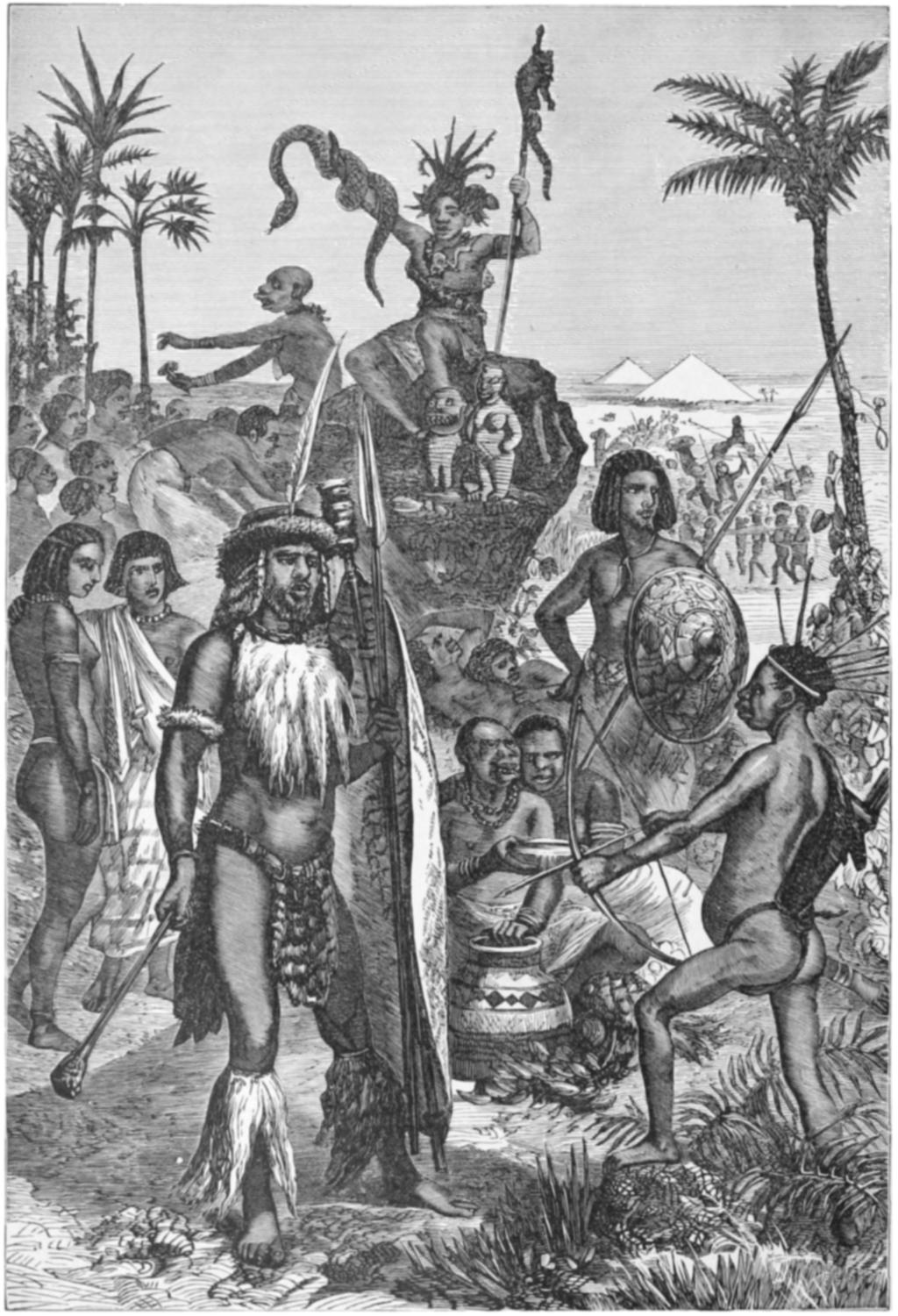
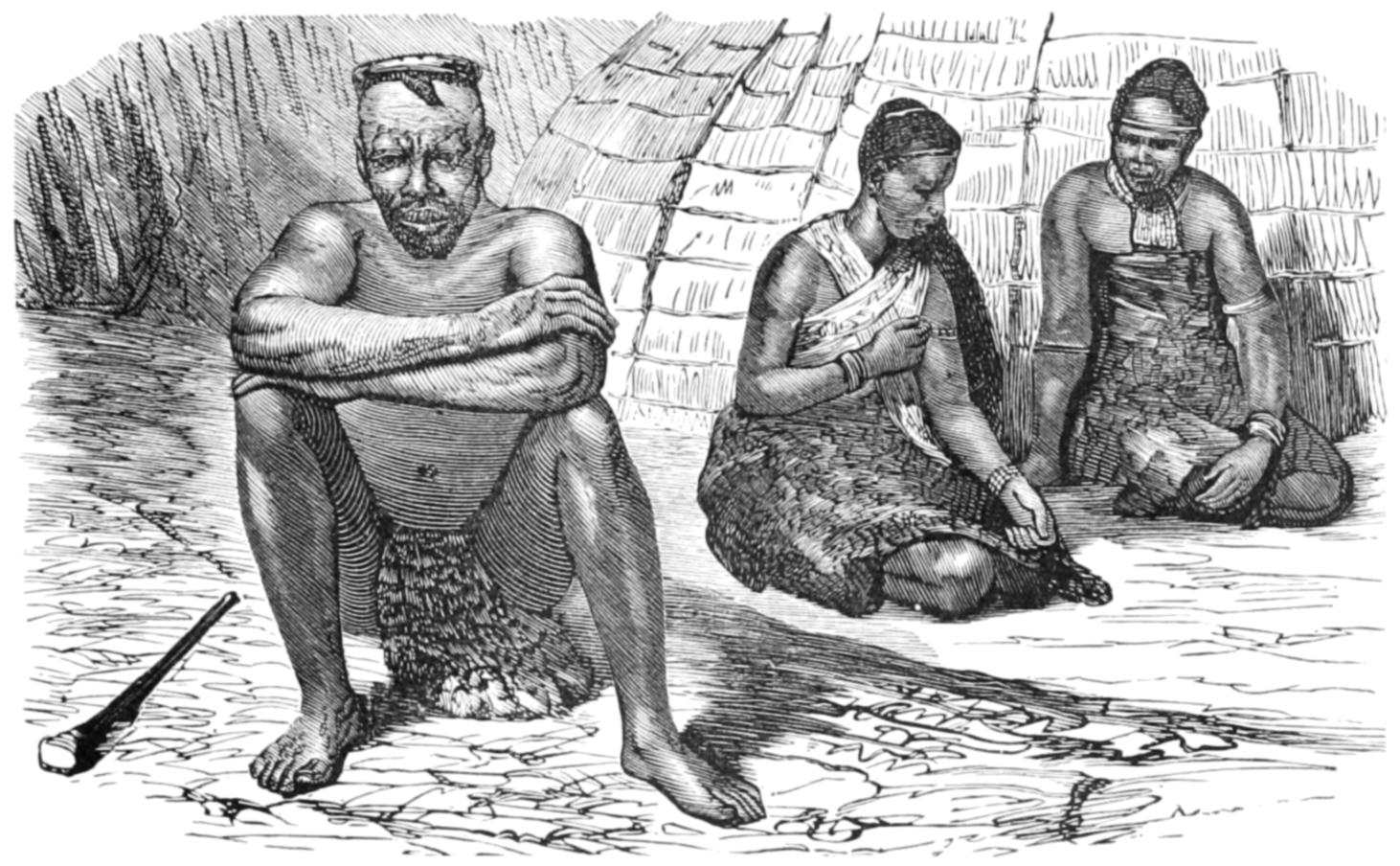
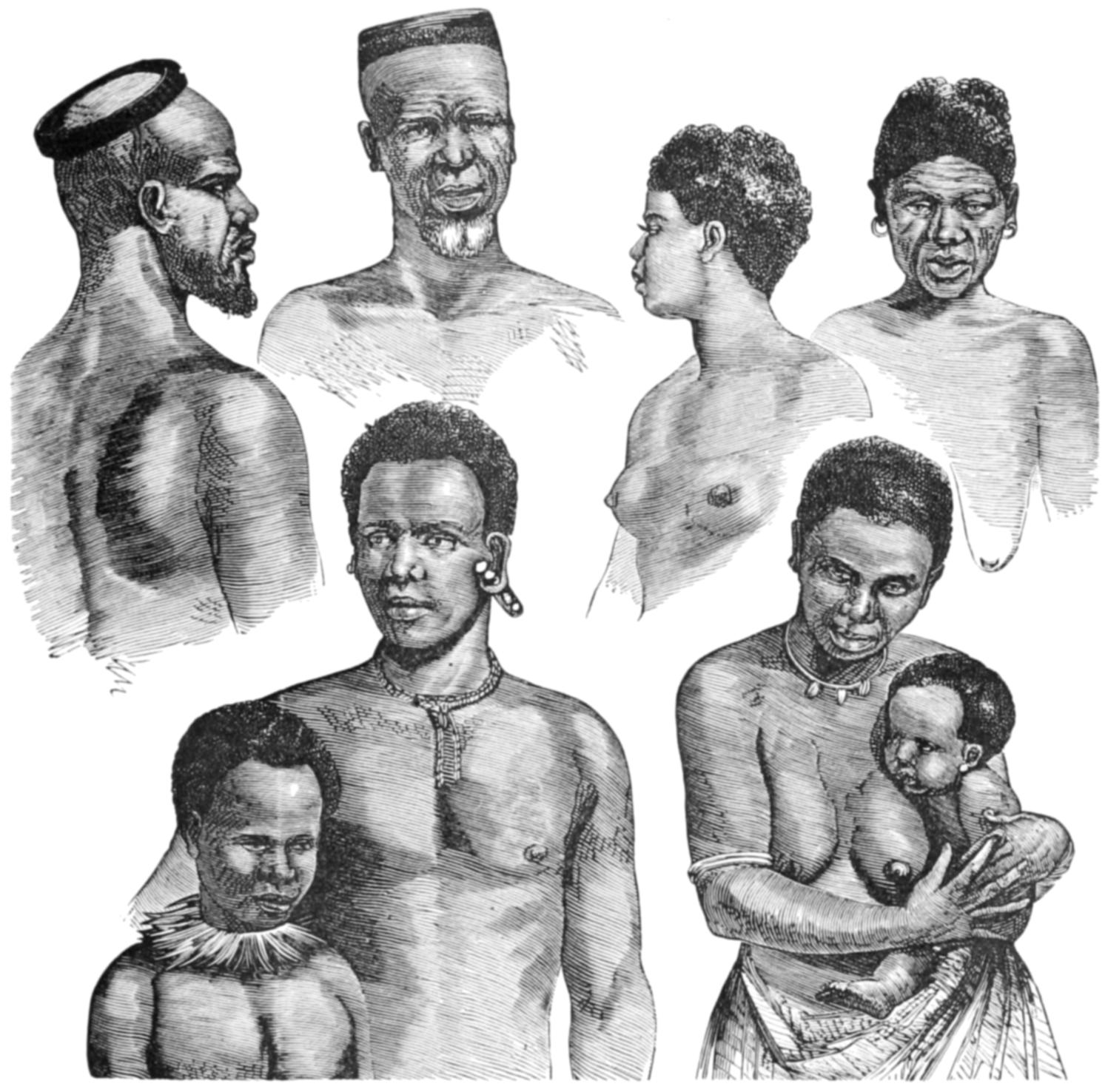
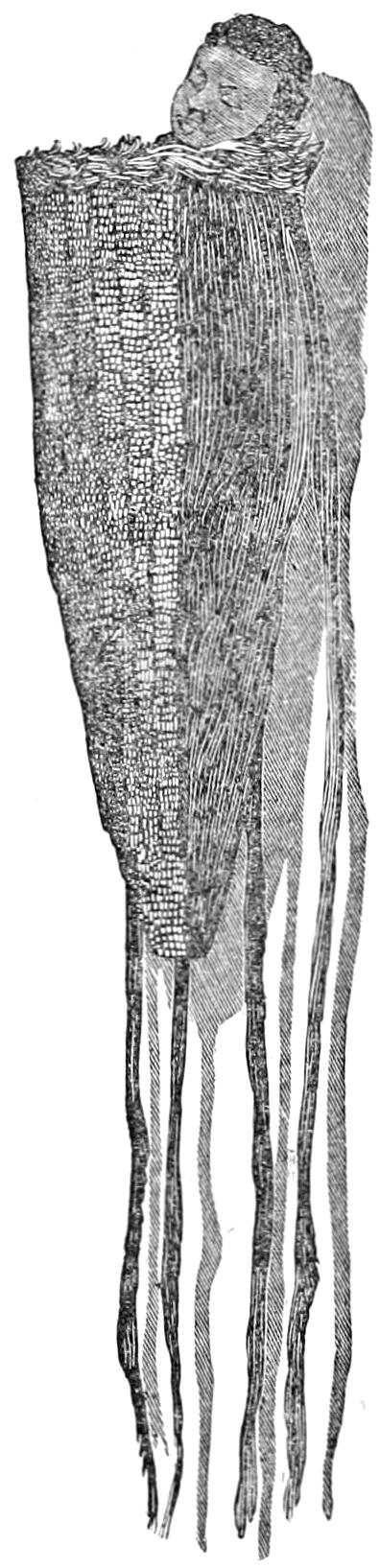
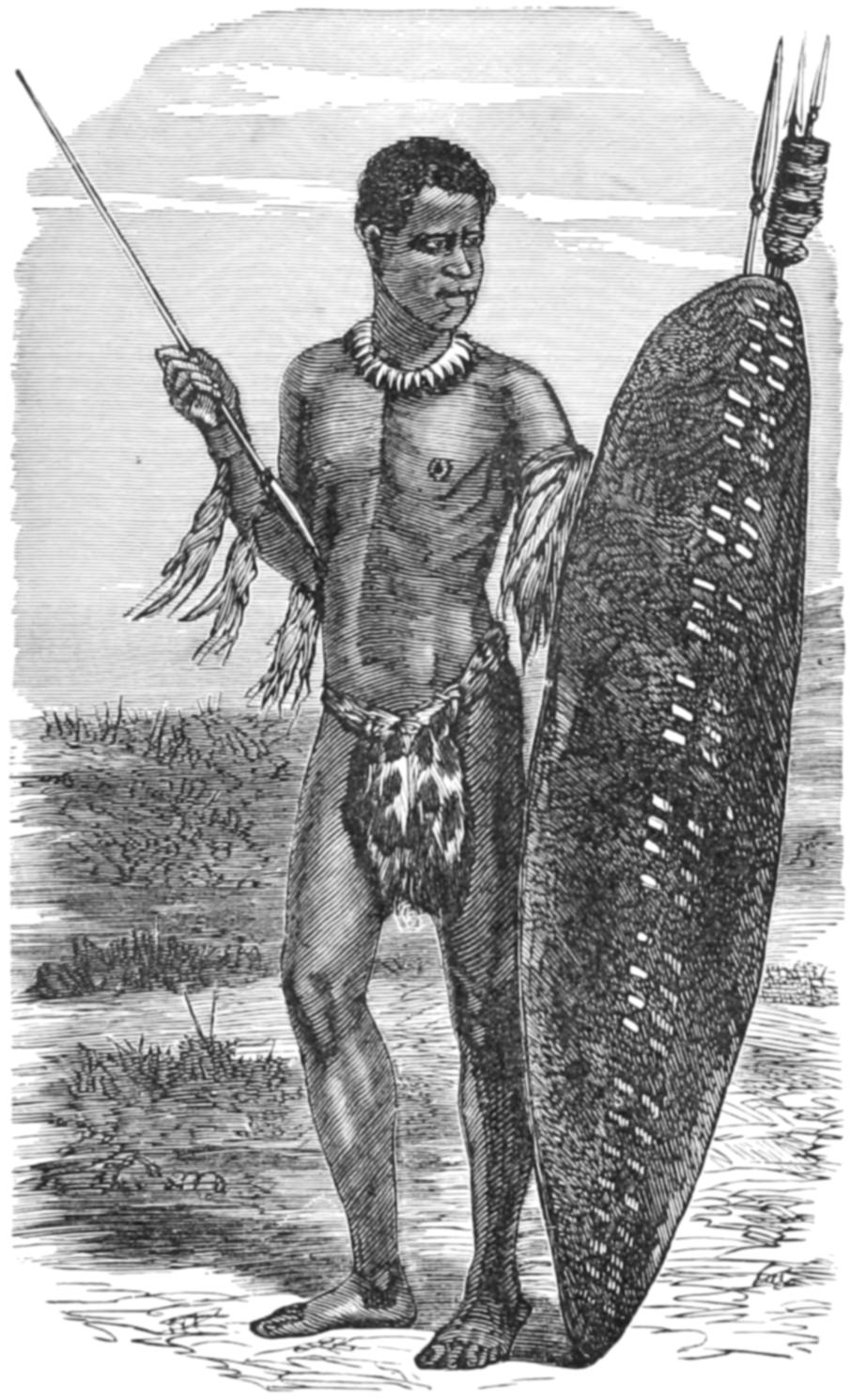
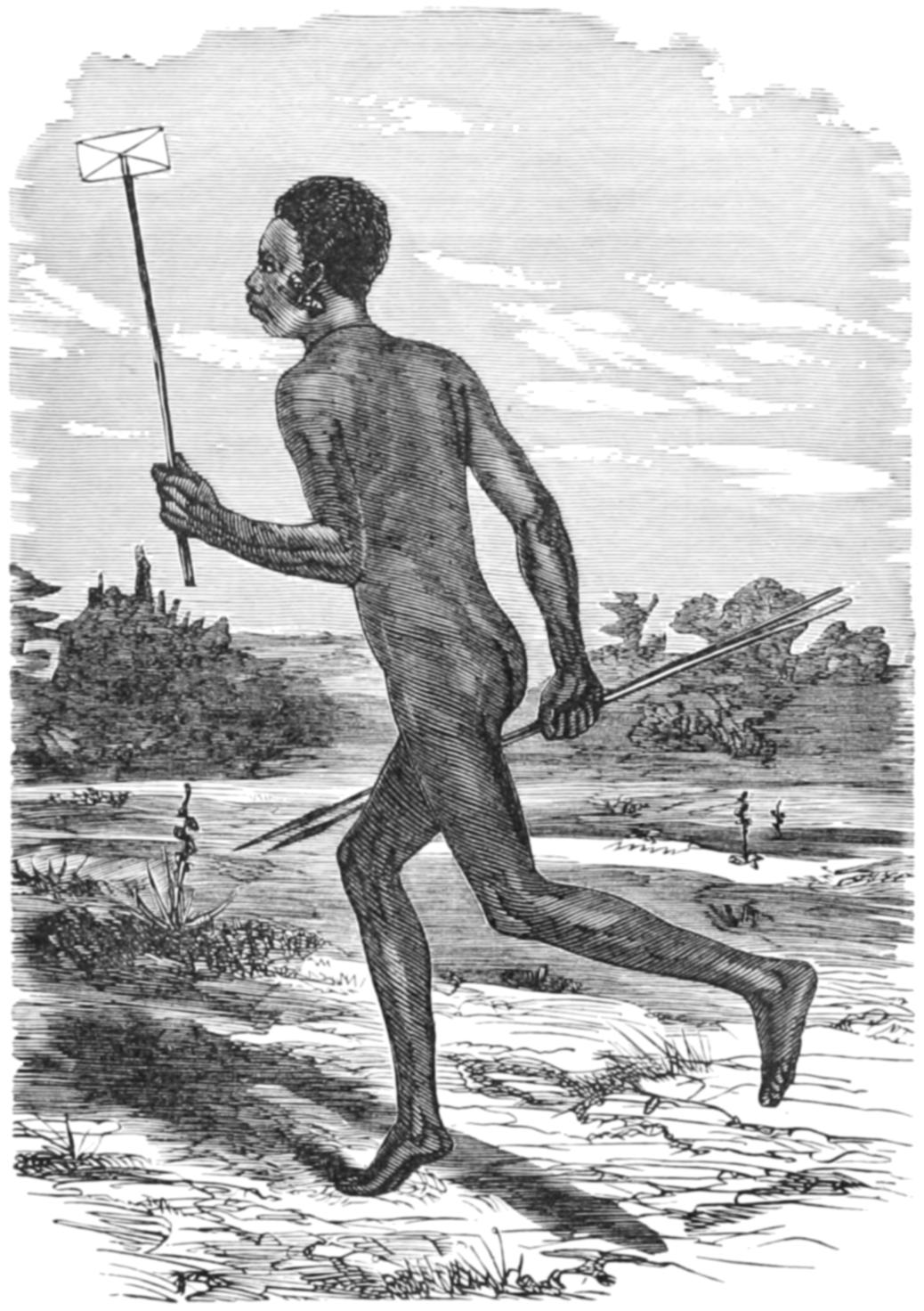
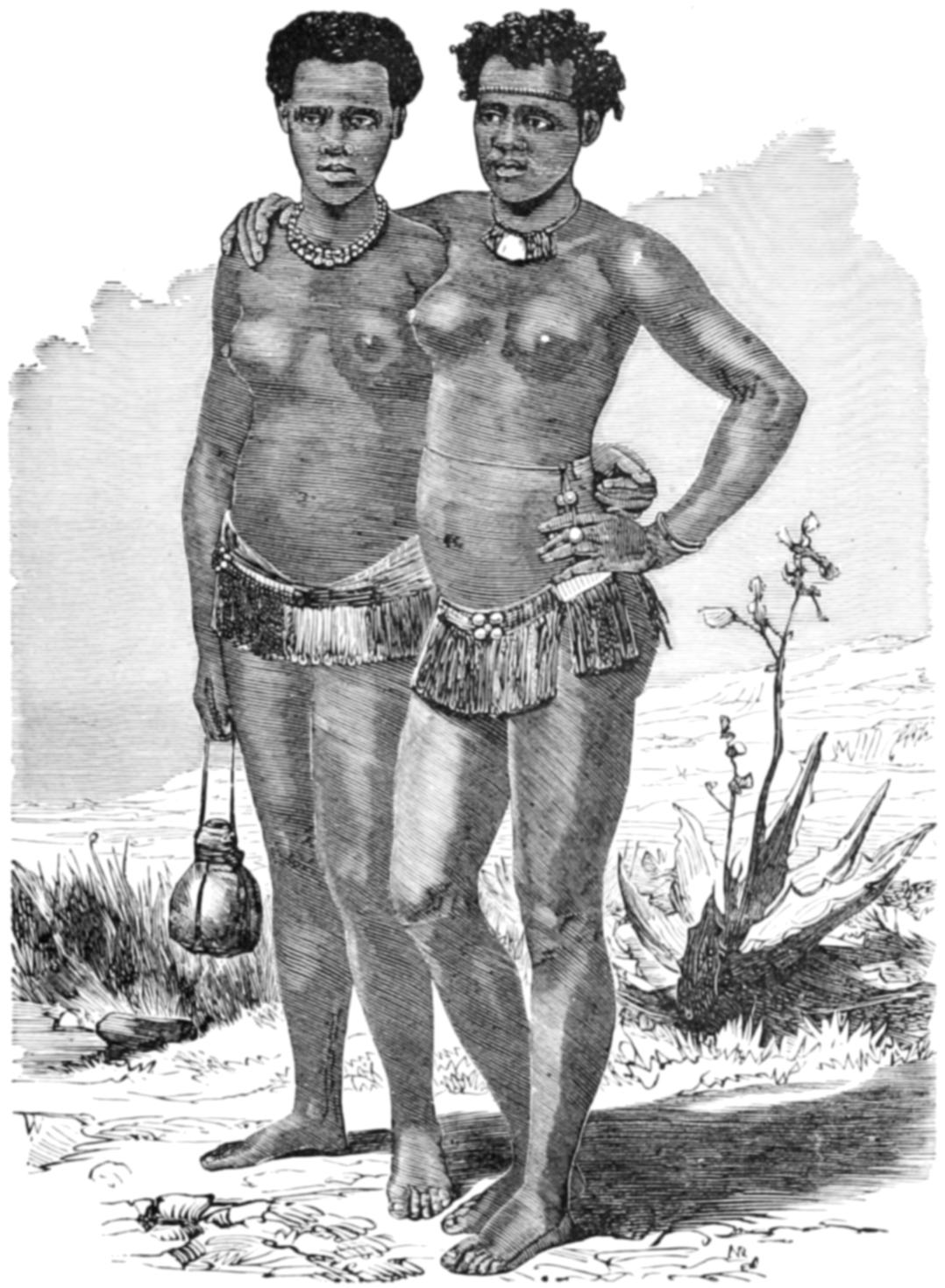
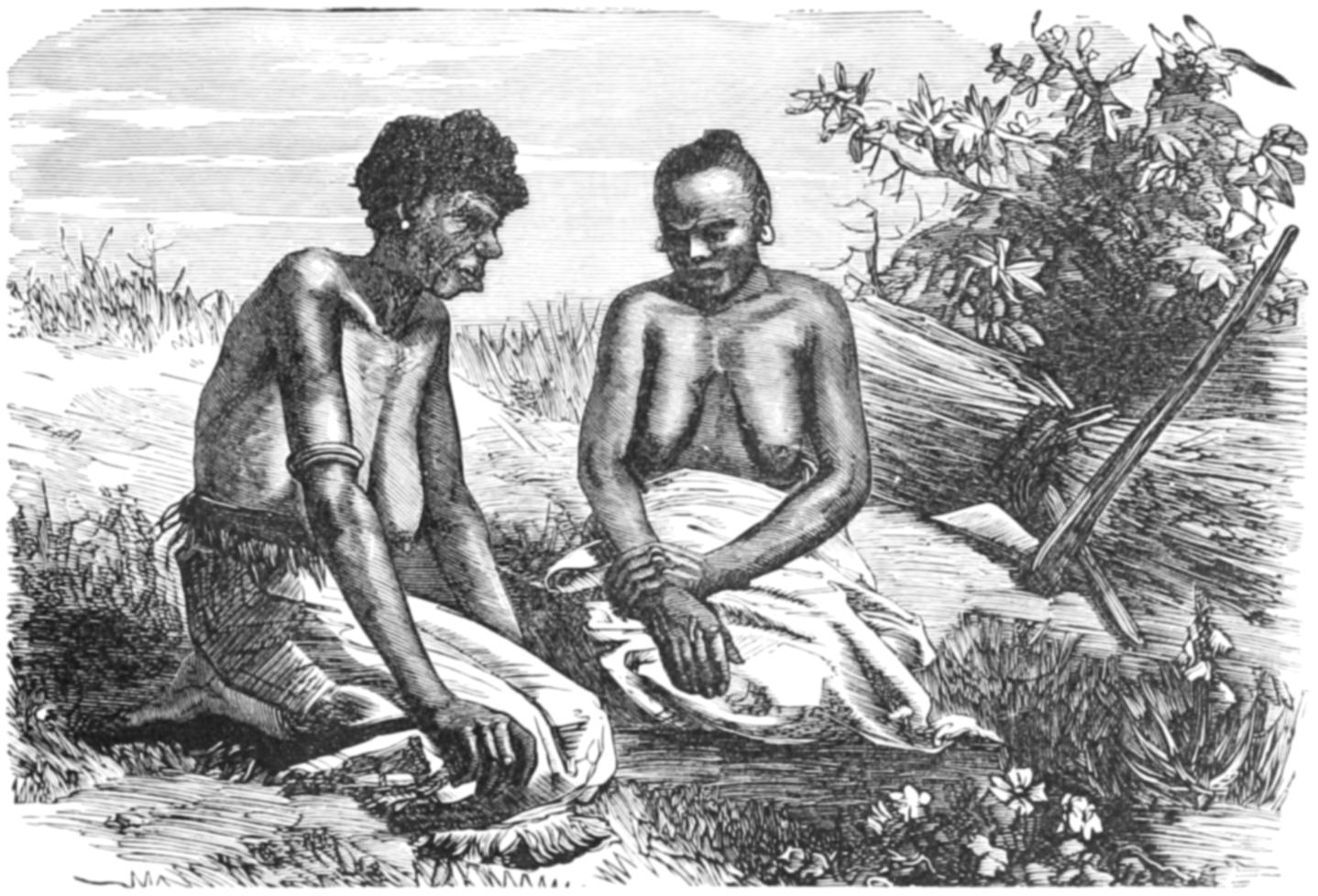
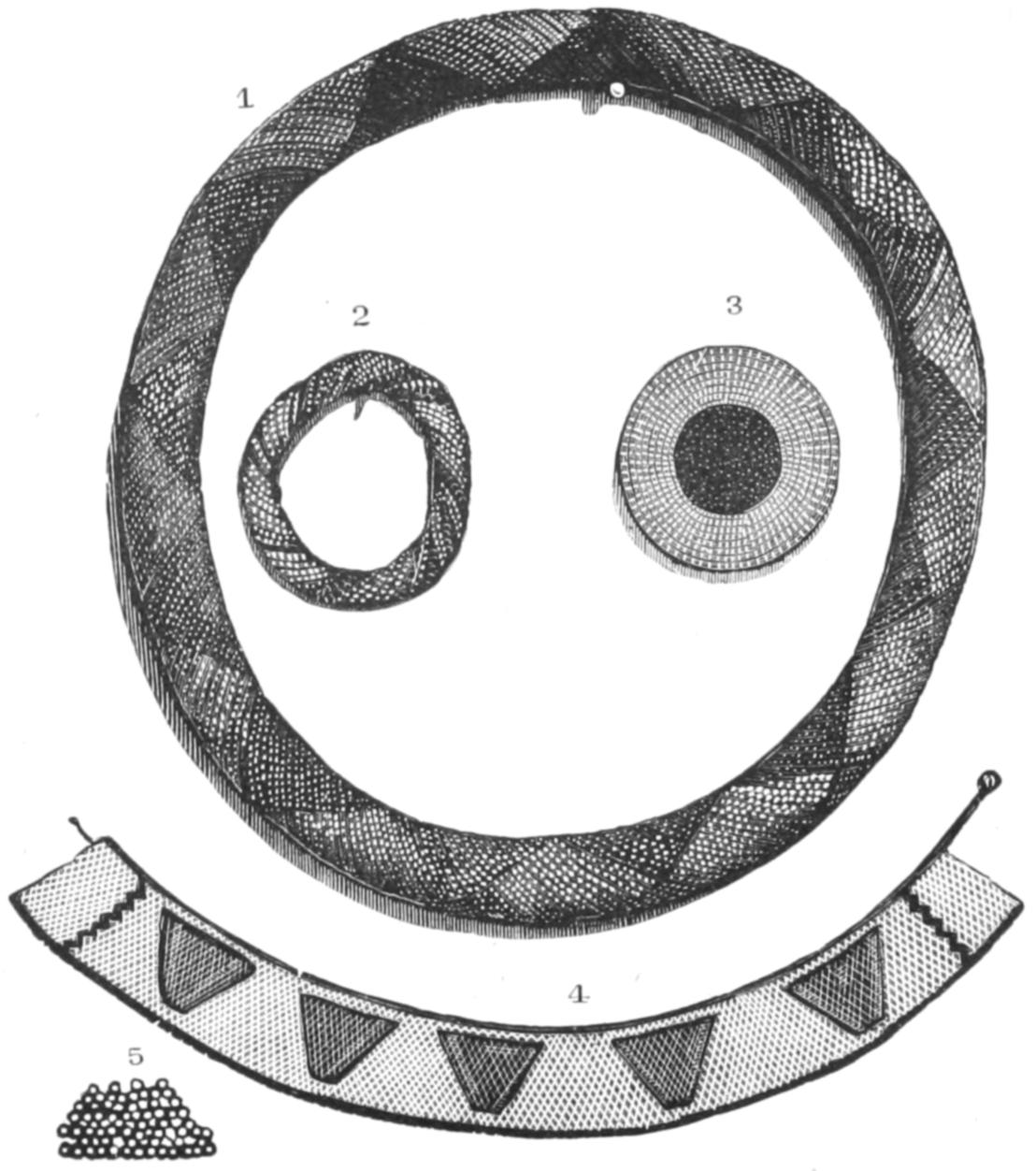
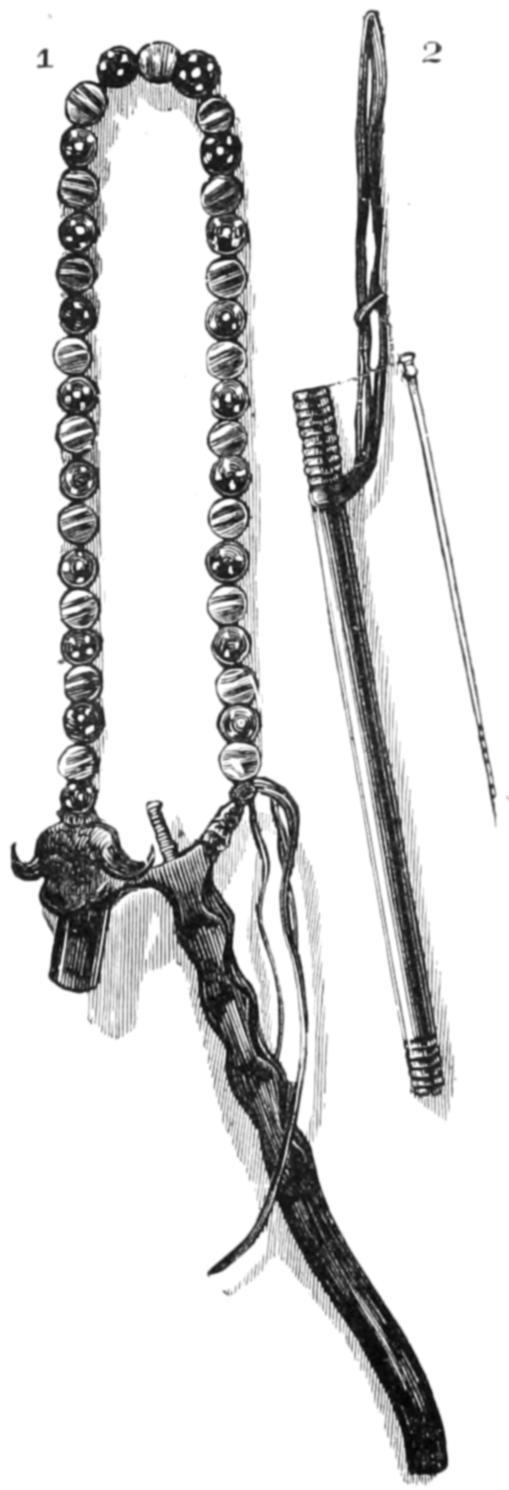
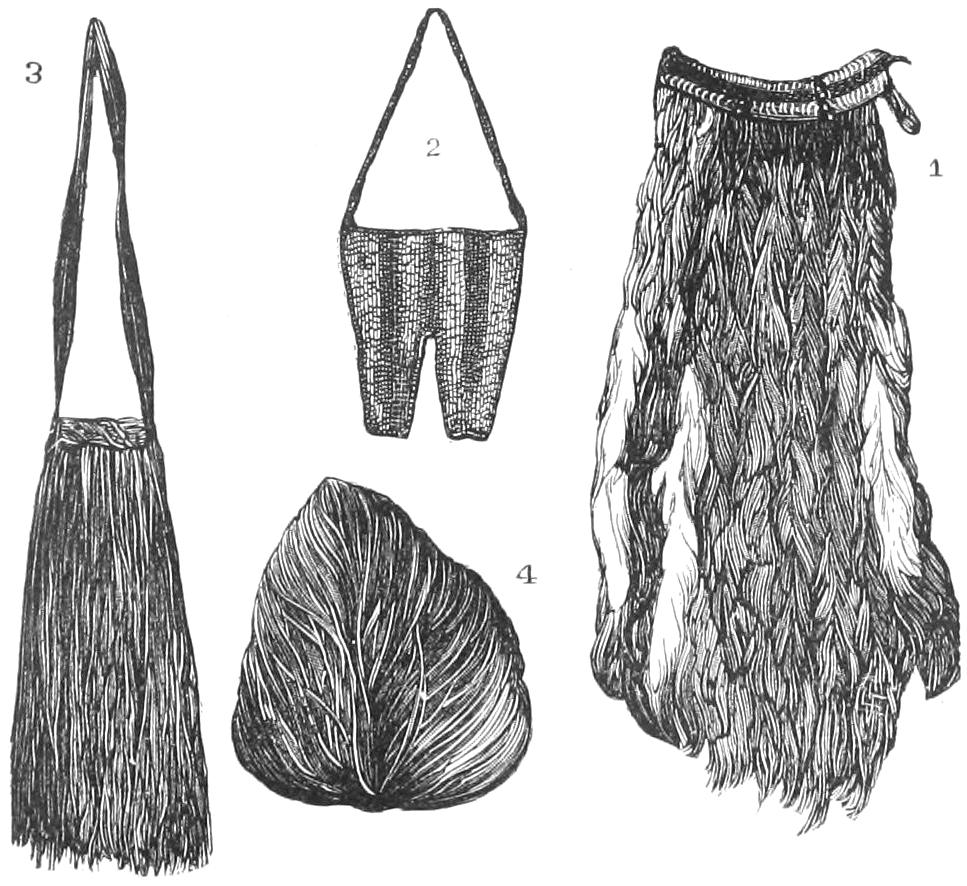
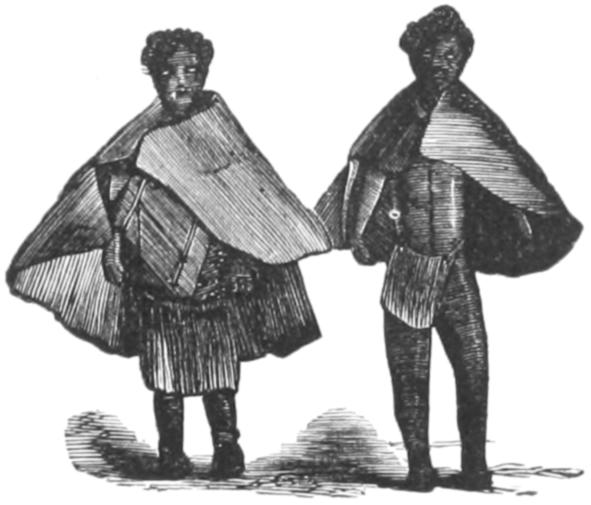
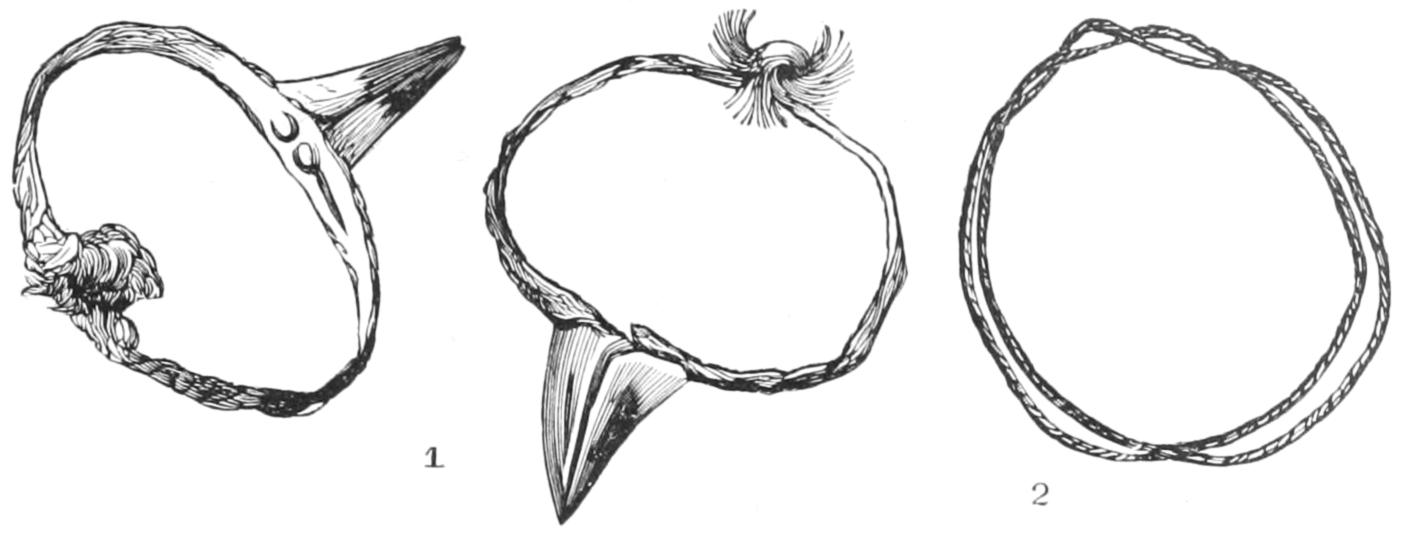
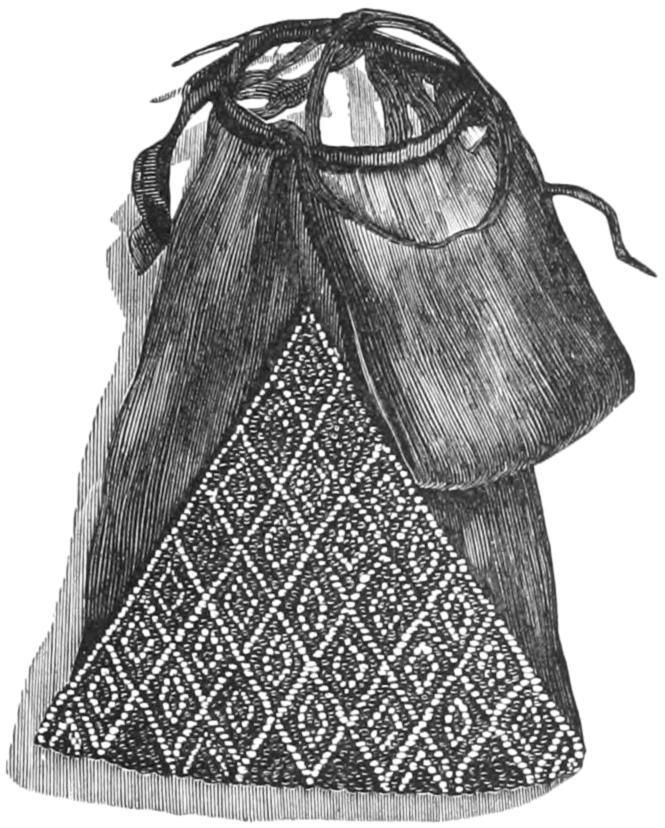
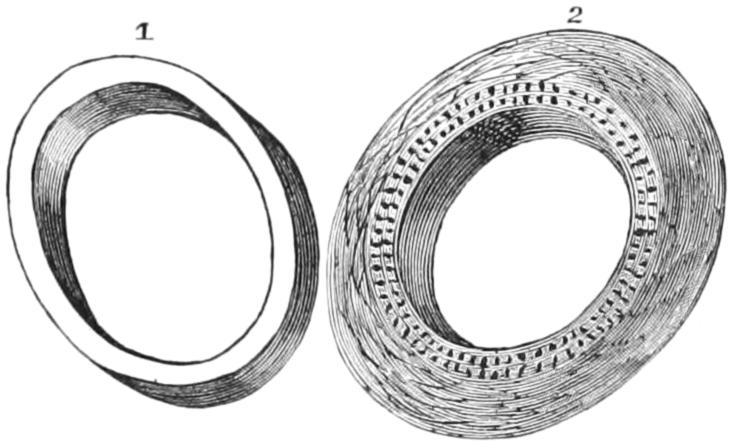
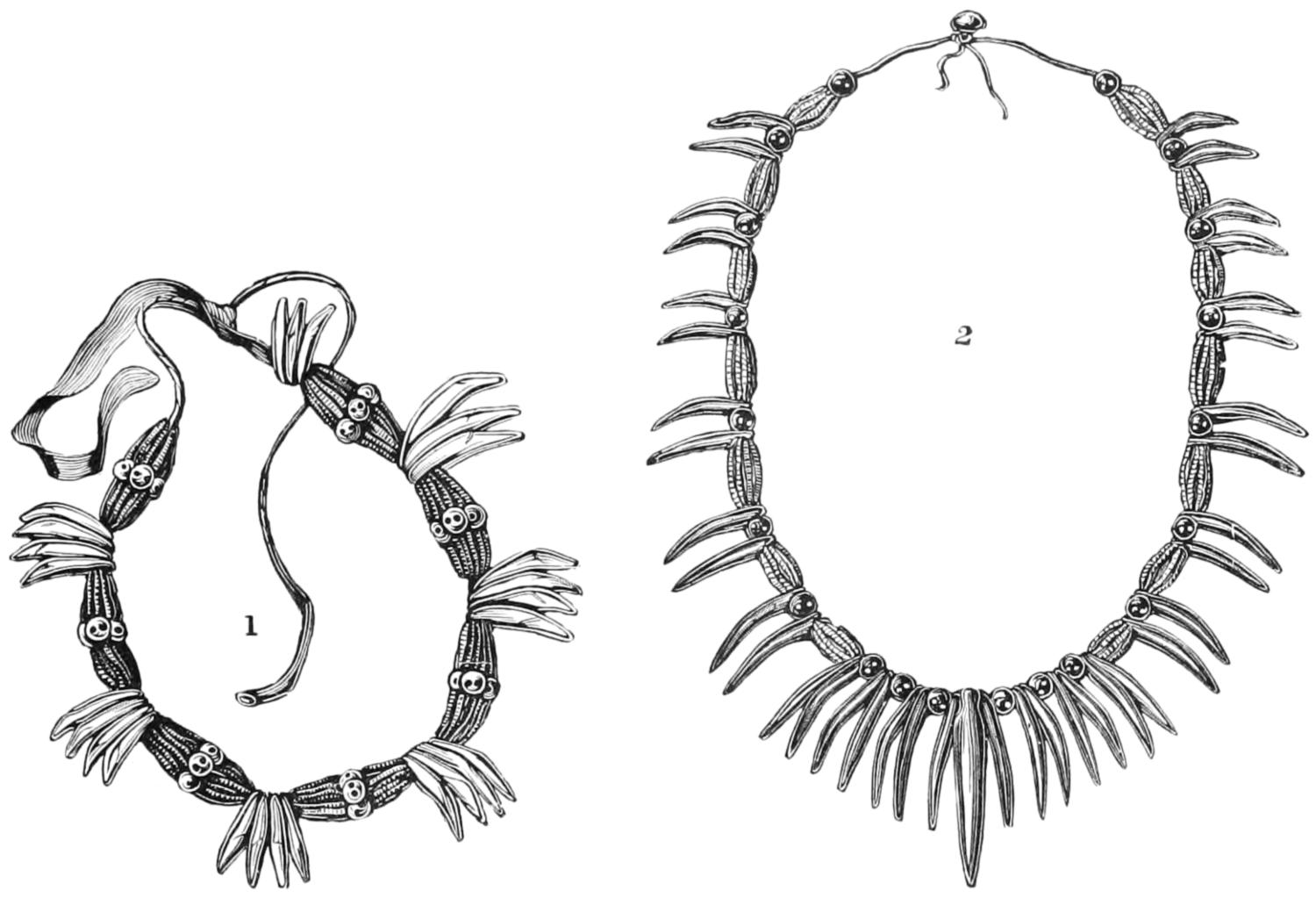
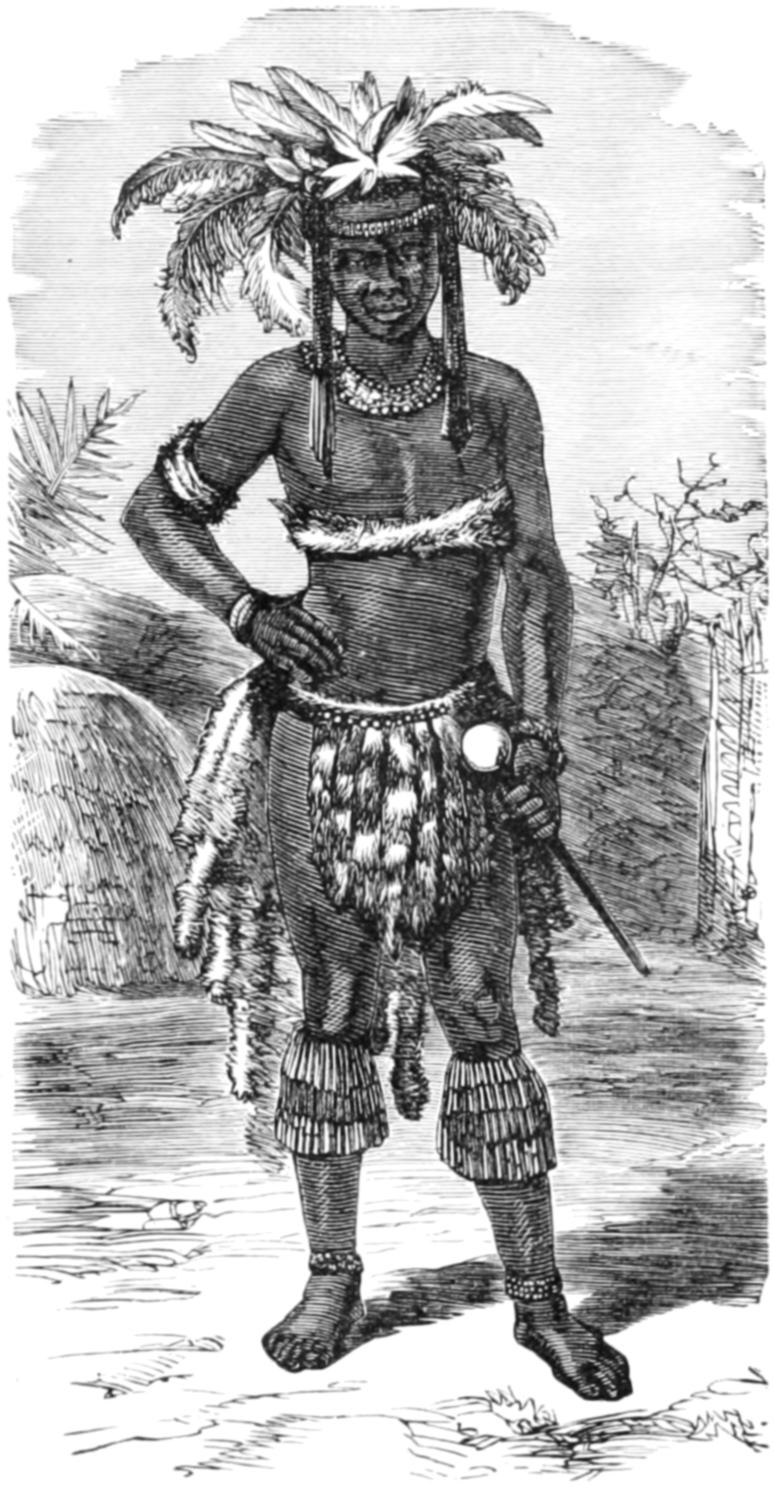
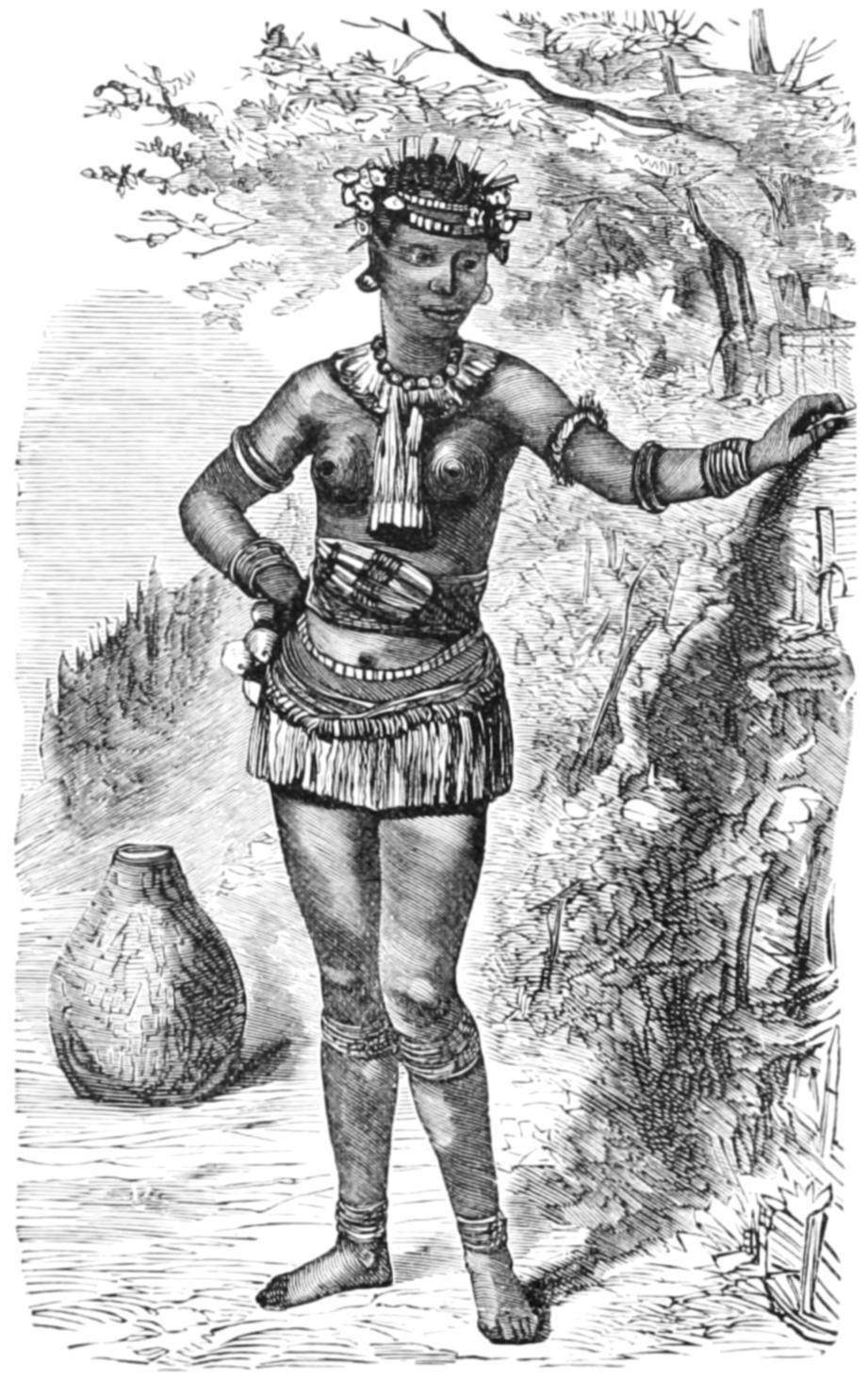
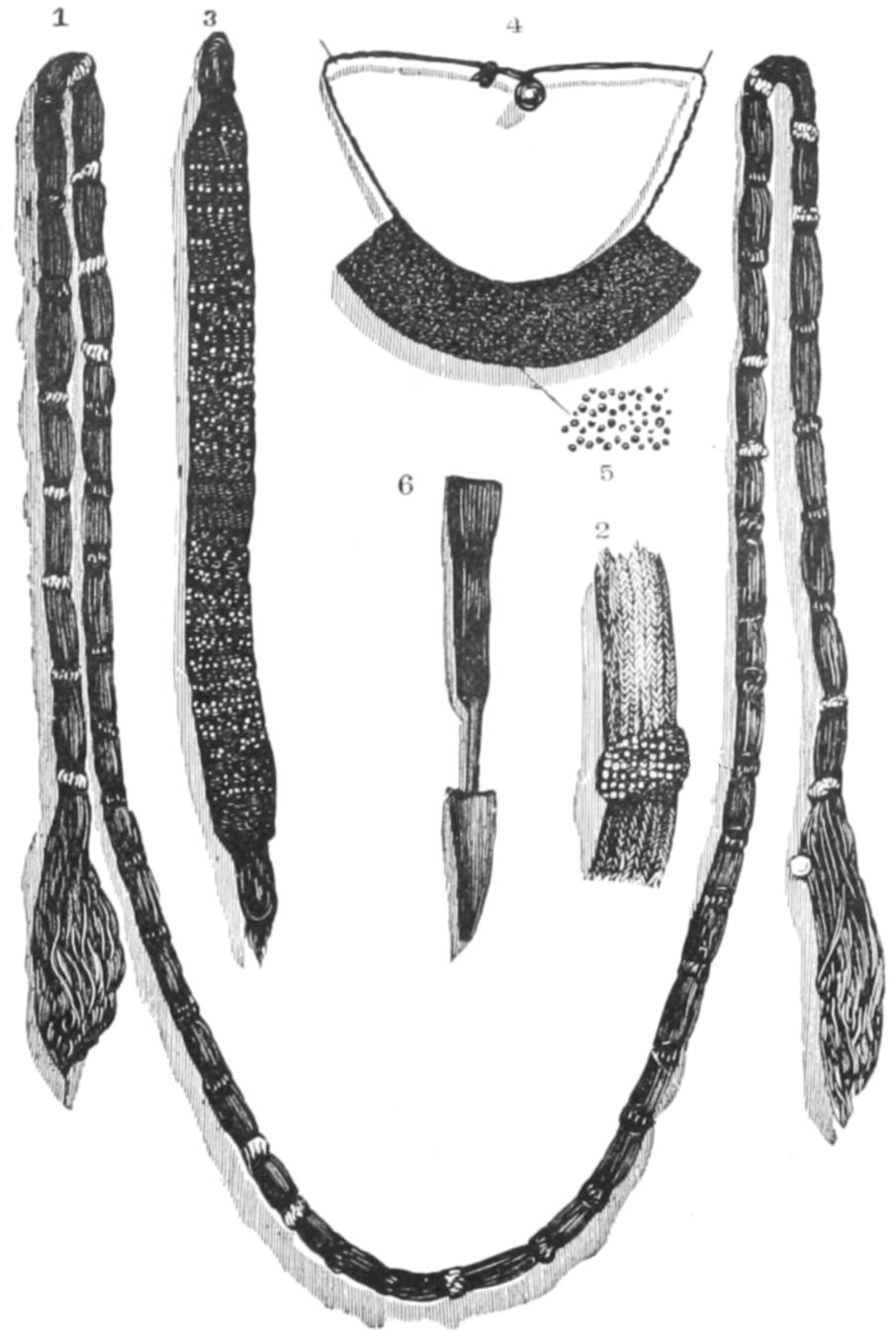
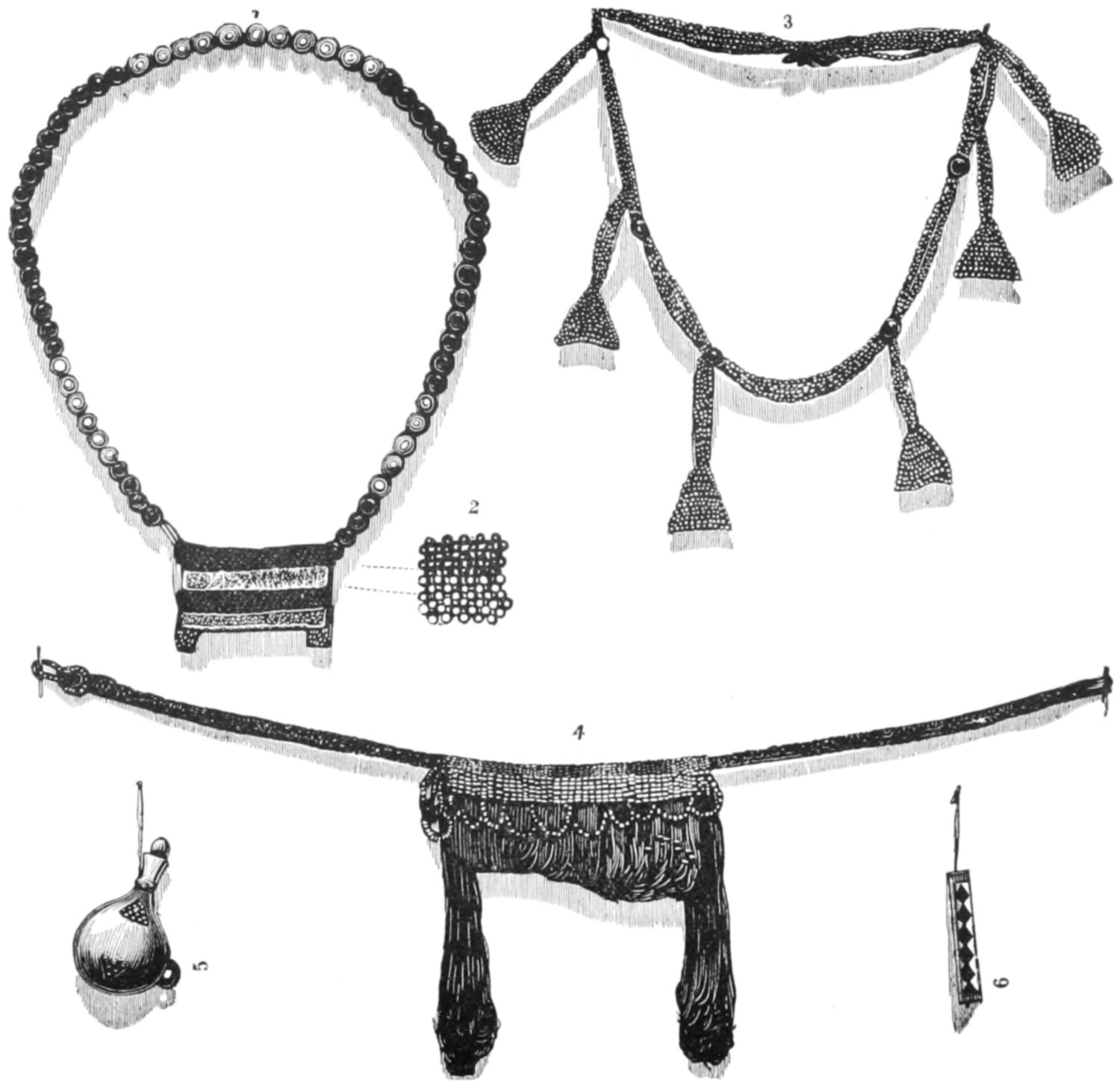
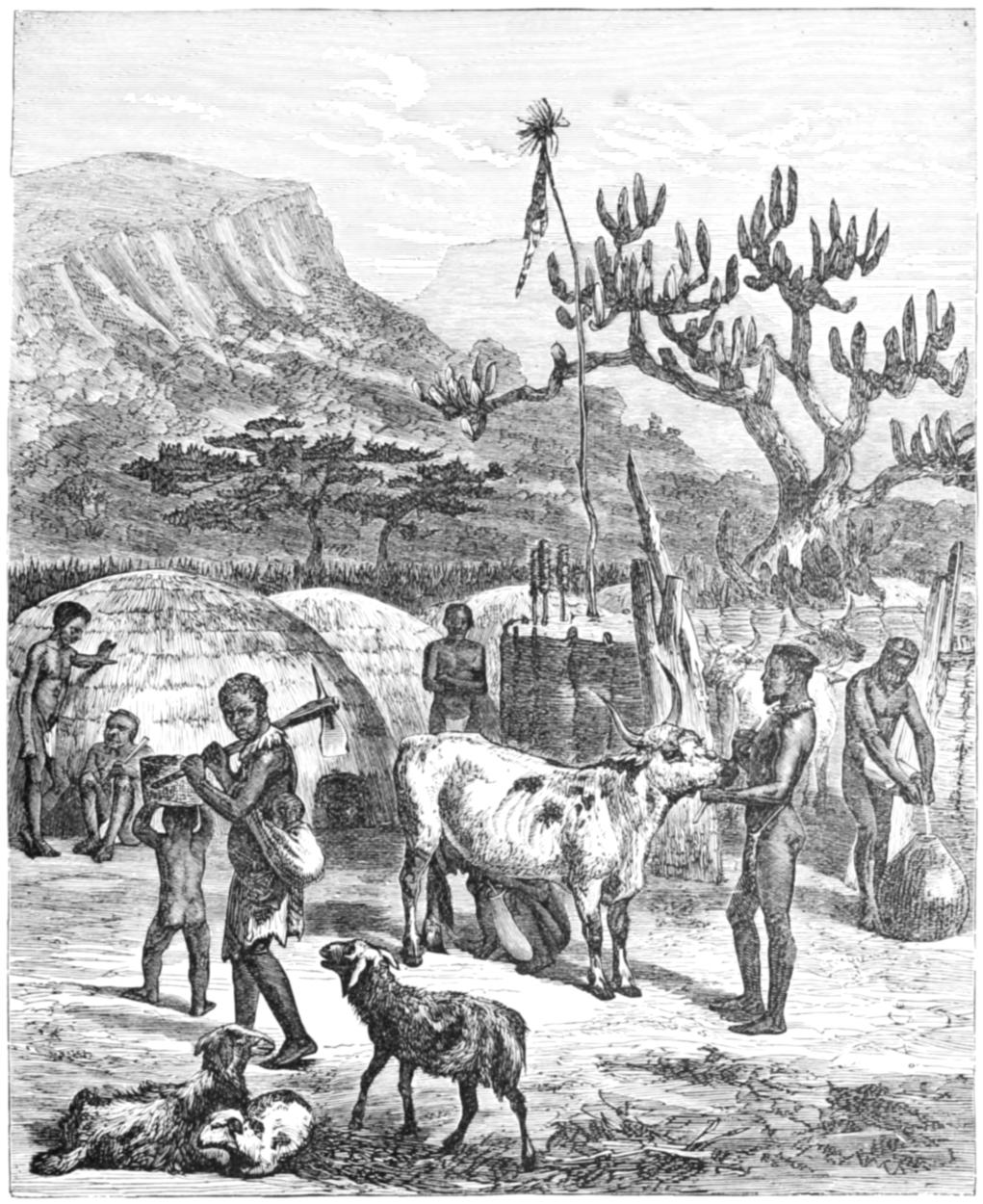
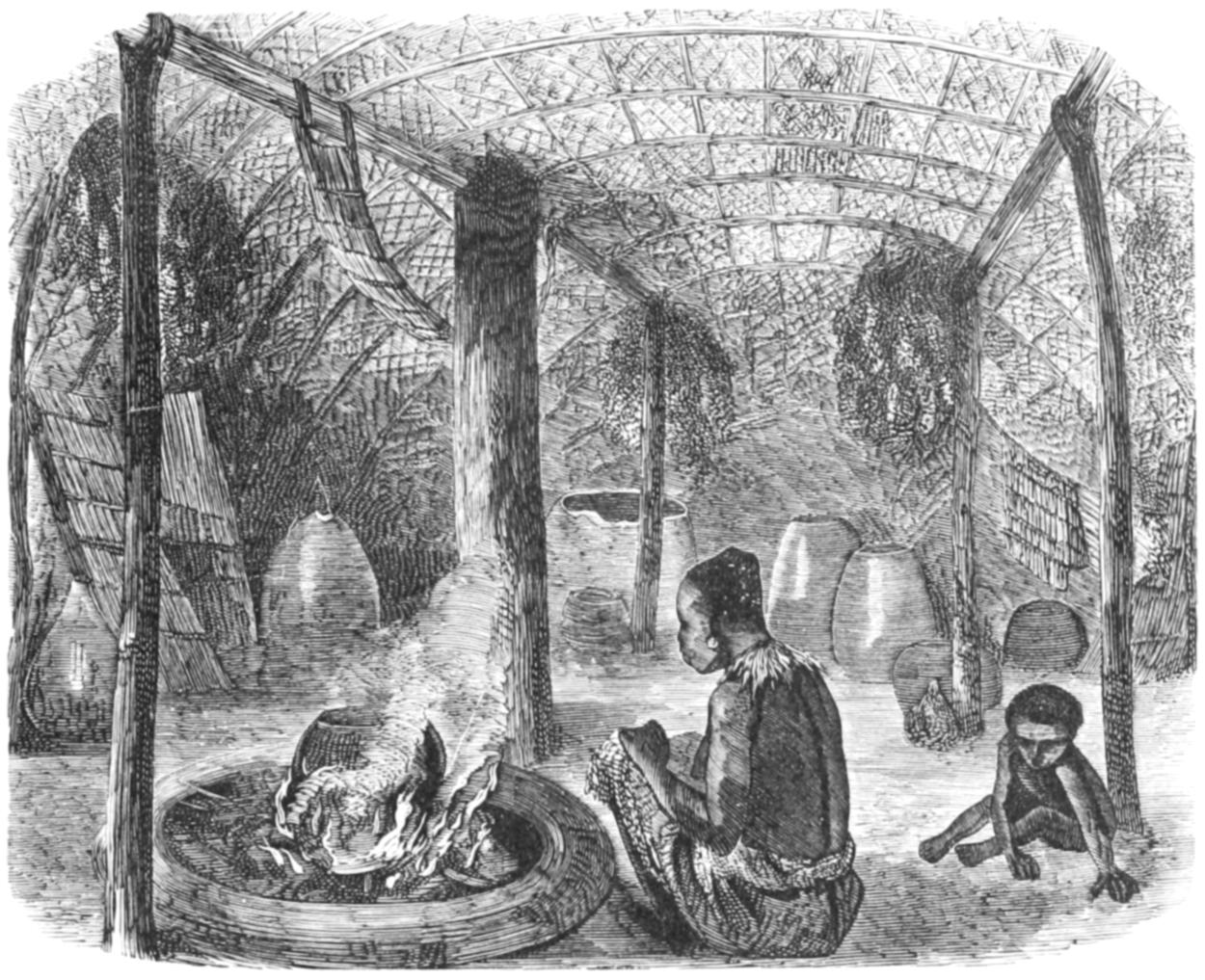
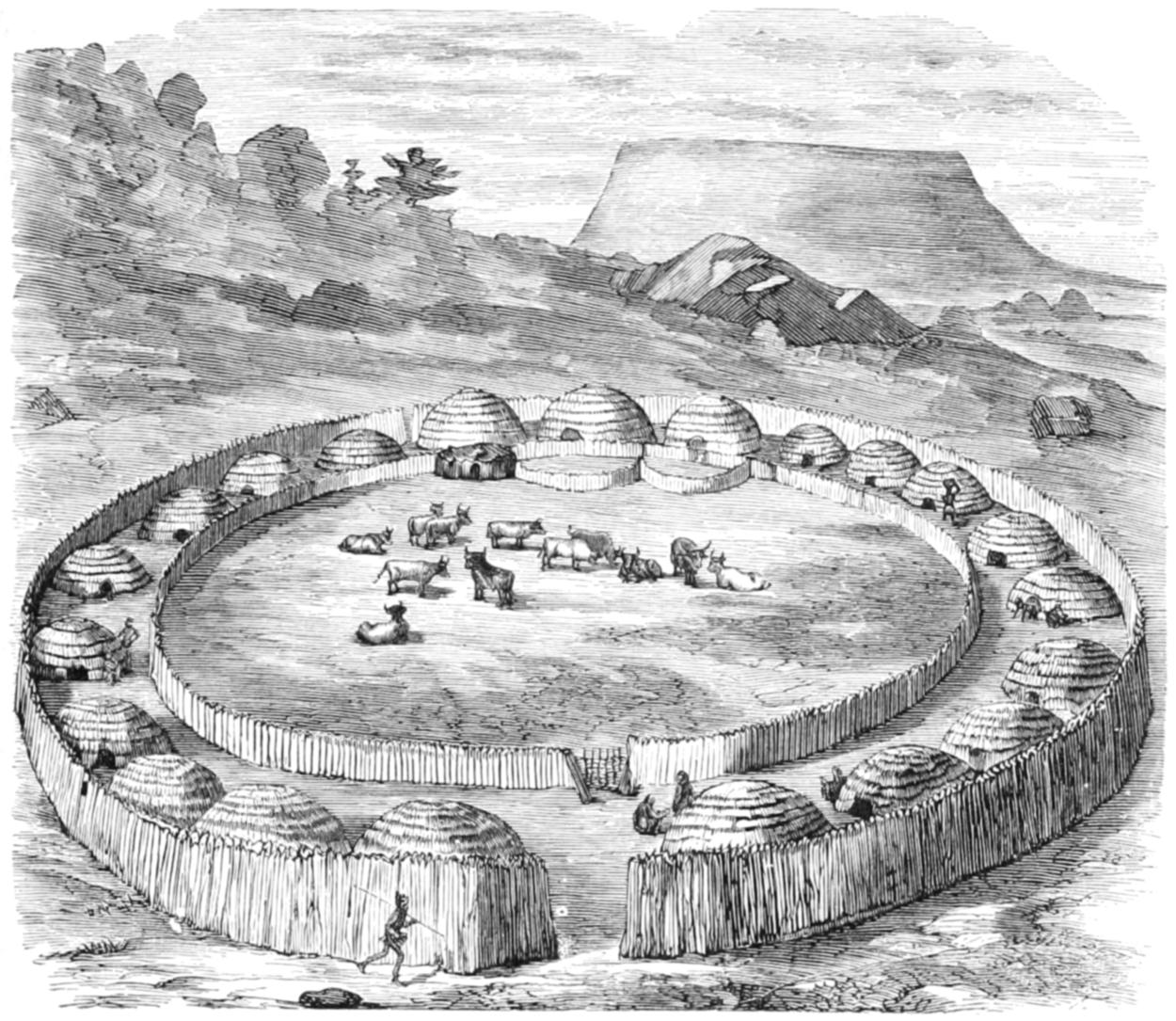
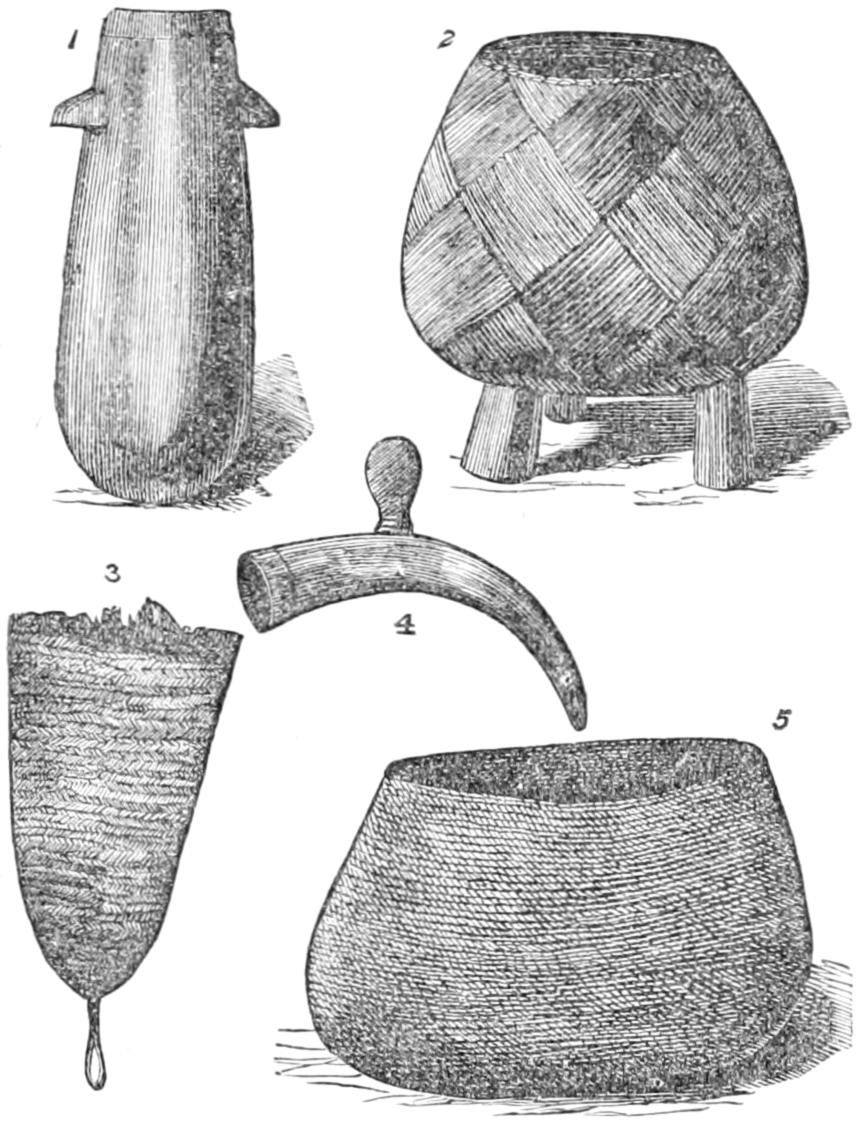
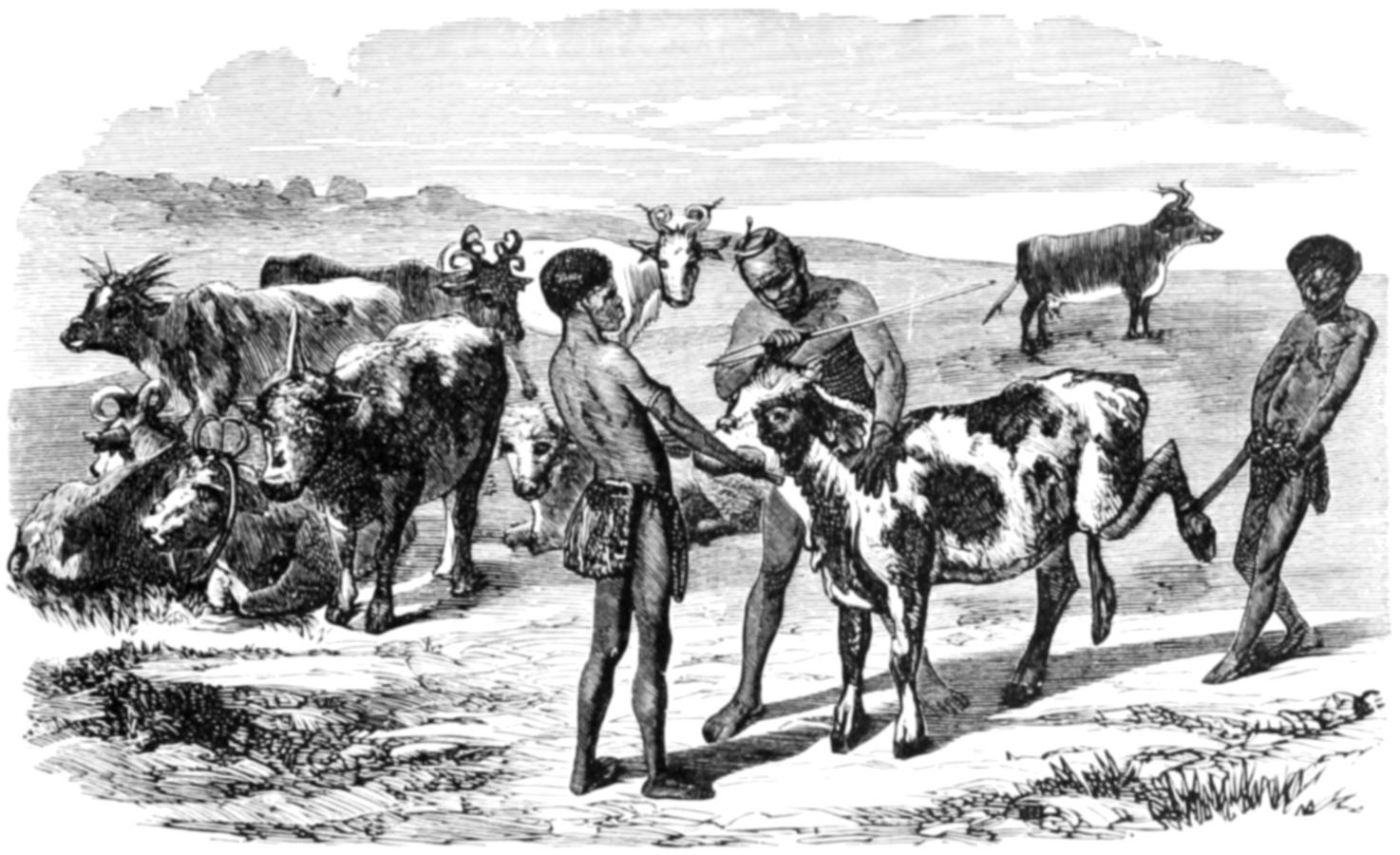
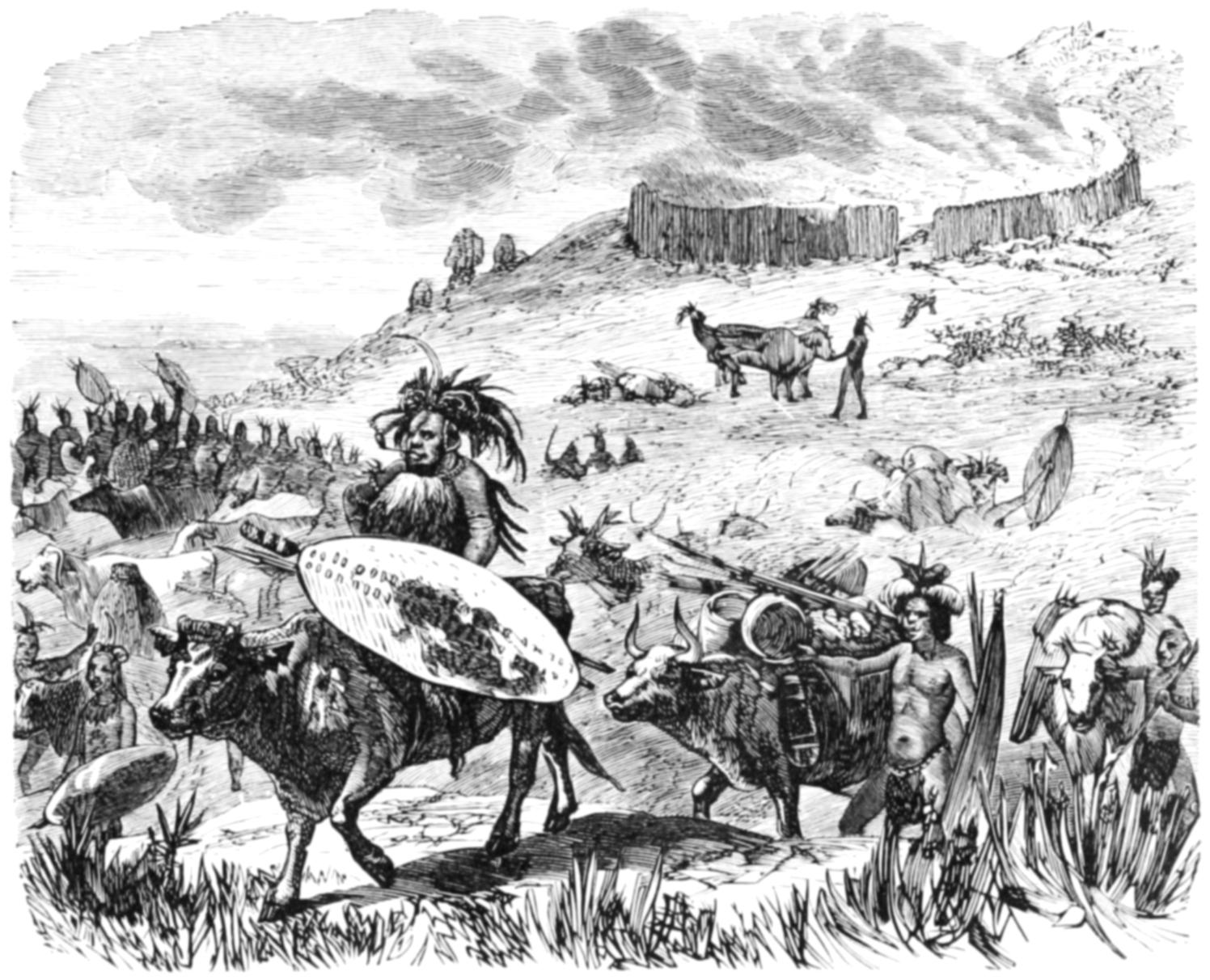
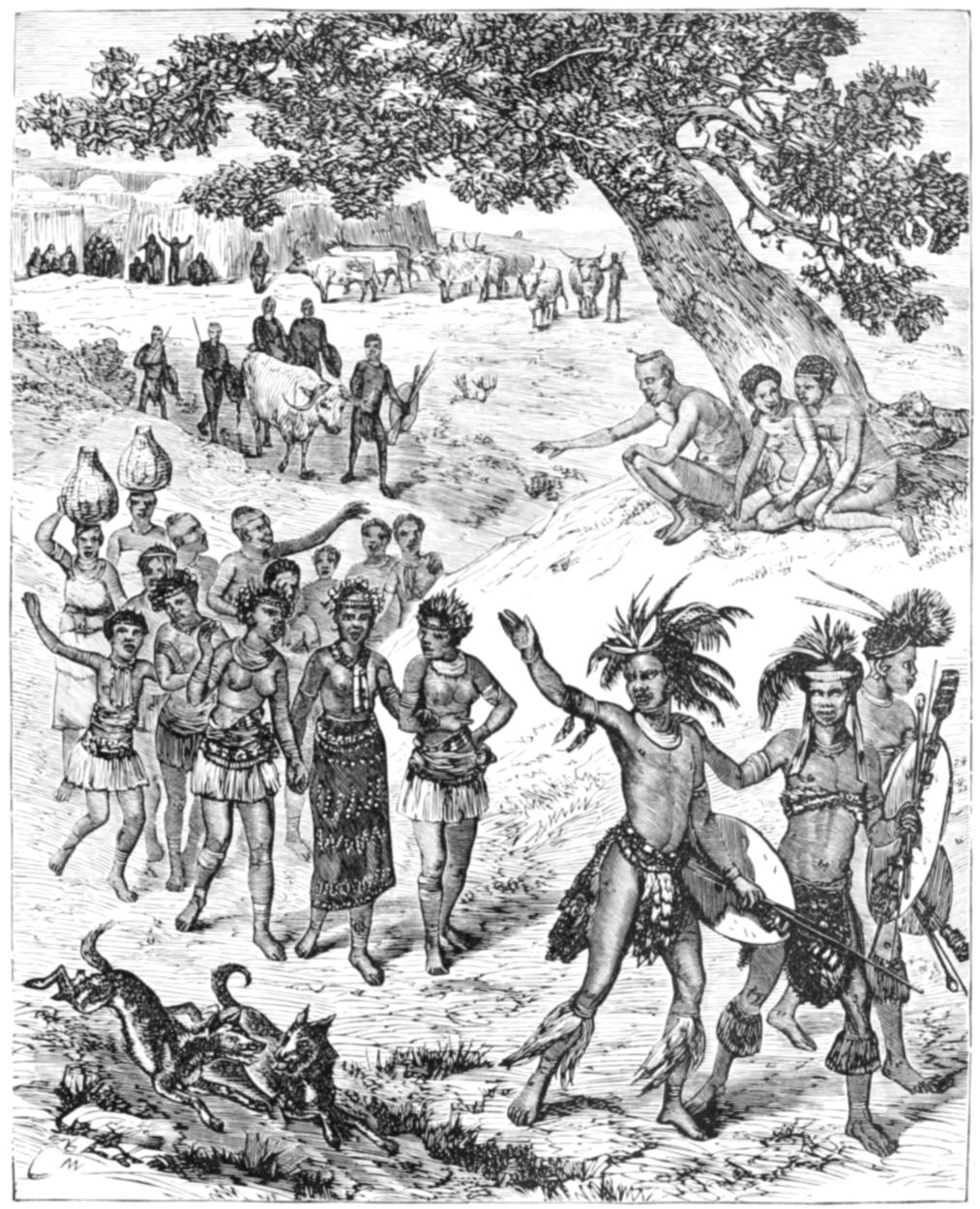
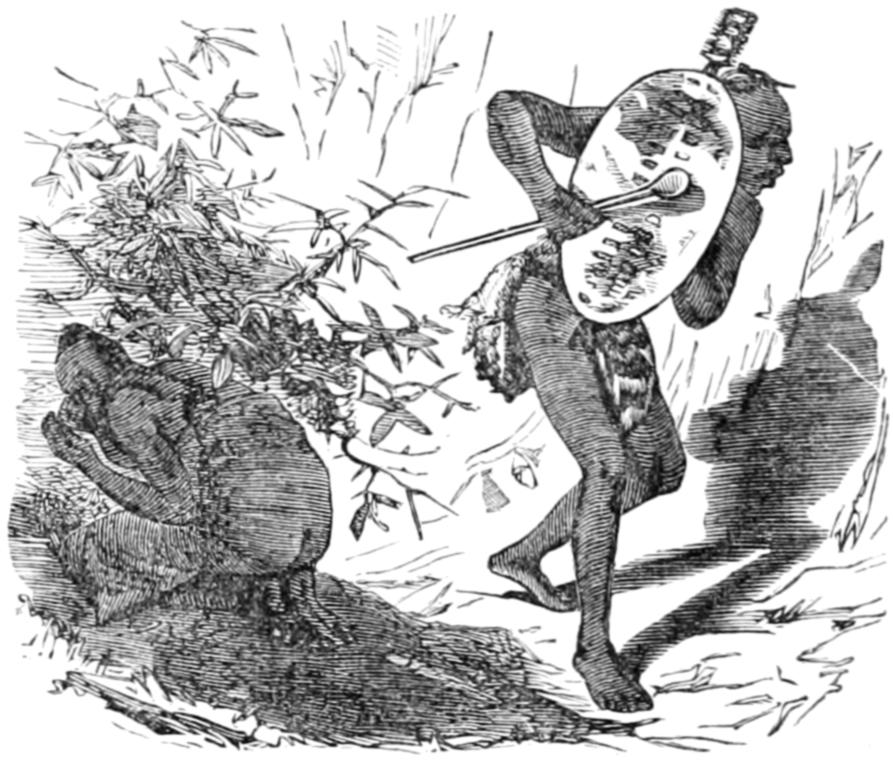
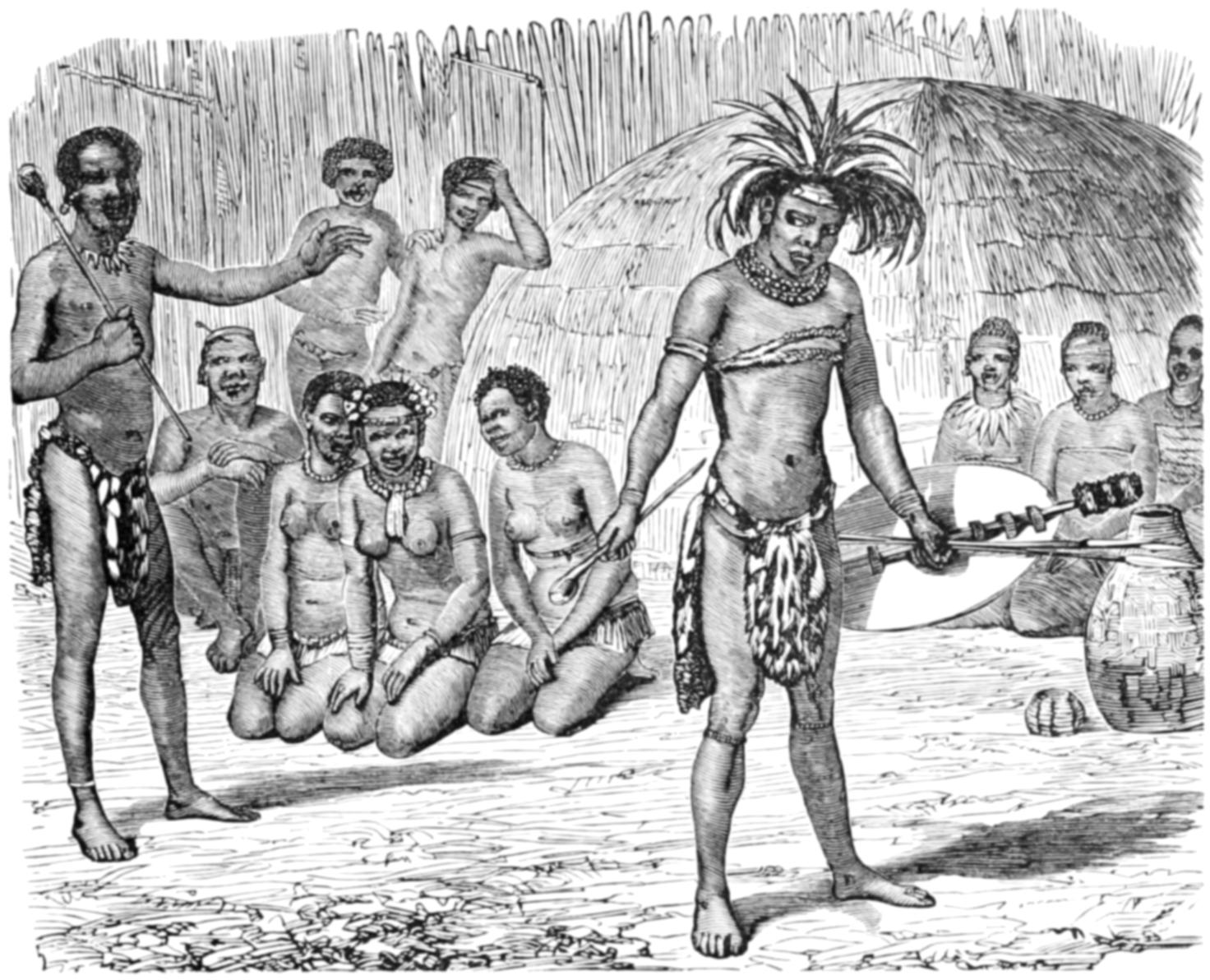
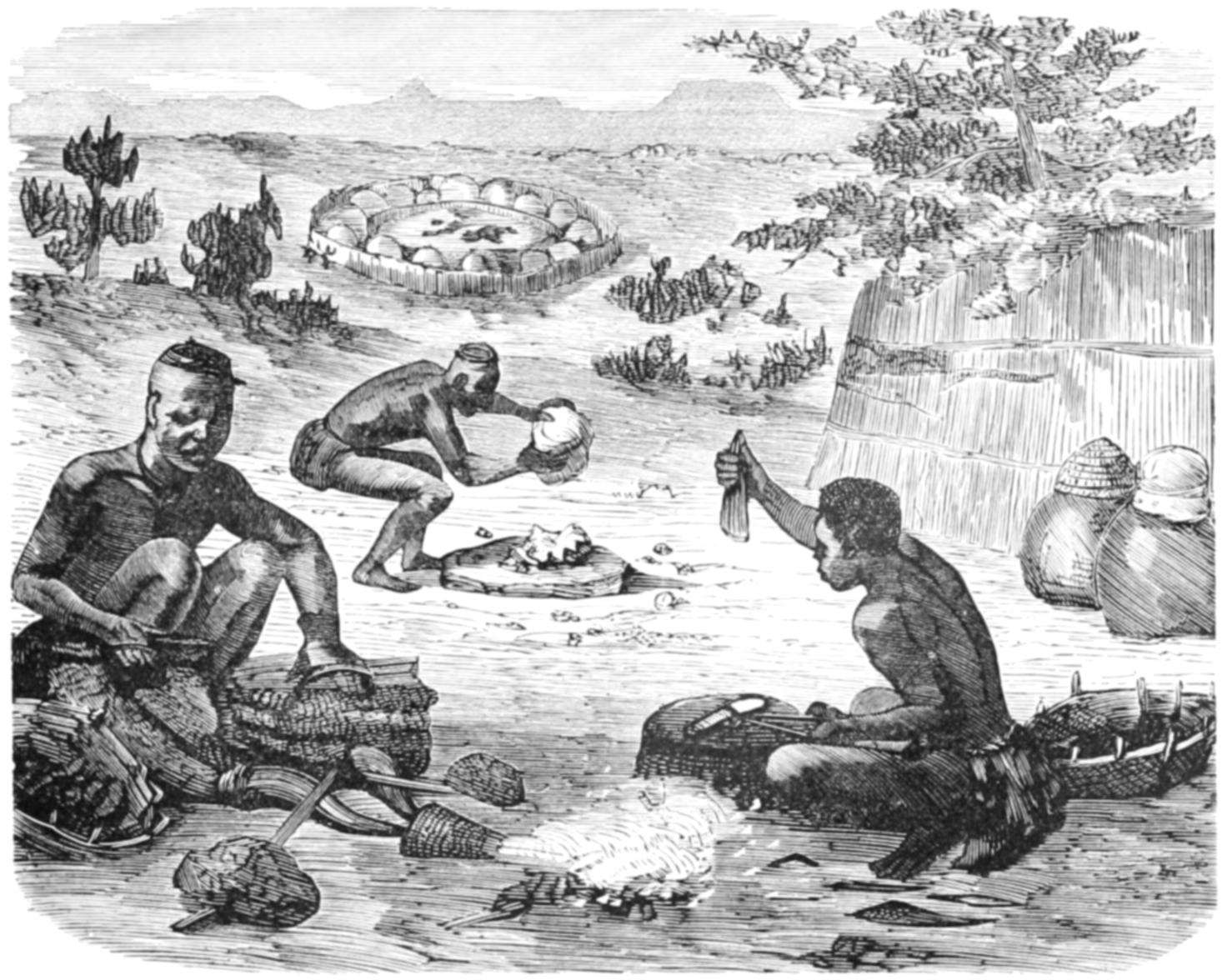

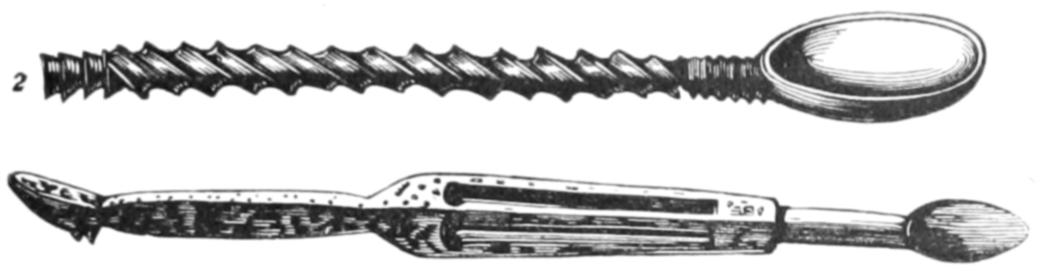
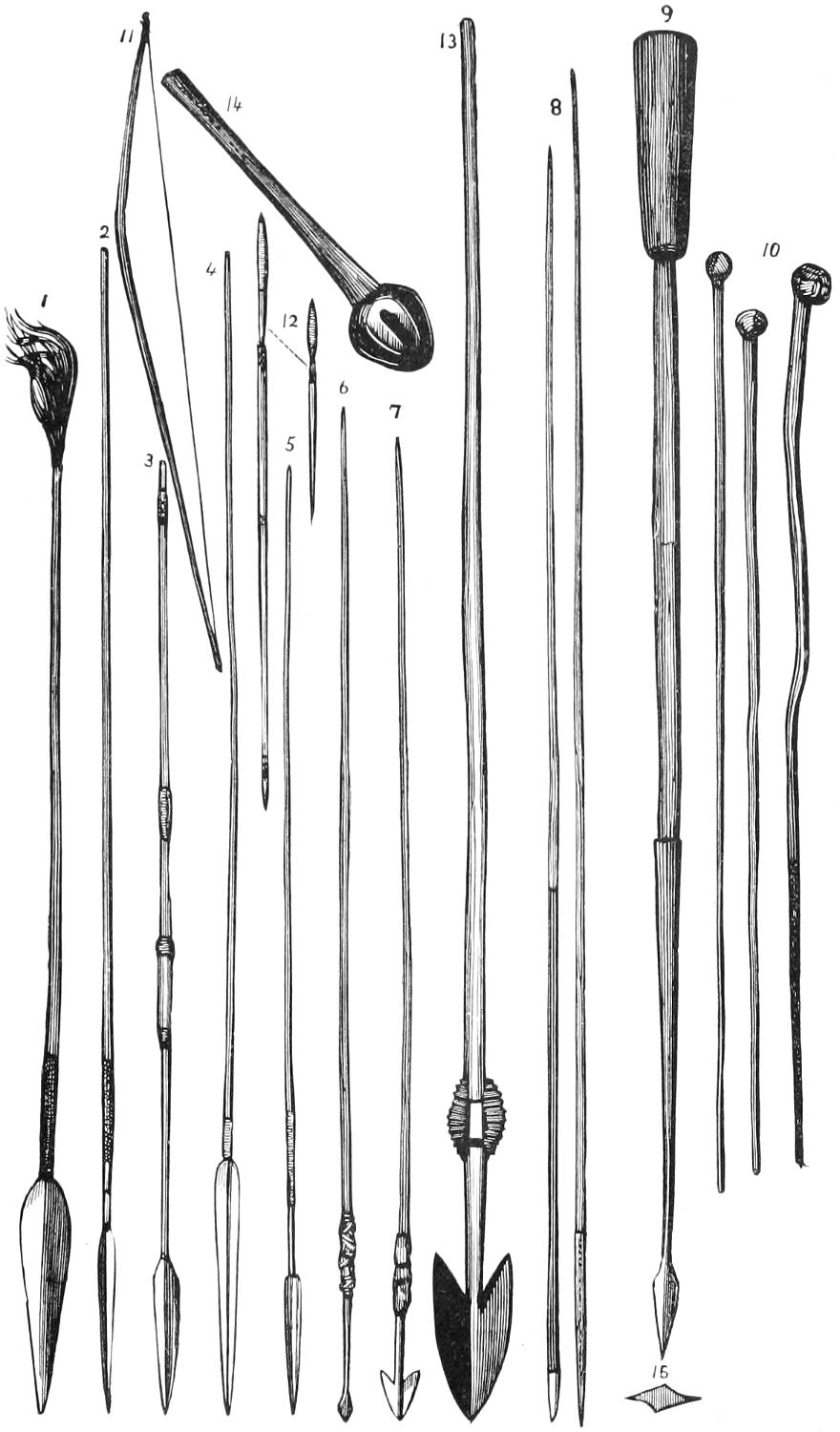
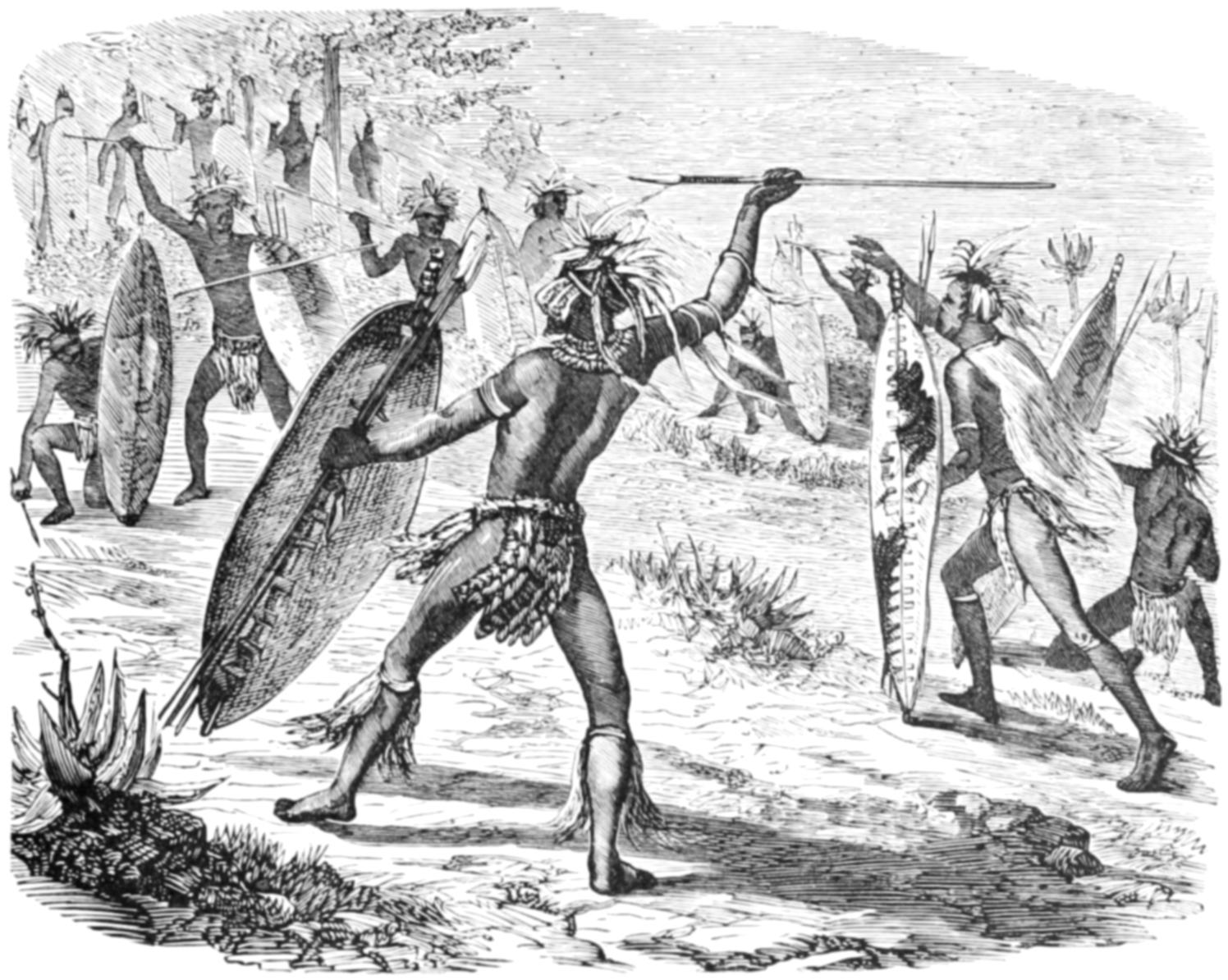
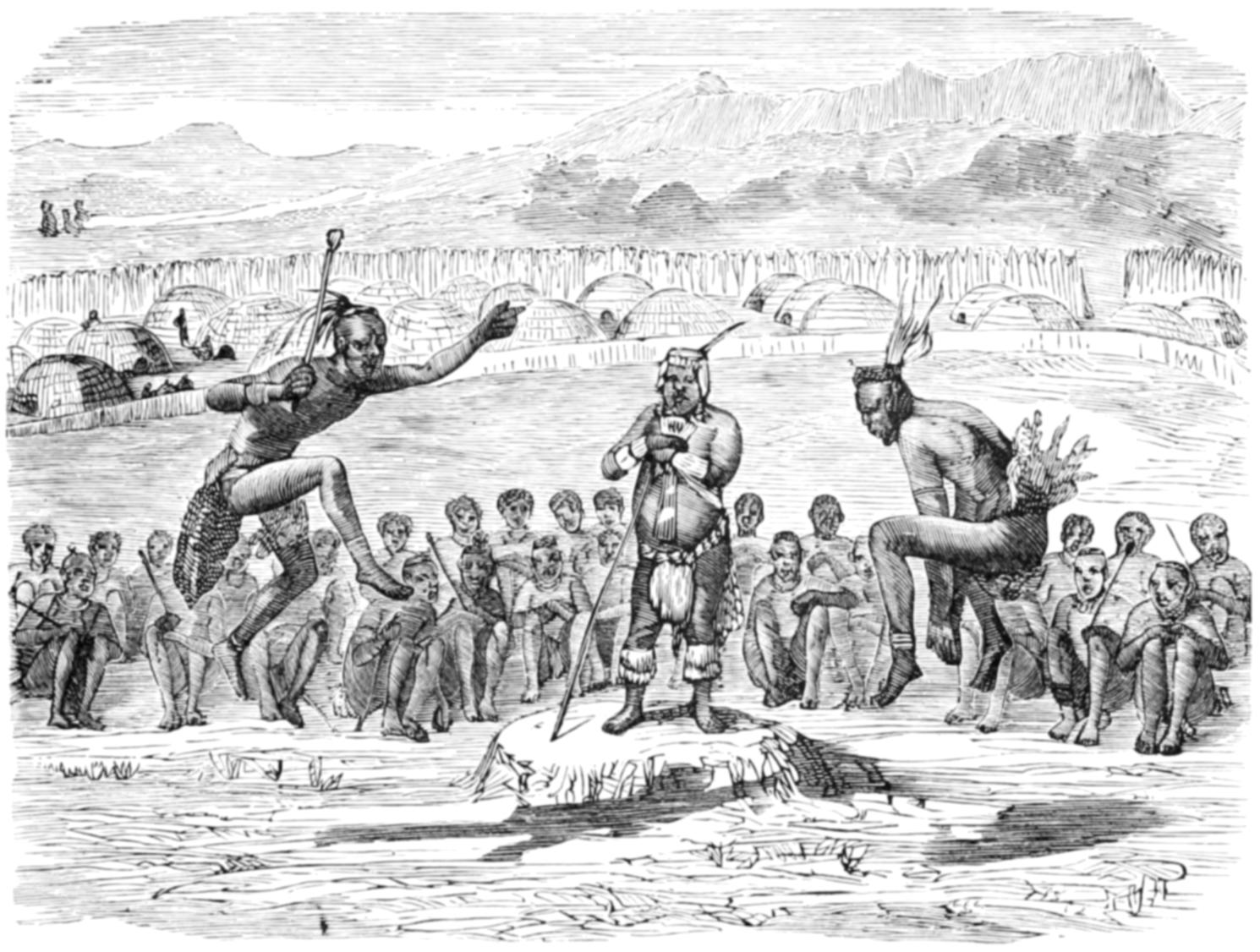
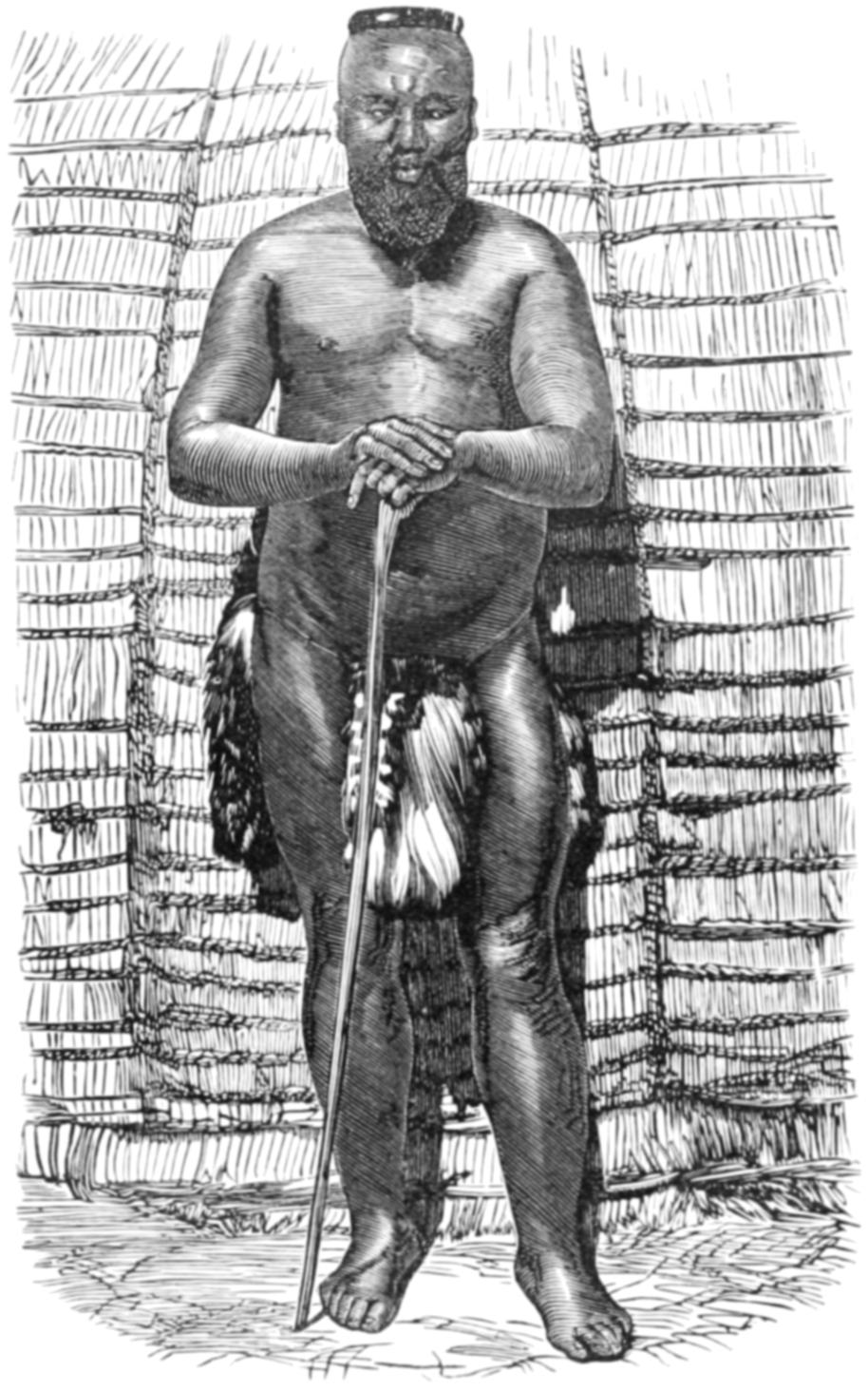
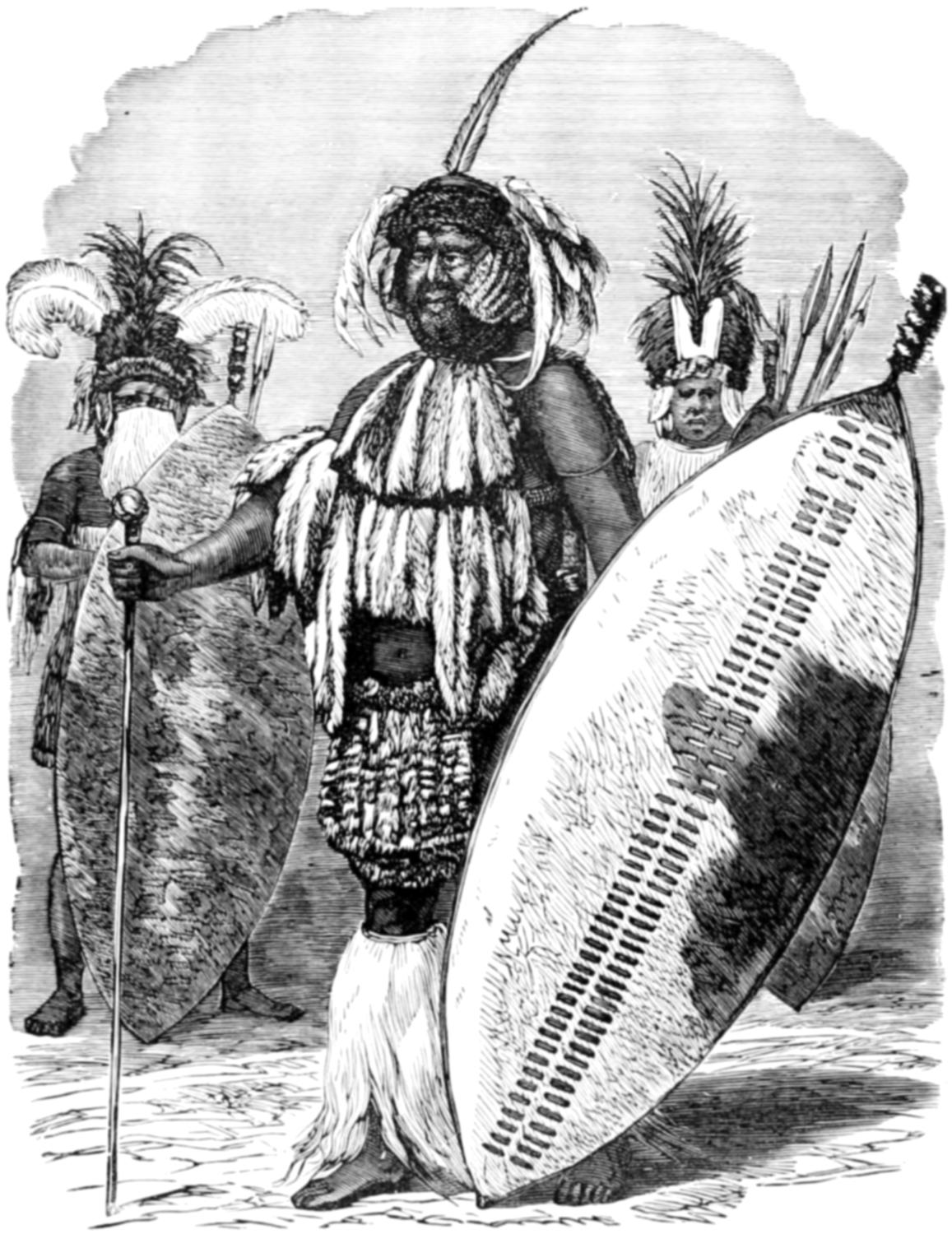
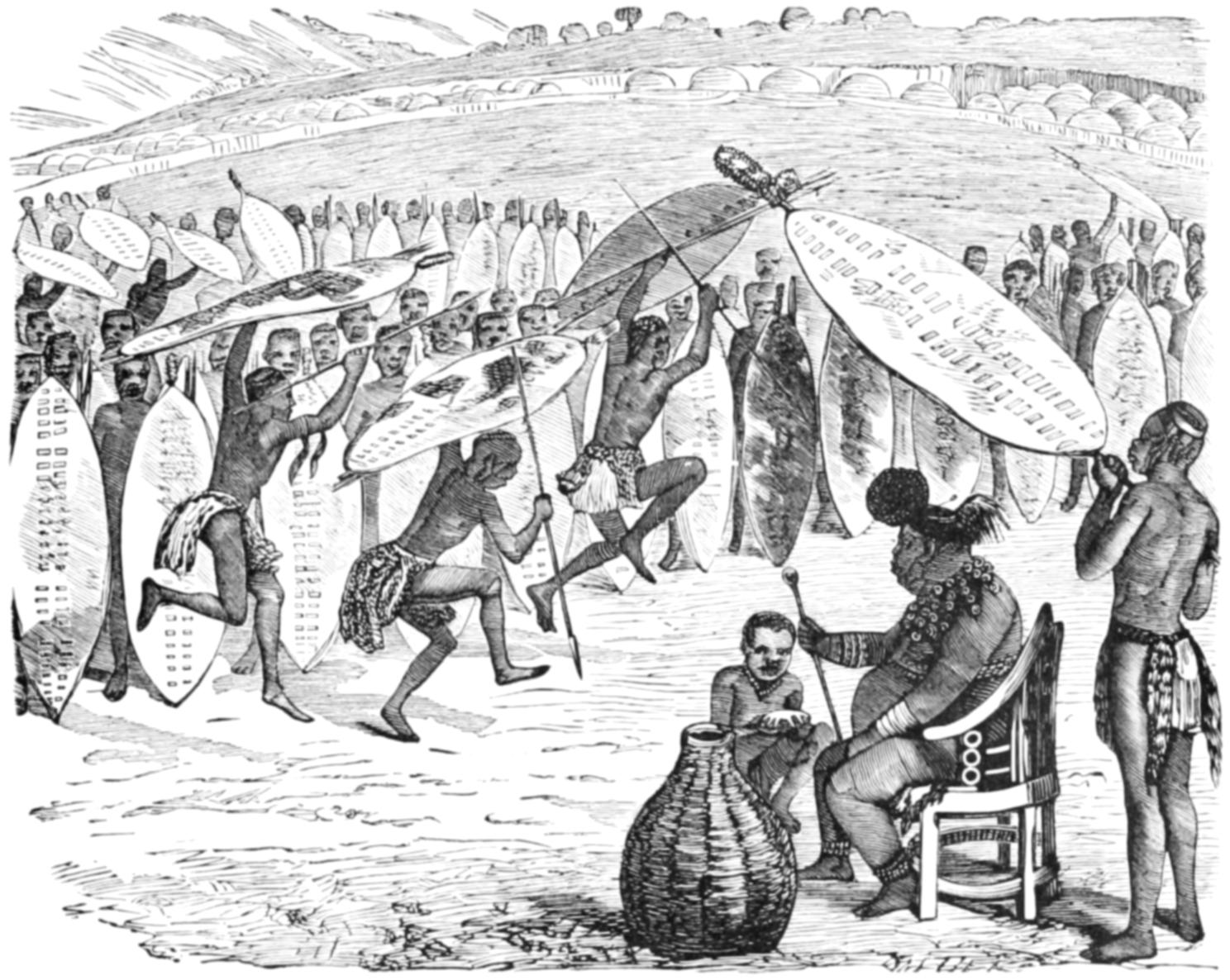
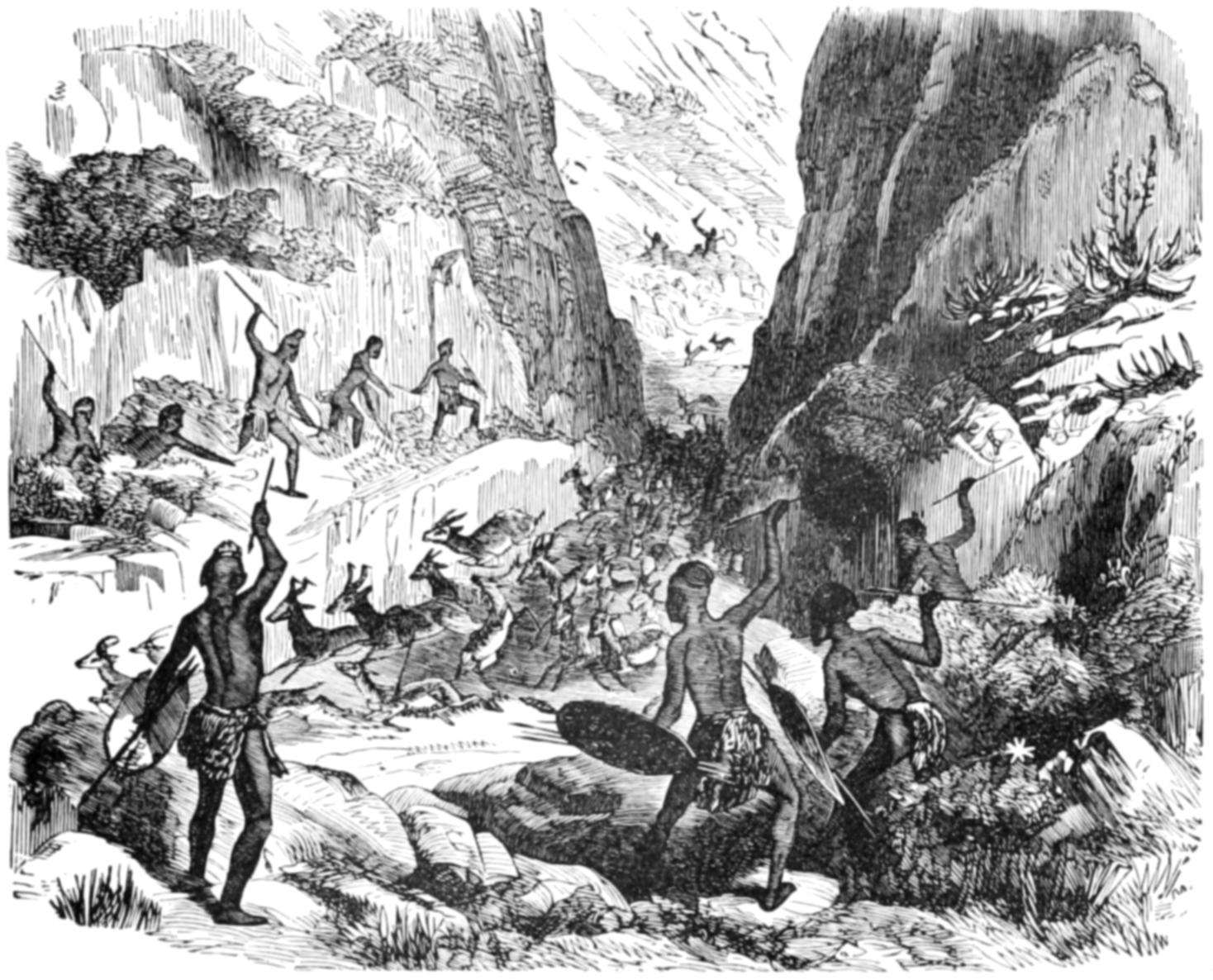
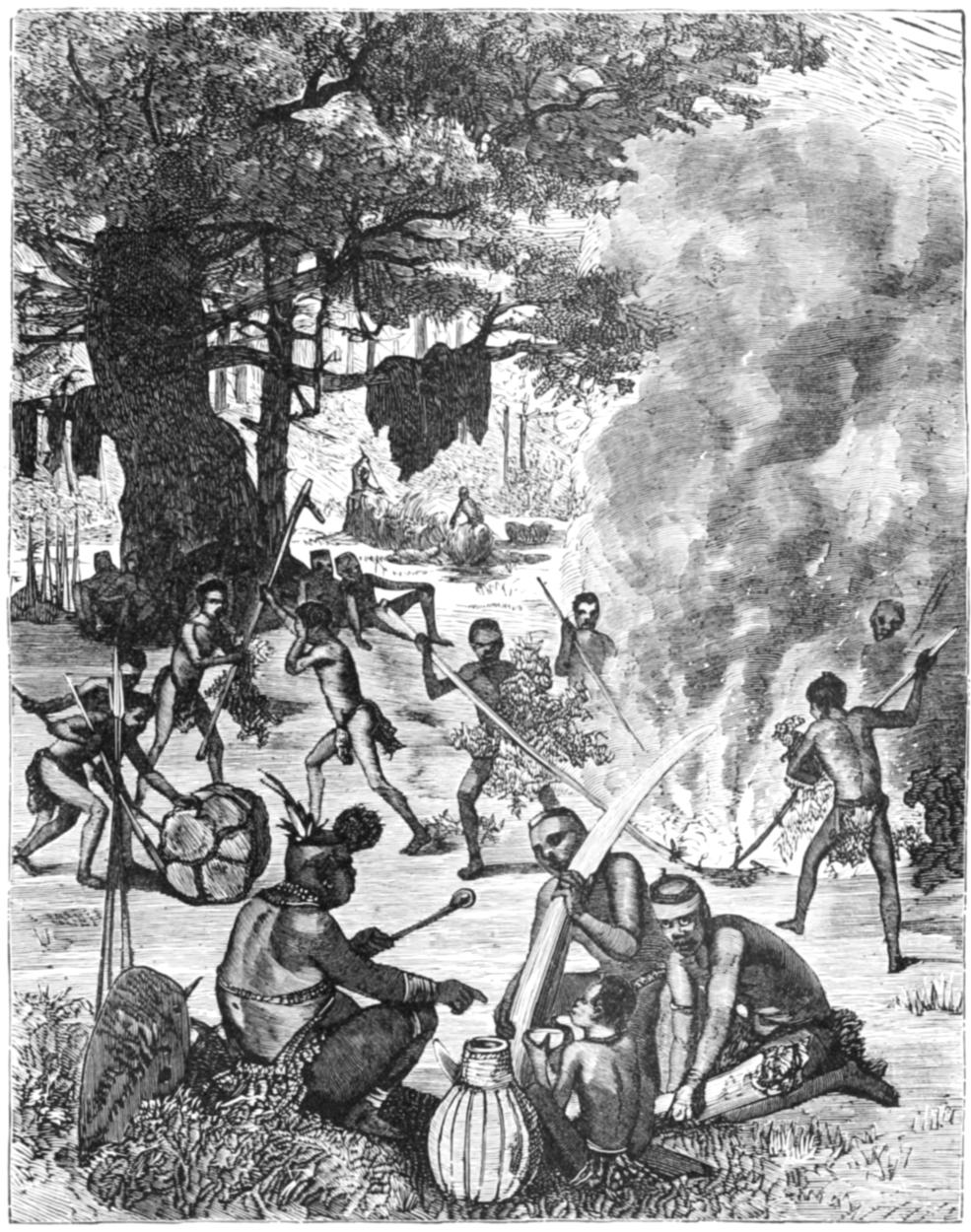
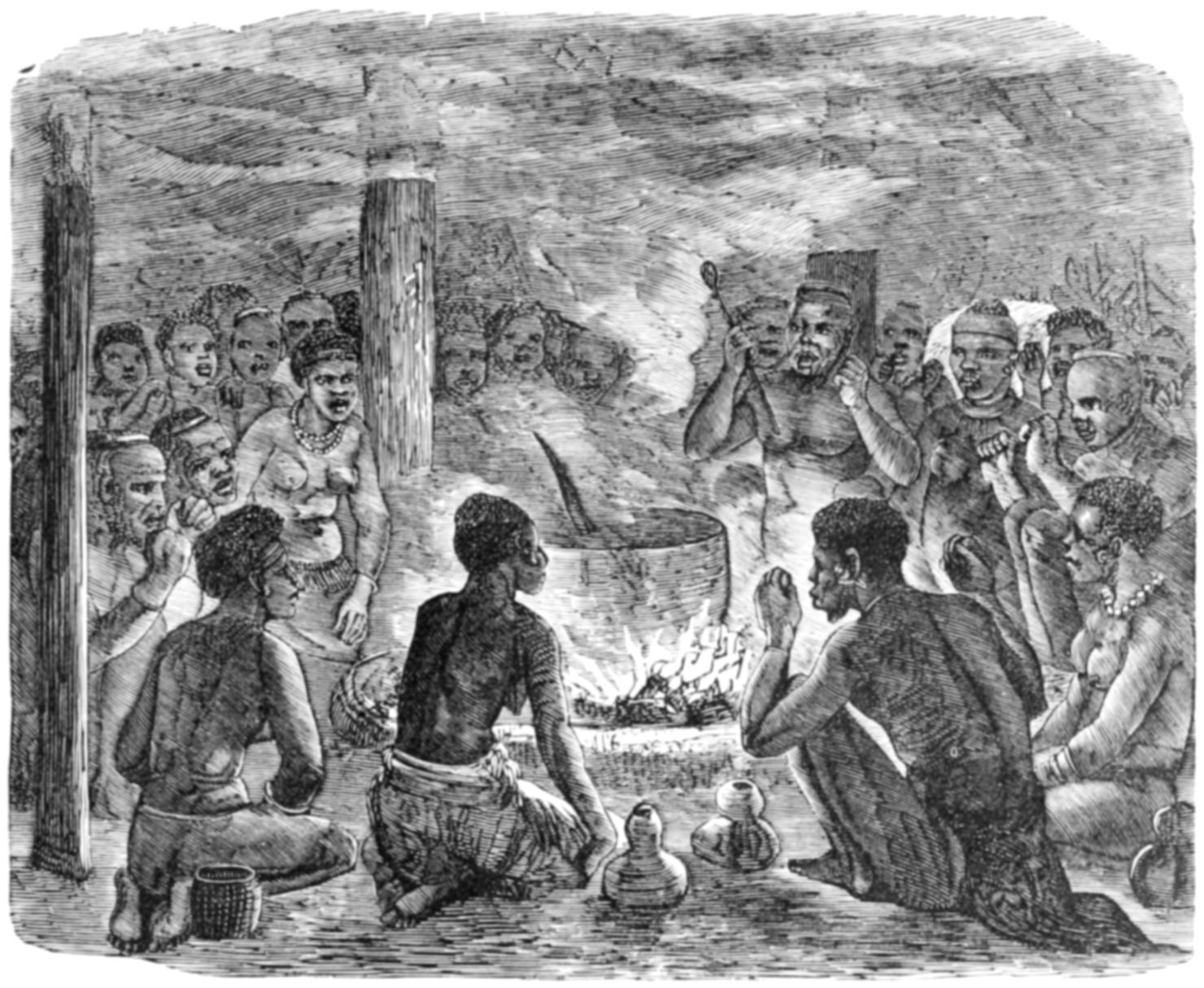
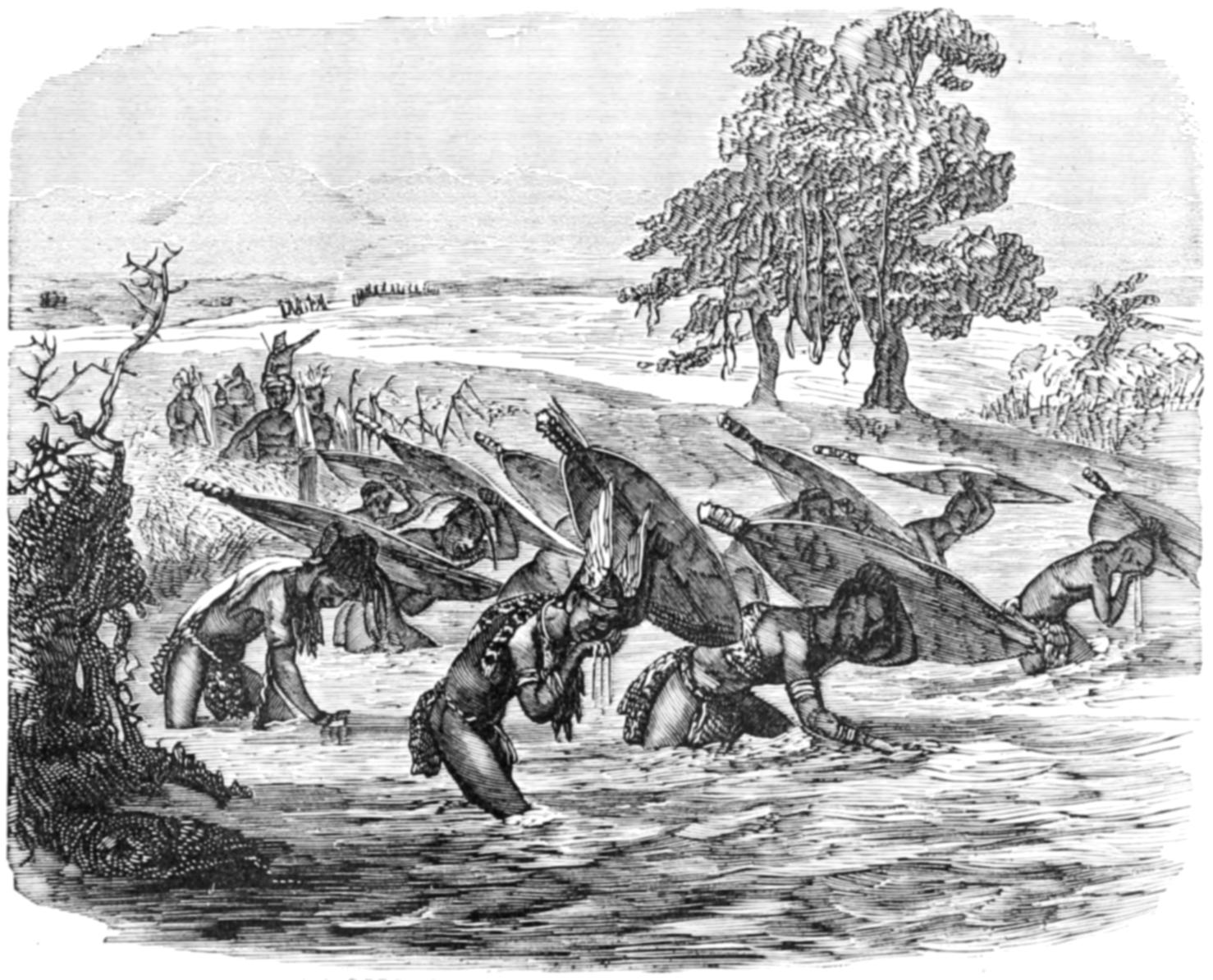
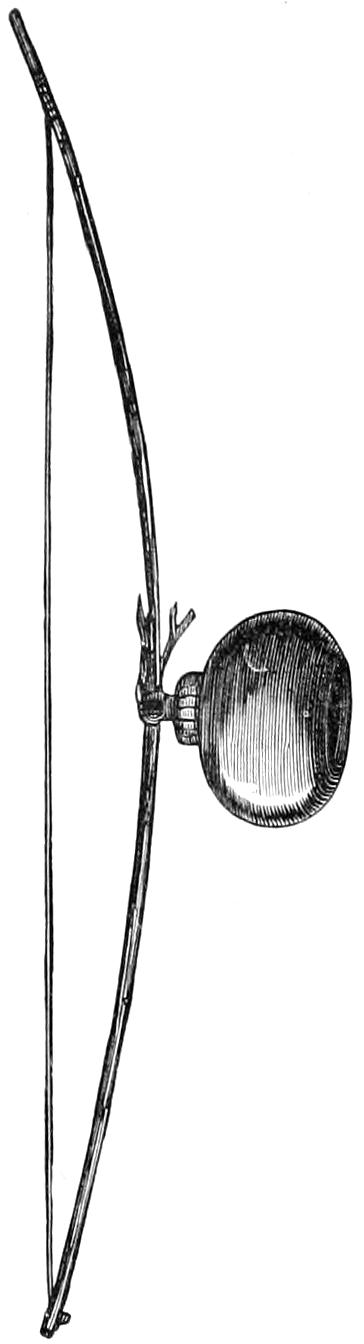
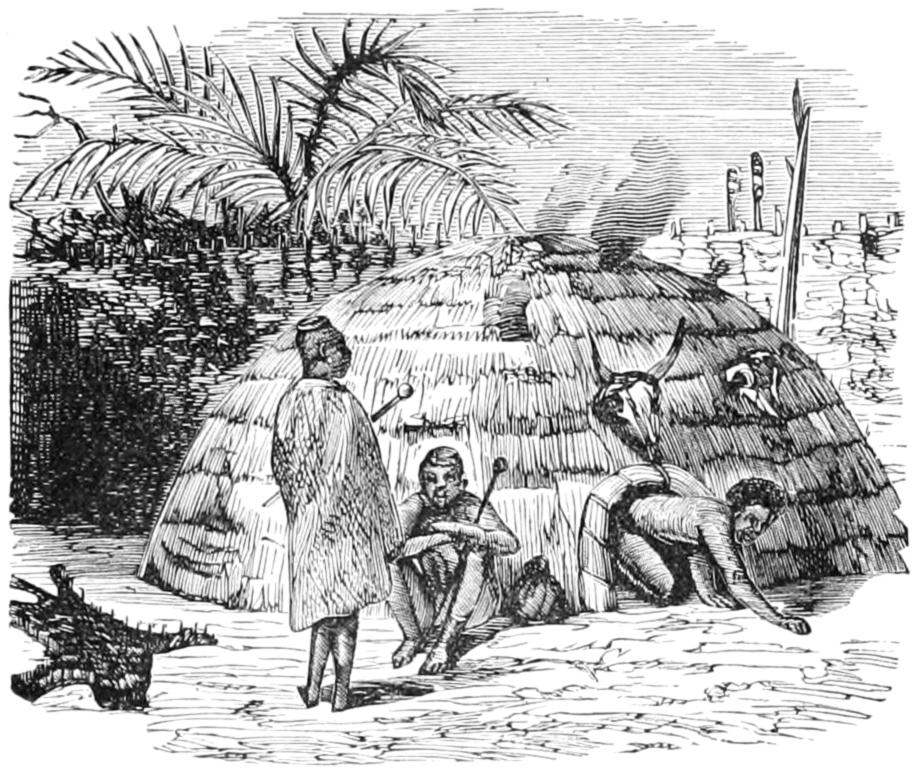
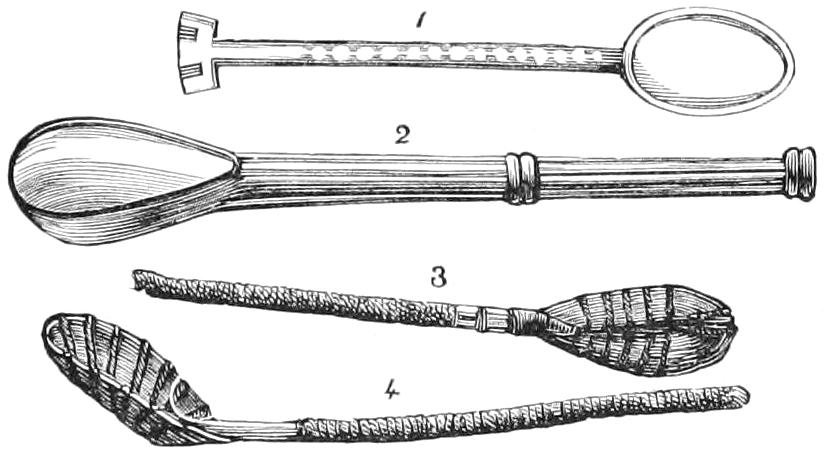
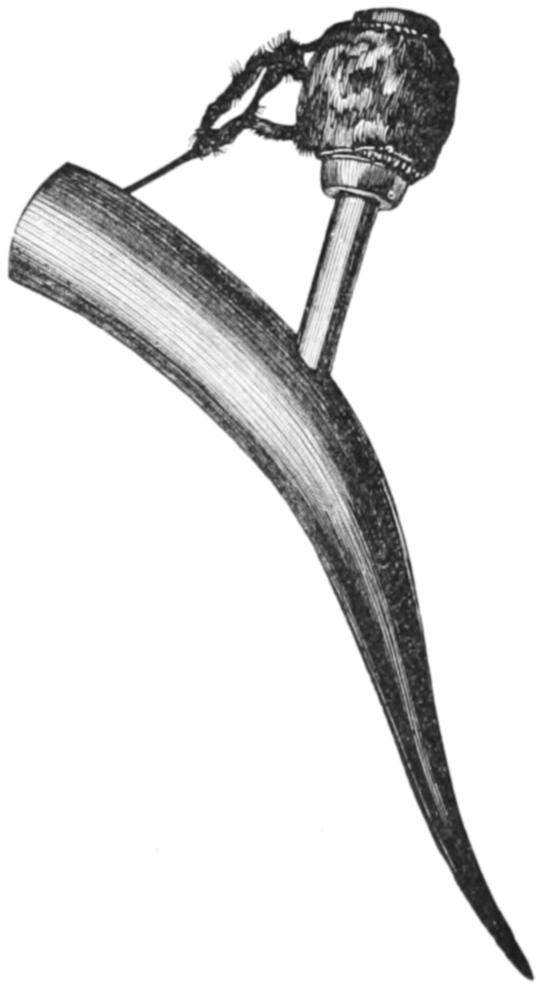
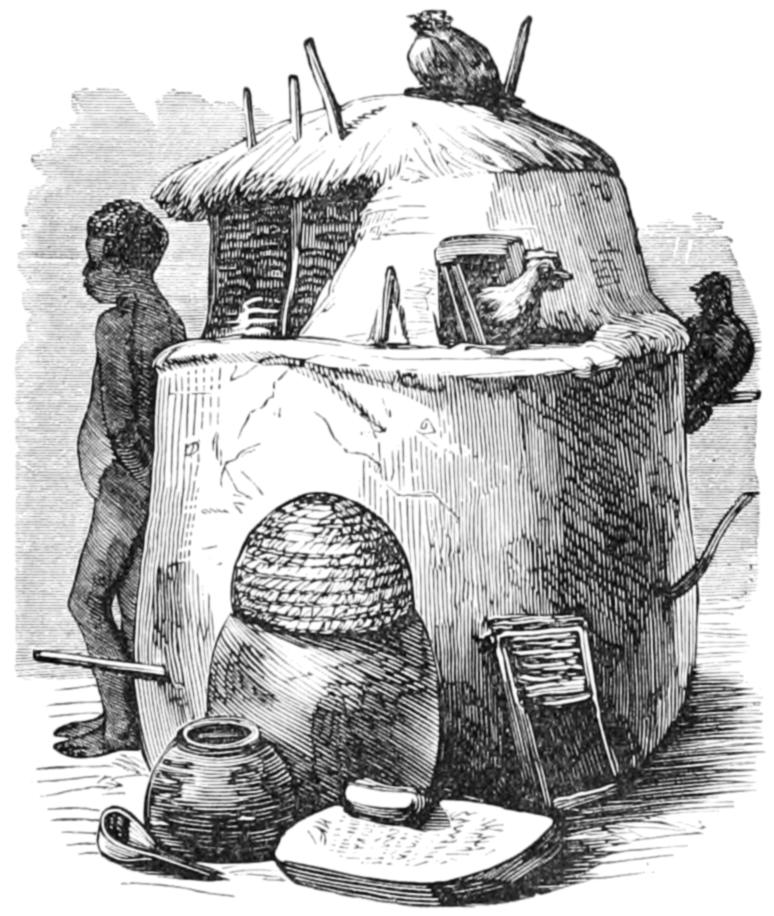
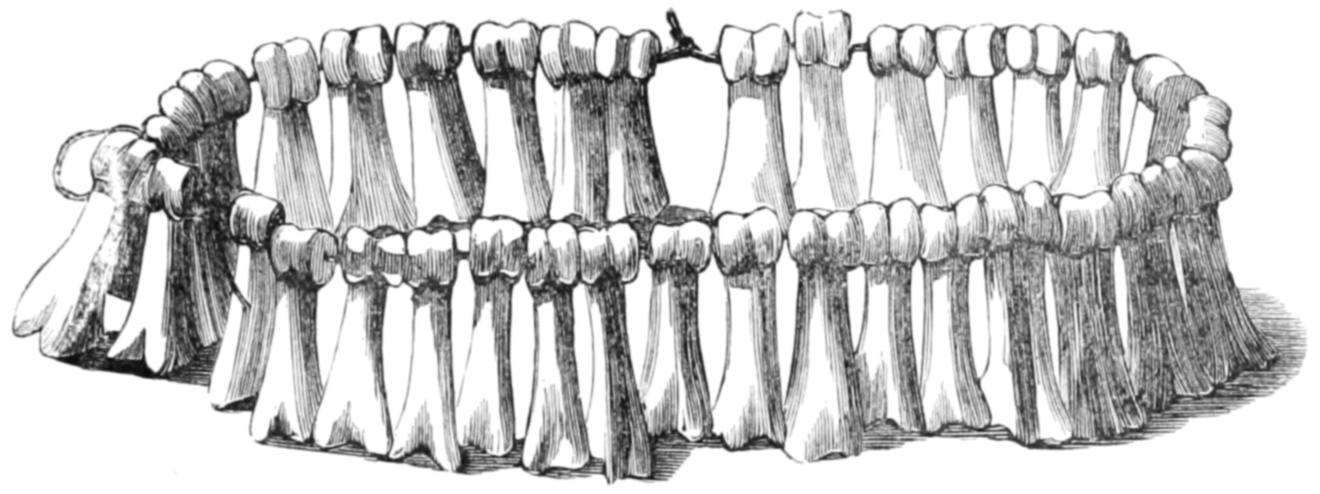
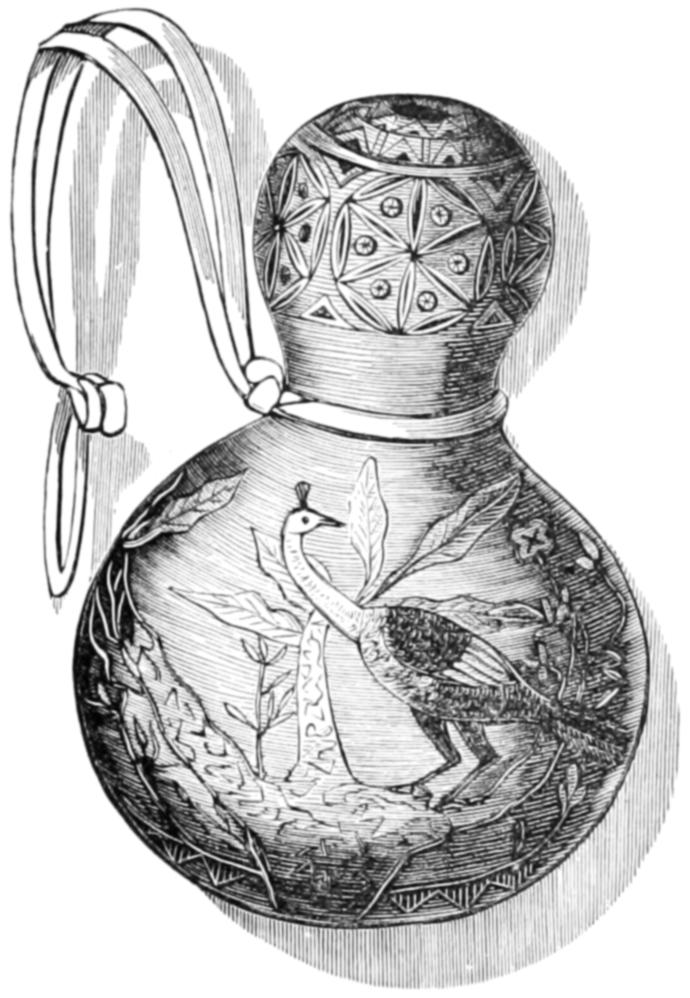
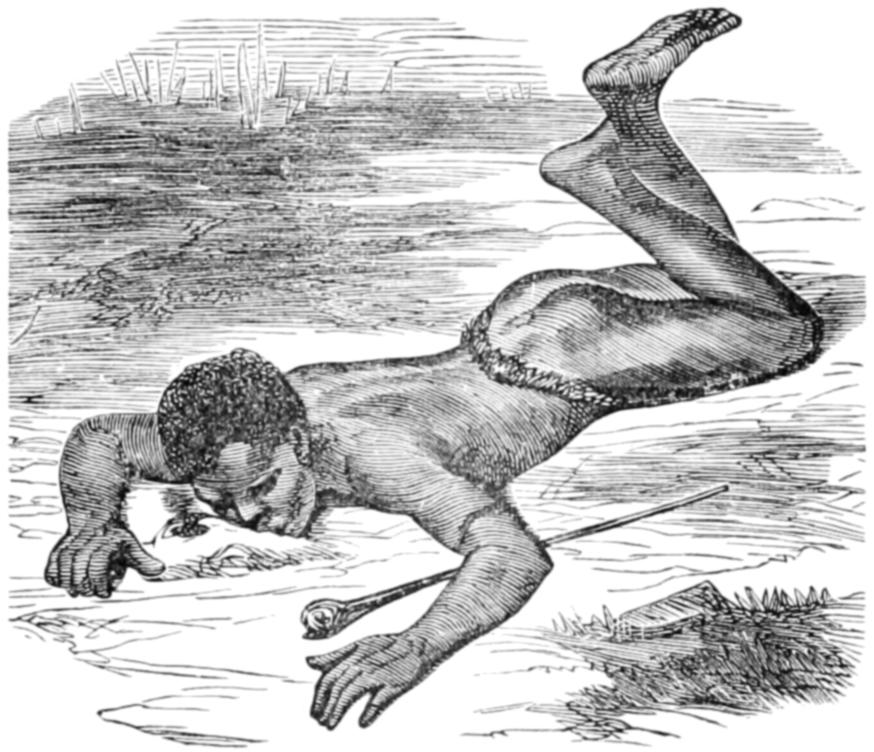
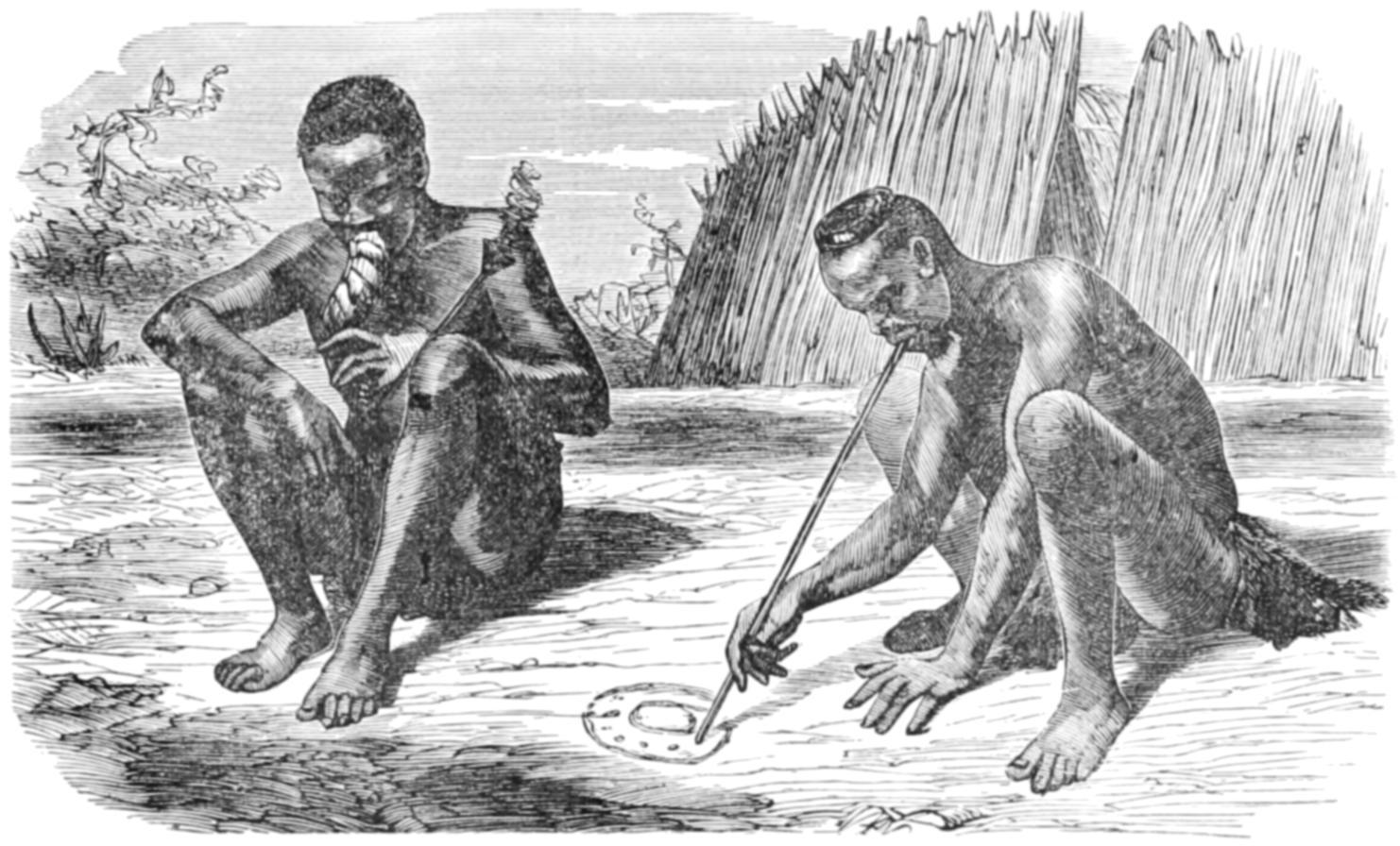
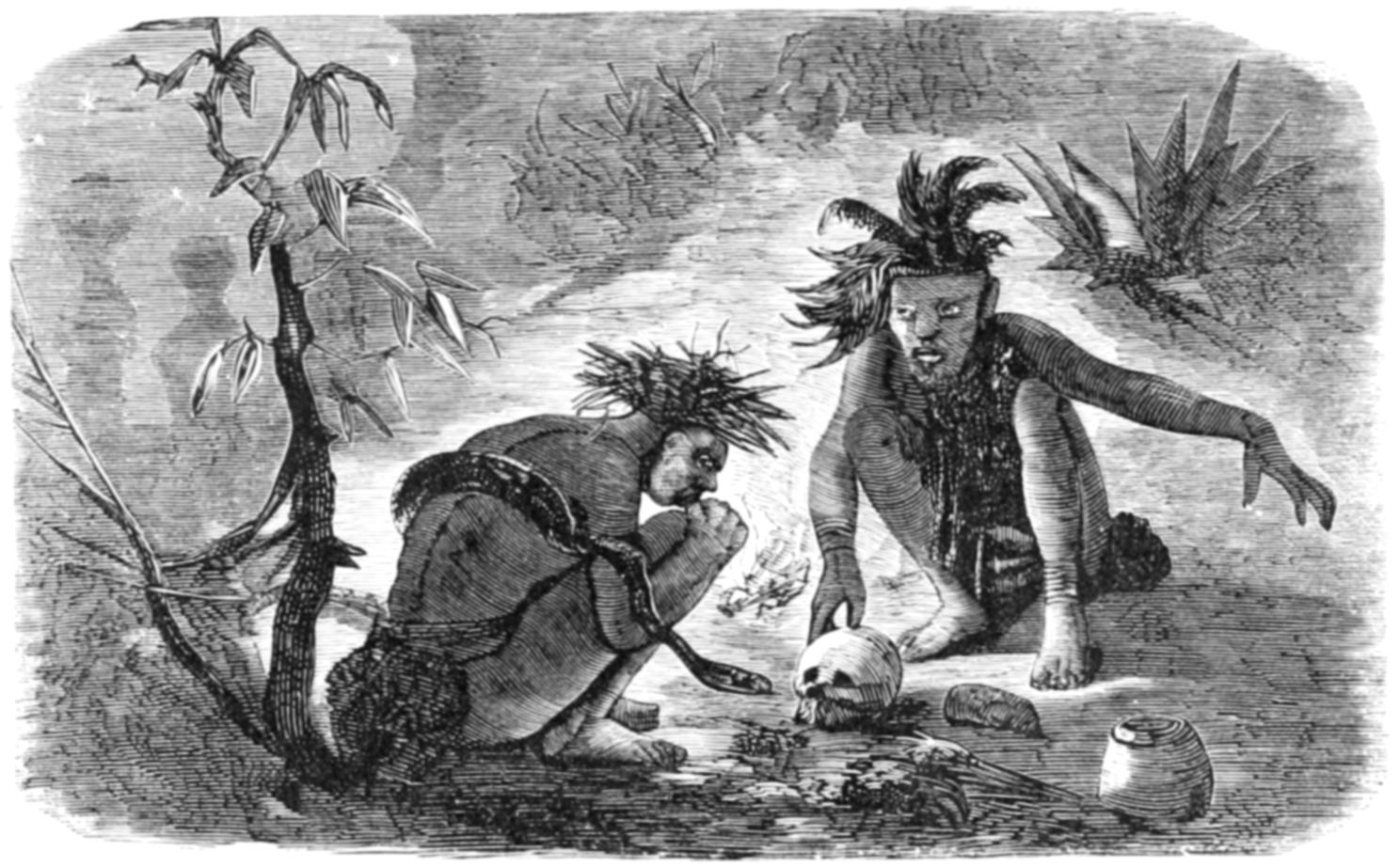
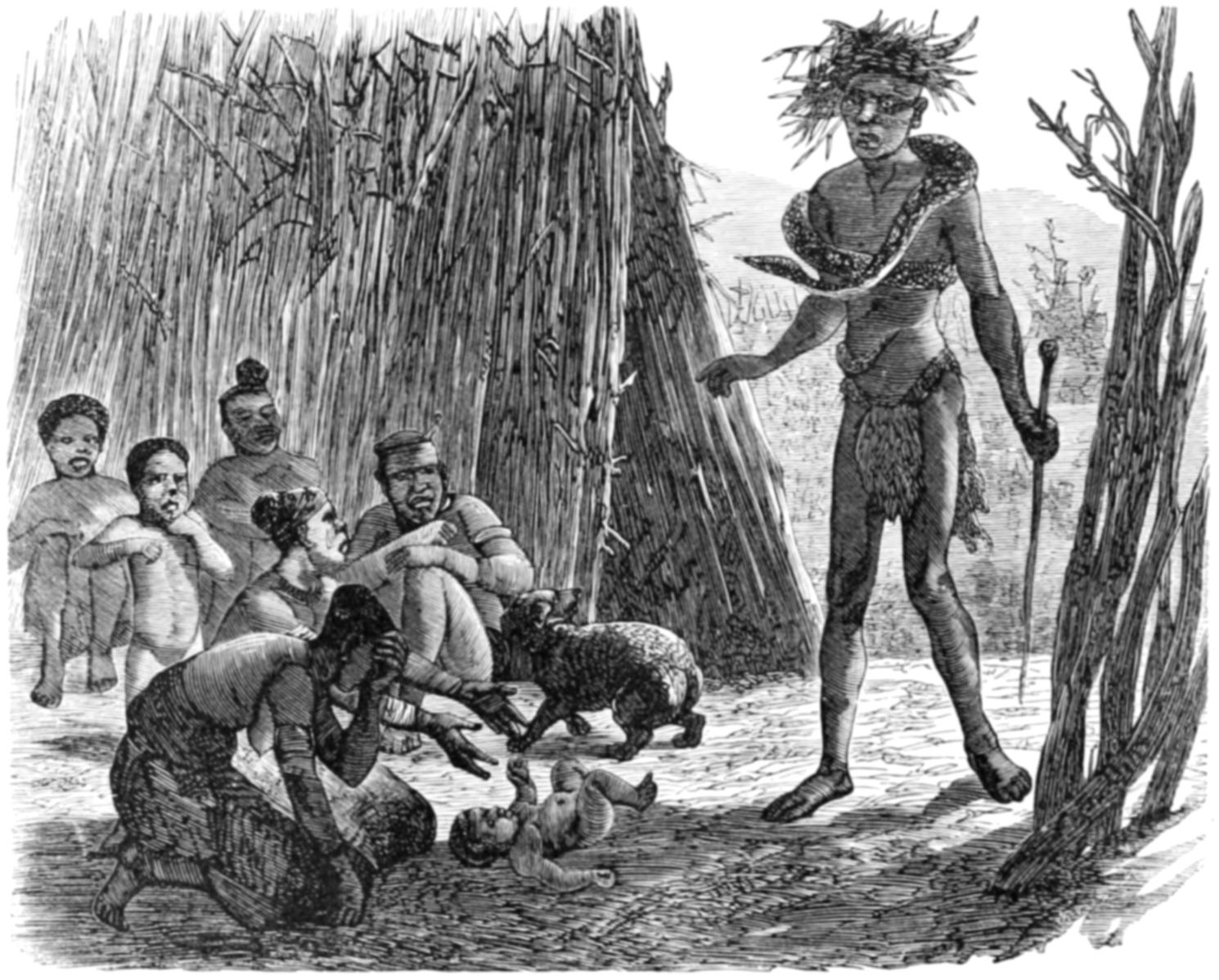
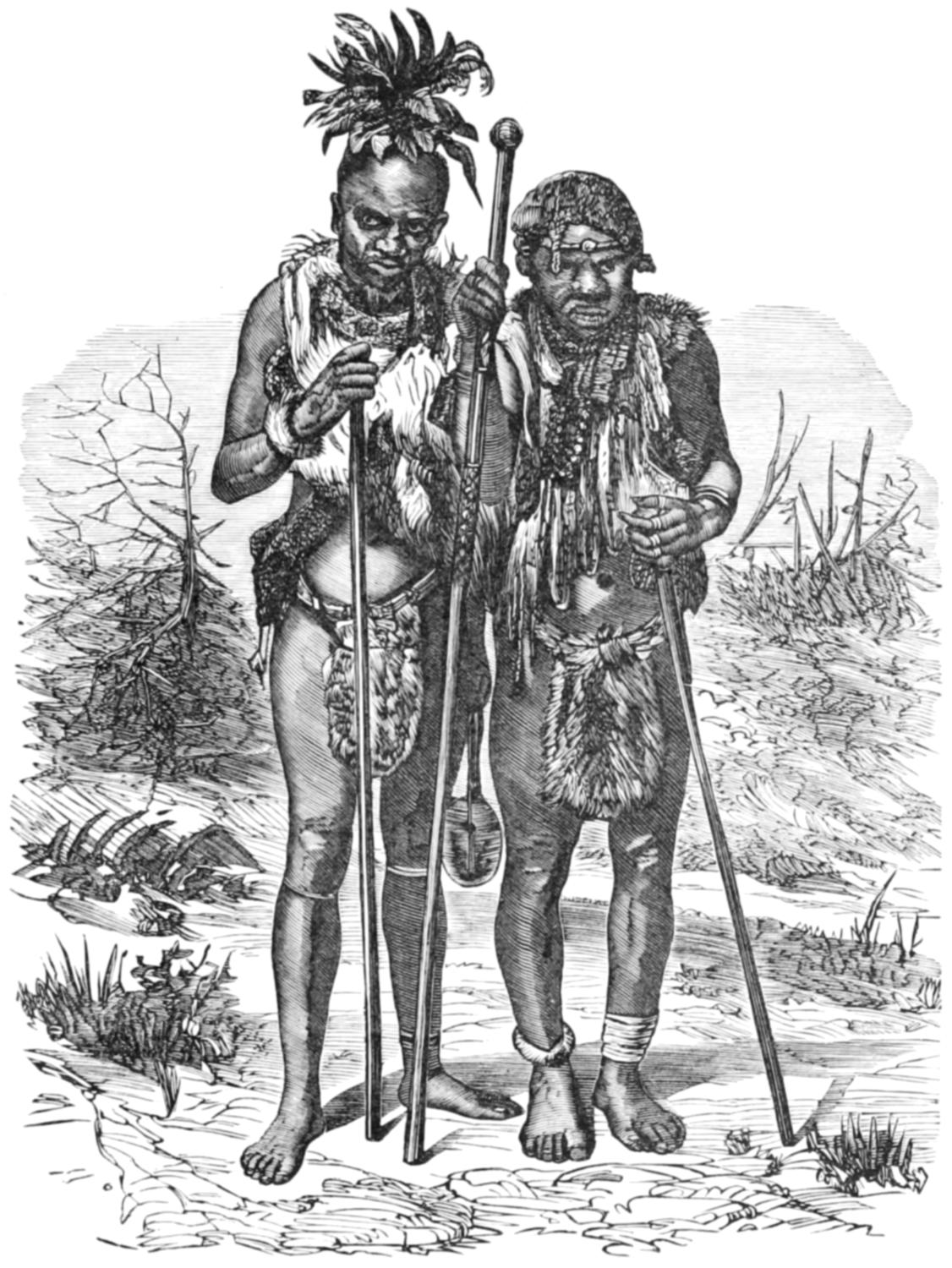
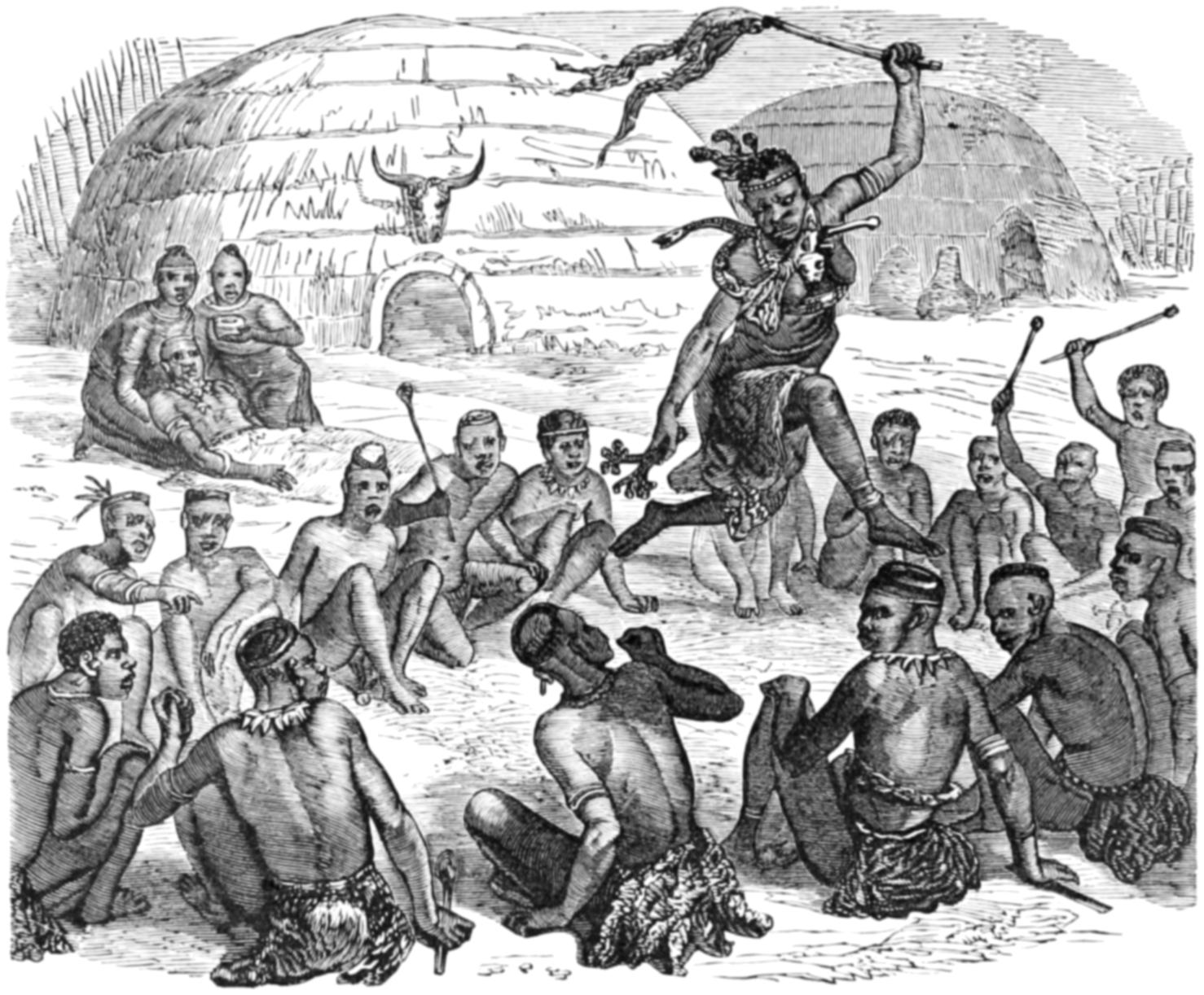
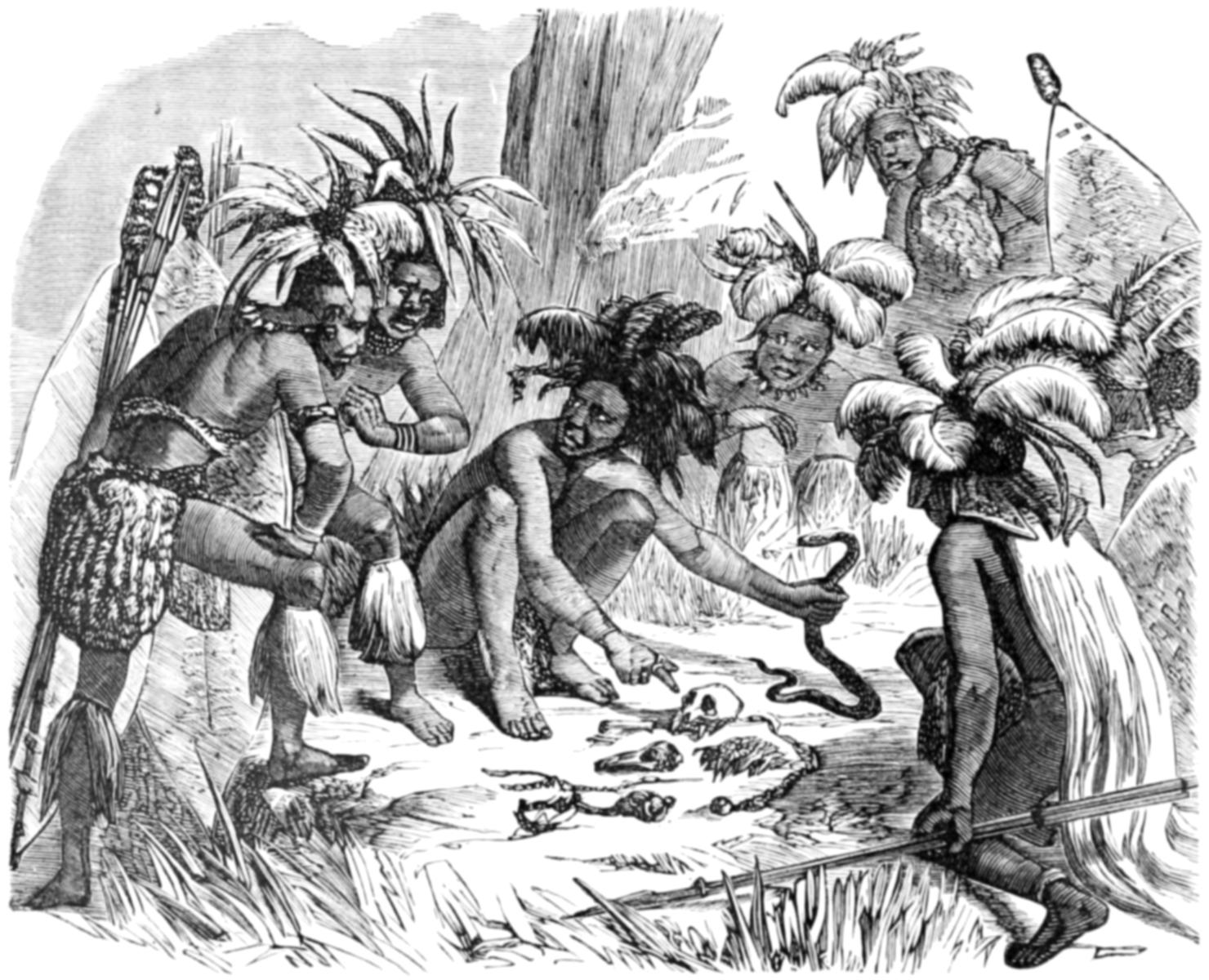
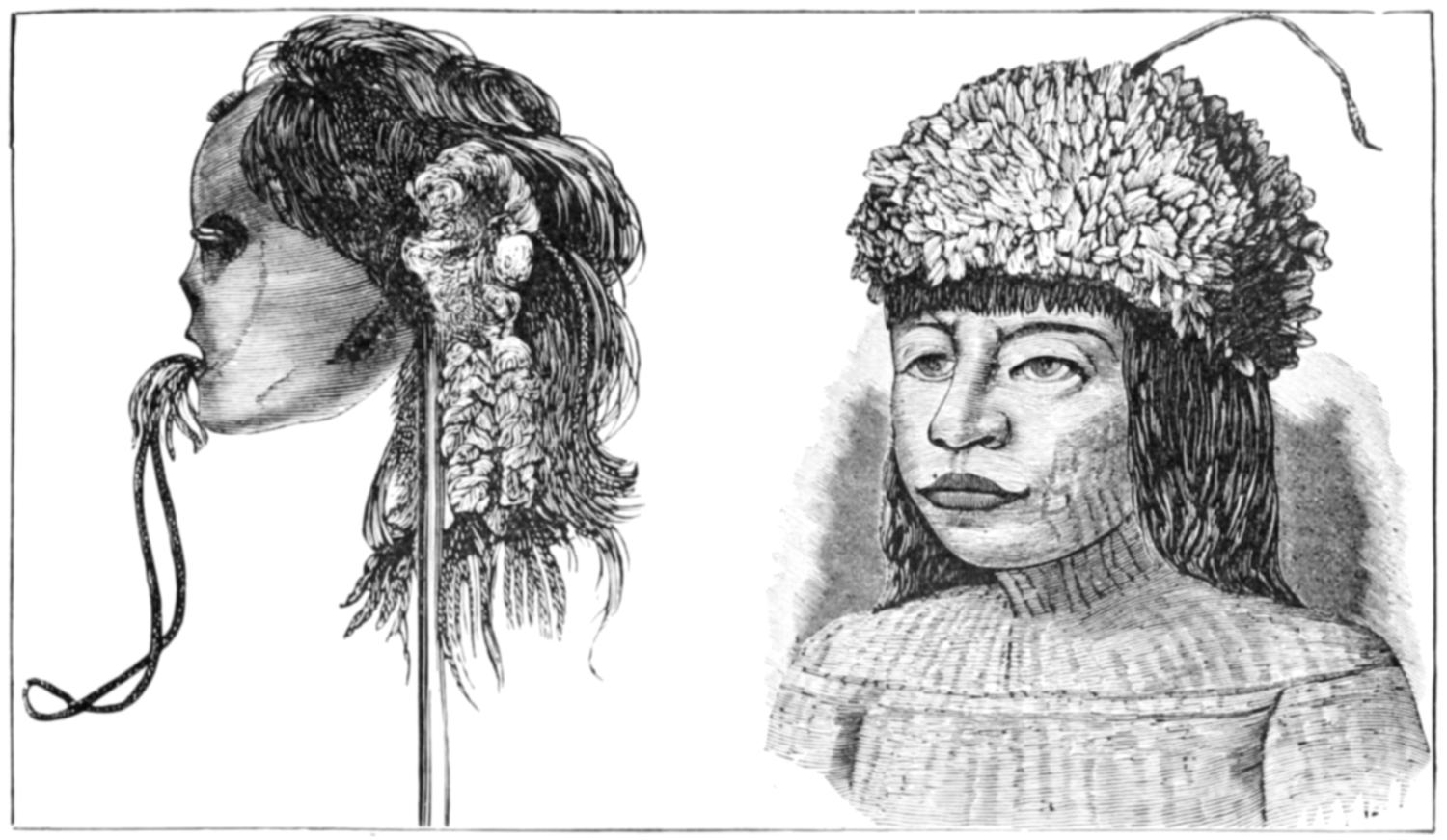
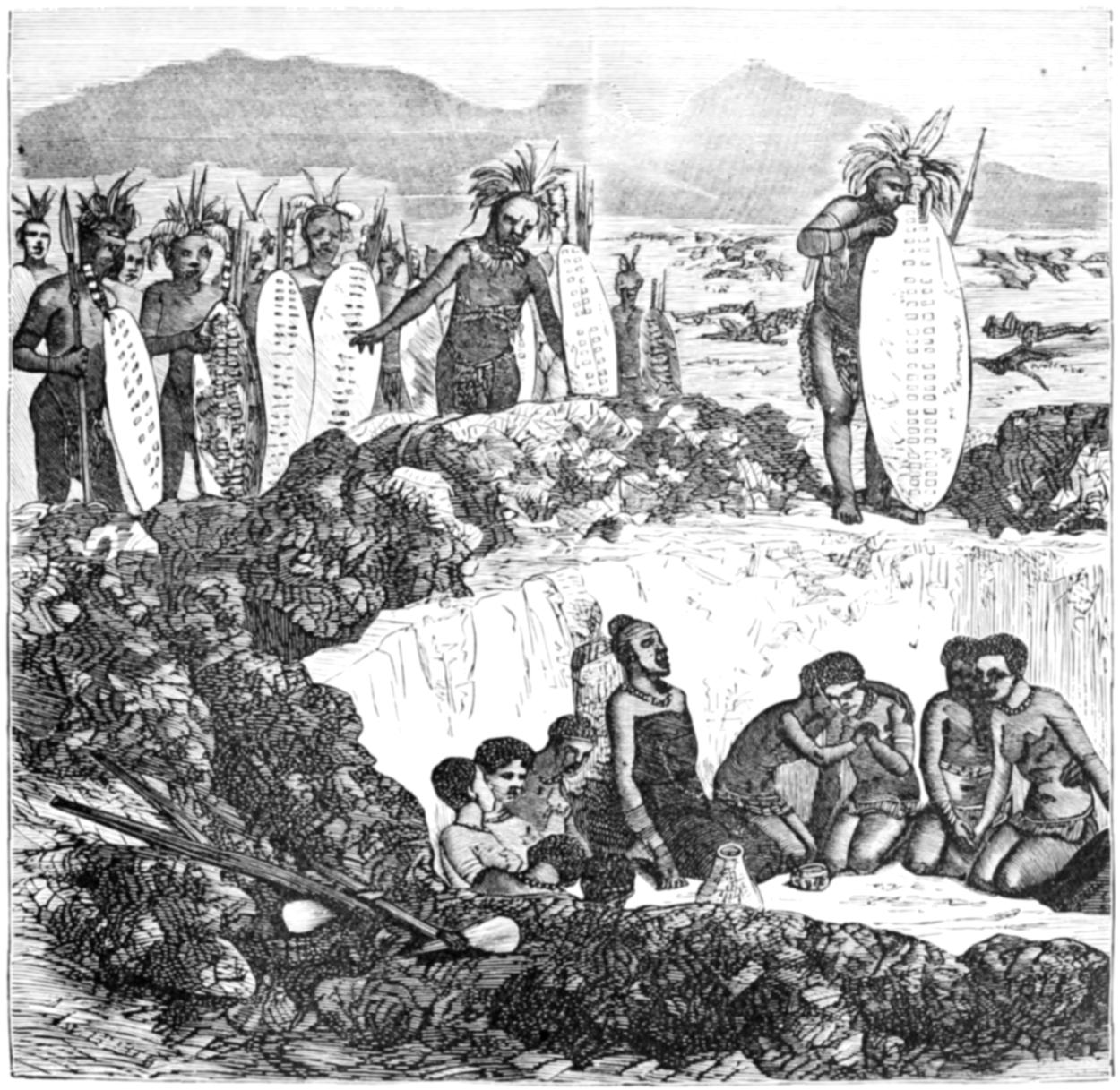


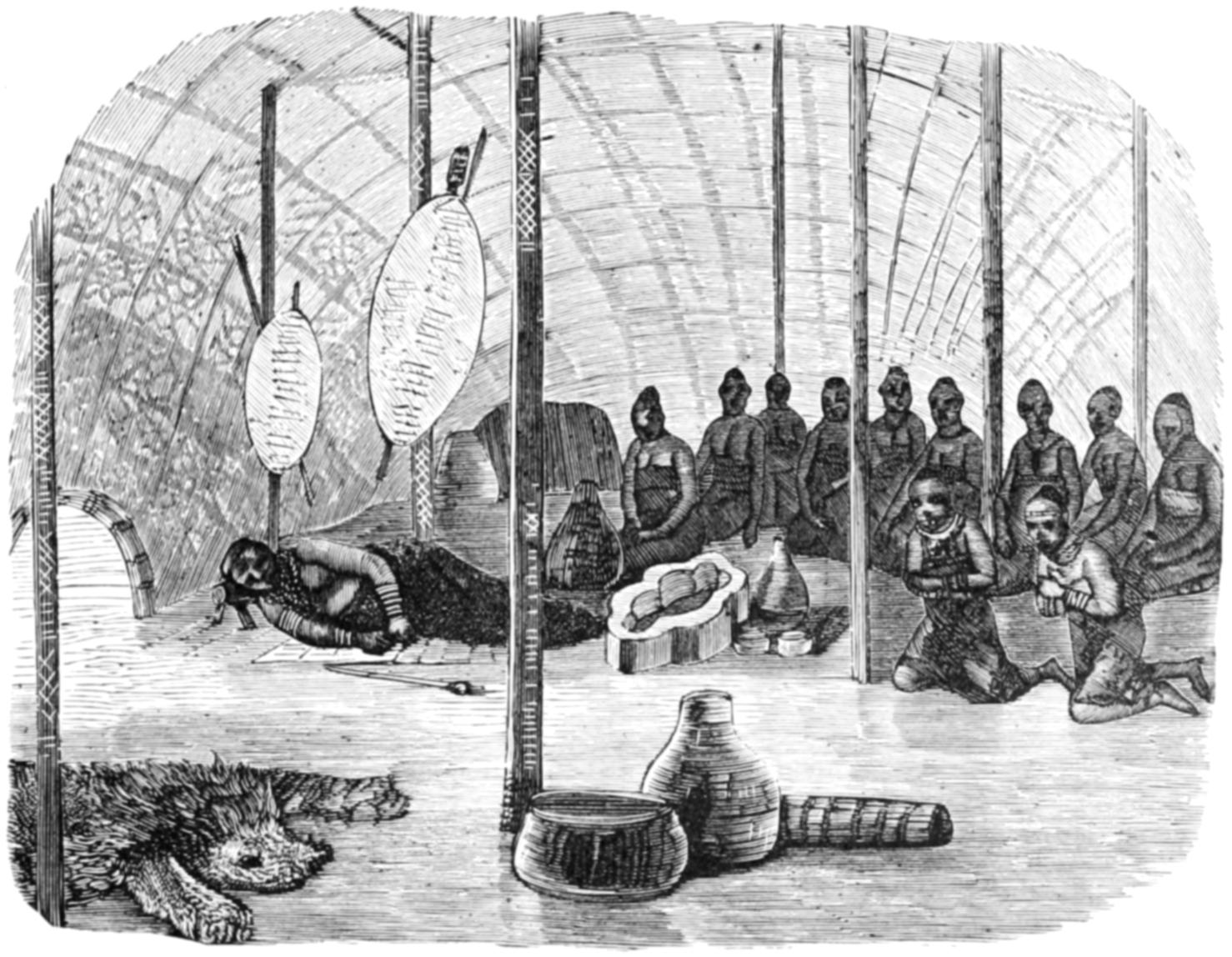
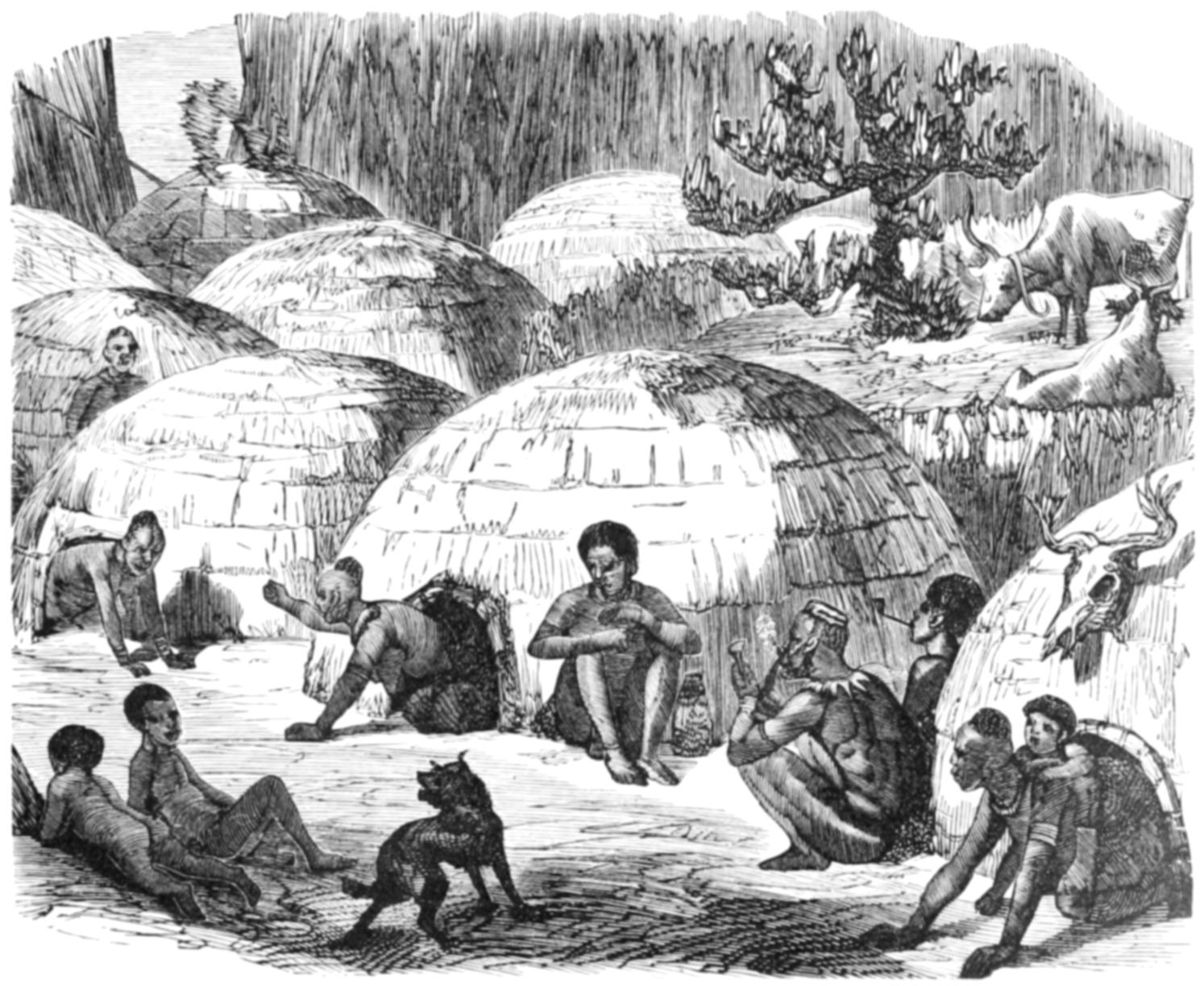
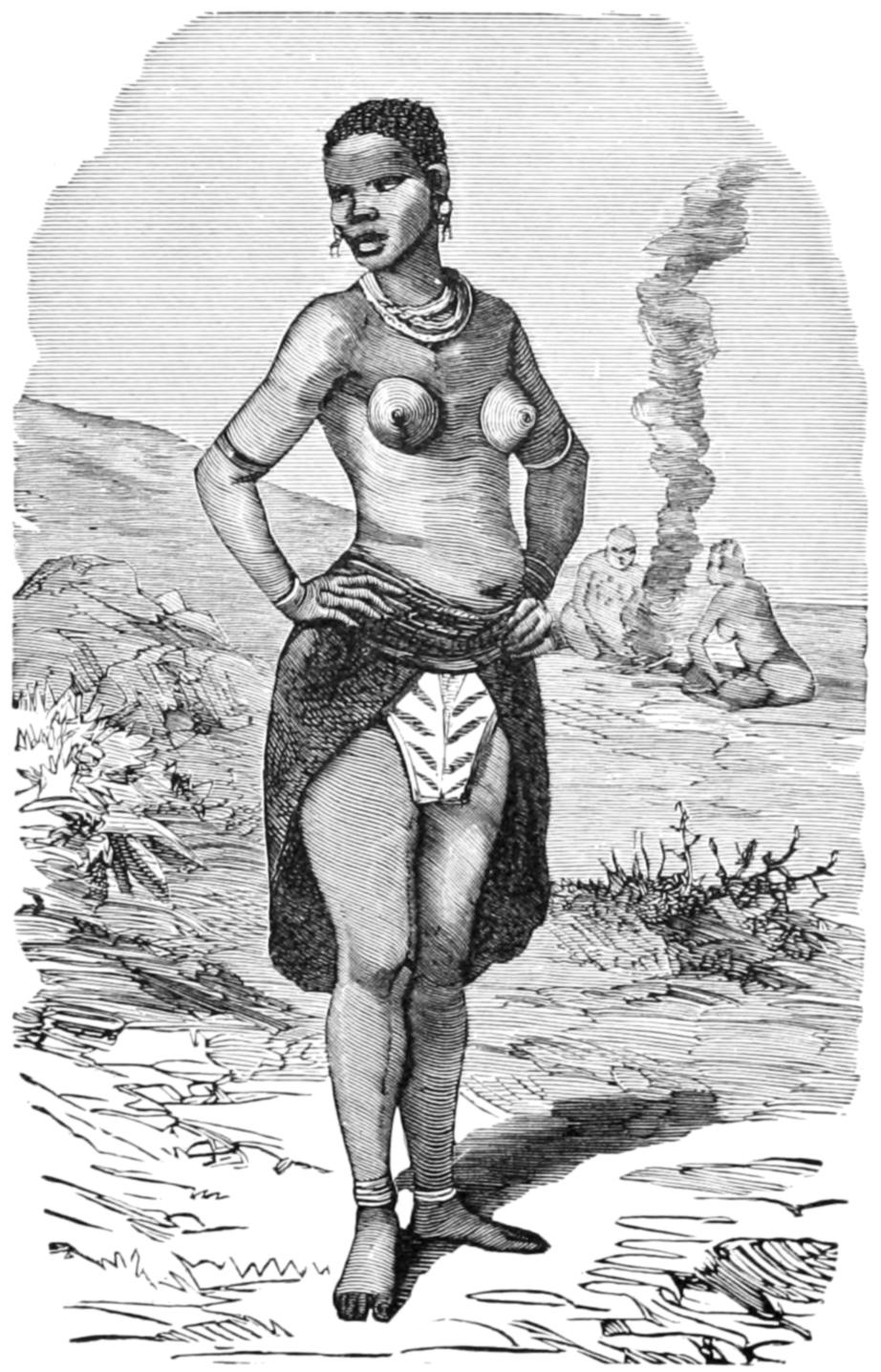
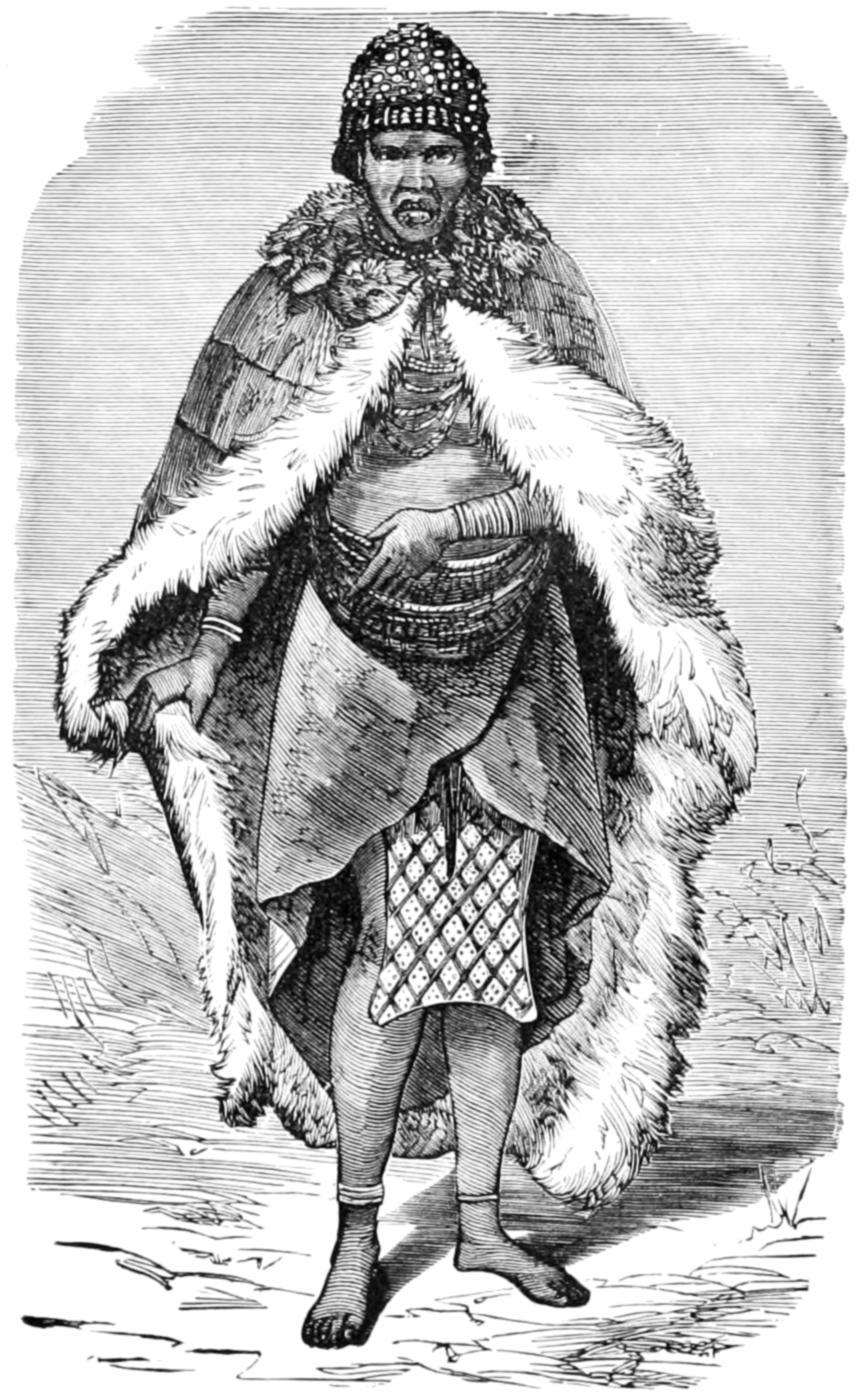
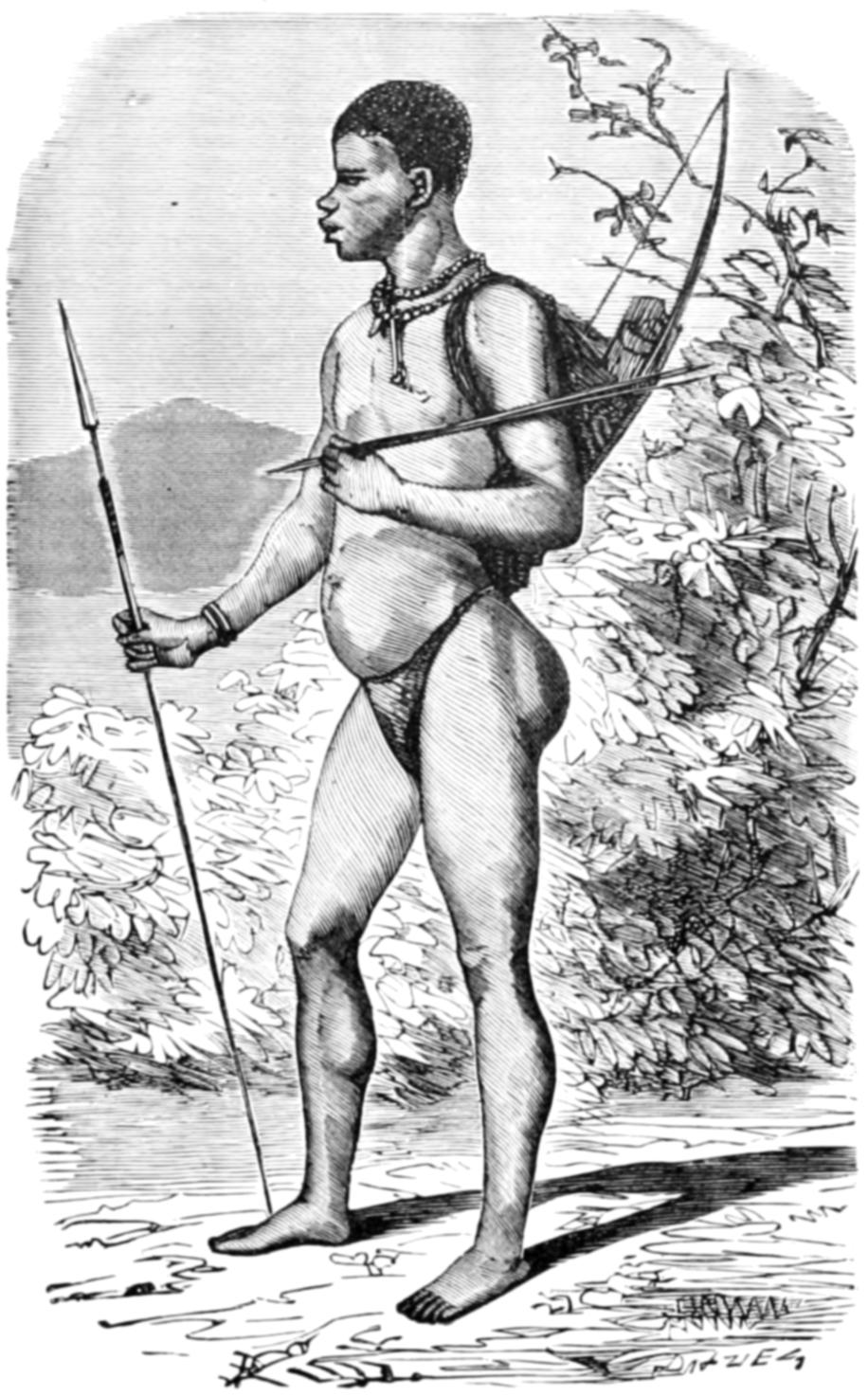
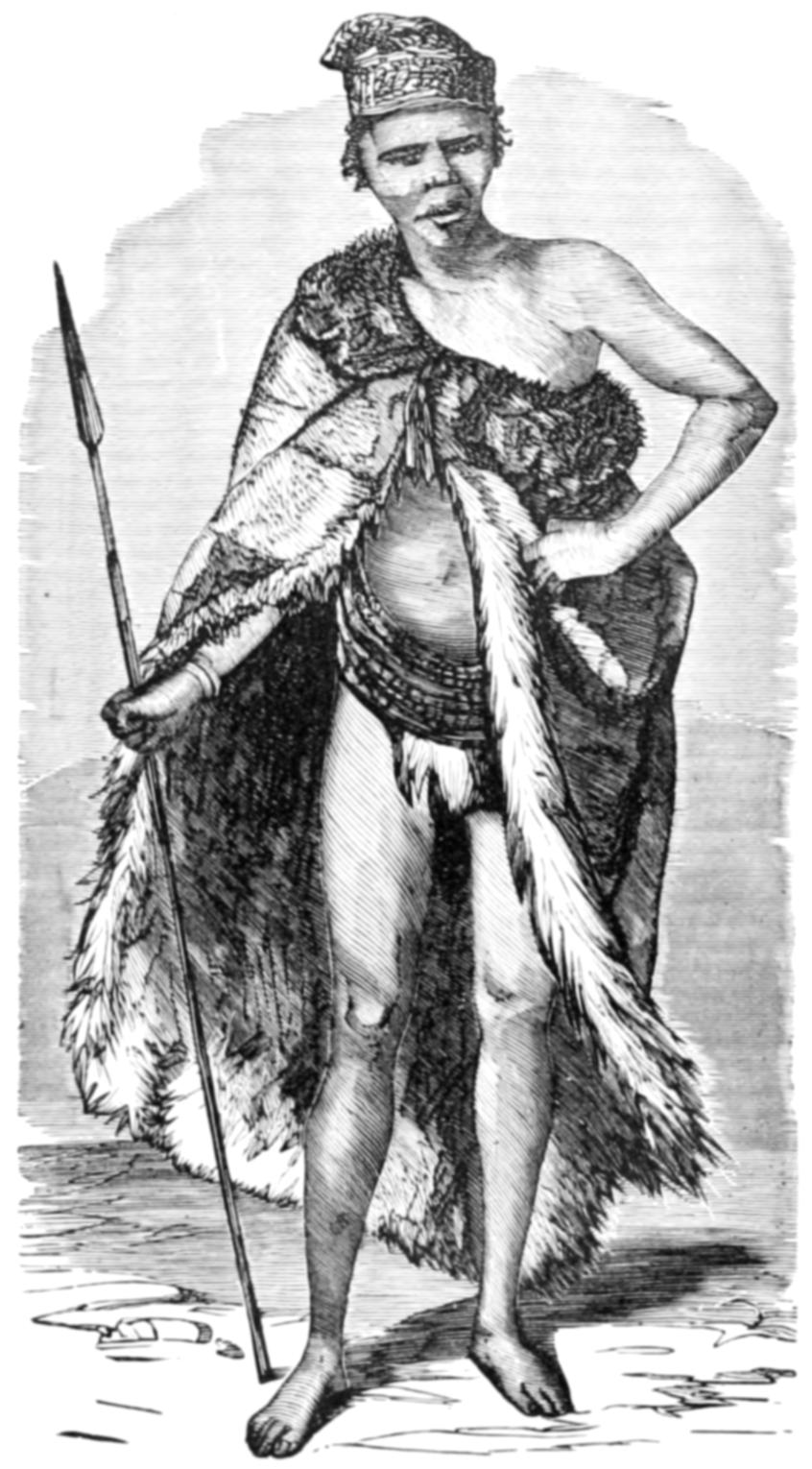
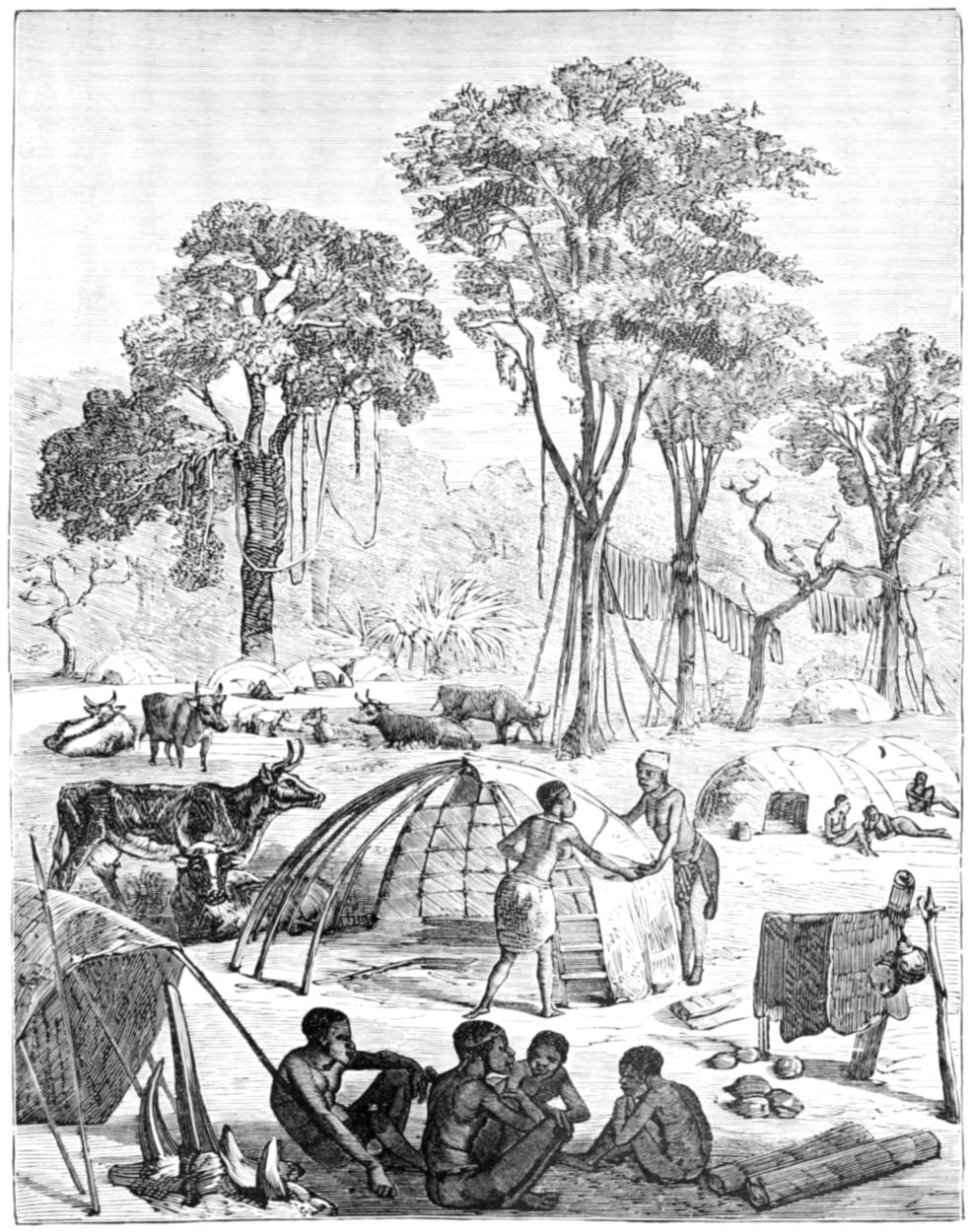
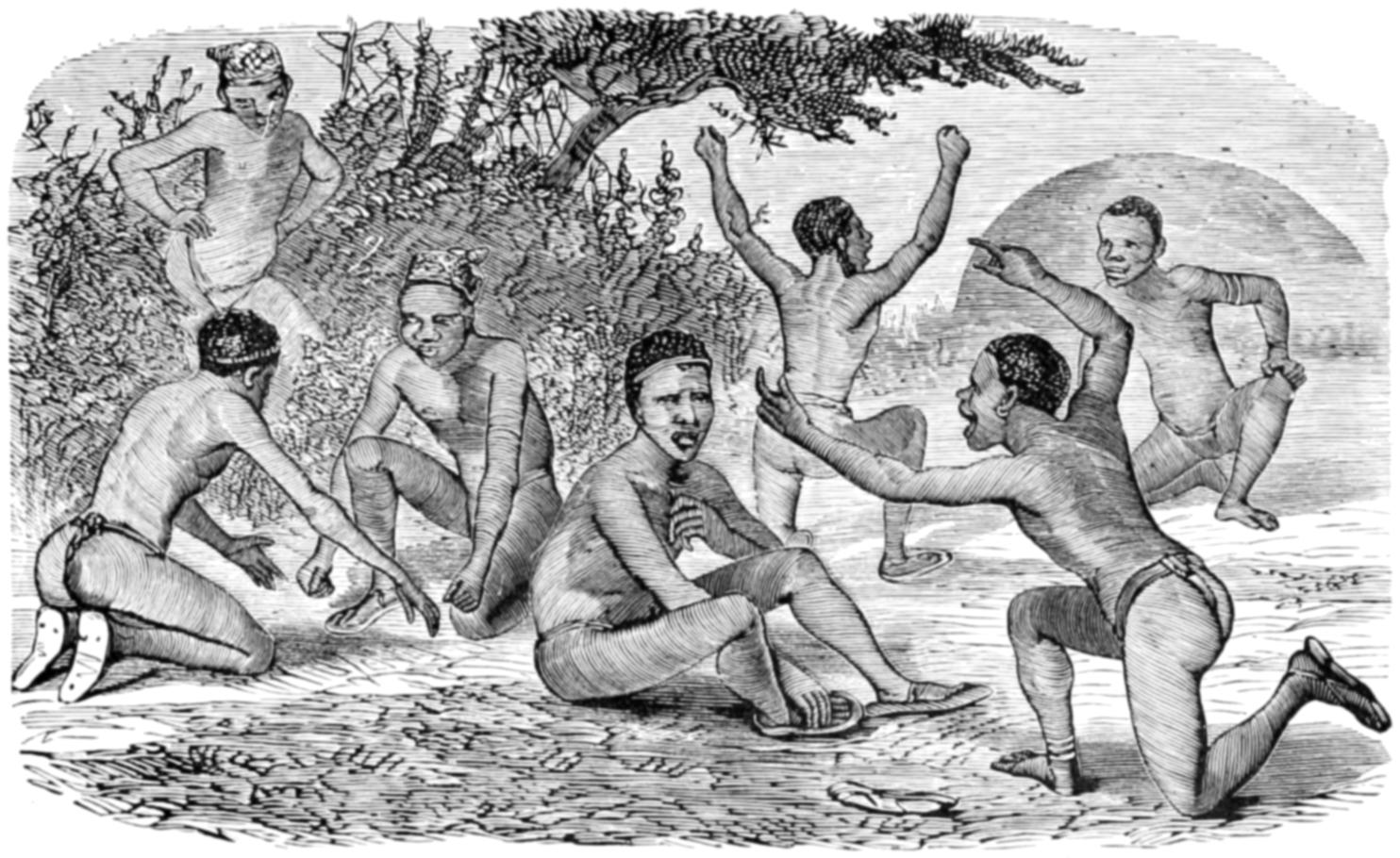
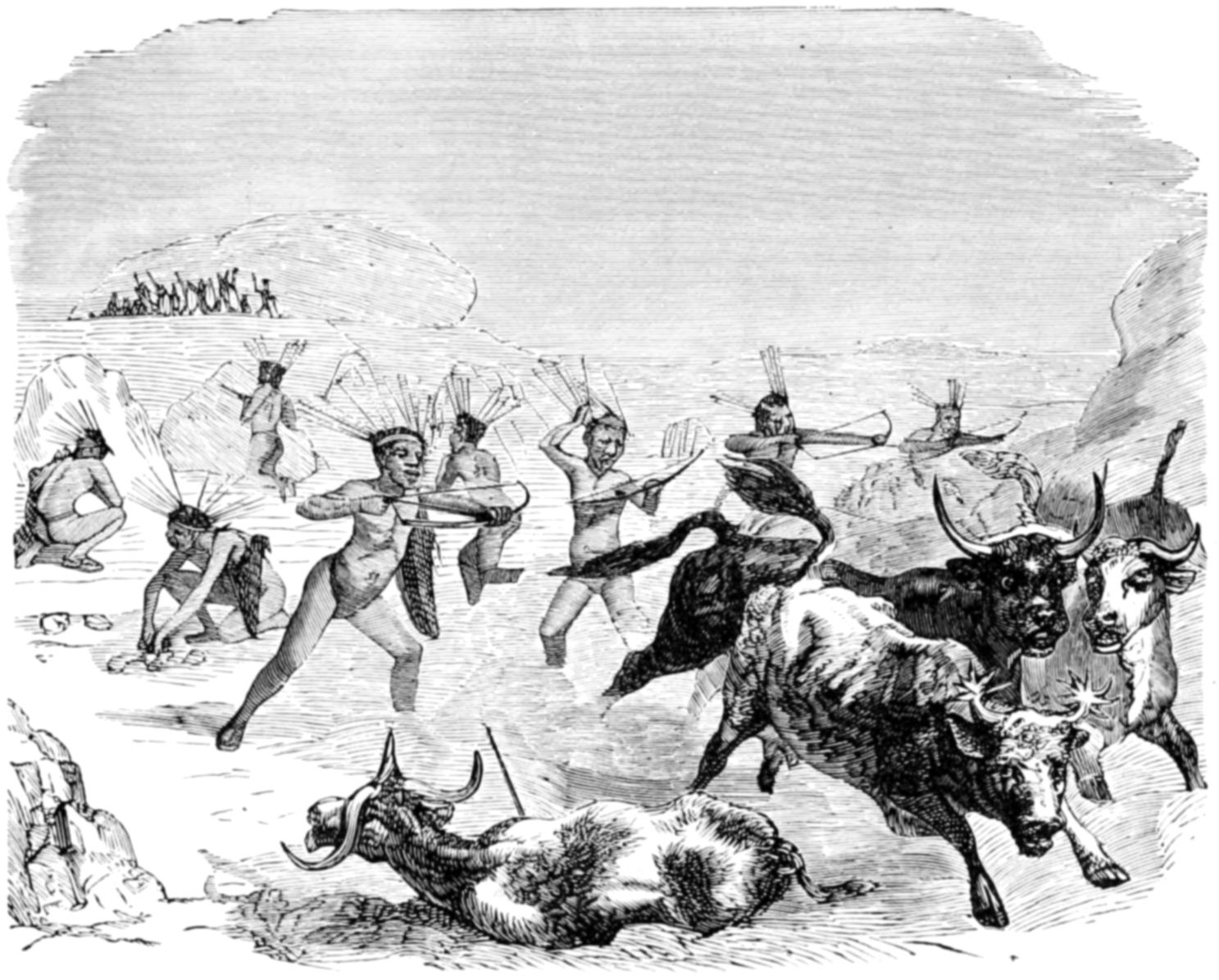
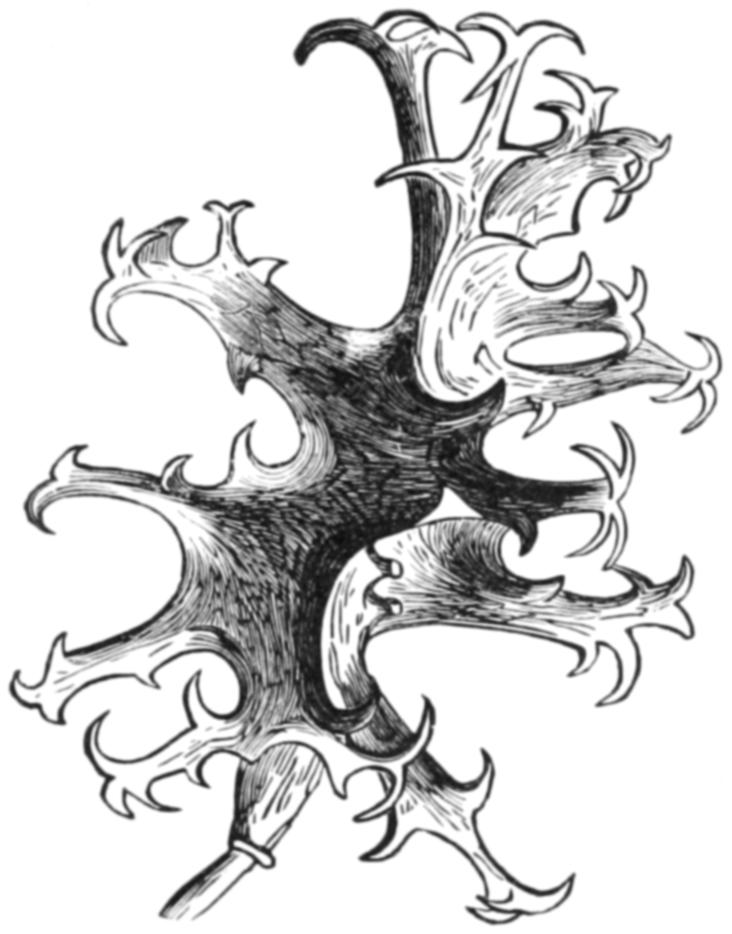
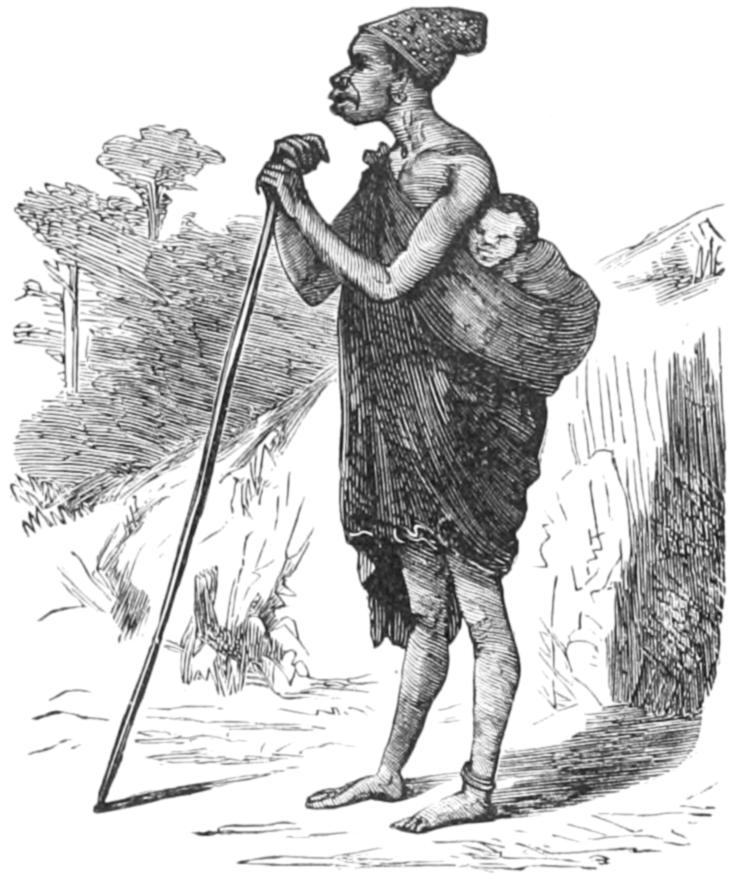
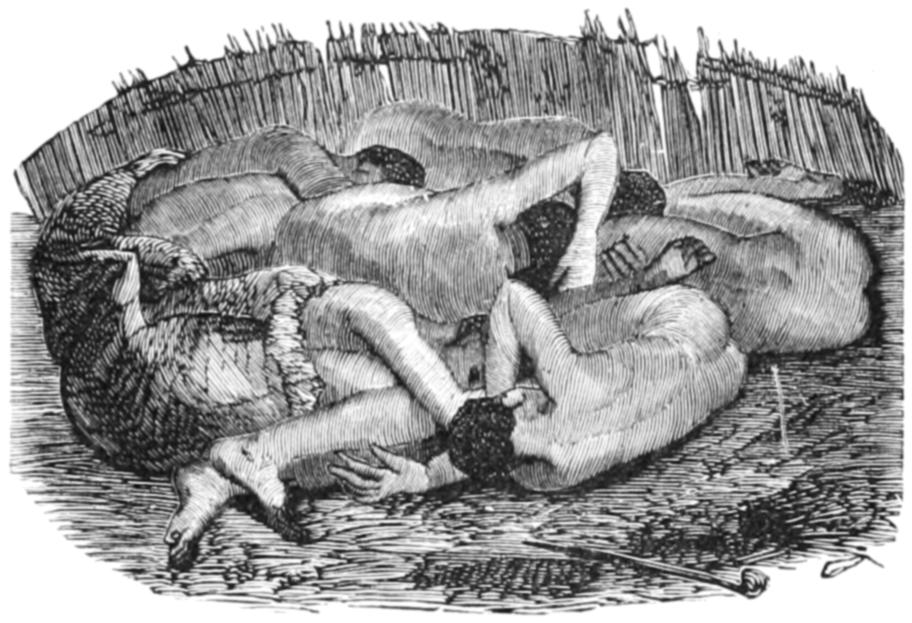
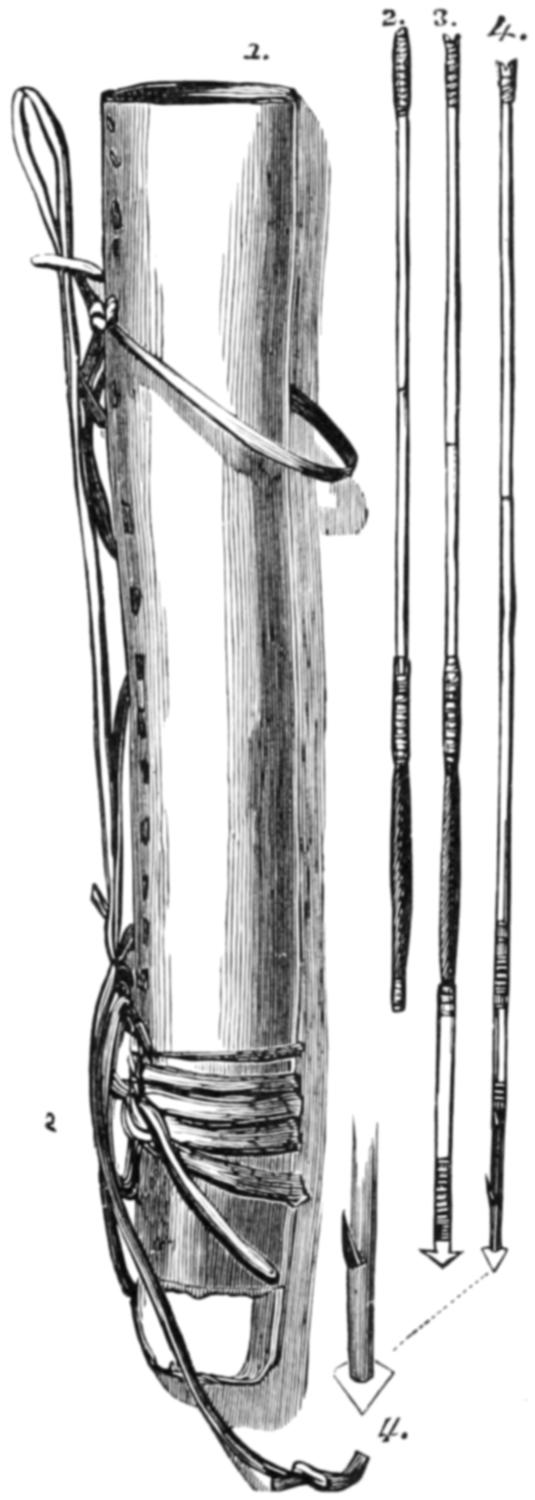
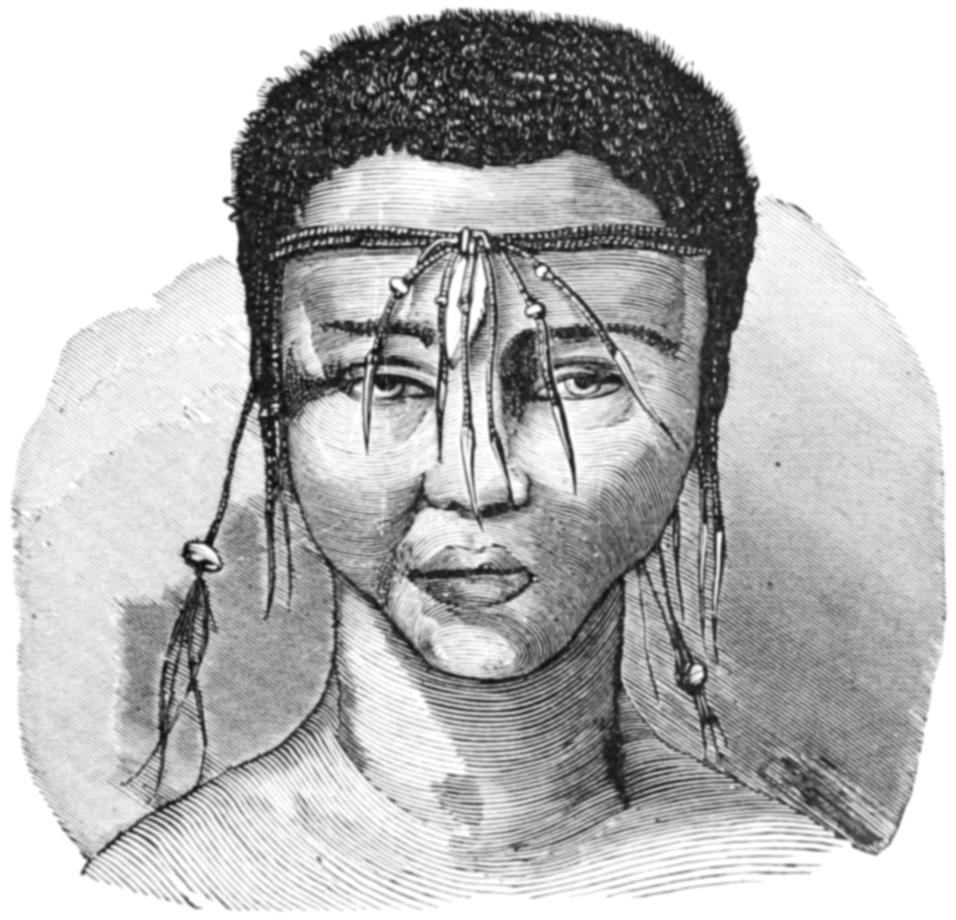
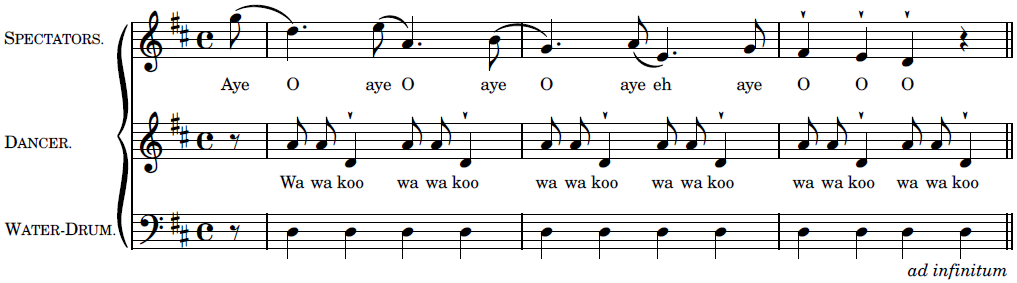
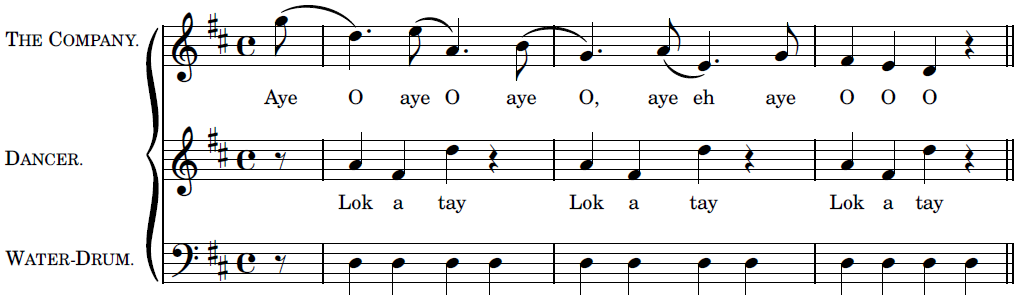
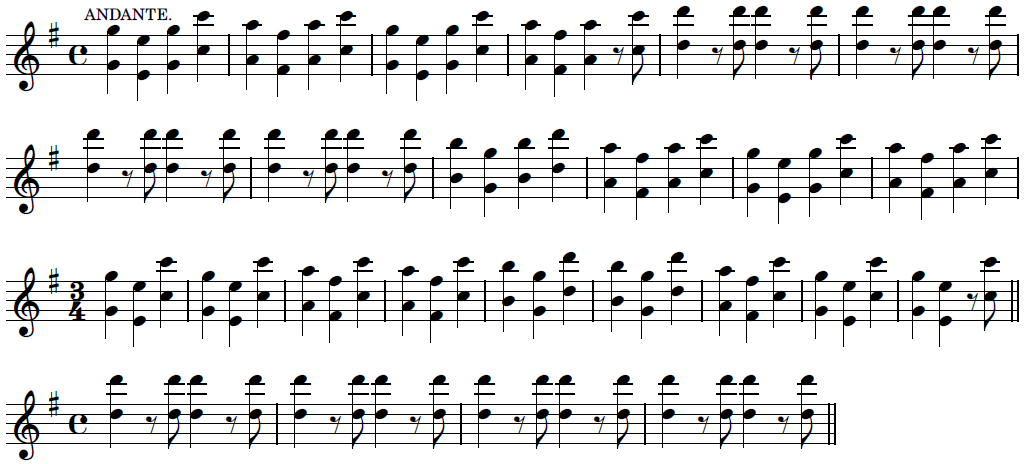
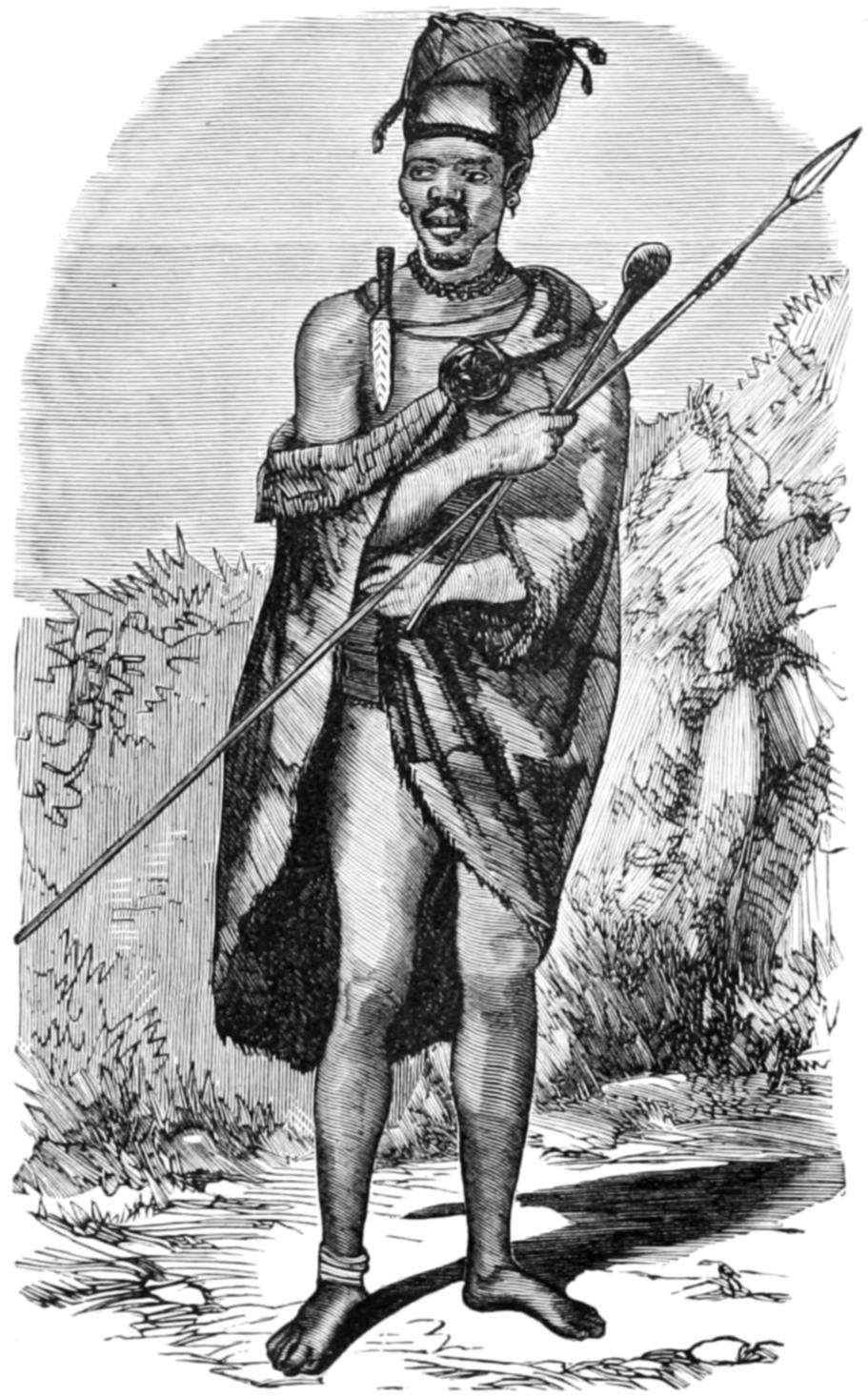
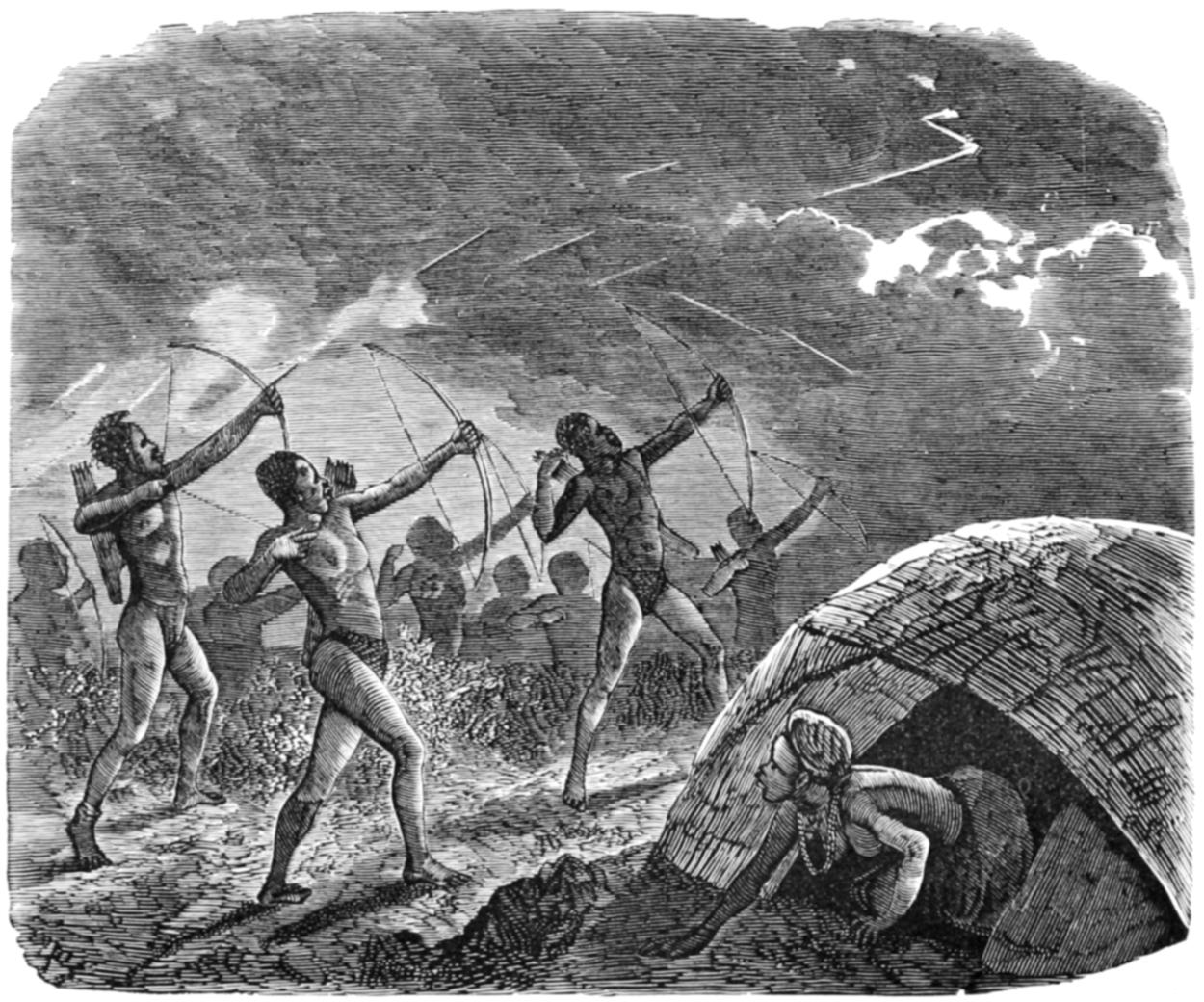
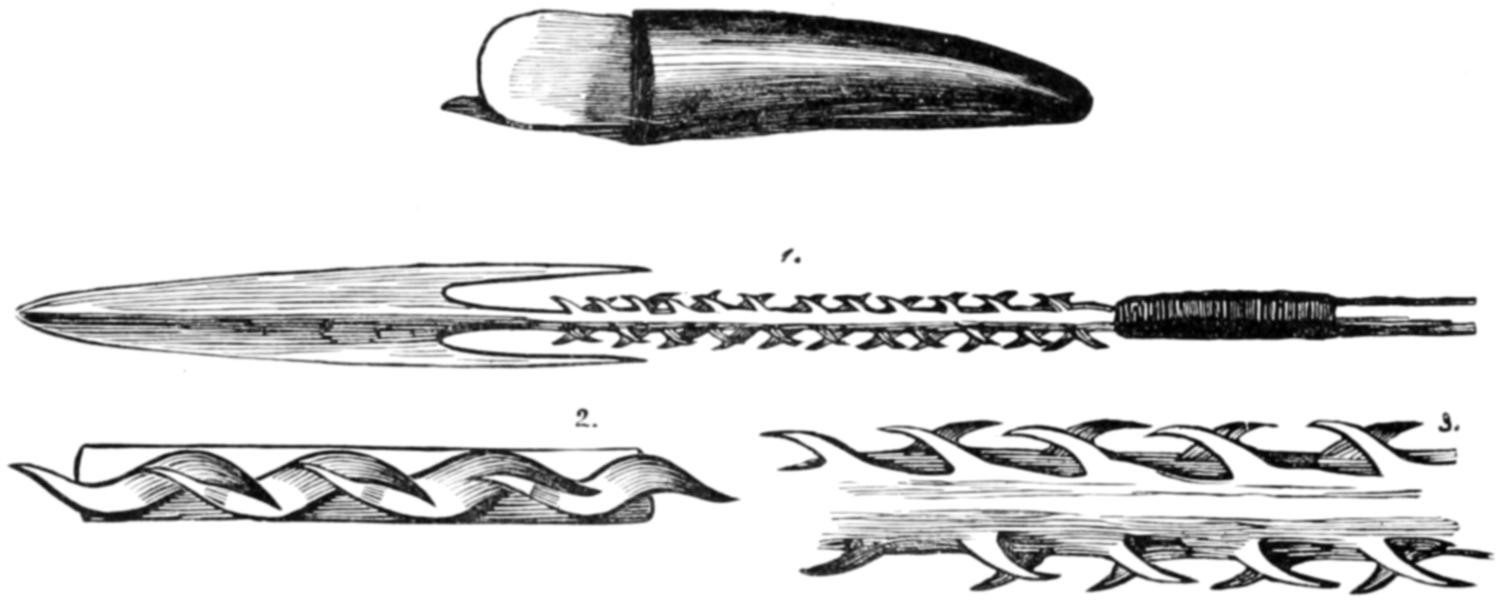
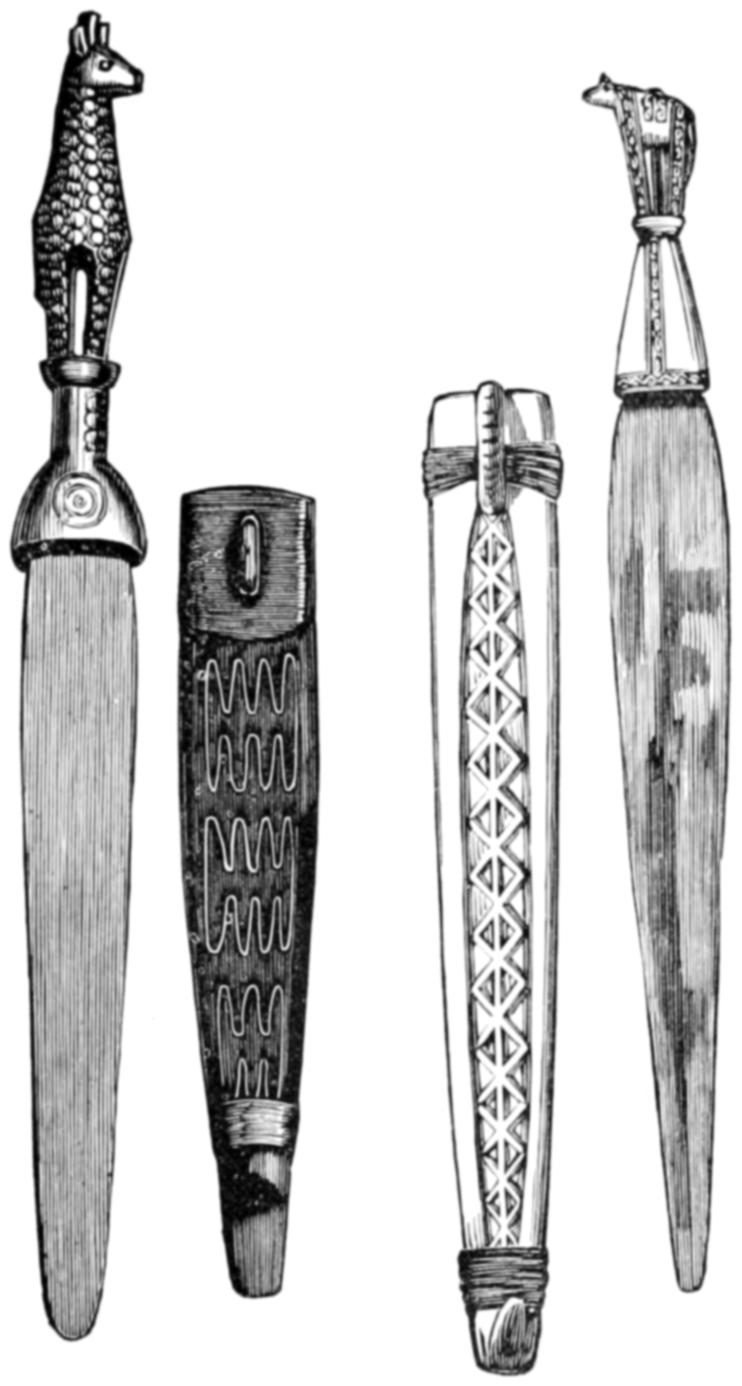
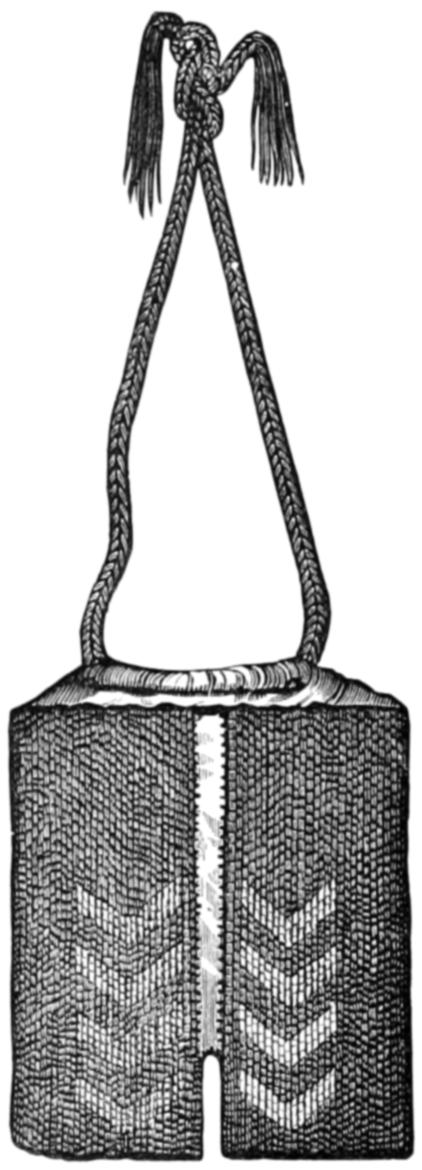

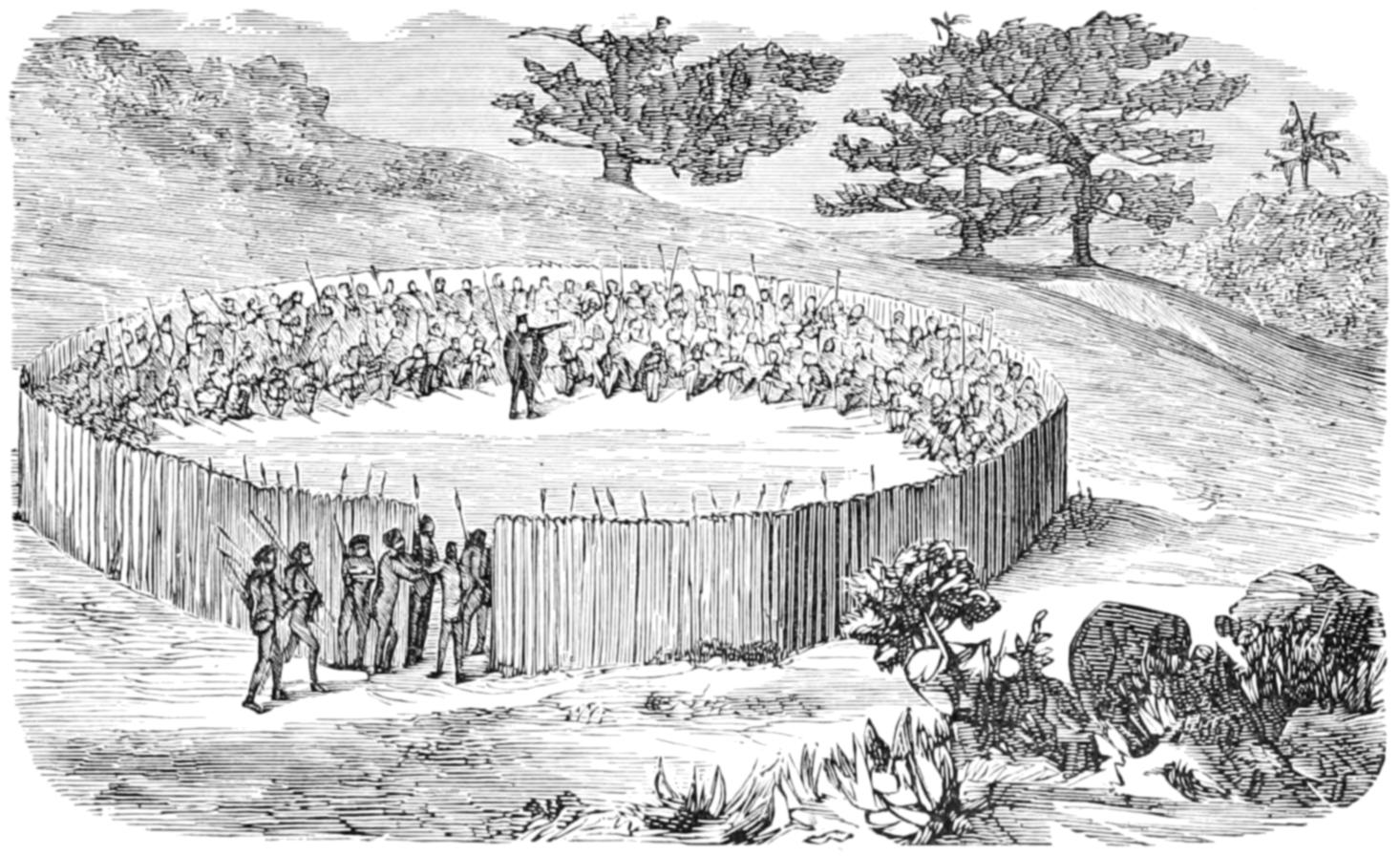
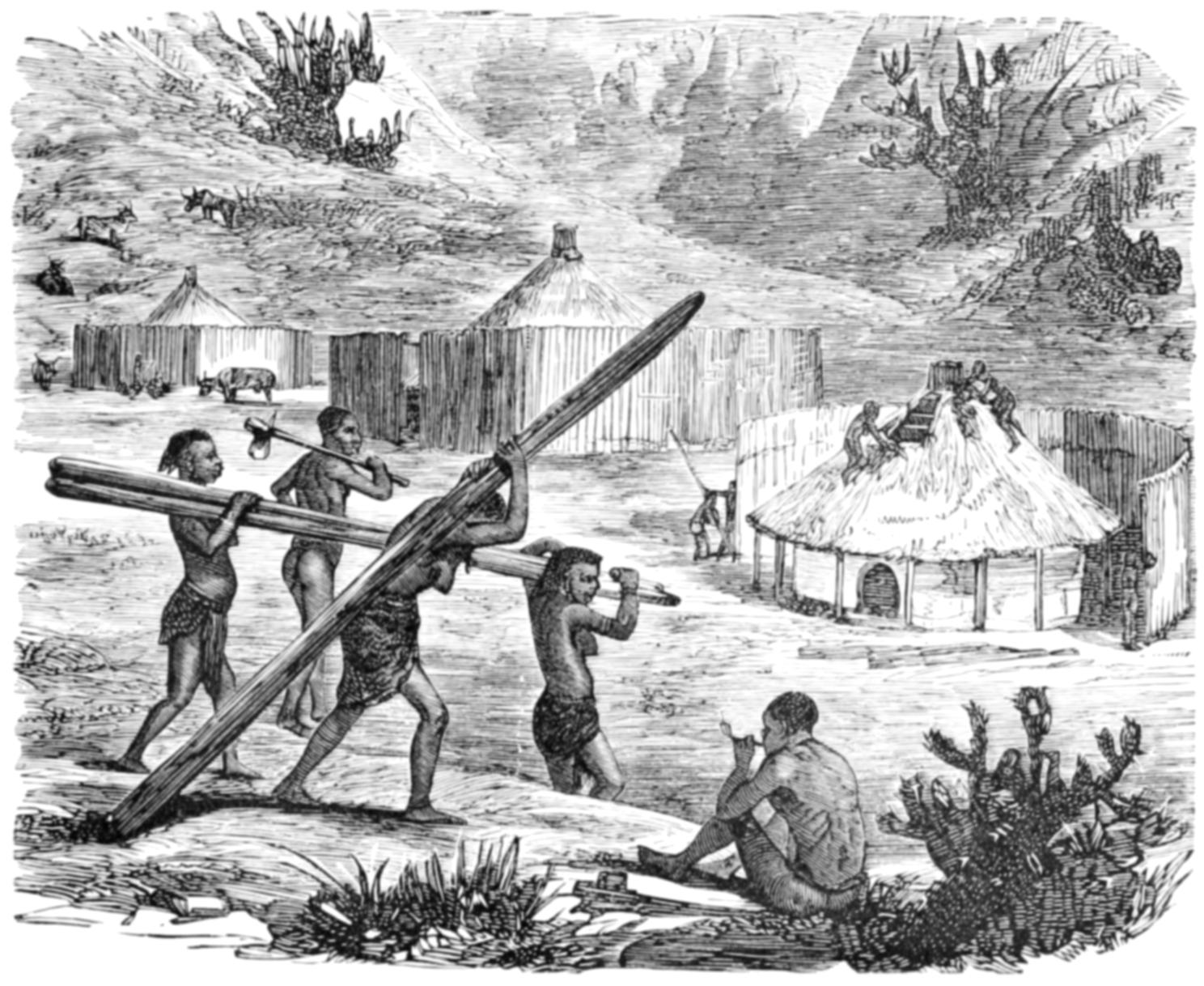
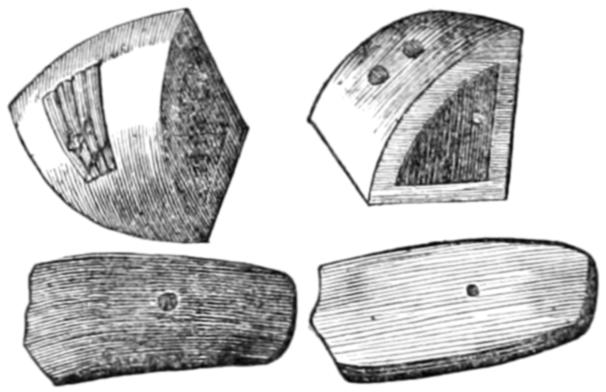
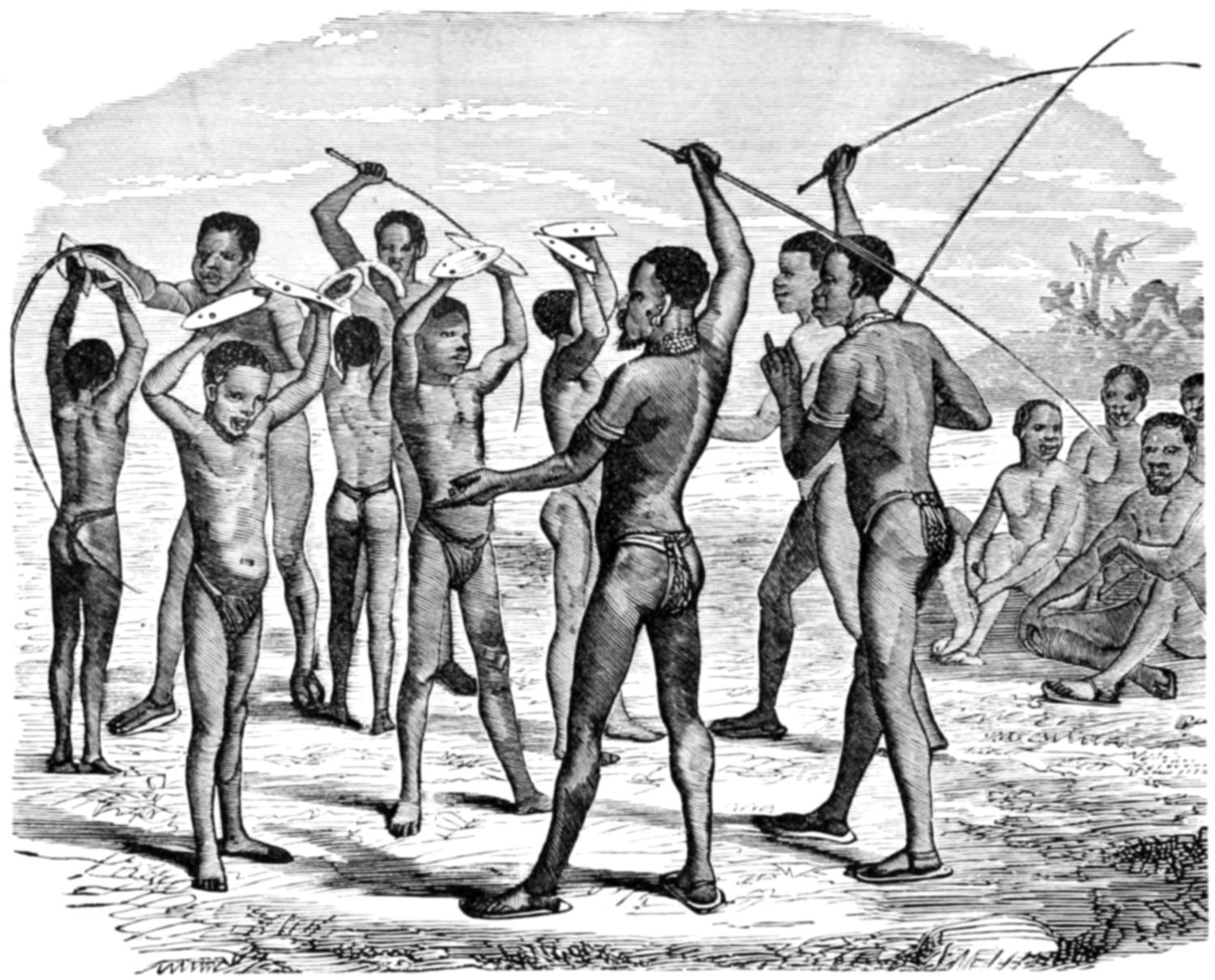
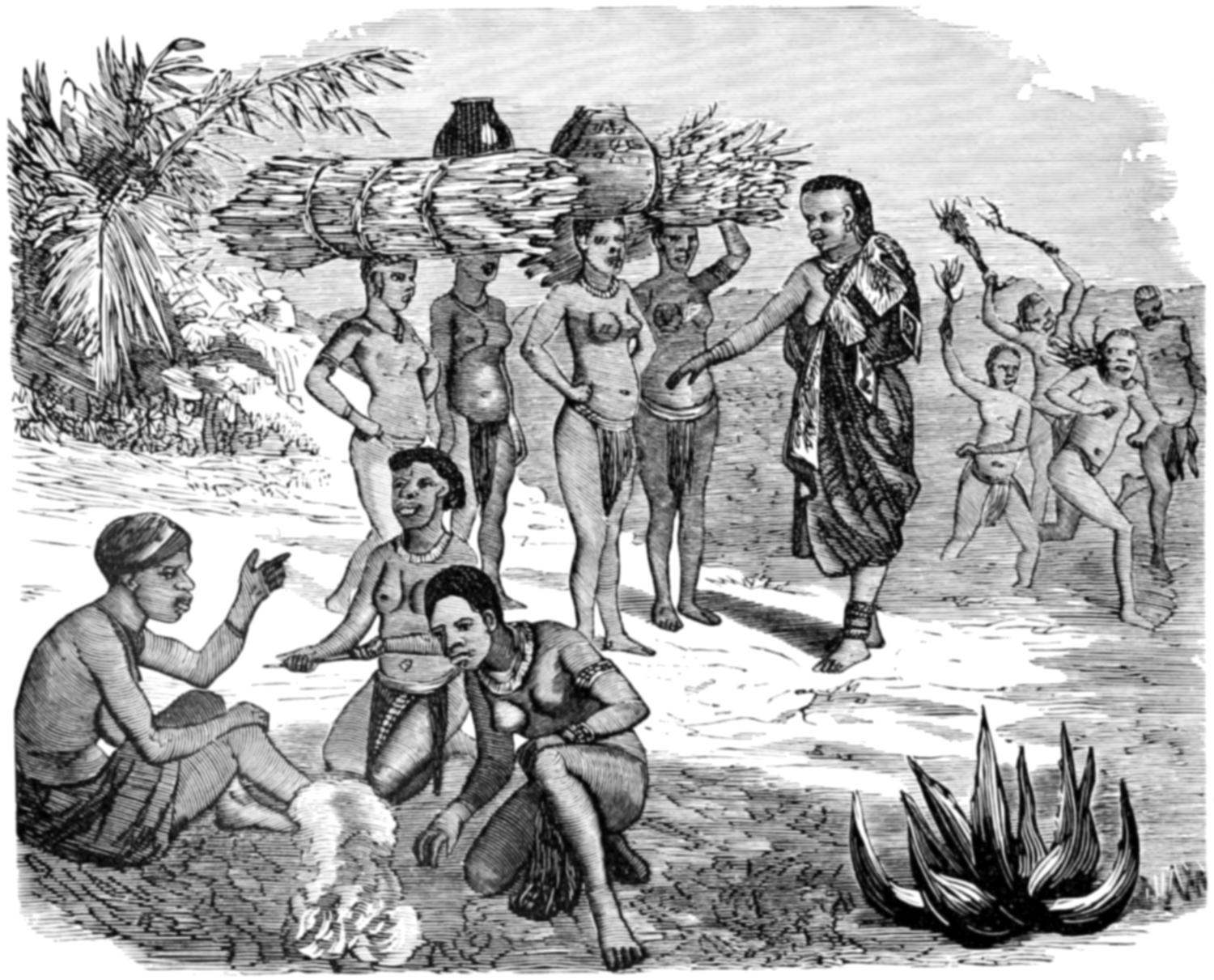
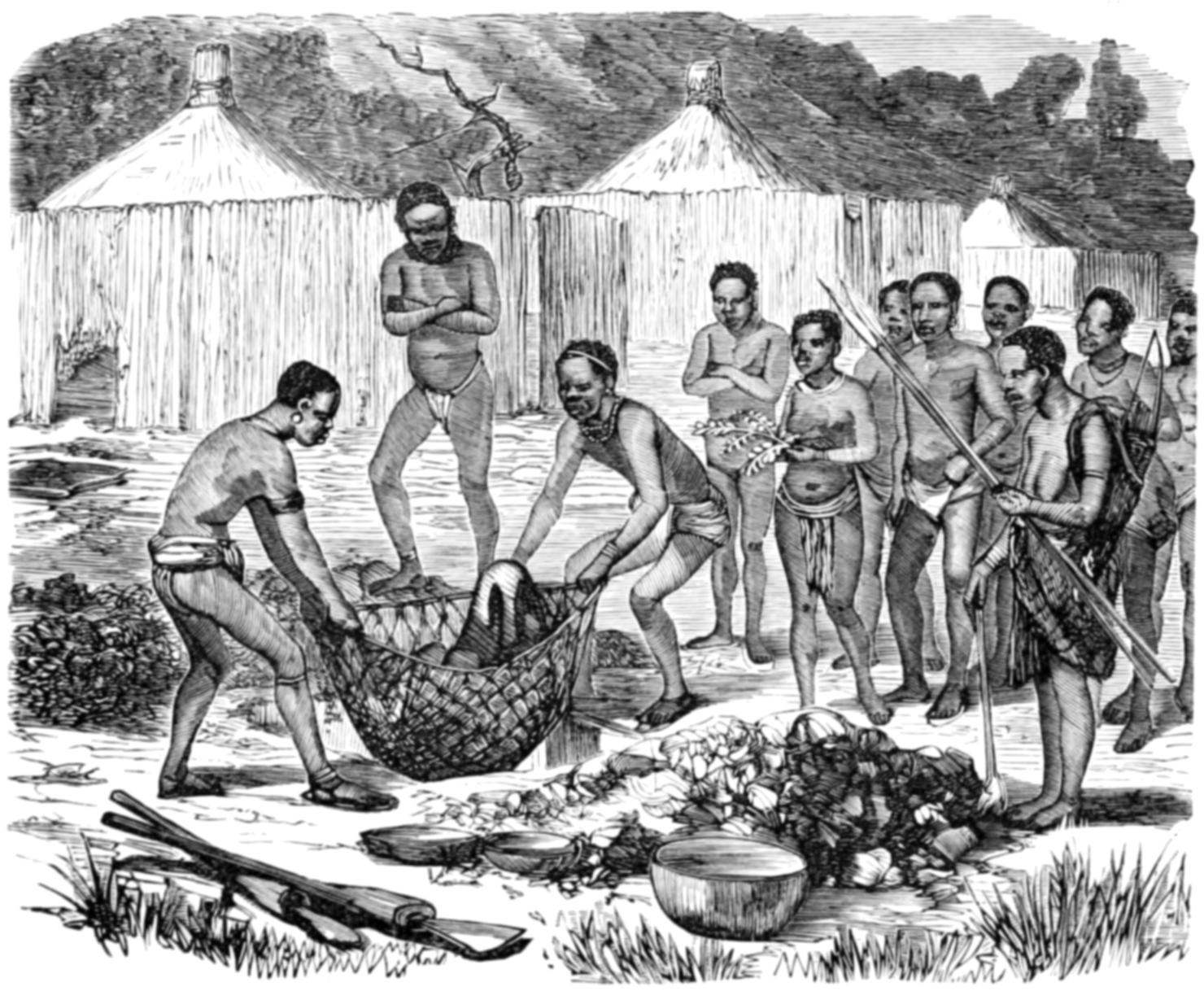
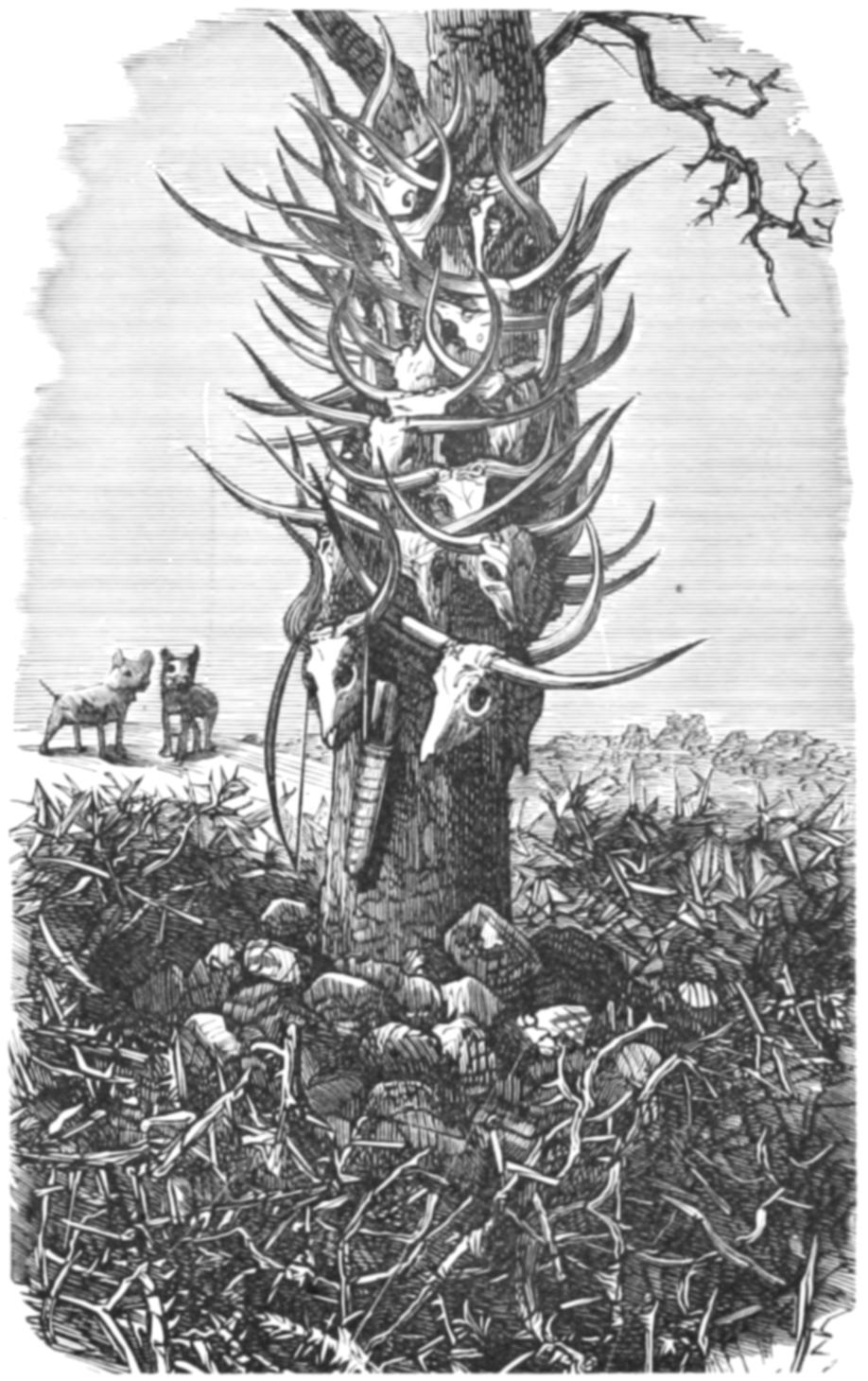
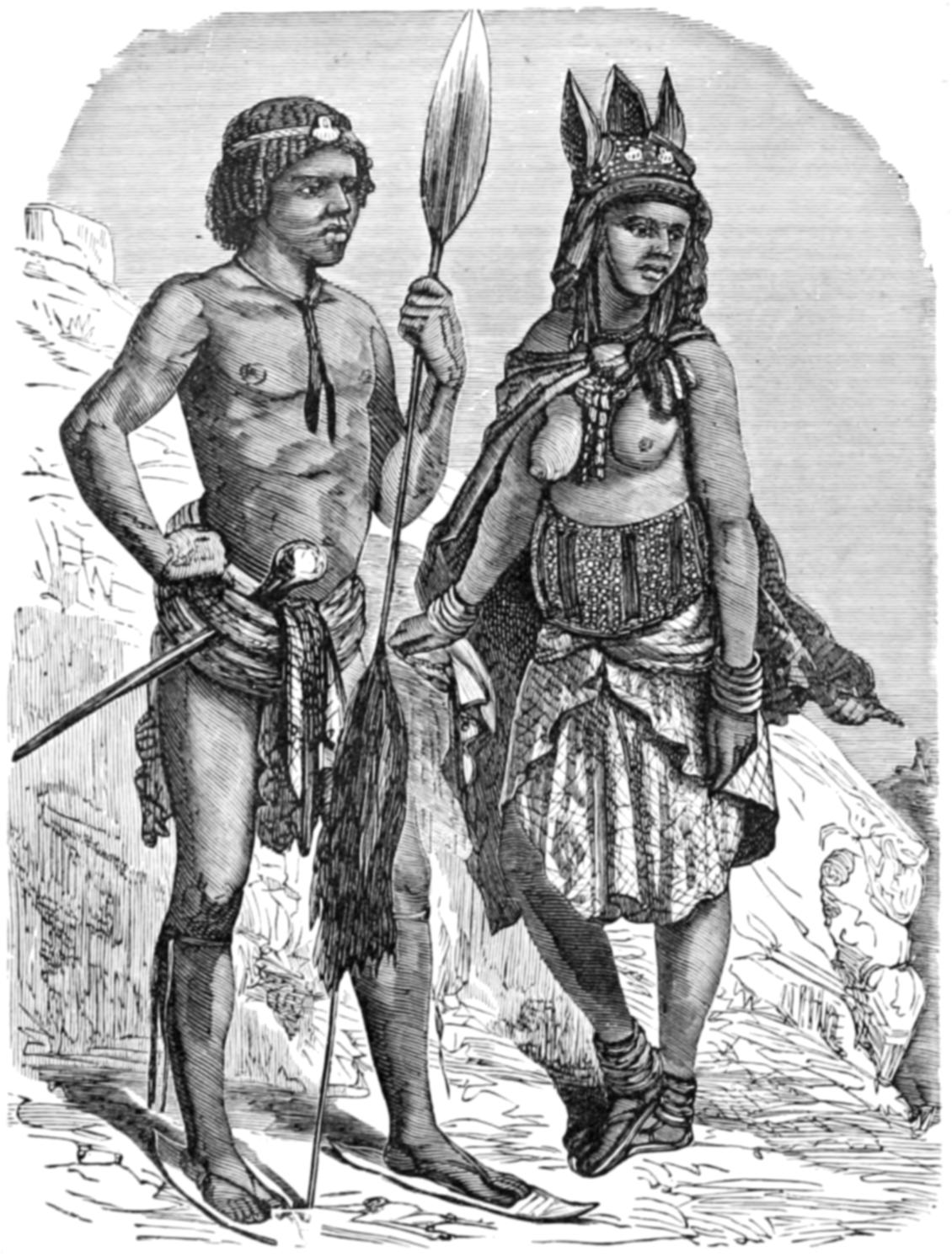
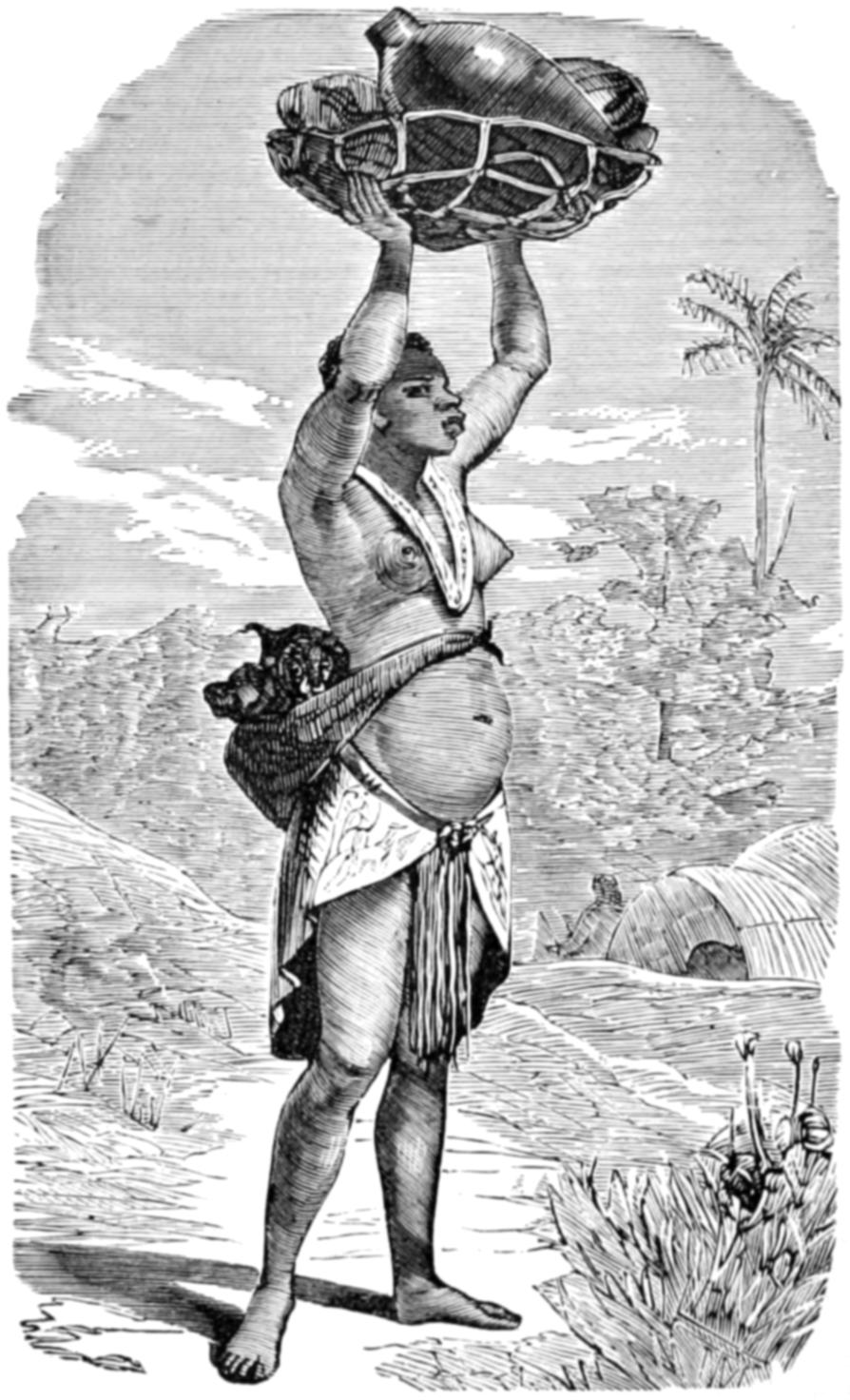
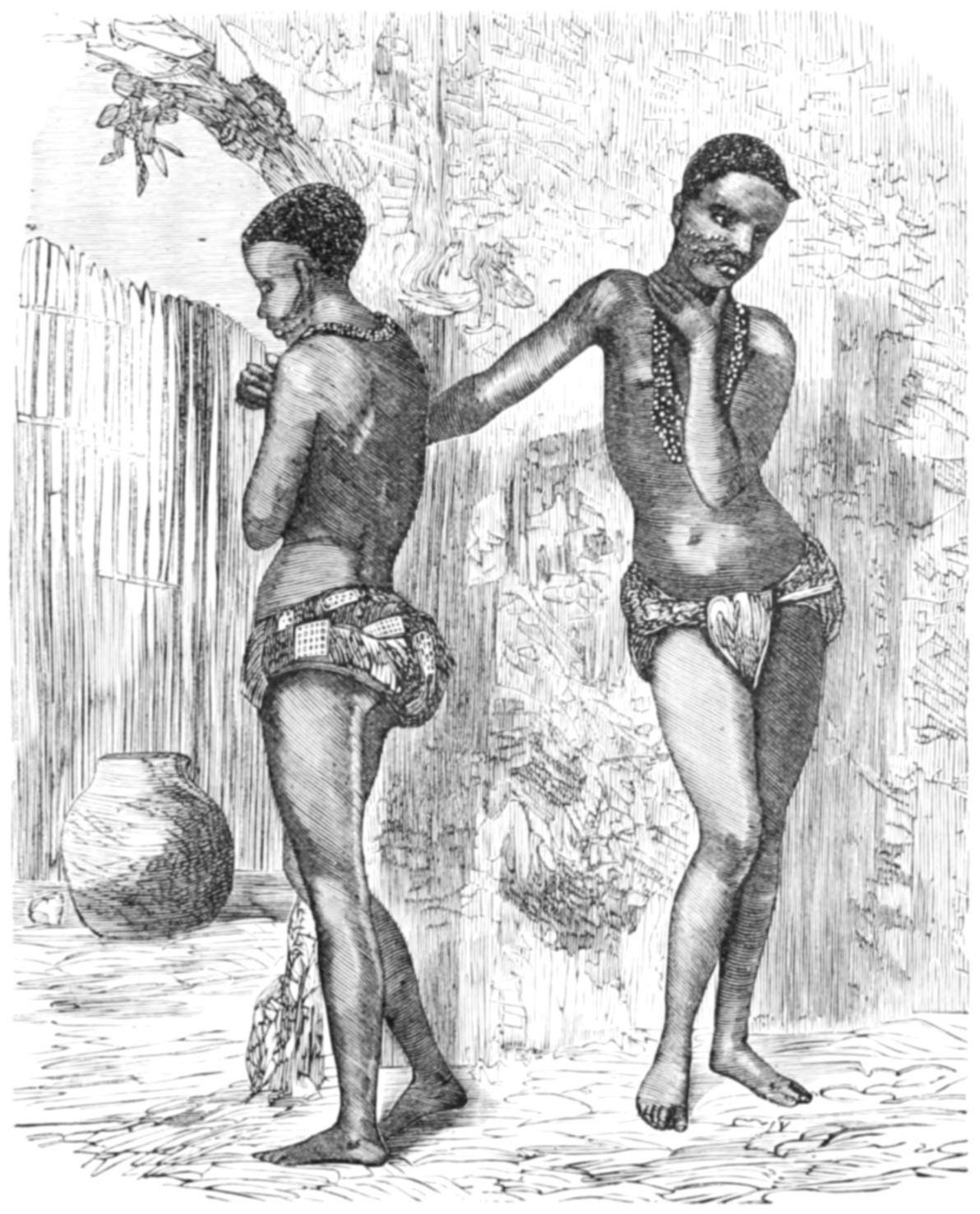
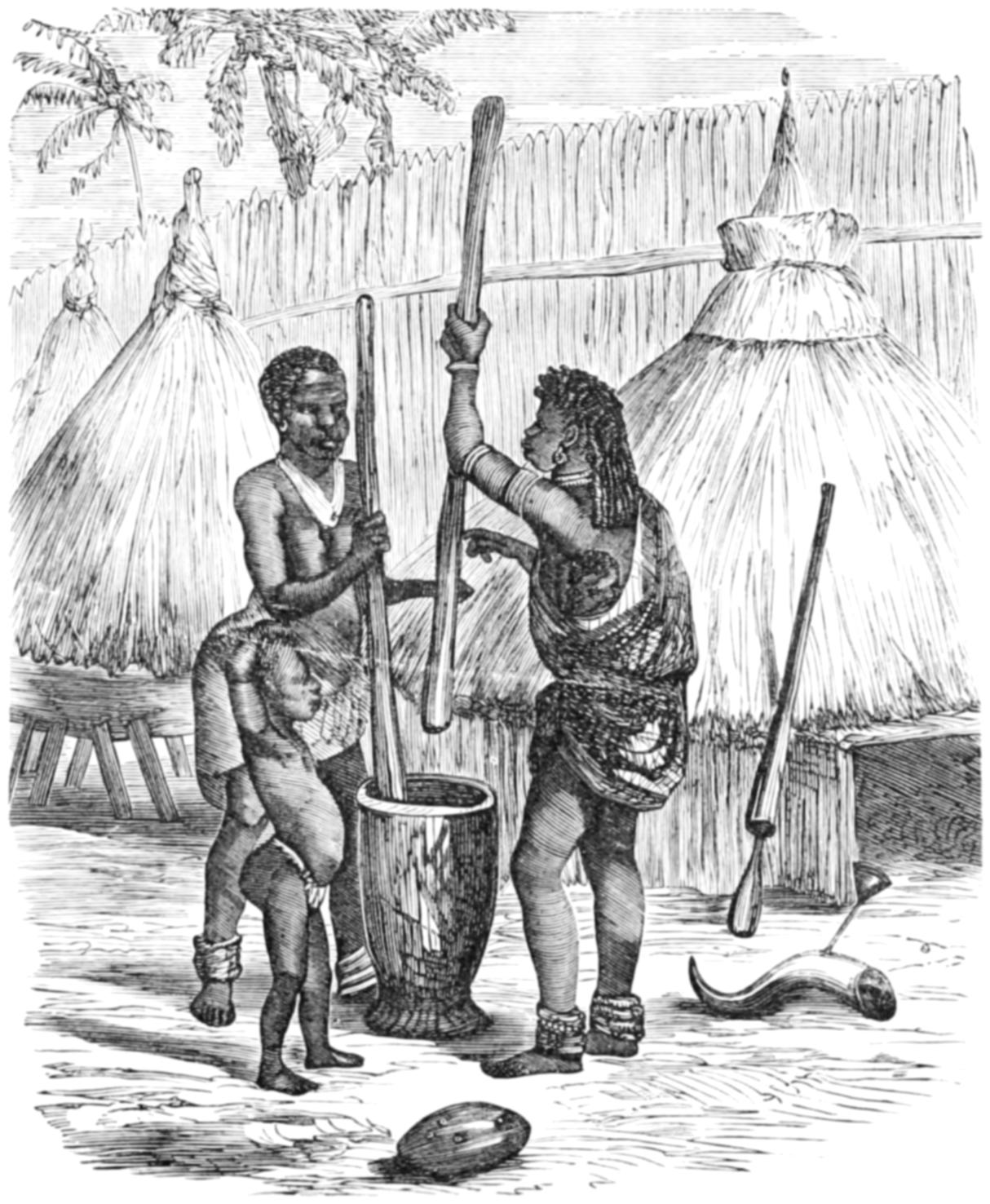
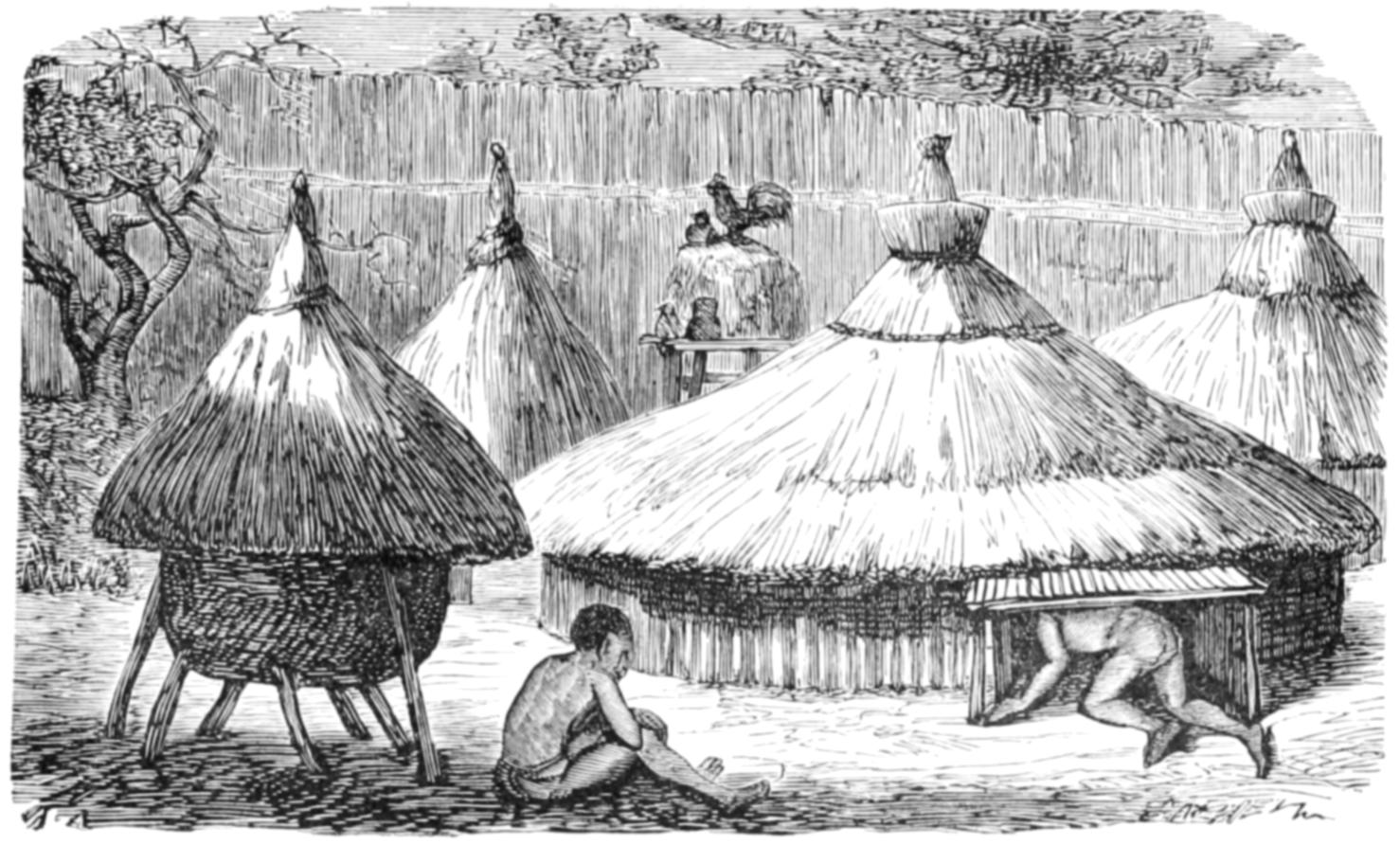
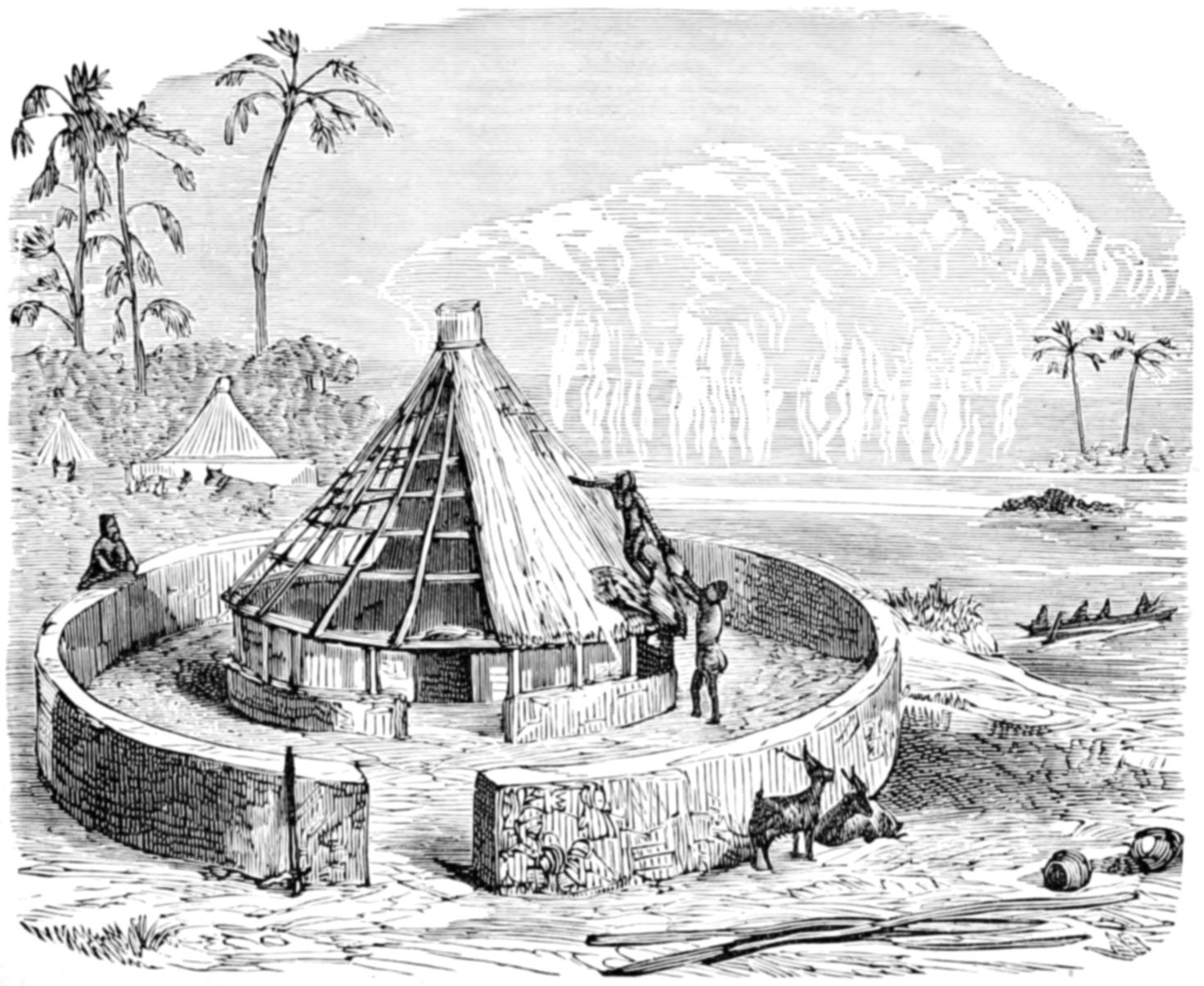
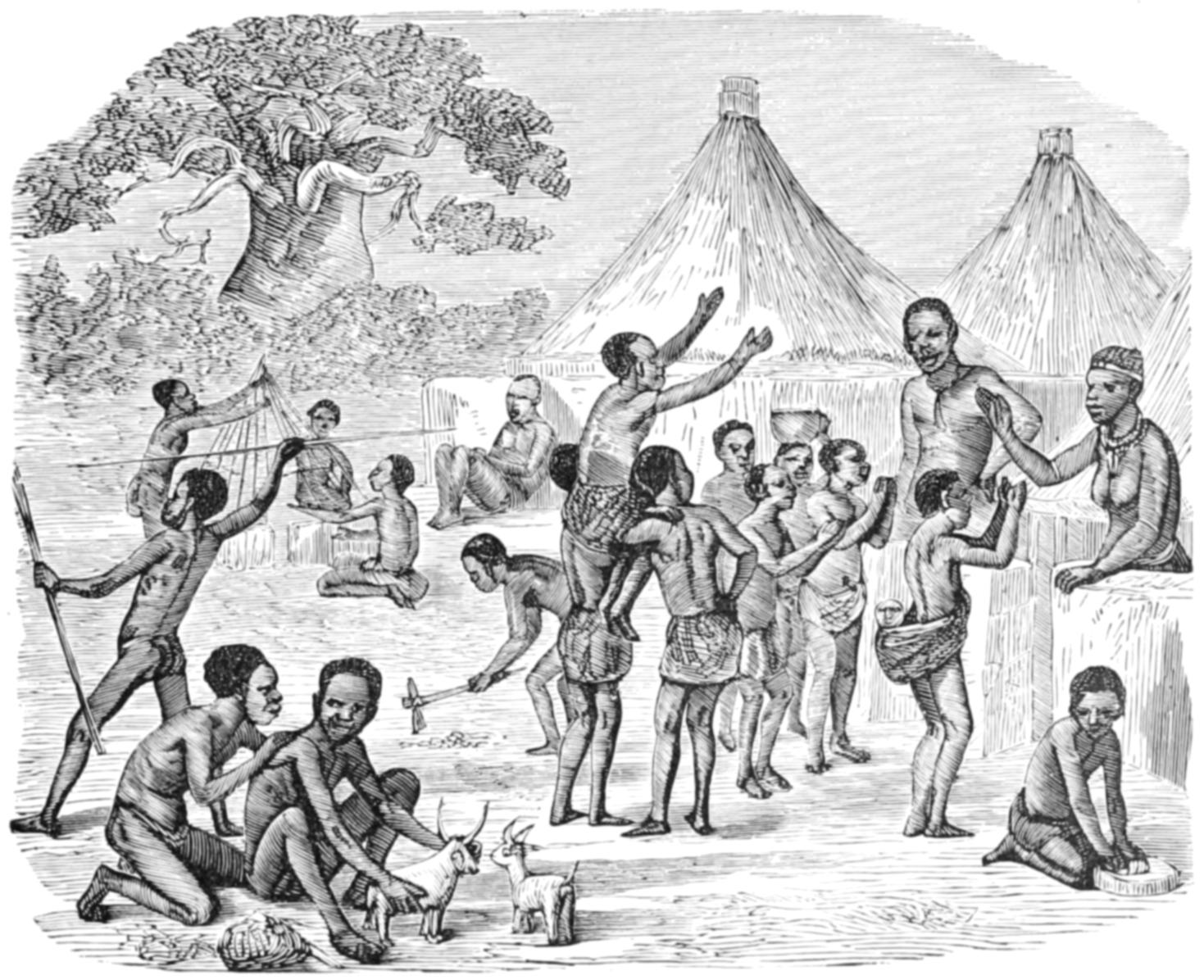
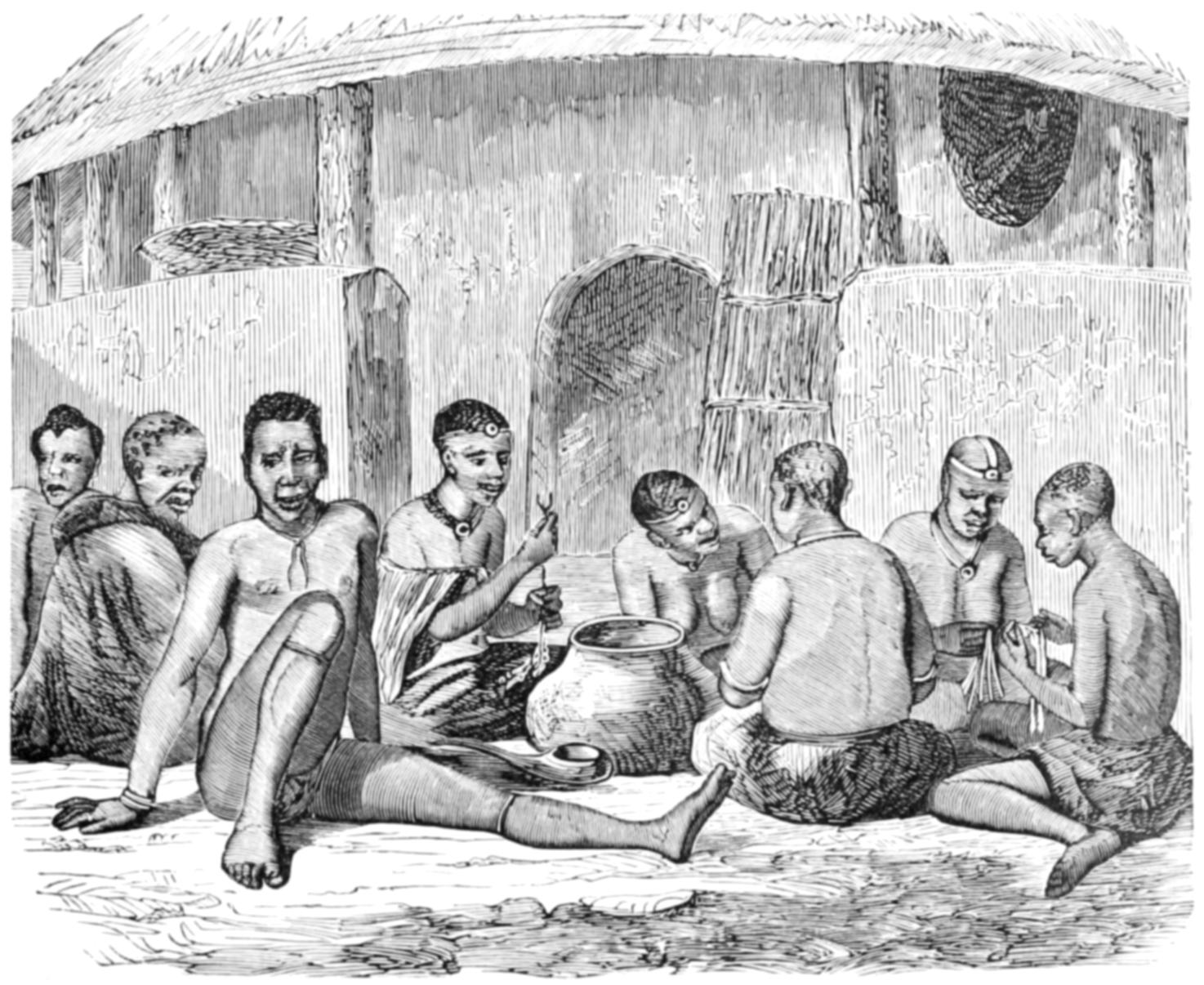
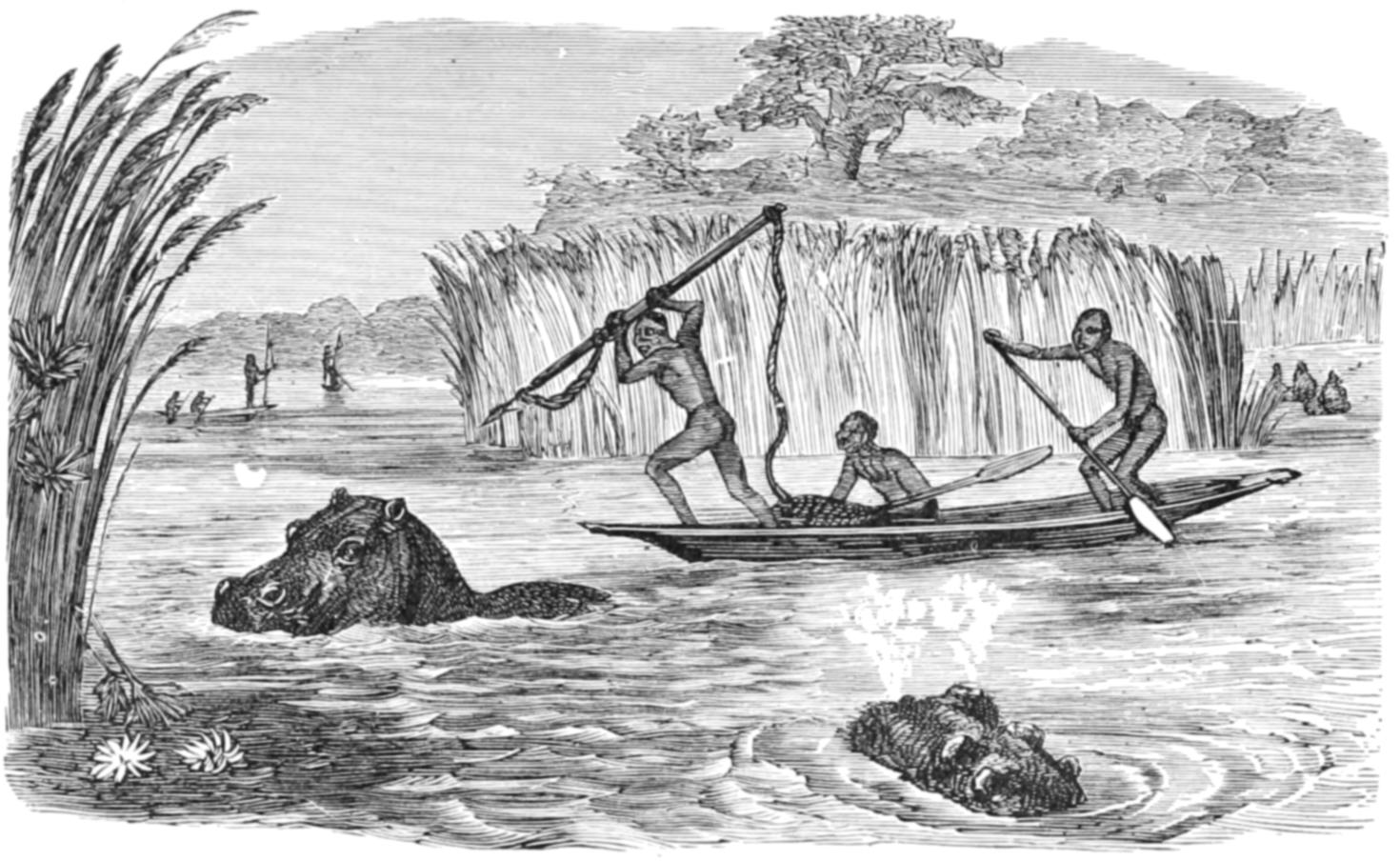
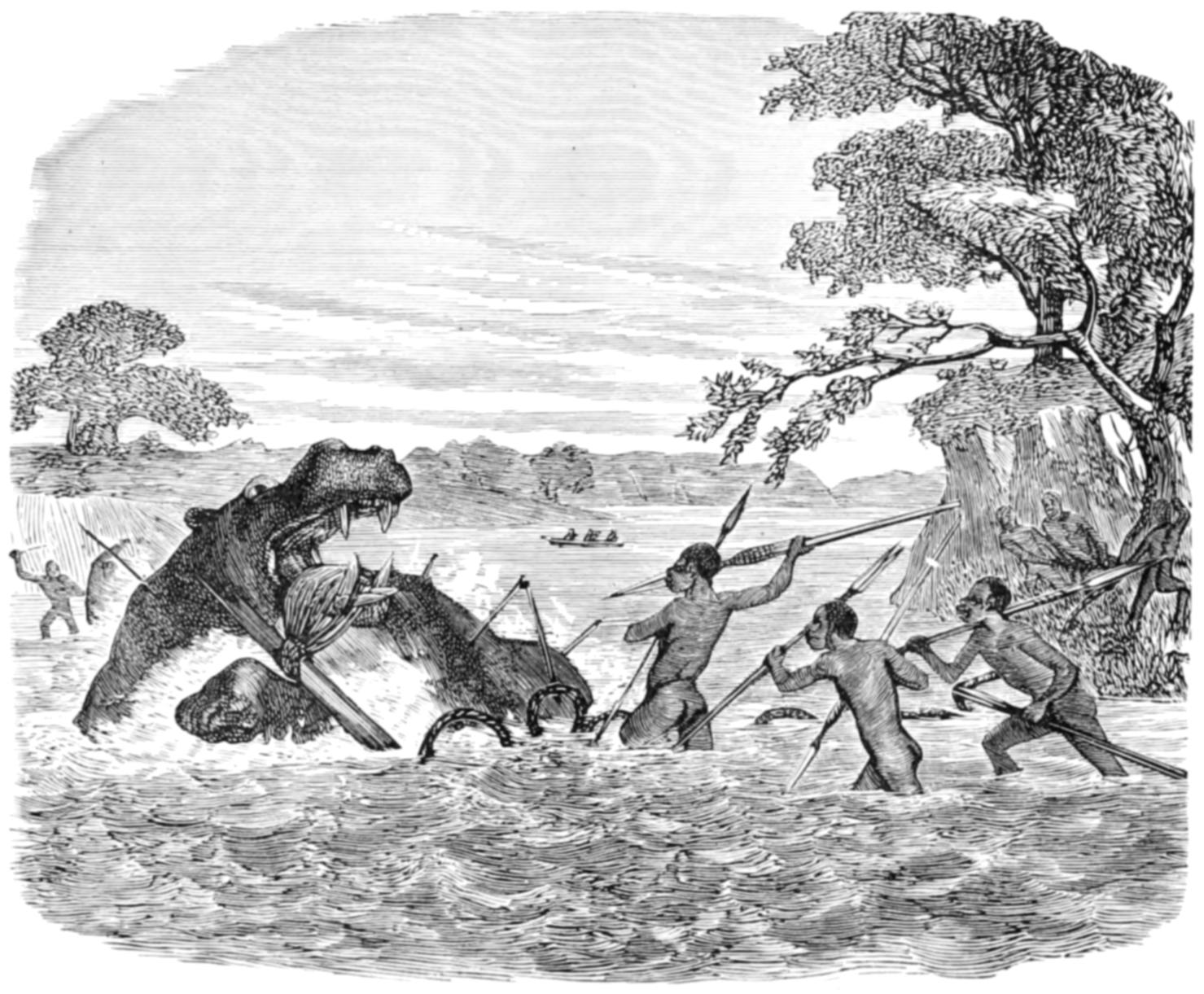
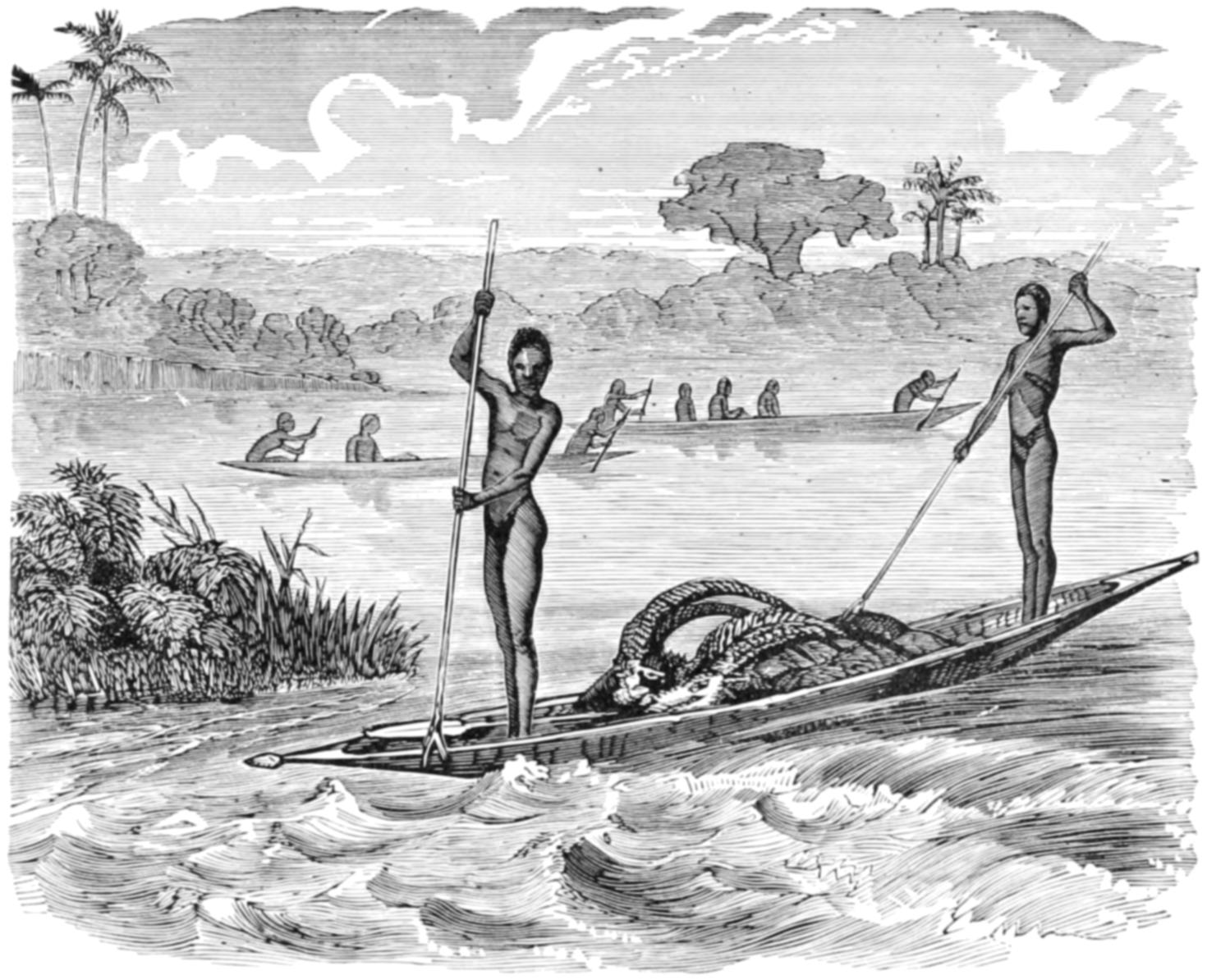
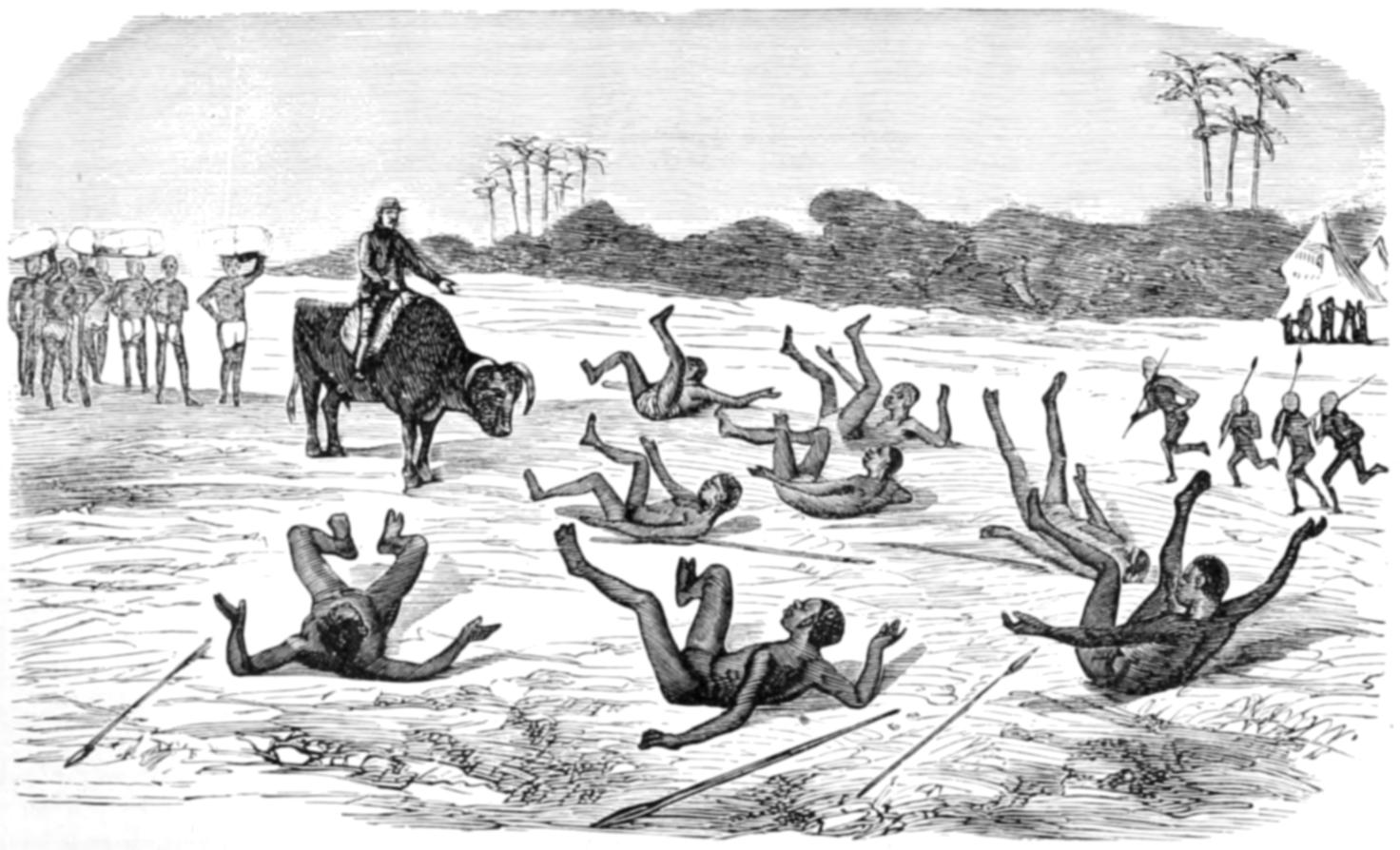
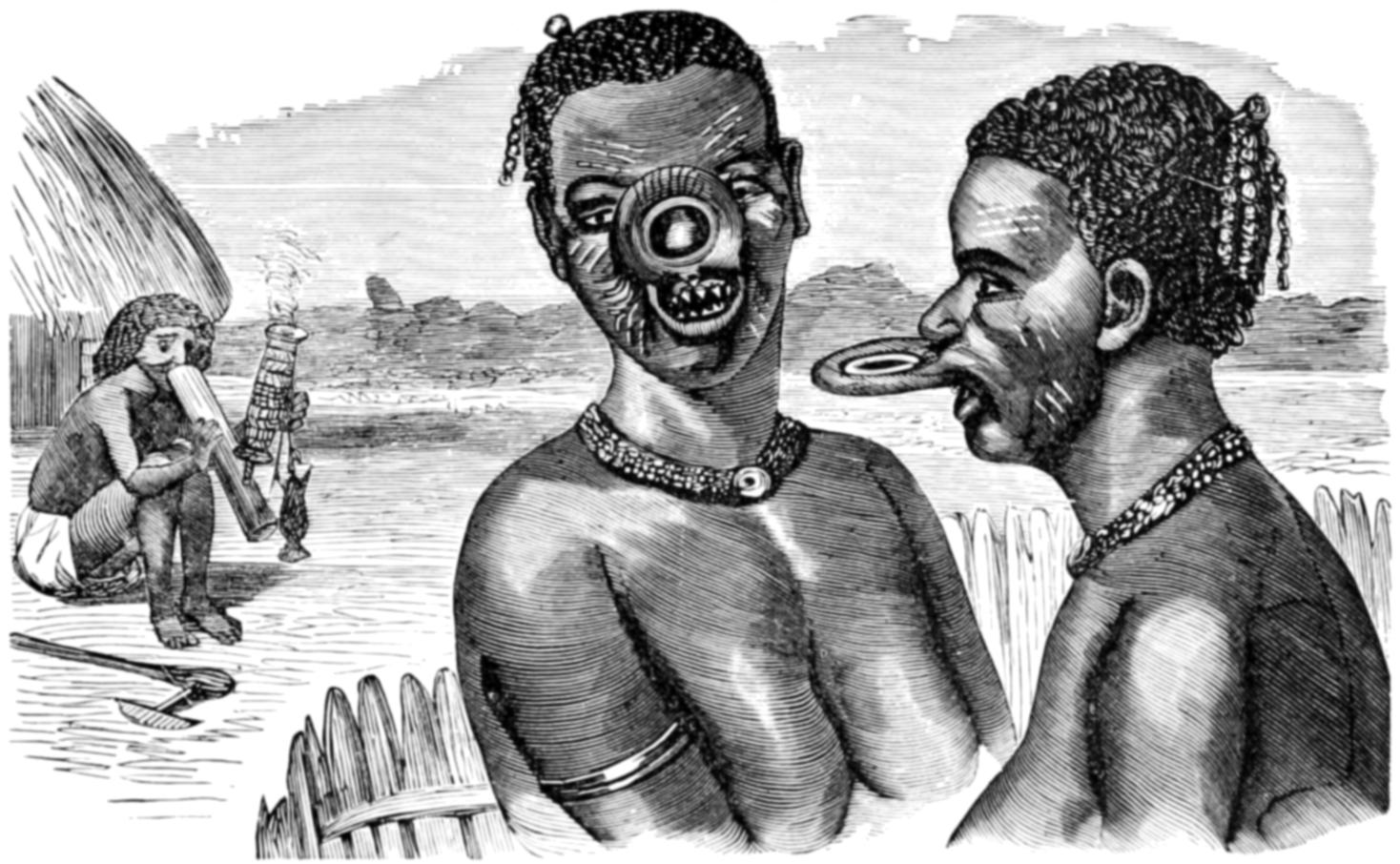
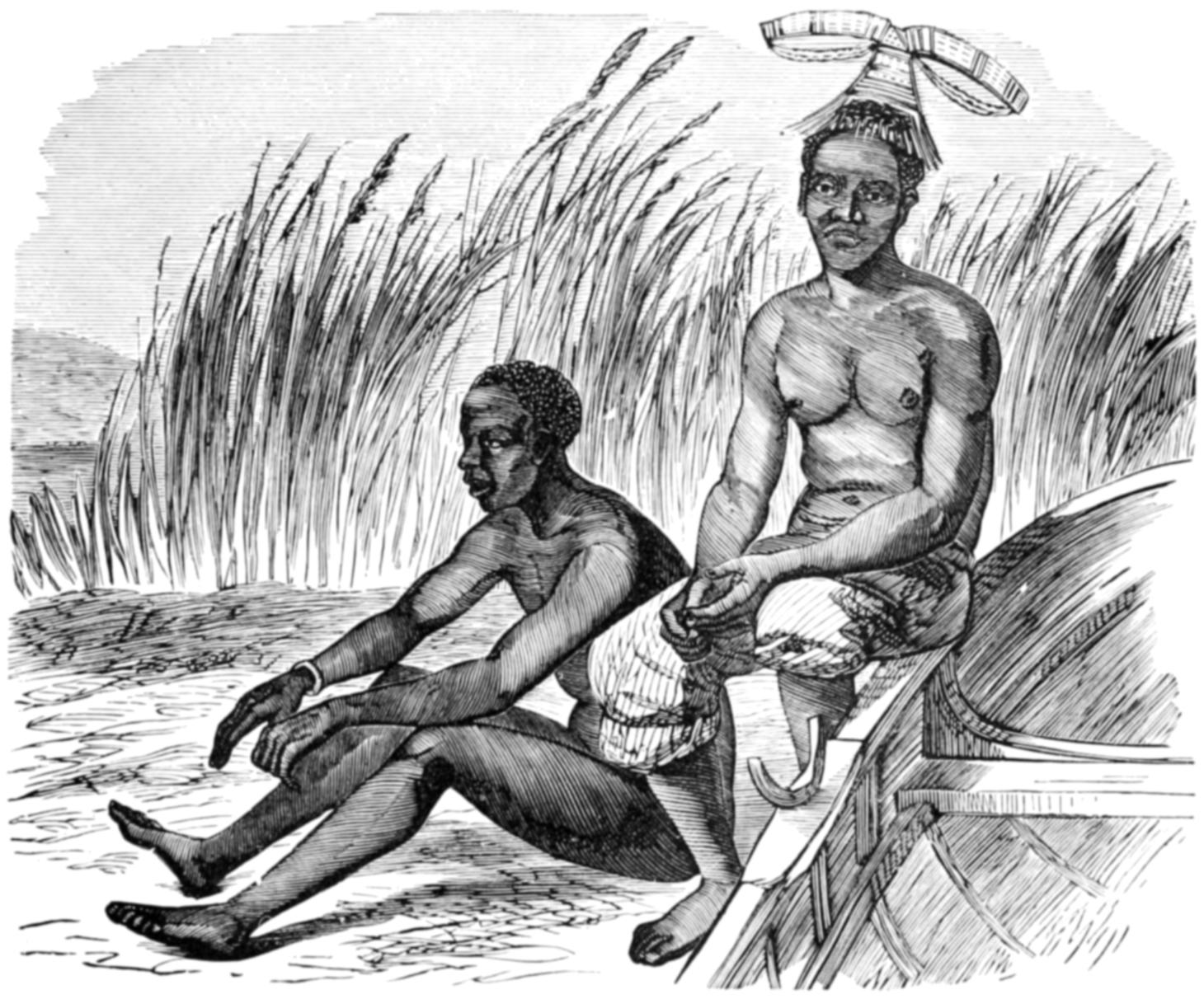
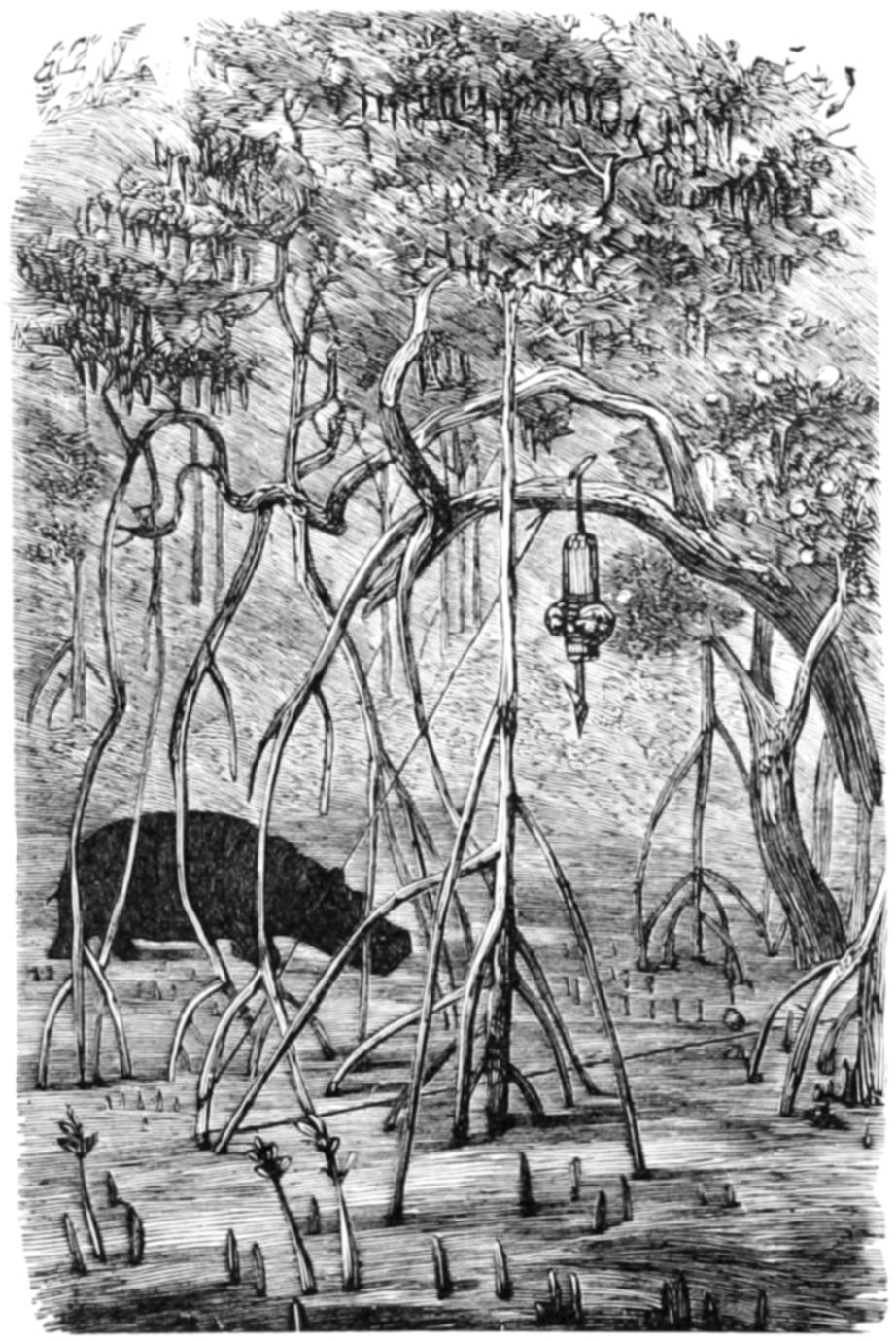
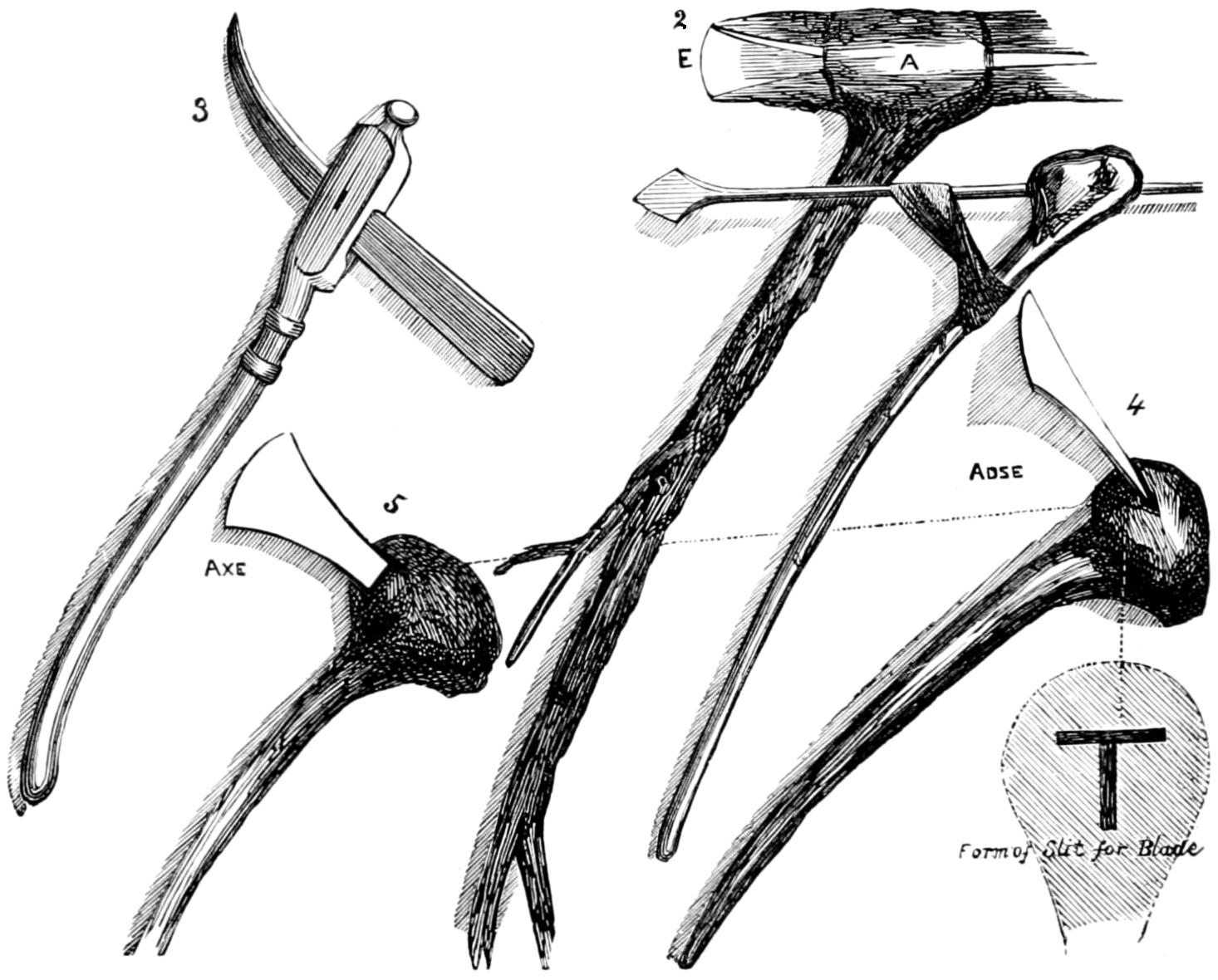
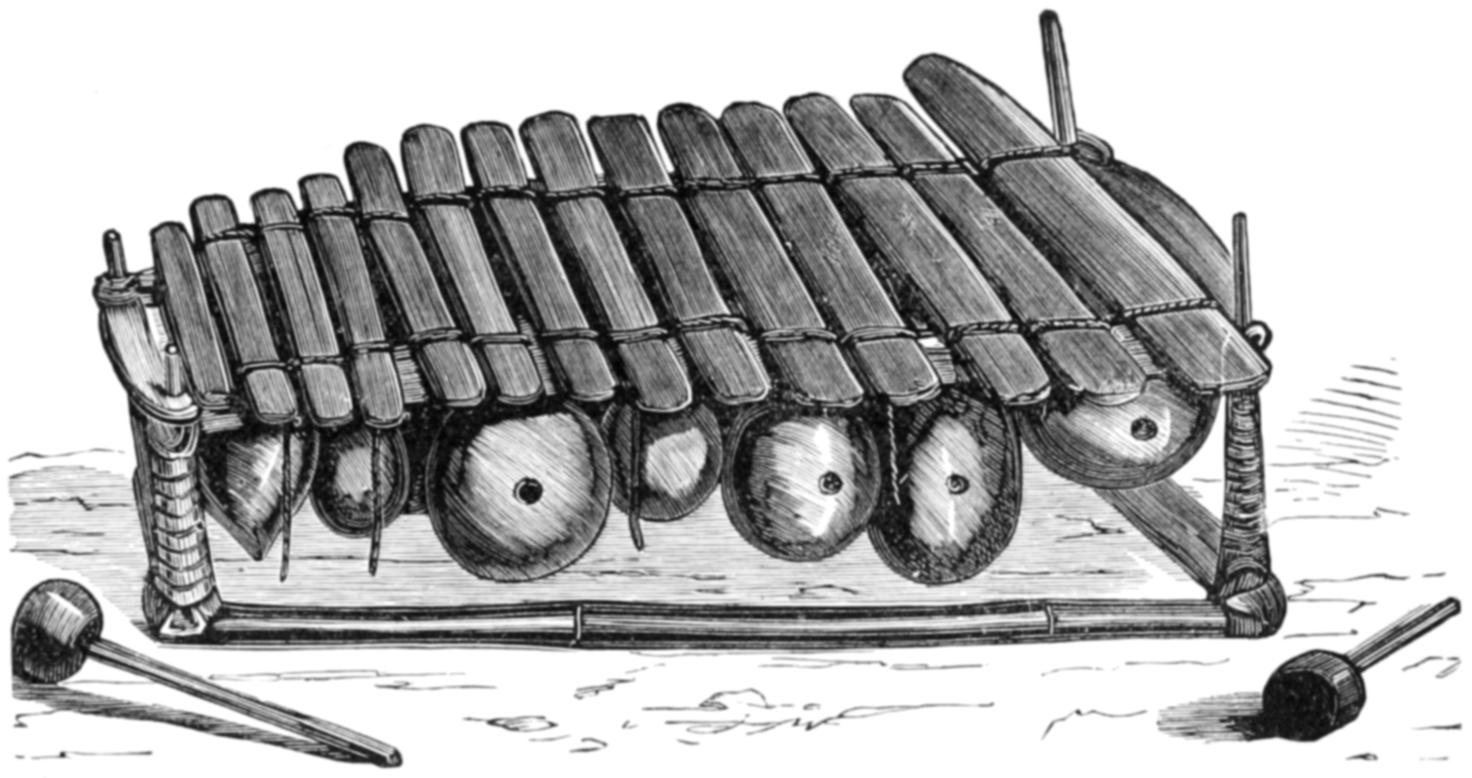
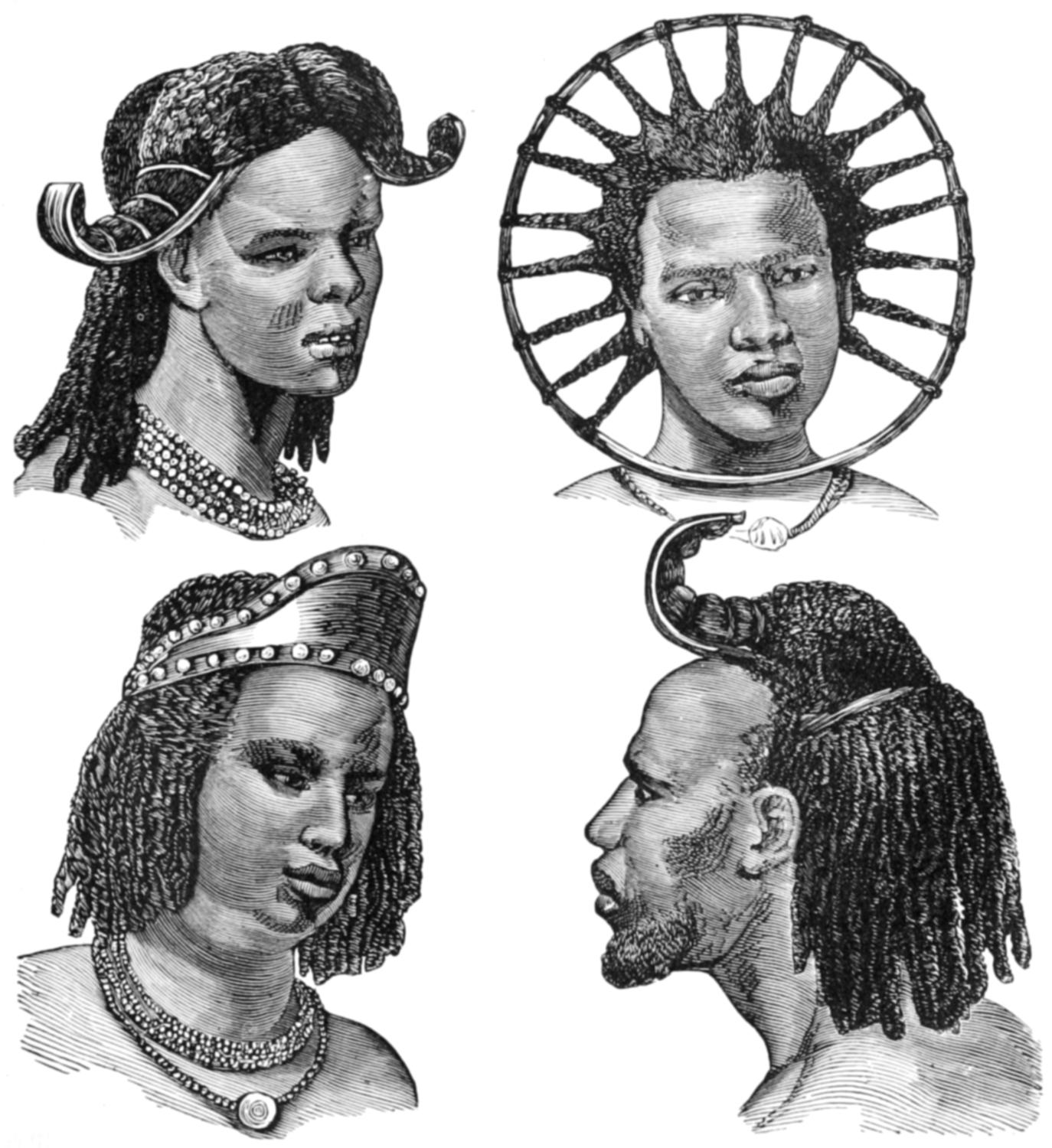
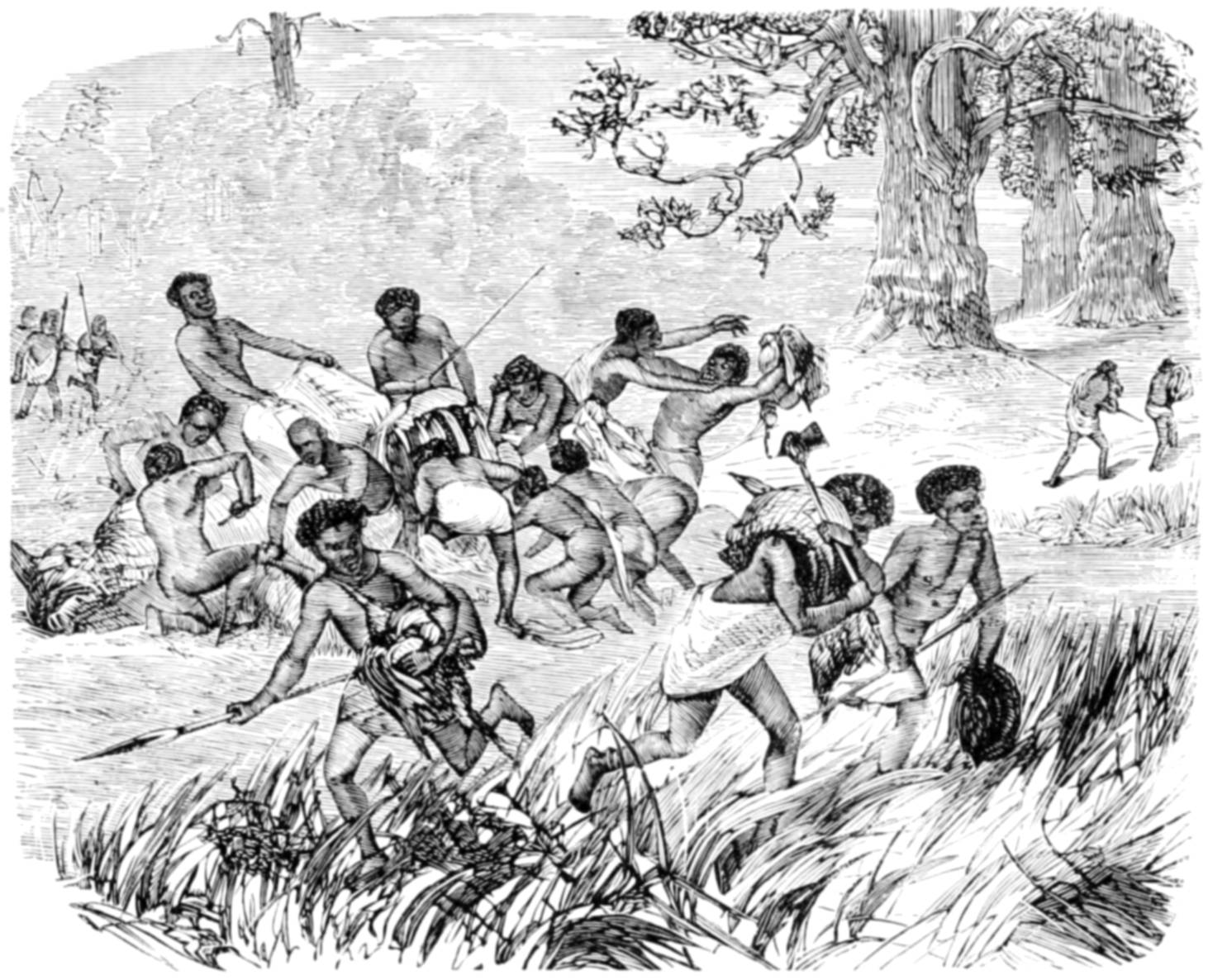
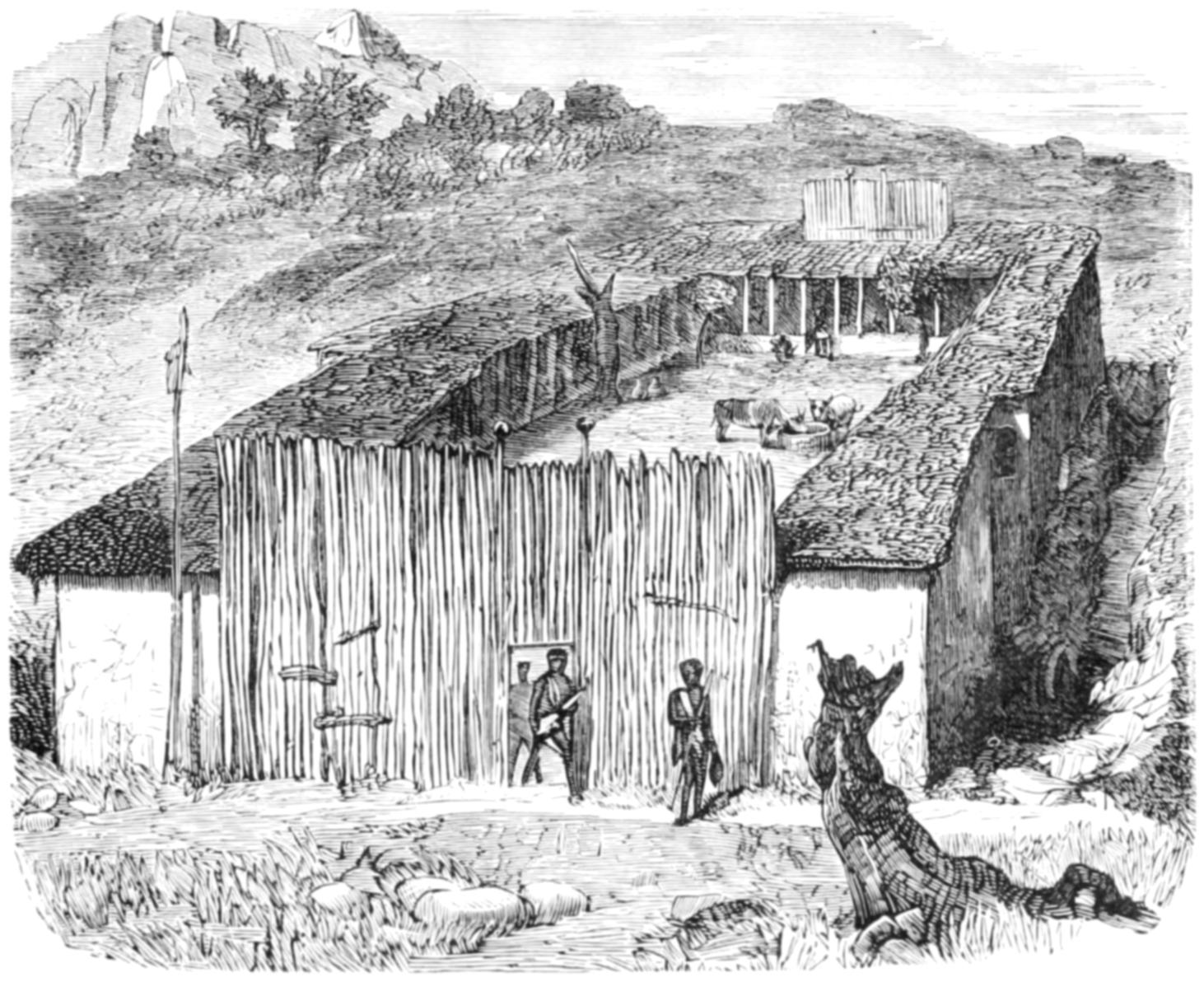
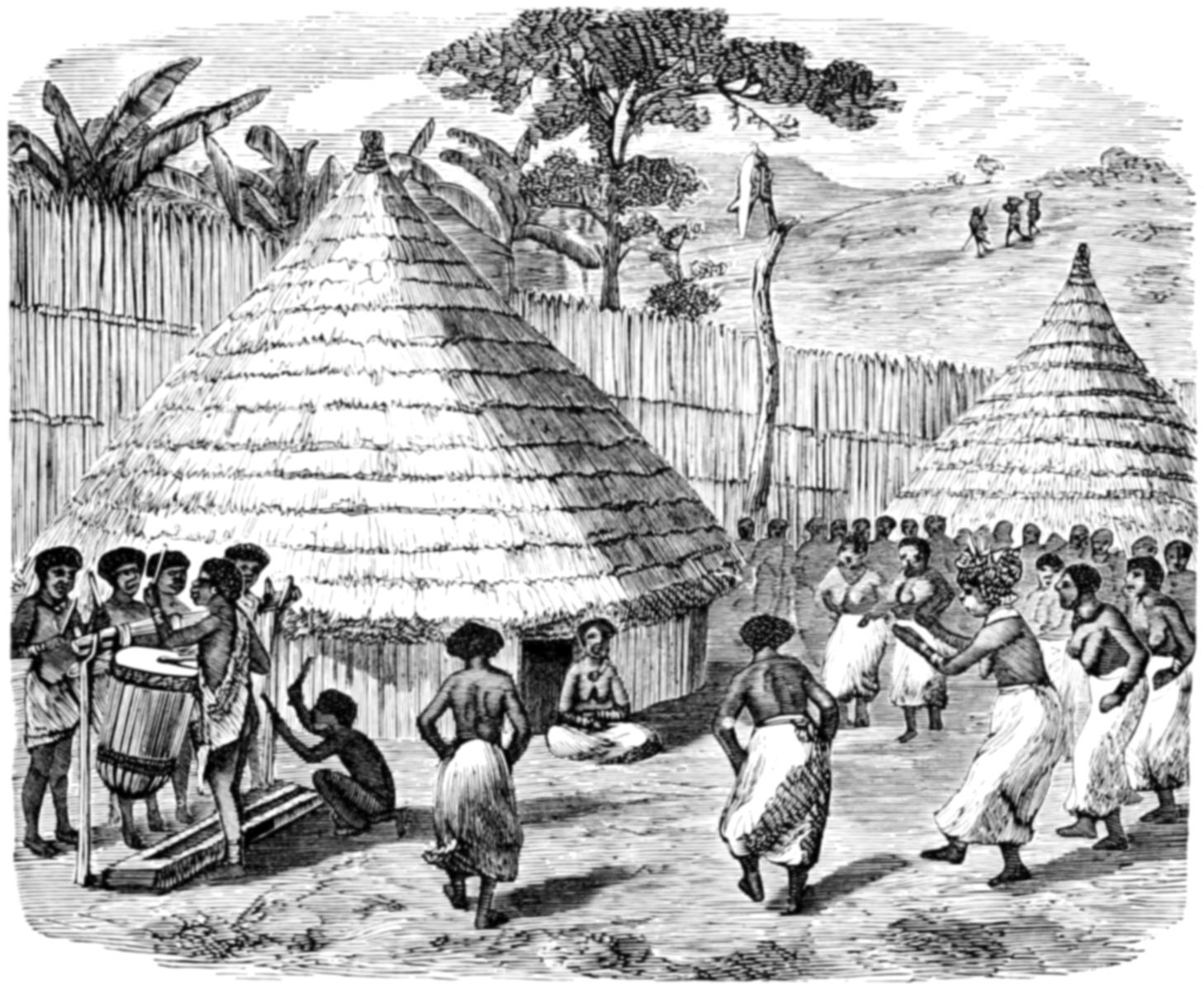
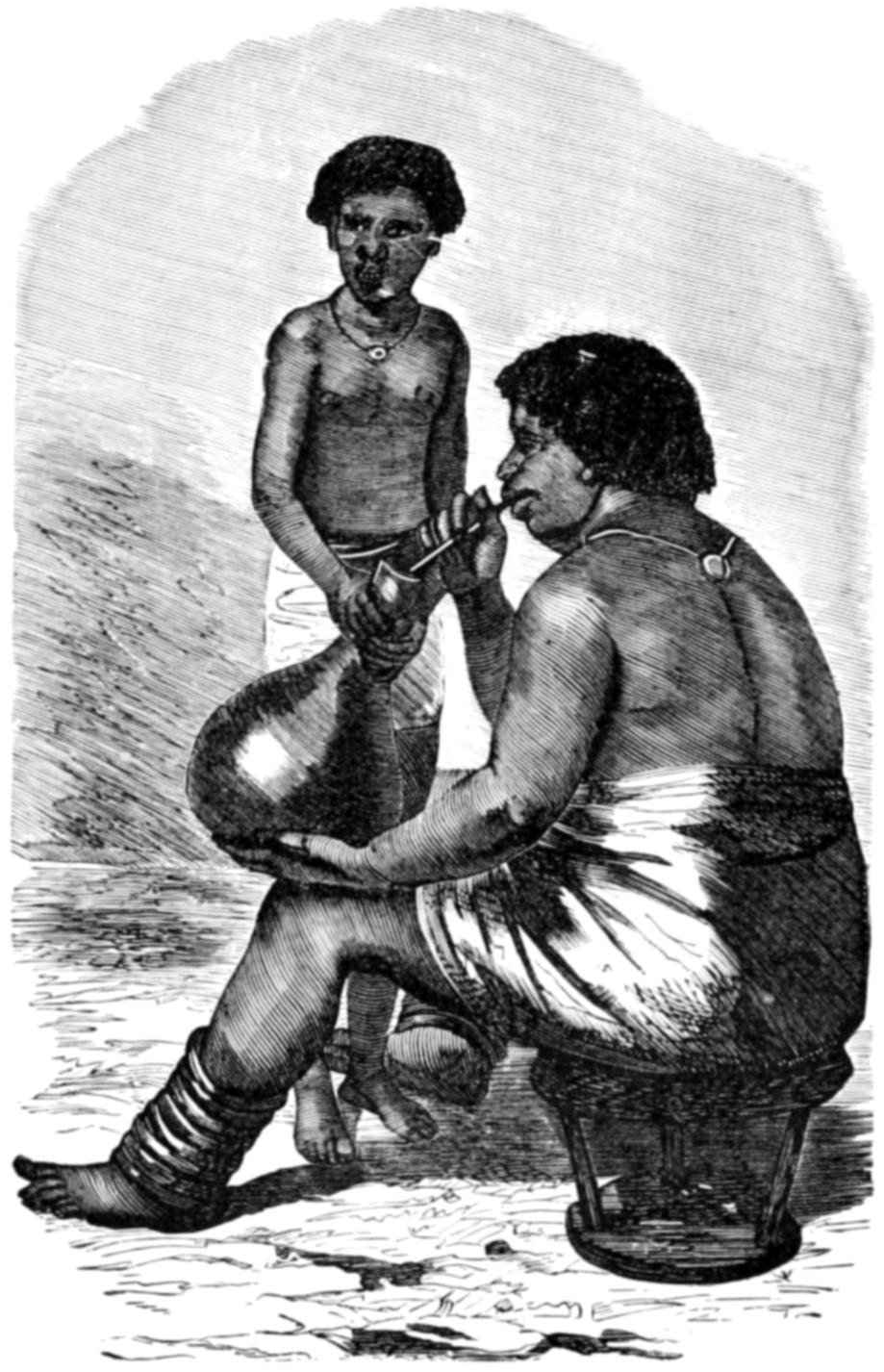
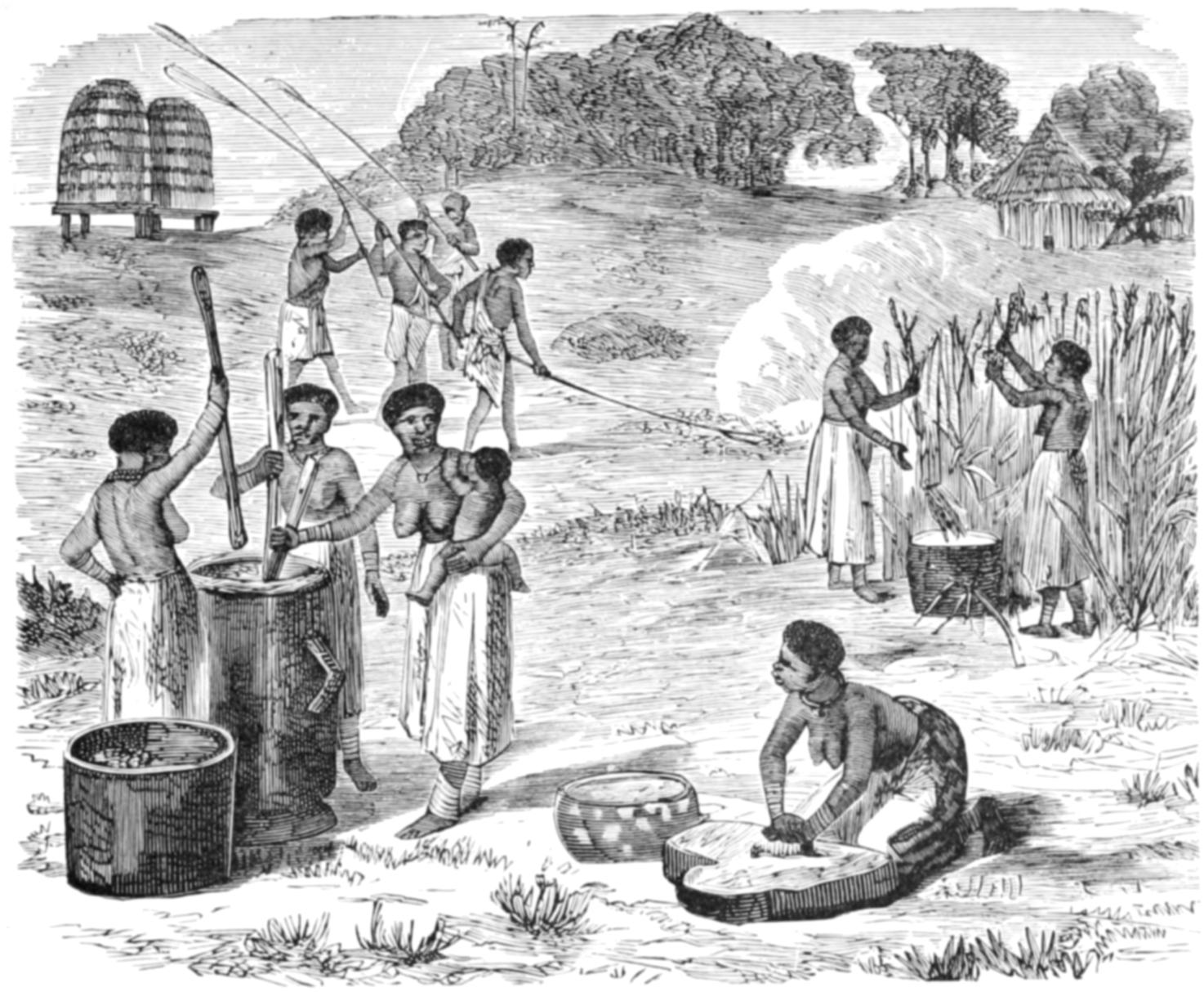
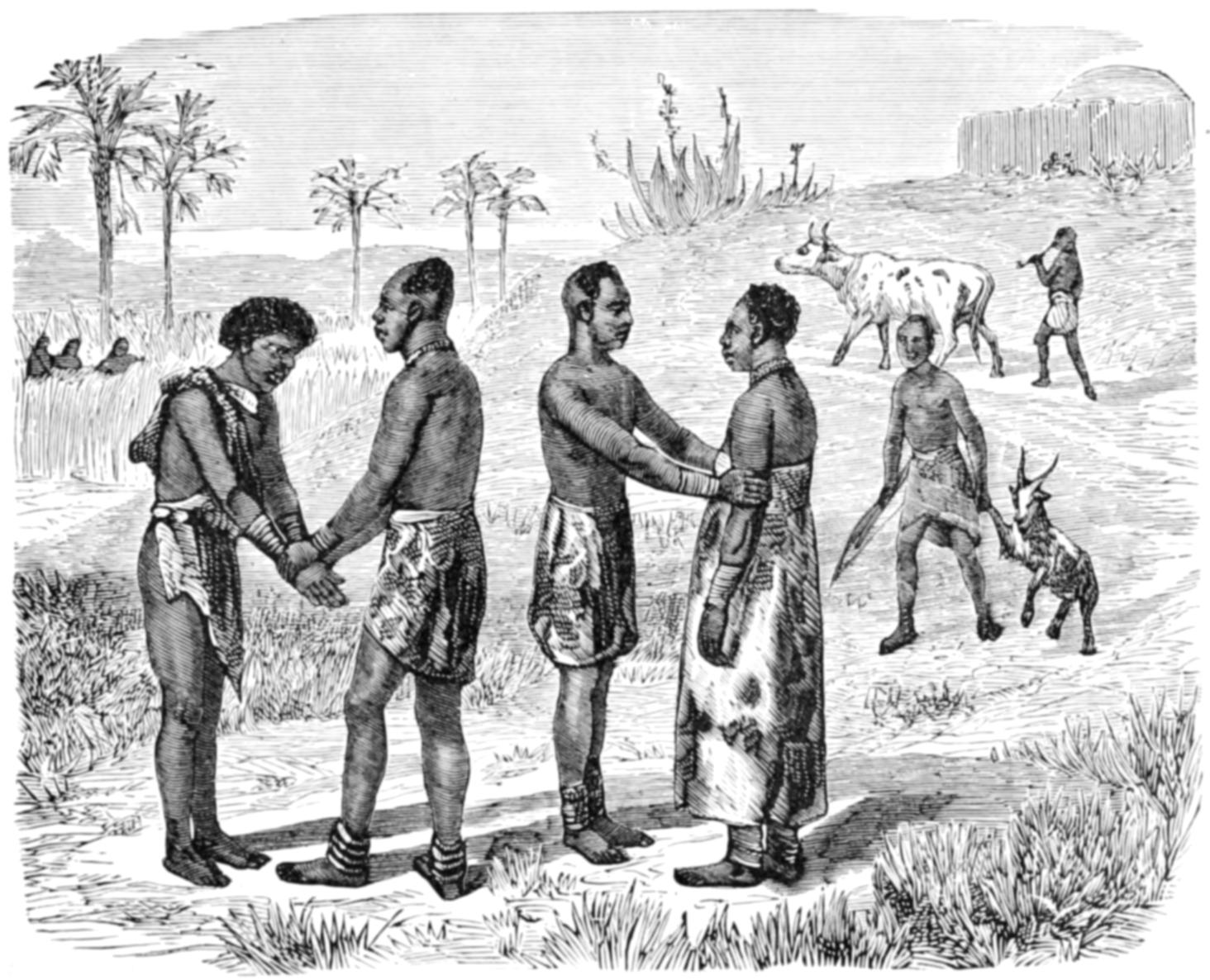
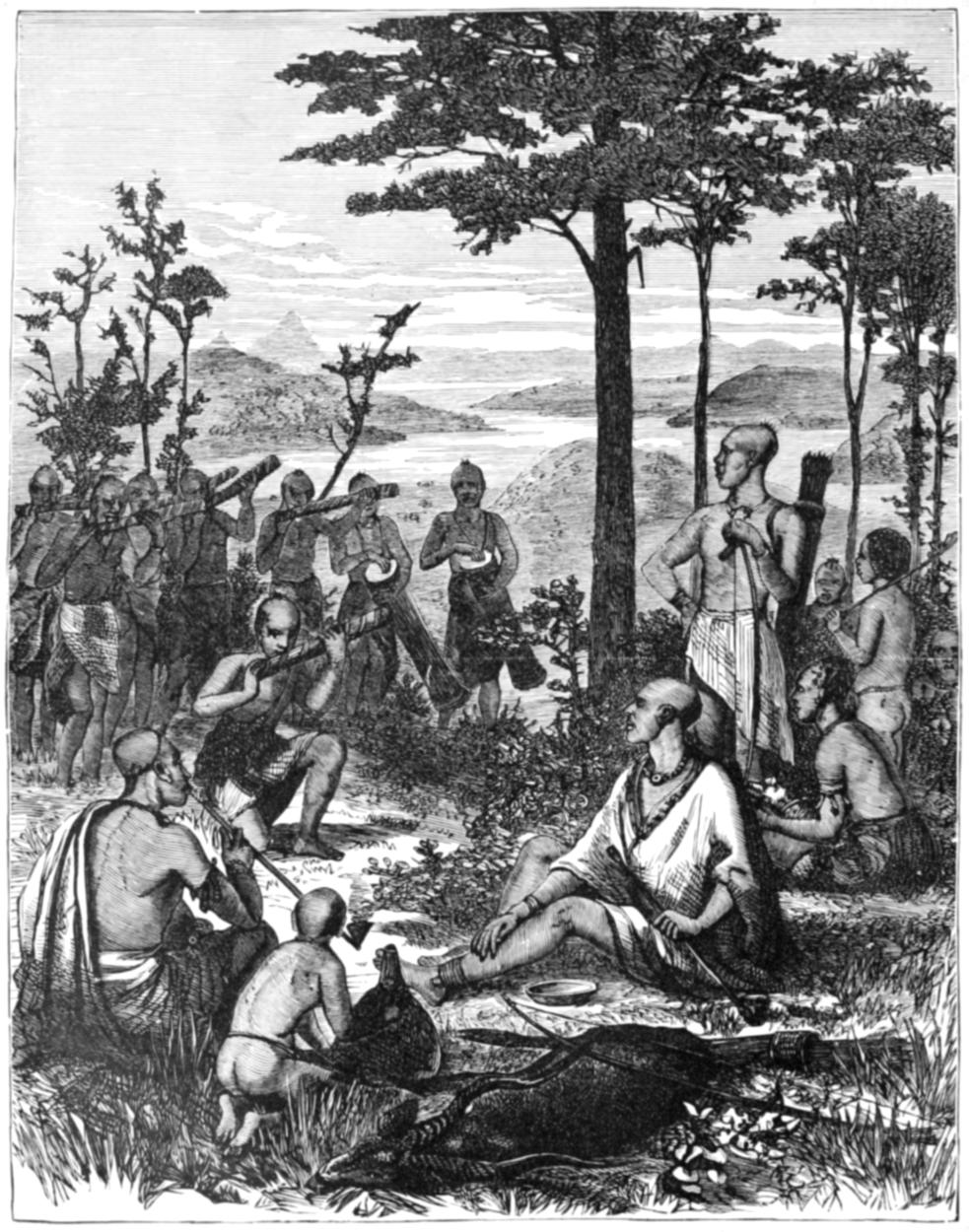
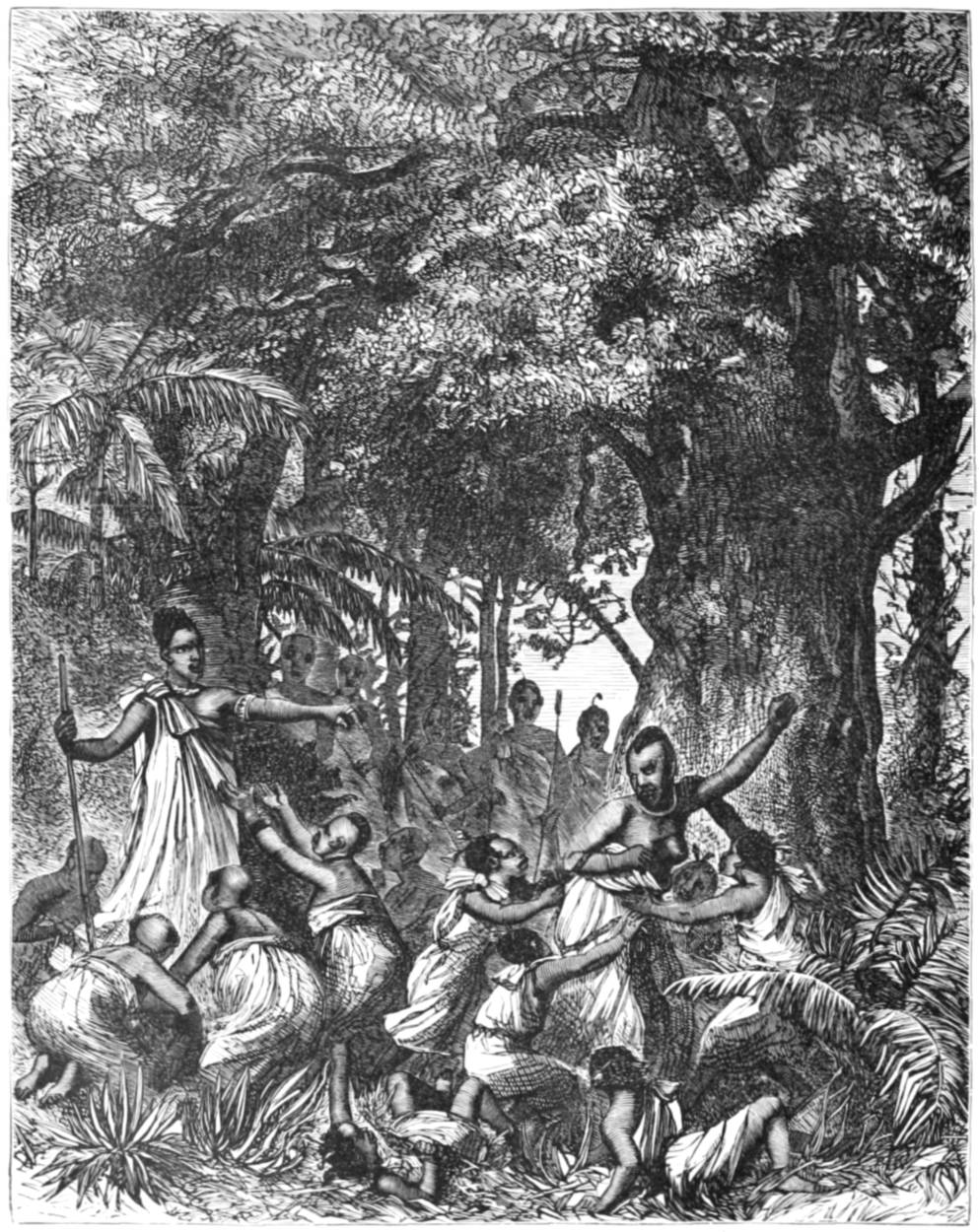
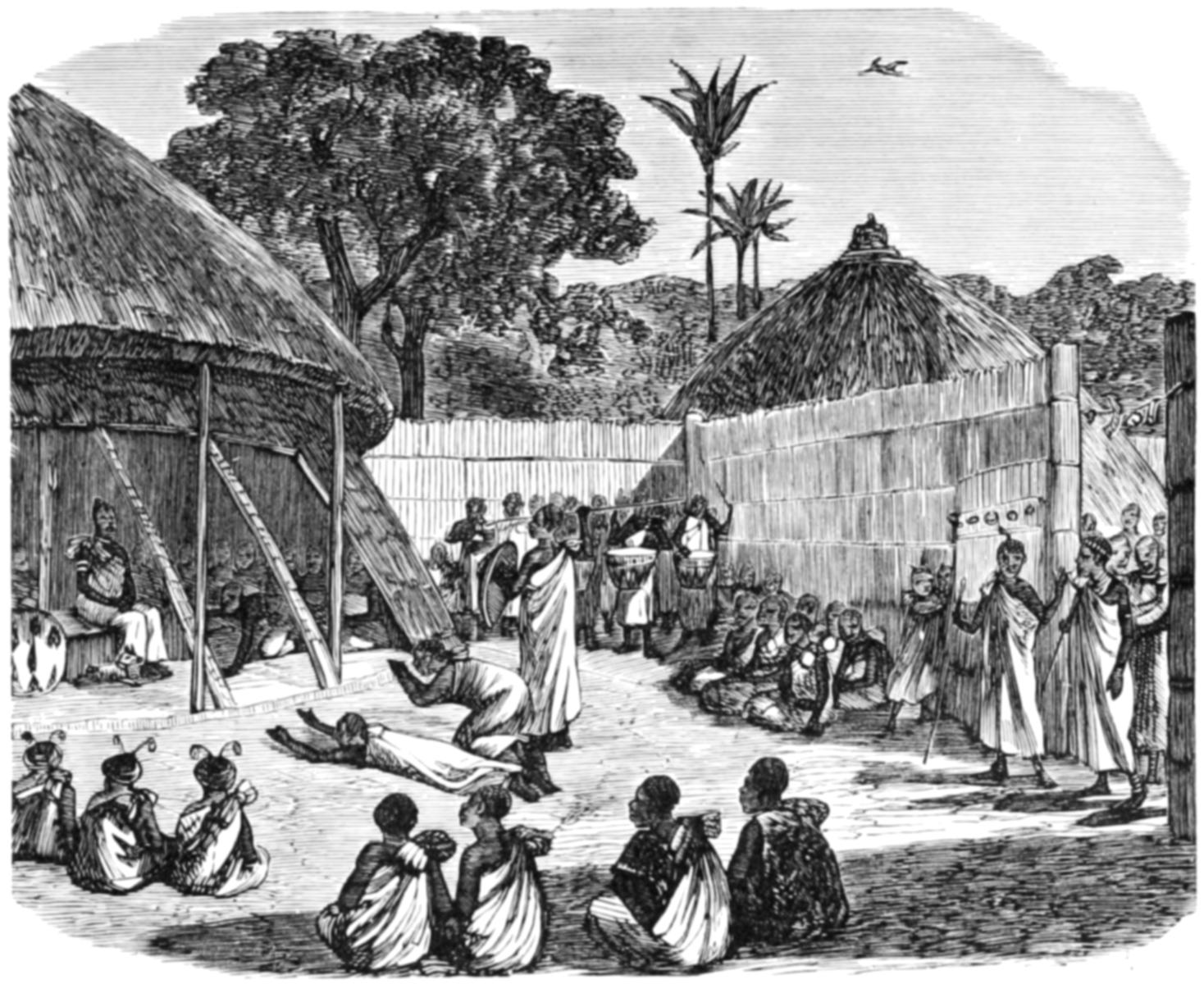
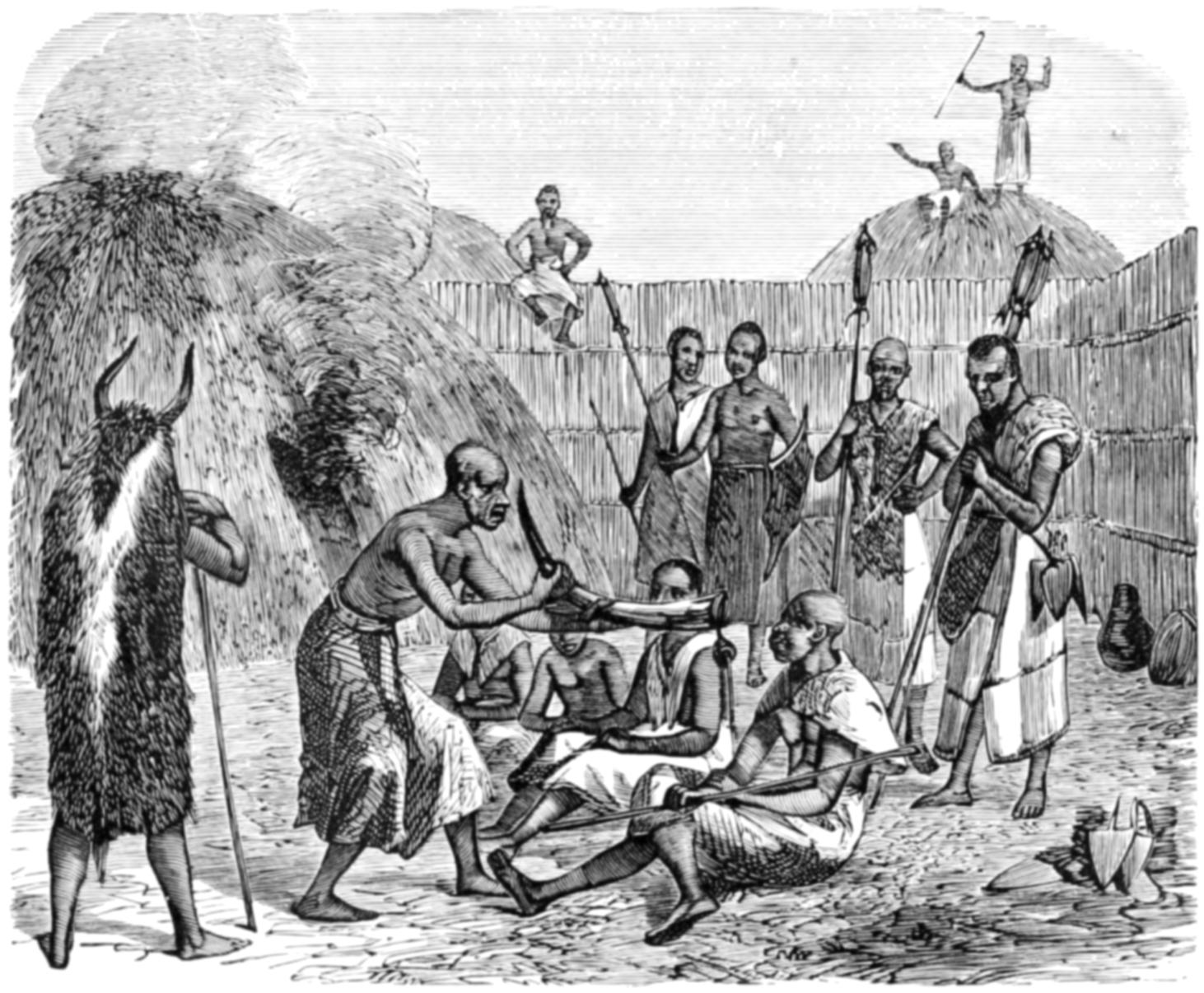
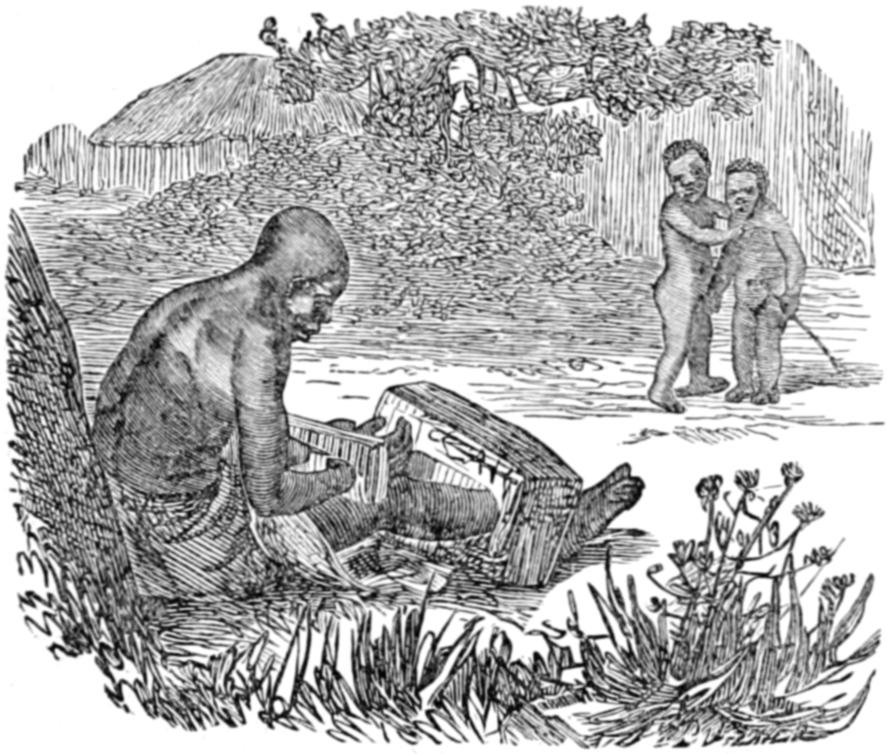
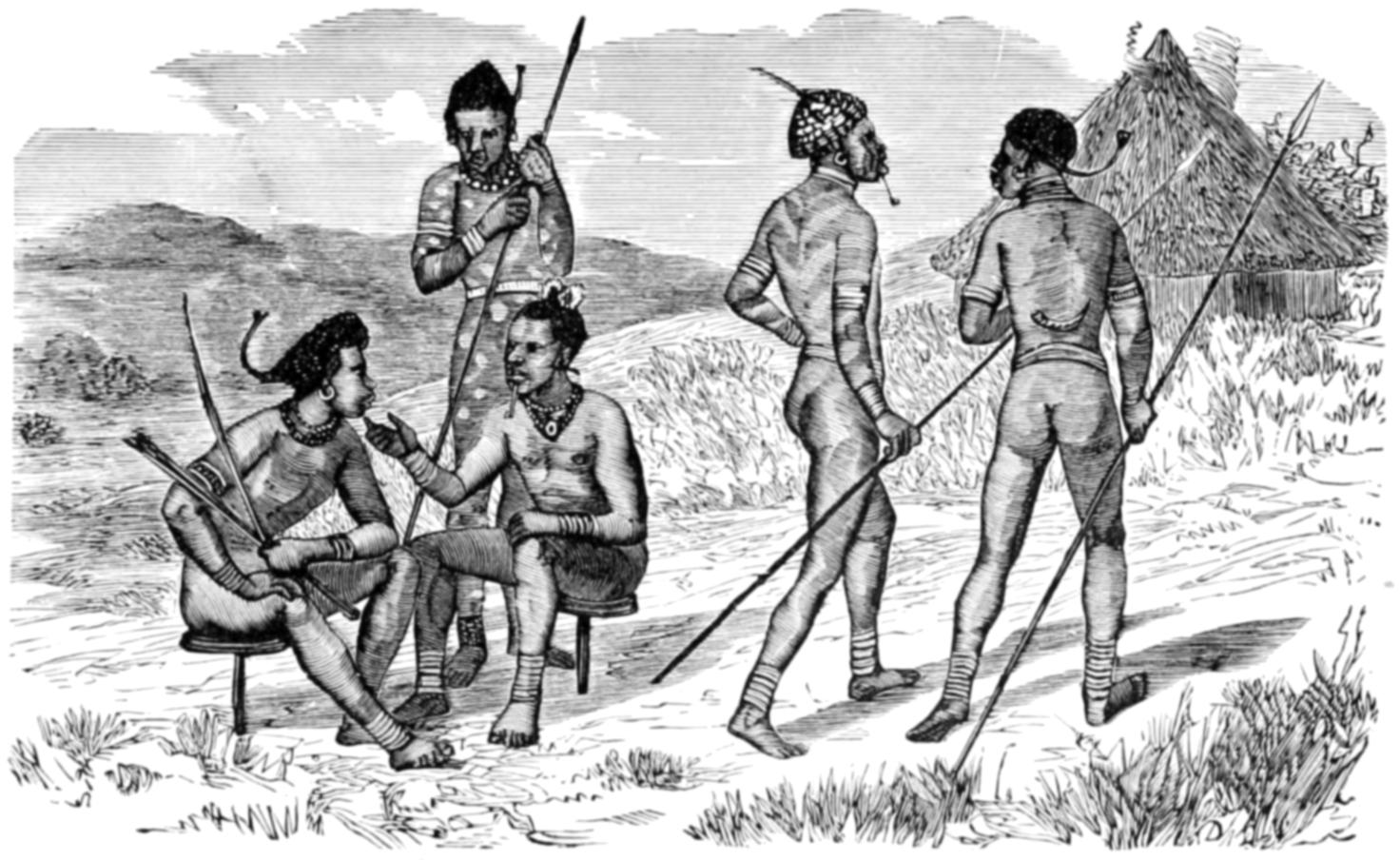
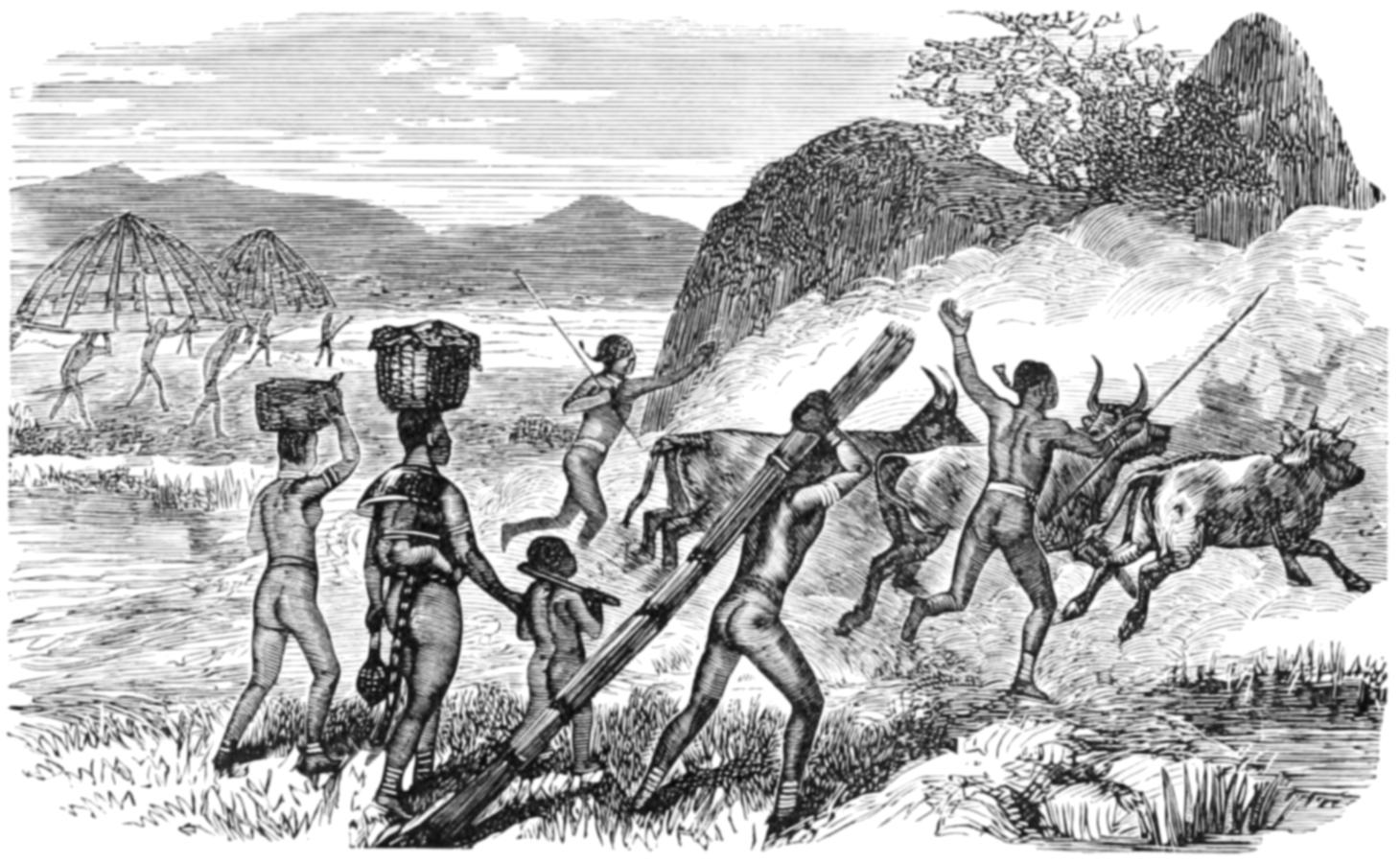
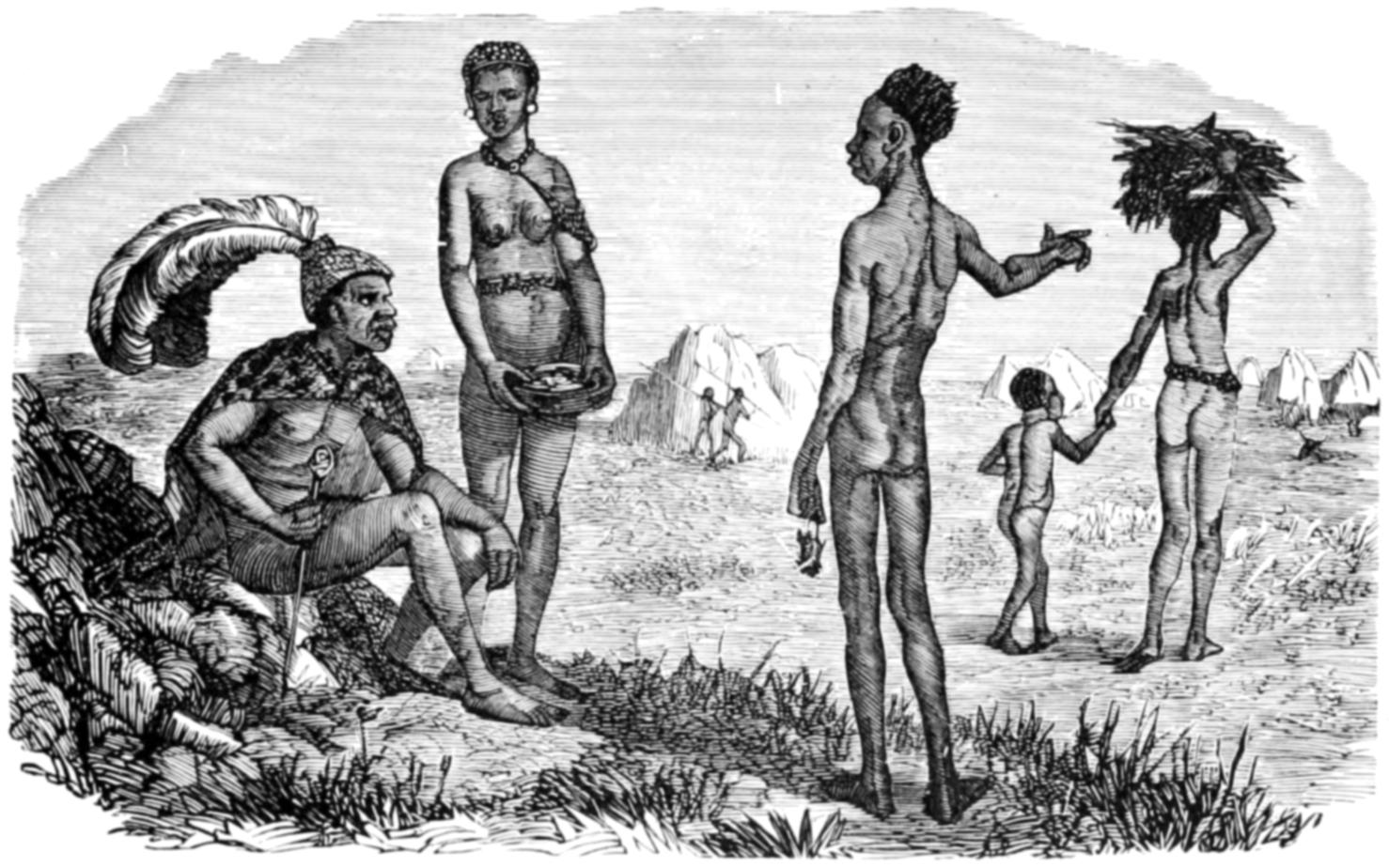
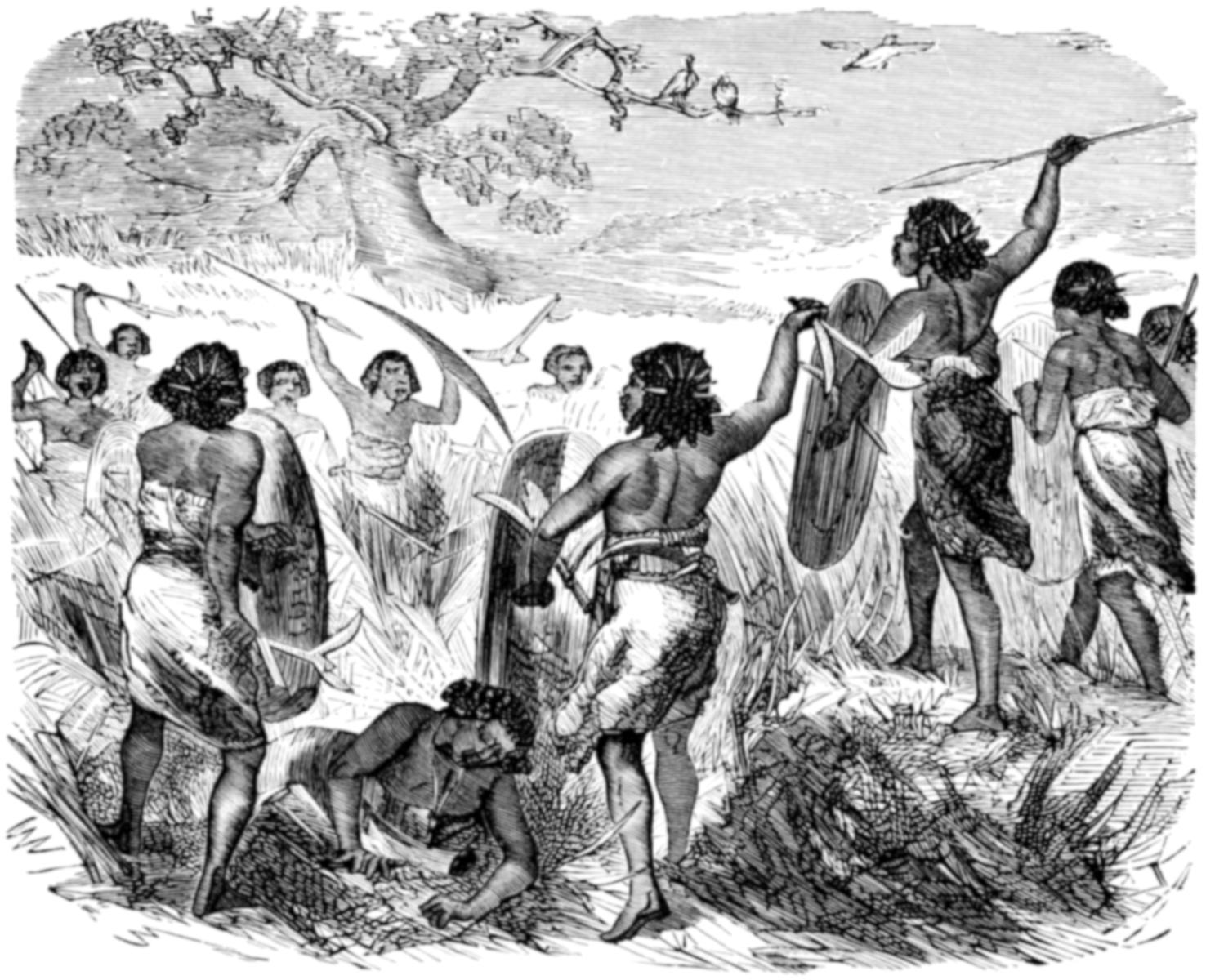
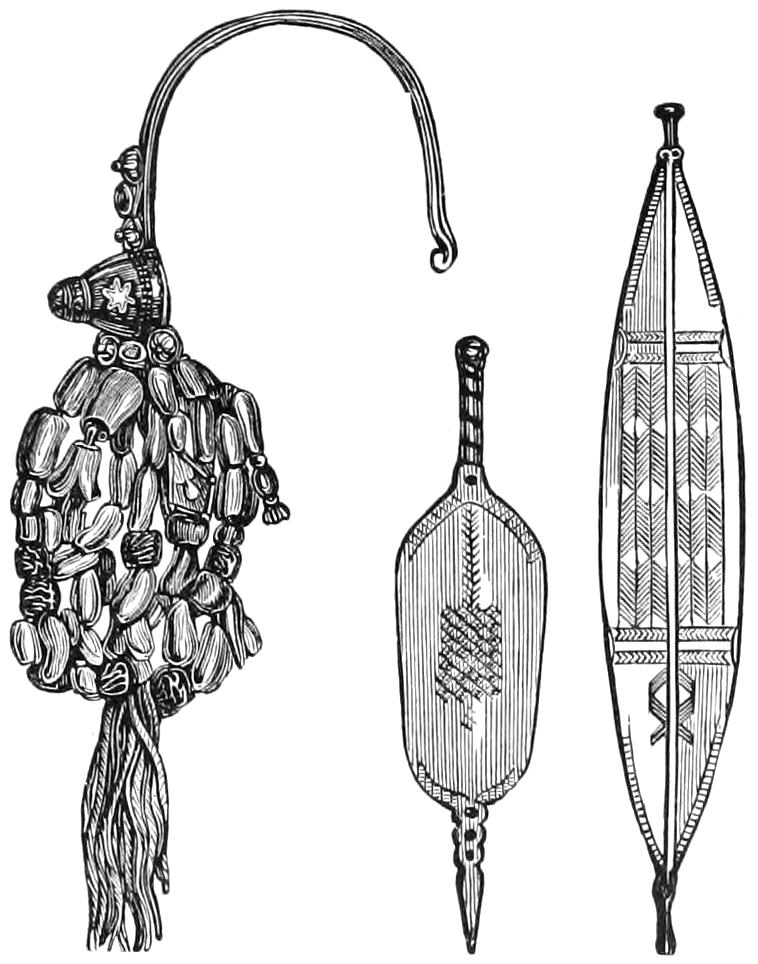
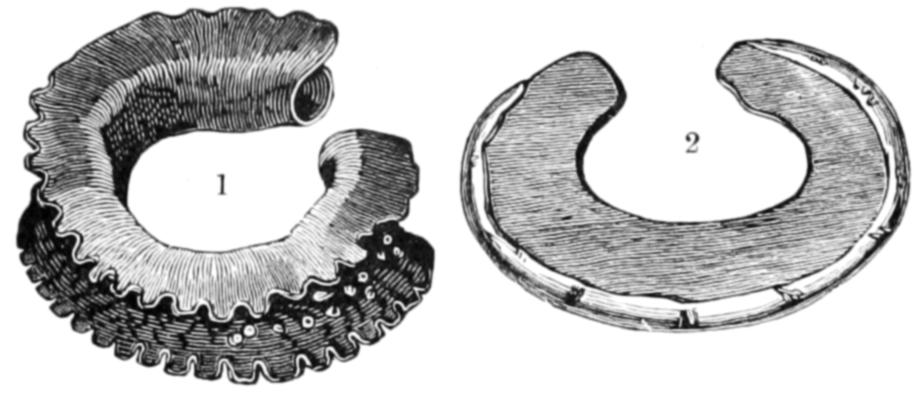
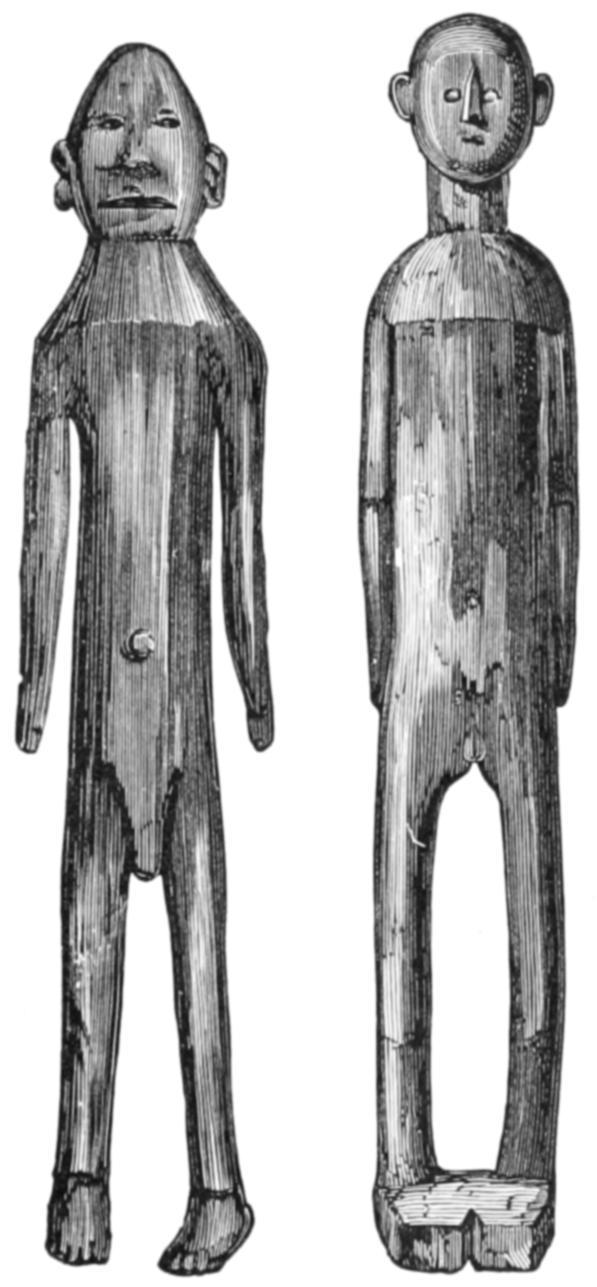
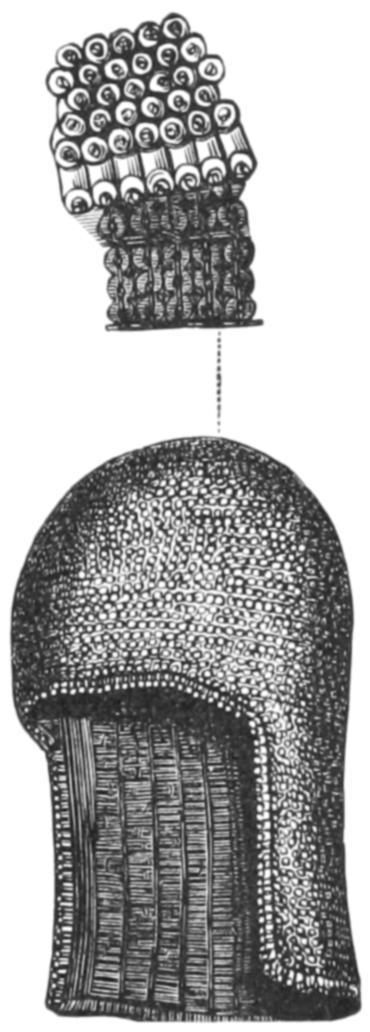
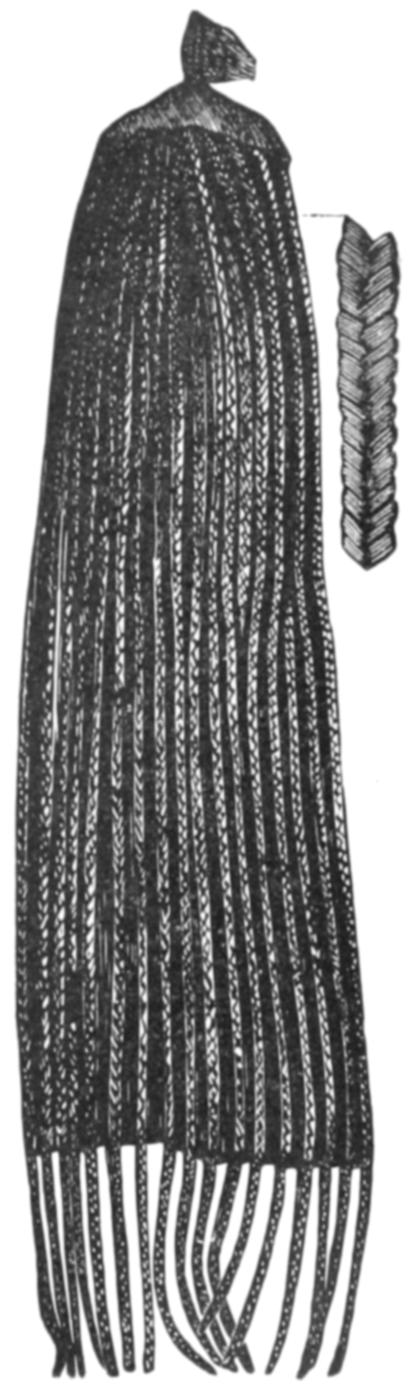
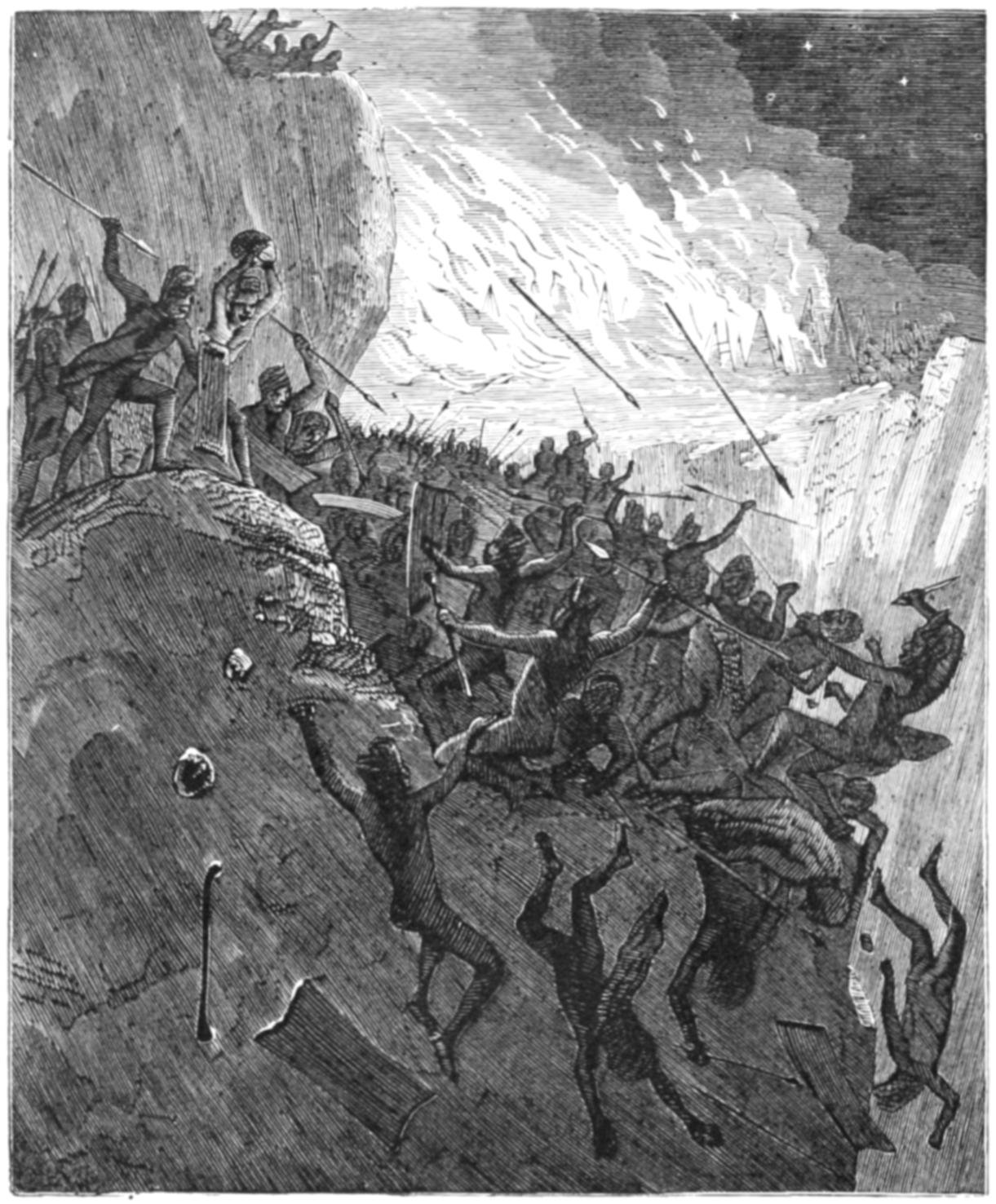
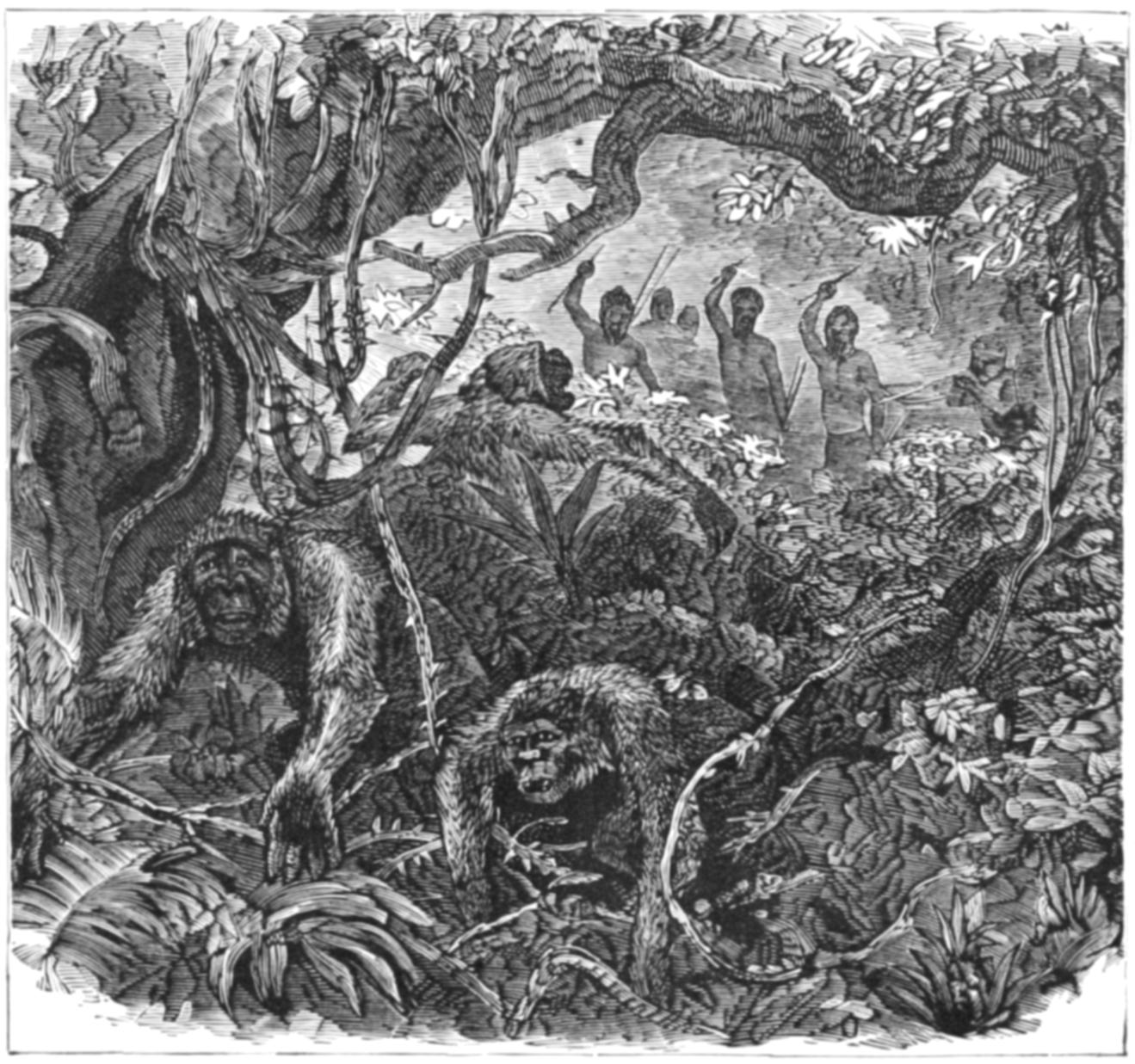
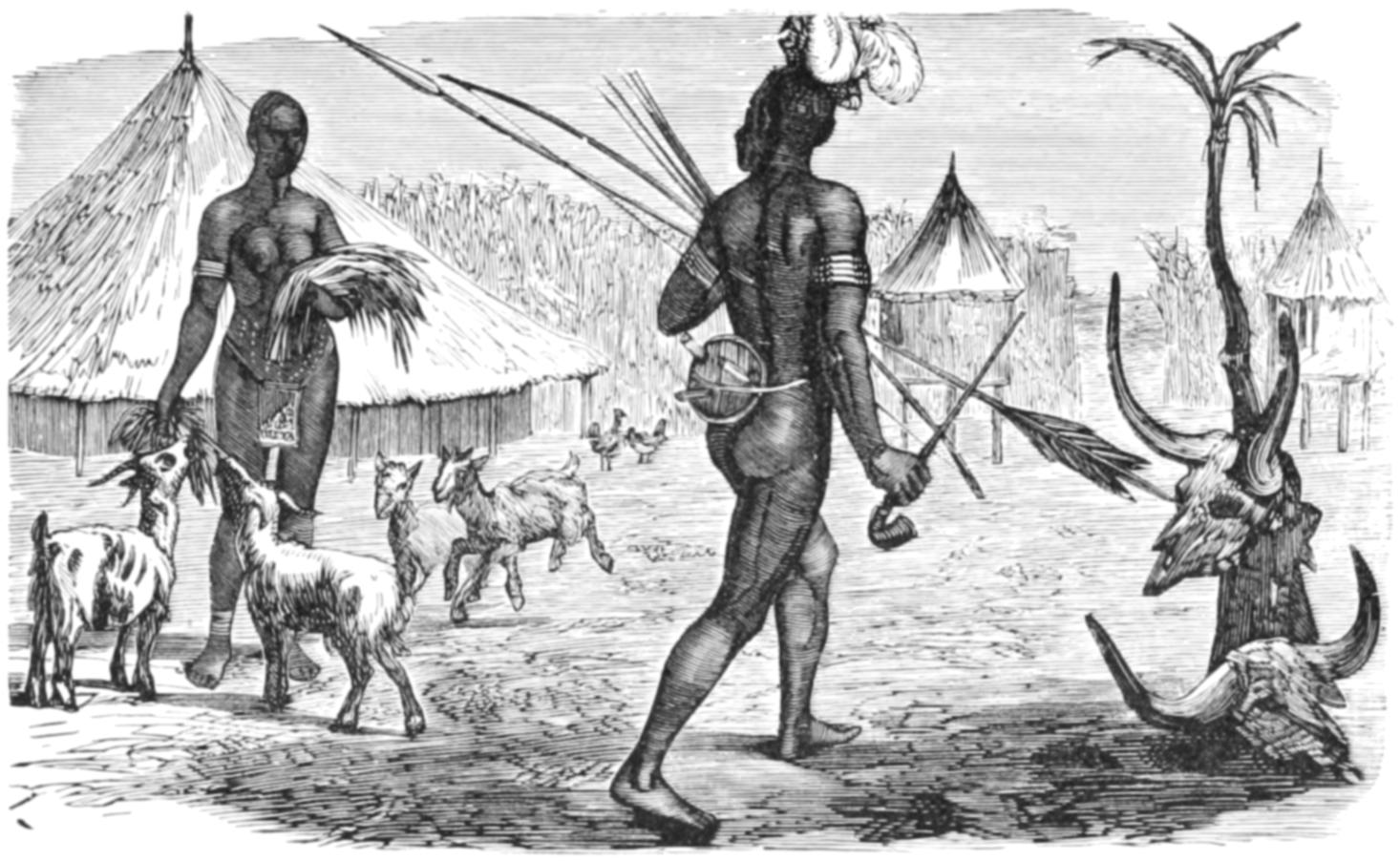
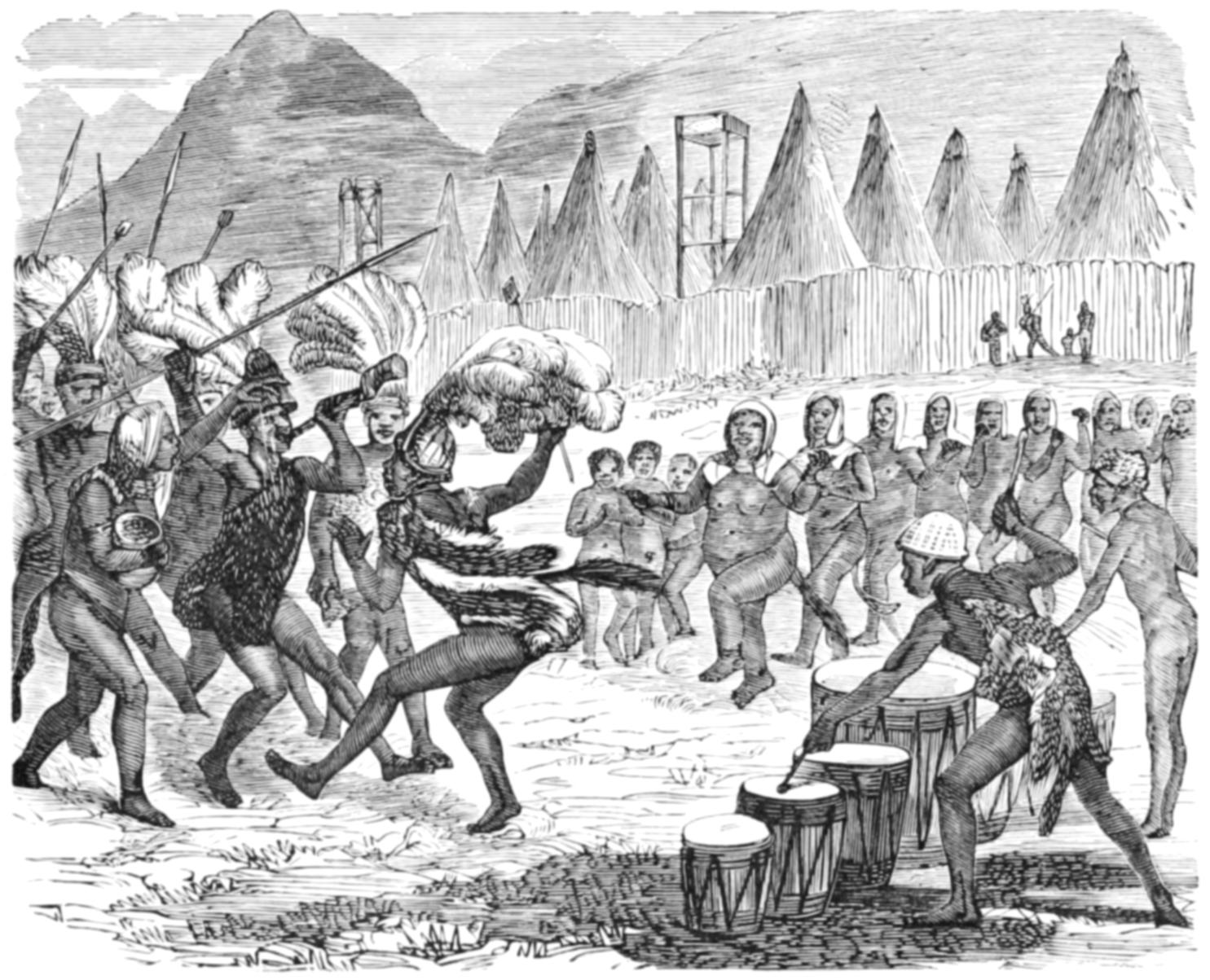
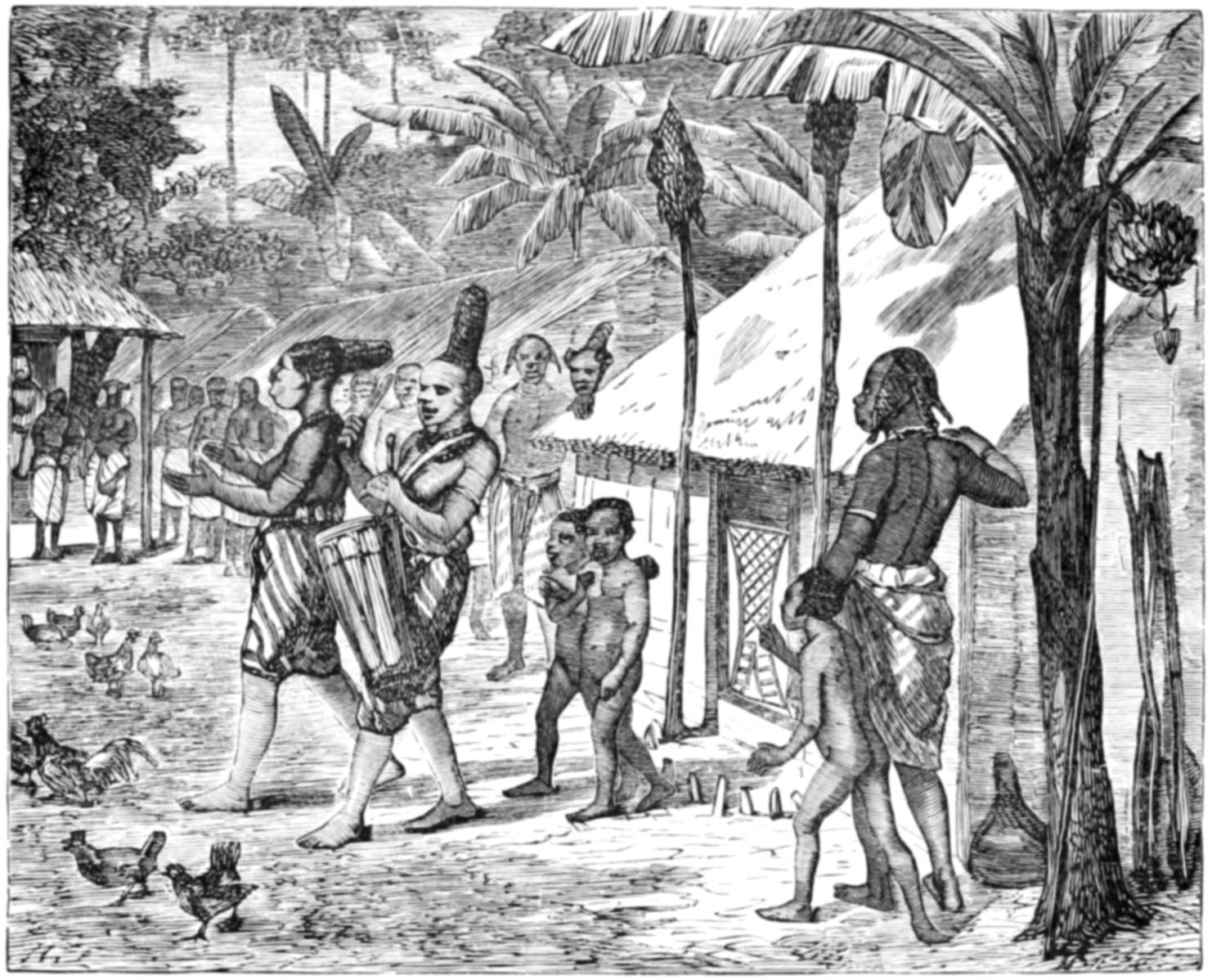
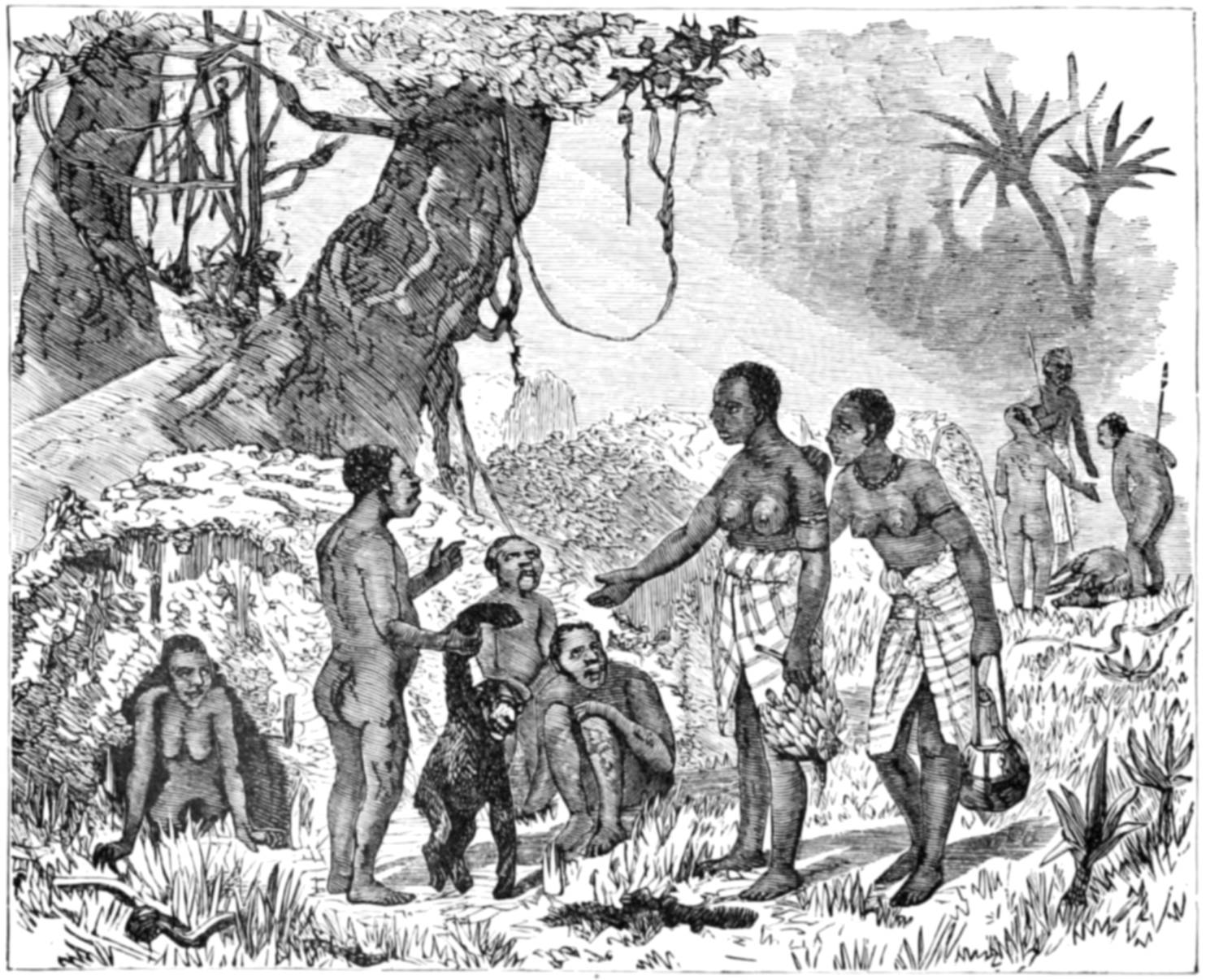
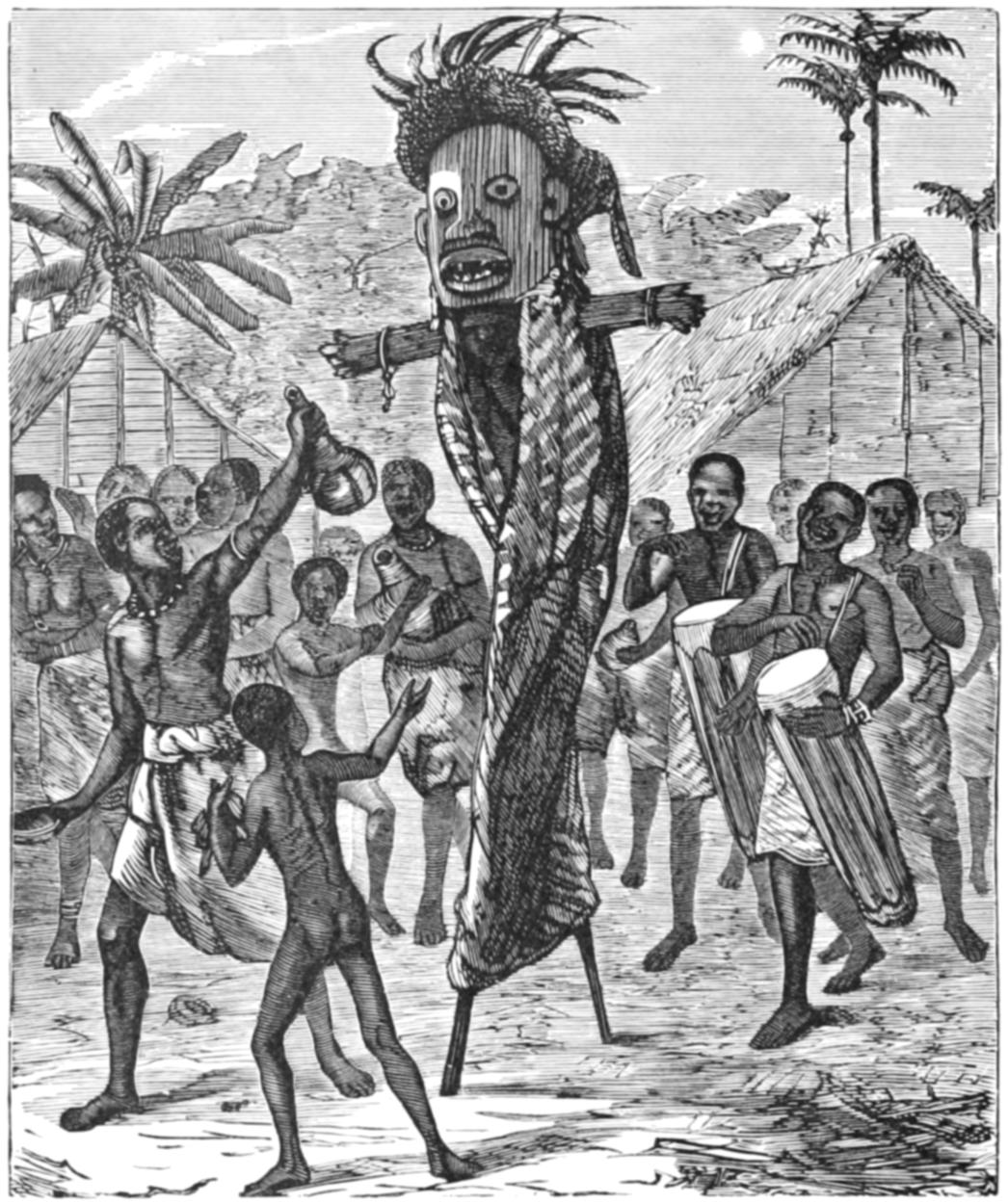
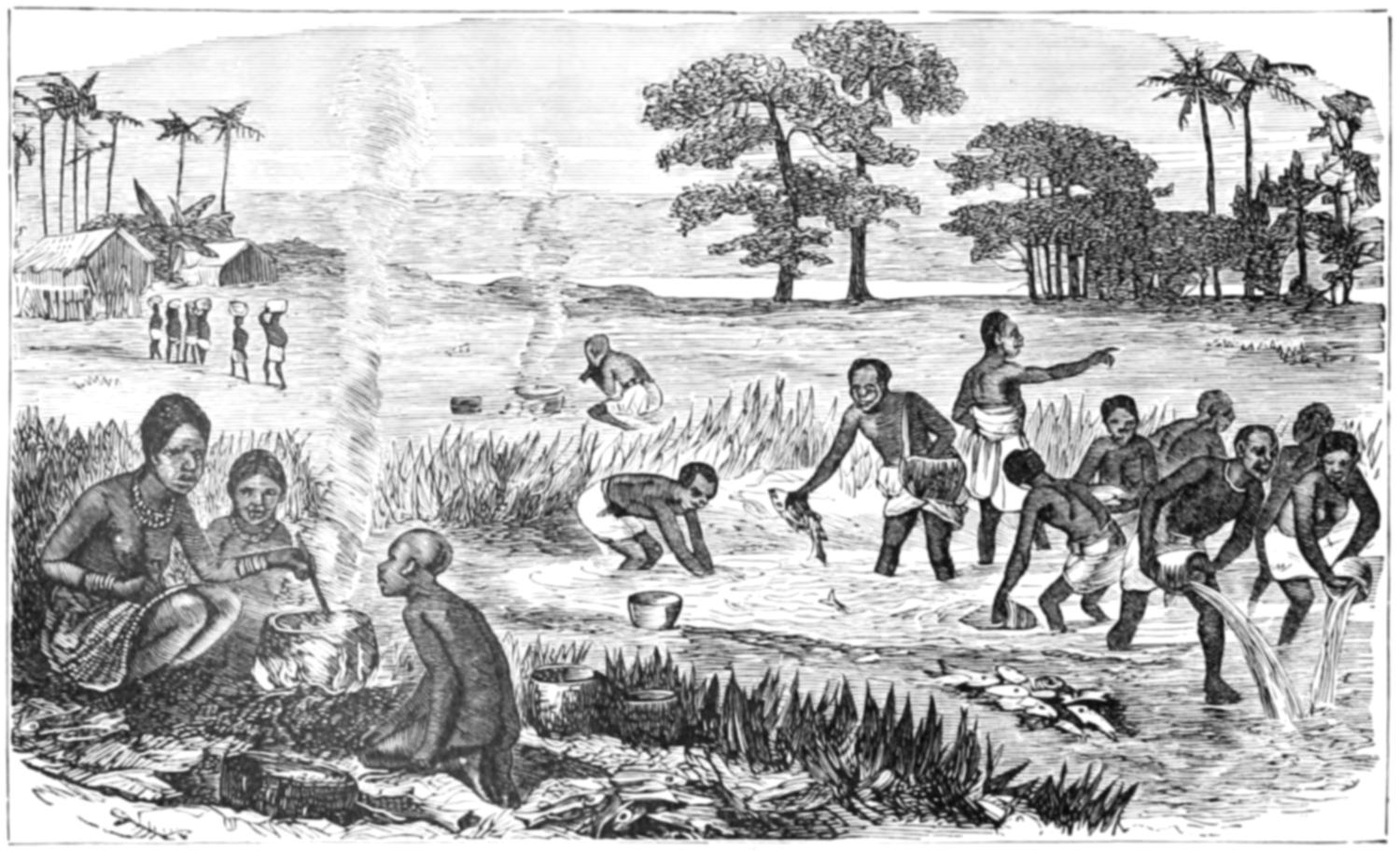
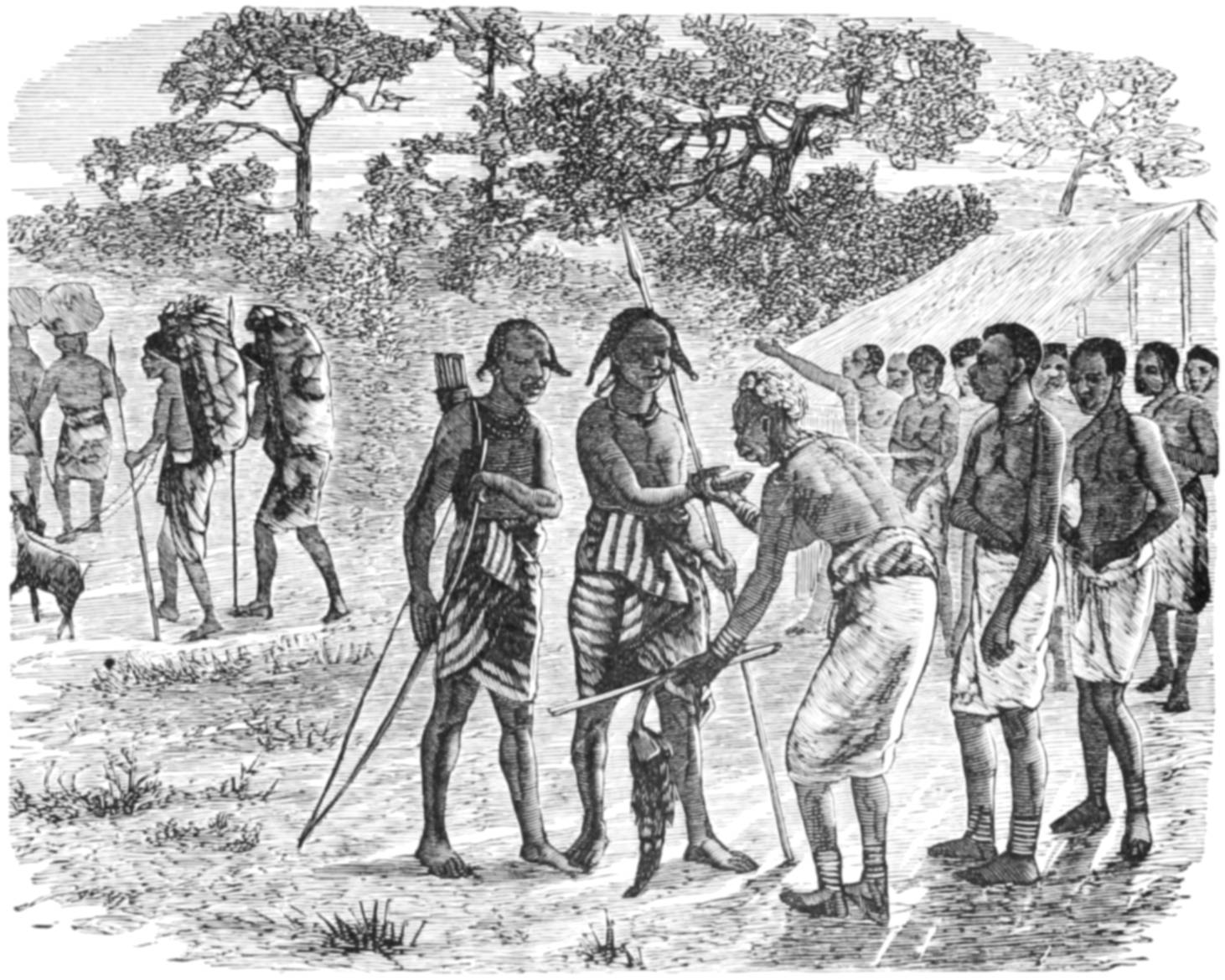
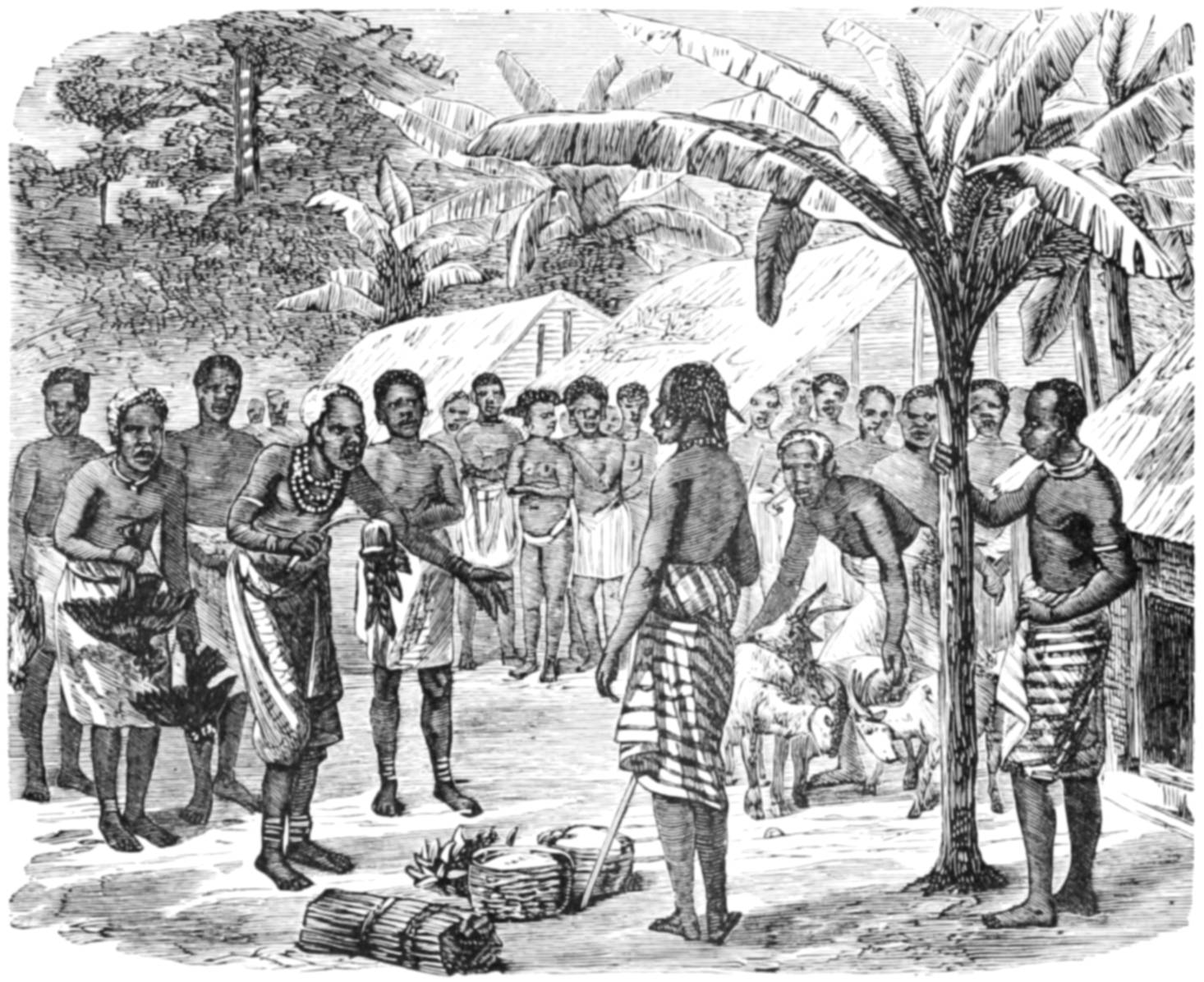
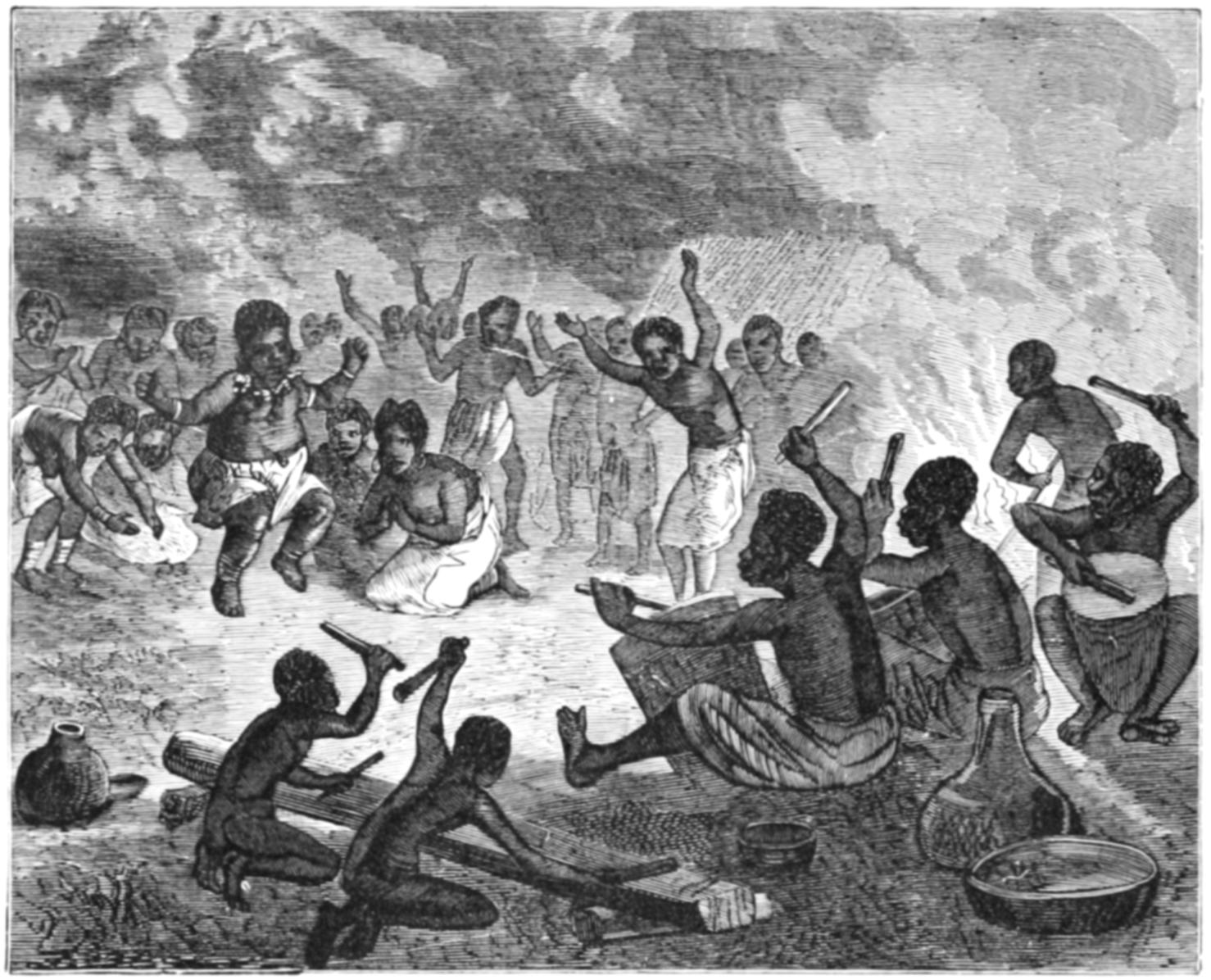
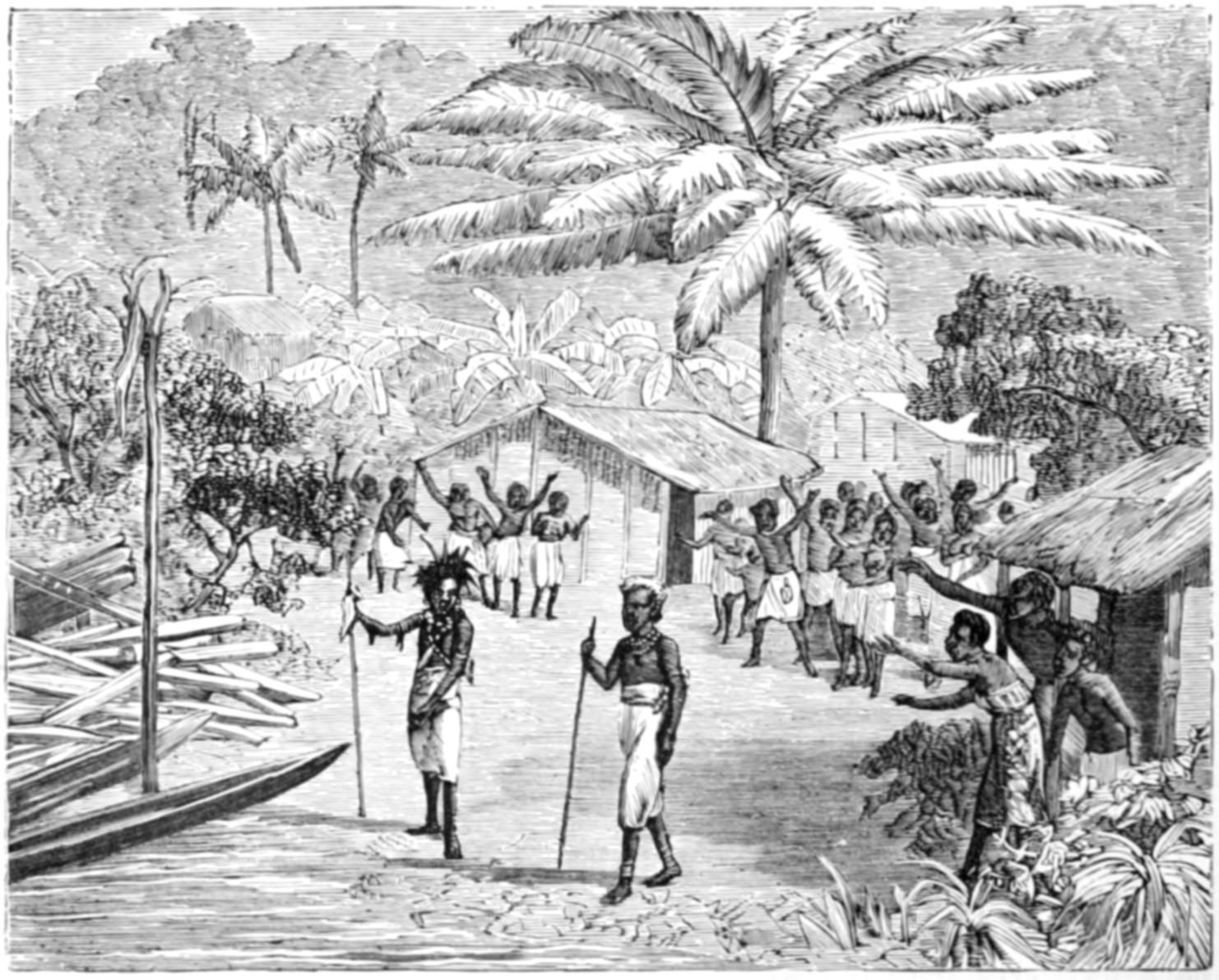
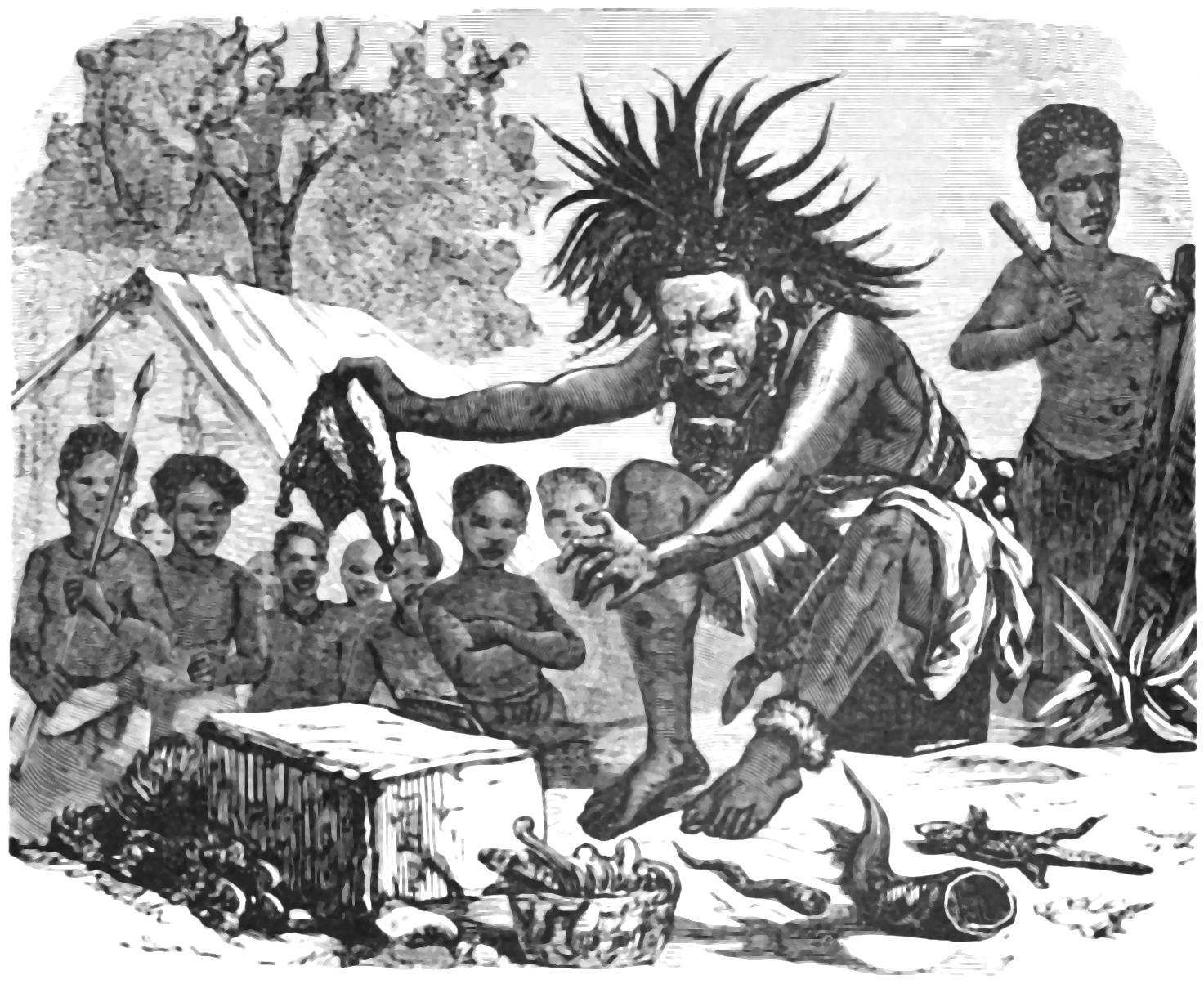
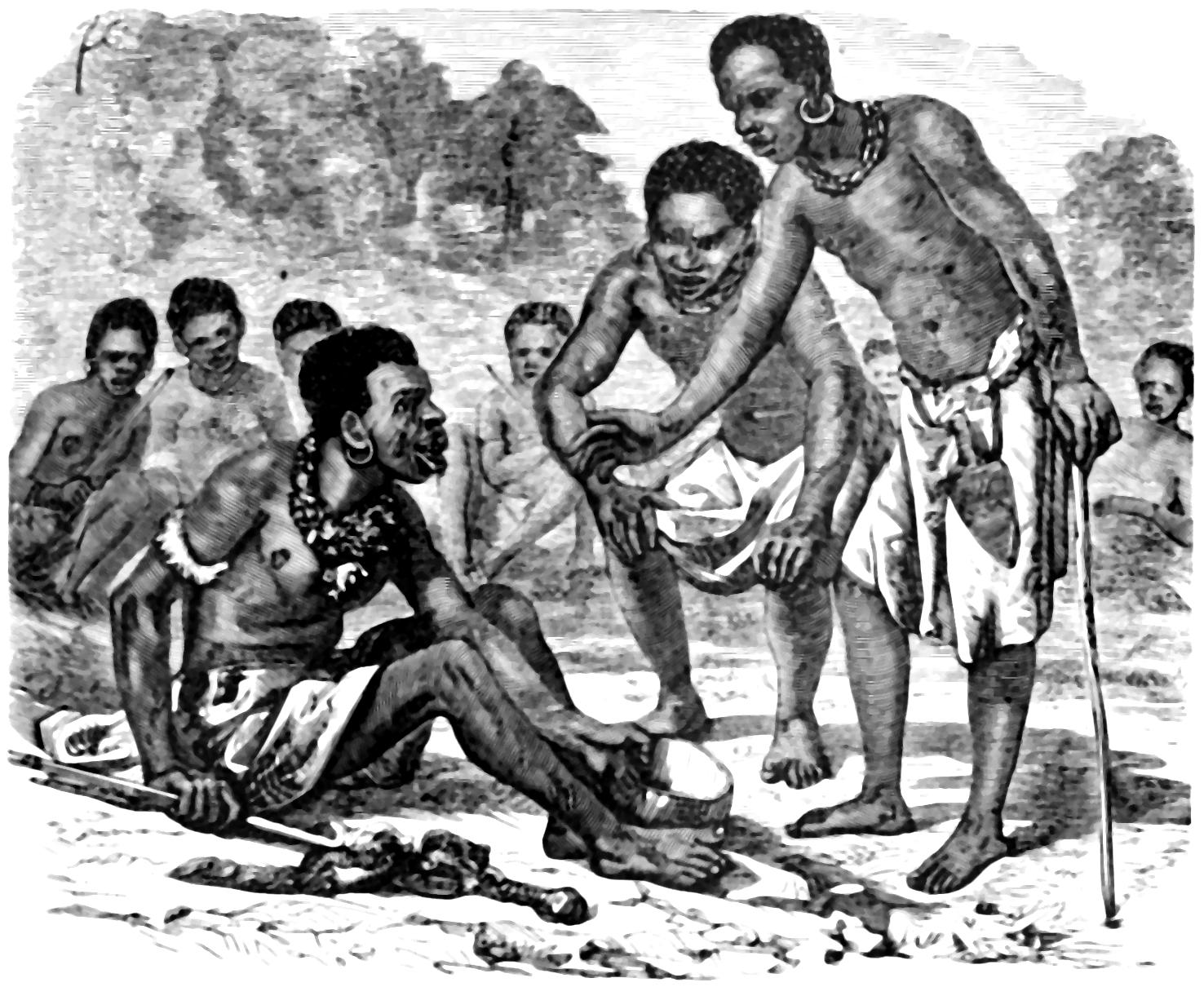
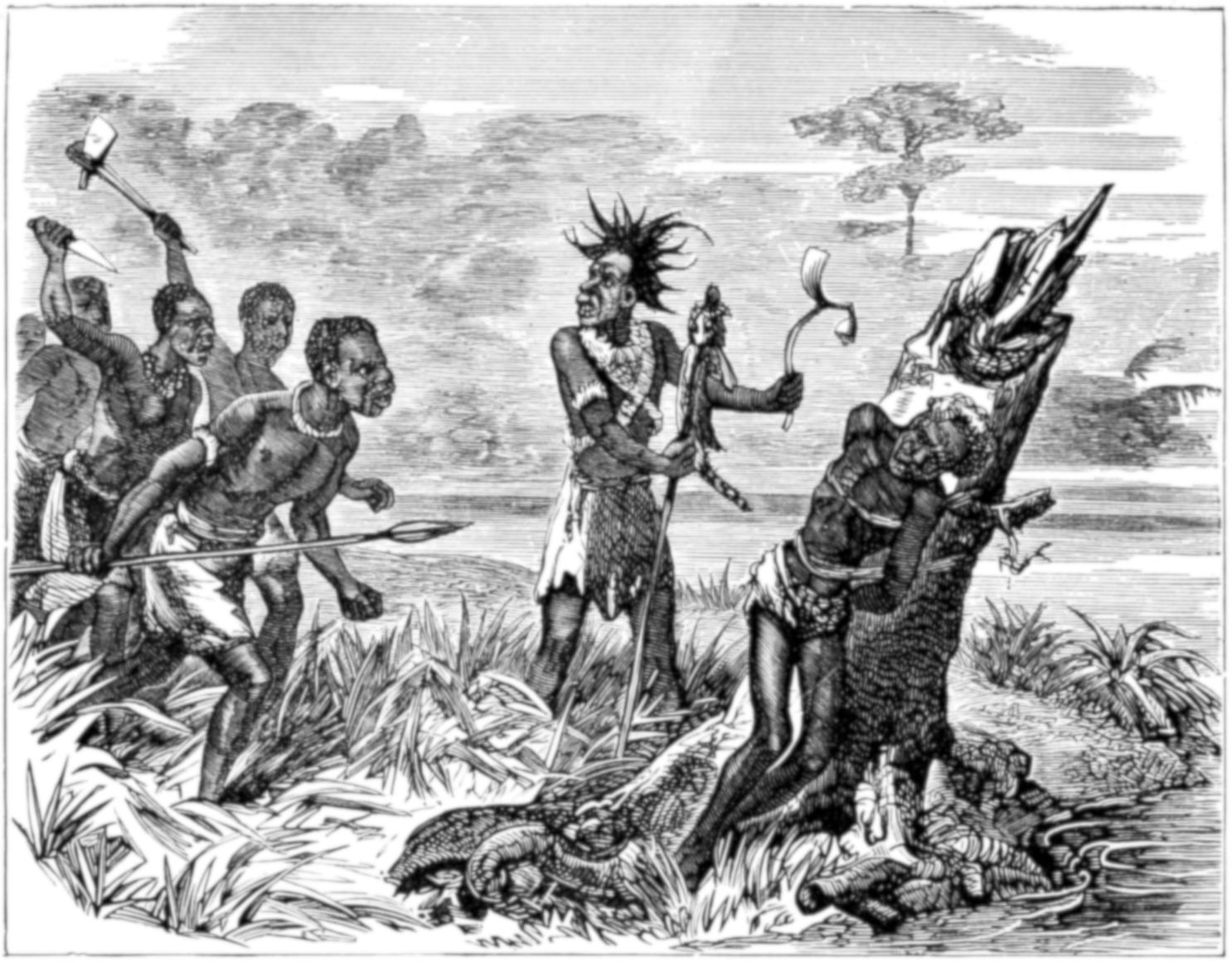
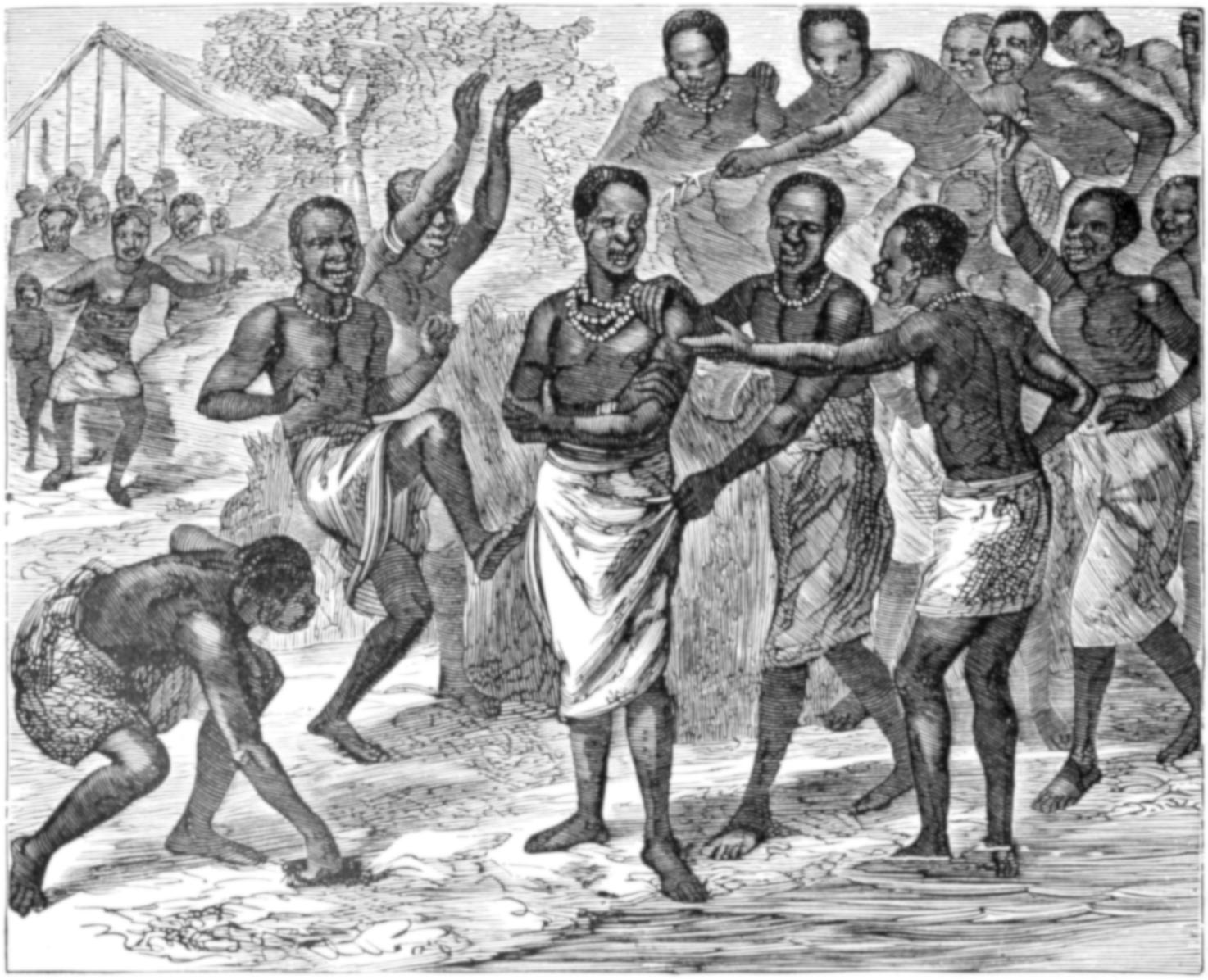
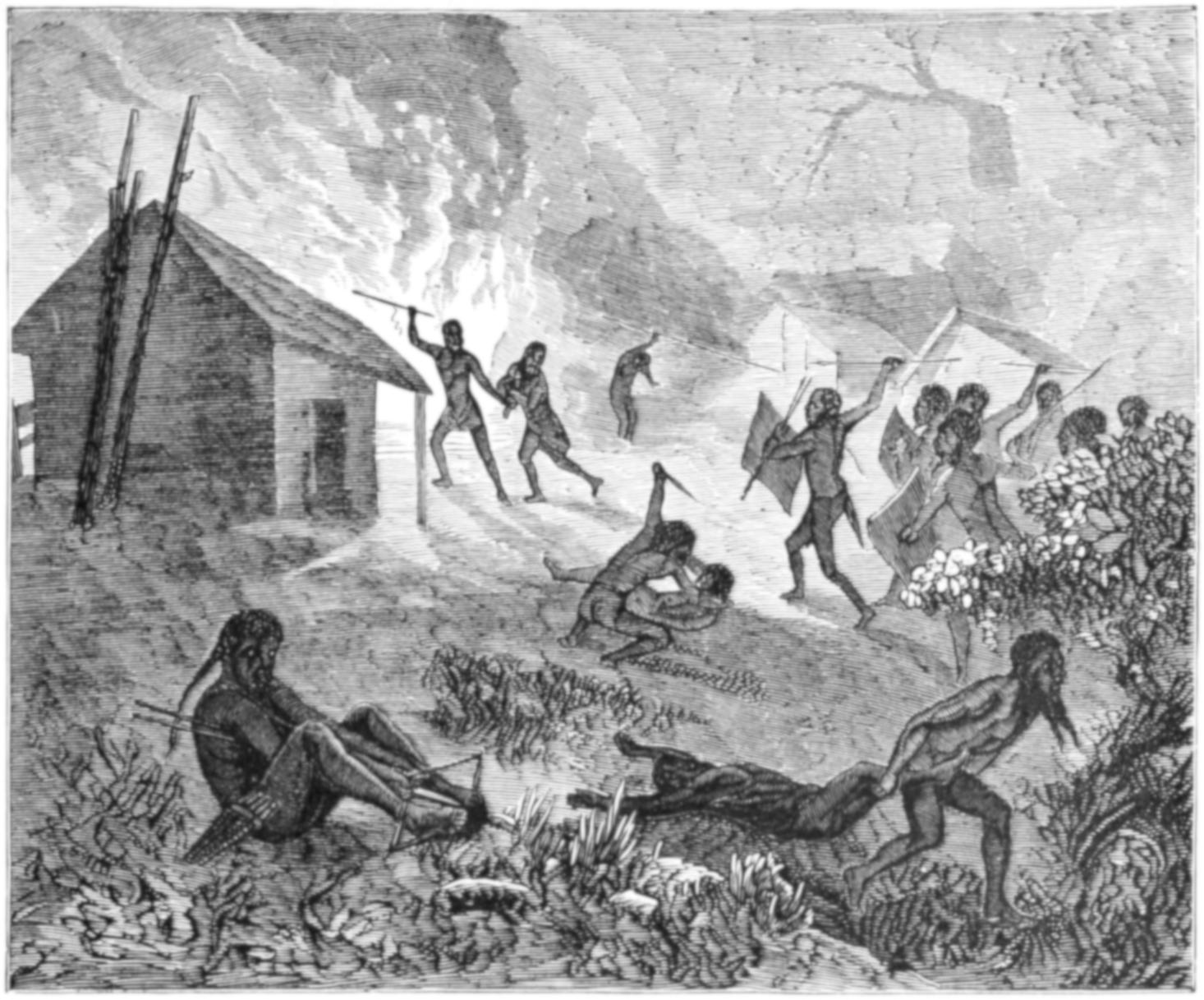
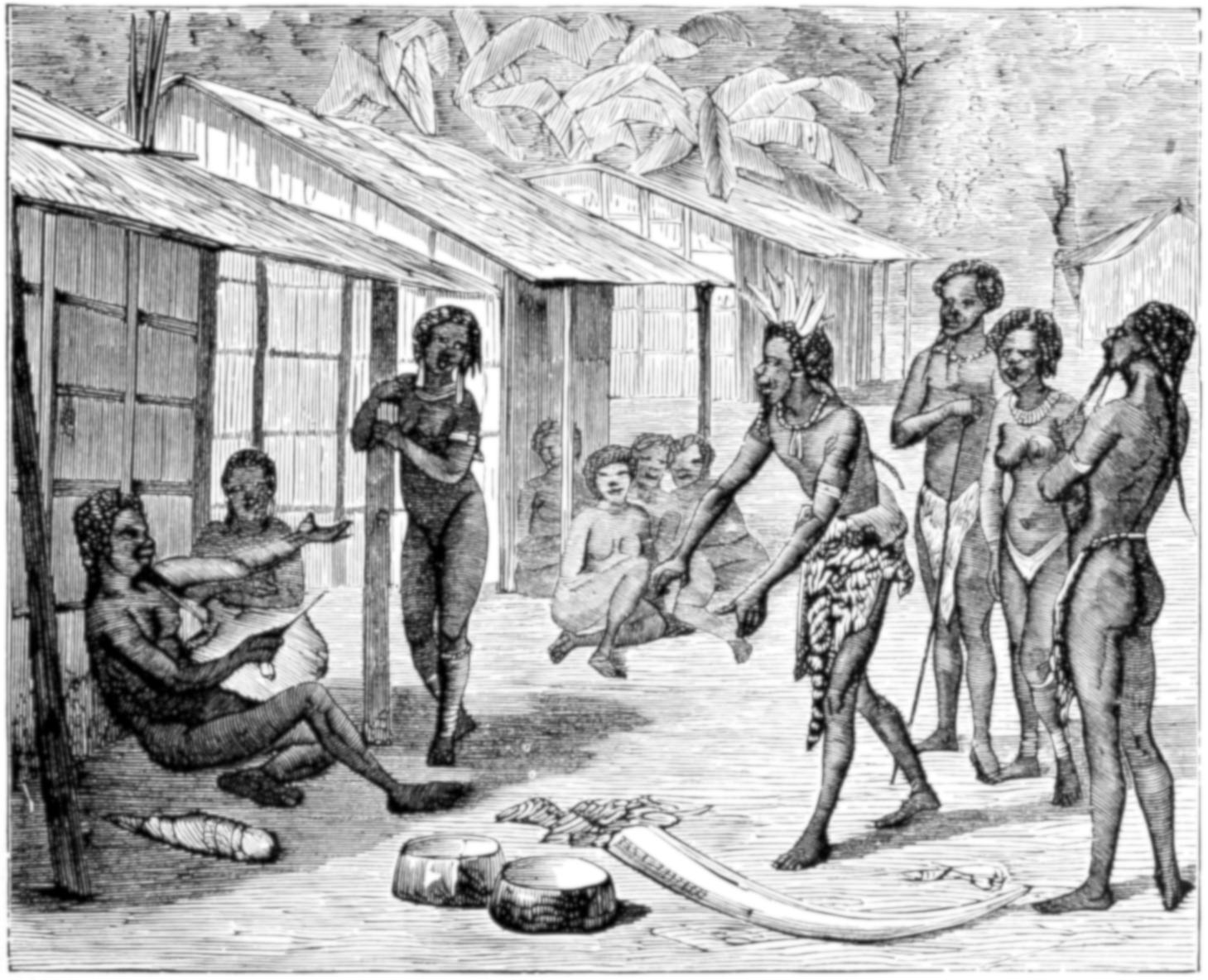
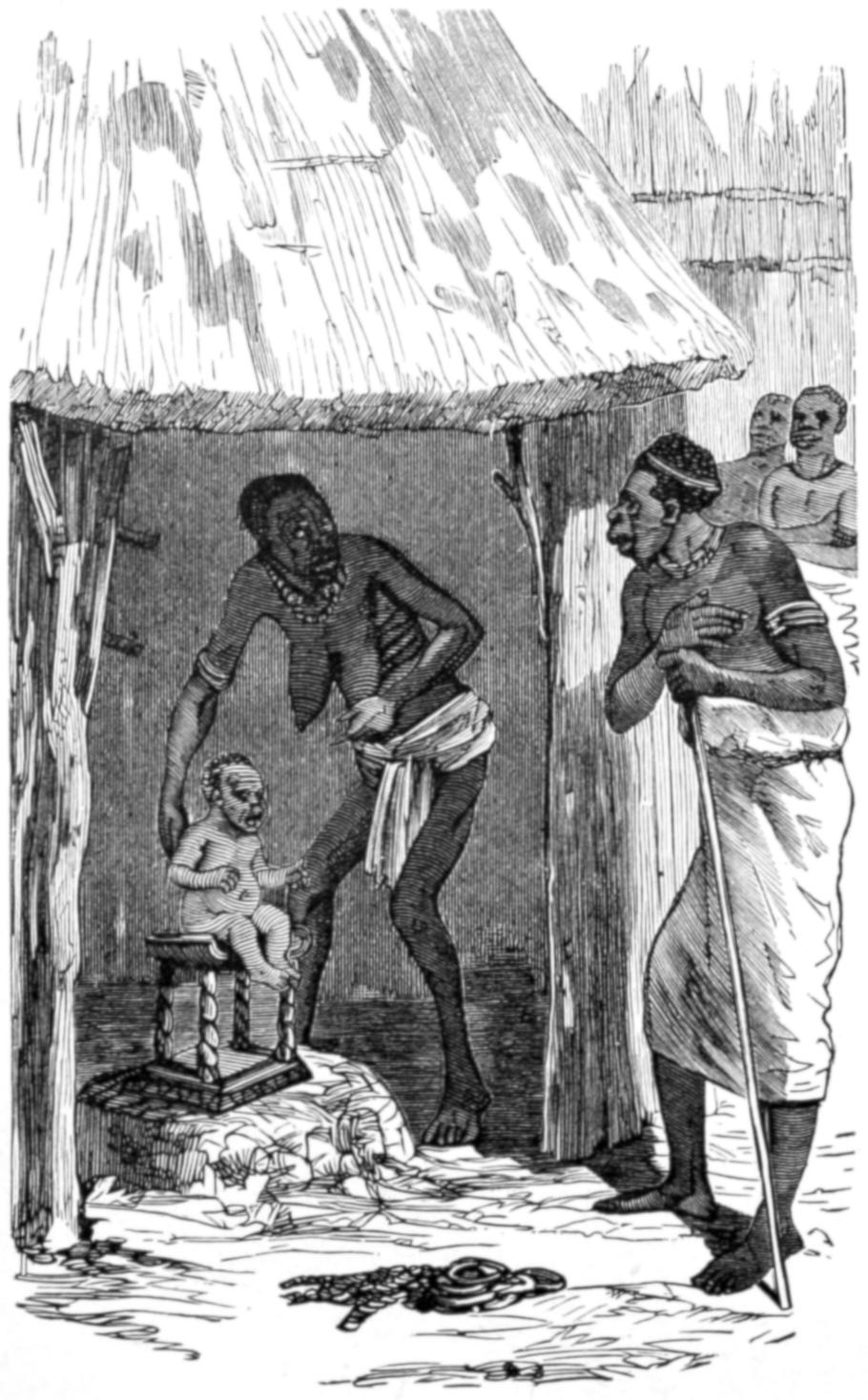
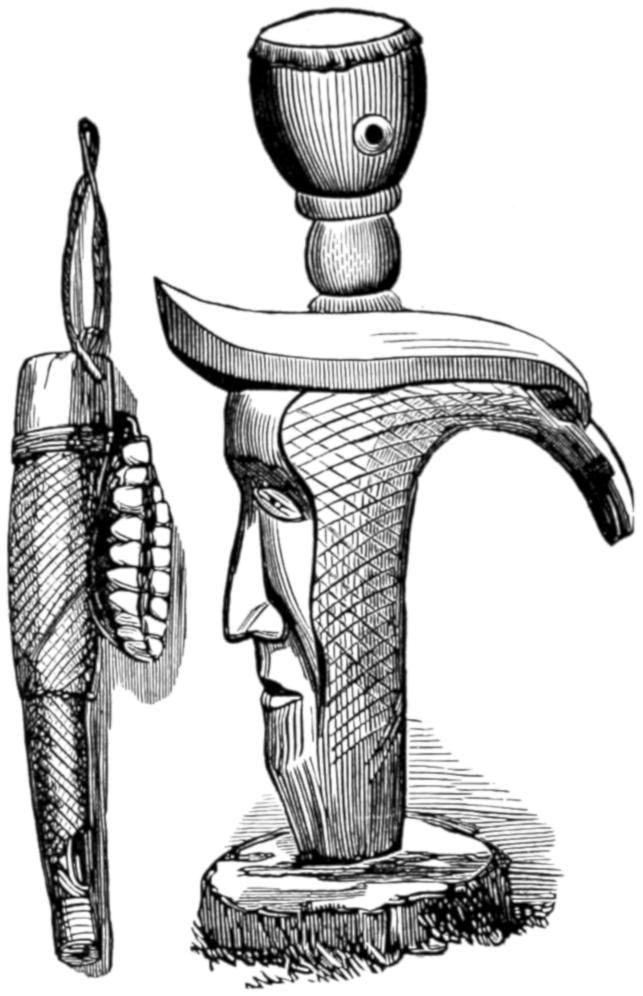
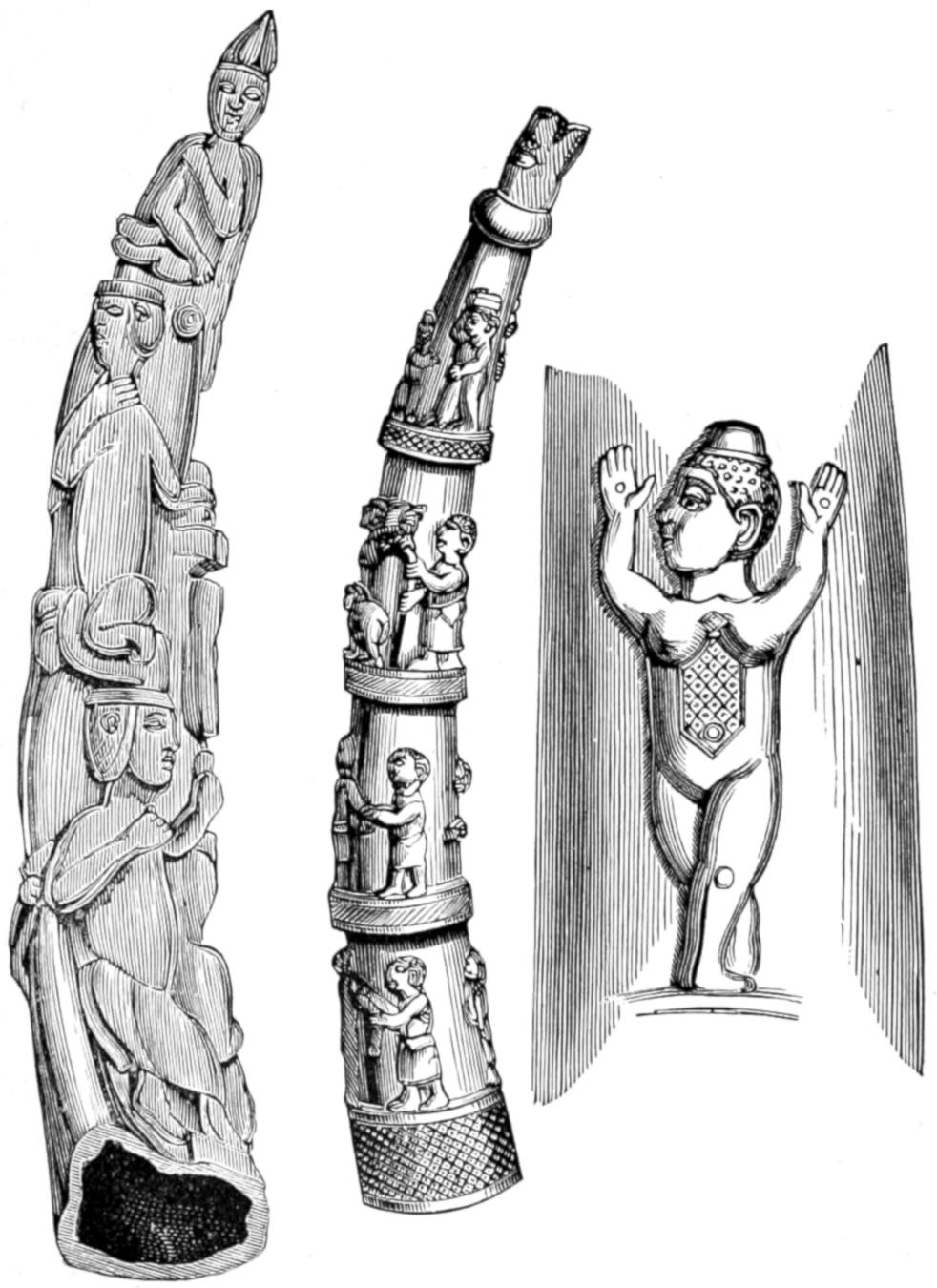
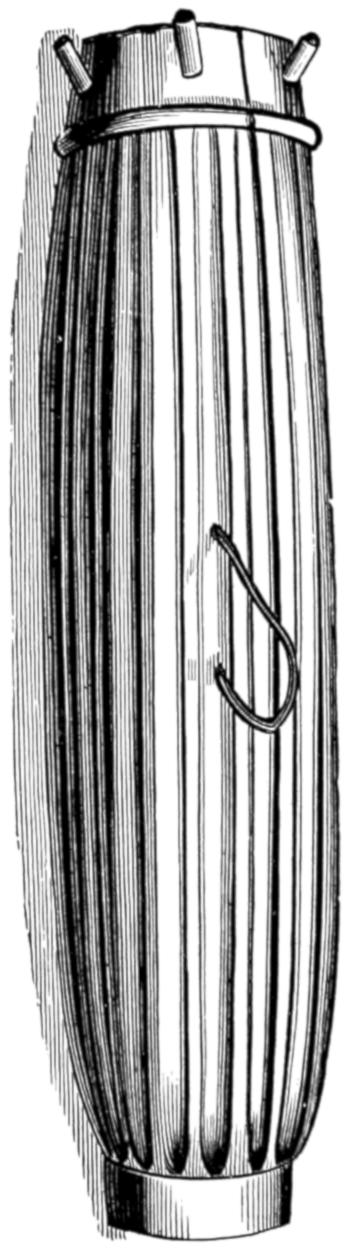
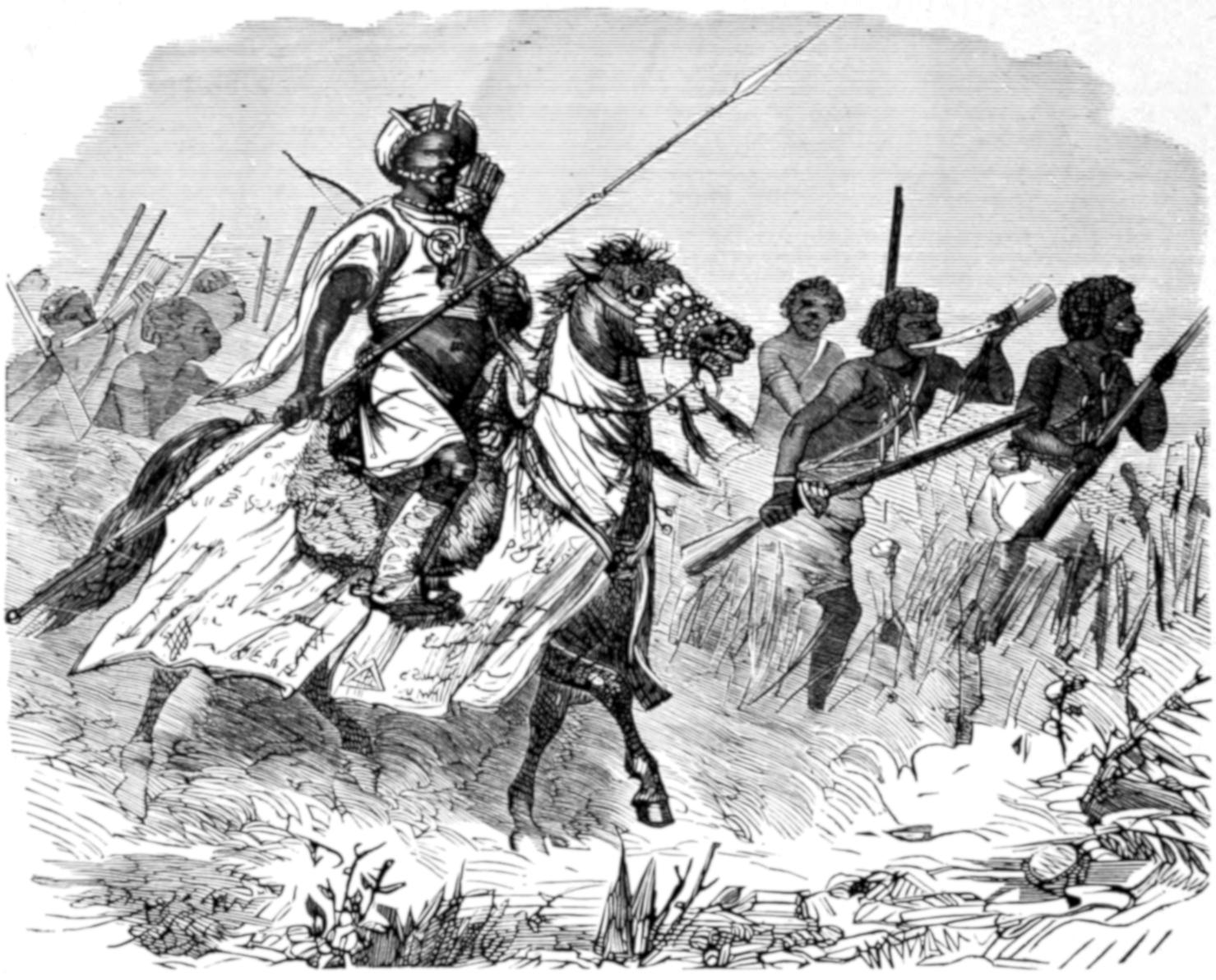
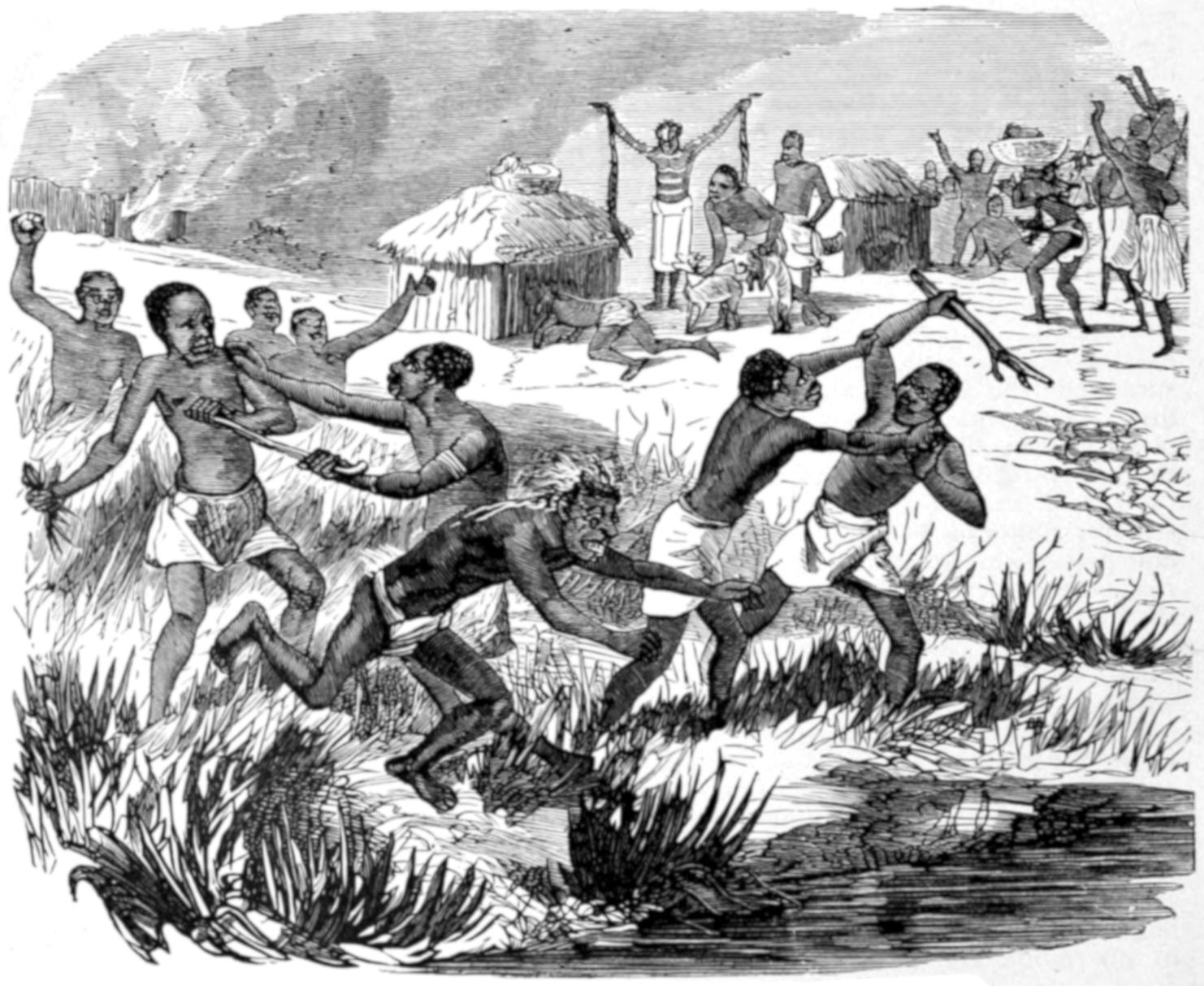
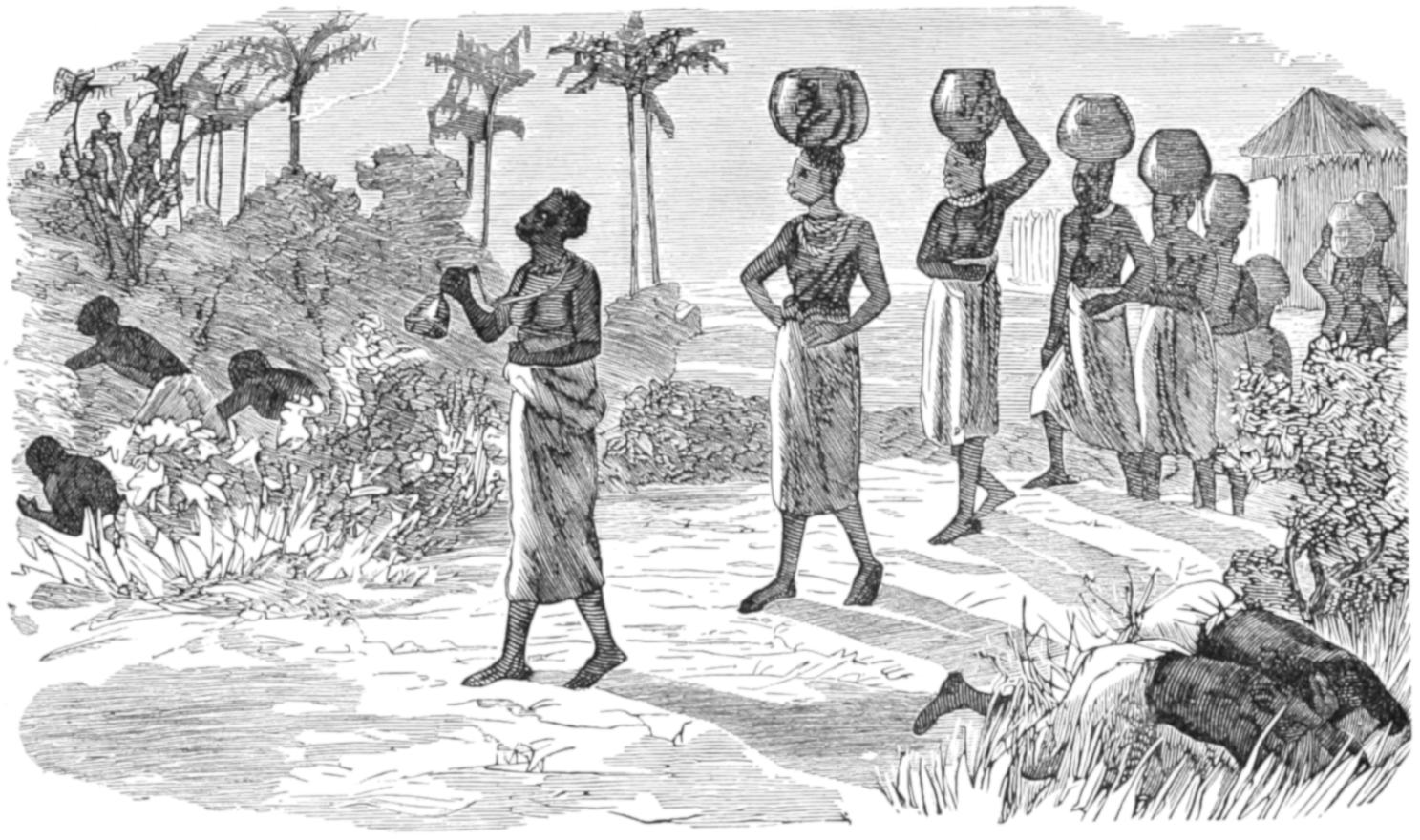
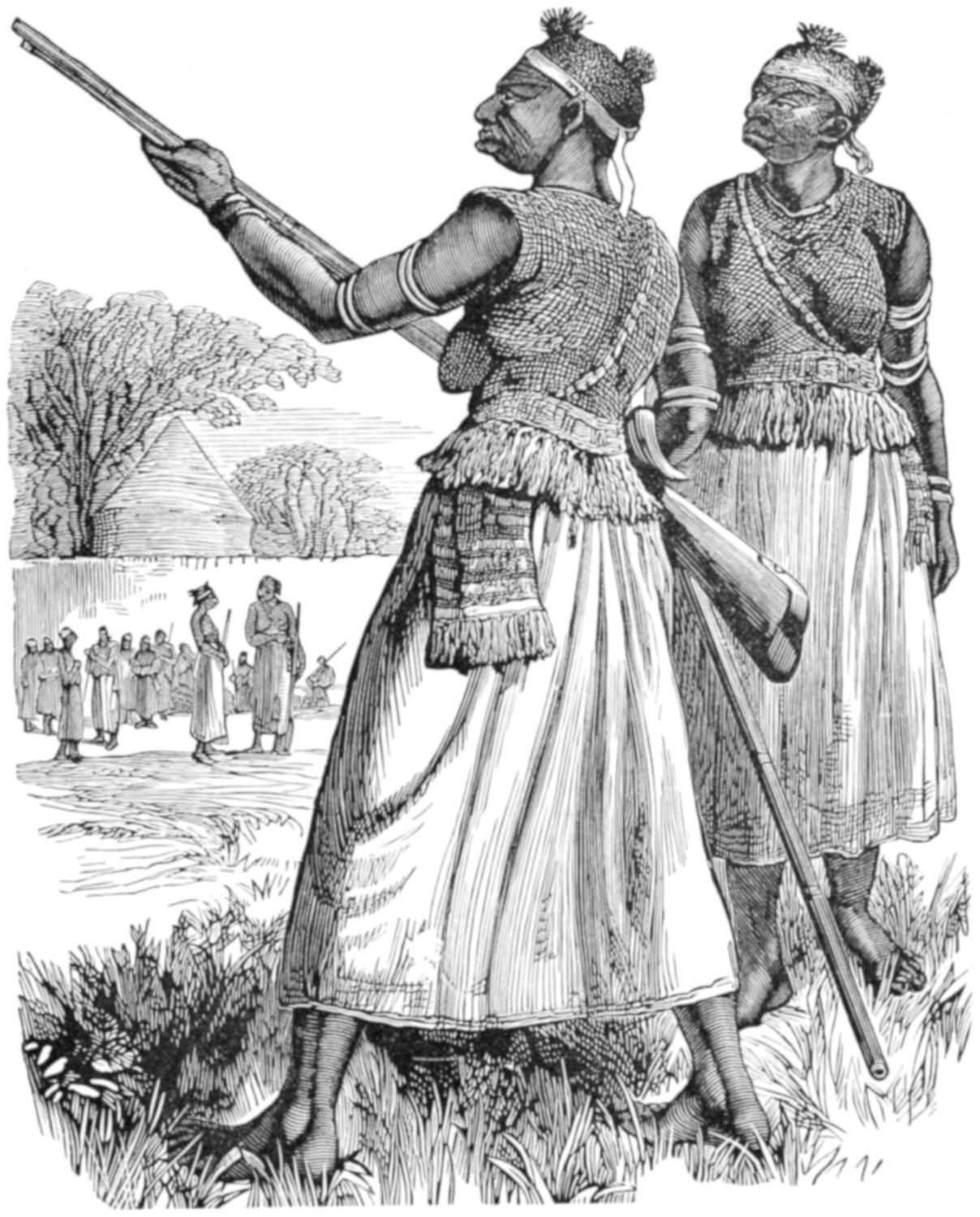
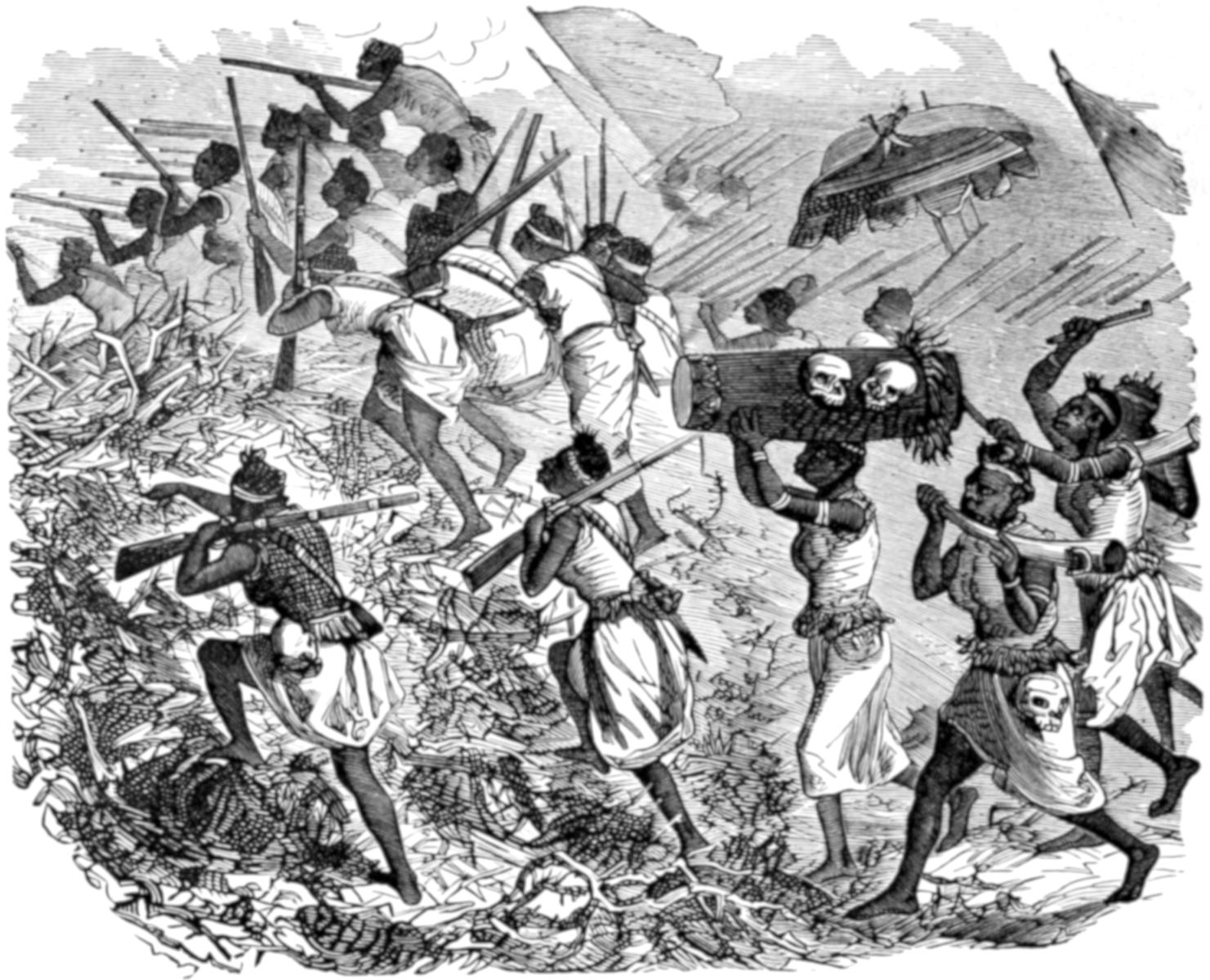
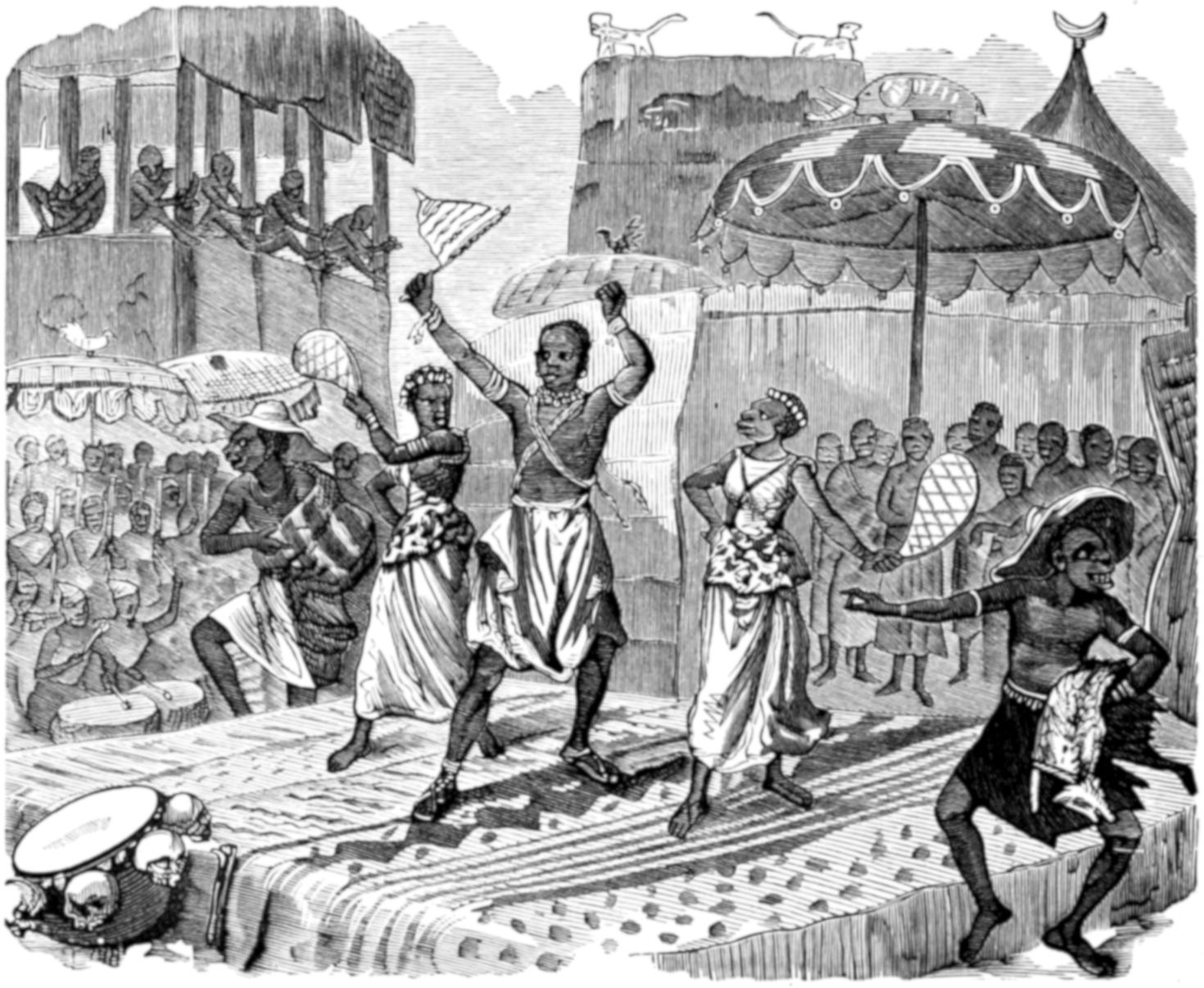
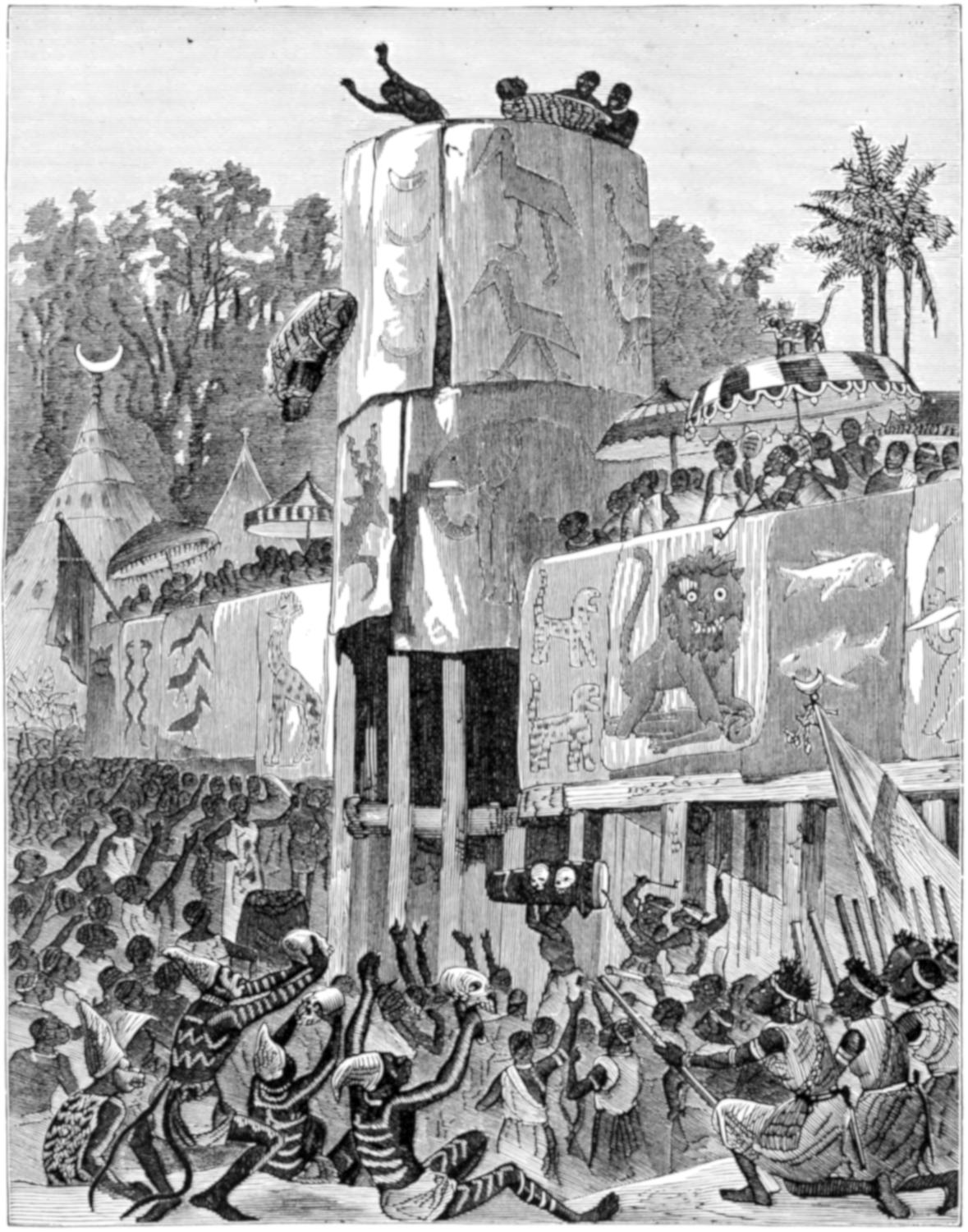
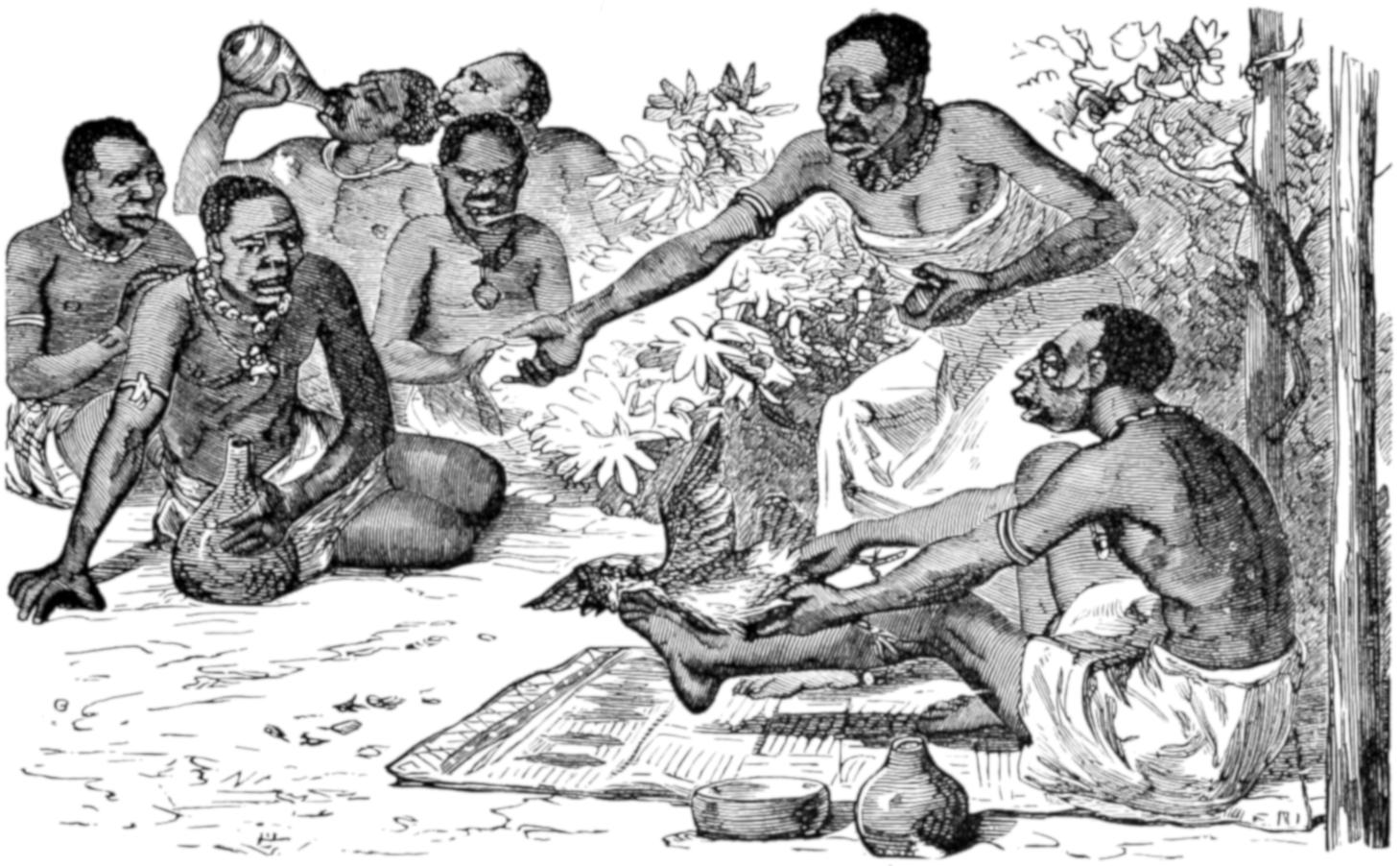
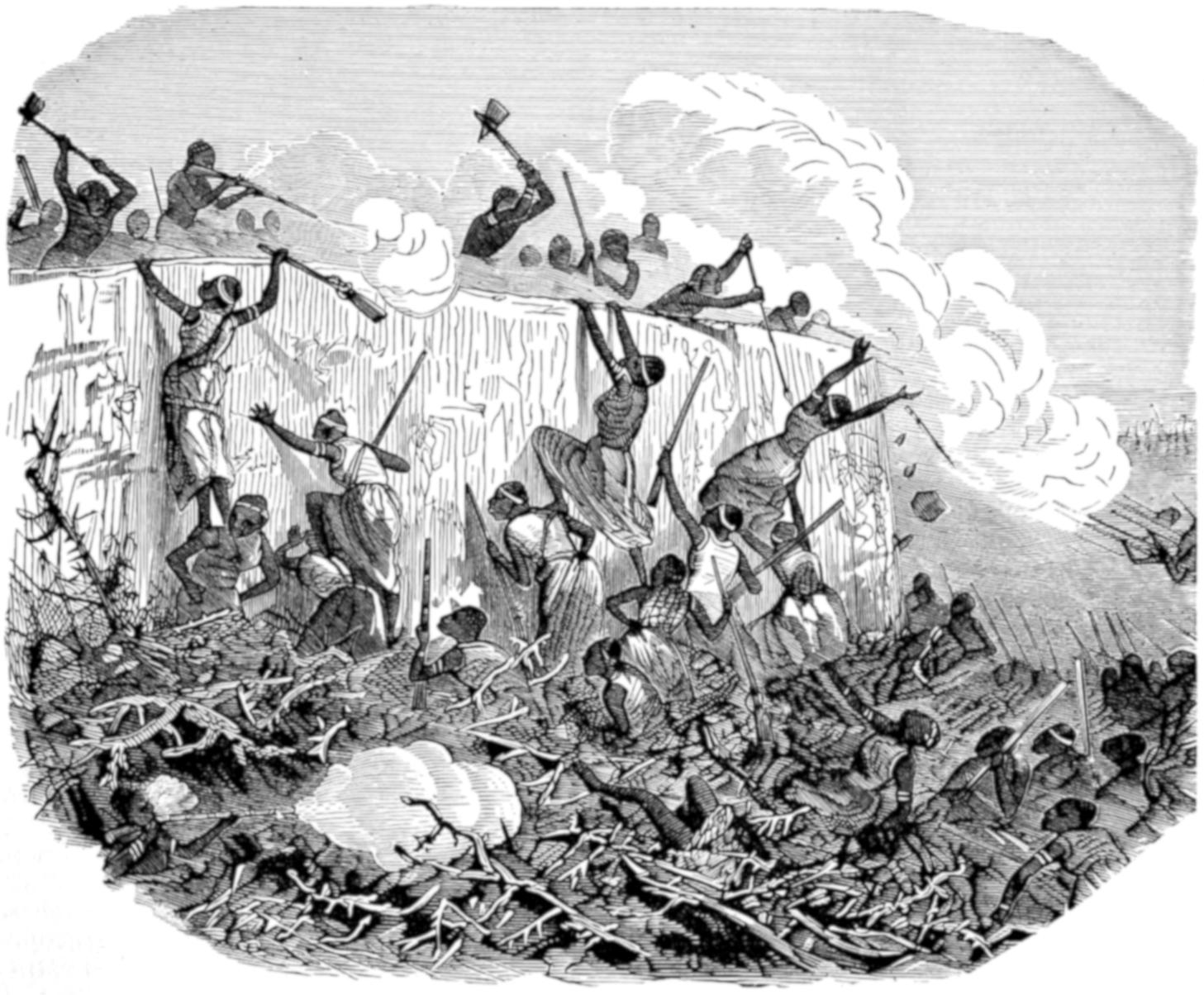
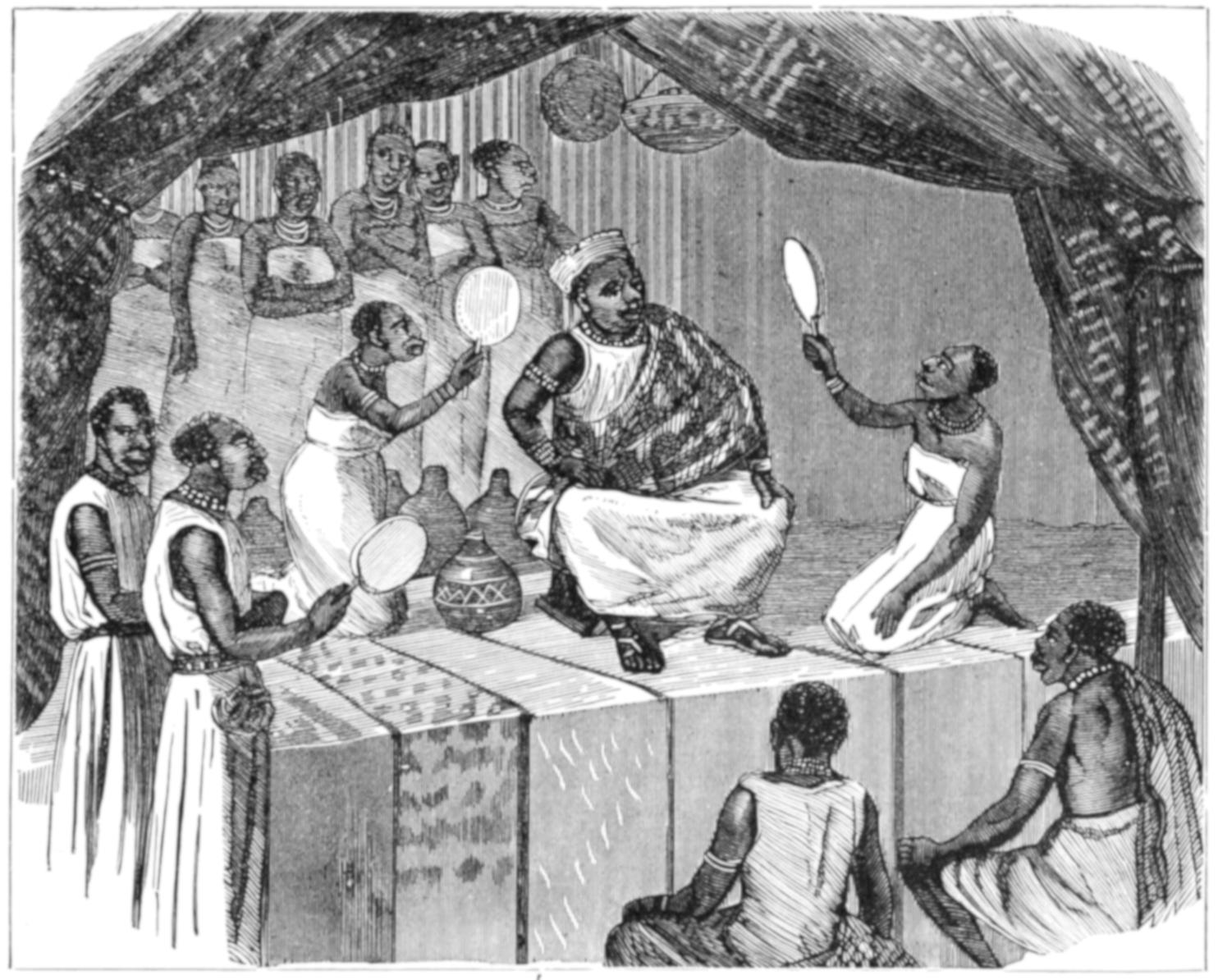
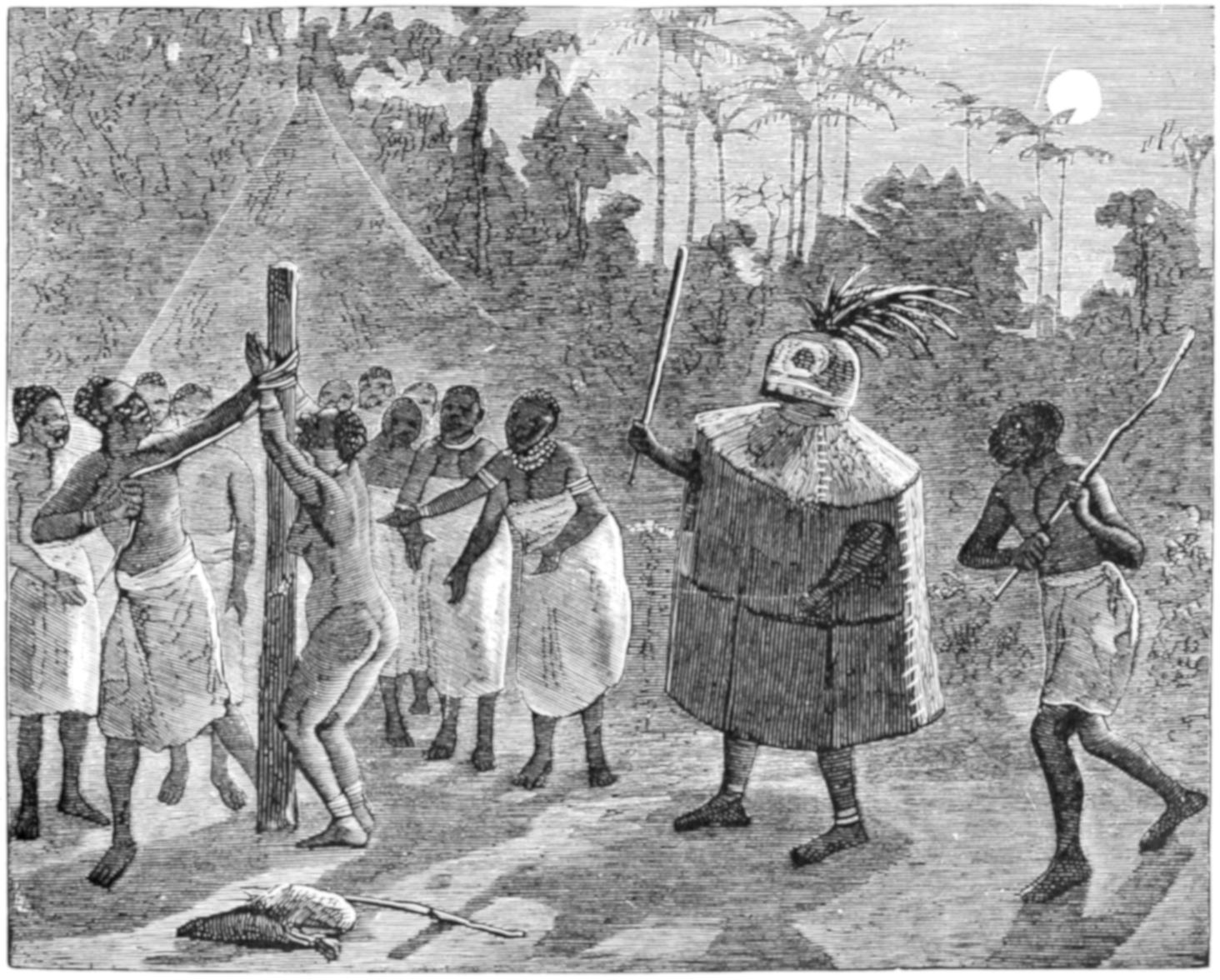
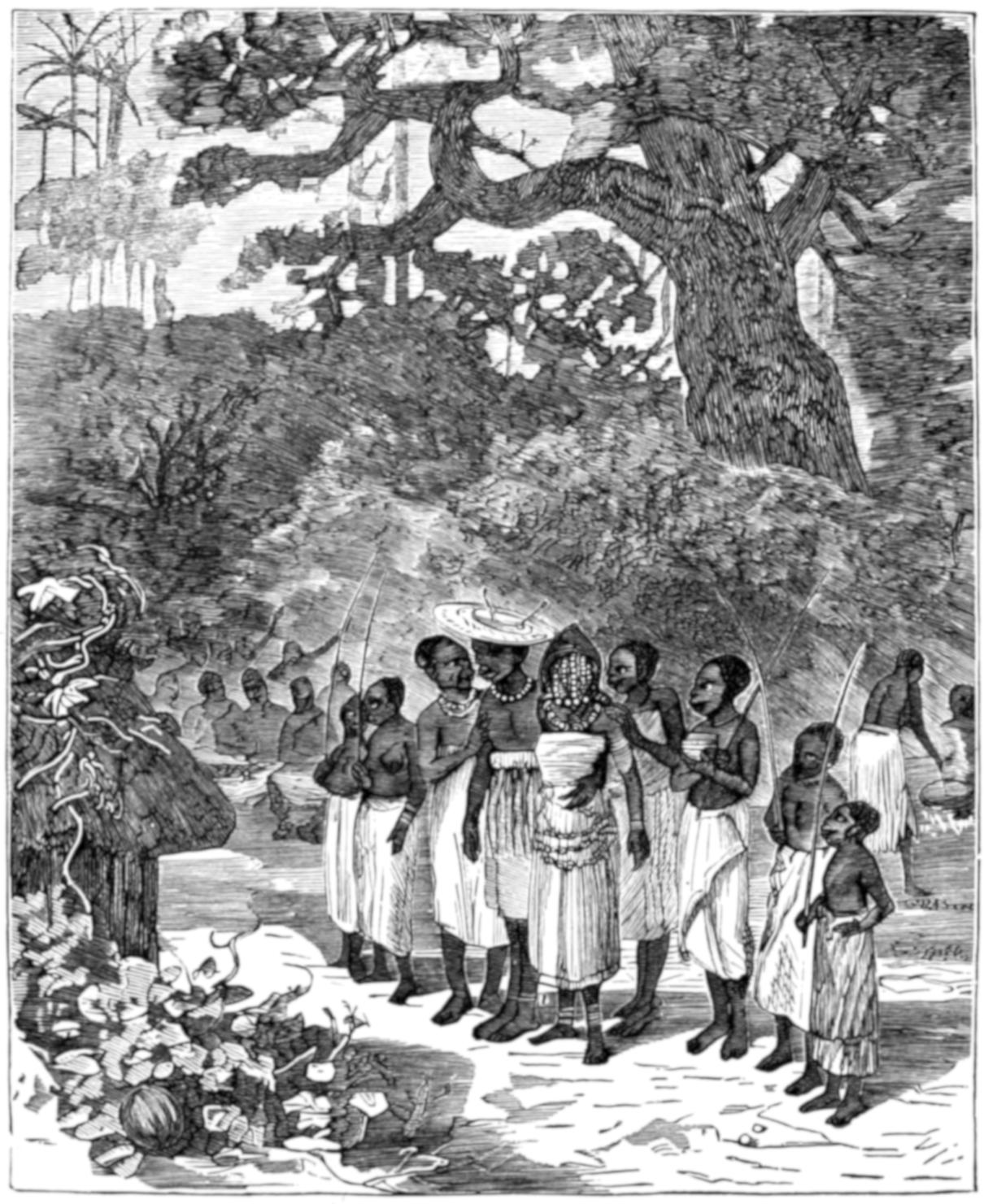
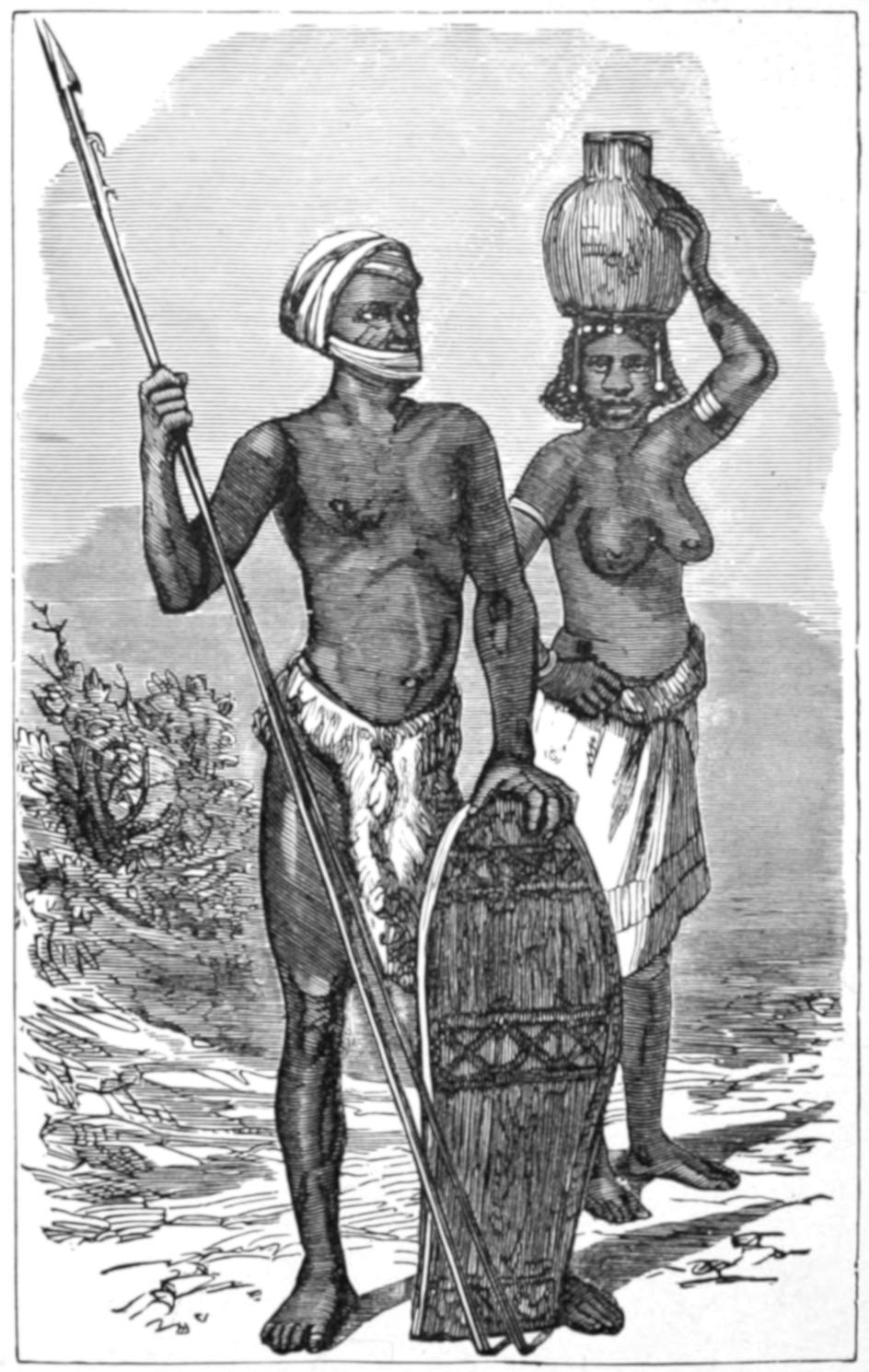
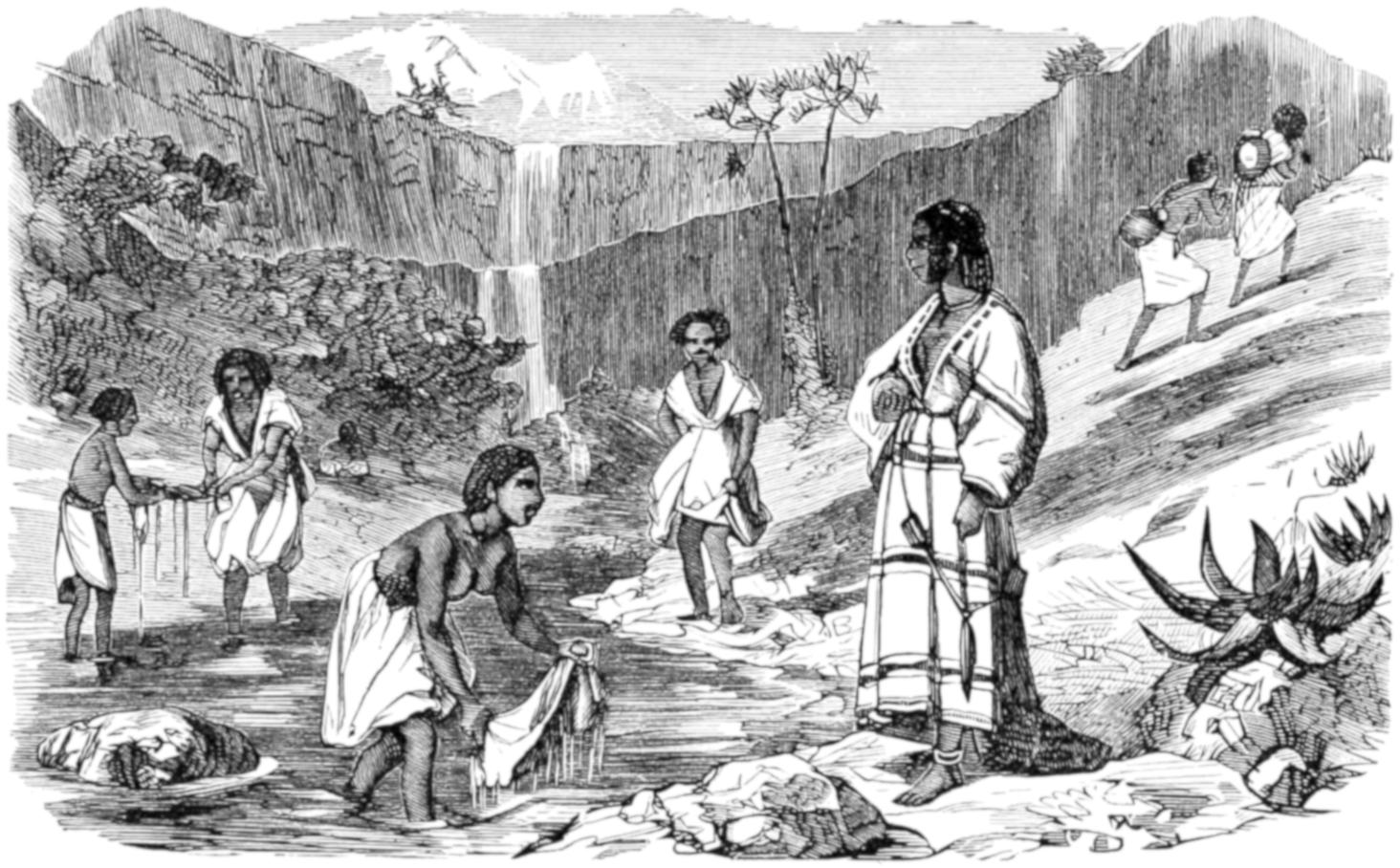
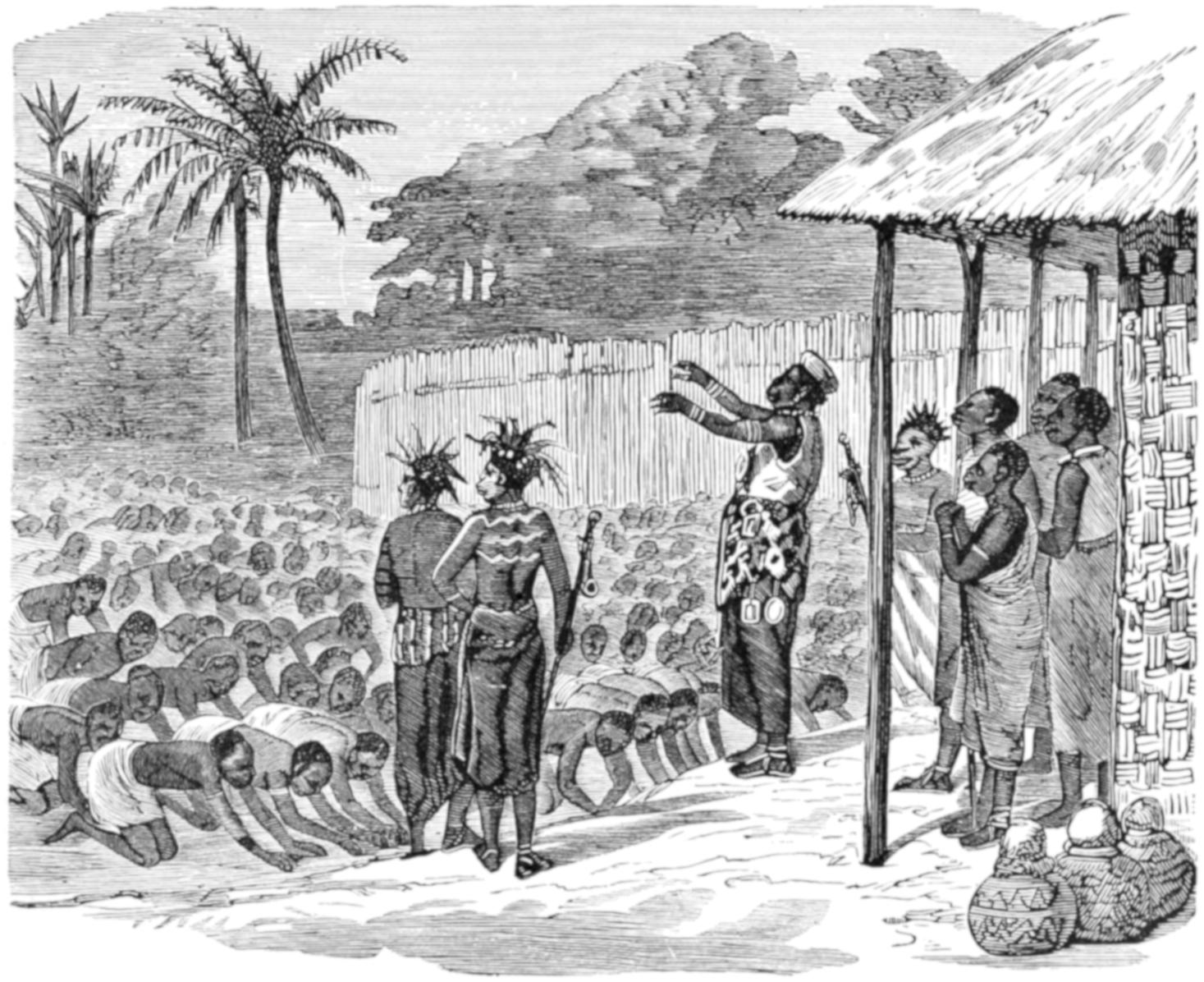
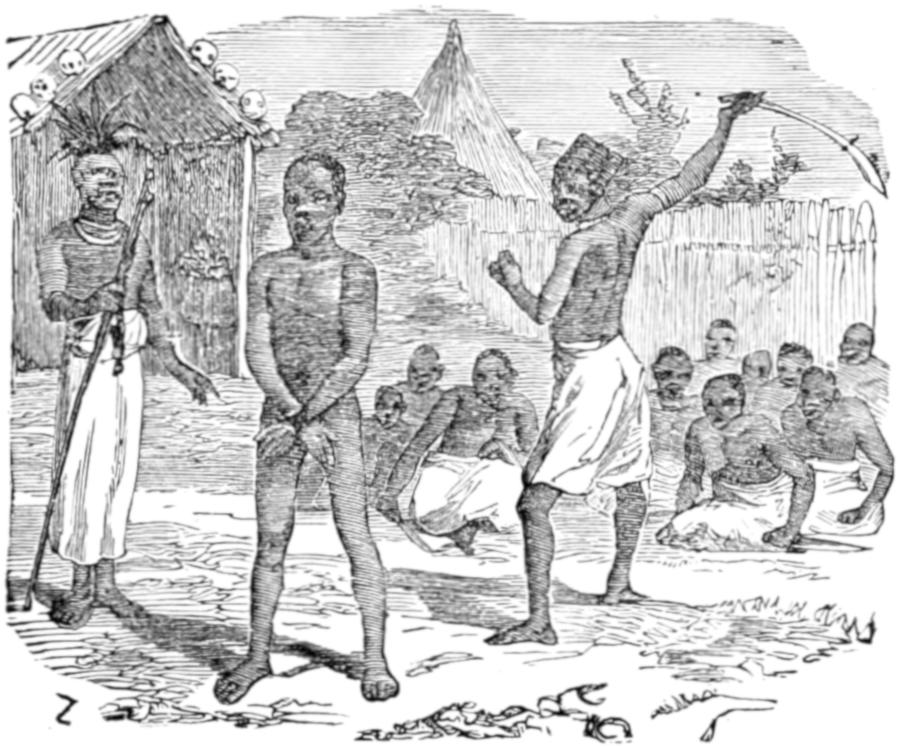
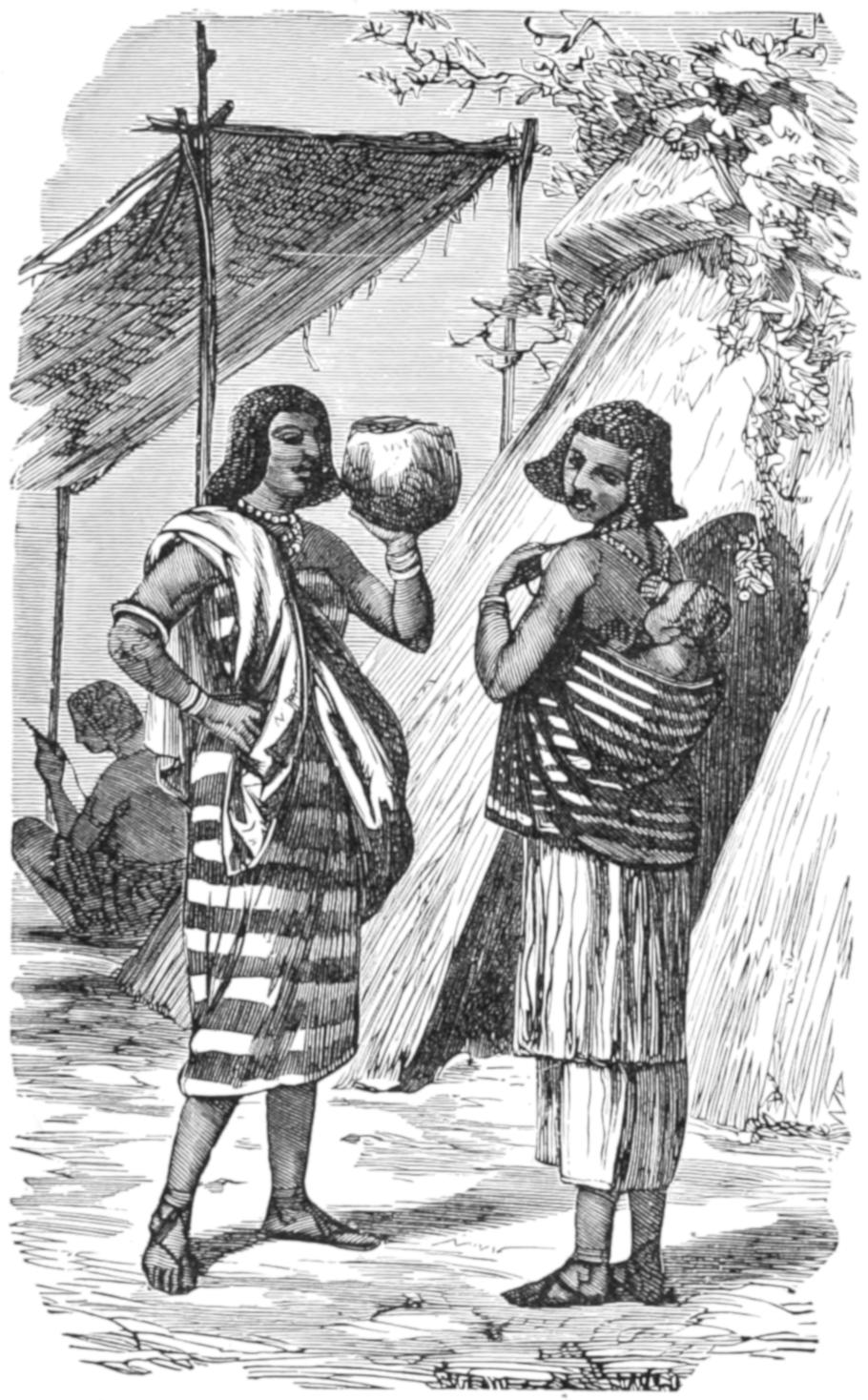
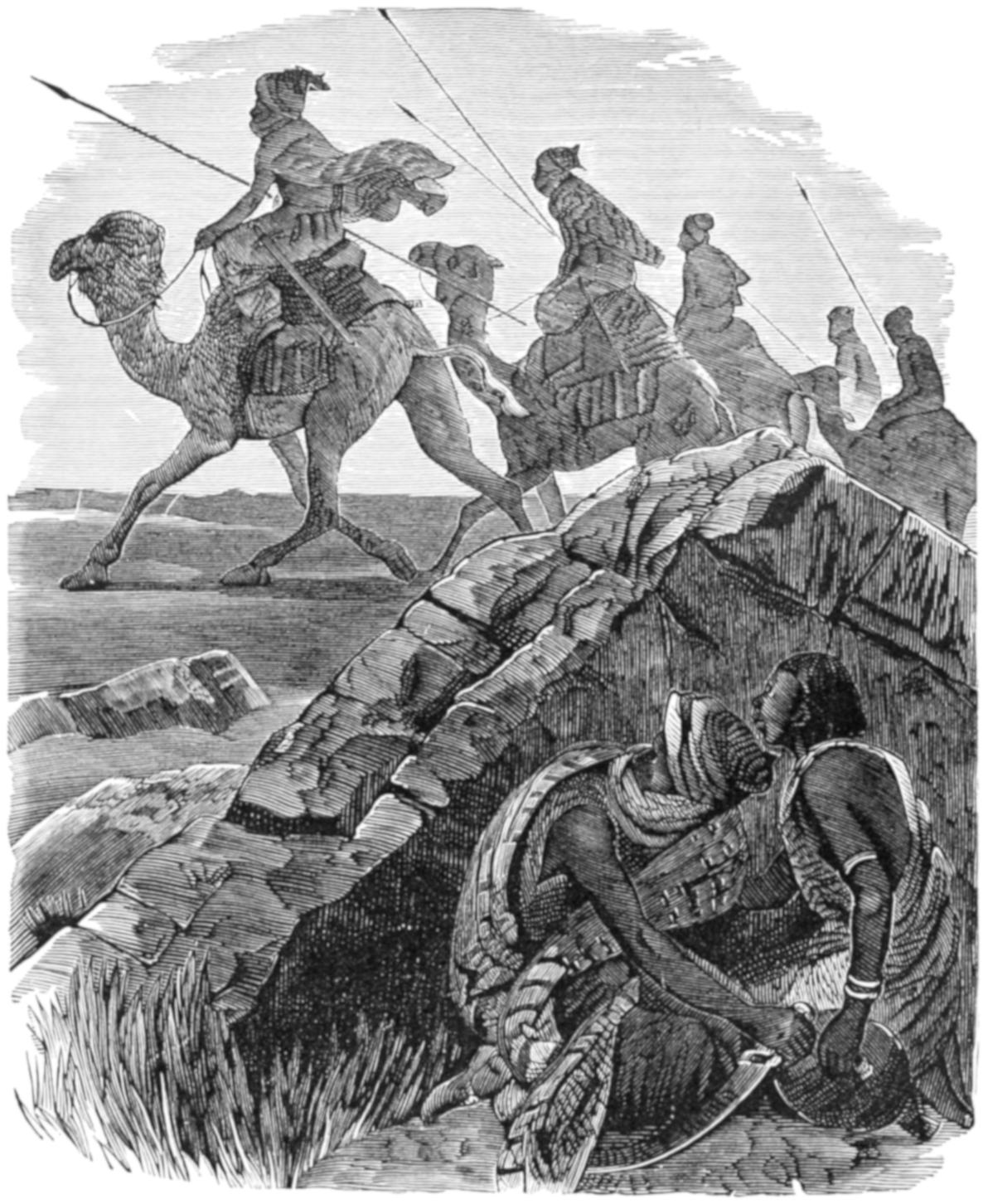
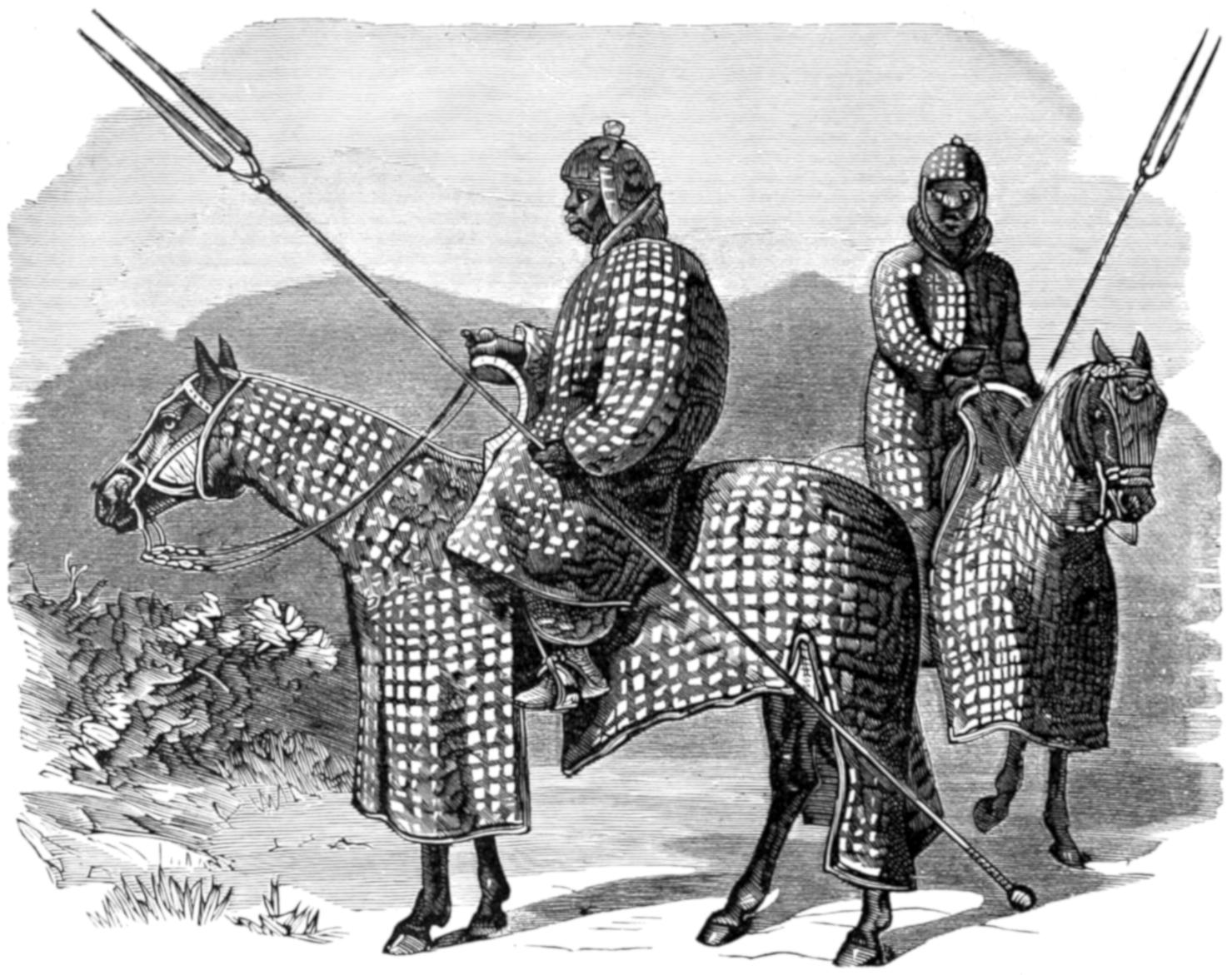
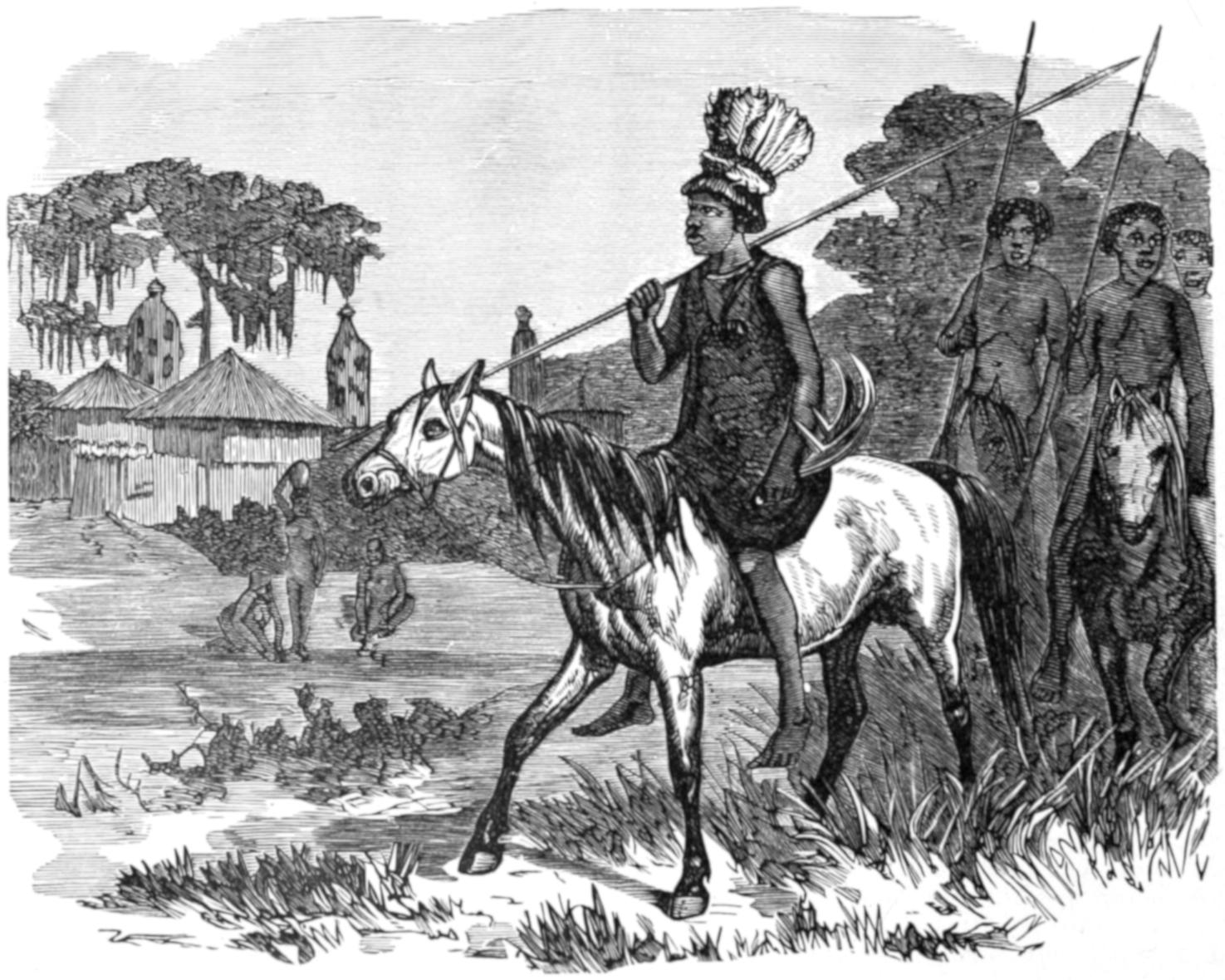
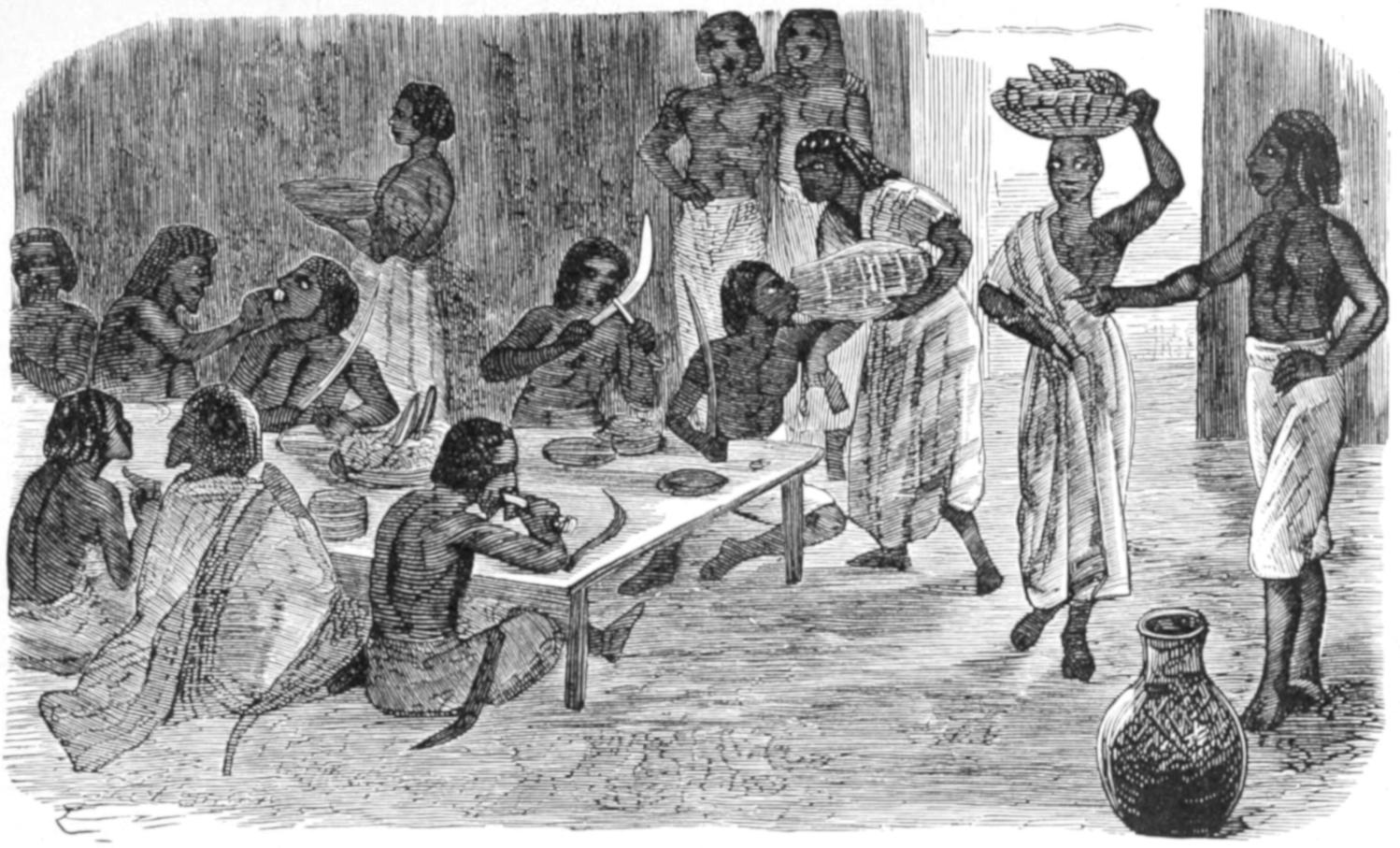
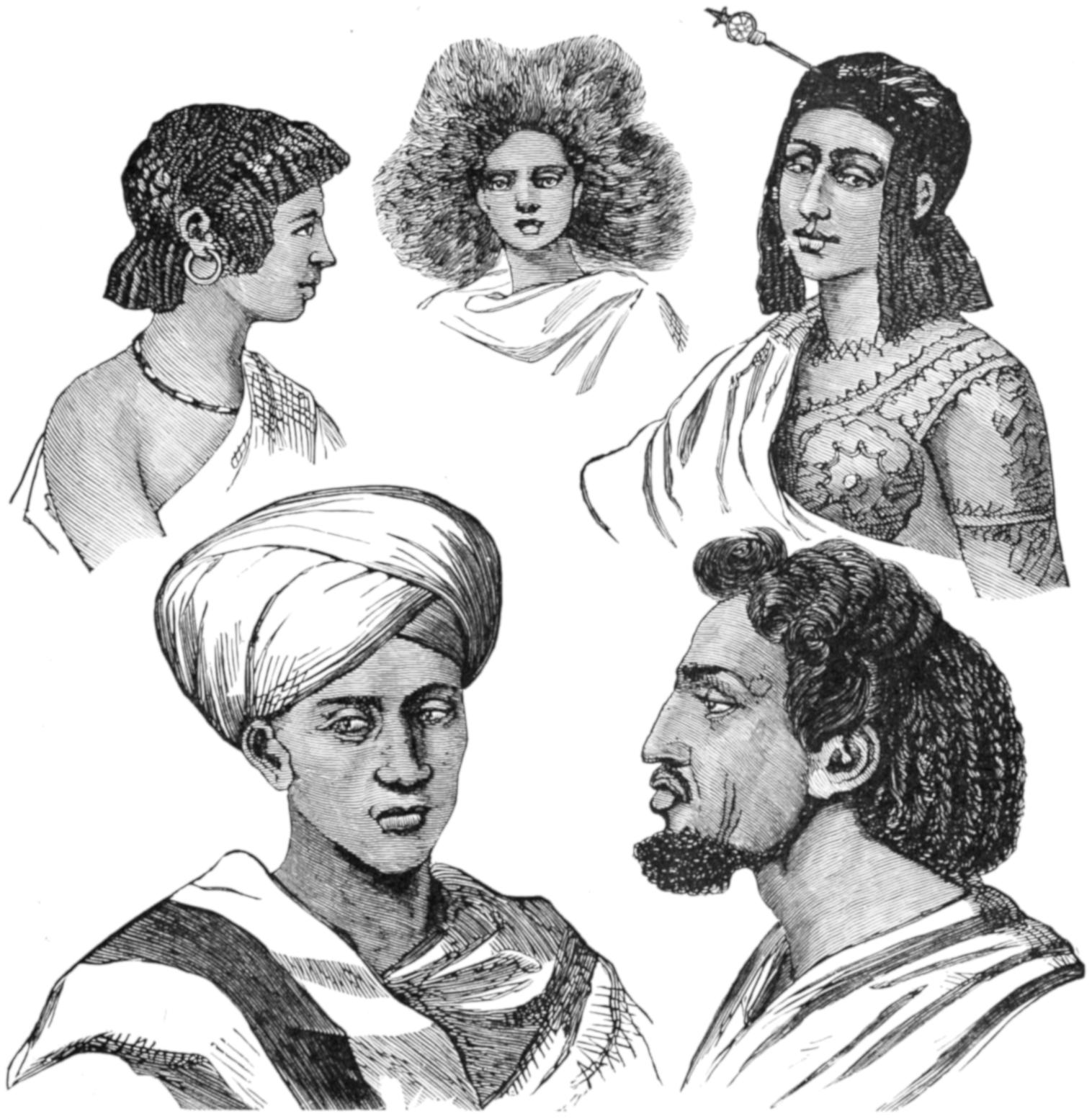
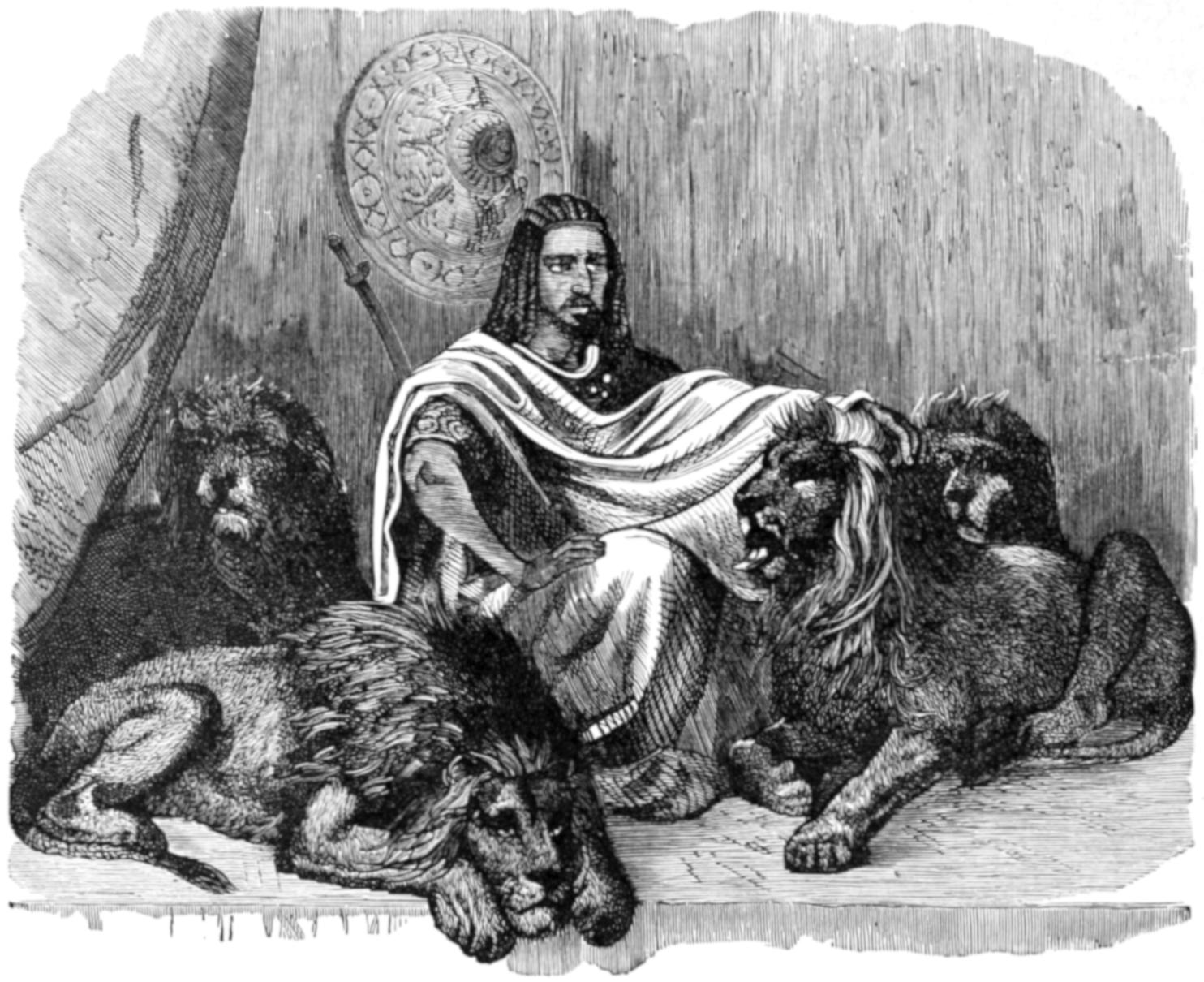
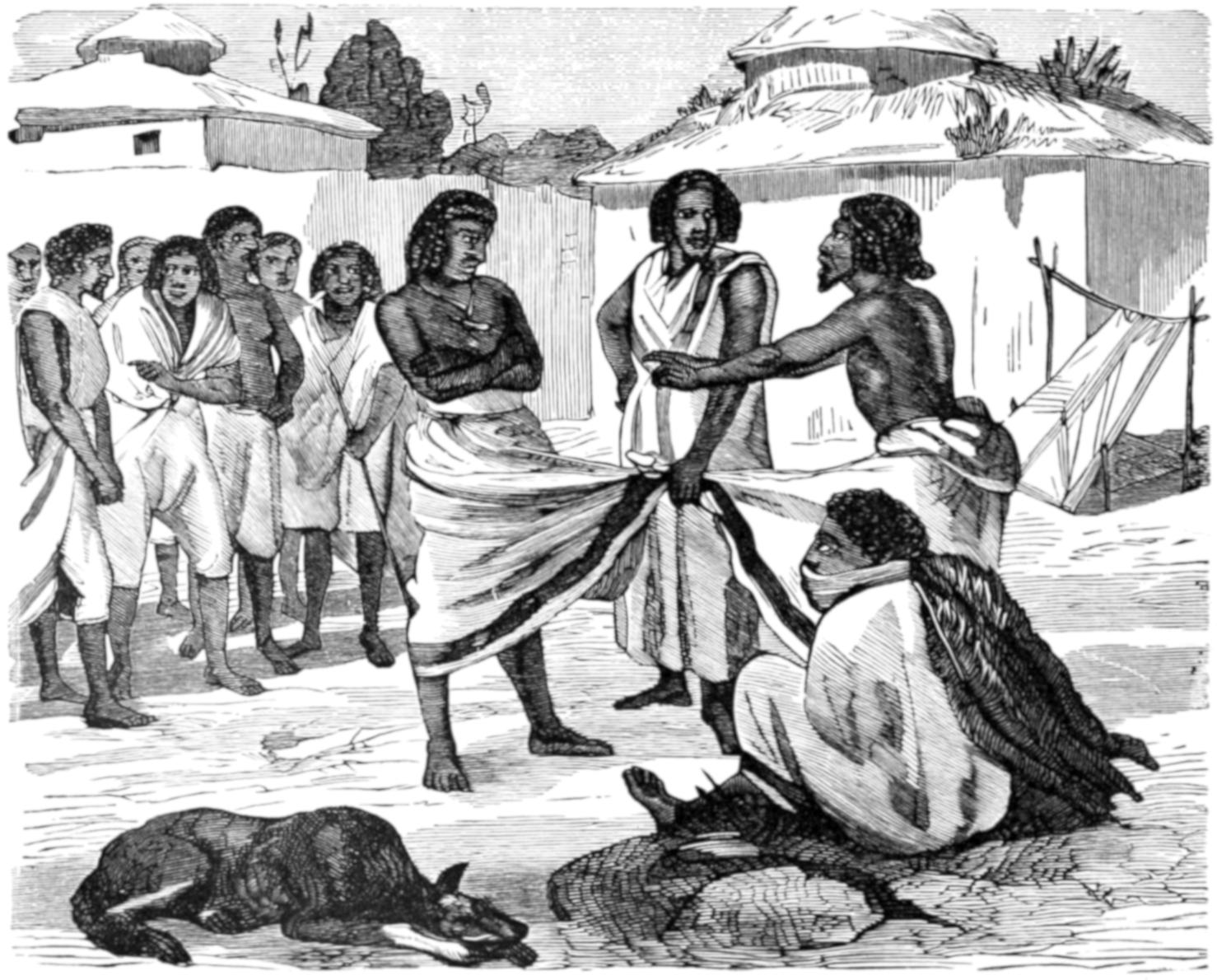
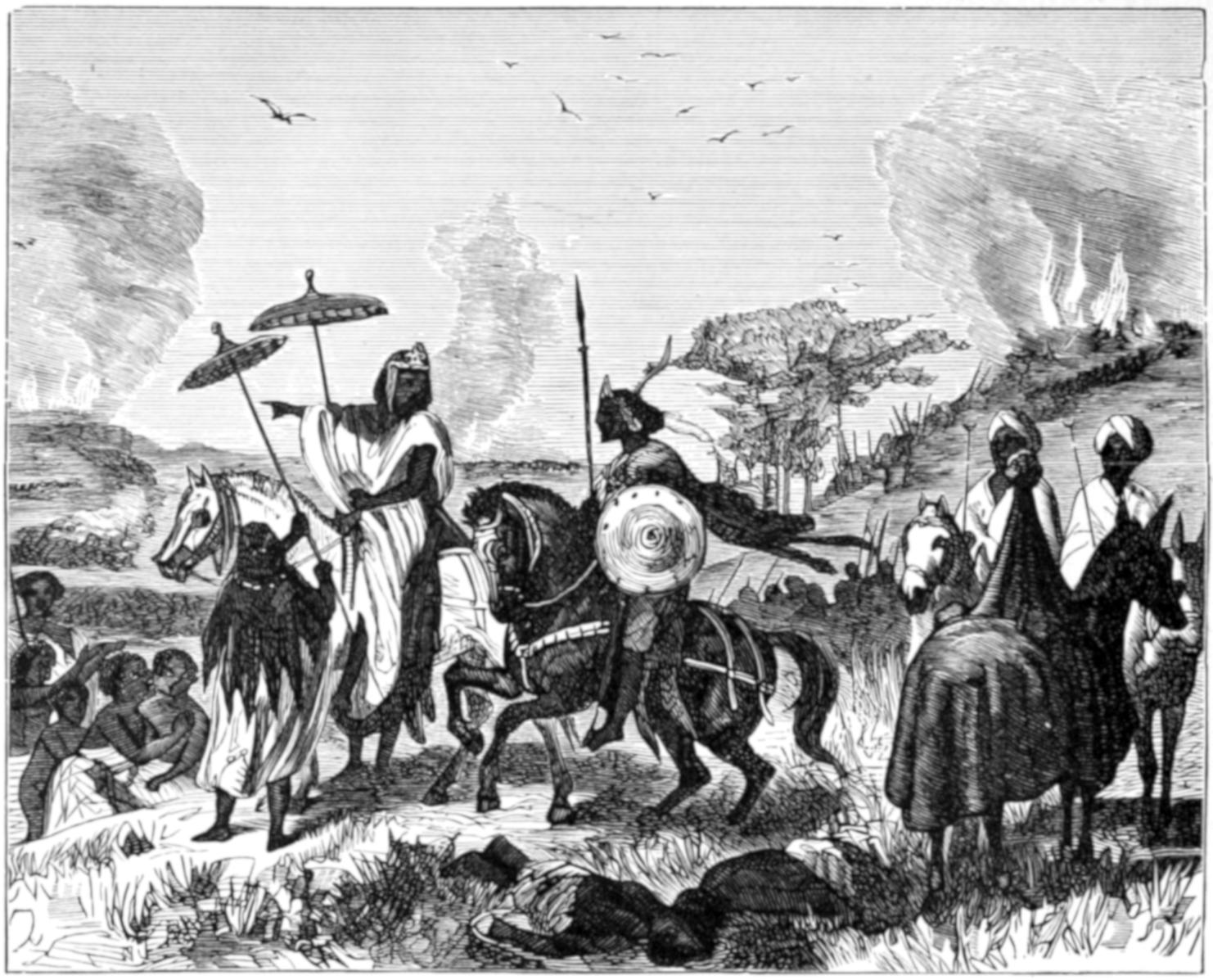
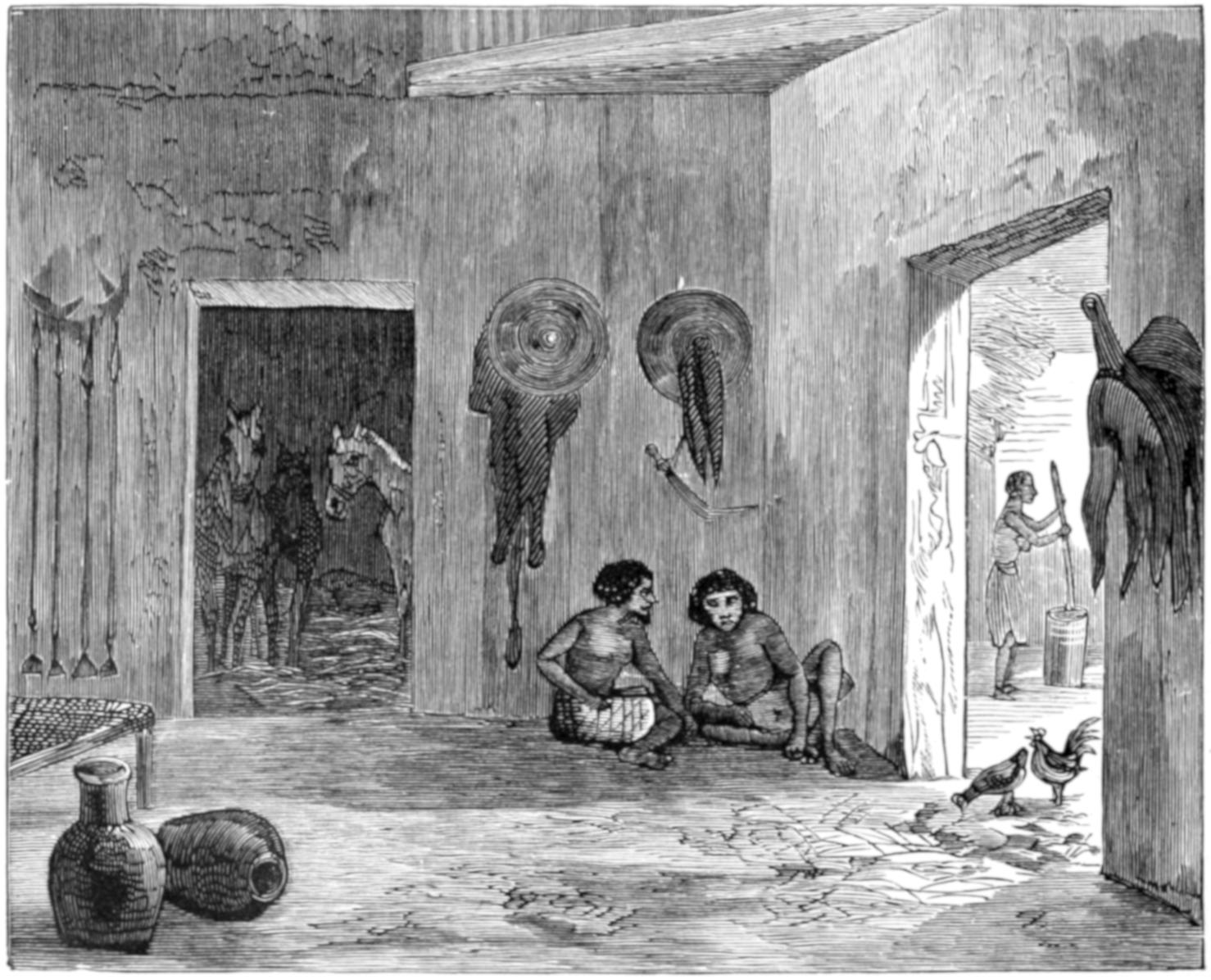
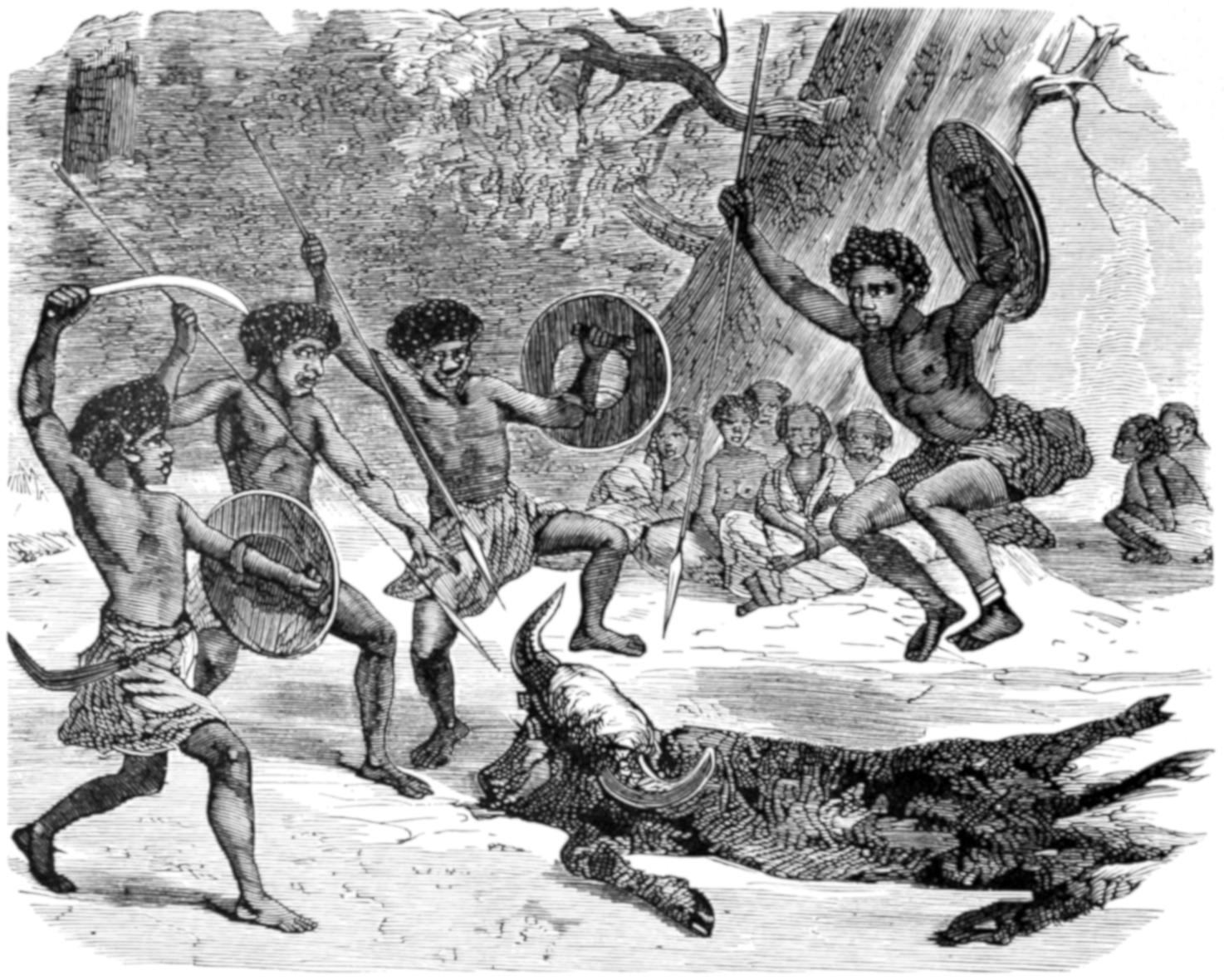
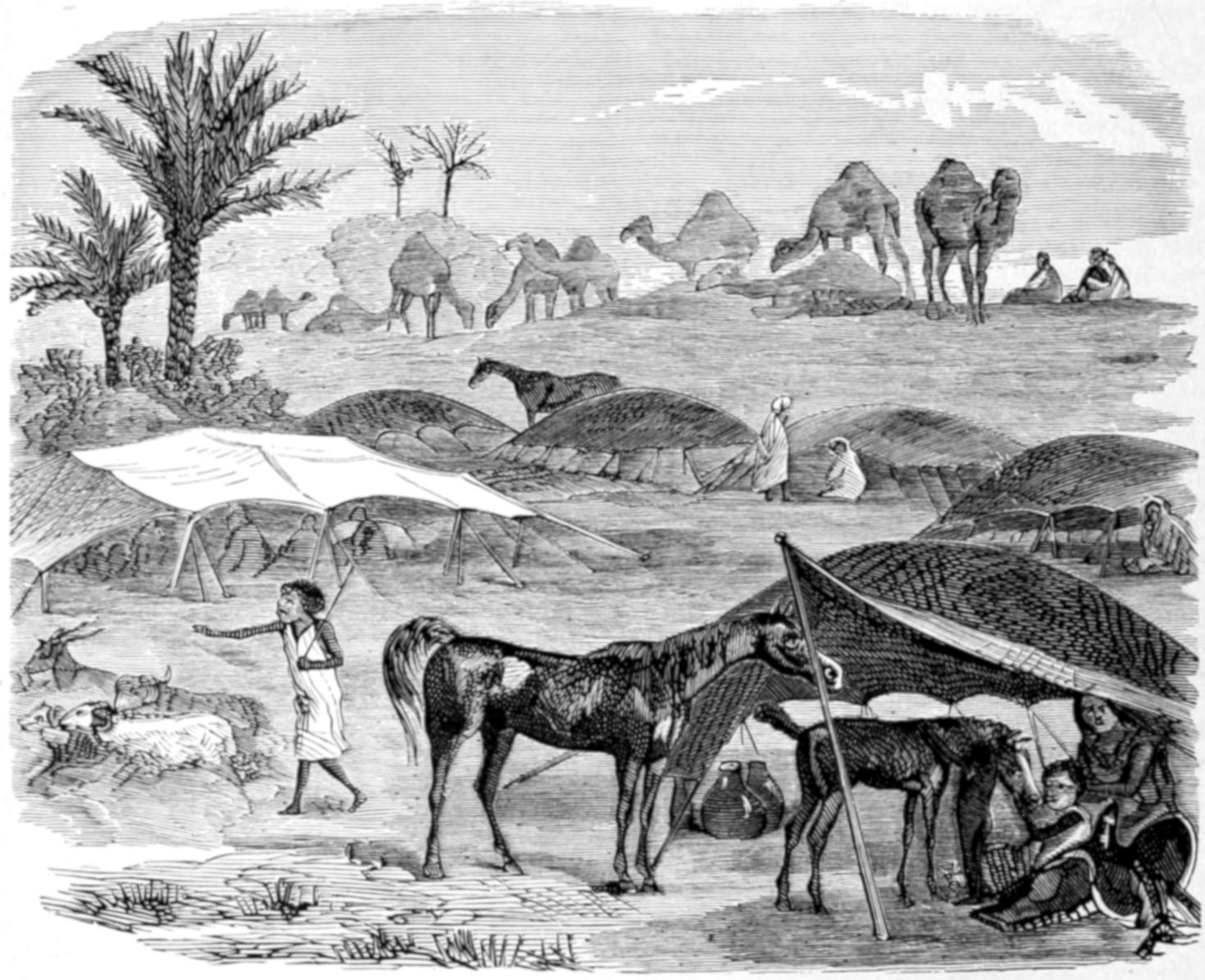
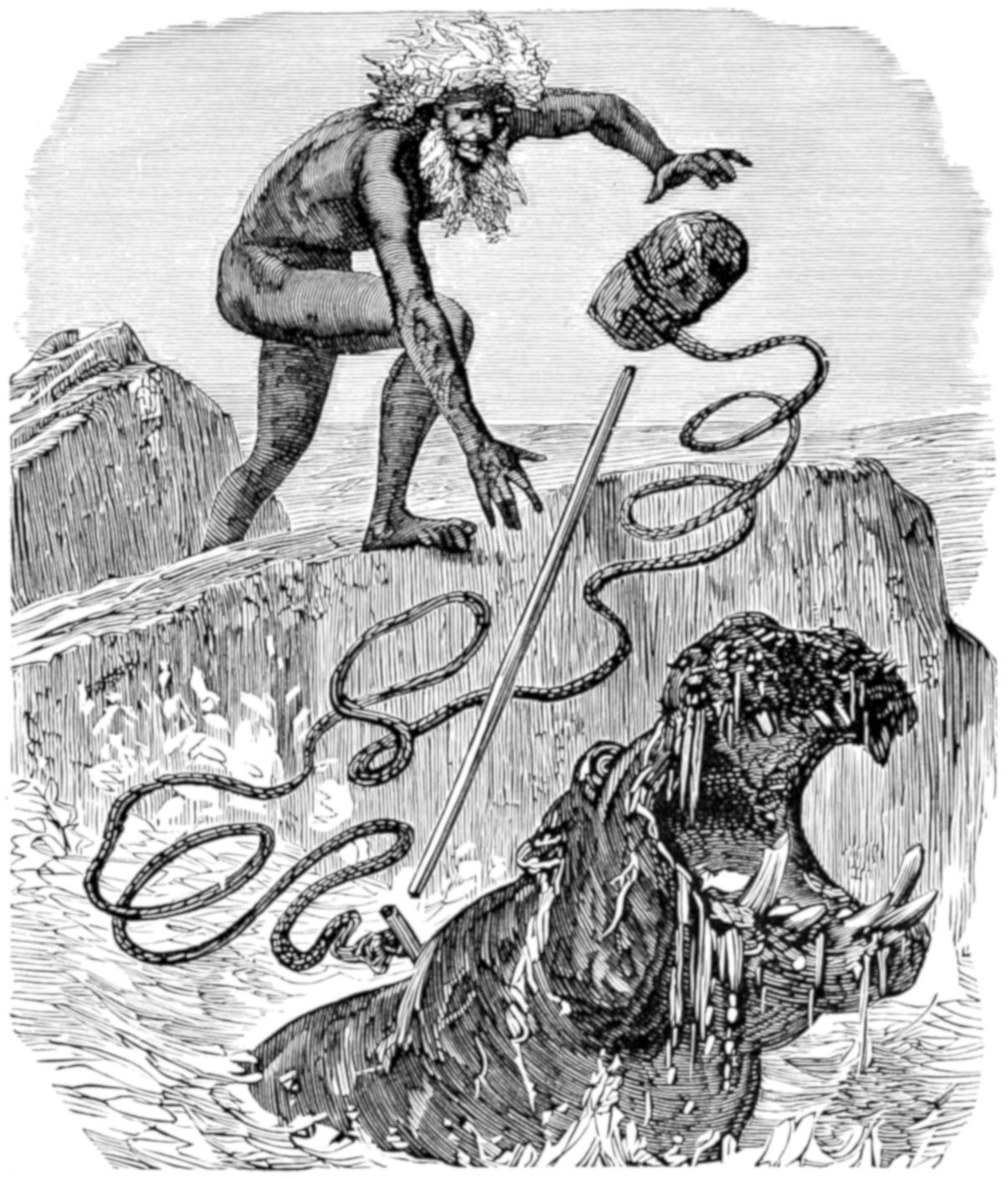
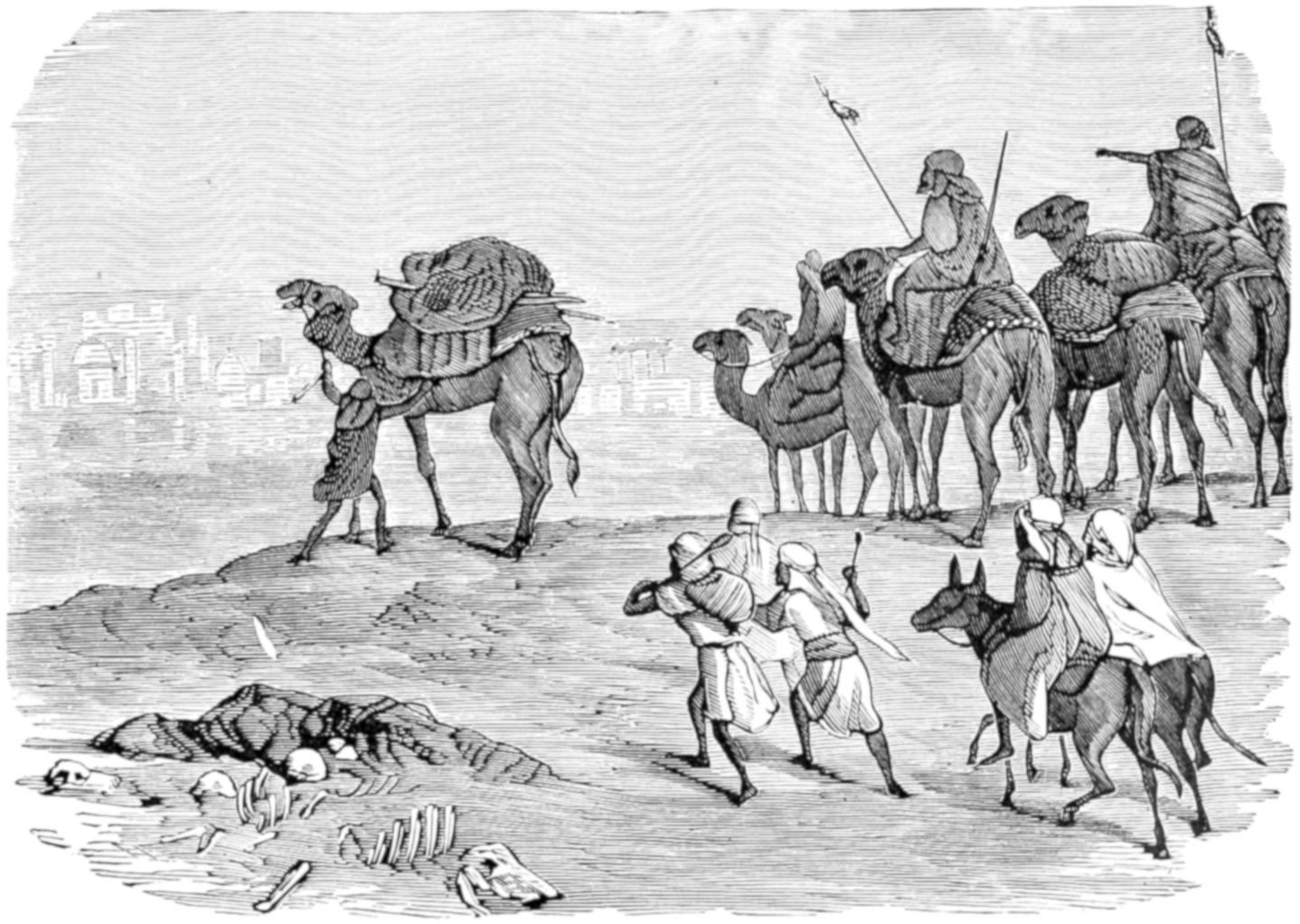
 —writes cabalistic
words in all the angles, and pours about a
spoonful of ink into the centre. More
prayers and suffumigations follow, and the
boy is then directed to look closely into the
ink. Should he be really pure, and a fit subject
for the magic art, he sees a series of figures,
always beginning with a man sweeping
the ground, and ending with a camp, with
the sultan’s tent and flag in the centre.
These vanish, and the mirror is left clear for
any figure which may be invoked.