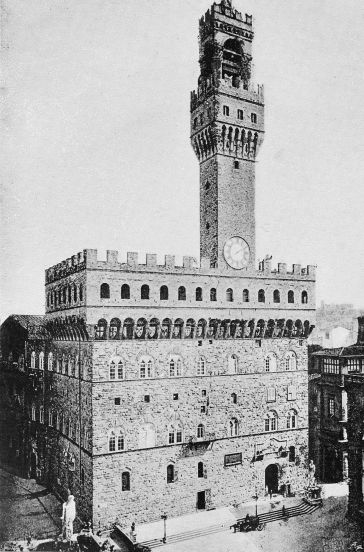
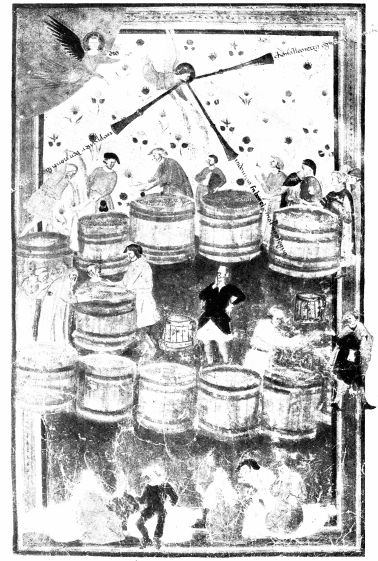
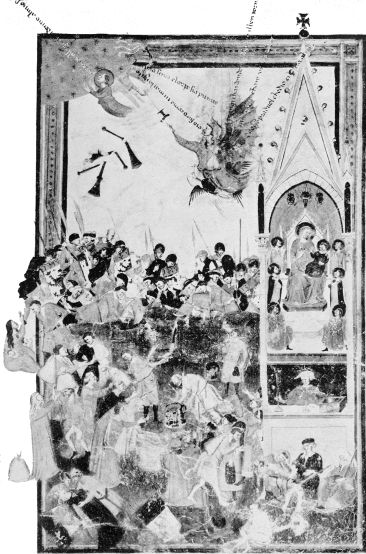
IT is certain that no real national history
of Italy can be written until the statutes
and laws of our communes have been
published, studied, and thoroughly investigated
by the light not merely of
historical but of legal research. The
necessity for such investigation was first proclaimed by the
learned Savigny, subsequently recognised by many Italian
scholars, but has never yet been entirely satisfied. An
accurate study of those old laws and statutes would make
us acquainted with the public law of the communes, and
place before our eyes a clear and exact picture of their
political institutions which have been hitherto very
imperfectly understood. Moreover, what is certainly of
no less importance—it would enlarge our knowledge of
our ancient private law, to which many learned authorities,
among others Francesco Forti, attribute the origin of
modern jurisprudence, and the germs of many jural
provisions, afterwards accepted by us as novelties derived
from the French Code.
Public and private law have far more affinity than is
generally supposed, and each conduces to the plainer and
more exact comprehension of the other. Society and the
State have both their birth in the family, reacting upon
and modifying it in turn. No student therefore who
seeks to discover the true key to political institutions
developing themselves in a country spontaneously, should
neglect the constitution of the family wherein are to be
found the earliest beginnings of civil law, with which
political law also is more or less connected. Cases, it is
true, frequently occur of one people adopting the civil
law of another, without altering its own political institutions;
while in other instances both are imposed simultaneously
by a superior foreign force. This has led many
to question the reality of the connection which in fact
subsists between them. But these cases have nothing to
do with that natural and spontaneous development of law
of which we are now speaking. In this development,
politics and jurisprudence, the State and the family, are
found to be closely interconnected.
In the course of Florentine history we often see
political revolutions break out suddenly and apparently
without warning; but on closer examination we perceive
them to be the result of deep social changes which have
been maturing for a long time, and although imperceptible
at first, afterwards assuming such proportions as
to become suddenly visible to all eyes and productive of
political reforms. Thus it happens that private law, which
always accompanies social movements and changes with
them, not unfrequently enables us to trace the sources
and unfold the true tendency and inexorable necessity of
revolutions, even before they come to pass. Accordingly,
the habitual neglect of this particular study in connection
with the history of Italy has proved a serious defect. No
one at the present day would venture to write the political
history of Rome without giving attention to the Roman
jurisprudence. Nevertheless, we have written the history
of our republics over and over again, without bestowing
a thought on their civil and penal legislation.
It is true that the investigation required presents very
great difficulties, inasmuch as our history was subject,
during the Middle Ages, to a series of changes, always
rapid and always different. The number of our republics
is infinite. Every province of Italy, every fragment of
Italian territory is divided and subdivided into communes,
every one of which has a distinct history, and political
institutions which are constantly changing. This perpetual
mutation is faithfully reflected in the statutes of the
Commune. On the margins of these statutes we find
alterations and corrections registered from year to year,
and formulated, not unfrequently, after the streets of the
city had begun to run with blood. When annotations
and corrections reach a certain number, the statutes are
drafted anew, and of these re-drafts also many copies are
still extant. It was the duty of the officials in charge of
the statutes (statutari) to enter from time to time such
farther modifications as were afterwards approved of in
the Councils of the People. Hence it sometimes happens
that on referring to the statutes of a given year, we may
find the duties of some chief magistrate of the Republic
set forth in their text with the most minute detail, whereas
if we look to the notes it will appear that these duties
have already been changed. If we next consult the remodelled
statute it will be found that the magistracy
itself no longer exists. How is it possible, therefore, to
give any idea of the political form of a municipality
fashioned in such wise? This can only be done by
gleaning from the mass of the statutes the history of the
constitution through all its successive changes of form.
In a word, we must recognise that, instead of being confronted
by a system crystallised, fixed and immutable,
we are watching a living organism develop under our
eyes in obedience to a settled law. This law alone is
uniform, and it is this we must endeavour to trace, since
it alone can solve the mystery and supply exact ideas.
Turning from public law to private legislation, our
difficulties rather increase than diminish. For, in perusing
this, by no means less important portion of the
statutes, we come upon a confused medley of legal
systems differing from and often opposed to one another.
When we meet with such terms as meta and mundium,
wergild and morgengab, dos and tutela, testamentary
succession and succession by agreement, we recognise
that Longobard law, Roman law, feudal law, and canon
law are all present, and perceive that they are blended
in constantly varying proportions. These diverse legal
systems act and react one upon the other, producing
reciprocal changes. Into the Roman law, provisions are
constantly filtering which indubitably belong to the
Longobard law, while the latter in its turn is profoundly
modified ("mutilated and castrated," as Gans expresses
it) by the Roman law. How are we to explain this
congeries of different laws? Is there any new and
original principle that assimilates the heterogeneous
elements and constitutes a new law? If so, what is it?
This is the knotty problem which Savigny encouraged us
to attack, but which we have hitherto failed to unravel. But
although the question remains unsolved, its importance
is now universally acknowledged; it has been carefully
studied, and many treatises, including some of the highest
value, have been published on the subject. Accordingly
certain observations may at last be offered to the public.
The constitution of the family and its relation with
the State are, as it were, the chief centre round which all
fresh researches must revolve, and these form the subject
of this short and summary essay. As a preliminary
step towards the solution of the problem, an accurate
investigation is required of the various forms that the
family assumed under the various systems of law which
succeeded one another in Italy, in order to ascertain how
it was that from the combination of those various forms,
another and widely different one should have resulted.
The first question therefore that presents itself has reference
to the condition of the Roman law and the Roman
family at the time of the barbarian invasion. As regards
the Italian communes, it is only natural that the Roman
jurisprudence should strike the deepest and strongest root
in their social system, and that the history of our laws
should originally find in it their first beginning. Here,
however, we are forced to enter on a digression which,
although seemingly apart from the point, will presently
help us to a clearer understanding of the new society in
course of development. With regard to this digression
it should also be said that so much learning and research
have been directed to the study of Roman law, that we
are able to arrive at certain trustworthy conclusions which,
by affording evidence of the close connection between the
Roman family, and the political society derived from it,
will show us what path to take in pursuit of the same
connection in the history of Italy.
Every student of the Pandects knows that the words
"Roman law" denote the outcome of long preliminary
labours, and the ultimate form of a jurisprudence which
cannot be rightly understood without analysing all the
historical elements employed in preparing and building it
up. Treated in this way, the history of Roman law
becomes, as it were, instantly transformed into a history
of many different legislations following one another at
intervals. From the Twelve Tables down to Justinian,
this law never halts for an hour in its constant course of
development. Even during the Middle Ages, when the
compilations made at Constantinople were studied with
religious zeal by expounders and commentators whose sole
object was to faithfully reproduce and diffuse this law,
even thus, in the hands of those interpreters, influenced
by the altered spirit of the times and by new social
developments, it underwent changes of which they were
not themselves conscious. It is not until the fifteenth
century that this historic development can be said to have
ceased among us, and Roman law become mainly a subject
of learned research. It is at this time that a new and
modern system of jurisprudence first reveals itself to
history, endowed with a separate life, and with a form of its
own, though borrowing much from the Roman law, which
in consequence continues to be of the utmost value to
us, and still deserves our most assiduous attention,
although for a very different purpose from that with
which it was studied during the Middle Ages. Our
object is now to familiarise ourselves with an immortal
monument of ancient wisdom, to shape our legal education
by it, to be helped by it to a clearer understanding
of our own codes, and to contemplate it in its
successive manifestations, while we search for its regulating
law. It is in fact the discovery of this law that has at
once thrown a new light upon the whole history of Roman
jurisprudence, which we perceive to have been always and
unceasingly governed by it, and thus forced to assume a
character so constant and continuous through all its various
transformations, that what had before seemed to be a series
of distinct legislations takes an entirely new aspect, making
us spectators, as it were, of the evolution of a single idea,
the progressive development of a work of Nature.
All this continuous progress or evolution was the result
of two forces, of two different elements. The true, primitive
law of Rome was the special law of the Quirites, of
which we find the remains in the Twelve Tables: a severe
and restricted law abounding in formulas which had to
be sacredly observed, and its administration was entrusted
to a small number of citizens who alone were acquainted
with its rules, whose authority was sanctioned by religion.
The smallest mistake of form made void the most just
decree, and where the law omitted to define the formula
to be observed, no valid action could be brought. When
the due formula, making the contract binding, had once
been pronounced, no proof of mistake or fraud could
annul it. "Uti lingua nuncupassit ita ius esto." A slave
to forms, the judge could not listen to the voice of
morality or rectitude; the most just complaint failed to
move him, unless supported by a text of law. The
defendant dared not stir a step without the continual
guidance of the legislator, inasmuch as every juridical
formula was sacred and inviolable; and as the science of
law was monopolised by the College of Pontiffs, the most
aristocratic and conservative body in Rome, it became a
kind of occult science. It was this very character, however,
apparently so restricted and pedantic, that gave its
great force to the law in Rome. For law, being now freed
for the first time from every extraneous element belonging
to morals and good faith, became firm and inexorable.
Any one who had the law in his favour was safe to see it
promptly carried out. History affords no example elsewhere
of legal sanction and redress being applied so
swiftly and surely as in Rome. In Athens, indeed, where
the laws were more philosophical, and the popular
conscience gave judgment, investigating motives, despising
formulas, and looking only to substantial justice, caprice
often prevailed, and law never attained the iron strength
and tenacity of the Roman jurisprudence.
But with changing times, all things changed in Rome.
This jurisprudence revered as sacred, but described by
Vico as made up of formulas and phrases, was well adapted
to a rude and primitive people. Ideas had greatly altered
in the days of Cicero, who in his speech pro Murena
severely satirises a science which, in his eyes, had become
ridiculous: "res enim sunt parvæ, prope in singulis literis
atque interpunctionibus occupatæ." He looked upon the
whole thing as a fraud designed by the priests to secure
themselves a monopoly. Was he in the right or the
wrong? Vico, in examining a similar question, showed
that Cicero was mistaken on this score. Cicero and his
contemporaries, he said, lived in too cultivated an age to
comprehend rude and primitive jurisprudence; they could
not grasp its true significance, but formed their judgment
of the ancient laws according to the ideas and principles
of their own times. This view, which was first broached
in the Scienza Nuova, was afterwards accepted by many
other writers; and it is now placed beyond a doubt that
the primitive Roman law was not the artifice of a learned
few, but was a spontaneous and necessary growth among
the people with whom it had its origin. At first, custom,
clearly distinguished from the law formulated and written,
tempered its rigid severity. Good faith and equity, disregarded
and rejected by the law, found their sanction in
custom, were administered by a separate tribunal, and
were always respected, inasmuch as the sentence pronounced
by the officiating magistrate was morally, though
not legally, binding, and was therefore of great efficacy as
the genuine expression of public opinion. The sentence
of condemnation could not be carried out by force; but
it made the condemned man infamous, and, as a last resort,
the magistrate could cite the accused before the people, as
the supreme legislator and judge.
But at a later date customs grew corrupt, and no longer
sufficed to protect public good faith and morality, which
were driven to seek asylum and sanction in the law, and
so began gradually to modify its primitive character.
Substance now prevailed over form, equity over the
ancient text of the law, the intention of the contracting
parties over words uttered by mistake; the law became
more moral as customs grew more degraded. This transformation,
though very gradual at the beginning, was
afterward, accelerated by the new conditions of the
Republics in which a change took place not unlike that
occurring in the history of jurisprudence, towards the
beginning of the seventeenth century. At that time the
various European States, with their various systems of
law, having contracted new relations with one another,
came to recognise the necessity of establishing some fixed
rules by which all should be bound, and thus, under the
auspices of Hugh Grotius, the so-called School of Natural
Law was built up. The same occurred in Rome, if not
in the science, at any rate in the practice of law. As the
dominion of the Republic became extended in Italy, its relations
increased with neighbouring nations, among whom
the more philosophical and less severe laws and principles
of the Greek jurisprudence prevailed. It was impossible
to impose upon all these nations, without modification,
the rigid law of the Roman patriciate. Accordingly a
new system of law, of a simpler character and wider
reach, took shape and rapidly grew. This was named the
jus gentium, to distinguish it from the other, the jus
civile. "Jus gentium est quod naturalis ratio inter omnes
homines constituit." This system, however, was not
deduced from philosophic theories concerning human
nature, as was the, appropriately styled, natural law of
the eighteenth century; it originated in the practical
needs of the Romans and their new relations with other
Italian peoples: it was fostered by the principles of Greek
jurisprudence that had been transplanted into Southern
Italy; it met the new requirements of the Romans themselves;
and taking the place that custom had previously
filled in the Roman courts, grew side by side with the law
of the Patricians with which it long maintained its union.
There were thus two systems of law in force in Rome;
and we accordingly find on the one hand judges and courts
faithful to the ancient formalism, on the other, judges and
courts taking cognizance of equity and good faith, and
almost discharging the duties of the Censor. The continuous
onward progress of the jus gentium, the reciprocal
action of the two legal systems ultimately fusing them into
one, wherein the old Roman formation gradually lost its
rigidity, and equity, becoming incorporated with the civil
law, began to assume a more definite and regular form,
were all consequences of the principle which dominates the
life and history of the Roman law, and may even be said
to constitute it. For it has been moulded and diffused
through the world, inheriting from the old Quirites its
frame of iron; from contact with other races and from such
germs as it could assimilate of Greek civilisation, its more
comprehensive and human spirit. Assuming thus a character
at once exact and philosophical, it seemed as though
destined to become, from its superiority, the universal
jurisprudence, the indispensable foundation, as it were, of
all future legislation. This union of legal systems was
effected by the Prætor. He it was who represented both
the modern spirit and the ancient, enlarging the old law
with the defences of equity which he strengthened by submitting
it to the trammels of a formal procedure. This
in substance was what took place with regard to customs,
letters, and everything else. The fusion of Greek civilisation
with the Roman constitutes the history of the ancient
world.
As is natural, we also meet with the same phenomena in
the history of the family, from which the civil law is to
a great extent derived. In fact, whoever contemplates the
primitive Roman family, at once recognises it as the basis
upon which the future juridical and political greatness of
Rome was erected. The family is sacred; the father is
absolute master of the goods, the liberty and the life
both of his wife and of his children. He is priest, judge,
supreme arbiter: wife, children, and grandchildren form
with him a single joint society, one legal entity of which
he is the representative. The woman may be bartered
away, killed, or sold in execution; freed by marriage from
the despotic control of her father, she at once falls under
that of her husband; her legal incapacity lasts through her
whole life. But primitive customs so temper this harsh
law that we find no other people of antiquity so observant
of the sanctity of family, or showing so much respect to
woman. Matrimony is styled "consortium omnis vitæ,
divini et humani iuris communicatio." Divorce on the part
of the husband (repudium) is not forbidden by law, but
any man who repudiates his wife is dishonoured by the
Censor, excommunicated by the priest, and for a period of
five centuries few cases of repudiation are recorded. In
ancient Greece some traces of oriental polygamy are still
discernible, but in Italy monogamy is coeval with Rome
itself. Natural children, as such, never rank as members
of the family, but they may be legitimated. Adoption
is a solemn act, the moral propriety of which is
referred to the decision of the pontifex, as the guardian
of the sanctity of the family, and is thus submitted
to the popular sanction. The woman is never seen in
places of public resort, nor does she attend popular gathering;
but within doors she is domina, and the husband
addresses her by that title. The Atrium is the centre and
sanctuary of the house. Here relations, friends, and
strangers meet together; here stand the domestic hearth,
the altar dedicated to the Lares, and all those objects which
the family holds sacred: the nuptial coach, the ancestral
likenesses moulded in wax from the faces of the dead, the
matron's rock and spindle, the chest containing the household
records and monies. All these possessions are entrusted
to the care and superintendence of the mother of
the family, who, together with her husband, sacrifices to
the gods and assists him in the management of the common
patrimony: she directs all domestic work, and
watches over the education of her children. In the
annals and legends of Rome the name of some heroine,
such as Virginia or Lucretia, is indissolubly linked with
the chief glories of the Eternal City. It is not so in
Greece. In instituting and sanctifying the family, the
Romans laid the foundation-stone of the Capitol. But to
maintain this primitive nucleus of Roman society firm and
compact, the law must always watch with vigilance and
multiply its ordinances. The property of the family
must be kept together as strictly as possible and for the
longest possible time. The father is its sole master and
arbiter; but on his death the patrimony is equally divided
between sons and daughters. The unity of the family
must also be guarded and defended by the law, since there
is serious danger that a woman marrying may carry away
from the family an interest in the family property. She is
accordingly subjected by the law to a perpetual tutelage
which prevents her from disposing at will of her own
property. On the death of her father the woman comes
under the tutelage of the agnati. In Cicero's day, when
as Vico has noted, the true significance of primitive
Roman law had been lost, lawyers believed that this tutelage
of women had been established on account of the
weakness of the sex, propter sexus infirmitatem. But
Gaius refers to this opinion as a plausible and prevalent
error, and maintains that the restriction was instituted in
the interest of the agnati, so that the woman, whose presumptive
heirs they were, should have no power to alienate,
diminish, or otherwise defraud them of their inheritance.370
So long as the woman remained under the tutelage of
her father, inasmuch as she had not yet inherited, the law
allowed her to incur legal obligations. The danger for the
family began when, on her father's death, she became an
heir. It was from that precise moment, accordingly, that
she came under the tutelage of her own heirs the agnati, and
could no longer bind herself without their consent. This
tutelage, therefore, became not merely a duty on the part
of the agnati, but was also a right and privilege. Where
the agnate was a minor, of weak mind, or otherwise incapacitated,
he did not forfeit this right, but it had to be
exercised by a third party. The tutor fixed the dowry to be
given with the woman on her marriage; but the remainder
of her patrimony had to be preserved intact, that it might
return afterwards to the agnati. No woman could make
a will, that she might not have it in her power to defraud
the family. On passing in manus viri, the woman underwent
a capitis diminutio. She entered another family, as
it were, loco filiæ, and her new relations became her lawful
heirs. Under these circumstances the law permitted
her to make a testamentary disposition, whereby, notwithstanding
her new relationships, she might restore her
patrimony to her own original family.
When the woman was under the manus of her husband,
she was emancipated from the paternal authority and from
the tutelage of her agnates. The displeasure thereby
caused to her own family was so great that, before long,
marriage by simple consent was resorted to, according to
which the woman became personally subject to her husband's
authority, but he had no right of manus over her,
and consequently no power over her property. In this
way the woman remained under the power of her father
or of the agnates, and at the same time came under the
authority of her husband, an arrangement that inevitably
led to many collisions, and hastened the advent of the
most radical change in the Roman family—the complete
independence of woman. But, before reaching this point,
disputes were for a long time kept in check and efficaciously
remedied by the mediating influence of a most
important institution—the domestic tribunal. This family
council, regulated by usage, not law, was composed of
agnates, cognates, relations, and sometimes also of friends.
It presided at espousals and at the assumption of the toga
virilis; it protected orphans; it aided the head of the
family in adjudicating and in awarding punishment, and
acted as a restraint on his authority. By law, the father
could act even without the co-operation of the Council;
but by doing so, he exposed himself to being publicly
blamed and noted with ignominy by the Censor, who,
if necessary, might accuse him before the people. The
marriageable maiden was subject to and protected by this
Council.
Becoming a wife by that form of marriage which
brought her in manus viri, she left her own family to
become member of another; but if not married under
that form, she still remained subject to the family Council,
in which her husband was now included.
In the age of Cæsar, the Roman family is no longer
what it was at first. Laws, usages, ideas, all are changed;
and everything is moving onward to a still more radical
transformation. The jus gentium seems to have become
identical with the more rigorous jus civile. The fideicommissum
has almost the force of a testament in solemn
form, and has become part, as it were, of the jus civile;
verbal contract, the ancient stipulatio, once so hampered
by formulas, is grown so flexible as to resemble a contract
under the jus gentium. But the greatest change of all has
taken place in the family. The domestic hearth is no
longer the household sanctuary. The Atrium is transformed
into an open courtyard, enlivened with flowers
and limpid fountains, ornamented with gilded busts and
statues, often of an obscene character. Sacrifices are no
longer offered there to the gods amid the stillness and
purity of domestic and religious affection; it now serves
the enriched and corrupt patrician as a place of reception
for his numerous friends and clients. The family of
former days, once almost a State within the State, is now
dissolved, and, as it were, swallowed up by the political
power. The agnates no longer cleave together, the
domestic tribunal has either lost its strength or has
entirely disappeared. Paternal authority, though less
absolute, is more oppressive, being no longer in harmony
with the changed customs. If a father disinherits his son,
the judge cancels the will. Should he refuse consent to
his son's marriage, the State compels him to grant it;
should he punish his son with death, the emperor sends
him into exile; he cannot ill-use even his slaves without
being punished by the law, for the law has grown moral
as manners become more corrupt. By gradual degrees
woman escapes from tutelage, and from manus, and
ultimately attains her independence. But the more she
is emancipated from her family and relations, the greater
becomes her subjection to the State. In her new independence
she incurs new disabilities, no longer resulting
from her position as daughter or wife, but from the fact
of her sex, disabilities no longer imposed in the interest
of the family, but created as a protection for her infirmity.
This explains how it was that the lawyers of later days
were mistaken as to the significance of the old law touching
the tutela of woman. The wife's dowry is guaranteed to
her more and more strictly, until it finally becomes her
almost inseparable property. It must neither be alienated
nor diminished. On her becoming a widow, being
divorced, or returning to the paternal roof, she remains
absolute mistress of it. A husband who surprises his wife
in adultery can no longer—hiding his dishonour within
his own walls—judge and put her to death with the
consent of the domestic tribunal. He must now leave
the State to avenge his wrongs, and must resort to the
courts, even though seeking only minor penalties. Divorce
has become a public act of not unfrequent occurrence.
The woman, in short, is no longer under her husband's
manus, no longer subject to the patria potestas, no longer
under the tutelage of the agnati: she is protected by the
State. When the law still requires her to have a tutor
or procurator, she can choose a stranger who becomes her
servant rather than her master. Eventually even this
last shadow of subjection disappears. Absolutely her own
mistress, the woman may now hold property, increase her
fortune, make her will, lose her virtue; but her dowry,
guaranteed and kept intact by law, remains hers to the
end of her life.
Nevertheless, as regards succession, the woman's rights
are not yet the same as the man's. It is true, that should
her father die intestate, she takes an equal share with her
brothers of the inheritance; but in all other cases of
intestacy the nearest female agnate stands after the most
distant male. The woman cannot now do any legal act
for others, though this had not been forbidden previously;
she cannot be a witness; she cannot stand security for
the debts of others. The Senatus-consultum Velleianum
lays it down as a fixed rule, which, to a certain extent,
has remained in force to our own days—that the woman
must not undertake any obligation on behalf of others.
She may alienate her possessions in others' favour, may
incur a direct obligation, contract a debt, and transfer the
money to others; but she cannot bind herself to pay
another's debt, nor guarantee its payment. In the legislator's
opinion, the infirmity of her sex leaves her enough
intelligence to escape danger in assuming direct obligations,
or by alienating her property, but not enough to guard
her from lightly undertaking remote and indirect liabilities
which are often no less serious.
But the progressive changes in the Roman family are
not yet at an end. To the numberless causes for change
already in existence another is added, when Christianity
finds its way into the Empire, into literature and law,
and subverts all things. According to the law of Christ,
man and woman are equal; father and mother have equal
rights and duties in respect of their children, for whose
advantage all things must be ordered; whereas, by the
old law, the rights of the children were subordinated to
the interests of the family. A new element is now introduced
into Roman law which further changes its character,
already much modified by Greek philosophy and by Byzantine
despotism. The Canon law accepts the principles of
the Roman, recognises the wife's absolute interest in her
marriage portion, and rejects the pretensions of the husband.
Woman remains excluded from every office which
the ancients deemed proper to man; she cannot enter into
obligations for others, nor arbitrate, nor lay an accusation,
nor bear witness in court; her evidence has no legal
effect. On the other hand, Roman law tends inexorably
to democratic equality, natural equity, and to the absolute
predominance of the State. The public authority deprives
domestic authority of its last remnant of power; it may
almost be said that the family, as a body-politic, disappears,
to be reconstituted on the footing of reciprocal affection.
The final seal to these alterations was imposed by the
famous law of succession (Nov. 118 and 127) enacted by
Justinian in the years 543 and 547, which, suppressing
every privilege of sex and agnation, fixes rights according
to the degree of relationship, and makes them reciprocal.
It moreover enlarges the amount of the legitim, and
ordains that the dowry of the wife should be met by
a donatio propter nuptias of equal value from the husband,
and that, in the interest of the children, both should be
inalienable. Even with the consent of his wife, the
husband cannot sell the dowry; he may only administer
it, and there must be complete reciprocity. The wife is
not only the owner of the dowry, she has besides a general
charge over her husband's property for its restitution, with
a right of action to enforce it as against all his other
creditors. In inheriting from their children the mother
has equal right with the father, and she is now qualified to
be their guardian. Even the Senatus-consultum Velleianum,
which forbade women to incur obligations on behalf of
others, is modified with the same scope. Justinian, indeed,
from his desire to protect the property of the woman against
all danger, is strenuously opposed to her incurring obligations
on behalf of her husband; but he is much more
indulgent in respect to obligations undertaken on behalf
of a stranger. These, if incurred for manifestly good
cause, are valid if renewed after two years. Thus
modified, the Senatus-consultum Velleianum is treated with
respect throughout the Middle Ages. Reciprocal equality
is now achieved, but the ancient unity of the family is
dissolved; the compact and iron nucleus of Roman society
is broken to fragments by the continual and increasing
action of the State. In all her institutions, Rome has
succeeded in arriving at democracy and equality, but at
the cost of complete individual liberty, and by sacrificing
the development of special associations and of local life
to the unity of the State. How to conciliate these two
elements without destroying the one in the interest of
the other will be the problem of a new era and a new
civilisation.
However highly we may rate the amazing and indisputable
greatness of the labours of Imperial legislators and
juris-consults collected in the Corpus iuris in the time of
Justinian, it is nevertheless certain that the ancient and
primitive character of Roman law has been profoundly
changed by it, and that the despotism of the State, always
prevalent in Rome, has been enormously increased. It is
for this reason that Tocqueville, and others with him, go
so far as to maintain that the great diffusion of the
Justinian law among the Latin races has more than once
proved hurtful to political freedom. To many, such an
assertion may seem absurd; but granting that there is a
close bond of connection between private and public law,
and that the final changes in Roman law were introduced
by the action of the growing despotism of the State, the
opinion advanced by the French writer is not without its
value.
However that may be, it is undeniable that the family,
as we now find it constituted, or, more correctly speaking,
weakened, by the Justinian law has not the qualities which
would enable it, in the ages of barbarism now at hand,
to withstand the violent onset of the advancing Germanic
peoples, much less to be the nucleus and germ from which
the new society of the Italian Commune may take birth.
In fact, in the statutes we find the family constituted on
a very different footing. Agnation has recovered its
ascendancy. The woman is under a new species of
guardianship; and although the dotal system is rigorously
observed, there are innumerable regulations designed to keep
family property together, or make it revert to the family,
so as to preserve the domestic patrimony intact. Here
an important question arises, namely, whether this new
constitution of the family, which stands in close relation
with the public law of the communes, is a return to the
pre-Justinian law, or derived from Germanic institutions
and the Longobard law, in which we find, in fact, precedence
accorded to agnate kin and a more stable family
organisation? Italian writers, the earlier writers more
especially, adhered for the most part to the former theory,
while the majority of German authors, who have recently
found disciples even among ourselves, adopt the second
view. Thus, on either side we find theories propounded
as to the constitution of the Italian family in the Middle
Ages, analogous to those concerning the origin of the
communes.371
The persistence of Roman law in the Middle Ages,
even when the condition of the Italians was most wretched,
and when all things seemed to be subject to the law of the
Longobard, was maintained with marvellous learning and
acumen in the immortal work of Savigny. But, in truth,
though public law and penal law might readily be altered
under the rule of the conqueror, there was little likelihood
that the civil law which, for so many centuries, had filtered
into the usages and into the very blood of the Romans,
which had regulated the manifold relations of a civilised
people and satisfied its countless requirements, should
perish utterly beneath the sword of barbarians unconscious
of those requirements and not always able to comprehend
those relations. Matters of which they were to a great
extent ignorant, or as to which they were indifferent,
must often have been passed over without notice in the
laws framed by the barbarians, or have evaded their
action. Various provisions, therefore, of the Roman law—those,
for instance, relating to marriage, to succession, and
to contract—must often have continued to be applied by
the Italians in conformity with ancient usage. This will
be more readily understood if we reflect that while the
Roman law had become the law of all in those countries
in which the Roman conquest had taken deep root, the laws
of the barbarians, on the contrary, according to Teutonic
usage, always presented a personal character—that is to
say, extended only to the people with whom they originated,
and were not easily communicated to others. In fact,
when, as a consequence of successive invasions, different
Germanic tribes, whether independent of each other or
in subjection one to another, came together in the same
country, each of them continued to be governed by its
own peculiar laws. The Romans, on the contrary, regarding
their law as universal in character, communicated it to,
and imposed it upon all. It was almost the first germ of
the greatness and the civilisation of Rome, and for that
reason its diffusion was considered the most sacred of
duties by this sovereign people. Thus it was that, even
under the harshest barbaric oppression, the Roman law
continued to be the private law of the Italians in all
those cases, and they were not few, in which the German
laws failed to notice it, and neither abrogated it directly
nor substituted another in its place.
But the presence of two diverse legislations, the one
imposed by force, the other preserved by custom,
the radical change of conditions occasioned by the
destruction of the old Roman State and the formation
of a new society, could not fail to originate a
new life, a new history for the Italian law. In the
statute books of our communes we find Roman and
Longobard law confronted and almost contending, each
modified in turn by the action of the other. But under
which of the many forms through which it has passed is
the Roman law found among us at the moment when it
seemed on the point of being overcome by the Germanic
law? Was it in the literary and philosophic form given
to it by Justinian, or was it in the pre-Justinian form,
which, while less systematic, was also less altered by
Byzantine ideas, and more in accordance with usage?
Savigny roundly asserts that the Pandects on their completion
were at once sent into Italy, and that immediately
after the power of the Goths had been shattered by the
Greeks Justinian hastened to issue the Constitution (534),
whereby legal effect was given to them in the land.
In consequence of this, he continues, the Pandects were
then to be met with in every corner of Italy, where they
were at once received with favour, inasmuch as the
Justinian law was specially adapted to the requirements of
the land. This, he goes on to say, likewise explains
why it was that all the earliest Italian commentators or
glossators devoted themselves exclusively to the study of
the Corpus iuris. The reader, however, may easily
discover that, on this head, Savigny has pushed his inferences
too far. More than once, indeed, he is compelled
to put a false interpretation on documents that they
may not contradict his theories; and more than once the
documents themselves seem to warn him that, even in the
Middle Ages, vestiges of a pre-Justinian law are to be
traced; but he persists still more resolutely in considering
all this to be only a survival of antiquated forms. Many new
documents have recently been published, and the question
again presents itself, always with the same urgency.
As a German writer, well versed in the subject, has
recently observed, everything tends to show that the
history of Roman law in the Middle Ages should be
divided into two entirely distinct periods.372 During the
first it endured by force of custom, and accordingly many
pre-Justinian formulas survived with it; in the second
and much later period the Justinian law prevailed, promoted
still further by the literary study of the Pandects
undertaken by the Bolognese professors; it was only then
that the most ancient formulas wholly disappeared. This
view is supported by documentary evidence and harmonises
with the character of the times and with the requirements
of society, and is confirmed by our old writers and our
literary traditions.
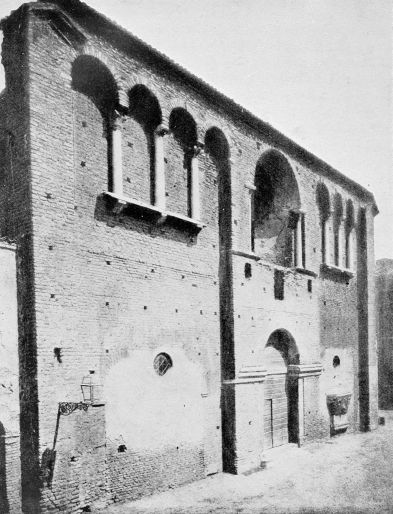
SUPPOSED PALACE OF THEODORIC, IN RAVENNA.
[To face page 383.
In fact, Savigny himself examines and recognises the
full importance of the various sources of pre-Justinian
law diffused in the Middle Ages. The code of Theodosius
(438) which then possessed great authority, and the edict
drawn up by order of Theodoric the Ostrogoth (500),
were direct compilations of the old Roman Jurisprudence.
If in these compilations we turn our attention to the
constitution of the family, more particularly as regards
succession, we find it exactly as it was before the law was
interwoven with the Imperial edicts.373 The Breviary of
Alaric ("Lex Romana Visigothorum") and the so-called
Papian code ("Lex Romana Burgundioram"), both
posterior to the year 500, are likewise compilations of
pre-Justinian law, and are found to be diffused in several
provinces of the Empire. The often-mentioned "Lex
Romana Utiniensis, seu Curiensis," which seems to be
ninth century rimpasto of Alaric's Breviary for the use of
Italians in lands previously under Longobard rule, also
shows the same characteristics. It is true that, according
to the hypothesis of Savigny, the Breviary of Alaric must
have been in use among the Franks and brought by them
to Italy after the expulsion of the Longobards. In this
case we should find the old law to have been in force
among us only before and after the period of the Longobards;
while during their oppressive rule we should
discover no certain trace of it. But it is very difficult to
suppose that the ancient law, based as it was upon
custom, should have died out precisely when custom
might have preserved it, or that Roman law should at
that time have assumed the literary Justinian form and
afterwards have returned to a form more primitive. Had
the legislation of Justinian in its genuine form been once
accepted, it must have continued to gain ground with
the advance of civilisation and under the less severe
rule of the Franks, whose mode of life approached much
nearer to that of the Latins. The fact is, that throughout
the Middle Ages we meet with pre-Justinian legal forms,
more or less modified, even among the laws of the Longobards.374
As to the remark that the earliest Italian commentators,
the glossators, directed their studies to the
Pandects and the whole of the Corpus iuris—this only
shows that on the revival of the communes and of letters
they turned, as was natural, to the most authoritative and
literary source of jurisprudence. From that time, in fact,
no other is looked for.375

THE TOMB OF THEODORIC, RAVENNA.
[To face page 384.
It should also be remembered that, when the Greeks
came into Italy to combat the Goths, they found the
ancient Roman customary laws in force and sanctioned by
the edict of Theodoric; that the Goths were definitely
vanquished in 553; that in 568 the Greek domination
was followed by that of the Longobards; that the latter
confined their rivals to Southern Italy, whence they were
afterwards expelled by the Normans. There, in the south,
the corrupt Byzantine despotism proved no less fatal than
the oppression of the barbarians, and was perhaps the
prime cause of the many disasters and prolonged neglect
into which those provinces afterwards fell. But was it
possible for a dominion so brief and troubled to diffuse
the law of Justinian in Italy with such effect as not only
to make it universally accepted, but also so thoroughly
incorporated with customary law, that it could survive
even when its binding legal effect was no longer recognised
by the barbarians?
Such an hypothesis will seem even less tenable as regards
everything relating to the family and to succession, if we
reflect that the reforms introduced into this branch of the
law by Justinian at Constantinople in no way corresponded
to the conditions in which Italy then stood. Notwithstanding
the diffusion of Greek philosophy among us, the
spirit of Byzantium was by no means identical with that
of Rome, and there was still less identity in their social
conditions. In Constantinople Oriental despotism corrupted,
nay, suffocated society by excess of luxury and
over-refinement of culture; the State assuming everything
to itself, imparted a new character to the laws. In Italy,
on the other hand, society, no less corrupt, had become
disintegrated, and was already falling to pieces; the
ancient unity and strength of the State were continually
diminishing and losing strength, and less and less resistance
was opposed to the assaults of the barbarians. At
Constantinople the State was omnipotent, while in Italy
its vigour was on the wane. Among us, accordingly
women and all who were weak were naturally driven to
seek refuge in private associations, and above all in the
bosom of the family. And if the natural force of events
had power to urge in any direction, and determine any new
tendency, it certainly could not have aimed at enfeebling
the family bond by subjecting it to the authority of a
tottering State, but must rather have sought to strengthen
it as the only possible safeguard amid the dangers that
were threatening on every side. This, in fact, is the course
always followed in barbaric societies, where, the State
being powerless, the care of the weak and the punishment
of injuries are entrusted to the kinsmen. In short, both
the disordered condition of Latin society and the example
of the barbarians themselves combined to offer grave
obstacles to the diffusion of Justinian's laws, more especially
when the old Roman customs were seen to be better
suited to the new and increasing needs of society, and
useful for the reconstruction, on a firmer basis, of the old
family system, now become more essential than before to
the common welfare. No other way was left for beginning
anew the social task and advancing afterwards to
new methods and institutions. Nor need we attach
much importance to the constitution of the year 534,
knowing how wide is the difference between the promulgation
of a law (especially when it is passed by a
short-lived and feeble Government in a society that is
lapsing into disorder) and its actual enforcement and
incorporation with custom. Even under the Roman
Republic, or under the Empire, old laws did not at once
disappear when new ones were proclaimed. Even in
modern societies we may note how tenaciously ancient
customs continue to be observed when they are more in
harmony with the character and requirements of the
people.
The principles of the Napoleonic code were proclaimed
in our Southern provinces during the French domination
and afterwards confirmed by subsequent legislation; and
according to that code, every patrimony was bound to
be divided equally among the children. Nevertheless,
in the two Calabrias and many other Southern provinces,
property is still kept undivided in the family, since, by
common consent, only one of the sons marries, the others
remaining single. For the same reason, the smallest
possible sum is assigned to the daughters; nor do all of
them marry, some being persuaded or forced to take the
veil. Social progress alone will slowly give real effect to
the principles of equality sanctioned by the codes.
Everything therefore points to the conclusion that
Roman law survived among us to the downfall of the
Western Empire, preserving by usage many of the forms
that had belonged to it before the compilation of the
Corpus iuris. While in this state it came into contact
with the Germanic code, and thereupon began the series of
mutual alterations, from which the Italian family emerged,
reconstituted in a totally new way, and together with it
the Commune. It was a slow transformation, during which
Latin ideas and traditions steadily gained ground, and
gradually fused or destroyed the barbarian laws and institutions.
When communal liberties were finally proclaimed,
a new culture was inaugurated, and with it a
new epoch in the history of Roman law. The university
of Bologna became the centre for the diffusion and study
of the Pandects, and the Corpus iuris became speedily
regarded as the primary and perennial source of common
law in our country. The tradition, according to which
the Pandects of Amalfi, carried off by the Pisans, were
by them discovered and made known for the first time to
the Western world, dates this event about the year 1135,
that is to say in the same age that witnessed the rise of
the communes, and in which, as related by another tradition,
Guarnerius founded the Bolognese school at the
request of Countess Matilda.376 Thus our conclusions are
supported alike by history, legend, and logic.
In Italy, therefore, at the beginning of the Middle
Ages, the family accorded a preference to the agnates,
and, in consequence of the continuous weakening of the
State, was obliged to seek in itself for increased strength.
The inroads of the barbarians brought with them a
different constitution of the family, but this could effect
no great change in our own family system until the
Longobards had firmly established their dominion over
us. There then began a great change in the social condition
of Italy, which was forcibly compelled to assume a
form more or less barbaric. Hence it concerns us to study
the Longobard family system, that we may see how far
and in what way it could thus alter ours.
[To face page 388.
Like every other barbaric society, that of the Longobards
was founded upon force; in time of war it was
compactly united under a king; during peace it split into
groups, from want of vigour in the central authority,
and from the excessive independence of subordinate chiefs.
Hardly had barbarian kingdoms begun to be erected in
the West with a certain degree of stability, than we find
them subdividing into marquisates, dukedoms, separate
groups, and at a later period into feudal holdings. If
we look to the primitive conditions of these barbarians
before they come among us, we find them scattered over
the country, without any city properly so-called, and with
no true conception of the State, which for them seems to
consist in a confederation of secondary groups. The social
unity of the barbarians is to be found in the villages or
even in the tribes, which are societies originally derived
perhaps from a single family. Everywhere the State assumes
family forms. The social strength of the Germans
is more manifest in the lesser groups, and consequently in
the family. We ought not to be surprised, therefore, at
finding the family constituted more solidly with them than
among the Latins, who now, for many centuries, had been
altering and modifying it under the growing pressure of
State control.
Originally the barbarian family had been, like the
Roman, an association consecrated by religion. A tutelary
goddess presided over the domestic hearth; the father was
priest and protector of the family. In Rome the control
was in the hand of a single person, who ruled with an
iron authority, but in Germany this authority was shared
by all male members of the family fit to bear arms. At
Rome the family was an absolute monarchy, its senior
members being always regarded as the most powerful; but
in Germany it more resembled a Republic, consisting of
all the adult male members, except such as were disqualified
by bodily infirmity. The family council aided the Roman
father and tempered his rigid despotism; whereas in Germany
the council predominated and assumed to itself the
chief share of the family power. The Roman father
could rupture every domestic tie at his will; he could
remove his son from the family, sell him, or put him to
death. The German son, on the contrary, when able to
bear arms and fight by his father's side, might, if he chose,
separate himself from his original family and join another
tribe. Among the Germans bodily strength, property
held in common, and natural ties of blood constituted the
family; in Rome it was the conception of the family in
itself that dominated over everything and made it authoritative
and sacred. In Rome the individual was merged
in the State, the son in the father; whereas, among the
Germanic tribes, individual liberty was much greater, and
if to us the State has the appearance of a confederation,
the family seems a society of more independent members
united by mutual agreement. Punishments, transgressions,
property, all were in common; if any member of the
family suffered wrong, it was the kinsmen's part to avenge
him and obtain retribution. For sales and donations, as
well as for acts of revenge, the consent of every member
was required, inasmuch as the property belonged to the
whole family, and ought to stay with it: whence the
inutility of testamentary dispositions, which were in fact
unknown to the barbarians. Property was sacred; it
constituted the family, conferred social rights and obligations,
and rested chiefly in the hands of the males. In
this family, and in this society founded wholly on force,
the woman, being incapable of bearing arms, was committed,
like all other weaklings, to the defence and
protection of her armed kinsmen, and so came under their
perpetual guardianship (mundium, munt, manus). This
tutelage being established on account of the weakness and
infirmity of the sex, could never come to an end, as it
might in Rome, where it had been constituted wholly in
the interest of the family. But the Germanic woman,
although oppressed, liable to be deprived of her property,
to be sold, or made a slave, was under a power which,
being divided among many, was feebler and less despotic
than the Roman domestic rule. She was a dependent
member of the family, but the authority of her father,
brothers, or sons was shared by all her other kinsmen.
Hence it was easy for the woman to find a protector.
Her incapacity by reason of her infirmity did not
entail incapacity in the eye of the law. She could
appear in court, choose some one to represent her there;
she could own property; she could inherit, although
taking a less share than would have come to her had
she been a man. The man listened to her advice, and
treated her with religious respect; but it was the respect
due to her weaker sex, not as in Rome, where respect was
offered to the mother, to the wife, to the sacred character
which was the foundation at once of the Roman family
and of Roman greatness.
Longobard law, essentially Germanic, prevailed long in
Italy, where plain traces of its survival are to be recognised
as late as the fourteenth century. Under the
stronger influence of the Roman jurisprudence it very
soon lost its native rudeness and originality. As to this
change, Gans, in his "History of the Law of Succession,"
has observed: "The fact that after the historical redaction
of this law, another and systematic compilation of it was
made, should prove to us how it was that the more
confused, but at the same time more natural, spontaneous,
and vigorous character of the Germanic law must necessarily
have been altered, and as it were crystallised into a
form that rather belongs to the Roman." It was precisely
this form that so greatly promoted its diffusion among us.
With the Longobards, as with all the Germanic nations,
woman was never released from tutelage (mundium), never
became her own mistress (selbmundia). The man who
desired to make her his wife must first of all pay the
price of the mundium or guardianship which the marriage
would give him over her; next he must bind himself to
make good the meta, a species of dowry noticed by Tacitus
when he remarks that, among the Germans, the husband
brought the dower to the wife, instead of the wife bringing
it to the husband. To the meta, also known afterwards
under the name of dotalitium, dos, sponsalicium, &c., there
was added the faderfium, which the father might, if he
chose, give to his daughter. On the morning of the day
after the wedding the husband presented his bride with a
gift (morgengab), attended, according to a very questionable
interpretation, as the price of her virginity. When
Longobard customs came to be affected by the growing
influence of the Roman law, the amount of the meta and
of the morgengab was restricted. In the age of the communes,
the faderfium, now transformed into a dower, was
also limited by law. The meta, faderfium, and morgengab
belonged to the wife, who could require them to be given
up to her on her husband's death. But by a peculiarity
of the Germanic law, retained in its entirety even by the
Longobards, the Roman regulation, which made the dower
the separate and independent property of the wife [even
during her husband's lifetime], was never accepted. The
only property owned absolutely and exclusively by the
woman was what was given her by the husband. The
Germanic law favoured the principle of common ownership.
As to this, Gans observes:—"It is not necessary
with us, as with the Romans, that a woman should have
separate property of her own in order to assert her juridical
personality, and prove her equality with her husband.
She possesses what her husband possesses, and her equality
rests on the mutual affection which makes all differences
disappear." In the ordeal by combat the husband represented
the wife, since she was under the protection of his
sword; if she were taken in adultery he might put her
to death. All her possessions, movable or immovable,
including even nuptial gifts made to her by friends, became
the property of her husband, who had only to provide
against the contingency of the marriage being dissolved
by death: whence the necessity of the meta and the
donatium.
If the wife died without issue, everything went to the
husband; on the husband's death, the wife was entitled
to receive the meta and morgengab (donation). For anything
more she was entirely dependent on the generosity
of her husband, who, at a later period, was permitted to
leave her the half, and, eventually, the whole usufruct of
his possessions.
While the marriage laws of the Longobards and the
Romans differed thus widely, their laws relating to
guardianship were also different. The mundium of the
Longobards, as we have seen, is not to be confounded
with the tutela to which the Roman woman was subjected.
Originating in the incapacity to bear arms, it was
of limited duration in the case of males, and ceased with
their incapacity. At first the limit was fixed at the age
of twelve, at a later period of eighteen years. But for
the woman, who could never become capable of bearing
arms, it was perpetual. From the mundium of her father,
she passed, on marriage, under that of her husband; and
on the death of her father, if then a widow, under the
mundium of her own son, or of the agnates, who were also
her heirs.
In default of other guardians she was protected by the
Curtis Regia. But in every case, whether under father,
husband, son, agnates, or Curtis Regia, the mundium was
identical in character, having for its object the protection
of the weak. This could not be said of the Roman tutela,
which had its origin in the Roman conception of the
family. The tutela of the Roman father over his children
lasted all his life; but he could divest himself of it. The
mundium of the Longobard father lasted while his children
were incapable of bearing arms, and, as a logical consequence,
ceased when the incapacity terminated. While
it cannot be positively asserted that emancipation was
unknown to the Longobards, it may be believed, from the
tendency of their law, to have been of rare occurrence.
When the Roman woman was subjected to the potestas
of her father, the manus of her husband, the tutela of the
agnates, there were three kinds of guardianship very
different from each other, corresponding with the difference
in the domestic relations of those who exercised the
right. No one of them had anything in common with
the mundium.
The Longobard father had the right to sell his sons;
he represented them in courts of law; whatever they
acquired was his. But, as we have already shown, his
authority was tempered by the family council, in which
the brothers of the mother—the children's natural protectress—had
much to say.
The Longobard family law has marked peculiarities in
regard to succession as well as to marriage. And first, it
should be noted that the disposal of property by will was
recognised by the Longobards. This seems contrary to
the usage of the Germanic tribes, among whom wills were
unknown, but may be referred to the modifying action
of the Roman on the Longobard law.
The fact, however, that with the Longobards donations
and wills were irrevocable, indicates a Germanic character,
or rather the trace of it, for the main feature of the Roman
will consisted in its revocability. Of the essential principles
of the Roman Testamenti factio the Longobards
were ignorant. Legitimate children came first in the
order of inheritance, and with them came natural children
also, the latter—though not in strictness forming part of
the family—being admitted to succeed along with the
former, though taking a less share. They might, however,
be put on an equal footing by being legitimated.
At a later period this essentially Germanic peculiarity of
the laws of succession was done away with by the action
of the Roman and Canon laws, which exclude natural
children. Originally, by the Longobard law, a legitimate
child took two-thirds of the inheritance, leaving one-third
only to the natural children. If there were two legitimate
children, the natural children took only a fifth; if
three, a seventh.
It was forbidden to leave more than the prescribed
share to natural children, and no child could be disinherited
without just and manifest cause. The reasons for
disinheriting a child were borrowed from the Roman
code. It was allowable, however, to favour one son more
than the rest.
The preference accorded to males over females is a
point of much importance, and is another of the special
characteristics of the Longobard law. When the testator
had one son and one or more unmarried daughters he was
obliged to leave a fourth of the inheritance to the latter,
but when there were several sons the daughters only
received a seventh part. Married daughters had no right
to any share in the inheritance, but had to be content
with what they had received on the day of their marriage,
and could claim nothing more. Failing male issue,
daughters were next heirs, and whether married or
single inherited as though they were males. Another
peculiarity of Longobard law was the great favour shown
to daughters or sisters of the testator domiciled in his
house—in capillo. A brother is excluded in favour of a
daughter or niece—a remarkable instance of this strange
and singular preference accorded to females. We likewise
find that unmarried daughters and sisters inherit on
equal terms when living under the parental or fraternal
roof.
We have already noticed that the statutes of the Italian
communes accord, as does also the Longobard law, a
decided preference to agnates over cognates, and that this
circumstance has given rise to keen discussion. Many
persons, indeed, insist on detecting in this preference an
absolutely Germanic characteristic transfused into the
statutes from the Longobard law. But we have seen
that through the greater part of its history the Roman
law also gave a preference to the agnates, and that it was
only at a very late period that it lost this feature, which
was still to some extent retained in Italy at the time of the
barbarian invasions. That the preference of the agnates
was not borrowed by the statutes from the Longobard
law will be even more conclusively shown if we consider
the manifest differences which prevail on this very point
between the Germanic and the Italian laws; and bear in
mind the important fact that the preference continued to
increase in strength, at the very time when the action and
influence of the Roman law are increasingly apparent in
the statutes. In truth, the more closely we examine the
matter, the more we are compelled to recognise that it
was political reasons altogether peculiar to the Italian
communes and to Italian society in the Middle Ages
that led to this preference of the agnates. But even here
the reciprocal action of the one law upon the other is
clearly traceable, for we can perceive that the succession
of the agnates, under the Longobard law, has itself been
modified by the Roman, which has made it careless of the
nature of the property of which the inheritance consists;
whereas it is the peculiar and constant characteristic of
the Germanic law that such succession should be ruled
according both to the degree of kinship and the nature
of the inheritance.
In conclusion, it may be said generally that with the
Longobards the ties of blood predominate; that in their
family there is greater individual freedom, and the
family itself is much less affected by the action of the
State. With the Romans, on the contrary, the conception
of the family is stronger than the ties of blood; the unity
of the family depends at first on an absolute paternal
despotism, afterwards destroyed by the authority of the
State, which to a great extent assumes its place.
From this time the State is predominant in all things;
it reduces the family to fragments, and aims at the complete
equality of all without having the strength to
consolidate a society in which neither individual liberty,
local activity, nor free associations were allowed sufficient
scope for their development. Yet all these were absolutely
necessary for the preservation of a huge social
structure made up of distinct races, and consequently
destitute of the national character and unity which the
Republic and the Empire had imposed. It was precisely
these new elements that were introduced among us by
the barbarians. And thus it was that two peoples, two
forms of family and society, I might almost say two ideas,
two wholly different types of society were brought
together, of which the one had become the necessary
complement of the other. From their forests the Germans
brought individual freedom, personal independence, the
force of small associations; the Latins had already discovered
the unity of the State, the wider and more
organic conception of society, and the political idea of
the family which we shall see hereafter triumphing in the
Commune.
From the fusion of these two different societies that
modern society is to arise in which the action of the
one is seldom dissociated from that of the other, and it
becomes impossible to ascribe the result exclusively to
either.
But while the co-existing and contending laws of the
Romans and Longobards are the two juridical elements
most plainly to be recognised in the Italian statutes, there
are others also claiming remembrance, and among these
the feudal and the Canon law must be noticed. Feudalism
is one of the most important institutions in the history of
the Middle Ages; it is the first form that society assumes
on emerging from the chaos of barbarism, and it is stamped
with a character essentially Germanic. With it, property
and the family take a new and peculiar shape. We may
pronounce it to be the first and chief political and social
manifestation of Germanic individualism. The barbarian
tribe had a natural tendency to split into small groups,
into families solely united by the bond of common danger.
During invasions the tribe transformed itself into an
armed band, left behind all weak or incapable members,
accepted recruits even from neighbouring tribes, and being
under the command of one chief, was forced by the exigencies
of war to be firmly and compactly united. The
attacks previously made on them by the Romans had,
for like reasons, the effect of creating among the barbarians
certain strong and powerful kingdoms by the
union of different tribes; but these never lasted long,
since as soon as peace was restored they began anew to
fall apart and dissolve. Scarcely had the barbarians begun
to settle themselves in the West, than their incapacity to
establish the unity of a State was made clearly manifest.
The moment peace was declared the leaders of the
various armed bands proceeded to divide the conquered
territory. They then separated, and their king, or
supreme chief, remained, as it were, isolated, and with
very scant authority. Every leader tried to possess himself
of some stronghold where he might rule as an absolute
lord, barely acknowledging his dependence on the
king. In the fief thus created, ownership and sovereignty
became confused, but were both considered to be held
(per beneficium) as of favour from a more powerful lord,
subject to certain burthens and obligations. Originally a
temporary grant, the benefice or fief only became hereditary
at a later time. At first it could be resumed by the
donor; it reverted to him on the death of the feudatory,
that it might be transmitted by a new grant to the
feudatory's heirs; it then gradually, by use, abuse, or
special act of concession, became an hereditary estate.
Eventually all property, possession, or ownership came
to be held, during the Middle Ages, on feudal tenure.
The want of vigour in the supreme political power
obliged the weak to seek protection elsewhere. Many
independent landowners voluntarily accepted the position
of vassals; while, on the other hand, the obstacles encountered
by the great lords in enforcing their authority
over wide territories compelled them to cede part of their
land in benefice to lesser vassals. In this way the State,
the Church, all things assumed a feudal form. This
system was completely established in the eleventh century,
when the communes arose in Italy to combat and overthrow
it.
In a fortified castle it was natural that the ties of the
family should become continually stronger: a fortress
must suffice for itself. It was, as it were, the independent
world of the lord who dwelt in it, and divided his time
between perilous adventures and domestic life. All historians
have noted that feudalism produced increased
respect, affection, and chivalrous regard for woman, and
made man more resolute and energetic. Save in times of
war, the baron was almost absolute and independent lord
of his small realm, wherein all were his subjects. From
him his vassals received the posts of seneschal, count of
the palace, equerry, and the like, which offices, being
granted in a form more or less feudal to persons of noble
birth, had a tendency to become hereditary. A numerous
retinue somewhat relieved the loneliness of the castle.
The sons of subordinate nobles frequented the court of
their liege lord, to be trained to polite manners and the
arts of chivalry, and finally to receive the sword from his
hands and be proclaimed knights. All this gave prestige
to the castle, and secured the fidelity of the vassals to
their lord, while at the same time it flattered the pride of
the inferior nobility.
The Longobard feudal law is found to have points of
connection with the laws of Rome which, though very
different in spirit, are often called to its aid. Often,
however, they are found to be in opposition. There can
be no doubt that the Roman law manifests in Italy its
persistent action on the feudal law. The fief, as is well
known, not being absolute independent property, but only
a limited and conditional grant, cannot, from its nature, be
subject to the hereditary principle. On the contrary, the
right of the heir must be recognised anew in his person,
since, as we have seen, he does not derive it from any
right in his predecessor. And this continued to be the
practice even after custom had begun to make the tenure
hereditary. According to feudal law, the successor was
not then considered to represent the person whose heir he
was; the original grant was renewed in his behalf. Moreover,
when a fief has once become hereditary, the whole
family has a right to it, not derived from the will of the
last holder at his death, but already existent during his
life. It is therefore necessary to establish an order of
succession to determine which member of the family shall
be preferred, and this order of succession begins to be
borrowed from the Roman code. Although differing
from the true and correct order of succession, it is gradually
confounded with it, and finally alters and dissolves the
fief. Thus the Roman law penetrates and modifies the
feudal.

CHURCH OF SAN VITALE, RAVENNA.
[To face page 401.
From the very nature of a fief, female descendants
cannot inherit, and the male descendants of deceased sons
succeed equally with surviving sons. Nevertheless there
are certain fiefs which, having been originally bestowed
upon females, must, in default of heirs male, naturally
pass to females; but as soon as the male line is established,
male heirs have the preference. Ascendants cannot
succeed, because succession is determined, not by relationship,
but by the original grant; accordingly the reversion
falls, not to the ascendant, but to the original granter of
the fief. Collaterals of the last holder, unless descendants
of the first, are not entitled to succeed; nor can brothers,
as such, succeed, unless their father has held the fief. Nor
can husband and wife succeed to each other. But under
the growing influence of common law all these primitive
characteristics likewise disappear. Feudal law has little
importance in the Italian statutes; but the political and
social importance of feudalism in the history of our communes
is immense. It represents a society distinguished
by laws and usages of its own, and that appeals to the
Emperor, whose judgments and judges it always prefers
to the laws and magistrates of the Republic which it
despises, and would fain ignore. The Republic in consequence
looks on the nobility as a foe to be destroyed, but
this it can only effect after sanguinary struggles in the
course of which it will be itself profoundly changed.
Canon law undoubtedly plays a part in the history and
formation of the communes that should not be overlooked,
though by no means corresponding with the greatness of
the political, social, and religious influence of the Church.
Made up of fragments from the writings of the Fathers,
ordinances of ecclesiastical councils, papal decretals, and
with a large admixture of Roman law, it appeals also to
the authority of reason and of Holy Writ. It thus
declared itself favourable to natural equity, as opposed to
legal sophistry, tempered the harshness of barbaric laws,
protected the weak, upheld the sanctity of the family, and
aided the triumph of the Roman law over that of the
Longobards. But it also sought to subordinate the civil
power to the ecclesiastical; it added to the number of
exceptional tribunals; it favoured inquisitorial jurisdiction,
torture, and trial by ordeal. Moreover, its constant tendency
to encroach on the field of civil law found an open
door in the oath which every magistrate, the Podestà
included, had to take, with the prescribed formula:
"saving conscience" (salva la coscienza) expressed or
understood. As it rested with the clergy to determine
cases of conscience, so also it was for them to decide on
the validity of oaths. This naturally fostered the diffusion
of canon law. The exclusion of natural children
from succession and the suppression of divorce are not a
little due to the operation of this law. Its action is to be
seen plainly enough in the statutes, but still more clearly
in the struggle between the civil authority and the ecclesiastical,
wherein the latter endeavours to maintain its
inviolable privileges, its exceptional tribunals, its supremacy
even in causes civil and political.
In the statutes therefore, we find four different legislations,
contending, as it were, with one another: the
Longobard, the Roman, the Feudal and the Canon law.
These, however, may almost be reduced to two, seeing
that feudal law is Germanic, and canon law, in so far as it
affects the statutes, is mainly Roman. So that here again
we are met by the old hostility between Germans and Latins.
The two races are opposed, as also their institutions,
laws, and ideas; their minds seem to challenge one
another wherever they meet, whether in the field of letters,
politics, or art. Yet each has need of the other, and both
must disappear to make way for a new social system and
a more comprehensive spirit which, resulting from the
fusion of two warring elements, will remain sole victor in
this prolonged contest. In Italy, however, the Latin
strain always predominates, as we see even in the statutes,
wherein Roman law forms the keystone of the whole
juridical structure.

EMPEROR JUSTINIAN.
(From a Mosaic, Ravenna.)
[To face page 403.
The earliest compilation of the statutes dates from the
very time when a knowledge of the Corpus iuris begins to
be diffused throughout Italy from the University of
Bologna. From that time forth the legislation of Justinian
was regarded as an epitome of juridical philosophy,
as the law par excellence, and is recognised by all our Republics
as the common law, the law to be applied whenever
the statutes are silent. For this reason that part of the
statutes which relates to the civil law is very much less
developed than the political part; and for this reason
those teachers whose studies have been directed chiefly to
civil jurisprudence occupy themselves much more with
Roman, canon, feudal, and Longobard law than with the
law of the statutes. These they examined, especially at
first, rather as a result of the study of the Roman law,
than as deserving careful attention on their own account;
they regarded them as the written expression of popular
custom to which no great scientific value could be attached,
as something outside the one legal system which alone
merited universal admiration.
A long period elapsed before writers on law began to apply
their minds to the consideration of the statutes, the great
importance of which has been only completely recognised
in our day. Venice is perhaps the only Commune in
which it was customary, in the absence of statutory provisions,
to appeal to natural reason: whence Bartolo's
remark that the Venetian magistrate gave judgment manu
regia et arbitrio suo.377 But even in Venice such decisions
must always have been inspired or guided by a knowledge
and admiration of the Roman law.
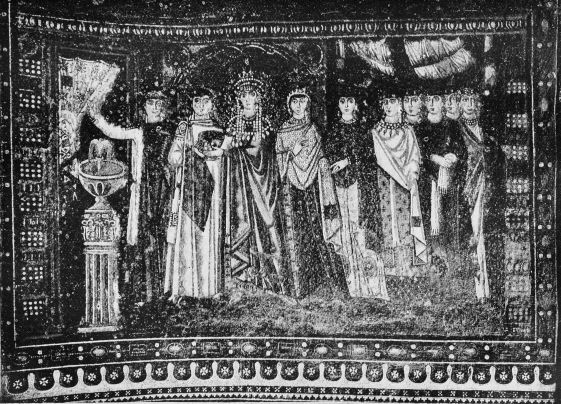
EMPRESS THEODORA AND COURT, RAVENNA.
[To face page 404.
What has been said will put in a clear light the extraordinary
importance accorded to the University and the
professors of Bologna in connection with their labours in
annotating and interpreting the Corpus iuris so as to
make it intelligible to all, and an instrument for instructing
and training all those who sought to follow the legal
profession, whether as notaries, judges, Podestàs, or captains
of the people. That these teachers possessed a very
slender knowledge of history is seen from their writings.
Their merit lay in the intelligent exposition of a system
of law which had never become extinct. It was a precept
of theirs that "as the unskilled rider must hold on by
the pommel, so the judge should stick to the gloss." In
this way the school of Bologna became, as it were, the
depository of an universal law which was looked upon as
almost sacred. Thither popes sent their decretals,
emperors their edicts for registry or revision. The
Emperor was, however, regarded as the living source of
legislation, as alone entitled to add new laws to the
Roman. Any one speaking evil of the Emperor met
with condign punishment. Any one who questioned his
universal authority was declared heretical by the jurists
themselves. This authority belonged to him as lord of
all nations, and was transmitted to him from the Roman
Empire as its rightful heir. It was natural, therefore, that
to determine the extent and limits of this authority,
recourse should again be had to the professors of Bologna,
the veritable depositaries of the Roman law, who accordingly
acquired a constantly increasing importance. The
ratio scripta was what was always called for; and the
communes, even while avowing their determination to
preserve their ancient liberties undiminished, never forgot
to profess their willingness to leave the Emperor all the
veteres justitias which belonged to him, and which they
declared themselves desirous to respect. The only question
was to ascertain what these were, and hence fresh
occasion to consult the professors of Bologna.
Before the great contest between the Lombards and
Frederic Barbarossa, a genuine judicial trial was held,
ending with the condemnation of the Milanese, who were
declared rebels, adstipulantibus judicibus et primis de
Italia. At Roncaglia, Frederic exercised judicial and
legislative authority, with the assistance of four professors
from Bologna, who maintained the Emperor's rights, not
from any hostility to their own country, but because, as
professors of Roman law, they were the natural champions
of the Holy Roman Empire. Nor did the communes
themselves raise any objection to these claims. After
Frederic's defeat they continued to draw up their statutes,
laws, and public instruments in his name. Even as late
as the fifteenth century, we find that notaries still gave
validity to public documents by making them run in the
name of the Empire. At the peace of Constance the
power to appoint magistrates, civil and criminal, consuls,
Podestà, and notaries, was expressly reserved to the
Emperor, whose prerogative in such matters, as well as of
deciding causes of serious importance on final appeal, was
fully recognised. If, in fact, the Milanese paid little
regard to the Emperor's authority, his right was not
questioned. The Lombards acknowledged themselves his
lawful subjects, though they afterwards chose to act as
if free and independent.
When Henry VII. came to Italy, in Dante's time, he
too, brought the Italian cities to trial, pronounced sentence
on them, exacted fines on men and money, and cited
King Robert of Naples to appear before him. At that
time many must have deemed these proceedings farcical;
but they were echoes of a bygone age, of a past which
even Alighieri's immortal genius thought to recall to life,
as his letters and his book, "De Monarchia," serve to
show. The Church, it is true, constantly withstood the
Empire, but during the whole of the Middle Ages the
Emperor's political and juridical authority was never called
in question, was invariably recognised.
While the continual struggle between Church and
Empire, communes and feudal lords, Guelphs and Ghibellines,
was being waged, the statutes were framed. In
these were recorded, not only new customs written down
as they were formed, but also all the old customs that had
been modified by the new. Although the jurists of Bologna
thought it no concern of theirs to study a system of law,
which being in common use was then well known, and
which had its source in that Roman jurisprudence which
engaged their attention through their whole lives, for us
it is certainly a study of grave importance, as a means
of accurately estimating the value and character of this
communal life in the Middle Ages. We may have very
long to wait before we can completely solve the problem.
Nevertheless we may make a beginning by examining the
various statutes, comparing them with one another, and
also comparing the different forms which each of them
received at different stages of drafting, in order to discern
the evolution of the new law, to ascertain and understand
the principle which governs it.
The whole life of the Commune is embraced in the
statutes: the election and functions of political magistrates;
public, civil, criminal, administrative, and commercial
law. Public law is the subject most fully dealt
with; while, for reasons already explained, civil law is left
very incomplete. Nevertheless the statutes handle, with
more or less detail, such matters as personal status,
dowers, contracts, judicial procedure, succession, wills,
rights arising in respect of contiguous lands or houses,
and, above all, the family. They aim at a simple and
summary procedure, free from chicanery, whereby causes
may be settled fairly and promptly; but from defective
drafting, from admitting a running commentary, altogether
out of place in legal enactments, and from leaving too
much to the discretion of the judge, they generally lead
to a contrary result. It is indeed astonishing to observe
how, during those centuries in which a splendid literature
was growing up, when the most unpretentious writings
offer us an example of good style, and when judges,
notaries, and professors of law had the imperishable
model of the Corpus iuris constantly before their eyes,
the statutes should have been written in a form so illiterate
that we may often pronounce it barbarous, and
always involved and confused. The statutes constitute a
legislation based upon custom, mutable, popular, still
uncertain of itself, which, taking its birth in the midst of
civil wars, always retained their likeness, and never arrived
at classical elegances, which in any case would have been
made impossible by the scholastic jargon that still prevailed
in our Universities and among our jurists. Petrarch's
animadversions, directed chiefly against the obscure
phraseology of the professors of law in his time, were fully
justified. The classical revival which sought to introduce
a purer and more elegant latinity had to make a beginning
outside, and often in opposition to the Universities. It
spread far and wide during the fifteenth century, but
always retained a literary and philosophical rather than a
juridical character.
Notwithstanding the greatness of its merits and aims, the
Italian Commune has in it something of the transitory and
mediæval; it constantly indicates a period of change. It
is the germ from which, at a later time, modern society is
to issue, but the birth cannot be accomplished until the
germ itself is destroyed; consequently it always remained
in a state of incessant transformation. Sprung from the
conjunction of two different societies, the Roman and
Germanic, it derived from the former the general idea of
the State, from the latter individual liberty, local activity,
and the force of special associations. The problem it had
to solve, and that constitutes its essential life and history,
lies precisely in its ceaseless efforts to harmonise those two
elements which long remained not only separate but often
opposed. Until complete fusion was effected by the
destruction of the Commune itself, the contest continued
to be waged, and was accompanied by inevitable disorder.
In the Commune, government and public policy have an
importance unknown to barbaric society, but the Commune
still wears the character of a powerful assemblage of
small associations rather than of a single society, or of a
State in the true and strict sense of the word. Life indeed
courses more swiftly through these numberless groups,
and is quickened by their activity. Social vigour is chiefly
to be looked for in family cliques, and in the Companies
of the Arts and Trades, of the Nobles and of the Burghers,
all of whom have laws, statutes, magistrates, and tribunals
of their own. Hence arises an extraordinary interlacing
of ordinances, of conflicting passions, of diverging or
clashing interests. True individual liberty, true equality
before the law is not yet understood; but the individual
is trained and protected by the association to which he
belongs, which lends him a certain degree of strength, and
secures him an increasing share of freedom. These subsidiary
groups, however, unlike those which we have
already met with in the Germanic societies, cannot be
separated, but must live together in the State, outside of
which there is no reason for their existence. The infinite
multiplication of these groups, their jealousies and continual
jarrings and collisions, made the Republic all the
more indispensable to them, all the more the object of
their hopes and love. Every one of these merchant-citizens
was ready to give his life for this Republic, on
which, both in peace and in war, his own welfare and that
of the various associations depended. The heads and
leading members of these associations were privileged to
sit in the Councils of the State, governed it as masters,
and found it their only sure defence against the countless
rivals with whom each of them had to contend. Individual
and general interests thus worked in concert, and
the fragmentary power divided among so many hands,
was nevertheless able to guard the liberty of all, at a time
when no true conception of the State or of general
equality had yet arisen. Still, it is easy to imagine how
ill-arranged and inconclusive must have been the legislation
of republics thus divided and subdivided, in which
at every step some new special statute or tribunal was
encountered. And this at a time when judicial and
political power were so strangely intermixed, that whoever
had a share in the one necessarily shared in the other.
The dominant feature in all the civil enactments of the
statutes seems to be a jealousy of neighbouring communes,
and a fear lest, as a result of marriage, property should be
withdrawn from the city, the society, or the family. To
guard against this, both law and custom provided so efficaciously,
that even in a Republic as democratic as that
of Florence, wherein every vestige of aristocracy was
destroyed, and the Ciompi obtained the upper hand, we
find landed property so strictly tied up that there are
families who, to this day, own the same estates which were
held by their ancestors in the fourteenth century. The
necessity for keeping families, associations, and party-circles
intimately united, and making each member of
them bound for the rest, is so strikingly apparent, that it
is these political and social considerations which determine
the tendency of the civil law, and often impede its natural
development. So that even here, notwithstanding the
weakness of the State, we again recognise the old Latin
tradition, which always accords an excessive importance to
political considerations, and consequently a preponderating
influence to public over private law. The Italian statutes,
therefore, can only be explained and understood in connection
with the history of the communes, which they
illustrate in their turn. And this is another reason why
the professors of Bologna, accustomed to the philosophical
character of Justinian's legislation, and unfamiliar with
the methods of historical exposition, so long neglected the
statutes.
Also, as might be expected, the predominating action
of political considerations is most clearly shown in the
constitution of the family. Here the rights which flow
from the Commune's conception of the family prevail
over the ties of blood which by the Germanic law are
much more respected. The regulations of the Roman
law as to dower are fully accepted, but the dower itself is
restricted to a small amount. Males have a marked precedence
over females, and over descendants in the female
line. But in all circumstances the woman is entitled to
alimony. It is not meant that she should be rich, or
should divide the domestic patrimony, and transfer it to
another family, much less to another Commune; but in
any event she must be assured of a suitable maintenance,
according to her rank of life. She remains under the
perpetual protection of the mondualdo (legal guardian),
but the mundium assumes in the statutes the character of
the later Roman tutela, with which it almost seems to be
confounded. The woman may call upon the judge to
assign her a mondualdo, and may choose him herself when
she requires him for any special business. Everywhere,
indeed, we see this tendency to transform Longobard
institutions into Roman, so that often nothing is left to
the former save the name.
Immovable property was so strictly settled that a very
small part of it could be disposed of by the father at his
death. No one, therefore, born of a family in easy circumstances
was exposed to any anxiety as to his future.
It is to be noted, however, that in our communes, all of
which resembled great commercial houses, the proportion
of immovable to movable property was extremely small;
and that if, as regards the former, there was much
security and stability, for the latter there were rapid gains,
unforeseen fortunes, and sudden fluctuations of capital.
The father's authority was held in veneration, and the
utmost confidence reposed in guardians of his choice;
but we do not find in the statutes any great development
of the patria potestas. On the contrary, as in other cities,
the marked characteristic of the family is their doing
everything in common. All affairs of moment are settled
by the family council, by an assembly of relations. Both
law and custom continue to follow this course. In the
family, the party-circle, or clique, and the association, the
community of interests is sometimes carried to extraordinary
lengths. Not only may a father or brother be
summoned to pay the debts of a son or brother, but
every creditor of a consociation can sue its individual
members, and one associate may be made liable even for
the crimes of another. Within the circle of the family or
association, disputes were settled by arbiters, whose awards
had the validity of legal sentences. The trade associations,
as we have already stated, had regularly constituted,
special tribunals of their own. These incidents
and characteristics of statutory law certainly cannot be
referred to the Roman legislation, but find their explanation
in the very beginnings of Italian history to which
Germanic races and institutions undoubtedly contributed
in no small degree. The distinctive character of the
Commune remains always the same. On the one hand
particular associations attain great development; on the
other the action of the political power is sometimes too
feeble, but at times exercises a pressure such as would
seem excessive even at this day. In a society in which
the State is so feeble that its very existence seems continually
threatened, it is certainly strange to find it interfering
so directly and extensively in the private affairs of
the citizens. The emancipation of sons is to be effected
with due solemnity at a full meeting of the Council of
the People, in the presence of the heads of the Republic.
Should a noble citizen desire to change his abode and
move to another quarter of the city, the matter must be
brought before the same Councils of the People and the
Commune, and decided by a special Act.378 We find the
chief magistrates of the Florentine commonwealth continually
altering the boundaries and extent of the Quartieri
or Sestieri of the city, enlarging or contracting now one
and now another in order to preserve the balance which is
always being threatened by parties and sects, and prevent
any one quarter from winning undue predominance. A
change of abode from one district of the town to another
might drag a citizen into a different sect or party, and so
become of political importance. All this shows more and
more clearly that society had not yet found its natural
and permanent basis. The manifold new and varied
elements entering into its composition were being developed
on all sides; but the synthetic power which
unites and assimilates could never be attained by the
Italian Commune.
Coming now to a particular examination of the statutory
provisions which most nearly concern the subject in hand,
we shall direct our attention more especially to the Florentine
statutes which, for us, have a twofold importance.
We have undertaken this study as an aid to the clearer
comprehension of certain political reforms in Florence,
which are only to be explained by the social conditions
of the Republic. In this study of the Florentine Commune
it is necessary to bear in mind that in no other
Commune was aristocracy so radically destroyed and
democracy so thoroughly triumphant. Every trace of
feudalism, every foreign element disappears from its
statute book, which consequently, in spite of perennial
alterations, preserves a uniform and consistent character,
and tends always towards the scope that it finally
attains. Other statute books, on the contrary, are no
less copiously altered; but the alterations are due to
less permanent causes, to elements most extraneous to
the life of the Commune, and which therefore make it
still more difficult to understand what are the true
principles moulding the laws and determining their
historical character.
If we begin by examining the paternal authority as set
forth in the statutes, we at once perceive the uncertainty
that prevails in this legislation. At first we find the
Longobard mundium, but this gradually takes the shape
of the Roman patria potestas, as regulated by Justinian's
legislation, which finally prevails, although never absolutely.
In the various provisions of the statutes, which,
even on this point, are always defective, we sometimes
find the son placed under a stricter subjection than by
Roman law, while at other times, the Longobard law
predominating, he enjoys the greatest independence.
Generally there are special political or commercial reasons
at the root of this illogical inconsistency. By the Roman
statutes the son is entitled to appear in criminal cases,
without permission from his father, who is not held
liable for crimes committed by his son. The son, however,
may be punished by his parents at their discretion.
The natural children of magnates are in an inferior
position, both civilly and politically, to sons born in wedlock,
inasmuch as they are never eligible to any public
office.379 According to the Pesaro statutes, a son may
dispose by will of all his earnings, provided he leaves
the obligatory usufruct to his father; but sons marrying
without their father's consent may be disinherited.380
When a son is condemned to pay a fine, the father must
give him his share of the inheritance wherewith to pay it.
Should a father beat his sons or grandsons or their wives,
in nihilo puniatur, nisi pro enormi delicto.381 In Lucca,
a son who is eighteen years of age, may contract a loan,
even without his father's leave. But a father may send
his son, whether emancipated or under tutelage, to
prison if he has dissipated his private means or led an
evil life. The magistrates must execute the father's
decision without calling for proofs.382 A son may thus
be arbitrarily confined to the house, fettered and imprisoned
by his father, who is only bound to supply him
with the necessaries of life. The same rule obtains with
regard to other descendants. If in all this great variety
of laws we try to discover any one characteristic peculiar
to the statutes, we must seek it in the unitas personæ
between father and son, which is often carried to a great
length. This, too, is a result of the general conception
of the family recognised by the statutes. In Urbino and
elsewhere the father may be punished for the son, the
master for the servant.383 As to the liabilities of commerce,
these are shared, not only by father and son, but
by the whole body of the relations, as we find was the
case in Genoa, Florence, and many of the principal
trading cities. In Florence, the father, grandfather, and
great-grandfather incur the same liability for a descendant
(even if under guardianship) who engages in trade, as
though they stood surety for him. To escape this
responsibility they must make a public and formal disclaimer
of liability.384 Thus, if an unemancipated son is
agent or factor of a company or house of business, the
father is responsible for him, unless he has given the
parties legal notice to the contrary. For the same reason
the emancipation of the son must be publicly performed
and communicated to the Society of Merchants.385 When
a daughter marries, she ceases to be subject to the
paternal authority, and can no longer be held in any
way responsible for her father, either as regards civil
obligations or criminal, should the father have evaded
punishment by flight.
In Florence, the woman is under the perpetual protection
of the Mondualdo. The term was still retained in
the eighteenth century, but under the statutes the mundio
soon becomes almost identical with the Roman tutelage;
as time goes on it gradually falls into disuse, but the
rights of women are never made equal with those of men.
In respect of marriage the intermixture of different legal
systems is most marked. Professor Gans has noted how
the Pisans, finding that the Roman law forbade a woman
to re-marry within a year from her husband's death, that
the Canon law (interpreting the apostle's words as an
unqualified permission) contained no such prohibition,
and that the Longobard law forbade re-marriage only for
thirty days, fixed by their statutes the prohibited period
at six months. But this rough compromise neither met
the object intended by the Roman law, namely, that a
second marriage should not take place during the pregnancy
which might possibly result from the first, nor
conceded the liberty allowed by the Canon law and the
Longobard. More commonly, however, the union of
different laws is brought about by the gradual transformation
of one into another. The Pisan statutes, for
instance, regulate marriage almost entirely according to
the Roman Code. To the dower (dos) brought by the
wife, and the donation (donatio propter nuptias, called
also antefactum) given by the husband, they join other
gifts, to which they give the name "corredo," which,
on the dissolution of the marriage, belong to the wife:
should they then be found to have been consumed or
made away with, she would be entitled to two-thirds of
their value. As a rule Pisan husbands and wives hold
their property entirely separate, so that marriage seems
sometimes to involve a hostile relation, rather than a
community of interests.386
Certain statutes admit the dos and donatio propter
nuptias together with the meta and the Longobard
donation. The Florentine statute speaks of a dowry,
of a donation that must be equal to one half of the
dowry—provided this does not exceed the sum of fifty
lire—and of an augmentation. Failing sons, grandsons,
or grandsons of sons, the wife, at her husband's death,
recovered possession of her dowry, with the donation and
augmentation; otherwise she had her dowry alone, and
whatever her husband might leave her by will. If the
husband died before receiving the dowry, the wife took
the promised donation, limited however to one-eighth of
her husband's estate, over which, to the extent of her
dower, she had a preferential mortgage. Nor had the
wife's consent to the sale or alienation of her husband's
property the effect of releasing her right to the subjects so
sold or alienated. This regulation, however, only comes
into force from the year 1388.387 This date, which is given
in the printed Florentine statute of 1415, shows that the
dotal system and the separation of property had by this
time made great progress, a fact farther confirmed by the
statutes.
The wife could not maintain her right to her husband's
property (defendere bona viri) against her husband's
creditors at large, but only against those who were liable
for the restitution of the dower. Dotal property, of
which no valuation had been made, might be claimed by
her as against any creditor, and if her husband fell into
difficulties, she could always demand restitution of her
dower.388 Property acquired or inherited by the wife
during the husband's life, belonged to her; but she could
not alienate it without the consent of the husband, who
was also entitled to the usufruct. On the decease of the
husband, whatever remained of the usufruct might be
claimed by the wife, or, if she too were dead, by the
children.
The dotal system and separation of conjugal property
are not only recognised in all the statutes,389 but are often
enacted in an exaggerated form, as seems to be the case in
the statutes of Pisa. Thus gifts between husband and wife
are forbidden, sometimes even gifts from them to strangers,
where there is ground to suspect that these are meant to
disguise a gift between the spouses. Zealous precautions
to hinder property being withdrawn from the family, still
more from the city, are universal. In Urbino, for instance,
no alien could inherit ab intestato, without first pledging
his word to reside within the city or territory.390 At Pesaro
a similar pledge was exacted from any alien who sought a
bride in that city; he had also to obtain the consent of
the Podestà.
In Verona,391 women might, under a will, share equally
with their brothers; but ab intestato, they had only their
dower. In Pisa, testate succession was regulated in
accordance with the Roman law: de ultimis voluntatibus
pen legem romanum iudicetur. The lawful share, however,
was fixed on almost the same scale as by Longobard law;
and, as provided by that law, one child might be favoured
more than the rest. As regards intestate succession,
male heirs had, as always, marked preference. Failing
descendants in the male line, females inherited, but even
in the succession to maternal estate, male descendants had
priority when there were no surviving daughters.392 This
rule prevails in all statute books, not excluding the
"Consuetudini" of Naples, of Amalfi, and of Sorrento,
although in these cities the influence of the Longobard
law was much less felt.393 The real object of these regulations
is clearly expressed in the statutes themselves. In
the statutes of Mantua it is thus set forth: "Ut familiarum
dignitas, nomen et ordo serventur, et bona morientium
in eorum agnatos et posteros transmittantur, per
quos nomina generis conservantur, statuimus et ordinamus,"394
&c.
It would seem that in Ravenna the prolonged continuance
of the Byzantine rule had the effect of suppressing
this preference of the agnates, and that there
the Novel of Justinian was in force. The same was the
case at Osimo. Adoption was of rare occurrence;
legitimated children were postponed to legitimate; natural
children who, under the influence of the Longobard law,
had been favoured in earlier statutes, were afterwards
neglected, in consequence of the growing ascendancy of
Canon and Roman law. The whole statutory law of
succession is so dominated by the political conception
which, so far from losing, is constantly gaining ground,
that the disposing power of the testator—always extremely
restricted—can only arrive at a result slightly more equitable
and natural, but never attains to absolute freedom of
decision in the Roman sense of the word. In this, as in
every branch of civil law, the Florentine Statute Book,
like all the others, does not present us with a complete
treatise, but only with fragments, the statutes making
constant reference to the Roman law.
No woman succeeds ab intestato to her sons or
daughters, when there are direct descendants or ascendants
even in the third degree; and uncle, brother,
sister, son, or grandson of a brother are preferred to her.
Though excluded from succession, she can nevertheless
claim alimony from those who by law exclude her. If
there be no such relatives, she inherits ab intestato one-fourth
of her son's estate, provided it does not amount to
more than five hundred lire. In any case, she only
receives money, not real property. If there is no money,
she will be entitled to the price of the lands forming her
inheritance. The same provisions apply when a grandmother,
great-grandmother, or descendants in the maternal
line succeed ab intestato.
A woman could not succeed ab intestato to a brother
leaving children, grandchildren, or brothers; but when
thus excluded from the succession, she was still entitled to
alimony. She could not succeed even to her father; but
was entitled to receive her dowry from the agnates, and
could meanwhile, even if a widow, claim alimony from
them.395
It is plain from all these provisions that the woman's
rights of succession were very limited; but she was
always insured of the wherewithal to live. We find,
indeed, from the Florentine statutes, that while the
preference given to the agnates increases as time goes on,
so too the woman's rights to alimony increase. The
statute of 1355 concedes to her the usufruct of the
paternal inheritance, on failure of male issue, while under
the same circumstances, later statutes deny her this right,
allowing her alimony instead.396 Speaking of aliment, and
of those bound to supply it, the statute of 1324 says:
"Si filius, nepos vel pronepos facultatis abundarent,"397 so
that they can commode subvenire, &c.; and the statute of
1355 imposes the same obligation, with the same conditions.398
But the printed statute of 1415 is far more
explicit; the father, mother, grandfather, grandmother,
great-grandfather, and great-grandmother are all entitled
to alimony, and the Podestà is bound to enforce the law.
The female inherits ab intestato from her mother or other
female ascendants, but only on failure of male issue.
Uterine brothers, being of the female line, cannot succeed
one another should there be relations of the deceased in
the male line as far as the fourth degree,399 these being
preferred to the mother and relations in the female line.
The Florentine statute goes on to declare that the wife is
to be preferred to the public treasury, uxor mariti defuncti
præferatur fisco; showing how little the woman's rights
were considered, when an express enactment was needed
to prevent the revenue authorities from depriving her of
her husband's estate. Natural children were also preferred
to the treasury, which only succeeded on failure of relations
as far as the fourth degree. Relations, however,
could succeed to bastards, as though these had been
legitimate.400 It should be added that Florentine custom
did not allow natural children to be left without some
means of support, or without provision for their education,
as is shown by many still existing wills. In the case of
males, the father generally tried to obtain employment for
them; in the case of females, to find them husbands, and
he recommended them to the care of his legitimate heirs.
The husband succeeded to his wife's dowry, failing
children or other near descendants. Of her extra-dotal
property he was entitled to one-third, and the wife could
not dispose of her dowry either by will or donation, so
as to exclude her husband or children.401
Besides the law of succession, there is another branch of
the Italian statutes in which the action of the political
idea upon civil law is equally apparent, namely, that
which treats of rights between neighbours, and of the
obligations in solidum attaching not only to the members of
families, but likewise to the members of sects and associations.
We have already observed that these are carried
so far as to make one member responsible for another's
debts, and even for his delicts: this is a law to which
we shall have more than once to return and give our
attention. When real property is sold, we find that the
agnates and cognates have always a preferential right of
purchase. In the March of Ancona, the blood-relations
of a prisoner condemned to death may be compelled to
purchase his estate.402 At Bologna, relations are often
made legally responsible for one another, and, by the
rules of the corporations of merchants in that city, the
brothers of any bankrupt, who have lived in community
with him within a month before his failure, are held
responsible for his debts—even if they have separated
from him since that time.403
According to the Florentine statute, the creditor of
any Commune or of any Universitas (corporation) might
proceed against it, sicut procedi potest contra alias
singulares personas debitrices, in persona. This was
carried so far, that it was permissible to proceed against
every individual member of the association, and even to
have him arrested, liceat ipsi creditori capi et detinere
omnes et singulares personas dicti Communis vel Universitatis,
quousque fuerit integre satisfactum.404 If landed
property had been laid waste or houses burnt, the proprietor
was entitled to compensation from the author of
the deed; from his associates (consorti), were he a noble,
or from his relations, even to the fourth degree, if a
commoner. Nay more, the injured person might also
proceed against the Commune, University, or district
(plebatum) in which the crime had been committed; he
was at liberty to follow any of these modes of redress,
and if unsuccessful in one to try another.405 The statute
prescribed the form of procedure and the terms of the
sentence.406 The Commune, University, or district was
thus compelled to be always ready to raise the alarm,
when similar acts were perpetrated, and to pursue and
arrest the criminal, since, in case of failure, they were held
responsible.407
In all matters, even such as purchases or sales, great
importance was assigned to the condition of the persons
concerned. In some cases, where land was to be sold,
the law required that it should be sold to a neighbour;
commoners, however, were not compelled to sell to
magnates.408 Similarly no one might buy, sell, or acquire
the usufruct of lands held in common, or any piece of
land or house touching another man's wall, without
according the joint-owner, associate, or neighbour the
right of pre-emption.409
In case of a dispute between relations or associates, qui
consortes sint de eadem stirpe, per lineam masculinam usque
ad infinitum,410 the judge was bound, at the request of one
of the parties concerned, to leave the matter to the
decision of arbiters chosen by the parties themselves;
but no plebeian could act as arbiter between nobles.411 In
reviving a law of much earlier date, the statute of 1355
informs us that arbiters were therein mentioned, as blood-relations.412
Whence it may be inferred that similar compromises
began to be customary, at a very remote period,
between relations and associates who voluntarily selected
arbiters from their own group. Down to the year
1324, the custom had been sanctioned by law; at a later
time it lost its primitive character of a voluntary and
domestic agreement, and assumed the shape of a regular
legal trial.
If we now compare the Florentine Statute Book with
those of other Italian cities, we shall find it marked by
various distinguishing characteristics, chiefly resulting
from the fact that in it democratic freedom was carried
to the farthest point obtainable during the Middle
Ages. Not only had every feudal privilege gradually
disappeared from it, but the great nobles had ended by
finding themselves in a position inferior to that of the
commonalty. Florence, as we have already seen, was
one of the first Italian cities to abolish serfdom in her
outlying territory by the law of 1289.413 And although
her rural population was always treated much worse than
the inhabitants of the city, it nevertheless enjoyed far
better conditions than prevailed in a great number of
communes. We have proof of this in the contract of
Mezzeria, which makes the cultivator of the soil an
actual partner with the proprietor, and which still remains
a great monument of civilisation and the cynosure of
modern economists who have never been able to devise
any better system.414
The freedom and strength of associations, the extraordinary
ease with which any one might participate in the
government of the Commune, all contributed to the
triumph of democracy on the widest basis. Another
general characteristic to be noted, not only in the Florentine,
but in almost all the Italian statutes, is the constant
endeavour to shake off the intervention of the ecclesiastical
authority, which labours with incredible obstinacy to
maintain its privileges undiminished, and even seeks to
increase them; but which, nevertheless, finds them
gradually reduced almost to zero. The statute of
1415 ordains that "no person, university, or church,
no religious or clerical house shall presume to question
the jurisdiction of the Commune under pretence of
'benefice' or privilege, and that any one who opposes
this enactment shall be imprisoned until he renounce such
privilege.415 No excommunication nor interdict shall hinder
or diminish the action of the magistrates or the effect
of their decrees.416 Every man may freely exercise his
rights over all Church property derived from secular
sources."417
Turning now to a general view of the Italian statutes,
we must remark that although the history of statutory
law presents many difficulties, owing to the infinite
number of different provisions to be found in it, the
diversity of these provisions is chiefly due to accidental
and temporary causes, extraneous to the natural and
spontaneous development of the law itself, which, examined
apart and with reference to its essential characteristics,
presents a striking uniformity. It may, however, be
noted that in the republics of Northern Italy the
Longobard law is far more predominant; while in those
of Central and Southern Italy Roman law obtains an early
and rapid ascendancy, and, subject to the changes which
have been indicated, ends by dominating at all points.
This progress becomes more apparent from year to year,
so that even in examining the statutes, the very same
conflict of antagonistic elements which we have already
noted, throughout the entire history of the communes and
of Italian civilisation, is brought before our eyes in civil
wars, in sanguinary struggles between Guelphs and Ghibellines,
in art, in literature, in all things. It is true that the
statutes only treat of juridical ideas and enactments; but
these seem to strive with the same ardour, and to aim at
the same ends, as the men whom they control.
Towards the close of the fourteenth century Italian
commerce began to make enormous advance, and this
gave a new impetus to Italian legislation. In fact, we
find a series of enactments enabling all mercantile affairs
to be transacted with much greater celerity, avoiding
legal quibbles, releasing merchant's credits from mortgage
or sequestration, and severely punishing all frauds and
fraudulent bankruptcies. In a word, we clearly discern
the inchoation of the modern commercial code with which
these enactments are frequently in unison.
But in all these laws we always recognise the consequences
of commerce being divided and split into a
multitude of separate associations with statutes of their
own, judges of their own, and an exuberance of vitality.
At the same time, we recognise that the central authority,
though aware that its natural rights are threatened and
usurped on all sides, continues to exert its influence,
without method, indeed, or uniformity, but not without
vigour, and occasionally even with violence. At one
moment it seems to be vanquished; at another it comes
forth victorious. The entire history of the Commune
demonstrates a constant tendency to harmonise all these
distinct and often jarring elements—political, social, and
legislative—but this problem it never succeeds in solving,
and ends by relapsing into despotism. A true conception
of social unity was wanting; the idea of a due distribution
of authority was still unknown, either in real life or in
theory; accordingly whoever happened to have a share
in the executive authority, also assumed, as necessarily
connected with it, a share not only in judicial, but likewise
in administrative and legislative functions. Wherefore
it seemed that the only way to preserve liberty was
to parcel out the government among an infinity of hands,
and so to contrive that parties, associations, cliques (consorterie),
families, and quarters of the town should each
and severally serve as checks upon all the others. In this
process of division and subdivision all the elements afterwards
constituting modern society were prepared, but the
State, in its true sense, was never discovered. Without
ballast to steady her, the ship of the Commune, driven
hither and thither in a ceaseless storm and buffeted by
winds from all quarters, could neither find anchorage nor
keep a settled course. No clear and certain conception
was ever reached of that law which, by limiting and
defining the amount of liberty guaranteed to each individual,
secures freedom to all.
The political life of communes, moreover, was always
confined within the walls of the dominant cities, since not
only the outlying territory was excluded from it, but
likewise all towns that had been annexed or conquered.
Every form of representative government was as yet
unknown. All who enjoyed political rights entered, each
in his turn, the Councils of the Republic, and sooner or
later nearly all rose to power. This made it necessary
that the States should have very circumscribed borders, as
otherwise it would have been impossible to govern them
at all. The French Revolution, by achieving for the first
time, in behalf of the nation at large, what the Italian
communes had effected for the cities, was able to proclaim
the civil and political equality of all who formed part of
the nation, and who were in consequence to be recognised
as citizens. From that time democracy became the predominant
characteristic of modern societies which, by
means of representative institutions, have found it possible
to secure freedom, even in large states, reconciling the
unity and vigorous action of the central government with
personal independence and with local liberty and activity.
But the Commune always wavered between the opposing
elements of which it was made up and which it never
succeeded in fusing into a true political organism.
The history of our republics may, in fact, be summed
up in an account of the varying predominance of one or
other of the great associations of which they were composed.
In Florence, we have, first of all, the conflict of
nobles and commons which is maintained with changing
fortunes. When the fraternities (consorterie) of the
leading magnates obtained such ascendancy as to menace
popular liberties and destroy the social balance, notable
reforms were made in the statutes; the Commune was
completely transformed, and by means of the Ordinances
of Justice (of which we shall soon have to speak), the
nobles were overthrown and their associations broken
up. But as these associations were an integral part of
the State, their downfall was followed by a phase of rapid
corruption and decay. To the passions and interests of
caste succeeded personal ambitions, hatreds and passions
of a still more dangerous character. Families began
to be at strife; men who were at once powerful and
ambitious, came to the front; and Corso Donati, or
some other like him, would have soon become master
and tyrant of the Republic, save for the fact that a mighty
people, enriched by the speedy gains of an extended
commerce, devoted to freedom and opposed to the
nobility, had first to be disarmed. Thus to the supremacy
of the leagues of the magnates succeeded the predominance
of the Greater Guilds, between whom and the Lesser Guilds
a struggle was entered upon in the course of which the
latter obtained, in their turn, a share of power. At a later
period, the populace, represented by the plebeian Ciompi,
comes to the front, and threatens the utter dissolution of
the old social form of the Republic. Then new personal
ambitions, more fatal to freedom because more fortunate,
occupy the scene. The struggle between the Albizzi,
Pitti, and Medici terminates in the triumph of the last-named
family in the person of Cosimo the Elder, who
slew the Republic. Yet nothing of all this should cause
us much surprise. For if we bear in mind the beginnings
of the Commune and the elements out of which it was
constituted, we may readily see that all that happened was,
in the main, unavoidably bound to occur.