The result of the battle of Chancellorsville determined
General Lee to carry out his cherished plan of invading
the North. Hooker’s position in front of Fredericksburg
being unfavorable for attack, the rebel chief early
in June began a series of movements with the view of
drawing him away from the river. Leaving Hill’s corps
in the works at Fredericksburg, to keep up appearances,
he concentrated Ewell’s, Longstreet’s, and Hood’s
forces at Culpepper Court-House, near the upper waters
of the Rappahannock, and about the middle of June
pushed forward rapidly into the Shenandoah Valley, and
either captured or defeated the feeble Union force opposing
his march. Meanwhile, Hooker’s watchful eye was
upon him, and the Sixth Corps crossed the river just below
Fredericksburg to determine the strength and intentions
of the rebels. A few days later, several army
corps broke camp, and started off in the direction of
Warrenton, for the purpose of watching the movements
of the enemy, and covering the approaches to Washington;
while on the ninth the cavalry inflicted a severe
blow upon Jeb. Stuart’s troopers, who were gathering in
strong force at Kelly’s Ford, twenty-five miles above Falmouth,
intending to sweep with destruction the fertile
fields of Pennsylvania.
The Second Corps was the last to leave the line of the
Rappahannock. On the eighth of June, the Twenty-seventh
Connecticut received orders to be ready to march
at any time, with three days’ rations, and continued in
this waiting posture until the fourteenth instant, when
the final orders came, and at three P.M. the regiment,
with the rest of the brigade acting as rear-guard to the
corps, moved up the river to Banks’s Ford, relieved our
pickets, reconnoitered the enemy, and retired toward
Stafford Court-House. This little hamlet was left behind
in flames. For several days the corps followed
the roads near the Potomac, passing through Dumfries,
Occoquan, and Fairfax Station, halting here two days,
and arriving at Centreville on the nineteenth. The route
now turned still farther to the left, crossing the old Bull
Run battle-field, which had witnessed the decision of
two campaigns. Time had not effaced the evidences of
those disastrous days. Silently the troops moved over
the field, and the thoughts of many a one among the older
regiments, and of some in our own, hurried back to
those scenes with impressive distinctness, as the bleached
bones of the fallen, or the rubbish of battle, lay scattered
along the roadside. After a severe march of twenty
miles in the rain, the regiment arrived, at ten in the
evening of June twentieth, at Thoroughfare Gap, a wild
gorge in the Blue Ridge. The intensely exhausting
march from Falmouth made the four days of comparative
rest at the Gap exceedingly welcome. Here the
troops were occupied in picketing the pass, in order to
prevent the enemy from crossing the mountains. Meanwhile,
to the north, Stuart and Pleasanton were once
more on the charge at Aldie, Upperville, and Middleburg,
and their muffled cannonade echoed among these
hills and pleasant valleys, surely not unused to the
sound, repeating itself again and again, as if from as
many different directions.
June twenty-fifth, the regiment fell in at an early hour,
ready to fight or march, as circumstances might require,
for the rebels were approaching with malicious intent to
capture the corps’ beef cattle and supply train, and sharp
picket firing indicated the possible necessity of adopting
the former alternative. But after remaining in line of
battle, with no serious demonstration on the part of the
enemy, the corps advanced through Haymarket, toward
the Potomac. The rebel cavalry followed vigorously,
and attempted to come in on our flanks, but skirmishers
were thrown out, and the troops marched in hollow
squares, prepared to repel any attack. At Haymarket,
the batteries turned on the enemy, and drove them
back. The column pushed forward to Gum Springs, and
without pitching tents rested that night on their arms,
drawn up in a hollow square, ready at a moment’s warning
to meet any assault of rebel cavalry. At midnight
of June twenty-sixth, the regiment crossed the Potomac
at Edward’s Ferry. The next three days passed in
continuous marching up the valley of the Monocacy
river, through many quiet Maryland villages, among
them Poolesville, Frederick City, Liberty, Johnsville, and
Uniontown. Each day’s march was very protracted—that
from Frederick City to Uniontown embracing a distance
of thirty-six miles, and the manner in which it was
performed elicited high compliments from Colonel
Brooke, commanding the brigade.
Thus far the army had been manœuvred so as to cover
Washington and Baltimore, and now, as the rebel plans
became more apparent, General Meade, who had recently
superseded General Hooker, directed a concentration
of his forces in the vicinity of Gettysburg. The
First Corps held the advance, followed by the Eleventh,
and on Wednesday morning, July first, drove the
enemy’s skirmishers through the town. General Reynolds,
in command of the corps, without hesitation
moved forward to the attack, and met death while
bravely posting his troops on the heights beyond. The
rebels fell back slowly, in order to give time for Ewell’s
men to come to their aid, and this being accomplished,
they were more than a match for the combined First
and Eleventh, with whose now united columns rested the
decision of the day. At three in the afternoon, the
enemy, thus reënforced, took the offensive, and compelled
General Howard, now in command, to withdraw his
troops to the south of the town, and the close of the day
left him securely intrenched on Cemetery Hill.
While these scenes were taking place around Gettysburg,
the Twenty-seventh Connecticut, with its corps,
leisurely moved up to Taneytown, just below the Pennsylvania
State line. Here the troops rested a few hours,
unconscious that the first of a trio of glorious battle days
was already in progress. But soon the ominous notes
of Howard’s and Ewell’s cannon strike on the ear, and
add new emphasis to the call from the front for reënforcements.
Preceded by General Hancock, the corps
advanced rapidly to within three miles of Gettysburg,
and were occupied until midnight in throwing up intrenchments.
At early dawn, July second, the brigades
moved forward to take the places assigned them in the
line of battle. Already the fitful fire of opposing pickets
and skirmishers can be heard in the distance, with the
occasional boom of heavy ordnance. The shock of
battle, which is to determine the fate of the rebel invasion,
will at the farthest be postponed but a few
hours. Just before coming into position, and while the
troops were resting under arms, the commander of our
brigade assembled the officers, and briefly reminded
them of the desperate character of the emergency, and
urged the importance and necessity of devoting every
energy to insure the successful issue of the conflict.
In order to understand the various positions of the
Twenty-seventh during the action, let us briefly sketch
the line of battle, as adopted by General Hancock, and
along which the several corps were arranged, as they
arrived on the field. Three important roads, the Emmettsburg,
Taneytown, and Baltimore turnpike, converge
in Gettysburg from the south. At their junction, just
below the town, is the natural key of the position, the
now historic Cemetery Hill. This elevation forms the
northern end of a ridge prolonged about four miles, almost
exactly due south, near to and parallel with the
Taneytown road, gradually diminishing in altitude until
it almost loses itself in the surrounding level, then rises
again into the forest-crowned Little Round Top, or
Weed’s Hill, and terminates in the yet higher ascent of
Rocky Round Top itself. Beginning on the left at Round
Top, the Union line extends northward in nearly a
straight course along Cemetery Ridge, and at Cemetery
Hill bends back to the east in the general form of a
half circle, with a radius of three fourths of a mile—Culp’s
Hill, and several minor eminences, lying in the
circumference; and the extreme right, crossing Rock
Creek, which flows at the base of these heights, rests
upon the woody summit of Wolf’s Hill. The rebel
forces occupied a series of heights corresponding to
these, with an intervening belt of comparatively level
and open country from one to two miles in width.
The forenoon of Thursday, July second, passed with
no demonstration on either side. The hostile forces are
rapidly marshalling on the opposite ridges. In the
Union line the Twelfth Corps holds the eminences near
Rock Creek, on the right; next is the First, on Culp’s
Hill; then the Eleventh, at the centre, on Cemetery Hill,
while along Cemetery Ridge are successively drawn up
the Second, Third, and Fifth, with the Sixth in reserve
near the Taneytown road. The Twenty-seventh Connecticut
was stationed about a mile and a half south of
Cemetery Hill, in the line occupied by our Second Corps
on the left centre. Here the regiment remained nearly
all day in quiet preparation for the conflict, which
threatened at any moment to mar that peaceful landscape
of thrifty farm-houses and waving grain.
Early in the afternoon, the Third Corps, on the left of
the Second, advanced down the western slope of Cemetery
Ridge, through woods and an extensive wheat-field,
almost to the Emmettsburg road, which winds through
the narrow valley, separating the hostile forces. Just
beyond, Longstreet is forming his brigades, and at four
o’clock, preceded by a brief cannonade, their gray ranks
sweep out from woods and ravines, and once more is
heard that strange, wild yell, as they throw themselves
forward upon the thin line of the Third Corps. But
before the storm of grape and canister from Cemetery
Ridge they quickly fall back to organize anew their
broken columns. Meanwhile reënforcements from the
Fifth and Second Corps moved rapidly to the scene of
action. Once more in still heavier masses the enemy
advanced to the charge. The Twenty-seventh, with
the rest of the First Division, was hurried forward
through fields and by-roads, to support the faltering
line. As the regiment enters the wheat-field, already
referred to, the broken remains of the Third Corps are
slowly retiring to the rear. A few steps more bring the
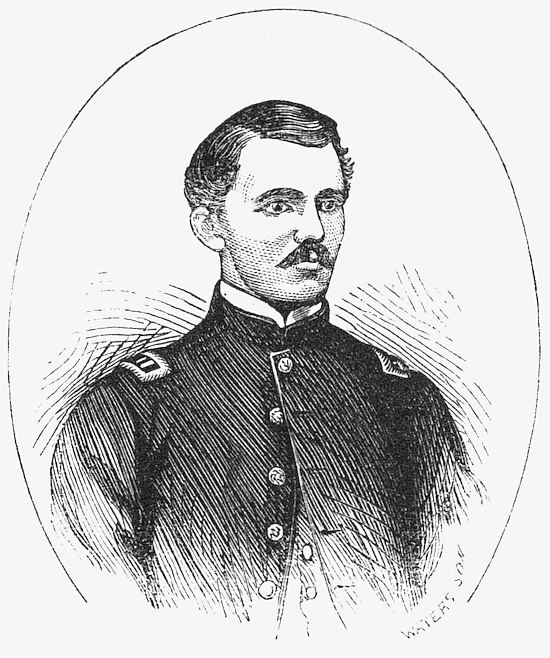
men under the full sweep of the enemy’s fire. Lieutenant-Colonel
Merwin falls while leading the command
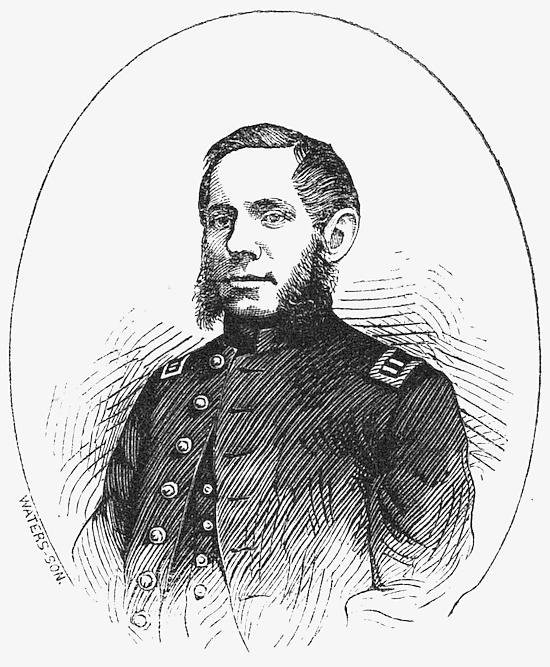
with his accustomed bravery. Under Major Coburn,
the line still presses forward at double-quick, through
the wheat-field and woods beyond, driving the rebels a
quarter of a mile, across a ravine, which on the further
side rises into a precipitous ledge. The men with
much difficulty clambered up the rocky steep, but as they
appeared upon the crest of the hill, the enemy, drawn
up in readiness just beyond, within pistol-range, opened
upon them a withering fire. The contest at this point
continued for some time. Planting the colors upon the
top, the men loaded their pieces under shelter of the
brow of the hill, then, rising up, delivered their fire.
Meanwhile the troops to our right gave way, and, taking
advantage of the exposed position of the right flank of
our brigade, the enemy advanced a body of troops in
that direction, and General Brooke at length ordered
our shattered line to fall back, which was accomplished
under a heavy cross-fire.
Thus with varying success the battle raged from
four P.M. until dark. Now the feeble line of the Third
Corps trembles before the fierce onset of the foe, and retires,
contesting the ground inch by inch; but the irresistible
onslaught of reënforcements soon turns the tide.
Again the rebels push back the Union troops almost to
the original lines on Cemetery Ridge, and again are
themselves repulsed before the concentrated fire of our
artillery, aiding the charge of a brigade of infantry.
The conflict on the left wing terminated at dark,
leaving the enemy in possession of the wheat-field. No
attack had yet been made upon other parts of the line,
but, as the day closed, a division, deploying from the
edge of the town, made a brief and desperate, but fruitless,
assault upon the batteries posted on Cemetery Hill.
And still further to the right, the enemy, observing that
the larger part of the forces on Culp’s Hill had been
drawn off to meet pressing emergencies elsewhere,
crossed Rock Creek, and, charging up the woody slope,
secured a lodgement for the night in the unoccupied portion
of the works. Such was the general result of the
day’s fighting.
The Twenty-seventh went into action with seventy-five
men, all that could be mustered for duty after an
active service of not quite nine months. At the camps
of paroled prisoners, the Richmond voyagers of our
regiment, though not permitted to rejoin the command,
yet in thought followed their comrades through all the
vicissitudes of march and battle which attended them.
At five P.M. that little band of seventy-five men formed
for the charge at the edge of the wheat-field. At dark
thirty-eight were numbered among the casualties: eleven
killed—among them Lieutenant-Colonel Merwin, and
Captain Jedediah Chapman—twenty-three wounded,
and four missing. One of the latter, when Lee’s army
retreated, was marched by his captors from Gettysburg
to Staunton, Virginia, one hundred and eighty miles,
and thence transported by railroad to Richmond. After
a six weeks’ experience on Belle Island, he was paroled,
and returned home so emaciated and worn down by
hardship as to be almost beyond recognition even by
members of his own company.
At the close of the action in front of the left wing,
the Twenty-seventh was assigned a new position in the
line of battle, about midway on the ridge between
Cemetery Hill and Round Top. The regiment remained
in this vicinity until the Second Corps started
in pursuit of Lee’s army, three days later. Early the
next morning, July third, the men were roused from
sleep by a furious cannonade from batteries posted on
Power’s Hill, about half a mile to the rear. These dogs
of war were paying their morning compliments to the
rebels, who still occupied the works on the extreme
right, which they had captured the previous evening.
For an hour this thunder-toned reveille awoke the resting
armies to the still fiercer drama of the last battle
day. The infantry followed up this fiery prelude with
a vigorous attack upon the rebel vantage-ground, the
importance of which seemed fully appreciated by both
sides. The struggle continued with unabated resolution
until nine o’clock, when the Union forces succeeded in
dispossessing the enemy of this to them valuable point
d’appui for future operations.
With the exception of a severe artillery fire, to which
General Meade’s headquarters were subjected, the enemy
attempted nothing further during the remainder of the
forenoon. The Twenty-seventh was busily engaged in
throwing up intrenchments, gathering for this purpose
rails and stones from neighboring fences, and, in the absence
of picks and shovels, using their bayonets and tin
plates to heap up the earth. In his morning rounds,
General Hancock visited the brigade, and as he stood
near by, conversing with Major Coburn, our acting Brigadier,
Colonel Brooke, called the General’s attention to
the little remnant of the Twenty-seventh, alluding, in
strong terms of commendation, to the conduct of the
regiment in the action of the preceding afternoon. Turning
to the men, General Hancock said: “Stand well to
your duty now, and in a few days you will carry with
you to your homes all the honors of this, the greatest
battle ever fought upon the continent.”
From eleven o’clock until one, only stifled mutterings
of the impatient storm disturbed the quiet which reigned
along the lines. The rebels were silently maturing their
plans for the last grand charge, upon which they staked
the fate of the invasion. Those were hours of indescribable
suspense to the defenders of the Union, whether or
no the sun would set upon a foe elated with victory and
pressing onward to new conquests, or sullenly retiring in
defeat. At one o’clock the combat began. From every
commanding eminence in their concave line, the rebel
artillery, numbering more than a hundred guns, opened
a terrific cannonade, probably unsurpassed in violence
during the whole war. For more than an hour this wild
storm of shot and shell rolls over the Union line, from
Round Top to Rock Creek. The infantry are partially
sheltered behind intrenchments, while the cannoneers
stand at their posts, replying occasionally to the bombardment,
but reserving their fire for more decisive work,
when the rebel forces advance to the assault. At length
the cannonade slackens, to give way to the next act in
the drama, the crisis of the tragedy. In full view two
heavy lines of troops, the flower of the rebel army, with
skirmishers in front, deploy from the woods and ridges
beyond the Emmettsburg road. With the steadiness of
hardened veterans they move forward to the attack.
From Cemetery Ridge thousands of Union troops are
watching their progress, for the assault is directed upon
the left centre. On arriving at the road, the enemy
opened a heavy musketry fire, and dashed rapidly forward
across the level plain. The very moment they
emerged from behind Seminary Heights, the Union artillery
met them with shot and shell and solid shot, but
now, as they approach within easy range, their ranks are
mercilessly raked with a tempest of canister. Cemetery
Hill is wreathed with flame from the guns of thickly-massed
infantry, and the fringe of fire courses along the
crest of the ridge for two miles, as far as the rebel attack
extends. Though temporarily checked, one division
still marches on with desperate energy up to the very
works. Only a weak line bars their progress, but reinforcements
quickly arrive at the critical point, around
which the contending hosts now struggle, in one of the
most hotly-contested encounters of the battle. For a
time the rebels bravely maintain their position, but
clouds of missiles from Cemetery Hill tear into their
ranks, while infantry crowd them vigorously in front and
flank. At length, leaving the ground thickly strewn
with killed and wounded, and multitudes as prisoners in
the hands of the conquerors, the broken remnants roll
back in wild confusion, and disappear behind the hills
from which they had sallied forth.
This last charge of the rebels took place just to the
right of the position held by the Twenty-seventh, which
we have already referred to as being half-way between
Round Top and Cemetery Hill. From the relation of
the ground to the surrounding high land, the location of
our brigade was regarded as one of the weakest in the
line, and General Hancock expressed the opinion that
here the enemy would make his attack. Fortunately it
proved otherwise, although for a time such a movement
seemed imminent. Near the close of the action, a division,
massed in column, advanced directly upon our front,
but the reserve artillery quickly drove them back before
they came within musketry range. The favorable termination
of what was felt to be the last assault the rebels
would make, produced a profound feeling of satisfaction.
But one of the saddest of duties remained to be performed—to
bury the dead and gather the wounded into the
hospitals. This work occupied the men during July
fourth. On that day, Lee’s army withdrew from this
scene of inglorious defeat, and retired in a southwesterly
direction.
In the afternoon of July fifth, the war-worn Twenty-seventh,
with the Second Corps, left those battle-scarred
heights, the theatre of a costly but substantial triumph,
which marks the turning-point in the fortunes of the rebellion.
For the next few days the march was directed
toward the Potomac, following at first the Taneytown
road. But slow progress was made, in consequence of
frequent rains and the thoroughly exhausted condition of
the troops. The state of popular feeling along the route
was in striking contrast with the dejected aspect of every
countenance when the army was on its way to Gettysburg.
Now, Frederick City put on its most smiling
face. Flags were flung to the breeze, and the people
gave an enthusiastic welcome to the regiments as they
passed through in pursuit of Lee’s army. The route
now crossed the Blue Ridge, by way of Crampton’s
Gap. Here the severe rains had gathered a considerable
torrent, several feet deep, which formed the pathway of
the troops for nearly two miles. The Twenty-seventh
was once more in the vicinity of the enemy, who had retreated
down the western slope of the mountains, and
were now in position at Williamsport, on the Potomac,
preparing to cross into Virginia. The sound of cannon
in that direction informed us that they were but a short
distance to the front; and while on the field of Antietam,
the brigade formed in line of battle, as a precautionary
measure. The next day the rebel cavalry attacked the
skirmish line, but quickly fell back before a severe shelling.
In anticipation of further fighting, the men spent
two nights and one day in building an elaborate line of
intrenchments; but it proved to be labor lost, as the rebels
retired, on the night of the fourteenth, to the south
bank of the river. Immediately on ascertaining this
fact, the Twenty-seventh, with the brigade, was ordered
down to Falling Waters, a short distance below Williamsport,
and arrived there just in time to witness the
capture of the enemy’s rear-guard, more than a thousand
strong.
The invasion was now at an end; and as the last rebel
left the soil of Maryland, the campaign of the Twenty-seventh
drew near to its close. Leaving Falling Waters,
the regiment accompanied the Second Corps down the
Potomac to Harper’s Ferry, and went into camp at Pleasant
Valley, about two miles distant. On the morning
of July eighteenth the Twenty-seventh ceased its connection
with the Army of the Potomac. In announcing
this event, Colonel Brooke, our brigade commander,
issued the following general order:
“Headquarters Fourth Brigade, First Division, }
Second Corps, Camp in Pleasant Valley, }
Maryland, July 17, 1863. }
“General Order—No. 9.
“The term of service of the Twenty-seventh Connecticut
Volunteers having nearly expired, it has been relieved
from further duty, and ordered to report to its
place of enrolment.
“The Colonel commanding the brigade desires, in
parting with the officers and men of the Twenty-seventh
Connecticut, to convey to them his sincere feelings of
regret at losing their services, while at the same time he
thanks them for the obedience and faithfulness which
have been a marked feature of the regiment.
“Knowing it intimately for so many months of active
and arduous service—having been an eye-witness of
its many deeds of gallantry, and of the noble devotion
displayed by it on many a memorable day, during the
time in which he has had the honor to command its services—he
feels it a duty he owes, not only to the living
heroes, but to the memory of those who have fallen in
the field in battling in our righteous cause, to bear testimony
to the valor and gallantry it has always displayed.
“Side by side with the veterans of the Army of the
Potomac it has fought, and by the gallantry of its conduct
won for itself an enviable name and reputation, and
which may well, in after years, cause all who belong to
it to feel a pardonable pride in having it to say that they
served with the Twenty-seventh Connecticut.
“By order. Colonel Brooke.
“Charles P. Hatch, Lieutenant,
“Acting Assistant Adjutant-General.”
With glad hearts the men formed in line at an early
hour and took the cars for Baltimore, after a parting
salute to the brigade, as it marched by on its way into
Virginia. On the twentieth, the detachments of paroled
men from Annapolis and Camp Convalescent arrived at
Baltimore, and the whole regiment, now mustering about
half the original number, started by railroad for New-Haven.
Once more we were entertained at the “Volunteer
Refreshment Saloon,” in Philadelphia, and, after a
night’s bivouack at the Battery, in New-York, arrived
at the “place of enrolment” on the twenty-second of
July, 1863, exactly nine months from the date of departure
for the field. We shall not attempt to describe the
hearty enthusiasm and deep feeling of the reception
which followed. That “glorious welcome home” will
long be remembered by the soldiers of the Twenty-seventh.
Escorted by the military companies of the
city and the municipal authorities, the regiment marched
from the cars to the north portico of the State House,
while “Welcome!” pealed from the ringing bells, thundered
in the roar of cannon, waved from every flag-staff,
and shone on every countenance of the vast multitude,
gathered from all parts of the county, and thronging
the streets and public square. At the State House, after
the regiment had been drawn up “in column by division,”
the Mayor presented the formal welcome of the city, and
was succeeded by Rev. Dr. Bacon in a brief address, closing
with a prayer of thanksgiving. The following poem,
written by Mrs. William Doty, of New-Haven, and accompanying
a gift of laurel wreaths to the field-officers,
was then read:
A TRIBUTE OF WELCOME
TO THE TWENTY-SEVENTH CONNECTICUT VOLUNTEERS.
We’ll fling to the breeze our banner bright,
America’s emblem of freedom and right,
And rallying round the standard true,
Shout a joyous welcome, brave patriots, to you.
Ye went forth from us, a loyal band,
Firm on the side of right to stand;
Ye return with hearts still brave and true;
Then our warmest greeting we give to you.
Ye return, but our tears will fall as ye come,
For the mournful notes of the muffled drum
Are borne on the breeze over mountain and wave,
As it beats the dirge by your comrades’ grave.
With the order, “Forward!” ye marched proudly on,
And your colors bright to the front were borne;
When the smoke of the battle had cleared away,
Side by side with the “veterans” your brave boys lay.
Through the summer’s heat and winter’s cold
At your post ye stood, fearless and bold;
And when on the field, ’mid the conflict dire,
Ye did not “quail at the enemy’s fire.”
Oh! the road to Richmond hath altars bright,
Where, a “captive band,” ye camped at night,
And “Libby’s” grim walls a record bears,
Of the patriot’s song and the hero’s prayers.
Now the toil is over, the march is done;
And the wreath of laurel, ye’ve bravely won,
We offer to you, and our welcome it breathes,
For our prayers were twined with its glossy leaves.
But ye’re not all here, and we’ll look in vain
For the smiles that will greet us never again;
And the quivering lip and tearful eye
Mutely ask you where our treasures lie.
Some sleep where Virginia’s waters flow,
Murmuring their requiem soft and low;
Others with fairest flowers were drest,
And close by the old homes laid to rest.
When the angel of peace, with brooding wing,
Shall fly o’er our land and its anthem sing,
With trembling fingers the strings she’ll sweep,
As she nears the spot where our loved ones sleep.
Then a costly crown will our country wear,
And bright the gems that shall sparkle there.
She shall sit a queen, peerless and free,
And the graves of her heroes her glory be!
Still firmly stand, in God your trust,
Till the rebel horde shall bite the dust,
And the North and South encircled be
With the bands of truth and liberty.
Fight on, till our starry flag of blue,
Each glistening fold to its purpose true,
Shall wave from wild Atlantic’s roar
To the golden strands of Pacific’s shore.
At the conclusion of these exercises a bountiful collation
was served up, after which the men separated, to
await the completion of the papers necessary to the final
muster out of service, which took place July twenty-seventh,
1863.
Thus terminated the eventful campaign of the Twenty-seventh
Connecticut Volunteers. During this brief term
of nine months, the regiment performed marches in Virginia,
Maryland, and Pennsylvania, amounting to no less
than five hundred miles, and participated in three of
the great battles of the war—Fredericksburg, Chancellorsville,
and Gettysburg—losing in killed and wounded
in the first, about one third, and in the last, one half, of
those present in action. Very many of our number, on
their return, reënlisted in other organizations, and illustrated
on new fields the same valor which bore them and
their comrades up the fiery slope of Fredericksburg,
nerved all hearts calmly to meet disaster in the wilderness
of Chancellorsville, and crowned with victory the
heights of Gettysburg.