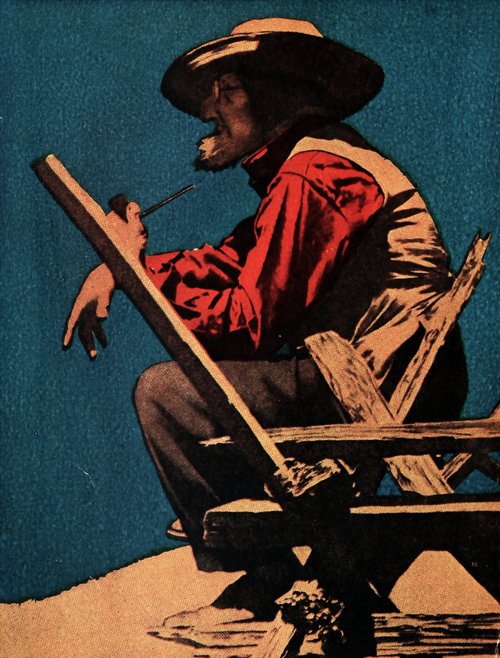
This cover was produced by the Transcriber and is in the public domain.
iThe Jewel Series
THE DIAMOND STORY BOOK. Compiled
by Penrhyn W. Coussens. Illustrations
in color by Ethel Green. net $1.75
THE EMERALD STORY BOOK. Stories
of Spring, Nature, and Easter, By Ada
and Eleanor Skinner. Frontispiece
in color by Maxfield Parrish. net $1.75
THE RUBY STORY BOOK. Tales of
Courage and Heroism. Retold by
Penrhyn W. Coussens. Frontispiece
in color by Maxfield Parrish. net $1.75
THE SAPPHIRE STORY BOOK. Tales
of the Sea. Collected and retold by
Penrhyn W. Coussens. Frontispiece
in color by Maxfield Parrish. net $1.75
THE TOPAZ STORY BOOK. Stories and
Legends of Autumn, Hallowe'en, and
Thanksgiving. Compiled by Ada M.
and Eleanor L. Skinner. Frontispiece
in color by Maxfield Parrish. net $1.75
THE TURQUOISE STORY BOOK.
Stories and Legends of Summer and
Nature. By Ada M. and Eleanor L.
Skinner. Frontispiece in color by
Maxfield Parrish. net $1.75
iii
Drawn by Maxfield Parrish
SUMMER
iv
Stories and Legends of
Summer and Nature
COMPILED BY
ADA M. SKINNER
AND
ELEANOR L. SKINNER
Editors of "The Emerald Story Book," "Merry Tales," "Nursery
Tales from Many Lands" and "The Topaz Story Book"
FRONTISPIECE BY
MAXFIELD PARRISH
NEW YORK
DUFFIELD & COMPANY
1918
vCopyright, 1918, by
DUFFIELD & COMPANY
INTRODUCTION — ACKNOWLEDGMENTS
vi
The beauty of the world gradually reveals
itself to the child who forms the habit of observation.
Through companionship with Nature,
supplemented by the reading of books
which foster an interest in the ever-varying
charm of the seasons, the young reader enriches
his experience by learning to interpret
"the open pages of the world about him."
Some of the stories, legends, and poems in
the present volume point out facts in Nature;
others stimulate interest because they appeal
to the young reader's fancy, quicken his sense
of humour, or attract his attention to some
spiritual significance. Also, large use has
been made of myths and wonder stories. They
evolved in the childhood of the race when the
mystery of the physical world made a deep
and serious impression upon primitive men.
viiIn terms of their own experiences, they explained
and symbolized the beauty, order, and
power which they beheld.
"The Turquoise Story Book" is the third
volume in a series of nature books, each of
which emphasizes the interest and beauty
characteristic of a particular season. The central
theme of this volume is the loveliness of
summer and its manifold blessings.
The editors' thanks are due to the following
authors and publishers who have permitted
the publication of their works in this volume—to
Mr. Albert Bigelow Paine for permission
to include "How the Rose Became
Queen," and "A Legend of the Lily-of-the-Valley,"
from a "Little Garden Calendar,"
published by the Henry Altemus Company; to
Helen Gray Cone for her two poems, "An
Evening Primrose" and "A Yellow Pansy";
to Frances Gillespy Wickes for "Mother
Spider"; to Edward Bliss Reed and the Yale
University Press for the poem "Flowers,"
from "Sea Moods"; to Frank A. Waugh
viiiand the Woman's Home Companion for "The
Friendly Summer Trees"; to Miss M. L.
Cook for her translation of "Why the Lady-Bug
Is Called Beloved of God"; to Lucille
Corbett for "The Story of the Dewdrop"; to
George Allen and Unwin Ltd., for permission
to retell "The Sun Princess" and "Princess
Fire-fly" from "Old World Japan Legends";
to the Outlook Company for "The Tale of
Two Tails," and to Ernest Ingersoll and the
Outlook Company for "Birds' Nests"; to
George H. Doran Company for "The Dew
Mother," by May Byron; to the Educational
Company for "The Boy Who Hated Trees";
to Town Topics for "Hatto, the Hermit," by
Selma Lagerlöf; to Charles Scribner's Sons
for the selections from Eugene Field and
Henry Van Dyke; to D. C. Heath and Company
for "Legend of Tithonus" from "Favorite
Greek Myths," by Lillian S. Hyde; to
Frederick A. Stokes Company for a selection
by Alfred Noyes; to E. P. Dutton and Company
for "Robin Goodfellow," from "English
Fairy Tales," by Ernest Rhys; to C. H.
Barbeau for permission to retell "Legend of
ixthe Sun and Moon," from "Memoirs";
to S. E. Cassino Company for "The Grubbiest
Grub" from Little Folks Magazine; to J. B.
Lippincott Company for permission to retell
a legend from Skinner's "Legends of Flowers,
Fruits and Trees"; to Small, Maynard and
Company for three poems from "Complete
Works of Madison Cawein"; to Macmillan
and Company Ltd., London, for a poem by
Maud Keary; to John P. Morton and Company
for "Morning Glories" from "Poet and
Nature," by Madison Cawein; to T. Fisher
Unwin Ltd. for "The Summer Princess" from
"The Enchanted Garden," by Mrs. Molesworth;
to the Macmillan Company for "Nature,"
from "Preludes," by Madison Cawein,
a selection from "The Everlasting Mercy,"
by John Masefield, and "In the Cool of the
Evening," from "Poems," by Alfred Noyes,
and a selection from "Gitanjali," by Rabindranath
Tagore; to Edward Abbott Parry for
"Undine" from "The First Book of Krab";
and to Lyman Abbott for "The Flower's
Thanks."
The selections from John Burroughs,
xEdith M. Thomas and John Townsend Trowbridge
are used by permission of and by special
arrangement with Houghton, Mifflin
Company, the authorized publishers of their
works.
Once upon a time the Great Chief, Glooscap,
who brought many blessings to the Red Men,
made a journey far into the Northland. For
days he traveled over frozen wastes of ice and
snow, where the keen wind blew without
ceasing.
At last he came to a lodge hollowed out of
the icebergs, where Winter, the Giant of the
Northland, dwelt. Quietly, Glooscap stalked
into the glittering lodge and sat down. There
was silence for several moments, then the Winter
Manito laid aside his scepter of ice, filled
a pipe, and, offering it to his guest, said, "Thou
art welcome. Tell me, why comest thou to
the Northland?"
"To learn about the power of the Winter
Giant," answered Glooscap.
4"Who can measure the strength of the Winter
King?" said the giant, shaking his white
locks, on which rested a crown of icicles.
For a long while the King and his guest sat
smoking in silence. Then the Winter Giant
began the story of his mighty deeds.
"I cover the Northland with ice, and pile
up great snowdrifts which look like mountains.
I send forth the Storm Blast, which fills
the air with sleet and snow, and makes the
white bear creep into a cave for shelter. I
build the glittering icebergs, out of which my
chieftains make their lodges."
The enchantment of the frost was in Giant
Winter's words, and his guest sat spellbound.
After Glooscap had listened to many works of
wonder, he nodded his head and fell into a
deep sleep. Like an image of death he lay in
Winter's lodge for six months.
Then one morning the charm of the frost
spirit was broken, and Glooscap, who awoke
with renewed vigor, left the Winter King's
lodge and journeyed toward the Southland.
After a few days of travel he was beyond the
reach of the Storm Blast. The air grew wondrously
mild and warm; instead of frozen
5wastes, he saw stretches of meadowlands and
green forests, where the birds were nesting.
He walked deep into the woodland until he
came to a dell, which was thick with flowers
and bright butterflies. On soft green moss the
Sun-Fays, led by the Fairy Queen of Summer,
were dancing gaily. For a few moments
Glooscap stood and marveled at the beauty of
the scene.
Suddenly he sprang into the midst of the
dancers, seized the Fairy Queen of Summer,
and slipped her under his blanket. Then
away he fled with her. As he ran, Glooscap,
by magic power, dropped one end of a slender
cord, made from a moose-hide, and let it trail
behind him. When the Sun-Fays saw what
had happened, they uttered a great cry, and
darted after the intruder. They seized the
end of the cord, and tugged at it with all their
fairy might, hoping to hold fast Glooscap and
rescue their Fairy Queen. But the magic
cord had no end, and the Sun-Fays were left
in the valley, while Glooscap fled through the
forest and retraced his steps to the frozen
Northland.
Again he silently entered the giant's lodge
6hollowed out of the icebergs. The Winter
Manito laid aside his ice scepter, filled a pipe,
and offered it to his guest, saying, "Thou art
welcome. Hast thou returned to the Northland
to hear more about the strength of the
Winter Manito?"
"The Frost King's might is great," said
Glooscap, "but I have seen a power which is
greater than his!"
The Winter Giant looked scornfully at his
guest and said nothing.
"I have seen the wonder and beauty of
the Summer Queen's land," said Glooscap.
"There the quickening dews and gentle showers
soften the brown earth, and the grass leaps
forth. Myriad sunbeams touch the flower
buds, and unfold them into full blossoms.
Birds build their nests and rear their young in
the branches of the sheltering forests. Light
and warmth abound, and the earth is filled
with gladness."
By magic power Glooscap cast a spell over
Giant Winter. He could neither speak nor
move. As the Great Chief talked, the iceberg
lodge grew warm and big ice drops ran down
7the giant's cheeks. Gradually the air grew
warmer and warmer. Winter's icy figure and
his wigwam melted and, in a great flood,
flowed away to the sea.
Then, from her hiding place under Glooscap's
blanket, stepped forth the Summer
Queen. At her command the Sun Fairies
joined her, and together they began the marvelous
work of making the grasses grow and
the flowers bloom. Brooks and rivers flowed
through the green meadows. Birds hastened
back from the Southland and built their nests
in the forests. Soon the whole land was filled
with the joys and blessings of summer.
A LEGEND OF THE FLOWERS (AUSTRALIAN)
8
Long, long ago the great Byamee left the
earth and went to dwell in the far-away land
of rest, which was beyond the tops of the Oobi
Oobi mountain. The earth became a dull and
desolate place after he left it, for all the flowers
that brightened the plains and hillsides
ceased to bloom.
And since there were no blossoms the bees
could no longer make honey for the earth children.
In all the land there were but three
trees where the bees lived and worked; and
no one ever touched these sacred trees, because
they belonged to Byamee.
The children cried for honey, and the mothers
took little bark baskets into the woods to
search for the sweet food. But they returned
with empty baskets and said, "There is no
9honey except on the sacred trees. We will
never touch Byamee's honey."
This obedience pleased the Great Spirit
very much and he said, "I'll send the earth
children a food as sweet as the honey for which
they hunger. It shall flow from the Bilbil
and Goolabah trees."
Soon were seen white, sugary specks on the
shining leaves of these trees, and then came
the clear manna, which ran along the branches
and down the trunks, and hardened into sugar.
The children were delighted with the sweet
food, and all the people were thankful for
Byamee's gift.
But they were not satisfied, for they still
wished to see the plains and hillsides covered
with blossoms. So deeply did they long for
the beautiful flowers, which had left the earth,
that the wise men finally said, "We will travel
to the land of Byamee, and ask him to brighten
the earth again with flowers."
They kept the plan and purpose of their
journey a secret from the tribes, and sped away
to the northeast. On and on they journeyed
until they came to the foot of the great Oobi
10Oobi mountain, whose summit was lost in the
clouds of the sky. They walked along the base
of its rocky sides, wondering how they could
scale the steep ascent when suddenly they spied
a foothold cut in a rock, and then they noticed
another step and still another. Looking carefully
upward, they saw a pathway of steps cut
as far as they could see up the mountain side.
Up this ladder of stone they determined to
climb. On and on they went, and when the
first day's ascent was ended the top of the
mountain still seemed high above them. They
noticed, too, that they were climbing a spiral
path, which wound round and round the
mountain. Not until the end of the fourth
day's climb did they reach the summit of this
mighty mountain.
And from a basin in the marble there bubbled
forth a spring of clear, sweet water,
which the wise men drank eagerly. Their
hard journey had almost exhausted them, but
the cooling draught filled them again with new
life. At a little distance from the spring they
saw a circle of piled-up stones. They walked
to the center of it, and a voice spoke to them.
11It came from a fairy messenger of the Great
Spirit.
"Why have the wise men of the earth ventured
so near to the dwelling of Byamee?"
asked the spirit voice.
And the men answered, "Since the great
Byamee left the earth no flowers have bloomed
there. We have come to ask for the gift of
flowers, because the earth is very dreary without
their gay colors."
Then the fairy messenger's voice said, "Attendant
spirits of the mountain, lift the wise
men into the abode of Byamee, where fadeless
flowers never cease to bloom. Of these blossoms,
wise men, you may gather as many as
you can hold in your hands. After you have
gathered the flowers the attendant spirits will
lift you back into the magic circle on the summit
of Oobi Oobi. From this place you must
return as quickly as possible to your tribes."
As the voice stopped speaking, the men were
lifted up through an opening in the sky and
set down in a land of wondrous beauty.
Everywhere brilliant flowers were blooming,
and they were massed together in lines of exquisite
12colors, which looked like hundreds of
rainbows lying on the grass. The wise men
were overcome by the marvelous sight, and
they wept tears of joy.
Remembering what they had come for, they
stooped down and gathered quickly as many
blossoms as they could hold. The spirits then
lifted them down again into the magic circle
on the top of Oobi Oobi.
There they heard again the voice of the
fairy messenger who said, "Tell your people
when you take them these flowers that never
again shall the earth be bare and dreary. All
through the seasons certain blossoms shall be
brought by the different winds, but the east
wind shall bring them in abundance to the
trees and shrubs. Among the grasses, on
plains and hillsides, flowers shall bloom as
thick as hairs on an opossom's skin. When the
sweet-breathed wind does not blow,—first to
bring the showers and then the flowers,—the
bees can make only enough honey for themselves.
During this time manna shall again
drop from the trees, and it shall take the place
of honey until the east wind once more blows
13the rain down the mountains and opens the
blossoms for the bees. Then there will be
honey enough for all. Now make haste and
take this promise and the fadeless flowers,
which are a sign of it to your people."
The voice ceased and the wise men, carrying
the fadeless blossoms, began the journey
back to their people. Down the stone ladder,
cut by the spirits of the mountain, they went,—across
the plains, over the moors,—back to the
camp of the tribes. Their people flocked
around them, gazing with wide-eyed wonder
at the blossoms. The air was filled with a delicious
fragrance, and the flowers were as
fresh as when they were plucked in the land
of Byamee.
When the people had gazed for some time
at the beautiful flowers and had heard the
promise sent to them by Byamee, the wise men
scattered their precious gift far and wide.
Some of the lovely blossoms fell on the treetops,
some on the plains and hillsides, and
ever since that far-off day the earth has been
blessed with the gift of flowers. (Adapted.)
JUNE
14
And what is so rare as a day in June?
Then, if ever, come perfect days;
Then heaven tries earth if it be in tune,
And over it softly her warm ear lays;
Whether we look or whether we listen,
We hear life murmur, or see it glisten;
Every clod feels a stir of might,
An instinct within it that reaches and towers,
And, groping blindly above it for light,
Climbs to a soul in grass and flowers.
James Russell Lowell.
THE SUN-GODDESS Frank Rinder
15
Ama-Terasu, the sun-goddess, was seated in
the Blue Plain of Heaven. Her light came as
a message of joy to the celestial deities. The
orchid and the iris, the cherry and the plum
blossom, the rice and the hemp fields answered
to her smile. The Inland Sea was
veiled in soft, rich colors.
Susa-no-o, the brother of Ama-Terasu, who
had resigned his ocean scepter, and now
reigned as the moon-god, was jealous of his
sister's glory and world-wide sway. The
Heaven Illuminating Spirit had but to whisper
and she was heard throughout her kingdom,
even in the depths of the clear pool in
the heart of the crystal. Her rice-fields,
whether situated on hillside, in sheltered valley
or by running stream, yielded abundant
harvests, and her groves were laden with fruit.
16But the voice of Susa-no-o was not so clear,
his smile was not so radiant. The undulating
fields which lay around his palace were now
flooded, now parched, and his rice crops were
often destroyed. The wrath and jealousy of
the moon-god knew no bounds, yet Ama-Terasu
was infinitely patient and forgave him all
things.
Once, as was her wont, the sun-goddess sat
in the central court of her flower home. She
plied the shuttle. Celestial weaving maidens
surrounded a fountain whose waters were
fragrant with the heavenly lotus-bloom; they
sang softly of the clouds and the wind, and the
light of the sky. Suddenly, the body of a piebald
horse fell through the vast dome at their
feet; the "Beloved of the gods" had been
flayed with a backward flaying by the envious
Susa-no-o. Ama-Terasu, trembling at the
sight, pricked her finger with the weaving
shuttle and, profoundly indignant at the
cruelty of her brother, withdrew into a cave,
and closed behind her the door of the Heavenly
Rich Dwelling.
The universe was plunged in darkness.
17Joy and goodwill, serenity and peace, hope and
love waned with the waning light. Evil Spirits
who heretofore had crouched in dim corners
came forth and roamed abroad. Then
grim laughter and discordant tones struck
terror into all hearts.
Then it was that the gods, fearful for their
safety and for the life of every beautiful thing,
assembled on the bed of the tranquil River of
Heaven whose waters had been dried up.
One and all knew that Ama-Terasu alone
could help them. But how allure the Heaven-Illuminating
Spirit to set foot in this world of
darkness and strife. Each god was eager to
aid and a plan was finally devised to entice
her from her hiding place.
Ame-no-ko uprooted the holy sakaki trees
which grew on the mountain of Heaven, and
planted them around the entrance of the cave.
High on the upper branches were hung the
precious string of curved jewels which Izanagi
had bestowed upon the sun-goddess.
From the middle branches drooped a mirror
wrought of the rare metals of the celestial
mine. Its polished surface was as the dazzling
18brilliancy of the sun. Other gods wove
fine threads of hemp and paper mulberry on
an imperial robe of white and blue which was
placed as an offering to the goddess, on the
lower branches of the Sakaki.
A palace was also built surrounded by a
garden in which the blossom-god called
forth many delicate plants and flowers.
Now all was ready. Ame-no-ko stepped
forward and in a loud voice entreated Ama-Terasu
to show herself. His appeal was in
vain. The great festival began. Uzume, the
goddess of mirth, led the dance and song.
Leaves of the spindle tree crowned her head;
club moss from the heavenly mount of Kagu
formed her sash; her flowing sleeves were
bound with the creeper-vine; and in her hand
she carried leaves of the wild bamboo and
waved a wand of sun-grass hung with tiny
melodious bells. Uzume blew on a bamboo
flute while eight hundred myriad deities, accompanied
her on wooden clappers and instruments
formed of bow-strings across which
were rapidly drawn stalks of reed and grass.
Great fires were lighted around the cave and
19as these were reflected in the face of the mirror
the long singing birds of eternal night
began to crow as if day had dawned. The
merriment increased. The dance grew wilder
and wilder and the gods laughed until the
heavens shook as if with thunder.
Ama-Terasu in her quiet retreat heard unmoved
the crowing of cocks and the sounds
of music and dancing; but when the heavens
shook with the laughter of the gods she
peeped from her cave and said, "What means
this? I thought heaven and earth were dark
but now there is light. Uzume dances and all
the gods laugh." Uzume answered, "It is
true that I dance and that the gods laugh because
in our midst is a goddess whose splendour
equals your own!" Ama-Terasu gazed into
the mirror and wondered greatly when she
saw therein a goddess of exceeding beauty—her
own lovely image. She stepped from
her cave and forthwith a cord of rice-straw
was drawn across the entrance. Darkness fled
from the land and there was light. Then the
eight hundred myriad deities cried, "O, may
the sun-goddess never leave us again."
(Adapted slightly.)
THE SUMMER MAKER ( Ojibway Legend )
20
Once upon a time the winter season lasted
for so many many months that the people
began to wonder if the frozen rivers and deep
snows would ever melt. "Will the keen north
wind never leave us?" they asked each other
anxiously. "What has become of the beautiful
warm summer?"
The only person who seemed happy during
this long, cold season was Ojeeb, a mighty
hunter. He enjoyed the adventure of searching
for the big winter game and his eye was
so keen and his hand so steady that he never
failed to bring abundance of food to his wigwam.
Ojeeb's little son liked to hunt with his father
but the lad suffered much from the bitter
cold. Often his fingers became so numb that
21he could not speed his small arrow skilfully
and he would fail in his aim. This always
vexed him very much and he would wish for
the summer days to come.
One day, when Ojeeb and his son were
hunting, the lad became so cold that he was
obliged to leave his father and return to the
wigwam. When he was hurrying through the
woods he heard a squirrel chattering very
loud on a pine tree. He stopped for a moment
and the squirrel said, "Don't shoot me.
I'm going to tell you a secret. I've often
heard you wish for summer. The mighty
hunter, who is your father, knows how to bring
summer back to the earth. When he comes
home beg him to send away this bitter cold
weather and bring us the warm sunny days."
Off scampered the chattering squirrel, and the
lad ran on to his wigwam.
In the evening Ojeeb came home with some
excellent game which he showed with pride,
but his son took little interest in it. He began
to talk about the cruel cold weather. Finally
he said, "Father, drive away the keen winds,
the frost, and the snow, and bring summer
22back to the earth. For many months the Red
Men have borne the trials of winter. It is
hard for some of them to get enough food,
for few are as skilful with the bow and arrow
as Ojeeb. Send away the cold days and bring
us the bright, warm summer again."
"You are asking me to perform a mighty
task," said Ojeeb, "but I'll do my best to grant
your request. It is true that I know the secret
of bringing summer back to the earth."
The next morning Ojeeb prepared a feast,
and invited a number of his animal friends
to dine with him. At the appointed time,
Otter, Beaver, Lynx, Badger, and Wolverine
all came to Ojeeb's lodge. There they feasted
and listened with interest to the mighty
hunter's plan to bring summer back to the
earth.
"We shall have to take a long and dangerous
journey and perhaps we shall never return to
our homes," he said. "Are you brave enough
to help me in this mighty task?"
The animals all said they were willing to
follow and help Ojeeb, and begged him to tell
them his plan. To their astonishment the
23hunter said the only way to bring back the
summer was to break through the great dome
of Sky-Land, and free the summer birds which
were imprisoned there.
"But how shall we reach Sky-Land?" asked
the animals in one voice.
"I'll lead the way," said the hunter.
The next day they started on the journey
to Sky-Land. Ojeeb led the way up a steep,
smooth mountain-side. For twenty days they
traveled and finally they came to a curious
lodge in a hollow. The Mountain Manito
lived there. He gave Ojeeb and his animal
friends food, and sheltered them until they
were refreshed. The hunter told him the object
of their coming and the Manito pointed
out to them a certain pathway which led to
the summit of the mountain. For twenty
days more they traveled. They were now high
up above the clouds. The blue dome of the
sky seemed but a short distance above their
heads. They rested for awhile and gazed in
silent wonder at the beautiful canopy which
separated them from Sky-Land.
Finally Ojeeb said, "Our difficult task is
24only half done. We must leap up and break
through the dome of the Sky and set free the
summer birds. This is a mighty task I assure
you. The Mountain Manito directed me to
say that you, Otter, are to make the first trial."
Otter was delighted to be chosen first.
Without taking due consideration of the great
height, he immediately made a bound upward.
But, alas! He fell headlong through the air
to the mountain-side and rolled down, down
to the plain below. The Beaver made the
next effort, but he too missed the sky dome
and fell with a thud to the earth. Lynx made
a great leap and so did Badger but each failed
to touch the great dome of the sky.
Ojeeb was growing very anxious, indeed.
"Wolverine," he said, "measure the height
carefully. You have great skill in leaping.
Do not fail me."
Wolverine made a wonderful leap. His
ears grazed the dome. Again he sprang upward
with a mighty bound and lo! he made
a dent in the sky. A third time he tried and
such a prodigious leap he made that a great
rent was torn in the blue dome. And Wolverine
25passed through into Sky-Land. Ojeeb
immediately sprang after him.
They found themselves in a land of wondrous
beauty. The air was soft and warm and
a delicious fragrance rose from rich, green
meadows thick with brilliant flowers. Ojeeb
and Wolverine walked toward a group of
tepees which stood near a lake of crystal-clear
water bordered by cool stretches of woodland.
Evidently the people were away on a hunting
adventure for the tepees were vacant. Presently
Ojeeb saw a great cage made from the
finest of willow withes and enclosed therein
were the beautiful summer birds. Robins,
orioles, bluebirds, thrushes, jays, swallows,
woodpeckers, veeries, and redbirds, all were
flitting silently about in their prison.
"Let us free the summer birds quickly,"
whispered the hunter.
With Wolverine's help the cage was broken
in a very short time. Out flew the bright-feathered
prisoners. As soon as they were
free they began to sing rapturous songs of
happiness. Away they darted toward the
opening in the sky-dome and many of them
26passed through, carrying with them the warm,
summer air.
But alas! the sweet singing reached the ears
of the Sky-People who were in the neighbouring
forests. They hurried toward their tepees
to see what had happened. They soon
discovered that the summer birds had been
freed and were flying toward the earth through
a great rent in the sky-dome. Many of the
Sky-People, shouting at the top of their voices,
rushed to the opening and prevented some of
the birds from escaping. Others searched for
the intruders who had caused the confusion.
Wolverine's quick ears heard the Sky-People
running from the forest and with great
leaps he reached the hole in the sky-dome and
plunged through. Ojeeb followed as quickly
as he could but before he reached the opening
it was surrounded by some of the Sky-People.
He turned and fled in another direction,
but there was no other way of escaping
to the earth. On and on he ran until finally
he came to the land of the stars and he has
dwelt there ever since.
Among the Earth-People there was great
27rejoicing. The warm air from Sky-Land
melted the frost and snow which had covered
the land for many, many months. In the
brown meadows the grass sprang forth and
flowers bloomed. The summer birds built
their nests in the leafy branches of the forest
and cheered the Earth-People with happy
songs.
The mighty hunter is not forgotten. Often
the Indians point to Sky-Land and say:
"It was brave Ojeeb who journeyed to Sky-Land
and freed the summer birds. He gave
us the precious gift of summer and that is
why we call him 'The Summer Maker.'"
SUMMER
Then came the jolly Summer, being dight
In a thin, silken cassock, colour'd green,
That was unlinèd all, to be more light;
And on his head a garland well beseen
He wore.
Edmund Spenser.
IN THE KITCHEN-GARDEN Mrs. Alfred Gatty
28
One—two—three—four—five; five neatly-raked
kitchen-garden beds, four of them side
by side, with a pathway between; the fifth a
narrow slip, heading the others, and close to
the gravel walk, as it was for succession-crops
of mustard and cress, which are often wanted
in a hurry for breakfast or tea.
Most people have stood by such beds in
their own kitchen-garden on soft spring mornings
and evenings, and looked for the coming
up of the seed which either they or the gardener
had sown.
Radishes in one, for instance, and of all
three sorts—white-turnip, red-turnip, and
long-tailed. Carrots in another; and this bed
had been dug very deep indeed that the roots
might strike freely down. Onions in another.
29Beets in the fourth, both the golden and red
varieties, while the narrow slip was half mustard
and half cress.
Such was the plan here, at least, and here,
for a time, all the seeds lay sleeping, as it
seemed. For, as the long smooth-raked beds
stretched out dark and bare under the stars,
they betrayed no symptoms of anything going
on within.
Nevertheless, there was no sleeping in the
case. The little seed-grains were fulfilling
the law of their being, each after its kind; the
grains, all but their inner germs, decaying;
the germs swelling and growing, till they rose
out of their cradles, and made their way,
through their earthen coverlid, to the light of
day.
They did not all come up quite together, of
course, nor all quite alike. But as to the time,
the gardener had made his arrangements so
cleverly, that none was very far behind his
neighbour. And as to the difference of shape
in the first young leaves, what could it signify?
It is true the young Mustards were
round and thick; the Cresses oval and pointed;
the Carrots mere green threads; the Onions
30sharp little blades, while the Beets had an
odd, stainy look. But they all woke up to the
same life and enjoyment, and were all greeted
with friendly welcome as they appeared, by
the dew and light, and sunshine, and breezes.
"I find I get deeper and deeper into the
soil every day," remarked the Carrot. "I
shall be I don't know how long, at last.
I have been going down regularly, quite
straight, for weeks. Then I am tapering off
to a long point at the end, in the most beautiful
proportions possible. A traveller told
me, the other day, this was perfection, and I
believe he was right."
"I knew what it was to live near the surface
in my young days," the Carrot went on;
"but never felt solid enjoyment till I struck
deeply down, where all is so rich and warm.
Pray tell me, neighbours," added he, good-naturedly
enough, "I should like to know that
your roots are as long, and slim, and orange-coloured
as mine; doing as well, in fact, and
sinking as far down. I wish us to be all perfect
alike. Perfection is the great thing to
try for."
31"When you are sure you are trying in the
right way," sneered a voice from the neighbouring
radish bed. "But if the long, slim,
orange-roots striking deep into the earth are
your idea of perfection, I advise you to begin
life over again. Dear me! I wish you had
consulted us before. Why, we stopped going
down long ago, and have been spreading out
sideways and all ways, into stout, round solid
balls ever since, close white flesh throughout,
inside; and not orange but red, without."
"White, he means," shouted another.
"Red, I call it," repeated the first.
"But no matter; certainly not orange!"
And "certainly not orange!" cried they all.
"So," continued the Radish, "we are quite
concerned to hear you ramble on about growing
longer and longer, and strongly advise you
to keep your own counsel, and not mention it
to any one else. We are friendly, you know,
and can be trusted; but you really must leave
off wasting your powers and energy in the
dark inside of the ground, out of everybody's
sight and knowledge. Come to the surface,
and make the most of it, as we do, and then
32you'll be a credit to your friends. Never mind
what travellers say. They've nothing else to
do but to walk about and talk, and they tell
us we are perfection, too. Don't trust to them,
but to what we tell you now, and alter your
course at once. Roll yourself up into a firm
round ball as fast as you can. You won't find
it hard if you once begin. You have only to——"
"Let me put in a word first," interrupted
one of the long-tailed Radishes in the same
bed; "for it is of no use to go out of one extreme
into another, which you are on the high
road to do if you are disposed to take Mr.
Roundhead's advice; who, by the way, ought
to be ashamed of forcing his very peculiar
views upon his neighbours. Just look at us.
We always strike moderately down, so we
know it's the right thing to do. Solid round
balls are the most unnatural and useless things
in the world. But, on the other hand, my
dear friend, we have learnt where to stop, and
a great secret it is, but one I fear you know
nothing about at present; and as to the soil's
being better so very far down, nobody can
33believe it, for why should it be? The great
art is to make the most of what is at hand, as
we do. Time enough to go into the depths
when you have used up what is so much
easier got at. The man who gathered some
of us yesterday, called out, 'These are just
right.' So I leave you to judge whether some
other people we know of must not be wrong."
"You rather overwhelm me," mused the
Carrot, "though it's remarkable you counsellors
should not agree among yourselves. Is
it possible, however, that I have been making
a great mistake all my life? What lost
time to look back upon! Yet a ball;—no, no,
not a ball! I don't think I could grow into a
solid round ball were I to try forever!"
"Not having tried, how can you tell?"
whispered the Turnip-Radish persuasively.
"But you never will, if you listen to our
old-fashioned friend next door, who has been
halting between two opinions all his life;—will
neither make an honest fat lump of it, as
I do, nor plunge down and taper with you.
But nothing can be done without an effort."
"That is true," murmured the Carrot, rather
34sadly; "but I am too old for further efforts
myself. Mistake or no mistake, my fate is
fixed. I am too far down to get up again,
that's certain; but some of the young ones may
try. Do you hear, dears? Some of you stop
short, if you can, and grow out sideways and
all ways, into stout, round, solid balls."
"Oh, nonsense about round balls!" cried the
long-tailed Radish in disgust; "what will the
world come to, if this folly goes on! Listen
to me, youngsters, I beg. Go to a moderate
depth, and be content; and if you want something
to do, throw out a few fibres for amusement.
You're firm enough without them, I
know, but the employment will pass away
time."
"There are strange delusions abroad just
now," remarked the Onions to each other;
"do you hear all this talk about shape and
way of growth? and everybody in the dark on
the subject, though they seem to be quite unconscious
of the fact themselves. That fellow
chattered about solid balls, as if there was
no such thing as bulbs, growing layer upon
layer, and coat over coat. Of course the very
35long orange gentleman, with his tapering root,
is the most wrong of the whole party; but I
doubt if Mr. Roundhead is much wiser when
he speaks of close, white flesh inside, and
red (of all ridiculous nonsense!) without.
Where are their flaky skins, I should like to
know? Who is ever to peel them, I wonder?
Poor things! I can't think how they got into
such ways. How tough and obstinate they
must be! I wish we lived nearer. We would
teach them a little better than that, and show
them what to do."
"I have lived near you long enough," grumbled
a deep-red Beet in the next bed; "and
you have never taught me; neither shall you,
if I can help it. A pretty instructor you
would be, who think it ridiculous to be red! I
suppose you can't grow red yourself, and so
abuse the colour out of spite. Now I flatter
myself I am red inside as well as out, so I
suppose I am more ridiculous than your
friend who contrives to keep himself white
within, according to his own account; but I
doubt the fact. There, there! it is a folly to be
angry, so I say no more, except this! get red
36as fast as you can. You live in the same soil
as I do, and ought to be able to do so."
"Oh, don't call it red!" exclaimed a golden
Beet, who was of a gentle turn of mind; "it is
but a pale tint after all, and surely rather
amber than red; and perhaps that was what
the long-tailed orange gentleman meant."
"Perhaps it was; for perhaps he calls red
orange, as you call it amber," answered the
redder Beet; "anyhow he has rather more
sense than our neighbor here, with his layer
upon layer, and coat over coat, and flaky skin
over all. Think of wasting time in such fiddle-faddle
proceedings! Grow a good honest
fleshy substance, and have done with it, and
let people see you know what life is capable
of. I always look at results. It is something
to get such a body as I do out of the surrounding
soil. That is living to some purpose, I
consider. Nobody makes more of opportunities
than I do."
"Do you hear them? oh! do you hear them?"
whispered the Cress to her neighbour the
Mustard. "Do you hear how they all talk together
of their growth, and their roots, and
37their bulbs, and size, and colour, and shape?
It makes me quite unhappy, for I am doing
nothing like that myself—nothing, nothing,
though I live in the same soil! What is to be
done? What do you do? Do you grow great
white solid balls, or long orange tapering
roots, or thick red flesh, or bulbs with layer
upon layer, and coat over coat? Some of them
talked of just throwing out a few fibres as a
mere amusement to pass away time; and this
is all I ever do for business. Do speak to me,
but whisper what you say, for I shame to be
heard or thought of."
"I grow only fibres too," groaned the Mustard
in reply; "but I would spread every way
and all ways if I could—downwards and upwards,
and sideways and all ways, like the
rest. I wish I had never been sown. Better
never be sown and grown, than sown and
grown to such trifling purpose! The soil must
give them what it refuses to us."
"Or we are weak and helpless, and cannot
take in what it offers," suggested the Cress.
"Alas! that we should have been sown only
to be useless and unhappy!"
38And they wept the evening through. But
they alone were not unhappy. The Carrot had
become uneasy, and could follow his natural
tastes no longer in comfort, for thinking that
he ought to be a solid round ball, white inside,
and red without. The Onion had sore misgivings
that the Beet might be right after all,
and a good honest mass of red flesh be more
worth labouring for, than the pale coat-within-coat
growth in which he had indulged. It
did seem a waste of trouble, a fiddle-faddle
plan of life, he feared. Perhaps he had not
gone down far enough in soil. Some one
talked of growing fibres for amusement—he
had certainly not come to that; they were necessary
to his support; he couldn't hold fast
without them. Other people were more independent
than he was, then; perhaps wiser,—alas!
And yet the Beet himself was not quite
easy; for talk as he would, what he had called
fiddle-faddle seemed ingenious when he
thought it over, and he would like to have
persuaded himself that he grew layer upon
layer, too. But it wouldn't do.
39Perhaps, in fact, the bold little Turnip-Radishes
alone, were the only ones free from
misgivings, and believed that everybody ought
to do as they did themselves.
What a disturbance there was, to be sure!
And it got worse and worse, and they called
on the winds and fleeting clouds, the sun, and
moon, and stars above their heads, to stay their
course awhile, and declare who was right and
who was wrong.
But they called and asked in vain; till one
evening, the clouds which had been gathering
over the garden for days began to come
down in rain, and sank swiftly into the ground,
where it had been needed for long. Whereupon
there was a general cry, "Here comes a
messenger; now we shall hear!"
So out came the old inquiries again:—who
was right—who was wrong—who had got
hold of the true secret? But the Cress made
no inquiry at all, only shook with fright under
the rain; "for," thought she, "the hour of my
shame and degradation is come: poor useless
creature that I am, I shall never more hold up
my head."
40As to the Carrot, into whose well-dug bed
the rain found easiest entrance, and sank
deepest, he held forth in most eloquent style
upon the whole affair; how it was started, and
what he had said; how much he had once
hoped; how much he now feared.
Now, the Rain-drops did not care to answer
in a hurry; but as they came dropping down,
they murmured, "Peace, peace, peace!" all
over the beds. And truly they seemed to bring
peace with them as they fell, so that a calm
sank all around, and then the murmur proceeded:—"Poor
little atoms in a boundless
kingdom,—each one of you good after its kind—how
came these cruel misgivings and heart-burnings
among you? Are the tops of the
mountains wrong because they cannot grow
corn like the valleys? Are the valleys wrong
because they cannot soar into the sky? Does
the brook flow in vain because it cannot spread
out like the sea? Each is good after its kind.
Peace, peace, peace. Upon one, then, upon
all—each wanted, each useful, each good after
its kind—peace, peace, peace, peace, peace!"
The murmur subsided to a whisper, the
41whisper into silence; and by the time the
moon-shadows lay upon the garden there was
peace everywhere.
Nor was it broken again; for henceforth
even the Cress held up her head—she, also,
was good after her kind.
Only once or twice, that year, when the Carrots
were gathered, there came up the strangest
growths—thick, distorted lumps, that had
never struck properly down.
The gardener wondered, and was vexed, for
he prided himself on the digging of the carrot-bed.
"Anything that had had any sense might
have gone down into it, I am sure," he said.
And he was not far wrong; but you see the
Carrot had had no sense when he began to
speculate, and tried to be something he was
not intended to be.
Yet the poor clumsy thing was not quite
useless after all. For, just as the gardener
was about to fling it angrily away, he recollected
that the cook might use it for soup,
though it could not be served up at table—such
a shape as it was!
And this was exactly what she did.
(Abridged.)
GLAD DAY
42
Here's another day, dear,
Here's the sun again
Peeping in his pleasant way
Through the window pane.
Rise and let him in, dear,
Hail him, "Hip hurray!"
Now the fun will all begin,
Here's another day!
Down the coppice path, dear,
Through the dewy glade,
(When the Morning took her bath
What a splash she made!)
Up the wet wood-way, dear,
Under dripping green,
Run and meet another day
Brightest ever seen.
43Mushrooms in the field, dear,
Show their silver gleam,
What a dainty crop they yield
Firm as clouted cream,
Cool as balls of snow, dear,
Sweet and fresh and round!
Ere the early dews can go
We must clear the ground.
Such a lot to do, dear,
Such a lot to see!
How we ever can get through
Fairly puzzles me.
Hurry up and out, dear,
Then—away! away!
In and out and round about,
Here's another day!
W. Graham Robertson.
Used by permission of John Lane Company.
THE SUMMER PRINCESS Mrs. Molesworth
44
Once upon a time, in a country far to the
north of the world, lived a King and a Queen
who had everything they could wish for except
an heir to their throne. That does not
mean that they had no troubles at all. The
Queen thought she had a good many and the
King had one which was more real than any
of her fancied ones. His Queen was a terrible
grumbler. She was a grumbler by nature,
and besides this she had been a spoiled
child.
As she was very beautiful and could be very
sweet and charming when in a contented mood,
the King had fallen deeply in love with her
when he was on his travels round the world,
and had persuaded her to leave her own home
45in the sunny South to accompany him to his
northern kingdom.
There she had much to make her happy.
While the first summer lasted she almost forgot
to grumble, but when the winter came
fierce and boisterous as it always is in those
lands, she grew very miserable. She shivered
with cold and, instead of bracing herself to
bear it, she wrapped herself in her furs and
sat from morning till night cowering over a
huge fire. Although she brightened up as
each summer came around, with the return of
each winter it was again the same sad story.
However, one day late in the autumn she
actually forgot her terror of the cold so far
as to remain out walking in the grounds of
the palace, though the snow clouds were gathering
thick and heavy overhead.
She was alone. For sometimes in her saddest
moods she could bear no one, not even
the most faithful of her ladies, near her.
"If only I had a child of my own I would
never complain of anything again."
As the Queen uttered her wish, she raised
her eyes upwards and was startled to see some
46snowflakes already falling; she turned to
hasten indoors, exclaiming as she went, "To
think that winter is upon us already; I shall
no longer have even the small pleasure of a
stroll in the garden. But if I had a child
to play with and care for, even the dreary
winter would not seem so long. Everything
would be bright and sunshiny to me."
"Are you sure of that?" said a voice beside
her, and, glancing up, the Queen saw a lovely
figure. It was that of a beautiful woman with
golden hair wreathed with flowers. But her
face was somewhat pale and she drew round
her a mantle of russet brown as if to protect
her from the cold.
"I am the Spirit of the Summer," she said.
"I knew you well in your childhood in the
South and here, too, I have watched you,
though you did not know it. Your wish shall
be fulfilled. I will bring you the child you
are longing for. But remember, the gift will
lead to no lasting happiness unless you overcome
your heart of discontent. For I can do
only my part. My brother, the powerful
Spirit of Winter is stern and severe. He has
47heard your murmurings already, and if, when
your wish is granted you still continue them,
I tremble for the fate of your child."
"Thank you, oh, thank you, sweet Spirit,"
said the Queen. "I will indeed take heed for
the future and never murmur again."
"I trust so," said the fairy, "for listen what
will happen if you forget your resolution.
The slightest touch of snow would, in that
case, put the child into my stern brother's
power and you would find yourself terribly
punished. Beware, therefore. I must hasten
away."
As she said this the gracious figure seemed
to disappear in a rosy haze and almost at the
same moment a cold blast driving the snowflakes
before it, came with a rush from behind
where the young Queen stood, almost lifting
her from her feet.
"That must surely be the Spirit of the Winter
himself," she thought as she hurried indoors.
The Summer Spirit was true to her promise.
On the loveliest morning of all that year
48was born a baby Princess, the prettiest baby
that ever was seen.
"A true child of the summer," said the
happy Queen.
"And strong to brave and enjoy the winter,
too, I trust," added the King. "She must be
a true Princess of the North, as her mother is
fast becoming, I hope," he went on with a
smile.
But his words did not please the Queen,
though they were so kindly meant.
With the possession of the child, though
she was so overjoyed to have her, the young
Queen's wayward and dissatisfied spirit began
to return. She seemed to think the Princess
was to be only hers, that the nation and even
the King, must give way, in everything that
concerned the child, to its mother's will. She
was even displeased one day when she overheard
some of her ladies admiring the beautiful
color of the child's hair and saying that
it showed her a true daughter of the North.
"No such thing," said the Queen. "It
shows her a child of the sunshine and the
49summer. My sweet Rose!" for so, to please
the Queen, the baby had been named.
On the whole, however, while the summer
lasted, the Queen was too happy with the child
to give way to any real murmurings and once
or twice, when she might perhaps have done
so, there was wafted to her by the breeze the
sound of a gentle, "Beware!" and she knew
the Summer Fairy was near.
So for the first winter of the child's life the
Queen was on her guard and nothing went
wrong, except now and then when the King
reproached his wife with overcare of the
child when the weather was at all severe.
"I wish to make her brave and hardy," said
the King.
In some strange way, however, the princess,
child though she was, seemed to understand
what her father felt about her. It was noticed
that before she could speak at all, she would
dance in her nurse's arms and stretch out her
little hands with glee at the sight of the snowflakes
falling steadily. And once or twice
when a draught of frosty air blew upon her
50she laughed with delight instead of shrinking
or shivering.
But so well were the Queen's feelings understood
that no one ventured to tell her of
these clear signs that Rose felt herself at home
in the land of snow.
The winter passed and the summer came
again—the second summer of the child's life.
She had grown like the flowers and was as
happy as the butterflies. Never was a sweeter
or merrier child. The Queen idolized her
and the King loved her quite as dearly, though
in a wiser way. And that summer passed very
happily.
Unfortunately, however, the warm fine days
came to an end unusually early that year.
Many of the birds took flight for the South
sooner than was their wont, and the flowers
drooped and withered as if afraid of what was
coming.
The Queen noticed these signs with a sinking
heart. Standing one chilly morning at
the palace windows she watched the gray
autumn sky and sighed deeply.
51"Alas, alas!" she said. "All the beauty and
brightness are going again."
She did not know that the King had entered
the room and was standing behind her.
"Nay," he said cheerfully. "You have no
reason to feel so sad. If you have no other
flower you have our Rose, blooming as
brightly in the winter as in the warmth."
He meant it well, but it would have been
wiser if he had said nothing. The Queen
turned toward him impatiently.
"It is so," she said angrily. "Rose is like
me. She loves the summer and the sunshine.
I do not believe she would live through your
wretched northern winters but for my care.
And the anxiety is too much for me. The life
in this country is but half a life. Would that
I had known it before I ever came hither."
The King was deeply hurt and disappointed
and he left the room without speaking. He
was generally so kind and patient that this
startled her, and brought her to her senses.
"How wrong of me to grieve him so by my
wild words," she thought penitently.
"And——" A sudden horror came over her.
52The Princess's nurse picked up some fir
cones and gave them to the little girl, who
threw them about with glee and called out for
more. They were all so busy playing with
her that they did not notice how, above the
heads of the tall fir-trees, the sky was growing
dark and overcast, till suddenly a strange chill
blast made the Queen gather her mantle round
her and gaze up in alarm.
"We must hasten home," she said: "it is
growing cold."
"Yes, indeed," said one of the ladies; "it almost
looks like——" But the Queen interrupted
her. She could not bear even the mention
of the fatal word.
"Wrap up the Princess!" she exclaimed.
"Cover her over, face and all! Never mind
if she cries! My darling, we shall be home
directly. The cold wind would hurt you," she
added.
Then they hurried back to the palace as
quickly as the goats could be persuaded to go,
even the Queen herself running fast to keep
up with the little carriage.
They were within a short distance of the
53palace before any snow fell, though it was
clear to be seen that it was not far off; and
the Queen was beginning to breathe again
more freely when suddenly Princess Rose,
with a cry of baby mischief, pushed away the
shawl that was over her face, shouting with
glee. At that moment the first fluttering snowflakes
began to fall. The little Princess
opened wide her eyes as she caught sight of
them, and smiled as if in greeting; and alas!
before the terrified Queen had time to replace
the covering the child had thrown off, one
solitary flake alighted on her cheek, melting
there into a tiny drop which looked like a
tear, though still the little Princess smiled.
The Queen seized the child in her arms,
rushed up the long flight of steps, all through
the great halls and corridors like a mad creature,
nor stopped even to draw breath till she
had reached the Princess's apartments, and
had her safe in the rooms specially prepared
for her during the winter.
But was she safe? Was it not already too
late? With trembling dread the Queen drew
away the furs and shawls wrapped round the
54baby, almost expecting to find her changed in
some strange way; and it was with thankfulness
she saw that little Rose was still herself—sweet
and smiling in her sleep. For she was
fast asleep.
"The darling, the precious angel," thought
the poor mother as she laid her in her little
cot just as the ladies and nurses and attendants
came trooping into the room.
"She is only asleep," said the Queen in a
whisper. "Nothing has happened to her. She
is sleeping sweetly."
The ladies stared. The Queen's behavior
had been so strange that they could not understand
her.
"It is a pity to be so anxious about the
child," they said to one another. "It will bring
no blessing," for they thought it all came from
the Queen's foolish terror lest the little Princess
should catch cold, and they shook their
heads.
But the Queen seemed full of thankfulness.
She was very gentle and subdued. Many
times that afternoon she came back to see if
little Rose was well, but she was still sleeping.
55"The fresh keen air has made her drowsy,
I suppose," said the head nurse, late in the
evening when the Queen returned again.
"And she has had nothing to eat since the
middle of the day," said the mother anxiously.
"I almost think if she does not wake herself
in an hour or so you will have to rouse her."
To this the nurse agreed. But two hours
later in the Queen's next visit to the nursery,
there was a strange report to give her. The
nurse had tried to wake the baby, but it was
all in vain. Little Rose just smiled sweetly
and rolled over on her other side, without attempting
in the least to open her eyes. It
seemed cruel to disturb her. She seemed so
very sleepy.
"I think we must let the Princess have her
sleep out—children are like that sometimes,"
said the nurse.
And the Queen was forced to agree to it,
though she had a strange sinking at the heart,
and even the King when he came to look at
his little daughter felt uneasy, though he tried
to speak cheerfully.
"No doubt she will wake in the morning
56quite bright and merry," he said, "all the
brighter and merrier for sleeping a good
round and a half of the clock."
The morning dawned—the slow coming
winter daylight of the North found its way
into the Princess's nursery—a tiny gleam of
ruddy sunshine even managed to creep in to
kiss her dimpled cheek, but still the baby slept
as soundly as if the night was only beginning.
And matters grew serious.
It was no use trying to wake her. They all
did their best—King, Queen, ladies, nurses;
and after them the great court physicians and
learned men of every kind. All were summoned
and all consulted and, as the days went
on, a hundred different things were tried—but
all to no purpose. "She is bewitched," said
the cleverest of all the doctors, and as time
went on, everybody began to agree with him.
Even the King himself was obliged to think
something of the kind was at the bottom of it,
and at last one day the Queen, unable to endure
her remorse any longer, told him the
whole story, entreating him to forgive her for
57having by her discontent and murmuring
brought upon him so great a sorrow.
The King was very kind but very grave.
"I understand it now," he said. "The Summer
Fairy told you true. Our northern Winter
Spirit is indeed stern; we must submit.
If we are patient and resigned it is possible
that in the future even his cold heart may be
melted by the sight of our suffering."
"It is only I who deserve it," wept the poor
Queen. "The worst part of it all is to know
that I have brought this sorrow upon you, my
dear husband."
And so repentant she was that she almost
forgot to think of herself. Never had she
been so sweet and loving a wife. She did
everything she possibly could to please and
cheer the King, concealing from him the many
bitter tears she shed as she sat for hours together
beside the sleeping child.
The winter was terribly severe—never had
the snow lain so thickly, never had the wind-blasts
raged and howled more furiously.
Often did the Queen think to herself
58that the spirit must be infuriated at her very
presence, in his special domain.
"They might pity me now—now that I am
so punished." She bore all the winter cold
and terrors uncomplainingly, nay, even cheerfully,
nerving herself to go out alone in the
bitterest weather with a sort of hope of pleasing
the Winter Fairy; possibly, if she could
but see him, of making an appeal to him. But
for many months he held his icy sway. Often
indeed it seemed as if gentler times were never
to return.
Then suddenly one night the frost went; a
mild, soft breeze replaced the fierce blast;
spring had come. And wonderful to relate,
the very next morning the Queen was roused
by loud knocking and voices at her door;
trembling, she knew not why, she opened it,
and the head nurse fell at her feet laughing
and crying at once. The Princess had awakened.
Yes; there she was, chattering in her baby
way, smiling and rosy as if nothing had been
the matter. Oh, the joy of her parents and
the jubilation all through the palace!
59And all through the summer little Rose was
wide awake in the daytime just like other
children. She was as well and strong and
happy as a baby could be. But—the summer
will not last for ever; again returned the
autumn, bringing with it the signs of the approaching
winter and one morning when her
nurse went to awaken the Princess, she found
it was no use—Rose was sleeping again, with
a smile on her face, calm and content, but
alas! not to be awakened! And then it was
remembered that the first snow had fallen in
the night.
Gradually the child's distressed parents
resigned themselves to the sad truth: their
daughter was to be theirs only for half her
life; for full six months out of every twelve,
she was to be in a sense as far away from them
as if the Winter Monarch had carried her off
to his palace of ice altogether.
But no; it was not quite so bad as that would
have been. And the Queen, who was fast
learning to count her blessings instead of her
troubles, smiled through her tears as she said
to the King, what a mercy it was that they
60were still able to watch beside their precious
child—to kiss her soft warm cheek every
night.
And so it went on. In the spring the
Princess woke up again, bright and well and
lively, and in every way six months older than
when she had fallen asleep; so that, to see her
in the summer time no one could have guessed
the strange spell that was over her. She became
the sweetest and most charming girl in
the world; only one thing ever saddened her,
and that was any mention of winter, especially
snow.
"What does it mean?" she would ask sometimes.
"What are they talking of? Show
me this wonderful thing! Where does it
grow? I want to see it."
But no one could make her understand;
and at these times a very strange look would
come into her blue eyes.
"I must see it," she said. "Some day I shall
go away and travel far, far, till I find it."
These words used to distress her mother
more than she could say; and she would
shower presents on her daughter, of flowers,
61and singing birds—all to make her think of
the sunshine and the summer. And for a time
they would please the girl, till again she shook
her head and murmured, "I want the snow."
So the years followed each other till the
Princess was sixteen. Every winter the Queen
had a faint hope, which, however, grew even
fainter and fainter, that the spell was perhaps
to be broken. But it was not so. And strange
stories got about concerning the Princess—some
saying she was a witch in disguise; others,
that she had no heart or understanding;
others, that she turned into a bird or some
animal during half her life—so that the
neighboring Princes, in spite of her beauty
and sweetness, were afraid to ask her in marriage,
and this brought new sorrow to her
parents. "What will become of her after we
are dead and gone?" they said. "Who will
care for and protect our darling? Who will
help her to rule over our nation? No people
will remain faithful to a sovereign who is only
awake half of the year. There will be revolts
and rebellion, and our angel Princess may perhaps
be put to death, or driven away."
62And they fretted so over this that the hair
of both the King and Queen grew white long
before its time. But Rose only loved them the
more on this account for she had heard some
one say that white hair was like snow; though
she kept the fancy to herself, for she knew it
troubled the Queen if ever she mentioned the
strange, mysterious word.
She was so lovely that painters came from
many countries just to see her face, and, if
possible, be allowed to make a picture of her.
And one of these portraits made its way to the
court of a King who was a distant cousin of
her father, and who had heard the strange
things said of the Princess. He was very angry
about it for he had two sons, and he was afraid
of their falling in love with the beautiful face.
So he ordered the picture to be destroyed before
the elder Prince, who was away on a visit,
came home.
But the servant who was to burn the picture
thought it such a pity to do so, that he only
hid it away in a lumber-room; and thither, as
fate would have it, came the younger Prince
one day in search of a pet kitten belonging to
63his sister, which had strayed away; for he was
a Prince of a most kind and amiable nature.
The moment he saw the picture he fell in
love with it. He made inquiry, and heard
all there was to tell, then he arranged himself
for a journey and came to bid his father farewell.
"I go," he said, "to woo the Princess Rose
for my bride." And in spite of all the King
could say he kept firm.
"If she is a witch," he said, "I would rather
perish by her hands than live with any other."
And amidst tears and lamentations he set
out.
He was received with great delight at the
court of Princess Rose's parents—though he
came without any pomp or display; for he
lost no time in telling the King and Queen
the reason of his visit. Knowing him to be a
Prince of most estimable character they were
overjoyed to hear of his resolve.
"I only trust," said the Queen, "that all may
be well. But, as you have doubtless heard,
our darling child, despite her beauty and
goodness, is under a spell."
64She then proceeded to tell him the whole
matter of which he had already heard garbled
accounts.
He was relieved to find that the enchantment
was of no worse a nature, and declared
that it made no difference in his intentions, but
rather increased his love for the Princess.
And when he first set eyes on her (more
beautiful by far than even the beautiful portrait)
he felt that his whole life would not be
too much to devote to her even considering
her strange affliction.
"And who knows," he said to himself, "but
that such love as mine may find out a way to
release her from the spell?"
The Princess quickly learned to like him.
She had never before had a companion so near
her own age and the last days of the summer
passed most happily till the time came when
the Prince thought he might venture to ask
her to be his wife.
They were walking in the terrace in front
of the castle when he did so. It had been a
lovely day, but the afternoon had grown
chilly, and as the Princess listened to his
65words a cold breath of wind passed near them.
The Princess started; and, aware of the
Queen's anxiety about her, the Prince hastily
proposed that they should return to the house;
but Rose looked at him with a light in her
eyes which he had never before seen and a
strange smile broke over her face.
"It is a new life to me," she said. "Can you
not understand, you who are yourself a child
of the North? Yes, Prince, I will marry you
on one condition, that you will show me the
snow—but on no other."
Then she turned and without another word
walked slowly back to the palace.
Prince Orso, for so he was called, felt terribly
distressed.
"The spell is upon her," he thought to himself.
"She asks me to do what would probably
kill her or separate her forever from all who
love her."
And the King and Queen when they heard
this story were nearly as disappointed as he.
But that very night the Prince had a strange
dream. He thought he was walking in the
wood near the castle, when again a chill blast
66but still more icy swept past him, and he heard
a voice speaking to him. It sounded hoarse
and stern.
"Orso," it said, "you're as foolish as the
rest. Have you no trust? See what came of
rebellion against me, who, after all, love my
children as does my sister of the summer.
Leave the Princess to the leadings of her own
heart."
Then with a crash of thunder the spirit went
on its way. And the Prince awoke to find that
the window of his room had been dashed in
by the force of a sudden gale which had
arisen.
But the next morning all was again calm.
It almost seemed as if milder weather was returning
again; and the Queen looked brighter;
but it was not so with the Princess, who was
silent and almost sad. And so things continued
for some days.
At last the Prince could bear it no longer.
One afternoon when he found himself alone
with the Princess, he turned to her suddenly.
"Princess," he said, "can you not give me
another answer? You must know that I would
67fain promise anything you wish; but I dare
not bind myself to what might perhaps do you
some injury."
Rose turned toward him impatiently.
"That is just it," she said. "I am always
met by excuses when I ask for the one thing
I really desire. What is there about me really
different from others? Why should I so often
hear of what others seem to understand, and
not have it explained to me? I am no longer
a child; in my dreams I see things I cannot
put in words; and beautiful as the world is I
feel that I only half know it. I long for what
they call the winter, and what they call the
snow and they never come. Only the cold
wind, which I have felt once or twice, brings
new life to me, and fills me with strange joy."
The Prince hesitated. He understood her
perfectly for he was of the same brave and
hardy race. Yet the Queen's forebodings
made him tremble. The Princess's words reminded
him of his own dream; and again he
felt as if he heard the voice of the stern Winter
Spirit. And as if in answer to his uncertainty,
at that moment the howl of the cold
68blast sounded near them among the trees and
lurid clouds began to gather overhead.
The Princess's face lighted up.
"Oh," she exclaimed, "it is coming again!"
"I fear so, indeed," said Orso; and in his
terror for her he caught her hand and would
have hurried her back to the palace.
But at that moment a shrill little cry was
heard overhead not far from where they stood,
and, glancing up, they saw a bird of prey
clutching a smaller one in his claws. With a
terrible effort the captive managed to free
himself, but he was sadly wounded; and as
Rose gazed upwards in great concern she saw
him fall fluttering feebly to the ground. All
else was forgotten in the sight.
"Poor bird!" she cried. "Let me go, Prince.
I must find him where he has fallen, or a
cruel death of slow suffering will be his."
The Prince let her go; he dared not hold
her back, though he could have done so.
"Leave her to the guidings of her own
heart," resounded in his ears.
Almost at once she was lost to his sight
among the trees which grew very closely; almost
69at the same moment, to his horror, something
cold and soft touched his face, and snowflakes
were falling thickly. If harm was to
betide, it was too late to save her; but he
pressed forward in unspeakable anxiety.
It was some little time before he found her;
and no reply came to his calls; but at last he
caught sight of something blue on the ground.
It was the Princess's robe; and there, indeed,
she lay, motionless, her eyes closed, a sweet
smile on her face, the little wounded bird
tenderly clasped in her hands.
Orso threw himself on the ground beside the
Princess.
"Oh!" he exclaimed, "My carelessness has
killed her. How can I ever dare to face the
King and Queen? Oh, Winter Spirit! you
have indeed deceived me."
But as he said the words the Princess
opened her eyes.
"No, Prince," she said, "I am not dead; I
am not even asleep. It was the strange gladness
that seemed to take away my breath for a
moment, and I must have sunk down without
knowing. But now I feel stronger and happier
70than ever in my life before, now that I
have seen and felt the beautiful snow of my
own country; now that I have breathed the
winter air I have been longing for always."
And she sprang to her feet, her blue eyes sparkling
with delight, looking lovelier than he
had ever seen her.
"Orso," she went on half shyly, "you have
done what I asked you; through you I have
seen the snow," and she held out her hand,
which, white though it was, looked pink in
comparison with the little flakes which were
fluttering down on it.
The Prince was overjoyed but he hesitated.
"I fear," he said, "that in reality you should
rather thank the poor little bird, or most of
all your own kind heart."
"Poor little bird," she replied, looking at it
as it lay in her other hand.
"It is not dead. I will do all I can for it.
Let us hasten home, Prince, so that I may bind
up its poor wing. My father and mother will
be too anxious about me."
And together they returned to the palace.
One glance at the Princess as she came in
71sprinkled over with snow showed the Queen
that the spell was at last broken and her joy
was past all words.
The little bird spent all the winter in the
palace, tenderly cared for by the Princess
Rose, only flying away when the warm sunny
days returned. He pays them a visit still every
summer to show his gratitude, and in all his
travels he seldom sees a happier family than
his friends in the old palace away up in the
far, far, northern land.
MIDSUMMER
72
Around this lovely valley rise
The purple hills of Paradise.
Oh, softly on yon banks of haze,
Her rosy face the Summer lays!
Becalmed along the azure sky
The argosies of cloudland lie,
Whose shores, with many a shining rift,
Far off their pearl-white peaks uplift.
Through all the long midsummer day
The meadow-sides are sweet with hay.
John Townsend Trowbridge.
SUMMER SKIES
73
74There comes the morning with the golden basket in her right hand
Bearing the wreath of beauty silently to crown the earth.
And there comes the evening over the lonely meadows
Deserted by herds, through trackless paths
Carrying cool draughts of peace in her golden pitcher
From the Western ocean of rest.
Rabindranath Tagore.
Day!
Faster and more fast,
O'er night's brim day boils at last;
Boils, pure gold, o'er the cloud-cup's brim
Where spurting and suppressed it lay;
For not a froth-flake touched the rim
Of yonder gap in the solid gray
Of the eastern cloud, an hour away;
But forth one wavelet, then another, curled,
Till the whole sunrise, not to be suppressed,
Rose, reddened, and its seething breast
Flickered in bounds, grew gold, then
Overflowed the world.
Robert Browning.
HOW THE SUN WAS CAUGHT AND FREED
75
Once upon a time there lived a little Indian
boy who was very proud of his beautiful coat.
His sister had made it for him out of the skins
of ten snow-birds. Carefully she had dried
these skins, stretched them, and pieced them
into a soft, warm garment. The lad was so
fond of his coat that he wore it whenever he
left the wigwam, no matter how warm the
sun shone.
One morning the Indian lad took a long
walk and becoming very tired he threw himself
down on a grassy hillside to rest, and fell
sound asleep.
"Ha! ha! ha!" laughed the Sun when he
saw the boy wrapped in a bird-skin coat in
summer time. "I must give this lad a hint that
76the snow and ice are gone and it is time to
lay aside winter coverings."
With all his warm might the Sun shone on
the sleeping lad. Gradually the feathers of
his coat curled up and became singed and
brown, and the garment shrank to a very small
size.
"Ha! ha! ha!" laughed the Sun.
When the Indian lad awoke he wondered
what had happened to him for he felt as if he
were caught in a trap. He sprang to his feet
and discovered that his beautiful coat had
shrunk until it was entirely too small for him.
"It is ruined," he cried aloud. "Ruined by
that monster Sun. He shall not play such
tricks on me and escape without punishment."
Then, shaking his fist in the Sun's face, he
shouted, "I'll make you pay for ruining my
beautiful bird-skin coat."
"Ha! ha! ha!" laughed the Sun.
The Indian lad ran back to the wigwam as
fast as he could, carrying the garment in his
hands.
"See what has happened!" he cried to his
sister. "That vicious Sun shrank my beautiful
77coat while I was asleep on the hillside. I can
never wear it again."
"Perhaps I can stretch it for you," said his
sister.
"No, no! See, the feathers are singed and
brown. It is ruined!"
He was so sorely vexed that he could neither
eat nor sleep. For twenty days he fasted in
the wigwam and wondered how he could call
the mischievous Sun to account for spoiling
the bird-skin coat.
One morning he sprang up and said to his
sister, "I have thought out a way to punish
the Sun. In his high path across the sky he
thinks he is safe from a little lad like me, but
I'll show him what I can do if you will help
me."
"Tell me your plan," said the sister, wondering
how any mortal could punish the
mighty Sun.
"I'll set a snare for him and catch him!"
cried her brother excitedly. "I want the
strongest cord you can find."
"I've plenty of dried moose-hide; will that
be strong enough?" she asked.
78"No, no! That would never hold the Sun,"
said the boy.
His sister thought a while and then said,
"I have dried sinew of deer."
But still her brother shook his head. "The
Sun is a mighty quarry. I must have something
stronger than the sinew of the deer."
"Then I must search in the deep woods,"
said his sister.
She left the wigwam and for nine days she
searched through the forest. At last she returned
with a twisted cord which she had
made from the strongest wood fiber. As soon
as her brother saw it he knew what to do.
He drew the twisted fiber through his lips and
immediately it became so fine and strong that
he believed nothing could break it. Round
and round his body the lad wound this cord; at
one end of it he fashioned a noose.
Confident that he was now prepared to
snare the Sun, the lad left the wigwam long
before daybreak. He walked to the spot
where the Sun first peeps over the rim of the
earth, and there he securely fixed the noose.
Then as he walked back to the lodge he unwound
79from his body the cord, and held fast
to the end of it.
The Sun was caught in this snare! His
shining head was held tight in the noose and
he could not travel across his Sky-Path. A
strange dull light filled the air.
In his wigwam the Indian lad was delighted.
He danced about joyously and said,
"The mighty Sun will learn that he cannot
play a trick on me and escape without punishment."
But while the Indian lad laughed and sang
because he had caught the Sun in his noose
the Animals were in deep trouble for there
was no daylight in the world. They walked
cautiously about, filled with fear and wonder.
"What has happened to the Sun? Has he
strayed from his Sky-Path?" they whispered
to each other.
After a while they discovered that the Sun
was caught in a great noose and they called a
Council in order to decide what to do.
"Of course we must free the Sun," said all
the Animals, but when one of them asked how
this could be done there was silence in the
80Council for a long time, because all the Animals
knew about the Sun's great heat and
feared to go near enough to break the cord.
At last the mole said, "I'll free the Sun.
I'm not afraid. My teeth are very sharp and
I'm sure they can gnaw through the cord of
the noose."
Accordingly she crept near to the edge of
the earth where the Sun was held fast. The
heat was intense but the mole was determined
not to give up her undertaking. She gnawed
and gnawed, until the cord was cut in two.
Then up into the sky sprang the Sun with a
mighty bound. Before the Mole could run
away, however, the Sun's white light shone
full in her eyes, and from that day she has not
been able to see very well. Her eyes are extremely
small and are almost hidden by fur.
That is why she lives in dark places and seldom
comes out into the sunlight. But the
Animals are all grateful to her and they often
say, "It was the brave Mole who cut the
Indian boy's noose which held the Sun."
A DAY OF SUNSHINE
81
O gift of God! O perfect day!
Whereon shall no man work, but play;
Whereon it is enough for me,
Not to be doing, but to be.
I hear the wind among the trees
Playing celestial symphonies;
I see the branches downward bent,
Like keys of some great instrument.
And over me unrolls on high
The splendid scenery of the sky,
Where through a sapphire sea the sun
Sails like a golden galleon.
Henry Wadsworth Longfellow.
PHAETON'S DRIVE IN THE SUN-CHARIOT
82
Once upon a time there lived in sunny Greece
a lad named Phaeton. He was a son of Clymene,
an ocean nymph, and Apollo, the god
of the sun.
One morning when the lad was playing with
some of his companions he said, "It is my
father who drives the glorious sun-car across
the sky, and brings daylight into the world.
I am the son of bright Apollo."
Now this was by no means the first time
that Phaeton had boasted about his high lineage,
for he was indeed very proud of his
father. He was much surprised, however, to
hear his playmates laugh. One of them
looked scornfully at him and said, "You are
telling us an idle tale. We do not believe that
you are a child of the mighty Sun."
83Another added quickly, "Why don't you
prove your boast? If you are the son of
Apollo give some sign of your heavenly birth."
Indignant at these taunts Phaeton sought
his mother and told her about the jeering
insults he had been obliged to bear.
"They refuse to believe what I say until I
offer proof," he cried. "Let me go to the palace
of the sun and speak to my father. He
will advise me how to prove my claim."
Clymene hesitated to grant this request because
she knew the proposed journey was attended
by many dangers; but finally she gave
consent and carefully directed Phaeton to the
abode of Apollo.
In the far east stood the shining sun palace
wrought from burnished gold, bright silver,
and polished ivory. The walls, marvellously
designed, were thickly set in emeralds, rubies,
sapphires and diamonds; the slender jewelled
pinnacles shone with dazzling light.
Phaeton was awed by the splendour which
he saw but he entered the palace and approached
the sun god who sat on a glittering
throne. Immediately Apollo greeted his son
84and asked what favour he sought. Encouraged
by the question Phaeton lost all trace of fear
and said, "O, Light of the World, the children
of men declare that I am not the son of Apollo.
They sneer at me and say that my claim is
nothing but an idle boast. Grant me some
means of proving to them that I am indeed a
child of the mighty Sun."
Apollo laid aside the beams that shone on
his brow, bade Phaeton come nearer to him,
and said, "Thou art indeed my son. By the
mighty river Styx I promise to grant thee any
boon thou shalt ask."
Eagerly Phaeton replied, "For one day let
me drive the sun-chariot across the sky. No
one will ever again deny my high lineage if
Apollo grant me this boon."
The sun-god immediately saw what a rash
promise he had made. Three times he shook
his bright head and then replied, "I beg thee,
Phaeton, choose another boon for none but
Phoebus Apollo can drive the horses of the
sun-chariot. The path through high heaven
is beset with dangers. First the steeds must
climb the steep ascent of the eastern sky; then
85they must be guided through the middle way
which is a dizzy height above earth and sea;
and last of all, their path lies down the dangerous
slope of the west. Also frightful monsters
must be passed on the road through the sky.
I beg thee choose another boon. This one
may bring thee punishment instead of glory."
But Phaeton was not dissuaded, and finally
Apollo led the headstrong youth to the place
where the fire-breathing horses and brilliant
chariot stood. The axle-tree, poles, and wheel-rims
were gold; the spokes, silver. The body
of the car was thickly set with chrysolites
and diamonds which reflected the sun's brilliance.
While Phaeton gazed admiringly at
all this beauty, Aurora the goddess of the
Dawn threw open the purple doors of the East
and pointed to the pathway strewn with roses.
The Stars quickly withdrew and when the sun
god saw the Moon make ready to depart he
swiftly ordered the Hours to harness up the
horses. Then Apollo quickly bound the Sun's
rays on the impatient lad's brow and anointed
his face with a cooling essence to protect his
skin from the burning flames.
86Phaeton leaped into the car, seized the
reins, stood erect, and thanked Apollo for the
great privilege of driving the chariot. In his
eager haste to start the youth failed to note his
father's words of warning. "Hold the reins
firmly and be sparing of the whip. The steeds
need no urging; the labour is to hold them in
check. Do not drive too high for fear of burning
the heavens; nor too low, or the earth
will be set on fire. Keep in the well-worn ruts
of the middle path. The time to start has
come, for Night is passing out of the Western
gates. Heed carefully my words in this hazardous
journey."
With an impatient bound the fire-breathing
steeds sprang forth. They dashed lightly over
the clouds and outran the morning breezes in
their eagerness to mount the eastern slope of
the sky. In a little while they discovered that
the car was lighter than usual, and that the
sun-god was not holding the reins. Then
they plunged madly forward and turned aside
from the middle track. This headlong speed
of the horses filled Phaeton's heart with terror,
especially when he realized he had no
87power to guide them. He forgot the names of
the horses; in despair he was obliged to let
them take their own course. Nearer and
nearer to the earth's broad plains dashed the
chariot of the sun. The fountains and rivers
were dried up by the scorching heat; the forest
trees became withered and burned; the
grassy hillsides, parched and brown; the harvest
fields were set on fire, even the people of
the land over which the sun chariot passed
were blackened by the extreme heat, and
to this day their descendants have dark skins.
In a loud cry of agony the people called on
Jupiter, king of the gods, to save them from
destruction. The all-powerful one aroused
himself from a deep sleep and saw, at a glance,
the cause of this terrible suffering. Angered
at the thought that a youth should dare drive
the horses of the sun, Jupiter hurled one of his
deadliest thunderbolts at the unfortunate
Phaeton, who fell from the chariot like a
shooting star and sank into the depths of the
river Eradinus.
Clymene deeply mourned her son's death,
and Phaeton's three sisters bewailed his loss
88for many days. Finally the gods, in pity,
changed them into poplar trees, in order that
they might always be near the river into which
Phaeton fell.
SONG
Hark, hark! the lark at heaven's gate sings,
And Phoebus 'gins arise,
His steeds to water at those springs
On chaliced flowers that lies;
And winking Mary-buds begin
To ope their golden eyes:
With everything that pretty is,
My lady sweet, arise.
William Shakespeare.
SUMMER SUN
89
Great is the sun, and wide he goes
Through empty heaven without repose,
And in the blue and glowing days
More thick than rain he showers his rays.
Though closer still the blinds we pull
To keep the shady parlour cool,
Yet he will find a chink or two
To slip his golden fingers through.
The dusty attic, spider-clad,
He, through the keyhole maketh glad;
And through the broken edge of tiles,
Into the laddered hayloft smiles.
Meantime his golden face around
He bares to all the garden ground,
And sheds a warm and glittering look
Among the ivy's inmost nook.
Above the hills, along the blue,
Round the bright air with footing true,
To please the child, to paint the rose,
The gardener of the World, he goes.
Robert Louis Stevenson.
THE CLOUD Robert Reineck
90
One hot summer morning a little cloud rose
out of the sea, and floated playfully across the
blue sky. The dreary brown earth, parched
with a long drouth, lay far below. The little
cloud looked down and saw the poor people
toiling away with heavy hearts, while she,
carefree and happy, floated along on the fresh
morning breeze.
She said to herself, "Oh, how much I wish
I could help the poor people down there. If
I could but lighten their work, or refresh
them with food and drink!"
As the day passed and the cloud grew larger,
the wish to help the suffering people filled her
heart.
On earth it grew hotter and hotter, and the
people were fainting with heat, but they could
91not stop their work, for they were very poor.
Sometimes they looked pleadingly up into the
sky. It seemed as if they were saying to the
cloud: "Oh, if you could but help us!"
"I will help you! I will, indeed!" said the
cloud, and she began immediately to sink
softly toward the earth.
As she floated down she suddenly remembered
something which she had heard when
she was a tiny child, rocked in the lap of
Mother Ocean. Someone had told her that
clouds die if they float too near the earth.
For a moment she wavered in her thought
and drifted to and fro. But at last she stood
still and spoke bravely and cheerfully, "Men
of the earth, I will help you, come what may."
Suddenly she grew large, and strong and
powerful. Never before had she dreamed
herself capable of such strength. Like an
angel of blessing she stood above the earth,
lifted her head, and spread her wings far over
the broad fields.
So great and mighty she appeared that men
and beasts marvelled at the sight; the trees,
grass, and flowers bowed their heads before
92her, but in their hearts they knew she would
help them.
"Yes, I will help you," cried the cloud once
more. "Take me to yourselves! I die for
you!"
A mighty purpose filled the cloud's heart,
and a holy light shone from her face. She
sank nearer to the earth. The next moment a
blessed shower of rain refreshed the hills and
valleys.
The rain was the cloud's deed; the rain was
the cloud's death; but through her death she
was glorified.
After the shower was over, a lovely rainbow,
made of the purest rays of heavenly
light, arched across the sky. It was the last
greeting of a love so great that it could serve.
Soon the rainbow, too, disappeared, but the
memory of the blessing which the shower had
brought to the earth was kept in the hearts of
men for many years to come.
UNDINE Edward Abbott Parry
93
Once upon a time there was a child wave
named Undine. "Undine the Beautiful,"
they called her, because, when she was quite
a little ripple, she sparkled more brilliantly
than any of her thousand brothers and sisters,
and not one of them was so crystal clear or
dressed in such wonderful shades of sapphire
blue and emerald green. She was born at the
mouth of a white limestone rock cave on the
coast of Devonshire. The fourteenth of August
was her birthday. Never had there
been such a lovely little ripple as Undine.
The old Tide let her run up and down on his
back when he came into the bay where she
lived. She kept close by the cave for a time,
and grew big and strong, and became first a
billow and then a wavelet; but when a month
94had passed she was a full-grown wave—only
a small one, of course, but still a wave.
Her father was a well known Devonshire
coast wave, a jolly compact old sea salt roller,
with a great thatch of creamy foam on his
head. He ran up and down the coast and out
to sea in a lazy, aimless kind of way, playing
with the fishing smacks and rolling over the
porpoises.
He had a kindly look and was a friendly
fellow as a rule, but could be as cruel and
fierce as the worst of them, when he was
roused. Old Lobster-Pot they called him, because
he loved, when he could, to dive down
and wash the lobsters out of their baskets, and
then come and dance round the fishermen's
boats in the morning when they pulled them
up, and laugh at them when they found all
their hard work had been for nothing.
Undine's mother was a tall, graceful wave
with a beautiful green breast, on which she
rested her white surge head proudly like a
royal swan. Her name was Mora. She
thought it vulgar to play with the lobster-pots,
and when her children were old enough
95she took them across the sea to stay at the
French seaside towns for the bathing season.
She liked to hear the people on the pier cry
out, "Oh! look at that lovely wave!" as she
held back her glorious head and rushed
through the girders of the pier, splashing and
sparkling in the sun, and followed by her
merry family tumbling headlong after her.
Little Undine saw nothing of her mother
and father during the first months of her life.
She never went outside the bay, but rippled
up and down in front of a large cave, diving
under the ruddy golden seaweed to look at the
quiet sea anemones. They were wonderful
fellows, she thought. Even the youngest of
them could sit still for hours. You never saw
sea anemones fidgeting about, and as for turning
head over heels, they do not even think of
it. But Undine was a restless young thing,
full of life and spirits, never still for a moment;
and the sea anemones loved her, for
she was always gentle and kind to them. Ah!
those were happy times!
The old waves like to go voyaging about
and to see something of the wide world, so
96they are sensible enough to pack their children
off to school as soon as they are born.
The ripples have a class to themselves. They
are taught to walk in rows, and each one
learns to keep his place. You cannot teach
a ripple much more than that, but that is
something. There was a wave school in the
bay in which Undine lived. The Zephyr
taught the ripple class. They went every
morning at sunrise, and had drill in a pool
behind the rocks. It was a pretty sight. The
sea anemones, red and white, opened out on
the rocks to look on, lazy star-fishes stretched
themselves upon the sands and laughed when
the little ripples tried to move them higher up
the beach, even those snarly little periwinkles
peeped out of their black shells to see what
was going on, and the old hermit crab, grumbling
all the while at being roused up so
early, sat at the door of his shell, and beat
time to the marching with one of his
claws.
"One, two, three, four," said the gentle
Zephyr. "Heads up! Keep your place! Let
the little ripples have plenty of room. Now,
97Undine, dear, throw your shadow well forward."
When the morning drill was done, the
Zephyr used to say to the ripples, "Now you
shall have a holiday; go and play together.
Love one another. Be as good as you can.
Be kind to all the world, and you will be
happy." Then she kissed them all lightly,
and flew away across the yellow sand and the
heather-covered rocks, and they saw her no
more until next morning. But they could
hear her singing on the cliff one of those songs
about the waves she loved so well, and when
the chorus came they would join in, for she
had taught it to them in the class, and it went
this way:
Oh, children may be naughty
And monkeys may be bad,
Young fishes, too, will often do
What makes their teacher sad.
Did we expect them to behave,
We should expect too much,
But a ripple is a little wave
And should behave as such,
Yes, must behave as such.
98Ah! the Zephyr was a kind teacher, and
took such pains with the little ripples in her
class, that in a week they were ready to go
into the Upper School.
They had good playtimes, too. The old
Tide let them play sea-horses on his back.
Then there was "Hide and Seek" round the
rocks, "Hunt the Cockle," and "Ripple-Chivy."
It is no use telling you how to play
those games, for children cannot play them.
One of their favourite sports was to race up
the sand and see who could get farthest; Undine
was very clever at that game. One day
when they were doing this, a little boy and his
elder sister were paddling in the water, sailing
a boat. He was a bonny, little fellow,
about four years old, and when Undine came
running up the sand, rocking his toy boat and
splashing the sails, he clapped his hands and
cried out, "Look at that great, big, lovely
wave!"
Undine could not help laughing at the little
fellow's glee, but she liked to be called a
big wave.
At that moment a nasty, rough ripple who
99was quite big enough for the billow class—came
rushing along, and the little boy got
in his way and spoiled his run up the sand.
"Knock him over!" shouted a lot of the bigger
ripples. "He is spoiling the game!"
"Leave him alone," cried Undine, as she
floated gracefully back again.
But several of the bigger ripples rushed
up at the same time, and, knocking over the
little fellow, rolled him in the wet.
"Undine! Undine!" he called out in his
terror, as they tumbled over him.
Undine rushed back to help him, but she
was not strong enough. He knew nothing of
Undine, the ripple. It was his sister, who
was also named Undine, for whom he was
calling; and she had run into the water at his
first cry, and, picking him up in her arms,
had carried him out onto the dry sand. But
the nasty, little ripples had now caught hold
of his boat, and were pushing it out to sea.
"Undine, Undine," sobbed the little chap;
"I want my boat, I want my boat!"
His sister could not reach it, and the two
stood, hand-in-hand, helpless on the beach,
100while the little boat drifted away. Bravely
did our Undine, when she heard the call, dash
forward to do battle with the naughty little
ripples, who called out angrily, "Shut up!
Wash it out to sea! Swamp it! He was
spoiling our game."
They were too strong for poor Undine, and
would have destroyed the little boat, or
washed it away, had not the kind Zephyr,
hearing all the noise, swept down from the
cliffs, filled the sails of the toy boat and
wafted it to shore. After this she blew the
naughty little ripples away, and they went
into rock pools and sulked by themselves.
When the Zephyr had returned to the cliffs
the big, rough ripple who had knocked over
the little boy cried out fiercely: "When I am
a wave I shall kill all the boys I can and
swamp their boats. That is what my big
brother is taught to do, and he is a wave and
goes out to sea."
The Zephyr often heard this sort of talk
among the ripples, and when Undine asked
her why they said these things, she kissed her
gently and told her not to be angry even with
101the ripples, who did not know what they were
saying, and begged her when she grew up to
be kind and good to everyone, for then she
would be happy.
However, she was not altogether happy just
at first, for the other ripples were not at all
pleased with her, and would not speak to her.
The little boy was carried off the beach by his
sister, so Undine was left all alone, and hid
herself under some dark brown seaweed in
the cleft of a rock and cried herself to sleep,
when she dreamed that the pretty little boy
was a beautiful wave, and was dancing with
her, hand-in-hand, over the wide ocean.
The next day she was moved into the billow
class. The Master was the South Wind. He
had just come home from college. He taught
them cresting and breaking on rocks. He was
a bright, clever fellow, but he told them nothing
about being good and kind as the Zephyr
had done. After a week in the billow class,
Undine and several of her young friends were
moved up into the wavelet class. This was
taught by a young wave, and here they
learned rushing, leaping, rolling, and marching
102in open order. The young wave told them
exciting stories of wrecks and drowning men,
and repeated to them all that nonsense about
Britannia wanting to rule the waves, and insisted
on the duty of all good waves to go
about fighting men, and killing as many as
possible. This he called "Patriotism," and
Undine listened to his eloquent stories until
she had nearly forgotten all that the kind
Zephyr had tried to teach her. But the fierce
young wave could not change Undine's real
nature, and she remained, at heart, a kind and
gentle wave. Outwardly she grew tall and
strong, and her mother and father and all her
brothers and sisters still called her "Undine
The Beautiful."
At the end of a month she passed all her
examinations, and was a first-class wave ready
to go to sea. That was a great day when they
all left school. Old Lobster Pot and his good
wife Mora came to fetch them away. The
South Wind made an oration in Latin about
the duty of waves to fight for their country.
It began, Anna virumque cano, and old
Lobster Pot said it was very original and
103clever. The Zephyr sighed to see all these
young waves, full of bright hope and eager
fancies, passing out of the quiet bay into the
open Channel and the wide world.
They sailed along in open order among the
fishing boats, and yachts, and steamers. The
nasty, rough ripple that had knocked down the
little boy, and tried to steal his boat, had
grown into a handsome big wave. Surger,
they called him, because of his handsome head
and fine flowing surge when he broke over
the sand banks. He was very fond of Undine
now, and kept close to her, as they sailed up
the channel. It was a glorious day. The sun
shone brightly, the gulls swooped down and
floated for a few moments on Undine's shoulders,
and then soared away down the breeze.
The boats leaped merrily in front of them.
"Shall we see any wrecks to-day?" asked
Undine.
"I hope so," shouted Surger; and he shook
his curly white head, and shot in front of Undine,
who could not help admiring his handsome
presence.
"Wrecks! Nonsense!" growled out old
104Lobster Pot from behind. "These are the
holidays, and we are going to picnic up the
river."
Then they turned aside from the channel
and went past a castle on a high rock, underneath
steep cliffs, across wide mudbanks, lifting
up the boats which were lying asleep
among the damp seaweed. Some of the waves—lazy
old fellows these—went off into the
harbour for a quiet snooze, others ran up the
river into long creeks, forcing their way
roughly among the quiet country streams.
Old Lobster Pot and his wife went straight
along the big river. There Undine saw many
strange sights. Trees and flowers, horses and
carts, men, women, and children; but not one
among them so beautiful, to her thinking, as
the little blue-eyed boy she had tried to rescue
from the naughty ripples. There, too,
along the banks of the river, she saw wide,
waving fields of green turning to gold, which
rustled in the breeze, and she shouted to them
to join her; for she felt so happy herself she
wanted everyone else to be happy, too. But
they did not understand her language, so they
105made no answer; for they were only wheatfields.
At last they came to a big city, and ran between
high walls of white stone, and saw tall
buildings and the big towers of the cathedral,
and here and there were crowds of people.
"Oh! oh!" cried Undine and Surger together,
"this is beautiful." The cathedral clock
chimed four. Old Lobster Pot shook his head
and called out the order for return.
"Time is up," he said; "we must be moving
down again now, or the river will be on to
us."
Surger laughed and cried out, "I will run
another mile before I return, anyhow;" and
he rushed up through the city with new force.
Undine followed him, but now she felt a
faint, weary feeling coming over her. Her
beauty was going, and her lovely colours
changing to a gray, inky hue. The river was
forcing its way down against them, and she
and Surger were soon glad to follow old Lobster
Pot down the river again. Back they
went, past the fields, and soon they felt the
pure sea breeze, and lent a hand to swing the
106huge ships round at their moorings under the
cliffs. They were glad enough to escape from
the dull, cold river that was rushing after
them, and sweep round the headland into the
good salt sea, where they could feel alive
again, free and joyous, and afraid of no one
in their own country.
Many a time did they run up rivers like
that, and Undine looked out for the little blue-eyed
boy; but she never saw him. Sometimes
they went out to the wide ocean, or visited the
coast towns with Mora, and splashed the ladies
bathing, and made them scream and
laugh. Always Undine was looking for her
little friend, but she never saw him. Many
were the journeys she made, and wonderful
were the sights she saw; indeed, one could fill
a book with all that Undine did and saw when
she grew up and became a wave.
It was now October, and had been wonderfully
warm, close weather for the time of the
year. The waves were rolling lazily about
out at sea some three miles from the land.
They arched their huge backs and pressed silently
after each other, doing "Serpent drill,"
107as they called it, and weary work it was. The
little waves were slapping at each other angrily,
for no better reason than that they had
been told not to, but had nothing else to do.
They all seemed uneasy and troubled, yet
Undine could not have told you why she felt
in such a strange condition of pent-up excitement.
A rumour ran round that there was to
be a Storm War that evening, and almost before
they had begun to discuss whether this
was likely to be true, the clouds lowered, the
sky grew black and dismal, the wind trumpeted
out shouts of battle, huge waves bigger
than old Lobster Pot rushed up the channel
in answer to the summons, and the whole sea
was one seething angry mass of cruel waves
bent on destruction.
Now the great battalions of the Sea Wolves,
as they call their fiercest fighting waves, came
thundering up from the Atlantic, breaking all
before them. Undine had never seen such
wild, handsome fellows before. Everyone
joined them, and soon the sea was nothing but
a reckless mob of madly enraged waves, moaning
and wailing horribly in a frenzy of rage.
108Down came the sleet and hail in sharp volleys,
as though from a battery of artillery,
which had taken up its position behind the
thick clouds. A solitary storm bird was
driven before the wet rushing wind, with stiff
wings and bent claws, squealing miserably, as
though to warn the vessels of their doom.
If you have not been a wave, you cannot
understand the wild feeling that seizes you
when the Storm War begins. Even gentle
Undine quivered with rage, and sought about
for something to destroy. As for Surger, he
was leaping about and yelling like a mad
thing.
The fishing smacks had hauled up their
nets, or cut them adrift, and were speeding for
the shore. Some few smaller boats had made
for the beach earlier, suspecting danger. Old
Lobster Pot hurried round among his family,
giving orders in loud tones of command.
"There's for you," he shouted to Undine and
Surger, as a small open boat with a single lug
sail rushed through the surf. "He will be
making for the little bay by the cave. Away
with you! Drive him on to the rocks!"
109A solitary man half-sat and half-stood in the
stern of the boat, his back to the tiller, the
end of the sheet in his hand. It was passed
securely round a pin near to him. He stooped
down to cover up with a spare sail two little
children, girl and boy, who were lying frightened
at the bottom of the boat. Then he set
his teeth, and stared through the blinding hail
into the gathering darkness, to find the opening
into the little bay.
Undine and Surger rushed on to the slender
little vessel with all their force. The man
skilfully made way for them, and they passed
under the keel of the boat, doing no harm.
The wind howled and shrieked at them for
their failure, and caught the boat with all its
might, driving it past the two waves and nearer
to the rocks. Then Undine and Surger raced
on alongside the little boat until it neared the
opening to the bay, and as the man tried to
turn her into the safe harbour, the wind made
a terrible effort, and the two waves, leaping
together at the side of the boat, crashed her
into the rocks.
In a moment the man had thrown back the
110sail and seized, from the bottom of the boat,
the two children, who were lying hidden under
the sail. They were the little blue-eyed
boy and his sister, Undine. Bravely he
struggled with them across the rocks and
through the surf to gain the beach. Surger
and Undine were after him, for in her rage
and fury she had not seen that it was the little
blue-eyed boy. Mora and Old Lobster Pot,
with many other big waves, seeing what had
happened, were rushing across the sea towards
the bay, for fear Surger and Undine should
not be strong enough to drown the man and
his children. Happily they were too late; for
before they arrived, the man had gained the
shore and pulled himself up the slope of the
beach, saving the girl in his arms, but Surger
managed to knock the little boy out of his
grasp, and was rolling him down again into
the sea to drown him. The man and the girl
were too stunned and bruised to know whether
they were saved or drowned. A coastguard
was running down the cliff, but he would have
been too late to save the little boy, had not
Undine heard him calling out in despair, as
111Surger dragged him underneath the waves,
"Undine! Undine! Save me! Save me!"
The waters were falling on him, doing their
best to choke him, when Undine heard the
call, and for the first time since she had been
a little ripple, remembered what the Zephyr
had taught her of love and pity. In a moment
she had forgotten her anger, and the fierce
commands of Old Lobster Pot, and the battle
shouts of the Storm War; she thought only
of the beautiful little blue-eyed boy, who was
being dragged under the water and drowned.
She rushed past Surger, who tried his best to
stop her, and, heedless of the shouts of Old
Lobster Pot and Mora, who yelled out, "Kill
him! Drown him!" and caring nothing for
all the rage and raving of the mad waves that
pressed round her, she caught up the little
boy on her breast, and with all her might
threw him on to the soft sand, just as the coastguard
reached the edge of the sea, and was
there to pull him out.
Then, half ashamed and half overjoyed at
what she had done, she turned back and fled
away out to sea. And there arose such a yell
112and a shout from the assembled waves,
mingled with the groaning and howling of
angry wind, that she sped on in the wildest
terror like a hunted hare. And all the waves
of the sea, full of rage that one of their number
should turn traitor and coward and save a
mortal man in a time of Storm War—gathered
together and chased after her.
Away she went down the Channel, across
the Bay of Biscay, round Cape Finisterre, and
through the gates of Gibraltar into the warm
Mediterranean; and after her in hot pursuit
raced a surging crowd of fierce and angry
waves. But they were not to punish her for
her brave deed, for there, near the warm
shores of Sicily, they say she met the good
Zephyr, who saved her from her pursuers,
taking her into her arms and changing her into
a beautiful cloud.
And the glorious Sun heard the story of
Undine, and was so pleased with what she had
done that he made her one of his special evening
attendants and gave her a splendid robe
of amber and gold. And if you look in the
113sky when the sun is setting in the sea, you may
see Undine even to this day, a beautiful golden
cloud gazing lovingly down at the world
she used to live in.
LEGEND OF THE SUN, MOON, AND STARS (WYANDOTTE)
114
There was a time when the Indians called
the Little Turtle, the Keeper of the Heavens.
That was when the Indians thought the earth
was a Great Island, which rested upon the Big
Turtle's back. It came about in this way.
When the Great Island was first made there
were no Sun and no Moon and no Stars. In
order to know what to do the old Turtle called
a meeting of all the animals. When they had
all gathered together the old Turtle told them
that there was no light. After a long discussion
as to what could be done to mend matters
the animals grew weary and were about to go
home and let the Great Island continue in
darkness, when the Little Turtle spoke up and
said: "If I were able to climb into the sky I
115could gather some of the lightning and make
light."
"Go," said Big Turtle. "It will do no harm
to try."
Now the Little Turtle had very great powers
for, as soon as he had made up his mind to
go, a vast cloud full of thunder and lightning
slowly rolled down toward the animals, and
came so near that Little Turtle climbed into it
and was soon carried into the Sky.
As soon as Little Turtle arrived there he
went around and gathered as much as he could
of the lightning and kindled a great round
flame, which stood still in the Sky. But it did
not light all of the Great Island. The Sun, as
Little Turtle had made it, was not satisfactory,
so another meeting of all the animals was
called. To this Council Little Turtle came in
the cloud.
It was decided to give the Sun life and
spirit, so that he could run about the Sky by
day. Some animals were told to bore a hole
through the earth so that the Sun could go
through it and be back in the East by night.
This the animals did. But the Sun sometimes
116loitered in this earth passage and too
often the world was left in total darkness.
Again the animals were dissatisfied, and a
third meeting was called to decide the best
plan and to scold the Sun for his neglect.
To this third meeting the Sun and the Little
Turtle and all the other animals came. They
decided then and there that the Little Turtle
should make the Sun a wife, and that she
should shine while he was going back to the
East through the earth passage.
Then the Little Turtle made the Moon,
and gave her as a wife to the Sun. She was
smaller and not so powerful as he. You can
see her in the Sky. The Stars that run about
the Sky are their many children.
One day the Moon ran into the earth passage
earlier than she should have done, and
before the Sun himself had passed through.
So offended was he that he robbed her of all
her heat and much of her light, and she was
never able to keep pace with him in the Sky.
Not knowing why her light had grown dim,
or what had become of her, the Little Turtle
went out to see what was the matter. He
117found the Moon lingering along the underground
trail. There was just a little light and
heat left to her, and barely a strip of her once
glorious body—just as much as one sees of the
new Moon nowadays.
Little Turtle brought her out and tried to
mend her. But it was of no use. She would
become better for a time and then relapse.
Soon she would improve again until she was
almost as strong as ever she had been; then
again she would begin to fade away until at
last only a tiny strip was left of her, and she
had almost no heat. And this trick of changing
has been repeated many, many times. Indeed,
to this day the Moon continually changes
her shape.
THE PRINCESS MOONBEAM [1] Mary F. Nixon-Roulet
118
A woodman once dwelt with his wife at
the edge of the forest, under the shadow of
the Honorable Mountain. The two were industrious
and good, but though they loved
each other they were not happy. No children
had come to bless them and this the wife
mourned deeply. The husband pitied her and
treated her very kindly, yet still she was
sad. As she gazed upon the snows of Fujiyama
her heart swelled within her and she
prostrated herself and said, "Fuji no Yama,
Honorable Mountain, my heart is heavy because
no childish arms encircle my neck, no
little head nestles in my bosom. From thy
eternal purity send some little white soul to
comfort me!"
119The Honorable Mountain spoke not; yet as
she prayed, lo, from its heights there sparkled
and glowed a tiny light. Fitful and gleaming
it seemed, yet it had a silver radiance as of
the moon.
The woodman's wife beheld it, and she
called to her husband eagerly, "Come hither,
I pray you. See the strange light which
comes from Fuji San. I seem to see a face
smiling at me. It is the face of a little child."
Then her husband smiled at her fancy, but,
because he loved her so, he said, indulgently,
"I will go and see what it is."
"I thank you, my lord; go quickly!" she
replied.
So, quickly he went to the forest, and as he
neared a mountain stream, with Fuji gleaming
cold and white in the moonlight, he saw the
strange light, which seemed to hover and rest
upon the branches of a tall bamboo. Hastening
thither he found there a moon child, a
tiny, fragile, fairy thing, more beautiful than
any child he had ever seen.
"Little creature," he said, "who are you?"
"My name is Princess Moonbeam," she answered
sweetly. "My mother is the Moon
120Lady, and she has sent me to Earth because
every Moon Child must do some good thing,
else will its silvery light become pale and wan
and be of no avail."
"Little Princess," he said eagerly, "the best
of good deeds is to comfort a sad heart. Come
home with me and be a child to my wife, who
weeps for children. Thus will your beams
grow bright."
"I will go with you," said the little Moonbeam,
and, rejoicing greatly, he bore her
tenderly to his wife.
"I bring you a treasure," he said. "The
Moon Lady sends you this beam of light to
lighten your sad heart."
Then was his wife much overjoyed and she
took the little creature to her bosom and cared
for her.
Lovelier grew the Moon Child every year
and much she rejoiced the hearts of her foster
parents. Her hair was like a golden aureole
about her face. Her eyes were deep and
tender, her cheeks were pale and delicate, and
about her there was a subtle and unearthly
charm. Every one loved her, even the emperor's
121son, who, hunting in the forest, saw
her lighting up the humble cottage with her
heavenly light. He loved her dearly and she
loved him, but alas! she could not marry him,
because her life upon the earth could be but
twenty years. Then she must return to her
home in the moon, for so willed her mother
the Moon Lady.
At last the day came when she must go.
Her parents wept, and could not be consoled;
and her lover, who was now the emperor,
could not keep her, although he besought
High Heaven to spare her.
Her mother caught her up in a silver moonbeam;
and all the way to the moon the little
Princess wept silvery tears. As the tears fell
from her eyes, lo! they took wings and floated
away looking for the form of the emperor
who might see her no more.
But the silver-bright tears are seen to this
day floating hither and yon about the vales
and marshes of fair Nippon. The children
chase them with happy cries, and say, "See
the fireflies! How fair they are! Whence
came they?"
122Then their mothers relate to them the legend
and say, "These are the tears of the little
Princess, flitting to seek her beloved"; and
over all, calm and eternal, smiles the Honorable
Mountain.
THE MOON
That orbèd maiden, with white fire laden,
Whom mortals call the moon,
Glides glimmering o'er my fleece-like floor,
By the midnight breezes strewn;
And wherever the beat of her unseen feet,
Which only the angels hear,
May have broken the woof of my tent's thin roof,
The stars peep behind her and peer;
And I laugh to see them whirl and flee,
Like a swarm of golden bees,
When I widen the rent in my wind-built tent,
Till the calm rivers, lakes, and seas,
Like strips of the sky fallen through me on high,
Are each paved with the moon and these.
Percy Bysshe Shelley.
THE SPACIOUS FIRMAMENT ON HIGH
123
The spacious firmament on high,
With all the blue ethereal sky,
And spangled heaven, a shining frame,
Their great Original proclaim;
Th' unwearied sun, from day to day,
Does his Creator's power display,
And publishes to every land
The work of an Almighty hand.
Soon as the evening shades prevail,
The moon takes up the wondrous tale,
And nightly to the listening earth
Repeats the story of her birth;
While all the stars that round her burn,
And all the planets in their turn,
Confirm the tidings as they roll,
And spread the truth from pole to pole.
124What though, in solemn silence, all
Move round the dark terrestrial ball?
What though no real voice or sound
Amid their radiant orbs be found?
In Reason's ear they all rejoice,
And utter forth a glorious voice,
Forever singing, as they shine,
"The Hand that made us is divine!"
Joseph Addison.
GREEN FIELDS AND MEADOWS GAY
125
NATURE'S SONG
126
There is no rhyme that is half so sweet
As the song of the wind in the rippling wheat;
There is no meter that is half so fine
As the lilt of the brook under rock and vine;
And the loveliest lyric I ever heard
Was the wildwood strain of a forest bird.
Madison Cawein.
THE GIFT OF FLAX (NORSE LEGEND)
127
In a beautiful valley surrounded by mountains
there once lived a shepherd with his wife and
children. They were very poor, indeed, and
were obliged to work hard in order to earn the
scantiest living.
The good wife was most helpful to her husband.
She kept the cottage spotlessly clean,
and mended the children's clothes with patient
skill. Every day the shepherd took his small
flock of sheep to pasture on the side of a mountain,
whose tall, white summit was hidden in
the clouds. He often carried a crossbow, and
sometimes he brought home some mountain
game, which provided a fine meal for his family.
One day, while he was watching his sheep,
he saw, a short distance above him, a fine reindeer
128drinking from a pool in the basin of a
rock. The shepherd seized his crossbow and
took aim to shoot the quarry, but before he
could speed an arrow, the deer scented danger
and leaped away up the steep slope of the
mountain-side. The shepherd pursued his
game with eager haste, climbing up the dangerous
paths with a sureness of foot which
comes only to those whose lives are spent
among the mountain fastnesses.
It grew bitterly cold as the shepherd
pressed on and on, and he saw the glittering
ice-fields near the mountain top.
"'Tis the most fleet-footed quarry I ever
followed," said the hunter, stopping for a moment's
rest. "After this hard chase, I'm afraid
I must give up the game."
Suddenly he saw the reindeer slacken pace,
and walk into the entrance of a cavern in the
glacier.
"I'll make one more effort," said the tired
hunter, climbing on until he reached the opening
where the reindeer disappeared. In a few
moments he reached a dark passage, at the end
of which he saw glittering, coloured lights.
129His heart beat fast, but he walked on toward
the brilliant opening.
The desire to see the lighted hall at the end
of the passageway now took possession of the
hunter and, strange to say, he forgot all about
the quarry, which had led him to this marvelous
place. When he reached the threshold
of the opening he was obliged to shade his eyes
with both hands. Rainbow colours sparkled
from the walls and ceiling, which were thickly
set with precious stones. A floor of shining
white marble added to the beauty of the place.
The shepherd stood in silent wonder.
"Welcome to the Hall of Mists," said a
queenly voice, but still he stood gazing from
the entrance.
The queen repeated her words of welcome,
and the shepherd walked humbly forward toward
a beautiful woman, clothed in silvery
white robes girdled with gold. On her bright
hair was a crown of jeweled blossoms. She
held a distaff in her right hand; in her left, a
bunch of flowers the colour of the sky on a fair
summer day. She was attended by many
130youthful maidens, who stood back of the queen
near jeweled spinning wheels.
Filled with awe, the shepherd threw himself
on his knees at the feet of this Queen of the
Air.
"Have no fear, my good man," she said in
a gentle voice. "Perseverance and courage led
thee up a dangerous path, but thou hast not
laboured in vain. Thou shalt be rewarded for
thy dauntless chase. Choose anything thou
wilt from my jeweled Hall of Mists."
Without hesitating a moment, the shepherd
said, "Gracious Queen, there is nothing in the
world I should like to have so much as the
flowers your majesty holds."
The Queen of the Air smiled and put the
blossoms into his hand. Then she took up a
measure of small seed, which stood near her,
and said: "Thou hast made a wise choice, my
good man. Sow this seed in the field near
your cottage. Farewell."
Suddenly a peal of thunder rang through
the air, and the brilliant light in the Hall of
Mists changed to total darkness. In a twinkling
the bewildered man found himself once
131more upon the mountain-side not far from the
spot where he had left his sheep grazing. At
first he thought he had been dreaming, but
there in one hand he held a bunch of blue flowers;
in the other, a measure of seed.
He hastened home, told the marvelous adventure
to his wife, and showed her the blue
flowers and the measure of seed. For awhile
she listened in wide-eyed wonder, but when the
shepherd said the Queen bade him choose anything
he wished from the jeweled hall, the
good wife said impatiently: "Do not tell me
that you chose a bunch of flowers when you
might have had a precious stone! How could
you be so foolish? One jewel would have
made us rich for life."
"Let us see what the seed will bring forth,"
answered her husband. "I shall plant it to-morrow."
Accordingly, the next day he plowed the
ground and planted the seed. He was amazed
to find that the small measure held enough to
sow a very large field. In a short time, tiny
green shoots covered the ground. With eager
interest, the shepherd watched the little plants
132grow and burst into blossoms exactly like those
the Queen of the Air had given to him. In a
few weeks he saw the star-like blossoms wither
and seeds begin to form and ripen. One night
the shepherd dreamed he saw a beautiful
woman, clothed in silver white, float over his
field and bless the ripening stalks.
The next evening an old woman knocked at
the cottage door. When the shepherd invited
her to come in, he noticed she carried in her
hand a number of stalks from his field.
"I've come to teach you what wonderful
use you can make of these stalks," she said.
Very gently and patiently she taught the
shepherd and his wife how to separate delicate
fibers from the woody core; how to spin them
into thread and weave the thread into linen.
Last of all she told them how to bleach the useful
linen. It was a wonderful evening for the
peasant and his wife.
When the old woman rose to leave the cottage,
she said to the shepherd, "In the Queen's
Hall of Mists you asked for the gift of blue
flax flowers. To-night you have learned what
a priceless blessing you chose. Farewell."
133She left the cottage very quickly and when
the shepherd and his wife went to the door to
see which way she went lo! she had disappeared.
In a short time all the people in the
valley heard the wonderful story of making
linen. For awhile they bought the linen which
was made from the shepherd's first field of
flax. But they bought some of his seed, too,
and the next year they were able to spin their
own thread and weave their linen. The blessing
which came from the shepherd's choice
was shared by all the people in the valley.
THE STORY OF THE DEWDROP Lucile Corbett
134
One day as the children were coming home
from school, the snowflakes began dropping
lazily to the ground. One beautiful star-shaped
flake fell on a little girl's hand.
"Oh, you pretty, pretty snow fairy. Where
did you come from? Did you tumble off a
fleecy cloud, or did you dance all the way from
Frostland to show us your soft, lacy dress?"
To the little girl's surprise, a tiny voice said:
"Do you really want me to tell you where I
came from? I was not always a snowflake, and
will not return to Frostland for a long, long
time. I can stay with you but a little while;
then, when the bright sun comes and the south
wind calls, I must leave you, for I have much
to do. Many things in the woods need my
help.
135"Last spring, when the earth became soft,
the sky blue, and the warm breeze played with
the sun, I was sent from the clouds to give the
violets a drink of water. Taking the form of
a sparkling dewdrop, I stooped and kissed the
dark green leaves, and a violet held me in
her arms until the sturdy oak called.
"A sunbeam drew me up, up, and up, then
let me gently drop in the quiet pitter-patter of
rain. I reached down, down to the roots, giving
him new life, so that he put forth leaves
which sheltered and protected the violets all
summer.
"From the roots of the sturdy oak I traveled
on and on and on until the babbling brook
called. I turned into a tiny stream of clear
water, and the brook rocked me as it went murmuring
through a shady dell. The birds
dipped into the cool water, then shook their
wings till the drops glistened like diamonds in
the sunlight. The willow tree bent and looked
at herself in the mirror of water, the ferns
crept nearer and nearer, and the small white
pebble was worn smooth by the laughing
brook, as it sang on its way to the sea.
136"When I reached the big, broad waters, I
found many, many dewdrops, which had been
changed into rain and into streams to help the
plants, the flowers, and trees. Ships, looking
like great white birds, sailed on the waters.
Suddenly a storm came up, the sea grew dark
and angry-looking. I was turned into white
foam, and the waves tossed me higher and
higher until the ships went down. The seagulls
flapped their wings and gave their cry
of warning for all things in the forest to keep
away from the wild billows.
"After the storm, I was carried up and up
in the air as mist, so that I blotted out all sight
of land. I drew closer and closer to the small
islands, and wrapped them in a thick blanket
of fog. The wind sighed, the flowers closed
their beautiful petals, and the birds hid their
heads under their wings in fear of this clinging
white monster.
"The winter winds came along and carried
me into the far Northland, where the Ice King
reigns supreme. Here I found little men
dressed in fur to keep them warm. Great
white bears walked on huge cakes of ice. But
137the birds and flowers could not live in that still,
cold land. The silence was broken only by the
crunching of the ice. I, too, became ice, and
drifted slowly out on the shining white waste.
"Then again came the sun, warm and strong,
and forced back the cold north wind. Instead
of being a thick white cake of ice, I became a
tiny, fluffy bit of frost, as white as ermine, as
soft, as soft as down. Gently the north wind,
who was now a slave of the mighty sun, gathered
me up and carried me into a strange land,
a very strange land. The earth was hard, the
trees bare, and the flowers were all dead.
Dark, sullen-looking clouds took me from the
north wind and sent me floating down, down
through space until I reached your hand.
"When you gather up a handful of snow to
make a big, round snowball, do not forget that
once we were bright dewdrops sparkling in the
morning sun. And when you wade in the little
brook in the summer time, we will flow over
your bare feet and sing you a song of the sea."
THE DEW MOTHER
138
The tall Dew Mother, dressed in grey,
Last night at dusk went down the way,
By winding lane and meadow deep,
And kissed each little flower to sleep.
And some sweet buds so drowsy sat,
They hardly heard her pit-a-pat,——
They scarcely knew that they were found,——
Already dreams had wrapped them round.
But she, so pale and kind and tall,
Her cool, sweet kisses laid on all,
And left each leaf a dewdrop bright
To play with in the morning light.
May Byron.
ORIGIN OF THE DANDELION (INDIAN LEGEND)
139
The gentle South Breeze, whom the Indians
call Shawondasee, lay asleep on the soft grass
in front of his wigwam. His face was turned
toward the Northland, and he was dreaming
of the joys and blessings he would send there
to fill the summer days with gladness.
In the spring he had told the bluebird and
swallow that it was time to build their nests in
the budding Northland. His warm breath
had melted the winter snows and enticed the
brooks and rills to flow again toward the sea.
Now the last days of spring were waning and
summer was at hand.
Shawondasee smiled in his dream. He
wafted gentle showers to the meadows of the
Northland and blossoms opened their faces to
the sun. Little children clapped their hands
140in glee when they saw the shining buttercups
and the daisies with golden hearts.
The laughter which Shawondasee heard in
his dream wakened him. Slowly he opened
his eyes and looked dreamily at the great
stretches of prairie which lay before him. In
a little while the South Breeze aroused himself
and gazed intently toward the Northland.
There among the slender waving grasses he
saw a beautiful maiden. Her tall, graceful
figure was clothed in delicate green, and her
moccasins were of the same color. Her hair
was yellow as gold. Merrily she danced
about the prairie, nodding and smiling at
Shawondasee, who became enchanted with her
grace and beauty.
"'Tis the loveliest vision I've ever seen,"
murmured the South Breeze softly. "Surely
she is a daughter of the Sun, and he has made
her wonderful hair out of his own beams."
All day long he watched her dancing gaily
on the northern prairie, and at night when he
went into his wigwam, he said, "I shall journey
northward and woo the sunny-haired
141maiden. Gently will I woo her to be my
bride."
The next day when Shawondasee came
sleepily out of his wigwam, there, in the morning
light, he saw the graceful maiden flitting
about on the prairie. All the while she nodded
her golden head and smiled gaily at him.
"There is plenty of time to woo her," sighed
Shawondasee; "I'll enjoy her dancing a little
longer before I journey northward and ask her
to live with me in the Southland."
One morning when South Breeze came out
of his wigwam to watch the dancing maiden,
he noticed a great change had come to her.
On her head was a fleecy white crown.
"What has happened to my golden-haired
prairie maiden?" he sighed. "Can it be that
my rough brother, North Wind, has crowned
her with snow?"
He sprang to his feet and hastened toward
the northern plains. As he drew near the
maiden, he saw that her golden hair had, indeed,
gone, and in its place were tresses soft
and white as the snow.
Shawondasee's heart was filled with sorrow.
142His breath came quick and fast and, as he
came very near to the maiden, he drew a deep,
deep sigh.
Suddenly the strangest thing happened.
All the air was filled with soft, downy fibers,
which flitted over the prairie like the tiniest
fairy sails and, in a little while, sank lightly
among the waving grasses. Shawondasee
closed his eyes for a moment, and when he
opened them, lo! the prairie maiden had vanished.
"I cannot give up my beautiful maiden,"
sighed South Breeze. "I shall not go back to
the Southland until I have found her."
For weeks he wandered over the meadows,
but no trace of the maiden could he find. One
day Kabibonokka, the rough North Wind,
blew sharp and shrill. His cold blast made
the gentle Shawondasee shiver and hasten back
to his warm wigwam in the South.
During the cold winter months while Kabibonokka,
with his icy breath, stalked over
the prairie, Shawondasee stayed in his wigwam
and mourned the loss of his prairie
maiden. But when the warm days came again
143and the grass sprang up on the northern plains,
the South Breeze came forth and planned to
journey northward.
One day he looked toward the prairie where
a year ago he had seen the dancing, golden-haired
maiden. A marvelous sight greeted
him. Hundreds of bright yellow flowers
among the waving grasses nodded and smiled
at him. The prairie was shining with golden
dandelions.
PRINCE BUTTERFLY AND CLOVER
144
In a quiet, pleasant meadow, where green old
trees waved their branches as the summer
winds went singing by, bloomed a sisterhood of
flowers. A neighbouring brook rippled musically,
and passing clouds cast shadows upon the
waving grass below.
The flowers were very happy together in
this pleasant spot. No cold winds came to
blight them, no rude hands tore them from
their stems. Warm sunbeams smiled on them
all day long, and the dewdrops refreshed them
at night with a cooling drink.
One morning when the flowers awoke, fragrant
and fresh, a little worm came creeping
by.
"Oh, pity and love me," sighed the little
worm. "Give me shelter, dear flowers. I am
145lonely, poor, and weak. A little spot for a
resting place is all I ask. Only let me lie in
the deep, green moss and weave my little tomb
and sleep my long, unbroken sleep until
spring's first flowers come. Then will I come
forth in fairy dress, and repay your gentle care
for a poor worm. Kind flowers, let me stay."
But none of the proud flowers would give
shelter to the poor worm. Wild Rose showed
her little thorns while her soft face glowed
with pride. Violet hid beneath some drooping
ferns and the daisy turned her face away.
Little Houstonia laughed scornfully, as she
danced on her slender stem, while Cowslip
bent down and whispered the tale to the brook.
A blue-eyed Grass looked down on the poor
worm as she silently turned away.
"You will harm our delicate leaves," she
said; "that is why you may not stay."
At that moment a sweet voice called from
a distance:
"Come here, poor worm, come to me. The
sun lies warm in this quiet spot. I will share
my home with you."
The flowers all looked in wonder to see who
146had offered the worm a home. To their surprise,
they found Clover Blossom, with fluttering
wings, beckoning him to come. From
her snug little nook where the cool winds
rustled by, and the murmuring bees and butterflies
loved to come, her rosy face smiled
kindly down as the friendless worm drew
near.
"Poor thing, you are welcome here," she
said in a soft voice. "In the soft, green moss
close at my side you may sleep until spring
comes. I will spread my leaves over you, and
guard you through the long winter."
Then, deep in a moss bed, the grateful worm
spun his winter home, and lay down for his
long rest.
And well did Clover Blossom keep her
watch. Autumn came and took all her sister
flowers. Then when it was time for her to
go, she spread her withered leaves softly over
the sleeping worm, and bent her faithful little
head beneath the winter snow.
Spring came again and the flowers arose
from their winter sleep. How gaily they
147danced on their slender stems, and sang their
songs with the rippling waves of the brook.
The warm winds kissed their cheeks, as one
by one they came again to dwell in their summer
homes.
Little Clover Blossom bloomed once more,
and watched patiently by the mossy bed where
the worm still lay quietly sleeping. Her sister
flowers cried scornfully, as they waved in
the summer air, "Come and dance with us,
Little Clover. That ugly worm was poor and
friendless. He will not come again in fairy
dress. Don't believe what a worm tells you—at
any rate, he lies in the green moss dead. So
come and be happy with us."
But Little Clover kept watch for she did not
doubt the poor worm's truth; she trusted that
he would come as he had said.
At last she felt the moss at her side move,
then a small cell opened wide, and out flew
a glittering butterfly that soared up to the summer
sky on golden wings!
Then the flowers cried out, "Clover, your
watching was in vain. It is as we told you,
he will never come again." And the unkind
148flowers danced for joy as they watched him
silently soar away.
Little Clover bowed her head in silence. As
she drooped she heard a Daisy say:
"O sisters look, I see him now. He is floating
back from cloudland. Spread wide your
leaves that he may choose the one he deems
most fair."
Then Wild Rose glowed with a deep blush
as she proudly waved on her stem; Cowslip
bent to look at herself in the rippling brook,
little Houstonia merrily danced and spread
out her white leaves wide; and Daisy whispered
her joy and hope to Violet, who peeped
out from the tall green ferns to watch the glittering
form of the butterfly that shone in the
summer sky.
Nearer and nearer the bright form came,
and fairer and fairer grew the blossoms. Each
welcomed him in her sweetest tones and each
offered him honey and dew. But in vain did
they beckon and smile and call. He floated
past Violet, Daisy, and Rose, and went
straight to the pleasant home of Clover Blossom,
the flower most truly fair.
149"Dear flower," he said, "when I was alone
and friendless you watched over me and cared
for me. And now I will try to show the thanks
the poor worm could not tell.
"Sunbeam, breeze shall come to thee,
And the coolest dews that fall;
Whate'er a flower can wish is thine,
For thou art worthy all.
"And the home thou shared with the friendless worm
The butterfly's home shall be,
And thou shalt find, dear, faithful flower,
A loving friend in me."
Then, through the long, bright summer
hours, through sunshine and rain, lived happily
together Clover and Prince Butterfly.
A SONG OF CLOVER
150
I wonder what the Clover thinks,
Intimate friend of Bobolinks,
Lover of Daisies, slim and white,
Waltzer with Buttercups at night;
Keeper of Inn for traveling Bees,
Serving to them wine dregs and lees
Left by the Royal Humming Birds
Who sip and pay with fine-spun words;
Fellow with all the lowliest,
Peer of the gayest and the best,
Comrade of winds, beloved of sun,
Kissed by the Dewdrops, one by one;
Prophet of Good-Luck mystery
By sign of four which few may see;
Emblem of comfort in the speech
Which poor men's babies early reach;
Sweet by the roadsides, sweet by rills,
Sweet in the meadows, sweet on hills,
Sweet in its every living breath,
Sweetest, perhaps, at last, in death!
Oh! who knows what the Clover thinks!
No one! unless the Bobolinks.
Saxe Holm.
TITHONUS: A LEGEND OF THE GRASSHOPPER Lillian S. Hyde
151
Every day when Helios drove his wonderful
horses and fiery chariot across the sky, Aurora
opened the gates of pearl and drew back the
dark curtains of the night; for Aurora was the
Goddess of the Dawn. She was so beautiful
that the whole sky flushed pink with pleasure
when she appeared in the east.
On the earth lived a mortal called Tithonus,
who loved Aurora so well that he never failed
to leave his bed while it was still dark to watch
for her coming. Aurora loved Tithonus in return,
and one day she flew to the king of the
gods, and begged of him that Tithonus might
be given a draft of nectar, and so become immortal.
Jupiter granted this request, and Aurora
152took Tithonus up to Mount Olympus to live in
her golden house.
The goddess had forgotten to ask that
Tithonus might never grow old. Therefore,
the time came when grey hairs could be seen
among his golden curls. Aurora was always
kind to him and continued to give him beautiful
garments, and to feed him on ambrosia.
Still, Tithonus grew older and older and, in
time, after several hundred years, he was so
very old that he could not move at all. Little
was left of him but his voice, and even that had
grown high and thin. Aurora felt so sorry to
see him withering away in this manner that
she changed him into a little insect, and sent
him down to earth again where men called him
the grasshopper.
Very glad to be free and active once more,
Tithonus hops about in the fields all day,
chirping cheerfully to Aurora.
THE GRASSHOPPER
153
Shuttle of the sunburnt grass,
Fifer in the dun cuirass,
Fifing shrilly in the morn,
Shrilly still at eve unworn;
Now to rear, now in the van,
Gayest of the elfin clan:
Though I watch their rustling flight,
I can never guess aright
Where their lodging-places are;
'Mid some daisy's golden star,
Or beneath a roofing leaf,
Or in fringes of a sheaf,
Tenanted as soon as bound!
Loud thy reveille doth sound,
When the earth is laid asleep,
And her dreams are passing deep,
On mid-August afternoons;
And through all the harvest moons,
Nights brimmed up with honeyed peace,
Thy gainsaying doth not cease.
When the frost comes, thou art dead;
We along the stubble tread,
On blue, frozen morns, and note
No least murmur is afloat:
Wondrous still our fields are then,
Fifer of the elfin men!
Edith M. Thomas.
THE GOLDEN GRASSHOPPER Charles Lamb
154
It chanced upon a time that while the fairies
were looking for cowslips in the meads, while
yet the dew was hanging on the buds like
beads, they found a babe left in its swathing-clothes—a
little, sorrowful, deserted thing. It
was a pity to see the abandoned little orphan
left in that way.
How the cold dew kept wetting its childish
coats; and its little hair, like gossamer, how it
was bedabbled! Its pouting mouth, unknowing
how to speak, lay half-opened like a rose-lipped
shell; and its cheek was softer than any
peach, upon which the tears, for very roundness,
could not long dwell, but fell off in clearness
like pearls—some on the grass, and some
on his little hand; and some haply wandered to
the little dimpled well under his mouth.
155Pity it was, too, to see how the burning sun
had scorched its helpless limbs; for it lay
without shade or shelter, for foul weather or
fair. So, having compassion on its sad plight,
the fairies turned themselves into grasshoppers
and swarmed about the babe, making such
shrill cries as that pretty little chirping creature
makes in its mirth, till, with their noise,
they attracted the attention of a passing rustic,
a tender-hearted kind who, wondering at their
small but loud concert, strayed aside curiously,
and found the babe where it lay in the remote
grass, and, taking it up, wrapped it in his russet
coat, and bore it to his cottage, where his
wife kindly nurtured it till it grew up a goodly
personage.
This babe prospered and, in time, became
the famous Sir Thomas Gresham, one of the
greatest merchants of England. He afterwards
adopted the grasshopper as his crest,
and you may see to this day, on a tall staff high
above the roof of the Royal Exchange in London,
a huge Golden Grasshopper to remind
you of the wisest, richest, and greatest of all
156the men who built up the trade and commerce
of England.
"Witness his goodly vessels on the Thames,
Whose holds were fraught with costly merchandise,——
Jewels from Ind, and pearls for costly dames,
And gorgeous silks that Samarcand supplies:
Witness that Royal Bourse he bade arise,
The mart of merchants from the East and West;
Whose slender summit pointing to the skies,
Still bears, in token of his grateful breast,
The tender grasshopper, his chosen crest."
Thomas Hood.
A BLADE OF GRASS John Ruskin
157
Gather a single blade of grass, and examine
for a minute its narrow, sword-shaped strip
of fluted green. Nothing there, as it seems
of notable goodness or beauty. A very little
strength and a very little tallness, and a few
delicate long lines meeting in a point, not a
perfect point either, but blunt and unfinished,
by no means a creditable or apparently much-cared-for
example of Nature's workmanship,
made only to be trodden on to-day, and to-morrow
to be cast into the oven, and a little
pale and hollow stalk, feeble and flaccid, leading
down to the dull brown fiber of roots.
And yet, think of it well, and judge whether
of all the gorgeous flowers that beam in summer
air, and of all strong and goodly trees,
pleasant to the eyes, or good for food, stately
158palm and pine, strong ash and oak, scented
citron, burdened vine, there be any by man so
deeply loved, by God so highly graced, as that
narrow point of feeble green. And well does
it fulfill its mission. Consider what we owe
merely to the meadow grass, to the covering of
the dark ground by that glorious enamel, by
the companies of those soft, and countless, and
peaceful spears.
The fields! Follow forth but for a little
time the thoughts of all that we ought to recognize
in these words. All spring and summer
is in them, the walks by silent and scented
paths, the rests in noonday heat, the joy of
herds and flocks, the power of all shepherd
life and meditation, the life of sunlight upon
the world falling in emerald streaks, and falling
in soft blue shadows where else it would
have struck upon the dark mold or scorching
dust.
Pastures beside the pacing brooks, soft banks
and knolls of lowly hills, thymy slopes of
down, overlooked by the blue line of lifted sea,
crisp lawns, all dim with early dew, or smooth
in evening warmth of barred sunshine, dinted
159by happy feet, and softening in their fall the
sound of loving voices,—all these are summed
in those simple words; and these are not all.
We may not measure to the full the depth of
this heavenly gift in our own land, though still
as we think of it longer, the infinite of that
meadow sweetness, Shakespeare's peculiar joy
would open on us more and more; yet we have
it but in part. Go out in the springtime among
the meadows that slope from the shores of the
Swiss lakes to the root of the lower mountains.
There, mingled with the taller Gentians,
and the white Narcissus, the grass grows
deep and free; and as you follow the winding
mountain paths, beneath arching boughs, all
veiled with blossoms—paths that forever
droop and rise over the green banks and
mounds sweeping down in scented undulation
steep to the blue water, studded here and there
with new-mown heaps filling all the air with
fainter sweetness,—look up towards the
higher hills, where the waves of everlasting
green roll silently into their long inlets among
the shadows of the pines; and we may, perhaps,
at last know the meaning of those quiet
160words of the Psalmist, "He maketh the grass
to grow upon the mountains."
Then Aurora, the Sun's
Rosy handmaiden, runs
With a basket of fruit blossoms poised on her head,
Green ones and pink ones and white ones, and red,
And with both hands uplifted, outscatters them wide
Through gardens and orchards on every side,
Such abundance,
Redundance,
On every side
Of blossoms for apples and damsons and cherries,
For currants and quinces, pears, plums and strawberries,
That the labourers call to each other to see
What a wonderful fruit year 'tis likely to be.
Charles Dalmon.
PRINCESS FIRE-FLY (JAPANESE LEGEND)
161
Deep in the pink petals of a lotus bloom that
grew in the castle moats of Fukui, lived Hi-o,
the king of the Fire-Flies. In this beautiful
flower his daughter, the Princess Hotaru,
passed her childhood exploring every shady
nook and fragrant corner of the bell-like palace,
listening to the buzz of life around, and
peeping over the edge of the petals at the
wonderful world which lay mysteriously beyond.
The princess had few youthful companions,
but, as she daily bade her father farewell,
she dreamed of the time when she, too,
would fly abroad, and her brilliant light would
attract unusual admiration.
Gradually, a beautiful sheen o'erspread her
body; night by night it became brighter, until
at last her home, in the hours of darkness, was
162as a lamp of coral wherein shone a lamp of
gold. So glorious was her light that the stars
paled before it, and the bright, sickle moon
withdrew behind a cloud from jealousy.
The Princess was now allowed to fly from
her home, to loiter among the pleasant rice
fields, and to explore the indigo meadows
which lay far off on the horizon. She had no
lack of friends and would-be lovers. Thousands
of insects, attracted by her magic light,
came and offered their homage, but the Princess
cared for none of their attentions and
though she spoke politely to them all, she gave
encouragement to none.
One evening the Princess said to her
mother, the Queen:
"I have had many admirers but no one has
found a way to my heart. To-night I shall
hold court and if any of them love me they
will come to me here. Then I shall set them
an impossible task. If they are wise they
will not attempt to do it, but if they love their
lives more than they love me I do not want
them. I shall say to one and all: 'Only he
163who loves me more than life shall call me
bride.'"
"As you will," said her mother. And that
evening, seated upon a throne formed of the
heart of a lotus, Princess Hotaru held her
court.
No sooner had twilight set in than forth
came the golden beetle and laid his fortunes
at her feet.
"Go and bring me fire and I will be your
bride," said Hotaru.
Bowing his head the green-gold creature
spread his wings and left the court with a
stately whirr.
Next came cockchafer, who wooed her in
passionate words. But to him she gave the
same answer. "Bring me fire and you may
have me for your wife."
Dragon-fly, proud in his gorgeous colours,
offered his heart and his hand, quite sure that
he would be accepted at once. The humble
hawk-moth persistently addressed the lovely
Princess. As the evening wore on countless
other insects gained an audience, but the answer
to them all was ever the same, "The
164treasure of fire shall be my bridegroom's
gift."
One by one they took wing, enraptured by
the hope of success and unconscious that they
were all bent on the same errand.
But none ever came back to wed the Princess.
The hawk-moth entered a temple and
circled round and round the tall wax lights,
coming nearer and nearer each time. "Now
to win the Princess!" he murmured. Alas!
the foolish creature darted forward to snatch
a flash of flame, but the flame singed his wings
and he fell helpless to the ground.
The beetle whizzed off to a neighbouring
house and watched intently for a moment or
two a log fire crackling on a hearth. He then
boldly caught at a tongue of flame, hoping to
carry it to the Princess. But he, too, was
buried by the fire.
The dragon-fly, notwithstanding his sunlit
splendours, could not fulfill the bidding of the
Lady of the Lotus Bloom. He also fell a
prey to her imperious command. Others there
were who tried to steal from the diamond its
heart of fire, or winged their way to the great
165mountain, or sped to the depths of the valley
in their search for the great gift.
But all their efforts to bring the treasure of
fire were in vain. The sun in roseate splendour
shone on the bodies of the insect lovers who
had given up their lives in their devotion to
the Princess.
Now tidings came to Hi-maro, the Prince
of the Fire-Flies, on the north side of the
castle moat, that Princess Hotaru was exceedingly
beautiful, whereupon he fled swiftly to
her home among the lotus flowers, to ask of
her father his daughter in marriage. The father
agreed to the Prince's request with the
condition that the Prince should come in person
bringing the Princess the gift of fire.
Even as a flood of light the Prince at the
head of his host of fire-flies came and filled
the lotus palace with a blaze of glory.
But Hotaru herself was so beautiful that her
charms were not dimmed.
One look passed between the youth and the
maiden and the visit ended in the Prince's
wooing and winning the Princess. He took
her to his palace on the north side of the castle
166moat and there they lived happily for many
years.
Many, many years have passed since Hi-maro
won the Princess and still it is the fancy
of all Fire-Fly Princesses to send their suitors
in search of fire as a love-offering. It is for
this reason that we see many thousand insects
hovering around the evening lights in the vain
hope of securing a flash of fire that shall win
them their prize. (Adapted.)
JULY
When the scarlet cardinal tells
Her dreams to the dragon-fly
And the lazy breeze makes a nest in the trees
And murmurs a lullaby,
It is July.
Susan Hartley Swett.
CUFF AND THE WOODCHUCK John Burroughs
167
I knew a farmer in New York who had a
very large bob-tailed churn dog by the name
of Cuff. The farmer kept a large dairy and
made a great deal of butter, and it was the
business of Cuff to spend nearly half of each
summer day treading the endless round of
the churning machine. During the remainder
of the day he had plenty of time to sleep and
rest, and sit on his hips and survey the landscape.
One day, sitting thus, he discovered a woodchuck
about forty rods from the house, on a
steep hillside, feeding about near his hole,
which was beneath a large rock. The old dog,
forgetting his stiffness, and remembering the
fun he had had with woodchucks in his earlier
days, started off at his highest speed, vainly
168hoping to catch this one before he could get
to his hole. But the woodchuck, seeing the
dog come labouring up the hill, sprang to the
mouth of his den, and, when his pursuer was
only a few yards off, whistled tauntingly and
went in. This occurred several times, the old
dog marching up the hill, and then marching
down again, having had his labour for his
pains.
I suspect that he revolved the subject in his
mind while revolving the great wheel of the
churning machine, and that some turn or other
brought him a happy thought, for next time
he showed himself a strategist. Instead of
giving chase to the woodchuck, when first discovered,
he crouched down to the ground, and,
resting his head on his paws, watched him.
The woodchuck kept working away from his
hole, lured by the tender clover, but, not unmindful
of his safety, lifted himself up on
his haunches every few moments and surveyed
the approaches.
Presently, after the woodchuck had let himself
down from one of these attitudes of observation
and resumed his feeding, Cuff started
169swiftly but stealthily up the hill, precisely
in the attitude of a cat when she is stalking a
bird. When the woodchuck rose up again,
Cuff was perfectly motionless and half hid by
the grass. When he again resumed his clover,
Cuff sped up the hill as before, this time crossing
a fence, but in a low place, and so nimbly
that he was not discovered. Again the woodchuck
was on the lookout; again Cuff was motionless
and hugging the ground.
As the dog neared his victim, he was partially
hidden by a swell in the earth, but still
the woodchuck from his lookout reported "All
right," when Cuff, having not twice as far to
run as the chuck, threw all stealthiness aside
and rushed directly for the hole. At that moment
the woodchuck discovered his danger
and, seeing that it was a race for life, leaped
as I never saw marmot leap before. But he
was two seconds too late, his retreat was cut
off, and the powerful jaws of the old dog
closed upon him.
The next season Cuff tried the same tactics
again with like success, but when the third
170woodchuck had taken up his abode at the fatal
hole, the old churner's wits and strength had
begun to fail him, and he was baffled in each
attempt to capture the animal.
WHY THE LADY-BUG IS SAID TO BE BELOVED OF GOD Translated from the French by M. L. Cook
171
A long time ago, in France, the great lords
had full power over the people. They had
power to make them work and fight, and they
judged them and punished them when they
did wrong.
Now there was a lord in these times, who
had a dearly beloved younger brother; and
this brother was found dead one morning,
lying near a hedge, from behind which the
murderer must have sprung to strike him
down.
The lord ordered the murderer to be taken,
if possible, and vowed that if he was found
he should suffer a punishment for his crime.
The very evening after his brother's death,
when the lord was praying in his room, there
entered his steward, Crondas, who said to him:
172"My lord, I have discovered your brother's
murderer, and have had him brought here
that he may appear before you."
"Let him be brought to me," said the lord,
"and if you see in me any signs of mercy,
remind me of the crime he has committed,
that I may punish him as he deserves."
Crondas made a sign to the servants; and
they brought in a peasant with a white,
shocked face, who fell on his knees before his
master, exclaiming:
"Have mercy upon me, my lord! I swear
to you I have committed no crime!"
When the lord demanded of Crondas the
proofs of the man's guilt, Crondas showed him
a purse, saying:
"My lord, if you are inclined to believe
what this man says, I only beg you to ask the
scoundrel how he happened to have in his
house this purse, which belonged to your dead
brother."
"I recognize it," said the lord, with deep
feeling.
"And this, my lord, do you also recognize
it?" said Crondas, showing him a gold ring.
173"Yes," said the lord again; "it is the ring my
brother always wore on the ring finger of his
left hand."
"My lord," went on Crondas, "I found
these things myself, in a hiding-place in this
man's house. Now, does he dare say, on his
knees, that he is innocent of the dreadful
crime with which he is charged?"
Not being able to explain the presence of
the things in his house, the poor peasant was
judged to be guilty, and condemned to be
killed on the very spot where his victim's
body had been found. While he lay in prison,
waiting for his execution, all the peasants
round about visited the lord and begged him
not to punish the man. They all said of him—what
we say when we wish to credit anyone
with unusual kindness and gentleness:
"We have known him long, my lord, and
we know he would not even crush an insect
in his path."
But Crondas, who never left the lord, said
to each one:
"Bah! that is no reason why he should not
kill a man; and if he is not punished, many
174others will be encouraged to be murderers.
Let him suffer for his misdeeds."
And to every effort the peasants made to
put off the day of punishment, Crondas replied:
"Ah, my lord, these people know how merciful
you are. They think that, the first anguish
of your grief once past, you will pardon
the murderer."
At this the lord never failed to cry:
"No, no, never! He shall be punished."
So the lord, urged by Crondas, ordered the
men to prepare to execute the peasant, adding
that he wished to be present, that he might
see perish the wretch who had killed his
brother.
Crondas was very active in the preparations,
bringing faggots to help build the fire, and
arranging with his own hands a sort of throne
made of branches for his lord. Then he went
to tell him all was ready, and the lord came,
followed by a crowd of people, who wept and
lamented over the peasant's unjust death.
Crondas then said to the servants:
"Tie him, and set fire to the pile."
175Meantime the lord was watching the proceedings
with deep attention and saying nothing;
but his eyes went from the peasant to
Crondas and from Crondas back to the peasant,
then to the servants who stood by the
faggots ready to light the fire.
And as the servants were slow in obeying,
Crondas cried to them:
"Come, come, hurry up! Our lord is waiting."
He was in haste to see the death of the peasant;
but the poor man said to those who were
about to tie him:
"Oh, let me make a last prayer, I beg of
you!"
And, though Crondas begged the lord not
to grant this request, the lord extended his
hand to command the servants to grant to the
peasant that which he had asked; and, as he
did so, he saw Crondas make a sign of impatience.
The peasant, dropping his sad, haggard
eyes, was about to kneel on a stone not far
from where his lord was sitting; but, seeing
on the stone a little lady-bug just at the place
176where his knee was at rest, he put it to one
side gently, with his hand, so as not to crush
it. Then, kneeling down, he began to pray.
As the lord watched him, he noticed that the
little creature, whose life he had just spared,
suddenly opened its bright wings and, taking
flight, lighted on Crondas's left hand. Crondas,
for no reason except that he was perhaps
annoyed at having to wait so long for the
execution, put a finger of his right hand
on the insect, and almost crushed it. When
he lifted it, a pair of broken red wings faintly
quivered.
At this moment the peasant, having finished
his prayer, rose from the stone. The
lord, descending from his throne, cried suddenly:
"Let that man go! Do not kill him; he is
not my brother's murderer. That is impossible!"
While speaking thus, the lord kept his eyes
fixed on the face of Crondas, which suddenly
grew white with fear. However, Crondas approached
his master, saying:
"But the proofs, my lord? The proofs are
177there. If you do not find them sufficient to
convict this man, whom can you accuse of the
murder?"
Then the lord, taking Crondas's hand, cried
loudly:
"Whom can I accuse? Perhaps you, Crondas,
for there is blood upon your hand. At
the very moment when you pretended to be
full of horror for the crime of murder, you
killed for mere pleasure this poor little creature,
which had lighted unsuspectingly upon
your hand, but which the peasant, unjustly
condemned, had spared, when his own death
stared him in the face."
Then, seizing Crondas, and looking sternly
and fixedly at the cowering fellow, the lord
thundered:
"Now, confess your sin!"
Crondas grew more ghastly than before and,
trying to control his voice, faltered out:
"I confess. Have mercy, my lord! I killed
your brother because he threatened to tell you
of my dishonesty toward you. I took his purse
and ring, and hid them in this man's house, to
make you think it was he who had sinned. I
178am the guilty one. Do with me as you will.
Punish me in his place."
The lord did as Crondas had said, and the
murderer suffered for his sin instead of the
peasant, who was made steward in Crondas's
place. No one pleaded for the guilty man's
life, for he had been hard and cruel, and no
man was his friend.
Now all the people of the country felt the
good God himself had sent the little red lady-bug
that it might teach the lord to administer
justice. Since then everyone who sees such
an insect takes care not to hurt it, and says:
"That is the insect beloved of God. Perhaps
it is on its way now to help someone. I
would not harm it, for my hand would be
stained with blood."
And the story has been handed down from
peasant to peasant, and is known throughout
the whole of France.
And that is why the lady-bug is called in
France "La petite bete au bon Dieu," which
means "the little insect beloved of God"; and
that is why everyone has reverence for it and
loves it, and would not take its life.
SUMMER SPINNERS
179
180An angular spider weaves
Great webs between the trees,
Webs that are witches' sieves.
And honey- and bumble-bees
Go droning among the leaves
Like the fairies' oboës.
Madison Cawein.
THE STORY OF ARACHNE (GREEK MYTH)
181
Once upon a time there lived a beautiful
Grecian maiden named Arachne, who could
card and spin, weave and embroider with
marvelous skill. She became so proud of her
art that she boasted no one in the whole land
could equal her.
So great was her fame that many traveled
from afar to see the beautiful garments which
she made. Whenever she sat at her loom a
group of people stood near so that they might
see her work in the making. Indeed, it is said,
that even the nymphs left their haunts among
streams and groves to behold the grace and
ease with which this maiden worked.
One day a group of people stood watching
Arachne at her loom. Their admiration
182knew no bounds. They looked at each other
in astonishment.
"See how deftly she rolls the wool into soft
fleecy balls," said one.
"And with what delicate grace she cards
it," said another. "It is as light and fine as
the mists of the morning. She is wonderful,
indeed."
"Surely the maiden has more than human
skill," added the first speaker. "I believe
Minerva, the goddess of spinning and weaving,
taught her how to throw that swift
shuttle."
When Arachne heard these last words she
stopped her work, tossed her head, and said
haughtily, "I did not learn my art from
Minerva, but I'm quite sure I can equal the
goddess in skill."
"Hush!" cried one of the bystanders.
"Those are rash words, indeed. No mortal
can compare with the gods."
But Arachne's pride knew no bounds. She
tossed her head again and said, "I'm willing
at any time to match my skill with Minerva's.
183If she can prove herself to be my superior I'll
bear any punishment she may name."
The people were very much frightened to
hear the maiden boast in this manner. They
slipped away to their homes in fear and
dread.
A few days after this conversation happened
Arachne was seated at her loom. As
usual many who were interested stood watching
her. Suddenly there appeared before her
an aged woman leaning on a staff, who said,
"Lo, I've come to give you advice which I
have learned through the years. Beware of
pride and boastfulness. True knowledge
teaches humility. Seek for fame among mortals
if you like, but never try to match your
skill with Minerva's. Your proud boasting
has offended the goddess. Ask humbly for her
forgiveness and I believe she will pardon
your rash words."
Arachne laughed scornfully and said, "Old
woman, begone! I care not for your advice.
If Minerva's skill is greater than mine let the
goddess prove it by fair trial. Why does she
not come herself to see me?"
184Then a marvelous thing happened. In a
twinkling the bent figure of the old woman
changed to the shining form of the goddess
Minerva. The nymphs who stood near bowed
reverently and the people drew back in
breathless awe.
"A contest in weaving shall begin at once,"
declared the goddess.
Arachne's face flushed and then grew pale
but she was not daunted. In her foolish pride
she felt sure of victory.
Minerva now commanded that two looms be
set up. In a few moments this was done; then
each took her place and made ready by tying
the web to the beam.
Now began the famous contest. With rare
grace and ease the goddess and the maiden
threw their swift shuttles. Silently the skilled
weavers worked until each web was finished.
Then Arachne glanced at her rival's marvelous
web. The maiden never had dreamed
of a vision so beautiful. Her heart sank, for,
in a moment, she knew how foolish she had
been to match her skill with Minerva's. Poor
Arachne could not bear the great blow to her
185pride. In her grief she hung her head.
But quickly Minerva sprinkled the maiden's
body with magic juices and said, "Boastful
Arachne, thou art now changed into a spider.
Thou and thy descendants shall spin through
the ages to come."
And there hanging to a slender thread was
the first spider.
HOW THE SPIDER MAKES ITS WEB [2] C. William Beebe
186
Nature has provided spiders with an organ
filled always with liquid which, on being exposed
to the air, hardens, and can be drawn
out into the slender threads we know as cobwebs.
The silk-worm encases its body with a
mile or more of gleaming silk, but there its
usefulness is ended as far as the silkworm is
concerned. But spiders have found a hundred
uses for their cordage, some of which
are startlingly similar to human inventions.
Those spiders which burrow in the earth
hang their tunnels with silken tapestries impervious
to wet, which, at the same time, act
as lining to the tube. Then the entrance may
be a trap-door of soil and silk, hinged with
strong silken threads; or in the turret spiders,
which are found in our fields, there is reared
a tiny tower of leaves or twigs bound together
with silk. Who of us has not teased the inmate
by pushing a bent straw into his stronghold
and awaiting his furious onslaught upon
the innocent stalk!
187A list of all the uses of cobwebs would take
more space than we can spare; but of these
the most familiar is the snare set for unwary
flies,—the wonderfully ingenious webs which
sparkle with dew among the grasses or stretch
from bush to bush. The framework is of
strong webbing and upon this is closely woven
the sticky spiral which is so elastic, so ethereal,
and yet strong enough to entangle a good-sized
insect. How knowing seems the little
worker, as when, the web and his dew of concealment
being completed, he spins a strong
cable from the center of the web to the entrance
of his watch-tower. Then, when a
trembling of his aerial spans warn him of a
capture, how eagerly he seizes his master cable
and jerks away in it, thus vibrating the whole
structure and making more certain the confusion
of his victim.
What is more interesting than to see a great
188yellow garden-spider, hanging head downwards
in the center of his web, when we approach
too closely, instead of deserting his
snare, set it vibrating back and forth so rapidly
that he becomes a mere blur; a more certain
method of escaping the onslaught of a bird
than if he ran to the shelter of a leaf.
Those spiders which leap upon their prey
instead of setting snares for it have still a use
for their thready life, throwing out a cable
as they leap, to break their fall if they miss
their foothold. What a strange use of the
cobweb is that of the little flying spiders! Up
they run to the top of a post, elevate their
abdomens and run out several threads which
lengthen and lengthen until the breeze catches
them and away go the wingless aeronauts for
yards or for miles as fortune and wind and
weather may dictate! We wonder if they can
cut loose or pull in their balloon cables at
will.
Many species of spiders spin a case for
holding their eggs, and some carry this about
with them until the young are hatched.
A most fascinating tale would unfold could
189we discover all the uses of cobweb when the
spiders themselves are through with it. Certain
it is that our ruby-throated humming
bird robs many webs to fasten together the
plant down, wood pulp, and lichens which
compose her dainty nest.
Search the pond and you will find another
member of the spider family swimming about
at ease beneath the surface, thoroughly
aquatic in habits, but breathing a bubble of
air which he carries about with him. When
his supply is low he swims to a submarine
castle of silk, so air-tight that he can keep
it filled with a large bubble of air, upon which
he draws from time to time.
And so we might go on enumerating almost
endless uses for the web which is Nature's
gifts to these little waifs, who ages ago left the
sea and have won a place for themselves in
the sunshine among the butterflies and flowers.
THE FAIRY SPINNER (SOUTHERN TALE)
190
Many years ago there lived at a swamp's
edge a tiny fairy who occupied her time in
spinning, and made the most beautiful and
delicate fabrics imaginable.
Her wheel whirled so fast that it was nothing
but a blur such as a fly's wings make when
he is tangled in a flower, and her spindle was
the sting of a bumble-bee—her uncle—who
had left it to her, for any good use in amends
for a life so grouchy that none of the other
creatures would have anything to do with
him.
Still, one inhabitant of the swamp was worse
than the bee, and the fairy was mightily disturbed
when she discovered that he had taken
up his abode in the very next bush. He was
an enormous spider, big as a bird and hideously
191gorgeous with red, blue, and yellow. He
took some pride in himself as a spinner, but
when he saw the shining tissue that the fairy
was weaving he realized that his own art was
cheap and poor in comparison and he was
jealous and determined to destroy her. She
caught up her wheel and spindle and ran with
the spider in pursuit. She asked the mouse
for shelter, but he was afraid, and shut the
door. She begged the toad to protect her,
but he only ran out his tongue. Finally a fire-fly
came along, with his lantern lit. He saw
the fairy; he saw the spider, and, calling to the
fairy to follow, he flew with her across the
field, lighting the way, for it was now night.
They soon reached a bush which bore a handsome
pink blossom.
"Jump into the flower," commanded the
fire-fly. Still clutching her wheel, the fairy
put her last strength into a spring and alighted
in the heart of the blossom. The spider was
close upon her, but as he put his ugly claw
on the lower petal to draw himself up after
her, she gave him such a stab in the leg with
her spindle that he lost his hold and fell to
192the ground. In another second the flower
closed over the fairy, gathering its petals so
tightly that the spider could not get in. He
wove his web about it, believing that he would
catch her when she ventured out in the morning.
But when morning came she did not appear.
The spider kept watch, but finally the
petals dropped to the earth and when he saw
no fairy he knew it was all up, so he bit his
own body and died. But the fairy was not
dead. She remained snuggled in the little ball
that the plant put out behind the blossom and
in a few days the ball opened and all the beautiful
fabric she had been spinning while in
hiding poured out in a tassel of snowy white.
And men wove the threads to make garments
for themselves, and they bless the fairy of the
cotton plant and are glad when she escapes
the weevil as well as the spider.
MOTHER SPIDER Frances Gillespy Wickes
193
It was a beautiful day in midsummer. The
meadow was alive with busy little people astir
in the bright sunlight. A long line of ants
came crawling down the path carrying provisions
to their home under the elm tree; and
an old toad came hopping down through
the grass, blinking in the warm sun. Just a
little higher up the bees were droning drowsily
as they flew from flower to flower; and
above them all, seeming almost in the blue
sky, a robin was calling to his mate.
Pretty soon Mrs. Spider came down the
path. She seemed to be in a great hurry.
She looked neither to the right nor to the
left, but kept straight ahead, holding tightly
to a little white bag which she carried in her
mouth. She was just rushing past Mr. Toad
194when a big black beetle came humping by,
stumbled against Mrs. Spider, and knocked
the bag out of her mouth.
In an instant Mrs. Spider pounced down
upon him, and, though he was so much bigger
than she, he tumbled over on his back. While
he was trying to kick himself right side up
once more, Mrs. Spider made a quick little
dash, took up her bag, and scuttled off through
the grass.
"Well, I never," said Grasshopper Green,
who was playing see-saw on a blade of grass.
"No, nor I," grumbled Mr. Beetle, as he
wriggled back to his feet. "I didn't want her
bag. She needn't have made such a fuss."
"She must have had something very fine in
that bag," said Grasshopper Green, "for
she was so frightened when she dropped it.
I wonder what it was"—and he balanced himself
on his grass blade until a stray breeze blew
him off, and then he straightway forgot about
Mrs. Spider altogether.
Two weeks after this Grasshopper Green
started out for a little exercise after breakfast.
Just as he reached the edge of the brook
195he saw Mrs. Spider coming toward him. She
was moving quite slowly, and no longer carried
the little white bag. As she came nearer,
he could see that she had something on her
back.
"Good morning, neighbor," called Grasshopper
Green. "May I help you carry your
things?" "Thank you," she said, "but they
wouldn't stay with you, even if they could stay
on when you give such great jumps."
"They!" cried Grasshopper Green. And
then, as he came nearer, he saw that the things
on Mrs. Spider's back were wee little baby
spiders.
"Aren't they pretty children?" she asked
proudly. "I was so afraid that something
would happen to my eggs that I never let go
of the bag once, except when that stupid Mr.
Beetle knocked it out of my mouth."
"Oh, ho," said Grasshopper Green, "so
that was what frightened you so! Your bag
was full of eggs! And, now, you are going
to carry all these children on your back?
Doesn't it tire you dreadfully?"
"I don't mind that a bit," said Mrs. Spider,
196"if only the children are well and safe. In a
little while, you know, they will be able to
run about by themselves, and then we shall be
so happy here in the meadow grass. Oh, it's
well worth the trouble, neighbor Grasshopper."
"Yes," said Grasshopper Green, "I have a
dozen wee boys of my own at home; and that
reminds me that it is time to go home to
breakfast! Good-bye, neighbor. I hope the
children will soon be running about with you.
You certainly are taking good care of them.
Good-bye."
Then home he went; and the proud, happy
mother Spider kept on her way to hunt for a
breakfast for the babies she loved so well.
IN BROOKS AND PONDS
197
THE BROOK
198
I chatter over stony ways
In little sharps and trebles,
I bubble into eddying bays,
I babble on the pebbles.
I slip, I slide, I gloom, I glance,
Among the skimming swallows;
I make the netted sunbeams dance
Against my sandy shallows.
Alfred Tennyson.
LEGEND OF THE WATER-LILY
199
One night, long, long ago when the Moon of
Flowers shone softly on the prairie a group of
Indian youths sitting in a circle on the grass
were talking about the stars. One of the
braves, a young chieftain, gazed intently toward
the south. On a wooded hill back of
his wigwam twinkled a star which was the
brightest he had ever seen.
"Surely the star has a message for the Red
Men. Who can read it?" the watchers asked
each other.
Each night during the beautiful Moon of
Flowers the star grew more and more radiant
until its glorious light filled the southern sky,
but not one of the Indian youths had been able
to explain the meaning of the light.
One night after the Moon of Flowers had
given her place in Sky Land to the Hot Moon
200the chief dreamed that a beautiful maiden
stood by his side and said, "Young brave, how
beautiful your world is when the Summer
Queen reigns. Great stretches of prairie
glisten with dandelions and red lilies; butterflies
flit about in the sunlight; gentle breezes
touch the forest leaves and they sing soft answers
to the rapture of the birds; little children
shout for joy in merry laughter. I long
to live among you. Ask your wise men how I
may become a part of this beauty, and how I
may add to the children's happiness."
Then the young chief awakened. He
sprang to his feet, called his braves together
in the council-lodge and told them his dream.
"It's the message of the radiant star," they
said. "Let us smoke the pipe of peace as a
sign of our welcome."
Accordingly a band of young braves led by
the chieftain climbed the wooded hill and
smoked a pipe of peace filled with sweet-scented
herbs. Then they stretched forth
their hands towards the star and bade welcome
to her. At the close of their ceremonies
the light grew more luminous than ever before
201and the braves knew their welcome was
understood. They walked back to the village
and the star followed them all the way, and
shone over their wigwams until daybreak.
At night the chief dreamed that the beautiful
maiden stood again by his side. "I'm
coming to dwell among your people," she said.
"I'm wondering what form I shall take in
order to add to the children's joy."
"They love to hear the birds sing," said the
chief.
But the maiden shook her head. "I shall
not live in the tree-tops," she answered.
"Choose your own way to live, Star-Maiden,"
said the chief.
"I shall live among you as a flower," she
said. "Surely the children's hearts are gladdened
by the blossoms of the earth."
"They are, indeed," declared the chief.
"The mountain-rose is wondrously beautiful."
"Oh, but it is too far away from the children,"
sighed the maiden.
"The prairie dandelion makes our little ones
clap their hands in glee," suggested the chief.
The maiden thought awhile; then she said,
202"The buffalo's hoof often crushes the prairie
dandelion."
The chief was sorely puzzled. Finally he
said, "You would be safe from harm if you
should choose the rocky cliffs for your blooming
place."
But the maiden said, "The children seldom
climb the cliffs. I must live where the children
can see me."
Suddenly her face brightened and she said,
"I know! I know! I'll live in the clear
streamlet and bloom on its surface. I shall
feel soft breezes blow and hear the birds sing.
In the branches which bend over me the warblers
will build their nests. The children will
play on the banks, and they will touch me with
their little hands as they glide safely along in
their canoes. Look for me in the streamlet."
Then the young brave awakened. He
sprang up and walked to a clear stream which
flowed near the Indian village. On the waters
floated beautiful white blossoms with delicate
waxen leaves. Hundreds of lovely water-lilies
were waiting there to surprise the Indian
children and bring added joy into their lives.
THE TALE OF TWO TAILS Mary H. Wilson
203
"Taddypole and Pollywog
Lived together in a bog;
Here you see the very pool
Where they went to summer school.
"By and by—'tis true, though strange,
O'er them came a wondrous change;
Here you see them on a log,
Each a most decided Frog."
Mother's Portfolio.
The little pond behind the machine-shop was
full of tadpoles—wee fellows—all head and
tail. Jolliest of these were Taddypole and
Pollywog, two little cousins, who spent their
time in countless swimming matches or games
of hide-and-seek among the stones which bordered
the pond.
204Barefooted boys and girls peeped over the
edge of the water to watch the tadpoles darting
hither and thither; then, with merry
shouts, returned to their own play.
Taddy's and Pollie's round eyes watched
them curiously. Sometimes when the landbabies
waded in the shallow water these tiny
water-babies played fearlessly around their
feet, nibbling their toes or playing leapfrog
over them.
So they passed merry days and when the twilight
came, Taddy and Pollie were ready to
listen to the band concert. This, unfortunately,
was given on land, so the little tadpoles
could not be present, but from the water they
could catch glimpses of Father Frog booming
away on his big bass drum, and hear the sweet
chirping chorus of the tiny frog violinists in
the marsh near by.
"Oh, Pollie," cried Tadpole, "if we could
only go to the concert! Why, I'd be willing to
give up hide-and-seek for a week just to get a
little nearer to the music."
"I know," said Pollywog gloomily. "I want
to go myself, the very worst kind of way.
205There's no use wishing, though, for we have no
clothes that would be suitable. Only green
silk dress suits with polka dots are worn this
year. Besides, we can't stand it out of the
water. It's too warm or something, I don't
know just what, but I always feel half
smothered if I try."
"Besides," reflected Taddy, "we haven't
been invited. Only musicians are asked, and
we can't sing, you know."
Splash! Ker-Chunk! Father Frog hopped
into the water, then out again on a broad stone,
where he began thundering a bass solo:
"Come along, come along,
Come along!"
"Oh, how I wish we could!" cried the little
tadpoles, feeling that this was a personal invitation.
They swam as close as possible to the
stone, and gazed admiringly at the great
singer.
"Could what?" grumbled Father Frog.
"Wish we could go to the concert."
"Ker-chug!" answered Father Frog.
206It sounded very much like a hoarse chuckle.
"Why don't you go?"
"No invitation."
"No dress suit."
"Can't breathe out of the water."
The tadpoles' voices were very mournful
as they gave their reasons.
"I invite you," said Father Frog, "to the
July concert three weeks from to-day. Your
dress suits will be ready, and as far as breathing
is concerned it's all practice. Would you
believe it?" he said in a hoarse whisper, "I
couldn't stay out of the water very well myself
at one time, but I practised breathing
every day, until now it is the easiest thing in
the world. But speaking of practice making
perfect reminds me I must rehearse my song
for the concert.
"Come along, come along,
Come along!"
"Let's go down in the sand," whispered
Pollie. "I can always think better down
there; and, really, this is all so surprising I
207must think it over. Oh, Taddy, do you think
we could truly go to the concert?"
Taddy swished his tail and dived down
without answering, feeling this to be too much
of a problem for a tadpole to decide.
"It's very strange," said Taddy a few days
later; "it certainly seems as if we were getting
legs—what use have tadpoles for them? We
only need our strong tails for swimming."
"Taddy," cried Pollie, "there's something
still stranger. Our tails are shrinking. If they
don't stop they will disappear, and then what
could we do?"
"Grr-nm, grr-nm!" sounded Father Frog's
hoarse voice. "Getting ready for the concert,
I see! Well, when you lose those ridiculous
tails you will look much better."
"Lose them!" exclaimed the tadpoles; "and
what do you think we could do without them?"
But Father Frog had disappeared, leaving
only the echo of his "Come along."
"I feel as if something strange were about
to happen," said Pollie. "I'm tired of tag and
hide-and-seek; let's think of some new game."
"We might practice breathing, as Father
208Frog advised," suggested Taddy; "let's go to
the top of the water and see who can keep his
head out the longer."
This new game interested the tadpoles very
much, and in a week's time they began really
to enjoy the air.
"I can stay out a long while now," announced
Taddy triumphantly, "and since my
front legs appeared I can jump quite high."
"Our tails are quite gone," said Pollie, "and
I don't know but that it is an improvement. I
think I like legs better than tails, and hopping
is much more fun than swimming. Some day
I mean to hop up on that wet stone where
Father Frog sits so often. Wouldn't he be surprised
to see me there?"
"What fun!" exclaimed Taddy. "Try it
now. There, you did it! Oh, Pollie, how fine
you look! Do you like it up there? I'm
coming, too, Pollie. Hurrah!"
"Ho, ho!" chuckled Father Frog from the
land. "Are you ready for the concert, little
frogs?"
Taddy and Pollie looked at each other in
astonishment.
209"Are we frogs?" they cried.
"Why, yes."
"Oh, Taddy, and you have your green suit!"
"So have you, Pollie."
"Why, I shouldn't be surprised at anything
now, not even if we could sing. Let's try," and
both little frogs lifted up their voices and
sang.
"Che-weep, che-weep, che-weep."
They looked so droll, and sang with such a
funny chirp, that Father Frog fell off the
bank splash into the water with laughter.
Taddy and Pollie didn't mind this in the
least, for they were sure that Che-weep was
the most beautiful song in the world.
And this is the way Taddypole and Pollywog
lost their tails, and gained their voices in
time for the July concert.
ORIGIN OF BULLFROGS
210
Once upon a time in a mountain valley there
was a group of Indian lodges where the people
dwelt very happily. It was an excellent
place for a village. In the thick forests which
covered the mountain slopes there was abundance
of game, and through the valley flowed
a sparkling clear brook fed by a full torrent
and many slender rills which leaped down
the wild mountain sides. So pure and delicious
was the water from this stream that the
Indians felt sure it was a gift to them from
the Great Spirit.
Each day it was the custom for the Indian
maidens to take their kettles to the brook and
fill them with water. They were much surprised
one summer morning to note that the
stream was not so deep as usual.
211"Is it because we have had little rain
lately?" they asked each other.
They reported what they had noticed to the
villagers who said, "Our brook will not fail
us. The weather has been very dry of late;
but soon we shall have plenty of rain which
will swell the waters of our precious stream."
But, strange to say, the rain did not deepen
the brook and when the Indians saw that the
water was becoming shallower each day they
were very much alarmed. One morning they
found that the brook and the waters which fed
it had entirely disappeared. With sad hearts
they gazed at the bed of shining pebbles which
marked the course of their beloved stream.
"Is the Great Spirit angry with us?" they
whispered. "What have we done to make
him take away our life-giving water?"
The chief called the men to the council
lodge in order to determine the best thing
to do.
Now it happened that the people of the
happy village had often heard rumors of another
group of Indians who lived higher up
on the mountain. After much deliberation a
212wise man rose in the council lodge and said,
"Let us send one of our fleet-footed braves on
a journey to discover this village which we
have heard about but whose people we know
not. Perhaps they can tell him what has
stopped the flow of waters. Let the runner
follow the bed of the mountain stream which
leaped most willingly to our precious brook."
Accordingly a swift runner was chosen to
search for the other Indian village. He was
advised to follow a trail which led to the
source of the brook. It was a hazardous journey
up the slippery path of the mountain
slope which was covered with dense thickets
of tangled underbrush and forest trees.
For three days the young brave pursued his
task of climbing the mountain. At last he
came to a small stretch of level plain and there
he saw a group of wigwams. Back of the
village the runner could see a clear stream of
water whose course further down the mountain
had been stopped by a large dam which
checked the water and turned it into a great
pond. Several Indians came out of their wigwams
213and gazed coldly at the stranger. Not
a word of welcome did they give.
"Why have you done this mischief?" asked
the runner, pointing to the dam. "Know you
not that this stopping of the mountain brook
has cut off the supply of water to us who live
in the valley below?"
"The dam was built by the order of our
chief," replied one of the men.
"Lead me to him that I may tell him the
misery he has caused my people. Surely he
will be merciful," said the runner.
But no one offered to lead the way. In a
little while one of them pointed to the pond
and said, "The chief lives there."
The runner went quickly to the edge of the
pond and there, lying in the mud, he saw a
monster whose bloated body of giant size was
half hidden. His great yellow eyes bulged
out like knots on a tree-trunk; his mouth
reached almost from ear to ear. At the approach
of the Indian this creature aroused
himself and stretched out his great broad
skinny feet.
214In a hoarse frog-like voice the monster chief
croaked, "What do you want? What do you
want?"
"I came to see why the brook which brought
our village water has dried up. It is because
you have built a dam to stop its course," said
the runner.
"What do I care?" lazily replied the chief.
"What do I care?"
"We cannot live without the water from
our brook," pleaded the Indian.
"What do I care?" again croaked the monster.
"If you want water go somewhere else!
Go somewhere else!"
"My people are dying from thirst! No
one may rightfully keep for his own use the
water from a mountain stream. The Great
Spirit sent the brook to our village!" said the
runner earnestly.
The monster rolled his great yellow eyes for
several minutes. Then he said, "Shoot a hole
in the wall of the dam with one of your arrows.
Your people may have as much water
as will flow through the arrow hole."
Very swiftly the runner sped an arrow. It
215pierced the wall and a slender stream of water
trickled through the opening.
"Begone!" croaked the monster when he
saw the water flowing. "Begone! Begone!"
Feeling encouraged at the hope that enough
water would flow to supply the needs of his
people the runner hastened back to the village.
When he told what had happened there was
great rejoicing, especially when the Indians
saw a slender stream of water flowing into the
brook's dry bed. But, alas! The water did
not continue to flow. In a few weeks the people
were again suffering from thirst. A council
of all the men in the village was held and
earnestly they implored the Great Spirit to
help them.
After much deliberation it was decided that
the bravest man among them should go to the
Frog Chief, and challenge him to do battle for
the mountain water. "Let us hope that our
warrior will stay this monster whose selfishness
is bringing destruction to us," said one of
the leaders.
Many of the young men offered to go, each
declaring his willingness to do battle, even at
216the greatest risk, with the monster chief.
While several braves were clamoring for this
great privilege of fighting for the good of the
village, there appeared in the doorway of the
council lodge a warrior who was marvelous to
see. His flashing eyes were encircled with
green rings; his cheeks were as red as blood.
Great clam shells hung from his ears, and tall
eagle plumes nodded on his head. It was
Glooscap, the spirit who brought great blessings
to the Indians and who sometimes took
human shape in order to help them.
The silence of the council was broken by
this mighty warrior who said, "I will undertake
to do battle with the monster who has
stopped the flow of water to your brook. He
shall account to me for this wicked deed."
Then swiftly he departed and followed the
mountain trail to the upper village.
In a short time he reached the place and
sat down near the group of wigwams to rest.
The people saw him, but they offered him
neither food nor drink.
"Fetch me water to quench my thirst," said
Glooscap to a small boy who came near.
217After a long while the lad returned with a
drinking vessel half filled with muddy water.
Glooscap took the cup, emptied the contents
on the grass and said, "I want clean water from
the mountain brook."
"I cannot give it to you," said the lad. "Our
chief drinks all the clean water."
"Then lead me to your chief," said Glooscap.
"He shall give me pure water."
Quaking with fear, the Indian boy led
Glooscap to the pond where the monster chief
lay sunning himself.
"What do you want?" croaked the yellow-eyed
creature.
"I've come to you for a drink of pure
water," said Glooscap.
"Go somewhere else! Go somewhere else!"
said the monster hoarsely.
The mighty Glooscap now rushed forward
with his spear, thrust it through the chief's
great body, and lo! a stream of water rushed
forth with such force that it broke the dam
and flowed down the mountain in a clear,
sparkling torrent. The monster chief had
218swallowed all the pure water of the mountain
streams.
Then Glooscap rose to a giant's height,
caught the monster in his powerful hand and
squeezed him with all his might. When he
loosened his grasp there in his hand was a
great bullfrog with crumpled back, yellow,
bulging eyes, wide mouth, and broad, skinny
feet. Glooscap flung the creature back into
the pond and ever since that day croaking bull-frogs
may be found in muddy streams.
WOODLAND WATERS
219
Through leaves of the nodding trees
Where blossoms sway in the breeze,
Pink bag-pipes make for the bees,
Whose slogan is droning and drawling,
Where columbine scatters its bells
And the wild bleeding-heart its shells
O'er mosses and rocks of the dells
The brook of the forest is calling.
You can hear it under the hill
When the wind in the wood is still,
And, strokes of a fairy drill,
Sounds the bill of the yellow-hammer.
By the Solomon's seal it slips
Cohosh and the grass that drips
Like the sound of an Undine's lips
Is the sound of its falls that stammer.
Madison Cawein.
THE GRUBBIEST GRUB J. Bevan
220
"There's no use trying," said the newest newt;
"you'll never be anything but grubby."
The newest newt lived at the bottom of the
garden pond. He was a very elegant newt.
The orange spots on his waistcoat were the
brightest to be seen in all the garden.
The grubbiest grub was not elegant. He
was unquestionably the very grubbiest thing in
the garden pond. However, he had ambitions.
"But there's no use trying," said the newest
newt again. "I myself saw you fall from a
willow leaf not so long since, and had ideas
about you. I thought, perhaps, you might be
some new kind of egg and hatch into a royal
turtle. But I watched you, and you didn't
221hatch—you grew just like a tadpole. Only
you didn't grow even into a frog."
The grubbiest grub said nothing. His heart
grew a little bitter as he thought, "Not even
into a frog."
"But cheer up," said the newest newt,
"there's mud enough at the bottom of the garden
spot for all of us. And it's not a bad place—aristocratic
turtles in the neighbourhood,
and I live here."
He was off with an extra swirl of his extra
shiny tail. He was due at the turtles' ball at
sunset. He was always being invited somewhere
because of the orange on his waistcoat.
The grubbiest grub was never invited anywhere,
and he didn't look like anything that
anybody had ever seen, and didn't seem related
to anybody. And his heart rebelled.
"Up above the pond there is light," he said.
"I know that, and there is some strange
thing—tall, and coloured like—like——" He
couldn't think what. He had only pond grass
and pond creatures to compare it to.
"Like——" A little fish swam slowly past
him, and, as it turned, the long light, sifting
222through the water from the sunset, caught colours
on its body. "Like that!" said the grubbiest
grub.
The fish was swaying slowly. Then it saw
the grubbiest grub. "Good evening," said the
sparkling fish; "and isn't there a party?"
"To be sure," answered the grubbiest grub,
"but you see I'm not invited."
The sparkling fish looked again. "Why,"
she said, "I thought you belonged to that set of
newts and turtles, and the better class of pond
frogs. Anyway, why aren't you invited?"
"I'm far too grubby," said the grubbiest
grub; "didn't you know?"
The little silver fish swam slowly around the
grub.
"I think you belong above," she said at last;
"don't you ever want to go up there?"
"I have dreamed of a thing gleaming like—like——"
"Rainbows," said the shining fish.
"Rainbows," repeated the grubbiest grub,
"and I have wanted so to find one. But I never
could tell anyone. The newt would have died
laughing."
223"So you're afraid of being laughed at!" said
the fish. "I think you do belong to the turtle
set." And she swam away.
Suddenly something seemed to sting and
burn into the heart of the grubby grub. The
look the silver fish had given him was worse
than the laughter of any number of newts. "I
will go and find the thing I dreamed," he said.
The grubbiest grub started slowly up a mass
of tangled roots and thence on to a long, thin
stem. The wave that rippled round the stem
saw the grub coming. "You don't belong
here," he said.
"Please," entreated the grub, and his poor
grubby face looked so sad that the wave paused
a moment before he brushed him off.
"Well—what do you want here?" asked the
wave. "We can't have grubs eating out our
lily hearts, you know."
The grub took a deep breath, and clung on
tightly to the lily stem. He was terribly afraid
of being laughed at, but he thought of the silver
fish and the pain that was worse than any
laughter. "I don't want to eat your lily's
224heart," he said; "I'm only looking for a thing
I—dreamed."
Strange, the wave didn't laugh. He only
looked more closely at the grubby grub. "Oh,
you're that kind," he said. "Sure enough.
Well, go along. Take the first turning by the
moss roots, and good luck to you."
The grubbiest grub went on. He found
moving upward easier as he grew more used
to it. At the place where the moss roots clung
most closely to the lily stem, he turned off,
then along the moss roots to the edge of the
pond, and on up to a broad shaft of green
pointing still higher.
The grubbiest grub paused. He was very,
very tired, and everything was new and strange
to him. He had never breathed the air before,
nor seen the stars.
About him were many voices, and there
were points of light and trails, and flashes of
gold, such as the silver fish had scattered in
the water. There was darkness, too, reaching
beneath to clutch him.
The grubbiest grub clung tightly to the shaft
of green. "What am I doing here? What
225am I doing here?" he asked himself, and his
back ached and his sides ached, and his heart
was numb with aching.
"Why, you are waiting for the morning,"
said a little voice beside him. "Don't be
frightened. I've seen your kind before. You
came up from the mud, and if you wait till
daylight you'll have wings and fly away. The
children in the big house will clap their hands
and say, "Look, look, another dragon-fly!
Your wings are like rainbows."
"You can't be laughing at me," said the
grubbiest grub; "your voice is kind."
"Why should I laugh?" said the little voice.
"I am one of the grass-blade spirits, and I love
all things with wings."
"But I have no wings," said the grubby
grub, "and it seems darker."
"No, no," said the grass-blade spirit. "It's
only the moon gone for a moment. But, oh!"
she cried, as the moon flickered through on the
broad green shaft again, "your shell has broken
open."
And sure enough, there sat a pale wisp of a
dragon-fly in the moonlight. "But I have no
226wings," he cried in disappointment. "I cannot
fly."
"Only wait," said the grass-blade spirit, and
he waited in eager, trembling excitement.
He waited while the stars turned round the
heavens and the moon sank.
Then his heart lifted up, and he felt his
wings, and he flew.
He flew, trembling, quivering, white but
touched with iridescent colour, on, on above
the pointed shaft, on still in the dawn.
The grass-blade spirit watched. "Yes! yes!"
he cried from below; "splendid—O beautiful
spirit—but higher!"
Higher he went, and then he sank exhausted.
"You have found your dream," cried the
grass-blade spirit, as the dragon-fly felt the
warmth about him.
He opened his eyes. He saw blue and
gold and yellow of sunlight flashing in the
dawn. About him was fragrance and rest and
peace.
"I love you," said the iris flower, where he
227had fallen; "and I have waited for you—it is
day."
So the poor grub, with the funny, blinking
eyes and the puffy face had fallen on the petals
of a great sweet iris flower. Of course, as you
know, every flower is the house of a fairy.
And this house was a palace of blue flowers
veined in gold, and blue fringes and tassels in
the inmost inner room, where the wonderful
fairy lived who was the flower princess.
The iris-flower princess rose from her couch
of lavender and gold. It was then that she
said, "I have waited for you—it is day."
And it was day, sparkling and gleaming on
all the grass-blades.
The grubbiest grub—who was a dragon-fly
prince now, in green velvet and a silken cloak,
shimmering like wings behind him—and the
flower princess stood on the flower palace steps,
and looked out across the grass-blades.
All the little grass-blade spirits cried, "All
hail, Prince Dragon-Fly!" and the flower princess—who
would be queen now of all the
winged folk as well—called to the grass-blade
spirit who had urged Prince Dragon-Fly to
228find her. And as the little grass-blade fairy
knelt there at her feet, she proclaimed him
"Knight of the Grass-Blades, Keeper of the
Dewdrops, and Lord High Admiral of the
Garden Pond."
The folk at the bottom of the garden pond,
however, went on just the same in spite of the
New Dewdrop—High Lord, Grass-Blade
Admiral. In fact, they didn't even know that
there was a new admiral, and they never
dreamed of the great coronation ceremony
that was to make the poor little despised
grubby thing the king of the winged creatures.
They just thought about themselves as usual,
and the success of the last ball, and the aristocratic
turtles, and the extra shiny mud floor
where the newest newt with the orange spots
on his waistcoat had danced so beautifully
with Sir Fat-Frog's fattest daughter.
THE DRAGON-FLY
229
To-day I saw the dragon-fly
Come from the wells where he did lie;
An inner impulse rent the veil
Of his old husk! from head to tail
Came out clear plates of sapphire mail.
He dried his wings: like gauze they grew;
Through crofts and pastures wet with dew
A living flash of light he flew.
Alfred Tennyson.
ON THE WING
231
232Out of a tuft a little lark
Went higher up than I could mark,
His little throat was all one thirst
To sing until his heart should burst,
To sing aloft in golden light
His song from blue air out of sight.
John Masefield.
When birdies sing on every tree.
The distant huntsman winds his horn,
And the skylarks sing with me,
O what sweet company.
William Blake.
HOW WOODPECKER CHANGED HIS COLOURS (MICMAC LEGEND)
233
Long, long ago Woodpecker wore a plain suit
of dark grey feathers with a few white patches
on it. He often looked admiringly at the
bright colours which many of the birds wore,
and sometimes his gay companions taunted
him about his plain clothes. Then Grey
Woodpecker would leave the woods for awhile
and flit about an Indian village.
Here he made friends with an Indian girl
whose name was Pretty-Dancing-Maiden who
was the pride of her people. There was no
sport she loved so much as dancing, and the
graceful movements of her slender figure and
dainty feet made all the people call her the
best dancer in the village.
Whenever this maiden dressed for a dance
Grey Woodpecker helped her paint her face
234with many colours. When she was ready he
would hop a little distance off and, with his
head on one side, say, "Pretty-Dancing-Maiden
is more beautiful than any bird of the
forest."
One day after she had finished painting he
looked admiringly at her but said nothing.
The maiden laughed merrily and asked,
"What colour needs deepening, Grey Woodpecker?"
"Red! Red! Red!" was his answer, for the
bird loved the brilliant colour best which the
maiden used on her cheeks and smiling lips.
Then Pretty-Dancing-Maiden always took
up the bits of wood which she used for brushes,
dipped them into red paint, and again touched
daintily her cheeks and lips. And with a
merry good-bye to Grey Woodpecker she ran
lightly out of the wigwam to the dance.
It happened one evening after the maiden
had gayly dressed for the dance and waved
good-bye to her little feathered friend, the bird
looked intently at the bits of wood which the
maiden had used to put on the beautiful red
paint. In a little while his eyes twinkled merrily
235and he said, "I'll make myself beautiful
too! I'll use Pretty-Dancing-Maiden's red
paint brushes and brighten my suit of plain
grey and white."
He took up the wooden brushes and rubbed
the red paint over his ears. Two brilliant
stripes he made, for there was plenty of the
colour on the bits of sticks. How happy he
was!
"The birds of the forest shall never again
call me a bird of plain clothes," said he.
And ever since that far-off day the woodpeckers
have worn red stripes over their ears.
A RETORT FROM THE CATBIRD
236
I heard the Catbird in the bush
With breathless ecstasy;
No bobolink or fluttering thrush
Made carol sweet as he.
It bubbled like a mountain rill
Drenching the weary day,
With eddying turn and rippling trill,
A magic roundelay.
I heard the Catbird once again.
A harsh, discordant note,
Which pierced the shuddering ear with pain,
Came from the selfsame throat.
O bird perverse! That heavenly voice
Tuned to so sharp a key!
Why cease to make the air rejoice
Debasing minstrelsy?
Why not be ever at your best?
Again the peevish mew
Answering, accusing me with zest:
"Are you?" he cried, "are y-o-u?"
Abbie Farwell Brown.
WOODPECKER LIFE Margaret Coulson Walker
237
On the thirteenth of July a red-mutched
woodpecker knocked on the stricken bough of
a lofty elm to crave of the Dryad within hospitality
for a season. Yes, her wish would be
granted, but only on condition that she would
dig out a shelter for herself there in the hard,
dry wood.
What had gone wrong in the woodpecker
family that she was in need of shelter this late
in the year? Earlier in the summer she and
her mate had burrowed out a comfortable
home in a great oak tree not two hundred yards
away. Then they were on the best of terms
and had relieved each other at the task of digging
out their dwelling place. Twenty or
twenty-five minutes at a time was thought long
enough for either of them to devote to so labourious
238a task in the springtime; then the
other spent an equal time at the work, while
the one off duty hurried away to partake of refreshments
or to seek rest in change of occupation.
Then there seemed to be some joy in their
lives, for when they had occasionally found
time for recreation, they had chased each other
around the tree trunks and given utterance to
their enjoyment of the game in many a peal
of cackling laughter. Near the base of a tree
the game began, and, spirally round and round
its trunk, they pursued each other, the one in
the lead every now and then casting a challenging
look behind, then hurrying upward
faster than before. Their playtimes were
brief, however, for the unfinished burrow was
calling.
When this was completed and later a half
dozen or more eggs were laid, though madam
spent most of her time in dispensing warmth
to them, her mate also did his share. Together
they had devoted their energies to providing
for the little ones that pecked their way out
of the round, white eggs. Many long journeys
239were they compelled to take, and many were
the hours spent in search of suitable food for
their hungry offspring; but on their return
their throats were always full to the brim with
the nourishment which they pumped into infant
throats as, hanging head downward over
them, they clung with their claws to the entrance
of their home. And when, after a time,
the chicks were old enough to scramble about
on the trunk of the tree outside their home, a
wheezy call from one of them was enough to
bring one or both of the parents, with throat
distended with the best the wood afforded, to
minister to their wants. Together they had
driven away the over-solicitous squirrels and
meddlesome sparrows who came to visit them.
Together they had guided their asthmatic
young family about the wood, teaching them
by example, if not by precept, where food was
to be found, and how to meet the dangers they
were likely to encounter at any moment.
The accidents of nature had depleted the
brood, till now but two of them were left. A
ball of baby feathers in the home of an owl
living in the wood told the story of the passing
240of one of them; the gladness which attended
the home-coming of a foraging mother
squirrel marked the taking off of another; so
they had gone, till only these two remained,
wheezy and exacting.
Of late the care of them had fallen mainly
on the father, who picked up a living for them
as best he could. At times he seemed to try to
get away from them—a futile effort, for when
they did not follow his undulating flight in
their awkward up-and-down fashion, they
went in search of him if he was gone a few
minutes overtime.
Here on the thirteenth of July was the
mother seeking shelter away from her former
home. Had there been a family disagreement?
Was the home-nest no longer large
enough for the parent birds and their now almost
grown-up family? Was she planning for
a new brood? Surely not! It would be impossible
to rear in a single season two broods
requiring so much care.
Whatever her purpose, here she was, drawing
her plans on the under side of the dry old
bough. Soon she began to peck out an entrance,
241and it was not long before the chips
were flying in every direction. More than an
hour she worked, then flew to the dead top of
a tree across the way, where she sat for a brief
time resting and sunning herself. Twice she
left her perch to dart out after passing insects,
then returned to her labour. Occasionally she
swung around to the top side of the dead
branch, and tore off bits of bark either for the
purpose of seeing if the hole was going clear
through or for securing the insect fare lurking
under it. This part of the work continued
at intervals, till the bark was removed from all
the excavated portion of the bough. All day,
until about five o'clock, she spent at her task
with but little rest, then there was a long visit
to the rest perch in the neighbouring treetop.
The early morning hours were probably devoted
to commissary tours; for it was almost
eight o'clock when she appeared on the scene
of her labours and again began to wield the
pick. About ten o'clock her spouse appeared
and arranged himself comfortably on the same
limb about a foot away from the hole she was
digging, but not by so much as a single stroke
242did he assist her. Soon a wheezy, whistling
cry called him to duties as insistent as home
building, and he departed.
After watching the progress of woodpecker
affairs for some time, a dweller in the house
under the tree decided to lend a hand. A
worm-eaten hitching-post stood near, on which
was placed pieces of bread for the hungry little
wielder of the pick. This not only satisfied
her wants, but served also to bring her mate
and offspring near occasionally. At first the
young members of the family refused to pick
up this food set before them, but, instead,
clung to a neighbouring tree and called vociferously
for help. Then the father took the bits
of bread and pushed them far down into the
screaming throats. The young Romulus must
have possessed wonderful powers of endurance
if the woodpeckers of old ministered to
him as vigorously in response to his infantile
wails as the woodpeckers of to-day respond to
the screaming demands of their own offspring.
How gentle the wolf must have seemed in comparison!
Several times the young woodpeckers followed
243the father to the limb in which the
mother was chiseling a home. Together they
watched her work, but during the first three
days seemed to take no interest whatever in
the hole she was making. Then the father
went in and examined the opening, but flew
away without giving any real aid. And all
through the work his assistance seemed to be
limited to inspection.
In her digging, the mother woodpecker
clung with her claws to the opening of the
burrow, and, head downward, pecked rapidly.
Sometimes she would throw out chips—which
were little more than coarse sawdust—after
three or four blows; again, she worked for a
minute or two, then threw out several billfuls
at a time. In throwing out these chips she
slipped backward and forward over the lower
edge of the opening, after the manner of that
old-fashioned toy called a "supple jack."
First she threw her chips to one side, then to
the other, till the ground beneath the burrow,
for a space thirty feet in circumference, was
generously sprinkled with them.
Though several persons were watching her,
244and though squirrels were springing about
among the branches, she was not disturbed,
but went steadily on with her task. While she
was away on short vacations, the wren, dwelling
in the porch roof beneath, frequently investigated
the hole she was digging—sparrows
examined it, and squirrels looked into it, but it
was very noticeable that they all had an eye
on her return. Once, in her absence, one of
her own young woodpeckers scrambled to the
edge of the hole, and peeped in for a moment,
then scuttled back again to the place where the
dead branch joined the trunk of the tree, and,
in his usual noisy manner, demanded food.
It was near the end of the third day's labour
that the woodpecker was first seen "trying on"
her new home. Then she went into it, and,
nestling there, with head up for the first time,
looked out of the window. Evidently, the
pocket was neither deep enough nor wide
enough, for after this she worked on both bottom
and sides of it, scattering chips as before.
The work periods were shorter now and the
rests more frequent, showing that her strength
was failing. On the afternoon of the fifth day,
245when the burrow was finished, completely exhausted,
she made her way to the roof of the
house, where, with wings spread, she lay for
more than an hour. Seemingly too tired to
reach her usual resting place in the treetop
across the way, she lay there gathering strength
for the longer flight.
Though the sexes are alike in the redhead
family, it was not difficult to distinguish them
in this case, for the feathers about the head
and neck of the mother were much more worn
than those of her less industrious mate. Yet
it may be an injustice to him to accuse him of
indolence, for was he not purveying to their
younglings?—a task which may have taxed his
energies to the limit. Perhaps, after all, it was
only a case of division of labour.
After the completion of the burrow, though
the woodpecker was anxiously watched for,
for several days, she was not seen near it again,
though the usual bits of bread placed on the
hitching-post brought her to its neighbourhood.
The experiment was tried of putting some of
the crusts on the top of the post and stuffing
246others tightly into the large worm-holes. The
latter were invariably taken first. Though the
young birds came there regularly to be fed,
more than a week passed before they made the
slightest effort to help themselves. They
would cling to the sides of the post, and, with
upward-pointing, open bills, whistle asthmatically
for the food, which the parents were
compelled to place in their throats. Whether
it was wilfulness or inability that caused them
to act as they did, it was impossible to determine.
The whistling of the young birds, which was
once believed to predict rain, or to be a demand
for it from a thirsty throat, always precedes
or accompanies the taking of food. It is,
doubtless, a little more frequent before showers,
for at such times the older birds are able
to collect more beetles and other insects that
come out then from their shelters into the
open.
The old belief that woodpeckers are ever
athirst because of their inability to drink any
save the rain that falls into their open throats
or the drops that fall from the leaves, may have
247some foundation. In the case of this family,
though a basin of water was always conveniently
near, and though sparrows, robins, bluejays,
and wrens constantly patronized it, no
woodpecker was ever seen to refresh himself
from it—many as there were of them in the vicinity.
When more bread than the four birds could
consume was placed in the post, the older ones
carried a part of it away—usually the larger
pieces on top—for future use, or pounded it
tightly into worm-holes in the same post, but
never into the ones in which they found it.
Several weeks after the burrow was finished,
one evening just about sunset, a redhead was
seen peeping from the window in the treetop;
then it was drawn back, and again it appeared
and was withdrawn to be seen no more during
the evening. It was a dormitory, then, that
you hollowed out for yourself, was it, my lady?
One morning, near the close of August, it
was noticed that the entrance to the lodging
was distinctly larger, and that a patch of daylight
showed through from the other side.
Whether, for some reason, the bird herself had
248enlarged the opening before departing for the
South, or whether this had been done by mischievous
squirrels on murder bent, is not
known; but certain it is that the red-mutched
labourer was gone. Others of her kind lingered
in the grove for a week or more, and
though food was placed on the accustomed
post, neither she nor any of her immediate
family appeared to claim it.
When he is gone, the most accomplished
songsters are not missed more than the red-headed
woodpecker, whose broad patches of
clear colour enliven the wood. Though he may
no longer assist in the growth of the forests by
bringing refreshing showers, as he is said to
have done in the long time ago, he certainly
is doing much in his own way to preserve
them. Well might the ancients have made a
god of him. He still possesses one of the gifts
which won that honour for him—the power of
producing thunder—and in a way that mortals
can understand. Hear it rumbling among the
dead treetops, as the bird drums rapidly on the
dry wood and sets it to vibrating, then quickly
lays his hollow bill against it to add resonance
249to the peal. Vulcan himself could not have
felt greater satisfaction than he, as he stops to
listen, in conscious pride over his accomplishment.
Whether he is a god made manifest in feathers,
or merely an old woman under a curse, expiating
the crime of selfishness in picking up
a living where there seems to be no life, and in
sharing this scant fare with the hungry, as we
see this bird with breast flattened and shoulders
bent by hard work, while our sympathies
are awakened, we bless the day that gave to the
world this tireless little labourer of the woods.
KINGFISHER'S NECKLACE AND RUFFLE
250
Kingfisher is very proud, indeed, of his white
collar and ruffled head-dress, but there was a
time in the long, long ago when he had neither
of these ornaments. He wore a plain suit of
gray-blue feathers and his head was as smooth
as a robin's.
In that far-off time Kingfisher lived near a
large lake, which was bordered by long
stretches of pine trees. He chose this place
for a home because he could catch plenty of
fish in the clear waters of the lake. Also, he
had made a friend of Wolf, who lived with the
great spirit, Manabozho, in a bear-skin wigwam,
which stood on the shore.
Wolf was a mighty hunter and provided
Manabozho with plenty of food. It happened
one season that game was scarce in the forest
251near the wigwam, and Wolf decided to hunt
in the woods on the opposite side of the lake.
"Brother Wolf," said Manabozho, "see how
dense the pine woods over there are. No
hunter has ever ventured into that tangled forest."
"That is why I shall surely find plenty of
game there," answered Wolf.
Accordingly, early next morning Wolf ran
around the long margin of the lake until he
came to the thick forest. He soon caught all
the game he could carry, but instead of returning
with it to the lodge, he stopped to fish on
Big Rock, which jutted out into the lake.
Kingfisher, perched on one of the tall pine
trees, called out: "Wolf, do not fish from Big
Rock. The sea-serpents are lurking near, and
they will catch you."
"I want some fine fish to take to Manabozho,"
answered Wolf. "I'm not afraid of
the sea-ser——!"
He had not finished speaking when, in a
very mysterious way, something gave his fishing-line
a mighty jerk, and Wolf was pulled
headlong into the water.
252Manabozho had no game for supper. All
night he listened for the footsteps of his faithful
hunter, but Wolf did not return to the
lodge. In the morning the great spirit began
to search for his companion. He traveled all
around the long margin of the lake, but not a
single trace of Wolf could he find. Near Big
Rock, on a tall pine tree, sat Kingfisher.
Manabozho had never before spoken to the
plain little bird, who was very much surprised
when the great spirit said, "Kingfisher, can
you tell me what has happened to Manabozho's
brother Wolf? I'll give you a beautiful
necklace of wampum if you can help me find
him."
Kingfisher flew down from the pine tree to
a branch near the great spirit and said, "Yesterday
I saw your brother Wolf fishing from
Big Rock. A sea-serpent pulled him under
the water. If you would rescue him you must
watch on this side of the lake. When the sun
is highest the sea-serpents come to the rocks to
sun themselves."
Manabozho was so pleased with the information
that he put a necklace of beautiful
253white wampum around Kingfisher's neck.
"You must not tell the serpents that I am
watching for Wolf," said Manabozho.
But Kingfisher was looking in the mirror
of the lake, admiring his new necklace, so he
did not hear the great spirit's words. Manabozho
became suspicious and seized the little
bird by the head. Kingfisher wriggled and
twisted, and finally freed himself from the
hand of the angry Manabozho and flew away.
But the feathers on Kingfisher's head were
very much ruffled in the struggle, and he has
worn them so ever since; also, to this day, he
wears Manabozho's gift of the beautiful white
necklace.
OWL WISDOM Frances Wright
254
Once upon a time the owls were the largest
and the most dull and stupid of all the birds
of the air. While the eagle soared above the
mountain's crest to hail the sun before his rising,
and the lark carolled his matin in the blue
fields of ether, the owls were snoring; when
the thrush and the blackbird, retreating from
the heat of noon, filled the deep groves with
their melody, the owls snored out the sylvan
concert; and when the soft cushat poured his
evening tale of love into the ear of his listening
mate, the owls were still snoring in their
unbroken and dreamless sleep.
It chanced, most naturally, that when towards
midnight, the heavy, big-headed creatures
half-opened their stupid eyes, and half-stretched
first one drowsy pinion and then the
255other, that their stomachs craved for food;
whereupon, after much yawning and stretching,
they dragged themselves from their holes
and went prowling after bats and mice in the
dark. Tired with their hunt, and not over content
with their supper, which was both
coarse and scanty, they thus laid their heads
together, and, however dull by nature, and
doubly dulled by sleep, they were for once
stimulated by hunger and disappointment to
something like ingenuity.
Said an old gray-headed owl: "This barbarous
exercise ill suits with my years and my
gravity."
"And this barbarous fare," said a pert, idle
youngster, "ill suits with the youthful activity
of my stomach."
"I'll stake my reputation upon it," said a
third, shaking his dull head, "but that proud,
self-sufficient gormandizing eagle has eaten a
whole sheep for his supper."
"And I'll stake mine," yawned a fourth,
"that his first cousin, the vulture, and his second
cousin, the hawk, have feasted; the one on
256a fat lamb, and the other on a hen and chickens."
"Chut," said the first old grey-beard, "we'll
feast ere long on sheep, lamb, hen, chickens,
and all; ay! mayhap on the eagle's own little
ones, to say nothing of his cousins."
"How so," hooted out the whole junto—"you
would not fight the king of birds?"
"Let me alone for that; there are better
weapons than beak or talons; and so he and his
subjects shall find. But you must all aid in the
enterprise."
"If there be no fighting, and not too much
labour, and not too much——"
"Peace! there shall be nothing but sleeping!"
"Sleeping?"
"Ay! and some talking. But leave that to
me."
Here all the heavy heads poked forward,
closing in a circle round their Nestor; while
all their great round eyes opened in full stare
upon his.
"To-morrow you must all sleep as usual, until
I give a long hoot; then you must all open
257your eyes and observe what shall chance."
Tired with so unusual a debate, all went to
sleep accordingly, and snored louder than
usual; until, just as the sun had awakened to
full life and stir all the feathered tribe, the
old owl hooted and screeched forth such a yell,
as first terrified and then attracted on wings,
spurred by curiosity, though still trembling
with fear, every bird of the air from the giant
eagle to the diminutive wren.
"A vision! a vision!" cried the owl; and
again he screeched and again he hooted, rustling
up all his feathers, flapping his wings,
blinking his eyes, and tumbling head over tail
like a bird distracted.
Every creature present stared and wondered.
"A vision, a vision! A miracle, a miracle!"
again shouted the owl.
"I have seen a bird larger than the ostrich
and stronger than the eagle. Lightnings flame
from his eyes, and thunder roars from his beak.
He has spoken; and lo! his command was:
The owls are my servants and to them I make
known my will. Let all the birds of the air258hearken to their voice. Let them do their bidding,
respect their repose, and feed them with
the fat of the land; or, behold, I will feed upon
them."
Thereupon, the owls set up a hoot in chorus,
and all the birds scattered to the four winds to
collect food for the servants to eat, lest the unseen
master should eat them.
From this time forth these stupid owls were
deemed the wisest of the birds of the air; they
supped every night upon fat yearlings; and
when they hooted all the feathered tribe
clapped their wings and sang a song of praise.
BIRDS' NESTS Ernest Ingersoll
259
A bird's nest is a bird's house. Sometimes it
is strong, well made and tightly roofed, and
sometimes it is not, just as with men's houses.
The principal difference between the bird's
house and ours is that we build ours to be used
all the year round, while the bird prefers to
make a new one each summer. There are
some birds, such as the fish-hawk, however,
that keep the same nest many years in succession,
repairing it each spring; and I think
more birds would do so were it not that their
houses are usually made so slightly that the
winter's gales knock them to pieces when the
owners are absent at some Southern health resort.
This is a pity, too, for many of our commonest
nests are exceedingly pretty and call
for a great deal of work and care on the part
260of the builders, whose only tools are their feet
and beaks.
Take, for instance, the lovely hammock-like
basket, hung by its rim beneath the fork
of some low branch, which is made by the little
grey, red-eyed vireo, which carols to us all
the early summer days from every garden and
orchard. Such a nest was hung in a maple
close to my porch. The bird had built it
within arm's length of where we were constantly
passing, yet we never saw it until it was
quite finished; and the only way we could get
a look at it then was by pulling aside a branch.
This care was not taken from fear of us, but in
the hope that the cradle would escape the
sharp eyes of red squirrels, weasels, bluejays,
and other creatures who hunt for and rob
birds' nests of eggs and young to get food for
themselves. I am happy to say, however, that
the vireo's nest was not disturbed.
How to hide their nests safely is the great
question in the minds of all the little birds.
The big, strong ones do not need to worry
about that so much, because they can drive
away most robbers; therefore, we find that the
261hawks and crows, jays, kingbirds, and others
able to take care of themselves, usually set
their baskets in the crotch of some tree, where
they can be seen easily enough, but all nests of
this kind are strongly made, and fastened so
that the winds shall not rock them out of their
places or spill the contents.
But the little birds try to hide their homes
in various clever ways. A good many seek
holes and crannies. The woodpeckers are able
to dig these for themselves, for their beaks are
like chisels. Others, like the wrens, bluebirds,
nuthatches, chicadees, and so forth, find knot-holes,
places where a branch has broken off,
and various small hollows, in which to make
their beds, where the young will be snug in
bad weather, and pretty safe from all enemies
except snakes.
Others, like the kingfisher, the sand-swallow,
and certain sea-birds, make or find holes
in earth-banks and rocky cliffs, so that their
babies are born in a tiny cave. All of our swallows,
before the country was settled by white
people, lived in this manner or in hollow trees;
but as soon as civilization came those we soon
262named barn-swallows left the wilds and put
their nests under the roofs of barns and other
outbuildings. Then some one, remembering
the ways of old England, began to put bird-houses
in the gardens; and now, in all parts of
the United States, you may find those cousins
of the swallows, the purple martins, living by
the dozen in these lofty little hotels on the top
of a pole.
The nests of the cliff-swallows are little jugs
of mud, plastered by their bases to the face of
the rock. The birds make them by bringing
pellets of mud in their bills from some stream-side,
and putting them one upon another, until
each pair has formed a windowless, bottle-like
house, with a front door like the neck of the
jug, so small that no big bird can enter it.
These are very safe and snug nests, and the
birds can sit in their doorways and gossip with
each other very sociably, for the nests are
crowded together like the houses in a city
block. This is the same kind of swallow that
now puts its nest in rows along the outside of
our barns under the eaves; but often they are
mere cups instead of jugs, because the barn
263roof sheds the rain, and a clay roof is no longer
necessary to protect the feather bed inside.
Another one of the small birds that is more
and more coming to seek our protection and
sympathy is the greenish-brown flycatcher that
(as some folks think) calls out her own name
every few minutes, Phoebe, Phoebe. She
makes her home very solidly of mud and moss,
lined with horse-hair, and in the old days always
rested it on a ledge of rock, as many still
do. Most of the phoebes, however, now think
it easier and safer to get under a roof, and so
they put their mossy cups on the stone piers or
supporting timbers of bridges, among the rafters
of sheds and porches, and in similar places.
A great number and wide variety of birds
make their houses upon the ground. Most of
the sea-birds do so—along the ledges of the
sea-cliff. Nearly all the water fowl and game
birds (except herons) also do so; and most of
the ducks and similar birds nestle among the
wet reeds of marshes, where their rude bedding
is damp all the time and sometimes soaking
wet. To keep their eggs warm when they
have to leave them for a time, many of the
264ducks pluck a large quantity of downy feathers
from their breasts with which to cover the
eggs. The eider of the arctic regions is the
foremost in this practice, and the eider-down
sold in shops is gathered from their nests; but
it is a habit of many other ducks. One of the
most interesting of these ground-nest birds is
the least bittern, a solitary bird frequenting
swamps and marshy places.
Not only the water-birds, however, but some
of the smallest and prettiest of our songsters
choose to dwell and lay their eggs close to the
ground, although they seem to be exposed
there to many more dangers than are those in
the treetops or elsewhere. None try more anxiously
to hide their homes than do these
ground-nesters, arching the grasses above
them, or building little sheds of leaves to protect
and hide the shining eggs. (Adapted.)
HATTO THE HERMIT: THE LEGEND OF A BIRD'S NEST Selma Lagerlöf
265
Hatto, the hermit, stood in the desert and
prayed to God. The storm was on, and his
long hair and beard blew about him as wind-whipped
grass blows about an old ruin. But
he did not brush back the hair from his eyes,
nor did he fasten his long beard to his girdle,
for his arms were raised in prayer. Since sunrise
he had held his gaunt, hairy arms out-stretched
toward heaven, as untiring as a tree
stretching out its boughs, and thus he would
remain until evening. It was a great thing for
which he was praying.
He was a man who had suffered much from
the wickedness and dishonesty of the world.
He himself had persecuted and tortured others,
and persecution and torture had been his
portion, more than he could endure. Therefore,
266he had gone forth into the wilderness,
had dug himself a cave on the river bank,
and had become a holy man whose prayers
found hearing at the throne of God.
Hatto, the hermit, stood on the river bank
before his cave and prayed the great prayer of
his life. He prayed God to send down the Day
of Judgment upon this wicked world. He
cried to the angels of the trumpets, who are to
herald the end of the reign of sin.
Round about him was the wilderness, barren
and desolate. But a little up the bank
stood an old willow with shortened trunk,
which swelled out at the top of a round hump
like a queer head, and from it new, freshly
green twigs were sprouting. Every autumn
the peasants from the unwooded flatlands
robbed the willow of her fresh new shoots.
But every year the tree put forth new ones, and
on stormy days the slender, flexible twigs
whipped about the old willow, as hair and
beard whipped about Hatto, the hermit.
It was just on this day that a pair of water
thrushes, who usually built their nest on the
trunk of the old willow between the new twigs,
267had decided to begin their work. But the wild
whipping of the twigs disturbed the birds.
They flew up with their bits of dry grass with
nothing accomplished. Then it was that they
caught sight of old Hatto.
No one now living can picture to himself
how moss-grown and dried-up, how gnarled
and black and generally unlike a human being,
such an old desert hermit can become. His
skin clung so close to forehead and cheekbones
that his head looked like a skull, and
only a tiny gleam down in the depth of his eyeballs
showed that there was still life in him.
The dried-up muscles gave no curve to the
body; the outstretched naked arms were
merely a couple of narrow bones, covered with
hard, wrinkled, bark-like skin. He wore an
old black cloak, clinging close to his body. He
was tanned brown by the sun and black with
dirt. His hair and beard alone were of a
lighter shade, for rain and sunshine had faded
them to the grey-green hue of the under side
of willow leaves.
The birds, flying about uneasily and seeking
a place for their nest, took Hatto the hermit to
268be another old willow cut off by axe and saw
in its heavenward striving. They flew about
him many times, flew away and returned again,
took note of the guide posts on the way to him,
calculated his position in regard to protection
from storm and birds of prey, found it rather
unfavourable, but decided to locate there on
account of the close vicinity of the stream and
the reeds, their chief source of supply. One
of the birds shot down suddenly and laid a bit
of grass in the hermit's outstretched hand.
The storm had abated a little, so that the
straw was not blown from his hand at once,
but the hermit did not pause in his prayer,
"Come soon, O Lord, come to destroy this
world of sin, that mankind may not more increase
its load of guilt."
The storm roared out again, and the bit of
grass fluttered out of the hermit's great bony
hand. But the birds came again and endeavoured
to erect the cornerstone of their new
home between his fingers. Suddenly a dirty,
clumsy thumb laid itself over the grass spears
and held them in firm position, while four fingers
reached over the palm, making a peaceful
269niche where a nest would be safe. The hermit
continued his untiring supplications, and
before his eyes danced fever visions of the day
of judgment. The earth trembled, the skies
shot fire. He saw the black clouds of hurrying
birds beneath the glowing firmament;
herds of fleeing animals spread over the earth.
But while his soul was filled with these visions
of fever, his eyes began to watch the flight of
the tiny birds that came and went with lightning
dashes, laying new straws in the nest with
little chirps of pleasure.
The old man did not move. He had made
a vow to stand the entire day with outstretched
arms, in order to force God to hear him.
The little thrushes built and built busily all
the day, and their work progressed finely.
There was no lack of material in this wilderness
of rolling ground with stiff grass and
brush, and on the river bank, with its reeds and
rushes. They could not take time for dinner
or supper. They flew back and forth, glowing
with interest and pleasure, and when dusk
came they had reached the peak of their roof.
But before evening fell the hermit's eyes
270had come to rest on their labour more and
more. He watched them in their flight; he
scolded them when they were clumsy; he
grieved when the wind spoiled their efforts,
and he became almost angry when they
stopped a moment to rest.
Then the sun sank and the birds sought their
accustomed resting place among the reeds, safe
from all harm, for no enemy could approach
without a warning splash of the water or
a quivering of the reeds.
When the morning broke, the thrushes
thought at first that the events of the preceding
day had been but a beautiful dream.
They found their guideposts and flew
straight to their nest, but the nest had disappeared.
They peered out over the moors and
flew high up to gain a wider view. But there
was no sign of nest or tree. Finally they sat
down on a stone by the water and thought the
matter over. They wagged their tails and
turned their heads to right and left. Where
were nest and tree?
But scarcely had the sun raised itself a
hand's breadth over the belt of woods beyond
271the stream, when their tree suddenly came
wandering up and stood itself upon the selfsame
place it had occupied the day before. It
was as black and as gnarled as before, and it
carried their nest on the tip of something that
was probably a thin, upright bough.
The birds began to build again without attempting
to ponder further over the many
miracles of nature.
Hatto, the hermit, who chased the little
children from his cave and told them it were
better for them if they had never seen the light
of day; he who waded out deep into the mud
of the river to hurl curses after the flagged
boats filled with gay young people rowing
past; he from whose evil glance the shepherds
carefully guarded their flocks, he did not return
to his place on the river bank because of
thought for the little birds. But he knew that
not only every letter in the Holy Book has its
own mystical meaning, but that everything
that God allows to happen in the natural world
has its significance also. And he had discovered
what it might mean, this sign of the birds
building in his hand: God had willed that he
272should stand with outstretched arm until the
birds had raised their young—could he do
this, then would his prayer be heard.
But on this day his glance followed the motions
of the birds with greater attention. He
saw the rapid completion of the nest. The
tiny builders flew around it and examined it
carefully. They brought a few rags of moss
from the real willow and plastered them on
the outside as a finishing decoration. They
brought the softest young grass, and the female
bird pulled the down from her breast
to furnish the inside.
The peasants of the neighbourhood, who
feared the evil power which the prayers of
the hermit might have with God, were used to
bring him bread and milk to soften his anger.
They came now, and found him standing motionless,
the bird's nest in his hand.
"See how the holy man loves the little creatures,"
they said, and feared him no longer.
They raised the milk can to his lips and fed
him with the bread. When he had eaten and
drunk he drove them away with curses, but
they smiled at his anger.
273His body had long since become the servant
of his will. He had taught it obedience by
hunger and scourge, by days of kneeling and
sleepless nights. Now his muscles of steel
held his arm outstretched days and weeks, and
while the mother bird sat on her eggs and
did not leave the nest, he would not go to his
cave even to sleep at night. He learned how
to sleep standing with outstretched arm.
He grew accustomed to the two uneasy little
eyes that peered down at him over the edge
of the nest. He watched for rain and hail, and
protected the nest as well as he could.
One day the little mother left her place.
Both thrushes sat on the edge of the nest, their
tails moving rapidly, holding great consultation
and looking very happy, although the
whole nest seemed filled with a frightened
squeaking. After a little they set out upon
an energetic gnat hunt.
One gnat after another fell before them, and
was brought home to that which squeaked and
peeped up there in his hand. And the peeping
grew more intense whenever the food was
brought in. It disturbed the holy man at his
274prayers. Gently, very gently, his arm sank
down on the joints that had almost lost the
power of motion, until his deep-set, glowing
eyes peered into the nest.
Never had he seen anything so ugly and so
miserable—naked little bodies, with a few
scattered down tufts, no eyes, no strength to
fly, nothing but six great open beaks.
He could not understand it himself, but he
liked them just as they were. He had not
thought to make an exception of the old birds
in his prayers for the great Doom, but when
he now implored God to release the world
through utter destruction, he made a silent
exception in favour of these six little helpless
creatures.
When the peasant women brought him food
he no longer rewarded them with curses. As
he was necessary for the little ones up there
in his hand, he was glad that the people did
not let him starve.
Soon six little round heads peered all day
over the edge of the nest. Old Hatto's arm
sank to the level of his eyes more and more
frequently. He saw the feathers grow out of
275the red skin; he saw the eyes open and the
little bodies round out. The fortunate inheritance
of all the beauty with which nature
endows the feathered denizens of the air came
early into their heritage.
And, meanwhile, the prayers for the great
destruction came more and more slowly from
Hatto's lips.
He believed he had God's promise that it
should come as soon as the little birds were
able to fly. And now he stood there seeking
an escape from God. For he could not sacrifice
these six little ones, whom he had
watched and cared for.
It had been different before, when he had
had nothing of his own to care for. Love of
the small and the helpless—that love which
every little child must teach to the dangerous
grown man—this love came over him and
made him hesitate.
Sometimes he wished that he could throw
the entire nest into the stream, for he still believed
that those alone are to be envied who
die without having known care or sin. Was
276it not his duty to save these little ones from
beasts of prey, from cold and hunger and all
of the many ills of life? But just as he was
pondering on this, a hawk swooped down on
the nest to kill the little ones. Hatto caught
the robber in his left hand, whirled him
around his head, and threw him far out into
the stream.
Then came the day when the little ones were
ready to fly. One of the old birds sat inside
the nest, trying to push the young ones out on
the edge, while the other flew about and
showed them how easy it was if they would
only try. But as the young ones would not
overcome their fear, both old birds flew out
before them, showing off all their prettiest
arts and tricks. They turned and twisted in
the air, they shot up straight as does the lark,
or they hung motionless on rapidly fluttering
wings.
But the little ones would not move, and
then Hatto decided to interfere in the matter
himself. He gave them a careful push with
one finger, and thus ended the dispute. They
tumble out, trembling and uncertain, hitting
277at the air as bats do; they sink down, but rise
up again; they find the proper motion and
use it at once to regain the nest. The old
birds come back to them in happy pride, and
Hatto chuckles.
It was he who had brought the matter to
such a happy conclusion. And now he pondered
most seriously the question as to
whether a loophole of escape could be found
for God.
Perhaps, when one comes to think of it,
God holds this earth like a bird's nest in
His right hand and perhaps He loves those
within it—all the helpless children of earth.
Perhaps He is merciful to them whom He had
vowed to destroy, just as the hermit was merciful
to the little birds. Of course the hermit's
birds were much better than God's human
beings, but he could still understand that God
might have pity for them in His heart.
Next day the nest was empty, and the bitterness
of loneliness came over the hermit. His
arm sank slowly down at his side, and it
seemed to him that all nature held its breath
to hear the roar of the trumpets announcing
278the Last Judgment. But in the same moment
all the birds returned and settled down on his
head and shoulders, for they had no fear of
him. And a light shot through the tortured
brain of the old hermit. He had lowered his
arm every day to look at the birds.
And then, as he stood there, the six young
birds flying about him, he nodded, smiling, to
some one whom he could not see.
"Thou art free," he said. "Thou art free.
I did not keep my vow, therefore Thou needst
not keep Thine."
And it seemed to him that the hills ceased
from trembling and that the river sank quietly
into its bed to rest.
UNDER GREENWOOD TREES
279
SONG
280
Under the greenwood tree
Who loves to lie with me
And tune his merry note
Unto the sweet bird's throat—
Come hither, come hither, come hither!
Here shall he see
No enemy
But winter and rough weather.
William Shakespeare.
THE PLUCKY PRINCE
281
Once upon a time there lived a king who was
exceedingly rich. His palace was built of
rare marble; in his majesty's dining room food
was served on plates and in vessels of pure
gold; the royal family wore robes fashioned
from richest silk and costliest ermine. But,
although the king's household lived in this
royal way, his majesty gave strict orders to
all in the palace that nothing should be wasted.
The command was intended particularly for
the crown prince who spent money lavishly.
It seemed as if he had never learned the
proper value of things, and his extravagance
was the talk of all the people in the kingdom.
The king had had many stormy interviews
with his reckless son. Again and again did
this wasteful prince promise to mend his ways,
282but before long he forgot his pledge, and did
something which was marked by astonishing
extravagance.
At last the king's patience came to an end.
He decided to disinherit the prince and banish
him from the royal household. Filled with
wrath his majesty sent for the youth and in
sternest words gave the following decree:
"Henceforth you are banished from this
palace! Flee from my presence!"
The carefree manner of the prince at these
words exasperated his majesty who grew white
with rage and said, "Prodigal, listen further
to my stern decree. I forbid you to wear any
clothing made from skins of beasts or the
threads of the silk-worm; your exile cave shall
not be lighted by oil or taper, nor by candles
of tallow or wax. You shall taste no vegetables
that grow under the earth or on vines in the
sunlight. Your hunger shall not be fed by
fish, flesh, or fowl. Begone, thou Prodigal!
Go, starve upon the plain! Nevermore shalt
thou waste my wealth. Thou art banished!
This is my stern decree!"
The young prince was too much astonished
283at this outburst of rage to realize the measure
of the punishment the king had put upon him.
He turned and left his majesty's presence without
a word. But although somewhat dazed
by his royal father's decree, the youth snapped
his finger gayly as he slammed the palace door
and said in his usual carefree way, "The king
has left me the mighty help of trees. So long
as I may use the blessed trees of the earth I
shall not perish nor lack enjoyment." And
whistling a merry tune he passed out of the
gate of the royal park.
"I shall not take shelter in a dark cave,"
mused the prince.
Immediately he planned to build a spacious
house from carefully selected wood. For the
stout rafters he choose heavy English oak and
for the floors, smooth Norwegian pine.
Beautiful pillars of palmetto were raised
to hold the roof, made of cypress shingles
and strengthened by oaken eaves and carved
gargoyles. After the house was completed, the
floors were covered with curious palm-matting,
dyed crimson by the stain of tropical logwood.
The rooms were furnished with rich
284chairs, tables, and couches made from rosewood,
black walnut, and fragrant sandal-wood.
Nothing was lacking in this home of beauty
and comfort.
The merry prince examined his house with
great pride. "Now," said he, "I mean to give
a ball, and show his majesty, the king, what
luxury is mine even though he left me nothing
but the precious trees to furnish my house,
clothing, and larder!"
Accordingly, invitations were sent to the
royal family, and many knights and ladies of
high degree.
The king was very much surprised to receive
word from his banished son.
"'Tis a huge joke," said his majesty.
"However, we'll accept the invitation, and see
what sport the prodigal can offer us."
On the night of the ball the prince was
dressed in a superb robe, made from the fiber
of the cocoa-tree; his fine dancing shoes were
made of caoutchouc, and on his brow he wore
a coronet of laurel leaves. With princely
grace he received the king, knights, and ladies
in a large hall brilliantly lighted with candlenuts
285in sconces. The rooms were fragrant
with pink apple-blossoms from Maine, and
rich magnolia and orange blossoms from the
Southland.
The king and his train could not hide their
astonishment at the superb beauty of the rooms
and decorations.
"I wonder what the scapegoat will offer us
to eat?" whispered the king to the High Chancellor.
"Providing refreshment from trees will tax
his wits more than building and furnishing a
house," answered the chancellor, smiling.
It was not long before the guests were invited
into the dining room, where a sumptuous
feast awaited them. His majesty looked with
astonishment at the variety of luscious fruit
heaped on large wooden platters curiously
carved. Some of them held the products of
the North,—apples, pears, plums, cherries,
grapes, and peaches. Others were filled with
tempting fruit from the South,—bananas,
oranges, pomegranates, figs, dates, ripe olives,
juicy soursops, and creamy durions. Delicious
breadfruit, from the tropics, and rich cassava
286cakes from Java were served with luscious
guava jam. Beautiful wooden bowls held almonds,
English walnuts, filberts, pecans, chestnuts,
Chinese nuts, and Brazilian creams.
Dainty wicker baskets held sweets made of
maple sugar cream covered with chocolate or
cocoanut. The king declared that the grape
juice and sweet pear cider were daintier than
any wine he had ever tasted.
After the feast was ended the prince, with
merry, twinkling eyes, said to his father: "See
what a man banishment has made of me!"
To the youth's astonishment, his majesty
smiled graciously, and, in the presence of the
High Chancellor and all the knights and ladies,
the king embraced his son and said, "Banishment
has made a man of you! And, furthermore,
you have taught all of us the wonders
of the woodland. Welcome back to my
heart, O Prince!"
And the High Chancellor, knights, and ladies
of high degree all said, "Long live our
plucky Prince."
Adapted from a poem by May Bryon.
THE OAK
287
A song to the oak
The brave old oak,
Who hath ruled in the greenwood long:
Here's health and renown
To his broad green crown
And his fifty arms so strong.
There's fear in his frown
When the sun goes down,
And the fire in the west fades out;
And he showeth his might
On a wild midnight,
When the storms through his branches shout.
Then here's to the oak
The brave old oak!
Who stands in his pride alone;
And still flourish he,
A hale, green tree
When a hundred years are gone.
H. F. Chorley.
SUMMER SNOW Mrs. Humphrey Ward
288
A king once lived in a very hot part of Spain,
where they have little rain and where it hardly
ever snows or freezes.
This king had a very beautiful wife whom
he loved very much. But the queen had one
great fault. She was always wishing for the
most impossible things.
The king always tried to give her everything
she wanted, but she was never satisfied.
At last, one day in winter, a very strange
thing happened. A shower of snow fell in the
town where the king and queen lived. It made
the hills white, so that they looked as if some
one had been dusting white sugar over them.
Now snow was hardly ever seen in the town,
so the people talked about it, a great deal.
289After the queen had looked at it a little while,
she began to cry bitterly.
None of the ladies could comfort her, nor
would she tell any one what was the matter.
There she sat at her window weeping, till the
king came to her. He could not imagine why
she was crying, and begged her to tell him.
"I am weeping," she said, sobbing all the
time, "because the hills are not always covered
with snow. See how pretty they look! And
yet, I have never, till now, seen them look like
that. If you really love me, you would find
some way or other to make it snow once a year
at any rate."
"But how can I make it snow?" cried the
king, in great trouble, because she would go on
weeping and weeping, and spoiling her pretty
eyes.
"I am sure I don't know," said the queen
crossly.
Well, the king thought and thought, and at
last he hit upon a beautiful plan. He sent to
all parts of Spain to buy almond trees to plant.
The almond tree has a lovely pink-white blossom,
you know.
290When the next spring arrived, thousands of
these almond trees came into bloom on all the
hills around the town. At a distance, the hills
looked as if they were covered with white
snow.
For once the discontented queen was delighted.
She could now keep saying a nice
"Thank you" to the king for all the trouble he
had taken to please her. And suddenly it
seemed to the king as if a black speck in the
queen's heart had been washed away and so
they lived happy ever afterwards.
THE BOY WHO HATED TREES Alice L. Beckwith
291
"Good night, Dick. Remember, now, to wake
up with the robins so that you may be ready to
help me set out our new trees."
"Good night," answered Dick in a sulky
tone, for Dick was cross.
"Trees, trees, trees!" he mumbled to himself,
as he began to undress. "I'm so sick of
hearing about trees. And now father has
bought some old twigs to set out to-morrow,
and I want to go fishing.
"I wish I lived in a land where there were
no trees. We could get along well enough
without them." And with this thought he
jumped into bed.
Dick had been asleep perhaps an hour or
more when he heard a queer, rustling noise,
292and then a voice called out: "Here he is—the
boy who hates trees!"
There was the strangest procession coming
toward him. It was made up of trees of all
kinds. The Pine and Elm came first; the
Maple and Oak followed: the Maple's leaves
were flushed scarlet, she was so excited. The
Willow was weeping, and the Poplar was
trembling all over.
Next came all the fruit trees, led by the
Cherry, while the Walnut, the White Birch,
and the Palm were behind.
What did it all mean? Dick was frightened
for a moment. It seemed as if every tree of
which he had ever heard was there, and he
wondered how the room could hold them all.
When they had all grown quiet, the Pine
said: "Dear brothers and sisters, here is a boy
who hates trees; he cannot see that we are of
any use. It is more than I can stand, and I
have called this meeting to see what can be
done about it. Has anyone anything to say?"
The Cherry looked very sour. "I cannot see
that boys are of any use," she said. "Many
years ago, when cherry trees were scarce in
293this country, a boy named George cut down
my great-grandfather just to try his new
hatchet."
"And boys know so little," said the White
Birch; "they are always hacking me with
knives, and taking off my coat, no matter how
cold the weather is. I loved a boy once, but
it was many years ago. He was a little Indian
boy. He loved trees. I remember how he
stood beside me one day and said:
"'Give me of your bark, O Birch Tree!
For the summer time is coming,
And the sun is warm in heaven,
And you need no white skin wrapper.'
"Then he took off my bark so carefully that
he did not hurt me a bit. But he is not living
now. This boy is not like him."
"I don't like boys, either," spoke up the
Apple. "One day a boy climbed up into my
branches and broke off one of my limbs. He
was a very silly boy, for he wanted green apples.
Had my fruit been ripe, I would have
294tossed one down to him. How happy we
should be if it were not for boys!"
The Maple was very angry. "This boy said
we were of no use, but it was only this morning
that I heard him tease his grandfather for
a cake of my sugar."
"He ate it as if he liked it, too," said the
Palm. "I saw him; he was fanning himself
with one of my leaves."
The Willow wiped her eyes. "Boys, boys,
boys!" she said. "I'm so sick of boys! This
same boy made a whistle out of one of my children
this very night, when he went for the
cows."
Then a queer tree in the corner spoke in a
thick voice: "We are of no use, are we? If
it were not for me, where would he get the
tires for his bicycle? There are his rubber
boots, too. Why, he uses me every day about
something. But I've thought of a plan."
The trees crowded around him, talking together
excitedly. "But how shall we do it?"
Dick heard them say. "Oh," said the Elm,
"the Wind will help us. He is our friend."
295Before Dick could cry out, he found himself
being carried away by the Wind.
"Where am I going?" he called.
"To the land of no trees," they answered;
and they bowed and smiled. Even the Willow
held up her head long enough to call, "Good-by!"
and then home and trees were left far behind.
How fast the Wind traveled! On and on
they rushed, until suddenly the Wind dropped
him and went whistling away.
Dick felt really frightened when he found
himself all alone.
"Oh, I'm so hot!" he exclaimed. "Where
am I?"
Certainly he had never before been in such
a place.
There were no trees nor green grass anywhere
in sight. As far as he could see, there
was only sand—white sand, hot and scorching.
"It seems to me I've seen pictures in my
geography like this," he said to himself. "I
can't stay here. What shall I do?"
All at once he noticed a tiny speck far away
296in the distance. Now it looked larger. He
brushed away something that looked very
much like a tear, though he told himself that
it was only because he was so warm.
Yes, that speck surely moved, and was coming
nearer. What if it were a bear!
"There is no tree to climb, and I cannot
run—I am so tired, and it is very hot."
Nearer and nearer it came, moving slowly.
Dick watched it with a beating heart. At last
he saw that it was not a single animal, but a
great many in line.
"Oh, they are camels!" he cried. "Yes, I
know they are. Once at a circus I saw some
that looked just like them—but what queer-looking
men are on them!"
They were now very near him, and one of
the men beckoned with his hand and said
something.
"I can't understand him," said Dick to himself,
"but I suppose he meant he'll give me a
ride."
The man helped him up and they journeyed
on. After a time Dick grew very tired even
of riding.
297"The camel joggles me so," he said, "and I
am so thirsty I shall die. If they would only
stop a minute!"
What was the matter? What were they
saying? Each man was bowing himself
toward the ground and waving his hands.
"I don't see what they are making all that
fuss about. I can't see anything; the sun hurts
my eyes so." And Dick covered his eyes with
his hand.
Suddenly there was a shout, and the camels
stood still. Dick lifted his head. Could he
believe his eyes? Right before him was a
little spot of green grass, a spring of cool water,
and one of those things he hated—a tree.
Hate a tree? He thought that he had never
seen anything so beautiful in his life.
He fairly tumbled off the camel in his haste
to reach it. The tears ran down his face as he
threw his arms around its trunk.
"Dear tree!" he cried.
"Dick, Dick, are you going to help me plant
the new trees?" called his father.
Opening his eyes, Dick found himself in
298his own little room, both hands clasping his
pillow.
Dick was soon dressed and downstairs, and
so anxious was he to plant trees that he could
hardly eat his breakfast.
In just one night he had learned to see
The wonderful beauty there is in a tree.
THE FRIENDLY SUMMER TREES Frank A. Waugh
299
It is curious how friendly the forests are to
the sick. The trees reach out their arms to
shelter them. In the stillness of the morning
and through the long nights they whisper to
every one who listens; there lie the patients
listening and looking up through the gently
waving branches to the floating clouds by day,
and to the twinkling stars by night, until presently
they are overcome by the spirit of health,
which is the spirit of the pine-trees.
Trees appear at their best in the forest company,
I think, just as men and women appear
at their best in society. The single maple tree
or the elm may be very proud and beautiful,
but alone it cannot cure the sick or even accommodate
a picnic.
So we ought to become acquainted with the
300trees, in their own society and in their native
surroundings. We shall then understand
them much better than when we find them
lonely on our city lawns.
There is a glorious wealth waiting for us
when we come to choose our tree friends for
our homes. There are the elm, several kinds
of maples, two kinds of sycamores, the linden,
many sorts of oaks, the pines and the spruces,
and almost a hundred others. Besides these
big, lusty, shade-yielding trees, there are many
small, more curious or more ornamental ones.
Such are the magnolias, the maidenhair-tree,
the Kentucky coffee-tree, the sweet-gum, and
the flowering dogwood. These smaller trees
are, of course, particularly suited to small
lawns and close quarters; though, wherever
possible, the true American will give first
place to the big, noble, native trees like the
elm and the maple. Even if there is room for
only one of these, it will seem to be the one
best friend in the garden.
And while I am speaking of these trees, I
would not forget the apple. There is no kind
of tree more beautiful in spring, more comfortable
301and homelike summer and winter, and
more to be chosen for a life-long friend. Recently
I was consulted by a committee of a
Massachusetts town who wanted to cut down
a half-dozen sturdy old apple trees, because a
new library had been built in their midst, and
the committee thought some more rare trees
were needed to keep the balance. Blue spruce
or Camperdown elm would have been choice,
strange, and outlandish, but the homely, common
apple tree they would gladly sacrifice.
We admire the tree for its size; the mere
bigness of it draws our attention; we look up
to it. We admire it for its form, the form of
the elm, or the maple, or the pine, or the palm
is wonderful. We admire the tree in its leafage,
for its texture and color. Why, even the
shadow of a tree is beautiful. The clever gardener
places his best tree where its shadow will
be traced all the afternoon across the lawn.
How cool and pleasant the shadow lies there!
Nowhere do trees seem so useful as in the
street. Even the city yearns for trees, and the
best residence and suburban sections make
these their greatest pride. The citizens turn
302to the city trees as one of the most important
forms of public property. Tree-planting is to
be encouraged, and the trees now grown to
maturity must be saved at any cost. Leaky gas
mains are the deadly enemies of street trees.
Electric wires kill thousands more.
For the protection of street trees and those
on public parks and grounds, every city should
have a tree-warden. These are provided for
by law in some states, but the system should
become general. Truly modern cities have
officers with the title of "city forester," with
the extremely useful occupation of caring for
the public trees. Such officers should be appointed
everywhere.
The annual festival called Arbor Day, established
in this country for the promotion of
tree-planting, has, unfortunately, been turned
over exclusively to the public schools, whereas
it ought to be observed also by the churches,
lodges, political clubs, and women's clubs. At
all events, tree-planting should go on constantly,
and should everywhere accompany the
campaign for the preservation of street trees.
We may well remember that as a rough, general
303rule, only one tree out of every twenty
planted ever comes to maturity. Let us, therefore,
plant liberally.
In rural and semi-rural communities everywhere,
it is a custom to secure from the woods
and pastures those trees needed for street and
house-lot planting. Where stock is collected
from the wild in this way, it is best to take the
trees from the open pasture—or from recently
cultivated land, where possible. Effort should
be made also to select those which have grown
on rich, well-drained soil. The theory that
trees taken from the forest will be more hardy,
runs quite opposite to the fact. Indeed, the
best plan is everywhere to buy young trees
from nurseries. Nursery trees have clean,
symmetrical tops, and are likely to have a hundred
times more good rootage than trees taken
from the field.
Everything is in favor of the nursery-grown
tree, except the price; however, very often the
expense of digging and bringing in a half-dozen
good-sized maples from the woods is
greater than the cost of better trees of like size
304from the most expensive nursery in the country.
Arbor Day is not necessarily the best day
for tree-planting, especially in the matter of
big trees for streets, school grounds, and public
places. The experts prefer to handle such
trees in mid-winter; they do this even in sections
where the ground freezes to a depth of
two or three feet; in fact, it is considered the
height of good practice to take up the tree from
its place, accompanied by a huge block of
frozen earth. Evergreen trees, such as pines
and spruces, may be handled very successfully
in August, and this season is widely chosen for
the purpose by knowing treemen.
Many tree-lovers make the mistake of
crowding their small private grounds with
their pets. If one has only a city lot thirty feet
wide by a hundred feet deep, he cannot grow
a large forest. One or two large trees will be
all such a place can reasonably support; any
more will make the premises too crowded.
The trees themselves will suffer, and, besides
that, there will be no opportunity to view
305them. There will be no room for a flower garden,
and no lawn for any purpose.
The common mistake in planting trees on
small home grounds is to place the individual
in the middle of the lawn. As a matter of design,
the center of the lawn should be kept
open, and trees, at any rate, should file along
the boundaries. In our northern climate
sturdy, protecting evergreens will naturally
choose a north boundary, and the shady summer
trees with heavy foliage will cast their
comfortable shadows from the south side of the
garden.
The tree-lover who hopes to get the most
satisfaction out of his hobby will not always
wait to see his trees grow. It requires too
many years. About the best way to do is to
adopt a tract of well-grown woodland, and
then to make the most of it. Improvement cuttings
will come first; for the axe is as important
as the spade, and trees have to be cut as
well as planted. The best trees can be left and
nursed and admired. If there is space enough,
forest effects can be developed; roads and
paths can be built; game-cover can be introduced,
306and wild life encouraged. Birds and
boys and others friends will visit you in your
woods, and the days will go by like a lusty
ballad. Between you and me and the beech-tree,
it will be a jolly, pleasant company.
FOREST DAY Selma Lagerlöf
307
On the mountain's broad back there had been
a forest fire ten years before. Since that time
the charred trees had been felled and removed
and the great fire-swept area had begun to
deck itself with green along the edges, where
it skirted the healthy forest. However, the
larger part of the top was still barren and appallingly
desolate. Charred stumps, standing
sentinel-like between the rock ledges, bore
witness that once there had been a forest fire
here; but no fresh shoots sprang from the
ground.
One day in the early summer all the children
in the parish had assembled in front of
the schoolhouse near the fire-swept mountain.
Each child carried either a spade or a hoe on
its shoulder and a basket of food in its hand.
308As soon as all were assembled they marched
in a long procession toward the forest. The
banner came first, with the teachers on either
side of it. Then followed a couple of foresters
and a wagon load of pine shrubs and
spruce seeds; then the children.
The procession did not pause in any of the
birch groves near the settlements, but
marched on deep into the forest. As it moved
along the foxes stuck their heads out of their
lairs in astonishment and wondered what kind
of backwoods people these were. As they
marched past the old coal pits where charcoal
kilns were fired every autumn, the cross-beaks
twisted their hooked bills and asked one another
what kind of coalers these might be, who
were now thronging the forest.
Finally, the procession reached the big
burnt mountain plain. The rocks had been
stripped of the fine twin-flower creepers that
once covered them; they had been robbed of
the pretty silver moss and the attractive reindeer
moss. Around the dark water gathered
in clefts and hollows there was now no wood-sorrel.
The little patches of soil in crevices
309and between stones were without ferns, without
star-flowers, without all the green and red
and light and soft and soothing things that
usually clothe the forest ground.
It was as if a bright light flashed upon the
mountain when all the parish children covered
it. Here again was something sweet and
delicate, something fresh and rosy, something
young and growing. Perhaps these children
would bring to the poor abandoned forest a
little new life.
When the children had rested and eaten
their luncheon, they seized hoes and spades
and began to work. The foresters showed
them what to do. They set out shrub after
shrub on every clear spot of earth they could
find.
As they worked, they talked quite knowingly
among themselves of how the little
shrubs they were planting would bind the soil
so that it could not get away, and of how new
soil would form under the trees. By and by
seeds would drop, and, in a few years, they
would be picking both strawberries and raspberries
where now there were only bare rocks.
310The little shrubs which they were planting
would gradually become tall trees. Perhaps
big houses and great splendid ships would be
built from them!
If the children had not come here and
planted while there was still a little soil in the
clefts, all the earth would have been carried
away by winds and water, and the mountain
could never more have been clothed in green.
"It was well that we came," said the children.
"We were just in the nick of time."
They felt very important.
While they were working on the mountain
their parents were at home. By and by they
began to wonder how the children were getting
along.
Of course it was only a joke about their
planting a forest, but it might be amusing to
see what they were trying to do.
So presently both fathers and mothers were
on their way to the forest. When they came
to the outlying stock farms they met some of
their neighbors.
"Are you going to the fire-swept mountain?"
they asked.
311"That's where we're bound for."
"To have a look at the children?"
"Yes, to see what they are up to."
"It's only play, of course."
"It isn't likely that there will be many forest
trees planted by the youngsters. We have
brought the coffee pot along so that we can
have something warm to drink, since we must
stay there all day with only lunch-basket
provisions."
So the parents of the children went on up
the mountain. At first they thought only of
how pretty it looked to see all the rosy-cheeked
little children scattered over the gray
hills. Later they observed how the children
were working,—how some were setting out
shrubs, while others were digging furrows
and sowing seeds. Others again were pulling
up heather to prevent its choking the growing
trees. They saw that the children took
the work seriously and were so intent upon
what they were doing that they scarcely had
time to glance up.
The fathers and mothers stood for a moment
and looked on; then they, too, began to
312pull up heather,—just for the fun of it. The
children were the instructors, for they were
already trained and had to show their elders
what to do.
Then it happened that all the grown-ups
who had come to watch the children took part
in the work. Then, of course, it became
greater fun than before. By and by the children
had even more help. Other implements
were needed, so a couple of long-legged boys
were sent down to the village for spades and
hoes. As they ran past the cabins, the stay-at-homes
came out and asked, "What's wrong?
Has there been an accident?"
"No, indeed! But the whole parish is up
on the fire-swept mountain planting a forest."
"If the whole parish is there, we can't stay
at home."
So party after party of peasants went crowding
to the top of the burnt mountain. They
stood a moment and looked on. The temptation
to join the workers was irresistible.
"It's a pleasure to sow one's own acres in
the spring and to think of the grain that will
313spring up from the earth, but this work is
even more thrilling," they thought.
Not only slender blades would come from
that sowing, but mighty trees with tall trunks
and sturdy branches. It meant giving birth
not merely to a summer's grain, but to many
years' growths. It meant the awakening hum
of insects, the song of the thrush, the play of
grouse, and all kinds of life, on the desolate
mountain. Moreover, it was like raising a
memorial for coming generations. They
could have left a bare, treeless height as an
heritage. Instead, they were to leave a glorious
forest.
Coming generations would know their
forefathers had been a good and wise folk and
they would remember them with reverence
and gratitude.
WOODMAN, SPARE THAT TREE
314
Woodman, spare that tree!
Touch not a single bough!
In youth it sheltered me,
And I'll protect it now.
'Twas my forefather's hand
That placed it near his cot;
There, woodman, let it stand——
Thy axe shall harm it not!
That old familiar tree,
Whose glory and renown
Are spread o'er land and sea——
And wouldst thou hew it down?
Woodman, forbear thy stroke!
Cut not its earth-bound ties;
Oh, spare that aged oak,
Now towering to the skies!
315My heartstrings round thee cling,
Close as thy bark, old friend!
Here shall the wild bird sing,
And still thy branches bend.
Old tree! the storm still brave!
And, woodman, leave the spot.
While I've a hand to save,
Thy axe shall harm it not!
George P. Morris.
IN AN OLD-FASHIONED GARDEN
317
318The garden was pleasant with old-fashioned flowers,
The sunflowers and hollyhocks stood up like towers;
There were dark turncap-lilies and jasemine rare,
And sweet thyme and marjoram scented the air.
William Brightly Rands.
Buttercup, Poppy, Forget-me-not,
These three bloomed in a garden spot;
And once, all merry with song and play,
A little one heard three voices say:
"Shine and shadow, summer and spring,
O thou child with the tangled hair
And laughing eyes! We thee shall bring
Each an offering passing fair."
The little one did not understand
But they bent and kissed the dimpled hand.
Eugene Field.
HOW THE ROSE BECAME QUEEN Albert Bigelow Paine
319
Once upon a time there was a very great
garden that lay between two ranges of blue,
blue hills. And the sky above was blue, as
blue as the hills, so that you could hardly tell
where the sky ended and the hills began, and
underneath was the great, beautiful garden
which covered all the lands between.
And in this rare garden there were all the
choicest flowers and fruit that the world knew,
and when the flowers were all in bloom, under
that blue, blue sky—in all the wonderful
colors of gold and crimson, and royal purple,
and with all the banks of white daisies,
and all the sweet orchards of apple-bloom,
there was nothing like it in the whole world,
and the sweet perfume went out so far that
sailors in the ships coming in from sea, a hundred
320miles away, could smell the sweet odors
and would say, "The wind blows from the
garden of the Princess Beautiful." For I
must tell you that the garden was owned by
a great Princess, and she was called Beautiful
by all who knew of her, and every traveler
to that distant country made his way to her
white marble palace to seek permission to
look upon the most beautiful garden in the
world.
And many who came there were of high
rank, like herself, and some of them tried to
win her love, for the Princess was like her
name and as beautiful as the rarest flower in
all that marvelous garden. But to the princes
and kings she would not listen, for her heart
and pride were only in her flowers, and she
wished to remain with them forever and be
happy in their beauty. She was only sad when
she saw that some of those who came went
away with heavy hearts because she would not
leave her palace for theirs.
Now once there came to the palace of the
Princess Beautiful a great queen. She had
traveled far to see the splendid garden, and
321when she came the Princess led her with all
her court among the flowers. And all that
sunlit day, under the blue, blue sky, the great
queen and her court lingered in the garden—up
and down the paths of white shells, where
hyacinths and lilies and daffodils and azaleas
grew on every side—and rested in the shade
of blossoming orchard trees. And when it
was evening, and they had gone, and the flowers
were left alone they whispered and murmured
together, for never before had they
seen a queen and her court.
And by and by, as the days passed, the flowers
decided that they, too, must have a queen—some
rare flower, fine and stately, whom
they would honor, even as they had seen their
beautiful Princess honor her royal guest.
And night after night they talked of these
things, but never could decide which of their
number should be chosen for the high place.
And then one day a great sadness came upon
the fair garden between the hills. A young
traveler from an unknown country had come
to the white palace, and one sunny afternoon
the Princess Beautiful had led him among the
322beds of primroses and lilies and daffodils.
And when the sun was going down and she
turned and looked into his face, and saw how
fair he was, and how the sun made his hair
like gold, how it shimmered on his beautiful
garments of velvet and fine lace. She felt for
the first time a great love arise within her
heart. Then, all at once, she forgot her garden,
her palace, and her pride, forgot everything
in all the world except the fair youth
who stood there with her in the sunset—and
she told him her great new love.
And as she spoke, softly and tenderly, the
words she had never spoken to any one before,
the breeze died, and the sun slipped down behind
the far-off hills. And then, as the light
faded, it seemed to the Princess Beautiful
that the fair youth before her was fading, too.
His face grew dim and misty—his hair became
a blur of gold—his rare garments melted
back into the beds of bloom. And behold,
instead of the fair youth there stood before
her in the twilight only a wonderful golden
lily with a crimson heart.
Then the Princess Beautiful knew that because
323she had cared only for her garden and
had sent from her those who had offered a
great love like her own, that this wonderful
lily had come to her as a youth with a face
of radiant beauty, and with hair of gold, to
awaken a human love in her heart. And each
day she mourned there by the splendid lily,
and called it to return to her as the fair youth
she had loved; and at last when its flowers
had faded and the stem drooped, the white
palace of the Princess Beautiful was empty
and the Princess lay beside the withered lily
in the rare garden between the hills.
And there they made her grave and above it
they built a trellis where a white climbing rose
might grow. But when the rose bloomed, instead
of being white, it was a wonderful crimson,
such as no one had ever seen before. And
when the other flowers saw those beautiful
crimson blossoms they no longer mourned, for
they said, "This is our beautiful Princess
Beautiful who has returned to be our queen."
And so it was the red rose became the queen
of flowers, and a symbol of great human love.
The poet Burns says:
324"My love is like a red, red rose,
That's newly blown in June."
And it was always in June that the great
crimson rose bloomed on the grave in the
garden of the Princess Beautiful.
MORNING GLORIES
325
They swing from the garden-trellis
In Ariel-airy ease;
And their aromatic honey
Is sought by the earliest bees.
The rose, it knows their secret,
And the jessamine also knows:
And the rose told me the story
That the jessamine told the rose.
And the jessamine said: "At midnight,
E're the red cock woke and crew,
The fays of Queen Titania
Came here to bathe in dew.
And the yellow moonlight glistened
On braids of elfin hair;
And fairy feet on the flowers
Fell softer than any air.
326And their petticoats, gay as bubbles,
They hung up, every one,
On the morning glory's tendrils,
Till their moonlight bath was done.
But the red cock crew too early,
And the fairies fled in fear,
Leaving their petticoats purple and pink,
Like blossoms hanging there.
Madison Cawein.
WHY ROSES HAVE THORNS (ALGONQUIN LEGEND)
327
In the far-off days of long ago roses had no
thorns. The branches of the bushes and the
flower stems were smooth and delicate and
made delicious food for the animals. They
greedily ate the leaves, stems, and lovely blossoms;
sometimes, indeed, they devoured the
entire plant.
With grief the roses saw that each year the
number of bushes was growing fewer and they
feared the time would come when there would
be none of their blossoms left to gladden the
summer days. At last they held a council to
see if anything could be done to prevent the
animals from destroying the bushes. But no
one could think of a way out of the difficulty.
"We must go to Manabozho, the Great
328Chief," said one of them. "He will advise us
what to do."
Accordingly, it was decided that several
messengers, chosen from the council, should
seek the Great Chief and tell him how the
animals were fast destroying the roses.
It was no easy matter to find Manabozho,
for while he lived on earth among the Red
Men he took many disguises. They who
sought him were carried by the swiftest wind
through valleys and meadows and far over the
hilltops. All along the path of their journey,
whenever they asked the question, "Where
shall we find Manabozho?" they received the
same answer, "Travel on toward the sunrise.
There you will find the Great Chief. He is
tending a wonderful garden."
At last one morning they saw the sun shining
on a marvellous garden where vegetables
grew in abundance. There were beds of
cucumbers and squash, rows of corn and beans,
and many other plants, whose names the messengers
did not know. And what surprised
them most was the beautiful hedge of rose-bushes
which surrounded the garden. They
329looked anxiously for the Great Gardener
Chief but he was nowhere to be seen. Silently
the messengers hid themselves in a forest
which grew near, for they believed Manabozho
would soon return. The thought of
talking to him filled them with awe, but they
were determined to be brave and tell him their
mission.
"He values roses or he would not have
chosen them for his garden hedge," they whispered,
looking with pride at the beauty of the
flowering bushes.
While they were waiting a surprising thing
happened. In the forest they heard quiet,
stealthy steps approaching. Soon they saw a
procession of animals from the woods. There
were field mice, squirrels, rabbits, foxes, coyotes,
elks, and bears, all making their way to
Manabozho's garden. They were sniffing the
air as if they scented something delicious. On
they came until they reached the rose-hedge
where they stopped to taste the dainty, fragrant
leaves. Various cries of satisfaction
were uttered and immediately they began
feasting on the delicate bushes. Leaves, flowers,
330and stems were all devoured and in a
short time not one bit of the rose-hedge around
the Great Chief's garden was left. It could
not have disappeared more completely if
Manabozho himself had cut it down. The
dainty morsel of the rose-hedge, however, was
not enough to satisfy the hunger of the animals
from the woods. They turned their attention
to the vegetables and were devouring
the very choicest of them when suddenly the
smaller animals pricked up their ears and
listened. The next moment they scuttled away
as fast as they could into the forest. The
larger animals took this for a sign of danger
and hurried after them.
In a little while the messengers of the Rose
Council heard a loud voice singing. Manabozho
was returning from his adventure. As
he drew near his song ceased for he saw that
destruction had come to his precious garden.
His rage was terrible! In a voice which shook
the neighboring hillsides he declared he
would punish the intruders. He was particularly
grieved at the destruction of his rose-hedge
which he valued not only for its beauty
331but because he believed it was a means of protection
to his garden.
When the messengers saw this they came
forward and stated the object of their journey.
Manabozho listened with eager interest
while one of them told the story of the rapidly
decreasing number of rose-bushes.
"Great Manabozho," said the speaker, "the
animals of the woods find rose-bushes such delicious
food that they eat blossoms, leaves, and
stems. Our number is decreasing so rapidly
that in a little while there will be none left
to gladden the earth. The destruction of your
hedge proves how ruthlessly the animals destroy
us. Help us, O Chief! Devise some
plan to protect us."
"You shall, indeed, have my help," said
Manabozho, thoughtfully.
For some time the chief was silent. Then
he said, "I'll give you weapons and you shall
protect yourselves. Sharp thorns shall grow
on your branches and needle-like prickles
shall cover the stems which hold your lovely
blossoms. While you are armed with these,
332the cruel animals will not venture to touch
you."
The messengers thanked Manabozho with
all their hearts. Delighted with his gift, they
hastened back to tell the Council how the
Great Chief had saved the roses of the world.
Ever since that day roses have had thorns.
Adapted from Algonquin Indian Tales, by Egerton R.
Young. Copyright, 1903, by Egerton R. Young. Reprinted
by permission of the Abingdon Press, Publishers.
SWEET PEAS
Here are sweet peas, on tiptoe for a flight,
With wings of gentle flush o'er delicate white
And taper fingers catching at all things,
To bend them all about with tiny rings.
John Keats.
A LEGEND OF THE PRIMROSE
333
In a cottage which stood near a large meadow
lived a poor woman and her little child Elizabeth.
The mother earned a scant living by
spinning and weaving. She was not strong
and could work for only a few hours at a
time.
Each morning after the little girl had swept
the cottage she ran to the meadow and gathered
a large bunch of golden primroses. They
were her mother's favorite flowers and Elizabeth
knew that their sunny color brought good
cheer to the room where her mother worked.
One fair morning Elizabeth wandered far
across the meadows searching for the brightest
blossoms. She filled her arms with the
sweetest primroses she could find and turned
to hasten back to the cottage when she saw
334standing near her a lovely little creature. Her
dress was made from the golden petals of the
primrose and so were her dainty shoes. On
her head sparkled a tiny crown studded with
yellow jewels. She carried a fairy basket
which held a number of wonderfully beautiful
primroses.
"Elizabeth," said the little creature, speaking
in the most friendly way, "I'm the queen
of the key-flower fairies. Tell me why you
choose daily to pluck our blossoms."
"These are primroses," said Elizabeth,
looking at the flowers in her arms.
"Yes, yes, I know that is the name you mortals
call them but their proper name is the
key-flower," nodded the fairy.
"They are the blossoms mother loves best,"
said Elizabeth, answering the little creature's
first question. "She is not strong enough to
walk in the meadow so each day I fill a bowl
with primroses and put them near her spinning
wheel."
The queen of the key-flowers fairies came
close to Elizabeth, took a blossom from her
basket, and offering it to the little girl said,
335"Today I'm going to send your mother a gift.
Hold this flower in your hand and walk to the
hills on the east side of the meadow. You will
find a path all the way bordered with our
blossoms. Follow the path carefully until
you come to a hillside in which there is a great
arched doorway marked out by the pale gold
of these flowers. Touch the door gently with
this key-flower which I give you. It will open,
and you may enter into an enchanted hall."
Elizabeth took the flower which the fairy
offered her and the next moment the tiny
creature vanished.
Stretching across the meadow Elizabeth
now noticed the flower-bordered path which
the fairy had directed her to follow. It led
to a sunny hillside where the little girl found
exactly what the fairy had described—an
arched doorway around which grew pale
golden primroses in full bloom.
Very gently Elizabeth tapped with her
key-flower on the door, which immediately
swung open without the least bit of noise.
"Come in," called a silvery voice. And
there, standing in a hall marvellously lighted,
336stood the queen of the key-flower fairies.
Elizabeth walked into the enchanted hall.
Through a crystal roof the golden sunlight
streamed on lovely hanging-baskets filled with
brilliant primroses. The floor and walls were
covered with rich green moss and the curious
furniture was fashioned from pale yellow
petals. On the tables stood baskets and vases
holding large bunches of primrose blossoms.
Their delicious scent filled the air.
"This is key-flower hall," said the fairy.
Then, pointing to some golden chests which
stood near the walls she continued, "Your key-flower
will unlock those treasure-boxes. Open
one of them and see what it holds."
Elizabeth tapped gently with her fairy
primrose on one of the boxes. Immediately
the lid opened and she saw that the chest was
filled with pale golden flower petals.
"You may take home to your mother as
many flower petals as you can carry in your
apron," said the fairy.
Elizabeth began to fill her apron with the
soft golden disks, but, strange to say, she no
337sooner lifted them from the treasure-chest
than they hardened into golden coins.
The fairy laughed merrily when she saw
the astonished look on Elizabeth's face.
Then, suddenly, again the little creature vanished.
Elizabeth hurried home as fast as she could
and gave the fairy's gift to her mother. There
was plenty of money to buy all the food and
comforts which the poor woman needed to
make her grow strong again.
Elizabeth loved to tell her about her adventure
with the queen of the primrose fairies
and the treasure which the magic key-flower
unlocked.
EVENING PRIMROSES
338
While grey was the summer evening
Hast never a small sprite seen
Lighting the fragrant torches
For the feast of the Faerie Queen?
The buds in the primrose-bushes
Upspring into yellow light,
But ever the wee deft spirit
Escapes my bewildered sight.
Yet oft through the dusky garden
A dainty white moth will fly,
Or, pink as a pink rose-petal,
One lightly will waver by.
Perhaps 'tis the shape he comes in
Perhaps it is he, indeed,
Sir Moth or the merry Cobweb
Or the Whimsical Mustard-Seed!
Helen Gray Cone.
LEGEND OF THE LILY-OF-THE-VALLEY Albert Bigelow Paine
339
Once when the Little Child of Bethlehem was
playing, he grew very tired and thirsty, and
his playmate was very thirsty, too. So Jesus
ran to the well for a cup of water and hurried
back with it without stopping to drink. But
his playmate was greedy, for he seized the cup
and drank it all except a few drops at the bottom;
then he gave the empty cup to Jesus, who
took it and let the last few drops fall on the
grass, when suddenly, from where they fell,
there flowed a little clear stream of water with
lilies-of-the-valley blooming along its bank.
KATRINA'S SUN-DIAL
Hours fly,
Flowers die,
New days,
New ways
Pass by,
Love stays.
Henry van Dyke.
THE THREE LITTLE BUTTERFLIES
340
There were once three little butterflies, one
was white, one was red, and one was yellow.
They played in the sunshine and danced from
one blossom to another. They never grew
tired, for they loved to play among the flowers
in the garden.
One day a heavy rain fell and the little butterflies
became very wet. They soon hurried
home but when they got to their house they
found the door locked and they could not find
the key. So they had to stay outdoors and
they became wetter and wetter.
But by and by they flew to a yellow and red
striped tulip and said:
"Dear Tulip, open your little flower cup
so that we may slip in until the rain is over?"
The tulip answered, "I will gladly open my
341flower cup to the red butterfly and the yellow
one. They are like me. But the white one
may not come in."
But the butterflies, the red and the yellow
ones, said: "No, if our white brother may not
go into your flower cup with us, we will stay
out here in the rain with him." And away
they flew. It rained harder and harder and
they flew to a white lily and said: "Good lily,
open your flower cup a little so that we may
find shelter from this rain." The lily answered,
"I will open my flower cup so that the
white butterfly may come in because he is like
me, but the red and yellow butterflies must stay
out in the rain." Then the white butterfly
said: "No; if you will not shelter my brothers,
you cannot shelter me. We would rather
stay outside together and be wet than leave
one another in need."
And the three little butterflies flew farther
on together.
It happened that the jolly old sun who was
behind the clouds heard all that was said and
he knew how kind the little butterfly brothers
were to each other, for, had they not stayed
342together in spite of the hard, hard rain? So
his sunbeams pierced the clouds and drove
away the rain, and it was clear and bright
once more in the garden. The butterflies
were not wet long for the sunbeams soon dried
their wings and warmed their bodies. Then
how merry they were! They danced again
and played among the flowers until it was evening,
then they flew away together to their
house—and the door was wide open!
THE PINKS
The pinks along my garden walks
Have all shot forth their summer stalks,
Thronging their buds 'mong tulips hot,
And blue forget-me-not.
Their dazzling snows forth-bursting soon
Will lade the idle breath of June:
And waken through the fragrant night
To steal the pale moonlight.
Robert Bridges.
THE FLOWER'S THANKS Lyman Abbott
343
A little flower lay drooping on the ground
under an August sun. For days there had
been no rain. The earth was dry and hard.
The little flower had held up its open mouth
for rain, but no rain had come.
And now it was dying of thirst.
As it lay dying a shadow passed over the
sun. The air became dark.
Heavy thunder rolled. Flashes of lightning
chased each other across the sky.
The birds hushed their singing. The very
leaves of the tree stood still.
At last two big drops fell at the root of the
little flower.
A moment, and then the air was full of raindrops.
They lifted the dying flower. They
344washed it, fed it and brought it back to life.
When the sun broke through the clouds, two
great tears glistened on the little flower's
cheek. They were tears of thankfulness.
Then the flower lifted up its voice and said:
"Thank you, raindrops,—good raindrops,—you
have saved my life."
But the raindrops answered, "Thank not us;
thank the clouds; they sent us."
Then the flower lifted up its voice and said:
"Thank you, clouds,—good clouds,—you
have saved my life."
But the clouds answered, "Thank not us;
thank the sun. It saw you dying and called
us from the ocean. The winds heard you
sighing, and brought us here to help you."
Then the little flower turned to the wind
and the sun. The wind bent down to the
earth, and stopped for a moment to hear its
words.
The sun sent down its beams to receive the
flower's message.
"Thank you, wind,—good wind," said the
little flower.
345"Thank you, sun,—good sun,—you have
saved my life."
"Thank not us," said the sun and the wind;
"thank the good God. He saw you dying; He
heard you sighing, He took pity on you. We,
sun and winds and clouds and falling raindrops
are only the givers of His bounty."
And the flower breathed a prayer of thanks
to the great and good God.
PANSIES
Pansies! pansies! How I love you, pansies,
Jaunty-faced, laughing-lipped and dewy-eyed with glee;
Would my song might blossom out in little five-leaved stanzas
As delicate in fancies,
As your beauty is to me.
James Whitcomb Riley.
From the Biographical Edition of the complete works of
James Whitcomb Riley. Copyright 1913. Used by special
permission of the publishers, The Bobbs-Merrill Company.
THE LITTLE HEARTSEASE
346
One morning a king went into his garden for
a walk. He noticed that the trees and flowers
were drooped and somewhat withered. Turning
to a great branching oak tree, his majesty
said, "Tell me what has happened to my garden?"
"Sire," moaned the oak tree, "I am most
unhappy. See how thick my trunk is and how
gnarled and twisted my great branches are.
Now the pine tree, which stands at the other
end of the garden, is a picture of grace and
beauty. How tall and slender the stem is, and
what dainty needles—like leaves—adorn the
branches."
The king walked on until he came to the
pine tree. As he drew near he heard a deep
sigh.
347"What troubles you, slender pine tree?" he
asked.
"Sire," replied the pine, "I've been wishing
for many a day that I could bear luscious
grapes such as ripen on the vine which trails
over the garden wall. To bear rich clusters
of purple fruit must, indeed, bring great happiness."
The king walked on until he came to the
garden wall where the grapevine trailed. But
he saw that the vine was withering and slipping
down from the wall.
"What a rich harvest of fruit you bear this
autumn!" said the king, going close to the
grapevine. But, to his surprise, he heard a
deep sigh and the grapevine said, "It is very
hard to be obliged to cling to a garden wall for
support. I should like to stand erect in the
sunlight where all could see my ripe fruit."
And the vine looked longingly at a peach tree
which stood near.
The king turned down a little winding path,
which led to a quieter spot in his garden.
There he saw a bright-faced pansy drinking
348the morning dew, and beaming with happiness.
"Heartsease, my brave little flower," said
the king, "you seem very cheerful. Tell me
what wish you are nursing in that golden heart
of yours?"
"Sire," answered the little flower, "my dearest
wish is to be the very best heartsease that
ever I can."
LEGEND OF THE RED GERANIUM
349
Once upon a time there lived in a country far
over the sea a prophet whose name was Mohammed.
He was a great leader and traveled
many miles through his country, teaching
the people who looked to him for guidance.
One scorching hot day, after a long pilgrimage
through a dusty country, the great prophet
stopped to rest. A clear stream flowed near
him, and Mohammed bathed in its cool waters
and then washed his travel-stained clothes.
He spread the clean linen over a tall mallow
plant. Then he lay down to rest while his garments
were drying.
After sleeping for an hour or two the
prophet wakened, much refreshed. He lifted
his dry linen from the common plant, and lo!
a great surprise met his eye. The mallow had
been changed into a magnificent geranium,
whose red clusters were dazzlingly bright in
the sunshine.
ENCHANTED TULIPS
350
Tulips white and tulips red,
Sweeter than a violet bed!
Say, old Mother Bailey, say,
Why your tulips look so gay,
Why they smell so sweet and why
They bloom when others die?
"By the pixies' magic power
Do my tulips always flower,
By the pixies' magic spell
Do they give so sweet a smell!
Tulips, tulips, red and white,
Fill the pixies with delight.
"Pixie women, pixie men,
Seek my tulips from the glen;
Midnight comes, they may be heard
Singing sweet as any bird,
Singing their wee babes to rest
In the tulips they love best!"
Maud Keary.
IRIS
351
Juno, the wife of Jupiter, was queen of the
earth and sky. In her beautiful golden chariot,
drawn by six brilliant peacocks, the proud
queen sometimes drove on errands to all parts
of the kingdom and even to the ends of the
earth.
But when she wished a message to be delivered
quickly she usually sent Iris, her faithful
messenger, who was swift as the wind, to
carry out her queen's requests. She would
arch a lovely bridge of many colors from the
skies to the earth; then, in robes of violet, blue,
green, yellow, and red, she would pass over
the bridge like a flash of light with her message
to the earth or, perhaps, to the depths of the
sea. When the people saw the brilliant arch
in the sky they would call out, "See the rainbow.
352Iris brings us a message from Juno."
One day Juno invited all the flowers to a
festival, for it was Iris's birthday. Many flowers
came clothed in wondrous beauty. While
the merry-making was at its highest, three
strange flowers, who were sisters, appeared.
One wore a rich red gown, another a bright
yellow, and a third was clad in the softest violet.
Each was adorned with richest jewels.
"Who are they and whence do they come?"
asked the revelers. No one could answer, for
no one knew the names of the strange visitors;
indeed, not one flower could remember ever
having seen them before.
When the strangers neared the others to
join in the festival, the rain began to fall, and
the little raindrops laughed and frolicked and
danced in glee, while the flowers caught them
in their cups and quickly let them roll away
again to join the rest of their playmates.
Soon the sun was shining gorgeously again.
And right across the sky spread the splendid
arch of a rainbow, like bent sunbeams, one end
of which was held by the strange flowers.
"The rainbow," cried the others, as soon as
353they saw it. "See, Iris's bridge. And the colors
worn by the strange flowers are exactly like
the red, yellow, and violet of the rainbow. Let
us give our new friends the name of Iris. It
was they who brought her lovely arched
bridge into our midst."
Ever since that day these tall, stately flowers
have been called by the name of Iris, the faithful
messenger of the gods.
THE YELLOW-BIRD [3]
Hey! my little yellow-bird,
What you doing there?
Like a flashing sun-ray
Flitting everywhere;
Dangling down the tall weeds
And the holly-hocks,
And the lovely sunflowers
Along the garden walks.
James Whitcomb Riley.
ORIGIN OF THE SUNFLOWER (GREEK MYTH)
354
Clytie was the name of a beautiful nymph
who lived in a coral cave far down in the
depths of the sea. It happened one morning
that she ventured to the surface of the water
and looked toward the east. In the distance
where the earth and sky met she saw a marvellous
sight. Aurora, the goddess of dawn,
rolled aside the soft grey curtains of the morning
sky and there, waiting for the day's journey,
stood Apollo's jeweled car.
Clytie saw the sun-god leap into his seat and
take lightly in hand the reins of his restless,
prancing steeds. Then up the steep slope of
the eastern sky he drove, and the gleam from
his dazzling chariot filled the air with golden
light. All day long Clytie sat on the rocks
near the shore and watched Apollo in his
355brilliant course. At evening when the last
beams from the sun-god's car sank into the
western sea, the nymph, with a deep sigh, returned
to her coral halls.
But she no longer took keen delight in fashioning
delicate shells and tending her seaweed
gardens. She had fallen in love with
the sun-god and longed with all her heart to
see him again. One morning very early she
rose to the surface of the water and wandered
eastward toward a large green meadow which
was very near the place where Apollo started
his course. Again she saw the "rosy-fingered
Dawn" roll aside the soft grey curtains; again
she saw the radiant beauty of the sun-god.
Clytie fixed her eyes on the driver of the
golden chariot and never for one moment lost
sight of him in his day's journey through the
sky. For nine days the sea-nymph lingered in
the meadow, tasting neither food nor drink,
hoping for some small sign of favour from
Apollo. But he was too intent on his marvellous
course to find interest in the adoring
Clytie. Her constancy, however, touched
the heart of the sun-god with pity, and he
356changed her into a flower. Her slender limbs
became a tall green stem, her delicate sea-green
dress turned into leaves, and her lovely
face and golden hair changed into sun-like
flowers which faithfully follow the brilliant
god of day all through his course.
THE BLUEBELL
357
There is a story I have heard;
A poet learned it of a bird,
And kept its music, every word.
About two thousand years ago,
A little flower, as white as snow,
Swayed in the silence to and fro.
Day after day with longing eye,
The floweret watched the narrow sky
And the fleecy clouds that floated by.
And swiftly o'er its petals white,
There crept a blueness like the light
Of skies, upon a summer night.
And in its chalice, I am told,
The bonny bell was found to hold
A tiny star that gleamed like gold.
THE DEW MOTHER'S GIFT TO THE ROSE
358
On warm summer evenings, when the afterglow
of sunset tints the sky, the Dew Mother
comes to care for her children of the earth,
the trees, grass, and flowers. She is dressed in
garments of softest grey, so delicate and so
much like the mists of the evening sky that it
is very hard, indeed, to see her wander about
with her precious refreshing gift.
One evening, after a scorching hot day, the
Dew Mother had heavy work to perform.
She was needed everywhere. The fierce rays
of the sun had parched the forest leaves; the
fruit in the orchards and vineyards must be
bathed in the life-giving dew; the thirsty flowers,
hanging their heads, waited patiently for
her tender care and they knew she would not
forsake them.
359When the Dew Mother had completed her
task she was so weary that she felt she must
rest before leaving the earth. It happened
that she was in an old-fashioned garden where
she found a bed of velvet moss. Here she
lay down and slept until sunrise. When she
opened her eyes she saw bending over her a
beautiful rose bush.
"My queen of flowers, thou hast watched me
through the night, and sheltered me with tender
care from the sun's first rays," said the
Dew Mother. "But what new gift can I add
to the beauty of the rose whose perfume is the
richest I can bestow; whose colour is like the
first flush of the morning sky?"
Very humbly the queen of flowers replied,
"Grant me a gift of the green moss, which
made your resting place under my branches."
So the Dew Mother gladly added the gift
of delicate soft moss to the manifold beauties
of the rose, and to-day in many an old-fashioned
garden one finds the exquisite moss rose.
A YELLOW PANSY
360
To the wall of the old green garden
A butterfly, quivering, came;
His wings in the somber lichens
Played like a yellow flame.
He looked at the grey geraniums,
And the sleepy four-o'clocks;
He looked at the low lanes bordered
With the glossy-growing box.
He longed for the peace and the silence,
And the shadows that lengthened there,
And his wee wild heart was weary
Of skimming the endless air.
And now in the old green garden,—
I know not how it came,—
A single pansy is blooming,
Bright as a yellow flame.
And whenever a gay gust passes,
It quivers as if with pain,
For the butterfly-soul that is in it
Longs for the winds again!
Helen Gray Cone.
MIGNONETTE
361
There was once a queen who was so fond of
flowers that she wished to make her garden
the most beautiful one in the world. Messengers
from her court were sent into strange
lands, and commanded to bring her majesty
rare and wonderful flowering plants to fill her
garden with a wealth of bloom.
"It must be a garden fit for a queen," she
said to those who were sent at her bidding.
So great was this queen's love of flowers
that she ordered her servants to keep a bouquet
in every room of the palace during the
flower season. And every morning her handmaidens
gathered the choicest blossoms and
placed them upon a table in the queen's own
room.
Now it chanced one day that while the
362handmaidens were picking the flowers for
their queen, one of them looked over the garden
wall to the blue hills that lay beyond. To
her great surprise, she discovered that a field
alight with wonderful colors—yellow, blue,
and crimson—stretched before her. It
reached out toward a bank of white daisies
which bordered the distant hills.
"Come, come!" she called to the others.
"See, is this not a fair sight?"
The handmaidens came at the call and were
lost in wonder at the beauty of the scene.
"Let us gather her majesty's bouquet this
morning from the flowers here," suggested
one. "I am sure our queen does not know how
much beauty lies so close to her own garden."
The others were well pleased with the plan.
Together they climbed the stone wall, ran into
the field, and gathered a wealth of blossoms.
In a little while these field flowers graced the
royal table.
Now the queen who, as you know, loved her
flowers more than any other one thing in the
world, never failed each morning to look at
her bouquet and examine with loving care
363each blossom in it. And it was with no small
surprise that she discovered the strange flowers
placed that morning upon her table.
"These blossoms are rare, indeed," said she.
"Is it possible that my garden contains so many
plants that are strangers to me? I have seen
blossoms more beautiful than some of these,
but never before have I enjoyed a perfume so
delicious. To which one of them does it belong,
I wonder?" And the queen bent close
to the bouquet to see if she could detect the
flower with the sweet odor.
"I shall want the same kind of bouquet for
many days," she said, smiling.
So it happened that each morning the handmaidens
ran to the fields beyond the palace
garden, and gathered some of the flowers
which had won her majesty's heart.
One morning the queen called her handmaidens
to her and said, "The flower with the
delicious odor is missing. Do you know which
one was not gathered to-day?"
"We do not know," said the maidens; "each
day we have tried to bring the same kind of
flowers. We will search for it."
364But day after day the queen was disappointed,
because she missed from her flowers
the one whose perfume was the sweetest she
had ever enjoyed.
Once or twice she thought the handmaidens
had found the blossom, but in a little while she
knew the scent was not the one she was hoping
to find.
One morning she said, "I'll go with you to
gather the blossoms, my handmaidens. I shall
find the flower by its rare odor."
Then the maidens told the queen about the
meadow outside the royal park, and together
they went to the beautiful field, whose blossoms
delighted her majesty's heart. Many
times while they were all searching for the
treasure, they saw the queen stoop over a
bright flower and linger for a moment or two.
Then she would shake her head and say, "No,
that is not the perfume I am searching."
"It must be in this meadow somewhere,"
said one of the maidens, "for many days we
have gathered flowers nowhere but here."
"We'll search until we find it, then," said
the queen.
365As she spoke a light breeze began to stir the
flowers, and a delicate perfume filled the air.
"I smell the rare odor now," called out her
majesty. "Come, stand near for a moment,
and enjoy it. Surely the flower is not far
away."
The handmaidens gathered round their
queen. Suddenly one of them said, "Can it be
that this odor comes from the little plant under
your majesty's foot?" asked one of the maidens.
"Surely not," answered another; "those
flowers are so small and colorless."
The queen stooped down and took a spray
from the humble little plant which had sent
forth an exquisite perfume when a careless foot
had crushed its blossoms.
"It is! It is!" cried the queen in delight.
"I have found it at last. It shall be brought
into the royal gardens, and shall be my special
treasure. What a modest little plant it is, and
what rare delight it gives."
"Shall you give your treasure a name?"
asked the handmaidens.
The queen looked for a moment at the spray
she held. Then she said, "I shall call it
366Mignonette, which means 'little darling.'"
Accordingly, the mignonette was taken from
its wild life in the meadows and brought into
the gardens, where it still gives forth the sweetest
of all perfumes.
FLOWERS
367
Her garden was her pleasure and her care;
Morning and evening one could find her there
Working and wondering. Every scent and hue
Filled her with joy, with beauty pierced her through.
For as her flowers opened to the sun
Each seemed a radiant world her soul had won,
This paradise of perfume her own hand
Had made, this glowing tapestry she planned.
From walls that kept marauding winds shut out,
A fountain splashed, a brook wound slow about
Field of spiced-candy-tuft, hedged with trim box,
Dark blue verbenas, larkspur, snow-white phlox,
368And beds of heliotrope that in the night
Offered rare incense for the stars' delight.
Robin and catbird sought her iris pool,
Fluttered and bathed them in its shallow cool,
Then poised one happy moment on the banks
To offer to the stream their lyric thanks.
Edward Bliss Reed.
ON A MIDSUMMER DAY
369
370O, grown-ups cannot understand
And grown-ups never will,
How short's the way to fairy-land
Across the purple hill:
They smile: their smile is very bland,
Their eyes are wise and chill;
And yet—at just a child's command—
The world's an Eden still.
Alfred Noyes.
THE FRIENDLY COWSLIP BELLS
371
One midsummer day the bright sun shone
from morning until evening; not even a wisp
of white cloud floated across the blue, blue
sky. The fairies were delighted, for that
night they were going to have their gayest
sport.
"We shall have a fine revel in cowslip
meadow to-night," said a happy little creature
to the fairy shoemaker who had been busy for
many a day making shoes for the midsummer
revel.
The little wrinkled old man was fastening
a diamond buckle on the queen's dancing
slippers and he did not like to be bothered
when he was busy, so he merely shook his head
and sang:
372"Red sky at night
Is the fairies' delight;
Red sky in the morning
Is the fairies' warning."
"But there hasn't been a cloud as big as my
thumb nail in the sky all day long," said the
merry little fairy. "How can there be rain
without clouds?"
The shoemaker nodded his head, went on
with his work, and sang again:
"The clear blue sky
Means rain is nigh."
One hour before midnight when the big
round moon lit up the fields and dells a rainbow
troop of fairies in dainty gossamer robes
and sparkling slippers came forth from their
village in the hills for the midsummer night
merry-making.
The dancing in a ring was the greatest
sport. First they formed a circle standing
very close together. Then, keeping time to
the music of the fairy fiddler, who stood in the
373center, the little revellers danced round and
round in a ring which grew larger and larger
until the dancers could scarcely touch one
another's tiny fingers. Peals of silvery laughter
filled the air as they broke away from the
ring and had a merry game of hide and seek
or catch, until the fairy fiddler's music lured
them back to the dancing ring.
Three times they had danced in the ring;
three times they had frolicked among the
grass blades in the merry games of hide and
seek and catch, when suddenly they noticed a
dark shadow fall on the green dancing rings.
Wistfully they peered at the sky to see what
was the matter. Soft clouds were sailing right
across the moon's face and the next moment
a few pattering raindrops began to fall, and
the fairy shoemaker, who had brought his
work out into the fields (he never joined in
the sport), sang out in a high, ringing voice:
"A clear blue sky
Means rain is nigh."
The fairies all knew what he meant for he
had sung the same little rhyme several times
374during the day when they had rejoiced about
the promise of a clear, moonlight night.
"What shall we do?"
"Where shall we go?" asked the tiny creatures,
for the raindrops were beginning to fall
faster.
"See how the cowslip bells are bending.
Perhaps they mean to shelter us," said the
fairy queen.
In a twinkling groups of fairies fled to the
stalks of cowslip tufts. One after another
each crept quickly into one of the hanging
bells of the flowers, and there they nestled
softly, safe from the pattering raindrops,
which fell faster and faster in a midnight
summer shower. How cosy they were, cuddled
up in the golden bells which swayed gently
to and fro as light breezes touched them.
So delighted they were with these lovely cradles
that they sang one of their sweetest melodies
when the clouds disappeared and the
full moon again flooded the meadow with
light.
The fairies did not forget the service of the
friendly cowslip bells. They gave the flower
375a new name—the fairy-cup—and always in
their midsummer night's revel, at a sign from
the fairy queen, they stop dancing for a few
moments, creep into the bells of the cowslips,
and sing their sweetest melody of Fairyland.
FAIRY DAWN
'Tis the hour of fairy ban and spell:
The wood-tick has kept the minutes well;
He has counted them all with click and stroke,
Deep in the heart of the mountain oak,
And he has awakened the sentry elve
Who sleeps with him in the haunted tree,
To bid him ring the hour of twelve,
And call the fays to their revelry;
Twelve small strokes on his tinkling bell—
('Twas made of the white snail's pearly shell)—
"Midnight comes, and all is well!
Hither, hither, wing your way!
'Tis the dawn of the fairy-day."
Joseph Rodman Drake.
ROBIN GOODFELLOW Ernest Rhys
376
Once upon a time, a great while ago, when
men did eat and drink less, and were more
honest, and knew no knavery, there was wont
to walk many harmless sprites called fairies,
dancing in brave order in fairy rings on green
hills with sweet music. Sometimes they were
invisible, and sometimes took divers shapes.
Many mad pranks would they play, as pinching
of untidy damsels black and blue, and misplacing
things in ill-ordered houses; but lovingly
would they use good girls, giving them
silver and other pretty toys, which they would
leave for them, sometimes in their shoes, other
times in their pockets, sometimes in bright
basins and other clean vessels.
Now it chanced that in those happy days, a
babe was born in a house to which the fairies
377did like well to repair. This babe was a boy,
and the fairies, to show their pleasure, brought
many pretty things thither, coverlets and delicate
linen for his cradle; and capons, woodcock,
and quail for the christening, at which
there was so much good cheer that the clerk
had almost forgot to say the babe's name—Robin
Goodfellow. So much for the birth
and christening of little Robin.
When Robin was grown to six years of age,
he was so knavish that all the neighbors did
complain of him; for, no sooner was his mother's
back turned, but he was in one knavish
action or other, so that his mother was constrained
(to avoid the complaints) to take him
with her to market or wheresoever she went
or rode. But this helped little or nothing,
for, if he rode before her, then would he make
mouths and ill-favored faces at those he met:
if he rode behind her, then would he clap his
hand on the tail; so that his mother was weary
of the many complaints that came against him.
Yet knew she not how to beat him justly for
it, because she never saw him do that which
was worthy of blows. The complaints were
378daily so renewed that his mother promised
him a whipping. Robin did not like that
cheer, and, therefore, to avoid it, he ran away,
and left his mother a-sorrowing for him.
After Robin had travelled a good day's
journey from his mother's house he sat down,
and, being weary, he fell asleep. No sooner
had slumber closed his eye-lids, but he thought
he saw many goodly proper little personages
in antic measures tripping about him, and
withal he heard such music, as he thought
that Orpheus, that famous Greek fiddler (had
he been alive), compared to one of these had
been but a poor musician. As delights commonly
last not long, so did those end sooner
than Robin would willingly they should have
done; and for very grief he awaked, and
found by him lying a scroll wherein was
written these lines following, in golden letters:—
"Robin, my only son and heir,
How to live take thou no care:
By nature thou hast cunning shifts,
Which I'll increase with other gifts.
379Wish what thou wilt, thou shalt it have;
And for to fetch both fool and knave,
Thou hast the power to change thy shape,
To horse, to hog, to dog, to ape,
Transformed thus, by any means
See none thou harm'st but knaves and queans:
But love thou those that honest be,
And help them in necessity.
Do thus and all the world shall know
The pranks of Robin Goodfellow,
For by that name thou called shalt be
To age's last posterity;
And if thou keep my just command,
One day thou shalt see Fairy-land!"
Robin, having read this, was very joyful, yet
longed he to know whether he had the power
or not, and to try it he wished for some meat.
Presently a fine dish of roast veal was before
him. Then wished he for plum-pudding; he
straightway had it. This liked him well, and,
because he was weary, he wished himself a
horse: no sooner was his wish ended, but he
was changed into as fine a nag as you need
see, and leaped and curveted as nimbly as if
380he had been in stable at rack and manger a
full month. Then he wished himself a black
dog, and he was so; then a green tree, and he
was so. So from one thing to another, till he
was quite sure that he could change himself
to anything whatsoever he liked.
Thereupon, full of delight at his new powers,
Robin Goodfellow set out, eager to put
them to the test.
As he was crossing a field, he met with a
red-faced carter's clown and called to him to
stop.
"Friend," quoth he, "what is a clock?"
"A thing," answered the clown, "that
shows the time of the day."
"Why, then," said Robin Goodfellow, "be
thou a clock and tell me what time of the day
it is."
"I owe thee not so much service," answered
the clown again, "but, because thou
shalt think thyself beholden to me, know that
it is the same time of the day as it was yesterday
at this time!"
These shrewd answers vexed Robin Goodfellow,
so that in himself he vowed to be revenged
381of the clown, which he did in this
manner.
Robin Goodfellow turned himself into a
bird and followed this fellow, who was going
into a field a little from that place to catch a
horse that was at grass. The horse, being
wild, ran over dyke and hedge, and the fellow
after, but to little purpose, for the horse was
too swift for him. Robin was glad of this
occasion, for now or never was the time to
have his revenge.
Presently Robin shaped himself exactly like
the horse that the clown followed, and so stood
right before him. Then the clown took hold
of the horse's mane and got on his back, but
he had not ridden far when, with a stumble,
Robin hurled his rider over his head, so that
he almost broke his neck. But then again he
stood still and let the clown mount him once
more.
By the way which the clown now would ride
was a great pond of water of a good depth,
which covered the road. No sooner did he
ride into the very middle of the pond than
Robin Goodfellow turned himself into a fish,
382and so left him with nothing but the pack-saddle
on which he was riding betwixt his
legs. Meanwhile the fish swiftly swam to the
bank. And then Robin, changed to a naughty
boy again, ran away laughing, "Ho, ho, hoh!"
leaving the poor clown half drowned and covered
with mud.
As Robin took his way along a green hedge-side
he fell to singing:—
"And can the doctor make sick men well?
And can the gipsy a fortune tell
Without lily, germander, and cockle-shell?
With sweet-brier,
And bon-fire
And strawberry wine,
And columbine."
And when he had sung this over, he fell to
wondering what he should next turn himself
into. Then, as he saw the smoke rise from
the chimneys of the next town, he thought to
himself it would be to him great sport to walk
the streets with a broom on his shoulder, and
cry:
383"Chimney sweep."
But when presently Robin did this, and one
did call him, then did Robin run away laughing,
"Ho, ho, hoh!"
Next he set about to counterfeit a lame
beggar, begging very pitifully; but when a
stout chandler came out of his shop to give
Robin an alms, again he skipped off nimbly,
laughing as his naughty manner was.
That same night, he did knock at many
men's doors, and when the servants came out
he blew out their candle and straightway vanished
in the dark street, with his "Ho, ho,
hoh!"
All these mirthful tricks did Robin play,
that day and night, and in these humours of his
he had many pretty songs, one of which I will
sing as perfectly as I can. He sang it in his
chimney-sweeper's humour, to the tune of "I
have been a fiddler these fifteen years."
"Black I am from head to foot,
And all doth come by chimney soot.
Then, maidens, come and cherish him
That makes your chimneys neat and trim."
384But it befell that, on the very next night
to his playing the chimney-sweep, Robin had
a summons from the land where are no chimneys.
For King Oberon, seeing Robin Goodfellow
do so many merry tricks, called him
out of his bed with these words, saying:—
"Robin, my son, come; quickly rise:
First stretch, then yawn, and rub your eyes;
For thou must go with me tonight,
And taste of Fairy-land's delight."
Robin, hearing this, rose and went to him.
There were with King Oberon many fairies,
all attired in green. All these, with King
Oberon, did welcome Robin Goodfellow into
their company. Oberon took Robin by the
hand and led him a fair dance: their musician
had an excellent bag-pipe made of a wren's
quill and the skin of a Greenland fly. This
pipe was so shrill and so sweet that a Scottish
pipe, compared to it, would no more come
near it than a Jew's-harp doth to an Irish
harp. After they had danced, King Oberon
said to Robin:—
385"Whene'er you hear the piper blow,
Round and round the fairies go!
And nightly you must with us dance,
In meadows where the moonbeams glance,
And make the circle, hand in hand—
That is the law of Fairy-land!
There thou shalt see what no man knows;
While sleep the eyes of men doth close!"
So marched they, with their piper before,
to the Fairy-land. There did King Oberon
show Robin Goodfellow many secrets, which
he never did open to the world. And there,
in Fairy-land, doth Robin Goodfellow abide
now this many a long year.
A QUARREL IN FAIRYLAND ( Arranged from "A Midsummer Night's Dream" ) — SCENE I — SCENE II — SCENE III
386
Time—Midsummer Night.
Place—An enchanted grove.
Characters
Oberon—King of Fairyland
Titania—Queen of Fairyland
Puck—Robin Goodfellow
Bottom—A clownish fellow
Peas-blossom
Cobweb
Moth }
Mustard Seed } Fairies
Attendant Fairies
(Enter, from opposite sides, aFairyandPuck)
Puck.
How now, spirit! whither wander you?
387Fairy.
Over hill, over dale,
Thorough bush, thorough brier,
Over park, over pale,
Thorough flood, thorough fire,
I do wander everywhere,
Swifter than the moon's sphere;
And I serve the Fairy Queen,
To dew her orbs upon the green.
The cowslips tall her pensioners be.
In their gold coats spots you see;
Those be rubies, Fairy favours,
In those freckles live their savours.
I must go seek some dewdrops here,
And hang a pearl in every cowslip's ear.
Farewell, thou lob of spirits; I'll be gone;
Our Queen and all her elves come here anon.
Puck.
The King doth keep his revels here to-night:
Take heed the Queen come not within his sight;
For Oberon is passing fell and wrath,
Because that she as her attendant hath
388A lovely boy, stolen from an Indian king.
She never had so sweet a changeling;
And jealous Oberon would have the child
Knight of his train, to trace the forests wild.
But she perforce withholds the lovèd boy,
Crowns him with flowers and makes him all her joy:
And now they never meet in grove or green,
By fountain clear, or spangled starlight sheen,
But they do square, that all their elves for fear
Creep into acorn-cups and hide them there.
Fairy.
Either I mistake your shape and making quite,
Or else you are that shrewd and knavish sprite
Called Robin Goodfellow. Are not you he
That frights the maidens of the villagery;
Skims milk, and sometime labours in the quern,
And bootless makes the breathless housewife churn;
389And sometime makes the drink to bear no barn;
Misleads night-wanderers, laughing at their harm?
Those that Hobgoblin call you and sweet Puck,
You do their work and they shall have good luck.
Are not you he?
Puck.
Thou speak'st aright;
I am that merry wanderer of the night.
I jest to Oberon, and make him smile,
When I a fat and bean-fed horse beguile,
Neighing in likeness of a filly foal;
And sometime lurk I in a gossip's bowl,
In very likeness of a roasted crab;
And when she drinks, against her lips I bob
And on her wither'd dewlap pour the ale.
The wisest aunt, telling the saddest tale,
Sometime for three-foot stool mistaketh me;
Then slip I from her, and down topples she,
And "tailor" cries, and falls into a cough;
And then the whole quire hold their hips and laugh,
390And waxen in their mirth, and sneeze, and swear
A merrier hour was never wasted there.
But, room, fairy! here comes Oberon.
Fairy.
And here my mistress. Would that he were gone!
(Enter, from one side, Oberonwith his train;
from the other, Titaniawith hers)
Oberon.
Ill met by moonlight, proud Titania.
Titania.
What, jealous Oberon! Fairy, skip hence.
Oberon.
Tarry, rash wanton: am I not thy lord?
Titania.
Then I must be thy lady.
And never, since the middle summer's spring,
Met we on hill, forest, or head,
By pavèd fountain or by rushy brook,
Or on the beached margent of the sea,
To dance our ringlet to the whistling wind,
391But with thy brawls thou hast disturb'd our sport.
Oberon.
Do you amend it, then; it lies in you:
Why should Titania cross her Oberon?
I do but beg a little changeling boy,
To be my henchman.
Titania.
Set your heart at rest:
The Fairyland buys not the child of me.
If you will patiently dance in our round,
And see our moonlight revels, go with us;
If not, shun me, and I will spare your haunts.
Oberon.
Give me that boy, and I will go with thee.
Titania.
Not for thy Fairy kingdom. Fairies, away!
We shall chide downright, if I longer stay.
(ExitTitaniawith her train.)
Oberon.
Well, go thy way: thou shalt not from this grove
Till I torment thee for this injury.—
My gentle Puck, come hither.
392Fetch me that flower; the herb I show'd thee once.
The juice of it on sleeping eyelids laid
Will make or man or woman madly dote
Upon the next live creature that it sees.
Fetch me this herb, and be thou here again.
Ere the leviathan can swim a league.
Puck.
I'll put a girdle round about the earth in forty minutes.
(ExitPuck)
Oberon.
Having once this juice,
I'll watch Titania when she is asleep,
And drop the liquour of it in her eyes.
The next thing then she, waking, looks upon,
Be it on lion, bear, or wolf, or bull,
On meddling monkey, or on busy ape,—
She shall pursue it with the soul of love;
And ere I take this charm from off her sight,—
As I can take it with another herb,—
I'll make her render up her page to me
(Re-enterPuck)
Hast thou the flower there? Welcome, wanderer.
393Puck.
Aye, here it is.
Oberon.
I pray thee, give it me.
I know a bank whereon the wild thyme blows,
Where oxlips and the nodding violet grows;
Quite over-canopied with lush woodbine,
With sweet musk-roses, and with eglantine.
There sleeps Titania sometime of the night,
Lull'd in these flowers with dances and delight.
And there the snake throws her enamell'd skin,
Weed wide enough to wrap a fairy in;
And with the juice of this I'll streak her eyes,
And make her full of hateful fantasies.
(Another part of the wood)
(Enter Titania, with her train)
Titania.
Come, now a roundel and a fairy song;
394Then, for the third part of a minute, hence;
Some to kill cankers in the musk-rose buds;
Some war with rere-mice for their leathern wings,
To make my small elves' coats; and some keep back
The clamorous owl, that nightly hoots and wonders
At our quaint spirits. Sing me now asleep;
Then to your offices, and let me rest.
(TheFairiessing)
First Fairy
You spotted snakes with double tongue,
Thorny hedgehogs, be not seen;
Newt and blind-worms, do no wrong,
Come not near our fairy queen.
Chorus.
Philomel, with melody,
Sing in our sweet lullaby;
Lulla, lulla, lullaby, lulla, lulla, lullaby.
Never harm, nor spell, nor charm,
Come our lovely lady nigh;
So, good night, with lullaby.
Second Fairy.
Weaving spiders, come here;
395Hence, you long-legged spinners, hence!
Beetles black, approach not near;
Worm nor snail, do no offense.
Chorus.
Philomel, with melody,
Sing in our sweet lullaby;
Lulla, lulla, lullaby, lulla, lulla, lullaby.
Never harm,
Nor spell, nor charm,
Come our lovely lady nigh;
So, good night, with lullaby.
First Fairy.
Hence, away! now all is well;
One aloof stand sentinel.
(ExeuntFairies. Titaniasleeps.)
EnterOberon, and squeezes the flower on
Titania'seyelids.
Oberon.
What thou seest when thou dost wake,
Do it for thy true-love take;
Love and languish for his sake:
Be it ounce, or cat, or bear,
Pard, or boar with bristled hair,
In thy eye that shall appear
When thou wak'st, it is thy dear:
396Wake when some vile thing is near.
[ExitOberon]
(The mischievous little Puck, wandering
in the forest, meets a clownish fellow named
Bottom. Very slyly Puck slips an ass's head
over Bottom's hairy pate; and in this strange
disguise the clown walks very near the flowery
bank where Titania lies sleeping. He sings
in a harsh voice and awakens the Fairy Queen.
The charm makes her fall in love with Bottom,
since he is the first creature she sees
upon waking.)
Bottom (sings).
The ousel cock so black of hue,
With orange-tawny bill,
The throstle with his note so true,
The wren with little quill,—
Titania (awakening).
What angel wakes me from my flowery bed?
Bottom (sings).
The finch, the sparrow, and the lark,
The plain-song cuckoo grey,
Whose note full many a man doth mark—
397And dares not answer nay;—
for, indeed, who would set his wit to so
foolish a bird? Who would give a bird the
lie, though he cry "cuckoo" never so?
Titania.
I pray thee, gentle mortal, sing again:
Mine ear is much enamor'd of thy note;
So is mine eye enthrallèd to thy shape,
And thy fair virtue's force perforce doth move me
On the first view to say, to swear, I love thee.
Bottom.
Methinks, mistress, you should have little
reason for that: and yet, to say the truth,
reason and love keep little company together
now-a-days; the more the pity, that
some honest neighbours will not make them
friends. Nay, I can gleek upon occasion.
Titania.
Thou art as wise as thou art beautiful.
Bottom.
Not so, neither: but if I had wit enough
to get out of this wood, I have enough to
serve mine own turn.
398Titania.
Out of this wood do not desire to go:
Thou shalt remain here, whether thou wilt or no.
I am a spirit of no common rate,—
The Summer still doth tend upon my state;
And I do love thee. Therefore, go with me.
I'll give thee fairies to attend on thee;
And they shall fetch thee jewels from the deep,
And sing, while thou on pressèd flowers dost sleep:
And I will purge thy mortal grossness so.
That thou shalt like airy spirit go.
Peaseblossom! Cobweb! Moth! and Mustardseed!
(EnterPeaseblossom, Cobweb, Moth, and
Mustardseed)
Peaseblossom. Ready.
Cobweb. And I.
Moth. And I.
Mustardseed. And I.
399All. Where shall we go?
Titania.
Be kind and courteous to this gentleman;
Hop in his walks, and gambol in his eyes;
Feed him with apricots and dewberries.
With purple grapes, green figs, and mulberries:
The honey-bags steal from the humble bees,
And for night-tapers crop their waxen thighs,
And light them at the fiery glow-worm's eyes,
To have my love to bed and to arise;
And pluck the wings from painted butterflies
To fan the moonbeams from his sleeping eyes.
Nod to him, elves, and do him courtesies.
Peaseblossom. Hail, mortal!
Cobweb. Hail!
Moth. Hail!
Mustardseed. Hail!
Titania.
Come, wait upon him; lead him to my bower.
400
(EnterTitaniaandBottom; Peaseblossom,
Cobweb, Moth, Mustardseed, and
otherFairiesattending; Oberonbehind,
unseen.)
Titania.
Come, sit thee down upon this flowery bed,
While I thy amiable cheeks do coy
And stick musk-roses in thy sleek smooth head.
Bottom. Where's Peaseblossom?
Peaseblossom. Ready.
Bottom.
Scratch my head, Peaseblossom.—Where's
Monsieur Cobweb?
Cobweb. Ready.
Bottom.
Monsieur Cobweb, good monsieur,
get your weapons in your hand, and kill me
a red-hipped humble-bee on the top of a
thistle; and, good monsieur, bring me the
honey-bag. Do not fret yourself too much
in the action, monsieur; and, good monsieur,
have a care the honey-bag break not; I
would be loath to have you overflown with
401a honey-bag, signior. Where's Monsieur
Mustardseed?
Mustardseed (bowing). Ready.
Bottom.
Give me your neaf, Monsieur
Mustardseed. Pray you, leave your courtesy,
good monsieur.
Mustardseed. What's your will?
Bottom.
Nothing, good monsieur, but to
help Cavalery Cobweb to scratch. I must
to the barber's, monsieur, for methinks I
am marvellous hairy about the face; and I
am such a tender ass, if my hair do but
tickle me I must scratch.
Titania.
What, wilt thou hear some music, my sweet
love?
Bottom.
I have a reasonable good ear in
music. Let's have the tongs and the bones.
(Rough music is played)
Titania.
Or say, sweet love, what thou desir'st to eat.
Bottom.
Truly, a peck of provender; I
could munch your good dry oats. Methinks
I have a great desire to a bottle of
hay: good hay, sweet hay, hath no fellow.
402Titania.
I have a venturous fairy that shall
seek the squirrel's hoard, and fetch thee
thence new nuts.
Bottom.
I had rather have a handful or two
of dried peas. But, I pray you, let none of
your people stir me. I have an exposition
of sleep come upon me.
Titania.
Sleep thou:
Fairies, be gone, and be all ways away.
(ExeuntFairies)
(EnterPuck)
Oberon (advancing).
Welcome, good Robin. See'st thou this sweet sight?
Her dotage now I do begin to pity;
For, meeting her of late behind the wood,
Seeking sweet favours for this hateful fool,
I did upbraid her and fall out with her:
For she his hairy temples then had rounded
With coronet of fresh and fragrant flowers;
And that same dew, which sometime on the buds
403Was wont to swell like round and orient pearls,
Stood now within the pretty flowerets' eyes
Like tears that did their own disgrace bewail.
When I had at my pleasure taunted her
And she in mild terms begg'd my patience,
I then did ask of her her changeling child,
Which straight she gave me, and her fairies sent
To bear him to my bower in Fairyland.
And now I have the boy, I will undo
This hateful imperfection of her eyes:
And, gentle Puck, take this transformed scalp
From off the head of this Athenian swain;
That, he awaking ...
May to Athens back again repair
And think no more of this night's accidents
But as the fierce vexation of a dream.
But first I will release the Fairy Queen.
(Oberontouches the queen's eyes with an
herb which lifts the charm)
Be as thou wast wont to be,
See as thou wast wont to see:
404Dian's bud o'er Cupid's flower
Hath such force and blessed power.
Now, my Titania; wake you, my sweet Queen!
Titania.
My Oberon! what visions have I seen!
Methought I was enamour'd of an ass.
Oberon.
Sound music! Come, my Queen, take hands with me....
Puck.
Fairy King, attend and mark:
I do hear the morning lark.
Oberon.
Then, my Queen, in silence sad,
Trip we after the night shade:
We the globe can compass soon
Swifter than the wand'ring moon.
Titania.
Come, my lord.
(ExeuntOberon, Titania, and train)
Puck.
If we shadows have offended,
Think but this, and all is mended,
That you have but slumberéd here
405While these visions did appear.
So, good-night unto you all;
Give me your hands if we be friends,
And Robin shall restore amends.
William Shakespeare.
IN THE COOL OF THE EVENING
406
In the cool of the evening, when the low sweet whispers waken,
When the labourers turn them homeward, and the weary have their will,
When the censers of the roses o'er the forest-aisles are shaken,
Is it but the wind that cometh o'er the far green hill?
For they say 'tis but the sunset winds that wander through the heather,
Rustle all the meadow-grass and bend the dewy fern;
They say 'tis but the winds that bow the reeds in prayer together,
And fill the shaken pools with fire along the shadowy burn.
407In the beauty of the twilight, in the Garden that He loveth,
They have veiled His lovely vesture with the darkness of a name!
Thro' His Garden, thro' His Garden it is but the wind that moveth,
No more; but O the miracle, the miracle is the same!
In the cool of the evening, when the sky is an old story
Slowly dying, but remembered, ay, and loved with passion still,
Hush! ... the fringes of His garment, in the fading golden glory,
Softly rustling as He cometh o'er the far green hill.
Alfred Noyes.
FOOTNOTES:
1. From Nixon-Roulet's "Japanese Folk Stories and Fairy
Tales." Copyright, 1908, by American Book Company,
Publishers.
2. From Beebe's The Log of the Sun, by permission of Henry
Holt Company.
3. From the Biographical Edition of the complete works of
James Whitcomb Riley. Copyright, 1913. Used by special
permission of the publishers, The Bobbs-Merrill Company.
Transcriber's Note
The original spelling and punctuation has been retained.
Variations in hyphenation and compound words have been
preserved.