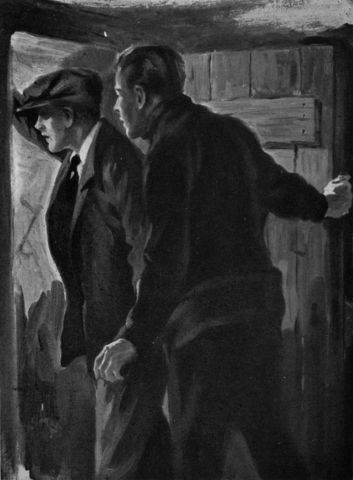
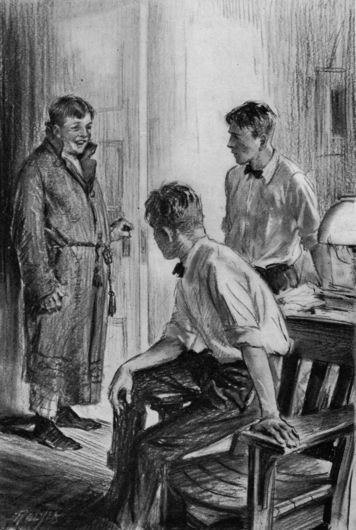
The twins stared silently and suspiciously for
an instant. Then Ned made cautious response.
“Hello,” he said, with what must have seemed
to the visitor a lamentable lack of cordiality.
The latter pushed the door shut behind him by
the kick of one stockinged foot, and grinned jovially.
“My name’s Proudtree,” he announced.
“You can’t blame us,” replied Laurie, coldly.
Proudtree laughed amiably. “It is a rotten
name, isn’t it? I live across the corridor, you
know. Thought I’d drop in and get acquainted,
seeing you’re new fellows; extend the hand of
friendship and all that. You understand. By
Jove, Pringle was right, too!”
“That’s fine,” said Ned, with more than a
trace of sarcasm. “What about?”
“Why,” answered Proudtree, easing his generous
bulk into a chair, “he said you fellows were
twins.”
“Not only were,” said Laurie, gently, “but
are. Don’t mind, do you?”
“Oh, come off your horse,” begged the visitor.
38
“Don’t be so cocky. Who’s said anything? I
just wanted to have a look. Never saw any twins
before—grown-up twins, I mean. You understand.”
“Thought you said you came to extend the
hand of friendship,” retorted Ned, sarcastically.
“Well, have a good look, partner. There’s no
charge!”
Proudtree grinned and accepted the invitation.
Ned fumed silently under the inspection, but
Laurie’s sense of humor came to his aid. Proudtree
appeared to be getting a lot of entertainment
from his silent comparison of his hosts, and presently,
when Ned’s exasperation had just about
reached the explosive point, he chuckled.
“I’ve got it,” he said.
“Got what?” Laurie asked.
“The—the clue! I know how to tell you
apart! His eyes are different from yours; more
blue. Yours are sort of gray. But, geewhillikins,
it must be a heap of fun! Being twins, I
mean. And fooling people. You understand.”
“Well, if you’re quite through,” snapped Ned,
“maybe you’ll call it a day. We’ve got things
to do.”
“Meaning you’d like me to beat it?” asked
the visitor, good-temperedly.
“Just that!”
“Oh, come, Ned,” Laurie protested, soothingly,
39
“he’s all right. I dare say we are sort of freakish
and—”
“Sure,” agreed Proudtree, eagerly, “that’s
what I meant. But say, I didn’t mean to hurt
any one’s feelings. Geewhillikins, if I got waxy
every time the fellows josh me about being fat—”
Words failed him and he sighed deeply.
Laurie laughed. “We might start a side-show,
the three of us, and make a bit of money. ‘Only
ten cents! One dime! This way to the Siamese
Twins and the Fat Boy! Walk up! Walk
up!’”
Proudtree smiled wanly. “I only weigh a
hundred and seventy-eight and three quarters,
too,” he said dolorously. “If I was a couple of
inches taller it wouldn’t be so bad.”
“I don’t think it’s bad as it is,” said Laurie,
kindly. “You don’t look really fat; you just
look sort of—of—”
“Amplitudinous,” supplied Ned, with evident
satisfaction.
Proudtree viewed him doubtfully. Then he
smiled. “Well, I’ve got to get rid of nearly
fifteen pounds in the next two weeks,” he said,
with a shake of his head, “and that’s going to
take some doing.”
“What for?” Laurie asked. “Why destroy
your symmetry?”
“Football. I’m trying for center. I nearly
40
made it last year, but Wiggins beat me out. He’s
gone now, though, and Mulford as good as said
last spring that I could make it this fall if I could
get down to a hundred and sixty-five.”
“Who’s Mulford?” inquired Ned. “A fortune-teller?”
Proudtree ignored the sarcasm. “Mulford’s
our coach. He’s all right, too. The trouble with
me is, I’m awfully fond of sweet things, and I—I’ve
been eating a lot of ’em lately. But I guess
I can drop fourteen pounds if I cut out pies and
candy and things. Don’t you think so?” Proudtree
appealed to Laurie almost pathetically.
“Don’t let any one tell you anything different,”
replied Laurie, reassuringly. Ned, evidently
recovered from his peevishness, asked:
“What sort of football do they play here?”
“Corking!” answered Proudtree.
“I mean, Rugby or the other?”
“Rugby!” exclaimed Proudtree, scornfully.
“I guess not! We play regular football. Nobody
plays Rugby around these parts. Are you
fellows going out?”
“Not just yet,” replied Ned.
“He means are we going to try for the football
team,” explained Laurie. “Yes, we are,
Proudtree; at least, one of us is.”
“You?”
“We haven’t decided yet. You see, we’ve
never played your kind of football. Back home,
41
at high school, we played American Rugby, and
it’s quite different. But we decided that one of
us had better go in for football and the other for
baseball, if only to do our duty by the school.”
Proudtree looked puzzled. “How are you
going to decide?” he asked.
“Oh, we’ll toss up or draw lots or something,
I suppose. Maybe, though, Ned had better play
football, because I know more baseball than he
does. Still, I’m not particular.”
“That’s the limit!” chuckled the visitor.
“Say, what are your names? I didn’t see any
cards on the door.”
“Turner. His is Laurie and mine’s Ned,”
answered the latter. “Do we put our names on
the door?”
“It’s the best way,” answered Proudtree.
“Well, I’ve got to be moving. I started to take
a shower and got side-tracked. You chaps come
on over and see me and I’ll get some of the other
fellows in. You want to meet the right sort,
you know. What’s your class?”
“Lower middle, I reckon,” said Ned. “That’s
what we expect.”
“Too bad you can’t make upper. That’s mine.
We’ve got a corking bunch of fellows this year.
Well, see you later. Try for Mr. Barrett’s table
when you go down. That’s the best. Maybe
they’ll put you there if you bluff it out. You understand.
So long, fellows.”
42
Proudtree withdrew with considerable dignity
in view of his bulk, waving a benedictory hand ere
the door closed behind him. Ned shook his head.
“Sort of a fresh hombre,” he said.
“Oh, he only meant to be friendly, I reckon,”
said Laurie. “You understand.”
Ned laughed. “I’ll bet they’ve got a wonderful
football team here if he plays on it! By the
way, maybe we’d better settle which of us is to
be the football star. I suppose they begin to
practise pretty soon. I’ll be the goat, if you
like; though you had better luck with that book
you bought in Chicago. I couldn’t make head or
tail of it. I never saw so many rules for playing
one game in my life!”
“It was sort of difficult,” agreed Laurie. “I
dare say, though, that you pick up the rules quick
enough when you start to play. If you don’t
really mind, I think you’d better go in for football,
and I’ll do the baseball stunt. I’ve played
it more than you have, you know, even if I’m no
wonder.”
“All right!” Ned sighed. “We’ll get a bottle
of arnica to-morrow. Nothing like being prepared.
How about going to see Mr. What’s-his-name
before supper about courses?”
“Might as well, and have it over with. I’d
like to know whether we’re going to make the
lower middle.”
“Don’t see what else we can make. They can’t
43
stick us in the junior class. Where’s my coat?
For the love of lemons, Laurie, can’t you find
anything else to sit on? Gosh, look at the
wrinkles!”
“Those aren’t wrinkles; they’re just creases.
Come on!”
Half an hour later they closed the door of Mr.
Cornish’s study on the floor below, in a chastened
mood. Each carried a little buff card whereon
the instructor had tabulated an amazing number
and variety of study periods. Back in Number
16, Ned cast himself into a chair, thrust his legs
forth, and gazed disconsolately at the card.
“I don’t see where a fellow finds time for anything
but work here,” he complained. “Sixteen,
eighteen, twenty-one hours a week! What do you
know about that?”
“Well, don’t be so proud of it. I’ve got the
same, haven’t I? I wonder how many hours he
thinks there are in a day?”
“I tell you what I think,” said Ned, after a
moment’s thought. “I think he got it into his
head that we’re very ambitious and want to graduate
next spring!”
“Maybe that’s it,” agreed Laurie, gravely.
“Shall we go back and tell him he’s wrong?”
“N-no, let’s not. He seemed a well-meaning
old codger, and I wouldn’t want to hurt his feelings—if
he has any. Let’s go down and see
what they’ve got for supper.”
44
Ned’s blandishments failed with the waitress,
and they were established at a table presided over
by a tall and very thin gentleman, whose name,
as they learned presently, was Mr. Brock. There
were four tables in the room, each accommodating
ten boys and a member of the faculty. Diagonally
across the dining-hall, the twins descried the
ample Mr. Proudtree. Another table was in
charge of a pleasant-faced woman who proved
to be the school matron, Mrs. Wyman. Mr. Cornish,
the hall master, and Mr. Barrett sat at the
heads of the remaining boards.
The room was very attractive, with a fine big
stone fireplace at the farther end, and broad windows
on two sides. The food proved plain, but
it was served in generous quantities; and notwithstanding
that the twins were a bit self-conscious,
they managed a very satisfactory
meal.
Their fellow-students seemed to be a very decent
lot. Their ages appeared to average about
sixteen, and they had the clean, healthy look of
boys who spent much of their time outdoors. At
the table at which the twins sat, four of the boys
were evidently seniors, and one was as evidently
a junior. The latter looked hardly more than
thirteen, though he was in reality a year older
than that, and had the features and expression of
a cherub. The twins concluded that he was a new
boy and felt a little sorry for him. He looked
45
much too young and innocent to face the world
alone.
No one made any special effort to engage either
Ned or Laurie in conversation, perhaps because
the returning youths had so much to talk about
among themselves. Mr. Brock ate his supper in
silence, save when one of the older boys addressed
him, and had a far-away and abstracted
air. Laurie saw him sweeten his tea three times,
and then frown in annoyance when he finally
tasted it.
The boy who had guessed their awful secret
at luncheon sat at the next table, and more
than once Ned caught him looking across with a
half-bewildered, half-frightened expression that
somehow managed to convey the intelligence that,
in spite of temptation, he had kept the faith.
Ned finally rewarded him with a significant wink,
and the youth retired in confusion behind the
milk-pitcher.
When the meal was over the twins went outside
and, following the example set by others,
made themselves comfortable on the grass beyond
the walk. Near by, two older boys were
conversing earnestly, and Ned and Laurie, having
exhausted their own subjects of conversation,
found themselves listening.
“We’ve got to do it,” the larger of the two
was saying. “Dave’s going to call a meeting of
the school for Friday evening, and Mr. Wells is
46
going to talk to them. I’ll talk too. Maybe
you’d better, Frank. You can tell them a funny
story and get them feeling generous.”
“Nothing doing, Joe. Leave me out of it. I
never could talk from a platform. Anyway, it’s
the fellows’ duty to provide money. If they
don’t, they won’t have a team. They understand
that—or they will when you tell them.
There’s another thing, though, Joe, that we’ve
got to have besides money, and that’s material.
We’ve got to get more fellows out.”
“I know. I’ll tell them that, too. I’m going
to put a notice up in School Hall in the morning.
Mr. Cummins says there are eight new fellows
entering the middle classes this year.
Maybe some of them are football-players.”
“Bound to be. Did you see the twins?”
“No, but Billy Emerson was telling me about
them. What do they look like?”
“Not bad. Rather light-weight, though, and
sort of slow. They’re from Arizona or somewhere
out that way, I think. You can’t tell them
apart, Joe.”
“Think they’re football stuff?”
“Search me. Might be. They’re light, though.
Here comes Kewpie. Gosh, he’s fatter than
ever! Hi, Kewpie! Come over here!”
It was Proudtree who answered the hail, descended
the steps, and approached. “Hello, Joe!
Hello, Frank! Well, here we are again, eh?
47
Great to be back, isn’t it? Have a good summer,
Joe?”
“Fine! You?”
“Corking! I was on Dad’s yacht all through
August. Saw the races and everything. Bully
eats, too. You understand.”
“Yes,” Joe Stevenson replied, “and I understand
why you’re about twenty pounds overweight,
Kewpie! You ought to be kicked around
the yard, you fat loafer. Thought you wanted
to play center this fall.”
“I’m going to! Listen, Joe, I’m only fourteen
pounds over and I’ll drop that in no time.
Honest, I will. You see! Besides, it isn’t all
fat, either. A lot of it’s good, hard muscle.”
“Yes, it is! I can see you getting muscle lying
around on your father’s yacht! I’m off you,
Kewpie. You haven’t acted square. You knew
mighty well that you were supposed to keep yourself
fit this summer, and now look at you!
You’re a big fat lump!”
“Aw, say, Joe! Listen, will you?” Proudtree’s
gaze wandered in search of inspiration and
fell on the twins. His face lighted. “Hello, you
chaps!” he said. Then he leaned over and spoke
to Joe. “Say, have you met the Turner brothers,
Joe? One of ’em’s a swell player. Played
out in North Dakota or somewhere.”
“Which one?” asked Joe, surreptitiously eying
the twins.
48
“Why, the—I forget: they look so much alike,
you know. I think it’s the one this way. Or
maybe it’s the other. Anyway, I’ll fetch them
over, eh?”
“All right, Kewpie.”
Kewpie started away, paused, and spoke again.
“They’re—they’re awfully modest chaps, Joe.
You’d think from hearing them talk that they
didn’t know much about the game, but don’t you
be fooled. That’s just their way. You understand.”
“Oh, sure, Kewpie!” And when the latter had
gone on his errand Joe smiled and, lowering his
voice, said to Frank Brattle: “Kewpie’s trying
to put something over. I wonder what.”
“Proudtree tells me one of you fellows plays
football,” said Joe, a minute later, when introductions
had been performed and Ned and Laurie
had seated themselves. “We need good players
this fall. Of course, I hope you’ll both come
out.”
“Ned’s the football chap,” said Laurie.
“Baseball’s my line.”
“I don’t know—” began Ned, but Laurie
pinched him warningly, and he gulped and, to
Kewpie’s evident relief, made a fresh start.
“I’m not much of a player,” he said modestly,
“but I’m willing to have a try at it.”
Kewpie darted an “I-told-you-so” glance at
Joe and Frank.
49
“Where do you come from, Turner?” Joe
asked politely.
“Santa Lucia, California. I was in the high
school there two years. Everything’s quite—quite
different here.” Ned spoke hurriedly, as
though anxious to switch the conversation from
football, and Laurie smiled in wicked enjoyment.
“The climate’s different, you know,” Ned went
on desperately, “and the country and—and
everything.”
“I suppose so,” said Frank Brattle. “What’s
your position, Turner?”
“Position?”
“Yes; I mean, where did you play? Behind the
line, I suppose, or maybe end.”
“Oh, yes, yes, behind the line. You see, I—I—”
“There aren’t many fellows can play half-back
the way Ned can,” said Laurie, gravely. “He
won’t tell you so, but if you ever meet any one
who saw him play against Weedon School last
year—”
“Shut up!” begged Ned, almost tearfully.
Kewpie was grinning delightedly. Joe Stevenson
viewed Ned with absolute affection.
“Half-back, eh? Well, we can use another good
half, Turner, and I hope you’re the fellow. I
don’t know whether Kewpie told you that I’m
captain this year, but I am, and I’m going to try
mighty hard to captain a winning team. You
50
look a bit light, but I dare say you’re fast, and,
for my part, I like them that way. Besides,
we’ve got Mason and Boessel if we want the
heavy sort. Practice starts to-morrow at four,
by the way. How about your brother? Glad to
have him come out, too. Even if he hasn’t
played, he might learn the trick. And there’s
next year to think of, you know.”
“I think not, thanks,” answered Laurie. “One
football star is enough in the family.”
“Well, if you change your mind, come on and
have a try. Glad to have met you. See you
to-morrow—er—Turner. I want to find Dave,
Frank. Coming along?”
The two older boys made off toward West Hall,
and as soon as they were out of hearing Ned
turned indignantly on Laurie.
“You’re a nice one!” he hissed. “Look at
the hole you’ve got me in! ‘Half-back’!
‘Played against Weedon School’! What did you
want to talk that way for? Why, those fellows
think I know football!”
“Cheer up,” answered his brother, grinning.
“All you’ve got to do is bluff it through. Besides,
Proudtree asked us not to let on we didn’t
know a football from a doughnut, and I had to say
something! You acted as if you were tongue-tied!”
“Yes; that’s so—you started it!” Ned turned
belligerently around. “Said it would be a favor
51
to you—” He stopped, discovering that Proudtree
had silently disappeared and that he was
wasting his protests on the empty air. “Huh!”
he resumed after a moment of surprise, “it’s a
good thing he did beat it! Look here, Laurie,
I’m in a beast of a mess. Yow know I can’t face
that captain chap to-morrow. Suppose he handed
me a football and told me to kick it!”
“He won’t. I’ve watched football practice
back home. You’ll stand around in a circle—”
“How the dickens can I stand in a circle?” objected
Ned.
“And pass a football for a while. Then you’ll
try starting, and maybe fall on the ball a few
times, until you’re nice and lame, and after that
you’ll run around the track half a dozen
times—”
“Oh, shut up! You make me sick! I won’t
do it. I’m through. I’d look fine, wouldn’t I?
I guess not, partner!”
“You’ve got to, Ned,” replied Laurie calmly.
“You can’t back down now. The honor of the
Turners is at stake! Come on up and I’ll read
that rules book to you. Maybe some of it’ll seep
in!”
After a moment of indecision Ned arose and
followed silently.