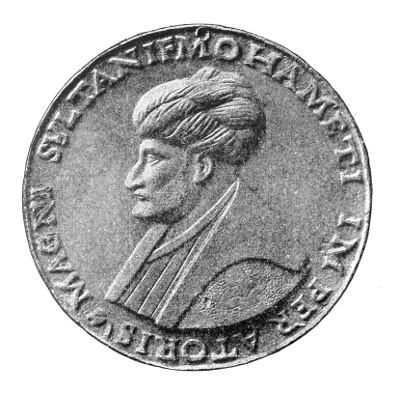
On the deposition of Abdul Aziz, his nephew, the eldest
son of Abdul Mehzid, much against his will, was proclaimed
as Sultan, under the title of Murad V. His feeble
mind, reduced to a nullity by long seclusion in the Cage,
and by the habit of intemperance, was completely unhinged
by this unexpected elevation, and after a few weeks—on
August 31, 1876—it became necessary for the committee
of ministers who had set him on the throne to depose him
in favour of the next heir. His brother, Abdul Hamid II,
held the Sultanate for thirty-three years, and is still alive,
in the custody of another brother, the present Sultan, after
being deposed, in his turn, in 1909.
Abdul Hamid proved to be the most mean, cunning, untrustworthy,
and cruel intriguer of the long dynasty of
Othman. His mother was an Armenian. He was destitute
of physical courage. He lived in constant fear of plots
and assassination, and in suspicion of every one about
him. He trusted no one, least of all his ministers. He
allowed no consultations between them. If he heard that
two of them had met in private, his suspicions were aroused
and they were called to account. He employed a huge
army of spies, who reported to him directly and daily as
to the doings of his ministers, of the ambassadors, and of
any one else of importance. They fed him with reports,
often false, on which he founded his actions. Plots were
invented in order to induce him to consent to measures
which otherwise he would not have sanctioned. He
claimed and exercised the right of secret assassination of
his foes or suspected foes. No natives of Turkey were
safe. They might disappear at any moment, as so many
thousands had done by the order of the Sultan, through
some secret agent, either to death or exile. This was not so
much from pure wickedness of heart as from fear of being
assassinated himself, and the belief that his safety lay in
exterminating his enemies before they had the chance of
maturing their plans against himself. The ambassadors of
foreign Powers had little influence with him, except so
far as they were able to threaten the use of armed force,
when, sooner than risk war, he gave way. He showed great
cunning in playing off one ambassador against another,
and was an adept in all the meanest intrigues of diplomacy.
Abdul Hamid’s life was one of incessant labour. He
devoted himself most assiduously to the work of his great
office. Whatever his demerits, he was absolute master of
his ministers and of his State. There never was a more
centralized and meticulous despotism. As he trusted no
one, he was overwhelmed by most trivial details and graver
questions were neglected. He could not, indeed, administer
the vast affairs of his Empire without information or advice
from others, but no one knew from day to day who was
the person on whose advice the Sultan overruled his ostensible
ministers, whether a favourite lady of his harem, or a
eunuch, or some fanatical dervish, or an astrologer, or a
spy. There was constant confusion in the State, arising
from antagonism between the officials of the Porte and
the minions of the palace.
Outwardly, Abdul Hamid had the manners of a gentleman,
but inwardly he was as mean a villain as could be
found in the purlieus of his capital. He was avaricious to
an extreme, and though his expenditure was most lavish and
his charities wide, he amassed immense wealth, which he
invested secretly through German bankers against the rainy
day which he expected. When it came and he was deposed,
amid universal execration and loathing, his life was spared
in the hope mainly of extracting from him these secret
investments. He was not above receiving bribes himself,
on a great scale, from financiers in search of concessions.
He did nothing to check the chief evil of Turkish rule—the
sale of offices and the necessity for officials to recoup
themselves for their outlay by local exactions. Though
he was not without some instincts for good government,
and was free from any fanaticism, his system was such
that everything went to the bad in his reign, and that
many years of peace, after the treaty of Berlin, were
attended by no improvement in the condition of his people,
but the reverse. The result of his policy was that his
Empire suffered a greater dismemberment than had been
the bad fortune of any of his predecessors, and as he
monopolized power, he must be held mainly responsible
for its evil results.
At the very outset of his reign Abdul Hamid was confronted
with most serious questions affecting the integrity
of his Empire. In 1875 an outbreak had occurred in Bosnia
and Herzegovina, the result not merely of misgovernment
by the Turkish pashas and officials, their rapacity and
exactions, and of the system of farming the taxes, but
of a vicious agrarian system. The great majority of
landowners, though of the same Slav race as the rayas,
the cultivators of the soil, were Moslems by religion. Their
forbears had become so when the Ottomans conquered
their State in order to save their property. They were
as rapacious and fanatical as any landowners of Turkish
race in any part of the Empire. No Christians were
employed in the administration of these provinces. The
evidence of the Christian rayas was not admitted in the
courts of law. Justice or injustice could only be obtained
by bribes. The police and other officials lived by
extorting money from those whom it was their duty to
defend.
The bad harvest of 1874 was the immediate cause of
the outbreak, for the farmers of the taxes refused to make
any concessions. It was, in the first instance, directed
rather against the Moslem landowners and the local Turkish
officials than against the Sultan, but it rapidly developed
into a general insurrection against the Sultan’s government.
Every effort was made by Austria and Russia to localize
it and to induce the Porte to make concessions. Count
Andrassy, the Austro-Hungarian Foreign Minister, drew up
a scheme for the pacification of the two provinces. It
proposed that the system of farming the taxes should be
abolished, that the taxes raised in the provinces should
be expended locally for their benefit, that complete religious
equality should be established, and that a mixed commission
should be appointed to supervise the carrying out of
these reforms. The scheme was agreed to by Russia, Great
Britain, and the other Powers, and was presented to the
Sultan, who acquiesced in it. But it proved, like other
promises of reform in Turkey, to be a dead letter. Not a
single step was taken to give effect to any part of it. The
rebellion in the two provinces continued. The insurgents
increased their demands. They insisted that one-third of the
land should be given up to the rayas. The movement soon
extended to Bulgaria, which was seething with disaffection.
On April 21, 1876, an outbreak of Bulgarians occurred
on the southern slopes of the Rhodope Mountains, of which
Batak was the centre. It was put down without difficulty
by a small Turkish force sent from Constantinople, under
Achmet Agha, with little loss of life to the troops engaged,
but with relentless cruelty, not only to the actual insurgents
who surrendered on promise of life, but to the whole population
of the district. Bands of Bashi-Bazouks, consisting
of Tartars from the Crimea who had been planted in
Bulgaria, were let loose on them. Indiscriminate murders,
rapes, and rapine took place. Sixty villages were burnt.
Twelve hundred persons, mostly women and children, took
refuge in a church at Batak and were there burnt alive.
In all about twelve thousand persons perished in these
brutal reprisals. Achmet Agha received a high decoration
from the Sultan for this performance. There was
nothing new in this method of dealing with an outbreak
by the Porte. It was in accord with its traditional system
and policy to wreak vengeance on those revolting by orgies
of cruelty, which would strike terror among subject races
and act as a warning to them in the future.
What was new in the case of the Bulgarians in 1876,
and was fraught with misfortune to the Turkish cause,
was that full and graphic accounts of the horrors committed
at Batak, written by Mr. Edwin Pears (now Sir
Edwin), the correspondent at Constantinople of the Daily
News, appeared in the columns of that paper. They produced
a profound impression on public opinion in England.
Discredit was thrown on the story in the House of Commons
by Mr. Disraeli, the Prime Minister, but it was fully confirmed
by Mr. MacGahan, another correspondent of the
same paper, who visited the district, and later by Mr.
Walter Baring, a member of the British Embassy at Constantinople,
who, by the direction of the Government, made
full personal inquiries on the spot. He described what
had taken place as “perhaps the most heinous crime that
has stained the history of the present century.”
It was also unfortunate for the Turks that Mr. Gladstone,
the only survivor in the House of Commons of the British
statesmen responsible for the Crimean War, who had
recently retired from the leadership of the Liberal party, was
fired by the description of these horrors in Bulgaria to
emerge from his retirement and to take up the cause of
the Christian population of European Turkey, for which
he held that the treaty of Paris had made his country
responsible.
Meanwhile the horrors at Batak had also aroused the
indignation of Russia and the fears of Austria. A
fanatical outbreak of Moslems at Salonika resulted in the
murder of the Consuls of France and Germany. Serbia
and Montenegro, impelled by sympathy for their fellow
Slavs in Bosnia, declared war against Turkey. A Turkish
force defeated the Serbians, who appealed to Russia
for assistance. At this stage another effort was made
by Russia and Austria, supported by Germany, to avert
a general conflagration, and a scheme was embodied
in what was known as the Berlin Memorandum for compelling
the Porte to carry out the reforms which it had
admitted to be necessary. The British Government, however,
very curtly refused to be a party to the scheme, on
the ground that they had not been consulted in framing
it and did not believe in its success. About this time
also the British fleet in the Mediterranean was ordered to
Besika Bay, a step taken avowedly for the purpose of
protecting British subjects in the turmoil which had arisen,
but which seemed to the Porte to indicate an intention to
support them against the demands of the other Powers.
Mr. Gladstone, fearing that these actions indicated the
intention of the British Government to withdraw from the
concert of Europe and to renew the separate policy which
had led to the Crimean War, made a vehement attack on
it in the House of Commons for refusing to agree to the
Berlin Memorandum. Later, in September 1876, he published
his well-known pamphlet on “the Bulgarian
Horrors,” in which, with passionate language, he dwelt
at length on the massacres at Batak and denounced the
Turkish Government. He protested that he could no longer
bear his share of responsibility for the Crimean War.
Otherwise he might be accused of “moral complicity in
the basest and blackest outrages upon record in that
century.”
Those [he wrote] who opposed the Crimean War are especially
bound to remember that the treaty of Paris made Europe as a whole,
and not Russia alone, responsible for the integrity and independence
of the Ottoman Empire, which had given this licence to Turkish officers
to rob, murder, and ravish in Bulgaria.... As an old servant of the
Crown and State, I entreat my countrymen, upon whom far more
than perhaps any other people of Europe it depends, to require and
insist that our Government, which has been working in one direction,
shall work in the other, and shall apply all its vigour, in common with the
other States of Europe, in obtaining the extinction of the Turkish executive
power in Bulgaria. Let the Turks now carry away their abuses in the
only possible manner, namely, by carrying off themselves. Their zapties
and their mudirs, their bimbashis and their yuzbashis, their kaimakans
and their pashas, one and all, bag and baggage, shall, I hope, clear out
from the province they have desolated and profaned.42
The pamphlet produced an immediate and profound
effect on public opinion in Great Britain. It was followed
up by speeches of the same force and eloquence on the
part of the veteran statesman. Meetings took place in
every part of the country, at which sympathy was expressed
for the Christian populations of Turkey. The Turks were
denounced for their cruelties and bad government. Resolutions
were unanimously passed in accord with the policy
recommended by Mr. Gladstone. Lord Stratford himself
expressed sympathy with the movement, differing only in
this from Mr. Gladstone, that England, in his view, should
exert its influence not only for the Bulgarians, but for all
the oppressed subject races in Turkey. Many of the most
cultivated men in England joined in the movement quite
irrespective of party politics.
Mr. Disraeli, who was created Earl of Beaconsfield in
the course of these events, on his retirement from the
House of Commons, showed great courage and persistence
in resisting the movement. His sympathies lay wholly in
the opposite direction. His Eastern policy was in accord
with that of the previous generation of statesmen, such
as Palmerston, and, indeed, Gladstone himself in his earlier
stage of opinion, who believed that the maintenance of the
Turkish Empire was essential to the integrity of the British
Empire. He saw no reason for change. He dreaded the
further advance of Russia. He did not believe in the
honesty of the professions of its Emperor. He enforced
his views at a public meeting at Aylesbury on September
20th, and endeavoured to stem the movement. He
scoffed at the Bulgarian horrors. He declared the perpetrators
of them were not so bad as those who made them
the subject of agitation for their political purposes. He
was evidently prepared to support the Turks against any
invasion of their country by Russia, and to renew the policy
of the Crimean War. But it was in vain.
Though the agitation promoted by Mr. Gladstone did
not result in inducing the Government to join the other
Powers in compelling the Turkish Government to concede
autonomy to its Christian provinces, or to carry out reforms,
it had two effects of great historical importance, which
must be our justification for referring to the subject. It
made impossible the renewal of the policy of the Crimean
War—the armed support by Great Britain to the Turks
against an invasion by Russia on behalf of the Christian
population of the Balkans. It paralysed the hands of those,
like Lord Beaconsfield, who desired to support the Turks
and the status quo. On the other hand, it doubtless stimulated
Russia to armed intervention, by making it clear that
there would be no resistance on the part of Great Britain.
Lord Beaconsfield’s Cabinet was divided on the subject.
A majority of its members evidently concurred with Lord
Derby, the Foreign Secretary, in opposition to war with
Russia on behalf of Turkey.
On September 21st, the day after Lord Beaconsfield
had delivered his fiery pro-Turkish speech at Aylesbury,
Lord Derby, on behalf of the Government, in a despatch
to the Ambassador at Constantinople, directed him to
inform the Porte that the atrocious crimes of the Turkish
authorities and troops in Bulgaria had aroused the righteous
indignation of the British people, and that Great Britain,
as signatory to the treaty of Paris, could not be indifferent
to them. He demanded that examples should be made
of the perpetrators of these crimes.
On October 30th Lord Derby further informed the Russian
Government, through the ambassador at St. Petersburg,
that, however strong the feeling in England against the
Turkish cruelties, it would be superseded by a very different
sentiment if it were believed that Constantinople was
threatened, or that British interests in the Suez Canal were
in any danger. This message to the Emperor could only
be interpreted as meaning that the British Government
would not interfere with any action that Russia might take
against Turkey, provided it did not involve the conquest
of Constantinople or endanger British interests in Egypt.
It was evidently so understood by the Emperor, for immediately
on receipt of the above despatch, on November 2nd,
he gave his word of honour to the British Ambassador
that he had no designs on Constantinople and no intentions
whatever to annex Bulgaria.
In spite of this explicit announcement on the part of
the Emperor, in response to the despatch from the British
Foreign Minister, Lord Beaconsfield, a few days later, on
November 9th, at the annual civic banquet at the Guildhall
of London, delivered himself of a most bellicose speech
on behalf of Turkey, practically threatening war with
Russia, without any reference to the pacific assurance of
the Czar, which, as we now know, was in his hands at the
time when he made this speech. There could not well
be a clearer intimation on the part of the British Premier
that he had no belief in the good faith of the Emperor.
This menacing speech of the British Prime Minister
was telegraphed to Russia, with the result that the Czar
was greatly incensed, and on the next day, November 10th,
he made a public pronouncement at Moscow to his people
of the gravest importance, to the effect that, if he could
not obtain adequate guarantees from the Porte for the
protection of its Christian subjects, he would act independently
of other Powers, relying on the loyalty of his
people to support him.
In the meantime, through Lord Derby’s efforts, it had
been arranged with Russia and the other Great Powers
that a Conference should be held at Constantinople of representatives
of all the Powers, for the purpose of deciding
what administrative changes should be proposed to the
Sultan, with a view to the common purpose—namely the
better protection of his Christian subjects in Europe.
Lord Salisbury, as a member of the British Cabinet and
Secretary of State for India, represented England at this
Conference. It met at Constantinople on December 23,
1876. On the day before the meeting of the Conference
at Constantinople a firman was published by the Sultan, at
the instance of Midhat Pasha, promulgating a scheme of
constitutional reform, which had been agreed to by the
ministers of the Porte in the short reign of Murad, but
which Abdul Hamid on his accession had refused to
sanction. A National Assembly was convoked, to be elected
by universal suffrage, without distinction of race or
religion, throughout the Empire. It was hoped to anticipate
the demands of the Conference by a scheme of reform
wider than they were likely to advise. This was effected
with perfect good faith by Midhat, who was earnestly in
favour of reform. But subsequent events showed that the
Sultan adopted this course for the purpose only of throwing
dust in the eyes of the Conference, and with the full
intention of setting aside the Constitution as soon as the
Conference had broken up. The Conference might perhaps
have acted more wisely in treating this act of the Sultan
as an honest proposal, and in making it the basis of a wide
reform of the Ottoman Empire. They held it to be a
sham. They proceeded with their discussions as if it had
not been issued. They preferred an alternative scheme
of providing autonomous institutions for the Christian
provinces of Turkey, and for the appointment of governors
subject to the approval of the Great Powers. There was
practically no difference of opinion at the Conference
between the British and Russian delegates, Lord Salisbury
and General Ignatief. The Conference, at their instance,
reduced its demands on the Porte to the most moderate
minimum.
The Sultan refused point-blank to entertain the proposals
of the Conference, on the ground that they interfered
with his sovereign powers. He pleaded the new
Constitution which he had just accorded to the Empire.
There never was any intention on his part to make any
concessions. He was under the belief that if war resulted
with Russia from his refusal to agree to reforms his country
would not stand alone. He took the policy of England
from the speech of Lord Beaconsfield at the Guildhall;
and not from Lord Derby or Lord Salisbury. Lord
Beaconsfield had, in fact, thrown over his colleague, Lord
Salisbury, in that unfortunate utterance and had insured
the failure of the Conference at Constantinople.
A few days after the break-up of the Conference, Midhat
Pasha was ignominiously dismissed from office. The new
Constitution did not long survive its author. In May,
1877, Abdul Hamid suspended it and dismissed the National
Assembly which had been convoked. During the two months
of its existence its members had shown a determination to
expose the scandalous abuses of the Hamidian system. Later
Abdul Hamid trumped up a charge against Midhat of having
been responsible for the murder of Sultan Aziz. Two men
employed by that Sultan, a wrestler and a gardener, were
suborned to confess that they strangled Aziz at the instance
of Midhat. Midhat was tried by corrupt judges and was not
allowed to cross-examine these men. He was found guilty
and condemned to death. At the instance mainly of the
British Government the sentence was commuted to banishment
to Arabia. Midhat was there strangled by order of
Abdul Hamid in 1882, and his embalmed head was sent to
Constantinople, in order that the Sultan might be assured of
his death. The two men who had confessed to the murder
of Aziz were released and were pensioned by the Sultan. Sir
Henry Elliot, who was British Ambassador at Constantinople
at the time of the death of Sultan Aziz, put on record his
conviction that it was a case of suicide, that the charge
against Midhat was trumped up, and that the whole proceedings
are an indelible stain on Abdul Hamid.
Meanwhile, in 1877, another attempt was made by the
Great Powers to effect a settlement of the Eastern question.
Count Schouvaloff was sent to London by the Emperor of
Russia on a special mission for the purpose. Agreement
was arrived at between the Powers. It was embodied in a
protocol, and was presented to the Porte. It was promptly
rejected on April 10th by the Sultan as inconsistent with
the treaty of Paris by interfering with the independence
of the Ottoman Empire. Russia thereupon declared war
against Turkey, justifying it in a dignified manifesto, on
the ground that the Sultan, by rejecting the protocol, had
defied Europe. Russia, therefore, held the strong position
of acting on behalf of Europe. England was the only
Power to take exception to this. Lord Derby, in a
despatch to the Russian Government, said that he and his
colleagues regarded the action of Russia as an obstacle to
reform in Turkey, and held that the plight of the Christian
population could not be improved by war—a most unfortunate
prediction, as the result proved. More fortunate
was the prediction of Mr. Gladstone at the close of a
speech which he made in the House of Commons, on April
24, 1877, immediately after the declaration of war by
Russia, when moving a resolution intended to prevent the
Government from taking up a hostile attitude to Russia
in the coming war.
I believe, for one [he said], that the knell of Turkish tyranny in these
provinces (the Balkan provinces) has sounded. So far as human eyes
can judge, it is about to be destroyed. The destruction may not come
in the way or by the means that we should choose; but come from what
hands it may, I am persuaded that it will be accepted as a boon by
Christendom and the world.43
The answer of the Government to Mr. Gladstone was
given in the debate by the Home Secretary, Sir Richard
Cross, later Lord Cross. It showed that the policy of
Lord Derby, and not that of Lord Beaconsfield, had prevailed
in the Cabinet. The Government, he said, regretted
the war which had been declared by Russia, and did not
believe that it would do any good, but it would not give
support to either side, unless the Suez Canal or Egypt or
Constantinople were threatened.
It followed from this decision of the British Cabinet
that the hopes which the Sultan had formed from the
speeches of Lord Beaconsfield were not realized. He was
left alone to fight against Russia in another attack on his
Empire. Immediately after the declaration of war, on April
24, 1877, two Russian armies invaded Turkey—the one in
Europe, of two hundred and fifty thousand men, under the
nominal command of the Grand Duke Nicholas, the other in
Asia, of a hundred and fifty thousand men from the Caucasus,
under that of the Grand Duke Michael. The former crossed
the Pruth into Roumania, which was still nominally a part
of the Ottoman Empire. But on April 15th the Roumanian
Chamber had given its assent to a convention with Russia
providing for the passage of the Russian troops through
the principality and otherwise giving promise of friendly
support. The Porte, as was to be expected, treated this
as a hostile act, and directed the bombardment of Calafat,
a Roumanian fortress on the Danube. The Roumanians
thereupon, on May 21st, declared war against Turkey. They
gave most effective support to the Russians throughout the
campaign. Indeed, it may be fairly said from the course
of the campaign that the invasion of Bulgaria would not
have been successful without the help of the Roumanians.
The Emperor of Russia had further prepared the way
for the invasion of Turkey by securing the neutrality of
Austria-Hungary. At a personal meeting in the previous
year at Reichstadt, he had assured the Emperor of Austria
that he had no intention of taking possession of Constantinople.
He further promised that Bosnia and Herzegovina
would be handed over for occupation by Austria-Hungary
as a reward for neutrality in the event of success
in his war against the Turks.
Owing to unprecedented inundations in the valley of
the Danube, it was not till two months after the commencement
of the campaign that the Russian army was able to
cross that river. It did so at two points, the one in the
Dobrudscha, the other at Hirsova. In neither case did it
meet with serious opposition. The Turkish army of defence
was little inferior in numbers to that of the Russians, but
its general, Abdul Kerim, proved to be quite incompetent.
He spread his forces in detachments over a front of five
hundred miles, and was too late in concentrating them.
The Russians, after capturing Nicopolis, the Turkish stronghold
on the Danube, advanced into Bulgaria and captured
Tirnovo, its ancient capital. Everywhere they were received
by the Bulgarians with rapturous demonstrations of delight
at the prospect of deliverance from Ottoman rule.
General Gourko, with a flying corps, then made a very
hazardous but successful march across the Balkans by the
Hainköi Pass, and advanced into Bulgaria along the Trudja
Valley as far as Eski Zagra. Thence, turning back, he
attacked the more important Shipka Pass from the south,
and defeated a Turkish force in occupation of it. Meanwhile,
early in July, the main Russian army from Tirnovo
came in contact at Plevna, twenty miles south of the Danube,
with a Turkish army of fifty thousand men under Osman
Pasha, who had been sent in relief of Nicopolis, but was
too late for the purpose.
Plevna was not a fortress. It was a strong natural
position, where the Turks entrenched their army behind
earthworks and redoubts with great engineering skill, and
where they maintained an obstinate and memorable defence
for nearly five months, the most striking incident of the
campaign of 1877. Three unsuccessful assaults were made
by the Russians, assisted by a Roumanian army, in which
great losses were incurred. Thereupon, by the advice of
General Todleben, the hero of the defence of Sebastopol
in the Crimean War, the attempt to take these works at
Plevna by assault was given up, and it was subjected to a
close investment. The occupation of the Shipka Pass by
Gourko prevented the advance of a Turkish army in relief
of Plevna, in spite of successive attacks by the Turkish army
under Suleiman Pasha. As a result, after five months of
heroic resistance, Osman Pasha found himself in great straits
for want of food for his army. He determined to make a
great effort to break through the lines of the investing
army. The sortie failed, and Osman and his whole remaining
army of thirty-two thousand men were compelled to
surrender on January 9, 1878. This had the effect of
releasing the Russian army in front of Plevna. General
Gourko and the main part of the Russian army thereupon
marched to Sofia. General Skobeleff, in command of
another army, determined to force his way across the Balkan
range. An army of ninety thousand Turks under another
Pasha was stationed at the southern end of the Shipka
Pass and barred his way. Directing a part of his army to
make a feint attack along the Shipka Pass, Skobeleff led
the remainder by two sheep tracks distant about six miles
from the pass, and crossing the mountains, was able to attack
the enemy on the flank at Shenova. The Turks were
defeated and their whole army was compelled to surrender.
By this brilliant manœuvre of Skobeleff, the Grand Duke
Nicholas, in nominal command of the whole Russian army,
was able to advance without further opposition to Adrianople.
He took possession of it on January 28th. Meanwhile
the Turks met with further defeats from the Serbians
and Montenegrins. The former captured the important
town of Nisch. The latter captured Spizza, in the bay of
Antivari, and Dulcigno, in the Adriatic.
In Asia the Turks were no more fortunate than in Europe.
Their army under Muktar Pasha was little inferior in
numbers to that of the Russians, but it was divided between
Kars, Ardahan, and Erzerum. The Russians in the course
of the campaign of 1877 succeeded in successively capturing
these important fortresses and in getting possession
of nearly the whole of the districts inhabited by Armenians.
By the middle of January 1878 the resistance of the
Turks was practically at an end in both continents. They
were compelled to sue for peace and to appeal for the
mediation of the other Powers of Europe. On January 31st
an armistice was agreed on.
The capture of Adrianople and the fact that there was
no Turkish army capable of resisting the further advance
of the Russians to Constantinople caused great alarm to
the British Government. Opinion in England, which had
not supported Lord Beaconsfield in his desire to renew the
policy of the Crimean War, and to assist the Turks against
the invasion of Bulgaria by the Russians, now veered round,
at least among the wealthier and a large section of the
middle class, and declared itself vehemently opposed to
the occupation of Constantinople, which appeared to be
imminent, even if it should be only of a temporary
character.
The British fleet at Besika Bay was ordered to enter the
Dardanelles. The House of Commons was asked to vote
six millions for war purposes. Every preparation was
made for war. Russia replied to these demonstrations by
advancing its army nearer to Constantinople. The headquarters
of the Grand Duke Nicholas were established at
San Stefano, a village on the shore of the Marmora, within
sight of Constantinople. A portion of the British fleet then
took up a position near to Prince’s Island, also within sight
of the capital. The position between the two countries,
England and Russia, was therefore most critical.
Meanwhile negotiations took place directly between Russia
and the Porte. Terms of peace were offered and agreed to,
and on March 3, 1878, a treaty was signed between the
two Powers at San Stefano. It was in accord with the
promises which had been made to the British Government
by the Czar. Constantinople, the province of Thrace, and
Adrianople were left in possession of the Turks, and the
capital was not even to be temporarily occupied by the
Russian army. Bulgaria was not to become a Russian
province or even an independent State. But a great Bulgaria
from the Danube southward, with frontiers on the
Black Sea and the Ægean Sea, and including the greater
part of Thrace, was constituted as an autonomous State,
subject to the nominal suzerainty of the Sultan, under a
prince to be elected by its people and approved by Russia.
As thus constituted, it would cut off the Porte from direct
junction and communication by land with its remaining
possessions in the Balkan peninsula, such as Macedonia,
Epirus, and Albania. Serbia and Montenegro were to be
greatly enlarged and both were to be independent States.
Bosnia and Herzegovina were to be endowed with autonomous
institutions while remaining subject to the Porte.
Reformed administration was to be secured for the remaining
Balkan provinces. No extension was conceded to Greece,
but Thessaly, Epirus, and Crete were included in the provision
of reformed administration. The Roumanians were
very shabbily treated after the valuable assistance they had
rendered to the Russian army. The part of Bessarabia, inhabited
largely by Roumanians, which had been taken from
Russia by the treaty of Paris and added to Moldavia, was to
be restored to the Czar, together with a small strip which
brought Russia up to the Danube as a riverain State. In
exchange, Roumania was to be content with the barren
Dobrudscha, sparsely inhabited by Bulgarians and Turks.
Roumania was to be an independent State. In Asia, Kars,
Ardahan, Bayezid, and Batoum, and their districts were to
be ceded to Russia. Erzerum was to be restored to
Turkey. An indemnity for the war of twelve millions
sterling was to be paid by Turkey.
The publication of these terms did not allay the apprehensions
of the British Government. They were regarded,
in the first instance, as meaning the complete dismemberment
of Turkey in Europe. Lord Beaconsfield and the
Turkophil members of the Government believed that a
great Bulgaria would be completely under the influence of
Russia, and would be used as a stepping-stone for the
ultimate acquisition of Constantinople by that Power. They
could not understand, what was often insisted upon by Mr.
Gladstone in his speeches, that the best barrier against
the advance of Russia, in the Balkan peninsula, would be
a self-governing, contented, and prosperous State, and that
the larger it was the better it would serve that purpose. The
Government, under these misapprehensions, determined to
resist the creation of a big Bulgaria, even at the risk of
war with Russia. They maintained that the treaty of San
Stefano was completely at variance with the treaty of
Paris of 1856, and must be revised by a new Congress of
the great Powers of Europe.
The Russian Government would not agree to submit
the whole treaty to a Congress, but only some parts of it.
A collision between Russia and England seemed to be
imminent. War preparations were continued by the latter,
and Indian troops were sent to Malta. Lord Derby, the
Foreign Minister, and Lord Carnarvon, the Colonial Secretary,
who were opposed to war, resigned, and the war party
in the Cabinet prevailed. But the Czar was very averse to
war, whatever might be the wishes of his generals at the
front before Constantinople. At the last moment terms
of reference to a Congress were agreed upon between the
two Governments, and war was averted. By an agreement
which was intended to be secret, but which was divulged
to the Press in England by an unscrupulous employé at the
Foreign Office, the British Government promised to support,
at the Congress, the main clauses of the treaty of San
Stefano, subject to a concession, on the part of Russia, as
to Bulgaria. Under this agreement, the intended big Bulgaria
was divided into three parts. That between the
Danube and the Balkan range was to be dealt with as
proposed in the San Stefano treaty. It was to be an
autonomous State under the suzerainty of the Sultan, with
a prince elected by its people. A second part of it, immediately
south of the Balkan range, to be called Eastern
Roumelia, was to be an autonomous province more directly
under the control of the Porte. A third, the part bordering
on the Ægean Sea and containing a mixed population of
Bulgarians, Serbians, Greeks, and (in parts) Moslems, was to
be restored to the Porte subject to conditions for better administration
equally with other Turkish provinces in Europe.
This part has since been generally spoken of as Macedonia.
The Congress of the Powers met at Berlin on June 13,
1878, under the presidency of Prince Bismarck. It was
the most important gathering of the kind since the Congress
of Vienna in 1815. The Great Powers were represented
by their leading statesmen. England, by Lord Beaconsfield
and Lord Salisbury; Russia, by Prince Gortchakoff
and Count Schouvaloff; France, by its Prime Minister,
Waddington; Italy, by Count Corti, its Foreign Minister;
Austria, by Count Andrassy. The Porte, apparently, was
unable to find a competent Turk for the purpose.
It was represented by Karatheodori, a Greek, and by
Mehemet Ali, a renegade German. Germany, it need not
be said, was represented by Bismarck, who acted as the
‘honest broker.’ Although apparently invested with unlimited
authority to deal with all questions arising out of
the treaty of San Stefano, the Congress found that its hands
were practically tied behind its back by the agreement
between England and Russia. It had no other option than
to cut down the big Bulgaria under the tripartite scheme
already described, which was the essence of the Anglo-Russian
agreement. As regards the artificially created
province of Eastern Roumelia, Lord Beaconsfield, who
throughout the proceedings of the Congress championed
the Turkish cause, insisted that the Porte was to have the
right to maintain garrisons in its frontier fortresses. He
threatened to break up the Congress if this was not conceded.
Russia, though strongly opposed to this, ultimately
gave way. This was a triumph for Beaconsfield, the value
of which we can now appreciate, with the knowledge that
no advantage was ever taken by the Porte of this permission
to garrison Eastern Roumelia.
The most important point on which the Congress effected
a change in the treaty of San Stefano was in respect of
Bosnia and Herzegovina. At the instance of Bismarck,
these two provinces, instead of being endowed with
autonomous government, were handed over to Austria for
occupation and administration, while remaining nominally
a part of the Turkish Empire. Montenegro was to lose
half of the territory conceded to it at San Stefano.44 The
claims of Greece for a definite extension of its territory
were championed by the representative of France, but were
opposed by Lord Beaconsfield. The Congress contented
itself with a recommendation to the Sultan that the
boundaries of Greece should be extended so as to include
Thessaly and a part of Epirus. Organic reforms of administration
and law were to be carried out by the Porte in the
European provinces of the Empire on the recommendation
of a Commission to be appointed by the Great Powers.
The Congress confirmed to Russia the acquisition of
the provinces in Asia above referred to, and the restoration
of Erzerum and Bayezid to the Porte. The Armenians
were guaranteed good government and protection from the
raids of Kurds and Circassians. Some other amendments
of the San Stefano treaty of no great importance were
decided upon, and on July 13, 1878, the treaty of Berlin
was signed by the representatives of all the Powers, after
exactly a month of discussion.
After his success at the Congress in respect of the
Roumelian garrisons, obtained by the threat of war,
Beaconsfield was able to return to England with a flourish
of trumpets, boasting that he had succeeded in obtaining
‘peace with honour.’ Though the treaty of Berlin nullified
that of San Stefano as regards the big Bulgaria, it did,
in fact, ratify the virtual dismemberment of the Ottoman
Empire in respect of four-fifths of its territory in Europe
and freed about eight millions of people from its rule. This
great achievement was due to Russia alone, and the gains
to that Power in Bessarabia and Armenia were in comparison
small and unimportant. The splitting up of
Bulgaria, which constituted the main difference between
the two treaties, was due to British diplomacy, backed by
threats of war. But the result obtained did not stand the
test of even a short experience. Two of the Bulgarian
provinces thus torn asunder were reunited seven years later.
More recently, the parts of Macedonia and Thrace restored
to full Turkish rule by the treaty of Berlin have, within
the present century, again been freed from it, and have
been annexed to Serbia and Greece in about equal portion.
It will be seen from this brief statement that by the treaty
of Berlin Great Britain obtained nothing for itself, unless
it were that the division of Bulgaria was of permanent
value to it in strengthening the hold of the Turks on
Constantinople, a contention which has not been confirmed
by subsequent events. It did, however, succeed in getting
something out of the general scramble for territory. By
another secret treaty which, to the amazement of the
members of the Congress at Berlin, was made public during
their sittings, the Porte agreed to hand over to the occupation
of England the island of Cyprus, on terms very
similar to those under which Bosnia and Herzegovina were
placed under the charge of Austria. The occupation of
the island was limited to the time during which Kars and
Ardahan should be in possession of Russia. As a condition
of this occupation, Great Britain guaranteed to the
Porte its Asiatic possessions. But this guarantee was conditional
on good government being secured to the Armenian
population in the east of Asia Minor, a condition which
has never, in fact, been fulfilled. The treaty was justified
in the British Parliament on the ground that Cyprus would
be of great value as a place d’armes for the British
army in the event of attack by Russia on the Asiatic
provinces of Turkey or of an attack from any quarter
on Egypt. The Porte was guaranteed by the British
Government an annual tribute so long as the occupation
should last, based on the average revenue which it had
received from the island. The proceeds were assigned
for payment of the interest on the loan raised by Turkey
during the Crimean War, guaranteed by England and
France. The arrangement was made hastily and without
due inquiry, with the result that the island has been
burthened with a charge far in excess of its past payments
to the Porte, and the British taxpayers have been
compelled to bear a part of the burthen. An occupation
such as that of Cyprus was almost certain to become permanent,
and in 1914, during the existing war, the island
was permanently annexed by the British Government.
Looking back at the events which led to the liberation
of Bulgaria from Ottoman rule and to all the other changes
sanctioned by the treaty of Berlin, it must now be fully
admitted that the agitation which Mr. Gladstone promoted
against the Turkish Government had a great ultimate effect.
It averted the use of armed force by Great Britain for
the purpose of preventing the intervention of Russia on
behalf of the Christian population of the Balkans. In a
great speech in the House of Commons in review of the
treaty of Berlin, Mr. Gladstone delivered himself of this
verdict on it:—
Taking the whole provisions of the treaty of Berlin together, I must
thankfully and joyfully acknowledge that great results have been achieved
in the diminution of human misery and towards the establishment of
human happiness and prosperity in the East.
As regards the conduct of England at the Congress he
added these weighty words:—
I say, Sir, that in this Congress of the Great Powers the voice of
England has not been heard in unison with the constitution, the history,
and the character of England. On every question that arose, and that
became a subject of serious contest in the Congress, or that could lead to
any practical results, a voice has been heard from Lord Beaconsfield and
Lord Salisbury which sounded in the tones of Metternich, and not in the
tones of Mr. Canning, or of Lord Palmerston, or of Lord Russell....
I do affirm that it was their part to take the side of liberty, and I do also
affirm that, as a matter of fact, they took the side of servitude.45
Lord Salisbury himself lived to make the admission that
England in its Eastern policy “put its money on the
wrong horse.”
The three years which followed the treaty of Berlin
were spent by the Great Powers in the endeavour to give
effect to its provisions, by settling the boundaries between
Turkey and its disjecta membra, and other important details.
Two of these questions led to great difficulty. The Porte,
as was to be expected, put every obstruction in the way
and resorted to its accustomed dilatory methods. By the
treaty Montenegro had been guaranteed a port in the
Adriatic. It was not till 1880, after the return of Mr.
Gladstone to power in England, that effective pressure was
put on the Porte. He induced the other Powers to join
in sending a combined fleet to the Adriatic to blockade
its coast as a demonstration against the Porte. This, however,
was not effective for the purpose. It mattered little
to the Porte that its coast in the Adriatic was blockaded.
It was not till the British Government threatened to send
its fleet to Asia Minor, and by seizing some custom houses
there to cut off supplies of money, that the Sultan was
brought to book. Eventually the port of Dulcigno and
the district round it were ceded to Montenegro and its
claim for access to the Adriatic was conceded.
The case of Greece caused even greater difficulty. The
treaty of Berlin, it has been shown, contained no specific
promise or guarantee of a cession of territory to Greece. It
merely made a recommendation to that effect, leaving it to
the discretion of the Porte whether to accede to it or not.
As Greece had taken no part in the war of liberation of
the Balkans, it had no special claim, except such as
arose from a wish of the Powers to avoid complications in
the future. It was admitted, however, by the Porte that
something should be done in the way of rectifying its
frontier in this direction. Another conference of the Powers
at Berlin reported in favour of drawing the frontier line
so as to include in the kingdom of Greece the whole of
both Thessaly and Epirus. This was gladly assented to by
Greece, but was rejected by the Sultan. The Powers,
however, were not willing to back up their proposals by
armed force. The French Government, which had supported
the claim of Greece at the Congress, now drew
back. Eventually, after two years of diplomatic labour,
a compromise was arrived at, mainly at the instance of
the British Ambassador to the Porte, Mr. Goschen, who
showed infinite skill and patience in dealing with the Sultan.
A line of frontier was agreed to, which conceded to Greece
the whole of Thessaly and about a third part of Epirus.
This line excluded Janina and other districts inhabited
by Moslem Albanians, and also other districts where Greeks
predominated, but under the circumstances it was the most
which could be effected without a resort to arms. Greece
had to wait some years before a more complete settlement
could be secured to her.
As regards the organic local reforms in administration
and law which, under the treaty of Berlin, were to be carried
out in the European provinces of the Empire, a Commission
was appointed by the Great Powers in 1880. The British
representative was Lord Edmund Fitzmaurice, later Lord
Fitzmaurice. He took the leading part in drawing up a large
and complete scheme of reform, which was agreed to by
the Commission and was presented to the Sultan for his
approval in accordance with the treaty.
There followed, after these proceedings, a period of
twenty-eight years, up to 1908, during which Turkey, under
the rule of Abdul Hamid, was free from external war, and
opportunity was therefore afforded for giving effect to the
promises by the Porte, guaranteed by the treaty of Berlin,
of reforms and improved administration in Macedonia and
other Balkan provinces left in its possession, and also
in Crete and Armenia. Except as regards Crete, not
a single step, however, was ever taken by the Porte to
give effect to these promises. The scheme of organic
reform was never approved by the Sultan. It was treated
as waste-paper, like every other promise of reform in
Turkey. Disorder and misgovernment continued unabated.
Several events soon took place which showed that the
disintegration of the Ottoman Empire was still slowly but
surely proceeding. The most important of these was in
relation to Bulgaria. The reduced and mutilated province
under that name, as settled by the treaty of Berlin, chose
as its ruler, with the consent of the Powers, Prince
Alexander of Battenberg, a young man of great merit
and promise. Eastern Roumelia, cut off from Bulgaria,
was also constituted as a separate province, more immediately
dependent on the Porte, but with autonomous
government, under a Christian governor nominated by the
Sultan. But this ingenious scheme of Lord Beaconsfield
did not work in practice. Economic difficulties, arising
from separate tariffs, equally with national aspirations,
necessitated union. The representative chambers of both
provinces were incessant in their demands for this.
The union of the two States was now opposed by Russia.
But, strange to say, it was supported by Great Britain,
at the instance of Lord Salisbury, who had been associated
with Lord Beaconsfield at the Congress of Berlin in insisting
on the severance of the two provinces. He had
since been persuaded by the British Ambassador at Constantinople,
Sir William White, a far-seeing statesman who
had intimate knowledge of the Balkans, that a united
and strong Bulgaria would, in the future, be a bar
to the ambitions of Russia against what remained of
Turkey.
Fortunately for the Bulgarians, the Sultan arrived
at the same conclusion. When, therefore, in 1885, the
two provinces insisted on union, and a Bulgarian army
occupied Eastern Roumelia, with the full assent of its population,
who deported the Turkish governor to Constantinople,
the Sultan made no real opposition. He was
persuaded to accept the union as a fait accompli. The
diplomatic difficulty arising out of the treaty of Berlin
was evaded by the Sultan in 1886 nominating the Prince of
Bulgaria as governor of Roumelia. Thenceforth the representative
chambers of the two States met as one body at
Sofia, and the union was practically effected. This caused
great discontent in Serbia, which was jealous of the
aggrandizement of its neighbour and demanded territorial
compensation. War consequently broke out between Serbia
and Bulgaria. After a three days’ battle at Slivnitza, the
Bulgarians, contrary to all expectations, were completely
successful, under the able generalship of Prince Alexander.
Belgrade lay open to the victorious army. But the Great
Powers then again intervened and insisted on terms of
peace between the belligerents, based upon the status quo
before the war. The Emperor of Russia deeply resented
the action of his relative, Prince Alexander. The Prince
was kidnapped and was forcibly conveyed out of the
country and compelled to abdicate. There ensued a strong
movement in his favour in Bulgaria. He was recalled
from exile. But at this critical moment of his career the
Prince appears to have lost his nerve, and instead of standing
firm and relying on the support of the people, for
whom he had done so much, he gave way to the demands
of the Czar, and retired into obscurity as a cavalry officer
in the Austrian army. In his place Prince Ferdinand of
Saxe-Coburg was elected as ruler of the united province,
subject to the nominal suzerainty of the Sultan.
Another cause of frequent international difficulty during
the reign of Abdul Hamid was that of the island of Crete.
The Powers at Berlin had refused to include it in the
kingdom of Greece or even to recommend this course to
the Porte. They contented themselves with a provision in
the treaty guaranteeing to the island a reformed administration
under a Christian governor. In compliance with this,
Photiades Pasha, a Greek subject of the Porte of administrative
capacity, was appointed governor, and a representative
chamber was constituted. For a few years the island
enjoyed peace and prosperity. But later, on the retirement
of Photiades, the Sultan endeavoured to restore his authority
in the island by appointing a Moslem governor and suspending
the national assembly. Insurrection followed in
1896. The Greeks of the island, who formed by far the
greater number of its inhabitants, were supported by the
Government and people of Greece. War broke out in
1897 between the Porte and Greece. It was the first
occasion on which the Turkish army, which had been
trained by German officers, under command of General
von der Goltz, was able to show its quality. In thirty
days it completely defeated the Greek army and occupied
Thessaly and Epirus. The Powers thereupon intervened
and prevented the Porte from taking advantage of its
success. Peace was again insisted upon between the
belligerents. Greece was compelled to submit to a small
rectification of its frontier and to pay the cost of the war,
estimated at four millions sterling.
The Turks thereupon evacuated Thessaly, and with them
departed the last of the Moslem beys or landowners.
Though Greece had at the time a navy superior in strength
to that of the Porte, it effected nothing in the war by sea.
Turkish troops had been able to invade Crete, and were in
practical occupation of it. The four Powers, not including
Germany, whose Kaiser was already coquetting with the
Sultan, with a view to a future military alliance, then
blockaded the island, occupied ports on its coast, and ultimately
compelled the Turkish troops to evacuate it. In
1898 Prince George of Greece, a son of the King of
Greece, was appointed governor of the island at the
suggestion of the Powers, and the native assembly was
recalled into existence. This arrangement was obviously of
a temporary nature. It lasted with growing friction till the
revolution in Turkey in 1908. When Austria annexed
Bosnia and Herzegovina, the Cretan Assembly proclaimed
annexation to Greece, and thenceforth the union of the
island to the present kingdom was complete and was fully
recognized by the Powers.
The Great Powers were less successful in securing
performance of the promises of the Sultan under the treaty
of Berlin in the case of the Armenians. The Porte had
undertaken by the treaty to carry out, without delay, “the
amelioration and reforms demanded for provinces inhabited
by Armenians and to guarantee their security against Kurds
and Circassians.” Periodic reports showing what reforms
were effected were to be laid before the Powers, who
were also to superintend their application. These provisions
were the more important as they were practically
the conditions on which the provinces of Erzerum and
Bayezid, which had been occupied by the Russians in their
invasion of the Asiatic provinces of Turkey in 1877, were
restored to the Porte. It may be taken that, if the Powers
had conceived it possible that these promises would not
be carried out, they would not have been so cruel as to
restore these two provinces, inhabited so largely by
Armenians, to Turkish rule. Lord Salisbury in 1888 did,
in fact, use strong language to the Porte on the subject
of Armenia, and threatened armed force if reforms were
not carried out. In spite of this threat, no reforms were
effected. Mr. Gladstone, when he came into power again
in 1892, endeavoured to bring pressure on the Porte in
favour of the Armenians, but he met with no support from
other Powers. Bismarck at last intimated to him that the
subject had better be allowed to drop. Russia, it seems,
was at that time engaged in the effort to induce the
Armenians inhabiting the districts round Kars, which had
been ceded to it under the treaty of Berlin, to give up their
national Church and to join the Greek Church. It was
little disposed to give support to the Armenians who
remained subjects of the Porte.
As a result, the Armenians obtained no valid protection,
and the Kurds and Circassians continued their raids against
these peaceful people. Later, suspicion of Armenian insurrection
arose in the mind of Sultan Abdul Hamid. There
were a few isolated cases in which insignificant numbers
of Armenians, prompted by their compatriots across the
frontier in Russia, formed conspiracies against the Turkish
Government. But these feeble sparks were extinguished
by the Turkish officials on the spot without difficulty. They
were made the excuse, however, by the Sultan for a new
policy of massacre directed against these unfortunate
people. Massacres on a small scale began in 1889.
In 1890, when the writer was at Constantinople, he was
favoured with an interview by the Sultan, who spoke on
the subject of the Armenians, and sent a message to Mr.
Gladstone, conveying his most positive assurances that he
was animated by none but the most friendly feelings towards
these people, and that he was determined to secure to
them good government. Such assurances from this quarter
were but proofs of malevolent intentions. Certain it is that
the tale of official massacres was thenceforth for some
years a continuous one. Abdul Hamid appears to have
deliberately made up his mind, if not to settle the Armenian
question by extermination of the Armenians, once for all,
at least to inflict such a lesson on them as would never be
forgotten. This policy culminated in 1894. Commissioners
were then sent into the country inhabited by Armenians with
directions to summon the Moslems of the district to the
mosques and to inform them of the Sultan’s wishes and
plans. They were to be told that liberty was given to
them to take by force the goods of their Armenian neighbours,
and if there was any resistance to kill them. It
was not an appeal to the fanaticism of the Moslems, but
rather to their greed for loot and to their jealousy of their
more prosperous neighbours.
At the same time every precaution was taken to prevent
the news of these wholesale acts of rapine and massacre
from being known to the outside world. No strangers or
visitors were allowed to enter the country where these scenes
were taking place, and the most rigorous censorship was
applied to all letters coming from them. Save in a few
rare cases where the mollahs refused to obey, in the belief
that the Koran did not justify such acts, the instructions
were acted on and the policy of murder and robbery was
preached in the mosques. In the province of Bitlis twenty-four
Armenian villages were destroyed by Zeki Pasha.
Their inhabitants were butchered. Zeki was decorated by
the Sultan for this infamy. In 1895, and again in 1896,
wholesale massacres of Armenians took place, organized
by Sultan Abdul Hamid, and effected through the agency of
Shakir Pasha and other officials, civil and military. It
was estimated that a hundred thousand Armenians were
victims of these massacres, either directly or indirectly by
starvation and disease which followed them. Constantinople
itself, on August 22 and 28, 1896, was the scene of
an organized attack on the Armenian quarter. It was
invaded by gangs of men armed with clubs, who bludgeoned
every Armenian to be found there. In vain did the ambassadors
protest and appeal to the treaty of Berlin. In
vain did Mr. Gladstone issue, for the last time, from his
retirement and appeal to public opinion on behalf of these
people, designating the Sultan as Abdul the Great Assassin.
No Power was willing to use force or even to threaten
force on behalf of the Armenians. Even Russia was disinclined
to do so. These people had no wish to be
absorbed by Russia. An Armenian of good position and
wide acquaintance with his countrymen in Asia Minor, when
questioned by the writer on this point in 1890, said that
the Armenians had no desire to become subjects of Russia.
They would prefer to remain under the Turks, if England
would hold a big stick over the Sultan; but if England
would not do this, they would prefer Russia, or the devil
himself, to the Turk.
It need not be said that those massacres of 1890-5
have been completely put into the shade by the far more
extensive and bloody massacres of 1915, and that the policy
of deporting the whole population of Armenians has been
carried to a terrible conclusion.
There remains the case of the Macedonians and other
people of the Balkans who were replaced by the treaty of
Berlin under Ottoman rule. The difficulty of dealing with
them was aggravated by the fact that the population of
these districts was not homogeneous. Bulgarians, Greeks,
and Serbians were in many districts mixed up, each with
separate villages or communities, so that no definite
geographical lines could be drawn between them. The
neighbouring States of Bulgaria, Serbia, and Greece were
furiously jealous of one another, each claiming these intervening
districts. This, however, was no excuse to the
Porte for the continued misgovernment of these provinces.
Their unfortunate populations, while enduring the evils of
misrule, were able to compare their position under Turkish
rule with that of their more fortunate neighbours who
had been liberated from it by the treaty of Berlin, and
were enjoying all the benefits of self-government in
Bulgaria, Serbia, and Greece.
The writer had the opportunity of personally forming an
opinion on this subject. In 1887 and 1890 he paid visits
to Greece, and in 1890 he visited Bulgaria on his way
to Constantinople, staying a few days at Sofia and Philippopolis.
In both cases he was able to compare the new
condition of things with what he recollected of his previous
visits to these districts in 1857. Nothing could be more
striking and more satisfactory to those who had felt confidence
in the principle of self-government and of democratic
institutions. The change in Bulgaria was the more remarkable
as it had been effected in the twelve years which had
elapsed since the treaty of Berlin. In these few years the
Bulgarians had equipped themselves with the machinery
of a progressive democratic community, with schools and
colleges, and with compulsory education. Roads, harbours,
and improvements of all kinds were in course of construction.
The Tartars and Circassians who had been planted in
Bulgaria by the Porte after the conquests by Russia of
the Crimea and the Caucasus, and who were the main
instruments of the horrors of Batak, had again been transplanted
by the Porte in Asia Minor. But the indigenous
Moslems, whether of Slav or Turkish race, in spite of
vehement exhortations of their mollahs, remained and were
well treated by the Christian population now in possession
of power. They had no cause for complaint. They
were represented in the National Assembly of Bulgaria by
not a few men of their own religion.
The Bulgarian peasants, who, under Turkish rule, had in
many parts been driven from the fertile plains into the
Rhodope Mountains and had there formed congested districts,
had migrated again into the plains and were extending cultivation.
A member of the Bulgarian Chamber of Deputies,
when asked by the writer what his constituency of peasants
thought of the change since old Turkish times, replied
that they all admitted that though taxation had not been
reduced there was this great difference: Under the Turkish
régime the taxes went into the pockets of the Turkish
officials and of the Sultan’s gang of robbers at Constantinople,
and the peasants who paid got no return for them.
But under the new régime they had full return for their
money in schools and roads, with other improvements, and
in the protection of life and property. Brigandage, which
used to be rampant, had wholly ceased, and justice could
be obtained from the magistrates without bribes.
In Greece there was everywhere the same story, the
same comparison of the present with the past, to the
immense advantage of the existing state of things.
Brigandage had entirely ceased. Athens had become a
capital worthy of the nation—remarkable for the number
and character of its public buildings and institutions, for its
museums, colleges, and schools, founded for the most part
by wealthy Greeks in all parts of the world.
There remains to consider what had been the relative
and contemporaneous changes in the Balkan provinces still
remaining under Turkish rule and in the (mainly Moslem)
countries of Asia Minor, Syria, and Mesopotamia. To
inquiries of the writer in all quarters, in 1890, there was
but one answer, that since the treaty of Berlin the condition
both of Christians and Moslems throughout the
Turkish Empire had gone from bad to worse. In the
Christian Balkan provinces still under Turkish rule misgovernment
was more rampant. Brigandage had increased.
The rapacity and exactions of the Turkish officials were
worse than ever. Discontent was seething in all directions—the
more so when the populations compared their fate
with that of their more fortunate neighbours across the
frontiers who had been liberated by the armies of Russia
and by the treaty of Berlin. Nor were the reports as to
the condition of the Moslem subjects of the Porte in any
way better. The exactions of Turkish officials had
increased on people of all races and religion. The concurrent
testimony from all quarters was that the condition
of the Moslem peasants had greatly deteriorated.
The writer, on his return from the East in 1890, in
the following paragraph described the danger to Turkey
resulting from this state of things:—
The danger to Turkey in its Eastern provinces of Asia Minor and in its
European provinces in Macedonia and Epirus is the comparison between
the condition of those who were freed in 1878 from the Sultan’s rule, and
who have become self-governing, as in the case of the Bulgarians, or have
gone under the rule of Austria, Russia, or Greece, with those who remain
the subjects of Turkish rule. When, on one side of mere geographical
lines, without any physical difference, the populations are flourishing and
improvements of all kinds in roads, railways, harbours, schools, etc., are
being effected; when brigandage is at an end, and the cultivation of land
is extending; when justice is equally administered, and security to life and
property is afforded by the authorities; and when all these improvements
date from the time when they ceased to be under Turkish rule; and when,
on the other side of these lines, the conditions are the same as formerly,
or even worse, and no improvement of any kind has taken place, the
contrast must inevitably lead to fresh aspirations of the peasantry, to
renewed political difficulties, to threats of intervention, and to further
schemes for disintegrating the Empire at no distant date. The real
defects of the Turkish Government appear to be the same as ever, not so
much in the laws themselves as the administration of them, or the want
of administration, the excessive centralization, the want of honest and
capable governors, the corruption which infects all official classes, the
want of money to supply the needs of the central Government and the
extravagance of the Sultan, the consequent excessive taxation, the complete
absence of security for life and property.46
For seventeen more years these evils continued unabated
in the Ottoman Empire under Abdul Hamid, while the
condition of the liberated provinces was continually improving
and the contrast was becoming every year more
striking. Discontent and disaffection to the Turkish
Government, and contempt and hatred of the Sultan, the
head of it, increased not only among his Christian subjects,
but equally among the Moslems throughout the length and
breadth of the Empire.
The provinces of the Empire which had attained virtual
independence under Moslem rulers, such as Egypt and
Tunis, were little more fortunate in their experience. They
were infected with the same radical defects and misgovernment
as the suzerain Power. In Egypt the enlightened
despotism of Mehemet Ali had degenerated into the corrupt
administration of his grandson, Ismail Pasha. Egypt fell
into the hands of French and English moneylenders, and
millions of borrowed money were squandered by the Pasha
with little or no benefit to his country. Bankruptcy ensued
to the State, and the bondholders persuaded the French and
English Governments to interfere on their behalf and to
insist on a financial control through their Consuls. Later,
in 1881, a popular movement arose in Egypt against this
foreign control, and the army, under Arabi Bey, revolted.
France refused to join with England in putting down the
revolt and in maintaining the dual control. England alone
undertook the task. It sent an army to Egypt, defeated
Arabi and his native army, and restored the nominal rule of
the Khedive. The dual financial control of Great Britain
and France was maintained. But a virtual protectorate by
the former was established, with the result that it became
eventually the master of Egypt.
In no case was the action of Abdul Hamid more fatuous
and more opposed to the real interests of his Empire than
in dealing with this Egyptian question. It was the policy
of Great Britain, at the time we are referring to, pursued
by both political parties in the State, to maintain as far
as possible the authority of the Sultan in Egypt and the
integrity of the Turkish Empire. When, in 1881, Mr.
Gladstone’s Government proposed to send an army for
the temporary occupation of Egypt in order to put down
the rebellion of the Egyptian army, it was most anxious
to do so with the consent and support of the Porte. It
invited Abdul Hamid to send troops there to act in concert
with the British army and in support of his own sovereign
rights. The Sultan refused to do so. He could not be
brought to believe that, in the event of his refusal, the
British Government would act without him. But this was
precisely what it did. A British army was landed in
Egypt and put down the rebellion without any support
from the Sultan. When it was too late, Abdul Hamid
discovered the supreme error of his policy.
Later again, between 1885 and 1887, when Lord Salisbury
was Prime Minister, he was most anxious to come to an
arrangement with the Porte for the ultimate withdrawal of
the British army in occupation of Egypt. He sent a special
envoy (Sir H. Drummond Wolff) to Constantinople, with
the offer of a treaty to the Sultan, under which the British
army was to be wholly withdrawn from Egypt within seven
years, but with the condition that if, later, armed intervention
should again become necessary, British troops should
be employed for the purpose in preference to those of any
other Power. This most friendly and advantageous proposal
was agreed to by all the ministers of the Porte and
was favoured at first by the Sultan, but, after long negotiation,
he refused to sign the treaty. Later, when he perceived
the mistake which he had made, he offered to
reopen the negotiations, but met with a rebuff from Lord
Salisbury. The two incidents are important as showing that
Egypt became a dependency of Great Britain mainly through
the perversity, folly, and stupidity of Abdul Hamid.
In Tunis analogous agencies had been at work in favour
of France. The occupation of this province had been the
subject of conversations between the Powers at the Congress
of Berlin. Prince Bismarck himself suggested it to the
representative of France, hoping perhaps that it would be
the cause of ill-feeling between that country and Italy,
and would widen the breach between them to the advantage
of Germany. The British delegates expressed themselves
as not unfavourable to this project. It followed that,
between 1881 and 1883, the Government of France forcibly
assumed a protectorate over Tunis and a control of its
finance and administration, with the acquiescence, if not
the full approval, of the British Government. In the case of
Tunis, however, its connection with the Turkish Empire
had been virtually severed three centuries earlier.
Both in Egypt and Tunis, European control effected great
improvements in the condition of the native populations,
especially the peasantry, and afforded illustration to the
people of Turkey of the grave defects of their own Government
and its corrupt administration. A party was gradually
formed in the first decade of the present century among
Moslems in Turkey in favour of constitutional reform. It was
known as the Party of Union and Progress. Its members
were called the Young Turks. It had its origin with Turks
exiled abroad and chiefly living in Paris, and thence it
began to permeate Turkey and find influential support in
Constantinople. It obtained adherents in great numbers in
the Turkish army. It established a Committee at Salonika,
where it was in close touch with the officers of the Turkish
army, which had its headquarters there. By the year 1908
this movement had enormously increased. Among its ablest
members were many Jews and crypto-Jews of Salonika.
There was universal discontent. The system of espionage
which the Sultan had set up, and which was his main
engine of government, was odious to people of every rank,
high and low. The army shared in the discontent. It
was not till they were certain of the support of the army
that the Committee of Union and Progress attempted any
overt act. But when assured of this they boldly proceeded
with their plans. On July 23, 1908, at Salonika, Enver
Bey, on behalf of the Committee, proclaimed a revolution,
and on the same day the 2nd and 3rd Army Corps, stationed
there, declared their intention of marching to Constantinople
and compelling the Sultan to reform the Constitution. It
was decided by the Committee that Abdul Hamid should
not be deposed, but that he should be allowed to remain
on the throne, provided he accepted the Constitution in good
faith. The Committee had further made certain of the
support of the Albanian soldiers who formed the bodyguard
of the Sultan, and who had been looked upon by him
as his most reliable supporters. Abdul Hamid, when he
found that the army was against him and that he had no
friends on whom he could rely, even among his bodyguard,
announced his willingness to concede the demands of the
revolutionary party. Never was a revolution effected with
so little bloodshed and with more complete success. The
Sultan dismissed his corrupt and hated ministers and
appointed others, dictated to him by the Committee. He
agreed to summon again the Parliament which he had
dismissed in 1877. He issued a firman abolishing the
system of espionage. He publicly swore fidelity to the
new Constitution. For a time the people of Constantinople
were willing to believe in his sincerity. The Sheik ul
Islam pronounced that there was nothing in the demands
of the people which was opposed to the laws of Islam.
A general election took place of members for a National
Assembly under a process of double election. Men of all
races and religions were equally admitted to the franchise.
There were everywhere great rejoicings over the new
Constitution, though very few people beyond Constantinople
and Salonika had any conception of what it meant.
There was for a time great enthusiasm for England, and
the new ambassador, Sir Gerard Lowther, on arriving at
Constantinople to take up the post received a great ovation.
On December 10th the new Parliament met, and was opened
by the Sultan with a speech, in which he promised to safeguard
the Constitution and to protect the sacred rights of
the nation. The various Christian and other subject races
were well represented in the Chamber of Deputies. Its
members showed an unexpected ability in the conduct of
its proceedings and in their speeches.
It was not long, however, before difficulties began to
arise, and reaction reared its head again at the secret
instigation of the Sultan. There was an outbreak in
Albania against the Committee of Union and Progress.
The bodyguard of Albanians was won back to the support
of Abdul Hamid by profuse bribery. Disorder broke out
in many parts of the Empire. It was at Constantinople,
however, that the gravest dangers to the new order of
things arose. The first act of the new Government was to
dismiss the host of spies, who had been maintained at a
cost of £1,200,000 a year. It was said at the time that
if three persons were seen talking together in the streets
one of them was certain to be a spy in the employment of
the Sultan. These people found their occupation gone.
The new ministers also cleared the public departments of a
vast body of superfluous and useless employés, most of them
hangers-on of the palace. These two classes of people
made a formidable body of malcontents, who conceived
that their fortunes depended on the restoration to the Sultan
of his old powers of corruption. They were supported by
a small body of fanatical mollahs, who believed, or pretended
to believe, that the new Constitution was in opposition
to the sacred law. But more important than these
agencies of reaction were the personal efforts made by
Abdul Hamid to tamper with the fidelity to the new Government
of the troops at Constantinople by the profuse distribution
of money from his private stores. The new
ministers had also made the mistake of releasing from
prison, not merely great numbers of persons imprisoned
at the will of the Sultan for political reasons, but also all
the prisoners convicted of serious crimes. These formed
an element of disorder in the city and caused alarm and
distrust among the well-disposed citizens.
On April 13, 1909, nine months after promulgation of
the new Constitution, a revolt broke out among the troops
at Constantinople, and a counter-revolution was proclaimed.
It had no ostensible leader of any repute or influence.
Abdul Hamid avoided committing himself openly to the
movement. But for the moment, backed by elements of discontent,
it was successful. The new ministers, the members
of the Committee of Union and Progress, and the members
of the new Assembly were compelled to seek safety by
flight. If Abdul Hamid had boldly come forward as the
champion of the reactionaries and fanatics, he might have
crushed his enemies and have restored the old régime.
But he lacked the courage for a desperate game. He
contented himself with the secret supply of money in
support of the movement.
Meanwhile the Committee of Young Turks met at
Salonika, and determined to put down the counter-revolution
by force. They called on Mahmoud Shefket Pasha, in command
of the 3rd Army Corps, to support them. He said
that he had sworn to maintain the Constitution, and agreed
to march his army to Constantinople. At San Stefano he
met the members of the Assembly and the ministers who
had fled from the city. By the 24th of April the army
had overcome the feeble opposition of the rebellious troops
and were in occupation of the most important parts of
the capital. The counter-revolution was suppressed at a
very small cost of lives. The National Assembly met again,
and the first question for their decision was what should
be done with Abdul Hamid. They put the following question
to the Sheik ul Islam:—
“What should be done with a Commander of the
Faithful who has suppressed books and important dispositions
of the Sharia law; who forbids the reading of, and
burns, such books; who wastes public money for improper
purposes; who, without legal authority, kills, imprisons, and
tortures his subjects and commits tyrannical acts; who,
after he has bound himself by oath to amend, violates
such oath and persists in sowing discord so as to disturb
the public peace, thus occasioning bloodshed?
“From various provinces the news comes that the population
has deposed him; and it is known that to maintain
him is manifestly dangerous and his deposition is advantageous.
“Under these conditions, is it permissible for the actual
governing body to decide as seems best upon his abdication
or deposition?”
The answer was the simple word ‘Yes.’
Never was a sovereign condemned by a more emphatic
and laconic word. Upon this the National Assembly
unanimously decided on the deposition of Abdul Hamid.
They sent a deputation to the palace to inform him to this
effect. He appears to have taken the sentence of deportation
very quietly. “It is Kismet,” he said. “But will
my life be spared?” He who had been so merciless to
others was chiefly concerned now in claiming mercy for
himself. He pleaded that he had not put to death his
two brothers, Murad and Réchad. The question was
reserved for the National Assembly.
Abdul Hamid found himself deserted and friendless. He
was execrated by his subjects and despised and distrusted
by all his fellow sovereigns in Europe, unless it were the
German Emperor, who, of late years, had given a support
to him in all his misdeeds at home and abroad. In his
hour of peril the Emperor gave him no support, but the
reverse. When he found how the wind was blowing,
William II commenced an intrigue with the Committee
of Union and Progress through Enver Bey, who had
received a military training in Germany and was personally
known to him. It is said that the Emperor insisted as
a condition of recognition of the new order that the life
of Abdul Hamid should be spared. There was another
reason for doing so—namely the hope of the Young Turks
to squeeze his hidden wealth from the deposed Sultan.
However that may be, Abdul Hamid’s life was spared. He
was deported with a few of the more favoured members
of his harem to Salonika, where he was detained as a
virtual prisoner, but not otherwise maltreated. After his
departure money and diamonds to the value of over a
million pounds sterling were found in his palace, a small
part only of his ill-gotten wealth. Two millions sterling
were deposited with German banks and very large sums
were in the hands of the Emperor William. Thus ended
a reign of thirty-three years, more disastrous in its immediate
losses of territory and in the certainty of others to
follow, and more conspicuous for the deterioration of the
condition of his subjects, than that of any other of his
twenty-three degenerate predecessors since the death of
Solyman the Magnificent.