The Tuberculosis Nurse Her Function and Her Qualifications A Handbook for Practical Workers in the Tuberculosis Campaign
Transcriber’s Note:
The cover image was created by the transcriber and is placed in the public domain.
By
Ellen N. La Motte, R.N.
Graduate of Johns Hopkins Hospital; Former Nurse-in-Chief of the Tuberculosis Division, Health Department of Baltimore
Introduction by
Louis Hamman, M.D.
Physician in Charge, Phipps Tuberculosis Dispensary, Johns Hopkins University
G. P. Putnam’s Sons
New York and London
The Knickerbocker Press
1915
Copyright, 1915
BY
ELLEN N. LA MOTTE
Second Impression
The Knickerbocker Press, New York
TO
MARY E. LENT
MY FRIEND
INTRODUCTION
v
To tuberculosis, more than to any other infectious
disease, the parable of the seed and the
soil is strictly applicable. Without the tubercle
bacillus there can be no tuberculosis, but for
tuberculosis to develop, many factors of great
complexity and as yet but little understood must
facilitate the implantation of the bacillus and
augment its growth. It is true that though we may
emphasize the rôle of the bacillus, still we cannot
completely ignore those personal factors that
contribute to make the infection fruitful, and likewise
though we focus our attention upon individual
resistance, still we cannot keep out of sight the
invader that is being resisted. The two viewpoints
meet and run together, but are sufficiently separate
to lead to different methods in our efforts to eradicate
tuberculosis.
On the one hand are those who direct their
efforts toward the annihilation of the tubercle
bacillus. We are sufficiently instructed about the
life history and habits of this organism to lay our
viplans upon a firm, scientific basis—a basis so firm
and at first sight so simple and so plausible that
over-enthusiasm led to predictions that have been
sadly disappointed. The principles are sound
indeed, but in practice their application has met
with insuperable difficulties. These obstructions
have sharpened our wits to find new avenues that
now promise a more ready approach to the goal.
To put the matter briefly, the tuberculosis campaign
of the past fifteen years has taught us two
important lessons: first, that the tuberculous
cannot be isolated in their homes; second, that
they cannot be cured in or out of sanatoria. I am
shocked myself to read these bald statements,
particularly the second, and still I am convinced
that they are true. Some patients can be isolated
in their homes, and many patients recover from
tuberculosis and remain well. Tuberculosis is
very amenable to treatment and under proper
conditions the results of treatment are very
gratifying. The difficulty is that the proper conditions
are in most instances wanting, and when
they are absent sanatorium recovery is almost
invariably followed, after a brief period, by relapse.
The records of cases with tubercle bacilli in the
sputum establish this fact. Concerning the value
of statistics of cases without tubercle bacilli in the
viisputum I entertain the gravest doubt. While I
am heartily in favour of treating such patients,
the personal equation enters too largely into the
diagnosis to give the results convincing value as
evidence of the lasting benefits of treatment.
Experience has taught me that the educational
value of sanatoria has been grossly exaggerated,
and that this value is of small account in a broad
plan of prevention. Our present knowledge,
fortified by the costly experience of the past fifteen
years, forces us to believe that the most direct
and effective way of dealing with the tubercle
bacillus is to isolate as many advanced consumptives
as is possible. The hospital, perhaps supplemented
by colonies, is the rational method of
procedure. Other factors are of importance; all
other factors are, but this is the fundamental and
essential factor in the campaign.
On the other hand are those who direct their
efforts towards cultivating the soil. Reliable
studies inform us that ninety per cent. of the
human race is tuberculosis infected, and that infection
occurs at a very early age, so that at twelve
years few children have escaped it. Relatively a
small number of those infected subsequently become
tuberculous, so that something more than
infection is necessary for tuberculosis to develop.
viiiWhat this something is we do not know. Time,
manner, frequency, and intensity of infection play
an important part. Apparently too there is a
wide personal variation in susceptibility. To just
what this personal factor is due we are not in a
position to say, but certain general facts known
about the distribution of tuberculosis afford us a
clue to its interpretation. Tuberculosis, like most
infectious diseases, thrives under the conditions
that poverty induces. Inadequate housing facilities,
insufficient food, filth, and sordid care are a
few of these. If, as all must admit, the tubercle
bacillus is more or less ubiquitous and few escape
contact with it, then an important part of our
campaign of prevention will be the raising of
personal resistance so that when infection occurs
it may be successfully overcome. Here is the field
for wide social activity. Everything that makes
for higher standards of living and for improved
personal hygiene is a valuable arm against tuberculosis.
Housing laws, child-labour laws, the wage
question, municipal recreation centres, the liquor
question, social service in all its departments, vacation
lodges, open-air schools, factory inspection,
and so on and so on, are all indirectly valuable anti-tuberculosis
agitation.
It is not my purpose to discuss the relative
ixmerits of the various phases of the anti-tuberculosis
campaign. The death-rate from tuberculosis
is falling steadily and rapidly, and it has fallen
most rapidly in just those centres where the
campaign has been vigorously pushed on a broad
basis. Which phase of the work is responsible for
the decrease or deserves the greatest credit, it is
impossible to conclude from a study of available
evidence. The same statistics are interpreted by
one, for instance Cornet, as evidence of the efficiency
of sputum prophylaxis; by another, for
instance Hoffman, as evidence of the influence of
improved economic conditions; by yet another, for
instance Newsholme, as evidence of the value of
hospitals for advanced cases; and finally by many,
for instance Fränkel, as evidence of the undisputed
value of all three factors. Which factor one
emphasizes will depend largely upon one’s training
and the field of activity in which one is engaged.
Being a physician and by training accustomed
to view problems from a medical standpoint, it is
natural that I should emphasize the attacks upon
the bacillus. As I have said, it seems to me to be
firmly established that the most efficient, the most
direct, and the cheapest way to enforce isolation
and prevent infection is by hospital segregation of
cases of advanced pulmonary tuberculosis. While
xearly diagnosis, sanatorium treatment, and education
are valuable features of the campaign, their
value will be but slight if this one essential feature
is neglected. Indeed I am inclined to see the chief
value of economic improvement in the indirect
influence this improvement exercises upon the
facility for infection. With economic advance the
æsthetic value of general and personal hygiene
grows apace, and the dictates of ordinary cleanliness
offer a very strong barrier to infection. Poverty
itself does not produce tuberculosis, but the
conditions that poverty fosters do, and the advantages
of better living reside not so much in an
improved personal fitness as in the eradication of
the conditions that facilitate infection. This view
is in accord with what we have learned of other
infections. Plague has been notoriously a scourge
to the poor. To improve living conditions lessens
plague, and this general fact was known before we
learned that cleanliness produced results indirectly
by eliminating rats. Malaria has always been
particularly prevalent amongst labourers living
in unprotected huts. To improve living conditions
reduces malaria, but we gain the result more surely
and directly by an intelligent campaign against
mosquitoes. Unfortunately, we are not sufficiently
instructed about tuberculosis to pick out of the
xiwhole mass of ills that poverty entails those few
essential features that control infection. Perhaps
some day we will, and then we shall be able to
manage the social campaign more efficiently and
economically. For instance, we are quite at sea
to know what prophylactic use to make of the
firmly grounded fact that tuberculosis infection
establishes a strong resistance to reinfection.
Upon an analogous principle rests the conquest of
smallpox by vaccination. No doubt this immunity
reaction has an important influence upon the
development of tuberculosis, but as yet we know
too little about it to control it and use it to advantage
in our fight with the disease.
In the anti-tuberculosis campaign the nurse
must look to medical science for the plan and
inspiration of her work. Her attitude in the tuberculosis
campaign must always conform to the
medical attitude, although she may and indeed has
added valuable material for building up this attitude.
It is because this intimate relation exists
that I have briefly outlined the medical impression
of the tuberculosis campaign. It is quite natural
that it should represent at the same time the
nurse’s attitude. My object was to point out the
numerous factors concerned in the anti-tuberculosis
crusade, their interrelation, and the quite
xiinatural and necessary specialization that must
occur. The field of the nurse and particularly the
municipal nurse is circumscribed, but it is large
enough to engage all her energy and devotion. It
is not necessary nor even desirable that she should
diffuse her interest and energy over the adjoining
fields.
For more than ten years Miss La Motte and I
have been engaged in working at the same problems,
from the same broad though different personal
viewpoint. Our work has brought us into
almost daily contact. I acknowledge, with gratitude,
the many valuable suggestions that I have
borrowed from her experience, and in reading her
book I note with the greatest satisfaction what I
believe to be evidence of influence from the experience
I have gained. It is a pleasure to find that
after years of arduous work we agree at least upon
what is the fundamental problem of the tuberculosis
campaign, namely—institutional care of the
advanced cases of pulmonary tuberculosis. I
think it is right and proper that Miss La Motte has
made this fact the guiding principle of her book,
and that she has shown the relation of nursing
activity to its furtherance, and that she has held
all other phases of tuberculosis work subservient
to it. To avoid misunderstanding it may be
xiiinecessary to point out that other features of the
anti-tuberculosis campaign have been merely
touched upon or entirely ignored. This apparent
slight is not offered, I am sure, as a reflection upon
the value of these features; they are omitted simply
to accentuate more boldly the dominant idea of
the nurse’s work.
Another noteworthy feature of the book is the
purely personal and local character of the experience
presented. It details the problems that have
offered themselves here in Baltimore, how these
problems have been met, and how an effective
nursing staff has been built up, first under private
and then under municipal control. What has
been accomplished abroad and in other localities
in this country is not considered. In a way this is
a disadvantage, for the book loses somewhat in
breadth and erudition. However, I am convinced
that what may be lost in this respect is more than
compensated for by the gain in force and conciseness.
After all, the fundamental problems are the
same everywhere, and though local conditions will
necessitate adjustment of details, still I believe the
adjustment will be stimulated and facilitated more
by a spirited account of what has been done under
specific conditions than by a colourless review of
the whole field of activity.
xivNo doubt many will find personal views expressed
with which they disagree. This is
unavoidable before such a frank and radical presentation
of the situation. One is impressed by the
honesty and enthusiasm of the book, but some may
wish that certain of the statements, and particularly
some strictures, had been a little mollified. The
book will be interesting and helpful and, what is
more important, stimulating to all engaged in
tuberculosis work. All the better if some parts of
it cause surprise and opposition,—we will then
review more critically our own attitude.
Louis Hamman, M.D.,
Physician-in-Charge, Phipps Tuberculosis
Dispensary, Johns Hopkins Hospital.
PREFACE
xv
During eight successive years the writer has
been engaged in special tuberculosis work,
first as field nurse of the Visiting Nurse Association
of Baltimore, later as organizer and director of the
Tuberculosis Division of the Baltimore Health
Department. Entering the field in the pioneer
days of 1905, she has seen the work pass through
the struggling stages of private enterprise into the
well organized, almost automatic grooves of the
city machinery. This continuity of service has
been an experience of unique value. During this
period we have walked into and backed out of
many blind alleys or “No Thoroughfares,” and
have acquired wisdom through the loss of infinite
time, effort, and money. Although the material
for the following pages was gathered in Baltimore,
and is therefore, strictly speaking, of a local
character, yet since practically all of the conditions
indicated or dealt with are common to all towns
and cities, this need not limit the application of
the ideas and principles set forth.
xviIt is also hoped that though the work of tuberculosis
nursing is dealt with chiefly as done under
the auspices of a Visiting Nurse Association, or as
part of the work of a City Health Department,
what is here presented will be of value to nurses
working under private associations, and to private
associations themselves. Therefore, in presenting
this book to the public—to nurses, physicians,
social workers, anti-tuberculosis associations, and
all those engaged in public health work—the
writer has two objects in view. First, to offer a
working model by which any community can gain
some idea as to how to organize and conduct
tuberculosis work; second, to offer conclusions,
gained through practical experience, as to the
nurse’s part in the anti-tuberculosis campaign.
The object of the anti-tuberculosis campaign is
the eradication of tuberculosis. Our experience
has been to prove that the simplest and most direct
method of controlling this disease is through the
segregation—the voluntary segregation—of the
distributor, and that to remove the patient from
an environment where he is dangerous to one
where he is harmless is the function of the public
health nurse. This is her chief and foremost duty,
and all others are subsidiary to it.
The writer wishes to express her appreciation
xviiand deep indebtedness to those friends and fellow-workers who have given her guidance and assistance
during these years of service. These are:
Mary E. Lent, Superintendent of the Visiting
Nurse Association of Baltimore, and Susan Edmond
Coyle, “lay member” of that Association;
Dr. Louis Hamman, Physician-in-Charge of the
Phipps Dispensary, Johns Hopkins Hospital; Dr.
Samuel Wolman, First Assistant to the Phipps
Tuberculosis Dispensary; Dr. Gordon Wilson,
Physician-in-Charge of the Maryland University
Dispensary and of the Municipal Tuberculosis
Hospital; Dr. Martin F. Sloan, Superintendent
of Eudowood Sanatorium; Dr. Victor F. Cullen,
Superintendent of the Maryland Tuberculosis
Sanatorium; and my Chief, Dr. Nathan R. Gorter,
Health Commissioner of Baltimore.
Ellen N. La Motte.
London, 4 June, 1914.
CONTENTS — CHAPTER I
xix
CHAPTER I
PAGE
Statement of the Case—Beginning the Work—Reaching the Patients—Supervision of the Work—Necessity for Experienced Nurses
Object of Work—Districts—Hours on Duty—Number of Daily Visits—The Nurse’s Office—Lunch and the Noon Hour—Bags—Prophylactic Supplies—Cups, Fillers, and Napkins—Disinfectant—Waterproof Pockets—Books of Instruction—Stocking the Bag and Distributing Supplies—Nursing Supplies
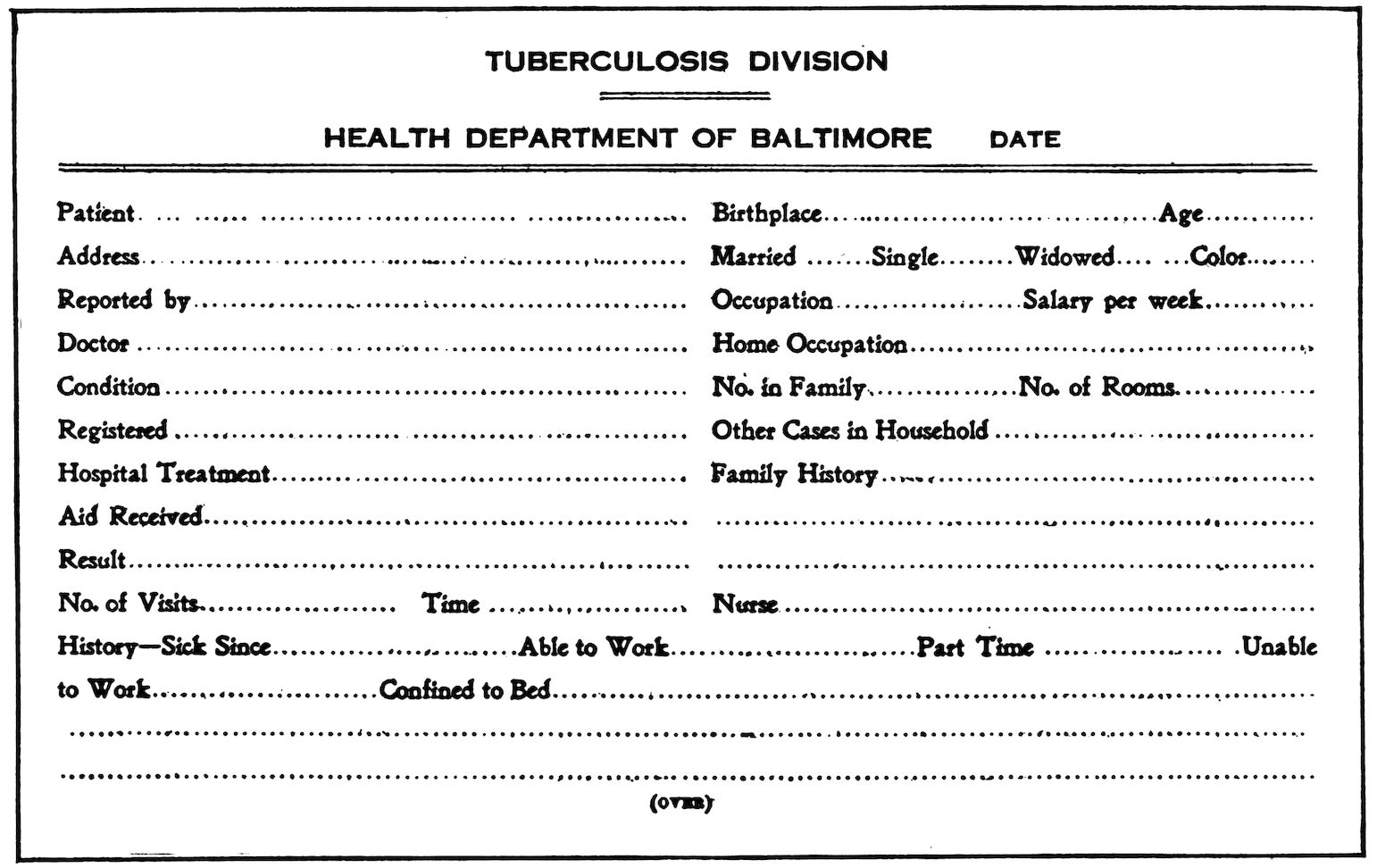
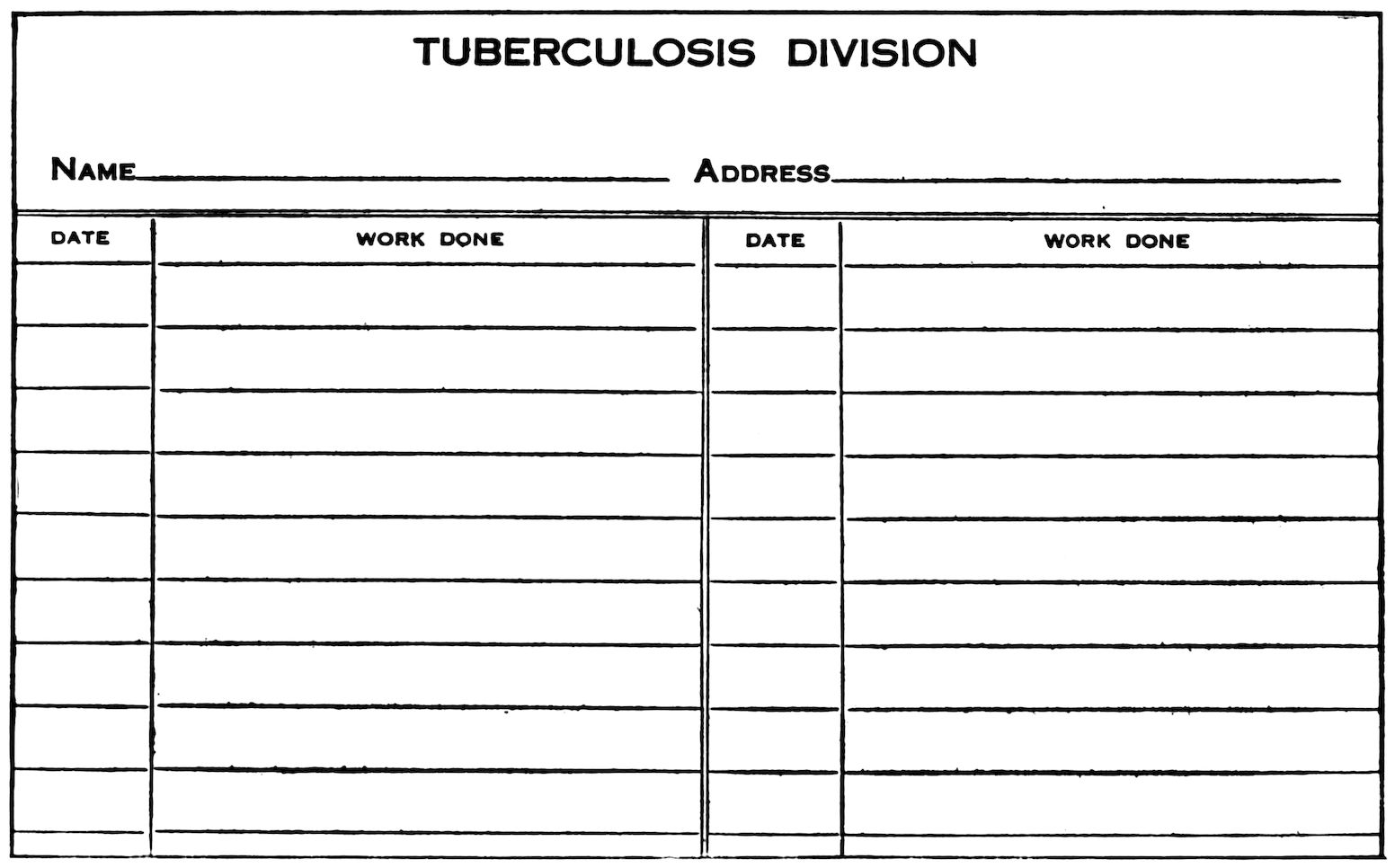
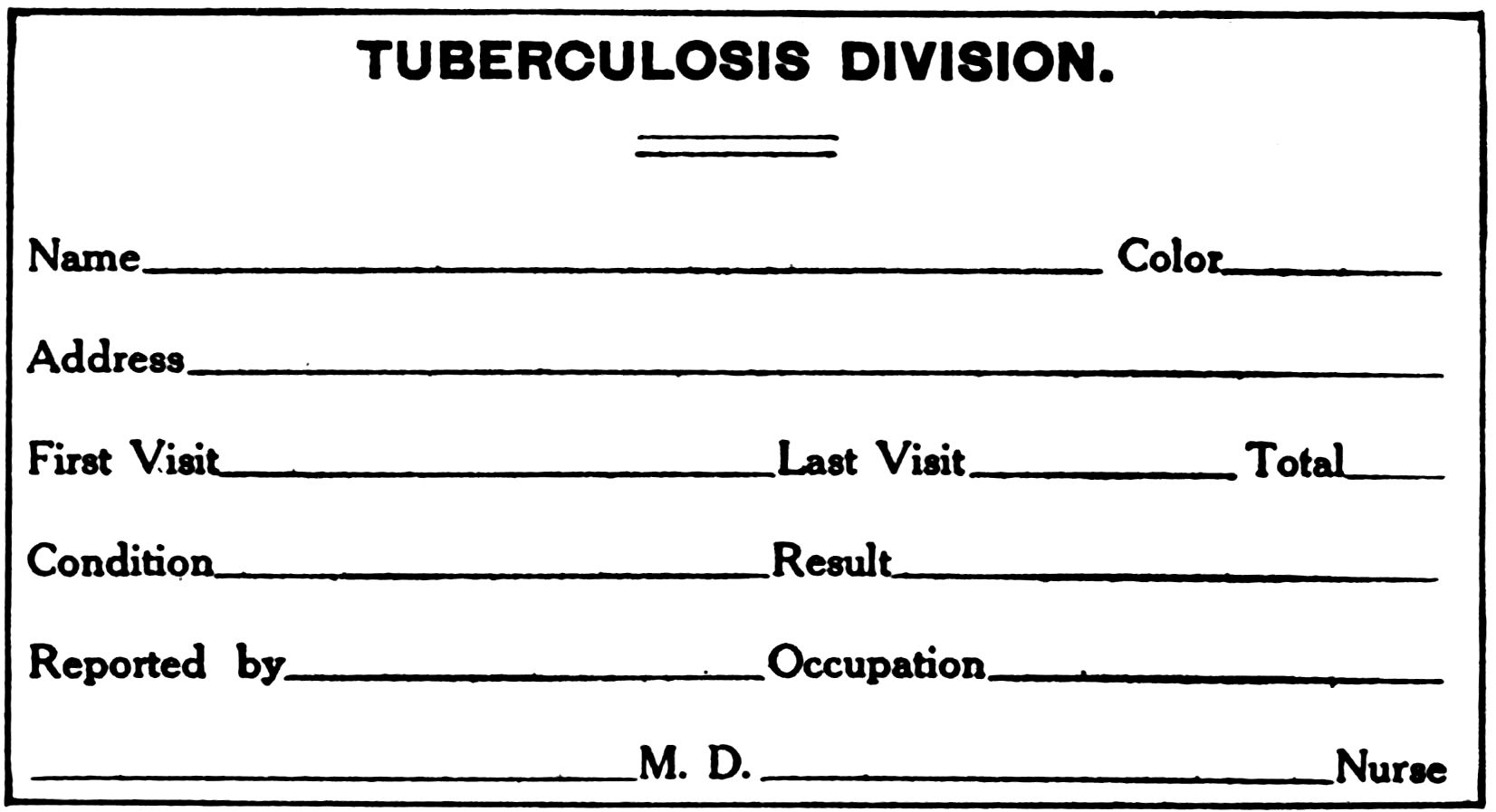
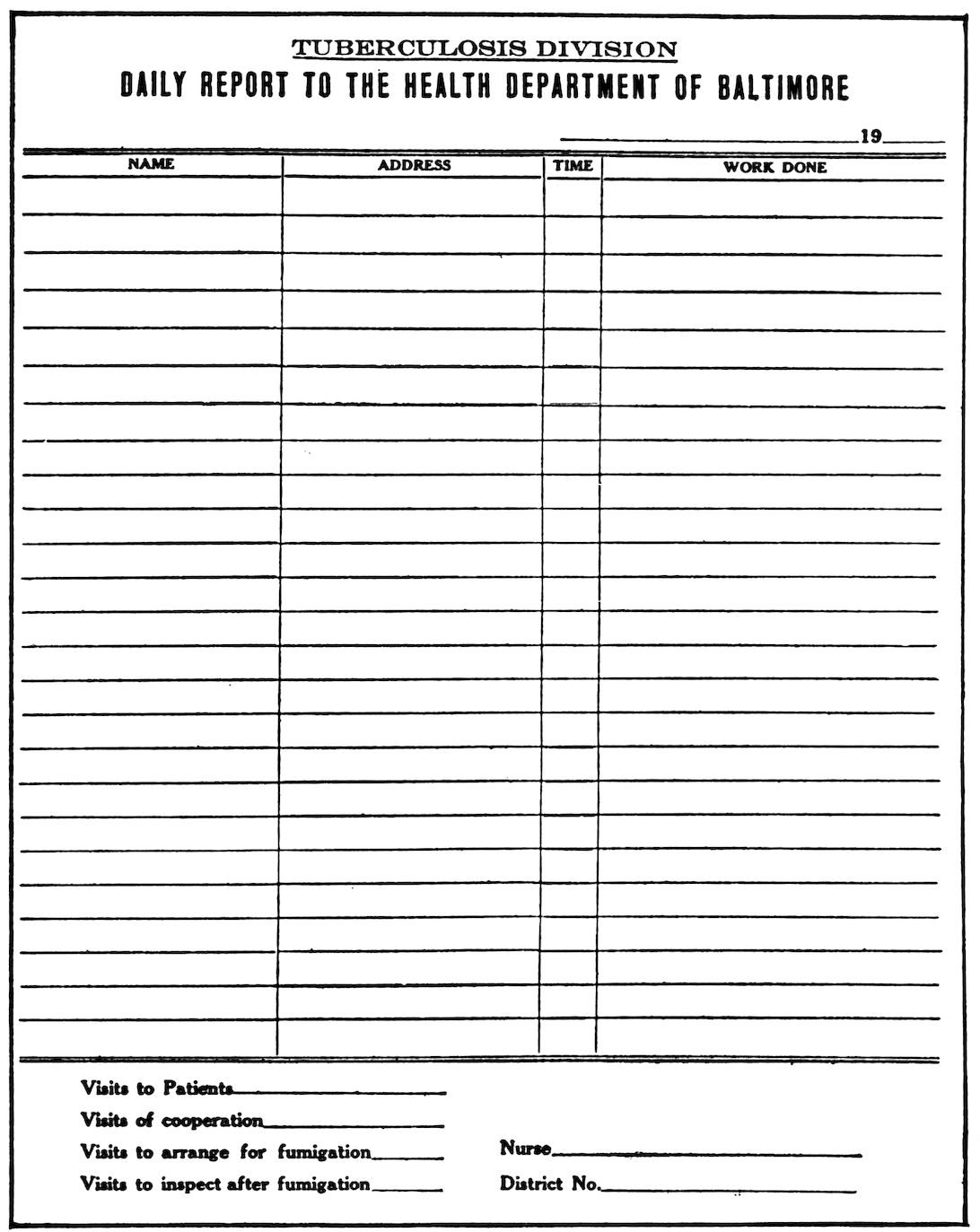
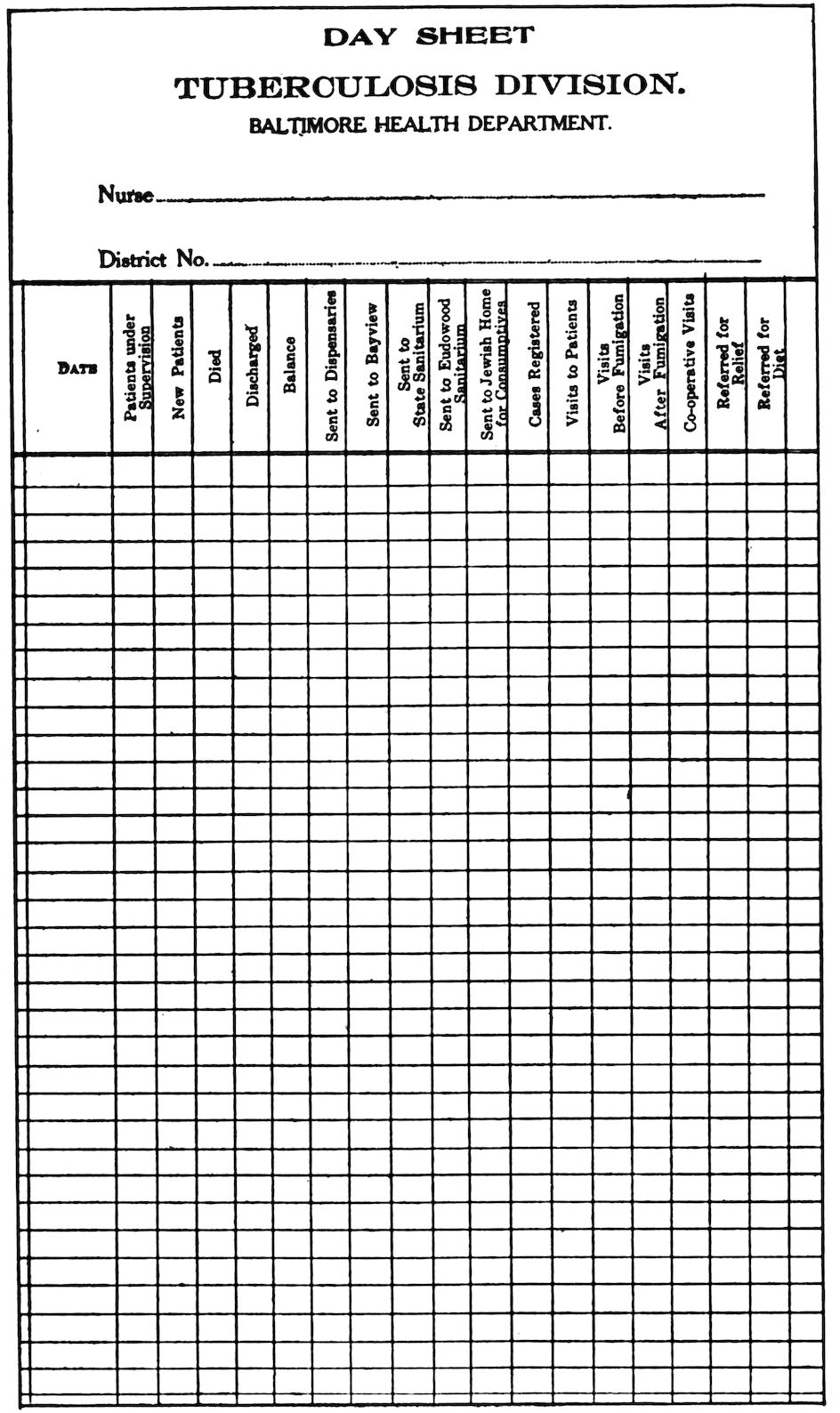
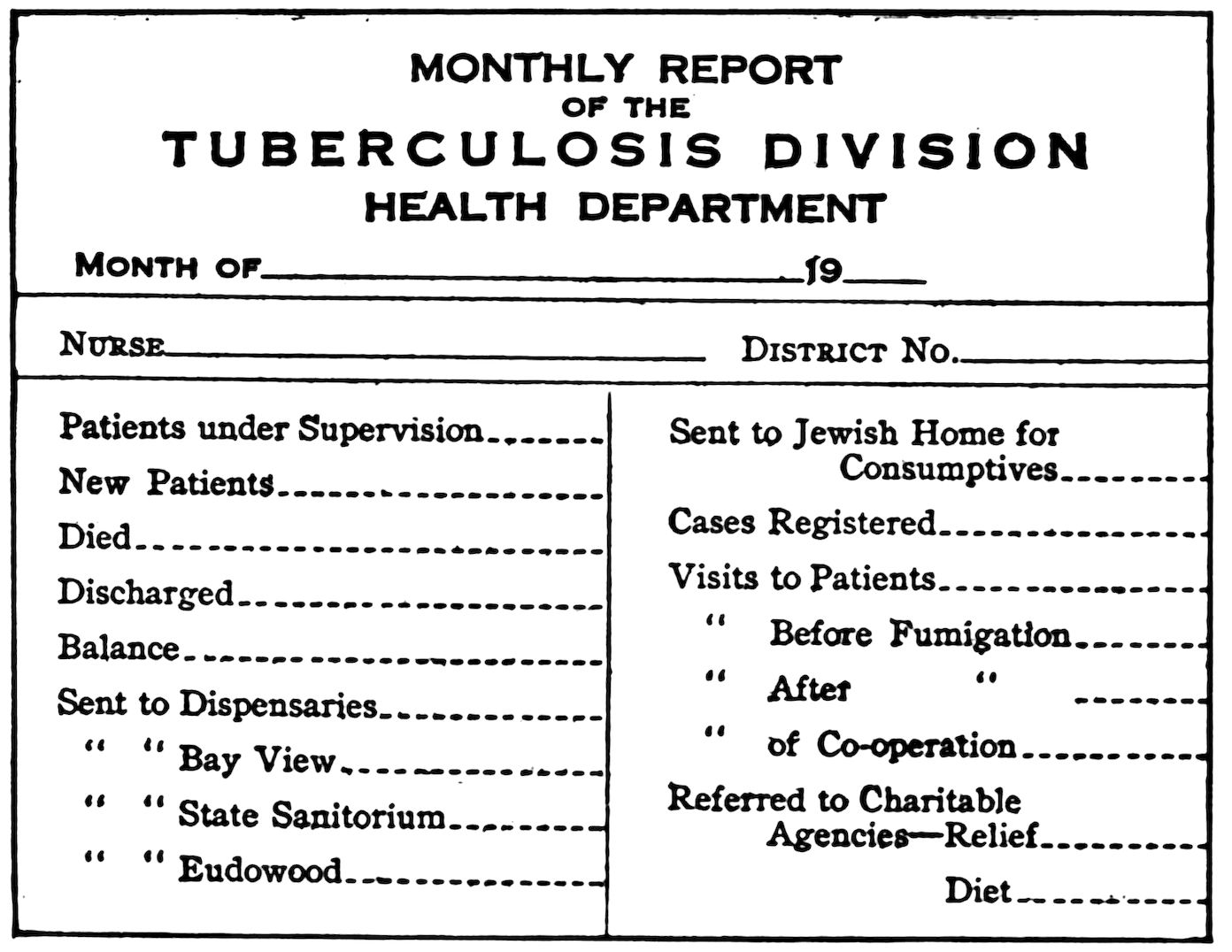
Records and Reports—The Patient’s Chart—The Card Index—Nurse’s Daily Report Sheet—Weekly and Monthly Reports—Examination of Charts—Taking the Patient’s History
Finding Patients and Building up the Visiting List—Increasing the Visiting List—Social Workers—Dispensaries—Patients’ Families and Friends—Nurses’ Cases—Physicians
The General Practitioner and the Public Health—Responsibility of the Private Practitioner in Tuberculosis—Impossibility of Fulfilling this Obligation—Failure because of the Nature of Tuberculosis—Failure because of the Personal Equation
The Nurse in Relation to the Physician—Municipal Control of Infectious Diseases—The Nurse’s Difficulties—A Waiting Game—Undiagnosed Cases—The Nurse’s Responsibility to the Ethical Practitioner Only
Prevention of Tuberculosis—Sources through which Calls are Received—Entering the Home—Telling the Truth to the Patient—Truth for the Family—Disposal of Sputum—Danger of Expired Air—Isolation of Dishes—Linen, Household and Personal—Disinfectant and Other Supplies—Phthisiphobia
Inspection of the House—The Patient’s Bedroom—Porches—Gardens and Tents—Flat Roofs—Clothing and Bedclothing—Artificial Heat—Rest—Fresh Air—Food—Cooking—The Bedridden Patient
Care of the Family—Examination of the Family—Taking Patients to Dispensaries—Children—Tuberculosis in Children—Open-Air Schools—The Danger of Sending Patients to the Country
Disinfection of Houses—Value of Fumigation—Formaldehyde—Housecleaning—Burning and Sterilizing—Boiling—Carpets, Rugs, and Mattings—Painting, Papering, and Whitewashing—Temporary Removals—Vacant Houses—Concessions—Compulsory Cleaning
The Tuberculosis Dispensary—Equipment—Medicines—Hours—Consideration for Patients—Function of the Dispensary—The Physician’s Service—The Physician’s Qualifications—The Physician and the Patient—Duties of the Nurse—Tuberculin Classes—The Nurse in Home and Dispensary—The Nurse as a Community Asset
The Nurse in Relation to the Institution—Reports Made to the Institution—Procuring Patients for it—The Value of the Sanatorium—Sanatorium Outfit—Return from the Sanatorium—Work for the Arrested Case—Light Work—Outdoor Work
xxiiiHospitals for Advanced Cases—The Careful Consumptive—Chief Duty of the Nurse—Responsibility of the Institution—Home Care of the Advanced Case—Exceptions to Institutional Care—Compulsory Segregation
The Problem of Relief-Giving—The Relief-Giver—Co-operation between Agent and Nurse—General Rules for Nurses and Agents—Conditions of Asking for Relief—Wrong Conditions of Relief-Giving—Incidental Assistance—Withdrawal of Relief—Milk and Eggs
Home Occupations of Consumptives—Sewing and Sweatshop Work—Food—Milk and Cream—Lunch Rooms and Eating-Houses—Laundry Work—Boarding and Lodging-Houses—Miscellaneous Occupations—The Consumptive Outside the Home—Cooks—Personal Contact in the Factory—Supervision Outside the Home
Municipal Control of Tuberculosis—The Danger of “Political” Control—“Politics” in Co-operating Divisions of the Health Department—Results in Baltimore—Tuberculosis and Poverty
Statement of the Case—Beginning the Work—Reaching the
Patients—Supervision of the Work—Necessity for Experienced
Nurses.
Statement of the Case. Pulmonary tuberculosis
is a communicable disease, transmitted from
person to person by means of the tubercle bacilli
contained in the sputum of infected patients, or
in the breath expired during paroxysms of coughing.
The bacilli thus liberated, find their way
into the system of another individual, either
through the respiratory or alimentary tract, or
both. The enormous prevalence of tuberculosis
is due to the fact that its infectious nature was not
recognized until 1882 when Koch discovered the
bacilli. Since that time it has been classed as a
transmissible disease, and during the past ten
years a vigorous effort has been made to eradicate
it. This agitation is popularly known as the anti-tuberculosis
2campaign, and associations for the
suppression of tuberculosis have sprung up in all
parts of the country. So far, no serum or vaccine
has been found by which this disease may be controlled,
as was the case when smallpox and diphtheria
were checked. The sole way of overcoming
it is to overcome the ignorance concerning its
nature, its transmissibility, and the means by
which it is spread.
At the beginning of the campaign it was believed
that simple education along these lines was all
that was needed to obtain results. These results
were expected to follow as soon as the patient was
informed of the nature of his disease, and how to
avoid spreading it, and as soon as those in contact
with him were given like information and taught
how to avoid infection. Ten years ago, in the
optimism of the moment, tuberculosis was freely
proclaimed a “curable” disease; so that together
with the campaign of prevention went a campaign
of teaching the patient how to become a “cured,”
or as we now call it, an arrested, case. The mechanics
of cure were equally simple—rest, fresh air, and
food were all that was needed, provided the disease
was taken in the early stages. And all that was
necessary for “cure,” just as all that was necessary
for prevention, was to tell the patient what to do,
3and those about him what to do, and the thing
was done. This is the theory upon which the work
was founded, and in theory this is still a sound
principle upon which to continue it. Unfortunately,
a series of unlooked for conditions interposed
themselves between this theory and our
ability to put it into practice. At the time when
the crusade was begun these conditions were not
recognized, and it is only through long study of the
situation, from its social, economic, and legal as
well as clinical aspects that we get some idea of the
difficulties and complexities of the task before us.
In the first place, tuberculosis is largely a disease
of the poor—of those on or below the poverty line.
We must further realize that there are two sorts
of poor people—not only those financially handicapped
and so unable to control their environment,
but those who are mentally and morally poor, and
lack intelligence, will power, and self-control. The
poor, from whatever cause, form a class whose
environment is difficult to alter. And we must
further realize that these patients are surrounded
in their homes by people of their own kind—their
families and friends—who are also poor. It is this
fact which makes the task so difficult, and makes
the prevention and cure of a preventable and
curable disease a matter of the utmost complexity.
4People of this sort, however, constitute almost
the entire problem—otherwise the situation would
be so simple that the word problem would not
apply.
This is why “cure” is not the solution of the
matter. Too few people are cured, in comparison
to the numbers annually infected, to make any
impression on a disease of such wide prevalence.
The sanatorium, valuable as it may be for certain
cases, is of little use to those who relapse upon
return to an environment they will not or cannot
control. This is also why mere instruction in
preventive measures, unaccompanied by effective
isolation, is barren of results.
Experience has taught us the unsatisfactory
nature of so-called cures, and the futility of that
prevention which allows the distributor of tuberculosis
to remain at large in the community and
heedless of his obligations. Hence we must look
to segregation as the only reasonable course to
pursue. If segregation can be obtained in the
home, well and good. If not, then we must look
to the institution to provide the proper care. This
segregation, most of it voluntary, some of it
enforced, is the only way to do preventive work on
a scale large enough to count. To this end, we
need dispensaries where the disease may be recognized
5and diagnosed, nurses to visit the patients
in their homes, and hospitals for advanced cases,
the function of the nurse being to teach patients
and their families the necessity for segregating the
former in hospitals.
Beginning the Work. Let us suppose that a
certain community, town or country, suddenly
becomes aware of tuberculosis in its midst, and in
consequence wishes to get rid of it. It is but a
fraction of the community which is enlightened
enough for this, but from this nucleus must come
all that awakening of public sentiment needed to
facilitate the campaign. To estimate the number
of tuberculous persons in any locality, multiply
the yearly tuberculosis death-rate by five or ten—authorities
differ as to the exact figures. The
result will be the approximate number of those
afflicted. The public press will help in disseminating
this information, which is the basis from
which we must work. Since the beginning of
the campaign, newspapers have been wonderfully
helpful allies in giving wide publicity to facts
concerning tuberculosis. As a result of this newly
aroused interest, an Anti-Tuberculosis Society
may be created, and into its fold are gathered all
those willing to help in the work, each with his
dollar. Lectures, exhibits, open-air speaking,
6lantern-slide exhibitions, meetings in churches
and others held before various societies are given
in various parts of the town, and in this way information
about tuberculosis is spread far and
wide.
There are two classes of the community, however,
that must be reached—those who have tuberculosis
and those who have not. The people who
go to lectures and exhibits belong chiefly to the
latter class. Frequently, of course, the sick ones
find their way in, in an endeavour to learn something
which may be helpful to them; unfortunately,
they are able to take away but little, and the
little they do get they often misapply. We recall
the case of a man who went to a tuberculosis
exhibit, and learned that fresh air was good. As a
result, he walked several miles a day in order to
get it, and nearly killed himself. He had succeeded
in learning one important fact—that fresh air was
valuable—but another, of equal importance, that
exercise was harmful, had escaped him.
To make the undertaking succeed, it is necessary
to reach both the sick and the well, since that
strong, intelligent public opinion, which is the
motive force behind all new movements, must
be aroused among the sick as well as among the
healthy. But as we have seen, the former are not
7those who go largely to lectures, so they must be
reached through some other means. The most
effective way of reaching them is through the employment
of a special nurse, who shall give eight
hours a day, week in and week out, to visiting in
the homes where tuberculosis exists, and giving
instruction adapted to each individual case. By
this means the people most in need of assistance
are reached without loss of time and effort, and
case after case is uncovered. This is shooting
straight for the bull’s-eye—namely, the infected
home from which tuberculosis is spread.
There may be laws on the statute books compelling
doctors to notify the local health authorities
of their tuberculosis cases, but these laws are
not lived up to. Nor will the establishment of a
hospital for advanced cases bring these patients to
light; neither will the sanatorium, nor even the
special tuberculosis dispensary. The surest and
most effective way of unearthing them is through
the visiting nurse. Therefore the nebulous plans
of the newly formed anti-tuberculosis association
may well crystallize themselves into a decision to
put such an effective agent into the field.
Supervision of Work. After this decision has
been made, the question arises, by whom is the
nurse to be directed? Is she to be placed under
8the local health department, under a dispensary,
under the charity organization society, or under
the visiting nurse association, if such an organization
exists in the town? If supported by a church
or special association of some sort, should not the
governing board of such organization direct her
work? Or is she to be a free lance and manage
herself?
Unless taken over by the local health department
(which in that case becomes responsible for her
salary and expenses incurred in the work), the
nurse should be affiliated with the Visiting Nurse
Association, rather than with any lay organization.
Better results will be obtained if her work is
directed by a superintendent of nurses who is
accustomed to dealing with and judging nurses,
and familiar with their duties along technical
lines. The credit of supporting the nurse would
still rest where it belonged—with the church, with
the anti-tuberculosis association, or whatever
group of people might be responsible for her
maintenance,[1] but this arrangement would relieve
the lay organization of much responsibility, for no
matter how good their intentions, such a group
9cannot direct nursing work as well as this can be
done by one qualified for the purpose. Another
advantage gained by placing the new nurse with
the Visiting Nurse Association is that it keeps
together the various branches of public health
service, and the tuberculosis nurse realizes more
fully than she otherwise might, how completely
her own specialty is interlocked with and dependent
upon other forms of social activity.
1. For five years the Maryland Tuberculosis Association supported
five nurses, which it placed under the management of the
Superintendent of the Visiting Nurse Association of Baltimore.
There is still another advantage in placing the
new nurse with the established organization, for
then a nurse may be selected with regard to her
ability alone, leaving it to the Superintendent of
Nurses to give her the necessary careful training in
social work, and the proper supervision.
If there is no Visiting Nurse Association in the
community, under whose auspices the new special
nurse may be placed, the lay organization will
have to do the best it can. In this event, it will
be absolutely necessary to select a nurse thoroughly
trained in social work, and since the number of
women with this equipment falls far short of the
demand, a delay of some duration may take place.
This delay is always borne with great impatience
by the newly formed group of people, anxious in
their enthusiasm to attack the tuberculosis problem
at once. Yet policy would counsel postponing
10the undertaking until a suitable person can be
found, for it is usually a fatal mistake to begin
new work with an inexperienced worker. Moreover,
a situation which has existed for years may
be tolerated a few months longer without undue
alarm as to consequences.
If it is impossible to obtain a nurse fully trained
in public health work, the community may select
a good nurse and send her for a few months’ experience
to some well recognized centre of public
health work, such as New York, Chicago, Boston,
Baltimore, etc. The money thus spent will prove
a valuable investment to a community thus far-seeing,
and an ample return will be manifest in the
efficiency of the nurse’s work.
A wrong start in choosing a nurse has driven
many an enthusiastic organization into deep
waters, and caused trouble and misunderstanding
of a most grievous sort. In several instances, the
local campaign against tuberculosis has come to a
disappointed end; in others, public interest has
been so antagonized and repelled that the movement
received a check from which it did not recover
for several years.
CHAPTER II
11
The Nurse’s Training—Health—Hours off Duty—Afternoons off—Character.
Training. One of the first qualifications of the
nurse should be proper training. She should be a
graduate of a first-class general hospital, which
gives a three-years’ course. In States where
registration is established, she should be a registered
nurse as well. This means that she has
passed the examinations set by the State Board of
Examiners for Nurses, and has attained at least
the minimum degree of efficiency prescribed by
that body. Of course, it is well if she far exceeds
this minimum, but she must not fall below it in
any case.
It is sometimes said that a woman trained in a
sanatorium or special tuberculosis hospital will
make as good a tuberculosis nurse as one who has
been trained in all branches of nursing work.
This claim is often made by those sanatoriums
which seek to find positions for their ex-patients,
to whom they have given a more or less sketchy
12training and a diploma. Needless to say, if a
community undertakes to support a nurse, it
should procure the best that can be found. There
is no economy in employing a half-trained woman.
In social work the nurse occupies a unique position
in the patient’s household—she must be able not
only to gain but to retain the family’s confidence,
and this cannot be done by a half-educated woman,
not sure of herself and unable to carry conviction
to her hearers.
Health. Next to thorough training, the health
of the nurse is of utmost importance. All nurses
should be examined before they undertake tuberculosis
work. This should be done for two
reasons: first, for the obvious reason of protecting
the nurse herself; secondly, for the protection of
the work. There is already sufficient prejudice
against tuberculosis work, and it is well not to
increase it by having a nurse break down soon
after going on duty. In Baltimore, all applicants
are examined by a specialist before they are
accepted. Note that this is done by a specialist,
and that the applicant is not permitted to go to
her own “family physician” who may or may not
be able to make a proper examination. The
candidate is given a choice of several specialists,
to any one of whom she may go. The report of
13her physical condition, mailed to the superintendent,
determines her eligibility from the standpoint
of health. In this way, the responsibility is
assumed by those most capable of assuming it, and
neither the health of the nurse nor the prestige of
the work is jeopardized.
After the preliminary examination, it is well
for the nurse on duty to be re-examined every six
months. If suspicious symptoms present themselves,
this should be done oftener. Part of the
superintendent’s duties are to watch the health of
her workers, and keep a sharp look-out for suspicious
symptoms—symptoms which the nurse
herself may be unaware of or afraid to acknowledge.
Each nurse, however, should assume the
responsibility for her own health; she should remember
that she is dealing with a highly infectious
disease, and that it behooves her to keep in as good
physical condition as possible. Nurses with a
predisposition to tuberculosis should not undertake
this work.
The question often arises as to whether this
visiting work is suitable employment for arrested
cases—for nurses who have had tuberculosis and
recovered. It is not suitable. It is far too hard
and trying, for it must be done day in and day out,
at all seasons and in all weathers, and involves
14severe physical strain. For that reason it is not
proper occupation for one whose health is in any
way precarious. The danger of relapse is too great.
Nor should this work be done by those who are
afraid of tuberculosis. If fear of tuberculosis
develops after a nurse goes on duty, she should
be released at once. Under such circumstances
she cannot do good work, while to persuade her to
remain on duty, contrary to her instincts, is a
responsibility too grave for any one to assume.
Hours off Duty. At this point we should like
to speak of the nurse’s hours off duty, though
strictly speaking they are not within our scope.
As a rule, the hours on duty are eight—from 9 a.m.
till 5 p.m., with an hour in the middle of the day
for lunch. This is a long day, and at the end of it,
any woman is in a condition of mental and physical
fatigue. The constant nervous strain occasioned
by contending with the ignorance and stubbornness
which a nurse must encounter, is particularly
wearing.
The hours off duty are for recuperation from
the day’s toil, and if this recuperation is insufficient,
it will manifest itself in various ways. A
tired nurse is of no use as a teacher—she cannot
cope successfully with the obstinate wills of her
patients, nor with the trying demands of the daily
15routine. Moreover, a physically tired person is
one who offers ready soil for the development of
tuberculosis. These two facts must be constantly
borne in mind. Therefore we should like to impress
upon all nurses who undertake this work that
they must take excellent care of themselves. Rest,
sleep, and food are the three essentials to good
health, and any scheme of life which reduces these
below a certain level is bound to lead to disaster.
No one condemns reasonable pleasures, and in
no other work is relaxation and recreation so much
required, but one must be careful not to burn the
candle at both ends. It is no part of the superintendent’s
duties to regulate the life of her nurses
outside of working hours, but when their life off
duty diminishes their working ability, she is then
called upon to interfere. Tuberculosis work is
trying, serious, and difficult, and demands a high
degree of mental and physical strength and freshness.
If a nurse is not willing to give this, she
should not undertake public health work.
Afternoons Off. Each nurse should be given
one afternoon a week off duty. It is more satisfactory
to give this half-day in the middle of the
week, on Wednesday or Thursday, rather than on
Saturday, at the week’s end. In this way, the rest
period breaks the long stretch of days, and the
16nurse is enabled to rest before she becomes too
tired. Sundays, of course, should always be free.
Under no consideration should the nurse be subject
to night calls and it is well to have this fact
understood at the outset of the work. A nurse
cannot be on duty night and day both, and certain
rules should be established, regarding her hours on
duty, and be rigidly adhered to.
Character. The questions of training and of
health having been satisfactorily answered, there
remains a third great essential to be considered—the
question of personality. Social nursing differs
from all other branches of nursing, since in this
specialty there is a wider departure from the
routine and mechanical duties which form so large
a part of nursing work. Those qualities which
make a good institutional, or a good private nurse,
do not necessarily make a good social or public
health nurse. Something more is demanded.
Broadly speaking, apart from professional training,
the more highly educated and cultivated the
woman, the better will she be qualified. This, one
may say, would apply to all branches of the profession,
but we believe these qualities are more
necessary in the tuberculosis nurse than in the
operating-room nurse, for example. The latter
does work which demands mechanical quickness
17and coolness; the former requires a personality
capable of dealing with human beings in all
stages of refractoriness, over whom she has no
authority, but from whom she is expected to obtain
results. As every one knows, it is far easier
to deal with things than with people.
The qualities of a teacher are requisite. No
matter how well one may know a subject, if one
cannot present it clearly and impressively, small
progress will be made. Nor is it the patient alone
that the nurse is called upon to deal with. Her activities
bring her into close relations with physicians,
social workers, politicians, boards of directors,
and “benevolent individuals” of all classes, whose
interest and good-will it is necessary to secure. She
must be as well able to meet people of this sort, as
to teach the humblest patient in her district.
Since this is social work, the so-called social
virtues are a necessity—and these exclude a bad
temper or a quarrelsome disposition. It is as
essential to work in harmony with other social
workers as with the patients themselves—the two
relationships are interdependent.
Needless to say, a nurse who cannot get on with
her patients is a failure. No matter how experienced
she may be, or how well trained, if she
cannot gain the confidence and friendship of her
18families she is unfitted to deal with them. It
frequently happens that for the first few visits a
family may be uncordial and suspicious, but within
a short time a well trained, sympathetic nurse
should be able to change this attitude into one of
confidence and appreciation. A few, a very few
families remain unchangeable of course, but their
number is so small that they form a negligible
quantity.
Neither should a nurse fraternize with her patients.
Through familiarity she loses the personal
dignity which means so much to her authority.
Authority is a term somewhat subtle in its definition—it
means that hint of power, of sureness, of
knowledge, which enables one to speak with a
confidence which transmits itself to others, and
compels them to accept one’s point of view. A
strong personality easily conveys this sense of
authority, but it may also be conveyed by a
personality less strong, when the nurse is well assured
of her facts and cannot be caught tripping.
It is the hall-mark of the successful teacher—this
ability to impress her points upon others, and to
make them see that what she proposes is right,
reasonable, and advantageous.
It seems hardly necessary to speak of the qualities
of honesty, loyalty, and conscientiousness.
19When they are lacking, all or any one of them, the
nurse is useless. The nurse is alone in her district
all day long, from early morning till late in the
afternoon, and she must be a woman with a high
sense of responsibility and worthy of her trust.
Patience, that despised virtue, is also an essential
part of the nurse’s equipment, for she must listen
to long details of illness, and must be willing to
reiterate, over and over again, without show of
annoyance, the rules which have been needlessly
and exasperatingly ignored. No one knows better
than the nurse the awful hiatus that exists between
preaching and practising—the glib promise
and the broken pledge—but she must never show her
irritation. We have known many excellent nurses
who gave up this work because they could not
stand discouragement of this sort, and who had not
vision enough to look into the future for results.
This standard of requirements may seem high,
but it is not impossible. In fact, it is the minimum
from which successful work can be expected. A
superintendent who has a choice of nurses will of
course approximate it as nearly as possible, in
choosing her staff. The higher and finer the type
of woman, the more valuable she will be—probably
in no other field do fine instincts and fine feeling
tell so strongly.
CHAPTER III
20
Salary—Increase of Salary—Carfare—Transportation—Telephone—Vacation—Sick-Leave—Uniforms—Badges.
Salary. A good nurse should command a good
salary—she is worth it. There is a tendency to
underpay nurses even at the present day, because
of the tradition handed down from the Middle
Ages, that nursing service should be given largely
as a matter of love or charity. A woman who gives
up her whole time to district nursing, doing highly
specialized work, should at the very least receive
a living wage. Associations are often asked to
supply nurses at a salary of forty or fifty dollars a
month, and surprise and indignation have been
expressed because such a woman was not forthcoming.
Salaries should be large enough to attract
and retain efficient women; a small salary does not
attract desirable applicants, as a rule, and this
limits the field of selection. Large sums are
appropriated for hospitals, sanatoriums, dispensaries,
and physicians’ services, but retrenchment
takes place when it comes to the nurse. Her work
seems to be the one point where economy prevails.
21In Baltimore, the staff nurses are paid seventy-five
dollars a month, and this is the very least that
any woman should receive. A small town or
country community would doubtless have to pay
more than this, especially if it looks to the city
for an experienced nurse. The reason is simple
enough—other things being equal and the character
of work the same, one would hardly expect a
nurse to prefer an unknown locality, away from
home and friends, unless some extra inducement
were offered. A nurse might be willing to organize
work in a small city, at a low salary, for the sake
of the experience. In that case, it is the experience
which offers the inducement. This once gained,
however, she would shortly be in a position to
demand more salary or seek a wider field of service.
Increase of Salary. The question constantly
arises whether or not it is well to increase the
salary of the staff nurse from year to year. If she
enters the work at seventy-five dollars a month
for the first year, is it well to increase this to eighty
dollars a month for the second year, eighty-five
dollars the third, and so on till a definite maximum
has been reached? To this question there are two
answers.
Undoubtedly a nurse becomes more valuable as
her experience ripens. Her first six months on
22duty are largely spent merely in acquiring rudimentary
knowledge concerning her work. As she
learns to know her district, her patients, the doctors,
the institutions, the social workers, her value
to the community increases. Each succeeding
year, therefore, which increases her knowledge of
social conditions, should make her in so far more
valuable. It would seem but just, under these
conditions, that her remuneration should be raised
accordingly. But at this point there enters a
factor which we must recognize. To specialize
in tuberculosis work makes peculiar demands upon
one’s strength. Quite apart from the physical
strain, which is always great, it demands the
expenditure of a vast amount of nervous force,
required in the constant combat with opposition.
For this reason it is peculiarly wearing and exhausting.
Also, by its nature, it tends to become
monotonous. These two factors—one of which
tends to wear out the individual, the other to make
her indifferent and stale—make us hesitate to say
that the nurse’s value keeps increasing year after
year. It undoubtedly does increase up to a certain
point, but after that point has been reached, it
tends to diminish. Such being the case, the
obligation of raising the salary is debatable.
Two kinds of nurses are usually found on the
23staff. One is the ambitious nurse, who comes for the
experience and training, to fit herself for an executive
position elsewhere. To such a woman, the
routine of field work will not be desirable for long—not
for more than a year or two, or until she has
gained enough experience to prepare herself for
a wider field of service. That point being reached,
her executive ability will seek an outlet in work
where she herself may become the organizing
and directing force. To such a nurse, salary
increase will offer no inducement, since she will
seek that increase through work which provides
greater opportunities and responsibilities.
There is another sort of nurse on the staff
however, who has no such ambition; no executive
ability, no desire to occupy any other than a
subordinate position. This one will never venture
into a position of responsibility, such as her experience
might warrant, but prefers instead the easier
path, choosing to be guided rather than to guide.
She prefers to work under direction, rather than
to direct others. To such, an increase in salary
would seem but a just reward for faithful service.
But, as we have said before, the monotony of
tuberculosis work tends to produce stale workers.
There is danger, after a time, that the first alertness
and energy may wear off, the nurse may settle
24down into a rut, and her daily task, though faithfully
performed, tends to become one of mechanical
routine.
One of the chief duties of the superintendent
is to train new nurses, and she should renew the
personnel of her staff whenever the welfare of the
work demands a change. Sometimes, when a
nurse shows flagging energy and interest, sufficient
stimulus may be given by removing her to another
district, where she will encounter new patients
and new problems, and so regain her old keenness
and ability. When one once becomes thoroughly
tired of this work, however, it is unwise and futile
to attempt to continue it. Therefore, in the
interest both of the nurse and of her work, it does
not seem wise to offer inducements for prolonged
service, unless the individual characteristics of any
given nurse make this wholly desirable.
Carfare. In addition to salary, a reasonable
sum of money should be allowed for carfare. This
allowance should vary in accordance with the
territory to be covered, those nurses who visit in
smaller areas naturally having a smaller allowance
for the purpose. While economy in this matter is
always necessary, it must be remembered that
undue economy in carfare is wasteful of something
still more important,—the nurse’s time and
25strength. If she is obliged to walk long distances
between cases, this will greatly reduce the number
of visits she can make in a day. Moreover, she will
spend so much energy in mere walking that she
will become too tired for effective teaching. Only
fresh, energetic people can teach; those who are
physically tired are apt unconsciously to let the
obstinate patient have his own way.
Transportation. In small towns and country
districts the problem of transportation is often a
difficult one. There are either no street cars, or
their service is very restricted and inadequate.
Under such circumstances it will be necessary to
provide the nurse with a horse and runabout,
especially if she is expected to cover a large territory.
Unless there is proper provision for transportation,
it will be impossible for her to visit the
patients often enough to make any impression,—her
teaching will be laid on too thin to have much
value. And to depend upon haphazard, volunteer
offers of transportation is almost as bad as to
expect her to make her rounds on foot. She should
be given proper facilities for going from case to
case, and should be able to plan a day’s work unhampered
by any considerations as to if or how
she can reach her patients.
Telephone. In making up the budget of necessary
26expenses, a reasonable sum should be set
aside for telephone calls. The nurse has constant
occasion to communicate with doctors, institutions,
social workers, and so forth, and this item of
expense should not come out of her own pocket.
A careful weekly account of all expenditures,
including telephone calls and carfare should be
rendered by her.
Vacation. A vacation of at least one month
should be given during the year. Less than a
month is not sufficient time in which to recover
the physical and nervous energy expended during
the rest of the year. This holiday should be taken
all at one time, rather than split up into shorter
vacations, taken at intervals throughout the
year. We all know that a week or two is not sufficient
time in which to restore a thoroughly
tired person; at the end of such a short period,
one is just beginning to feel rested, and there has
been no margin left over for amusement, which
is a necessary part of all holidays.
Strong emphasis must be laid on the fact that if
a nurse expects to return to her work and continue
it successfully for another year, she should use this
vacation as a means of fitting herself for another
year’s close contact with an infectious disease.
She should return to work thoroughly rested, with
27her resistance increased by rest and recreation, not
lowered by injudicious use of this time off duty.
Sick-Leave. While a nurse is supposed to be
sufficiently well and strong to go on duty every
day, in all weathers and at all seasons of the year,
a reasonable allowance for illness should nevertheless
be made. Two weeks’ annual sick-leave is a
good allowance. If a woman is off duty for longer
time than that, needless to say her work must
suffer and her patients must be neglected. If a
nurse is constantly off duty for small ailments,
this shows that she is not strong enough to undertake
this arduous work. A fixed allowance for
sick-leave, therefore, will tend to work automatically,
and will eliminate the unfit, whose burden of
work is otherwise added to that of the steady
working members of the staff.
In the case of acute illness, such as typhoid
fever or appendicitis, it would be perfectly possible
to appoint a substitute until the nurse was able
to resume her duties. If no time has been taken
off for sick-leave during the year, the two weeks
should be added to the time granted for vacation.
If exceeded during the year, the salary for every
day thus lost should be deducted from the monthly
salary. This procedure may seem harsh, but with
a large staff it is necessary. It places a double
28incentive on keeping well, and nurses who would
otherwise have been thoughtless and careless as to
their health, will take excellent care of themselves,
in order not to lose one day of their coveted
vacation.
In Baltimore, the municipality gives two weeks’
vacation, and two weeks’ sick-leave. If the sick-leave
is unused, a reasonable vacation is the
result.
Uniforms. The question as to whether or not a
nurse shall wear a uniform is one which usually
excites much discussion. The one or two disadvantages
of such a dress are more than offset
by the numerous reasons in its favour. Two objections
are usually raised to wearing it: by the nurse,
because it makes her conspicuous; and by the
patient, because the uniform makes him a target
for neighbourly gossip.
Let us consider the first objection, that made by
the nurse. A nurse does not feel conspicuous when
on duty in her district. Her busy, daily routine,
taking her in and out of homes where she is
needed, soon causes her to forget her personal
appearance. A self-conscious woman is hardly the
right sort for this work. The only rub comes when
she is off duty and going to and from her district, but
this cannot be held to constitute a serious objection.
29As for the patient’s objection—he would be
equally conspicuous if regularly visited by any
woman unknown to the neighbourhood, no matter
how attired. Prying eyes would recognize her as
an alien, and the neighbours would speculate accordingly.
We have often heard of patients who for
fear of what the neighbours would say objected to
being visited by agents of the Charity Organization
Society. Yet the agents of that Organization
wear no sort of uniform. The truth is, it is usually
really the visit itself which is objected to, rather
than the costume of the visitor—the costume
merely serving as an excuse. On analysing the
objections of a group of patients who disliked the
uniform, they were found to be, without exception,
patients who strongly resented every suggestion
made to them. Their one desire was to be let
alone, to be as careless as they chose.
On the other hand, the advantages of the uniform
are many. In the first place, all effective care given
to a consumptive has to include nursing as well as
teaching. Now, one can “educate” in a woollen
dress, but one certainly cannot give bed-baths in
anything but a cotton dress, which can be plunged
into a tub and washed. And whether she enters
the home to give a bed-bath, or whether she goes
in merely to distribute prophylactic supplies, the
30fact remains that a nurse spends some eight hours
a day in contact with an infectious disease. Good
technique demands that she be dressed in washable
material.
In summer, a dress of washable material is not
conspicuous. In winter, it may be covered with a
long coat. And if we admit that such a dress is
necessary, what objection can there be to making
it of simple and uniform design? A single nurse so
arrayed looks neat and business-like; a staff of
nurses looks equally so. Moreover, uniformity of
dress suggests uniformity of method, standard,
and character of work, and hence inspires confidence.
A staff of nurses, each one dressed according
to the hazard of her own fancy, would hardly
create the same impression.
In itself, the uniform is a protection to its
wearer. It enables her to go freely and without
molestation into all kinds of tenements and lodging
houses, into side alleys and back streets. The
well-known dress surrounds her with recognition,
affection, and respect.
The uniform is also of value to the patients and
to their friends. It enables them to recognize the
nurse as she passes, and to call upon her as she
goes by.
The uniform worn in Baltimore consists of a
31plain shirtwaist suit, worn with white linen collar
and black necktie. The dress is made of blue
denim, such as is used for overalls. Denim of this
sort has two sides, a light and a dark; the dress is
made up with the light side out, as in washing it
seems to “do up” better than the darker side.
Black sailor hats are worn, and in winter long,
dark coats protect the dresses. This uniform is not
necessarily the last word as to what a uniform
should be, but it is simple and inexpensive, and the
nurses look well in it.
Badges. The staff of a municipal nursing force
is usually provided with badges to denote that they
are connected with the Health Department. These
badges should never be worn conspicuously, although
they should be readily accessible. They
are only occasionally needed, however, as when
entering some lodging or rooming houses, or
houses of prostitution, or other places where there
may be marked opposition. To show them when
entering a private home would be bad policy. A
nurse usually enters a private house as a friend,
but a public house she is sometimes obliged to
enter in her official capacity. In dealing with all
her patients, however, no matter where they are
situated, the less show made of officialdom the
better. By the time her patient finds out that she
32is connected with the Health Department, she
should be already firmly established as his friend,
and then the discovery will have no terrors.
Indeed, at that stage, it very often enhances her
value, and patients often feel intense pride at
being visited by the “city nurse.”
CHAPTER IV
33
Object of Work—Districts—Hours on Duty—Number of Daily
Visits—The Nurse’s Office—Lunch and the Noon Hour—Bags—Prophylactic
Supplies—Cups, Fillers, and Napkins—Disinfectant—Waterproof
Pockets—Books of Instruction—Stocking
the Bag and Distributing Supplies—Nursing
Supplies.
Object of Work. The object of tuberculosis
nursing is the home supervision of all persons
suffering from pulmonary tuberculosis. This supervision
should include patients in all stages of the
disease, and not be limited to those who are in
some particular stage, such as early, in contradistinction
to advanced, cases. No organization
which expects to do effective work should deal
with one class of patients alone, since the boundary
lines between the different stages are constantly
shifting; the ambulatory case of to-day
may be the bed-ridden case of to-morrow, and
vice versa, and any attempt to limit the nurse
to one class or the other would mean neglect of
both. Unless the work is planned on such inclusive
lines, it will be necessary to place a second
organization in the field, to care for those cases
34which have been thrown out by the first. Policy
of this sort would mean a number of similar
organizations, duplicating and overlapping each
other’s work at every turn. Thus, in the same
household, we should see the early, ambulatory
patient “advised” by the nurse of one organization,
while the advanced, bed-ridden, more infectious
case is being bathed and cared for by the
nurse from another. Invidious comparisons would
doubtless be made by the family, with the decision
in favour of “deeds, not words.” True, there would
be co-operation between these two societies,—which
would mean, as a rule, double work, duplication
of visits, endless transferring of cases backwards
and forwards, and opening and closing of
records. From whatever point of view we consider
it, this is a very poor plan of work, and a wasteful
method. The nurse should be in a position to
follow the fortunes of her patients for months and
years. Any scheme which involves transferring
him to a stranger, from an old friend to a new, at
the moment when he slips from an early into a
most infectious stage, is to lose sight of him and
of his family at a most critical time.
Adequate supervision means that the nurse
must teach, nurse, and ferret out patients, and her
patients must include advanced, early, and suspicious
35cases. The care should be of two kinds—instruction
as to the nature of tuberculosis, with
general teaching along the lines of prevention and
prophylaxis; as well as actual nursing service,
rendered to advanced and bed-ridden cases. The
Baltimore nurses take charge of all tuberculous
patients, in whatever stage, and we feel that this
is the most effective way to carry on the work.
Districts. A small town, of course, constitutes
but one district in itself. A larger town may be
divided into two or three districts; a city, into as
many as may be necessary. The principles upon
which the work is conducted are the same in each
case. The nurse is responsible for every consumptive
in her district, and her constant endeavour
should be to bring under supervision every case of
tuberculosis that exists. She must visit all patients
referred to her—give them instruction,
prophylactic supplies, and nursing care; unearth
suspicious cases and send them to a physician for
diagnosis; secure hospital or sanatorium treatment
for those who are eligible, and arrange all details
connected with their admission. To accomplish
these duties, she must know the physicians of her
district, the dispensaries and institutions where
she may send her patients, the philanthropic or
relief-giving agencies whose aid is so often needed,
36and all social workers whose co-operation is necessary
for the furtherance of the work in hand.
Hours on Duty. Eight hours should constitute
the working day, from eight or nine in the morning,
till four or five in the afternoon. With a large
staff, the day will probably not begin till 9 A.M.,
while a single nurse, in a small community, may
prefer to begin earlier and so finish earlier, especially
in summer. It is a mistake to work
overtime, no matter how interested and enthusiastic
one may be. A peculiarity of tuberculosis
work is its unending character—there is always
more to do than can be crowded into the longest
day, and even after working ten, twelve, fourteen
hours, one would always feel that some important
thing was being left undone. It is well to recognize
this fact in the beginning, although the
temptation to make “just one more” visit is often
hard to resist. The nurse who habitually works
overtime only wears herself out the faster, and
in the end her patients will suffer through her loss
of health and energy.
Number of Daily Visits. This is a variable
factor, and depends in great measure upon the
size of the district, as well as the number of
patients it contains. The character of the service
rendered also determines the number of visits, as
37new patients and bed-ridden patients always demand
considerable time. If a nurse calls on ten
patients in a block, and finds none of them in, she
naturally can make more visits than when compelled
to spend a long time in each house. As in
everything else, it is the quality that counts,
rather than the quantity; the day which shows few
visits may have been spent more profitably than
that on which she scored a high total. There is no
general rule as to a nurse’s capacity, yet it is
always well to suspect the value of a large total of
daily visits; if a nurse dashes in and out of a house,
spending but a few moments with her patients,
she has probably done her work so superficially
that nothing has been accomplished.
On the other hand, some nurses pay far too few
visits because they have no head for planning their
work, but linger, past all necessity, over unimportant
details. To judge if a district is being properly
visited, the superintendent should know the district,
and she should also know her nurse’s capacity.
To estimate the value of the day’s work by
the number of visits alone, is like those societies
who reckon their value by the number of pieces of
literature they distribute, totally regardless as to
whether any of it bears fruit.
Roughly speaking, each patient should be visited
38once a week; failing this, once every ten days or two
weeks. In a few exceptional instances, this time
between visits may be still further extended, but
this should happen only when the patient is doing
extremely well, following all the rules, and giving
efficient and intelligent co-operation. There are
not many patients in this class—for the average,
supervision to be adequate must be frequent.
Very ill patients, however, must be seen two or
three times a week—every day would not be too
often, did the work permit. Unfortunately, if the
visiting list is large, these sick patients can be visited
only at the expense of other cases better able
to take care of themselves. For this reason, the
visits to ambulatory patients may become as infrequent
as once every three weeks. If the visiting
list grows so large that these infrequent visits are
all that the nurse can give, then her instruction is
laid on so thin as to be nearly worthless, a condition
of affairs which calls for another nurse.
The Nurse’s Office. An office is a necessity
for the nurse as a place where she may keep her
nursing and prophylactic supplies, and at which
she will report at certain hours of the day, say at
9 A.M., at lunch time, and possibly again in the
afternoon before going off duty. At certain specified
hours, therefore, it will be possible to reach her,
39either in person or by telephone, and her office
hours should be known to doctors, social workers,
patients, or to any who have need to call upon
her. In a small town or country district, there will
of course be only one office, but in a city it will be
necessary to have several branch offices, accessible
to the nurses of the different districts. These
branch offices should be situated on the border
lines of two or three adjoining districts, so that one
office may be used in common by several nurses.
In a city there is also the central office, from which
the superintendent directs the work, and where
the staff nurses report daily.
In Baltimore[2] these branch offices are usually
in the same building which houses a branch of the
Federated Charities, the branch office of the Visiting
Nurse Association, the Infant Welfare Association,
and other similar agencies. In this way,
the various social workers learn to know each
other, and to secure close co-operation and understanding.
The different agencies, however, each
have their separate rooms or offices.
2. Baltimore is divided into sixteen nursing districts, with eight
branch offices or sub-stations, for the use of the sixteen nurses.
The nurse’s office should be simply but comfortably
furnished. It is used for several purposes—as
a store room for supplies, and as a rest room,
40where she takes her lunch and spends an hour off
duty in the middle of the day. The furniture
should consist of a large writing table, which may
also be used for a dining table; chairs, a lounge or
couch, and a small gas stove or Bunsen burner for
cooking simple meals. If there is no available
closet, there will have to be a commodious cupboard
for storing the prophylactic supplies. A
large stock of these must always be kept on hand,
so that the nurse may refill her bag before starting
out again on her afternoon rounds. A telephone
in the office, or at least in the same building, is of
course necessary.
Lunch and the Noon Hour. It is not within the
province of a superintendent to dictate to her
nurses as to what they shall eat. The association,
be it private or municipal, furnishes the office and
the hour, but the nurse must provide her own
lunch and select it according to her fancy. A
word, however, in regard to this lunch. It should
be as nourishing as possible, and should consist of
such wholesome food as eggs, milk, cocoa, and so
forth. If a nurse substitutes a pint of milk for a
cup of tea or coffee, she is wise.
In addition to nourishing, wholesome food (in
contradistinction to unprofitable pie and buns
from the neighbouring bakeshop), a short period of
41relaxation on the lounge or couch is a wise way
in which to spend a portion of the noon hour. In
dealing with tuberculosis, food and rest are necessary
to keep one strong and well, and no nurse can
afford to trifle with her health when engaged in
this serious work. On no account should the noon
hour be cut short, no matter how little tired she
may be. Better work can be done if one is well
fed and rested.
Bags. The association which employs the nurse
should also provide her with the bag for carrying
the supplies. The kind of bag needed is a much
discussed question. It should be strong, even
though this necessitates its being heavy. There is
no other way out of it—for unless the bag has the
first qualification, strength, the weight of the
supplies will soon wear it out. Very light bags are
not practical.
The bags used in Baltimore are made somewhat
like the ordinary Boston bag, about fourteen
inches long, and of good black leather. They weigh
a few more ounces than those used by other
associations, but they last longer. It must also be
remembered that the bag used by the tuberculosis
nurse, no matter how heavy it is when she starts
forth on her rounds, grows lighter and lighter as
she goes from house to house, leaving the supplies.
42Thus, at the end of the day, when she is most
tired, it is practically empty.
Prophylactic Supplies. The prophylactic supplies
used for the patients consist of tin sputum
cups, cardboard fillers, paper napkins, waterproof
pockets, disinfectant, and books of instruction.
The first three are of primary importance.
The Health Department of a community usually
provides these supplies, even when the nursing
work is carried on by a private association. Thus,
in Baltimore, where for six years the tuberculosis
work was done by the Visiting Nurse Association,
an arrangement was entered into between this
Association and the State Board of Health, according
to which, the latter paid for and provided
the supplies which the nurses distributed. The
only condition imposed was that each case should
be reported to the Health Department, and that
the Health Department should be constantly advised
as to the number of cases under supervision.
If no such arrangement is possible, then the
private association supporting the nurse must
be put to the additional expense of buying the
supplies.
It is impossible to make the patients themselves
pay for them. Naturally, they consider them a
nuisance and a bother, and it is difficult enough to
43persuade them to use them, even when given free.
The cost is not great, however.
Tin sputum cups, (in lots of 5000)
7 cents apiece.
Fillers, (in lots of 1,000,000)
$3.50 per thousand.
Paper napkins, (in lots of 5,000,000)
$.55 per thousand.
Disinfectant,
10 cents a bottle.
Waterproof pockets
4 cents apiece.
Books of instruction
2 or 3 cents apiece.
Disinfectant. The most expensive of the supplies
is the disinfectant, which is also probably the
least valuable. That used in Baltimore is a
special preparation, consisting largely of creolin;
it is put up in pint bottles by one of the large
wholesale drug houses. For use, it is diluted in
water, a tablespoonful to a pint, and used in wiping
up floors, furniture, and so forth. It is
of necessity too dilute to have much germicidal
action, and the patients place far too much
reliance upon its odor—which, to the ignorant
mind, is of prime importance. Although we
use this disinfectant, we prefer to teach our patients
that better results may be obtained by the
lavish use of hot water, brown soap, and a scrubbing
brush, and that thorough cleaning of this
kind is of more value than the most malodorous
drug ever dispensed. Disinfectant to be of real use
must be strong and powerful, and it is dangerous
44to distribute such powerful drugs promiscuously.
Several of our patients have tried to commit
suicide by drinking even the weak preparation
that we gave them. On the whole, we believe
that an anti-tuberculosis society would lose nothing
by omitting disinfectant from its list of
prophylactic supplies, and better results could be
obtained by substituting a thorough grounding as
to the value of soap and water.
Waterproof Pockets. These are little calico
bags, dipped in paraffin, or some similar preparation
which makes them fairly waterproof. These
are pinned inside the coat pocket, and the patient
uses them as a receptacle for his soiled napkins,
when he is out on the street, or in other places
where he cannot carry his sputum cup. The
napkins are burned upon his return.
Books of Instruction. These little books are
more or less valuable, but are by no means intended
to take the place of the verbal instruction
which it is the nurse’s duty to give. They serve
merely to refresh the memory after she has gone.
They can be procured at small cost through the
various anti-tuberculosis organizations, and most
Boards of Health print them for their own distribution.
The best of them are inadequate.
Stocking the Bag and Distributing Supplies.45When the nurse starts forth on her morning rounds,
her bag should contain enough supplies for the
patients she proposes to call on. Each should be
given enough to last until her next arrival. It is
sometimes possible to direct either the patient
himself, or some member of his family, to come to
the office and get a fresh stock whenever necessary.
By putting this slight responsibility on the family,
it is made to realize how necessary are
these supplies, but it should not relieve the nurse
of her obligation to visit such a household, and
keep it under as close observation as any other
case. If a nurse thus trains a certain number of
patients to come themselves for the supplies, she
will be able to reserve the contents of her satchel
for those patients who cannot call for them, or
who are too indifferent to do so.
Supplies should always be given out freely, and
the patient should not feel that he is put under any
obligation by accepting them. They are intended
for his personal use and convenience, and he should
be made to realize this. Otherwise, some patients
may hesitate to accept all that they really need.
If a patient needs four or five fillers a day, he
should unquestionably have them—otherwise he
may practise small economies which will mean
unnecessary exposure for his family. On the
46other hand, the nurse must see that the supplies are
used for the purpose intended—we have sometimes
known handkerchiefs used as a decoration
for kitchen shelves, simply because the nurse had
given away far more than was necessary.
Nursing Supplies. In addition to the prophylactic
supplies, the bag also contains a number of
articles used in caring for bed-ridden or very ill
cases. Naturally, these articles are not given to
the patients, but are used from case to case, as
necessity arises. They include a bottle of alcohol,
boracic ointment, talcum powder, gauze, adhesive
strapping, absorbent cotton, and a thermometer.
The nurse should always carry an apron, to be
worn when doing any nursing work.
The most common dressing is that of bedsores;
many patients with pleurisy have to be strapped;
others have drainage tubes, which must be taken
out and cleaned. These extensive dressings are not
those which the nurse should properly be required
to attend to, since a patient ill enough to require
an extensive dressing, is a patient who should be
sent to a hospital. Hospital accommodation, however,
is unfortunately very limited, and the nurse
is often obliged to do these dressings while waiting
for a vacancy to occur. It is no part of the programme
to keep these advanced cases at home
47rather than in an institution; on the contrary, the
nurse must make every effort to get them away—but
until this can be accomplished, it is her duty to
care for them at home.
CHAPTER V
48
Records and Reports—The Patient’s Chart—Closing the Chart—The
Card Index—Nurse’s Daily Report Sheet—Weekly
and Monthly Reports—Examination of Charts.
Records and Reports. Every association,
whether it be private or municipal, supporting one
nurse or fifty, should keep careful records concerning
its patients, and concerning its nurses’ work.
These two sets of records should dovetail and form
a cross file; by looking at the patient’s chart, one
should be able to note the condition of each individual
case, and how often and on what dates he
was visited. By looking at the nurse’s record, one
should be able to know exactly how she had employed
every moment of her day, and to see the
number of patients she had visited during the course
of it. The patients’ charts account for the patients—the
nurse’s daily report accounts for her
work among them.
The Patient’s Chart. Each patient should have
a chart made out for him at the moment when he is
taken on the visiting list. This also applies to suspects,
49or those for whom the diagnosis is not positive,
but whom the nurse is required to visit
and care for. This also applies to those moribund
patients, who may live but a few hours after being
reported, and who die before a second visit can be
made. Whether he has been on the list a year or
an hour, it is necessary to account for every patient
who passes under supervision, and to record the
result in each case. Unless this is done, accurately
and promptly, it will be impossible to estimate the
amount of work, and its value to the community.
The patient’s chart should contain name, sex,
age, colour, address, occupation, social status
(married, single, or widowed), and a brief history
concerning the onset and progress of his disease.
These charts may be as simple or as elaborate as
one desires. Herewith is submitted a specimen
chart, such as are used in Baltimore; they are not
perfect, nor the acme of all that is or might be
desirable in a record of this kind, but they have
proved simple and fairly satisfactory. There is
much left out which with advantage might have
been added, but in this connection it is well to
remember that an elaborate and exhaustive history,
one demanding dozens of intimate details,
is apt to alarm the patient excessively. To collect
exhaustive statistics would be valuable for the
sociologist, but to do so at the expense of the
patients’ confidence and trust would be to defeat
the object of the work itself.
50
Patient’s Chart. Cardboard, five by eight inches
51
Reverse side of Patient’s Chart, showing spaces for recording visits. The Second Chart Sheets are similar to this, but alike on both sides
52The reverse side of this chart contains spaces
in which each visit may be recorded. Sometimes
these charts are kept up for months and years, and
it is therefore necessary to have what are called
second sheets—alike on both sides, and resembling
the reverse side of the first sheet, which contains
the patient’s history. These sheets are fastened
together, and the chart of a chronic case may thus
record hundreds of visits. Each nurse is responsible
for keeping up the charts of all patients under her
supervision. The notes should be carefully recorded
at the end of each day’s work, for it is bad
policy to let this charting accumulate for even
two or three days. The entries should be brief
and concise, and should describe the patient’s condition,
or the work done for him.
Each nurse should have a filing box or drawer
in which to keep these charts; they should be
arranged in alphabetical order, and kept at the
central office, where the superintendent may have
ready access to them. These charts are the property
of the association, and under no circumstances
are to be removed from the central office. The
nurse may make her entries upon them either at
53the end of the day’s work, or before she goes on
duty the next morning.
Closing the Chart. Patients are removed from
the visiting list when they die, or when they are
discharged. They are discharged only for one of
three reasons—either they leave the city, or they
move and their address is lost, or they prove not
to be tuberculous. When a patient dies or is discharged,
a suitable entry is made on his chart,
which is then turned in to the superintendent of
nurses, or to whomever is responsible for the records.
If there is only one nurse, it is of course her duty
to file these closed histories. These records should
be rich mines of sociological information, and
should contain valuable material for those who
have access to them, such as municipal authorities,
physicians, and social workers. Except for the
access allowed to these, the files should be confidential.
The Card Index. All offices should contain a
card index, giving the name and address of each
patient under supervision. Change of address
should always be noted, since it is only by means
of this card index that the particular chart desired
can be referred to. For example: the card index
contains the names of some 3000 cases, all under
supervision, and each one having its own chart.
54The charts themselves, however, are distributed
among the filing boxes of several nurses. If particulars
are wanted concerning John Doe, it would be
necessary to turn first to the card index, find his
address and the district in which he lives, and then
turn to the filing box of that district and take out
the chart. If it were not for the card index, it
would be necessary to search through all the filing
boxes before finding the desired chart.
Card, three by five inches, used in Card Index
As the discharged charts are handed in, the
corresponding card in the index is withdrawn and
filed away in a drawer containing either the dead
or the discharged cases according to circumstances.
This is a very simple way of keeping records, and of
balancing from day to day the number of patients
on the visiting list. This balance may be made
55every week or every month, as desired, for it is a
simple method and reduces to a minimum the
opportunities for mistakes in addition and subtraction.
Needless to say, no one but the superintendent
or her secretary should have access to,
or touch these files in any way.
Nurse’s Daily Report Sheet. Beside the patients’
charts, the nurse must fill in a day sheet, or
daily report of her work, to be handed to the superintendent,
or to whomever she is responsible.
This sheet accounts for her time and occupation
all through the day. Beginning with the time she
goes on duty in the morning, she will record each
visit to each patient, the service rendered, and the
time spent on him. She will also record the time
she reached her office for lunch, and the time she
left it for her afternoon rounds, also the hour at
which she went off duty for the day. A record of
this kind means additional clerical work, but how
else is the nurse to account for her day? And be it
noted, it is always a satisfaction to the nurse to
place on record the summary of her day’s work.
56
Nurse’s Daily Report Sheet, seven by nine inches
This daily report sheet is of great value to the
superintendent: without it, there is no way in
which she can estimate either the quality or the
quantity of each nurse’s work. A glance at the
report will show whether the day has been light or
heavy; it will show the number of new patients
and ill patients, and how many bed-baths and
dressings were given; how much time was spent
in calling on doctors, dispensaries, social workers,
and so forth, and arranging houses for fumigation.
In short, a record of this kind shows the day’s
work at a glance, and is the only way in which it
can be satisfactorily accounted for, and if necessary
verified.
57
Day Sheet, used for summarizing the day’s work. From this sheet the weekly and monthly reports are made out
58True, this information may be obtained by
going over the charts one by one, and verifying
the records made upon them. But this is a clumsy
and laborious way of doing it. If a nurse has
two hundred charts in her box, and pays fifteen
visits a day, it would be necessary to search
through the whole boxful of charts in order to find
the fifteen cases visited. A day sheet therefore, is
not only a simple and practical way of recording a
day’s work, but it is a protection both to the nurse
and the work itself.
Weekly and Monthly Reports. From her daily
report sheet, the nurse should make up a weekly
or monthly report, to be turned in at specified
intervals. This weekly or monthly balance sheet
should be presented to the superintendent, or to
the officers of the association to whom the nurse is
responsible. Herewith is given a sample of the
monthly report cards used in Baltimore, but again
attention is called to the fact that these are not the
last word in desirability. In using them as models,
they would of course be altered to meet local
needs or conditions, and enlarged or changed to
59suit other requirements. These monthly reports
should be carefully filed away; they are needed for
the construction of the annual report, and it may
be necessary to refer to them on other occasions.
Card, four by six inches, used for summarizing the weekly and monthly reports
Examination of Charts. One of the duties of
the superintendent is to examine the patients’
charts from time to time, to see how well the
nurses do the clerical work, which is quite as important
as the visiting itself. By carefully examining
the charts, the superintendent is able to call
the nurse’s attention to any lapses in them—incomplete
histories, long intervals between visits,
60and so forth. If, for any reason, the nurse allows
considerable time to elapse between her visits to a
patient, the reasons for this should be fully noted
on his chart. For example: some one wants to
know when Mrs. Jones was last visited. On
looking at the chart, we find the last visit was made
on June first—and it is now August first. A two-months’
gap between visits looks like careless and
inattentive work. The nurse, being questioned,
however, is able to give a satisfactory explanation—Mrs.
Jones had gone to pick berries, leaving the
city the first of June, and not due to return till the
first of September. This important fact, however,
should have been noted on the chart, since it is
almost as careless not to have made this entry, as
it would have been to neglect the patient for so
long a time. If a chart is to have any value, it
should tell its own story, briefly and clearly.
These charts, therefore, should be examined
every two or three weeks. It is the duty of the superintendent
to go over these records, just as it is her
duty to make rounds from time to time among the
patients, and visit them in their homes. This is
done by the superintendent, not in a spirit of distrust
or suspicion, but because she is the person responsible
for the work, and it is her duty to oversee
it, and bring it to its highest degree of efficiency.
CHAPTER VI
61
Finding Patients and Building up the Visiting List—Increasing
the Visiting List—Social Workers—Dispensaries—Patients’
Family and Friends—Nurses’ Cases—Physicians.
Finding Patients and Building up the Visiting
List. The first thing for a nurse to do when she
begins her work in a new community is to find the
patients she is to instruct and care for. And the
question naturally arises; how are these patients to
be discovered?
The campaign of propaganda concerning the
need of tuberculosis work has aroused the interest
of people of all classes. The funds to support the
nurse are evidence of this. But the people who
pay the bills are not those who can produce the
patients. To get in touch with the patients, it is
necessary to approach people of another class,
those whose work brings them in contact with the
very poor. For, as a rule, in beginning tuberculosis
work, it is only patients of the poorest class who
find their way to the nurse’s visiting list. Later,
as the work becomes more firmly established, and
better known and understood, her visiting list will
62include not only the poor, but those in well-to-do
and comfortable circumstances.
The Board of Managers of the new association
may interest themselves in finding the patients,
but in the end it is the nurse herself upon whom
this responsibility rests. Upon her initiative and
ability depends the success of the work. Her first
step, therefore, should be to call upon all those
who can in any way be of service, and who can
direct her to the patients she is anxious to reach.
She should call upon the physicians of the community,
the dispensaries and hospitals (if there
are any), social workers, such as the agents of
charitable associations; priests, clergymen, and
all those who come into contact with the suffering
and the destitute. Her visits should be made in
person, since a personal interview makes a stronger
appeal to the memory of the busy man than the
most convincing letter or the most eloquent report.
This involves one great reason why the
nurse should be thoroughly equipped in character
and training; the colourless, uneducated, unconvincing
woman carries with her no conviction, and
inspires no confidence either in herself, or in what
she proposes to do. A physician may well hesitate
about turning over his patients to a woman who is
unable to put her case before him.
63It may be that considerable time will thus have
to be spent in calling upon all those likely to know
of tuberculous patients, and therefore able to furnish
the nurse with the necessary names and
addresses. That the response is not great should
cause no discouragement. As we have said elsewhere,
the tuberculosis death-rate, multiplied by
five, will give a conservative estimate of the
number of tuberculous individuals in a community.
It is the nurse’s duty to unearth them. They
exist—she must find them, and the greater the
obstacles, the greater the incentive to overcome
them. The total result of a two or three weeks’
campaign may be a mere handful of cases reluctantly
handed over by a few physicians, and a few
undiagnosed suspects, reported by an earnest
priest. In this way the visiting list is begun.
Increasing the Visiting List. To increase the
visiting list—that is, to bring under her care an
increasingly larger proportion of the total number
of tuberculous patients, even though the list becomes
so large and unwieldy that she cannot
manage it, should be the ambition of every tuberculosis
nurse. At present, in every city in the
country, there is so much undiscovered and unreported
tuberculosis, that the failure of the nurse
to increase the visiting list is an indication of poor
64work, not an indication that a full round-up has
been made of all those suffering from this disease.
This is especially true in a new community; a small
or stationary visiting list is a sure sign, not necessarily
of lazy or unconscientious work, but at least
that the undertaking is being managed by someone
who does not know how.
To illustrate this: A nurse is sent to a certain
house, to see a specified patient. She does her
work well—gives him a bed-bath, shows the family
what to do, and makes considerable impression
along lines of general hygiene. As far as it goes,
her work is satisfactory and good. Another nurse,
however, sent into this same house, would not only
do all these things equally well, but, in addition,
she would discover that the patient’s wife was
coughing and probably infected, while his old
mother, retired in the chimney-corner, was in even
worse plight than the patient himself. These
suspects, therefore, she sends to the dispensary,
where her suspicions are confirmed by the doctor’s
findings. Thus, if a community possesses a nurse
of the first type, it may rejoice to find the amount
of tuberculosis so small. If, on the other hand, it
has a woman of the second type, it will become
alarmed and anxious at the increasing number of
patients who need care and control.
65Nothing should diminish the enthusiasm for
gaining new patients. The mere fact that a nurse
has more than she can manage should never deter
her from continually trying to find more. More
patients, more patients, and even then, more
patients, should be her constant aim—and then
the chances are that she has not found all that
exist. In Baltimore, when pioneer work was begun
under the Visiting Nurse Association, that organization
had a visiting list of some 1700 consumptive
patients, divided among five nurses. As five
nurses represented the largest number the Association
could support, and as 1700 patients was
only about one-fourth of those who needed care
and attention, some other method of caring for the
latter had to be devised. It was at this critical
moment that the Health Department was persuaded
to assume the tuberculosis work of the
private association, and to incorporate it as part
of the city machinery. If the need for this transfer
had never been proved, it is hardly possible
that the change would have been made. If the
first nurses had confined their visits to the patients
they could reasonably manage, and had refused
to accept others, it would have been impossible to
prove how great the number of infectious patients
was, and how inadequate the care given them by
66the five struggling nurses of the private association.
Therefore, each community which undertakes tuberculosis
work should endeavour to unearth all
the cases that exist, if for no other reason than to
show the size of the problem, and the necessity of
adequate measures for handling it. New patients,
positive and suspicious, should be sought for from
every possible source. This is better policy than
to confine the work to the conscientious care of a
handful of manageable cases.
Social Workers. The agents of the Charity
Organization Society, or similar associations, continually
come across cases of tuberculosis. The
new nurse should canvass all these agencies, and
ask that all cases of this kind be referred to her. If
a case is not positively diagnosed, that should be
no drawback to reporting it; while the agents of
these associations are laymen and therefore not able
to make diagnoses, laymen, nevertheless, are able
to make very shrewd guesses. It is the nurse’s
duty to take charge of these doubtful cases, and
get them examined and diagnosed by the proper
agencies. The mere fact that a patient presents
suggestive symptoms makes it all the more urgent
that he be examined as soon as possible, and lack
of positive diagnosis should be no reason for the
agent to withhold, or for the nurse to refuse to take
67charge of, such a case. To visit a suspect does not
necessarily classify him as a consumptive, while
not to visit him might be to deprive him of
assistance at a most critical time.
In finding cases, extensive co-operation should be
invited; almost every one whose work brings him
into contact with numbers of people, knows one or
two among them who are tuberculous. Thus
settlement workers, school teachers, school attendance
officers, juvenile court officers, clergymen,
Salvation Army workers, and so forth, are all
people whose aid and interest should be solicited.
It makes no difference whether or not the case is
positively diagnosed—any sick person, with the
symptoms of a consumptive, is a person whose
case should be looked into. It is the nurse’s business
to obtain the diagnosis.
Dispensaries. If there is a hospital or dispensary
(not necessarily a tuberculosis dispensary),
the nurse should visit these institutions and ask to
have all positive and suspicious cases referred to
her. Since the patients who come to these places
are usually those of the poorer classes, the doctors
will not be likely to object to giving their names to
the nurse. Indeed, they may be glad to accept
the assistance she offers. One visit to these institutions,
however, is not enough. Every week or
68two the nurse must present herself and renew her
request for patients—she must not trust to the
busy physician to report them by letter or telephone.
Even when tuberculosis work is conducted
on a large scale, as in Baltimore, it is always part
of the nurse’s duty to visit these institutions
regularly, to remind the doctors of their existence
and of their unquenchable desire for more
patients.
Patients’ Families and Friends. After the nurse
is well established, and her position in the community
recognized and assured, she will find that a
certain number of new cases are referred to her
through the families and friends of those already
on her visiting list. This is a high tribute, and
should be valued accordingly. She should not
rely entirely upon this voluntary assistance, however,
but from time to time should question her
patients, and find out whether they have any
friends who are ill, who would like to be visited.
Surprising revelations often follow. There was
in Baltimore one old coloured woman who took
special pride in discovering patients, and who
made an indefatigable agent in hunting up cases
in the neighbourhood. The accuracy of her diagnosis
was wonderful—her son had died of tuberculosis,
so she knew all the symptoms, and she did
69not refer us to a single case, which, upon examination,
failed to be tuberculous. We must remember
that while in its early stages tuberculosis is difficult
to detect, when it is so advanced that a layman can
recognize it, in nine times out of ten he is right.
And as these advanced cases are the chief distributors
of the disease, the alert nurse should be
keen to learn of these patients through any source
that presents itself. Of course many calls from
such sources send one on mere wild-goose chases,
but it is better to go on a dozen fruitless errands,
than to overlook one real case of tuberculosis.
Nurse’s Cases. A large proportion of her cases
will be unearthed by the nurse herself. In Baltimore,
the nurses themselves discover nearly thirty-three
per cent. of the cases under supervision.
Thus, on being sent to see a certain patient, before
her visit is over the nurse may discover one or two
others of the family whose condition is such as to
call for immediate examination. The nurse should
look with suspicion upon every member of a
household which has been exposed to tuberculosis.
The prolonged and intimate contact which is
necessary for the transmission of this disease has
unfortunately, in most families, existed for months
before her arrival. The nurse should be particularly
keen in questioning the parents of tuberculous
70children since it is from the parents that
most children contract this disease.
Physicians. In considering the various sources
from which patients are recruited, we have purposely
left until the last that which most people
would have deemed the first and most important
source of all, namely, the physicians of a community.
While the medical profession has blazed the
way, and has indicated the paths along which
the work must be carried on, it is unfortunately
only the greater men in the profession who have
done this. The others, through ignorance, through
indifference, or through that spirit which according
to Dr. Cabot makes medicine “the greatest profession,
the meanest of trades,” have succeeded
in placing effective if temporary barriers in the
path of the anti-tuberculosis worker. The rigid
adherence to the old Hippocratic oath, by which
the physician was sworn to keep inviolate the
confidence of his patient, and to place foremost the
welfare of the individual, has for the most part
been very nobly lived up to. This oath, however,
antedates our knowledge concerning infectious and
communicable disease. With the knowledge as to
the nature of transmissible diseases, there has
come a change in medical ethics, a change manifested
by laws in which the welfare of the community
71is placed above that of the individual. We
see this reflected in the regulations governing
diphtheria, smallpox, scarlet fever, and so forth—diseases
which are distinctly the concern of the
community, as well as of the patient himself. But
with tuberculosis, which has but recently become
recognized as a communicable disease, we find
a halting reluctance to consider anything but the
rights of the individual. This feeling is particularly
strong among physicians of an older generation,
hold-overs from a passing régime. To such
as these the nurse is nothing less than an impertinence.
Even if physicians of this sort are unable
to see their patients oftener than once or twice a
year, or know them to be in need of supplies
which the nurse will gladly furnish, they refuse
to call upon her, and consider her advent as
intolerable.
Again, there are physicians who do not object
to the nurse on this score, but who resent her as a
subtle menace to their practice. They feel that if
a layman is able to preach rest, fresh air, and food,
and distribute prophylactic supplies, that the
ground will be cut out from under them, and that
they will lose a chronic and fairly lucrative class of
patients. As a matter of fact, the physician who
preaches this simple doctrine has nothing to fear
72from the tuberculosis nurse—if her words echo his
they only add force.
There are other physicians, however, who have
received an inferior medical education; they are
neither sure of themselves, nor able to diagnose
tuberculosis until it is in an advanced state.
These object to the nurse on the ground, implied
rather than expressed, that she is supervising and
criticizing their work, and this self-consciousness
often takes the form of a violent antagonism. It is
always the badly trained physician who fears the
well-trained nurse.
Furthermore, there are certain practitioners who
frankly exploit their patients. They may be
competent enough but they are in medicine to
make a living, and are often brutally unethical as
to how this is done. If through self-interest it
seem best to them to withhold from the patient the
nature of his disease, they do not hesitate to do so,
regardless of the danger to which others may be
exposed. By a strange paradox, the same profession
which gives us the noblest, the most unselfish
workers in the interests of public health, also gives
us its most implacable enemies.
However, the new nurse must call upon all the
physicians of the community, and endeavour to
obtain their assistance and support. But, for the
73reasons mentioned, she must not be discouraged
if she is not always cordially received by them.
There will always be among them many who are
enlightened and progressive, and who will assist
generously in the anti-tuberculosis campaign. If
a community can boast of only one or two such
men, even, success is assured. And later on, as the
nurse progresses quietly in her work, she will come
into contact with other doctors, who promise her
aid, but ignore their promises because they think
she is trying to steal away their patients. As it
gradually dawns on them that this is not the case,
their opposition will wear off. To conquer this
prejudice as soon as possible is part of the nurse’s
work.
Furthermore, the community itself should not
be daunted if the physicians as a body do not
endorse the prospect of a tuberculosis nurse. This
prejudice against public health nursing is the common
experience in all cities where visiting work has
been established, but it gradually wears off as the
nurse is able to demonstrate her value. Little by
little the doctors are won over, as they begin to
realize that she is not a rival but an assistant. In
Baltimore, our experience has been that those physicians
who were at first our worst opponents have
now become our staunchest and warmest friends.
CHAPTER VII
74
The General Practitioner and the Public Health—Responsibility
of the Private Practitioner in Tuberculosis—Impossibility of
Fulfilling this Obligation—Failure because of the Nature of
Tuberculosis—Failure through the Personal Equation.
The General Practitioner and the Public Health.
Roughly speaking, we may say that the medical
profession is divided into three or four branches—private
practice, hospital or laboratory work, and
public health service. A man who takes up one of
these branches is not necessarily interested in or
equipped for another. While all physicians are
supposed to have approximately the same medical
education, and therefore to be interested in those
measures which tend to raise and improve the
standard of public health, it is only those who are
most keenly interested in this work who have made
it a special study. For it must be remembered
that public health work is as much a specialty and
calls for as much training and ability along certain
lines as laboratory work, or the administration of
an institution. This being so, a man who goes in
75for it does so because he is more interested in it
than in private practice, or in research work. And
the converse of this is also true. The selection of
one field rather than another is a matter of individual
taste or inclination. Yet curiously enough,
the State does not take note of this fact. It
places certain obligations upon all members of the
medical profession, and expects them all to live
up to the responsibilities thus arbitrarily imposed.
Responsibility of the Private Practitioner in Tuberculosis.
In the pursuit of his calling, the private
practitioner comes into contact with certain diseases
which by their nature are a matter of public
as well as private concern. In so far, therefore, he
is expected to interest himself in the general welfare
of the community, but there is no way of compelling
him to do this. The State grants him a licence
to practice medicine, and in exchange for this
licence or permission, he is expected to serve the
State more or less gratuitously. At best, it is
volunteer service, and therefore intermittent and
unsatisfactory. That the State expects this service
is shown by laws referring to transmissible
diseases, the notification of births and deaths, and
other matters which in one sense belong to his
private business, but which in another sense are
part of his public responsibility.
76Physicians who have no taste for research work
are not forced to undertake it, nor are they coerced
into any other line of service. Yet the State
obliges those who are least inclined, as well as the
others, to assume a graver responsibility; care of the
public health. It takes no account of the many
reasons which may prevent their doing this, or
prevent their willingness to assume any part of this
responsibility. It is thrust upon them just the
same, but the expected results are not forthcoming.
The State, therefore, is in the position of making
an unfair demand upon the private practitioner,
and at the same time relying upon an unfulfilled
requirement for the security of the public health.
In regard to tuberculosis, there are certain regulations
which all physicians are supposed to comply
with, no matter how little interested they may be
in public welfare, or how unwilling to consider any
other than their personal interests. These laws
require, first, that all cases of tuberculosis be
registered with the local or state health department,
since in dealing with a transmissible disease
it is necessary to learn its distribution and prevalence.
Second, the physician in charge of a
tuberculous patient must give this patient full
prophylactic supplies, and teach him how to use
and dispose of them. These supplies are furnished
77free of charge by the Health Department, so that
the physician is under no expense in distributing
them. Third, all houses vacated by a consumptive,
either through death or removal, must be
reported to the Health Department for fumigation.
If these regulations could have been thoroughly
complied with, they would doubtless have
insured a system of complete and satisfactory
supervision of tuberculosis. As it is, most of our
large cities have found it necessary to place special
workers in the field, to give exactly the same supervision
and control which these regulations were
designed to secure. The private practitioner, endowed
with special education, special opportunity,
and special authority, has not used these endowments,
or else has used them to so slight an extent
that the community has received no benefit.
If the physicians of a community have been able
to diagnose tuberculosis, and have been required
by law to report it, why has it become necessary
to establish municipal dispensaries for this purpose?
Can the dispensary physician make a
better diagnosis? Or is he more willing to fill in a
blank and report the case?
And if the physicians, required by law to instruct
and keep careful watch over their consumptive
patients, had been able to do this, why
78has it become necessary to place tuberculosis
nurses in the field, designed to give just such
service? Is the special nurse better fitted to
explain the nature and danger of the disease? Is
she a more efficient distributor of prophylactic
supplies? To all these questions there should be
but one answer—there is, or should be, no difference
between the two. The private practitioner
should be as well able to make a sure diagnosis as
the municipal physician. He should be as ready
to report the case. The private practitioner should
be as capable a teacher, as careful a distributor of
supplies, as alive to the danger of tuberculosis as
the municipal nurse. The only difference between
these two groups of people is that one acts and the
other does not—or acts in such intermittent and
irregular manner as to be productive of no results.
And it is because of this lack of action on the part
of the physicians in private practice, their failure
to recognize, report, teach, and continually supervise
consumptive patients, that our cities are
placing the care of tuberculosis under municipal
control. The care of tuberculosis is gradually
being withdrawn from the man in private practice,
and placed in the hands of specialists, who devote
their entire time to the welfare of the community.
And although now as always the latter solicit the
79support of the private physician, if he withholds
his co-operation they can do without him, and
reach their goal through other means.
Impossibility of Fulfilling this Obligation. We
may ask why the private practitioner is being
supplanted by municipal control. Undoubtedly
he once held the key of the tuberculosis situation,
as he holds it of many other problems involving
the public health. He is being supplanted for
two reasons: because of the peculiar nature of
tuberculosis, and because of the failure of the
medical profession to act as a united whole.
Failure because of the Nature of Tuberculosis.
Let us first consider the nature of the disease.
Tuberculosis is a prolonged, chronic disease, which
may be drawn out over a period of months or
years. The patient has many ups and downs,
being sometimes so ill that he places himself
under the care of a physician, sometimes so much
better that he does not see a doctor for months.
We have known patients who have not been to a
physician for years, yet during that time they
were infectious cases, as proved by sputum examination.
During a hiatus of this kind, how can
we possibly hold the doctor responsible for the
tuberculous patient? How can we hold him responsible
for the conduct, training, and surroundings
80of a case he never sees? Undoubtedly a very large
number of patients pass completely from under the
observation of their physicians, and are utterly lost
to them. With the best intentions in the world,
the private practitioner cannot follow and supervise
a disease of this character, not acute, but chronic
and ambulatory in nature. If he attempted this,
it would leave him little time for anything else.
Nor can we assume that the patient who closes
his account with one doctor necessarily places
himself in the hands of another. He frequently
drifts along without any medical advice whatsoever,
and only seeks it again when his symptoms
become alarming. These facts alone, exclusive of
all other considerations, show the necessity for
centralized control of these ambulatory patients.
Tuberculosis is largely a disease of the poor, as
we have remarked before. A poor consumptive
must consider the spending of every dollar, and
the doctor’s fee is a matter of grave importance.
For this reason, the patient will pay just as few
visits to the physician as he possibly can. A
doctor who sees a case only once or twice may well
hesitate to pronounce it tuberculosis, and may
wish to keep the patient under observation for a
time, but the poverty of the patient prevents this.
Again, patients of the poorer classes continually
81change their doctors. Unlike people in more
fortunate circumstances, they have no one physician
to whom they always turn when in trouble.
To such as these, the “family doctor” is unknown.
Their fickle interest is attracted by the newest
shingle, and they pay a visit or two to its owner
and they depart. We knew one patient who visited
five different doctors within the week. Small
wonder that the doctor forgets these patients—mere
transients—and that, even if he has time to
diagnose them, he does not consider himself their
physician, or responsible for them in any way. It
is for just such cases, however—those patients who
come into fleeting and haphazard relation with
their physician, that municipal control is required.
It is no reflection upon the private practitioner
that he has failed to make headway against tuberculosis.
It simply proves that people with this
disease must be watched and cared for by those
who are able to devote their entire time to it.
So much for the disease itself, and for the
sociological and psychological conditions which
complicate it, and make it a matter which cannot
be handled successfully by the man in private
practice. For no matter how conscientious he may
be, or how willing to assume the full responsibility
imposed by the State, he cannot do this when the
82patients refuse him the opportunity. He cannot
follow them up at the expense of his private
obligations. While the State expects service from
those whom it licenses to practise, it does not
expect the impossible.
Failure through the Personal Equation. We
must now consider the second reason for removing
tuberculosis from private into public control.
For while the nature of the disease itself explains
in large measure why it cannot be dealt with by the
private practitioner, that is not the entire explanation.
And here we must put the blame where it
belongs—at the door of the physician himself.
When we think of the medical profession, we
unconsciously think of its finest members—not
only of the leaders in thought and achievement,
but the numbers of highly educated, advanced,
efficient, and conscientious men who form so large
a part of it. In thinking of these, however, we are
apt to overlook men of another sort, who are less
well equipped, or who are imbued with commercialism,
yet who are none the less members of this
great profession. Yet even the least of these is
armed, and has the sanction of the State in bearing
these arms, which may be used either against a
common enemy, or in a guerilla warfare in behalf
of his own interests. The wide diversity among its
83individual members is the reason why the medical
profession has been unable to act as a united whole
in the warfare against tuberculosis.
In the first place, all physicians, no matter how
well they may be trained, are not necessarily good
teachers. No matter how keenly aware of the
danger of tuberculosis, they are often unable to
impress it upon their patients. Again, the busy
physician has usually too little time to be a careful
teacher. When conscious of a crowded waiting-room,
or of the urgency of his next call, he is
unable to give any but the most superficial and
hurried instructions about the nature of tuberculosis,
or the use of the prophylactic supplies. He
does not realize that that which is obvious to him
is frequently unintelligible to those less enlightened.
We have often found patients possessing
bundles of prophylactic supplies, given conscientiously
enough, but without sufficient instruction
to enable them to fold the fillers or to dispose of
them afterwards. We recall one such case, where
the doctor had given his patient a package of
supplies, but had hurried off without opening the
bundle or explaining its contents. A week later, we
found the package still unopened. The patient,
however, had torn a small hole in the wrapper,
through which opening he had seen enough to
84convince himself that the strange objects within
were no concern of his. We do not mean to say
that no physicians are good teachers, but we do
say that even where they are, and are moreover
highly conscientious men, that they frequently
give inadequate instruction to the patients under
their charge, because they are too busy.
There is another class of practitioners, who, while
willing enough, are nevertheless unable to contribute
much towards the anti-tuberculosis campaign.
These are the men whose education is
limited, who are unable to recognize tuberculosis
until it is advanced, and even then hesitate to
commit themselves. The patient under these
circumstances has ample opportunity to infect
others, to say nothing of losing his own life into
the bargain. No amount of conscientiousness, of
integrity, and of honest intention can compensate
for lack of skill. Indeed, many men of this sort
come perilously near the border-line of quackery.
Yet the State has granted them a licence, though
thereby it entrusts them with obligations which
they cannot fulfil.
We have spoken before of the unethical practitioner,
who, while competent enough, feels himself
under no obligation to protect the community
from an infectious disease. There is sometimes
85a reason for this indifference, this failure to tell the
patient he has tuberculosis, and to inform those
who surround him of their danger. This reason is
because many a patient is afraid to know the truth
about his condition. If the physician tells him he
has tuberculosis, he at once changes his doctor and
seeks another who will give a more comforting
diagnosis. Thus, the struggling physician, to whom
this may mean the loss of livelihood and prestige,
is forced to a decision between self-interest and the
interest of a community which he learns to despise,
because it has forced him to dishonesty. We grow
cynical about the welfare of those who force us to
trim our ideals.
We have tried thus briefly to review the main
reasons why tuberculosis is emphatically a disease
which should be removed from private practice
and placed under municipal control. On the one
hand, this is necessary because of the nature of the
disease, since ambulatory patients cannot be followed
except by those able to devote their whole
time to it. On the other hand, it is necessary
because of the wide diversity within the ranks of
the medical profession. The greater number of
private practitioners are either too busy, too intent
on earning a living, too indifferent, or too
poorly educated to assume effective supervision
86of an infectious disease which requires masterful
handling. And since they themselves have not
been able to deal with this great issue, they should
not object to placing it in the hands of those
qualified to do so. The greatest contribution that
the private physician can make to the anti-tuberculosis
campaign, is to do what he can to hasten
the advent of full municipal controls.
CHAPTER VIII
87
The Nurse in Relation to the Physician—Municipal Control of
Infectious Diseases—The Nurse’s Difficulties—A Waiting
Policy—Undiagnosed Cases—The Nurse’s Responsibility
to the Conscientious Physician Only.
The Nurse in Relation to the Physician. In the
foregoing chapter, we have seen that the task of
preserving and improving the public health is
one which rests, theoretically, on the medical profession
as a whole. As a matter of fact, however,
this task is assumed only by certain members of
the profession. We have pointed out the reasons
for this—that physicians vary greatly as to personal
character, ability, and ideals. In the field of
public health, the nurse finds herself in contact
with physicians of all classes. Some are able,
high-minded, and skilful, and whether working as
public officials or private practitioners, have nevertheless
the same end; improvement of the public
health. Others have standards quite the reverse.
This brings us to the question: When the nurse’s
duties bring her in contact with men of the latter
class, how is she to meet the situation? In what
88relation does she stand to these men? What shall
be her attitude to them, as regards her work?
They are not numerous fortunately, but there are
enough to constitute a serious problem, and one
which sooner or later the nurse must face. This
question will also have to be faced by those who are
responsible for the nurse, and for her work.
In our opinion, the answer is simple enough—or,
rather it will be, twenty years hence. For at
present, public opinion is in a transition state and
needs moulding. The nurse should work under the
direction of, and in co-operation with, all those
physicians who, whether as public officials or
private practitioners, are working for a higher
standard of public welfare. To all such, without
discrimination, the public health nurse is the
faithful, efficient, and tireless ally. But to all those
other physicians who have no such aims or desires,
the nurse stands in but remote and casual relation.
The old teaching that she is the handmaiden of the
doctor is gone. Both are now co-workers in the
field of public health. The nurse still carries out
the doctor’s orders, but there is this difference—she
discriminates as to doctors. As a public
servant, she obeys the orders of the municipal
authorities, or of the private practitioner when the
object of both is the same, that is, the welfare of
89the community. But she is not responsible to
those physicians who try to defeat this object.
For this reason, the nurse can do more effective
work if she is connected with the Health Department,
since it is the Health Department of a city
which must formulate standards of efficiency, and
clothe its employees with authority to carry them
out. The authority of the Health Department
physicians should be superior to that of any private
physician, should there be any conflict of opinion
between them.
If the nurse cannot be established in connexion
with the local Health Department, she will yet be
responsible to a group of public-spirited citizens,
which group will undoubtedly include many advanced
and enlightened physicians. This group
of people will represent advanced public opinion
on the subject of tuberculosis, and the authority
which the nurse gets from them will be of almost
equal value to that which she would get from the
municipality. Municipal authority, or the authority
of enlightened public opinion, is a dangerous
thing to oppose.
Municipal Control of Infectious Diseases. In
the case of smallpox, diphtheria, or scarlet fever, the
private practitioner attends the patient under
the immediate supervision of the Health Department.
90Thus, in diphtheria and scarlet fever, he
notifies the Department of each case that comes
under his notice. A municipal physician is at once
sent to take cultures from the patient’s throat, as
well as from all the other members of the household.
He placards the house, and instructs the
family in such preventive measures as shall insure
their safety and that of the community. The
patient is then left in the charge of the original
physician, who notifies the Health Department
when, in his opinion, the infection is over. His
opinion, however, is verified by the municipal
physician, who takes another series of throat
cultures, and ascertains, quite independently,
whether or no the danger is past. If it is, he
orders the placard taken down, and arranges for
the fumigation of the house.
In the case of smallpox much more drastic
measures are observed. The patient is summarily
removed to quarantine, and all those who have
come in contact with him are vaccinated and kept
under observation for a definite period. In this
way the strong hand of authority protects the
community from infection—the private physician
has been merely the means of calling attention to
the danger. The time will come, indeed it is
rapidly approaching, when enlightened public
91opinion will demand this same care in the matter
of tuberculosis. By reason of the chronic nature
of the disease, the care given must include long-continued
supervision, extending if need be, over
months and years. This supervision will be given
by municipal physicians and nurses. Furthermore,
the private practitioner will no more resent
this, nor consider it interference with his private
business, than he resents municipal care of smallpox
or scarlet fever. The readjustment of the
point of view is necessarily slow, but it is coming,
none the less. Those of us on the firing line, however,
who daily witness the loss and sacrifice due
to this slow readjustment, cannot but wish for
revolution instead of evolution in medical ethics.
In this chapter, however, we must deal with the
situation as it exists to-day. The infectious
nature of tuberculosis has become known comparatively
recently, hence we find ourselves confronted
with a delicate and difficult situation, as
must always be the case when public opinion is
evolving. To-day if a private physician forbids
a nurse to visit his patient (and for nurse, read
also Health Department), the present status of
public opinion will usually uphold him in his
decision. It is for us, therefore, to find out the
reasons which prompt him to this decision, and to
92lay them frankly before the public, and let the
public pass judgment. In no other way can
opinion be altered, or can we gain for tuberculosis
the same supervision and control that we have
obtained for the other infectious diseases.
The Nurse’s Difficulties. Let us take a few
examples of the difficulties the nurse meets. A
boy of fifteen had been diagnosed by the Phipps
Dispensary as a moderately advanced case, and
the nurse was asked to follow him up. On her first
visit, the patient’s mother refused to let the nurse
enter, saying that her son had since called in a
private physician, who assured him that the dispensary
diagnosis was all nonsense. The dispensary
man had counselled rest; the newcomer
told the mother to buy her son a bicycle and let
him take all the exercise he could. This treatment
was followed out, and, still acting on the physician’s
advice, the nurse was refused admission to
the house. The mother was friendly enough when
they met on the street, and she even permitted
the nurse to stop and inquire for her son, always
cheerfully replying that he was doing well. Useless
as they were, the nurse continued these visits,
since she was anxious to see the outcome of the
case. Finally, one day six months later, the mother
threw open the door, and in deep distress, begged
93the nurse to come in. “Do what you can for my
boy,” she pleaded, and led the way to an upper
bedroom, where the young fellow was lying in a
moribund condition. A few days later he died.
The mother bitterly accused herself for her folly
in refusing the disinterested advice of the dispensary
physician, and her grief, remorse, and
opinions were given wide circulation in the neighbourhood.
At no time during his illness had instruction
been given as to the nature and danger
of the disease, and not until a week before death
did the attending physician admit that something
was seriously wrong. In consequence of this
wrong diagnosis, the boy lost his life, and the
physician’s reputation was damaged. Apparently
he had not taken into sufficient consideration the
risk of contradicting a diagnosis that came from
such an expert source.
In this particular case, it was impossible for the
nurse to force her way in, or to do anything except
await developments. As it happened, there was
no one in the family likely to become infected, since
the patient had no brothers or sisters, no one
except his mother with whom he came in contact.
The sacrifice of this boy to the ignorance,
obstinacy, jealousy, or stupidity of the local physician
proved a striking object lesson to the neighbourhood.
94The bereaved and indignant mother
was a factor in forming public opinion in this
particular vicinity.
Another case is that of a woman who had in her
employ a favourite coloured servant, whom she
suspected to be tuberculous. Accordingly, she
sent for the nurse, asking her to take all necessary
steps towards getting the case diagnosed. As the
patient was too ill to go to a dispensary and could
not afford a doctor, the nurse brought a specimen
of sputum to the laboratory of the Health Department,
where it was proved positive. So far, all was
clear going. The patient was given her prophylactic
supplies, put to bed in a clean, airy room, and
the nurse called daily to give her a bath and such
attention as she required. This should have been
a hospital case, but at that time the hospital was
crowded and there was no available bed. One
day, when the nurse called as usual, she found the
patient suddenly become very impudent. She
was lying in a room with all windows closed, and
a coal oil stove in full blast; no supplies were in
sight and the patient was expectorating at random
over the floor. This change had occurred because
the patient had taken some of the money given by
her employer, and had called in a “private doctor,”
who declared she had nothing but a passing
95cold. He also told her the supplies were nonsense,
and that he could cure her in two or three weeks.
Furthermore, this physician himself came down
to the Health Department, and forbade the nurse
to continue her visits, and all “interference” with
his case. A few days later, the employer also came
to the Health Department, in considerable heat,
and wished to know why the nurse was neglecting
her duty. The explanation was satisfactory, and
a visit to her servant amply corroborated the
statements that had been made. This woman had
been paying her servant full wages while off duty,
as well as providing her with many little luxuries
and necessities. She was therefore in a position
to dictate the terms upon which she would continue
this assistance, and these terms did not
include visits from a physician of the calibre of the
man now in attendance. In every case, however,
it is not so easy to obtain the whip-hand of the
situation.
In these two instances, there was little danger of
spreading the infection, since neither patient was
in close contact with children, or other persons
likely to contract the disease. The young boy
suffered an early death, while the coloured woman
suffered personal inconvenience and discomfort,
due to lack of nursing, care, and attention. In
96neither case, however, was there danger to other
people. Whenever other people are involved, it is
less easy to stand by and do nothing, while waiting
for that slow change in public sentiment which
shall give one the right to interfere. Thus, a physician
diagnosed a case as tuberculous, and asked
the nurse to take charge of the patient, telling her
that he had carefully examined all the other
members of the family, and found them in apparently
good condition. He added, however, that
he had been dismissed as soon as he had told the
family the disease from which the patient was
suffering. For this reason, he feared the nurse
would find difficulty in entering the home. His
fears were only too well grounded. The family had
straightway called in another doctor, who calmed
their anxiety by denying the previous diagnosis.
He also advised them to turn away the nurse,
which they did.
The patient lived some eight months after this,
during which time she was given no supplies, no
instructions of any sort, and the family were kept
in ignorance of the nature of her illness. When
she died, the nurse as agent of the Health Department
went to the house to arrange for the fumigation.
The front door was opened by a young girl
obviously tuberculous—the nurse was struck with
97her appearance; further search revealed still another
member of the household who presented
suggestive symptoms. In their distress, the family
turned to the nurse and asked for advice and
assistance, and she at once referred them to the
physician who had diagnosed the original patient,
eight months ago. The family obediently presented
themselves to him, and he found that
three more members had become infected. Since
they were all in the early stages, it is probable
that they had become infected during the last
few months of the patient’s life—during which
time not one precautionary measure had been
observed. The day will surely come when the
possibility of treating tuberculosis lightly, at the
option of the attending physician, will not be
allowed. Public sentiment will finally insist
upon full municipal control, which will do away
with such malpractice and sacrifice of human
life.
A Waiting Policy. As matters stand to-day, we
can do nothing but accept the situation as we find
it, and do the best that circumstances will permit.
Which brings us to the question of the hour—What
is to be done if the physician refuses to let the
nurse visit his patient? Is she to accept his dismissal
and turn away, or is she to continue her
98visits in spite of his objections, on the ground that
the patient is hers as well as his?
If the case is a positive one, diagnosed on unquestionable
authority, and if the nurse has been
sent by a dispensary, the Federated Charities, or
through some other disinterested source, she should
be readily able to gain admission. Having gained
this, she should be able to hold her own against all
comers. As a rule, it is the opposition she encounters
before, rather than after her first visit, which
determines her ability to do her work in the home.
Once in the home, however, it should make little
difference whether or not the patient changes
doctors. If he does, she should continue her visits
as usual—her knowledge of his condition makes it
advisable to hang on to the family at all costs. If
this change brings a friendly doctor, he will not
object to the nurse. If it brings a prejudiced one,
she should do nothing to excite his hostility.
Thus, if the new doctor denies the presence of
tuberculosis, it may become necessary for her to
seem to assent to this opinion—for a time she may
have to visit merely in the capacity of a friend,
offering no advice, and distributing no supplies.
She must be careful not to antagonize the family,
for after all, it is the family, at the doctor’s instigation,
which is able to turn her out. Thus, when
99they triumphantly tell her that the patient no
longer has consumption, she should not contradict
them. Time will do it for her. She may express
pleasure at the happy change, and ask for permission
to stop in now and then, in passing, in the
capacity of an old acquaintance. This request will
seldom be denied, and at all costs she must keep
in touch with the family which now, more than
ever, needs her supervision and aid. She must
stand by, ready to give this as soon as it is wanted.
During this time it will be very hard to wait, to see
the patient relax all vigilance, and to see the
family recklessly exposed. But this waiting policy
will pay in the end. As we have said elsewhere,
the consumptive changes doctors more often than
any other class of patients, and the nurse must
realize this, and be ready to follow him through
the vicissitudes which these changes involve. She
must avoid all criticism when the family is fallen
upon evil times, and be ready to uphold and encourage
them when they are fallen upon good
times.
Undiagnosed Cases. In the matter of suspected
or undiagnosed cases, there is greater difficulty.
In these cases the nurse has nothing to go on but
her own keen observation of symptoms, therefore
the physician in charge may make it very difficult
100for her to continue her visits. He can withhold
his diagnosis, ignorantly or wilfully, and there is
nothing to do but to accept this state of affairs.
As before, the nurse must quietly hold on to the
case, saying nothing that can possibly imply criticism
or involve her in difficulty with the doctor.
Time must be trusted to clear the situation—either
the patient will get better, or he will get so
much worse that a diagnosis may be forthcoming.
Or else he may change doctors. When a nurse is
visiting a case in charge of one doctor, she must be
exceedingly careful never to advise another or to
suggest a dispensary. All this involves infinite
waste of time and loss of life, but as matters stand
to-day, there is no other course to pursue. When
a nurse is visiting a case of this kind—it may be
one who presents every symptom of tuberculosis,
including even hemorrhage—she must be particularly
careful. She may call up the doctor, tell him
that she has been called to his case through such
and such an agency (these cases are usually referred
by a layman) and ask if there are any orders
he would like carried out. She may also ask him to
tell her the nature of the disease. If he refuses, it
is then a question of further “watchful waiting.”
If the patient is expectorating a great deal, she
may provide him with a sputum cup and other
101supplies, taking care, however, never to use the
word “tuberculosis” in connection with them.
She simply offers them as a convenience for a distressing
symptom. We have known patients of
this kind who died after being ill for months, most
of the time being spent in bed. Meanwhile, they
had extreme emaciation, night sweats, fever, cough,
profuse expectoration, even hemoptysis, yet the
death certificate read “bronchitis.” It is true,
that these patients may really have died of bronchitis;
as nurses, we cannot make diagnoses,
therefore we have no right to question the physician’s
findings. But it is impossible for an intelligent
nurse to look on at a case of this kind
without wishing it were possible to obtain a second
opinion. As public health nurses we cannot but
object that the last word on so serious a disease
should be said by men whose diagnoses we distrust.
That the health of the community should
be endangered by even a few physicians of this
sort,—either ignorant, or dishonest, or both,—is
grave commentary upon the medical ethics of the
day. It is a severe criticism on that “professional
courtesy” which forbids intervention, even by the
health authorities, with a physician who drives
his trade at the community’s expense. The war
against tuberculosis cannot be fought to a successful
102finish until the public refuses to countenance
ethics of this sort.
The Nurse’s Responsibility to the Conscientious
Physician Only. In all tuberculosis work, the
nurse is singularly independent. When the patient
is in charge of the dispensary physician, or is in
charge of a doctor in sympathy with the tuberculosis
movement, she may be said to be acting
under their orders. Or rather, there are no special
orders, except in individual instances, for the
routine prescribed is always practically the same.
When a doctor reports a case, with the laconic
statement, “John Smith, such and such an address,
usual thing,” he has fully stated the situation.
The doctor knows what should be done, and the
nurse knows what to do, and further words are
unnecessary. Therefore, when for any reason the
patient gives up his doctor, the nurse can still
continue to supervise and direct. Months may
pass before the patient revisits a physician, and
during these months the nurse is the only person
in touch with him. She also knows how to advise
and direct those who are in contact with him.
When he finally calls upon a doctor again, her
visits still continue without a break—there should
be nothing in her teaching that is at variance with
that of the newly arrived physician. The chronic
103nature of tuberculosis makes this situation possible,
and also makes for the extremely independent
position of the nurse.
Whenever the physician is in the vanguard of
the anti-tuberculosis movement, he will recognize
the nurse as an ally, not a rival. He will know
that she will make no attempt to supplant him
with the patient, since the chances are that she has
been caring for the patient for months before he,
the doctor, has been called in. He will regard her,
therefore, as a highly efficient ally, who will relieve
him of tiresome, time-consuming details connected
with the case. She will take charge of routine
matters that he has no time for, and thus set him
free for larger and more important tasks.
If, on the contrary, the physician is one who
exploits his patients, who keeps the nature of the
disease hidden, whether through ignorance or design,
and fails to give proper instruction as to its
infectiousness, then we must look for nothing but
opposition and antagonism. We must hear objections
as to the nurse’s interference, to her uniform,
to her tactlessness, to her scaring the patient
to death—and we must consider the motives which
underlie them. This brings us once more to the
question—under these circumstances, what is the
nurse to do? Is she to discontinue her visits, or is
104the value of her instruction to be nullified by
contradictory advice? Is a physician, who has
consideration for neither the patient nor the
community to be allowed to jeopardize both?
To men of this stamp, the tuberculosis nurse
owes nothing. Her business is to do her duty, even
when it brings her to cross-purposes with them.
She has been taught her work by the most advanced
and progressive members of the medical
profession, and in the homes of patients she is but
carrying out the orders of these abler men. That
they themselves may have no direct connection
with the patient does not alter the situation. She
is their agent, not the agent of the hold-overs from
a passing régime. Therefore, we look to the
former to establish their agent, the public health
nurse, in a position of unassailable dignity and
authority.
CHAPTER IX
105
Obtaining a Diagnosis—The General Dispensary—Sputum Examinations—Tuberculin
Tests—Registration of Cases.
Obtaining a Diagnosis. As we all know, it is
not the business of the nurse to make diagnoses,
but it is emphatically her business to select cases
which should be diagnosed, and to send them
where this may be done. Therefore, if a community
supports a tuberculosis nurse it will also find it
necessary to establish a place where she may send
her patients for examination—a special dispensary
for the recognition of pulmonary tuberculosis. If
there is no such dispensary, in charge of a capable
physician, she may find it exceedingly difficult to
obtain a diagnosis for her patients, without which
her hands are tied. She cannot preach fresh air
and prophylaxis to a person who has nothing but a
“heavy cold,” no matter how serious may be the
symptoms in connection with it. If the physician
in charge of such a case is unable or unwilling to
make a diagnosis, it is necessary to have some
court of appeal to which the patient may be sent
106the moment he gives up his doctor or his doctor
gives him up. As we have said before, the nurse
must never influence a patient to change his doctor—on
the contrary, she must be exceedingly
punctilious in this regard—but when the patient
is fickle and inconstant in his allegiance, she must
take advantage of the opportunities offered to
send him where he may be skilfully examined.
The question of the special dispensary will be
treated more fully in another chapter—here it
is simply our purpose to show the need of such a
place.
In a community which is beginning tuberculosis
work, there are usually a few physicians who will
generously volunteer their services in examining
suspected cases. The nurse, however, will feel
some hesitation in accepting these kindly offers,
since to take full advantage of them would be to
swamp these physicians with a class of patients
which would leave them but little time for their
private practice. These offers, however, may well
be utilized in the formation of a special dispensary,
since the same men would doubtless be equally
willing to examine patients at some central locality.
No matter how humble the quarters, how imperfect
the equipment, it is necessary to establish as
soon as possible a special place where these patients
107may be freely examined without any sense of
intrusion or of incurred obligation.
The General Dispensary. In many cities, general
dispensaries exist for the treatment of minor
medical and surgical diseases. It is possible to
send tuberculous patients to these dispensaries,
and to get them examined and diagnosed, but as a
rule this is not satisfactory. These general dispensaries
are usually crowded, and the physicians
in charge are unable to give sufficient time to the
protracted, careful examination which the consumptive
requires. However, failing a special
dispensary, the nurse must take advantage of
these general clinics and accept all the help they
are able to give.
Sputum Examinations. In many States, the
local or State Departments of Health maintain
laboratories for the examination of sputum. The
nurse as well as the doctor should be allowed the
privilege of sending specimens for examination.
If the findings are positive, the result is a diagnosis
from which there can be no appeal. The difficulty
with this means of diagnosis, however, is that
many specimens are negative upon first examination.
It may require repeated examinations to find
the bacilli, or before their continued absence may
be considered evidence that the patient is not
108tuberculous. Dr. Victor F. Cullen, Superintendent
of the Maryland Tuberculosis Sanatorium, writes:
“We had one case that was examined sixty-seven
times before tubercle bacilli were found, and this
was a far advanced case, with both lungs involved
from top to bottom, and cavities in each lung.
“We have at the present time (September 14,
1914) a patient in the Sanatorium, with both lungs
diffusely involved, with a huge cavity in her left
lung, expectoration about two boxes daily, whose
sputum was examined twenty-four times, with only
three positive findings.
“These advanced cases with a lot of bronchial
secretion are usually the ones in which it is difficult
to find tubercle bacilli in one or two examinations.”
The nurse, therefore, should send in specimens
frequently, every week or so, and should never be
satisfied with a negative report. As we have said
before, finding the bacilli is proof positive that the
patient has tuberculosis, but not finding them is no
proof to the contrary. Countless lives have been
sacrificed by considering a negative return as
evidence that the patient was not tuberculous.
The nurse should carry in her satchel specimen
bottles for collecting sputum. These bottles are
provided by the Health Department. If the
nurse has been called to a patient by the Federated
109Charities, or through some similar source, or if the
patient is one whom she herself has discovered,
she may send the specimen to the laboratory on
her own initiative. But if the patient is already
under the care of a physician who has not made
a diagnosis, the nurse may call upon him and ask
if she may take such a specimen to be examined.
This courtesy will doubtless ensure better co-operation
and understanding, but if the physician
refuses, the nurse is then in an awkward position.
In a short time she will learn the various physicians
of her district, those whom she may call upon, and
those whom she may not, and she will learn to
exercise considerable discretion concerning them.
Valuable as these sputum examinations may be
in the case of a positive finding, they should never
take the place of a careful physical examination.
It is only when this examination is not to be had,
when the diagnosis can be obtained in no other way,
that the nurse will be obliged to rely upon sputum
examinations alone in dealing with her patients.
A positive sputum should confirm the diagnosis
made by physical examination—it is not, or should
not be, the only means of obtaining this diagnosis.
Therefore, the fact that a Health Department is
equipped to make sputum examinations should
never for a moment supplant the dispensary, in
110charge of a specialist or expert. A specialist is
able by auscultation, percussion, and an ear finely
trained to detect changes in the breath sounds,
and to recognize tuberculosis weeks before the
diagnosis is confirmed by sputum findings. In this
way it is possible to place a patient under treatment
long in advance of the time when the average
physician would have recognized the disease—an
advantage to the patient and to the community as
well.
Tuberculin Tests. There are two tuberculin
tests commonly used, which enable the specialist
to diagnose doubtful cases. These are the eye and
the skin test. Strictly speaking, the public health
nurse has nothing to do with these tests, since they
are entirely within the realm of the physician, but
she should at least understand their significance.
The Von Pirquet, or Skin Test, consists of inoculating
the forearm with a drop of tuberculin of a
certain strength. A positive reaction is manifest
by a slight redness appearing within twenty-four
hours and this may persist for a day or two, after
which it disappears. This test has no value in the
case of adults, since all adults are supposed to
possess some slight tuberculous focus, and therefore
a reaction has no significance. In the case of
children, however, a positive skin test has some
111value. Children are not as a matter of course supposed
to possess tubercular foci, and a positive
reaction would therefore indicate that they have
become infected. A reaction, however, gives no
indication as to the location of the focus—it only
proves its existence.
The Calmette, or Eye Test, has more importance.
A drop of tuberculin is placed inside the
lower eyelid of one eye, and if a reaction occurs, it
does so within twenty-four hours. The conjunctiva
becomes slightly red and inflamed, which
condition persists for a day or two and then disappears.
In adults as well as children, this is a
positive indication of tuberculosis—not necessarily
of a mere latent focus, but of a possible lesion
which must be watched and guarded against. It
gives no indication, however, of the location of the
lesion.
These tests are useful to specialists in helping
them to highly refined diagnoses. Dr. Hamman,
however, questions the validity of these extremely
early diagnoses, unless they are confirmed by
sputum findings. If the bacilli are not found the
diagnosis rests entirely with the examiner, and is
therefore dependent upon the personal equation.
Registration of Cases. Most States have laws
which require the notification of infectious diseases,
112including tuberculosis. This means that all
physicians are required to report their cases of
tuberculosis to the Health Department, filling in a
card, more or less complex, in which is set forth the
patient’s name, age, address, occupation, and the
duration and stage of the disease. In Baltimore,
the nurses also are allowed to register their tuberculous
patients in this way, with the city as
well as the State Health Department. The card
used is the same as that used by the physicians,
but with this difference—since a nurse is unable to
make a diagnosis herself, she is required to place
in the corner of the card the name and address of
the physician or dispensary responsible for the
diagnosis. In this way the authorities are enabled
to know how many patients are under the nurses’
supervision, and the sources of the diagnosis.
Many of these registration cards are duplicates,
the case having already been registered by the
attending physician, or the dispensary. If they
are not duplicates, it is necessary to have the
official registration in the handwriting of the
physician himself—it is often needed when trouble
arises over the fumigation of houses, and so forth.
There is nothing official or authoritative about the
nurse’s registration cards—these merely call attention
to the fact that certain patients are under her
113supervision, attended by such and such a doctor.
In most cases, the diagnosis given is a verbal one.
Should any difficulty arise, this verbal diagnosis
would not be valid, although it furnishes an excellent
basis from which to instruct the patient and
his family. Therefore the nurse’s registration
card, if it is not a duplicate, serves to call attention
to the fact that a certain physician is in charge of a
case which he has not reported. The Health
Department at once writes and asks him to report,
and in this way the diagnosis is officially recorded.
In Maryland, the law calling for the registration
of tuberculosis had been on the statute books some
years, but was generally disregarded. The physicians
failed to report their cases, and it was
therefore impossible to estimate the amount or
distribution of tuberculosis. To do this was the
object of the law. How generally this regulation
had been ignored may be judged from the fact
that in 1909, the year before the Baltimore municipal
nurses went on duty, the number of cases of
tuberculosis registered by physicians was only 919,
while the deaths from tuberculosis for that same
year were 1400. In 1910, the first year that the
nurses were on duty, the cases registered jumped
up to 3202, while the deaths fell to 1234. This
sudden increase in the registrations—an increase
114of over three hundred per cent.—shows the stimulating
effects of a staff of active public health
nurses.
How necessary it is to have the diagnosis recorded
in the physician’s own handwriting may
be judged by the following incident. There was
a coloured man on our list, referred to us by a
private physician. This patient was a model in a
school of painting and drawing, and after a time
the Health Department was flooded with complaints
concerning him. These complaints came
from pupils, who declared they were afraid to go to
the classes, because the patient coughed so violently
and spat so profusely. The students did not
know he was tuberculous, but they suspected it,
and therefore asked us to look into the matter.
Finding that the man was one of our patients, we
at once wrote to the directors of this school,
telling them of this, and of the complaints that
had been made against him. We further suggested
that if he continued to pose as a model he should
use the prophylactic supplies that the nurse had
given him, and which he used faithfully enough in
his own home. The Directors, however, would not
take our word for this; they sent the patient to
another physician, not the one who had originally
examined him. To this man, the darkey protested
115that he had never seen a doctor in his life. The
second physician declared that the patient did not
have tuberculosis, wrote a note berating us for our
interference, and called upon us for proof. A hurried
search of the files brought forth the original
registration card, sent in by the physician who had
first diagnosed the case, and transferred it to the
nurses of the Health Department. This fact at
once threw a different light upon the matter, and
we were able to uphold our contention. The first
physician, however, had completely forgotten this
patient, and had it not been for his registration
card, on file at the office, we should have been in a
very disagreeable position.
Since there is nothing authoritative about the
nurse’s registration card, she must be exceedingly
careful never to register a case unless it has been
properly diagnosed. This information should be
obtained from the physician himself, whether in
writing, verbally, or over the telephone. She
should never accept a third person’s word for the
diagnosis, no matter how accurate it may seem.
For example, if a patient’s mother tells the nurse
that the doctor has just been in, and said her son
had tuberculosis, the nurse must not accept this
statement as sufficient. She must call upon the
physician and ask him herself. Again, suppose the
116nurse has sent a patient to the dispensary, and,
meeting him on the street an hour later, she learns
that the doctor’s verdict was consumption. She
must not take the patient’s word for this, obvious
as its truthfulness may seem. It is necessary to
be thus punctilious, to prevent unpleasant occurrences
from taking place. The diagnosis of
tuberculosis is too serious a matter to be accepted
through any such irresponsible medium as the
patient or his family.
To fill in the registration cards is the nurse’s
work. To supervise these cards, and note their
correctness and accuracy, should be the work of
the superintendent of nurses, in whose name they
should be signed. This transaction is one of the
most important tasks of the office, and extreme
care should be taken that non-tuberculous patients
are not registered by mistake.
CHAPTER X
117
Prevention of Tuberculosis—Sources through Which Calls are
Received—Entering the Home—Telling the Truth to the
Patient—Truth for the Family—Disposal of Sputum—Danger
of Expired Air—Isolation of Dishes—Linen, Household
and Personal—Disinfectant and Other Supplies—Phthisiphobia.
The Prevention of Tuberculosis. The object
of the nurse’s work is to prevent the spread of
tuberculosis—it is not to cure the disease. In
doing the preventive work, it often follows that
the patient himself is immensely benefited, and
his disease apparently arrested. This arrest, however,
is incidental—it is not the real object of the
work, which is the protection of individuals as
yet uninfected. In no other branch of nursing is
there so much misunderstanding, so much placing
of the cart before the horse, and so much emphasis
laid on the wrong thing. Nurses themselves
when they first begin the work fail to recognize
the real issue, and think that it is the actual care
of the patient which is the thing to be considered.
This is totally wrong—we work through the
118patient to gain our ends, but he himself is not the
main object. It is necessary to grasp this fact
firmly, and keep it constantly in mind. This
will not only prevent much disappointment and
discouragement, but it will lay the foundation for
more intelligent work.
On entering the home of the consumptive, the
nurse has before her two responsibilities, the
family and the patient. The former is infinitely
larger and more important, since it is the family,
as yet uninfected, which must be protected from
the patient, or source of the disease. Instead of
“family” substitute the word “community”
and we have the crux of the situation—the protection
of the community from the danger to
which it is exposed. This protection may be
accomplished largely through care of the patient,
but care of the patient, only, as such, is a secondary
matter. The vital and important concern is the
welfare of his family. To confuse these two issues,
and put the patient first, and the family, which
means the community, second, would delay
indefinitely the result we hope to attain. As
far as possible, the interests of the two, patient
and family, should be identical, but whenever a
choice must be made between them, the welfare
of the community has the right of way.
119This is why effective tuberculosis work must
place the emphasis on the control of the last-stage
cases, since it is the advanced case which is
of most danger to society. For example: we have
two families, one of which contains a moderately
advanced case, whose outlook is favourable, while
the second contains a last-stage case with a hopeless
prognosis. Both patients are equally intractable;
the nurse has but a limited time at her
disposal, and must choose between the two, since
she cannot divide her days equally between them.
From the point of view of the individual, care of
the earlier case would better repay her time and
effort; from the standpoint of the greatest good to
the greatest number, she must concentrate her
efforts on the advanced case, since it is this one
which is immediately dangerous. The earlier
case is less of a menace to those about him; his
obstinacy and refusal to follow advice mean loss
of that precious time in which life and death are
determined—but if he chooses, however wilfully,
to waste this time, it is his own loss after all. It
involves no one else. On the other hand, much
more is involved in the advanced case. Here the
patient’s death is inevitable, but it can be kept
from occurring amid circumstances which would
drag down others with him.
120In the majority of cases, the death of the patient
is the issue to be expected, however much it may
have been delayed or postponed—a result saddening
and discouraging to those whose previous
training has been to preserve life. What nurses
are not trained to see, and what many of them have
neither imagination nor faith enough to see, is
the number of lives that are probably saved
through the safeguarding of a dying individual.
It has been said that the world would be infinitely
better off if every consumptive in it could die to-day,
since by this loss the people of to-morrow
would be saved. The nurse must cease to reckon
in terms of hundreds of patients—she must reckon
in terms of the thousands who come in contact
with these patients. The amount that can be
done to protect these thousands is the standard
by which the work must be judged a failure or a
success. If she bears this constantly in mind, she
will not become so easily discouraged.
Therefore, to sum up once more: upon entering
the home, the nurse’s first care is the family, and
her second is the patient himself. But it is by
working through the latter that the former may
be reached. The patient himself is the point of
attack, and if in the ensuing pages he becomes
so prominent as to delude one into thinking that
121his welfare alone is the final goal, he is only made
prominent in order that we may reach our goal
more quickly.
Sources through Which Calls are Received.
The nurse goes to the patient’s home, in the first
instance, at the request of some one who has sent
her. This may be a physician, a dispensary, a
neighbour, or she may even go on her own shrewd
suspicion that some one is ill. When the door is
opened to her knock, she must be careful how she
explains her coming. If a municipal nurse, she
should never say that she has come from the
Health Department, for this conveys a suggestion
of authority which is often most alarming. Since
the patient has been referred to the Health
Department from one of the sources just mentioned,
it would be more tactful to name the
agency through which the call was received.
When calls are anonymous, such as by letter or
telephone message, or when the sender gives his
name but asks that it be withheld from the patient,
the task of gaining an entrance is often one of
considerable difficulty, and requires much strategy.
Calls of this sort should never be refused, since in
this way many advanced cases are brought to
light. It is also a wholesome indication that the
community is learning to take an intelligent
122interest in an infectious disease, whose presence
is recognized as a menace. These cases can best
be managed if the nurse assumes the responsibility
herself, saying that in a roundabout way she has
heard that there is illness in the house, and so has
called to offer her services. As a rule, her offer
will be readily accepted, for a case reported in this
manner is usually advanced, and, as we have said
before, when the neighbours diagnose tuberculosis,
they are frequently right.
Entering the Home. As a rule, when a nurse
presents herself at a house and explains her errand,
the door is opened wide and she is cordially asked
in. In some instances, it is held half-shut, in a
dubious manner, and she is admitted with reluctance.
Sometimes it is banged in her face. It is a
great satisfaction to gain an entrance into homes
of the latter class; to win the confidence of such
patients is a victory worth having. The surest
formula for entering all homes is a broad smile;
to stand on the doorsteps and grin like a Cheshire
cat disarms suspicion, and once across the threshold,
the victory is won.
Taking the Patient’s History. The facts concerning
the patient must be gathered in his home,
and they are of two kinds, those concerning his
physical and those concerning his social condition.
123The first thing to be done is to establish a feeling
of trust between the patient and the nurse. As
a rule, all patients are communicative, and a few
adroit questions will open a flood-gate of confidence
from which can be gathered full details concerning
their personal and family affairs. This gives the
nurse much of the information which she needs
not only for her charts and records, but also in
order to deal intelligently with each case. For
unless she understands the patient, and knows
something of his social and economic condition,
she will not be able to give helpful advice. But
the nurse must also bear in mind that tuberculous
persons are frequently shy and sensitive, and it
may be difficult to obtain their true histories.
They may be more ready to describe their physical
symptoms than their social condition, and facts
about their employment, hours, wages, life insurance,
and so forth are not always forthcoming. It
is inadvisable to make notes in the presence of the
patient, for among the poorer classes there is a
fear that their words, when noted in a book, may
in some mysterious manner be used against them.
Occasionally, in a matter of some importance,
distrust may be quieted by asking, “May I just
write that down? The doctor will be interested
in that and I want to get it right,” but it is well to
124remember that suspicions once aroused are difficult
to quiet, and that for the welfare of the community
it is better to teach them to use their sputum cups,
than to antagonize them by too many questions.
The nurse should get all the facts the chart calls
for, but with certain patients this may take
considerable time. At each succeeding visit she
can ask another question and a more intimate one,
until she collects, little by little, all the data she
requires. But it is a mistake to keep on
asking questions—collecting statistics—at the
expense of confidence and good-will.
It is true that when a patient goes to a dispensary,
he is prepared to answer many questions, but
there is this difference—it is he who seeks the
dispensary. When the tables are reversed, when
he is not the seeker but the one sought, he must be
handled carefully. There are of course many
patients to whom this does not apply, and who
willingly volunteer every detail of their lives, but
these are not the majority. The others, the more
sensitive ones, make up three quarters of the
visiting list. The antagonizing of a patient by
tactless questioning is an unfavourable commentary
on the method of handling him.
Telling the Truth to the Patient. The most
difficult of the nurse’s duties, and the saddest, is
125to tell the patient the nature of his disease. Yet
this must be done, for unless he knows from the
very beginning, it is impossible to exact from him
that intelligent co-operation upon which rests his
sole hope. Only on the rarest occasions is there
any justification for withholding this knowledge.
If a patient has but a few more days to live, or if
a hopeless case is surrounded by scrupulous care
and attention, this information may, if it seems
best, be withheld. But these are exceptional
instances. To hide the truth from an early or
moderately advanced case would be criminal.
Apart from the first shock, people are never really
injured by being told the truth, and we all know
of hundreds of cases in which lives have been
ruthlessly sacrificed through the policy of silence.
The truth need not necessarily be brutal—it can
be made full of hope, interest, and encouragement.
In her efforts to encourage the patient, however,
the nurse must be exceedingly careful never to
use the word “cure.” Tuberculosis is never
cured in the sense that typhoid fever is cured, for
example. At best, it is only arrested—that is,
brought to a standstill, to a point where the
destruction of the lung tissue goes no farther.
Thus, if a person loses one or two fingers from
a hand, a cure would imply that these lost fingers
126could be made to grow again. The lung tissue
destroyed by tuberculosis can not be replaced or
renewed any more than lost fingers can be renewed.
Yet a lung, in spite of this loss, is still
able to serve its owner well and enable him to lead
a useful and happy life, just as a hand which has
lost a finger or two may still be a fairly useful hand,
and serve its owner well. This distinction between
arrest and cure must be made perfectly clear
to the patient, and he must also be taught that
whether the arrest of the disease is temporary or
permanent depends in large measure upon himself.
His improvement depends upon his thorough
understanding of his illness, and upon his
ability or willingness to co-operate as to treatment.
According to Dr. Minor,[3] it is not so much what
a patient has in his lungs, as what he has in his
head; namely, common-sense, which determines
his recovery. Therefore to keep a patient in the
dark concerning his condition, and yet expect
him, without knowing the reason, to do over and
over again the tiresome routine things necessary
to improvement, is to expect the impossible.
3. Dr. Charles L. Minor, Asheville, North Carolina.
In making the best of things, the nurse must
never over-encourage the patient. A half-starved,
overworked person, suddenly put on a
127régime of fresh air, rest, and abundant food, will
often make surprising advances—up to a certain
point. This improvement may be so marked that
it will raise false hopes of its continuance and the
nurse must never jeopardize her reputation and the
confidence imposed in her, by extravagant statements
as to what may be accomplished. The overconfident
patient mistakes temporary improvement
for permanent cure. Tuberculosis is like a concealed
enemy, crouched and ready to spring the
moment one turns one’s back, and it requires
constant vigilance to guard against it. If this
fact could be securely drilled into the patients,
there would probably be fewer relapses.
Truth for the Family. If now and then an
exception may be made in informing the patient
of his condition, there are no conceivable circumstances
under which this knowledge should
be withheld from his family. The significance
and danger of tuberculosis must be fully explained
to all who are exposed to it. It is the “family”
who constitute public opinion as far as the patient
is concerned, and we must depend upon it to keep
the patient up to the standard of living which
means his improvement and their protection.
The nurse should fully explain the situation to
some older, responsible member of the household.
128This can best be done out of the patient’s
presence. She must speak very plainly, using
words within the comprehension of her hearers,
so that they cannot fail to grasp her meaning.
The patient needs this knowledge in order to get
better—the family need it in order to protect
themselves. It is a sad fact, but a frank appeal
to the selfish instinct is usually productive of
better results than one made upon higher grounds.
Both points should always be made, but the
instinct of self-preservation may be aroused with
less prodding than is needed to awaken rudimentary
altruism.
Disposal of Sputum. The nurse has by this
time prepared the way for the prophylactic supplies,
which she carries in her bag. These consist
of a tin cup, fillers, paper napkins, disinfectant,
and so forth. She must teach the patient how
to use and dispose of them, as well as their advantages—the
latter reason not being always apparent
to the ambulatory case. She must teach that
danger to himself and others lies in the sputum
coughed up from his sick lungs, and that the
simplest way to receive it is in the little tin cup,
whose waterproof filler can easily be burned. To
the advanced case, with profuse expectoration,
these light, convenient little cups are a great
129improvement over the household spittoon, which
should be banished at once. Bed patients, or
those too weak to raise even this light cup to their
lips, may be taught to expectorate into the paper
napkins, of which they should be given a large
supply. A simple way of disposing of these
napkins is to pin to the bedclothes a large paper
bag (such as are used for groceries), into which
they may be thrown. Failing a paper bag, a
cornucopia made of newspaper will answer the
purpose, the object being to let the patient himself
place this infective material in a receptacle which
can be burned in its entirety, without its contents
being handled by anyone else.
The problem of destroying sputum cups and
their contents is often difficult. The proper and
only sure way is to burn them, and no other course
should be considered. Yet in summer, when
many patients have no coal fires, but merely gas
or oil stoves, many difficulties arise. Under such
circumstances the patient may wrap his cup in a
newspaper, place it in a galvanized iron bucket,
and then set it on fire. This is a nuisance, as well
as somewhat dangerous, and since these fillers
and their contents are hard to burn, the simpler
method of throwing them in the gutter becomes
an irresistible temptation. To see that these
130fillers are properly destroyed requires constant
supervision and instruction and is one of the most
important of the nurse’s duties.
The patient should destroy the fillers himself—they
should be handled by no other member of
the family, unless of course he is too weak and ill
to do it. Even when very ill, however, it is
nearly always possible for him to remove the
filler from the cup and place it in a newspaper,
which is then rolled up by someone else and
carried out to the fire. Needless to say, the
nurse must teach those who touch or handle this
cup how important it is to wash their hands
thoroughly afterwards.
Danger of Expired Air. After giving him the
tin cup and fillers, the nurse must then give the
patient a supply of paper napkins, and explain
their purpose. These are primarily intended to
hold over the mouth when coughing. The nurse
must explain that bacilli are liberated in great
numbers during these coughing attacks, and that
it is harmful to live in a room filled with these
invisible organisms. Most patients, knowing
themselves to be infected, are indifferent to the
welfare of those about them. Therefore, in trying
to make him careful, the nurse will have to appeal
to his selfish instincts, and show that what is bad
131for other people is equally bad for him, and so
diminishes his chances of improvement.
It is comparatively easy to instruct a patient in
the use of his sputum cup, but to obtain any sort
of carefulness in this equally grave matter—liberation
of bacilli in the expired air—is well-nigh
impossible. This is partly due to the nature of
the disease—in its most infectious stages, the
patient is so racked with paroxysms of coughing,
that it is impossible for him to keep his mouth
covered, or to think of anything except his own
sufferings.
On the street, these paper napkins may be used
to spit into, the patient carrying them home again
in the waterproof pocket pinned inside his coat.
Fine details of this sort are difficult to insist upon,
however—the convenience of the street and of
the gutter making a stronger appeal than any
newly acquired æsthetic valuations. This is of
minor importance, however; the real danger lies
in the home.
Isolation of Dishes. The consumptive should
have special dishes provided for him, which should
never be used by any other member of the household.
If the family can afford it, they should buy
dishes of a special pattern, unlike those in general
use, since in this way the chances of mixing them
132are greatly lessened. Otherwise, constant care
must be taken to keep them apart. The patient’s
dishes should stand on their own corner of the
shelf, be washed in a separate dishpan, and dried
with a special towel. Once a week, for general
cleanliness’ sake, they should be boiled. Any dish
which may have got mixed with them, or has
inadvertently been used by the patient, should be
boiled before being used again in the household.
The patient need not necessarily know that his
dishes are isolated, since details of this kind are
explained to the family rather than to the sick
man.
If he is a bed patient, it is an easy matter to
isolate his dishes, without his knowledge; when he
is up and about, it is much harder. Patients are
particularly sensitive about this, and some families,
rather than risk hurting the feelings of the
invalid, prefer to boil the dishes after every meal.
This adds so much to the work of the busy household
that after a time all attempts at isolation are
dropped. This matter calls for considerable
vigilance on the part of the nurse.
Linen, Household and Personal. All linen,
including clothing and bed linen that has been
used by the patient, should be boiled before it is
washed. There seems to be some prejudice
133against this previous boiling, as the family are apt
to maintain that it makes it more difficult to get
the linen clean afterward. The nurse should overcome
their objections, and emphasize the necessity
for the utmost caution in regard to this infective
material.
Disinfectant and Other Supplies. At a later
visit, the disinfectant may be given, as well as the
waterproof pockets and books of information.
During the first visit, it is better to give only the
most important of the supplies—the tin cup,
fillers, and napkins—and to save the rest for
another time. For on her first visit the nurse is a
stranger—later, she becomes a friend. Therefore
she will make better headway if on her first appearance
she does not burden the family with too much
instruction and too much detail. It is better to say
too little than too much, better to leave something
unsaid until the next time, rather than overwhelm
those she visits with a mass of advice which they
cannot assimilate. Her first visit has been made
as the bearer of distressing news, no matter how
gently and carefully it may have been broken,
and the distress and confusion which often arise
fill the minds of her hearers to the exclusion of
nearly everything else.
During her later visits, she will have ample
134opportunity to say all that should be said—and at
each succeeding call she will find that much of
what she said the time before has been forgotten,
misapplied, or altogether ignored. Tuberculosis
work means the constant and incessant repetition
of the same thing, trying by every device imaginable
to point the way, to make an impression, to
obtain some slight degree of carefulness which may
mean the protection of other people.
Phthisiphobia. People frequently reproach the
nurse with the fact that her teaching tends to
alarm the patient and his family, and to produce a
community phthisiphobia which works great hardship
in individual cases. As far as the community
is concerned, fear of tuberculosis is a good, wholesome
sentiment, and infinitely preferable to ignorance
and indifference. We cannot have too much
of a public opinion which declines to be exposed to
this disease, and which will therefore provide the
machinery to cope with it. As far as the family
is concerned, we have never been able to produce
enough fear of tuberculosis. It would greatly
facilitate the campaign if the first feeling of alarm
and apprehension could become permanent, instead
of very transitory and fleeting. Tuberculosis
is so slow and insidious in its onset,—there
is nothing spectacular, by which we can demonstrate
135to the ignorant mind the relation between
cause and effect, exposure and infection,—that
the educational method alone is inadequate to deal
with the situation. If the alarmed patient and
his household could or would continue the preventive
measures which at first so strongly appeal to
them, and which in the beginning they apply with
boundless enthusiasm, we should have comparatively
little difficulty. But the disease is chronic
and slow; the scare wears off, and the cry of “Wolf,
Wolf” loses its value. And then follows a relaxation
of prophylactic measures. Each time the
nurse must stir them up anew—encourage,
threaten, alarm, coax, bribe,—do everything in
her power to awaken them from their mental
apathy and drowsiness, which, as in morphia
poisoning, precedes death.
CHAPTER XI
136
Inspection of the House—The Patient’s Bedroom—Porches—Gardens
and Tents—Flat Roofs—Clothing and Bedclothing—Artificial
Heat—Rest—Fresh Air—Food—Cooking—The
Bedridden Patient.
Inspection of the House. On her first visit
the nurse must inspect every room in the patient’s
home, with a view to knowing what possibilities
it affords for treatment and isolation. Some
contain no facilities whatsoever; some but meagre
ones, while in others may be found excellent
opportunities which the patient must be taught to
use. Before advising any change or rearrangement,
several factors must be considered: the
stage of the disease, number in family, financial
condition, home surroundings and the institutional
facilities of the community. The course
to be taken depends whether or not there is a
hospital, or whether or not the patient must wait
some time before admission. The first object is
the protection of the family, but all those measures
which bring this about, offer at the same time the
maximum advantage to the patient himself. To
137remove him to an institution is the best way to
accomplish both ends. If this cannot be done,
the nurse must endeavour to secure conditions
in the home which as nearly as possible approach
those of an institution. The closer this approximation,
the greater the gain to both patient and
those who surround him.
The Patient’s Bedroom. The first thing to be
considered is the patient’s bedroom, or sleeping
quarters. He should have this room to himself,
sharing it with no one. If this cannot be arranged,
he should at least have a bed to himself.
This bed, and that of the other person, or persons,
should be placed at opposite ends of the room, and
as far apart as possible.
The more windows in the room the better; these
should be kept open to their fullest extent. In
some houses, where the windows are small, it is
often possible to lift out the entire sash, thereby
admitting more air. The bed should be placed
directly at the window, so that the patient may
lay his pillow on the window sill if he chooses.
He should be instructed to sleep facing the opening,
in order to get all the air he can. The nurse
should rearrange the furniture as she wishes it,
otherwise misunderstandings may occur. If the
family object to her moving it but promise to do
138this themselves, she must be careful to inspect the
room again on her next visit, to see that this has
been properly done. Even with families that have
been under supervision a long time, it is well to
inspect the bedrooms occasionally, for the patient’s
bed always has a tendency to retreat into a remote
corner of the room, especially in winter.
The floor should be bare, and this, together with
all other plane surfaces should be washed several
times a week with hot water and soda. Great
caution must be exercised in making a sanitary
sick-room, but, in her enthusiasm to produce ideal
conditions, the nurse must remember that articles
used for months by the patient, and suddenly
banished from his proximity, may be very deadly
elsewhere. In advising that carpets and curtains
be removed, she must be careful what becomes of
them. If germ-laden carpets are sold, or given to
the neighbour next door, they would better remain
where they are. Poor people find it hard to withstand
the temptation to sell or give away serviceable
articles, which is of course but natural, but the
nurse must be on guard against such occurrences.
To have an ideal sick-room, there is no necessity
for its being depressing by its bleak ugliness, or
bare and dismal as a cell. Washable muslin
curtains may be permitted, and there is no objection
139to pictures and ornaments in moderation.
It is bad enough to have tuberculosis, without
penalizing the patient by removing from him all
those little treasures which give him pleasure and
harm no one.
In selecting a good room for the patient, the
nurse may find it necessary to have him exchange
with some other member of the household. In
this event, great care must be taken that the room
vacated by the patient is thoroughly cleaned and
disinfected before being occupied by anyone else.
There are also circumstances which render it unwise
to make this exchange: for example, say that
we have a moderately advanced case, whose
improvement is doubtful. He is occupying a room
with one window—not ideal, but fair enough.
There is also another room in the house, containing
several windows, altogether brighter and larger,
but occupied by three or four people, so far
healthy and sound. To exchange rooms under
such conditions would be bad policy—it would
be of little advantage to the patient himself,
while the other people would be subjected to
overcrowding and bad ventilation, which would
decidedly lower their resistance. Those in prolonged,
intimate contact with a consumptive must
not be allowed to reduce their vitality in any way.
140To arrange a good sanitary room for a patient
does not in the least mean that he will use it.
Such a room would doubtless appear well in a
photograph, illustrating the “before and after”
phases of the nurse’s activity, but this does not
necessarily mean that the patient is isolated and
harmless. He will probably use his nice room
for sleeping purposes only, and it is what he does
with the remainder of his time that counts. He
comes into contact with the household at meals,
in the evenings, and on innumerable other occasions,
and the consciousness of an immaculate
bedroom should not lessen the nurse’s anxiety
about the kitchen, the living-room, and the family
sofa. There is where the danger lies.
Porches. In some houses we find a porch
readily available for the patient’s use, where he
can sleep and spend most of his daylight hours.
It is sometimes difficult to induce him to make use
of it, however. We must also remember that
there is a great difference in porches. Some are
narrow, unroofed, exposed to sun and wind, have
disagreeable outlooks, for instance, as on unsavoury
alleys, and in other ways are unfit to be
used as living-rooms. They should be used, of
course, whenever practicable, since undoubtedly
the patient will get more air, and more constantly
141changing air, than if he sleeps indoors. Yet it is
well to realize that a place where the patient is
unsheltered, uncomfortable, and where he cannot
sleep or have a quiet mind, is often far less valuable
than a good bedroom which may give him
all of these necessities.
Patients in well-to-do circumstances can equip
their porches admirably, both with awnings and
with canvas screens. These latter should roll up
from the floor, rather than down from the roof.
Screens and awnings can be made to order by any
awning or sail maker; the price varies with their
construction, from about five dollars upward.
To teach a patient to use a porch for sleeping and
also to use it as a living-room should be the nurse’s
constant endeavour. Even an ideal porch is like
an ideal bedroom—only valuable if it is used.
Gardens and Tents. Many houses have little
yards or gardens, easily adaptable for open-air
living. A tent may be erected for sleeping purposes,
if the space is large enough and the family
can afford it. Women and children are usually
afraid to sleep under such exposed conditions, and
in consequence refuse to make use of what would
otherwise be an excellent opportunity. These
gardens may be used during the day, however,
and the patient made comfortable in a reclining
142chair or lounge. But excellent as they appear
theoretically, the extremes of our climate, excessive
heat and cold, often make them unpractical
for the consumptive’s use. Under such circumstances,
these little back yards often become anything
but ideal places in which to “take the cure.”
Flat Roofs. We also find flat roofs or sheds
attached to certain houses in the tenement districts.
These sometimes offer excellent conditions
for long hours out-of-doors, and may also be
used as sleeping-porches. The nurse must be
alert to seize all opportunities which present
themselves, and to teach her patients to utilize
them.
Clothing and Bedclothing. In her effort to
teach her patient to sleep out-of-doors, and to
spend most of his waking time there, the nurse
must remember that in winter this is impossible,
if he is insufficiently clad. The vitality of the
consumptive is always below par, consequently
he needs much more clothing than would a healthy
person under the same conditions. It is impossible
to expect patients to remain out-of-doors if they
are cold and uncomfortable, and before insisting
upon open-air treatment the nurse must see that
it is possible for them to take it. If they lack the
necessary clothing—underwear, blankets, sweaters,
143overcoats—these may be procured through some
charitable association. It is a part of the nurse’s
duties to arrange for this assistance, the question of
which will be dealt with in a later chapter.
Artificial Heat. In addition to extra clothing,
artificial heat is nearly always necessary, and this
may be procured by means of hot-water bottles,
hot bricks, stove lids, and so forth. The clothing
itself may be sufficiently warm, and a hot brick
may be all that is necessary to keep the patient
in the yard, rather than in the kitchen. The
patient must learn to live in the open-air—and
the family must also learn that their safety lies in
keeping him there, and is well worth the trouble
of filling a hot-water bottle now and then. A hot
kitchen is the worst place in the world for a coughing
consumptive—and a coughing consumptive is
the worst thing in the world for a hot kitchen—and
the inhabitants thereof. It is fortunate that
the rule works both ways, so that both sides may
be appealed to.
Rest. The three things necessary to improvement
are rest, fresh air, and food. Not one alone,
nor two alone, but all three together, if results
are to be obtained. It is very difficult to impress
upon the patient that rest is not exercise, and
that nothing is as bad for him as exertion. He
144instinctively associates fresh air with exercise,
and does not realize that fresh air and rest is the
combination required. If a physician is in charge
of the case, he of course would direct the amount
of exercise to be taken, but if, as often happens,
there is no doctor in attendance, the nurse must
use her own knowledge of what is best. In a
sanatorium the usual rule is that all patients with
more than 99 degrees of fever shall stay in bed.
After a hemorrhage, absolute rest is of course
indicated.
Therefore the nurse should try to induce her
patients to rest as much as possible—not to walk
about, or to drag themselves to a park, and so
tire themselves out. Exertion increases fever,
and this will counteract what benefit might have
been gained through the fresh air. They should
be taught to sit comfortably in their gardens,
on their front sidewalks, on their porches, at their
open windows. Best of all, they should go upstairs
to their bedrooms, and lie at full length on
the bed placed next to the open window. By
thus emphasizing the importance of rest—synonymous
in this case with outdoor rest—the nurse is
not only giving sound advice to her patient, but
she is protecting the community from the ambulatory
consumptive.
145Whenever possible, the patient should be induced
to remain in bed permanently. The
sooner the weary, advanced case gives up his
painful wanderings, stops dragging himself from
his own to his neighbour’s kitchen, or to the
hospitable bar, the better for him and for the
community. If he were to go to bed in a hospital,
instead of at home, greater still would be the gain.
The part of the community constituted by his
family would be freed from danger, while he himself
would be adequately cared for. Again we are
struck by the coincidence of what is best for the
patient being also best for those who surround him.
Fresh Air. Fresh air is the second great essential
in the treatment of tuberculosis, and every
patient should be taught to spend as many hours
as possible out-of-doors. The nurse must explain
in words of one syllable why this is necessary—that
clean, pure air contains life-giving
oxygen, and that to breathe it entails little exertion
on the part of the sick lungs. On the
other hand, impure air contains no upbuilding
principle, but greatly taxes the lungs and makes
breathing difficult. Outdoors, every breath of
air is clean and pure; indoors, especially in a closed
room, one is soon reduced to rebreathing expired
air, with all its impurities. Just as tainted meat or
146spoiled fruit or vegetables are unwholesome, and
bad for the stomach and general system, so is
impure air harmful to the lungs and general
health. One organ surely deserves as much consideration
as another. And when the lungs
become impaired through disease, it is still more
necessary to take care of them. They need to be
strengthened in every way, in order to defy the
inroads of tuberculosis. The nurse must make her
points clear and emphatic; if the patient takes an
intelligent interest in his treatment, it will become
less irksome.
But it is not enough to tell the patient why he
needs fresh air—the nurse must show him how to
get it. He is singularly helpless and unable to
recognize such ways for himself. Also she must
overcome his objections and bring him to her way
of thinking. Thus, he objects to his porch because
it is shaky, or because it may only be reached
by passing through another person’s room. Investigation
may prove the shakiness imaginary,
or at least not dangerous, while the other person
may be only too willing to let his room be used as
passageway to this desirable goal. Again, he
objects to sitting in the yard, or on the sidewalk,
or even at his window, for fear of what the neighbours
may say. It should be pointed out that his
147health is more important than their comments—whatever
they may or may not be—and that his
interest, not theirs, should come first. The nurse
must plan every little detail; she must select his
chair or sofa; must show how he can be warmly
tucked up, and sit out of the wind or sun, as the
case may be. She must teach the family about the
hot brick and how to place it at the patient’s feet—or
two hot bricks, if need be. It is not enough to
say: Do thus and so—she must herself demonstrate
how the thing is done. The consumptive is
sick and helpless and needs constant reassuring.
If he belongs to the very poor, he has little to do
with, and is so ignorant that he cannot make the
most of what he has. This teaching is one of the
chief duties of the nurse.
Food. The third great essential in the trilogy
is food. The patient’s diet is of the utmost
importance, since his ability to take and assimilate
nourishing food determines his ability to
build up enough resistance to cope with tuberculosis.
Generally speaking, he should be encouraged
to eat every kind of nourishing food that he can
digest—for tuberculosis does not call for a special
diet as does typhoid or diabetes. Anything
which specifically disagrees with him should, of
course, be excluded. The question of food values
148must be considered; with the poor, this requires
careful teaching and explanation. The nurse
should point out the difference between food which
merely fills the stomach, and food which nourishes
and upbuilds. In the first class may be instanced
cabbage, turnips, doughnuts, pies—all highly
esteemed by the poor, and cheap and indigestible.
In the second class are meat, eggs, milk, fish, rice,
beans, hominy, oatmeal, and so forth. Some of
these nourishing foods—rice, beans, hominy, oatmeal—are
no more expensive than cabbage and
pie. The family should be taught the difference.
Very harmful and indigestible are the products
of the corner bakery, the penny candies, the
enormous pickles, and the copious strong brews
of tea and coffee which form so large a part of the
dietary of those near the poverty line. Considerable
money is spent on these things—often money
enough to provide a wholesome meal, if the
family but knew how to discriminate. In planning
a patient’s diet, the nurse will have to do as
much exclusive as inclusive propaganda.
It is not necessary to insist on milk and eggs,
certainly not in the abnormal quantities which a
few years ago were considered indispensable in
the treatment of tuberculosis. If a patient likes
these and can afford them, well and good, but they
149need by no means be made the staple article of
diet. This rich and highly concentrated food has
a tendency to cause indigestion, and since this is
one of the gravest and most distressing complications
of tuberculosis, it must be prevented at all
costs. A patient unable to digest his food has but
slim chance of increasing his vitality, and little hope
of improvement. Therefore, in advising raw eggs,
the nurse must be very careful; one or two a day
will be sufficient, over and above the regular meals.
Milk should be substituted for tea and coffee.
Three or four glasses a day will be enough, and
even that may be too much if the patient eats well
of other things. In place of raw milk, it may be
peptonized, malted, given hot, made into junket,
taken in cocoa, or as one of the flavoured milkshakes,
or turned into clabber or buttermilk.
These varieties of milk are good for advanced
patients, who may also be given egg albumen,
flavoured with lemon, orange, ginger ale, grape
juice, and so forth. The family must be taught to
make these little innovations, in the ordinary diet,
and instruction in these is part of the nurse’s work.
By careful supervision and attention, the nurse
can procure a very satisfactory dietary, one both
nourishing and digestible. Three good meals a
day, with a little nourishment between meals and
150at bedtime (a glass of milk or its equivalent),
will be found quite satisfactory. If a doctor is in
attendance, he will of course arrange such diet as
he thinks best, but if the nurse is left to herself,
she will not overstep the boundaries if she advises
some such plan as we have outlined.
As we have said, indigestion is one of the most
frequent complications of tuberculosis. In some
cases this can be overcome or relieved by advising
rest in the reclining position for an hour before,
and immediately following meals. If the patient
lies flat on the bed or lounge, this will be more
effective that if he sits in a rocking-chair.
Cooking. Cooking and the preparation of food
also require supervision, for, especially among the
poor, dense ignorance of these important matters
prevails. Through improper cooking, wholesome,
excellent food is often turned into something
quite the reverse, indigestible and injurious to
a high degree; or, if not ruined, it may lose so
much of its food value as to be practically worthless.
Thus, a hard-boiled egg or a fried egg (especially
if fried on both sides) is less easy to digest
than a soft-boiled one. A good piece of meat
may have its entire value removed by overcooking.
All nurses have had training in dietetics,
and this special knowledge is of immense value in
151public health work, where for the most part they
come in contact with a class of people whose
ignorance of culinary matters is profound.
Alcohol. The question of giving alcohol frequently
arises in this work. If a doctor is in
attendance, he will prescribe it or not as he chooses.
But if the nurse alone is in charge of the case, and
the matter is left to her decision, we feel that the
ruling of the Phipps Dispensary of the Johns
Hopkins Hospital is a wise one to follow—no
alcohol for the consumptive under any circumstances.
This means that there shall be no eggnogs,
made with brandy, sherry, rum, etc.; no
sherry with raw eggs—no indulgence in wine, beer,
or alcoholic stimulants of any sort.
The Bedridden Patient. When the patient is
confined to bed, the nurse’s task becomes easier.
Isolation, therefore better protection to the
family, is more readily secured than when he
wanders from room to room, leaving a trail of
germs behind him. It is well to exclude from the
sick-room every one except those in actual attendance
upon the patient; this is especially necessary
in the case of children, to whom the danger is
greatest. Neighbours and friends should also be
excluded, and if they refuse to consider the risk,
the plea for exclusion should be made on the
152ground that visitors are disturbing and harmful
to the patient.
In the sick-room we sometimes find the young
children of neighbours, whose mothers are all unconscious
of the danger to which they are exposed.
If through sheer indifference, the patient’s family
does not exclude these children, it would then
become the nurse’s duty to seek out their parents
and warn them. When a patient’s household
becomes indifferent to community welfare, the
nurse should then extend her teachings farther
afield—into the next house or block if need be—and
try to protect others who are unknowingly
exposed to infection.
In brief, these are the duties of the nurse in the
home of the patient. At her first visit, she cannot
say everything she wishes, but later it will be
possible to do so. In many cases, the household
will be suspicious, antagonistic, or not inclined to
want her, so that she must feel her way cautiously,
step by step. It may take two, three, four, or
even a dozen visits to accomplish her object,
and before she can drive her points home with the
requisite vigour. When the situation is acute,
and the danger great, it is difficult and discouraging
to make haste slowly, yet this policy will pay
in the end. It is better to proceed cautiously
153with an uneasy family, winning them gradually
from point to point, than to arouse their resentment
by an impatient enthusiasm which sees no
wisdom in delay.
In dealing with patients, the nurse must speak
plainly; it will not do to insinuate or imply. What
she has to say must be said straightforwardly, in
simple words adapted to the intelligence of her
hearers. The situations one encounters in this
work are often sad and trying to a degree, and it
would be far easier to insinuate a disagreeable
or painful thing than to speak out plainly. The
nurse who cannot express herself clearly, forcibly,
and convincingly will get poor results. She must
be able to meet prejudice with reason, to impose
her view upon another, and to convince the ignorant
that what she says is right.
There is an old fable which all public health
nurses should remember—the old story of the
Wind and the Sun, who both tried to remove the
Traveller’s cloak. The Wind tried first, and he
blew and blustered, but his frantic efforts only
made the Traveller clutch it tighter. And then
the Sun tried. He shone, blandly, warmly, gently,
and in a few moments off came the cloak. It is
the method of the Sun, rather than of the Wind,
which usually wins out.
CHAPTER XII
154
Care of the Family—Examination of the Family—Taking
Patients to Dispensaries—Children—Tuberculosis in Children—Open-Air
Schools—The Danger of Sending Patients
to the Country.
Care of the Family. We have already said that
the first consideration is the patient’s family, or
those individuals who come in contact with him.
Therefore, as soon as he himself is under satisfactory
supervision, the nurse must turn her
attention to the other members of the household
who need her even more. A majority of the
nurse’s patients are either advanced or last-stage
cases, many of them having a history extending
over months or perhaps even years of illness. If
during this time the nature of the disease has been
unknown; or known, and no precautions have
been taken, there is great likelihood that other
members of the family have also become infected.
To discover these suspicious cases and get them
examined and under treatment as soon as possible,
is one of the nurse’s first responsibilities. Next,
she must give careful attention to those other
155members of the family who so far have apparently
escaped. She must not over-alarm or frighten
them, but she must keep before them the fact that
they are in close contact with a highly infectious
disease, and that whatever lowers their resistance,
increases in like manner their chances of contracting
it. They must employ every means in their
power to raise their vitality to a point where they
cannot be reached. An infectious disease does
not, as a rule, gain entrance into a constitution
strong enough to resist it.
To this end, the nurse should pay particular
attention to the personal hygiene of the exposed
family. Their bedrooms and sleeping quarters
should receive as careful consideration as do those
of the patient. Every one in the house should be
taught the value of fresh air, and the necessity of
sleeping with wide-open windows; the measures
needed to get people well are equally necessary
to keep them well.
The family also needs careful instruction as to
food and rest: food, nourishing and well cooked;
rest, which should at least mean that at the end
of a day’s work they do not exhaust their vitality
in crowded poolrooms, dance halls, and saloons.
The need of recreation is one of the fundamental
needs of mankind, but there is a difference between
156that which refreshes and that which undermines
the constitution. Whether this fatigue comes
from work, play, or excesses of any kind, it is
usually the worn-out individual who first succumbs
to exposure. In all households there is
great need for instruction along these lines. There
are weary, indifferent parents, and heedless boys
and girls whose ignorance of personal hygiene is
profound. The fact that much of this teaching
falls on apparently stony ground shows the need
for redoubled effort—which will in time bear fruit.
Those in contact with tuberculosis must be continually
on their guard against it—disease does not,
as a rule, attack those who are in sound health.
In this preventive work, the nurse will be
greatly aided if she knows what agencies she can
call upon to reinforce her instruction. She must be
familiar with all the forces of social service, and
know how to reach them, and how to place her
families in touch with them. Just as she must
have sufficient knowledge of dietetics to suggest
rice as a substitute for cabbage, bread instead of
pie; so must she understand the social agencies
within call, and know what substitutes they offer
for the things that she condemns. A great gain
will have been made if instead of the poolroom,
the young boy can be given the Settlement club
157or gymnasium; or instead of the saloon dancehall,
the young girl can be offered that of the
schoolroom or the church. The aim should not
be to deprive, but to substitute. Preventive
work consists largely in teaching how to substitute
the harmless for the harmful, the healthful for
the unhealthful. In some communities, no such
agencies exist; in others, they are inadequate to
the needs they try to fill. But if they exist, they
should be called upon.
Examination of the Family. Every person
constantly exposed to tuberculosis should be
examined periodically, whether or not he presents
symptoms. The nurse should endeavour to get
all members of the patient’s household examined.
This is sound in theory, but not always feasible
in practice, especially when there are a large
number of patients under supervision. When one
is working with small numbers, with ten, twenty,
or a hundred families, it might be possible to get
every member of these households examined, but
when one is working with large numbers it becomes
proportionately difficult. In Baltimore some 5000
consumptives are annually dealt with by the
Tuberculosis Division; if every one of these
patients comes in contact with five other persons—a
most modest estimate—that would give us a
158total of 25,000 people to bring forward for physical
examination. This task would swamp our dispensaries
and leave no time for anything else.
After all, it is the positive rather than the potential
cases which are a menace to the community.
Thus, however much we may advocate the need
for general examination of all exposed persons,
this course has its drawbacks when it comes to
actual practice. The best we can do is to get the
suspicious cases examined. The examination of
those who have no symptoms would furnish interesting
statistics, but they are hardly dangerous
enough to the community to warrant the outlay of
time and energy.
To induce a patient to be examined often requires
weeks or months of effort and persuasion.
The less the apparent necessity, the more difficult
it often becomes. If a person has no symptoms
he will not go, and if he has symptoms, he is
afraid to go, to a physician. Therefore, whenever
it is possible to get exposed persons examined, well
and good; when this is not possible, the nurse may
confine her efforts to those with suspicious symptoms.
One of the foremost requisites in this work
is the ability to distinguish between essentials and
unessentials, and having made the distinction, to
concentrate on the most important.
159Taking Patients to Dispensaries. Unless the
nurse has abundance of time and a very light
district, it is not well that she should spend time
in taking reluctant patients to a dispensary for
examination. To do this, means to give up from
one to several hours, which she can ill afford to
spend in this manner. Nor is it necessary to
waste her expert service in this way—it is always
possible to find some one willing to take these
patients, some friendly visitor, settlement worker,
or even a kindly, intelligent neighbour.
Children. It is conceded nowadays that people
usually become infected with tuberculosis in the
first ten or twelve years of life, or during childhood.
The disease itself may or may not develop in later
life, according to the circumstances or environment
in which the individual is placed. It may
light up later, if his resistance becomes lowered,
or he is reinfected, and cannot carry the extra load.
For this reason, it is a vastly important thing to
protect children from infection, as well as to protect
those exposed in childhood from later undue strain.
The children the nurse sees are usually those
in contact with a tuberculous father or mother.
What is gained if we teach the parent to sleep
alone, and spend part of the time away from them,
yet permit him at other times to remain in close
160contact with the children? Intermittent contact,
repeated often enough, is as bad as constant
contact. If a mother nurses, feeds, cooks for,
and handles her child, there are untold opportunities
of infection. If the parent is intelligent and
unselfish, it may be possible to bring about a relative
degree of carefulness, and a minimum exposure,
but there is no such thing as adequate
carefulness while these conditions continue.
Among the very poor, where it is impossible to
regulate living conditions, there is practically no
doing away with the danger of infection.
Whenever the parents are sick, selfish, or ignorant;
when the children are undisciplined and
uncontrolled, and where the grind of poverty has
reduced ethics to the most primitive basis, one
cannot expect much. When a child is in constant
contact with a tuberculous individual, no matter
how careful that individual may try to be, there is
always some danger. By the very nature of his disease,
a consumptive cannot be a hundred per cent.
careful. An adult living in contact with tuberculosis
may be able to resist it, a child has
infinitely less chance.
The only way to ensure absolute safety for the
child is to remove it from the danger, or to remove
danger from it. Either the child must be removed
161from the house, or the patient must be removed
from the house, it makes little difference which.
The patient may be sent to an institution, or the
child may be sent to a relative, to the country, to a
neighbour, or to one of the child-saving agencies
that are to be found in most communities. We are
aware that in advocating this policy we are advocating
what is called by the unthinking “breaking
up the home,” as if tuberculosis had not long ago
preceded us in this. Sending away the parent or
the child is merely a belated effort to save what is
left of the home.
Whenever an institution is possible, the patient
should go there. In many communities, however,
there are no such facilities, or else their capacity
is limited. In this case, the child is the one to be
removed. This often becomes a matter of extreme
difficulty, since it is hard to overcome the parent’s
very natural resistance. In urging this separation,
we are making a choice between two lives—one
already doomed, and the other which may
be saved from a similar fate.
Tuberculosis in Children. Although children
become infected at an early age, it is often most
difficult to obtain a diagnosis for them. The most
competent specialist hesitates to pronounce a child
tuberculous until he has repeatedly examined it,
162and kept it under constant observation—and even
then he may prefer to call it “suspicious only.”
By the aid of the eye test and the skin test he
may finally arrive at a positive diagnosis, but even
then, he may not be sure of the location of the
lesion. The child, therefore, though diagnostically
a positive case, is not necessarily an infectious one.
All these doubts and difficulties in connection
with the diagnosis of tuberculosis in children serve
to show that in a way this question may be called
a negligible one, negligible, that is to say, as a
menace to public health. It is important for the
individual that a diagnosis be made, in order to
do intensive work in upbuilding his resistance, but
he is negligible as a distributor of infection. About
ten per cent. of the visiting list is made up of
children. On entering a home where there are
two children, one tuberculous and one not, the
nurse’s efforts should be concentrated on separating
the two—the emphasis being placed on the
care of the one as yet uninfected.
The question frequently arises, Should these
tuberculous children be sent to school? Is it
well for them as individuals, from the standpoint
of their own health, and is it well for those who are
thrown in contact with them? This decision
rests solely with the physician, and can be made
163by him alone. As far as danger to others is concerned,
it must be remembered that while a person
may be tuberculous, he is not necessarily infectious,
and it is upon the infectiousness of a case
that the danger depends.
It is difficult to care for these tuberculous
children. Most nurses become deeply distressed
because of this. The children are frequently
undisciplined, and their parents often weak and
lacking in self-control. The nurse becomes discouraged
and annoyed when she sees her directions
unheeded or disobeyed. But, after all, these cases
constitute but a minor part of the problem, and
they are not patients who do much harm. It is
sad to stand by and see the individual throw away
his chances, or to see them thrown away for him—but
this standing by is part of the work.
Open-Air Schools. During the past five or six
years, open-air schools or classrooms have been
established in several of our large cities. This is
an excellent affirmative answer as to whether a
tuberculous child should attend school. At these
places, careful, systematic attention is given the
child for several hours a day. Non-tuberculous
children are also admitted—they may be called
pre-tuberculous, since they are anæmic, run-down,
undernourished children, who come from homes
164where tuberculosis exists in active form. For
such cases, the open-air school does excellent
preventive work, in raising the child’s resistance
to a point where it can cope with the exposure at
home. These open-air classes are always in
charge of a physician and a nurse; their management
does not come within the range of this discussion,
any more than does that of the hospital
or the sanatorium.
The public health nurse must always take
advantage of these schools, if they exist, and must
see that her children are sent there. She must
avail herself of every agency and of every opportunity
which will improve or secure the welfare
of those under her charge.
Schools of this kind are extremely valuable, but
are not the solution of the tuberculosis problem,
any more than the sanatorium for the early case
is its solution. Both of these institutions deal with
results, not causes. To fight tuberculosis, we
must strike deep at the cause—the advanced
case who scatters the disease. Open-air schools
always make a strong appeal to people—it is easy
to obtain money to support them, and easy for
public sentiment to exaggerate their value in the
anti-tuberculosis campaign. Since the public
mind generally grasps but one idea at a time, it is
165not well to dissipate its facile interest on side
issues. When a community has established on
adequate scale the machinery for combating
tuberculosis, it may then establish such effective
allies as the open-air school. But to bring them on
first, before the fundamentals, is to misdirect public
sentiment, and to place the cart before the horse.
The Danger of Sending Patients to the Country.
Sooner or later, the nurse will be called upon to
decide whether the tuberculous patient shall be
sent to the country. This will be urged by earnest,
well-meaning people—and sometimes by social
workers who should know better. Needless to
say, this policy calls for strong condemnation.
Whatever good the patient himself might gain
from going to the country, must be offset by the
fact that the disease is spread elsewhere. To
create new centres of infection is not the result at
which the tuberculosis campaign is aimed.
In his own home, under immediate and constant
supervision, it is difficult to obtain from the
patient anything better than relative carefulness.
To get even that requires unceasing vigilance and
continual training, both of the patient and of his
family. Therefore, to free him of this restraint
by sending him to a distant farm, would mean
his immediate relapse into carelessness, and a
166danger to those among whom he is quartered.
To send a consumptive into another household is to
send him where he may infect other people. Pity
for the patient should not obscure our interest
in his possible victims.
Moreover, the welfare of the patient himself
is not as a rule secured by this method. These
journeys to the “country” are usually to out-of-the-way
little farm-houses, with various shortcomings
both as to food and accommodation.
They are often anything but satisfactory places
for a sick man; or, if they happen to possess
advantages, the patient may not know enough to
use them. In making these statements, we are
not speaking entirely at random, or from general
surmises as to probabilities. A few years ago, we
had on our visiting list some fifty-five patients
who went to the country for the summer. They
were in all stages of the disease, and it is well to
note, in this connexion, that it is usually the
advanced case who is most anxious to get away.
Of the fifty-five cases, two were really benefited
by their sojourn; thirteen were temporarily improved,
but lost it all within a few weeks after
their return; thirty-two came back to town worse
than when they went away, and eight died while
in the country.
167Of these fifty-five removals, it is safe to assume
that fifty-five centres of infection were established
in consequence. The families where they were
quartered were doubtless unaware of the nature
of the disease, or how to protect themselves in any
way. Nor is it likely that any of these fifty-five
farm-houses were afterwards properly cleaned or
disinfected. It was of course impossible to follow
the results in these scattered centres of infection—remote
counties of Maryland and Virginia—but
we succeeded in doing so in one instance out of the
fifty-five. In this case, the patient had gone to a
farm in Virginia; as a result of his visit, three
members of a hitherto healthy family became
infected, all of whom have since died, as well as
the original patient, the “city boarder” who
carried infection among them.
Of course, if patients insist upon going to the
country, nothing can prevent them, although the
nurse must do her best to dissuade them. One
patient who had a large airy room in town, decided
that she would be better off on a farm. She
was questioned as to conditions at the farm, and
it transpired that she was to occupy an attic room,
with one window, and that this room was to be
shared with three other people. It then became
an easy matter to dissuade her from going. It is
168not always thus easy to deflect them. Should they
insist, they should be given plentiful supplies,
and if the nurse can obtain the address of the
family where they are to stay, she should send full
information as to the patient’s condition. It is a
regrettable fact, but when a patient is removed
from surroundings where his condition is known,
he is apt to discard his sputum cup and all other
precautions by which he is rendered conspicuous.
We cannot be too emphatic in refusing to send
consumptives to the country. If a sanatorium or
day camp is not available, they would better
remain in the city. If the patient has money, he
cannot of course be prevented from going. If he
has no money, no appeal should be made for funds
to send him away. To ask for money for such use
is a wrong the public health nurse should have
no hand in. Her business is to prevent scattering
infection, not to aid in it.
CHAPTER XIII
169
Disinfection of Houses—Value of Fumigation—Formaldehyde—House-Cleaning—Burning
and Sterilizing—Boiling—Carpets,
Rugs, and Mattings—Painting, Papering, and Whitewashing—Temporary
Removals—Vacant Houses—Compulsory
Cleaning.
Disinfection of Houses. One of the most
important of the nurse’s duties is her arrangement
for the fumigation and cleaning of premises that
have been vacated by a consumptive. This takes
place after death, or upon the patient’s removal
to an institution, to another house, or to another
room in the same house.
Since tubercle bacilli are not confined to the
sputum, but are discharged in great numbers
during coughing attacks, and to a less extent
during sneezing, speaking, and so forth, a patient
not confined to one room, but who wanders freely
about the house, scatters bacilli everywhere. No
matter how careful he may be about the sputum,
the nature of the disease makes it practically
impossible to be equally careful about the expired
air. Moreover, these organisms do not die of
170themselves, at the end of a few weeks. They are
singularly tenacious and persist for months,
virulent and active. A case is recorded in which
they were found in a room six months after the
patient’s removal, alive and virulent enough to
cause tuberculosis in guinea-pigs inoculated with
them. For this reason it takes drastic measures
to rid a house of these tenacious germs.
In indicating the rooms to be fumigated, it is
necessary to include all those that have been
occupied by the patient within the past six months.
If he dies in his bedroom, it is not enough to do
merely that one room. It is equally necessary to
fumigate the kitchen, in which he sat until two
months ago; the parlour, where he spent a few
hours a day, and the second bedroom, to which
he was now and then removed. All are infected,
and all need the utmost care to free them from
germs. The family must be taught why these
rooms are dangerous, and made to understand
the necessity for full and complete disinfection.
It is better to err on the side of too much, rather
than of too little care.
In Baltimore, the actual fumigation is not done
by the nurses, but by the employees of the Fumigation
Division of the Health Department. The
nurse indicates the rooms, instructs the family,
171and makes all the preliminary arrangements, after
which she reports the premises to the fumigator,
who disinfects them next day. It would be well
if this fumigation could be done by the nurses or
by a special corps of nurses; this would probably
ensure more intelligent and conscientious work
than that which the average city employee bestows
upon this important task.
As a matter of routine, every death from pulmonary
tuberculosis is reported to the Tuberculosis
Division; the nurse in whose district this
death has occurred then inspects the house and
arranges for the fumigation. Four times out of
five the patient is already known to us and already
under supervision, which makes the duty easier
than if he were unknown. In either case, however,
the nurse visits the home and arranges all the
details.
In like manner, all patients who enter either
hospital or sanatorium are reported to the Health
Department, the institutions furnishing their
names and addresses so that the fumigation may
be attended to. When a patient changes his
address and moves to other quarters, the nurse
is the only one who knows of this change, hence
it is her responsibility to report these houses and
see that they are fumigated. To arrange for all
172these fumigations, whether after death or after
removal, means that a large amount of time is
spent upon this work of trying to rid the community
of dangerous centres of infection.
Value of Fumigation. The actual value of
fumigation is a debatable point. Under the best
conditions, its efficacy is not a hundred per cent.—far
from it—while under unfavourable conditions,
when poorly done, its efficacy is so low as to be
almost nil. The house whose cracks have been
improperly stopped, and the old house, with open
chimneys, loose windows, and apertures which
cannot be closed, are not made safe by this process.
Under such conditions, fumigation not
only fails to remove the danger, but it produces a
false sense of security. Unless properly done, it
were better not to do it at all. We should prefer
instead to depend upon vigorous house-cleaning,
the use of hot water, soap, and the scrubbing
brush, and the destruction of all infective material.
Moreover, even under the best conditions, formaldehyde
has no powers of penetration. Its
action is purely superficial, and only useful for
plane surfaces, such as walls, ceilings, and so
forth. The most dangerous articles, such as
clothing, carpets, bedding, and the like, are totally
unaffected by it. We ought to stop teaching
173that fumigation alone will clear up these infected
houses and make them safe for future habitation.
The public has been misled as to the value of this
measure, and allowed to place far more reliance
upon it than has been justified by experience.
It is high time for enlightenment. The most
that can be said for fumigation is that undoubtedly
it kills some germs—so many that it is worth
while to continue the practice of it, but too few to
afford adequate protection. It must be supplemented
by other and more radical measures.
Formaldehyde. Formaldehyde in one of its
preparations is the chemical most generally used,
and is more valuable than sulphur, which is now
discarded. In most cities, the Health Department
attends to the fumigation. In small towns
or rural districts, where there is no fumigating
corps, formaldehyde is usually given upon application
to the local or State Board of Health. In
some localities, especially in country districts,
there may be no appropriation for this disinfectant,
which the householder must then buy himself.[4]
4. There are many formaldehyde preparations on the market,
simple and easy to use, but these may be unobtainable. In this
case, an effective method is the combination of formaldehyde
with potassium permanganate. For a room containing 1000
cubic feet of air space (a room 10 feet long, 10 feet wide, and
10 feet high), the amount needed is: Potassium permanganate,
oz. 111.; liquid formaldehyde, pint 1. Place the formaldehyde in a
large galvanized iron bucket (holding 8 to 10 quarts), and drop
the permanganate into it. The room should be left closed for
six hours; a longer time is unnecessary, a shorter time ineffectual.
All cracks, of course, should have been previously stopped.
174Since fumigation is only a matter of six hours’
duration, it will cause no great hardship or inconvenience
to the family which for this short period
must be turned out of the house. Yet many
people complain bitterly over this trial, and raise
every possible objection. They are willing enough
to have one room done, but refuse to allow more.
The nurse must explain that a six hours’ inconvenience
is better than risking health and life,
and she should also explain that in insisting upon
fumigation the Health Department is neither
arbitrary nor vindictive. Fumigation is a rather
costly affair, and this expense is incurred, not to
annoy but to protect the community. In winning
over a reluctant family she has a chance to
do excellent educational work. It is always better
to secure their intelligent co-operation, even
though it take long and patient argument, than
to end the discussion by abruptly informing them
that fumigation is compulsory, and will be done
whether desired or not.
House-Cleaning. Fumigation must always be
followed by most searching and thorough house-cleaning,
which important task must be done by
175the family itself. All floors should be scrubbed
with hot water containing lye or soda solution
and all washable surfaces should be likewise
treated. This includes furniture, doors, door
knobs, windows, stairs, banister rails, and so
forth. The necessity for this house-cleaning cannot
be too strongly emphasized.
Burning and Sterilizing. The most highly
infective material is the bedding, mattress, pillows,
clothing, and so forth, which have been used
by the patient. Since these articles cannot be
made safe by formaldehyde fumigation, and since
most of them cannot be washed and boiled, there
are but two methods of disposal. The most
drastic and wasteful is to burn them, yet this must
always be advised unless we can offer the alternative
of sterilization under high pressure steam.
To burn infective material involves a loss which
few people can afford, and they are loth to make
the sacrifice; most of these articles, while laden
with germs, are nevertheless serviceable and in
good condition. To expect that they will be
burned, therefore, is to expect the impossible.
If the family consent to destroy certain articles,
they reserve others, equally unsafe for use. The
only alternative is the municipal sterilizer, and
any community which expects to do effective
176preventive work must establish this as a factor of
first importance.
In Baltimore there is such a sterilizer, and the
use of it is very simple. When the nurse arranges
about the fumigation, she selects at the same time
whatever articles are to be sterilized—pillows,
mattresses, blankets, clothing, and so forth. These
are then called for by the men from the Fumigation
Division. They are placed in large canvas
bags, inventoried, labelled, and carried to the
sterilizer. Here they are steamed and dried,
and returned a day or two later in good condition.
The householder signs a receipt to this effect.[5]
5. Certain articles are ruined by sterilization, and the nurse
must be careful not to include these, or there will be a suit for
damages. Leather and furs, can never be steamed. Straw mattresses
are also injured. Nor is it possible to sterilize carpets
and matting, because of their bulk. The sterilizer should be reserved
exclusively for material which lends itself readily to treatment
of this kind. In selecting what is suitable, the nurse should
exclude old and filthy articles, which should be burned.
Unfortunately, steam sterilizing plants are
rare, and in most communities the nurse will have
to protect her patients in other ways. As we have
said before, the only alternative is burning, and
this often works great hardship on many families.
With the very poor, the Federated Charities may
be called upon to supply new mattresses, etc., in
place of those that have been destroyed, and as
177a rule this response is prompt. Yet there are
many cases where the family is too poor to suffer
this loss, yet not poor enough to come within
range of a charitable association. These cases
constitute a difficult problem—a problem that is
entirely solved only by the municipal sterilizer.
Except through sterilization, there is no way
in which these articles may be made safe. Carbolizing
will not do this, neither will sunshine.
Valuable as sunshine is, it is difficult to secure
prolonged exposure, especially in tenement districts.
It is possible, of course, to take a mattress
apart and wash and boil the ticking; feathers or
hair may be sent to an upholsterer, who has means
of steaming them. Pillows may be put into a
large wash-boiler, and boiled for half an hour, after
which they may be washed—it will take a week or
more before they become thoroughly dry and
usable. All these alternatives involve a great
outlay of time and energy, and we cannot but feel
sceptical as to the thoroughness with which this
cleaning is likely to be done. A family which
objects to parting with dangerous articles, and
prefers risk to inconvenience or deprivation, is
hardly likely to be scrupulous as to details of this
character.
In Baltimore, before the advent of the steam
178sterilizer, the amount of material burned was never
more than a third of the amount which should
have been burned. Still, under the circumstances,
we were thankful to have achieved this third.
Since the establishment of the sterilizer, we now
succeed in getting over two thirds (70 per cent.)
of the infective material sterilized. This is a
triumph for the nurse’s teaching, since there is no
law making sterilization compulsory.
Boiling. Everything which can be boiled will
of course be made safe, whether these articles be
of wool, linen, china, rubber, etc. Even blankets
may be boiled, although the family will object to
this on the ground that it shrinks them. The
nurse must explain that not to boil them may
have consequences even more disastrous. The
nurse must never permit her patients to make
indiscriminate bonfires, and wantonly destroy
harmless articles, or those which may readily be
made so. We know one family which destroyed a
whole set of dishes, not from painful association,
but from a misdirected desire to do the right thing.
For this reason, the nurse must look over all
articles carefully, giving thoughtful counsel as to
the proper disposition of each.
Carpets, Rugs, and Mattings. As the sterilizer
cannot be used for carpets, rugs, and mattings,
179there is nothing to do but advise that these articles
be burned. As a rule, this destruction is agreed
to with more readiness than in the case of pillows
and mattresses.
Painting, Papering, and Whitewashing. Whenever
possible, the rooms used by a consumptive
should be repapered, painted, or whitewashed as
the case may be. The more thorough and complete
the measures taken to eliminate tuberculosis,
the greater the chances of success. It is a
costly disease, and costly measures, both as to
money, energy, and time, are required to get rid
of it. Half-way methods are poor economy.
Temporary Removals. The foregoing directions
apply mainly to those cases in which the patient
has either died, or has been permanently removed
elsewhere. If his return is not expected (as
when an advanced case enters the hospital), the
amount of cleaning, burning, repapering, etc.,
would naturally be as great as that required after
death.
On the other hand, when his removal is but
temporary and the patient expects to return home
after a few months, the amount of disinfection
would be considerably modified. When he enters
a sanatorium, his house must be fumigated and
cleaned, so that for a few months at least the family
180may be relieved of danger. Under such circumstances,
it would not be necessary to counsel the
destruction of the mattress and bedding that he is
to use upon his return. Meanwhile, no other
member of the family should use these things,
although in certain instances it is almost impossible
to prevent their doing so. For such cases the
municipal sterilizer is needed—indeed no community
can make much headway against tuberculosis
until it provides a means of removing the
danger without causing loss to the individual.
Vacant Houses. When a family’s removal
leaves a vacant house, there is naturally no one
left to do the cleaning. The Health Department
will do the fumigation, but the more essential
house-cleaning remains undone. These houses
often stand idle for weeks or months before finding
a new tenant. Even if it were possible to discover
the landlord or owners (a task which in itself
would require a staff of employees), it is doubtful
whether they would clean these houses themselves,
or notify their new tenants of the need for extra
vigilance. Legislation compelling house-cleaning
would be difficult to put through. The landlord
feels relieved of all responsibility when once the
fumigation is accomplished, and that this fumigation
is not a hundred per cent. effective is no concern
181of his. He, together with the general public,
has been misled as to its true value. Nor is
thorough cleaning, painting, and papering an
expense that he would willingly incur. The
question of the fumigated but not necessarily safe
house is one that causes considerable anxiety.
We feel that the only way to deal with it, is that
the nurse keep these vacant houses on her visiting
list, so to speak, and watch for the time when they
are re-let. This entails considerable loss of time,
which she can ill afford to spare from her patients,
but the information she can give the new tenant
will have distinct preventive value. She must
tell the newcomer that he has moved into a house
in which there has been tuberculosis, and that
only by the most exact and painstaking efforts
can it be made safe.
Concessions. In carrying out this important
work, the nurse sometimes becomes so enthusiastic
that her common-sense gives way under the strain.
She wishes to carry her point, without fully realizing
the prejudices, ignorances, sometimes even the
comfort, of the family she is dealing with. After
a death, she comes upon a household in a most
upset, distressed, and often irresponsible condition,
and she must be very gentle and patient in her
relations with them. She must accomplish what
182is necessary, without undue disturbance of their
prejudices and feelings. For example: Orthodox
Jewish people observe a mourning period of several
days following death, during which time they
wish to remain undisturbed. Fumigation should
be postponed until this time is past. A few days’
delay will not injure the health of a family which
has been exposed to infection for months. By
thus respecting their religious customs, it will be
possible to gain better co-operation as to cleaning
and so forth; co-operation which would have been
jeopardized by riding roughshod over their feelings
and beliefs.
Sometimes people raise objections because they
have nowhere to go for the six hours required for
fumigation, during which time they must leave
the house. If there is no kindly neighbour to
take them in, the nurse may arrange with a Settlement
or other social agency, to give them shelter.
We have often asked for hospitality in this way,
and have always met a ready response. Sometimes,
if a house is a large one, it is possible to
have it fumigated in sections, a few rooms being
done one day, a few the next.
Compulsory Cleaning. In most communities,
fumigation is compulsory. But there is no regulation
whatever concerning the after-care of the
183premises—the cleaning, sterilization, and destruction
of infective material. The relatively unimportant
part is obligatory, while the essential
part is optional. And that this essential part is
done, and well done, depends almost entirely upon
the teachings of the public health nurse.
If, however, the family remains obdurate, refusing
to clean and disinfect, nothing can be done.
Since it is now generally acknowledged that
fumigation falls far short of what it was once
expected to do, we need laws making adequate
disinfection compulsory; until such laws are enacted,
we can only rely on the ability of the nurse
to teach the necessity for cleaning and disinfecting.
How valuable is this teaching may be gathered from
these figures (Report, 1913, Tuberculosis Division
of the Baltimore Health Department): “After
death: houses cleaned, 80 per cent.; bedding, etc.,
either burned or sterilized, 70 per cent.” With
adequate laws, the nurses would make even a
better showing.
CHAPTER XIV
184
The Tuberculosis Dispensary—Equipment—Medicines—Hours—Consideration
of Patients—Function of the Dispensary—The
Physician’s Service—The Physician’s Qualifications—The
Physician and the Patient—Duties of the Nurse—Tuberculin
Classes—The Nurse in Home and Dispensary—The
Nurse as an Asset to the Community.
The Tuberculosis Dispensary. No community
can make definite progress against tuberculosis
until it establishes a place where suspicious patients
may be sent for examination and diagnosis.
Unless this disease be promptly and definitely
recognized, it is impossible to give advice, or take
authoritative action concerning the treatment of
the patient and his family. If in connection with
the dispensary there was also a corps of municipal
physicians, who could visit the patients in their
homes, and examine all suspects called to their attention,
diagnoses could be obtained even more
promptly. As it is now, considerable interval often
elapses between the time when the patient is advised
to go to a dispensary and the time when he
follows this advice. The existence of a corps of visiting
185physicians would prevent such delays. The
patient would be allowed a reasonable time in which
to present himself, at the expiration of which period
he would be sought out by the officer of the municipality.
This prompt recognition of tuberculosis
would save the community from an enormous
amount of exposure. The time may yet come
when Departments of Health will see the wisdom
of such measures.
Until that time, the special dispensary represents
the only means of obtaining a diagnosis;
it is the only place where patients may freely be
sent, and where an expert and frank opinion may
be had. Such a dispensary may be established
in connection with the general dispensary of a
hospital, or by the local Health Department, or it
may be supported by the same group of people or
association which supports the special nurse. In
Baltimore, we have had dispensaries of all three
kinds, and the nurses have worked in connection
with each one, on exactly the same terms.
Equipment. The great tuberculosis dispensaries
run in connection with the large hospitals
and medical schools are usually very completely
and elaborately equipped. They contain large
waiting rooms, examining rooms, special rooms
for the giving of tuberculin, for X-ray examinations,
186for throat examinations, for laboratory
work, and so forth. All these are needed in
teaching centres, where it is necessary to collect
certain scientific data. But for the purpose of
making an ordinary physical examination a simpler
equipment will do equally well.
In Baltimore there are several small municipal
dispensaries, all under the control of, and managed
by, the Department of Health. They are situated
in different parts of the city, readily accessible to
the patients of different localities. Each dispensary
consists of two or three rooms, which are
in the same building which houses the Federated
Charities, and other social agencies. This arrangement
has several advantages, from the
point of view of both economy and co-operation.
To have rented similar rooms in another building
or in a private house would have meant a much
greater outlay of money, to say nothing of the opposition
encountered in obtaining the use of these
rooms for dispensary purposes.
The furnishings of these little municipal dispensaries
are extremely simple, but they lack
nothing of comfort and convenience. The outer
or waiting room contains two or three dozen
chairs, or benches to accommodate an equal
number of people. A corner of this room is
screened off for the nurse’s table, where she keeps
her charts and records, and writes the patients’
histories. A couple of filing cabinets, a medicine
closet, and a pair of scales complete the outfit.
Waiting Room in Municipal Dispensary
187The inner, or examining room, is also simple
and inexpensively furnished. It is divided into
several compartments by means of gas piping,
each compartment being large enough to hold a
revolving stool and a wicker lounge. Unbleached
muslin curtains hang from these gas-pipe rods,
making several little cubicles in which the patients
are examined. It is thus possible for the doctor
to examine a patient in one cubicle, while another
patient undresses in the adjoining one—an arrangement
which saves considerable time. Sheets,
towels, and blankets complete the necessary
furnishings, which may be cheap or costly according
to the means available. The doctor’s table
stands in one corner of this examining room.
This is not necessarily the last word as to what
tuberculosis dispensaries should be, but we have
found the ones described practical. No tuberculin
tests are given here, and all sputum examinations
are made at the Health Department laboratory.
Medicines. A supply of simple drugs is kept
in the medicine closet. This includes a few of the
standard tonics, such as iron, quinine and strychnia,
188nux vomica, gentian and alkali, and so forth;
there are also cough syrups, and heroin, codeine,
cascara, etc. The tonics are usually bought in
large quantities, in gallon jugs, and in her leisure
moments the nurse pours them into four- or six-ounce
bottles. If these bottles are filled by the
druggist, the expense is somewhat greater. This
medicine is given free of charge, although now and
then a patient may wish to make a small payment
of ten cents or so. In themselves, these drugs
cannot be said to constitute treatment, yet it has
been found advisable to dispense them. Patients
are so accustomed to being dosed, that they have
no faith in an institution which does not prescribe
for them. It is above all things necessary to
make these dispensaries popular, so that patients
will freely seek them, and recommend them to
their friends. Only through wide publicity and
extensive patronage can they become effective
factors in the fight against tuberculosis.
Examining Room in Municipal Dispensary, showing the room divided into cubicles, by means of gas-piping
189Hours. The hours at which a dispensary is open
will depend somewhat upon its location, also upon
whether or not the physician’s services are volunteered;
in the latter case, it will depend upon the
time he is able to give to it. If it is open in the
morning, the workingman cannot attend without
losing a whole day from his work, nor are these
hours convenient for schoolchildren, or for the busy
housewife who does most of her work before noon.
If the dispensary is open in the afternoon, all three
classes of patients may be accommodated; the
workingman will lose half, not an entire day,
while women and children can attend with no
inconvenience at all. Afternoon hours, say from
two till five, not only permit patients to be examined
by daylight instead of artificial light, but
the doctor will be further aided in his diagnosis
by the presence or absence of that characteristic
symptom, an afternoon temperature. Night
clinics are necessary in certain localities, when
they may be patronized by men and women,
employed during the day, who would otherwise
be unable to come to them.[6]
6. Night clinics are in existence in New York, Hartford, Boston,
Chicago, and other cities, and are well attended.
Consideration for Patients. The first consideration
of the dispensary should be the comfort and
welfare of the patients. We have known many
dispensaries where the first consideration was the
experience of the students or physicians, the
patient being regarded merely as good clinical
material. In dispensaries connected with medical
schools, which are essentially used for teaching
purposes, this condition is unfortunately necessary,
190yet we cannot believe that it is necessary to the
extent to which it is sometimes carried. We have
often known of “interesting” cases being held up
for hours, in order that they might be examined by
certain men, or groups of students; moreover, this
detention, prolonged examination, and exposure
often took place when the patient was very weak,
when he lost his job through the delay, or when a
husband’s dinner, a nursing baby, or a houseful
of children made such detention intolerable.
Patients often refuse to return to a large dispensary
on the ground that “they keep you all
day, everyone in the place examines you, and
you get so tired and sick you have to stay in bed
for a week afterward.” This lack of consideration—failure
to look upon the patient as a human
being—is what tends to make dispensaries unpopular.
We have known patients to come straight
from such an experience and deliver themselves
into the hands of a quack. However necessary
it may be to use certain dispensaries as teaching
centres, the tuberculosis campaign demands clinics
of another kind. If the tuberculosis dispensary
is to be a factor in the fight against this disease,
it cannot afford to be a training school as well—it
should be in charge of men already trained.
Function of the Dispensary. It follows, then,
191that the function of the municipal dispensary is of
necessity different from that established for teaching
purposes. The larger dispensary serves a double
purpose, the little dispensary serves but one;
it is an examining station for making diagnoses.
Here the patient should come as informally as he
would to a doctor’s office, and here he should be
able to consult experienced men. We feel that
the informality of these little clinics constitutes
their strong point. The patients are not afraid
of them, and their great advantage lies in their
social rather than their scientific value. They are
merely places where a communicable disease may
be discovered at the earliest possible moment.
The Physician’s Service. If a community
decides to establish a dispensary, the first step
must be to secure the services of a physician. At
first this may be voluntary, and many doctors
will gladly offer an hour or two of their time, once
or twice a week. Should there be great pressure
of work, it may be possible to find several men
willing to offer their time. But however willingly
and freely offered—for most physicians are
generous in response to calls of this sort—it must
be remembered that, after all, this service is gratuitous.
The busy physician will often be obliged
to side-track his dispensary obligations, in favour
192of urgent private calls. This is only to be expected,
yet too many such side-trackings are bad for the
dispensary. The patients lose confidence in it;
it is discouraging for a roomful of sick people to
find no one to receive them.
Experience teaches us to look askance at all
volunteer work, no matter how generously or
sincerely offered. Under certain conditions it
may have to be accepted, but whenever possible,
the physician in charge of the dispensary should
be paid. It is fairer to him, and fairer to the
patients.
The Health Department of Baltimore has three
special tuberculosis dispensaries, each open twice
a week, for two hours at a time. The physician
in charge is paid a good salary, and as a result, the
regularity of his attendance is in sharp contrast
to that in certain other dispensaries, where the
work is done by well meaning but overworked men
who volunteer their services. Tuberculosis is a
disease that cannot be overcome by volunteer
work or economical methods.
The Physician’s Qualifications. The success of
the dispensary depends upon the ability and
character of the physician in charge. He should
be able to make a diagnosis by means of auscultation
and percussion, without hesitating to commit
193himself until a sputum examination reveals the
bacilli.[7] For if finding the bacilli is to be the sole
test by which tuberculosis may be recognized, it
would be possible for the nurse to obtain specimens
of sputum from her patients and submit them to
the laboratory direct—thus doing away with the
doctor and proving the dispensary superfluous.
Nor is this all. The physician must have a
strong social sense, and be able to inspire his
patients with confidence. In no other work does
the personal character play so large a part, and this
applies to the doctor as well as to the nurse. One
of our patients, enthusiastic in her praise of one of
the dispensary men, summed this up with homely
accuracy: “He couldn’t have been nicer to me
if I’d paid him fifty cents in his office.”
The Physician and the Patient. After the
patient has been examined, the doctor carefully
explains to him the nature of his disease, and the
precautions necessary. Since these directions
must often be brief and hurried, he will further
add that he is sending a nurse to the patient’s
home, to act under his orders, and see that certain
directions are carried out. In this manner, the
doctor prepares the way for the nurse’s visit, and
gives her an authority which greatly facilitates
194her work. With this assistance, it is far easier to
gain the patient’s confidence than if it has been
forgotten or withheld. The orders concerning
the patient are then given to the nurse, and if these
include admission to an institution, it is her duty
to arrange all the necessary details, and so relieve
the physician of much time-consuming work.
Duties of the Nurse. If a community has a
special dispensary as well as a special nurse, the
nurse’s duties are twofold, and should include
not only the home supervision of the patients,
but attendance at the dispensary as well. She is
the connecting link between the two. In this
way, her intimate knowledge of home conditions
is placed at the physician’s disposal, who is then
able to give sounder advice and deal more intelligently
with his patients if he has some knowledge
of their environment.
The nurse’s presence at the dispensary is often
a considerable assistance in persuading patients
to come. Patients are often frightened and shy,
and dread the unknown, consequently it is better
if the nurse can give them the comforting assurance
that she will be on hand to welcome them.
From her knowledge of their home conditions, she
also knows which cases can afford to wait, and
which should be taken out of turn and given immediate
195attention. It is thus possible to deal with
them in a personal and intelligent manner. Since
at present the control of tuberculosis lies largely
with the patients themselves, and depends almost
wholly upon their good-will and co-operation, it is
necessary to establish this co-operation as firmly
as possible.
The duties of the nurse consist in taking the
history of the patient; taking his weight and temperature,
and preparing him for physical examination.
If the patient is a woman, she must be
present while this examination is made. She also
gives such drugs as may have been prescribed.
On his arrival, each patient receives a paper
napkin to hold over his mouth during coughing
attacks, and to use for expectoration. A special
receptacle should be provided for these soiled
napkins, and they should afterwards be burned.
The nurse should come to the dispensary half
an hour before it opens, in order to put it in readiness,—to
take out the charts and histories, attend
to the drugs, place towels and sheets in the
examining rooms, and so forth. Whenever the
clinic becomes large enough to require it, it will
become necessary to place the clerical work in
charge of a clerk.
In these informal clinics considerable trouble is
196often caused by patients who arrive just before
closing time, and expect to be examined. It is
unwise to encourage this sort of tardiness, and a
time limit should be set and strictly adhered to.
All patients arriving after a specified hour should
be directed to come another day, except such
patients as are recognized by the nurse as worthy
of exception from this rule. The most frequent
offenders are not the patients who come from a
distance, but those who live just around the
corner. Unless punctuality be insisted upon,
there will be endless overtime work for both doctor
and nurse.
Tuberculin Classes. At some of the large dispensaries,
selected cases are formed into what are
called Tuberculin Classes, and given special treatment.
These patients are very carefully chosen,
both from a financial as well as a physical standpoint,
and intensive work, of a curative rather
than a preventive nature, is put upon them. The
treatment is carried out in their homes, where as
nearly as possible sanatorium conditions are
attained. Unruliness, or failure to comply with
the regulations, means being dropped from the
class. These patients live on a carefully planned
routine, carried out under close supervision of
both doctor and nurse. They report to the dispensary
197at certain intervals, once a week or so,
and there tuberculin is administered, weights
taken, and examinations made. Each patient
keeps a little book containing a daily record of
his doings, including the number of hours spent
in the open-air, food—kind and amount, exercise,
temperature, cough, and other symptoms. This
book is presented at each visit to the dispensary,
and the nurse also inspects it when she visits his
home. These class patients often do extremely
well, and excellent results are often obtained.
Like all work of a curative nature, however,—in
which the subjects are carefully selected and as
carefully rejected,—it deals with so few people
that it makes no real impression on the situation.
The tuberculosis problem is, what can be done for
a thousand patients, not for twenty. It is always
possible to select a handful of cases and maintain
them indefinitely at a high level of health, by a
considerable outlay of money, energy, and time—an
expenditure from which the community as a
whole derives little benefit.
To establish a tuberculin class is purely a physician’s
affair, and all directions in regard to it come
from the doctor himself.
The Nurse in Home and Dispensary. When
the staff is large and there are several nurses, it
198may seem advisable, upon first consideration, to
assign one nurse solely to dispensary duty, and
leave the others to work in the homes. It is a
better plan, however, to let all the nurses combine
service of both kinds, as the single nurse in the
small community must do. The intimate connection
between home and dispensary should
never be broken—it is much too valuable. Moreover,
as far as the nurse herself is concerned, the
monotony of dispensary work becomes extremely
wearing, and it is well to vary it with duty in the
home. It is a regrettable fact that a nurse confined
to mere mechanical routine, is apt to lose that fine
understanding and sympathy which she needs in
her work, and which is always lost whenever
human beings become merely “cases.”
In Baltimore this service is arranged in the
following manner: There are three Municipal
Dispensaries, and one other clinic, managed on
the same lines, although not connected with the
Health Department. These are situated at the
boundary lines of two or more adjoining districts,
and are thus accessible to the patients as well as
the nurses of the adjacent areas. All four clinics
are served by certain nurses of the Health Department,
who are on duty on alternate days or alternate
weeks, as the case may be. Thus, the nurse
199from any one district is on dispensary duty for two
afternoons a week, every other week. This deprives
the home of her services to only a very slight extent—a
deprivation which is counter-balanced by her
increased opportunities for effective work. We
should never advocate any greater curtailment of
home work, however, since the home, or centre of
infection, is always the chief point of attack.
From another standpoint it is well that the
nurses combine both kinds of service. Through
sickness or other reasons, it may become necessary
to substitute one nurse for another, and it is
an advantage to have nurses trained and able to
relieve each other when necessary.
The Nurse as an Asset to the Community. We
have hitherto considered the nurse as a public
health nurse, or servant of the entire community.
Whether supported by public or private funds,
whether connected with the Health Department
or a private association, we have considered her
as ready to answer all calls made upon her. We
have regarded her as at the service of all physicians,
dispensaries, institutions, social workers, and laymen,
ready to respond to all calls without hesitation
or discrimination. Her unattachment to any
claims but those of the community as a whole
gives her this broad field.
200If, however, her work be limited to the patients
of any one institution, association, or sect, she
is no longer an asset to the community. For example,
if she is employed by a certain dispensary
to visit its patients only, her work is circumscribed.
Her usefulness will be restricted—her service will
be valuable to the physicians of such an institution,
and she will collect data for their records,
but her duties will be localized for the good of the
dispensary, rather than for society as a whole.
The same would be true if she be employed by a
St. Vincent de Paul Society to care for Catholic
consumptives, or by a Jewish organization to
follow up Jewish patients—any arrangement
through which she visits one patient in a block,
but refuses the case next door, means a narrow
field of service. She then becomes the nurse of
an institution, or a sect, rather than a public
health nurse. The object of her work is not the
welfare of the community, but the welfare of certain
individual patients. Incidentally, her work
may benefit the community, but it falls far short
of its possibilities. It must be supplemented by
new agencies, with the consequent duplication
and waste of effort that this always involves.
Our experience in Baltimore will illustrate this
point. In 1904, when tuberculosis nursing was
201first organized, two nurses were placed in the
field. One was attached to the dispensary, of
the Johns Hopkins Hospital, the other placed in
charge of the Visiting Nurse Association. Between
them the city was divided into halves, one
nurse working in the eastern, the other in the
western portion of the town. The dispensary
nurse visited only patients who had been to the
dispensary. The nurse of the Visiting Nurse
Association visited not only dispensary cases, but
all patients reported from whatever source. Thus,
in East Baltimore, if two consumptives lived in
the same tenement, one a dispensary case and the
other under no supervision at all, only one of these
two was visited. In West Baltimore, both patients
were cared for on equal terms. At the end of a
year, another nurse was added to the Visiting
Nurse Association staff, but not to the dispensary.
The city was then redivided, this time into thirds,
and again the patients were cared for under the
same conditions. The dispensary nurse served
the Johns Hopkins Dispensary; the Visiting
Nurses served the dispensary and the community
as well. Finally, in 1910, the tuberculosis work
of the Visiting Nurse Association was taken over
by the city, thus creating a new municipal department,
the Tuberculosis Division of the City
202Health Department. At that time the dispensary
nurse gave up visiting in the homes of the patients,
and confined herself entirely to routine dispensary
duties. This left all visiting work to the Health
Department nurses, who were as punctilious in
making reports to the dispensary as was the
dispensary nurse herself. By this arrangement,
the Phipps, in common with every other dispensary
in the city, has had a large staff of nurses
placed at its disposal. Both the dispensaries and
the community gain through this co-operation.
CHAPTER XV
203
The Nurse in Relation to the Institution—Reports Made to the
Institution—Procuring Patients for it—The Value of the
Sanatorium—Sanatorium Outfit—Return from the Sanatorium—Work
for the Arrested Case—Light Work—Outdoor
Work.
The Nurse in Relation to the Institution. As
the nurse is the go-between from patient to physician,
and from patient to dispensary, so also does
her service link together patient and institution.
This, of course, is only possible if she is a public
health nurse—not if she is the agent for one institution
alone, or if she is employed to serve
one set of people instead of the community as a
whole. Just as she should be at the service of
every physician, dispensary, and layman who
chooses to call upon her, so in like manner should
she serve both hospital and sanatorium. She will
act as beater-up in the matter of sending patients
into these institutions; will arrange all details connected
with their admission, and finally, upon their
discharge, will take them again under her supervision
and care. By this co-operation, the patient
204himself profits, likewise the community, while the
institutions are enabled to keep in touch with
their discharged cases, learn of their condition,
and, through the nurse’s reports, add to their
histories and records from time to time in a way
which will greatly enhance their value.
There is complete co-operation between the
various institutions of Baltimore and the nurses
of the Health Department. Of the five institutions
near the city, four admit both early and late
cases, while one is for advanced cases only. Whenever
a patient is admitted to or discharged from
one of these institutions, either hospital or sanatorium,
the Health Department is at once notified
of the fact. Following admission, the nurse
visits the home and arranges for the fumigation.
Two thirds of the patients admitted are already
known and under supervision, but whether known
or unknown, the visit is made and fumigation
arranged for in the usual manner. In homes where
the patient is unknown, the nurse often finds
suspicious cases, which she sends for examination
and diagnosis. By means of this sharp look-out
the visiting list is considerably augmented.
When the discharge of a case is reported, the
patient may or may not have been under previous
supervision. If already on the visiting list, the
205nurse merely resumes her visits. If not on the list,
he is taken on at once. Needless to say, the
physician in charge of the institution should prepare
the way for the nurse’s coming, as should the
physician of the dispensary. If he forgets to do
so, the nurse may have some difficulty, especially
with patients discharged in good condition, who
see no need for her services. When discharged
in bad condition, the reason is obvious enough,
but in either case co-operation with the institution
is necessary.
Reports Made to the Institution. The reports
made to the institution vary in accordance with
the wishes of the physician in charge. Sometimes
they are informal, made on certain specified cases;
sometimes they are extensive and deal with large
numbers of individuals. The value of these
reports is indicated by the following examples:
Two months ago a young girl was admitted as a
paying patient, but she is now at the end of her
resources, which consisted of a small fund subscribed
through contributions of her fellow-workers.
If she is to remain longer at the sanatorium,
she must be transferred to the free list. Or we find
that a young man, admitted erroneously to the
free list, is in a position to pay; in justice to the
institution and those who perforce must accept
206its hospitality, this patient should be transferred
to the paying side. Or we receive a letter from
the superintendent, saying that a certain patient
has failed to arrive on the day specified, and asking
us to look into the matter. Upon investigation
we may find that a death in the family, an accident,
or the lack of railway fare has been the cause of
his non-arrival. Provision for him to go can then
be made—his place is not forfeited, but held for
him until a more favourable time. These personal
relations between the nurse and the institution
bring a great sense of cordial understanding and
mutual good-will.
The more extensive reports are managed as
follows: Once a year, or oftener if necessary,
certain institutions send to the Health Department
a full list of their discharged patients, whom
they wish looked up. The names and addresses
are written on separate slips of paper, which
contain a printed list of questions to be answered.
These are distributed among the nurses of the
different districts, each nurse being responsible
for the patients in her own territory. Within a
week or ten days all the slips are filled in, and a
full return made on all cases submitted for investigation.
This involves little extra work on the
part of the nurses, since in nearly every instance
207the patients are already under supervision—and
if through any oversight they are not, it affords
a means of finding them. The superintendents
of the various institutions find this a satisfactory
way of keeping in touch with their ex-patients,
and we think that this work is well within the field
of the visiting nurse. Each gains by this co-operation—the
Health Department, which wishes to
supervise all consumptive patients, and the institution,
which wishes accurate data for its reports.
In effective social work the keynote of success is
reciprocity.
Procuring Patients for the Institution. In still
another way does the nurse serve the institution
and that is by procuring patients for it. Large,
well organized, and well equipped institutions have
little difficulty in filling their beds, but this is often
the reverse with those less known and less attractive.
It takes much persuasion to induce a sick
man to leave his home, and it often takes still more
to persuade his family to let him go. To point
out the necessity for institutional care, and induce
the patient to take advantage of this, is the chief
duty of the public health nurse. Only when she
does this duty thoroughly and well does the
demand for hospital beds exceed the supply.
For example: in Baltimore, before the nurses went
208on duty, the large hospital for advanced cases
was never more than half full. The community
was not well enough educated to take advantage
of it. Since the nurses have been on duty, however,
not only has this hospital been filled to
capacity, but the capacity itself has been enlarged
to nearly double—while a long waiting list is
constantly maintained. A small sanatorium was
recently opened in Maryland, with a capacity of
twenty beds; at the end of five months, it had only
five patients. The nurses’ aid was solicited, and
within a week it was full. This situation has
also occurred in other cities, which found themselves
equipped with excellent hospital accommodations,
which the patients refused to make use of.
Co-operation between the institution and the
municipal or visiting nurses would doubtless have
promptly remedied this state of affairs. Incidentally
we may observe, the better managed
and more comfortable the institution, the less
difficulty there is in keeping it full. It must offer
substantial advantages over the home—attractions
which even the most ignorant and prejudiced must
be trained to appreciate.
The Value of the Sanatorium. The sanatorium
for the treatment of hopeful cases is by no means
as valuable as was at first expected. The cure
209of tuberculosis is at best very problematical, and
the sanatorium is chiefly useful to those who can
control their environment upon discharge. Unless
this can be done, treatment will be of little
avail, although it will delay the inevitable end.
The patient who comes from the alley and returns
to the alley is foredoomed. And as most patients
come from the alley, figuratively speaking, and are
afterwards obliged to return to it, the results obtained
by these sanatoriums are by no means commensurate
with the expense involved in maintaining
them. Whatever benefit is derived from them is for
the individual, rather than for the community.
In the tuberculosis campaign, the sanatorium
occupies a place of secondary importance. We
could fight quite as successfully without it—possibly
better, since the money devoted to the
upkeep of these very costly institutions could
then be diverted to more radical purposes. However,
the sanatorium exists, and every patient
should be given his individual opportunity. It
is usually more difficult to get a patient into a
sanatorium than into a hospital. The former is for
early or moderately advanced cases, who have a
reasonable chance of improvement, therefore it
would seem a simple matter to induce them to go.
Yet to persuade a patient that he needs such
210treatment, especially when he feels well and has
few symptoms, is often a difficult task. The
peculiar psychology of the consumptive, his
optimism and refusal to believe that he has
tuberculosis, is as well marked in the early as in
the later stages of the disease. On the other hand,
the difficulty is often of an economic nature.
When the patient stops work, his income ceases,
and this often determines his refusal. This is why
many patients work until they drop in harness.
Through the Charity Organization, or other
similar agencies, it is possible to solicit aid for a
certain number of these cases, and this must
always be done. Such relief, however, is very
uncertain, and latent periods of considerable
duration often intervene between the time it is
asked for and such time as it may be given. Even
when given, it very seldom approximates the
wages that the patient himself has been able to
earn. Thus, a patient earns twenty dollars a
week; with luck, we may obtain for his family an
income of eight or ten. This is no reflection upon
the Charity Organization Society, which has
probably pulled every conceivable wire in order to
raise even that amount—but it explains why the
patient refuses the sanatorium and hangs on to his
job until he can work no longer.
211In many cases on the other hand, there is no
question of poverty to contend with—neither the
wage-earner’s reluctance to stop work, nor the
mother’s unwillingness to leave a houseful of little
children. Instead, we must contend with ignorance,
prejudice, and mental inertia—a moral
alley quite as dark as that of the slum. One of the
most discouraging features of this work is having
to stand by and see the patient throw away his
chances. Tuberculosis waits for no one, and it
requires not only physical, but mental and moral
strength to resist it. Before we can remake and
reconstruct a supine individual, the disease wins
out in the race.
There is one consolation, however; hopeful
cases are usually far less dangerous than advanced
ones. The refusal of sanatorium treatment is a
loss to the individual only. Furthermore, we have
this grim solace—when they finally consent to go,
after weeks and months of delay, they do so, too
late to help themselves, it is true, but at a time
when they are most dangerous to other people.
Sanatorium Outfit. When a patient enters a
sanatorium, the nurse must see that he is supplied
with clothing heavy and warm enough for outdoor
living. If he has money, he should be instructed
what to buy. If he has none, these things must
212then be procured through some charitable association.
No patient should be permitted to enter a
sanatorium unless properly equipped, and frequently
his decision against going is due to lack of
such equipment.
In winter, he naturally requires much more
than in summer. Roughly speaking, his wardrobe
should contain at least two changes of flannel
underclothing, a sweater, overcoat, woollen cap,
woollen gloves, overshoes, flannel night clothing,
a dressing-gown, toilet articles, and a hot-water
bottle. Some institutions have a printed list of
the articles required, which is sent to the patient
when his application is accepted. A steamer rug
is usually necessary, a cheap substitute for which
may be found in the large horse-blanket, sold in
saddlery shops.
Return from the Sanatorium. When a patient
returns from a sojourn in an institution, he may or
may not be better, but he has certainly received
a liberal education in what to do, and how to take
care of himself. Often, however, he is totally
unable to apply this knowledge, or to adapt his
home environment to his needs. So carefully is
the institutional life planned, and so smoothly
does he fit into it, that he has no conception of the
time and thought that have gone into this planning.
213When he comes home, he knows theoretically what
to do, but in comparison with the institution his
home surroundings seem so poor and so inadequate,
that he becomes hopelessly bewildered and
confused. It is at this point that the nurse has her
great opportunity. She teaches him to apply
what he has learned, and how he may approximate
sanatorium conditions and routine. She goes to
work much as she does upon her first visit to the
home, but this time she is working in a soil already
ploughed. The patient himself may be almost as
helpless, but he will follow suggestions, and co-operate
with an intelligent enthusiasm gained
through his sanatorium education.
Work for the Arrested Case. When a patient
returns from the sanatorium able to work, the
question of employment is a serious one. Our
experience has been that of Dr. Lyman:[8] as a
rule, unless it is an exceedingly injurious employment,
it is better to let him return to his former
occupation than to seek a new one. He understands
his old work, and for this reason it will
be easier for him than one to which he is unaccustomed.
The difficulty of finding suitable employment
for arrested cases, and the number of
relapses that occur in consequence, serve once
214more to emphasize the value of prevention rather
than cure.
There is one point which must always be brought
out. It is not so much what the patient does with
his working hours, as what he does with his leisure
hours, which determines his ability to hold his
own. An arrested case may work eight or ten
hours a day, in office, factory, or shop, and still
remain well, provided he spends the remaining
hours of the twenty-four in a proper manner.
The ex-sanatorium case, rejoicing in his apparently
restored health and in his regained liberty, feels
that he can resume life on exactly the same terms
as before. This he can never do. He has tuberculosis,
and he always will have tuberculosis,
although it may be latent at the moment. The
fact that it is quiescent does not mean that it will
not light up again at the slightest indiscretion.
He must bear this fact constantly in mind and
order his life accordingly. If he expects to work
and remain well, he cannot burn the candle at
both ends, even in the mildest manner. He must
forego late hours, moving picture shows, poolrooms,
saloons, dance halls—everything, no matter
how harmless in itself, which places an extra
strain upon his vitality. At the end of the
day’s work he should rest quietly, preferably in
215the open-air. Eight or ten hours’ sleep at night is
a necessity. The most critical time in a patient’s
career is that which follows his return from a
sanatorium, and it is at this particular moment
that the nurse’s supervision and encouragement
are so greatly needed.
Light Work. Many patients return from the sanatorium,
unable to work at their former occupation,
yet sufficiently strong to do “light work,” if such a
thing can be found. In my experience, suitable
“light work” for these cases has yet to be discovered.
We all know of patients who have been given
easy positions as night watchmen, elevator-men,
corridor-men, office work, gardening, and so forth,
and who have done well at such employment.
The number of such positions, however, is so small
and so out of proportion to the number of those
who seek such occupation that it forms no adequate
answer to the question; what light work can we
find for the arrested case? Our present industrial
system, which produces the class of people from
which the consumptive is so largely recruited, also
fails to provide proper employment for him after
his so-called recovery. The pressure of this system
makes it sufficiently difficult for an able-bodied
man or woman to find work that pays, or even any
work at all, but to find such work for the handicapped
216is almost impossible. Light work means
light pay, and light pay means an insufficiency of
food, clothing, and shelter, all three of which are
needed for the maintenance of health. In these
days when the physically fit cannot always earn
a living wage, what chance has the poor consumptive?
Outdoor Work. Another favourite fallacy is
the advantage of outdoor work for the returned
patient. The sole value of outdoor work lies in
the opportunity to breathe fresh air, but this
benefit may be more than offset by the strain of
long hours, exposure to heat, cold, and rain, the
lifting of heavy weights, and so forth. All these
objections apply to farm-work, driving delivery
or freight waggons, the occupation of motorman,
conductor, and so forth. Now and then, patients
undertake work of this character and do well at
it, but we cannot but believe that this is in spite,
of, rather than because of, their occupation.
In summing up the nurse’s value to these discharged
cases, we find her able to give immense
assistance at a most crucial period in the patient’s
life. By this help and advice, she can often prevent
his relapse, or at least delay it for a long time.
Her supervision provides incentive and encouragement,
and her careful watchfulness, both of the
217patient and his household, is of value in detecting
further danger signals. If, as too often happens,
he is eventually swept under by currents too
strong for him, she is still on the spot, tried
counsellor and friend, to make safer and easier the
downward path.
CHAPTER XVI
218
Hospitals for Advanced Cases—The Careful Consumptive—Chief
Duty of the Nurse—Responsibility of the Institution—Home
Care of the Advanced Case—Exceptions to Institutional
Care—Compulsory Segregation.
Hospitals for the Advanced Case. The crux
of the tuberculosis problem lies in the segregation
of the advanced case. Until the distributor is
removed from his family, and separated from the
intimate circle surrounding him, we can make but
little progress in the fight against this disease.
No community can protect itself from the ravages
of tuberculosis until it provides a place to which
these advanced cases may be sent. Not only do
we need large special hospitals for these patients,
but we need special wards for consumptives in
connection with every general hospital which
receives either city or State appropriations. These
special wards would be of even greater benefit
to the community than large special hospitals
situated in the environs of a city, since it would
be easier to persuade a patient to enter an institution
just “round the corner” than to go to one far
219distant from his home. A dying man dreads
being separated from his family, and his family is
equally reluctant to part from him; furthermore,
if a hospital is remote from the city, his family can
afford neither time nor carfare for frequent visits.
These facts play an important part in influencing
a patient’s decision, and due consideration should
be accorded them.
It would probably cost less to build and maintain
special wards in connection with hospitals
already existing than to erect and support an
entirely new institution. The greatest objection
to special wards is that the coughing of the consumptives
is disturbing to the other patients, but
if the ward is sufficiently isolated (a separate
building, if the hospital is planned on the cottage
system) this objection would not apply. Furthermore,
these wards would offer good teaching centres,
where both doctors and nurses could learn
more about pulmonary tuberculosis than the
average hospital teaches to-day.
In attempting to secure ground for the erection
of a tuberculosis hospital, there is usually great
opposition from laymen. They are not only
afraid of tuberculosis, but they fear the depreciation
of property which may arise in the vicinity
of such an institution. Considerable education
220is required to calm them to a realization that
the consumptive sheltered and cared for is less
dangerous than the consumptive at large and unrecognized.
When it comes to a special ward in
connection with a city hospital, we may again encounter
great opposition, really from the same reason,
though the objections expressed are expense of
such a ward, the lack of nursing facilities, that the
room is needed for acute diseases, and so on. All
of which is a grave commentary, from the people
who best understand it, upon the infectious nature
of this disease. Yet the medical profession tells
us with apparent sincerity that “the careful consumptive
is not a menace.” If this be true, where
can he be more careful and less of a menace than
in a place specially provided for him?
The truth of the matter is, there is not, nor can
there be, a careful enough consumptive. The
very nature of the disease precludes such a possibility,
however much we educate him, or however
earnestly he himself may try to co-operate to that
end. And for the vast majority of patients, from
whom we can obtain but little or only spasmodic
co-operation, there is even less to be said. There
is one simple method of determining whether or
not a patient is careful—it consists in asking the
question: Under these circumstances, would I,
221myself, feel safe? Would I be satisfied as to the
safety of my nearest and dearest friend?
At the beginning of the year 1912, the nurses of
the Tuberculosis Division of Baltimore had on their
visiting lists about 2800 patients. Of these 2020
were positively diagnosed, and had been under supervision
for over three months. Undiagnosed cases,
and positive ones who had been under supervision
less than three months were excluded. These 2020
cases were then classified according to their willingness
or ability to follow instructions, the groups being:
Fairly Careful, Careless, and Grossly Careless.
We purposely omitted a “Careful” class, since adequate
carefulness would imply a condition in which
there was absolutely no danger, a condition hardly
possible with this disease. In Fairly Careful we
included all those patients who really tried to
follow advice, doing so to the best of their ability.
Careless included those who tried intermittently,
or who were badly hampered by circumstances.
Grossly Careless speaks for itself.
The results of this analysis are here given:
Patients visited over three months
194
Fairly Careful
98, or 50.5%
Careless
75, or 38.65%
Grossly Careless
21, or 10.82%
222
Patients visited over six months
346
Fairly Careful
171, or 49.43%
Careless
151, or 43.64%
Grossly Careless
24, or 6.84%
Patients visited over one year
623
Fairly Careful
300, or 48.15%
Careless
267, or 42.85%
Grossly Careless
56, or 8.98%
Patients visited over two years
857
Fairly Careful
443, or 51.69%
Careless
339, or 39.55%
Grossly Careless
75, or 8.75%
Total Number of Patients
2020
Fairly Careful
1012, or 50.09%
Careless
832, or 41.13%
Grossly Careless
176, or 8%
It will be noticed that these percentages vary
but slightly, or to a negligible extent. Roughly
speaking, about half the patients try to be careful,
and half do not try, or do not succeed if they
attempt it. Furthermore, it will be noticed that
the time element has little to do with making a
patient careful. The natural supposition would be
that a patient visited for one or two years would
show a marked increase of carefulness over those
223who had been under supervision but a few months.
Yet there is virtually no difference between them,
50.5% of the three-months class being careful,
as against 51.69% of the two-years class.
These figures, we believe, show conclusively that
long-continued teaching does not necessarily lead
to satisfactory results. They also show that the
patient left in his own home, even under constant
supervision, is unable to achieve a degree of
technique which means positive protection to those
around him. There is but one conclusion to be
drawn from these facts—not that the nurse is
useless, but that the patient at large is dangerous.
It proves the necessity for hospital care.
The hospital for a patient to die in appeals less
to public sympathy than as a place in which he
may get well. But it is better economy. Care
of the open case, during his last and most infectious
stages, is care which strikes at the very root of the
evil. Until this fact is realized and full provision
made for these cases, it will be a waste of time and
money to spend them on superficial or half-way
measures. If our goal is the elimination of tuberculosis,
we should concentrate our efforts upon
radical and fundamental methods.
At present, however, we can conceive of no
community sufficiently advanced or far-seeing to
224make adequate provision for these last-stage
cases. Therefore, the patients who make up the
difference between the number of those needing
hospital care, and those receiving hospital care,
must be cared for in their homes by the nurse.
Never for a moment should home supervision be
considered a satisfactory substitute for hospital
accommodation. The nurse’s efforts, no matter
how thorough and conscientious, can never entirely
remove the danger. Her care often lessens
it to a marked degree, but never absolutely eliminates
it. It is at best a makeshift, a stopgap—better
than nothing, often much better than
nothing, but never for a moment the proper
alternative to removing the patient from his home.
No one knows better than the nurse herself the
inadequacy, the futility, of even the closest supervision.
Chief Duty of the Nurse. For this reason, the
chief, the absolutely most important duty of the
nurse is to induce the infectious patient to go from
his home into an institution. To accomplish
this end, she must bring every effort to bear
upon the patient and his family, and appeal to
them from every conceivable angle. This is her
one great duty—the paramount reason for her
existence.
225To accomplish this, is as difficult as it is important.
A patient does not willingly give up his
home, however poor and humble it may be, while
his family often cling to him with an obstinacy
open to no argument. As a rule, the difficulty
of removing him is in inverse ratio to his intelligence,
and to the danger to those surrounding
him.
Responsibility of the Institution. In overcoming
this prejudice, a great deal depends upon the
character of the institution itself. It is not enough
to establish hospitals:—they must be attractive
and comfortable to such a degree that they become
highly desirable to prospective patients. They
must be well run, well managed, the food must
be good, and the patients well treated. To obtain
segregation, we must have hospitals which offer
great advantages over the home.
Home Care of the Advanced Case. If there are
no hospital facilities, it then becomes the nurse’s
duty to give nursing care to the bed-ridden patient.
This is also done when the hospital accommodations
are limited, and the patient must wait to be
admitted. During this waiting period, which
may extend over weeks, he should be visited every
day (or at least as often as the work will permit),
and given such care as he requires, including bed-baths,
226care of the back, and so forth. The nurse
must also teach some older, responsible member of
the family how to care for him in the intervals
between her visits. Sometimes, when a vacancy
finally occurs, the patient may be contented with
home treatment and refuse to enter the institution,
or his family may refuse to let him go.
The nurse must do her utmost to persuade them.
She must explain that in the hospital he will
receive constant, not intermittent care, and that
her work will only permit her to render nursing
service to those who cannot otherwise be provided
for. Should he still refuse, she must continue her
visits of supervision, but must stop all nursing
care. No premium whatever should be placed
on his remaining at home. This may seem like
a harsh and unfeeling policy, but it is the only
course to pursue when we take into consideration
the fact that the institution is the proper place
for an infectious disease. If a patient has become
accustomed to a daily bath and other attentions,
he will miss them; when he misses them badly
enough, he will consent to go where they may be
had. This plan does not mean that the nurse
neglects the patient,—if he suffers, it is through
choice. An excellent alternative has been offered,
and his refusal to accept it should not entitle him
227to continue infecting his family, assisted by the
nurse to do it in comfort.
Exceptions to Institutional Care. A few exceptions
may be made in advising institutional care.
For example, if a family is in good circumstances,
with excellent home conditions, and the patient
is surrounded with every care and attention, it
would hardly be necessary to counsel his removal.
On the contrary, with our present lack of hospital
facilities, to urge such a patient to leave his home
might mean taking a hospital bed from another
who needed it infinitely more. Again, if a tuberculous
child is being cared for by his mother, or some
one equally unlikely to contract the disease, it
might not be worth while to remove him. An
exception might also be made in the case of a
childless couple, advanced in years. The nurse
must use her judgment and common-sense in such
cases, where the chances of infection are slight,
or non-existent. On the other hand, if there is
ample hospital accommodation, and cases like
the above ask for admission, they should always
be taken in.
The cases in which separation is imperative
are those in which there is great exposure,
inability to control the home surroundings, extreme
poverty and neglect, or undue and
228prolonged strain upon other members of the
household.
Compulsory Segregation. Not until our hospital
facilities are so large that we can accept every
case which applies for admission, can we consider
forcing people to enter these institutions against
their will. It is illogical to consider compulsory
segregation, while we cannot accommodate all
those who voluntarily ask for it. The patient
who refuses to go to an institution is probably no
more dangerous than he who clamours in vain for a
bed. The docile, well intentioned, kindly consumptive
is doubtless as much a menace as the
selfish, vicious, avowedly careless one; in fact, the
former may be more harmful, since his kindly
nature surrounds him with friends, whereas the
latter forces people to avoid him.
As for the tramp, the homeless man who
wanders from pillar to post, sleeping in saloons
and lodging-houses, he is far less of a menace than
people suppose. He comes into but casual relationship
with his fellows, and no one is in prolonged
and intimate contact with him, as is
the case of the man in the home, the centre of the
family circle. Until we can accommodate the
latter, we must let the former do as seems best to
him. If ten anxious people are clamouring for
229every hospital bed at our disposal, why force it
upon the reluctant one who refuses? When we
can handle the problem of voluntary segregation,
it will be time to consider compulsory measures.
CHAPTER XVII
230
The Problem of Giving Relief—The Giver of Relief—Co-operation
between Agent and Nurse—General Rules for Nurses
and Agents—Conditions of Asking for Relief—Wrong Conditions
of Relief-Giving—Incidental Assistance—Withdrawal
of Relief—Supplying Milk and Eggs.
The Problem of Relief-Giving. Giving financial
assistance or relief to patients on or below the
poverty line is a question which sooner or later
confronts the nurse who undertakes social work.
Long hours, overwork, and low wages produce a
class of people who offer little or no resistance to
disease, and when tuberculosis once gets a foothold
amongst them, it is passed on from one devitalized
individual to another. This is why it is necessary
to remove a disease-distributor from among a
group of highly susceptible individuals. For
example: let us take a family consisting of father,
mother, and four children. The father contracts
tuberculosis and stops work—his income also stops.
Even at best, it was a pitifully inadequate income,
and in consequence the entire family is undernourished,
anæmic, and generally run down. With
231the income gone, their resistance is still further
lowered, and their chances of infection are correspondingly
increased. The result is a patient
surrounded by a group of people able to offer but
slight opposition to this insidious disease. The
environment, bad as it was originally, grows worse.
The family moves into smaller, fewer, cheaper
rooms, and food, heat, clothing are all reduced to
a minimum. This increasing poverty means
diminished vitality, and heightened susceptibility
to the threatening danger. In attempting to
relieve this situation we are dealing not with a
simple, but with a twofold problem—poverty, plus
an infectious disease.
Because of its complex nature, the question of
giving assistance is a difficult and delicate matter.
In our efforts to relieve distress and want, we must
be careful to do nothing which will result in spreading
tuberculosis. The paramount consideration is
the prevention of infection, and for this reason,
relief should be made conditional upon the removal
or reduction of the danger. If we keep
this idea firmly before us, the problem will be much
simplified.
In Baltimore, from one third to one half of the
families under supervision are on or below the
poverty line. This means that they are registered
232on the books of some charitable association, and
are, or at times have been, dependent upon these
organizations for food, rent, fuel, clothing, or other
assistance. In other words, the gap between the
income and the cost of living has needed to be
bridged over by outside aid. In a new community
when the nurse’s first patients are the “poor
people” of the locality, she will find that nearly a
hundred per cent. of her cases are on the poverty
line. This was our experience in Baltimore, when
the work was first organized, but now that it is well
established the percentage is much reduced. The
nurses are now working in homes where economic
conditions are not acute, hence the number of
those receiving or rather of those needing relief
(the terms are not always synonymous) is less
than a few years ago. Still, distressing poverty is
found in from one half to one third of the families,
which means that the problem of fighting tuberculosis
is gravely complicated.
The Relief-Giver. When people need financial
assistance, the question arises, by whom shall it be
given? a point which provokes much discussion.
Many people think that the nurse should give this
relief, because of her intimate knowledge of the
home conditions of the families under her charge—a
knowledge far more extensive than that gained
233in any other way. Some think if she is socially
trained, i.e., supplements her hospital training
by a course in a school of philanthropy, that she
can combine the duties of both nurse and charity
organization agent, and become in this way a most
effective social worker. By this combination, the
family will be spared the infliction of two visitors,
nurse and agent, a desirable result, since the
advice given by these two workers is often flatly
contradictory. Other people think that instead
of having a nurse, it would be better to have a
graduate from a school of philanthropy, with a
training supplemented by a six months’ hospital
course. The superficial nature of this course is
sufficient commentary on its value. Moreover,
more than one half of the patients with tuberculosis
do not come within the reach of a relief-giving
agency.
These two people, nurse and agent, are both
specialists in their own lines, and they are equally
needed. They have had a different training and
are equally valuable in the field of social service.
Even if it were possible, we should not like to see
these two offices combined in one person—somewhere
there would be a loss. It is difficult enough
to get a first-class tuberculosis nurse, and it is
equally difficult to find a first-class charity organization
234agent. How much more difficult to find
these combined in one person. There is full
warrant for saying that under no circumstances
whatever should the nurse become a relief-giver,
or even remotely identified as such. In the foregoing
pages we have learned something of the
extent and responsibility of her work, and if she
concentrates her attention upon bringing it to the
highest degree of efficiency, she will find time for
nothing else. Moreover, if she becomes known as
one able to give material assistance, her value as
a public health nurse will decline. That she can
give or withhold relief will become known to her
patients, who will follow or reject advice according
to what they receive from her. Her prestige as
impartial, disinterested adviser will at once diminish,
and the force and authority of her opinion
be lost. Never, even by the gift of a five-cent piece,
should she jeopardize her unique position. The
well-to-do patients will scorn her services, and
resent the implication of her visits, while the others
will follow advice when they are bribed, so to
speak, and do as they like when for any reason this
bribe is withdrawn. And other patients will be
disobedient or resentful if they cannot obtain what
their neighbours have, or what they believe themselves
entitled to.
235Co-operation not Interference. To concentrate
on one’s specialty is all we should ask of anyone.
Any social agency which scatters instead of concentrates,
produces superficial work, which is open
to well-deserved criticism. As well expect a nurse
to become a kindergarten teacher, because she
sees the need for kindergartens, or to become a
playground teacher or settlement worker, as to
take upon herself the rôle of charity-organization
agent. And the reverse of this is true. We
should not expect a relief-giver to undertake a
nurse’s duties. It is not the combination of various
effective qualities in one person, but the co-operation
of various effective persons or specialists,
which counts in social service. Furthermore, each
set of workers should recognize its own limitations.
The line of demarcation should be sharply drawn
between the work of one agency and that of
another.
One sometimes encounters an intense zeal which
causes one social worker to try to do her own, and
everyone else’s work as well; or even worse than
this, to neglect her own work in order to do that
of another person. All social workers should learn
where to stop—where to transfer the case to someone
else better fitted to deal with another phase of
it. We sometimes hesitate to call in other agencies,
236because they do not recognize their boundaries.
Co-operation should be substituted for
rivalry and interference; when this is brought
about, petty bickerings and jealousies among the
social agencies will cease.
To become an effective co-operator, instead of a
critical interferer, the public health nurse must
familiarize herself with all the agencies in the wide
field of social service. She should try to understand
the object and method of their work, and to
know where her own work interlocks with theirs.
In a way, they are all interdependent, one upon
the other, and have the same object in view—to
relieve distress and raise the sum total of human
happiness. Whether their work is effective or
superficial is not our concern. The nurse should
understand what each of them has to offer, and by
picking here and there among them, secure valuable
assistance for the families under her charge.
She can thus reinforce her own efforts, and supplement
her own work in behalf of their well-being
and security.
Since nurses come in almost daily contact with
the Charity Organization Societies it should be
part of their duties to attend the local district
meetings of these associations, for during the
discussions which take place, the nurses are able
237to give most helpful information concerning their
own cases, while in regard to other cases, not complicated
by a communicable disease, they learn
much as to the methods and theory of relief-giving.
For this reason, these district meetings are useful
to both nurse and agent alike; the interchange of
opinion enlarges the outlook of both workers, and
each gains an insight into the difficulties of the
other’s work. This interest and understanding
promotes good feeling, tolerance, and personal
friendliness—the basis of successful team
work.
General Rules for Nurses and Agents. In a
small community in which there is but one nurse
and no Charity Organization Society or its equivalent,
it is well to form a Relief Committee, to whom
the nurse may refer such of her cases as need assistance.
In cities where relief-giving organizations
are already established, a few general rules should
govern the relation between nurse and agent; the
observance of these will prevent much trouble
and misunderstanding. Under no circumstances
should the nurse give material assistance—neither
money, food, clothing, nor anything of the sort.
When these things are needed, the agent should
be asked for them, and no case is so acute but
that it may wait until this consultation takes
238place. In a city where there is no emergency or
night bureau, it may be necessary to make an
occasional exception to this rule, in which case
the nurse may tide the patient over till the following
morning, when the agent may be conferred
with. Such instances will be so rare, however,
that they are merely noted as exceptions to the
general rule—under no consideration whatever
should the nurse give any material relief.
It sometimes happens that the nurse has been
given a small sum to buy food, clothing, or special
articles for some of her patients. This fund was
perhaps intended for a specified case, or to be used
at discretion. It is wiser to give this money to the
agent, with the request that it be spent (if circumstances
warrant) as the nurse suggests. This
course may involve additional trouble, a little
extra work for both nurse and agent, but it is
necessary to be extremely punctilious in order to
avoid serious misunderstandings.
When a nurse has been in the work a long time,
and is dealing with agents whom she knows and
understands, a feeling of mutual trust and dependence
will arise. Under such circumstances,
both may take far more leeway than should be
granted a new worker—but unfortunately this
happy and comfortable state is not always reached.
239The safest plan is that each should follow her own
line with utmost precision, being rigidly careful
not to overstep the boundaries between her own
and another’s duties.
For example: a benevolent individual may give
the nurse an overcoat, to be used for any patient
who needs it. The nurse knows a patient who is
expecting to enter a sanatorium in a few days.
Her first inclination would be to give him the coat
and say nothing. Apparently it concerns no one
but herself and her patient. In adherence to the
rules laid down, however, she must first consult
the agent before giving away the coat. This
consultation may reveal the fact that the family
(new to the nurse) is well known to the Federated
Charities, and that but a short time ago this patient
was given an overcoat which he sold for drink.
At this time, be it said, he was not known to be
tuberculous. Of course, this constitutes no argument
against giving him another chance, inasmuch
as he depends upon it to enter the sanatorium, but
it gives the nurse a side light on her patient’s
character. She should make sure that he will not
play fast and loose again; also upon entering the
sanatorium the physician must be informed that
the man is addicted to alcohol—a tendency to be
considered in his treatment.
240Tuberculosis, like poverty, is a chronic condition,
and the delay required for wholesome co-operation
will seldom prove fatal.
The agents, likewise, should be governed by one
very simple rule, which will obviate all misunderstandings
and ill feeling. This rule should be—no
advice, suggestions, or interference in regard to
medical attention, nursing, or treatment. All this
lies strictly within the nurse’s province and should
be left absolutely to her. For example: if an agent
enters a house and finds a consumptive, she should
make no suggestions as to changing doctors, going
to this or that dispensary, or to such and such an
institution. If the case is already known to the
nurse, the agent may consult her, and find out
what plans and arrangements have been made
and then aid in bringing them about. If the case
is unknown to the nurse, the agent should report
it at once, leaving the nurse to take all necessary
steps as to diagnosis and treatment. Grave results
often follow the abuse of this one simple rule.
For example: an agent enters a patient’s home, and
finds him in charge of a certain doctor. Without
knowing anything of the circumstances, she may
advise him to change doctors, go to a dispensary,
or even to a sanatorium. She does not know that
the patient is in charge of a physician with a large
241private practice, and that this is the first time he
has called upon the tuberculosis nurse. His co-operation
and help in the tuberculosis campaign
depends upon the way this first case is handled.
His indignation at finding the nurse has played
him false (for it is apt to be the nurse who is
credited with these objectionable things) may be
so great that months of explanation cannot wipe
it out. As we have said before, tuberculosis is
like poverty—a chronic complaint—and the delay
needed for co-operation will not prove fatal.
If nurses and agents will follow strictly this one
simple rule—the former to give no material assistance,
the latter to offer no advice concerning the
patient’s treatment—the chief cause of friction
between these two sets of workers will be eliminated.
Conditions under which Relief is Asked. The
nurse who visits a family every week or two is in a
position to know when they have come to the end
of their resources and need relief. When this point
is reached, she should report the case to the agent
of the Federated Charities. She must always
bear in mind that her chief work is the prevention
of tuberculosis; it is not necessarily the prolongation
of human life, although the two are sometimes
coincident. Relief should be asked for if it brings
242about the prevention of tuberculosis, but under no
circumstances if it means increased opportunities
for scattering the disease. Under the latter conditions,
assistance should be withheld or withdrawn
as the case may be.
For example: we have a family consisting of
father, mother, and several children. The income
ceased when the father, the wage-earner, became
too ill to work. The family is in great need of fuel,
rent, and groceries. The giving of this assistance
should be made conditional upon the removal of
the danger—that is, upon the patient’s going
to an institution where he will be better cared
for than in the home. By insisting upon this
removal, the Federated Charities can play an
important part in the suppression of tuberculosis.
Suppose there are no hospital facilities, and it is
necessary to keep the patient at home. In this case,
the most susceptible members of the household,
namely, the children, should be removed. To
place out children is a difficult matter, since it is
hard to get the parents’ consent; this can be done,
however, with time.
If this turns out to be impossible, relief may be
given on condition that the strictest precautions
are observed. This assistance may be given as
long as both patient and family follow rigidly all
243directions given by the nurse; failure to do so
should be a signal for the withdrawal of all aid.
To assist the patient who has no choice but to
remain at home, means to give relief under the
least favourable conditions, but it must answer
when there are no hospital facilities. When such
facilities exist, no alternative should be permitted.
When a family reaches the point where outside
interference—social interference—is needed, we
think it not unreasonable that this assistance
should be given upon terms which tend to promote,
rather than diminish the welfare of its
members.
Wrong Conditions of Relief-Giving. Relief is
sometimes given in a way that makes it defeat
preventive work, and tends to create new sources
of infection. For example: we recall a case in
which the father of a family was in the last stages
of consumption. His wife took in washing, and
was general drudge for the patient and five small
children. This man refused to go to a hospital,
and also refused to use his sputum cup, or take
any other precautions. Most of his time was spent
in bed, and beside him in the bed were his two
small children, whose presence gave him pleasure.
Neither doctor, nurse, nor agent could bring about
a better state of things, yet the family was desperately
244poor and in great need of help. In consequence,
assistance was given upon the patient’s
own terms of being allowed to carry out his right
to infect his family. Groceries were given in large
amounts, and the patient himself was supplied
with abundant milk and eggs, which kept him
alive for weeks beyond the point where his own
manner of living would have ended the matter.
Soon after his death, one of the children died of
tubercular meningitis, while his wife developed a
pulmonary lesion. All the family are now public
charges.
We recall another case: The family consisted
of the patient, his wife, and eight children. The
patient was grossly careless, declining to observe
the slightest precautions, and flatly refused to
enter a hospital. After his death, his wife and five
of the eight children were found to have tuberculosis.
During the last six months of his life, a certain
agency had poured in unceasing relief, thereby
subsidizing a centre of infection.
Still a third case is that of a widow, with two
small children. She would not part from these
children, and refused to go to a hospital, or to let
them go to the country. A separate bed was
provided, so that for part of the time at least the
children might be away from her, but she declined
245to let them occupy it. She kept them in bed with
her. Neither would she use a sputum cup nor
follow advice in any way. All this time, some
benevolent old ladies kept her well supplied with
groceries, milk, eggs, coal, rent, and so forth, by
means of which assistance she was able to drag
out a moribund existence for eight or ten months.
Pitiful as this case was, the utter selfishness and
immorality of this sort of “mother love” is something
which should repel rather than attract the
sympathies of thinking people.
These are perhaps extreme instances, yet in a
lesser degree this is what usually happens unless
relief is made conditional upon removal of the
danger. Charitable associations should be careful
not to act as accessories in the spread of tuberculosis,
and should not prolong conditions under
which this is practically inevitable. If centres of
infection are thus perpetuated, through sources
over which the associations in question have no
control, nurse and agent, at least, should not
countenance such “benevolence.”
Incidental Assistance. There are many occasions
when the nurse should ask for relief, and
when this should be freely and generously given.
When a patient enters an institution, it may be
necessary to pension his family during his absence;
246assurance of their welfare will enable him to leave
with an easy mind. Unless such provision is made,
we are threatened with the alternative of seeing
him sit at home, unable to work, but engaged in
the minor though highly dangerous occupation of
caring for the children while his wife goes out to
service.
Relief may also be of a temporary nature.
While a patient waits for admission to a hospital
he may be too sick to remain alone at home. This
may mean that his wife, the breadwinner, is forced
to give up work in order to care for him. Assistance
should be given during this waiting
period, after which time the wife will return to
her employment and the family affairs readjust
themselves.
Again, we may have a family in which the
patient himself is the only one who needs help, the
income sufficing for all ordinary demands, but not
for the extraordinary demands of illness. While
awaiting admission to an institution, it may be
necessary to give him extra food, extra clothing or
bed clothing, an overcoat, railway fare, or something
of like nature, either to make him comfortable,
or to facilitate his removal when the time
comes. The patient must not be allowed to suffer
during this enforced wait, but this assistance must
247not be interpreted as encouragement to remain at
home.
In the foregoing instances, relief has been conditional
upon removal. We must sometimes give
assistance under other circumstances. If there
are no hospital facilities, or if he will not avail
himself of them, we are doing good preventive
work if we give the patient an extra bed, since this
may result in his partial separation from the
children or other members of the household.
Extra clothing may also be given under like conditions.
On the other hand, if we gave milk and
eggs to the patient, we should be supplying food
which would maintain indefinitely a centre of
infection. (Good preventive work may be accomplished
by ample feeding of the other members of
the household, thus increasing their resistance.
In this case we should be sure that this food is
taken by the children, or by those for whom it was
intended, since otherwise it would be wasted.)
Let us put the matter very frankly: it is wrong to
prolong a patient’s life, unless at the same time
we can make him harmless to those about him.
If the two are coincident, well and good. If not,
then the shorter the exposure, the better for all
those who must submit to it. We repeat what was
said at the beginning of the chapter: the patient
248on the poverty line is surrounded by a group of
individuals whose vitality is at a very low ebb.
Our first duty is to protect these individuals.
Withdrawal of Relief. When relief is given
with the understanding that certain conditions
be complied with, it should be withdrawn if this
compact be violated. The nurse is in a position
to know of any breach of faith, and should notify
the agent accordingly. The objection is sometimes
raised that assistance given in this way is a
bribe, or a threat, or a means of coercion, and is
therefore wrong. This rather overstates the case.
Let us say, rather, that under these circumstances
we have in our hands a powerful lever, by which
mountains of ignorance and prejudice may be
removed. By the use of this lever, we can work
quickly and well for the best interests of the family
and the community. We constantly see families
who are not on the poverty line, and over whom we
have no control, yet who are equally obstinate,
ignorant, and dangerous, and regret infinitely that
we have no such lever as in the case of patients
who are below the poverty line.
When asking for relief, the nurse must be sure
that her patients will take advantage of it, and
that she is not sending the agent on wild-goose
chases. Patients have sometimes been supplied
249with cots, window-tents, reclining chairs, and
other similar and expensive articles, which they
subsequently declined to use. An indifferent,
careless patient, unwilling to co-operate in any
way, is not one for whom to demand such an
outlay.
Milk and Eggs. Ten years ago, milk and eggs
for consumptives was an integral part of the
tuberculosis campaign. In those early days, they
were considered as necessary as was fresh air itself.
They were prescribed as a matter of routine, and
if the patient could not afford to buy them, they
were at once supplied by some charitable association.
We have come a long way since then.
Attention has already been called to the fact
that, in the past few years, medical opinion has
undergone a great change as to the value of milk
and eggs. This rich and highly concentrated food
is considered far less advantageous than was at
first supposed. By reason of their fat content
(especially the case with eggs), they tend to cause
indigestion, always a serious complication in pulmonary
tuberculosis. For this reason, the old
idea of living on enormous quantities of milk and
eggs has been largely abandoned. Some sanatoriums
do not give them at all—other food is
substituted, equally nourishing but less apt to
250upset the stomach. Yet the idea that they are
necessary for consumptives dies hard.
In Baltimore, there is now no question of providing
them. During the past year, nearly five
thousand consumptives passed under the supervision
of the Tuberculosis Division; we asked that
milk and eggs be given to only thirty-eight of this
number. Of these thirty-eight cases, thirteen
were advanced, waiting admission to a hospital;
two were early cases, waiting admission to a sanatorium;
nine were suspects, and extra nourishment
was needed in order to facilitate diagnosis; and
fourteen were chronic cases, to whom this diet was
given as a valuable tonic.
Quite apart from their value, the real reason
that we have ceased to give milk and eggs is
because of our policy of removing the patient to an
institution. The furnishing of this diet, or of anything
else which tends to keep him at home, is
something we do not endorse. We do not wish to
place any premium upon the home, or to offer any
inducements to remain in it. If our patient wants
milk and eggs, we can send him where they may be
had.
If there is no hospital for the tuberculous patient
in a community which is able to furnish one, the
maintenance of the patient by charity as a centre
251of infection, makes little difference, one way or
the other. In this case, the absence of a hospital
means that the community is merely sentimentalizing
and pottering over the tuberculosis problem.
CHAPTER XVIII
252
Home Occupations of Consumptives—Sewing and Sweatshop
Work—Food—Milk and Cream—Lunch Rooms and Eating-Houses—Laundry Work—Boarding- and Lodging-Houses—Miscellaneous
Occupations—Summary—The Consumptive
Outside the Home—Cooks—Personal Contact in the Factory—Supervision
Outside the Home.
Home Occupations of Consumptives. Up to
this point we have considered the patient solely
in relation to his own family, or to those with
whom he comes in immediate, constant contact.
The people surrounding him are in their turn
infected, transmitting the disease to others who
in like manner are intimately exposed. Roughly
speaking, all of this infection takes place within
the four walls of the home. The home, therefore,
is the centre of infection,—the focus from which
tuberculosis radiates into the community. The
further one is removed from this focus, the less
the danger.
There are certain ways, however, in which
danger from the home threatens people who live
outside, people in no wise connected with the
patient, and unaware of his existence. This
253occurs when the patient leaves his home to seek
employment in the community, or when he makes
or handles certain articles which go forth into the
community as carriers of bacilli. Infections of
this sort may be termed accidental. They are
infrequent as compared to house infections, but
infrequent as they are, they should be prevented.
In Baltimore, nearly fifty per cent. of the
patients under supervision are able to work. They
seek a livelihood in office, factory, shop, hotel, and
private home. We also find that nineteen per
cent. of the families under supervision carry on
some sort of gainful occupation within the confines
of their own homes. As a rule, the patients who
conduct these little home industries or occupations
are more advanced cases than those able to find
employment in shops and factories. In some
instances, this home industry was carried on before
the patient became ill; in others, by far the greater
number, it is the direct result of an illness which
has modified his earning power and compelled
him to eke out a scanty income by this means.
In many cases the actual work is not done by the
patient himself but by some other member of the
household. Sometimes these industries are not
dangerous to other people, or the risk is so slight
as to be negligible. At other times, the menace
254is grave. Each case must be considered upon
its individual merits—one must not generalize
and condemn in wholesale fashion.
Sewing and Sweatshop Work. A number of
our patients are dressmakers, or do factory sewing
at home. Much has been written about the
danger of clothing made under such conditions,
either by the patient himself or by other members
of his family. This output is not as dangerous
as many people suppose, although such an admission
would deprive the campaign of much picturesque
photography. Much of this clothing is of
washable material, such as cotton shirts, blouses,
overalls, and the like, therefore any germs they
might carry would be removed in the first washing.
The danger has also been exaggerated in the case of
woollen materials, such as coats, trousers, etc.
Any organisms contained in these articles would
soon die, or their virulence become so attenuated
that little harm would result. This also applies
to artificial flowers. It is not the occasional dose
of bacilli, conveyed in this or any other manner,
but the large and repeated implantations which
do the damage.
Infected clothing doubtless plays considerable
part in the spread of the acute contagious diseases,
such as measles, diphtheria, and scarlet
255fever, but in tuberculosis the risk is so slight that
it may almost be called non-existent. Under such
conditions, the danger is not to the wearers, or probable
buyers, but to workers who make this clothing
while in contact with the consumptive himself.
Food. There are other home occupations about
whose danger to the public there can be little
doubt. Many patients keep small grocery stores,
confectionery shops, and lunch rooms, and prepare
and handle foodstuffs of all kinds. Again we
must discriminate. The consumptive who sells
tinned foods (which he does not handle), or meat,
fish, or vegetables which are cooked before they are
eaten, is not necessarily spreading disease among
his customers. On the other hand, he who sells
and handles milk, cream, ice-cream, bread, cake,
candy, and so forth, is a decided danger to all who
buy his wares. The alimentary tract is one of the
main portals of entry for the tubercle bacilli, and
every precaution must be taken to prevent the
contamination of food. The patrons of these
little shops are the people of the neighbourhood,
who are regular customers, and their health is
endangered not by occasional but by repeated
doses of germ-laden food.
Milk and Cream. There is an ordinance in
Baltimore forbidding the sale of milk and cream
256in a house where there is an infectious disease;
this includes tuberculosis. In order to sell milk,
it is first necessary to obtain a permit from the
Health Department, but this permit may be
revoked whenever occasion demands. If the
nurse finds that one of her patients is selling milk
(as is often done in connection with a small grocery
business), she reports this fact to the Health
Department. It may be that the patient himself
never comes near the shop, and is out at work or
away all day. This sometimes happens, but not
often. Usually he waits upon the customers
himself, selling milk in penny amounts, with a
dirty finger inside the measuring cup. Or he
may be too ill to attend the shop, but sits
or lies in an adjoining room, so that his wife
may wait upon him and upon the customers
alternately. Under such conditions, the danger
may be almost as great as if he himself handled
the milk, since she does not take time for
proper cleanliness.
To revoke a permit usually occasions considerable
hardship, and the reduction of an already
pitiful income. Yet summary measures must be
taken unless the milk is sold without risk to the
purchasers. The patient should be removed to a
hospital, and the family must choose between
257letting him go and giving up the permit. When
there are no hospital facilities and the permit must
be withdrawn, leaving the family under financial
stress, the nurse should ask assistance of the
Federated Charities. This assistance, however,
should never be offered as an alternative to removing
the patient to a hospital.
There are other foods besides milk and cream
liable to contamination, the sale of which is not
controlled in any way. Thus as we have seen,
while a consumptive may be prohibited from selling
milk, he may sell ice-cream without let or
hindrance. And furthermore, an ice-cream cone
or “snow-ball,” handled by dirty, germ-laden
fingers, is most often sold to the most susceptible
of all customers—the child.
Lunch Rooms and Eating-Houses. Many patients
earn their living by keeping eating-houses,
oyster-parlours, ice-cream saloons, and so forth.
There is danger to the customer whenever the
cooking and serving of food are done by a consumptive,
or by those in contact with a consumptive.
A community to be well protected should enact
comprehensive legislation controlling every aspect
of the food supply, and special emphasis should
be laid upon the handling of food by those with a
transmissible disease.
258Laundry Work. Another home occupation is
laundry work—unskilled labour requiring no capital
and largely resorted to, especially among negroes.
This is heavy work, hence not always done
by the patient, but often by some other member of
the household. Whether the patient irons the clean
clothes or sits coughing in the same room where this
is done (we have often seen newly ironed clothes
spread upon the bed of a last-stage case), the
result is much the same. Under such circumstances
clothes become contaminated. Since this
sort of laundry work is usually done for regular
customers, they week after week wear clothing
that has come from an infected house. It is
dangerous to sleep constantly on pillow cases that
have been coughed on by a consumptive, and to
use towels and napkins that have been subjected
to a like infection.
Since there are no laws to govern conditions of
this sort, the question arises, what is the nurse to
do in such a case? Must she look on and say
nothing, or must she warn those for whom this
laundry work is being done? It would be futile
to argue with the patient’s family—they would
refuse to recognize the danger to others, seeing
instead the financial loss from giving up the work.
The nurse must first try to remove the patient to
259a hospital, thus doing away entirely with the
danger. Failing in this (through lack of hospital
facilities), the family may be willing to give up the
work on condition that an income be substituted
by some charitable agency. Simple as the latter
course may seem, so many obstacles to procuring
this aid will arise, that it offers no practical solution
of the matter. If the home surroundings
cannot be altered and the danger reduced, then
the patrons or customers should be told of the
conditions under which their laundry work is done.
It is not always possible, however, to locate these
customers, since the patient is very wary of giving
information upon this subject. Whenever possible,
nevertheless, they should be told; if they prefer
to continue the risk, they are at least not in ignorance
of it.
It is deeply regrettable that exposure to infection
by tuberculosis is still an optional matter,
and that the necessary curtailment of individual
liberty has not yet been made in regard to all
opportunities for it. In the case of impure milk,
for instance, the law at least makes an effort to
curb the preference which any individual may
entertain for it.
Boarding and Lodging Houses. There are
other home occupations in which the menace is of
260a personal nature, and does not come through
contaminated articles. Many patients take in
boarders—an occupation which frequently entails
considerable overcrowding of the home. This
brings healthy individuals directly within the
danger zone, and subjects them to the same risks
incurred by the family itself. Other patients
take in lodgers; here the risk is less, because meals
are not included. In either case, there is great
personal exposure, with equally great opportunities
of infection.
Summary. To sum up: Among 3107 patients
under supervision, we find 608, or 19 per cent.,
carrying on some sort of gainful industry within
the confines of their own homes. The resultant
danger is of two kinds: from personal contact with
the patient, and the remoter possibility of infection
through articles which he makes or handles.
The most serious risk is that incurred in boarding-
and lodging-houses, where the inmates are subjected
to a high degree of personal exposure. In
other occupations there may be some personal
risk, but it is slight and transitory, and therefore
insignificant. In considering contaminated articles,
we find there also two classes: those dangerous
to a high degree, and those but slightly so, if
indeed they may be called dangerous at all.
261Among the former, the most harmful are the
contaminated foodstuffs, in which the risk is
almost as great as through personal contact.
Next comes laundry work, where the risk is in the
repetition of infection, as in the use of household
linen. Then comes the output of clothing, cotton
and woollen, where also the risk is slight. In the
case of other articles handled by the consumptive
the risk involved is so insignificant as not to be
worth mentioning.
The following table shows the nature of these
various Home Occupations, ranged in order of
their risk to the community:
Personal:
Boarders
104
Lodgers
18
122
Food:
Bakeries
4
Confectioneries
4
Cook shops
6
Groceries
73
Oyster-parlours
1
Saloons
13
101
Clothing:
Laundry work
222
Sewing
109
Millinery
1
Tailor shop
4
114
262Miscellaneous:
Barbers
8
Basket-maker
1
Cigar store
2
Cleaning and Dyeing
1
Drygoods
10
Second-hand shop
1
Shoemaker
21
Umbrella-mender
1
Wall-paper shop
1
46
Total,
605
The Consumptive Outside the Home. We must
now consider the patient who is employed outside
the home. As we have said before, nearly fifty
per cent. of our patients are able to work. The
danger to the public is of two kinds, that arising
through personal contact, and through certain
articles which the consumptive may make or
handle. In the latter case, just as we find it
among the home occupations, the risk to the community
depends upon the articles themselves.
Whatever affects food, is far more dangerous than
the contamination of articles not taken into the
alimentary tract.
To prevent the possibility of food infection, we
should enact and enforce laws forbidding the
employment of consumptives in any factory, shop,
or establishment of any kind in which food is
263either prepared or sold. This would include candy
factories, bakeries, cake, biscuit, and cracker factories,
canning and preserving establishments, as
well as dairies, restaurants, lunch rooms, sodawater
stands, candy shops, and the like. We must
never forget that the home is the chief centre of
danger, the place responsible for the vast majority
of infections, and that every infection which occurs
outside the home is accidental, so to speak. Yet
accidental infections, while relatively few in
number, are still plentiful enough to make it
necessary to safeguard the community in every
way. An effective tuberculosis campaign demands
the stoppage of all leaks.
For example: on our visiting list was a girl
employed in a biscuit factory, packing cakes.
She was an advanced case, and every now and then
had a hemorrhage which compelled her to stop
work, though sometimes only for a few hours.
Between hemorrhages, she worked steadily. The
cakes packed under these conditions doubtless carried
a full quota of germs. We tried to induce her to
go to a hospital, but she declined. The manager
was appealed to but he wanted to keep her—she
was a quick worker; besides, he did not have to eat
the cakes—so he refused to add his influence to
ours to get the patient to an institution. The
264public should be protected by law from the possibility
of such infection.
The saving phase of the situation is this: while
the patient who keeps a bakeshop and sells his
wares day after day to practically the same customers,
fulfils the condition that repeated implantations
are necessary to contract the disease; on
the other hand, the cakes distributed by a factory
cover a wider range of territory—thus, while many
more people get doses of germs, the doses themselves
are probably too small to be harmful. This
also may be said for other kinds of foodstuffs,
handled in factories by tuberculous persons; these
articles are distributed so widely that no individual
consumer is really endangered. In this way, the
risk is minimized. But still we must remember
that every factory in the country has its tuberculous
employees, with their output of bacilli to be
reckoned with. The consumer is thus threatened
on every side. No wise community should tolerate
such chances of infection.
Cooks. There is considerably more danger
from the tuberculous cook employed in a private
family. Under such conditions the household is
steadily infected day by day, not through personal
contact, but by small, repeated doses of bacilli
received into the alimentary tract.
265If typhoid fever permitted a patient to work—if
it were a chronic instead of an acute disease—we
should consider it a highly dangerous expedient
to permit such a patient to handle food in any
way, and we should be exceedingly wary of
restaurants which employed typhoids as cooks or
waiters. This argument applies with equal force
to tuberculosis. In typhoid, there is but one portal
of entry—the digestive tract. In tuberculosis
there are two—the respiratory as well as the alimentary—and
they are equally important.
Personal Contact in the Factory. While the
patient in the factory is a menace, he is less
dangerous than the patient in his home. A man
well enough to work is seldom in the most advanced
and infectious stages of tuberculosis. Moreover,
his fellow-workers, unlike the members of his
household, are not in constant but rather in casual
and intermittent contact with him. These two
conditions tend to diminish the risk to his associates;
still, it always exists. The consumptive
does not seek employment from a malicious
desire to spread tuberculosis—he seeks it because
of economic conditions compelling him to work
until he falls in harness. We must recognize this
driving necessity, but at the same time we must
protect the workers who perforce surround him.
266They too are impelled by the same need, and their
rights equal his.
When a patient is visited at home, he and his
family are often stimulated to a high degree of
carefulness. The patient uses a sputum cup for
his own convenience, and the family insist upon
this for their own interest and safety. The result
is a lessening of danger, and an improvement upon
a neglected and uninstructed case. In the factory,
these conditions are reversed. His cup is no
longer a convenience, and he dreads being conspicuous
through its use. Moreover, since his illness is
unknown to his fellow-workers, there is no one to
insist upon precautions of any kind. The result
is that we maintain in the factory conditions which
we seek to abolish in the home. We give one set
of people information whereby to protect themselves,
and we withhold this information from another
group of people who need it almost as much,
which is illogical and stupid and costly. Enormous
sacrifices have been made to this policy of silence,
and it is time for these sacrifices to cease.
Those in contact with a consumptive, whether
this contact takes place in the home or in the
factory, are entitled to know the nature of his
disease. It is not the degree of consanguinity, but
the degree of contact which should determine this
267knowledge. We cannot trust the patient to
protect others—it is a trust too often violated.
We must surround him in the shop with a public
opinion even more potent than that which he finds
at home. His fellow-workers will be less tolerant
of breaches of technique, will make less excuse for
whims and temper, than does the tired family.
We knew of one patient who insisted on spitting
on the floor—at home; when his wife remonstrated,
he knocked her down. In the shop,
such conduct would cost him his place, and
rightly.
Supervision Outside the Home. Whenever the
infectious case is at large in the community, his
whereabouts should be known to those most
exposed to the danger. This applies alike to
employer and employee. The head of the department
in which the consumptive is at work should
see that those in contact with him know of his
condition. The patient should be compelled to
use his sputum cup when he expectorates. Knowledge
of the patient’s condition does not necessarily
mean that he should be dismissed—it should
merely mean that he will be held up to the required
standard of carefulness. For example:
the Baltimore Health Department received a
letter from a certain firm in the city, stating that
268many cases of tuberculosis had developed among
the employees on a certain floor in their factory—and
on this one floor alone. This led them to
suspect that a consumptive might be among
these workers, distributing the disease. A list of
all the employees was submitted. Investigation
promptly showed that on this particular floor was
a chronic case of tuberculosis of long standing,
a man who had been under supervision at home
for several years. In his home, this patient was
exceedingly clean and punctilious in the use of the
sputum cup; at his work, however, he was absolutely
the reverse. On receipt of this information,
the employer had a sound talk with this man,
which resulted in the use of the sputum cup and
all other precautions. The patient did not
lose his place, but he was no longer permitted
to jeopardize the health of his fellow-workers.
Patients with chronic tuberculosis are also
found in domestic service, and go in and out of
private homes, carrying infection with them.
This danger is especially great in the South, where
there is a large negro population, and we constantly
find consumptives employed as cooks,
housemaids, nursemaids, and butlers, as the case
may be. For the most part, the employers are
269entirely ignorant as to their condition. In these
cases, just as in the factory, office, department
store, and so forth, the employer should be notified
of the presence of tuberculosis.
To give this information should be the duty of
the Health Department. The municipal nurses
are aware of the facts, and they also know when a
patient changes his occupation, or place of employment.
But to give this information without
following it up, would not be enough. To notify
an employer of the presence of a tuberculous
worker, would not necessarily mean that any
action resulted. A poor workman might be
summarily dismissed, and a good one retained,
without those in his vicinity being enlightened as
to the nature of his disease. To make this
information of value, it would be necessary to supervise
the patient in the factory, just as he is supervised
in the home. This double supervision
would demand a greatly increased staff of nurses,
since factory visiting should not be done through
curtailment of the nurse’s other duties. We must
once more emphasize the fact that the home is the
fountainhead of tuberculosis, and that every
infection which occurs outside the home circle
(or its equivalent) is practically an accidental
infection. But, as we have already said, a comprehensive
270plan for checking tuberculosis must
include the stoppage of all leaks, and the unknown,
unsupervised consumptive, at large in the community,
is a leak which should be recognized by
common-sense.
Yet certain conditions must be complied with
before we can extend this municipal supervision.
Outside-the-home supervision will create an
enormous amount of phthisiphobia. Consumptives
are now tolerated because their presence is
either unknown or but dimly guessed at; when
this ignorance is dispelled—as it must be if the
nurse visits them at their places of employment,
and their presence and numbers are made known,
a great wave of fear will spread over the community.
Such a result is inevitable when for
the first time the public realizes, suddenly and
concretely, the extent to which it is threatened.
Tuberculous workers will be discharged by hundreds,
and there will be widespread suffering in
consequence.
On the other hand, however, thousands of
non-tuberculous workers will be relieved of a
great danger. Our factories already produce
workers so worn out and devitalized as to fall
ready victims to any disease that presents itself.
Would not these same factories be somewhat
271less dangerous if swept clear of consumptive
employees?[9]
9. However bad certain factory conditions may be, these of
themselves cannot produce tuberculosis any more than they can
produce scarlet fever or diphtheria. The disease itself must be
brought into the factory by a carrier—someone who is himself
infected.
Outside-the-home supervision is the next logical
step in the anti-tuberculosis campaign. But
valuable as this would be, from the point of view
of the general health, it cannot be done until the
community is prepared to care for all who would
undoubtedly suffer as a result. Some patients,
of course, would not lose their situations, but the
majority would be turned adrift without a moment’s
hesitation. These the community must
take charge of. Therefore, before we can supervise
tuberculosis beyond the boundaries of the
home, we must have ample hospital facilities.
Hospital accommodation must be so extensive, so
complete, and so excellent that institutional care
can be given to all who need it.
In this way, the community will be relieved automatically
of a vast amount of danger. Patients
will either seek institutional care, or, if they continue
at work, will do so under conditions which do
not jeopardize other people. For the reaction from
the first intense phthisiphobia will be a demand
272for carefulness on the part of the consumptive,
and sane toleration of him.
The one objection to this policy of supervision
and publicity is the seeming interference with the
personal liberty of the individual, but to curtail
the liberty of the patient to transmit a communicable
disease, is to increase the liberty of hundreds
to escape it. There should be no question as to
which has the superior claim.
CHAPTER XIX
273
Municipal Control—The Danger of “Political” Control—“Politics”
in the Co-operating Divisions—Results in Baltimore—Tuberculosis
and Poverty.
Municipal Control. Tuberculosis is a communicable
disease in which the patient himself must be
relied upon to protect the community. We depend
upon him for whatever protection he chooses
to give, and whether this is much or little is determined
by his circumstances, temperament, and
environment. Whenever his ability or good-will
breaks down, we are at his mercy. We may try to
overcome his ignorance by education; to substitute
ethical for unethical standards, and in a more or
less unsatisfactory way to reconstruct his immediate
surroundings. But the success of these
efforts depends, in the last analysis, upon the
patient himself. The public is exposed to a communicable
disease, the control of which lies with
the transmitter.
For this reason, a disease which may be contracted
by a neighbour becomes as much his affair
274as it is that of the patient or possessor. Should the
interests of the two conflict, it is obvious that we
must have some impartial arbiter to decide between
them. At such a point—the right of one person to
transmit, of another to acquire an infectious disease—the
matter becomes one of public as well as
private concern. The arbiter between these two
interests should be the Health Department of a
community, and the control of all infectious diseases
should be placed completely under the
municipality.
In the first chapters of this book, we considered
the special nurse as supported by a group of
private individuals, in connection with some
privately maintained association. Social experiments
frequently begin in this way; when their
value is proved, it should be the aim of the promoters
to transfer this special work to the department
of the municipality in which it belongs.
Upon looking over the various municipal departments,
we realize that much of what is now freely
recognized to be municipal work, was originally
carried on through private enterprise and initiative.
This is the case with school nursing, playground
work, juvenile court and probation work;
which in many cities has passed through the stage
of private enterprise and become firmly incorporated
275into the city machinery. In all public
health nursing, the aim of the founders should be,
first to prove its worth to the community, and
then make the community (municipality) assume
full charge of it as soon as possible. It is particularly
necessary to transfer tuberculosis work from
private to municipal control.
The Danger of “Political” Control. The question
of doing this, however, is often a matter of
great concern to the founders. They are usually
deeply interested in the work, and have maintained
it upon a basis of efficiency, in spite of many
obstacles. They fear, and often rightly, that to
transfer it to the municipality will be to transfer it
from the basis of efficiency in its own line, to the
basis of politics, and they dread that sinister condition
known as “political control.” And yet the
administration of public affairs is not necessarily
“political” in the bad sense of the term. On the
contrary, municipal control may, and in many
cities does mean, that work is conducted with the
force, authority, and financial backing of a great
department, such as the Health Department.
Under such conditions, it can attain a far greater
degree of efficiency than could ever have been
reached through private administration. Under
municipal control, it is possible to have a large
276staff of nurses and pay them good salaries—which
latter always means a wide choice of applicants.
It is also possible to establish many and well
equipped dispensaries, in charge of salaried, qualified
physicians. Money will be forthcoming for all
necessary expenses connected with the development
and extension of the work—in short, the
financial handicap will be removed, and the work
can go forward with increased facilities, enlarged
opportunities, and heightened dignity and authority.
On the other hand, if the administration of the
Health Department is “in politics,” the reverse
of this will take place. Unfortunately, in many
American cities, the business of “politics” is the
business of providing people with jobs at the taxpayers’
expense, regardless of the fitness of the
applicant. Many of our cities are managed in this
way. Moreover, in the same city, this corruptness
may affect certain departments only, some being
negligently and dishonestly conducted, others
cleanly and efficiently. Or we may find both
conditions existing in a single department, some of
whose branches or divisions may be well conducted
and on a high level, while other divisions may be
grossly mismanaged and worthless. If a Health
Department is hampered by politics, either as a
277whole or in certain mismanaged branches or
divisions, it is useless to expect results. Placed
under such a handicap, tuberculosis work would
fail. Not only would the taxpayers’ money be
wasted, but the community would suffer through a
false sense of security, gained through its faith in,
or rather its ignorance concerning, a badly conducted
department. To trifle with the health of a
community is a criminal act, and a Health Department
which is “in politics” is the most immoral of
all corrupt city departments.
Evil results of a Health Department being “in
politics” may be of several sorts. For example:
the Superintendent of Nurses may be an inexperienced,
incapable woman, appointed by a ward
politician to clear off political debts. A ward
politician is hardly one whose judgment—in
nursing matters at least—should be relied
upon.
On the other hand, the Superintendent herself
may be capable and efficient, but she may not be
permitted to select the members of her staff. Instead
of being able to choose them herself, according
to their fitness and ability, she must accept any
unqualified woman whom the ward boss may
appoint. A staff of incompetent nurses, appointed
without regard to character or education, is not a
278force from which to expect results. Moreover,
nurses chosen in this manner feel that they are
“protected” and can do as they like, subject to
neither restraint nor discipline. This means that
their work cannot be controlled, corrected, or
directed in any way. Dismissal can be made only
for the most flagrant offences—not for any such
trifle as incompetence, laziness, or stupidity.
When the Superintendent’s hands are thus tied—when
she cannot select her nurses, cannot control
them, and cannot dismiss the worthless as well as
the unscrupulous, the result is a low grade of work.
No able and self-respecting woman could hold the
position of superintendent under such circumstances,
thereby making herself responsible for
work which she cannot control.
The acceptance of registered nurses only, and the
requirement of Civil Service Examination in addition,
would do much to raise the level of efficiency.
These requirements, however, valuable as they
are, would by no means ensure the suitability of
the applicant, or guarantee the selection of nurses
best adapted to public health work. Over and
above this, the Superintendent should have free
choice in selecting her workers, not only from the
point of view of education, but also that of personal
worth.
279“Politics” in the Co-operating Divisions.
Sometimes the Tuberculosis Division itself may
not be on a political basis, but the various other
divisions of the Health Department may be conducted
in such a manner as to nullify much of the
nurses’ work. For example: much depends upon
the co-operation of the Fumigation Division. If
the men employed to fumigate houses do their
work badly or improperly—if they are too lazy
to stop chinks and crevices, thus permitting the
disinfectant to leak out; if too ignorant to properly
measure the rooms, and unable to calculate the
necessary amount of formaldehyde, this work will
be valueless. Worse still if they are the kind
that can be “bought off” and so shirk work
entirely.
Or the trouble may be with the Sterilization
Division, where the duty of the employees is to
carry mattresses, etc., from the patient’s home to
the city sterilizer. When there is no law compelling
this sterilization, and it is an optional
matter with the householder, if done, its doing is
altogether the result of the nurse’s teaching and
advice. If the waggon drivers are lazy and do
not wish to carry the heavy mattresses, they can
shirk work by means of false excuses often difficult
to detect. For example: they can report that when
280a certain mattress was called for, the family had
changed their minds about having it sterilized and
refused to have it done. Upon investigation, we
find that this refusal was at the instigation of the
waggon driver himself—he had assured the family
that sterilization was an unnecessary and stupid
proceeding. To ignorant minds, one Health
Department employee is as good as another, and
when the advice is conflicting, they choose that
which best pleases them.
Again, the fumigators or drivers may report that
they cannot get into a certain house; the key could
not be found; there was no one to admit them,
or give them the articles to be removed. In innumerable
ways they may compel the nurse to
return again and again to the same house, to make
arrangements which they try to frustrate by every
conceivable device.
If, therefore, the employees of the various co-operating
divisions are mere jobholders—if they
are neither honest nor intelligent, nor interested
in anything but pay-day—it is a heartbreaking
task for the honest and efficient division to work
with them. All of these activities interlock, and
must work together to gain a common goal. If
all are operated at their highest level, working
in close and intelligent accord, then indeed we
281may expect results. But if the reverse is the case—if
the co-operating divisions are a drag and a
hindrance—then the task is overwhelming. The
weak are corrupted and the strong discouraged.
Those responsible for placing tuberculosis work
under the city’s administration—where it rightfully
and logically belongs—should continue their
interest still further. It is not enough to transfer
it from pioneer, private control, and then drop the
responsibility.
If a Health Department is clear of politics, and
all its divisions work together harmoniously, magnificent
results may be obtained. Power, prestige,
and efficiency is a combination which results in
forceful work.
Results in Baltimore. Results have been
achieved in Baltimore by reason of a well-managed
Health Department, acting in close co-operation
with the institutions of both city and state. The
tuberculosis machinery consists of a staff of
seventeen special nurses; three special dispensaries
with a physician in charge; a laboratory for sputum
examinations; a fumigation corps and a steam
sterilizer. With this force, we work in connection
with three other tuberculosis dispensaries, and six
institutions for the care of early and advanced
cases. Some of these institutions are maintained
282by state appropriations, others by both public and
private funds. The co-operation between these
institutions and the Health Department is absolute;
if the control was all through one, instead of a
dozen different centres, it could not be more
complete or harmonious. Failure in any one direction
is felt down the line, consequently each is
stimulated to its best effort. Thus, the nurse
knows that if she fails to persuade her patient to
enter the hospital, the hospital is useless, or that if
the bad food of the hospital drives the patient
back again to his home, the nurse’s work goes for
nothing. Each reacts upon the other, and as all are
working for the same end, there is constant incentive
to become a strong, rather than a weak link
in the chain. The results obtained cannot be
measured in terms of individuals—we cannot
point to so many patients improved, so many
working, and so forth. Individual welfare is too
shifting and too questionable a standard by which
to judge. The only absolute standard is that
afforded by the death-rate. A declining death-rate
means also a decreasing morbidity—fewer
people die of tuberculosis and fewer are infected.
While our tuberculosis death-rate is still enormously
high, it is nevertheless falling year by
year. Thus we see:
283
Deaths from Pulmonary Tuberculosis:
1909
1400
1910
1234
1911
1165
1912
1189
1913
1129
There is nothing spectacular about this. It is
heartbreakingly slow—needlessly, uselessly slow
work. Yet it is progressing in the right direction.
Tuberculosis and Poverty. Throughout the
foregoing pages we have considered the direct
method of dealing with tuberculosis—the removal
or segregation of the distributor. But there is
also an indirect method of dealing with tuberculosis,
namely the abolishment of poverty.
Tuberculosis recruits full fifty per cent. of its
ranks from people of a certain social level—the
very poor. This class is composed of people
habitually overworked, underpaid, and subject
to all the deteriorating influences of unsanitary
and vicious environment, and to the ignorance and
degradation which follow in the wake of extreme
distress. The root cause of these conditions is our
present unjust economic system, which produces
an excess of luxury and frivolity on the one hand,
and on the other an army of people who must
forego the barest necessities of life. One class is
284maintained at the expense of the other. Every
movement which seeks to abolish this injustice,
and to substitute a fairer and more equable system,
is a movement which at the same time tends to
raise the standard of public health. Any legislation,
social or revolutionary, which makes for the
improvement of industrial conditions, raises the
level of public health through raising the welfare
(i.e., resistance) of the individual. Therefore,
sweeping readjustment of social and economic
conditions would automatically eliminate an enormous
amount of disease, by reducing the number of
highly susceptible individuals. To increase the
number of people with high resistance—or to
decrease the number of people with low resistance,
whichever way one chooses to put it—would
probably diminish the amount of tuberculosis by
about one half.
This indirect method—the readjustment of
social conditions and the abolishment of poverty—valuable
as it would be, would still leave the problem
unsolved. Even diminished by one half, the
amount of tuberculosis would still be formidable,
and we should have to attack it as vigorously as
ever, if not to the same extent. The disease would
still exist, just as it now exists in well-to-do families
in small towns, in rural districts, and in other circumstances
285attributable to neither poverty nor bad
industrial conditions.
A thousand years ago, industrial conditions
were as distressing as those which exist to-day—yet
in those days the poor staggered under the
additional burden of leprosy. A hundred and
fifty years ago poverty was complicated by smallpox,
the scourge of Europe. The rigid segregation
of lepers in the Middle Ages relieved the situation
of leprosy, while the discovery of vaccine has
practically eliminated smallpox. The submerged
classes, while their economic condition remained
unchanged, were at least relieved of the added
weight of these two great diseases. So in our
present fight against tuberculosis. An aggressive
campaign against this disease will not necessarily
improve industrial conditions, but those who suffer
most from these conditions will be relieved of one
more handicap.
In our present warfare against tuberculosis we
are not impelled by the blind fear that made
society in the Middle Ages demand segregation,
and refuse to tolerate an infectious disease at
large in the community. Nor has any vaccine or
similar agent been discovered by which the disease
may be wiped out. Instead, we must depend upon
a campaign of education—wholesale, widespread
286education, conducted amongst all classes of society.
We know the path to be travelled, and the machinery
by which we may gain our ends. If at any
time we become impatient with our slow rate of
progress, we can accelerate our speed by the
extension and multiplication of the three fundamental
agencies in the anti-tuberculosis campaign—the
Hospital, the Dispensary, and the Public
Health Nurse.
see also under Baltimore, Charts, Children, Co-operation, Diagnosis, Diet, Disinfection, Dispensaries, Families, Health Department, Home, Registration, Reports, Visiting Nurse Association
see also Advanced, Ambulatory, and Arrested cases, Baltimore, Children, Diet, Dispensaries, Families, Health Department, Home, Injection, Instruction, Nurse, Segregation, Relief
Phipps Dispensary, see Dispensaries under Baltimore
Giving the Definition, Pronunciation, and Derivation of the principal terms used in medicine, together with supplementary tables of weights, measures, chemical symbols, etc. arranged with special reference to use by the nursing profession
By Amy E. Pope
Formerly Instructor in the Presbyterian Hospital School of Nursing
Author of “Anatomy and Physiology for Nurses,” etc.
12o. Illustrated. 288 pages. $1.00
In full flexible Morocco, Thumb Index. $1.60
No one could be better fitted to produce this
book, filling a long-felt want, than Miss Pope,
because of her large practical experience as a
nurse, instructor, and author. Without question
this volume must quickly be recognized as indispensable
to the students of her great profession.
All Booksellers
NEW YORK
LONDON
2–4–6
G. P. Putnam’s Sons
24 Bedford St.
W. 45th St.
Strand
Text-Book
of
Anatomy and Physiology
For Nurses
by
Amy E. Pope
Author, with Anna Caroline Maxwell, of “Practical
Nursing,” and Former Instructor in Practical Nursing
and Dietetics in the Presbyterian Hospital School
of Nursing.
Crown 8o. With 135 Illustrations, many in color
$1.75 net. Postage extra
The object of this work is to provide a
text-book containing more physiology
than the books on anatomy and physiology
hitherto provided for nurses. The
book is very fully illustrated and contains
a number of questions for each
chapter; also an extensive glossary,
which includes a detailed explanation of
all the chemical and physical terms used.
Practical Nursing
A Text-Book for Nurses
By Anna Caroline Maxwell
Superintendent of the Presbyterian Hospital School of Nursing
and
Amy Elizabeth Pope
Formerly Instructor in the Presbyterian Hospital School of Nursing; Instructor in School of Nursing, St. Luke’s Hospital, San Francisco, Cal.
Third Edition, Revised. Crown 8o. About 900 pages. With 91 Illustrations. $2.00.
Postage extra
Over 50,000 copies of Practical Nursing had
been sold up to January 1st, 1914. This new edition
has been entirely reset, revised, and enlarged,
and contains over 50 per cent. more material
than the previous editions. An important feature
of the new edition is, that the authors
have not confined themselves to one method of
treatment where experience has shown that
other methods may be more effective in certain
cases. Detailed instructions have been
given, thus bringing the book in line with the
latest developments in practical nursing.
A Text-Book of Materia Medica for Nurses
Compiled by
Lavinia L. Dock
Graduate of Bellevue Training School for Nurses, Secretary of the American Federation of Nurses and of the International Council of Nurses, etc.
Fourth edition, revised and enlarged. 12o. net, $1.50
“The work is interesting, valuable, and worthy of
a position in any library.”—N. Y. Medical
Record.
“It is written very concisely, and little can be
found in it to criticize unfavorably, except the inevitable
danger that the student will imagine after
reading it that the whole subject has been
mastered. The subject of therapeutics has been
omitted as not a part of a nurse’s study, and
this omission is highly to be commended. It will
prove a valuable book for the purpose for which
it is intended.”—N. Y. Medical Journal.
G. P. Putnam’s Sons
New York London
TRANSCRIBER’S NOTES
P. 173, the portions listed in “Potassium permanganate, oz. 111.; liquid
formaldehyde, pint 1.” are unlikely to be correct. Did not alter the passage.
Silently corrected obvious typographical errors and variations in spelling.
Retained archaic, non-standard, and uncertain spellings as printed.