The scene is a room just off the “lounge” of a hotel
in the country. However, this is not a “country
hotel;” but, on the contrary, one of those vast
and elaborate houses of entertainment that affect
an expensive simplicity in what is called the
colonial manner, and ask to be visited—by those
financially able to do so—in the general interest
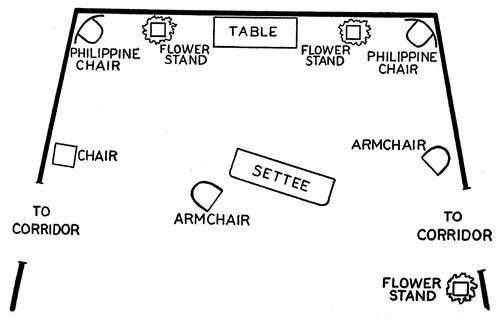
of health and the outdoor life. The wall at the
back of the stage is broken only by symmetrically
spaced pilasters of an ivory color; each of
the side walls is broken in the same manner; but
here the pilasters help to frame two rather
broad entrances, one at the right and one at the
left, and beyond these entrances, on both sides,
we have glimpses of the two corridors that lead
to them. There are a few old prints—or new
prints from old plates—upon the walls; and
there are flowering plants on stands in the corners.
The furniture consists of some chintz-covered
easy-chairs, a light wicker settee with
a chintz cushion and a valance that reaches the
floor; and there are two wicker tables with a
vase of jonquils upon each of them. In the rear
right-hand corner of the room, near the stand
of plants, there is a tropical-looking chair,
wicker, with a back of monstrous size—a Philippine
Island chair—and in the opposite corner
is its mate.
Dance music is heard from a distant orchestra.
Just after the rise of the curtain two people
come in together from the left—a young woman
of twenty-five, or perhaps she is even a little
older, and a slim boy obviously under twenty.
She is rather elaborate in her afternoon indoor
dress, but none the less effectively pretty; he is
of a scrubbed and sleeked youthfulness, in white
trousers, a short black coat and dancing shoes;
and from the moment of his first appearance
he is seen to be in an extremity of love. He
leans as near the young woman as he can; his
eyes search her face yearningly and without intermission;
he caroms into her slightly as they
come in, and repeats the carom unwittingly.
They have evidently just come from the dancing
floor and are a little flushed; she fans herself
with her handkerchief and he fans her with his.
They are heard talking before they enter: “Oh,
let’s do find some place to sit down!” she is saying;
and he, simultaneously: “Oh, wasn’t that
divine! You dance just simply divinely!”
These speeches “bring them on.”
THE YOUNG WOMAN
Here’s a place we can sit down! (She immediately
drops into a chair.)
THE BOY
Yes, this is a lovely place, where nobody is at
all. It’s the only quiet place in the hotel: you
never see more than two people here at a time,
because it’s kind of off, like this. That’s why I
wanted to walk this way. (Sitting on a lounge
and leaning toward her.) Isn’t it divine to be
in a place where nobody is at all?
THE YOUNG WOMAN (still fanning herself)
Why, you and I are here.
THE BOY
Yes; but I mean nobody else at all. We’re
practically all alone, practically.
THE YOUNG WOMAN (laughing as she waves her
hand to indicate the spacious corridors to the
right and left)
Alone? Why, there are at least three hundred
people in this hotel.
THE BOY
Yes, but they’re all either outdoors, or dancin’,
or havin’ tea, right now. It’s practically the
same as being alone. It is—practically, I mean.
THE YOUNG WOMAN
Yes, I’ve noticed that it was a rather secluded
spot myself. (She glances about the room
thoughtfully, then turns to him, smiling.) Don’t
you want to run and dance with some of those
pretty young girls your own age?
THE BOY (with pained earnestness)
Them? My goodness, no!
THE YOUNG WOMAN
Oh, but that isn’t normal, is it?
THE BOY
I’m not normal. I don’t want to be normal.
THE YOUNG WOMAN
Well, but it would only be natural for you to
like those pretty young things, so— Well, do
run and dance with one of ’em. Won’t you,
please?
THE BOY (interrupting)
No. They haven’t got any experience of life.
What I like is a woman that’s had some experience
of life, like you.
THE YOUNG WOMAN
But at your age—
THE BOY
Age hasn’t got anything to do with it. The
thing that brings a man and a woman together,
it’s when they have about the same amount of
experience of life.
THE YOUNG WOMAN (absently)
You think that’s it, Mr. Briggs? (She looks
about the room thoughtfully as she speaks.)
MR. BRIGGS (with intense seriousness)
I know it is. I had that feeling the minute I
was introduced to you, night before last in the
lobby—right by the third column beyond the
office news stand, at a quarter after nine o’clock
in the evening.
THE YOUNG WOMAN
You did?
MR. BRIGGS
It came over me, and I felt kind of— (he swallows)
kind of drawn to you, Missuz—Missuz—Missuz— (He
seems to hesitate somewhat
emotionally.)
THE YOUNG WOMAN
My name is Mrs. Curtis. You seem to have
forgotten it.
MR. BRIGGS (swallowing again)
I haven’t. I know it’s Curtis. The trouble is,
it kind of upsets me to call you Missuz Curtis.
I thought it was Miss Curtis when I was introduced
to you. I didn’t know your name was
Missuz—Missuz—Missuz Curtis till the clerk
told me, early the next morning.
MRS. CURTIS (frowning a little)
The clerk told you?
MR. BRIGGS
Yes. I asked him if he’d noticed whether you’d
gone in to breakfast yet. He said, “You mean
Missuz—Missuz Curtis?” Then I knew you
must be married. (He shakes his head ruefully.)
MRS. CURTIS (smiling)
Well?
MR. BRIGGS (thoughtfully)
Well, it can’t be helped.
MRS. CURTIS
I suppose not.
MR. BRIGGS (brightening a little)
Well, anyhow, I had that—that sort of drawn
feeling toward you, the way I would get toward
a woman that’s had some experience of life;
but a hotel like this is no place to explain feelings
like that. You can’t when you’re dancing—not
the way you want to—and all the rest of
the time you had some o’ those old men hangin’
around, or else my mother and sister wanted
me for something; because a hotel like this—why,
it’s terrible the way a young man’s mother
and sister want him to do somep’n for ’em all
the time; so this is the first chance I’ve had.
MRS. CURTIS (rather urgently)
Don’t you really think you’d better be dancing
with some of those young things yonder?
MR. BRIGGS (puzzled)
Think I’d better be?
MRS. CURTIS
Yes; I do really wish you would. Wouldn’t it
be a lot more fun than explaining something,
as you said, to me?
MR. BRIGGS (hurriedly)
No. No, it wouldn’t. I want to explain how
I feel about you.
MRS. CURTIS
Please go and dance, Mr. Briggs. I think it
would be much better if you—
MR. BRIGGS (rapidly)
No, it wouldn’t. I want to explain how I feel
about you, so you’ll understand. It’s like this,
Missuz (swallowing again) Missuz Curtis. I
never used to think I’d ever get to feeling this
way about—about somebody that was married,
but it—it came over me before I knew you were
married. I already was feeling this way before
he said, “You mean—you mean Missuz Curtis?”
It’d already—(he swallows) happened
to me before I knew you were a—a married
woman. (Shaking his head.) I certainly never
did think I’d feel this way about a married
woman.
MRS. CURTIS
But I’m not—not as you mean it. I’m a widow,
Mr. Briggs.
MR. BRIGGS (as in a dim perplexity)
A wid— You’re a widow? (He jumps up
suddenly, greatly amazed.) Oh, my!
MRS. CURTIS
What’s the matter?
MR. BRIGGS
Oh, my!
MRS. CURTIS
What is it?
MR. BRIGGS
I guess I’ve got to get used to the idea of it.
First I thought you weren’t married, and then
I was just gettin’ used to the idea that you were,
and now—well, I s’pose it’s a good deal better,
your bein’ a widow, though, except—except
for—
MRS. CURTIS
Except for?
MR. BRIGGS (hurriedly)
Oh, I didn’t mean except for your husband! I
didn’t mean your bein’ a widow was better for— (He
checks himself and swallows.)
MRS. CURTIS
Oh!
MR. BRIGGS (frowning with thought)
No. I meant more on account of the way my
family treats me. My mother and sister—well,
to tell the truth, they always seem to think I’m
about four years old. They can’t seem to realize;
and when I go and tell ’em you’re a
widow—
MRS. CURTIS
You think they’ll be interested in hearing it?
I haven’t even met them.
MR. BRIGGS
No, but—but of course they’ve been talkin’
about you quite a good deal.
MRS. CURTIS
They have?
MR. BRIGGS
You know how people are in a hotel like this:
wondering who everybody else is, and whether
some woman’s some old man’s wife or his
daughter or just a trained nurse, and all so on.
Of course my family noticed you right away
and then after I met you of course then they
said a lot more about you. Golly! (He shakes
his head, indicating that the comment has been
unfavorable.)
MRS. CURTIS
Oh, indeed!
MR. BRIGGS (ruefully)
They watch me like a hawk, and I know what
they’ll say now! When I tell ’em you’re a
widow, I mean.
MRS. CURTIS
Do you?
MR. BRIGGS (shaking his head)
I certainly never thought myself I would ever
get to feeling this way about a widow either!
MRS. CURTIS
Don’t you really think you’d better run and
dance with one of those—
MR. BRIGGS (absently)
No. (Turning to her suddenly.) I was goin’
to ask you—well, of course, in a—a technical
way, so to speak, I mean in a strickly technical
way, so to speak, I’m not exactly of age yet, and
I suppose I’d have to get my mother’s consent,
because she’s a widow, too, and got herself appointed
my guardian besides; and the truth is,
she’s a pretty cold-hearted, bossy kind of a
woman, and it’s goin’ to be a big difficulty gettin’
her to see this thing right.
MRS. CURTIS
To see what right?
MR. BRIGGS
The way I feel about you. I know it’s goin’ to
be difficult, because I started to talk a little about
it last night to my mother and my sister—her
name’s Jessie—and they behaved—well, they
behaved a good deal like two fiends.
MRS. CURTIS
They did?
MR. BRIGGS
I told ’em they didn’t know you, and they
haven’t even met you, but they treated me like
a—like a mere jest; and then they got so critical,
the way they talked about you, it might be
better if they didn’t see me with you again for
a few days. I can’t stand the way they talk
after they see me with you.
MRS. CURTIS
Indeed!
MR. BRIGGS
Well, what I was saying: I can’t touch my principal
till I’m twenty-one on account of the way
my father went and tied up his will; but of
course my mother and sister think a good
many’ll be after me on account of it; but, anyhow,
I have got to feeling this way, and I know
I’ll never get over it, so what I wanted to ask
you—well, it’s—it’s—(he swallows) it’s just
this: I know you are a widow and everything
like that, but would you be willing to—(he swallows)
well, of course I don’t know how long
since you lost your first husband—
MRS. CURTIS (incredulously)
What! (She rises.)
MR. BRIGGS
I mean I—I don’t know how you would feel
about gettin’ married again yet, even if I didn’t
have my own difficulties about it, but—but—
MRS. CURTIS (with increased incredulity)
Are you proposing to me, Mr. Briggs?
MR. BRIGGS
Well—uh—yes. (Then, looking beyond her
down the corridor on the right.) Oh, goodness.
They watch me like a hawk! Here comes
my mother! (Dismayed, he turns to the left.)
MRS. CURTIS (as he turns)
Perhaps it was time!
MR. BRIGGS (dismally)
There’s my sister Jessie!
MRS. CURTIS
What of it?
MR. BRIGGS (hastily)
I told you they behave like two fiends when they
see me with you. (Glancing right and left
nervously.) Well, excuse me. (With perfect
gravity he kneels at one end of the settee, which
is in the rear, a little left of “center.”) It’ll
be a good deal better if they don’t see me, I expect.
(He promptly crawls under the settee,
and the valance conceals him entirely. From
this invisibility he appeals with pathetic urgency
in a hoarse whisper): They’ll prob’ly go right
on. Please wait! Or—if you haf to go, come
back!
(Mrs. Curtis stands dumbfounded for a moment;
and then, controlling a tendency to laugh
immoderately, she turns to examine a print on
the left wall as Mr. Briggs’s mother enters from
the right. Mrs. Briggs is a handsome woman of
forty-five or fifty, not now in a gracious mood.
She comes in decisively, halts, and stares at Mrs.
Curtis’ back. Then she looks over the room
in an annoyed and puzzled manner. Mr.
Briggs’s sister Jessie comes in from the left. She
is a pretty girl of about twenty, but her expression
is now rather cross. Her dress and equipment
show that she has just come in from the
golf course.)
JESSIE (calling as she comes in)
Lancelot! (She halts, puzzled, and looks inquiringly
at her mother.) Mamma, where’s
Lancelot? I was sure I saw him in here just a
second ago.
MRS. BRIGGS (grimly)
So was I. (After looking at each other, they
turn their heads simultaneously and stare at
Mrs. Curtis, who appears to be interested in the
print.) It’s very odd!
JESSIE
Yes, very.
(The two again look at each other, and at a little
distance appear to consult telepathically,
without any change of expression; then they turn
once more to look at Mrs. Curtis.)
MRS. BRIGGS
I beg your pardon, but I’m under the impression
that you have met my son.
MRS. CURTIS (turning)
Yes?
JESSIE
Wasn’t he here just now?
MRS. CURTIS
Yes, he was.
MRS. BRIGGS
Would you be good enough to tell me, did he
leave here to go to his room?
MRS. CURTIS (casually)
I don’t think so; he didn’t say so. (She gives
them a little nod, smiling politely, and goes out
at the left. They stare after her.)
JESSIE (still staring after Mrs. Curtis)
She’s a very bold type.
MRS. BRIGGS (seating herself on the settee)
Very.
JESSIE (turning to her)
I don’t see how that little goose got away. You
were coming from that direction and I from
just yonder. I suppose he thought we’d say
something that would embarrass him before
her.
MRS. BRIGGS
I suppose she’s thirty-five. I’ve heard of such
people, but I never saw one before.
JESSIE
I regard her as distinctly the dangerous type of
adventuress.
MRS. BRIGGS
Certainly. In the first place, her not having told
the child frankly that she’s a widow. One of
the clerks told me she was.
JESSIE
Oh, she did that to flatter him into believing
he’s a real grown-up “man of the world” having
an “affair”!
MRS. BRIGGS
So that when he’s sufficiently entangled she can
tell him she’s a widow—and by that time we
don’t know what he’d do! A country justice of
the peace probably!
JESSIE
Last night, when we were trying to teach him
a little common sense about strange people in
hotels, what was it he said she was? “An
angel!”—oh, yes!—“One of heaven’s highest
angels.”
MRS. BRIGGS (grimly)
He said he wouldn’t “listen to one of heaven’s
highest angels gettin’ talked against by a lot o’
women!” I’m sure they heard him in the next
suite. (She rises.) I suppose you’d better go
and see where he slipped out to, Jessie. Of
course, he’ll try to find her again as soon as he
can.
JESSIE (dropping into a chair)
I played three times round the course. Do you
mind if I just sit here a while and rest?
MRS. BRIGGS
Then why don’t you go to your room?
JESSIE (laughing feebly)
I’m just too tired. I will in a minute. (With
a gesture toward the left entrance.) Hadn’t
you better—
MRS. BRIGGS
Keep her in sight? Yes. That’s easier than
trying to keep him in sight. You’re going up
to your room right away, aren’t you?
JESSIE
Yes, in only a minute. I really think you’d better
go, Mamma. He might—
MRS. BRIGGS
No, I’ll see to that! (She goes out.)
(Jessie stares after her for a moment, glances
at a wrist watch, then rises and looks down the
corridor beyond the entrance at the right. She
appears to derive some satisfaction from what
she sees there, returns to her chair and sits in
a carefully graceful attitude, her expression
demure. A moment later a young man—he is
about twenty-five—comes in rather nervously
from the right. He pauses near the entrance.)
THE YOUNG MAN
You!
JESSIE (softly)
You!
THE YOUNG MAN
Is your mother—
JESSIE
She’s gone.
THE YOUNG MAN (nervously advancing)
I—I—
JESSIE
I was afraid maybe we couldn’t have this nook
to ourselves, after all. My absurd little brother
was in here, hanging about that dreadful Mrs.
Curtis, and I was afraid they wouldn’t go away;
but Mamma scared ’em both off providentially.
THE YOUNG MAN (moving a chair close to hers
and sitting)
And so we’re alone! (He speaks with a sentimental
hushedness.) All alone!
JESSIE
All alone, Rupert! This is the only place in the
hotel where you can be by yourself a while.
That’s why I said to meet here.
RUPERT (nervously)
You don’t think your mother’ll be back for a
while?
JESSIE
No; she won’t.
RUPERT
She hasn’t found out I’ve come, has she?
JESSIE
She hasn’t the remotest idea, thank heaven!
Nobody dreams you’re within hundreds of miles
of here. That’s one advantage of a big hotel.
RUPERT
Darling—
JESSIE
Yes, darling?
(The settee moves slightly at this, but it is behind
them and they do not see it.)
RUPERT
I can’t understand why your mother dislikes me
so.
JESSIE (gravely)
Well, I suppose her feeling about you is—well,
she says it’s because you’re rather poor and I’m—not.
RUPERT
But what makes her think I care about you because
you’re not?
JESSIE
Well—
RUPERT (leaning toward her and lowering his
voice)
Darling, there’s something I want to ask you—
JESSIE (leaning toward him and almost whispering)
Yes, dearest, what is it?
(The settee slowly moves nearer them as their
voices become more indistinct.)
RUPERT
I want to ask you—
JESSIE
Yes?
RUPERT (with hushed tenderness)
Do you really love me, dearest?
JESSIE (gazing upward, tranced)
Oh, dearest, I do!
(The settee goes back to where it came from.)
RUPERT
But you don’t think your mother’ll ever change
her mind about me?
JESSIE
She never does change her mind.
RUPERT
Then what can we do?
JESSIE (in a low voice)
Darling, there’s something I wouldn’t say for
anything in the world to anybody but you.
(The settee again approaches slightly.)
RUPERT
Yes?
JESSIE
I think Mamma really knows you’re not mercenary,
but the real reason for her opposition
to you is pretty selfish. I think it’s because she
doesn’t want me to marry and go away and leave
her alone in the world.
RUPERT
But she wouldn’t be. She’d still have the companionship
of your young brother.
JESSIE (shaking her head)
That’d be the same as none. Lancelot seems
to have scarcely any sense, you see.
(The settee once more retires.)
RUPERT
Then I don’t see what possible hope—
JESSIE (warning him as she sees someone approaching
in the corridor to the right)
Sh-h-h!
RUPERT (following her gaze)
Who is that old chap?
JESSIE
It’s old Mr. Ingoldsby. He’s some old friend
of mamma’s that happened to turn up here.
RUPERT (moving as if to withdraw)
I’d better—
JESSIE (quickly)
No; he doesn’t know you. Sit still. (She turns
toward Mr. Ingoldsby with a smile as he enters.)
Good afternoon, Mr. Ingoldsby. Did
you do it in eighty-five again today?
(Ingoldsby is a man of fifty-five or, possibly,
sixty. He wears neat knickerbockers and is
otherwise sprightly in his outdoor attire. He
smiles rather absently as he replies.)
INGOLDSBY
Eighty-five? No, I—ah—no. I didn’t go
round today. Ah—has Mrs. Briggs been here?
JESSIE
Here?
INGOLDSBY
Yes, I mean—ah—here.
JESSIE
I think she’s somewhere looking for Lancelot.
INGOLDSBY
Yes? Ah—I—
JESSIE
Is there something you’d like me to tell her when
I see her?
INGOLDSBY (going toward the left entrance)
No; I—I— (He glances at his watch, and
looks absently at Jessie.) No, I believe I-ah— (He
departs.)
RUPERT
Well, I do hope nobody else’ll come poking
about like that, because I—
JESSIE
No, darling; we’re alone again now.
RUPERT
Darling—
JESSIE
Yes, darling?
RUPERT
We’ve had such difficulties in managing our little
interviews; it does seem a precious thing to
be near you again.
JESSIE
Oh, it does!
RUPERT
If we could only go away together, where it
could always be like this—
JESSIE (dreamily)
Yes, with the world shut out.
RUPERT
Why can’t we—
JESSIE
Hush, darling.
(She sees someone approaching in the corridor
on the left. He looks dolefully in that direction.)
JESSIE
It’s that dreadful woman.
RUPERT
I don’t know her.
JESSIE
She’s been trying to entangle Lancelot, and he’s
completely lost what slight intelligence he had,
the little ninny! She’s old enough to be his
mother.
(The settee makes a slight convulsive movement.)
RUPERT
Sh! She’ll hear you.
(Mrs. Curtis enters from the left. She looks
about, with a faint embarrassment. Jessie stares
at her, then speaks coldly.)
JESSIE
I beg your pardon. Did you leave something
when you were here with my little brother?
MRS. CURTIS (smiling constrainedly)
Did you happen to see a pair of white gloves?
(Rupert rises and looks in his chair.)
JESSIE
No. There aren’t any here.
MRS. CURTIS
I may have left them anywhere of course. (To
Rupert) Don’t bother, please. I thought just
possibly— (She stoops slightly and looks behind
the settee, and her expression shows a considerable
illumination.) If I had left anything
here I just wanted to see if it was still—
JESSIE
No; there aren’t any gloves here. (She speaks
in a sharp whisper to Rupert.) Sit down! (He
does so. Their backs are toward Mrs. Curtis.)
MRS. CURTIS
No. They don’t seem to be. I’m sorry to have
disturbed you.
(She moves toward the left entrance as she
speaks. The settee follows her. She checks it
with a sudden commanding push.)
JESSIE
I hardly think my little brother will come back
here. My mother went to look for him.
MRS. CURTIS (politely)
No doubt she’s found him by this time.
(She looks from the settee to Jessie and Rupert,
and back again; and her eyes widen with an intense
inward struggle.)
JESSIE (turning to look at her coolly)
Was there anything else?
MRS. CURTIS (after a moment, during which her
inward struggle prevents her from replying)
Oh—oh, no! I’m so sorry to have disturbed
you! (Her voice threatens to break and she
goes out hurriedly, at the left.)
JESSIE (staring after her)
Absolutely brazen! She came back after that
idiot boy! Thought he’d probably come back!
RUPERT
Darling—
JESSIE (turning to him eagerly)
Yes, darling—
RUPERT (looking over her shoulder)
Oh, my goodness! (He speaks with intense
anguish.)
JESSIE (seizing his hand feverishly)
What’s the matter, darling?
RUPERT (rising)
It’s your mother! (He strides hastily backward
out of sight from the left entrance.)
JESSIE
Oh, murder!
RUPERT
She didn’t see me, but she will if I try to go out
there. (He points to the right entrance.)
JESSIE
She’s coming!
RUPERT
This is awful! (His despairing eye falls upon
the huge Philippine chair in the left rear corner
of the room; he rushes to it, turns it round, with
its back toward the front, and sits in it, concealed
from view. He speaks in a hoarse whisper.)
Darling—
JESSIE
Hush! (She has checked an impulse to rise and
fly; and now, affecting carelessness, she brushes
her left sleeve with her right hand, crosses her
knees, swings her foot, whistles an operatic air
and looks at the ceiling. Mrs. Briggs enters at
the left, frowning. Jessie addresses her cheerfully.)
Back again, Mamma? Where’s Lancelot?
MRS. BRIGGS (in an annoyed tone)
I don’t know. I thought you were going
straight to your room.
JESSIE
Oh, I am.
MRS. BRIGGS
Have you just been sitting here alone?
JESSIE
Mrs. Curtis came back a minute ago looking for
the child.
MRS. BRIGGS
Yes; I saw her. Wasn’t anyone else—
JESSIE (carelessly)
Oh, yes; that Mr. Ingoldsby was here, too.
MRS. BRIGGS
He was? (She looks at her watch and then toward
the corridor on the left.) You told me
you were very tired and were going straight to
your room.
JESSIE (casually)
Oh, well, I feel rested now.
MRS. BRIGGS
You should lie down before dressing for dinner.
JESSIE
Why don’t you do that, Mamma? You know
how it brightens you up.
MRS. BRIGGS (frowning)
Brightens me up? Really!
JESSIE
Oh, I don’t mean like a terribly aged person;
but a nap every day’s a good thing for everybody.
MRS. BRIGGS (stiffly)
I took a nap after lunch. Really, it’s time you
went.
JESSIE
Oh, I’ll just sit around a while longer. I rather
like to just sit around and do nothing, like this.
MRS. BRIGGS
You said you were going, and you ought to do
things when you say you’re going to do them.
JESSIE
But why? Why can’t I just sit around here a
little longer if I want to?
MRS. BRIGGS
Because you said you—
JESSIE
Oh, what if I did! Haven’t I got a right to
change my mind?
MRS. BRIGGS
I insist on your lying down for half an hour before
you dress for dinner. What makes you so
obstinate about it? Have you any reason for
wishing not to do this simple thing? Is there
anything you’re trying to conceal from me,
Jessie?
JESSIE (rising hastily)
Certainly not!
MRS. BRIGGS (severely)
You haven’t any particular reason for staying
here and not going to your room as you said
you would?
JESSIE
No!
MRS. BRIGGS
Then—
JESSIE
Oh, I’ll go; but I don’t understand why you
make such a point of it!
MRS. BRIGGS (a little flustered)
A point of it? I? I’m not making a point of
it! I don’t at all, except—except for your
health.
JESSIE (going)
My health! (She halts.) What nonsense!
MRS. BRIGGS
Your health is the only thing to consider.
You’ve started; why don’t you go?
JESSIE
But what’s the hurry?
MRS. BRIGGS
Hurry? Oh, none! I just meant, as you are
going, why shouldn’t you go and get it over?
JESSIE
What makes you so queer?
MRS. BRIGGS (with quiet severity)
Queer? You call your mother queer? It seems
to me you’re the one that’s behaving queerly.
Jessie, is there anything you’re trying to—
JESSIE
No! Don’t get so upset. I’ll go!
(She goes out at the left. Mrs. Briggs stares
after her for a moment; looks in the opposite
direction; then seats herself upon the settee, and
from the midst of a handkerchief which she has
crumpled in her hand produces a small gold
vanity box. She opens it, gazes in the tiny mirror,
touches her hair, glances right and left, and
uses a diminutive powder puff quickly; then she
closes the box, conceals it in her handkerchief
again, and hums a song to herself. Mr. Ingoldsby
enters at the left. He has an air slightly
embarrassed.)
MRS. BRIGGS (as if surprised)
Oh!
INGOLDSBY
Ah—I was here a while ago. It was a little
earlier than our—our appointment; if I may
call it so. (He laughs nervously.)
MRS. BRIGGS (smiling)
Well, I suppose it could be called an appointment—in
a way.
INGOLDSBY
I—I thought—that is, I’ve noticed this was
about the only place in the hotel where there
aren’t usually a lot of people. I suggested it
because—because I had something to say—ah—I
mean that I thought it would be as well to
say it in private—as it were. That is, if we
were alone together, I—ah—that is to say, it’s
something I couldn’t very well say in—in public,
so to speak. I mean it would be difficult
with other people present.
MRS. BRIGGS (smiling nervously)
Is it something very mysterious, Mr. Ingoldsby?
INGOLDSBY
I wish you wouldn’t call me that.
MRS. BRIGGS (seriously)
You want me to call you Henry?
INGOLDSBY
You did once.
MRS. BRIGGS (rising in some agitation)
Yes, but that was pretty long ago.
INGOLDSBY (sharply)
I called you Fannie then.
MRS. BRIGGS (more agitated)
I don’t think we should ever refer to it. When
an episode is as long buried as—
INGOLDSBY (his own agitation increasing)
Episode? See here, Fannie; you know why
I stayed a bachelor. You do know.
MRS. BRIGGS (protesting quickly)
No, no! I have no responsibility for that!
INGOLDSBY
Haven’t you? When you broke your engagement
to me—
MRS. BRIGGS (crying out, though she suppresses the
loudness of her voice)
It was a misunderstanding, Henry.
INGOLDSBY
It was not. I’ve held my peace in silence all
these years because of my principles. I wouldn’t
refer to such things with you when you had
become a married woman. But I can speak
now. You deliberately broke off with me—
MRS. BRIGGS (choking)
I didn’t!
INGOLDSBY (with a suppressed passion)
You did! (He paces the floor as he goes on.)
You decided Lance Briggs was the better man,
and you sent me my ring and letters without a
single word explaining why you did it.
MRS. BRIGGS
Oh!
INGOLDSBY
You did!
MRS. BRIGGS
Is it fair to attack me with that now?
INGOLDSBY
Fair? How dare you speak of fairness to me?
MRS. BRIGGS
But you knew why I did it.
INGOLDSBY (bitterly)
I did indeed! It was simply because you were
of a fickle nature. Of course you didn’t have
the courage to explain that.
MRS. BRIGGS (with great emotion)
But you don’t know the pressure, the awful
pressure my mother brought to bear on me.
She simply made me marry him, Henry. It
was night and day, day and night, week in, week
out—
INGOLDSBY
And you never for one moment had the simple
bravery, the simple loyalty to the man you’d
given your word to—
MRS. BRIGGS
I was worn out. I was—
INGOLDSBY
You didn’t care enough for me to—
MRS. BRIGGS
I did!
INGOLDSBY
No! No! No!
MRS. BRIGGS (piteously)
Henry, you must listen to me! (She puts her
hand on his arm.)
INGOLDSBY (moving away from her)
Why didn’t you say that then? Why didn’t—
MRS. BRIGGS
I loved you—I did, Henry! I simply let my
mother break my will and wreck our two lives.
INGOLDSBY
What folly! You were perfectly happy with
Briggs. I don’t know how many people told
me you were.
MRS. BRIGGS
I did my duty, and I tried to do it cheerfully;
but the scar was always there, Henry.
INGOLDSBY (harshly)
I don’t believe it!
MRS. BRIGGS (plaintively)
It was, Henry. (She sinks into the chair Jessie
has occupied.)
INGOLDSBY (swallowing)
What?
MRS. BRIGGS (feebly)
It was, Henry—the scar was always there.
(Her head droops.)
(He walks across the room, then returns to her
and looks down upon her.)
INGOLDSBY (swallowing)
Do you know what my life has been?
MRS. BRIGGS (tremulously, not looking up)
I—I heard you became very—very prosperous
in—in real estate.
INGOLDSBY
Yes. What’s that to fill a man’s life? Look
at the difference! You have children to be a
comfort to you in your—your—as you approach
middle age. I have nothing.
MRS. BRIGGS (pathetically, still looking down)
Oh, I’m sure you have something.
INGOLDSBY
I tell you I have nothing—nothing in the world
to make life worth living, not a thing on earth!
(He glances about, then sits beside her and
speaks in a very low voice.) Fannie—Fannie—
(The settee approaches a little nearer.)
MRS. BRIGGS (also in a very low voice)
Well?
INGOLDSBY
Fannie—I—I—Fannie—I— (His emotion is
difficult to control and his voice fades out into
a murmur of several slight incoherent sounds,
whereupon the settee again moves slightly
closer.)
MRS. BRIGGS
Yes, Henry?
INGOLDSBY
You said your life was wrecked, though you
bore it dutifully and—and cheerfully. Mine—my
life—it was withered!
MRS. BRIGGS (murmuring)
Oh—Henry!
INGOLDSBY
But, after all, our lives aren’t over.
MRS. BRIGGS (shaking her down-bent head and
protesting in a weak voice)
Oh, no, no! Don’t begin to talk that way.
INGOLDSBY
Fannie, I never got over it. As time went on,
I took up my work and tried to do my part in
the world, but—but I never got over it, Fannie.
I’m not over it now.
MRS. BRIGGS (turning to him mournfully)
Oh, yes, you are!
INGOLDSBY (shaking his head)
I’m not. I still—I still—I still—I still—
(The settee again moves a little nearer.)
MRS. BRIGGS
No, no.
INGOLDSBY
I do. I still—I still—
MRS. BRIGGS (in a faint and tearful protest)
No, you don’t, Henry. You only think you do.
INGOLDSBY
No, I really do. I—I—I care for you yet,
Fannie.
MRS. BRIGGS (recovering herself enough to smile
faintly as she shakes her head)
Oh, my, no!
INGOLDSBY
Fannie, let’s—let’s save these years that we still
have before us. Let’s try to make up for that
old mistake.
MRS. BRIGGS (becoming a little brisker)
Why, how—how—why, we—why, I couldn’t
think of such a thing!
INGOLDSBY (solemnly)
Fannie, I ask you to marry me.
(She stares at him; the settee moves an inch
nearer.)
MRS. BRIGGS
What?
INGOLDSBY
I ask you to marry me.
MRS. BRIGGS
Why, good gracious! I wouldn’t have my children
know that anybody had said such a thing
to me for all the kingdoms on earth!
INGOLDSBY (earnestly)
They needn’t know it till afterwards.
MRS. BRIGGS (breathlessly)
Afterwards? After—after—
INGOLDSBY
You’re not going to wreck us both again, are
you, Fannie?
MRS. BRIGGS (as in amazement)
Why, if I’d dreamed you were going to say anything
like this to me when you asked me to meet
you here this afternoon—
INGOLDSBY (solemnly)
Fannie, I want you to give me your answer, and
to do it now. What do you say?
MRS. BRIGGS (feebly, with her hand to her breast)
Oh, my!
INGOLDSBY
Yes; you must.
MRS. BRIGGS
But I haven’t had time to think! Why, I
wouldn’t have anybody know about this for—
INGOLDSBY
I want my answer, Fannie—Fannie dear!
MRS. BRIGGS (blankly)
Oh, dear!
INGOLDSBY
Fannie, dearest! (He takes her hand.)
MRS. BRIGGS
Oh, I wouldn’t have anybody know this—
INGOLDSBY
Dearest, dearest Fannie!
MRS. BRIGGS
Why, I wouldn’t have anybody know that we—
(They are interrupted by a voice from a mysterious
and invisible source. It is a male and
adult voice, loudly and emphatically affecting
to clear the throat of its origin in the manner
of a person wishing to attract the attention of
some other person.)
THE MYSTERIOUS VOICE
A-hem! A-a-a-hem!
MRS. BRIGGS (leaping in her chair)
Good heavens!
INGOLDSBY (jumping up)
What was that?
MRS. BRIGGS (rising)
Why, it was a man’s voice.
INGOLDSBY
It was right here in the room with us.
MRS. BRIGGS (sinking into her chair)
Oh, murder!
INGOLDSBY (staring about the room, notices the
Philippine chair with its back turned to the
front)
There’s somebody sitting in that chair! (He
starts toward it angrily, but is checked by a
suppressed scream from Mrs. Briggs.)
MRS. BRIGGS
Don’t! I’d much rather never know who it is.
(Rising.) Let’s get away! (She totters.)
INGOLDSBY (undecided, but very angry)
We ought to know who’s spying on us like this.
MRS. BRIGGS (clutching at him)
Oh!
THE MYSTERIOUS VOICE (indignantly)
I’m not spying! This is a public room in a public
hotel—
MRS. BRIGGS (moaning)
Oh!
THE MYSTERIOUS VOICE (continuing)
Any guest of this hotel has a right to sit here
in peace, and if you will go on talking about
your private affairs in a public room—
MRS. BRIGGS (leaning on Ingoldsby’s arm)
Oh, my!
THE MYSTERIOUS VOICE (continuing heatedly)
Why, it’s your own fault, not mine. I was only
warning you not to go any further. I’ve heard
enough of other people’s private affairs for one
afternoon, anyhow.
MRS. BRIGGS (almost hysterically)
Oh, let’s go! (She swings the reluctant and
angry Ingoldsby toward the left entrance.)
Let’s go!
INGOLDSBY (turning to call back angrily)
I don’t know who you are, sir; but when I’ve
seen this lady to a—a place of safety—I intend
to know. I’ll be back here, sir.
THE MYSTERIOUS VOICE
Fine!
MRS. BRIGGS
Oh, mercy! (She moves hastily away from
Ingoldsby as Jessie suddenly comes in, from the
left, confronting them.)
JESSIE (halting sharply)
What in the world’s the matter?
MRS. BRIGGS (in a shaking voice)
Nothing! Nothing at all, Jessie. Why should
you think anything’s the matter?
JESSIE
Why, you’re all upset!
MRS. BRIGGS (trying hard to seem lightly amused,
and failing)
Not at all—not at all! I was just sitting here
a moment with Mr. Ingoldsby, chatting over old
times and—and then we decided to leave. We
decided to leave—that’s all. I—I’m—(Suddenly
she starts, and with an incoherent exclamation
looks behind her. Then she faces Jessie
and, with a painful effort to smile, completes
her sentence.) I’m all right.
JESSIE
Yes, you seem so. Mr. Ingoldsby, will you
kindly tell me what you’ve been saying to my
mother to upset her so?
MRS. BRIGGS
But I’m not—
INGOLDSBY (checking her sharply)
Miss Briggs, I should not be likely to say anything
disrespectful to my old and dear friend,
your mother. (Looking around angrily.) The
truth is, there’s an eavesdropping scoundrel concealed
in this room, and I—
JESSIE (alarmed)
What! Oh, I’m sure there isn’t.
INGOLDSBY
There is! An eavesdropping—
THE MYSTERIOUS VOICE (angrily)
This is a public room, I told you. How can I
help it if you—
INGOLDSBY
I can’t stand this. He’s behind that chair.
(He breaks away from Mrs. Briggs and Jessie,
who both clutch at him.)
JESSIE (crying out)
Don’t! Please don’t!
MRS. BRIGGS (simultaneously)
Henry! Don’t!
(But Ingoldsby has already reached the Philippine
chair that has its back turned toward the
front of the stage; he seizes Rupert by the collar
and drags him forth. Rupert is horrified.)
INGOLDSBY
Come out of there, you scoundrel. Come out
to the light of day.
RUPERT (hastily)
I didn’t do it. It wasn’t me.
MRS. BRIGGS
Rupert Smith!
JESSIE (dolefully)
Oh, goodness!
INGOLDSBY (hotly)
What do you mean by terrorizing a lady?
RUPERT
I didn’t! I didn’t say a word! I was behind
there, but I couldn’t help it. It wasn’t my voice
talking to you.
INGOLDSBY
Then who was it?
THE MYSTERIOUS VOICE
If you’re anxious for more witnesses, I suggest
that you look under the settee.
MRS. BRIGGS (changing her mind as she is in the
act of sinking down upon the settee)
What!
JESSIE
Look at it!
(Mrs. Briggs screams faintly, as the settee
moves rapidly to the left entrance, evidently
meaning to leave the room.)
INGOLDSBY (to Rupert)
Stop that thing! Catch it!
(They seize the settee just as it is disappearing
into the corridor. They drag it back into the
room.)
RUPERT (trying to lift the settee)
Come out from under there!
INGOLDSBY
Come out, now!
THE SETTEE
I won’t! You lea’ me alone!
INGOLDSBY
Both together now—heave!
(They heave, and the settee yields, disclosing
Lancelot with his previously smooth hair disheveled
and his clothes well rumpled.)
MRS. BRIGGS (astonished)
Lancelot! Oh, gracious me!
INGOLDSBY (to Lancelot)
Shame on you!
RUPERT
Yes, shame on you!
LANCELOT (resentfully)
Well, you would get me; but I’ll make you sorry
you did it, both of you! (He rises, brushing
himself and adjusting his attire.)
INGOLDSBY (irritably)
Don’t you know better than to frighten ladies
and eavesdrop and—
LANCELOT (warmly)
I was abs’lootly honorable, because I couldn’t
help it, and you none of you ever gave me a
single chance to get away. My conduct is the
only one here that hasn’t got a stain on it or
anything. (He turns hotly upon Mrs. Briggs
and Jessie.) I got nothing to reproach myself
with, but I’d just like to know what either of
you got to say for yourselves now about the
way you been talkin’ about Mrs. Curtis! If
you either of you ever just dare to soil your
lips with even her name again, why, I know
more things—
MRS. BRIGGS
Be quiet, Lancelot.
LANCELOT
Quiet? Me? (He laughs shortly with an irony
he could not express in words.) In the first
place, don’t call me Lancelot any more. You
know how I hate that name, and I been tryin’
to break you of it long enough—and now I will!
I don’t care what you call me, but don’t call me
that!
JESSIE (pointing to the settee)
How long were you under there?
LANCELOT (sternly)
Long enough to get mighty tired of hearin’ people
callin’ each other “Darling”! Good gracious!
You don’t think I enjoyed it, do you?
Why, what I heard while I was under there—well,
I got a pretty strong constitution, but—
MRS. BRIGGS
Hush! Oh, me!
INGOLDSBY
The voice that spoke didn’t sound like Lancelot’s
voice—
LANCELOT (turning upon him ominously)
Did you hear me say not to call me Lancelot?
I mean you, too.
INGOLDSBY (with hasty meekness)
I’ll call you anything you like; but I want to
know who it was that spoke. You say it wasn’t
you—
LANCELOT (very emphatically)
No, it wasn’t. I wouldn’t ’a’ told you to look
under the settee, would I?
INGOLDSBY (with a gesture toward Rupert)
And this gentleman says it wasn’t he.
RUPERT
Why, it spoke again after I came out.
INGOLDSBY (quite bewildered)
So it did. Then who—
LANCELOT
I don’t care who it was; what I want to point
out, right here and now, before we go any further,
why, I’m in a position to say that I got
some plans for my future life and I don’t expect
to have any intaference with ’em from my
family, or from anybody that wants to join my
family either. All up to now, I’ve spent my life
in a dependent position, so to speak, but after
what’s happened here lately, and knowin’ all the
things I do know—
(His voice has risen during this oration, and
Jessie, after a glance to the left entrance, attempts
to moderate him.)
JESSIE
Hush! There’s somebody—
LANCELOT
I don’t care who’s comin’, I’m goin’ to say my
say. I expect to settle my own future in my own
way, and any lady that I may decide to make
another member of this family—
JESSIE
Hush!
(The eyes of Lancelot follow hers to the left
entrance and his stern manner is instantly softened.)
LANCELOT
It’s her.
(Mrs. Curtis comes in, but stops uncertainly
near the entrance.)
MRS. CURTIS
Oh! I’m afraid I— (She turns to go.)
LANCELOT
Wait. I was just talkin’ to ’em about you.
MRS. CURTIS
You were, Mr. Briggs?
LANCELOT (to the others, reprovingly)
She never calls me Lancelot. Missuz—Missuz
Curtis, I didn’t have to tell ’em; they’d already
found out you were a widow. We don’t need
to bother about that anyway.
MRS. CURTIS
We don’t?
LANCELOT
I’ve found out a good many things since I saw
you, and I’m goin’ to tell you the whole biznuss.
MRS. BRIGGS
Shame!
JESSIE (with a despairing laugh)
What would it matter? There’s somebody else
here that knows “the whole biznuss”!
MRS. CURTIS (struck by this)
What did you say, Miss Briggs?
INGOLDSBY (warmly)
She made a sensible remark, madam. There is
a person concealed in this room—
MRS. CURTIS (impulsively)
Oh, dear! How did you know?
ALL THE OTHERS
What?
MRS. CURTIS
Nothing.
INGOLDSBY
All right! (To Rupert.) I think I know now
where he is, and I’m going to have him out.
MRS. CURTIS (gasping, then imploringly)
Please stop!
INGOLDSBY (halting)
Why?
MRS. CURTIS (weakly)
It’s a friend of mine.
LANCELOT (apprehensively)
A friend of yours?
MRS. CURTIS
I—I’ll answer for him. He’ll never mention—ah—anything.
He really wouldn’t be interested.
He doesn’t know any of you.
THE MYSTERIOUS VOICE
No; and doesn’t care to!
INGOLDSBY (angrily)
Now, I will—
MRS. CURTIS
Please don’t!
INGOLDSBY
I mean to know who he is.
MRS. CURTIS (pleading)
Please! If you found him, you’d only see a
total stranger to you. But he wouldn’t be a
stranger to quite a lot of people in this hotel
that I know.
INGOLDSBY (now shaking his head)
I’m afraid I don’t see it.
MRS. CURTIS (in a faltering voice)
He’s just here for one day and we—we didn’t
want anyone to know it. I had so many engagements
I could only take a short walk in the country
with him this morning and—and promise to
meet him here at five this afternoon.
LANCELOT (who has been staring at her painfully)
But—but—see here!
MRS. CURTIS
Yes, I tried to get you to run away and dance
with some nice young thing.
LANCELOT (pathetically)
So you could be here with—him?
MRS. CURTIS
I—I believe so.
LANCELOT (dismally)
Oh, my!
INGOLDSBY
Madam, what you say doesn’t excuse this person’s
eavesdropping.
THE MYSTERIOUS VOICE (belligerently)
Why doesn’t it? A lady’s got a right to keep
her engagement a secret as long as she wants
to, hasn’t she? There are people in this hotel
that would know all about it if they saw her
with me. (With some bitterness.) That’s why
she said to meet her here, because it’s so quiet!
INGOLDSBY
That doesn’t excuse—
THE MYSTERIOUS VOICE
It’s more your fault than anybody else’s. I
was awake all last night on a noisy train, and
I was quietly asleep here—till you woke me up.
INGOLDSBY
Till who woke you up?
THE MYSTERIOUS VOICE
Till you did. I never knew a man that made so
much noise about proposing a second marriage.
JESSIE (amazed)
Oh, Mamma!
MRS. BRIGGS (with severe dignity)
I’ll speak to you and Mr. Rupert Smith after
dinner. Henry, I don’t see the propriety of
continuing an argument with this interloper,
whoever he may be. (She takes Ingoldsby’s
arm.)
JESSIE
No. Let’s do get away from here! (She moves
toward the left entrance with Rupert.)
INGOLDSBY (looking back, as he follows with Mrs.
Briggs; speaks reprovingly)
I hope you have some shame for your conduct,
sir.
THE MYSTERIOUS VOICE
Bless you, my children!
INGOLDSBY (infuriated)
Now, I’ll— (He turns to go back.)
MRS. BRIGGS (restraining him)
Henry!
(They go on the left entrance. Jessie and Rupert
have passed out into the corridor.)
LANCELOT
Did he say “a lady’s got a right to keep her—her
engagement—a secret”?
MRS. CURTIS
Yes.
LANCELOT
To—to—to you?
MRS. CURTIS
Yes, dear.
LANCELOT (piteously)
Oh—oh, pshaw!
MRS. BRIGGS (calling back)
Lancelot!
LANCELOT (meekly)
Yes’m.
(He goes dismally across to the left entrance
and pauses. Ingoldsby and Mrs. Briggs have
withdrawn, preceding him.)
MRS. CURTIS (as he pauses)
What is it, Mr. Briggs?
LANCELOT (swallowing)
Noth—nothin’. (He goes out.)
MRS. CURTIS (turning, after a moment’s faintly
smiling meditation)
You poor thing!
THE MYSTERIOUS VOICE (in an aggrieved tone)
Well, I should say I am!
(She goes to the Philippine chair, near the right
rear corner, and, moving a smaller chair close
to it, seats herself and addresses the invisible
person, who is evidently sitting in the shelter
of the big chair.)
MRS. CURTIS
After all, there’s nobody else here just now,
darling.
THE MYSTERIOUS VOICE
No. We’re alone, darling.
MRS. CURTIS
You poor darling!
(She glances about, then impulsively leans behind
the huge back of the Philippine chair as
the curtain descends.)