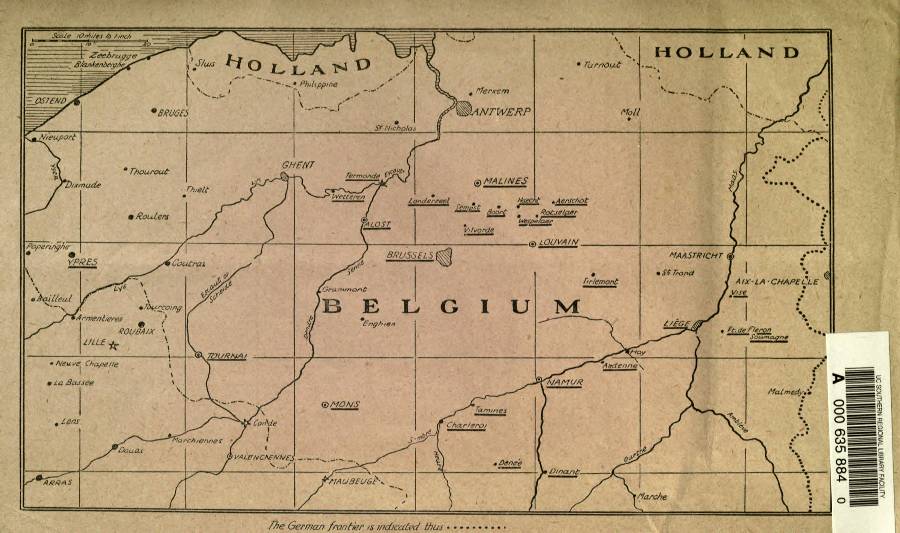
The Care of the Belgian Civil Authorities to Collect Firearms
from Civilians and to Warn them against taking part in
the Hostilities.
7
The Belgian King and Government were aware of the danger
which would confront the civilian population of the country if
it were tempted to take part in the work of national defence.
Orders were accordingly issued by the civil governors of provinces,
and by the burgomasters of towns, that the civilian inhabitants
were to take no part in hostilities, and to offer no provocation
to the invaders. That no excuse might be furnished for severities,
the populations of many important towns were instructed to
surrender all firearms into the hands of the local officials.
The Kindness extended to the Invading Germans by the Civil
Population of Belgium.
26
Letters written to their homes, which have been found on the
bodies of dead Germans, bear witness, in a way that now sounds
pathetic, to the kindness with which they were received by the
civil population. Their evident surprise at this reception
was due to the stories which had been dinned into their ears of
soldiers with their eyes gouged out, treacherous murders and
poisoned food.
Outbreak of Atrocities from the Moment the German Army
crossed the Frontier.
25
Murder, rape, arson and pillage began from the moment when
the German Army crossed the frontier. For the first fortnight
of the war, the towns and villages near Liège were the chief
sufferers.... There is a certain significance in the fact
that the outrages round Liège coincide with the unexpected
resistance of the Belgian Army in that district, and that the
slaughter which reigned from August 19th to the end of the month
is contemporaneous with the period when the German Army's
need for a quick passage through Belgium at all costs was deemed
imperative.
Article 46 of the Second International Peace Conference (Convention concerning
the Laws and Customs of War on Land), held at the Hague in 1907,
reads as follows:—
Family honour and rights, individual life, and private property, as well as
religious convictions and worship, must be respected.
Private property may not be confiscated.
Instances from Herve and Melen.
7
"On the 4th of August," says one witness, "at Herve" (a
village not far from the frontier), "I saw at about 2 o'clock in
the afternoon, near the station, five Uhlans [German cavalry];
these were the first German troops I had seen. They were
followed by a German officer and some soldiers in a motor car.
The men in the car called out to a couple of young fellows who
were standing about 30 yards away. The young men, being
afraid, ran off, and then the Germans fired and killed one of them
named D——." The murder of this innocent fugitive civilian
was a prelude to the burning and pillage of Herve and of other
villages in the neighbourhood, to the indiscriminate shooting of
civilians of both sexes, and to the organised military execution
of batches of selected males. Thus at Herve some 50 men
escaping from the burning houses were seized, taken outside the
town and shot. At Melen, a hamlet west of Herve, 40 men were
shot. In one household alone the father and mother (names
given) were shot, the daughter died after being outraged, and
the son was wounded.
The Slaughter of Civilians speedily became a Custom.
The burning of the villages in this neighbourhood, and the
wholesale slaughter of civilians, such as occurred at Herve,
Micheroux and Soumagne appear to be connected with the
exasperation caused by the resistance of Fort Fléron, whose guns
barred the main road from Aix-la-Chapelle to Liège. Enraged
by the losses which they had sustained, suspicious of the temper
of the civilian population, and probably thinking that by exceptional
severities at the outset they could cow the spirit of the
Belgian nation, the German officers and men speedily accustomed
themselves to the slaughter of civilians.
No Official German Denial of Atrocities.
25
Citizens of neutral states who visited Belgium in December
and January report that the German authorities do not deny that
non-combatants were systematically killed in large numbers
during the first weeks of the invasion, and this, so far as we know,
has never been officially denied.
Flight of Belgian Refugees without Parallel.
25
If it were denied, the flight and continued voluntary exile of
thousands of Belgian refugees would go far to contradict a denial,
for there is no historical parallel in modern times for the flight
of a large part of a nation before an invader.
German Government seek to justify Severities, but no Proof
given of Alleged Firing by Civilians.
25
The German Government have, however, sought to justify
their severities on the grounds of military necessity, and have
excused them as retaliation for cases in which civilians fired on
German troops. There may have been cases in which such
firing occurred, but no proof has ever been given, or, to our
knowledge, attempted to be given, of such cases, nor of the
allegations of shocking outrages perpetrated by Belgian men
and women on German soldiers.
On the contrary, Civilians were Warned after the Invasion.
26
The inherent improbability of the German contention is shown
by the fact that after the first few days of the invasion every
possible precaution had been taken by the Belgian authorities,
by way of placards and handbills, to warn the civilian population
not to intervene in hostilities.
Civilians Shot Indiscriminately and without any Inquiry.
26
An invading army may be entitled to shoot at sight a civilian
caught red-handed, or anyone who though not caught red-handed
is proved guilty on inquiry. But this was not the practice
followed by the German troops. They do not seem to have made
any inquiry. They seized the civilians of the village indiscriminately
and killed them, or such as they selected from among them,
without the least regard to guilt or innocence. The mere cry
"Civilisten haben geschossen" ("Civilians have been shooting")
was enough to hand over a whole village or district, and even
outlying places, to ruthless slaughter.
Killing of Civilians on Scale without any Parallel in Modern
Warfare between Civilised Powers.
25
In the present war—and this is the gravest charge against
the German Army—the evidence shows that the killing of non-combatants
was carried out to an extent for which no previous
war between nations claiming to be civilised furnishes any precedent.
Mass of Evidence convinced Committee of its Truth.
27
That these acts should have been perpetrated on the peaceful
population of an unoffending country which was not at war with
its invaders, but merely defending its own neutrality, guaranteed
by the invading Power, may excite amazement and even incredulity.
It was with amazement and almost with incredulity
that the Committee first read the depositions relating to such
acts. But when the evidence regarding Liège was followed by
that regarding Aerschot, Louvain, Andenne, Dinant and the
other towns and villages, the cumulative effect of such a mass
of concurrent testimony became irresistible, and the Committee
were driven to the conclusion that the things described had really
happened.
Killing of Civilians deliberately planned by the Higher Military
Authorities and carried out methodically.
27
The excesses recently committed in Belgium were, moreover,
too widespread and too uniform in their character to be mere
sporadic outbursts of passion or rapacity.
25
That this killing was done as part of a deliberate plan is clear
from the facts set forth regarding Louvain, Aerschot, Dinant
and other towns. The killing was done under orders in each
place. It began at a certain fixed date, and stopped (with some
few exceptions) at another fixed date.
German Army Disciplined to Obey.
27
The discipline of the German Army is proverbially stringent,
and its obedience implicit.
23
It was to the discipline rather than the want of discipline in
the Army that these outrages, which we are obliged to describe
as systematic, were due, and the special official notices posted
on certain houses that they were not to be destroyed show the
fate which had been decreed for the others which were not so
marked.
A few German Officers showed Feelings of Humanity.
27
The Committee gladly record the instances where the evidence
shows that humanity had not wholly disappeared from some
members of the German Army, and that they realised that the
responsible heads of that organisation were employing them,
not in war, but in butchery. "I am merely executing orders,
and I should be shot if I did not execute them," said an officer
to a witness at Louvain. At Brussels another officer said: "I
have not done one hundredth part of what we have been ordered
to do by the High German military authorities."
30
A humane German officer, witnessing the ruin of Aerschot,
exclaimed in disgust: "I am a father myself, and I cannot bear
this. It is not war, but butchery."
Drink Responsible for many of the Worst Outrages.
25
30
Many of the worst outrages appear to have been perpetrated
by men under the influence of drink. Unfortunately, little seems
to have been done to repress this source of danger.... Officers
as well as men succumbed to the temptation of drink.
The German Army is Responsible for Crimes which it did
not Check.
27
When an army is directed or permitted to kill non-combatants
on a large scale, the ferocity of the worse natures springs into
fuller life, and both lust and the thirst of blood become more widespread
and more formidable. Had less licence been allowed to the
soldiers, and had they not been set to work to slaughter civilians,
there would have been fewer of those painful cases in which a
depraved and morbid cruelty appears.
The Taking and Murder of Hostages.
27
Two classes of murders in particular require special mention,
because one of them is almost new, and the other altogether
unprecedented. The former is the seizure of peaceful citizens
as so-called hostages to be kept as a pledge for the conduct of
the civil population, or as a means to secure some military advantage,
or to compel the payment of a contribution, the hostages
being shot if the condition imposed by the arbitrary will of the
invader is not fulfilled. Such hostage taking ... is opposed both
to the rules of war and to every principle of justice and humanity.
Murder in the Villages.
27
The latter kind of murder is the killing of the innocent inhabitants
of a village because shots have been fired, or are alleged to
have been fired, on the troops by someone in the village. For
this practice no previous example and no justification has been or
can be pleaded.... In Belgium large bodies of men, sometimes
including the burgomaster and the priest, were seized,
marched by officers to a spot chosen for the purpose, and there
shot in cold blood, without any attempt at trial or even enquiry,
under the pretence of inflicting punishment upon the village,
though these unhappy victims were not even charged with
having themselves committed any wrongful act.
16
The Committee is specially impressed by the character of the
outrages committed in the smaller villages.
Aerschot and District (August 25th).—Immediately after the
battle of Malines ... a long series of murders were committed
either just before or during the retreat of the army. Many
of the inhabitants who were unarmed, including women and
young children, were killed—some of them under revolting circumstances.
Evidence given goes to show that the death of these villagers
was due, not to accident, but to deliberate purpose.
A Death-stricken Area.
14
The quadrangle of territory bounded by the towns of Aerschot,
Malines, Vilvorde, and Louvain, is a rich agricultural tract,
studded with small villages and comprising two considerable
cities, Louvain and Malines. This district on August 19th passed
into the hands of the Germans, and, owing perhaps to its proximity
to Antwerp, then the seat of the Belgian Government and headquarters
of the Belgian Army, it became from that date a scene of
chronic outrage, with respect to which the Committee has received
a great mass of evidence.
Systematic Massacres.
14
The arrival of the Germans in the district on August 19th was
marked by systematic massacres and other outrages at Aerschot
itself, Gelrode and some other villages.
Sudden Outburst of Cruelty follows Belgian Victory.
14
On August 25th the Belgians, sallying out of the defences of
Antwerp, attacked the German positions at Malines, drove the
enemy from the town and re-occupied many of the villages in
the neighbourhood. And just as numerous outrages against the
civilian population had been the immediate consequence of the
temporary repulse of the German vanguard from Fort Fléron,
so a large body of depositions testify to the fact that a sudden
outburst of cruelty was the response of the German Army to the
Belgian victory at Malines.
A Reign of Terror.
14
The battle of Malines ... was the occasion of numerous murders
committed by the German Army in retreating through the
villages of Sempst, Hofstade, Eppeghem, Elewyt and elsewhere.
In the second place it led ... to the massacres, plunderings and
burnings at Louvain, the signal for which was provided by shots
exchanged between the German Army, retreating after its repulse
at Malines, and some members of the German garrison of Louvain,
who mistook their fellow countrymen for Belgians. Lastly, the
encounter at Malines seems to have stung the Germans into
establishing a reign of terror in so much of the district comprised
in the quadrangle as remained in their power.
Louvain Peacefully Occupied by Germans for Six Days.
19
Louvain and District.—The events spoken to as having
occurred in and around Louvain between August 19th and 25th
deserve close attention.
For six days the Germans were in peaceful occupation of the
city. No houses were set on fire—no citizens killed. There
was a certain amount of looting of empty houses, but otherwise
discipline was effectively maintained. The condition of Louvain
during these days was one of relative peace and quietude, presenting
a striking contrast to the previous and contemporaneous
conduct of the German Army elsewhere.
A Sudden Change—Murder of Civilians and Destruction of
Property.
19
On the evening of August 25th a sudden change took place.
The Germans, on that day repulsed by the Belgians, had retreated
to and re-occupied Louvain. Immediately the devastation of
that city and the destruction by fire of its population began.
Defeated Germans Revenge themselves on Civilians.
19
The inference is irresistible that the Army as a whole wreaked
its vengeance on the civilian population and the buildings of the
city in revenge for the setback which the Belgian arms had inflicted
on them. A subsidiary cause alleged was the assertion, often
made before, that civilians had fired upon the German Army.
The depositions which relate to Louvain are numerous, and
are believed by the Committee to present a true and fairly complete
picture of the events of August 25th and 26th and subsequent
days.
Civilians did not Fire.
19
The Committee find no grounds for thinking that the inhabitants
fired upon the German Army on the evening of August 25th.
Eye-witnesses worthy of credence detail exactly when, where
and how the firing commenced. Such firing was by Germans on
Germans. No impartial tribunal could, so the Committee think,
come to any other conclusion.
Harried Villagers.
21
The massacre of civilians at Louvain was not confined to its
citizens. Large crowds of people were brought into Louvain
from the surrounding districts.... Of the hundreds of
people taken from the various villages and brought to Louvain
as prisoners, some were massacred there, others were forced to
march along with citizens of Louvain through various places,
some being ultimately sent on the 29th to the Belgian lines at
Malines, others were taken in trucks to Cologne, others were
released.
A Calculated Policy of Cruelty.
23
The Committee are driven to the conclusion that the harrying
of the villages in the district, the burning of a large part of
Louvain, the massacres there, the marching out of the prisoners,
and the transport to Cologne—all done without enquiry as to
whether the particular persons seized or killed had committed
any wrongful act—were due to a calculated policy carried out
scientifically and deliberately, not merely with the sanction
but under the direction of higher military authorities, and were
not due to any provocation or resistance by the civilian population.
The Tragedy of Beautiful Dinant.
13
Just outside the prison one witness saw three lines of bodies,
which he recognised as being those of neighbours. They were
nearly all dead, but he noticed movement in some of them.
There were about 120 bodies.... Unarmed civilians were
killed in masses at other places near the prison. About 90 bodies
were seen lying on the top of one another in a grass square
opposite the convent. They included many relatives of a witness....
It is stated that, beside the 90 corpses referred to
above, 60 corpses of civilians were recovered from a hole in the
brewery yard, and that 48 bodies of women and children were
found in a garden.
The Committee have no reason to believe that the civilian
population of Dinant gave any provocation, or that any other
defence can be put forward to justify the treatment inflicted
upon its citizens.
As regards this town and the advance of the German Army
from Dinant to Rethel on the Aisne, a graphic account is given
in the diary of a Saxon officer. This diary confirms what is clear
from the evidence as a whole both as regards these and other
districts—that civilians were constantly taken as prisoners,
often dragged from their homes and shot under the direction of
the authorities without any charge being made against them.
An event of the kind is thus referred to in a diary entry:
"Apparently 200 men were shot. There must have been some
innocent men amongst them. In future we shall have to hold an
enquiry as to their guilt instead of shooting them." The shooting
of inhabitants—women and children as well as men—went on
after the Germans had passed Dinant on their way into France.
Further Examples of the Treatment of Civilians.
9
Entries in a German diary show that on August 19th the
German soldiers gave themselves up to debauchery in the streets
of Liège, and on the night of the 20th (Thursday) a massacre took
place in the streets.... The Belgian witnesses vehemently
deny that there had been any provocation given, some stating
that many German soldiers were drunk, others giving evidence
which indicates that the affair was planned beforehand. It is
stated that at 5 o'clock in the evening, long before the shooting,
a citizen was warned by a friendly German soldier not to go out
that night.
Though the cause of the massacre is in dispute, the results
are known with certainty.... Many inhabitants were
burnt alive in their houses, their efforts to escape being prevented
by rifle fire. Twenty people were shot while trying to escape,
before the eyes of one of the witnesses.... Thirty-two
civilians were killed on that day, the 21st, in the Place de l'Université
alone.
20
Louvain.—On August 26th (Wednesday) massacre, fire and
destruction went on.... Citizens were shot and others
taken prisoners.
Soldiers went through the streets saying "Man hat geschossen."
("They have been shooting.") One soldier was seen going
along shooting in the air.... Some citizens were shot on
opening the doors, others in endeavouring to escape.
21
These prisoners [civilians] were practically without food
from early morning on the 26th until midnight on the 29th.
Of the corpses seen on the road some had their hands tied behind
their backs, others were burnt, some had been killed by blows.
"I did not dare to look at the dead bodies in the street, there
were so many of them."
23
"The officers were worse than the men.... We had
had nothing to eat or drink since the evening of the day before.
A few compassionate soldiers gave us water to drink, but no
official took the trouble to see that we were fed."
24
Louvain (German soldier's diary—No. 32).—"180 inhabitants
are stated to have been shot after they had dug their own graves."
11
Surice.—On August 24th and 25th massacres were carried
out in which many persons belonging to the professional classes
as well as others were killed.
11
Namur was entered on August 24th. The troops signalised
their entry by firing on a crowd of 150 unarmed, unresisting
civilians, 10 alone of whom escaped.... As the inhabitants
fled from the burning houses they were shot by the German
troops.
11
In Tamines, a large village on the Meuse between Namur and
Charleroi, the advance guard of the German Army appeared in
the first fortnight in August, and in this, as well as in other villages
in the district, it is proved that a large number of civilians,
among them aged people, women and children, were deliberately
killed by the soldiers.
21
Tirlemont.—The prisoners, of whom there are said to have
been thousands, were not allowed even to have water to drink,
although there were streams on the way from which the soldiers
drank. Witness was given some milk at a farm, but as she raised
it to her lips it was taken away from her.
22
Journeys from Louvain to Cologne.—Some of the trucks were
abominably filthy. Prisoners were not allowed to leave to obey
the calls of nature.... They were, in all, eight days in
the train, crowded and almost without food. Two of the men
went mad.
23
Termonde.—About 70 prisoners ... were taken to Lebbeke,
where there were in all 300 prisoners, and there they were locked
up in the church for three days and with scarcely any food.
23
Ermeton (Diary No. 19).—The exact translation of the extract,
grim in its brevity, is as follows: "August 24/14. We took
about 1,000 prisoners; at least 500 were shot. The village
was burnt because inhabitants had also shot. Two civilians were
shot at once."
9
Wandre (Diary of German soldier—Eitel Anders).—"In
one house a whole collection of weapons was found. The
inhabitants without exception were brought out and shot. This
shooting was heart-breaking, as they all knelt down and prayed;
but that was no ground for mercy. A few shots rang out, and
they fell back into the green grass and slept for ever."
10
Andenne.—Almost immediately, the slaughter of these inhabitants
began, and continued for over two hours, and intermittently
during the night. Machine guns were brought into
play. The German troops were said to be for the most part
drunk, and they certainly murdered and ravaged unchecked.
11
About 400 people lost their lives in this massacre....
Eight men belonging to one family were murdered. Another
man was placed close to a machine gun, which was fired through
him. His wife brought his body home on a wheelbarrow. The
Germans broke into her house and ransacked it, and piled up all
the eatables in a heap on the floor and relieved themselves upon
it. A hair-dresser was murdered in his kitchen, where he was
sitting with a child on each knee.
12
Montigny-sur-Sambre.—On the Monday morning 27 civilians
from one parish alone were seen lying dead in the hospital.
12
At Monceau-sur-Sambre, on August 21st, a young man of 18
was shot in his garden. His father and brother were seized in
their house and shot in the courtyard of a neighbouring country
house. The son was shot first. The father was compelled to
stand close to the feet of his son's corpse and to fix his eyes upon
him while he himself was shot.
11
At Temploux, on August 23rd, a Professor of Modern Languages
at the College of Namur was shot at his front door by a
German officer. Before he died he asked the officer the reason
for this brutality, and the officer replied that he had lost his
temper because some civilians had fired upon the Germans as
they entered the village. This allegation was not proved....
After the murder the house was burnt.
17
Elewyt.—A man's naked body was tied up to a ring in the
wall in the backyard of a house. He was dead, and his corpse
was mutilated in a manner too horrible to record. A woman's
naked body was also found in a stable abutting on the same
backyard.
24
Bombardier Wetzel, of the 2nd Mounted Battery, 1st Kurhessian
Field Artillery Regiment, No. 11, records an incident which
happened in French territory near Lille on October 11th: "We
had no fight, but we caught about 20 men and shot them." By
this time killing not in a fight would seem to have passed into a
habit.