THE RISING FLOOD—MOST OF THE CITY DARK—GREAT AREAS UNDER
WATER—THE MILITIA IN CONTROL—THE RELIEF OF THE VICTIMS—THE
EXTENT OF THE DISASTER—STORIES OF THE HORROR—ORDERS TO SHOOT
LOOTERS—RECOVERING THE DEAD—GOVERNOR COX INDEFATIGABLE—HUNGRY
REFUGEES SEIZE FOOD—INCIDENTS OF HEROISM—SCENES OF PATHOS—LOSS
BY DEATH AND OF PROPERTY—THE WORK OF RECONSTRUCTION.
At Columbus, on Tuesday night, March 25th, darkness settled down on a
swirling flood that covered large areas of the city. Thousands of
persons were separated from members of their families and were frantic
because they were unable to get into communication with their homes.
THE RISING FLOOD
Hundreds of fathers, sons, brothers, sisters and daughters had left
their homes on the west side of the city in the morning to go to work,
before the Scioto River had reached a flood stage. Rising suddenly, the
water cut them off from their homes and when night fell they only knew
that their homes were flooded and that the members of their families
were dependent for food and shelter on more fortunate neighbors.
Because the city was in darkness, only meager details of the condition
of the flood-marooned inhabitants were obtainable.
Wringing their hands, weeping and appealing vainly for help, scores of
girls crowded in as close to the water's edge in the darkness as state
troops and policemen on duty would allow them, but there was no chance
to cross the stream to their home district.
MOST OF THE CITY DARK
Owing to the high water, electric lights in the flooded district and a
part of the business section of the city were out, and the water supply
was cut off. The supply of gas was also cut off, with a view to
preventing explosions.
In Columbus the west side was practically wiped out, and the reported
loss of life ranged from a half dozen to 200. Houses were floating down
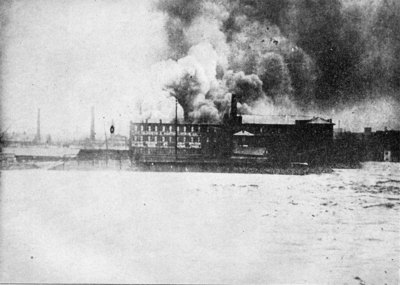
the river with people on their roofs. Several fires in the submerged
district added to the horrors. Refugees slept in public buildings, while
militia helped the police patrol the streets, which were in total
darkness.
It was estimated that over 10,000 persons were homeless on the west side
as a result of the flood and that at least 15,000 were living on the
second floors of their homes. Only about ten per cent of the street cars
were able to operate and steam railroad and suburban lines were tied up.
Damage amounting to $30,000 was done by fires in the west side during
the afternoon, which for a time threatened greater damage owing to the
water supply being cut off. Even had there been water, most of the
fire-fighting facilities were on the east side of the city and unable to
reach the section affected.
GREAT AREA UNDER WATER
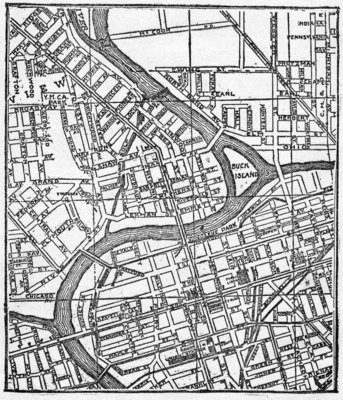
Bridges connecting the west side with the eastern portion of Columbus
were swept away shortly after noon. Dozens of smaller bridges went down.
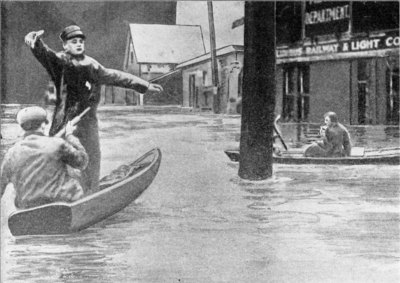
Hundreds of men were marooned in factories on the west side, and police
and National Guardsmen were making rescues in boats where it was
possible. All street car traffic was abandoned. Fifteen hundred homes
were flooded.
With a great roar the levee at the foot of Broad Street let go shortly
before eleven o'clock, sending down a deluge of water that swelled the
Scioto River and covered a great area. Several small buildings
collapsed. Just before the break the police ordered all persons in the
lowlands to leave their homes quickly and flee for high land. All fire
and police apparatus assisted in the work. The residents were told not
to stop for clothes or valuables.
The Sandusky Street levee also collapsed, permitting the water to wash
out a railroad embankment and pour into all the low districts between
the river and Sandusky Street. With water to the hubs, a horse-drawn
wagon galloped out West Broad Street filled with police, who shouted as
they went a warning to all to fly to the hills.
While being swept down the channel of the swollen Scioto River just as
darkness was gathering late in the day, a man, woman and child were
rescued from the roof of a house that had been torn from its foundation
by the flood. Two other children of the same family fell into the water
and were drowned.
THE MILITIA IN CONTROL
State troops at the order of Governor Cox patrolled the streets in the
flooded sections of the city and scores of automobiles were busy
carrying the suffering to higher ground.
Meantime, the rain which began Sunday night continued, at times
moderately and at other times in torrents. The fact that the water had
already destroyed several bridges and broken a levee gave cause for the
alarm that other levees might break and further damage result.
Because of the proportions of the flood, which washed out nearly every
bridge of steam and electric roads leading out of Columbus, nearly all
train service was annulled.
Floodgates were closed against all trains coming in or going out of
Columbus on all roads except the Norfolk and Western. A train on that
road practically swam into the Union Station at 9 P. M. after having
crept along through high waters for most of the run from Portsmouth to
Columbus.
During the day several trains on roads from the East were detoured
through Columbus over the Norfolk and Western, but this was discontinued
because of washed-out bridges between Columbus and Pittsburgh and other
points. Norfolk and Western officials said they had no assurance that
they would be able to operate any trains from here.
Ten solid miles of Pullman and other trains, including the Twentieth
Century Flyer, on the Pennsylvania Railroad, extended from Lima to
Lafayette, held up by a wash-out. Repairs allowed the trains to move on
about eleven o'clock.
In taking charge of the relief work Governor Cox issued an order
directing Adjutant-General John C. Speaks to call out the entire
National Guard of the state for duty in the flooded districts.
BRIDGES SWEPT AWAY
Bridges were swept away, barring those who would have fled to places of
safety. The rush of waters caught hundreds in their homes, and as the
darkness fell the scramble to escape became wild and foreboding. Those
who were able to do anything sent their appeals for aid to outlying
cities before the wires had absolutely failed.
Added to the terrors of flood and darkness was that of fire. In the wild
rush for places of safety that followed the first warning of the danger
from the bursting levees, lamps were toppled over, electric wires were
crossed and soon flames were mounting high in many sections of the city.
Representative H. S. Bigelow introduced a bill in the legislature to
appropriate $100,000 for the flood sufferers in Ohio, the money to be
handled under the direction of the Governor.
With no change in the number of reported dead in this city, estimates on
Wednesday placed the probable dead at from one hundred to one hundred
and fifty. Columbus was still being drenched and torn by flood waters of
the Scioto and Olentangy Rivers. The scene of devastation on the west
side was partly made visible to residents of other sections of the city
for the first time in two days. The isolation of the western section
again became real when the last remaining bridge gave way before the
torrents.
Numerous persons who were considered conservative asserted that they saw
scores of bodies float down stream and dozens of persons carried away in
their houses.
Miss Esther Eis, rescued from her home on the west side, said she saw
the house with George Griffin, wife and seven children collapse and
disappear, and another house containing John Way, wife and five
children, break up in the flood.
Besides the actual tragedies that were enacted in connection with the
flood the most exciting incident occurred at the announcement that the
storage dam, several miles north of the city, had broken, sending its
great flood to augment that of the Scioto River.
The scene that followed was one of wild panic in all parts of the city.
Patrolmen, soldiers and citizens in automobiles, tooting horns, ringing
gongs and calling through megaphones a warning to every one to seek
safety in the higher parts of the east side, sent thousands in flight,
while many, stunned by the supposed impending disaster, collapsed from
fear or gave way to hysteria.
It was more than an hour before the report was officially denied. Police
officials assert that the report was made to them by persons connected
with the military end of the patrols.
City officials said that the storage dam was holding fast against the
millions of gallons of water that were being poured against it, and they
expressed confidence that it would continue to do so despite the great
pressure upon it.
The Governor telegraphed the War Department at Washington, asking that
50,000 tents and 100,000 rations be made available for use and
distribution by the Ohio National Guard.
Governor Cox also sent out appeals for aid to the Governors of all the
border States of Ohio, including Pennsylvania, West Virginia, Michigan,
Indiana and Kentucky. Tents and provisions were badly needed, according
to the Governor's appeal.
After working all night in the Adjutant-General's office in the State
House, officers of the Ohio National Guard reported that they had
succeeded in assembling 3,500 militiamen, ready for service in the flood
districts.
Mobilized at all points of the state, companies and regiments of the
Ohio military force started at daybreak on Wednesday for the stricken
cities and towns as soon as arrangements for their transportation, the
most serious problem confronting the militia headquarters, could be
arranged. The relief which they carried was held back by the lack of
railroad facilities everywhere.
THE RELIEF OF THE VICTIMS
Howard Elting, president of the Chicago Association of Commerce,
telegraphed Governor Cox that citizens of Chicago were raising a relief
fund for flood sufferers.
"I am pleased to state," the telegram said, "that $100,000 will be
placed at the disposal of Ohio through the American Red Cross Society."
The Senate passed the Lowry Bill making appropriation for the relief of
the flood sufferers, but increased the amount to $500,000.
The action was taken in response to the following message from the
Governor:
"The flood disaster that has befallen our state is of such magnitude in
loss of life and human suffering that I respectfully urge upon your
honorable body the importance and propriety of making an appropriation
for the succor of those in distress.
"May I further suggest that it be of such size and made with such
dispatch as to reflect the great heart and resource of our
commonwealth?"
THE EXTENT OF THE DISASTER
On Thursday it was apparent that the part of the city between Central
and Sandusky Avenues was almost wiped out, and estimates of the death
toll of the flood in this city ran into the hundreds.
It was not until Thursday when the waters began to recede, and after two
nights of horror, during which hundreds of people clung to the
housetops, while others sought safety in trees, that the fact dawned
upon the inhabitants that their city had been visited by as great a
calamity perhaps as that which had fallen upon the Miami Valley.
The bodies of 200 persons lay huddled in the United Brethren Church on
Avondale Avenue, according to O. H. Ossman, an undertaker, who explored
the flood district in a rowboat.
He said this report was made to him by a man who said he had been able
to reach the building and look through the windows. Police who sought to
confirm the story were unable to reach the church because of the
current.
Ossman said nineteen bodies had been taken to his undertaking rooms and
that he has been asked to be prepared to care for sixty-nine other
bodies. He said he counted fully two hundred bodies in wreckage on West
Park Avenue.
Members of searching parties who were able to explore the west side of
the city, south of Broad Street, for the first time reported that that
section was a scene of vast desolation for a great area, much of it
being still under water.
The names of more than a half hundred persons were placed under the
caption "known dead," while the list of probable dead was too great to
be collated at that time. The number of missing and unaccounted for, it
was said, would reach far into the hundreds.
An Associated Press operator, who was marooned for hours in the flood
after it broke early Tuesday, reached the Columbus office Thursday after
having traveled by a circuitous route covering more than forty-five
miles in order to get into the main portion of the city.
He saw more than a score of bodies washed through the flood, and said
that house after house was carried away in the flood. Many of the small
frame cottages were wrenched to pieces by the currents and their
occupants thrown into the water to be seen no more.
It was believed that many bodies would be found at the Sandusky Street
bridge or lodged against such part of it as was left in the river at
that point. Further exploration of that part of the west side was begun
Thursday afternoon.
Because she had no home after she was rescued from the flood district,
Miss Florence P. Shaner and William G. Wahlenmaier were married. They
had intended being married in May. The girl was rescued by Wahlenmaier.
Her mother was drowned and their home swept away.
STORIES OF THE HORROR
Other men who had ventured into the flood district told corresponding
stories of awful loss of life. To add to the horrors of the situation
reports reached the State House that the buildings in the flood-swept
district were being looted by men in rowboats. To meet this emergency
and to better patrol the west side, which is under martial law, Governor
Cox ordered Troop B of the National Guard to patrol the ruined section
of the city. It was believed the cavalrymen could cover more territory
than foot soldiers.
As the waters receded the militia guarded the west side under
arrangements made between the Adjutant-General's department and Chairman
Nass of the Columbus Relief Committee.
Hundreds of people were still marooned in flooded homes, their rescue up
to that time being impossible because of the swift current of the
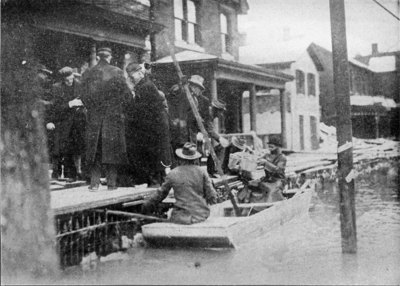
river. Rescued people in dire straits were brought to the City Hall in a
stream all day, where people by the hundreds waited to obtain news of
missing relatives and friends.
Families were separated, and men, women and children stood night and day
at the edge of the water waiting for the flood to subside that they
might reach abandoned homes.
The body of a man was suspended in a tree near Glenwood Avenue, beyond
reach of the rescuing parties. Other bodies were among debris washed up
on the edge of the waters in the southwest end of the city. Near this
debris were two submerged street cars.
Many of the refugees were in state institutions on the high ground at
the west end. The water fell several feet and some of the streets
inundated could be traversed, but in the lowlands, where it was feared
the greater number of dead would be found, it was several days before a
thorough search could be instituted.
Many of the refugees were in a pitiable condition when rescued. They
were benumbed by the cold and suffering from hunger and exposure.
FOUR BORN AS OTHERS DIE
Colonel D. N. Oyser, an attache of the city sanitary department,
reported that two truckloads of bodies were removed from one point on
the west side.
The cold wave which struck the section Wednesday night caused many to
freeze, lose their grip, and drop into the water.
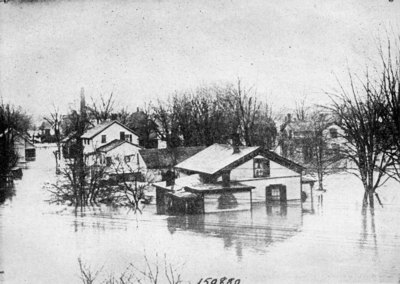
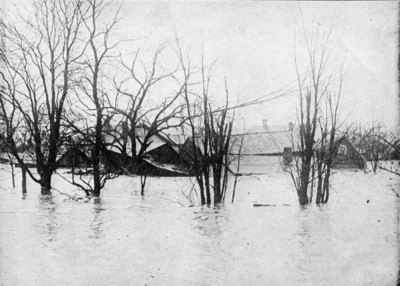
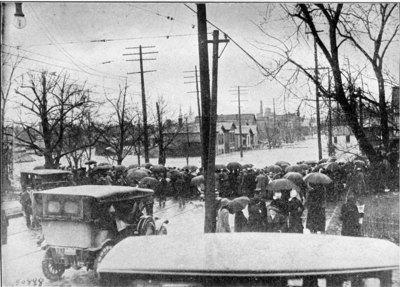
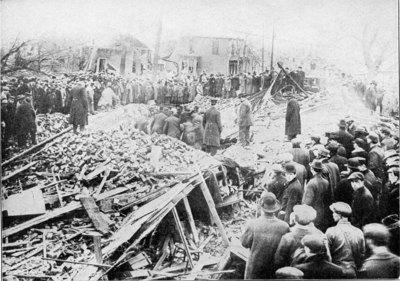
Copyright by Underwood & Underwood, N. Y. Part of the residential section of Fremont, Ohio, flooded. The water reached to the second story of the houses
link to high-resolution image
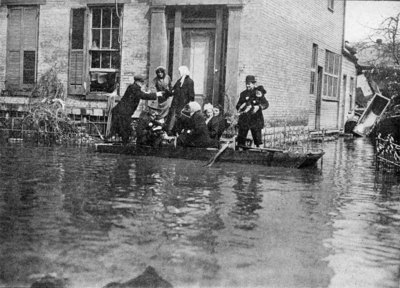
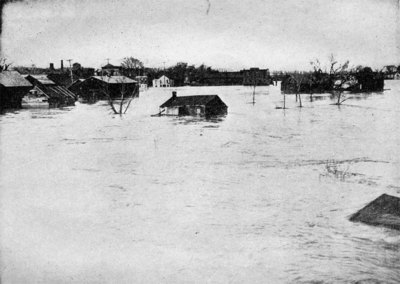
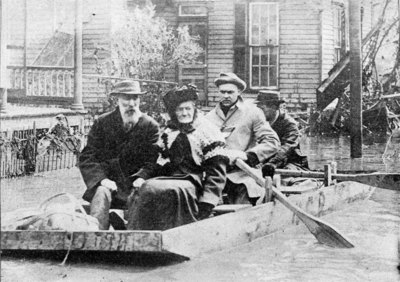
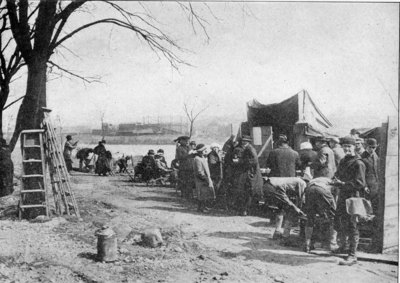
Copyright by George Grantham Bain. Carrying on the work of rescuing Dayton flood sufferers from their houses in the boats made for the purpose at the National Cash Register Factory
link to high-resolution image
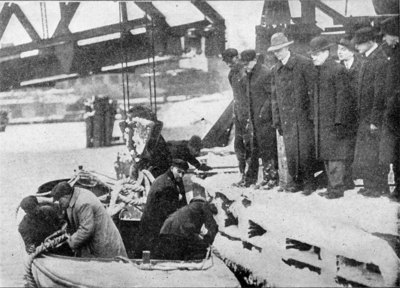
With military glasses rescuers standing on the Baltimore and Ohio
Railroad near Center Avenue could see several dead forms lying on the
roof of a building to the east.
Four babies were reported to have been born in a school house on the
hilltop.
According to those who invaded the stricken district, the churches, big
state institutions and storerooms in the hilltop section were crowded
with refugees. They tell stories of indescribable horrors.
Former Mayor George S. Marshall, who was in telephone communication with
Cecil Randall, his law partner, said that Mr. Randall estimated the
death toll at several hundreds. Throngs of excited groups of people from
the flood-stricken section of the city who were crowded into the
temporary rescue quarters asserted that the estimate of Mr. Randall was
not exaggerated.
Neither the extent of the awful tragedies enacted during the sweeping
away of homes nor the exact death tolls could be known for days until
the mass of wreckage, houses and uprooted trees which were strewn on the
level lowlands south of the city were uncovered. This mass of debris was
under several feet of water, with swift currents running in many
directions.
Many of those rescued told of escaping from their homes by fractions of
minutes, just before the rushing waters swept their homes away and
crushed them like eggshells against bridges. Scores of entire families,
these people assert, were swept down with their houses in the swift
current.
Every available inch of space in the Columbus State Hospital for the
Insane and Mt. Carmel Hospital on the hilltop was occupied by refugees.
Fire Chief Lauer, who was marooned on the hilltop beyond the flooded
section, reaching that point of safety in his automobile just before the
waters swept the lowlands, said that he saw scores of people standing on
their porches as the waters swept down and that he could not see how
scarcely any of them escaped.
After two nights of horror, during which hundreds clung to housetops
calling for help until their voices gave way, while dozens perched in
the branches of trees, many were still beyond the reach of rescuers.
ORDERS TO SHOOT LOOTERS
J. W. Gaver, Justice of the Peace at Briggsdale, swore in several
deputies and armed them, with instructions to shoot down all looters.
Relief trains from Marysville and London, bearing food and clothing,
relieved the situation in the refugee quarters on the hilltop, where
hundreds of homeless were waiting news from relatives.
Relief work was directed toward rescuing two hundred and fifty from the
marooned plant of the Sun Manufacturing Company, where they had been
imprisoned for two days without food or heat. One boat which got within
hailing distance before it was stopped by the swirling current was
informed that conditions were terrible.
With a blinding snowstorm and the temperature falling, gnawed by hunger
and suffering from the cold, the thousands of flood sufferers of the
state faced the uncertainties which the freezing temperature was adding
to their plight.
Although some of the early morning reports said flood waters were
receding slowly in some of the flooded sections there was scarcely a
perceptible change in the flood height. In other places, even though
receding, the water was still of such height as to maroon the sufferers,
many of whom were suffering from exposure which followed their clinging
throughout the night to some points of vantage above the murky waters.
All were facing the chilly winds, blinding rain, sleet and snow.
Governor Cox issued a proclamation declaring a holiday in all districts
flooded in Ohio for the next ten days. This was done to protect
negotiable paper that might be subject to presentation.
Hundreds of the refugees harbored in the various relief stations and in
private homes just outside of the flooded district were separated from
relatives, and many of them believed that lost sons or daughters,
fathers or mothers had perished.
The authorities were fearful of looting in the flood district and the
militia, under strict orders, in several cases arrested rescue workers
and interfered with their work, suspecting them of looting. A large
quantity of supplies was transported to the flood district by automobile
and rail, and the refugees were made comfortable as fast as they could
be released from the grip of the waters.
RECOVERING THE DEAD
Thursday's bodies were recovered from jams of driftwood that had piled
up along the shallow shores of the flood. All of them were badly
mutilated and in several cases identification was difficult. The
authorities organized a squad of men to cover the entire inundated area
in the search of bodies. Up to date fifty-one known dead had been
reported.
Hundreds of those whose homes were in the flooded district, but who were
marooned in the business section of the city, away from their families,
were able to get to the flood section Thursday by a circuitous route
about twenty-five miles long. All manner of vehicles and pedestrians
crowded the road throughout the day, and at the end of the way pathetic
reunions of families separated since Tuesday took place in the muddy,
flood-swept streets.
Daniel A. Poling, general secretary of the Ohio Christian Endeavor
Society, issued an appeal to the 160,000 Christian Endeavorers in the
state, urging them to forward contributions to state headquarters.
West Columbus remained virtually under martial law. Militia companies on
duty were ordered to shoot looters on sight. Thousands of curious people
and those with friends and relatives in the flooded districts were kept
out of the west side by police and troopers. The city relief station, at
the city hall, and the newspapers maintained and compiled lists of the
rescued, as well as lists of the dead.
By Friday order was being rapidly evolved out of chaos, and missing
loved ones were being accounted for by hundreds. Ample shelter and food
were being provided for the thousands of homeless.
Flood waters drained off from the devastated districts, railroad service
was slowly resumed and telegraph and telephone wires were being
restrung.
GOVERNOR COX INDEFATIGABLE
For three days Governor Cox tirelessly accomplished the work of a dozen
men, laboring from daylight to long past midnight to aid the
unfortunates of Ohio. His hand guided everything done in the work of
rescue and on Friday he turned his attention to new problems of
preventing epidemics, safeguarding life and property, relieving the
sufferings of surviving flood victims and the care of the dead.
The hero of the Dayton disaster, John A. Bell, the telephone official
who, marooned in a business block had been keeping Governor Cox informed
every half hour of conditions in the stricken city and delivering orders
through boatmen who rowed to his window, called the State House at
daybreak and greeted the Executive with a cheery "Good morning,
Governor. The sun is shining in Dayton."
But sunshine gave way to a blizzard like a snowstorm later in the day
and the reports coming from Bell were less cheering as the day advanced.
On Friday the Governor seized the railways to insure passage of relief
trains and to keep sightseers and looters away from the afflicted
municipalities.
The entire military force of Ohio was on duty in the flooded districts,
which included practically the entire state. Because of the interrupted
communications headquarters had not been able to keep fully in touch
with the movements of all the troops. The officers in command in most
cases had to determine routes and procure their own transportation.
Under the most difficult conditions they uniformly showed both energy
and ingenuity in reaching their destination.
Estimates of the flood death list in Columbus continued to range from
fifty to five hundred, although these figures represented largely
opinions of officials on duty in the flood zone. The efforts of the
authorities were directed almost entirely to relieving the suffering of
those marooned in houses in the territory under water, and until all of
these had been rescued the search for the dead did not begin in earnest.
The waters receded slowly on Friday and the swirling currents abated a
trifle, allowing the rescue boats a wider area of activity.
ORGANIZING RELIEF
George F. Unmacht, civil service clerk, connected with the
quartermaster's department of the United States army, stationed at
Chicago, arrived in Columbus Friday to assist in directing the
distribution of supplies. Rations for 300,000 arrived together with
tents for 20,000 persons; 100 hospital tents, 400 stoves, 29,000
blankets, 8,900 cots, 100 ranges.
Officers at Columbus were ordered to report at Fort Wayne, Cincinnati,
Youngstown and Hamilton, while a hospital corps was sent to the Columbus
barracks.
The Governor's attention on Friday was devoted largely to organization
of the work of relief. He received telegrams notifying him of
collections of more than $250,000. A New York newspaper had sent
$150,000 subscribed to a fund it raised. Word was received that the
Chicago Chamber of Commerce had raised $200,000, half of which had been
forwarded to Ohio. Judge Alton B. Parker subscribed $5,000 and James J.
Hill $5,000. A thousand dollars was sent from Walkerville, Ontario.
Governor Dunne wired that a bill appropriating $100,000 for Ohio flood
sufferers had been introduced in the Illinois Legislature, while
Governor Osborne telegraphed that the Michigan Assembly had appropriated
$20,000.
Colonel Myron T. Herrick, of Cleveland, Ambassador to France, cabled his
deep anxiety over the Ohio disaster, and Governor Cox in reply asked him
to call a meeting of the Ohio Society in Paris and wire funds, saying
the losses exceeded the San Francisco earthquake.
The Ohio Society of Georgia wired the Governor it was sorry and it too
was invited to show how much it was sorry.
HUNGRY REFUGEES SEIZE FOOD
The need for relief was indicated when a company of telephone linemen
working outside of Columbus had their supplies taken from them by hungry
flood refugees.
Governor Cox recalled some of his former comments on the need of
expenditures for the National Guard. "The National Guard," he said, "has
saved itself. Its efficiency has been a revelation to me." In the
organization so promptly effected by the Governor the moment the floods
came, his most efficient aid came from Adjutant-General Speaks and the
National Guard officers, and with the Guard the work of rescue and of
maintaining order was made possible. The officers and men performed
every duty faithfully.
Martial law prevailed in most of the stricken cities and the soldiers
prevented the looting of the abandoned houses and cared for the
refugees.
Colonel Wilson, of the Paymaster's Department, was made financial
officer as well as treasurer of the relief funds. Under his direction
and the Governor's supervision the Ohio relief commission prepared for a
War Department audit, as is required by the Red Cross Society. The
Governor demanded that there should be but one relief committee in the
state, and to that end the local committees formed were subordinate to
the state commission.
INCIDENTS OF HEROISM
The work of rescue brought out many striking incidents of personal
heroism.
From two o'clock Tuesday afternoon until nearly nightfall Wednesday
Charles W. Underwood, a carpenter of this city, held two babes in his
arms while he clung to the branch of a tree near the Greenlawn Cemetery,
where he had been carried fully a mile by the current. One babe was his
own, the other belonged to a neighbor, and as he clung to them he saw
his own twelve-year-old daughter on another limb of the same tree weaken
from exposure and die, her frail body swaying limply as it hung over the
branch. He also saw a woman refugee in the same tree weaken and fall
into the swirling waters. Underwood and the babes were finally rescued.
Two hundred and thirty-three souls marooned in the building of the Sun
Manufacturing Company succeeded in sending out a note by messenger,
praising the work of John Brady, who, with a skiff, after his home was
swept away, rescued two hundred men, women and children and brought them
to the Sun plant.
"Track out at Columbus because of floods," was the message that Albert
E. Dutoit, a Hocking Valley Railway engineer, read when his train was
stopped Wednesday at Walbridge, near Toledo. His heart gave a bound,
for he knew his family must be threatened. He detached his engine from
the train and started on his race with death. Like mad he shot his
engine across the country between there and Columbus. All night
Wednesday he tried to get through the military lines and succeeded on
Thursday. He induced men in motor boats to rescue his family. In a few
more moments, he had his eight-months-old baby in one arm with the other
around the waist of his wife. The reunion brought tears of sympathy to
the eyes of the rescuers.
Mrs. Emil Wallace, living southwest of the city, in the lowlands, ran
toward a hill when she saw the onrushing waters. She reached safety just
as the water was up to her neck. Her home was submerged.
A street car was washed a quarter of a mile away from the track. The
conductor and half a dozen passengers were drowned like rats in a trap
before they could get out of the car.
Two unknown men lost their lives while trying to save a twelve-year-old
girl from a raft floating near Greenlawn Avenue. On horseback the men
fought desperately against the swift current of the flood until at last
they were carried away.
Nearly one hundred babies were born in the flood district and in the
refuge camps between Tuesday morning and Saturday. In the majority of
cases neither the mothers nor the babies received any medical attention.
Many of the babies died from exposure.
As the sun broke through a fringe of clouds Saturday morning it looked
down upon scenes of utter devastation in the stricken west side of this
city, where a mighty torrent of water had rendered what was a prosperous
and happy community of 40,000 souls into a place of death, want and
disaster.
SCENES OF PATHOS
The scenes were full of human pathos. Torn bodies, disfigured almost
beyond recognition, were being dug from debris. Whole families, marooned
for four long days and nights in the upper stories of houses that had
escaped as if by miracle, many of them without food or water and in fear
of constant death by flood or flame, were being reached by rescuers.
Many of those rescued were in a critical condition from the long hours
they had spent in the bitter cold—their clothing soaked by the
incessant rainfall of three days and nights and no fuel or bedding with
which to combat their fearful condition. The water was subsiding
materially and the work of rescue was thus made easier.
The work of the searching parties in the flooded district increased the
list of bodies recovered from the water to sixty-one. All of these were
lodged in the temporary morgue, and most of them were identified.
Accurate estimates of the dead were still impossible. Safety Director
Bargar said not more than one hundred had been drowned. Coroner Benkert
asserted that the loss of life would reach 200, while former Mayor
Marshall, commanding the rescue workers in the southern end of the
flooded district held that both estimates were too high.
Of the sixty-one bodies recovered twenty-seven had been identified.
Estimates placed property loss at from $15,000,000 to $30,000,000. But
no one seemed to care about the monetary loss. The city was staggered by
the weight of human suffering.
Governor Cox received a telegram from D. T. McCabe, vice-president of
the Pennsylvania Lines, offering to transport free of charge all relief
supplies to points in the flooded area of the state if properly
consigned to the relief authorities. The Governor also received a
telegram from Governor Ralston, of Indiana, saying that ten carloads of
supplies had been started for Ohio points by Indiana relief
organizations.
Approximately one thousand persons, refugees from the Dayton flood,
arrived in Columbus on Saturday, most of them having made their way by
automobile and trains. As if pursued by tragedy, it fell to them that
their landing place in this city should be within the radius of the
recently-flooded hilltop district of the west side. The arrival of the
refugees was unexpected and no arrangements had been made to care for
them. Adjutant-General John C. Speaks was notified and said that the
state would do the best that could be done to provide them with food and
shelter. General Speaks said that the local relief committees were being
sorely taxed, but that he had been advised by the Columbus relief
committees that they would give all possible assistance in housing and
feeding the Dayton arrivals.
Scores of transfer wagons traversed the inundated streets carrying
relief to the hundreds marooned in the upper stories of houses. An
element adding to the difficulty of the situation was the refusal of
hundreds to leave their homes in the submerged district. This despite
the fact that they were compelled to live in damp upper stories, with
little heat or cooking facilities and in the face of threatened illness.
"We've saved our bedding and furniture, and that's all we have," said
one of these. "We are not going to take any chances of losing that."
City Health Officer Dr. Louis Kahn ordered an immediate cleaning up. The
health authorities also called attention to the necessity of boiling all
water for drinking purposes.
Miss Mabel Boardman, head of the Red Cross Society, reached Cincinnati
Saturday night. She came to confer with Governor Cox. The Governor again
asserted that the property damage caused by the floods in Ohio would
aggregate $300,000,000, and that this amount would be increased by the
high water in the Ohio River.
With the water fast receding in Columbus and the danger stage passed,
the food problem promised on Sunday to become the most serious for the
relief workers to solve.
Mayor Hunt, of Cincinnati, had been sending food to Dayton and other
places, but on Saturday as the flood descended upon his own city from
the upper reaches of the Ohio River, he put an embargo on further
exports of provisions. Though fifty-five carloads of provisions
consigned to the state were in Columbus last night, and supply trains
were headed for Ohio from Chicago, Washington, New York and other
places, Governor Cox was by no means reassured that the relief in sight
would be sufficient.
All of the people in the marooned district were reached and those
willing to leave their homes were brought over to the east side of the
city and cared for in hospitals, private homes or temporary places of
refuge. Boats and other contrivances were in constant use carrying
provisions and fuel to those who could not leave their homes. Eight more
bodies were recovered.
A majority of the rescued presented a pitiable sight, some hardly able
to stand on their feet and others, thinly clad and benumbed by the cold,
trembled as they were lifted into the boats. The hospitals were crowded
with people dangerously ill from days of exposure.
The morgues, hospitals and places of refuge were constantly besieged by
people looking for lost relatives. Those received related tales of
horror and heroism unparalleled except in great disasters like the
Titanic or Johnstown.
A year-old baby, wrapped in a blanket, was washed ashore in front of the
gates of the state institution for feeble-minded. Although chilled by
the water the child was soon revived. Pinned to its underclothing was a
piece of paper, upon which the name, "Walter Taylor," was written. The
boy was restored to his parents, Mr. and Mrs. Theodore Taylor,
twenty-four hours later. The family had been penned in its home for two
days. As the water rose gradually the parents moved to the second floor
and then to the attic. Finally the father was forced to hold the child
for hours above his head. Climbing out to the roof as a last resort, the
baby was swept away and the parents had given it up for dead.
Governor H. D. Hatfield, of West Virginia, arrived in Columbus at seven
o'clock Sunday night on a special train from Charleston. The train
brought supplies, motor boats and skiffs. The motor boats and skiffs
were later taken through the different sections of the city to rescue
hundreds who were marooned. The local military company took charge of
the rescue work and pushed it forward as rapidly as conditions would
permit.
The sum of $50,000 was raised by voluntary contributions in Columbus for
a relief fund. In addition, the city council voted $75,000, and great
stores of provisions and clothing were contributed by local people and
outsiders. Thousands of the homeless people were cared for in homes of
those willing to share them, or in public halls. One thousand were fed
daily in the Masonic Temple.
In a statement full of feeling, issued Sunday evening, shortly before he
left the Executive office for home and the first full night's rest he
has had in more than a week, Governor Cox said:
"Refreshed by the tears of the American people, Ohio stands ready from
today to meet the crisis alone.
"Ohio has risen from the floods. Such a pitiless blow from Nature as we
sustained would have wiped out society and destroyed governments in
other days. We cannot speak our gratitude to President Wilson for
federal aid, to the Red Cross, to states, municipalities, trade
organizations and individuals that sent funds and supplies. They will
never know their contribution to humanity.
"The relief situation, so far as food and clothing are concerned, is in
hand. Thankful to her friends who succored her, Ohio faces tomorrow
serene and confident."
Governor Cox and members of the Legislature began on Monday an outline
of reconstructive legislation, to be followed in all of the flood
districts by the state. It was decided that the San Francisco relief
plan should be placed into effect for the Ohio flood sufferers. Under
this plan the relief was based upon property loss of the individual and
the income loss incurred. The amount of relief each person received was
prorated on such a basis.
Upon the recommendation of Governor Cox, the Legislature recessed until
next Monday, thereby giving state officials a week to formulate plans.
Resolutions warmly thanking the citizens of New York State and
Pennsylvania for their flood relief contributions were passed.
All that human effort could accomplish on Tuesday failed to penetrate
the part of the debris piled in the west side, where, it was believed,
many of the bodies of persons missing finally would be recovered. As
matters stood Tuesday night, however, eight more bodies had passed
through the morgues.
In addition to this number, was the body of James M. Kearney, a
merchant, who was drowned several months ago, and which, cast up by the
flood, was found lodged in a tree when the waters had receded. That many
other bodies would be recovered after the army of men employed in the
work had attacked the great pile of debris made at several points by
wrecked homes was generally conceded.
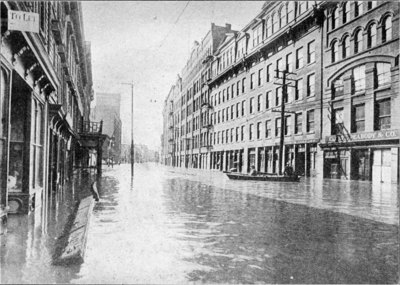
Copyright by Underwood & Underwood, N. Y. View of River Street In Troy, New York, showing the Collar, Cuff and Shirt Factory of Cluett, Peabody & Company, the largest of its kind in the world, closed on account of the floods. Thousands of people were thrown out of work on account of the overflowing of the Hudson
link to high-resolution image
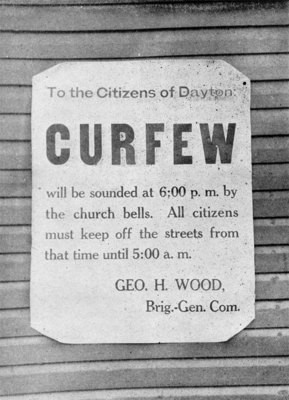
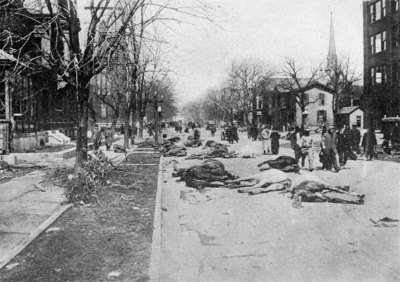
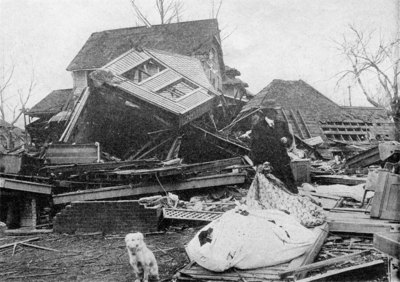
Photograph by Underwood & Underwood. Under the martial law established at Dayton, citizens were kept off the streets at night as a precaution against looting
LOSS BY DEATH AND OF PROPERTY
Four more bodies were recovered Wednesday from flood wreckage, making
the total of bodies found in this city stand at eighty-four. Of these
all except seven were identified.
Coroner Benkert, who made a wide-spread investigation among families,
some members of which were among the missing, said that he estimated
that at least one hundred and twenty-five bodies would be recovered. It
was expected that other bodies that had been washed down the river would
never be identified as Columbus victims.
The property damage in Columbus, like the death toll, was confined
principally to the west side, the business and manufacturing districts
having gone almost unscathed.
THE WORK OF RECONSTRUCTION
Governor Cox and the State Relief Commission on Tuesday left on a tour
of the state to visit cities and districts that were hit hardest by the
flood to determine what relief was necessary in each case. Before their
departure, however, conditions in Columbus were fast approaching normal,
and the residents with a cheerful, courageous spirit had commenced the
repair of their devastated city.
CHAPTER VIII — Columbus: the Beautiful Capital of Ohio
CAPITAL OF OHIO SINCE 1810—EARLY HISTORY—CITY OF BEAUTIFUL
STREETS AND RESIDENCES—SPLENDID PUBLIC COMMODITIES—TRADE AND
INDUSTRIES—CHARACTERISTICS OF ITS RESIDENTS.
Columbus, Ohio, the capital of the state and the county seat of Franklin
County, is located at the center of the state at the junction of the
Scioto and Olentangy Rivers, on a slightly elevated alluvial plain, and
is nearly equidistant from Cincinnati, southwest; Cleveland, northeast;
Toledo, northwest; and Marietta, southeast, the average distance from
these points being one hundred and fifteen miles. It has a population of
some 180,000.
Columbus was made the capital by the legislature in 1810, and became the
permanent capital in 1816, the original territorial and state capital
having been Chillicothe. The first state buildings were of brick, and
cost $85,000. The present massive buildings and additions are of dressed
native gray limestone, in the Doric style of architecture. They cover
nearly three acres of ground, and their total cost has been $2,500,000.
CITY OF BEAUTIFUL STREETS AND RESIDENCES
As early as 1812 Columbus was surveyed in rectangular squares; it was
incorporated as a village in 1816, and chartered as a city in 1834. In
general outline the city resembles a Maltese cross. It extends eight
miles north and south, and seven miles east and west on its arms of
expansion. Its longest streets, High and Broad, bisect the city north
and south, and east and west respectively. The uniform width of the
former is one hundred feet, and the breadth of the latter is one hundred
and twenty feet. Broad Street is planted with four rows of shade-trees
for its entire length east of Capitol Square, where it penetrates the
fashionable residence district. High Street is the leading business
thoroughfare. Capitol Square, a miniature park of ten acres, is situated
at the intersection of these streets, two squares east of the Scioto
River. The residence portions of the city contain many beautiful homes
and fine mansions. There are numerous apartment buildings; the houses of
the average people are substantial and comfortable. On the business
streets are many handsome, commodious blocks; many steel, brick and
stone office buildings, as well as commodious railway buildings and
stations. The streets are wide, well paved and lighted, and are kept in
good condition.
SPLENDID PUBLIC COMMODITIES
The police and fire departments are excellent; the water supply is pure
and ample, and the sewerage system good. The waterworks are owned by the
city. A large municipal electric-lighting plant was completed in 1908.
Natural gas is the principal fuel for domestic use. Bituminous coal, in
unlimited quantities, is found a few miles to the south.
The church buildings of Columbus include those of the following
religious denominations: Methodist Episcopal, United Presbyterian, Roman
Catholic, Lutheran, Baptist, Disciples, Friends, Christian Scientist,
Evangelical, Jewish, Independent German Protestant, German Evangelical
Protestant, African Methodist Episcopal, Seventh Day Adventists and
United Brethren. The newspapers and periodicals include English and
German dailies, secular weeklies, and trade, professional, religious,
fraternal and other publications. There are numerous public school
buildings, four being devoted to high-school purposes. Among
institutions for higher education are the Ohio State University, Capital
City University and the Evangelical Theological Seminary. Professional
schools include one dental and three medical colleges, and a law school;
and there are also private and religious educational institutions.
Columbus is the location of a state hospital for the insane; state
institutes for the education of deaf mutes, blind and imbecile youth;
the Ohio penitentiary; county, city and memorial buildings; five opera
houses; and a board of trade building. There are five public parks and a
United States military post, Fort Columbus. This post, known also as
Columbus Barracks, was originally an arsenal, and now has quarters for
eight companies of infantry.
From Columbus steam railroads radiate to all parts of the state,
intersecting all through lines running east, west, northwest, northeast
and south; and interurban lines connect with a model street-railway
system.
TRADE AND INDUSTRIES
Columbus is near the Ohio coal and iron fields, and has an extensive
trade in coal, but its largest industrial interests are in manufactures,
among which the more important are foundry and machine products, boots
and shoes, patent medicines, carriages and wagons, malt liquors,
oleomargarine, iron and steel, and steam railway cars. There are several
large quarries adjacent to the city.
CHARACTERISTICS OF ITS RESIDENTS
The citizens of Columbus possess the characteristic push and enterprise
of western people, and much of the culture and artistic taste of those
in the east. The population is drawn chiefly from the counties in the
state, and especially from those which are centrally located. The
largest foreign elements are German, Irish, Welsh, English and Italian,
and include scattered groups and individuals from almost every civilized
and semi-civilized country in the world.
CHAPTER IX — Cincinnati: A New Center of Peril
A GREAT MANUFACTURING CITY—THE TUESDAY CLOUDBURST—ANXIOUS
WAITING—HOMES SUBMERGED—FACTORIES FORCED TO CLOSE—THE SITUATION
EVER GRAVER—EXPLOSIONS IN THE CITY—THE CRISIS—FLOOD DAMAGE.
Scarcely had Dayton, Columbus and Zanesville begun their real battle for
restoration when Cincinnati became a new peril center. Situated on the
Ohio River at the point where the Muskingum, Scioto, the two Miamis, and
the Licking were pouring their millions of gallons of flood water into
the river, the city was bound to suffer. It seemed as if the Buckeye
State would never be able to escape from the clutches of the great demon
of flood.
A GREAT MANUFACTURING CITY
Cincinnati is the county seat of Hamilton County, in the extreme
southwest of the state, one of the great commercial and manufacturing
centers of the Union, tenth in nominal rank, and seventh or eighth in
fact. It is situated on the north bank of the Ohio River, almost exactly
half way from its origin at Pittsburgh to its mouth at Cairo, Illinois.
On the western side of the city from west to south runs Mill Creek, the
remains of a once glacial stream, whose gently sloping valley, half a
mile or more wide, forms an easy path into the heart of the city, and
was an indispensable factor in determining its position. Highways,
canals and railroads come through it, and the city's growth has pushed
much farther up this valley than in other directions. The railroad
stockyards are on its eastern slope. Cincinnati extends for about
fourteen miles along the river front, to a width of about five in an
irregular block north from it, but attains a width of six or seven miles
at the extreme point along the creek valley.
The bottom level below the bluffs along the riverside is the seat of the
river shipping business, and has as well the usual fringe of low
quarters; it is paved, and there is a broad public landing fronted by
floating docks, wharf-boats, etc. Above are the wholesale and then the
retail business streets, with great extent and variety of fine business
architecture, and gridironed with electric roads. The principal lines
converge at or near Fountain Square, and connect with a ring of
beautiful suburbs, within and without the city limits, unsurpassed in
America.
Among the sights of interest is the busy public landing or levee. The
Grand Central Depot, a terminal of several of the largest roads, is
centrally situated near the river. Among the most prominent buildings
are that of the United States Government Custom House, the City Hall,
the City Hospital, the Springer Music Hall, the Odd Fellows and Masonic
Temples, the Public Library, with 431,875 volumes, and the Museum of
Natural History. St. Peter's Cathedral, St. Paul's Protestant Episcopal
Cathedral, St. Paul's Methodist Episcopal Church, the First and Second
Presbyterian Churches, and the Jewish Synagogue are handsome edifices.
Fine hotels and theaters are numerous. The biennial musical festivals
are famous.
THE TUESDAY CLOUDBURST
The troubles of Cincinnati began on Tuesday, March 25th, when the city
experienced a cloudburst that started the gauge rising in the Ohio
River, temporarily flooded the streets of the city and carried away two
bridges over the White Water River, at Valley Junction a short distance
to the south.
PREPARING FOR THE WORST
By Thursday Cincinnati was facing one of the worst floods in her
history. It had rained steadily for twenty-four hours. The flood had
entered several business houses in the lower section during the night
and early morning found the entire "bottoms" a sea of moving vans,
working up to their capacity. At eight o'clock in the evening the gauge
showed 60, a rise of more than three feet since the same hour that
morning.
East and west of the city on the Ohio side of the river the lowlands
were inundated and much damage done. In the low sections of the city
many houses were flooded and the inhabitants of these sections fled to
higher ground.
Across the river at Newport and Covington, Kentucky suburbs of
Cincinnati, similar conditions prevailed and the police early warned
dwellers of the danger that threatened. Dayton and Ludlow, other
Kentucky suburbs, were also sufferers from the rising flood and many
houses were already completely under water.
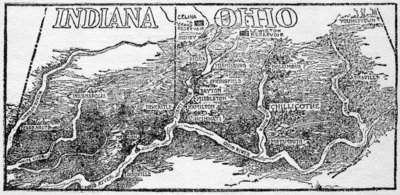
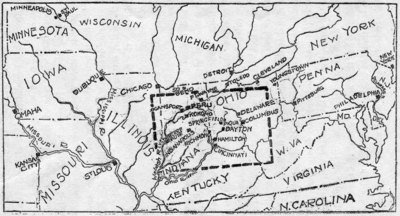
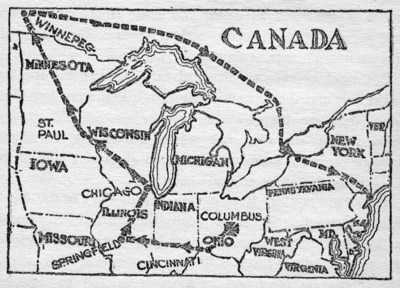
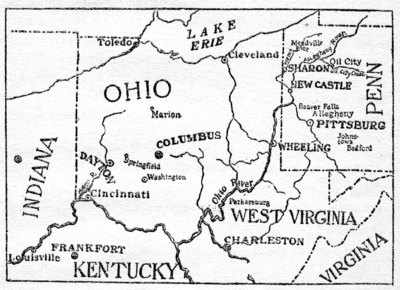
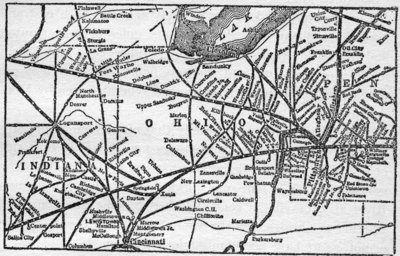
TOPOGRAPHY OF STRICKEN SECTION OF TWO STATES
Practically every town and city shown in this illustration suffered from the floods, most of them from loss of life and all of them from property damage.
link to high-resolution image
A seventy-foot stage for Cincinnati was predicted. The Central Union
Station was abandoned and all trains leaving or entering the city were
detoured.
ANXIOUS WAITING
Slowly the treacherous waters rose while tired watchers waited
anxiously. Conditions were not acute but distressing. The people knew
that they must face conditions worse than the present. All the lowland
to the west and east of the city had been submerged and also along the
water front of the business section the commercial houses were gradually
disappearing under the yellow river. Hundreds of families along the
river front in Cincinnati had been forced to move by the encroaching
river and many merchants had removed their goods from cellars and
basements to higher ground.
Chief of Police Copeland, however, had the flood work well in hand. The
police were put on twelve-hour duty and worked in the flooded territory
in rowboats.
The city armory sheltered many persons and preparations were made to
distribute food at the city jail. Nearly every landing place along the
river front was piled high with furniture, bedding and other household
effects.
HOMES SUBMERGED
Along the Kentucky shore conditions rapidly became worse. At Covington
more than five hundred houses were submerged and their occupants given
shelter and protection in public buildings.
Plans were formulated to care for flood sufferers, and a meeting was
held at Covington at which arrangements were made to raise a sufficient
fund for the poor. At the same time arrangements also were made for
policing the flood zone and preventing looting.
The river-front section of Ludlow was deep under water and the residents
had moved. Bromley was entirely cut off from other neighboring towns.
Dayton, Kentucky, and other nearby small towns were in the same isolated
condition, and there was much suffering in consequence.
FACTORIES FORCED TO CLOSE
Many of the large manufacturing plants closed because operatives were
unable to reach their places of employment.
Newport, which, with Covington, is directly opposite Cincinnati, forming
the larger of the suburban sections, was in almost as bad a case as its
neighboring city. The flood of water had risen in all parts of the town.
One of the bridges across the Ohio had been closed, and the authorities
were preparing to close others to the public, thus cutting off the south
shore from communication with Cincinnati, and also closing practically
the only railway outlet the latter city had to the South and East.
No food shortage was anticipated, but warnings were issued by the mayor
of this and other nearby cities that merchants must not take advantage
of the situation to charge extortionate prices. All attempts of this
nature in Cincinnati were promptly curbed by the authorities.
THE SITUATION EVER GRAVER
With nearly 15,000 persons in the towns on the Kentucky side of the Ohio
River driven from their homes by the rising flood that was sweeping down
the Ohio Valley and with more than 3,500 homes altogether or partly
submerged, the flood situation in the vicinity of Cincinnati on Saturday
was assuming graver proportions hourly.
The water reached the second floor of a number of business houses along
Front Street and was half way up on the first floor of several blocks of
houses on Second Street. Several lines of the Cincinnati Traction
Company, operating in the lower district were abandoned. Reassuring word
from the packers, commission men and general produce merchants came
early in the day, when it was estimated by experts that Cincinnati had
enough food supplies to last at least ten days without inconveniencing
any one.
Railway service into and out of Cincinnati was virtually at a
standstill. The Louisville and Nashville trains were leaving the city
for the West on time, but arriving trains were much delayed.
So far only one life had been lost as a direct result of the high waters
here. Miss Anna Smith, the first victim, drowned in an attempt to reach
Newport in a skiff that capsized in midstream. Her three men companions
were rescued while swimming to shore.
KENTUCKY SUBURBS IN TROUBLE
Newport and Covington were virtually surrounded by water. Conditions
there were worse than elsewhere and nearly ten thousand people were
driven from their homes. Relief measures, however, were adequate.
Manufacturing plants in the lowlands ceased.
In these two cities the only fear was that health conditions would be
seriously affected because of the clogging of the sewage system and the
stagnation of back water. The water works and gas plants continued in
operation, but the electric light plants had been forced to cease.
In the Kentucky towns of Dayton, Ludlow, Bellevue and Bromley identical
conditions existed, but in their cases all communication with
Cincinnati, Newport and Covington was suspended. These towns remained in
isolation until the water had fallen sufficiently to permit the
operation of street cars on the south side of the river.
In these towns there were 2,000 persons cared for by relief committees.
More than 500 homes disappeared under the flood waters. Property damage
assumed alarming proportions, especially as this was the second time
within three months that the Ohio Valley had suffered from high water.
By Sunday the outlook for Cincinnati was brighter. No trains had gone
out of the city except south to Kentucky by way of Covington, and rail
and telegraph communications were still badly demoralized, but fair,
warm weather which had continued since Thursday had greatly helped the
complex situation. It was predicted that the river would reach its
greatest height at Cincinnati on Monday.
EXPLOSIONS IN THE CITY
Spreading over a vast expanse of territory in Cincinnati, as well as an
almost equal amount in the various towns that lie along the river on the
Kentucky shore, the Ohio continued to rise.
During Saturday night the central part of the city was thrown into a
semi-panic by an explosion that could be heard for miles. The Union
Carbide Company, at Pearl and Elm Streets, had been destroyed in an
explosion caused supposedly by the carbide coming in contact with
water.
The river reached the stage of 69.3 feet at noon, Saturday, and
continued to rise at the rate of two-tenths of a foot every two hours.
Two companies of the Ninth United States Infantry, stationed at Fort
Thomas, Kentucky, were held in readiness to march at an instant's notice
to Covington, where Mayor George S. Phillips feared the city might be in
need of military protection due to high water that virtually surrounded
the town. When the river stage reached more than 68 feet on Friday the
gas plants were put out of commission and the city was in darkness.
Of the few important towns in Kentucky, opposite Cincinnati, only one,
Newport, maintained direct communication with Cincinnati. Through
Newport communication was obtained with Covington by a circuitous route.
In Newport there were already under water nearly one hundred and twenty
square blocks, located in the section along the south bank of the Ohio
River. The other towns, Bromley, Dayton and Ludlow, were still without
outside communication, but reports from there were that there was no
immediate need of assistance.
THE CRISIS
The river continued to mount. It rose two-tenths of a foot during Monday
night and early Tuesday the stage was 69.8 feet. The weather forecaster,
Devereaux, said he expected the river to rise another tenth, after which
it probably would recede. Up-river points reported the river either
stationary or falling slowly.
At midnight Tuesday the river began to fall. The whole city breathed a
sigh of relief. The Government stated that the river would be inside its
banks within a week.
FLOOD DAMAGE
The direct and indirect damage caused in Cincinnati by the flooding of
the river-front and low-lying residential sections was very great. An
estimate of the indirect loss can never be made, while the direct loss
is placed at more than $2,000,000.
Across the river in the Kentucky suburbs conditions were deplorable.
Estimates were that one thousand homes there had been inundated and that
more than four thousand persons were homeless.
CHAPTER X — The Flood in Western Ohio
DISTRESS IN BELLEFONTAINE—PIQUA DELUGED—TROY A HEAVY
SUFFERER—MIAMI ON THE RAMPAGE AT MIDDLETOWN—HAMILTON HARD
HIT—BIG RESERVOIRS THREATENING—OLENTANGY RIVER A LAKE AT
DELAWARE—FLOOD AT SPRINGFIELD—NEW RICHMOND UNDER WATER.
The rushing torrent of water that swept down the Miami River, surging
over Dayton, devastated a score or more of towns in its mad course from
the creeks around Bellefontaine to the point southwest of Cincinnati
where the waters of the Miami merge with those of the Ohio.
DISTRESS IN BELLEFONTAINE
Cries of distress arose from Bellefontaine on Wednesday, March 26th. At
that time millions of gallons of water were pounding against the banks
of the Lewiston reservoir, fifteen miles from Bellefontaine, and it was
feared that if the increasing flood should burst the banks the lives of
every inhabitant of the Lower Miami Valley would be imperiled.
The immense reservoir at Lewiston did burst its banks between Lake View
and Russell's Point and swept through the great Miami Valley like a
tidal wave. It was this vast quantity of water, added to the already
overflowing river, that inundated the cities of Sidney and Piqua.
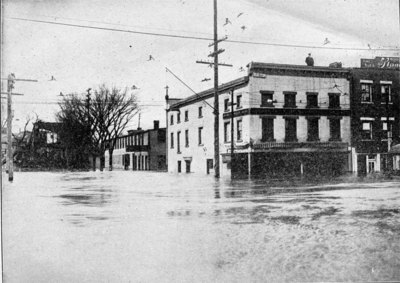
Photograph by Underwood & Underwood, N. Y. The engraving shows a view of Broadway, Watervliet, New York, the principal business street of that city, covered with eight feet of water
link to high-resolution image
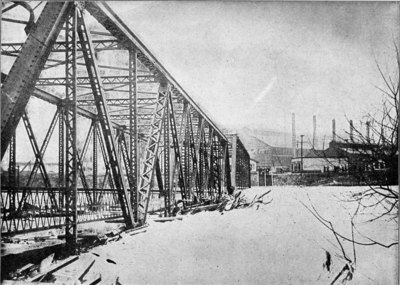
Copyright by Underwood & Underwood, N. Y. The bridge shown in the illustration leads to the Carnegie Steel Company at Youngstown, Ohio. Ordinarily this bridge is far enough above the water to allow the large river steamers to pass under
link to high-resolution image
At Sidney there was no loss of life, but the town was badly flooded and
early reports of loss of life ran high.
PIQUA DELUGED
The flooded Miami swept over Piqua in a great deluge. The water reached
the first floor of the Plaza Hotel, which is situated in the high part
of the city. Panic-stricken the people fled from their homes or sought
refuge in the upper stories of high buildings. Fire broke out in many
places. At one point in the city the water was twelve feet deep. Many
persons were drowned. Many lost all their possessions.
Relief measures were taken by city authorities. The property loss was
great, as most of the manufacturing plants were destroyed by the flood.
A company of militia from Covington maintained order and cared for those
made destitute by the flood.
TROY A HEAVY SUFFERER
The town of Troy was also a heavy sufferer. The state troops who arrived
in the town on March 27th with provisions for Dayton were stranded.
One-third of the town was cut off from gas, electricity and water
supply. A train load of provisions arrived. The provisions were
carefully distributed.
One-half of the state troops left on foot for Dayton, following the
tracks of the railroad.
MIAMISBURG CUT OFF
Miamisburg, a town of eight thousand, was cut off for days. When news
finally reached neighboring towns the death list was estimated at
twenty-five. Later estimates placed it at less. Only one body has been
recovered, but the property damage ran high.
MIAMI ON THE RAMPAGE AT MIDDLETOWN
As the result of the worst cloudburst known in twenty years the great
bridge over the Miami River, at Middletown, was carried out on March
25th. Fifteen persons were afterward missing and scores of houses could
be seen floating down the stream. The water and electric light plants
were out of commission.
Two hundred houses were under water, their former occupants finding
shelter in the school houses, churches and city buildings. The great
Miami River was a mile wide at this point.
The city was practically cut off from the outside world. Tracks of both
the Big Four and Cincinnati, Hamilton and Dayton Railroads were under
water and no trains were running. The tracks of the Ohio Electric
Railway were washed out in many places. A portion of the state dam in
the Miami River, north of Middletown, was washed away.
Water from the river started the Maimi and Erie Canal on a rampage and
submerged half of Lakeside, a suburb. The families of Harold Gillespie
and Mrs. Mary Fisher were forced to flee from their homes in their night
clothes.
The casualty list could not be estimated with accuracy. It was believed
that from fifty to one hundred had been claimed by the waters.
About three o'clock the following morning the river began to fall
slowly, but the situation was still dangerous. Supplies were rapidly
running out, and a food famine was looked for. Misery was averted by the
arrival of food late Thursday night, but building of fires was not
permitted. The authorities feared an outbreak of flames similar to the
Dayton conflagration. Ten thousand of the eighteen thousand population
were homeless.
HAMILTON HARD HIT
Of all the cities in the Miami Valley with the exception of Dayton,
Hamilton was hardest hit. Many persons killed, a thousand houses wrecked
by the rushing torrent and 15,000 homeless was the toll of the flood in
this city and environs, and the harrowing scenes attending flood
disasters in the past decade faded into insignificance when compared
with the havoc wrought by the latest deluge.
Before darkness blotted out the scene on March 25th, house after house,
with the occupants clinging to the roofs and screaming for help, floated
on the breast of the flood, but the cries for help had to go unanswered
because of the lack of boats. What little rescue work there was
accomplished was done before night came on, as the rescuers were
powerless after darkness.
The city was then without light of any kind, the electric light and gas
plants being ten feet under water. Soldiers rushed to this city from
Columbus were in charge of the situation, the town being under martial
law.
The victims of the raging waters were caught like rats in a trap, so
fast did the flood pour in on them, and few had even a fighting chance
for their lives. Ghastly in the extreme was the situation. The cries of
the women and children as they faced inevitable death, and the frantic
but unsuccessful efforts of husbands and fathers to rescue loved ones,
presented a scene that will go down in the history of world's
catastrophes as one of the worst on record.
Fire added to the horror of the situation when shortly after midnight
the plant of the Champion Coated Paper Company, which is six blocks long
by one block wide, broke into flames. In less than a quarter of an hour
the entire factory was a mass of fire and there was no chance of
checking its progress in the least as the water service needed by the
fire department was put out of commission early in the day.
The Beckett Company's paper mill, valued at $500,000 for buildings and
equipment, collapsed into the flood the following morning.
SUFFERING AMONG THE REFUGEES
On Wednesday, March 26th, the river began to fall at the rate of nine
inches an hour. After the season of awful horror the change brought
hope. The work of rescue and relief, however, was exceedingly difficult.
There were only a few boats that could be used in the work of rescue
and relief. Ohio National Guardsmen who arrived from Cincinnati Tuesday
night did heroic work. They came in four motor trucks and brought food
and clothing with them. One of the trucks returned to Cincinnati for
more boats.
A relief train arrived from Indianapolis Wednesday morning and other
cars and automobile trucks, loaded with supplies, managed to reach the
outskirts of the city.
The Lakeview Hotel, which had previously housed fifty refugees,
collapsed early Wednesday, but all the occupants left in time to escape
death.
Williamsdale, Cooke, Otto and Overpeck, the north suburbs of Hamilton,
were in ruins. On the west side of the river many residences were saved,
but there was despair among the survivors, who were unable to get word
from husbands and fathers who were caught on the east side and unable to
cross after bridges were destroyed. Efforts to get lines across the
river were futile.
Provisions for the homeless continued arriving in abundance, but the
gas, electric light and water plants were in ruins and this added to the
terrors of the living.
More than two hundred and fifty persons spent two days and nights in the
little court house without light, food, water or heat, and often they
were drenched with rain that leaked through holes in the roof.
REMOVING THE DEAD
As the flood waters receded on March 27th, the authorities immediately
began the work of removing the dead. The first hour of the search saw
ten bodies uncovered from the ruins, and the most conservative estimates
placed the death roll at fifty.
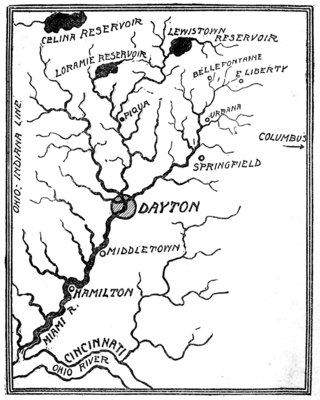
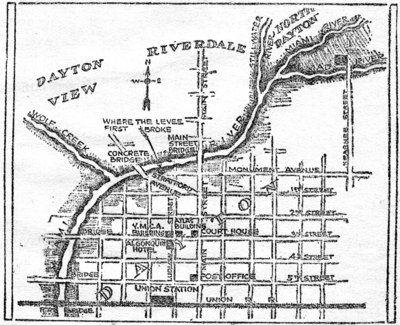
THE FLOOD IN MIAMI VALLEY
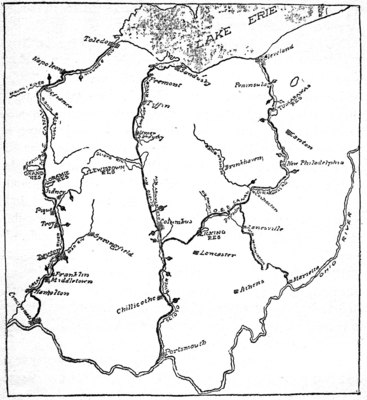
The above map shows a part of Ohio which was devastated by the most disastrous flood in American history. A large number of small streams converge into larger streams and then into still larger water courses, several of which form a junction at Dayton, where the greatest loss of life and the heaviest damage to property occurred.
link to high-resolution image
Piled high upon the east side of the court house on Friday were coffins
awaiting the flood victims, whose bodies were being gathered as rapidly
as possible.
On April 3d, the city offered a reward of ten dollars for each body
recovered from the debris left by the flood. Up to that time seventy-one
bodies had been recovered. It was believed, however, that many bodies
had been swept out of the Miami into the Ohio River and perhaps would
never be found.
DAMAGE OF $4,000,000
Secretary Garrison, of the War Department, who toured the flood district
of Hamilton on March 30th, as the personal representative of President
Wilson, was told that the property loss was estimated at $4,000,000.
With Secretary Garrison were Major-General Wood, chief of staff of the
army, and Major McCoy. They permeated the very heart of the city through
zones of devastation which in many respects rivaled in horror those
through which they passed in Dayton. They saw block after block in both
the residential and business sections of the city, where street lines
virtually were eliminated by upheaved and overturned houses jammed
against each other and against the buildings which withstood the shock,
in great and almost unbroken heaps of debris.
South Lebanon was cut off from Lebanon by a raging current that swept
all the surrounding farm lands, entailing a property loss of thousands
of dollars. All rivers and creeks south of Dayton to Lebanon were
swollen by a heavy rainfall.
The flooding of the Miami at Cleves, seven miles below Cincinnati,
caused the railroad embankment to break and that part of the town was
under fifteen feet of water. The operator at Cleves said he distinctly
heard cries for help, but he could not learn if there was any loss of
life or the extent of the property damage.
The following day the waters had receded, but part of the city was still
under water; no loss of life was reported. Hartwell and the vicinity
felt the force of the rising Mill Creek caused by the breaking of the
canal at Lockland. The large factories at Ivorydale were forced to close
down, and many thousands of employees were thrown out of work.
BIG RESERVOIRS THREATENING
The Grand Reservoir at Celina, Ohio, in the extreme western part of the
state, seriously threatened Celina and the adjacent towns. For two days
the very worst was feared, but on March 28th, the river was slightly
lower and no water was flowing over the banks.
OLENTANGY RIVER A LAKE AT DELAWARE
The Olentangy River, ordinarily only a creek, became a lake that covered
most of Delaware. In many places people were left clinging to trees,
roof-tops and telegraph poles crying for assistance. The work of rescue
was practically impossible because of the swift current of the flood,
and most of those who were seen trying to save themselves were swept
away to death.
The village of Stratford, five miles to the south, was entirely under
water and the loss great. Property damage in Delaware itself was
estimated at $2,000,000.
FLOOD AT SPRINGFIELD
Springfield suffered the worst flood in its history. Both Buck Creek and
Mad River broke from their banks and flooded the lowlands. Several
hundred houses in the eastern section of the city were surrounded by
water. They contained families who refused to abandon their homes. Many
factories were compelled to close.
There was no loss of life, but intense suffering due to insufficient
food supply and the destruction of many homes.
NEW RICHMOND UNDER WATER
The flooding of the Ohio in the southwestern part of the state caused
disaster in many other towns besides Cincinnati. On April 1st the entire
town of New Richmond was under water. The people took up quarters on the
hills surrounding the town. Provisions were received from Batavia and
there was no suffering. No one was reported dead or missing.
At Moscow, near New Richmond, fifty houses were washed from their
foundations.
CHAPTER XI — The Flood in Northern Ohio
YOUNGSTOWN AND GIRARD—CLEVELAND AND ITS SUBURBS—AKRON—MASSILON,
FREMONT AND TIFFIN.
No section of the country suffered more extensively from the flood than
Ohio, of which state no part seemed to escape. In the northern counties
the loss of life and damage to property were quite as extensive as in
many other parts.
Fed by incessant rains, the Mahoning River rose at the rate of
seven-eighths of an inch per hour until it reached a stage of
twenty-five feet, which was ten feet higher than ever before recorded.
Every large industrial plant in the city was flooded and fully 25,000
workmen were out of employment.
The financial loss to the Youngstown Sheet and Tube Company, Republic
Iron and Steel Company, Carnegie Steel Company and other plants easily
reached $2,500,000, while the loss in wages to men was extremely heavy
because of the fact that weeks elapsed before the industries were again
able to operate at full capacity. Fully 14,000 workmen employed in
various industries of the city are thrown out of employment as a result
of the high water.
At East Youngstown the Mahoning River was nearly half a mile wide and
the Pennsylvania lines through the city and for a number of miles east
were entirely submerged. The Austintown branch bridge of the Erie, which
crosses the Mahoning River, was weighted down with a train to prevent
its being washed away, the water having already reached the girders.
Every bridge was guarded by policemen.
But one pump was working at the water-works pumping station. The flood
was the worst experienced by Youngstown since October, 1911, when
millions of dollars of damage was done.
Two hundred families were temporarily homeless, but the Chamber of
Commerce with a relief fund of $10,000, attended promptly to their
welfare.
Youngstown's only water supply during the flood was from the Republic
Rubber Company, pumping 3,000,000 gallons a day, and the Mahoning Valley
Water Company, which turned 4,000,000 gallons a day into the city mains
from its reservoir at Struthers.
At Girard, northeast of Youngstown, Mrs. Frank Captis, who was rescued
just before her home was swept away in the flood, gave birth to a baby
boy at the home of a friend, where she was taken. The baby was named
Noah.
CLEVELAND AND ITS SUBURBS
At Cleveland scores of families were driven out of their homes by the
greatest flood in the city's history. Many narrow escapes from drowning
were reported from all over the city, where people were being
transferred in rowboats by police and other rescuers.
One big bridge, in the heart of the city, used by the New York Central
lines, went down. The steel steamer, "Mack," moored to it was unharmed.
All traffic was kept off the bridge and no one was hurt. The loss
exceeds $75,000. Other bridges were in danger. Boats broke from their
moorings and battered the shore. Dynamite was used to open a way for the
water into the lake. Great damage was done all along the Cuyahoga River
through Cleveland, where hundreds of big manufacturing plants are
located. Fifty thousand men were idle. The telegraph companies were
crippled and many lights were out throughout the city, as the
electric-light plants were partly under water. All the suburbs suffered
severely.
All railroad traffic in Cleveland was suspended because of washouts and
no trains entered or left. The Lake Shore Railroad tracks along the
shore of Lake Erie were thought immune, but that road suffered along
with the Big Four, Pennsylvania and Wheeling and Lake Erie.
Boston, Ohio, and Peninsula, Ohio, between twenty-five and twenty-eight
miles south of Cleveland, on the Cuyahoga River, were submerged.
The dam of the Cleveland and Akron Bag Company went out at four o'clock
Thursday morning, March 27th, dropping thousands of tons of water into
the valley in which the two villages, with a total population of about
four thousand five hundred, are located.
AKRON
The big state reservoir three miles south of Akron, which supplies water
for the Ohio Canal, broke Tuesday afternoon at two o'clock, sending a
flood of millions of gallons of water which swept away farmhouses and
other buildings from the banks of the canal and damaged several million
dollars' worth of property.
The huge volume of water which had been gathering in the three
hundred-acre reservoir caused a report that there was danger of the
concrete walls bursting. Most of those living near the canal sought
refuge in Akron.
When the heavy rain continued over night the dam began to show signs of
wear. Cracks in the concrete appeared. All during the night horses were
kept saddled to carry the news ahead if the danger became imminent. When
the masonry showed flaws Thursday morning the riders were sent out. They
started several hours before the dam collapsed, and warned everybody
near the canal in time for them to escape. The rush of water from the
broken dam struck the city within a few minutes after the break.
Most of the bridges in the county were swept away. The city was in total
darkness at night, and telephone and telegraph connections were
destroyed. A few bodies were seen floating down the canal. Many houses
were swept away.
MASSILON, FREMONT AND TIFFIN
At Massilon five known dead, three thousand homeless, half the town
inundated and heavy property damage was the toll of flood water from the
Tuscarawas River. The town was without light and gas. Citizens raised
$11,000 to aid the sufferers.
The effect of the flood at Fremont was very severe. The water in Main
Street was fifteen feet deep. Wires were down and buildings collapsed.
Several lives were lost.
Death and intense suffering marked the great flood which swept clean the
Sandusky valley. Tiffin became a city of desolation. Every bridge went
down, and half the city was under water. Many were carried to death in
the treacherous currents.
CHAPTER XII — The Flood in Eastern Ohio
MOUNT VERNON HARD HIT—MILLERSBURG CUT OFF—THE TUSCARAWAS
RIVER—COSHOCTON IN DISTRESS—ENTIRE CITY OF ZANESVILLE UNDER
WATER—MARIETTA FLOODED—SCIOTO RIVER AT CIRCLEVILLE—STRUGGLES OF
CHILLICOTHE—FLOOD AND FIRE IN PORTSMOUTH—HOMELESS IN EAST
LIVERPOOL AND WELLSVILLE—FLOOD WASHES STEUBENVILLE—HIGHEST FLOOD
IN HISTORY OF GALLIPOLIS—IRONTON REQUESTS AID—A CRITICAL
SITUATION.
In the eastern part of the state there were two great floods, the flood
of the Muskingum River and the flood of the Ohio River. Besides these
there were many local floods of grave importance.
Mount Vernon, in Knox County, was hard hit by the flood. Many lives were
lost, communication was entirely cut off, and thousands of dollars worth
of damage was done. Miles of track on the Pennsylvania, Baltimore and
Ohio Railroads were washed away.
MILLERSBURG COMPLETELY CUT OFF
For two days Millersburg was completely cut off. The river rose four
feet higher than ever before. It swept through the Cleveland, Akron and
Columbus Railroad depot two feet deep, driving everybody out. Water, gas
and electric light were shut off with the exception of one gas line.
Telephone service was limited, hence nothing could be sent or received
for two days—until intermittent communication was re-established.
THE TUSCARAWAS RIVER
The flood in the Tuscarawas River was the worst in its history. All the
lowlands were under water, and a highway bridge west of Dennison was
carried out by the tide. Two bridges on the Baltimore and Ohio, near
Uhrichsville, were washed away, and the village of Lockport was cut off
from all communication. Supplies in Lockport were exhausted and two men
were reported drowned.
Eighteen families were marooned in the school house at Port Washington,
ten miles west of Dennison, on the Tuscarawas River. Operator A. W.
Davis, of the Pan Handle Railroad, was isolated in a signal tower for
several days without food or fire.
Newcomerstown was isolated for four days. All houses in the village,
with the exception of those on Rodney Hill, were flooded by the
Tuscarawas River. There was no death, but great damage.
Conditions throughout the Tuscarawas Valley were very bad. From a point
near Uhrichsville, about one hundred miles west of Pittsburgh, to
Coshocton, a distance of thirty miles, the valley was one great lake.
Thousands of acres of the richest farm lands in Ohio were under water
and the loss of live stock was heavy.
COSHOCTON IN DISTRESS
The Tuscarawas and Walhonding Rivers unite at Coshocton to form the
Muskingum River, and it is the water from these swollen streams that
poured down to Zanesville, thirty-two miles below, and thence to
Marietta.
Reports from points along the Muskingum River, all told the same story
of destruction, flooded towns and great property damage. Many days were
required to restore railway communication.
Above Coshocton on the Walhonding River many villages were flooded and
the loss to farmers was great.
Coshocton itself naturally suffered. A railroad bridge on the Columbus
division of the Pan Handle Railroad went out, and scores of highway
bridges throughout the section were washed away. All the streams were
torrents.
ENTIRE CITY OF ZANESVILLE UNDER WATER
"Entire city under water. It is coming into our office. Have placed the
records as high as I possibly can and have done everything possible. The
building next door has just collapsed and I am compelled to leave now
for safety——"
This message flashed across the wire as the operator at Zanesville fled
for life. With fifteen reported dead, and the Muskingum River at a stage
of forty feet and still rising, the city faced the worst flood in its
history. The big Sixth Street bridge had already been swept away by the
flood, and much of the business section was inundated.
At least two thousand had been driven from their homes by the high
water. Food was growing scarce and the water was threatening the light
and water plants.
The suffering during the night was intense. The temperature took a
sudden drop and the thousands who were forced to spend the night
marooned in buildings or on the hills without heat and proper clothing
presented a spectacle to excite pity.
With the break of day on March 27th, disorder and terror prevailed
throughout the whole city. The Muskingum, in its rampage, was sixteen
feet higher than the previous record mark set in 1898. The city was one
vast lake and the waters covered the valley from hill to hill. Only the
buildings high on the sides of the slopes escaped the ravages of the
deluge. The water varied in depth from one to fifteen feet. Many lives
were sacrificed.
Six hundred buildings were torn from their foundations and swept away by
the mill race currents, while many others collapsed and were hurled
against those still holding.
The water reached a depth of eight inches in the Clarendon and Rogge
hotels at noon on Thursday. The court house was surrounded.
In sections which were bearing the brunt of the deluge little could be
done to relieve the people who were marooned in their houses and in the
large buildings. Every effort was being directed by the city officials
and volunteer relief parties to lend aid to the sufferers, but the
swift, onward rush of the waters made the undertaking extra hazardous.
The authorities turned their efforts toward relieving the suffering of
women and children driven from their homes by the high water, and some
progress had been made. Putnam lay in ruins. Muskingum and Linden
Avenues had been washed out, and where three days before stood many
residences, watchers from the highest buildings saw nothing but a waste
of swirling waters.
MARIETTA FLOODED
The valley between Zanesville and Marietta became a surging lake, which
picked up buildings and everything movable and carried them along with
incredible speed. The loss of property was tremendous.
Marietta suffered from the swollen waters of both the Muskingum and Ohio
Rivers. The situation was serious on Wednesday; by Sunday it was
alarming. At eight o'clock Saturday morning the river had reached the
stage of 60.6 and was still rising. All the business section of the town
was flooded and many residences were under water. There were no public
utilities in operation and food and medical supplies were sorely needed.
There were many rumors concerning loss of life, but the swift current
prevented communication to those parts of the city where persons were
reported drowned.
Immediately upon reciept of the message from Whipple, a station on the
Marietta Branch of the Pennsylvania Railroad, that Marietta was under
water, preparations were made by the railroad company to send out a
relief train from Cambridge. It reached Whipple Saturday night and from
there help was brought to the distressed city.
SCIOTO RIVER AT CIRCLEVILLE
The flooded Scioto River, which surged through the streets of Columbus,
carried destruction down through farm lands and towns to the Ohio River.
Circleville, Chillicothe and Portsmouth, being the principal towns on
the river course, suffered most.
At Circleville on March 26th all the bridges had been washed away, and
the Scioto River stood three feet higher than ever before. Another rise
was promised. The city was cut off from railroad communication, and all
trains on roads entering Circleville were annulled.
STRUGGLES OF CHILLICOTHE
Many dead, one hundred houses washed away, and property loss of
$1,000,000—such was the tale of destruction in Chillicothe. On Friday,
March 28th, the waters had begun to recede, leaving seven bodies hanging
on the Kilgore bridge, three miles south of the city, but it was
impossible to recover them immediately.
Conditions were much improved, the light plant having been able to
resume service, and the water supply also was now adequate. The water
had receded from the streets, and all public utilities resumed
operations.
The homeless refugees were being cared for in the homes which withstood
the flood and in school houses. Provisions were plentiful and there was
no disorder. Many citizens were sworn in as deputy marshals.
The looting problem was one difficulty for the authorities.
Notwithstanding their efforts much looting took place.
Near Omega, to the south, Mr. and Mrs. Hatfield and their family of
seven children were drowned when their home, barn and all their other
buildings were swept down the river.
FLOOD AND FIRE IN PORTSMOUTH
Portsmouth presented a picture of distress as the flood from the swollen
Scioto and Ohio Rivers advanced. On the night of March 27th the Scioto
bridge was swept away by the flood. By morning hundreds of persons had
been driven from their homes, school houses had been thrown open to the
homeless, the streets were filled with household goods and merchants in
the heart of the city were moving their wares to places of safety in
anticipation of flood conditions more serious than ever before.
On March 29th the Ohio River stood at sixty-eight feet, the highest ever
known, and was rising.
Fire broke out in several places and was difficult to control because
the flood had interfered with the water facilities.
Efficient management, however, soon brought the situation under control.
The arrival of the steamers, "Klondike" and "J. I. Ware," on March 31st,
brought sufficient provisions to supply those in need for a week.
HOMELESS IN EAST LIVERPOOL AND WELLSVILLE
We have already seen the swollen waters of the Ohio at Cincinnati,
Portsmouth and Marietta. It remains to treat of the devastation wrought
in other Ohio River towns in the eastern and southern parts.
At East Liverpool on March 27th, more than a thousand families were
driven from their homes, five thousand potters were deprived of
employment temporarily and the city water works were out of commission
as the result of the flood. The electric light plant was seriously
threatened and trolley lines were tied up.
The following day the river had eclipsed the 48.8 foot stage of 1884. A
stage of at least fifty-one feet was expected.
Conditions remained the same, but the situation at Wellsville, a city of
ten thousand, three miles south, was perilous. Over three thousand were
homeless. The city is located on a flat promontory, with the eastern
portion a slight apex against the fast rising stream.
Back water had already made an island of the city, precluding any
possibility of escape to the high hills.
Both East Liverpool and Wellsville were in darkness because of the
shutting down of the power plants. All the river front potteries and
mills were idle. Street railway and railroad traffic was at a
standstill.
Police and fire departments of Wellsville and East Liverpool made many
thrilling rescues during the day. Seven Italians, dumped from a skiff,
were taken from the water half drowned.
Food supplies were diminishing at Wellsville, there was no electricity
or gas, the supply of coal was constantly lessening and the river still
rising.
FLOOD WASHES STEUBENVILLE
At Steubenville the Ohio River at 9 o'clock on March 26th was at the
34.4-foot stage and rising at the rate of seven tenths of an inch an
hour. The west part of the town was under water and twenty-five houses
flooded. Many families were rescued by wagons. Five large manufacturing
plants were forced to close down, throwing 1,300 men out of work.
HIGHEST FLOOD IN HISTORY OF GALLIPOLIS
The river at Gallipolis reached the sixty-seven-foot stage, six feet
higher than ever before, but was gradually falling. The State Hospital
remained unharmed, and was for a time taking care of two hundred people,
while the town was taking care of three hundred. There was no loss of
life. Traffic was at a standstill, and train service into Gallipolis
suspended.
IRONTON REQUESTS AID
Ironton suffered by both flood and fire. A block and a half in the
business center of the city were consumed by fire and several buildings
were dynamited to check the flames. No loss of life occurred.
A citizen of Ironton wired to a friend in Philadelphia:
"Floods here awful. Any charity funds that can be directed here through
clubs or otherwise would be appreciated."
A CRITICAL SITUATION
Even taking into account the tremendous seriousness of the flood in
Dayton and Columbus, the situation all along the Ohio River was one that
called for sympathy and sustained relief. Governor Cox, of Ohio, in one
of his early proclamations covering relief work said:
"There is every indication that the Ohio River will reach the highest
stage in its history. Calls for food and clothing are coming from
unexpected parts of the State. A critical situation has developed in all
Ohio River towns. We are still greatly in need of help."
CHAPTER XIII — The Flood in Eastern Indiana
HORROR OF THE RISING WATER—THE FOUR FLOODS—DISASTER IN
BROOKVILLE—PEOPLE GATHERED IN CHURCHES—NEWS FROM LAUREL—SURGING
FLOOD AT FORT WAYNE.
"Every stream we crossed seemed to be a raging torrent, its waters
racing at top speed," said one traveler who arrived in Chicago on March
26th. "We could hear the swish of the waters and hear the cries of
people in distress," reported another.
Yet these eye-witnesses could not see the worst of the four vast floods
that swept over the state of Indiana, tying up the railroads, rendering
thousands of persons homeless, killing scores of others, wiping out
whole towns. Just how many persons lost their lives in the great floods
will probably never be known.
THE FOUR FLOODS
Indiana had known many devastating floods, but none like to this in
either destructive force or extent. On March 26th three distinct flood
districts prevailed—the eastern part of the state including the valley
of the White Water River and the Fort Wayne territory, the valley of the
White River and its tributaries, and the valley of the Wabash. Later
the flooding of the Ohio River and its tributaries added to the awful
tale of disaster. The entire state was practically one huge sea, and
every brook, creek and river exacted its toll of damage.
The overflow, coming with astonishing suddenness, caught farmers
throughout the state unprepared and the breaking of levees in many
places forced persons living along the rivers to desert their homes. In
the crowded cities it added woe upon woe.
The appalling swiftness with which the waters rose found city as well as
state unprepared. Streams that were brooks Easter morning had become
raging torrents on Tuesday. Persons who retired in apparently safe homes
Monday were rescued the following day from second-story windows with
boats. Lowlands became vast lakes.
The dawn of Wednesday, March 26th, found anxiety in Indiana centered in
Brookville and Connersville, on the White Water River, from which
frantic appeals for aid were received by Governor Ralston.
Other despatches from the same region declared that the smaller towns of
Metamora, Cedar Grove and Prenton were swept away completely.
DISASTER IN BROOKVILLE
Sixteen persons were drowned at Brookville, when they were caught by the
east and west forks of White Water River which meet in that town.
Survivors told of attempts of men, women and children to escape by the
light of lanterns. Cross currents rushing along streets and alleys
carried them down to a united stream a mile wide just south of the town.
Five children, all of one family, were seen clinging to posts of an
old-fashioned wooden bed when they were swept into the main stream and
lost.
The person from Connersville who first talked with the Governor said
that a break in the White Water River levee had flooded the valley,
sweeping many persons before it. After that it was impossible to
re-establish communication even for a few minutes. Militia were ready
all during the night to hurry to the town, but no train was operated in
that direction.
PEOPLE GATHERED IN CHURCHES
Five wagon bridges, the Big Four Railroad bridge, the depot and a paper
mill were utterly destroyed. Fifty summer houses on White Water River
south of Brookville were washed away, foundations and all. People, bowed
down by the calamity, gathered in churches, where religious services
were held. None of the bodies were recovered for several days.
Hall Schuster was drowned Thursday night in an attempt to cross the West
Fork of the White River at Brookville to rescue Harlan Kennedy, a
hermit, formerly a Methodist minister.
Two hundred and fifty children rescued from the flood had only night
clothes. Wagon trains carried food and clothing from Connersville to the
stricken people.
On Friday, March 28th, the list of known dead in Brookville was
sixteen. Heavy loss of property and a food and fuel famine imminent were
the precise situation.
There were six persons missing, and it was feared that they had been
drowned and their bodies washed away or buried in debris that had not
yet been searched.
Brookville was practically under martial law, and twenty men were driven
out of the city after they were discovered looting damaged homes and
buildings.
NEWS FROM LAUREL
News from Laurel reached Connersville on Saturday when Deputy Postmaster
George Lockwood came through on horseback. He said the White Water River
valley, eleven miles around Laurel, was flooded, and the damage
estimated at $300,000.
Four buildings and many small houses were wrecked in Laurel, but no
lives were lost. Several farmers in the valley between Brookville and
Laurel were missing and their houses had disappeared. Several other
towns in the valley were inundated and many houses had been swept away.
SURGING FLOOD AT FORT WAYNE
At Fort Wayne, in the northeastern part of the state at the confluence
of the St. Mary's and the Maumee Rivers, the flood surged for three
days.
A keeper in the Orphan Asylum and five men in a surfboat did splendid
work in saving seventy-five inmates of the asylum from drowning. All
life-saving stations in the flooded district devoted their utmost
efforts to the work of rescue and used their funds and supplies without
stint. The relief work was in every way well organized.
SITUATION UNDER CONTROL
On March 28th, with the flood receding at the rate of three inches an
hour, Fort Wayne had the situation in control and stood ready to assist
its less fortunate neighbors. Many of the refugees were able to get back
into their homes. The property loss was estimated at $4,000,000, and it
was almost certain that the loss of life would not exceed six.
The pumping station had been started up the previous night, two
locomotives sent by the Lake Shore Railroad furnishing the power. The
water was being pumped from the river. The only drinking water available
for several days was brought in bottles.
CHAPTER XIV — The Desolation of Indianapolis and the Valley of the White River
THE TWO FORKS OF THE WHITE RIVER—WORST DAMAGE IN
INDIANAPOLIS—SYSTEMATIC RESCUE WORK—THIEVES BENT ON
PLUNDER—PREDICAMENT OF WEST INDIANAPOLIS—THE RECEDING
WATERS—FLOOD VICTIMS HELPLESS—AN APRIL WEDDING—OTHER TOWNS
AFFECTED.
The two great forks of the White River and their tributaries drain about
half of the area of Indiana. Indianapolis, the capital of the state, is
situated on the West Fork. In this city and more particularly in West
Indianapolis the torrent roaring through the White River valley did its
worst damage.
Hundreds of spectators were watching the river on Tuesday evening, March
25th, when, with a roar that could be heard for blocks, hundreds of tons
of dirt in the Morris Street levee crumbled under the pressure, and
great walls of water rushed through the opening.
Men, women and children fought through the water toward a near-by
bridge, which seemed to offer the only safety. Many houses were torn to
pieces by the rush of the water, and others were carried away. Families
in one-story homes were at the mercy of the sudden rush of water that
followed. The people were literally trapped in their own houses.
OTHER TOWNS AFFECTED
Other towns affected by the flooding of the White River and its
tributaries were Muncie, Elwood, Anderson, Noblesville, Bloomington,
Washington, Newcastle, Rushville, Shelbyville, etc. At Noblesville the
river was the highest it had been in thirty-three years, at Muncie a
dike in the water plant broke and the city was without fire protection.
At Rushville Flat Rock Creek waters rose with a roar, and clanging fire
bells warned the people to flee. The entire business section was
submerged. One person met death in Muncie; one in Newcastle; one in
Rushville, and five in West Indianapolis.
Indianapolis awoke the following morning to find the waters higher than
ever appeared before, with a property loss that two days before would
have been unbelievable. It was hard to bring the full realization of the
damage to the people, who had no thought of a flood from streams that
ordinarily are unimportant, aiding only in beautifying the city's parks
and boulevard driveways.
A NIGHT OF DISASTER AND FEAR
During the night the water advanced upon the exclusive residence section
along Fall Creek. It tore away one bridge, destroyed the city's most
pretentious driveway and forced the families living along its banks to
desert their palatial homes.
A few hours before they had no idea they were in any danger, and were
awakened by the militiamen to be ordered from the threatened buildings,
only to find every hotel in the city full. They were cared for at the
homes of friends.
The Washington Street bridge over the White River that connects
Indianapolis and West Indianapolis, which was closed for traffic late
Tuesday night, in the early morning was torn apart by the waters, the
floor of the structure being carried away.
A DESOLATE CITY
With the breaking of day came the proposition of feeding the refugees.
The city appropriated money to supply immediate needs and a relief fund
was started. Drinking water was at a premium, and water for bathing was
practically unattainable.
Schools were closed, and there was a general suspension of business. The
water in some of the streets north of Fall Creek, only fifteen miles
from the business district, swept everything before it. The street cars
remained standing in the streets where they were stopped when the power
house was flooded. All interurban lines were at a standstill and the
steam roads had poor success in getting trains out of the city.
Passenger trains were shut out of the city on the lines entering from
the West, and the passengers were forced to share the lot of the
homeless refugees.
By Thursday conditions in Indianapolis were such that Governor Ralston
was impelled to issue a proclamation asking for general relief. Five
hundred refugees from West Indianapolis were brought in small boats to
the Blaine Street wharf. Some of these had been clinging to trees for
hours. Others were taken from floating houses. Women with babies were
taken from the upper stories of houses. The refugees said that many had
been killed in Wolf Hall when the floors of that building gave way under
the strain of hundreds who had taken refuge there. Reports of death were
everywhere exaggerated, owing to the difficulty of accurate knowledge
and the shattered nerves of the sufferers.
SYSTEMATIC RESCUE WORK
Systematic rescue work was rendered more difficult by a storm of snow
and sleet. Tomlinson Hall, the great civic gathering place of the city,
was converted into a temporary hospital. The homeless men, women and
children from West Indianapolis, Broad Ripple and other suburbs
devastated by the White River were taken to the hall and were fed and
given medical attention. From Fort Benjamin Harrison 500 blankets and
500 mattresses and cots were obtained. Citizens' committees were in
charge of the work of distributing food and of raising money. It was
estimated that 10,000 persons in Indianapolis alone were in need of
immediate assistance.
The situation was rendered graver by the outbreak of contagious
diseases. Five women rescued and taken to Tomlinson Hall were suffering
from pneumonia, and cases of whooping cough and measles were discovered
among the refugees.
There were numerous cases of pneumonia. Measles and whooping cough
attacked the children. Nearly all of the doctors of the city volunteered
their services and asked for volunteer nurses.
Those suffering from contagious diseases were removed at once and
inspectors from the city board of health aided by a corps of nurses
detailed from various hospitals of the city set to work to prevent
exposure of the refugees to contagion and to take care of the other
sick.
THIEVES BENT ON PLUNDER
Thieves took advantage of the wrecking of lighting plants to plunder
deserted houses and even to rob survivors of the flood. In West
Indianapolis the vandals and robbers became so bold that Governor
Ralston placed that section of the city under martial law and sent a
company of militia to guard the streets. Orders were given to shoot on
sight any one caught at robbery.
PREDICAMENT OF WEST INDIANAPOLIS
The greed of provision dealers angered Governor Ralston to such an
extent that he started an investigation. Before the supply of bread
available on the West Side had been exhausted, loaves were selling at
twenty cents each. The supply of meat was entirely exhausted.
That section of Indianapolis lying west of the river, where martial law
was proclaimed, is the poorest in the city. The supply of meats, eggs,
milk, coffee, bread and butter was practically exhausted before noon.
Little except canned goods remained on the shelves of the grocers.
Relief trains loaded with provisions were unable to enter this district.
Members of the board of public safety and other city officials inspected
the entire flooded district from motor boats and directed efficient
organization of the relief workers, aiding the state troops and state
officials in every possible way.
THE RECEDING WATERS
By Friday the White River had begun to fall slowly, and the work of
caring for the suffering could be prosecuted vigorously. It was
estimated that the property loss in the city and environs would reach
$10,000,000. Part of this loss was in destroyed bridges. The Vandalia
Railroad bridge over the White River went down Friday, carrying with it
ten loaded cars.
By Monday, March 31st, White River waters had returned to almost normal
channel, and the areas that were covered were being searched to locate
the bodies of any who might have been drowned. The city board of health
prepared typhoid serum for 50,000 treatments to aid in warding off an
epidemic. State troops were withdrawn.
On Tuesday hundreds of homes were cleaned and, with furniture which
could be salvaged and that supplied by the Relief Committee, the owners
were able to resume housekeeping. Relief funds were still increasing
and all persons who lost homes or furniture in the flood were being
cared for.
Many persons in the West Indianapolis flood district were treated with
an anti-diphtheria vaccine, and Dr. T. V. Keene, in charge of the
medical relief work in the flooded districts, said he feared no
epidemic.
FLOOD VICTIMS HELPLESS
Hundreds of thousands of dollars were reported necessary to relieve
suffering among the flood refugees in Indianapolis, according to the
report of the General Relief Committee, made on Wednesday, April 2d, at
a meeting in Mayor Shank's office.
Plans for raising a vast sum of money, to be made available immediately
to the sufferers, were discussed and it was decided to start popular
subscriptions and designate places for contributions.
Joseph C. Schaf, one of the investigators for the committee, said:
"The flood victims are helpless. They need money and need it
immediately. The men are trying to hold their jobs and let the women
clean up the homes, and it is a disheartening task for which many are
not physically able. Give them money immediately so they can pile their
water-soaked mattresses and other furniture in the street and touch a
match to it. That will give them new heart."
Mr. Schaf increased his donation by $1,000, and several other members of
the committee did likewise.
CHAPTER XV — The Roaring Torrent of the Wabash
A BITTER TALE OF DESTRUCTION—MANY PEOPLE DRIVEN FROM HOMES—ALARMING
CONDITIONS—THE PLIGHT OF KOKOMO—THE HOMELESS IN WABASH—DISTRESS OF
LOGANSPORT—MILITARY CADETS AID IN RELIEF—NEW DISASTER AT LAFAYETTE—A
SECOND HORROR IN TERRE HAUTE—THE RECEDING WATERS.
Bitter was the tale of destruction in the valley of the Wabash River and
its tributaries. A traveler journeying over the Wabash Railroad on
Easter Sunday would have seen only the usual quiet little towns of the
Middle West; three days later, if he could have looked down over the
same territory he would have seen nothing but a raging torrent sweeping
through the region like some fiendish monster devouring and destroying
as it pursued its mad course. He would have found the entire Wabash
Valley, including Logansport, Wabash, Lafayette and Peru, a desolate
scene, its scores of prosperous cities absolutely paralyzed and cut off
from the outer world. Telephone and telegraph wires were down
everywhere; trains were not running and roads were obliterated.
MANY PEOPLE DRIVEN FROM HOMES
As early as Monday, March 24th, northern Indiana had suffered severe
loss, due to the heavy rains of the previous twenty-four hours, which
had carried away bridges, stopped railroad and interurban traffic,
flooded store basements, driven people from their homes along the river
banks, and washed away houses. At Hartford City there were seven feet of
water in the paper mills and the merchants had lost heavily from flooded
basements.
At Portland water was standing three feet deep in the center of the city
and the loss to merchants from damage to goods reached $100,000.
The wind, which followed heavy rain, cut a path several hundred feet
wide.
At Kokomo the light, heat, power, gas and water plants were out of
commission and the river was still rising. The city was without fire
protection; South Kokomo, with 6,000 inhabitants, was cut off from the
main city.
It was declared to be the worst flood known in Wabash since 1883; and
rain was still falling. Hundreds of residents of the lowlands abandoned
their homes. Interurban traffic was paralyzed.
ALARMING CONDITIONS
Reports on the following day were still more alarming. The worst
conditions prevailed in Kokomo, Wabash, Peru, Logansport, Lafayette and
Terra Haute. Thousands of people all along the Wabash were crying for
food and shelter. Wabash, Kokomo, Peru, Logansport and Lafayette were
entirely cut off from communication with the outside world. A big
snowstorm on the heels of a drop in temperature added to the suffering.
Rescue work was carried on by volunteers, police, firemen and the state
militia, and every place where there was a dry home was thrown open to
the flood refugees.
From many places frantic appeals for aid were received by the state
officials, but lack of all means of transportation and crippled
telephone and telegraph service forced the submerged towns to rely
entirely upon their own resources.
THE PLIGHT OF KOKOMO
At Kokomo the water in some of the streets was eight feet deep and
rushing like a mountain torrent. Schools and business were suspended and
state troops patrolled the town as far as they were able. The homes of a
thousand persons were submerged. No lives were lost, but there were many
narrow escapes. Several persons were rescued from second story windows
by the few boats available. Rafts could not be used because of the
swiftness of the current.
THE HOMELESS IN WABASH
Seven hundred and fifty persons in Wabash were rendered homeless as the
result of the high flood in the river. The city was without gas, water
or lighting facilities.
The mayor on Thursday, March 27th, issued a proclamation ordering that
all saloons and business houses close at six o'clock. He instructed the
police to keep people off the streets.
There was no loss of life, but the property loss was estimated at
$350,000.
There was no communication with the outside world from Monday until
Thursday afternoon.
DISTRESS OF LOGANSPORT
The business district and the south and west sides of Logansport were
under water on Tuesday. The bridge at the country club had been washed
away. Other bridges over the Wabash had been flooded. The moving vans
were unable to handle all the persons trying to move out of the danger
zone and the firemen of the city gave aid. The electric light and water
plants were endangered. There was great suffering among the poorer
people. Logansport was also cut off from telephone and telegraph
communication. Two deaths by drowning were reported (later corrected to
one) and ten houses were washed down stream.
MILITARY CADETS AID IN RELIEF
On Wednesday the flood waters of the Wabash were sixteen feet deep on
the floors of the Pennsylvania Railroad Station, and cadets from the
Culver Military Academy were rushed to the city to aid in the rescue and
relief of scores of people marooned in the business districts.
The Third Street bridge had been swept away. The bridge at Sixth Street
was being washed out. The people were fleeing to the hills, where they
were housed in school houses and churches.
By indirect telephone routes on Thursday, Governor Ralston received an
urgent call from Logansport for troops to aid in rescue work and to
patrol the city. The city had been cut off from reliable communication
with the outside world since Tuesday evening. The continuance of the
high waters added hourly to the heavy property losses, and the snowstorm
and bitter cold caused intense suffering.
NEW DISASTER AT LAFAYETTE
At 2 P. M. on Tuesday, March 25th, two spans of the bridge over the
Wabash River at Lafayette went out, carrying a number of people with it.
Boats below the bridge succeeded in rescuing all but one man.
At 3.15 P. M. West Lafayette, where Purdue University is located, was
cut off from Lafayette by the breaking of one of the levees and the
submerging of the other. The river was two miles wide and business
houses were preparing to move their wares, anticipating a three-foot
rise during the night. No interurban lines were being operated and steam
lines were making little effort to maintain train service.
The business district and the south and west sides of Logansport were
under water. The bridge at the Country Club had been washed away.
A SECOND HORROR IN TERRA HAUTE
All down the length of the Wabash the torrent raged. Hardly recovering
from the daze of the Easter tornado, treated in another chapter, Terra
Haute inside of forty-eight hours faced its second disaster, when the
waters of the Wabash left the banks, flooding part of the residence
section.
The river was then rising at the rate of five inches an hour. Railroad
traffic was suspended and interurban traction service had been
abandoned. Residents of Taylorville, Robertsville and West Terre Haute
deserted their homes, fleeing before the approaching waters. Five
hundred homes were under water and the coal mines near the city were
flooded.
For two days the situation seemed to grow hourly more desperate. On
Thursday the river had reached a stage of thirty-one feet six inches and
was steadily rising. Four thousand persons were homeless, and those
whose homes were on higher ground were without gas or electricity.
Traffic was at a standstill.
THE RECEDING WATERS
But slowly the waters receded and the work of reconstruction was begun.
On down the river the disaster-bringing torrent traveled. Throughout all
southern Indiana the river reached unprecedented stages and hundreds
were driven from their homes. Railroad lines were covered with water
through many counties, and on March 31st the river was reported forty
miles wide between Upton, Indiana, and Carmi, Illinois.
CHAPTER XVI — The Plight of Peru: A Stricken City
LAST MESSAGE FROM PERU—AT ONCE TO THE RESCUE—THOUSANDS MAROONED—TALES
OF STRUGGLE—FAMINE AND DISEASE—GREED ABROAD IN THE CITY—REFUGEES
URGED TO LEAVE—SEARCH FOR THE DEAD—SHAKING OFF DESPAIR.
Of all the cities devastated by flood in Indiana, Peru was the most
desolated. Situated on the Wabash River just below the entrance of the
Mississinewa, it suffered more than any of the stricken cities through
which the angry, swollen waters of the Wabash flowed.
"This probably will be the last message you will get from Peru," said
the man who telegraphed to Governor Ralston on March 25th, asking for
coffins, food and clothing. "Two hundred or more are drowned and the
remainder of the residents are waiting for daylight."
AT ONCE TO THE RESCUE
Governor Ralston immediately communicated with State Senator Fleming at
Fort Wayne and asked him to forward the coffins and other supplies as
requested.
When the messages of distress from Peru were sent forth South Bend and
other cities sprang nobly to the rescue. They found the people half
crazed from exposure, want and fear. One of the rescue party who made
the trip in the first boat that entered the city said:
"The cry to be saved from those who saw the first boat was heartrending.
Some of them threatened to jump into the water if we did not take them
aboard. But it was impossible with the scant boat supply to take all
away at once."
THOUSANDS MAROONED
Relief parties from South Bend were the first to arrive on the scene.
They found hundreds of people huddled together in the court house
square, which was three miles from the nearest dry land; hundreds more
were marooned in the upper stories of buildings already rendered unsafe
by the high water. There was no heat, no light, no water, and sanitary
conditions were horrible. The only motor boat had broken and it was too
dangerous to venture into the raging torrent in rowboats. This made it
impossible for the South Bend relief volunteers to get blankets and food
to the sufferers.
TALES OF STRUGGLE
Death faced hundreds of persons who were clinging to the roofs of
buildings, where they sought refuge. Currents of muddy water from ten to
twenty-five feet deep were running through the main streets at twenty
miles an hour.
Harry Lumley, a despatcher, lay on a table all Wednesday in the Peru
station of the Lake Erie and Western Railroad, which the water had
invaded, and kept open the line for relief trains.
Dr. W. A. Huff, a dentist, started to South Peru with an unknown man
Tuesday night. The boat capsized and Huff lodged in a tree, where he
remained until Wednesday morning. His condition was critical.
No effort was made to count the dead. "Our energies are being devoted
entirely to saving those still living," said Lieutenant-Governor
O'Neill. "It is impossible for us even to try to learn the whereabouts
of the bodies just now."
A VIGILANCE COMMITTEE
Citizens, finding lawlessness in every block of the city above water,
organized a vigilance committee with orders to shoot looters.
On Wednesday night several thousand persons were still marooned in the
court house, hospital, factory buildings and other structures because
the various relief parties sent from South Bend and other cities had not
sufficient boats to carry them to the nearest dry land. Snow was falling
heavily and the suffering was intense, because of the lack of heating
facilities. The city was in darkness, except for a scant supply of
lanterns.
FAMINE AND DISEASE
But the height of the flood had been reached. On Thursday the water was
receding three inches an hour. It had fallen four feet since the
previous morning, but the current was still so swift on Canton Street
and in South Peru, that it was impossible to investigate in rowboats the
district in which the heaviest loss of life was supposed to have
occurred.
There were three inches of snow on the ground and it was still falling.
Recovering from the flood, Peru organized to meet greater menaces,
famine and disease. At a meeting in the courtroom at the county
building, Lieutenant-Governor O'Neill was chosen head of the committee
on organization.
Hundreds of persons marooned in the second stories of their homes
appealed to passing boats for food, fuel and water. Fishermen seized
some of the boats and were taking the curious sightseeing. Persons who
appropriated boats and tied them up were arrested.
There were 500 persons at the Bears Hotel in Peru. Their only fire was a
grate in the lobby. Two meals a day were served. The water had receded
so that a Lake Erie and Western relief train was pulled up to the
canning factory in the northeast part of the town and took out 200
persons marooned three days. They were taken to towns along Lake Erie.
It was estimated that 2,000 persons had left the city and were being
cared for in towns and school houses to the north. The relief committee
discouraged the influx of people who came to Peru to see and eat, as
there were more mouths to feed than there were provisions.
Lieutenant-Governor O'Neill remained in Peru to insure whatever aid the
state could give the sufferers. He ordered the Indiana Board of Health
to send experts to make the city sanitary. These specialists had the
co-operation of city and county medical societies and a score of
physicians who came from other cities.
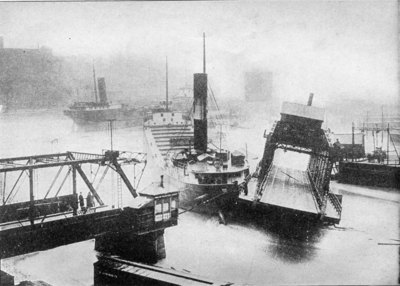
Copyright by George Grantham Bain. Scores of strongly-built bridges like this throughout the flood districts were carried away by the raging torrents
link to high-resolution image
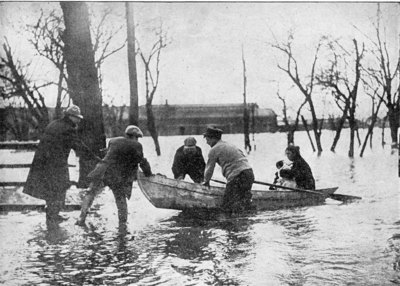
Copyright by Underwood & Underwood, N. Y. When the waters of the Hudson overflowed, hundreds of men, women and children were trapped in their homes near the river bank and were rescued with difficulty
link to high-resolution image
TWELVE BODIES IN ONE HOUSE
Twelve bodies were recovered in a single house in the southern part of
Peru on Friday. This was taken to indicate that the loss of life in that
section of the city was great, as it was there that dwellings were
completely submerged before the occupants could vacate.
"It is impossible to tell how many lives were lost at Peru," said one of
the rescuers.
Six survivors were suffocated in the overcrowded court house. The
weather had turned severely cold, adding to the misery of the
unsheltered, but the flood was falling rapidly.
Terrible conditions prevailed among the refugees, who were increasing in
numbers, as the waters receded. Sanitary conditions among the hundreds
sheltered in the court house became so bad that boats removed many of
them to other places.
GREED ABROAD IN THE CITY
The water was rushing back as fast as it came, leaving a coat of mud and
slime. It was from this that the great danger of disease existed. The
state board of health combined with the Peru board to help clean up.
Relief workers and city officials joined to investigate statements
concerning exorbitant prices for foodstuffs, and proposed to expose
every merchant attempting to make money through the misfortunes of
others.
Several looters were arrested and others shot. One robber was shot by a
citizen, who threw the body into the river.
The work of rescue was greatly impeded by the selfishness of residents.
An Indian of the Wallace circus secured a boat and charged people $200
before he would help them off. Instances were told of men who drew
revolvers on the men and boys working in the boats, threatening to shoot
if they did not take them in.
REFUGEES URGED TO LEAVE
Railroad officials and the relief committee urged refugees to accept the
hospitality of the municipalities north. They hoped to be relieved of
temporary care of 3,000 persons by sending them out of the city.
Two railroads were bringing plenty of provisions within a half mile of
the city, but the boats could not transport rapidly enough to the center
where the supplies were being distributed.
SEARCH FOR THE DEAD
Systematic search for the dead was made, and the appalling early reports
of hundreds of dead continued to shrink, although it was believed that
the search would probably reveal more. The diminution was due to the
discovery in the hills on the other side of the Wabash River of hundreds
of persons who had been given up as dead.
The streets were strewn with dead animals that had begun to decay in
some sections. An epidemic was feared. One of the greatest obstacles
which the people faced was that of ridding the city of the dead animals
and filth in the low sections around the edge of the city proper into
which disease-breeding filth had been washed.
Water still covered these low sections, and seemed likely to remain
there for a long time. There were few sections around the valley that
could be used for burning dead animals.
Citizens and officials who were becoming alarmed at the new danger
estimated that at least 500 dead animals were strewn about the city of
Peru alone. Most of them had to be fished out of the water wherever
found, and it seemed an impossible task.
SHAKING OFF DESPAIR
Slowly the city began to shake off despair and repair the damage done.
The property damage totaled $3,000,000. The Broadway bridge went down
when a large house lodged against it and in turn carried away the Union
Traction structure.
As Peru emerged from the flood it became apparent that the death list
probably would not run over twenty-five.
The indirect death list as a result of the flood, however, went much
higher, as scores of aged men and women, who for hours were forced to
undergo terrible exposure and later to endure unsanitary conditions,
perished soon after they were rescued.
CHAPTER XVII — The Death-Dealing Tornado at Omaha
THE BOLT OUT OF THE BLACKNESS—RESCUERS WORKING IN DARK—A CITY TO THE
RESCUE—PATH OF THE STORM—INTERRUPTED MERRYMAKERS—FAMILY MEET DEATH
TOGETHER—FREAK TRAGEDIES—BRAVE TELEPHONE GIRLS—VIVID TALE OF THE
STORM.
Easter Sunday did not dawn very brightly in Omaha, but in the afternoon
the sun came out warm and bright. The usual Easter promenaders thronged
the streets in holiday attire. Then, as the afternoon wore on, clouds
appeared in the sky. They gathered very quickly, came lower, and as they
approached the earth there was suddenly a fall in the temperature. In a
few minutes the sky turned black and then came the bolt of wind down out
of the blackness. Through more than three miles of the city it cut a
clean path of from three to seven blocks in width in which not a
building was left whole. Then the storm mounted the bluffs and sped away
to the northeast, carrying destruction with it.
Omaha's destruction was kept secret from the world for several hours by
the storm, for all wire communication was broken down in the wrecking
of the homes. Messengers with the news stories had to go to Lincoln, the
state capital, to give out first definite news of the disaster.
During the early hours of the night uninjured citizens worked
desperately to remove such persons as had been caught beneath razed
buildings. No great number was killed in any one place. The wind swept
along, taking its toll here and there.
No sooner had the great wind passed than a second violent gale swept
over much the same territory, but with lessened fury. The total number
of dead in Omaha and suburbs amounted to 154; the number of homeless to
3,179.
Fire started in the debris of many wrecked buildings in the Nebraska
metropolis, and these were menaces for some time, as the fire companies
were hindered by fallen walls and blockaded streets. A heavy rain
followed the wind, however, and whilst it drenched the hundreds of
homeless persons, it also put out the flames.
RESCUERS WORKING IN DARK
Rescue work started as soon as the people were able to hurry to the
stricken district, but the night's work was by the light of lanterns and
little was accomplished. The storm took down all the wires in its path
and the electric power was shut off immediately to prevent further loss
of life. All night the stricken section was patrolled by government
troops from Fort Omaha.
With the arrival of daylight, a train-load of militia from Lincoln and
the presence in the city of Governor Morehead, the work was
systematized.
The hospitals in Omaha Sunday night were full of injured, many of whom
had not been identified, apparently because their friends were either
dead or among the injured.
A CITY TO THE RESCUE
Immediately City Commissioners appropriated $25,000 for relief work;
citizens present at the meeting organized and donated $25,000 more. The
Citizens' Relief Committee was organized, composed of fifty citizens and
an executive committee of seven to work with the seven city councilmen.
Governor Morehead notified Mayor Dahlman that he would send a special
message to the Legislature asking for the appropriation of sufficient
funds to care for the homeless throughout the state.
Cots were placed in the Auditorium, and those without shelter were
housed here. The city purchasing agent arranged for enough beds to care
for all those who could sleep in the Auditorium. The Elks' rooms were
thrown open to the homeless and the Union Gospel Mission provided
seventy-five men with beds.
PATH OF THE STORM
The storm appeared to have started at Fifty-fourth and Center Streets.
From there it traveled north, veering slightly to the east, to
Leavenworth Street. Then it took a northeasterly course to Fortieth and
Farnam Streets, sweeping its way through everything. Still traveling a
little east of north, it covered a course from Fortieth Street east to
Thirty-fourth Street, six blocks.
Striking Bemis Park, where the homes of the wealthy Omaha residents were
located, the storm turned sharply to the east and passed along Parker
and Blonde Streets, to Twenty-fourth Street, where its path was six
blocks wide. In the latter section the damage was complete.
Finally, at Fourteenth and Spencer Streets, the storm swept over the
bluffs, high above the Missouri River, demolished the Missouri Pacific
roundhouse, leveled the big trestle of the Illinois Central Railroad
over Carter Lake, wrecked several buildings near the Rod and Gun Club, a
fashionable outing place, and disappeared to the northeast.
The Child Saving Institute was a veritable death house after the storm
had spent its fury. Every available room was pressed into service, and
one after another the dead and injured were brought into the house.
INTERRUPTED MERRYMAKERS
At the home of Patrick Hynes, a party in celebration of his eighty-first
birthday was in progress. The guests had just begun dinner and were
drinking a toast to the health of their host when the storm swept the
house away. All the party succeeded in getting out with minor injuries,
except a grandchild, who was internally injured.
"The party had just begun dinner," said Mr. Hynes. "The young people
were making merry and, old as I am, I had entered into the spirit.
Suddenly there was a roaring sound. The next minute the house was in
ruins. I wiggled around and out and aided the others in escaping."
FAMILY MEET DEATH TOGETHER
Cliff Daniels, his wife and their two children met death together. When
soldiers, digging about the ruins of their home, found the four bodies,
the two little girls were clasped in the arms of their mother, while the
body of the father was over them, as if he had tried to shield them with
his own body.
When C. Saber discovered the crushed and almost unrecognizable body of
his wife he fled down the street shrieking at the top of his voice.
E. H. Smith, a private of the Signal Corps from Fort Omaha, became
insane after helping carry several bodies, and collapsed. When he had
regained consciousness it was necessary to take him to the post
hospital, where he was placed under restraint.
A. L. Green was on his back porch watching the storm when it broke. He
said:
"It came like a rushing and roaring torrent of water and passed right by
us to the east. I went to my attic window immediately afterward and saw
fires bursting forth from houses along the path of the storm. I could
see five fires burning at once. The flames made a ghastly sight as they
illuminated acres of razed buildings nearby."
FREAK TRAGEDIES
Among the freak tragedies of the tornado none is more remarkable than
that at the Idlewild pool hall, Twenty-fourth and Lake Streets.
Twenty-five negroes were killed. The story is told by the single
survivor, John Brown, who was dug from the wreckage twelve hours after
the demolition of the building.
"Eight men were playing pool at one table," Brown says. "The rest of us
were standing about watching. Without a moment's warning a terrific roar
swept down through the room. The roof suddenly was lifted from above.
The pool table shot straight upward, many feet into the air.
"All of us still were unhurt."
Insane with fear, but wondering, the negroes rushed beneath the open
roof and gazed upward. Then the heavy pool table and pieces of the roof
shot down. All were caught. Brown was dug from the wreckage twelve hours
later, uninjured.
HOUSE SPLIT ASUNDER
Huddled with his family in the basement of his home at 3229 Cuming
Street, Prof. E. W. Hunt saw the house split asunder. When he recovered
consciousness beneath the wreckage he discovered that a last summer
straw hat was cocked on the back of his head. It had been hanging in a
bedroom closet three stories above before the tornado struck the house.
The body of a girl about four was dropped into the arms of a pedestrian,
Charles Allen, at Forty-fifth and Center Streets. Efforts to identify
the child failed.
In a field half a mile from their home were found the bodies of Mrs.
Mary Rathkey and her two grown sons, Frank and James. All three were
dead but no bruises were found. The wind had cut their clothing
completely away.
Mrs. F. Bryant, ninety-two, lived with her son, Dr. D. C. Bryant, at
3006 Sherman Avenue. She was in bed on the third floor of the house when
the tornado struck. The three floors beneath her were shifted out and
her bed fell to the basement. Except for the shock she was uninjured.
Dr. Bryant and his wife were dropped to the basement from the ground
floor. They, too, miraculously escaped injury.
VIVID TALES OF THE STORM
Perhaps the most vivid single description of the tornado's havoc was
given by John Porter:
"I stood on the rear porch of my home when the great cloud of the storm
began its race across the city," he said. "Before it rushed the
traditional 'ball of fire,' which was in reality a yellow cloud,
spherical in shape.
"My wife was visiting at the moment in the home of her father. I saw the
house caught in the vortex of the cloud. It rose straight up into the
air, its walls shattered and broken, but holding partially together. I
am sure that I could not have moved an eyelash, if my life had depended
upon the exertion.
"From the risen house I saw a myriad of black specks falling to the
earth. Then I watched that home soar upward. It hurtled five blocks
through the murky twilight, sustained at a height of one hundred and
fifty feet.
"The Sacred Heart Convent was the target at which it was hurled. It
struck the fifth story. The convent was demolished. The home of my
father-in-law became splinters.
"Then I recovered my senses partially, and ran to the site of the
structure. God himself must have directed that storm, for my wife, her
father and her mother had been dropped behind, only bruised."
CHAPTER XVIII — Struggles of Stricken Omaha
A BLIZZARD-LIKE STORM—COUNTING THE COST—"THE GREATEST CONCEIVABLE
BLOW"—SEARCHING FOR THE DEAD—A DAY OF FUNERALS—MORE CASES OF
DESTITUTION—PLANS FOR REBUILDING.
As if the storm of Easter Sunday were not enough calamity, a
blizzard-like storm descended upon the city of Omaha on Tuesday, adding
to the grief and horror. The storm, which began shortly after midnight,
and continued with gathering force, seriously hampered the work of
rescue. More than three inches of snow covered the debris in the section
of the city struck by the cyclone. It rendered uninhabitable the houses
of many who had prepared to retain temporary homes in partly demolished
structures.
Women tugging at heavy beams, hoping against hope to find dear ones
beneath the wreckage, men gruffly cheering their sorrowful mates,
sniveling children wrapped about with shawls and blankets were the
scenes which the sunrise this morning disclosed to the federal soldiers
as they patrolled the afflicted district.
Later, city officials gathered within the lines drawn around the
district by the soldiers and distributed clothing and other necessities
among the sufferers who had been rendered homeless by the tornado.
COUNTING THE COST
For the first time the people began to count the cost in lives and
dollars. When a resumé was made it was apparently more appalling than
those who had studied the result were willing to admit.
One hundred and fifty-four lives were snuffed out within the city
proper. Nearly five hundred were injured and eight of these died in
local hospitals during the day.
All Omaha rallied to the assistance of the desolate victims of the
tornado. Hundreds of citizens responded promptly by offering their homes
and money to aid in caring for the stricken.
The City Commissioners appropriated $75,000 for relief work, and
citizens at once subscribed to an equal amount. Governor Morehead sent a
special message to the Legislature asking for an appropriation to care
for the homeless throughout the state.
"THE GREATEST CONCEIVABLE BLOW"
After making an inspection of the devastated district, the Governor
said:
"This is my conception of hell. It is horrible, and it has presented a
most complex situation. The loss of life and damage to property is the
greatest conceivable blow, not only to Omaha, but to the entire state of
Nebraska. I will call upon the state of Nebraska to render every
assistance and I am sure the state will respond.
"My horror and grief are beyond my powers of expression."
SEARCHING FOR THE DEAD
Groups of men, aided and encouraged by women and children, labored
incessantly all day Tuesday among the ruins of homes and other
buildings. Only portions of the ruins of some buildings within which
persons were known to have been killed were removed. As quickly as
bodies were found they were taken to temporary morgues. Relatives
claimed most of the bodies, but some remained unidentified. Funerals and
burials were held from all churches and homes. Cemeteries were thronged
with grieving friends and relatives.
MILITARY LAW
Military law was strictly enforced throughout the storm area. Upon the
soldiers rested the responsibility for looting and fires. The city
Health Department made every effort to place the district in a sanitary
condition as rapidly as possible. Garbage wagons and trash carts were
the only vehicles admitted within the patrolled section. The water
supply fortunately remained unimpaired.
A DAY OF FUNERALS
Another period of unseasonable cold followed Tuesday's snowstorm and
increased the already long list of sufferers from the storm.
Paying last rites occupied the time of thousands of persons on
Wednesday. Fifty-two funerals silently wending their way to cemeteries
brought home with greater force to the people of Omaha the full
realization of the extent of Sunday's tornado. All day long, as fast as
hearses could deposit the bodies at graves, a continual death procession
was kept up.
Many of the bodies recovered from Sunday's storm were cared for at
undertaking establishments, and a great number of the funerals were held
from those places. Whenever possible friends of stricken families took
care of bodies and had them prepared for burial. In many instances
churches were demolished in the districts covered by the storm and
others were so badly wrecked as to prevent their being used for burial
services.
LITTLE CEREMONY
There was little ceremony. As quickly as one funeral was over another
began. Undertakers co-operated in arranging burials. In several
instances where entire families were killed or where more than one
member of a family awaited burial one funeral service was held. The
funerals were a constant procession.
One of the most pitiful of the funerals was that of Mrs. Mary Rathkey
and two small children. Surviving Mrs. Rathkey is the husband and
father, who is nearly demented over the disaster. Mrs. Rathkey and her
children were killed in their home.
MORE CASES OF DESTITUTION
Many cases of destitution were reported on Wednesday. It took much time
to prepare card indexes of sufferers' wants and to make requisitions on
the central relief station at the Auditorium for supplies. While these
formalities were being carried out want stalked through disconsolate
homes from one corner of the city to the other. The task of caring for
those needing food, clothing, supplies and money seemed to be too large
for the relief forces.
PLANS FOR REBUILDING
As early as Tuesday plans for rebuilding the city were under way. The
business men formed a corporation to conduct the undertaking in a
systematic way, and to assist the unfortunates who lost their homes and
personal effects.
The Real Estate Exchange immediately took steps to prevent the raising
of rents. Cases of alleged attempted extortion, however, were reported,
some of them by members of the Exchange itself. Executives of that body
decided to deal harshly with any owners found taking advantage of those
forced to secure new homes on account of the tornado.
A public appeal sent out by the Commercial Club stated that 642 homes
were totally wrecked, 1,669 were damaged and 3,179 persons made
homeless. There was need of reconstruction, indeed!
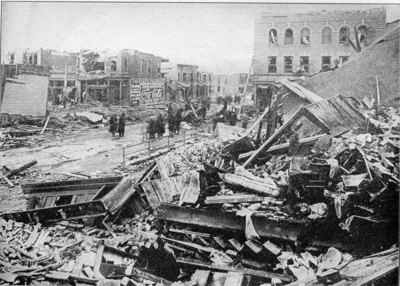
Photograph by Brown Bros. This scene shows the desolation caused by the tornado wrecking a whole street of houses at Omaha, Nebraska
link to high-resolution image
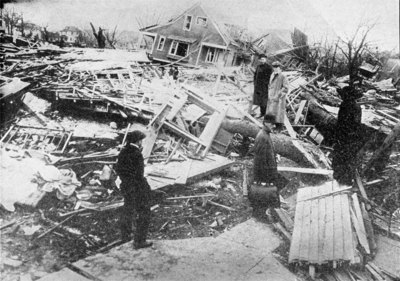
Copyright by George Grantham Bain. A view showing the destructive force of the tornado at Omaha, where happy homes stood a few hours before. Many residents were caught as in a trap and instantly killed or fatally maimed
link to high-resolution image