LONG ago, when Henry VIII. was King of England and Charles V.
was King of Spain, there lived a young Spanish cavalier
whose name was Hernando Cortés. His father, Don Martin Cortés,
sent him to Salamanca when he was about fourteen years old, intending
to have him educated as a lawyer. But Hernando cared
nothing for books, and after wasting two years at college returned
home, to the great annoyance of his parents, who were glad enough
when, after another year of idleness, he proposed to go and seek his
fortune in the New World so lately discovered by Columbus. An
exploring expedition was just being fitted out, and Hernando Cortés
had quite made up his mind to join it, when he unluckily fell from
a high wall which he was climbing, and before he had recovered
from his injuries the ships had sailed without him. Two more
years did he remain at home after this misadventure, but at length,
when he was nineteen years old, he joined a small fleet bound for the
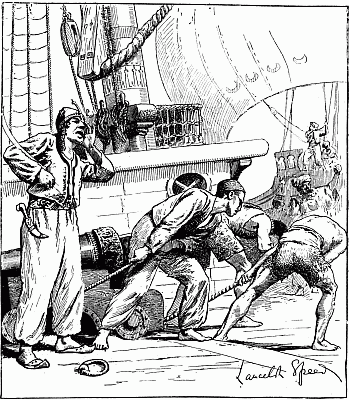
Indian Islands. The vessel in which he sailed was commanded
by one Alonso Quintero, who, when they reached the Canary Islands,
and all the other vessels were detained by taking in supplies, stole out
of the harbour under cover of the night, meaning to reach Hispaniola
before his companions, and so secure a better chance of trading.
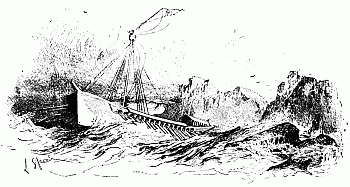
However, he met with a furious storm, and was driven back to the
port with his ship dismasted and battered. The rest of the fleet
generously consented to wait while his ship was being refitted, and
after a short delay they set out again, but so soon as they neared
the islands, the faithless Quintero again gave his companions the
slip, but with no better success, for he met with such heavy gales
that he entirely lost his reckoning, and for many days they tossed
about helplessly, until one morning they were cheered by the sight
of a white dove, which settled upon the rigging. Taking the direction
of the bird's flight, they soon reached Hispaniola, where the
captain had the satisfaction of finding all the other ships had
arrived before him, and had sold all their cargoes. Cortés, as
soon as he landed, went to see Ovando, the governor of the island,
whom he had known in Spain, and presently was persuaded by him
to accept a grant of land and settle down to cultivate it, though at
first he said, 'I came to get gold, not to till the ground like a
peasant.' So six years passed, during which the monotony of Cortés's
life was only broken by occasional expeditions against the natives,
in which he learned to endure toil and danger, and became familiar
with the tactics of Indian warfare. At length, in 1511, when
Diego Velasquez, the governor's lieutenant, undertook the conquest
of Cuba, Cortés gladly accompanied him, and throughout the expedition
made himself a favourite both with the commander and the
soldiers. But when later on there arose discontent over the distribution
of lands and offices, the malcontents fixed upon Cortés as
the most suitable person to go back to Hispaniola, and lay their
grievances before the higher authorities. This came to the ears
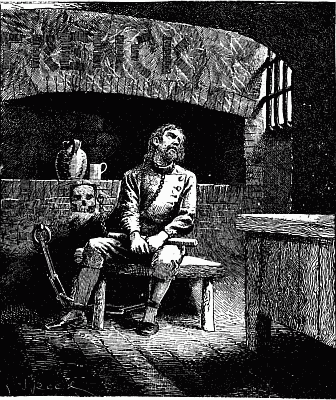
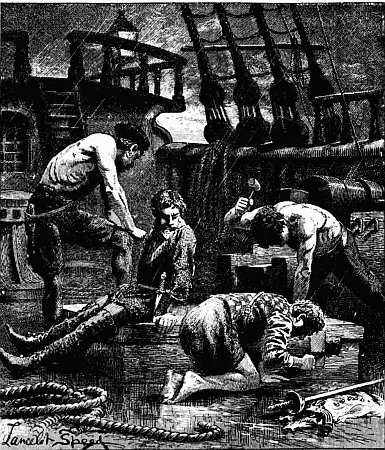
of Velasquez, however, and he at once seized Cortés, whom he
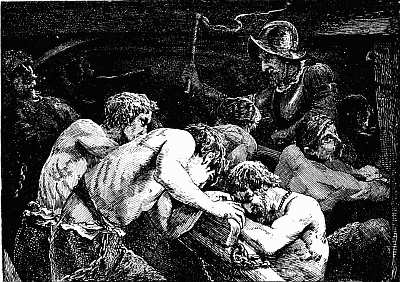
loaded with fetters and threw into prison. Luckily he soon succeeded
in freeing himself from the irons, and letting himself down
from the window took refuge in the nearest church, where he claimed
the right of sanctuary. Velasquez, who was very angry at his
escape, stationed a guard with orders to seize Cortés if he should
leave the sanctuary, and this he was soon careless enough to do.
As he stood outside the church an officer suddenly sprang upon
him from behind, and made him prisoner once more. This time
he was carried on board a ship which was to sail the next morning
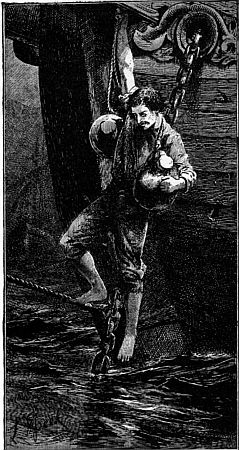
for Hispaniola, where he was to be tried, but again he managed
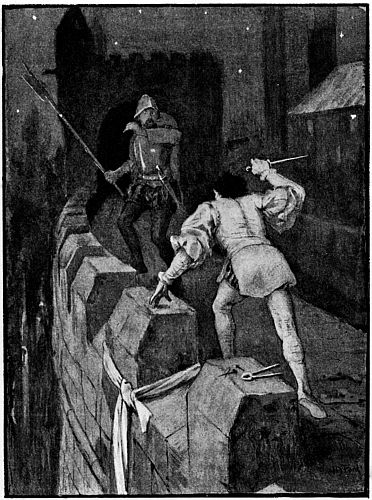
to escape by dragging his feet through the rings which fettered
them, and dropping silently over the ship's side into a little boat
under cover of the darkness. As he neared the shore the water
became so rough that the boat was useless, and he was forced to
swim the rest of the way; but at last he got safely to land, and
again took refuge in the church. After this he married a lady
named Catalina Xuarez, and by the aid of her family managed to
make his peace with Velasquez. Cortés now received a large
estate near St. Jago, where he lived prosperously for some years,
and even amassed a considerable sum of money. But at last news
came of an exploring expedition which had set out in 1518 under
Grijalva, the nephew of Velasquez. He had touched at various
places on the Mexican coast, and had held a friendly conference
with one cacique, or chief, who seemed desirous of collecting all
the information he could about the Spaniards, and their motives in
visiting Mexico, that he might transmit it to his master, the Aztec
emperor. Presents were exchanged at this interview, and in
return for a few glass beads, pins, and such paltry trifles, the
Spaniards had received such a rich treasure of jewels and gold
ornaments that the general at once sent back one of his ships under
the command of Don Pedro de Alvarado to convey the spoil, and
acquaint the governor of Cuba with the progress of the expedition,
and also with all the information he had been able to glean respecting
the Aztec emperor and his dominions. Now in those
days nothing whatever was known about the interior of the country
or of its inhabitants—it was as strange to the explorers as another
planet.
This was what they had to tell the governor. Far away towards
the Pacific Ocean there stood, in a beautiful and most fertile
valley, the capital of a great and powerful empire, called by its inhabitants
'Tenochtitlan,' but known to the Europeans only by its
other name of 'Mexico,' derived from 'Mexitli,' the war-god of the
Aztecs. These Aztecs seem to have come originally from the
north, and after many wanderings to have halted at length on the
south-western borders of a great lake, of which there were several
in the Mexican valley. This celebrated valley was situated at a
height of about 7,500 feet above the sea, and was oval in form,
about 67 leagues in circumference, and surrounded by towering
rocks, which seemed to be meant to protect it from invasion. It
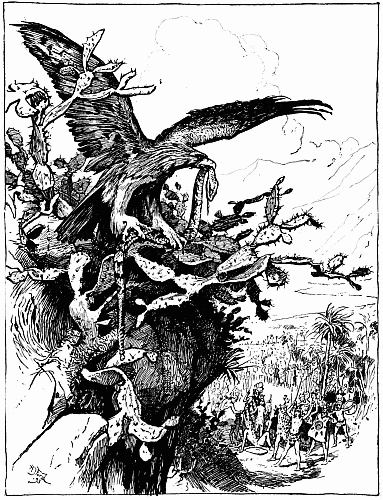
was in the year 1325 that the Aztecs paused upon the shore of the
lake, and saw, as the sun rose, a splendid eagle perched upon a
prickly pear which shot out of a crevice in the rock. It held a
large serpent in its claws, and its broad wings were opened towards
the rising sun. The Aztecs saw in this a most favourable omen,
and there and then set about building themselves a city, laying its
foundations upon piles in the marshy ground beside the lake, and
to this day the eagle and the cactus form the arms of the Mexican
republic.
The little body of settlers increased rapidly in number and power,
and made their name terrible throughout the valley, in which various
other tribes had long been settled, until at last they united themselves
with the king of the Tezcucans, to aid him against a tribe
called the Tepanecs, who had invaded his territory. The allies were
completely successful, and this led to an agreement between the
states of Mexico, Tezcuco, and Tlacopan, that they should support
each other in all their wars, and divide all the spoils between them.
This alliance remained unbroken for over a hundred years and
under a succession of able princes the Aztec dominion grew, till at
the coming of the Spaniards it reached across the continent, from the
Atlantic to the Pacific Ocean. The Aztecs had many wise laws and
institutions, and were indeed in some respects a highly civilised
community. When their emperor died a new one was chosen from
among his sons or nephews, by four nobles. The one preferred was
obliged to have distinguished himself in war, and his coronation did
not take place until a successful campaign had provided enough
captives to grace his triumphal entry into the capital, and enough
victims for the ghastly sacrifices which formed an important part of
all their religious ceremonies. Communication was held with the
remotest parts of the country by means of couriers, who, trained to
it from childhood, travelled with amazing swiftness. Post-houses
were established on the great roads, and the messenger bearing his
despatches in the form of hieroglyphical paintings, ran to the first
station, where they were taken by the next messenger and carried
forward, being sent in one day a hundred or two hundred miles.
Thus fish was served at the banquets of the emperor Montezuma
which twenty-four hours before had been caught in the Gulf of
Mexico, two hundred miles away. Thus too the news was carried
when any war was going on, and as the messengers ran to acquaint
the court with the movements of the royal armies, the people by the
way knew whether the tidings were good or bad by the dress of
the courier. But the training of warriors was the chief end and
aim of all Aztec institutions. Their principal god was the god of
war, and one great object of all their expeditions was the capture
of victims to be sacrificed upon his altars. They believed that the
soldier who fell in battle was transported at once to the blissful
regions of the sun, and they consequently fought with an utter disregard
of danger. The dress of the warriors was magnificent.
Their bodies were protected by a vest of quilted cotton, impervious
to light missiles, and over this the chiefs wore mantles of gorgeous
feather-work, and the richer of them a kind of cuirass of gold
or silver plates. Their helmets were of wood, fashioned like the
head of some wild animal, or of silver surmounted by plumes of
variously coloured feathers, sprinkled with precious stones, beside
which they wore many ornaments of gold, and their banners were
embroidered with gold and feather-work.
The Aztecs worshipped thirteen principal gods, and more than two
hundred of less importance, each of whom, however, had his day of
festival, which was duly observed. At the head of all stood the
war-god, the terrible Huitzilopochtli, whose fantastic image was
loaded with costly ornaments, and whose temples, in every city of
the empire, were the most splendid and stately. The Aztecs also
had a legend that there had once dwelt upon the earth the great
Quetzalcoatl, god of the air, under whose sway all things had
flourished and all people had lived in peace and prosperity; but he
had in some way incurred the wrath of the principal gods, and was
compelled to leave the country. On his way he stopped at the city
of Cholula, where a temple was dedicated to him, of which the
great ruins remain to this day. When he reached the shores of the
Mexican Gulf he embarked in his magic boat, made of serpents'
skins, for the fabulous land of Tlapallan, but before he bade his
followers farewell he promised that he and his descendants would
one day come again. The Aztecs confidently looked forward to the
return of their benevolent god, who was said to have been tall in
stature, with a white skin, long dark hair, and a flowing beard, and
this belief of theirs prepared the way, as you will presently see, for
the success of Cortés.[28] The Mexican temples, or teocallis as they
were called—which means 'Houses of God'—were very numerous,
there being several hundreds of them in each of the principal cities.
They looked rather like the Egyptian pyramids, and were divided
into four or five stories, each one being smaller than the one below
it, and the ascent was by a flight of steps at an angle of the pyramid.
This led to a sort of terrace at the base of the second story, which
passed quite round the building to another flight of steps immediately
over the first, so that it was necessary to go all round the
temple several times before reaching the summit. The top was a
broad space on which stood two towers, forty or fifty feet high,
which contained the images of the gods. Before these towers stood
the dreadful stone of sacrifice, and two lofty altars on which the
sacred fires burned continually. Human sacrifices were adopted
by the Aztecs about two hundred years before the coming of the
Spaniards. Rare at first, they became more and more frequent
till at length nearly every festival closed with this cruel abomination.
The unhappy victim was held by five priests upon the stone
of sacrifice, while the sixth, who was clothed in a scarlet mantle,
emblematic of his horrible office, cut open his breast with a sharp
razor of 'itztli,' a volcanic substance as hard as flint, and tearing
out his heart, held it first up to the sun, which they worshipped,
and then cast it at the feet of the god to whom the temple was
devoted; and to crown the horror, the body of the captive thus
sacrificed was afterwards given to the warrior who had taken him
in battle, who thereupon gave a great banquet and served him up
amid choice dishes and delicious beverages for the entertainment of
his friends. When the great teocalli of Huitzilopochtli was dedicated
in the year 1486, no less than 70,000 prisoners were thus
sacrificed, and in the whole kingdom every year the victims were
never fewer than 20,000, or, as some old writers say, 50,000.
The Aztec writing was not with letters and words, but consisted of
little coloured pictures, each of which had some special meaning.
Thus a 'tongue' denoted speaking, a 'footprint' travelling, a 'man
sitting on the ground' an earthquake. As a very slight difference
in position or colour intimated a different meaning, this writing
was very difficult to read, and in the Aztec colleges the priests
specially taught it to their pupils. At the time of the coming of the
Spaniards there were numbers of people employed in this picture-writing,
but unfortunately hardly any of the manuscripts were preserved;
for the Spaniards, looking upon them as magic scrolls, caused
them to be burned by thousands. In many mechanical arts the
Aztecs had made considerable progress. Their ground was well cultivated,
they had discovered and used silver, lead, tin, and copper.
Gold, which was found in the river-beds, they cast into bars, or used
as money by filling transparent quills with gold dust. They also
made many fantastic ornaments of gold and silver, and cast gold
and silver vessels, which they carved delicately with chisels. Some
of the silver vases were so large that a man could not encircle them
with his arms. But the art in which they most delighted was the
wonderful feather-work. With the gorgeous plumage of the tropical
birds they could produce all the effect of a beautiful mosaic. The
feathers, pasted upon a fine cotton web, were wrought into dresses
for the wealthy, hangings for their palaces, and ornaments for their
temples.
These then were the people of whom Grijalva sent back to Cuba
a few vague reports, and these, and the accounts of the splendour
of the treasure, spread like wildfire through the island. The
governor having resolved to send out more ships to follow up
these discoveries, looked about him for a suitable person to command
the expedition and share the expenses of it, and being recommended
by several of his friends to choose Hernando Cortés, he
presently did so. Cortés had now attained his heart's desire, and
at once began with the utmost energy to purchase and fit out the
ships. He used all the money he had saved, and as much more as
he could persuade his friends to lend him, and very soon he was in
possession of six vessels, and three hundred recruits had enrolled
themselves under his banner. His orders were, first, to find Grijalva
and to proceed in company with him; then to seek out and rescue
six Christians, the survivors of a previous expedition, who were
supposed to be lingering in captivity in the interior; and to bear in
mind, before all things, that it was the great desire of the Spanish
monarch that the Indians should be converted to Christianity. They
were to be invited to give their allegiance to him, and to send him presents
of gold and jewels to secure his favour and protection. The
explorers were also to survey the coast, acquaint themselves with
the general features of the country, and to barter with the natives.
But before Cortés was ready to start, a jealousy and distrust of
him took possession of the mind of Velasquez, so that he determined
to entrust the command of the fleet to someone else. This came to
the ears of Cortés, and he with great promptitude assembled his officers
secretly, and that very night set sail with what supplies he was
able to lay hands upon, his ships being neither ready for sea nor properly
provisioned. When morning broke news was carried to Velasquez
that the fleet was under weigh, and he rose hastily and galloped
down to the quay. Cortés rowed back to within speaking distance.
'This is a courteous way of taking leave of me, truly,' cried the
governor.
'Pardon me,' answered Cortés, 'time presses, and there are some
things that should be done before they are even thought of.' And
with that he returned to his vessel, and the little fleet sailed away to
Macaca, where Cortés laid in more stores. This was on November 18,
1518. Shortly afterwards he proceeded to Trinidad, a town on the
south coast of Cuba, where he landed, and setting up his standard,
invited all who would to join the expedition, holding out to them
great hopes of wealth to be gained. Volunteers flocked in daily,
including many young men of noble family, who were attracted by
the fame of Cortés. Among them were Pedro de Alvarado, Cristóval
de Olid, Alonso de Avila, Juan Velasquez de Leon, Alonso Hernandez
de Puertocarrero, and Gonzalo de Sandoval, of all of whom
you will hear again before the story is finished. Finally, in February
1519, when all the reinforcements were assembled, Cortés found he had
eleven vessels, one hundred and ten mariners, five hundred and fifty-three
soldiers, and two hundred Indians. He also had sixteen horses,
ten large guns, and four lighter, which were called falconets. Cortés,
before embarking, addressed his little army, saying that he held out
to them a glorious prize, and that if any among them coveted riches,
he would make them masters of such as their countrymen had never
dreamed of; and so they sailed away for the coast of Yucatan.
The first thing that happened was that they were overtaken by a
furious tempest, and Cortés was delayed by looking after a disabled
vessel, and so was the last to reach the island of Cozumel. Here he
found that Alvarado, one of his captains, had landed, plundered a
temple, and by his violence caused the natives to fly and hide themselves
inland.
Cortés, much displeased, severely reprimanded his officer, and,
by the aid of an interpreter, explained his peaceful intentions to two
Indians who had been captured. Then he loaded them with presents,
and sent them to persuade their countrymen to return, which they presently
did, and the Spaniards had the satisfaction of bartering the
trifles they had brought for the gold ornaments of the natives. Next
Cortés sent two ships to the opposite coast of Yucatan, where they
were to despatch some Indians inland, to seek for and ransom the
Christian captives, of whom he had gained some tidings from a
trader, and while they were gone he explored the island, and induced
the natives to declare themselves Christians by the very summary
method of rolling their venerated idols out of their temple, and setting
up in their stead an image of the Virgin and Child. When the
Indians saw that no terrible consequences followed, they listened to
the teaching of the good priest, Father Olmedo, who accompanied
the expedition, though it is probable that they did not, after all,
understand much of his instruction. After eight days the two ships
came back, but with no news of the captives, and Cortés sorrowfully
decided that he could wait no longer. He accordingly took in
provisions and water, and set sail again, but before they had gone far
one of the ships sprang a leak, which obliged them to put back into
the same port. It was lucky that they did, for soon after they
landed a canoe was seen coming from the shore of Yucatan, which
proved to contain one of the long-lost Spaniards, who was called
Aguilas. He had been for eight years a slave among the natives in
the interior, but his master, tempted by the ransom of glass-beads,
hawk-bells, and such treasures, had consented to release him. When
he reached the coast the ships were gone, but owing to the fortunate
accident of their return, he found himself once more among his
countrymen. Cortés at once saw the importance of having him as
an interpreter, but in the end he proved to be of more use to the
explorers than could have been at first imagined.
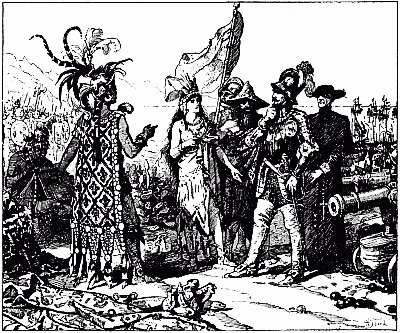
Again the fleet set out, and coasted along the Gulf of Mexico
till they reached the mouth of the Rio de Tabasco. Here Cortés
landed, but found that the Indians were hostile, and were drawn
up in great force against him. However, after some hard fighting
the Spaniards were victorious, and having taken possession of the
town of Tabasco, Cortés sent messengers to the chiefs saying that if
they did not at once submit themselves he would ravage the country
with fire and sword. As they had no mind for any more fighting
they came humbly, bringing presents, and among them thirty slaves,
one of whom, a beautiful Mexican girl named Malinche, was afterwards
of the utmost importance to the expedition. She had come
into the possession of the cacique of Tabasco through some traders
from the interior of the country, to whom she had been secretly
sold by her mother, who coveted her inheritance. Cortés now reembarked
his soldiers and sailed away to the island of San Juan de
Uloa, under the lee of which they anchored, and soon saw the light
pirogues of the Indians coming off to them from the mainland.
They brought presents of fruit and flowers, and little ornaments of
gold which they gladly exchanged for the usual trifles. Cortés
was most anxious to converse with them, but found to his disappointment
that Aguilar could not understand their dialect. In this
dilemma he was informed that one of the slaves was a Mexican,
and could of course speak the language. This was Malinche, or as
the Spaniards always called her, 'Marina.' Cortés was so charmed
with her beauty and cleverness that he made her his secretary,
and kept her always with him; and she very soon learned enough
Spanish to interpret for him without the help of Aguilar. But at
first they were both necessary, and by their aid Cortés learned that
his visitors were subjects of Montezuma, the great Aztec emperor,
and were governed by Tenhtlile, one of his nobles. Cortés having
ascertained that there was abundance of gold in the interior,
dismissed them, loaded with presents, to acquaint their governor
with his desire for an interview. The next morning he landed on
the mainland with all his force. It was a level sandy plain, and
the troops employed themselves in cutting down trees and bushes
to provide a shelter from the weather; in this they were aided by
the natives, who built them huts with stakes and earth, mats and
cotton carpets, and flocked from all the country round to see the
wonderful strangers. They brought with them fruits, vegetables,
flowers in abundance, game, and many dishes cooked after the
fashion of the country; and these they gave to, or bartered with,
the Spaniards. The next day came Tenhtlile, the governor, with a
numerous train, and was met by Cortés, and conducted to his tent
with great ceremony. All the principal officers were assembled,
and after a ceremonious banquet at which the governor was regaled
with Spanish wines and confections, the interpreters were sent for
and a conversation began. Tenhtlile first asked about the country
of the strangers, and the object of their visit. Cortés replied that
he was the subject of a powerful monarch beyond the seas, who had
heard of the greatness of the Mexican emperor, and had sent him
with a present in token of his goodwill, and with a message which
he must deliver in person. He concluded by asking when he could
be admitted into Montezuma's presence. To this the Aztec noble
replied haughtily,
'How is it that you have been here only two days, and demand
to see the emperor?'
Then he added that he was surprised to hear that there could
be another monarch as powerful as Montezuma, but if it were so
his master would be happy to communicate with him, and that he
would forward the royal gift brought by the Spanish commander,
and so soon as he had learned Montezuma's will would inform him
of it. Tenhtlile then ordered his slaves to bring forward the
present for the Spanish general. It consisted of ten loads of fine
cotton, several mantles of gorgeous feather-work, and a wicker
basket of golden ornaments. Cortés received it with due acknowledgments,
and in his turn ordered the presents for Montezuma to
be brought forward. These were an armchair richly carved and
painted, a crimson cloth cap with a gold medal, and a quantity of
collars, bracelets, and other ornaments of cut-glass, which in a
country where glass was unknown were as valuable as real gems.
The Aztec governor observed a soldier in the camp in a shining
gilt helmet, and expressed a wish that Montezuma should see it, as
it reminded him of one worn by the god Quetzalcoatl. Cortés
declared his willingness that the helmet should be sent, and begged
that the emperor would return it filled with the gold dust of the
country, that he might compare its quality with that of his own.
He also said that the Spaniards were troubled with a disease of
the heart, for which gold was a sure remedy. In fact, he made his
want of gold very clear to the governor. While these things were
passing Cortés observed one of Tenhtlile's attendants busy with a
pencil, and on looking at his work he found it was a sketch of the
Spaniards, their costumes, weapons, and all objects of interest being
correctly represented both in form and colour. This was the celebrated
picture-writing, and the governor said that this man was
drawing all these things for Montezuma, as he would get a much
better idea of their appearance thus. Cortés thereupon ordered
out the cavalry, and caused them to go through their military
exercises upon the firm wet sands of the beach; and the appearance
of the horses—which were absolutely unknown in Mexico—filled
the natives with astonishment, which turned to alarm when the
general ordered the cannon to be fired, and they saw for the first
time the smoke and flame, and beheld the balls crashing among
the trees of the neighbouring forest and reducing them to splinters.
Nothing of this sort was lost upon the painters, who faithfully
recorded every particular, not omitting the ships—the 'water-houses,'
as they called them—which swung at anchor in the bay.
Finally, the governor departed as ceremoniously as he had come,
leaving orders with his people to supply the Spanish general with
all he might require till further instructions should come from the
emperor.
In the meantime the arrival of the strangers was causing no
small stir in the Mexican capital. A general feeling seems to have
prevailed that the Return of the White God, Quetzalcoatl, was at
hand, and many wonderful signs and occurrences seemed to confirm
the belief.
In 1510 the great lake of Tezcuco, without tempest, earthquake,
or any visible cause, became violently agitated, overflowed its
banks, and, pouring into the streets of Mexico, swept away many
buildings by the fury of its waters. In 1511 one of the towers of
the great temple took fire, equally without any apparent cause, and
continued to burn in defiance of all attempts to extinguish it. In
the following years three comets were seen, and not long before
the coming of the Spaniards a strange light broke forth in the
east, resembling a great pyramid or flood of fire thickly powdered
with stars: at the same time low voices were heard in the air, and
doleful wailings, as if to announce some strange, mysterious calamity.
A lady of the Royal house died, was buried, and rose
again, prophesying ruin to come. After the conquest she became a
Christian.
Montezuma, terrified at these apparitions, took counsel of Nezahualpilli,
King of Tezcuco, who was a great proficient in astrology;
but far from obtaining any comfort from him, he was still further depressed
by being told that all these things predicted the speedy downfall
of his empire. When, therefore, the picture-writings showing
the Spanish invaders reached Montezuma, they caused him great
apprehension, and he summoned the kings of Tezcuco and Tlacopan
to consult with them as to how the strangers should be received.
There was much division of opinion, but finally Montezuma resolved
to send a rich present which should impress them with a high idea
of his wealth and grandeur, while at the same time he would forbid
them to approach the capital. After eight days at the most, which
however seemed a long time to the Spaniards, who were suffering
from the intense heat of the climate, the embassy, accompanied by
the governor Tenhtlile, reached the camp, and presented to Cortés
the magnificent treasure sent by Montezuma. One of the two nobles
had been sent on account of his great likeness to the picture of Cortés
which the Aztec painter had executed for Montezuma. This resemblance
was so striking that the Spanish soldiers always called this
chief 'the Mexican Cortés.' After the usual ceremonious salutes,
the slaves unrolled the delicately wrought mats and displayed the
gifts they had brought. There were shields, helmets, and cuirasses
embossed with plates and ornaments of pure gold, with collars and
bracelets of the same precious metal, sandals, fans, plumes, and
crests of variegated feathers wrought with gold and silver thread
and sprinkled with pearls and precious stones. Also imitations of
birds and animals in wrought or cast gold and silver of exquisite
workmanship; and curtain coverlets and robes of cotton, fine as
silk—of rich and varied hues—interwoven with feather-work that
rivalled the most delicate painting. There were more than thirty
loads of cotton cloth, and the Spanish helmet was returned filled
to the brim with grains of gold. But the things which excited the
most admiration were two circular plates of gold and silver as
large as carriage-wheels. One, representing the sun, was richly
carved with plants and animals, and was worth fifty-two thousand
five hundred pounds. The Spaniards could not conceal their rapture
at this exhibition of treasure which exceeded their utmost dreams;
and when they had sufficiently admired it the ambassadors courteously
delivered their message, which was to the effect that
Montezuma had great pleasure in holding communication with so
powerful a monarch as the King of Spain, but he could not grant a
personal interview to the Spaniards; the way to his capital was too
long and too dangerous. Therefore the strangers must return to
their own land with the gifts he had sent them. Cortés, though
much vexed, concealed his annoyance and expressed his sense of
the emperor's munificence. It made him, he said, only the more
desirous of a personal interview, so that he felt it was impossible
that he should present himself again before his sovereign without
having accomplished this great object of his journey. He once
more requested them to bear this message to their master, with
another trifling gift. This they seemed unwilling to do, and took
their leave repeating that the general's wish could not be gratified.
The soldiers were by this time suffering greatly from the heat,
surrounded as they were by burning sands and evil-smelling
marshes, and swarms of venomous insects which tormented them
night and day. Thirty of their number died, and the discomfort of
the rest was greatly increased by the indifference of the natives,
who no longer brought them such abundant supplies, and demanded
an immense price for what they did provide. After ten days the
Mexican envoys returned, bearing another rich present of stuffs and
gold ornaments, which, though not so valuable as the first, was yet
worth three thousand ounces of gold. Beside this there were four
precious stones, somewhat resembling emeralds, each of which they
assured the Spaniards was worth more than a load of gold, and
was destined as a special mark of respect for the Spanish monarch,
since only the nobles of Mexico were allowed to wear them.
Unfortunately, however, they were of no value at all in Europe.
Montezuma's answer was the same as before. He positively
forbade the strangers to approach nearer to his capital, and requested
them to take the treasure he had bestowed upon them, and return
without delay to their own country. Cortés received this unwelcome
message courteously, but coldly, and turning to his officers exclaimed,
'This is a rich and powerful prince indeed, yet it shall go
hard but we will one day pay him a visit in his capital.' Father
Olmedo then tried to persuade the Aztec chiefs to give up their
idol-worship, and endeavoured by the aid of Marina and Aguilar to
explain to them the mysteries of his own faith, but it is probable
that he was not very successful. The chiefs presently withdrew
coldly, and that same night every hut was deserted by the natives,
and the Spaniards were left without supplies in a desolate wilderness.
Cortés thought this so suspicious that he prepared for an
attack, but everything remained quiet.
The general now decided to remove his camp to a more healthy
place a little farther along the coast, where the ships could anchor
and be sheltered from the north wind. But the soldiers began to
grumble and be discontented, and to say that it was time to return
with their spoil, and not linger upon those barren shores until they
had brought the whole Mexican nation about their ears. Fortunately
at this juncture five Indians made their appearance in the
camp, and were taken to the general's tent. They were quite
different from the Mexicans in dress and appearance, and wore
rings of gold and bright blue gems in their ears and nostrils, while
a gold leaf, delicately wrought, was attached to the under lip.
Marina could not understand their language, but luckily she found
that two of them could speak in the Aztec tongue. They explained
that they came from Cempoalla, the chief town of a tribe called the
Totonacs, and that their country had been lately conquered by the
Aztecs, whose oppressions they greatly resented. They also said
that the fame of the Spaniards had reached their master, who had
sent to request them to visit him in his capital. It is easy to imagine
how eagerly Cortés listened to this communication, and how
important it was to him. Hitherto, as he knew absolutely nothing
of the state of affairs in the interior of the country, he had supposed
the empire to be strong and united. Now he saw that the discontent
of the provinces conquered by Montezuma might be turned to
his own advantage, and that by their aid he might hope to succeed
in his cherished scheme of subduing the emperor himself. He
therefore dismissed the Totonacs with many presents, promising
soon to visit their city. Then with his usual energy and diplomacy
he turned upon the immediate difficulties which beset him—the
discontent of the soldiers, the jealousy of some of his officers, and
the fact that he had no warrant for his ambitious plans in the
commission that he had received from Velasquez. By tact and
cunning he managed to settle everything as he wished, and set to
work to establish a colony in the name of the Spanish sovereign,
and appointed his chief friend Puertocarrero to be one of its magistrates,
and Montejo, who was a friend of Velasquez, to be the other.
The new town was called Villa Rica de Vera Cruz, 'The rich town
of the True Cross,' and, as you see, its governors and officials were
appointed before a single house was built. To them Cortés then
resigned the commission which he had received from Velasquez,
and the council, which consisted chiefly of his own friends, immediately
reappointed him to be captain-general and chief justice of
the colony, with power to do practically just as he liked. Of course
this caused a great commotion in the opposing party, but Cortés
put the leaders into irons and sent them on board one of the ships,
while he sent the soldiers on a foraging expedition into the surrounding
country. By the time these returned with supplies they had altered
their minds, and joined their companions in arms, pledging themselves
to a common cause, while even the cavaliers on board the ship
came to the same conclusion, and were reconciled to the new
government, and were from that time staunch adherents to Cortés.
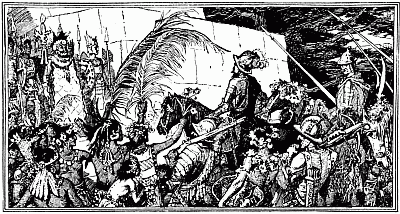
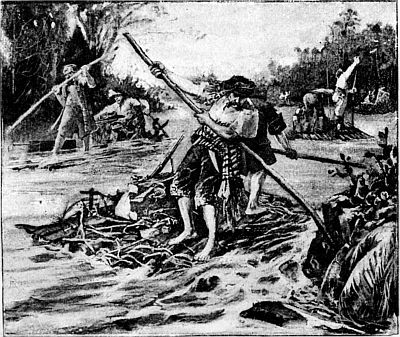
Peace being thus restored, the army set out to march northwards
to the place where it had been decided to build the town. They
crossed a river in rafts and broken canoes which they found upon its
bank, and presently came to a very different scene from the burning
sandy waste, which they had left. The wide plains were covered
with green grass, and there were groves of palms, among which the
Spaniards saw deer and various wild animals, and flocks of pheasants
and turkeys. On their way they passed through a deserted
village, in the temples of which they found records in the picture-writing,
and also, to their horror, the remains of sacrificed victims.
As they proceeded up the river they were met by twelve Indians,
sent by the cacique of Cempoalla to show them the way to his town.
The farther they went the more beautiful did the country become.
The trees were loaded with gorgeous fruits and flowers, and birds
and butterflies of every hue abounded. As they approached the
Indian city they saw gardens and orchards on each side of the road,
and were met by crowds of natives, who mingled fearlessly with the
soldiers, bringing garlands of flowers, in which they specially delighted,
to deck the general's helmet and to hang about the neck
of his horse. The cacique, who was tall and very fat, received
Cortés with much courtesy, and assigned to the army quarters in
a neighbouring temple, where they were well supplied with provisions,
and the general received a present of gold and fine cotton.
But in spite of all this friendliness he neglected no precautions,
stationing sentinels, and posting his artillery so as to command the
entrance. The following morning Cortés paid the cacique a visit
at his own residence, and, by the aid of Marina, a long conference
was held in which the Spanish general gained much important information,
and promised to aid the Totonacs against Montezuma,
and prevent him from carrying off their young men and maidens
to be sacrificed to his gods. The following day the army marched
off again to the town of Chiahuitztla, which stood like a fortress on a
crag overlooking the gulf. Though the inhabitants were alarmed at
first, they soon became friendly, and the chiefs came to confer with
Cortés and the cacique of Cempoallo, who had accompanied him, carried
in a litter. Just then there was a stir among the people, and
five men entered the market-place where they were standing. By
their rich and peculiar dress they seemed to belong to a different
race: their dark glossy hair was tied in a knot at the top of the head,
and they carried bunches of flowers in their hands. Their attendants
carried wands, or fans, to brush away the flies and insects
from their lordly masters. These persons passed the Spaniards
haughtily, scarcely deigning to return their salutations, and they
were immediately joined by the Totonac chiefs, who seemed anxious
to conciliate them by every sort of attention. The general, much
astonished, inquired of Marina what this meant, and she replied
that these were Aztec nobles empowered to receive tribute for
Montezuma.
Soon after the chiefs returned in dismay, saying that the Aztecs
were very angry with them for entertaining the Spaniards without
the emperor's permission, and had demanded twenty young men
and maidens to be sacrificed to the gods as a punishment. Cortés
was most indignant at this insolence, and insisted that the Totonacs
should not only refuse the demand, but should also seize the Aztec
nobles, and throw them into prison. This they did, but the Spanish
general managed to get two of them freed in the night, and brought
before him. He then very cunningly made them believe that he
regretted the indignity that had been offered them, and would help
them to get away safely, and the next day would do his best to
release their companions. He also told them to report this to
Montezuma, assuring him of the great respect and regard in which
he was held by the Spaniards. Them he sent them away secretly
to the port, and they were taken in one of the vessels, and landed
safely at a little distance along the coast. The Totonacs were
furious at the escape of some of their prisoners, and would at once
have sacrificed the remainder, had not Cortés expressed the utmost
horror at the idea, and sent them on board one of the ships for safe
keeping, whence he very soon allowed them to join their companions.
This artful proceeding had, as we shall presently see, just the effect
it was meant to have upon Montezuma. By order of Cortés, messengers
were now sent to all the other Totonac towns, telling them
of the defiance that had been shown to the emperor, and bidding
them also refuse to pay the tribute. The Indians soon came
flocking into Chiahuitztla to see and confer with the powerful
strangers, in the hope of regaining liberty by their aid, and so cleverly
had Cortés managed to embroil them with Montezuma, that even
the most timid felt that they had no choice but to accept the protection
of the Spaniards, and make a bold effort for the recovery of
freedom.
Cortés accordingly made them swear allegiance to the Spanish
sovereign, and then set out once more for the port where his colony
was to be planted. This was only half a league distant, in a wide
and fruitful plain, and he was not long in determining the circuit of
the walls, and the site of the fort, granary, and other public buildings.
The friendly Indians brought stone, lime, wood, and bricks,
and in a few weeks a town rose up, which served as a good starting-point
for future operations, a retreat for the disabled, a place for
the reception of stores, or whatever might be sent to or from the
mother-country, and was, moreover, strong enough to overawe the
surrounding country. This was the first colony in New Spain, and
was hailed with satisfaction by the simple natives, who could not
foresee that their doom was sealed when a white man set his foot
upon their soil.
While the Spaniards were still occupied with their new settlement
they were surprised by another embassy from Mexico. When
the account of the imprisonment of the royal collectors first reached
Montezuma, his feelings of fear and superstition were swallowed up
in indignation, and he began with great energy to make preparations
for punishing his rebellious vassals, and avenging the insult offered
to himself. But when the Aztec officers liberated by Cortés
reached the capital and reported the courteous treatment they had
received from the Spanish commander, he was induced to resume
his former timid and conciliatory policy, and sent an embassy consisting
of two young nephews of his own and four of his chief nobles
to the Spanish quarters. As usual they bore a princely gift of gold,
rich cotton stuffs, and wonderful mantles of feather embroidery.
The envoys on coming before Cortés presented this offering, with
the emperor's thanks to him for the courtesy he had shown to the
captive nobles. At the same time Montezuma expressed his surprise
and regret that the Spaniards should have countenanced the
rebellion. He had no doubt, he said, that Cortés and his followers
were the long-looked-for strangers, and therefore of the same
lineage as himself. From deference to them he would spare the
Totonacs while they were present, but the day of vengeance would
come. Cortés entertained the Indians with frank hospitality, taking
care, however, to make such a display of his resources as should
impress them with a sense of his power. Then he dismissed them
with a few trifling gifts and a conciliatory message to the emperor,
to the effect that he would soon pay his respects to him in his
capital, when all misunderstanding between them would certainly
be adjusted. The Totonacs were amazed when they understood
the nature of this interview; for, in spite of the presence of the
Spaniards, they had felt great apprehension as to the consequence
of their rash act, and now they felt absolutely in awe of the
strangers who even at a distance could exercise such a mysterious
influence over the terrible Montezuma.
Not long after the cacique of Cempoalla appealed to Cortés to
aid him against a neighbour with whom he had a quarrel. The
general at once marched to support him with a part of his force,
but when they reached the hostile city they were received in a
most friendly manner, and Cortés had no difficulty in reconciling
the two chiefs to one another. In token of gratitude the Indian
cacique sent eight noble maidens, richly decked with collars and
ornaments of gold, whom he begged the general to give as wives
to his captains. Cortés seized the opportunity of declaring that
they must first become Christians, and be baptized, since the
sons of the Church could not be allowed to marry idolaters. The
chief replied that his gods were good enough for him, and that he
should at once resent any insults offered to them, even if they did
not avenge themselves by instantly destroying the Spaniards.
However, the general and his followers had seen too much already
of the barbarous rites of the Indian religion and its horrible sacrifices.
Without hesitation they attacked the principal teocalli, whereupon
the cacique called his men to arms, the priests in their blood-stained
robes rushed frantically about among the people, calling
upon them to defend their gods, and all was tumult and confusion.
Cortés acted with his usual promptitude at this crisis. He caused
the cacique and the principal inhabitants and the priests to be
taken prisoners, and then commanded them to quiet the people,
threatening that a single arrow shot at the Spaniards should cost
them their lives. Marina also represented the madness of resistance,
reminding the cacique that if he lost the friendship of the
strangers, he would be left alone to face the vengeance of Montezuma.
This consideration decided him: covering his face with his
hands, he exclaimed that the gods would avenge their own wrongs.
Taking advantage of this tacit consent, fifty soldiers rushed up the
stairway of the temple, and dragging the great wooden idols from
their places in the topmost tower, they rolled them down the steps
of the pyramid amid the groans of the natives and the triumphant
shouts of their comrades, and then burnt them to ashes. The
Totonacs, finding that their gods were unable to prevent or even
punish this profanation of their temple, now believed that they were
indeed less to be feared than the Spaniards, and offered no further
resistance. By Cortés's orders the teocalli was then thoroughly
purified, and an altar was erected, surmounted by a great cross
hung with garlands of roses, and Father Olmedo said Mass before
the Indians and Spaniards, who seem to have been alike impressed
by the ceremony. An old disabled soldier, named Juan de Torres,
was left to watch over the sanctuary and instruct the natives in its
services, while the general, taking a friendly leave of his Totonac
allies, set out once more for Villa Rica, to finish his arrangements
before departing for the capital. Here he was surprised to find
that a Spanish vessel had arrived in his absence, having on
board twelve soldiers and two horses, a very welcome addition to
the tiny army. Cortés now resolved to execute a plan of which he
had been thinking for some time. He knew very well that none of
his arrangements about the colony would hold good without the
Spanish monarch's sanction, and also that Velasquez had great
interest at court, and would certainly use it against him. Therefore
he resolved to send despatches to the emperor himself, and
such an amount of treasure as should give a great idea of the extent
and importance of his discoveries. He gave up his own share of the
spoil, and persuaded his officers to do the same, and a paper was circulated
among the soldiers, calling upon all who chose to resign the
small portion which was due to them, that a present worthy of the
emperor's acceptance might be sent home. It is only another
proof of the extraordinary power which Cortés had over these rough
soldiers, who cared for nothing but plunder, that not a single one
refused to give up the very treasure which he had risked so much
to gain.
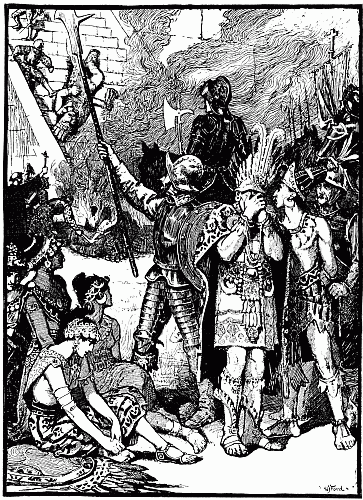
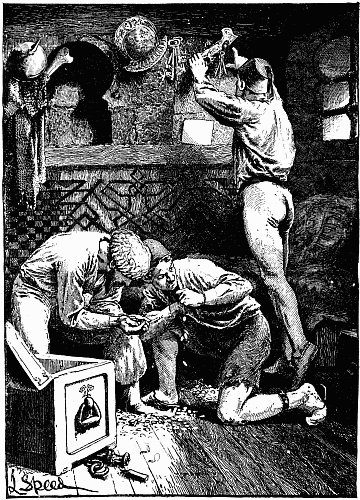
These are some of the wonderful things that were sent. Two
collars made of gold and precious stones. Two birds made of
green feathers, with feet, beaks, and eyes of gold, and in the same
piece with them animals of gold resembling snails. A large
alligator's head of gold. Two birds made of thread and feather-work,
having the quills of their wings and tails, their feet, eyes and the
ends of their beaks of gold, standing upon two reeds covered with
gold, which are raised on balls of feather-work and gold embroidery,
one white and the other yellow, with seven tassels of feather-work
hanging from each of them. A large silver wheel, also bracelets,
leaves, and five shields of the same metal. A box of feather-work
embroidered on leather, with a large plate of gold weighing seventy
ounces in the midst. A large wheel of gold with figures of strange
animals on it, and worked with tufts of leaves, weighing three
thousand eight hundred ounces. A fan of variegated feather-work
with thirty-seven rods plated with gold. Sixteen shields of precious
stones, with feathers of various colours hanging from their rims,
and six shields each covered with a plate of gold, with something
resembling a mitre in the centre. Besides all this there was a
quantity of gold ore, and many pieces of richly embroidered cotton
cloth and feather-work. He accompanied this present with a letter
to the emperor in which he gave an account of all his adventures
and discoveries, and ended by beseeching him to confirm his
authority, as he was entirely confident that he should be able to place
the Castilian crown in possession of this great Indian empire. He
also sent four slaves, who had been rescued from the cage in which
were kept the victims about to be sacrificed, and some Mexican
manuscripts.
Very soon after the departure of the treasure-ship Cortés discovered
that there was a conspiracy among some of his followers,
who either did not like the way the general arranged matters,
or else were terrified at the prospect of the dangerous campaign
that was before them. They had seized one of the ships, and got
provisions and water stored, and were on the eve of setting sail for
Cuba, when one of their number repented of the part he had taken
in the plot, and betrayed it to Cortés, who at once took measures
for the arrest of the ringleaders, two of whom were afterwards
hanged. This affair showed the general that there were some
among his followers who were not heart and soul in the expedition,
and who might therefore fail him when he most needed them, and
might also cause their comrades to desert if there was any chance
for them to escape. He therefore determined to take the bold step
of destroying the ships without the knowledge of his army. Accordingly,
he marched the whole army to Cempoalla, and when he
arrived there he told his plan to a few of his devoted adherents,
who entirely approved of it. Through them he persuaded the pilots
to declare the ships unseaworthy, and then ordered nine of them to
be sunk, having first brought on shore their sails, masts, iron, and
all movable fittings. When the news of this proceeding reached
Cempoalla, it caused the deepest consternation among the Spaniards,
who felt themselves betrayed and abandoned, a mere handful of
men arrayed against a great and formidable empire, and cut off
from all chance of escape. They murmured loudly, and a serious
mutiny was threatened. But Cortés, whose presence of mind never
deserted him, managed to reassure them, and to persuade them
that he had only done what was really best for everyone; and he
so cunningly dwelt upon the fame and the treasure which they
were on the eve of gaining, that not one of them accepted the offer
which he made to them of returning to Cuba in the only remaining
ship. Their enthusiasm for their leader revived, and as he concluded
his speech they made the air ring with their shouts of
'To Mexico! To Mexico!'
While he was still at Cempoalla, news came to Cortés from Villa
Rica that four strange ships were hovering off the coast, and that
they refused to respond to repeated signals made to them by Don
Juan de Escalante, who was in command of the garrison left in the
town. This greatly alarmed Cortés, who was continually dreading
the interference of his enemy, the governor of Cuba. He rode
hastily back to Villa Rica, and, almost without stopping to rest,
pushed on a few leagues northwards along the coast, where he understood
the ships were at anchor. On his way he met with three
Spaniards just landed from them, and learned that they belonged to
a squadron fitted out by Francisco de Garay, who had landed on
the Florida coast a year before, and had obtained from Spain
authority over the countries he might discover in its neighbourhood.
Cortés saw he had nothing to fear from them, but he did wish he
could have induced the crews of the ships to join his expedition.
The three men he easily persuaded, but those who remained on
board feared treachery, and refused to send a boat ashore. Finally,
by a stratagem, Cortés succeeded in capturing three or four more,
out of a boat's crew who came to fetch their comrades, and with
this small party of recruits he returned to Cempoalla. On August 16,
1519, Cortés bade farewell to his hospitable Indian friends, and set
out for Mexico. His force consisted of about four hundred foot and
fifteen horse, with seven pieces of artillery, and in addition to these
he had obtained from the cacique of Cempoalla thirteen hundred
warriors, and a thousand porters to carry the baggage and drag the
guns. During the first day the army marched through the 'tierra
caliente,' or hot region. All around them fruit and flowers grew in
the wildest profusion, as indeed they did all the year round in that
wonderful climate; the air was heavy with perfume, and bright birds
and insects abounded. But after some leagues' travel, over roads
made nearly impassable by the summer rains, they began to ascend
gradually, and at the close of the second day they reached Xalapa,
from which they looked out over one of the grandest prospects that
could be seen anywhere. Down below them lay the hot region with
its gay confusion of meadows, streams, and flowering forests, sprinkled
over with shining Indian villages, while a faint line of light upon
the horizon told them that there was the ocean they had so lately
crossed, beyond which lay their country, which many of them would
never see again. To the south rose the mighty mountain called
'Orizaba,' in his mantle of snow, and in another direction the
Sierra Madre, with its dark belt of pine-trees, stretched its long lines
of shadowy hills away into the distance. Onward and upward they
went, and on the fourth day they arrived at the strong town of
Naulinco. Here the inhabitants entertained them hospitably, for they
were friendly with the Totonacs, and Cortés endeavoured, through
Father Olmedo, to teach them something about Christianity. They
seem to have listened willingly, and allowed the Spaniards to erect a
cross for their adoration, which indeed they did in most of the places
where they halted. The troops now entered upon a rugged, narrow
valley, called 'the Bishop's Pass,' and now it began to be terribly
cold, the snow and hail beat upon them, and the freezing wind
seemed to penetrate to their very bones. The Spaniards were partly
protected by their armour, and their thick coats of quilted cotton,
but the poor Indians, natives of the hot region and with very little
clothing, suffered greatly, and indeed several of them died by the
way. The path lay round a bare and dreadful-looking volcanic
mountain, and often upon the edge of precipices three thousand feet
in depth. After three days of this dreary travelling the army
emerged into a more genial climate; they had reached the great
tableland which spreads out for hundreds of miles along the crests of
the Cordilleras, more than seven thousand feet above the sea-level.
The vegetation of the torrid and temperate regions had of course
disappeared, but the fields were carefully cultivated. Many of the
crops were unknown to the Spaniards, but they recognised maize
and aloes, and various kinds of cactus. Suddenly the troops came
upon what seemed to be a populous city, even larger than Cempoalla,
and with loftier and more substantial buildings, of stone and lime.
There were thirteen teocallis in the town, and in one place in the
suburbs one of the Spaniards counted the stored-up skulls of a
hundred thousand sacrificed victims. The lord of the town ruled
over twenty thousand vassals; he was a tributary to Montezuma,
and there was a strong Mexican garrison in the place. This was
probably the reason of his receiving Cortés and his army very coldly,
and vaunting the grandeur of the Mexican emperor, who could, he
declared, muster thirty great vassals, each of whom commanded a
hundred thousand men. In answer to the inquiries of Cortés, he told
him about Montezuma and his capital. How more than twenty
thousand prisoners of war were sacrificed every year upon the altars
of his gods, and how the city stood in the midst of a great lake, and
was approached by long causeways connected in places by wooden
bridges, which when raised cut off all communication with the
country—and many other strange things which were not of a kind to
reassure the minds of the Spaniards. They hardly knew whether
to believe the old cacique or not, but at any rate the wonders they
heard made them, as one of their cavaliers said, 'only the more
earnest to prove the adventure, desperate as it might appear.'
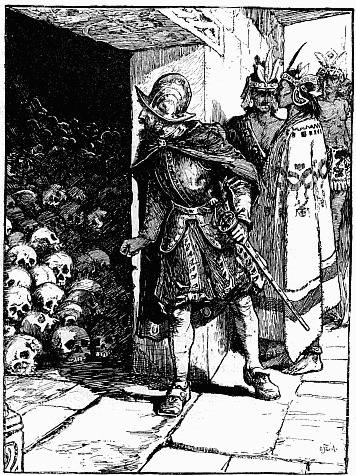
The natives were also very curious to know about the Spaniards,
their horses and dogs, and strange weapons, and Marina in answering
their questions took care to expatiate upon the exploits and
victories of her adopted countrymen, and to state the extraordinary
marks of respect they had received from Montezuma. This had
its effect upon the cacique, who presently sent the general some
slaves to make bread for the soldiers, and supplied them with the
means of refreshment and rest, which they needed so much after their
toilful march.
The army rested in this city four or five days, and even at the end
of the last century the Indians would still point out the cypress tree
under the shelter of which the conqueror's horse had been tied. When
the journey was resumed, the way was through a broad green valley,
watered by a splendid river and shaded by lofty trees. On either
side of the river an unbroken line of Indian dwellings extended for
several leagues, and on some rising ground stood a town which
might contain five or six thousand inhabitants, commanded by a
fortress with walls and trenches. Here the troops halted again,
and met with friendly treatment.
In their last halting-place Cortés had been advised by the
natives to take the route to the ancient city of Cholula, the inhabitants
of which were a mild race, subjects of Montezuma, and given
to peaceful arts, who were likely to receive him kindly. But his
Cempoallan allies declared that the Cholulans were false and perfidious,
and counselled him to go to Tlascala, a valiant little republic
which had managed to maintain its independence against the arms
of Mexico. The tribe had always been friendly with the Totonacs,
and had the reputation of being frank, fearless, and trustworthy.
The Spanish general decided to try and secure their goodwill, and accordingly
despatched four of the principal Cempoallans with a gift,
consisting of a cap of crimson cloth, a sword and a cross-bow, to ask
permission to pass through their country, expressing at the same
time his admiration of their valour, and of their long resistance of
the Aztecs, whose pride he, too, was determined to humble. Three
days after the departure of the envoys the army resumed its march,
lingering somewhat by the way in hopes of receiving an answer
from the Indian Republic. But the messengers did not return,
which occasioned the general no little uneasiness. As they advanced
the country became rougher and the scenery bolder, and at
last their progress was arrested by a most remarkable fortification.
It was a stone wall nine feet high and twenty feet thick, with a
parapet a foot and a half broad at the top, for the protection of those
who defended it. It had only one opening in the centre, made by
two semicircular lines of wall overlapping each other for the space
of forty paces, and having a passage-way between, ten paces wide,
so contrived as to be perfectly commanded by the inner wall. This
fortification, which extended for more than two leagues, rested at
either end on the bold, natural buttresses of the chain of mountains.
It was built of immense blocks of stone nicely laid together without
cement, and from the remains that still exist it is easy to imagine
what its size and solidity must have been. This singular structure
marked the limits of Tlascala, and was intended, the natives said, as
a barrier against Mexican invasions. The soldiers paused amazed,
and not a little apprehensive as to their reception in Tlascala, since
a people who were capable of such a work as that would indeed
prove formidable should they not be friendly. But Cortés, putting
himself at the head of his cavalry, shouted, 'Forward, soldiers; the
Holy Cross is our banner, and under that we shall conquer.' And so
they marched through the undefended passage, and found themselves
in Tlascala.
The Tlascalan people belonged to the same great family as the
Aztecs, and had planted themselves upon the western shore of Lake
Tezcuco at about the same period—at the close of the twelfth century.
There they remained many years, until they had, for some
reason, incurred the displeasure of all the surrounding tribes, who
combined to attack them, and a terrible battle took place. Though
the Tlascalans were entirely victorious, they were so disgusted by this
state of things that they resolved to migrate, and the greater number
of them finally settled in the warm and fruitful valley overshadowed
by the mountains of Tlascala. After some years the monarchy
was divided, first into two, then four separate states, each with its
own chief, who was independent in his own territory, and possessed
equal authority with the other three in all matters concerning the
whole republic, the affairs of which were settled by a council consisting
of the four chiefs and the inferior nobles. They were an
agricultural people, and the fertility of their new country was signified
by its name—'Tlascala' meaning the land of bread. Presently
their neighbours began to be envious of their prosperity, and they
were frequently obliged to defend themselves against the Cholulans,
and were always successful. But when Axayacatl, king of the
Aztecs, sent demanding the same tribute and obedience from them
which the other people of the country paid him, threatening, if they
refused, to destroy their cities, and give their land to their enemies,
they answered proudly, 'Neither they nor their forefathers had ever
paid tribute or homage to a foreign power, nor ever would pay it.
If their country was invaded, they knew how to defend it.'
This answer brought upon them the forces of the Mexican monarch,
and a pitched battle was fought in which the republic was
again victorious, but from that time hostilities never ceased between
the two nations, every captive was mercilessly sacrificed, and the
Tlascalan children were trained from the cradle to hate the Mexicans
with a deadly hatred. In this struggle the Tlascalans received
valuable support from a wild and warlike race from the north, called
the Otomies. Some of them settled in the republic, and having
proved themselves courageous and faithful, were entrusted with the
defence of the frontier. After Montezuma became emperor of Mexico
greater efforts than before were made to subdue Tlascala. He sent
a great army against it, commanded by his favourite son, but his
troops were defeated and his son killed. Enraged and mortified,
Montezuma made still greater preparations and invaded the valley
with a terrific force. But the Tlascalans withdrew to the recesses
of the hills, and watching their opportunity, swept down upon the
enemy and drove them from their territory with dreadful slaughter.
Nevertheless they were greatly harassed by these constant struggles
with a foe so superior to themselves in numbers and resources.
The Aztec armies lay between them and the coast, cutting off all possibility
of obtaining any supplies. There were some things, as cotton,
cacas, and salt, which they were unable to grow or manufacture, of
which they had been deprived for more than fifty years, and their
taste was so much affected by this enforced abstinence that they did
not get used to eating salt with their food for several generations after
the conquest. This was the state of affairs in Tlascala when the
Spaniards reached it, and it is easy to see how important it was to
Cortés to form an alliance with it, but that was not an easy thing
to do.
The Tlascalans had heard about the Christians and their victorious
advance, but they had not expected that they would come their way.
So they were much embarrassed by the embassy demanding a passage
through their territories. The council was assembled, and a
great difference of opinion was found among its members. Some
believed that these were the white-skinned, bearded men whose
coming was foretold, and at all events they were enemies to
Mexico, and might help them in their struggle against it. Others
argued that this could not be: the march of the strangers through
the land might be tracked by the broken images of the Indian
gods, and desecrated temples. How could they be sure that
they were not friends of Montezuma? They had received his embassies,
accepted his gifts, and were even now on their way to his
capital in company with his vassals. This last was the opinion of
an aged chief, one of the four rulers of the republic. His name was
Xicotencatl, and he was nearly blind, for he was over a hundred years
old. He had a son of the same name as himself, an impetuous young
man, who commanded a powerful force of Tlascalans and Otomies on
the eastern frontier where the great fortification stood. The old chief
advised that this force should at once fall upon the Spaniards. If
they were conquered they would be at the mercy of the Tlascalans,
but if by any mischance his son should fail, the council could declare
that they had nothing to do with the attack, laying the whole blame
of it upon the young Xicotencatl. Meantime the Cempoallan envoys
were to be detained under pretence of assisting at a religious sacrifice.
By this time, as we know, Cortés and his gallant band had
passed the rocky rampart, from which, for some reason or other, the
Otomie guard was absent. After advancing a few leagues he saw
a small party of Indians, armed with sword and buckler, who fled
at his approach. He made signs for them to halt, but they only fled
the faster.
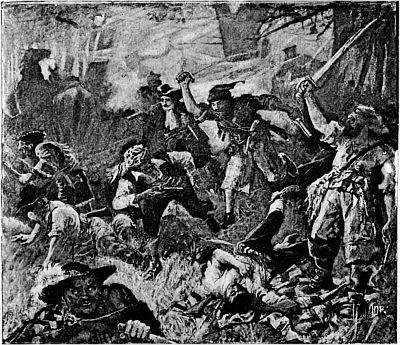
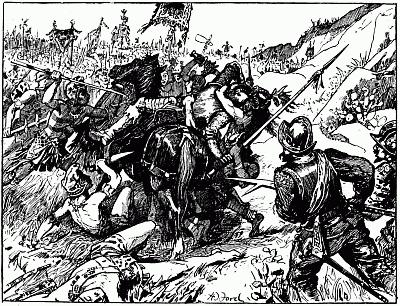
The Spaniards spurred their horses, and soon succeeded in overtaking
them, when they at once turned, and, without showing the
usual alarm at the horses and strange weapons of the cavaliers,
attacked them furiously. The latter, however, were far too strong
for them, and they would soon have been cut to pieces had not a
body of several thousand Indians appeared, coming quickly to their
rescue. Cortés seeing them, hastily despatched a messenger to
hurry up his infantry. The Indians, having discharged their missiles,
fell upon the little band of Spaniards, striving to drag the riders
from their horses and to tear their lances from their grasp. They
brought one cavalier to the ground, who afterwards died of his
wounds, and they killed two horses, cutting their necks through with
one blow of their formidable broadswords. This was a most serious
loss to Cortés, whose horses were so important, and so few in number.
The struggle was a hard one, and it was with no small satisfaction
that the Spaniards saw their comrades advancing to their aid.
No sooner had the main body reached the field of battle, than,
hastily falling into position, they poured such a volley from their
muskets and cross-bows as fairly astounded the enemy, who made no
further attempt to continue the fight, but drew off in good order, leaving
the road open to the Spaniards, who were only too glad to get rid of
their foes and pursue their way. Presently they met two Tlascalan
envoys, accompanied by two of the Cempoallans. The former, on
being brought to the general, assured him of a friendly reception in
the capital, and declared the late assault upon the troops to have
been quite unauthorised. Cortés received his message courteously,
pretending to believe that all was as he said. As it was now growing
late the Spaniards quickened their pace, anxious to reach a suitable
camping-ground before nightfall, and they chose a place upon the
bank of a stream, where a few deserted huts were standing. These
the weary and famishing soldiers ransacked in search of food, but
could find nothing but some animals resembling dogs, which, however,
they cooked and ate without ceremony, seasoning their unsavoury
repast with the fruit of the Indian fig, which grew wild in
the neighbourhood. After several desperate battles with the Tlascalans,
Cortés finally won a great victory.
The next day—as he usually did after gaining a battle—the
Spanish commander sent a new embassy to the Tlascalan capital,
making as before professions of friendship, but this time threatening
that if his offers were rejected he would visit their city as a
conqueror, razing their house to the ground and putting every
inhabitant to the sword. Of course this message was given to the
envoys by the aid of the Lady Marina, who became day by day
more necessary to Cortés, and who was, indeed, generally admired
for her courage and the cheerfulness with which she endured all
the hardships of the camp and raised the drooping spirits of the
soldiers, while by every means in her power she alleviated the
miseries of her own countrymen. This time, the ambassadors of
Cortés received a respectful hearing from the deeply dejected
council of Tlascala, for whom nothing remained but to submit.
Four principal caciques were chosen to offer to the Spaniards a
free passage through the country, and a friendly reception in the
capital. Their friendship was accepted, with many excuses for the
past, and the chiefs were further ordered to touch at the camp of
Xicotencatl, the Tlascalan general, and require him to cease hostilities
and furnish the white men with a plentiful supply of provisions.
While the Tlascalan envoys were still in the camp came a fresh
embassy from Montezuma. Tidings had been sent to him of each
step in the progress of the Spaniards, and it was with great satisfaction
that he had heard of their taking the road to Tlascala,
trusting that if they were mortal men they would find their graves
there. Great was his dismay, therefore, when courier after courier
brought him news of their successes, and how the most redoubtable
warriors had been scattered by this handful of strangers.
His superstitious fears returned with greater force than ever, and
in his alarm and uncertainty he despatched five great nobles of
his court, attended by two hundred slaves, to bear to Cortés a gift
consisting of three thousand ounces of gold and several hundred
robes of cotton and feather-work. As they laid it at his feet
they said that they had come to offer Montezuma's congratulations
upon his victories, and to express his regret that he could not
receive them in his capital, where the numerous population was
so unruly that he could not be answerable for their safety. The
merest hint of the emperor's wishes would have been enough
to influence any of the natives, but they made very little impression
upon Cortés; and, seeing this, the envoys proceeded, in their
master's name, to offer tribute to the Spanish sovereign, provided
the general would give up the idea of visiting the capital.
This was a fatal mistake, and a most strange one for such a brave
and powerful monarch to make, for it amounted to an admission
that he was unable to protect his treasures. Cortés in replying
expressed the greatest respect for Montezuma, but urged his own
sovereign's commands as a reason for disregarding his wishes.
He added that though he had not at present the power of requiting
his generosity as he could wish, he trusted 'to repay him at some
future day with good works.' You will hear before long how he
kept his word.
The Mexican ambassadors were anything but pleased at finding
the war at an end and a firm friendship established between their
mortal enemies and the Spaniards, and the general saw with some
satisfaction the evidences of a jealousy between them, which was his
surest hope of success in undermining the Mexican empire. Two
of the Aztecs presently returned to acquaint Montezuma with the
state of affairs; the others remained with the Spaniards, Cortés
being willing that they should see the deference paid to him by the
Tlascalans, who were most anxious for his presence in their city.
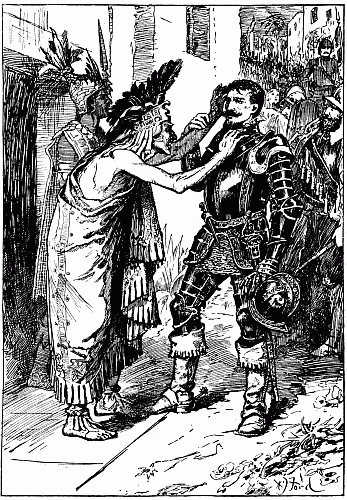
The city of Tlascala lay about six leagues away from the Spanish
camp, and the road led through a hilly region, and across a deep
ravine over which a bridge had just been built for the passage of
the army; they passed some towns by the way, where they were
received with the greatest hospitality. The people flocked out to meet
them, bringing garlands of roses, with which they decorated the
Spanish soldiers, and wreathed about the necks of their horses.
Priests in their white robes mingled with the crowd, scattering
clouds of incense from their censers, and thus escorted the army
slowly made its way through the gates of the city of Tlascala.
Here the press became so great that it was with difficulty that a
passage was cleared for it. The flat housetops were crowded with
eager spectators, while garlands of green boughs, roses, and honeysuckle
were thrown across the streets, and the air was rent with
songs and shouts and the wild music of the national instruments.
Presently the procession halted before the palace of the aged
Xicotencatl, the father of the general, and Cortés dismounted
from his horse, that the blind old man might satisfy his natural
curiosity respecting him, by passing his hand over his face. He
then led the way to a spacious hall, where a banquet was served to
the whole army, after which, quarters were assigned to them in a
neighbouring teocalli, the Mexican ambassadors being, at the desire
of Cortés, lodged next to himself that he might the better
protect them in the city of their foes.
For some days the Spaniards were feasted and entertained in
four quarters of the city, which was really like separate towns
divided from one another by high walls, in each of which lived one
of the rulers of the republic, surrounded by his own vassals. But
amid all these friendly demonstrations the general never for a
moment relaxed the strict discipline of the camp, and no soldier
was allowed to leave his quarters without special permission.
At first this offended the Tlascalan chiefs, as they thought it
showed distrust of them. But when Cortés explained that this
was only in accordance with the established military system of
his country, they began to think it admirable, and the young
Xicotencatl proposed, if possible, to imitate it. The Spanish commander
now turned his thoughts to the converting of the Tlascalans;
but as they refused to part with their own gods, though they were
willing enough to add the God of the Christians to their number,
he took the advice of the wise Father Olmedo, and abandoned the
idea for the time. However, a cross was erected in one of the
great squares, and there the Spaniards held their religious services
unmolested, and it happened, strangely enough, that they had
scarcely left the city when a thin, transparent cloud settled like a
column upon the cross, wrapping it round, and continuing through
the night to shed a soft light about it. This occurrence did more
for the conversion of the natives than all the preaching of Father
Olmedo. Several of the Indian princesses were now baptized, and
given in marriage to the officers of Cortés. One, who was the
daughter of Xicotencatl, became the wife of Alvarado, who was
always a great favourite with the Tlascalans. From his gay
manners, joyous countenance, and bright golden hair, he gained the
nickname of 'Tonatiuh,' or the 'Sun,' while Cortés, who hardly
ever appeared anywhere without the beautiful Marina, was called
by the natives 'Malinche,' which you will remember was her
Indian name. While all this was happening, came yet another
embassy from Montezuma, loaded as usual with costly gifts. This
time he invited the Spaniards to visit him in his capital, assuring
them that they would be welcome. Further, he besought them to
enter into no alliance with the base and barbarous Tlascalans, but
he invited them to take the route of the friendly city of Cholula,
where arrangements were being made, by his orders, for their reception.
The Tlascalans were much concerned that Cortés should propose
to go to Mexico, and what they told him fully confirmed all
the reports he had heard of the power and ambition of Montezuma,
of the strength of his capital, and the number of his soldiers. They
warned him not to trust to his gifts and his fair words, and when the
general said that he hoped to bring about a better understanding
between the emperor and themselves, they replied that it was impossible;
however smooth his words, he would hate them at heart.
They also heartily protested against the general's going to Cholula.
The people, they said, though not brave in the open field, were
crafty; they were Montezuma's tools, and would do his bidding.
That city, too, was specially under the protection of the god Quetzalcoatl,
and the priests were confidently believed to have the power of
opening an inundation from the foundations of his shrine, which
should overwhelm their enemies in the deluge, and lastly, though
many distant places had sent to testify their goodwill, and offer
their allegiance, Cholula, only six leagues distant, had done neither.
This consideration weighed more with the general than either of
the preceding ones, and he promptly despatched a summons to the
city demanding a formal tender of its submission. It was not long
before deputies arrived from Cholula profuse in expressions of goodwill
and invitations to visit their city; but the Tlascalans pointed
out that these messengers were below the usual rank of ambassadors,
which Cortés regarded as a fresh indignity. He therefore sent a
new summons, declaring that if they did not at once send a deputation
of their principal men he would treat them as rebels to his
own sovereign, the rightful lord of these realms. This soon brought
some of the highest nobles to the camp, who excused their tardy
appearance, by saying that they had feared for their personal safety
in the capital of their enemies. The Tlascalans were now more
than ever averse to the projected visit. A strong Aztec force
was known to be near Cholula, and the city was being actively
prepared for defence. Cortés, too, was disturbed by these
circumstances, but he had gone too far to recede without showing
fear, which could not fail to have a bad effect on his own men, as
well as on the natives. Therefore, after a short consultation with
his officers, he decided finally to take the road to Cholula. This
ancient city lay six leagues to the south of Tlascala, and was most
populous and flourishing. The inhabitants excelled in the art of
working in metals and manufacturing cotton cloth and delicate
pottery, but were indisposed to war, and less distinguished for
courage than for cunning. You will remember that it was in this
place that the god Quetzalcoatl had paused on his way to the coast,
and in his honour a tremendous pyramid had been erected, probably
by building over a natural hill, and on the top of this rose a
gorgeous temple, in which stood an image of the god bedecked with
gold and jewels. To this temple pilgrims flocked from every corner
of the empire, and many were the terrible sacrifices offered there,
as, indeed, in all the other teocallis, of which there were about four
hundred in the city. On the day appointed, the Spanish army set
out for Cholula, followed by crowds of citizens, who admired the
courage displayed by this little handful of men in proposing to
brave the mighty Montezuma in his own territory. An immense
body of warriors had offered to join the expedition, but Cortés
thought it wise to accept only six thousand, and even these he left
encamped at some distance from Cholula, because the caciques of
that city, who came out to meet the Spaniards, objected to having
their mortal enemies brought within its walls. As the troops drew
near the town they were met by swarms of men, women, and
children, all eager to catch a glimpse of the strangers, whose persons,
horses, and weapons were equally objects of intense curiosity to
them. They in their turn were struck by the noble aspect of the
Cholulans, who were much superior in dress and general appearance
to the other tribes they had encountered. An immense
number of priests swinging censers mingled with the crowd, and,
as before, they were decorated with garlands and bunches of
flowers, and accompanied by gay music from various instruments.
The Spaniards were also struck by the width and cleanliness of the
streets and the solidity of the houses. They were lodged in the
court of one of the many teocallis, and visited by the great nobles
of the city, who supplied them plentifully with all they needed, and
at first paid them such attentions as caused them to believe
that the evil apprehensions of the Tlascalans had been merely
suspicion and prejudice. But very soon the scene changed. Messengers
came from Montezuma, who shortly and pleasantly told
Cortés that his approach occasioned much disquietude to their
master, and then conferred apart with the Mexicans who were still
in the Spanish camp, presently departing, and taking one of them
away with them. From this time the Cholulans visited the
Spanish quarters no more, and when invited to do so excused
themselves, saying they were ill. Also, the supply of provisions
ran short, and they said it was because maize was scarce. Naturally,
Cortés became very uneasy at this change, and his alarm was
increased by the reports of the Cempoallans, who told him that in
wandering about the city they had seen several streets barricaded,
and in some places holes had been dug, and a sharp stake planted
upright in each, and branches strewn to conceal them, while the
flat roofs of the houses were being stored with stones and other
missiles. Some Tlascalans also came in from their camp to inform
him that a great sacrifice, mostly of children, had been held in a
distant quarter of the town, to secure the aid of the gods in some
intended enterprise, and numbers of the people had taken their
wives and children out of the city.
These tidings confirmed the worst suspicions of Cortés, but just
then the Lady Marina made a discovery which changed his doubts
into certainty. The wife of one of the Cholulan caciques had taken
a great fancy to the Mexican girl, and continually urged her to visit
her house, hinting mysteriously that she would in this way escape
a great danger which threatened the Spaniards. Marina pretended
to be delighted with this proposal, and glad of the chance of escaping
from the white men, and by degrees she thus won the confidence of
the Cholulan, who presently revealed the whole plot to her. It
originated, she said, with the Aztec emperor, who had bribed the
caciques of Cholula, her husband among the number, to assault the
Spaniards as they marched out of the city, and to throw them into
confusion all sorts of obstacles had been placed in their way. A
force of twenty thousand Mexicans was already quartered near the
city to support the Cholulans, and the Spaniards would, it was confidently
expected, fall an easy prey to their united enemies. A sufficient
number of them were to be reserved to be sacrificed in Cholula,
and the rest led in fetters to the capital of Montezuma. While this
conversation was taking place, Marina was making a show of collecting
and packing up such dresses and jewels as she was to take
with her to the house of her new friend. But after a while she
managed to slip away without exciting her suspicion, and, rushing
to the general, told him all. Cortés at once caused the cacique's
wife to be seized, and she repeated to him the same story that she
had told to Marina. He was most anxious to gain further particulars
of the conspiracy, and accordingly induced two priests, one of them
a person of much influence, to visit his quarters, where by courteous
treatment and rich presents he got from them a complete confirmation
of the report. The emperor had been in a state of pitiable
vacillation since the arrival of the Spaniards. His first orders had
been that they should be kindly received, but on consulting his oracles
anew he had obtained for answer that Cholula would be the grave of
his enemies, and so positive of success were the Aztecs, that they had
already sent into the city numbers of the poles with thongs attached
to them with which to bind the prisoners. Cortés now dismissed the
priests, bidding them observe the strictest secrecy, which, indeed
they were likely to do for their own sakes. He also requested that
they would induce some of the principal caciques to grant him an
interview in his quarters. When they came he gently rebuked
them for their want of hospitality, and said that the Spaniards would
burden them no longer, but would leave the city early the next
morning. He also asked that they would supply him with two
thousand men to carry his artillery and baggage. The chiefs, after
some consultation, agreed to this as being likely to favour their own
plans. Then he sent for the Mexican ambassadors, and acquainted
them with his discovery of the plot, saying that it grieved him
much to find Montezuma mixed up in so treacherous an affair,
and that the Spaniards must now march as enemies against a
monarch they had hoped to visit as a friend. The ambassadors,
however, asserted their entire ignorance of the conspiracy, and
their belief that Montezuma also knew nothing of it. The night
that followed was one of intense anxiety; every soldier lay down
fully armed, and the number of sentinels was doubled; but all
remained quiet in the populous city, and the only sounds which
reached their ears were the hoarse cries of the priests who, from
the turrets of the teocallis, proclaimed through their trumpets the
watches of the night.
With the first streak of morning light Cortés was on horseback,
directing the movements of his little band, part of which he posted
in the great square court. A strong guard was placed at each of the
three gates, and the rest had charge of the great guns which were
outside the enclosure, and so placed as to command the roads which
led to the teocalli. The arrangements were hardly completed before
the Cholulan caciques appeared, bringing a larger body of porters
than had been demanded. They were marched at once into the
square, which was, as we have seen, completely lined by the Spanish
troops. Cortés then took the caciques aside, and sternly and
abruptly charged them with the conspiracy, taking care to show that
he knew every detail. The Cholulans were thunderstruck, and
gazed with awe upon the strangers who seemed to have the power
of reading their most secret thoughts. They made no attempt to
deny the accusation, but tried to excuse themselves by throwing the
blame on Montezuma. Cortés, however, declared with still more
indignation that such a pretence would not serve them, and that he
would now make such an example of them as should be a warning
to the cities far and near, and then the fatal signal—the firing of a
gun—was given, and in an instant every musket and crossbow was
levelled at the unhappy Cholulans as they stood crowded together
in the centre. They were completely taken by surprise, having
heard nothing of what was going forward, and offered hardly
any resistance to the Spanish soldiers, who followed up the discharge
of their pieces by rushing upon them with their swords and mowing
them down in ranks as they stood.
While this dreadful massacre was going on the Cholulans from
outside, attracted by the noise, began a furious assault upon the
Spaniards, but the heavy guns opened fire upon them and swept
them off in files as they rushed on, and in the intervals of reloading
the cavalry charged into their midst. By this time the Tlascalans
had come up, having by order of Cortés bound wreaths of sedge
about their heads that they might be the more easily distinguished
from the Cholulans, and they fell upon the rear of the wretched
townsmen, who, thus harassed on all sides, could no longer maintain
their ground. They fled, some to the near buildings, which were
speedily set on fire, others to the temples. One strong body headed
by the priests got possession of the great teocalli. There was, as
you remember, a tradition that if part of the wall was removed the
god would send a flood to overwhelm his enemies. Now the Cholulans
strove with might and main, and at last succeeded in
wrenching away a few stones, but dust, not water, followed. In
despair they crowded into the wooden turrets which surmounted
the temple, and poured down stones, javelins, and burning arrows
upon the Spaniards as they came swarming up the steps. But the
fiery shower fell harmlessly upon the steel head-pieces of the soldiers,
and they used the blazing shafts to set fire to the wooden
towers, so that the wretched natives either perished in the flames
or threw themselves headlong from the parapet. In the fair city,
lately so peaceful and prosperous, all was confusion and slaughter,
burning and plundering. The division of spoil was greatly simplified
by the fact that the Tlascalans desired wearing-apparel and
provisions far more than gold or jewels; they also took hundreds of
prisoners, but these Cortés afterwards induced them to release.
The work of destruction had gone on for some hours before the
general yielded to the entreaties of the Cholulan chiefs who had
been saved from the massacre, and of the Mexican envoys, and
called off his men, putting a stop as well as he could to further violence.
Two of the caciques were also permitted to go to their
countrymen with offers of pardon and protection to all who would
return to their obedience, and so by degrees the tumult was appeased.
Presently Cortés helped the Cholulans to choose a successor
to their principal cacique, who was among the slain, and confidence
being thus restored the people from the country round began to
flock in, the markets were again opened, and the ordinary life of
the city resumed, though the black and smouldering ruins remained
to tell the sad tale of the massacre of Cholula. This terrible vengeance
made a great impression upon the natives, and none trembled
more than the Mexican monarch upon his throne among the
mountains. He felt his empire melting away from him like a
morning mist, for some of the most important cities, overawed by
the fate of Cholula, now sent envoys to the Spanish camp tendering
their allegiance, and trying to secure the favour of the conqueror
by rich gifts of gold and slaves. Again did Montezuma seek counsel
from his gods, but the answers he obtained were far from reassuring,
and he determined to send another embassy to Cortés to
declare that he had nothing to do with the conspiracy at Cholula.
As usual the envoys were charged with a splendid present of golden
vessels and ornaments, and among other things were artificial birds,
made in imitation of turkeys with plumage of worked gold; there
were also fifteen hundred robes of delicate cotton cloth. The emperor's
message expressed regret for the late catastrophe, and denied
all knowledge of the plot which had, he said, brought a retribution
upon its authors which they richly deserved; and he explained the
presence of the Aztec force in the neighbourhood by saying that
there was a disturbance that had to be quelled. More than a fortnight
had passed since the Spaniards entered Cholula, and the
general had, after the city was once more restored to order, tried to
induce the people to give up their false gods, but this they would
not do willingly. However, he seized upon the great teocalli of
which all the woodwork had been burned, and built a church of the
stone that remained, and he opened the cages in which the wretched
victims about to be sacrificed were imprisoned, and restored them
to liberty, and then he thought it time to begin the march to Mexico
once more. So the allied army of Spaniards and Tlascalans set
out upon their journey through luxuriant plains and flourishing
plantations, met occasionally by embassies from different towns,
anxious to claim the protection of the white men, and bringing rich
gifts of gold to propitiate them. They passed between the two
enormous mountain peaks, Popocatapetl, 'the hill that smokes,'
and Iztaccihuatl, 'the white woman,' and presently encountered a
blinding snow-storm, from which they found shelter in one of the
large stone buildings, put up by the Mexicans for the use of
travellers and couriers, and here they encamped for the night.
The next morning they reached the top of a range of hills where
progress was comparatively easy, and they had not gone far when,
turning sharply round the shoulder of a hill, they saw spread out
before them the lovely Mexican valley. The clearness of the air
enabled them to see distinctly the shining cities, the lakes, woods,
fields and gardens, and in the midst of all the fair city of Mexico
rose as it were from the waters of the great lake, with its towers
and temples white and gleaming, and behind it the royal hill of
Chapoltepec, the residence of the Mexican kings, crowned with
the very same gigantic cypress trees which to this day fling their
broad shadows across the land. The Spaniards gazed in rapture
over the gay scene, exclaiming, 'It is the promised land!' but presently
the evidences of a power and civilisation so far superior to
anything they had yet encountered disheartened the more timid
among them, they shrank from the unequal contest, and begged to
be led back again to Vera Cruz. But this was not the effect produced
upon Cortés by the glorious prospect. His desire for treasure
and love of adventure were sharpened by the sight of the dazzling
spoil at his very feet, and with threats, arguments, and entreaties
he revived the drooping spirits of his soldiers, and by the aid of his
brave captains succeeded in once more rousing them to enthusiasm,
and the march down the slope of the hill was gaily resumed.
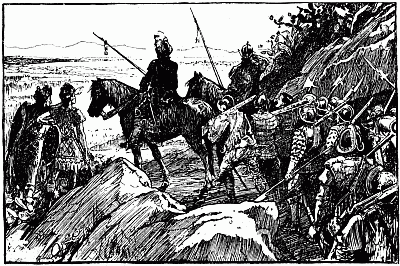
With every step of their progress the woods became thinner,
and villages were seen in green and sheltered nooks, the inhabitants
of which came out to meet and welcome the Spaniards. Everywhere
Cortés heard with satisfaction complaints of the cruelty and
injustice of Montezuma, and he encouraged the natives to rely on
his protection, as he had come to redress their wrongs. The army
advanced but slowly, and was soon met by another embassy from
the emperor, consisting of several Aztec lords bringing a rich gift
of gold, and robes of delicate furs and feathers, and offering four
loads of gold to the general, and one to each of his captains, with a
yearly tribute to the Spanish sovereign, if they would even then
turn back from Mexico. But Cortés replied that he could not
answer it to his sovereign if he were to return without visiting the
emperor in his capital. The Spaniards came in the spirit of peace
as Montezuma would see for himself; but should their presence
prove burdensome to him, it would be very easy for them to relieve
him of it.
This embassy had been intended to reach the Spaniards before
they crossed the mountains, and the dismay of the Aztec emperor
was great when he learned that it had failed, and that the dreaded
strangers were actually on their march across the valley. They
were so utterly unlike anything he had ever known before, these
strange beings, who seemed to have dropped from another planet,
and by their superior knowledge and more deadly weapons overcome
the hitherto unconquerable nations, though a mere handful of
men in comparison to the swarms of his own countrymen. He felt
himself to be the victim of a destiny from which nothing could save
him. All peace, power, and security seemed to be gone from him,
and in despair he shut himself up in his palace, refusing food, and
trying by prayers and sacrifices to wring some favour from his
gods. But the oracles were dumb. Then he called a council of his
chief nobles, but a great difference of opinion arose amongst them.
Cacama, the emperor's nephew, king of Tezcuco, counselled him to
receive the Spaniards courteously as ambassadors of a foreign
prince, while Cuitlahua, his brother, urged him to muster his forces
and then and there drive back the invaders, or die in the defence of
his capital. But Montezuma could not rouse himself for this
struggle. He exclaimed in deep dejection, "Of what avail is resistance
when the gods have declared themselves against us? Yet I
mourn for the old and infirm, the women and children, too feeble to
fight or fly. For myself and the brave men around me, we must
face the storm as best we may!" and he straightway sent off a last
embassy, with his nephew at its head, to meet the Spaniards and
welcome them to Mexico. By this time the army had reached the
first of the towns built on piles driven into the lake, and were
delighted with its fine stone houses, with canals between them
instead of streets, up and down which boats passed continually,
laden with all kinds of merchandise. Though received with great
hospitality, Cortés still was strictly on his guard, and neglected no
precaution for the security of his men. Before he left this place a
messenger came, requesting him to wait for the arrival of the king
of Tezcuco, who very soon afterwards appeared, borne in a palanquin
richly decorated with plates of gold and precious stones, having
pillars curiously wrought which supported a canopy of green plumes.
He was accompanied by a numerous retinue of nobles and inferior
attendants, and when he came into the presence of Cortés he descended
from his palanquin and advanced towards him, his officers
sweeping the ground before him as he did so.
The prince was a handsome young man, erect and dignified; he
made the usual Mexican salutation to people of high rank, touching
the earth with his right hand and raising it to his head, and said
that he came as the representative of Montezuma to bid the
Spaniards welcome to Mexico, and presented the general with three
pearls of uncommon size and lustre. Cortés embraced him, and in
return threw over his neck a chain of cut glass. After this exchange
of courtesies, and the most friendly and respectful assurances on
the part of Cortés, the Indian prince withdrew, leaving the
Spaniards much impressed by his superiority in state and bearing
to anything they had before seen in the country.
Resuming their march along the southern shore of Lake Chalco,
through splendid woods, and orchards glowing with unknown fruits,
the army came at length to a great dyke or causeway four or five
miles long, which divided the Lake Chalco from Xochicalco on the
west. It was a lance in breadth at the narrowest part, and in some
places wide enough for eight horsemen to ride abreast, and was
solidly built of stone and lime. As they passed along it they saw
multitudes of Indians darting up and down the lake in their light
pirogues, eager to catch a glimpse of the strangers, and they were
amazed at the sight of the floating islands, covered with flowers and
vegetables and moving like rafts over the waters. All round the
margin, and occasionally far out in the lake, they saw little towns
and villages half buried in foliage; and the whole scene seemed to
them so new and wonderful that they could only compare it to the
magical pictures of the old romances. Midway across the lake the
army halted at the town of Cuitlahuae, which was not large, but
was remarkable for the beauty of its buildings. The curiosity of
the Indians increased as the Spaniards proceeded, and they clambered
up the causeway and lined the sides of the road, so that the
troops were quite embarrassed by them, and Cortés was obliged to
resort to commands, and even menaces, to clear a passage. He
found, as he neared the capital, a considerable change in the feeling
shown towards the government, and heard only of the pomp and
magnificence of Montezuma, and nothing of his oppressions. From
the causeway the army descended on a narrow point of land which
lay between the two lakes, and crossing it reached the royal residence
of Iztapalapan.
This place was governed by the emperor's brother, who, to
do greater honour to Cortés, had invited the neighbouring lords to
be present at his reception, and at the banquet which followed.
The Spaniards were struck with admiration, when, after the usual
ceremonies had been gone through, and a gift of gold and costly
stuffs had been presented, they were led into one of the gorgeous
halls of the palace, the roof of which was of odorous cedar-wood, and
the stone walls tapestried with brilliant hangings. But, indeed, this
was only one of the many beautiful things which they saw in this
fairy city. There were gardens cunningly planted, and watered in
every part by means of canals and aqueducts, in which grew gorgeous
flowers and luscious fruits. There was an aviary filled with
all kinds of birds, remarkable for the brilliancy of their plumage and
the sweetness of their songs. But the most elaborate piece of work
was a huge reservoir of stone full of water and stocked with all
kinds of fish, and by this all the fountains and aqueducts were
supplied. In this city of enchantment the army rested for the night,
within sight of the capital into which Cortés intended to lead them
on the morrow.
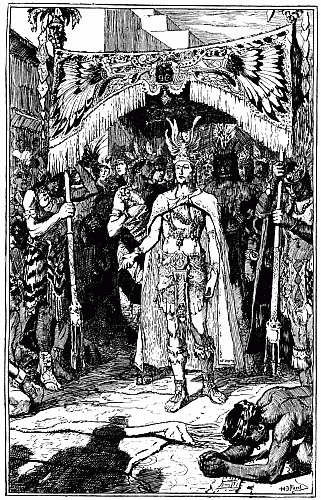 MONTEZUMA GREETS THE SPANIARDS
With the first faint streak of dawn, on the morning of November 8,
1519, the Spanish general was astir and mustering his followers,
and as the sun rose above the eastern mountains he set forth with
his little troop of horsemen as a sort of advanced guard, the Spanish
infantry followed, then the baggage, and finally the dark files of the
Tlascalan warriors. The whole number cannot have amounted to
seven thousand, of which less than four hundred were Spaniards.
For a short distance the army kept along the narrow tongue of land
between the lakes, and then entered upon the great dyke which
crosses the salt waters of Lake Tezcuco to the very gates of the
capital. It was wide enough all the way for ten horsemen to ride
abreast, and from it the Spaniards could see many towns and
villages—some upon the shores of the lake, some built upon piles
running far out into its waters. These cities were evidently crowded
with a thriving population, and contained many temples and
other important buildings which were covered with a hard white
stucco glistening like enamel in the sunshine. The lake was
darkened with a swarm of canoes filled with Indians who were
eager to gaze upon the strangers, and here and there floated those
fairy islands of flowers which rose and fell with every undulation of
the water, and yet were substantial enough to support trees of a
considerable size. At the distance of half a league from the capital
they encountered a solid fortification, like a curtain of stone, which
was built across the dyke. It was twelve feet high, and had a
tower at each end, and in the centre a battlemented gateway
through which the troops passed. This place was called the Fort
of Xoloc, and was afterwards occupied by Cortés in the famous
siege of Mexico. Here they were met by several hundred Aztec
chiefs in their gay and fanciful costume. Some of them wore
broad mantles of delicate feather embroidery, and collars and
bracelets of turquoise mosaic with which fine plumage was curiously
mingled, while their ears, underlips, and sometimes even their noses,
were adorned with pendants of precious stones, or crescents of fine
gold. After the usual formal salutations, which caused some delay,
the march was resumed, and the army presently reached a wooden
drawbridge which crossed an opening in the dyke, meant to serve
as an outlet for the water, should it for any reason rise beyond its
usual height. As they left this bridge behind them the Spaniards
felt that they were indeed committing themselves to the mercy of
Montezuma, who might, by means of it, cut them off from communication
with the country, and hold them prisoners in his capital.
They now beheld the glittering retinue of the emperor emerging
from the great street which led through the heart of the city.
Amidst a crowd of Indian nobles, preceded by three officers of state
bearing golden wands, they saw the royal palanquin, blazing with
burnished gold. It was borne on the shoulders of nobles, and over
it a canopy of gorgeous feather-work, powdered with jewels and
fringed with silver, was supported by four attendants, also of high
rank, who were barefooted and walked with a slow, measured pace,
with their eyes bent upon the ground. As soon as the procession
had come within a short distance of the Spaniards the emperor
descended from his palanquin, and advanced under the canopy,
leaning upon the arms of his nephew and his brother. The ground
before him was strewn with cotton tapestry by his attendants, and
the natives who lined the sides of the causeway bent forward with
their eyes fixed upon the ground as he passed, whilst some of the
humbler class prostrated themselves before him. Montezuma wore
the usual broad girdle and square cloak of the finest cotton, on his
feet were sandals with soles of gold, and leathern thongs ornamented
with the same metal. Both cloak and sandals were sprinkled
with pearls and precious stones, principally emeralds, and the green
'chalchivitl,' which was more highly esteemed by the Aztecs than
any jewel. On his head he wore only a plume of royal green
feathers, a badge of his military rank. He was at this time about
forty years of age, and was tall and thin, and of a lighter complexion
than is usual among his countrymen; he moved with dignity,
and there was a benignity in his whole demeanour which was not
to have been anticipated from the reports of his character which
had reached the Spaniards. The army halted as Montezuma drew
near, and Cortés dismounted and advanced to meet him with a few
of the principal cavaliers. The emperor received him with princely
courtesy, and expressed his satisfaction at seeing him in his capital.
Cortés responded by the most profound expressions of respect and
gratitude for all Montezuma's munificence to the Spaniards; he
then hung round the emperor's neck a chain of coloured crystal,
making at the same time a movement as if to embrace him, but
was restrained by the two Aztec lords, who were shocked at the
idea of such presumption. Montezuma then appointed his brother
to conduct the Spaniards to their quarters in the city, and again
entering his litter was borne off amid prostrate crowds in the same
state in which he had come. The Spaniards quickly followed, and
with colours flying and music playing entered the southern portion
of the city of Mexico. The great wide street facing the causeway
stretched for some miles in nearly a straight line through the centre
of the city. In the clear atmosphere of the tableland it was easy to
see the blue mountains in the distance beyond the temples, houses,
and gardens which stood on either side of it. But what most impressed
the Spaniards was the swarm of people who thronged
every street, canal, and roof, and filled every window and doorway.
To the Aztecs it must indeed have been a strange sensation when
they beheld the fair-faced strangers, and for the first time heard
their well-paved streets ringing under the iron tramp of the horses—those
unknown animals which they regarded with superstitious
terror. But their wonder changed to anger when they saw their
detested enemies, the Tlascalans, stalking through their city with
looks of ferocity and defiance.
As they passed along the troops frequently crossed bridges which
spanned some of the numerous canals, and at length they halted in
a wide open space, near the centre of the city, close to the huge
temple of the war-god. Facing the western gate of the temple
enclosure stood a range of low stone buildings, spreading over a
large extent of ground, once a palace belonging to the emperor's
father. This was to be the lodging of the Spaniards. Montezuma
himself was waiting in the courtyard to receive them. Approaching
Cortés he took from one of his slaves a massive collar, made of the
shells of a kind of crawfish much prized by the Indians, set in gold,
and connected by heavy golden links; from this hung eight finely-worked
ornaments, each a span long, made to resemble the crawfish,
but of fine gold. This gorgeous collar he hung round the neck
of the general, saying: 'This palace belongs to you, Malinche' (this
was the name by which he always addressed him), 'and your
brethren. Rest after your fatigues, for you have much need to do
so; in a little while I will visit you again.' So saying, he withdrew
with his attendants. The general's first care was to inspect his new
quarters. The rooms were of great size, and afforded accommodation
for the whole army—the Tlascalans probably encamping in
the outer courts. The best apartments were hung with draperies of
gaily coloured cotton, and the floors were covered with mats or
rushes. There were also low stools carved from single pieces of
wood, and most of the rooms had beds made of the palm-leaf, woven
into a thick mat, with coverlets, and sometimes canopies of cotton.
The general, after a rapid survey, assigned his troops their respective
quarters, and took as vigilant precautions for security as if he
expected a siege; he planted his cannon so as to command the
approaches to the palace, stationed sentinels along the walls, and
ordered that no soldier should leave his quarters under pain of death.
After all these precautions he allowed his men to enjoy the banquet
prepared for them. This over, the emperor came again, attended
by a few nobles; he was received with great deference by Cortés,
and with Marina's aid they conversed, while the Aztecs and the
cavaliers stood around in respectful silence. Montezuma made
many inquiries concerning the country of the Spaniards, its sovereign,
and its government, and especially asked their reasons for
visiting Mexico. Cortés replied that they had desired to see its
great monarch, and to declare to him the true faith professed by the
Christians. The emperor showed himself to be fully acquainted
with all the doings of the Spaniards since their landing, and was
curious as to their rank in their own country; he also learned the
names of the principal cavaliers, and their position in the army.
At the conclusion of the interview the Aztecs brought forward a gift
of cotton robes, enough to supply every man, even including the
Tlascalans, and gold chains and ornaments, which were distributed
in profusion among the Spaniards. That evening Cortés ordered a
general discharge of artillery, and the noise of the guns and the
volumes of smoke filled the superstitious Aztecs with dismay,
reminding them of the explosions of the great volcano.
On the following morning he asked permission to return the
emperor's visit, and Montezuma sent officers to conduct the
Spaniards to his presence.
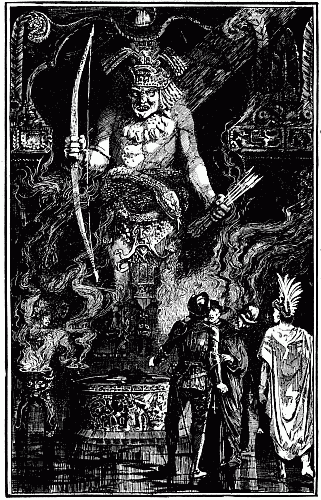 CORTÉS IN THE TEMPLE OF HUITZILOPOCHTLI
On reaching the hall of audience the Mexican officers took off
their sandals, and covered their gay attire with mantles of 'nequen,'
a coarse stuff made from the fibres of the aloe, and worn only by
the poorest classes; for it was thus humbly that all, excepting the
members of his own family, approached the sovereign. Then with
downcast eyes and formal obeisance they ushered the Spaniards
into the royal presence. They found Montezuma surrounded by a
few of his favourite chiefs, and were kindly received by him; and
Cortés soon began upon the subject uppermost in his thoughts,
setting forth as clearly as he could the mysteries of his faith, and
assuring Montezuma his idols would sink him in perdition. But
the emperor only listened calmly, and showed no sign of being convinced.
He had no doubt, he said, that the god of the Spaniards
was good, but his own gods were good also; what Cortés told him
of the creation of the world was like what he had been taught to
believe. It was not worth while to discuss the matter farther. He
added that his ancestors were not the original possessors of his
land, but had been led there by the great Being, who, after giving
them laws, and ruling over them for a time, had withdrawn to the
region where the sun rises, declaring on his departure that he or
his descendants would some day come again and reign. The
wonderful deeds of the Spaniards, their fair faces, and the quarter
whence they came all showed that they were his descendants. If
Montezuma had resisted their visit to his capital, it was because he
had heard that they were cruel, that they sent the lightning to
consume his people, or crushed them to pieces under the hard feet
of the ferocious animals on which they rode. He was now convinced
that these were idle tales, that the Spaniards were kind and
generous,—mortals indeed, but of a different race from the Aztecs,
wiser, and more valiant. You, too, he added with a smile, have perhaps
been told that I am a god and dwell in palaces of gold and silver.
But you see it is false: my houses, though large, are of wood and
stone; and as to my body, he said, baring his tawny arm, you see it
is flesh and bone like yours. It is true that I have a great empire
inherited from my ancestors, lands, and gold and silver, but your
sovereign beyond the waters is, I know, the rightful lord of all. I
rule in his name. You, Malinche, are his ambassador; you and
your brethren shall share these things with me. Rest now from
your labours. You are here in your own dwellings, and everything
shall be provided for your subsistence. I will see that your wishes
shall be obeyed in the same way as my own. Cortés, while he
encouraged the idea that his own sovereign was the great Being, as
Montezuma believed, assured him that his master had no desire to
interfere with his authority otherwise than, out of concern for his
welfare, to effect his conversion, and that of his people, to Christianity.
Before the emperor dismissed his visitors, rich stuffs and ornaments
of gold were distributed among them, so that the poorest
soldier received at least two heavy collars of gold, and on their
homeward way they could talk of nothing but the generosity and
courtesy of the Indian monarch. But the general was harassed by
many anxious thoughts. He had not been prepared to find so
much luxury, civilisation, and power. He was in the heart of a
great capital which seemed like an extensive fortification, with its
dykes and drawbridges, where every house might be converted into
a castle. At a nod from the sovereign all communication with the
rest of the country might be cut off, and the whole warlike population
be at once hurled upon himself and his handful of followers,
and against such odds of what avail would be his superior science?
As to the conquest of the empire, now he had seen the capital, it
must have seemed to him a more doubtful enterprise than ever; but
at any rate his best policy was to foster the superstitious reverence
in which he was held by both prince and people, and to find out all
he could about the city and its inhabitants. To this end he asked
the emperor's permission to visit the principal public buildings,
which was readily granted, Montezuma even arranging to meet him
at the great temple. Cortés put himself at the head of his cavalry,
and, followed by nearly all the Spanish foot, set out under the guidance
of several caciques sent by Montezuma. They led him to the
great teocalli near their own quarters. It stood in the midst of a
vast space which was surrounded by a wall of stone and lime
about eight feet high, ornamented on the outer side by raised
figures of serpents, which gave it the name of the 'Coatepantli,' or
'wall of serpents.' This wall was pierced by huge battlemented
gateways, opening upon the four principal streets of the city, and
over each gate was a kind of arsenal filled with arms and warlike
gear. The teocalli itself was of the usual pyramidal shape, and
five stories high, coated on the outside with hewn stones. The
ascent was by flights of steps on the outside, and Cortés found
two priests and several caciques waiting to carry him up them
as they had just carried the emperor; but the general declined this
compliment, preferring to march up at the head of his men.
On reaching the great paved space at the summit, the first
thing they saw was the stone on which the unhappy victims
were stretched for sacrifice; at the other end of the platform
stood two-towers, each three stories high, the lower story being
of stone, the two upper of carved wood. In these stood the
images of the gods, and before each stood an altar upon which
blazed the undying fires, the putting out of which was supposed to
portend so much woe to the nation. Here also was the huge drum,
made of serpents' skins, struck only on extraordinary occasions,
when it sent forth a melancholy sound that could be heard for
miles—a sound of woe to the Spaniards in after times. Montezuma,
attended by a high priest, came forward to receive Cortés.
After conferring with the priests the emperor conducted the
Spaniards into the building, which was adorned with sculptured
figures; at one end was a recess, with a roof of timber richly
carved and gilt, and here stood a colossal image of Huitzilopochtli,
the war-god. His countenance was hideous; in his right hand he
held a bow, and in his left a bunch of golden arrows, which a mystic
legend connected with the victories of his people. A huge serpent
of pearls and precious stones was coiled about his waist, and costly
jewels were profusely sprinkled over his person. On his left foot
were the delicate feathers of the humming-bird, from which, singularly
enough, he took his name, while round his neck hung a
chain of gold and silver hearts, as an emblem of the sacrifice in
which he most delighted. Indeed, even at that moment three
bleeding human hearts lay upon the altar before him. The next
sanctuary was dedicated to Tezcatlipoca, who, they believed, had
created the earth and watched over it. He was represented as
a young man, and his image of polished black stone was garnished
with gold plates and ornaments, among which was a shield
burnished like a mirror, in which he was supposed to see reflected
all the doings of the world; and before this shrine also
lay five hearts in a golden platter. From the horrors of this place
the Spaniards gladly escaped into the open air, and Cortés said,
turning to Montezuma, 'I do not understand how a great and
wise prince like you can put faith in such evil spirits as these
idols. If you will but permit us to erect here the true cross, and
place the images of the Blessed Virgin and her Son in your
sanctuaries, you will soon see how your false gods will shrink
before them.' Montezuma was greatly shocked at this speech.
'These,' said he, 'are the gods who have led the Aztecs on to victory
since they were a nation, and who send us the seed time and
harvest. Had I thought you would have offered them this outrage
I would not have admitted you into their presence.' Cortés then
took his leave, expressing concern for having wounded the feelings
of the emperor, who remained to expiate, if possible, the crime of
having exposed the shrines of his gods to such profanation by the
strangers. On descending into the court the Spaniards took a
leisurely survey of the other buildings in the enclosure; there were
several other teocallis, but much smaller ones, in which the
Spaniards saw implements of sacrifice and many other horrors.
And there was also a great mound with a timber framework upon
its summit, upon which were strung hundreds of thousands of
skulls—those of the victims who had been sacrificed. Schools,
granaries, gardens, and fountains filled up the remainder of the
enclosed space, which seemed a complete city in itself, containing a
mixture of barbarism and civilisation altogether characteristic of the
Aztec nation. The next day the Spaniards asked permission to
convert one of the halls in their palace into a chapel where they
might hold the services of their church. The request was granted,
and while the work was in progress some of them discovered what
seemed to be a door recently plastered over. As there was a rumour
that Montezuma kept the treasures of his father in this palace, they
did not scruple to gratify their curiosity by removing the plaster
and forcing open the door which it concealed, when they beheld
a great hall filled with rich and beautiful stuffs, articles of curious
workmanship of various kinds, gold and silver in bars or just as it
had been dug from the earth, and many jewels of great value. 'I
was a young man,' says one of the Spaniards who was allowed a
sight of the treasure, 'and it seemed to me that all the riches of the
world were in that room.'
By Cortés' order the wall was built up again, and strict injunctions
were given that the discovery should be kept a profound
secret. The Spaniards had now been a week in Mexico, and the
general's anxieties increased daily. Cortés resolved upon a bold
stroke. Calling a council of his officers, he laid his difficulties
before them, and, ignoring the opinion of some who advised an
immediate retreat, he proposed to march to the royal palace and
by persuasion or force to induce Montezuma to take up his abode
in the Spanish quarters. Once having obtained possession of his
person, it would be easy to rule in his name by allowing him a
show of sovereignty, until they had taken measures to secure their
own safety and the success of their enterprise. A pretext for
the seizure of the emperor was afforded by a circumstance which
had come to the ears of Cortés while he was still in Cholula.
Don Juan de Escalante, who had been left in charge of the
Spanish settlement at Vera Cruz, had received a message
from an Aztec chief called Quanhpopoca declaring his desire
to come in person and tender his allegiance to the Spaniards,
and requesting that four soldiers might be sent to protect him
through the country of an unfriendly tribe. This was not an uncommon
request, and the soldiers were sent, but on their arrival
two of them were treacherously murdered by the Aztec; the others
escaped, and made their way back to the garrison. The commander
at once marched with fifty of his men and some thousands of
Indians to take vengeance upon the cacique, and though his allies
fled before the Mexicans, the few Spaniards stood firm, and by the
aid of their firearms made good the field against the enemy. Unfortunately,
seven or eight of them were killed, including Escalante
himself, and the Indians who were taken prisoners declared that
the whole proceeding had been by Montezuma's orders. One of
the Spaniards fell into the hands of the enemy, but soon died from
his wounds. He happened to be a very big man of ferocious
appearance, and when his head was sent to Montezuma, the Aztec
emperor gazed upon it with a shudder, and commanded that it
should be taken out of the city, and not offered at the shrine of any
of his gods. He seemed to see in those terrible features a prophecy
of his sure destruction. The bolder spirits among the cavaliers
approved of the general's plan, and the next day, having asked an
audience of Montezuma, Cortés made the necessary arrangements
for his enterprise. The principal part of his force was drawn up in
the courtyard; one detachment was stationed in the avenue leading
to the palace, to prevent any attempt at rescue by the citizens.
Twenty-five or thirty soldiers were ordered to drop in at the palace
by twos and threes, as if accidentally, and he took with him five
cavaliers on whose coolness and courage he could rely.
That they should all be in full armour excited no suspicion; it
was too common an occurrence. The Spaniards were graciously
received by the emperor, who by the aid of interpreters held a gay
conversation with them, and as usual presented them with gold and
jewels. He paid Cortés the compliment of offering him one of his
daughters in marriage—an honour which was respectfully declined,
on the ground that he already had one wife. But as soon as the
general saw that his soldiers had all come upon the scene he abruptly
changed his tone, and accused the emperor of being the author of
the treacherous proceedings on the coast. Montezuma listened in
surprise, and declared that such an act could only have been
imputed to him by his enemies. Cortés pretended to believe him,
but said that Quanhpopoca and his accomplices must be sent for
that they might be dealt with after their deserts. Montezuma
agreed, and, taking his royal signet from his wrist, gave it to one of
his nobles, with orders to show it to the Aztec governor and require
his immediate presence in the capital, and in case of his resistance
to call in the aid of the neighbouring towns. When the messenger
had gone, Cortés assured the emperor that he was now convinced
of his innocence in the matter, but that it was necessary that his
own sovereign should be equally convinced of it. Nothing would
promote this so much as for Montezuma to transfer his residence to
the palace occupied by the Spaniards, as this would show a condescension
and personal regard for them which would absolve him
from all suspicion. The emperor listened to this proposal with
profound amazement, exclaiming with resentment and offended
dignity:
'When was it ever heard that a great prince like myself willingly
left his own palace to become a prisoner in the hands of strangers?'
Cortés declared that he would not go as a prisoner, but would
be simply changing his residence. 'If I should consent to such
degradation,' he cried, 'my subjects never would.'
When further pressed, he offered one of his sons and two of his
daughters as hostages, so that he might be spared this disgrace.
Two hours passed in this fruitless discussion, till Velasquez de Leon,
impatient of the long delay, and seeing that to fail in the attempt
must ruin them, cried out, 'Why do we waste words on this barbarian?
Let us seize him, and if he resists plunge our swords into
his body!' The fierce tone and menacing gesture alarmed the
emperor, who asked Marina what the angry Spaniard said. She
explained as gently as she could, beseeching him to accompany the
white men, who would treat him with all respect and kindness,
while if he refused he would but expose himself to violence, perhaps
to death.
This last appeal shook the resolution of Montezuma; looking
round for support and sympathy, he saw only the stern faces and mail-clad
forms of the Spaniards, and felt that his hour had indeed come.
In a scarcely audible voice he consented to accompany them, and
orders were given for the royal litter to be brought. The nobles
who bore and attended it could hardly credit their senses, but now
Montezuma had consented to go pride made him wish to appear
to go willingly. As the royal retinue marched dejectedly down the
avenue, escorted by the Spaniards, the people ran together in crowds,
declaring that the emperor had been carried off by force, and a
tumult would have arisen had not he himself called out to them to
disperse, since he was of his own accord visiting his friends, and on
reaching the Spanish quarters he sent out his nobles to the mob
with similar assurances, bidding them all return to their homes.
He was received with ostentatious respect by the Spaniards, and
chose the apartments which pleased him best, which were speedily
furnished with tapestry, featherwork, and all other Indian luxuries.
He was attended by his own household, and his meals were served
with the usual pomp and ceremony, while not even the general
himself approached him without due obeisance, or sat down in his
presence uninvited. Nevertheless it was but too clear to his people
that he was a prisoner, for day and night the palace was guarded
by sixty sentinels in front and sixty in the rear, while another body
was stationed in the royal antechamber. This was the state of
affairs when Quanhpopoca arrived from the coast. Montezuma
received him coldly, and referred the matter to Cortés, who speedily
made an end of it by condemning the unhappy chief and his
followers to be burnt to death. The funeral piles were erected in
the courtyard before the palace, and were made of arrows, javelins,
and other weapons drawn by the emperor's permission from those
stored round the great teocalli. To crown these extraordinary proceedings,
Cortés, just before the executions took place, entered the emperor's
apartments, followed by a soldier bearing fetters in his hands.
Sternly he again accused Montezuma of having been the original
contriver of the treacherous deed, and said that a crime which
merited death in a subject must in some way be atoned for even by
a king, whereupon he ordered the soldier to fasten the fetters upon
Montezuma's ankles, and after coolly waiting until it was done
turned his back and quitted the room.
The emperor was speechless under this last insult, like one
struck down by a heavy blow. But though he offered no resistance
low moans broke from him, which showed the anguish of his spirit.
His faithful attendants did their utmost to console him, holding his
feet in their arms, and trying to keep the irons from touching him
by inserting their own robes; but it was not the bodily discomfort
that so afflicted him, but the feeling that he was no more a king,
and so utterly broken in spirit was he that when Cortés came after
the execution had taken place, and with his own hands unclasped
the irons, Montezuma actually thanked him as if for some great
and unmerited favour. Not long after the Spanish general expressed
his willingness that the emperor should if he wished return to his
own palace, but Montezuma declined the offer, doubtless fearing to
trust himself again to the haughty and ferocious chieftains, who
could not but despise the cowardly proceedings of their master, so
unlike the usual conduct of an Aztec monarch. Montezuma often
amused himself with seeing the Spanish troops go through their
exercises, or with playing at some of the national games with
Cortés and his officers. A favourite one was called 'totoloque,'
played with golden balls, which were thrown at a golden target,
and the emperor always staked precious stones or ingots of gold,
and won or lost with equal good-humour, and indeed it did not
much matter to him, since if he did win he gave away his gains
to his attendants. But while Montezuma thus resigned himself
without a struggle to a life of captivity, some of his kinsmen were
feeling very differently about the matter, and especially his nephew
Cacama, lord of the Tezcuco, and second in power to Montezuma
himself.
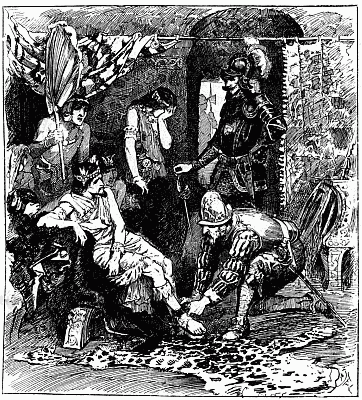
This prince saw with alarm and indignation his uncle's abject
submission to the Spaniards, and endeavoured to form a league with
the other chiefs to rescue him out of their hands. But they, from
jealousy, declined to join him, declaring themselves unwilling to do
anything without the emperor's sanction. These plots came to the
ears of Cortés, who wished at once to march upon Tezcuco and
stamp out this spark of rebellion, but Montezuma dissuaded him.
He therefore sent a friendly message of expostulation, which met
with a haughty response, and to a second message asserting the
supremacy of the King of Spain Cacama replied that 'he acknowledged
no such authority. He knew nothing of the Spanish
sovereign or his people, nor did he wish to know anything of them.'
When Montezuma sent to him to come to Mexico that this difference
might be adjusted, he answered that he understood the position
of his uncle, and that when he did visit the capital it would be to
rescue it, as well as the emperor himself and their common gods,
from bondage, to drive out the detested strangers who had brought
such dishonour on their country. This reply made Cortés very
angry; but Montezuma, anxious to prevent bloodshed, begged him
still to refrain from declaring war against Cacama, saying that it
would be better to obtain possession of him personally, which he
could easily do by means of several Tezcucan nobles who were in
his own pay. So Cacama was enticed by these faithless chiefs into
a villa overhanging the lake, where he was easily overpowered and
forced into a boat, which speedily brought him to Mexico. Cortés
promptly fettered and imprisoned him, while Montezuma declared
that he had by his rebellion forfeited his kingdom and appointed his
brother—a mere boy—to reign in his stead. Now Cortés felt himself
powerful enough to demand that Montezuma and all his nobles
should formally swear allegiance to the Spanish sovereigns, and
accordingly the emperor assembled his principal caciques and briefly
stated to them the object for which he had summoned them.
'You all know,' said he, 'our ancient tradition—how the great
Being, who once ruled over the land, declared that he would
one day return and reign again. That time has now arrived.
The white men have come from the land beyond the ocean, where
the sun rises, sent by their master to reclaim the obedience of his
ancient subjects. I am ready, for my part, to acknowledge his
authority. You have been faithful vassals of mine all the years
that I have sat upon the throne of my fathers; I now expect that
you will show me a last act of obedience, by acknowledging the
great king beyond the waters to be your lord also, and that you
will pay him tribute as you have hitherto done to me.' As he
spoke the tears fell fast down his cheeks, and his nobles were deeply
affected by the sight of his distress. Many of them, coming from a
distance, and not having realised what was taking place in the
capital, were filled with astonishment on beholding the voluntary
abasement of their master, whom they had reverenced as the all-powerful
lord of the whole country. His will, they told him, was
their law now as ever, and if he thought the sovereign of the
strangers was the ancient lord of their country, they were willing
to swear allegiance to him as such. Accordingly the oaths were
administered with all due solemnity, and a full record of the proceedings
was drawn up by the royal notary to be sent to Spain.
Cortés now seemed to have accomplished most of the great
objects of his expedition, but towards the conversion of the
natives he had made no progress, and still the horrible sacrifices
took place day by day. The general could bear it no longer, but
told the emperor that the Christians could not consent to hold the
services of their religion shut in within the narrow walls of the garrison.
They wished to spread its light abroad and share its blessings
with the people. To this end they requested that the great
teocalli should be given up to them as a fit place where their
worship might be conducted in the presence of the whole city.
Montezuma listened in consternation.
'Malinche,' said he, 'why will you push matters to an extremity
that must surely bring down the vengeance of our gods and stir up
an insurrection among my people, who will never endure this profanation
of their temple?'
Cortés, seeing that he was much agitated, pretended that the
demand had come from his followers, and that he would endeavour
to persuade them to be contented with one of the sanctuaries of the
teocalli. If that were not granted, they should be obliged to take it
by force and to throw down the idols in the face of the city.
Montezuma, still greatly disturbed, promised to confer with the
priests, and in the end the Spaniards were allowed to take possession
of one of the sanctuaries, in which, when it had been purified,
an altar was raised, surmounted by a crucifix and the imago of the
Virgin; its walls were decorated with garlands of fresh flowers, and
an old soldier was stationed to watch over it. Then the whole
army moved in solemn procession up the winding ascent of the
pyramid, and mass was celebrated by Father Olmedo and another
priest, while the Aztecs looked on with mingled curiosity and repugnance.
For a nation will endure any outrage sooner than that
which attacks its religion, and this profanation touched a feeling in
the natives which the priests were not slow to take advantage of.
Soon the Spaniards noticed a change in Montezuma. He was
grave instead of cheerful, and avoided their society. Many conferences
went on between him and the priests and nobles, at which
even Orteguilla, his favourite page, was not allowed to be present.
Presently Cortés received a summons to appear before the emperor,
who told him that his predictions had come to pass, his gods were
offended, and threatened to forsake the city if the sacrilegious
strangers were not driven from it, or sacrificed on their altars as an
expiation. 'If you have any regard for your safety,' he continued,
'you will leave the country without delay. I have only to raise my
finger, and every Aztec in the land will rise against you.'
Cortés knew well enough that this was true, but, concealing his
dismay, he replied that he should much regret to leave the capital
so precipitately, especially when he had no ships to take him back
to his own country. He should also regret that if he quitted it
under these circumstances he should be driven to taking the
emperor with him. Montezuma was evidently troubled by this
last suggestion, and finally offered to send workmen to the coast to
build ships under the direction of the Spaniards, while he restrained
the impatience of his people with the assurance that the white men
would leave their land as soon as they were ready. This was
accordingly done, and the work went forward at Vera Cruz with
great apparent alacrity, but those who directed it took care to
interpose as many delays as possible, while Cortés hoped in the
meantime to receive such reinforcements from Spain as should
enable him to hold his ground. Nevertheless the whole aspect of
affairs in the Spanish quarters was utterly changed; apprehension
had taken the place of security, and as many precautions were
observed as if the garrison was actually in a state of siege. Such
was the unpleasant state of affairs when, in May 1520, six months
after his arrival in the capital, Cortés received tidings from the
coast which caused him greater alarm than even the threatened
insurrection of the Aztecs. The jealous governor of Cuba was
sending an expedition to attack Cortés.
It was the news of the arrival of this fleet at the place where he
had himself landed at first that had caused Cortés so much consternation,
for he at once suspected that it was sent by his bitter
enemy the governor. The commander of this second expedition,
who was called Narvaez, having landed, soon met with a Spaniard
from one of the exploring parties sent out by Cortés. This man
related all that had occurred since the Spanish envoys left Vera
Cruz, the march into the interior, the furious battles with the
Tlascalans, the occupation of Mexico, the rich treasures found in it,
and the seizure of Montezuma, 'whereby,' said the soldier, 'Cortés
rules over the land like its own sovereign, so that a Spaniard may
travel unarmed from one end of the country to the other without
insult or injury.'
Narvaez and his followers listened in speechless amazement to
this marvellous report, and the leader waxed more and more
indignant at the thought of all that had been snatched from Velasquez,
whose adherent he was. He now openly proclaimed his
intention of marching against Cortés and punishing him, so that
even the natives who had flocked to this new camp comprehended
that these white men were enemies of those who had come before.
Narvaez proposed to establish a colony in the barren, sandy spot
which Cortés had abandoned, and when informed of the existence
of Villa Rica, he sent to demand the submission of the garrison.
Sandoval had kept a sharp eye upon the movements of Narvaez
from the time that his ships had first appeared upon the horizon,
and when he heard of his having landed he prepared to defend his
post to the last extremity. But the only invaders of Villa Rica
were a priest named Guevara and four other Spaniards, who
formally addressed Sandoval, pompously enumerating the services
and claims of Velasquez, taxing Cortés with rebellion, and finally
demanding that Sandoval should tender his submission to Narvaez.
That officer, greatly exasperated, promptly seized the unlucky
priest and his companions, and, remarking that they might read the
obnoxious proclamation to the general himself in Mexico, ordered
them to be bound like bales of goods upon the backs of sturdy
porters and placed under a guard of twenty Spaniards, and in this
way, travelling day and night, only stopping to obtain relays of
carriers, they came within sight of the capital at the end of the
fourth day.
Its inhabitants were already aware of the fresh arrival of white
men upon the coast. Indeed Montezuma had sent for Cortés and told
him there was no longer any obstacle to his leaving the country, as
a fleet was ready for him, and in answer to his astonished inquiries,
had shown him a picture map sent him from the coast, whereon the
Spaniards, with their ships and equipments, were minutely depicted.
Cortés pretended to be vastly pleased by this intelligence, and the
tidings were received in the camp with firing of cannon and other
demonstrations of joy, for the soldiers took the newcomers for a
reinforcement from Spain. Not so Cortés, who guessed from the
first that they came from the governor of Cuba. He told his suspicions
to his officers, who in turn informed the men; but, though
alarm succeeded their joy, they resolved to stand by their leader
come what might. When Sandoval's letter acquainting him with
all particulars was brought to Cortés, he instantly sent and released
the bewildered prisoners from their ignominious position, and
furnished them with horses to make their entry into the
capital, where, by treating them with the utmost courtesy and
loading them with gifts, he speedily converted them from enemies
into friends, and obtained from them much important information
respecting the designs of Narvaez and the feelings of his army.
He gathered that gold was the great object of the soldiers, who
were evidently willing to co-operate with Cortés if by so doing they
could obtain it. Indeed, they had no particular regard for their own
leader, who was arrogant, and by no means liberal. Profiting by
these important hints, the general sent a conciliatory letter to
Narvaez, beseeching him not to unsettle the natives by a show of
animosity, when it was only by union they could hope for success,
and declaring that for his part he was ready to greet Narvaez as a
brother in arms, to share with him the fruits of conquest, and, if he
could produce a royal commission, to submit to his authority. Of
course Cortés knew well enough that he had no such commission to
show. Soon after the departure of Guevara he resolved to send a
special envoy of his own, and chose Father Olmedo for the task, with
instructions to converse privately with as many of the officers and
soldiers as he could with a view to securing their goodwill; and to
this end he was also provided with a liberal supply of gold. During
this time Narvaez had abandoned his idea of planting a colony on
the sea-coast, and had marched inland and taken up his quarters
at Cempoalla. He received the letter of Cortés with scorn, which
changed to stern displeasure when Guevara enlarged upon the power
of his rival and urged him to accept his friendly offers. But the
troops, on the other hand, listened with greedy ears to the accounts of
Cortés, his frank and liberal manners, and the wealth of his camp,
where the meanest soldier could stake his ingot and his chain of gold
at play, and where all revelled in plenty. And when Father Olmedo
arrived, his eloquence and his gifts soon created a party in the
interest of Cortés. This could not go on so secretly as not to excite
the suspicions of Narvaez, and the worthy priest was sent back to
his master, but the seed which he had sown was left to grow.
Narvaez continued to speak of Cortés as a traitor whom he
intended to punish, and he also declared he would release Montezuma
from captivity and restore him to his throne. It was
rumoured that the Aztec monarch had sent him a rich gift, and
entered into correspondence with him. All this was observed by the
watchful eye of Sandoval, whose spies frequented his enemy's camp,
and he presently sent to Cortés saying that something must
speedily be done to prevent Villa Rica from falling into the hands
of the enemy, and pointing out that many of the Indians, from sheer
perplexity, were no longer to be relied upon.
The general felt that it was indeed time to act, but the situation
was one of great difficulty. However, he marched against Narvaez,
defeated and captured him, embodied his forces, and set out on his
return to Mexico, where he had left Alvarado in command.
On his march he received a letter from Alvarado, which conveyed
the startling news that the Mexicans were up in arms and
had assaulted the Spanish quarters, that they had overwhelmed the
garrison with a torrent of missiles, which had killed some and
wounded many, and had burned some brigantines which Cortés had
built to secure a means of retreat, and it ended by imploring him
to hasten to the relief of his men if he would save them or keep his
hold on the capital. This was a heavy blow to Cortés, but there
was no time for hesitation. He laid the matter fully before his
soldiers, and all declared their readiness to follow him.
On June 24, 1520, the army reached the same causeway
by which they had before entered the capital; but now no crowds
lined the roads, and no pirogues swarmed upon the lake; a
death-like stillness brooded over the scene. As they marched
across Cortés ordered the trumpets to sound, and their shrill notes
were answered by a joyful peal of artillery from the beleaguered
fortress. The soldiers quickened their pace, and all were soon in
the city once more. But here the appearance of things was far
from reassuring. In many places they saw the smaller bridges had
been taken away; the town seemed deserted, and the tramp of the
horses awakened melancholy echoes in the deserted streets. When
they reached the palace the great gates were speedily thrown open,
and Cortés and his party were eagerly welcomed by the garrison,
who had much to tell and to hear. Of course the general's first
inquiry was as to the origin of the tumult, and this was the story
he heard.
The Aztec festival called 'The incensing of Huitzilopochtli' was
about to be celebrated, in which, as it was an important one, nearly
all the nobles took part. The caciques asked the permission of
Alvarado to perform their rites in the teocalli which contained the
chapel of the Spaniards, and to be allowed the presence of Montezuma.
This latter request was refused, but he consented to their
using the teocalli provided they came unarmed and held no human
sacrifice. Accordingly, on the day appointed the Aztecs assembled
to the number of at least six hundred. They wore their magnificent
gala costumes, with mantles of featherwork sprinkled with precious
stones, and collars, bracelets, and ornaments of gold. Alvarado and
his men, fully armed, attended as spectators, and when the hapless
natives were engaged in one of their ceremonial dances, they fell
upon them suddenly, sword in hand. Then followed a great and
dreadful slaughter. Unarmed, and taken unawares, the Aztecs
were hewn down without resistance. Those who attempted to
escape by climbing the wall of serpents were speared ruthlessly,
till presently not one of that gay company remained alive; then
the Spaniards added the crowning horror to their dreadful deed by
plundering the bodies of their murdered victims. The tidings of
the massacre flew like wildfire through the capital, and every long-smothered
feeling of hostility burst forth in the cry that arose for
vengeance. The city rose in arms to a man and almost before the
Spaniards could secure themselves in their defences, they were
assaulted with desperate fury: some of the assailants attempted to
scale the walls, others succeeded in partially undermining and
setting fire to the works. It is impossible to say how the attack
would have ended, but the Spaniards entreated Montezuma to
interfere, and he, mounting the battlements, conjured the furious
people to desist from storming the fortress out of regard for his
safety. They so far respected him that they changed their operations
into a regular blockade, throwing up works round the palace
to prevent the egress of the Spaniards, and suspending the market
so that they might not obtain any supplies, and then they sat down
to wait sullenly till famine should throw their enemies into their
hands.
The condition of the besieged was gloomy enough. True their
provisions still held out, but they suffered greatly from want of
water, that within the enclosure being quite brackish, until a fresh
spring was suddenly discovered in the courtyard. Even then the
fact that scarcely a man had escaped unwounded, and that they had
no prospect before them but a lingering death by famine, or one
more dreadful still upon the altar of sacrifice, made their situation
a very trying one. The coming of their comrades was therefore
doubly welcome. As an explanation of his atrocious act, Alvarado
declared that he had but struck the blow to intimidate the natives
and crush an intended rising of the people, of which he had received
information through his spies.
Cortés listened calmly till the story was finished, then exclaimed
with undisguised displeasure, 'You have done badly. You have
been false to your trust. Your conduct has been that of a madman!'
And so saying, he turned and left him abruptly, no doubt
bitterly regretting that he had entrusted so important a command
to one whose frank and captivating exterior was but the mask for a
rash and cruel nature. Vexed with his faithless lieutenant, and
embarrassed by the disastrous consequences of his actions, Cortés
for the first time lost his self-control, and allowed his disgust and
irritation to be plainly seen. He treated Montezuma with haughty
coldness, even speaking of him as 'this dog of a king' in the
presence of his chiefs, and bidding them fiercely go tell their master
and his people to open the markets, or he would do it for them to
their cost. The chiefs retired in deep resentment at the insult,
which they comprehended well enough from his look and gesture,
and the message lost nothing of its effect in transmission. By the
suggestion of Montezuma, Cortés now released his brother Cuitlahua,
thinking he might allay the tumult and bring about a better state
of things. But this failed utterly, for the prince, who was bold and
ambitious, was bitterly incensed by the injuries he had received
from the Spaniards. Moreover, he was the heir presumptive to the
crown, and was welcomed by the people as a substitute for the
captive Montezuma. So being an experienced warrior, he set himself
to arrange a more efficient plan of operations against the
Spaniards, and the effect was soon visible. Cortés, meanwhile, had
so little doubt of his ability to quench the insurrection that he said
as much in the letter that he wrote to the garrison of Villa Rica
informing them of his safe arrival in the capital. But his messenger
had not been gone half-an-hour before he returned breathless with
terror, and covered with wounds, saying that the city was in arms,
the drawbridges were raised, and the enemy would soon be upon
them.
Surely enough before long a hoarse, sullen roar arose, becoming
louder and louder, till from the parapet surrounding the enclosure
the great avenues that led to it could be seen dark with masses of
warriors rolling on in a confused tide towards the fortress, while at
the same time the flat roofs of the neighbouring houses were
suddenly covered, as if by magic, with swarms of menacing figures,
brandishing their weapons—a sight to appal the stoutest heart.
When notice was given of the approach of the Aztecs, each
man was soon at his post, and prepared to give them a warm
reception. On they came, rushing forward in dense columns,
each with its gay banner, and as they neared the enclosure
they set up the hideous yell or shrill whistle used in fight,
which rose high above the sound of their rude musical instruments.
They followed this by a tempest of stones, darts, and
arrows, which fell thick as rain on the besieged, and at the same
time those upon the roofs also discharged a blinding volley. The
Spaniards waited until the foremost column was within fire, and
then, with a general discharge of artillery, swept the ranks of
their assailants, mowing them down by hundreds. The Mexicans
for a moment stood aghast, but soon rallying swept boldly forward
over the prostrate bodies of their comrades: a second and third
volley checked them and threw their ranks into disorder, but still
they pressed on, letting off clouds of arrows, while those on the
house-tops took deliberate aim at the soldiers in the courtyard.
Soon some of the Aztecs succeeded in getting close enough to the
wall to be sheltered by it from the fire of the Spaniards, and they
made gallant efforts to scale the parapet, but only to be shot down,
one after another, as soon as their heads appeared above the rampart.
Defeated here, they tried to effect a breach by battering the
wall with heavy pieces of timber, but it proved too strong for them,
and then they shot burning arrows among the temporary buildings
in the courtyard. Several of these took fire, and soon a fierce conflagration
was raging, which was only to be checked by throwing
down part of the wall itself, and thus laying open a formidable
breach. This was protected by a battery of heavy guns, and a file
of arquebusiers, who kept up an incessant volley through the opening.
All day the fight raged with fury, and even when night came,
and the Aztecs suspended operations according to their usual custom,
the Spaniards found but little repose, being in hourly expectation of
an assault. Early the next morning the combatants returned to the
charge. Cortés did not yet realise the ferocity and determination
of the Mexicans, and thought by a vigorous sortie he would reduce
them to order, and, indeed, when the gates were thrown open, and
he sallied out, followed by his cavalry, supported by a large body of
infantry and Tlascalans, they were taken by surprise and retreated
in some confusion behind a barricade which they had thrown up
across the street.
But by the time Cortés had ordered up his heavy guns and
demolished the barrier they had rallied again, and though, when
the fight had raged all day, Cortés was, on the whole, victorious,
still he had been so harassed on all sides by the battalions of
natives who swarmed in from every side street and lane, by those
in canoes upon the canal, and by the showers of huge stones from
those upon the house-tops, that his losses had been severe. Earlier
in the day he had caused a number of houses to be burned to rid
himself of some of his tormentors, but the Aztecs could probably
better afford to lose a hundred men than the Spaniards one, and the
Mexican ranks showed no signs of thinning. At length, exhausted
by toil and hunger, the Spanish commander drew off his men, and
retreated into his quarters, pursued to the last by showers of darts
and arrows; and when the Spaniards re-entered their fortress, the
Indians once more encamped round it; and though through the
night they were inactive, still they frequently broke the stillness
with menacing cries and insults.
'The gods have delivered you into our hands at last!' they said.
'Huitzilopochtli has long cried for his victims. The stone of sacrifice
is ready—the knives are sharpened. The wild beasts in the palace
are roaring for their feast.' These taunts, which sounded dismally
in the ears of the besieged, were mingled with piteous lamentations
for Montezuma, whom they entreated the Spaniards to deliver up
to them. Cortés was suffering much from a severe wound and
from his many anxieties, and he determined to induce Montezuma
to exert his authority to allay the tumult. In order to give greater
effect to his appearance he put on his imperial robes. His mantle
of blue and white was held by a rich clasp of the precious 'chalchivitl,'
which with emeralds of uncommon size, set in gold, also
ornamented other portions of his dress. His feet were shod with
golden sandals, and upon his head he wore the Mexican diadem.
Surrounded by a guard of Spaniards and preceded by a golden
wand, the symbol of sovereignty, the Indian monarch ascended the
central turret of the palace. His presence was instantly recognised
by the people, and a magical change came over the scene: the
clang of the instruments and the fierce cries of the assailants
ceased, and many in the hushed throng knelt or prostrated themselves,
while all eyes were turned with eager expectation upon the
monarch whom they had been taught to regard with slavish awe.
Montezuma saw his advantage, and in the presence of his awestruck
people felt once more a king. With his former calm
authority and confidence he addressed them:
'Why do I see my people here in arms against the palace of my
fathers? Is it that you think your sovereign a prisoner, and wish
to release him? If so you have done well; but you are mistaken.
I am no prisoner. The strangers are my guests. I remain with
them only for choice, and can leave them when I will. Have you
come to drive them from the city? That is unnecessary; they will
depart of their own accord if you will open a way for them. Return
to your homes then. Lay down your arms. Show your obedience
to me, whose right it is. The white men shall go back to their
land, and all shall be well again within the walls of Mexico.'
As Montezuma declared himself the friend of the detested
strangers a murmur of contempt ran through the multitude. Their
rage and desire for vengeance made them forget their ancient
reverence, and turned them against their unfortunate monarch.
'Base Aztec,' they cried, 'woman, coward! The white men
have made you a woman, fit only to weave and spin.'
A chief of high rank brandished a javelin at Montezuma, as
these taunts were uttered, and in an instant the place where he
stood was assailed with a cloud of stones and arrows. The
Spaniards, who had been thrown off their guard by the respect
shown by the people on their lord's appearance, now hastily interposed
their shields, but it was too late: Montezuma was wounded
by three of the missiles, one of which, a stone, struck him on the
head with such violence that he fell senseless to the ground. The
Mexicans, shocked at their own sacrilegious act, set up a dismal cry,
and dispersed panic-stricken until not one of all the host remained
in the great square before the palace. Meanwhile, the unhappy
king was borne to his own apartments, and as soon as he recovered
from his insensibility the full misery of his situation broke upon
him. He had tasted the last bitterness of degradation. He had
been reviled and rejected by his people. Even the meanest of the
rabble had raised their hands against him, and he had nothing left
to live for. In vain did Cortés and his officers endeavour to soothe
the anguish of his spirit and encourage him to hope for better
things. Montezuma answered not a word. His wounds, though
dangerous, need not have proved fatal had he not refused all
remedies, tearing off the bandages as often as they were applied,
and maintaining all the while a determined silence. He sat
motionless, with downcast eyes, brooding over his humiliation; but
from this painful scene the Spanish general was soon called away
by the new dangers which threatened the garrison.
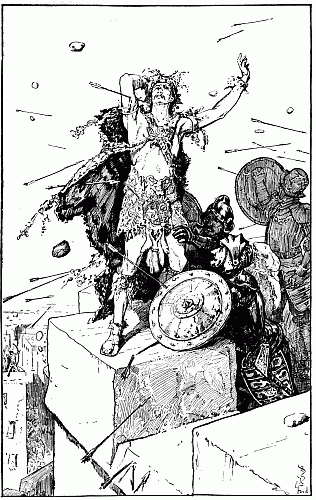 MONTEZUMA ASSAILED BY MISSILES
Opposite to the Spanish quarters stood the great teocalli of
Huitzilopochtli, rising to a height of nearly a hundred and fifty feet,
and thus completely commanding the palace occupied by the
Spaniards. A body of five or six hundred Mexicans, many of them
nobles and warriors of the highest rank, now took possession of
the teocalli, whence they discharged such a tempest of arrows
upon the garrison that it was impossible for any soldier to show
himself for an instant outside his defences without great danger,
while the Mexicans themselves were completely sheltered. It was
absolutely necessary that they should be dislodged, and Cortés entrusted
the task to his chamberlain Escobar, giving him a hundred
men for the purpose. But after making three desperate attempts,
in which he was repulsed with considerable loss, this officer
returned unsuccessful, and Cortés determined to lead the storming
party himself, though he was suffering much from a wound which
disabled his left hand. He made the arm serviceable, however, by
strapping his shield to it, and thus prepared sallied forth at the
head of three hundred chosen cavaliers and several thousand of the
Indian allies. In the courtyard of the temple a body of Mexicans
was drawn up to oppose him, and he charged them briskly, but
the horses could not keep their footing on the slippery pavement,
and many of them fell. Hastily dismounting the Spaniards sent
the animals back to their quarters, and then, renewing the assault,
had little difficulty in dispersing the Indians and securing a
passage to the teocalli. And now began a great and terrible
struggle. You will remember that the huge pyramid-shaped
teocalli was built in five divisions, growing smaller and smaller, till
at the top you came out upon a square platform, crowned only by
the two sanctuaries in which stood the images of the Aztec gods.
You will also remember that the only ascent was by flights of
stone steps on the outside, one above another, and that it was
necessary between each flight to pass by a kind of terrace, right
round the building, so that a distance of nearly a mile had to be
traversed before reaching the top. Cortés sprang up the lower
stairway, followed by Alvarado, Sandoval, Ordaz, and the other
gallant cavaliers, leaving a strong detachment to hold the enemy in
check at the foot of the temple. On every terrace as well as on the
topmost platform the Aztec warriors were drawn up to dispute his
passage. From their elevated position they showered down heavy
stones, beams, and burning rafters, which thundering along the
stairway overturned the ascending Spaniards and carried desolation
through their ranks. The more fortunate, eluding or springing
over these obstacles, succeeded in gaining the first terrace, where
they fell upon their enemies and compelled them to give way, and
then, aided by a brisk fire from the musketeers below, they pressed
on, forcing their opponents to retreat higher and higher, until at
last they were glad to take shelter on the broad summit of the
teocalli. Cortés and his companions were close behind them, and
the two parties soon found themselves face to face upon this strange
battle-field, engaged in mortal combat in the presence of the whole
city, while even the troops in the courtyard ceased hostilities, as if
by mutual consent, and watched with breathless interest the issue
of the struggle.
The Spaniards and Mexicans closed with the desperate fury of
men who have no hope but in victory. Quarter was neither asked
nor given, and to fly was impossible. The edge of the platform was
unprotected by parapet or battlement, and many of the combatants,
as they struggled together, were seen to roll over the edge of the
precipice, locked in a death-grip. Cortés himself but narrowly
escaped this frightful fate. Two powerful warriors had seized upon
him, and were dragging him violently towards the side of the pyramid,
when, by sheer strength, he tore himself from their grasp and
hurled one of them over the brink with his own arm.
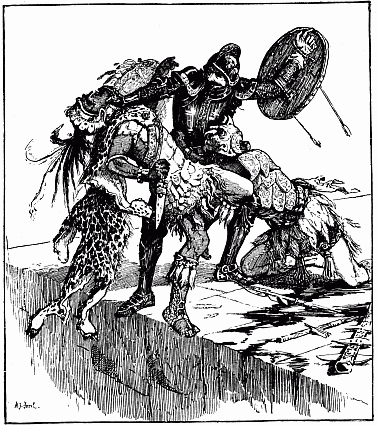
The battle raged unceasingly for three hours. The number of
the Mexicans was double that of the Spaniards, but the armour of
the latter and their skill as swordsmen outweighed the odds against
them. Resistance grew fainter and fainter on the side of the Aztecs.
The priests, who had run to and fro among them with streaming
hair and wild gestures, encouraging and urging them on, were all
slain or captured. One by one the warriors fell dead upon the blood-drenched
pavement, or were hurled from the dizzy height, until at
last the wild struggle ceased, and the Spaniards stood alone upon
the field of battle. Their victory had cost them dear, for forty-five
of their comrades lay dead, and nearly all the remainder were more
or less seriously wounded; but there was no time for regrets. The
victorious cavaliers rushed to the sanctuaries to find that the cross
and the image of the Virgin had disappeared from the one they had
appropriated, and that in the other, before the grim figure of Huitzilopochtli,
lay the usual offering of human hearts, possibly those of
their own countrymen! With shouts of triumph the Spaniards
tore the hideous idol from its niche, and in the sight of the horror-stricken
Aztecs hurled it down the steps of the teocalli, and, after
having set fire to the sanctuaries, descended joyfully into the courtyard.
Passing through the ranks of the Mexicans, who were too much
dismayed by all they had witnessed to offer any resistance, they
reached their own quarters in safety, and that very night they followed
up the blow they had struck by sallying forth into the sleeping
town and burning three hundred houses. Cortés now hoped that
the natives were sufficiently subdued to be willing to come to terms
with him. He therefore invited them to a parley, and addressed
the principal chiefs, who had assembled in the great square, from the
turret before occupied by Montezuma. As usual, Marina interpreted
for him, and the Indians gazed curiously at their countrywoman,
whose influence with the Spanish general was well known. Cortés
told them that they must now know how little they had to hope from
their opposition to the Spaniards. They had seen their gods trampled
in the dust, their altars destroyed, their dwellings burned, and their
warriors falling on all sides. 'All this,' he continued, 'you have
brought upon yourselves by your rebellion. Yet, for the sake of the
affection felt for you by the sovereign you have treated so unworthily,
I would willingly stay my hand if you will lay down your arms and
return once more to your obedience. But if you do not,' he concluded,
'I will make your city a heap of ruins, and leave not a soul
alive to mourn over it.'
But the Spanish commander did not yet understand the character
of the Aztecs if he thought to intimidate them by menaces. It was
true, they replied, that he had destroyed their temples, broken in
pieces their gods, and massacred their countrymen. Many more
doubtless were yet to fall under their terrible swords. But they
were content so long as for every thousand Mexicans they could
shed the blood of a single white man. 'Look out,' they said, 'upon
our streets and terraces. See them still thronged with warriors as
far as your eyes can reach. Our numbers are scarcely diminished
by our losses. Yours, on the contrary, are lessening hour by hour.
Your provisions and water are failing. You are perishing from
hunger and sickness; you must soon fall into our hands. The
bridges are broken down, and you cannot escape! There will be
too few of you left to glut the vengeance of our gods.' With this
they discharged a volley of arrows, which compelled the Spaniards
to beat a speedy retreat from the turret. The fierce answer of the
Aztecs filled the besieged with dismay.
The general himself, pressed by enemies without and factions
within, was, as usual, only roused to more energetic action by a
situation which would have paralysed any ordinary mind. He
calmly surveyed his position before deciding what course he would
pursue. To retreat was hazardous, and it mortified him cruelly to
abandon the city in which he had so long been master and the rich
treasure which he had secured, with which he had hoped to propitiate
the King of Spain. To fly now was to acknowledge himself
further than ever from the conquest and to give great opportunity
to his enemy, the Governor of Cuba, to triumph over him. On the
other hand, with his men daily diminishing in strength and numbers,
with the stock of provisions so nearly exhausted that one small
daily ration of bread was all the soldiers had, with the breaches in
his fortifications widening every day and his ammunition nearly
gone, it was manifestly impossible to hold the place much longer
against the enemy. Having reached this conclusion, the next difficulty
was to decide how and when it would be well to evacuate the
city. He tried to fight his way out, but he failed, and when night fell
the Mexicans dispersed as usual, and the Spaniards, tired, famished,
and weak from their wounds, slowly re-entered the citadel, only to
receive tidings of a fresh misfortune. Montezuma was dead. 'The
tidings of his death,' says the old Spanish chronicler, 'were received
with real grief by every cavalier and soldier in the army
who had had access to his person, for we all loved him as a father,
and no wonder, seeing how good he was.'
Montezuma's death was a real misfortune for the Spaniards.
While he lived there was still a possibility of his influence with the
natives being of use to them. Now that hope was gone. The
Spanish commander showed all respect for his memory. His body,
arrayed in its royal robes, was laid upon a bier, and borne on the
shoulders of those nobles who had remained with him to the last to
his subjects in the city, whose wailings over it were distinctly heard
by the Spaniards; but where he was buried, and with what honours,
they never knew.
The Spanish general now called a council to decide as speedily
as possible the all-important question of the retreat. It was his
intention to fall back upon Tlascala, and once there to arrange
according to circumstances his future operations. There was
some difference of opinion as to the hour of departure; but owing
to the predictions of a soldier named Botello, who pretended to be
able to read the stars, and who announced that to leave the city
at night would be for the good of his comrades, though he himself
would meet his death through it, it was decided that the fortress
should be abandoned that very night. After events proved that
Botello's prophecy was unfortunately only true as far as he himself
was concerned.
The general's first care was to provide for the safe conveyance
of the treasure. The soldiers had most of them converted their
share into gold chains or collars which could be easily carried about
their persons. But the royal fifth, with that of Cortés himself and
his principal officers, was in bars and wedges of solid gold.
That belonging to the crown was now given in charge to the
royal officers, with the strongest horse to carry it, and a special
guard for its protection. But much treasure belonging to the
crown and to private individuals was necessarily abandoned, and
the precious metal lay in shining heaps upon the floors of the palace.
'Take what you will of it,' said Cortés to the soldiers; 'better you
should have it than those Mexican hounds. But be careful not to
overload yourselves: he travels safest who travels lightest.' His
own wary soldiers took heed to his counsel, taking few treasures,
and those of the smallest size. But the troops of Narvaez thought
that the very mines of Mexico lay open before them, and the riches
for which they had risked so much were within their reach at last.
Rushing upon the spoil, they loaded themselves with all they could
possibly carry or stow away.
Cortés next arranged the order of march. The van consisted of
two hundred Spanish foot, commanded by Sandoval, with twenty
other cavaliers. The rest of the infantry formed the rear-guard
under Alvarado and De Leon, while the general himself took charge
of the centre, some of the heavy guns, the baggage, the treasure,
and the prisoners, among whom were a son and two daughters of
Montezuma, Cacama, and several nobles. The Tlascalans were
pretty equally divided among the three divisions. The general had
previously superintended the construction of a portable bridge to be
laid across the open canals. This was entrusted to the care of an
officer named Magarino and forty men, all pledged to defend the
passage to the last extremity. Well would it have been if three
such bridges had been made, but the labour would have been great
and the time was short. At midnight all was ready, and after a
solemn mass had been celebrated by Father Olmedo, the Spaniards
for the last time sallied forth from the ancient fortress, the scene of
so much suffering and of such great courage.
The night was dark, and a fine rain fell steadily. The vast square
before the palace was deserted, as indeed it had been since the death
of Montezuma, and the Spaniards made their way across it as noiselessly
as possible, and entered the great street of Tlacopan. Though
to their anxious eyes every dark lane and alley seemed to swarm
with the shadowy forms of their enemies, it was not really so, and
all went well until the van drew near the spot where the street
opened upon the causeway. Before the bridge could be adjusted
across the uncovered breach the Mexican sentinels stationed there
fled, raising the alarm as they went. The priests from the summits
of the teocallis heard them, and sounded their shells, while the huge
drum upon the desolate temple of the war-god sent forth its solemn
sound, which—heard only in seasons of calamity—vibrated through
every corner of the capital. The Spaniards saw that there was no
time to be lost; the bridge was fitted with all speed, and Sandoval
rode across first to try its strength, followed by the first division, then
came Cortés with the baggage and artillery, but before he was well
over, a sound was heard as of a stormy wind rising in a forest.
Nearer and nearer it came, and from the dark waters of the lake
rose the plashing noise of many oars. Then a few stones and arrows
fell at random among the hurrying troops, to be followed by more
and more, ever thicker and faster, till they became a terrible
blinding storm, while the air was rent with the yells and war-cries
of the enemy, who seemed to be swarming in myriads over land and
lake.
The Spaniards pushed on steadily, though the Mexicans, dashing
their canoes against the sides of the causeway, clambered up and
broke in upon their ranks. The soldiers, anxious only to make their
escape, simply shook them off, or rode over them, or with their
guns and swords drove them headlong down the sides of the dyke
again. But the advance of such a body of men necessarily took
time, and the leading files had already reached the second gap in
the causeway before those in the rear had cleared the first. They
were forced to halt, though severely harassed by the fire from the
canoes, which clustered thickly round this opening, and many were
the urgent messages which were sent to the rear, to hurry up the
bridge. But when it was at length clear, and Magarino and his
sturdy followers endeavoured to raise it, they found to their horror
that the weight of the artillery and the horses passing over it had
jammed it firmly into the sides of the dyke, and it was absolutely
immovable. Not till many of his men were slain and all wounded
did Magarino abandon the attempt, and then the dreadful tidings
spread rapidly from man to man, and a cry of despair arose. All
means of retreat were cut off; they were held as in a trap. Order
and discipline were at an end, for no one could hope to escape
except by his own desperate exertions. Those behind pressed forward,
trampling the weak and wounded under foot, heeding not
friend or foe. Those in front were forced over the edge of the gulf,
across which some of the cavaliers succeeded in swimming their
horses, but many failed, or rolled back into the lake in attempting
to ascend the opposite bank. The infantry followed pell-mell, heaped
one upon the other, frequently pierced by the Aztec arrows, or struck
down by their clubs, and dragged into the canoes to be reserved for
a more dreadful death. All along the causeway the battle raged
fiercely.
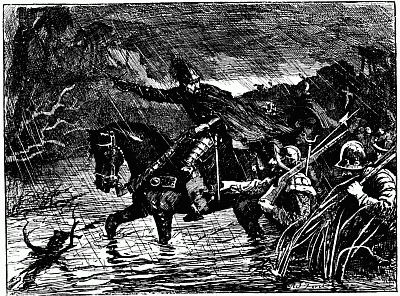
The Mexicans clambered continually up the sides of the dyke,
and grappled with the Spaniards, till they rolled together down into
the canoes. But while the Aztec fell among friends, his unhappy
antagonist was secured, and borne away in triumph to the sacrifice.
The struggle was long and deadly, but by degrees the opening in the
causeway was filled up by the wreck of the waggons, guns, rich
bales of stuffs, chests of solid ingots, and bodies of men and horses
which had fallen into it; and over this dismal ruin those in the rear
were able to reach the other side. Cortés had found a place that
was fordable, and, halting halfway across, had vainly endeavoured to
check the confusion, and lead his followers safely to the opposite bank.
But his voice was lost in the wild uproar; and at length, attended by
a few trusty cavaliers, he pushed forward to the front. Here he
found Sandoval and his companions, halting before the last breach,
trying to cheer on the soldiers to attempt the crossing; but, though
not so beset with enemies as the last, it was wide and deep, and the
men's resolution failed them. Again the cavaliers set the example,
by plunging into the lake. Horse and foot followed, swimming or
clinging to the manes and tails of the horses. Those fared best, as
the general had predicted, who travelled lightest, and many were
the unfortunate wretches, who, weighed down by the fatal treasure,
were buried with it at the bottom of the lake. Cortés, with a few
others, still kept in advance, leading the miserable remnant off the
causeway. The din of battle was growing faint in the distance, when
the rumour reached them that, without speedy succour, the rearguard
must be utterly overwhelmed. It seemed a desperate venture, but
the cavaliers, without thinking of the danger, turned their horses,
and galloped back to the relief of their comrades. Swimming the
canal again, they threw themselves into the thick of the fray. The
first gleam of morning light showed the hideous confusion of the
scene; the masses of combatants upon the dyke were struggling till the
very causeway seemed to rock, while as far as the eye could see, the
lake was covered with a dense crowd of canoes full of warriors.
The cavaliers found Alvarado unhorsed, and, with a mere handful of
followers, defending himself against an overwhelming tide of the
enemy, who by this time possessed the whole rear of the causeway,
and received constant reinforcements from the city. The Spanish
artillery, which had done good service at first, had been overthrown,
and utterly confounded by the rush from the back. In the general
ruin, Cortés strove by a resolute charge to give his countrymen time
to rally, but it was only for a moment: they were speedily borne
down by the returning rush. The general and his companions were
forced to plunge into the lake once more, though with their numbers
reduced this time, and Alvarado stood for an instant upon the brink,
uncertain what to do. There was no time to be lost. He was a
tall and powerful man. Setting his long lance firmly on the wreck
which strewed the lake, he gave a mighty leap which landed him in
safety upon the opposite bank. Aztecs and Tlascalans looked on in
amazement at this almost incredible feat, and a general shout arose.
'This is truly the Tonatiuh—the Child of the Sun.' To this day,
the place is called 'Alvarado's Leap.' Cortés now rode to the front,
where the troops were straggling miserably off the fatal causeway.
Most fortunately, the attention of the Aztecs was diverted by the
rich spoil that strewed the ground, and their pursuit ceased, so that
the Spaniards passed unmolested through the village of Popotla.
There the Spanish commander dismounted from his weary steed,
and sitting down on the steps of an Indian temple, looked mournfully
on while the broken files dragged slowly past. It was a piteous
spectacle. The cavalry, many of them dismounted, were mingled
with the infantry, their shattered mail dripping with the salt ooze,
and showing through its rents many a ghastly wound; their firearms,
banners, baggage, artillery, everything was gone. Cortés, as he
looked sadly on their thin, disordered ranks, sought in vain many a
familiar face, and missed more than one trusty comrade who had
stood by his side through all the perils of the conquest; and accustomed
as he was to conceal his emotions, he could bear it no longer,
but covered his face with his hands, while he wept tears of anguish.
It was, however, some consolation to him that Marina had been
carried safely through the awful night by her faithful guards.
Aguilar was also alive, and Martin Lopez, who had built two boats
for him in Mexico, as well as Alvarado, Avila, Sandoval, Olid, and
Ordaz.
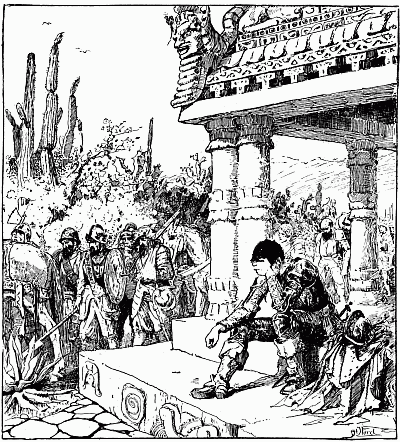
But this was no time to give way to vain regrets. Cortés hastily
mounted again and led his men as speedily as possible through
Tlacopan, and, as soon as he reached the open country, endeavoured
to bring his disorganised battalions into something like order. The
broken army, half-starved, moved slowly towards the coast. On the
seventh morning the army reached the mountain range which overlooks
the plains of Otumba. All the day before, parties of the enemy
had hovered round, crying vindictively, 'Hasten on. You will soon
find yourselves where you cannot escape!' Now, as they climbed
the steep hillside, Cortés realised what this meant, for his scouts came
back reporting that a powerful body of Aztecs was encamped upon
the other side waiting for them, and truly enough, when they
looked down into the valley, they saw it filled with a mighty host of
warriors who had been gathered together by Cuitlahua, and stationed
at this point to dispute the passage of the Spaniards. Every chief
of importance had taken the field with his whole array. As far as
the eye could reach extended a moving mass of glittering shields
and spears, mingled with the banners and bright feather-mail of
the caciques, and the white cotton robes of their followers. It was
a sight to dismay the stoutest heart among the Spaniards, and even
Cortés felt that his last hour was come. But since to escape was
impossible, he disposed his little army to the best advantage, and
prepared to cut his way through the enemy or perish in the
attempt. He gave his force as broad a front as possible, protecting
it on each flank with his cavalry, now reduced to twenty horsemen,
who were instructed to direct their long lances at the faces of the
enemy, and on no account to lose their hold of them. The infantry
were to thrust, not strike, with their swords, and above all to make
for the leaders of the enemy, and then, after a few brave words of
encouragement, he and his little band began to descend the hill,
rushing, as it seemed, to certain destruction. The enemy met them
with the usual storm of stones and arrows, but when the Spaniards
closed with them, their superiority became apparent, and the natives
were thrown into confusion by their own numbers as they fell back
from the charge. The infantry followed up their advantage, and a
wide lane was opened in the ranks of the enemy, who receded on all
sides as if to allow them a free passage. But it was only to return
with fresh fury, and soon the little army was entirely surrounded,
standing firmly, protected on all sides by its bristling swords and
lances, like an island in the midst of a raging sea. In spite of many
gallant deeds and desperate struggles, the Spaniards found themselves,
at the end of several hours, only more deeply wedged in by the dense
masses of the enemy. Cortés had received another wound, in the
head, his horse had fallen under him, and he had been obliged to
mount one taken from the baggage train. The fiery rays of the sun
poured down upon the nearly exhausted soldiers, who were beginning
to despair and give way, while the enemy, constantly reinforced from
the rear, pressed on with redoubled fury. At this critical moment
the eagle eye of Cortés, ever on the watch for any chance of arresting
the coming ruin, descried in the distance a chief, who, from his
dress and surroundings, he knew must be the commander of the
Aztec forces. He wore a rich surcoat of feather-work, and a
gorgeous plume of jewelled feathers floated from his helmet, while
above this, and attached to his back between the shoulders, showed
a golden net fastened to a short staff—the customary symbol of
authority for an Aztec commander. Turning quickly round to
Sandoval, Olid, Alvarado, and Avila who surrounded him, he cried,
pointing to the chief, 'There is our mark! Follow and support me!'
And shouting his war-cry he plunged into the thickest of the press.
Taken by surprise the enemy fell back; those who could not escape
were trampled under his horse's feet, or pierced by his long lance;
the cavaliers followed him closely; in a few minutes they were
close to the Aztec chief, and Cortés hurled him to the ground with
one stroke from his lance; a young cavalier named Juan de Salamanca
hastily dismounted and slew him where he lay, and tearing
away his banner presented it to the Spanish general. The cacique's
guard, overpowered by this sudden onset, fled precipitately, and
their panic spread to the other Indians, who, on hearing of the death
of their chief, fought no more, but thought only of escape. In their
blind terror they impeded and trampled down their own comrades,
and the Spaniards, availing themselves fully of the marvellous turn
affairs had taken, pursued them off the field, and then returned to
secure the rich booty they had left behind them.
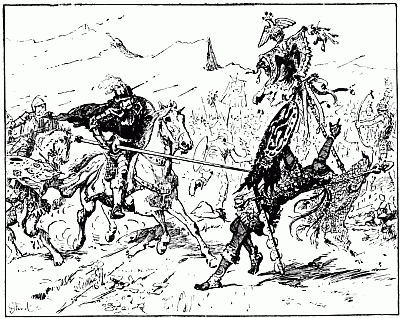
Cortés reached Tlascala in safety, and at once began to prepare
his revenge on the Mexicans, aided by reinforcements of a few
Spaniards from Vera Cruz. Gunpowder had also to be manufactured,
and a cavalier named Francio Montaño undertook the perilous
task of obtaining sulphur for the purpose from the terrible volcano of
Popocatepetl. He set out with four comrades, and after some days
journeying, they reached the dense forest which covered the base
of the mountain, and forcing their way upward, came by degrees to
a more open region. As they neared the top the track ended, and
they had to climb as best they could over the black glazed surface
of the lava, which, having issued from the crater in a boiling flood,
had risen into a thousand odd forms wherever it met with any
obstacle, and continually impeded their progress. After this they
arrived at the region of perpetual snow, which increased their
difficulties, the treacherous ice giving way at every step, so that
many times they narrowly escaped falling into the frozen chasms
that yawned all round them. At last, however, they reached the
mouth of the crater, and, crawling cautiously to the very edge,
peered down into its gloomy depths. At the bottom of the abyss,
which seemed to them to go down into the very heart of the earth,
a lurid flame burned sullenly, sending up a sulphureous steam,
which cooling as it rose, fell again in showers upon the sides of the
cavity. Into this one of the brave explorers had to descend, and
when they had cast lots the choice fell upon Montaño himself. His
preparations were soon made, and his companions lowered him in
a basket into the horrible chasm to a depth of four hundred feet,
and there as he hung, he scraped the sulphur from the sides of the
crater, descending again and again until he had procured enough
for the wants of the army, with which they returned triumphantly
to Tlascala. Meanwhile the construction of the ships went forward
prosperously, and by Christmas, in the year 1520, there was no
longer any reason to delay the march to Mexico.
While all these preparations were being made, some changes
had taken place among the Aztecs. Cuitlahua had suddenly died
after reigning four months, and Guatemozin his nephew had
been chosen in his stead. This young prince had married one of
Montezuma's daughters. He was handsome and valiant, and so
terrible that his followers trembled in his presence. He had a sort
of religious hatred of the Spaniards, and prepared manfully to meet
the perils which he saw threatening his country, for by means of
spies he had kept a watch upon the movements of the Spaniards,
and had discovered their intention of besieging the capital. Cortés,
upon reviewing his army, found that his whole force fell little short
of six hundred men, of whom forty were cavalry, and eighty arquebusiers
and cross-bowmen. The rest were armed with sword,
target, and the long copper-headed pikes, which had been made
specially by the general's directions. There were also nine cannons
of moderate size, but the supply of powder was but indifferent.
Cortés published a code of strict regulations for the guidance of his
men before they set out, and addressed them as usual with stirring
words, touching all the springs of devotion, honour, and ambition in
their hearts, and rousing their enthusiasm as only he could have
done. His plan of action was to establish his headquarters at some
place upon the Tezcucan lake, whence he could cut off the supplies
from the surrounding country, and place Mexico in a state of
blockade until the completion of his ships should enable him to
begin a direct assault. The most difficult of the three ways into
the valley was the one Cortés chose; it led right across the mountain
chain, and he judged wisely that he would be less likely to be
annoyed by the enemy in that direction. Before long the army
halted within three leagues of Tezcuco, which you will remember
was upon the opposite shore of the lake to Mexico, and somewhat
further north. Up to this time they only had had a few slight
skirmishes with the Aztecs, though beacon fires had blazed upon
every hill-top, showing that the country was roused. Cortés thought
it very unlikely that he would be allowed to enter Tezcuco, which
was now reigned over by Coanaco, the friend and ally of Guatemozin.
But the next morning, before the troops were well under arms,
came an embassy bearing a golden flag, and a gift for Cortés, and
imploring him to spare Coanaco's territories, and to take up his
quarters in his capital. Cortés first sternly demanded an account
of the Spaniards who, while convoying treasure to the coast, had
been slain by Coanaco just when Cortés himself was retreating to
Tlascala. The envoys declared at once that the Mexican emperor
alone was to blame; he had ordered it to be done, and had received
the gold and the prisoners. They then urged that to give them
time to prepare suitable accommodation for him, Cortés should not
enter Tezcuco until the next day; but disregarding this he marched
in at once, only to find the place deserted, and Coanaco well on his
way across the lake to Mexico. The general, however, turned this
to his own advantage by assembling the few persons left in the city,
and then and there electing a brother of the late sovereign to be
ruler in his place, and when a few months later he died, he was
succeeded by Ixtlilxochitl, son of Negahualpilli, who, always a friend
of the Spaniards, now became their most valuable ally, and by the
support of his personal authority and all his military resources, did
more than any other Aztec chieftain to rivet the chains of the
strangers round the necks of his own countrymen.
The city of Tezcuco, which lay about half a league from the
shore of the lake, was probably the best position Cortés could have
chosen for the headquarters of the army. His first care was to
strengthen the defences of the palace in which they were lodged,
and next to employ eight thousand Indian labourers in widening a
stream, which ran towards the lake, so that when the ships arrived
they might be put together in Tezcuco, and floated safely down to
be launched upon it. Meanwhile many of the places in the neighbourhood
sent in their submission to Cortés, and several noble
Aztecs fell into his hands. These men he employed to bear a
message to Guatemozin, in which he deprecated the necessity of
the present hostilities, and declared himself willing to forget the
past, inviting the Mexicans by a timely submission to save their
capital from the horrors of a siege. But every man in Mexico was
determined to defend it to the uttermost, and this appeal produced
no effect. The general now turned his attention to securing all the
strong places upon the lake. Iztapalapan was the first; the attacking
party, after a sharp struggle, succeeded in entering the town;
many of the inhabitants fled in their canoes, but those who remained
were massacred by the Tlascalans in spite of all Cortés could do to
restrain them. Darkness set in while the soldiers were eagerly
loading themselves with plunder; some of the houses had been set
on fire, and the flames lighted up the scene of ruin and desolation.
Suddenly a sound was heard as of the rush of the incoming tide—and
Cortés with great alarm realised that the Indians had broken
down the dykes, and that before long the low-lying ground upon
which the town stood would be under water. He hastily called off
his men and retreated, the soldiers, heavily laden, wading with
difficulty through the flood which gained fast upon them. As they
left the burning city behind them they could no longer find their
way, and sometimes plunged into deep water where many of the
allies, unable to swim, were carried away and drowned. When
morning dawned they were harassed by the enemy, who hovered
round and discharged volleys of arrows and stones, so that it was
with no small satisfaction that they presently found themselves
once more within the walls of Tezcuco. Cortés was greatly disappointed
at this disastrous end of an expedition which had begun so
well, but after all the fate of Iztapalapan produced a good effect,
and many more towns sent to tender their allegiance, amongst
others Otumba and Chalco, which was a place of great importance.
Cortés also managed to induce the tribes, who though friendly to
him were hostile to one another, to forget their feuds and combine
against Mexico, and to this wise policy he owed much of his future
success.
News now came from Tlascala that the ships were ready,
and Sandoval was despatched with a considerable guard to bring
them to Tezcuco. On his way he was to stop at Zoltepec, where
the massacre of the Spaniards had taken place, to find out and
punish all who had had a hand in the matter; but when they got
there the inhabitants had fled. In the deserted temples they had
the horror of finding many traces of the fate of their comrades; for
beside their arms and clothing, and the hides of their horses, the
heads of several soldiers were found suspended as trophies of victory;
while traced in charcoal upon the wall in one building were the
words, in the Spanish language, 'In this place the unfortunate
Juan Juste, with many others of his company, was imprisoned.'
It was fortunate that the inhabitants had fled, for they would have
met with but scant mercy from the Spaniards, who were full of indignation
at the thought of the horrible doom which had overtaken
their companions. Sandoval now resumed his march to Tlascala,
but before he could reach it, the convoy appeared transporting the
ships through the mountain passes. Retaining twenty thousand of
the warriors as a guard, the Spanish captain dismissed the rest, and
after four laborious days Cortés and his garrison had the joy of
welcoming them safe within the walls of Tezcuco. It was not long
before the general once more sallied forth to reconnoitre the capital,
and by the way to chastise certain places which had sent him hostile
messages. After an exciting struggle Xaltocan and three other
towns were taken, and a considerable quantity of gold and food fell
into the hands of the victors. Marching on, the general found himself
before Tlacopan, through whose streets he had hurried in consternation
at the end of the night of horror. It was his intention
to occupy the town, which he did after a sharp fight, just before
nightfall, and the next morning, seeing the enemy in battle array on
the open ground before the city, he marched out against them and
routed them utterly. The Aztecs fled into the town, but were driven
through its streets at the point of the lance, and compelled once
more to abandon it, after which the Tlascalans pillaged and set fire
to the houses, much against the will of Cortés, but they were a fierce
race, and sometimes dangerous to friends as well as foes. After six
days the general went back to Tezcuco, and for some time things
went on as before, with many skirmishes and expeditions against
the towns garrisoned by the Mexicans. Sandoval took several
strongholds which threatened the security of Chalco, and all the
while the work upon the canal was going rapidly forward, and the
ships were nearing completion in spite of three attempts made by
the enemy to burn them. Just at this time came the welcome
news that three vessels had arrived at Villa Rica, with two hundred
men on board well provided with arms and ammunition, and
with seventy or eighty horses, and the new comers soon made
their way to Tezcuco, for the roads to the port were now safe and
open.
In April 1521, Cortés started once more to scour the country
with a large force, passing quite round the great lakes, and exploring
the mountain regions to the south of them. Here he came upon
Aztec forces intrenched in strong towns, often built like eagles'
nests upon some rocky height, so that to take them was a work of
great difficulty and danger. Once he found himself before a city
which it was absolutely necessary to subdue, but he was separated
from it by a cleft in the solid rock of no great width, but going sheer
down thousands of feet. The bridges which generally crossed it
had been broken down at the approach of the Spaniards, and as
they stood there, unable to advance, the enemy's archers as usual
kept up a steady fire, to which they were unavoidably exposed.
The general sent a party to seek a passage lower down, but they
met with no success until they came to a spot where two large trees,
growing one on either side of the ravine, interlaced their branches
overhead, and by this unsteady and perilous bridge one of the
Tlascalans ventured to cross. His example was soon followed, and
one by one about thirty Spaniards and some more of the natives
crawled across, swinging dizzily above the abyss. Three lost their
hold and fell, but the rest alighted in safety on the other side and
attacked the Aztecs, who were as much amazed at their sudden
appearance as if they had dropped from the clouds. Presently a
temporary bridge was contrived by which the remainder of the
force managed to cross also, and before long the town was taken,
and the trembling caciques appeared before Cortés, throwing the
blame of their resistance upon the Mexicans, and promising submission
for the future.
The general then continued his march across the eastern
shoulder of the mountain, descending finally upon Xochimilco,
which was built partly upon the lake like Mexico itself, and was
approached by causeways, which, however, were of no great length.
It was in the first attack upon this town that Cortés was as
nearly as possible taken prisoner by the Aztecs. He had thrown
himself into the thick of the fight with his usual bravery, and was
trying to resist an unexpected rush of the enemy, when his horse
stumbled and fell, he himself received a severe blow upon the head
before he could rise, and was seized and dragged off in triumph
by several Indians. At this moment a Tlascalan saw his danger
and sprang furiously upon his captors, trying to tear him from their
grasp. Two Spaniards also rushed to the rescue, and between
them the Aztecs were forced to quit their hold of the general, who
lost no time in regaining his saddle, and laying about him with his
good sword as vigorously as before. After a terrible struggle the
enemy was driven out, and Cortés took possession of the city. As
it was not yet dusk he ascended the principal teocalli to reconnoitre
the surrounding country, and there beheld a sight which could but
cause him grave anxiety. The lake was covered with rapidly
approaching canoes full of warriors, while inland Indian squadrons
were marching up in dense columns. Xochimilco was but four
leagues from the capital, and at the first tidings of the arrival of the
Spaniards, Guatemozin had mustered a strong force and marched
to its relief. Cortés made all possible preparations for the defence
of his quarters, but not until the next day did the Mexicans attack
him, and then the battle raged long and with varying success; but
in the end Spanish discipline prevailed, and the natives were
routed with such dreadful slaughter that they made no further
attempt to renew the conflict. The city yielded a rich hoard of
plunder, being well stored with gold and feather-work, and many
other articles of use or luxury, so that when the general mustered
his men upon the neighbouring plain before resuming his march,
many of them came staggering under the weight of their spoil.
This caused him much uneasiness, since their way would be through
a hostile country; but seeing that the soldiers were determined to
keep what they had so hardly won, he contented himself with
ordering the baggage to be placed in the centre guarded by part of
the cavalry, and having disposed the rest to the best advantage,
they once more set forth, at the last moment setting fire to the
wooden buildings of Xochimilco, which blazed furiously, the glare
upon the water telling far and wide the fate that had befallen it.
Resting here and there, and engaging in many skirmishes with the
Aztecs who followed them up, furious at the sight of the plunder
which was being carried away by the invaders, the army presently
completed the circuit of the lakes, and reached Tezcuco, to be
greeted with the news that the ships were fully rigged and the
canal completed, so that there was no longer any reason to delay
their operations against Mexico.
It was a triumphant moment when the vessels were launched,
and reached the lake in good order. Cortés saw to their being
properly armed and manned, and then reviewed the rest of his
forces, and summoned his native allies to furnish their promised
levies at once.
The general's plan of action against Mexico was to send Sandoval
with one division to take possession of Iztapalapan at the southern
end of the lake, while Alvarado and Olid were to secure Tlacopan
and Chapoltepec upon its western shore, and at the latter place
destroy the aqueduct, and so cut off the supply of fresh water from
Mexico. This they did successfully, and in several days of fierce
fighting breach after breach was carried, and the Spaniards penetrated
the city as far as the great teocalli, driving the natives
before them, while the Tlascalans in the rear filled up the gaps
in the dyke as well as they could, and brought up the heavy
guns. Cortés and his men now pushed their way into the inclosure
of the temple, and some of them rushed to the top, so
lately the scene of their terrible battle, and there found a fresh
image of the war-god. Tearing away the gold and jewels with
which it was bedecked, they hurled it and its attendant priests over
the side of the pyramid, and hastened down to the assistance of
their comrades, who were by this time in a most perilous position,
the Aztecs having rallied and attacked them furiously. Indeed it
seemed likely to go hard with them, for they were driven helplessly
back down the great street in utter confusion and panic; but the
timely arrival of a small body of cavalry created a diversion
in their favour, and Cortés managed to turn them once more and
drive the enemy back into the enclosure with much loss. As it was
by this time evening, he retreated in good order to Xoloc. Though
this affair caused some consternation among the Mexicans, they
speedily opened the canals and built up the ramparts again, so that
when Cortés renewed the attack the whole scene had to be gone
through as before. When they had once gained the street, however,
they found it much easier to advance, the Tlascalans having on the
last occasion pulled down many of the houses on either side. This
time Cortés had determined to destroy some of the cherished buildings
of the Mexicans, and began by setting fire to his old quarters,
the palace of Axayacatl, and then the palace of Montezuma on
the other side of the great square. The sight so maddened the
natives that the Spaniards had some ado to make good their retreat,
and few reached their camp that night unwounded. The Aztec
emperor for his part made frequent sallies against the Spaniards
both by land and upon the lake, sometimes with considerable success.
At first he managed to obtain supplies of food in canoes,
under cover of the darkness, but by degrees the large towns on the
mainland, seeing the Mexicans unable to defend themselves, gave
in their allegiance to the Spaniards, and then starvation began to
be felt in the unhappy city. In spite of everything, however, all
offers of terms from Cortés were steadily refused.
At this juncture, the general was persuaded by some of his
officers that it would be well for two of the divisions to unite, and
occupy the great market-place in the heart of the town, and so at
a given time they marched along their respective causeways and
entered the city. Strict orders were given by Cortés that as
they advanced every opening in the causeways should be filled
up and made secure. The attack began, and the enemy, taken
apparently by surprise, gave way and fell back; on rushed the
Spaniards by every street, eager to reach the appointed meeting
place. Only the general suspected that the enemy might be
purposely luring them on to turn upon them when they were
hopelessly involved. Taking a few men with him, he hastily proceeded
to see for himself if the way was clear should a retreat
become necessary, and found, as he had feared, that all had
been too eager to be in the front to attend to this most important
duty. In the first street he traversed was a huge gap, twelve feet
wide, and at least as many deep, full of water, for it connected two
canals. A feeble attempt had been made to fill this up with beams
and rubbish, but it had been left before any good had been done.
Worse than all Cortés saw that this breach was freshly made, and
that his officers had probably rushed headlong into a snare laid by
the enemy. Before his men could do anything towards filling up
the trench, the distant sounds of the battle changed into an ever-increasing
tumult, the mingled yells and war cries, and the trampling
of many feet grew nearer, and at last, to his horror, Cortés
beheld his men driven to the edge of the fatal gulf, confused, helpless,
surrounded by their foes. The foremost files were soon
hurried over the edge, some trying to swim across, some beaten
down by the struggles of their comrades, or pierced by the darts of
the Indians. In vain with outstretched hands did Cortés try to
rescue his soldiers from death, or worse still from capture; he was
soon recognised, and six of the enemy tried to seize and drag him
into a canoe. It was only after a severe struggle, in which he was
wounded in the leg, that he was rescued by his brave followers.
Two were killed in the attempt, while another was taken alive
as he held the general's horse for him to mount. In all, sixty
Spaniards were captured on this fatal day, and it was only when
the rest reached their guns in the open space before the causeway
that they were able to rally and beat back the Aztecs. The other
division had fared equally ill, and were moreover in great anxiety
as to the fate of Cortés, who was reported to have been killed.
When they once more reached their quarters, Sandoval, though
badly wounded, rode into the camp of Cortés to learn the truth, and
had a long and earnest consultation with him over the disaster,
and what was next to be done. As he returned to his camp he was
startled by the sound of the great drum on the temple of the war-god,
heard only once before during the night of horror, and looking
up he saw a long file of priests and warriors, winding round the
terraces of the teocalli. As they came out upon the platform at the
top he perceived, with rage and despair, that his own countrymen
were about to be sacrificed with the usual ghastly ceremonies.
The camp was near enough to the city for the white skins of the
victims and their unavailing struggles to be distinctly seen by
their comrades, who were nevertheless powerless to help them, and
their distress and fury may be imagined.
For five days the horrible scenes went on, the Mexicans feasting,
singing, and dancing, while their priests predicted that in eight
days the war-god, appeased by these sacrifices, would overwhelm
their enemies and deliver them into their hands. These prophecies
had a great effect upon the native allies of Cortés, who withdrew
from him in immense numbers. But the general treated their
superstition with cheerful contempt, and only bargained with the
deserters to remain close by and see what would happen. When
the ninth day came, and the city was still seen to be beset on
every side, they ceased to believe in the oracle, and returned, with
their anger against the Mexicans rekindled, and their confidence
in the Spaniards greatly strengthened. At this time another vessel
loaded with stores and ammunition touched at Vera Cruz, and her
cargo was seized and sent on to Cortés by the governor. With his
strength thus renewed the Spanish general resumed active operations.
This time not a step was taken in advance without securing
the entire safety of the army, once and for all, by solidly building
up the dykes, filling every canal, and pulling down every house,
so that slowly and by degrees a bare open space was made, which
took in more and more of the town, till at last the unhappy Aztecs,
after many desperate sallies, were shut into the portion of the city
which lay between the northern and western causeways. Here
famine and pestilence did their awful work unchecked. The
ordinary articles of food were long exhausted, and the wretched
people ate moss, insects, grass, weeds, or the bark of trees. They
had no fresh water. The dead were unburied, the wounded lay in
misery, yet all the endeavours of Cortés to induce Guatemozin and
his chiefs to submit were useless. Though the two divisions of the
army had proceeded with their work of destruction until they could
join their forces, and seven-eighths of the city lay in ruins, though
the banner of Castile floated undisturbed from the smouldering
remains of the sanctuary on the teocalli of the war-god, still the
Aztecs defied the conquerors, and fiercely rejected their overtures
of peace.
Hundreds of famishing wretches died every day, and lay where
they fell, for there was no one to bury them. Familiarity with the
spectacle made men indifferent to it. They looked on in dumb
despair waiting for their own turn to come. There was no complaint
or lamentation, but deep, unutterable woe. In the midst of
this appalling misery Guatemozin remained calm and courageous,
and as firmly resolved not to capitulate as at the beginning of
the siege. It is even said that when Cortés persuaded a noble
Aztec prisoner to bear his proposals for a treaty to the emperor,
Guatemozin instantly ordered him to be sacrificed. The general,
who had suspended hostilities for several days hoping for a favourable
answer to his message, now resolved to drive him to submission
by a general assault, and for that purpose led his men across the
dreary waste of ruins to the narrow quarter of the city into which
the wretched Mexicans had retreated. But he was met by several
chiefs, who, holding out their emaciated arms, exclaimed, 'Why
do you delay so long to put an end to our miseries? Rather kill
us at once that we may go to our god Huitzilopochtli, who waits to
give us rest from our sufferings!'
Cortés, moved by the piteous sight, replied that he desired not
their death but their submission. 'Why does your master refuse to
treat with me,' he said, 'when in a single hour I can crush him and
all his people?' Then once more he sent to demand an interview
with Guatemozin. This time the emperor hesitated, and agreed
that next day he would meet the Spanish general. Cortés, well
satisfied, withdrew his force, and next morning presented himself
at the appointed place in the great square, where a stone platform
had been spread with mats and carpets and a banquet made ready.
But after all Guatemozin, instead of coming himself, sent his nobles.
Cortés, though greatly disappointed, received them courteously, persuading
them to partake of the feast he had prepared, and dismissing
them with a supply of provisions for their master and a renewed
entreaty that he would next day come in person. But though he
waited for three hours beyond the time appointed, neither the
emperor nor his chiefs appeared, and the general heard that the
Mexicans were preparing to resist an assault. He delayed no
longer, but ordering Sandoval to support him by bringing up the
ships and directing his big guns against the houses near the water,
he marched at once into the enemy's quarters. The Mexicans set
up a fierce war-cry, and with their usual spirit sent off clouds of
arrows and darts; but the struggle soon became a hand-to-hand
one; and weakened by starvation and hemmed in as they were the
unhappy Aztecs had no chance against their foes. After a scene of
indescribable horror, which appalled even the soldiers of Cortés, used
as they were to war and violence, the Spanish commander sounded
a retreat and withdrew to his quarters, leaving behind him forty
thousand corpses and a smouldering ruin. Through the long night
that followed all was silent in the Mexican quarter. There was
neither light nor movement. This last blow seemed to have utterly
stunned them. They had nothing left to hope for. In the Spanish
camp, however, all was rejoicing at the prospect of a speedy termination
to the wearisome campaign. The great object of Cortés was
now to secure the person of Guatemozin, and the next day, which
was August 18, 1521, he led his forces for the last time across the
black and blasted ruin which was all that remained of the once
beautiful city. In order to give the distressed garrison one more
chance, he obtained an interview with the principal chiefs and
reasoned with them about the conduct of their emperor.
'Surely,' he said, 'Guatemozin will not see you all perish when
he can so easily save you.' But when he had with difficulty prevailed
upon them to urge the king to confer with him, the only
answer they could bring was that Guatemozin was ready to die
where he was, but would hold no communication with the Spanish
commander. 'Go then,' replied the stern conqueror, 'and prepare
your countrymen for death. Their last moment is come.' Still,
however, he postponed the attack for several hours; but the troops
were impatient at the delay, and a rumour spread that Guatemozin
was preparing to escape by the lake. It was useless to hesitate:
the word was given, and the terrible scene that ensued repeated the
horrors of the day before. While this was going forward on shore
numbers of canoes pushed off across the lake, most of them only to
be intercepted and sunk by the Spanish ships, which beat down
upon them, firing to right and left. Some few, however, under
cover of the smoke, succeeded in getting into open water. Sandoval
had given particular orders that his captains should watch any boat
that might contain Guatemozin, and now two or three large canoes
together attracted the attention of one named Garci Holguin, who
instantly gave chase, and with a favourable wind soon overtook the
fugitives, though they rowed with the energy of despair. As his
men levelled their guns at the occupants of the boat one rose
saying, 'I am Guatemozin; lead me to Malinche; I am his prisoner.
But let no harm come to my wife and followers.'
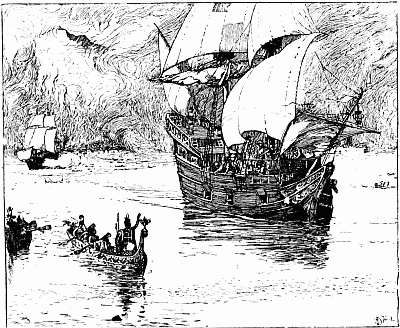
Holguin took them on board, and then requested that the
emperor would order the people in the other canoes to surrender.
'There is no need,' he answered sadly, 'they will fight no longer
when they see their prince is taken.' And so it was, for when the
news of his capture reached the shore the Mexicans at once ceased
to defend themselves. It seemed as if they had only gone on so
long to give their sovereign a better chance of escape. Cortés, who
had taken up his station on the flat roof of one of the houses, now
sent to command that Guatemozin should be brought before him,
and he came, escorted by Sandoval and Holguin, who each claimed
the honour of having captured him. The conqueror, who was, as
usual, accompanied by the Lady Marina, came forward with dignified
courtesy to receive his noble prisoner. The Aztec monarch
broke the silence saying, 'I have done all I could to defend myself
and my people. I am now reduced to this state. Deal with me,
Malinche, as you will.' Then laying his hand on a dagger which
hung from the belt of Cortés, he added, 'Better despatch me at
once with this and rid me of life.'
'Fear not,' answered the conqueror. 'You shall be treated with
honour. You have defended your capital like a brave warrior, and
a Spaniard knows how to respect valour even in an enemy.' He
then sent for the queen, who had remained on board the Spanish
ship, and after ordering that the royal captives should be well
cared for and supplied with all they needed, he proceeded to dispose
of his troops. Olid and Alvarado drew off their divisions to
their quarters, leaving only a small guard in the wasted suburbs of
the pestilence stricken city, whilst the general himself, with
Sandoval and the prisoners, retired to a town at the end of the
southern causeway. That night a tremendous tempest arose, such
as the Spaniards had never before witnessed, shaking to its foundations
all that remained of the city of Mexico. The next day, at
the request of Guatemozin, the Mexicans were allowed to leave
the capital, and for three days a mournful train of men, women,
and children straggled feebly across the causeways, sick and
wounded, wasted with famine and misery, turning often to take
one more look at the spot which was once their pleasant home.
When they were gone the conquerors took possession of the
place and purified it as speedily as possible, burying the dead and
lighting huge bonfires in the deserted streets. The treasure of gold
and jewels found in it fell far short of the expectation of the
Spaniards, the Aztecs having probably buried their hoards or
sunk them in the lake on purpose to disappoint the avarice of their
enemies. Cortés, therefore, to his eternal disgrace, caused Guatemozin
to be tortured; but fire and cord could not wring the secret
of the treasure from this illustrious prince. In later days Cortés
hanged Guatemozin, on pretence of a conspiracy. Cortés, having
no further need for his native allies, now dismissed them with
presents and flattering speeches, and they departed well pleased,
loaded with the plunder of the Mexican houses, which was despised
by the Spanish soldiers. Great was the satisfaction of the conquerors
at having thus brought the long campaign successfully to
an end. Cortés celebrated the event by a banquet as sumptuous
as circumstances would permit, and the next day, at the request
of Father Olmedo, the whole army took part in a solemn service
and procession in token of their thankfulness for victory.
Thus, after a siege of nearly three months, in which the beleaguered
Mexicans showed a constancy and courage under their
sufferings which is unmatched in history, fell the renowned capital
of the Aztecs, and with its fall the story of the nation comes to an
end.
The Aztec empire fell by its own sin. The constant capture of
men from neighbouring states as victims for sacrifice had caused
the Aztecs to be hated; thus Cortés obtained the aid of the Tlascalans,
but for which even his courage and energy would have been
of no avail. He deserted Marina when she ceased to be useful,
and gave her as a wife to one of his followers.
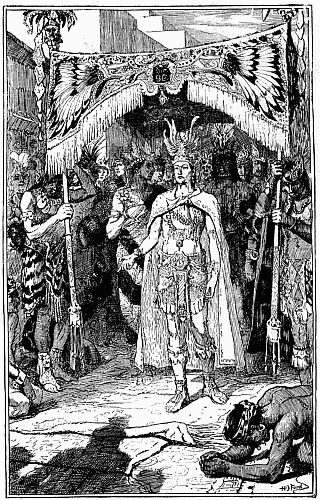 MONTEZUMA GREETS THE SPANIARDS